




FIBROMIALGIA
DR. OSCAR MENDIZABAL POLANCO
MÉDICO CIRUJANO UNAM
ESPECIALISTA EN ACUPUNTURA HUMANA IPN
¿QUÉ ES?
 Síndrome clínico definido por:
• Dolor generalizado
• Fatiga
• Alteraciones en el sueño
• Síntomas somáticos variables
• Alteraciones cognitivas
• Alteraciones anímicas
Clauw DJ, Arnold LM, McCarberg BH. The Science of Fibromyalgia. Mayo Clin Proc. 2011;
86(9): 907-9011
EPIDEMIOLOGÍA
 2-5% de la población
 2ª causa de consulta en reumatología
(EUA)
 6 veces más frecuente en mujeres
 > prevalencia entre los 20 y 50 años
Clauw DJ, Arnold LM, McCarberg BH. The Science of Fibromyalgia. Mayo Clin Proc.
2011; 86(9): 907-9011.
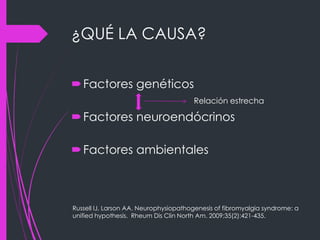
¿QUÉ LA CAUSA?
Factores genéticos
Factores neuroendócrinos
Factores ambientales
Relación estrecha
Russell IJ, Larson AA. Neurophysiopathogenesis of fibromyalgia syndrome: a
unified hypothesis. Rheum Dis Clin North Am. 2009;35(2):421-435.
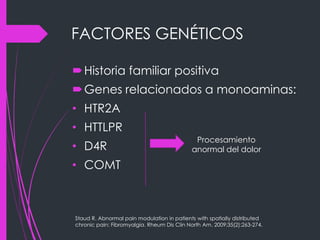
FACTORES GENÉTICOS
Historia familiar positiva
Genes relacionados a monoaminas:
• HTR2A
• HTTLPR
• D4R
• COMT
Procesamiento
anormal del dolor
Staud R. Abnormal pain modulation in patients with spatially distributed
chronic pain: Fibromyalgia. Rheum Dis Clin North Am. 2009;35(2):263-274.
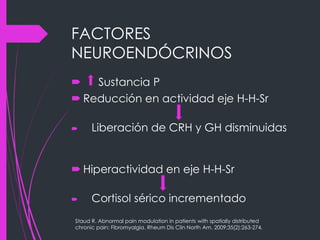
FACTORES
NEUROENDÓCRINOS
 Sustancia P
 Reducción en actividad eje H-H-Sr
 Liberación de CRH y GH disminuidas
 Hiperactividad en eje H-H-Sr
 Cortisol sérico incrementado
Staud R. Abnormal pain modulation in patients with spatially distributed
chronic pain: Fibromyalgia. Rheum Dis Clin North Am. 2009;35(2):263-274.
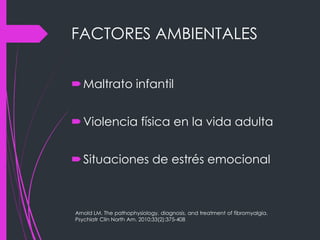
FACTORES AMBIENTALES
Maltrato infantil
Violencia física en la vida adulta
Situaciones de estrés emocional
Arnold LM. The pathophysiology, diagnosis, and treatment of fibromyalgia.
Psychiatr Clin North Am. 2010;33(2):375-408
SÍNTOMAS
 Alodinia
 Alteraciones del sueño (+/-)
 Fatiga
 Debilidad
 Alteraciones cognitivas
 Cefalea (tensional o migrañosa)
 Depresión
 SII
 Parestesias
Arnold LM. The pathophysiology, diagnosis, and treatment of fibromyalgia. Psychiatr
Clin North Am. 2010;33(2):375-408
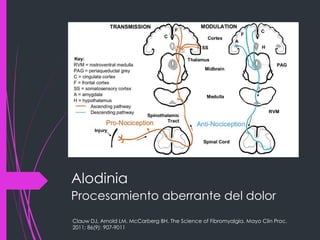
Alodinia
Procesamiento aberrante del dolor
Clauw DJ, Arnold LM, McCarberg BH. The Science of Fibromyalgia. Mayo Clin Proc.
2011; 86(9): 907-9011
DIAGNÓSTICO
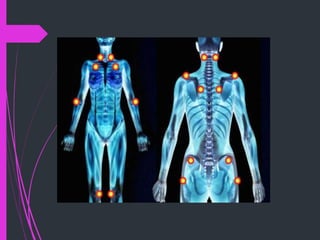
Criterios de la ACR 1990:
• Dolor generalizado por 3 o más
meses
• Dolor reproducible en 11 de 18
puntos
Wolfe F, Smythe HA, Yunus MB, et al. The American College of Rheumatology
1990 criteria for the classiication of fibromyalgia: report of a multi-center
criteria committee. Arthtiis Rheum. 1990;33(2):160-172.
DIAGNÓSTICO
 Al menos 4 de los siguientes:
• Fatiga
• Alteraciones del sueño
• Síntomas neuropsiquiátricos
• Cefalea
• Parestesias
• SII
• No explicables por otra patología
Arnold LM. The pathophysiology, diagnosis, and treatment of fibromyalgia.
Psychiatr Clin North Am. 2010;33(2):375-408.
OTROS SÍNTOMAS
 Rigidez articular
 Sensación de frío
 Fenómeno de Raynaud
 Cistitis
 Disfunción temporo mandibular
 Dolor pélvico crónico
 Sensibilidad química múltiple
Arnold LM. The pathophysiology, diagnosis, and treatment of fibromyalgia. Psychiatr
Clin North Am. 2010;33(2):375-408.
DIAGNÓSTICO
 Criterios preliminares ACR 2010:
• Cumplir las siguientes 3 condiciones:
• Índice de dolor generalizado (WPI) > 7 y
• Escala de gravedad de síntomas (SS) >
5
• O WPI 3-6 y SS > 9
• 3 o más meses
• No explicado por otra patología
Wolfe F, Clauw DJ, Fitzcharles M, Goldenberg DL, Katz RS, Mease P, Russell AS, Russell
IJ, Winfield JB, Yunus MB. The American College of Rheumatology preliminary
diagnostic driteria for dibromyalgia and measurement of symptom severity. Arthritis
Care Res. 2010;62:600–610.
LABORATORIO*
 BHC
 VSG
 PCR
 QS
 TSH
Longo DL, Fauci AS, et al. Harrison’s Principles of Internal Medicine. 2012. 18 ed.
Ch. 335. Mc Graw Hill.
DIAGNÓSTICO DIFERENCIAL
 AR
 Polimialgia reumática
 LES
 VIH
 VHC
 Lyme
 Hipotiroidismo
 Etc.
Clauw DJ, Arnold LM, McCarberg BH. The Science of Fibromyalgia. Mayo Clin Proc.
2011; 86(9): 907-9011.
TRATAMIENTO
TRATAMIENTO
FARMACOLÓGICO
 Enfocado a control sintomático
• Controlar dolor
• Mejorar sueño
 Antidepresivos (tricíclicicos, ISRS)
 Anticonvulsivos
 Analgésicos de acción central
Arnold LM. The pathophysiology, diagnosis, and treatment of fibromyalgia.
Psychiatr Clin North Am. 2010;33(2):375-408.
TRATAMIENTO NO
FARMACOLÓGICO
 Enfocado a control sintomático y
mejorar la calidad de vida
• Ejercicio (yoga, tai-chi)
• Terapia de grupo
• Terapia cognitivo-conductual
• Acupuntura
Rakel D. Integrative Medicine. 2012. 3rd ed. Saunders. Ch. 46, pp 438-455.
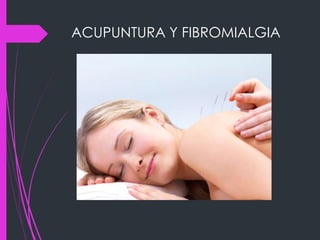
ACUPUNTURA Y FIBROMIALGIA
¿QUÉ ES LA ACUPUNTURA?
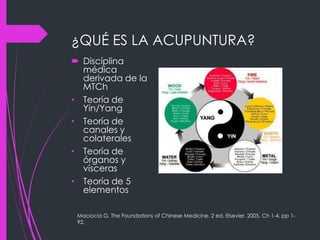
 Discíplina
médica
derivada de la
MTCh
• Teoría de
Yin/Yang
• Teoría de
canales y
colaterales
• Teoría de
órganos y
vísceras
• Teoría de 5
elementos
Maciocia G. The Foundations of Chinese Medicine. 2 ed. Elsevier. 2005. Ch 1-4, pp 1-
92.
¿EN QUÉ CONSISTE?
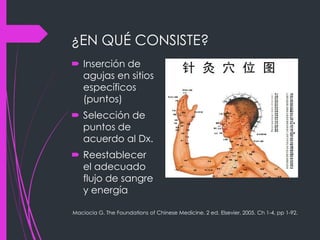
 Inserción de
agujas en sitios
específicos
(puntos)
 Selección de
puntos de
acuerdo al Dx.
 Reestablecer
el adecuado
flujo de sangre
y energía
Maciocia G. The Foundations of Chinese Medicine. 2 ed. Elsevier. 2005. Ch 1-4, pp 1-92.
¿CÓMO FUNCIONA?
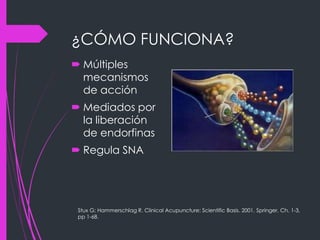
 Múltiples
mecanismos
de acción
 Mediados por
la liberación
de endorfinas
 Regula SNA
Stux G; Hammerschlag R. Clinical Acupuncture: Scientific Basis. 2001. Springer. Ch. 1-3,
pp 1-68.
EN FIBROMIALGIA…
 Inhibe vía ascendente (endorfinas)
 Estimula vía descendente (serotonina)
 Regula la producción de cortisol
 Incrementa la producción de GH
 Mejora calidad del sueño
Han JS. Acupuncture and Endorphins. Neurosci Lett. 2004. May 6;361 (1-3): 258-261
Lin JG, Chen WL. Acupuncture analgesia: A review of its mechanisms of action. 2008.
Am J Chin Med. 2008;36(4):635-45.
Zhao ZQ. Neural Mechanisms underlying acupuncture. Prog Neurobilol. 2008
Aug;85(4):355-75.
Fibromialgia
Fibromialgia

Fibromialgia

  • 1.
    FIBROMIALGIA DR. OSCAR MENDIZABALPOLANCO MÉDICO CIRUJANO UNAM ESPECIALISTA EN ACUPUNTURA HUMANA IPN
  • 2.
    ¿QUÉ ES?  Síndromeclínico definido por: • Dolor generalizado • Fatiga • Alteraciones en el sueño • Síntomas somáticos variables • Alteraciones cognitivas • Alteraciones anímicas Clauw DJ, Arnold LM, McCarberg BH. The Science of Fibromyalgia. Mayo Clin Proc. 2011; 86(9): 907-9011
  • 3.
    EPIDEMIOLOGÍA  2-5% dela población  2ª causa de consulta en reumatología (EUA)  6 veces más frecuente en mujeres  > prevalencia entre los 20 y 50 años Clauw DJ, Arnold LM, McCarberg BH. The Science of Fibromyalgia. Mayo Clin Proc. 2011; 86(9): 907-9011.
  • 5.
    ¿QUÉ LA CAUSA? Factoresgenéticos Factores neuroendócrinos Factores ambientales Relación estrecha Russell IJ, Larson AA. Neurophysiopathogenesis of fibromyalgia syndrome: a unified hypothesis. Rheum Dis Clin North Am. 2009;35(2):421-435.
  • 6.
    FACTORES GENÉTICOS Historia familiarpositiva Genes relacionados a monoaminas: • HTR2A • HTTLPR • D4R • COMT Procesamiento anormal del dolor Staud R. Abnormal pain modulation in patients with spatially distributed chronic pain: Fibromyalgia. Rheum Dis Clin North Am. 2009;35(2):263-274.
  • 7.
    FACTORES NEUROENDÓCRINOS  Sustancia P Reducción en actividad eje H-H-Sr  Liberación de CRH y GH disminuidas  Hiperactividad en eje H-H-Sr  Cortisol sérico incrementado Staud R. Abnormal pain modulation in patients with spatially distributed chronic pain: Fibromyalgia. Rheum Dis Clin North Am. 2009;35(2):263-274.
  • 8.
    FACTORES AMBIENTALES Maltrato infantil Violenciafísica en la vida adulta Situaciones de estrés emocional Arnold LM. The pathophysiology, diagnosis, and treatment of fibromyalgia. Psychiatr Clin North Am. 2010;33(2):375-408
  • 10.
    SÍNTOMAS  Alodinia  Alteracionesdel sueño (+/-)  Fatiga  Debilidad  Alteraciones cognitivas  Cefalea (tensional o migrañosa)  Depresión  SII  Parestesias Arnold LM. The pathophysiology, diagnosis, and treatment of fibromyalgia. Psychiatr Clin North Am. 2010;33(2):375-408
  • 11.
    Alodinia Procesamiento aberrante deldolor Clauw DJ, Arnold LM, McCarberg BH. The Science of Fibromyalgia. Mayo Clin Proc. 2011; 86(9): 907-9011
  • 12.
    DIAGNÓSTICO Criterios de laACR 1990: • Dolor generalizado por 3 o más meses • Dolor reproducible en 11 de 18 puntos Wolfe F, Smythe HA, Yunus MB, et al. The American College of Rheumatology 1990 criteria for the classiication of fibromyalgia: report of a multi-center criteria committee. Arthtiis Rheum. 1990;33(2):160-172.
  • 14.
    DIAGNÓSTICO  Al menos4 de los siguientes: • Fatiga • Alteraciones del sueño • Síntomas neuropsiquiátricos • Cefalea • Parestesias • SII • No explicables por otra patología Arnold LM. The pathophysiology, diagnosis, and treatment of fibromyalgia. Psychiatr Clin North Am. 2010;33(2):375-408.
  • 15.
    OTROS SÍNTOMAS  Rigidezarticular  Sensación de frío  Fenómeno de Raynaud  Cistitis  Disfunción temporo mandibular  Dolor pélvico crónico  Sensibilidad química múltiple Arnold LM. The pathophysiology, diagnosis, and treatment of fibromyalgia. Psychiatr Clin North Am. 2010;33(2):375-408.
  • 16.
    DIAGNÓSTICO  Criterios preliminaresACR 2010: • Cumplir las siguientes 3 condiciones: • Índice de dolor generalizado (WPI) > 7 y • Escala de gravedad de síntomas (SS) > 5 • O WPI 3-6 y SS > 9 • 3 o más meses • No explicado por otra patología Wolfe F, Clauw DJ, Fitzcharles M, Goldenberg DL, Katz RS, Mease P, Russell AS, Russell IJ, Winfield JB, Yunus MB. The American College of Rheumatology preliminary diagnostic driteria for dibromyalgia and measurement of symptom severity. Arthritis Care Res. 2010;62:600–610.
  • 17.
    LABORATORIO*  BHC  VSG PCR  QS  TSH Longo DL, Fauci AS, et al. Harrison’s Principles of Internal Medicine. 2012. 18 ed. Ch. 335. Mc Graw Hill.
  • 18.
    DIAGNÓSTICO DIFERENCIAL  AR Polimialgia reumática  LES  VIH  VHC  Lyme  Hipotiroidismo  Etc. Clauw DJ, Arnold LM, McCarberg BH. The Science of Fibromyalgia. Mayo Clin Proc. 2011; 86(9): 907-9011.
  • 19.
  • 20.
    TRATAMIENTO FARMACOLÓGICO  Enfocado acontrol sintomático • Controlar dolor • Mejorar sueño  Antidepresivos (tricíclicicos, ISRS)  Anticonvulsivos  Analgésicos de acción central Arnold LM. The pathophysiology, diagnosis, and treatment of fibromyalgia. Psychiatr Clin North Am. 2010;33(2):375-408.
  • 21.
    TRATAMIENTO NO FARMACOLÓGICO  Enfocadoa control sintomático y mejorar la calidad de vida • Ejercicio (yoga, tai-chi) • Terapia de grupo • Terapia cognitivo-conductual • Acupuntura Rakel D. Integrative Medicine. 2012. 3rd ed. Saunders. Ch. 46, pp 438-455.
  • 22.
  • 23.
    ¿QUÉ ES LAACUPUNTURA?  Discíplina médica derivada de la MTCh • Teoría de Yin/Yang • Teoría de canales y colaterales • Teoría de órganos y vísceras • Teoría de 5 elementos Maciocia G. The Foundations of Chinese Medicine. 2 ed. Elsevier. 2005. Ch 1-4, pp 1- 92.
  • 24.
    ¿EN QUÉ CONSISTE? Inserción de agujas en sitios específicos (puntos)  Selección de puntos de acuerdo al Dx.  Reestablecer el adecuado flujo de sangre y energía Maciocia G. The Foundations of Chinese Medicine. 2 ed. Elsevier. 2005. Ch 1-4, pp 1-92.
  • 25.
    ¿CÓMO FUNCIONA?  Múltiples mecanismos deacción  Mediados por la liberación de endorfinas  Regula SNA Stux G; Hammerschlag R. Clinical Acupuncture: Scientific Basis. 2001. Springer. Ch. 1-3, pp 1-68.
  • 26.
    EN FIBROMIALGIA…  Inhibevía ascendente (endorfinas)  Estimula vía descendente (serotonina)  Regula la producción de cortisol  Incrementa la producción de GH  Mejora calidad del sueño Han JS. Acupuncture and Endorphins. Neurosci Lett. 2004. May 6;361 (1-3): 258-261 Lin JG, Chen WL. Acupuncture analgesia: A review of its mechanisms of action. 2008. Am J Chin Med. 2008;36(4):635-45. Zhao ZQ. Neural Mechanisms underlying acupuncture. Prog Neurobilol. 2008 Aug;85(4):355-75.

Notas del editor

  • #7 HTR2A: RECEPTOR 2A DE SEROTONINA. HTTLPR: REGION REGULADORA DEL GEN TRANSPORTADOR DE SEROTONINA. D4R: RECEPTOR 4 DE DOPAMINA. COMT: CATECOL-O-METILTRANSFERASA.