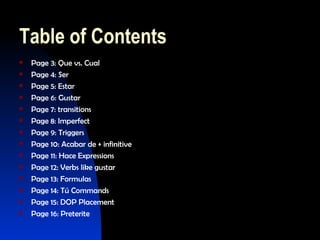
Este documento contiene una guía de gramática española de 15 páginas. Explica conceptos como el uso de "que" y "cual", verbos como "ser" y "estar", la conjugación del imperfecto, fórmulas comunes como "hace" y "gustar", y más.
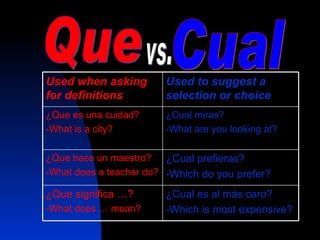
Que vs. Cual¿ Cual es al más caro? -Which is most expensive? ¿ Que significa …? -What does … mean? ¿ Cual prefieras? -Which do you prefer? ¿ Que hace un maestro? -What does a teacher do? ¿ Cual miras? -What are you looking at? ¿ Que es una cuidad? -What is a city? Used to suggest a selection or choice Used when asking for definitions
4.
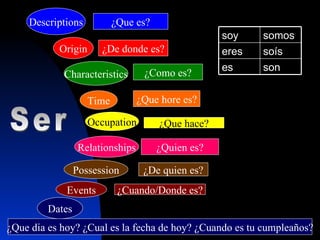
Ser Descriptions Origin¿ Que es? ¿De donde es? Characteristics ¿Como es? Time ¿Que hore es? Occupation ¿Que hace? Relationships ¿Quien es? Possession ¿De quien es? Events ¿Cuando/Donde es? Dates ¿Que dia es hoy? ¿Cual es la fecha de hoy? ¿Cuando es tu cumpleaños? son es so ís eres somos soy
5.
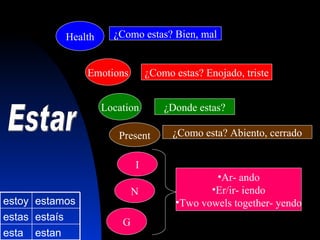
Estar Health ¿Comoestas? Bien, mal Emotions ¿Como estas? Enojado, triste Location ¿Donde estas? Present ¿Como esta? Abiento, cerrado I N G Ar- ando Er/ir- iendo Two vowels together- yendo estan esta esta ís estas estamos estoy
6.
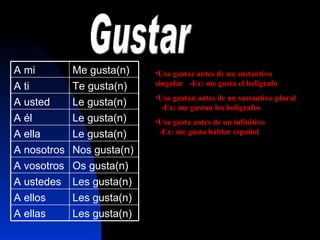
Gustar Usa gustarantes de un sustantivo singular -Ex: me gusta el boligrafo Usa gustan antes de un sustantivo plural -Ex: me gustan los boligrafos Usa gusta antes de un infinitivo -Ex: me gusta hablar espa ñ ol Les gusta(n) A ellas Les gusta(n) A ellos Les gusta(n) A ustedes Os gusta(n) A vosotros Nos gusta(n) A nosotros Le gusta(n) A ella Le gusta(n) A é l Le gusta(n) A usted Te gusta(n) A ti Me gusta(n) A mi
7.
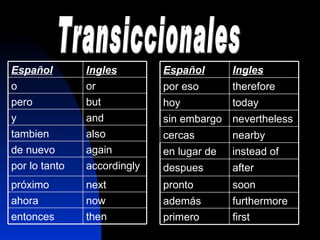
Transiccionales then entoncesnow ahora next pr ó ximo accordingly por lo tanto again de nuevo also tambien and y but pero or o Ingles Espa ñ ol first primero furthermore adem ás soon pronto after despues instead of en lugar de nearby cercas nevertheless sin embargo today hoy therefore por eso Ingles Espa ñ ol
8.
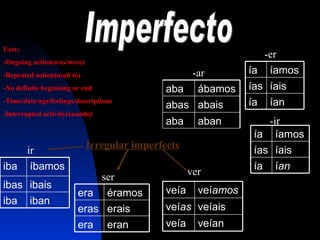
Imperfecto -ar -er -ir Irregular imperfects Uses: -Ongoing action(was/were) -Repeated action(used to) -No definite beginning or end -Time/date/age/feelings/descriptions -Interrupted activity(cuando) ir ser ver aban aba abais abas á bamos aba í an í a í ais í as í amos í a í an í a í ais í as í amos í a iban iba ibais ibas í bamos iba eran era erais eras é ramos era ve í an ve í a ve íais ve í as ve í amos ve í a
9.
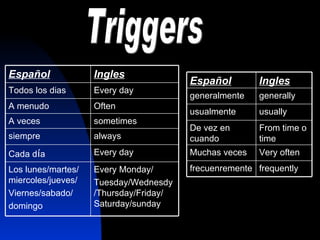
Triggers frequently frecuenrementeVery often Muchas veces From time o time De vez en cuando usually usualmente generally generalmente Ingles Espa ñ ol Every Monday/ Tuesday/Wednesdy /Thursday/Friday/ Saturday/sunday Los lunes/martes/ miercoles/jueves/ Viernes/sabado/ domingo Every day Cada d í a always siempre sometimes A veces Often A menudo Every day Todos los dias Ingles Espa ñ ol
10.
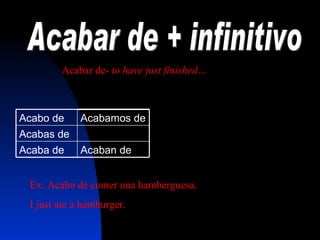
Acabar de +infinitivo Acabar de- to have just finished… Ex: Acabo de comer una hamberguesa. I just ate a hamburger. Acaban de Acaba de Acabas de Acabamos de Acabo de
11.
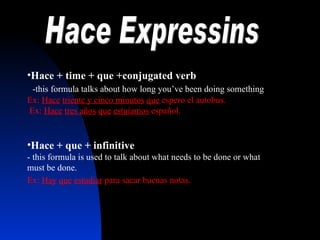
Hace Expressins Hace+ time + que +conjugated verb -this formula talks about how long you’ve been doing something Ex: Hace triente y cinco minutos que espero el autobus. Ex: Hace tres a ños que estuiamos español. Hace + que + infinitive - this formula is used to talk about what needs to be done or what must be done. Ex: Hay que estudiar para sacar buenas notas.
12.
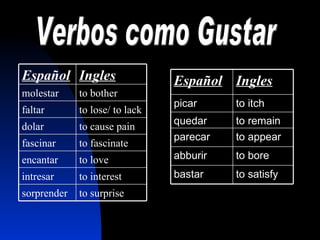
Verbos como Gustarto surprise sorprender to interest intresar to love encantar to fascinate fascinar to cause pain dolar to lose/ to lack faltar to bother molestar Ingles Espa ñol to satisfy bastar to bore abburir to appear parecar to remain quedar to itch picar Ingles Espa ñ ol
13.
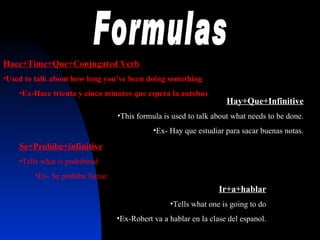
Formulas Hace+Time+Que+Conjugated VerbUsed to talk about how long you’ve been doing something Ex-Hace trienta y cinco minutos que espera la autobus Hay+Que+Infinitive This formula is used to talk about what needs to be done. Ex- Hay que estudiar para sacar buenas notas. Se+Prohibe+infinitive Tells what is prohibited Ex- Se prohibe fumar. Ir+a+hablar Tells what one is going to do Ex-Robert va a hablar en la clase del espanol.
14.
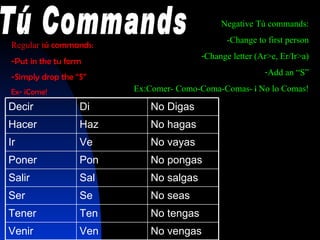
Tú Commands Regulart ú commands: -Put in the tu form -Simply drop the “S” Ex- ¡Come! Negative Tú commands: -Change to first person Change letter (Ar>e, Er/Ir>a) Add an “S” Ex:Comer- Como-Coma-Comas- ¡ No lo Comas! No vengas Ven Venir No tengas Ten Tener No seas Se Ser No salgas Sal Salir No pongas Pon Poner No vayas Ve Ir No hagas Haz Hacer No Digas Di Decir
15.
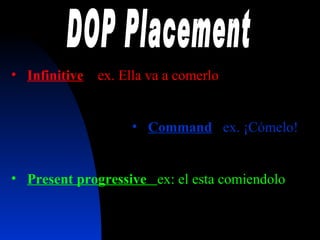
DOP Placement Infinitive ex. Ella va a comerlo Command ex. ¡Cómelo! Present progressive ex: el esta comiendolo
16.
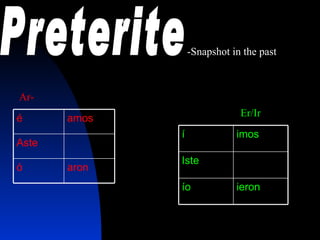
Preterite Ar- Er/Ir-Snapshot in the past aron ó Aste amos é ieron í o Iste imos í


![Commands[1]](https://cdn.slidesharecdn.com/ss_thumbnails/commands1-140213155953-phpapp01-thumbnail.jpg?width=640&height=640&fit=bounds)


![Grammar bookn[1]](https://cdn.slidesharecdn.com/ss_thumbnails/grammarbookn1-111207094209-phpapp02-thumbnail.jpg?width=640&height=640&fit=bounds)
![Spanish grammer book[1]](https://cdn.slidesharecdn.com/ss_thumbnails/spanishgrammerbook1-111208032527-phpapp02-thumbnail.jpg?width=640&height=640&fit=bounds)


