Grammar Book
Por : Sabra Arif
SpH2
Segundo Clase
•   Qué versus Cuál
•   Ser
•   Estar
•   Gustar
•   Transitions
•   Imperfect
•   Triggers
•   Acabar De
•   Hacer Expression
•   Verbs like Gustar
•   Reflexive
•   Tu Commands
•   DOP
•   Preterite


Table of Contents
Qué                                Cuál

• Used when one is asking       - Used with forms of SER , not in the
  for definition.                 context of definition
• Ex: ¿Qué dice un maestro?     - Used before “es” (usually)
  What does a teacher say?       - Ex: ¿Cuál es tu problema?
• Sometime used with “Which”       What is your problem?
• Used before nouns (Usually)


Qué versus Cuál
•   Description -¿Que es?
•   Origin (de) - ¿De donde es?
•   Characteristics - ¿Comó es?
•   Time - ¿Que hora es?
•   Occupation - ¿Que hace?
•   Relationships - ¿Quien es?
•   Possessions - ¿De quien es?
•   Events - ¿Cuando es?
•   Dates - ¿Cual es la fecha?


Ser (D.O.C.T.O.R- P.E.D.)
•   Health
•   Emotions
•   Location
                        = LO-CO
•   Present Condition
•   I                               -AR: Ando
                                  = -ER: Iendo
•   N                                -IR: Iendo
•   G


Estar (H.E.L.P-I.N.G.)
•   ¿Te gusta? – It pleases you
•   ¿Le gusta? – It pleases she/he
•   ¿Me gusta? – It pleases me
•   ¿Nos gusta? – It pleases us
•   ¿Les gusta? – It pleases them


Gustar
•   Tambien
•   Ahora
•   Primero
•   Ni-ni
•   Por eso
•   Entonces
•   Y
•   Asi que
•   Después


Transitions
Pronoun           - ending   ER/IR - ending
        Yo              -aba          -ía
        Tú             -abas          -ías
  El/Ella/Usted         -aba          -ía
     Nosotros         -abamos        -íamos
Ellos/Ellas/Ustedes    -aban          -ían


Imperfect
(Lets one know the imperfect tense is to be used)

•   Todos los días
•   A veces
•   Siempre
•   Cada día
•   Los lunes
•   De ves en cuando
•   Generalmente
•   De ves en cuando
•   Frecuentemente
•   Muchos veces


Trigger Words
(Acabar de + infinitive)

      Pronoun                                  Conjugation

          Yo                                    Acabo de

          Tú                                    Acabas de

     El/Ella/Ud.                                Acaba de

       Nosotros                                Acabamos de

  Ellos/Ellas/Ustedes                           Acaban de


Acabar De
(Hace +Time + Que + Verb)


• Preterite tense – Ago
• Present tense – Since and For
• Ex: Hace dos días que como un sandwich .


Hacer Expressions
• Doler – To hurt
  • Duele
  • Duelen
• Faltar – To be missing
  • Falta
  • Faltan
• Fascinar – To fascinate
  • Fascina
  • Fascinan
• Me , Te, Le , Os , Nos , Les


Verbs like Gustar
(Used when the subject and object are the same)
                   •    Ex: Llamarse , Ducharse , Maquillarse


   Pronoun             Reflexive                   -AR          -IR & -ER

      Yo                  Me                        -o             -o

      Tú                   Te                      -as             -es

  El/Ella/Ud.              Se                       -a             -e

   Nosotros               Nos                    -amos            -imos

Ellos/Ellas/Uds.           Se                      -an             -en


Reflexive Verbs
•   1) Take the verb , EX: Cantar
•   2) Conjugate to tú form , EX: Cantas
•   3) Drop the last letter („s‟) , EX: Canta
•   4) Add DOP , EX: ¡Cantalo! – Sing it !


Tú Commands (Affirmative)
• 1) Take the verb , EX: Cantar
• 2) Conjugate to 1st person form , EX: Canto
• 3) Change the ending to the opposite vowel , EX: Cante
  • -AR to –E
  • -ER/-IR to –A
• 4) Add „s‟ to the end , EX: Cantes
• 5) Format it , EX: ¡No lo cantes!


Tú Commands (Negative)
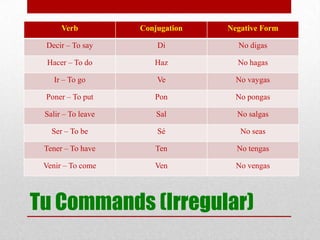
Verb          Conjugation   Negative Form

 Decir – To say         Di          No digas

  Hacer – To do        Haz          No hagas

    Ir – To go          Ve          No vaygas

 Poner – To put        Pon          No pongas

 Salir – To leave       Sal         No salgas

   Ser – To be          Sé           No seas

 Tener – To have       Ten          No tengas

 Venir – To come       Ven          No vengas


Tu Commands (Irregular)
• Present Progressive
  • Ella está cantando
• Affirmative
  • ¡Cantalo!
• Infinitive
  • Ella va a cantarlo

                Me       Nos

                Te       Os

                Lo       Los

                La       Las


DOP Placement
Pronoun         Ending
          You            -é
          Tú            -aste
      El/Ella/Ud.        -ó
       Nosotros        -amos
    Ellos/Ellas/Uds.   -aron

       Pronoun         Ending
          You            -i
          Tú            -iste
      El/Ella/Ud.        -ió
       Nosotros        -imos
    Ellos/Ellas/Uds.   -ieron


Preterite

Sabra's nice brammar gook

  • 1.
    Grammar Book Por :Sabra Arif SpH2 Segundo Clase
  • 2.
    Qué versus Cuál • Ser • Estar • Gustar • Transitions • Imperfect • Triggers • Acabar De • Hacer Expression • Verbs like Gustar • Reflexive • Tu Commands • DOP • Preterite Table of Contents
  • 3.
    Qué Cuál • Used when one is asking - Used with forms of SER , not in the for definition. context of definition • Ex: ¿Qué dice un maestro? - Used before “es” (usually) What does a teacher say? - Ex: ¿Cuál es tu problema? • Sometime used with “Which” What is your problem? • Used before nouns (Usually) Qué versus Cuál
  • 4.
    Description -¿Que es? • Origin (de) - ¿De donde es? • Characteristics - ¿Comó es? • Time - ¿Que hora es? • Occupation - ¿Que hace? • Relationships - ¿Quien es? • Possessions - ¿De quien es? • Events - ¿Cuando es? • Dates - ¿Cual es la fecha? Ser (D.O.C.T.O.R- P.E.D.)
  • 5.
    Health • Emotions • Location = LO-CO • Present Condition • I -AR: Ando = -ER: Iendo • N -IR: Iendo • G Estar (H.E.L.P-I.N.G.)
  • 6.
    ¿Te gusta? – It pleases you • ¿Le gusta? – It pleases she/he • ¿Me gusta? – It pleases me • ¿Nos gusta? – It pleases us • ¿Les gusta? – It pleases them Gustar
  • 7.
    Tambien • Ahora • Primero • Ni-ni • Por eso • Entonces • Y • Asi que • Después Transitions
  • 8.
    Pronoun - ending ER/IR - ending Yo -aba -ía Tú -abas -ías El/Ella/Usted -aba -ía Nosotros -abamos -íamos Ellos/Ellas/Ustedes -aban -ían Imperfect
  • 9.
    (Lets one knowthe imperfect tense is to be used) • Todos los días • A veces • Siempre • Cada día • Los lunes • De ves en cuando • Generalmente • De ves en cuando • Frecuentemente • Muchos veces Trigger Words
  • 10.
    (Acabar de +infinitive) Pronoun Conjugation Yo Acabo de Tú Acabas de El/Ella/Ud. Acaba de Nosotros Acabamos de Ellos/Ellas/Ustedes Acaban de Acabar De
  • 11.
    (Hace +Time +Que + Verb) • Preterite tense – Ago • Present tense – Since and For • Ex: Hace dos días que como un sandwich . Hacer Expressions
  • 12.
    • Doler –To hurt • Duele • Duelen • Faltar – To be missing • Falta • Faltan • Fascinar – To fascinate • Fascina • Fascinan • Me , Te, Le , Os , Nos , Les Verbs like Gustar
  • 13.
    (Used when thesubject and object are the same) • Ex: Llamarse , Ducharse , Maquillarse Pronoun Reflexive -AR -IR & -ER Yo Me -o -o Tú Te -as -es El/Ella/Ud. Se -a -e Nosotros Nos -amos -imos Ellos/Ellas/Uds. Se -an -en Reflexive Verbs
  • 14.
    1) Take the verb , EX: Cantar • 2) Conjugate to tú form , EX: Cantas • 3) Drop the last letter („s‟) , EX: Canta • 4) Add DOP , EX: ¡Cantalo! – Sing it ! Tú Commands (Affirmative)
  • 15.
    • 1) Takethe verb , EX: Cantar • 2) Conjugate to 1st person form , EX: Canto • 3) Change the ending to the opposite vowel , EX: Cante • -AR to –E • -ER/-IR to –A • 4) Add „s‟ to the end , EX: Cantes • 5) Format it , EX: ¡No lo cantes! Tú Commands (Negative)
  • 16.
    Verb Conjugation Negative Form Decir – To say Di No digas Hacer – To do Haz No hagas Ir – To go Ve No vaygas Poner – To put Pon No pongas Salir – To leave Sal No salgas Ser – To be Sé No seas Tener – To have Ten No tengas Venir – To come Ven No vengas Tu Commands (Irregular)
  • 17.
    • Present Progressive • Ella está cantando • Affirmative • ¡Cantalo! • Infinitive • Ella va a cantarlo Me Nos Te Os Lo Los La Las DOP Placement
  • 18.
    Pronoun Ending You -é Tú -aste El/Ella/Ud. -ó Nosotros -amos Ellos/Ellas/Uds. -aron Pronoun Ending You -i Tú -iste El/Ella/Ud. -ió Nosotros -imos Ellos/Ellas/Uds. -ieron Preterite