REDES PRIVADAS VIRTUALES Carlos Castillo Calderon 26/01/2012
Esquema WAN convencional  Oficina Principal Usuario Intinerante Oficina Regional Acceso  desde el hogar Lineas Privadas Frame Relay Oficina  Estatal RAS Carlos Castillo Calderon 26/01/2012
Redes WAN Clasicas:  Nuevos Retos Cambios en marcha Añadir nuevos sitios Acceso a usuarios remotos via dial up Conectividad a socios de negocios Costo de la infraestructu-ra y ancho de Banda Fortalezas Uso dedicado. Ancho de Banda predecible Seguridad definida Ampliamente disponible Carlos Castillo Calderon 26/01/2012
Oficina Principal  Acceso  desde el Hogar Oficina  Regional Red Wan Clasica Oficina  Estatal Oficinas Remotas  y/o  Internacionales Miles ó cientos de  usuarios remotos Redes WAN Clasicas:  Ahora existen nuevos retos Carlos Castillo Calderon 26/01/2012 Usuarios  Intinerantes Socios  De Negocios ? ? ?
Que es una Red Privada Virtual ? Es una red de comunicaciones, construida para el uso privado de una organización, sobre una infraestructura pública compartida. “ Canales privados de comunicación que usan una red pública como el transporte básico para conectar centros corporativos de datos, oficinas remotas, empleados nomadas, empleados “caseros”, clientes , proveedores y socios de negocio”. Una Red Privada Virtual es la emulación de una red privada sobre infraestructura compartida. Carlos Castillo Calderon 26/01/2012
Tipos de VPN´S Provider VPNs: VPN Dedicado: MPLS Edge VPNs Site to Site IPSEC Client to Site IPSEC Integrated VPNs IPSEC dedicado – MPLS IPSEC móvil – MPLS Carlos Castillo Calderon 26/01/2012
INTRODUCION A REDES VPN -MPLS Carlos Castillo Calderon 26/01/2012
Una infraestructura de red IP capaz de entregar servicios  privados  de red con prioritizaciòn sobre una infraestructura publica (ISP) VPN - MPLS Carlos Castillo Calderon 26/01/2012
Conceptos MPLS   MPLS: Multi Protocol Label Switching Desarrollado para integrar redes IP y ATM El “forwardeo” de paquetes es realizado en base a etiquetas Carlos Castillo Calderon 26/01/2012
UNA VPN MPLS (VIRTUAL PRIVATE NETWORK) PERMITE CONECTIVIDAD DE MÚLTIPLES SITIOS A TRAVÉS DE UNA RED  COMPARTIDA,  CON LOS MISMOS ATRIBUTOS  QUE UNA RED PRIVADA Carlos Castillo Calderon 26/01/2012
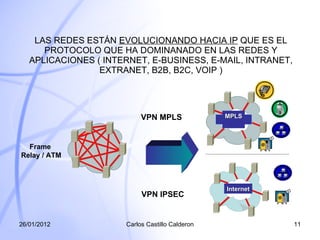
LAS REDES ESTÁN  EVOLUCIONANDO HACIA IP  QUE ES EL PROTOCOLO QUE HA DOMINANADO EN LAS REDES Y APLICACIONES ( INTERNET, E-BUSINESS, E-MAIL, INTRANET, EXTRANET, B2B, B2C, VOIP ) F rame  Relay  / ATM VPN MPLS  VPN IPSEC Carlos Castillo Calderon 26/01/2012 MPLS Internet
INTEGRA  TODOS LOS SERVICIOS Y APLICACIONES EN UNA SOLA CONEXIÓN (VOZ, DATOS, VIDEO E INTERNET). Video Dat os Internet Carlos Castillo Calderon 26/01/2012 Video Internet Dat os Voz Voz
MECANISMOS DE CALIDAD DE SERVICIO QOS QUE PERMITE DAR PRIORIDAD AL TRAFICO SENSIBLE AL RETRASO COMO VOZ Y VIDEO O APLICACIONES DE MISIÓN CRÍTICA Carlos Castillo Calderon 26/01/2012 Voz y Video Internet Datos
TECNOLOGIA VPN  - MPLS Core Oficina  Regional Oficina  Estatal  Oficina Corporativa MPLS Carlos Castillo Calderon 26/01/2012
MPLS México VPN Aguascalientes Monterrey VPN INTERNET TECNOLOGIA  VPN  - MPLS Carlos Castillo Calderon 26/01/2012
VPN - IPSEC INTERNET Carlos Castillo Calderon 26/01/2012
IPSEC -  NO ES UN SOLO PROTOCOLO, ES UNA COLECCIÓN DE PROTOCOLOS ( MAS DE 40 ) DEFINIDOS MEDIANTE RFCs Y POR  IETF´s IPSEC WORKING GROUP. -SOPORTADO PARA IPV4 E IPV6. -CUMPLE CON LOS 3 ELEMENTOS BÁSICOS DE VPN :  AUTENTICACION (AH), ENCRIPCION(ESP) Y ADMINISTRACIÓN DE LLAVES. -ALGORITMOS DE ENCRIPCIÓN DISPONIBLES PARA IPSEC : DES  (DATA ENCRYPTION STANDARD) 3 DES  RC4 Integridad Confidencialidad Autenticación Carlos Castillo Calderon 26/01/2012
ALGORITMOS Y ESTANDARES DE ENCRIPCION Carlos Castillo Calderon 26/01/2012
TUNELES QUE ES UN TUNEL ? -UN TUNEL ES LA ENCAPSULACIÓN DE PAQUETES O FRAMES DENTRO DE OTROS PAQUETES O FRAMES. CUALES SON LOS PROTOCOLOS PARA GENERAR TUNELES ? -IPSEC -PPTP -L2TP -L2F Carlos Castillo Calderon 26/01/2012
Tuneles Red IP Compartida BN Tunel seguro IP IPSEC PPTP L2TP L2F Carlos Castillo Calderon 26/01/2012 Intranet 1 Media IP 140 .100.20.101 179 .1 0 .1.1 Encaps. Encripción Autenticación PPP IP 192.100.10.101 192.100.10.230 Datos Media IP 192.100.10.101 192.100.10.230 Datos Encripción  Desencripción Media IP 192.100.10.101 192.100.10.230 Datos
Cómo funciona? Carlos Castillo Calderon 26/01/2012 Corporativo Internet Dat os Encapsulado Encriptado y encapsulado
Tipos de VPNs IPSEC Intranet Red corporativa de área amplia (WAN, Wide Area Network) con administración de tráfico a nivel aplicación Extranet Extiende la infraestructura de conectividad corporativa (WAN) a proveedores, clientes y socios. Principalmente para  transporte de transacciones en modelos Business to Business (B2B) Acceso Remoto Brinda acceso (dial up, broadband, wireless, etc) a personal que requiere de alta movilidad, tanto nacional como internacional. Carlos Castillo Calderon 26/01/2012
Tipos de  VPN IP-SEC ? Tres tipos diferentes de VPNs Internet Carlos Castillo Calderon 26/01/2012 Acceso Extranet Acceso Extranet Acceso Oficina Acceso Remoto Acceso Remoto Acceso Oficinas Corporativo Corporativo
Acceso Remoto Carlos Castillo Calderon 26/01/2012 Usuarios Remotos Internet VPN Gateway Oficina Central
Esquema Funcional RADIUS (AAA) BASES DE DATOS Usuarios Institucionales /Socios Intranet RPV Internet Carlos Castillo Calderon 26/01/2012
Acceso Sucursal y “Extranet”  Proveedor  De Servicio Carlos Castillo Calderon 26/01/2012 Oficina Regional Oficina Estatal Oficina Estatal Internet VPN Gateway Oficina Central
CONEXIÓN SITE - SITE México D.F. Servidor de Autenticación FW PC Boston Servidor de Autenticación FW VPN Gateway PC VPN Gateway Internet IDS   IDS  Carlos Castillo Calderon 26/01/2012
Seguridad en redes inalámbricas Lan (WLan) Acces Point ) ) ) ) ( ( ( ( 11 Mbps Switch Lan ) ) ) ) ) ) ) ) ) ) ) ) ) ) ) ) ) ) ) ) Computadoras  Desktop Computadoras  Notebook Dispositivos Mobiles PDA Equipos 802.11b con cliente VPN-IPSEC VPN Carlos Castillo Calderon 26/01/2012
Seguridad en acceso inalámbricos via ISP Acces Point ( ( ( ( ) ) ) ) ) ) ) ) ) ) ) ) ) ) ) ) Notebook con clientes VPN-IPSEC Palm con clientes VPN-IPSEC  VPN Internet Carlos Castillo Calderon 26/01/2012
Remplazo de enlaces Wan utilizando Site-to-Site IPSec VPN INTRANET EXTRANET INTERNET VPN POP DSL  CABLE SITIO PRINCIPAL Carlos Castillo Calderon 26/01/2012
Respaldo de enlaces Wan utilizando Site-to Site Vpn IPSEC Internet VPN PSTN/ISDN ADSL Enlaces Dedicados Frame Relay Oficina Corporativa Extranet B2B Intranet  Oficinas Regionales y Estatales Carlos Castillo Calderon 26/01/2012
ESQUEMA DE ACCESO A  INTERNET VIA DIAL-UP Modem Usuario Remoto Modem Internet Modem Usuario Remoto 56/36 Kbits/seg UN EQUIPO POR CONEXIÓN TRANSMISION DE DATOS INTERNET Carlos Castillo Calderon 26/01/2012
ESQUEMA DE ACCESO A  TRAVES INFINITUM Usuario Remoto Internet 256-2048 Kbits/seg MULTIPLES EQUIPOS POR CONEXIÓN TRANSMISION DE DATOS INTERNET INTRANET SERVICIO DE VOZ* Carlos Castillo Calderon 26/01/2012
Oficinas Estatales Direcciones  Regionales Censos Usuario Móvil Usuarios Institucionales (sin conexión a Red INEGI) Edificio Sede  Aguascalientes Ejecutivo Encuestas USO DE REDES PRIVADAS VIRTUALES EN EL INEGI  Instituciones de Gobierno Carlos Castillo Calderon 26/01/2012

Red privada virtual

  • 1.
    REDES PRIVADAS VIRTUALESCarlos Castillo Calderon 26/01/2012
  • 2.
    Esquema WAN convencional Oficina Principal Usuario Intinerante Oficina Regional Acceso desde el hogar Lineas Privadas Frame Relay Oficina Estatal RAS Carlos Castillo Calderon 26/01/2012
  • 3.
    Redes WAN Clasicas: Nuevos Retos Cambios en marcha Añadir nuevos sitios Acceso a usuarios remotos via dial up Conectividad a socios de negocios Costo de la infraestructu-ra y ancho de Banda Fortalezas Uso dedicado. Ancho de Banda predecible Seguridad definida Ampliamente disponible Carlos Castillo Calderon 26/01/2012
  • 4.
    Oficina Principal Acceso desde el Hogar Oficina Regional Red Wan Clasica Oficina Estatal Oficinas Remotas y/o Internacionales Miles ó cientos de usuarios remotos Redes WAN Clasicas: Ahora existen nuevos retos Carlos Castillo Calderon 26/01/2012 Usuarios Intinerantes Socios De Negocios ? ? ?
  • 5.
    Que es unaRed Privada Virtual ? Es una red de comunicaciones, construida para el uso privado de una organización, sobre una infraestructura pública compartida. “ Canales privados de comunicación que usan una red pública como el transporte básico para conectar centros corporativos de datos, oficinas remotas, empleados nomadas, empleados “caseros”, clientes , proveedores y socios de negocio”. Una Red Privada Virtual es la emulación de una red privada sobre infraestructura compartida. Carlos Castillo Calderon 26/01/2012
  • 6.
    Tipos de VPN´SProvider VPNs: VPN Dedicado: MPLS Edge VPNs Site to Site IPSEC Client to Site IPSEC Integrated VPNs IPSEC dedicado – MPLS IPSEC móvil – MPLS Carlos Castillo Calderon 26/01/2012
  • 7.
    INTRODUCION A REDESVPN -MPLS Carlos Castillo Calderon 26/01/2012
  • 8.
    Una infraestructura dered IP capaz de entregar servicios privados de red con prioritizaciòn sobre una infraestructura publica (ISP) VPN - MPLS Carlos Castillo Calderon 26/01/2012
  • 9.
    Conceptos MPLS MPLS: Multi Protocol Label Switching Desarrollado para integrar redes IP y ATM El “forwardeo” de paquetes es realizado en base a etiquetas Carlos Castillo Calderon 26/01/2012
  • 10.
    UNA VPN MPLS(VIRTUAL PRIVATE NETWORK) PERMITE CONECTIVIDAD DE MÚLTIPLES SITIOS A TRAVÉS DE UNA RED COMPARTIDA, CON LOS MISMOS ATRIBUTOS QUE UNA RED PRIVADA Carlos Castillo Calderon 26/01/2012
  • 11.
    LAS REDES ESTÁN EVOLUCIONANDO HACIA IP QUE ES EL PROTOCOLO QUE HA DOMINANADO EN LAS REDES Y APLICACIONES ( INTERNET, E-BUSINESS, E-MAIL, INTRANET, EXTRANET, B2B, B2C, VOIP ) F rame Relay / ATM VPN MPLS VPN IPSEC Carlos Castillo Calderon 26/01/2012 MPLS Internet
  • 12.
    INTEGRA TODOSLOS SERVICIOS Y APLICACIONES EN UNA SOLA CONEXIÓN (VOZ, DATOS, VIDEO E INTERNET). Video Dat os Internet Carlos Castillo Calderon 26/01/2012 Video Internet Dat os Voz Voz
  • 13.
    MECANISMOS DE CALIDADDE SERVICIO QOS QUE PERMITE DAR PRIORIDAD AL TRAFICO SENSIBLE AL RETRASO COMO VOZ Y VIDEO O APLICACIONES DE MISIÓN CRÍTICA Carlos Castillo Calderon 26/01/2012 Voz y Video Internet Datos
  • 14.
    TECNOLOGIA VPN - MPLS Core Oficina Regional Oficina Estatal Oficina Corporativa MPLS Carlos Castillo Calderon 26/01/2012
  • 15.
    MPLS México VPNAguascalientes Monterrey VPN INTERNET TECNOLOGIA VPN - MPLS Carlos Castillo Calderon 26/01/2012
  • 16.
    VPN - IPSECINTERNET Carlos Castillo Calderon 26/01/2012
  • 17.
    IPSEC - NO ES UN SOLO PROTOCOLO, ES UNA COLECCIÓN DE PROTOCOLOS ( MAS DE 40 ) DEFINIDOS MEDIANTE RFCs Y POR IETF´s IPSEC WORKING GROUP. -SOPORTADO PARA IPV4 E IPV6. -CUMPLE CON LOS 3 ELEMENTOS BÁSICOS DE VPN : AUTENTICACION (AH), ENCRIPCION(ESP) Y ADMINISTRACIÓN DE LLAVES. -ALGORITMOS DE ENCRIPCIÓN DISPONIBLES PARA IPSEC : DES (DATA ENCRYPTION STANDARD) 3 DES RC4 Integridad Confidencialidad Autenticación Carlos Castillo Calderon 26/01/2012
  • 18.
    ALGORITMOS Y ESTANDARESDE ENCRIPCION Carlos Castillo Calderon 26/01/2012
  • 19.
    TUNELES QUE ESUN TUNEL ? -UN TUNEL ES LA ENCAPSULACIÓN DE PAQUETES O FRAMES DENTRO DE OTROS PAQUETES O FRAMES. CUALES SON LOS PROTOCOLOS PARA GENERAR TUNELES ? -IPSEC -PPTP -L2TP -L2F Carlos Castillo Calderon 26/01/2012
  • 20.
    Tuneles Red IPCompartida BN Tunel seguro IP IPSEC PPTP L2TP L2F Carlos Castillo Calderon 26/01/2012 Intranet 1 Media IP 140 .100.20.101 179 .1 0 .1.1 Encaps. Encripción Autenticación PPP IP 192.100.10.101 192.100.10.230 Datos Media IP 192.100.10.101 192.100.10.230 Datos Encripción Desencripción Media IP 192.100.10.101 192.100.10.230 Datos
  • 21.
    Cómo funciona? CarlosCastillo Calderon 26/01/2012 Corporativo Internet Dat os Encapsulado Encriptado y encapsulado
  • 22.
    Tipos de VPNsIPSEC Intranet Red corporativa de área amplia (WAN, Wide Area Network) con administración de tráfico a nivel aplicación Extranet Extiende la infraestructura de conectividad corporativa (WAN) a proveedores, clientes y socios. Principalmente para transporte de transacciones en modelos Business to Business (B2B) Acceso Remoto Brinda acceso (dial up, broadband, wireless, etc) a personal que requiere de alta movilidad, tanto nacional como internacional. Carlos Castillo Calderon 26/01/2012
  • 23.
    Tipos de VPN IP-SEC ? Tres tipos diferentes de VPNs Internet Carlos Castillo Calderon 26/01/2012 Acceso Extranet Acceso Extranet Acceso Oficina Acceso Remoto Acceso Remoto Acceso Oficinas Corporativo Corporativo
  • 24.
    Acceso Remoto CarlosCastillo Calderon 26/01/2012 Usuarios Remotos Internet VPN Gateway Oficina Central
  • 25.
    Esquema Funcional RADIUS(AAA) BASES DE DATOS Usuarios Institucionales /Socios Intranet RPV Internet Carlos Castillo Calderon 26/01/2012
  • 26.
    Acceso Sucursal y“Extranet” Proveedor De Servicio Carlos Castillo Calderon 26/01/2012 Oficina Regional Oficina Estatal Oficina Estatal Internet VPN Gateway Oficina Central
  • 27.
    CONEXIÓN SITE -SITE México D.F. Servidor de Autenticación FW PC Boston Servidor de Autenticación FW VPN Gateway PC VPN Gateway Internet IDS IDS Carlos Castillo Calderon 26/01/2012
  • 28.
    Seguridad en redesinalámbricas Lan (WLan) Acces Point ) ) ) ) ( ( ( ( 11 Mbps Switch Lan ) ) ) ) ) ) ) ) ) ) ) ) ) ) ) ) ) ) ) ) Computadoras Desktop Computadoras Notebook Dispositivos Mobiles PDA Equipos 802.11b con cliente VPN-IPSEC VPN Carlos Castillo Calderon 26/01/2012
  • 29.
    Seguridad en accesoinalámbricos via ISP Acces Point ( ( ( ( ) ) ) ) ) ) ) ) ) ) ) ) ) ) ) ) Notebook con clientes VPN-IPSEC Palm con clientes VPN-IPSEC VPN Internet Carlos Castillo Calderon 26/01/2012
  • 30.
    Remplazo de enlacesWan utilizando Site-to-Site IPSec VPN INTRANET EXTRANET INTERNET VPN POP DSL CABLE SITIO PRINCIPAL Carlos Castillo Calderon 26/01/2012
  • 31.
    Respaldo de enlacesWan utilizando Site-to Site Vpn IPSEC Internet VPN PSTN/ISDN ADSL Enlaces Dedicados Frame Relay Oficina Corporativa Extranet B2B Intranet Oficinas Regionales y Estatales Carlos Castillo Calderon 26/01/2012
  • 32.
    ESQUEMA DE ACCESOA INTERNET VIA DIAL-UP Modem Usuario Remoto Modem Internet Modem Usuario Remoto 56/36 Kbits/seg UN EQUIPO POR CONEXIÓN TRANSMISION DE DATOS INTERNET Carlos Castillo Calderon 26/01/2012
  • 33.
    ESQUEMA DE ACCESOA TRAVES INFINITUM Usuario Remoto Internet 256-2048 Kbits/seg MULTIPLES EQUIPOS POR CONEXIÓN TRANSMISION DE DATOS INTERNET INTRANET SERVICIO DE VOZ* Carlos Castillo Calderon 26/01/2012
  • 34.
    Oficinas Estatales Direcciones Regionales Censos Usuario Móvil Usuarios Institucionales (sin conexión a Red INEGI) Edificio Sede Aguascalientes Ejecutivo Encuestas USO DE REDES PRIVADAS VIRTUALES EN EL INEGI Instituciones de Gobierno Carlos Castillo Calderon 26/01/2012

Notas del editor

  • #3 Today’s classic WAN is built on leased lines to connect fixed sites
  • #4 The classic WAN has strengths listed above, but it has some significant challenges like: Adding new remote sites to the WAN Adding very remote sites where it is very expensive to extend the WAN Growing remote access populations External connectivity to business partners Cost
  • #5 Classic WAN is often cost prohibitive to extend to smaller remote offices Classic WAN doesn’t extend to very remote offices where leased lines or frame relay are not available, such as international locations Classic WAN does not extend to extranets or very large remote dial access populations, especially as remote access population grows
  • #6 “ public network” - “ Shared Public Network Infrastructure” - Nortel The key is the public network. “Public Network” is often referring to the Internet.
  • #25 Traditionally, modem banks and 800 numbers would provide remote access to enterprise resources. Install a VPN and let employees connect through their ISP, greatly reduce support, equipment, and maintenance costs and provide security where there was none. A typical company will save $1000 per remote user per year.
  • #26 A Contivity Extranet Switch is designed to drop into the corporate network and take advantage of the infrastructure that has been built around the remote access system. Users are authenticated against external databases using RADIUS, NT Domain, or LDAP (the emerging standard). This also allows support for NDS, SecureID, and more. The EAS is managed via HTML and Java, making it accessible from anywhere. Scriptable SNMP traps allow any combination of variables to be queried to sense problems. This allows integration into network management stations like HP OpenView. On the network map, an SNMP trap for an error condition would turn the icon for the Nortel Networks box from green to red. When the network manager double-clicks on the icon, the browser would be launched to the device management pages. Split-horizon management allows the management demarcation between the corporation and service provider to be customized. The service provider can manage none of the device, just the networking portion, or the networking and user security. This allows different service levels to be offered as well, with different levels of management. Users can take advantage of high-speed Internet access technologies like ADSL and cable which can’t usually be used for corporate access. These types of technologies will only be widely used if they can be tied to a business use. Casual consumers won’t pay the premium for high-speed Internet access.
  • #27 (# builds = 5) Instead of expensive, hard to provision, private leased-lines, use VPNs and broadband access to interconnect all branches. Extranets --shared networks with business partners-- can be setup and taken down at Internet speed. Even this amount of management can be outsourced to a service provider, allowing enterprises to focus on their core business, and letting the service provider worry about IT turnover, etc.
  • #28 (# builds = 5) The Boston Branch needs to access data from a server in Seattle. The Boston VPN Gateway contacts the Seattle Gateway. Seattle authenticates that Boston is Boston, and that they are allowed to have access to the requested server,then lets them in. All of the authentication communication is encrypted and all the data is encapsulated and encrypted.