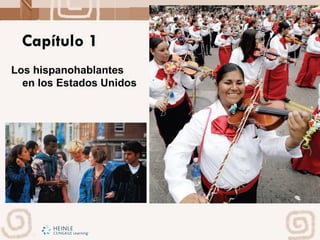
Capítulo 1
Los hispanohablantes
  en los Estados Unidos
TAREA:
    Piensa en estas preguntas para la próxima clase

            ¿Son los hispanos todos iguales? Explica.
             ¿Cuál es la diferencia entre raza y etnia?
¿Cuál es la diferencia entre ser hispano, latino, español o chicano?
                     ¿Qué es el “Dream Act”?
Vocabulario I: La geografía y el clima            p. 7


          Para hablar de dónde vienes

         la ascendencia   heritage, nationality
         el atractivo     attraction
         el clima         climate
         el condado       county
         antiguo(a)       old
         indígena         indigenous
         compartir        to share
         disfrutar        to enjoy
Para describir la geografía y el clima p. 7
el acantilado                 cliff                      el amanecer         sunrise
el altiplano                  high plateau               el chubasco         heavy rain shower

la altura                     height, altitude           el huracán          hurricane
la bahía                      bay                        la neblina          fog
el cerro                      hill                       la puesta del sol   sunset

la cordillera                 mountain chain             la tormenta         storm
el desierto                   desert                     despejado(a)        clear (skies)

la isla tropical              tropical island            encantador(a)       charming
el mar Mediterráneo/mar       Mediterranean/Caribbea     húmedo(a)           humid
Caribe                        n Sea
el sitio                      place, location, site      montañoso(a)        mountainous

el volcán                     volcano                    plano(a)            flat
(estar) en el borde           (to be) on the edge        seco(a)             dry

(estar) en las afueras        (to be) on the outskirts   soleado(a)          sunny

(estar) situado(a)            (to be) situated           llover (ue)         to rain
                                                         nevar (ie)          to snow
Estructura y uso I:
 El tiempo presente del indicativo                                   p.14


Los usos

   Conditions or situations not bound by time, including habitual
   situations.

   Actions in the present, or in progress.

   Actions that will occur in the near future.

   Actions in past-tense narrations brought to life through the use of the
   present tense.
Estructura y uso I:
                         ir a + infinitivo                p.14

        To   talk about the near future:

           ir a + infinitivo                to be going to do something

           pensar + infinitivo              to intend (to do something)


•La semana que viene voy a visitar a mi prima en San Francisco. Vive aquí
también.

•El sábado pienso ver una película en el centro comercial. ¿Piensas hacer algo
ese día?
Estructura y uso I:
Los usos y omisiones de los pronombres de sujeto p.15
 A verb’s conjugation agrees with the subject in Spanish,
so in many cases, subject pronouns are not necessary.

Subject pronouns (yo, tú, él/ella/usted, nosotros(as), vosotros(as), ellos/
ellas/ustedes) are generally used only when introducing:

 New subjects

 Contrasting subjects
   • Mi prima vive con una amiga, pero yo prefiero vivir sola.

 A subject that is not obvious from the verb ending or the discourse.
   • Ella se llama Marta y su esposo, Ivan, es argentino. Él tiene su
    propio negocio en San Francisco.
Estructura y uso II:
                              Ser (to be)        p.18
Los usos                                     Time, date, and seasons
Profession or occupation                         Son las cuatro de la tarde.
   Juana es médica.                             Es el 18 de febrero. Es
Origin                                          invierno.
   Lupe es de Bolivia.                       Where an event is to take place
What something is made of                       La celebración es en
   Es un reloj de oro.                          Sucre.
                                              Certain impersonal expressions
Possession
                                                 Es útil tener un celular.
   Es el carro de Fernando.
Nationality, religion, or political
affiliation
      Leonor es de Chile. Es católica.
Intrinsic qualities
      El mar es increíble.
Estructura y uso II:
                       Estar (to be)             p.18


Los usos

Location
    •José está en casa con su familia.

To form the present progressive tense
    •Ellos están esperando en casa porque está lloviendo.

With adjectives describing conditions subject to change or deviant from
  •La hija de José está muy guapa con su nuevo vestido.
Estructura y uso II:
        Adjetivos con ser y estar p.19
Adjective       With ser            With estar
aburrido(a)     boring              bored

bueno(a)        good                good (food)

enfermo(a)      sickly (person)     ill

listo(a)        clever              ready

loco(a)         insane              crazy, foolish

malo(a)         bad                 ill
rico(a)         rich (prosperous)   delicious

seguro(a)       safe                sure, certain

verde           green               unripe
vivo(a)         cunning             alive, living
Estructura y uso II: To be- Tener                    p.19


 Tener
      can be translated as to be, but is limited to certain
 idiomatic expressions.
      tener... años      to be . . . years old   tener miedo (de)   to be afraid (of)
      tener calor        to be hot               tener prisa        to be in a hurry

      tener celos        to be jealous           (no) tener razón   to be right (wrong)
      tener cuidado      to be careful           tener sed          to be thirsty

      tener éxito        to be successful        tener sueño        to be tired, sleepy

      tener frío         to be cold              tener suerte       to be lucky

      tener hambre       to be hungry            tener vergüenza    to be ashamed,
                                                                    embarrassed
      tener la culpa     to be guilty
Vocabulario II: Los hispanos en los Estados Unidos p.
    23

el anglo(hispano)hablante    English (Spanish)          la población     population, village
                             speaker
los antepasados              ancestors                  los valores /    values / to value
                                                        valorar
el aporte                    contribution               abundar          to abound
el (la) boricua              Puerto Rican               asimilarse       to assimilate
el (la) chicano(a)           Chicano                    destacar(se)     to distinguish (oneself)
la capa social               social class               establecer(se)   to establish (oneself)
la etnia / el grupo étnico   ethnicity / ethnic group   influir          to influence
el icono                     icon                       inmigrar         to immigrate
el logro                     achievement                pertenecer a     to belong to, pertain
                                                                         to
la minoría                   minority                   superar(se)      to overcome

el orgullo                   pride
Vocabulario II: Los hispanos en los Estados Unidos p.
 23

                          Para hablar de las celebraciones
el certamen                  contest/event         el ritmo bailable   danceable rhythm
el escenario                 stage                 entretenido(a)      entertaining
el espectáculo               show                  exquisito(a)        exquisite
los fuegos artificiales      fireworks             festivo(a)          festive
la pachanga                  party (party music)   acoger              to welcome
el premio / premiar          award / to award      degustar            to taste / to
                                                                       sample
el puesto                    booth                 festejar            to celebrate
la (música) salsa / cumbia salsa / cumbia /
/ merengue                 merengue (music)
Estructura y uso III:
     Concordancia de los adjetivos                       p.30


Adjectives that end in -o have 4 different forms:


All other adjective endings are either singular or plural.

Adjectives that end in -z change the z to c before adding -es.
   feliz – felices
   feroz – feroces
   atroz – atroces
Estructura y uso III: Estructura y uso II: los adjetivos
                      Concordancia de                        p.30

                       To be- Estar              p.18
 Add –a to show feminine agreement with:
    Adjectives of nationality that end in a consanant.
    Descriptive adjectives that end in –dor, -ín, -ón, án

These adjectives have a short masculine form before a
singular masculine noun:
Estructura y uso III: La      posición de los adjetivos
                                    p.31

  Adjectives:
     Normally follow the noun that they modify.
     Can be placed before the noun to call attention to the natural
     characteristics of the noun.
     The following change meaning depending on placement:

Rumbos Lección 1

  • 1.
    Capítulo 1 Los hispanohablantes en los Estados Unidos
  • 2.
    TAREA: Piensa en estas preguntas para la próxima clase ¿Son los hispanos todos iguales? Explica. ¿Cuál es la diferencia entre raza y etnia? ¿Cuál es la diferencia entre ser hispano, latino, español o chicano? ¿Qué es el “Dream Act”?
  • 3.
    Vocabulario I: Lageografía y el clima p. 7 Para hablar de dónde vienes la ascendencia heritage, nationality el atractivo attraction el clima climate el condado county antiguo(a) old indígena indigenous compartir to share disfrutar to enjoy
  • 4.
    Para describir lageografía y el clima p. 7 el acantilado cliff el amanecer sunrise el altiplano high plateau el chubasco heavy rain shower la altura height, altitude el huracán hurricane la bahía bay la neblina fog el cerro hill la puesta del sol sunset la cordillera mountain chain la tormenta storm el desierto desert despejado(a) clear (skies) la isla tropical tropical island encantador(a) charming el mar Mediterráneo/mar Mediterranean/Caribbea húmedo(a) humid Caribe n Sea el sitio place, location, site montañoso(a) mountainous el volcán volcano plano(a) flat (estar) en el borde (to be) on the edge seco(a) dry (estar) en las afueras (to be) on the outskirts soleado(a) sunny (estar) situado(a) (to be) situated llover (ue) to rain nevar (ie) to snow
  • 5.
    Estructura y usoI: El tiempo presente del indicativo p.14 Los usos Conditions or situations not bound by time, including habitual situations. Actions in the present, or in progress. Actions that will occur in the near future. Actions in past-tense narrations brought to life through the use of the present tense.
  • 6.
    Estructura y usoI: ir a + infinitivo p.14  To talk about the near future: ir a + infinitivo to be going to do something pensar + infinitivo to intend (to do something) •La semana que viene voy a visitar a mi prima en San Francisco. Vive aquí también. •El sábado pienso ver una película en el centro comercial. ¿Piensas hacer algo ese día?
  • 7.
    Estructura y usoI: Los usos y omisiones de los pronombres de sujeto p.15  A verb’s conjugation agrees with the subject in Spanish, so in many cases, subject pronouns are not necessary. Subject pronouns (yo, tú, él/ella/usted, nosotros(as), vosotros(as), ellos/ ellas/ustedes) are generally used only when introducing:  New subjects  Contrasting subjects • Mi prima vive con una amiga, pero yo prefiero vivir sola.  A subject that is not obvious from the verb ending or the discourse. • Ella se llama Marta y su esposo, Ivan, es argentino. Él tiene su propio negocio en San Francisco.
  • 8.
    Estructura y usoII: Ser (to be) p.18 Los usos Time, date, and seasons Profession or occupation Son las cuatro de la tarde. Juana es médica. Es el 18 de febrero. Es Origin invierno. Lupe es de Bolivia. Where an event is to take place What something is made of La celebración es en Es un reloj de oro. Sucre. Certain impersonal expressions Possession Es útil tener un celular. Es el carro de Fernando. Nationality, religion, or political affiliation Leonor es de Chile. Es católica. Intrinsic qualities El mar es increíble.
  • 9.
    Estructura y usoII: Estar (to be) p.18 Los usos Location •José está en casa con su familia. To form the present progressive tense •Ellos están esperando en casa porque está lloviendo. With adjectives describing conditions subject to change or deviant from •La hija de José está muy guapa con su nuevo vestido.
  • 10.
    Estructura y usoII: Adjetivos con ser y estar p.19 Adjective With ser With estar aburrido(a) boring bored bueno(a) good good (food) enfermo(a) sickly (person) ill listo(a) clever ready loco(a) insane crazy, foolish malo(a) bad ill rico(a) rich (prosperous) delicious seguro(a) safe sure, certain verde green unripe vivo(a) cunning alive, living
  • 11.
    Estructura y usoII: To be- Tener p.19  Tener can be translated as to be, but is limited to certain idiomatic expressions. tener... años to be . . . years old tener miedo (de) to be afraid (of) tener calor to be hot tener prisa to be in a hurry tener celos to be jealous (no) tener razón to be right (wrong) tener cuidado to be careful tener sed to be thirsty tener éxito to be successful tener sueño to be tired, sleepy tener frío to be cold tener suerte to be lucky tener hambre to be hungry tener vergüenza to be ashamed, embarrassed tener la culpa to be guilty
  • 12.
    Vocabulario II: Loshispanos en los Estados Unidos p. 23 el anglo(hispano)hablante English (Spanish) la población population, village speaker los antepasados ancestors los valores / values / to value valorar el aporte contribution abundar to abound el (la) boricua Puerto Rican asimilarse to assimilate el (la) chicano(a) Chicano destacar(se) to distinguish (oneself) la capa social social class establecer(se) to establish (oneself) la etnia / el grupo étnico ethnicity / ethnic group influir to influence el icono icon inmigrar to immigrate el logro achievement pertenecer a to belong to, pertain to la minoría minority superar(se) to overcome el orgullo pride
  • 13.
    Vocabulario II: Loshispanos en los Estados Unidos p. 23 Para hablar de las celebraciones el certamen contest/event el ritmo bailable danceable rhythm el escenario stage entretenido(a) entertaining el espectáculo show exquisito(a) exquisite los fuegos artificiales fireworks festivo(a) festive la pachanga party (party music) acoger to welcome el premio / premiar award / to award degustar to taste / to sample el puesto booth festejar to celebrate la (música) salsa / cumbia salsa / cumbia / / merengue merengue (music)
  • 14.
    Estructura y usoIII: Concordancia de los adjetivos p.30 Adjectives that end in -o have 4 different forms: All other adjective endings are either singular or plural. Adjectives that end in -z change the z to c before adding -es. feliz – felices feroz – feroces atroz – atroces
  • 15.
    Estructura y usoIII: Estructura y uso II: los adjetivos Concordancia de p.30 To be- Estar p.18  Add –a to show feminine agreement with: Adjectives of nationality that end in a consanant. Descriptive adjectives that end in –dor, -ín, -ón, án These adjectives have a short masculine form before a singular masculine noun:
  • 16.
    Estructura y usoIII: La posición de los adjetivos p.31 Adjectives: Normally follow the noun that they modify. Can be placed before the noun to call attention to the natural characteristics of the noun. The following change meaning depending on placement:

Notas del editor

  • #2 p. 7
  • #4 p. 7
  • #5 p. 7
  • #6 Suggestions for use Go over conjugation of a few present tense verbs for a quick review. If desired, you may also augment this by having students write sentences using present tense verbs. p. 7
  • #7 p. 7
  • #8 p. 7
  • #9 Suggestions for use Opportunity here for students to write a few sentences and then have their partner identify which use of ser is being employed. p. 7
  • #10 p. 7
  • #11 p. 7
  • #12 Suggestions for use Possible followup: have students write 3-4 original sentences using these expressions. p. 7
  • #13 p. 7
  • #14 p. 7
  • #15 Suggestions for use Ask students to provide the plural agreement for ‘feroz’ and ‘atroz’. p. 7
  • #16 p. 7
  • #17 Suggestions for use Consider writing a few sentences on the board to highlight the change in meaning with each adjective. p. 7