TEACHER’S BOOK AUDIO CD
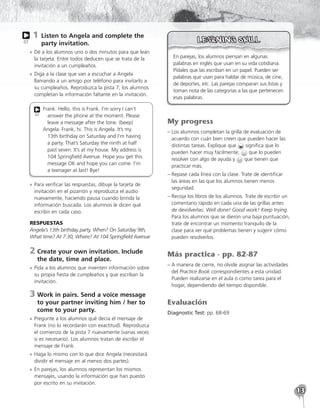
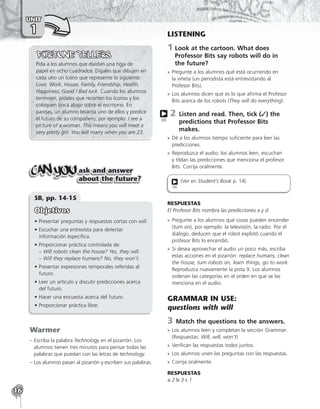
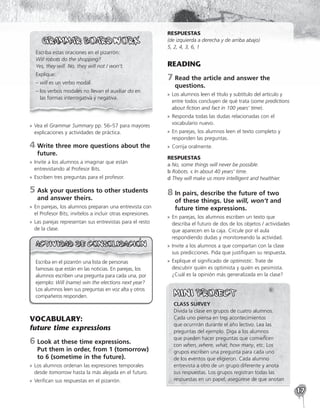
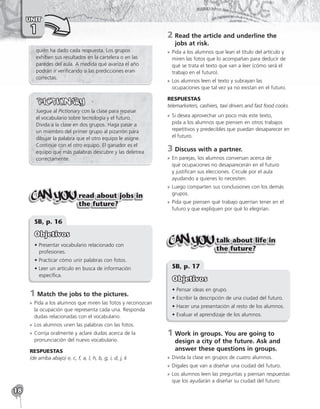
MICHAEL DOWNIE
DAVID GRAY
JOHN M. JAMES
es una serie de tres niveles para la enseñanza
de inglés para alumnos de 12 a 15 años.
Características principales de la serie:
•	Contenidos sugeridos por el Ministerio de Educación
•	Temas de interés adaptados a la realidad de los alumnos
adolescentes
•	Presentación clara de la gramática y el vocabulario en cada lección
•	Géneros textuales diversos y actividades de seguimiento y
lecto-comprensión
•	Desarrollo de las cuatro habilidades lingüísticas: leer, escuchar,
hablar y escribir
•	Proyectos divertidos que promueven el aprendizaje participativo,
reflexivo y crítico
Componentes:
Student’s Book Practice Book
Teacher’s Book Audio CD
Acompañe con
RICHMOND POCKET DICTIONARY
¡La mejor opción en diccionarios escolares bilingües!
9 789504 654285
ISBN 978-950-46-5428-5
Contents provided by
-
TEACHER’S
BOOK
+
AUDIO
CD
Introducción		
	02
Tabla de contenidos		
	06
Unidad 0		
	08
Unidad 1		
	14
Unidad 2		
	20
Unidad 3		
	27
My Culture Dossier: Festivals web-guide		 	34
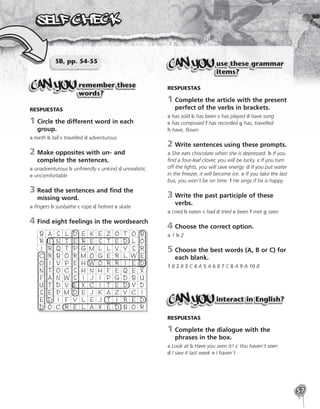
Self Check 1		
	35
Unidad 4		
	36
Unidad 5		
	43
Unidad 6		
	49
My Culture Dossier: World pastimes		 	56
Self Check 2		
	57
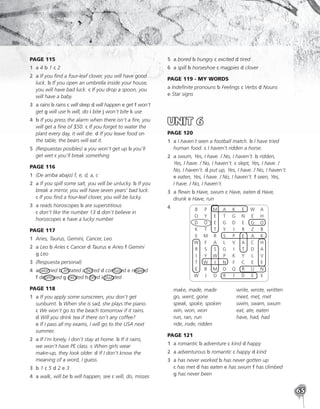
Respuestas Grammar Summary		
	58
Respuestas Practice Book		
	61
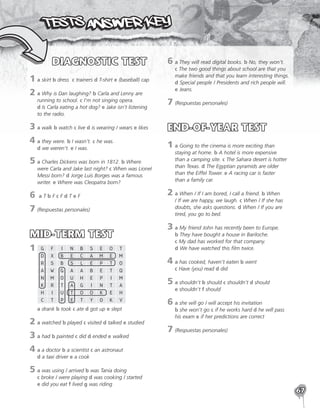
Respuestas Tests		
	67
Tests fotocopiables		
	68
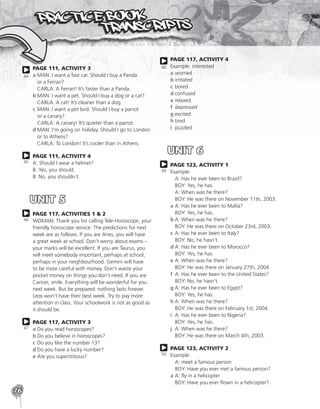
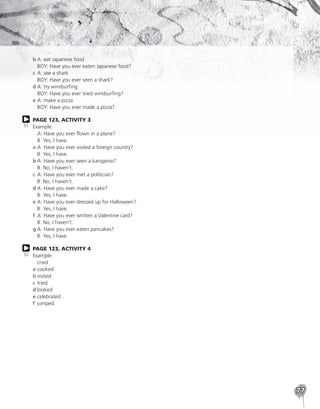
Transcripciones Audio		
	74
Track Lists		
	78
2
es una serie de tres
niveles para la enseñanza de inglés dirigida a
adolescentes de los primeros años de la Escuela
Secundaria, siguiendo los contenidos sugeridos por el
Ministerio de Educación.
Características generales de
la serie
El curso Yes, we can! está concebido según un
enfoque orientado a la acción que apunta a lograr
resultados en el mundo real. Tal como está aplicado
en Yes, we can!, el enfoque orientado a la acción
involucra lo siguiente:
1. Una metodología basada en ciclos de actividades
2. Objetivos de aprendizaje explícitos
3. Evaluación integrada y continua
1. Ciclos de actividades
Un ciclo de actividades es una secuencia de
actividades que…
»
» se inicia con un objetivo formulado explícitamente;
»
» hace que los alumnos trabajen con actividades de
una complejidad cada vez mayor con vistas a que
adquieran las herramientas necesarias para alcanzar
ese objetivo;
»
» finalmente, sugiere una tarea comunicativa que
puede medir el nivel de dificultad con que los
alumnos se enfrentan en sus tareas.
2. Objetivos de aprendizaje explícitos
Cada lección en el curso Yes, we can! comienza con
una pregunta del tipo ‘Can you...?’ que establece lo
que el alumno va a aprender a lo largo de la lección.
Las preguntas están formuladas en términos de
situaciones del mundo real, por ejemplo Can you talk
about your abilities?
Las preguntas del tipo ‘Can you...?’
»
» despiertan en los alumnos la conciencia de por qué
están trabajando con determinado elemento de la
lengua;
»
» les presentan a los alumnos un objetivo claro para
su aprendizaje;
»
» les permiten determinar el grado en que lograron
alcanzarlo.
3. Evaluación integrada y continua
El curso Yes, we can! considera que la evaluación y la
autoevaluación son esenciales para una enseñanza y
un aprendizaje efectivos de la lengua.
De ahí que haya numerosas instancias de evaluación:
»
» las secciones de autoevaluación My Progress al final
de cada unidad del Student’s Book;
»
» dos Self Check tests, luego de la unidad 3 y 6 del
Student’s Book;
»
» las secciones My grammar progress al final de cada
unidad en el Practice Book.
De esta manera, Yes, we can! establece objetivos
alcanzables a corto plazo que, si se cumplen de forma
satisfactoria, le dan al alumno una sensación de logro
y contribuyen a su motivación y autoestima.
La evaluación es más productiva cuando conduce a la
acción. Basado en los resultados de estas actividades,
el docente puede decidir cómo utilizar las secciones
del Practice Book y luego determinar si los alumnos
pueden continuar con la siguiente actividad o
necesitan una consolidación (Grammar Summary para
las estructuras gramaticales).
Yes, we can! Su estructura y
cómo utilizarla
El curso Yes, we can! sigue los contenidos sugeridos
por el Ministerio de Educación, a su vez que se vale
de las premisas ‘Can Do’ del Common European
Framework of Reference for Languages (CEF).
Así, además de integrar las premisas del tipo ‘Can Do’,
Yes, we can! trabaja con tres principios que son clave
en la enseñanza y el aprendizaje de idiomas:
»
» estimula y desarrolla la autonomía del estudiante a
través de la sección Learning skills;
»
» mide el desarrollo y evolución del alumno en las
secciones de Self check;
»
» presenta un sistema claro referido al contexto de
autoevaluación en la sección My Progress al final
de cada unidad.
Con el objetivo de hacer inmediatamente visibles los
objetivos de aprendizaje en términos gramaticales,
todas las doble páginas iniciales comienzan con
una lista de objetivos que especifican los logros de
gramática y vocabulario que permitirán a los alumnos
cumplir el objetivo de esa lección.
3
Los objetivos generales de cada módulo se desarrollan
en tres unidades de seis páginas cada una. Cada
doble página presenta una lección con un ciclo de
actividades completo. Las dos primeras lecciones
consisten en dos ciclos de actividades que conducen
al alumno desde la consigna (el Can you…? del título)
hasta su ejecución práctica en la actividad final de
la doble página, completando así una lección de
manera rápida y sistemática, y trabajando funciones,
estructuras, vocabulario y pronunciación.
Las últimas dos páginas de cada unidad desarrollan
las cuatro competencias (listening, reading, writing y
speaking – interacción y presentación de informes) e
incluye temas relacionados con la unidad, el repaso de
estructuras y textos auténticos. Estas páginas también
comienzan con la pregunta ‘Can you...?’ que establece
el objetivo comunicativo.
Esta parte del libro también incluye las llamadas
Learning skills, secciones breves que ayudan al alumno
a adquirir gradualmente conciencia y autonomía en el
proceso de aprendizaje.
Para comenzar
Cada nivel comienza con una unidad introductoria
(Unidad 0) diseñada para presentar a la clase el tipo de
trabajo que se le pedirá que hagan, de un modo que
les permitirá cooperar activamente.
Como introducción, la unidad de bienvenida permite
al docente:
»
» evaluar el nivel con que llegan los alumnos;
»
» presentar el lenguaje hablado en el aula;
»
» presentar a los personajes que acompañarán a los
alumnos a lo largo del libro.
En todos los niveles, la Unidad 0 ayuda a los
alumnos a:
»
» familiarizarse con los personajes del libro;
»
» consolidar o incorporar algunos conceptos clave;
»
» repasar vocabulario, funciones y estructuras del nivel
anterior antes de avanzar en el nuevo nivel.
Foco en gramática
En el Student’s Book, la atención está puesta en los
elementos básicos de la gramática. Especialmente,
la sección Grammar, breve pero valiosísima, requiere
que los alumnos reflexionen sobre las estructuras del
lenguaje presentes en ejemplos tomados de los textos
introductorios.
Además de impulsar una actitud activa hacia la
gramática, al hacer que los alumnos completen la
regla y la apliquen inmediatamente en una actividad
apropiada, también los redirige a la sección Grammar
Summary donde encontrarán explicaciones más
desarrolladas y nueva práctica.
La sección Grammar está fuertemente relacionada con
la sección Grammar in use cuyas actividades conducen
al alumno gradualmente desde un uso controlado
del lenguaje que se está presentando hasta una
producción más espontánea.
Actividades que aumentan el potencial
lingüístico
El ciclo de actividades que comienza con la pregunta
‘Can you...?’ y termina con una actividad relacionada
con esa pregunta está organizado alrededor de un
abanico amplio de actividades que hacen posible
alcanzar los objetivos de aprendizaje y de lenguaje
establecidos en el Student’s Book. Un diálogo o texto
en la primera página presenta las nuevas funciones
y estructuras y repasa funciones y estructuras vistas
en unidades previas. Además de la sección Grammar
in use y de la sección Grammar, el ciclo incluye las
siguientes secciones:
»
» Remember! con recordatorios breves y útiles.
»
» Vocabulary que presenta el vocabulario meta de la
unidad a través de actividades de descubrimiento.
»
» Actividades de Reading y de Listening, con
textos que incluyen y profundizan las funciones y
estructuras de lenguaje presentadas al comienzo
de la unidad.
»
» Mini Projects y variadas actividades grupales para
fortalecer las competencias comunicativas.
»
» My Progress que invita a los alumnos a
reflexionar acerca de su proceso de aprendizaje
y sobre sus logros.
Yes, we can! y la cultura
El curso Yes, we can! le presta especial atención a
los aspectos culturales implícitos en el aprendizaje de
un idioma. La serie presenta a los alumnos algunos
hábitos y costumbres de los países de habla inglesa:
4
»
» las historias que recorren los 3 niveles del
curso iluminan aspectos de las culturas inglesa, australiana
e irlandesa y la vida en ciudades como Londres, Dublin
o Nueva York.
»
» My culture dossier es una sección especial que
profundiza en aspectos de la cultura anglófona.
Cada nivel del Student’s Book de Yes, we can!
dedica una doble página a la cultura (My culture
dossier) luego de la unidad 3 y 6. Los temas
seleccionados exploran en mayor profundidad las
culturas anglófonas y estimulan las comparaciones
interculturales.
También podrá encontrar estos dossiers en el Practice
Book, donde se brinda mayor información cultural. Por
ejemplo, en el primer dossier del nivel 1 de Yes, we can!,
el Student’s Book presenta al Reino Unido mientras el
Practice Book presenta a la República de Irlanda.
Rápida evaluación de los objetivos
El profesor puede usar las secciones Self check
para determinar la facilidad o dificultad con que el
alumno alcanza los objetivos de aprendizaje generales
establecidos. Las secciones Self check están divididas
en tres subsecciones (vocabulario, gramática y
competencias) que reproducen en forma resumida
el itinerario de las unidades. Esta sección permite al
alumno evaluarse a sí mismo utilizando un esquema
preestablecido de puntos y los prepara para las
evaluaciones formales.
¿Qué tipo de actividades ofrece el Practice
Book?
Además de las actividades de My culture dossier, el
Practice Book de Yes, we can! presenta una serie de
ejercicios relacionados con las actividades del Student’s
Book. Las actividades están organizadas en unidades
de seis páginas.
La primera y la segunda página de cada unidad en
el Practice Book provee práctica en el uso de las
funciones, estructuras y vocabulario presentadas en
las dos primeras lecciones de la unidad
correspondiente en el Student’s Book.
La tercera y la cuarta página (Expand your skills)
incluye actividades de reading, writing, listening
y speaking para desarrollar las cuatro habilidades
lingüísticas. Todas las actividades de listening están
incluidas en el CD de audio.
Las actividades en la quinta página (My grammar
progress) están agrupadas de acuerdo con puntos
gramaticales. Permiten que los alumnos se
autoevalúen e incluyen referencias cruzadas a la
sección Grammar Summary.
La sexta página (My Vocabulary) ayuda a los alumnos
a clasificar y memorizar palabras y expresiones
aprendidas en cada unidad.
Para sacar el mayor provecho de
Yes, we can! en clase
Cómo presentar las actividades
Hacia el comienzo del curso, es recomendable
invitar a los alumnos a recorrer todos los materiales
y asegurarse de que saben cómo utilizar todos los
componentes y secciones, para explotar al máximo las
oportunidades de aprendizaje que ofrece el curso.
Explique a sus alumnos por qué se sugieren
determinadas actividades. Los alumnos deben saber
por qué hacen cada cosa. Vale la pena hablar acerca
de los siguientes aspectos:
»
» la diferencia entre estudiar gramática y aprender a
hablar y escuchar (especialmente, en términos de
precisión y corrección - accuracy);
»
» la importancia del trabajo en parejas y del trabajo
grupal.
Antes de abordar cada página nueva, asegúrese de
leer la pregunta ‘Can you...?’ y la lista de objetivos
junto con los alumnos.
Es importante que ellos entiendan de qué modo los
ayudará a comunicarse ese punto específico que están
trabajando.
Líneas claras en la evaluación
Asegúrese de que los alumnos saben con cuánta
frecuencia harán evaluaciones formales, qué se
evaluará y cómo se los puntuará. Antes de llevar a
cabo la evaluación, anúnciela con tiempo suficiente
para que puedan prepararse.
Recuerde registrar los resultados de todas las
evaluaciones y exámenes, y mostrar a los alumnos que
esos resultados se toman seriamente.
5
Enseñar en clases con diversas aptitudes de
aprendizaje
Las clases suelen ser muy heterogéneas. Estos consejos
ayudarán a llevar adelante la clase frente a grupos con
diversas aptitudes:
– 
Organice una biblioteca. Reserve algo de tiempo
de cada clase para trabajar con los alumnos que
presentan mayores dificultades mientras los demás
leen y completan actividades relacionadas con la
lectura. También puede invitar a los más rápidos a
que escriban informes sobre los libros que han leído
y los compartan con el resto de la clase.
– 
Sugiera a los más hábiles, áreas específicas sobre las
que trabajar. ¡No deje que se aburran! Tenga listo
un número de actividades ‘listas para usar’ con los
alumnos que terminan primero. Por ejemplo:
»
» luego de una actividad de reading, los alumnos
que terminan rápido pueden escribir preguntas de
comprensión lectora o escribir definiciones de las
palabras para compartir con sus compañeros.
»
» luego de una actividad de gramática, pueden
preparar más ejercicios del mismo tipo y dárselos
al resto del grupo.
»
» luego de una actividad de escritura, pueden
ayudar a los alumnos que lo requieran.
»
» luego de una actividad de conversación en
parejas, pueden o bien escribir la conversación
o cambiar de pareja y comenzar otra vez.
Componentes por nivel
PARA LOS ALUMNOS
A los alumnos se les ofrece un volumen integrado por
nivel, dividido en tres secciones.
El Student’s Book incluye:
»
» 1 unidad introductoria
»
» 6 unidades principales
»
» 2 secciones My culture dossier
»
» 2 secciones Self check
La sección Grammar Summary está compuesta por seis
unidades que se corresponden una a una con las del
Student’s Book. Se vuelven a tocar y se profundizan
los temas de gramática presentados en el Student’s
Book. Cada tema se presenta a través de una
explicación clara y simple, basada en ejemplos claros y
fáciles de entender. Lo siguen actividades de gramática
de consolidación y ampliación de lo trabajado. El
vocabulario empleado en las actividades corresponde
al vocabulario presentado en cada unidad.
El Practice Book incluye:
»
» 1 unidad introductoria
»
» 6 unidades principales
»
» 2 secciones My culture dossier
PARA EL PROFESOR
Al profesor se le ofrece un Teacher’s Book por
nivel con:
»
» Objetivos específicos para cada actividad.
»
» Instrucciones paso-a-paso de cómo presentar
los temas.
»
» Secciones Grammar Boardwork, con una guía
detallada de las explicaciones gramaticales.
»
» Actividades de entrada en calor, consolidación
y extensión para cada ciclo de actividades.
»
» Teaching Tips para aprovechar al máximo el curso
Yes, we can! en clase.
»
» Referencias cruzadas al Practice Book y a las
secciones de Grammar Summary y Tests.
»
» Transcripciones de todos los audios incluidos
en el CD.
»
» Respuestas de todas las actividades de los
Culture dossiers, Self checks, Grammar Summary
y Practice Book.
»
» 3 tests fotocopiables (diagnostic test, mid-term test
y end-of-the-year test) con sus respuestas.
»
» Skills worksheets fotocopiables para descargar de la
web.
»
» Índice de las pistas de audio del Student’s Book
y Practice Book.
»
» Un CD por nivel que contiene el material de audio
del Student’s Book y del Practice Book.
¡Disfrute la tarea!
6
UNIT I CAN… GRAMMAR VOCABULARY
0	
	 Pages 6 – 11
•	talk about myself
•	say what people are doing
•	read advertisements
•	write a party invitation
•	verb to be (present
and past)
•	present simple
•	present continuous
•	object pronouns
•	 can (ability)
•	time expressions
•	actions
•	clothes
1	 
	 Pages 12 – 17
•	make predictions
•	ask and answer about the
future
•	read about jobs in the future
•	talk about life in the future
•	 will (affirmative, negative,
interrogative, short
answers)
•	future time expressions
•	places and objects of the
future
•	jobs
•	technology
2	
	 Pages 18 – 23
•	talk about the past
•	talk about someone’s life
•	listen about a famous film
director
•	write about a famous actor
•	past simple of the verb to
be (revision)
•	past simple of regular and
irregular verbs (affirmative,
negative, interrogative,
short answers)
•	space travel
•	verbs
•	words related to films
3	 
	 Pages 24 – 29
•	talk about what was
happening
•	describe what was happening
•	read a tall story
•	write a tall story
•	past continuous
(affirmative, negative,
interrogative, short
answers)
•	past continuous vs past
simple
•	action verbs
FESTIVALS WEB-GUIDE
Pages 30 – 31 Pages 32 – 33
4	 
	 Pages 34 – 39
•	give advice
•	compare animals
•	read about animal habitats
•	talk about pets
•	 should (affirmative,
negative, interrogative,
short answers)
•	comparatives
•	parts of the body
•	sports equipment
•	adjectives
•	animals and pets
5	 
	 Pages 40 – 45
•	talk about my feelings
•	talk about outcomes
•	read a horoscope
•	predict a friend’s future
•	zero conditional
•	first conditional
•	feelings
•	superstitions
6	
	 Pages 46 – 51
•	talk about my experiences
•	discuss other people’s
experiences
•	read about a celebration
•	write a poem
•	present perfect
(affirmative, negative,
interrogative, short
answers)
•	present perfect vs past
simple
•	irregular past participle
•	opposites with un-
•	types of books
WORLD PASTIMES
Pages 52 – 53 Pages 54 – 55
Pages 56 – 81
7
SKILLS PRONUNCIATION
LEARNING
SKILLS
PRACTICE
BOOK
•	 Speaking: introducing yourself and talking
about routines
•	 Listening: listening for specific information
•	Reading: finding information in an
advertisement
•	Writing: writing an invitation
• intonation in questions •	English is
everywhere
•	Pages 82-87
•	Speaking: making predictions about life in the
future
•	Listening: understanding predictions
•	Reading: understanding an article
•	Writing: writing a project
•	 will and won’t •	why study English •	Pages 88-93
•	Speaking: asking and answering about the past
•	 Listening: listening for specific information
about events in the past
•	Reading: looking for information on a personal
profile
•	 Writing: writing a short biography
•	/t/, /d/, /ɪd/ •	learning from films •	Pages 94-99
•	Speaking: asking and answering about actions
in progress in the past
•	Listening: understanding the sequence of
events in a story
•	Reading: reading a story
•	Writing: telling stories and tall stories
•	weak forms •	unknown words •	Pages 100-105
•	My culture dossier
Pages 106-107
•	Speaking: giving advice and making
comparisons
•	Listening: listening for specific information
•	Reading: understanding an article
•	Writing: writing a riddle
•	schwa /ə/ in weak
forms
•	reading and
anticipating
•	Pages 108-113
•	Speaking: talking about feelings and outcomes
•	Listening: listening for specific information
•	Reading: understanding a horoscope
•	Writing: writing the outcome of different
situations
•	stress on words •	memorising new
words
•	Pages 114-119
•	Speaking: talking about your experiences
•	Listening: understanding a radio programme
about famous people
•	Reading: understanding a poem
•	Writing: writing a poem
•	spelling and
punctuation
•	Pages 120-125
•	My culture dossier
Pages 126-127
UNIT
0
8
talk about yourself?
SB, pp. 6-7
Objetivos
•	Revisar vocabulario para dar y pedir información
personal.
•	Practicar la escucha de personas
proporcionando información personal.
•	Repasar vocabulario relacionado con
expresiones temporales.
•	Repasar vocabulario para hablar acerca de las
rutinas.
•	Repasar el pasado simple del verbo to be.
Warmer
– 
Pida a un alumno que se presente, por ejemplo:
Hello! My name is Alberto. I’m fourteen years old.
I’m from Rosario. I like football.
– 
Otro alumno hace lo mismo, repitiendo alguna
información suministrada por el alumno anterior,
por ejemplo: My name is Sara. I’m... etc. His name is
Alberto. He’s....
– 
Continúe hasta que hayan participado varios
alumnos.
– 
Señale hacia distintos alumnos al azar y pregunte al
resto de la clase: What’s his / her name? How old is
he / she? What does he / she like?
LISTENING
1 
Listen to the dialogue. Who are the
people in the pictures?
»
» Pida a los alumnos que miren el texto rápidamente
y le digan quiénes son las personas que se ven en
las fotos (Carla y Jake).
01
»
» Presente a los personajes y diga que Jake se acaba
de mudar a Inglaterra con su madre y Carla es su
nueva vecina. Luego reproduzca la pista 1.
2 
Listen again and answer these
questions.
»
» Los alumnos leen el texto más atentamente esta
vez mientras escuchan nuevamente el audio y luego
responden las preguntas.
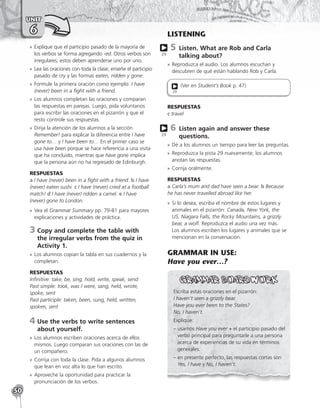
(Ver en Student’s Book p. 6)
01
RESPUESTAS
a He’s Carla’s new neighbour. b He’s American.
c She’s an actress. d He likes sports and karate.
e His best friend is Max.
»
» Repase el vocabulario sobre el que los alumnos no
estén seguros; ejemplifique la pronunciación en los
casos en que lo crea necesario.
Si desea aprovechar este texto un poco más,
pida a los alumnos que formulen oraciones
comparando a Carla y a Jake, por ejemplo: Carla
is from London but Jake is from Hollywood.
3 
Listen to Carla, Jake and Lenny and
complete the profiles below.
»
» Invite a los alumnos a mirar las fichas de Carla y
Jake y a identificar qué datos deben completar en
cada caso.
»
» Diga que ahora van a escuchar a Jake, Carla y
Lenny, el amigo de Carla, charlando. Reproduzca el
audio dos veces mientras los alumnos toman notas
y completan las fichas.
»
» Reproduzca la pista una vez más y pida a los
alumnos que verifiquen las respuestas en parejas.
01
02
9
Carla: Hi, Lenny! How are things going?
Lenny: Great, thanks.
Carla: Jake, this is my best friend, Lenny
Williams. Lenny, this is Jake, my new
neighbour.
Lenny: Hi, Jake.
Jake: Nice to meet you.
Lenny: Hey, can I enter your personal
information on my contact list?
Carla: Sorry, Jake, he’s a techno-freak as well
as a drummer.
Jake: That’s OK.
Lenny: OK, your name is Jake… what’s your
surname?
Jake: Kelly.
Lenny: That’s K-E-double L-Y, right?
Jake: Yeah.
Lenny: What’s your address?
Jake: I live next door to Carla. That’s 326 Oak
Hills.
Lenny: What about your e-mail? What’s your
e-mail address?
Jake: jake@aol.com
Lenny: That’s great, thanks.
02
RESPUESTAS
CARLA: Carla, England
JAKE: Jake Kelly, jake@aol.com, 326 Oak Hills,
American
VOCABULARY: time expressions
4	
In pairs, ask and answer questions
using the verbs and expressions in
the box.
»
» Los alumnos formulan y responden preguntas
usando los verbos y las expresiones temporales.
Corrija oralmente.
RESPUESTAS
(Respuestas posibles) Do you go to the park in the
afternoon? Yes, I do. / No, I don’t. What time do
you go shopping on Saturday? At ten o’clock in the
morning. Where do you watch football on Sunday?
At home.
5 
Listen. Who is more similar to you:
Jake or Carla?
»
» Explique a los alumnos que van a escuchar a Jake y
a Carla hablando acerca de sus fines de semana.
»
» Reproduzca la pista 3; los alumnos escuchan y
deciden cuál de los dos se parece más a ellos.
Jake: My favourite day is Sunday. I get up late,
at about ten o’clock. I have a big breakfast
and I do my homework. Then I go out to
the park. I come home for lunch and then I
go out with my friends again. We go to the
cinema or a cybercafé and play video games.
I come home and have dinner. Then I watch
TV. I go to bed at about eleven o’clock.
Carla: My favourite day is Saturday. I get up
early, about eight o’clock. I have a small
breakfast and then I go swimming. After
swimming, I go to a friend’s house. We talk,
text our friends and listen to music. I have
lunch at home and then I go shopping with
friends. We have a pizza or hamburger for
dinner and then we go dancing. I come
home at ten o’clock and go to bed at eleven.
03
»
» Invite a algunos alumnos a decir quién se parece
más a ellos; pida que le digan por qué, pero aún no
entre en demasiados detalles.
6 
Listen again and write T (true) or
F (false).
»
» Refiérase a la sección Remember! para repasar
las formas afirmativa, negativa e interrogativa del
presente simple. Pida a los alumnos que trabajen en
parejas y lean en voz alta los ejemplos.
»
» Reproduzca el audio nuevamente; los alumnos
indican si las oraciones son verdaderas o falsas.
Luego comparan sus respuestas en parejas.
»
» Reproduzca la pista 3 nuevamente; los alumnos
confirman o corrigen sus respuestas.
RESPUESTAS
a T b F. He has a big breakfast. c T d F. He goes home
and has dinner. e F. Carla’s favourite day is Saturday.
f F. She goes swimming in the morning. g T h F. She
has a pizza or hamburger with her friends.
»
» Si quiere aprovechar la actividad un poco más,
escriba estas preguntas en el pizarrón:
– 
What does Jake do after breakfast? (He does his
homework.)
03
03
UNIT
0
10
– Where does he have lunch? (At home.)
– What does he do after dinner? (He watches TV.)
– 
What time does he go to bed? (About eleven o’clock.)
– 
What kind of breakfast does Carla have? (A small
breakfast.)
– 
What does she do in the afternoon? (She goes
shopping with friends.)
– What time does she come home? (At ten o’clock.)
»
» Reproduzca el audio nuevamente; los alumnos
anotan las respuestas y luego las comparan con un
compañero. Corrija oralmente.
7	
It’s Sunday 15th today. Where was Carla
yesterday? Circle the correct option.
»
» Refiérase a la sección Remember! para repasar el
pasado simple de to be. Pida a los alumnos que
lean los ejemplos y luego formen parejas. Pida que
formulen oraciones nuevas usando el pasado simple.
»
» Invite a los alumnos a que lean las oraciones de
la actividad y ayude a los que tienen dudas con el
vocabulario.
»
» En parejas, los alumnos circulan la opción correcta
en cada caso.
RESPUESTAS
a was b was c wasn’t d were e was / was
say what people are
doing?
SB, pp. 8-9
Objetivos
• Practicar lenguaje relacionado con acciones.
• Repasar el presente continuo.
• Practicar la lectura de un diálogo con viñetas
ilustradas.
• Repasar pronombres personales.
• Repasar vocabulario relacionado con prendas de
vestir y colores.
• Practicar la escucha en busca de información
específica.
• Repasar cómo describir lo que lleva puesto una
persona.
Warmer
– 
Escriba la palabra discotheque en el pizarrón. En
parejas, los alumnos escriben durante dos minutos
todas las palabras que se les ocurran usando las
letras de discotheque.
– 
La pareja que haya escrito el mayor número de
palabras correctas es la ganadora.
VOCABULARY: actions
1	Match the actions to the pictures.
»
» Pida a los alumnos que unan las acciones con las
ilustraciones y comparen sus respuestas.
RESPUESTAS
(Ver en transcripción #04)
2 
Listen and check your answers.
Then, listen again and repeat.
»
» Los alumnos escuchan el audio para verificar sus
respuestas. Luego escuchan nuevamente y repiten.
»
» Asegúrese de que pronuncien correctamente la
terminación -ing y de que acentúen las oraciones
como corresponde.
a She’s skipping.
b He’s eating a hotdog.
c He’s shouting.
d He’s dancing.
e She’s laughing.
f They’re whispering.
04
LISTENING
3 
Listen and read. Where are the girls?
What are they doing?
»
» Pregunte a los alumnos si les gusta ir a fiestas. Entre
todos nombran aquello que suelen hacer en las
fiestas. Escriba algunas palabras como referencia en
el pizarrón, por ejemplo: talk, eat pizza, dance.
»
» Los alumnos miran las viñetas, escuchan el audio
y leen el diálogo. Entre todos deducen que las
chicas están en una discoteca y que están hablando
de chicos.
(Ver en Student’s Book p. 8)
05
04
05
11
»
» Pregunte a los alumnos quiénes son los chicos en
las ilustraciones (son los novios de las chicas).
»
» Entre todos deducen que las chicas están
murmurando y riendo y que no les están diciendo la
verdad a sus novios.
4	
In pairs, choose an action from this
page and mime it for your partner to
guess.
»
» Los alumnos leen las frases del ejemplo y miran la
información en la sección Remember! Responda
cualquier duda que surja respecto del uso del
presente continuo.
»
» Divida la clase en parejas. Un alumno de cada pareja
hace mímica de una de las acciones que aparecen
en esta página del libro; el otro dice qué está
haciendo su compañero.
»
» Cuando los alumnos hayan representado todas las
acciones, invítelos a que representen otras que no
figuren en el libro.
Pida a los alumnos que escriban dos acciones
en hojas separadas, por ejemplo: making an
omelette, wrapping a present, listening to
music. Divida la clase en grupos. Los grupos
intercambian sus acciones y colocan las hojas
boca abajo en el medio. Cada alumno elije una
actividad y la representa con mímica. El resto de
los alumnos adivina cuál es. El grupo que más
acciones adivina es el ganador.
GRAMMAR IN USE:
object pronouns
5	Complete the sentences.
»
» Pida a los alumnos que lean y completen la sección
Grammar. (Object pronouns: me, you, him, her, it,
us, you, them)
»
» Corrija con toda la clase.
»
» Los alumnos completan las oraciones y comparan
sus respuestas en parejas.
RESPUESTAS
a her b them c it d me e you f you
LANGUAGE IN USE:
What are they wearing?
6	
Three couples are waiting outside a
disco. Find these clothes.
»
» En parejas, los alumnos describen qué tiene puesto
cada una de las personas en la ilustración utilizando
las palabras en la caja.
»
» Corrija oralmente. Modele la pronunciación de las
palabras si lo considera necesario.
RESPUESTAS
a jeans, T-shirt, jacket b sweater, skirt c dress
d trousers, shirt, trainers e trousers, shirt, trainers
f T-shirt, jeans, trainers
»
» Pida a los alumnos que le digan de qué color es
cada prenda.
7 
Listen to the conversation and write
the names in the boxes (a-f).
»
» Diga a los alumnos que van a escuchar a las chicas
hablando de sus novios.
»
» Reproduzca la pista 6; los alumnos escriben los
nombres donde corresponda.
Susan: Hi, Kate. I love your clothes.
Kate: Yeah, I bought this purple jacket last
week! Why aren’t you wearing your new
black jeans, Susan?
Susan: I like wearing skirts to a disco!
Kate: Look at him. Is that your new
boyfriend, Charlie?
Susan: Yes, he’s over there next to Frank.
He’s wearing the orange shirt and purple
trousers!
Kate: Yes, I like them.
Susan: Yes…
Kate: Not my Bobby… he loves his blue
jeans.
Susan: Hi, Vicky!
Vicky: Hi, girls! What are you whispering
about?
Susan: About your Frank… he’s looking
gorgeous.
Vicky: Yes, he is. His trousers aren’t. Look at
them!
Kate: Oh, he’s wearing my favourite colour,
green!
06
»
» Los alumnos comparan sus respuestas en parejas.
06
UNIT
0
12
RESPUESTAS
a Kate b Susan c Vicky d Charlie e Frank f Bobby
8 
Listen again and match the couples.
»
» Reproduzca el audio nuevamente; los alumnos unen
las parejas. Corrija oralmente.
RESPUESTAS
A - F, B - D, C - E
»
» Si desea aprovechar la actividad un poco más, escriba
estos adjetivos en el pizarrón: handsome, colourful,
gorgeous, wonderful, jealous. Pregunte a los alumnos
cuáles usan los hablantes en el audio. Reproduzca la
pista 6 nuevamente. Los alumnos tildan los adjetivos
que escuchan. Explique su significado en contexto.
9	Tell your partner.
»
» Formule a los alumnos algunas de las preguntas
del ejemplo. Los alumnos le dicen qué se ponen en
los diferentes lugares y en las diferentes estaciones.
Asegúrese de que usen el presente simple.
»
» Los alumnos preguntan y responden en parejas.
GUESS WHO?
Divida la clase en parejas. Dígales que lean los
ejemplos y luego elijan a dos compañeros del curso
sin decir quiénes son. Invítelos a que escriban una
descripción de las prendas que llevan puestas y de
las acciones que están realizando. Cada uno lee
su descripción para que su compañero adivine de
quiénes se trata. Pida a algunos alumnos que lean
sus descripciones para que toda la clase adivine.
read advertisements?
SB, p. 10
Objetivos
• Leer someramente un anuncio buscando
información específica.
• Practicar cómo unir un slogan con un texto.
06
1	
Match the slogans to the
advertisements.
»
» Pida a los alumnos que miren rápidamente
los anuncios y que digan de dónde creen que
provienen (una red social).
»
» Invítelos a que indiquen qué anuncia cada uno de
ellos (a concert, cinemas, a market, bicycles).
»
» Los alumnos deciden en parejas qué slogan le
corresponde a cada anuncio. Corrija oralmente.
RESPUESTAS
a Multiplex Cinema b Northern Lights in concert
c London Wheels d Portobello
2	Answer these questions.
»
» Los alumnos responden las preguntas en parejas.
Corrija oralmente.
RESPUESTAS
a £10 b From Virgin Records and on 208 887260.
c An ice-skating rink. d Five. e The seats are
comfortable and it has digital sound. f 39 Dawson
Street, London. g There’s a market. h From 9 to 7.
»
» Si desea aprovechar un poco más estos textos,
pida a los alumnos que hagan una lista con todos
los adjetivos que aparecen en los slogans y en
los anuncios. Luego invítelos a que escriban un
breve anuncio relacionado con un lugar que ellos
elijan (como un restaurant, un centro comercial
o un local de música) y que usen los adjetivos
apropiadamente.
write a party
invitation?
SB, p. 11
Objetivos
• Practicar la escucha en busca de información
específica.
• Escribir una tarjeta de invitación.
• Evaluar el aprendizaje de los alumnos.
13
1 
Listen to Angela and complete the
party invitation.
»
» Dé a los alumnos uno o dos minutos para que lean
la tarjeta. Entre todos deducen que se trata de la
invitación a un cumpleaños.
»
» Diga a la clase que van a escuchar a Angela
llamando a un amigo por teléfono para invitarlo a
su cumpleaños. Reproduzca la pista 7; los alumnos
completan la información faltante en la invitación.
Frank: Hello, this is Frank. I’m sorry I can’t
answer the phone at the moment. Please
leave a message after the tone. (beep)
Angela: Frank, hi. This is Angela. It’s my
13th birthday on Saturday and I’m having
a party. That’s Saturday the ninth at half
past seven. It’s at my house. My address is
104 Springfield Avenue. Hope you get this
message OK and hope you can come. I’m
a teenager at last! Bye!
07
»
» Para verificar las respuestas, dibuje la tarjeta de
invitación en el pizarrón y reproduzca el audio
nuevamente, haciendo pausa cuando brinda la
información buscada. Los alumnos le dicen qué
escribir en cada caso.
RESPUESTAS
Angela’s 13th birthday party, When? On Saturday 9th,
What time? At 7:30, Where? At 104 Springfield Avenue
2	
Create your own invitation. Include
the date, time and place.
»
» Pida a los alumnos que inventen información sobre
su propia fiesta de cumpleaños y que escriban la
invitación.
3	
Work in pairs. Send a voice message
to your partner inviting him / her to
come to your party.
»
» Pregunte a los alumnos qué decía el mensaje de
Frank (no lo recordarán con exactitud). Reproduzca
el comienzo de la pista 7 nuevamente (varias veces
si es necesario). Los alumnos tratan de escribir el
mensaje de Frank.
»
» Haga lo mismo con lo que dice Angela (necesitará
dividir el mensaje en al menos dos partes).
»
» En parejas, los alumnos representan los mismos
mensajes, usando la información que han puesto
por escrito en su invitación.
07
En parejas, los alumnos piensan en algunas
palabras en inglés que usan en su vida cotidiana.
Pídales que las escriban en un papel. Pueden ser
palabras que usan para hablar de música, de cine,
de deportes, etc. Las parejas comparan sus listas y
toman nota de las categorías a las que pertenecen
esas palabras.
My progress
– 
Los alumnos completan la grilla de evaluación de
acuerdo con cuán bien creen que pueden hacer las
distintas tareas. Explique que significa que lo
pueden hacer muy fácilmente; que lo pueden
resolver con algo de ayuda y que tienen que
practicar más.
– 
Repase cada línea con la clase. Trate de identificar
las áreas en las que los alumnos tienen menos
seguridad.
– 
Recoja los libros de los alumnos. Trate de escribir un
comentario rápido en cada una de las grillas antes
de devolverlas: Well done! Good work! Keep trying.
Para los alumnos que se dieron una baja puntuación,
trate de encontrar un momento tranquilo de la
clase para ver qué problemas tienen y sugerir cómo
pueden resolverlos.
Más practica - pp. 82-87
– 
A manera de cierre, no olvide asignar las actividades
del Practice Book correspondientes a esta unidad.
Pueden realizarse en el aula o como tarea para el
hogar, dependiendo del tiempo disponible.
Evaluación
Diagnostic Test: pp. 68-69
14
UNIT
1
make predictions?
SB, pp. 12-13
Objetivos
• Presentar lenguaje relacionado con la tecnología.
• Presentar predicciones.
• Practicar cómo unir textos con fotos y con íconos.
• Practicar lectura en busca de información específica.
• Escuchar un audio en busca de información
específica.
• Leer y discutir predicciones acerca del futuro.
• 
Proporcionar práctica controlada de:
– People will live for 100 years.
– They won’t get ill.
• Proporcionar práctica libre.
Warmer
– Escriba The future en el pizarrón. Dé a los alumnos
tres minutos para que escriban todas las palabras
que relacionen con el futuro.
– Escriba las palabras que pensaron en el pizarrón.
VOCABULARY: technology
1	Match the words to the pictures.
»
» Pida a los alumnos que unan las palabras con las
fotos y revisen sus respuestas todos juntos.
RESPUESTAS
(de arriba abajo) c, b, a, d, e
READING
2	
Carla is doing a science project for
school. What is she reading?
»
» Pida a los alumnos que miren rápidamente los textos;
entre todos deducen que pertenecen a un sitio web.
»
» Pregunte a la clase sobre qué creen que trata el sitio
web (the future). Pida a los alumnos que trabajen
de a dos y que escriban en sus carpetas palabras
que piensan que pueden aparecer en el texto.
Controle oralmente.
3	
Read these predictions from
FutureWorld. Which sections are they
from?
»
» Los alumnos leen los textos y los unen con los
íconos y con los títulos. Corrija oralmente.
RESPUESTAS
a Cities b Health c Technology d Home and Leisure
e Work f Food
4	
What does the website say? Read and
write T (true) or F (false).
»
» Los alumnos leen los textos nuevamente y deciden
si las afirmaciones son verdaderas o falsas. Invítelos
a que corrijan las oraciones falsas.
RESPUESTAS
a T b F. Books will be digital. c T d F. There will not be
any offices. e F. We will have plenty of free time.
GRAMMAR IN USE: will / won’t
5 
Listen to an expert talking about
the future and circle the topics he
mentions. Then, listen again and
complete the sentences.
»
» Los alumnos leen la sección Grammar y circulan la
opción correcta. (Respuestas: will, won’t)
»
» Los alumnos escuchan la pista 8 y circulan las
categorías a las que se refiere el experto. Repita el
audio si es necesario.
»
» Luego escuchan el audio nuevamente y completan
las oraciones. Corrija oralmente.
08
15
Expert: …so what will our future be like? It’s
hard to predict but at present there are some
facts that show us that we will live longer and
it’s only natural. People are becoming more
aware of the importance of exercising and
eating healthily, mainly fruits and vegetables.
Medicine will play an important role. Scientists
will develop new medicine to prevent and cure
serious diseases. Consequently, we will be
healthier and live longer.
Another important topic about the future is
schools. Will they keep on being the place to
get educated? I don’t think so. In fact, children
will stay at home and connect their electronic
devices to virtual classrooms. They will work
collaboratively with other students from other
parts of the world. There won’t be any teacher
lecturing students but a tutor organizing the
students’ project work and research. Sounds
great, doesn’t it? But have you stopped to
think about social interaction and friendship?
Now, moving onto…
08
RESPUESTAS
Health, Food, School
a will be healthier and live longer b will stay at home
and connect their electronic devices to c won’t have
d will organize their
Escriba estas oraciones en el pizarrón:
People will work at home.
Cancer won’t be a problem.
Explique:
– usamos will para hacer predicciones acerca del
futuro.
– la forma negativa de will es will not o won’t.
– 
will y won’t van seguidos del verbo principal en
infinitivo sin to.
»
» Vea el Grammar Summary pp. 56-57 para mayores
explicaciones y actividades de práctica.
»
» Invite a los alumnos a que busquen más ejemplos
de oraciones con will y will not en los textos de la
actividad 2.
6	
Read these predictions about the
future. Put a tick (✓) if you think they
will come true, and a cross (✗) if you
do not think they will come true.
»
» Lea las predicciones con toda la clase; responda
todas las dudas de vocabulario.
»
» Los alumnos tildan o ponen una cruz junto a cada
predicción, según estén de acuerdo con ella o no lo
estén.
7	
Work in pairs. Write more predictions
about life in 100 years’ time.
»
» En parejas, los alumnos escriben cinco o más
predicciones acerca de cómo creen que será la vida
dentro de 100 años.
»
» Los alumnos comparten sus predicciones con otra
pareja que dice si está de acuerdo o no con ellas.
»
» Invite a las parejas a leer en voz alta algunas de
sus predicciones. El resto de la clase dice si está de
acuerdo en que eso ocurrirá.
Diga a los alumnos que cierren sus libros. Escriba
en el pizarrón algunas palabras clave tomadas de
FutureWorld, por ejemplo: zoos, food, housework,
planets. Los alumnos tienen cinco minutos para
escribir tantas predicciones como recuerden. Para
verificar su trabajo, abren los libros y comparan sus
oraciones con las del texto original.
8	
Write six predictions about other
students’ futures. Then, share your
predictions in groups.
»
» Divida la clase en grupos de unos seis alumnos.
»
» Cada uno escribe seis predicciones acerca de otra
persona, tres con will y tres con won’t.
»
» Los alumnos leen en voz alta sus predicciones.
¿Los otros grupos están de acuerdo con ellas?
16
UNIT
1
Pida a los alumnos que dividan una hoja de
papel en ocho cuadrados. Dígales que dibujen en
cada uno un ícono que represente lo siguiente:
Love, Work, House, Family, Friendship, Health,
Happiness, Good / Bad luck. Cuando los alumnos
terminen, pídales que recorten los íconos y los
coloquen boca abajo sobre el escritorio. En
parejas, un alumno levanta uno de ellos y predice
el futuro de su compañero, por ejemplo: I see a
picture of a woman. This means you will meet a
very pretty girl. You will marry when you are 23.
ask and answer
about the future?
SB, pp. 14-15
Objetivos
• Presentar preguntas y respuestas cortas con will.
• Escuchar una entrevista para detectar
información específica.
• 
Proporcionar práctica controlada de:
– Will robots clean the house? Yes, they will.
– Will they replace humans? No, they won’t.
• Presentar expresiones temporales referidas al
futuro.
• Leer un artículo y discutir predicciones acerca
del futuro.
• Hacer una encuesta acerca del futuro.
• Proporcionar práctica libre.
Warmer
– 
Escriba la palabra Technology en el pizarrón. Los
alumnos tienen tres minutos para pensar todas las
palabras que puedan con las letras de technology.
– 
Los alumnos pasan al pizarrón y escriben sus palabras.
LISTENING
1	
Look at the cartoon. What does
Professor Bits say robots will do in
the future?
»
» Pregunte a los alumnos qué está ocurriendo en
la viñeta (un periodista está entrevistando al
Profesor Bits).
»
» Los alumnos dicen qué es lo que afirma el Profesor
Bits acerca de los robots (They will do everything).
2 
Listen and read. Then, tick (✓) the
predictions that Professor Bits
makes.
»
» Dé a los alumnos tiempo suficiente para leer las
predicciones.
»
» Reproduzca el audio; los alumnos leen, escuchan
y tildan las predicciones que menciona el profesor
Bits. Corrija oralmente.
(Ver en Student’s Book p. 14)
09
RESPUESTAS
El Profesor Bits nombra las predicciones a y d.
»
» Pregunte a los alumnos qué cosas pueden encender
(turn on), por ejemplo: la televisión, la radio. Por el
diálogo, deducen que el robot explotó cuando el
profesor Bits lo encendió.
»
» Si desea aprovechar el audio un poco más, escriba
estas acciones en el pizarrón: replace humans, clean
the house, turn robots on, learn things, go to work.
Reproduzca nuevamente la pista 9. Los alumnos
ordenan las categorías en el orden en que se las
menciona en el audio.
GRAMMAR IN USE:
questions with will
3 Match the questions to the answers.
»
» Los alumnos leen y completan la sección Grammar.
(Respuestas: Will, will, won’t)
»
» Verifican las respuestas todos juntos.
»
» Los alumnos unen las preguntas con las respuestas.
»
» Corrija oralmente.
RESPUESTAS
a 2 b 3 c 1
09
17
Escriba estas oraciones en el pizarrón:
Will robots do the shopping?
Yes, they will. No, they will not / won’t.
Explique:
– 
will es un verbo modal.
– 
los verbos modales no llevan el auxiliar do en
las formas interrogativa y negativa.
»
» Vea el Grammar Summary pp. 56–57 para mayores
explicaciones y actividades de práctica.
4	
Write three more questions about the
future.
»
» Invite a los alumnos a imaginar que están
entrevistando al Profesor Bits.
»
» Escriben tres preguntas para el profesor.
5	
Ask your questions to other students
and answer theirs.
»
» En parejas, los alumnos preparan una entrevista con
el Profesor Bits; invítelos a incluir otras expresiones.
»
» Las parejas representan sus entrevistas para el resto
de la clase.
Escriba en el pizarrón una lista de personas
famosas que están en las noticias. En parejas, los
alumnos escriben una pregunta para cada una, por
ejemplo: Will (name) win the elections next year?
Los alumnos leen sus preguntas en voz alta y otros
compañeros responden.
VOCABULARY:
future time expressions
6	
Look at these time expressions.
Put them in order, from 1 (tomorrow)
to 6 (sometime in the future).
»
» Los alumnos ordenan las expresiones temporales
desde tomorrow hasta la más alejada en el futuro.
»
» Verifican sus respuestas en el pizarrón.
RESPUESTAS
(de izquierda a derecha y de arriba abajo)
5, 2, 4, 3, 6, 1
READING
7	
Read the article and answer the
questions.
»
» Los alumnos leen el título y subtítulo del artículo y
entre todos concluyen de qué trata (some predictions
about fiction and fact in 100 years’ time).
»
» Responda todas las dudas relacionadas con el
vocabulario nuevo.
»
» En parejas, los alumnos leen el texto completo y
responden las preguntas.
»
» Corrija oralmente.
RESPUESTAS
a No, some things will never be possible.
b Robots. c In about 40 years’ time.
d They will make us more intelligent and healthier.
8	
In pairs, describe the future of two
of these things. Use will, won’t and
future time expressions.
»
» En parejas, los alumnos escriben un texto que
describa el futuro de dos de los objetos / actividades
que aparecen en la caja. Circule por el aula
respondiendo dudas y monitoreando la actividad.
»
» Invite a los alumnos a que compartan con la clase
sus predicciones. Pida que justifiquen su respuesta.
»
» Explique el significado de optimistic. Trate de
descubrir quién es optimista y quién es pesimista.
¿Cuál es la opinión más generalizada en la clase?
CLASS SURVEY
Divida la clase en grupos de cuatro alumnos.
Cada uno piensa en tres acontecimientos
que ocurrirán durante el año lectivo. Lea las
preguntas del ejemplo. Diga a los alumnos
que pueden hacer preguntas que comiencen
con when, where, what, how many, etc. Los
grupos escriben una pregunta para cada uno
de los eventos que eligieron. Cada alumno
entrevista a otro de un grupo diferente y anota
sus respuestas. Los grupos registran todas las
respuestas en un papel; asegúrese de que anotan
18
UNIT
1
quién ha dado cada respuesta. Los grupos
exhiben sus resultados en la cartelera o en las
paredes del aula. A medida que avanza el año
podrán ir verificando si las predicciones eran
correctas.
Juegue al Pictionary con la clase para repasar
el vocabulario sobre tecnología y el futuro.
Divida a la clase en dos grupos. Haga pasar a
un miembro del primer grupo al pizarrón para
dibujar la palabra que el otro equipo le asigne.
Continúe con el otro equipo. El ganador es el
equipo que más palabras descubre y las deletrea
correctamente.
read about jobs in
the future?
SB, p. 16
Objetivos
• Presentar vocabulario relacionado con
profesiones.
• Practicar cómo unir palabras con fotos.
• Leer un artículo en busca de información
específica.
1	Match the jobs to the pictures.
»
» Pida a los alumnos que miren las fotos y reconozcan
la ocupación que representa cada una. Responda
dudas relacionadas con el vocabulario.
»
» Los alumnos unen las palabras con las fotos.
»
» Corrija oralmente y aclare dudas acerca de la
pronunciación del nuevo vocabulario.
RESPUESTAS
(de arriba abajo) e, c, f, a, l, h, b, g, i, d, j, k
2	
Read the article and underline the
jobs at risk.
»
» Pida a los alumnos que lean el título del artículo y
miren las fotos que lo acompañan para deducir de
qué se trata el texto que van a leer (cómo será el
trabajo en el futuro).
»
» Los alumnos leen el texto y subrayan las
ocupaciones que tal vez ya no existan en el futuro.
RESPUESTAS
telemarketers, cashiers, taxi drivers and fast food cooks.
»
» Si desea aprovechar un poco más este texto,
pida a los alumnos que piensen en otros trabajos
repetitivos y predecibles que puedan desaparecer en
el futuro.
3	Discuss with a partner.
»
» En parejas, los alumnos conversan acerca de
qué ocupaciones no desaparecerán en el futuro
y justifican sus elecciones. Circule por el aula
ayudando a quienes lo necesiten.
»
» Luego comparten sus conclusiones con los demás
grupos.
»
» Pida que piensen qué trabajo querrían tener en el
futuro y que expliquen por qué lo elegirían.
talk about life in
the future?
SB, p. 17
Objetivos
• Pensar ideas en grupo.
• Escribir la descripción de una ciudad del futuro.
• Hacer una presentación al resto de los alumnos.
• Evaluar el aprendizaje de los alumnos.
1	
Work in groups. You are going to
design a city of the future. Ask and
answer these questions in groups.
»
» Divida la clase en grupos de cuatro alumnos.
»
» Dígales que van a diseñar una ciudad del futuro.
»
» Los alumnos leen las preguntas y piensan respuestas
que los ayudarán a diseñar su ciudad del futuro:
19
cómo y dónde vive la gente, de qué trabaja, qué
ocupaciones habrá, etc.
»
» Cada grupo decide dónde estará ubicada su ciudad
y hace una lista de los servicios que ofrecerá.
Invítelos a que dejen volar su imaginación.
»
» Los grupos toman notas de sus ideas. Pueden
inspirarse en las actividades del comienzo de la
unidad.
»
» Sugiera que hagan dibujos de su ciudad.
2	
Write a full description of your city of
the future.
»
» Los grupos escriben un texto que describa su
ciudad. Sugiérales que comiencen diciendo dónde
se encuentra y que luego vayan incluyendo las ideas
que estuvieron conversando.
»
» Pueden acompañar los textos con imágenes y
realizar pósteres de sus ciudades del futuro.
3	
Present your city to other groups.
Vote on the best city of the future and
give reasons for your choice.
»
» Pida a una persona de cada grupo que presente su
ciudad al resto de la clase.
»
» Los alumnos votan por la mejor ciudad y justifican
su elección.
En parejas, los alumnos piensan cosas para las que
el inglés les será de mucha ayuda en el futuro.
Invítelos a agregar otras categorías y situaciones
a las que se dan como ejemplos. Escriba sus ideas
en el pizarrón. Cada alumno escribe la razón más
importante para él.
Escriba una lista de temas en el pizarrón, por
ejemplo: food, traffic, pollution, houses, holidays,
work, schools. Divida la clase en parejas. Cada una
escribe una predicción para cada categoría. Diga
a la mitad de las parejas que escriba predicciones
optimistas y a la otra mitad predicciones pesimistas.
Dibuje dos caras en el pizarrón, una sonriendo y
otra con el ceño fruncido. Señale hacia una de las
categorías y una de las caras. Las parejas leen en
voz alta la predicción que corresponda.
My progress
– Los alumnos completan la grilla de autoevaluación.
– 
Repase cada línea con la clase para identificar las
áreas en las que los alumnos se sienten menos
seguros.
– 
Recoja los libros de los alumnos y trate de escribir un
comentario en cada uno antes de devolverlos. Para
los alumnos que se han dado una baja puntuación,
trate de encontrar un momento tranquilo de la
clase para ver qué problemas tienen y sugerir cómo
pueden resolverlos.
Más practica - pp. 88-93
– 
A manera de cierre, no olvide asignar las actividades
del Practice Book correspondientes a esta unidad.
Pueden realizarse en el aula o como tarea para el
hogar, dependiendo del tiempo disponible.
20
UNIT
2
talk about the past?
SB, pp. 18-19
Objetivos
• Presentar vocabulario relacionado con el espacio
exterior.
• Presentar el pasado simple de los verbos regulares.
• Practicar la construcción y pronunciación de las
terminaciones en pasado regular.
• Presentar las preguntas en pasado.
• Practicar la escucha para comprensión global.
• Proporcionar práctica controlada de preguntas
en pasado.
Warmer
– 
Escriba en el pizarrón: Gravity, Star Wars, The
Hunger Games, Independence Day. Pregunte a toda
la clase: What do these films have in common? (They
are all science-fiction films). Luego, aliente a distintos
alumnos a decir algo sobre estas películas u otras del
mismo género que conozcan (actores principales,
origen, argumento, etc).
– 
Vuelque sus ideas en el pizarrón.
LISTENING
1 
Listen and read. Who watched TV
last night?
»
» Explique que Carla y Jake están hablando acerca
de lo que hicieron anoche. Lea la pregunta y luego
reproduzca la pista 10.
»
» Los alumnos escuchan con el libro cerrado y tratan
de responder la pregunta.
(Ver en Student’s Book p. 18)
10
10
RESPUESTA
Carla watched TV last night.
2 Listen again. What did Jake do?
»
» Lea la pregunta. Los alumnos escuchan, leen y la
responden.
RESPUESTA
Jake cooked dinner for his mum, then listened to
some music and studied.
GRAMMAR IN USE:
past simple of regular verbs
3	
Complete the sentences with the past
tense of the verbs in brackets.
»
» Los alumnos leen y completan la sección Grammar.
(Respuestas: ed, d, ed)
Escriba la forma en pasado de los verbos en el
pizarrón:
liked - cooked - tried - stopped
Explique:
– 
hay dos tipos de verbo en inglés: regulares e
irregulares. ¡La buena noticia es que la mayoría
de los verbos son regulares!
– 
el pasado simple de los verbos regulares se
forma agregando -d o -ed al verbo.
– agregamos -d cuando el verbo termina en -e.
– 
cuando el verbo termina en consonante + -y,
eliminamos la y y agregamos -ied.
– 
algunos verbos que terminan en consonante-
vocal-consonante duplican la última consonante
antes de -ed.
– 
los alumnos verán verbos irregulares más adelante.
10
21
»
» Vea el Grammar Summary p. 58 para mayores
explicaciones y actividades de práctica.
»
» Los alumnos completan las oraciones.
RESPUESTAS
a cooked b played c liked d studied e stopped
PRONUNCIATION: -ed endings
4 
Listen to the -ed endings of these
verbs. Circle the sound you hear.
»
» Pronuncie las tres terminaciones varias veces y
pregunte a los alumnos si pueden percibir la
diferencia.
»
» Reproduzca la pista 11; los alumnos circulan la
pronunciación correcta de los verbos.
»
» Para verificar si lo han hecho bien, dibuje tres
columnas en el pizarrón con los encabezados /t/,
/d/ y /ɪd/.
»
» Recorra los verbos uno por uno e invite a la clase
a indicarle en qué columna debería colocarlo. Los
alumnos dicen los verbos en voz alta.
(Ver en Student’s Book p. 18)
11
RESPUESTAS
a /ɪd/ b /d/ c /ɪd/ d /t/ e /t/
»
» Si lo desea, puede explicar la regla para la
pronunciación de la terminación -ed: si un verbo
termina en:
– 
una consonante sorda, la terminación se
pronuncia /t/.
– 
una consonante sonora, la terminación se
pronuncia /d/.
– 
un sonido /t/ o /d/, la terminación se pronuncia
/ɪd/.
5 
Say these words. Then, listen and
check.
»
» Los alumnos practican la pronunciación de los
verbos en parejas. Reproduzca el audio para que
verifiquen si lo han hecho bien.
(Ver en Student’s Book p. 18)
12
11
12
Divida la clase en grupos de ocho alumnos. Un
alumno construye una oración acerca de lo que
hizo ayer, por ejemplo: Yesterday I watched
a film. El siguiente alumno repite la oración
y agrega otra, por ejemplo: Yesterday María
watched a film. I listened to music. Los alumnos
continúan de la misma manera, agregando una
oración cada vez, hasta que alguno cometa un
error. El ganador es el grupo que logra decir
primero ocho oraciones seguidas sin errores.
GRAMMAR IN USE:
What did you…?
6 
Listen and choose the correct answers.
»
» Pida a los alumnos que describan la primer foto
(un policía entrevistando a una chica con cara de
preocupada) y luego la siguiente imagen (una nave
y dos extraterrestres bajando a la Tierra).
»
» Entre todos deducen que esta es una historia acerca
de una invasión extraterrestre. Invite a los alumnos
a decir qué creen que está ocurriendo en la historia.
Sugiera que incluyan nuevo vocabulario, por
ejemplo: spacecraft, invasion.
»
» Diga a los alumnos que van a escuchar la primera
parte de la historia Alien Invasion. Reproduzca el audio.
Los alumnos escuchan y elijen la opción correcta.
»
» Revise las respuestas con toda la clase.
FBI agent: OK. What did you do last night?
Mel: Tom and I were in my room. We watched
a film.
FBI agent: What did you watch?
Mel: We watched a film about space.
FBI agent: OK. What happened next?
Mel: Well, there was a strange light outside.
FBI agent: What did you do?
Mel: I opened the window and looked outside.
FBI agent: What did you see?
Mel: Two aliens. They were in my garden. They
waved at us.
FBI agent: Aliens? How did they get there?
Mel: They showed us a map from an old
spacecraft. They followed the map to get here.
FBI agent: A map? Oh no! It’s an invasion!
13
13
22
UNIT
2
RESPUESTAS
a 2 b 1
7 
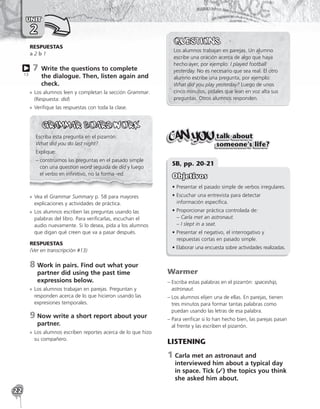
Write the questions to complete
the dialogue. Then, listen again and
check.
»
» Los alumnos leen y completan la sección Grammar.
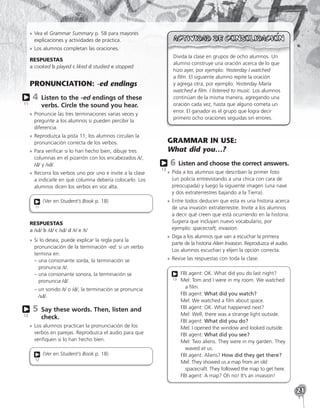
(Respuesta: did)
»
» Verifique las respuestas con toda la clase.
Escriba esta pregunta en el pizarrón:
What did you do last night?
Explique:
– 
construimos las preguntas en el pasado simple
con una question word seguida de did y luego
el verbo en infinitivo, no la forma -ed.
»
» Vea el Grammar Summary p. 58 para mayores
explicaciones y actividades de práctica.
»
» Los alumnos escriben las preguntas usando las
palabras del libro. Para verificarlas, escuchan el
audio nuevamente. Si lo desea, pida a los alumnos
que digan qué creen que va a pasar después.
RESPUESTAS
(Ver en transcripción #13)
8	
Work in pairs. Find out what your
partner did using the past time
expressions below.
»
» Los alumnos trabajan en parejas. Preguntan y
responden acerca de lo que hicieron usando las
expresiones temporales.
9	
Now write a short report about your
partner.
»
» Los alumnos escriben reportes acerca de lo que hizo
su compañero.
13
Los alumnos trabajan en parejas. Un alumno
escribe una oración acerca de algo que haya
hecho ayer, por ejemplo: I played football
yesterday. No es necesario que sea real. El otro
alumno escribe una pregunta, por ejemplo:
What did you play yesterday? Luego de unos
cinco minutos, pídales que lean en voz alta sus
preguntas. Otros alumnos responden.
talk about
someone’s life?
SB, pp. 20-21
Objetivos
• Presentar el pasado simple de verbos irregulares.
• Escuchar una entrevista para detectar
información específica.
• 
Proporcionar práctica controlada de:
– Carla met an astronaut.
– I slept in a seat.
• Presentar el negativo, el interrogativo y
respuestas cortas en pasado simple.
• Elaborar una encuesta sobre actividades realizadas.
Warmer
– 
Escriba estas palabras en el pizarrón: spaceship,
astronaut.
– 
Los alumnos elijen una de ellas. En parejas, tienen
tres minutos para formar tantas palabras como
puedan usando las letras de esa palabra.
– 
Para verificar si lo han hecho bien, las parejas pasan
al frente y las escriben el pizarrón.
LISTENING
1	
Carla met an astronaut and
interviewed him about a typical day
in space. Tick (✓) the topics you think
she asked him about.
23
»
» Mire la foto junto con los alumnos. Haga preguntas,
por ejemplo: Who is it? What is he doing?
»
» Diga a los alumnos que se trata de un astronauta.
Ellos tildan los temas que creen que Carla le
preguntó al astronauta entrevistado.
2 
Listen, read and check.
»
» Reproduzca la pista 14. Los alumnos leen y
escuchan para verificar sus respuestas.
(Ver en Student’s Book p. 20)
14
»
» Verifique las respuestas con toda la clase.
RESPUESTAS
clothes, sleep, work
3 
Listen again and complete Carla’s
notes.
»
» Verifique que los alumnos comprenden los
encabezados.
»
» Reproduzca el audio nuevamente; los alumnos
completan las notas.
»
» Verifican las respuestas en parejas.
»
» Reproduzca el audio nuevamente; los alumnos
confirman sus respuestas.
»
» Lea los encabezados; los alumnos brindan la
información que falta.
RESPUESTAS
First trip to moon: in 2003
Clothes (in the spaceship): normal clothes and a
spacesuit (outside the spaceship).
Activities: took photos of Earth and did experiments
after lunch
GRAMMAR IN USE:
past simple of irregular verbs
4	
Match the verbs to their past simple
forms.
»
» Pida a los alumnos que lean la sección Grammar y
circulen la opción correcta. (Respuesta: irregular)
»
» Los alumnos realizan la actividad en parejas.
»
» Verifique las respuestas escribiendo los infinitivos en
el pizarrón; los alumnos dicen las formas en pasado.
Escríbalas en el pizarrón.
14
14
RESPUESTAS
do – did, have – had, become – became, go – went,
wear – wore, eat – ate, get up – got up, sleep – slept,
drink – drank, take – took
»
» Vea el Grammar Summary pp. 59-61 para mayores
explicaciones y actividades de práctica.
5	
Complete Carla’s report using the
verbs in Activity 4.
»
» Los alumnos completan la actividad en parejas.
»
» Verifique las respuestas. Los alumnos leen el texto
completo en voz alta.
RESPUESTAS
a became b went c got d had e ate f drank g wore
h took i had j did k went l slept
GRAMMAR IN USE: did / didn’t
6 
Listen. Does Mel think the aliens are
dangerous?
»
» Diga a los alumnos que van a escuchar la segunda
parte de la historia Alien Invasion.
»
» Pida a los alumnos que miren la foto y lean el
resumen del programa de la semana pasada.
»
» Entre todos hablan de la pregunta en la consigna de
la actividad. Reproduzca la pista 15.
»
» Los alumnos dicen si para ellos Mel piensa que los
extraterrestres son peligrosos.
»
» Corrija oralmente con toda la clase.
RESPUESTA
No, she does not.
FBI agent: Did the aliens go into your house?
Mel: No, they didn’t. I went into their
spacecraft.
FBI agent: Into their spacecraft? Did they have
laser guns?
Mel: No, they didn’t. They were very friendly.
FBI agent: Did you go anywhere in the
spacecraft?
Mel: Yes, we did. We went to the moon. It
was great.
FBI agent: Did they do any experiments on you?
Mel: No, they didn’t. We ate alien ice cream.
It was fun.
FBI agent: Alien ice cream?
15
15
24
UNIT
2
7 
Listen again and answer these
questions.
»
» Lea las preguntas. Los alumnos escuchan
nuevamente prestando mayor atención a los
detalles. Trabajan en parejas.
»
» Reproduzca el audio nuevamente; los alumnos
verifican sus respuestas.
RESPUESTAS
a She went to the moon. b They ate alien ice cream.
8 
Complete the dialogue. Then, listen
once more and check.
»
» Los alumnos leen y completan la sección Grammar.
(Respuestas: did, did, did, didn’t)
»
» Luego leen y completan las oraciones.
»
» Reproduzca el audio nuevamente para que
verifiquen sus respuestas.
»
» Corrija oralmente con toda la clase.
RESPUESTAS
a Did b didn’t c Did d didn’t e Did f did
g Did h didn’t
Divida la clase en grupos de cuatro alumnos.
Un alumno piensa en una persona famosa; los
otros le hacen preguntas usando Did you... para
adivinar de quién se trata (máximo 20 preguntas).
La persona famosa solo puede decir Yes, I did o
No, I didn’t.
9	
Work in groups. Complete the final
part of Alien Invasion.
»
» Los alumnos inventan un final para la historia de la
invasión alienígena en grupos.
»
» Los grupos representan sus diálogos para la clase.
»
» Vea el Grammar Summary pp. 58-61 para mayores
explicaciones y actividades de práctica.
15
15
SURVEY
Los alumnos escriben las preguntas en forma
individual utilizando la información que tienen en
el libro:
1 What time did you get up yesterday?
2 What did you eat for breakfast?
3 What did you wear?
4 Did you go to school in the afternoon?
5 What did you do in the evening?
6 Did you go to bed early?
Luego escriben respuestas verdaderas para esas
preguntas. Preguntan en la clase hasta que
encuentran a la persona que tiene el mayor número
de respuestas iguales. Para completar la actividad,
pregunte a los alumnos si han encontrado a alguien
con las mismas respuestas. Invite a los alumnos a
que le cuenten lo que hicieron.
Dibuje tres gráficos de araña en el pizarrón y
nómbrelos space, regular verbs e irregular verbs.
Sin mirar sus libros, los alumnos trabajan en
parejas y escriben tantas palabras como puedan
en cada araña. Luego comparan sus trabajos.
¿Quién ha escrito más palabras?
listen about a famous
film director?
SB, p. 22
Objetivos
• Practicar la escucha de una biografía y relevar
datos específicos.
• Presentar vocabulario relacionado con el cine.
• Completar una línea de tiempo.
1	
Carla likes Steven Spielberg. What do
you know about him?
25
»
» Los alumnos comentan si conocen a Steven
Spielberg y conversan acerca de todo lo que saben
sobre él y de sus películas.
»
» Responda dudas sobre vocabulario.
2 
In pairs, answer these questions.
Then, listen and check.
»
» En parejas, los alumnos responden las preguntas.
Pida a algunas parejas que digan cuáles creen que
son las respuestas; todavía no diga si son acertadas
o incorrectas.
»
» Reproduzca el audio; los alumnos verifican sus
respuestas.
Steven Spielberg was born in Cincinnati in
1946. His father was an engineer and his
mother was a pianist. Steven always liked
films. When he was 16 he produced a movie
called Escape to Nowhere, which made a profit
of 100 dollars at a local movie theatre! Steven
studied English at California State University
but he really wanted to study movies.
Unfortunately, film school did not accept him.
But one day, when he was visiting Universal
Studios in Hollywood, he saw a small office.
He pretended that he worked at Universal and
went to his ‘office’ every day after that. The
security guards never stopped him! Some time
later, Steven got a real job with Universal. In
1975 he had his first big hit when he directed
Jaws. Jaws won three Oscars. After that
Spielberg made a lot of other very successful
films including Close Encounters, E.T., Raiders
of the Lost Ark, Schindler’s List, Jurassic Park
and Saving Private Ryan. Steven Spielberg is
a very rich man. Just in 2002, he made 100
million dollars! He also loves children and has
seven. He says they help to keep the child
inside him alive!
16
RESPUESTAS
a He is a film director. b He is from Cincinnati, in the
USA. c He is famous for Jaws, Close Encounters, E.T.,
Raiders of the Lost Ark, Schindler’s List, Jurassic Park
and Saving Private Ryan.
3 
Listen again and complete the
timeline below.
»
» En parejas, los alumnos leen la línea de tiempo y se
familiarizan con las fechas.
16
16
»
» Los alumnos escuchan la pista 16 nuevamente y
completan la información faltante.
»
» Reproduzca el audio nuevamente haciendo pausa
luego de cada dato relevante.
RESPUESTAS
1946: he was born, 1975: he had his first big hit,
2002: he made 100 million dollars
4 
Listen once again, read the sentences
and write T (true) or F (false).
»
» Los alumnos escuchan el audio nuevamente y
deciden si las afirmaciones son verdaderas o falsas.
RESPUESTAS
a F b T c T d T e F f F
5	
Now correct the false statements in
Activity 4.
»
» Los alumnos corrigen las oraciones falsas del
ejercicio anterior.
RESPUESTAS
a His father was an engineer and his mother was a
pianist. e His first successful film was Jaws. f He has
seven children.
Lea las sugerencias con toda la clase sobre
aprender inglés viendo películas; pregunte si
alguien ha probado algunas de estas ideas.
Traiga una película que tenga subtítulos y mire
una parte con la clase del modo que se indica o
bien invite a los alumnos a mirar una película en
sus casas.
Pregunte a los alumnos qué han aprendido con
esta técnica. Recuérdeles que es recomendable ver
películas de esta manera.
Asegúrese de que los alumnos no sean demasiado
ambiciosos en sus pretensiones. Es mejor tratar de
ver diez minutos dos veces por semana y aprender
dos o tres expresiones cada vez, que ver la película
entera cada semana.
16
26
UNIT
2
write about a
famous actor?
SB, p. 23
Objetivos
• Practicar la lectura en busca de información
específica.
• Escribir la biografía de una persona famosa.
• Evaluar el aprendizaje de los alumnos.
1	
Do you know the actress in the
photos? Read about her and complete
the timeline below.
»
» Pregunte a la clase si conocen a Winona Ryder y
qué saben sobre ella.
»
» Los alumnos leen el texto y completan la línea de
tiempo. Ayúdelos con el nuevo vocabulario.
»
» Escriba los años encolumnados en el pizarrón. Los
alumnos dicen en voz alta lo que debe escribir junto
a cada uno.
RESPUESTAS
1981: moved with parent to California
1984: had an audition to the film Desert Bloom
1986: made first debut in the film Lucas
1990: starred in Edward Scissorhands
1994: played the lead role of Josephine March in Little
Women
2016: started acting in the Netflix supernatural horror
series Stranger Things
Today: engaged to fashion designer Scott Mackinlay Hahn

Dealing with random
vocabulary
En una actividad como la que introduce un
ejercicio de lectura, los alumnos suelen preguntar
cómo se dice algo en inglés. Es buena idea
reservar un lugar del pizarrón para escribir las
palabras que surgen durante el trabajo con la
unidad. Al finalizar, indique a los alumnos qué
palabras quiere que escriban en sus cuadernos y
aprendan o déjelos que ellos decidan. Un enfoque
mixto puede ser lo mejor: diga dos o tres palabras
que quiere que aprendan (y que estarán en su
próximo examen). Ellos eligen otra u otras dos que
les interesen.
2	
Complete the questions. Then, ask
and answer them with a partner.
»
» Los alumnos completan las preguntas usando las
palabras del recuadro.
»
» Luego preguntan y responden en parejas.
»
» Pida a dos de ellas que representen el diálogo para
toda la clase.
RESPUESTAS
a When b What c Where d What e Who
3	
Write a short biography about your
favourite actor or actress. Use the
prompts below.
»
» Pregunte a los alumnos quiénes son sus actores y
actrices favoritos.
»
» En parejas o en forma individual, los alumnos eligen
un actor o actriz y toman notas acerca de su vida.
»
» Los alumnos trabajan con otro compañero y le hacen
preguntas acerca de la persona que ha elegido.
Luego, escriben una breve biografía de ese actor /
actriz usando el texto de la actividad 1 como modelo.
»
» Pida a algunos alumnos que lean en voz alta sus
textos o le digan a la clase lo que aprendieron
acerca de su actor o actriz favorito.
My progress
– Los alumnos completan la grilla de autoevaluación.
– 
Repase cada línea con la clase para identificar las áreas
en las que los alumnos se sienten menos seguros.
– 
Recoja los libros de los alumnos y trate de escribir un
comentario en cada uno antes de devolverlos. Para
los alumnos que se han dado una baja puntuación,
trate de encontrar un momento tranquilo de la
clase para ver qué problemas tienen y sugerir cómo
pueden resolverlos.
Más practica - pp. 94-99
– 
A manera de cierre, no olvide asignar las actividades
del Practice Book correspondientes a esta unidad.
Pueden realizarse en el aula o como tarea para el
hogar, dependiendo del tiempo disponible.
UNIT
3
27
talk about what
was happening?
SB, pp. 24-25
Objetivos
• Presentar el pasado continuo.
• Practicar la lectura de una historia con fotos.
• Proporcionar práctica controlada de:
– What were Carla and Jake doing at 3 o’clock?
– They were visiting London.
• Presentar verbos de acción.
• Practicar la escucha de una conversación telefónica.
• Decir lo que estaba haciendo ayer.
• Proporcionar práctica libre.
Warmer
– 
Dibuje dos columnas en el pizarrón: en una de ellas
escriba I am; en la otra escriba I was. Los alumnos
copian y completan las columnas con las otras
personas del verbo to be.
– 
Para repasar la hora escriba cuatro o cinco horas con
números en el pizarrón y pida a los alumnos que las
digan con palabras.
– 
Haga preguntas, por ejemplo: Where were you at
7 o’clock last night? Were you in the park at 10?
– Los alumnos continúan trabajando en parejas.
LISTENING
1 
Read and listen to the dialogue.
Then, answer the questions.
»
» Dirija la atención de la clase hacia el título de la
unidad y pregunte a los alumnos si saben lo que
significa (a story that may or may not be true, but
that contains details that are hard to believe).
17
»
» Luego, señale la primera actividad y dé a los
alumnos tiempo para leer las preguntas.
»
» Reproduzca el audio y pida a los alumnos que lo
sigan en sus libros o dígales que cierren los libros y
solamente escuchen.
»
» Los alumnos piensan las respuestas en parejas.
Corrija oralmente.
(Ver en Student’s Book p. 24)
17
RESPUESTAS
a She was visiting Madame Tussauds. b He was seeing
his grandmother. c He saw Ed Sheeran. d He was
walking down Oxford Street.
2	Correct these sentences.
»
» Los alumnos corrigen las oraciones con la
información de la historia. Corrija oralmente.
RESPUESTAS
a Ed Sheeran was walking down Oxford Street. b Jake
and Carla were visiting London. c Lenny cancelled
band practice because his grandmother was visiting.
3	What do these expressions mean?
»
» Los alumnos buscan estas expresiones en el diálogo
y deducen su significado.
»
» Para verificar sus hipótesis, pida a los alumnos que
las digan en su propio idioma.
»
» Si desea aprovechar más el diálogo, divida la clase en
parejas; asigne una de las secciones del diálogo a una
o más parejas. Cada una practica su parte del diálogo
hasta que pueda mantenerlo con el libro cerrado.
Pida a las parejas que representen su diálogo.
GRAMMAR IN USE: past continuous
4	Unscramble the questions and answer.
»
» Los alumnos leen y completan la sección Grammar.
(Respuestas: was, were)
28
UNIT
3
»
» Los alumnos ordenan las palabras de las preguntas
en parejas y las responden.
RESPUESTAS
a 
What were Jake and Carla doing at eleven o’clock?
They were visiting Madame Tussauds.
b 
What was Lenny doing? He was seeing his
grandmother.
Escriba estas preguntas y respuestas en el pizarrón
como referencia:
What were Jake and Carla doing at 11 o’clock?
They were visiting Madame Tussauds.
What was Lenny doing?
He was seeing his grandmother.
Explique:
– este tiempo de verbo se llama past continuous.
– 
formamos el pasado continuo con was o were y
la forma -ing del verbo principal.
– 
usamos el pasado continuo para hablar de una
acción que se estaba desarrollando en algún
momento puntual del pasado.
»
» Pida a los alumnos que busquen más ejemplos de
pasado continuo en el diálogo.
»
» Vea el Grammar Summary pp. 62-67 para mayores
explicaciones y actividades de práctica.
5	
Complete these sentences. What were
Carla, Jake and Lenny doing yesterday
morning?
»
» Los alumnos completan las oraciones con las
palabras de la caja.
RESPUESTAS
a were b was not c was d was not e were f was
VOCABULARY: action verbs
6	Write the verbs in the correct column.
»
» En parejas, los alumnos escriben la forma -ing de los
verbos en la columna que corresponda.
RESPUESTAS
+ -ing: a, f, g, i, j
+ -ing: b, h
double consonant + -ing: c, d, e
7 
Listen. What were the band
members doing yesterday?
»
» Diga a los alumnos que Carla tiene un problema.
»
» Reproduzca el comienzo del audio hasta Where
were you? Entre todos concluyen cuál era el
problema de Carla: She was waiting for Lenny at
the cinema yesterday but he didn’t come.
»
» Escriba estos nombres en el pizarrón: Lenny, Sandy,
Mike, Jake.
»
» Reproduzca el resto de la pista 18; los alumnos
anotan qué estaba haciendo cada uno.
»
» Los alumnos comparan las respuestas en parejas.
Corrija oralmente.
Carla: Hi, Lenny. I was waiting for you at the
cinema yesterday. Where were you?
Lenny: I know, sorry. I was helping my dad
in the garden. I forgot about going to the
cinema. And then when I remembered the
phone wasn’t working.
Carla: Yeah, well, I waited for half an hour.
Lenny: What about the others – didn’t they go?
Carla: No, they didn’t. Sandy was watching a
tennis match. Her little brother was playing
and it was really important.
Lenny: What about Mike?
Carla: Mike was doing his homework. He had
a really big exam today.
Lenny: And Jake? Was he not there?
Carla: Well, no, actually, he wasn’t there
either. His uncle was visiting from the States.
He and his mum were showing him London.
Lenny: Oh dear. I’ve got the worst excuse,
haven’t I?
Carla: Yes, Lenny, you have.
18
RESPUESTAS
Lenny was helping his dad in the garden. Sandy was
watching a tennis match. Mike was doing his homework.
Jake and his mum were showing Jake’s uncle London.
8 
Listen again. Answer the questions.
»
» Los alumnos leen las preguntas.
»
» Reproduzca el audio nuevamente; los alumnos
anotan sus respuestas.
18
18
29
RESPUESTAS
a Because his phone wasn’t working. b Because her
little brother was playing. c Because he had a really big
exam today. d Because his uncle was visiting from the
States.
9 
Listen to the pronunciation of was
and repeat.
»
» Reproduzca la pista 19; los alumnos escuchan la
pronunciación de was.
»
» Luego repiten la pronunciación. Asegúrese de que
pronuncian bien la forma reducida de was.
Carla: I was waiting for you at the cinema.
Lenny: I was helping my dad in the garden.
Carla: Mike was doing his homework.
19
10	
Work in pairs. Ask questions to find
out what your partner was doing at
these times yesterday.
»
» Pregunte a uno o dos alumnos qué estaban
haciendo en algunos de esos momentos del día.
»
» Los alumnos continúan preguntando y
respondiendo en parejas.
»
» Invite a los alumnos a que digan qué estaban
haciendo ayer a la misma hora.
describe what was
happening?
SB, pp. 26-27
Objetivos
• Presentar el pasado continuo en contraste con
el pasado simple.
• Escuchar una historia y ordenar imágenes.
• Presentar vocabulario relacionado con el cine.
• Proporcionar práctica controlada de:
– I was swinging when the rope broke.
– They were laughing when the doctor arrived.
• Describir qué estaba ocurriendo.
• Proporcionar práctica libre.
19
Warmer
– 
Pida a los alumnos que le digan el título de
películas de acción o aventuras que hayan visto
recientemente. Escríbalos en el pizarrón.
– 
Haga algunas preguntas acerca de las películas, por
ejemplo: Who is in it? What is it about?
– Pregunte Are there any dangerous scenes in the
film? Escriba en el pizarrón algunas de las cosas
peligrosas que hacen los actores, por ejemplo: drive
a car, pilot a plane, climb down a building.
LISTENING
1	
Jake’s granddad was a stuntman.
He likes telling stories about his time
in Hollywood. Match the sentences
to the pictures.
»
» Enseñe el significado de stuntman (doble de riesgo).
»
» Los alumnos leen las oraciones y las unen con las
ilustraciones. Corrija oralmente.
RESPUESTAS
(de arriba abajo y de izquierda a derecha) d, a, g, c, b, f, e
»
» Verifique que los alumnos comprenden que la
persona que hace de Tarzán es el abuelo de Jake.
2 
Listen and put the pictures in the
correct order (1-7).
»
» Reproduzca la pista 20. En parejas, los alumnos
orden las ilustraciones cronológicamente.
Jake: Tell Carla what happened, Grandpa.
Grandpa: Well, I was a stuntman in Hollywood!
Carla: Really? Wow!
Grandpa: Yeah, and one morning we were
filming a new episode of Tarzan…
Carla: Gosh! Where? In the jungle... with lots
of wild animals...?
Grandpa: No, actually, we were in a studio!
Carla: Oh.
Grandpa: Anyway, I was climbing a tree. There
was a huge gorilla at the bottom.
Carla: A real gorilla?
Grandpa: Aha! Wait! I got to the top of the
tree and jumped.
Carla: You jumped from the top of a tree?
Grandpa: Yes, but I had a rope. I was swinging
on the rope (famous Tarzan yell: ah-ah-aha)
and then suddenly it broke. Aaaaaah!
20
20
30
UNIT
3
Carla: Oh no!
Grandpa: The next thing I remember I was
lying at the bottom of the tree and this
gorilla was standing next to me… it was
looking at me! Its face was really close to
me. I was terrified.
Carla: Wow!
Grandpa: I thought the gorilla was going to
attack me. And he was jumping up and down
and shouting. I began to shout for help…
then the gorilla’s hand went up and he took
his mask off and I realized I wasn’t looking at a
real gorilla… it was an actor!!
Carla: Oh, great! Phew!
Grandpa: We both laughed and laughed.
RESPUESTAS
1 a 2 b 3 e 4 g 5 d 6 f 7 c
3 
Listen again and check.
»
» Reproduzca la pista 20 nuevamente. Los alumnos
verifican sus respuestas.
»
» Si desea aprovechar la actividad un poco más,
escriba estas frases en el pizarrón: In the jungle?,
I had a rope, I was terrified. Los alumnos deducen
en parejas quién dijo cada frase. Reproduzca el
audio nuevamente, haciendo pausa luego de cada
una. Los alumnos dicen quién es el hablante y qué
significa cada frase.
GRAMMAR UIN USE:
past continuous vs past simple
4	Match the sentences halves.
»
» Los alumnos leen y completan la sección Grammar.
(Respuestas: finished actions, actions in progress)
»
» Luego unen el comienzo de las oraciones con el
final de cada una.
»
» Corrija oralmente.
RESPUESTAS
a 2 b 1
20
Escriba esta oración como referencia en el
pizarrón:
I was swinging on the rope when it broke.
Explique:
– usamos when para unir una acción continua con
una acción completa.
»
» Vea el Grammar Summary pp. 62-67 para mayores
explicaciones y actividades de práctica.
5	
Look at the picture below. What were
these people doing when Tarzan’s
rope broke?
»
» Los alumnos miran la ilustración y escriben
oraciones.
»
» Verifican las respuestas en parejas. Luego, controle
las respuestas en el pizarrón.
RESPUESTAS
a A cameraman was filming. b The gorilla was sitting
under the tree. c Two actresses were drinking coffee.
6	Choose an action to mime.
»
» Lea la actividad con toda la clase; cada alumno elije
una de las actividades para representar.
7	
Watch other students carefully.
When your teacher claps, stop and
write about your class.
»
» Los alumnos comienzan a representar la actividad
con mímica.
»
» Aplauda para que todos se detengan y entre todos
dicen qué estaba haciendo cada uno cuando usted
aplaudió.
»
» Pida a los alumnos que elijan otra actividad y la
representen con mímica. Aplauda nuevamente, pero
esta vez diga a los alumnos que escriban oraciones
sobre lo que estaban haciendo sus compañeros.
»
» El alumno que haya escrito el mayor número de
oraciones las lee en voz alta. Si son todas correctas,
ese alumno es el ganador.
31
Escriba estas frases en el pizarrón y pida a los
alumnos que las completen en forma individual.
… when the lights went out.
… when I saw a man running out of the bank.
… when my mother woke me up.
… when I saw a bear.
… when the rope broke.
… when the referee blew his whistle.
Los alumnos preguntan y responden con What
were you doing when…? para descubrir quiénes
estaban haciendo lo mismo que ellos.
MEMORY GAME
 Dé a los alumnos dos minutos para mirar la
ilustración. Pídales que cierren el libro y escriban
tantas oraciones como puedan acerca de lo que
estaba ocurriendo en la playa cuando atacó el
tiburón. Los alumnos comparan oraciones en
parejas: cada pareja trata de tener el mayor
número posible de oraciones correctas. La pareja
que ha escrito el mayor número de oraciones las
lee en voz alta. Si son todas correctas, esa pareja
es la ganadora.
Escriba esta frase en el pizarrón: when it started
to rain... Los alumnos completan la frase en
forma individual. En grupos, los alumnos hacen
un máximo de veinte yes / no questions para
descubrir qué estaba haciendo un integrante
del grupo.
read a tall story?
SB, p. 28
Objetivos
• Practicar cómo anticipar una historia.
• Practicar la lectura de una historia y ordenar
ilustraciones.
• Practicar el relato de una historia memorizada.
1	
Look at the pictures. What do you
think happened?
»
» Pida a los alumnos que miren las fotos. Pregúnteles
qué creen que pasó. Anote sus sugerencias en el
pizarrón.
2	Read to check.
»
» Los alumnos leen la primera parte de la historia y
comprueban si sus ideas eran acertadas.
»
» Invítelos a que le digan cuáles son los puntos
principales de la historia hasta ahora.
3	What do you think happened next?
»
» Pida a los alumnos que cierren sus libros.
»
» En parejas, los alumnos discuten qué creen que
pasó después de que Harry abriera la caja.
»
» Anote sus sugerencias en el pizarrón.
4	Read and check.
»
» Los alumnos leen el resto de la historia; verifique
rápidamente si alguna de sus ideas era correcta.
5	
Put the pictures in the correct order
(1-8).
»
» Los alumnos ordenan las ilustraciones
cronológicamente.
»
» Corrija oralmente.
RESPUESTAS
a 4 b 7 c 1 d 6 e 2 f 3 g 8 h 5
»
» Pregunte a los alumnos si creen la historia de Harry;
recuerdeles que una tall story es una historia difícil
de creer y que a menudo no es verdadera.
32
UNIT
3
6	
Cover the story. How much can you
remember?
»
» Pida a los alumnos que cierren sus libros.
»
» Escriba estos disparadores en el pizarrón: watch TV,
a small man, a box in the garden, a monkey, the
kitchen, a banana, Mr Gibbons.
»
» En parejas, los alumnos usan los disparadores para
contarse uno a otro tanto de la historia como
puedan recordar.
»
» Pida a la clase que relate la historia y que brinden
tantos detalles como puedan. Escriba la historia en
forma abreviada en el pizarrón.
»
» Los alumnos leen la historia nuevamente y
comparan sus versiones con la original.
write a tall story?
SB, p. 29
Objetivos
• Planear una narración.
• Escribir una historia.
• Evaluar el aprendizaje de los alumnos.
1	
In pairs, you are going to write a tall
story.
»
» Recuerde a los alumnos el significado de tall story.
»
» Diga a los alumnos que miren la foto y digan qué
problema tiene el joven (he is late for school).
2	
Choose a tall story. You are late for
school because...
»
» Diga a los alumnos que van a inventar una historia
para explicar por qué llegaron tarde a la escuela.
»
» Divida la clase en parejas; los alumnos elijen una de
las excusas.
3	Answer these questions.
»
» Las parejas responden las preguntas e inventan
los detalles de su tall story; pueden tomar notas si
lo desean.
4	
Write a first version. Then, check your
version with another pair. Are there
any mistakes?
»
» Las parejas escriben un primer borrador de su
historia.
»
» Luego intercambian versiones con otra pareja y leen
el borrador que han recibido. Subrayan los errores
que encuentran; también pueden sugerir mejoras a
la historia si lo desean.
»
» Las parejas devuelven los borradores a sus autores y
revisan los errores y sugerencias.

Correcting writing
El hecho de revisar el escrito de un compañero
antes de entregar el trabajo ayuda a los alumnos
a ser más independientes. Estas son algunas
alternativas:
– 
Intercambiar textos con un compañero.
Subrayar errores y luego conversarlos con él o
ella para que pueda reescribirlo.
– 
Reescribir ellos mismos el texto que han
recibido y luego discutir la nueva versión en
parejas.
– 
En lugar de buscar errores puntuales, los
alumnos pueden concentrarse en algún
aspecto, como la gramática o la organización
de las ideas.
5	Write the final draft of your story.
»
» Las parejas escriben la versión final de su historia.
»
» Luego pueden colocar su historia en la cartelera
de la escuela o compartirla con sus compañeros
para que otros las lean; la clase vota por la más
imaginativa.
Lea la introducción con toda la clase. Explique
a los alumnos que cuando leen, no necesitan
buscar cada palabra que no entienden. Deben
concentrarse en las palabras importantes. Los
alumnos miran nuevamente la historia de página
28 y buscan cuatro palabras que no comprendan.
En parejas, los alumnos tratan de descifrar el
significado de las palabras. Si es posible, las
buscan en un diccionario para comprobar sus
hipótesis o lo hacen con otros alumnos. Para
33
terminar, pregunte a los alumnos qué palabras
trataron de descifrar y qué creen que significan las
palabras. Confirme o corrija.
My progress
– Los alumnos completan la grilla de autoevaluación.
– 
Repase cada línea con la clase para identificar las
áreas en las que los alumnos se sienten menos
seguros.
– 
Recoja los libros de los alumnos y trate de escribir un
comentario en cada uno antes de devolverlos. Para
los alumnos que se han dado una baja puntuación,
trate de encontrar un momento tranquilo de la
clase para ver qué problemas tienen y sugerir cómo
pueden resolverlos.
Más practica - pp. 100-105
– 
A manera de cierre, no olvide asignar las actividades
del Practice Book correspondientes a esta unidad.
Pueden realizarse en el aula o como tarea para el
hogar, dependiendo del tiempo disponible.
Evaluación
Mid-term Test: pp. 70-71
34
SB, pp. 30-31
Objetivos
• Repasar vocabulario de las unidades anteriores.
• Presentar vocabulario relacionado con festivales
de música.
• Estimular a los alumnos para que vinculen el
inglés con su propio mundo.
• Proporcionar variadas oportunidades de aprendizaje.
• Estimular la creatividad de los alumnos.
1	Label these music genres.
»
» Pregunte a los alumnos si les gusta escuchar música y
qué estilos musicales son sus favoritos. Luego pida que
miren las páginas 30 y 31 del libro y que deduzcan el
tema sobre el que van a leer (music festivals).
»
» Pida a los alumnos que miren las ilustraciones de la
actividad 1 e identifiquen los géneros musicales.
»
» Los alumnos completan las palabras. Responda las
dudas que puedan surgir.
RESPUESTAS
(de izquierda a derecha) blues, pop, reggae, rock,
hip-hop, classical
2	
Read the website about music
festivals in Britain. When did the two
festivals start?
»
» Dirija la atención de los alumnos a la página 31.
Pregunte: What kind of text is it? (a website)
What is it about? (festivals in Britain).
»
» Los alumnos leen la pregunta. Luego leen el sitio web.
RESPUESTAS
Glastonbury Music Festival started 2,000 years ago
(the first official festival was in 1970). Notting Hill
Carnival started in 1964 (a carnival was celebrated
before in big halls in the 1950s).
3	Read again and complete the tables.
»
» Los alumnos leen con detenimiento la guía web
sobre los festivales para completar la información
en las grillas.
»
» Los alumnos comparan las respuestas. Luego
corrigen todos juntos.
RESPUESTAS
Name: Glastonbury; Place: Southwest England;
Date: Last weekend in June; Things to see: music on
three big stages, comedy, dance, theatre, a circus and
an all-night cinema
Name: Notting Hill Carnival; Place: West London; Date:
Last Friday, Saturday and Sunday of August; Things to
see: a parade of decorated vehicles, people in colourful
costumes, dancers, music and multicultural foods
4	
In pairs, decide which festival you want
to go to and tell your partner why.
»
» Los alumnos conversan acerca de cuál es el festival
más interesante y por qué les gustaría ir.
5	
Work in groups. Make a list of music
festivals around the world and choose
your favourite one. Find the answers
to these questions.
»
» Divida la clase en grupos de cuatro miembros.
Incentive a los grupos a pensar en festivales de
música de su país o de otros países (por ejemplo:
Burning Man, Coachella, Fuji Rock, Cosquín). Si
tienen acceso a Internet pueden buscar información.
»
» Invítelos a elegir un festival distinto por grupo.
»
» Los grupos leen las preguntas y las discuten.
6	
Write a festival web-guide using the
questions in Activity 5 to structure
the information. Then, present it to
the class.
»
» En grupos, los alumnos pueden escribir una primera
versión de su guía web o buscar más información
sobre su festival; si optan por esto último, escriben
su guía web la clase siguiente.
»
» Los alumnos traen fotos (o bien pueden buscar en
Internet las fotos que necesitan) para ilustrar su
página web.
»
» Los grupos intercambian su primer borrador y lo
corrigen. Luego escriben su guía sobre el festival
elegido en papel o en la computadora.
»
» Cada grupo le muestra su trabajo a la clase. La clase
vota por la guía web más interesante.
35
SB, pp. 32-33
remember these
words?
RESPUESTAS
1 Match the two halves of the phrases.
a 4 b 5 c 1 d 2 e 3
2 Unscramble the words.
a cities b food c housework d visiting e broke
3 Circle the different word in each group.
a busy b day c third
4 
Read the definitions and write one letter in
each blank.
a bookseller b stuntman c astronaut d doctor
use these grammar
items?
RESPUESTAS
1 
Complete the sentences and questions about
the future. Use will or won’t and the verbs in
brackets.
a won’t need b will be c Will, do d will, speak e will
learn f won’t have
2 
Complete the sentences with past simple or
past continuous.
a broke, was playing b were watching, arrived c was
riding, called d were running, met e was working, saw
f was listening, went g were talking, got
3 
Choose the best words (A, B or C) for each
space.
1 B 2 A 3 C 4 A 5 C 6 A 7 B 8 C 9 C 10 C
interact in English?
RESPUESTAS
1 
Complete the dialogue. Use the expressions
in the box.
a Where did you go last night?
b Was it in London?
c Was the party good?
d How many people were there?
e How long did you stay there?
2 
Now complete the invitation Jane received
from Laurie. Use the information in Activity 1.
WHO: Laurie
DATE: 17th March
TIME: 9:00
PLACE: Country house
REASON FOR THE PARTY: Birthday
3 
Write an e-mail to a friend about a party you
went to. Describe the people, the music and
the food.
(Respuestas personales)
36
UNIT
4
give advice?
SB, pp. 34-35
Objetivos
• Presentar las partes del cuerpo.
• Presentar should para dar consejos.
• Practicar la lectura de un folleto de seguridad.
• Presentar vocabulario relacionado con equipos
deportivos y de protección.
• Proporcionar práctica controlada de:
– What should I do?
– You should wear the right equipment.
– You shouldn’t take risks.
• Practicar la escucha de personas pidiendo o
dando consejos.
Warmer
– 
Pregunte a los alumnos cuál es su deporte favorito y
escriba todos las palabras que surjan en el pizarrón.
– 
Pregúnteles si es peligroso; nombren entre todos las
partes del cuerpo relacionadas con ese deporte, por
ejemplo: tennis – arms / hands, football - legs, etc.
VOCABULARY: parts of the body
1	Match the words to the picture.
»
» Dé a los alumnos tiempo para mirar la foto de Carla
y leer las palabras.
»
» Los alumnos unen las palabras con las partes del
cuerpo que correspondan.
»
» Responda preguntas que surjan sobre vocabulario y
la pronunciación. Corrija oralmente.
RESPUESTAS
(de izquierda a derecha y de arriba abajo) e, i, c, h, f,
b, g, d, a
READING
2	Look at the article. What is it about?
»
» Dé a los alumnos un par de minutos para leer el
folleto; en parejas, discuten acerca de qué trata.
»
» Entre todos deducen que trata de la seguridad en el
deporte (Safety in sport).
3	
Read the article and tick (✓) the bits
of advice included in the text.
»
» Pida a los alumnos que lean nuevamente el folleto
para poder completar el ejercicio. Esta actividad
puede realizarse en parejas.
RESPUESTAS
a ✓ c ✓ e ✓
4	
Look at the picture and complete the
name of the equipment.
»
» Pregunte qué está haciendo el chico de la ilustración
(riding a scooter).
»
» Los alumnos completan las palabras del equipo
deportivo que el chico lleva puesto.
»
» Corrija oralmente; modele y haga ejercitar la
pronunciación.
RESPUESTAS
(de arriba abajo y de izquierda a derecha) sunscreen,
gloves, boots, helmet, goggles, elbow pads, knee pads
Divida a la clase en dos grupos y diga que van a
jugar al ahorcado con el vocabulario aprendido
sobre partes del cuerpo y equipamiento
deportivo. Modele el juego en el pizarrón
colocando una línea por cada letra de la palabra
o frase incognita y el pie de la horca. Puede
dar una pista de la palabra incógnita señalando
la parte del cuerpo a la que hace referencia
la palabra. Por turnos, los grupos dicen letras
para completar la palabra. Gana el grupo que
descubre más palabras o frases incógnitas.
37
GRAMMAR IN USE:
should / shouldn’t
5	Complete the sentences.
»
» Los alumnos leen y completan la sección Grammar.
(Respuestas: should, shouldn’t, Should, should,
shouldn’t)
»
» Luego, completan las oraciones con should o
shouldn’t.
RESPUESTAS
(Ver en transcripción #21)
6 
Listen and check your answers. Then,
listen again and repeat.
»
» Reproduzca la pista 21. Los alumnos repiten y
verifican sus respuestas.
»
» Puede aprovechar la oportunidad para practicar la
pronunciación del verbo modal should.
a What should I do to play safe?
b You should wear the right equipment.
c You shouldn’t take risks.
21
Escriba estas oraciones en el pizarrón:
You should wear gloves.
You shouldn’t go too fast.
Should I ask a friend?
Explique:
– usamos should para recomendar o dar consejos.
– should es un verbo modal.
– 
formamos el interrogativo y el negativo de los
verbos modales sin do.
»
» Vea el Grammar Summary pp. 68-69 para mayores
explicaciones y actividades de práctica.
7	
Use should or shouldn’t and these
words to give advice.
»
» Para modelar la actividad, diga a la clase I eat a lot
of sweets; espere a que algún alumno le responda
You shouldn’t eat sweets.
»
» Pida a los alumnos que trabajen en parejas y hagan
lo mismo con otros ejemplos.
»
» Corrija con toda la clase.
21
RESPUESTA
a You shouldn’t eat sweets. b You should drink more
water. c You shouldn’t eat so many hamburgers.
d You should eat more fruit. e You should study more.
f You should wash your T-shirt. g You should watch
less TV. h You should apply some sunscreen.
LISTENING
8 
Discuss these questions with a
partner. Then, listen and check your
answers.
»
» En parejas, los alumnos proponen repuestas para las
preguntas. Escriba sus ideas en el pizarrón.
»
» Diga a la clase que van a escuchar a dos personas
hablando de skateboarding.
»
» Pídales que escuchen y que digan quiénes son esas
personas y dónde tiene lugar la conversación. Se
ayudan con la imagen que acompaña la actividad.
»
» Reproduzca el comienzo del audio, hasta I don’t
know what to buy; explique que uno de los
hablantes es una mujer que quiere comprar un
skateboard para su sobrino y el otro es el vendedor.
La conversación tiene lugar en una tienda.
»
» Reproduzca el resto del audio; los alumnos
escuchan para ver si el vendedor le da los mismos
consejos que ellos imaginaron.
Aunt: Excuse me, can you help me, please?
Man: Yes, what can I do for you?
Aunt: Well, I want to buy a skateboard for my
nephew but I don’t know what to buy.
Man: OK, that’s easy. You need a skateboard.
Aunt: Yes, I know that, but does he need any
special clothes? Should he wear pads and
things?
Man: Good question. Yes, he should. He
should definitely wear gloves, knee pads
and elbow pads.
Aunt: Gloves, knee pads and elbow pads…
OK. And where should he go to learn?
Man: Well, he should go somewhere quiet,
where there aren’t many people. And he
shouldn’t start on a hill. Choose a flat place.
Aunt: OK. But isn’t it dangerous?
Man: Not always. He should always wear
his pads. And he shouldn’t take risks. He
shouldn’t go too fast at first.
Aunt: What else?
22
22
UNIT
4
38
Man: If he’s got a friend who skateboards, he
should ask them to give him some advice.
Aunt: All right, thanks a lot.
Man: That’s OK. Enjoy the board! Why don’t
you try it yourself?
Aunt: Me? You’re joking. I’m forty-nine years old!
»
» Si desea aprovechar más el audio, escriba estas
frases en el pizarrón: What can I do for you?,
I know that, Good question, Isn’t it dangerous?,
What else?, Thanks a lot, You’re joking! Los
alumnos discuten en parejas quién dijo cada frase
y qué significa cada una. Reproduzca el audio
nuevamente, haciendo pausa luego de las frases;
los alumnos dicen quién es el hablante en cada
caso. Explique el significado en contexto.
9	
Copy the table and write the bits of
advice in the correct column.
»
» Pida a los alumnos que copien y completen la tabla
en sus cuadernos.
RESPUESTAS
You should: wear gloves, use knee and elbow pads,
go somewhere quiet, ask a friend for advice
You shouldn’t: start on a hill, take risks, go too fast
compare animals?
SB, pp. 36-37
Objetivos
• Presentar adjetivos.
• Presentar la forma comparativa de adjetivos
cortos y largos.
• Leer una historia en viñetas.
• Proporcionar práctica controlada de:
– I am stronger.
– He is faster.
– That one’s better.
• Presentar la forma comparativa con than.
• Practicar la escucha de una conversación
acerca de dinosaurios.
• Proporcionar práctica controlada de:
– A car is faster than a racehorse.
– Basketball is more interesting than karate.
Warmer
– 
Escriba el nombre de animales en el pizarrón con
las letras mezcladas, por ejemplo: hamster, goldfish,
dog, snake, spider.
– Los alumnos ordenan las letras en parejas.
VOCABULARY: adjectives
1	Match the opposites.
»
» Los alumnos unen los adjetivos con sus opuestos.
RESPUESTAS
clean – dirty, weak – strong, ugly – pretty, noisy –
quiet, small – big, slow – fast, short – tall, bad – good
2	
Name an animal you associate with
each adjective.
»
» En parejas, los alumnos escriben una oración con el
nombre de un animal para cada adjetivo.
»
» Las parejas leen las oraciones en voz alta; otros
alumnos dicen si están de acuerdo o no.
LISTENING
3	
Look at the pictures. Can you name
the animals in the pet shop?
»
» Los alumnos miran las viñetas y hacen una lista
de los distintos animales que pueden observar.
»
» Escriba las palabras en el pizarrón.
RESPUESTAS
fish, cat, mouse, monkey, parrot
4 
Listen and read. Which pet do they
buy?
»
» Pregunte a los alumnos quiénes son las personas en
las viñetas (little Tarzan and his mum, Jane).
»
» Reproduzca la pista 23; explique que compran un
mono.
(Ver en Student’s Book p. 36)
23
23
39
GRAMMAR IN USE: comparatives
5	Complete the table.
»
» Los alumnos leen y completan la sección Grammar.
(Respuestas: -er, irregular)
»
» Luego completan la tabla en parejas.
»
» Para corregir, dibuje la tabla en el pizarrón; los
alumnos pasan al frente a completarla.
RESPUESTAS
fast – faster, big – bigger, long – longer, heavy –
heavier, tall – taller, small – smaller, strong – stronger,
short – shorter, good – better, bad – worse
Escriba estos ejemplos en el pizarrón:
nice – nicer heavy – heavier big – bigger
Explique:
– 
la forma comparativa varia de acuerdo con la
cantidad de sílabas del adjetivo.
– 
cuando un adjetivo termina en -e, solo
agregamos -r.
– 
cuando un adjetivo termina en consonante + -y,
eliminamos la -y y agregamos -ier.
– 
cuando un adjetivo termina en vocal-
consonante, se duplica la última consonante y se
agrega -er.
– good y bad son excepciones.
»
» Vea el Grammar Summary pp. 70-75 para mayores
explicaciones y actividades de práctica.
6	Compare yourself to your best friend.
»
» Los alumnos se comparan con su mejor amigo/a.
»
» Escriben oraciones en sus cuadernos y luego las
comparten en grupos.
»
» Circule por el aula ayudando a quienes lo necesiten.
Escriba el nombre de dos animales y de dos
personas en el pizarrón. Los alumnos escriben
en parejas tantas comparaciones como puedan,
por ejemplo: Tony is taller. Las parejas leen sus
comparaciones en voz alta.
LISTENING
7	
How much do you know about these
two dinosaurs?
»
» Pida a los alumnos que miren las ilustraciones:
modele la pronunciación de T-Rex y Apatosaurus.
»
» Los alumnos responden las preguntas. No les diga
aún si son correctas o no.
8 
Listen and check your answers. Then,
complete the table.
»
» Diga a los alumnos que van a escuchar a un
arqueólogo hablando sobre dinosaurios.
»
» Reproduzca el audio; los alumnos escuchan para
comprender las generalidades y verifican sus
respuestas a las preguntas.
Dinosaurs lived on earth for 150 million years.
There were hundreds of different species.
Some were very large and some were quite
small. Dinosaurs became extinct 65 million
years ago. The Apatosaurus came from North
America and Africa. It was 30 metres long,
five and a half metres tall, and weighed 35
tonnes. That’s heavier than six large elephants!
The Apatosaurus had a big round body and
a long neck and it walked on four legs at
16 km an hour. It ate leaves and plants. The
Tyrannosaurus Rex was also from North America
but it was a meat eater. It was six metres tall
and weighed six tonnes. It had a huge head
and large teeth. It had short arms with claws,
big strong legs and a long tail. It ran on two
legs at 70 km an hour - faster than a racehorse!
24
»
» Explique lo que los alumnos no hayan comprendido,
pero sin entrar en demasiados detalles.
»
» Reproduzca la pista 24 nuevamente; los alumnos
escuchan en detalle para completar la tabla.
RESPUESTAS
T-Rex: six meters tall, six tonnes, meat
Apatosaurus: five and a half meters tall, 35 tonnes,
leaves and plants	
»
» Si quiere aprovechar la actividad un poco más,
escriba en el pizarrón History of dinosaurs. Dibuje
tres columnas; en la de la izquierda escriba From,
Length, Description, Food. En las otras columnas
escriba los encabezados Apatosaurus y T-Rex.
Reproduzca el audio; los alumnos toman notas.
Corrija oralmente.
24
UNIT
4
40
GRAMMAR IN USE:
comparatives with than
9 Unscramble the sentences.
»
» Los alumnos leen y completan la sección Grammar.
(Respuestas: than, -er, more)
»
» Los alumnos ordenan las oraciones en parejas.
RESPUESTAS
a The T-Rex was faster than a racehorse.
b The Apatosaurus was heavier than six elephants.
c The T-Rex was more dangerous than the Diplodocus.
d The Apatosaurus was shorter than the T-Rex.
Escriba estas oraciones en el pizarrón a modo de
referencia:
The Apatosaurus was heavier than six elephants.
The T-Rex was more dangerous than the
Diplodocus.
Explique:
– 
cuando comparamos dos cosas, usamos el
comparativo + than.
– 
formamos el comparativo de los adjetivos cortos
agregando -er.
– 
formamos el comparativo de los adjetivos largos
agregando more antes del adjetivo.
»
» Vea el Grammar Summary pp. 74-75 para mayores
explicaciones y actividades de práctica.
10	
Write comparisons using these
hints.
»
» Los alumnos escriben comparaciones usando las
palabras dadas. Luego, comparan sus oraciones en
parejas.
RESPUESTAS POSIBLES
a The T-Rex was more dangerous than the
Apatosaurus. b Elephants are slower than cheetahs.
c Fish are more boring than tortoises. d Karate is more
interesting than basketball. e Team sports are more
important than individual sports. f Skateboarding is
more entertaining than cycling.
COMPARE ANIMALS
Los alumnos escriben cada uno el nombre de un
animal. Divida la clase en grupos de unos cuatro
alumnos. Los alumnos dicen qué animales han
elegido y los comparan con los que han elegido
sus compañeros. Para convertir esta actividad en
un juego, dé a los alumnos un límite de tiempo
(cinco minutos, por ejemplo) para escribir tantas
oraciones como puedan en las que comparen
a sus animales. Pueden usar una sola vez cada
adjetivo. El grupo con el mayor número de
oraciones verdaderas es el ganador.
read about animal
habitats?
SB, p. 38
Objetivos
• Activar la comprensión del mundo antes de leer.
• Practicar la lectura de un artículo online para
buscar información específica.
1	
Look at the photos below. Decide
which animals live in each place.
»
» Diga a los alumnos que el título de esta página web
es Animal Habitats; déles un par de minutos para
compartir lo que sepan acerca de este tema.
»
» Escriba las ideas de los alumnos en el pizarrón.
»
» Pídales que miren las fotos y que nombren los
hábitats (Tropical Rainforest, Desert y City) y
animales.
»
» Modele la pronunciación de los nombres y ejercítela.
»
» En parejas, los alumnos discuten qué animal vive en
cada hábitat.
2	
Read the article quickly to check your
answers.
»
» Dé a los alumnos dos minutos para leer el artículo
rápidamente y descubrir dónde vive cada animal.
41
RESPUESTAS
jaguars – tropical rainforest, snakes – the desert,
lizards – the desert, ducks – cities, scorpions – the
desert, storks – cities, monkeys – tropical rainforest,
bats – cities
3	
Read the article again and write T
(true) or F (false).
»
» Los alumnos leen el texto más detenidamente e
indican si las oraciones son verdaderas o falsas.
»
» Comparan sus respuestas en parejas. Luego, corrija
oralmente; pida a los alumnos que corrijan las
oraciones falsas.
RESPUESTAS
a T b F. They are hotter and wetter. c F. There are
not many animals in the desert. d F. They hide during
the day. e F. Storks like to make their nests on top
of buildings. f F. Bats are nocturnal.
»
» Si desea aprovechar estos textos un poco más,
escriba estas preguntas en el pizarrón:
– 
How much of the earth’s surface do tropical
rainforests cover? (About seven per cent.)
– 
What percent of the world’s plants and animals
live there? (More than 50 per cent.)
– 
Why are tropical rainforests a good habitat for
plants and animals? (Because they are always
warm and there is a lot of water.)
– 
What is the problem for animals in the desert? (It
is very hot during the day and very cold at night.)
– What do cats like to do? (Hunt outside.)
– What do bats eat? (Insects.)
Explique a los alumnos que les va a resultar más
fácil la lectura si siguen estos pasos simples. Lea
los pasos junto con toda la clase.
talk about pets?
SB, p. 39
Objetivos
• Practicar la escucha para detectar información
específica y hacer deducciones.
• Practicar cómo preguntar y responder acerca de
mascotas.
• Escribir una adivinanza sobre animales.
• Evaluar el aprendizaje de los alumnos.
1 
Listen to Lenny talking about his pet.
What do you think it is?
»
» Diga a los alumnos que van a escuchar una
conversación entre Carla y Lenny sobre mascotas.
»
» Reproduzca la pista 25; los alumnos escuchan y
dicen cuál es la mascota de Lenny (a spider).
»
» Pregunte a los alumnos cuál es el nombre de la
mascota de Lenny (Ferdinand).
Carla: Have you got a pet, Lenny?
Lenny: Yes, I have. Its name is Ferdinand.
Carla: Ferdinand?
Lenny: Yeah.
Carla: What is it?
Lenny: OK, guess.
Carla: Where do you keep it?
Lenny: In a box.
Carla: A box? A big box?
Lenny: No, not very big, no.
Carla: How do you look after it?
Lenny: I don’t do anything special… I just let it
out at night.
Carla: At night? Do you take it for a walk?
Lenny: No.
Carla: And do you clean it?
Lenny: No.
Carla: So what does it eat?
Lenny: Insects.
Carla: Insects… mmm… and how long does
it live?
Lenny: I don’t know.
Carla: You don’t know?
Lenny: That’s right.
Carla: So why do you like it?
Lenny: Because people are afraid when they
see it…
25
25
UNIT
4
42
Carla: That’s a very mysterious pet, Lenny…
Lenny: Here, I’ll show it to you. Carla, this is
Ferdinand.
Carla: Aaaaagh!
Lenny: Ferdinand, you’re a good spider.
2 
Listen again. Which of these things
does Lenny’s pet eat?
»
»  Enseñe el nombre de lo que se ve en las fotos
(sardines, insects / flies, dogfood, carrots). Explique
que Ferdinand come insectos.
RESPUESTA
b
3 
Listen once more and answer the
questions.
»
» Dé tiempo a los alumnos para leer las preguntas.
»
» Reproduzca el audio nuevamente; los alumnos
anotas las respuestas y las comparan en parejas.
»
» Reproduzca la pista 25 nuevamente; los alumnos
confirman o corrigen sus respuestas. Corrija
oralmente.
RESPUESTAS
a In a box. b Insects. c Lenny doesn’t know.
d Because people are afraid when they see it.
4	
Work with a partner. Choose an
animal and write a riddle. Challenge
another pair to guess your animal
riddle.
»
» Un alumno lee en voz alta la adivinanza del libro.
Entre todos deducen de qué animal se trata (a cat).
»
» En parejas y siguiendo el modelo del libro, los
alumnos escriben un texto describiendo a una
mascota, pero sin mencionar de qué animal se trata.
»
» Otra pareja intenta adivinar cuál es. Asegúrese de
que los alumnos formulen oraciones completas y
utilicen bien la forma comparativa.
»
» Circule por la clase monitoreando la actividad.
25
25
Escriba los siguientes disparadores en el pizarrón:
Where / keep it?, How / look after it?, What / it
eat?, How long / live?, Why / like it? Modele las
preguntas. Cada alumno piensa en una mascota;
en parejas o en grupos, otros alumnos hacen las
preguntas y tratan de adivinar qué mascota es.
My progress
– Los alumnos completan la grilla de autoevaluación.
– 
Repase cada línea con la clase para identificar las
áreas en las que los alumnos se sienten menos
seguros.
– 
Recoja los libros de los alumnos y trate de escribir un
comentario en cada uno antes de devolverlos. Para
los alumnos que se han dado una baja puntuación,
trate de encontrar un momento tranquilo de la
clase para ver qué problemas tienen y sugerir cómo
pueden resolverlos.
Más practica - pp. 108-113
– 
A manera de cierre, no olvide asignar las actividades
del Practice Book correspondientes a esta unidad.
Pueden realizarse en el aula o como tarea para el
hogar, dependiendo del tiempo disponible.
UNIT
5
43
talk about your
feelings?
SB, pp. 40-41
Objetivos
• Presentar el condicional tipo cero.
• Practicar la escucha de una conversación en
busca de información específica.
• Proporcionar práctica controlada de:
– If I’m worried, I call a friend.
– When I’m bored, I watch TV.
• Presentar vocabulario para hablar acerca de los
sentimientos.
• Practicar cómo extraer información general de
un artículo.
Warmer
– 
Dibuje un gráfico de telaraña en el pizarrón y escriba
la palabra Feelings en el centro. Compruebe que los
alumnos comprenden su significado.
– 
Pida a los alumnos que le digan todas las palabras
que conocen en inglés relacionadas con sentimientos
para completar el gráfico.
LISTENING
1 
Listen. Why does Lenny feel
worried? What is he going to do?
»
» Los alumnos leen el texto y escuchan el audio para
descubrir por qué está preocupado Lenny y qué va a
hacer al respecto.
(Ver en Student’s Book p. 40)
26
26
RESPUESTAS
He is worried about his Maths exam. He didn’t
have time to study and he couldn’t solve two of the
problems. He’ll go and surf the Net for a while.
2 
Listen again and complete the
sentences.
»
» Pida a los alumnos que escuchen el audio
nuevamente y completen las oraciones.
»
» Corrija con toda la clase.
RESPUESTAS
a goes to bed. b talks with his friends. c watches TV,
or play video games, or surf the Net.
GRAMMAR IN USE:
zero conditional
Escriba estas oraciones en el pizarrón:
If I’m worried, I call a friend.
When I’m bored, I watch TV.
Explique:
– 
esta estructura se llama zero conditional o
condicional tipo cero.
– 
usamos el zero conditional para hablar de
rutinas o situaciones habituales.
– 
las afirmaciones suelen referirse a hechos
generales que damos por ciertos.
– 
formamos el condicional tipo cero con if o
when + presente simple en la proposición
condicional o subordinada y presente simple en
la proposición de resultado o principal.
3	Write sentences using these prompts.
»
» Los alumnos completan la sección Grammar.
(Respuestas: simple, when, present simple)
26
44
UNIT
5
»
» Los alumnos escriben oraciones usando los
disparadores.
»
» Corrija con toda la clase.
RESPUESTAS
a When I’m tired, I drink lots of coffee. b She doesn’t
talk when she’s worried. c My best friend shouts if he’s
excited. d When I’m interested in something, I ask lots
of questions. e My dad laughs when he’s relaxed.
»
» Vea el Grammar Summary p. 76 para mayores
explicaciones y actividades de práctica.
Escriba las palabras tired, worried, excited,
relaxed y angry en el pizarrón junto con el
modelo When I’m …, I… Los alumnos escriben
dos oraciones con cada uno de los adjetivos. En
parejas, los alumnos leen en voz alta la segunda
parte de sus oraciones. por ejemplo: I go to bed;
su compañero completa la oración, por ejemplo:
When you’re tired, you go to bed.
READING
4	
Look at the photos. Which person is
lying? How do you know?
»
» Los alumnos miran las fotos y dicen cuál de esas
personas está mintiendo y cómo es que lo saben.
5	Read the article.
»
» Lea las preguntas con toda la clase y asegúrese de
que entienden su significado.
»
» Los alumnos leen el artículo y responden las
preguntas en parejas.
»
» Corrija con toda la clase.
RESPUESTAS
a They smile. b They look at us in the eye and show
interested. c They don’t make eye contact.
VOCABULARY: feelings
6	Match the words to the faces.
»
» Los alumnos unen las caras con las palabras.
RESPUESTAS
(de arriba abajo y de izquierda a derecha) c, e, h, g,
a, b, d, f
7	
Which feelings are positive (+) and
which are negative (–)?
»
» Los alumnos deciden qué palabras son positivas y
cuáles son negativas.
»
» Para comprobar sus hipótesis, dibuje dos columnas
en el pizarrón y pida a los alumnos que escriban las
palabras en la columna que corresponda. No borre
las palabras todavía.
RESPUESTAS
Positive: interested, excited, relaxed
Negative: depressed, irritated, bored, worried,
confused, puzzled, tired
8 
Listen and mark the stress on the
words.
»
» Los alumnos escuchan la pista 27 y marcan la sílaba
acentuada en cada palabra de la actividad 7.
»
» Luego, pida a algunos alumnos que pasen al frente
y marquen las sílabas acentuadas.
interested, depressed, irritated, excited, bored,
worried, confused, puzzled, relaxed, tired
27
RESPUESTAS
(Ver en transcripción #27)
9	
In pairs, write three sentences for
each of these situations.
»
» En parejas, los alumnos escriben tres oraciones para
una de las situaciones que propone el libro.
»
» Luego escriben tres consejos que se correspondan
con los sentimientos descriptos.
»
» Las parejas que hayan elegido la misma situación se
unen en grupos de cuatro alumnos.
»
» Los grupos trabajan juntos y realizan un póster
usando las oraciones que han escrito. Pueden
exhibirlos en una pared del aula.
27
45
Diga a la clase que van a jugar a ser actores /
actrices por treinta segundos. Trabajan en
parejas. Un alumno es un psicólogo y el otro es
el paciente. Deben escribir una breve obra que
dure treinta segundos. La obra debe incluir las
palabras Why don’t you eat some ice cream?
talk about outcomes?
SB, pp. 42-43
Objetivos
• Presentar el condicional tipo uno.
• Practicar la lectura de un artículo para detectar
información específica.
• Proporcionar práctica controlada de:
– 
If you break a mirror, you will have seven
years of bad luck.
• Presentar la forma interrogativa del primer
condicional.
• Practicar la escucha de un diálogo y completar
una historia en viñetas.
• Proporcionar práctica controlada de:
– What will you do if it rains next weekend?
Warmer
– 
Escriba la palabra superstitions en el pizarrón. Los
alumnos tienen dos minutos para pensar todas las
palabras que puedan con las letras de superstitions.
READING
1	
Look at the pictures. Can you connect
them to any superstitions?
»
» Pida a los alumnos que miren las fotos y nombren
algunas supersticiones comunes asociadas con ellas.
Escriba una o dos palabras clave en el pizarrón para
cada una.
2	
Match the actions to the meanings.
Read the article to check.
»
» Los alumnos unen las acciones con los significados.
Luego leen el artículo para comprobar sus hipótesis.
»
» Los alumnos comparan sus respuestas en parejas.
»
» Corrija con toda la clase.
RESPUESTAS
a 4 b 2 / 3 c 5 d 1 e 2 / 3
»
» Si lo desea, lea el texto en voz alta oración por
oración, omitiendo una palabra o expresión en cada
caso. Los alumnos nombran la palabra o expresión
que falta.
GRAMMAR IN USE:
first conditional
Escriba estas oraciones en el pizarrón:
If I’m worried, I call a friend.
If you break a mirror, you will have seven years of
bad luck.
Explique:
– 
esta estructura se llama first conditional, primer
condicional o condicional de tipo 1.
– 
usamos el first conditional para hablar acerca de
un futuro probable.
– 
formamos el condicional tipo 1 con if o when
+ presente simple en la proposición condicional
o subordinada y tiempo futuro con will en la
proposición de resultado o principal.
3	
Match the sentences halves to make
superstitions.
»
» Los alumnos leen y completan la sección Grammar.
(Respuestas: will future, present simple)
»
» Los alumnos unen las partes de las oraciones.
»
» Para corregir la actividad, pida a algunos alumnos
que lean en voz alta la superstición que corresponde
a cada ilustración.
RESPUESTAS
a 2 b 1 c 3
»
» Explique el significado de las expresiones to be lucky /
unlucky y to have good / bad luck.
46
UNIT
5
»
» Vea el Grammar Summary pp. 77-78 para mayores
explicaciones y actividades de práctica.
4	
Write sentences with if using the
prompts.
»
» Los alumnos miran las ilustraciones y usan los
disparadores para escribir oraciones.
»
» Corrija con toda la clase.
RESPUESTAS
a If you walk under a ladder, you will be unlucky.
b If a frog comes into a house, the people in the
house will have good luck. c If you drop a spoon,
somebody will have a baby. d If you see five magpies,
somebody will fall ill. e If you find a four-leaf clover,
you will have good luck.
Escriba estas frases en el pizarrón: If it rains
tomorrow… ; If my computer breaks down …;
If I wake up late tomorrow… En parejas, los
alumnos escriben el final de cada oración. Las
parejas leen sus oraciones en voz alta. La clase
vota por la más imaginativa.
LISTENING
5 
Listen and make a list of the
places where Sally’s friend suggests
going to.
»
» Diga a los alumnos que van a escuchar una
conversación entre Sally y su amigo.
»
» Reproduzca el audio; los alumnos listan los lugares
que mencionan Sally y su amigo.
»
» Corrija con toda la clase.
RESPUESTAS
the beach, the cinema, the shops
6 
Listen again and complete the
cartoon.
»
» Los alumnos escuchan la pista 28 nuevamente y
completan las viñetas.
»
» Reproduzca el audio nuevamente para corregir la
actividad.
28
28
RESPUESTAS
(Ver en transcripción #28)
Friend: I know! Why don’t we go somewhere?
Sally: Today?
Friend: Let’s go to the beach!
Sally: OK, but what will we do if it rains?
Friend: If it rains, we’ll go to the cinema.
Sally: Yes, but what will we do if there are no
tickets?
Friend: If there are no tickets, we’ll go
shopping.
Sally: What if the shops are shut?
Friend: If the shops are shut, we’ll sit and talk.
Sally: That’s fine, but what will happen if we
start arguing?
Friend: OK, you win! We won’t go anywhere!
Sally: Oh no! If we stay here, something
terrible will happen!
Friend: Aargh!!!
28
GRAMMAR IN USE:
first conditional questions
Escriba esta pregunta en el pizarrón:
What will we do if it rains?
Explique:
– 
en la forma interrogativa del first conditional
usamos los mismos tiempos de verbo que en las
formas afirmativa y negativa.
7	Match the two parts of the questions.
»
» Realice esta actividad oralmente.
»
» Puede pedir a los alumnos que luego de formular la
pregunta, la respondan oralmente.
RESPUESTAS
a What will you do if it rains next weekend? b Will you
go out? c Where will you go? d Who will you go with?
8	
Write questions about these
situations.
»
» Escriba la primera pregunta en el pizarrón: What
will you do if you pass all your exams? En parejas,
47
los alumnos piensan Yes / No questions para esta
situación y luego se preguntan y responden con
otras parejas.
»
» Los alumnos escriben la pregunta para la otra
situación y dos más que se les ocurran.
TALK ABOUT OUTCOMES
En parejas, los alumnos escriben oraciones acerca
de lo que creen que pasará a una persona que
conocen, en el mundo, etc. Pueden escribir
tantas oraciones como quieran. Las parejas
escriben resultados para las predicciones que
han hecho. Divida la clase en grupos de cuatro
alumnos. Los alumnos leen las oraciones que
han escrito. Otros compañeros dicen si están de
acuerdo o no. Los grupos eligen dos oraciones
y las leen en voz alta. El resto de la clase da su
opinión acerca de esas predicciones.
read a horoscope?
SB, p. 44
Objetivos
• Leer horóscopos y buscar información
específica.
• Trabajar con los pronombres indefinidos
somebody/thing, everybody/thing , nobody/
thing.
1	
Read these horoscopes. Were you
born under any of these stars?
Which sign would you like to belong
to? Why?
»
» Dé a los alumnos tres minutos para leer los
horóscopos rápidamente.
»
» Los alumnos deciden en parejas cuál signo tiene la
mejor predicción.
»
» Cada uno elige el signo al que le gustaría
pertenecer y justifica su elección.
2	
Read the sentences and write T (true)
or F (false).
»
» Los alumnos leen los horóscopos nuevamente y
deciden si las oraciones son falsas o verdaderas.
»
» Los alumnos comparan sus respuestas en parejas.
»
» Corrija con toda la clase. Pida a los alumnos que
corrijan las oraciones falsas.
RESPUESTAS
a F. Something is worrying Aries at the moment.
b T c F. Cancer will have worse luck next week.
d F. Sunday will bring a nice surprise.
3	Answer these questions.
»
» Lea las preguntas con toda la clase. Los alumnos
escriben las respuestas a las preguntas.
»
» Corrija en el pizarrón.
RESPUESTAS
a Aries should concentrate on his / her schoolwork.
b Taurus’ problem is that somebody is behaving
strangely and he / she doesn’t know why. c Because
nothing lasts forever and Cancer’s luck is going to
change. d Nobody wants to talk to Leo.
4	
Find these words in the horoscope,
then write them in the correct column.
»
» Explique que los pronombres indefinidos no se
refieren a una persona, lugar o cosa específicos.
»
» Pida que busquen en el texto estas palabras. Luego
escriben las palabras en la columna correcta.
»
» Corrija con toda la clase.
RESPUESTAS
Refer to people: somebody, everybody, nobody
Refer to things: something, everything, nothing
5	
Do you believe in horoscopes? Why?
Why not?
»
» Los alumnos discuten la pregunta en parejas o en
grupos. Luego comparten opiniones todos juntos.
»
» Si lo desea, pida a los alumnos que subrayen los
verbos en el texto y que identifiquen en qué tiempo
verbal están. Pida que le digan por qué se utiliza
cada tiempo verbal.
48
UNIT
5

Eliciting, checking answers
and avoiding echo
Trate de hacer preguntas o sugerir actividades para
que los alumnos deduzcan el significado de las
palabras solos, en lugar de decírselas directamente.
– 
Que los alumnos corrijan sus actividades en parejas.
– 
Evite el eco: comente las observaciones de sus
alumnos, no las repita.
– 
Si los alumnos no escuchan a sus compañeros,
no repita lo que ellos dicen para la clase: van
a esperar que usted repita todo en lugar de
aprender a escucharse unos a otros. Mejor
manténgase lejos de los alumnos que hablan
bajo para obligarlos a subir la voz.
predict a friend’s
future?
SB, p. 45
Objetivos
• Relacionar un texto con un diagrama.
• Predecir el futuro de una persona.
• Evaluar el aprendizaje de los alumnos.
1	
Look at the diagram. What do these
things mean?
»
» Explique a los alumnos el significado de palmistry
(quiromancia: interpretación de las líneas de la
mano).
»
» Los alumnos leen el texto y determinan qué significa
cada línea de la mano. Corrija con toda la clase.
RESPUESTAS
a A long life line means a person will have a long and
healthy life. b A short life line means a person will be
very active when he / she is young. c A long fate line
means a person will be very happy and successful.
A short fate line means a person will not have a lot of
money in his / her life. d A heart line with small lines
crossing it means a person will have a lot of friends.
2	
Read your partner’s palm and make
predictions about his / her future.
»
» En parejas, los alumnos leen la palma de la mano de
su compañero y hacen predicciones.
»
» Los alumnos escriben sus predicciones. Pida a
algunas parejas que lean sus predicciones al resto
de la clase.
Enseñe el nombre del resto de los signos en inglés
(Libra, Scorpio, Sagittarius, Capricorn, Aquarius,
Pisces). En parejas, los alumnos elijen uno de
los signos y escriben un horóscopo. Luego se lo
entregan a otro compañero de ese signo.
Pregunte a los alumnos cómo hacen para
memorizar las palabras nuevas; escriba en el
pizarrón sus sugerencias. Los alumnos leen la lista
del libro. ¿Aparecen sus ideas allí? Invítelos a que
elijan una idea que no hayan usado antes y que la
pongan en práctica durante una semana. Al cabo
de una semana, pregúnteles cómo les ha resultado.
My progress
– 
Los alumnos completan la grilla de autoevaluación.
– 
Repase cada línea con la clase para identificar las
áreas en las que los alumnos se sienten menos
seguros.
– 
Recoja los libros de los alumnos y trate de escribir un
comentario en cada uno antes de devolverlos. Para
los alumnos que se han dado una baja puntuación,
trate de encontrar un momento tranquilo de la
clase para ver qué problemas tienen y sugerir cómo
pueden resolverlos.
Más practica - pp. 114-119
– 
A manera de cierre, no olvide asignar las actividades
del Practice Book correspondientes a esta unidad.
Pueden realizarse en el aula o como tarea para el
hogar, dependiendo del tiempo disponible.
UNIT
6
49
talk about your
own experiences?
SB, pp. 46-47
Objetivos
• Presentar el presente perfecto (primera persona).
• Realizar un quiz de la personalidad.
• Proporcionar práctica controlada de:
– I have sent a Valentine card.
– I have never sung a song in public.
• Practicar la escucha de una conversación para
detectar información específica.
• Proporcionar práctica controlada de:
– I haven’t seen a grizzly bear.
– Have you ever been to the States?
– No, I haven’t.
• Proporcionar práctica libre.
Warmer
– 
Escriba estas frases en el pizarrón: an exotic place,
a romantic date, an adventurous trip.
– 
Dé a los alumnos dos minutos para trabajar en
parejas y escribir tantos ejemplos como puedan de
cada uno.
– 
Escriba en el pizarrón lo que han sugerido los
alumnos.
READING
1	
Do the quiz to find out your
personality. Do you agree with the
results?
»
» Diga a la clase que van a realizar un test sobre
personalidad. Pida a los alumnos que miren el
quiz rápidamente y digan de qué se trata (how
extroverted or introverted people are).
»
» Lea las frases con toda la clase y enseñe las palabras
desconocidas.
»
» Los alumnos completan el quiz individualmente.
Si marcaron cuatro o más casilleros de la columna
izquierda, el resultado es extrovertido. Si marcaron
más casilleros en la columna de la derecha el
resultado sera introvertido.
»
» Comparan sus resultados con un compañero.
»
» Pregunte a los alumnos si están de acuerdo con el
resultado del quiz.
GRAMMAR IN USE:
present perfect (have done)
Escriba estas oraciones en el pizarrón:
I have sent a Valentine card.
I have never sung a song in public.
Explique:
– 
este tiempo verbal se llama present perfect.
– 
usamos el presente perfecto para hablar
de acciones o situaciones iniciadas en el
pasado y que continúan en el presente o que
tuvieron lugar en el pasado pero no sabemos
exactamente cuándo.
– 
formamos el presente perfecto con el verbo
auxiliar have + el participio pasado del verbo
principal.
2	
Complete these sentences so that they
are true for you. Use I have or I have
never.
»
» Los alumnos leen y completan la sección Grammar.
(Respuestas: have, not / never)
»
» Corrija con toda la clase.
50
UNIT
6
»
» Explique que el participio pasado de la mayoría de
los verbos se forma agregando -ed. Otros verbos son
irregulares; estos deben aprenderse uno por uno.
»
» Lea las oraciones con toda la clase; enseñe el participio
pasado de cry y las formas eaten, ridden y gone.
»
» Formule la primera oración como ejemplo: I have
(never) been in a fight with a friend.
»
» Los alumnos completan las oraciones y comparan
las respuestas en parejas. Luego, pida voluntarios
para escribir las oraciones en el pizarrón y que el
resto controle sus respuestas.
»
» Dirija la atención de los alumnos a la sección
Remember! para explicar la diferencia entre I have
gone to… y I have been to… En el primer caso se
usa have been porque se hace referencia a una visita
que ha concluido, mientras que have gone implica
que la persona aún no ha regresado de Edinburgh.
RESPUESTAS
a I have (never) been in a fight with a friend. b I have
(never) eaten sushi. c I have (never) cried at a football
match! d I have (never) ridden a camel. e I have
(never) gone to London.
»
» Vea el Grammar Summary pp. 79-81 para mayores
explicaciones y actividades de práctica.
3	
Copy and complete the table with
the irregular verbs from the quiz in
Activity 1.
»
» Los alumnos copian la tabla en sus cuadernos y la
completan.
RESPUESTAS
Infinitive: take, be, sing, hold, write, speak, send
Past simple: took, was / were, sang, held, wrote,
spoke, sent
Past participle: taken, been, sung, held, written,
spoken, sent
4	
Use the verbs to write sentences
about yourself.
»
» Los alumnos escriben oraciones acerca de ellos
mismos. Luego comparan sus oraciones con las de
un compañero.
»
» Corrija con toda la clase. Pida a algunos alumnos
que lean en voz alta lo que han escrito.
»
» Aproveche la oportunidad para practicar la
pronunciación de los verbos.
LISTENING
5 
Listen. What are Rob and Carla
talking about?
»
» Reproduzca el audio. Los alumnos escuchan y
descubren de qué están hablando Rob y Carla.
(Ver en Student’s Book p. 47)
29
RESPUESTAS
c travel
6 
Listen again and answer these
questions.
»
» Dé a los alumnos un tiempo para leer las preguntas.
»
» Reproduzca la pista 29 nuevamente; los alumnos
anotan las respuestas.
»
» Corrija oralmente.
RESPUESTAS
a Carla’s mum and dad have seen a bear. b Because
he has never travelled abroad like her.
»
» Si lo desea, escriba el nombre de estos lugares y
animales en el pizarrón: Canada, New York, the
US, Niagara Falls, the Rocky Mountains, a grizzly
bear, a wolf. Reproduzca el audio una vez más.
Los alumnos escriben los lugares y animales que se
mencionan en la conversación.
GRAMMAR IN USE:
Have you ever…?
Escriba estas oraciones en el pizarrón:
I haven’t seen a grizzly bear.
Have you ever been to the States?
No, I haven’t.
Explique:
– usamos Have you ever + el participio pasado del
verbo principal para preguntarle a una persona
acerca de experiencias de su vida en términos
generales.
– 
en presente perfecto, las respuestas cortas son
Yes, I have y No, I haven’t.
29
29
51
7	
Unscramble the questions and answer.
»
» Los alumnos leen y completan la sección Grammar.
(Respuestas: not, Have, have, haven’t)
»
» Corrija con toda la clase.
»
» Los alumnos ordenan las preguntas y las responden
en sus cuadernos.
»
» Corrija oralmente.
RESPUESTAS
a Have you ever climbed a mountain? Yes, I have.
b Have you ever flown a plane? No, I haven’t.
c Have you ever met a famous singer? Yes, I have.
d Have you ever won a prize? Yes, I have.
»
» Vea el Grammar Summary pp. 79-81 para mayores
explicaciones y actividades de práctica.
8 
Read and complete the blanks.
Then, listen and check.
»
» Los alumnos leen el diálogo y completan las
preguntas.
»
» Reproduzca la pista 30 de a una línea por vez.
Los alumnos verifican sus respuestas.
»
» Pida a algunos alumnos que lean las frases y corrija
la entonación si lo ve necesario.
Rob: Have you ever been to the US?
Carla: Yes, I have.
Rob: Have you ever visited Niagara Falls?
Carla: Yes, I have.
Rob: Have you ever seen a grizzly bear?
Carla: No, I haven’t.
30
RESPUESTAS
(Ver en transcripción #30)
9	
Interview a partner about his / her
experiences and complete the table
below.
»
» Lea los textos en la tabla y enseñe el vocabulario
nuevo.
»
» Los alumnos copian la tabla y trabajan en parejas.
Uno le hace al otro las preguntas sugeridas.
»
» Pida a los alumnos que digan qué cosas ha hecho
su compañero.
30
Divida la clase en grupos de entre cuatro y seis
alumnos. En una hoja, cada alumno describe una
experiencia que haya tenido. Asegúrese de que
usan la forma correcta del participio pasado. Los
alumnos colocan sus papeles en el centro del
grupo. Por turnos, los alumnos sacan un papel
y leen en voz alta el escrito. El resto del grupo
adivina quién lo escribió. Para finalizar la actividad,
pida a los grupos que le cuenten al resto de la
clase una o dos experiencias interesantes que
haya vivido algún integrante del grupo.
discuss other people’s
experiences?
SB, pp. 48-49
Objetivos
• Presentar el presente perfecto en tercera
persona.
• Practicar la identificación de géneros narrativos a
partir de la tapa de los libros.
• Practicar la lectura de un perfil para detectar
información específica.
• Proporcionar práctica controlada de:
– She has written romantic novels.
– She hasn’t jumped out of planes.
– Has she led an adventurous life?
– No, she hasn’t.
• Presentar opuestos que empiezan con un-.
• Presentar vocabulario sobre cine.
• Presentar el presente perfecto vs el pasado
simple.
• Practicar la escucha en busca de información
específica.
• Proporcionar práctica controlada de:
– He has made a lot of romantic films.
– He starred with Cameron Diaz.
52
UNIT
6
Warmer
– 
Dibuje un tablero de ta-te-tí con nueve recuadros en
el pizarrón. Escriba el infinitivo de un verbo irregular
en cada uno.
– 
Para modelar la actividad, juegue al ta-te-tí con la
clase. Para ganar un recuadro un jugador debe decir
el participio pasado de ese verbo correctamente.
– 
Pida a los alumnos que dibujen sus propios tableros
con otros verbos. Los alumnos siguen jugando en
parejas o grupos de cuatro.
READING
1	
Look at the book covers. What kind of
novels are they?
»
» Pregunte a los alumnos cuáles son los títulos de los
libros que se ven en las ilustraciones (Broken Hearts
y Island Magic) y quién es el autor (Leticia Love).
»
» Lea los cuatro géneros narrativos de las opciones y
asegúrese que los alumnos entienden su significado.
Pregúnteles qué tipo de novelas son.
RESPUESTAS
c romance
2	
Read the article and write T (true)
or F (false).
»
» Los alumnos leen el artículo acerca de Leticia Love e
indican si las oraciones son verdaderas o falsas.
»
» Los alumnos comparan sus respuestas en parejas.
»
» Corrija con toda la clase; pida a los alumnos que
corrijan las oraciones falsas.
RESPUESTAS
a F. Leticia Love’s real name is Mary Smith.
b F. Mary is completely unlike the heroines in her
novels. c F. She has not led a very adventurous life.
d T e F. She lives alone with her cats. f F. She thinks
it is easier to invent daring and kind men than it is to
find them.
GRAMMAR IN USE:
present perfect (has done)
Escriba estas oraciones en el pizarrón:
She has written romantic novels.
She hasn’t jumped out of planes.
Has she led an adventurous life?
No, she hasn’t.
Explique:
– 
usamos el verbo auxiliar has con he / she / it + el
participio pasado del verbo principal para armar
oraciones en presente perfecto (present perfect).
3	Complete the sentences.
»
» Los alumnos leen y completan la sección Grammar.
(Respuestas: has, not, Has, has, hasn’t)
»
» Los alumnos leen y completan las oraciones.
»
» Corrija oralmente.
RESPUESTAS
a He has climbed Mount Everest. b She has never
eaten Japanese food. c Has Mary ever met a famous
person? d Leticia has not led an adventurous life.
e The heroine has visited Rome.
»
» Vea el Grammar Summary pp. 79-81 para mayores
explicaciones y actividades de práctica.
4	
Daniel Daring is a hero from one
of Leticia Love’s novels. Write about
what he has and has not done in
his life.
»
» Explique que Daniel Daring es uno de los personajes
principales de las novelas de Leticia Love. Los
alumnos escriben acerca de lo que este personaje
ha hecho en su vida.
»
» Corrija con toda la clase.
RESPUESTAS
Daniel has seen the Egyptian Pyramids. He hasn’t
visited the Eiffel Tower. He has ridden an elephant and
he has fallen in love. He hasn’t worked in a factory
and he hasn’t baked a cake.
53
VOCABULARY: opposites with un-
5	
Make the opposite of the adjectives
by adding un-.
»
» Escriba el primer adjetivo en el pizarrón; explique
que algunos adjetivos en inglés permiten agrega el
prefijo un- para transformarlos en sus opuestos.
»
» Los alumnos escriben los demás en parejas.
»
» Corrija con toda la clase.
RESPUESTAS
a adventurous – unadventurous b romantic –
unromantic c realistic – unrealistic d intelligent –
unintelligent e kind – unkind f friendly – unfriendly
LISTENING
6	
Who is your favourite actor or actress?
Why? What films has he / she starred in?
»
» Los alumnos discuten las preguntas en parejas.
»
» Luego pida a algunos alumnos que compartan sus
ideas con toda la clase.
7 
Listen. Tick (✓) the words the
speakers say.
»
» Reproduzca la pista 31. Los alumnos tildan las
palabras que dicen los hablantes.
Boy: Hey, Linda, who’s your favourite actor?
Linda: Let me give you a hint: he’s very handsome.
Boy: Er, Ben Affleck? Matt Damon?
Linda: No, but he’s been an actor for a long
time. He starred in some TV programmes
when he was just fifteen years old.
Boy: Wow! OK. Give me another hint.
Linda: OK. During his career, he’s acted in films
with Johnny Depp, Cameron Diaz and Tom
Hanks.
Boy: Hmm. This is difficult.
Linda: OK. Well, he’s acted in a lot of romantic
films. In 1996, he played Romeo in a modern
version of Romeo and Juliet.
Boy: Oh, OK! I think I know. He’s made three
films with Martin Scorsese: The Aviator, The
Departed and... Gangs of New York, right?
Linda: Yeah, that’s right, but his most famous
film is about a big boat.
31
»
» Corrija con toda la clase.
31
RESPUESTAS
handsome, TV programmes, Romeo
8 
Listen again. Which Hollywood star
are they talking about?
»
» Reproduzca el audio nuevamente.
»
» Pregunte de quién están hablando (Leonardo
DiCaprio).

Using the transcripts
Si quiere aprovechar los audios un poco más,
fotocopie una de las transcripciones (y amplíela
si es posible). Corte la transcripción en tiras
para que cada línea de la conversación quede
en una de ellas. Dé una tira a cada alumno. Los
alumnos caminan por el aula leyendo en voz alta
su texto hasta que encuentran al que tiene el
inmediatamente anterior y posterior al de ellos.
Los alumnos se paran en el orden correcto y leen
la conversación en voz alta. Si puede, dé a cada
alumno una copia del texto completo y reproduzca
el audio para que ellos lo sigan.
GRAMMAR IN USE: present
perfect vs past simple
Escriba estas oraciones en el pizarrón:
He has made a lot of romantic films.
He starred with Cameron Diaz.
Explique:
– 
la primera oración está en presente perfecto. La
segunda oración está en pasado simple.
– 
cuando hablamos de experiencias generales,
usamos el presente perfecto; cuando damos más
detalles acerca de una experiencia en particular,
usamos el pasado simple.
9	
What verb forms do we use with
these expressions?
»
» Si lo desea, reproduzca el audio 31 nuevamente,
haciendo pausa luego de cada verbo; indique en
qué tiempo verbal está y por qué.
31
54
UNIT
6
»
» Los alumnos completan la sección Grammar.
(Respuestas: indefinite, definite)
»
» Corrija con toda la clase.
»
» Los alumnos discuten sus respuestas en parejas.
»
» Corrija oralmente.
RESPUESTAS
a present perfect b present perfect c past simple
d past simple
»
» Vea el Grammar Summary pp. 79-81 para mayores
explicaciones y actividades de práctica.
10	
Use the expressions in Activity 9
to write a sentence about each of
these people.
»
» Los alumnos escriben una oración acerca de cada
celebridad. Invítelos a usar los disparadores de
la actividad anterior (no es necesario que hablen
específicamente de 2005).
»
» Los alumnos leen en voz alta sus oraciones; el resto
de la clase dice si está de acuerdo o no.
MY FAVOURITE ACTOR
Pida a los alumnos que piensen en un actor
o actriz que les guste. Luego pida que hagan
una lista de las cosas que ha hecho esa
persona. Divida la clase en grupos de cuatro
o seis alumnos. Los alumnos les cuentan a sus
compañeros lo que su actor o actriz favorito
ha hecho. Los grupos votan por la persona
más interesante y realizan un póster sobre esa
celebridad. Luego comparten sus trabajos con
el resto de la clase.
read about a
celebration?
SB, p. 50
Objetivos
• Leer un artículo para captar el contenido en
términos generales.
• Leer un artículo en busca de información
específica.
1	
What do you know about Valentine’s
Day?
»
» Escriba las palabras Valentine’s Day en el pizarrón.
Pida a los alumnos que le digan lo que saben sobre
el Día de San Valentín. Anote lo que digan en el
pizarrón.
2	Read the article to check.
»
» Dé a los alumnos 30 segundos para mirar el artículo
y ver si menciona alguna de sus sugerencias.
»
» Para verificarlo, pida a los alumnos que digan cuál
de los puntos menciona el artículo.
3	Answer the questions.
»
» Los alumnos leen el artículo más detenidamente y
escriben las respuestas a las preguntas.
»
» Los alumnos comparan sus respuestas en parejas.
»
» Corrija oralmente.
RESPUESTAS
a On 14th February. b It isn’t certain. Some people
think he was a priest in Roman times. c At the
beginning of the seventeenth century. d They went
from house to house singing in honour of St Valentine
and collecting small gifts. e At the end of the
seventeenth century. f A billion. g By giving roses, by
having a meal in a restaurant or by posting romantic
messages on social networks.
4	What do these expressions mean?
»
» En parejas, los alumnos discuten el significado de
las expresiones. Invítelos a usar diccionarios si los
necesitan.
»
» Explique lo que significan esas expresiones.
55
RESPUESTAS
Lovesick: unhappy because of love; head over heels
in love: completely in love; blinded by love: you are so
in love with a person that you can not see the flaws
in this person; mad about someone: very much in love
with someone
5	
Have you ever sent a Valentine card?
What did you write?
»
» Pregunte a algunos alumnos si alguna vez han
enviado una tarjeta de San Valentín. Pida que le
digan qué decía esa tarjeta (si no les da mucha
vergüenza).
Lea las sugerencias con toda la clase. Pida a
los alumnos que escriban un mensaje de San
Valentín. Luego invítelos a que lean sus escritos
y verifiquen la ortografía. Luego, leen sus textos
nuevamente y prestan atención a la sintaxis y a la
puntuación. Los alumnos dan ejemplos de algunas
correcciones que hayan hecho; escríbalas en el
pizarrón y discútalas con toda la clase.
write a poem?
SB, p. 51
Objetivos
• Escribir un poema simple que tenga rima.
• Evaluar el aprendizaje de los alumnos.
1	
Read the Valentine poems. Find words
that rhyme.
»
» Los alumnos leen rápidamente los poemas de San
Valentín; pregúnteles cuál es su preferido.
»
» En parejas, los alumnos encuentran palabras que
rimen dentro de cada poema; dígales que les será
más fácil si leen los poemas en voz alta.
»
» Corrija con toda la clase.
RESPUESTAS
Blue / you, there / stare, mine / Valentine
»
» Señale que los poemas de San Valentín suelen
contener cuatro líneas y que la segunda y cuarta
línea son las que riman.
2	
Work in pairs. Make a list of more
words that rhyme in English.
»
» En parejas, los alumnos hacen una lista de otras
palabras que rimen en inglés. Puede dar algunos
ejemplos: night – write, date – eight, etc.
»
» Escriba las palabras en el pizarrón.
3	
Choose some of your words and write
your own Valentine poem.
»
» Las parejas escriben sus propios poemas de San
Valentín.
»
» Puede pedir a los alumnos que lean sus poemas
en voz alta o, si lo desean, pueden exhibirlos en la
cartelera del aula.
My progress
– 
Los alumnos completan la grilla de autoevaluación.
– 
Repase cada línea con la clase para identificar
las áreas en las que los alumnos tienen menos
seguridad.
– 
Recoja los libros de los alumnos y trate de escribir
un comentario en cada uno antes de devolverlos.
Para los alumnos que se dieron una baja puntuación,
trate de encontrar un momento tranquilo de la
clase para ver qué problemas tienen y sugerir cómo
pueden resolverlos.
Más practica - pp. 120-125
– 
A manera de cierre, no olvide asignar las actividades
del Practice Book correspondientes a esta unidad.
Pueden realizarse en el aula o como tarea para el
hogar, dependiendo del tiempo disponible.
Evaluación
End-of-year Test: pp. 72-73
56
SB, pp. 52-53
Objetivos
• Repasar vocabulario de las unidades anteriores.
• Presentar vocabulario relacionado con
pasatiempos.
• Expandir el conocimiento que los alumnos tienen
de otras culturas.
• Estimular la creatividad de los alumnos.
1	
Complete the profiles on page 53 with
the sports below.
»
» Los alumnos miran las fotos en las páginas 52 y 53
y le dicen qué deportes o actividades representan.
»
» En parejas, leen rápidamente los textos y escriben el
nombre del deporte que corresponde a cada perfil
de la página 53.
RESPUESTAS
a 2 b 3 c 1
»
» Pregunte a los alumnos qué pasatiempo tienen:
Do you like playing sport? What else do you do on
your free time?
2	
Read what the teenagers say. With a
partner, discuss which countries you
think they come from. Explain why.
»
» Pida a las parejas que lean los perfiles más
detenidamente y deduzcan a qué países pertenecen
esas personas.
»
» Las parejas comparten sus ideas con la clase. ¿Están
todos de acuerdo?
RESPUESTAS
Hay varias respuestas posibles, por ejemplo: 1 India
2 Australia 3 The USA
»
» Si lo desea, pida a los alumnos que encuentren las
respuestas a estas preguntas:
How long does a cricket match last?
Who practises more during summer?
Who is best at his / her sport?
Which person do you want to meet?
Acepte cualquier respuesta razonable a estas
preguntas, mientras los alumnos las puedan
justificar.
3	
Use these questions to share
information about the sports.
Work in pairs.
»
» Los alumnos responden las preguntas en parejas.
Circule por el aula brindando ayuda con el
vocabulario nuevo.
»
» Luego, las parejas comparten algunas de sus
respuestas con la clase.
4	
Find out about pastimes or sports in
your class. Interview a partner.
»
» Los alumnos leen la lista de preguntas. Pídales que
piensen otras preguntas. Pueden usar algunas de las
ideas de la página 53 si lo desean.
»
» Las parejas se entrevistan unas a otras y anotan las
respuestas de sus compañeros.
5	
Create a pastimes magazine about
your class.
»
» Los alumnos usan sus notas para escribir un artículo
acerca del pasatiempo de su compañero. Pueden
agregar imágenes para ilustrar sus artículos.
»
» En grupos, los alumnos unen sus artículos para crear
revistas. Exhiba estas revistas en un lugar del aula
para que los alumnos puedan verlas.
»
» Los alumnos votan cuál es la que más les gusta.
»
» Nota: Si en la escuela tienen acceso a Internet, puede
sugerir que realicen sus revistas con una herramienta
web, por ejemplo: https://madmagz.com/ u otra
similar.
57
SB, pp. 54-55
remember these
words?
RESPUESTAS
1	
Circle the different word in each
group.
a teeth b tall c travelled d adventurous
2	
Make opposites with un- and
complete the sentences.
a unadventurous b unfriendly c unkind d unrealistic
e uncomfortable
3	
Read the sentences and find the
missing word.
a fingers b sunbathe c rope d helmet e skate
4	Find eight feelings in the wordsearch
B A S L D E K E Z O T O B
R I N T E R E S T E D L O
I R Q T P G M L L V Y S R
C R B O R M O G E R L W E
O I V P E H W O R R I E D
N T O C S H N H F E Q E X
F A N W S I J I P G D B U
U T D V E X C I T E D Y D
S E P M D E J K A Z Y C I
E D I F Y L E J T I R E D
D O C R E L A X E D B O R
use these grammar
items?
RESPUESTAS
1	
Complete the article with the present
perfect of the verbs in brackets.
a has sold b has been c has played d have sung
e has composed f has recorded g has, travelled
h have, flown
2	Write sentences using these prompts.
a She eats chocolate when she is depressed. b If you
find a four-leaf clover, you will be lucky. c If you turn
off the lights, you will save energy. d If you put water
in the freezer, it will become ice. e If you take the last
bus, you won’t be on time. f He sings if he is happy.
3	
Write the past participle of these
verbs.
a cried b eaten c had d tried e been f met g seen
4	Choose the correct option.
a 1 b 2
5	
Choose the best words (A, B or C) for
each blank.
1 B 2 B 3 C 4 A 5 A 6 B 7 C 8 A 9 A 10 B
interact in English?
RESPUESTAS
1	
Complete the dialogue with the
phrases in the box.
a Look at b Have you seen it? c You haven’t seen
d I saw it last week e I haven’t
58
UNIT 1
FUTURE WITH WILL
PAGES 56-57
1	a will live b will get married c will meet d will work
e will be f will learn
2	a You won’t live in a beautiful house. b Your friend
won’t get married. c They won’t meet an alien.
d She won’t work on a spaceship. e It won’t be
sunny tomorrow. f We won’t learn five languages.
3	a Will your sister buy a new computer? b Will he
be famous? c Will we win the championship?
4 	a Yes, he will. / No, he won’t. b Yes, she will. /
No, she won’t. c Yes, they will. / No, they won’t.
d Yes, I will. / No, I won’t. e Yes, it will. / No, it
won’t. f Yes, it will. / No, it won’t.
5	a I will / won’t rent a car. b I will / won’t eat lots of
delicious food. c I will / won’t sunbathe and read
all day. d I will / won’t switch off my smartphone.
e I will / won’t write lots of online messages.
UNIT 2
PAST SIMPLE (REGULAR VERBS)
PAGES 58
1	a smiled b waited c solved d crossed e turned
f ordered g studied h hated
PAST SIMPLE (IRREGULAR
VERBS)
PAGES 59-61
1	a wore b drank c ran d took e made f ate g saw
h became i met
2	 Regular verbs: talk - talked, work - worked,
play - played, travel - travelled, watch - watched,
wear - wore, wear - wore
Irregular verbs: be - was, take - took, have - had,
get - got, do - did
3	 (Respuestas posibles)
a had a cup of tea b arrived at 8:00 c went
d got up e were f we had breakfast g he played
tennis h did
4	a He didn’t arrive at school at 8:25. b Our class
didn’t start at nine o’clock. c They didn’t eat
macaroni and salad for lunch. d You didn’t sleep
in a tent last week. e She didn’t watch the match
on TV. f I didn’t drink milk for breakfast.
g He didn’t wear a jacket yesterday. h We didn’t
see a good film last week.
5	a Did he arrive at school at 8:25? b Did our class
start at nine o’clock? c Did they eat macaroni
and salad for lunch? d Did you sleep in a tent
last week? e Did she watch the match on TV?
f Did I drink milk for breakfast? g Did he wear
a jacket yesterday? h Did we see a good film
last week?
6	a Did you see your friends? b Did it rain?
c Did you swim in the sea? d Did you have an
ice cream? e Did you make sandcastles?
7	

	 W	O	R	E	 F	Y	H	A	V	E
	 R	R	A	I	N	E	D	O	R	W
	 S	G	N	K	N	 I	 F	G	L	A
	 N	O	T	 P	 L	 E	 R	M	E	 T
	 A	T	A	L	K	E	D	A	F	C
	 F	O	J	A	S	L	E	P	T 	
H
	 P	 L	A	Y	A	D	R	O	V	E
	 S	G	T 	E	T	A	K	V	E	D
	 F	D	I	D	H	G	L	A	R	K
	 Y	O	R	N	A	Z	 S	A	W	Y
UNIT 3
PAST CONTINUOUS
PAGES 62–67
1	a Peter was playing the violin. b Marie was
watching Stranger Things. c Mike and Sophia
were having a party. d Lisa was cooking dinner.
2	a was drinking, was eating b were reading
c were sunbathing, were playing d were talking,
were reading e were, watching
3 	a Was your sister sleeping? b Why were they
running? c What were we doing at five o’clock?
d Who was talking on the phone? e Were you
watching TV at nine o’clock?
59
4	a Yes, it was. b Yes, they were. c Yes, I was.
d No, she wasn’t. e Yes, they were.
5 	a She wasn’t sunbathing. She was walking.
b She wasn’t swimming. She was feeding ducks.
c They weren’t playing football. They were flying
a kite. d It wasn’t sleeping. It was running.
e It wasn’t raining. The sun was shining.
6 	a were laughing b were having c went d saw
e was watching
7 	a Was he sunbathing at two o’clock? b She was
running in the park. c We were not walking. We
were running. d I was studying when my phone
rang. e While I was walking to school, I saw a dog
bite a policeman. f Tom’s car broke down while he
was driving home. g While we were sunbathing,
Tom fell asleep.
8	 (Respuestas personales)
UNIT 4
SHOULD / SHOULDN’T
PAGE 68-69
1	a You should study harder. b She should be here
before midnight. c We should keep our classroom
tidy. d They shouldn’t run so fast. e They should
warm up before they start exercising. f You
shouldn’t eat so many sweets.
2	a You should study all the road signs.
You shouldn’t panic if you make a mistake.
b You should go to the gym. You shouldn’t eat
fast food. c You should study a foreign language.
You shouldn’t always go to the same places.
3	 (Respuestas posibles)
a You shouldn’t run so fast. b You should play
outside. c You should write them down.
d You should take some vitamins. e You shouldn’t
panic if you make a mistake.
COMPARATIVE FORM OF
ADJECTIVES (1)
PAGES 70-73
1	 
+ -er: cold-er, old-er, kind-er, short-er, dark-er, near-er
+ -ier: pretty-ier, hungry-ier, easy-ier
Double final consonant + -er : fit-ter, wet-ter
Irregular: good-better
2	a larger b longer c hotter d smaller e fatter f worse
g prettier h younger i sunnier j slimmer k dirtier
3	a larger b hotter c sunnier d younger e prettier
f longer g worse h smaller i fatter	
4	a is cleaner than b is heavier than c is taller than
d is faster than e is noisier than f is stronger than
5	 (Respuestas posibles)
The city is noisier than the country.
The country is prettier than the city.
The country is quieter than the city.
In the city, buildings are bigger than in the country.
In the country, life is better than in the city.
In the city, traffic is worse than in the country.
The country is cleaner than the city.
6 	
(Respuestas posibles)
a Selena Gómez is prettier than Taylor Swift.
b I am younger than my best friend.
c Football is better than volleyball.
d My mum is older than my dad.
e Dogs are friendlier than cats.
f Cars are faster than motorbikes.
g My Maths book is heavier than my Science book.
h Chocolate is tastier than ice cream.
i Spiders are worse than snakes.
COMPARATIVE FORM OF
ADJECTIVES (2)
PAGES 74–75
1	 
+ -er, -r, -ier: dirtier, faster, fatter, larger, longer,
nicer, louder, smaller, bigger, younger, sunnier
more: more interesting, more dangerous, more
difficult, more boring, more beautiful, more
important
irregular: worse, better
2 	a more boring b fatter c sunnier d more exciting
e taller
3 	 (Respuestas posibles)
a A tablet is more expensive than a smartphone.
b Japanese is more difficult than English.
c Reading a novel is more amusing than watching
a film. d Italian food is tastier than English food.
e The beach is more beautiful than the mountain.
60
4 	a The handbag is more expensive than the hat.
b The boy is cleaner than the girl. c The cat
is bigger than the dog. d The snake is more
dangerous than the goldfish.
UNIT 5
ZERO CONDITIONAL
PAGE 76
1	a When my brother is nervous, he is very quiet.
b When I’m worried, I can’t sleep. c When I’m
hungry, I eat some toast. d When my friend is
angry, he is very rude. e When my dad is bored,
he watches golf on TV. f When Tom lies, he
smiles a lot.
2	 (Respuestas personales)
FIRST CONDITIONAL
PAGES 77-78
1	a We’ll have a party b I will go and see him
c We’ll come and visit you d we’ll go skiing
e I’ll lend you that book f They’ll call us
2	a won’t, sweeps b will lose, doesn’t c will go,
asks d rains, will stay e ring, will tell f Will you
give, asks
3	a goes, will visit b will take, aren’t c Will you
come, drives d go, will miss e is, will not have
f will be, eat
4	a If you do not learn the road signs, you will not
pass your driving test. b If he oversleeps again,
he will lose his job. c If it is rainy, I will stay in bed.
d If you do not eat vegetables, you will not have
all the necessary vitamins. e If you come to
my house, you can play with my computer.
f If I go shopping, I will buy a new pair of jeans.
5	 (Respuestas posibles)
a I will buy a T-shirt if I go shopping with my
friends on Saturday. b I will see a horror film if I go
to the cinema this weekend. c I will call my best
friend when I get home tonight. d I will go to my
grandmother’s house if I go out tonight. e I will go
home at 11:00 p.m. if I go out on Saturday. f I will
watch TV if it rains next weekend.
UNIT 6
PRESENT PERFECT
PAGE 79-81
1	
Regular: turned, cried, opened, cooked, started,
studied, closed, waited, wanted
Irregular: drunk, made, sent, eaten, read, written,
seen, been, done, come
2	a have listened b have moved c have seen
d has written e have answered
3	a I haven’t listened to Shakira’s new album.
Have I listened to Shakira’s new album?
b They haven’t moved to Madrid. Have they
moved to Madrid? c We haven’t seen Peter
Lanzani’s new film. Have we seen Peter Lanzani’s
new film? d He hasn’t written an e-mail and he
isn’t waiting for an answer. Has he written an
e-mail and is he waiting for an answer?
e I haven’t answered all the questions.
Have I answered all the questions?
4	a Have you ever been to London? b She hasn’t
seen that film. c We have never met them.
d Our team hasn’t won the match. e Has he ever
eaten Japanese food? f They have never been
to a concert.
5 	a Have you ever visited the Museum of Fine Arts
in Buenos Aires? Yes, I have. / No, I haven’t.
b Have you ever been abroad? Yes, I have. /
No, I haven’t. c Have you ever played tennis?
Yes, I have. / No, I haven’t. d Have you ever met
a famous person? Yes, I have. / No, I haven’t.
e Have you ever cooked dinner for your family?
Yes, I have. / No, I haven’t.
61
UNIT 0
PAGE 82
1	
a am b am c am d is e is f is g is h is i is
2	 (Respuestas personales)
3	 (Respuestas personales)
4 	
a were b was c were d was e was
5 	(Respuestas personales)
PAGE 83
1	a 2 b 1 c 3 d 6 e 5
2	
a are having. b is, doing c ’s playing d is, doing
e ’s reading
3	b Is Jane reading? No, she isn’t. She’s playing chess.
c Is Guy eating? No, he isn’t. He’s reading the
words of a new song. d Is Lenny drinking?
No, he isn’t. He’s speaking to Carla.
4	 (de arriba abajo) i, a, e, b, g, j, h, d, c
5	a him b her c them d it e them
PAGE 84
1	
Donna: Canadian; fourteen; music, going to the
cinema, animals; housework, getting up early;
cycling, swimming; guitar
Katsuo: Japanese; fourteen; animals, computer
games; homework; baseball, football; smartphone
Helena: Greek; fourteen; art, reading, listening to
music; heavy metal; swimming; cat
You: (respuestas personales)
2	
a He’s fourteen. b No, she hates it. c Yes, she does.
d She loves her cat and swimming.
3	
(Respuesta posible) Helena. They both like music,
swimming and animals.
PAGE 85
1	 (Respuesta personal)
2	
a Monica b David c Jim d Tom e Rob
3	 
b c d
4	a b, c b a, d
5	a up b down
PAGE 86
1	
a Geza b Affleck c California d actor e Matt Damon
and Gwyneth Paltrow f motorcycles g flying
2	a We’re playing football. b What are you reading?
c Are you drinking a coffee right before going to
bed? d Sorry, she is having a shower. e What are
you eating? f Why are you standing there? I’m
waiting for Karen.
3	 (Respuesta personal)
4	 a her b him c you d it e them
5	
a Bob was b The dog was c Sally was
d Tom and Jen were e The students were
PAGE 87 - MY WORDS
a Actions b Clothes c Time expressions
d Personal information
UNIT 1
PAGE 88
1	
a We will live for more than one hundred years.
b Computers will talk to us. c Robots will do the
housework.
2	
a 5 b 1 c 4 d 2
3	 (Respuestas personales)
4	 (Respuestas personales)
5	a 3 b 1 c 2 d 5
PAGE 89
1	
a 1 b 4 c 2
2	a Will I get ill next year? b Will my sister be nicer to
me next week? c Will I get a new video game for
my birthday? d Will I be famous sometime in the
future?
3	 
a people go on holiday? b people drive?
c people play? d people read digital books?
e walk the dogs?
4	 (Respuestas personales)
5	
(Respuestas posibles) a Who will win the next
World Cup? b Who will be the next James
Bond? c Who will win the Academy
Award for best original song?
PAGE 90
1	 a 2 b 4 c 3 d 1 e 5
2	 a free b download c virtual classroom d robot
e smart homes
62
PAGE 91
1	 (Respuestas personales)
2	
a ✓ b ✓ c ✓ e ✓
3	 
a F b T c F d F e T
PAGE 92
1	 a will b won’t c will d won’t e will f will g will
h will i Will j won’t k won’t l Will m will n won’t
o will p Will q will r will s will
2	 a 5 b 4 c 6 d 2 e 1 f 3
3	 
a Will it rain tomorrow? b Will I buy a new
smartphone? c Will they get married?
d Will my sister come to the party?
e Will vehicles use electricity in the future?
4	
(Respuestas personales)
PAGE 93 - MY WORDS
1	 
a Life (today  in the future) b Verbs c Jobs
UNIT 2
PAGE 94
1	
a explained b changed c viewed d watched
e was f videorecorded
2	 
a visited b watched c didn’t enjoy d cleaned
e is didn’t have f was g didn’t watch
3	

explored - /d/
dance - /t/
liked - /t/
painted - /id/
looked - /t/
loved - /d/
collected - /id/
washed - /t/
ended -/id/
4	 a He watched TV. b He listened to music.
c He painted a picture.
5	
(Respuesta posible) First, I got up and cleaned my
bedroom. Then, I visited a museum with a friend
and after lunch I played basketball. Later, I listened
to music and I watched TV at home. Finally, I
danced at a disco all night. I talked to an alien in my
dreams!
PAGE 95
1	
	
A	W	A	 S	A	 T	 O	 O	Q
	B	 E	 C	 A	 M	 E	 D	 R	 A
	G	 N	 A	 T	 W	 O	 R	 S	 P
	
O	T	E	E	E	P	A	E	D
	T	 O	 O	 K	 L	 E	 N	 P	 W
	
U	S	E	H	A	D	K	T	O
	P	 E	 D	 I	 D	 E	 R	 S	 R
	
S	L	E	P	T	E	D	T	E
2	 
a went b were c was d did you get e got up
f clothes did you wear? g wore h What did you
eat? i ate j Where did you sleep? k slept
3	 a you have b Did you eat c What did you
d Did you go e What time did you go
4	 
a 2 b 5 c 4 d 1 e 6
5	 a went b have c saw d listened e met f eat
g ate h were i drink j drank k do l went
m Did, see n didn’t see o saw
PAGE 96
1	
Date of birth: June 9th, 1963
Nationality: American
Family: four brothers, mother Betty Sue Palmer,
father John Christopher Depp.
Famous films: A Nightmare on Elm Street, Edward
Scissorshand, Pirates of the Caribbean, Charlie and
the Chocolate Factory
2	
a No, he isn’t. b His mother was a waitress and his
father a civil engineer. c In various garage bands.
d Twenty.
PAGE 97
1	 (Respuesta personal)
2	
b 3 c 2 d 2
3	
no extra syllable: danced, laughed, lived, showed,
studied
extra syllable: hated, invited, needed, started, visited
PAGE 98
1	 a started b ended c travelled d crossed e arrived
2	
a It started in 1804. b It started in St. Louis.
c They travelled for 18 months. d They crossed the
Rocky Mountains. e It ended at the Pacific Ocean.
3	
a No, he didn’t. b Yes, he did. c Yes, he did.
d Yes, he did. e No, they didn’t.
63
4	 
a was b had c tidied d drank e did not eat f was
not g went h met i played j drank k did l watched
5	
a Where did he go after breakfast? b Who did he
meet in the park? c How long did he play basketball
for? d What did he drink after the game?
PAGE 99 - MY WORDS
a Regular verbs b Irregular verbs c Films d Space
UNIT 3
PAGE 100
1	 
a What was Jake doing at 11:30? He was playing
tennis with Lenny. b What was Carla doing at
11:15? She was having a shower. c What were
Jake and Carla doing at eight? They were at a party.
2	
(Respuestas posibles)
a 	I wasn’t having a shower. I was studying English.
b I wasn’t having lunch. I was reading in the library.
c I wasn’t shopping. I was having lunch.
d I wasn’t studying. I was sleeping.
3	
+ ing: crying, seeing, telling, showing
+ ing: sunbathing, practising, having, making
double consonant + ing: running, sitting,
swimming, getting
4	 a Mr Wilson was reading the newspaper.
b The cat was sleeping. c The daughter was reading
a book. d The baby was looking out of the window.
5	
a was sunbathing b was crying c were playing
d were riding
PAGE 101
1	
a was shouting b were chasing c was eating
d was riding e was drinking
2	 
a The emperor wasn’t sunbathing. He was eating
some grapes. b The gladiators weren’t swimming.
They were fighting in the arena. c The director
wasn’t lying under a tree. He was shouting,
‘Action!’. d The Roman soldier wasn’t running.
He was riding a chariot. e The actress wasn’t eating.
She was drinking.
3	 a were you doing, We were flying to the park.
b What were you doing, We were visiting the
animals. c What were you doing, We were having
lunch.
4	
a were having, took b was waterskiing, saw
c were waiting, started
5	 a I was riding a horse when I fell. b They were
driving through the forest when they saw a rhino.
c They were having a picnic when it started to rain.
PAGE 102
1	
Because they thought it was a real news broadcast
about an attack from Mars.
2	 a ✓ c ✓
3	 
a meteor b stopped c play d poisonous e observers
PAGE 103
1	 a Mike and David got into their boat. They rowed
away from the coast. b They were swimming in
the sea when the direction of the wind changed.
c The waves pushed the boat back to the coast.
d Andy was making a sandcastle when he saw the
boat. He ran and told the lifeguards.
e The lifeguards got into their Zodiac rescue boats
and rescued Mike and David.
2	 b She was at the library. She was doing a science
project. c She was in the park. She was having
a picnic. d She was at Lenny’s house. She was
watching Star Wars. e She was at home. She was
having dinner.
3	
(Respuestas personales)
4	
b They were playing American football.
c She was reading. d She was making dinner.
e He was sleeping.
PAGE 104
1	 
a were you doing b were waiting c were playing
d were watching e were losing
2	 
b 6 c 5 d 1 e 3 f 4
3	
a was looking for b were escaping, arrived
c was riding, fell off
4	
(Respuestas posibles) a the lion escaped. b the
lights went off. c the water stopped. d I fell off my
bike. e it started to rain. f her friends arrived.
g I saw my cousin.
PAGE 105 - MY WORDS
a Action verbs b Other words c Animals
64
PAGE 106 - MY CULTURE DOSSIER
1	 a classical music, firework display, Edinburgh Castle
b military bands, Edinburgh Castle c circus, free
shows
2	 
a The Edinburgh Military Tattoo b The Edinburgh
International Festival c The Edinburgh Fringe Festival
d The Edinburgh Fringe Festival
3	 (Respuestas personales)
4	 (Respuestas personales)
UNIT 4
PAGE 108
1	
	 G	 I	 L	 R	U	U	Z	H	W	F	D	H	Y	K
	 O	I	W	J	 F	O	O	T	B	A	L	 L	X	N
	 G	D	B	C	M	J	O	A	C	A	P	W	
O	E
	 G	S	K	A	T	E	B	O	A	R	D	K	S	E
	 L	T	E	L	B	O	
W	
P	A	D	S	E	T	P
	 E	 B	N	T	M	R	M	A	B	O	O	T	 S	A
	 S	M	U	S	Q	N	H	E	 L	M	E	 T	 L	D
	 L	L	M	A	G	L	O	V	E	S	Y	P	N	S
2	 a googles, eyes b gloves, hands c knee pads, knees
d helmet, head e skateboard, legs f football, feet
g elbow pads, elbow h boots, feet and legs
3	 
a shouldn’t b should c should d shouldn’t
4	
(Respuestas posibles) a You should wear knee pads
when you go roller-skating. b You should wear
sunscreen when you go skiing.
5	 1 c 2 d
6	 (Respuesta personal)
PAGE 109
1	 a tall, short b noisy, quiet c fast d big, small e good
2	 
a Cats are cleaner than dogs. b A mouse is smaller
than a cat. c Dogs are better pets than monkeys.
3	
a is taller than b is heavier than c is stronger than
d is longer than
4	 a Lenny is worse than Carla at basketball. b Jake is
worse than Lenny at volleyball. c Carla is better than
Lenny at football. d Carla is worse than Jake
at basketball.
5	 
b MONKEY c LION d WHALE e GORILLA f ZEBRA
g CHEETAH h SHARK i GIRAFFE
Secret animal: POLAR BEAR
PAGE 110
1	 2 e 3 a 4 c 5 b
2	 a ✓ c ✓
PAGE 111
1	
small, furry, bigger, stronger, friendly, obedient, best
(Respuesta personal)
2	 (Respuesta personal)
3	
b A cat! It’s cleaner than a dog. c A canary! It’s
quieter than a parrot. d To London! It’s cooler than
in Athens.
PAGE 112
1	
(Respuestas posibles)
a You should wear warm clothes. b You should
wear a helmet. c You should wear goggles.
d You should warm up first. e You should wear
elbow and knee pads.
2	
a shorter b faster c more dangerous d more
interesting e smaller f quieter
3	 a São Paulo is wetter than London. b São Paulo
is hotter than London. c London is drier than São
Paulo. d London is smaller than São Paulo.
4	 
a Elephants are bigger than hamsters. b Spiders
are scarier than snakes. c Ducks are slower than
cheetahs. d Parrots are noisier than cats. e Pets are
better than computers!
PAGE 113 - MY WORDS
a Adjectives b Pets c Wild animals d Parts of the body
e Sports equipment
UNIT 5
PAGE 114
1	
Down: 1 tired 2 excited 3 relaxed 4 bored
Across: b depressed c irritated d interested
2	
(Respuestas posibles) a I usually walk. b I usually
take an aspirin.
3	 a lonely b hungry c sleepy d lazy e worried
65
PAGE 115
1	
a 4 b 1 c 2
2	a If you find a four-leaf clover, you will have good
luck. b If you open an umbrella inside your house,
you will have bad luck. c If you drop a spoon, you
will have a baby.
3	a rains b rains c will sleep d will happen e get f won’t
get g will use h will, do i bite j won’t bite k use
4	
b If you press the alarm when there isn’t a fire, you
will get a fine of $50. c If you forget to water the
plant every day, it will die. d If you leave food on
the table, the bears will eat it.
5	
(Respuestas posibles) a you won’t get up b you’ll
get wet c you’ll break something
PAGE 116
1	 (De arriba abajo) f, e, d, a, c
2	
a If you spill some salt, you will be unlucky. b If you
break a mirror, you will have seven years’ bad luck.
c If you find a four-leaf clover, you will be lucky.
3	a reads horoscopes b are superstitious
c don’t like the number 13 d don’t believe in
horoscopes e have a lucky number
PAGE 117
1	
Aries, Taurus, Gemini, Cancer, Leo
2	a Leo b Aries c Cancer d Taurus e Aries f Gemini
g Leo
3	 (Respuesta personal)
4	
a worried b irritated c bored d confused e relaxed
f depressed g excited h tired i puzzled
PAGE 118
1	
a If you apply some sunscreen, you don’t get
sunburnt. b When she is sad, she plays the piano.
c We won’t go to the beach tomorrow if it rains.
d Will you drink tea if there isn’t any coffee?
e If I pass all my exams, I will go to the USA next
summer.
2	
a If I’m lonely, I don’t stay at home. b If it rains,
we won’t have PE class. c When girls wear
make-up, they look older. d If I don’t know the
meaning of a word, I guess.
3	
b 1 c 5 d 2 e 3
4	 a walk, will be b will happen, see c will, do, misses
5	
a bored b hungry c excited d tired
6	a spill b horseshoe c magpies d clover
PAGE 119 - MY WORDS
a Indefinite pronouns b Feelings c Verbs d Nouns
e Star signs
UNIT 6
PAGE 120
1	
a I haven´t seen a football match. b I have tried
human food. c I haven’t ridden a horse.
2	
a swum, Yes, I have. / No, I haven’t. b ridden,
Yes, I have. / No, I haven’t. c slept, Yes, I have. /
No, I haven’t. d put up, Yes, I have. / No, I haven’t.
e eaten, Yes, I have. / No, I haven’t. f seen, Yes,
I have. / No, I haven’t.
3	a flewn b Have, swum c Have, eaten d Have,
drunk e Have, run
4	 	B	 P	 M	A	 K	 E	W	A
	
O	Y	E	T	G	N	E	H
	
D	O	E	G	D	E	G	O
	
K	T	T	Y	I	 R	Z	B
	
E	M	
R	S	P	E	A	K
	
W	F	A	L	V	A	C	H
	R	 S	 S	 G	 I	 T	 D	 A
	I	Y	
W	P	K	Y	L	V
	
T	W	I	N	F	C	E	E
	E	 B	M	O	Q	R	U	N
	W	 J	 O	 R	 I	 D	 E	 E
	 make, made, made
	 go, went, gone
	 speak, spoke, spoken
	 win, won, won
	 run, ran, run
	 ride, rode, ridden
	 write, wrote, written
	 meet, met, met
	 swim, swam, swum
	 eat, ate, eaten
	 have, had, had
PAGE 121
1	a romantic b adventure c kind d happy
2	
a adventurous b romantic c happy d kind
3	a has never worked b has never gotten up
c has met d has eaten e has swum f has climbed
g has never been
66
4	a did they win it b has c did, break d has, change
e has f did he change g changed teams
5	
b 4 c 2 d 3 e 1
PAGE 122
1	 (de arriba abajo) b, a, c
2	
GUY FAWKES NIGHT
Who: The British What: Big firework displays, light
bonfires to burn life-sized images called guys. Why:
to remember Guy Fawkes, a Catholic conspirator,
who wanted to plant a bomb in the Houses of
Parliament many years ago.
HALLOWEEN
What: They have parties and make lanterns out
of pumpkins. Children dress in costumes and visit
houses. They play a trick or a joke on the people in
the house if they don’t give them sweets. When:
on the evening before All Saints’ Day Why: Because
that day, according to tradition, the spirits of the
dead rise from their graves.
PANCAKE DAY
Who: normally women What: As she runs, the
runner throws a pancake up and over in the air
and catches it again in her pan. When: the last day
before Ash Wednesday.
3	 (Respuesta personal)
PAGE 123
1	a Yes, he has. b He was there on October 23rd,
2003.c No, he hasn’t. d Yes, he has. e He was there
on January 27th, 2004. f No, he hasn’t. g Yes, he
has. h He was there on February 1st, 2004.
2	
a Have you ever flown in a helicopter? b Have you
ever eaten Japanese food? c Have you ever seen a
shark? d Have you ever tried windsurfing? e Have
you ever made a pizza?
3	a Yes, I have. b No, I haven’t. c No, I haven’t. d Yes,
I have? e Yes, I have. f No, I haven’t. g Yes, I have.
4	a /t/ b /id/ c /d/ d /t/ e /id/ f /t/
PAGE 124
1	
a Have, written b have composed c Have, recorded
d Have, played e Have, sung
2	
a unadventurous b intelligent c romantic novel
d novelist e daring f unkind g heroine h realistic
3	a Have you ever met a famous person b did you
meet c did you meet him d Have you ever been
to a concert e did you see f did you see it
4	a have, taken b sang c have never met, met d met,
was staying e have played, won
PAGE 125 - MY WORDS
a Adjectives b Celebrations c Time expressions
d Irregular past participles e Regular past participles
f Other words
PAGE 126 - MY CULTURE DOSSIER
1	 (Respuestas personales)
2	
digital scrapbooking, reading, making model
aeroplanes
3	 a love b ’m building c fly d read e borrow
f ’m reading g think h have been i combine
j add k created l ’m working
4	a Jessica b Olivia c Jessica d Dylan
5	 (Respuesta personal)
67
DIAGNOSTIC TEST
1	

a skirt b dress c trainers d T-shirt e (baseball) cap
2	
a Why is Dan laughing? b Carla and Lenny are
running to school. c I’m not singing opera.
d Is Carla eating a hot dog? e Jake isn’t listening
to the radio.
3	
a walk b watch c live d is wearing / wears e likes
4	
a they were. b I wasn’t. c he was.
d we weren’t. e I was.
5	
a Charles Dickens was born in 1812. b Where
were Carla and Jake last night? c When was Lionel
Messi born? d Jorge Luis Borges was a famous
writer. e Where was Cleopatra born?
6	a T b F c F d T e F
7	(Respuestas personales)
MID-TERM TEST
1	
 G F I N B S E O T
D X B E C A M E M
R S B S L E P T O
A W G A A B E T Q
N M O U H E P I M
K R T A G I N T A
H I U T O O K E H
C T P E T Y O K V
a drank b took c ate d got up e slept
2	
a watched b played c visited d talked e studied
3	
a had b painted c did d ended e walked
4	
a a doctor b a scientist c an astronaut
d a taxi driver e a cook
5	
a was using / arrived b was Tania doing
c broke / were playing d was cooking / started
e did you eat f lived g was riding
6	
a They will read digital books. b No, they won’t.
c The two good things about school are that you
make friends and that you learn interesting things.
d Special people / Presidents and rich people will.
e Jeans.
7	(Respuestas personales)
END-OF-YEAR TEST
1	
a Going to the cinema is more exciting than
staying at home. b A hotel is more expensive
than a camping site. c The Sahara desert is hotter
than Texas. d The Egyptian pyramids are older
than the Eiffel Tower. e A racing car is faster
than a family car.
2	
a When / If I am bored, I call a friend. b When
/ If we are happy, we laugh. c When / If she has
doubts, she asks questions. d When / If you are
tired, you go to bed.
3	
a My friend John has recently been to Europe.
b They have bought a house in Bariloche.
c My dad has worked for that company.
d We have watched this film twice.
4	
a has cooked, haven’t eaten b went
c Have (you) read d did
5	
a shouldn’t b should c shouldn’t d should
e shouldn’t f should
6	
a she will go / will accept his invitation
b she won’t go c if he works hard d he will pass
his exam e if her predictions are correct
7	
(Respuestas personales)
Photocopiable
Yes,
we
can!
3
©
2017
Ediciones
Santillana,
S.
A.
/
Richmond
Name: Date:
2	
Write sentences and questions in
the present continuous using these
prompts.
	Sally / wear / red dress / .
……………………………………………………
a	
Why / Dan / laugh / ?
……………………………………………………
b	
Carla and Lenny / run / to school / .
……………………………………………………
c	
I / not sing / opera / .
……………………………………………………
d	
Carla / eat / a hot dog / ?
……………………………………………………
e	
Jake / not listen / the radio / .
……………………………………………………
Marks: / 10
3	
Write the correct form of the verbs in
brackets. Simple present or present
continuous?
	 I never ………………… (listen) to the radio.
a	
We usually ………………… (walk) to school, but
today we are going by bus.
b	
I ………………… (watch) TV in the evening.
c	
We ………………… (live) in a big house.
d	
Today, Lou ………………… (wear) jeans, but she
usually ………………… (wear) a skirt.
e	
Jake ………………… (like) karate and football.
Marks: / 10
4	Complete the short answers.
	
Was the party good?
No, ……………….
a	
Were John and Liz at the party?
Yes, ……………….
b	
Were you at school yesterday?
No, ……………….
c	
Was Tim at a friend’s house at five o’clock?
Yes, ……………….
d	
Were you two at the cinema last weekend?
No, ……………….
e	
Were you a famous astronaut when you were 30?
Yes, ……………….
Marks: / 5
5	
Unscramble the sentences and write
them down.
	 singer / Michael Jackson​​
/ a / was / .
……………………………………………………
a	
1812 / in / Charles Dickens / born / was / .
……………………………………………………
b	night / were / Carla and Jake / last / Where / ?
……………………………………………………
c	
Lionel Messi / was / born / When / ?
……………………………………………………
d	
famous / was / Jorge Luis Borges / a / writer / .
……………………………………………………
e	
was / Cleopatra / born / Where / ?
……………………………………………………
Marks: / 5
1	Label these pictures.
Marks: / 10
Sally is wearing a red dress
Jacket
listen
it wasn´t
Michael Jackson was a singer
a	 …………………
………………… b	 …………………
c	 …………………
d	 …………………
e	 …………………
Photocopiable
Yes,
we
can!
3
©
2017
Ediciones
Santillana,
S.
A.
/
Richmond
Name: Date:
......................................................................
......................................................................
......................................................................
......................................................................
......................................................................
......................................................................
TOTAL: / 70
6	
Read and decide if these sentences are true (T) or false (F).
WHAT DO YOU USUALLY WEAR?
PAUL
I usually wear jeans and a
T-shirt, but in summer I like
wearing shorts. We can’t wear
jeans to school, so I wear trousers and
a shirt, and a sweater in the winter.
I sometimes wear a baseball cap, but
I don’t wear it at home. Today’s my
brother’s birthday and we’re going to a very
expensive restaurant. I’m wearing black
trousers, a blue jacket and a white shirt.
I’m not wearing my baseball cap!
LISA
At home I like wearing jeans
and T-shirts. At school we wear
a uniform: a white shirt and a
grey skirt. We can’t wear trainers.
I hate my uniform! Tonight I’m going to
a friend’s party, so I’m wearing a dress and
my new purple headband! It looks great!
https://www.whatdoyouusuallywear.com/comments/
We asked two teenagers to tell us about their fashion likes and dislikes.
	 Paul doesn’t like T-shirts.								……
a	Paul doesn’t wear a baseball cap at home.	 ……
b	Lisa wears jeans at school.								……
c	It’s Paul’s sister’s birthday.					……
d	Lisa is going to a party.						 ……
e	Paul’s trousers are blue.						……
Marks: / 10
7	Complete your profile. Then, write a paragraph about you.
Marks: / 20
F
Photocopiable
Yes,
we
can!
3
©
2017
Ediciones
Santillana,
S.
A.
/
Richmond
Name: Date:
4	Match the jobs to the pictures.
a b
c d
e f
f a cashier
a doctor
a taxi driver
a scientist
an astronaut
a cook
Marks: / 5
5	
Complete the sentences with the
verbs in brackets. Use past simple or
past continuous.
	 Bill ………………………… (watch) TV at 7:00.
a	
Vince ……………………… (use) the Internet
when his girlfriend …………………… (arrive).
b	
What ………………………… (Tania do) at 1:00?
c	
I …………………… (break) the window when
we …………………… (play) football.
d	
Sam ……………………… (cook) dinner when it
……………………… (start) to rain.
e	
What ……………………………… (you eat) for
dinner yesterday?
f	
Liz ………………… (live) in Paris for three years.
g	
I …………………… (ride) my bike when I fell.
Marks: / 10
1	
Find and write the simple past of
these verbs.
G F I N B S E O T
D X B E C A M E M
R S B S L E P T O
A W G A A B E T Q
N M O U H E P I M
K R T A G I N T A
H I U T O O K E H
C T P E T Y O K V
	 become		 ……………………
a	drink			……………………
b	take			……………………
c	eat			……………………
d	get up		 ……………………
e	sleep			……………………
Marks: / 5
2	
What did Tom do yesterday? Unscramble
the words to find the verbs.
	Tom codkoe dinner.		 ……………………………
a	Tom dechwat TV.			……………………………
b	He yedpal basketball.	 ……………………………
c	He tisdive his cousin.	 ……………………………
d	He kledat to a friend.	 ……………………………
e	He dustdie French.		 ……………………………
Marks: / 10
3	
Complete the sentences with the
simple past of the verbs in brackets.
	 I ………………… (get up) at 8:30 this morning.
a	I …………………… (have) chicken for lunch.
b	Picasso …………………… (paint) Guernica.
c	I ………………… (do) my homework last night.
d	The film …………………… (end) at ten o’clock.
e	We ………………… (walk) to school yesterday.
Marks: / 10
became
cooked
got up
was watching
Photocopiable
Yes,
we
can!
3
©
2017
Ediciones
Santillana,
S.
A.
/
Richmond
Name: Date:
………………………………………………………………………………………………………………………
………………………………………………………………………………………………………………………
………………………………………………………………………………………………………………………
………………………………………………………………………………………………………………………
………………………………………………………………………………………………………………………
………………………………………………………………………………………………………………………
TOTAL: / 70
6	
Read Diana’s predictions about the future. Then, answer the questions.
I think the world will be very
different in the future. For
example, everyone will live in
tall buildings. Of course, there
will be new technology and
people will probably do less
work. For example, we’ll read
digital books, not paperback
books. There won’t be any
newsagents because everyone
will download newspapers and
magazines. Robots will help us
at home, but people will go to
work in offices and factories
because they will need money.
It’s nice to think that students
will stay at home all day and
won’t go to school, but it
will be very boring to stay
at home: you need to go to
school to make friends, and
it is interesting to learn new
things. I think students will
go to school.
I think the big difference will
be that people won’t use cars.
There won’t be any petrol, so
everybody will use bikes instead.
That means that people will be thin
and healthy. Only special people
like presidents or rich people like
pop stars will use planes. People
will go
on holiday in their own country
again. People will use the
Internet to see different places
like India and Bali. They won’t fly
there. Also, everyone will think
that jeans are boring. People will
wear formal clothes again.
	 Where will people live?
………………………………………………………
a	
What kind of books will people read?
………………………………………………………
b	
Will robots work in offices?
………………………………………………………
c	
What are two good things about school?
………………………………………………………
d	
Who will travel by plane?
………………………………………………………
e	
What clothes will people think are boring?
………………………………………………………
Marks: / 15
7	
Write five predictions about your life in the future (consider family, work,
lifestyle, etc).
Marks: / 15
People will live in tall buildings.
Name: Date:
4	
Put the verbs in brackets in the correct
form, present perfect or past simple.
	
They are still building the house. They
………………………. it yet. (not / finish)
a	
Susan ………………. sushi but I ……………….
it. (cook, not eat)
b	
Peter isn’t at home yet. He ……………………….
shopping two hours ago. (go)
c	
………………. you ………………. any Harry
Potter books? (read)
d	
I ………………..…. a lot of work yesterday. (do)
Marks: / 8
5	
Complete the sentences with should
or shouldn’t.
	You ………………….. have breakfast before
going to school.
a	
You ………………….. smoke.
b	
You …………………..prepare your school
rucksack the night before.
c	
You ………………….. eat hamburgers, chips
and pizzas every day.
d	
You ………………….. do some exercise or sport
every day.
e	
You ………………….. go to bed way past
midnight on weekdays.
f	
We ………………….. wait for the others to
finish before we start to speak.
Marks: / 12
1	
Write sentences to compare the two
elements. Use the adjectives in brackets.
	Brazil / Uruguay (big)
…………………………………..……………..…..
a	
going to the cinema / staying at home (exciting)
…………………………………..……………..…..
b	
a hotel / a camping site (expensive)
…………………………………..……………..…..
c	
the Sahara desert / Texas (hot)
…………………………………..……………..…..
d	
the Egyptian pyramids / the Eiffel Tower (old)
…………………………………..……………..…..
e	
a racing car / a family car (fast)
…………………………………..……………..…..
Marks: / 10
2	Write sentences using these prompts.
	
you / heat / water / it / boil
…………………………………..……………..…..
a	
I / be / bored / I / call / a friend
…………………………………..……………..…..
b	
we / be / happy / we / laugh
…………………………………..……………..…..
c	
she / have / doubts / she / ask / questions
…………………………………..……………..…..
d	
you / be / tired / you / go / to / bed
…………………………………..……………..…..
Marks: / 8
3	
Write sentences in the present perfect
using the cues given.
	 He / see / a ghost.
…………………………………..……………..…..
a	
My friend John / recently / be / to Europe.
…………………………………..……………..…..
b	
They / buy / a house / Bariloche.
…………………………………..……………..…..
c	
My dad / work / for that company.
…………………………………..……………..…..
d	
We / watch / this film twice.
…………………………………..……………..…..
Marks: / 8
should
Brazil is bigger than Uruguay.
If you heat water to 100 degrees , it boils.
He has seen a ghost.
haven’t finished
Photocopiable
Yes,
we
can!
3
©
2017
Ediciones
Santillana,
S.
A.
/
Richmond
Photocopiable
Yes,
we
can!
3
©
2017
Ediciones
Santillana,
S.
A.
/
Richmond
Name: Date:
TOTAL: / 70
6	
Read this dialogue. Then, complete the sentences below.
FORTUNE TELLER: Hello, darling! You look worried! How can I help you?
PETER: I am really anxious. I need to know what will happen in the future.
FORTUNE TELLER: What would you like to know?
PETER: Will I pass my exam next week?
FORTUNE TELLER: Let me check my crystal ball… Um… If you study hard,
you will pass the exam.
PETER: Great! Also… Will Mary come with me to the cinema next Saturday?
FORTUNE TELLER: Let’s see… Er… If you invite her, she will go to the
cinema with you but if you don’t invite her, she won’t.
PETER: Oh! I will! The last question is… Will I have a lot of money in
the future?
FORTUNE TELLER: Well… If you work hard, you’ll have a lot of money.
PETER: That sounds great!
FORTUNE TELLER: You look excited now!
PETER: Thank you very much! If your predictions are correct, I will come
back to see you next year!
FORTUNE TELLER: That’s perfect! Thanks!
a	If Peter invites Mary to the cinema, ………………………………………………………………………………..
b	If he doesn’t invite Mary to the cinema, …………………………………………………………………………..
c	Peter will have a lot of money ……………………………………………………………………………..………
d	If he studies hard, ……………………………………………………………………………………………….…..
e	Peter will come back to see the fortune teller next year …………………………………………………………
Marks: / 12
7	
Imagine some things that will / won’t happen if you win the lottery. Write about
how your life will change. Use the phrases in the box.
buy a car have debts go to school travel around the world
have many real friends feel depressed live in a big city be happy
If I win the lottery, my life .............................................................................................................
First, ............................................................................................................................................
Second, .........................................................................................................................................
.....................................................................................................................................................
Last but not least, ........................................................................................................................
.....................................................................................................................................................
.....................................................................................................................................................
Marks: / 12
74
UNIT 0
PAGE 85, ACTIVITY 2
A: This is a picture of my friends from England. This is
Susan. She’s wearing a T-shirt and jeans. She’s really
nice. She’s got blonde hair and blue eyes.
B: Is Monica in it?
A: Yes, she’s climbing a tree. And Jim’s playing
football with David. David’s wearing a Liverpool
shirt. He loves football. He never misses a match.
B: Is this Rob?
A: No, that’s Tom. He loves photography. He’s always
taking pictures. Rob’s sleeping under the tree. He’s
very lazy.
PAGE 85, ACTIVITY 3
a	Do you like football?
b	What kind of music do you like?
c	What are you doing?
d	Are you listening to music now?
PAGE 86, ACTIVITY 2
a	
MAN: What are you doing after school?
GIRL: We’re playing football.
b	
MAN: What are you reading?
GIRL: Premiere, a magazine about the cinema.
c	
MAN: Are you drinking a coffee right before going
to bed?
GIRL: No, I’m not. This is herbal tea!
d	
MAN: Can I speak to Jill?
GIRL: Sorry, she is having a shower. Can you call
back later?
e	
MAN: What are you eating?
GIRL: Cereal.
f	
MAN: Why are you standing there?
GIRL: I’m waiting for Karen.
UNIT 1
PAGE 91, ACTIVITIES 2  3
WOMAN: Eh. So you want to know about your
future…
DANNY: That’s right…
WOMAN: Now, tell me. How old are you?
DANNY: I’m fifteen.
WOMAN: Eh. And what exactly do you want to know?
DANNY: Will I pass all my exams this y-y-year?
32
33
34
35
WOMAN: I see some books and a white horse
jumping over them… yes, I think this means you
will be successful.
DANNY: Great! What about my girlfriend? Will I
marry her?
WOMAN: I can see several names in here… Does her
name start with D?
DANNY: Yes! It’s Donna…
WOMAN: You will marry her and have a big family -
three or four children maybe.
DANNY: Wow! Will I be famous? Will I be a sports
star?
WOMAN: Fame… no, you won’t be a star but you
will be happy… I see a white uniform… you will be
a doctor.
DANNY: What? A doctor? I hate blood, I feel sick
when I see it…
WOMAN: Well, you know, crystal balls are not
always right…
UNIT 2
PAGE 95, ACTIVITY 4
Example:
	 A: Did Pedro Almodóvar win an Oscar in 2002?
	 B: Yes, he did.
a	
A: Was Antonio Banderas in Pirates of the
Caribbean?
B: No, he wasn’t.
b	
A: Were Lilo and Stitch brother and sister?
B: No, they weren’t.
c	
A: Did Halle Berry win an Oscar for Monster’s Ball?
B: Yes, she did.
d	
A: Did Tom Cruise appear in The Matrix?
B: No, he didn’t.
e	
A: Did Princess Fiona marry Lord Farquaad?
B: No, she didn’t.
PAGE 97, ACTIVITY 2
GIRL: We’re doing a survey about young people’s
habits. Can I ask you a few questions?
SAM: Yes, sure.
GIRL: What time did you get up last Saturday?
SAM: I got up at half past ten.
GIRL: Late, huh? Did you have a shower?
SAM: No, I didn’t. I usually have a bath in the
evening.
36
37
75
GIRL: What did you have for breakfast?
SAM: Erm, a bowl of cereal and a glass of orange
juice.
GIRL: Did you meet your friends in the afternoon?
SAM: Yes, we went to the cinema.
GIRL: That’s all. Thank you very much.
SAM: You’re welcome.
PAGE 97, ACTIVITY 3
No extra syllable: dance, danced; laugh, laughed;
live, lived; show, showed; study, studied
Extra syllable: hate, hated; invite, invited; need,
needed; start, started; visit, visited
UNIT 3
PAGE 101, ACTIVITY 2
Example:
	 MAN: The lions were chasing an elephant.
	
WOMAN: The lions weren’t chasing an elephant.
They were chasing an actor.
a	
MAN: The emperor was sunbathing.
WOMAN: The emperor wasn’t sunbathing. He was
eating some grapes.
b	
MAN: The gladiators were swimming.
WOMAN: The gladiators weren’t swimming. They
were fighting in the arena.
c	
MAN: The director was lying under a tree.
WOMAN: The director wasn’t lying under a tree.
He was shouting “Action!”
d	
MAN: The Roman soldier was running.
WOMAN: The Roman soldier wasn’t running. He
was riding a chariot.
e	
MAN: The actress was eating.
WOMAN: The actress wasn’t eating. She was
drinking.
PAGE 103, ACTIVITY 2
a	
MAN: Where was Carla at half past ten?
LENNY: She was at PE class.
MAN: What was she doing?
LENNY: She was playing basketball.
b	
MAN: Where was she at half past four?
LENNY: She was at the library.
MAN: What was she doing?
LENNY: She was doing a science project.
38
39
40
c	
MAN: Where was she at six o’clock?
LENNY: She was in the park.
MAN: What was she doing?
LENNY: She was having a picnic.
d	
MAN: Where was she at half past six?
LENNY: She was at Lenny’s house.
MAN: What was she doing?
LENNY: She was watching Star Wars.
e	
MAN: Where was she at nine o’clock?
LENNY: She was at home.
MAN: What was she doing?
LENNY: She was having dinner.
PAGE 103, ACTIVITY 3
a	
Were you having breakfast at half past ten
yesterday?
b	
Were you playing basketball at one o’clock
yesterday?
c	
Were you watching TV at four o’clock yesterday?
d	
Were you doing your homework at six o’clock
yesterday?
e	
Were you listening to music at nine o’clock
yesterday?
f	
Were you going to bed at half past nine yesterday?
g	Were you sleeping at three o’clock yesterday?
PAGE 103, ACTIVITY 4
a	
MAN: What was Pete doing?
JAKE: He was climbing a tree.
b	
MAN: What were Rob and Jim doing?
JAKE: They were playing American football.
c	
MAN: What was Mary doing?
JAKE: She was reading.
d	
MAN: What was Jenny doing?
JAKE: She was making dinner.
e	
MAN: What was Harry doing?
JAKE: He was sleeping.
UNIT 4
PAGE 109, ACTIVITY 2
Example: A fish is quieter than a parrot.
a	Cats are cleaner than dogs.
b	A mouse is smaller than a cat.
c	Dogs are better pets than monkeys.
41
42
43
76
PAGE 111, ACTIVITY 3
a	
MAN: I want a fast car. Should I buy a Panda
or a Ferrari?
CARLA: A Ferrari! It’s faster than a Panda.
b	
MAN: I want a pet. Should I buy a dog or a cat?
CARLA: A cat! It’s cleaner than a dog.
c	
MAN: I want a pet bird. Should I buy a parrot
or a canary?
CARLA: A canary! It’s quieter than a parrot.
d	
MAN: I’m going on holiday. Should I go to London
or to Athens?
CARLA: To London! It’s cooler than in Athens.
PAGE 111, ACTIVITY 4
A: Should I wear a helmet?
B: Yes, you should.
B: No, you shouldn´t.
UNIT 5
PAGE 117, ACTIVITIES 1  2
WOMAN: Thank you for calling Tele-Horoscope, your
friendly horoscope service. The predictions for next
week are as follows. If you are Aries, you will have
a great week at school. Don’t worry about exams –
your marks will be excellent. If you are Taurus, you
will meet somebody important, perhaps at school,
perhaps in your neighbourhood. Gemini will have
to be more careful with money. Don’t waste your
pocket money on things you don’t need. If you are
Cancer, smile. Everything will be wonderful for you
next week. But be prepared: nothing lasts forever.
Leos won’t have their best week. Try to pay more
attention in class. Your schoolwork is not as good as
it should be.
PAGE 117, ACTIVITY 3
a	Do you read horoscopes?
b	Do you believe in horoscopes?
c	Do you like the number 13?
d	Do you have a lucky number?
e	Are you superstitious?
44
45
46
47
PAGE 117, ACTIVITY 4
Example: interested
a	worried
b	irritated
c	bored
d	confused
e	relaxed
f	depressed
g	excited
h	tired
i	puzzled
UNIT 6
PAGE 123, ACTIVITY 1
Example:
	 A: Has he ever been to Brazil?
	 BOY: Yes, he has.
	 A: When was he there?
	 BOY: He was there on November 11th, 2003.
a	
A: Has he ever been to Malta?
BOY: Yes, he has.
b	
A: When was he there?
BOY: He was there on October 23rd, 2003.
c	
A: Has he ever been to Italy?
BOY: No, he hasn’t.
d	
A: Has he ever been to Morocco?
BOY: Yes, he has.
e	
A: When was he there?
BOY: He was there on January 27th, 2004.
f	
A: Has he ever been to the United States?
BOY: No, he hasn’t.
g	
A: Has he ever been to Egypt?
BOY: Yes, he has.
h	
A: When was he there?
BOY: He was there on February 1st, 2004.
i	
A: Has he ever been to Nigeria?
BOY: Yes, he has.
j	
A: When was he there?
BOY: He was there on March 4th, 2003.
PAGE 123, ACTIVITY 2
Example:
	 A: meet a famous person
	 BOY: Have you ever met a famous person?
a	
A: fly in a helicopter
BOY: Have you ever flown in a helicopter?
48
49
50
77
b	
A: eat Japanese food
BOY: Have you ever eaten Japanese food?
c	
A: see a shark
BOY: Have you ever seen a shark?
d	
A: try windsurfing
BOY: Have you ever tried windsurfing?
e	
A: make a pizza
BOY: Have you ever made a pizza?
PAGE 123, ACTIVITY 3
Example:
	 A: Have you ever flown in a plane?
	 B: Yes, I have.
a	
A: Have you ever visited a foreign country?
B: Yes, I have.
b	
A: Have you ever seen a kangaroo?
B: No, I haven’t.
c	
A: Have you ever met a politician?
B: No, I haven’t.
d	
A: Have you ever made a cake?
B: Yes, I have.
e	
A: Have you ever dressed up for Halloween?
B: Yes, I have.
f	
A: Have you ever written a Valentine card?
B: No, I haven’t.
g	
A: Have you ever eaten pancakes?
B: Yes, I have.
PAGE 123, ACTIVITY 4
Example:
	cried
a	cooked
b	visited
c	tried
d	looked
e	celebrated
f	jumped
51
52
78
Student’s Book Audio
Track 01 Unit 0 Page 6, activities 1  2
Track 02 Unit 0 Page 6, activity 3
Track 03 Unit 0 Page 7, activities 5  6
Track 04 Unit 0 Page 8, activity 2
Track 05 Unit 0 Page 8, activity 3
Track 06 Unit 0 Page 9, activities 7  8
Track 07 Unit 0 Page 11, activity 1
Track 08 Unit 1 Page 13, activity 5
Track 09 Unit 1 Page 14, activity 2
Track 10 Unit 2 Page 18, activities 1  2
Track 11 Unit 2 Page 18, activity 4
Track 12 Unit 2 Page 18, activity 5
Track 13 Unit 2 Page 19, activities 6  7
Track 14 Unit 2 Page 20, activities 2  3
Track 15 Unit 2 Page 21, activities 6, 7  8
Track 16 Unit 2 Page 22, activities 2, 3  4
Track 17 Unit 3 Page 24, activity 1
Track 18 Unit 3 Page 25, activities 7  8
Track 19 Unit 3 Page 25, activity 9
Track 20 Unit 3 Page 26, activities 2  3
Track 21 Unit 4 Page 35, activity 6
Track 22 Unit 4 Page 35, activity 8
Track 23 Unit 4 Page 36, activity 4
Track 24 Unit 4 Page 37, activity 8
Track 25 Unit 4 Page 39, activities 1, 2  3
Track 26 Unit 5 Page 40, activities 1  2
Track 27 Unit 5 Page 41, activity 8
Track 28 Unit 5 Page 43, activities 5  6
Track 29 Unit 6 Page 47, activities 5  6
Track 30 Unit 6 Page 47, activity 8
Track 31 Unit 6 Page 49, activities 7  8
79
Practice Book Audio
Track 32 Unit 0 Page 85, activity 2
Track 33 Unit 0 Page 85, activity 3
Track 34 Unit 0 Page 86, activity 2
Track 35 Unit 1 Page 91, activities 2  3
Track 36 Unit 2 Page 95, activity 4
Track 37 Unit 2 Page 97, activity 2
Track 38 Unit 2 Page 97, activity 3
Track 39 Unit 3 Page 101, activity 2
Track 40 Unit 3 Page 103, activity 2
Track 41 Unit 3 Page 103, activity 3
Track 42 Unit 3 Page 103, activity 4
Track 43 Unit 4 Page 109, activity 2
Track 44 Unit 4 Page 111, activity 3
Track 45 Unit 4 Page 111, activity 4
Track 46 Unit 5 Page 117, activities 1  2
Track 47 Unit 5 Page 117, activity 3
Track 48 Unit 5 Page 117, activity 4
Track 49 Unit 6 Page 123, activity 1
Track 50 Unit 6 Page 123, activity 2
Track 51 Unit 6 Page 123, activity 3
Track 52 Unit 6 Page 123, activity 4
Published by
© 2017 Ediciones Santillana, S. A.
Leandro N. Alem 720
C1001AAP Buenos Aires, Argentina
Contents provided by Richmond®
First published by
© Michael Downie, David Gray and John M. James
© Santillana Educación, S.L.
ISBN: 978-950-46-5428-5
Publisher: Mabel Manzano
Editorial Team: Jane Rollason, Graham Skerritt, Marcela Silverio, Laura Estefanía, Paula Fulía
Design and Layout: María Florencia Visconti
Cover Design: María Florencia Visconti
Cover Photograph: © rCarner/Shutterstock.com
Illustrations: El Ojo del Huracán
Photos: p68 M.Photos/Shutterstock.com, Karkas/Shutterstock.com, arka38/Shutterstock.com, indigolotos/
Shutterstock.com, Stockforlife/Shutterstock.com; p69 StockLite/Shutterstock.com, Luckykot/Shutterstock.
com; p70 Minerva Studio/Shutterstock.com, Alexander Raths/Shutterstock.com, Vadim Sadovski/
Shutterstock.com, Diego Cervo/Shutterstock.com, Africa Studio/Shutterstock.com, Minerva Studio/
Shutterstock.com; p71 u3d/Shutterstock.com; p72 Syda Productions/Shutterstock.com; p73 ESB Professional/
Shutterstock.com; ARCHIVO SANTILLANA
Recordings: iT’s Magazines, S.L., Javier Lupiañez
This Teacher’s Book includes an Audio CD.
Queda hecho el depósito legal que marca la ley 11.723.
Impreso en Argentina. Printed in Argentina.
First Edition Published 2017
Websites given in this publication are all in the public domain and quoted for information purposes only.
Richmond has no control over the content of these sites and urges care when using them.
All rights reserved. No part of this book may be reproduced, stored in a retrieval system or transmitted in
any form or by any means, electronic, mechanical, photocopying, recording, or otherwise, without prior
permission in writing from the Publisher.
The Publisher has made every effort to trace the owner of copyright material; however, the Publisher will
correct any involuntary omission at the earliest opportunity.
Este libro se terminó de imprimir en el mes de enero de 2018 en los talleres gráficos de OSA, Ascasubi 3398,
Buenos Aires, República Argentina.
Downie, Michael
Yes, we can! 3 : Teacher’s Book / Michael Downie ;
David Gray ; John M. James. - 1a ed. - Ciudad
Autónoma de Buenos Aires : Santillana, 2017.
80 p. ; 28 x 22 cm.
ISBN 978-950-46-5428-5
1. Inglés. 2. Educación Secundaria. 3. Guía del
Docente. I. Gray, David II. James, John M. III. Título
CDD 371.1
TEACHER’S BOOK AUDIO CD
MICHAEL DOWNIE
DAVID GRAY
JOHN M. JAMES
es una serie de tres niveles para la enseñanza
de inglés para alumnos de 12 a 15 años.
Características principales de la serie:
•	Contenidos sugeridos por el Ministerio de Educación
•	Temas de interés adaptados a la realidad de los alumnos
adolescentes
•	Presentación clara de la gramática y el vocabulario en cada lección
•	Géneros textuales diversos y actividades de seguimiento y
lecto-comprensión
•	Desarrollo de las cuatro habilidades lingüísticas: leer, escuchar,
hablar y escribir
•	Proyectos divertidos que promueven el aprendizaje participativo,
reflexivo y crítico
Componentes:
Student’s Book Practice Book
Teacher’s Book Audio CD
Acompañe con
RICHMOND POCKET DICTIONARY
¡La mejor opción en diccionarios escolares bilingües!
9 789504 654285
ISBN 978-950-46-5428-5
Contents provided by
-
TEACHER’S
BOOK
+
AUDIO
CD

yes we can 3 TB.pdf

  • 1.
    TEACHER’S BOOK AUDIOCD MICHAEL DOWNIE DAVID GRAY JOHN M. JAMES es una serie de tres niveles para la enseñanza de inglés para alumnos de 12 a 15 años. Características principales de la serie: • Contenidos sugeridos por el Ministerio de Educación • Temas de interés adaptados a la realidad de los alumnos adolescentes • Presentación clara de la gramática y el vocabulario en cada lección • Géneros textuales diversos y actividades de seguimiento y lecto-comprensión • Desarrollo de las cuatro habilidades lingüísticas: leer, escuchar, hablar y escribir • Proyectos divertidos que promueven el aprendizaje participativo, reflexivo y crítico Componentes: Student’s Book Practice Book Teacher’s Book Audio CD Acompañe con RICHMOND POCKET DICTIONARY ¡La mejor opción en diccionarios escolares bilingües! 9 789504 654285 ISBN 978-950-46-5428-5 Contents provided by - TEACHER’S BOOK + AUDIO CD
  • 2.
    Introducción 02 Tabla de contenidos 06 Unidad0 08 Unidad 1 14 Unidad 2 20 Unidad 3 27 My Culture Dossier: Festivals web-guide 34 Self Check 1 35 Unidad 4 36 Unidad 5 43 Unidad 6 49 My Culture Dossier: World pastimes 56 Self Check 2 57 Respuestas Grammar Summary 58 Respuestas Practice Book 61 Respuestas Tests 67 Tests fotocopiables 68 Transcripciones Audio 74 Track Lists 78
  • 3.
    2 es una seriede tres niveles para la enseñanza de inglés dirigida a adolescentes de los primeros años de la Escuela Secundaria, siguiendo los contenidos sugeridos por el Ministerio de Educación. Características generales de la serie El curso Yes, we can! está concebido según un enfoque orientado a la acción que apunta a lograr resultados en el mundo real. Tal como está aplicado en Yes, we can!, el enfoque orientado a la acción involucra lo siguiente: 1. Una metodología basada en ciclos de actividades 2. Objetivos de aprendizaje explícitos 3. Evaluación integrada y continua 1. Ciclos de actividades Un ciclo de actividades es una secuencia de actividades que… » » se inicia con un objetivo formulado explícitamente; » » hace que los alumnos trabajen con actividades de una complejidad cada vez mayor con vistas a que adquieran las herramientas necesarias para alcanzar ese objetivo; » » finalmente, sugiere una tarea comunicativa que puede medir el nivel de dificultad con que los alumnos se enfrentan en sus tareas. 2. Objetivos de aprendizaje explícitos Cada lección en el curso Yes, we can! comienza con una pregunta del tipo ‘Can you...?’ que establece lo que el alumno va a aprender a lo largo de la lección. Las preguntas están formuladas en términos de situaciones del mundo real, por ejemplo Can you talk about your abilities? Las preguntas del tipo ‘Can you...?’ » » despiertan en los alumnos la conciencia de por qué están trabajando con determinado elemento de la lengua; » » les presentan a los alumnos un objetivo claro para su aprendizaje; » » les permiten determinar el grado en que lograron alcanzarlo. 3. Evaluación integrada y continua El curso Yes, we can! considera que la evaluación y la autoevaluación son esenciales para una enseñanza y un aprendizaje efectivos de la lengua. De ahí que haya numerosas instancias de evaluación: » » las secciones de autoevaluación My Progress al final de cada unidad del Student’s Book; » » dos Self Check tests, luego de la unidad 3 y 6 del Student’s Book; » » las secciones My grammar progress al final de cada unidad en el Practice Book. De esta manera, Yes, we can! establece objetivos alcanzables a corto plazo que, si se cumplen de forma satisfactoria, le dan al alumno una sensación de logro y contribuyen a su motivación y autoestima. La evaluación es más productiva cuando conduce a la acción. Basado en los resultados de estas actividades, el docente puede decidir cómo utilizar las secciones del Practice Book y luego determinar si los alumnos pueden continuar con la siguiente actividad o necesitan una consolidación (Grammar Summary para las estructuras gramaticales). Yes, we can! Su estructura y cómo utilizarla El curso Yes, we can! sigue los contenidos sugeridos por el Ministerio de Educación, a su vez que se vale de las premisas ‘Can Do’ del Common European Framework of Reference for Languages (CEF). Así, además de integrar las premisas del tipo ‘Can Do’, Yes, we can! trabaja con tres principios que son clave en la enseñanza y el aprendizaje de idiomas: » » estimula y desarrolla la autonomía del estudiante a través de la sección Learning skills; » » mide el desarrollo y evolución del alumno en las secciones de Self check; » » presenta un sistema claro referido al contexto de autoevaluación en la sección My Progress al final de cada unidad. Con el objetivo de hacer inmediatamente visibles los objetivos de aprendizaje en términos gramaticales, todas las doble páginas iniciales comienzan con una lista de objetivos que especifican los logros de gramática y vocabulario que permitirán a los alumnos cumplir el objetivo de esa lección.
  • 4.
    3 Los objetivos generalesde cada módulo se desarrollan en tres unidades de seis páginas cada una. Cada doble página presenta una lección con un ciclo de actividades completo. Las dos primeras lecciones consisten en dos ciclos de actividades que conducen al alumno desde la consigna (el Can you…? del título) hasta su ejecución práctica en la actividad final de la doble página, completando así una lección de manera rápida y sistemática, y trabajando funciones, estructuras, vocabulario y pronunciación. Las últimas dos páginas de cada unidad desarrollan las cuatro competencias (listening, reading, writing y speaking – interacción y presentación de informes) e incluye temas relacionados con la unidad, el repaso de estructuras y textos auténticos. Estas páginas también comienzan con la pregunta ‘Can you...?’ que establece el objetivo comunicativo. Esta parte del libro también incluye las llamadas Learning skills, secciones breves que ayudan al alumno a adquirir gradualmente conciencia y autonomía en el proceso de aprendizaje. Para comenzar Cada nivel comienza con una unidad introductoria (Unidad 0) diseñada para presentar a la clase el tipo de trabajo que se le pedirá que hagan, de un modo que les permitirá cooperar activamente. Como introducción, la unidad de bienvenida permite al docente: » » evaluar el nivel con que llegan los alumnos; » » presentar el lenguaje hablado en el aula; » » presentar a los personajes que acompañarán a los alumnos a lo largo del libro. En todos los niveles, la Unidad 0 ayuda a los alumnos a: » » familiarizarse con los personajes del libro; » » consolidar o incorporar algunos conceptos clave; » » repasar vocabulario, funciones y estructuras del nivel anterior antes de avanzar en el nuevo nivel. Foco en gramática En el Student’s Book, la atención está puesta en los elementos básicos de la gramática. Especialmente, la sección Grammar, breve pero valiosísima, requiere que los alumnos reflexionen sobre las estructuras del lenguaje presentes en ejemplos tomados de los textos introductorios. Además de impulsar una actitud activa hacia la gramática, al hacer que los alumnos completen la regla y la apliquen inmediatamente en una actividad apropiada, también los redirige a la sección Grammar Summary donde encontrarán explicaciones más desarrolladas y nueva práctica. La sección Grammar está fuertemente relacionada con la sección Grammar in use cuyas actividades conducen al alumno gradualmente desde un uso controlado del lenguaje que se está presentando hasta una producción más espontánea. Actividades que aumentan el potencial lingüístico El ciclo de actividades que comienza con la pregunta ‘Can you...?’ y termina con una actividad relacionada con esa pregunta está organizado alrededor de un abanico amplio de actividades que hacen posible alcanzar los objetivos de aprendizaje y de lenguaje establecidos en el Student’s Book. Un diálogo o texto en la primera página presenta las nuevas funciones y estructuras y repasa funciones y estructuras vistas en unidades previas. Además de la sección Grammar in use y de la sección Grammar, el ciclo incluye las siguientes secciones: » » Remember! con recordatorios breves y útiles. » » Vocabulary que presenta el vocabulario meta de la unidad a través de actividades de descubrimiento. » » Actividades de Reading y de Listening, con textos que incluyen y profundizan las funciones y estructuras de lenguaje presentadas al comienzo de la unidad. » » Mini Projects y variadas actividades grupales para fortalecer las competencias comunicativas. » » My Progress que invita a los alumnos a reflexionar acerca de su proceso de aprendizaje y sobre sus logros. Yes, we can! y la cultura El curso Yes, we can! le presta especial atención a los aspectos culturales implícitos en el aprendizaje de un idioma. La serie presenta a los alumnos algunos hábitos y costumbres de los países de habla inglesa:
  • 5.
    4 » » las historiasque recorren los 3 niveles del curso iluminan aspectos de las culturas inglesa, australiana e irlandesa y la vida en ciudades como Londres, Dublin o Nueva York. » » My culture dossier es una sección especial que profundiza en aspectos de la cultura anglófona. Cada nivel del Student’s Book de Yes, we can! dedica una doble página a la cultura (My culture dossier) luego de la unidad 3 y 6. Los temas seleccionados exploran en mayor profundidad las culturas anglófonas y estimulan las comparaciones interculturales. También podrá encontrar estos dossiers en el Practice Book, donde se brinda mayor información cultural. Por ejemplo, en el primer dossier del nivel 1 de Yes, we can!, el Student’s Book presenta al Reino Unido mientras el Practice Book presenta a la República de Irlanda. Rápida evaluación de los objetivos El profesor puede usar las secciones Self check para determinar la facilidad o dificultad con que el alumno alcanza los objetivos de aprendizaje generales establecidos. Las secciones Self check están divididas en tres subsecciones (vocabulario, gramática y competencias) que reproducen en forma resumida el itinerario de las unidades. Esta sección permite al alumno evaluarse a sí mismo utilizando un esquema preestablecido de puntos y los prepara para las evaluaciones formales. ¿Qué tipo de actividades ofrece el Practice Book? Además de las actividades de My culture dossier, el Practice Book de Yes, we can! presenta una serie de ejercicios relacionados con las actividades del Student’s Book. Las actividades están organizadas en unidades de seis páginas. La primera y la segunda página de cada unidad en el Practice Book provee práctica en el uso de las funciones, estructuras y vocabulario presentadas en las dos primeras lecciones de la unidad correspondiente en el Student’s Book. La tercera y la cuarta página (Expand your skills) incluye actividades de reading, writing, listening y speaking para desarrollar las cuatro habilidades lingüísticas. Todas las actividades de listening están incluidas en el CD de audio. Las actividades en la quinta página (My grammar progress) están agrupadas de acuerdo con puntos gramaticales. Permiten que los alumnos se autoevalúen e incluyen referencias cruzadas a la sección Grammar Summary. La sexta página (My Vocabulary) ayuda a los alumnos a clasificar y memorizar palabras y expresiones aprendidas en cada unidad. Para sacar el mayor provecho de Yes, we can! en clase Cómo presentar las actividades Hacia el comienzo del curso, es recomendable invitar a los alumnos a recorrer todos los materiales y asegurarse de que saben cómo utilizar todos los componentes y secciones, para explotar al máximo las oportunidades de aprendizaje que ofrece el curso. Explique a sus alumnos por qué se sugieren determinadas actividades. Los alumnos deben saber por qué hacen cada cosa. Vale la pena hablar acerca de los siguientes aspectos: » » la diferencia entre estudiar gramática y aprender a hablar y escuchar (especialmente, en términos de precisión y corrección - accuracy); » » la importancia del trabajo en parejas y del trabajo grupal. Antes de abordar cada página nueva, asegúrese de leer la pregunta ‘Can you...?’ y la lista de objetivos junto con los alumnos. Es importante que ellos entiendan de qué modo los ayudará a comunicarse ese punto específico que están trabajando. Líneas claras en la evaluación Asegúrese de que los alumnos saben con cuánta frecuencia harán evaluaciones formales, qué se evaluará y cómo se los puntuará. Antes de llevar a cabo la evaluación, anúnciela con tiempo suficiente para que puedan prepararse. Recuerde registrar los resultados de todas las evaluaciones y exámenes, y mostrar a los alumnos que esos resultados se toman seriamente.
  • 6.
    5 Enseñar en clasescon diversas aptitudes de aprendizaje Las clases suelen ser muy heterogéneas. Estos consejos ayudarán a llevar adelante la clase frente a grupos con diversas aptitudes: – Organice una biblioteca. Reserve algo de tiempo de cada clase para trabajar con los alumnos que presentan mayores dificultades mientras los demás leen y completan actividades relacionadas con la lectura. También puede invitar a los más rápidos a que escriban informes sobre los libros que han leído y los compartan con el resto de la clase. – Sugiera a los más hábiles, áreas específicas sobre las que trabajar. ¡No deje que se aburran! Tenga listo un número de actividades ‘listas para usar’ con los alumnos que terminan primero. Por ejemplo: » » luego de una actividad de reading, los alumnos que terminan rápido pueden escribir preguntas de comprensión lectora o escribir definiciones de las palabras para compartir con sus compañeros. » » luego de una actividad de gramática, pueden preparar más ejercicios del mismo tipo y dárselos al resto del grupo. » » luego de una actividad de escritura, pueden ayudar a los alumnos que lo requieran. » » luego de una actividad de conversación en parejas, pueden o bien escribir la conversación o cambiar de pareja y comenzar otra vez. Componentes por nivel PARA LOS ALUMNOS A los alumnos se les ofrece un volumen integrado por nivel, dividido en tres secciones. El Student’s Book incluye: » » 1 unidad introductoria » » 6 unidades principales » » 2 secciones My culture dossier » » 2 secciones Self check La sección Grammar Summary está compuesta por seis unidades que se corresponden una a una con las del Student’s Book. Se vuelven a tocar y se profundizan los temas de gramática presentados en el Student’s Book. Cada tema se presenta a través de una explicación clara y simple, basada en ejemplos claros y fáciles de entender. Lo siguen actividades de gramática de consolidación y ampliación de lo trabajado. El vocabulario empleado en las actividades corresponde al vocabulario presentado en cada unidad. El Practice Book incluye: » » 1 unidad introductoria » » 6 unidades principales » » 2 secciones My culture dossier PARA EL PROFESOR Al profesor se le ofrece un Teacher’s Book por nivel con: » » Objetivos específicos para cada actividad. » » Instrucciones paso-a-paso de cómo presentar los temas. » » Secciones Grammar Boardwork, con una guía detallada de las explicaciones gramaticales. » » Actividades de entrada en calor, consolidación y extensión para cada ciclo de actividades. » » Teaching Tips para aprovechar al máximo el curso Yes, we can! en clase. » » Referencias cruzadas al Practice Book y a las secciones de Grammar Summary y Tests. » » Transcripciones de todos los audios incluidos en el CD. » » Respuestas de todas las actividades de los Culture dossiers, Self checks, Grammar Summary y Practice Book. » » 3 tests fotocopiables (diagnostic test, mid-term test y end-of-the-year test) con sus respuestas. » » Skills worksheets fotocopiables para descargar de la web. » » Índice de las pistas de audio del Student’s Book y Practice Book. » » Un CD por nivel que contiene el material de audio del Student’s Book y del Practice Book. ¡Disfrute la tarea!
  • 7.
    6 UNIT I CAN…GRAMMAR VOCABULARY 0 Pages 6 – 11 • talk about myself • say what people are doing • read advertisements • write a party invitation • verb to be (present and past) • present simple • present continuous • object pronouns • can (ability) • time expressions • actions • clothes 1 Pages 12 – 17 • make predictions • ask and answer about the future • read about jobs in the future • talk about life in the future • will (affirmative, negative, interrogative, short answers) • future time expressions • places and objects of the future • jobs • technology 2 Pages 18 – 23 • talk about the past • talk about someone’s life • listen about a famous film director • write about a famous actor • past simple of the verb to be (revision) • past simple of regular and irregular verbs (affirmative, negative, interrogative, short answers) • space travel • verbs • words related to films 3 Pages 24 – 29 • talk about what was happening • describe what was happening • read a tall story • write a tall story • past continuous (affirmative, negative, interrogative, short answers) • past continuous vs past simple • action verbs FESTIVALS WEB-GUIDE Pages 30 – 31 Pages 32 – 33 4 Pages 34 – 39 • give advice • compare animals • read about animal habitats • talk about pets • should (affirmative, negative, interrogative, short answers) • comparatives • parts of the body • sports equipment • adjectives • animals and pets 5 Pages 40 – 45 • talk about my feelings • talk about outcomes • read a horoscope • predict a friend’s future • zero conditional • first conditional • feelings • superstitions 6 Pages 46 – 51 • talk about my experiences • discuss other people’s experiences • read about a celebration • write a poem • present perfect (affirmative, negative, interrogative, short answers) • present perfect vs past simple • irregular past participle • opposites with un- • types of books WORLD PASTIMES Pages 52 – 53 Pages 54 – 55 Pages 56 – 81
  • 8.
    7 SKILLS PRONUNCIATION LEARNING SKILLS PRACTICE BOOK • Speaking:introducing yourself and talking about routines • Listening: listening for specific information • Reading: finding information in an advertisement • Writing: writing an invitation • intonation in questions • English is everywhere • Pages 82-87 • Speaking: making predictions about life in the future • Listening: understanding predictions • Reading: understanding an article • Writing: writing a project • will and won’t • why study English • Pages 88-93 • Speaking: asking and answering about the past • Listening: listening for specific information about events in the past • Reading: looking for information on a personal profile • Writing: writing a short biography • /t/, /d/, /ɪd/ • learning from films • Pages 94-99 • Speaking: asking and answering about actions in progress in the past • Listening: understanding the sequence of events in a story • Reading: reading a story • Writing: telling stories and tall stories • weak forms • unknown words • Pages 100-105 • My culture dossier Pages 106-107 • Speaking: giving advice and making comparisons • Listening: listening for specific information • Reading: understanding an article • Writing: writing a riddle • schwa /ə/ in weak forms • reading and anticipating • Pages 108-113 • Speaking: talking about feelings and outcomes • Listening: listening for specific information • Reading: understanding a horoscope • Writing: writing the outcome of different situations • stress on words • memorising new words • Pages 114-119 • Speaking: talking about your experiences • Listening: understanding a radio programme about famous people • Reading: understanding a poem • Writing: writing a poem • spelling and punctuation • Pages 120-125 • My culture dossier Pages 126-127
  • 9.
    UNIT 0 8 talk about yourself? SB,pp. 6-7 Objetivos • Revisar vocabulario para dar y pedir información personal. • Practicar la escucha de personas proporcionando información personal. • Repasar vocabulario relacionado con expresiones temporales. • Repasar vocabulario para hablar acerca de las rutinas. • Repasar el pasado simple del verbo to be. Warmer – Pida a un alumno que se presente, por ejemplo: Hello! My name is Alberto. I’m fourteen years old. I’m from Rosario. I like football. – Otro alumno hace lo mismo, repitiendo alguna información suministrada por el alumno anterior, por ejemplo: My name is Sara. I’m... etc. His name is Alberto. He’s.... – Continúe hasta que hayan participado varios alumnos. – Señale hacia distintos alumnos al azar y pregunte al resto de la clase: What’s his / her name? How old is he / she? What does he / she like? LISTENING 1 Listen to the dialogue. Who are the people in the pictures? » » Pida a los alumnos que miren el texto rápidamente y le digan quiénes son las personas que se ven en las fotos (Carla y Jake). 01 » » Presente a los personajes y diga que Jake se acaba de mudar a Inglaterra con su madre y Carla es su nueva vecina. Luego reproduzca la pista 1. 2 Listen again and answer these questions. » » Los alumnos leen el texto más atentamente esta vez mientras escuchan nuevamente el audio y luego responden las preguntas. (Ver en Student’s Book p. 6) 01 RESPUESTAS a He’s Carla’s new neighbour. b He’s American. c She’s an actress. d He likes sports and karate. e His best friend is Max. » » Repase el vocabulario sobre el que los alumnos no estén seguros; ejemplifique la pronunciación en los casos en que lo crea necesario. Si desea aprovechar este texto un poco más, pida a los alumnos que formulen oraciones comparando a Carla y a Jake, por ejemplo: Carla is from London but Jake is from Hollywood. 3 Listen to Carla, Jake and Lenny and complete the profiles below. » » Invite a los alumnos a mirar las fichas de Carla y Jake y a identificar qué datos deben completar en cada caso. » » Diga que ahora van a escuchar a Jake, Carla y Lenny, el amigo de Carla, charlando. Reproduzca el audio dos veces mientras los alumnos toman notas y completan las fichas. » » Reproduzca la pista una vez más y pida a los alumnos que verifiquen las respuestas en parejas. 01 02
  • 10.
    9 Carla: Hi, Lenny!How are things going? Lenny: Great, thanks. Carla: Jake, this is my best friend, Lenny Williams. Lenny, this is Jake, my new neighbour. Lenny: Hi, Jake. Jake: Nice to meet you. Lenny: Hey, can I enter your personal information on my contact list? Carla: Sorry, Jake, he’s a techno-freak as well as a drummer. Jake: That’s OK. Lenny: OK, your name is Jake… what’s your surname? Jake: Kelly. Lenny: That’s K-E-double L-Y, right? Jake: Yeah. Lenny: What’s your address? Jake: I live next door to Carla. That’s 326 Oak Hills. Lenny: What about your e-mail? What’s your e-mail address? Jake: jake@aol.com Lenny: That’s great, thanks. 02 RESPUESTAS CARLA: Carla, England JAKE: Jake Kelly, jake@aol.com, 326 Oak Hills, American VOCABULARY: time expressions 4 In pairs, ask and answer questions using the verbs and expressions in the box. » » Los alumnos formulan y responden preguntas usando los verbos y las expresiones temporales. Corrija oralmente. RESPUESTAS (Respuestas posibles) Do you go to the park in the afternoon? Yes, I do. / No, I don’t. What time do you go shopping on Saturday? At ten o’clock in the morning. Where do you watch football on Sunday? At home. 5 Listen. Who is more similar to you: Jake or Carla? » » Explique a los alumnos que van a escuchar a Jake y a Carla hablando acerca de sus fines de semana. » » Reproduzca la pista 3; los alumnos escuchan y deciden cuál de los dos se parece más a ellos. Jake: My favourite day is Sunday. I get up late, at about ten o’clock. I have a big breakfast and I do my homework. Then I go out to the park. I come home for lunch and then I go out with my friends again. We go to the cinema or a cybercafé and play video games. I come home and have dinner. Then I watch TV. I go to bed at about eleven o’clock. Carla: My favourite day is Saturday. I get up early, about eight o’clock. I have a small breakfast and then I go swimming. After swimming, I go to a friend’s house. We talk, text our friends and listen to music. I have lunch at home and then I go shopping with friends. We have a pizza or hamburger for dinner and then we go dancing. I come home at ten o’clock and go to bed at eleven. 03 » » Invite a algunos alumnos a decir quién se parece más a ellos; pida que le digan por qué, pero aún no entre en demasiados detalles. 6 Listen again and write T (true) or F (false). » » Refiérase a la sección Remember! para repasar las formas afirmativa, negativa e interrogativa del presente simple. Pida a los alumnos que trabajen en parejas y lean en voz alta los ejemplos. » » Reproduzca el audio nuevamente; los alumnos indican si las oraciones son verdaderas o falsas. Luego comparan sus respuestas en parejas. » » Reproduzca la pista 3 nuevamente; los alumnos confirman o corrigen sus respuestas. RESPUESTAS a T b F. He has a big breakfast. c T d F. He goes home and has dinner. e F. Carla’s favourite day is Saturday. f F. She goes swimming in the morning. g T h F. She has a pizza or hamburger with her friends. » » Si quiere aprovechar la actividad un poco más, escriba estas preguntas en el pizarrón: – What does Jake do after breakfast? (He does his homework.) 03 03
  • 11.
    UNIT 0 10 – Where doeshe have lunch? (At home.) – What does he do after dinner? (He watches TV.) – What time does he go to bed? (About eleven o’clock.) – What kind of breakfast does Carla have? (A small breakfast.) – What does she do in the afternoon? (She goes shopping with friends.) – What time does she come home? (At ten o’clock.) » » Reproduzca el audio nuevamente; los alumnos anotan las respuestas y luego las comparan con un compañero. Corrija oralmente. 7 It’s Sunday 15th today. Where was Carla yesterday? Circle the correct option. » » Refiérase a la sección Remember! para repasar el pasado simple de to be. Pida a los alumnos que lean los ejemplos y luego formen parejas. Pida que formulen oraciones nuevas usando el pasado simple. » » Invite a los alumnos a que lean las oraciones de la actividad y ayude a los que tienen dudas con el vocabulario. » » En parejas, los alumnos circulan la opción correcta en cada caso. RESPUESTAS a was b was c wasn’t d were e was / was say what people are doing? SB, pp. 8-9 Objetivos • Practicar lenguaje relacionado con acciones. • Repasar el presente continuo. • Practicar la lectura de un diálogo con viñetas ilustradas. • Repasar pronombres personales. • Repasar vocabulario relacionado con prendas de vestir y colores. • Practicar la escucha en busca de información específica. • Repasar cómo describir lo que lleva puesto una persona. Warmer – Escriba la palabra discotheque en el pizarrón. En parejas, los alumnos escriben durante dos minutos todas las palabras que se les ocurran usando las letras de discotheque. – La pareja que haya escrito el mayor número de palabras correctas es la ganadora. VOCABULARY: actions 1 Match the actions to the pictures. » » Pida a los alumnos que unan las acciones con las ilustraciones y comparen sus respuestas. RESPUESTAS (Ver en transcripción #04) 2 Listen and check your answers. Then, listen again and repeat. » » Los alumnos escuchan el audio para verificar sus respuestas. Luego escuchan nuevamente y repiten. » » Asegúrese de que pronuncien correctamente la terminación -ing y de que acentúen las oraciones como corresponde. a She’s skipping. b He’s eating a hotdog. c He’s shouting. d He’s dancing. e She’s laughing. f They’re whispering. 04 LISTENING 3 Listen and read. Where are the girls? What are they doing? » » Pregunte a los alumnos si les gusta ir a fiestas. Entre todos nombran aquello que suelen hacer en las fiestas. Escriba algunas palabras como referencia en el pizarrón, por ejemplo: talk, eat pizza, dance. » » Los alumnos miran las viñetas, escuchan el audio y leen el diálogo. Entre todos deducen que las chicas están en una discoteca y que están hablando de chicos. (Ver en Student’s Book p. 8) 05 04 05
  • 12.
    11 » » Pregunte alos alumnos quiénes son los chicos en las ilustraciones (son los novios de las chicas). » » Entre todos deducen que las chicas están murmurando y riendo y que no les están diciendo la verdad a sus novios. 4 In pairs, choose an action from this page and mime it for your partner to guess. » » Los alumnos leen las frases del ejemplo y miran la información en la sección Remember! Responda cualquier duda que surja respecto del uso del presente continuo. » » Divida la clase en parejas. Un alumno de cada pareja hace mímica de una de las acciones que aparecen en esta página del libro; el otro dice qué está haciendo su compañero. » » Cuando los alumnos hayan representado todas las acciones, invítelos a que representen otras que no figuren en el libro. Pida a los alumnos que escriban dos acciones en hojas separadas, por ejemplo: making an omelette, wrapping a present, listening to music. Divida la clase en grupos. Los grupos intercambian sus acciones y colocan las hojas boca abajo en el medio. Cada alumno elije una actividad y la representa con mímica. El resto de los alumnos adivina cuál es. El grupo que más acciones adivina es el ganador. GRAMMAR IN USE: object pronouns 5 Complete the sentences. » » Pida a los alumnos que lean y completen la sección Grammar. (Object pronouns: me, you, him, her, it, us, you, them) » » Corrija con toda la clase. » » Los alumnos completan las oraciones y comparan sus respuestas en parejas. RESPUESTAS a her b them c it d me e you f you LANGUAGE IN USE: What are they wearing? 6 Three couples are waiting outside a disco. Find these clothes. » » En parejas, los alumnos describen qué tiene puesto cada una de las personas en la ilustración utilizando las palabras en la caja. » » Corrija oralmente. Modele la pronunciación de las palabras si lo considera necesario. RESPUESTAS a jeans, T-shirt, jacket b sweater, skirt c dress d trousers, shirt, trainers e trousers, shirt, trainers f T-shirt, jeans, trainers » » Pida a los alumnos que le digan de qué color es cada prenda. 7 Listen to the conversation and write the names in the boxes (a-f). » » Diga a los alumnos que van a escuchar a las chicas hablando de sus novios. » » Reproduzca la pista 6; los alumnos escriben los nombres donde corresponda. Susan: Hi, Kate. I love your clothes. Kate: Yeah, I bought this purple jacket last week! Why aren’t you wearing your new black jeans, Susan? Susan: I like wearing skirts to a disco! Kate: Look at him. Is that your new boyfriend, Charlie? Susan: Yes, he’s over there next to Frank. He’s wearing the orange shirt and purple trousers! Kate: Yes, I like them. Susan: Yes… Kate: Not my Bobby… he loves his blue jeans. Susan: Hi, Vicky! Vicky: Hi, girls! What are you whispering about? Susan: About your Frank… he’s looking gorgeous. Vicky: Yes, he is. His trousers aren’t. Look at them! Kate: Oh, he’s wearing my favourite colour, green! 06 » » Los alumnos comparan sus respuestas en parejas. 06
  • 13.
    UNIT 0 12 RESPUESTAS a Kate bSusan c Vicky d Charlie e Frank f Bobby 8 Listen again and match the couples. » » Reproduzca el audio nuevamente; los alumnos unen las parejas. Corrija oralmente. RESPUESTAS A - F, B - D, C - E » » Si desea aprovechar la actividad un poco más, escriba estos adjetivos en el pizarrón: handsome, colourful, gorgeous, wonderful, jealous. Pregunte a los alumnos cuáles usan los hablantes en el audio. Reproduzca la pista 6 nuevamente. Los alumnos tildan los adjetivos que escuchan. Explique su significado en contexto. 9 Tell your partner. » » Formule a los alumnos algunas de las preguntas del ejemplo. Los alumnos le dicen qué se ponen en los diferentes lugares y en las diferentes estaciones. Asegúrese de que usen el presente simple. » » Los alumnos preguntan y responden en parejas. GUESS WHO? Divida la clase en parejas. Dígales que lean los ejemplos y luego elijan a dos compañeros del curso sin decir quiénes son. Invítelos a que escriban una descripción de las prendas que llevan puestas y de las acciones que están realizando. Cada uno lee su descripción para que su compañero adivine de quiénes se trata. Pida a algunos alumnos que lean sus descripciones para que toda la clase adivine. read advertisements? SB, p. 10 Objetivos • Leer someramente un anuncio buscando información específica. • Practicar cómo unir un slogan con un texto. 06 1 Match the slogans to the advertisements. » » Pida a los alumnos que miren rápidamente los anuncios y que digan de dónde creen que provienen (una red social). » » Invítelos a que indiquen qué anuncia cada uno de ellos (a concert, cinemas, a market, bicycles). » » Los alumnos deciden en parejas qué slogan le corresponde a cada anuncio. Corrija oralmente. RESPUESTAS a Multiplex Cinema b Northern Lights in concert c London Wheels d Portobello 2 Answer these questions. » » Los alumnos responden las preguntas en parejas. Corrija oralmente. RESPUESTAS a £10 b From Virgin Records and on 208 887260. c An ice-skating rink. d Five. e The seats are comfortable and it has digital sound. f 39 Dawson Street, London. g There’s a market. h From 9 to 7. » » Si desea aprovechar un poco más estos textos, pida a los alumnos que hagan una lista con todos los adjetivos que aparecen en los slogans y en los anuncios. Luego invítelos a que escriban un breve anuncio relacionado con un lugar que ellos elijan (como un restaurant, un centro comercial o un local de música) y que usen los adjetivos apropiadamente. write a party invitation? SB, p. 11 Objetivos • Practicar la escucha en busca de información específica. • Escribir una tarjeta de invitación. • Evaluar el aprendizaje de los alumnos.
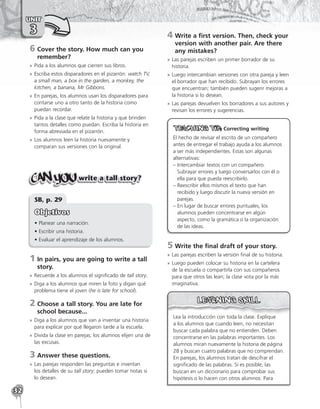
  • 14.
    13 1 Listen toAngela and complete the party invitation. » » Dé a los alumnos uno o dos minutos para que lean la tarjeta. Entre todos deducen que se trata de la invitación a un cumpleaños. » » Diga a la clase que van a escuchar a Angela llamando a un amigo por teléfono para invitarlo a su cumpleaños. Reproduzca la pista 7; los alumnos completan la información faltante en la invitación. Frank: Hello, this is Frank. I’m sorry I can’t answer the phone at the moment. Please leave a message after the tone. (beep) Angela: Frank, hi. This is Angela. It’s my 13th birthday on Saturday and I’m having a party. That’s Saturday the ninth at half past seven. It’s at my house. My address is 104 Springfield Avenue. Hope you get this message OK and hope you can come. I’m a teenager at last! Bye! 07 » » Para verificar las respuestas, dibuje la tarjeta de invitación en el pizarrón y reproduzca el audio nuevamente, haciendo pausa cuando brinda la información buscada. Los alumnos le dicen qué escribir en cada caso. RESPUESTAS Angela’s 13th birthday party, When? On Saturday 9th, What time? At 7:30, Where? At 104 Springfield Avenue 2 Create your own invitation. Include the date, time and place. » » Pida a los alumnos que inventen información sobre su propia fiesta de cumpleaños y que escriban la invitación. 3 Work in pairs. Send a voice message to your partner inviting him / her to come to your party. » » Pregunte a los alumnos qué decía el mensaje de Frank (no lo recordarán con exactitud). Reproduzca el comienzo de la pista 7 nuevamente (varias veces si es necesario). Los alumnos tratan de escribir el mensaje de Frank. » » Haga lo mismo con lo que dice Angela (necesitará dividir el mensaje en al menos dos partes). » » En parejas, los alumnos representan los mismos mensajes, usando la información que han puesto por escrito en su invitación. 07 En parejas, los alumnos piensan en algunas palabras en inglés que usan en su vida cotidiana. Pídales que las escriban en un papel. Pueden ser palabras que usan para hablar de música, de cine, de deportes, etc. Las parejas comparan sus listas y toman nota de las categorías a las que pertenecen esas palabras. My progress – Los alumnos completan la grilla de evaluación de acuerdo con cuán bien creen que pueden hacer las distintas tareas. Explique que significa que lo pueden hacer muy fácilmente; que lo pueden resolver con algo de ayuda y que tienen que practicar más. – Repase cada línea con la clase. Trate de identificar las áreas en las que los alumnos tienen menos seguridad. – Recoja los libros de los alumnos. Trate de escribir un comentario rápido en cada una de las grillas antes de devolverlas: Well done! Good work! Keep trying. Para los alumnos que se dieron una baja puntuación, trate de encontrar un momento tranquilo de la clase para ver qué problemas tienen y sugerir cómo pueden resolverlos. Más practica - pp. 82-87 – A manera de cierre, no olvide asignar las actividades del Practice Book correspondientes a esta unidad. Pueden realizarse en el aula o como tarea para el hogar, dependiendo del tiempo disponible. Evaluación Diagnostic Test: pp. 68-69
  • 15.
    14 UNIT 1 make predictions? SB, pp.12-13 Objetivos • Presentar lenguaje relacionado con la tecnología. • Presentar predicciones. • Practicar cómo unir textos con fotos y con íconos. • Practicar lectura en busca de información específica. • Escuchar un audio en busca de información específica. • Leer y discutir predicciones acerca del futuro. • Proporcionar práctica controlada de: – People will live for 100 years. – They won’t get ill. • Proporcionar práctica libre. Warmer – Escriba The future en el pizarrón. Dé a los alumnos tres minutos para que escriban todas las palabras que relacionen con el futuro. – Escriba las palabras que pensaron en el pizarrón. VOCABULARY: technology 1 Match the words to the pictures. » » Pida a los alumnos que unan las palabras con las fotos y revisen sus respuestas todos juntos. RESPUESTAS (de arriba abajo) c, b, a, d, e READING 2 Carla is doing a science project for school. What is she reading? » » Pida a los alumnos que miren rápidamente los textos; entre todos deducen que pertenecen a un sitio web. » » Pregunte a la clase sobre qué creen que trata el sitio web (the future). Pida a los alumnos que trabajen de a dos y que escriban en sus carpetas palabras que piensan que pueden aparecer en el texto. Controle oralmente. 3 Read these predictions from FutureWorld. Which sections are they from? » » Los alumnos leen los textos y los unen con los íconos y con los títulos. Corrija oralmente. RESPUESTAS a Cities b Health c Technology d Home and Leisure e Work f Food 4 What does the website say? Read and write T (true) or F (false). » » Los alumnos leen los textos nuevamente y deciden si las afirmaciones son verdaderas o falsas. Invítelos a que corrijan las oraciones falsas. RESPUESTAS a T b F. Books will be digital. c T d F. There will not be any offices. e F. We will have plenty of free time. GRAMMAR IN USE: will / won’t 5 Listen to an expert talking about the future and circle the topics he mentions. Then, listen again and complete the sentences. » » Los alumnos leen la sección Grammar y circulan la opción correcta. (Respuestas: will, won’t) » » Los alumnos escuchan la pista 8 y circulan las categorías a las que se refiere el experto. Repita el audio si es necesario. » » Luego escuchan el audio nuevamente y completan las oraciones. Corrija oralmente. 08
  • 16.
    15 Expert: …so whatwill our future be like? It’s hard to predict but at present there are some facts that show us that we will live longer and it’s only natural. People are becoming more aware of the importance of exercising and eating healthily, mainly fruits and vegetables. Medicine will play an important role. Scientists will develop new medicine to prevent and cure serious diseases. Consequently, we will be healthier and live longer. Another important topic about the future is schools. Will they keep on being the place to get educated? I don’t think so. In fact, children will stay at home and connect their electronic devices to virtual classrooms. They will work collaboratively with other students from other parts of the world. There won’t be any teacher lecturing students but a tutor organizing the students’ project work and research. Sounds great, doesn’t it? But have you stopped to think about social interaction and friendship? Now, moving onto… 08 RESPUESTAS Health, Food, School a will be healthier and live longer b will stay at home and connect their electronic devices to c won’t have d will organize their Escriba estas oraciones en el pizarrón: People will work at home. Cancer won’t be a problem. Explique: – usamos will para hacer predicciones acerca del futuro. – la forma negativa de will es will not o won’t. – will y won’t van seguidos del verbo principal en infinitivo sin to. » » Vea el Grammar Summary pp. 56-57 para mayores explicaciones y actividades de práctica. » » Invite a los alumnos a que busquen más ejemplos de oraciones con will y will not en los textos de la actividad 2. 6 Read these predictions about the future. Put a tick (✓) if you think they will come true, and a cross (✗) if you do not think they will come true. » » Lea las predicciones con toda la clase; responda todas las dudas de vocabulario. » » Los alumnos tildan o ponen una cruz junto a cada predicción, según estén de acuerdo con ella o no lo estén. 7 Work in pairs. Write more predictions about life in 100 years’ time. » » En parejas, los alumnos escriben cinco o más predicciones acerca de cómo creen que será la vida dentro de 100 años. » » Los alumnos comparten sus predicciones con otra pareja que dice si está de acuerdo o no con ellas. » » Invite a las parejas a leer en voz alta algunas de sus predicciones. El resto de la clase dice si está de acuerdo en que eso ocurrirá. Diga a los alumnos que cierren sus libros. Escriba en el pizarrón algunas palabras clave tomadas de FutureWorld, por ejemplo: zoos, food, housework, planets. Los alumnos tienen cinco minutos para escribir tantas predicciones como recuerden. Para verificar su trabajo, abren los libros y comparan sus oraciones con las del texto original. 8 Write six predictions about other students’ futures. Then, share your predictions in groups. » » Divida la clase en grupos de unos seis alumnos. » » Cada uno escribe seis predicciones acerca de otra persona, tres con will y tres con won’t. » » Los alumnos leen en voz alta sus predicciones. ¿Los otros grupos están de acuerdo con ellas?
  • 17.
    16 UNIT 1 Pida a losalumnos que dividan una hoja de papel en ocho cuadrados. Dígales que dibujen en cada uno un ícono que represente lo siguiente: Love, Work, House, Family, Friendship, Health, Happiness, Good / Bad luck. Cuando los alumnos terminen, pídales que recorten los íconos y los coloquen boca abajo sobre el escritorio. En parejas, un alumno levanta uno de ellos y predice el futuro de su compañero, por ejemplo: I see a picture of a woman. This means you will meet a very pretty girl. You will marry when you are 23. ask and answer about the future? SB, pp. 14-15 Objetivos • Presentar preguntas y respuestas cortas con will. • Escuchar una entrevista para detectar información específica. • Proporcionar práctica controlada de: – Will robots clean the house? Yes, they will. – Will they replace humans? No, they won’t. • Presentar expresiones temporales referidas al futuro. • Leer un artículo y discutir predicciones acerca del futuro. • Hacer una encuesta acerca del futuro. • Proporcionar práctica libre. Warmer – Escriba la palabra Technology en el pizarrón. Los alumnos tienen tres minutos para pensar todas las palabras que puedan con las letras de technology. – Los alumnos pasan al pizarrón y escriben sus palabras. LISTENING 1 Look at the cartoon. What does Professor Bits say robots will do in the future? » » Pregunte a los alumnos qué está ocurriendo en la viñeta (un periodista está entrevistando al Profesor Bits). » » Los alumnos dicen qué es lo que afirma el Profesor Bits acerca de los robots (They will do everything). 2 Listen and read. Then, tick (✓) the predictions that Professor Bits makes. » » Dé a los alumnos tiempo suficiente para leer las predicciones. » » Reproduzca el audio; los alumnos leen, escuchan y tildan las predicciones que menciona el profesor Bits. Corrija oralmente. (Ver en Student’s Book p. 14) 09 RESPUESTAS El Profesor Bits nombra las predicciones a y d. » » Pregunte a los alumnos qué cosas pueden encender (turn on), por ejemplo: la televisión, la radio. Por el diálogo, deducen que el robot explotó cuando el profesor Bits lo encendió. » » Si desea aprovechar el audio un poco más, escriba estas acciones en el pizarrón: replace humans, clean the house, turn robots on, learn things, go to work. Reproduzca nuevamente la pista 9. Los alumnos ordenan las categorías en el orden en que se las menciona en el audio. GRAMMAR IN USE: questions with will 3 Match the questions to the answers. » » Los alumnos leen y completan la sección Grammar. (Respuestas: Will, will, won’t) » » Verifican las respuestas todos juntos. » » Los alumnos unen las preguntas con las respuestas. » » Corrija oralmente. RESPUESTAS a 2 b 3 c 1 09
  • 18.
    17 Escriba estas oracionesen el pizarrón: Will robots do the shopping? Yes, they will. No, they will not / won’t. Explique: – will es un verbo modal. – los verbos modales no llevan el auxiliar do en las formas interrogativa y negativa. » » Vea el Grammar Summary pp. 56–57 para mayores explicaciones y actividades de práctica. 4 Write three more questions about the future. » » Invite a los alumnos a imaginar que están entrevistando al Profesor Bits. » » Escriben tres preguntas para el profesor. 5 Ask your questions to other students and answer theirs. » » En parejas, los alumnos preparan una entrevista con el Profesor Bits; invítelos a incluir otras expresiones. » » Las parejas representan sus entrevistas para el resto de la clase. Escriba en el pizarrón una lista de personas famosas que están en las noticias. En parejas, los alumnos escriben una pregunta para cada una, por ejemplo: Will (name) win the elections next year? Los alumnos leen sus preguntas en voz alta y otros compañeros responden. VOCABULARY: future time expressions 6 Look at these time expressions. Put them in order, from 1 (tomorrow) to 6 (sometime in the future). » » Los alumnos ordenan las expresiones temporales desde tomorrow hasta la más alejada en el futuro. » » Verifican sus respuestas en el pizarrón. RESPUESTAS (de izquierda a derecha y de arriba abajo) 5, 2, 4, 3, 6, 1 READING 7 Read the article and answer the questions. » » Los alumnos leen el título y subtítulo del artículo y entre todos concluyen de qué trata (some predictions about fiction and fact in 100 years’ time). » » Responda todas las dudas relacionadas con el vocabulario nuevo. » » En parejas, los alumnos leen el texto completo y responden las preguntas. » » Corrija oralmente. RESPUESTAS a No, some things will never be possible. b Robots. c In about 40 years’ time. d They will make us more intelligent and healthier. 8 In pairs, describe the future of two of these things. Use will, won’t and future time expressions. » » En parejas, los alumnos escriben un texto que describa el futuro de dos de los objetos / actividades que aparecen en la caja. Circule por el aula respondiendo dudas y monitoreando la actividad. » » Invite a los alumnos a que compartan con la clase sus predicciones. Pida que justifiquen su respuesta. » » Explique el significado de optimistic. Trate de descubrir quién es optimista y quién es pesimista. ¿Cuál es la opinión más generalizada en la clase? CLASS SURVEY Divida la clase en grupos de cuatro alumnos. Cada uno piensa en tres acontecimientos que ocurrirán durante el año lectivo. Lea las preguntas del ejemplo. Diga a los alumnos que pueden hacer preguntas que comiencen con when, where, what, how many, etc. Los grupos escriben una pregunta para cada uno de los eventos que eligieron. Cada alumno entrevista a otro de un grupo diferente y anota sus respuestas. Los grupos registran todas las respuestas en un papel; asegúrese de que anotan
  • 19.
    18 UNIT 1 quién ha dadocada respuesta. Los grupos exhiben sus resultados en la cartelera o en las paredes del aula. A medida que avanza el año podrán ir verificando si las predicciones eran correctas. Juegue al Pictionary con la clase para repasar el vocabulario sobre tecnología y el futuro. Divida a la clase en dos grupos. Haga pasar a un miembro del primer grupo al pizarrón para dibujar la palabra que el otro equipo le asigne. Continúe con el otro equipo. El ganador es el equipo que más palabras descubre y las deletrea correctamente. read about jobs in the future? SB, p. 16 Objetivos • Presentar vocabulario relacionado con profesiones. • Practicar cómo unir palabras con fotos. • Leer un artículo en busca de información específica. 1 Match the jobs to the pictures. » » Pida a los alumnos que miren las fotos y reconozcan la ocupación que representa cada una. Responda dudas relacionadas con el vocabulario. » » Los alumnos unen las palabras con las fotos. » » Corrija oralmente y aclare dudas acerca de la pronunciación del nuevo vocabulario. RESPUESTAS (de arriba abajo) e, c, f, a, l, h, b, g, i, d, j, k 2 Read the article and underline the jobs at risk. » » Pida a los alumnos que lean el título del artículo y miren las fotos que lo acompañan para deducir de qué se trata el texto que van a leer (cómo será el trabajo en el futuro). » » Los alumnos leen el texto y subrayan las ocupaciones que tal vez ya no existan en el futuro. RESPUESTAS telemarketers, cashiers, taxi drivers and fast food cooks. » » Si desea aprovechar un poco más este texto, pida a los alumnos que piensen en otros trabajos repetitivos y predecibles que puedan desaparecer en el futuro. 3 Discuss with a partner. » » En parejas, los alumnos conversan acerca de qué ocupaciones no desaparecerán en el futuro y justifican sus elecciones. Circule por el aula ayudando a quienes lo necesiten. » » Luego comparten sus conclusiones con los demás grupos. » » Pida que piensen qué trabajo querrían tener en el futuro y que expliquen por qué lo elegirían. talk about life in the future? SB, p. 17 Objetivos • Pensar ideas en grupo. • Escribir la descripción de una ciudad del futuro. • Hacer una presentación al resto de los alumnos. • Evaluar el aprendizaje de los alumnos. 1 Work in groups. You are going to design a city of the future. Ask and answer these questions in groups. » » Divida la clase en grupos de cuatro alumnos. » » Dígales que van a diseñar una ciudad del futuro. » » Los alumnos leen las preguntas y piensan respuestas que los ayudarán a diseñar su ciudad del futuro:
  • 20.
    19 cómo y dóndevive la gente, de qué trabaja, qué ocupaciones habrá, etc. » » Cada grupo decide dónde estará ubicada su ciudad y hace una lista de los servicios que ofrecerá. Invítelos a que dejen volar su imaginación. » » Los grupos toman notas de sus ideas. Pueden inspirarse en las actividades del comienzo de la unidad. » » Sugiera que hagan dibujos de su ciudad. 2 Write a full description of your city of the future. » » Los grupos escriben un texto que describa su ciudad. Sugiérales que comiencen diciendo dónde se encuentra y que luego vayan incluyendo las ideas que estuvieron conversando. » » Pueden acompañar los textos con imágenes y realizar pósteres de sus ciudades del futuro. 3 Present your city to other groups. Vote on the best city of the future and give reasons for your choice. » » Pida a una persona de cada grupo que presente su ciudad al resto de la clase. » » Los alumnos votan por la mejor ciudad y justifican su elección. En parejas, los alumnos piensan cosas para las que el inglés les será de mucha ayuda en el futuro. Invítelos a agregar otras categorías y situaciones a las que se dan como ejemplos. Escriba sus ideas en el pizarrón. Cada alumno escribe la razón más importante para él. Escriba una lista de temas en el pizarrón, por ejemplo: food, traffic, pollution, houses, holidays, work, schools. Divida la clase en parejas. Cada una escribe una predicción para cada categoría. Diga a la mitad de las parejas que escriba predicciones optimistas y a la otra mitad predicciones pesimistas. Dibuje dos caras en el pizarrón, una sonriendo y otra con el ceño fruncido. Señale hacia una de las categorías y una de las caras. Las parejas leen en voz alta la predicción que corresponda. My progress – Los alumnos completan la grilla de autoevaluación. – Repase cada línea con la clase para identificar las áreas en las que los alumnos se sienten menos seguros. – Recoja los libros de los alumnos y trate de escribir un comentario en cada uno antes de devolverlos. Para los alumnos que se han dado una baja puntuación, trate de encontrar un momento tranquilo de la clase para ver qué problemas tienen y sugerir cómo pueden resolverlos. Más practica - pp. 88-93 – A manera de cierre, no olvide asignar las actividades del Practice Book correspondientes a esta unidad. Pueden realizarse en el aula o como tarea para el hogar, dependiendo del tiempo disponible.
  • 21.
    20 UNIT 2 talk about thepast? SB, pp. 18-19 Objetivos • Presentar vocabulario relacionado con el espacio exterior. • Presentar el pasado simple de los verbos regulares. • Practicar la construcción y pronunciación de las terminaciones en pasado regular. • Presentar las preguntas en pasado. • Practicar la escucha para comprensión global. • Proporcionar práctica controlada de preguntas en pasado. Warmer – Escriba en el pizarrón: Gravity, Star Wars, The Hunger Games, Independence Day. Pregunte a toda la clase: What do these films have in common? (They are all science-fiction films). Luego, aliente a distintos alumnos a decir algo sobre estas películas u otras del mismo género que conozcan (actores principales, origen, argumento, etc). – Vuelque sus ideas en el pizarrón. LISTENING 1 Listen and read. Who watched TV last night? » » Explique que Carla y Jake están hablando acerca de lo que hicieron anoche. Lea la pregunta y luego reproduzca la pista 10. » » Los alumnos escuchan con el libro cerrado y tratan de responder la pregunta. (Ver en Student’s Book p. 18) 10 10 RESPUESTA Carla watched TV last night. 2 Listen again. What did Jake do? » » Lea la pregunta. Los alumnos escuchan, leen y la responden. RESPUESTA Jake cooked dinner for his mum, then listened to some music and studied. GRAMMAR IN USE: past simple of regular verbs 3 Complete the sentences with the past tense of the verbs in brackets. » » Los alumnos leen y completan la sección Grammar. (Respuestas: ed, d, ed) Escriba la forma en pasado de los verbos en el pizarrón: liked - cooked - tried - stopped Explique: – hay dos tipos de verbo en inglés: regulares e irregulares. ¡La buena noticia es que la mayoría de los verbos son regulares! – el pasado simple de los verbos regulares se forma agregando -d o -ed al verbo. – agregamos -d cuando el verbo termina en -e. – cuando el verbo termina en consonante + -y, eliminamos la y y agregamos -ied. – algunos verbos que terminan en consonante- vocal-consonante duplican la última consonante antes de -ed. – los alumnos verán verbos irregulares más adelante. 10
  • 22.
    21 » » Vea elGrammar Summary p. 58 para mayores explicaciones y actividades de práctica. » » Los alumnos completan las oraciones. RESPUESTAS a cooked b played c liked d studied e stopped PRONUNCIATION: -ed endings 4 Listen to the -ed endings of these verbs. Circle the sound you hear. » » Pronuncie las tres terminaciones varias veces y pregunte a los alumnos si pueden percibir la diferencia. » » Reproduzca la pista 11; los alumnos circulan la pronunciación correcta de los verbos. » » Para verificar si lo han hecho bien, dibuje tres columnas en el pizarrón con los encabezados /t/, /d/ y /ɪd/. » » Recorra los verbos uno por uno e invite a la clase a indicarle en qué columna debería colocarlo. Los alumnos dicen los verbos en voz alta. (Ver en Student’s Book p. 18) 11 RESPUESTAS a /ɪd/ b /d/ c /ɪd/ d /t/ e /t/ » » Si lo desea, puede explicar la regla para la pronunciación de la terminación -ed: si un verbo termina en: – una consonante sorda, la terminación se pronuncia /t/. – una consonante sonora, la terminación se pronuncia /d/. – un sonido /t/ o /d/, la terminación se pronuncia /ɪd/. 5 Say these words. Then, listen and check. » » Los alumnos practican la pronunciación de los verbos en parejas. Reproduzca el audio para que verifiquen si lo han hecho bien. (Ver en Student’s Book p. 18) 12 11 12 Divida la clase en grupos de ocho alumnos. Un alumno construye una oración acerca de lo que hizo ayer, por ejemplo: Yesterday I watched a film. El siguiente alumno repite la oración y agrega otra, por ejemplo: Yesterday María watched a film. I listened to music. Los alumnos continúan de la misma manera, agregando una oración cada vez, hasta que alguno cometa un error. El ganador es el grupo que logra decir primero ocho oraciones seguidas sin errores. GRAMMAR IN USE: What did you…? 6 Listen and choose the correct answers. » » Pida a los alumnos que describan la primer foto (un policía entrevistando a una chica con cara de preocupada) y luego la siguiente imagen (una nave y dos extraterrestres bajando a la Tierra). » » Entre todos deducen que esta es una historia acerca de una invasión extraterrestre. Invite a los alumnos a decir qué creen que está ocurriendo en la historia. Sugiera que incluyan nuevo vocabulario, por ejemplo: spacecraft, invasion. » » Diga a los alumnos que van a escuchar la primera parte de la historia Alien Invasion. Reproduzca el audio. Los alumnos escuchan y elijen la opción correcta. » » Revise las respuestas con toda la clase. FBI agent: OK. What did you do last night? Mel: Tom and I were in my room. We watched a film. FBI agent: What did you watch? Mel: We watched a film about space. FBI agent: OK. What happened next? Mel: Well, there was a strange light outside. FBI agent: What did you do? Mel: I opened the window and looked outside. FBI agent: What did you see? Mel: Two aliens. They were in my garden. They waved at us. FBI agent: Aliens? How did they get there? Mel: They showed us a map from an old spacecraft. They followed the map to get here. FBI agent: A map? Oh no! It’s an invasion! 13 13
  • 23.
    22 UNIT 2 RESPUESTAS a 2 b1 7 Write the questions to complete the dialogue. Then, listen again and check. » » Los alumnos leen y completan la sección Grammar. (Respuesta: did) » » Verifique las respuestas con toda la clase. Escriba esta pregunta en el pizarrón: What did you do last night? Explique: – construimos las preguntas en el pasado simple con una question word seguida de did y luego el verbo en infinitivo, no la forma -ed. » » Vea el Grammar Summary p. 58 para mayores explicaciones y actividades de práctica. » » Los alumnos escriben las preguntas usando las palabras del libro. Para verificarlas, escuchan el audio nuevamente. Si lo desea, pida a los alumnos que digan qué creen que va a pasar después. RESPUESTAS (Ver en transcripción #13) 8 Work in pairs. Find out what your partner did using the past time expressions below. » » Los alumnos trabajan en parejas. Preguntan y responden acerca de lo que hicieron usando las expresiones temporales. 9 Now write a short report about your partner. » » Los alumnos escriben reportes acerca de lo que hizo su compañero. 13 Los alumnos trabajan en parejas. Un alumno escribe una oración acerca de algo que haya hecho ayer, por ejemplo: I played football yesterday. No es necesario que sea real. El otro alumno escribe una pregunta, por ejemplo: What did you play yesterday? Luego de unos cinco minutos, pídales que lean en voz alta sus preguntas. Otros alumnos responden. talk about someone’s life? SB, pp. 20-21 Objetivos • Presentar el pasado simple de verbos irregulares. • Escuchar una entrevista para detectar información específica. • Proporcionar práctica controlada de: – Carla met an astronaut. – I slept in a seat. • Presentar el negativo, el interrogativo y respuestas cortas en pasado simple. • Elaborar una encuesta sobre actividades realizadas. Warmer – Escriba estas palabras en el pizarrón: spaceship, astronaut. – Los alumnos elijen una de ellas. En parejas, tienen tres minutos para formar tantas palabras como puedan usando las letras de esa palabra. – Para verificar si lo han hecho bien, las parejas pasan al frente y las escriben el pizarrón. LISTENING 1 Carla met an astronaut and interviewed him about a typical day in space. Tick (✓) the topics you think she asked him about.
  • 24.
    23 » » Mire lafoto junto con los alumnos. Haga preguntas, por ejemplo: Who is it? What is he doing? » » Diga a los alumnos que se trata de un astronauta. Ellos tildan los temas que creen que Carla le preguntó al astronauta entrevistado. 2 Listen, read and check. » » Reproduzca la pista 14. Los alumnos leen y escuchan para verificar sus respuestas. (Ver en Student’s Book p. 20) 14 » » Verifique las respuestas con toda la clase. RESPUESTAS clothes, sleep, work 3 Listen again and complete Carla’s notes. » » Verifique que los alumnos comprenden los encabezados. » » Reproduzca el audio nuevamente; los alumnos completan las notas. » » Verifican las respuestas en parejas. » » Reproduzca el audio nuevamente; los alumnos confirman sus respuestas. » » Lea los encabezados; los alumnos brindan la información que falta. RESPUESTAS First trip to moon: in 2003 Clothes (in the spaceship): normal clothes and a spacesuit (outside the spaceship). Activities: took photos of Earth and did experiments after lunch GRAMMAR IN USE: past simple of irregular verbs 4 Match the verbs to their past simple forms. » » Pida a los alumnos que lean la sección Grammar y circulen la opción correcta. (Respuesta: irregular) » » Los alumnos realizan la actividad en parejas. » » Verifique las respuestas escribiendo los infinitivos en el pizarrón; los alumnos dicen las formas en pasado. Escríbalas en el pizarrón. 14 14 RESPUESTAS do – did, have – had, become – became, go – went, wear – wore, eat – ate, get up – got up, sleep – slept, drink – drank, take – took » » Vea el Grammar Summary pp. 59-61 para mayores explicaciones y actividades de práctica. 5 Complete Carla’s report using the verbs in Activity 4. » » Los alumnos completan la actividad en parejas. » » Verifique las respuestas. Los alumnos leen el texto completo en voz alta. RESPUESTAS a became b went c got d had e ate f drank g wore h took i had j did k went l slept GRAMMAR IN USE: did / didn’t 6 Listen. Does Mel think the aliens are dangerous? » » Diga a los alumnos que van a escuchar la segunda parte de la historia Alien Invasion. » » Pida a los alumnos que miren la foto y lean el resumen del programa de la semana pasada. » » Entre todos hablan de la pregunta en la consigna de la actividad. Reproduzca la pista 15. » » Los alumnos dicen si para ellos Mel piensa que los extraterrestres son peligrosos. » » Corrija oralmente con toda la clase. RESPUESTA No, she does not. FBI agent: Did the aliens go into your house? Mel: No, they didn’t. I went into their spacecraft. FBI agent: Into their spacecraft? Did they have laser guns? Mel: No, they didn’t. They were very friendly. FBI agent: Did you go anywhere in the spacecraft? Mel: Yes, we did. We went to the moon. It was great. FBI agent: Did they do any experiments on you? Mel: No, they didn’t. We ate alien ice cream. It was fun. FBI agent: Alien ice cream? 15 15
  • 25.
    24 UNIT 2 7 Listen againand answer these questions. » » Lea las preguntas. Los alumnos escuchan nuevamente prestando mayor atención a los detalles. Trabajan en parejas. » » Reproduzca el audio nuevamente; los alumnos verifican sus respuestas. RESPUESTAS a She went to the moon. b They ate alien ice cream. 8 Complete the dialogue. Then, listen once more and check. » » Los alumnos leen y completan la sección Grammar. (Respuestas: did, did, did, didn’t) » » Luego leen y completan las oraciones. » » Reproduzca el audio nuevamente para que verifiquen sus respuestas. » » Corrija oralmente con toda la clase. RESPUESTAS a Did b didn’t c Did d didn’t e Did f did g Did h didn’t Divida la clase en grupos de cuatro alumnos. Un alumno piensa en una persona famosa; los otros le hacen preguntas usando Did you... para adivinar de quién se trata (máximo 20 preguntas). La persona famosa solo puede decir Yes, I did o No, I didn’t. 9 Work in groups. Complete the final part of Alien Invasion. » » Los alumnos inventan un final para la historia de la invasión alienígena en grupos. » » Los grupos representan sus diálogos para la clase. » » Vea el Grammar Summary pp. 58-61 para mayores explicaciones y actividades de práctica. 15 15 SURVEY Los alumnos escriben las preguntas en forma individual utilizando la información que tienen en el libro: 1 What time did you get up yesterday? 2 What did you eat for breakfast? 3 What did you wear? 4 Did you go to school in the afternoon? 5 What did you do in the evening? 6 Did you go to bed early? Luego escriben respuestas verdaderas para esas preguntas. Preguntan en la clase hasta que encuentran a la persona que tiene el mayor número de respuestas iguales. Para completar la actividad, pregunte a los alumnos si han encontrado a alguien con las mismas respuestas. Invite a los alumnos a que le cuenten lo que hicieron. Dibuje tres gráficos de araña en el pizarrón y nómbrelos space, regular verbs e irregular verbs. Sin mirar sus libros, los alumnos trabajan en parejas y escriben tantas palabras como puedan en cada araña. Luego comparan sus trabajos. ¿Quién ha escrito más palabras? listen about a famous film director? SB, p. 22 Objetivos • Practicar la escucha de una biografía y relevar datos específicos. • Presentar vocabulario relacionado con el cine. • Completar una línea de tiempo. 1 Carla likes Steven Spielberg. What do you know about him?
  • 26.
    25 » » Los alumnoscomentan si conocen a Steven Spielberg y conversan acerca de todo lo que saben sobre él y de sus películas. » » Responda dudas sobre vocabulario. 2 In pairs, answer these questions. Then, listen and check. » » En parejas, los alumnos responden las preguntas. Pida a algunas parejas que digan cuáles creen que son las respuestas; todavía no diga si son acertadas o incorrectas. » » Reproduzca el audio; los alumnos verifican sus respuestas. Steven Spielberg was born in Cincinnati in 1946. His father was an engineer and his mother was a pianist. Steven always liked films. When he was 16 he produced a movie called Escape to Nowhere, which made a profit of 100 dollars at a local movie theatre! Steven studied English at California State University but he really wanted to study movies. Unfortunately, film school did not accept him. But one day, when he was visiting Universal Studios in Hollywood, he saw a small office. He pretended that he worked at Universal and went to his ‘office’ every day after that. The security guards never stopped him! Some time later, Steven got a real job with Universal. In 1975 he had his first big hit when he directed Jaws. Jaws won three Oscars. After that Spielberg made a lot of other very successful films including Close Encounters, E.T., Raiders of the Lost Ark, Schindler’s List, Jurassic Park and Saving Private Ryan. Steven Spielberg is a very rich man. Just in 2002, he made 100 million dollars! He also loves children and has seven. He says they help to keep the child inside him alive! 16 RESPUESTAS a He is a film director. b He is from Cincinnati, in the USA. c He is famous for Jaws, Close Encounters, E.T., Raiders of the Lost Ark, Schindler’s List, Jurassic Park and Saving Private Ryan. 3 Listen again and complete the timeline below. » » En parejas, los alumnos leen la línea de tiempo y se familiarizan con las fechas. 16 16 » » Los alumnos escuchan la pista 16 nuevamente y completan la información faltante. » » Reproduzca el audio nuevamente haciendo pausa luego de cada dato relevante. RESPUESTAS 1946: he was born, 1975: he had his first big hit, 2002: he made 100 million dollars 4 Listen once again, read the sentences and write T (true) or F (false). » » Los alumnos escuchan el audio nuevamente y deciden si las afirmaciones son verdaderas o falsas. RESPUESTAS a F b T c T d T e F f F 5 Now correct the false statements in Activity 4. » » Los alumnos corrigen las oraciones falsas del ejercicio anterior. RESPUESTAS a His father was an engineer and his mother was a pianist. e His first successful film was Jaws. f He has seven children. Lea las sugerencias con toda la clase sobre aprender inglés viendo películas; pregunte si alguien ha probado algunas de estas ideas. Traiga una película que tenga subtítulos y mire una parte con la clase del modo que se indica o bien invite a los alumnos a mirar una película en sus casas. Pregunte a los alumnos qué han aprendido con esta técnica. Recuérdeles que es recomendable ver películas de esta manera. Asegúrese de que los alumnos no sean demasiado ambiciosos en sus pretensiones. Es mejor tratar de ver diez minutos dos veces por semana y aprender dos o tres expresiones cada vez, que ver la película entera cada semana. 16
  • 27.
    26 UNIT 2 write about a famousactor? SB, p. 23 Objetivos • Practicar la lectura en busca de información específica. • Escribir la biografía de una persona famosa. • Evaluar el aprendizaje de los alumnos. 1 Do you know the actress in the photos? Read about her and complete the timeline below. » » Pregunte a la clase si conocen a Winona Ryder y qué saben sobre ella. » » Los alumnos leen el texto y completan la línea de tiempo. Ayúdelos con el nuevo vocabulario. » » Escriba los años encolumnados en el pizarrón. Los alumnos dicen en voz alta lo que debe escribir junto a cada uno. RESPUESTAS 1981: moved with parent to California 1984: had an audition to the film Desert Bloom 1986: made first debut in the film Lucas 1990: starred in Edward Scissorhands 1994: played the lead role of Josephine March in Little Women 2016: started acting in the Netflix supernatural horror series Stranger Things Today: engaged to fashion designer Scott Mackinlay Hahn Dealing with random vocabulary En una actividad como la que introduce un ejercicio de lectura, los alumnos suelen preguntar cómo se dice algo en inglés. Es buena idea reservar un lugar del pizarrón para escribir las palabras que surgen durante el trabajo con la unidad. Al finalizar, indique a los alumnos qué palabras quiere que escriban en sus cuadernos y aprendan o déjelos que ellos decidan. Un enfoque mixto puede ser lo mejor: diga dos o tres palabras que quiere que aprendan (y que estarán en su próximo examen). Ellos eligen otra u otras dos que les interesen. 2 Complete the questions. Then, ask and answer them with a partner. » » Los alumnos completan las preguntas usando las palabras del recuadro. » » Luego preguntan y responden en parejas. » » Pida a dos de ellas que representen el diálogo para toda la clase. RESPUESTAS a When b What c Where d What e Who 3 Write a short biography about your favourite actor or actress. Use the prompts below. » » Pregunte a los alumnos quiénes son sus actores y actrices favoritos. » » En parejas o en forma individual, los alumnos eligen un actor o actriz y toman notas acerca de su vida. » » Los alumnos trabajan con otro compañero y le hacen preguntas acerca de la persona que ha elegido. Luego, escriben una breve biografía de ese actor / actriz usando el texto de la actividad 1 como modelo. » » Pida a algunos alumnos que lean en voz alta sus textos o le digan a la clase lo que aprendieron acerca de su actor o actriz favorito. My progress – Los alumnos completan la grilla de autoevaluación. – Repase cada línea con la clase para identificar las áreas en las que los alumnos se sienten menos seguros. – Recoja los libros de los alumnos y trate de escribir un comentario en cada uno antes de devolverlos. Para los alumnos que se han dado una baja puntuación, trate de encontrar un momento tranquilo de la clase para ver qué problemas tienen y sugerir cómo pueden resolverlos. Más practica - pp. 94-99 – A manera de cierre, no olvide asignar las actividades del Practice Book correspondientes a esta unidad. Pueden realizarse en el aula o como tarea para el hogar, dependiendo del tiempo disponible.
  • 28.
    UNIT 3 27 talk about what washappening? SB, pp. 24-25 Objetivos • Presentar el pasado continuo. • Practicar la lectura de una historia con fotos. • Proporcionar práctica controlada de: – What were Carla and Jake doing at 3 o’clock? – They were visiting London. • Presentar verbos de acción. • Practicar la escucha de una conversación telefónica. • Decir lo que estaba haciendo ayer. • Proporcionar práctica libre. Warmer – Dibuje dos columnas en el pizarrón: en una de ellas escriba I am; en la otra escriba I was. Los alumnos copian y completan las columnas con las otras personas del verbo to be. – Para repasar la hora escriba cuatro o cinco horas con números en el pizarrón y pida a los alumnos que las digan con palabras. – Haga preguntas, por ejemplo: Where were you at 7 o’clock last night? Were you in the park at 10? – Los alumnos continúan trabajando en parejas. LISTENING 1 Read and listen to the dialogue. Then, answer the questions. » » Dirija la atención de la clase hacia el título de la unidad y pregunte a los alumnos si saben lo que significa (a story that may or may not be true, but that contains details that are hard to believe). 17 » » Luego, señale la primera actividad y dé a los alumnos tiempo para leer las preguntas. » » Reproduzca el audio y pida a los alumnos que lo sigan en sus libros o dígales que cierren los libros y solamente escuchen. » » Los alumnos piensan las respuestas en parejas. Corrija oralmente. (Ver en Student’s Book p. 24) 17 RESPUESTAS a She was visiting Madame Tussauds. b He was seeing his grandmother. c He saw Ed Sheeran. d He was walking down Oxford Street. 2 Correct these sentences. » » Los alumnos corrigen las oraciones con la información de la historia. Corrija oralmente. RESPUESTAS a Ed Sheeran was walking down Oxford Street. b Jake and Carla were visiting London. c Lenny cancelled band practice because his grandmother was visiting. 3 What do these expressions mean? » » Los alumnos buscan estas expresiones en el diálogo y deducen su significado. » » Para verificar sus hipótesis, pida a los alumnos que las digan en su propio idioma. » » Si desea aprovechar más el diálogo, divida la clase en parejas; asigne una de las secciones del diálogo a una o más parejas. Cada una practica su parte del diálogo hasta que pueda mantenerlo con el libro cerrado. Pida a las parejas que representen su diálogo. GRAMMAR IN USE: past continuous 4 Unscramble the questions and answer. » » Los alumnos leen y completan la sección Grammar. (Respuestas: was, were)
  • 29.
    28 UNIT 3 » » Los alumnosordenan las palabras de las preguntas en parejas y las responden. RESPUESTAS a What were Jake and Carla doing at eleven o’clock? They were visiting Madame Tussauds. b What was Lenny doing? He was seeing his grandmother. Escriba estas preguntas y respuestas en el pizarrón como referencia: What were Jake and Carla doing at 11 o’clock? They were visiting Madame Tussauds. What was Lenny doing? He was seeing his grandmother. Explique: – este tiempo de verbo se llama past continuous. – formamos el pasado continuo con was o were y la forma -ing del verbo principal. – usamos el pasado continuo para hablar de una acción que se estaba desarrollando en algún momento puntual del pasado. » » Pida a los alumnos que busquen más ejemplos de pasado continuo en el diálogo. » » Vea el Grammar Summary pp. 62-67 para mayores explicaciones y actividades de práctica. 5 Complete these sentences. What were Carla, Jake and Lenny doing yesterday morning? » » Los alumnos completan las oraciones con las palabras de la caja. RESPUESTAS a were b was not c was d was not e were f was VOCABULARY: action verbs 6 Write the verbs in the correct column. » » En parejas, los alumnos escriben la forma -ing de los verbos en la columna que corresponda. RESPUESTAS + -ing: a, f, g, i, j + -ing: b, h double consonant + -ing: c, d, e 7 Listen. What were the band members doing yesterday? » » Diga a los alumnos que Carla tiene un problema. » » Reproduzca el comienzo del audio hasta Where were you? Entre todos concluyen cuál era el problema de Carla: She was waiting for Lenny at the cinema yesterday but he didn’t come. » » Escriba estos nombres en el pizarrón: Lenny, Sandy, Mike, Jake. » » Reproduzca el resto de la pista 18; los alumnos anotan qué estaba haciendo cada uno. » » Los alumnos comparan las respuestas en parejas. Corrija oralmente. Carla: Hi, Lenny. I was waiting for you at the cinema yesterday. Where were you? Lenny: I know, sorry. I was helping my dad in the garden. I forgot about going to the cinema. And then when I remembered the phone wasn’t working. Carla: Yeah, well, I waited for half an hour. Lenny: What about the others – didn’t they go? Carla: No, they didn’t. Sandy was watching a tennis match. Her little brother was playing and it was really important. Lenny: What about Mike? Carla: Mike was doing his homework. He had a really big exam today. Lenny: And Jake? Was he not there? Carla: Well, no, actually, he wasn’t there either. His uncle was visiting from the States. He and his mum were showing him London. Lenny: Oh dear. I’ve got the worst excuse, haven’t I? Carla: Yes, Lenny, you have. 18 RESPUESTAS Lenny was helping his dad in the garden. Sandy was watching a tennis match. Mike was doing his homework. Jake and his mum were showing Jake’s uncle London. 8 Listen again. Answer the questions. » » Los alumnos leen las preguntas. » » Reproduzca el audio nuevamente; los alumnos anotan sus respuestas. 18 18
  • 30.
    29 RESPUESTAS a Because hisphone wasn’t working. b Because her little brother was playing. c Because he had a really big exam today. d Because his uncle was visiting from the States. 9 Listen to the pronunciation of was and repeat. » » Reproduzca la pista 19; los alumnos escuchan la pronunciación de was. » » Luego repiten la pronunciación. Asegúrese de que pronuncian bien la forma reducida de was. Carla: I was waiting for you at the cinema. Lenny: I was helping my dad in the garden. Carla: Mike was doing his homework. 19 10 Work in pairs. Ask questions to find out what your partner was doing at these times yesterday. » » Pregunte a uno o dos alumnos qué estaban haciendo en algunos de esos momentos del día. » » Los alumnos continúan preguntando y respondiendo en parejas. » » Invite a los alumnos a que digan qué estaban haciendo ayer a la misma hora. describe what was happening? SB, pp. 26-27 Objetivos • Presentar el pasado continuo en contraste con el pasado simple. • Escuchar una historia y ordenar imágenes. • Presentar vocabulario relacionado con el cine. • Proporcionar práctica controlada de: – I was swinging when the rope broke. – They were laughing when the doctor arrived. • Describir qué estaba ocurriendo. • Proporcionar práctica libre. 19 Warmer – Pida a los alumnos que le digan el título de películas de acción o aventuras que hayan visto recientemente. Escríbalos en el pizarrón. – Haga algunas preguntas acerca de las películas, por ejemplo: Who is in it? What is it about? – Pregunte Are there any dangerous scenes in the film? Escriba en el pizarrón algunas de las cosas peligrosas que hacen los actores, por ejemplo: drive a car, pilot a plane, climb down a building. LISTENING 1 Jake’s granddad was a stuntman. He likes telling stories about his time in Hollywood. Match the sentences to the pictures. » » Enseñe el significado de stuntman (doble de riesgo). » » Los alumnos leen las oraciones y las unen con las ilustraciones. Corrija oralmente. RESPUESTAS (de arriba abajo y de izquierda a derecha) d, a, g, c, b, f, e » » Verifique que los alumnos comprenden que la persona que hace de Tarzán es el abuelo de Jake. 2 Listen and put the pictures in the correct order (1-7). » » Reproduzca la pista 20. En parejas, los alumnos orden las ilustraciones cronológicamente. Jake: Tell Carla what happened, Grandpa. Grandpa: Well, I was a stuntman in Hollywood! Carla: Really? Wow! Grandpa: Yeah, and one morning we were filming a new episode of Tarzan… Carla: Gosh! Where? In the jungle... with lots of wild animals...? Grandpa: No, actually, we were in a studio! Carla: Oh. Grandpa: Anyway, I was climbing a tree. There was a huge gorilla at the bottom. Carla: A real gorilla? Grandpa: Aha! Wait! I got to the top of the tree and jumped. Carla: You jumped from the top of a tree? Grandpa: Yes, but I had a rope. I was swinging on the rope (famous Tarzan yell: ah-ah-aha) and then suddenly it broke. Aaaaaah! 20 20
  • 31.
    30 UNIT 3 Carla: Oh no! Grandpa:The next thing I remember I was lying at the bottom of the tree and this gorilla was standing next to me… it was looking at me! Its face was really close to me. I was terrified. Carla: Wow! Grandpa: I thought the gorilla was going to attack me. And he was jumping up and down and shouting. I began to shout for help… then the gorilla’s hand went up and he took his mask off and I realized I wasn’t looking at a real gorilla… it was an actor!! Carla: Oh, great! Phew! Grandpa: We both laughed and laughed. RESPUESTAS 1 a 2 b 3 e 4 g 5 d 6 f 7 c 3 Listen again and check. » » Reproduzca la pista 20 nuevamente. Los alumnos verifican sus respuestas. » » Si desea aprovechar la actividad un poco más, escriba estas frases en el pizarrón: In the jungle?, I had a rope, I was terrified. Los alumnos deducen en parejas quién dijo cada frase. Reproduzca el audio nuevamente, haciendo pausa luego de cada una. Los alumnos dicen quién es el hablante y qué significa cada frase. GRAMMAR UIN USE: past continuous vs past simple 4 Match the sentences halves. » » Los alumnos leen y completan la sección Grammar. (Respuestas: finished actions, actions in progress) » » Luego unen el comienzo de las oraciones con el final de cada una. » » Corrija oralmente. RESPUESTAS a 2 b 1 20 Escriba esta oración como referencia en el pizarrón: I was swinging on the rope when it broke. Explique: – usamos when para unir una acción continua con una acción completa. » » Vea el Grammar Summary pp. 62-67 para mayores explicaciones y actividades de práctica. 5 Look at the picture below. What were these people doing when Tarzan’s rope broke? » » Los alumnos miran la ilustración y escriben oraciones. » » Verifican las respuestas en parejas. Luego, controle las respuestas en el pizarrón. RESPUESTAS a A cameraman was filming. b The gorilla was sitting under the tree. c Two actresses were drinking coffee. 6 Choose an action to mime. » » Lea la actividad con toda la clase; cada alumno elije una de las actividades para representar. 7 Watch other students carefully. When your teacher claps, stop and write about your class. » » Los alumnos comienzan a representar la actividad con mímica. » » Aplauda para que todos se detengan y entre todos dicen qué estaba haciendo cada uno cuando usted aplaudió. » » Pida a los alumnos que elijan otra actividad y la representen con mímica. Aplauda nuevamente, pero esta vez diga a los alumnos que escriban oraciones sobre lo que estaban haciendo sus compañeros. » » El alumno que haya escrito el mayor número de oraciones las lee en voz alta. Si son todas correctas, ese alumno es el ganador.
  • 32.
    31 Escriba estas frasesen el pizarrón y pida a los alumnos que las completen en forma individual. … when the lights went out. … when I saw a man running out of the bank. … when my mother woke me up. … when I saw a bear. … when the rope broke. … when the referee blew his whistle. Los alumnos preguntan y responden con What were you doing when…? para descubrir quiénes estaban haciendo lo mismo que ellos. MEMORY GAME  Dé a los alumnos dos minutos para mirar la ilustración. Pídales que cierren el libro y escriban tantas oraciones como puedan acerca de lo que estaba ocurriendo en la playa cuando atacó el tiburón. Los alumnos comparan oraciones en parejas: cada pareja trata de tener el mayor número posible de oraciones correctas. La pareja que ha escrito el mayor número de oraciones las lee en voz alta. Si son todas correctas, esa pareja es la ganadora. Escriba esta frase en el pizarrón: when it started to rain... Los alumnos completan la frase en forma individual. En grupos, los alumnos hacen un máximo de veinte yes / no questions para descubrir qué estaba haciendo un integrante del grupo. read a tall story? SB, p. 28 Objetivos • Practicar cómo anticipar una historia. • Practicar la lectura de una historia y ordenar ilustraciones. • Practicar el relato de una historia memorizada. 1 Look at the pictures. What do you think happened? » » Pida a los alumnos que miren las fotos. Pregúnteles qué creen que pasó. Anote sus sugerencias en el pizarrón. 2 Read to check. » » Los alumnos leen la primera parte de la historia y comprueban si sus ideas eran acertadas. » » Invítelos a que le digan cuáles son los puntos principales de la historia hasta ahora. 3 What do you think happened next? » » Pida a los alumnos que cierren sus libros. » » En parejas, los alumnos discuten qué creen que pasó después de que Harry abriera la caja. » » Anote sus sugerencias en el pizarrón. 4 Read and check. » » Los alumnos leen el resto de la historia; verifique rápidamente si alguna de sus ideas era correcta. 5 Put the pictures in the correct order (1-8). » » Los alumnos ordenan las ilustraciones cronológicamente. » » Corrija oralmente. RESPUESTAS a 4 b 7 c 1 d 6 e 2 f 3 g 8 h 5 » » Pregunte a los alumnos si creen la historia de Harry; recuerdeles que una tall story es una historia difícil de creer y que a menudo no es verdadera.
  • 33.
    32 UNIT 3 6 Cover the story.How much can you remember? » » Pida a los alumnos que cierren sus libros. » » Escriba estos disparadores en el pizarrón: watch TV, a small man, a box in the garden, a monkey, the kitchen, a banana, Mr Gibbons. » » En parejas, los alumnos usan los disparadores para contarse uno a otro tanto de la historia como puedan recordar. » » Pida a la clase que relate la historia y que brinden tantos detalles como puedan. Escriba la historia en forma abreviada en el pizarrón. » » Los alumnos leen la historia nuevamente y comparan sus versiones con la original. write a tall story? SB, p. 29 Objetivos • Planear una narración. • Escribir una historia. • Evaluar el aprendizaje de los alumnos. 1 In pairs, you are going to write a tall story. » » Recuerde a los alumnos el significado de tall story. » » Diga a los alumnos que miren la foto y digan qué problema tiene el joven (he is late for school). 2 Choose a tall story. You are late for school because... » » Diga a los alumnos que van a inventar una historia para explicar por qué llegaron tarde a la escuela. » » Divida la clase en parejas; los alumnos elijen una de las excusas. 3 Answer these questions. » » Las parejas responden las preguntas e inventan los detalles de su tall story; pueden tomar notas si lo desean. 4 Write a first version. Then, check your version with another pair. Are there any mistakes? » » Las parejas escriben un primer borrador de su historia. » » Luego intercambian versiones con otra pareja y leen el borrador que han recibido. Subrayan los errores que encuentran; también pueden sugerir mejoras a la historia si lo desean. » » Las parejas devuelven los borradores a sus autores y revisan los errores y sugerencias. Correcting writing El hecho de revisar el escrito de un compañero antes de entregar el trabajo ayuda a los alumnos a ser más independientes. Estas son algunas alternativas: – Intercambiar textos con un compañero. Subrayar errores y luego conversarlos con él o ella para que pueda reescribirlo. – Reescribir ellos mismos el texto que han recibido y luego discutir la nueva versión en parejas. – En lugar de buscar errores puntuales, los alumnos pueden concentrarse en algún aspecto, como la gramática o la organización de las ideas. 5 Write the final draft of your story. » » Las parejas escriben la versión final de su historia. » » Luego pueden colocar su historia en la cartelera de la escuela o compartirla con sus compañeros para que otros las lean; la clase vota por la más imaginativa. Lea la introducción con toda la clase. Explique a los alumnos que cuando leen, no necesitan buscar cada palabra que no entienden. Deben concentrarse en las palabras importantes. Los alumnos miran nuevamente la historia de página 28 y buscan cuatro palabras que no comprendan. En parejas, los alumnos tratan de descifrar el significado de las palabras. Si es posible, las buscan en un diccionario para comprobar sus hipótesis o lo hacen con otros alumnos. Para
  • 34.
    33 terminar, pregunte alos alumnos qué palabras trataron de descifrar y qué creen que significan las palabras. Confirme o corrija. My progress – Los alumnos completan la grilla de autoevaluación. – Repase cada línea con la clase para identificar las áreas en las que los alumnos se sienten menos seguros. – Recoja los libros de los alumnos y trate de escribir un comentario en cada uno antes de devolverlos. Para los alumnos que se han dado una baja puntuación, trate de encontrar un momento tranquilo de la clase para ver qué problemas tienen y sugerir cómo pueden resolverlos. Más practica - pp. 100-105 – A manera de cierre, no olvide asignar las actividades del Practice Book correspondientes a esta unidad. Pueden realizarse en el aula o como tarea para el hogar, dependiendo del tiempo disponible. Evaluación Mid-term Test: pp. 70-71
  • 35.
    34 SB, pp. 30-31 Objetivos •Repasar vocabulario de las unidades anteriores. • Presentar vocabulario relacionado con festivales de música. • Estimular a los alumnos para que vinculen el inglés con su propio mundo. • Proporcionar variadas oportunidades de aprendizaje. • Estimular la creatividad de los alumnos. 1 Label these music genres. » » Pregunte a los alumnos si les gusta escuchar música y qué estilos musicales son sus favoritos. Luego pida que miren las páginas 30 y 31 del libro y que deduzcan el tema sobre el que van a leer (music festivals). » » Pida a los alumnos que miren las ilustraciones de la actividad 1 e identifiquen los géneros musicales. » » Los alumnos completan las palabras. Responda las dudas que puedan surgir. RESPUESTAS (de izquierda a derecha) blues, pop, reggae, rock, hip-hop, classical 2 Read the website about music festivals in Britain. When did the two festivals start? » » Dirija la atención de los alumnos a la página 31. Pregunte: What kind of text is it? (a website) What is it about? (festivals in Britain). » » Los alumnos leen la pregunta. Luego leen el sitio web. RESPUESTAS Glastonbury Music Festival started 2,000 years ago (the first official festival was in 1970). Notting Hill Carnival started in 1964 (a carnival was celebrated before in big halls in the 1950s). 3 Read again and complete the tables. » » Los alumnos leen con detenimiento la guía web sobre los festivales para completar la información en las grillas. » » Los alumnos comparan las respuestas. Luego corrigen todos juntos. RESPUESTAS Name: Glastonbury; Place: Southwest England; Date: Last weekend in June; Things to see: music on three big stages, comedy, dance, theatre, a circus and an all-night cinema Name: Notting Hill Carnival; Place: West London; Date: Last Friday, Saturday and Sunday of August; Things to see: a parade of decorated vehicles, people in colourful costumes, dancers, music and multicultural foods 4 In pairs, decide which festival you want to go to and tell your partner why. » » Los alumnos conversan acerca de cuál es el festival más interesante y por qué les gustaría ir. 5 Work in groups. Make a list of music festivals around the world and choose your favourite one. Find the answers to these questions. » » Divida la clase en grupos de cuatro miembros. Incentive a los grupos a pensar en festivales de música de su país o de otros países (por ejemplo: Burning Man, Coachella, Fuji Rock, Cosquín). Si tienen acceso a Internet pueden buscar información. » » Invítelos a elegir un festival distinto por grupo. » » Los grupos leen las preguntas y las discuten. 6 Write a festival web-guide using the questions in Activity 5 to structure the information. Then, present it to the class. » » En grupos, los alumnos pueden escribir una primera versión de su guía web o buscar más información sobre su festival; si optan por esto último, escriben su guía web la clase siguiente. » » Los alumnos traen fotos (o bien pueden buscar en Internet las fotos que necesitan) para ilustrar su página web. » » Los grupos intercambian su primer borrador y lo corrigen. Luego escriben su guía sobre el festival elegido en papel o en la computadora. » » Cada grupo le muestra su trabajo a la clase. La clase vota por la guía web más interesante.
  • 36.
    35 SB, pp. 32-33 rememberthese words? RESPUESTAS 1 Match the two halves of the phrases. a 4 b 5 c 1 d 2 e 3 2 Unscramble the words. a cities b food c housework d visiting e broke 3 Circle the different word in each group. a busy b day c third 4 Read the definitions and write one letter in each blank. a bookseller b stuntman c astronaut d doctor use these grammar items? RESPUESTAS 1 Complete the sentences and questions about the future. Use will or won’t and the verbs in brackets. a won’t need b will be c Will, do d will, speak e will learn f won’t have 2 Complete the sentences with past simple or past continuous. a broke, was playing b were watching, arrived c was riding, called d were running, met e was working, saw f was listening, went g were talking, got 3 Choose the best words (A, B or C) for each space. 1 B 2 A 3 C 4 A 5 C 6 A 7 B 8 C 9 C 10 C interact in English? RESPUESTAS 1 Complete the dialogue. Use the expressions in the box. a Where did you go last night? b Was it in London? c Was the party good? d How many people were there? e How long did you stay there? 2 Now complete the invitation Jane received from Laurie. Use the information in Activity 1. WHO: Laurie DATE: 17th March TIME: 9:00 PLACE: Country house REASON FOR THE PARTY: Birthday 3 Write an e-mail to a friend about a party you went to. Describe the people, the music and the food. (Respuestas personales)
  • 37.
    36 UNIT 4 give advice? SB, pp.34-35 Objetivos • Presentar las partes del cuerpo. • Presentar should para dar consejos. • Practicar la lectura de un folleto de seguridad. • Presentar vocabulario relacionado con equipos deportivos y de protección. • Proporcionar práctica controlada de: – What should I do? – You should wear the right equipment. – You shouldn’t take risks. • Practicar la escucha de personas pidiendo o dando consejos. Warmer – Pregunte a los alumnos cuál es su deporte favorito y escriba todos las palabras que surjan en el pizarrón. – Pregúnteles si es peligroso; nombren entre todos las partes del cuerpo relacionadas con ese deporte, por ejemplo: tennis – arms / hands, football - legs, etc. VOCABULARY: parts of the body 1 Match the words to the picture. » » Dé a los alumnos tiempo para mirar la foto de Carla y leer las palabras. » » Los alumnos unen las palabras con las partes del cuerpo que correspondan. » » Responda preguntas que surjan sobre vocabulario y la pronunciación. Corrija oralmente. RESPUESTAS (de izquierda a derecha y de arriba abajo) e, i, c, h, f, b, g, d, a READING 2 Look at the article. What is it about? » » Dé a los alumnos un par de minutos para leer el folleto; en parejas, discuten acerca de qué trata. » » Entre todos deducen que trata de la seguridad en el deporte (Safety in sport). 3 Read the article and tick (✓) the bits of advice included in the text. » » Pida a los alumnos que lean nuevamente el folleto para poder completar el ejercicio. Esta actividad puede realizarse en parejas. RESPUESTAS a ✓ c ✓ e ✓ 4 Look at the picture and complete the name of the equipment. » » Pregunte qué está haciendo el chico de la ilustración (riding a scooter). » » Los alumnos completan las palabras del equipo deportivo que el chico lleva puesto. » » Corrija oralmente; modele y haga ejercitar la pronunciación. RESPUESTAS (de arriba abajo y de izquierda a derecha) sunscreen, gloves, boots, helmet, goggles, elbow pads, knee pads Divida a la clase en dos grupos y diga que van a jugar al ahorcado con el vocabulario aprendido sobre partes del cuerpo y equipamiento deportivo. Modele el juego en el pizarrón colocando una línea por cada letra de la palabra o frase incognita y el pie de la horca. Puede dar una pista de la palabra incógnita señalando la parte del cuerpo a la que hace referencia la palabra. Por turnos, los grupos dicen letras para completar la palabra. Gana el grupo que descubre más palabras o frases incógnitas.
  • 38.
    37 GRAMMAR IN USE: should/ shouldn’t 5 Complete the sentences. » » Los alumnos leen y completan la sección Grammar. (Respuestas: should, shouldn’t, Should, should, shouldn’t) » » Luego, completan las oraciones con should o shouldn’t. RESPUESTAS (Ver en transcripción #21) 6 Listen and check your answers. Then, listen again and repeat. » » Reproduzca la pista 21. Los alumnos repiten y verifican sus respuestas. » » Puede aprovechar la oportunidad para practicar la pronunciación del verbo modal should. a What should I do to play safe? b You should wear the right equipment. c You shouldn’t take risks. 21 Escriba estas oraciones en el pizarrón: You should wear gloves. You shouldn’t go too fast. Should I ask a friend? Explique: – usamos should para recomendar o dar consejos. – should es un verbo modal. – formamos el interrogativo y el negativo de los verbos modales sin do. » » Vea el Grammar Summary pp. 68-69 para mayores explicaciones y actividades de práctica. 7 Use should or shouldn’t and these words to give advice. » » Para modelar la actividad, diga a la clase I eat a lot of sweets; espere a que algún alumno le responda You shouldn’t eat sweets. » » Pida a los alumnos que trabajen en parejas y hagan lo mismo con otros ejemplos. » » Corrija con toda la clase. 21 RESPUESTA a You shouldn’t eat sweets. b You should drink more water. c You shouldn’t eat so many hamburgers. d You should eat more fruit. e You should study more. f You should wash your T-shirt. g You should watch less TV. h You should apply some sunscreen. LISTENING 8 Discuss these questions with a partner. Then, listen and check your answers. » » En parejas, los alumnos proponen repuestas para las preguntas. Escriba sus ideas en el pizarrón. » » Diga a la clase que van a escuchar a dos personas hablando de skateboarding. » » Pídales que escuchen y que digan quiénes son esas personas y dónde tiene lugar la conversación. Se ayudan con la imagen que acompaña la actividad. » » Reproduzca el comienzo del audio, hasta I don’t know what to buy; explique que uno de los hablantes es una mujer que quiere comprar un skateboard para su sobrino y el otro es el vendedor. La conversación tiene lugar en una tienda. » » Reproduzca el resto del audio; los alumnos escuchan para ver si el vendedor le da los mismos consejos que ellos imaginaron. Aunt: Excuse me, can you help me, please? Man: Yes, what can I do for you? Aunt: Well, I want to buy a skateboard for my nephew but I don’t know what to buy. Man: OK, that’s easy. You need a skateboard. Aunt: Yes, I know that, but does he need any special clothes? Should he wear pads and things? Man: Good question. Yes, he should. He should definitely wear gloves, knee pads and elbow pads. Aunt: Gloves, knee pads and elbow pads… OK. And where should he go to learn? Man: Well, he should go somewhere quiet, where there aren’t many people. And he shouldn’t start on a hill. Choose a flat place. Aunt: OK. But isn’t it dangerous? Man: Not always. He should always wear his pads. And he shouldn’t take risks. He shouldn’t go too fast at first. Aunt: What else? 22 22
  • 39.
    UNIT 4 38 Man: If he’sgot a friend who skateboards, he should ask them to give him some advice. Aunt: All right, thanks a lot. Man: That’s OK. Enjoy the board! Why don’t you try it yourself? Aunt: Me? You’re joking. I’m forty-nine years old! » » Si desea aprovechar más el audio, escriba estas frases en el pizarrón: What can I do for you?, I know that, Good question, Isn’t it dangerous?, What else?, Thanks a lot, You’re joking! Los alumnos discuten en parejas quién dijo cada frase y qué significa cada una. Reproduzca el audio nuevamente, haciendo pausa luego de las frases; los alumnos dicen quién es el hablante en cada caso. Explique el significado en contexto. 9 Copy the table and write the bits of advice in the correct column. » » Pida a los alumnos que copien y completen la tabla en sus cuadernos. RESPUESTAS You should: wear gloves, use knee and elbow pads, go somewhere quiet, ask a friend for advice You shouldn’t: start on a hill, take risks, go too fast compare animals? SB, pp. 36-37 Objetivos • Presentar adjetivos. • Presentar la forma comparativa de adjetivos cortos y largos. • Leer una historia en viñetas. • Proporcionar práctica controlada de: – I am stronger. – He is faster. – That one’s better. • Presentar la forma comparativa con than. • Practicar la escucha de una conversación acerca de dinosaurios. • Proporcionar práctica controlada de: – A car is faster than a racehorse. – Basketball is more interesting than karate. Warmer – Escriba el nombre de animales en el pizarrón con las letras mezcladas, por ejemplo: hamster, goldfish, dog, snake, spider. – Los alumnos ordenan las letras en parejas. VOCABULARY: adjectives 1 Match the opposites. » » Los alumnos unen los adjetivos con sus opuestos. RESPUESTAS clean – dirty, weak – strong, ugly – pretty, noisy – quiet, small – big, slow – fast, short – tall, bad – good 2 Name an animal you associate with each adjective. » » En parejas, los alumnos escriben una oración con el nombre de un animal para cada adjetivo. » » Las parejas leen las oraciones en voz alta; otros alumnos dicen si están de acuerdo o no. LISTENING 3 Look at the pictures. Can you name the animals in the pet shop? » » Los alumnos miran las viñetas y hacen una lista de los distintos animales que pueden observar. » » Escriba las palabras en el pizarrón. RESPUESTAS fish, cat, mouse, monkey, parrot 4 Listen and read. Which pet do they buy? » » Pregunte a los alumnos quiénes son las personas en las viñetas (little Tarzan and his mum, Jane). » » Reproduzca la pista 23; explique que compran un mono. (Ver en Student’s Book p. 36) 23 23
  • 40.
    39 GRAMMAR IN USE:comparatives 5 Complete the table. » » Los alumnos leen y completan la sección Grammar. (Respuestas: -er, irregular) » » Luego completan la tabla en parejas. » » Para corregir, dibuje la tabla en el pizarrón; los alumnos pasan al frente a completarla. RESPUESTAS fast – faster, big – bigger, long – longer, heavy – heavier, tall – taller, small – smaller, strong – stronger, short – shorter, good – better, bad – worse Escriba estos ejemplos en el pizarrón: nice – nicer heavy – heavier big – bigger Explique: – la forma comparativa varia de acuerdo con la cantidad de sílabas del adjetivo. – cuando un adjetivo termina en -e, solo agregamos -r. – cuando un adjetivo termina en consonante + -y, eliminamos la -y y agregamos -ier. – cuando un adjetivo termina en vocal- consonante, se duplica la última consonante y se agrega -er. – good y bad son excepciones. » » Vea el Grammar Summary pp. 70-75 para mayores explicaciones y actividades de práctica. 6 Compare yourself to your best friend. » » Los alumnos se comparan con su mejor amigo/a. » » Escriben oraciones en sus cuadernos y luego las comparten en grupos. » » Circule por el aula ayudando a quienes lo necesiten. Escriba el nombre de dos animales y de dos personas en el pizarrón. Los alumnos escriben en parejas tantas comparaciones como puedan, por ejemplo: Tony is taller. Las parejas leen sus comparaciones en voz alta. LISTENING 7 How much do you know about these two dinosaurs? » » Pida a los alumnos que miren las ilustraciones: modele la pronunciación de T-Rex y Apatosaurus. » » Los alumnos responden las preguntas. No les diga aún si son correctas o no. 8 Listen and check your answers. Then, complete the table. » » Diga a los alumnos que van a escuchar a un arqueólogo hablando sobre dinosaurios. » » Reproduzca el audio; los alumnos escuchan para comprender las generalidades y verifican sus respuestas a las preguntas. Dinosaurs lived on earth for 150 million years. There were hundreds of different species. Some were very large and some were quite small. Dinosaurs became extinct 65 million years ago. The Apatosaurus came from North America and Africa. It was 30 metres long, five and a half metres tall, and weighed 35 tonnes. That’s heavier than six large elephants! The Apatosaurus had a big round body and a long neck and it walked on four legs at 16 km an hour. It ate leaves and plants. The Tyrannosaurus Rex was also from North America but it was a meat eater. It was six metres tall and weighed six tonnes. It had a huge head and large teeth. It had short arms with claws, big strong legs and a long tail. It ran on two legs at 70 km an hour - faster than a racehorse! 24 » » Explique lo que los alumnos no hayan comprendido, pero sin entrar en demasiados detalles. » » Reproduzca la pista 24 nuevamente; los alumnos escuchan en detalle para completar la tabla. RESPUESTAS T-Rex: six meters tall, six tonnes, meat Apatosaurus: five and a half meters tall, 35 tonnes, leaves and plants » » Si quiere aprovechar la actividad un poco más, escriba en el pizarrón History of dinosaurs. Dibuje tres columnas; en la de la izquierda escriba From, Length, Description, Food. En las otras columnas escriba los encabezados Apatosaurus y T-Rex. Reproduzca el audio; los alumnos toman notas. Corrija oralmente. 24
  • 41.
    UNIT 4 40 GRAMMAR IN USE: comparativeswith than 9 Unscramble the sentences. » » Los alumnos leen y completan la sección Grammar. (Respuestas: than, -er, more) » » Los alumnos ordenan las oraciones en parejas. RESPUESTAS a The T-Rex was faster than a racehorse. b The Apatosaurus was heavier than six elephants. c The T-Rex was more dangerous than the Diplodocus. d The Apatosaurus was shorter than the T-Rex. Escriba estas oraciones en el pizarrón a modo de referencia: The Apatosaurus was heavier than six elephants. The T-Rex was more dangerous than the Diplodocus. Explique: – cuando comparamos dos cosas, usamos el comparativo + than. – formamos el comparativo de los adjetivos cortos agregando -er. – formamos el comparativo de los adjetivos largos agregando more antes del adjetivo. » » Vea el Grammar Summary pp. 74-75 para mayores explicaciones y actividades de práctica. 10 Write comparisons using these hints. » » Los alumnos escriben comparaciones usando las palabras dadas. Luego, comparan sus oraciones en parejas. RESPUESTAS POSIBLES a The T-Rex was more dangerous than the Apatosaurus. b Elephants are slower than cheetahs. c Fish are more boring than tortoises. d Karate is more interesting than basketball. e Team sports are more important than individual sports. f Skateboarding is more entertaining than cycling. COMPARE ANIMALS Los alumnos escriben cada uno el nombre de un animal. Divida la clase en grupos de unos cuatro alumnos. Los alumnos dicen qué animales han elegido y los comparan con los que han elegido sus compañeros. Para convertir esta actividad en un juego, dé a los alumnos un límite de tiempo (cinco minutos, por ejemplo) para escribir tantas oraciones como puedan en las que comparen a sus animales. Pueden usar una sola vez cada adjetivo. El grupo con el mayor número de oraciones verdaderas es el ganador. read about animal habitats? SB, p. 38 Objetivos • Activar la comprensión del mundo antes de leer. • Practicar la lectura de un artículo online para buscar información específica. 1 Look at the photos below. Decide which animals live in each place. » » Diga a los alumnos que el título de esta página web es Animal Habitats; déles un par de minutos para compartir lo que sepan acerca de este tema. » » Escriba las ideas de los alumnos en el pizarrón. » » Pídales que miren las fotos y que nombren los hábitats (Tropical Rainforest, Desert y City) y animales. » » Modele la pronunciación de los nombres y ejercítela. » » En parejas, los alumnos discuten qué animal vive en cada hábitat. 2 Read the article quickly to check your answers. » » Dé a los alumnos dos minutos para leer el artículo rápidamente y descubrir dónde vive cada animal.
  • 42.
    41 RESPUESTAS jaguars – tropicalrainforest, snakes – the desert, lizards – the desert, ducks – cities, scorpions – the desert, storks – cities, monkeys – tropical rainforest, bats – cities 3 Read the article again and write T (true) or F (false). » » Los alumnos leen el texto más detenidamente e indican si las oraciones son verdaderas o falsas. » » Comparan sus respuestas en parejas. Luego, corrija oralmente; pida a los alumnos que corrijan las oraciones falsas. RESPUESTAS a T b F. They are hotter and wetter. c F. There are not many animals in the desert. d F. They hide during the day. e F. Storks like to make their nests on top of buildings. f F. Bats are nocturnal. » » Si desea aprovechar estos textos un poco más, escriba estas preguntas en el pizarrón: – How much of the earth’s surface do tropical rainforests cover? (About seven per cent.) – What percent of the world’s plants and animals live there? (More than 50 per cent.) – Why are tropical rainforests a good habitat for plants and animals? (Because they are always warm and there is a lot of water.) – What is the problem for animals in the desert? (It is very hot during the day and very cold at night.) – What do cats like to do? (Hunt outside.) – What do bats eat? (Insects.) Explique a los alumnos que les va a resultar más fácil la lectura si siguen estos pasos simples. Lea los pasos junto con toda la clase. talk about pets? SB, p. 39 Objetivos • Practicar la escucha para detectar información específica y hacer deducciones. • Practicar cómo preguntar y responder acerca de mascotas. • Escribir una adivinanza sobre animales. • Evaluar el aprendizaje de los alumnos. 1 Listen to Lenny talking about his pet. What do you think it is? » » Diga a los alumnos que van a escuchar una conversación entre Carla y Lenny sobre mascotas. » » Reproduzca la pista 25; los alumnos escuchan y dicen cuál es la mascota de Lenny (a spider). » » Pregunte a los alumnos cuál es el nombre de la mascota de Lenny (Ferdinand). Carla: Have you got a pet, Lenny? Lenny: Yes, I have. Its name is Ferdinand. Carla: Ferdinand? Lenny: Yeah. Carla: What is it? Lenny: OK, guess. Carla: Where do you keep it? Lenny: In a box. Carla: A box? A big box? Lenny: No, not very big, no. Carla: How do you look after it? Lenny: I don’t do anything special… I just let it out at night. Carla: At night? Do you take it for a walk? Lenny: No. Carla: And do you clean it? Lenny: No. Carla: So what does it eat? Lenny: Insects. Carla: Insects… mmm… and how long does it live? Lenny: I don’t know. Carla: You don’t know? Lenny: That’s right. Carla: So why do you like it? Lenny: Because people are afraid when they see it… 25 25
  • 43.
    UNIT 4 42 Carla: That’s avery mysterious pet, Lenny… Lenny: Here, I’ll show it to you. Carla, this is Ferdinand. Carla: Aaaaagh! Lenny: Ferdinand, you’re a good spider. 2 Listen again. Which of these things does Lenny’s pet eat? » »  Enseñe el nombre de lo que se ve en las fotos (sardines, insects / flies, dogfood, carrots). Explique que Ferdinand come insectos. RESPUESTA b 3 Listen once more and answer the questions. » » Dé tiempo a los alumnos para leer las preguntas. » » Reproduzca el audio nuevamente; los alumnos anotas las respuestas y las comparan en parejas. » » Reproduzca la pista 25 nuevamente; los alumnos confirman o corrigen sus respuestas. Corrija oralmente. RESPUESTAS a In a box. b Insects. c Lenny doesn’t know. d Because people are afraid when they see it. 4 Work with a partner. Choose an animal and write a riddle. Challenge another pair to guess your animal riddle. » » Un alumno lee en voz alta la adivinanza del libro. Entre todos deducen de qué animal se trata (a cat). » » En parejas y siguiendo el modelo del libro, los alumnos escriben un texto describiendo a una mascota, pero sin mencionar de qué animal se trata. » » Otra pareja intenta adivinar cuál es. Asegúrese de que los alumnos formulen oraciones completas y utilicen bien la forma comparativa. » » Circule por la clase monitoreando la actividad. 25 25 Escriba los siguientes disparadores en el pizarrón: Where / keep it?, How / look after it?, What / it eat?, How long / live?, Why / like it? Modele las preguntas. Cada alumno piensa en una mascota; en parejas o en grupos, otros alumnos hacen las preguntas y tratan de adivinar qué mascota es. My progress – Los alumnos completan la grilla de autoevaluación. – Repase cada línea con la clase para identificar las áreas en las que los alumnos se sienten menos seguros. – Recoja los libros de los alumnos y trate de escribir un comentario en cada uno antes de devolverlos. Para los alumnos que se han dado una baja puntuación, trate de encontrar un momento tranquilo de la clase para ver qué problemas tienen y sugerir cómo pueden resolverlos. Más practica - pp. 108-113 – A manera de cierre, no olvide asignar las actividades del Practice Book correspondientes a esta unidad. Pueden realizarse en el aula o como tarea para el hogar, dependiendo del tiempo disponible.
  • 44.
    UNIT 5 43 talk about your feelings? SB,pp. 40-41 Objetivos • Presentar el condicional tipo cero. • Practicar la escucha de una conversación en busca de información específica. • Proporcionar práctica controlada de: – If I’m worried, I call a friend. – When I’m bored, I watch TV. • Presentar vocabulario para hablar acerca de los sentimientos. • Practicar cómo extraer información general de un artículo. Warmer – Dibuje un gráfico de telaraña en el pizarrón y escriba la palabra Feelings en el centro. Compruebe que los alumnos comprenden su significado. – Pida a los alumnos que le digan todas las palabras que conocen en inglés relacionadas con sentimientos para completar el gráfico. LISTENING 1 Listen. Why does Lenny feel worried? What is he going to do? » » Los alumnos leen el texto y escuchan el audio para descubrir por qué está preocupado Lenny y qué va a hacer al respecto. (Ver en Student’s Book p. 40) 26 26 RESPUESTAS He is worried about his Maths exam. He didn’t have time to study and he couldn’t solve two of the problems. He’ll go and surf the Net for a while. 2 Listen again and complete the sentences. » » Pida a los alumnos que escuchen el audio nuevamente y completen las oraciones. » » Corrija con toda la clase. RESPUESTAS a goes to bed. b talks with his friends. c watches TV, or play video games, or surf the Net. GRAMMAR IN USE: zero conditional Escriba estas oraciones en el pizarrón: If I’m worried, I call a friend. When I’m bored, I watch TV. Explique: – esta estructura se llama zero conditional o condicional tipo cero. – usamos el zero conditional para hablar de rutinas o situaciones habituales. – las afirmaciones suelen referirse a hechos generales que damos por ciertos. – formamos el condicional tipo cero con if o when + presente simple en la proposición condicional o subordinada y presente simple en la proposición de resultado o principal. 3 Write sentences using these prompts. » » Los alumnos completan la sección Grammar. (Respuestas: simple, when, present simple) 26
  • 45.
    44 UNIT 5 » » Los alumnosescriben oraciones usando los disparadores. » » Corrija con toda la clase. RESPUESTAS a When I’m tired, I drink lots of coffee. b She doesn’t talk when she’s worried. c My best friend shouts if he’s excited. d When I’m interested in something, I ask lots of questions. e My dad laughs when he’s relaxed. » » Vea el Grammar Summary p. 76 para mayores explicaciones y actividades de práctica. Escriba las palabras tired, worried, excited, relaxed y angry en el pizarrón junto con el modelo When I’m …, I… Los alumnos escriben dos oraciones con cada uno de los adjetivos. En parejas, los alumnos leen en voz alta la segunda parte de sus oraciones. por ejemplo: I go to bed; su compañero completa la oración, por ejemplo: When you’re tired, you go to bed. READING 4 Look at the photos. Which person is lying? How do you know? » » Los alumnos miran las fotos y dicen cuál de esas personas está mintiendo y cómo es que lo saben. 5 Read the article. » » Lea las preguntas con toda la clase y asegúrese de que entienden su significado. » » Los alumnos leen el artículo y responden las preguntas en parejas. » » Corrija con toda la clase. RESPUESTAS a They smile. b They look at us in the eye and show interested. c They don’t make eye contact. VOCABULARY: feelings 6 Match the words to the faces. » » Los alumnos unen las caras con las palabras. RESPUESTAS (de arriba abajo y de izquierda a derecha) c, e, h, g, a, b, d, f 7 Which feelings are positive (+) and which are negative (–)? » » Los alumnos deciden qué palabras son positivas y cuáles son negativas. » » Para comprobar sus hipótesis, dibuje dos columnas en el pizarrón y pida a los alumnos que escriban las palabras en la columna que corresponda. No borre las palabras todavía. RESPUESTAS Positive: interested, excited, relaxed Negative: depressed, irritated, bored, worried, confused, puzzled, tired 8 Listen and mark the stress on the words. » » Los alumnos escuchan la pista 27 y marcan la sílaba acentuada en cada palabra de la actividad 7. » » Luego, pida a algunos alumnos que pasen al frente y marquen las sílabas acentuadas. interested, depressed, irritated, excited, bored, worried, confused, puzzled, relaxed, tired 27 RESPUESTAS (Ver en transcripción #27) 9 In pairs, write three sentences for each of these situations. » » En parejas, los alumnos escriben tres oraciones para una de las situaciones que propone el libro. » » Luego escriben tres consejos que se correspondan con los sentimientos descriptos. » » Las parejas que hayan elegido la misma situación se unen en grupos de cuatro alumnos. » » Los grupos trabajan juntos y realizan un póster usando las oraciones que han escrito. Pueden exhibirlos en una pared del aula. 27
  • 46.
    45 Diga a laclase que van a jugar a ser actores / actrices por treinta segundos. Trabajan en parejas. Un alumno es un psicólogo y el otro es el paciente. Deben escribir una breve obra que dure treinta segundos. La obra debe incluir las palabras Why don’t you eat some ice cream? talk about outcomes? SB, pp. 42-43 Objetivos • Presentar el condicional tipo uno. • Practicar la lectura de un artículo para detectar información específica. • Proporcionar práctica controlada de: – If you break a mirror, you will have seven years of bad luck. • Presentar la forma interrogativa del primer condicional. • Practicar la escucha de un diálogo y completar una historia en viñetas. • Proporcionar práctica controlada de: – What will you do if it rains next weekend? Warmer – Escriba la palabra superstitions en el pizarrón. Los alumnos tienen dos minutos para pensar todas las palabras que puedan con las letras de superstitions. READING 1 Look at the pictures. Can you connect them to any superstitions? » » Pida a los alumnos que miren las fotos y nombren algunas supersticiones comunes asociadas con ellas. Escriba una o dos palabras clave en el pizarrón para cada una. 2 Match the actions to the meanings. Read the article to check. » » Los alumnos unen las acciones con los significados. Luego leen el artículo para comprobar sus hipótesis. » » Los alumnos comparan sus respuestas en parejas. » » Corrija con toda la clase. RESPUESTAS a 4 b 2 / 3 c 5 d 1 e 2 / 3 » » Si lo desea, lea el texto en voz alta oración por oración, omitiendo una palabra o expresión en cada caso. Los alumnos nombran la palabra o expresión que falta. GRAMMAR IN USE: first conditional Escriba estas oraciones en el pizarrón: If I’m worried, I call a friend. If you break a mirror, you will have seven years of bad luck. Explique: – esta estructura se llama first conditional, primer condicional o condicional de tipo 1. – usamos el first conditional para hablar acerca de un futuro probable. – formamos el condicional tipo 1 con if o when + presente simple en la proposición condicional o subordinada y tiempo futuro con will en la proposición de resultado o principal. 3 Match the sentences halves to make superstitions. » » Los alumnos leen y completan la sección Grammar. (Respuestas: will future, present simple) » » Los alumnos unen las partes de las oraciones. » » Para corregir la actividad, pida a algunos alumnos que lean en voz alta la superstición que corresponde a cada ilustración. RESPUESTAS a 2 b 1 c 3 » » Explique el significado de las expresiones to be lucky / unlucky y to have good / bad luck.
  • 47.
    46 UNIT 5 » » Vea elGrammar Summary pp. 77-78 para mayores explicaciones y actividades de práctica. 4 Write sentences with if using the prompts. » » Los alumnos miran las ilustraciones y usan los disparadores para escribir oraciones. » » Corrija con toda la clase. RESPUESTAS a If you walk under a ladder, you will be unlucky. b If a frog comes into a house, the people in the house will have good luck. c If you drop a spoon, somebody will have a baby. d If you see five magpies, somebody will fall ill. e If you find a four-leaf clover, you will have good luck. Escriba estas frases en el pizarrón: If it rains tomorrow… ; If my computer breaks down …; If I wake up late tomorrow… En parejas, los alumnos escriben el final de cada oración. Las parejas leen sus oraciones en voz alta. La clase vota por la más imaginativa. LISTENING 5 Listen and make a list of the places where Sally’s friend suggests going to. » » Diga a los alumnos que van a escuchar una conversación entre Sally y su amigo. » » Reproduzca el audio; los alumnos listan los lugares que mencionan Sally y su amigo. » » Corrija con toda la clase. RESPUESTAS the beach, the cinema, the shops 6 Listen again and complete the cartoon. » » Los alumnos escuchan la pista 28 nuevamente y completan las viñetas. » » Reproduzca el audio nuevamente para corregir la actividad. 28 28 RESPUESTAS (Ver en transcripción #28) Friend: I know! Why don’t we go somewhere? Sally: Today? Friend: Let’s go to the beach! Sally: OK, but what will we do if it rains? Friend: If it rains, we’ll go to the cinema. Sally: Yes, but what will we do if there are no tickets? Friend: If there are no tickets, we’ll go shopping. Sally: What if the shops are shut? Friend: If the shops are shut, we’ll sit and talk. Sally: That’s fine, but what will happen if we start arguing? Friend: OK, you win! We won’t go anywhere! Sally: Oh no! If we stay here, something terrible will happen! Friend: Aargh!!! 28 GRAMMAR IN USE: first conditional questions Escriba esta pregunta en el pizarrón: What will we do if it rains? Explique: – en la forma interrogativa del first conditional usamos los mismos tiempos de verbo que en las formas afirmativa y negativa. 7 Match the two parts of the questions. » » Realice esta actividad oralmente. » » Puede pedir a los alumnos que luego de formular la pregunta, la respondan oralmente. RESPUESTAS a What will you do if it rains next weekend? b Will you go out? c Where will you go? d Who will you go with? 8 Write questions about these situations. » » Escriba la primera pregunta en el pizarrón: What will you do if you pass all your exams? En parejas,
  • 48.
    47 los alumnos piensanYes / No questions para esta situación y luego se preguntan y responden con otras parejas. » » Los alumnos escriben la pregunta para la otra situación y dos más que se les ocurran. TALK ABOUT OUTCOMES En parejas, los alumnos escriben oraciones acerca de lo que creen que pasará a una persona que conocen, en el mundo, etc. Pueden escribir tantas oraciones como quieran. Las parejas escriben resultados para las predicciones que han hecho. Divida la clase en grupos de cuatro alumnos. Los alumnos leen las oraciones que han escrito. Otros compañeros dicen si están de acuerdo o no. Los grupos eligen dos oraciones y las leen en voz alta. El resto de la clase da su opinión acerca de esas predicciones. read a horoscope? SB, p. 44 Objetivos • Leer horóscopos y buscar información específica. • Trabajar con los pronombres indefinidos somebody/thing, everybody/thing , nobody/ thing. 1 Read these horoscopes. Were you born under any of these stars? Which sign would you like to belong to? Why? » » Dé a los alumnos tres minutos para leer los horóscopos rápidamente. » » Los alumnos deciden en parejas cuál signo tiene la mejor predicción. » » Cada uno elige el signo al que le gustaría pertenecer y justifica su elección. 2 Read the sentences and write T (true) or F (false). » » Los alumnos leen los horóscopos nuevamente y deciden si las oraciones son falsas o verdaderas. » » Los alumnos comparan sus respuestas en parejas. » » Corrija con toda la clase. Pida a los alumnos que corrijan las oraciones falsas. RESPUESTAS a F. Something is worrying Aries at the moment. b T c F. Cancer will have worse luck next week. d F. Sunday will bring a nice surprise. 3 Answer these questions. » » Lea las preguntas con toda la clase. Los alumnos escriben las respuestas a las preguntas. » » Corrija en el pizarrón. RESPUESTAS a Aries should concentrate on his / her schoolwork. b Taurus’ problem is that somebody is behaving strangely and he / she doesn’t know why. c Because nothing lasts forever and Cancer’s luck is going to change. d Nobody wants to talk to Leo. 4 Find these words in the horoscope, then write them in the correct column. » » Explique que los pronombres indefinidos no se refieren a una persona, lugar o cosa específicos. » » Pida que busquen en el texto estas palabras. Luego escriben las palabras en la columna correcta. » » Corrija con toda la clase. RESPUESTAS Refer to people: somebody, everybody, nobody Refer to things: something, everything, nothing 5 Do you believe in horoscopes? Why? Why not? » » Los alumnos discuten la pregunta en parejas o en grupos. Luego comparten opiniones todos juntos. » » Si lo desea, pida a los alumnos que subrayen los verbos en el texto y que identifiquen en qué tiempo verbal están. Pida que le digan por qué se utiliza cada tiempo verbal.
  • 49.
    48 UNIT 5 Eliciting, checking answers andavoiding echo Trate de hacer preguntas o sugerir actividades para que los alumnos deduzcan el significado de las palabras solos, en lugar de decírselas directamente. – Que los alumnos corrijan sus actividades en parejas. – Evite el eco: comente las observaciones de sus alumnos, no las repita. – Si los alumnos no escuchan a sus compañeros, no repita lo que ellos dicen para la clase: van a esperar que usted repita todo en lugar de aprender a escucharse unos a otros. Mejor manténgase lejos de los alumnos que hablan bajo para obligarlos a subir la voz. predict a friend’s future? SB, p. 45 Objetivos • Relacionar un texto con un diagrama. • Predecir el futuro de una persona. • Evaluar el aprendizaje de los alumnos. 1 Look at the diagram. What do these things mean? » » Explique a los alumnos el significado de palmistry (quiromancia: interpretación de las líneas de la mano). » » Los alumnos leen el texto y determinan qué significa cada línea de la mano. Corrija con toda la clase. RESPUESTAS a A long life line means a person will have a long and healthy life. b A short life line means a person will be very active when he / she is young. c A long fate line means a person will be very happy and successful. A short fate line means a person will not have a lot of money in his / her life. d A heart line with small lines crossing it means a person will have a lot of friends. 2 Read your partner’s palm and make predictions about his / her future. » » En parejas, los alumnos leen la palma de la mano de su compañero y hacen predicciones. » » Los alumnos escriben sus predicciones. Pida a algunas parejas que lean sus predicciones al resto de la clase. Enseñe el nombre del resto de los signos en inglés (Libra, Scorpio, Sagittarius, Capricorn, Aquarius, Pisces). En parejas, los alumnos elijen uno de los signos y escriben un horóscopo. Luego se lo entregan a otro compañero de ese signo. Pregunte a los alumnos cómo hacen para memorizar las palabras nuevas; escriba en el pizarrón sus sugerencias. Los alumnos leen la lista del libro. ¿Aparecen sus ideas allí? Invítelos a que elijan una idea que no hayan usado antes y que la pongan en práctica durante una semana. Al cabo de una semana, pregúnteles cómo les ha resultado. My progress – Los alumnos completan la grilla de autoevaluación. – Repase cada línea con la clase para identificar las áreas en las que los alumnos se sienten menos seguros. – Recoja los libros de los alumnos y trate de escribir un comentario en cada uno antes de devolverlos. Para los alumnos que se han dado una baja puntuación, trate de encontrar un momento tranquilo de la clase para ver qué problemas tienen y sugerir cómo pueden resolverlos. Más practica - pp. 114-119 – A manera de cierre, no olvide asignar las actividades del Practice Book correspondientes a esta unidad. Pueden realizarse en el aula o como tarea para el hogar, dependiendo del tiempo disponible.
  • 50.
    UNIT 6 49 talk about your ownexperiences? SB, pp. 46-47 Objetivos • Presentar el presente perfecto (primera persona). • Realizar un quiz de la personalidad. • Proporcionar práctica controlada de: – I have sent a Valentine card. – I have never sung a song in public. • Practicar la escucha de una conversación para detectar información específica. • Proporcionar práctica controlada de: – I haven’t seen a grizzly bear. – Have you ever been to the States? – No, I haven’t. • Proporcionar práctica libre. Warmer – Escriba estas frases en el pizarrón: an exotic place, a romantic date, an adventurous trip. – Dé a los alumnos dos minutos para trabajar en parejas y escribir tantos ejemplos como puedan de cada uno. – Escriba en el pizarrón lo que han sugerido los alumnos. READING 1 Do the quiz to find out your personality. Do you agree with the results? » » Diga a la clase que van a realizar un test sobre personalidad. Pida a los alumnos que miren el quiz rápidamente y digan de qué se trata (how extroverted or introverted people are). » » Lea las frases con toda la clase y enseñe las palabras desconocidas. » » Los alumnos completan el quiz individualmente. Si marcaron cuatro o más casilleros de la columna izquierda, el resultado es extrovertido. Si marcaron más casilleros en la columna de la derecha el resultado sera introvertido. » » Comparan sus resultados con un compañero. » » Pregunte a los alumnos si están de acuerdo con el resultado del quiz. GRAMMAR IN USE: present perfect (have done) Escriba estas oraciones en el pizarrón: I have sent a Valentine card. I have never sung a song in public. Explique: – este tiempo verbal se llama present perfect. – usamos el presente perfecto para hablar de acciones o situaciones iniciadas en el pasado y que continúan en el presente o que tuvieron lugar en el pasado pero no sabemos exactamente cuándo. – formamos el presente perfecto con el verbo auxiliar have + el participio pasado del verbo principal. 2 Complete these sentences so that they are true for you. Use I have or I have never. » » Los alumnos leen y completan la sección Grammar. (Respuestas: have, not / never) » » Corrija con toda la clase.
  • 51.
    50 UNIT 6 » » Explique queel participio pasado de la mayoría de los verbos se forma agregando -ed. Otros verbos son irregulares; estos deben aprenderse uno por uno. » » Lea las oraciones con toda la clase; enseñe el participio pasado de cry y las formas eaten, ridden y gone. » » Formule la primera oración como ejemplo: I have (never) been in a fight with a friend. » » Los alumnos completan las oraciones y comparan las respuestas en parejas. Luego, pida voluntarios para escribir las oraciones en el pizarrón y que el resto controle sus respuestas. » » Dirija la atención de los alumnos a la sección Remember! para explicar la diferencia entre I have gone to… y I have been to… En el primer caso se usa have been porque se hace referencia a una visita que ha concluido, mientras que have gone implica que la persona aún no ha regresado de Edinburgh. RESPUESTAS a I have (never) been in a fight with a friend. b I have (never) eaten sushi. c I have (never) cried at a football match! d I have (never) ridden a camel. e I have (never) gone to London. » » Vea el Grammar Summary pp. 79-81 para mayores explicaciones y actividades de práctica. 3 Copy and complete the table with the irregular verbs from the quiz in Activity 1. » » Los alumnos copian la tabla en sus cuadernos y la completan. RESPUESTAS Infinitive: take, be, sing, hold, write, speak, send Past simple: took, was / were, sang, held, wrote, spoke, sent Past participle: taken, been, sung, held, written, spoken, sent 4 Use the verbs to write sentences about yourself. » » Los alumnos escriben oraciones acerca de ellos mismos. Luego comparan sus oraciones con las de un compañero. » » Corrija con toda la clase. Pida a algunos alumnos que lean en voz alta lo que han escrito. » » Aproveche la oportunidad para practicar la pronunciación de los verbos. LISTENING 5 Listen. What are Rob and Carla talking about? » » Reproduzca el audio. Los alumnos escuchan y descubren de qué están hablando Rob y Carla. (Ver en Student’s Book p. 47) 29 RESPUESTAS c travel 6 Listen again and answer these questions. » » Dé a los alumnos un tiempo para leer las preguntas. » » Reproduzca la pista 29 nuevamente; los alumnos anotan las respuestas. » » Corrija oralmente. RESPUESTAS a Carla’s mum and dad have seen a bear. b Because he has never travelled abroad like her. » » Si lo desea, escriba el nombre de estos lugares y animales en el pizarrón: Canada, New York, the US, Niagara Falls, the Rocky Mountains, a grizzly bear, a wolf. Reproduzca el audio una vez más. Los alumnos escriben los lugares y animales que se mencionan en la conversación. GRAMMAR IN USE: Have you ever…? Escriba estas oraciones en el pizarrón: I haven’t seen a grizzly bear. Have you ever been to the States? No, I haven’t. Explique: – usamos Have you ever + el participio pasado del verbo principal para preguntarle a una persona acerca de experiencias de su vida en términos generales. – en presente perfecto, las respuestas cortas son Yes, I have y No, I haven’t. 29 29
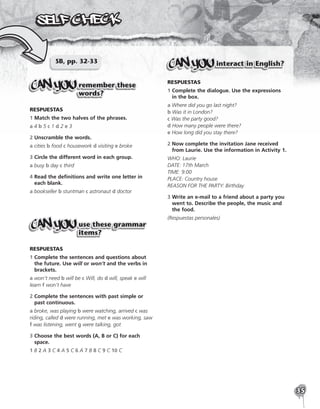
  • 52.
    51 7 Unscramble the questionsand answer. » » Los alumnos leen y completan la sección Grammar. (Respuestas: not, Have, have, haven’t) » » Corrija con toda la clase. » » Los alumnos ordenan las preguntas y las responden en sus cuadernos. » » Corrija oralmente. RESPUESTAS a Have you ever climbed a mountain? Yes, I have. b Have you ever flown a plane? No, I haven’t. c Have you ever met a famous singer? Yes, I have. d Have you ever won a prize? Yes, I have. » » Vea el Grammar Summary pp. 79-81 para mayores explicaciones y actividades de práctica. 8 Read and complete the blanks. Then, listen and check. » » Los alumnos leen el diálogo y completan las preguntas. » » Reproduzca la pista 30 de a una línea por vez. Los alumnos verifican sus respuestas. » » Pida a algunos alumnos que lean las frases y corrija la entonación si lo ve necesario. Rob: Have you ever been to the US? Carla: Yes, I have. Rob: Have you ever visited Niagara Falls? Carla: Yes, I have. Rob: Have you ever seen a grizzly bear? Carla: No, I haven’t. 30 RESPUESTAS (Ver en transcripción #30) 9 Interview a partner about his / her experiences and complete the table below. » » Lea los textos en la tabla y enseñe el vocabulario nuevo. » » Los alumnos copian la tabla y trabajan en parejas. Uno le hace al otro las preguntas sugeridas. » » Pida a los alumnos que digan qué cosas ha hecho su compañero. 30 Divida la clase en grupos de entre cuatro y seis alumnos. En una hoja, cada alumno describe una experiencia que haya tenido. Asegúrese de que usan la forma correcta del participio pasado. Los alumnos colocan sus papeles en el centro del grupo. Por turnos, los alumnos sacan un papel y leen en voz alta el escrito. El resto del grupo adivina quién lo escribió. Para finalizar la actividad, pida a los grupos que le cuenten al resto de la clase una o dos experiencias interesantes que haya vivido algún integrante del grupo. discuss other people’s experiences? SB, pp. 48-49 Objetivos • Presentar el presente perfecto en tercera persona. • Practicar la identificación de géneros narrativos a partir de la tapa de los libros. • Practicar la lectura de un perfil para detectar información específica. • Proporcionar práctica controlada de: – She has written romantic novels. – She hasn’t jumped out of planes. – Has she led an adventurous life? – No, she hasn’t. • Presentar opuestos que empiezan con un-. • Presentar vocabulario sobre cine. • Presentar el presente perfecto vs el pasado simple. • Practicar la escucha en busca de información específica. • Proporcionar práctica controlada de: – He has made a lot of romantic films. – He starred with Cameron Diaz.
  • 53.
    52 UNIT 6 Warmer – Dibuje untablero de ta-te-tí con nueve recuadros en el pizarrón. Escriba el infinitivo de un verbo irregular en cada uno. – Para modelar la actividad, juegue al ta-te-tí con la clase. Para ganar un recuadro un jugador debe decir el participio pasado de ese verbo correctamente. – Pida a los alumnos que dibujen sus propios tableros con otros verbos. Los alumnos siguen jugando en parejas o grupos de cuatro. READING 1 Look at the book covers. What kind of novels are they? » » Pregunte a los alumnos cuáles son los títulos de los libros que se ven en las ilustraciones (Broken Hearts y Island Magic) y quién es el autor (Leticia Love). » » Lea los cuatro géneros narrativos de las opciones y asegúrese que los alumnos entienden su significado. Pregúnteles qué tipo de novelas son. RESPUESTAS c romance 2 Read the article and write T (true) or F (false). » » Los alumnos leen el artículo acerca de Leticia Love e indican si las oraciones son verdaderas o falsas. » » Los alumnos comparan sus respuestas en parejas. » » Corrija con toda la clase; pida a los alumnos que corrijan las oraciones falsas. RESPUESTAS a F. Leticia Love’s real name is Mary Smith. b F. Mary is completely unlike the heroines in her novels. c F. She has not led a very adventurous life. d T e F. She lives alone with her cats. f F. She thinks it is easier to invent daring and kind men than it is to find them. GRAMMAR IN USE: present perfect (has done) Escriba estas oraciones en el pizarrón: She has written romantic novels. She hasn’t jumped out of planes. Has she led an adventurous life? No, she hasn’t. Explique: – usamos el verbo auxiliar has con he / she / it + el participio pasado del verbo principal para armar oraciones en presente perfecto (present perfect). 3 Complete the sentences. » » Los alumnos leen y completan la sección Grammar. (Respuestas: has, not, Has, has, hasn’t) » » Los alumnos leen y completan las oraciones. » » Corrija oralmente. RESPUESTAS a He has climbed Mount Everest. b She has never eaten Japanese food. c Has Mary ever met a famous person? d Leticia has not led an adventurous life. e The heroine has visited Rome. » » Vea el Grammar Summary pp. 79-81 para mayores explicaciones y actividades de práctica. 4 Daniel Daring is a hero from one of Leticia Love’s novels. Write about what he has and has not done in his life. » » Explique que Daniel Daring es uno de los personajes principales de las novelas de Leticia Love. Los alumnos escriben acerca de lo que este personaje ha hecho en su vida. » » Corrija con toda la clase. RESPUESTAS Daniel has seen the Egyptian Pyramids. He hasn’t visited the Eiffel Tower. He has ridden an elephant and he has fallen in love. He hasn’t worked in a factory and he hasn’t baked a cake.
  • 54.
    53 VOCABULARY: opposites withun- 5 Make the opposite of the adjectives by adding un-. » » Escriba el primer adjetivo en el pizarrón; explique que algunos adjetivos en inglés permiten agrega el prefijo un- para transformarlos en sus opuestos. » » Los alumnos escriben los demás en parejas. » » Corrija con toda la clase. RESPUESTAS a adventurous – unadventurous b romantic – unromantic c realistic – unrealistic d intelligent – unintelligent e kind – unkind f friendly – unfriendly LISTENING 6 Who is your favourite actor or actress? Why? What films has he / she starred in? » » Los alumnos discuten las preguntas en parejas. » » Luego pida a algunos alumnos que compartan sus ideas con toda la clase. 7 Listen. Tick (✓) the words the speakers say. » » Reproduzca la pista 31. Los alumnos tildan las palabras que dicen los hablantes. Boy: Hey, Linda, who’s your favourite actor? Linda: Let me give you a hint: he’s very handsome. Boy: Er, Ben Affleck? Matt Damon? Linda: No, but he’s been an actor for a long time. He starred in some TV programmes when he was just fifteen years old. Boy: Wow! OK. Give me another hint. Linda: OK. During his career, he’s acted in films with Johnny Depp, Cameron Diaz and Tom Hanks. Boy: Hmm. This is difficult. Linda: OK. Well, he’s acted in a lot of romantic films. In 1996, he played Romeo in a modern version of Romeo and Juliet. Boy: Oh, OK! I think I know. He’s made three films with Martin Scorsese: The Aviator, The Departed and... Gangs of New York, right? Linda: Yeah, that’s right, but his most famous film is about a big boat. 31 » » Corrija con toda la clase. 31 RESPUESTAS handsome, TV programmes, Romeo 8 Listen again. Which Hollywood star are they talking about? » » Reproduzca el audio nuevamente. » » Pregunte de quién están hablando (Leonardo DiCaprio). Using the transcripts Si quiere aprovechar los audios un poco más, fotocopie una de las transcripciones (y amplíela si es posible). Corte la transcripción en tiras para que cada línea de la conversación quede en una de ellas. Dé una tira a cada alumno. Los alumnos caminan por el aula leyendo en voz alta su texto hasta que encuentran al que tiene el inmediatamente anterior y posterior al de ellos. Los alumnos se paran en el orden correcto y leen la conversación en voz alta. Si puede, dé a cada alumno una copia del texto completo y reproduzca el audio para que ellos lo sigan. GRAMMAR IN USE: present perfect vs past simple Escriba estas oraciones en el pizarrón: He has made a lot of romantic films. He starred with Cameron Diaz. Explique: – la primera oración está en presente perfecto. La segunda oración está en pasado simple. – cuando hablamos de experiencias generales, usamos el presente perfecto; cuando damos más detalles acerca de una experiencia en particular, usamos el pasado simple. 9 What verb forms do we use with these expressions? » » Si lo desea, reproduzca el audio 31 nuevamente, haciendo pausa luego de cada verbo; indique en qué tiempo verbal está y por qué. 31
  • 55.
    54 UNIT 6 » » Los alumnoscompletan la sección Grammar. (Respuestas: indefinite, definite) » » Corrija con toda la clase. » » Los alumnos discuten sus respuestas en parejas. » » Corrija oralmente. RESPUESTAS a present perfect b present perfect c past simple d past simple » » Vea el Grammar Summary pp. 79-81 para mayores explicaciones y actividades de práctica. 10 Use the expressions in Activity 9 to write a sentence about each of these people. » » Los alumnos escriben una oración acerca de cada celebridad. Invítelos a usar los disparadores de la actividad anterior (no es necesario que hablen específicamente de 2005). » » Los alumnos leen en voz alta sus oraciones; el resto de la clase dice si está de acuerdo o no. MY FAVOURITE ACTOR Pida a los alumnos que piensen en un actor o actriz que les guste. Luego pida que hagan una lista de las cosas que ha hecho esa persona. Divida la clase en grupos de cuatro o seis alumnos. Los alumnos les cuentan a sus compañeros lo que su actor o actriz favorito ha hecho. Los grupos votan por la persona más interesante y realizan un póster sobre esa celebridad. Luego comparten sus trabajos con el resto de la clase. read about a celebration? SB, p. 50 Objetivos • Leer un artículo para captar el contenido en términos generales. • Leer un artículo en busca de información específica. 1 What do you know about Valentine’s Day? » » Escriba las palabras Valentine’s Day en el pizarrón. Pida a los alumnos que le digan lo que saben sobre el Día de San Valentín. Anote lo que digan en el pizarrón. 2 Read the article to check. » » Dé a los alumnos 30 segundos para mirar el artículo y ver si menciona alguna de sus sugerencias. » » Para verificarlo, pida a los alumnos que digan cuál de los puntos menciona el artículo. 3 Answer the questions. » » Los alumnos leen el artículo más detenidamente y escriben las respuestas a las preguntas. » » Los alumnos comparan sus respuestas en parejas. » » Corrija oralmente. RESPUESTAS a On 14th February. b It isn’t certain. Some people think he was a priest in Roman times. c At the beginning of the seventeenth century. d They went from house to house singing in honour of St Valentine and collecting small gifts. e At the end of the seventeenth century. f A billion. g By giving roses, by having a meal in a restaurant or by posting romantic messages on social networks. 4 What do these expressions mean? » » En parejas, los alumnos discuten el significado de las expresiones. Invítelos a usar diccionarios si los necesitan. » » Explique lo que significan esas expresiones.
  • 56.
    55 RESPUESTAS Lovesick: unhappy becauseof love; head over heels in love: completely in love; blinded by love: you are so in love with a person that you can not see the flaws in this person; mad about someone: very much in love with someone 5 Have you ever sent a Valentine card? What did you write? » » Pregunte a algunos alumnos si alguna vez han enviado una tarjeta de San Valentín. Pida que le digan qué decía esa tarjeta (si no les da mucha vergüenza). Lea las sugerencias con toda la clase. Pida a los alumnos que escriban un mensaje de San Valentín. Luego invítelos a que lean sus escritos y verifiquen la ortografía. Luego, leen sus textos nuevamente y prestan atención a la sintaxis y a la puntuación. Los alumnos dan ejemplos de algunas correcciones que hayan hecho; escríbalas en el pizarrón y discútalas con toda la clase. write a poem? SB, p. 51 Objetivos • Escribir un poema simple que tenga rima. • Evaluar el aprendizaje de los alumnos. 1 Read the Valentine poems. Find words that rhyme. » » Los alumnos leen rápidamente los poemas de San Valentín; pregúnteles cuál es su preferido. » » En parejas, los alumnos encuentran palabras que rimen dentro de cada poema; dígales que les será más fácil si leen los poemas en voz alta. » » Corrija con toda la clase. RESPUESTAS Blue / you, there / stare, mine / Valentine » » Señale que los poemas de San Valentín suelen contener cuatro líneas y que la segunda y cuarta línea son las que riman. 2 Work in pairs. Make a list of more words that rhyme in English. » » En parejas, los alumnos hacen una lista de otras palabras que rimen en inglés. Puede dar algunos ejemplos: night – write, date – eight, etc. » » Escriba las palabras en el pizarrón. 3 Choose some of your words and write your own Valentine poem. » » Las parejas escriben sus propios poemas de San Valentín. » » Puede pedir a los alumnos que lean sus poemas en voz alta o, si lo desean, pueden exhibirlos en la cartelera del aula. My progress – Los alumnos completan la grilla de autoevaluación. – Repase cada línea con la clase para identificar las áreas en las que los alumnos tienen menos seguridad. – Recoja los libros de los alumnos y trate de escribir un comentario en cada uno antes de devolverlos. Para los alumnos que se dieron una baja puntuación, trate de encontrar un momento tranquilo de la clase para ver qué problemas tienen y sugerir cómo pueden resolverlos. Más practica - pp. 120-125 – A manera de cierre, no olvide asignar las actividades del Practice Book correspondientes a esta unidad. Pueden realizarse en el aula o como tarea para el hogar, dependiendo del tiempo disponible. Evaluación End-of-year Test: pp. 72-73
  • 57.
    56 SB, pp. 52-53 Objetivos •Repasar vocabulario de las unidades anteriores. • Presentar vocabulario relacionado con pasatiempos. • Expandir el conocimiento que los alumnos tienen de otras culturas. • Estimular la creatividad de los alumnos. 1 Complete the profiles on page 53 with the sports below. » » Los alumnos miran las fotos en las páginas 52 y 53 y le dicen qué deportes o actividades representan. » » En parejas, leen rápidamente los textos y escriben el nombre del deporte que corresponde a cada perfil de la página 53. RESPUESTAS a 2 b 3 c 1 » » Pregunte a los alumnos qué pasatiempo tienen: Do you like playing sport? What else do you do on your free time? 2 Read what the teenagers say. With a partner, discuss which countries you think they come from. Explain why. » » Pida a las parejas que lean los perfiles más detenidamente y deduzcan a qué países pertenecen esas personas. » » Las parejas comparten sus ideas con la clase. ¿Están todos de acuerdo? RESPUESTAS Hay varias respuestas posibles, por ejemplo: 1 India 2 Australia 3 The USA » » Si lo desea, pida a los alumnos que encuentren las respuestas a estas preguntas: How long does a cricket match last? Who practises more during summer? Who is best at his / her sport? Which person do you want to meet? Acepte cualquier respuesta razonable a estas preguntas, mientras los alumnos las puedan justificar. 3 Use these questions to share information about the sports. Work in pairs. » » Los alumnos responden las preguntas en parejas. Circule por el aula brindando ayuda con el vocabulario nuevo. » » Luego, las parejas comparten algunas de sus respuestas con la clase. 4 Find out about pastimes or sports in your class. Interview a partner. » » Los alumnos leen la lista de preguntas. Pídales que piensen otras preguntas. Pueden usar algunas de las ideas de la página 53 si lo desean. » » Las parejas se entrevistan unas a otras y anotan las respuestas de sus compañeros. 5 Create a pastimes magazine about your class. » » Los alumnos usan sus notas para escribir un artículo acerca del pasatiempo de su compañero. Pueden agregar imágenes para ilustrar sus artículos. » » En grupos, los alumnos unen sus artículos para crear revistas. Exhiba estas revistas en un lugar del aula para que los alumnos puedan verlas. » » Los alumnos votan cuál es la que más les gusta. » » Nota: Si en la escuela tienen acceso a Internet, puede sugerir que realicen sus revistas con una herramienta web, por ejemplo: https://madmagz.com/ u otra similar.
  • 58.
    57 SB, pp. 54-55 rememberthese words? RESPUESTAS 1 Circle the different word in each group. a teeth b tall c travelled d adventurous 2 Make opposites with un- and complete the sentences. a unadventurous b unfriendly c unkind d unrealistic e uncomfortable 3 Read the sentences and find the missing word. a fingers b sunbathe c rope d helmet e skate 4 Find eight feelings in the wordsearch B A S L D E K E Z O T O B R I N T E R E S T E D L O I R Q T P G M L L V Y S R C R B O R M O G E R L W E O I V P E H W O R R I E D N T O C S H N H F E Q E X F A N W S I J I P G D B U U T D V E X C I T E D Y D S E P M D E J K A Z Y C I E D I F Y L E J T I R E D D O C R E L A X E D B O R use these grammar items? RESPUESTAS 1 Complete the article with the present perfect of the verbs in brackets. a has sold b has been c has played d have sung e has composed f has recorded g has, travelled h have, flown 2 Write sentences using these prompts. a She eats chocolate when she is depressed. b If you find a four-leaf clover, you will be lucky. c If you turn off the lights, you will save energy. d If you put water in the freezer, it will become ice. e If you take the last bus, you won’t be on time. f He sings if he is happy. 3 Write the past participle of these verbs. a cried b eaten c had d tried e been f met g seen 4 Choose the correct option. a 1 b 2 5 Choose the best words (A, B or C) for each blank. 1 B 2 B 3 C 4 A 5 A 6 B 7 C 8 A 9 A 10 B interact in English? RESPUESTAS 1 Complete the dialogue with the phrases in the box. a Look at b Have you seen it? c You haven’t seen d I saw it last week e I haven’t
  • 59.
    58 UNIT 1 FUTURE WITHWILL PAGES 56-57 1 a will live b will get married c will meet d will work e will be f will learn 2 a You won’t live in a beautiful house. b Your friend won’t get married. c They won’t meet an alien. d She won’t work on a spaceship. e It won’t be sunny tomorrow. f We won’t learn five languages. 3 a Will your sister buy a new computer? b Will he be famous? c Will we win the championship? 4 a Yes, he will. / No, he won’t. b Yes, she will. / No, she won’t. c Yes, they will. / No, they won’t. d Yes, I will. / No, I won’t. e Yes, it will. / No, it won’t. f Yes, it will. / No, it won’t. 5 a I will / won’t rent a car. b I will / won’t eat lots of delicious food. c I will / won’t sunbathe and read all day. d I will / won’t switch off my smartphone. e I will / won’t write lots of online messages. UNIT 2 PAST SIMPLE (REGULAR VERBS) PAGES 58 1 a smiled b waited c solved d crossed e turned f ordered g studied h hated PAST SIMPLE (IRREGULAR VERBS) PAGES 59-61 1 a wore b drank c ran d took e made f ate g saw h became i met 2 Regular verbs: talk - talked, work - worked, play - played, travel - travelled, watch - watched, wear - wore, wear - wore Irregular verbs: be - was, take - took, have - had, get - got, do - did 3 (Respuestas posibles) a had a cup of tea b arrived at 8:00 c went d got up e were f we had breakfast g he played tennis h did 4 a He didn’t arrive at school at 8:25. b Our class didn’t start at nine o’clock. c They didn’t eat macaroni and salad for lunch. d You didn’t sleep in a tent last week. e She didn’t watch the match on TV. f I didn’t drink milk for breakfast. g He didn’t wear a jacket yesterday. h We didn’t see a good film last week. 5 a Did he arrive at school at 8:25? b Did our class start at nine o’clock? c Did they eat macaroni and salad for lunch? d Did you sleep in a tent last week? e Did she watch the match on TV? f Did I drink milk for breakfast? g Did he wear a jacket yesterday? h Did we see a good film last week? 6 a Did you see your friends? b Did it rain? c Did you swim in the sea? d Did you have an ice cream? e Did you make sandcastles? 7 W O R E F Y H A V E R R A I N E D O R W S G N K N I F G L A N O T P L E R M E T A T A L K E D A F C F O J A S L E P T H P L A Y A D R O V E S G T E T A K V E D F D I D H G L A R K Y O R N A Z S A W Y UNIT 3 PAST CONTINUOUS PAGES 62–67 1 a Peter was playing the violin. b Marie was watching Stranger Things. c Mike and Sophia were having a party. d Lisa was cooking dinner. 2 a was drinking, was eating b were reading c were sunbathing, were playing d were talking, were reading e were, watching 3 a Was your sister sleeping? b Why were they running? c What were we doing at five o’clock? d Who was talking on the phone? e Were you watching TV at nine o’clock?
  • 60.
    59 4 a Yes, itwas. b Yes, they were. c Yes, I was. d No, she wasn’t. e Yes, they were. 5 a She wasn’t sunbathing. She was walking. b She wasn’t swimming. She was feeding ducks. c They weren’t playing football. They were flying a kite. d It wasn’t sleeping. It was running. e It wasn’t raining. The sun was shining. 6 a were laughing b were having c went d saw e was watching 7 a Was he sunbathing at two o’clock? b She was running in the park. c We were not walking. We were running. d I was studying when my phone rang. e While I was walking to school, I saw a dog bite a policeman. f Tom’s car broke down while he was driving home. g While we were sunbathing, Tom fell asleep. 8 (Respuestas personales) UNIT 4 SHOULD / SHOULDN’T PAGE 68-69 1 a You should study harder. b She should be here before midnight. c We should keep our classroom tidy. d They shouldn’t run so fast. e They should warm up before they start exercising. f You shouldn’t eat so many sweets. 2 a You should study all the road signs. You shouldn’t panic if you make a mistake. b You should go to the gym. You shouldn’t eat fast food. c You should study a foreign language. You shouldn’t always go to the same places. 3 (Respuestas posibles) a You shouldn’t run so fast. b You should play outside. c You should write them down. d You should take some vitamins. e You shouldn’t panic if you make a mistake. COMPARATIVE FORM OF ADJECTIVES (1) PAGES 70-73 1 + -er: cold-er, old-er, kind-er, short-er, dark-er, near-er + -ier: pretty-ier, hungry-ier, easy-ier Double final consonant + -er : fit-ter, wet-ter Irregular: good-better 2 a larger b longer c hotter d smaller e fatter f worse g prettier h younger i sunnier j slimmer k dirtier 3 a larger b hotter c sunnier d younger e prettier f longer g worse h smaller i fatter 4 a is cleaner than b is heavier than c is taller than d is faster than e is noisier than f is stronger than 5 (Respuestas posibles) The city is noisier than the country. The country is prettier than the city. The country is quieter than the city. In the city, buildings are bigger than in the country. In the country, life is better than in the city. In the city, traffic is worse than in the country. The country is cleaner than the city. 6 (Respuestas posibles) a Selena Gómez is prettier than Taylor Swift. b I am younger than my best friend. c Football is better than volleyball. d My mum is older than my dad. e Dogs are friendlier than cats. f Cars are faster than motorbikes. g My Maths book is heavier than my Science book. h Chocolate is tastier than ice cream. i Spiders are worse than snakes. COMPARATIVE FORM OF ADJECTIVES (2) PAGES 74–75 1 + -er, -r, -ier: dirtier, faster, fatter, larger, longer, nicer, louder, smaller, bigger, younger, sunnier more: more interesting, more dangerous, more difficult, more boring, more beautiful, more important irregular: worse, better 2 a more boring b fatter c sunnier d more exciting e taller 3 (Respuestas posibles) a A tablet is more expensive than a smartphone. b Japanese is more difficult than English. c Reading a novel is more amusing than watching a film. d Italian food is tastier than English food. e The beach is more beautiful than the mountain.
  • 61.
    60 4 a Thehandbag is more expensive than the hat. b The boy is cleaner than the girl. c The cat is bigger than the dog. d The snake is more dangerous than the goldfish. UNIT 5 ZERO CONDITIONAL PAGE 76 1 a When my brother is nervous, he is very quiet. b When I’m worried, I can’t sleep. c When I’m hungry, I eat some toast. d When my friend is angry, he is very rude. e When my dad is bored, he watches golf on TV. f When Tom lies, he smiles a lot. 2 (Respuestas personales) FIRST CONDITIONAL PAGES 77-78 1 a We’ll have a party b I will go and see him c We’ll come and visit you d we’ll go skiing e I’ll lend you that book f They’ll call us 2 a won’t, sweeps b will lose, doesn’t c will go, asks d rains, will stay e ring, will tell f Will you give, asks 3 a goes, will visit b will take, aren’t c Will you come, drives d go, will miss e is, will not have f will be, eat 4 a If you do not learn the road signs, you will not pass your driving test. b If he oversleeps again, he will lose his job. c If it is rainy, I will stay in bed. d If you do not eat vegetables, you will not have all the necessary vitamins. e If you come to my house, you can play with my computer. f If I go shopping, I will buy a new pair of jeans. 5 (Respuestas posibles) a I will buy a T-shirt if I go shopping with my friends on Saturday. b I will see a horror film if I go to the cinema this weekend. c I will call my best friend when I get home tonight. d I will go to my grandmother’s house if I go out tonight. e I will go home at 11:00 p.m. if I go out on Saturday. f I will watch TV if it rains next weekend. UNIT 6 PRESENT PERFECT PAGE 79-81 1 Regular: turned, cried, opened, cooked, started, studied, closed, waited, wanted Irregular: drunk, made, sent, eaten, read, written, seen, been, done, come 2 a have listened b have moved c have seen d has written e have answered 3 a I haven’t listened to Shakira’s new album. Have I listened to Shakira’s new album? b They haven’t moved to Madrid. Have they moved to Madrid? c We haven’t seen Peter Lanzani’s new film. Have we seen Peter Lanzani’s new film? d He hasn’t written an e-mail and he isn’t waiting for an answer. Has he written an e-mail and is he waiting for an answer? e I haven’t answered all the questions. Have I answered all the questions? 4 a Have you ever been to London? b She hasn’t seen that film. c We have never met them. d Our team hasn’t won the match. e Has he ever eaten Japanese food? f They have never been to a concert. 5 a Have you ever visited the Museum of Fine Arts in Buenos Aires? Yes, I have. / No, I haven’t. b Have you ever been abroad? Yes, I have. / No, I haven’t. c Have you ever played tennis? Yes, I have. / No, I haven’t. d Have you ever met a famous person? Yes, I have. / No, I haven’t. e Have you ever cooked dinner for your family? Yes, I have. / No, I haven’t.
  • 62.
    61 UNIT 0 PAGE 82 1 aam b am c am d is e is f is g is h is i is 2 (Respuestas personales) 3 (Respuestas personales) 4 a were b was c were d was e was 5 (Respuestas personales) PAGE 83 1 a 2 b 1 c 3 d 6 e 5 2 a are having. b is, doing c ’s playing d is, doing e ’s reading 3 b Is Jane reading? No, she isn’t. She’s playing chess. c Is Guy eating? No, he isn’t. He’s reading the words of a new song. d Is Lenny drinking? No, he isn’t. He’s speaking to Carla. 4 (de arriba abajo) i, a, e, b, g, j, h, d, c 5 a him b her c them d it e them PAGE 84 1 Donna: Canadian; fourteen; music, going to the cinema, animals; housework, getting up early; cycling, swimming; guitar Katsuo: Japanese; fourteen; animals, computer games; homework; baseball, football; smartphone Helena: Greek; fourteen; art, reading, listening to music; heavy metal; swimming; cat You: (respuestas personales) 2 a He’s fourteen. b No, she hates it. c Yes, she does. d She loves her cat and swimming. 3 (Respuesta posible) Helena. They both like music, swimming and animals. PAGE 85 1 (Respuesta personal) 2 a Monica b David c Jim d Tom e Rob 3 b c d 4 a b, c b a, d 5 a up b down PAGE 86 1 a Geza b Affleck c California d actor e Matt Damon and Gwyneth Paltrow f motorcycles g flying 2 a We’re playing football. b What are you reading? c Are you drinking a coffee right before going to bed? d Sorry, she is having a shower. e What are you eating? f Why are you standing there? I’m waiting for Karen. 3 (Respuesta personal) 4 a her b him c you d it e them 5 a Bob was b The dog was c Sally was d Tom and Jen were e The students were PAGE 87 - MY WORDS a Actions b Clothes c Time expressions d Personal information UNIT 1 PAGE 88 1 a We will live for more than one hundred years. b Computers will talk to us. c Robots will do the housework. 2 a 5 b 1 c 4 d 2 3 (Respuestas personales) 4 (Respuestas personales) 5 a 3 b 1 c 2 d 5 PAGE 89 1 a 1 b 4 c 2 2 a Will I get ill next year? b Will my sister be nicer to me next week? c Will I get a new video game for my birthday? d Will I be famous sometime in the future? 3 a people go on holiday? b people drive? c people play? d people read digital books? e walk the dogs? 4 (Respuestas personales) 5 (Respuestas posibles) a Who will win the next World Cup? b Who will be the next James Bond? c Who will win the Academy Award for best original song? PAGE 90 1 a 2 b 4 c 3 d 1 e 5 2 a free b download c virtual classroom d robot e smart homes
  • 63.
    62 PAGE 91 1 (Respuestaspersonales) 2 a ✓ b ✓ c ✓ e ✓ 3 a F b T c F d F e T PAGE 92 1 a will b won’t c will d won’t e will f will g will h will i Will j won’t k won’t l Will m will n won’t o will p Will q will r will s will 2 a 5 b 4 c 6 d 2 e 1 f 3 3 a Will it rain tomorrow? b Will I buy a new smartphone? c Will they get married? d Will my sister come to the party? e Will vehicles use electricity in the future? 4 (Respuestas personales) PAGE 93 - MY WORDS 1 a Life (today in the future) b Verbs c Jobs UNIT 2 PAGE 94 1 a explained b changed c viewed d watched e was f videorecorded 2 a visited b watched c didn’t enjoy d cleaned e is didn’t have f was g didn’t watch 3 explored - /d/ dance - /t/ liked - /t/ painted - /id/ looked - /t/ loved - /d/ collected - /id/ washed - /t/ ended -/id/ 4 a He watched TV. b He listened to music. c He painted a picture. 5 (Respuesta posible) First, I got up and cleaned my bedroom. Then, I visited a museum with a friend and after lunch I played basketball. Later, I listened to music and I watched TV at home. Finally, I danced at a disco all night. I talked to an alien in my dreams! PAGE 95 1 A W A S A T O O Q B E C A M E D R A G N A T W O R S P O T E E E P A E D T O O K L E N P W U S E H A D K T O P E D I D E R S R S L E P T E D T E 2 a went b were c was d did you get e got up f clothes did you wear? g wore h What did you eat? i ate j Where did you sleep? k slept 3 a you have b Did you eat c What did you d Did you go e What time did you go 4 a 2 b 5 c 4 d 1 e 6 5 a went b have c saw d listened e met f eat g ate h were i drink j drank k do l went m Did, see n didn’t see o saw PAGE 96 1 Date of birth: June 9th, 1963 Nationality: American Family: four brothers, mother Betty Sue Palmer, father John Christopher Depp. Famous films: A Nightmare on Elm Street, Edward Scissorshand, Pirates of the Caribbean, Charlie and the Chocolate Factory 2 a No, he isn’t. b His mother was a waitress and his father a civil engineer. c In various garage bands. d Twenty. PAGE 97 1 (Respuesta personal) 2 b 3 c 2 d 2 3 no extra syllable: danced, laughed, lived, showed, studied extra syllable: hated, invited, needed, started, visited PAGE 98 1 a started b ended c travelled d crossed e arrived 2 a It started in 1804. b It started in St. Louis. c They travelled for 18 months. d They crossed the Rocky Mountains. e It ended at the Pacific Ocean. 3 a No, he didn’t. b Yes, he did. c Yes, he did. d Yes, he did. e No, they didn’t.
  • 64.
    63 4 a wasb had c tidied d drank e did not eat f was not g went h met i played j drank k did l watched 5 a Where did he go after breakfast? b Who did he meet in the park? c How long did he play basketball for? d What did he drink after the game? PAGE 99 - MY WORDS a Regular verbs b Irregular verbs c Films d Space UNIT 3 PAGE 100 1 a What was Jake doing at 11:30? He was playing tennis with Lenny. b What was Carla doing at 11:15? She was having a shower. c What were Jake and Carla doing at eight? They were at a party. 2 (Respuestas posibles) a I wasn’t having a shower. I was studying English. b I wasn’t having lunch. I was reading in the library. c I wasn’t shopping. I was having lunch. d I wasn’t studying. I was sleeping. 3 + ing: crying, seeing, telling, showing + ing: sunbathing, practising, having, making double consonant + ing: running, sitting, swimming, getting 4 a Mr Wilson was reading the newspaper. b The cat was sleeping. c The daughter was reading a book. d The baby was looking out of the window. 5 a was sunbathing b was crying c were playing d were riding PAGE 101 1 a was shouting b were chasing c was eating d was riding e was drinking 2 a The emperor wasn’t sunbathing. He was eating some grapes. b The gladiators weren’t swimming. They were fighting in the arena. c The director wasn’t lying under a tree. He was shouting, ‘Action!’. d The Roman soldier wasn’t running. He was riding a chariot. e The actress wasn’t eating. She was drinking. 3 a were you doing, We were flying to the park. b What were you doing, We were visiting the animals. c What were you doing, We were having lunch. 4 a were having, took b was waterskiing, saw c were waiting, started 5 a I was riding a horse when I fell. b They were driving through the forest when they saw a rhino. c They were having a picnic when it started to rain. PAGE 102 1 Because they thought it was a real news broadcast about an attack from Mars. 2 a ✓ c ✓ 3 a meteor b stopped c play d poisonous e observers PAGE 103 1 a Mike and David got into their boat. They rowed away from the coast. b They were swimming in the sea when the direction of the wind changed. c The waves pushed the boat back to the coast. d Andy was making a sandcastle when he saw the boat. He ran and told the lifeguards. e The lifeguards got into their Zodiac rescue boats and rescued Mike and David. 2 b She was at the library. She was doing a science project. c She was in the park. She was having a picnic. d She was at Lenny’s house. She was watching Star Wars. e She was at home. She was having dinner. 3 (Respuestas personales) 4 b They were playing American football. c She was reading. d She was making dinner. e He was sleeping. PAGE 104 1 a were you doing b were waiting c were playing d were watching e were losing 2 b 6 c 5 d 1 e 3 f 4 3 a was looking for b were escaping, arrived c was riding, fell off 4 (Respuestas posibles) a the lion escaped. b the lights went off. c the water stopped. d I fell off my bike. e it started to rain. f her friends arrived. g I saw my cousin. PAGE 105 - MY WORDS a Action verbs b Other words c Animals
  • 65.
    64 PAGE 106 -MY CULTURE DOSSIER 1 a classical music, firework display, Edinburgh Castle b military bands, Edinburgh Castle c circus, free shows 2 a The Edinburgh Military Tattoo b The Edinburgh International Festival c The Edinburgh Fringe Festival d The Edinburgh Fringe Festival 3 (Respuestas personales) 4 (Respuestas personales) UNIT 4 PAGE 108 1 G I L R U U Z H W F D H Y K O I W J F O O T B A L L X N G D B C M J O A C A P W O E G S K A T E B O A R D K S E L T E L B O W P A D S E T P E B N T M R M A B O O T S A S M U S Q N H E L M E T L D L L M A G L O V E S Y P N S 2 a googles, eyes b gloves, hands c knee pads, knees d helmet, head e skateboard, legs f football, feet g elbow pads, elbow h boots, feet and legs 3 a shouldn’t b should c should d shouldn’t 4 (Respuestas posibles) a You should wear knee pads when you go roller-skating. b You should wear sunscreen when you go skiing. 5 1 c 2 d 6 (Respuesta personal) PAGE 109 1 a tall, short b noisy, quiet c fast d big, small e good 2 a Cats are cleaner than dogs. b A mouse is smaller than a cat. c Dogs are better pets than monkeys. 3 a is taller than b is heavier than c is stronger than d is longer than 4 a Lenny is worse than Carla at basketball. b Jake is worse than Lenny at volleyball. c Carla is better than Lenny at football. d Carla is worse than Jake at basketball. 5 b MONKEY c LION d WHALE e GORILLA f ZEBRA g CHEETAH h SHARK i GIRAFFE Secret animal: POLAR BEAR PAGE 110 1 2 e 3 a 4 c 5 b 2 a ✓ c ✓ PAGE 111 1 small, furry, bigger, stronger, friendly, obedient, best (Respuesta personal) 2 (Respuesta personal) 3 b A cat! It’s cleaner than a dog. c A canary! It’s quieter than a parrot. d To London! It’s cooler than in Athens. PAGE 112 1 (Respuestas posibles) a You should wear warm clothes. b You should wear a helmet. c You should wear goggles. d You should warm up first. e You should wear elbow and knee pads. 2 a shorter b faster c more dangerous d more interesting e smaller f quieter 3 a São Paulo is wetter than London. b São Paulo is hotter than London. c London is drier than São Paulo. d London is smaller than São Paulo. 4 a Elephants are bigger than hamsters. b Spiders are scarier than snakes. c Ducks are slower than cheetahs. d Parrots are noisier than cats. e Pets are better than computers! PAGE 113 - MY WORDS a Adjectives b Pets c Wild animals d Parts of the body e Sports equipment UNIT 5 PAGE 114 1 Down: 1 tired 2 excited 3 relaxed 4 bored Across: b depressed c irritated d interested 2 (Respuestas posibles) a I usually walk. b I usually take an aspirin. 3 a lonely b hungry c sleepy d lazy e worried
  • 66.
    65 PAGE 115 1 a 4b 1 c 2 2 a If you find a four-leaf clover, you will have good luck. b If you open an umbrella inside your house, you will have bad luck. c If you drop a spoon, you will have a baby. 3 a rains b rains c will sleep d will happen e get f won’t get g will use h will, do i bite j won’t bite k use 4 b If you press the alarm when there isn’t a fire, you will get a fine of $50. c If you forget to water the plant every day, it will die. d If you leave food on the table, the bears will eat it. 5 (Respuestas posibles) a you won’t get up b you’ll get wet c you’ll break something PAGE 116 1 (De arriba abajo) f, e, d, a, c 2 a If you spill some salt, you will be unlucky. b If you break a mirror, you will have seven years’ bad luck. c If you find a four-leaf clover, you will be lucky. 3 a reads horoscopes b are superstitious c don’t like the number 13 d don’t believe in horoscopes e have a lucky number PAGE 117 1 Aries, Taurus, Gemini, Cancer, Leo 2 a Leo b Aries c Cancer d Taurus e Aries f Gemini g Leo 3 (Respuesta personal) 4 a worried b irritated c bored d confused e relaxed f depressed g excited h tired i puzzled PAGE 118 1 a If you apply some sunscreen, you don’t get sunburnt. b When she is sad, she plays the piano. c We won’t go to the beach tomorrow if it rains. d Will you drink tea if there isn’t any coffee? e If I pass all my exams, I will go to the USA next summer. 2 a If I’m lonely, I don’t stay at home. b If it rains, we won’t have PE class. c When girls wear make-up, they look older. d If I don’t know the meaning of a word, I guess. 3 b 1 c 5 d 2 e 3 4 a walk, will be b will happen, see c will, do, misses 5 a bored b hungry c excited d tired 6 a spill b horseshoe c magpies d clover PAGE 119 - MY WORDS a Indefinite pronouns b Feelings c Verbs d Nouns e Star signs UNIT 6 PAGE 120 1 a I haven´t seen a football match. b I have tried human food. c I haven’t ridden a horse. 2 a swum, Yes, I have. / No, I haven’t. b ridden, Yes, I have. / No, I haven’t. c slept, Yes, I have. / No, I haven’t. d put up, Yes, I have. / No, I haven’t. e eaten, Yes, I have. / No, I haven’t. f seen, Yes, I have. / No, I haven’t. 3 a flewn b Have, swum c Have, eaten d Have, drunk e Have, run 4 B P M A K E W A O Y E T G N E H D O E G D E G O K T T Y I R Z B E M R S P E A K W F A L V A C H R S S G I T D A I Y W P K Y L V T W I N F C E E E B M O Q R U N W J O R I D E E make, made, made go, went, gone speak, spoke, spoken win, won, won run, ran, run ride, rode, ridden write, wrote, written meet, met, met swim, swam, swum eat, ate, eaten have, had, had PAGE 121 1 a romantic b adventure c kind d happy 2 a adventurous b romantic c happy d kind 3 a has never worked b has never gotten up c has met d has eaten e has swum f has climbed g has never been
  • 67.
    66 4 a did theywin it b has c did, break d has, change e has f did he change g changed teams 5 b 4 c 2 d 3 e 1 PAGE 122 1 (de arriba abajo) b, a, c 2 GUY FAWKES NIGHT Who: The British What: Big firework displays, light bonfires to burn life-sized images called guys. Why: to remember Guy Fawkes, a Catholic conspirator, who wanted to plant a bomb in the Houses of Parliament many years ago. HALLOWEEN What: They have parties and make lanterns out of pumpkins. Children dress in costumes and visit houses. They play a trick or a joke on the people in the house if they don’t give them sweets. When: on the evening before All Saints’ Day Why: Because that day, according to tradition, the spirits of the dead rise from their graves. PANCAKE DAY Who: normally women What: As she runs, the runner throws a pancake up and over in the air and catches it again in her pan. When: the last day before Ash Wednesday. 3 (Respuesta personal) PAGE 123 1 a Yes, he has. b He was there on October 23rd, 2003.c No, he hasn’t. d Yes, he has. e He was there on January 27th, 2004. f No, he hasn’t. g Yes, he has. h He was there on February 1st, 2004. 2 a Have you ever flown in a helicopter? b Have you ever eaten Japanese food? c Have you ever seen a shark? d Have you ever tried windsurfing? e Have you ever made a pizza? 3 a Yes, I have. b No, I haven’t. c No, I haven’t. d Yes, I have? e Yes, I have. f No, I haven’t. g Yes, I have. 4 a /t/ b /id/ c /d/ d /t/ e /id/ f /t/ PAGE 124 1 a Have, written b have composed c Have, recorded d Have, played e Have, sung 2 a unadventurous b intelligent c romantic novel d novelist e daring f unkind g heroine h realistic 3 a Have you ever met a famous person b did you meet c did you meet him d Have you ever been to a concert e did you see f did you see it 4 a have, taken b sang c have never met, met d met, was staying e have played, won PAGE 125 - MY WORDS a Adjectives b Celebrations c Time expressions d Irregular past participles e Regular past participles f Other words PAGE 126 - MY CULTURE DOSSIER 1 (Respuestas personales) 2 digital scrapbooking, reading, making model aeroplanes 3 a love b ’m building c fly d read e borrow f ’m reading g think h have been i combine j add k created l ’m working 4 a Jessica b Olivia c Jessica d Dylan 5 (Respuesta personal)
  • 68.
    67 DIAGNOSTIC TEST 1 a skirtb dress c trainers d T-shirt e (baseball) cap 2 a Why is Dan laughing? b Carla and Lenny are running to school. c I’m not singing opera. d Is Carla eating a hot dog? e Jake isn’t listening to the radio. 3 a walk b watch c live d is wearing / wears e likes 4 a they were. b I wasn’t. c he was. d we weren’t. e I was. 5 a Charles Dickens was born in 1812. b Where were Carla and Jake last night? c When was Lionel Messi born? d Jorge Luis Borges was a famous writer. e Where was Cleopatra born? 6 a T b F c F d T e F 7 (Respuestas personales) MID-TERM TEST 1 G F I N B S E O T D X B E C A M E M R S B S L E P T O A W G A A B E T Q N M O U H E P I M K R T A G I N T A H I U T O O K E H C T P E T Y O K V a drank b took c ate d got up e slept 2 a watched b played c visited d talked e studied 3 a had b painted c did d ended e walked 4 a a doctor b a scientist c an astronaut d a taxi driver e a cook 5 a was using / arrived b was Tania doing c broke / were playing d was cooking / started e did you eat f lived g was riding 6 a They will read digital books. b No, they won’t. c The two good things about school are that you make friends and that you learn interesting things. d Special people / Presidents and rich people will. e Jeans. 7 (Respuestas personales) END-OF-YEAR TEST 1 a Going to the cinema is more exciting than staying at home. b A hotel is more expensive than a camping site. c The Sahara desert is hotter than Texas. d The Egyptian pyramids are older than the Eiffel Tower. e A racing car is faster than a family car. 2 a When / If I am bored, I call a friend. b When / If we are happy, we laugh. c When / If she has doubts, she asks questions. d When / If you are tired, you go to bed. 3 a My friend John has recently been to Europe. b They have bought a house in Bariloche. c My dad has worked for that company. d We have watched this film twice. 4 a has cooked, haven’t eaten b went c Have (you) read d did 5 a shouldn’t b should c shouldn’t d should e shouldn’t f should 6 a she will go / will accept his invitation b she won’t go c if he works hard d he will pass his exam e if her predictions are correct 7 (Respuestas personales)
  • 69.
    Photocopiable Yes, we can! 3 © 2017 Ediciones Santillana, S. A. / Richmond Name: Date: 2 Write sentencesand questions in the present continuous using these prompts. Sally / wear / red dress / . …………………………………………………… a Why / Dan / laugh / ? …………………………………………………… b Carla and Lenny / run / to school / . …………………………………………………… c I / not sing / opera / . …………………………………………………… d Carla / eat / a hot dog / ? …………………………………………………… e Jake / not listen / the radio / . …………………………………………………… Marks: / 10 3 Write the correct form of the verbs in brackets. Simple present or present continuous? I never ………………… (listen) to the radio. a We usually ………………… (walk) to school, but today we are going by bus. b I ………………… (watch) TV in the evening. c We ………………… (live) in a big house. d Today, Lou ………………… (wear) jeans, but she usually ………………… (wear) a skirt. e Jake ………………… (like) karate and football. Marks: / 10 4 Complete the short answers. Was the party good? No, ………………. a Were John and Liz at the party? Yes, ………………. b Were you at school yesterday? No, ………………. c Was Tim at a friend’s house at five o’clock? Yes, ………………. d Were you two at the cinema last weekend? No, ………………. e Were you a famous astronaut when you were 30? Yes, ………………. Marks: / 5 5 Unscramble the sentences and write them down. singer / Michael Jackson​​ / a / was / . …………………………………………………… a 1812 / in / Charles Dickens / born / was / . …………………………………………………… b night / were / Carla and Jake / last / Where / ? …………………………………………………… c Lionel Messi / was / born / When / ? …………………………………………………… d famous / was / Jorge Luis Borges / a / writer / . …………………………………………………… e was / Cleopatra / born / Where / ? …………………………………………………… Marks: / 5 1 Label these pictures. Marks: / 10 Sally is wearing a red dress Jacket listen it wasn´t Michael Jackson was a singer a ………………… ………………… b ………………… c ………………… d ………………… e …………………
  • 70.
    Photocopiable Yes, we can! 3 © 2017 Ediciones Santillana, S. A. / Richmond Name: Date: ...................................................................... ...................................................................... ...................................................................... ...................................................................... ...................................................................... ...................................................................... TOTAL: /70 6 Read and decide if these sentences are true (T) or false (F). WHAT DO YOU USUALLY WEAR? PAUL I usually wear jeans and a T-shirt, but in summer I like wearing shorts. We can’t wear jeans to school, so I wear trousers and a shirt, and a sweater in the winter. I sometimes wear a baseball cap, but I don’t wear it at home. Today’s my brother’s birthday and we’re going to a very expensive restaurant. I’m wearing black trousers, a blue jacket and a white shirt. I’m not wearing my baseball cap! LISA At home I like wearing jeans and T-shirts. At school we wear a uniform: a white shirt and a grey skirt. We can’t wear trainers. I hate my uniform! Tonight I’m going to a friend’s party, so I’m wearing a dress and my new purple headband! It looks great! https://www.whatdoyouusuallywear.com/comments/ We asked two teenagers to tell us about their fashion likes and dislikes. Paul doesn’t like T-shirts. …… a Paul doesn’t wear a baseball cap at home. …… b Lisa wears jeans at school. …… c It’s Paul’s sister’s birthday. …… d Lisa is going to a party. …… e Paul’s trousers are blue. …… Marks: / 10 7 Complete your profile. Then, write a paragraph about you. Marks: / 20 F
  • 71.
    Photocopiable Yes, we can! 3 © 2017 Ediciones Santillana, S. A. / Richmond Name: Date: 4 Match thejobs to the pictures. a b c d e f f a cashier a doctor a taxi driver a scientist an astronaut a cook Marks: / 5 5 Complete the sentences with the verbs in brackets. Use past simple or past continuous. Bill ………………………… (watch) TV at 7:00. a Vince ……………………… (use) the Internet when his girlfriend …………………… (arrive). b What ………………………… (Tania do) at 1:00? c I …………………… (break) the window when we …………………… (play) football. d Sam ……………………… (cook) dinner when it ……………………… (start) to rain. e What ……………………………… (you eat) for dinner yesterday? f Liz ………………… (live) in Paris for three years. g I …………………… (ride) my bike when I fell. Marks: / 10 1 Find and write the simple past of these verbs. G F I N B S E O T D X B E C A M E M R S B S L E P T O A W G A A B E T Q N M O U H E P I M K R T A G I N T A H I U T O O K E H C T P E T Y O K V become …………………… a drink …………………… b take …………………… c eat …………………… d get up …………………… e sleep …………………… Marks: / 5 2 What did Tom do yesterday? Unscramble the words to find the verbs. Tom codkoe dinner. …………………………… a Tom dechwat TV. …………………………… b He yedpal basketball. …………………………… c He tisdive his cousin. …………………………… d He kledat to a friend. …………………………… e He dustdie French. …………………………… Marks: / 10 3 Complete the sentences with the simple past of the verbs in brackets. I ………………… (get up) at 8:30 this morning. a I …………………… (have) chicken for lunch. b Picasso …………………… (paint) Guernica. c I ………………… (do) my homework last night. d The film …………………… (end) at ten o’clock. e We ………………… (walk) to school yesterday. Marks: / 10 became cooked got up was watching
  • 72.
    Photocopiable Yes, we can! 3 © 2017 Ediciones Santillana, S. A. / Richmond Name: Date: ……………………………………………………………………………………………………………………… ……………………………………………………………………………………………………………………… ……………………………………………………………………………………………………………………… ……………………………………………………………………………………………………………………… ……………………………………………………………………………………………………………………… ……………………………………………………………………………………………………………………… TOTAL: /70 6 Read Diana’s predictions about the future. Then, answer the questions. I think the world will be very different in the future. For example, everyone will live in tall buildings. Of course, there will be new technology and people will probably do less work. For example, we’ll read digital books, not paperback books. There won’t be any newsagents because everyone will download newspapers and magazines. Robots will help us at home, but people will go to work in offices and factories because they will need money. It’s nice to think that students will stay at home all day and won’t go to school, but it will be very boring to stay at home: you need to go to school to make friends, and it is interesting to learn new things. I think students will go to school. I think the big difference will be that people won’t use cars. There won’t be any petrol, so everybody will use bikes instead. That means that people will be thin and healthy. Only special people like presidents or rich people like pop stars will use planes. People will go on holiday in their own country again. People will use the Internet to see different places like India and Bali. They won’t fly there. Also, everyone will think that jeans are boring. People will wear formal clothes again. Where will people live? ……………………………………………………… a What kind of books will people read? ……………………………………………………… b Will robots work in offices? ……………………………………………………… c What are two good things about school? ……………………………………………………… d Who will travel by plane? ……………………………………………………… e What clothes will people think are boring? ……………………………………………………… Marks: / 15 7 Write five predictions about your life in the future (consider family, work, lifestyle, etc). Marks: / 15 People will live in tall buildings.
  • 73.
    Name: Date: 4 Put theverbs in brackets in the correct form, present perfect or past simple. They are still building the house. They ………………………. it yet. (not / finish) a Susan ………………. sushi but I ………………. it. (cook, not eat) b Peter isn’t at home yet. He ………………………. shopping two hours ago. (go) c ………………. you ………………. any Harry Potter books? (read) d I ………………..…. a lot of work yesterday. (do) Marks: / 8 5 Complete the sentences with should or shouldn’t. You ………………….. have breakfast before going to school. a You ………………….. smoke. b You …………………..prepare your school rucksack the night before. c You ………………….. eat hamburgers, chips and pizzas every day. d You ………………….. do some exercise or sport every day. e You ………………….. go to bed way past midnight on weekdays. f We ………………….. wait for the others to finish before we start to speak. Marks: / 12 1 Write sentences to compare the two elements. Use the adjectives in brackets. Brazil / Uruguay (big) …………………………………..……………..….. a going to the cinema / staying at home (exciting) …………………………………..……………..….. b a hotel / a camping site (expensive) …………………………………..……………..….. c the Sahara desert / Texas (hot) …………………………………..……………..….. d the Egyptian pyramids / the Eiffel Tower (old) …………………………………..……………..….. e a racing car / a family car (fast) …………………………………..……………..….. Marks: / 10 2 Write sentences using these prompts. you / heat / water / it / boil …………………………………..……………..….. a I / be / bored / I / call / a friend …………………………………..……………..….. b we / be / happy / we / laugh …………………………………..……………..….. c she / have / doubts / she / ask / questions …………………………………..……………..….. d you / be / tired / you / go / to / bed …………………………………..……………..….. Marks: / 8 3 Write sentences in the present perfect using the cues given. He / see / a ghost. …………………………………..……………..….. a My friend John / recently / be / to Europe. …………………………………..……………..….. b They / buy / a house / Bariloche. …………………………………..……………..….. c My dad / work / for that company. …………………………………..……………..….. d We / watch / this film twice. …………………………………..……………..….. Marks: / 8 should Brazil is bigger than Uruguay. If you heat water to 100 degrees , it boils. He has seen a ghost. haven’t finished Photocopiable Yes, we can! 3 © 2017 Ediciones Santillana, S. A. / Richmond
  • 74.
    Photocopiable Yes, we can! 3 © 2017 Ediciones Santillana, S. A. / Richmond Name: Date: TOTAL: /70 6 Read this dialogue. Then, complete the sentences below. FORTUNE TELLER: Hello, darling! You look worried! How can I help you? PETER: I am really anxious. I need to know what will happen in the future. FORTUNE TELLER: What would you like to know? PETER: Will I pass my exam next week? FORTUNE TELLER: Let me check my crystal ball… Um… If you study hard, you will pass the exam. PETER: Great! Also… Will Mary come with me to the cinema next Saturday? FORTUNE TELLER: Let’s see… Er… If you invite her, she will go to the cinema with you but if you don’t invite her, she won’t. PETER: Oh! I will! The last question is… Will I have a lot of money in the future? FORTUNE TELLER: Well… If you work hard, you’ll have a lot of money. PETER: That sounds great! FORTUNE TELLER: You look excited now! PETER: Thank you very much! If your predictions are correct, I will come back to see you next year! FORTUNE TELLER: That’s perfect! Thanks! a If Peter invites Mary to the cinema, ……………………………………………………………………………….. b If he doesn’t invite Mary to the cinema, ………………………………………………………………………….. c Peter will have a lot of money ……………………………………………………………………………..……… d If he studies hard, ……………………………………………………………………………………………….….. e Peter will come back to see the fortune teller next year ………………………………………………………… Marks: / 12 7 Imagine some things that will / won’t happen if you win the lottery. Write about how your life will change. Use the phrases in the box. buy a car have debts go to school travel around the world have many real friends feel depressed live in a big city be happy If I win the lottery, my life ............................................................................................................. First, ............................................................................................................................................ Second, ......................................................................................................................................... ..................................................................................................................................................... Last but not least, ........................................................................................................................ ..................................................................................................................................................... ..................................................................................................................................................... Marks: / 12
  • 75.
    74 UNIT 0 PAGE 85,ACTIVITY 2 A: This is a picture of my friends from England. This is Susan. She’s wearing a T-shirt and jeans. She’s really nice. She’s got blonde hair and blue eyes. B: Is Monica in it? A: Yes, she’s climbing a tree. And Jim’s playing football with David. David’s wearing a Liverpool shirt. He loves football. He never misses a match. B: Is this Rob? A: No, that’s Tom. He loves photography. He’s always taking pictures. Rob’s sleeping under the tree. He’s very lazy. PAGE 85, ACTIVITY 3 a Do you like football? b What kind of music do you like? c What are you doing? d Are you listening to music now? PAGE 86, ACTIVITY 2 a MAN: What are you doing after school? GIRL: We’re playing football. b MAN: What are you reading? GIRL: Premiere, a magazine about the cinema. c MAN: Are you drinking a coffee right before going to bed? GIRL: No, I’m not. This is herbal tea! d MAN: Can I speak to Jill? GIRL: Sorry, she is having a shower. Can you call back later? e MAN: What are you eating? GIRL: Cereal. f MAN: Why are you standing there? GIRL: I’m waiting for Karen. UNIT 1 PAGE 91, ACTIVITIES 2 3 WOMAN: Eh. So you want to know about your future… DANNY: That’s right… WOMAN: Now, tell me. How old are you? DANNY: I’m fifteen. WOMAN: Eh. And what exactly do you want to know? DANNY: Will I pass all my exams this y-y-year? 32 33 34 35 WOMAN: I see some books and a white horse jumping over them… yes, I think this means you will be successful. DANNY: Great! What about my girlfriend? Will I marry her? WOMAN: I can see several names in here… Does her name start with D? DANNY: Yes! It’s Donna… WOMAN: You will marry her and have a big family - three or four children maybe. DANNY: Wow! Will I be famous? Will I be a sports star? WOMAN: Fame… no, you won’t be a star but you will be happy… I see a white uniform… you will be a doctor. DANNY: What? A doctor? I hate blood, I feel sick when I see it… WOMAN: Well, you know, crystal balls are not always right… UNIT 2 PAGE 95, ACTIVITY 4 Example: A: Did Pedro Almodóvar win an Oscar in 2002? B: Yes, he did. a A: Was Antonio Banderas in Pirates of the Caribbean? B: No, he wasn’t. b A: Were Lilo and Stitch brother and sister? B: No, they weren’t. c A: Did Halle Berry win an Oscar for Monster’s Ball? B: Yes, she did. d A: Did Tom Cruise appear in The Matrix? B: No, he didn’t. e A: Did Princess Fiona marry Lord Farquaad? B: No, she didn’t. PAGE 97, ACTIVITY 2 GIRL: We’re doing a survey about young people’s habits. Can I ask you a few questions? SAM: Yes, sure. GIRL: What time did you get up last Saturday? SAM: I got up at half past ten. GIRL: Late, huh? Did you have a shower? SAM: No, I didn’t. I usually have a bath in the evening. 36 37
  • 76.
    75 GIRL: What didyou have for breakfast? SAM: Erm, a bowl of cereal and a glass of orange juice. GIRL: Did you meet your friends in the afternoon? SAM: Yes, we went to the cinema. GIRL: That’s all. Thank you very much. SAM: You’re welcome. PAGE 97, ACTIVITY 3 No extra syllable: dance, danced; laugh, laughed; live, lived; show, showed; study, studied Extra syllable: hate, hated; invite, invited; need, needed; start, started; visit, visited UNIT 3 PAGE 101, ACTIVITY 2 Example: MAN: The lions were chasing an elephant. WOMAN: The lions weren’t chasing an elephant. They were chasing an actor. a MAN: The emperor was sunbathing. WOMAN: The emperor wasn’t sunbathing. He was eating some grapes. b MAN: The gladiators were swimming. WOMAN: The gladiators weren’t swimming. They were fighting in the arena. c MAN: The director was lying under a tree. WOMAN: The director wasn’t lying under a tree. He was shouting “Action!” d MAN: The Roman soldier was running. WOMAN: The Roman soldier wasn’t running. He was riding a chariot. e MAN: The actress was eating. WOMAN: The actress wasn’t eating. She was drinking. PAGE 103, ACTIVITY 2 a MAN: Where was Carla at half past ten? LENNY: She was at PE class. MAN: What was she doing? LENNY: She was playing basketball. b MAN: Where was she at half past four? LENNY: She was at the library. MAN: What was she doing? LENNY: She was doing a science project. 38 39 40 c MAN: Where was she at six o’clock? LENNY: She was in the park. MAN: What was she doing? LENNY: She was having a picnic. d MAN: Where was she at half past six? LENNY: She was at Lenny’s house. MAN: What was she doing? LENNY: She was watching Star Wars. e MAN: Where was she at nine o’clock? LENNY: She was at home. MAN: What was she doing? LENNY: She was having dinner. PAGE 103, ACTIVITY 3 a Were you having breakfast at half past ten yesterday? b Were you playing basketball at one o’clock yesterday? c Were you watching TV at four o’clock yesterday? d Were you doing your homework at six o’clock yesterday? e Were you listening to music at nine o’clock yesterday? f Were you going to bed at half past nine yesterday? g Were you sleeping at three o’clock yesterday? PAGE 103, ACTIVITY 4 a MAN: What was Pete doing? JAKE: He was climbing a tree. b MAN: What were Rob and Jim doing? JAKE: They were playing American football. c MAN: What was Mary doing? JAKE: She was reading. d MAN: What was Jenny doing? JAKE: She was making dinner. e MAN: What was Harry doing? JAKE: He was sleeping. UNIT 4 PAGE 109, ACTIVITY 2 Example: A fish is quieter than a parrot. a Cats are cleaner than dogs. b A mouse is smaller than a cat. c Dogs are better pets than monkeys. 41 42 43
  • 77.
    76 PAGE 111, ACTIVITY3 a MAN: I want a fast car. Should I buy a Panda or a Ferrari? CARLA: A Ferrari! It’s faster than a Panda. b MAN: I want a pet. Should I buy a dog or a cat? CARLA: A cat! It’s cleaner than a dog. c MAN: I want a pet bird. Should I buy a parrot or a canary? CARLA: A canary! It’s quieter than a parrot. d MAN: I’m going on holiday. Should I go to London or to Athens? CARLA: To London! It’s cooler than in Athens. PAGE 111, ACTIVITY 4 A: Should I wear a helmet? B: Yes, you should. B: No, you shouldn´t. UNIT 5 PAGE 117, ACTIVITIES 1 2 WOMAN: Thank you for calling Tele-Horoscope, your friendly horoscope service. The predictions for next week are as follows. If you are Aries, you will have a great week at school. Don’t worry about exams – your marks will be excellent. If you are Taurus, you will meet somebody important, perhaps at school, perhaps in your neighbourhood. Gemini will have to be more careful with money. Don’t waste your pocket money on things you don’t need. If you are Cancer, smile. Everything will be wonderful for you next week. But be prepared: nothing lasts forever. Leos won’t have their best week. Try to pay more attention in class. Your schoolwork is not as good as it should be. PAGE 117, ACTIVITY 3 a Do you read horoscopes? b Do you believe in horoscopes? c Do you like the number 13? d Do you have a lucky number? e Are you superstitious? 44 45 46 47 PAGE 117, ACTIVITY 4 Example: interested a worried b irritated c bored d confused e relaxed f depressed g excited h tired i puzzled UNIT 6 PAGE 123, ACTIVITY 1 Example: A: Has he ever been to Brazil? BOY: Yes, he has. A: When was he there? BOY: He was there on November 11th, 2003. a A: Has he ever been to Malta? BOY: Yes, he has. b A: When was he there? BOY: He was there on October 23rd, 2003. c A: Has he ever been to Italy? BOY: No, he hasn’t. d A: Has he ever been to Morocco? BOY: Yes, he has. e A: When was he there? BOY: He was there on January 27th, 2004. f A: Has he ever been to the United States? BOY: No, he hasn’t. g A: Has he ever been to Egypt? BOY: Yes, he has. h A: When was he there? BOY: He was there on February 1st, 2004. i A: Has he ever been to Nigeria? BOY: Yes, he has. j A: When was he there? BOY: He was there on March 4th, 2003. PAGE 123, ACTIVITY 2 Example: A: meet a famous person BOY: Have you ever met a famous person? a A: fly in a helicopter BOY: Have you ever flown in a helicopter? 48 49 50
  • 78.
    77 b A: eat Japanesefood BOY: Have you ever eaten Japanese food? c A: see a shark BOY: Have you ever seen a shark? d A: try windsurfing BOY: Have you ever tried windsurfing? e A: make a pizza BOY: Have you ever made a pizza? PAGE 123, ACTIVITY 3 Example: A: Have you ever flown in a plane? B: Yes, I have. a A: Have you ever visited a foreign country? B: Yes, I have. b A: Have you ever seen a kangaroo? B: No, I haven’t. c A: Have you ever met a politician? B: No, I haven’t. d A: Have you ever made a cake? B: Yes, I have. e A: Have you ever dressed up for Halloween? B: Yes, I have. f A: Have you ever written a Valentine card? B: No, I haven’t. g A: Have you ever eaten pancakes? B: Yes, I have. PAGE 123, ACTIVITY 4 Example: cried a cooked b visited c tried d looked e celebrated f jumped 51 52
  • 79.
    78 Student’s Book Audio Track01 Unit 0 Page 6, activities 1 2 Track 02 Unit 0 Page 6, activity 3 Track 03 Unit 0 Page 7, activities 5 6 Track 04 Unit 0 Page 8, activity 2 Track 05 Unit 0 Page 8, activity 3 Track 06 Unit 0 Page 9, activities 7 8 Track 07 Unit 0 Page 11, activity 1 Track 08 Unit 1 Page 13, activity 5 Track 09 Unit 1 Page 14, activity 2 Track 10 Unit 2 Page 18, activities 1 2 Track 11 Unit 2 Page 18, activity 4 Track 12 Unit 2 Page 18, activity 5 Track 13 Unit 2 Page 19, activities 6 7 Track 14 Unit 2 Page 20, activities 2 3 Track 15 Unit 2 Page 21, activities 6, 7 8 Track 16 Unit 2 Page 22, activities 2, 3 4 Track 17 Unit 3 Page 24, activity 1 Track 18 Unit 3 Page 25, activities 7 8 Track 19 Unit 3 Page 25, activity 9 Track 20 Unit 3 Page 26, activities 2 3 Track 21 Unit 4 Page 35, activity 6 Track 22 Unit 4 Page 35, activity 8 Track 23 Unit 4 Page 36, activity 4 Track 24 Unit 4 Page 37, activity 8 Track 25 Unit 4 Page 39, activities 1, 2 3 Track 26 Unit 5 Page 40, activities 1 2 Track 27 Unit 5 Page 41, activity 8 Track 28 Unit 5 Page 43, activities 5 6 Track 29 Unit 6 Page 47, activities 5 6 Track 30 Unit 6 Page 47, activity 8 Track 31 Unit 6 Page 49, activities 7 8
  • 80.
    79 Practice Book Audio Track32 Unit 0 Page 85, activity 2 Track 33 Unit 0 Page 85, activity 3 Track 34 Unit 0 Page 86, activity 2 Track 35 Unit 1 Page 91, activities 2 3 Track 36 Unit 2 Page 95, activity 4 Track 37 Unit 2 Page 97, activity 2 Track 38 Unit 2 Page 97, activity 3 Track 39 Unit 3 Page 101, activity 2 Track 40 Unit 3 Page 103, activity 2 Track 41 Unit 3 Page 103, activity 3 Track 42 Unit 3 Page 103, activity 4 Track 43 Unit 4 Page 109, activity 2 Track 44 Unit 4 Page 111, activity 3 Track 45 Unit 4 Page 111, activity 4 Track 46 Unit 5 Page 117, activities 1 2 Track 47 Unit 5 Page 117, activity 3 Track 48 Unit 5 Page 117, activity 4 Track 49 Unit 6 Page 123, activity 1 Track 50 Unit 6 Page 123, activity 2 Track 51 Unit 6 Page 123, activity 3 Track 52 Unit 6 Page 123, activity 4
  • 81.
    Published by © 2017Ediciones Santillana, S. A. Leandro N. Alem 720 C1001AAP Buenos Aires, Argentina Contents provided by Richmond® First published by © Michael Downie, David Gray and John M. James © Santillana Educación, S.L. ISBN: 978-950-46-5428-5 Publisher: Mabel Manzano Editorial Team: Jane Rollason, Graham Skerritt, Marcela Silverio, Laura Estefanía, Paula Fulía Design and Layout: María Florencia Visconti Cover Design: María Florencia Visconti Cover Photograph: © rCarner/Shutterstock.com Illustrations: El Ojo del Huracán Photos: p68 M.Photos/Shutterstock.com, Karkas/Shutterstock.com, arka38/Shutterstock.com, indigolotos/ Shutterstock.com, Stockforlife/Shutterstock.com; p69 StockLite/Shutterstock.com, Luckykot/Shutterstock. com; p70 Minerva Studio/Shutterstock.com, Alexander Raths/Shutterstock.com, Vadim Sadovski/ Shutterstock.com, Diego Cervo/Shutterstock.com, Africa Studio/Shutterstock.com, Minerva Studio/ Shutterstock.com; p71 u3d/Shutterstock.com; p72 Syda Productions/Shutterstock.com; p73 ESB Professional/ Shutterstock.com; ARCHIVO SANTILLANA Recordings: iT’s Magazines, S.L., Javier Lupiañez This Teacher’s Book includes an Audio CD. Queda hecho el depósito legal que marca la ley 11.723. Impreso en Argentina. Printed in Argentina. First Edition Published 2017 Websites given in this publication are all in the public domain and quoted for information purposes only. Richmond has no control over the content of these sites and urges care when using them. All rights reserved. No part of this book may be reproduced, stored in a retrieval system or transmitted in any form or by any means, electronic, mechanical, photocopying, recording, or otherwise, without prior permission in writing from the Publisher. The Publisher has made every effort to trace the owner of copyright material; however, the Publisher will correct any involuntary omission at the earliest opportunity. Este libro se terminó de imprimir en el mes de enero de 2018 en los talleres gráficos de OSA, Ascasubi 3398, Buenos Aires, República Argentina. Downie, Michael Yes, we can! 3 : Teacher’s Book / Michael Downie ; David Gray ; John M. James. - 1a ed. - Ciudad Autónoma de Buenos Aires : Santillana, 2017. 80 p. ; 28 x 22 cm. ISBN 978-950-46-5428-5 1. Inglés. 2. Educación Secundaria. 3. Guía del Docente. I. Gray, David II. James, John M. III. Título CDD 371.1
  • 82.
    TEACHER’S BOOK AUDIOCD MICHAEL DOWNIE DAVID GRAY JOHN M. JAMES es una serie de tres niveles para la enseñanza de inglés para alumnos de 12 a 15 años. Características principales de la serie: • Contenidos sugeridos por el Ministerio de Educación • Temas de interés adaptados a la realidad de los alumnos adolescentes • Presentación clara de la gramática y el vocabulario en cada lección • Géneros textuales diversos y actividades de seguimiento y lecto-comprensión • Desarrollo de las cuatro habilidades lingüísticas: leer, escuchar, hablar y escribir • Proyectos divertidos que promueven el aprendizaje participativo, reflexivo y crítico Componentes: Student’s Book Practice Book Teacher’s Book Audio CD Acompañe con RICHMOND POCKET DICTIONARY ¡La mejor opción en diccionarios escolares bilingües! 9 789504 654285 ISBN 978-950-46-5428-5 Contents provided by - TEACHER’S BOOK + AUDIO CD