TASK BASED LEARNING
Aprendizaje Basado en
Tareas
TASK BASED LEARNING
Aprendizaje Basado en Tareas
 It is a different way to teach languages. /
Es una manera diferente de enseñar
lenguas.
 It can help the students by placing them in
a situation like in the real world. / Puede
ayudar a los estudiantes situándolos en una
situación como en el mundo real.
 A situation where oral communication is
essential for doing a specific task. / Una
situación donde la comunicación oral es
esencial para hacer una tarea especifica.
 In TBL the learner should be exposed to
as much of the foreign language as
possible in order to merely observe the
foreign language. / En ABT el aprendiz
debe ser expuesto tanto como sea posible a
la lengua extranjera para simplemente
observar la lengua extranjera.
WHAT IS A TASK?
¿Qué es una tarea?
 “TASKS are activities where the target
language is used by the learner for a
communicative purpose (goal) in order to
achieve an outcome” Jane Willis
 Las TAREAS son actividades donde el
lenguaje objetivo es usado por el aprendiz
para un propósito comunicativo para
alcanzar un resultado.
A Task / Una tarea:
 Allows for a needs analysis to be matched
to identified student needs. / Permite un
análisis de las necesidades que se ajuste a
las necesidades identificadas en los
estudiantes.
 Is supported by the research findings of
classroom-centered language learning. /
Se apoya en los resultados de las
investigaciones de aula centradas en el
aprendizaje de idiomas.
 Allows evaluation to be based on testing
referring to task-based criterion. / Permite
que la evaluación se base en las pruebas de
referencia del criterio basado en tareas.
 So we should select topics that will
motivate learners, engage their attention
and promote their language development
as efficiently as possible. / Debemos elegir
temas que motiven a los aprendices, atraer
su atención y promover el desarrollo del
lenguaje tan eficientemente como sea
posible.
What are the advantages of
TBL?
¿Cuáles son las ventajas del
ABT? Task based learning is useful for moving
the focus of the learning process from the
teacher to the student. / ABT es útil para mover
la atención del proceso de aprendizaje del
profesor al estudiante.
 It gives the student a different way of
understanding language as a tool instead of as
a specific goal. / Da al estudiante diferentes
maneras e entender el lenguaje como una
herramienta en vez de un objetivo especifico.
 It can bring teaching from abstract knowledge
to real world application./ Puede traer la
enseñanza desde el conocimiento abstracto a la
aplicación del mundo real.
 A Task is helpful in meeting the immediate
needs of the learners and provides a frame-
work for creating classes, interesting and
able to address to the students needs. / Una
tarea es útil en encontrar las necesidades
inmediatas de los aprendices y provee una
estructura para crear clases interesantes y
capaces de dirigir las necesidades de los
estudiantes.
The structural framework of TBL
Marco Estructural de ABT
Pre Task
 Raise consciousness. /Elevar la conciencia.
 Introduction to subject and task. /Introducción al
tema y tarea.
 Thorough introduction to topic by teacher use of
pictures, posters and demonstrations. /
Introducción exhaustiva al tema de uso docente de
imágenes, posters y demostraciones.
The pre-task phase introduces the class to the
topic and the task, activating topic-related words
and phrases. / La fase de pre-tarea presenta el tema y
la tarea a la clase, activando tema relacionado con
palabras y frases.
Task Cycle
 Working with and using the target language. / Trabajar
con y utilizar la lengua objetivo.
 Activities like pair work, group work. / Actividades como
el trabajo en parejas trabajo en grupo.
 Exercises like information gap activities. / Ejercicios
como actividades de completar información.
 Gradual increase in the importance of
Planning, Report, Presentation / Aumento gradual de la
importancia de la Planificación, Informe, Presentación.
 The task cycle offers learners the chance to use
whatever language they already know in order to carry
out the task, and then to improve the language, under
teacher guidance, while planning their reports of the
task./ El ciclo de tarea ofrece a los alumnos la
oportunidad de utilizar el lenguaje que ya conocen con el
fin de llevar a cabo la tarea y entonces mejorar el
lenguaje, bajo la guía del maestro, mientras se planifican
Post Task
 Selecting, identifying and classifying common words
and phrases. / Selección, identificación y clasificación
de palabras y frases comunes.
 Practice of language and phrases in classroom. /
Práctica del lenguaje y frases en el aula.
 Building personal dictionaries. / Construcción de
diccionarios personales.
 The last phase in the framework, language
focus, allows a closer study of some of the specific
features occurring in the language used during the
task cycle. / La última fase en el marco, el enfoque de
lenguaje, permite un estudio más detallado de
algunas de las características específicas que se
producen en el lenguaje utilizado durante el ciclo de
 The teaching techniques required for task-
based learning are not very different from
those of ordinary language teaching. The
differences lie in the ordering and
weighting of activities and in the fact that
there is a greater amount of student
activity, and less direct, up-from teaching.
 Las técnicas de enseñanza requeridos para el
aprendizaje basado en tareas no son muy
diferentes de los de la enseñanza ordinaria. Las
diferencias radican en el ordenamiento y la
ponderación de las actividades, y en el hecho de
que hay una mayor cantidad de actividad de los
estudiantes, y menos directa y actualizada de la
enseñanza.
Issues concerning Task Based
Learning
Problemas concernientes al ABT
 Since it encourages students to use their own
language and vocabulary, it is necessary for
the teacher to help students expand these. /
Ya que anima a los estudiantes a usar su propio
lenguaje y vocabulario, es necesario que el profesor
ayude a los estudiantes ampliar estos.
 Otherwise students will not learn new
phrases or words by them selves, but only
increase skills in using the language the
student already possesses. / De lo contrario los
alumnos no aprenderán nuevas frases o palabras
por ellos mismos, sino sólo aumenta las habilidades
en el uso de la lengua que el alumno ya posee.
 Even though after the task cycle is
complete, the learning process is not. /
Incluso después de que el ciclo de la tarea se
ha completado, el proceso de aprendizaje no lo
ha hecho.
 The evaluation part is critical for the
students to become self-aware of the
learning they have just gone through./ La
parte de la evaluación es crítica para que los
estudiantes sean conscientes de los
aprendizajes que acaba de adquirir por si
mismos.
TBL activities - Examples
Good advice. / Un buen consejo.
 Use the foreign language as much as possible. /
Utilizar la lengua extranjera como sea posible.
 Use only mother tongue when necessary for
explanation of exercises. / Utilice sólo la lengua
materna cuando sea necesario para la explicación
de los ejercicios.
 The pre-task is meant to help create a good
atmosphere for learning without anxiety. / La pre-
tarea está destinada a ayudar a crear un buen ambiente
para el aprendizaje sin ansiedad.
 Give words and supporting sentences for students
to use. / Dar palabras y oraciones de apoyo para que
los estudiantes las usen.
The pre-task must supply words, phrases, ideas to
support the individual student in the main task. / La
pre-tarea debe suministrar palabras, frases, ideas
para apoyar al estudiante en la tarea principal.
 Remember that a pre-task can be anything from
for example: / Recuerde que un pre-tarea puede ser
cualquier cosa, por ejemplo:
 An audio text. / Un audio o texto.
 A video clip / Un clip de vídeo.
 A brainstorm activity / Una lluvia de ideas.
 A small exercise ( cloze, cross word etc. ). / Un
pequeño ejercicio (palabras cruzadas, etc).
 Photos (what do you see?). / Fotos (¿qué ves?).
 A webpage ( what do you see?) / Una página web
(¿qué ves?).
 Anything that will promote the foreign
language and set the minds of the students
into a certain context and atmosphere. /
Cualquier cosa que promueva la lengua extranjera y
establecer las mentes de los estudiantes en un
determinado contexto y la atmósfera.
 The main task must facilitate a process
where each student can activate and use
his/her own strategies. / La tarea principal debe
facilitar un proceso en el que cada estudiante puede
activar y usar sus propias estrategias.
 Teacher’s role: monitoring the processes of
the students working with the main task. / El
papel del maestro: Monitorear los procesos de
los estudiantes que trabajan con la tarea
Remember the importance of the last step, the
consciousness raising activities: / Recuerde la
importancia de el último paso, la conciencia en las actividades
de recolección:
 Students repeat their process and their work with
the main task – must be performed in class – the
process will make students realize that language is
diverse and that many different structures and
words give meaning and can be used for
communication. / Los estudiantes repiten su proceso y su
trabajo con la tarea principal – se debe llevar a cabo en la clase-
el proceso hará que los estudiantes se den cuenta de que el
lenguaje es diverso y que hay diferentes estructuras y palabras
que pueden ser usadas en la comunicación..
 The teacher must pick up and draw attention to
relevant grammatical and semantic points in this last
phase of the TBL-cycle. / El maestro debe recoger y llamar
la atención sobre relevantes puntos gramaticales y semánticos
ACTIVITY
ACTIVIDAD
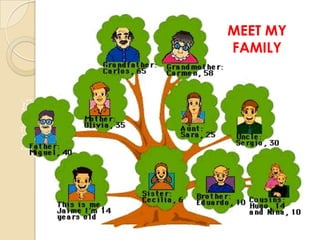
MEET MY
FAMILY
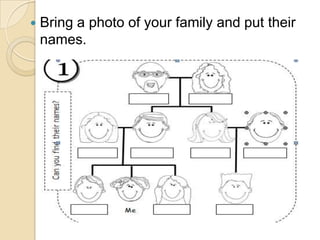
 Bring a photo of your family and put their
names.
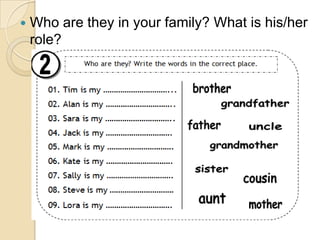
 Who are they in your family? What is his/her
role?
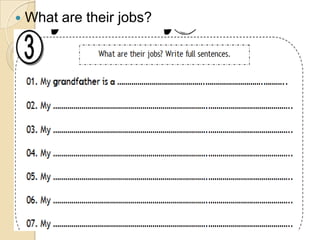
 What are their jobs?
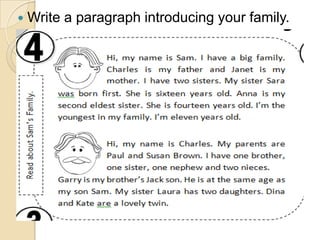
 Write a paragraph introducing your family.
 Prepare a way to introduce your family to
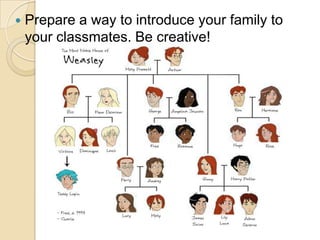
your classmates. Be creative!

Task based learning diapositivas

  • 1.
  • 2.
    TASK BASED LEARNING AprendizajeBasado en Tareas  It is a different way to teach languages. / Es una manera diferente de enseñar lenguas.  It can help the students by placing them in a situation like in the real world. / Puede ayudar a los estudiantes situándolos en una situación como en el mundo real.
  • 3.
     A situationwhere oral communication is essential for doing a specific task. / Una situación donde la comunicación oral es esencial para hacer una tarea especifica.  In TBL the learner should be exposed to as much of the foreign language as possible in order to merely observe the foreign language. / En ABT el aprendiz debe ser expuesto tanto como sea posible a la lengua extranjera para simplemente observar la lengua extranjera.
  • 4.
    WHAT IS ATASK? ¿Qué es una tarea?  “TASKS are activities where the target language is used by the learner for a communicative purpose (goal) in order to achieve an outcome” Jane Willis  Las TAREAS son actividades donde el lenguaje objetivo es usado por el aprendiz para un propósito comunicativo para alcanzar un resultado.
  • 5.
    A Task /Una tarea:  Allows for a needs analysis to be matched to identified student needs. / Permite un análisis de las necesidades que se ajuste a las necesidades identificadas en los estudiantes.  Is supported by the research findings of classroom-centered language learning. / Se apoya en los resultados de las investigaciones de aula centradas en el aprendizaje de idiomas.
  • 6.
     Allows evaluationto be based on testing referring to task-based criterion. / Permite que la evaluación se base en las pruebas de referencia del criterio basado en tareas.  So we should select topics that will motivate learners, engage their attention and promote their language development as efficiently as possible. / Debemos elegir temas que motiven a los aprendices, atraer su atención y promover el desarrollo del lenguaje tan eficientemente como sea posible.
  • 7.
    What are theadvantages of TBL? ¿Cuáles son las ventajas del ABT? Task based learning is useful for moving the focus of the learning process from the teacher to the student. / ABT es útil para mover la atención del proceso de aprendizaje del profesor al estudiante.  It gives the student a different way of understanding language as a tool instead of as a specific goal. / Da al estudiante diferentes maneras e entender el lenguaje como una herramienta en vez de un objetivo especifico.
  • 8.
     It canbring teaching from abstract knowledge to real world application./ Puede traer la enseñanza desde el conocimiento abstracto a la aplicación del mundo real.  A Task is helpful in meeting the immediate needs of the learners and provides a frame- work for creating classes, interesting and able to address to the students needs. / Una tarea es útil en encontrar las necesidades inmediatas de los aprendices y provee una estructura para crear clases interesantes y capaces de dirigir las necesidades de los estudiantes.
  • 9.
    The structural frameworkof TBL Marco Estructural de ABT Pre Task  Raise consciousness. /Elevar la conciencia.  Introduction to subject and task. /Introducción al tema y tarea.  Thorough introduction to topic by teacher use of pictures, posters and demonstrations. / Introducción exhaustiva al tema de uso docente de imágenes, posters y demostraciones. The pre-task phase introduces the class to the topic and the task, activating topic-related words and phrases. / La fase de pre-tarea presenta el tema y la tarea a la clase, activando tema relacionado con palabras y frases.
  • 10.
    Task Cycle  Workingwith and using the target language. / Trabajar con y utilizar la lengua objetivo.  Activities like pair work, group work. / Actividades como el trabajo en parejas trabajo en grupo.  Exercises like information gap activities. / Ejercicios como actividades de completar información.  Gradual increase in the importance of Planning, Report, Presentation / Aumento gradual de la importancia de la Planificación, Informe, Presentación.  The task cycle offers learners the chance to use whatever language they already know in order to carry out the task, and then to improve the language, under teacher guidance, while planning their reports of the task./ El ciclo de tarea ofrece a los alumnos la oportunidad de utilizar el lenguaje que ya conocen con el fin de llevar a cabo la tarea y entonces mejorar el lenguaje, bajo la guía del maestro, mientras se planifican
  • 11.
    Post Task  Selecting,identifying and classifying common words and phrases. / Selección, identificación y clasificación de palabras y frases comunes.  Practice of language and phrases in classroom. / Práctica del lenguaje y frases en el aula.  Building personal dictionaries. / Construcción de diccionarios personales.  The last phase in the framework, language focus, allows a closer study of some of the specific features occurring in the language used during the task cycle. / La última fase en el marco, el enfoque de lenguaje, permite un estudio más detallado de algunas de las características específicas que se producen en el lenguaje utilizado durante el ciclo de
  • 12.
     The teachingtechniques required for task- based learning are not very different from those of ordinary language teaching. The differences lie in the ordering and weighting of activities and in the fact that there is a greater amount of student activity, and less direct, up-from teaching.  Las técnicas de enseñanza requeridos para el aprendizaje basado en tareas no son muy diferentes de los de la enseñanza ordinaria. Las diferencias radican en el ordenamiento y la ponderación de las actividades, y en el hecho de que hay una mayor cantidad de actividad de los estudiantes, y menos directa y actualizada de la enseñanza.
  • 13.
    Issues concerning TaskBased Learning Problemas concernientes al ABT  Since it encourages students to use their own language and vocabulary, it is necessary for the teacher to help students expand these. / Ya que anima a los estudiantes a usar su propio lenguaje y vocabulario, es necesario que el profesor ayude a los estudiantes ampliar estos.  Otherwise students will not learn new phrases or words by them selves, but only increase skills in using the language the student already possesses. / De lo contrario los alumnos no aprenderán nuevas frases o palabras por ellos mismos, sino sólo aumenta las habilidades en el uso de la lengua que el alumno ya posee.
  • 14.
     Even thoughafter the task cycle is complete, the learning process is not. / Incluso después de que el ciclo de la tarea se ha completado, el proceso de aprendizaje no lo ha hecho.  The evaluation part is critical for the students to become self-aware of the learning they have just gone through./ La parte de la evaluación es crítica para que los estudiantes sean conscientes de los aprendizajes que acaba de adquirir por si mismos.
  • 15.
    TBL activities -Examples Good advice. / Un buen consejo.  Use the foreign language as much as possible. / Utilizar la lengua extranjera como sea posible.  Use only mother tongue when necessary for explanation of exercises. / Utilice sólo la lengua materna cuando sea necesario para la explicación de los ejercicios.  The pre-task is meant to help create a good atmosphere for learning without anxiety. / La pre- tarea está destinada a ayudar a crear un buen ambiente para el aprendizaje sin ansiedad.  Give words and supporting sentences for students to use. / Dar palabras y oraciones de apoyo para que los estudiantes las usen.
  • 16.
    The pre-task mustsupply words, phrases, ideas to support the individual student in the main task. / La pre-tarea debe suministrar palabras, frases, ideas para apoyar al estudiante en la tarea principal.  Remember that a pre-task can be anything from for example: / Recuerde que un pre-tarea puede ser cualquier cosa, por ejemplo:  An audio text. / Un audio o texto.  A video clip / Un clip de vídeo.  A brainstorm activity / Una lluvia de ideas.  A small exercise ( cloze, cross word etc. ). / Un pequeño ejercicio (palabras cruzadas, etc).  Photos (what do you see?). / Fotos (¿qué ves?).  A webpage ( what do you see?) / Una página web (¿qué ves?).
  • 17.
     Anything thatwill promote the foreign language and set the minds of the students into a certain context and atmosphere. / Cualquier cosa que promueva la lengua extranjera y establecer las mentes de los estudiantes en un determinado contexto y la atmósfera.  The main task must facilitate a process where each student can activate and use his/her own strategies. / La tarea principal debe facilitar un proceso en el que cada estudiante puede activar y usar sus propias estrategias.  Teacher’s role: monitoring the processes of the students working with the main task. / El papel del maestro: Monitorear los procesos de los estudiantes que trabajan con la tarea
  • 18.
    Remember the importanceof the last step, the consciousness raising activities: / Recuerde la importancia de el último paso, la conciencia en las actividades de recolección:  Students repeat their process and their work with the main task – must be performed in class – the process will make students realize that language is diverse and that many different structures and words give meaning and can be used for communication. / Los estudiantes repiten su proceso y su trabajo con la tarea principal – se debe llevar a cabo en la clase- el proceso hará que los estudiantes se den cuenta de que el lenguaje es diverso y que hay diferentes estructuras y palabras que pueden ser usadas en la comunicación..  The teacher must pick up and draw attention to relevant grammatical and semantic points in this last phase of the TBL-cycle. / El maestro debe recoger y llamar la atención sobre relevantes puntos gramaticales y semánticos
  • 20.
  • 21.
  • 22.
     Bring aphoto of your family and put their names.
  • 23.
     Who arethey in your family? What is his/her role?
  • 24.
     What aretheir jobs?
  • 25.
     Write aparagraph introducing your family.
  • 26.
     Prepare away to introduce your family to your classmates. Be creative!