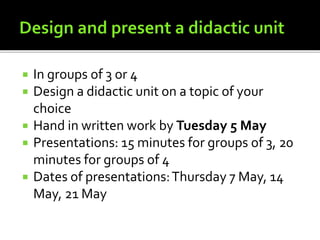
 In groups of 3 or 4
 Design a didactic unit on a topic of your
choice
 Hand in written work by Tuesday 5 May
 Presentations: 15 minutes for groups of 3, 20
minutes for groups of 4
 Dates of presentations:Thursday 7 May, 14
May, 21 May
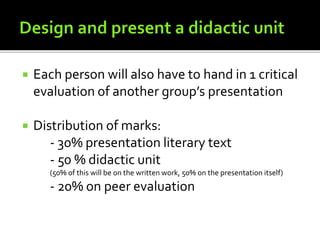
 Each person will also have to hand in 1 critical
evaluation of another group’s presentation
 Distribution of marks:
- 30% presentation literary text
- 50 % didactic unit
(50% of this will be on the written work, 50% on the presentation itself)
- 20% on peer evaluation
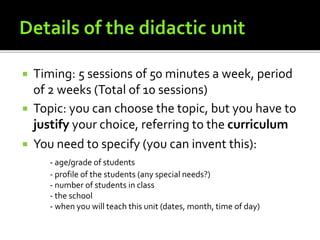
 Timing: 5 sessions of 50 minutes a week, period
of 2 weeks (Total of 10 sessions)
 Topic: you can choose the topic, but you have to
justify your choice, referring to the curriculum
 You need to specify (you can invent this):
- age/grade of students
- profile of the students (any special needs?)
- number of students in class
- the school
- when you will teach this unit (dates, month, time of day)
1. Justification (reason for choosing the topic,
situation within the curriculum)
2. Contextualization (details about school and type of
students)
3. Objectives
4. Resources
5. Methodology
6. Sequence of activities (including timing and
materials)
7. Suggestions for variation
8. Evaluation
Broad definition of the student competence
General Syllabus for Preschool Education
In Navarra, Foral Decree 23/2007, 19th March.
La Educación Infantil contribuirá a desarrollar en las niñas y niños las capacidades
que les permitan:
a) Conocer su propio cuerpo y el de los otros, sus posibilidades de acción y aprender a respetar las diferencias.
b) Observar y explorar su entorno familiar, natural y social, reconociendo en él algunas características propias
de Navarra.
c) Adquirir progresivamente autonomía en sus actividades habituales.
d) Desarrollar sus capacidades afectivas.
e) Relacionarse con los demás y adquirir progresivamente pautas elementales de convivencia y relación social,
así como ejercitarse en la resolución pacífica de conflictos.
f) Desarrollar habilidades comunicativas en diferentes lenguajes y formas de expresión.
g) Iniciarse en las habilidades lógico-matemáticas, en la lecto-escritura y en el movimiento, el gesto y el ritmo.
Describes what a teacher will cover in a course/unit.
Less broad than goals and broader than student learning outcomes.
 3 areas:
 Self-knowledge and personal autonomy
 Environment knowledge
 Language: communication and representation
1. Formarse una imagen ajustada y positiva de sí mismo, a través de la interacción con los
otros y de la identificación gradual de las propias características, posibilidades y
limitaciones, desarrollando sentimientos de autoestima y autonomía personal.
2. Conocer su cuerpo, sus elementos y algunas de sus funciones, descubriendo las
posibilidades de acción y de expresión y coordinando y controlando cada vez con mayor
precisión gestos y movimientos.
3. Identificar los propios sentimientos, emociones, necesidades o preferencias, y ser capaces
de expresarlos y comunicarlos a los demás, identificando y respetando, también, los de
los otros.
4. Realizar, de manera cada vez más autónoma, actividades habituales y tareas sencillas
para resolver problemas de la vida cotidiana, aumentando el sentimiento de
autoconfianza y la capacidad de iniciativa, y desarrollando estrategias para satisfacer
sus necesidades básicas.
5. Adecuar su comportamiento a las necesidades y requerimientos de los otros desarrollando
actitudes y hábitos de respeto, ayuda y colaboración, evitando comportamientos de
sumisión o dominio.
6. Progresar en la adquisición de hábitos y actitudes relacionados con la seguridad, la higiene
y el fortalecimiento de la salud, apreciando y disfrutando de las situaciones cotidianas de
equilibrio y bienestar emocional.
1. Observar y explorar de forma activa su entorno, generando interpretaciones sobre algunas
situaciones y hechos significativos y mostrando interés por su conocimiento.
2. Relacionarse con los demás, de forma cada vez más equilibrada y satisfactoria, interiorizando
progresivamente las pautas de comportamiento social y ajustando su conducta a ellas.
3. Conocer distintos grupos sociales cercanos a su experiencia, algunas de sus características,
producciones culturales, valores y formas de vida, generando actitudes de confianza, respeto y
aprecio.
4. Iniciarse en las habilidades matemáticas, manipulando funcionalmente elementos y colecciones,
identificando sus atributos y cualidades y estableciendo relaciones de agrupamientos,
clasificación, orden y cuantificación.
5. Conocer y valorar los componentes básicos del medio natural y algunas de sus relaciones,
cambios y trasformaciones, desarrollando actitudes de cuidado, respeto y responsabilidad en
su conservación, tomando como referencia los paisajes de la Comunidad Foral de Navarra.
1. Utilizar la lengua como instrumento de aprendizaje, de representación, de comunicación y disfrute, de
expresión de ideas y sentimientos y valorando la lengua oral como un medio de relación con los demás y de
regulación de la convivencia.
2. Expresar sentimientos, deseos e ideas mediante la lengua oral y a través de otros lenguajes, eligiendo el que
mejor se ajuste a la intención y a la situación.
3. Comprender las intenciones y mensajes de otros niños y niñas así como de las personas adultas, adoptando
una actitud positiva hacia las lenguas.
4. Comprender, reproducir y recrear algunos textos literarios mostrando actitudes de valoración, disfrute e interés
hacia ellos.
5. Iniciarse en los usos sociales de la lectura y la escritura explorando su funcionamiento y valorándolas como
instrumento de comunicación, información y disfrute.
6. Acercarse al conocimiento de obras artísticas expresadas en distintos lenguajes y realizar actividades de
representación y expresión artística mediante el empleo de diversas técnicas.
7. Iniciarse en el uso oral de otras lenguas del currículo para comunicarse en actividades dentro del aula, y
mostrar interés y disfrute al participar en estos intercambios comunicativos.
 Specify the level or criterion for the knowledge,
skill, ability that the student must demonstrate
 Include conditions under which they should be able
to demonstrate their knowledge, skills, abilities
 Contain active verbs
 Be measurable (some more easily than others)
 Do not join elements in one outcome statement
that can not be assessed by a single method
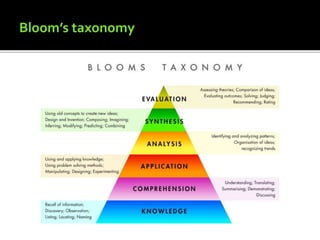
TheThree Domains of Learning
(Bloom, et al. 1956)
Cognitive: mental skills (knowledge)
Affective: growth in feelings or emotional
areas (attitude or self)
 Psychomotor: manual or physical skills (skills)
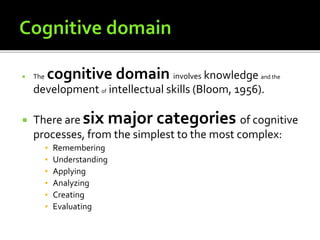
 The cognitive domain involves knowledge and the
development of intellectual skills (Bloom, 1956).
 There are six major categories of cognitive
processes, from the simplest to the most complex:
▪ Remembering
▪ Understanding
▪ Applying
▪ Analyzing
▪ Creating
▪ Evaluating
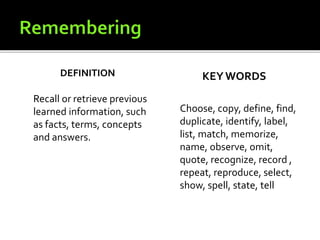
DEFINITION
Recall or retrieve previous
learned information, such
as facts, terms, concepts
and answers.
KEYWORDS
Choose, copy, define, find,
duplicate, identify, label,
list, match, memorize,
name, observe, omit,
quote, recognize, record ,
repeat, reproduce, select,
show, spell, state, tell
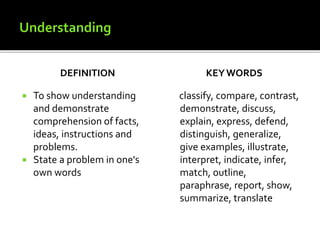
DEFINITION
 To show understanding
and demonstrate
comprehension of facts,
ideas, instructions and
problems.
 State a problem in one's
own words
KEYWORDS
classify, compare, contrast,
demonstrate, discuss,
explain, express, defend,
distinguish, generalize,
give examples, illustrate,
interpret, indicate, infer,
match, outline,
paraphrase, report, show,
summarize, translate
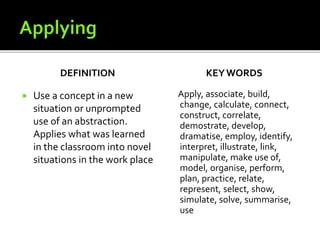
DEFINITION
 Use a concept in a new
situation or unprompted
use of an abstraction.
Applies what was learned
in the classroom into novel
situations in the work place
KEYWORDS
Apply, associate, build,
change, calculate, connect,
construct, correlate,
demostrate, develop,
dramatise, employ, identify,
interpret, illustrate, link,
manipulate, make use of,
model, organise, perform,
plan, practice, relate,
represent, select, show,
simulate, solve, summarise,
use
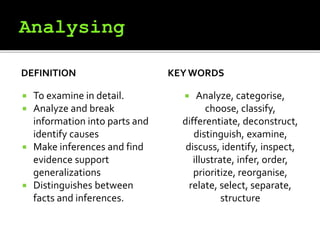
DEFINITION
 To examine in detail.
 Analyze and break
information into parts and
identify causes
 Make inferences and find
evidence support
generalizations
 Distinguishes between
facts and inferences.
KEYWORDS
 Analyze, categorise,
choose, classify,
differentiate, deconstruct,
distinguish, examine,
discuss, identify, inspect,
illustrate, infer, order,
prioritize, reorganise,
relate, select, separate,
structure
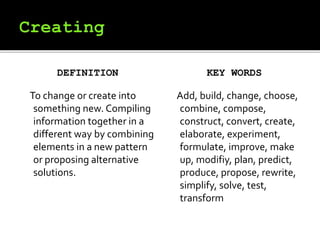
DEFINITION
To change or create into
something new. Compiling
information together in a
different way by combining
elements in a new pattern
or proposing alternative
solutions.
KEY WORDS
Add, build, change, choose,
combine, compose,
construct, convert, create,
elaborate, experiment,
formulate, improve, make
up, modifiy, plan, predict,
produce, propose, rewrite,
simplify, solve, test,
transform
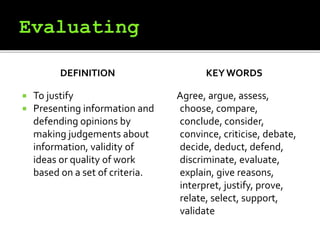
DEFINITION
 To justify
 Presenting information and
defending opinions by
making judgements about
information, validity of
ideas or quality of work
based on a set of criteria.
KEYWORDS
Agree, argue, assess,
choose, compare,
conclude, consider,
convince, criticise, debate,
decide, deduct, defend,
discriminate, evaluate,
explain, give reasons,
interpret, justify, prove,
relate, select, support,
validate
 Are the outcomes aligned with the values, and goals?
 Do the outcomes clearly describe the expected
abilities, knowledge, values, and attitudes?
 Are the outcomes simply stated?
 Is it possible to collect accurate and reliable data for
the outcomes?
 Can they be used to identify areas to improve?
 Are they written using action verbs to specify definite,
observable behaviors?
 Does the language describe student rather than
teacher behaviors?
 Does the language describe a learning outcome, not a
process?
 Analyze the general objectives and relate
them to the contents.
 Should include reference to concepts,
procedures and attitudes.
 Share them with students
 Catering for diversity:
 Allow different grades of accomplishment
 Some are basic and some are for deepening
 Conceptual: facts, concepts
 Procedural: skills, methods, techniques
 Affective: values and attitudes
SELF-KNOWLEDGE AND PERSONAL
AUTONOMY
 Bloque 1. El cuerpo y la propia imagen.
 Bloque 2. Juego y movimiento.
 Bloque 4. El cuidado personal y la salud.
 Bloque 3. La actividad y la vida cotidiana.
ENVIRONMENT KNOWLEDGE
 Bloque 1. Medio físico: elementos,
relaciones y medida.
 Bloque 2. Acercamiento a la naturaleza.
 Bloque 3. Cultura y vida en sociedad.
Language: communication and representation
 Bloque 1. Lenguaje verbal.
 1. Escuchar, hablar y conversar
 2. Aproximación a la lengua escrita
 3. Acercamiento a la literatura
 Bloque 2. Lenguaje audiovisual y tecnologías
de la información y la comunicación.
 Bloque 3. Lenguaje artístico.
 Bloque 4. Lenguaje corporal.
 Balanced: concepts, procedures, affective
 Cater for diversity
 Cross-curricular
 Check first main contents for Preschool
Education
 safe
 robust
 suitable for age
 attractive and stimulating
 suggests but doesn’t replace
action
 diverse
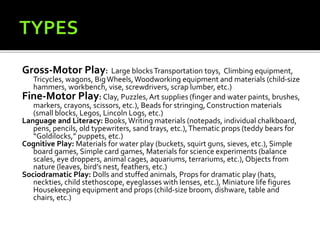
Gross-Motor Play: Large blocksTransportation toys, Climbing equipment,
Tricycles, wagons, BigWheels,Woodworking equipment and materials (child-size
hammers, workbench, vise, screwdrivers, scrap lumber, etc.)
Fine-Motor Play: Clay, Puzzles,Art supplies (finger and water paints, brushes,
markers, crayons, scissors, etc.), Beads for stringing,Construction materials
(small blocks, Legos, Lincoln Logs, etc.)
Language and Literacy: Books,Writing materials (notepads, individual chalkboard,
pens, pencils, old typewriters, sand trays, etc.),Thematic props (teddy bears for
“Goldilocks,” puppets, etc.)
Cognitive Play: Materials for water play (buckets, squirt guns, sieves, etc.), Simple
board games, Simple card games, Materials for science experiments (balance
scales, eye droppers, animal cages, aquariums, terrariums, etc.), Objects from
nature (leaves, bird’s nest, feathers, etc.)
Sociodramatic Play: Dolls and stuffed animals, Props for dramatic play (hats,
neckties, child stethoscope, eyeglasses with lenses, etc.), Miniature life figures
Housekeeping equipment and props (child-size broom, dishware, table and
chairs, etc.)
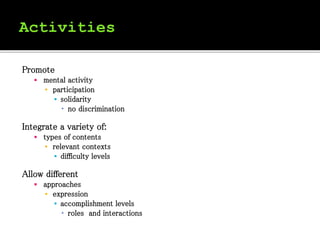
Promote
 mental activity
▪ participation
▪ solidarity
 no discrimination
Integrate a variety of:
 types of contents
▪ relevant contexts
▪ difficulty levels
Allow different
 approaches
▪ expression
▪ accomplishment levels
 roles and interactions
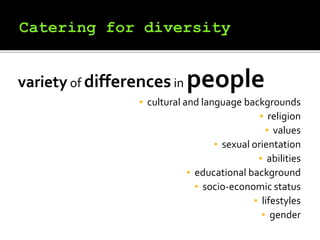
variety of differencesin people
▪ cultural and language backgrounds
▪ religion
▪ values
▪ sexual orientation
▪ abilities
▪ educational background
▪ socio-economic status
▪ lifestyles
▪ gender
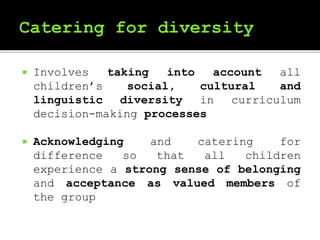
 Involves taking into account all
children’s social, cultural and
linguistic diversity in curriculum
decision-making processes
 Acknowledging and catering for
difference so that all children
experience a strong sense of belonging
and acceptance as valued members of
the group
 Gradable learning outcomes
 Methodology:
 Participation: cooperative learning, peer instruction.
 Mixed: for all learning styles
 Grouping: different according to students’ needs
 Activities for different curricular levels.
 Reinforcement measures
 Extension measures
 Different materials/resources to motivate all
students
 Assessment instruments adapted to students’
needs

Didactic unit

  • 2.
     In groupsof 3 or 4  Design a didactic unit on a topic of your choice  Hand in written work by Tuesday 5 May  Presentations: 15 minutes for groups of 3, 20 minutes for groups of 4  Dates of presentations:Thursday 7 May, 14 May, 21 May
  • 3.
     Each personwill also have to hand in 1 critical evaluation of another group’s presentation  Distribution of marks: - 30% presentation literary text - 50 % didactic unit (50% of this will be on the written work, 50% on the presentation itself) - 20% on peer evaluation
  • 4.
     Timing: 5sessions of 50 minutes a week, period of 2 weeks (Total of 10 sessions)  Topic: you can choose the topic, but you have to justify your choice, referring to the curriculum  You need to specify (you can invent this): - age/grade of students - profile of the students (any special needs?) - number of students in class - the school - when you will teach this unit (dates, month, time of day)
  • 5.
    1. Justification (reasonfor choosing the topic, situation within the curriculum) 2. Contextualization (details about school and type of students) 3. Objectives 4. Resources 5. Methodology 6. Sequence of activities (including timing and materials) 7. Suggestions for variation 8. Evaluation
  • 6.
    Broad definition ofthe student competence General Syllabus for Preschool Education In Navarra, Foral Decree 23/2007, 19th March. La Educación Infantil contribuirá a desarrollar en las niñas y niños las capacidades que les permitan: a) Conocer su propio cuerpo y el de los otros, sus posibilidades de acción y aprender a respetar las diferencias. b) Observar y explorar su entorno familiar, natural y social, reconociendo en él algunas características propias de Navarra. c) Adquirir progresivamente autonomía en sus actividades habituales. d) Desarrollar sus capacidades afectivas. e) Relacionarse con los demás y adquirir progresivamente pautas elementales de convivencia y relación social, así como ejercitarse en la resolución pacífica de conflictos. f) Desarrollar habilidades comunicativas en diferentes lenguajes y formas de expresión. g) Iniciarse en las habilidades lógico-matemáticas, en la lecto-escritura y en el movimiento, el gesto y el ritmo.
  • 7.
    Describes what ateacher will cover in a course/unit. Less broad than goals and broader than student learning outcomes.  3 areas:  Self-knowledge and personal autonomy  Environment knowledge  Language: communication and representation
  • 8.
    1. Formarse unaimagen ajustada y positiva de sí mismo, a través de la interacción con los otros y de la identificación gradual de las propias características, posibilidades y limitaciones, desarrollando sentimientos de autoestima y autonomía personal. 2. Conocer su cuerpo, sus elementos y algunas de sus funciones, descubriendo las posibilidades de acción y de expresión y coordinando y controlando cada vez con mayor precisión gestos y movimientos. 3. Identificar los propios sentimientos, emociones, necesidades o preferencias, y ser capaces de expresarlos y comunicarlos a los demás, identificando y respetando, también, los de los otros. 4. Realizar, de manera cada vez más autónoma, actividades habituales y tareas sencillas para resolver problemas de la vida cotidiana, aumentando el sentimiento de autoconfianza y la capacidad de iniciativa, y desarrollando estrategias para satisfacer sus necesidades básicas. 5. Adecuar su comportamiento a las necesidades y requerimientos de los otros desarrollando actitudes y hábitos de respeto, ayuda y colaboración, evitando comportamientos de sumisión o dominio. 6. Progresar en la adquisición de hábitos y actitudes relacionados con la seguridad, la higiene y el fortalecimiento de la salud, apreciando y disfrutando de las situaciones cotidianas de equilibrio y bienestar emocional.
  • 9.
    1. Observar yexplorar de forma activa su entorno, generando interpretaciones sobre algunas situaciones y hechos significativos y mostrando interés por su conocimiento. 2. Relacionarse con los demás, de forma cada vez más equilibrada y satisfactoria, interiorizando progresivamente las pautas de comportamiento social y ajustando su conducta a ellas. 3. Conocer distintos grupos sociales cercanos a su experiencia, algunas de sus características, producciones culturales, valores y formas de vida, generando actitudes de confianza, respeto y aprecio. 4. Iniciarse en las habilidades matemáticas, manipulando funcionalmente elementos y colecciones, identificando sus atributos y cualidades y estableciendo relaciones de agrupamientos, clasificación, orden y cuantificación. 5. Conocer y valorar los componentes básicos del medio natural y algunas de sus relaciones, cambios y trasformaciones, desarrollando actitudes de cuidado, respeto y responsabilidad en su conservación, tomando como referencia los paisajes de la Comunidad Foral de Navarra.
  • 10.
    1. Utilizar lalengua como instrumento de aprendizaje, de representación, de comunicación y disfrute, de expresión de ideas y sentimientos y valorando la lengua oral como un medio de relación con los demás y de regulación de la convivencia. 2. Expresar sentimientos, deseos e ideas mediante la lengua oral y a través de otros lenguajes, eligiendo el que mejor se ajuste a la intención y a la situación. 3. Comprender las intenciones y mensajes de otros niños y niñas así como de las personas adultas, adoptando una actitud positiva hacia las lenguas. 4. Comprender, reproducir y recrear algunos textos literarios mostrando actitudes de valoración, disfrute e interés hacia ellos. 5. Iniciarse en los usos sociales de la lectura y la escritura explorando su funcionamiento y valorándolas como instrumento de comunicación, información y disfrute. 6. Acercarse al conocimiento de obras artísticas expresadas en distintos lenguajes y realizar actividades de representación y expresión artística mediante el empleo de diversas técnicas. 7. Iniciarse en el uso oral de otras lenguas del currículo para comunicarse en actividades dentro del aula, y mostrar interés y disfrute al participar en estos intercambios comunicativos.
  • 11.
     Specify thelevel or criterion for the knowledge, skill, ability that the student must demonstrate  Include conditions under which they should be able to demonstrate their knowledge, skills, abilities  Contain active verbs  Be measurable (some more easily than others)  Do not join elements in one outcome statement that can not be assessed by a single method
  • 12.
    TheThree Domains ofLearning (Bloom, et al. 1956) Cognitive: mental skills (knowledge) Affective: growth in feelings or emotional areas (attitude or self)  Psychomotor: manual or physical skills (skills)
  • 13.
     The cognitivedomain involves knowledge and the development of intellectual skills (Bloom, 1956).  There are six major categories of cognitive processes, from the simplest to the most complex: ▪ Remembering ▪ Understanding ▪ Applying ▪ Analyzing ▪ Creating ▪ Evaluating
  • 15.
    DEFINITION Recall or retrieveprevious learned information, such as facts, terms, concepts and answers. KEYWORDS Choose, copy, define, find, duplicate, identify, label, list, match, memorize, name, observe, omit, quote, recognize, record , repeat, reproduce, select, show, spell, state, tell
  • 16.
    DEFINITION  To showunderstanding and demonstrate comprehension of facts, ideas, instructions and problems.  State a problem in one's own words KEYWORDS classify, compare, contrast, demonstrate, discuss, explain, express, defend, distinguish, generalize, give examples, illustrate, interpret, indicate, infer, match, outline, paraphrase, report, show, summarize, translate
  • 17.
    DEFINITION  Use aconcept in a new situation or unprompted use of an abstraction. Applies what was learned in the classroom into novel situations in the work place KEYWORDS Apply, associate, build, change, calculate, connect, construct, correlate, demostrate, develop, dramatise, employ, identify, interpret, illustrate, link, manipulate, make use of, model, organise, perform, plan, practice, relate, represent, select, show, simulate, solve, summarise, use
  • 18.
    DEFINITION  To examinein detail.  Analyze and break information into parts and identify causes  Make inferences and find evidence support generalizations  Distinguishes between facts and inferences. KEYWORDS  Analyze, categorise, choose, classify, differentiate, deconstruct, distinguish, examine, discuss, identify, inspect, illustrate, infer, order, prioritize, reorganise, relate, select, separate, structure
  • 19.
    DEFINITION To change orcreate into something new. Compiling information together in a different way by combining elements in a new pattern or proposing alternative solutions. KEY WORDS Add, build, change, choose, combine, compose, construct, convert, create, elaborate, experiment, formulate, improve, make up, modifiy, plan, predict, produce, propose, rewrite, simplify, solve, test, transform
  • 20.
    DEFINITION  To justify Presenting information and defending opinions by making judgements about information, validity of ideas or quality of work based on a set of criteria. KEYWORDS Agree, argue, assess, choose, compare, conclude, consider, convince, criticise, debate, decide, deduct, defend, discriminate, evaluate, explain, give reasons, interpret, justify, prove, relate, select, support, validate
  • 21.
     Are theoutcomes aligned with the values, and goals?  Do the outcomes clearly describe the expected abilities, knowledge, values, and attitudes?  Are the outcomes simply stated?  Is it possible to collect accurate and reliable data for the outcomes?  Can they be used to identify areas to improve?  Are they written using action verbs to specify definite, observable behaviors?  Does the language describe student rather than teacher behaviors?  Does the language describe a learning outcome, not a process?
  • 22.
     Analyze thegeneral objectives and relate them to the contents.  Should include reference to concepts, procedures and attitudes.  Share them with students  Catering for diversity:  Allow different grades of accomplishment  Some are basic and some are for deepening
  • 23.
     Conceptual: facts,concepts  Procedural: skills, methods, techniques  Affective: values and attitudes
  • 24.
    SELF-KNOWLEDGE AND PERSONAL AUTONOMY Bloque 1. El cuerpo y la propia imagen.  Bloque 2. Juego y movimiento.  Bloque 4. El cuidado personal y la salud.  Bloque 3. La actividad y la vida cotidiana.
  • 25.
    ENVIRONMENT KNOWLEDGE  Bloque1. Medio físico: elementos, relaciones y medida.  Bloque 2. Acercamiento a la naturaleza.  Bloque 3. Cultura y vida en sociedad.
  • 26.
    Language: communication andrepresentation  Bloque 1. Lenguaje verbal.  1. Escuchar, hablar y conversar  2. Aproximación a la lengua escrita  3. Acercamiento a la literatura  Bloque 2. Lenguaje audiovisual y tecnologías de la información y la comunicación.  Bloque 3. Lenguaje artístico.  Bloque 4. Lenguaje corporal.
  • 27.
     Balanced: concepts,procedures, affective  Cater for diversity  Cross-curricular  Check first main contents for Preschool Education
  • 28.
     safe  robust suitable for age  attractive and stimulating  suggests but doesn’t replace action  diverse
  • 29.
    Gross-Motor Play: LargeblocksTransportation toys, Climbing equipment, Tricycles, wagons, BigWheels,Woodworking equipment and materials (child-size hammers, workbench, vise, screwdrivers, scrap lumber, etc.) Fine-Motor Play: Clay, Puzzles,Art supplies (finger and water paints, brushes, markers, crayons, scissors, etc.), Beads for stringing,Construction materials (small blocks, Legos, Lincoln Logs, etc.) Language and Literacy: Books,Writing materials (notepads, individual chalkboard, pens, pencils, old typewriters, sand trays, etc.),Thematic props (teddy bears for “Goldilocks,” puppets, etc.) Cognitive Play: Materials for water play (buckets, squirt guns, sieves, etc.), Simple board games, Simple card games, Materials for science experiments (balance scales, eye droppers, animal cages, aquariums, terrariums, etc.), Objects from nature (leaves, bird’s nest, feathers, etc.) Sociodramatic Play: Dolls and stuffed animals, Props for dramatic play (hats, neckties, child stethoscope, eyeglasses with lenses, etc.), Miniature life figures Housekeeping equipment and props (child-size broom, dishware, table and chairs, etc.)
  • 30.
    Promote  mental activity ▪participation ▪ solidarity  no discrimination Integrate a variety of:  types of contents ▪ relevant contexts ▪ difficulty levels Allow different  approaches ▪ expression ▪ accomplishment levels  roles and interactions
  • 31.
    variety of differencesinpeople ▪ cultural and language backgrounds ▪ religion ▪ values ▪ sexual orientation ▪ abilities ▪ educational background ▪ socio-economic status ▪ lifestyles ▪ gender
  • 32.
     Involves takinginto account all children’s social, cultural and linguistic diversity in curriculum decision-making processes  Acknowledging and catering for difference so that all children experience a strong sense of belonging and acceptance as valued members of the group
  • 33.
     Gradable learningoutcomes  Methodology:  Participation: cooperative learning, peer instruction.  Mixed: for all learning styles  Grouping: different according to students’ needs  Activities for different curricular levels.  Reinforcement measures  Extension measures  Different materials/resources to motivate all students  Assessment instruments adapted to students’ needs