ENDOCARDITIS
INFECCIOSA
Dr. Josue Escalante R2 Medicina Interna
2023 ESC Guidelines for the management of endocarditis
INDICE
 INTROCUCCION
 CLASIFICACION
 FACTORES DE RIESGO
 ETIOLOGIA
 FISIOPATOLOGIA
 PREVENCION
 FACTORES DE RIESGO
 PROFILAXIS
 PRESENTACION CLINCIA
 DIAGNOSTICO
 TRATAMIENTO
 COMPLICACIONES
2023 ESC Guidelines for the management of endocarditis
INTRODUCCION
• Enfermedad contagiosa de alta mortalidad (>25%) y tasa elevada de
complicaciones
• Presentación clínica variable – depende del huésped y patógeno
• Afecta principalmente a las válvulas de cavidades izquierdas
• 2/3 de los afectados son hombres > 50 años
- cambio en epidemiologia por desaparición de fiebre reumática
2023 ESC Guidelines for the management of endocarditis
CLASIFICACIÓN
PRESENTACIÓN DE SINTOMAS
• Aguda: < 15 días
• Subaguda: 15 -30 días
• Crónica: >30 días
TIPO DE VÁLVULA
- nativa
- protésica : temprana < 1 año / tardía >1 año
2023 ESC Guidelines for the management of endocarditis
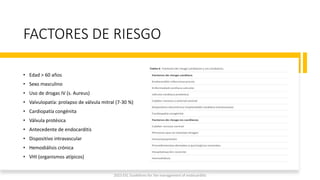
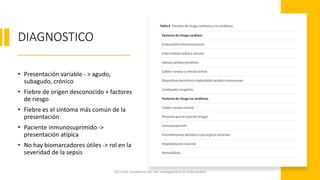
FACTORES DE RIESGO
• Edad > 60 años
• Sexo masculino
• Uso de drogas IV (s. Aureus)
• Valvulopatía: prolapso de válvula mitral (7-30 %)
• Cardiopatía congénita
• Válvula protésica
• Antecedente de endocarditis
• Dispositivo intravascular
• Hemodiálisis crónica
• VHI (organismos atípicos)
2023 ESC Guidelines for the management of endocarditis
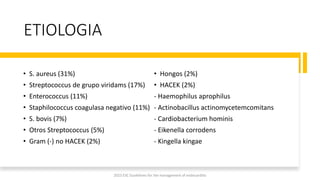
ETIOLOGIA
• S. aureus (31%)
• Streptococcus de grupo viridams (17%)
• Enterococcus (11%)
• Staphilococcus coagulasa negativo (11%)
• S. bovis (7%)
• Otros Streptococcus (5%)
• Gram (-) no HACEK (2%)
• Hongos (2%)
• HACEK (2%)
- Haemophilus aprophilus
- Actinobacillus actinomycetemcomitans
- Cardiobacterium hominis
- Eikenella corrodens
- Kingella kingae
2023 ESC Guidelines for the management of endocarditis
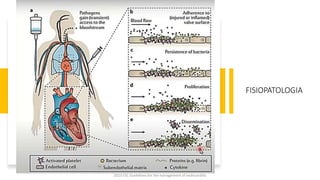
FISIOPATOLOGIA
2023 ESC Guidelines for the management of endocarditis
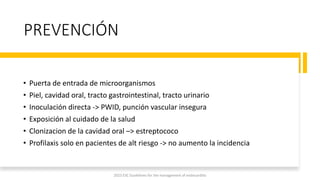
PREVENCIÓN
• Puerta de entrada de microorganismos
• Piel, cavidad oral, tracto gastrointestinal, tracto urinario
• Inoculación directa -> PWID, punción vascular insegura
• Exposición al cuidado de la salud
• Clonizacion de la cavidad oral –> estreptococo
• Profilaxis solo en pacientes de alt riesgo -> no aumento la incidencia
2023 ESC Guidelines for the management of endocarditis
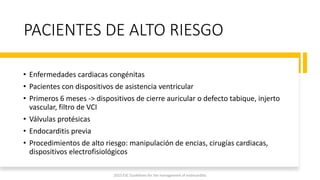
PACIENTES DE ALTO RIESGO
• Enfermedades cardiacas congénitas
• Pacientes con dispositivos de asistencia ventricular
• Primeros 6 meses -> dispositivos de cierre auricular o defecto tabique, injerto
vascular, filtro de VCI
• Válvulas protésicas
• Endocarditis previa
• Procedimientos de alto riesgo: manipulación de encias, cirugías cardiacas,
dispositivos electrofisiológicos
2023 ESC Guidelines for the management of endocarditis
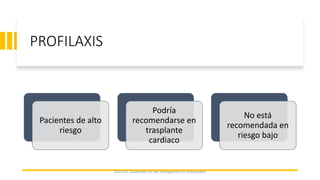
PROFILAXIS
Pacientes de alto
riesgo
Podría
recomendarse en
trasplante
cardiaco
No está
recomendada en
riesgo bajo
2023 ESC Guidelines for the management of endocarditis
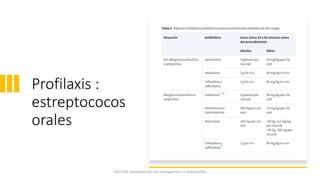
Profilaxis :
estreptococos
orales
2023 ESC Guidelines for the management of endocarditis
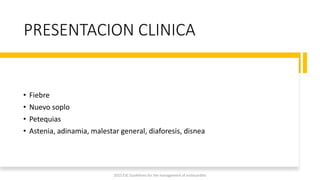
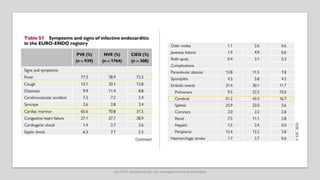
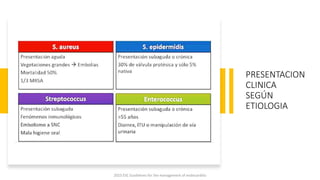
PRESENTACION CLINICA
• Fiebre
• Nuevo soplo
• Petequias
• Astenia, adinamia, malestar general, diaforesis, disnea
2023 ESC Guidelines for the management of endocarditis
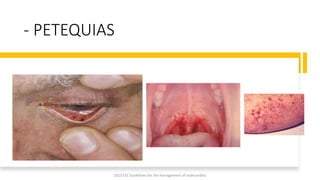
- PETEQUIAS
2023 ESC Guidelines for the management of endocarditis
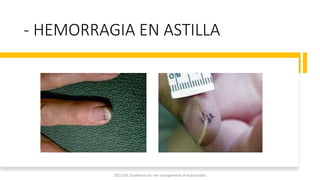
- HEMORRAGIA EN ASTILLA
2023 ESC Guidelines for the management of endocarditis
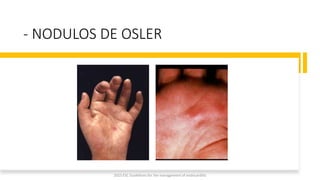
- NODULOS DE OSLER
2023 ESC Guidelines for the management of endocarditis
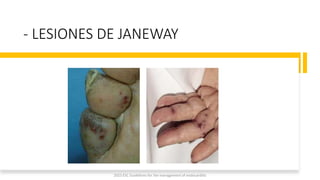
- LESIONES DE JANEWAY
2023 ESC Guidelines for the management of endocarditis
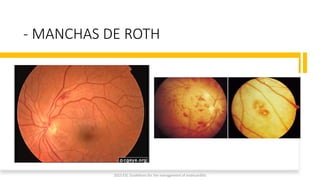
- MANCHAS DE ROTH
2023 ESC Guidelines for the management of endocarditis
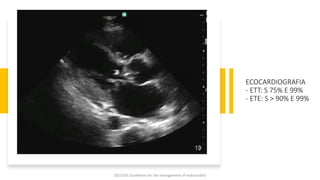
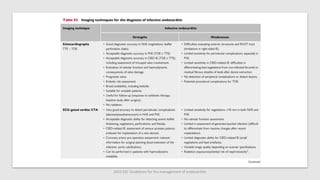
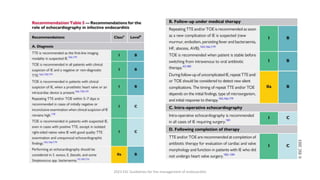
ECOCARDIOGRAFIA
- ETT: S 75% E 99%
- ETE: S > 90% E 99%
2023 ESC Guidelines for the management of endocarditis
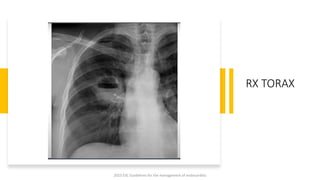
RX TORAX
2023 ESC Guidelines for the management of endocarditis
PRESENTACION
CLINICA
SEGÚN
ETIOLOGIA
2023 ESC Guidelines for the management of endocarditis
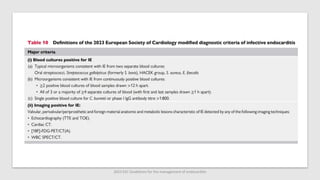
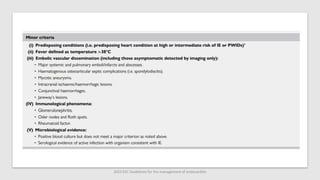
DIAGNOSTICO
• Presentación variable - > agudo,
subagudo, crónico
• Fiebre de origen desconocido + factores
de riesgo
• Fiebre es el síntoma más común de la
presentación
• Paciente inmunosuprimido ->
presentación atípica
• No hay biomarcadores útiles -> rol en la
severidad de la sepsis
2023 ESC Guidelines for the management of endocarditis
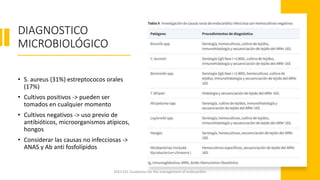
DIAGNOSTICO
MICROBIOLÓGICO
• S. aureus (31%) estreptococos orales
(17%)
• Cultivos positivos -> pueden ser
tomados en cualquier momento
• Cultivos negativos -> uso previo de
antibióticos, microorganismos atípicos,
hongos
• Considerar las causas no infecciosas ->
ANAS y Ab anti fosfolípidos
2023 ESC Guidelines for the management of endocarditis
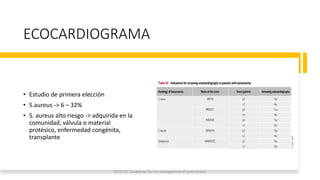
ECOCARDIOGRAMA
• Estudio de primera elección
• S.aureus -> 6 – 32%
• S. aureus alto riesgo -> adquirida en la
comunidad, válvula o material
protésico, enfermedad congénita,
transplante
2023 ESC Guidelines for the management of endocarditis
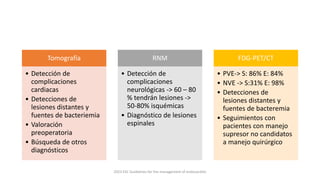
Tomografía
• Detección de
complicaciones
cardiacas
• Detecciones de
lesiones distantes y
fuentes de bacteriemia
• Valoración
preoperatoria
• Búsqueda de otros
diagnósticos
RNM
• Detección de
complicaciones
neurológicas -> 60 – 80
% tendrán lesiones ->
50-80% isquémicas
• Diagnóstico de lesiones
espinales
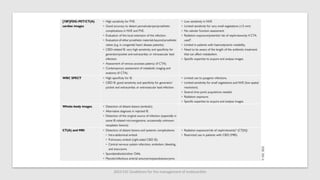
FDG-PET/CT
• PVE-> S: 86% E: 84%
• NVE -> S:31% E: 98%
• Detecciones de
lesiones distantes y
fuentes de bacteremia
• Seguimientos con
pacientes con manejo
supresor no candidatos
a manejo quirúrgico
2023 ESC Guidelines for the management of endocarditis
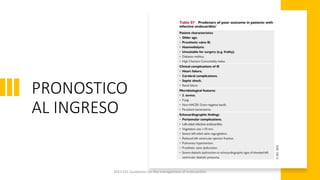
PRONOSTICO
AL INGRESO
2023 ESC Guidelines for the management of endocarditis
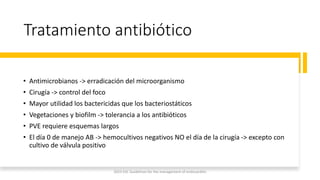
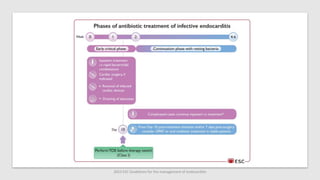
Tratamiento antibiótico
• Antimicrobianos -> erradicación del microorganismo
• Cirugía -> control del foco
• Mayor utilidad los bactericidas que los bacteriostáticos
• Vegetaciones y biofilm -> tolerancia a los antibióticos
• PVE requiere esquemas largos
• El día 0 de manejo AB -> hemocultivos negativos NO el día de la cirugía -> excepto con
cultivo de válvula positivo
2023 ESC Guidelines for the management of endocarditis
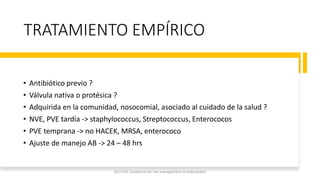
TRATAMIENTO EMPÍRICO
• Antibiótico previo ?
• Válvula nativa o protésica ?
• Adquirida en la comunidad, nosocomial, asociado al cuidado de la salud ?
• NVE, PVE tardía -> staphylococcus, Streptococcus, Enterococos
• PVE temprana -> no HACEK, MRSA, enterococo
• Ajuste de manejo AB -> 24 – 48 hrs
2023 ESC Guidelines for the management of endocarditis
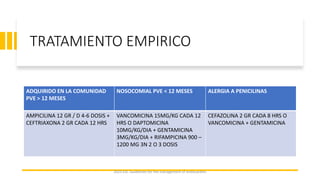
TRATAMIENTO EMPIRICO
ADQUIRIDO EN LA COMUNIDAD
PVE > 12 MESES
NOSOCOMIAL PVE < 12 MESES ALERGIA A PENICILINAS
AMPICILINA 12 GR / D 4-6 DOSIS +
CEFTRIAXONA 2 GR CADA 12 HRS
VANCOMICINA 15MG/KG CADA 12
HRS O DAPTOMICINA
10MG/KG/DIA + GENTAMICINA
3MG/KG/DIA + RIFAMPICINA 900 –
1200 MG 3N 2 O 3 DOSIS
CEFAZOLINA 2 GR CADA 8 HRS O
VANCOMICINA + GENTAMICINA
2023 ESC Guidelines for the management of endocarditis
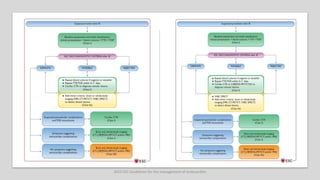
STREPTOCOCCUS SPP
• Orales -> grupos mitis, sanguinis, anginosus, salivarius, downei, y munatans
• Streptococcus gallolyticus o pyogenic
• NVE no complicada S-penicilina -> cura 95%
• Paciente alérgico -> desensibilización -> cefalosporinas si no fuera
anafilaxia
• Resistente -> aminoglucósidos por 2 semanas (gentamicina max 240
mg/día )
• Neumococo -> meningitis y neumonía en el 30% de los casos
• Beta hemolítico grupos B,C, G anginosus -> formación de abscesos
• Granulicatella y abitrophia -> penicilina G, ceftriaxona, vancomicina +
aminoglucósido
2023 ESC Guidelines for the management of endocarditis
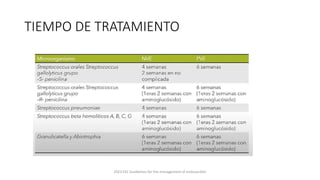
TIEMPO DE TRATAMIENTO
2023 ESC Guidelines for the management of endocarditis
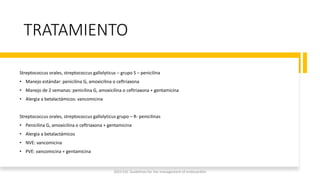
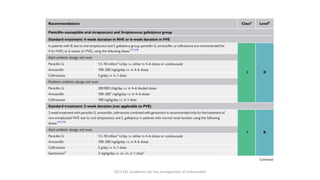
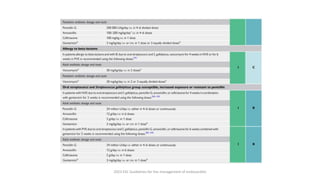
TRATAMIENTO
Streptococcus orales, streptococcus gallolyticus – grupo S – penicilina
• Manejo estándar: penicilina G, amoxicilina o ceftriaxona
• Manejo de 2 semanas: penicilina G, amoxicilina o ceftriaxona + gentamicina
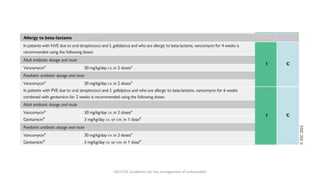
• Alergia a betalactámicos: vancomicina
Streptococcus orales, streptococcus gallolyticus grupo – R- penicilinas
• Penicilina G, amoxicilina o ceftriaxona + gentamicina
• Alergia a betalactámicos
• NVE: vancomicina
• PVE: vancomicina + gentamicina
2023 ESC Guidelines for the management of endocarditis
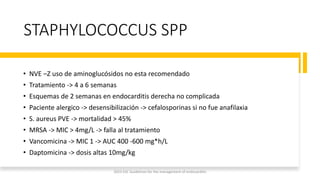
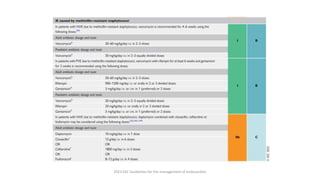
STAPHYLOCOCCUS SPP
• NVE –Z uso de aminoglucósidos no esta recomendado
• Tratamiento -> 4 a 6 semanas
• Esquemas de 2 semanas en endocarditis derecha no complicada
• Paciente alergico -> desensibilización -> cefalosporinas si no fue anafilaxia
• S. aureus PVE -> mortalidad > 45%
• MRSA -> MIC > 4mg/L -> falla al tratamiento
• Vancomicina -> MIC 1 -> AUC 400 -600 mg*h/L
• Daptomicina -> dosis altas 10mg/kg
2023 ESC Guidelines for the management of endocarditis
TRATAMIENTO
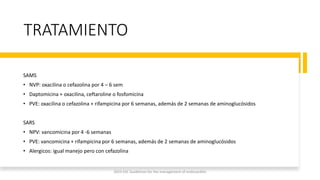
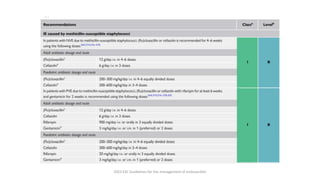
SAMS
• NVP: oxacilina o cefazolina por 4 – 6 sem
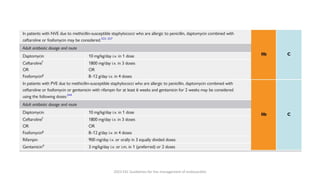
• Daptomicina + oxacilina, ceftaroline o fosfomicina
• PVE: oxacilina o cefazolina + rifampicina por 6 semanas, además de 2 semanas de aminoglucósidos
SARS
• NPV: vancomicina por 4 -6 semanas
• PVE: vancomicina + rifampicina por 6 semanas, además de 2 semanas de aminoglucósidos
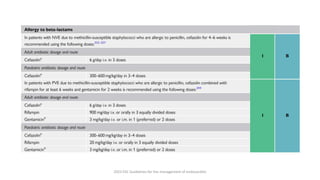
• Alergicos: igual manejo pero con cefazolina
2023 ESC Guidelines for the management of endocarditis
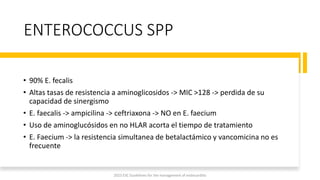
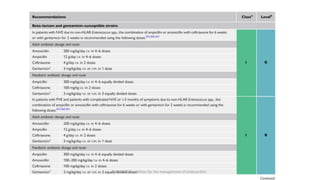
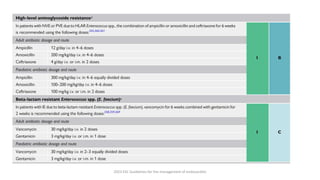
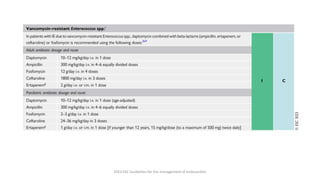
ENTEROCOCCUS SPP
• 90% E. fecalis
• Altas tasas de resistencia a aminoglicosidos -> MIC >128 -> perdida de su
capacidad de sinergismo
• E. faecalis -> ampicilina -> ceftriaxona -> NO en E. faecium
• Uso de aminoglucósidos en no HLAR acorta el tiempo de tratamiento
• E. Faecium -> la resistencia simultanea de betalactámico y vancomicina no es
frecuente
2023 ESC Guidelines for the management of endocarditis
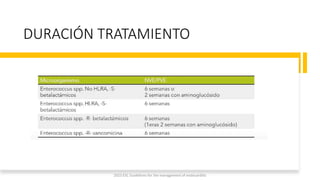
DURACIÓN TRATAMIENTO
2023 ESC Guidelines for the management of endocarditis
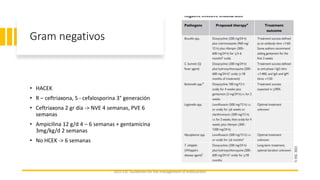
Gram negativos
• HACEK
• R – ceftriaxona, S - cefalosporina 3° generación
• Ceftriaxona 2 gr día -> NVE 4 semanas, PVE 6
semanas
• Ampicilina 12 g/d 4 – 6 semanas + gentamicina
3mg/kg/d 2 semanas
• No HCEK -> 6 semanas
2023 ESC Guidelines for the management of endocarditis
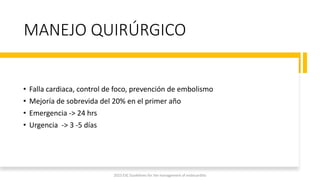
MANEJO QUIRÚRGICO
• Falla cardiaca, control de foco, prevención de embolismo
• Mejoría de sobrevida del 20% en el primer año
• Emergencia -> 24 hrs
• Urgencia -> 3 -5 días
2023 ESC Guidelines for the management of endocarditis
COMPLICACIONES
• Cardiacas: falla cardiaca , absceso perivalvular, pericarditis
• Neurológico: ACV, absceso, meningitis, convulsiones, encefalopatías agudas
• Renal: embolización, glomerulonefritis y nefritis intersticial
• Musculoesquelético: osteomielitis vertebral
• Pulmonar: neumonía, absceso pulmonar, derrame pleural, neumotórax
• Embolias: izquierdo -> sistémico / derecho: pulmonar
• Abscesos: esplénico más común de difícil diagnostico
• Aneurisma nicótico
2023 ESC Guidelines for the management of endocarditis
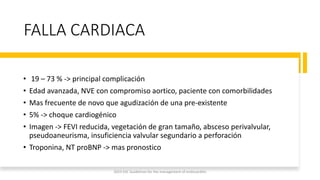
FALLA CARDIACA
• 19 – 73 % -> principal complicación
• Edad avanzada, NVE con compromiso aortico, paciente con comorbilidades
• Mas frecuente de novo que agudización de una pre-existente
• 5% -> choque cardiogénico
• Imagen -> FEVI reducida, vegetación de gran tamaño, absceso perivalvular,
pseudoaneurisma, insuficiencia valvular segundario a perforación
• Troponina, NT proBNP -> mas pronostico
2023 ESC Guidelines for the management of endocarditis
GRACIAS
2023 ESC Guidelines for the management of endocarditis

endocarditis josue.pptt nuevo documento nuevoo

  • 1.
    ENDOCARDITIS INFECCIOSA Dr. Josue EscalanteR2 Medicina Interna 2023 ESC Guidelines for the management of endocarditis
  • 2.
    INDICE  INTROCUCCION  CLASIFICACION FACTORES DE RIESGO  ETIOLOGIA  FISIOPATOLOGIA  PREVENCION  FACTORES DE RIESGO  PROFILAXIS  PRESENTACION CLINCIA  DIAGNOSTICO  TRATAMIENTO  COMPLICACIONES 2023 ESC Guidelines for the management of endocarditis
  • 3.
    INTRODUCCION • Enfermedad contagiosade alta mortalidad (>25%) y tasa elevada de complicaciones • Presentación clínica variable – depende del huésped y patógeno • Afecta principalmente a las válvulas de cavidades izquierdas • 2/3 de los afectados son hombres > 50 años - cambio en epidemiologia por desaparición de fiebre reumática 2023 ESC Guidelines for the management of endocarditis
  • 4.
    CLASIFICACIÓN PRESENTACIÓN DE SINTOMAS •Aguda: < 15 días • Subaguda: 15 -30 días • Crónica: >30 días TIPO DE VÁLVULA - nativa - protésica : temprana < 1 año / tardía >1 año 2023 ESC Guidelines for the management of endocarditis
  • 5.
    FACTORES DE RIESGO •Edad > 60 años • Sexo masculino • Uso de drogas IV (s. Aureus) • Valvulopatía: prolapso de válvula mitral (7-30 %) • Cardiopatía congénita • Válvula protésica • Antecedente de endocarditis • Dispositivo intravascular • Hemodiálisis crónica • VHI (organismos atípicos) 2023 ESC Guidelines for the management of endocarditis
  • 6.
    ETIOLOGIA • S. aureus(31%) • Streptococcus de grupo viridams (17%) • Enterococcus (11%) • Staphilococcus coagulasa negativo (11%) • S. bovis (7%) • Otros Streptococcus (5%) • Gram (-) no HACEK (2%) • Hongos (2%) • HACEK (2%) - Haemophilus aprophilus - Actinobacillus actinomycetemcomitans - Cardiobacterium hominis - Eikenella corrodens - Kingella kingae 2023 ESC Guidelines for the management of endocarditis
  • 7.
    FISIOPATOLOGIA 2023 ESC Guidelinesfor the management of endocarditis
  • 8.
    PREVENCIÓN • Puerta deentrada de microorganismos • Piel, cavidad oral, tracto gastrointestinal, tracto urinario • Inoculación directa -> PWID, punción vascular insegura • Exposición al cuidado de la salud • Clonizacion de la cavidad oral –> estreptococo • Profilaxis solo en pacientes de alt riesgo -> no aumento la incidencia 2023 ESC Guidelines for the management of endocarditis
  • 9.
    PACIENTES DE ALTORIESGO • Enfermedades cardiacas congénitas • Pacientes con dispositivos de asistencia ventricular • Primeros 6 meses -> dispositivos de cierre auricular o defecto tabique, injerto vascular, filtro de VCI • Válvulas protésicas • Endocarditis previa • Procedimientos de alto riesgo: manipulación de encias, cirugías cardiacas, dispositivos electrofisiológicos 2023 ESC Guidelines for the management of endocarditis
  • 10.
    PROFILAXIS Pacientes de alto riesgo Podría recomendarseen trasplante cardiaco No está recomendada en riesgo bajo 2023 ESC Guidelines for the management of endocarditis
  • 11.
    Profilaxis : estreptococos orales 2023 ESCGuidelines for the management of endocarditis
  • 12.
    PRESENTACION CLINICA • Fiebre •Nuevo soplo • Petequias • Astenia, adinamia, malestar general, diaforesis, disnea 2023 ESC Guidelines for the management of endocarditis
  • 13.
    2023 ESC Guidelinesfor the management of endocarditis
  • 14.
    - PETEQUIAS 2023 ESCGuidelines for the management of endocarditis
  • 15.
    - HEMORRAGIA ENASTILLA 2023 ESC Guidelines for the management of endocarditis
  • 16.
    - NODULOS DEOSLER 2023 ESC Guidelines for the management of endocarditis
  • 17.
    - LESIONES DEJANEWAY 2023 ESC Guidelines for the management of endocarditis
  • 18.
    - MANCHAS DEROTH 2023 ESC Guidelines for the management of endocarditis
  • 19.
    ECOCARDIOGRAFIA - ETT: S75% E 99% - ETE: S > 90% E 99% 2023 ESC Guidelines for the management of endocarditis
  • 20.
    RX TORAX 2023 ESCGuidelines for the management of endocarditis
  • 21.
  • 22.
    DIAGNOSTICO • Presentación variable- > agudo, subagudo, crónico • Fiebre de origen desconocido + factores de riesgo • Fiebre es el síntoma más común de la presentación • Paciente inmunosuprimido -> presentación atípica • No hay biomarcadores útiles -> rol en la severidad de la sepsis 2023 ESC Guidelines for the management of endocarditis
  • 23.
    DIAGNOSTICO MICROBIOLÓGICO • S. aureus(31%) estreptococos orales (17%) • Cultivos positivos -> pueden ser tomados en cualquier momento • Cultivos negativos -> uso previo de antibióticos, microorganismos atípicos, hongos • Considerar las causas no infecciosas -> ANAS y Ab anti fosfolípidos 2023 ESC Guidelines for the management of endocarditis
  • 24.
    2023 ESC Guidelinesfor the management of endocarditis
  • 25.
    2023 ESC Guidelinesfor the management of endocarditis
  • 26.
    ECOCARDIOGRAMA • Estudio deprimera elección • S.aureus -> 6 – 32% • S. aureus alto riesgo -> adquirida en la comunidad, válvula o material protésico, enfermedad congénita, transplante 2023 ESC Guidelines for the management of endocarditis
  • 27.
    2023 ESC Guidelinesfor the management of endocarditis
  • 28.
    Tomografía • Detección de complicaciones cardiacas •Detecciones de lesiones distantes y fuentes de bacteriemia • Valoración preoperatoria • Búsqueda de otros diagnósticos RNM • Detección de complicaciones neurológicas -> 60 – 80 % tendrán lesiones -> 50-80% isquémicas • Diagnóstico de lesiones espinales FDG-PET/CT • PVE-> S: 86% E: 84% • NVE -> S:31% E: 98% • Detecciones de lesiones distantes y fuentes de bacteremia • Seguimientos con pacientes con manejo supresor no candidatos a manejo quirúrgico 2023 ESC Guidelines for the management of endocarditis
  • 29.
    2023 ESC Guidelinesfor the management of endocarditis
  • 30.
    2023 ESC Guidelinesfor the management of endocarditis
  • 31.
    2023 ESC Guidelinesfor the management of endocarditis
  • 32.
    2023 ESC Guidelinesfor the management of endocarditis
  • 33.
    PRONOSTICO AL INGRESO 2023 ESCGuidelines for the management of endocarditis
  • 34.
    Tratamiento antibiótico • Antimicrobianos-> erradicación del microorganismo • Cirugía -> control del foco • Mayor utilidad los bactericidas que los bacteriostáticos • Vegetaciones y biofilm -> tolerancia a los antibióticos • PVE requiere esquemas largos • El día 0 de manejo AB -> hemocultivos negativos NO el día de la cirugía -> excepto con cultivo de válvula positivo 2023 ESC Guidelines for the management of endocarditis
  • 35.
    2023 ESC Guidelinesfor the management of endocarditis
  • 36.
    TRATAMIENTO EMPÍRICO • Antibióticoprevio ? • Válvula nativa o protésica ? • Adquirida en la comunidad, nosocomial, asociado al cuidado de la salud ? • NVE, PVE tardía -> staphylococcus, Streptococcus, Enterococos • PVE temprana -> no HACEK, MRSA, enterococo • Ajuste de manejo AB -> 24 – 48 hrs 2023 ESC Guidelines for the management of endocarditis
  • 37.
    TRATAMIENTO EMPIRICO ADQUIRIDO ENLA COMUNIDAD PVE > 12 MESES NOSOCOMIAL PVE < 12 MESES ALERGIA A PENICILINAS AMPICILINA 12 GR / D 4-6 DOSIS + CEFTRIAXONA 2 GR CADA 12 HRS VANCOMICINA 15MG/KG CADA 12 HRS O DAPTOMICINA 10MG/KG/DIA + GENTAMICINA 3MG/KG/DIA + RIFAMPICINA 900 – 1200 MG 3N 2 O 3 DOSIS CEFAZOLINA 2 GR CADA 8 HRS O VANCOMICINA + GENTAMICINA 2023 ESC Guidelines for the management of endocarditis
  • 38.
    STREPTOCOCCUS SPP • Orales-> grupos mitis, sanguinis, anginosus, salivarius, downei, y munatans • Streptococcus gallolyticus o pyogenic • NVE no complicada S-penicilina -> cura 95% • Paciente alérgico -> desensibilización -> cefalosporinas si no fuera anafilaxia • Resistente -> aminoglucósidos por 2 semanas (gentamicina max 240 mg/día ) • Neumococo -> meningitis y neumonía en el 30% de los casos • Beta hemolítico grupos B,C, G anginosus -> formación de abscesos • Granulicatella y abitrophia -> penicilina G, ceftriaxona, vancomicina + aminoglucósido 2023 ESC Guidelines for the management of endocarditis
  • 39.
    TIEMPO DE TRATAMIENTO 2023ESC Guidelines for the management of endocarditis
  • 40.
    TRATAMIENTO Streptococcus orales, streptococcusgallolyticus – grupo S – penicilina • Manejo estándar: penicilina G, amoxicilina o ceftriaxona • Manejo de 2 semanas: penicilina G, amoxicilina o ceftriaxona + gentamicina • Alergia a betalactámicos: vancomicina Streptococcus orales, streptococcus gallolyticus grupo – R- penicilinas • Penicilina G, amoxicilina o ceftriaxona + gentamicina • Alergia a betalactámicos • NVE: vancomicina • PVE: vancomicina + gentamicina 2023 ESC Guidelines for the management of endocarditis
  • 41.
    2023 ESC Guidelinesfor the management of endocarditis
  • 42.
    2023 ESC Guidelinesfor the management of endocarditis
  • 43.
    2023 ESC Guidelinesfor the management of endocarditis
  • 44.
    STAPHYLOCOCCUS SPP • NVE–Z uso de aminoglucósidos no esta recomendado • Tratamiento -> 4 a 6 semanas • Esquemas de 2 semanas en endocarditis derecha no complicada • Paciente alergico -> desensibilización -> cefalosporinas si no fue anafilaxia • S. aureus PVE -> mortalidad > 45% • MRSA -> MIC > 4mg/L -> falla al tratamiento • Vancomicina -> MIC 1 -> AUC 400 -600 mg*h/L • Daptomicina -> dosis altas 10mg/kg 2023 ESC Guidelines for the management of endocarditis
  • 45.
    TRATAMIENTO SAMS • NVP: oxacilinao cefazolina por 4 – 6 sem • Daptomicina + oxacilina, ceftaroline o fosfomicina • PVE: oxacilina o cefazolina + rifampicina por 6 semanas, además de 2 semanas de aminoglucósidos SARS • NPV: vancomicina por 4 -6 semanas • PVE: vancomicina + rifampicina por 6 semanas, además de 2 semanas de aminoglucósidos • Alergicos: igual manejo pero con cefazolina 2023 ESC Guidelines for the management of endocarditis
  • 46.
    2023 ESC Guidelinesfor the management of endocarditis
  • 47.
    2023 ESC Guidelinesfor the management of endocarditis
  • 48.
    2023 ESC Guidelinesfor the management of endocarditis
  • 49.
    2023 ESC Guidelinesfor the management of endocarditis
  • 50.
    ENTEROCOCCUS SPP • 90%E. fecalis • Altas tasas de resistencia a aminoglicosidos -> MIC >128 -> perdida de su capacidad de sinergismo • E. faecalis -> ampicilina -> ceftriaxona -> NO en E. faecium • Uso de aminoglucósidos en no HLAR acorta el tiempo de tratamiento • E. Faecium -> la resistencia simultanea de betalactámico y vancomicina no es frecuente 2023 ESC Guidelines for the management of endocarditis
  • 51.
    DURACIÓN TRATAMIENTO 2023 ESCGuidelines for the management of endocarditis
  • 52.
    2023 ESC Guidelinesfor the management of endocarditis
  • 53.
    2023 ESC Guidelinesfor the management of endocarditis
  • 54.
    2023 ESC Guidelinesfor the management of endocarditis
  • 55.
    Gram negativos • HACEK •R – ceftriaxona, S - cefalosporina 3° generación • Ceftriaxona 2 gr día -> NVE 4 semanas, PVE 6 semanas • Ampicilina 12 g/d 4 – 6 semanas + gentamicina 3mg/kg/d 2 semanas • No HCEK -> 6 semanas 2023 ESC Guidelines for the management of endocarditis
  • 56.
    MANEJO QUIRÚRGICO • Fallacardiaca, control de foco, prevención de embolismo • Mejoría de sobrevida del 20% en el primer año • Emergencia -> 24 hrs • Urgencia -> 3 -5 días 2023 ESC Guidelines for the management of endocarditis
  • 57.
    COMPLICACIONES • Cardiacas: fallacardiaca , absceso perivalvular, pericarditis • Neurológico: ACV, absceso, meningitis, convulsiones, encefalopatías agudas • Renal: embolización, glomerulonefritis y nefritis intersticial • Musculoesquelético: osteomielitis vertebral • Pulmonar: neumonía, absceso pulmonar, derrame pleural, neumotórax • Embolias: izquierdo -> sistémico / derecho: pulmonar • Abscesos: esplénico más común de difícil diagnostico • Aneurisma nicótico 2023 ESC Guidelines for the management of endocarditis
  • 58.
    FALLA CARDIACA • 19– 73 % -> principal complicación • Edad avanzada, NVE con compromiso aortico, paciente con comorbilidades • Mas frecuente de novo que agudización de una pre-existente • 5% -> choque cardiogénico • Imagen -> FEVI reducida, vegetación de gran tamaño, absceso perivalvular, pseudoaneurisma, insuficiencia valvular segundario a perforación • Troponina, NT proBNP -> mas pronostico 2023 ESC Guidelines for the management of endocarditis
  • 59.
    2023 ESC Guidelinesfor the management of endocarditis
  • 60.
    GRACIAS 2023 ESC Guidelinesfor the management of endocarditis