Experimentos a bajas temperaturas con
ondas acústicas superficiales, microondas y
campos magnéticos giratorios, en sistemas
     magnéticos y superconductores
            (MAT2008-04535)
        (01.01.2009 – 31.12.2011)
          Grup de Magnetisme
         Universitat de Barcelona

         IP: Javier Tejada Palacios
Magnetic Deflagration in Gd5Ge4: Polycrystals
  Montaje experimental


                                      Velocidad de la deflagración vs Hign y diferentes estados iniciales


                                             v ≈ [ ( k BT f / U ) κ ( T f ) Γ ( T f ) ]
                                                                                          1
                                                                                              2   ≈ 0.1 m/s


 Señales detectadas
                      S. Velez et al. Phys. Rev. B 81, 064437 (2010)
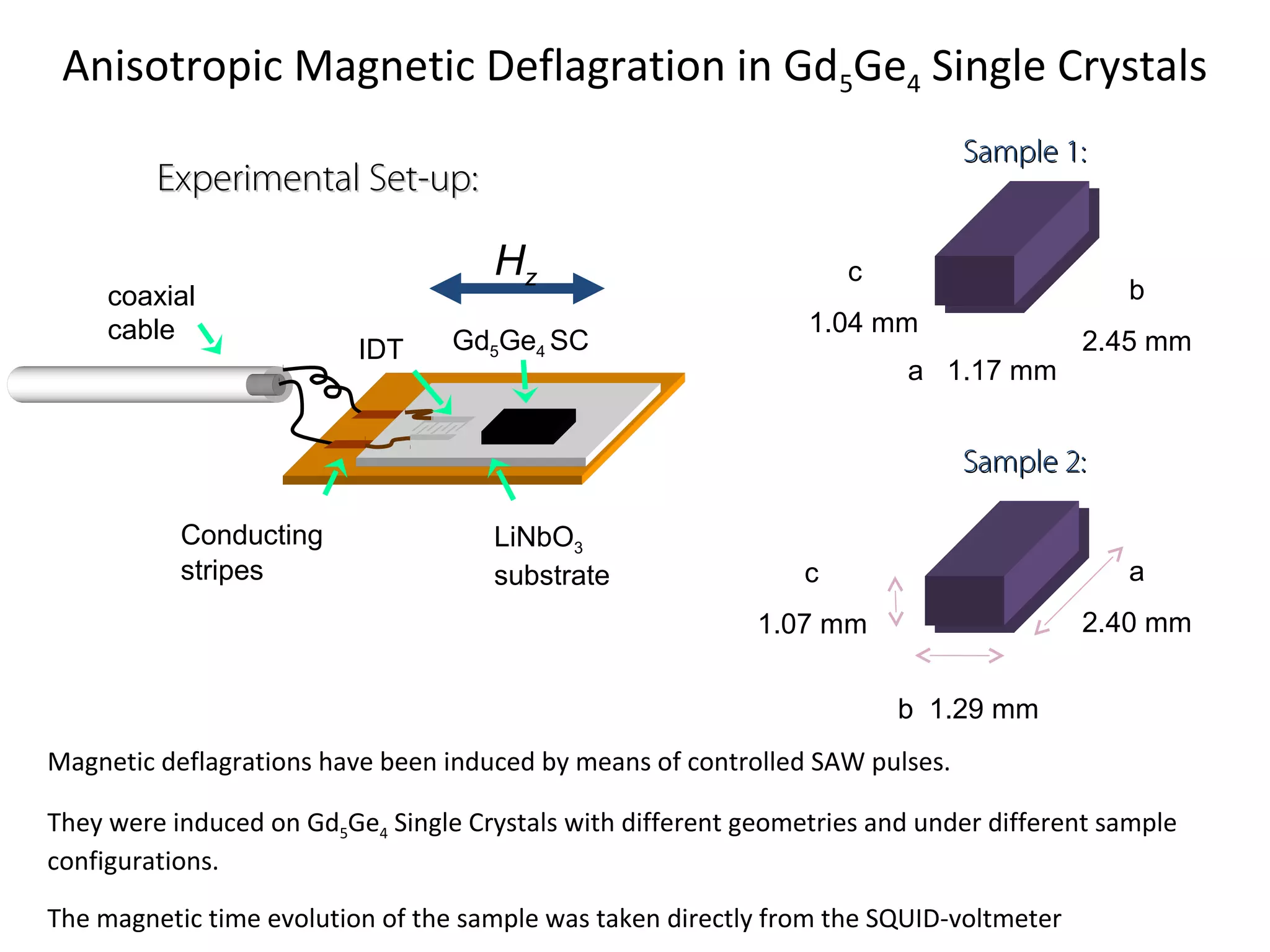
Anisotropic Magnetic Deflagration in Gd5Ge4 Single Crystals
                                                                              Sample 1:
         Experimental Set-up:

                                     Hz                             c
     coaxial                                                                               b
     cable                                                      1.04 mm
                          IDT     Gd5Ge4 SC                                             2.45 mm
                                                                         a 1.17 mm


                                                                              Sample 2:

           Conducting                LiNbO3
           stripes                   substrate                  c                          a
                                                            1.07 mm                     2.40 mm


                                                                        b 1.29 mm
Magnetic deflagrations have been induced by means of controlled SAW pulses.

They were induced on Gd5Ge4 Single Crystals with different geometries and under different sample
configurations.

The magnetic time evolution of the sample was taken directly from the SQUID-voltmeter
Anisotropic Magnetic Deflagration in Gd5Ge4 Single Crystals
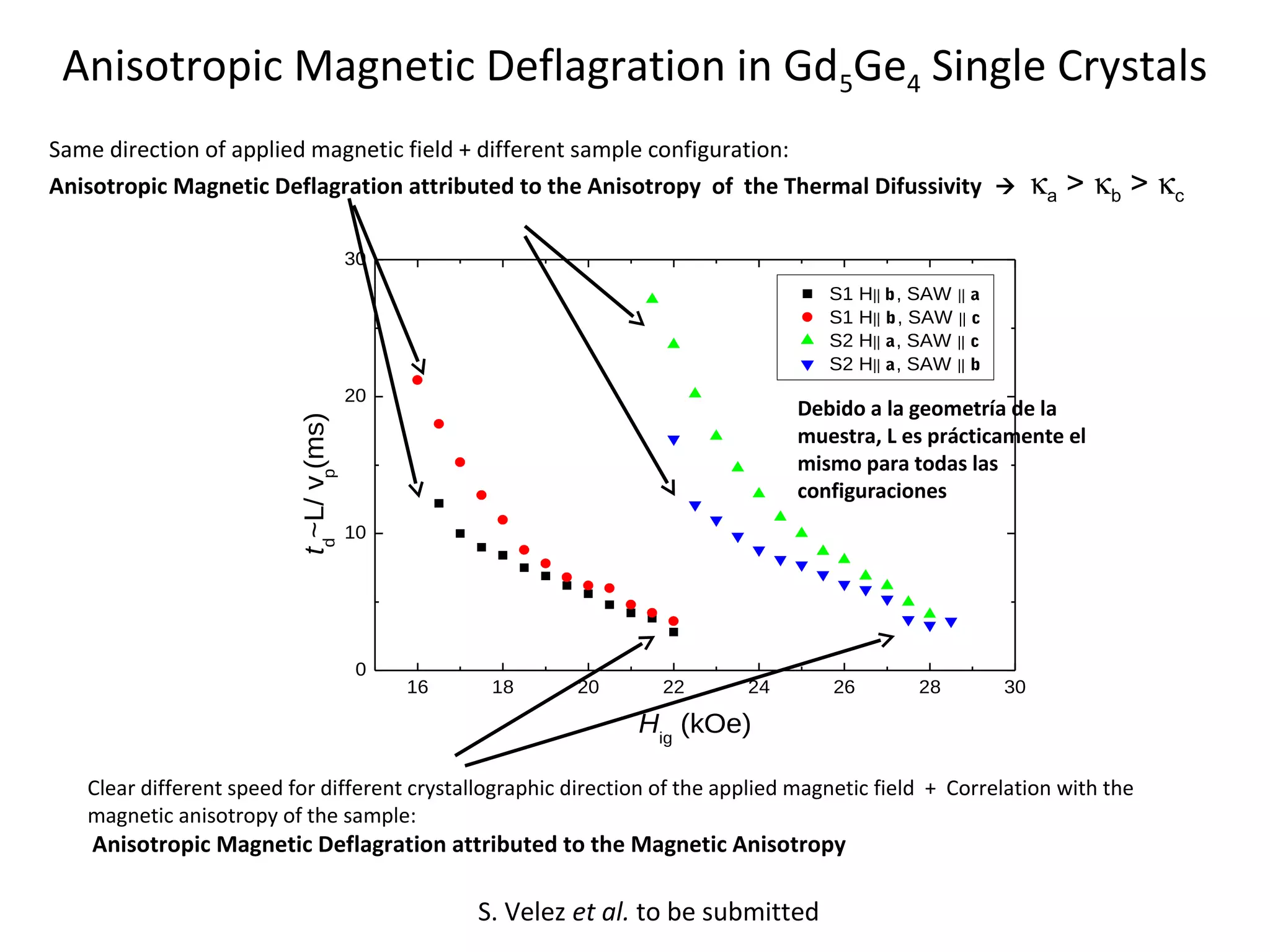
Same direction of applied magnetic field + different sample configuration:
Anisotropic Magnetic Deflagration attributed to the Anisotropy of the Thermal Difussivity                      κa > κb > κc

                                         30
                                                                                     S1 H|| b , SAW || a
                                                                                     S1 H|| b , SAW || c
                                                                                     S2 H|| a , SAW || c
                                                                                     S2 H|| a , SAW || b
                                         20
                                                                                 Debido a la geometría de la
                          td~L/ vp(ms)


                                                                                 muestra, L es prácticamente el
                                                                                 mismo para todas las
                                                                                 configuraciones
                                         10


                                          0
                                              16    18      20     22      24        26         28         30

                                                                 Hig (kOe)

   Clear different speed for different crystallographic direction of the applied magnetic field + Correlation with the
   magnetic anisotropy of the sample:
    Anisotropic Magnetic Deflagration attributed to the Magnetic Anisotropy

                                                   S. Velez et al. to be submitted
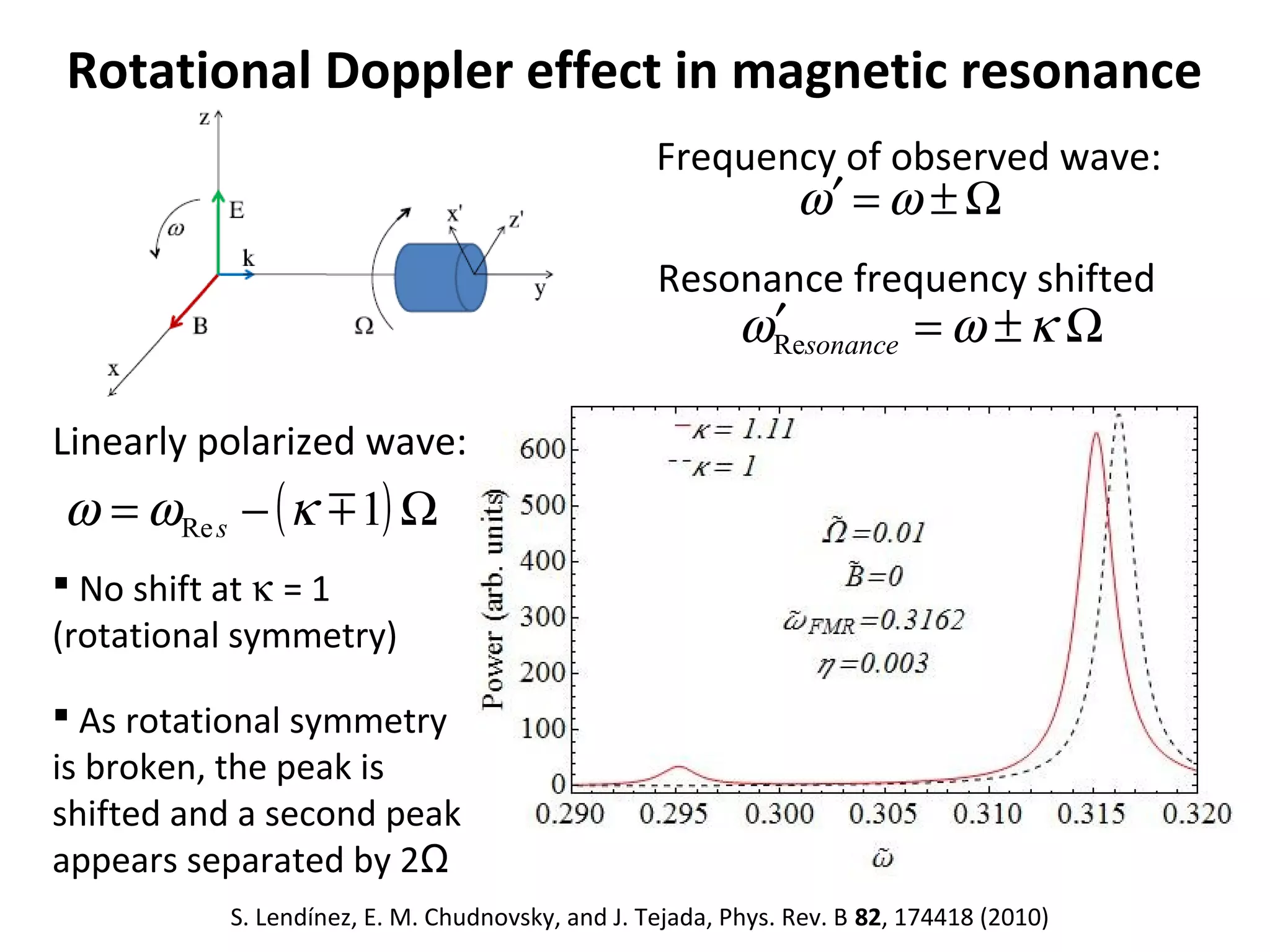
Rotational Doppler effect in magnetic resonance
                                                 Frequency of observed wave:
                                                              ω′ = ω ± Ω
                                                 Resonance frequency shifted
                                                          ′
                                                         ωResonance = ω ± κ Ω

Linearly polarized wave:
ω = ωRe s − ( κ  1) Ω
 No shift at κ = 1
(rotational symmetry)

 As rotational symmetry
is broken, the peak is
shifted and a second peak
appears separated by 2Ω
          S. Lendínez, E. M. Chudnovsky, and J. Tejada, Phys. Rev. B 82, 174418 (2010)
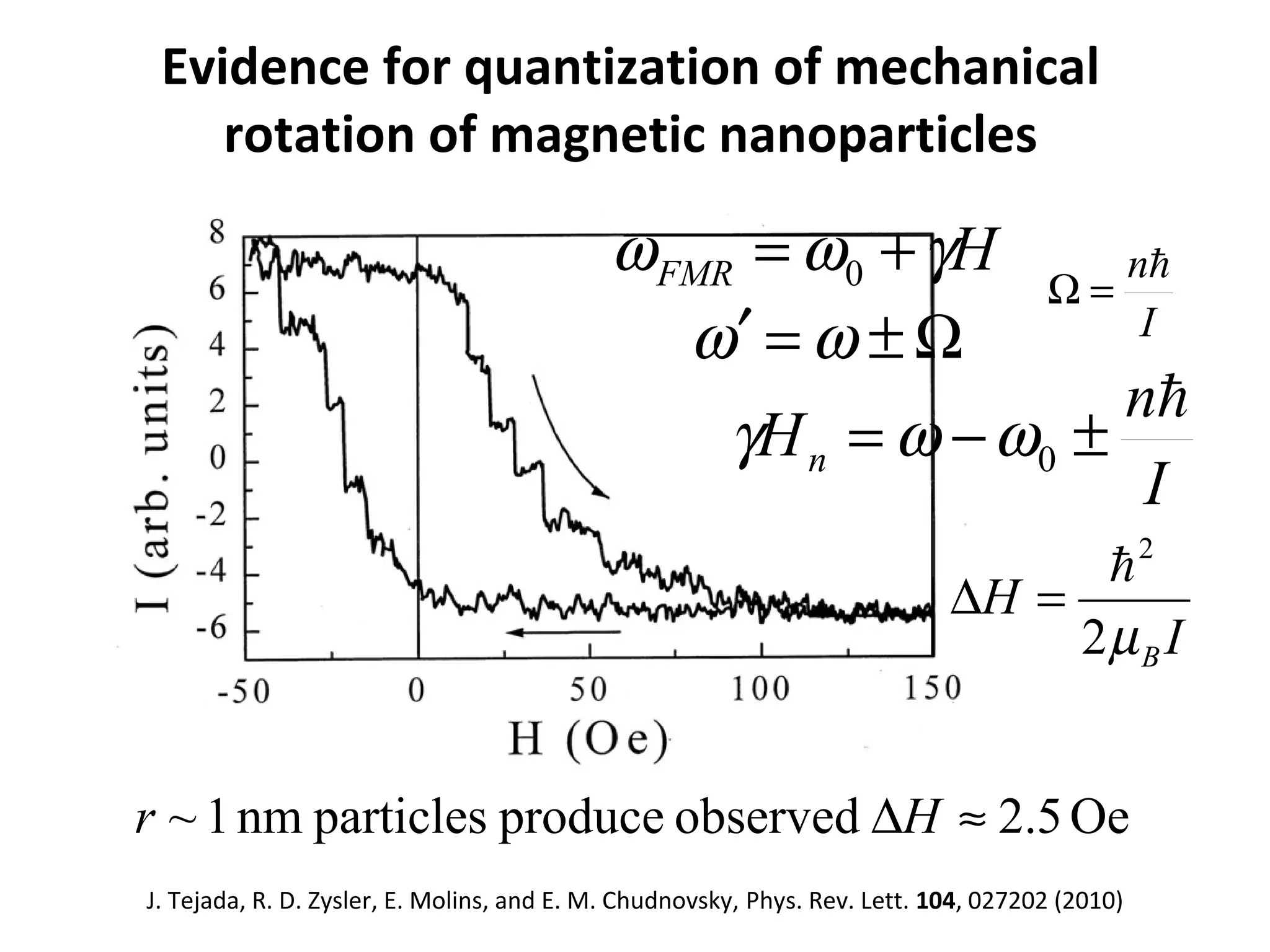
Evidence for quantization of mechanical
    rotation of magnetic nanoparticles

                                            ω FMR = ω0 + γH      n
                                                              Ω=
                                               ω′ = ω ± Ω         I
                                                                 n
                                                 γH n = ω − ω0 ±
                                                                  I
                                                                                  2
                                                                            ∆H =
                                                                                 2µ B I


r ~ 1 nm particles produce observed ∆H ≈ 2.5 Oe
J. Tejada, R. D. Zysler, E. Molins, and E. M. Chudnovsky, Phys. Rev. Lett. 104, 027202 (2010)
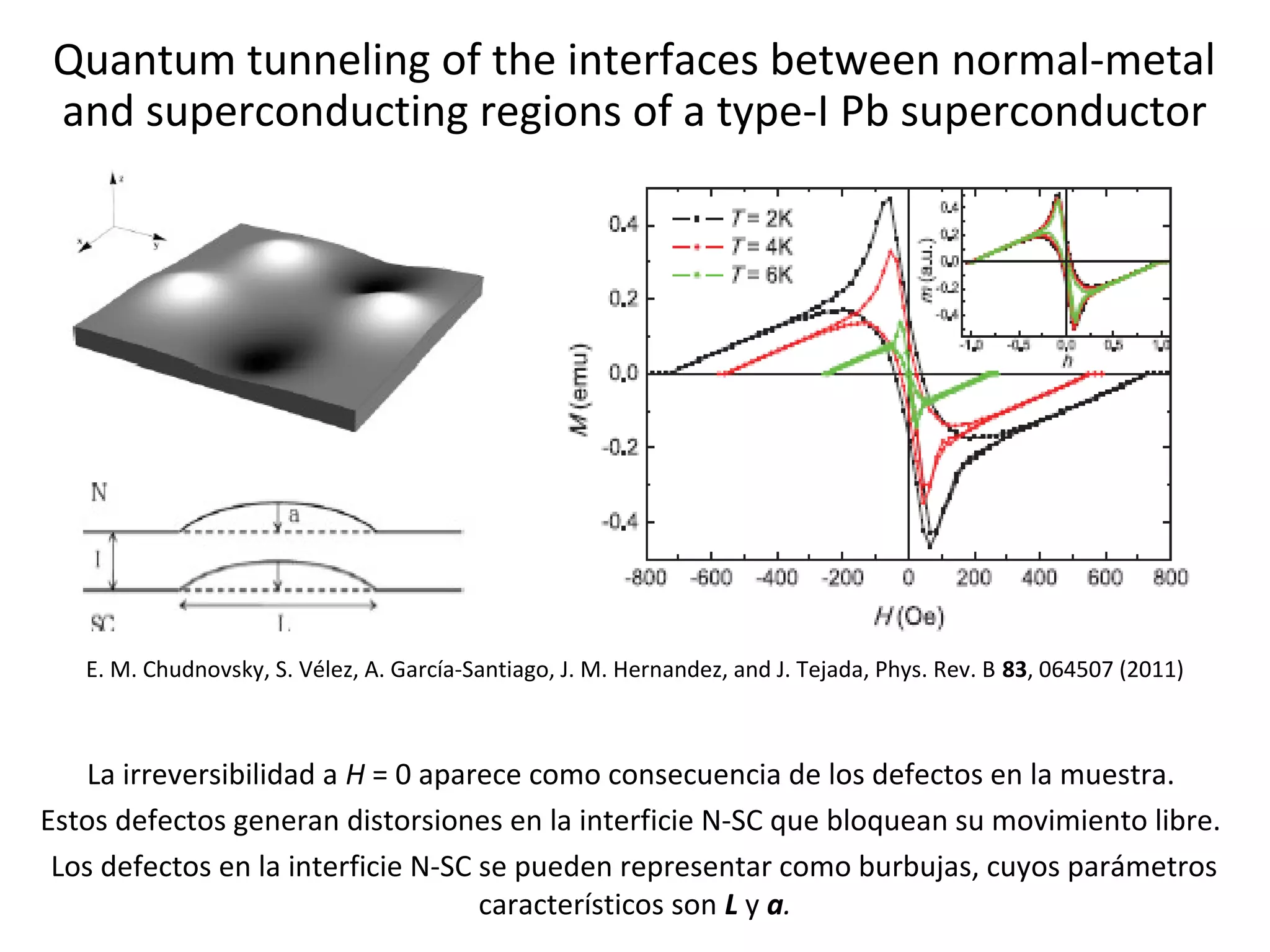
Quantum tunneling of the interfaces between normal-metal
and superconducting regions of a type-I Pb superconductor


   E. M. Chudnovsky, S. Vélez, A. García-Santiago, J. M. Hernandez, and J. Tejada, Phys. Rev. B 83, 064507 (2011)


    La irreversibilidad a H = 0 aparece como consecuencia de los defectos en la muestra.
Estos defectos generan distorsiones en la interficie N-SC que bloquean su movimiento libre.
 Los defectos en la interficie N-SC se pueden representar como burbujas, cuyos parámetros
                                    característicos son L y a.
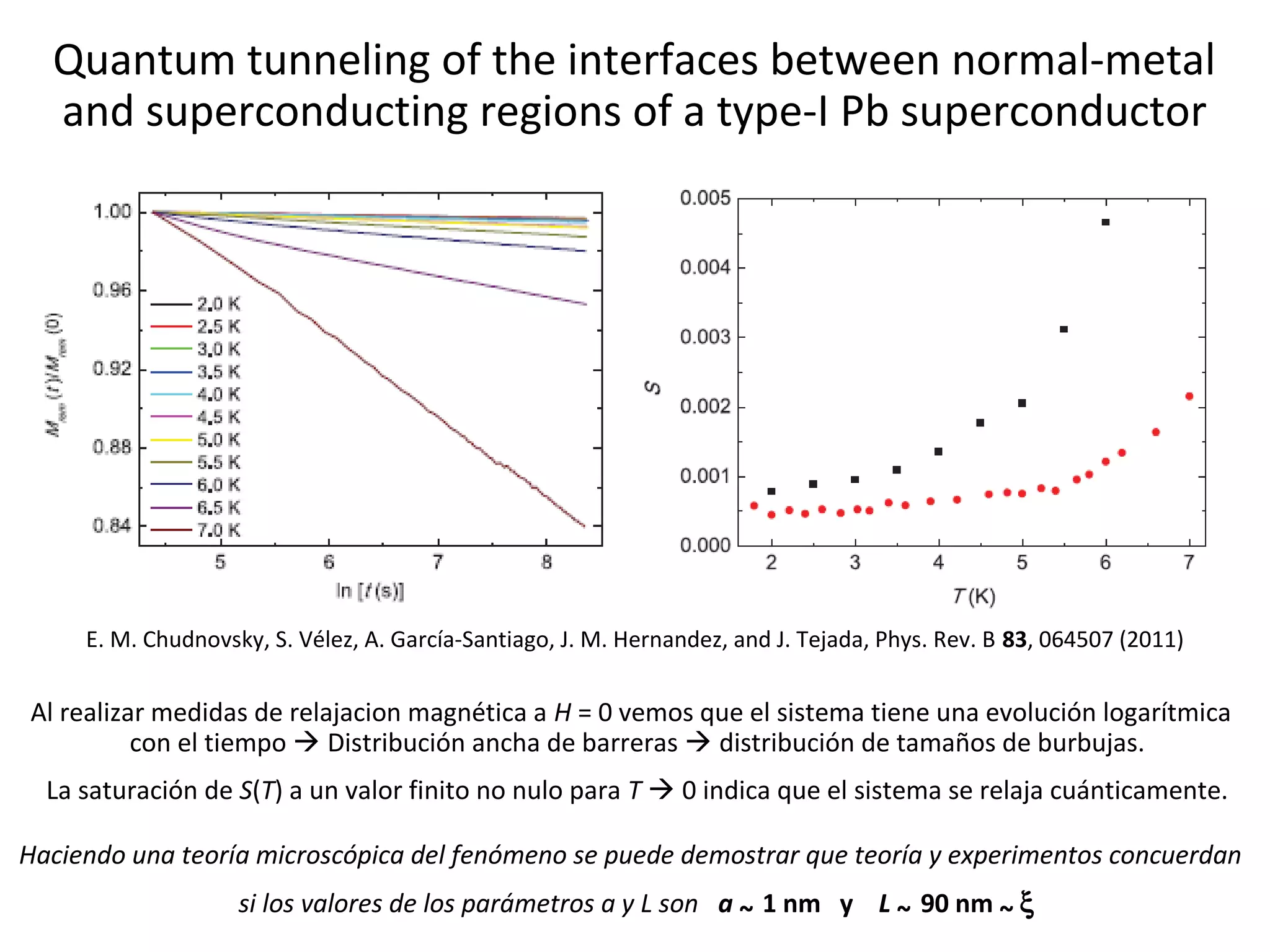
Quantum tunneling of the interfaces between normal-metal
  and superconducting regions of a type-I Pb superconductor


     E. M. Chudnovsky, S. Vélez, A. García-Santiago, J. M. Hernandez, and J. Tejada, Phys. Rev. B 83, 064507 (2011)


Al realizar medidas de relajacion magnética a H = 0 vemos que el sistema tiene una evolución logarítmica
          con el tiempo  Distribución ancha de barreras  distribución de tamaños de burbujas.
  La saturación de S(T) a un valor finito no nulo para T  0 indica que el sistema se relaja cuánticamente.

Haciendo una teoría microscópica del fenómeno se puede demostrar que teoría y experimentos concuerdan
                    si los valores de los parámetros a y L son a ~ 1 nm y L ~ 90 nm ~ ξ
Experimentos a bajas temperaturas con
ondas acústicas superficiales, microondas y
campos magnéticos giratorios, en sistemas
     magnéticos y superconductores
            (MAT2008-04535)
        (01.01.2009 – 31.12.2011)
          Grup de Magnetisme
         Universitat de Barcelona

         IP: Javier Tejada Palacios
Experimentos a bajas temperaturas con
ondas acústicas superficiales, microondas y
campos magnéticos giratorios, en sistemas
     magnéticos y superconductores
            (MAT2008-04535)
        (01.01.2009 – 31.12.2011)
          Grup de Magnetisme
         Universitat de Barcelona

         IP: Javier Tejada Palacios

Experimentos a bajas temperaturas...

  • 1.
    Experimentos a bajastemperaturas con ondas acústicas superficiales, microondas y campos magnéticos giratorios, en sistemas magnéticos y superconductores (MAT2008-04535) (01.01.2009 – 31.12.2011) Grup de Magnetisme Universitat de Barcelona IP: Javier Tejada Palacios
  • 2.
    Magnetic Deflagration inGd5Ge4: Polycrystals Montaje experimental Velocidad de la deflagración vs Hign y diferentes estados iniciales v ≈ [ ( k BT f / U ) κ ( T f ) Γ ( T f ) ] 1 2 ≈ 0.1 m/s Señales detectadas S. Velez et al. Phys. Rev. B 81, 064437 (2010)
  • 3.
    Anisotropic Magnetic Deflagrationin Gd5Ge4 Single Crystals Sample 1: Experimental Set-up: Hz c coaxial b cable 1.04 mm IDT Gd5Ge4 SC 2.45 mm a 1.17 mm Sample 2: Conducting LiNbO3 stripes substrate c a 1.07 mm 2.40 mm b 1.29 mm Magnetic deflagrations have been induced by means of controlled SAW pulses. They were induced on Gd5Ge4 Single Crystals with different geometries and under different sample configurations. The magnetic time evolution of the sample was taken directly from the SQUID-voltmeter
  • 4.
    Anisotropic Magnetic Deflagrationin Gd5Ge4 Single Crystals Same direction of applied magnetic field + different sample configuration: Anisotropic Magnetic Deflagration attributed to the Anisotropy of the Thermal Difussivity  κa > κb > κc 30 S1 H|| b , SAW || a S1 H|| b , SAW || c S2 H|| a , SAW || c S2 H|| a , SAW || b 20 Debido a la geometría de la td~L/ vp(ms) muestra, L es prácticamente el mismo para todas las configuraciones 10 0 16 18 20 22 24 26 28 30 Hig (kOe) Clear different speed for different crystallographic direction of the applied magnetic field + Correlation with the magnetic anisotropy of the sample: Anisotropic Magnetic Deflagration attributed to the Magnetic Anisotropy S. Velez et al. to be submitted
  • 5.
    Rotational Doppler effectin magnetic resonance Frequency of observed wave: ω′ = ω ± Ω Resonance frequency shifted ′ ωResonance = ω ± κ Ω Linearly polarized wave: ω = ωRe s − ( κ  1) Ω  No shift at κ = 1 (rotational symmetry)  As rotational symmetry is broken, the peak is shifted and a second peak appears separated by 2Ω S. Lendínez, E. M. Chudnovsky, and J. Tejada, Phys. Rev. B 82, 174418 (2010)
  • 6.
    Evidence for quantizationof mechanical rotation of magnetic nanoparticles ω FMR = ω0 + γH n Ω= ω′ = ω ± Ω I n γH n = ω − ω0 ± I 2 ∆H = 2µ B I r ~ 1 nm particles produce observed ∆H ≈ 2.5 Oe J. Tejada, R. D. Zysler, E. Molins, and E. M. Chudnovsky, Phys. Rev. Lett. 104, 027202 (2010)
  • 7.
    Quantum tunneling ofthe interfaces between normal-metal and superconducting regions of a type-I Pb superconductor E. M. Chudnovsky, S. Vélez, A. García-Santiago, J. M. Hernandez, and J. Tejada, Phys. Rev. B 83, 064507 (2011) La irreversibilidad a H = 0 aparece como consecuencia de los defectos en la muestra. Estos defectos generan distorsiones en la interficie N-SC que bloquean su movimiento libre. Los defectos en la interficie N-SC se pueden representar como burbujas, cuyos parámetros característicos son L y a.
  • 8.
    Quantum tunneling ofthe interfaces between normal-metal and superconducting regions of a type-I Pb superconductor E. M. Chudnovsky, S. Vélez, A. García-Santiago, J. M. Hernandez, and J. Tejada, Phys. Rev. B 83, 064507 (2011) Al realizar medidas de relajacion magnética a H = 0 vemos que el sistema tiene una evolución logarítmica con el tiempo  Distribución ancha de barreras  distribución de tamaños de burbujas. La saturación de S(T) a un valor finito no nulo para T  0 indica que el sistema se relaja cuánticamente. Haciendo una teoría microscópica del fenómeno se puede demostrar que teoría y experimentos concuerdan si los valores de los parámetros a y L son a ~ 1 nm y L ~ 90 nm ~ ξ
  • 9.
    Experimentos a bajastemperaturas con ondas acústicas superficiales, microondas y campos magnéticos giratorios, en sistemas magnéticos y superconductores (MAT2008-04535) (01.01.2009 – 31.12.2011) Grup de Magnetisme Universitat de Barcelona IP: Javier Tejada Palacios
  • 10.
    Experimentos a bajastemperaturas con ondas acústicas superficiales, microondas y campos magnéticos giratorios, en sistemas magnéticos y superconductores (MAT2008-04535) (01.01.2009 – 31.12.2011) Grup de Magnetisme Universitat de Barcelona IP: Javier Tejada Palacios