POR: MAYA
CAWOOD
            1
TABLA DE CONTENIDO
  1.    Qué vs. Cuál : Página 3
  2.    Ser: Páginas 4-5
  3.    Estar: Páginas 6-7
  4.    Gustar: Página 8
  5.    Transitions: Página 9
  6.    Imperfect: Páginas 10-12
  7.    Triggers: Página 13
  8.    Hace : Página 14
  9.    Acabar de: Página 15
  10.   Formulas: Página 16
  11.   Verbos como gustar: Página 17
  12.   Reflexive: Página 18
  13.   Tú Commands: Página 19
  14.   DOP + placement ( affirmative, irregulars, negative): Página 20
  15.   Pretrite: Página 21


                                                                          2
QUÉ VS. CUÁL
Qué                             Cuál
Qué is used when asking for     Cuál usually is used before es and
definitions.                    other forms of ser when not seeking
¿Qué es una ciudad?             a definition
                                ¿Cuál es tu número de teléfono?
¿Qué hace un presidente?
                                ¿Cuál es tu problema?
¿Qué significa "talanquera"?    ¿Cuáles son las ciudades más
Qué is most often used before   grandes?
nouns.                          Cuál is used to suggest a selection or
¿Qué casa prefieres?            choice from among a group
¿Qué libro leíste?              ¿Cuál miras?
                                ¿Cuál prefieres?
                                ¿Cuáles quieres?


                                                                         3
Descriptions    Origin     Characteristics


                                                Time


SER                      Docto
                         r PED               Occupation


                                             Relationships


 Date                      Possession
               Events
                                                        4
DOCTOR PED
Descriptions: ¿Qué es?
Origin: ¿De donde es?
Characteristics: ¿Como es?
Time: ¿Qué hora es?
Occupation: ¿Qué hace?
Relationship: Quién es?
Possession: ¿De quién es?
Events: ¿Donde es?
Dates: ¿Qué dia es hoy?

                             5
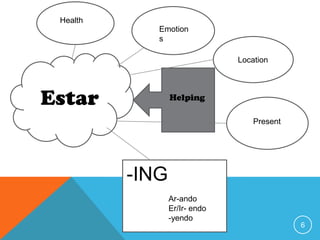
Health
             Emotion
             s

                               Location


Estar            Helping

                                   Present


          -ING
                 Ar-ando
                 Er/Ir- endo
                 -yendo
                                             6
ESTAR
Health: ¿Como estas?
Emotion: ¿Come estas?
Location: ¿Donde estas?
Present Condition: ¿Como estas?
ING: ¿Qué estas haciendo?


                                  7
GUSTAR
¿Quién?                          Gustar
Yo                               Me gusta
Tú                               Te gusta
El/Ella/Usted                    Le gusta
Nostros                          Nos gusta
Ellos/Ellas/Ustedes              Les gusta
Vostros                          Os gusta

                      ¿Gustar o Gustan?

                      Use gustan cuando
                      se habla de varios
                      objetos

                      Me gusta el
                      boligrafo.
                      Me gustan              8
                      boligrafos.
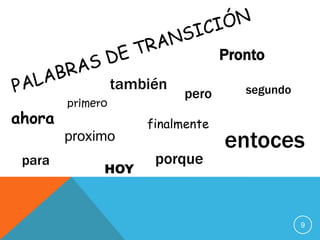
Pronto
                  también             segundo
                            pero
        primero
ahora                 finalmente
        proximo                    entoces
 para                  porque
              HOY


                                                9
EL IMPERECTO
1. Forms of the imperfect, regular verbs. Stem: Take the infinitive, and
    remove the last two letters (the infinitive ending):
         hablar > habl-
         comer > com-
          vivir > viv-.

Endings:
-ar verbs: -aba, -abas, -aba, -ábamos, -abais, -
   aban.

-er and -ir verbs: -ía, -ías, -ía, -íamos, -íais, -ían.


                                                                           10
EL IMPERFECTO
2. Usage:
   1.To indicate an action or state viewed as being in progress in the past.
   (was/were)
   2. Repeated Action (used to)
   3. No definite beginning or ending
   4. Time/date/age/feelings
   5. Interrupted activity (cuando)


Yo cantaba mi canción favorita.


                                                                               11
EL IMPERECTO
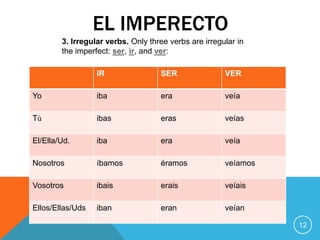
        3. Irregular verbs. Only three verbs are irregular in
        the imperfect: ser, ir, and ver:

                  IR                SER                VER

Yo                iba               era                veía

Tú                ibas              eras               veías

El/Ella/Ud.       iba               era                veía

Nosotros          íbamos            éramos             veíamos

Vosotros          ibais             erais              veíais

Ellos/Ellas/Uds   iban              eran               veían

                                                                 12
TRIGGERS
1. Todos los días
2. A menudo
3. A veces
4. Siempre
5. Cada día
6. Los lunes
7. Generalmente
8. Mientras
9. De vez en cuando
10. Muchas veces
11. Frecuentemente


                      13
HACE
•     Hace + time + que +conjugated verb: How long you have been doing
      something.
• Hay + que + infinitive: what needs to be done

    • Se prohíbe + infinitive/ Se permite + infinitive: What is prohibited or
    permitted.

    • Ir + a + infinitve: What someone is going to do


                                                                                14
ACABAR DE + INFINITIVE

• Acabar de + infinitive = to have just done
  something (in the very recent past)
  Example: Acabo de llevar a mi hermana a
  su casa.
  I just took my sister to her house


                                               15
FORMULAS

There are 4 formulas…

1. Hace + time + que + conjugated verb
2. Hay +que + infinitive
3. Se prohíbe + infinitive
- 4. Se permite + infinitiveMeans


                                         16
VERBOS COMO GUSTAR
Now that you know how to correctly use the verb gustar, here is a list of verbs that
   operate in the same manner:

aburrir :to bore
fascinar :to be fascinating
bastar: to be sufficient
importar to be important to
molestar :t o be a bother
disgustar :to hate something
parecer :to appear to be
doler (o:ue): to be painful
picar :to itch
encantar : to "love" something
faltar : to be lacking something
volver (o:ue) loco : to be crazy about

                                                                                       17
VERBO DE REFLEXIVE
Actions you do to yourself.
Sí: I WASH my hair. I BRUSH my teeth        No: I take the trash out. I wash the dog
Examples:      Ducharse                             For ones self to take a shower

               Despertarse                          To wake up

               Laverse                              To wash

               Peinarse                             To comb one’s hair


How to write a reflexive verb:
1.   Move the ending pronoun (se, te, me, nos, os) to the front
2.   Change the ending to the appropriate tense and person
Example: I took a shower. Me duchó.


                                                                                       18
TÚ COMMANDS
How to form a tú command.
1. Put the verb in the tú form
2. Drop the s at the end of the verb

Example: Comer… comes….¡COME!
    Vivir…vive…¡VIVE!


                                       19
DOP + PLACEMENT
1. Affirmative
           Put the verb into the 3rd person tense: Come
           Hook on the direct object (lo, la, las, los): Comelo
           Change the syllibification: ¡Cómelo! “Eat it!”
2. Irregulars
           Command + it
Di Haz Ve Pon Sal Sé Te Ven
3. Negative
           Ar- e Er/Ir-a
           No + it + verbo
           Verbo: yo form, change to either e or a, and add an s
     Example: No lo comas


                                                                   20
PRETERITE
•   Past tense verbo
•   “Snap shot” back in time
•   The action has a beginning and an ending
•   It is a completed action


          AR                 ER/IR
          é                  í                 Example:
          aste               iste              She ran
          ó                  ió                Ella corrió
          amos               imos
          aron               ieron


                                                             21

Grammer book

  • 1.
  • 2.
    TABLA DE CONTENIDO 1. Qué vs. Cuál : Página 3 2. Ser: Páginas 4-5 3. Estar: Páginas 6-7 4. Gustar: Página 8 5. Transitions: Página 9 6. Imperfect: Páginas 10-12 7. Triggers: Página 13 8. Hace : Página 14 9. Acabar de: Página 15 10. Formulas: Página 16 11. Verbos como gustar: Página 17 12. Reflexive: Página 18 13. Tú Commands: Página 19 14. DOP + placement ( affirmative, irregulars, negative): Página 20 15. Pretrite: Página 21 2
  • 3.
    QUÉ VS. CUÁL Qué Cuál Qué is used when asking for Cuál usually is used before es and definitions. other forms of ser when not seeking ¿Qué es una ciudad? a definition ¿Cuál es tu número de teléfono? ¿Qué hace un presidente? ¿Cuál es tu problema? ¿Qué significa "talanquera"? ¿Cuáles son las ciudades más Qué is most often used before grandes? nouns. Cuál is used to suggest a selection or ¿Qué casa prefieres? choice from among a group ¿Qué libro leíste? ¿Cuál miras? ¿Cuál prefieres? ¿Cuáles quieres? 3
  • 4.
    Descriptions Origin Characteristics Time SER Docto r PED Occupation Relationships Date Possession Events 4
  • 5.
    DOCTOR PED Descriptions: ¿Quées? Origin: ¿De donde es? Characteristics: ¿Como es? Time: ¿Qué hora es? Occupation: ¿Qué hace? Relationship: Quién es? Possession: ¿De quién es? Events: ¿Donde es? Dates: ¿Qué dia es hoy? 5
  • 6.
    Health Emotion s Location Estar Helping Present -ING Ar-ando Er/Ir- endo -yendo 6
  • 7.
    ESTAR Health: ¿Como estas? Emotion:¿Come estas? Location: ¿Donde estas? Present Condition: ¿Como estas? ING: ¿Qué estas haciendo? 7
  • 8.
    GUSTAR ¿Quién? Gustar Yo Me gusta Tú Te gusta El/Ella/Usted Le gusta Nostros Nos gusta Ellos/Ellas/Ustedes Les gusta Vostros Os gusta ¿Gustar o Gustan? Use gustan cuando se habla de varios objetos Me gusta el boligrafo. Me gustan 8 boligrafos.
  • 9.
    Pronto también segundo pero primero ahora finalmente proximo entoces para porque HOY 9
  • 10.
    EL IMPERECTO 1. Formsof the imperfect, regular verbs. Stem: Take the infinitive, and remove the last two letters (the infinitive ending): hablar > habl- comer > com- vivir > viv-. Endings: -ar verbs: -aba, -abas, -aba, -ábamos, -abais, - aban. -er and -ir verbs: -ía, -ías, -ía, -íamos, -íais, -ían. 10
  • 11.
    EL IMPERFECTO 2. Usage: 1.To indicate an action or state viewed as being in progress in the past. (was/were) 2. Repeated Action (used to) 3. No definite beginning or ending 4. Time/date/age/feelings 5. Interrupted activity (cuando) Yo cantaba mi canción favorita. 11
  • 12.
    EL IMPERECTO 3. Irregular verbs. Only three verbs are irregular in the imperfect: ser, ir, and ver: IR SER VER Yo iba era veía Tú ibas eras veías El/Ella/Ud. iba era veía Nosotros íbamos éramos veíamos Vosotros ibais erais veíais Ellos/Ellas/Uds iban eran veían 12
  • 13.
    TRIGGERS 1. Todos losdías 2. A menudo 3. A veces 4. Siempre 5. Cada día 6. Los lunes 7. Generalmente 8. Mientras 9. De vez en cuando 10. Muchas veces 11. Frecuentemente 13
  • 14.
    HACE • Hace + time + que +conjugated verb: How long you have been doing something. • Hay + que + infinitive: what needs to be done • Se prohíbe + infinitive/ Se permite + infinitive: What is prohibited or permitted. • Ir + a + infinitve: What someone is going to do 14
  • 15.
    ACABAR DE +INFINITIVE • Acabar de + infinitive = to have just done something (in the very recent past) Example: Acabo de llevar a mi hermana a su casa. I just took my sister to her house 15
  • 16.
    FORMULAS There are 4formulas… 1. Hace + time + que + conjugated verb 2. Hay +que + infinitive 3. Se prohíbe + infinitive - 4. Se permite + infinitiveMeans 16
  • 17.
    VERBOS COMO GUSTAR Nowthat you know how to correctly use the verb gustar, here is a list of verbs that operate in the same manner: aburrir :to bore fascinar :to be fascinating bastar: to be sufficient importar to be important to molestar :t o be a bother disgustar :to hate something parecer :to appear to be doler (o:ue): to be painful picar :to itch encantar : to "love" something faltar : to be lacking something volver (o:ue) loco : to be crazy about 17
  • 18.
    VERBO DE REFLEXIVE Actionsyou do to yourself. Sí: I WASH my hair. I BRUSH my teeth No: I take the trash out. I wash the dog Examples: Ducharse For ones self to take a shower Despertarse To wake up Laverse To wash Peinarse To comb one’s hair How to write a reflexive verb: 1. Move the ending pronoun (se, te, me, nos, os) to the front 2. Change the ending to the appropriate tense and person Example: I took a shower. Me duchó. 18
  • 19.
    TÚ COMMANDS How toform a tú command. 1. Put the verb in the tú form 2. Drop the s at the end of the verb Example: Comer… comes….¡COME! Vivir…vive…¡VIVE! 19
  • 20.
    DOP + PLACEMENT 1.Affirmative Put the verb into the 3rd person tense: Come Hook on the direct object (lo, la, las, los): Comelo Change the syllibification: ¡Cómelo! “Eat it!” 2. Irregulars Command + it Di Haz Ve Pon Sal Sé Te Ven 3. Negative Ar- e Er/Ir-a No + it + verbo Verbo: yo form, change to either e or a, and add an s Example: No lo comas 20
  • 21.
    PRETERITE • Past tense verbo • “Snap shot” back in time • The action has a beginning and an ending • It is a completed action AR ER/IR é í Example: aste iste She ran ó ió Ella corrió amos imos aron ieron 21