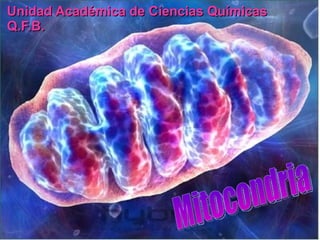
Unidad Académica de Ciencias Químicas Q.F.B. Mitocondria
Biogénesis mitocondrial La biogénesis mitocondrial es un proceso central en la fisiología celular que requiere la expresión coordinada de dos genomas localizados en compartimentos física y genéticamente diferentes, núcleo y mitocondria. Lynn Margulis propuso que el origen de las mitocondrias modernas es a partir de la endosimbiosis ( endo , dentro +  simbiosis  relación biológica con beneficio mutuo) de bacterias aerobias con eucariontes anaerobios antiguos.
Biogénesis mitocondrial
Características Localización: en células eucariotas aerobias. Forma: generalmente filamentosas, redondeadas o helicoidales. Tamaño: son de 0.5 micras de ancho hasta entre 2 y 50 micras de largo. Numero: depende del tipo de células: 1000-1600 mitocondrias en hepatocitos 300000 mitocondrias en ovocitos 1 mitocondria en flagelados.
Características Distribución: Las mitocondrias están por todo el citoplasma pero si la célula es especializada las mitocondrias se agruparan en las zonas donde hace falta más energía (túbulos renales, conos y bastones, espermatozoides y células musculares estriadas).
Función biológica A la mitocondria, se le considera la central energética de las células, ahí se lleva a cabo el metabolismo oxidativo de los eucariontes: actividades de piruvato deshidrogenasa, enzimas del ciclo del ácido cítrico, oxidación de los ácidos grasos y las enzimas y proteínas redox que llevan a cabo el transporte de electrones y la fosforilación oxidativa.
Estructura de la mitocondria
Funciones de las mitocondrias Las mitocondrias son los orgánulos celulares encargados de suministrar la mayor parte de la energía necesaria para la actividad celular, actúan por tanto, como  centrales energéticas  de la célula y sintetizan ATP  ATP  a expensas de los  carburantes metabólicos  (glucosa, ácidos grasos y aminoácidos).
Esquema metabólico
Esquema metabólico Proteínas Lípidos Carbohidratos Ácidos grasos Glucosa Aminoácidos Piruvato Ciclo de Krebs Glucólisis Acetil-CoA Β -oxidación Proteólisis Lipólisis
Esquema metabólico
 
Glycolysis The next step in the oxidation of glucose involves the transport of pyruvate into  mitochondria  and its subsequent oxidized by O2 to CO2, generating 34 of the 36 ATP molecules produced during respiration.  consider this step, ie.  the role of mitochondria in ATP production.
After its synthesis, Acetyl CoA is fed into a cyclic pathway alternately called the  citric acid cycle , the  TCA (tricarboxylic acid) cycle , or the  Krebs cycle  (Figure 4). In this cycle the acetyl group on acetyl CoA is oxidized to CO2. Four reactions in the Krebs cycle involve the transfer of a pair of electrons from a substrate to an electron accepting coenzyme. Three of the reactions reduce the coenzme NAD+ to  NADH , and one reduces the coenzyme FAD to  FADH2 . In addition, a GDP is converted to GTP.  The enzymes that carry out these reactions are located in the mitochondrial matrix and at the matrix surface of the inner membrane.  The reduced coenzymes (NADH and FADH2) generated in the citric acid cycle store the energy released in glucose oxidation, and synthesis of ATP is then coupled to the reoxidation of these compounds by O2 in a process that involves the  electron transport chain . Some of the intermediates in the Krebs cycle are substrates that will be used in the second lab exercise (succinate, malate), so note the position of each these substrates in the cycle and the reducedcoenzymes that are produced from their oxidation.
 

Mitocondria

  • 1.
    Unidad Académica deCiencias Químicas Q.F.B. Mitocondria
  • 2.
    Biogénesis mitocondrial Labiogénesis mitocondrial es un proceso central en la fisiología celular que requiere la expresión coordinada de dos genomas localizados en compartimentos física y genéticamente diferentes, núcleo y mitocondria. Lynn Margulis propuso que el origen de las mitocondrias modernas es a partir de la endosimbiosis ( endo , dentro + simbiosis relación biológica con beneficio mutuo) de bacterias aerobias con eucariontes anaerobios antiguos.
  • 3.
  • 4.
    Características Localización: encélulas eucariotas aerobias. Forma: generalmente filamentosas, redondeadas o helicoidales. Tamaño: son de 0.5 micras de ancho hasta entre 2 y 50 micras de largo. Numero: depende del tipo de células: 1000-1600 mitocondrias en hepatocitos 300000 mitocondrias en ovocitos 1 mitocondria en flagelados.
  • 5.
    Características Distribución: Lasmitocondrias están por todo el citoplasma pero si la célula es especializada las mitocondrias se agruparan en las zonas donde hace falta más energía (túbulos renales, conos y bastones, espermatozoides y células musculares estriadas).
  • 6.
    Función biológica Ala mitocondria, se le considera la central energética de las células, ahí se lleva a cabo el metabolismo oxidativo de los eucariontes: actividades de piruvato deshidrogenasa, enzimas del ciclo del ácido cítrico, oxidación de los ácidos grasos y las enzimas y proteínas redox que llevan a cabo el transporte de electrones y la fosforilación oxidativa.
  • 7.
    Estructura de lamitocondria
  • 8.
    Funciones de lasmitocondrias Las mitocondrias son los orgánulos celulares encargados de suministrar la mayor parte de la energía necesaria para la actividad celular, actúan por tanto, como centrales energéticas de la célula y sintetizan ATP ATP a expensas de los carburantes metabólicos (glucosa, ácidos grasos y aminoácidos).
  • 9.
  • 10.
    Esquema metabólico ProteínasLípidos Carbohidratos Ácidos grasos Glucosa Aminoácidos Piruvato Ciclo de Krebs Glucólisis Acetil-CoA Β -oxidación Proteólisis Lipólisis
  • 11.
  • 12.
  • 13.
    Glycolysis The nextstep in the oxidation of glucose involves the transport of pyruvate into mitochondria and its subsequent oxidized by O2 to CO2, generating 34 of the 36 ATP molecules produced during respiration. consider this step, ie. the role of mitochondria in ATP production.
  • 14.
    After its synthesis,Acetyl CoA is fed into a cyclic pathway alternately called the citric acid cycle , the TCA (tricarboxylic acid) cycle , or the Krebs cycle (Figure 4). In this cycle the acetyl group on acetyl CoA is oxidized to CO2. Four reactions in the Krebs cycle involve the transfer of a pair of electrons from a substrate to an electron accepting coenzyme. Three of the reactions reduce the coenzme NAD+ to NADH , and one reduces the coenzyme FAD to FADH2 . In addition, a GDP is converted to GTP. The enzymes that carry out these reactions are located in the mitochondrial matrix and at the matrix surface of the inner membrane. The reduced coenzymes (NADH and FADH2) generated in the citric acid cycle store the energy released in glucose oxidation, and synthesis of ATP is then coupled to the reoxidation of these compounds by O2 in a process that involves the electron transport chain . Some of the intermediates in the Krebs cycle are substrates that will be used in the second lab exercise (succinate, malate), so note the position of each these substrates in the cycle and the reducedcoenzymes that are produced from their oxidation.
  • 15.