Robots Libres e Imprimibles Juan González-Gómez y Alberto Valero Gómez, Robotics Lab Universidad Carlos III de Madrid VIII Conferência Latino-Americana de Software Livre 20 de outubro de 2011 - Foz do Iguaçu | PR | Brasil [email_address]
Índice Introducción
El robot Miniskybot
Robots derivados
Plastic Valley UC3M
Conclusiones y trabajos futuros Robots libres e imprimibles Latinoware 2011
Introducción: Robots libres e imprimibles Latinoware 2011 Robótica Libre
Modelo “Open source” El modelo  open source  funciona
Modelo distribuido, con alcance mundial
Miles de personas cooperando
Aparición de comunidades
Herramientas: repositorios, wikis,...
Patrimonio tecnológico de la humanidad
Robótica Libre (I) Robots desarrollados por la comunidad
Compartidos por Internet
Robots que evolucionan
¡Emergencia de diseños asombrosos! ¿Por qué no aplicar este modelo a la robótica? Ventajas:
Robótica Libre (II) Los robots son  objetos físicos  y no “bits” como el software
Se necesita  tiempo  y  dinero  para duplicar un objeto físico ¿Cómo lo aplicamos? Problemas: Enfoque: Internet Planos (Bits) Planos (Bits) Compartir Fabricar Objeto físico Convertir a bits Objeto físico
Robótica Libre (III) Software Mecánica Planos mećanicos Electrónica Planos  eléctricos Programa Robot físico Robot Libre Robot Libre : Aplicamos las 4 libertades software libre a los  planos  del robot:  Mecánica ,  electrónica  y  software void timer0_delay(unsigned char t0ini) { //-- Dar valor inicial del timer TMR0=t0ini; //-- Flag de interrupcion a cero T0IF=0; //-- Esperar a que transcurra el tiempo indicado while(T0IF==0);
Robótica Libre (IV) Robot Libre : Son necesarios los ficheros “fuente” de los planos Software Tool chains Robot físico Robot Libre Herramientas generadoras EDA CAD void timer0_delay(unsigned char t0ini) { //-- Dar valor inicial del timer TMR0=t0ini; //-- Flag de interrupcion a cero T0IF=0; //-- Esperar a que transcurra el tiempo indicado while(T0IF==0);
Herramientas generadoras (I) ¡Las herramientas generadoras imponen restricciones a la compartición! Pago de licencias
Gratis, pero... Funcionalidad limitada
Restricciones en el uso Restricciones en el Sistema Operativo
Planos en formatos propietarios
Hardware libre² 2 Panos libres
Software propietario Panos libres
Software Libre El hardware libre lo podemos clasificar en: Hardware libre Hardware libre²
Introducción: Robots libres e imprimibles Latinoware 2011 Impresoras 3D Open Source
Impresoras 3D  Impresora 3D : Dispositivo que construye objetos físicos a partir de bits Coste: Propietarias: 12.000€ - 60.000€
Open source:  350€ - 2.000€ Material :  Plástico: ABS(26€/kg), PLA(29€/kg) Objeto físico Bits
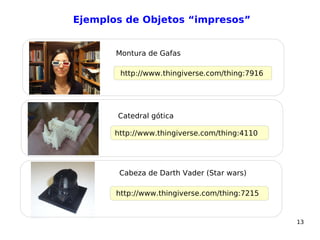
Ejemplos de Objetos “impresos” Montura de Gafas http://www.thingiverse.com/thing:4110 Cabeza de Darth Vader (Star wars) http://www.thingiverse.com/thing:7215 Catedral gótica http://www.thingiverse.com/thing:7916
Vídeo 1: Una impresora en acción
Impresoras 3D Open source Reprap project : Máquina auto-replicante (2005) Thingiverse : Sitio para compartir objetos físicos (2009) Makerbot : Comercializan impresoras 3D open-source (2009)
Robots libres e imprimibles para educación Nuestros robots tienen las siguientes características:  2 Diseño disponible para que cualquiera lo pueda  usar,   estudiar ,  modificar ,  distribuir ,  fabricar  o  vender Se pueden fabricar utilizando una impresora 3D open-source Se ha diseñado exclusivamente utilizando  herramientas libres . Esto garantiza que no hay restricciones en su modificación, compartición o fabricación.  Libres Imprimibles Herramientas libres
Índice Introducción
El robot Miniskybot
Robots derivados
Proyecto Plastic Valley UC3M
Conclusiones y trabajos futuros Robots libres e imprimibles Latinoware 2011
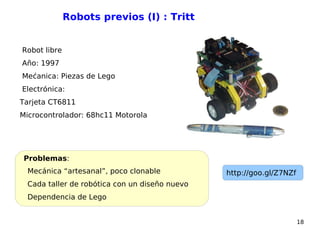
Robots previos (I) : Tritt Robot libre
Año: 1997
Mećanica: Piezas de Lego
Electrónica:  Tarjeta CT6811
Microcontrolador: 68hc11 Motorola http://goo.gl/Z7NZf Problemas : Mecánica “artesanal”, poco clonable
Cada taller de robótica con un diseño nuevo
Dependencia de Lego
Vídeo 2: El robot Tritt
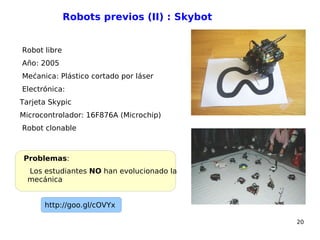
Robots previos (II) : Skybot Robot libre
Año: 2005
Mećanica: Plástico cortado por láser
Electrónica:  Tarjeta Skypic
Microcontrolador: 16F876A (Microchip) Robot clonable Problemas : Los estudiantes  NO  han evolucionado la mecánica http://goo.gl/cOVYx

Latinoware: Robots libres e Imprimibles

Notas del editor

  • #2 Thanks Prof. Matellan. I am going to start the presentation of my Dissertation which is about the Locomotion of Limbless Modular robots
  • #3 This presentation is divided into 7 parts. First I will introduce the Locomotion problem and the objectives of the dissertation. Second, I will explain the general classification for all the modular robots. Then I will present the central ideas of the dissertation: Locomotion of limbless robots in 1D, 2D and the locomotion of the minimal configurations. Then I will describe some experiments and we will see some videos and simulations. Finally, the conclusions and future work are summarized.
  • #4 This presentation is divided into 7 parts. First I will introduce the Locomotion problem and the objectives of the dissertation. Second, I will explain the general classification for all the modular robots. Then I will present the central ideas of the dissertation: Locomotion of limbless robots in 1D, 2D and the locomotion of the minimal configurations. Then I will describe some experiments and we will see some videos and simulations. Finally, the conclusions and future work are summarized.
  • #5 A big challenge in robotics is the development of a very versatile mobile robot capable of moving on different terrains. As a first approach, the study of locomotion of the mobile robots can be divided into two big leves. The higher level involves the perception of the environment, planning trajectories, navigation and making decisions. The lower level is in charge of the control and coordination of the joints in order to move the robot a step in any direction. This Locomotion lower level is the scope of the dissertation
  • #6 A big challenge in robotics is the development of a very versatile mobile robot capable of moving on different terrains. As a first approach, the study of locomotion of the mobile robots can be divided into two big leves. The higher level involves the perception of the environment, planning trajectories, navigation and making decisions. The lower level is in charge of the control and coordination of the joints in order to move the robot a step in any direction. This Locomotion lower level is the scope of the dissertation
  • #7 A big challenge in robotics is the development of a very versatile mobile robot capable of moving on different terrains. As a first approach, the study of locomotion of the mobile robots can be divided into two big leves. The higher level involves the perception of the environment, planning trajectories, navigation and making decisions. The lower level is in charge of the control and coordination of the joints in order to move the robot a step in any direction. This Locomotion lower level is the scope of the dissertation
  • #8 A big challenge in robotics is the development of a very versatile mobile robot capable of moving on different terrains. As a first approach, the study of locomotion of the mobile robots can be divided into two big leves. The higher level involves the perception of the environment, planning trajectories, navigation and making decisions. The lower level is in charge of the control and coordination of the joints in order to move the robot a step in any direction. This Locomotion lower level is the scope of the dissertation
  • #9 A big challenge in robotics is the development of a very versatile mobile robot capable of moving on different terrains. As a first approach, the study of locomotion of the mobile robots can be divided into two big leves. The higher level involves the perception of the environment, planning trajectories, navigation and making decisions. The lower level is in charge of the control and coordination of the joints in order to move the robot a step in any direction. This Locomotion lower level is the scope of the dissertation
  • #10 A big challenge in robotics is the development of a very versatile mobile robot capable of moving on different terrains. As a first approach, the study of locomotion of the mobile robots can be divided into two big leves. The higher level involves the perception of the environment, planning trajectories, navigation and making decisions. The lower level is in charge of the control and coordination of the joints in order to move the robot a step in any direction. This Locomotion lower level is the scope of the dissertation
  • #11 A big challenge in robotics is the development of a very versatile mobile robot capable of moving on different terrains. As a first approach, the study of locomotion of the mobile robots can be divided into two big leves. The higher level involves the perception of the environment, planning trajectories, navigation and making decisions. The lower level is in charge of the control and coordination of the joints in order to move the robot a step in any direction. This Locomotion lower level is the scope of the dissertation
  • #13 A big challenge in robotics is the development of a very versatile mobile robot capable of moving on different terrains. As a first approach, the study of locomotion of the mobile robots can be divided into two big leves. The higher level involves the perception of the environment, planning trajectories, navigation and making decisions. The lower level is in charge of the control and coordination of the joints in order to move the robot a step in any direction. This Locomotion lower level is the scope of the dissertation
  • #14 A big challenge in robotics is the development of a very versatile mobile robot capable of moving on different terrains. As a first approach, the study of locomotion of the mobile robots can be divided into two big leves. The higher level involves the perception of the environment, planning trajectories, navigation and making decisions. The lower level is in charge of the control and coordination of the joints in order to move the robot a step in any direction. This Locomotion lower level is the scope of the dissertation
  • #15 A big challenge in robotics is the development of a very versatile mobile robot capable of moving on different terrains. As a first approach, the study of locomotion of the mobile robots can be divided into two big leves. The higher level involves the perception of the environment, planning trajectories, navigation and making decisions. The lower level is in charge of the control and coordination of the joints in order to move the robot a step in any direction. This Locomotion lower level is the scope of the dissertation
  • #16 A big challenge in robotics is the development of a very versatile mobile robot capable of moving on different terrains. As a first approach, the study of locomotion of the mobile robots can be divided into two big leves. The higher level involves the perception of the environment, planning trajectories, navigation and making decisions. The lower level is in charge of the control and coordination of the joints in order to move the robot a step in any direction. This Locomotion lower level is the scope of the dissertation
  • #17 A big challenge in robotics is the development of a very versatile mobile robot capable of moving on different terrains. As a first approach, the study of locomotion of the mobile robots can be divided into two big leves. The higher level involves the perception of the environment, planning trajectories, navigation and making decisions. The lower level is in charge of the control and coordination of the joints in order to move the robot a step in any direction. This Locomotion lower level is the scope of the dissertation
  • #18 This presentation is divided into 7 parts. First I will introduce the Locomotion problem and the objectives of the dissertation. Second, I will explain the general classification for all the modular robots. Then I will present the central ideas of the dissertation: Locomotion of limbless robots in 1D, 2D and the locomotion of the minimal configurations. Then I will describe some experiments and we will see some videos and simulations. Finally, the conclusions and future work are summarized.
  • #19 A big challenge in robotics is the development of a very versatile mobile robot capable of moving on different terrains. As a first approach, the study of locomotion of the mobile robots can be divided into two big leves. The higher level involves the perception of the environment, planning trajectories, navigation and making decisions. The lower level is in charge of the control and coordination of the joints in order to move the robot a step in any direction. This Locomotion lower level is the scope of the dissertation
  • #21 A big challenge in robotics is the development of a very versatile mobile robot capable of moving on different terrains. As a first approach, the study of locomotion of the mobile robots can be divided into two big leves. The higher level involves the perception of the environment, planning trajectories, navigation and making decisions. The lower level is in charge of the control and coordination of the joints in order to move the robot a step in any direction. This Locomotion lower level is the scope of the dissertation
  • #23 A big challenge in robotics is the development of a very versatile mobile robot capable of moving on different terrains. As a first approach, the study of locomotion of the mobile robots can be divided into two big leves. The higher level involves the perception of the environment, planning trajectories, navigation and making decisions. The lower level is in charge of the control and coordination of the joints in order to move the robot a step in any direction. This Locomotion lower level is the scope of the dissertation
  • #24 A big challenge in robotics is the development of a very versatile mobile robot capable of moving on different terrains. As a first approach, the study of locomotion of the mobile robots can be divided into two big leves. The higher level involves the perception of the environment, planning trajectories, navigation and making decisions. The lower level is in charge of the control and coordination of the joints in order to move the robot a step in any direction. This Locomotion lower level is the scope of the dissertation
  • #26 A big challenge in robotics is the development of a very versatile mobile robot capable of moving on different terrains. As a first approach, the study of locomotion of the mobile robots can be divided into two big leves. The higher level involves the perception of the environment, planning trajectories, navigation and making decisions. The lower level is in charge of the control and coordination of the joints in order to move the robot a step in any direction. This Locomotion lower level is the scope of the dissertation
  • #27 A big challenge in robotics is the development of a very versatile mobile robot capable of moving on different terrains. As a first approach, the study of locomotion of the mobile robots can be divided into two big leves. The higher level involves the perception of the environment, planning trajectories, navigation and making decisions. The lower level is in charge of the control and coordination of the joints in order to move the robot a step in any direction. This Locomotion lower level is the scope of the dissertation
  • #28 A big challenge in robotics is the development of a very versatile mobile robot capable of moving on different terrains. As a first approach, the study of locomotion of the mobile robots can be divided into two big leves. The higher level involves the perception of the environment, planning trajectories, navigation and making decisions. The lower level is in charge of the control and coordination of the joints in order to move the robot a step in any direction. This Locomotion lower level is the scope of the dissertation
  • #29 A big challenge in robotics is the development of a very versatile mobile robot capable of moving on different terrains. As a first approach, the study of locomotion of the mobile robots can be divided into two big leves. The higher level involves the perception of the environment, planning trajectories, navigation and making decisions. The lower level is in charge of the control and coordination of the joints in order to move the robot a step in any direction. This Locomotion lower level is the scope of the dissertation
  • #30 A big challenge in robotics is the development of a very versatile mobile robot capable of moving on different terrains. As a first approach, the study of locomotion of the mobile robots can be divided into two big leves. The higher level involves the perception of the environment, planning trajectories, navigation and making decisions. The lower level is in charge of the control and coordination of the joints in order to move the robot a step in any direction. This Locomotion lower level is the scope of the dissertation
  • #31 A big challenge in robotics is the development of a very versatile mobile robot capable of moving on different terrains. As a first approach, the study of locomotion of the mobile robots can be divided into two big leves. The higher level involves the perception of the environment, planning trajectories, navigation and making decisions. The lower level is in charge of the control and coordination of the joints in order to move the robot a step in any direction. This Locomotion lower level is the scope of the dissertation
  • #32 This presentation is divided into 7 parts. First I will introduce the Locomotion problem and the objectives of the dissertation. Second, I will explain the general classification for all the modular robots. Then I will present the central ideas of the dissertation: Locomotion of limbless robots in 1D, 2D and the locomotion of the minimal configurations. Then I will describe some experiments and we will see some videos and simulations. Finally, the conclusions and future work are summarized.
  • #33 A big challenge in robotics is the development of a very versatile mobile robot capable of moving on different terrains. As a first approach, the study of locomotion of the mobile robots can be divided into two big leves. The higher level involves the perception of the environment, planning trajectories, navigation and making decisions. The lower level is in charge of the control and coordination of the joints in order to move the robot a step in any direction. This Locomotion lower level is the scope of the dissertation
  • #34 A big challenge in robotics is the development of a very versatile mobile robot capable of moving on different terrains. As a first approach, the study of locomotion of the mobile robots can be divided into two big leves. The higher level involves the perception of the environment, planning trajectories, navigation and making decisions. The lower level is in charge of the control and coordination of the joints in order to move the robot a step in any direction. This Locomotion lower level is the scope of the dissertation
  • #35 A big challenge in robotics is the development of a very versatile mobile robot capable of moving on different terrains. As a first approach, the study of locomotion of the mobile robots can be divided into two big leves. The higher level involves the perception of the environment, planning trajectories, navigation and making decisions. The lower level is in charge of the control and coordination of the joints in order to move the robot a step in any direction. This Locomotion lower level is the scope of the dissertation
  • #36 A big challenge in robotics is the development of a very versatile mobile robot capable of moving on different terrains. As a first approach, the study of locomotion of the mobile robots can be divided into two big leves. The higher level involves the perception of the environment, planning trajectories, navigation and making decisions. The lower level is in charge of the control and coordination of the joints in order to move the robot a step in any direction. This Locomotion lower level is the scope of the dissertation
  • #40 A big challenge in robotics is the development of a very versatile mobile robot capable of moving on different terrains. As a first approach, the study of locomotion of the mobile robots can be divided into two big leves. The higher level involves the perception of the environment, planning trajectories, navigation and making decisions. The lower level is in charge of the control and coordination of the joints in order to move the robot a step in any direction. This Locomotion lower level is the scope of the dissertation
  • #42 A big challenge in robotics is the development of a very versatile mobile robot capable of moving on different terrains. As a first approach, the study of locomotion of the mobile robots can be divided into two big leves. The higher level involves the perception of the environment, planning trajectories, navigation and making decisions. The lower level is in charge of the control and coordination of the joints in order to move the robot a step in any direction. This Locomotion lower level is the scope of the dissertation
  • #43 A big challenge in robotics is the development of a very versatile mobile robot capable of moving on different terrains. As a first approach, the study of locomotion of the mobile robots can be divided into two big leves. The higher level involves the perception of the environment, planning trajectories, navigation and making decisions. The lower level is in charge of the control and coordination of the joints in order to move the robot a step in any direction. This Locomotion lower level is the scope of the dissertation
  • #44 This presentation is divided into 7 parts. First I will introduce the Locomotion problem and the objectives of the dissertation. Second, I will explain the general classification for all the modular robots. Then I will present the central ideas of the dissertation: Locomotion of limbless robots in 1D, 2D and the locomotion of the minimal configurations. Then I will describe some experiments and we will see some videos and simulations. Finally, the conclusions and future work are summarized.
  • #45 A big challenge in robotics is the development of a very versatile mobile robot capable of moving on different terrains. As a first approach, the study of locomotion of the mobile robots can be divided into two big leves. The higher level involves the perception of the environment, planning trajectories, navigation and making decisions. The lower level is in charge of the control and coordination of the joints in order to move the robot a step in any direction. This Locomotion lower level is the scope of the dissertation
  • #46 A big challenge in robotics is the development of a very versatile mobile robot capable of moving on different terrains. As a first approach, the study of locomotion of the mobile robots can be divided into two big leves. The higher level involves the perception of the environment, planning trajectories, navigation and making decisions. The lower level is in charge of the control and coordination of the joints in order to move the robot a step in any direction. This Locomotion lower level is the scope of the dissertation
  • #47 A big challenge in robotics is the development of a very versatile mobile robot capable of moving on different terrains. As a first approach, the study of locomotion of the mobile robots can be divided into two big leves. The higher level involves the perception of the environment, planning trajectories, navigation and making decisions. The lower level is in charge of the control and coordination of the joints in order to move the robot a step in any direction. This Locomotion lower level is the scope of the dissertation
  • #48 A big challenge in robotics is the development of a very versatile mobile robot capable of moving on different terrains. As a first approach, the study of locomotion of the mobile robots can be divided into two big leves. The higher level involves the perception of the environment, planning trajectories, navigation and making decisions. The lower level is in charge of the control and coordination of the joints in order to move the robot a step in any direction. This Locomotion lower level is the scope of the dissertation
  • #49 A big challenge in robotics is the development of a very versatile mobile robot capable of moving on different terrains. As a first approach, the study of locomotion of the mobile robots can be divided into two big leves. The higher level involves the perception of the environment, planning trajectories, navigation and making decisions. The lower level is in charge of the control and coordination of the joints in order to move the robot a step in any direction. This Locomotion lower level is the scope of the dissertation
  • #50 A big challenge in robotics is the development of a very versatile mobile robot capable of moving on different terrains. As a first approach, the study of locomotion of the mobile robots can be divided into two big leves. The higher level involves the perception of the environment, planning trajectories, navigation and making decisions. The lower level is in charge of the control and coordination of the joints in order to move the robot a step in any direction. This Locomotion lower level is the scope of the dissertation
  • #52 A big challenge in robotics is the development of a very versatile mobile robot capable of moving on different terrains. As a first approach, the study of locomotion of the mobile robots can be divided into two big leves. The higher level involves the perception of the environment, planning trajectories, navigation and making decisions. The lower level is in charge of the control and coordination of the joints in order to move the robot a step in any direction. This Locomotion lower level is the scope of the dissertation
  • #53 A big challenge in robotics is the development of a very versatile mobile robot capable of moving on different terrains. As a first approach, the study of locomotion of the mobile robots can be divided into two big leves. The higher level involves the perception of the environment, planning trajectories, navigation and making decisions. The lower level is in charge of the control and coordination of the joints in order to move the robot a step in any direction. This Locomotion lower level is the scope of the dissertation
  • #54 Thanks Prof. Matellan. I am going to start the presentation of my Dissertation which is about the Locomotion of Limbless Modular robots