Strategic Management
by Juan Bohorquez
UNIMINUTO
Introduction
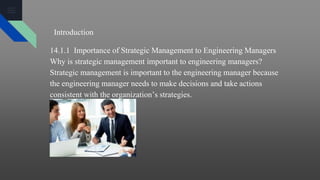
14.1.1 Importance of Strategic Management to Engineering Managers
Why is strategic management important to engineering managers?
Strategic management is important to the engineering manager because
the engineering manager needs to make decisions and take actions
consistent with the organization’s strategies.
1.2 ¿Qué es la Gestión Estratégica?
la gestión estratégica se define para contener ocho funciones
apoyadas por un núcleo de tres elementos. La gestión
estratégica es un proceso continuo destinado a alinear las
acciones cotidianas con la dirección a largo plazo de la
organización en función de las necesidades de sus clientes. El
uso de un proceso de gestión estratégica produce resultados
positivos (Pekar y Abraham, 1995; Taylor, 1984; Waalewijn
y Segaar, 1993; Wilson, 1994)
El proceso de gestión estratégica incluye ocho funciones
1. Set Strategic Intent is a group process (strategic planning) by which the
organization defines or refines the organization’s vision, mission, goals, and
objectives.
2. Deploy the Strategic Intent is the set of activities to share the strategic intent
throughout the organization.
3. Set Strategy is the process (implementation planning) by which the organization
develops specific strategies and actions to implement the strategic intent and
defines the specific performance measures to track progress.
4. Deploy Resources assigns resources to the specific initiatives defined in Set
Strategy.
5. Execute the Strategy is when the projects and activities are actually performed.
6. Deploy Results is the process by which the organization measures its
performance in accomplishing goals and objectives.
7. Review Performance is the process
(performance evaluation) to review
performance to produce lessons
learned and recommendations on how to
improve the organization and adjust the
strategic intent.
8. Deploy Learnings is the use of lessons
learned and recommendations in the next
cycle of strategic management.
2.2 Núcleo del proceso de gestión estratégica
En el núcleo del proceso de
gestión estratégica se
encuentran tres elementos:
* Conversaciones abiertas y
honestas
* Estrategia
* Medidas
1: mantener
conversaciones
abiertas y
honestas
Strategic Management
Core 2: Strategy
Before we spend a lot
of time talking about
developing,
deploying,
implementing, and
evaluating strategy,
we first must define
what we mean by
strategy. The
Merriam-Webster
Dictionary defines
strategy as:
A careful plan or
method
•The art of devising or
employing plans
toward a goal
•An adaptation or
complex of
adaptations
Núcleo 3 de la gestión
estratégica: Medidas
Las medidas ayudan a
traducir los resultados
deseados en números
cuantificables que se pueden
utilizar para establecer la
estrategia. Para ayudar más a
aclarar algunos de los
productos más comunes (es
decir, misión, visión, metas,
objetivos, medidas y
estrategias)
2.3 Strategic Management
Process Functions
The function’s aim• The strategic questions
addressed in the function• The function’s
products• The focus areas for executing the
function• The methods to use to execute the
function
The next eight sections review
each function of the strategic
management process. For each
function, we define
2.4 Establecimiento de la
intención estratégica a través
de la planificación estratégica
Información general
La planificación estratégica es un proceso
grupal mediante el cual la organización
define o refina el contexto estratégico y la
intención de la organización. El proceso
implica comprender los entornos internos y
externos (por ejemplo, fortalezas,
debilidades, oportunidades, amenazas)
El objetivo de la planificación estratégica es
desarrollar una buena estrategia para la
organización. Buena estrategia:
* Refleja la realidad del medio ambiente
* Es acordado por el equipo directivo
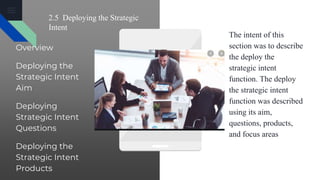
2.5 Deploying the Strategic
Intent
Overview
Deploying the
Strategic Intent
Aim
Deploying
Strategic Intent
Questions
Deploying the
Strategic Intent
Products
The intent of this
section was to describe
the deploy the
strategic intent
function. The deploy
the strategic intent
function was described
using its aim,
questions, products,
and focus areas
2.6Establecer la estrategia a
través de la planificación de la
implementación
Establecer estrategia, o planificación
de implementación, es el proceso por
el cual la organización desarrolla
estrategias o acciones específicas para
implementar la intención estratégica
El objetivo de la planificación de la
aplicación es alinear las actividades
de la organización con la estrategia.
Una organización utiliza el plan de
implementación.
2.7 Deploying Resources
Deploying resources is
the process of allocating
the organization’s limited
resources to the strategy.
This allocation is made
against the four types of
activities defined in the
implementation
planning function
The aim of deploying
resources is to put the
right resources on the
right activities to move
the organization
forward with its
strategy.
2.8Ejecución de la Estrategia
La ejecución está
llevando a cabo la
estrategia y el plan de
implementación. La
ejecución es el proceso
de producir los
resultados y resultados
para los clientes de la
organización.
Ejecución del objetivo
de la estrategia
El objetivo de la
ejecución es cumplir la
estrategia y hacerla
realidad cumpliendo
los esfuerzos para
colmar las lagunas o
cumpliendo los
objetivos definidos
anteriormente
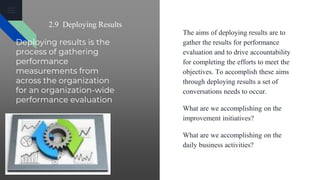
Deploying results is the
process of gathering
performance
measurements from
across the organization
for an organization-wide
performance evaluation
The aims of deploying results are to
gather the results for performance
evaluation and to drive accountability
for completing the efforts to meet the
objectives. To accomplish these aims
through deploying results a set of
conversations needs to occur.
What are we accomplishing on the
improvement initiatives?
What are we accomplishing on the
daily business activities?
2.9 Deploying Results
La evaluación del desempeño es la
forma en que la organización mide y
evalúa si la organización logró los
resultados previstos. La medición y
evaluación del desempeño producen
resultados tangibles que pueden
estudiarse para producir lecciones
aprendidas y recomendaciones
Los objetivos de la evaluación
del desempeño son: 1)
comprender cuán bien se está
logrando la estrategia, 2)
comprender dónde se encuentran
las esferas que deben mejorarse,
3) determinar las lecciones
aprendidas y, lo que es más
importante, 4) impulsar la
rendición de cuentas para lograr
resultados
2.10Revisión del rendimiento
a través de la evaluación del
rendimiento
Deploying learnings is the
process of sharing the results
(i.e., decisions) from
performance evaluation to
continue to drive the strategy
throughout the organization. In
this section we explore the aim,
questions, products, and focus
areas for deploying learnings.
Deploying Learnings Aim The
aim of deploying learnings is to
close the loop of the strategy
process and support further
execution and adjustment of the
strategy.
2.11 Deploying Learnings
¡Gracias!

Strategic management

  • 1.
    Strategic Management by JuanBohorquez UNIMINUTO
  • 2.
    Introduction 14.1.1 Importance ofStrategic Management to Engineering Managers Why is strategic management important to engineering managers? Strategic management is important to the engineering manager because the engineering manager needs to make decisions and take actions consistent with the organization’s strategies.
  • 3.
    1.2 ¿Qué esla Gestión Estratégica? la gestión estratégica se define para contener ocho funciones apoyadas por un núcleo de tres elementos. La gestión estratégica es un proceso continuo destinado a alinear las acciones cotidianas con la dirección a largo plazo de la organización en función de las necesidades de sus clientes. El uso de un proceso de gestión estratégica produce resultados positivos (Pekar y Abraham, 1995; Taylor, 1984; Waalewijn y Segaar, 1993; Wilson, 1994)
  • 4.
    El proceso degestión estratégica incluye ocho funciones 1. Set Strategic Intent is a group process (strategic planning) by which the organization defines or refines the organization’s vision, mission, goals, and objectives. 2. Deploy the Strategic Intent is the set of activities to share the strategic intent throughout the organization. 3. Set Strategy is the process (implementation planning) by which the organization develops specific strategies and actions to implement the strategic intent and defines the specific performance measures to track progress. 4. Deploy Resources assigns resources to the specific initiatives defined in Set Strategy. 5. Execute the Strategy is when the projects and activities are actually performed. 6. Deploy Results is the process by which the organization measures its performance in accomplishing goals and objectives.
  • 5.
    7. Review Performanceis the process (performance evaluation) to review performance to produce lessons learned and recommendations on how to improve the organization and adjust the strategic intent. 8. Deploy Learnings is the use of lessons learned and recommendations in the next cycle of strategic management.
  • 6.
    2.2 Núcleo delproceso de gestión estratégica En el núcleo del proceso de gestión estratégica se encuentran tres elementos: * Conversaciones abiertas y honestas * Estrategia * Medidas 1: mantener conversaciones abiertas y honestas
  • 7.
    Strategic Management Core 2:Strategy Before we spend a lot of time talking about developing, deploying, implementing, and evaluating strategy, we first must define what we mean by strategy. The Merriam-Webster Dictionary defines strategy as: A careful plan or method •The art of devising or employing plans toward a goal •An adaptation or complex of adaptations
  • 8.
    Núcleo 3 dela gestión estratégica: Medidas Las medidas ayudan a traducir los resultados deseados en números cuantificables que se pueden utilizar para establecer la estrategia. Para ayudar más a aclarar algunos de los productos más comunes (es decir, misión, visión, metas, objetivos, medidas y estrategias)
  • 9.
    2.3 Strategic Management ProcessFunctions The function’s aim• The strategic questions addressed in the function• The function’s products• The focus areas for executing the function• The methods to use to execute the function The next eight sections review each function of the strategic management process. For each function, we define
  • 10.
    2.4 Establecimiento dela intención estratégica a través de la planificación estratégica Información general La planificación estratégica es un proceso grupal mediante el cual la organización define o refina el contexto estratégico y la intención de la organización. El proceso implica comprender los entornos internos y externos (por ejemplo, fortalezas, debilidades, oportunidades, amenazas) El objetivo de la planificación estratégica es desarrollar una buena estrategia para la organización. Buena estrategia: * Refleja la realidad del medio ambiente * Es acordado por el equipo directivo
  • 11.
    2.5 Deploying theStrategic Intent Overview Deploying the Strategic Intent Aim Deploying Strategic Intent Questions Deploying the Strategic Intent Products The intent of this section was to describe the deploy the strategic intent function. The deploy the strategic intent function was described using its aim, questions, products, and focus areas
  • 12.
    2.6Establecer la estrategiaa través de la planificación de la implementación Establecer estrategia, o planificación de implementación, es el proceso por el cual la organización desarrolla estrategias o acciones específicas para implementar la intención estratégica El objetivo de la planificación de la aplicación es alinear las actividades de la organización con la estrategia. Una organización utiliza el plan de implementación.
  • 13.
    2.7 Deploying Resources Deployingresources is the process of allocating the organization’s limited resources to the strategy. This allocation is made against the four types of activities defined in the implementation planning function The aim of deploying resources is to put the right resources on the right activities to move the organization forward with its strategy.
  • 14.
    2.8Ejecución de laEstrategia La ejecución está llevando a cabo la estrategia y el plan de implementación. La ejecución es el proceso de producir los resultados y resultados para los clientes de la organización. Ejecución del objetivo de la estrategia El objetivo de la ejecución es cumplir la estrategia y hacerla realidad cumpliendo los esfuerzos para colmar las lagunas o cumpliendo los objetivos definidos anteriormente
  • 15.
    Deploying results isthe process of gathering performance measurements from across the organization for an organization-wide performance evaluation The aims of deploying results are to gather the results for performance evaluation and to drive accountability for completing the efforts to meet the objectives. To accomplish these aims through deploying results a set of conversations needs to occur. What are we accomplishing on the improvement initiatives? What are we accomplishing on the daily business activities? 2.9 Deploying Results
  • 16.
    La evaluación deldesempeño es la forma en que la organización mide y evalúa si la organización logró los resultados previstos. La medición y evaluación del desempeño producen resultados tangibles que pueden estudiarse para producir lecciones aprendidas y recomendaciones Los objetivos de la evaluación del desempeño son: 1) comprender cuán bien se está logrando la estrategia, 2) comprender dónde se encuentran las esferas que deben mejorarse, 3) determinar las lecciones aprendidas y, lo que es más importante, 4) impulsar la rendición de cuentas para lograr resultados 2.10Revisión del rendimiento a través de la evaluación del rendimiento
  • 17.
    Deploying learnings isthe process of sharing the results (i.e., decisions) from performance evaluation to continue to drive the strategy throughout the organization. In this section we explore the aim, questions, products, and focus areas for deploying learnings. Deploying Learnings Aim The aim of deploying learnings is to close the loop of the strategy process and support further execution and adjustment of the strategy. 2.11 Deploying Learnings
  • 18.