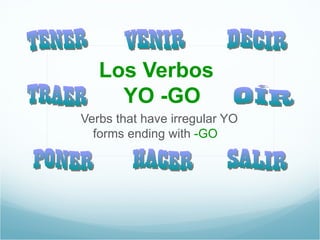
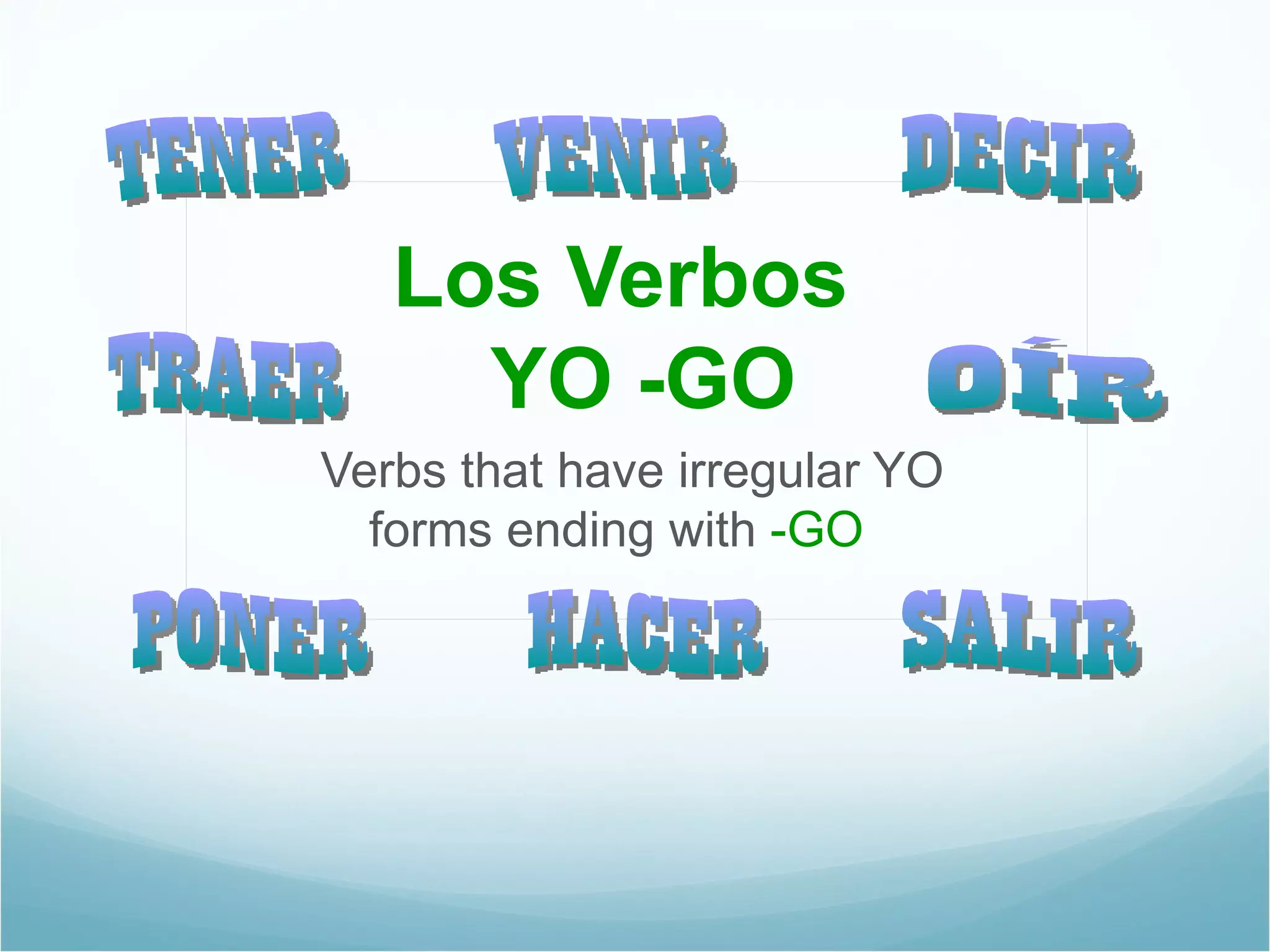
Los Verbos
     YO -GO
Verbs that have irregular YO
  forms ending with -GO
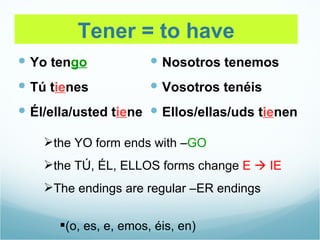
Tener = to have
 Yo tengo              Nosotros tenemos
 Tú tienes             Vosotros tenéis
 Él/ella/usted tiene  Ellos/ellas/uds tienen

    the YO form ends with –GO
    the TÚ, ÉL, ELLOS forms change E  IE
    The endings are regular –ER endings


      (o, es, e, emos, éis, en)
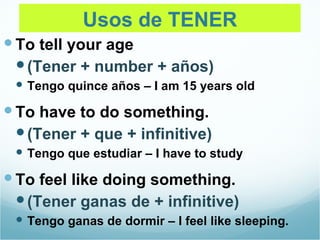
Usos de TENER
 To tell your age
   (Tener + number + años)
  Tengo quince años – I am 15 years old
 To have to do something.
   (Tener + que + infinitive)
  Tengo que estudiar – I have to study
 To feel like doing something.
   (Tener ganas de + infinitive)
  Tengo ganas de dormir – I feel like sleeping.
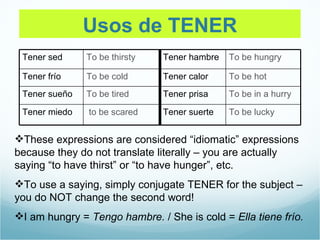
Usos de TENER
 Tener sed     To be thirsty   Tener hambre   To be hungry

 Tener frío    To be cold      Tener calor    To be hot
 Tener sueño   To be tired     Tener prisa    To be in a hurry

 Tener miedo   to be scared    Tener suerte   To be lucky


These expressions are considered “idiomatic” expressions
because they do not translate literally – you are actually
saying “to have thirst” or “to have hunger”, etc.
To use a saying, simply conjugate TENER for the subject –
you do NOT change the second word!
I am hungry = Tengo hambre. / She is cold = Ella tiene frío.
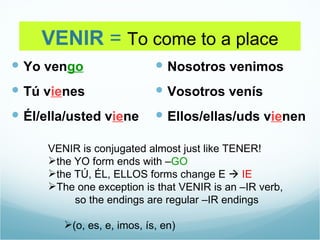
VENIR = To come to a place
 Yo vengo                    Nosotros venimos
 Tú vienes                   Vosotros venís
 Él/ella/usted viene         Ellos/ellas/uds vienen

      VENIR is conjugated almost just like TENER!
      the YO form ends with –GO
      the TÚ, ÉL, ELLOS forms change E  IE
      The one exception is that VENIR is an –IR verb,
           so the endings are regular –IR endings

         (o, es, e, imos, ís, en)
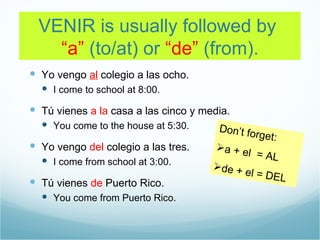
VENIR is usually followed by
   “a” (to/at) or “de” (from).
 Yo vengo al colegio a las ocho.
   I come to school at 8:00.
 Tú vienes a la casa a las cinco y media.
   You come to the house at 5:30.     Don’t fo
                                                rget:
 Yo vengo del colegio a las tres.    a + e
                                              l = AL
   I come from school at 3:00.       de +
                                            el = DE
 Tú vienes de Puerto Rico.                             L
   You come from Puerto Rico.
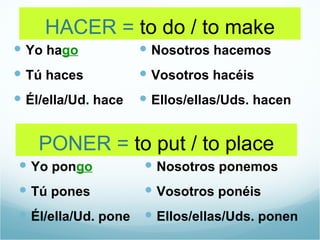
HACER = to do / to make
 Yo hago             Nosotros hacemos
 Tú haces            Vosotros hacéis
 Él/ella/Ud. hace    Ellos/ellas/Uds. hacen


    PONER = to put / to place
 Yo pongo            Nosotros ponemos
 Tú pones            Vosotros ponéis
 Él/ella/Ud. pone  Ellos/ellas/Uds. ponen
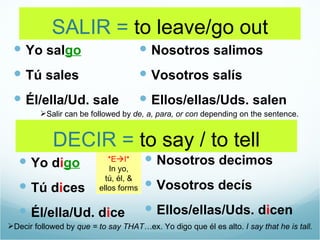
SALIR = to leave/go out
  Yo salgo                              Nosotros salimos
  Tú sales                              Vosotros salís
  Él/ella/Ud. sale                      Ellos/ellas/Uds. salen
         Salir can be followed by de, a, para, or con depending on the sentence.


            DECIR = to say / to tell
    Yo digo                 *EI*       Nosotros decimos
                             In yo,
                            tú, él, &
    Tú dices             ellos forms    Vosotros decís
    Él/ella/Ud. dice                    Ellos/ellas/Uds. dicen
Decir followed by que = to say THAT…ex. Yo digo que él es alto. I say that he is tall.
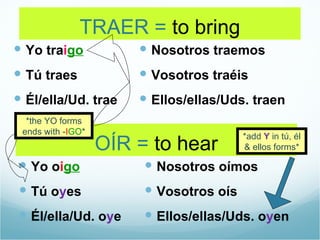
TRAER = to bring
 Yo traigo             Nosotros traemos
 Tú traes              Vosotros traéis
 Él/ella/Ud. trae      Ellos/ellas/Uds. traen
  *the YO forms
 ends with -IGO*
                                         *add Y in tú, él
                   OÍR = to hear         & ellos forms*

 Yo oigo                Nosotros oímos
 Tú oyes                Vosotros oís
 Él/ella/Ud. oye        Ellos/ellas/Uds. oyen
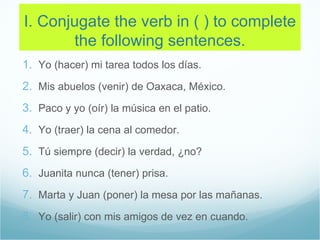
I. Conjugate the verb in ( ) to complete
       the following sentences.
1. Yo (hacer) mi tarea todos los días.
2. Mis abuelos (venir) de Oaxaca, México.
3. Paco y yo (oír) la música en el patio.
4. Yo (traer) la cena al comedor.
5. Tú siempre (decir) la verdad, ¿no?
6. Juanita nunca (tener) prisa.
7. Marta y Juan (poner) la mesa por las mañanas.
8. Yo (salir) con mis amigos de vez en cuando.
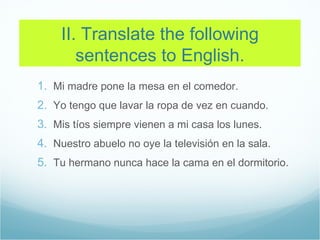
II. Translate the following
        sentences to English.
1. Mi madre pone la mesa en el comedor.
2. Yo tengo que lavar la ropa de vez en cuando.
3. Mis tíos siempre vienen a mi casa los lunes.
4. Nuestro abuelo no oye la televisión en la sala.
5. Tu hermano nunca hace la cama en el dormitorio.
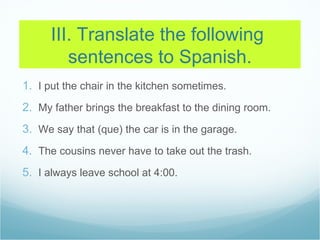
III. Translate the following
         sentences to Spanish.
1. I put the chair in the kitchen sometimes.
2. My father brings the breakfast to the dining room.
3. We say that (que) the car is in the garage.
4. The cousins never have to take out the trash.
5. I always leave school at 4:00.
Tener, Venir & other YO -GO verbs

  • 1.
    Los Verbos YO -GO Verbs that have irregular YO forms ending with -GO
  • 2.
    Tener = tohave  Yo tengo  Nosotros tenemos  Tú tienes  Vosotros tenéis  Él/ella/usted tiene  Ellos/ellas/uds tienen the YO form ends with –GO the TÚ, ÉL, ELLOS forms change E  IE The endings are regular –ER endings (o, es, e, emos, éis, en)
  • 3.
    Usos de TENER To tell your age  (Tener + number + años)  Tengo quince años – I am 15 years old  To have to do something.  (Tener + que + infinitive)  Tengo que estudiar – I have to study  To feel like doing something.  (Tener ganas de + infinitive)  Tengo ganas de dormir – I feel like sleeping.
  • 4.
    Usos de TENER Tener sed To be thirsty Tener hambre To be hungry Tener frío To be cold Tener calor To be hot Tener sueño To be tired Tener prisa To be in a hurry Tener miedo to be scared Tener suerte To be lucky These expressions are considered “idiomatic” expressions because they do not translate literally – you are actually saying “to have thirst” or “to have hunger”, etc. To use a saying, simply conjugate TENER for the subject – you do NOT change the second word! I am hungry = Tengo hambre. / She is cold = Ella tiene frío.
  • 5.
    VENIR = Tocome to a place  Yo vengo  Nosotros venimos  Tú vienes  Vosotros venís  Él/ella/usted viene  Ellos/ellas/uds vienen VENIR is conjugated almost just like TENER! the YO form ends with –GO the TÚ, ÉL, ELLOS forms change E  IE The one exception is that VENIR is an –IR verb, so the endings are regular –IR endings (o, es, e, imos, ís, en)
  • 6.
    VENIR is usuallyfollowed by “a” (to/at) or “de” (from).  Yo vengo al colegio a las ocho.  I come to school at 8:00.  Tú vienes a la casa a las cinco y media.  You come to the house at 5:30. Don’t fo rget:  Yo vengo del colegio a las tres. a + e l = AL  I come from school at 3:00. de + el = DE  Tú vienes de Puerto Rico. L  You come from Puerto Rico.
  • 7.
    HACER = todo / to make  Yo hago  Nosotros hacemos  Tú haces  Vosotros hacéis  Él/ella/Ud. hace  Ellos/ellas/Uds. hacen PONER = to put / to place  Yo pongo  Nosotros ponemos  Tú pones  Vosotros ponéis  Él/ella/Ud. pone  Ellos/ellas/Uds. ponen
  • 8.
    SALIR = toleave/go out  Yo salgo  Nosotros salimos  Tú sales  Vosotros salís  Él/ella/Ud. sale  Ellos/ellas/Uds. salen Salir can be followed by de, a, para, or con depending on the sentence. DECIR = to say / to tell  Yo digo *EI*  Nosotros decimos In yo, tú, él, &  Tú dices ellos forms  Vosotros decís  Él/ella/Ud. dice  Ellos/ellas/Uds. dicen Decir followed by que = to say THAT…ex. Yo digo que él es alto. I say that he is tall.
  • 9.
    TRAER = tobring  Yo traigo  Nosotros traemos  Tú traes  Vosotros traéis  Él/ella/Ud. trae  Ellos/ellas/Uds. traen *the YO forms ends with -IGO* *add Y in tú, él OÍR = to hear & ellos forms*  Yo oigo  Nosotros oímos  Tú oyes  Vosotros oís  Él/ella/Ud. oye  Ellos/ellas/Uds. oyen
  • 10.
    I. Conjugate theverb in ( ) to complete the following sentences. 1. Yo (hacer) mi tarea todos los días. 2. Mis abuelos (venir) de Oaxaca, México. 3. Paco y yo (oír) la música en el patio. 4. Yo (traer) la cena al comedor. 5. Tú siempre (decir) la verdad, ¿no? 6. Juanita nunca (tener) prisa. 7. Marta y Juan (poner) la mesa por las mañanas. 8. Yo (salir) con mis amigos de vez en cuando.
  • 11.
    II. Translate thefollowing sentences to English. 1. Mi madre pone la mesa en el comedor. 2. Yo tengo que lavar la ropa de vez en cuando. 3. Mis tíos siempre vienen a mi casa los lunes. 4. Nuestro abuelo no oye la televisión en la sala. 5. Tu hermano nunca hace la cama en el dormitorio.
  • 12.
    III. Translate thefollowing sentences to Spanish. 1. I put the chair in the kitchen sometimes. 2. My father brings the breakfast to the dining room. 3. We say that (que) the car is in the garage. 4. The cousins never have to take out the trash. 5. I always leave school at 4:00.