Derecho de Autor en Colombia,  realidad y perspectivas
Carolina Botero [email_address] www.karisma.org.co/carobotero http://altair.udea.edu.co/cc/media/caroboteropasto1.jpg
http://www.flickr.com/photos/claudio/3054776394/
Es una forma de reconocer el estrecho vínculo que existe entre la obra y su autor, En su aspecto económico constituye un privilegio de exclusividad para el creador de una obra del intelecto.  Busca incentivar la creatividad Es un derecho que otorga control jurídico sobre la obra artística, científica o literaria a su titular, facultándolo incluso para impedir que un tercero la utilice.
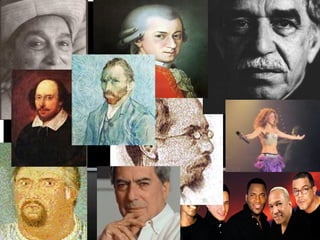
Las obras escritas, es decir, los libros, folletos y cualquier otro tipo de obra expresada mediante letras, signos o marcas convencionales; Las conferencias, alocuciones, sermones y otras obras de la misma naturaleza;  Las composiciones musicales con letra o sin ella;  Las obras dramáticas y dramático-musicales;  las obras coreográficas y las pantomimas;  Las obras cinematográficas y demás obras audiovisuales expresadas por cualquier procedimiento;  Las obras de bellas artes, incluidos los dibujos, pinturas, esculturas, grabados y litografías;  Las obras de arquitectura;  Las obras fotográficas y las expresadas por procedimiento análogo a la fotografía;  Las obras de arte aplicado;  Las ilustraciones, mapas, croquis, planos, bosquejos y las obras plásticas relativas a la geografía, la topografía, la arquitectura o las ciencias;  Los programas de computador (software);  Las antologías o compilaciones de obras diversas y las bases de datos, que por la selección o disposición de las materias constituyan creaciones personales.  Las traducciones, adaptaciones, transformaciones o arreglos de otras obras.
La protección Desde su creación Sobre la forma de expresión Originalidad Materializada ¿Internet?
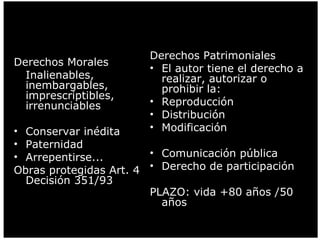
Derechos Morales Inalienables, inembargables, imprescriptibles, irrenunciables Conservar inédita Paternidad Arrepentirse... Obras protegidas Art. 4 Decisión 351/93 Derechos Patrimoniales El autor tiene el derecho a realizar, autorizar o prohibir la: Reproducción Distribución Modificación Comunicación pública Derecho de participación PLAZO: vida +80 años /50 años
 
Persona natural
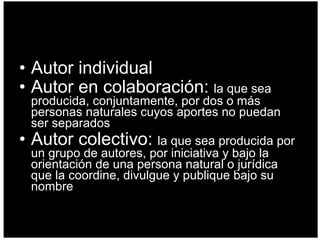
Autor individual Autor en colaboración:  la que sea producida, conjuntamente, por dos o más personas naturales cuyos aportes no puedan ser separados  Autor colectivo:  la que sea producida por un grupo de autores, por iniciativa y bajo la orientación de una persona natural o jurídica que la coordine, divulgue y publique bajo su nombre
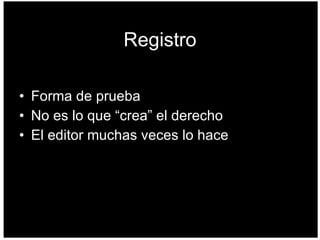
Registro Forma de prueba No es lo que “crea” el derecho El editor muchas veces lo hace
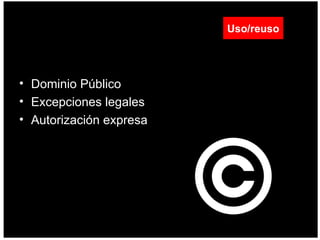
Dominio Público  Excepciones legales  Autorización expresa  Uso/reuso
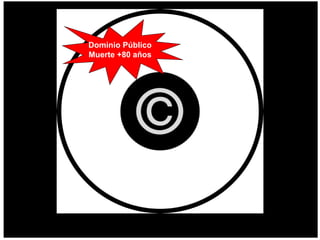
Dominio Público Muerte +80 años
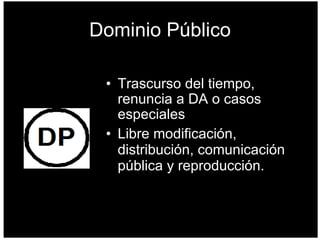
Dominio Público Trascurso del tiempo, renuncia a DA o casos especiales Libre modificación, distribución, comunicación pública y reproducción.
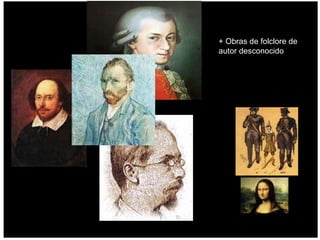
+ Obras de folclore de autor desconocido
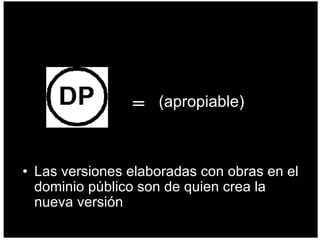
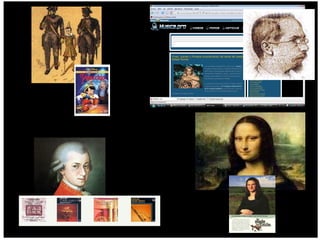
Las versiones elaboradas con obras en el dominio público son de quien crea la nueva versión = (apropiable) =
 
Dominio Público  Excepciones legales  Autorización expresa  Uso/reuso
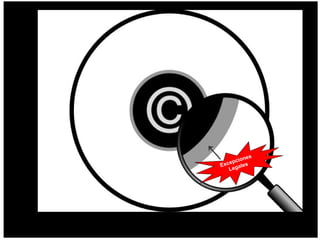
Excepciones  Legales
Las excepciones legales exigen condiciones de modo, tiempo y lugar que no se ajustan a cualquier tipo de uso por altruista o… que parezca. Atención
Dominio Público  Excepciones legales  Autorización expresa  Uso/reuso
Contrato de Cesión Contrato de Edición Licencia Principio de Favorabilidad (titulares) Art 257 L23/82 Interpretación Restrictiva Art. 78 L23/82
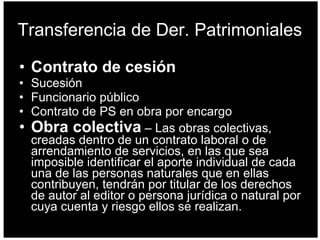
Transferencia de Der. Patrimoniales Contrato de cesión Sucesión Funcionario público Contrato de PS en obra por encargo Obra colectiva   –  Las obras colectivas, creadas dentro de un contrato laboral o de arrendamiento de servicios, en las que sea imposible identificar el aporte individual de cada una de las personas naturales que en ellas contribuyen, tendrán por titular de los derechos de autor al editor o persona jurídica o natural por cuya cuenta y riesgo ellos se realizan.
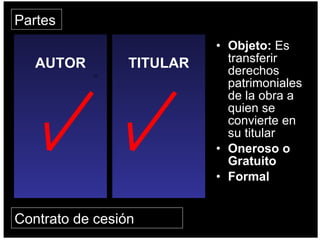
Objeto:  Es transferir derechos patrimoniales de la obra a quien se convierte en su titular Oneroso o Gratuito Formal AUTOR TITULAR Contrato de cesión Partes
Contrato de Edición Por este contrato el titular del derecho de autor de una obra literaria, artística o científica, se obliga a entregarla a un editor que se compromete a publicarla mediante su impresión gráfica o propagarla y distribuirla por su cuenta y riesgo.  L23/82 – L98/93
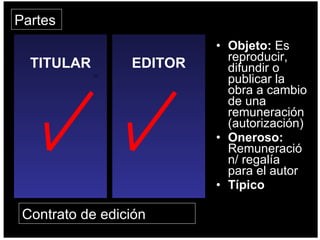
Objeto:  Es reproducir, difundir o publicar la obra a cambio de una remuneración (autorización) Oneroso:  Remuneración/ regalía para el autor Típico TITULAR EDITOR Partes Contrato de edición
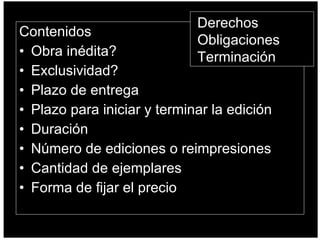
Contenidos Obra inédita? Exclusividad? Plazo de entrega Plazo para iniciar y terminar la edición Duración Número de ediciones o reimpresiones Cantidad de ejemplares Forma de fijar el precio Derechos Obligaciones Terminación
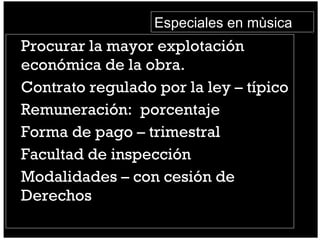
Procurar la mayor explotación económica de la obra. Contrato regulado por la ley – típico Remuneración:  porcentaje Forma de pago – trimestral Facultad de inspección Modalidades – con cesión de Derechos Especiales en mùsica
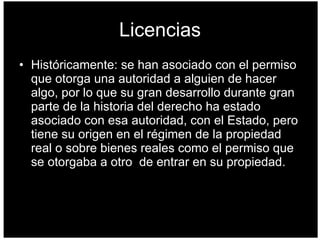
Licencias Históricamente: se han asociado con el permiso que otorga una autoridad a alguien de hacer algo, por lo que su gran desarrollo durante gran parte de la historia del derecho ha estado asociado con esa autoridad, con el Estado, pero tiene su origen en el régimen de la propiedad real o sobre bienes reales como el permiso que se otorgaba a otro  de entrar en su propiedad.
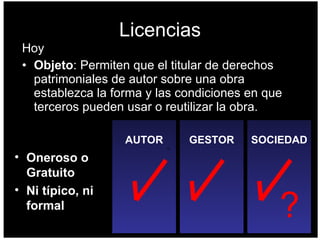
Licencias Hoy  Objeto : Permiten que el titular de derechos patrimoniales de autor sobre una obra establezca la forma y las condiciones en que terceros pueden usar o reutilizar la obra. Oneroso o Gratuito Ni típico, ni formal AUTOR GESTOR SOCIEDAD ?
http://www.flickr.com/photos/intherough/3244476512/
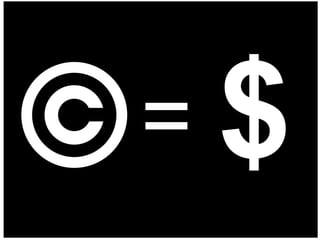
$ =
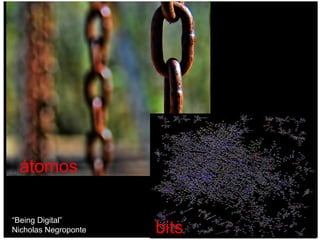
átomos bits “ Being Digital” Nicholas Negroponte
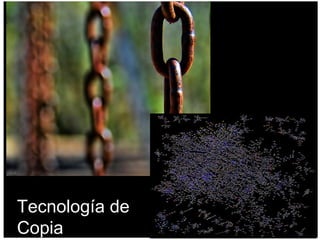
Tecnología de Copia
Contexto
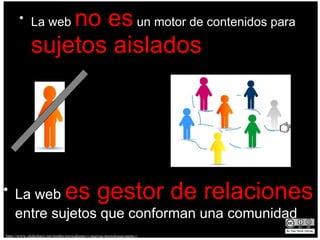
La web  no es  un motor de contenidos para  sujetos aislados La web  es gestor de relaciones  entre sujetos que conforman una comunidad http://www.slideshare.net/tumbo/periodismo-y-nuevas-tecnologas-parte-i
http://www.slideshare.net/tumbo/periodismo-y-nuevas-tecnologas-parte-i
 
 
Explotación = Control Individual Reproducir Distribuir Comunicar al público Modificar
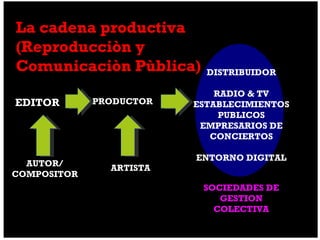
La cadena productiva (Reproducciòn y Comunicaciòn Pùblica) AUTOR/ COMPOSITOR EDITOR PRODUCTOR DISTRIBUIDOR RADIO & TV ESTABLECIMIENTOS PUBLICOS EMPRESARIOS DE CONCIERTOS ENTORNO DIGITAL ARTISTA SOCIEDADES DE GESTION COLECTIVA xºxº
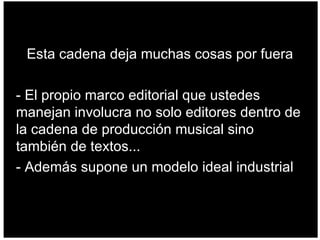
Esta cadena deja muchas cosas por fuera - El propio marco editorial que ustedes manejan involucra no solo editores dentro de la cadena de producción musical sino también de textos... - Además supone un modelo ideal industrial
http://www.flickr.com/photos/adenocorticotropina/522261806/
 
Producto
Prácticas
 
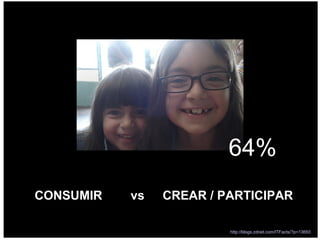
CONSUMIR  vs  CREAR / PARTICIPAR 64% http://blogs.zdnet.com/ITFacts/?p=13693
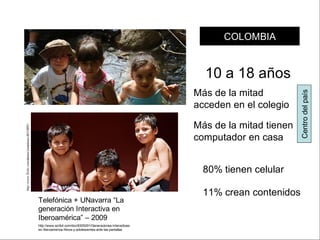
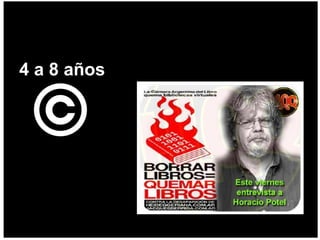
4 a 8 años
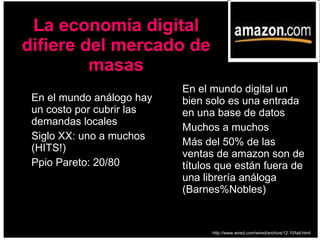
En el mundo análogo hay un costo por cubrir las demandas locales Siglo XX: uno a muchos (HITS!) Ppio Pareto: 20/80 En el mundo digital un bien solo es una entrada en una base de datos Muchos a muchos Más del 50% de las ventas de amazon son de títulos que están fuera de una librería análoga (Barnes%Nobles) La economía digital difiere del mercado de masas http://www.wired.com/wired/archive/12.10/tail.html
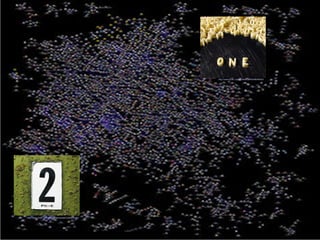
http://www.flickr.com/photos/cdell/548548453/   http://www.flickr.com/photos/darwinbell/2382912185/
Potencial democratizador de  las TIC  reproducción, publicación, difusión… puede estar en manos de cualquiera http://www.flickr.com/photos/cdell/548548453/   BLOGS, o en youtube se suben 20 horas de video por minuto…
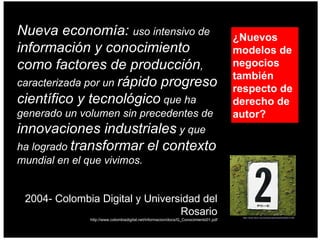
Nueva economía:  uso intensivo de  información y conocimiento como factores de producción , caracterizada por un  rápido progreso científico y tecnológico  que ha generado un volumen sin precedentes de  innovaciones industriales  y que ha logrado  transformar el contexto  mundial en el que vivimos.  2004- Colombia Digital y Universidad del Rosario http://www.colombiadigital.net/informacion/docs/G_Conocimiento01.pdf http://www.flickr.com/photos/darwinbell/2382912185  / ¿Nuevos modelos de negocios también respecto de derecho de autor?
Cambio
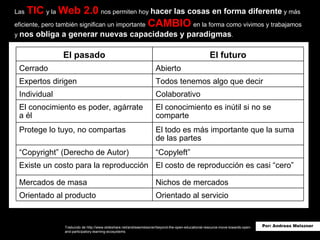
Las   TIC   y la   Web 2.0   nos permiten hoy  hacer las cosas en forma diferente  y más eficiente, pero también significan un importante   CAMBIO   en la forma como vivimos y trabajamos y  nos obliga a generar nuevas capacidades y paradigmas . Traducido de http://www.slideshare.net/andreasmeiszner/beyond-the-open-educational-resource-move-towards-open-and-participatory-learning-ecosystems El pasado El futuro Cerrado Abierto Expertos dirigen Todos tenemos algo que decir Individual  Colaborativo  El conocimiento es poder, agárrate a él El conocimiento es inútil si no se comparte Protege lo tuyo, no compartas El todo es más importante que la suma de las partes “ Copyright” (Derecho de Autor) “ Copyleft”  Existe un costo para la reproducción El costo de reproducción es casi “cero” Mercados de masa Nichos de mercados Orientado al producto Orientado al servicio
¿Cuál es la función del editor en este entorno?
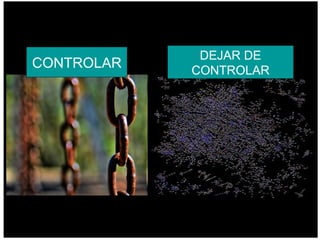
CONTROLAR DEJAR DE CONTROLAR
DRM LICENCIAS http://www.flickr.com/photos/71715246@N00/521723595/
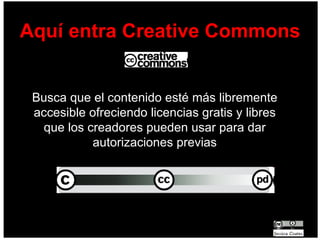
Aquí entra Creative Commons Busca que el contenido esté más libremente accesible ofreciendo licencias gratis y libres que los creadores pueden usar para dar autorizaciones previas
Acceso Abierto
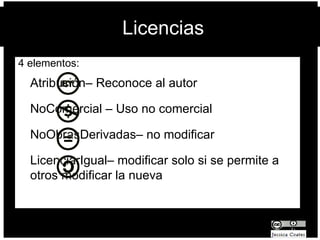
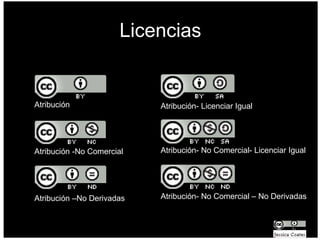
4 elementos:  Atribución– Reconoce al autor NoComercial – Uso no comercial NoObrasDerivadas– no modificar LicenciarIgual– modificar solo si se permite a otros modificar la nueva Licencias
Atribución- Licenciar Igual Atribución- No Comercial- Licenciar Igual Atribución- No Comercial – No Derivadas Licencias Atribución Atribución -No Comercial Atribución –No Derivadas


¿y, qué papel cumple el editor en un mundo en el que el autor tiene capacidad de reproducción, publicación y difusión ?
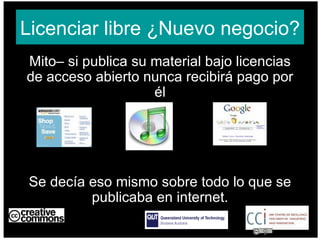
Licenciar libre ¿Nuevo negocio? Mito– si publica su material bajo licencias de acceso abierto nunca recibirá pago por él Se decía eso mismo sobre todo lo que se publicaba en internet. AUSTRALIA part of the Creative Commons international initiative CRICOS No. 00213J
Pagar por CC free as in speech, not as in beer AUSTRALIA part of the Creative Commons international initiative CRICOS No. 00213J
Pagos  Pueden ser: Directos como compra indirectos como aumento de tráfico  AUSTRALIA part of the Creative Commons international initiative CRICOS No. 00213J   Puede proveerlo: Producto como libro  ‘ valor agregado’ como búsqueda Servicio post venta como mantenimiento Publicidad como avisos Puede realizado por: Consumidor como pago-por-uso Productor como vanity press Terceros como publicidad
Modelos de pago directo Publicidad embebida – ej. Revver, newspapers, TV and radio  Uso comercial de la licencia – ej. Lisensa, BBC Creative Archive, Magnatune Pago por primer uso – ej. Redhat, Barenaked Ladies, EMI en iTunes Patrocinio – Swarm of Angels AUSTRALIA part of the Creative Commons international initiative CRICOS No. 00213J
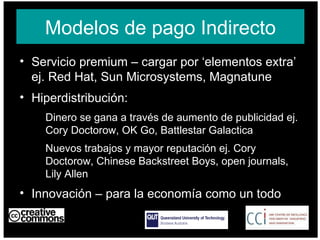
Modelos de pago Indirecto Servicio premium – cargar por ‘elementos extra’ ej. Red Hat, Sun Microsystems, Magnatune Hiperdistribución:  Dinero se gana a través de aumento de publicidad ej. Cory Doctorow, OK Go, Battlestar Galactica Nuevos trabajos y mayor reputación ej. Cory Doctorow, Chinese Backstreet Boys, open journals, Lily Allen Innovación – para la economía como un todo AUSTRALIA part of the Creative Commons international initiative CRICOS No. 00213J
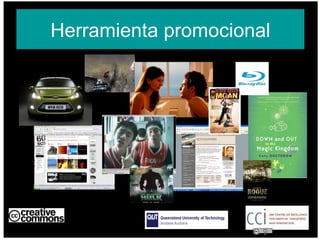
Herramienta promocional AUSTRALIA part of the Creative Commons international initiative CRICOS No. 00213J
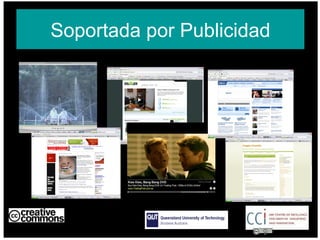
Soportada por Publicidad AUSTRALIA part of the Creative Commons international initiative CRICOS No. 00213J
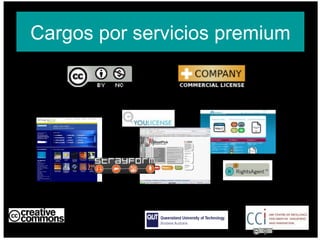
Cargos por servicios premium AUSTRALIA part of the Creative Commons international initiative CRICOS No. 00213J   +
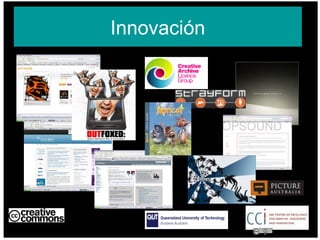
Innovación AUSTRALIA part of the Creative Commons international initiative CRICOS No. 00213J
 
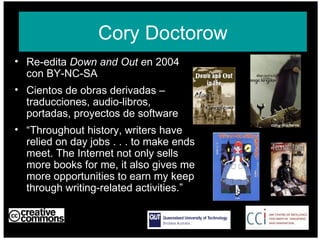
Cory Doctorow Autor de ciencia ficción y editor de Boing-Boing Primer libro,  Down and Out in the Magic Kingdom , publicado por Tor Books (más importante editor de ciencia ficción) 2003 Simultaneamente publica el texto como e-book bajo BY-NC-ND 30,000 descargas el primer día, y va por su 6a reedición 3 novelas y pequeñas historias después – se mantiene la experiencia AUSTRALIA part of the Creative Commons international initiative
Re-edita  Down and Out e n 2004 con BY-NC-SA Cientos de obras derivadas – traducciones, audio-libros, portadas, proyectos de software “ Throughout history, writers have relied on day jobs . . . to make ends meet. The Internet not only sells more books for me, it also gives me more opportunities to earn my keep through writing-related activities.”  AUSTRALIA part of the Creative Commons international initiative Cory Doctorow
Acceso Abierto en academia Aumenta citaciones Aumenta perfil  Disminuye las fallas del mercado de suscripción actual que se afectan con la disminución de los presupuestos de las bibliotecas Responde a los retos que los consorcios y las compras amarradas imponene a las pequeñas revistas  Se alinea con las expectativas de los autores y los usuarios Beneficios públicos– mayor acceso al conocimiento, etc AUSTRALIA part of the Creative Commons international initiative
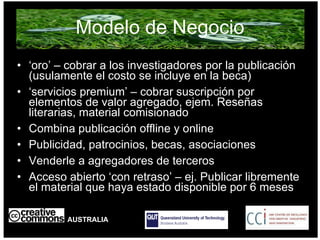
Modelo de Negocio ‘ oro’ – cobrar a los investigadores por la publicación  (usulamente el costo se incluye en la beca) ‘ servicios premium’ – cobrar suscripción por elementos de valor agregado, ejem. Reseñas literarias, material comisionado Combina publicación offline y online Publicidad, patrocinios, becas, asociaciones Venderle a agregadores de terceros  Acceso abierto ‘con retraso’ – ej. Publicar libremente el material que haya estado disponible por 6 meses AUSTRALIA part of the Creative Commons international initiative
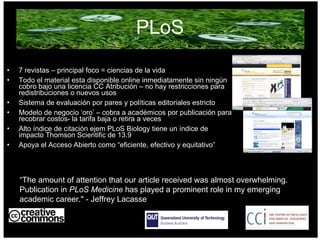
PLoS 7 revistas – principal foco = ciencias de la vida Todo el material esta disponible online inmediatamente sin ningún cobro bajo una licencia CC Atribución – no hay restricciones para redistribuciones o nuevos usos Sistema de evaluación por pares y políticas editoriales estricto Modelo de negocio ‘oro’ – cobra a académicos por publicación para recobrar costos- la tarifa baja o retira a veces Alto índice de citación ejem PLoS Biology tiene un índice de impacto Thomson Scientific de 13.9  Apoya el Acceso Abierto como “eficiente, efectivo y equitativo” AUSTRALIA part of the Creative Commons international initiative “ The amount of attention that our article received was almost overwhelming. Publication in  PLoS Medicine  has played a prominent role in my emerging academic career." - Jeffrey Lacasse
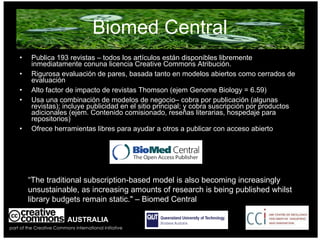
Biomed Central Publica 193 revistas – todos los artículos están disponibles libremente inmediatamente conuna licencia Creative Commons Atribución. Rigurosa evaluación de pares, basada tanto en modelos abiertos como cerrados de evaluación Alto factor de impacto de revistas Thomson (ejem Genome Biology = 6.59) Usa una combinación de modelos de negocio– cobra por publicación (algunas revistas); incluye publicidad en el sitio principal; y cobra suscripción por productos adicionales (ejem. Contenido comisionado, reseñas literarias, hospedaje para repositorios) Ofrece herramientas libres para ayudar a otros a publicar con acceso abierto AUSTRALIA part of the Creative Commons international initiative “ The traditional subscription-based model is also becoming increasingly unsustainable, as increasing amounts of research is being published whilst library budgets remain static. " – Biomed Central
Más información Public Library of Science - http://www.plos.org/about/faq.html Biomed Central - http://www.biomedcentral.com/info/about/faq Guide to Business Planning for Converting a Subscription-Based Journal to Open Access  - Guia de planeación de negocios para convertir una revista basada en suscripción en Acceso Abierto http://www.soros.org/openaccess/oajguides/index.shtml Guide to Business Planning for Launching a New Open Access Journal - Guia para planear el negocio de lanzar una nueva revista de Acceso Abierto-  http://www.soros.org/openaccess/oajguides/index.shtml AUSTRALIA part of the Creative Commons international initiative
Nuevas
formas
de producción
de aprendizaje
de difusión
El diseño de políticas públicas en el campo musical debe respetar el modelo “autor” (individual y propietario) pero debe buscar equilibrios con su público actual (que posee tecnologías de copia y acceso) y con otros modelos de circulación (colectivos, solidarios, soportados en el “procomùn”). Flexibilidad  Sostenibilidad
Gracias A menos que se informe de otra manera esta presentación está licenciada CCBYSA 2.5 Colombia http://creativecommons.org/licenses/by-sa/2.5/co/ Carolina Botero Cabrera, mayo  2010 www.karisma.org.co/carobotero [email_address] www.slideshare.com/carobotero

Editores musicales sxxi

  • 1.
    Derecho de Autoren Colombia, realidad y perspectivas
  • 2.
    Carolina Botero [email_address]www.karisma.org.co/carobotero http://altair.udea.edu.co/cc/media/caroboteropasto1.jpg
  • 3.
  • 4.
    Es una formade reconocer el estrecho vínculo que existe entre la obra y su autor, En su aspecto económico constituye un privilegio de exclusividad para el creador de una obra del intelecto. Busca incentivar la creatividad Es un derecho que otorga control jurídico sobre la obra artística, científica o literaria a su titular, facultándolo incluso para impedir que un tercero la utilice.
  • 5.
    Las obras escritas,es decir, los libros, folletos y cualquier otro tipo de obra expresada mediante letras, signos o marcas convencionales; Las conferencias, alocuciones, sermones y otras obras de la misma naturaleza; Las composiciones musicales con letra o sin ella; Las obras dramáticas y dramático-musicales; las obras coreográficas y las pantomimas; Las obras cinematográficas y demás obras audiovisuales expresadas por cualquier procedimiento; Las obras de bellas artes, incluidos los dibujos, pinturas, esculturas, grabados y litografías; Las obras de arquitectura; Las obras fotográficas y las expresadas por procedimiento análogo a la fotografía; Las obras de arte aplicado; Las ilustraciones, mapas, croquis, planos, bosquejos y las obras plásticas relativas a la geografía, la topografía, la arquitectura o las ciencias; Los programas de computador (software); Las antologías o compilaciones de obras diversas y las bases de datos, que por la selección o disposición de las materias constituyan creaciones personales. Las traducciones, adaptaciones, transformaciones o arreglos de otras obras.
  • 6.
    La protección Desdesu creación Sobre la forma de expresión Originalidad Materializada ¿Internet?
  • 7.
    Derechos Morales Inalienables,inembargables, imprescriptibles, irrenunciables Conservar inédita Paternidad Arrepentirse... Obras protegidas Art. 4 Decisión 351/93 Derechos Patrimoniales El autor tiene el derecho a realizar, autorizar o prohibir la: Reproducción Distribución Modificación Comunicación pública Derecho de participación PLAZO: vida +80 años /50 años
  • 8.
  • 9.
  • 10.
    Autor individual Autoren colaboración: la que sea producida, conjuntamente, por dos o más personas naturales cuyos aportes no puedan ser separados Autor colectivo: la que sea producida por un grupo de autores, por iniciativa y bajo la orientación de una persona natural o jurídica que la coordine, divulgue y publique bajo su nombre
  • 11.
    Registro Forma deprueba No es lo que “crea” el derecho El editor muchas veces lo hace
  • 12.
    Dominio Público Excepciones legales Autorización expresa Uso/reuso
  • 13.
    Dominio Público Excepciones legales Autorización expresa Uso/reuso
  • 14.
  • 15.
    Dominio Público Trascursodel tiempo, renuncia a DA o casos especiales Libre modificación, distribución, comunicación pública y reproducción.
  • 16.
    + Obras defolclore de autor desconocido
  • 17.
    Las versiones elaboradascon obras en el dominio público son de quien crea la nueva versión = (apropiable) =
  • 18.
  • 19.
    Dominio Público Excepciones legales Autorización expresa Uso/reuso
  • 20.
  • 21.
    Las excepciones legalesexigen condiciones de modo, tiempo y lugar que no se ajustan a cualquier tipo de uso por altruista o… que parezca. Atención
  • 22.
    Dominio Público Excepciones legales Autorización expresa Uso/reuso
  • 23.
    Contrato de CesiónContrato de Edición Licencia Principio de Favorabilidad (titulares) Art 257 L23/82 Interpretación Restrictiva Art. 78 L23/82
  • 24.
    Transferencia de Der.Patrimoniales Contrato de cesión Sucesión Funcionario público Contrato de PS en obra por encargo Obra colectiva – Las obras colectivas, creadas dentro de un contrato laboral o de arrendamiento de servicios, en las que sea imposible identificar el aporte individual de cada una de las personas naturales que en ellas contribuyen, tendrán por titular de los derechos de autor al editor o persona jurídica o natural por cuya cuenta y riesgo ellos se realizan.
  • 25.
    Objeto: Estransferir derechos patrimoniales de la obra a quien se convierte en su titular Oneroso o Gratuito Formal AUTOR TITULAR Contrato de cesión Partes
  • 26.
    Contrato de EdiciónPor este contrato el titular del derecho de autor de una obra literaria, artística o científica, se obliga a entregarla a un editor que se compromete a publicarla mediante su impresión gráfica o propagarla y distribuirla por su cuenta y riesgo. L23/82 – L98/93
  • 27.
    Objeto: Esreproducir, difundir o publicar la obra a cambio de una remuneración (autorización) Oneroso: Remuneración/ regalía para el autor Típico TITULAR EDITOR Partes Contrato de edición
  • 28.
    Contenidos Obra inédita?Exclusividad? Plazo de entrega Plazo para iniciar y terminar la edición Duración Número de ediciones o reimpresiones Cantidad de ejemplares Forma de fijar el precio Derechos Obligaciones Terminación
  • 29.
    Procurar la mayorexplotación económica de la obra. Contrato regulado por la ley – típico Remuneración: porcentaje Forma de pago – trimestral Facultad de inspección Modalidades – con cesión de Derechos Especiales en mùsica
  • 30.
    Licencias Históricamente: sehan asociado con el permiso que otorga una autoridad a alguien de hacer algo, por lo que su gran desarrollo durante gran parte de la historia del derecho ha estado asociado con esa autoridad, con el Estado, pero tiene su origen en el régimen de la propiedad real o sobre bienes reales como el permiso que se otorgaba a otro de entrar en su propiedad.
  • 31.
    Licencias Hoy Objeto : Permiten que el titular de derechos patrimoniales de autor sobre una obra establezca la forma y las condiciones en que terceros pueden usar o reutilizar la obra. Oneroso o Gratuito Ni típico, ni formal AUTOR GESTOR SOCIEDAD ?
  • 32.
  • 33.
  • 34.
    átomos bits “Being Digital” Nicholas Negroponte
  • 35.
  • 36.
  • 37.
    La web no es un motor de contenidos para sujetos aislados La web es gestor de relaciones entre sujetos que conforman una comunidad http://www.slideshare.net/tumbo/periodismo-y-nuevas-tecnologas-parte-i
  • 38.
  • 39.
  • 40.
  • 41.
    Explotación = ControlIndividual Reproducir Distribuir Comunicar al público Modificar
  • 42.
    La cadena productiva(Reproducciòn y Comunicaciòn Pùblica) AUTOR/ COMPOSITOR EDITOR PRODUCTOR DISTRIBUIDOR RADIO & TV ESTABLECIMIENTOS PUBLICOS EMPRESARIOS DE CONCIERTOS ENTORNO DIGITAL ARTISTA SOCIEDADES DE GESTION COLECTIVA xºxº
  • 43.
    Esta cadena dejamuchas cosas por fuera - El propio marco editorial que ustedes manejan involucra no solo editores dentro de la cadena de producción musical sino también de textos... - Además supone un modelo ideal industrial
  • 44.
  • 45.
  • 46.
  • 47.
  • 48.
  • 49.
    CONSUMIR vs CREAR / PARTICIPAR 64% http://blogs.zdnet.com/ITFacts/?p=13693
  • 50.
    4 a 8años
  • 51.
    En el mundoanálogo hay un costo por cubrir las demandas locales Siglo XX: uno a muchos (HITS!) Ppio Pareto: 20/80 En el mundo digital un bien solo es una entrada en una base de datos Muchos a muchos Más del 50% de las ventas de amazon son de títulos que están fuera de una librería análoga (Barnes%Nobles) La economía digital difiere del mercado de masas http://www.wired.com/wired/archive/12.10/tail.html
  • 52.
    http://www.flickr.com/photos/cdell/548548453/ http://www.flickr.com/photos/darwinbell/2382912185/
  • 53.
    Potencial democratizador de las TIC reproducción, publicación, difusión… puede estar en manos de cualquiera http://www.flickr.com/photos/cdell/548548453/ BLOGS, o en youtube se suben 20 horas de video por minuto…
  • 54.
    Nueva economía: uso intensivo de información y conocimiento como factores de producción , caracterizada por un rápido progreso científico y tecnológico que ha generado un volumen sin precedentes de innovaciones industriales y que ha logrado transformar el contexto mundial en el que vivimos. 2004- Colombia Digital y Universidad del Rosario http://www.colombiadigital.net/informacion/docs/G_Conocimiento01.pdf http://www.flickr.com/photos/darwinbell/2382912185 / ¿Nuevos modelos de negocios también respecto de derecho de autor?
  • 55.
  • 56.
    Las TIC y la Web 2.0 nos permiten hoy hacer las cosas en forma diferente y más eficiente, pero también significan un importante CAMBIO en la forma como vivimos y trabajamos y nos obliga a generar nuevas capacidades y paradigmas . Traducido de http://www.slideshare.net/andreasmeiszner/beyond-the-open-educational-resource-move-towards-open-and-participatory-learning-ecosystems El pasado El futuro Cerrado Abierto Expertos dirigen Todos tenemos algo que decir Individual Colaborativo El conocimiento es poder, agárrate a él El conocimiento es inútil si no se comparte Protege lo tuyo, no compartas El todo es más importante que la suma de las partes “ Copyright” (Derecho de Autor) “ Copyleft” Existe un costo para la reproducción El costo de reproducción es casi “cero” Mercados de masa Nichos de mercados Orientado al producto Orientado al servicio
  • 57.
    ¿Cuál es lafunción del editor en este entorno?
  • 58.
  • 59.
  • 60.
    Aquí entra CreativeCommons Busca que el contenido esté más libremente accesible ofreciendo licencias gratis y libres que los creadores pueden usar para dar autorizaciones previas
  • 61.
  • 62.
    4 elementos: Atribución– Reconoce al autor NoComercial – Uso no comercial NoObrasDerivadas– no modificar LicenciarIgual– modificar solo si se permite a otros modificar la nueva Licencias
  • 63.
    Atribución- Licenciar IgualAtribución- No Comercial- Licenciar Igual Atribución- No Comercial – No Derivadas Licencias Atribución Atribución -No Comercial Atribución –No Derivadas
  • 64.
  • 65.
  • 66.
  • 67.
    ¿y, qué papelcumple el editor en un mundo en el que el autor tiene capacidad de reproducción, publicación y difusión ?
  • 68.
    Licenciar libre ¿Nuevonegocio? Mito– si publica su material bajo licencias de acceso abierto nunca recibirá pago por él Se decía eso mismo sobre todo lo que se publicaba en internet. AUSTRALIA part of the Creative Commons international initiative CRICOS No. 00213J
  • 69.
    Pagar por CCfree as in speech, not as in beer AUSTRALIA part of the Creative Commons international initiative CRICOS No. 00213J
  • 70.
    Pagos Puedenser: Directos como compra indirectos como aumento de tráfico AUSTRALIA part of the Creative Commons international initiative CRICOS No. 00213J Puede proveerlo: Producto como libro ‘ valor agregado’ como búsqueda Servicio post venta como mantenimiento Publicidad como avisos Puede realizado por: Consumidor como pago-por-uso Productor como vanity press Terceros como publicidad
  • 71.
    Modelos de pagodirecto Publicidad embebida – ej. Revver, newspapers, TV and radio Uso comercial de la licencia – ej. Lisensa, BBC Creative Archive, Magnatune Pago por primer uso – ej. Redhat, Barenaked Ladies, EMI en iTunes Patrocinio – Swarm of Angels AUSTRALIA part of the Creative Commons international initiative CRICOS No. 00213J
  • 72.
    Modelos de pagoIndirecto Servicio premium – cargar por ‘elementos extra’ ej. Red Hat, Sun Microsystems, Magnatune Hiperdistribución: Dinero se gana a través de aumento de publicidad ej. Cory Doctorow, OK Go, Battlestar Galactica Nuevos trabajos y mayor reputación ej. Cory Doctorow, Chinese Backstreet Boys, open journals, Lily Allen Innovación – para la economía como un todo AUSTRALIA part of the Creative Commons international initiative CRICOS No. 00213J
  • 73.
    Herramienta promocional AUSTRALIApart of the Creative Commons international initiative CRICOS No. 00213J
  • 74.
    Soportada por PublicidadAUSTRALIA part of the Creative Commons international initiative CRICOS No. 00213J
  • 75.
    Cargos por serviciospremium AUSTRALIA part of the Creative Commons international initiative CRICOS No. 00213J +
  • 76.
    Innovación AUSTRALIA partof the Creative Commons international initiative CRICOS No. 00213J
  • 77.
  • 78.
    Cory Doctorow Autorde ciencia ficción y editor de Boing-Boing Primer libro, Down and Out in the Magic Kingdom , publicado por Tor Books (más importante editor de ciencia ficción) 2003 Simultaneamente publica el texto como e-book bajo BY-NC-ND 30,000 descargas el primer día, y va por su 6a reedición 3 novelas y pequeñas historias después – se mantiene la experiencia AUSTRALIA part of the Creative Commons international initiative
  • 79.
    Re-edita Downand Out e n 2004 con BY-NC-SA Cientos de obras derivadas – traducciones, audio-libros, portadas, proyectos de software “ Throughout history, writers have relied on day jobs . . . to make ends meet. The Internet not only sells more books for me, it also gives me more opportunities to earn my keep through writing-related activities.” AUSTRALIA part of the Creative Commons international initiative Cory Doctorow
  • 80.
    Acceso Abierto enacademia Aumenta citaciones Aumenta perfil Disminuye las fallas del mercado de suscripción actual que se afectan con la disminución de los presupuestos de las bibliotecas Responde a los retos que los consorcios y las compras amarradas imponene a las pequeñas revistas Se alinea con las expectativas de los autores y los usuarios Beneficios públicos– mayor acceso al conocimiento, etc AUSTRALIA part of the Creative Commons international initiative
  • 81.
    Modelo de Negocio‘ oro’ – cobrar a los investigadores por la publicación (usulamente el costo se incluye en la beca) ‘ servicios premium’ – cobrar suscripción por elementos de valor agregado, ejem. Reseñas literarias, material comisionado Combina publicación offline y online Publicidad, patrocinios, becas, asociaciones Venderle a agregadores de terceros Acceso abierto ‘con retraso’ – ej. Publicar libremente el material que haya estado disponible por 6 meses AUSTRALIA part of the Creative Commons international initiative
  • 82.
    PLoS 7 revistas– principal foco = ciencias de la vida Todo el material esta disponible online inmediatamente sin ningún cobro bajo una licencia CC Atribución – no hay restricciones para redistribuciones o nuevos usos Sistema de evaluación por pares y políticas editoriales estricto Modelo de negocio ‘oro’ – cobra a académicos por publicación para recobrar costos- la tarifa baja o retira a veces Alto índice de citación ejem PLoS Biology tiene un índice de impacto Thomson Scientific de 13.9 Apoya el Acceso Abierto como “eficiente, efectivo y equitativo” AUSTRALIA part of the Creative Commons international initiative “ The amount of attention that our article received was almost overwhelming. Publication in PLoS Medicine has played a prominent role in my emerging academic career." - Jeffrey Lacasse
  • 83.
    Biomed Central Publica193 revistas – todos los artículos están disponibles libremente inmediatamente conuna licencia Creative Commons Atribución. Rigurosa evaluación de pares, basada tanto en modelos abiertos como cerrados de evaluación Alto factor de impacto de revistas Thomson (ejem Genome Biology = 6.59) Usa una combinación de modelos de negocio– cobra por publicación (algunas revistas); incluye publicidad en el sitio principal; y cobra suscripción por productos adicionales (ejem. Contenido comisionado, reseñas literarias, hospedaje para repositorios) Ofrece herramientas libres para ayudar a otros a publicar con acceso abierto AUSTRALIA part of the Creative Commons international initiative “ The traditional subscription-based model is also becoming increasingly unsustainable, as increasing amounts of research is being published whilst library budgets remain static. " – Biomed Central
  • 84.
    Más información PublicLibrary of Science - http://www.plos.org/about/faq.html Biomed Central - http://www.biomedcentral.com/info/about/faq Guide to Business Planning for Converting a Subscription-Based Journal to Open Access - Guia de planeación de negocios para convertir una revista basada en suscripción en Acceso Abierto http://www.soros.org/openaccess/oajguides/index.shtml Guide to Business Planning for Launching a New Open Access Journal - Guia para planear el negocio de lanzar una nueva revista de Acceso Abierto- http://www.soros.org/openaccess/oajguides/index.shtml AUSTRALIA part of the Creative Commons international initiative
  • 85.
  • 86.
  • 87.
  • 88.
  • 89.
  • 90.
    El diseño depolíticas públicas en el campo musical debe respetar el modelo “autor” (individual y propietario) pero debe buscar equilibrios con su público actual (que posee tecnologías de copia y acceso) y con otros modelos de circulación (colectivos, solidarios, soportados en el “procomùn”). Flexibilidad Sostenibilidad
  • 91.
    Gracias A menosque se informe de otra manera esta presentación está licenciada CCBYSA 2.5 Colombia http://creativecommons.org/licenses/by-sa/2.5/co/ Carolina Botero Cabrera, mayo 2010 www.karisma.org.co/carobotero [email_address] www.slideshare.com/carobotero

Notas del editor

  • #51 Recordar Simpson bailando cumbia
  • #69 So why is the NLA using the CC licences? There is, of course, the obvious ideological reasoning – PictureAustralia is, after all, part of the national collection, and the more freely available the photographs are, the better. It also provides benefits to the users of PictureAustralia, by creating a pool of photos on the website that can be re-used without needing to get additional permission. Currently, users have to get permission from the host organisation if they want to reproduce most of the photos in the archive But most significantly, the NLA also chose to use CC licences because of the benefits content management benefits that provides to them If anyone has worked in a library, they know that one of the biggest problems with maintaining a collection is making sure that the library has all the permissions it needs to preserve and manipulate the individual works – particularly where the copyright owner may be difficult or impossible to locate By getting the work under a CC licence, the NLA is able to give people a choice over how their material may be used, whilst still being sure that it has the rights it needs to deal with the work from the outset This includes making it available on the library’s website, or in a catalogue
  • #70 So why is the NLA using the CC licences? There is, of course, the obvious ideological reasoning – PictureAustralia is, after all, part of the national collection, and the more freely available the photographs are, the better. It also provides benefits to the users of PictureAustralia, by creating a pool of photos on the website that can be re-used without needing to get additional permission. Currently, users have to get permission from the host organisation if they want to reproduce most of the photos in the archive But most significantly, the NLA also chose to use CC licences because of the benefits content management benefits that provides to them If anyone has worked in a library, they know that one of the biggest problems with maintaining a collection is making sure that the library has all the permissions it needs to preserve and manipulate the individual works – particularly where the copyright owner may be difficult or impossible to locate By getting the work under a CC licence, the NLA is able to give people a choice over how their material may be used, whilst still being sure that it has the rights it needs to deal with the work from the outset This includes making it available on the library’s website, or in a catalogue
  • #71 So why is the NLA using the CC licences? There is, of course, the obvious ideological reasoning – PictureAustralia is, after all, part of the national collection, and the more freely available the photographs are, the better. It also provides benefits to the users of PictureAustralia, by creating a pool of photos on the website that can be re-used without needing to get additional permission. Currently, users have to get permission from the host organisation if they want to reproduce most of the photos in the archive But most significantly, the NLA also chose to use CC licences because of the benefits content management benefits that provides to them If anyone has worked in a library, they know that one of the biggest problems with maintaining a collection is making sure that the library has all the permissions it needs to preserve and manipulate the individual works – particularly where the copyright owner may be difficult or impossible to locate By getting the work under a CC licence, the NLA is able to give people a choice over how their material may be used, whilst still being sure that it has the rights it needs to deal with the work from the outset This includes making it available on the library’s website, or in a catalogue
  • #72 So why is the NLA using the CC licences? There is, of course, the obvious ideological reasoning – PictureAustralia is, after all, part of the national collection, and the more freely available the photographs are, the better. It also provides benefits to the users of PictureAustralia, by creating a pool of photos on the website that can be re-used without needing to get additional permission. Currently, users have to get permission from the host organisation if they want to reproduce most of the photos in the archive But most significantly, the NLA also chose to use CC licences because of the benefits content management benefits that provides to them If anyone has worked in a library, they know that one of the biggest problems with maintaining a collection is making sure that the library has all the permissions it needs to preserve and manipulate the individual works – particularly where the copyright owner may be difficult or impossible to locate By getting the work under a CC licence, the NLA is able to give people a choice over how their material may be used, whilst still being sure that it has the rights it needs to deal with the work from the outset This includes making it available on the library’s website, or in a catalogue
  • #73 So why is the NLA using the CC licences? There is, of course, the obvious ideological reasoning – PictureAustralia is, after all, part of the national collection, and the more freely available the photographs are, the better. It also provides benefits to the users of PictureAustralia, by creating a pool of photos on the website that can be re-used without needing to get additional permission. Currently, users have to get permission from the host organisation if they want to reproduce most of the photos in the archive But most significantly, the NLA also chose to use CC licences because of the benefits content management benefits that provides to them If anyone has worked in a library, they know that one of the biggest problems with maintaining a collection is making sure that the library has all the permissions it needs to preserve and manipulate the individual works – particularly where the copyright owner may be difficult or impossible to locate By getting the work under a CC licence, the NLA is able to give people a choice over how their material may be used, whilst still being sure that it has the rights it needs to deal with the work from the outset This includes making it available on the library’s website, or in a catalogue
  • #74 As well as the CC website, you can also download the generator to your desktop, as part of the ccPublisher This helps you automatically label your material as CC, and publish it online In an interesting development, Microsoft has also recently released an plugin that allows you to label any work created in an Office as CC. A number of sites also let you licence your material as cc – including flickr, and blip.tv
  • #75 As well as the CC website, you can also download the generator to your desktop, as part of the ccPublisher This helps you automatically label your material as CC, and publish it online In an interesting development, Microsoft has also recently released an plugin that allows you to label any work created in an Office as CC. A number of sites also let you licence your material as cc – including flickr, and blip.tv
  • #76 As well as the CC website, you can also download the generator to your desktop, as part of the ccPublisher This helps you automatically label your material as CC, and publish it online In an interesting development, Microsoft has also recently released an plugin that allows you to label any work created in an Office as CC. A number of sites also let you licence your material as cc – including flickr, and blip.tv
  • #77 As well as the CC website, you can also download the generator to your desktop, as part of the ccPublisher This helps you automatically label your material as CC, and publish it online In an interesting development, Microsoft has also recently released an plugin that allows you to label any work created in an Office as CC. A number of sites also let you licence your material as cc – including flickr, and blip.tv
  • #79 Revver’s still in its early days, but it does already have a success story in the “extreme diet coke and mentos experiment” video hopefully at least some of you have already seen this online But just in case you haven’t here it is By June this year this video has been downloaded more than 6 million times, and earned its makers over US$30,000 in revenue It’s hosted a number of ads - first for the movie “Kiss Kiss Bang Bang” – and then for mentos. Strangely, coke wasn’t interested This has encouraged other popular online videos, such as “ask a ninja”, to put themselves on Revver
  • #80 Revver’s still in its early days, but it does already have a success story in the “extreme diet coke and mentos experiment” video hopefully at least some of you have already seen this online But just in case you haven’t here it is By June this year this video has been downloaded more than 6 million times, and earned its makers over US$30,000 in revenue It’s hosted a number of ads - first for the movie “Kiss Kiss Bang Bang” – and then for mentos. Strangely, coke wasn’t interested This has encouraged other popular online videos, such as “ask a ninja”, to put themselves on Revver
  • #81 So why is the NLA using the CC licences? There is, of course, the obvious ideological reasoning – PictureAustralia is, after all, part of the national collection, and the more freely available the photographs are, the better. It also provides benefits to the users of PictureAustralia, by creating a pool of photos on the website that can be re-used without needing to get additional permission. Currently, users have to get permission from the host organisation if they want to reproduce most of the photos in the archive But most significantly, the NLA also chose to use CC licences because of the benefits content management benefits that provides to them If anyone has worked in a library, they know that one of the biggest problems with maintaining a collection is making sure that the library has all the permissions it needs to preserve and manipulate the individual works – particularly where the copyright owner may be difficult or impossible to locate By getting the work under a CC licence, the NLA is able to give people a choice over how their material may be used, whilst still being sure that it has the rights it needs to deal with the work from the outset This includes making it available on the library’s website, or in a catalogue
  • #82 So why is the NLA using the CC licences? There is, of course, the obvious ideological reasoning – PictureAustralia is, after all, part of the national collection, and the more freely available the photographs are, the better. It also provides benefits to the users of PictureAustralia, by creating a pool of photos on the website that can be re-used without needing to get additional permission. Currently, users have to get permission from the host organisation if they want to reproduce most of the photos in the archive But most significantly, the NLA also chose to use CC licences because of the benefits content management benefits that provides to them If anyone has worked in a library, they know that one of the biggest problems with maintaining a collection is making sure that the library has all the permissions it needs to preserve and manipulate the individual works – particularly where the copyright owner may be difficult or impossible to locate By getting the work under a CC licence, the NLA is able to give people a choice over how their material may be used, whilst still being sure that it has the rights it needs to deal with the work from the outset This includes making it available on the library’s website, or in a catalogue
  • #83 So why is the NLA using the CC licences? There is, of course, the obvious ideological reasoning – PictureAustralia is, after all, part of the national collection, and the more freely available the photographs are, the better. It also provides benefits to the users of PictureAustralia, by creating a pool of photos on the website that can be re-used without needing to get additional permission. Currently, users have to get permission from the host organisation if they want to reproduce most of the photos in the archive But most significantly, the NLA also chose to use CC licences because of the benefits content management benefits that provides to them If anyone has worked in a library, they know that one of the biggest problems with maintaining a collection is making sure that the library has all the permissions it needs to preserve and manipulate the individual works – particularly where the copyright owner may be difficult or impossible to locate By getting the work under a CC licence, the NLA is able to give people a choice over how their material may be used, whilst still being sure that it has the rights it needs to deal with the work from the outset This includes making it available on the library’s website, or in a catalogue
  • #84 So why is the NLA using the CC licences? There is, of course, the obvious ideological reasoning – PictureAustralia is, after all, part of the national collection, and the more freely available the photographs are, the better. It also provides benefits to the users of PictureAustralia, by creating a pool of photos on the website that can be re-used without needing to get additional permission. Currently, users have to get permission from the host organisation if they want to reproduce most of the photos in the archive But most significantly, the NLA also chose to use CC licences because of the benefits content management benefits that provides to them If anyone has worked in a library, they know that one of the biggest problems with maintaining a collection is making sure that the library has all the permissions it needs to preserve and manipulate the individual works – particularly where the copyright owner may be difficult or impossible to locate By getting the work under a CC licence, the NLA is able to give people a choice over how their material may be used, whilst still being sure that it has the rights it needs to deal with the work from the outset This includes making it available on the library’s website, or in a catalogue
  • #85 So why is the NLA using the CC licences? There is, of course, the obvious ideological reasoning – PictureAustralia is, after all, part of the national collection, and the more freely available the photographs are, the better. It also provides benefits to the users of PictureAustralia, by creating a pool of photos on the website that can be re-used without needing to get additional permission. Currently, users have to get permission from the host organisation if they want to reproduce most of the photos in the archive But most significantly, the NLA also chose to use CC licences because of the benefits content management benefits that provides to them If anyone has worked in a library, they know that one of the biggest problems with maintaining a collection is making sure that the library has all the permissions it needs to preserve and manipulate the individual works – particularly where the copyright owner may be difficult or impossible to locate By getting the work under a CC licence, the NLA is able to give people a choice over how their material may be used, whilst still being sure that it has the rights it needs to deal with the work from the outset This includes making it available on the library’s website, or in a catalogue