Se dice que una función es par si
f(x) = f(-x), en el caso de que f(x)
= -f(-x) se dice que la función es
impar.


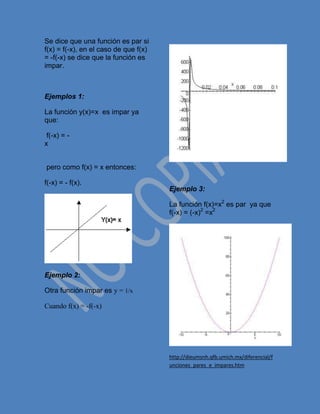
Ejemplos 1:

La función y(x)=x es impar ya
que:

 f(-x) = -
x


pero como f(x) = x entonces:

f(-x) = - f(x).
                                       Ejemplo 3:

                                       La función f(x)=x2 es par ya que
                                       f(-x) = (-x)2 =x2


Ejemplo 2:

Otra función impar es y = 1/x

Cuando f(x) = -f(-x)


                                       http://dieumsnh.qfb.umich.mx/diferencial/f
                                       unciones_pares_e_impares.htm
Funcion par e impar

Funcion par e impar

  • 1.
    Se dice queuna función es par si f(x) = f(-x), en el caso de que f(x) = -f(-x) se dice que la función es impar. Ejemplos 1: La función y(x)=x es impar ya que: f(-x) = - x pero como f(x) = x entonces: f(-x) = - f(x). Ejemplo 3: La función f(x)=x2 es par ya que f(-x) = (-x)2 =x2 Ejemplo 2: Otra función impar es y = 1/x Cuando f(x) = -f(-x) http://dieumsnh.qfb.umich.mx/diferencial/f unciones_pares_e_impares.htm