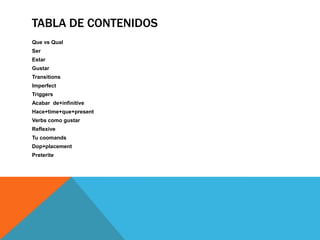
TABLA DE CONTENIDOS
Que vs Qual
Ser
Estar
Gustar
Transitions
Imperfect
Triggers
Acabar de+infinitive
Hace+time+que+present
Verbs como gustar
Reflexive
Tu coomands
Dop+placement
Preterite
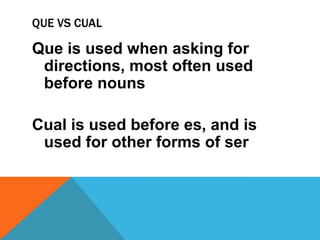
QUE VS CUAL

Que is used when asking for
 directions, most often used
 before nouns

Cual is used before es, and is
 used for other forms of ser
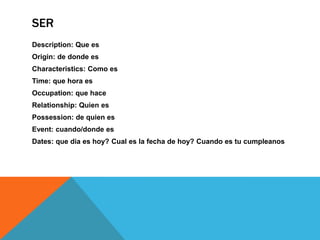
SER
Description: Que es
Origin: de donde es
Characteristics: Como es
Time: que hora es
Occupation: que hace
Relationship: Quien es
Possession: de quien es
Event: cuando/donde es
Dates: que dia es hoy? Cual es la fecha de hoy? Cuando es tu cumpleanos
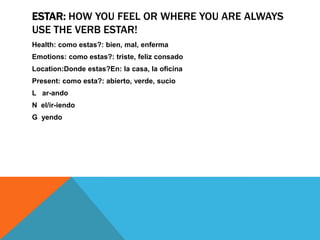
ESTAR: HOW YOU FEEL OR WHERE YOU ARE ALWAYS
USE THE VERB ESTAR!
Health: como estas?: bien, mal, enferma
Emotions: como estas?: triste, feliz consado
Location:Donde estas?En: la casa, la oficina
Present: como esta?: abierto, verde, sucio
L ar-ando
N el/ir-iendo
G yendo
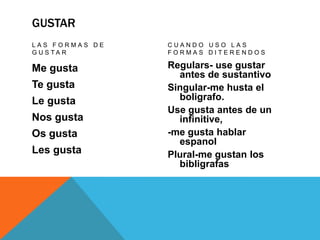
GUSTAR
LAS FORMAS DE   CUANDO USO LAS
G U S TA R      FORMAS DITERENDOS

Me gusta        Regulars- use gustar
                  antes de sustantivo
Te gusta        Singular-me husta el
Le gusta          boligrafo.
                Use gusta antes de un
Nos gusta         infinitive,
Os gusta        -me gusta hablar
                  espanol
Les gusta       Plural-me gustan los
                  bibligrafas
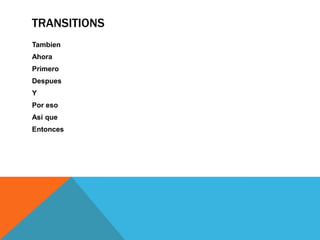
TRANSITIONS
Tambien
Ahora
Primero
Despues
Y
Por eso
Asi que
Entonces
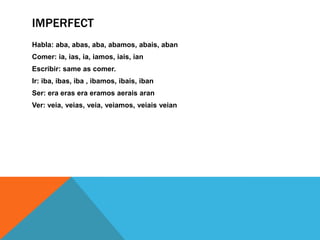
IMPERFECT
Habla: aba, abas, aba, abamos, abais, aban
Comer: ia, ias, ia, iamos, iais, ian
Escribir: same as comer.
Ir: iba, ibas, iba , ibamos, ibais, iban
Ser: era eras era eramos aerais aran
Ver: veia, veias, veia, veiamos, veiais veian
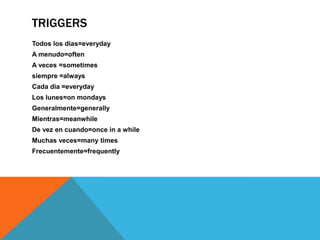
TRIGGERS
Todos los dias=everyday
A menudo=often
A veces =sometimes
siempre =always
Cada dia =everyday
Los lunes=on mondays
Generalmente=generally
Mientras=meanwhile
De vez en cuando=once in a while
Muchas veces=many times
Frecuentemente=frequently
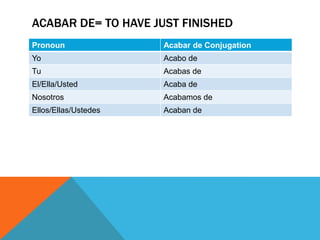
ACABAR DE= TO HAVE JUST FINISHED
Pronoun               Acabar de Conjugation
Yo                    Acabo de
Tu                    Acabas de
El/Ella/Usted         Acaba de
Nosotros              Acabamos de
Ellos/Ellas/Ustedes   Acaban de
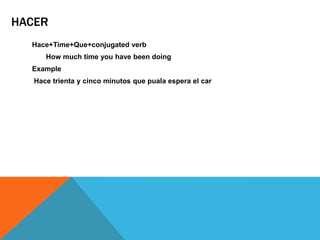
HACER
  Hace+Time+Que+conjugated verb
      How much time you have been doing
  Example
   Hace trienta y cinco minutos que puala espera el car
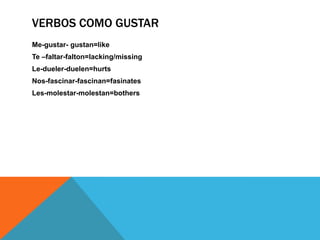
VERBOS COMO GUSTAR
Me-gustar- gustan=like
Te –faltar-falton=lacking/missing
Le-dueler-duelen=hurts
Nos-fascinar-fascinan=fasinates
Les-molestar-molestan=bothers
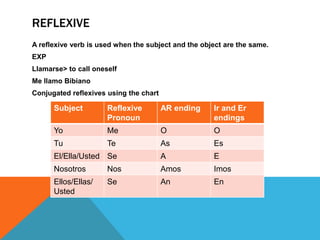
REFLEXIVE
A reflexive verb is used when the subject and the object are the same.
EXP
Llamarse> to call oneself
Me llamo Bibiano
Conjugated reflexives using the chart

      Subject         Reflexive         AR ending    Ir and Er
                      Pronoun                        endings
      Yo              Me                O            O
      Tu              Te                As           Es
      El/Ella/Usted Se                  A            E
      Nosotros        Nos               Amos         Imos
      Ellos/Ellas/    Se                An           En
      Usted
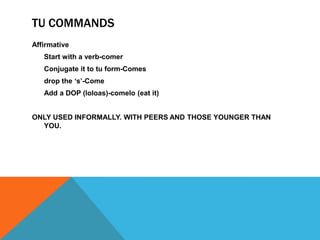
TU COMMANDS
Affirmative
   Start with a verb-comer
   Conjugate it to tu form-Comes
   drop the „s‟-Come
   Add a DOP (loloas)-comelo (eat it)


ONLY USED INFORMALLY. WITH PEERS AND THOSE YOUNGER THAN
  YOU.
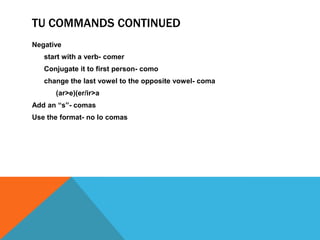
TU COMMANDS CONTINUED
Negative
   start with a verb- comer
   Conjugate it to first person- como
   change the last vowel to the opposite vowel- coma
      (ar>e)(er/ir>a
Add an “s”- comas
Use the format- no lo comas
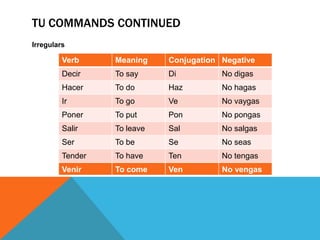
TU COMMANDS CONTINUED
Irregulars

         Verb     Meaning    Conjugation Negative
         Decir    To say     Di          No digas
         Hacer    To do      Haz         No hagas
         Ir       To go      Ve          No vaygas
         Poner    To put     Pon         No pongas
         Salir    To leave   Sal         No salgas
         Ser      To be      Se          No seas
         Tender   To have    Ten         No tengas
         Venir    To come    Ven         No vengas
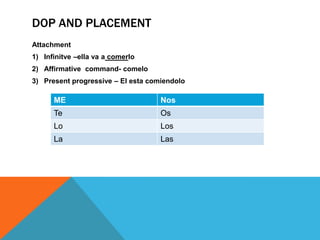
DOP AND PLACEMENT
Attachment
1) Infinitve –ella va a comerlo
2) Affirmative command- comelo
3) Present progressive – El esta comiendolo

      ME                            Nos
      Te                            Os
      Lo                            Los
      La                            Las
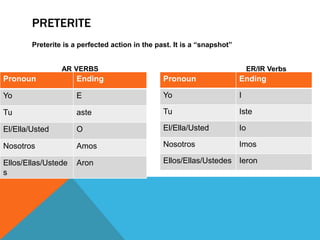
PRETERITE
        Preterite is a perfected action in the past. It is a “snapshot”


                 AR VERBS                                                      ER/IR Verbs
Pronoun               Ending                     Pronoun                  Ending

Yo                    E                          Yo                       I

Tu                    aste                       Tu                       Iste

El/Ella/Usted         O                          El/Ella/Usted            Io

Nosotros              Amos                       Nosotros                 Imos

Ellos/Ellas/Ustede    Aron                       Ellos/Ellas/Ustedes Ieron
s

Grammar book

  • 2.
    TABLA DE CONTENIDOS Quevs Qual Ser Estar Gustar Transitions Imperfect Triggers Acabar de+infinitive Hace+time+que+present Verbs como gustar Reflexive Tu coomands Dop+placement Preterite
  • 3.
    QUE VS CUAL Queis used when asking for directions, most often used before nouns Cual is used before es, and is used for other forms of ser
  • 4.
    SER Description: Que es Origin:de donde es Characteristics: Como es Time: que hora es Occupation: que hace Relationship: Quien es Possession: de quien es Event: cuando/donde es Dates: que dia es hoy? Cual es la fecha de hoy? Cuando es tu cumpleanos
  • 5.
    ESTAR: HOW YOUFEEL OR WHERE YOU ARE ALWAYS USE THE VERB ESTAR! Health: como estas?: bien, mal, enferma Emotions: como estas?: triste, feliz consado Location:Donde estas?En: la casa, la oficina Present: como esta?: abierto, verde, sucio L ar-ando N el/ir-iendo G yendo
  • 6.
    GUSTAR LAS FORMAS DE CUANDO USO LAS G U S TA R FORMAS DITERENDOS Me gusta Regulars- use gustar antes de sustantivo Te gusta Singular-me husta el Le gusta boligrafo. Use gusta antes de un Nos gusta infinitive, Os gusta -me gusta hablar espanol Les gusta Plural-me gustan los bibligrafas
  • 7.
  • 8.
    IMPERFECT Habla: aba, abas,aba, abamos, abais, aban Comer: ia, ias, ia, iamos, iais, ian Escribir: same as comer. Ir: iba, ibas, iba , ibamos, ibais, iban Ser: era eras era eramos aerais aran Ver: veia, veias, veia, veiamos, veiais veian
  • 9.
    TRIGGERS Todos los dias=everyday Amenudo=often A veces =sometimes siempre =always Cada dia =everyday Los lunes=on mondays Generalmente=generally Mientras=meanwhile De vez en cuando=once in a while Muchas veces=many times Frecuentemente=frequently
  • 10.
    ACABAR DE= TOHAVE JUST FINISHED Pronoun Acabar de Conjugation Yo Acabo de Tu Acabas de El/Ella/Usted Acaba de Nosotros Acabamos de Ellos/Ellas/Ustedes Acaban de
  • 11.
    HACER Hace+Time+Que+conjugatedverb How much time you have been doing Example Hace trienta y cinco minutos que puala espera el car
  • 12.
    VERBOS COMO GUSTAR Me-gustar-gustan=like Te –faltar-falton=lacking/missing Le-dueler-duelen=hurts Nos-fascinar-fascinan=fasinates Les-molestar-molestan=bothers
  • 13.
    REFLEXIVE A reflexive verbis used when the subject and the object are the same. EXP Llamarse> to call oneself Me llamo Bibiano Conjugated reflexives using the chart Subject Reflexive AR ending Ir and Er Pronoun endings Yo Me O O Tu Te As Es El/Ella/Usted Se A E Nosotros Nos Amos Imos Ellos/Ellas/ Se An En Usted
  • 14.
    TU COMMANDS Affirmative Start with a verb-comer Conjugate it to tu form-Comes drop the „s‟-Come Add a DOP (loloas)-comelo (eat it) ONLY USED INFORMALLY. WITH PEERS AND THOSE YOUNGER THAN YOU.
  • 15.
    TU COMMANDS CONTINUED Negative start with a verb- comer Conjugate it to first person- como change the last vowel to the opposite vowel- coma (ar>e)(er/ir>a Add an “s”- comas Use the format- no lo comas
  • 16.
    TU COMMANDS CONTINUED Irregulars Verb Meaning Conjugation Negative Decir To say Di No digas Hacer To do Haz No hagas Ir To go Ve No vaygas Poner To put Pon No pongas Salir To leave Sal No salgas Ser To be Se No seas Tender To have Ten No tengas Venir To come Ven No vengas
  • 17.
    DOP AND PLACEMENT Attachment 1)Infinitve –ella va a comerlo 2) Affirmative command- comelo 3) Present progressive – El esta comiendolo ME Nos Te Os Lo Los La Las
  • 18.
    PRETERITE Preterite is a perfected action in the past. It is a “snapshot” AR VERBS ER/IR Verbs Pronoun Ending Pronoun Ending Yo E Yo I Tu aste Tu Iste El/Ella/Usted O El/Ella/Usted Io Nosotros Amos Nosotros Imos Ellos/Ellas/Ustede Aron Ellos/Ellas/Ustedes Ieron s