Victoria Thompson
       SP2H
   Sixth Period
1)    Qué vs. Cuál
2)    Ser
3)    Estar
4)    Gustar
5)    Transitional Words
6)    Imperfect
7)    Triggers
8)    Acabar de + infinitive
9)    Hace + Time + Que + Verb
10)    Verbs Like Gustar
11)    Reflexive
12)   Tú Commands
13)    DOP & Placement
14)   Preterite
 Qué is usually used when seeking a definition.
 - ¿Qué significa “pecas”?
 - What are “pecas”?
 Qué is usually used before a noun, although cuál can
 sometimes be used before a noun when it means
 “which”.
  - ¿De qué color es el vestido?
  - What color is the dress?
Pronoun           Conjugation        Meaning
        Yo                Soy               I am
        Tú               Eres              You are
  Él/ Ella/ Usted         Es        He/ She/ You (formal)
                                           is/are
     Nosotros           Somos              We are
     Vosotros            Sois        You all are (Spain)
Ellos/Ellas/Ustedes      Son          They/You all are


      DOCTORPED
Pronoun           Conjugation
        Yo               Estoy
        Tú               Estás
  Él/Ella/Usted          Está
     Nosotros           Estamos
     Vosotros            Estáis

Ellos/Ellas/Ustedes      Están


             LOCO
Pronoun             Gustar               Meaning
        Yo            Me gusta(n)          It pleases me.
        Tú            Te gusta(n)         It pleases you.
  Él/Ella/Usted       Le gusta(n)     It pleases him/her/you
                                                 all.
     Nosotros         Nos gusta(n)         It pleases us.
     Vosotros         Os gusta(n)    It pleases you all. (Spain)
Ellos/Ellas/Ustedes   Les gusta(n)   It pleases them/you all.


A note for emphasis or clarity: a + pronoun +
gustar

Example: A usted le gusta…
 También
 Ahora
 Primero
 Ni-ni
 Después
 Por eso
 Así Que
Y
 Entonces
Pronoun             ar ending        er/ir ending
     Yo                 aba                ía
     Tú                 abas               ías
Él/Ella/Usted           aba                ía
  Nosotros            abamos              íamos
  Vosotros             abais               íais
Ellos/Ellas/            aban               ían
  Ustedes

          Uses:
           ongoing action (was/were)
           repeated action
           no definite beginning or end
           time/date/age/feelings/descriptions
          Interrupted activity (cuando)
These words or phrases let the reader or listener know that
  imperfect tense is about to be used.
 Todos los días
 A menudo
 A veces
 Siempre
 Cada día
 Los lunes
 Generalmente
 Mientras
 De ves en cuando
 Muchos veces
 Frecuentemente
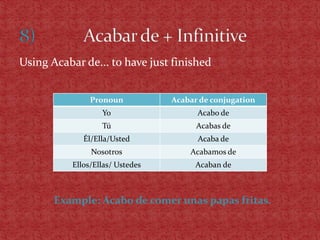
Using Acabar de... to have just finished


                Pronoun           Acabar de conjugation
                   Yo                   Acabo de
                   Tú                   Acabas de
              Él/Ella/Usted             Acaba de
                Nosotros              Acabamos de
           Ellos/Ellas/ Ustedes         Acaban de


       Example: Acabo de comer unas papas fritas.
 Present tense       since &
 for
Preterite tense      ago
 Example: Hace dos días que
 hablo español.
 Faltar (to be missing)
   Falta
   Faltan
 Doler (to hurt)
  Duele
  Duelen
 Fascinar (to fascinate)
  Fascina
  Fascinan
 Me, te, le, os, nos, les
 “What is being verbed?”
 Example: Me duele la cabeza.
 A reflexive verb is used when the subject and object are the
   same.
  For example:
     llamarse - to call oneself
     Me llamo Victoria.
      I call myself Victoria.
  Conjugate reflexives using the following chart.
     Subjects           Reflexive Pronoun   Ar Endings   Ir and Er Endings

         Yo                    Me               -o              -o
         Tú                    Te              -as              -es
   Él/ Ella/ Usted             Se               -a              -e

     Nosotros                 Nos             -amos           -imos
Ellos/ Ellas/ Ustedes          Se              -an              -en
 Affirmative
  Start with a verb- Comer
  Conjugate it to tú form- Comes
  Drop the “s” – Come
 Add a DOP (lolas) - ¡Comelo! (Eat it!)

                     WARNING!
  Only used informally. With peers and those younger
                        than you.
 Negative
   Start with a verb.- Comer
   Conjugate it to first person.- Como
   Change the last vowel to the opposite vowel.- Coma
       (-ar    e) (-er/-ir   -a)
   Add an “s”. – Comas
   Use the format.- ¡No lo comas!
 Irregulars

       Verb    Meaning    Conjugation   Negative

       Decir    To say        Di        No digas
      Hacer     To do        Haz        No hagas
        Ir      To go         Ve        No vaygas
       Poner    To put       Pon        No pongas
       Salir   To leave       Sal       No salgas
        Ser     To be         Sé        No seas
       Tener   To have        Ten       No tengas
       Venir   To come       Ven        No vengas
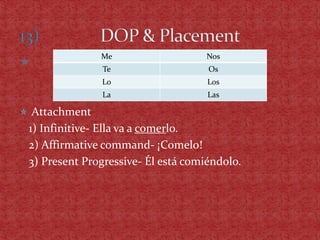
Me                    Nos

               Te                    Os
               Lo                    Los
               La                    Las

 Attachment
 1) Infinitive- Ella va a comerlo.
 2) Affirmative command- ¡Comelo!
 3) Present Progressive- Él está comiéndolo.
 Preterite is a perfected action in the past. It is a
  “snapshot”.

               Ar Verbs                       Er/Ir Verbs
      Pronoun           Ending          Pronoun           Ending
          Yo               -é               Yo              -í
          Tú              -aste             Tú             -iste
    Él/Ella/Usted          -ó         Él/Ella/Usted         -ió
       Nosotros         -amos            Nosotros         -imos
  Ellos/Ellas/Ustedes     -aron     Ellos/Ellas/Ustedes   -ieron

Final Grammar Book

  • 1.
    Victoria Thompson SP2H Sixth Period
  • 2.
    1) Qué vs. Cuál 2) Ser 3) Estar 4) Gustar 5) Transitional Words 6) Imperfect 7) Triggers 8) Acabar de + infinitive 9) Hace + Time + Que + Verb 10) Verbs Like Gustar 11) Reflexive 12) Tú Commands 13) DOP & Placement 14) Preterite
  • 3.
     Qué isusually used when seeking a definition. - ¿Qué significa “pecas”? - What are “pecas”?  Qué is usually used before a noun, although cuál can sometimes be used before a noun when it means “which”. - ¿De qué color es el vestido? - What color is the dress?
  • 4.
    Pronoun Conjugation Meaning Yo Soy I am Tú Eres You are Él/ Ella/ Usted Es He/ She/ You (formal) is/are Nosotros Somos We are Vosotros Sois You all are (Spain) Ellos/Ellas/Ustedes Son They/You all are DOCTORPED
  • 5.
    Pronoun Conjugation Yo Estoy Tú Estás Él/Ella/Usted Está Nosotros Estamos Vosotros Estáis Ellos/Ellas/Ustedes Están LOCO
  • 6.
    Pronoun Gustar Meaning Yo Me gusta(n) It pleases me. Tú Te gusta(n) It pleases you. Él/Ella/Usted Le gusta(n) It pleases him/her/you all. Nosotros Nos gusta(n) It pleases us. Vosotros Os gusta(n) It pleases you all. (Spain) Ellos/Ellas/Ustedes Les gusta(n) It pleases them/you all. A note for emphasis or clarity: a + pronoun + gustar Example: A usted le gusta…
  • 7.
     También  Ahora Primero  Ni-ni  Después  Por eso  Así Que Y  Entonces
  • 8.
    Pronoun ar ending er/ir ending Yo aba ía Tú abas ías Él/Ella/Usted aba ía Nosotros abamos íamos Vosotros abais íais Ellos/Ellas/ aban ían Ustedes Uses:  ongoing action (was/were)  repeated action  no definite beginning or end  time/date/age/feelings/descriptions Interrupted activity (cuando)
  • 9.
    These words orphrases let the reader or listener know that imperfect tense is about to be used.  Todos los días  A menudo  A veces  Siempre  Cada día  Los lunes  Generalmente  Mientras  De ves en cuando  Muchos veces  Frecuentemente
  • 10.
    Using Acabar de...to have just finished Pronoun Acabar de conjugation Yo Acabo de Tú Acabas de Él/Ella/Usted Acaba de Nosotros Acabamos de Ellos/Ellas/ Ustedes Acaban de Example: Acabo de comer unas papas fritas.
  • 11.
     Present tense since & for Preterite tense ago  Example: Hace dos días que hablo español.
  • 12.
     Faltar (tobe missing)  Falta  Faltan  Doler (to hurt)  Duele  Duelen  Fascinar (to fascinate)  Fascina  Fascinan  Me, te, le, os, nos, les  “What is being verbed?”  Example: Me duele la cabeza.
  • 13.
     A reflexiveverb is used when the subject and object are the same.  For example:  llamarse - to call oneself  Me llamo Victoria. I call myself Victoria.  Conjugate reflexives using the following chart. Subjects Reflexive Pronoun Ar Endings Ir and Er Endings Yo Me -o -o Tú Te -as -es Él/ Ella/ Usted Se -a -e Nosotros Nos -amos -imos Ellos/ Ellas/ Ustedes Se -an -en
  • 14.
     Affirmative Start with a verb- Comer  Conjugate it to tú form- Comes  Drop the “s” – Come Add a DOP (lolas) - ¡Comelo! (Eat it!) WARNING! Only used informally. With peers and those younger than you.
  • 15.
     Negative  Start with a verb.- Comer  Conjugate it to first person.- Como  Change the last vowel to the opposite vowel.- Coma (-ar e) (-er/-ir -a)  Add an “s”. – Comas  Use the format.- ¡No lo comas!
  • 16.
     Irregulars Verb Meaning Conjugation Negative Decir To say Di No digas Hacer To do Haz No hagas Ir To go Ve No vaygas Poner To put Pon No pongas Salir To leave Sal No salgas Ser To be Sé No seas Tener To have Ten No tengas Venir To come Ven No vengas
  • 17.
    Me Nos  Te Os Lo Los La Las  Attachment 1) Infinitive- Ella va a comerlo. 2) Affirmative command- ¡Comelo! 3) Present Progressive- Él está comiéndolo.
  • 18.
     Preterite isa perfected action in the past. It is a “snapshot”. Ar Verbs Er/Ir Verbs Pronoun Ending Pronoun Ending Yo -é Yo -í Tú -aste Tú -iste Él/Ella/Usted -ó Él/Ella/Usted -ió Nosotros -amos Nosotros -imos Ellos/Ellas/Ustedes -aron Ellos/Ellas/Ustedes -ieron