Table of Contents
•   Que vs. Cual                  • Relflexive
•   Conjugating Ser               • Tú commands
•   Ser (DOCTOR PED)                – Irregular
•   Estar (Helping PED)             – Negative
•   Las formas de gustar            – Affirmative
•   Palabras transitionales       • DOP Placement
•   El Imperfecto                 • Preterite
•   Triggers
                                  • Cómo estás
•   Acabar de + infinitive
•   Hace + time + que + present
•   Hay + que +infinitive
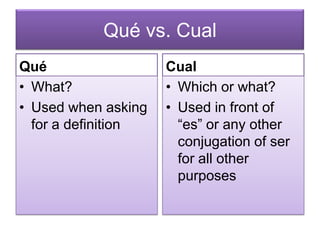
Qué vs. Cual
Qué                  Cual
• What?              • Which or what?
• Used when asking   • Used in front of
  for a definition     “es” or any other
                       conjugation of ser
                       for all other
                       purposes
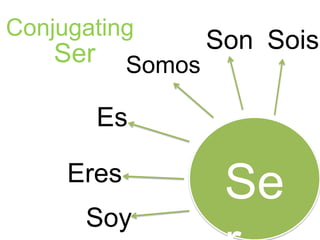
Conjugating
    Ser             Son Sois
            Somos

          Es

     Eres
                     Se
      Soy
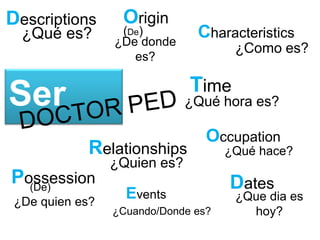
Descriptions      Origin
  ¿Qué es?        (De)
                 ¿De donde
                               Characteristics
                                      ¿Como es?
                    es?

                              Time
Ser                           ¿Qué hora es?

                                 Occupation
            Relationships            ¿Qué hace?
                 ¿Quien es?
Possession
  (De)                               Dates
 ¿De quien es?
                   Events             ¿Que dia es
                 ¿Cuando/Donde es?      hoy?
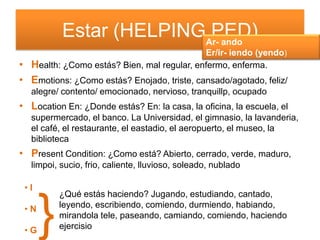
Estar (HELPINGAr- ando
                          PED)
                                            Er/ir- iendo (yendo)
• Health: ¿Como estás? Bien, mal regular, enfermo, enferma.
• Emotions: ¿Como estás? Enojado, triste, cansado/agotado, feliz/
   alegre/ contento/ emocionado, nervioso, tranquillp, ocupado
• Location En: ¿Donde estás? En: la casa, la oficina, la escuela, el
   supermercado, el banco. La Universidad, el gimnasio, la lavanderia,
   el café, el restaurante, el eastadio, el aeropuerto, el museo, la
   biblioteca
• Present Condition: ¿Como está? Abierto, cerrado, verde, maduro,
   limpoi, sucio, frio, caliente, lluvioso, soleado, nublado

 •I
          ¿Qué estás haciendo? Jugando, estudiando, cantado,
 •N

 •G   }   leyendo, escribiendo, comiendo, durmiendo, habiando,
          mirandola tele, paseando, camiando, comiendo, haciendo
          ejercisio
Las formas de gustar
•   me gusta (n)    • It pleases me
•   Te gusta (n)    • It pleases you
•   Le gusta (n)    • It pleases
                      him/her/formal you
•   Nos gusta (n)
                    • It pleases us
•   Os gusta (n)    • It pleases ya’ll
•   Les gusta (n)   • It pleases them/you
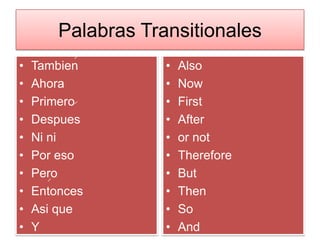
Palabras Transitionales
•   Tambien         •   Also
•   Ahora           •   Now
•   Primero         •   First
•   Despues         •   After
•   Ni ni           •   or not
•   Por eso         •   Therefore
•   Pero            •   But
•   Entonces        •   Then
•   Asi que         •   So
•   Y               •   And
El Imperfecto
                    Hablar       Comer      Escribir
Yo                  hablaba      comía      escribía
Tú                  hablabas     comías     escribías
Él/ella/Ud.         hablaba      comía      escribía
Nosotros            hablábamos   comíamos   escribíamos
Vosotros            hablais      comíais    escribías
Ellos/ellas/Uds.    hablaban     comían     escribían
                    Ir           Ser        Ver
Yo                  iba          era        Veía
Tú                  ibas         eras       Veías
Él/ella/Ud.         iba          era        Veía
Nosotros            Íbamos       éramos     Veíamos
Vosotros            ibais        erais      Veais
Ellos/ellas/Uds.    iban         eran       veían
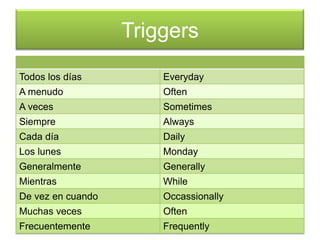
Triggers
Todos los días         Everyday
A menudo               Often
A veces                Sometimes
Siempre                Always
Cada día               Daily
Los lunes              Monday
Generalmente           Generally
Mientras               While
De vez en cuando       Occassionally
Muchas veces           Often
Frecuentemente         Frequently
Acabar de + Infinitive
• To have just done something (in the very
  recent past)
• acabo, acabas, acaba, acabamos,
  acabáis, acaban
  – Nosotros acabamos de leer el libro.
     We just read the book.
  – Ellos acaban de nadar en el mar.
     They have just swum in the ocean.
Hace + time + que + present
• Used to talk about how much time
  you’ve been doing something
  – Hace treinta y cinco munutos que Talia
    come el almuerzo.
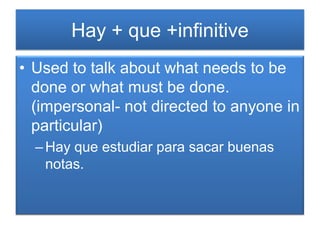
Hay + que +infinitive
• Used to talk about what needs to be
  done or what must be done.
  (impersonal- not directed to anyone in
  particular)
  – Hay que estudiar para sacar buenas
    notas.
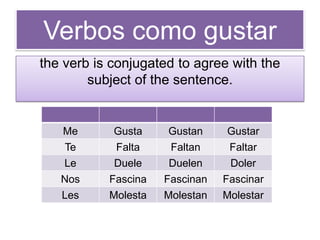
Verbos como gustar
the verb is conjugated to agree with the
        subject of the sentence.


   Me       Gusta     Gustan     Gustar
   Te       Falta     Faltan     Faltar
   Le       Duele     Duelen     Doler
   Nos     Fascina   Fascinan   Fascinar
   Les     Molesta   Molestan   Molestar
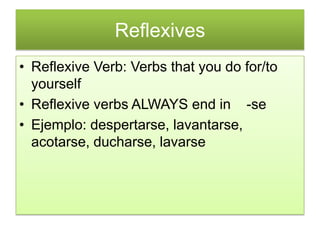
Reflexives
• Reflexive Verb: Verbs that you do for/to
  yourself
• Reflexive verbs ALWAYS end in -se
• Ejemplo: despertarse, lavantarse,
  acotarse, ducharse, lavarse
Tú Commands
               Di
      Ven           Haz


Ten         Irregular     Ve

      S             Pon
      é        Sa
                l
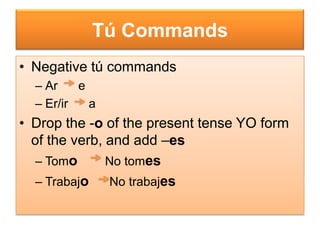
Tú Commands
• Negative tú commands
  – Ar    e
  – Er/ir   a
• Drop the -o of the present tense YO form
  of the verb, and add –es
   – Tomo      No tomes
   – Trabajo    No trabajes
Tú Commands
• Affirmative
  – Simply drop the “s”
• Pronoun placement: the pronoun is
  attached to the end of affirmative
  commands
• Ex: ¡Comelo!
  – Eat it!
DOP Placement
• DOP pronouns take the place of a noun
• Can attach to an affirmative command


   me                nos
   te                os
   lo/la             los/las
Preterite
• Used for past actions
• Drop the ending and add:
             -ar             -er/ir
             é               í
             aste            iste
             ó               ió
             amos            imos
             asteis          isteis
             aron            ieron
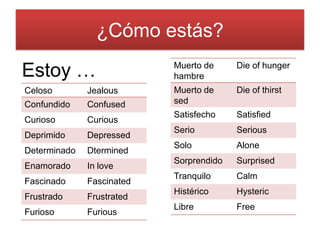
¿Cómo estás?

Estoy …                    Muerto de
                           hambre
                                         Die of hunger

Celoso        Jealous      Muerto de     Die of thirst
Confundido    Confused     sed
                           Satisfecho    Satisfied
Curioso       Curious
                           Serio         Serious
Deprimido     Depressed
                           Solo          Alone
Determinado   Dtermined
                           Sorprendido   Surprised
Enamorado     In love
                           Tranquilo     Calm
Fascinado     Fascinated
                           Histérico     Hysteric
Frustrado     Frustrated
                           Libre         Free
Furioso       Furious

Grammar book

  • 2.
    Table of Contents • Que vs. Cual • Relflexive • Conjugating Ser • Tú commands • Ser (DOCTOR PED) – Irregular • Estar (Helping PED) – Negative • Las formas de gustar – Affirmative • Palabras transitionales • DOP Placement • El Imperfecto • Preterite • Triggers • Cómo estás • Acabar de + infinitive • Hace + time + que + present • Hay + que +infinitive
  • 3.
    Qué vs. Cual Qué Cual • What? • Which or what? • Used when asking • Used in front of for a definition “es” or any other conjugation of ser for all other purposes
  • 4.
    Conjugating Ser Son Sois Somos Es Eres Se Soy
  • 5.
    Descriptions Origin ¿Qué es? (De) ¿De donde Characteristics ¿Como es? es? Time Ser ¿Qué hora es? Occupation Relationships ¿Qué hace? ¿Quien es? Possession (De) Dates ¿De quien es? Events ¿Que dia es ¿Cuando/Donde es? hoy?
  • 6.
    Estar (HELPINGAr- ando PED) Er/ir- iendo (yendo) • Health: ¿Como estás? Bien, mal regular, enfermo, enferma. • Emotions: ¿Como estás? Enojado, triste, cansado/agotado, feliz/ alegre/ contento/ emocionado, nervioso, tranquillp, ocupado • Location En: ¿Donde estás? En: la casa, la oficina, la escuela, el supermercado, el banco. La Universidad, el gimnasio, la lavanderia, el café, el restaurante, el eastadio, el aeropuerto, el museo, la biblioteca • Present Condition: ¿Como está? Abierto, cerrado, verde, maduro, limpoi, sucio, frio, caliente, lluvioso, soleado, nublado •I ¿Qué estás haciendo? Jugando, estudiando, cantado, •N •G } leyendo, escribiendo, comiendo, durmiendo, habiando, mirandola tele, paseando, camiando, comiendo, haciendo ejercisio
  • 7.
    Las formas degustar • me gusta (n) • It pleases me • Te gusta (n) • It pleases you • Le gusta (n) • It pleases him/her/formal you • Nos gusta (n) • It pleases us • Os gusta (n) • It pleases ya’ll • Les gusta (n) • It pleases them/you
  • 8.
    Palabras Transitionales • Tambien • Also • Ahora • Now • Primero • First • Despues • After • Ni ni • or not • Por eso • Therefore • Pero • But • Entonces • Then • Asi que • So • Y • And
  • 9.
    El Imperfecto Hablar Comer Escribir Yo hablaba comía escribía Tú hablabas comías escribías Él/ella/Ud. hablaba comía escribía Nosotros hablábamos comíamos escribíamos Vosotros hablais comíais escribías Ellos/ellas/Uds. hablaban comían escribían Ir Ser Ver Yo iba era Veía Tú ibas eras Veías Él/ella/Ud. iba era Veía Nosotros Íbamos éramos Veíamos Vosotros ibais erais Veais Ellos/ellas/Uds. iban eran veían
  • 10.
    Triggers Todos los días Everyday A menudo Often A veces Sometimes Siempre Always Cada día Daily Los lunes Monday Generalmente Generally Mientras While De vez en cuando Occassionally Muchas veces Often Frecuentemente Frequently
  • 11.
    Acabar de +Infinitive • To have just done something (in the very recent past) • acabo, acabas, acaba, acabamos, acabáis, acaban – Nosotros acabamos de leer el libro. We just read the book. – Ellos acaban de nadar en el mar. They have just swum in the ocean.
  • 12.
    Hace + time+ que + present • Used to talk about how much time you’ve been doing something – Hace treinta y cinco munutos que Talia come el almuerzo.
  • 13.
    Hay + que+infinitive • Used to talk about what needs to be done or what must be done. (impersonal- not directed to anyone in particular) – Hay que estudiar para sacar buenas notas.
  • 14.
    Verbos como gustar theverb is conjugated to agree with the subject of the sentence. Me Gusta Gustan Gustar Te Falta Faltan Faltar Le Duele Duelen Doler Nos Fascina Fascinan Fascinar Les Molesta Molestan Molestar
  • 15.
    Reflexives • Reflexive Verb:Verbs that you do for/to yourself • Reflexive verbs ALWAYS end in -se • Ejemplo: despertarse, lavantarse, acotarse, ducharse, lavarse
  • 16.
    Tú Commands Di Ven Haz Ten Irregular Ve S Pon é Sa l
  • 17.
    Tú Commands • Negativetú commands – Ar e – Er/ir a • Drop the -o of the present tense YO form of the verb, and add –es – Tomo No tomes – Trabajo No trabajes
  • 18.
    Tú Commands • Affirmative – Simply drop the “s” • Pronoun placement: the pronoun is attached to the end of affirmative commands • Ex: ¡Comelo! – Eat it!
  • 19.
    DOP Placement • DOPpronouns take the place of a noun • Can attach to an affirmative command me nos te os lo/la los/las
  • 20.
    Preterite • Used forpast actions • Drop the ending and add: -ar -er/ir é í aste iste ó ió amos imos asteis isteis aron ieron
  • 21.
    ¿Cómo estás? Estoy … Muerto de hambre Die of hunger Celoso Jealous Muerto de Die of thirst Confundido Confused sed Satisfecho Satisfied Curioso Curious Serio Serious Deprimido Depressed Solo Alone Determinado Dtermined Sorprendido Surprised Enamorado In love Tranquilo Calm Fascinado Fascinated Histérico Hysteric Frustrado Frustrated Libre Free Furioso Furious