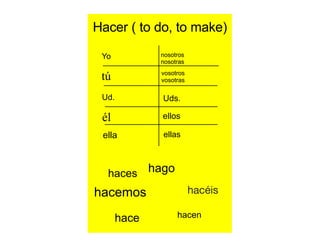
Hacer ( to do, to make)

 Yo           nosotros
              nosotras

 tú           vosotros
              vosotras

 Ud.          Uds.

 él           ellos

 ella         ellas


  haces hago

hacemos                  hacéis

       hace        hacen
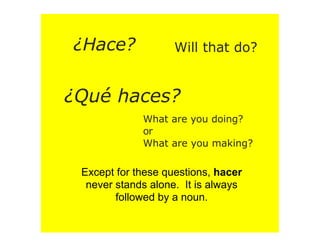
¿Hace?              Will that do?


¿Qué haces?
             What are you doing?
             or
             What are you making?


 Except for these questions, hacer
  never stands alone. It is always
        followed by a noun.
In weather terms
Typically, weather terms use a third-person
singular form of hacer followed by a noun.


              hace sol
¿Qué tiempo hace hoy?
          What’s the weather like today?


         hace viento
hace calor
hace frío
Hace fresco.
Hace buen tiempo.


Hace mal tiempo.
Weather expressions also
  use the Spanish word
"Hay" which translates as
   "there is, there are"
Talking about the weather:

The first thing you notice when
  talking about the weather in
 Spanish is the use of "hace"
 and "hay" whereas in English
            we use "to be"
                    

   EG: It is sunny = Hace sol
      (literally it makes sun)
                      

       It is hot = Hace calor
                        

 It is very windy - Hace / Hay
            mucho viento
Two weather expressions do not use
         "hace" or "hay"

                   Nevar - to snow
                     Está nevando.
llover - to rain

   Está lloviendo
Está nublado.
tronar - to thunder    Hay relámpagos
Truena    Está tronando        It's lightning
Hay granizo   It's hailing
Las cuatro estaciones
Es una estación muy bonita. Llueve un poco pero hace buen
tiempo. Hay muchas flores. Todo está verde. Unas fiestas
importantes son la Pascua Florida, el Día de las Madres y en
los Estados Unidos, el primero de abril, el Día de los
Inocentes.


  La estación es __________.
Es la estación favorita de muchos niños porque
tienen vacaciones muy largas y no hay clases.
Hace mucho calor y mucho sol. Hay mucha
gente en las playas. Los días son largos y las
noches son cortas. La fiesta más importante en
los Estados Unidos es el Día de la
Independencia.


 La estación es __________.
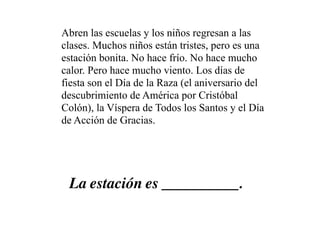
Abren las escuelas y los niños regresan a las
clases. Muchos niños están tristes, pero es una
estación bonita. No hace frío. No hace mucho
calor. Pero hace mucho viento. Los días de
fiesta son el Día de la Raza (el aniversario del
descubrimiento de América por Cristóbal
Colón), la Víspera de Todos los Santos y el Día
de Acción de Gracias.


 La estación es __________.
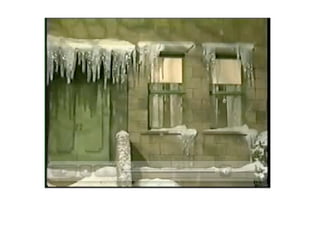
Hace mucho frío y nieva. Las personas
necesitan mucha ropa cuando salen de la casa.
Las noches son largas y mucha gente cree que
es una estación triste. Pero hay muchas fiestas
populares como la Navidad, los cumpleaños de
Lincoln, Washington y King y el Día de San
Valentín (el Día de los Enamorados).


  La estación es __________.
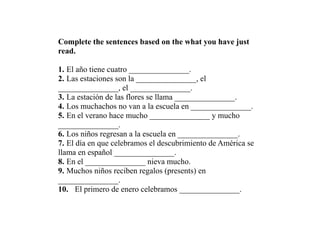
Complete the sentences based on the what you have just
read.

1. El año tiene cuatro _______________.
2. Las estaciones son la _______________, el
_______________, el _______________.
3. La estación de las flores se llama _______________.
4. Los muchachos no van a la escuela en _______________.
5. En el verano hace mucho _______________ y mucho
_______________.
6. Los niños regresan a la escuela en _______________.
7. El día en que celebramos el descubrimiento de América se
llama en español _______________.
8. En el _______________ nieva mucho.
9. Muchos niños reciben regalos (presents) en
_______________.
10. El primero de enero celebramos _______________.
Para conversar en clase

1.¿Cuál es tu estación favorita? ¿Por qué?
2.¿Por qué es bonita la primavera?
3.¿Es triste el invierno? ¿Por qué?
4.¿Qué recibe la gente el Día de San Valentín?
Time Expressions with "hacer"
The verb "hacer" can be used in a number
of ways to indicate the length of time an
action has been taking place. The first way
uses the formula:

Hace + time + que + present tense form of
the verb

Hace un año que estudio español.

I have been studying Spanish for one year.

Hace dos años que ellas estudian
inglés.

They have been studying English for two
years.
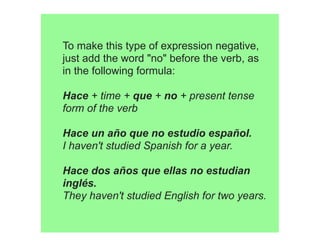
To make this type of expression negative,
just add the word "no" before the verb, as
in the following formula:

Hace + time + que + no + present tense
form of the verb

Hace un año que no estudio español.

I haven't studied Spanish for a year.

Hace dos años que ellas no estudian
inglés.

They haven't studied English for two years.
Another way to use the verb "hacer" to
express how long something has been
taking place is to use the following formula:

Present tense form of the verb + desde
hace + time

Estudio español desde hace un año.

I have been studying Spanish for one year.

Ellas estudian inglés desde hace dos
años.

They have been studying English for two
years.
To make this type of expression negative,
again simply add the word "no" before the
verb, as in the following formula:

No + present tense form of the verb +
desde hace + time

No estudio español desde hace un año.

I haven't studied Spanish for a year.

Ellas no estudian inglés desde hace
dos años.

They haven't studied English for two years.
So, when it comes to using the verb
"hacer" to express the length of time an
action has been taking place, there are two
ways to say the same thing:

Estudio español desde hace un año.


Hace un año que estudio español.


I have been studying Spanish for one year.
Hacer

Hacer

  • 1.
    Hacer ( todo, to make) Yo nosotros nosotras tú vosotros vosotras Ud. Uds. él ellos ella ellas haces hago hacemos hacéis hace hacen
  • 2.
    ¿Hace? Will that do? ¿Qué haces? What are you doing? or What are you making? Except for these questions, hacer never stands alone. It is always followed by a noun.
  • 3.
    In weather terms Typically,weather terms use a third-person singular form of hacer followed by a noun. hace sol
  • 4.
    ¿Qué tiempo hacehoy? What’s the weather like today? hace viento
  • 5.
  • 7.
  • 9.
  • 10.
  • 11.
    Weather expressions also use the Spanish word "Hay" which translates as "there is, there are"
  • 12.
    Talking about theweather:
 The first thing you notice when talking about the weather in Spanish is the use of "hace" and "hay" whereas in English we use "to be" 
 EG: It is sunny = Hace sol (literally it makes sun) 
 It is hot = Hace calor 
 It is very windy - Hace / Hay mucho viento
  • 13.
    Two weather expressionsdo not use "hace" or "hay" Nevar - to snow Está nevando.
  • 14.
    llover - torain Está lloviendo
  • 15.
  • 16.
    tronar - tothunder Hay relámpagos Truena Está tronando It's lightning
  • 17.
    Hay granizo It's hailing
  • 20.
    Las cuatro estaciones Esuna estación muy bonita. Llueve un poco pero hace buen tiempo. Hay muchas flores. Todo está verde. Unas fiestas importantes son la Pascua Florida, el Día de las Madres y en los Estados Unidos, el primero de abril, el Día de los Inocentes. La estación es __________.
  • 21.
    Es la estaciónfavorita de muchos niños porque tienen vacaciones muy largas y no hay clases. Hace mucho calor y mucho sol. Hay mucha gente en las playas. Los días son largos y las noches son cortas. La fiesta más importante en los Estados Unidos es el Día de la Independencia. La estación es __________.
  • 22.
    Abren las escuelasy los niños regresan a las clases. Muchos niños están tristes, pero es una estación bonita. No hace frío. No hace mucho calor. Pero hace mucho viento. Los días de fiesta son el Día de la Raza (el aniversario del descubrimiento de América por Cristóbal Colón), la Víspera de Todos los Santos y el Día de Acción de Gracias. La estación es __________.
  • 23.
    Hace mucho fríoy nieva. Las personas necesitan mucha ropa cuando salen de la casa. Las noches son largas y mucha gente cree que es una estación triste. Pero hay muchas fiestas populares como la Navidad, los cumpleaños de Lincoln, Washington y King y el Día de San Valentín (el Día de los Enamorados). La estación es __________.
  • 24.
    Complete the sentencesbased on the what you have just read. 1. El año tiene cuatro _______________. 2. Las estaciones son la _______________, el _______________, el _______________. 3. La estación de las flores se llama _______________. 4. Los muchachos no van a la escuela en _______________. 5. En el verano hace mucho _______________ y mucho _______________. 6. Los niños regresan a la escuela en _______________. 7. El día en que celebramos el descubrimiento de América se llama en español _______________. 8. En el _______________ nieva mucho. 9. Muchos niños reciben regalos (presents) en _______________. 10. El primero de enero celebramos _______________.
  • 25.
    Para conversar enclase 1.¿Cuál es tu estación favorita? ¿Por qué? 2.¿Por qué es bonita la primavera? 3.¿Es triste el invierno? ¿Por qué? 4.¿Qué recibe la gente el Día de San Valentín?
  • 26.
    Time Expressions with"hacer" The verb "hacer" can be used in a number of ways to indicate the length of time an action has been taking place. The first way uses the formula: Hace + time + que + present tense form of the verb Hace un año que estudio español.
 I have been studying Spanish for one year. Hace dos años que ellas estudian inglés.
 They have been studying English for two years.
  • 27.
    To make thistype of expression negative, just add the word "no" before the verb, as in the following formula: Hace + time + que + no + present tense form of the verb Hace un año que no estudio español.
 I haven't studied Spanish for a year. Hace dos años que ellas no estudian inglés.
 They haven't studied English for two years.
  • 28.
    Another way touse the verb "hacer" to express how long something has been taking place is to use the following formula: Present tense form of the verb + desde hace + time Estudio español desde hace un año.
 I have been studying Spanish for one year. Ellas estudian inglés desde hace dos años.
 They have been studying English for two years.
  • 29.
    To make thistype of expression negative, again simply add the word "no" before the verb, as in the following formula: No + present tense form of the verb + desde hace + time No estudio español desde hace un año.
 I haven't studied Spanish for a year. Ellas no estudian inglés desde hace dos años.
 They haven't studied English for two years.
  • 30.
    So, when itcomes to using the verb "hacer" to express the length of time an action has been taking place, there are two ways to say the same thing: Estudio español desde hace un año. 
 Hace un año que estudio español. 
 I have been studying Spanish for one year.