MOBILE BLUES: RETOS Y PERSPECTIVAS ANTE
LA IMPLEMENTACIÓN DEL MLEARNING EN LA
EDUCACIÓN
#ikasnabar15 Dr. Mar Camacho - URV
Sociedad del conocimiento | Tecnologías emergentes | m-
learning | retos & oportunidades de futuro
“In my view, the concept of ‘knowledge societies’ is preferable to that of the ‘information society’ because it
better captures the complexity and dynamism of the changes taking place. (...) the knowledge in question is
important not only for economic growth but also for empowering and developing all sectors of society.”
Abdul Waheed Khan (UNESCO general sub-director)
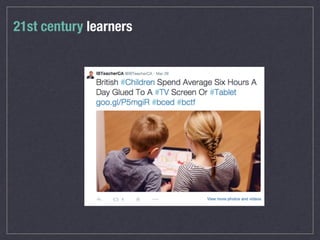
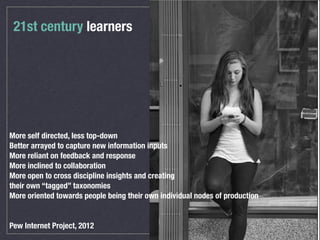
21st century learners
More self directed, less top-down
Better arrayed to capture new information inputs
More reliant on feedback and response
More inclined to collaboration
More open to cross discipline insights and creating
their own “tagged” taxonomies
More oriented towards people being their own individual nodes of production
Pew Internet Project, 2012
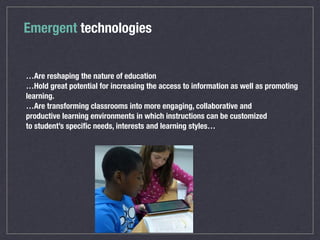
Emergent technologies
…Are reshaping the nature of education
…Hold great potential for increasing the access to information as well as promoting
learning.
…Are transforming classrooms into more engaging, collaborative and
productive learning environments in which instructions can be customized
to student’s specific needs, interests and learning styles…
Emergent technologies
more personal – networked - fun - more interactive – spontaneous-
shorter in duration - to the point - for instant use- engaging users
to contribute and share …
Social interaction for the co-construction of knowledge and meaning.
Learners are encouraged to take control of their learning (by
shaping learning goals and processes), collaborate with peers to
produce content and to use mobile tools for investigation and
exploration (Loke et al., 2010)
Instructors as facilitators design the learning environment
and structure learning processes (Jonassen, 1991)
Emergent learning
At the time that a distinct learning culture emerges, in which learners
take mobility and context-awareness as departing point and become
more visible as innovators, creators and producers they develop
new skills, attributes and literacies enabled by mobile devices that
offer them further possibilities to extend their learning and link the
use of social media to their own context and interests.
(Kukulska-Hume, 2010)
prohibición
FLIPPED
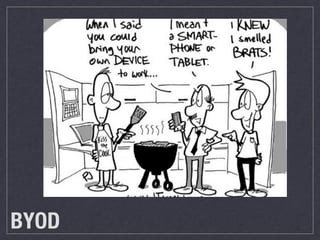
BYOD
… is not just the miniaturization and convenience of portable computing,
but is transforming how we conceptualize and interact with computing
and our environment, communicate, and create and manipulate
information (Cheney, 2010; Pachler, Bachmair, & Cook, 2010).
… is about ubiquitous social connectivity, instant information access,
and enhancing how we view the world through digital augmentation
(Cook, 2010).
… is empowering for learners, who can become content and context
generators within authentic learning environments (Herrington &
Herrington, 2006, 2007) rather than simply consumers of transmitted
content in classrooms.
ALGUNOS
datos
De los cerca de 7.000 milions de personas
que habitan en la Tierra, más de 6.000 millones
ya tienen acceso a un teléfono mòvil en funcionamiento.
4.500 milions de persones tienen acceso a un baño.
UN (2014)
ALGUNOS
datos
En 2014 había 350 millones de contratos para tabletas
y otros dispositivos móviles de pantalla grande, y 2.600
millones de contratos de teléfonos inteligentes.
A finales de 2019, se calcula que el número de contratos
de teléfonos móviles puede llegar a los 5.600
millones, lo que significa que tanto los habitantes de
países pobres como ricos, tendrán una conectividad
rápida.
UNESCO NMC15
ISTE
COSN World Bank
ITU
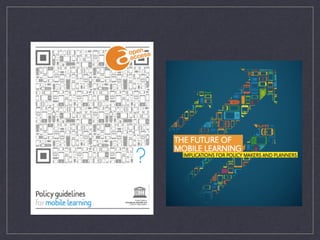
UNESCO POLICIES
ON MOBILE LEARNING
L2) Prepare teachers to foster learning through the
educational use of mobile devices. Prioritize the
professional capacitation of teachers
L3) Provide support and training to teachers through the
use of mobile technologies.
MLEARNING AT
#URV
Typology of activities (Laurillard, 2007)
	 exploration

investigation

registration (audio, video, images) 

colective knowledge construction (mstorytellng)

difusion 

reflection -> mportfolios
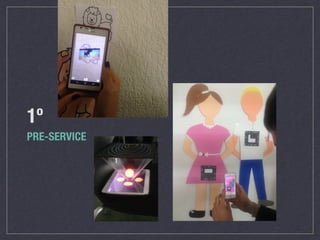
1º
PRE-SERVICE
4º
PRE-SERVICE
pre-service +
in-service teachers
PID
Mobile Learning
Intervention -DBR-
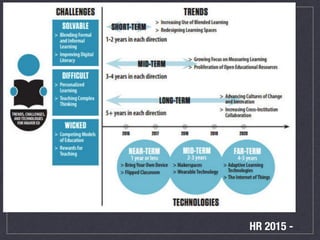
TECHNOLOGIES
2 watch
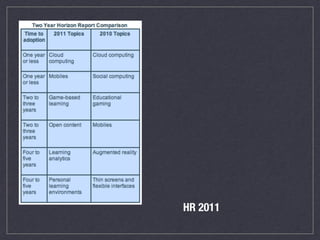
HR 2011
HR 2015 -
?
Ikasnabar 2018 -
Presiones económicas y los nuevos modelos de educación están ofreciendo una competencia sin
precedentes a los modelos tradicionales de educación superior.
La tecnología móvil y la alfabetización mediática continúa su ascenso en importancia como una
habilidad clave en cada disciplina y profesión.
 
Las barreras institucionales constituyen una oportunidad formidable para avanzar de una
forma constructiva con las tecnologías emergentes
Challenges
Cómo van a responder las instituciones a la sucesiva implementación del BYOD?
¿Cómo pueden las instituciones gestionar la tensión entre el aprendizaje en red informal
y el aprendizaje institucional formal?
¿Qué tipos de aprendizaje móvil son apropiados y rentables para las universidades,
centros educativos o lugar de trabajo?
Preguntas
. 1- Existe la necesidad de prever la transformación de la enseñanza y el aprendizaje para
  desarrollar las habilidades y competencias del siglo XXI, incluídas las tecnologías móviles.
      
    2.- Hay un creciente énfasis en la educación superior basado en el uso de modelos de
aprendizaje no tradicional, que sin duda va a ser auspiciado cada vez más por la integración
de las tecnologías móviles y emergentes.
    
    3.- Los paradigmas educativos están cambiando para incluir el mlearning, en un
momento en el que existe una gran demanda desde las aulas de un aprendizaje activo basado
en la consecución dedesafíos. En este contexto ,la formación pedagógica de los profesores se
convierte en esencial y clave.
… y algunas conclusiones
mar.camacho@urv.cat | twitter.com/marett
Mil Esker - Gràcies

Ikasnabar15 - Mar Camacho

  • 1.
    MOBILE BLUES: RETOSY PERSPECTIVAS ANTE LA IMPLEMENTACIÓN DEL MLEARNING EN LA EDUCACIÓN #ikasnabar15 Dr. Mar Camacho - URV
  • 2.
    Sociedad del conocimiento| Tecnologías emergentes | m- learning | retos & oportunidades de futuro
  • 3.
    “In my view,the concept of ‘knowledge societies’ is preferable to that of the ‘information society’ because it better captures the complexity and dynamism of the changes taking place. (...) the knowledge in question is important not only for economic growth but also for empowering and developing all sectors of society.” Abdul Waheed Khan (UNESCO general sub-director)
  • 4.
  • 7.
    21st century learners Moreself directed, less top-down Better arrayed to capture new information inputs More reliant on feedback and response More inclined to collaboration More open to cross discipline insights and creating their own “tagged” taxonomies More oriented towards people being their own individual nodes of production Pew Internet Project, 2012
  • 8.
    Emergent technologies …Are reshapingthe nature of education …Hold great potential for increasing the access to information as well as promoting learning. …Are transforming classrooms into more engaging, collaborative and productive learning environments in which instructions can be customized to student’s specific needs, interests and learning styles…
  • 9.
    Emergent technologies more personal– networked - fun - more interactive – spontaneous- shorter in duration - to the point - for instant use- engaging users to contribute and share …
  • 10.
    Social interaction forthe co-construction of knowledge and meaning. Learners are encouraged to take control of their learning (by shaping learning goals and processes), collaborate with peers to produce content and to use mobile tools for investigation and exploration (Loke et al., 2010) Instructors as facilitators design the learning environment and structure learning processes (Jonassen, 1991) Emergent learning
  • 11.
    At the timethat a distinct learning culture emerges, in which learners take mobility and context-awareness as departing point and become more visible as innovators, creators and producers they develop new skills, attributes and literacies enabled by mobile devices that offer them further possibilities to extend their learning and link the use of social media to their own context and interests. (Kukulska-Hume, 2010)
  • 12.
  • 13.
  • 14.
  • 17.
    … is notjust the miniaturization and convenience of portable computing, but is transforming how we conceptualize and interact with computing and our environment, communicate, and create and manipulate information (Cheney, 2010; Pachler, Bachmair, & Cook, 2010). … is about ubiquitous social connectivity, instant information access, and enhancing how we view the world through digital augmentation (Cook, 2010). … is empowering for learners, who can become content and context generators within authentic learning environments (Herrington & Herrington, 2006, 2007) rather than simply consumers of transmitted content in classrooms.
  • 18.
    ALGUNOS datos De los cercade 7.000 milions de personas que habitan en la Tierra, más de 6.000 millones ya tienen acceso a un teléfono mòvil en funcionamiento. 4.500 milions de persones tienen acceso a un baño. UN (2014)
  • 19.
    ALGUNOS datos En 2014 había350 millones de contratos para tabletas y otros dispositivos móviles de pantalla grande, y 2.600 millones de contratos de teléfonos inteligentes. A finales de 2019, se calcula que el número de contratos de teléfonos móviles puede llegar a los 5.600 millones, lo que significa que tanto los habitantes de países pobres como ricos, tendrán una conectividad rápida.
  • 20.
  • 21.
  • 23.
    L2) Prepare teachersto foster learning through the educational use of mobile devices. Prioritize the professional capacitation of teachers L3) Provide support and training to teachers through the use of mobile technologies.
  • 24.
  • 25.
    Typology of activities(Laurillard, 2007) exploration
 investigation
 registration (audio, video, images) 
 colective knowledge construction (mstorytellng)
 difusion 
 reflection -> mportfolios
  • 26.
  • 28.
  • 29.
  • 33.
  • 34.
  • 35.
  • 37.
  • 38.
    Presiones económicas ylos nuevos modelos de educación están ofreciendo una competencia sin precedentes a los modelos tradicionales de educación superior. La tecnología móvil y la alfabetización mediática continúa su ascenso en importancia como una habilidad clave en cada disciplina y profesión.   Las barreras institucionales constituyen una oportunidad formidable para avanzar de una forma constructiva con las tecnologías emergentes Challenges
  • 39.
    Cómo van aresponder las instituciones a la sucesiva implementación del BYOD? ¿Cómo pueden las instituciones gestionar la tensión entre el aprendizaje en red informal y el aprendizaje institucional formal? ¿Qué tipos de aprendizaje móvil son apropiados y rentables para las universidades, centros educativos o lugar de trabajo? Preguntas
  • 40.
    . 1- Existela necesidad de prever la transformación de la enseñanza y el aprendizaje para   desarrollar las habilidades y competencias del siglo XXI, incluídas las tecnologías móviles.            2.- Hay un creciente énfasis en la educación superior basado en el uso de modelos de aprendizaje no tradicional, que sin duda va a ser auspiciado cada vez más por la integración de las tecnologías móviles y emergentes.          3.- Los paradigmas educativos están cambiando para incluir el mlearning, en un momento en el que existe una gran demanda desde las aulas de un aprendizaje activo basado en la consecución dedesafíos. En este contexto ,la formación pedagógica de los profesores se convierte en esencial y clave. … y algunas conclusiones
  • 41.