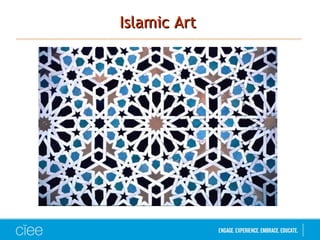
IIssllaammiicc AArrtt
IIssllaamm 
• Means “submission”; it comes from the word for 
peace (the peace Muslims receive in submitting to God). 
• Muhammad, the prophet. 
• 622 ad, the Hejira
QQuurr’’aann 
• The Qur’an, the essential basis of Islamic belief. It means “recitation.” 
• Not a narrative account of the Prophet’s life. 
• It is God’s own words as they were spoken by the angel Gabriel 
• Arabic: the common language in all Islamic lands 
• Art of calligraphy 
• Also the hadith, accounts of the Prophet’s deeds and sayings, as recorded by his followers.
TThhee FFiivvee PPiillllaarrss ooff IIssllaamm 
• Profession of faith, the shahada 
• Daily prayers, the salah 
• Alms for the poor collected in the form of a religious tax, the zakat 
• Fast during the month of Ramadan 
• Pilgrimage to Mecca, the hajj
IIssllaamm
IIssllaamm
TThhee MMoossqquuee ooff CCóórrddoobbaa
TThhee MMoossqquuee ooff CCóórrddoobbaa 
TThhee ccoonnssttrruuccttiioonn ssttaarrtteedd iinn tthhee 778866 oonn tthhee rruuiinnss ooff tthhee 
vviissiiggootthh bbaassiilliiccaa ooff San Vicente MMaarrttyyrr..
TThhee mmoossqquuee wwaass eexxppaannddeedd 
ffoouurr ttiimmeess iinn ddiiffffeerreenntt aaggeess 
• AAbbdd--aall--RRaahhmmaann II 778866 ((ppiinnkk)) 
• AAbbdd--aall--RRaahhmmaann IIII ((ggrreeeenn)) 
• AAbbdd--aall--RRaahhmmaann IIIIII bbuuiilltt tthhee 
mmiinnaarreett ((nnuummbbeerr 22)).. 
• AAll--HHaakkeenn IIII ((bblluuee)) 
• AAll--MMaannssuurr iinn 998888 ((bbrroowwnn)).. 
• IItt hhaass 2233,,440000 ssqquuaarree mmeetteerrss
PPaarrttss ooff tthhee MMoossqquuee 
1. The Orange Trees Courtyard was originally used for ritual washings. It 
is now surrounded by a gallery from the 16th century. 
2. The minaret (now covered by the christian tower) was used for calling 
the prayers. 
3. The oratory oorr pprraayyeerr rroooomm wwiitthh 11330000 ccoolluummnnss aanndd 336655 bbiiccoolloouurr aarrcchheess.. 
Courtyard 
Tower 
Cathedral 
Oratory
Butresses on the outside
TThhee MMiinnaarreett 
TThhee rreemmaaiinnss ooff tthhee oolldd ssqquuaarree--sshhaappeedd mmiinnaarreett,, mmaaddee bbyy 
AAbbddeerrrraammáánn IIIIII,, aarree nnooww iinnssiiddee tthhee cchhrriissttiiaann bbeellffrryy ooff tthhee 
ccaatthheeddrraall..
The Orange Tree Courtyard 
One of the most important 
parts of the Mosque is The 
Orange Tree Courtyard, 
It was used as a place for 
public activities.
The Oratory 
The oratory is made up of 19 naves with 856 columns
The Oratory
TThhee QQiibbllaahh 
TThhee QQiibbllaahh iiss tthhee wwaallll wwhheerree tthhee iimmaamm aanndd tthhee 
wwoorrsshhiippppeerrss mmuusstt bbee oorriieennttaatteedd ttoo wwhheenn tthheeyy pprraayy..
TThhee MMiihhrraabb 
TThhee MMiihhrraabb iiss aa ssmmaallll rroooomm 
iinn tthhee QQiibbllaahh wwhheerree tthhee 
Qur’an iiss kkeepptt..
Maqsurah 
An enclosure, or wooden screen near the Mihrab or the center of the qibla 
wall, where the Caliph or the Imam made their prayers
Scalloped Arch
The roof
The roof
Mosaics
The Cathedral 
After the conquest of Cordoba 
by the christians, they used the 
mosque to celebrate their cult, 
but in the 16th century the 
christians built a cathedral in 
the middle of the old mosque.
THE ALHAMBRA
More than a Palace 
• Built in one of Granada’s hills 
• Means “the red one” 
• It was more than a palace: a fortress complex, an administration 
center for the Muslim rulers of Granada.
The floor plan 
• Alhambra did not have a master plan so its overall layout is 
not organized. 
• Many construction phases: from the 9th-century citadel, through 
the 14th-century Muslim palaces, to the 16th-century palace of 
Charles V
The floor plan
Architecture 
• The exterior is not important. 
• Walls are “naked” on the outside. 
Just some small windows and 
"ajimeces“, wooden lattice to see 
and not to be seen.
The palace is built around 
several rectangular patios
Nature is part of the architecture. 
Water has a triple purpose: 
• Usefullness 
• Religious 
• Esthetic (not only visual)
Architecture: importance of the military purpose
Materials 
• In practical areas such as military parts or bathrooms: 
• Ashlar, big bricks on pilars, arches and vaults and mortar-concrete
Interiors are decorated with: 
•Marble (floors) 
•Tiles (plinth, base) 
•Plaster (walls & ceilings) 
•Wood (ceilings)
• La columna nazarí arranca de un plinto cuadrado de escasa 
altura, sobre el que generalmente va una basa. El fuste es 
cilíndrico y muy esbelto y va adornado con varios anillos en la 
parte superior. El capitel presenta dos variantes: 
• con dos partes diferenciadas: la inferior cilíndrica y decorada 
con hojas lisas y la superior, un paralelepípedo de base 
cuadrada, decorado con hojas en relieve. Sobre el capitel un 
ábaco. 
• capitel de mocárabes
La decoración en yeso puede ser tallada in situ (cuando aún 
estaba fresco), o mediante el procedimiento del vaciado con 
empleo de moldes. 
Esta decoración se hace cada vez más menuda, compacta y 
densa, cubriendo totalmente la superficie a decorar con 
motivos florales (el ataurique), epigráficos y geométricos, en 
especial la sebqa.
• Respecto de las inscripciones epigráficas juegan el 
papel que la iconografía, a través de las imágenes 
figuradas, desempeña en otras tradiciones 
arquitectónicas. Además de su función ornamental y 
decorativa, manifiestan propósitos constructivos y 
nos informan sobre el significado de la arquitectura. 
Hay tres clases de inscripciones en los edificios 
granadinos: 
• de carácter informativo (fecha, sultán que ordena la 
construcción,...) 
• fórmulas coránicas 
• textos (crónicas o poemas) elegidos para enfatizar el 
significado y función arquitectónicas.
Alcazaba 
1. Los Adarves 
2. La Torre de la Pólvora 
3. La Torre de la Vela 
4. La Torre del Adarguero 
5. La Torre Quebrada 
6. La Torre del Homenaje 
7. La Puerta de las Armas 
8. Acceso a la Medina 
9. Caballerizas 
10. El Tambor de Artillería
Alcazaba. 
(Plaza de Armas)
El Generalife 
1 y 2.- Patios 
3.- Patio de la Acequia 
4.- Mirador 
5.- Sala Regia 
6.- Torre de Ismail 
7.- Patio de la Sultana 
9.- Escalera del Agua 
10.- Mirador
Water and 
vegetation
El Generalife. 
Patio de los cipreses
Palacio de Comares. 
1.- Oratorio 
2.- Mexuar 
3.- Patio del Cuarto Dorado 
4.- Cuarto Dorado 
5.- Patio de los Arrayanes 
6.- Sala de la Barca 
7.- Sala de los Embajadores 
(Torre de Comares) 
8.- Baños 
9.- Sala de las Camas 
10.- Tepidarium 
11.- Caldarium
Palacio de Comares. Patio de Arrayanes y Torre de 
Comares
Palacio de Comares. 
Patio del Cuarto 
Dorado
Palacio de Leones. 
1.- Patio de los Leones 
2.- Sala de los Mocárabes 
3.- Sala de Abencerrajes 
4.- Sala de los Reyes 
5.- Sala de las Dos Hermanas 
6.- Mirador de Daxara
Patio de los Leones
Patio de los Leones. 
Arcos pantalla
Patio de los Leones
Sala de los Abencerrajes
Sala de los 
Abencerrajes (det.)
Hall of the Two Sisters
• The carved stucco of the ceiling in the Hall of the Two Sisters is 
unparalleled in beauty and geometrical complexity.
Islamic Art
Islamic Art
Islamic Art
Islamic Art
Islamic Art
Islamic Art
Islamic Art
Islamic Art
Islamic Art

Islamic Art

  • 1.
  • 2.
    IIssllaamm • Means“submission”; it comes from the word for peace (the peace Muslims receive in submitting to God). • Muhammad, the prophet. • 622 ad, the Hejira
  • 3.
    QQuurr’’aann • TheQur’an, the essential basis of Islamic belief. It means “recitation.” • Not a narrative account of the Prophet’s life. • It is God’s own words as they were spoken by the angel Gabriel • Arabic: the common language in all Islamic lands • Art of calligraphy • Also the hadith, accounts of the Prophet’s deeds and sayings, as recorded by his followers.
  • 4.
    TThhee FFiivvee PPiillllaarrssooff IIssllaamm • Profession of faith, the shahada • Daily prayers, the salah • Alms for the poor collected in the form of a religious tax, the zakat • Fast during the month of Ramadan • Pilgrimage to Mecca, the hajj
  • 5.
  • 6.
  • 7.
    TThhee MMoossqquuee ooffCCóórrddoobbaa
  • 8.
    TThhee MMoossqquuee ooffCCóórrddoobbaa TThhee ccoonnssttrruuccttiioonn ssttaarrtteedd iinn tthhee 778866 oonn tthhee rruuiinnss ooff tthhee vviissiiggootthh bbaassiilliiccaa ooff San Vicente MMaarrttyyrr..
  • 9.
    TThhee mmoossqquuee wwaasseexxppaannddeedd ffoouurr ttiimmeess iinn ddiiffffeerreenntt aaggeess • AAbbdd--aall--RRaahhmmaann II 778866 ((ppiinnkk)) • AAbbdd--aall--RRaahhmmaann IIII ((ggrreeeenn)) • AAbbdd--aall--RRaahhmmaann IIIIII bbuuiilltt tthhee mmiinnaarreett ((nnuummbbeerr 22)).. • AAll--HHaakkeenn IIII ((bblluuee)) • AAll--MMaannssuurr iinn 998888 ((bbrroowwnn)).. • IItt hhaass 2233,,440000 ssqquuaarree mmeetteerrss
  • 10.
    PPaarrttss ooff tthheeMMoossqquuee 1. The Orange Trees Courtyard was originally used for ritual washings. It is now surrounded by a gallery from the 16th century. 2. The minaret (now covered by the christian tower) was used for calling the prayers. 3. The oratory oorr pprraayyeerr rroooomm wwiitthh 11330000 ccoolluummnnss aanndd 336655 bbiiccoolloouurr aarrcchheess.. Courtyard Tower Cathedral Oratory
  • 12.
  • 14.
    TThhee MMiinnaarreett TThheerreemmaaiinnss ooff tthhee oolldd ssqquuaarree--sshhaappeedd mmiinnaarreett,, mmaaddee bbyy AAbbddeerrrraammáánn IIIIII,, aarree nnooww iinnssiiddee tthhee cchhrriissttiiaann bbeellffrryy ooff tthhee ccaatthheeddrraall..
  • 15.
    The Orange TreeCourtyard One of the most important parts of the Mosque is The Orange Tree Courtyard, It was used as a place for public activities.
  • 16.
    The Oratory Theoratory is made up of 19 naves with 856 columns
  • 17.
  • 18.
    TThhee QQiibbllaahh TThheeQQiibbllaahh iiss tthhee wwaallll wwhheerree tthhee iimmaamm aanndd tthhee wwoorrsshhiippppeerrss mmuusstt bbee oorriieennttaatteedd ttoo wwhheenn tthheeyy pprraayy..
  • 19.
    TThhee MMiihhrraabb TThheeMMiihhrraabb iiss aa ssmmaallll rroooomm iinn tthhee QQiibbllaahh wwhheerree tthhee Qur’an iiss kkeepptt..
  • 20.
    Maqsurah An enclosure,or wooden screen near the Mihrab or the center of the qibla wall, where the Caliph or the Imam made their prayers
  • 21.
  • 26.
  • 27.
  • 28.
  • 29.
    The Cathedral Afterthe conquest of Cordoba by the christians, they used the mosque to celebrate their cult, but in the 16th century the christians built a cathedral in the middle of the old mosque.
  • 30.
  • 31.
    More than aPalace • Built in one of Granada’s hills • Means “the red one” • It was more than a palace: a fortress complex, an administration center for the Muslim rulers of Granada.
  • 32.
    The floor plan • Alhambra did not have a master plan so its overall layout is not organized. • Many construction phases: from the 9th-century citadel, through the 14th-century Muslim palaces, to the 16th-century palace of Charles V
  • 33.
  • 34.
    Architecture • Theexterior is not important. • Walls are “naked” on the outside. Just some small windows and "ajimeces“, wooden lattice to see and not to be seen.
  • 35.
    The palace isbuilt around several rectangular patios
  • 37.
    Nature is partof the architecture. Water has a triple purpose: • Usefullness • Religious • Esthetic (not only visual)
  • 38.
    Architecture: importance ofthe military purpose
  • 39.
    Materials • Inpractical areas such as military parts or bathrooms: • Ashlar, big bricks on pilars, arches and vaults and mortar-concrete
  • 40.
    Interiors are decoratedwith: •Marble (floors) •Tiles (plinth, base) •Plaster (walls & ceilings) •Wood (ceilings)
  • 41.
    • La columnanazarí arranca de un plinto cuadrado de escasa altura, sobre el que generalmente va una basa. El fuste es cilíndrico y muy esbelto y va adornado con varios anillos en la parte superior. El capitel presenta dos variantes: • con dos partes diferenciadas: la inferior cilíndrica y decorada con hojas lisas y la superior, un paralelepípedo de base cuadrada, decorado con hojas en relieve. Sobre el capitel un ábaco. • capitel de mocárabes
  • 42.
    La decoración enyeso puede ser tallada in situ (cuando aún estaba fresco), o mediante el procedimiento del vaciado con empleo de moldes. Esta decoración se hace cada vez más menuda, compacta y densa, cubriendo totalmente la superficie a decorar con motivos florales (el ataurique), epigráficos y geométricos, en especial la sebqa.
  • 48.
    • Respecto delas inscripciones epigráficas juegan el papel que la iconografía, a través de las imágenes figuradas, desempeña en otras tradiciones arquitectónicas. Además de su función ornamental y decorativa, manifiestan propósitos constructivos y nos informan sobre el significado de la arquitectura. Hay tres clases de inscripciones en los edificios granadinos: • de carácter informativo (fecha, sultán que ordena la construcción,...) • fórmulas coránicas • textos (crónicas o poemas) elegidos para enfatizar el significado y función arquitectónicas.
  • 49.
    Alcazaba 1. LosAdarves 2. La Torre de la Pólvora 3. La Torre de la Vela 4. La Torre del Adarguero 5. La Torre Quebrada 6. La Torre del Homenaje 7. La Puerta de las Armas 8. Acceso a la Medina 9. Caballerizas 10. El Tambor de Artillería
  • 50.
  • 51.
    El Generalife 1y 2.- Patios 3.- Patio de la Acequia 4.- Mirador 5.- Sala Regia 6.- Torre de Ismail 7.- Patio de la Sultana 9.- Escalera del Agua 10.- Mirador
  • 52.
  • 53.
    El Generalife. Patiode los cipreses
  • 55.
    Palacio de Comares. 1.- Oratorio 2.- Mexuar 3.- Patio del Cuarto Dorado 4.- Cuarto Dorado 5.- Patio de los Arrayanes 6.- Sala de la Barca 7.- Sala de los Embajadores (Torre de Comares) 8.- Baños 9.- Sala de las Camas 10.- Tepidarium 11.- Caldarium
  • 56.
    Palacio de Comares.Patio de Arrayanes y Torre de Comares
  • 57.
    Palacio de Comares. Patio del Cuarto Dorado
  • 59.
    Palacio de Leones. 1.- Patio de los Leones 2.- Sala de los Mocárabes 3.- Sala de Abencerrajes 4.- Sala de los Reyes 5.- Sala de las Dos Hermanas 6.- Mirador de Daxara
  • 60.
  • 61.
    Patio de losLeones. Arcos pantalla
  • 62.
  • 63.
    Sala de losAbencerrajes
  • 64.
    Sala de los Abencerrajes (det.)
  • 65.
    Hall of theTwo Sisters
  • 73.
    • The carvedstucco of the ceiling in the Hall of the Two Sisters is unparalleled in beauty and geometrical complexity.