Seminario  Aprendizaje activo: experiencias y oportunidades en la FCFM Beauchef, 8 de Enero de 2009
Programa
Antecedentes para continuar la reformar curricular en programas de ingeniería Preparado por: Rodrigo Pascual J.
Resumen Antecedentes  Proyecto MECESUP2 Objetivos Perfil Cierre
“ Menor productividad impactó en cuatro décimas el crecimiento de Chile en 2007”  “ El indicador que mide la eficiencia laboral y la inversión mostró un retroceso de 0,3% el año pasado. De haberse mantenido estable, el PIB se hubiese expandido en 5,5 y no en el final 5,1%...   En 2007 se estima que la productividad disminuyó en 0,3%, y en 2006 el retroceso fue de 0,7%. En el trienio la caída llegaría al 1,5%. … " la trayectoria declinante que exhibe la productividad es alarmante ". … …   para mejorar el empleo es necesario que el mayor gasto fiscal en educación se traduzca en una mejor educación real, para perfeccionar el capital humano. En cuanto a la calidad de la inversión, plantea que ésta debería aumentar en  investigación y desarrollo ,  y no sólo en ciencias básicas bajo el alero de las universidades.  … los elementos que explican este menor crecimiento de la productividad son un deterioro del ambiente regulatorio,  una reducción de la innovación,  rigideces en las normas laborales, y las regulaciones en algunos sectores básicamente ligados a la industria y ciertos servicios.” Fuente: Economía y Negocios, 21 de Abril de 2008
Ejemplo Prog. Ing. Mecánica Semestre Fuente:  http://escuela.ing.uchile.cl/docencia/mallas/mecanica , accesado dic’08 pocos  bloques tipo proyecto interdisciplinario Proy. Ing. Mec. minor Introd. a la ing.  y taller de proyectos
Minors propuestos completos Ingeniería de Materiales Geología Ingeniería Mecánica Metalurgia Extractiva Ciencias de la Computación Desarrollo de Software Desarrollo de Software aplicado Desarrollo de Software orientado a aplicaciones científicas y de ingeniería Meteorología y Clima Física de Medios Continuos Física Quántica Control de Sistemas Circuitos Analógicos y Digitales Sistemas de Comunicaciones Sistemas Eléctricos Astronomía Algoritmos y Optimización Combinatorial Computación Científica  * CC,FI,CC,EL Minería * GL,ME,MI Energías Renovables * EL,GF,GL,ME Fuente:  http://escuela.ing.uchile.cl/docencia/minor , accesado dic’08 *:interdisciplinario
Énfasis tradicional ...Education of mechanical engineers traditionally focuses on  deterministic  approaches, which hampers effective use of  reliability concepts... Fuente: Dekker, R., Applications of maintenance optimization models: a review and analysis, Reliability Engineering & System Safety, 51, 229-40, 1996. Concep. Diseño Implementación Operación y mantenimiento tiempo Esfuerzo
Cross-disciplinary AL “ there is a trend of evolving from a systematic approach with major emphasis on the  analytical tools  used in the design process, to a  holistic approach  in which the main emphasis is to create a  multidiscipline solution to a design problem .”* Mech Eng, Ind. design Mat. Eng, Manuf. Eng. *:  Sullivan, W. G., Lee, P., Luxhoj, J. T., & Thannirpalli, R. V.,  A survey of engineering design literature: Methodology, education, economics,  and management aspects. Engineering Economist, 40(1), 7-40, 1994. +: P.R. Backer,  S. Bates, Introduction to Product Design and Innovation: A Cross-Disciplinary MiniCurriculum, Proceedings of the 2005 ASEE Annual Conference & Exposition http://www.engr.sjsu.edu/minicurric
Innovación “ the creation, dissemination, and utilization of knowledge moves from the periphery to the center of industrial production and governance, the concept of innovation, in product and process, is itself being transformed” H. Etzkowitz, The Triple Helix: University–Industry–Government Innovation in Action, Routledge, 2008.
Rol de la Universidad “ In developing countries, universities must learn from their own past and  analyse their countries’ difficulties, engaging in research aimed at finding solutions  to the most acute among them. It is also incumbent on them to propose a renewed vision of development that will enable their countries to build a genuinely better future” Una Universidad cuyo norte sea Chile y las necesidades de su pueblo"  Andrés Bello  Fuente: Delors, J. et al., Learning: The Treasure Within, Report to UNESCO of the International Commission on Education  for the Twenty-first Century, UNESCO, 1996.
Balance “ Current faculty of engineering are, by and large,  engineering researchers . They tend to think disciplines in  isolation , explain them in terms of theoretical underpinnings, and focus on the evolution of the discipline” Fundamental shift (in EE) requires a  cultural change… Teoría Práctica tiempo bajo alto Fracción de investigadores sistémico especializado Alcance contenidos grupal individual Acercamiento al problema 60’s Apd: Crawley et al., Rethinking engineering education, Springer, 2007.
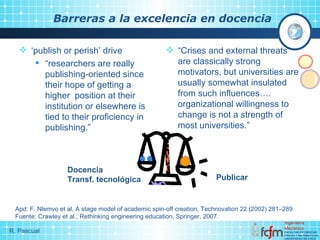
Barreras a la excelencia en docencia ‘ publish or perish’ drive “ researchers are really publishing-oriented since their hope of getting a higher  position at their institution or elsewhere is tied to their proficiency in publishing.” “ Crises and external threats are classically strong motivators, but universities are usually somewhat insulated from such influences….  organizational willingness to change is not a strength of most universities. ” Apd: F. Nlemvo et al, A stage model of academic spin-off creation, Technovation 22 (2002) 281–289 Fuente: Crawley et al., Rethinking engineering education, Springer, 2007. Publicar Docencia Transf. tecnológica
USA 90’s Estatal Industrial ~90’s ~00’s “ design and  manufacturing   had not received the academic resources  or the intellectual prestige of the engineering sciences, and hence the U.S. had fallen behind such rivals as Germany and Japan in actually producing consumer goods” Fuente: Dertouzos, M. L., Lester, R. K., and Solow, R. M.,  Made in America–Regaining the Productive Edge , Cambridge, Massachusetts: MIT Press, 1989
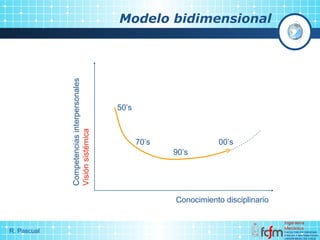
Modelo bidimensional Conocimiento disciplinario Competencias interpersonales Visión sistémica 50’s 70’s 90’s 00’s
Constructivismo P.C. Wankat, F.S. Oreovicz, Teaching engineering, McGraw-Hill, New York., 1993. G.M. Bodner, Constructivism: A theory of knowledge, Journal of Chemical Education, 63, 873, 1986. The individual builds his learning from what he previously knows, and  only he can do the writing in his mind”
Comunidades de práctica “ A community of practice is an  intrinsic condition for the existence of knowledge …  the social structure …, its power relations, and its conditions for legitimacy  define possibilities for learning ”* Fuente: * J. Lave, E. Wenger, Situated Learning, Legitimate Peripheral Participation, Cambridge University Press, 1991. **: R. Pascual, Enhancing project-oriented learning by joining communities of practice and opening spaces for relatedness, (under review). “… collaborative approach  has also been criticized because it takes  excessive time to implement  and because students are not prepared to work effectively in groups…”**
motivation sources for teaching innovation required skills in the professional market have changed,  the amount and complexity of knowledge grows continually,  new pedagogical methods appear in time, current students react and get motivated differently. “ students trained using conventional methods are not well prepared to deal with problems which require them to apply their knowledge to new domains. This affects their capacity to function effectively in current society” Fuente: P. Andersson and T. Roxa, The pedagogical academy: a way to encourage and reward scholarly teaching, Eur J Engng Educ, 29(4), 559-569 (2004). Fuente:  R. Reich, Redefining Good Education: Preparing  students for tomorrow. In S.B. Bacharach (Ed.) Education Reform: Making sense of it all. Boston: Allyn and Bacon (1990).
“…  the lecture method (is) a process whereby the lecture notes of the instructor get transferred to the notebooks of the students without passing through the brains of either” Fuente: E. Mazur, Farewell, Lecture?, Science 323, 50, 2009.
Taxonomia de Bloom Evaluación Síntesis Análisis Aplicación Comprensión Conocimiento Apd:  B.S. Bloom (Ed.), Taxonomy of educational objectives: The classification of educational goals: Handbook I, cognitive domain. New York ; Toronto: Longmans, Green, 1956. *: R. Pascual,  Enhancing project-oriented learning by joining communities of practice and opening spaces for relatedness, (under review). “… new engineers are called to face new  and complex systems and technologies so they must attain the  evaluation  level”*
Ciclo de aprendizaje de Kolb Apd: D.A. Kolb, Experiential Learning, Prentice-Hall, 1984. Abstract conceptualization Active experimentation Concrete experience Reflective observation Time Depth be able lo involve themselves fully, openly, and without bias  in new experiences be  able to reflect on and observe  their experiences  from many perspectives be able to create concepts that  integrate their  observations into logically sound theories be able to use these theories  to  make decisions and solve problems Actor  Observer Specific  involvement Analytical detachment
Pirámide de Bales Fuente: E. Bales, Corporate universities versus traditional universities: friends or foes, Key Note Address, Conference on Innovative Practices in Business Education, Orlando, 4-7 December, 1996. Lecture Reading Audio - visual Demonstration Discussion group Practice exercise Teaching others
Competencias de salida Ing. Mecánica Conceive and assess ME projects using technological and economic criteria Manage the operation and maintenance of an industrial system with a holistic view Assess system efficacy/efficiency using experimental techniques Model systems and processes applying scientific and technological knowledge Solve engineering problems using optimization techniques Use ME computational tools proficiently Work and communicate proficiently in multi/intra-disciplinary teams including non-ME experts Analyze and assess information from diverse sources and disciplines Learn and update own’s knowledge proactively to adapt to continuing technological change Proficient Oral and Written Communication (OWC ) Apd: Tuning project, Tuning Educational Structures in Europe, http://tuning.unideusto.org/tuningeu/, accessed july 2007. Various, Report to the National Acreditation Board, Mechanical Engineering Department, Universidad de Chile, 2005. Tb:  http://www.abet.org , CDIO syllabus
Curriculum tradicional Ciencias básicas Conocimiento disciplinario Apd: Crawley et al., Rethinking engineering education, Springer, 2007. Proyecto disciplinario
Curriculum integrado Ciencias básicas Conocimiento interdisciplinario Proyectos Inter-discip. Cursos Introductorios de proyecto
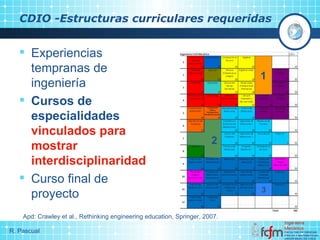
CDIO -Estructuras curriculares requeridas Experiencias tempranas de ingeniería Cursos de especialidades  vinculados para mostrar interdisciplinaridad Curso final de proyecto Apd: Crawley et al., Rethinking engineering education, Springer, 2007. 1 2 3
Incentivos “ In any organization, you get the behavior that is rewarded” “ the leader…must create both the perception and reality of incentives and recognition that reward …educational reform…. (He) must be supported by those at higher levels in the university in this effort to reward sustainable change” Means teaching awards Special status chairs for teaching pedagogical academy* Increased salary, increased department funding “ It is vital that the formal review process recognize and reward educational contributions. …in annual review cycles, submissions of educational contributions should be reviewed. More importantly, in hiring, promotion, and tenure decisions,  weight should be placed on these efforts . In particular, scholarly publications in education should be valued  as highly as those in other scholarly research publications ” “ (Ramsden and Martin) … emphasise the need for formal reward processes” + Apd: Crawley et al., Rethinking engineering education, Springer, 2007. *:  P. Andersson T. Roxa, The pedagogical academy: a way to encourage and reward scholarly teaching,  European Journal of Engineering Education 29(4), 2004, 559–569 +T. Olsson, T. Roxå, Evaluating rewards for excellent teaching – a cultural approach,  http://teal.uwc.ac.za/community/dataNetSpot/media/Olsson.pdf , 2008.
Otras iniciativas CDIO C onceiving —  D esigning —  I mplementing —  O perating real-world systems and products. “ CDIO Initiative is rich with student projects complemented by internships in industry. ” Otras  IDEA League http://www.idealeague.org Imperial College TU Delft Center for the Advancement of Engineering Education (CAEE) http://www.engr.washington.edu/caee Colorado School of Mines  Stanford University Center for the Integration of Research Teaching, and Learning (CIRTL) http://cirtl.wceruw.org University of Wisconsin Michigan State University National Center for Engineering and Technology Education (NCETE) http://www.ncete.org University of Georgia University of Illinois VaNTH Center for Bioengineering Educational Technologies http://www.vanth.org Northwestern University Harvard-MIT
Participantes CDIO Arizona State U.  California State U., Northridge  Chalmers University of Technology  Daniel Webster College  École Polytechnique de Montréal  Hogeschool Gent  Helsinki Metropolia U. of Applied Sciences  Hochschule Wismar  Instituto Superior de Engenharia do Porto Jönköping U.  Lancaster University  Linköping U.  Massachusetts Institute of Technology Metropolia University, Helsinki Politecnico di Milano Queen's University, Belfast Queen's University, Ontario  Queensland University of Technology  Royal Institute of Technology  Shantou U.  Singapore Polytechnic Technical U. of Denmark  Tsinghua University  Turku University of Applied Sciences  U.S. Naval Academy  Umeå U.  U. of Auckland U. of Bristol U. of Calgary  U. of Colorado, Boulder  U. Leeds U. Liverpool  U. Pretoria U. Sydney  Fuente:  http://www.cdio.org/ , accesado dic’08
CDIO Resource Point Allocation Survey Fuente:  http://www.cdio.org/about_cdio/about_3_create.html , accesado dic’08 Edward F. Crawley, The CDIO Syllabus: A Statement of Goals for Undergraduate Engineering Education, MIT, 2001.
Espacios CDIO Atributos esenciales Empujan a involucrarse en actividades CDIO Facilitan el aprendizaje y desarrollo de habilidades interpersonales Facilitan actividades grupales y comunicación para aprendizaje socializado Deseables Organizado y manejado por alumnos (espacios flexibles) Acceso fuera de horas normales Acceso a herramientas modernas Apd: Crawley et al., Rethinking engineering education, Springer, 2007.
Equipo envuelto Rodrigo Pascual (Acad, DIMEC) Rodrigo Palma B. (Acad, DIE) Javier Ruiz del Solar (Acad, DIE) Jeremy Barbay (Acad, DCC) Solsire Giaverini (DII) Ximena Vargas (Acad, DIC) Patricio Poblete (Director, Escuela) Sergio Celis (Coordinador de Desarrollo Docente, Escuela)  Héctor Agusto (Coordinador de Introducción a la Ingeniería, Escuela)
Proyecto MECESUP2 Implementación de aprendizaje basado en proyectos tecnológicos y multidisciplinarios en carreras de ingeniería civil LÍNEA ESTRATÉGICA : EJE IV: Modernización Curricular basada en Resultados de Aprendizaje y Competencias Tema  1.   Renovación Curricular del Pregrado
Objetivo General (inicial) Implementar una  estructura curricular  centrada en el aprendizaje basado en proyectos en los niveles de licenciatura y especialidad de ingeniería, con énfasis en  trabajo en equipos multidisciplinarios  y en  el  desarrollo de competencias profesionales  de alto nivel necesarias para el desarrollo de la ingeniería nacional.      
Objetivo General (versión 2) Implementar una  estructura integrada de cursos  que considere espacios físicos para  centrar el aprendizaje en proyectos tecnológicos en 3er y 4to año de los programas, con énfasis en  trabajo colaborativo en equipos multidisciplinarios  y en  el  desarrollo de competencias profesionales  de alto nivel necesarias para el desarrollo de la ingeniería nacional.      
Objetivos Específicos 1.     Apoyar la implementación de la reforma curricular dándole continuidad a la enseñanza activa y centrada en el estudiante  a  continuación del ciclo común  de las ingenierías.    2.    Establecer instancias de  colaboración docente  entre académicos de las carreras de ingeniería que permitan  desarrollar las competencias de trabajo en equipos multidisciplinarios ,  pensamiento sistémico  en el ámbito de la ingeniería, aprendizaje a lo largo de toda la vida y capacidades de invención, innovación y emprendimiento con miras a solucionar demandas de la sociedad.    3.    Implementar  espacios de trabajo colaborativo  que faciliten la creación de sinergias y el aprendizaje basado en proyectos tecnológicos de alto nivel, haciendo hincapié en el diseño y la implementación de los proyectos.    4.    Establecer  redes de colaboración  nacionales e internacionales de educación en ingeniería, y fomentar la innovación permanente en los procesos de enseñanza y aprendizaje. Adicionalmente se buscará fomentar la movilidad estudiantil a nivel nacional e internacional con instituciones con enfoques de aprendizaje basado en proyectos.        
Términos de referencia MECESUP 2 Implementación de Rediseños Curriculares Mejoramiento de la Docencia y el Aprendizaje
Recomendaciones del consejo universitario Solicitado: 225 (millones pesos)  Aprobado:180 (6% de 3060) “ El perfil plantea un proyecto  muy ambicioso.  Es necesario focalizar el tema y precisar el momento del currículo en que se desarrolla la iniciativa. Hay que  reorientarlo como una experiencia piloto  para organizar el trabajo docente en disciplinas diversas. Especificar el desglose de los recursos. Recomendación: Presentar”
Estructuras curriculares Curriculum Estrictamente disciplinario Curriculum basado en proyectos Curriculum integrado Baja énfasis En conocimiento disciplinario Requiere reformas organizacionales importantes Pocos vínculos entre tópicos Poca integración de competencias Disciplinas, tiempo Proyectos & competencias Tópico 1 Tópico n *:  F. Kjaersdam and S. Enemark, The Aalborg Experiment: Projecting Innovation in University Education, http://auaw2.aua.auc.dk/faktekn/aalborg/engelsk/index.html Proyecto 1 Proyecto n
Curriculum integrado Tiempo Contenidos Proyectos Integración en serie Integración en paralelo Integración profunda Esfuerzos de coordinación Semestre 1 Semestre 2
Bloques de cursos Tiempo Tópico 1 Tópico 2 Simultáneo Bus Bloque Serie Paralelo **Ejemplo:  L. Siu-Bik King, J. El-Sayed, Structure for Integration of  Manufacturing and Mechanical Design Engineering Courses, Proceedings of the ASEE Annual Conference, 2003 Tópico 1 Tópico 2 Tópico 1 Tópico 2 Bus Tópico 2 Tópico 1 Tópico 1 Tópico 2
Coordinación entre cursos método de la caja negra Mi curso Conocimiento & Competencias previas Entradas Salidas Entrada a otro curso Entrada a otro curso Competencia “final”
Emprendimiento & vinculación con medio profesional “ The (project) resulted in the creation of a software prototype that was subsequently developed into a successful product launch within a matter of months” “ The developer continued co-operation with the University through an additional undergraduate design project and also through the Masters programme” Fuente:  I.S. Gibson, C. O’Reilly, M. Hughes, Integration of ICT within a project-based learning environment, Eur J Engng Educ 27(1), 21-30 (2002).
Ejemplo: programa de 5 años Introducción a la ingeniería Curso de especialidad Cursos vinculados a través de proyectos  conjuntos Curso de especialidad Proyecto de rediseño Curso de  proyecto en ing .  comp . Curso de  proyecto en ing .  mec . Curso de  proyecto en ing .  indust . Tesis Año  1 Año  2 Año  3 Año  4 Año  5 Apd: Crawley et al., Rethinking engineering education, Springer, 2007. Minor  1 Minor  2 Minor  3 Minor  4
Desafíos al diseñar POL Aprendizaje Producto motivante Tamaño Complejidad del proyecto Trabajo en equipo Demasiado difícil Demasiado fácil
Recursos escasos Reasignar recursos existentes Focalizar nuevo recursos Conceptualizar Diseñar Implementar Operar Mantener Retirar
Ambientes promotores para la creatividad y la innovación Libertad en decidir que/como hacer Suficientes recursos y estímulos Atmósfera de cooperación y colaboración Amplio reconocimiento Tiempo suficiente para el pensamiento creativo Sentido de desafío Presión interna para lograr las metas  Fuente:  T. Amabile,  Creativity in Context, Westview Press, 1996   Importancia
Otros desafíos Rol del profesor Catedrático a facilitador Coordinación con otros profesores Alcance de los tópicos Proyecto monodisciplinario a multidisciplinario Contratar asistentes especialistas Consejeros técnicos desde la industria Costos para el profesor y departamento Costos horarios suben [1x-2.5x]*  Para la Unidad Proyectos educacionales 6:1 beneficio-costo *: Malmqvist, J., Young, P.W., Hallström, S., Svensson, T., “Lessons Learned From Design-Implement-Test-Based Project Courses”, International Design Conference—Design 2004, Dubrovnik, May 18—21, 2004.
Key success factors that promote cultural change Getting off to the right start Understanding the need for change Leadership from the top Creating a vision Support of  early adopters Early successes Building the momentum in the core activities of change Moving off assumptions Including students as agents of change Involvement and ownership Adequate resources Institutionalizing change Faculty recognition and incentives Faculty learning culture Student expectations and academic requirements Apd: Crawley et al., Rethinking engineering education, Springer, 2007.
Cierre Tendencia global Universidades de excelencia Paso 1/3 en ejecución Requisitos Motivación Incentivos Recursos 1 2 3

Mecesup2 Pascual Sem1

  • 1.
    Seminario Aprendizajeactivo: experiencias y oportunidades en la FCFM Beauchef, 8 de Enero de 2009
  • 2.
  • 3.
    Antecedentes para continuarla reformar curricular en programas de ingeniería Preparado por: Rodrigo Pascual J.
  • 4.
    Resumen Antecedentes Proyecto MECESUP2 Objetivos Perfil Cierre
  • 5.
    “ Menor productividadimpactó en cuatro décimas el crecimiento de Chile en 2007”  “ El indicador que mide la eficiencia laboral y la inversión mostró un retroceso de 0,3% el año pasado. De haberse mantenido estable, el PIB se hubiese expandido en 5,5 y no en el final 5,1%... En 2007 se estima que la productividad disminuyó en 0,3%, y en 2006 el retroceso fue de 0,7%. En el trienio la caída llegaría al 1,5%. … " la trayectoria declinante que exhibe la productividad es alarmante ". … … para mejorar el empleo es necesario que el mayor gasto fiscal en educación se traduzca en una mejor educación real, para perfeccionar el capital humano. En cuanto a la calidad de la inversión, plantea que ésta debería aumentar en investigación y desarrollo , y no sólo en ciencias básicas bajo el alero de las universidades. … los elementos que explican este menor crecimiento de la productividad son un deterioro del ambiente regulatorio, una reducción de la innovación, rigideces en las normas laborales, y las regulaciones en algunos sectores básicamente ligados a la industria y ciertos servicios.” Fuente: Economía y Negocios, 21 de Abril de 2008
  • 6.
    Ejemplo Prog. Ing.Mecánica Semestre Fuente: http://escuela.ing.uchile.cl/docencia/mallas/mecanica , accesado dic’08 pocos bloques tipo proyecto interdisciplinario Proy. Ing. Mec. minor Introd. a la ing. y taller de proyectos
  • 7.
    Minors propuestos completosIngeniería de Materiales Geología Ingeniería Mecánica Metalurgia Extractiva Ciencias de la Computación Desarrollo de Software Desarrollo de Software aplicado Desarrollo de Software orientado a aplicaciones científicas y de ingeniería Meteorología y Clima Física de Medios Continuos Física Quántica Control de Sistemas Circuitos Analógicos y Digitales Sistemas de Comunicaciones Sistemas Eléctricos Astronomía Algoritmos y Optimización Combinatorial Computación Científica * CC,FI,CC,EL Minería * GL,ME,MI Energías Renovables * EL,GF,GL,ME Fuente: http://escuela.ing.uchile.cl/docencia/minor , accesado dic’08 *:interdisciplinario
  • 8.
    Énfasis tradicional ...Educationof mechanical engineers traditionally focuses on deterministic approaches, which hampers effective use of reliability concepts... Fuente: Dekker, R., Applications of maintenance optimization models: a review and analysis, Reliability Engineering & System Safety, 51, 229-40, 1996. Concep. Diseño Implementación Operación y mantenimiento tiempo Esfuerzo
  • 9.
    Cross-disciplinary AL “there is a trend of evolving from a systematic approach with major emphasis on the analytical tools used in the design process, to a holistic approach in which the main emphasis is to create a multidiscipline solution to a design problem .”* Mech Eng, Ind. design Mat. Eng, Manuf. Eng. *: Sullivan, W. G., Lee, P., Luxhoj, J. T., & Thannirpalli, R. V., A survey of engineering design literature: Methodology, education, economics, and management aspects. Engineering Economist, 40(1), 7-40, 1994. +: P.R. Backer, S. Bates, Introduction to Product Design and Innovation: A Cross-Disciplinary MiniCurriculum, Proceedings of the 2005 ASEE Annual Conference & Exposition http://www.engr.sjsu.edu/minicurric
  • 10.
    Innovación “ thecreation, dissemination, and utilization of knowledge moves from the periphery to the center of industrial production and governance, the concept of innovation, in product and process, is itself being transformed” H. Etzkowitz, The Triple Helix: University–Industry–Government Innovation in Action, Routledge, 2008.
  • 11.
    Rol de laUniversidad “ In developing countries, universities must learn from their own past and analyse their countries’ difficulties, engaging in research aimed at finding solutions to the most acute among them. It is also incumbent on them to propose a renewed vision of development that will enable their countries to build a genuinely better future” Una Universidad cuyo norte sea Chile y las necesidades de su pueblo" Andrés Bello Fuente: Delors, J. et al., Learning: The Treasure Within, Report to UNESCO of the International Commission on Education for the Twenty-first Century, UNESCO, 1996.
  • 12.
    Balance “ Currentfaculty of engineering are, by and large, engineering researchers . They tend to think disciplines in isolation , explain them in terms of theoretical underpinnings, and focus on the evolution of the discipline” Fundamental shift (in EE) requires a cultural change… Teoría Práctica tiempo bajo alto Fracción de investigadores sistémico especializado Alcance contenidos grupal individual Acercamiento al problema 60’s Apd: Crawley et al., Rethinking engineering education, Springer, 2007.
  • 13.
    Barreras a laexcelencia en docencia ‘ publish or perish’ drive “ researchers are really publishing-oriented since their hope of getting a higher position at their institution or elsewhere is tied to their proficiency in publishing.” “ Crises and external threats are classically strong motivators, but universities are usually somewhat insulated from such influences…. organizational willingness to change is not a strength of most universities. ” Apd: F. Nlemvo et al, A stage model of academic spin-off creation, Technovation 22 (2002) 281–289 Fuente: Crawley et al., Rethinking engineering education, Springer, 2007. Publicar Docencia Transf. tecnológica
  • 14.
    USA 90’s EstatalIndustrial ~90’s ~00’s “ design and manufacturing had not received the academic resources or the intellectual prestige of the engineering sciences, and hence the U.S. had fallen behind such rivals as Germany and Japan in actually producing consumer goods” Fuente: Dertouzos, M. L., Lester, R. K., and Solow, R. M., Made in America–Regaining the Productive Edge , Cambridge, Massachusetts: MIT Press, 1989
  • 15.
    Modelo bidimensional Conocimientodisciplinario Competencias interpersonales Visión sistémica 50’s 70’s 90’s 00’s
  • 16.
    Constructivismo P.C. Wankat,F.S. Oreovicz, Teaching engineering, McGraw-Hill, New York., 1993. G.M. Bodner, Constructivism: A theory of knowledge, Journal of Chemical Education, 63, 873, 1986. The individual builds his learning from what he previously knows, and only he can do the writing in his mind”
  • 17.
    Comunidades de práctica“ A community of practice is an intrinsic condition for the existence of knowledge … the social structure …, its power relations, and its conditions for legitimacy define possibilities for learning ”* Fuente: * J. Lave, E. Wenger, Situated Learning, Legitimate Peripheral Participation, Cambridge University Press, 1991. **: R. Pascual, Enhancing project-oriented learning by joining communities of practice and opening spaces for relatedness, (under review). “… collaborative approach has also been criticized because it takes excessive time to implement and because students are not prepared to work effectively in groups…”**
  • 18.
    motivation sources forteaching innovation required skills in the professional market have changed, the amount and complexity of knowledge grows continually, new pedagogical methods appear in time, current students react and get motivated differently. “ students trained using conventional methods are not well prepared to deal with problems which require them to apply their knowledge to new domains. This affects their capacity to function effectively in current society” Fuente: P. Andersson and T. Roxa, The pedagogical academy: a way to encourage and reward scholarly teaching, Eur J Engng Educ, 29(4), 559-569 (2004). Fuente: R. Reich, Redefining Good Education: Preparing students for tomorrow. In S.B. Bacharach (Ed.) Education Reform: Making sense of it all. Boston: Allyn and Bacon (1990).
  • 19.
    “… thelecture method (is) a process whereby the lecture notes of the instructor get transferred to the notebooks of the students without passing through the brains of either” Fuente: E. Mazur, Farewell, Lecture?, Science 323, 50, 2009.
  • 20.
    Taxonomia de BloomEvaluación Síntesis Análisis Aplicación Comprensión Conocimiento Apd: B.S. Bloom (Ed.), Taxonomy of educational objectives: The classification of educational goals: Handbook I, cognitive domain. New York ; Toronto: Longmans, Green, 1956. *: R. Pascual, Enhancing project-oriented learning by joining communities of practice and opening spaces for relatedness, (under review). “… new engineers are called to face new and complex systems and technologies so they must attain the evaluation level”*
  • 21.
    Ciclo de aprendizajede Kolb Apd: D.A. Kolb, Experiential Learning, Prentice-Hall, 1984. Abstract conceptualization Active experimentation Concrete experience Reflective observation Time Depth be able lo involve themselves fully, openly, and without bias in new experiences be able to reflect on and observe their experiences from many perspectives be able to create concepts that integrate their observations into logically sound theories be able to use these theories to make decisions and solve problems Actor Observer Specific involvement Analytical detachment
  • 22.
    Pirámide de BalesFuente: E. Bales, Corporate universities versus traditional universities: friends or foes, Key Note Address, Conference on Innovative Practices in Business Education, Orlando, 4-7 December, 1996. Lecture Reading Audio - visual Demonstration Discussion group Practice exercise Teaching others
  • 23.
    Competencias de salidaIng. Mecánica Conceive and assess ME projects using technological and economic criteria Manage the operation and maintenance of an industrial system with a holistic view Assess system efficacy/efficiency using experimental techniques Model systems and processes applying scientific and technological knowledge Solve engineering problems using optimization techniques Use ME computational tools proficiently Work and communicate proficiently in multi/intra-disciplinary teams including non-ME experts Analyze and assess information from diverse sources and disciplines Learn and update own’s knowledge proactively to adapt to continuing technological change Proficient Oral and Written Communication (OWC ) Apd: Tuning project, Tuning Educational Structures in Europe, http://tuning.unideusto.org/tuningeu/, accessed july 2007. Various, Report to the National Acreditation Board, Mechanical Engineering Department, Universidad de Chile, 2005. Tb: http://www.abet.org , CDIO syllabus
  • 24.
    Curriculum tradicional Cienciasbásicas Conocimiento disciplinario Apd: Crawley et al., Rethinking engineering education, Springer, 2007. Proyecto disciplinario
  • 25.
    Curriculum integrado Cienciasbásicas Conocimiento interdisciplinario Proyectos Inter-discip. Cursos Introductorios de proyecto
  • 26.
    CDIO -Estructuras curricularesrequeridas Experiencias tempranas de ingeniería Cursos de especialidades vinculados para mostrar interdisciplinaridad Curso final de proyecto Apd: Crawley et al., Rethinking engineering education, Springer, 2007. 1 2 3
  • 27.
    Incentivos “ Inany organization, you get the behavior that is rewarded” “ the leader…must create both the perception and reality of incentives and recognition that reward …educational reform…. (He) must be supported by those at higher levels in the university in this effort to reward sustainable change” Means teaching awards Special status chairs for teaching pedagogical academy* Increased salary, increased department funding “ It is vital that the formal review process recognize and reward educational contributions. …in annual review cycles, submissions of educational contributions should be reviewed. More importantly, in hiring, promotion, and tenure decisions, weight should be placed on these efforts . In particular, scholarly publications in education should be valued as highly as those in other scholarly research publications ” “ (Ramsden and Martin) … emphasise the need for formal reward processes” + Apd: Crawley et al., Rethinking engineering education, Springer, 2007. *: P. Andersson T. Roxa, The pedagogical academy: a way to encourage and reward scholarly teaching, European Journal of Engineering Education 29(4), 2004, 559–569 +T. Olsson, T. Roxå, Evaluating rewards for excellent teaching – a cultural approach, http://teal.uwc.ac.za/community/dataNetSpot/media/Olsson.pdf , 2008.
  • 28.
    Otras iniciativas CDIOC onceiving — D esigning — I mplementing — O perating real-world systems and products. “ CDIO Initiative is rich with student projects complemented by internships in industry. ” Otras IDEA League http://www.idealeague.org Imperial College TU Delft Center for the Advancement of Engineering Education (CAEE) http://www.engr.washington.edu/caee Colorado School of Mines Stanford University Center for the Integration of Research Teaching, and Learning (CIRTL) http://cirtl.wceruw.org University of Wisconsin Michigan State University National Center for Engineering and Technology Education (NCETE) http://www.ncete.org University of Georgia University of Illinois VaNTH Center for Bioengineering Educational Technologies http://www.vanth.org Northwestern University Harvard-MIT
  • 29.
    Participantes CDIO ArizonaState U. California State U., Northridge Chalmers University of Technology Daniel Webster College École Polytechnique de Montréal Hogeschool Gent Helsinki Metropolia U. of Applied Sciences Hochschule Wismar Instituto Superior de Engenharia do Porto Jönköping U. Lancaster University Linköping U. Massachusetts Institute of Technology Metropolia University, Helsinki Politecnico di Milano Queen's University, Belfast Queen's University, Ontario Queensland University of Technology Royal Institute of Technology Shantou U. Singapore Polytechnic Technical U. of Denmark Tsinghua University Turku University of Applied Sciences U.S. Naval Academy Umeå U. U. of Auckland U. of Bristol U. of Calgary U. of Colorado, Boulder U. Leeds U. Liverpool U. Pretoria U. Sydney Fuente: http://www.cdio.org/ , accesado dic’08
  • 30.
    CDIO Resource PointAllocation Survey Fuente: http://www.cdio.org/about_cdio/about_3_create.html , accesado dic’08 Edward F. Crawley, The CDIO Syllabus: A Statement of Goals for Undergraduate Engineering Education, MIT, 2001.
  • 31.
    Espacios CDIO Atributosesenciales Empujan a involucrarse en actividades CDIO Facilitan el aprendizaje y desarrollo de habilidades interpersonales Facilitan actividades grupales y comunicación para aprendizaje socializado Deseables Organizado y manejado por alumnos (espacios flexibles) Acceso fuera de horas normales Acceso a herramientas modernas Apd: Crawley et al., Rethinking engineering education, Springer, 2007.
  • 32.
    Equipo envuelto RodrigoPascual (Acad, DIMEC) Rodrigo Palma B. (Acad, DIE) Javier Ruiz del Solar (Acad, DIE) Jeremy Barbay (Acad, DCC) Solsire Giaverini (DII) Ximena Vargas (Acad, DIC) Patricio Poblete (Director, Escuela) Sergio Celis (Coordinador de Desarrollo Docente, Escuela) Héctor Agusto (Coordinador de Introducción a la Ingeniería, Escuela)
  • 33.
    Proyecto MECESUP2 Implementaciónde aprendizaje basado en proyectos tecnológicos y multidisciplinarios en carreras de ingeniería civil LÍNEA ESTRATÉGICA : EJE IV: Modernización Curricular basada en Resultados de Aprendizaje y Competencias Tema  1.   Renovación Curricular del Pregrado
  • 34.
    Objetivo General (inicial)Implementar una estructura curricular centrada en el aprendizaje basado en proyectos en los niveles de licenciatura y especialidad de ingeniería, con énfasis en trabajo en equipos multidisciplinarios y en el desarrollo de competencias profesionales de alto nivel necesarias para el desarrollo de la ingeniería nacional.      
  • 35.
    Objetivo General (versión2) Implementar una estructura integrada de cursos que considere espacios físicos para centrar el aprendizaje en proyectos tecnológicos en 3er y 4to año de los programas, con énfasis en trabajo colaborativo en equipos multidisciplinarios y en el desarrollo de competencias profesionales de alto nivel necesarias para el desarrollo de la ingeniería nacional.      
  • 36.
    Objetivos Específicos 1.    Apoyar la implementación de la reforma curricular dándole continuidad a la enseñanza activa y centrada en el estudiante a continuación del ciclo común de las ingenierías.   2.    Establecer instancias de colaboración docente entre académicos de las carreras de ingeniería que permitan desarrollar las competencias de trabajo en equipos multidisciplinarios , pensamiento sistémico en el ámbito de la ingeniería, aprendizaje a lo largo de toda la vida y capacidades de invención, innovación y emprendimiento con miras a solucionar demandas de la sociedad.   3.    Implementar espacios de trabajo colaborativo que faciliten la creación de sinergias y el aprendizaje basado en proyectos tecnológicos de alto nivel, haciendo hincapié en el diseño y la implementación de los proyectos.   4.    Establecer redes de colaboración nacionales e internacionales de educación en ingeniería, y fomentar la innovación permanente en los procesos de enseñanza y aprendizaje. Adicionalmente se buscará fomentar la movilidad estudiantil a nivel nacional e internacional con instituciones con enfoques de aprendizaje basado en proyectos.        
  • 37.
    Términos de referenciaMECESUP 2 Implementación de Rediseños Curriculares Mejoramiento de la Docencia y el Aprendizaje
  • 38.
    Recomendaciones del consejouniversitario Solicitado: 225 (millones pesos) Aprobado:180 (6% de 3060) “ El perfil plantea un proyecto muy ambicioso. Es necesario focalizar el tema y precisar el momento del currículo en que se desarrolla la iniciativa. Hay que reorientarlo como una experiencia piloto para organizar el trabajo docente en disciplinas diversas. Especificar el desglose de los recursos. Recomendación: Presentar”
  • 39.
    Estructuras curriculares CurriculumEstrictamente disciplinario Curriculum basado en proyectos Curriculum integrado Baja énfasis En conocimiento disciplinario Requiere reformas organizacionales importantes Pocos vínculos entre tópicos Poca integración de competencias Disciplinas, tiempo Proyectos & competencias Tópico 1 Tópico n *: F. Kjaersdam and S. Enemark, The Aalborg Experiment: Projecting Innovation in University Education, http://auaw2.aua.auc.dk/faktekn/aalborg/engelsk/index.html Proyecto 1 Proyecto n
  • 40.
    Curriculum integrado TiempoContenidos Proyectos Integración en serie Integración en paralelo Integración profunda Esfuerzos de coordinación Semestre 1 Semestre 2
  • 41.
    Bloques de cursosTiempo Tópico 1 Tópico 2 Simultáneo Bus Bloque Serie Paralelo **Ejemplo: L. Siu-Bik King, J. El-Sayed, Structure for Integration of Manufacturing and Mechanical Design Engineering Courses, Proceedings of the ASEE Annual Conference, 2003 Tópico 1 Tópico 2 Tópico 1 Tópico 2 Bus Tópico 2 Tópico 1 Tópico 1 Tópico 2
  • 42.
    Coordinación entre cursosmétodo de la caja negra Mi curso Conocimiento & Competencias previas Entradas Salidas Entrada a otro curso Entrada a otro curso Competencia “final”
  • 43.
    Emprendimiento & vinculacióncon medio profesional “ The (project) resulted in the creation of a software prototype that was subsequently developed into a successful product launch within a matter of months” “ The developer continued co-operation with the University through an additional undergraduate design project and also through the Masters programme” Fuente: I.S. Gibson, C. O’Reilly, M. Hughes, Integration of ICT within a project-based learning environment, Eur J Engng Educ 27(1), 21-30 (2002).
  • 44.
    Ejemplo: programa de5 años Introducción a la ingeniería Curso de especialidad Cursos vinculados a través de proyectos conjuntos Curso de especialidad Proyecto de rediseño Curso de proyecto en ing . comp . Curso de proyecto en ing . mec . Curso de proyecto en ing . indust . Tesis Año 1 Año 2 Año 3 Año 4 Año 5 Apd: Crawley et al., Rethinking engineering education, Springer, 2007. Minor 1 Minor 2 Minor 3 Minor 4
  • 45.
    Desafíos al diseñarPOL Aprendizaje Producto motivante Tamaño Complejidad del proyecto Trabajo en equipo Demasiado difícil Demasiado fácil
  • 46.
    Recursos escasos Reasignarrecursos existentes Focalizar nuevo recursos Conceptualizar Diseñar Implementar Operar Mantener Retirar
  • 47.
    Ambientes promotores parala creatividad y la innovación Libertad en decidir que/como hacer Suficientes recursos y estímulos Atmósfera de cooperación y colaboración Amplio reconocimiento Tiempo suficiente para el pensamiento creativo Sentido de desafío Presión interna para lograr las metas Fuente: T. Amabile, Creativity in Context, Westview Press, 1996 Importancia
  • 48.
    Otros desafíos Roldel profesor Catedrático a facilitador Coordinación con otros profesores Alcance de los tópicos Proyecto monodisciplinario a multidisciplinario Contratar asistentes especialistas Consejeros técnicos desde la industria Costos para el profesor y departamento Costos horarios suben [1x-2.5x]* Para la Unidad Proyectos educacionales 6:1 beneficio-costo *: Malmqvist, J., Young, P.W., Hallström, S., Svensson, T., “Lessons Learned From Design-Implement-Test-Based Project Courses”, International Design Conference—Design 2004, Dubrovnik, May 18—21, 2004.
  • 49.
    Key success factorsthat promote cultural change Getting off to the right start Understanding the need for change Leadership from the top Creating a vision Support of early adopters Early successes Building the momentum in the core activities of change Moving off assumptions Including students as agents of change Involvement and ownership Adequate resources Institutionalizing change Faculty recognition and incentives Faculty learning culture Student expectations and academic requirements Apd: Crawley et al., Rethinking engineering education, Springer, 2007.
  • 50.
    Cierre Tendencia globalUniversidades de excelencia Paso 1/3 en ejecución Requisitos Motivación Incentivos Recursos 1 2 3