PRESENTACIÓN DE LOS NACOS
ENATENCIÓN PRIMARIA
Dr. Sergio Cinza Sanjurjo
Doctor en Medicina
Especialista en MFyC
C.S. Porto do Son, A Coruña
Cea-Calvo L, et al. Estudio PREV-ICTUS. Rev Esp Cardiol. 2007;60:616-24
INCREMENTO DEL RIESGO DE FA
0.00
5.00
10.00
15.00
20.00
25.00
FA FA+HTA dx FA+HTA
5.30
12.40
23.70
p<0,0001
60%
20%
0%
10%
20%
30%
40%
50%
60%
70%
Incapacidad Muerte
Gladstone, Stroke 2009
SECUELAS POST-ACV (SEC A FA)
INCREMENTO DE MORTALIDAD ASOCIADA A FA
p<0,0001
55-74 años
Benjamin, et al. Impact of Atrial Fibrillation on the Risk of Death : The Framingham Heart Study. Circulation 1998
75-94 años
From: Meta-analysis: Antithrombotic Therapy to Prevent Stroke in Patients Who Have Nonvalvular Atrial
Fibrillation
Ann Intern Med. 2007;146(12):857-867.
64%
ACV
26%
Mortalidad
4.713
pacientes
(a) Factores de riesgo de ictus y tromboembolismo en la FA no valvular
Factores de riesgo mayores
Factores de riesgo menos validados o con menos
poder
Antecedentes de ictus, AIT o embolismo sistémico
Edad ≥ 75 años
Insuficiencia cardíaca o disfunción sistólica del
ventrículo izquierdo de moderada a severa (p. ej. FE VI
≤ 40%)
Hipertensión-diabetes mellitus
Sexo femenino-edad: 657-74 años
Enfermedad vasculara
(b) Escala de riesgo de ictus en FA: CHa2DS2-VASc [Congestive heart failure, Hypertension, Age ≥ 75 (2 =
doubled), Diabetes Stroke (2 = doubled), Vascular disease, Age 65-74, Sex Category (female)]
(Nota: la máxima puntuación es 9, ya que la edad puede aportar 0, 1 o 2 puntos)
Factor de riesgo Puntuación
Insuficiencia cardíaca congestiva/disfunción VI 1
Hipertensión 1
Edad ≥ 75 años 2
Diabetes mellitus 1
Ictus/AIT/tromboembolismo 2
Enfermedad vasculara 1
Edad: 65-74 años 1
Sexo femenino 1
Puntuación máxima 9
Lip GY, et al. Stroke. 2010;41:2731-8.
Camm AJ, et al. Guidelines for the management of atrial fibrillation: The Task Force for the Management of AF of the ESC. Eur Heart J 2010;doi:10.1093/eurheartj/ehq278.
1.30%
2.20%
3.20%
4.00%
6.70%
9.80% 9.60%
6.70%
15.20%
0.00%
2.00%
4.00%
6.00%
8.00%
10.00%
12.00%
14.00%
16.00%
1 2 3 4 5 6 7 8 9
EVALUACIÓN DE RIESGO ICTUS
ANTICOAGULAMOS A LA MITAD DE PACIENTES
0.0%
10.0%
20.0%
30.0%
40.0%
50.0%
60.0%
70.0%
GWTG-HF Medicare NRAF II UHSC ATRIA NSTEMI STEMI
65.0%
46.0%
65.0%
44.0%
55.0%
31.0%
39.0%
GWTG-HF: Get With the Guidelines – Heart Failure. NRAF II: National Registry of Atrial Fibrillation, UHSC: University
Healthsystem Consortium, ATRIA: Anticoagulación and Risk Factor in Atrial Fibrillation Registry, NSTEMI: Patients with
non-ST segment elevation myocaridal infarction, STEMI: Patients with ST-segment elevation myocardia infarction
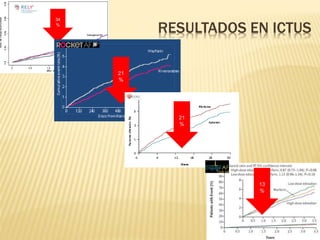
PUBLICACIÓN RESULTADOS NUEVOS ACO
34
%
21
%
21
%
13
%
RESULTADOS EN ICTUS
MUCHAS GRACIAS

Presentación nac os

  • 1.
    PRESENTACIÓN DE LOSNACOS ENATENCIÓN PRIMARIA Dr. Sergio Cinza Sanjurjo Doctor en Medicina Especialista en MFyC C.S. Porto do Son, A Coruña
  • 2.
    Cea-Calvo L, etal. Estudio PREV-ICTUS. Rev Esp Cardiol. 2007;60:616-24 INCREMENTO DEL RIESGO DE FA 0.00 5.00 10.00 15.00 20.00 25.00 FA FA+HTA dx FA+HTA 5.30 12.40 23.70 p<0,0001
  • 3.
  • 4.
    INCREMENTO DE MORTALIDADASOCIADA A FA p<0,0001 55-74 años Benjamin, et al. Impact of Atrial Fibrillation on the Risk of Death : The Framingham Heart Study. Circulation 1998 75-94 años
  • 5.
    From: Meta-analysis: AntithromboticTherapy to Prevent Stroke in Patients Who Have Nonvalvular Atrial Fibrillation Ann Intern Med. 2007;146(12):857-867. 64% ACV 26% Mortalidad 4.713 pacientes
  • 6.
    (a) Factores deriesgo de ictus y tromboembolismo en la FA no valvular Factores de riesgo mayores Factores de riesgo menos validados o con menos poder Antecedentes de ictus, AIT o embolismo sistémico Edad ≥ 75 años Insuficiencia cardíaca o disfunción sistólica del ventrículo izquierdo de moderada a severa (p. ej. FE VI ≤ 40%) Hipertensión-diabetes mellitus Sexo femenino-edad: 657-74 años Enfermedad vasculara (b) Escala de riesgo de ictus en FA: CHa2DS2-VASc [Congestive heart failure, Hypertension, Age ≥ 75 (2 = doubled), Diabetes Stroke (2 = doubled), Vascular disease, Age 65-74, Sex Category (female)] (Nota: la máxima puntuación es 9, ya que la edad puede aportar 0, 1 o 2 puntos) Factor de riesgo Puntuación Insuficiencia cardíaca congestiva/disfunción VI 1 Hipertensión 1 Edad ≥ 75 años 2 Diabetes mellitus 1 Ictus/AIT/tromboembolismo 2 Enfermedad vasculara 1 Edad: 65-74 años 1 Sexo femenino 1 Puntuación máxima 9 Lip GY, et al. Stroke. 2010;41:2731-8. Camm AJ, et al. Guidelines for the management of atrial fibrillation: The Task Force for the Management of AF of the ESC. Eur Heart J 2010;doi:10.1093/eurheartj/ehq278. 1.30% 2.20% 3.20% 4.00% 6.70% 9.80% 9.60% 6.70% 15.20% 0.00% 2.00% 4.00% 6.00% 8.00% 10.00% 12.00% 14.00% 16.00% 1 2 3 4 5 6 7 8 9 EVALUACIÓN DE RIESGO ICTUS
  • 7.
    ANTICOAGULAMOS A LAMITAD DE PACIENTES 0.0% 10.0% 20.0% 30.0% 40.0% 50.0% 60.0% 70.0% GWTG-HF Medicare NRAF II UHSC ATRIA NSTEMI STEMI 65.0% 46.0% 65.0% 44.0% 55.0% 31.0% 39.0% GWTG-HF: Get With the Guidelines – Heart Failure. NRAF II: National Registry of Atrial Fibrillation, UHSC: University Healthsystem Consortium, ATRIA: Anticoagulación and Risk Factor in Atrial Fibrillation Registry, NSTEMI: Patients with non-ST segment elevation myocaridal infarction, STEMI: Patients with ST-segment elevation myocardia infarction
  • 8.
  • 9.
  • 10.

Notas del editor

  • #6 Relative effects of antithrombotic therapies on all stroke from randomized trials in patients with atrial fibrillation.Horizontal lines represent 95% CIs around point estimates. Please see footnote in Table 1 for definitions of study acronyms. A. Adjusted-dose warfarin compared with placebo or no treatment in 6 randomized trials. B. Antiplatelet agents compared with placebo or no treatment in 8 randomized trials. In SAFT (23), aspirin was combined with low, inefficacious dosages of warfarin. In ESPS II (13), combination refers to aspirin plus dipyridamole. C. Adjusted-dose warfarin compared with antiplatelet agents in 11 randomized trials. Nonaspirin antiplatelet agents were indobufen (SIFA [12]), clopidogrel plus aspirin (ACTIVE-W [28]), and triflusal (NASPEAF [25]). *The Vemmos et al. (27) and WASPO (31) trials are not shown; however, the information is shown in Table 4.