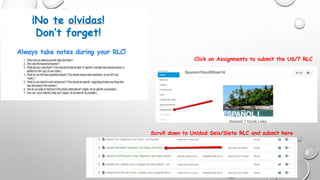
Click on Assignments to submit the U6/7 RLC
Scroll down to Unidad Seis/Siete RLC and submit here
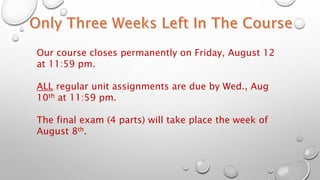
Our course closes permanently on Friday, August 12
at 11:59 pm.
ALL regular unit assignments are due by Wed., Aug
10th at 11:59 pm.
The final exam (4 parts) will take place the week of
August 8th.
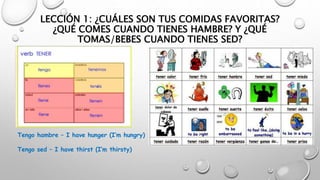
LECCIÓN 1: ¿CUÁLES SON TUS COMIDAS FAVORITAS?
¿QUÉ COMES CUANDO TIENES HAMBRE? Y ¿QUÉ
TOMAS/BEBES CUANDO TIENES SED?
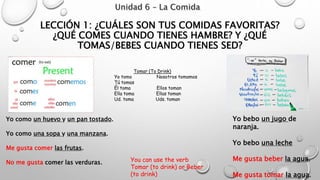
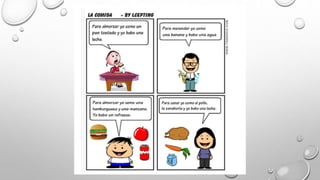
Yo como un huevo y un pan tostado.
Yo como una sopa y una manzana.
Me gusta comer las frutas.
No me gusta comer las verduras.
Yo bebo un jugo de
naranja.
Yo bebo una leche
Me gusta beber la agua.
Me gusta tomar la agua.
You can use the verb
Tomar (to drink) or Beber
(to drink)
Tomar (To Drink)
Yo tomo Nosotros tomamos
Tú tomas
Él toma Ellos toman
Ella toma Ellas toman
Ud. toma Uds. toman
LECCIÓN 1: ¿CUÁLES SON TUS COMIDAS FAVORITAS?
¿QUÉ COMES CUANDO TIENES HAMBRE? Y ¿QUÉ
TOMAS/BEBES CUANDO TIENES SED?
Tengo hambre – I have hunger (I’m hungry)
Tengo sed – I have thirst (I’m thirsty)
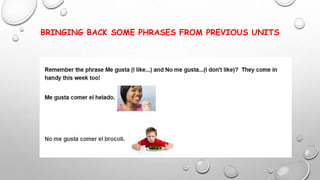
BRINGING BACK SOME PHRASES FROM PREVIOUS UNITS
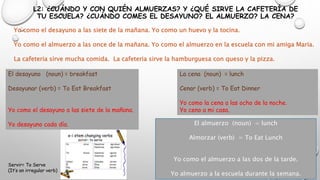
L2: ¿CUÁNDO Y CON QUIÉN ALMUERZAS? Y ¿QUÉ SIRVE LA CAFETERÍA DE
TU ESCUELA? ¿CUÁNDO COMES EL DESAYUNO? EL ALMUERZO? LA CENA?
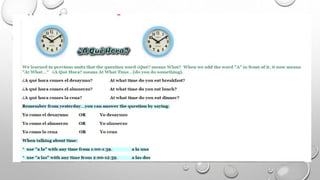
Yo como el desayuno a las siete de la mañana. Yo como un huevo y la tocina.
Yo como el almuerzo a las once de la mañana. Yo como el almuerzo en la escuela con mi amiga Maria.
La cafeteria sirve mucha comida. La cafeteria sirve la hamburguesa con queso y la pizza.
El desayuno (noun) = breakfast
Desayunar (verb) = To Eat Breakfast
Yo como el desayuno a las siete de la mañana.
Yo desayuno cada día. El almuerzo (noun) = lunch
Almorzar (verb) = To Eat Lunch
Yo como el almuerzo a las dos de la tarde.
Yo almuerzo a la escuela durante la semana.
La cena (noun) = lunch
Cenar (verb) = To Eat Dinner
Yo como la cena a las ocho de la noche.
Yo ceno a mi casa.
Servir= To Serve
(It’s an irregular verb)
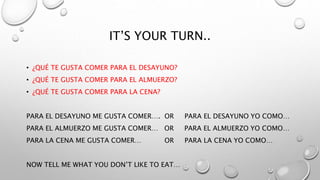
IT’S YOUR TURN..
• ¿QUÉ TE GUSTA COMER PARA EL DESAYUNO?
• ¿QUÉ TE GUSTA COMER PARA EL ALMUERZO?
• ¿QUÉ TE GUSTA COMER PARA LA CENA?
PARA EL DESAYUNO ME GUSTA COMER…. OR PARA EL DESAYUNO YO COMO…
PARA EL ALMUERZO ME GUSTA COMER… OR PARA EL ALMUERZO YO COMO…
PARA LA CENA ME GUSTA COMER… OR PARA LA CENA YO COMO…
NOW TELL ME WHAT YOU DON’T LIKE TO EAT…
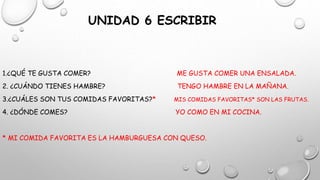
UNIDAD 6 ESCRIBIR
1.¿QUÉ TE GUSTA COMER? ME GUSTA COMER UNA ENSALADA.
2. ¿CUÁNDO TIENES HAMBRE? TENGO HAMBRE EN LA MAÑANA.
3.¿CUÁLES SON TUS COMIDAS FAVORITAS?* MIS COMIDAS FAVORITAS* SON LAS FRUTAS.
4. ¿DÓNDE COMES? YO COMO EN MI COCINA.
* MI COMIDA FAVORITA ES LA HAMBURGUESA CON QUESO.
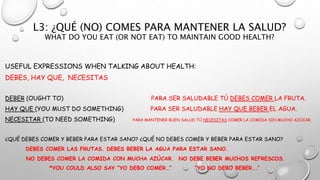
L3: ¿QUÉ (NO) COMES PARA MANTENER LA SALUD?
WHAT DO YOU EAT (OR NOT EAT) TO MAINTAIN GOOD HEALTH?
USEFUL EXPRESSIONS WHEN TALKING ABOUT HEALTH:
DEBES, HAY QUE, NECESITAS
DEBER (OUGHT TO) PARA SER SALUDABLE TÚ DEBES COMER LA FRUTA.
HAY QUE (YOU MUST DO SOMETHING) PARA SER SALUDABLE HAY QUE BEBER EL AGUA.
NECESITAR (TO NEED SOMETHING) PARA MANTENER BUEN SALUD TÚ NECESITAS COMER LA COMIDA SIN MUCHO AZÚCAR.
¿QUÉ DEBES COMER Y BEBER PARA ESTAR SANO? ¿QUÉ NO DEBES COMER Y BEBER PARA ESTAR SANO?
DEBES COMER LAS FRUTAS. DEBES BEBER LA AGUA PARA ESTAR SANO.
NO DEBES COMER LA COMIDA CON MUCHA AZÚCAR. NO DEBE BEBER MUCHOS REFRESCOS.
*YOU COULD ALSO SAY “YO DEBO COMER…” “YO NO DEBO BEBER…”
HACER (TO DO, TO MAKE)
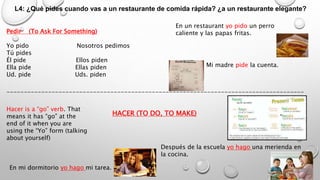
L4: ¿Qué pides cuando vas a un restaurante de comida rápida? ¿a un restaurante elegante?
En mi dormitorio yo hago mi tarea.
Después de la escuela yo hago una merienda en
la cocina.
Hacer is a “go” verb. That
means it has “go” at the
end of it when you are
using the “Yo” form (talking
about yourself)
Pedir (To Ask For Something)
Yo pido Nosotros pedimos
Tú pides
Él pide Ellos piden
Ella pide Ellas piden
Ud. pide Uds. piden
--------------------------------------------------------------------------------------
En un restaurant yo pido un perro
caliente y las papas fritas.
Mi madre pide la cuenta.
NOW IT’S YOUR TURN…
• ¿QUÉ PIDES CUANDO VAS A UN RESTAURANTE?
CUANDO YO VOY A UN RESTAURANTE YO PIDO….
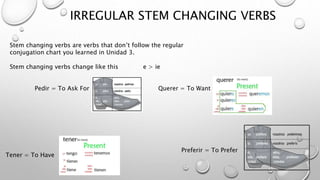
IRREGULAR STEM CHANGING VERBS
Stem changing verbs are verbs that don’t follow the regular
conjugation chart you learned in Unidad 3.
Stem changing verbs change like this e > ie
Pedir = To Ask For Querer = To Want
Tener = To Have
Preferir = To Prefer
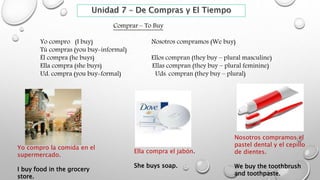
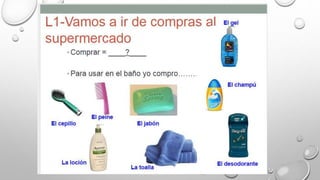
Comprar – To Buy
Yo compro (I buy) Nosotros compramos (We buy)
Tú compras (you buy-informal)
Él compra (he buys) Ellos compran (they buy – plural masculine)
Ella compra (she buys) Ellas compran (they buy – plural feminine)
Ud. compra (you buy-formal) Uds. compran (they buy – plural)
Yo compro la comida en el
supermercado.
I buy food in the grocery
store.
Ella compra el jabón.
She buys soap.
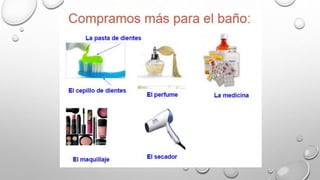
Nosotros compramos el
pastel dental y el cepillo
de dientes.
We buy the toothbrush
and toothpaste.
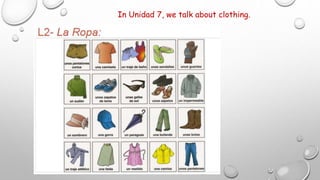
In Unidad 7, we talk about clothing.
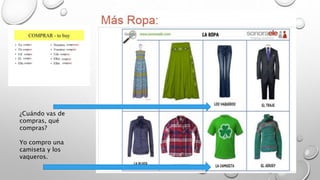
¿Cuándo vas de
compras, qué
compras?
Yo compro una
camiseta y los
vaqueros.
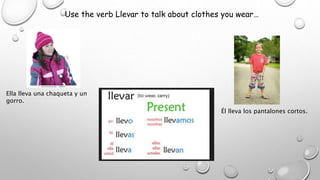
Use the verb Llevar to talk about clothes you wear…
Ella lleva una chaqueta y un
gorro.
Él lleva los pantalones cortos.
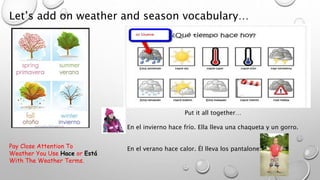
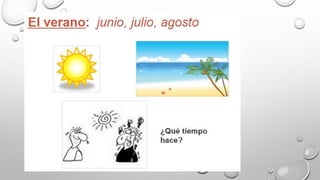
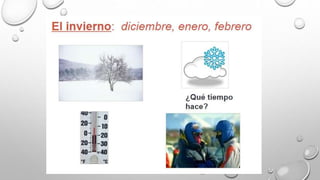
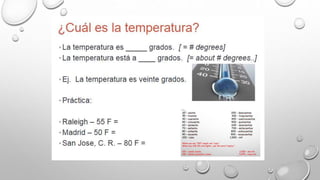
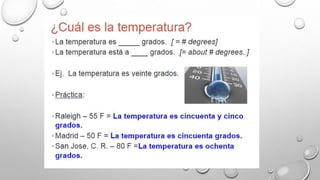
Let’s add on weather and season vocabulary…
Put it all together…
En el invierno hace frío. Ella lleva una chaqueta y un gorro.
En el verano hace calor. Él lleva los pantalones cortos.Pay Close Attention To
Weather You Use Hace or Está
With The Weather Terms.
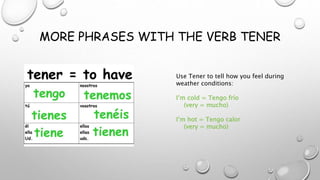
MORE PHRASES WITH THE VERB TENER
Use Tener to tell how you feel during
weather conditions:
I’m cold = Tengo frío
(very = mucho)
I’m hot = Tengo calor
(very = mucho)
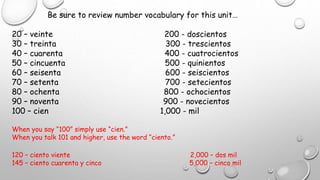
Be sure to review number vocabulary for this unit…
20 – veinte 200 - doscientos
30 – treinta 300 - trescientos
40 – cuarenta 400 - cuatrocientos
50 – cincuenta 500 - quinientos
60 – seisenta 600 - seiscientos
70 – setenta 700 - setecientos
80 – ochenta 800 - ochocientos
90 – noventa 900 - novecientos
100 – cien 1,000 - mil
When you say “100” simply use “cien.”
When you talk 101 and higher, use the word “ciento.”
120 – ciento viente 2,000 – dos mil
145 – ciento cuarenta y cinco 5,000 – cinco mil
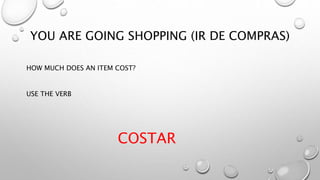
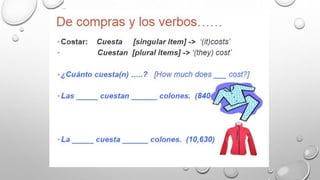
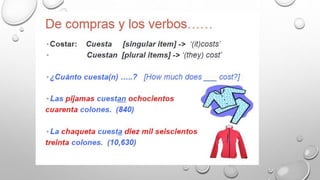
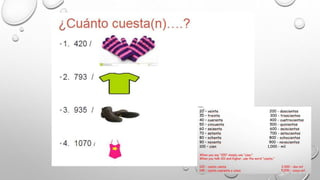
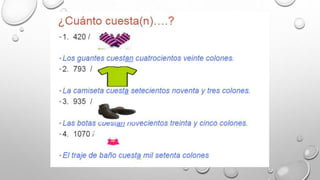
YOU ARE GOING SHOPPING (IR DE COMPRAS)
HOW MUCH DOES AN ITEM COST?
USE THE VERB
COSTAR
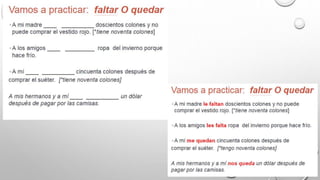
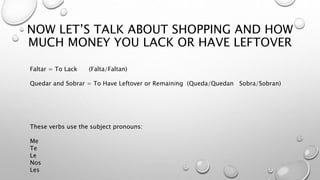
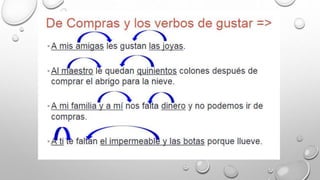
NOW LET’S TALK ABOUT SHOPPING AND HOW
MUCH MONEY YOU LACK OR HAVE LEFTOVER
Faltar = To Lack (Falta/Faltan)
Quedar and Sobrar = To Have Leftover or Remaining (Queda/Quedan Sobra/Sobran)
These verbs use the subject pronouns:
Me
Te
Le
Nos
Les
WHAT’S AHEAD…
• U8/FE RLC
(Review Unidad 8 plus review for the final exam.
• The Final Exam is called “Proyecto Final” and it has four parts to it (writing, speaking,
reading comprehension w/ questions and listening comprehension with questions)
• If you haven’t been taking notes on the Culture lessons (food, family life, housing, school
in Costa Rica) or have been receiving poor grades on your Actividad Cultural assignments,
take time to go back and review your teacher’s feedback and make sure you have 2-3
examples of life in Costa Rica for those topics listed above AND how your
family/culture/traditions/day-to-day life are the same and different from what you have
learned about Costa Rica.
• Have you been waiting until the weekend to do work? YOU WON’T HAVE THIS
OPPORTUNITY WHEN THE COURSE CLOSES ON FRIDAY, AUGUST 12. We are unable to
leave the course open so please make sure you are caught up.
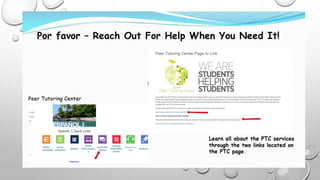
• Reach out for help if you need it (your teacher, Peer Tutoring Center…)
Summer 2016 unit 6 and 7 canvas rlc

Summer 2016 unit 6 and 7 canvas rlc

  • 2.
    Click on Assignmentsto submit the U6/7 RLC Scroll down to Unidad Seis/Siete RLC and submit here
  • 3.
    Our course closespermanently on Friday, August 12 at 11:59 pm. ALL regular unit assignments are due by Wed., Aug 10th at 11:59 pm. The final exam (4 parts) will take place the week of August 8th.
  • 5.
    LECCIÓN 1: ¿CUÁLESSON TUS COMIDAS FAVORITAS? ¿QUÉ COMES CUANDO TIENES HAMBRE? Y ¿QUÉ TOMAS/BEBES CUANDO TIENES SED? Yo como un huevo y un pan tostado. Yo como una sopa y una manzana. Me gusta comer las frutas. No me gusta comer las verduras. Yo bebo un jugo de naranja. Yo bebo una leche Me gusta beber la agua. Me gusta tomar la agua. You can use the verb Tomar (to drink) or Beber (to drink) Tomar (To Drink) Yo tomo Nosotros tomamos Tú tomas Él toma Ellos toman Ella toma Ellas toman Ud. toma Uds. toman
  • 6.
    LECCIÓN 1: ¿CUÁLESSON TUS COMIDAS FAVORITAS? ¿QUÉ COMES CUANDO TIENES HAMBRE? Y ¿QUÉ TOMAS/BEBES CUANDO TIENES SED? Tengo hambre – I have hunger (I’m hungry) Tengo sed – I have thirst (I’m thirsty)
  • 7.
    BRINGING BACK SOMEPHRASES FROM PREVIOUS UNITS
  • 9.
    L2: ¿CUÁNDO YCON QUIÉN ALMUERZAS? Y ¿QUÉ SIRVE LA CAFETERÍA DE TU ESCUELA? ¿CUÁNDO COMES EL DESAYUNO? EL ALMUERZO? LA CENA? Yo como el desayuno a las siete de la mañana. Yo como un huevo y la tocina. Yo como el almuerzo a las once de la mañana. Yo como el almuerzo en la escuela con mi amiga Maria. La cafeteria sirve mucha comida. La cafeteria sirve la hamburguesa con queso y la pizza. El desayuno (noun) = breakfast Desayunar (verb) = To Eat Breakfast Yo como el desayuno a las siete de la mañana. Yo desayuno cada día. El almuerzo (noun) = lunch Almorzar (verb) = To Eat Lunch Yo como el almuerzo a las dos de la tarde. Yo almuerzo a la escuela durante la semana. La cena (noun) = lunch Cenar (verb) = To Eat Dinner Yo como la cena a las ocho de la noche. Yo ceno a mi casa. Servir= To Serve (It’s an irregular verb)
  • 11.
    IT’S YOUR TURN.. •¿QUÉ TE GUSTA COMER PARA EL DESAYUNO? • ¿QUÉ TE GUSTA COMER PARA EL ALMUERZO? • ¿QUÉ TE GUSTA COMER PARA LA CENA? PARA EL DESAYUNO ME GUSTA COMER…. OR PARA EL DESAYUNO YO COMO… PARA EL ALMUERZO ME GUSTA COMER… OR PARA EL ALMUERZO YO COMO… PARA LA CENA ME GUSTA COMER… OR PARA LA CENA YO COMO… NOW TELL ME WHAT YOU DON’T LIKE TO EAT…
  • 12.
    UNIDAD 6 ESCRIBIR 1.¿QUÉTE GUSTA COMER? ME GUSTA COMER UNA ENSALADA. 2. ¿CUÁNDO TIENES HAMBRE? TENGO HAMBRE EN LA MAÑANA. 3.¿CUÁLES SON TUS COMIDAS FAVORITAS?* MIS COMIDAS FAVORITAS* SON LAS FRUTAS. 4. ¿DÓNDE COMES? YO COMO EN MI COCINA. * MI COMIDA FAVORITA ES LA HAMBURGUESA CON QUESO.
  • 13.
    L3: ¿QUÉ (NO)COMES PARA MANTENER LA SALUD? WHAT DO YOU EAT (OR NOT EAT) TO MAINTAIN GOOD HEALTH? USEFUL EXPRESSIONS WHEN TALKING ABOUT HEALTH: DEBES, HAY QUE, NECESITAS DEBER (OUGHT TO) PARA SER SALUDABLE TÚ DEBES COMER LA FRUTA. HAY QUE (YOU MUST DO SOMETHING) PARA SER SALUDABLE HAY QUE BEBER EL AGUA. NECESITAR (TO NEED SOMETHING) PARA MANTENER BUEN SALUD TÚ NECESITAS COMER LA COMIDA SIN MUCHO AZÚCAR. ¿QUÉ DEBES COMER Y BEBER PARA ESTAR SANO? ¿QUÉ NO DEBES COMER Y BEBER PARA ESTAR SANO? DEBES COMER LAS FRUTAS. DEBES BEBER LA AGUA PARA ESTAR SANO. NO DEBES COMER LA COMIDA CON MUCHA AZÚCAR. NO DEBE BEBER MUCHOS REFRESCOS. *YOU COULD ALSO SAY “YO DEBO COMER…” “YO NO DEBO BEBER…”
  • 14.
    HACER (TO DO,TO MAKE) L4: ¿Qué pides cuando vas a un restaurante de comida rápida? ¿a un restaurante elegante? En mi dormitorio yo hago mi tarea. Después de la escuela yo hago una merienda en la cocina. Hacer is a “go” verb. That means it has “go” at the end of it when you are using the “Yo” form (talking about yourself) Pedir (To Ask For Something) Yo pido Nosotros pedimos Tú pides Él pide Ellos piden Ella pide Ellas piden Ud. pide Uds. piden -------------------------------------------------------------------------------------- En un restaurant yo pido un perro caliente y las papas fritas. Mi madre pide la cuenta.
  • 15.
    NOW IT’S YOURTURN… • ¿QUÉ PIDES CUANDO VAS A UN RESTAURANTE? CUANDO YO VOY A UN RESTAURANTE YO PIDO….
  • 16.
    IRREGULAR STEM CHANGINGVERBS Stem changing verbs are verbs that don’t follow the regular conjugation chart you learned in Unidad 3. Stem changing verbs change like this e > ie Pedir = To Ask For Querer = To Want Tener = To Have Preferir = To Prefer
  • 17.
    Comprar – ToBuy Yo compro (I buy) Nosotros compramos (We buy) Tú compras (you buy-informal) Él compra (he buys) Ellos compran (they buy – plural masculine) Ella compra (she buys) Ellas compran (they buy – plural feminine) Ud. compra (you buy-formal) Uds. compran (they buy – plural) Yo compro la comida en el supermercado. I buy food in the grocery store. Ella compra el jabón. She buys soap. Nosotros compramos el pastel dental y el cepillo de dientes. We buy the toothbrush and toothpaste.
  • 20.
    In Unidad 7,we talk about clothing.
  • 21.
    ¿Cuándo vas de compras,qué compras? Yo compro una camiseta y los vaqueros.
  • 22.
    Use the verbLlevar to talk about clothes you wear… Ella lleva una chaqueta y un gorro. Él lleva los pantalones cortos.
  • 23.
    Let’s add onweather and season vocabulary… Put it all together… En el invierno hace frío. Ella lleva una chaqueta y un gorro. En el verano hace calor. Él lleva los pantalones cortos.Pay Close Attention To Weather You Use Hace or Está With The Weather Terms.
  • 26.
    MORE PHRASES WITHTHE VERB TENER Use Tener to tell how you feel during weather conditions: I’m cold = Tengo frío (very = mucho) I’m hot = Tengo calor (very = mucho)
  • 29.
    Be sure toreview number vocabulary for this unit… 20 – veinte 200 - doscientos 30 – treinta 300 - trescientos 40 – cuarenta 400 - cuatrocientos 50 – cincuenta 500 - quinientos 60 – seisenta 600 - seiscientos 70 – setenta 700 - setecientos 80 – ochenta 800 - ochocientos 90 – noventa 900 - novecientos 100 – cien 1,000 - mil When you say “100” simply use “cien.” When you talk 101 and higher, use the word “ciento.” 120 – ciento viente 2,000 – dos mil 145 – ciento cuarenta y cinco 5,000 – cinco mil
  • 32.
    YOU ARE GOINGSHOPPING (IR DE COMPRAS) HOW MUCH DOES AN ITEM COST? USE THE VERB COSTAR
  • 37.
    NOW LET’S TALKABOUT SHOPPING AND HOW MUCH MONEY YOU LACK OR HAVE LEFTOVER Faltar = To Lack (Falta/Faltan) Quedar and Sobrar = To Have Leftover or Remaining (Queda/Quedan Sobra/Sobran) These verbs use the subject pronouns: Me Te Le Nos Les
  • 40.
    WHAT’S AHEAD… • U8/FERLC (Review Unidad 8 plus review for the final exam. • The Final Exam is called “Proyecto Final” and it has four parts to it (writing, speaking, reading comprehension w/ questions and listening comprehension with questions) • If you haven’t been taking notes on the Culture lessons (food, family life, housing, school in Costa Rica) or have been receiving poor grades on your Actividad Cultural assignments, take time to go back and review your teacher’s feedback and make sure you have 2-3 examples of life in Costa Rica for those topics listed above AND how your family/culture/traditions/day-to-day life are the same and different from what you have learned about Costa Rica. • Have you been waiting until the weekend to do work? YOU WON’T HAVE THIS OPPORTUNITY WHEN THE COURSE CLOSES ON FRIDAY, AUGUST 12. We are unable to leave the course open so please make sure you are caught up. • Reach out for help if you need it (your teacher, Peer Tutoring Center…)