Bienvenidos a RSS para Unidad 2
lunes, el 26 de agosto
Sra. Lewis
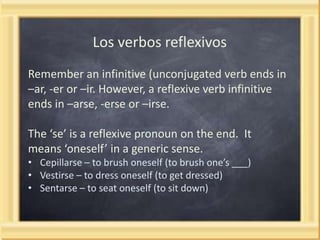
Los verbos reflexivos
Remember an infinitive (unconjugated verb ends in
–ar, -er or –ir. However, a reflexive verb infinitive
ends in –arse, -erse or –irse.
The ‘se’ is a reflexive pronoun on the end. It
means ‘oneself’ in a generic sense.
• Cepillarse – to brush oneself (to brush one’s ___)
• Vestirse – to dress oneself (to get dressed)
• Sentarse – to seat oneself (to sit down)
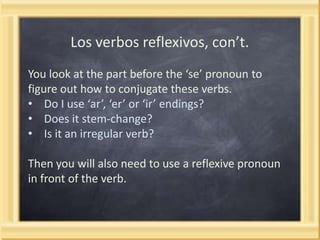
Los verbos reflexivos, con’t.
You look at the part before the ‘se’ pronoun to
figure out how to conjugate these verbs.
• Do I use ‘ar’, ‘er’ or ‘ir’ endings?
• Does it stem-change?
• Is it an irregular verb?
Then you will also need to use a reflexive pronoun
in front of the verb.
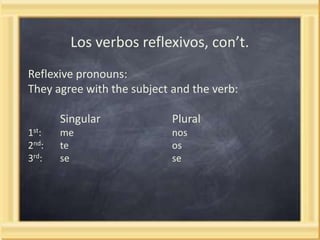
Los verbos reflexivos, con’t.
Reflexive pronouns:
They agree with the subject and the verb:
Singular
1st:
2nd:
3rd:

Plural

me
te
se

nos
os
se
Los verbos reflexivos, con’t.
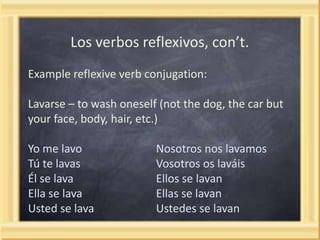
Example reflexive verb conjugation:

Lavarse – to wash oneself (not the dog, the car but
your face, body, hair, etc.)
Yo me lavo
Tú te lavas
Él se lava
Ella se lava
Usted se lava

Nosotros nos lavamos
Vosotros os laváis
Ellos se lavan
Ellas se lavan
Ustedes se lavan
Los verbos reflexivos, con’t.
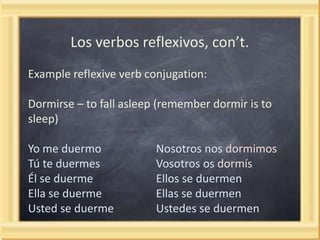
Example reflexive verb conjugation:

Dormirse – to fall asleep (remember dormir is to
sleep)
Yo me duermo
Tú te duermes
Él se duerme
Ella se duerme
Usted se duerme

Nosotros nos dormimos
Vosotros os dormís
Ellos se duermen
Ellas se duermen
Ustedes se duermen
Los verbos reflexivos, con’t.
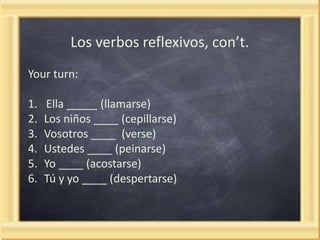
Your turn:

1.
2.
3.
4.
5.
6.

Ella _____ (llamarse)
Los niños ____ (cepillarse)
Vosotros ____ (verse)
Ustedes ____ (peinarse)
Yo ____ (acostarse)
Tú y yo ____ (despertarse)
Los verbos reflexivos, con’t.
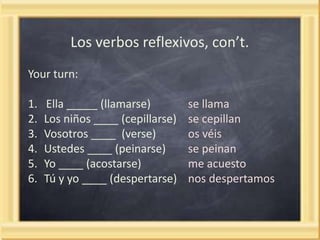
Your turn:

1.
2.
3.
4.
5.
6.

Ella _____ (llamarse)
Los niños ____ (cepillarse)
Vosotros ____ (verse)
Ustedes ____ (peinarse)
Yo ____ (acostarse)
Tú y yo ____ (despertarse)

se llama
se cepillan
os véis
se peinan
me acuesto
nos despertamos
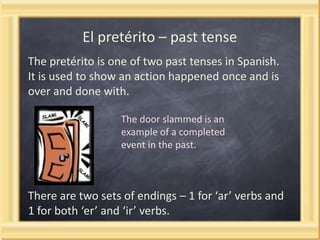
El pretérito – past tense
The pretérito is one of two past tenses in Spanish.
It is used to show an action happened once and is
over and done with.
The door slammed is an
example of a completed
event in the past.

There are two sets of endings – 1 for ‘ar’ verbs and
1 for both ‘er’ and ‘ir’ verbs.
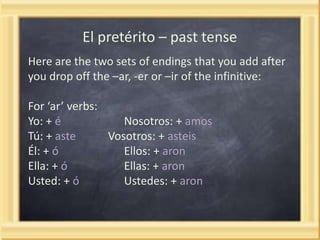
El pretérito – past tense
Here are the two sets of endings that you add after
you drop off the –ar, -er or –ir of the infinitive:
For ‘ar’ verbs:
Yo: + é
Nosotros: + amos
Tú: + aste
Vosotros: + asteis
Él: + ó
Ellos: + aron
Ella: + ó
Ellas: + aron
Usted: + ó
Ustedes: + aron
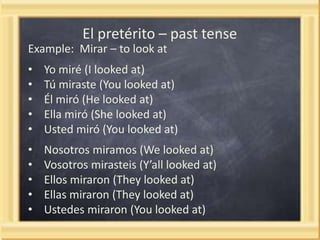
El pretérito – past tense
Example: Mirar – to look at

•
•
•
•
•

Yo miré (I looked at)
Tú miraste (You looked at)
Él miró (He looked at)
Ella miró (She looked at)
Usted miró (You looked at)

•
•
•
•
•

Nosotros miramos (We looked at)
Vosotros mirasteis (Y’all looked at)
Ellos miraron (They looked at)
Ellas miraron (They looked at)
Ustedes miraron (You looked at)
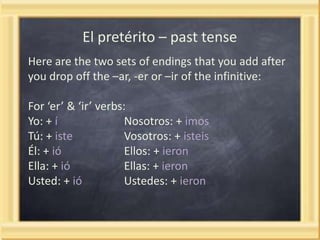
El pretérito – past tense
Here are the two sets of endings that you add after
you drop off the –ar, -er or –ir of the infinitive:
For ‘er’ & ‘ir’ verbs:
Yo: + í
Nosotros: + imos
Tú: + iste
Vosotros: + isteis
Él: + ió
Ellos: + ieron
Ella: + ió
Ellas: + ieron
Usted: + ió
Ustedes: + ieron
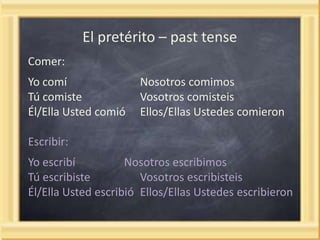
El pretérito – past tense
Comer:
Yo comí
Tú comiste
Él/Ella Usted comió

Nosotros comimos
Vosotros comisteis
Ellos/Ellas Ustedes comieron

Escribir:

Yo escribí
Nosotros escribimos
Tú escribiste
Vosotros escribisteis
Él/Ella Usted escribió Ellos/Ellas Ustedes escribieron
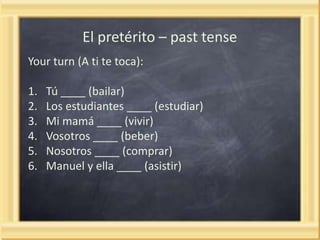
El pretérito – past tense
Your turn (A ti te toca):
1.
2.
3.
4.
5.
6.

Tú ____ (bailar)
Los estudiantes ____ (estudiar)
Mi mamá ____ (vivir)
Vosotros ____ (beber)
Nosotros ____ (comprar)
Manuel y ella ____ (asistir)
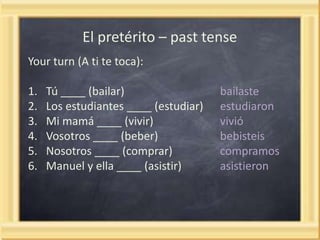
El pretérito – past tense
Your turn (A ti te toca):
1.
2.
3.
4.
5.
6.

Tú ____ (bailar)
Los estudiantes ____ (estudiar)
Mi mamá ____ (vivir)
Vosotros ____ (beber)
Nosotros ____ (comprar)
Manuel y ella ____ (asistir)

bailaste
estudiaron
vivió
bebisteis
compramos
asistieron
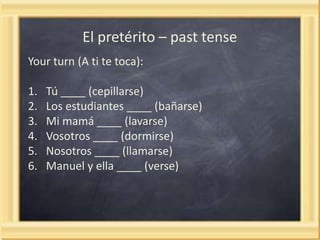
El pretérito – past tense
Your turn (A ti te toca):
1.
2.
3.
4.
5.
6.

Tú ____ (cepillarse)
Los estudiantes ____ (bañarse)
Mi mamá ____ (lavarse)
Vosotros ____ (dormirse)
Nosotros ____ (llamarse)
Manuel y ella ____ (verse)
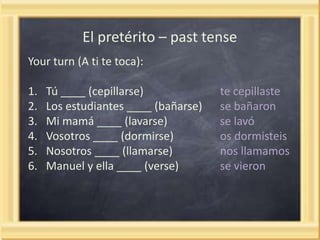
El pretérito – past tense
Your turn (A ti te toca):
1.
2.
3.
4.
5.
6.

Tú ____ (cepillarse)
Los estudiantes ____ (bañarse)
Mi mamá ____ (lavarse)
Vosotros ____ (dormirse)
Nosotros ____ (llamarse)
Manuel y ella ____ (verse)

te cepillaste
se bañaron
se lavó
os dormisteis
nos llamamos
se vieron
¿Preguntas?

8 26-13 ref. verbs & pret.

  • 1.
    Bienvenidos a RSSpara Unidad 2 lunes, el 26 de agosto Sra. Lewis
  • 2.
    Los verbos reflexivos Rememberan infinitive (unconjugated verb ends in –ar, -er or –ir. However, a reflexive verb infinitive ends in –arse, -erse or –irse. The ‘se’ is a reflexive pronoun on the end. It means ‘oneself’ in a generic sense. • Cepillarse – to brush oneself (to brush one’s ___) • Vestirse – to dress oneself (to get dressed) • Sentarse – to seat oneself (to sit down)
  • 3.
    Los verbos reflexivos,con’t. You look at the part before the ‘se’ pronoun to figure out how to conjugate these verbs. • Do I use ‘ar’, ‘er’ or ‘ir’ endings? • Does it stem-change? • Is it an irregular verb? Then you will also need to use a reflexive pronoun in front of the verb.
  • 4.
    Los verbos reflexivos,con’t. Reflexive pronouns: They agree with the subject and the verb: Singular 1st: 2nd: 3rd: Plural me te se nos os se
  • 5.
    Los verbos reflexivos,con’t. Example reflexive verb conjugation: Lavarse – to wash oneself (not the dog, the car but your face, body, hair, etc.) Yo me lavo Tú te lavas Él se lava Ella se lava Usted se lava Nosotros nos lavamos Vosotros os laváis Ellos se lavan Ellas se lavan Ustedes se lavan
  • 6.
    Los verbos reflexivos,con’t. Example reflexive verb conjugation: Dormirse – to fall asleep (remember dormir is to sleep) Yo me duermo Tú te duermes Él se duerme Ella se duerme Usted se duerme Nosotros nos dormimos Vosotros os dormís Ellos se duermen Ellas se duermen Ustedes se duermen
  • 7.
    Los verbos reflexivos,con’t. Your turn: 1. 2. 3. 4. 5. 6. Ella _____ (llamarse) Los niños ____ (cepillarse) Vosotros ____ (verse) Ustedes ____ (peinarse) Yo ____ (acostarse) Tú y yo ____ (despertarse)
  • 8.
    Los verbos reflexivos,con’t. Your turn: 1. 2. 3. 4. 5. 6. Ella _____ (llamarse) Los niños ____ (cepillarse) Vosotros ____ (verse) Ustedes ____ (peinarse) Yo ____ (acostarse) Tú y yo ____ (despertarse) se llama se cepillan os véis se peinan me acuesto nos despertamos
  • 9.
    El pretérito –past tense The pretérito is one of two past tenses in Spanish. It is used to show an action happened once and is over and done with. The door slammed is an example of a completed event in the past. There are two sets of endings – 1 for ‘ar’ verbs and 1 for both ‘er’ and ‘ir’ verbs.
  • 10.
    El pretérito –past tense Here are the two sets of endings that you add after you drop off the –ar, -er or –ir of the infinitive: For ‘ar’ verbs: Yo: + é Nosotros: + amos Tú: + aste Vosotros: + asteis Él: + ó Ellos: + aron Ella: + ó Ellas: + aron Usted: + ó Ustedes: + aron
  • 11.
    El pretérito –past tense Example: Mirar – to look at • • • • • Yo miré (I looked at) Tú miraste (You looked at) Él miró (He looked at) Ella miró (She looked at) Usted miró (You looked at) • • • • • Nosotros miramos (We looked at) Vosotros mirasteis (Y’all looked at) Ellos miraron (They looked at) Ellas miraron (They looked at) Ustedes miraron (You looked at)
  • 12.
    El pretérito –past tense Here are the two sets of endings that you add after you drop off the –ar, -er or –ir of the infinitive: For ‘er’ & ‘ir’ verbs: Yo: + í Nosotros: + imos Tú: + iste Vosotros: + isteis Él: + ió Ellos: + ieron Ella: + ió Ellas: + ieron Usted: + ió Ustedes: + ieron
  • 13.
    El pretérito –past tense Comer: Yo comí Tú comiste Él/Ella Usted comió Nosotros comimos Vosotros comisteis Ellos/Ellas Ustedes comieron Escribir: Yo escribí Nosotros escribimos Tú escribiste Vosotros escribisteis Él/Ella Usted escribió Ellos/Ellas Ustedes escribieron
  • 14.
    El pretérito –past tense Your turn (A ti te toca): 1. 2. 3. 4. 5. 6. Tú ____ (bailar) Los estudiantes ____ (estudiar) Mi mamá ____ (vivir) Vosotros ____ (beber) Nosotros ____ (comprar) Manuel y ella ____ (asistir)
  • 15.
    El pretérito –past tense Your turn (A ti te toca): 1. 2. 3. 4. 5. 6. Tú ____ (bailar) Los estudiantes ____ (estudiar) Mi mamá ____ (vivir) Vosotros ____ (beber) Nosotros ____ (comprar) Manuel y ella ____ (asistir) bailaste estudiaron vivió bebisteis compramos asistieron
  • 16.
    El pretérito –past tense Your turn (A ti te toca): 1. 2. 3. 4. 5. 6. Tú ____ (cepillarse) Los estudiantes ____ (bañarse) Mi mamá ____ (lavarse) Vosotros ____ (dormirse) Nosotros ____ (llamarse) Manuel y ella ____ (verse)
  • 17.
    El pretérito –past tense Your turn (A ti te toca): 1. 2. 3. 4. 5. 6. Tú ____ (cepillarse) Los estudiantes ____ (bañarse) Mi mamá ____ (lavarse) Vosotros ____ (dormirse) Nosotros ____ (llamarse) Manuel y ella ____ (verse) te cepillaste se bañaron se lavó os dormisteis nos llamamos se vieron
  • 18.