Writing skills
Alicia Pérez
• La escritura proporciona un aprendizaje intensivo de vocabulario
• La escritura proporciona una integración de la gramática y
estructuras básicas en un contexto verdaderamente comunicativo
(si no es para que alguien lo lea, nadie escribe) ejemplos: e-pals,
from…. to…., escribirse cartas unos a otros dentro de la clase.
• La escritura interactúa con la lectura (es indispensable releer
constantemente para seguir escribiendo)
• La escritura es fundamental para todo estudio de cualquier materia
en L2
• La escritura puede ser diversión y descubrimiento de la belleza a
través de la palabra
 http://www.bbc.co.uk/schools/ks2bitesize/english/writin
 http://www.stuartstories.com/activities.html
 ¿Cómo trata el material didáctico que usáis las
habilidades escritas? ¿os gusta? ¿ lo hacéis así?
 Cómo podemos sustituir o complementar esta
parte?
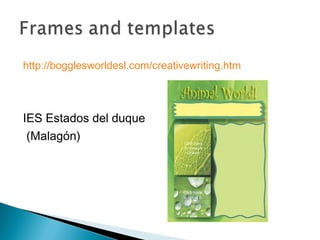
http://bogglesworldesl.com/creativewriting.htm
IES Estados del duque
(Malagón)
My Hobby
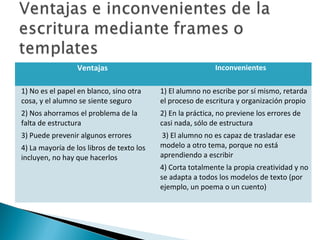
Ventajas Inconvenientes
1) No es el papel en blanco, sino otra
cosa, y el alumno se siente seguro
2) Nos ahorramos el problema de la
falta de estructura
3) Puede prevenir algunos errores
4) La mayoría de los libros de texto los
incluyen, no hay que hacerlos
1) El alumno no escribe por sí mismo, retarda
el proceso de escritura y organización propio
2) En la práctica, no previene los errores de
casi nada, sólo de estructura
3) El alumno no es capaz de trasladar ese
modelo a otro tema, porque no está
aprendiendo a escribir
4) Corta totalmente la propia creatividad y no
se adapta a todos los modelos de texto (por
ejemplo, un poema o un cuento)
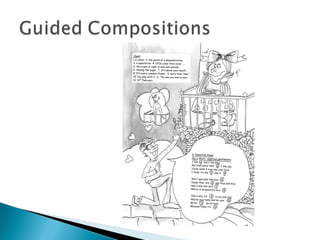
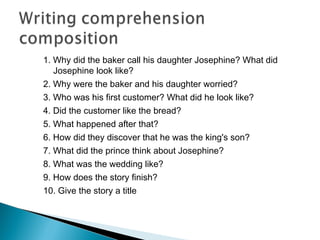
1. Why did the baker call his daughter Josephine? What did
Josephine look like?
2. Why were the baker and his daughter worried?
3. Who was his first customer? What did he look like?
4. Did the customer like the bread?
5. What happened after that?
6. How did they discover that he was the king's son?
7. What did the prince think about Josephine?
8. What was the wedding like?
9. How does the story finish?
10. Give the story a title
Factores emocionales que
acompañan a la escritura.
La belleza ayuda a escribir
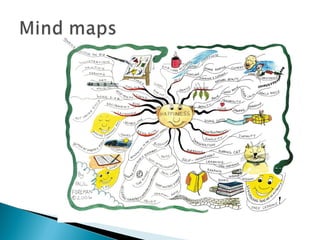
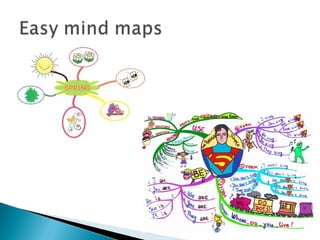
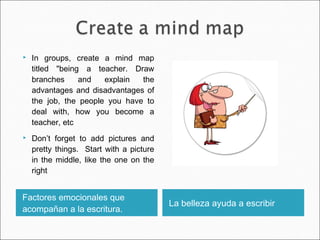
 In groups, create a mind map
titled "being a teacher. Draw
branches and explain the
advantages and disadvantages of
the job, the people you have to
deal with, how you become a
teacher, etc
 Don’t forget to add pictures and
pretty things. Start with a picture
in the middle, like the one on the
right
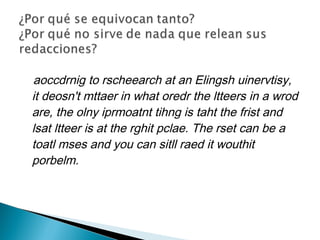
aoccdrnig to rscheearch at an Elingsh uinervtisy,
it deosn't mttaer in what oredr the ltteers in a wrod
are, the olny iprmoatnt tihng is taht the frist and
lsat ltteer is at the rghit pclae. The rset can be a
toatl mses and you can sitll raed it wouthit
porbelm.
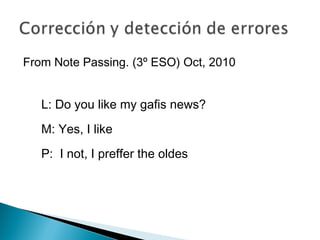
From Note Passing. (3º ESO) Oct, 2010
L: Do you like my gafis news?
M: Yes, I like
P: I not, I preffer the oldes
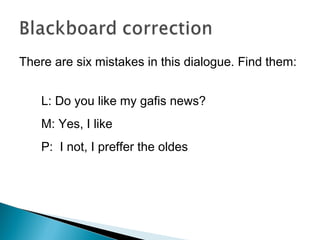
There are six mistakes in this dialogue. Find them:
L: Do you like my gafis news?
M: Yes, I like
P: I not, I preffer the oldes
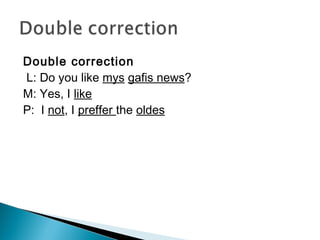
Double correction
L: Do you like mys gafis news?
M: Yes, I like
P: I not, I preffer the oldes
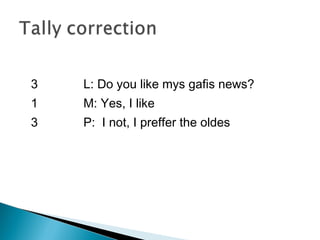
3
1
3
L: Do you like mys gafis news?
M: Yes, I like
P: I not, I preffer the oldes
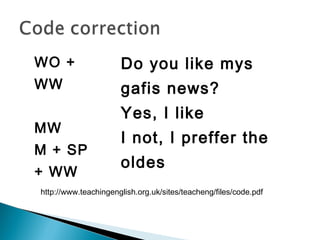
WO +
WW
MW
M + SP
+ WW
Do you like mys
gafis news?
Yes, I like
I not, I preffer the
oldes
http://www.teachingenglish.org.uk/sites/teacheng/files/code.pdf
• Often a student will repeat the same mistake over and over again, even after being 
corrected many times.              
• The first reason why writing class grammar feedback doesn't work is that it treats only
the surface appearance of grammar and not with the way language develops
• Secondly,  If a student is given a correction for a stage he has not yet reached, it
would not be effective.
• Finally, students generally only make a mental note of the corrections they have
understood, and if they have to rewrite their papers, regularly do not incorporate
these corrections into their work
• It seems that grammar corrections are not only useless, but also harmful, students
who were corrected  made more mistakes and wrote less.           
•  What writing teachers need to do is give priority to MEANING and MEANING
RELATED problems, to make remarks about students' texts instead of just form.
Ronald Gray                    
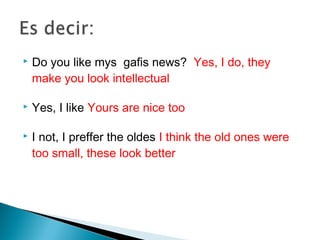
 Do you like mys gafis news? Yes, I do, they
make you look intellectual
 Yes, I like Yours are nice too
 I not, I preffer the oldes I think the old ones were
too small, these look better
 1. Hablar, leer y escribir mucho, solo quien hace esto llega a escribir aceptablemente
y sin muchos errores de gramática ni vocabulario, puesto que el estudio teórico de
éstos y su corrección. NO SIRVEN PARA NADA
 2. Preparar las redacciones, dando una base de vocabulario y estructuras suficientes
 3. Corregir los errores o (mejor) señalarlos para que ellos los corrijan pero:
 4. No esforzarse en detectar y corregir todos los errores gramaticales, incluso los
más insignificantes, ni recalcarlos de manera concienzuda.
 5. Dedicar ese esfuerzo más bien a añadir algún comentario que implique que nos
hemos enterado de lo que nos decían
 6. Peer reading /reading aloud pueden ayudar (además les divierte)
 7. No quedarse en modo alguno con lo negativo, con el error, sino con el mensaje
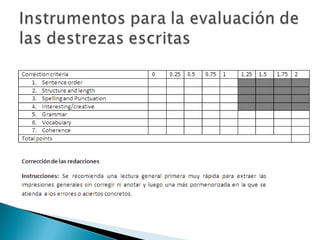
 8. Valorar el texto escrito en todos sus aspectos, no sólo en los formales, utilizando
una buena hoja de evaluación
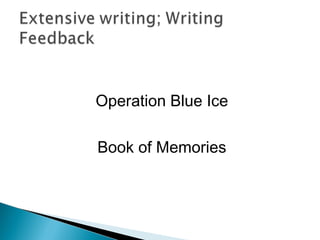
Operation Blue Ice
Book of Memories
Algunas cosas que me han plagiado
◦ La wikipedia tal cual (con enlaces en azul y todo)
◦ Los trabajos de sus amigos del año pasado (con los dibujos y
todo)
◦ A mí misma
◦ Un folleto de instrucciones de un MP3
◦ Un guión de los Simpsons completo y original
Pariente o amigo de mejores habilidades en
inglés que corrige o escribe el texto del alumno
antes de que éste lo entregue. Con frecuencia, el
profesor o profesora particular.
 Writings personalizados: Time Machine The Day
I met Queen Elizabeth I
 Redacciones de control
 Escribir todo lo que se pueda en clase
 Escribir bastante en general (los resultados se
verán a medio/largo plazo)
 http://www.cc.kyoto-su.ac.jp/information/tesl-ej/ej22/a1.html
Algunos aspectos teóricos importantes sobre la
didáctica de la escritura y el origen y trabajo de los
errores.
 http://iteslj.org/Lessons/Bayne-Writing.html
Anotaciones interesantes sobre la escritura
 http://iteslj.org/Techniques/Gray-WritingCorrection.html
De lectura obligatoria (y breve). Demuestra lo atrasados
que estamos
 http://darkwing.uoregon.edu/~leslieob/pizzaz.html: múltiples actividades
cortas
 http://www.manythings.org/vocabulary/: Muchas actividades sobre writing
 http://www.stuartstories.com/activities.html : Más ideas aún y muy
divertidas
 http://bogglesworldesl.com/creativewriting.htm: Excelentes marcos y puntos
de partida para redacciones de media extensión
 http://www.bbc.co.uk/schools/ks2bitesize/english/writing: Como todas las
suyas, excelente página sobre actividades guiadas y de modelo para
diferentes edades.
 http://edu.jccm.es/ies/estadosdelduque/index.php?
option=com_content&view=article&id=192%3Aactividades-de-
ingles&catid=63&Itemid=14: PDFs editables - IES Estados del Duque
Writing skills
Alicia Pérez

Writing skills 2

  • 1.
  • 2.
    • La escrituraproporciona un aprendizaje intensivo de vocabulario • La escritura proporciona una integración de la gramática y estructuras básicas en un contexto verdaderamente comunicativo (si no es para que alguien lo lea, nadie escribe) ejemplos: e-pals, from…. to…., escribirse cartas unos a otros dentro de la clase. • La escritura interactúa con la lectura (es indispensable releer constantemente para seguir escribiendo) • La escritura es fundamental para todo estudio de cualquier materia en L2 • La escritura puede ser diversión y descubrimiento de la belleza a través de la palabra
  • 3.
  • 4.
     ¿Cómo tratael material didáctico que usáis las habilidades escritas? ¿os gusta? ¿ lo hacéis así?  Cómo podemos sustituir o complementar esta parte?
  • 7.
  • 8.
  • 9.
    Ventajas Inconvenientes 1) Noes el papel en blanco, sino otra cosa, y el alumno se siente seguro 2) Nos ahorramos el problema de la falta de estructura 3) Puede prevenir algunos errores 4) La mayoría de los libros de texto los incluyen, no hay que hacerlos 1) El alumno no escribe por sí mismo, retarda el proceso de escritura y organización propio 2) En la práctica, no previene los errores de casi nada, sólo de estructura 3) El alumno no es capaz de trasladar ese modelo a otro tema, porque no está aprendiendo a escribir 4) Corta totalmente la propia creatividad y no se adapta a todos los modelos de texto (por ejemplo, un poema o un cuento)
  • 10.
    1. Why didthe baker call his daughter Josephine? What did Josephine look like? 2. Why were the baker and his daughter worried? 3. Who was his first customer? What did he look like? 4. Did the customer like the bread? 5. What happened after that? 6. How did they discover that he was the king's son? 7. What did the prince think about Josephine? 8. What was the wedding like? 9. How does the story finish? 10. Give the story a title
  • 13.
    Factores emocionales que acompañana la escritura. La belleza ayuda a escribir  In groups, create a mind map titled "being a teacher. Draw branches and explain the advantages and disadvantages of the job, the people you have to deal with, how you become a teacher, etc  Don’t forget to add pictures and pretty things. Start with a picture in the middle, like the one on the right
  • 16.
    aoccdrnig to rscheearchat an Elingsh uinervtisy, it deosn't mttaer in what oredr the ltteers in a wrod are, the olny iprmoatnt tihng is taht the frist and lsat ltteer is at the rghit pclae. The rset can be a toatl mses and you can sitll raed it wouthit porbelm.
  • 17.
    From Note Passing.(3º ESO) Oct, 2010 L: Do you like my gafis news? M: Yes, I like P: I not, I preffer the oldes
  • 18.
    There are sixmistakes in this dialogue. Find them: L: Do you like my gafis news? M: Yes, I like P: I not, I preffer the oldes
  • 19.
    Double correction L: Doyou like mys gafis news? M: Yes, I like P: I not, I preffer the oldes
  • 20.
    3 1 3 L: Do youlike mys gafis news? M: Yes, I like P: I not, I preffer the oldes
  • 21.
    WO + WW MW M +SP + WW Do you like mys gafis news? Yes, I like I not, I preffer the oldes http://www.teachingenglish.org.uk/sites/teacheng/files/code.pdf
  • 22.
    • Often astudent will repeat the same mistake over and over again, even after being  corrected many times.               • The first reason why writing class grammar feedback doesn't work is that it treats only the surface appearance of grammar and not with the way language develops • Secondly,  If a student is given a correction for a stage he has not yet reached, it would not be effective. • Finally, students generally only make a mental note of the corrections they have understood, and if they have to rewrite their papers, regularly do not incorporate these corrections into their work • It seems that grammar corrections are not only useless, but also harmful, students who were corrected  made more mistakes and wrote less.            •  What writing teachers need to do is give priority to MEANING and MEANING RELATED problems, to make remarks about students' texts instead of just form. Ronald Gray                    
  • 23.
     Do youlike mys gafis news? Yes, I do, they make you look intellectual  Yes, I like Yours are nice too  I not, I preffer the oldes I think the old ones were too small, these look better
  • 24.
     1. Hablar,leer y escribir mucho, solo quien hace esto llega a escribir aceptablemente y sin muchos errores de gramática ni vocabulario, puesto que el estudio teórico de éstos y su corrección. NO SIRVEN PARA NADA  2. Preparar las redacciones, dando una base de vocabulario y estructuras suficientes  3. Corregir los errores o (mejor) señalarlos para que ellos los corrijan pero:  4. No esforzarse en detectar y corregir todos los errores gramaticales, incluso los más insignificantes, ni recalcarlos de manera concienzuda.  5. Dedicar ese esfuerzo más bien a añadir algún comentario que implique que nos hemos enterado de lo que nos decían  6. Peer reading /reading aloud pueden ayudar (además les divierte)  7. No quedarse en modo alguno con lo negativo, con el error, sino con el mensaje  8. Valorar el texto escrito en todos sus aspectos, no sólo en los formales, utilizando una buena hoja de evaluación
  • 27.
  • 30.
    Algunas cosas queme han plagiado ◦ La wikipedia tal cual (con enlaces en azul y todo) ◦ Los trabajos de sus amigos del año pasado (con los dibujos y todo) ◦ A mí misma ◦ Un folleto de instrucciones de un MP3 ◦ Un guión de los Simpsons completo y original
  • 31.
    Pariente o amigode mejores habilidades en inglés que corrige o escribe el texto del alumno antes de que éste lo entregue. Con frecuencia, el profesor o profesora particular.
  • 32.
     Writings personalizados:Time Machine The Day I met Queen Elizabeth I  Redacciones de control  Escribir todo lo que se pueda en clase  Escribir bastante en general (los resultados se verán a medio/largo plazo)
  • 33.
     http://www.cc.kyoto-su.ac.jp/information/tesl-ej/ej22/a1.html Algunos aspectosteóricos importantes sobre la didáctica de la escritura y el origen y trabajo de los errores.  http://iteslj.org/Lessons/Bayne-Writing.html Anotaciones interesantes sobre la escritura  http://iteslj.org/Techniques/Gray-WritingCorrection.html De lectura obligatoria (y breve). Demuestra lo atrasados que estamos
  • 34.
     http://darkwing.uoregon.edu/~leslieob/pizzaz.html: múltiplesactividades cortas  http://www.manythings.org/vocabulary/: Muchas actividades sobre writing  http://www.stuartstories.com/activities.html : Más ideas aún y muy divertidas  http://bogglesworldesl.com/creativewriting.htm: Excelentes marcos y puntos de partida para redacciones de media extensión  http://www.bbc.co.uk/schools/ks2bitesize/english/writing: Como todas las suyas, excelente página sobre actividades guiadas y de modelo para diferentes edades.  http://edu.jccm.es/ies/estadosdelduque/index.php? option=com_content&view=article&id=192%3Aactividades-de- ingles&catid=63&Itemid=14: PDFs editables - IES Estados del Duque
  • 35.