http://rusc.uoc.edu


             MONOGRÁFICO «EL IMPACTO DE LAS REDES SOCIALES EN LA ENSEÑANZA
             Y EL APRENDIZAJE» | MONOGRAPH “THE IMPACT OF SOCIAL NETWORKS
             ON TEACHING AND LEARNING”


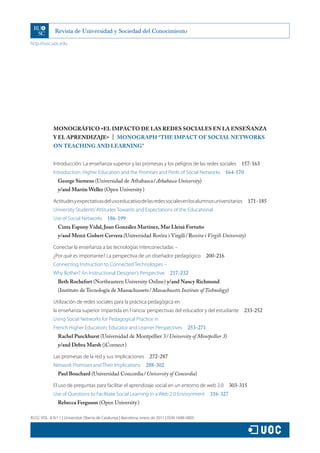
             Introducción: La enseñanza superior y las promesas y los peligros de las redes sociales 157-163
             Introduction: Higher Education and the Promises and Perils of Social Networks 164-170
               George Siemens (Universidad de Athabasca / Athabasca University)
               y/and Martin Weller (Open University )

             Actitudes y expectativas del uso educativo de las redes sociales en los alumnos universitarios 171 -185
             University Students’ Attitudes Towards and Expectations of the Educational
             Use of Social Networks 186-199
               Cinta Espuny Vidal, Juan González Martínez, Mar Lleixà Fortuño
               y/and Mercè Gisbert Cervera (Universidad Rovira i Virgili / Rovira i Virgili University)

             Conectar la enseñanza a las tecnologías interconectadas –
             ¿Por qué es importante? La perspectiva de un diseñador pedagógico 200-216
             Connecting Instruction to Connected Technologies –
             Why Bother? An Instructional Designer’s Perspective 217-232
               Beth Rochefort (Northeastern University Online) y/and Nancy Richmond
               (Instituto de Tecnología de Massachussets / Massachusetts Institute of Technology)

             Utilización de redes sociales para la práctica pedagógica en
             la enseñanza superior impartida en Francia: perspectivas del educador y del estudiante 233-252
             Using Social Networks for Pedagogical Practice in
             French Higher Education: Educator and Learner Perspectives 253-271
               Rachel Panckhurst (Universidad de Montpellier 3 / University of Montpellier 3)
               y/and Debra Marsh (iConnect )

             Las promesas de la red y sus implicaciones 272-287
             Network Promises and Their Implications               288-302
               Paul Bouchard (Universidad Concordia / University of Concordia)

             El uso de preguntas para facilitar el aprendizaje social en un entorno de web 2.0 303-315
             Use of Questions to Facilitate Social Learning in a Web 2.0 Environment 316-327
               Rebecca Ferguson (Open University )

RUSC VOL. 8 N.º 1 | Universitat Oberta de Catalunya | Barcelona, enero de 2011 | ISSN 1698-580X
http://rusc.uoc.edu


               Monográfico «El impacto de las redes sociales en la enseñanza y el aprendizaje»

               INTRODUCCIÓN

               La enseñanza superior
               y las promesas y los peligros
               de las redes sociales
               George Siemens
               gsiemens@gmail.com
               Universidad de Athabasca


               Martin Weller
               m.j.weller@open.ac.uk
               Profesor de Tecnología Educativa de la Open University


               Citación recomendada
               SIEMENS, George; WELLER, Martin (coord.) (2011). «El impacto de las redes sociales en la enseñanza
               y el aprendizaje» [monográfico en línea]. Revista de Universidad y Sociedad del Conocimiento (RUSC).
               Vol. 8, n.º 1, págs. 157-163. UOC. [Fecha de consulta: dd/mm/yy].
               <http://rusc.uoc.edu/ojs/index.php/rusc/article/view/v8n1-siemens-weller/v8n1-siemens-weller>
               ISSN 1698-580X


               En la última década ha tenido lugar una enorme innovación en el modo en que las personas se
               conectan en línea unas con otras. Las redes sociales han experimentado un rápido aumento de po-
               pularidad, y han generado tanto preocupaciones (privacidad, autoría del contenido) como oportu-
               nidades. Los artículos de esta revista pueden considerarse intentos de dar respuesta a una pregunta:
               ¿qué deberían hacer los educadores con respecto a las redes sociales? La llegada de las herramientas
               de orientación social, a menudo agrupadas bajo la etiqueta de web 2.0 o medios sociales, representa
               un dilema para la enseñanza superior. Los sitios de redes sociales (SNS; social network sites) pueden
               representar una ventaja para los estudiantes, ya que fomentan el diálogo entre compañeros, promue-
               ven la compartición de recursos, facilitan la colaboración y desarrollan destrezas de comunicación.

RUSC VOL. 8 N.º 1 | Universitat Oberta de Catalunya | Barcelona, enero de 2011 | ISSN 1698-580X
                                                                          157
  CC
       George Siemens y Martin Weller
http://rusc.uoc.edu                                                   La enseñanza superior y las promesas y los peligros de las redes sociales


               Todas ellas son características del aprendizaje en línea que los sistemas de gestión del aprendizaje
               (LMS; learning management systems) convencionales han intentado fomentar en la última década de
               adopción intensiva en la enseñanza superior. Los SNS, en cambio, parecen haberlo conseguido con
               una facilidad y una velocidad sorprendentes.
                    Espuny, González, Lleixà y Gisbert sugieren que los SNS se vean como herramientas constructi-
               vistas que cumplen los objetivos de los nuevos métodos participativos que se adoptan en el espacio
               europeo de educación superior (EEES). Mientras que las universidades a menudo tienen que esforzar-
               se para incrementar la adopción de sus LMS, les sucede lo contrario con los SNS, en el sentido que no
               pueden evitar que los estudiantes los utilicen durante las clases. En resumen, el potencial educativo
               de las redes sociales es «prácticamente ilimitado», pero las prácticas pedagógicas actuales a menudo
               no consiguen capturar este potencial, ya que el legado del modelo de flujo de información en un
               solo sentido utilizado en muchas aulas ralentiza la innovación.
                    Hitch, Richmond y Rochefort reconocen el impacto limitado que tienen las redes sociales en la
               enseñanza formal actual. En respuesta a eso, destacan la necesidad de que los educadores adquieran
               formación en la enseñanza y el aprendizaje en red. En particular, argumentan que el desarrollo de las
               destrezas del cuerpo docente en el uso efectivo de las redes sociales es una responsabilidad institu-
               cional. Del mismo modo que la enseñanza secundaria prepara a los estudiantes para participar en la
               sociedad, también debería preparar al personal académico y al profesorado para el nuevo mundo en
               red y conectado socialmente.
                    Internet ha alterado muchas de las relaciones de poder tradicionales en la enseñanza. Tareas que
               antes eran responsabilidad del cuerpo docente están ahora bajo el control de los estudiantes: buscar
               información, crear espacios de interacción, formar redes de aprendizaje, etc. Los estudiantes pueden
               acceder a contenido de profesores e investigadores líderes de todo el mundo mediante blogs, wikis,
               vídeo en línea, podcasts y recursos educativos abiertos. Gracias al uso de los medios sociales, los
               estudiantes tienen la capacidad de relacionarse e interactuar entre ellos (y en algunos casos, direc-
               tamente con investigadores y profesores). Panckhurst y Marsh exploran el impacto de la autonomía
               del estudiante en un proyecto de investigación de varios años, y argumentan la necesidad continua
               de los educadores de proporcionar una ayuda mínima y a menudo periférica. Curiosamente, los es-
               tudiantes perciben un curso en el que ellos gozan de un mayor control como un curso que propor-
               ciona una mayor ayuda y guía que un curso tradicional.
                    Bouchard analiza el gran impacto de las redes, yendo más allá de la enseñanza y el aprendizaje,
               para tratar nuevos modos de crecimiento del conocimiento. ¿Significa esto que el conocimiento es
               una entidad nueva en las redes de información? Según Bouchard, la naturaleza del mismo conoci-
               miento no ha cambiado. Sin embargo, como consecuencia de su participación en redes, los indivi-
               duos empiezan a descubrir «el valor de la incerteza y la fluidez» del conocimiento. La experiencia de
               la fluidez del conocimiento está relacionada con el viaje de «madurez epistémica» del individuo, y no
               necesariamente con los atributos del conocimiento. La distinción entre conocimiento personal y co-
               nocimiento dentro de un ámbito particular promete mucho diálogo y debate en el futuro a medida
               que los educadores exploren las redes sociales, el aprendizaje y el conocimiento.
                    ¿Qué tipo de pasos prácticos pueden dar los educadores para comenzar a cambiar las prácticas
               educativas para aprovechar las oportunidades generadas por las redes sociales? Ferguson ofrece

RUSC VOL. 8 N.º 1 | Universitat Oberta de Catalunya | Barcelona, enero de 2011 | ISSN 1698-580X
                                                                         158
  CC
       George Siemens y Martin Weller
http://rusc.uoc.edu                                                   La enseñanza superior y las promesas y los peligros de las redes sociales


               un enfoque equilibrado para el uso de preguntas para orientar a los estudiantes en ámbitos de pro-
               blemas poco definidos. Las preguntas pueden actuar como puntos de anclaje o como método de
               estructuración para guiar a los estudiantes. Sin embargo, plantear preguntas no es siempre un punto
               de partida adecuado, ya que los estudiantes «necesitan oportunidades de escoger y examinar un
               tema antes de poder formular las preguntas adecuadas».
                    Si uno ve el aprendizaje como una empresa principalmente social, como hacen muchas perso-
               nas, entonces las nuevas formas de socialización que las redes sociales permiten parecen hechas a
               medida para que se adopten en la enseñanza superior. Sin embargo, apenas hemos empezado a ex-
               plorar el impacto de las redes –sociales y tecnológicas– en la enseñanza y el aprendizaje. Todavía hay
               que realizar mucha investigación para estudiar de qué modo los SNS encajan mejor en la enseñanza.
               En particular, hay que tratar muchas tensiones crecientes, como, por ejemplo, las que hay entre el
               aprendizaje formal y el informal, los espacios de aprendizaje estructurados y los no estructurados,
               el control del estudiante y el del educador, el contenido abierto y cerrado y las redes sociales, y la
               privacidad y la seguridad en los SNS.
                    Espuny et al. se centran en un reto clave: los SNS más populares son los de carácter general, como
               Facebook, MySpace y Twitter. Los SNS específicos de la enseñanza prácticamente no se utilizan. Esto
               plantea el dilema al que se enfrenta la enseñanza superior: las redes sociales necesitan una masa
               crítica; funcionan por el efecto de las redes, por el cual el valor de una tecnología aumenta cuanta
               más gente la utiliza. Esto genera un efecto de refuerzo positivo: cuanta más gente utilice un servicio,
               más útil lo encontrarán sus usuarios, de modo que lo recomendarán y añadirán a más usuarios. Lo
               contrario es también cierto: si no hay los usuarios suficientes, el valor de una herramienta social no
               se manifiesta y los usuarios se van a otra parte. ¿Deberían los educadores crear redes sociales espe-
               cíficamente para la enseñanza y el aprendizaje (utilizando herramientas como Elgg, por ejemplo) o
               deberían aprovechar herramientas como Twitter y Facebook para usos académicos?
                    Además del efecto de las redes, una segunda cuestión para la enseñanza superior es que los
               SNS que gozan de aceptación parecen combinar la vida personal con la privada; no las separan.
               Algunos usuarios de Twitter procuran tener varias cuentas, por ejemplo, para separar los comentarios
               personales de los profesionales, pero es precisamente el elemento personal en los SNS lo que les
               aporta valor e interés. Si extraemos este elemento, se obtiene como resultado un conjunto más bien
               aburrido y anodino de comunicaciones que no tiene nada que ver con las formas de diálogo que se
               encuentran en estos espacios, que mezclan humor, compartición de recursos, ideas, observaciones
               personales, actualizaciones profesionales y comentarios.
                    Al construir entornos de aprendizaje en línea, la mayoría de universidades han utilizado el campus
               físico como modelo, e incluso el LMS de Boddington (boddington.org) representa el campus como una
               metáfora visual para la navegación. Igual que sucede en un campus, muchos LMS hacen la distinción
               entre los espacios sociales y la enseñanza formal; así pues, habrá áreas de curso y áreas de chat en foros
               del LMS, del mismo modo que hay bares de estudiantes y aulas en un campus. Los SNS borran la distin-
               ción y parecen sugerir que mezclar todos los tipos de actividades puede ser útil. No es que los SNS no
               tengan estructura; por supuesto que la tienen. La estructura de las redes sociales, como era de esperar,
               tiene forma de red. Los problemas y las tensiones aparecen cuando la estructura de las redes entra en
               conflicto con la estructura jerárquica de la enseñanza tradicional. Las redes se definen por atributos de

RUSC VOL. 8 N.º 1 | Universitat Oberta de Catalunya | Barcelona, enero de 2011 | ISSN 1698-580X
                                                                         159
  CC
       George Siemens y Martin Weller
http://rusc.uoc.edu                                                   La enseñanza superior y las promesas y los peligros de las redes sociales


               autonomía, resistencia reducida al flujo de información, facilidad de conexión, crecimiento orgánico,
               iteración rápida y mejora de ideas y conceptos, además de facilidad de escalabilidad. Estos atributos
               son antitéticos con el modelo existente de enseñanza superior, en el que la estructura se define por la
               centralidad del educador y el flujo de contenido estructurado y normalmente en un solo sentido.
                    No obstante, las redes de aprendizaje sociales no son entornos de aprendizaje explícitos, y a me-
               nudo es así de forma deliberada. Incluso los usuarios de Facebook que asisten a la universidad no las
               utilizan mucho para propósitos educativos. Selwyn (2007) analizó más de 68.000 entradas de muros
               de Facebook hechas por estudiantes y descubrió que los intercambios educativos y los relacionados
               con la universidad representaban un pequeño porcentaje del tráfico. Los estudiantes, como todo el
               mundo, utilizan los SNS esencialmente para conversaciones sociales. Existe una fuerte resistencia por
               parte de los estudiantes a universidades y profesores que hacen un uso formal de los SNS, ya que lo
               consideran una invasión de su espacio social (por ejemplo, Madge et al., 2009). Cuando los padres y
               los profesores comienzan a habitar los SNS, para los estudiantes se crea un conflicto de roles (Selwyn,
               2009), ya que tienen dudas sobre qué imagen presentar y ello condiciona la comunicación. Estas
               herramientas tienen un enorme potencial para el aprendizaje, pero los estudiantes no quieren que
               se conviertan en los próximos LMS: organizativamente controladas, aburridas y con un solo objetivo
               (a saber, la enseñanza). Así pues, ¿de qué modo pueden los educadores utilizar el potencial de estas
               herramientas sin destruir lo que las hace valiosas para los estudiantes? En resumen, las universidades
               tienen que encontrar un modo de evitar el fenómeno creepy treehouse (Stein, 2008), el fenómeno que
               se observa cuando la autoridad intenta invadir el espacio social de una persona joven.
                    Los artículos contenidos en este número de la revista se centran principalmente en las posibi-
               lidades pedagógicas de los SNS evitando invadir los espacios sociales del estudiante. Uno de los
               enfoques efectivos es no utilizarlo para transmitir información, ni para controlar el aprendizaje, sino
               más bien para facilitar la interacción con el estudiante y fomentar el diálogo educativo. Y aún así,
               deberíamos estar al corriente del contexto dentro del que se utilizan estas herramientas. Una de las
               cuestiones más delicadas acerca de los SNS en la enseñanza superior es que estos atraen a los estu-
               diantes precisamente porque no están controlados como lo está un LMS. Pero esta falta de control
               plantea una serie de cuestiones, particularmente si una universidad promueve el uso de un SNS de
               un tercero. El hecho de promover el uso de los SNS plantea una serie de cuestiones de política para
               las universidades, incluidas las siguientes.


                    •	 ¿La promoción de un SNS en particular comporta la aprobación de este? Por ejemplo, ¿una
                       universidad tendrá que justificar la elección de Facebook por encima de Twitter o un sitio de
                       red basado en grupos como Ning?
                    •	 ¿Hasta qué punto promover un SNS implica tener que proporcionar asistencia? Si una univer-
                       sidad promueve el uso de un SNS y los estudiantes experimentan problemas, ¿hay una obliga-
                       ción por parte de la universidad de ofrecer asistencia técnica?
                    •	 ¿Son las universidades responsables de la actividad llevada a cabo con un SNS escogido? Por
                       ejemplo, si una universidad promueve el uso de un SNS en particular y posteriormente un es-
                       tudiante acosa a otro estudiante en ese espacio, ¿hasta qué punto es asunto y responsabilidad
                       de la universidad?

RUSC VOL. 8 N.º 1 | Universitat Oberta de Catalunya | Barcelona, enero de 2011 | ISSN 1698-580X
                                                                         160
  CC
       George Siemens y Martin Weller
http://rusc.uoc.edu                                                   La enseñanza superior y las promesas y los peligros de las redes sociales


                    •	 ¿La responsabilidad por las cuestiones de privacidad recae sobre la universidad o sobre el
                       SNS? Ha habido muchos problemas acerca de la privacidad en los SNS, particularmente en
                       Facebook, pero si un estudiante se ve obligado a utilizar este sitio para su estudio, ¿la univer-
                       sidad está aceptando estas políticas de privacidad aunque estén en conflicto con sus propias
                       políticas?
                    •	 ¿El hecho de promover el uso de un SNS en particular lo convierte en obligatorio? ¿Los estu-
                       diantes estarán en desventaja si deciden no utilizarlo?


               Una agenda de investigación emergente

               La próxima fase de investigación y adopción de SNS en la enseñanza superior será solucionar es-
               tas cuestiones de un modo que no sea demasiado burocrático ni dificultoso para los estudiantes
               y los educadores. Las redes sociales son espacios personales en los que los estudiantes comparten
               sus intereses, aficiones, filias y fobias mediante su perfil. Las conexiones que forman los estudiantes
               pueden revelar creencias e intereses personales (las redes sociales tienen un efecto de «dios los cría
               y ellos se juntan» en el que los usuarios se juntan con otros usuarios que comparten sus puntos
               de vista e intereses). Esto presenta una tarea difícil para los educadores: utilizar redes sociales para
               aumentar la conciencia y el cuestionamiento crítico de los estudiantes sobre lo que implica estar
               conectado y sobre qué revela un gráfico social sobre una persona, y al mismo tiempo permitir a los
               estudiantes explorar y definir su propio espacio social. Esta no es una tarea fácil. Los educadores des-
               empeñan un papel a la hora de despertar conciencias sobre las presunciones ocultas de la sociedad
               y la información, pero hacerlo en redes sociales personales exige un equilibrio delicado.
                    Este número de RUSC ofrece una visión del papel actual de los SNS en la enseñanza. Será intere-
               sante revisitar el uso continuado de SNS en la próxima década, particularmente para la generación
               de estudiantes que ahora asiste a la universidad y que representa la primera ola de usuarios que
               combinan estas redes en línea informales con enseñanza formal. A medida que estas personas en-
               tren en el mercado laboral, ¿serán las redes que han establecido en los SNS un elemento esencial en
               su vida laboral? ¿Seguirán su aprendizaje continuo por medio de estas redes o las utilizarán sólo para
               mantener el contacto? Dados los altos niveles de adopción de las redes sociales en la enseñanza, este
               podría ser el próximo grupo de preguntas que los educadores y los investigadores tendrán que tratar
               mientras los SNS difuminan la frontera entre la enseñanza forma y la informal.


               Bibliografía

               MADGE, C.; MEEK, J.; WELLENS, J.; HOOLEY, T. (2009). «Facebook, social integration and informal lear-
                    ning at university: “It is more for socialising and talking to friends about work than for actually
                    doing work”». Learning, Media and Technology. Vol. 34, n.o 2, págs. 141-55.


RUSC VOL. 8 N.º 1 | Universitat Oberta de Catalunya | Barcelona, enero de 2011 | ISSN 1698-580X
                                                                          161
  CC
       George Siemens y Martin Weller
http://rusc.uoc.edu                                                   La enseñanza superior y las promesas y los peligros de las redes sociales


               SELWYN, N (2007). «“Screw Blackboard... do it on Facebook!”: an investigation of students’ educational
                    use of Facebook». Ponencia. En: Poke 1.0 - Facebook social research symposium. Londres: University
                    of London, 15 de noviembre de 2000.
               SELWYN, N. (2009). «Faceworking: exploring students’ education-related use of Facebook». Learning,
                    Media and Technology. Vol. 34, n.o 2, págs. 157-74.
                    STEIN, J (2008). «Defining Creepy Treehouse» [artículo de blog].
                    <http://flexknowlogy.learningfield.org/2008/04/09/defining-creepy-tree-house/>


                   Sobre los autores

                   George Siemens
                   gsiemens@gmail.com
                   Universidad de Athabasca

                   George Siemens es escritor, teórico, ponente e investigador sobre aprendizaje, redes, tecnología,
                   análisis y visualización, apertura y eficiencia organizacional en entornos digitales. Es autor de Knowing
                   Knowledge, un estudio sobre cómo han cambiado el contexto y las características del conocimiento
                   y qué significa esto para las organizaciones de hoy en día, y Handbook of Emerging Technologies for
                   Learning. Siemens actualmente es investigador y estratega en el Instituto de Investigación de Cono-
                   cimiento Mejorado por la Tecnología en la Universidad de Athabasca. Anteriormente, fue director
                   asociado, de Investigación y Desarrollo, en el Centro de Tecnologías Educativas en la Universidad de
                   Manitoba.
                       Junto con otros investigadores, Siemens ha sido precursor de los cursos conectivistas abiertos en
                   los que han participado miles de educadores y estudiantes. Es un ponente principal habitual en con-
                   gresos, donde detalla la influencia de la tecnología y los medios en la enseñanza, las organizaciones
                   y la sociedad, y ha presentado varios congresos en más de 30 países. Se ha reseñado su trabajo en
                   periódicos provinciales, nacionales e internacionales, en radio y televisión. Siemens mantiene el blog
                   elearnspace (www.elearnspace.org/blog) desde hace diez años y www.connectivism.ca desde hace
                   cinco. En www.elearnspace.org/about.htm está disponible información adicional.

                   Athabasca University
                   1 University Drive
                   Athabasca, AB T9S 3A3
                   Canadá


RUSC VOL. 8 N.º 1 | Universitat Oberta de Catalunya | Barcelona, enero de 2011 | ISSN 1698-580X
                                                                         162
  CC
       George Siemens y Martin Weller
http://rusc.uoc.edu                                                         La enseñanza superior y las promesas y los peligros de las redes sociales


                   Martin Weller
                   m.j.weller@open.ac.uk
                   Profesor de Tecnología Educativa de la Open University

                   Martin Weller trabaja en una serie de proyectos en la Open University. Su área de interés general es el
                   aprendizaje electrónico. Fue director del proyecto del entorno de aprendizaje virtual (VLE; virtual lear-
                   ning environment) de la Open University y actualmente trabaja en el área de diseño de aprendizaje,
                   VLE, contenido abierto y tecnologías web 2.0. Es director del máster de Aprendizaje en la Economía
                   Conectada (H806). Este fue el primer curso de la Open University que se desarrolló estrictamente a
                   base de objetos de aprendizaje. La mayor parte de su investigación entra en la amplia categoría del
                   aprendizaje electrónico. Sus intereses particulares son los VLE, el diseño del aprendizaje, las arquitec-
                   turas orientadas al servicio, el contenido abierto, los objetos de aprendizaje y las nuevas tecnologías
                   en la enseñanza.

                   Página de Martin Weller en la Open University: http://iet.open.ac.uk/people/m.j.weller

                   Blog de Martin Weller: http://nogoodreason.typepad.co.uk/

                   Institute of Educational Technology
                   The Open University
                   Walton Hall
                   Milton Keynes
                   MK7 6AA
                   Reino Unido


                                        Los textos publicados en esta revista están sujetos –si no se indica lo contrario– a una licencia de Reconoci-
                                        miento 3.0 España de Creative Commons. Puede copiarlos, distribuirlos, comunicarlos públicamente y hacer
                                        obras derivadas siempre que reconozca los créditos de las obras (autoría, nombre de la revista, institución
                                        editora) de la manera especificada por los autores o por la revista. La licencia completa se puede consultar en
                                        http://creativecommons.org/licenses/by/3.0/es/deed.es.


RUSC VOL. 8 N.º 1 | Universitat Oberta de Catalunya | Barcelona, enero de 2011 | ISSN 1698-580X
                                                                                 163
  CC
       George Siemens y Martin Weller
http://rusc.uoc.edu


               Monograph “The Impact of Social Networks on Teaching and Learning”

               INTRODUCTION

               Higher Education
               and the Promises and Perils
               of Social Networks
               George Siemens
               gsiemens@gmail.com
               Athabasca University


               Martin Weller
               m.j.weller@open.ac.uk
               Professor of Educational Technology of the Open University


               Recommended citation
               SIEMENS, George; WELLER, Martin (coord.) (2011). “The Impact of Social Networks on Teaching and
               Learning” [online monograph]. Revista de Universidad y Sociedad del Conocimiento (RUSC). Vol. 8, No 1,
               pp. 164-170. UOC. [Accessed: dd/mm/yy].
               <http://rusc.uoc.edu/ojs/index.php/rusc/article/view/v8n1-siemens-weller/v8n1-siemens-weller-
               eng>
               ISSN 1698-580X


               The last decade has produced tremendous innovation in how people connect with one another
               online. Social networks have experienced a rapid increase in popularity, producing both concerns
               (privacy, content ownership) and opportunities. The articles in this journal can be viewed as attempts
               to answer the question: What should educators do about social networks? The advent of socially
               oriented tools, often grouped together under the Web 2.0 or social media banner, represents
               something of a dilemma for higher education. Social network sites (SNSs) can be a real benefit
               for learners as they encourage peer-to-peer dialogue, promote the sharing of resources, facilitate
               collaboration, and develop communication skills. These are all features of online learning that
               conventional learning management systems (LMSs) have struggled to realize over the past decade

RUSC VOL. 8 No 1 | Universitat Oberta de Catalunya | Barcelona, January 2011 | ISSN 1698-580X
                                                                         164
  CC
       George Siemens and Martin Weller
http://rusc.uoc.edu                                                            Higher Education and the Promises and Perils of Social Networks


               of intensive adoption in higher education. Yet SNSs seem to have accomplished this with remarkable
               ease and speed.
                    Espuny, González, Lleixà and Gisbert suggest that SNSs can be seen as constructivist tools and
               ones which meet the aims of the new participatory methods being adopted in the European Higher
               Education Area (EHEA). While universities often struggle to increase adoption of their LMSs, they have
               the opposite problem with SNSs in that they cannot stop students using them during lectures. In
               short, the educational potential of social networks are “practically endless”, but current pedagogical
               practices often fail to capture this potential as the legacy of the one-way information flow model of
               many lecture halls and classrooms slows innovation.
                    Hitch, Richmond and Rochefort recognize the limited impact of social networks in formal
               education today. In response, they emphasize the need for educators to be skilled in networked
               teaching and learning. In particular, they argue that faculty skill development in effective use of social
               networks is an institutional responsibility. Much like higher education prepares learners to participate
               in society; it should also prepare staff and faculty for the new socially connected and networked world.
                    The Internet has altered many of the traditional power relations in education. Tasks that were
               previously the domain of faculty are now under the control of learners: searching for information,
               creating spaces of interaction, forming learning networks, and so on. Through blogs, wikis, online
               video, podcasts and open educational resources, learners are able to access content from leading
               lecturers and researchers around the world. Through the use of social media, learners are able to
               engage and interact with each other (and in some cases, directly with researchers and faculty).
               Panckhurst and Marsh explore the impact of learner autonomy in a multi-year research project,
               addressing the continued need for educators to provide soft, often peripheral, support. Surprisingly,
               learners perceive a course in which they have increased control as one that provides greater support
               and guidance than a traditional course.
                    Bouchard discusses the broad impact of networks, moving beyond teaching and learning
               to address new modes of knowledge growth. Does this mean that knowledge is a new entity in
               information networks? According to Bouchard, the nature of knowledge itself has not changed.
               Instead, as a consequence of participating in networks, individuals are beginning to discover “the
               value of uncertainty and fluidity” of knowledge. The experience of knowledge fluidity is related to
               the individual’s journey of “epistemic maturity”, and not necessarily to the attributes of knowledge.
               The distinction between personal knowledge and knowledge within a particular domain is one that
               promises much dialogue and debate in the future as educators explore social networks, learning and
               knowledge.
                    What types of practical steps can educators take to begin changing teaching practices to account
               for the opportunities generated by social networks? Ferguson offers a balanced approach to the
               use of questions in orienting learners to ill-defined problem domains. Questions can serve as an
               anchoring point or as a structuring method to guide learners. However, questioning is not always an
               appropriate starting point as learners “need opportunities to choose and examine a topic before they
               can start asking appropriate questions”.
                    If one views learning as a largely social enterprise, as many do, then the new forms of socialization
               that social networks afford seem ready-made for adoption into higher education. We are, however,

RUSC VOL. 8 No 1 | Universitat Oberta de Catalunya | Barcelona, January 2011 | ISSN 1698-580X
                                                                         165
  CC
       George Siemens and Martin Weller
http://rusc.uoc.edu                                                            Higher Education and the Promises and Perils of Social Networks


               still early in exploring the impact of networks – social and technological – on teaching and learning.
               Much research needs to be conducted to explore how SNSs best fit into education. In particular,
               many rising tensions need to be addressed including: formal and informal learning, structured and
               unstructured learning spaces, learner and educator control, openness and closed content and social
               networks, and privacy and security in SNSs.
                    Espuny et al. draw attention to a key challenge: the most popular SNSs are the general ones, such
               as Facebook, MySpace and Twitter. Education-specific SNSs are almost entirely unused. This points
               to the dilemma facing higher education: social networks require a critical mass, they operate by the
               network effect, whereby the value of a technology increases as more people use it. This generates a
               positive reinforcement effect: the more people use a service then the more useful those users find
               it, thus recommending it and adding more users. The opposite is also true: without sufficient users
               the value of a social tool is not realized and users move elsewhere. Should educators create social
               networks specifically for teaching and learning (using tools such as Elgg, for example) or should they
               appropriate popular tools such as Twitter and Facebook for academic uses?
                    As well as the network effect, a second issue for higher education is that successful SNSs seem
               to blend personal and professional life; they do not separate them out. Some users of Twitter try to
               have multiple accounts for instance, to differentiate personal and professional comments, but it is
               precisely the personal element in SNSs that gives them value and interest. If this is removed, the result
               is a fairly dry, bland set of communications that seems at odds with the forms of dialogue found in
               these spaces that mix humour, resource sharing, ideas, personal observations, professional updates
               and comments.
                    When constructing online learning environments most universities have used the physical
               campus as a model, with the Boddington LMS (boddington.org) even representing this as a visual
               metaphor for navigation. Just as with a campus, many LMSs make a distinction between social
               spaces and formal education; thus there will be course areas and chat areas in LMS forums, just
               as there are student bars and lecture halls on campus. SNSs blur this distinction and seem to
               suggest that mixing all sorts of activity together can be useful. It is not that SNSs do not have
               structure; obviously they do. The structure of social networks is, not surprisingly, networked.
               Conflicts and tensions arise as the structure of networks clashes with the hierarchical structure
               of traditional education. Networks are defined by attributes of autonomy, reduced resistance to
               information flow, ease of connectivity, organic growth, rapid iteration and improvement of ideas
               and concepts, as well as ease of scalability. These attributes are antithetical to the existing model of
               higher education, where structure is defined by the centrality of the educator and the structured,
               generally one-way flow of content.
                    However, social learning networks are not explicit learning environments, often deliberately so.
               Even users of Facebook who are actually attending university do not make much use of them for
               direct educational purposes. Selwyn (2007) analyzed over 68,000 Facebook wall postings by students
               and found that education and university-related exchanges accounted for only a small proportion
               of the traffic. Students, like everyone else, use SNSs primarily for social conversations. There is strong
               resistance from students to universities and lecturers making formal use of SNSs, as this is seen as an
               invasion of their social space (e.g. Madge et al., 2009). When parents and professors start inhabiting

RUSC VOL. 8 No 1 | Universitat Oberta de Catalunya | Barcelona, January 2011 | ISSN 1698-580X
                                                                         166
  CC
       George Siemens and Martin Weller
http://rusc.uoc.edu                                                            Higher Education and the Promises and Perils of Social Networks


               SNSs, it creates a role conflict (Selwyn, 2009) for students, as they struggle to know which face to
               present and find their communication stifled. These tools have huge potential for learning, but
               students do not want them to become the next LMS: organizationally controlled, bland and singular
               in focus (i.e. teaching). How best, then, can educators utilize the potential of these tools without
               destroying what makes them valuable to students? In short, universities need to find a way of
               avoiding the “creepy treehouse” phenomenon (Stein 2008), when authority is seen to try and invade
               a young person’s social space.
                    The articles in this journal are focused mainly on the pedagogic possibilities of SNSs so as to
               avoid encroaching on learner social spaces. One of the effective approaches is not to use it to
               broadcast information, and not to control learning, but rather to facilitate student interaction and
               to encourage learning dialogue. Even then, we should remain cognizant of the context within
               which these tools are used. One of the more subtle dilemmas around the use of SNSs in higher
               education is that they appeal to students precisely because they are not controlled in the same
               manner as an LMS. But this lack of control raises a set of issues, particularly if a university endorses
               the use of a third party SNS. The promotion of the use of SNSs raises a number of policy issues for
               universities, including:


                    •	 Does the promotion of a particular SNS represent endorsement? For example, will a university
                      have to justify its choice of Facebook over Twitter or a group-based network site such as Ning?
                    •	 To what extent does promotion suggest support? If a university promotes the use of one SNS
                      and students encounter problems, is there an obligation on the university to offer technical
                      support?
                    •	 Are universities responsible for activity with a chosen SNS? For example, if a university promotes
                      the use of a particular SNS and subsequently another student bullies a student in that space, to
                      what extent is this the concern and responsibility of the university?
                    •	 Is the university or the SNS responsible for privacy issues? There have been many problems
                      surrounding privacy in SNSs, particularly with Facebook, yet if a student feels obliged to use
                      such a site for their study, is the university in effect endorsing these privacy policies which may
                      be in conflict with its own?
                    •	 Does the promotion of a particular SNS make it obligatory? Will students be disadvantaged if
                      they elect not to use it?


               An emerging research agenda

               Resolving some of these issues in a manner that does not become overly bureaucratic and
               burdensome for students and educators will be the next phase of SNS research and adoption in
               higher education. Social networks are personal spaces where learners share their interests, hobbies,
               likes and dislikes through their profile. The connections that learners form can also review personal
               beliefs and interests (social networks have a “birds of a feather” effect where we gather with others
               who share our views and interests). This presents a difficult task for educators: using social networks

RUSC VOL. 8 No 1 | Universitat Oberta de Catalunya | Barcelona, January 2011 | ISSN 1698-580X
                                                                         167
  CC
       George Siemens and Martin Weller
http://rusc.uoc.edu                                                            Higher Education and the Promises and Perils of Social Networks


               to enlarge learners’ awareness and critical inquiry of the impact of being connected and what a social
               graph reveals of a person, while simultaneously permitting learners to explore and define their own
               social space. This is not an easy task. Educators play a role in raising awareness of hidden assumptions
               of society and information, but doing so in personal social networks is a tricky balance.
                    This issue of RUSC offers a glimpse into the current role of SNSs in education. What will be
               interesting will be to revisit the continued use of SNSs in a decade, particularly for the generation
               of students who are now going through university and represent the first wave of users who are
               combining these informal online networks with formal education. As they move into the work force,
               will the networks they have established on SNSs become a vital element in their working life? Will
               their ongoing learning be realized through these networks, or will they be used for just staying in
               touch? Given the high levels of adoption of social networks in education, these may be the next set
               of questions that educators and researchers need to address as SNSs blur the boundary between
               formal and informal education.


               References

               MADGE, C.; MEEK, J.; WELLENS, J.; HOOLEY, T. (2009). “Facebook, social integration and informal
                    learning at university: ‘It is more for socialising and talking to friends about work than for actually
                    doing work’”. Learning, Media and Technology, Vol. 34, No 2, pages 141-55.
               SELWYN, N (2007). “‘Screw Blackboard... do it on Facebook!’: an investigation of students’ educational
                    use of Facebook”. Paper presented to the Poke 1.0 - Facebook social research symposium, University
                    of London, 15 November 2000.
               SELWYN, N. (2009). “Faceworking: exploring students’ education-related use of Facebook”. Learning,
                    Media and Technology, Vol. 34, No 2, pages 157-74.
               STEIN, J (2008). “Defining Creepy Treehouse” [blog post].
                    <http://flexknowlogy.learningfield.org/2008/04/09/defining-creepy-tree-house/>


RUSC VOL. 8 No 1 | Universitat Oberta de Catalunya | Barcelona, January 2011 | ISSN 1698-580X
                                                                         168
  CC
       George Siemens and Martin Weller
http://rusc.uoc.edu                                                            Higher Education and the Promises and Perils of Social Networks


                  About the Authors
                  George Siemens
                  gsiemens@gmail.com
                  Athabasca University

                  George Siemens is a writer, theorist, speaker and researcher on learning, networks, technology, analytics
                  and visualization, openness and organizational effectiveness in digital environments. He is the author
                  of Knowing Knowledge, an exploration of how the context and characteristics of knowledge have
                  changed and what it means to organizations today, and the Handbook of Emerging Technologies for
                  Learning. Siemens is currently a researcher and strategist with the Technology Enhanced Knowledge
                  Research Institute at Athabasca University. Previously, he was the associate director, Research and
                  Development, with the Learning Technologies Centre at University of Manitoba.
                      Together with other researchers, Siemens has pioneered open connectivist courses that have
                  included thousands of educators and students as participants. He is a frequent keynote speaker
                  at conferences detailing the influence of technology and media on education, organizations and
                  society, having presented at numerous conferences in more than 30 countries. His work has been
                  profiled in provincial, national, and international newspapers, radio and television. Siemens has
                  maintained the elearnspace blog (www.elearnspace.org/blog) for ten years and www.connectivism.
                  ca for five years. Additional background information is available at www.elearnspace.org/about.htm.

                  Athabasca University
                  1 University Drive
                  Athabasca, AB T9S 3A3
                  Canada


RUSC VOL. 8 No 1 | Universitat Oberta de Catalunya | Barcelona, January 2011 | ISSN 1698-580X
                                                                         169
  CC
       George Siemens and Martin Weller
http://rusc.uoc.edu                                                                   Higher Education and the Promises and Perils of Social Networks


                  Martin Weller
                  m.j.weller@open.ac.uk
                  Professor of Educational Technology of the Open University

                  Martin Weller works on a number of projects at the Open University (OU). His general area of interest
                  is e-learning. He was the OU VLE project director and is currently working in the area of learning
                  design, VLEs, open content and Web 2.0 technologies. He chairs the master’s degree course in
                  Learning in the Connected Economy (H806). It was the first OU course to be developed purely as
                  learning objects. Most of his research falls under the broad category of e-learning. His particular
                  interests are VLEs, learning design, service-oriented architectures, open content, learning objects and
                  new technologies in education.

                  Martin Weller’s page at the OU: http://iet.open.ac.uk/people/m.j.weller

                  Martin Weller’s blog: http://nogoodreason.typepad.co.uk/

                  Institute of Educational Technology
                  The Open University
                  Walton Hall
                  Milton Keynes
                  MK7 6AA
                  United Kingdom


                                      The texts published in this journal are – unless indicated otherwise – covered by the Creative Commons
                                      Spain Attribution 3.0 licence. You may copy, distribute, transmit and adapt the work, provided you attribute it
                                      (authorship, journal name, publisher) in the manner specified by the author(s) or licensor(s). The full text of the
                                      licence can be consulted here: http://creativecommons.org/licenses/by/3.0/es/deed.en.


RUSC VOL. 8 No 1 | Universitat Oberta de Catalunya | Barcelona, January 2011 | ISSN 1698-580X
                                                                                170
  CC
       George Siemens and Martin Weller
http://rusc.uoc.edu


                Monográfico «El impacto de las redes sociales en la enseñanza y el aprendizaje»

                ARTÍCULO

                Actitudes y expectativas
                del uso educativo de las
                redes sociales en los alumnos
                universitarios
                Cinta Espuny Vidal1
                Profesora del Departamento de Pedagogía, Campus Terres de l’Ebre, Universidad Rovira i Virgili


                Juan González Martínez
                Profesor del Departamento de Pedagogía, Campus Terres de l’Ebre, Universidad Rovira i Virgili


                Mar Lleixà Fortuño
                Profesora del Departamento de Enfermería, Campus Terres de l’Ebre, Universidad Rovira i Virgili


                Mercè Gisbert Cervera
                Profesora del Departamento de Pedagogía, Universidad Rovira i Virgili


                                                                                                  Fecha de presentación: mayo de 2010
                                                                                                  Fecha de aceptación: octubre de 2010
                                                                                                   Fecha de publicación: enero de 2011


                Cita recomendada
                ESPUNY, Cinta; GONZÁLEZ, Juan; LLEIXÀ, Mar; GISBERT, Mercè (2011). «Actitudes y expectativas
                del uso educativo de las redes sociales en los alumnos universitarios». En: «El impacto de las redes
                sociales en la enseñanza y el aprendizaje» [monográfico en línea]. Revista de Universidad y Sociedad del
                Conocimiento (RUSC). Vol. 8, n.º 1, págs. 171-185. UOC. [Fecha de consulta: dd/mm/aa].
                <http://rusc.uoc.edu/ojs/index.php/rusc/article/view/v8n1-espuny-gonzalez-lleixa-gisbert/v8n1-
                espuny-gonzalez-lleixa-gisbert>
                ISSN 1698-580X


                1. Los doctores Cinta Espuny, Juan González y Mercè Gisbert pertenecen al grupo de investigación ARGET (Applied Research
                   Group in Education and Technology), de la Universidad Rovira i Virgili, cuyo identificador es 2009 SGR 596.


RUSC VOL. 8 N.º 1 | Universitat Oberta de Catalunya | Barcelona, enero de 2011 | ISSN 1698-580X
                                                                          171
  CC
       Cinta Espuny, Juan González, Mar Lleixà y Mercè Gisbert
http://rusc.uoc.edu                                                             Actitudes y expectativas del uso educativo de las redes sociales…


                Resumen
                Las redes sociales, que en los últimos años han supuesto una auténtica revolución en la forma de
                relacionarse, todavía siguen siendo algo poco presente en el ámbito académico: las ocasiones en
                que se utilizan son aisladas y pocas gozan de continuidad. En ese contexto, pretendemos reflexionar
                acerca de la actitud que los propios estudiantes tienen con respecto del uso, del aprovechamiento
                didáctico y de las potencialidades que las redes sociales presentan en el ámbito educativo. Para esta
                reflexión nos hemos valido de una encuesta realizada entre los estudiantes. La intención es que el
                estudio de esta actitud inicial sea el paso previo necesario para hallar las claves para que el alumnado
                acepte y materialice el potencial educativo de las redes sociales.

                Palabras clave
                tecnologías de la educación, redes sociales, expectativas, enseñanza superior


                University Students’ Attitudes Towards and Expectations
                of the Educational Use of Social Networks
                Abstract
                In the last few years, social networks have revolutionised the way in which many people relate to each
                other, but their use is still very limited in the academic field. When they are used, the experiences tend to
                be very isolated and lacking in continuity. In this context, and by means of a questionnaire, our objective is
                to bring an element of reflection on students’ attitudes towards the use of social networks in general, and
                their use and potential in an educational context in particular. The aim is to compel students to think about
                these attitudes as a vital first step in getting them to accept and realise the educational potential of social
                networks.

                Keywords
                education technology, social networks, expectations, higher education


RUSC VOL. 8 N.º 1 | Universitat Oberta de Catalunya | Barcelona, enero de 2011 | ISSN 1698-580X
                                                                          172
  CC
       Cinta Espuny, Juan González, Mar Lleixà y Mercè Gisbert
http://rusc.uoc.edu                                                             Actitudes y expectativas del uso educativo de las redes sociales…


                1. Introducción

                Los programas que permiten la interacción de las virtual social networks, conocidas comúnmente
                como redes sociales, han supuesto en los últimos años una auténtica revolución, tanto por su rápida
                generalización como por la extensión de sus aplicaciones ulteriores; se trata de una revolución acaso
                sólo comparable con la aparición y la popularización del correo electrónico, debido a su poder para
                modificar las relaciones humanas por medio de la red. Así, las redes sociales han ido convirtiéndose
                en poderosos espacios de interacción entre diferentes grupos sociales, algunos cada vez más es-
                pecializados, donde es posible ir conociendo a personas que comparten unos mismos intereses o
                reencontrarse con ellas.
                    En el caso concreto de la aplicación de estos recursos al mundo de la educación, debemos re-
                conocer que, gracias a la web 2.0 y a su especial hincapié en las dinámicas sociales, se ha favorecido
                la creación de comunidades virtuales de aprendizaje y de multitud de redes de colaboración entre
                iguales (García Sans, 2008), redes concebidas según los principios de reciprocidad y cooperación
                (Cobo y Pardo, 2007, pág. 103) que aprovechan el tirón que tienen servicios como Facebook, Twitter
                y otros similares.
                    Las redes sociales pueden definirse, lato sensu, como asociaciones de personas ligadas por mo-
                tivos heterogéneos y que conforman una estructura compuesta por nodos unidos entre ellos por
                más de un tipo de relación (Hernández 2008, pág. 30). Y, en el contexto que nos ocupa, los servicios
                web de redes sociales vendrían a concretar esta definición general permitiendo que personas con
                intereses comunes se pongan en contacto a través de la red, y exploten conjuntamente recursos
                como el establecimiento de subgrupos, la mensajería pública o privada o el chat, entre otros. El
                origen de estos programas informáticos es tan heterogéneo como ellos mismos: algunos, como
                Facebook, nacieron para apoyar a distintas congregaciones de alumnos en los campus norteame-
                ricanos, mientras que otros son de corte más profesional, como LinkedIn, orientada a establecer
                contactos de tipo laboral y comercial mediante lo que llamamos networking (Esteve, 2009, pág. 64;
                Santamaría, 2008).
                    Las redes sociales, por encima de cualquier otra consideración, tienen mucho que ver con las
                nuevas metodologías activas y participativas que de modo masivo se están adoptando en el espacio
                europeo de educación superior (EEES) y, en especial, con el denominado trabajo colaborativo, enten-
                dido como el intercambio y el desarrollo de conocimiento por parte de grupos reducidos de iguales,
                orientados a la consecución de idénticos fines académicos (García Sans, 2008, pág. 1), y también
                podrían funcionar como plataforma de consolidación de determinadas comunidades de aprendiza-
                je. Tienen, además, mucho que ver con el trabajo colaborativo, en esencia porque la mayoría de las
                potencialidades de las redes sociales resultan plenamente útiles si se ponen al servicio de las ven-
                tajas de esta metodología de aprendizaje, entre las que destacamos las siguientes (Martín-Moreno,
                2004): el trabajo colaborativo incrementa la motivación; favorece mayores niveles de rendimiento
                académico, puesto que el aprendizaje individual y el grupal se retroalimentan; mejora la retención
                de lo aprendido; potencia el pensamiento crítico; multiplica la diversidad de los conocimientos y las
                experiencias que se adquieren.

RUSC VOL. 8 N.º 1 | Universitat Oberta de Catalunya | Barcelona, enero de 2011 | ISSN 1698-580X
                                                                          173
  CC
       Cinta Espuny, Juan González, Mar Lleixà y Mercè Gisbert
http://rusc.uoc.edu                                                             Actitudes y expectativas del uso educativo de las redes sociales…


                    Además de constituir una herramienta fantástica al servicio del trabajo colaborativo, las posibi-
                lidades didácticas de estos programas informáticos son casi infinitas. Así, Hernández (2008, pág. 30)
                calificaba las redes sociales de «herramientas constructivistas», en relación directa con sus posibilida-
                des cuando se ponen al servicio de la interacción dentro del grupo, entre el grupo y el profesorado,
                dentro del profesorado, y todo ello fuera de las exigencias temporales y espaciales de un entono
                escolar. La virtualidad permite romper estas coordenadas y facilitar la interacción, compartir un sin-
                fín de ficheros, de tipología también variada, y comunicarse de la forma más semejante a la actual,
                combinando a la vez sonido, vídeo, documentos… En este sentido, Ortega y Gacitúa (2008, pág. 19)
                inciden en la multiplicidad de posibilidades educativas de las redes sociales: «La construcción de
                grupos, la conexión inmediata o el sistema descentralizado que mantienen las redes sociales han
                facilitado la creación natural de una inteligencia colectiva […], un aprendizaje continuo fruto de la
                colaboración y la cooperación. Sistemas que son independientes, personalizados y, a la vez, tremen-
                damente diversos».
                    A pesar del amplio consenso que existe respecto a su utilización, y de la rapidísima generalización
                de la mayoría de ellas (pensemos, por ejemplo, en verdaderas aplicaciones de dominio general como
                Facebook y Twitter, entre la población general, o Tuenti y MySpace, entre los más jóvenes), y de la
                opinión generalizada de que las potencialidades de su explotación pedagógica es tan amplia como
                interesante, el aprovechamiento didáctico de esos recursos sólo ha tenido experiencias aisladas en
                la educación universitaria. Y se da la paradoja de que, aunque las redes sociales de profesorado son
                bastante numerosas, pocos se han atrevido a plantearse actividades formativas en el aula fundamen-
                tadas en el uso de esos servicios y llevarlas a la práctica (Haro, 2009). ¿Por qué? ¿Se trata simplemente
                de una cuestión de tiempo? ¿Debemos plantearnos hasta qué punto intervienen también en ello
                factores de otra índole: una actitud negativa o cierto recelo?


                2. Objetivos de la investigación

                Así pues, pretendemos estudiar la actitud que el alumnado de primer curso de grado tiene respecto
                de las redes sociales y de su uso didáctico, en el contexto del modelo pedagógico de la Universidad
                Rovira i Virgili. En este escenario, tratamos de averiguar cuál es el grado (1) de conocimiento y (2) de
                aprovechamiento didáctico de las redes sociales más populares entre nuestros alumnos de primer
                curso de todos los grados impartidos en el Campus Terres de l’Ebre de la Universidad Rovira i Virgili,
                por medio de un cuestionario autodistribuido, específicamente diseñado para esta investigación, y
                que, a su vez, (3) nos debe indicar cuál es la actitud de nuestros estudiantes en el uso didáctico de
                estas plataformas de interacción.
                    La comprobación inicial de este comportamiento respecto al uso didáctico de las redes sociales
                nos permitirá acometer dos objetivos ulteriores; a saber, (4) determinar cuál es la relación que se
                establece entre el uso real de las redes sociales en el contexto académico y la utilidad didáctica
                esperada, y (5) establecer cuáles son las acciones requeridas para aprovechar desde el punto de vista
                didáctico las redes sociales al servicio del trabajo colaborativo. Sólo en la medida en que tracemos

RUSC VOL. 8 N.º 1 | Universitat Oberta de Catalunya | Barcelona, enero de 2011 | ISSN 1698-580X
                                                                          174
  CC
       Cinta Espuny, Juan González, Mar Lleixà y Mercè Gisbert
http://rusc.uoc.edu                                                             Actitudes y expectativas del uso educativo de las redes sociales…


                con exactitud este itinerario, desde las concepciones de los alumnos sobre las redes sociales a sus
                configuraciones en su uso didáctico, podremos fomentar su aprovechamiento por medio de expe-
                riencias favorables respecto al servicio del trabajo colaborativo.


                3. Metodología y contexto de la investigación

                La herramienta que hemos utilizado en nuestra investigación es un cuestionario autoadministrado.
                En él se sondean diferentes aspectos: (1) conocimiento y uso del inventario de redes sociales, (2) uso
                de las redes sociales pautado en experiencias académicas, (3) utilidad pedagógica del inventario de
                redes sociales, (4) potencialidades de las redes sociales en el ámbito pedagógico, y (5) ventajas y
                desventajas de las redes sociales.
                    Por lo que respecta a las redes sociales elegidas para el estudio, hemos intentado ser más repre-
                sentativos que exhaustivos. Así, por un lado, hemos seleccionado las redes generalistas de mayor
                predicamento, como Facebook, Twitter, MySpace o LiveSpaces. Otras, por el contrario, representan
                las redes sociales de corte profesional, como LinkedIn, destinada a potenciar las redes profesionales,
                o e-LearningSocial, enfocada directamente a mejorar las redes de aprendizaje entre adultos. Por últi-
                mo, hemos considerado importante recoger algunas de las redes sociales específicamente dirigidas
                al público joven (donde se incluye el alumnado de este estudio). Así, encontramos Tuenti, Netlog u
                OdioAMiCompi, que gozan de gran popularidad entre el público joven; o PatataBrava, especialmente
                constituida por universitarios y con contenidos e informaciones que les pueden interesar; o XCulp-
                ture, para aficionados al deporte; o, por último, Flickr, cuyo objetivo es el intercambio multimedia.
                    Las tres primeras partes del cuestionario se basan en un escala de 5 elementos, con los que pode-
                mos obtener promedios y sus desviaciones; acerca de las potencialidades, planteamos una pregunta
                de respuesta múltiple, con la que establecemos promedios; y, por último, en cuanto a las ventajas y
                desventajas de las redes sociales, formulamos preguntas abiertas a las que los informantes podían
                responder más ampliamente.
                    Los cuestionarios autodistribuidos pueden presentar considerables lagunas, así que fuimos es-
                pecialmente cuidadosos en su elaboración (sobre todo por lo que respecta al sesgo de tendencia
                central, de deseabilidad social, de cortesía, de aprendizaje o proximidad, y al sesgo lógico). Pusimos
                interés en obtener una buena distribución de las preguntas dentro del cuestionario y en cuidar su
                redacción. No obstante, esta circunstancia siempre debe tenerse en cuenta a la hora de evaluar los
                resultados obtenidos en esta clase de estudios.
                    Por otro lado, se han tenido en cuenta variables como el sexo, los grupos de edad, el grado que
                cursan los informantes y la vía de acceso a la universidad, con el ánimo de conocer si la actitud hacia
                las redes sociales es sensible a estos condicionantes externos.
                    En cuanto al tratamiento que les hemos dado a todos estos datos, se han utilizado paralelamente
                los programas de cálculo estadístico SPSS 17.0 y Statgraphics Centurión 16. Para las pruebas de signi-
                ficación se ha aplicado un test ANOVA, mientras que para el establecimiento de las relaciones entre
                los diferentes índices hemos optado por el coeficiente de correlación de Pearson.

RUSC VOL. 8 N.º 1 | Universitat Oberta de Catalunya | Barcelona, enero de 2011 | ISSN 1698-580X
                                                                          175
  CC
       Cinta Espuny, Juan González, Mar Lleixà y Mercè Gisbert
http://rusc.uoc.edu                                                                        Actitudes y expectativas del uso educativo de las redes sociales…


                    Por último, debemos referir que este cuestionario ha sido distribuido a la totalidad de nuestros
                alumnos de primer curso de los grados de Educación Primaria y Educación Infantil en el Campus
                Terres de l’Ebre de la Universidad Rovira i Virgili, al terminar el segundo trimestre del curso 2009/2010,
                por medio de la utilidad Spreadsheets de GoogleDocs, con la intención de agilizar no sólo su res-
                puesta, sino también el vaciado de los datos. En este campus se imparten los grados de Educación
                Infantil (43 alumnos), Educación Primaria (41 alumnos), Administración y Dirección de Empresas (32
                alumnos) y Enfermería (75 alumnos).


                4. Análisis de los datos

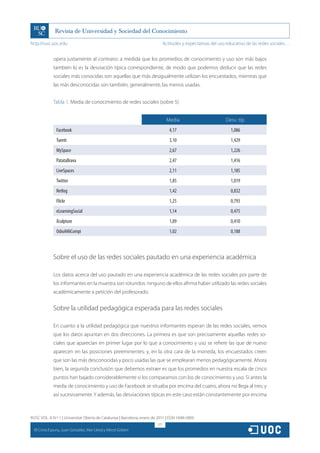
                De todo el alumnado matriculado, ha respondido una muestra conformada por 115 informantes: 30
                para Educación Infantil, 36 para Educación Primaria, 19 para Administración y Dirección de Empresas
                y 30 para Enfermería (vid. Gráfico 1). El total representa un 60% de la población analizada.

                Gráfico 1. Distribución de la población y de la muestra por grados


                     250

                                                                                                                               191
                     200


                     150
                                                                                                                                     115


                     100                                                                                        75

                                   43                     41        36
                      50                  30                                          32                                 30
                                                                                                 19


                        0
                                    Pre-SE                     PE                          BMA                       N           TOTAL

                                                                         Población                    Muestra


                Sobre el conocimiento de las redes sociales

                Por lo que respecta al conocimiento que nuestros informantes manifiestan acerca de las redes so-
                ciales más populares, destaca la diferencia que observamos entre las de más nombre, que prácti-
                camente son conocidas y usadas por toda la muestra, y otras redes sociales más específicas, como
                eLearningSocial, Xculpture u OdioAMiCompi, que parecen ser prácticamente desconocidas y, por
                tanto, muy poco usadas. En oposición a esto, podemos observar que la dispersión de las respuestas

RUSC VOL. 8 N.º 1 | Universitat Oberta de Catalunya | Barcelona, enero de 2011 | ISSN 1698-580X
                                                                                     176
  CC
       Cinta Espuny, Juan González, Mar Lleixà y Mercè Gisbert
http://rusc.uoc.edu                                                             Actitudes y expectativas del uso educativo de las redes sociales…


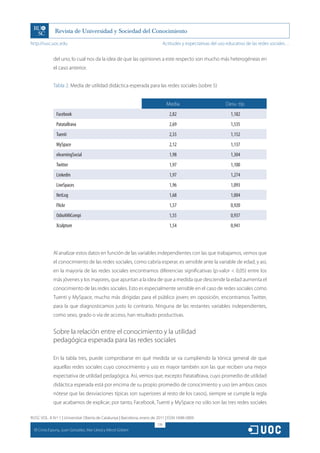
                opera justamente al contrario: a medida que los promedios de conocimiento y uso son más bajos
                también lo es la desviación típica correspondiente, de modo que podemos deducir que las redes
                sociales más conocidas son aquellas que más desigualmente utilizan los encuestados, mientras que
                las más desconocidas son también, generalmente, las menos usadas.


                Tabla 1. Media de conocimiento de redes sociales (sobre 5)


                                                                                 Media                          Desv. típ.
                  Facebook                                                         4,17                           1,086
                  Tuenti                                                           3,10                           1,429
                  MySpace                                                          2,67                           1,226
                  PatataBrava                                                      2,47                           1,416
                  LiveSpaces                                                       2,11                           1,185
                  Twitter                                                          1,85                           1,019
                  Netlog                                                           1,42                           0,832
                  Flickr                                                           1,25                           0,793
                  eLearningSocial                                                  1,14                           0,475
                  Xculpture                                                        1,09                           0,410
                  OdioAMiCompi                                                     1,02                           0,188


                Sobre el uso de las redes sociales pautado en una experiencia académica

                Los datos acerca del uso pautado en una experiencia académica de las redes sociales por parte de
                los informantes en la muestra son rotundos: ninguno de ellos afirma haber utilizado las redes sociales
                académicamente a petición del profesorado.


                Sobre la utilidad pedagógica esperada para las redes sociales

                En cuanto a la utilidad pedagógica que nuestros informantes esperan de las redes sociales, vemos
                que los datos apuntan en dos direcciones. La primera es que son precisamente aquellas redes so-
                ciales que aparecían en primer lugar por lo que a conocimiento y uso se refiere las que de nuevo
                aparecen en las posiciones preeminentes; y, en la otra cara de la moneda, los encuestados creen
                que son las más desconocidas y poco usadas las que se emplearan menos pedagógicamente. Ahora
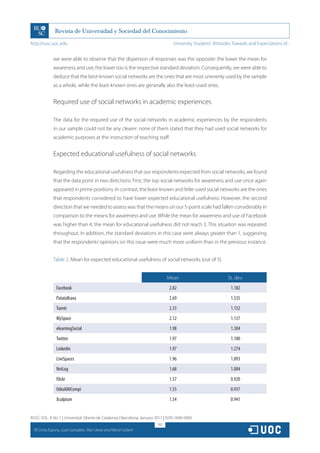
                bien, la segunda conclusión que debemos extraer es que los promedios en nuestra escala de cinco
                puntos han bajado considerablemente si los comparamos con los de conocimiento y uso. Si antes la
                media de conocimiento y uso de Facebook se situaba por encima del cuatro, ahora no llega al tres; y
                así sucesivamente. Y además, las desviaciones típicas en este caso están constantemente por encima


RUSC VOL. 8 N.º 1 | Universitat Oberta de Catalunya | Barcelona, enero de 2011 | ISSN 1698-580X
                                                                          177
  CC
       Cinta Espuny, Juan González, Mar Lleixà y Mercè Gisbert
http://rusc.uoc.edu                                                             Actitudes y expectativas del uso educativo de las redes sociales…


                del uno, lo cual nos da la idea de que las opiniones a este respecto son mucho más heterogéneas en
                el caso anterior.


                Tabla 2. Media de utilidad didáctica esperada para las redes sociales (sobre 5)


                                                                                 Media                          Desv. típ.
                  Facebook                                                         2,82                           1,182
                  PatataBrava                                                      2,69                           1,535
                  Tuenti                                                           2,33                           1,152
                  MySpace                                                          2,12                           1,137
                  elearningSocial                                                  1,98                           1,304
                  Twitter                                                          1,97                           1,100
                  Linkedin                                                         1,97                           1,274
                  LiveSpaces                                                       1,96                           1,093
                  NetLog                                                           1,68                           1,004
                  Flickr                                                           1,57                           0,920
                  OdioAMiCompi                                                     1,55                           0,937
                  Xculpture                                                        1,54                           0,941


                Al analizar estos datos en función de las variables independientes con las que trabajamos, vemos que
                el conocimiento de las redes sociales, como cabría esperar, es sensible ante la variable de edad; y así,
                en la mayoría de las redes sociales encontramos diferencias significativas (p-valor < 0,05) entre los
                más jóvenes y los mayores, que apuntan a la idea de que a medida que desciende la edad aumenta el
                conocimiento de las redes sociales. Esto es especialmente sensible en el caso de redes sociales como
                Tuenti y MySpace, mucho más dirigidas para el público joven; en oposición, encontramos Twitter,
                para la que diagnosticamos justo lo contrario. Ninguna de las restantes variables independientes,
                como sexo, grado o vía de acceso, han resultado productivas.


                Sobre la relación entre el conocimiento y la utilidad
                pedagógica esperada para las redes sociales

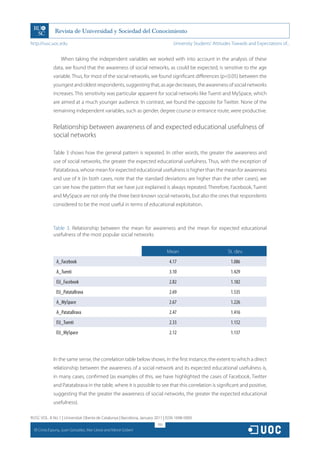
                En la tabla tres, puede comprobarse en qué medida se va cumpliendo la tónica general de que
                aquellas redes sociales cuyo conocimiento y uso es mayor también son las que reciben una mejor
                expectativa de utilidad pedagógica. Así, vemos que, excepto PatataBrava, cuyo promedio de utilidad
                didáctica esperada está por encima de su propio promedio de conocimiento y uso (en ambos casos
                nótese que las desviaciones típicas son superiores al resto de los casos), siempre se cumple la regla
                que acabamos de explicar; por tanto, Facebook, Tuenti y MySpace no sólo son las tres redes sociales

RUSC VOL. 8 N.º 1 | Universitat Oberta de Catalunya | Barcelona, enero de 2011 | ISSN 1698-580X
                                                                          178
  CC
       Cinta Espuny, Juan González, Mar Lleixà y Mercè Gisbert
http://rusc.uoc.edu                                                                 Actitudes y expectativas del uso educativo de las redes sociales…


                que gozan de mayor predicamento, sino también aquellas que los informantes consideran más útiles
                por lo que respecta a su explotación didáctica.

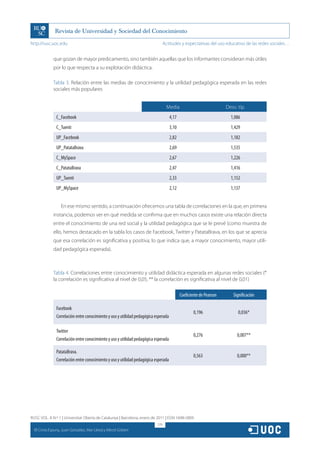
                Tabla 3. Relación entre las medias de conocimiento y la utilidad pedagógica esperada en las redes
                sociales más populares


                                                                                     Media                              Desv. típ.
                  C_Facebook                                                            4,17                              1,086
                  C_Tuenti                                                              3,10                              1,429
                  UP_Facebook                                                           2,82                              1,182
                  UP_PatataBrava                                                        2,69                              1,535
                  C_MySpace                                                             2,67                              1,226
                  C_PatataBrava                                                         2,47                              1,416
                  UP_Tuenti                                                             2,33                              1,152
                  UP_MySpace                                                            2,12                              1,137


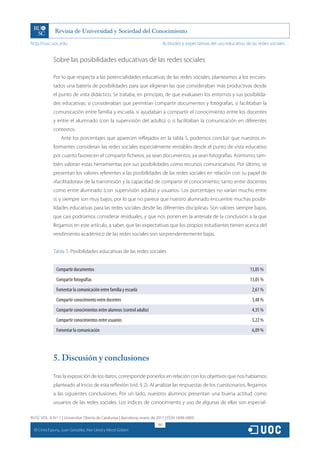
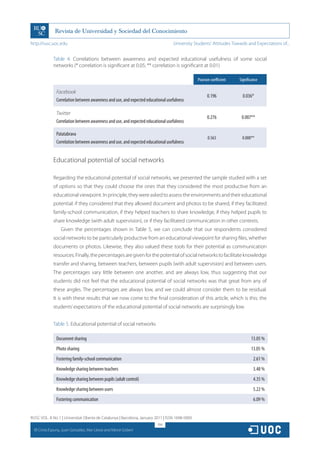
                    En ese mismo sentido, a continuación ofrecemos una tabla de correlaciones en la que, en primera
                instancia, podemos ver en qué medida se confirma que en muchos casos existe una relación directa
                entre el conocimiento de una red social y la utilidad pedagógica que se le prevé (como muestra de
                ello, hemos destacado en la tabla los casos de Facebook, Twitter y PatataBrava, en los que se aprecia
                que esa correlación es significativa y positiva, lo que indica que, a mayor conocimiento, mayor utili-
                dad pedagógica esperada).


                Tabla 4. Correlaciones entre conocimiento y utilidad didáctica esperada en algunas redes sociales (*
                la correlación es significativa al nivel de 0,05; ** la correlación es significativa al nivel de 0,01)

                                                                                               Coeficiente de Pearson      Significación

                  Facebook
                                                                                                       0,196                  0,036*
                  Correlación entre conocimiento y uso y utilidad pedagógica esperada

                  Twitter
                                                                                                       0,276                 0,007**
                  Correlación entre conocimiento y uso y utilidad pedagógica esperada

                  PatataBrava.
                                                                                                       0,563                 0,000**
                  Correlación entre conocimiento y uso y utilidad pedagógica esperada


RUSC VOL. 8 N.º 1 | Universitat Oberta de Catalunya | Barcelona, enero de 2011 | ISSN 1698-580X
                                                                              179
  CC
       Cinta Espuny, Juan González, Mar Lleixà y Mercè Gisbert
http://rusc.uoc.edu                                                          Actitudes y expectativas del uso educativo de las redes sociales…


                Sobre las posibilidades educativas de las redes sociales

                Por lo que respecta a las potencialidades educativas de las redes sociales, planteamos a los encues-
                tados una batería de posibilidades para que eligieran las que consideraban más productivas desde
                el punto de vista didáctico. Se trataba, en principio, de que evaluasen los entornos y sus posibilida-
                des educativas: si consideraban que permitían compartir documentos y fotografías, si facilitaban la
                comunicación entre familia y escuela, si ayudaban a compartir el conocimiento entre los docentes
                y entre el alumnado (con la supervisión del adulto) o si facilitaban la comunicación en diferentes
                contextos.
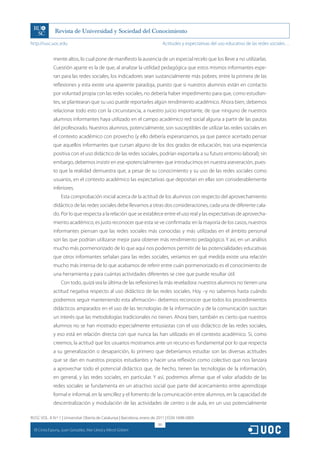
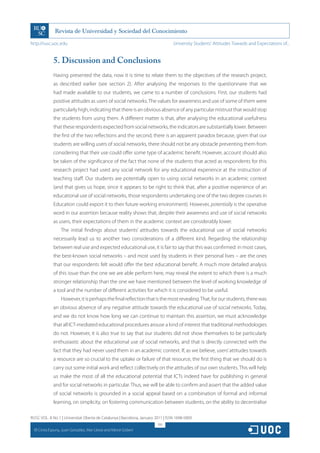
                    Ante los porcentajes que aparecen reflejados en la tabla 5, podemos concluir que nuestros in-
                formantes consideran las redes sociales especialmente rentables desde el punto de vista educativo
                por cuanto favorecen el compartir ficheros, ya sean documentos, ya sean fotografías. Asimismo, tam-
                bién valoran estas herramientas por sus posibilidades como recursos comunicativos. Por último, se
                presentan los valores referentes a las posibilidades de las redes sociales en relación con su papel de
                «facilitadoras» de la transmisión y la capacidad de compartir el conocimiento: tanto entre docentes
                como entre alumnado (con supervisión adulta) y usuarios. Los porcentajes no varían mucho entre
                sí, y siempre son muy bajos, por lo que no parece que nuestro alumnado encuentre muchas posibi-
                lidades educativas para las redes sociales desde las diferentes disciplinas. Son valores siempre bajos,
                que casi podríamos considerar residuales, y que nos ponen en la antesala de la conclusión a la que
                llegamos en este artículo, a saber, que las expectativas que los propios estudiantes tienen acerca del
                rendimiento académico de las redes sociales son sorprendentemente bajas.


                Tabla 5. Posibilidades educativas de las redes sociales


                  Compartir documentos                                                                                   13,05 %
                  Compartir fotografías                                                                                  13,05 %
                  Fomentar la comunicación entre familia y escuela                                                        2,61 %
                  Compartir conocimiento entre docentes                                                                   3,48 %
                  Compartir conocimientos entre alumnos (control adulto)                                                  4,35 %
                  Compartir conocimientos entre usuarios                                                                  5,22 %
                  Fomentar la comunicación                                                                                6,09 %


                5. Discusión y conclusiones

                Tras la exposición de los datos, corresponde ponerlos en relación con los objetivos que nos habíamos
                planteado al inicio de esta reflexión (vid. § 2). Al analizar las respuestas de los cuestionarios, llegamos
                a las siguientes conclusiones. Por un lado, nuestros alumnos presentan una buena actitud como
                usuarios de las redes sociales. Los índices de conocimiento y uso de algunas de ellas son especial-

RUSC VOL. 8 N.º 1 | Universitat Oberta de Catalunya | Barcelona, enero de 2011 | ISSN 1698-580X
                                                                           180
  CC
       Cinta Espuny, Juan González, Mar Lleixà y Mercè Gisbert
http://rusc.uoc.edu                                                             Actitudes y expectativas del uso educativo de las redes sociales…


                mente altos, lo cual pone de manifiesto la ausencia de un especial recelo que los lleve a no utilizarlas.
                Cuestión aparte es la de que, al analizar la utilidad pedagógica que estos mismos informantes espe-
                ran para las redes sociales, los indicadores sean sustancialmente más pobres; entre la primera de las
                reflexiones y esta existe una aparente paradoja, puesto que si nuestros alumnos están en contacto
                por voluntad propia con las redes sociales, no debería haber impedimento para que, como estudian-
                tes, se plantearan que su uso puede reportarles algún rendimiento académico. Ahora bien, debemos
                relacionar todo esto con la circunstancia, a nuestro juicio importante, de que ninguno de nuestros
                alumnos informantes haya utilizado en el campo académico red social alguna a partir de las pautas
                del profesorado. Nuestros alumnos, potencialmente, son susceptibles de utilizar las redes sociales en
                el contexto académico con provecho (y ello debería esperanzarnos, ya que parece acertado pensar
                que aquellos informantes que cursan alguno de los dos grados de educación, tras una experiencia
                positiva con el uso didáctico de las redes sociales, podrían exportarla a su futuro entorno laboral); sin
                embargo, debemos insistir en ese «potencialmente» que introducimos en nuestra aseveración, pues-
                to que la realidad demuestra que, a pesar de su conocimiento y su uso de las redes sociales como
                usuarios, en el contexto académico las expectativas que depositan en ellas son considerablemente
                inferiores.
                    Esta comprobación inicial acerca de la actitud de los alumnos con respecto del aprovechamiento
                didáctico de las redes sociales debe llevarnos a otras dos consideraciones, cada una de diferente cala-
                do. Por lo que respecta a la relación que se establece entre el uso real y las expectativas de aprovecha-
                miento académico, es justo reconocer que esta se ve confirmada: en la mayoría de los casos, nuestros
                informantes piensan que las redes sociales más conocidas y más utilizadas en el ámbito personal
                son las que podrían utilizarse mejor para obtener más rendimiento pedagógico. Y así, en un análisis
                mucho más pormenorizado de lo que aquí nos podemos permitir de las potencialidades educativas
                que otros informantes señalan para las redes sociales, veríamos en qué medida existe una relación
                mucho más intensa de lo que acabamos de referir entre cuán pormenorizado es el conocimiento de
                una herramienta y para cuántas actividades diferentes se cree que puede resultar útil.
                    Con todo, quizá sea la última de las reflexiones la más reveladora: nuestros alumnos no tienen una
                actitud negativa respecto al uso didáctico de las redes sociales. Hoy –y no sabemos hasta cuándo
                podremos seguir manteniendo esta afirmación– debemos reconocer que todos los procedimientos
                didácticos amparados en el uso de las tecnologías de la información y de la comunicación suscitan
                un interés que las metodologías tradicionales no tienen. Ahora bien, también es cierto que nuestros
                alumnos no se han mostrado especialmente entusiastas con el uso didáctico de las redes sociales,
                y eso está en relación directa con que nunca las han utilizado en el contexto académico. Si, como
                creemos, la actitud que los usuarios mostramos ante un recurso es fundamental por lo que respecta
                a su generalización o desaparición, lo primero que deberíamos estudiar son las diversas actitudes
                que se dan en nuestros propios estudiantes y hacer una reflexión como colectivo que nos lanzara
                a aprovechar todo el potencial didáctico que, de hecho, tienen las tecnologías de la información,
                en general, y las redes sociales, en particular. Y así, podremos afirmar que el valor añadido de las
                redes sociales se fundamenta en un atractivo social que parte del acercamiento entre aprendizaje
                formal e informal, en la sencillez y el fomento de la comunicación entre alumnos, en la capacidad de
                descentralización y modulación de las actividades de centro o de aula, en un uso potencialmente

RUSC VOL. 8 N.º 1 | Universitat Oberta de Catalunya | Barcelona, enero de 2011 | ISSN 1698-580X
                                                                          181
  CC
       Cinta Espuny, Juan González, Mar Lleixà y Mercè Gisbert
http://rusc.uoc.edu                                                            Actitudes y expectativas del uso educativo de las redes sociales…


                masivo pero organizado de numerosísimos agentes, con una utilización generalista que favorece la
                incorporación inicial del profesorado (Haro, 2009, pág. 8).
                    Quizás, como argumenta Flores (2009), el problema de las redes sociales radica en que las uni-
                versidades y las empresas todavía no asumen el cambio que la red está generando, donde tenemos
                usuarios que eligen, discrepan, comentan y modifican la información de una forma vertiginosa. Es
                innegable el impacto que internet ha tenido, está teniendo y parece que va a tener en el desarrollo
                de redes sociales en diferentes contextos; y, por tanto, educadores e instituciones educativas, des-
                de diferentes ámbitos y etapas formativas, no podemos obviarlas. Ahora bien: «¿será la comunidad
                educativa capaz de crear un sentido para cada cosa cuando se inventó para una finalidad de alta
                profusión y la adaptamos a otra más restringida y altamente formalizada?» (Barberá, 2008, pág. 7).
                En ese sentido, también debemos considerar que nosotros somos los principales responsables de
                ese cambio de actitud con respecto a los nuevos modelos docentes; hemos recibido la misión de
                permeabilizarnos ante los cambios que se producen en el entorno comunicativo y ante los usos
                sociales de la red y, en un segundo plano, de trasladarlos a nuestra práctica docente. «La verdadera
                transformación se encuentra en la dinámica educativa, en el proceso educativo que se desarrolla en
                el aula […]. El uso activo y social de la red no puede ser ignorado en las planificaciones docentes»
                (Duart, 2009, pág. 1).
                    La responsabilidad es grande: con nuestras prácticas y nuestra acción docente individual hemos
                de ser capaces de ponernos en marcha para recorrer el camino hacia el aprovechamiento masivo
                de las metodologías activas y participativas de las que tanto venimos hablando en el contexto del
                EEES; las redes sociales nos pueden ayudar en gran medida a la consolidación de formas de trabajo
                cooperativo mucho más rentables desde el punto de vista del aprendizaje. Pero eso sólo lo conse-
                guiremos con una acción consciente en ese sentido. Suhr (2010), por ejemplo, al analizar los consejos
                y las recomendaciones de una serie de protocolos sociales en su estudio sobre el retroceso en el
                uso de la red social MySpace como plataforma de lanzamiento y difusión de multitud de autores y
                músicos, determina el altísimo poder que tenemos al establecer esos patrones y potenciar el uso de
                determinadas redes sociales o, por el contrario, influir para que no se usen.
                    La tendencia habitual camina hacia modelos didácticos poco innovadores, que no consideran los
                procesos de capacitación presencial alternativas pedagógicas y que, por tanto, se fundamentan en
                sistemas en los que, con leves variaciones, el maestro habla y el alumno escucha; así lo demuestran,
                en parte, los datos que acabamos de recoger. Y, en el mismo sentido, García Sans (2008, pág. 3) se
                lamenta de que no sólo los recelos hacia las redes sociales se traducen en una escasa investigación
                acerca de su rendimiento educativo, sino que gran parte del profesorado tiene ese mismo senti-
                miento de rechazo hacia la tecnología utilizada por los estudiantes, puesto que interfiere en el flujo
                natural de la enseñanza tradicional (Handley, 2007). Con todo, las redes sociales han llegado a nuestra
                sociedad para quedarse y para cambiar nuestra forma de relacionarnos. Depende de nosotros, y de
                la actitud de nuestros estudiantes, que nuestra forma de trabajar, de investigar y de aprender quede
                o no al margen de esta revolución.


RUSC VOL. 8 N.º 1 | Universitat Oberta de Catalunya | Barcelona, enero de 2011 | ISSN 1698-580X
                                                                         182
  CC
       Cinta Espuny, Juan González, Mar Lleixà y Mercè Gisbert
http://rusc.uoc.edu                                                            Actitudes y expectativas del uso educativo de las redes sociales…


                Bibliografía
                BARBERÁ, E. (2008). «Calidad de la enseñanza 2.0». RED. Revista de Educación a Distancia. Monográfico
                    VII, págs. 1-17.
                COBO, C.; PARDO, H. (2007). Planeta Web 2.0. Inteligencia colectiva o medios fast food. Grup de Recerca
                    d’Interaccions Digitals. Universidad de Vic.
                DUART, J. M. (2009). «Internet, redes sociales y educación». RUSC. Revista de Universidad y Sociedad del
                    Conocimiento. Vol. 6, n.º 1, págs. 1-2.
                ESTEVE. F. (2009). «Bolonia y las TIC: de la docencia 1.0 al aprendizaje 2.0». La Cuestión Universitaria. N.º
                    5, págs. 59-68.
                FLORES, J. M. (2009). «Nuevos modelos de comunicación, perfiles y tendencias en redes sociales».
                    Comunicar. Revista Científica de Educomunicación. Vol. 17, n.º 33, págs. 73-81.
                GAETE, J. M.; VÁSQUEZ, J. I. (2008). «Conocimiento y estructura en la investigación académica: una
                    aproximación desde el análisis de las redes sociales». Revista Hispana para el Análisis de Redes So-
                    ciales. Vol. 14, n.º 5.
                GARCÍA SANS, A. (2008). «Las redes sociales como herramientas para el aprendizaje colaborativo: una
                    experiencia con Facebook». En: Actas del XIII Congreso Internacional en Tecnologías para la Educa-
                    ción y el Conocimiento: la Web 2.0. Madrid: UNED.
                HANDLEY, C.; WILSON, A.; PETERSON, N. [et al.] (2007).Out of the Classroom & into the Boardroom. Hig-
                    her Education Consortium. Microsoft.
                HARO, J. J. de (2009). «Las redes sociales aplicadas a la práctica docente». Didáctica Innovación y Mul-
                    timedia. N.º 13. [Fecha de consulta: 10 de febrero de 2010].
                    <http://www.raco.cat/index.php/dim/article/view/138928/189972>
                HERNÁNDEZ REQUENA, S. (2008). «El modelo constructivista con las nuevas tecnologías: aplicado en
                    el proceso de aprendizaje». RUSC. Revista de Universidad y Sociedad del Conocimiento. Vol. 5, n.º 2,
                    págs. 26-35.
                JOBB, J. (2008). Five themes for the web 2.0 learner. [Fecha de consulta: 15 de enero de 2010].
                    <http://www.missiontolearn.com/2008/05/five-themes-for-the-web-20-learner>
                MARTÍN-MORENO, Q. (2004). «Aprendizaje colaborativo y redes de conocimiento». En: Actas de las IX
                    Jornadas Andaluzas de Organización y Dirección de Instituciones Educativas. Granada: Grupo Edito-
                    rial Universitario. Págs. 55-70.
                ORTEGA, S.; GACITÚA, J. C. (2008). «Espacios interactivos de comunicación y aprendizaje. La construc-
                    ción de identidades». RUSC. Revista de Universidad y Sociedad del Conocimiento. Vol. 5, n.º 2, págs.
                    17-25.
                RAMÍREZ CORTÉS, J. P. (2008). «Instrumentos para la construcción de un modelo de formación virtual
                    corporativa». RUSC. Revista de Universidad y Sociedad del Conocimiento. Vol. 5, n.º 2, págs. 50-59.
                SANTAMARÍA, F. (2008). «Posibilidades pedagógicas. Redes sociales y comunidades educativas». TE-
                    LOS. Cuadernos de Comunicación e Innovación. N.º 76. Págs. 99-109.
                SUHR, H. C. (2010). «Comprendiendo la aparición de los protocolos sociales en MySpace: impacto y
                    ramificaciones». Comunicar. Revista Científica de Educomunicación. Vol. 17, n.º 34, págs. 45-53.


RUSC VOL. 8 N.º 1 | Universitat Oberta de Catalunya | Barcelona, enero de 2011 | ISSN 1698-580X
                                                                         183
  CC
       Cinta Espuny, Juan González, Mar Lleixà y Mercè Gisbert
http://rusc.uoc.edu                                                            Actitudes y expectativas del uso educativo de las redes sociales…


                   Sobre los autores

                   Cinta Espuny Vidal
                   Profesora del Departamento de Pedagogía, Campus Terres de l’Ebre, Universidad Rovira i Virgili
                   Doctora en Pedagogía. Maestra. Especialista universitaria en tecnología educativa: diseño de mate-
                   riales multimedia para la educación. Máster en Tecnología educativa. Sus actuales líneas de inves-
                   tigación se centran en analizar cómo las tecnologías de la información y de la comunicación en el
                   ámbito educativo pueden aportar adelantos y mejoras a la educación tanto en centros educativos
                   de primaria y secundaria como en el ámbito universitario.

                   Juan González Martínez
                   Profesor del Departamento de Pedagogía, Campus Terres de l’Ebre, Universidad Rovira i Virgili
                   Doctor en Filología Hispánica. Licenciado en Antropología Social y Cultural. Especialista en docencia
                   en el EEES. Profesor de enseñanza secundaria. Sus actuales líneas de investigación se centran en dos
                   áreas: la primera es analizar el componente actitudinal y la influencia que tiene para dicho compo-
                   nente el sistema educativo de las comunidades bilingües; la segunda, estudiar el impacto educativo
                   de las tecnologías de la información.

                   Mar Lleixà Fortuño
                   Profesora del Departamento de Enfermería, Campus Terres de l’Ebre, Universidad Rovira i Virgili
                   Doctora en Pedagogía, diplomada en Enfermería, máster en Enfermería médico-quirúrgica, licencia-
                   da en Psicología, máster en Tecnología educativa. Responsable del máster en Ciencias de la enferme-
                   ría de la URV. Su interés se centra en la investigación sobre el uso de las TIC tanto en la formación en
                   enfermería como en su práctica profesional.

                   Mercè Gisbert Cervera
                   Profesora del Departamento de Pedagogía, Universidad Rovira i Virgili
                   Doctora en Pedagogía. Vicerrectora de Política Docente y EEES. Investigadora principal del ARGET
                   (Applied Research Group in Education and Technology) y del L@TE (Laboratorio de Aplicaciones Tec-
                   nológicas a la Educación) de la URV.


                   Dirección de contacto
                   juan.gonzalezm@urv.cat
                   Universidad Rovira i Virgili
                   Facultad de Ciencias de la Educación y Psicología
                   Campus Terres de l’Ebre
                   Camí de Betània, 5
                   43500 Tortosa (España)


RUSC VOL. 8 N.º 1 | Universitat Oberta de Catalunya | Barcelona, enero de 2011 | ISSN 1698-580X
                                                                         184
  CC
       Cinta Espuny, Juan González, Mar Lleixà y Mercè Gisbert
http://rusc.uoc.edu                                                                    Actitudes y expectativas del uso educativo de las redes sociales…


                                        Los textos publicados en esta revista están sujetos –si no se indica lo contrario– a una licencia de Reconoci-
                                        miento 3.0 España de Creative Commons. Puede copiarlos, distribuirlos, comunicarlos públicamente y hacer
                                        obras derivadas siempre que reconozca los créditos de las obras (autoría, nombre de la revista, institución
                                        editora) de la manera especificada por los autores o por la revista. La licencia completa se puede consultar en
                                        http://creativecommons.org/licenses/by/3.0/es/deed.es.


RUSC VOL. 8 N.º 1 | Universitat Oberta de Catalunya | Barcelona, enero de 2011 | ISSN 1698-580X
                                                                                 185
  CC
       Cinta Espuny, Juan González, Mar Lleixà y Mercè Gisbert
http://rusc.uoc.edu


               Monograph “The Impact of Social Networks on Teaching and Learning”

               ARTICLE

               University Students’ Attitudes
               Towards and Expectations of
               the Educational Use of Social
               Networks
               Cinta Espuny Vidal1
               Lecturer in the Department of Education, Terres de l’Ebre Campus, Rovira i Virgili University


               Juan González Martínez
               Lecturer in the Department of Education, Terres de l’Ebre Campus, Rovira i Virgili University


               Mar Lleixà Fortuño
               Lecturer in the Department of Nursing, Terres de l’Ebre Campus, Rovira i Virgili University


               Mercè Gisbert Cervera
               Lecturer in the Department of Education, Rovira i Virgili University


                                                                                                            Submitted in: May 2010
                                                                                                         Accepted in: October 2010
                                                                                                         Published in: January 2011


                Recommended citation
                ESPUNY, Cinta; GONZÁLEZ, Juan; LLEIXÀ, Mar; GISBERT, Mercè (2011). “University Students’ Attitudes
                Towards and Expectations of the Educational Use of Social Networks”. In: “The Impact of Social
                Networks on Teaching and Learning” [online monograph]. Revista de Universidad y Sociedad del
                Conocimiento (RUSC). Vol. 8, No 1, pp. 186-199. UOC. [Accessed: dd/mm/yy].
                <http://rusc.uoc.edu/ojs/index.php/rusc/article/view/v8n1-espuny-gonzalez-lleixa-gisbert/v8n1-
                espuny-gonzalez-lleixa-gisbert-eng>
                ISSN 1698-580X


                1. Doctors Cinta Espuny, Juan González and Mercè Gisbert belong to ARGET (Applied Research Group in Education and
                   Technology) at Rovira i Virgili University. Ref: 2009 SGR 596.


RUSC VOL. 8 No 1 | Universitat Oberta de Catalunya | Barcelona, January 2011 | ISSN 1698-580X
                                                                         186
  CC
       Cinta Espuny, Juan González, Mar Lleixà and Mercè Gisbert
http://rusc.uoc.edu                                                               University Students’ Attitudes Towards and Expectations of...


                Abstract
                In the last few years, social networks have revolutionised the way in which many people relate to
                each other, but their use is still very limited in the academic field. When they are used, the experiences
                tend to be very isolated and lacking in continuity. In this context, and by means of a questionnaire,
                our objective is to bring an element of reflection on students’ attitudes towards the use of social
                networks in general, and their use and potential in an educational context in particular. The aim is
                to compel students to think about these attitudes as a vital first step in getting them to accept and
                realise the educational potential of social networks.

                Keywords
                education technology, social networks, expectations, higher education


                Actitudes y expectativas del uso educativo de las redes sociales
                en los alumnos universitarios
                Resumen
                Las redes sociales, que en los últimos años han supuesto una auténtica revolución en la forma de relacio-
                narse, todavía siguen siendo algo poco presente en el ámbito académico: las ocasiones en que se utilizan
                son aisladas y pocas gozan de continuidad. En ese contexto, pretendemos reflexionar acerca de la actitud
                que los propios estudiantes tienen con respecto del uso, del aprovechamiento didáctico y de las potenciali-
                dades que las redes sociales presentan en el ámbito educativo. Para esta reflexión nos hemos valido de una
                encuesta realizada entre los estudiantes. La intención es que el estudio de esta actitud inicial sea el paso
                previo necesario para hallar las claves para que el alumnado acepte y materialice el potencial educativo
                de las redes sociales.

                Palabras clave
                tecnologías de la educación, redes sociales, expectativas, enseñanza superior


RUSC VOL. 8 No 1 | Universitat Oberta de Catalunya | Barcelona, January 2011 | ISSN 1698-580X
                                                                         187
  CC
       Cinta Espuny, Juan González, Mar Lleixà and Mercè Gisbert
http://rusc.uoc.edu                                                               University Students’ Attitudes Towards and Expectations of...


                1. Introduction

                In recent years, online platforms that allow people to relate to each other, otherwise known as
                “social networks”, have been revolutionary in terms of the speed of their uptake and the spread of
                subsequent applications. Indeed, it is a revolution that is only comparable to the advent and spread
                of e-mail in terms of its power to change human relations via the Internet. Thus, social networks have
                gradually become powerful spaces of interaction between different social groups, some of which are
                ever more specialised, where it is possible to meet people or find old friends or colleagues who share
                the same interests.
                    Regarding the specific application of these resources to the sphere of education, we should
                acknowledge that Web 2.0 and its particular emphasis on social dynamics has fostered the creation
                of virtual learning communities and a whole host of peer collaboration networks (García Sans, 2008).
                By design, the latter are networks based on principles of reciprocity and cooperation (Cobo & Pardo,
                2007: 103) that make full use of the popularity of such services as Facebook, Twitter and the like.
                    Social networks are broadly defined as associations of people linked by diverse motives, which
                configure a structure consisting of nodes that are interconnected by more than one type of
                relationship (Hernández, 2008: 30). In the context in question, social network web services allow
                this general definition to be refined, in the sense that they offer people with shared interests the
                opportunity to get in touch with each other via the Internet and to jointly exploit resources such
                as the creation of sub-groups, public or private messaging, chats and so on. The origin of these
                online platforms is as varied as the platforms themselves: some of them, like Facebook for example,
                were developed to support different student groups on American campuses, while others have a
                more professional focus, such as LinkedIn, the aim of which is to establish work or business contacts
                through networking (Esteve, 2009: 64; Santamaría, 2008).
                    More than anything else, social networks concern the new participatory and active methodologies
                that are being adopted across the board in the European Higher Education Area (EHEA). This is
                particularly so for “collaborative working”, which is understood as the exchange and development
                of knowledge among small peer groups aiming to achieve identical academic goals (García Sans,
                2008: 1) and, as consolidation platforms, they may also have a direct impact on certain learning
                communities. But they particularly concern collaborative working because, in essence, most of the
                potential of social networks can be used to the full advantage of the benefits of this learning method,
                of which we would underscore the following (Martín-Moreno, 2004): collaborative working increases
                motivation, fosters better academic performance (because individual work feeds back to group
                work and vice versa), enhances knowledge retention, strengthens critical thought and increases the
                diversity of knowledge and experience gained.
                    Besides being a great tool for collaborative working, the educational potential of these online
                platforms is practically endless. Thus, Hernández (2008: 30) takes the view that social networks are
                “constructivist tools” bearing a direct relationship with their potential for interaction among a group,
                between a group and teaching staff and among teaching staff, none of which is bound by the space
                and time constraints of a school environment. By overcoming these coordinates and facilitating

RUSC VOL. 8 No 1 | Universitat Oberta de Catalunya | Barcelona, January 2011 | ISSN 1698-580X
                                                                         188
  CC
       Cinta Espuny, Juan González, Mar Lleixà and Mercè Gisbert
http://rusc.uoc.edu                                                               University Students’ Attitudes Towards and Expectations of...


                coordination, virtuality allows any kind and number of files to be shared and allows people to
                communicate in a way that most resembles real communication, by combining sound, video,
                documents, etc. In this respect, Ortega and Gacitúa (2008: 19) emphasise the diverse educational
                potential of social networks: “the construction of groups, the immediate contact and the decentralised
                system that characterises social networks have together facilitated the natural creation of a collective
                intelligence […], a continuous learning that is the result of collaboration and cooperation. Systems
                that are independent, customised and, at the same time, tremendously diverse.”
                    Despite broad consensus on the use and incredible speed of uptake of most social networks (here,
                for example, we are thinking of major applications that are commonly used, such as Facebook and
                Twitter among the general public, and Tuenti and MySpace among younger users) and the generally
                held view that the potential for their educational use is as vast as it is interesting, the educational
                exploitation of these resources is limited to isolated experiences in higher education. Paradoxically,
                even though social networks for teaching staff are fairly numerous, very few teachers have dared to
                consider or implement training activities in the classroom by using these services (Haro, 2009). Why
                not? Is it simply a matter of time? Or should we consider the extent to which other kinds of factors
                have an impact, such as a negative attitude or mistrust?


                2. Objectives

                It is in this context that we have undertaken research into the attitudes that first-year student
                have towards social networks and their educational use within the framework of the Rovira i Virgili
                University educational model. In this scenario, we endeavoured (1) to ascertain the level of awareness
                and (2) educational use of the most popular social networks among first-year students on all degree
                courses offered at the Terres de l’Ebre Campus, Rovira i Virgili University, through a self-distributed
                questionnaire specifically designed for this research project, which, in turn, would (3) provide us with
                information about our students’ attitudes towards the educational use of these interaction platforms.
                    The initial findings about attitudes towards the educational use of social networks would allow
                us to pursue a further two objectives: (4) to establish the relationship that develops between the real
                use of social networks in an academic context and the expected educational usefulness, and (5) to
                establish the actions required to strengthen the educational use of social networks for collaborative
                working. Only by accurately tracing this route, from the students’ perceptions of social networks to
                their views on their educational use, will we be able to foster their use through experiences that can
                be used to the full advantage of collaborative work.


                3. Methodology and Context

                The tool we used for our research project was a self-administered questionnaire in order to elucidate
                a number of aspects, such as: (1) awareness and use of the range of social networks, (2) required use of

RUSC VOL. 8 No 1 | Universitat Oberta de Catalunya | Barcelona, January 2011 | ISSN 1698-580X
                                                                         189
  CC
       Cinta Espuny, Juan González, Mar Lleixà and Mercè Gisbert
http://rusc.uoc.edu                                                               University Students’ Attitudes Towards and Expectations of...


                social networks in academic experiences, (3) educational usefulness of the range of social networks,
                (4) potential of social networks in the sphere of education and (5) advantages and disadvantages of
                social networks.
                    Regarding the social networks chosen for the study, we tried to be representative rather than
                exhaustive. First, we chose the most renowned generalist networks like Facebook, Twitter, MySpace and
                LiveSpaces. Second, we included social networks that have a more professional focus, such as LinkedIn,
                aimed at strengthening professional networks, and e-LearningSocial, aimed directly at enhancing
                learning networks among adults. Finally, we felt that it was important to add some of the social
                networks aimed specifically at young people, like the majority of those in our student sample. These are
                Tuenti, Netlog and OdioAMiCompi, which are very popular among young people; Patatabrava, with
                content and information designed for university students, who represent the majority of its members;
                Xculpture, designed for sports fans; and finally, Flickr, designed from a multimedia exchange viewpoint.
                    The first three sections of the questionnaire have a 5-point scoring scale, which allowed us to obtain
                the means and their deviations; on the issue of potential, we asked a multiple-choice question, which
                allowed us to establish the mean; and finally, regarding the advantages and disadvantages of social
                networks, we asked open questions so that the respondents could give more subjective opinions.
                    One of the limitations of self-distributed questionnaires is that they may show a significant bias, so
                it is important to note that in the design of the tool we paid particular attention to this issue (particularly
                in relation to central tendency, social desirability, courtesy, learning, proximity and logic) through
                the distribution of questions in the questionnaire and their wording. However, this circumstance
                should be taken into account at all times when assessing the results obtained from using this tool.
                    Besides the above-mentioned questions, independent variables were taken into account, such
                as gender, age group, degree course that respondents are taking and the higher education entrance
                route, in order to find out if attitudes towards social networks are static or sensitive to various external
                determining factors.
                    Regarding the data processing, we simultaneously used SPSS 17.0 and Statgraphics Centurion 16
                software. For significance testing, we used the ANOVA test. For relationships between various values,
                we used the Pearson correlation coefficient.
                    Finally, we should mention that this questionnaire was distributed to all of our first-year students
                on Primary Education and Pre-School Education degree courses at the Terres de l’Ebre Campus,
                Rovira i Virgili University, at the end of the second term of the 2009/10 academic year via Google
                Spreadsheets in order to make it easier to respond and to allow data to be extracted. On this Campus,
                the following degree courses are offered: Pre-School Education (43 students), Primary Education (41
                students), Business Management and Administration (32 students) and Nursing (75 students).


                4. Data Analysis
                From all the students enrolled, a sample of 115 respondents was obtained (30 for Pre-School
                Education, 36 for Primary Education, 19 for Business Management and Administration and 30 for
                Nursing (see Graph 1)). The total represents 60% of the population analysed.


RUSC VOL. 8 No 1 | Universitat Oberta de Catalunya | Barcelona, January 2011 | ISSN 1698-580X
                                                                         190
  CC
       Cinta Espuny, Juan González, Mar Lleixà and Mercè Gisbert
http://rusc.uoc.edu                                                                               University Students’ Attitudes Towards and Expectations of...


                Graph 1. Population and sample distribution, by degree course

                     250

                                                                                                                                 191
                     200


                     150
                                                                                                                                         115


                     100                                                                                       75

                                   43                    41        36
                      50                 30                                           32                                30
                                                                                                 19


                          0
                                   Pre-SE                     PE                           BMA                      N              TOTAL

                                                                        Population                    Sample


                Table 1. Mean for awareness of social networks (out of 5)


                                                                                            Mean                              St. dev.
                 Facebook                                                                    4.17                               1.086
                 Tuenti                                                                      3.10                               1.429
                 MySpace                                                                     2.67                               1.226
                 PatataBrava                                                                 2.47                               1.416
                 LiveSpaces                                                                  2.11                               1.185
                 Twitter                                                                     1.85                               1.019
                 Netlog                                                                      1.42                               0.832
                 Flickr                                                                      1.25                               0.793
                 eLearningSocial                                                             1.14                               0.475
                 Xculpture                                                                   1.09                               0.410
                 OdioAMiCompi                                                                1.02                               0.188


                Awareness of social networks

                Regarding our respondents’ awareness of social networks, we found that there was a considerable
                difference between the most popular ones, which practically everyone in the sample was aware of
                and used, and other, more specific ones, such as e-LearningSocial, Xculpture and OdioAMiCompi,
                which almost everyone in the sample seemed to be unaware of and therefore did not use. In contrast,

RUSC VOL. 8 No 1 | Universitat Oberta de Catalunya | Barcelona, January 2011 | ISSN 1698-580X
                                                                                     191
  CC
       Cinta Espuny, Juan González, Mar Lleixà and Mercè Gisbert
http://rusc.uoc.edu                                                               University Students’ Attitudes Towards and Expectations of...


                we were able to observe that the dispersion of responses was the opposite: the lower the mean for
                awareness and use, the lower too is the respective standard deviation. Consequently, we were able to
                deduce that the best-known social networks are the ones that are most unevenly used by the sample
                as a whole, while the least-known ones are generally also the least-used ones.


                Required use of social networks in academic experiences

                The data for the required use of the social networks in academic experiences by the respondents
                in our sample could not be any clearer: none of them stated that they had used social networks for
                academic purposes at the instruction of teaching staff.


                Expected educational usefulness of social networks

                Regarding the educational usefulness that our respondents expected from social networks, we found
                that the data point in two directions. First, the top social networks for awareness and use once again
                appeared in prime positions. In contrast, the least-known and little-used social networks are the ones
                that respondents considered to have lower expected educational usefulness. However, the second
                direction that we needed to assess was that the means on our 5-point scale had fallen considerably in
                comparison to the means for awareness and use. While the mean for awareness and use of Facebook
                was higher than 4, the mean for educational usefulness did not reach 3. This situation was repeated
                throughout. In addition, the standard deviations in this case were always greater than 1, suggesting
                that the respondents’ opinions on this issue were much more uniform than in the previous instance.


                Table 2. Mean for expected educational usefulness of social networks (out of 5)


                                                                               Mean                           St. dev.
                 Facebook                                                      2.82                             1.182
                 PatataBrava                                                   2.69                             1.535
                 Tuenti                                                        2.33                             1.152
                 MySpace                                                       2.12                             1.137
                 elearningSocial                                               1.98                             1.304
                 Twitter                                                       1.97                             1.100
                 Linkedin                                                      1.97                             1.274
                 LiveSpaces                                                    1.96                             1.093
                 NetLog                                                        1.68                             1.004
                 Flickr                                                        1.57                             0.920
                 OdioAMiCompi                                                  1.55                             0.937
                 Xculpture                                                     1.54                             0.941


RUSC VOL. 8 No 1 | Universitat Oberta de Catalunya | Barcelona, January 2011 | ISSN 1698-580X
                                                                         192
  CC
       Cinta Espuny, Juan González, Mar Lleixà and Mercè Gisbert
http://rusc.uoc.edu                                                               University Students’ Attitudes Towards and Expectations of...


                    When taking the independent variables we worked with into account in the analysis of these
                data, we found that the awareness of social networks, as could be expected, is sensitive to the age
                variable. Thus, for most of the social networks, we found significant differences (p<0.05) between the
                youngest and oldest respondents, suggesting that, as age decreases, the awareness of social networks
                increases. This sensitivity was particular apparent for social networks like Tuenti and MySpace, which
                are aimed at a much younger audience. In contrast, we found the opposite for Twitter. None of the
                remaining independent variables, such as gender, degree course or entrance route, were productive.


                Relationship between awareness of and expected educational usefulness of
                social networks

                Table 3 shows how the general pattern is repeated. In other words, the greater the awareness and
                use of social networks, the greater the expected educational usefulness. Thus, with the exception of
                Patatabrava, whose mean for expected educational usefulness is higher than the mean for awareness
                and use of it (in both cases, note that the standard deviations are higher than the other cases), we
                can see how the pattern that we have just explained is always repeated. Therefore, Facebook, Tuenti
                and MySpace are not only the three best-known social networks, but also the ones that respondents
                considered to be the most useful in terms of educational exploitation.


                Table 3. Relationship between the mean for awareness and the mean for expected educational
                usefulness of the most popular social networks


                                                                               Mean                           St. dev.
                 A_Facebook                                                    4.17                             1.086
                 A_Tuenti                                                      3.10                             1.429
                 EU_Facebook                                                   2.82                             1.182
                 EU_PatataBrava                                                2.69                             1.535
                 A_MySpace                                                     2.67                             1.226
                 A_PatataBrava                                                 2.47                             1.416
                 EU_Tuenti                                                     2.33                             1.152
                 EU_MySpace                                                    2.12                             1.137


                In the same sense, the correlation table below shows, in the first instance, the extent to which a direct
                relationship between the awareness of a social network and its expected educational usefulness is,
                in many cases, confirmed (as examples of this, we have highlighted the cases of Facebook, Twitter
                and Patatabrava in the table, where it is possible to see that this correlation is significant and positive,
                suggesting that the greater the awareness of social networks, the greater the expected educational
                usefulness).

RUSC VOL. 8 No 1 | Universitat Oberta de Catalunya | Barcelona, January 2011 | ISSN 1698-580X
                                                                         193
  CC
       Cinta Espuny, Juan González, Mar Lleixà and Mercè Gisbert
http://rusc.uoc.edu                                                                 University Students’ Attitudes Towards and Expectations of...


                Table 4. Correlations between awareness and expected educational usefulness of some social
                networks (* correlation is significant at 0.05; ** correlation is significant at 0.01)

                                                                                                Pearson coefficient   Significance

                 Facebook
                                                                                                      0.196             0.036*
                 Correlation between awareness and use, and expected educational usefulness

                 Twitter
                                                                                                      0.276            0.007**
                 Correlation between awareness and use, and expected educational usefulness

                 Patatabrava
                                                                                                      0.563             0.000**
                 Correlation between awareness and use, and expected educational usefulness


                Educational potential of social networks

                Regarding the educational potential of social networks, we presented the sample studied with a set
                of options so that they could choose the ones that they considered the most productive from an
                educational viewpoint. In principle, they were asked to assess the environments and their educational
                potential: if they considered that they allowed document and photos to be shared, if they facilitated
                family-school communication, if they helped teachers to share knowledge, if they helped pupils to
                share knowledge (with adult supervision), or if they facilitated communication in other contexts.
                    Given the percentages shown in Table 5, we can conclude that our respondents considered
                social networks to be particularly productive from an educational viewpoint for sharing files, whether
                documents or photos. Likewise, they also valued these tools for their potential as communication
                resources. Finally, the percentages are given for the potential of social networks to facilitate knowledge
                transfer and sharing, between teachers, between pupils (with adult supervision) and between users.
                The percentages vary little between one another, and are always low, thus suggesting that our
                students did not feel that the educational potential of social networks was that great from any of
                these angles. The percentages are always low, and we could almost consider them to be residual.
                It is with these results that we now come to the final consideration of this article, which is this: the
                students’ expectations of the educational potential of social networks are surprisingly low.


                Table 5. Educational potential of social networks

                 Document sharing                                                                                            13.05 %
                 Photo sharing                                                                                               13.05 %
                 Fostering family-school communication                                                                         2.61 %
                 Knowledge sharing between teachers                                                                            3.48 %
                 Knowledge sharing between pupils (adult control)                                                              4.35 %
                 Knowledge sharing between users                                                                               5.22 %
                 Fostering communication                                                                                       6.09 %


RUSC VOL. 8 No 1 | Universitat Oberta de Catalunya | Barcelona, January 2011 | ISSN 1698-580X
                                                                           194
  CC
       Cinta Espuny, Juan González, Mar Lleixà and Mercè Gisbert
http://rusc.uoc.edu                                                               University Students’ Attitudes Towards and Expectations of...


                5. Discussion and Conclusions
                Having presented the data, now it is time to relate them to the objectives of the research project,
                as described earlier (see section 2). After analysing the responses to the questionnaire that we
                had made available to our students, we came to a number of conclusions. First, our students had
                positive attitudes as users of social networks. The values for awareness and use of some of them were
                particularly high, indicating that there is an obvious absence of any particular mistrust that would stop
                the students from using them. A different matter is that, after analysing the educational usefulness
                that these respondents expected from social networks, the indicators are substantially lower. Between
                the first of the two reflections and the second, there is an apparent paradox because, given that our
                students are willing users of social networks, there should not be any obstacle preventing them from
                considering that their use could offer some type of academic benefit. However, account should also
                be taken of the significance of the fact that none of the students that acted as respondents for this
                research project had used any social network for any educational experience at the instruction of
                teaching staff. Our students are potentially open to using social networks in an academic context
                (and that gives us hope, since it appears to be right to think that, after a positive experience of an
                educational use of social networks, those respondents undertaking one of the two degree courses in
                Education could export it to their future working environment). However, potentially is the operative
                word in our assertion because reality shows that, despite their awareness and use of social networks
                as users, their expectations of them in the academic context are considerably lower.
                    The initial findings about students’ attitudes towards the educational use of social networks
                necessarily lead us to another two considerations of a different kind. Regarding the relationship
                between real use and expected educational use, it is fair to say that this was confirmed: in most cases,
                the best-known social networks – and most used by students in their personal lives – are the ones
                that our respondents felt would offer the best educational benefit. A much more detailed analysis
                of this issue than the one we are able perform here, may reveal the extent to which there is a much
                stronger relationship than the one we have mentioned between the level of working knowledge of
                a tool and the number of different activities for which it is considered to be useful.
                    However, it is perhaps the final reflection that is the most revealing. That, for our students, there was
                an obvious absence of any negative attitude towards the educational use of social networks. Today,
                and we do not know how long we can continue to maintain this assertion, we must acknowledge
                that all ICT-mediated educational procedures arouse a kind of interest that traditional methodologies
                do not. However, it is also true to say that our students did not show themselves to be particularly
                enthusiastic about the educational use of social networks, and that is directly connected with the
                fact that they had never used them in an academic context. If, as we believe, users’ attitudes towards
                a resource are so crucial to the uptake or failure of that resource, the first thing that we should do is
                carry out some initial work and reflect collectively on the attitudes of our own students. This will help
                us make the most of all the educational potential that ICTs indeed have for publishing in general
                and for social networks in particular. Thus, we will be able to confirm and assert that the added value
                of social networks is grounded in a social appeal based on a combination of formal and informal
                learning, on simplicity, on fostering communication between students, on the ability to decentralise

RUSC VOL. 8 No 1 | Universitat Oberta de Catalunya | Barcelona, January 2011 | ISSN 1698-580X
                                                                         195
  CC
       Cinta Espuny, Juan González, Mar Lleixà and Mercè Gisbert
http://rusc.uoc.edu                                                               University Students’ Attitudes Towards and Expectations of...


                and build modular school or classroom activities, and on a potentially mass use organised by vast
                numbers of stakeholders, with a generalist use that promotes the initial incorporation of teaching
                staff (Haro, 2009: 8).
                    As Flores (2009) argues, the problem of social networks may lie in the fact that universities and
                businesses have not taken on board the change that the Internet is generating, where we have
                users who choose, disagree on, comment on and modify information at an incredibly fast rate. The
                impact that the Internet has had, is still having and apparently will have on the development of social
                networks in a variety of contexts is unquestionable. Therefore, educators and educational institutions
                in different areas and at different educational stages cannot avoid them. But, will the education
                community be able to create meaning for something that, having been invented for a much wider
                audience, we are trying to adapt to a restricted and highly-formal purpose? (Barberá, 2008: 7). In this
                respect, we should also bear in mind that we are the ones responsible for this change of attitude
                towards new educational models because we have been assigned the mission of being open to
                change in the communication environment and the social uses of the Internet and, subsequently, of
                transferring them to our teaching practice. “The real transformation lies in educational dynamics, in
                the educational process going on in the classroom [...]. Active and social use of the Internet cannot
                be ignored in teachers’ planning” (Duart, 2009: 1).
                    The power we have in our hands is enormous: in our teaching practices and individual actions,
                we can set off on the path towards the mass use of participatory, active methodologies of which
                there has been so muck talk in the EHEA context. To do that, social networks may, to a large extent,
                help us consolidate cooperative working methods that are much more beneficial from a learning
                viewpoint. However, we will only achieve that through conscious action in that direction. For
                example, after analysing the advice and recommendations of a series of social protocols in her study
                on the regressive impact of MySpace as a platform for launching and disseminating the work of a
                whole host of authors and musicians, Suhr (2010) points to the enormous power we have in terms
                of establishing these standards for strengthening the use of certain social networks or for ensuring
                that they fall into disuse.
                    The usual trend is towards teaching models that are not very innovative, that do not consider
                educational alternatives to the processes of face-to-face learning and which, therefore, are based on
                systems where, with slight variations, teachers speak and students listen. This is partially demonstrated
                by the data we gathered. In the very same sense, García Sans (2008: 3) regrets that the mistrust of
                social networks has not only led to minimal research on their educational benefit, but also to the fact
                that many teachers have the same feeling of rejection towards technology used by students, since
                it interferes in the natural flow of traditional education (Handley 2007). Nevertheless, social networks
                are here to stay and to change the way we relate to each other. Whether or not our ways of working,
                doing research and learning remain on the sidelines of this revolution is up to us and the attitudes
                of our students.


RUSC VOL. 8 No 1 | Universitat Oberta de Catalunya | Barcelona, January 2011 | ISSN 1698-580X
                                                                         196
  CC
       Cinta Espuny, Juan González, Mar Lleixà and Mercè Gisbert
http://rusc.uoc.edu                                                               University Students’ Attitudes Towards and Expectations of...


                Bibliography

                BARBERÁ, E. (2008). “Calidad de la enseñanza 2.0”. RED. Revista de Educación a Distancia. Monograph
                    VII, pages 1-17.
                COBO, C.; PARDO, H. (2007). Planeta Web 2.0. Inteligencia colectiva o medios fast food. Grup de Recerca
                    d’Interaccions Digitals. Universitat de Vic.
                DUART, J.-M. (2009). “Internet, Social Networks and Education”. RUSC. Revista de Universidad y Sociedad
                    del Conocimiento”. Vol. 6, No 1, pages 1-2.
                ESTEVE. F. (2009). “Bolonia y las TIC: de la docencia 1.0 al aprendizaje 2.0”. La cuestión universitaria. No
                    5, pages 59-68.
                FLORES, J. M. (2009). “Nuevos modelos de comunicación, perfiles y tendencias en redes sociales”.
                    Comunicar. Revista científica de educomunicación. Vol. 17, No 33, pages 73-81.
                GAETE, J. M.; VÁSQUEZ, J. I. (2008). “Conocimiento y estructura en la investigación académica: una
                    aproximación desde el análisis de las redes sociales”. Revista hispana para el análisis de redes
                    sociales. Vol. 14, No 5.
                GARCÍA SANS, A (2008). “Las redes sociales como herramientas para el aprendizaje colaborativo: una
                    experiencia con Facebook”. In: Actas del XIII Congreso Internacional en Tecnologías para la Educación
                    y el Conocimiento: La Web 2.0. Madrid: UNED.
                HANDLEY, C.; WILSON, A.; PETERSON, N. [et al.] (2007). Out of the Classroom & into the Boardroom.
                    Higher Education Consortium, Microsoft.
                HARO, J. J. de (2009). “Las redes sociales aplicadas a la práctica docente” [online document]. Didáctica
                    Innovación y Multimedia, 13. [Accessed: 10 February 2010].
                    <http://www.raco.cat/index.php/dim/article/view/138928/189972>
                HERNÁNDEZ REQUENA, S. (2008). “The Constructivist Model and the New Technologies, Applied to
                    the Learning Process”. RUSC. Revista de Universidad y Sociedad del Conocimiento. Vol. 5, No 2, pages
                    26-35.
                JOBB, J. (2008). Five themes for the web 2.0 learner [online document]. [Accessed: 15 January 2010].
                    <http://www.missiontolearn.com/2008/05/five-themes-for-the-web-20-learner>.
                MARTÍN-MORENO, Q. (2004). “Aprendizaje colaborativo y redes de conocimiento”. In: Actas de las
                    IX Jornadas Andaluzas de Organización y Dirección de Instituciones Educativas. Granada: Grupo
                    Editorial Universitario. Pages 55-70.
                ORTEGA, S.; GACITÚA, J. C. (2008). “Interactive Spaces of Communication and Learning. The
                    Construction of Identities”. RUSC. Revista de Universidad y Sociedad del Conocimiento. Vol. 5, No 2,
                    pages 17-25.
                RAMÍREZ CORTÉS, J. P. (2008). “Instruments for the Construction of a Corporative Virtual Training
                    Model”. RUSC. Revista de Universidad y Sociedad del Conocimiento. Vol. 5, No 2, pages 50-59.
                SANTAMARÍA, F. (2008). “Posibilidades pedagógicas. Redes sociales y comunidades educativas”.
                    TELOS. Cuadernos de Comunicación e Innovación. No 76, pages 99-109.
                SUHR, H. C. (2010). “Comprendiendo la aparición de los protocolos sociales en MySpace: impacto y
                    ramificaciones”. Comunicar. Revista científica de educomunicación. Vol. 17, No 34, pages 45-53.


RUSC VOL. 8 No 1 | Universitat Oberta de Catalunya | Barcelona, January 2011 | ISSN 1698-580X
                                                                         197
  CC
       Cinta Espuny, Juan González, Mar Lleixà and Mercè Gisbert
http://rusc.uoc.edu                                                               University Students’ Attitudes Towards and Expectations of...


                   About the Authors

                   Cinta Espuny Vidal
                   Lecturer in the Department of Education, Terres de l’Ebre Campus, Rovira i Virgili University
                   Doctor of Education. Teacher. University Specialist in Education Technology: Multimedia materials
                   design for education. Master’s degree in Education Technology. Her current lines of research focus on
                   analysing how ICTs in the sphere of education can lead to advances and improvements in primary,
                   secondary and higher education.

                   Juan González Martínez
                   Lecturer in the Department of Education, Terres de l’Ebre Campus, Rovira i Virgili University
                   Doctor of Hispanic Philology. Graduate in Cultural and Social Anthropology. Specialist in Teaching in
                   the EHEA. Secondary school teacher. His current lines of research focus on two areas: analysing the
                   attitudinal component and the impact on it of the educational systems of bilingual communities,
                   and studying the educational impact of ICTs.

                   Mar Lleixà Fortuño
                   Lecturer in the Department of Nursing, Terres de l’Ebre Campus, Rovira i Virgili University
                   Doctor of Education. Diploma holder in Nursing. Master’s degree in Medical-Surgical Nursing,
                   Graduate in Psychology, Master’s degree in Education Technology. In charge of the Master’s degree
                   course in Nursing Sciences at Rovira i Virgili University. Her interests lie in research into the use of ICTs
                   in nurse training and professional practice.

                   Mercè Gisbert Cervera
                   Lecturer in the Department of Education, Rovira i Virgili University
                   Doctor of Education. Vice-Rector for Teaching Policy and EHEA. Chief Investigator for ARGET (Applied
                   Research Group in Education and Technology) and L@TE (Laboratory for Technology Applied to
                   Education) at Rovira i Virgili University.


                   Contact address
                   juan.gonzalezm@urv.cat
                   Universidad Rovira i Virgili
                   Facultad de Ciencias de la Educación y Psicología
                   Campus Terres de l’Ebre
                   Camí de Betània, 5
                   43500 Tortosa (Spain)


RUSC VOL. 8 No 1 | Universitat Oberta de Catalunya | Barcelona, January 2011 | ISSN 1698-580X
                                                                         198
  CC
       Cinta Espuny, Juan González, Mar Lleixà and Mercè Gisbert
http://rusc.uoc.edu                                                                          University Students’ Attitudes Towards and Expectations of...


                                        The texts published in this journal are – unless indicated otherwise – covered by the Creative Commons
                                        Spain Attribution 3.0 licence. You may copy, distribute, transmit and adapt the work, provided you attribute it
                                        (authorship, journal name, publisher) in the manner specified by the author(s) or licensor(s). The full text of the
                                        licence can be consulted here: http://creativecommons.org/licenses/by/3.0/es/deed.en.


RUSC VOL. 8 No 1 | Universitat Oberta de Catalunya | Barcelona, January 2011 | ISSN 1698-580X
                                                                                  199
  CC
       Cinta Espuny, Juan González, Mar Lleixà and Mercè Gisbert
http://rusc.uoc.edu


               Monográfico «El impacto de las redes sociales en la enseñanza y el aprendizaje»

               ARTÍCULO

               Conectar la enseñanza
               a las tecnologías interconectadas
               – ¿Por qué es importante?
               La perspectiva de un diseñador
               pedagógico
               Beth Rochefort
               b.rochefort@neu.edu
               Diseñadora pedagógica, profesora asociada en línea, Northeastern University Online


               Nancy Richmond
               richmond@MIT.edu
               Subdirectora, Centro de Educación Global y Asesoramiento Profesional,
               Instituto de Tecnología de Massachussets (MIT)


                                                                                                     Fecha de presentación: junio de 2010
                                                                                                  Fecha de aceptación: noviembre de 2010
                                                                                                      Fecha de publicación: enero de 2011


               Cita recomendada
               ROCHEFORT, Beth; RICHMOND, Nancy (2011). «Conectar la enseñanza a las tecnologías interconec-
               tadas – ¿Por qué es importante? La perspectiva de un diseñador pedagógico». En: «El impacto de
               las redes sociales en la enseñanza y el aprendizaje» [monográfico en línea]. Revista de Universidad y
               Sociedad del Conocimiento (RUSC). Vol. 8, n.º 1, págs. 200-216. UOC. [Fecha de consulta: dd/mm/aa].
               <http://rusc.uoc.edu/ojs/index.php/rusc/article/view/v8n1-rochefort-richmond/v8n1-rochefort-
               richmond>
               ISSN 1698-580X


RUSC VOL. 8 N.º 1 | Universitat Oberta de Catalunya | Barcelona, enero de 2011 | ISSN 1698-580X
                                                                         200
  CC
       Beth Rochefort y Nancy Richmond
http://rusc.uoc.edu                                                                 Conectar la enseñanza a las tecnologías interconectadas…


               Resumen
               Este artículo identifica la disociación entre las demandas del lugar de trabajo y la enseñanza uni-
               versitaria. Subraya la importancia de ofrecer formación continua al profesorado en el ámbito de la
               enseñanza interconectada y pone de relieve el papel del diseñador pedagógico para ayudar al profe-
               sorado a integrar herramientas de comunicación social en sus cursos de un modo pedagógicamente
               apropiado. Un ejemplo de este tipo de práctica es el aprendizaje interconectado que utiliza medios
               de comunicación social en cursos y programas de educación superior en línea. Partiendo de la teo-
               ría del conectivismo y de la idea del aprendizaje interconectado, este artículo describe las distintas
               formas de animar y aconsejar a los profesores asociados y a distancia a adoptar medios y redes de
               comunicación social.

               Palabras clave
               enseñanza interconectada, conectivismo, formación continua del profesorado, medios de comuni-
               cación social, redes sociales


               Connecting Instruction to Connected Technologies – Why Bother?
               An Instructional Designer’s Perspective
               Abstract
               This article identifies the disconnect between workplace demands and university teaching. It highlights
               the importance of providing faculty development related to connected teaching and the role of the
               instructional designer to assist faculty with the integration of social media tools in their courses in a
               pedagogically appropriate way. Examples from practice include connected learning utilizing social media
               within online higher education courses and programs. Using the theory of connectivism, and the idea of
               connected learning, the article outlines possibilities to engage and support adjunct and distance faculty to
               embrace social media and networks.

               Keywords
               connected learning, connectivism, faculty development, social media, social networking


RUSC VOL. 8 N.º 1 | Universitat Oberta de Catalunya | Barcelona, enero de 2011 | ISSN 1698-580X
                                                                         201
  CC
       Beth Rochefort y Nancy Richmond
http://rusc.uoc.edu                                                                 Conectar la enseñanza a las tecnologías interconectadas…


               1. Contexto

               En 2006, el informe Spellings, realizado por la secretaria de Educación de Estados Unidos, Margaret
               Spellings, y los miembros de la Comisión sobre el Futuro de la Educación Superior, exigía llevar a cabo
               una serie de reformas educativas para llegar a «un sistema de enseñanza superior que ofreciera a los
               norteamericanos las competencias laborales necesarias para adaptarse con rapidez a los cambios
               económicos» (2006, pág. xi) y poder competir con los expertos en conocimiento altamente cualifi-
               cados de otros países. Según este informe, «Los empresarios se quejan de que muchos licenciados
               universitarios no están preparados para el mercado laboral y carecen de las competencias necesarias
               para ocupar un puesto de trabajo con garantías y afrontar con éxito su carrera profesional» (Spellings,
               2006, pág. 13).
                   Aunque algunas de las preocupaciones del informe tienen que ver con la escasa preparación de
               los estudiantes preuniversitarios y con el rigor que se exige para completar una carrera universitaria,
               la cita respecto a las competencias requeridas para ocupar un puesto de trabajo también alude a
               la conveniencia de contar con profesionales de dimensión global que sepan trabajar en equipo. Se
               espera que los profesionales sean capaces de colaborar en cualquier momento y en cualquier lugar,
               utilizando las herramientas propias de su sector tanto para desarrollar sus competencias como para
               ejecutar su trabajo. Esto incluye la necesidad de conocer los medios y redes de comunicación social
               y utilizarlos en numerosas profesiones. De forma creciente, las industrias emplean estas herramientas
               para establecer un diálogo con sus clientes y otras partes implicadas (personal, inversores, emplea-
               dos potenciales, etc.), así como para sacar partido de las oportunidades de aprendizaje informal con
               colegas del mismo rango o grupos de trabajo.
                   Aunque muchos estudiantes utilizan medios de comunicación social y herramientas de conexión
               en red y los consideran recursos tan comunes como lo era el teléfono para generaciones anteriores,
               en general, no los aplican al ámbito académico. Aún así, la popularidad no es la única razón para
               adoptarlos en la docencia. Más bien, el papel de los profesores universitarios debería garantizar que
               los estudiantes entiendan el valor de estas herramientas para fomentar el aprendizaje en el lugar de
               trabajo, en los contactos profesionales y como parte de las redes de aprendizaje personal (Indvik,
               2010; Mackay, 2010; ThinkSocial, 2010). Que los estudiantes estén familiarizados con determinadas
               herramientas no significa que estén preparados para usarlas para la comunicación profesional o para
               transferir su experiencia al mundo del trabajo. Cada vez más, el público exige que las facultades y uni-
               versidades se responsabilicen de crear un entorno que no sólo prepare a los estudiantes para entrar
               en el mercado de trabajo actual, sino que también les permita desarrollar su formación profesional y
               su aprendizaje permanente (Jain, 2010; Mackay, 2010; Quinn, 2009).
                   Bryan Alexander (2008) apunta que si las instituciones universitarias quieren que sus alumnos
               sean capaces de interactuar críticamente con el mundo, deberían «replantearse la formación» (pág.
               200) y modificar sus estrategias académicas a propósito y con conocimiento de causa. Sugiere que,
               aunque en general los estudiantes están relativamente familiarizados con la tecnología (o con los
               medios de comunicación social), cuando llegan a la universidad, la educación superior les proporcio-
               na los conocimientos necesarios para razonar críticamente sobre la tecnología utilizada en el apren-

RUSC VOL. 8 N.º 1 | Universitat Oberta de Catalunya | Barcelona, enero de 2011 | ISSN 1698-580X
                                                                         202
  CC
       Beth Rochefort y Nancy Richmond
http://rusc.uoc.edu                                                                     Conectar la enseñanza a las tecnologías interconectadas…


               dizaje. Aunque es posible que algunos profesores1 conozcan las tecnologías disponibles e incluso
               lleguen a usarlas, en general, los administradores y el equipo docente desconocen lo poderosas
               que pueden llegar a ser estas herramientas para la docencia. Una mayor exposición a cómo y por
               qué utilizar medios de comunicación social en sus cursos ofrece al profesorado la oportunidad de
               renovar sus métodos pedagógicos incorporando nuevas herramientas que les permiten ponerse al
               nivel de sus alumnos (Lenhart et al., 2010; Social Media Revolution 2 (Refresh), 2010). Donde realmente
               se produce el aprendizaje es en el espacio intermedio entre el aprendizaje formal en el aula y el
               aprendizaje informal, ya sea en los pasillos, en el lugar de trabajo o como parte de una comunidad
               social (Hargadon, 2008; Seely Brown et al., 2008).
                   Este artículo reconsidera el papel del diseñador pedagógico en la formación continua del pro-
               fesorado y en el desarrollo de cursos, planteando posibles soluciones para el desarrollo profesional
               continuo y reglado de los profesores de programas en línea, entre los que se incluyen los profesores
               asociados. Idealmente, esta actividad debería implementarse como un esfuerzo conjunto entre el
               programa académico y el diseñador pedagógico para ofrecer formación docente relacionada con el
               uso de tecnología educativa y medios y redes de comunicación social. Después de definir el contex-
               to, este artículo profundiza en varios aspectos del problema, presenta algunas soluciones –incluyen-
               do ejemplos prácticos– y analiza posibles obstáculos con relación a estas soluciones.


               Aprendizaje interconectado

               El aprendizaje interconectado es un concepto que suele barajarse sin excesivo rigor y muchas veces
               se usa indistintamente para referirse al aprendizaje en red o incluso al aprendizaje virtual. El apren-
               dizaje interconectado es algo más que una simple clase en línea, y se asocia con la posibilidad de
               mantenerse conectado a un grupo de iguales, con la información y las redes de aprendizaje a través
               del diálogo, con la interacción y la exploración (Siemens, 2008). Podríamos aprovechar la siguiente
               definición de aprendizaje en red para iniciar una discusión sobre el aprendizaje interconectado:


                   «aprendizaje en que las tecnologías de la información y la comunicación (TIC) se utilizan para fomentar
                   las conexiones: entre un alumno y otros alumnos, entre alumnos y tutores; entre una comunidad de
                   aprendizaje y sus recursos de aprendizaje» (Banks, Goodyear, Hodgson et al., 2003, pág. 1).


                   Sin embargo, en el lenguaje corriente, podríamos decir que el aprendizaje interconectado es el
               que utiliza herramientas como los medios y redes de comunicación social para establecer relaciones,
               asociaciones y vínculos con información, personas e ideas («Connectivism & Connective Knowled-
               ge», s. f.; Gates, 1996; Siemens, 2004, 2005, 2008). Al igual que el aprendizaje interconectado, los


               1.  egún un informe del Centro de Investigaciones Pew, una gran cantidad de adolescentes y adultos jóvenes (entre 12 y 20
                  S
                  años) se conectan en línea, una cifra que sigue creciendo cada año (Lenhart et al., 2010). Igualmente, la mayoría utiliza sin
                  reservas los sitios web de comunicación social y un número creciente de adultos está adoptando redes sociales (Lenhart
                  et al., 2010). Es una cifra significativa porque el número de matriculaciones de estudiantes adultos y no tradicionales se
                  está incrementando en la educación superior, especialmente en la educación a distancia. Por lo tanto, estas herramientas
                  resultan relevantes para todos los alumnos (Eduventures, Inc., 2008; Lenhart et al., 2010).


RUSC VOL. 8 N.º 1 | Universitat Oberta de Catalunya | Barcelona, enero de 2011 | ISSN 1698-580X
                                                                             203
  CC
       Beth Rochefort y Nancy Richmond
http://rusc.uoc.edu                                                                    Conectar la enseñanza a las tecnologías interconectadas…


               medios de comunicación social y las redes sociales son dos conceptos que tienen tantas definiciones
               como usuarios y perspectivas (Boyd et al., 2007; Breakenridge, 2010; Duct Tape Marketing, 2008; Ka-
               gan, 2010). Una definición útil y ampliamente aceptada es la siguiente: «Los medios de comunicación
               social combinan el uso de tecnología con la interacción social para generar o cogenerar valor» (Duct
               Tape Marketing, 2008). Aunque un sitio web de una compañía de marketing puede parecer una
               fuente inusual en una revista académica, el concepto ha sido adoptado tanto en el ámbito comercial
               como en el académico.
                   Tanto la idea de aprendizaje interconectado como la teoría del conectivismo entienden el apren-
               dizaje como algo que tiene lugar en una comunidad; una comunidad que se extiende más allá de
               las fronteras de la educación formal. El aprendizaje se produce en una comunidad en la que se inter-
               cambian ideas y contenidos, como vídeos, textos multimedia, etc. (Anderson, 2010; Downes, 2006;
               Siemens, 2004). Abordar la comunicación desde esta perspectiva permite a los profesores y a los di-
               señadores pedagógicos concebir experiencias de aprendizaje más interesantes para los estudiantes
               en línea, además de sentar las bases para el autoaprendizaje permanente del alumno.


               2. Los retos de la formación profesional interconectada

               La diversidad de opiniones, los cambios en la plantilla de profesores, los métodos de desarrollo de
               cursos y la ausencia de formación profesional continuada suelen repercutir en la desconexión entre
               las demandas del lugar de trabajo y los resultados académicos.
                   La opinión popular, incluida la de los profesores universitarios, sostiene que la educación a distan-
               cia es una opción más fácil o menos efectiva que la enseñanza presencial, a pesar de las evidencias
               que demuestran lo contrario (Fish et al., 2009; Schifter, 2000; Departamento de Educación de Estados
               Unidos, 2009). Podría suponerse que, cuando una asignatura o un programa se ofrecen en línea, los
               estudiantes utilizan métodos de aprendizaje interconectados o conectados en red. O que, debido a
               la creciente popularidad de estas herramientas, los estudiantes saben automáticamente cómo usar-
               las para integrarlas en su aprendizaje. Una conjetura falsa tanto entre los estudiantes como entre el
               profesorado.


               El incremento de la educación en línea y el uso de profesores asociados

               En 2007, el informe2 Sloan-C, «Online Nation: Five Years of Growth in Online Learning», dio a co-
               nocer que el número de alumnos matriculados en la enseñanza en línea había seguido creciendo
               a un mayor ritmo (9,7%) que el total de estudiantes matriculados en la enseñanza superior (1,5%)
               (2005, pág. 1). Durante el año lectivo 2008-2009, más de 4,6 millones de universitarios realizaron
               por lo menos un curso a distancia, lo que representa un incremento del 17% en las matriculaciones


               2. Esta información se ha actualizado en el informe «Class Differences: Online Education in the United States, 2010» de Babson
                  Survey Research Group y el Sloan Consortium durante la publicación de este artículo y los últimos datos pueden encontrar-
                  se en http://sloanconsortium.org/publications/survey/class_differences.


RUSC VOL. 8 N.º 1 | Universitat Oberta de Catalunya | Barcelona, enero de 2011 | ISSN 1698-580X
                                                                            204
  CC
       Beth Rochefort y Nancy Richmond
http://rusc.uoc.edu                                                                 Conectar la enseñanza a las tecnologías interconectadas…


               en línea en comparación con las matriculaciones tradicionales (1,2%) (Allen et al., 2009). El creci-
               miento de la educación en línea procede mayoritariamente de las universidades tradicionales que
               están ampliando su oferta, pero, en general, la mayoría de las instituciones han experimentando
               una demanda de más del 60%, tanto de nuevos cursos en línea como de cursos y programas exis-
               tentes (Allen et al., 2009). Para satisfacer la demanda de cursos en línea y dotarlos de profesores, así
               como para mantener el bajo coste de estos programas, la educación en línea tiende a depender
               en gran medida de los profesores asociados (Bedford, 2009; Carnevale, 2004; Tipple, 2010; Ziegler
               et al., 2006).
                   La contratación de personal asociado lleva casi siempre a cuestionar si los profesores a tiempo
               parcial están o no suficientemente preparados para impartir clases en línea y, puesto que a menudo
               ocupan otro puesto de trabajo fuera de la universidad, se pone en tela de juicio si son capaces de
               destinar el tiempo y los recursos necesarios a su formación y desarrollo profesional (Bedford, 2009;
               Ruth, Sammons et al., 2007). Aunque algunas instituciones o programas tienen en cuenta efectiva-
               mente las necesidades de los profesores a tiempo parcial y les informan de sus oportunidades de
               formación, en este caso, existe una limitación de tiempo, que debe tenerse en cuenta al desarrollar
               programas de formación profesional en línea (Bedford, 2009; Puzziferro et al., 2009).
                   El diseñador pedagógico desempeña una función múltiple para orientar al profesor asociado:
               asesorarle en el proceso de desarrollar los contenidos de un curso en línea; ayudarle a identificar
               las tecnologías apropiadas, incluyendo medios de comunicación social; y recomendarle las herra-
               mientas y tecnologías que más se adecuen desde el punto de vista pedagógico a una materia o
               investigación. Es necesario que los profesores sean capaces de trasladar el uso de estas tecnologías a
               la disciplina que están enseñando con el objetivo de mejorar su propia investigación o aprendizaje y
               convertirse en profesores en red (Couros, 2010).


               Modelos de creación de cursos

               Tanto la mayor demanda de programas en línea como el incremento de la contratación de profesora-
               do asociado repercuten en los modelos de creación de cursos. Dos estudios recientes han demostrado
               que aunque los profesores conocen y utilizan los medios de comunicación social, no les sacan todo
               el partido que debieran, lo que podría sugerir que no están suficientemente preparados para utilizar
               estas herramientas de un modo pedagógicamente eficiente cuando imparten sus clases o elaboran
               el programa de un curso (Faculty Focus, 2009; Tinti-Kane et al., 2010). Según el tamaño de la univer-
               sidad o la fase en que se encuentre la institución respecto a la oferta de programas en línea, pueden
               desarrollarse distintos modelos de creación de cursos. Mientras que algunas instituciones (o incluso
               algunos programas dentro de la institución) están aún en un estadio inicial de implementación del
               aprendizaje en línea, otras quizá han llegado ya a la fase de desarrollo de cursos o se encuentran en
               proceso de depurar su modelo (Boettcher, 2004). Incluso dentro de una misma institución, pueden
               emplearse distintos métodos de desarrollo de cursos. La Northeastern University, donde trabaja y da
               clases el autor de este artículo, ofrece algún tipo de curso en línea desde mediados de los setenta.
               Según Kevin Currie, director ejecutivo de NU Online, en el ejercicio fiscal 2010, el 76% de los cursos de
               la Escuela de Estudios Profesionales de la Northeastern University tenían un formato mixto o en línea

RUSC VOL. 8 N.º 1 | Universitat Oberta de Catalunya | Barcelona, enero de 2011 | ISSN 1698-580X
                                                                         205
  CC
       Beth Rochefort y Nancy Richmond
http://rusc.uoc.edu                                                                 Conectar la enseñanza a las tecnologías interconectadas…


               (aproximadamente 2.291 cursos) (Currie, 2010). La Escuela de Estudios Profesionales de Northeas-
               tern University ofrece el mayor porcentaje de cursos mixtos o en línea de la universidad, con una
               población de estudiantes de grado y posgrado de casi 9.500 alumnos (ejercicio fiscal 2010) (Denison,
               2010). Todos los profesores de la escuela han de acreditar haber realizado un programa de formación
               asincrónica en línea, de dos semanas de duración, antes de poder impartir cursos mixtos o en línea.
                   En la Northeastern University (todas las facultades) hay varios métodos para desarrollar progra-
               mas y cursos en línea:


                   •	 Un proveedor externo desarrolla los contenidos de una materia junto con un profesor de más-
                      ter de la universidad para una asignatura que posteriormente será impartida por un tutor o
                      moderador.
                   •	 Una institución graba un curso tradicional que posteriormente será visionado por los estudian-
                      tes en línea.
                   •	 Un profesor desarrolla un curso, que luego es adquirido por otras secciones.
                   •	 Un grupo interno desarrolla un curso siguiendo el modelo de «proveedor externo» (con la
                      participación de un diseñador pedagógico, un programador multimedia y un profesor).
                   •	 Un profesor de máster desarrolla los contenidos de un curso y supervisa que se imparta en
                      todas las secciones.
                   •	 Un profesor desarrolla e imparte sus propios contenidos.


                   Cada modelo tiene ventajas y desventajas, pero en general la ejecución satisfactoria de cual-
               quiera de ellos requiere la participación de un diseñador pedagógico. Tras la formación inicial del
               profesorado que deberá impartir clases en línea, la relación con el diseñador pedagógico resulta
               crucial para seguir avanzando. Cuando el diseñador pedagógico trabaja directamente con el profesor
               se establece un entorno de aprendizaje interesante. Además, a través de este método, el diseñador
               pedagógico puede ayudar al profesor a desarrollar sus capacidades para emplear nuevas herramien-
               tas didácticas y establecer una colaboración eficaz para el aprendizaje y la enseñanza.
                   Tanto si se utiliza un modelo descentralizado y basado en la participación del equipo docente
               (modelo «Llanero solitario») como un modelo más centralizado («Modelo empresarial»), o cualquier
               tipo de solución intermedia, cada vez hay más universidades que aprovechan las capacidades de
               su plantilla de profesores titulares o asociados para desarrollar cursos en línea, a menudo de forma
               voluntaria, como la iniciativa que ha puesto en marcha recientemente la Universidad de California
               (Kaya, 2010; Lowenthal et al., 2009; Oblinger et al., 2006). El trabajo en equipo para la creación de
               cursos, así como la formación continua del profesorado, son dos importantes características de las
               soluciones para abordar la enseñanza interconectada y el desarrollo profesional del equipo docente.


               3. Buscar una solución
               Aunque la mayor oferta de cursos y programas en línea ha incrementado la necesidad de disponer
               de profesores competentes en este campo, el informe Sloan-C ha señalado que las instituciones

RUSC VOL. 8 N.º 1 | Universitat Oberta de Catalunya | Barcelona, enero de 2011 | ISSN 1698-580X
                                                                         206
  CC
       Beth Rochefort y Nancy Richmond
http://rusc.uoc.edu                                                                 Conectar la enseñanza a las tecnologías interconectadas…


               no emplean un único método para formar a los profesores que imparten clases en línea (2009). No
               existe una única solución para ayudar a los profesores en línea a ser más competentes en el uso de
               medios o redes de comunicación social que les permitan mejorar su propio aprendizaje o capacidad
               docente. El sistema que más se aproxima a las buenas prácticas es un método mixto que incluye:
               aprovechar el potencial de los diseñadores pedagógicos; presentar nuevas ideas relacionadas con la
               enseñanza; implicar a los profesores asociados en la solución; e identificar los mejores métodos para
               ofrecer formación continuada a los profesores que imparten cursos en línea.


               Elevar el estatus del diseñador pedagógico

               A menudo los profesores no acaban de entender el papel que desempeñan los diseñadores peda-
               gógicos, ya que piensan que son meros ayudantes técnicos o especialistas en sistemas de gestión
               de aprendizaje (Learning Management System, LMS). Es necesario elevar el papel de los diseñadores
               pedagógicos para que los profesores entiendan que no son sólo asesores técnicos, sino también
               especialistas en pedagogía. Los profesores, aunque expertos en su campo, no necesariamente han
               de estar familiarizados con las tecnologías y herramientas de comunicación social o con las prácticas
               docentes al uso (Austin, 2002; Siemens, 2008). En la era de la tecnología, el diseñador pedagógico
               actúa como estímulo para que el profesor pueda identificar las tecnologías apropiadas y los mejo-
               res métodos para implementar sus objetivos docentes (Siemens, 2008). Para el proceso de creación
               de cursos, resulta mucho más efectivo que un profesor académico trabaje en colaboración con un
               diseñador pedagógico, ya que cada uno aporta sus propias competencias (Oblinger et al., 2006).
               Dado que hay pocos profesores que posean educación formal en diseño pedagógico o teoría del
               aprendizaje, la posibilidad de trabajar en equipo permite al profesor desarrollar cursos en línea con
               buenos recursos pedagógicos, una mejor capacidad tecnológica y un diseño pedagógico adecuado
               (Oblinger et al., 2006). Un diseñador pedagógico puede actuar como guía para dar a conocer nuevas
               tecnologías, pedagogías y fuentes de contenido abierto para el experto en el tema (el profesor); un
               diseñador pedagógico es, pues, el educador del educador (2008). Aunque los profesores asociados
               suelen estar geográficamente dispersos, esta relación puede establecerse mediante herramientas
               sincrónicas y asincrónicas, así como con métodos tradicionales como el correo electrónico o incluso
               reuniones presenciales si el profesor vive cerca y así lo desea.


               Introducir la educación abierta/el aprendizaje interconectado

               Parte de la solución es la promoción de ideas como el aprendizaje interconectado o la educación
               abierta, y, en este sentido, los diseñadores pedagógicos pueden ayudar a plantear estos conceptos
               a los profesores (asociados) que imparten cursos en línea. La educación abierta facilita el aprendizaje
               abierto, transparente, colaborativo y social (Couros, 2010). Esencialmente, elimina las barreras para los
               alumnos y crea un entorno de creatividad y aprendizaje compartido. Plantear al profesorado algunas
               de las ideas que giran alrededor de la educación abierta y utilizar medios y redes de comunicación
               social mejora la calidad de la enseñanza y a la vez promueve un entorno académico interconectado
               y centrado en el estudiante. Estas ideas son, entre otras: utilizar herramientas y contenidos gratuitos

RUSC VOL. 8 N.º 1 | Universitat Oberta de Catalunya | Barcelona, enero de 2011 | ISSN 1698-580X
                                                                         207
  CC
       Beth Rochefort y Nancy Richmond
http://rusc.uoc.edu                                                                 Conectar la enseñanza a las tecnologías interconectadas…


               y abiertos en el aprendizaje y la enseñanza; contribuir al aprendizaje en colaboración y al desarrollo
               de redes personales de aprendizaje (Personal Learning Networks, PLN) entre los estudiantes; desarro-
               llar un aprendizaje centrado en el estudiante; utilizar estrategias pedagógicas inteligentes y variadas
               que fomenten la reflexión; desarrollar modelos que fomenten la obertura, la interconexión y el uso
               apropiado de copyright/copyleft y licencia de acceso (Couros, 2010). Aunque no todos los profeso-
               res serán capaces de adoptar una enseñanza verdaderamente abierta (debido a las limitaciones del
               sistema de gestión de aprendizaje o la filosofía de su institución), incorporar el espíritu de esta forma
               de trabajar les ayudará a proporcionar a sus alumnos una mayor competencia para crear, relacionar y
               sintetizar conocimientos. Cuando los profesores se sientan más familiarizados con los medios o redes
               de comunicación social y los métodos interconectados de enseñanza, empezarán a utilizarlos con
               mayor fluidez.


               Implicar a los profesores asociados en la solución

               Puzziferro y Shelton (2005) apuntan que la composición de la plantilla de profesores asociados está
               cambiando. Aunque algunos siguen siendo expertos en su campo, existen muchos profesionales
               especializados en educación en línea que suelen dar clases en varias instituciones para tener un
               trabajo a tiempo completo (2005). Estos autores recomiendan encontrar formas creativas para que
               los profesores asociados participen en una comunidad de práctica tanto de su propia disciplina
               como de otras. El contacto y la comunicación frecuentes con la plantilla de profesores asociados
               son equiparables a la «presencia», lo que permite a los docentes sentirse conectados y responsables
               y puede mejorar sus resultados y su grado de satisfacción (Puzziferro et al., 2005). Una posible forma
               de promover el contacto sería mediante el tutelaje de programas. Algunas instituciones como la
               Universidad Lesley en Cambridge (Massachussets) están empezando a crear modelos únicos para la
               formación continua de los profesores asociados (Ziegler et al., 2006). Ziegler y Reiff (2006) sostienen
               que este cambio de dependencia de los profesores asociados obliga a las instituciones a ofrecer un
               nuevo tipo de apoyo ya que, como apuntan, su contratación suele causar inquietud respecto a la
               calidad de la docencia, la pedagogía y el impacto en los estudiantes.
                   Podría establecerse una mayor cultura de colaboración mediante el uso de la revisión por pares.
               Ello establecería conexiones entre los miembros del equipo docente, además de ofrecer un entorno
               para compartir críticas e ideas e implementar estrategias prácticas (Puzziferro et al., 2005). El hecho
               de que los profesores adjuntos que imparten educación en línea participen en la identificación de los
               tipos y métodos de formación profesional que mejor se adecua a sus intereses (ya sea sincrónica o
               asincrónica) facilita otra forma de conectar con la universidad y sentirse parte de la institución. La for-
               mación continua del profesorado debería estar relacionada con cada disciplina y modalidad y tendría
               que aprovechar la experiencia colectiva para mejorar la calidad de los cursos y los programas en línea
               para los estudiantes. Además tanto en el caso de los profesores asociados como de los que trabajan
               a tiempo completo ha de promover la excelencia, el reconocimiento y los incentivos, y ofrecerles la
               oportunidad de compartir experiencias y consejos (Puzziferro et al., 2005).


RUSC VOL. 8 N.º 1 | Universitat Oberta de Catalunya | Barcelona, enero de 2011 | ISSN 1698-580X
                                                                         208
  CC
       Beth Rochefort y Nancy Richmond
http://rusc.uoc.edu                                                                 Conectar la enseñanza a las tecnologías interconectadas…


               4. Ejemplos prácticos

               Los siguientes casos prácticos de la Northeastern University constituyen un ejemplo de planteamien-
               to cohesivo que puede ser imitado por otras instituciones.


               Blogea, te gustará

               Un profesor del programa de máster de Administración Pública a distancia empezó a impartir clases
               en línea en enero de 2010. A medida que iba sumergiéndose en el entorno en línea, empezó a incor-
               porar una o dos nuevas herramientas cada semestre gracias al trabajo realizado conjuntamente con
               su diseñador pedagógico. Pronto utilizó software de captura de pantalla y blogs como recurso para
               mejorar la discusión en sus cursos en línea. Utilizando los blogs de los estudiantes como herramienta
               para reflexionar sobre estudios de caso u otras lecturas antes de iniciar el debate, ha visto como me-
               joraba enormemente la calidad de las discusiones en línea en comparación con sus primeros cursos
               y que la comprensión de sus alumnos, así como su interés por los contenidos, ha alcanzado el nivel y
               el rigor que considera apropiado. Por otro lado, el director de este programa trabaja conjuntamente
               con el diseñador pedagógico para dar a conocer a los demás profesores (todos asociados) los dife-
               rentes métodos y sistemas que se utilizan en los cursos en línea del programa.


               Descubrimiento encaminado

               Un nuevo posgrado de Educación contrató a una profesora asociada para que desarrollara y enseña-
               ra, junto con otro profesor, una asignatura denominada «Información y comunicación mediante el
               uso de redes sociales y redes convencionales». A ambos profesores les interesaban las herramientas
               sociales en red; uno tenía más experiencia en métodos y redes tradicionales de comunicación, y el
               otro estaba más familiarizado con la tecnología. En el proceso de preparación del curso, la profesora
               «sin experiencia» trabajó conjuntamente con el diseñador pedagógico para conocer mejor el tema
               y orientar sus lecturas e investigaciones. El diseñador pedagógico la ayudó a escoger los temas y las
               herramientas más adecuadas para los alumnos de magisterio de su clase. Para relacionar la teoría
               con la práctica en redes y comunicaciones para maestros y administradores de primaria y secundaria
               (K-12), el curso acabó introduciendo estas herramientas en distintos trabajos de clase: Google Docs,
               Wikis, Ning y Twitter/TweetDeck. Además, se incorporaron tres «expertos» en el tema a través de
               videoconferencia para que los alumnos entendieran mejor y de manera más exhaustiva el uso de
               medios y redes de comunicación social en el campo de la educación y la administración. Los alum-
               nos valoraron muy positivamente que el uso aplicado de estas herramientas contribuyera a su apren-
               dizaje y consideraron que había sido uno de los aspectos más valiosos del curso (Anónimo, 2010).


               Colaboración desde el principio

               El máster de Educación había decidido examinar su oferta de cursos para garantizar que el pro-
               grama preparara adecuadamente a los maestros (y a sus alumnos) para las exigencias del siglo xxi

RUSC VOL. 8 N.º 1 | Universitat Oberta de Catalunya | Barcelona, enero de 2011 | ISSN 1698-580X
                                                                         209
  CC
       Beth Rochefort y Nancy Richmond
http://rusc.uoc.edu                                                                 Conectar la enseñanza a las tecnologías interconectadas…


               con todo lo que ello implica, desde capacidades a tecnología. Se invitó a todos los profesores de
               posgrado (asociados y a tiempo completo), así como al diseñador pedagógico, a participar en un
               debate para revisar el programa, considerar las necesidades cambiantes de los alumnos y repasar
               los resultados obtenidos hasta el momento. El hecho de participar en la discusión no sólo ofrece a
               los profesores asociados la oportunidad de expresar su opinión sobre los objetivos del programa
               educativo, la tecnología y la formación profesional relacionada con la tecnología y la docencia, sino
               que ofrece al programa una valiosa información de los profesores que trabajan en este campo. Aun-
               que no se trate de una implementación de medios de comunicación social en un curso o programa
               de estudios determinado, es un ejemplo de liderazgo en que los profesores asociados participan
               en la solución.


               Trabajo en equipo

               Se contrató a un antiguo profesor asociado que impartía un curso en línea para que trabajara a tiem-
               po completo en la supervisión de un máster de Comunicación a distancia. Este profesor aprovechó
               su relación con el diseñador pedagógico para crear un centro de recursos en línea para los profesores
               del programa, así como para hacer uso de los informes de buenas prácticas existentes en línea para
               trabajar con cada profesor. Por otro lado, con la ayuda del diseñador pedagógico, ha previsto realizar
               videoconferencias para el profesorado con la finalidad de tratar las necesidades de formación profe-
               sional específica de este grupo.


               5. Factores que dificultan el éxito
               Hay varios factores que dificultan el éxito en la oferta de formación profesional a los profesores en
               línea: comunicación, contenido, oferta e incentivos. Un individuo, o un programa individual, suele
               desarrollar planteamientos innovadores para la enseñanza o la administración. Muchas veces estos
               planteamientos innovadores pasan desapercibidos para el programa en línea o la universidad y hay
               pocas oportunidades de compartir técnicas y métodos de enseñanza entre programas y miembros
               del profesorado. En general, la comunicación entre profesores se limita a aspectos meramente admi-
               nistrativos u operativos (nuevas políticas, procedimientos, etc.), contrataciones, cambios de función
               o premios, y acontecimientos, algunos de los cuales pueden ofrecer oportunidades de formación
               profesional. Este tipo de comunicación suele producirse con frecuencia, pero raramente tiene reper-
               cusiones y en general resulta ineficaz. Es necesario que exista una comunicación específicamente
               dirigida para establecer una conexión entre los profesores que imparten cursos en línea de la misma
               disciplina y de otras disciplinas.
                   Existen algunas dificultades para que los profesores implementen nuevas tecnologías o medios
               de comunicación social en sus clases. A menudo, reciben formación técnica sobre programas,
               herramientas y recursos para efectuar la transición a la enseñanza en línea, pero no se incide en
               los aspectos pedagógicos de la formación a distancia, de la enseñanza con nuevas tecnologías o
               de los beneficios que implica utilizar una herramienta determinada (Schifter, 2000). Muchos profe-

RUSC VOL. 8 N.º 1 | Universitat Oberta de Catalunya | Barcelona, enero de 2011 | ISSN 1698-580X
                                                                         210
  CC
       Beth Rochefort y Nancy Richmond
http://rusc.uoc.edu                                                                 Conectar la enseñanza a las tecnologías interconectadas…


               sores, incluso los que tienen un doctorado, no han recibido nunca ninguna formación profesional
               relacionada con la docencia (Austin, 2002; Pearson, 1999). El desarrollo profesional debería ade-
               cuarse para abordar ambos lados del problema: la forma de usar la tecnología y el cómo y el por
               qué de la pedagogía.
                   En general, no existe ningún incentivo real para que el profesorado participe en programas de
               formación continua o en oportunidades para conocer métodos pedagógicos innovadores. Las in-
               vestigaciones han demostrado que, a parte de la motivación intrínseca, los incentivos (o incentivos
               deseados) para formarse profesionalmente son, entre otros, disponer de más tiempo, dinero, oportu-
               nidades de mejora y de obtención de becas, tecnología o software, y reconocimiento para obtener
               ascensos o contratación fija (Panda et al., 2007; Schifter, 2000; Taylor et al., 2008; Yang, 2005). Kathleen
               King, analizando el futuro de la educación superior, ha observado que en el entorno universitario no
               existe motivación alguna para utilizar medios de comunicación social (Berkowitz, 2010). Los profe-
               sores adjuntos que imparten cursos en línea tienen incluso menos oportunidades o incentivos para
               adoptar innovaciones en su actividad académica o formación profesional.
                   A causa de la naturaleza geográficamente dispersa de los profesores universitarios que impar-
               ten cursos en línea, cualquier programa de formación y ampliación profesional exige un meca-
               nismo de implementación que permita su participación. También ha de ser una formación emi-
               nentemente práctica, con aplicaciones y beneficios claros que expliquen cómo los medios de
               comunicación social o el trabajo en red puede mejorar el aprendizaje y la enseñanza (Taylor et al.,
               2008). Aunque existen muchos recursos y redes en línea que proporcionan este tipo de ayuda y
               algunos profesores podrían beneficiarse de ellos, el problema persiste: ¿qué es lo que impulsa a
               un profesor a usar una fuente y qué le hace volver a ella una y otra vez? Utilizar medios y redes de
               comunicación social ofrece una oportunidad de formación profesional que está al alcance de cual-
               quier profesor en cualquier momento y en cualquier lugar, y además puede proporcionar el marco
               para crear una comunidad de aprendizaje en el seno de una institución y entre instituciones: una
               red colaborativa de apoyo.


               6. Conclusión

               ¿Por qué debe importarnos la formación del profesorado? Porque, además de tener el potencial de
               mejorar las instituciones universitarias, puede crear experiencias de aprendizaje más interesantes
               para los alumnos. Aunque no existe una solución única (ni tan solo en un mismo centro universi-
               tario), si la institución y el equipo directivo prestan su apoyo a una formación profesional basada
               en conocimientos técnicos y pedagógicos, existirá la posibilidad de promover la innovación en el
               mundo académico. Los profesores reconocerán inmediatamente su valor. Desarrollar experiencias
               de aprendizaje en línea que resulten interesantes exige una inversión de tiempo y esfuerzo y la
               capacidad de asumir riesgos, así como la ayuda de un diseñador pedagógico. Por otro lado, las ins-
               tituciones han de informar de los recursos disponibles a todos los profesores (incluidos los asocia-
               dos) y garantizar que el equipo docente pueda acceder a los diseñadores pedagógicos. También

RUSC VOL. 8 N.º 1 | Universitat Oberta de Catalunya | Barcelona, enero de 2011 | ISSN 1698-580X
                                                                          211
  CC
       Beth Rochefort y Nancy Richmond
http://rusc.uoc.edu                                                                 Conectar la enseñanza a las tecnologías interconectadas…


               han de ofrecer oportunidades de formación profesional sincrónica y asincrónica que introduzca
               conceptos relacionados con los medios y las redes de comunicación social, ya que estas herra-
               mientas satisfacen las necesidades de una población creciente que ya está familiarizada con ellas
               (Puzziferro et al., 2009). Sin duda, han de llevarse a cabo otras investigaciones para averiguar qué
               métodos de desarrollo serán los mejores para que las instituciones y el equipo docente animen a
               los profesores adjuntos que imparten programas en línea a establecer un mayor contacto con sus
               recursos y sus colegas.


               Agradecimientos

               Agradezco la ayuda que me ha prestado la Dra. Leslie Hitch, directora de mi tesis doctoral, para la
               elaboración de este artículo. Su inteligencia, colaboración y sentido del humor han tenido un valor
               incalculable en esta experiencia de aprendizaje. También agradezco a mis colegas de la Northeastern
               University Online su apoyo en la elaboración de este artículo.


               Bibliografía

               ALEXANDER, B. (2008). «Social Networking in Higher Education». En: The Tower and the Cloud. Edu-
                   cause.
                   www.educause.edu/thetowerandthecloud/PUB7202s
               ALLEN, E.; SEAMAN, J. (2009). Learning on demand: Online education in the United States, 2009. Sloan
                   Consortium, Babson Survey Research Group.
                   http://sloanconsortium.org/publications/survey/learning_on_demand_sr2010
               ANDERSON, T. (2010). «Theories for learning with emerging technologies». En: Emerging Technologies
                   in Distance Education. Athabasca University Press.
                   http://www.aupress.ca/index.php/books/120177
               ANÓNIMO (2010). Course Evaluations-EDU7271. Northeastern University, College of Professional Stu-
                   dies.
               AUSTIN, A. E. (2002). «Preparing the Next Generation of Faculty: Graduate School as Socialization to
                   the Academic Career». The Journal of Higher Education. Vol. 73, n.º 1, págs. 94-122.
               BANKS, S.; GOODYEAR, P.; HODGSON, V.; MCCONNELL, D. (2003). «Introduction to the special issue
                   on Advances in Research on Networked Learning». Instructional Science. Vol. 31, n.º 1-2, págs. 1-6.
               BEDFORD, L. A. (2009). «The Professional Adjunct: An Emerging Trend in Online Instruction» [artículo
                   en línea]. [Fecha de consulta: 18 de noviembre de 2009].
                   http://www.westga.edu/~distance/ojdla/fall123/bedford123.html
               BERKOWITZ, D. (2010). «Higher education’s future: Collaboration, augmented reality, faculty educa-
                   tion» [artículo de blog]. [Fecha de consulta: 25 de abril de 2010].
                   http://socialmediaweek.org/newyork/2010/02/06/higher-educations-future-collaboration-
                   augmented-reality-faculty-education/

RUSC VOL. 8 N.º 1 | Universitat Oberta de Catalunya | Barcelona, enero de 2011 | ISSN 1698-580X
                                                                          212
  CC
       Beth Rochefort y Nancy Richmond
http://rusc.uoc.edu                                                                 Conectar la enseñanza a las tecnologías interconectadas…


               BOETTCHER, J. (2004). «Online Course Development: What Does It Cost?» [artículo en línea]. Campus
                   Technology.
                   http://campustechnology.com/Articles/2004/06/Online-Course-Development-What-Does-It-
                   Cost.aspx?Page=2
               BOYD, D. M.; ELLISON, N. B. (2007). «Social network sites: Definition, history and scholarship» [artículo
                   en línea]. Journal of Computer-Mediated Communication. Vol. 13, n.º 1.
                   http://jcmc.indiana.edu/vol13/issue1/boyd.ellison.html
               BREAKENRIDGE, D. (2010). «Social media definition in a cloud» [artículo de blog]. Deirdre Breakenridge:
                   PR 2.0 Strategies. [Fecha de consulta: 3 de mayo de 2010].
                   http://www.deirdrebreakenridge.com/2010/01/social-media-definition-in-a-cloud/
               CARNEVALE, D. (2004). «For Online Adjuncts, a Seller’s Market». Chronicle of Higher Education (vol. 50, nº 34).
               «Connectivism  Connective Knowledge» (s. f.). [Fecha de consulta: 30 de diciembre de 2009].
                   http://ltc.umanitoba.ca/connectivism/
               COUROS, A. (2010). «Developing personal learning networks for open  social learning». En: Emerging
                   Technologies in Distance Education. Athabasca University Press.
                   http://www.aupress.ca/index.php/books/120177
               CURRIE, K. (2010). «Online Students at NU CPS».
               DENISON, R. (2010). «FY10 enrollments».
               DOWNES, S. (2006). «Learning networks and connective knowledge» [informe en línea]. IT Forum.
                   [Fecha de consulta: 17 de mayo de 2010].
                   http://it.coe.uga.edu/itforum/paper92/paper92.html
               Duct Tape Marketing. (2008). «The definition of social media» [artículo de blog]. Ducttapemarketing.
                   [Fecha de consulta: 5 de mayo de 2010].
                   http://www.ducttapemarketing.com/blog/2008/09/25/the-definition-of-social-media/
               Eduventures, Inc. (2008). The adult learner: Who they are, what they want, and how to reach them. Edu-
                   ventures, Inc.
                   http://www.eduventures.com/resources/whitepapers/the-adult-learner
               Faculty Focus (2009). Twitter in higher education: Usage habits and trends of today’s college faculty. Mag-
                   na Publications.
                   http://www.facultyfocus.com/free-report/twitter-in-higher-education-usage-habits-and-
                   trends-of-todays-college-faculty/
               FISH, W. W.; GILL, P. B. (2009). «Perceptions of online instruction» [artículo en línea]. TOJET Vol. 8, n.º 1.
                   http://www.eric.ed.gov/ERICWebPortal/contentdelivery/servlet/ERICServlet?accno=ED503903
               GATES, B. (1996). «The connected learning community: Using technology for education». T H E Jour-
                   nal. Vol. 23.
               HARGADON, S. (2008). «Web 2.0 is the future of education» [artículo de blog]. Steve Hargadon. [Fecha
                   de consulta: 17 de mayo de 2010].
                   http://www.stevehargadon.com/2008/03/web-20-is-future-of-education.html
               INDVIK, L. (2010). «University to provide online reputation management to graduates» [artículo de
                   blog]. En: Mashable. [Fecha de consulta: 5 de mayo de 2010].
                   http://mashable.com/2010/05/05/brand-yourself/

RUSC VOL. 8 N.º 1 | Universitat Oberta de Catalunya | Barcelona, enero de 2011 | ISSN 1698-580X
                                                                          213
  CC
       Beth Rochefort y Nancy Richmond
http://rusc.uoc.edu                                                                 Conectar la enseñanza a las tecnologías interconectadas…


               JAIN, N. (2010). «Can we make our kids smarter?». Huffington Post. [Fecha de consulta: 8 de noviembre
                   de 2010]
                   http://www.huffingtonpost.com/naveen-jain/post_1215_b_779221.html
               KAGAN, M. (2010). What the F**K is social media: One year later.
                   http://www.slideshare.net/mzkagan/what-the-fk-is-social-media-one-year-later?from=ss_em-
                   bed
               KAYA, T. (2010). «U. of California readies its for-credit online-course venture» [artículo de blog]. En: The
                   Chronicle of Higher Education.
                   http://chronicle.com/blogs/wiredcampus/u-of-california-readies-its-for-credit-online-course-
                   venture/28027
               LENHART, A.; PURCELL, K.; SMITH, A.; ZICKUHR, K. (2010). Social media and young adults. Pew Research
                   Center’s Internet  American Life Project
                   http://www.pewinternet.org/Reports/2010/Social-Media-and-Young-Adults.aspx
               LOWENTHAL, P. R.; WHITE, J. W. (2009). «Enterprise Model». En: J. V. BOETTCHER; L. JUSTICE; K. SCHENK;
                   P. L. ROGERS; G. A. BERG (eds.). Encyclopedia of Distance Learning. Information Science Publishing.
                   2.ª edición.
               MACKAY, F. (2010). «Business schools respond to demand for use of social media». The New York
                   Times.
                   http://www.nytimes.com/2010/03/31/education/31iht-riedmba.html?scp=1sq=st=nyt
               OBLINGER, D. G.; HAWKINS, B. L. (2006). «The myth about online course development: “A faculty mem-
                   ber can individually develop and deliver an effective online course”». EDUCAUSE Review. Vol. 41,
                   n.º 1, págs. 14-15.
               PANDA, S.; MISHRA, S. (2007). «E-Learning in a Mega Open University: Faculty Attitude, Barriers and
                   Motivators». Educational Media International. Vol. 44, n.º 4, págs. 323-338.
               PEARSON, M. (1999). «The changing environment for doctoral education in Australia: Implications
                   for quality management, improvement and innovation». Higher Education Research and Develop-
                   ment. Vol. 18, n.º 3, págs. 269-287.
               PUZZIFERRO, M.; SHELTON, K. (2005). «Managing virtual adjunct faculty: Applying the seven principles
                   of good practice». Online Journal of Distance Learning Administration. Vol. 8, n.º 2.
                   http://www.westga.edu/%7Edistance/ojdla/search_results_id.php?id=59
               PUZZIFERRO, M.; SHELTON, K. (2009). «Supporting online faculty - Revisiting the seven principles (A
                   few years later)». [Fecha de consulta: 18 de noviembre de 2009].
                   http://www.westga.edu/~distance/ojdla/fall123/puzziferro123.html
               QUINN, C. (2009). «Social networking: Bridging formal and informal learning» [artículo en línea]. Learn-
                   ing Solutions.
                   http://www.learningsolutionsmag.com/articles/57/social-networking-bridging-formal-and-
                   informal-learning
               RUTH, S. R.; SAMMONS, M.; POULIN, L. (2007). «E-Learning at a Crossroads - What Price Quality?». EDU-
                   CAUSE Quarterly. Vol. 30, n.º 2.
                   http://www.educause.edu/EDUCAUSE+Quarterly/EDUCAUSEQuarterlyMagazineVolum/EL-
                   earningataCrossroadsWhatPric/157453

RUSC VOL. 8 N.º 1 | Universitat Oberta de Catalunya | Barcelona, enero de 2011 | ISSN 1698-580X
                                                                         214
  CC
       Beth Rochefort y Nancy Richmond
http://rusc.uoc.edu                                                                 Conectar la enseñanza a las tecnologías interconectadas…


               SCHIFTER, C. (2000). «Faculty Participation in Asynchronous Learning Networks: A Case Study of Moti-
                   vating and Inhibiting Factors». Journal of Asynchronous Learning Networks. Vol. 4, n.º 1, págs. 15-22.
               SEELY BROWN, J.; Adler, R. P. (2008). «Minds on fire: Open education, the long tail, and learning 2.0».
                   EDUCAUSE Review. Vol. 43, n.º 1, págs. 16-32.
               SIEMENS, G. (2004). «Connectivism: A Learning Theory for the Digital Age» [artículo en línea]. elearns-
                   pace. [Fecha de consulta: 30 de diciembre de 2009].
                   http://www.elearnspace.org/Articles/connectivism.htm
               SIEMENS, G. (2005). «Connectivism: Learning as network-creation». Learning Circuits. American Society
                   for Training  Development. [Fecha de consulta: 30 de diciembre de 2009].
                   http://www.astd.org/LC/2005/1105_seimens.htm
               SIEMENS, G. (2008). Learning and knowing in networks: Changing roles for educators and designers. Pre-
                   sentado al Instructional Technology Forum.
                   http://it.coe.uga.edu/itforum/Previous.html#2008_
               SLOAN-C. (2005). Online nation: Five years of growth in online learning. Sloan Consortium, Babson Sur-
                   vey Research Group.
                   http://www.sloan-c.org/publications/survey/online_nation
               Social Media Revolution 2 (Refresh). (2010).
                   http://www.youtube.com/watch?v=lFZ0z5Fm-Ngfeature=youtube_gdata
               SPELLINGS, M. (2006). The Secretary of Education’s Commission on the future of higher education. U.S.
                   Department of Education.
                   http://www2.ed.gov/about/bdscomm/list/hiedfuture/reports.html
               TAYLOR, A.; MCQUIGGAN, C. (2008). «Faculty development programming: If we build it, will they
                   come?». EDUCAUSE Quarterly. Vol. 31, n.º 3, págs. 28-37.
               ThinkSocial (2010). «To Tweet or not to Tweet? Social media use, the law and Justin Bieber». En: Think-
                   Social. [Fecha de consulta: 25 de abril de 2010].
                   http://think-social.org/to-tweet-or-not-to-tweet-social-media-use-the-law-and-justin-bieber.htm
               TINTI-KANE, H.; SEAMAN, J.; LEVY, J. (2010). Pearson social media survey 2010.
                   http://www.slideshare.net/PearsonLearningSolutions/pearson-socialmediasurvey2010
               TIPPLE, R. (2010). «Effective leadership of online adjunct faculty». Online Journal of Distance Learning
                   Administration. Vol. 13, n.º 1.
                   http://www.westga.edu/%7Edistance/ojdla/spring131/tipple131.html
               U.S. DEPARTMENT OF EDUCATION. (2009). Evaluation of Evidence-Based Practices in Online Learning: A
                   Meta-Analysis and Review of Online Learning Studies (pages 1-93). U.S. Department of Education
                   Office of Planning, Evaluation and Policy Development, Policy and Program Studies Service.
               YANG, Y. (2005). «Preparing Instructors for Quality Online Instruction». Online Journal of Distance Lear-
                   ning Administration. Vol. 8, n.º 1, págs. 1-16.
               ZIEGLER, C. A.; REIFF, M. (2006). «Adjunct mentoring, a vital responsibility in a changing educational
                   climate: The Lesley University adjunct mentoring program». Mentoring  Tutoring: Partnership in
                   Learning. Vol. 14, n.º 2, págs. 247-269.


RUSC VOL. 8 N.º 1 | Universitat Oberta de Catalunya | Barcelona, enero de 2011 | ISSN 1698-580X
                                                                          215
  CC
       Beth Rochefort y Nancy Richmond
http://rusc.uoc.edu                                                                      Conectar la enseñanza a las tecnologías interconectadas…


                  Sobre las autoras
                  Beth Rochefort
                  b.rochefort@neu.edu
                  Diseñadora pedagógica, profesora asociada en línea, Northeastern University Online
                  Beth Rochefort es diseñadora pedagógica, profesora asociada y estudiante. Trabaja con profeso-
                  res de varias disciplinas en el diseño, el desarrollo y la implementación de materiales y actividades
                  formativas de orientación tecnológica para cursos mixtos y en línea de la Northeastern University
                  Online. Sus investigaciones abordan el aprendizaje a distancia, el apoyo al profesorado, los medios
                  y redes de comunicación social, la tecnología educativa y los elementos multimedia. Es licenciada
                  en Periodismo por la Northeastern University y ha obtenido el máster de Educación en la Graduate
                  School of Education de la Universidad Harvard. Actualmente está realizando el doctorado en Educa-
                  ción en la Northeastern University.
                  Northeastern University
                  360 Huntington Ave., 40BV
                  Boston, MA 02115-5005
                  Estados Unidos


                  Nancy Richmond
                  richmond@MIT.edu
                  Subdirectora, Centro de Educación Global y Asesoramiento Profesional,
                  Instituto de Tecnología de Massachussets (MIT)
                  Nancy Richmond, máster en Educación, está especializada en asesorar estudiantes y profesores de
                  enseñanza superior a usar tecnología y redes sociales. Ha trabajado como profesora, conferenciante
                  y asesora de tecnología en la Universidad de Boston y en la Northeastern University. Actualmente,
                  está matriculada en el doctorado de Educación de la Northeastern University.
                  Massachusetts Institute of Technology
                  77 Massachusetts Avenue - Building 12-170
                  Cambridge, MA 02139-4307
                  Estados Unidos


                                     Los textos publicados en esta revista están sujetos –si no se indica lo contrario– a una licencia de Reconoci-
                                     miento 3.0 España de Creative Commons. Puede copiarlos, distribuirlos, comunicarlos públicamente y hacer
                                     obras derivadas siempre que reconozca los créditos de las obras (autoría, nombre de la revista, institución
                                     editora) de la manera especificada por los autores o por la revista. La licencia completa se puede consultar en
                                     http://creativecommons.org/licenses/by/3.0/es/deed.es.


RUSC VOL. 8 N.º 1 | Universitat Oberta de Catalunya | Barcelona, enero de 2011 | ISSN 1698-580X
                                                                              216
  CC
       Beth Rochefort y Nancy Richmond
http://rusc.uoc.edu


               Monograph “The Impact of Social Networks on Teaching and Learning”

               ARTICLE

               Connecting Instruction to Connected
               Technologies – Why Bother?
               An Instructional Designer’s
               Perspective
               Beth Rochefort
               b.rochefort@neu.edu
               Instructional Designer, Online Adjunct Instructor, Northeastern University Online


               Nancy Richmond
               richmond@MIT.edu
               Assistant Director, Global Education and Career Counseling Center,
               Massachusetts Institute of Technology


                                                                                                       Submitted in: June 2010
                                                                                                   Accepted in: November 2010
                                                                                                     Published in: January 2011


               Recommended citation
               ROCHEFORT, Beth; RICHMOND, Nancy (2011). “Connecting Instruction to Connected Technologies –
               Why Bother? An Instructional Designer’s Perspective”. In: “The Impact of Social Networks on Teaching
               and Learning” [online monograph]. Revista de Universidad y Sociedad del Conocimiento (RUSC). Vol. 8,
               No 1, pp. 217-232. UOC. [Accessed: dd/mm/yy].
               http://rusc.uoc.edu/ojs/index.php/rusc/article/view/v8n1-rochefort-richmond/v8n1-rochefort-
               richmond-eng
               ISSN 1698-580X


RUSC VOL. 8 NO 1 | Universitat Oberta de Catalunya | Barcelona, January 2011 | ISSN 1698-580X
                                                                         217
  CC
       Beth Rochefort and Nancy Richmond
http://rusc.uoc.edu                                                                     Connecting Instruction to Connected Technologies…


               Abstract
               This article identifies the disconnect between workplace demands and university teaching. It
               highlights the importance of providing faculty development related to connected teaching and the
               role of the instructional designer to assist faculty with the integration of social media tools in their
               courses in a pedagogically appropriate way. Examples from practice include connected learning
               utilizing social media within online higher education courses and programs. Using the theory of
               connectivism, and the idea of connected learning, the article outlines possibilities to engage and
               support adjunct and distance faculty to embrace social media and networks.

               Keywords
               connected learning, connectivism, faculty development, social media, social networking


               Conectar la enseñanza a las tecnologías interconectadas
               – ¿Por qué es importante? La perspectiva de un diseñador pedagógico
               Resumen
               Este artículo identifica la disociación entre las demandas del lugar de trabajo y la enseñanza universita-
               ria. Subraya la importancia de ofrecer formación continua al profesorado en el ámbito de la enseñanza
               interconectada y pone de relieve el papel del diseñador pedagógico para ayudar al profesorado a integrar
               herramientas de comunicación social en sus cursos de un modo pedagógicamente apropiado. Un ejemplo
               de este tipo de práctica es el aprendizaje interconectado que utiliza medios de comunicación social en
               cursos y programas de educación superior en línea. Partiendo de la teoría del conectivismo y de la idea del
               aprendizaje interconectado, este artículo describe las distintas formas de animar y aconsejar a los profeso-
               res asociados y a distancia a adoptar medios y redes de comunicación social.

               Palabras clave
               enseñanza interconectada, conectivismo, formación continua del profesorado, medios de comunicación
               social, redes sociales


RUSC VOL. 8 NO 1 | Universitat Oberta de Catalunya | Barcelona, January 2011 | ISSN 1698-580X
                                                                         218
  CC
       Beth Rochefort and Nancy Richmond
http://rusc.uoc.edu                                                                           Connecting Instruction to Connected Technologies…


               1. The Context

               In 2006, the Spellings Report, released by U.S. Secretary of Education Margaret Spellings and
               members of the Commission on the Future of Higher Education, called for reforms within higher
               education, among them “a higher-education system that gives Americans the workplace skills they
               need to adapt to a rapidly changing economy” (2006, p. xi) in order to compete with highly qualified
               knowledge workers from other countries. According to the report, “Employers complain that many
               college graduates are not prepared for the workplace and lack the new set of skills necessary for
               successful employment and continuous career development” (Spellings, 2006, p. 13).
                   While some concerns in the report are related to underprepared students entering college and
               the rigor required to complete a degree, the quote regarding skill sets needed in the workplace
               includes the desirable, globally oriented, collaborative worker. Workers are expected to collaborate
               across time and location and use tools of the trade to develop their own skills as well as perform
               their jobs. This includes a demand for understanding and using social media and networking within
               a variety of professions. Increasingly, industries are using these tools to create a conversation with
               customers and with various stakeholders (staff, investors, potential employees, etc.) as well as to
               leverage informal learning opportunities with peers and work groups.
                   Even though these social media and networking tools are used by many students and are as
               common for them as the telephone was to previous generations, these tools are not often used
               as part of our teaching. However, popularity alone is not the reason to embrace them in teaching.
               Rather, the role of university educators is to ensure that students understand the value of these tools
               to create learning in the workplace, in professional networking, and as part of personal learning
               networks (Indvik, 2010; Mackay, 2010; ThinkSocial, 2010). Although students may have familiarity with
               certain tools, it does not mean that they are prepared to use them for professional communication or
               to transfer their experience into the work world. Increasingly, the public is demanding that colleges
               and universities take responsibility to create an environment that not only prepares students for
               the workplace of today, but also for the students’ continued professional development and lifelong
               learning (Jain, 2010; Mackay, 2010; Quinn, 2009).
                   Bryan Alexander (2008) points out that if colleges and universities want students to be
               knowledgeable and capable of interacting critically in the world, institutions need to “rethink literacy”
               (p. 200) and modify strategies for teaching students accordingly and deliberately. He suggests that
               while students may arrive on campus with some comfort with technology (or social media), higher
               education provides the ability to think critically about the technology involved in learning. While
               educators1 may be aware of the technologies available and may even use them, administrators and


               1.  ccording to a Pew Research Center report, an overwhelming number (93%) of American teenagers and young adults
                  A
                  go online, and the number continues to rise each year (Lenhart, Purcell, Smith  Zickuhr, 2010). Similarly the majority of
                  teenagers and young adults (ages 12-29) enthusiastically use social media sites, and a growing numbers of adults are
                  embracing social networking (Lenhart et al., 2010). This is significant because the number of non-traditional and adult
                  students is increasing in higher education, and particularly in distance education. Therefore these tools are equally relevant
                  to all students (Eduventures, Inc., 2008; Lenhart et al., 2010).


RUSC VOL. 8 NO 1 | Universitat Oberta de Catalunya | Barcelona, January 2011 | ISSN 1698-580X
                                                                              219
  CC
       Beth Rochefort and Nancy Richmond
http://rusc.uoc.edu                                                                     Connecting Instruction to Connected Technologies…


               faculty are often unaware of how powerful these tools can be for learning. Greater exposure to how
               and why to use social media within their courses gives faculty the opportunity to reinvigorate their
               teaching by encompassing new tools that allow them to go where today’s students spend their time
               (Lenhart et al., 2010; Social Media Revolution 2 (Refresh), 2010). The space between formal classroom
               learning and informal learning is diminishing, and informal learning, whether in the hallway, at work
               or as part of a social community, is where learning really happens (Hargadon, 2008; Seely Brown 
               Adler, 2008).
                   This article addresses the role of the instructional designer in faculty and course development,
               and possible solutions for providing more ongoing and prescribed faculty development for
               online instructors, including adjunct faculty. Ideally, this support is a collaborative effort between
               the academic program and the instructional designer to provide pedagogically focused faculty
               development related to the use of educational technology, social media and networks in their
               teaching. After defining the context, the article delves deeper into aspects of the problem of practice,
               presents possible solutions – including examples in practice – and discusses possible roadblocks
               related to these solutions.


               Enter connected learning

               Connected learning is a term that is thrown around relatively loosely and is sometimes used
               interchangeably with networked learning, or even e-learning. Connected learning is more than just
               an online class, and relates to staying current and connected with peers, information and networks
               for learning through dialogue, interaction and exploration (Siemens, 2008). The following definition
               of networked learning could be used as a start to discussion about connected learning:


                   “learning in which information and communications technology (ICT) is used to promote connections:
                   between one learner and other learners, between learners and tutors; between a learning community
                   and its learning resources” (Banks, Goodyear, Hodgson  McConnell, 2003, p. 1).


                   However, breaking connected learning down to common language, we could say that connected
               learning is learning that uses tools such as social media and networks to build relationships,
               associations and links to information, people and ideas (“Connectivism  Connective Knowledge,”
               n.d.; Gates, 1996; Siemens, 2004, 2005, 2008). Like connected learning, social media and social network
               are two more terms that have as many definitions as users and their varying perspectives (Boyd 
               Ellison, 2007; Breakenridge, 2010; Duct Tape Marketing, 2008; Kagan, 2010). “Social media is the use
               of technology combined with social interaction to create or co-create value,” (Duct Tape Marketing,
               2008) is a uniformly broad and useful definition. While a marketing company’s website may seem to
               be an unusual source in an academic journal, the concept can be embraced both by industry and
               education.
                   The idea of connected learning and the theory of connectivism both see learning as taking place
               within a community; a community that extends beyond the boundaries of formal education. Participating
               within a community by exchanging ideas and content, including video, text multimedia, etc., is


RUSC VOL. 8 NO 1 | Universitat Oberta de Catalunya | Barcelona, January 2011 | ISSN 1698-580X
                                                                        220
  CC
       Beth Rochefort and Nancy Richmond
http://rusc.uoc.edu                                                                           Connecting Instruction to Connected Technologies…


               where learning takes place (Anderson, 2010; Downes, 2006; Siemens, 2004). Approaching education
               from this perspective can allow instructors and instructional designers to design more engaging
               learning experiences for online students and lay a foundation for a student’s own lifelong learning.


               2. Challenges of Connected Professional Development

               Opinion, changes in university staffing, methods of course development and lack of professional
               development often impact on the problem of disconnect between workplace demands and
               educational outcomes.
                   Popular opinion, including among academics, has it that distance education is a less effective or
               easier option, despite evidence to the contrary (Fish  Gill, 2009; Schifter, 2000; U.S. Department of
               Education, 2009). People may assume that because a class or degree is delivered online, students are
               engaging in networked or connected learning methods. Or they might assume that because of the
               increasing popularity of these tools, that students automatically know how to use them for their own
               learning. This assumption is not necessarily the case either with students or with faculty.


               Growth in online education and use of adjunct faculty

               In 2007, the Sloan-C Report2 “Online Nation: Five Years of Growth in Online Learning” reported that
               online enrollments have continued to grow at much higher rates (9.7%) than the higher education
               total enrollments (1.5%) (2005, p. 1). However, during the 2008-2009 school year, more than 4.6
               million college students were taking at least one online course, and this represents a 17% growth
               in online enrollments compared with traditional enrollments (1.2%) (Allen  Seaman, 2009). Growth
               in online education is mostly coming from traditional schools that are extending their offerings,
               but across the board, the majority of institutions are seeing demand for both new online courses
               and existing courses and programs of over 60% (Allen  Seaman, 2009). In order to keep up with
               the demand for staffing these online courses, as well as keep costs low in these programs, online
               education tends to rely heavily on adjunct faculty (Bedford, 2009; Carnevale, 2004; Tipple, 2010;
               Ziegler  Reiff, 2006).
                   The use of adjunct faculty invariably leads to debates on whether or not part-time faculty members
               are sufficiently prepared to teach online, and because they often hold jobs outside of academia, if the
               instructors are able to allocate the time and resources (for professional development and training)
               to teach online (Bedford, 2009; Ruth, Sammons  Poulin, 2007). While some institutions or programs
               do reach out and communicate opportunities for faculty development to part-time instructors,
               part-time instructors often have a time limitation, so this must be taken into consideration when
               developing online professional development (Bedford, 2009; Puzziferro  Shelton, 2009).


               2.. This information has been updated in the report entitled “Class Differences: Online Education in the United States, 2010” by
                   Babson Survey Research Group and the Sloan Consortium during the publication of this article and the newest data can be
                   found in http://sloanconsortium.org/publications/survey/class_differences.


RUSC VOL. 8 NO 1 | Universitat Oberta de Catalunya | Barcelona, January 2011 | ISSN 1698-580X
                                                                             221
  CC
       Beth Rochefort and Nancy Richmond
http://rusc.uoc.edu                                                                     Connecting Instruction to Connected Technologies…


                   The instructional designer can serve a multifaceted role with the adjunct instructor: scaffold
               the instructor through the process of developing their online course; assist the instructor with
               identifying appropriate technologies including social media; and encourage the instructor to
               embrace a pedagogically focused use of tools and technologies within their course or research.
               There is a need for instructors to be able to translate the use of these tools within the discipline
               they teach and to use them to enhance their own research, learning, and to become a networked
               teacher (Couros, 2010).


               Models of course creation

               Both this growth in demand for online programs and the growth in the use of adjunct faculty also
               impact on course creation models. Two recent studies found that while faculty are aware of and use
               social media, they do not use social media to its full advantage. This may suggest that professors are
               not sufficiently prepared to use these tools in pedagogically efficient ways when teaching or building
               courses (Faculty Focus, 2009; Tinti-Kane, Seaman  Levy, 2010). Depending on the size of a university
               or the institution’s stage in online course delivery, different models for course creation might be
               used. While some institutions (or even programs within the institution) may be at the beginning
               stage of launching online learning, others might be at the course development model stage or in
               the process of refining their model (Boettcher, 2004). Even within one institution, several methods of
               course development can be used. Northeastern University, where the author works and teaches, has
               been delivering online education in some fashion since the mid-1970s. According to Kevin Currie,
               Executive Director of NU Online, 76% of Northeastern University’s College of Professional Studies’
               courses were delivered in an online or blended format (approximately 2,291 courses) in fiscal year
               2010 (Currie, 2010). Northeastern University’s College of Professional Studies (CPS) delivers the largest
               percentage of online or blended courses at the university and has a population (fiscal year 2010)
               of undergraduate and graduate students of just under 9,500 (Denison, 2010). All of the instructors
               at CPS must be certified by through the two-week, online asynchronous training program before
               teaching online or blended courses.
                   At Northeastern University (all colleges) there are several methods of online course and program
               development:


                   •	 An outside vendor develops course content with a master instructor from NU to create a course
                     that can be run by a facilitator or tutor
                   •	 An institution records traditional course and stream video for online students later
                   •	 An instructor develops a course, purchased for use across many sections
                   •	 An internal group develops a course following the “outside vendor” model (involves an
                     instructional designer, a multimedia developer and an instructor)
                   •	 A master instructor develops content and oversees teaching of all sections
                   •	 An instructor develops and teaches own content


RUSC VOL. 8 NO 1 | Universitat Oberta de Catalunya | Barcelona, January 2011 | ISSN 1698-580X
                                                                        222
  CC
       Beth Rochefort and Nancy Richmond
http://rusc.uoc.edu                                                                     Connecting Instruction to Connected Technologies…


                   Each model has advantages and disadvantages, but in general the successful execution of any of
               these models involves an instructional designer. After initial training for online faculty, the relationship
               with the instructional designer is crucial to ongoing development. As a team, the instructional
               designer, working directly with the instructor, creates an engaging learning environment. But
               through this method, the instructional designer can help the instructor develop skills with new tools
               for teaching to make a successful partnership for teaching and learning.
                   Whether an institution is using a “Lone Ranger” model (decentralized, faculty driven) or the
               “Enterprise Model” (more centralized) or somewhere in between, more and more institutions may
               look to their own faculty, or their own adjunct faculty, to develop their online courses, often on a
               volunteer basis, like the recent University of California initiative (Kaya, 2010; Lowenthal  White, 2009;
               Oblinger  Hawkins, 2006). Collaborative course development and faculty professional development
               should be considered, since they are two important characteristics of the solutions for approaching
               connected teaching and collaborative faculty development.


               3. Working Towards a Solution

               While the growth in online courses and programs has increased the need for skilled online faculty,
               Sloan-C reports that there is no single approach being used for training online faculty across institutions
               (2009). There is no single solution for solving the problem of helping online instructors become more
               proficient in using social media or networks to enhance their own learning and teaching. A multi-
               faceted method that comes closest to best practice includes: leveraging the instructional designer;
               presenting new ideas related to teaching; involving adjunct faculty in the solution; and identifying
               the best delivery methods for online faculty professional development.


               Elevate the instructional designer

               Often, instructors do not understand the role of the instructional designer. They think that the
               instructional designer is some kind of technical help or Learning Management System (LMS) help
               specialist. The role of the instructional designer needs to be elevated so instructors realize that
               instructional designers are not only technical advisors but also pedagogy specialists. Instructors are
               specialists in their field, not necessarily specialists in the wide array of technology and social media tools,
               or even in teaching practice (Austin, 2002; Siemens, 2008). In the era of technology, the instructional
               designer acts as a facilitator for the instructor to identify appropriate technologies and methods for
               using them to reach their learning goals for the course (Siemens, 2008). Pairing a faculty member with
               an instructional designer is more effective for the course-creation process, so each can bring his or
               her own strengths (Oblinger  Hawkins, 2006). Since few faculty have formal education in training in
               instructional design or learning theory, this team approach is necessary for the instructor to develop
               an online course with good pedagogy, technical fluency and sound instructional design (Oblinger 
               Hawkins, 2006). An instructional designer can act as a guide through new technologies, pedagogies,

RUSC VOL. 8 NO 1 | Universitat Oberta de Catalunya | Barcelona, January 2011 | ISSN 1698-580X
                                                                        223
  CC
       Beth Rochefort and Nancy Richmond
http://rusc.uoc.edu                                                                     Connecting Instruction to Connected Technologies…


               and sources of open content for the subject matter expert (the instructor); an instructional designer
               is the educator to the educator (2008). Even though online faculty are dispersed, this relationship can
               be developed through online synchronous and asynchronous tools, as well as traditional tools like
               e-mail and even face-to-face meetings if an instructor is local and wishes to meet.


               Introduce open teaching/connected learning

               Promoting ideas such as connected learning or open teaching may be part of the solution, and
               instructional designers can help introduce these ideas with online (adjunct) instructors. Open
               teaching is facilitating open, transparent, collaborative and social learning (Couros, 2010). Essentially,
               it eliminates barriers for students and creates an environment of shared creation and learning.
               Introducing instructors to some of the ideas surrounding open teaching and using social media and
               networks can develop teaching quality while encouraging a connected, student-centered approach
               to teaching. These ideas include: utilizing free or open tools and content in teaching and learning;
               assisting and supporting collaborative learning and development of student personal learning
               networks (PLNs); creating student-centered learning; utilizing diverse and thoughtful instructional
               strategies that encourage reflection; modeling openness, connectedness and appropriate use
               of copyright/copyleft use and licensing (Couros, 2010). While all online faculty may not be able to
               embrace truly open teaching (because of the constraints of an LMS or philosophy of their institution),
               incorporating the spirit of this approach can help instructors support students in skills such as
               producing, linking and synthesizing knowledge. As instructors feel more comfortable using social
               media or networks and connected teaching methods, they will begin to develop fluency with them.


               Involve adjuncts in the solution

               Puzziferro and Shelton (2005) point out that the make up of online adjunct faculty is changing. While
               some may be professionals in their field, others may be professional online instructors that teach
               at several institutions to make a full-time position (2005). They suggest finding creative ways to
               engage online faculty in a community of practice both within their discipline and across disciplines.
               Frequent contact and communication with online adjunct faculty can equal “presence”, and this
               allows instructors to feel connected and accountable, and can enhance outcomes and satisfaction
               (Puzziferro  Shelton, 2005). One way to do this could be through mentoring programs. Some
               institutions, like Lesley University in Cambridge, MA, are beginning to create unique models for their
               adjunct faculty development (Ziegler  Reiff, 2006). Ziegler and Reiff (2006) maintain that this change
               in dependence on adjuncts means that institutions have to provide a new type of support since, as
               they note, the use of adjuncts generally causes concerns about quality of instruction, pedagogy and
               the impact on students.
                   Creating a culture of collaboration could be established by leveraging peer review. This would
               establish faculty connections as well as provide an environment to share ideas, critique and gain
               practical strategies (Puzziferro  Shelton, 2005). Involving online adjuncts in identifying both the types
               and the delivery methods of professional development that works for them (whether asynchronous

RUSC VOL. 8 NO 1 | Universitat Oberta de Catalunya | Barcelona, January 2011 | ISSN 1698-580X
                                                                        224
  CC
       Beth Rochefort and Nancy Richmond
http://rusc.uoc.edu                                                                     Connecting Instruction to Connected Technologies…


               or synchronous) allows another way to connect with the institution and feel part of something larger.
               Faculty professional development should relate to both their discipline as well as to the modality, and
               leverage the collective experience to enhance the quality of the online courses and programs for the
               students. Faculty professional development for online faculty (adjunct and full-time) needs to foster
               excellence, recognition and reward, and provide an opportunity to share ideas and mentor each
               other (Puzziferro  Shelton, 2005).


               4. Examples in Practice

               These examples are drawn from Northeastern University and can serve as an example of elements of
               a cohesive approach that can be replicated by other institutions.


               Blog it, you might like it

               An instructor involved in the online master’s degree in Public Administration program began
               teaching online in January 2010. As he became more immersed in the online environment, he began
               incorporating one or two new tools each semester through discussion with his instructional designer.
               Soon, he was utilizing screen capture software and blogs as a tool to enhance discussion within his
               online courses. By using student blogs as a tool to reflect on case studies or other readings prior to
               joining the discussion, he has found that the quality of the online discussion is greatly improved
               compared with his first online course, and his students understanding of and engagement with the
               content is at the level and rigor that he feels is appropriate. Similarly, the program manager for this
               program works with the instructional designer to communicate across all the instructors (all adjunct)
               about different methods and approaches within the online courses throughout the program.


               Guided discovery

               A new graduate education course had an adjunct instructor co-develop and co-teach a course
               called “Information and Communication using Social and Conventional Networks”. Both instructors
               were interested in social networking tools; one had more experience in traditional methods of
               communication and networks, and one was more familiar with technology. In preparation, the
               “novice” went to her instructional designer to gain more knowledge about the topic as well as doing
               her own reading and research. The instructional designer helped guide her towards topics and tools
               that would be most relevant for the educators she would be teaching. To tie theory to practice in
               networks and communication for the K-12 (primary and secondary) educators and administrators,
               the course ended up incorporating these tools through assignments: Google Docs, Wikis, Ning, and
               Twitter/TweetDeck. Additionally they brought in three “experts” in the field via a web conference to
               give greater depth and understanding to the use of social media and networks in education and
               administration. They found that students were very positive about the fact that the applied use of


RUSC VOL. 8 NO 1 | Universitat Oberta de Catalunya | Barcelona, January 2011 | ISSN 1698-580X
                                                                        225
  CC
       Beth Rochefort and Nancy Richmond
http://rusc.uoc.edu                                                                     Connecting Instruction to Connected Technologies…


               the tools helped them learn and that using these tools was one of the most valuable aspects of the
               course (Anonymous, 2010).


               Collaboration from scratch

               The master’s degree in Education program had decided to examine its offerings to ensure that
               the program was providing a master’s degree program that was preparing educators (and their
               students) for the 21st century and everything that this implies, from skills to technology. All graduate
               faculty (full-time and adjunct) and the associated instructional designer were invited to take part in
               a conversation on the overhaul of the program, the changing needs of the students and a look at
               program outcomes across the board. This involvement in the discussion not only gives adjuncts a
               voice for their opinions on the educational program goals, technology and professional development
               related to technology and teaching, but also provides the program with valuable information from
               instructors who are practitioners in the field. While not an example of implementing social media
               within a course or curriculum, this is an example of leadership, involving adjuncts in the solution.


               Team up and lead

               A former adjunct online instructor was hired as a full-time online instructor to oversee an online
               master’s degree program in Communications. He used his existing relationship with his instructional
               designer to develop an online resource center for the instructors within that program and to leverage
               existing online best practice reports to work with each instructor. He has also planned ongoing online
               web conferences for the faculty in this program to address specific professional development needs
               for this group, with the help of the program instructional designer.


               5. Factors that Limit Success

               There are several factors that limit success with providing faculty development to online instructors:
               communication, content, delivery and incentives. An individual, or an individual program, frequently
               drives innovative approaches to teaching or administration. Often these innovative approaches go
               unheard of within the online program or college, and there is little opportunity to share teaching
               techniques and methods between faculty and programs. Communication across the faculty is
               generally limited to administrative or operational issues (new policies, procedures, etc.), hires, changes
               in role or awards, and events, some of which may include professional development opportunities. This
               communication is often too frequent, rarely read and generally ineffective. There needs to be targeted
               communication to establish a connection among online faculty in disciplines and across disciplines.
                   There are some difficulties introducing instructors to technology or social media in their teaching.
               Frequently, instructors receive technical training on software, tools and how to transition to teaching
               online, but not on the pedagogical approach to teaching at a distance, teaching with technology
               or the benefits of a particular tool (Schifter, 2000). Many instructors, even though they may have a

RUSC VOL. 8 NO 1 | Universitat Oberta de Catalunya | Barcelona, January 2011 | ISSN 1698-580X
                                                                        226
  CC
       Beth Rochefort and Nancy Richmond
http://rusc.uoc.edu                                                                     Connecting Instruction to Connected Technologies…


               doctorate, have never had any formal professional development in teaching (Austin, 2002; Pearson,
               1999). Professional development should be crafted to address both sides of the problem: technical
               how to and pedagogical how and why.
                   Generally, there is no real incentive for faculty to participate in professional development or
               opportunities to learn innovative teaching methods. Research has found that apart from intrinsic
               motivation, common professional development incentives (or desired incentives) include release
               time, money, mentoring and grant opportunities, technology or software, and recognition towards
               promotion and tenure (Panda  Mishra, 2007; Schifter, 2000; Taylor  McQuiggan, 2008; Yang, 2005).
               Kathleen King, discussing the future of higher education, noted that there is no motivation within the
               university setting for engaging with social media (Berkowitz, 2010). Online adjunct instructors have
               even less opportunity or incentive to embrace innovation in teaching or professional development.
                   Due to the distributed nature of online faculty, any outreach and professional development
               requires a delivery mechanism that allows dispersed online faculty to participate. It also needs to be
               extremely practical, with clear applications and benefits in terms of how social media or networking
               can enhance teaching and learning (Taylor  McQuiggan, 2008). However, there are many online
               resources and networks that could provide this kind of support, and some individual instructors may
               take advantage of them, but the problem still remains, what will drive an instructor to a source and
               keep that instructor coming back? Using social media and networks provides an opportunity for
               professional development that is available to faculty anytime, anywhere, and can actually provide the
               framework for a learning community within and across institutions: a collaborative support network.


               6. Conclusion

               Why bother with connected professional development? Because, in addition to the potential for
               creating better instructors, professional development can create better learning experiences
               for students. While there is no single solution (and even in one college there may be no single
               solution), if the institution and the administration support the importance of ongoing professional
               development that is technically and pedagogically focused and collaborative, it may encourage
               innovation in teaching. Faculty will immediately recognize the value. Developing engaging learning
               experiences online takes time, effort and the ability to take risks with one’s teaching, as well as
               the help of an instructional designer. Similarly, institutions need to communicate resources to all
               instructors (including online adjuncts) and ensure that they have access to instructional designers.
               Institutions also need to establish online synchronous and asynchronous professional development
               opportunities that introduce the concepts of social media and networks, since these tools are
               connecting to the needs of a growing population already familiar with social media (Puzziferro 
               Shelton, 2009). Clearly, more research needs to be done to find out what development methods will
               be best for instructors and institutions to encourage online adjunct faculty to bother to connect with
               their resources and peers.


RUSC VOL. 8 NO 1 | Universitat Oberta de Catalunya | Barcelona, January 2011 | ISSN 1698-580X
                                                                        227
  CC
       Beth Rochefort and Nancy Richmond
http://rusc.uoc.edu                                                                     Connecting Instruction to Connected Technologies…


               Acknowledgements

               Thank you to Dr Leslie Hitch, my doctoral advisor for her help and support with this article. Her insight,
               assistance and sense of humor in this endeavor have been invaluable to this learning experience!
               Thank you to my colleagues at NU Online, for their help and support during the process of writing
               this article.


               References

               ALEXANDER, B. (2008). “Social Networking in Higher Education”. In: The Tower and the Cloud. Educause.
                   www.educause.edu/thetowerandthecloud/PUB7202s
               ALLEN, E.; SEAMAN, J. (2009). Learning on demand: Online education in the United States, 2009. Sloan
                   Consortium, Babson Survey Research Group.
                   http://sloanconsortium.org/publications/survey/learning_on_demand_sr2010
               ANDERSON, T. (2010). “Theories for learning with emerging technologies”. In: Emerging Technologies in
                   Distance Education. Athabasca University Press.
                   http://www.aupress.ca/index.php/books/120177
               ANONYMOUS (2010). Course Evaluations-EDU7271. Northeastern University, College of Professional
                   Studies.
               AUSTIN, A. E. (2002). “Preparing the Next Generation of Faculty: Graduate School as Socialization to
                   the Academic Career”. The Journal of Higher Education, Vol. 73, No 1, pages 94-122.
               BANKS, S.; GOODYEAR, P.; HODGSON, V.; MCCONNELL, D. (2003). “Introduction to the special issue on
                   Advances in Research on Networked Learning”. Instructional Science, Vol. 31, Nos 1-2, pages 1-6.
               BEDFORD, L. A. (2009). “The Professional Adjunct: An Emerging Trend in Online Instruction” [online
                   article]. [Accessed: 18 November 2009].
                   http://www.westga.edu/~distance/ojdla/fall123/bedford123.html
               BERKOWITZ, D. (2010). “Higher education’s future: Collaboration, augmented reality, faculty education”
                   [blog post]. [Accessed: 25 April 2010].
                   http://socialmediaweek.org/newyork/2010/02/06/higher-educations-future-collaboration-
                   augmented-reality-faculty-education/
               BOETTCHER, J. (2004). “Online Course Development: What Does It Cost?” [online article]. Campus
                   Technology.
                   http://campustechnology.com/Articles/2004/06/Online-Course-Development-What-Does-It-
                   Cost.aspx?Page=2
               BOYD, D. M.; ELLISON, N. B. (2007). “Social network sites: Definition, history and scholarship” [online
                   article]. Journal of Computer-Mediated Communication, Vol. 13, No 1.
                   http://jcmc.indiana.edu/vol13/issue1/boyd.ellison.html
               BREAKENRIDGE, D. (2010). “Social media definition in a cloud” [blog post]. Deirdre Breakenridge: PR 2.0
                   Strategies. [Accessed: 3 May 2010].
                   http://www.deirdrebreakenridge.com/2010/01/social-media-definition-in-a-cloud/

RUSC VOL. 8 NO 1 | Universitat Oberta de Catalunya | Barcelona, January 2011 | ISSN 1698-580X
                                                                        228
  CC
       Beth Rochefort and Nancy Richmond
http://rusc.uoc.edu                                                                                   Connecting Instruction to Connected Technologies…


               CARNEVALE, D. (2004). “For Online Adjuncts, a Seller’s Market”. Chronicle of Higher Education, Vol. 50,
                   No. 34.
               Connectivism  Connective Knowledge. (n.d.) [Accessed: 30 December 2009].
                   http://ltc.umanitoba.ca/connectivism/
               COUROS, A. (2010). “Developing personal learning networks for open  social learning”. In: Emerging
                   Technologies in Distance Education. Athabasca University Press.
                   http://www.aupress.ca/index.php/books/120177
               CURRIE, K. (2010). Online Students at NU CPS.
               DENISON, R. (2010). FY10 enrollments.
               DOWNES, S. (2006). “Learning networks and connective knowledge” [online paper]. IT Forum.
                   [Accessed: 17 May 2010].
                   http://it.coe.uga.edu/itforum/paper92/paper92.html
               Duct Tape Marketing. (2008). “The definition of social media” [blog post]. Ducttapemarketing.
                   [Accessed: 5 May 2010].
                   http://www.ducttapemarketing.com/blog/2008/09/25/the-definition-of-social-media/
               Eduventures, Inc. (2008). The adult learner: Who they are, what they want, and how to reach them.
                   Eduventures, Inc.
                   http://www.eduventures.com/resources/whitepapers/the-adult-learner
               Faculty Focus (2009). Twitter in higher education: Usage habits and trends of today’s college faculty.
                   Magna Publications.
                   http://www.facultyfocus.com/free-report/twitter-in-higher-education-usage-habits-and-
                   trends-of-todays-college-faculty/
               FISH, W. W.; GILL, P. B. (2009). “Perceptions of online instruction” [online article]. TOJET, Vol. 8, No 1.
                    h t t p : / / w w w. e r i c. e d. g o v / E R I C We b Po r t a l / c o n t e n t d e l i ve r y / s e r v l e t / E R I C S e r v l e t
                   ?accno=ED503903
               GATES, B. (1996). “The connected learning community: Using technology for education”. T H E Journal,
                   Vol. 23.
               HARGADON, S. (2008). “Web 2.0 is the future of education” [blog post]. Steve Hargadon. [Accessed: 17
                   May 2010].
                   http://www.stevehargadon.com/2008/03/web-20-is-future-of-education.html
               INDVIK, L. (2010). “University to provide online reputation management to graduates” [blog post].
                   Mashable. [Accessed: 5 May 2010].
                   http://mashable.com/2010/05/05/brand-yourself/
               JAIN, N. (2010). Can we make our kids smarter? Huffington Post. Retrieved November 8, 2010, from
                   http://www.huffingtonpost.com/naveen-jain/post_1215_b_779221.html
               KAGAN, M. (2010). What the F**K is social media: One year later.
                   http://www.slideshare.net/mzkagan/what-the-fk-is-social-media-one-year-later?from=ss_embed
               KAYA, T. (2010). “U. of California readies its for-credit online-course venture” [blog post]. The Chronicle
                   of Higher Education.
                   http://chronicle.com/blogs/wiredcampus/u-of-california-readies-its-for-credit-online-course-
                   venture/28027

RUSC VOL. 8 NO 1 | Universitat Oberta de Catalunya | Barcelona, January 2011 | ISSN 1698-580X
                                                                                    229
  CC
       Beth Rochefort and Nancy Richmond
http://rusc.uoc.edu                                                                     Connecting Instruction to Connected Technologies…


               LENHART, A.; PURCELL, K.; SMITH, A.; ZICKUHR, K. (2010). Social media and young adults. Pew Research
                   Center’s Internet  American Life Project
                   http://www.pewinternet.org/Reports/2010/Social-Media-and-Young-Adults.aspx
               LOWENTHAL, P. R.; WHITE, J. W. (2009). “Enterprise Model”. In: J. V. Boettcher; L. Justice; K. Schenk; P. L.
                   Rogers; G. A. Berg (eds.), Encyclopedia of Distance Learning (Second Edition). Information Science
                   Publishing.
               MACKAY, F. (2010). “Business schools respond to demand for use of social media”. The New York Times.
                   http://www.nytimes.com/2010/03/31/education/31iht-riedmba.html?scp=1sq=st=nyt
               OBLINGER, D. G.; HAWKINS, B. L. (2006). “The myth about online course development: ‘A faculty
                   member can individually develop and deliver an effective online course’”. EDUCAUSE Review, Vol.
                   41, No 1, pages 14-15.
               PANDA, S.; MISHRA, S. (2007). “E-Learning in a Mega Open University: Faculty Attitude, Barriers and
                   Motivators”. Educational Media International, Vol. 44, No 4, pages 323-338.
               PEARSON, M. (1999). “The changing environment for doctoral education in Australia: Implications for
                   quality management, improvement and innovation”. Higher Education Research and Development,
                   Vol. 18, No 3, pages 269-287.
               PUZZIFERRO, M.; SHELTON, K. (2005). “Managing virtual adjunct faculty: Applying the seven principles
                   of good practice”. Online Journal of Distance Learning Administration, Vol. 8, No 2.
                   http://www.westga.edu/%7Edistance/ojdla/search_results_id.php?id=59
               PUZZIFERRO, M.; SHELTON, K. (2009). “Supporting online faculty - Revisiting the seven principles (A
                   few years later)”. [Accessed: 18 November 2009].
                   http://www.westga.edu/~distance/ojdla/fall123/puzziferro123.html
               QUINN, C. (2009). “Social networking: Bridging formal and informal learning” [online article]. Learning
                   Solutions.
                   http://www.learningsolutionsmag.com/articles/57/social-networking-bridging-formal-and-
                   informal-learning
               RUTH, S. R.; SAMMONS, M.; POULIN, L. (2007). “E-Learning at a Crossroads - What Price Quality?”.
                   EDUCAUSE Quarterly, Vol. 30, No 2.
                   http://www.educause.edu/EDUCAUSE+Quarterly/EDUCAUSEQuarterlyMagazineVolum/
                   ELearningataCrossroadsWhatPric/157453
               SCHIFTER, C. (2000). “Faculty Participation in Asynchronous Learning Networks: A Case Study of
                   Motivating and Inhibiting Factors”. Journal of Asynchronous Learning Networks, Vol. 4, No 1, pages
                   15-22.
               SEELY BROWN, J.; Adler, R. P. (2008). “Minds on fire: Open education, the long tail, and learning 2.0”.
                   EDUCAUSE Review, Vol. 43, No 1, pages 16-32.
               SIEMENS, G. (2004). “Connectivism: A Learning Theory for the Digital Age” [online article]. elearnspace.
                   [Accessed: 30 December 2009]
                   http://www.elearnspace.org/Articles/connectivism.htm
               SIEMENS, G. (2005). “Connectivism: Learning as network-creation”. Learning Circuits. American Society
                   for Training  Development. [Accessed: 30 December 2009].
                   http://www.astd.org/LC/2005/1105_seimens.htm

RUSC VOL. 8 NO 1 | Universitat Oberta de Catalunya | Barcelona, January 2011 | ISSN 1698-580X
                                                                        230
  CC
       Beth Rochefort and Nancy Richmond
http://rusc.uoc.edu                                                                     Connecting Instruction to Connected Technologies…


               SIEMENS, G. (2008). Learning and knowing in networks: Changing roles for educators and designers.
                   Presented at the Instructional Technology Forum.
                   http://it.coe.uga.edu/itforum/Previous.html#2008_
               SLOAN-C. (2005). Online nation: Five years of growth in online learning. Sloan Consortium, Babson
                   Survey Research Group.
                   http://www.sloan-c.org/publications/survey/online_nation
               Social Media Revolution 2 (Refresh). (2010).
                   http://www.youtube.com/watch?v=lFZ0z5Fm-Ngfeature=youtube_gdata
               SPELLINGS, M. (2006). The Secretary of Education’s Commission on the future of higher education. U.S.
                   Department of Education.
                   http://www2.ed.gov/about/bdscomm/list/hiedfuture/reports.html
               TAYLOR, A.; MCQUIGGAN, C. (2008). “Faculty development programming: If we build it, will they
                   come?”. EDUCAUSE Quarterly, Vol. 31, No 3, pages 28-37.
               ThinkSocial (2010). “To Tweet or not to Tweet? Social media use, the law and Justin Bieber”. ThinkSocial.
                   [Accessed: 25 April 2010].
                   http://think-social.org/to-tweet-or-not-to-tweet-social-media-use-the-law-and-justin-bieber.htm
               TINTI-KANE, H.; SEAMAN, J.; LEVY, J. (2010). Pearson social media survey 2010.
                   http://www.slideshare.net/PearsonLearningSolutions/pearson-socialmediasurvey2010
               TIPPLE, R. (2010). “Effective leadership of online adjunct faculty”. Online Journal of Distance Learning
                   Administration, Vol. 13, No 1.
                   http://www.westga.edu/%7Edistance/ojdla/spring131/tipple131.html
               U.S. Department of Education. (2009). Evaluation of Evidence-Based Practices in Online Learning: A Meta-
                   Analysis and Review of Online Learning Studies (pages 1-93). U.S. Department of Education Office of
                   Planning, Evaluation and Policy Development, Policy and Program Studies Service.
               YANG, Y. (2005). “Preparing Instructors for Quality Online Instruction”. Online Journal of Distance
                   Learning Administration, Vol. 8, No 1, pages 1-16.
               ZIEGLER, C. A.; REIFF, M. (2006). “Adjunct mentoring, a vital responsibility in a changing educational
                   climate: The Lesley University adjunct mentoring program”. Mentoring  Tutoring: Partnership in
                   Learning, Vol. 14, No 2, pages 247-269.


RUSC VOL. 8 NO 1 | Universitat Oberta de Catalunya | Barcelona, January 2011 | ISSN 1698-580X
                                                                         231
  CC
       Beth Rochefort and Nancy Richmond
http://rusc.uoc.edu                                                                              Connecting Instruction to Connected Technologies…


                  About the Authors
                  Beth Rochefort
                  b.rochefort@neu.edu
                  Instructional Designer, Online Adjunct Instructor, Northeastern University Online
                  Beth Rochefort is an instructional designer, adjunct faculty and a student. She works with faculty
                  across all disciplines to design, develop, and implement technology-based instructional materials
                  and activities for online and hybrid courses for Northeastern University Online. Her research interests
                  include: distance learning, faculty support, social media and networking, educational technology
                  and multimedia. She holds a BA in Journalism from Northeastern University, an EdM in Education
                  from the Harvard Graduate School of Education, and is currently pursuing her doctorate in Education
                  at Northeastern University.
                  Northeastern University
                  360 Huntington Ave., 40BV
                  Boston, MA 02115-5005
                  United States of America


                  Nancy Richmond
                  richmond@MIT.edu
                  Assistant Director, Global Education and Career Counseling Center, Massachusetts Institute of
                  Technology
                  Nancy Richmond, EdM, has experience in helping students and higher education professionals in
                  using technology and social networking sites. Her previous higher education experience includes
                  working at Boston University and Northeastern University. She works in a variety of roles as an
                  educator, presenter and technology consultant. Currently, Nancy is enrolled in the doctorate of
                  Education program at Northeastern University.
                  Massachusetts Institute of Technology
                  77 Massachusetts Avenue - Building 12-170
                  Cambridge, MA 02139-4307
                  United States of America


                                     The texts published in this journal are – unless indicated otherwise – covered by the Creative Commons
                                     Spain Attribution 3.0 licence. You may copy, distribute, transmit and adapt the work, provided you attribute it
                                     (authorship, journal name, publisher) in the manner specified by the author(s) or licensor(s). The full text of the
                                     licence can be consulted here: http://creativecommons.org/licenses/by/3.0/es/deed.en.


RUSC VOL. 8 NO 1 | Universitat Oberta de Catalunya | Barcelona, January 2011 | ISSN 1698-580X
                                                                               232
  CC
       Beth Rochefort and Nancy Richmond
http://rusc.uoc.edu


               Monográfico «El impacto de las redes sociales en la enseñanza y el aprendizaje»

               ARTÍCULO

               Utilización de redes sociales
               para la práctica pedagógica en
               la enseñanza superior impartida
               en Francia: perspectivas del
               educador y del estudiante*
               Dra. Rachel Panckhurst
               rachel.panckhurst@univ-montp3.fr
               Universidad de Montpellier 3


               Debra Marsh
               debramarsh@gmail.com
               iConnect


                                                                                                    Fecha de presentación: junio de 2010
                                                                                                   Fecha de aceptación: octubre de 2010
                                                                                                     Fecha de publicación: enero de 2011


               Cita recomendada
               PANCKHURST, Rachel; MARSH, Debra (2011). «Utilización de redes sociales para la práctica pedagógica
               en la enseñanza superior impartida en Francia: perspectivas del educador y del estudiante». En: «El
               impacto de las redes sociales en la enseñanza y el aprendizaje» [monográfico en línea]. Revista de
               Universidad y Sociedad del Conocimiento (RUSC). Vol. 8, n.º 1, págs. 233-252. UOC. [Fecha de consulta:
               dd/mm/aa].
               http://rusc.uoc.edu/ojs/index.php/rusc/article/view/v8n1-panckhurst-marsh/v8n1-panckhurst-
               marsh
               ISSN 1698-580X


               * En el marco del equipo de investigación Praxiling UMR 5267 CNRS Universidad Paul-Valéry Montpellier 3


RUSC VOL. 8 N.º 1 | Universitat Oberta de Catalunya | Barcelona, enero de 2011 | ISSN 1698-580X
                                                                          233
  CC
       Rachel Panckhurst y Debra Marsh
http://rusc.uoc.edu                                                                 Utilización de redes sociales para la práctica pedagógica…


               Resumen
               Con el objetivo de estudiar y evaluar las ventajas y desventajas relativas de la aplicación de redes
               sociales en la enseñanza superior, se exploró, en un período de tres años (2007-2010), el uso de estas
               herramientas en los cursos de posgrado de aprendizaje electrónico impartidos en Francia. Todos los
               estudiantes que participaron en el estudio vivían fuera del campus y seguían el plan de estudios del
               máster en Gestión del conocimiento, aprendizaje y aprendizaje electrónico del Departamento de
               Lingüística de la Universidad Paul-Valéry de Montpellier 3: http://www.univ-montp3.fr/metice/_mas-
               terprogaf/.
                    Las autoras (que también fueron las tutoras del curso) establecieron un entorno de aprendizaje
               en colaboración y una comunidad de práctica en línea, e invitaron a sus alumnos a utilizar estas
               herramientas para debatir cuestiones pedagógicas relacionadas con la práctica del aprendizaje elec-
               trónico utilizando una red privada de intercambio de aprendizaje electrónico (eLEN, Marsh et al.,
               2007; Panckhurst et al., 2008a, 2008b, 2009, 2010), mediante la herramienta de red social Ning (http://
               www.ning.com).
                    El objetivo del experimento, que se desarrolló durante tres años, fue situar a los estudiantes en
               el centro del proceso de aprendizaje, permitiéndoles experimentar y reflexionar sobre el aprendizaje
               colaborativo en línea, y al mismo tiempo participar en proyectos prácticos específicos.
                    Este artículo describe y analiza el último estudio de caso realizado (2009-2010) y lo compara con
               los cuatro estudios de caso anteriores. En el estudio de caso 5, que se llevó a cabo de octubre de
               2009 a marzo de 2010, se produjo un cambio significativo en el diseño del aprendizaje (identificado
               en Panckhurst et al., 2009). Se prestó mayor atención al aprendizaje social (Weller, 2008), centrando el
               diseño pedagógico en proyectos asignados específicos y no en discusiones individuales. La finalidad
               de las autoras era comprobar si este cambio pondría en peligro la diversidad, la autonomía, la apertura
               y la interacción, que son palabras clave asociadas al uso de redes (Downes, 2008). Este artículo aborda
               estas consideraciones y analiza cómo se ha transformado el papel del tutor para pasar del control
               a la influencia sutil o a la configuración inicial (Siemens, 2010). El papel del estudiante también ha
               experimentado un cambio de perspectiva, ya que la pedagogía centrada en el profesor ha sido reem-
               plazada por la gestión de un grupo de iguales, la puesta en común, la autonomía y la responsabilidad
               de cada alumno.

               Palabras clave
               aprendizaje electrónico, redes sociales, redes pedagógicas/educativas, comunidades de práctica,
               objetos de aprendizaje social, aprendizaje en colaboración / autónomo


               Using Social Networks for Pedagogical Practice in French Higher
               Education: Educator and Learner Perspectives
               Abstract
               Social networks were used within graduate eLearning French university courses over a three-year period
               (2007-2010) in order to explore and evaluate the relative advantages and challenges for the usage of

RUSC VOL. 8 N.º 1 | Universitat Oberta de Catalunya | Barcelona, enero de 2011 | ISSN 1698-580X
                                                                         234
  CC
       Rachel Panckhurst y Debra Marsh
http://rusc.uoc.edu                                                                 Utilización de redes sociales para la práctica pedagógica…


               such tools in higher education. All students involved were off-campus, and they were following curricula
               as part of a master’s degree in Knowledge Management, Learning and eLearning within the Linguistics
               Department at Paul-Valéry Montpellier 3 University: http://www.univ-montp3.fr/metice/_masterprogaf/.
                    A collaborative learning environment and an online community of practice were established by
               the authors (who were also the tutors of the course), and students were invited to use them to discuss
               pedagogical issues relating to eLearning practice via a private eLearning Exchange Network (eLEN, Marsh
                Panckhurst, 2007, Panckhurst  Marsh, 2008a, 2008b, 2009, 2010), using the social networking tool Ning
               (http://www.ning.com).
                    The aim of the three-year experiment was to place students at the core of the learning process and
               enable them to experience and reflect upon collaborative online learning while engaged in specific
               practical projects.
                    This article describes and analyses the latest case study (2009-2010) and compares it with the previous
               four case studies. In case study 5, which ran from October 2009 to March 2010, there was significant change
               in the learning design (identified in Panckhurst  Marsh, 2009). A social learning object focus (Weller,
               2008) was adopted and the pedagogical design was centred on specific imposed projects rather than on
               individual-led discussions. The authors were keen to check whether this shift would compromise diversity,
               autonomy, openness and interaction, which are keywords associated with network usage (Downes, 2008).
               This article addresses these considerations and discusses how tutor/educator roles are currently shifting
               from control to subtle influence and/or initial shaping (Siemens, 2010). Student/learner roles have also
               changed perspective, as teacher-centric pedagogy is replaced by peer-group management, collaborative
               sharing, autonomy and student responsibility.

               Keywords
               eLearning, social networking, pedagogical/educational networks, communities of practice, social learning
               objects, collaborative/autonomous learning


RUSC VOL. 8 N.º 1 | Universitat Oberta de Catalunya | Barcelona, enero de 2011 | ISSN 1698-580X
                                                                         235
  CC
       Rachel Panckhurst y Debra Marsh
http://rusc.uoc.edu                                                                     Utilización de redes sociales para la práctica pedagógica…


               1. Introducción1
               Entre mayo de 2007 y marzo de 2010 se llevaron a cabo cinco estudios piloto utilizando redes socia-
               les en línea con estudiantes de segundo año de máster de la Universidad Paul-Valéry Montpellier 3.
               Los estudiantes seguían el plan de estudios del máster del Departamento de Lingüística de la univer-
               sidad, titulado «Gestión del conocimiento, aprendizaje y aprendizaje electrónico» (http://www.univ-
               montp3.fr/metice/_masterprogaf/). La investigación se realizó con estudiantes de fuera del campus,
               salvo una semana intensiva que transcurrió obligatoriamente en el campus a mediados de curso. El
               principio subyacente era explorar y evaluar el uso, las ventajas y las dificultades de las herramientas
               que ofrecen las redes sociales en la enseñanza superior.
                    Las autoras (que también fueron las tutoras del curso) establecieron un entorno de aprendizaje
               en colaboración y una comunidad de práctica en línea, e invitaron a sus alumnos a utilizar estas
               herramientas para debatir cuestiones pedagógicas relacionadas con la práctica del aprendizaje elec-
               trónico utilizando una red privada de intercambio de aprendizaje electrónico (eLEN, Marsh et al.,
               2007; Panckhurst et al., 2008a, 2008b, 2009, 2010), mediante la herramienta de red social Ning2 (http://
               www.ning.com).
                    El objetivo del experimento, que se desarrolló durante tres años, fue situar a los estudiantes en
               el centro del proceso de aprendizaje, permitiéndoles experimentar y reflexionar sobre el aprendizaje
               colaborativo en línea, y al mismo tiempo participar en proyectos prácticos específicos.
                    En este artículo, las autoras reflexionan sobre la experiencia que han compartido durante tres
               años, comparando los distintos estudios piloto realizados, que pueden dividirse en dos fases signifi-
               cativas (eLEN1: estudios de caso 1 a 4; eLEN2: estudio de caso 5). También analizan las razones por las
               que los profesores universitarios escogen (o podrían escoger en el futuro) utilizar redes sociales para
               la práctica pedagógica en la enseñanza superior. Otras cuestiones que se debaten son las siguientes:
               ¿las redes sociales difieren de otras herramientas utilizadas actualmente, como foros, chats, etc.?;
               en caso afirmativo, ¿en qué sentido?; si se adoptan redes sociales en la enseñanza superior, ¿cómo
               deberían establecerse y utilizarse de modo efectivo?; cuando se utilizan, ¿cambian los papeles del
               profesor, educador, tutor, estudiante y alumno?; en caso afirmativo, ¿cómo lo hacen?


               2. Estudios de caso
               2.1. Organización (estudios de caso 1 a 4)

               Los cuatro primeros estudios de caso se llevaron a cabo de mayo de 2007 a marzo de 2009. Los foros
               en línea, en los que los estudiantes discutían cuestiones pedagógicas relacionadas con la práctica del


               1. Las autoras quieren dar las gracias a sus alumnos de máster, quienes, a lo largo de los últimos tres años, han constituido
                  una fuente enriquecedora de investigación pedagógica. Los estudiantes han enseñado muchas cosas a sus tutoras durante
                  este periodo.
               2. Se eligió Ning por dos motivos: en primer lugar, en ese momento no estaba tan extendida como otras herramientas y, en
                  segundo lugar, la interfaz ya estaba traducida al francés (a diferencia de otras herramientas para redes sociales), factor de
                  gran importancia para nuestros estudiantes.


RUSC VOL. 8 N.º 1 | Universitat Oberta de Catalunya | Barcelona, enero de 2011 | ISSN 1698-580X
                                                                             236
  CC
       Rachel Panckhurst y Debra Marsh
http://rusc.uoc.edu                                                                      Utilización de redes sociales para la práctica pedagógica…


               aprendizaje electrónico, se iniciaron mediante una eLEN privada utilizando Ning.3 Se estableció un
               periodo de dos o tres fases centradas en el estudiante:


                    •	 Una fase inicial para que se conociesen entre sí (iniciada y dirigida por las tutoras).
                    •	 Una fase de discusión obligatoria, diseñada y dirigida por los alumnos con participación de sus
                      compañeros de grupo.
                    •	 Una tercera fase final dirigida por la tutora (nueva en el estudio de caso 4), inspirada en los
                      puntos clave identificados en las discusiones de la fase 2.


               2.2. Organización (estudio de caso 5)

               En el estudio de caso 5 (de octubre de 2009 a marzo de 2010), se produjo un cambio importante
               en el diseño del aprendizaje (identificado en Panckhurst et al., 2009). Se prestó mayor atención al
               aprendizaje social (Weller, 2008) para esta eLEN (http://reelgaf2010.ning.com/), aplicando una nueva
               generación de redes de intercambio de aprendizaje electrónico (eLEN2). El diseño pedagógico se
               centró en proyectos asignados específicos (véase un ejemplo en el apéndice 2) y no en discusiones
               dirigidas por individuos.
                    El estudio de caso 5 se organizó de la forma siguiente: en vez de pedir a los estudiantes que
               iniciaran y moderaran hilos de discusión individuales, se dividió al grupo de 21 estudiantes en
               cinco subgrupos de cuatro o cinco miembros cada uno, y a cada uno se le asignaron proyectos
               específicos (cuyo contenido las autoras esperaban que actuaría como estimulación objetual del
               aprendizaje social) durante un periodo de dos meses, junto con información de ayuda y enlaces
               a sitios web. Se estipuló un calendario preciso (apéndice 1) que contenía cinco plazos de entrega
               por subgrupo y se activaron alertas antes de cada plazo de entrega. Los subgrupos trabajaban
               en áreas privadas, que sólo eran accesibles a sus miembros, antes de presentar los resultados a la
               totalidad del grupo. El trabajo de todo el grupo también se inició en fases específicas. Los cinco
               subgrupos se ajustaron a los plazos de entrega y en alguna ocasión incluso presentaron su trabajo
               por adelantado, lo que, según la experiencia de las autoras, es algo muy poco frecuente en la
               enseñanza superior en Francia.
                    Las tutoras evaluaron el trabajo de cada grupo en marzo de 2010 según cinco criterios:


                    1. Organización dentro de los subgrupos, herramientas utilizadas, eficiencia de la comunicación
                      interna, observancia de los plazos de entrega.
                    2. Calidad de la primera síntesis interactiva enviada a la totalidad del grupo.
                    3. Animación y participación en el foro por parte de sus miembros durante un periodo de dos
                      semanas.
                    4. Síntesis final: herramientas utilizadas, documentos elaborados.
                    5. Calidad del contenido final.


               3. Los detalles de estos estudios aparecen en Marsh et al. (2007), Panckhurst et al. (2008a, 2008b, 2009).


RUSC VOL. 8 N.º 1 | Universitat Oberta de Catalunya | Barcelona, enero de 2011 | ISSN 1698-580X
                                                                              237
  CC
       Rachel Panckhurst y Debra Marsh
http://rusc.uoc.edu                                                                 Utilización de redes sociales para la práctica pedagógica…


               2.3. Utilización de redes sociales o redes de intercambio de aprendizaje
                    electrónico (eLEN) en la enseñanza superior

               Los análisis de los tres estudios de caso realizados en 2007-2008 sugieren con toda certeza que,
               más allá de los entornos formales de aprendizaje virtual basados en instituciones (VLE) o los sis-
               temas de gestión de aprendizaje (LMS), las redes sociales pueden resultar beneficiosas para el
               aprendizaje individual y en colaboración, ya que no sólo proporcionan una mayor sensación de
               libertad en comparación con las supuestas limitaciones de los VLE y LMS académicos, sino que
               además animan a los estudiantes a ser más independientes y a asumir una mayor responsabilidad
               en su propio aprendizaje.
                    La comunidad de práctica en línea, basada en una herramienta de redes sociales, ha demostrado
               ser un apoyo importante para los estudiantes que estaban acostumbrados a una pedagogía más
               tradicional, directiva, centrada en el profesor y guiada (Marsh et al., 2007; Panckhurst et al., 2008a,
               2008b, 2009).
                    Las redes de intercambio de aprendizaje electrónico (eLEN) que hasta el momento habían obte-
               nido resultados positivos incluían los siguientes elementos (véase Panckhurst et al., 2008a, 2009 para
               conocer los detalles descriptivos):


                    •	 Motivación
                    •	 Cohesión de grupo
                    •	 Cambio de orientación: de la guía del tutor a la gestión de un grupo de iguales
                    •	 Fomento y promoción de la responsabilidad, la independencia y la autonomía del estudiante
                    •	 Sentido de pertenencia de los estudiantes
                    •	 Mayor libertad a los alumnos por parte del profesorado, que permanece en un segundo plano


                    El cuarto estudio de caso se estableció a partir de los resultados positivos que se habían obtenido
               previamente. Sin embargo, desde el comienzo, quedó claro que este grupo no evolucionaría ni se
               desarrollaría siguiendo las mismas pautas que los que habían participado en los tres estudios de caso
               anteriores, ya que se había observado un cambio importante en la actitud y la percepción de los
               estudiantes respecto al valor de las redes sociales y el lugar que estas ocupaban en su aprendizaje.
               Las autoras/tutoras se preguntaban si las redes sociales estaban simplemente quedando desfasa-
               das del mismo modo que el correo electrónico, los foros, los chats, los blogs, etc. habían quedado
               aparentemente obsoletos en círculos pedagógicos como consecuencia de los sucesivos cambios
               tecnológicos. Tras un periodo relativamente breve de dos años, era evidente que la novedad de la
               interacción en línea, tal como la habían percibido inicialmente los estudiantes, se había convertido
               en algo trivial y adocenado como resultado del mayor uso privado de herramientas como Facebook4
               y Twitter5. Era evidente que esperaban algo más de una red social utilizada como herramienta de
               aprendizaje. Así pues, ¿qué debía hacerse?


               4. http://www.facebook.com
               5. http://twitter.com


RUSC VOL. 8 N.º 1 | Universitat Oberta de Catalunya | Barcelona, enero de 2011 | ISSN 1698-580X
                                                                         238
  CC
       Rachel Panckhurst y Debra Marsh
http://rusc.uoc.edu                                                                 Utilización de redes sociales para la práctica pedagógica…


                    Cuando las autoras se dieron cuenta de que el valor de novedad quizá se había agotado, era
               ya demasiado tarde para iniciar una revisión del curso y rediseñar su estructura, de modo que se
               mantuvo intacto durante el estudio de caso 4. Sin embargo, al final de la sesión y mientras se llevaba
               a cabo el análisis crítico de investigación, las autoras decidieron que los objetos de aprendizaje so-
               cial que «facilitan la conversación y por consiguiente la interacción social» (Weller, 2008) debían ser
               nuevamente definidos en este contexto y puestos en acción mediante una nueva fase de redes de
               intercambio de aprendizaje electrónico para el siguiente estudio de caso. Este artículo establece las
               razones para ello y describe cómo las autoras avanzaron hacia la segunda generación de intercam-
               bio de aprendizaje electrónico (eLEN2) desarrollando tanto el planteamiento pedagógico como su
               implantación, lo que a su vez tuvo un gran impacto en el papel y la perspectiva de los educadores y
               los alumnos.


               2.4. Estudio de caso 5: análisis y resultados

               2.4.1. Objetos de aprendizaje social impuestos y estructurados
               La estructura no compromete necesariamente la autonomía del estudiante.
               Tal como hemos especificado anteriormente, en el estudio de caso 5, las autoras se distanciaron de
               la moderación del hilo de discusión entre iguales (que había sido la tendencia dominante en los
               anteriores estudios) para pasar a estructurar proyectos de juego de rol que debían completarse en
               un margen de tiempo determinado (véanse los apéndices). En un primer momento, a las autoras les
               preocupaba que este cambio aparentemente radical de planteamiento, con proyectos muy estruc-
               turados y plazos estrictos, produjera una pérdida de independencia y autonomía del estudiante. Sin
               embargo, no fue así. Los resultados del proyecto superaron considerablemente sus expectativas y, en
               comparación con los anteriores estudios de caso, fueron claramente superiores. Además de asumir
               la responsabilidad inmediata de su propio aprendizaje, organizando el trabajo en la fase inicial, los
               subgrupos de estudiantes lograron moderar a la perfección una fase posterior diseñada en torno a la
               participación de iguales mediante hilos de discusión. También en este caso el contenido pedagógico
               final y la amplia variedad de herramientas utilizadas tenían una gran calidad.
                    Los estudiantes explicaron que la imposición de temas comportó un ahorro de tiempo organiza-
               cional, y aún así les permitió sentirse independientes y creativos:


                    «En primer lugar, el hecho de que nos impusieran el tema, nos permitió trabajar en cuestiones en las
                    que posiblemente no habríamos pensado, además de representar un ahorro de tiempo importante.
                    Podíamos empezar inmediatamente a trabajar sin perder dos o tres días escogiendo el tema. Por otro
                    lado, nos permitió tener tiempo para llevar a cabo un trabajo más original e interactivo.»


                    Otro motivo de preocupación era que, por haber establecido plazos y juegos de rol altamente
               estructurados, los estudiantes recurrieran de nuevo al patrón centrado en el profesor, pidiendo re-
               gularmente ayuda y consejo a las tutoras. Pero no fue así, puede que por varias razones, incluidos los
               mensajes de ánimo de las tutoras y el claro reconocimiento de la confianza entre tutor y estudiante.


RUSC VOL. 8 N.º 1 | Universitat Oberta de Catalunya | Barcelona, enero de 2011 | ISSN 1698-580X
                                                                         239
  CC
       Rachel Panckhurst y Debra Marsh
http://rusc.uoc.edu                                                                 Utilización de redes sociales para la práctica pedagógica…


               Mensajes de ánimo
                    «Por lo que respecta a la presencia de las tutoras, al principio no estábamos seguros de si íbamos en la
                    dirección correcta y publicamos mensajes en el foro con resúmenes de nuestras conversaciones. [Un
                    día] estábamos hablando por Skype cuando recibimos un mensaje de ánimo de Debra, que finalizaba
                    diciendo que podíamos ponernos en contacto con vosotras si teníamos algún problema. Era un men-
                    saje breve, pero suficiente para demostrarnos que aunque teníamos autonomía no estábamos solos.
                    Personalmente eso me dio confianza, y creo que a partir de entonces seguimos trabajando con mayor
                    tranquilidad.»


               Confianza tutor-estudiante
                    «La autonomía casi total que hemos tenido para llevar a cabo las actividades en Ning ha sido un punto
                    a favor. Nos ha enseñado a organizar tareas en grupo, a contrastar nuestras ideas y nuestras dudas sin
                    tener un profesor que nos guiara. Creo que las tutoras han depositado su confianza en nosotros, lo que
                    ha repercutido en nuestro trabajo. Una vez más, esta situación es comparable a lo que puede esperarse
                    en un entorno de trabajo profesional.»


               2.4.2. Introducción: actividades para romper el hielo
               Las actividades para romper el hielo ayudan a cohesionar el grupo e incrementan
               la confianza del alumnado.
               Durante la sesión que tuvo lugar en el campus a lo largo de una semana, los estudiantes indicaron
               claramente que se sentían apoyados por sus tutoras y tenían confianza en sí mismos para organizar
               su propio trabajo y para obtener resultados positivos. Sin embargo, ni la confianza ni la cohesión
               de grupo se consiguen fácilmente. Durante años se ha abogado por el aprendizaje centrado en el
               estudiante (Coombes et al., 2003), pero la mayor parte de las veces no se lleva a la práctica de forma
               realista. Con el aprendizaje electrónico es importante lograr la cohesión de grupo mediante activida-
               des que sirvan para romper el hielo y aumenten la confianza del alumnado. La orientación inicial y
               unos plazos estrictos resultan esenciales para que los estudiantes asuman la responsabilidad de sus
               logros y de su aprendizaje autónomo.
                    En el estudio de caso 5, se introdujeron dos tipos de actividades para romper el hielo antes de ini-
               ciar los proyectos de juegos de rol. La primera actividad consistía en una serie de cuatro temas de dis-
               cusión: 1) Darse a conocer (primera discusión informal de introducción, 7 de octubre de 2009 - 12 de
               octubre de 2009: 31 mensajes intercambiados); 2) Experiencia de aprendizaje electrónico (discusión
               sobre el contenido del curso, 8 de octubre de 2009 - 13 de octubre de 2009: 44 mensajes intercam-
               biados); 3) Comunidades de práctica: ventajas y desventajas (9 de octubre de 2009 - 2 de noviembre
               de 2009: 44 mensajes intercambiados); 4) Organización y calendario del semestre (discusión enviada
               el 10 de octubre de 2009): se pidió a los estudiantes que respondieran en qué momentos no estaban
               disponibles (aspecto muy importante para la organización de los grupos de trabajo): 27 mensajes en-
               viados hasta el 27 de octubre de 2009. La segunda actividad consistía en un trabajo en grupo durante
               una semana sobre un tema específico: «El envío de SMS y la enseñanza secundaria y superior» (dispo-
               nible en http://www.univ-montp3.fr/sl/rachel/M2/SMS.htm). El grupo clase se dividió en dos grandes
               subgrupos (12 estudiantes en el grupo 1 y 13 en el grupo 2), que tenían solo una semana para leer,

RUSC VOL. 8 N.º 1 | Universitat Oberta de Catalunya | Barcelona, enero de 2011 | ISSN 1698-580X
                                                                         240
  CC
       Rachel Panckhurst y Debra Marsh
http://rusc.uoc.edu                                                                 Utilización de redes sociales para la práctica pedagógica…


               analizar, compartir, intercambiar y elaborar un resumen sobre el tema, diseñado de forma parecida
               a los juegos de rol que seguirían posteriormente. Una de las dos tutoras se encargó de orientar a
               los estudiantes a lo largo de la semana. Las herramientas de comunicación entre iguales incluían el
               correo electrónico, chats sincrónicos (escritos, orales y a veces en vídeo), foros asincrónicos, redes
               sociales, teléfonos, etc. Dado que la tutora había especificado que quería tener acceso a cualquier
               comunicación que se produjera entre los estudiantes fuera de Ning o WebCT, uno de los grupos
               decidió incluir datos audiovisuales (intercambiados en reuniones de Skype) en el documento final.
                    Al finalizar la actividad «El envío de SMS y la educación», los estudiantes entregaron un resumen,
               que debía ser lo más atractivo e interactivo posible. Para la presentación-resumen final, todos los
               grupos utilizaron distinto software y herramientas complejas, como documentos de procesamiento
               de texto tradicional, documentos pdf y html, mapas mentales, clústeres de palabras, cuestionarios,
               hojas de cálculo, diapositivas, documentos audiovisuales (.wmv, .mp4), etc.


               Aprender de los compañeros
               Cada subgrupo mostró su producto final al otro subgrupo. Esta comparación entre iguales, además
               de repetirse en las actividades posteriores de juego de rol, fue muy bien valorada por los estudiantes:


                    «[…] el hecho de tener acceso al trabajo producido por cada grupo es poco habitual y muy beneficioso;
                    nos aportó una gran cantidad de conocimientos e ideas muy interesantes y útiles para seguir avanzan-
                    do.»


               Trabajos en colaboración para romper el hielo y lograr la cohesión de grupo.
               A pesar de que los estudiantes admitieron que la semana había sido muy intensa y que era difícil
               realizar un trabajo en equipo en línea cuando se trataba de un grupo tan numeroso, en retrospectiva
               estaban convencidos de que había sido una experiencia esencial para romper el hielo y que más
               adelante les había sido de gran ayuda en los juegos de rol (o en situaciones de la vida real), ya que les
               había permitido entender con mayor claridad qué se esperaba de ellos en la siguiente fase.


                    «Encontré esta actividad realmente interesante, especialmente desde el punto de vista práctico. Ante
                    todo porque nos permitía trabajar en equipo. Tuvimos que organizarnos y realizar un esfuerzo conjunto
                    para redactar el documento final. Fue un ejercicio de simulación, y es un tipo de experiencia que con
                    toda seguridad tendremos que repetir en el futuro en nuestro entorno laboral.»


               Autoevaluación, calificaciones y reacciones
               La tutora también pidió a los alumnos que evaluaran el trabajo que habían realizado individualmente
               y en equipo y situaran su grupo respecto al otro. Algunos estudiantes lo encontraron difícil y no lle-
               garon a entender claramente la intención. Otros, que casi nunca habían realizado autoevaluaciones
               hasta entonces, estaban intrigados.
                    La tutora calificó los trabajos de los estudiantes según los criterios siguientes (con una nota máxi-
               ma de cinco puntos): participación asincrónica y sincrónica en los intercambios realizados durante
               una semana (1,5 puntos); participación en el trabajo en equipo y síntesis final, tanto por la forma

RUSC VOL. 8 N.º 1 | Universitat Oberta de Catalunya | Barcelona, enero de 2011 | ISSN 1698-580X
                                                                          241
  CC
       Rachel Panckhurst y Debra Marsh
http://rusc.uoc.edu                                                                 Utilización de redes sociales para la práctica pedagógica…


               como por el contenido (2,5 puntos); autoevaluación (1 punto). Luego elaboró un informe de 17 pági-
               nas con las calificaciones del estudiante y la evaluación final (puntuada) de su trabajo.
                    En años anteriores, un informe de 17 páginas (publicado en una de las listas de discusión de
               Ning) habría suscitado una reacción por parte de los estudiantes (ya fuera positiva o negativa), pero
               en este caso, curiosamente, no expresaron su opinión sobre el informe, lo que al principio sorprendió
               a la tutora. En la misma línea, a los estudiantes no pareció interesarles particularmente la calificación
               que habían obtenido. Se trata de una cuestión fundamental. Cuando las actividades son lo bastante
               atractivas, la participación y el trabajo en grupo son suficientes. El resto no tiene importancia, o por
               lo menos pierde importancia y deja de ser el único centro de atención.


                    «Personalmente, opino que la calificación no es tan importante. Lo que me satisface es que he mejorado
                    en varios aspectos (competencias prácticas y relaciones humanas).»


               2.4.3. Juego de rol: distribución de grupos, apoyo del tutor y observación mutua
                      entre el tutor y el estudiante
               La distribución de grupos no es circunstancial; es conveniente realizar una selección cuidadosa basada en
               los anteriores intercambios de estudiantes.
               Una vez realizadas las actividades iniciales para romper el hielo, los estudiantes están preparados
               para iniciar las actividades de juego de rol, que permitirán desarrollar la cohesión de grupo, la gestión
               entre iguales y, por consiguiente, la autonomía de los alumnos. De nuevo, estos aspectos no tienen
               lugar así como así. Las actividades iniciales de discusión, aparentemente informales, y el primer tra-
               bajo realizado en grupo (véase sección 2.4.2) son fundamentales para incrementar la confianza entre
               el tutor y sus alumnos. También son sumamente importantes para que los tutores puedan realizar
               el seguimiento de los intercambios entre estudiantes y por consiguiente planificar la distribución de
               grupos al cabo de unas dos semanas. Como se ha especificado anteriormente (en la sección 2.2), se
               dividió a los estudiantes en grupos de 4 o 5 y no se les permitió escoger con quién iban a trabajar.
               Las tutoras llevaron a cabo una cuidadosa distribución de estudiantes, según los intercambios que se
               habían producido en las discusiones anteriores, asegurándose de que los alumnos a los que habían
               percibido como líderes estuvieran distribuidos equitativamente entre los cinco grupos.


               Las tutoras se sitúan en un segundo plano pero aun así los estudiantes se sienten guiados.
               Curiosamente, a lo largo de los dos meses que duró la sesión de juego de rol, las tutoras se sentían
               algo incómodas porque no tenían claro si debían o no intervenir en los intercambios entre estudian-
               tes. Les preocupaba que, si lo hacían, la gestión entre iguales se convirtiera en una comunicación
               centrada en el profesor, y al mismo tiempo se preguntaban constantemente si este distanciamiento
               sería beneficioso o perjudicial para los alumnos. Cuando, en diciembre de 2009, tuvo lugar la sesión
               conjunta en el campus, se les preguntó a los alumnos sobre la actitud de las tutoras, y estuvieron
               todos de acuerdo en que este había sido uno de los cursos en los que se habían sentido más guia-
               dos. En este caso, la impresión de las tutoras había sido completamente distinta; el calendario y los
               estrictos plazos con tareas específicas de juego de rol, junto con los métodos de alerta (mensajes
               enviados 24 horas antes como recordatorio durante la sesión de dos meses) y los mensajes de áni-

RUSC VOL. 8 N.º 1 | Universitat Oberta de Catalunya | Barcelona, enero de 2011 | ISSN 1698-580X
                                                                         242
  CC
       Rachel Panckhurst y Debra Marsh
http://rusc.uoc.edu                                                                 Utilización de redes sociales para la práctica pedagógica…


               mo (véase sección 2.4.1), ayudaron a los estudiantes proporcionándoles plazos de entrega claros y
               resultados específicos requeridos. Otro factor importante era la idea de que fueran dos las tutoras
               que dirigieran el curso, ya que cada tutora intervenía a su manera y podían consultarse mutuamente
               antes de seguir adelante y comunicarse con los estudiantes. Este movimiento de ida y vuelta entre
               tutoras es también un criterio fundamental para que este tipo de eLEN de búsqueda de autonomía
               pueda implantarse con éxito.


               Supervisión: las tutoras observan a los estudiantes, pero los estudiantes también tienen
               la oportunidad de observar a las tutoras.
               Si bien las tutoras se situaron en un segundo plano y dejaron que los estudiantes siguieran estable-
               ciendo su propia organización y colaboración, podían vigilarlos de cerca y comprobar sus intercam-
               bios, aunque con escasa capacidad de intervención. Un estudiante, en particular, encontró difícil esta
               posición:


                    «Aparentemente, las profesoras querían favorecer la autorregulación del estudiante dentro de la red
                    Ning, por lo que casi nunca intervenían, a parte de para poner tareas. Sin embargo, invisible no significa
                    necesariamente ausente, y la mera existencia de esta presencia invisible es suficiente para modificar
                    ligeramente la intención inicial. Como tal, el «ojo controlador», el «inquisidor», está realmente ahí, en la
                    sombra, e induce a un comportamiento no auténtico por parte de los estudiantes.»


                    Sin embargo, cuando se les preguntó por esta cuestión en la sesión de diciembre realizada en el
               campus, la mayoría de estudiantes afirmó que esta presencia no les perturbaba, y que incluso habían
               sido capaces de utilizarla en su provecho: en una ocasión, dos estudiantes estaban conversando
               por chat sincrónico y uno de ellos preguntó si las tutoras realmente habían echado un vistazo a su
               producción en línea; el otro estudiante respondió: «Sí, ¡una de las tutoras está en línea ahora mismo
               mirando!». Efectivamente, los tutores pueden observar a los estudiantes, ¡pero estos también tienen
               la posibilidad de observarlos a ellos!


               3. Conclusión
               En este artículo las autoras han descrito cómo pueden utilizarse las redes sociales de forma efectiva
               para la práctica pedagógica en la enseñanza superior en Francia y, posiblemente, también en otros
               países.
                    Las redes de intercambio de aprendizaje electrónico (eLEN) pueden utilizarse de forma efectiva si
               se implementan con esmero, con una planificación específica por parte de los tutores y con la reali-
               zación de actividades para romper el hielo destinadas a los estudiantes, antes de introducir objetos
               de aprendizaje social mediante proyectos atractivos. En este sentido, la pedagogía es primordial; se
               ha de intentar no caer en la trampa de la ilusión tecnológica, en la que la novedad pasa a ocupar una
               posición central:


RUSC VOL. 8 N.º 1 | Universitat Oberta de Catalunya | Barcelona, enero de 2011 | ISSN 1698-580X
                                                                         243
  CC
       Rachel Panckhurst y Debra Marsh
http://rusc.uoc.edu                                                                 Utilización de redes sociales para la práctica pedagógica…


                    «Aquí no queremos entrar en la “ilusión tecnológica”, que ha sido una característica de todas las épo-
                    cas en las que se han introducido nuevas herramientas pedagógicas (magnetófonos, laboratorios de
                    lenguas, vídeo, ordenadores, etc.). Consideramos que el aspecto esencial de una práctica pedagógica
                    eficiente tiene que ver con el uso, el contenido y el acompañamiento (profesor o tutor) y que las nuevas
                    herramientas o tecnologías deberían facilitar y potenciar estos aspectos.» (Tomé, 2007; Audet, 2010, pág.
                    78)


                    El aspecto innovador del trabajo de las tutoras era proporcionar suficientes aportaciones iniciales
               y una ayuda de base, y luego situarse en un segundo plano. Los estudiantes necesitan seguridad,
               pero, en este caso, la interacción entre el grupo de iguales resultó ser, en muchas ocasiones, la forma
               de ayuda más buscada:


                    «No son los tutores ni el profesorado, sino los que pertenecen a un grupo de iguales los que se implican
                    cada vez más en el proceso de aprendizaje del individuo.» (Ebner et al., 2008; Audet, 2010, pág. 82)


                    Es preciso asegurarse de que la eLEN incluye suficiente información de cada individuo para que
               se convierta en una herramienta más personalizada que la mayoría de VLE básicos, por ejemplo, con
               fotos, breves descripciones individuales, modificación del diseño de la página, etc.:


                    «Una de las mayores ventajas de la red Ning, que fue muy bien utilizada, es la posibilidad de incorporar una
                    foto en el perfil de cada persona. También permite añadir una breve descripción personal, lo que propor-
                    ciona un toque humano que a menudo no está presente en el aprendizaje electrónico. Todo intercam-
                    bio va acompañado de la foto del participante, con una interfaz lúdica, modulable, divertida y, por con-
                    siguiente, adaptable, lo que contrarresta la naturaleza impersonal de los VLE, como por ejemplo WebCT.»


                    La presentación de la página y las interfaces fácilmente accesibles no son un truco ingenioso; son
               absolutamente cruciales para fomentar la participación de los estudiantes. Las herramientas deben
               ser fáciles de usar; la tecnología de perfil bajo y el web abierto poseen grandes ventajas en compa-
               ración con los VLE restringidos, que no pueden ser formateados personalmente por los estudiantes.
                    Utilizar un web abierto no obliga a usar redes sin identificación. En este experimento de tres años
               de duración sólo se utilizaron eLEN privadas (la totalidad del grupo clase y varios grupos subclase),
               y no se permitió el acceso a otros colegas de la universidad toda vez que estas se habían estable-
               cido específicamente para los estudiantes. Esta implementación estaba basada en el razonamiento
               pedagógico de que esta red social funcionaba entre un grupo claramente identificado (dos tutoras
               y los miembros de la clase) y que la interacción y el intercambio se realizaban a partir del conoci-
               miento exacto de quién era quién y de qué papel tenía cada uno dentro de la red. Los colegas que
               pidieron acceso al grupo no podían ser participantes, sino meros observadores interesados en saber
               cómo funcionaba, y creemos que esto va contra del mismo fundamento conceptual de una red
               social. Inicialmente, esto fue un motivo de controversia con nuestros colegas, que en general están
               acostumbrados a descubrir las innovaciones pedagógicas de otros profesores y están dispuestos a
               aprender de ellas.

RUSC VOL. 8 N.º 1 | Universitat Oberta de Catalunya | Barcelona, enero de 2011 | ISSN 1698-580X
                                                                         244
  CC
       Rachel Panckhurst y Debra Marsh
http://rusc.uoc.edu                                                                       Utilización de redes sociales para la práctica pedagógica…


                    Sin embargo, al cabo de un año, cuando los estudiantes ya habían dado una respuesta claramen-
               te positiva a las organizadoras del curso, la confianza se había depositado e identificado suficiente-
               mente para que los demás profesores cambiaran de opinión respecto a la posición del observador.
               La idea de las tutoras era que al principio debía establecerse un contrato pedagógico que sería usado
               durante todo el proceso; la confianza y el respeto bidireccionales conducen a un aprendizaje exitoso
               y ameno.
                    Una vez se han conseguido la confianza y el respeto, puede establecerse el trabajo en colabo-
               ración. El trabajo en equipo sin la intervención continua del tutor es importante. Por ejemplo, en el
               estudio de caso 5, aunque las tutoras asignaron las mejores calificaciones, las notas pasaron a ser se-
               cundarias para los estudiantes, que tenían la impresión de que ya habían aprendido muchas cosas a
               partir de las actividades en equipo del grupo, un aspecto que se basta por sí mismo. Estos resultados
               no se habrían podido obtener si las tutoras hubiesen permanecido en un primer plano.
                    Las tutoras plantean que aunque las herramientas sean de última generación, el diseño pedagó-
               gico debe ser sostenible. Los objetos de aprendizaje social (Weller, 2008) tienen que ser atractivos y,
               si lo son, los estudiantes pueden aportar y crear fácilmente su propio contenido con una orientación
               inicial del profesor.
                    Esperar que puedan utilizarse redes sociales en la enseñanza como mera respuesta a una ten-
               dencia no es una buena idea. Los estudiantes sólo adoptan una herramienta si perciben que es útil y
               valiosa para la tarea que están llevando a cabo (Vaufrey, 2009).
                    El uso pedagógico de redes ha supuesto una transformación de los papeles del educador y del
               estudiante. Actualmente, el control centrado en el tutor implica organizarse inicialmente y luego
               situarse en un segundo plano. Al implementar objetos sociales de aprendizaje, la influencia y la for-
               ma (Siemens, 2010)6 parecen transformarse en una verdadera gestión de grupos de iguales, y los
               estudiantes parecen sentirse bastante satisfechos de asumir la responsabilidad de su aprendizaje
               y compartir sus experiencias de forma autónoma, así como de lograr excelentes resultados sin la
               influencia o el condicionamiento de sus tutores:


                    «Los profesores ya no asumen toda la responsabilidad por el contenido y aceptan compartir su autori-
                    dad; al mismo tiempo, este cambio de paradigma exige que los estudiantes sean más activos y tengan
                    mayor confianza en sus capacidades.» (Audet, 2010, pág. 77)


                    Así, pues, la organización y la estructura inicial por parte de las tutoras, junto con unos plazos
               claros, aumentaron la confianza entre tutor y estudiante y, a su vez, lograron una mayor interacción,
               puesta en común, colaboración, gestión de grupos de iguales y, aún más importante, incrementaron
               la autonomía y la responsabilidad del alumno.
                    Ahora los estudiantes ocupan el centro del escenario y deberían quedarse ahí; los profesores
               están entre bastidores, por si se precisa su ayuda, pero sin intervenir innecesariamente. La confianza


               6. «Dado que la coherencia y la lucidez son claves para entender nuestro mundo, ¿de qué modo los educadores enseñan en
                  las redes? Para los educadores, el control es sustituido por la influencia. Actualmente, en vez de controlar un aula, el profesor
                  influencia una red o le da forma.» (Siemens, 2010, artículo en blog)


RUSC VOL. 8 N.º 1 | Universitat Oberta de Catalunya | Barcelona, enero de 2011 | ISSN 1698-580X
                                                                               245
  CC
       Rachel Panckhurst y Debra Marsh
http://rusc.uoc.edu                                                                 Utilización de redes sociales para la práctica pedagógica…


               inicial (mediante actividades para romper el hielo) debería indicar claramente a los estudiantes que
               sus tutores tienen la seguridad de que sus alumnos son capaces de encontrar su propio camino de
               aprendizaje y no están obligados a seguir el que les han marcado.


               Bibliografía

               ANDERSON T. (2009). «Social Networking in Education» [documento en línea]. Capítulo del manual
                    STRIDE. Indira Gandhi National Open University (IGNOU).
                    http://terrya.edublogs.org/2009/04/28/social-networking-chapter/
               AUDET, L. (2010). «Wikis, Blogues et Web 2.0 : Opportunités et impacts pour la formation à distance»
                    [documento en línea].
                    http://www.educnet.education.fr/dossier/travail-apprentissage-collaboratifs/bibliographie
               BATIER, C.; LEBRUN, M. (2009, enero). «Quels rôles ont les réseaux sociaux dans l’enseignement ?» [en
                    línea]. Les causeries Spiral.
                    http://apprendre2point0.ning.com/profiles/blogs/quels-roles-ont-les-reseaux
               CARRE, P. (2005). L’Apprenance, vers un nouveau rapport au savoir. París: Dunod.
               CONOLE, G.; CULVER, J.; WILLIAMS, P. [et al.] (2008). «Cloudworks: Social networking for learning de-
                    sign» [ponencia en línea]. En: Actas de ascilite (2008: Melbourne).
                    http://www.ascilite.org.au/conferences/melbourne08/procs/conole.pdf
               COOMBES, S.; PENNY, R.; SMITH, I. (2003). «Improving personal learning through critical thinking sca-
                    ffolds» [ponencia en línea]. En: Congreso Anual de la Asociación de Investigación Británica (11-13 de
                    septiembre de 2003: Edimburgo). Universidad Heriot-Watt.
                    http://www.leeds.ac.uk/educol/documents/00003202.htm
               DOWNES, S. (2008). «Web 2.0, e-Learning 2.0 and the New Learning» [ponencia en línea]. En: Congreso
                    de Tecnologías del Aprendizaje (enero de 2008: Londres).
                    http://www.downes.ca/cgi-bin/page.cgi?presentation=173
               EBNER, M.; SCHIEFNER, M. (2008). «Will e-learning die?» [documento en línea]. En: A. R. LIPSHITZ,
                    S. P. PARSONS (editores). E-Learning: 21st Century Issues and Challenges. Nova Publishers. Págs.
                    69-82.
                    http://lamp.tu-graz.ac.at/~i203/ebner/publication/08_nova.pdf
               ENGESTRÖM, J. (2005, 13 de abril). «Why some social network services work and others don’t - Or: the
                    case for object-centered sociality» [entrada de blog]. En: Zengestrom.
                    http://www.zengestrom.com/blog/2005/04/why_some_social.html
               MARSH, D.; PANCKHURST, R. (2007). «eLEN - eLearning Exchange Networks: reaching out to effective
                    bilingual and multicultural University collaboration» [ponencia en línea]. En: Actas del EADTU (no-
                    viembre de 2007: Lisboa). 11 páginas.
                    http://www.eadtu.nl/conference-2007/
               PANCKHURST, R.; MARSH, D. (2009). «eLEN2 - 2nd generation eLearning Exchange Networks» [ponen-
                    cia en línea]. En: Actas de Online Educa (diciembre de 2009: Berlín). Págs. 245-248.
                    http://www.online-educa.com

RUSC VOL. 8 N.º 1 | Universitat Oberta de Catalunya | Barcelona, enero de 2011 | ISSN 1698-580X
                                                                         246
  CC
       Rachel Panckhurst y Debra Marsh
http://rusc.uoc.edu                                                                 Utilización de redes sociales para la práctica pedagógica…


               PANCKHURST, R.; MARSH, D. (2010), «Is social networking moving pedagogical barriers? Using
                    electronic communication for putting social learning objects into action», La communication
                    électronique en situations mono et plurilingues, Coloquio internacional, Universidad de Havre: 9-10
                    de diciembre de 2010.
                    http://www.colloquelehavre2010.org/?p=363
               PANCKHURST, R., MARSH D. (2008b). «REEL: réseaux d’échanges pédagogiques en eLearning. Améliorer
                    la qualité de l’apprentissage en favorisant l’autonomie des apprenants» [ponencia en línea]. En: C.
                    CHARNET; C. GHERSI; J.-L. MONINO (coords.) (2008). Actas del 25.o Congreso AIPU, Le défi de la qualité dans
                    l’enseignement supérieur : vers un changement de paradigme (19-22 de mayo de 2008: Montpellier).
                    http://www.aipu2008-montpellier.fr
                    Actas en línea:
                    http://www.aipu2008-montpellier.fr/index.php?dossier_nav=839
               PANCKHURST, R.; MARSH D. (2008a, 4-5 de febrero). «Communities of Practice. Moving from Institutio-
                    nal Platforms to the Open Web as a Platform». París. 6 págs.
                    http://www.ilearnforum.eu/
                    http://www.eife-l.org/publications/proceedings/ilf08/contributions/designing-estrategies-for-
                    learning-organisations/panckhurst_marsh.pdf/view
               PAQUET, S. (fecha no especificada). «Impacts sociaux et organisationnels du web social» [curso en
                    línea]. En: INF6107: Le Web Social. Télé-université.
                    http://benhur.teluq.uquebec.ca/SPIP/inf6107/spip.php?article=79rubrique=14
               REFAD [informe en línea]. 99 páginas.
                    http://refad.ca/nouveau/Wikis_blogues_et_web_2_0.pdf
               SIEMENS, G. (2010). «Teaching in Social and Technological Networks» [entrada de blog]. Connectivism.
                    http://www.connectivism.ca/?p=220
               TOMÉ, M. (2007). «Applications pédagogiques des weblogs dans le campus virtuel FLE - Universidad
                    de León» [artículo en línea]. Estudios Humanísticos - Filología. N.o 2, págs. 341-373.
                    http://flenet.rediris.es/tourdetoile/Tome_BlogsCampusEH07.html
               VAUFREY, C. (2009). «Les étudiants créent des sites web pour présenter leurs travaux» [documento en
                    línea]. En: Thot cursus.
                    http://www.cursus.edu/?module=documentuid=70684
               WELLER, M. (2008a, 1 de julio). «Social objects in education» [entrada de blog]. The Ed Techie.
                    http://nogoodreason.typepad.co.uk/no_good_reason/2008/01/whats-a-social.html


RUSC VOL. 8 N.º 1 | Universitat Oberta de Catalunya | Barcelona, enero de 2011 | ISSN 1698-580X
                                                                         247
  CC
       Rachel Panckhurst y Debra Marsh
http://rusc.uoc.edu                                                                  Utilización de redes sociales para la práctica pedagógica…


               Apéndice 1: calendario de tareas


                                                                                                  Redacción breve
                                   Fecha:
                                                  Preparación breve         Discusión             del documento      Fecha de entrega
                  Equipo       composición del
                                                     (2 semanas)           (2 semanas)               sintético             final
                               grupo y el tema
                                                                                                      (8 días)
                     1              20 oct           21 oct - 3 nov        4 nov - 17 nov         18 nov - 26 nov         27 nov
                     2              27 oct          28 oct - 10 nov       11 nov - 24 nov          25 nov - 3 dic         04 dic
                     3              03 nov           4 nov - 17 nov        18 nov - 1 dic           2 dic - 10 dic        11 dic
                     4              10 nov          11 nov - 24 nov        25 nov - 8 dic           9 dic - 17 dic        18 dic
                     5              17 nov           18 nov - 1 dic        2 dic - 15 dic          16 dic - 7 ene         08 ene


               Apéndice 2: Ejemplo de juego de rol en redes sociales asignado al equipo 2


               Contexto
               Como resultado de los avances que se han producido recientemente en las tecnologías de apren-
               dizaje, se dispone de una gran variedad de herramientas (blogs, wikis, podcasts, redes sociales, mi-
               croblogs, etc.), que pueden aportar cambios importantes en las experiencias de aprendizaje de los
               estudiantes.
                    Las primeras redes sociales en internet aparecieron en 1995-1996. Algunas personas utilizan tér-
               minos ligeramente distintos –redes sociales, webs sociales, etc.– con el objetivo de diferenciar entre
               las redes sociales en internet y el concepto sociológico de redes sociales, que ha existido desde hace
               mucho tiempo. El interés que suscitan estas redes entre el público es algo más reciente, ya que se
               inició hacia el año 2000.


                    «Las redes sociales son un conjunto de tecnologías web 2.0 que permiten crear comunidades de prác-
                    tica en las que participan las personas que comparten ciertos intereses, aficiones y actividades.» (Panc-
                    khurst et al., presentación AIPU, 2008)


                    Desde hace unos años, el sector de la enseñanza superior también se ha interesado por estas
               herramientas, porque encajan de forma natural dentro del contexto del web 2.0 o web semántico, y
               permiten a los participantes desempeñar un papel activo y no simplemente actuar como visitantes
               de páginas estáticas. Algunos ejemplos de estas herramientas son Facebook (fundada en 2004), MyS-
               pace (fundada en 2003), Ning (fundada en 2005) y Elgg (fundada en 2004).


                    Las plataformas en línea de código abierto para la creación de redes sociales o redes de intercam-
               bio de aprendizaje tienen las siguientes características:
                    •	 Permiten a los usuarios evitar las limitaciones que supone el uso de una plataforma institucional
                      escogiendo el web abierto.


RUSC VOL. 8 N.º 1 | Universitat Oberta de Catalunya | Barcelona, enero de 2011 | ISSN 1698-580X
                                                                         248
  CC
       Rachel Panckhurst y Debra Marsh
http://rusc.uoc.edu                                                                 Utilización de redes sociales para la práctica pedagógica…


                    •	 Proporcionan un conjunto de herramientas que están, o pueden estar, directamente integradas
                      (vídeos, chats, foros de discusión, blogs, RSS, fotos, aplicaciones externas, perfiles, etc.).
                    •	 Ofrecen numerosas facilidades de uso.
                    •	 Utilizan interfaces gráficas sofisticadas e intuitivas.


                    El último de estos puntos es importante:
                    «Con el auge del web 2.0, hemos constatado un creciente interés por las herramientas que ofrecen una
                    mayor facilidad de uso y contienen funciones mínimas, en vez de por aquellas que sirven para que todo
                    el mundo pueda hacer de todo. [...] Pero, ¿las herramientas del web 2.0 pueden realmente sustituir a las
                    plataformas de enseñanza a distancia? Según mi opinión, la respuesta es un rotundo sí.»
                        http://blogs.zdnet.com/web2explorer/?p=337


                    Sin embargo, no todo el mundo está convencido de que estas redes sociales/pedagógicas permi-
               tan a los estudiantes acceder al aprendizaje «real». ¿Acaso no son tan solo dispositivos tecnológicos
               complementarios? ¿Tienen realmente algún interés? Una vez la moda tecnológica se centre en otra
               cosa, ¿no desaparecerán?
                    Además, han entrado en escena otras herramientas, llamadas microblogs (Twitter, por ejemplo):


                    «Twitter es un sitio web de microblogging que permite a sus usuarios enviar y leer microentradas de
                    texto de una longitud máxima de 140 caracteres denominadas tweets. El envío de estos mensajes se
                    puede realizar tanto por el sitio web de Twitter como vía SMS desde un teléfono móvil, desde programas
                    de mensajería instantánea […]»
                        http://es.wikipedia.org/wiki/Twitter


                    El interés por las redes sociales/pedagógicas y los microblogs está directamente vinculado a la
               aparición de las tecnologías web 2.0. Los que están a favor de estas herramientas aseguran que
               pueden ayudar a los estudiantes a asumir una mayor responsabilidad a través de un proceso de
               aprendizaje semiautónomo y a colaborar mejor con sus compañeros.
                    Pero, ¿existe alguna prueba de ello? Los que tienen la responsabilidad pedagógica de montar
               una red de intercambio de aprendizaje, ¿cómo deben acometer tal tarea? ¿Cuáles son sus ventajas y
               desventajas en comparación con otras herramientas convencionales?


               Juego de rol
               El Departamento de Lingüística de la Universidad Paul-Valéry ya ha implantado algunos cursos que
               utilizan las redes sociales. Consciente de estos avances, la Universidad desea saber con mayor detalle
               qué ocurre en los países de habla inglesa y otros países europeos para poder: 1) aconsejar mejor a
               otras universidades que quieren implantar actividades pedagógicas innovadoras y que todavía no
               han decidido qué herramienta utilizar; 2) cambiar, si procede, las herramientas utilizadas en la univer-
               sidad (Ning, Facebook), según las conclusiones que se obtengan en el estudio.
                    La directora del Departamento de Lingüística, Sylvie Gomez-Pescié, se ha puesto en contacto con
               vuestro grupo de expertos para pediros que presentéis un documento de trabajo que:

RUSC VOL. 8 N.º 1 | Universitat Oberta de Catalunya | Barcelona, enero de 2011 | ISSN 1698-580X
                                                                         249
  CC
       Rachel Panckhurst y Debra Marsh
http://rusc.uoc.edu                                                                   Utilización de redes sociales para la práctica pedagógica…


                    •	 compare el uso de redes sociales en Francia con el de otros países europeos y los países de
                      habla inglesa;
                    •	 sirva de base para la mesa redonda que tendrá lugar en el próximo congreso sobre redes
                      sociales en la enseñanza superior que el Departamento de Lingüística tiene previsto celebrar
                      en la Universidad de Montpellier 3 en 2010.


               Objetivo
               Vuestro objetivo es el siguiente:
                    •	 Identificar las herramientas de redes sociales y los microblogs más utilizados en el contexto
                      pedagógico en los países de habla inglesa y en Francia.
                    •	 Comparar las ventajas y las desventajas de las diferentes herramientas.
                    •	 Intentar sugerir la red o las redes que se adapten mejor a la docencia en Francia.
                    •	 Indicar las implicaciones y las consecuencias (actuales y futuras) de utilizar estas redes en la
                      enseñanza superior.
                    •	 Preparar una evaluación, en forma de documento de trabajo sintético, y entregarlo al experto
                      que supervise vuestro estudio antes de la medianoche del jueves 4 de diciembre.


                    Tratad de hacer que vuestra presentación sea lo más atractiva e interactiva posible.


               Organización
               El grupo está formado por cinco personas: Déborah, Clémentine, Elsa, Andreea y Alexis.
                    La participación en el foro de Ning es obligatoria.
                    La organización del trabajo, así como su redacción, depende de vosotros .


                 Fechas                                     Actividad
                 28 de octubre - 10 de noviembre            Trabajar en colaboración
                                                            Llevar a cabo la investigación
                                                            Preparar un informe
                                                            Lugar: grupo privado en Ning
                 11 (o 12) de noviembre                     Publicar el informe en Ning: espacio general para todos los miembros del curso


                 11 (o 12) de noviembre - 24 de noviembre   Crear un hilo de discusión para el tema en Ning
                                                            Lugar: espacio general en Ning (para todos los miembros del curso)
                 25 de noviembre - 3 de diciembre           Redactar el documento final sintético


               Pistas para ayudaros a iniciar el trabajo:
               Congresos internacionales sobre temas de aprendizaje en línea, a distancia y móviles. Los temas son
               más amplios que las redes sociales, pero podréis encontrar aspectos relacionados:
                    http://www.online-educa.com/
                    http://www.conferencealerts.com/elearning.htm
                    http://www.uwex.edu/disted/conf/


RUSC VOL. 8 N.º 1 | Universitat Oberta de Catalunya | Barcelona, enero de 2011 | ISSN 1698-580X
                                                                           250
  CC
       Rachel Panckhurst y Debra Marsh
http://rusc.uoc.edu                                                                 Utilización de redes sociales para la práctica pedagógica…


                    http://www.mlearning-conf.org/cfp.asp
                    http://www.academic-conferences.org/icel/icel2009/icel09-home.htm
                    23.o Congreso Mundial del ICDE: http://www.ou.nl/eCache/DEF/80/137.html


               Congreso de redes sociales y enseñanza, Universidad de Montreal (marzo de 2009)
                    http://www.matimtl.ca/web20.jsp


               Asociaciones
                    http://www.eadtu.nl/
                    http://www.educause.edu/
                    http://www.eden-online.org/eden.php


               En francés:
                    Thot - le monde de la formation à distance
                    http://www.cursus.edu/
                    Buscar «réseaux sociaux» («redes sociales») en el sitio web de Thot
                    http://www.cursus.edu/?module=searchsearchString=r%C3%A9seaux+sociauxsearchType=
                    ANDsearchModule=ALLsubject=117


                    «Twitter, Facebook et Skype en faveur de la neutralité du web» («Twitter, Facebook y Skype a favor de la
                    neutralidad del web») (20/10/09)


                    http://technaute.cyberpresse.ca/nouvelles/internet/200910/20/01-913045-twitter-facebook-
                    et-skype-en-faveur-de-la-neutralite-du-web.php
                    http://veillepedagogique.blog.lemonde.fr/2009/07/08/%C2%AB-les-reseaux-sociaux-outils-
                    d%E2%80%99apprentissage-en-devenir-applications-a-la-veille-et-a-l%E2%80%99intelligence-
                    economique-en-enseignement-superieur-%C2%BB/


               Redes sociales y aprendizaje de lenguas
                    http://www.cursus.edu/?module=blogsaction=getPostbid=12btype=USERuid=19
                    http://www.francoisguite.com/2009/03/les-reseaux-sociaux-en-education/


               En inglés:
                    Comparación de Facebook, Ning y Elgg
                    http://c4lpt.co.uk/handbook/comparison.html
                    http://web20teach.blogspot.com/2007/08/twitter-tweets-for-higher-education.html
                    http://chronicle.com/blogPost/A-Professor-s-Tips-for-Using/3643
                    http://www.lexrigby.com/2008/11/17/twitter-in-higher-education/
                    http://www.facultyfocus.com/free-report/twitter-in-higher-education-usage-habits-and-
                    trends-of-todays-college-faculty/


RUSC VOL. 8 N.º 1 | Universitat Oberta de Catalunya | Barcelona, enero de 2011 | ISSN 1698-580X
                                                                          251
  CC
       Rachel Panckhurst y Debra Marsh
http://rusc.uoc.edu                                                                          Utilización de redes sociales para la práctica pedagógica…


                    http://www.universitybusiness.com/viewarticle.aspx?articleid=1285
                    http://www.classroom20.com/forum/topics/649749:Topic:147280
                    http://nancywozniak.wordpress.com/2008/07/09/the-use-of-facebook-in-education/
                    http://www.miltonramirez.com/2008/11/can-facebook-be-used-in-education.html


                  Sobre las autoras

                  Dra. Rachel Panckhurst
                  rachel.panckhurst@univ-montp3.fr
                  Universidad de Montpellier 3
                  Profesora / profesora adjunta
                  Lingüística
                  Lingüística computacional
                  Universidad Paul-Valéry de Montpellier 3
                  Route de Mende
                  34199 Montpellier Cedex 5
                  Francia


                  Debra Marsh
                  debramarsh@gmail.com
                  iConnect
                  Consultora de aprendizaje electrónico


                                         Los textos publicados en esta revista están sujetos –si no se indica lo contrario– a una licencia de Reconoci-
                                         miento 3.0 España de Creative Commons. Puede copiarlos, distribuirlos, comunicarlos públicamente y hacer
                                         obras derivadas siempre que reconozca los créditos de las obras (autoría, nombre de la revista, institución
                                         editora) de la manera especificada por los autores o por la revista. La licencia completa se puede consultar en
                                         http://creativecommons.org/licenses/by/3.0/es/deed.es.


RUSC VOL. 8 N.º 1 | Universitat Oberta de Catalunya | Barcelona, enero de 2011 | ISSN 1698-580X
                                                                                  252
  CC
       Rachel Panckhurst y Debra Marsh
http://rusc.uoc.edu


               Monograph “The Impact of Social Networks on Teaching and Learning”

               ARTICLE

               Using Social Networks for
               Pedagogical Practice in French
               Higher Education: Educator and
               Learner Perspectives*
               Dr Rachel Panckhurst
               rachel.panckhurst@univ-montp3.fr
               Université Montpellier 3


               Debra Marsh
               debramarsh@gmail.com
               iConnect


                                                                                                                Submitted in: June 2010
                                                                                                              Accepted in: October 2010
                                                                                                              Published in: January 2011


               Recommended citation
               PANCKHURST, Rachel; MARSH, Debra (2011). “Using Social Networks for Pedagogical Practice in French
               Higher Education: Educator and Learner Perspectives”. In: “The Impact of Social Networks on Teaching
               and Learning” [online monograph]. Revista de Universidad y Sociedad del Conocimiento (RUSC). Vol. 8,
               No 1, pp. 253-271. UOC. [Accessed: dd/mm/yy].
               http://rusc.uoc.edu/ojs/index.php/rusc/article/view/v8n1-panckhurst-marsh/v8n1-panckhurst-
               marsh-eng
               ISSN 1698-580X


               * Within the framework of the Praxiling research team UMR 5267 CNRS Université Paul-Valéry Montpellier 3


RUSC VOL. 8 No 1 | Universitat Oberta de Catalunya | Barcelona, January 2011 | ISSN 1698-580X
                                                                          253
  CC
       Rachel Panckhurst and Debra Marsh
http://rusc.uoc.edu                                                                             Using Social Networks for Pedagogical Practice…


               Abstract
               Social networks were used within graduate eLearning French university courses over a three-year
               period (2007-2010) in order to explore and evaluate the relative advantages and challenges for
               the usage of such tools in higher education. All students involved were off-campus, and they were
               following curricula as part of a master’s degree in Knowledge Management, Learning and eLearning
               within the Linguistics Department at Paul-Valéry Montpellier 3 University: http://www.univ-montp3.
               fr/metice/_masterprogaf/.
                   A collaborative learning environment and an online community of practice were established by
               the authors (who were also the tutors of the course), and students were invited to use them to
               discuss pedagogical issues relating to eLearning practice via a private eLearning Exchange Network
               (eLEN, Marsh  Panckhurst, 2007, Panckhurst  Marsh, 2008a, 2008b, 2009, 2010), using the social
               networking tool Ning (http://www.ning.com).
                   The aim of the three-year experiment was to place students at the core of the learning process
               and enable them to experience and reflect upon collaborative online learning while engaged in
               specific practical projects.
                   This article describes and analyses the latest case study (2009-2010) and compares it with the
               previous four case studies. In case study 5, which ran from October 2009 to March 2010, there was
               significant change in the learning design (identified in Panckhurst  Marsh, 2009). A social learning
               object focus (Weller, 2008) was adopted and the pedagogical design was centred on specific imposed
               projects rather than on individual-led discussions. The authors were keen to check whether this shift
               would compromise diversity, autonomy, openness and interaction, which are keywords associated
               with network usage (Downes, 2008). This article addresses these considerations and discusses how
               tutor/educator roles are currently shifting from control to subtle influence and/or initial shaping
               (Siemens, 2010). Student/learner roles have also changed perspective, as teacher-centric pedagogy
               is replaced by peer-group management, collaborative sharing, autonomy and student responsibility.

               Keywords
               eLearning, social networking, pedagogical/educational networks, communities of practice, social
               learning objects, collaborative/autonomous learning


               Utilización de redes sociales para la práctica pedagógica en la enseñanza
               superior impartida en Francia: perspectivas del educador y del estudiante
               Resumen
               Con el objetivo de estudiar y evaluar las ventajas y desventajas relativas de la aplicación de redes sociales
               en la enseñanza superior, se exploró, en un período de tres años (2007-2010), el uso de estas herramientas
               en los cursos de posgrado de aprendizaje electrónico impartidos en Francia. Todos los estudiantes que
               participaron en el estudio vivían fuera del campus y seguían el plan de estudios del máster en Gestión del
               conocimiento, aprendizaje y aprendizaje electrónico del Departamento de Lingüística de la Universidad
               Paul-Valéry de Montpellier 3: http://www.univ-montp3.fr/metice/_masterprogaf/.

RUSC VOL. 8 No 1 | Universitat Oberta de Catalunya | Barcelona, January 2011 | ISSN 1698-580X
                                                                         254
  CC
       Rachel Panckhurst and Debra Marsh
http://rusc.uoc.edu                                                                             Using Social Networks for Pedagogical Practice…


                   Las autoras (que también fueron las tutoras del curso) establecieron un entorno de aprendizaje en co-
               laboración y una comunidad de práctica en línea, e invitaron a sus alumnos a utilizar estas herramientas
               para debatir cuestiones pedagógicas relacionadas con la práctica del aprendizaje electrónico utilizando
               una red privada de intercambio de aprendizaje electrónico (eLEN, Marsh et al., 2007; Panckhurst et al.,
               2008a, 2008b, 2009, 2010), mediante la herramienta de red social Ning (http://www.ning.com).
                   El objetivo del experimento, que se desarrolló durante tres años, fue situar a los estudiantes en el centro
               del proceso de aprendizaje, permitiéndoles experimentar y reflexionar sobre el aprendizaje colaborativo en
               línea, y al mismo tiempo participar en proyectos prácticos específicos.
                   Este artículo describe y analiza el último estudio de caso realizado (2009-2010) y lo compara con los
               cuatro estudios de caso anteriores. En el estudio de caso 5, que se llevó a cabo de octubre de 2009 a marzo
               de 2010, se produjo un cambio significativo en el diseño del aprendizaje (identificado en Panckhurst et al.,
               2009). Se prestó mayor atención al aprendizaje social (Weller, 2008), centrando el diseño pedagógico en
               proyectos asignados específicos y no en discusiones individuales. La finalidad de las autoras era comprobar
               si este cambio pondría en peligro la diversidad, la autonomía, la apertura y la interacción, que son palabras
               clave asociadas al uso de redes (Downes, 2008). Este artículo aborda estas consideraciones y analiza cómo
               se ha transformado el papel del tutor para pasar del control a la influencia sutil o a la configuración inicial
               (Siemens, 2010). El papel del estudiante también ha experimentado un cambio de perspectiva, ya que la
               pedagogía centrada en el profesor ha sido reemplazada por la gestión de un grupo de iguales, la puesta en
               común, la autonomía y la responsabilidad de cada alumno.

               Palabras clave
               aprendizaje electrónico, redes sociales, redes pedagógicas/educativas, comunidades de práctica, objetos
               de aprendizaje social, aprendizaje en colaboración / autónomo


RUSC VOL. 8 No 1 | Universitat Oberta de Catalunya | Barcelona, January 2011 | ISSN 1698-580X
                                                                         255
  CC
       Rachel Panckhurst and Debra Marsh
http://rusc.uoc.edu                                                                                Using Social Networks for Pedagogical Practice…


               1. Introduction1

               Five pilot studies using online social networks with second-year master’s degree students at Paul-
               Valéry Montpellier 3 University were conducted between May 2007 and March 2010. The students
               were following curricula as part of a master’s degree in the Linguistics Department of the university,
               entitled: “Knowledge Management, Learning and eLearning” (http://www.univ-montp3.fr/metice/_
               masterprogaf/). They were solely off-campus students, excluding a compulsory on-campus intensive
               week part way through the course. The underlying principle was to explore and evaluate the use,
               merits and challenges of social networking tools in higher education.
                   A collaborative learning environment and an online community of practice were established by
               the authors (who were also the tutors of the course) and students were invited to use them to discuss
               pedagogical issues relating to eLearning practice via a private eLearning Exchange Network (eLEN,
               Marsh  Panckhurst, 2007, Panckhurst  Marsh, 2008a, 2008b, 2009, 2010). The concept of an eLEN
               corresponds roughly to the idea of formatting social networks for pedagogical practice. Another
               term used is “educational networking”. The social networking tool Ning2 (http://www.ning.com) was
               used throughout the entire experiment.
                   The aim of the three-year process was to place students at the core of the learning process
               (Coombes et al., 2003) and enable them to experience and reflect upon collaborative online learning
               while engaged in specific practical projects.
                   In this article, the authors reflect upon their three-year long experience by comparing the pilot
               studies, which can be divided into two significant phases (eLEN1: case studies 1 to 4; eLEN2: case
               study 5). They also look at the reasons why academics choose (or could choose in the future) to use
               social networks for pedagogical practice in higher education. Other questions include: Do social
               networks differ from other tools that are currently used, such as forums, chats, etc.? If so, in what
               way(s)? If social networks are adopted in higher education, how should they be set up and used
               effectively? When used, do teacher/educator/tutor/student/learner roles change? If so, how?


               2. Case Studies
               2.1. Organisation (case studies 1 to 4)

               The first four case studies were conducted from May 2007 to March 2009. Online forums in which
               students discussed pedagogical issues relating to eLearning practice were initiated via a private eLEN
               using Ning3. A student-centred two or three-phase period was adopted:


               1. The authors wish to thank their master’s degree students, who, over the past three years, have provided a very enriching
                  source of pedagogical research. The learners have taught the tutors a lot during this period!
               2. Ning was chosen for two reasons: first, it was not as widespread as other tools at the time, and, second, the interface was
                  already translated into French (which was not the case for other social networking tools then), and this was a very important
                  issue for our students.
               3. Details of these case studies appear in Marsh  Panckhurst (2007), Panckhurst  Marsh (2008a, 2008b, 2009).


RUSC VOL. 8 No 1 | Universitat Oberta de Catalunya | Barcelona, January 2011 | ISSN 1698-580X
                                                                             256
  CC
       Rachel Panckhurst and Debra Marsh
http://rusc.uoc.edu                                                                             Using Social Networks for Pedagogical Practice…


                   •	 An initial getting-to-know-each-other phase (initiated and conducted by the tutors)
                   •	 A compulsory discussion thread phase, designed and led by individual students with peer
                      group student participation
                   •	 A final third tutor-led phase (new in case study 4), inspired by key points identified in previous
                      phase-2 discussions

               2.2. Organisation (case study 5)

               In case study 5 (October 2009-March 2010), there was significant change in the learning design
               (identified in Panckhurst  Marsh, 2009). A social learning object focus (Weller, 2008) was adopted
               for this eLEN (http://reelgaf2010.ning.com/), and a step was taken towards a new generation of
               eLearning Exchange Networks (eLEN2). The pedagogical design was centred on specific imposed
               projects (see Appendix 2 for an example) rather than on individual-led discussions.
                   Case study 5 was conducted as follows: instead of requesting students to initiate and moderate
               individual discussion threads, the group of 21 students was divided into five sub-groups of four to five
               members each, and imposed projects (the content of which the authors hoped would act as social
               learning object stimulation) were issued to each group over a two-month period, along with support
               information and links to websites. A precise time schedule (Appendix 1) including five deadlines per
               sub-group was stipulated and appropriate alerts were activated before each deadline. Sub-groups
               worked in private areas, which were only accessible to sub-group members, before submitting results
               to peers in the whole-group section. Whole-group work was also initiated in specific phases. The five
               groups kept to the deadlines and occasionally submitted work in advance, which, in the authors’
               experience, is a fairly rare occurrence in French higher education.
                   Tutors evaluated each piece of group work in March 2010, according to five criteria:

                   1. Organisation within sub-groups, tools used, internal communication efficiency, deadlines
                      respected.
                   2. Quality of initial interactive synthesis posted to the whole-group.
                   3. Animation/participation of peer-forum members over a two-week period.
                   4. Final synthesis: tools used, documents produced.
                   5. Quality of final content.

               2.3. Using Social Networks, or eLearning Exchange Networks (eLENs),
                    in Higher Education
               Analyses of the three case studies conducted in 2007-2008 strongly suggested that social networks,
               which sit outside the more formal institutional-based Virtual Learning Environments (VLEs) or
               Learning Management Systems (LMSs), can benefit individual and collaborative learning, not only
               by allowing for a sense of freedom from the perceived constraints of academic VLEs/LMSs, but also by
               encouraging students to be more independent and take more responsibility for their own learning.
                   The online community of practice, supported by a social network tool, proved to be a powerful
               prop for students who were used to more traditional, directive, teacher-centric hand-holding
               pedagogy (Marsh  Panckhurst, 2007; Panckhurst  Marsh, 2008a, b, 2009).

RUSC VOL. 8 No 1 | Universitat Oberta de Catalunya | Barcelona, January 2011 | ISSN 1698-580X
                                                                         257
  CC
       Rachel Panckhurst and Debra Marsh
http://rusc.uoc.edu                                                                             Using Social Networks for Pedagogical Practice…


                   Earlier successful eLearning Exchange Networks (eLEN) all included the following elements (see
               Panckhurst  Marsh 2008a, 2009 for full descriptive details):


                   •	 Sense of purpose
                   •	 Group cohesion
                   •	 A shift from tutor guidance to peer-group management
                   •	 Encouragement/promotion of learner responsibility/independence/autonomy
                   •	 Learners’ sense of ownership
                   •	 Teaching staff/tutors letting go and taking the back seat


                   It was on the basis of this success that the fourth case study was initially set up. However, from
               the outset, it rapidly became evident that the group would not evolve and develop in the same way
               as the groups in the three previous case studies had, because a significant shift was noted in student
               attitude and perceptions of the place and value of social networks in their learning. The authors/tutors
               were wondering if social networks were simply becoming old-hat in the same way as electronic mail,
               forums, chats, blogs, etc. had seemingly become‘overridden’in pedagogical circles as a consequence of
               successive technological shifts. Over a relatively short period of two years, it was clear that the novelty of
               online interaction, as perceived originally by the students, had become mundane and commonplace
               with the increase in student private use of such tools like Facebook4 and Twitter5. Students clearly
               expected more from a social network being used as a tool for learning. So what was to be done?
                   Once the authors realised that the novelty value had perhaps worn off, it was too late to initiate a
               full overhaul of the course and redesign the structure, so it was maintained as such during case study
               4. However, by the end of the session and while conducting critical research analysis, the authors
               decided that social learning objects that “facilitate conversation, and thus social interaction” (Weller,
               2008) needed to be defined in this context and put into action through a new phase of eLearning
               Exchange Networks for the following case study. This article sets out some reasons why and includes
               suggestions of how the authors/tutors moved towards second generation eLearning Exchange
               Networks (eLEN2) through evolving both the pedagogical approach and the implementation, which
               in turn have had a major impact on both tutor/educator and student/learner roles and perspectives.


               2.4 Case Study 5: Analysis and Results

               2.4.1. Imposed structured social learning objects
               Structure does not necessarily compromise learner autonomy
               As specified earlier, in case study 5, the authors shifted away from peer-driven discussion thread
               moderation (which had set the trend for previous case studies) to structured role-play projects to
               be completed within a strict timeframe (see Appendices). The authors were initially concerned that
               this apparently dramatic shift in approach, with highly-structured projects and stringent timeframes,


               4. http://www.facebook.com
               5. http://twitter.com


RUSC VOL. 8 No 1 | Universitat Oberta de Catalunya | Barcelona, January 2011 | ISSN 1698-580X
                                                                         258
  CC
       Rachel Panckhurst and Debra Marsh
http://rusc.uoc.edu                                                                             Using Social Networks for Pedagogical Practice…


               would result in a loss of learner independence/autonomy. However, this was not so. The student
               outcome of project work dramatically exceeded the authors’ expectations and, compared to
               previous case study work, was the best so far. Not only did the student sub-groups take immediate
               responsibility for their own learning by organising the work during an initial phase, but a subsequent
               phase designed around peer involvement through discussion threads was also very well moderated.
               And again, final pedagogical content and the wide variety of tools used were of top quality.
                   Students explained that the imposed topics meant that they saved organisational time, yet they
               still felt independent and were able to create:


                   “Firstly, the fact that the subject was imposed. It meant we worked on a subject we wouldn’t necessarily
                   have thought of, and it was also an important time-saver. We were able to start straight away without
                   spending two or three days choosing a topic. And it also meant we at last had time to create more
                   original and interactive work.”


                   Another concern was that because a highly-structured role-play and timeframe had been set
               up, students would fall back on the teacher-centric pattern, regularly requesting help/advice from
               tutors. This turned out to not be the case either, perhaps for several reasons, including the notion of
               encouragement messages from tutors and clearly identified tutor-student trust:


                   Encouragement messages
                   “Concerning tutor presence, at the onset we weren’t sure if we were heading in the right direction and
                   we posted messages in the forum with summaries of our conversations. [One time], we were talking
                   on Skype when we received a message from Debra to encourage us, which ended by saying that we
                   could contact you if we had a problem. It was a short message, but sufficient in that it showed that we
                   weren’t alone but yet we maintained our autonomy and personally that reassured me, and I think we
                   then continued to work more calmly.”


                   Tutor-student trust
                   “The almost total autonomy we had for carrying out the activities on Ning was a plus. It helped us learn
                   how to organise directives, to confront our ideas and our doubts, without having a teacher to guide us.
                   I think that the tutors established a form of trust with the students and this was perceivable in the work
                   we produced. Once again, this situation is comparable to what would be expected in a professional
                   working environment.”


               2.4.2. Initial set-up: ice-breaking activities
               Ice-breaking activities help form group cohesion and allow to gain student trust
               During the one-week on-campus session, students clearly indicated that they felt that the tutors
               trusted them and had faith in their capacity to organise their work themselves and come up with final
               positive results. However, both trust and group cohesion do not simply happen. Student-centred
               learning has been advocated for years (Coombes et al., 2003), but it is not often realistically put into
               pedagogical practice. With eLearning, it is important to form group cohesion with ice-breaking

RUSC VOL. 8 No 1 | Universitat Oberta de Catalunya | Barcelona, January 2011 | ISSN 1698-580X
                                                                         259
  CC
       Rachel Panckhurst and Debra Marsh
http://rusc.uoc.edu                                                                             Using Social Networks for Pedagogical Practice…


               activities in order to gain student trust. Initial guidance and strict timeframes are important so that
               students then take responsibility for their own autonomous learning and achievement.
                   In case study 5, two different types of activities were introduced as ice-breakers before initiating
               the role-play projects. The first was a series of four discussion themes: 1) Getting to Know Each
               Other — this was the very first general-purpose informal discussion (7/10/09-12/10/09: 31 messages
               exchanged); 2) eLearning Experience – discussion on course content (8/10/09-13/10/09: 44
               messages exchanged); 3) Communities of Practice: advantages and disadvantages (9/10/09-2/11/09:
               44 messages exchanged); 4) Organisation Setup and Schedule of Semester (sent out on 10/10/09).
               Students were requested to respond if they were unavailable at given times (very important for
               workgroup organisation): 27 messages exchanged by 27/10/09. The second type of activity consisted
               of group work for one week on a specific subject: Texting and Secondary and Higher Education
               (available at: http://www.univ-montp3.fr/sl/rachel/M2/SMS.htm). The class group was divided into
               two large private sub-groups (12 students in group 1 and 13 students in group 2), and they had
               just one week to read, analyse, share, exchange and compile a summary on the topic, which was
               designed in a similar way to the subsequent role-plays. One of the two tutors guided the students
               throughout the week. The peer communication tools included electronic mail, synchronous (written,
               oral and sometimes video) chats, asynchronous forums, social networks, telephones, etc. As the tutor
               had specified that she wanted to have access to any communication taking place between students
               outside Ning and/or WebCT, one group decided to include audiovisual data (exchanged in Skype
               meetings) in the final hand-in document.
                   After completing the Texting and Education activity, the students submitted a summary, which
               was to be as attractive and interactive as possible. Each group used quite different and elaborate
               tools and software for their final presentation/summary, including: traditional word-processing
               documents, pdf and html documents, mindmaps, word clusters, questionnaires, spreadsheets,
               slideshows, audio(visuals) (.wmv, .mp4), etc.


               Learning from peers
               Each final product was shown to the other group. Not only was this peer comparison aspect repeated
               in the later role-play activities, but it also seemed to be very much appreciated by the students:


                   “[…] the fact that we had access to the work produced by each group is rare and very beneficial; it pro-
                   vided us with a great deal of knowledge and very interesting and useful notions for later on”.


               Collaborative ice-breaking work leading towards group cohesion
               Although students admittedly found that the week was extremely intense and that online collaborative
               work was hard to do in such large groups, on hindsight they were unanimously adamant that this
               experience was essential as an ice-breaker and that it helped them tremendously for the subsequent
               role-plays (or real-life situations), since they understood more clearly what would be expected of
               them at the next stage.


RUSC VOL. 8 No 1 | Universitat Oberta de Catalunya | Barcelona, January 2011 | ISSN 1698-580X
                                                                         260
  CC
       Rachel Panckhurst and Debra Marsh
http://rusc.uoc.edu                                                                             Using Social Networks for Pedagogical Practice…


                   “I found this activity really interesting, especially from a practical viewpoint. It was particularly interesting
                   because it allowed us to work collaboratively. We had to organise ourselves and make a joint effort in
                   terms of writing. This was a simulation exercise, and is the sort of experience that we will almost certainly
                   need to repeat in our future jobs”.


               Auto-evaluation, marks and reactions
               The tutor also required students to evaluate their own personal and collaborative work and situate
               their own group in relation to the other. Some students found this aspect difficult and were not able
               to clearly perceive why this was requested. Others, who had not often conducted auto-evaluation,
               were intrigued.
                   Once the tutor had marked the student productions according to the following criteria:
               Asynchronous and synchronous week-long participation in exchanges (1.5 points); Participation in
               collaborative work and final synthesis, both form and content (2.5 points); Auto-evaluation (1 point),
               she issued a 17-page report, including student quotes, and final (marked) evaluation of student work.
                   In previous years, a long 17-page tutor report (posted on one of the Ning discussion lists) would
               have invariably provoked student reaction (whether positive or negative), but in this instance,
               interestingly enough, students did not give their opinion on the report at all, which initially surprised
               the tutor. Similarly, students did not seem to be particularly interested in the mark they had been
               given. This point is fundamental. When the activities are enticing enough, participation and group
               work is sufficient. The rest does not really count, or at least loses importance and is no longer the sole
               focus.


                   “Personally, I find that the mark is not that important. What makes me happy is that I’ve gained in several
                   ways (practical competencies and human relations).”


               2.4.3. Role-play: group distribution, tutor recline and tutor/student watch
               Group distribution is not ad hoc; careful selection is important based on previous student exchanges
               Once initial ice-breaking activities have taken place, students are ready for fully-fledged role-playing
               activities, which develop group cohesion, peer management and thus student autonomy. Once
               again, these aspects do not just happen. The seemingly informal initial discussion activities and first
               piece of group work (see section 2.4.2) are fundamental for gaining tutor/student trust. They are
               also highly important so that tutors can follow the exchanges between students and therefore plan
               the group distribution after two weeks or so. As previously specified (in section 2.2), students were
               placed in five groups of 4-5 students and they were not able to choose with whom they would be
               working. Tutors carefully conducted student distribution within the groups, according to previous
               discussion-group exchanges, by making sure those students they perceived as leaders were spread
               evenly across the five groups.


               Tutors step back but students feel nevertheless guided
               Interestingly enough, during the whole two-month role-play session, tutors occasionally felt ill at
               ease, in that they hesitated to intervene in student exchanges, worrying that if they did so, peer-

RUSC VOL. 8 No 1 | Universitat Oberta de Catalunya | Barcelona, January 2011 | ISSN 1698-580X
                                                                          261
  CC
       Rachel Panckhurst and Debra Marsh
http://rusc.uoc.edu                                                                             Using Social Networks for Pedagogical Practice…


               driven management might shift to teacher-centric communication, yet at the same time the tutors
               constantly wondered if their recline was beneficial or not to the students. When the one-week on-
               campus tutor/student session took place in December 2009, students were a posteriori asked about
               the tutors’ attitude, and they unanimously agreed that this was one of the courses on which they had
               felt the most guided of all! The tutors’impression had been totally different in this instance; the schedule
               and stringent timeframe with specific role-playing tasks, along with alert methods (messages sent
               24 hours ahead as reminders to students during the two-month long session) and encouragement
               messages (see section 2.4.1) helped the students by providing clear deadlines and specific required
               outcomes. Another important factor was the idea of having two tutors run the course, which meant
               that each tutor intervened in different ways along the path, and they were able to check with each
               other before going ahead and communicating with students. This back-and-forth movement
               between tutors is also a very important criterion for this sort of autonomy-seeking eLEN to succeed.


               Supervising: Tutors watch students but students also watch tutors!
               Even though tutors stepped back and let students get on with their own organisation and
               collaboration, they were able to spy and check student exchanges, albeit with little intervention. One
               student, in particular, found this position difficult:


                   “The teachers seemed to favour student auto-regulation within the Ning network, therefore they
                   hardly intervened, apart from setting tasks. However, invisible doesn’t necessarily mean absent, and the
                   mere existence of this invisible presence is sufficient to slightly modify the initial intention. As such,
                   the ‘controlling eye’, the ‘inquisitor’ is really there, in the shadows, and induces non-authentic student
                   behaviour.”


                   Most students, however, when queried during the December on-campus session, were not
               perturbed by this, and were even able to use it to their advantage: on one occasion, two students
               were conversing via synchronous chat and one of them was wondering if the tutors had actually
               taken a look at their online production; the other student responded : “Yes, one of the tutors is online
               now looking at it!” Indeed, tutors can watch students, but students can also watch tutors!


               3. Conclusion
               In this article the authors have described how social networks can be used effectively for pedagogical
               practice in French higher education and, it is hoped, in other countries too.
                   eLearning Exchange Networks (eLENs) can be used effectively if they are set up carefully, with
               specific tutor planning and student group ice-breaking activities, before introducing social learning
               objects through engaging projects. In this sense, pedagogy is paramount; one has to be careful not
               to fall into the trap of technological illusion, where novelty takes the forefront:


                   “Here, we do not want to go into the technological illusion that has been a characteristic feature of every
                   period during which new pedagogical tools have been introduced (tape recorders, language labs, video,


RUSC VOL. 8 No 1 | Universitat Oberta de Catalunya | Barcelona, January 2011 | ISSN 1698-580X
                                                                         262
  CC
       Rachel Panckhurst and Debra Marsh
http://rusc.uoc.edu                                                                             Using Social Networks for Pedagogical Practice…


                   computers, etc.). We consider that the essential aspect for efficient pedagogical practice is always con-
                                                                               efficient
                   nected with usage, content and support (teachers or tutors), which new tools or technologies should
                   facilitate and foster.” (Tomé, 2007; Audet, 2010, p. 78).


                   The innovative aspect of the tutors’ work was to provide sufficient initial input and scaffolded
               support, and then to step back. Students need reassurance, but here, peer-group interaction often
               proved to be the most highly-sought form of support:


                   “Not a tutor or a teacher but rather peers are involved more and more in the learning process of the
                   individual.” (Ebner  Schiefner, 2008; Audet, 2010, p. 82).


                   One needs to make sure that the eLEN includes enough personal information to render it
               more personal than many basic VLEs: this includes photos, short individual profiles, page layout
               modification, etc.:


                   “One of the major advantages of the Ning network, which was used very well, was to incorporate a
                   photo-portrait into each person’s profile. A short personal description can also be added, which provides
                   a human touch that is often lacking in eLearning. Each exchange is accompanied with the photo of each
                   participant and mediated through an attractive, modular, fun and, therefore, adaptable interface, thus
                   counteracting the impersonal nature of VLEs such as WebCT.”


                   Page layout and easy accessible interfaces are not a gimmick; they are absolutely crucial to
               motivating students to step onboard. The tools must be easy to use; low profile technology and
               the open Web have huge advantages over confined VLEs that cannot be personally formatted by
               students.
                   Using the open Web does not compel usage of identification-free networks. In the three-year
               experiment, private eLENs (one whole-class group and several sub-class groups) were solely used,
               and other colleagues were not given access to the networks once these had been established
               with the students. This was implemented on the basis of the pedagogical reasoning that this social
               network was established between a clearly identified group of people (i.e. two tutors and the class
               members) and that interaction and exchange was built upon an understanding of exactly who was
               who and what their role was within the network. Colleagues who requested access to the group
               would not be participants but simply observers watching how it was working, and we believe that
               this goes against the very conceptual underpinning of a social network. This was initially a point
               of contention with colleagues who, in the modern day, like to find out about and learn from one
               another’s pedagogical innovations.
                   However, once the students had been through a year’s cycle and had obviously given positive
               feedback to the organisers of the degree course, the trust had been posited and sufficiently identified
               for colleagues to change their minds on the observer position. The point the tutors maintained here
               was that a specific pedagogical contract must be set up initially and used right through the process;
               bi-directional trust and respect lead to successful and enjoyable learning.

RUSC VOL. 8 No 1 | Universitat Oberta de Catalunya | Barcelona, January 2011 | ISSN 1698-580X
                                                                         263
  CC
       Rachel Panckhurst and Debra Marsh
http://rusc.uoc.edu                                                                             Using Social Networks for Pedagogical Practice…


                   Once initial trust and respect is in place, the collaborative work can be set up. Collaborative
               work without persistent tutor intervention is important. For instance, in case study 5, even though
               top marks were distributed for their work by the tutors, this aspect became secondary to students
               who felt they had already learnt a lot from peer-group collaborative activities, and this aspect was
               sufficient in itself. These results could not have been obtained if tutors had remained in the limelight.
                   The tutors posit that even if the tools are up-to-the-minute, the pedagogical design must be
               sustainable. The social learning objects (Weller, 2008), need to be engaging and, if they are, students
               can then easily provide/create their own content with initial tutor guidance.
                   Hoping to use social networks in education in response to a trend is not a good idea. Learners
               only adopt a tool if they perceive it as being useful and meaningful for the task at hand (Vaufrey,
               2009).
                   Educator and learner roles have changed with pedagogical network usage. Tutor-centric control
               now involves initial organisation followed by recline, or stepping back. When using social-learning
               objects, influence and shaping (Siemens, 2010)6 seem to have shifted a notch further towards true
               peer-group management, and learners seem to be quite happy to take their own responsibility for
               learning and sharing autonomously, and indeed achieve excellent outcomes, which tutors no longer
               strive to shape or influence directly:


                   “Teachers no longer take entire responsibility for content and [now] accept to share their authority; at
                   the same time, this paradigm shift requires learners to be more active and confident in their capabilities.”
                   (Audet, 2010, p. 77).


                   So, initial tutor organisation and structure along with clear timeframes lead to tutor/learner trust
               and, in turn, to interaction, sharing, collaboration, peer-group management, and most importantly
               autonomy and responsibility.
                   Students truly take centre stage now and they should stay there; teachers are in the wings, there if
               needed to prompt and facilitate, but not intervening unnecessarily. Initial trust (through ice-breaking
               activities) should clearly indicate to learners that the tutors believe that their students are capable of
               finding their own right learning path and should not be forced to follow the one that teachers have
               guided them to find.


               Bibliography

               ANDERSON T. (2009), “Social Networking in Education” [online document], draft chapter STRIDE
                   handbook, Indira Gandhi National Open University (IGNOU).
                   http://terrya.edublogs.org/2009/04/28/social-networking-chapter/


               6. “Given that coherence and lucidity are key to understanding our world, how do educators teach in networks? For educators,
                  control is being replaced with influence. Instead of controlling a classroom, a teacher now influences or shapes a
                  network.” (Siemens, 2010, blog posting).

RUSC VOL. 8 No 1 | Universitat Oberta de Catalunya | Barcelona, January 2011 | ISSN 1698-580X
                                                                           264
  CC
       Rachel Panckhurst and Debra Marsh
http://rusc.uoc.edu                                                                             Using Social Networks for Pedagogical Practice…


               AUDET, Lucie (2010), “Wikis, Blogues et Web 2.0 : Opportunités et impacts pour la formation à distance”
                   [online document].
                   http://www.educnet.education.fr/dossier/travail-apprentissage-collaboratifs/bibliographie
               BATIER, C.; LEBRUN, M. (2009). “Quels rôles ont les réseaux sociaux dans l’enseignement ?” [online
                   document]. Les causeries Spiral, January 2009.
                   http://apprendre2point0.ning.com/profiles/blogs/quels-roles-ont-les-reseaux
               CARRÉ, P. (2005). L’Apprenance, vers un nouveau rapport au savoir. Paris: Dunod.
               CONOLE, G.; CULVER, J.; WILLIAMS, P. [et al.] (2008). “Cloudworks: Social networking for learning design”
                   [online document]. Proceedings, ascilite 2008.
                   http://www.ascilite.org.au/conferences/melbourne08/procs/conole.pdf
               COOMBES, S.; PENNY, R.; SMITH, I. (2003). “Improving personal learning through critical thinking
                   scaffolds” [online document]. British Educational Research Association Annual Conference, Heriot-
                   Watt University, Edinburgh, 11-13 September 2003.
                   http://www.leeds.ac.uk/educol/documents/00003202.htm
               DOWNES, S. (2008). “Web 2.0, e-Learning 2.0 and the New Learning” [online document]. Speech,
                   Learning Technologies Conference, London, January 2008.
                   http://www.downes.ca/cgi-bin/page.cgi?presentation=173
               EBNER, M.; SCHIEFNER, M. (2008). “Will e-learning die?” [online document]. In: E-Learning: 21st Century
                   Issues and Challenges, Audrey R. Lipshitz  Steven P. Parsons (Ed.), Nova Publishers. Pages 69-82.
                   http://lamp.tu-graz.ac.at/~i203/ebner/publication/08_nova.pdf
               ENGESTRÖM, J. (2005), “Why some social network services work and others don’t - Or: the case for
                   object-centered sociality” [online document]. Blog post, 13 April 2005.
                   http://www.zengestrom.com/blog/2005/04/why_some_social.html
               MARSH, D.; PANCKHURST, R. (2007) “eLEN - eLearning Exchange Networks: reaching out to effective
                   bilingual and multicultural University collaboration” [online document]. Proceedings EADTU,
                   Lisbon, November, 11 pages.
                   http://www.eadtu.nl/conference-2007/
               PANCKHURST, R., MARSH, D. (2009), “eLEN2 - 2nd generation eLearning Exchange Networks” [online
                   document]. Proceedings, Online Educa, Berlin, December. Pages 245-248.
                   http://www.online-educa.com
               PANCKHURST, R.; MARSH, D. (2010), “Is social networking moving pedagogical barriers? Using
                   electronic communication for putting social learning objects into action”, La communication
                   électronique en situations mono et plurilingues, International Colloquium, Université du Havre: 9-10
                   December 2010.
                   http://www.colloquelehavre2010.org/?p=363
               PANCKHURST, R.; MARSH, D. (2008b), “REEL : réseaux d’échanges pédagogiques en eLearning. Améliorer
                   la qualité de l’apprentissage en favorisant l’autonomie des apprenants” [online document]. In:
                   CHARNET, C.; GHERSI, C.; MONINO J.-L. (coord.) (2008), Proceedings, 25th AIPU Congress, “Le défi
                   de la qualité dans l’enseignement supérieur : vers un changement de paradigme”, Montpellier,
                   19-22 May 2008.
                   http://www.aipu2008-montpellier.fr

RUSC VOL. 8 No 1 | Universitat Oberta de Catalunya | Barcelona, January 2011 | ISSN 1698-580X
                                                                         265
  CC
       Rachel Panckhurst and Debra Marsh
http://rusc.uoc.edu                                                                             Using Social Networks for Pedagogical Practice…


                   Online proceedings:
                   http://www.aipu2008-montpellier.fr/index.php?dossier_nav=839
               PANCKHURST, R.; MARSH D. (2008a). “Communities of Practice. Moving from Institutional Platforms to
                   the Open Web as a Platform”, 4-5 February 2008, Paris, 6 pages.
                   http://www.ilearnforum.eu/
                   http://www.eife-l.org/publications/proceedings/ilf08/contributions/designing-estrategies-for-
                   learning-organisations/panckhurst_marsh.pdf/view
               PAQUET, Sébastien (date not specified). “Impacts sociaux et organisationnels du web social” [online
                   course]. INF6107 : Le Web Social. Télé-université.
                   http://benhur.teluq.uquebec.ca/SPIP/inf6107/spip.php?article=79rubrique=14
               REFAD [online report], 99 pages.
                   http://refad.ca/nouveau/Wikis_blogues_et_web_2_0.pdf
               SIEMENS, G. (2010). “Teaching in Social and Technological Networks” [blog post].
                   http://www.connectivism.ca/?p=220
               TOMÉ, M. (2007). “Applications pédagogiques des weblogs dans le campus virtuel FLE - Universidad
                   de León” [online document]. Estudios humanísticos - Filología. No 2, pages 341-373.
                   http://flenet.rediris.es/tourdetoile/Tome_BlogsCampusEH07.html
               VAUFREY, C. (2009). “Les étudiants créent des sites web pour présenter leurs travaux” [online
                   document]. Thot cursus.
                   http://www.cursus.edu/?module=documentuid=70684
               WELLER, M. (2008a, 1 July). “Social objects in education” [blog post]. The Ed Techie.
                   http://nogoodreason.typepad.co.uk/no_good_reason/2008/01/whats-a-social.html


RUSC VOL. 8 No 1 | Universitat Oberta de Catalunya | Barcelona, January 2011 | ISSN 1698-580X
                                                                         266
  CC
       Rachel Panckhurst and Debra Marsh
http://rusc.uoc.edu                                                                             Using Social Networks for Pedagogical Practice…


               Appendix 1: Task calendar


                              Date informed of    Brief preparation        Discussion            Brief write-up    Final brief hand-
                   Team
                              group and topic         (2 weeks)            (2 weeks)                (8 days)            in date

                     1             20-Oct           21-Oct - 3-Nov       4-Nov - 17-Nov         18-Nov - 26-Nov         27-Nov

                     2             27-Oct          28-Oct - 10-Nov       11-Nov - 24-Nov         25-Nov - 3-Dec         04-Dec

                     3             03-Nov          4-Nov - 17-Nov        18-Nov - 1-Dec          2-Dec - 10-Dec         11-Dec

                     4             10-Nov          11-Nov - 24-Nov       25-Nov - 8-Dec          9-Dec - 17-Dec         18-Dec

                     5             17-Nov           18-Nov - 1-Dec        2-Dec - 15-Dec         16-Dec - 7-Jan         08-Jan


               Appendix 2: Example of role-play issued to team 2 on Social Networks


               Background
               As a result of recent developments in learning technologies, a wide variety of tools have become
               available (blogs, wikis, podcasts, social networks, microblogs, etc.). These tools have the capacity to
               bring about significant changes in our students’ learning experiences.
                   The first social networks on the Internet emerged in 1995-96. Some people use slightly different
               terminology: social networking, social web, etc. in order to make the distinction between social
               networks on the Internet and the original sociological concept of social networks. Interest from the
               general public began in around 2000.


                   “Social networks are a set of Web 2.0 technologies allowing communities of practice to be created by
                   people sharing some common interests, hobbies and activities.” (Panckhurst  Marsh, AIPU presentation,
                   2008).


                   For several years now, the higher education sector has also taken an interest in these tools
               because they naturally fall within the Web 2.0, or semantic web, context, allowing participants
               to play an active role rather than simply visiting static pages. Some examples of these tools
               are Facebook (founded in 2004), MySpace (founded in 2003), Ning (founded in 2005) and Elgg
               (founded in 2004).
                   Open source online platforms for the creation of social networks or learning exchange networks:


                   •	 Allow users to free themselves from the constraints of having to use an institutional platform
                      by choosing the open web.
                   •	 Provide a range of tools that are, or can be, directly integrated (videos, chats, discussion forums,
                      blogs, RSS feeds, photos, external applications, profiles, etc.).
                   •	 Offer important ease of use.
                   •	 Use sophisticated user-friendly graphic interfaces.


RUSC VOL. 8 No 1 | Universitat Oberta de Catalunya | Barcelona, January 2011 | ISSN 1698-580X
                                                                         267
  CC
       Rachel Panckhurst and Debra Marsh
http://rusc.uoc.edu                                                                             Using Social Networks for Pedagogical Practice…


               The last of these points is important:


                   “In the rise of Web 2.0 what we’ve seen is an increasing emphasis on simple tools that perform one
                   function very well instead of trying to be everything to everyone. [...] But can Web 2.0 tools truly replace
                   something as big as a CMS? In my analysis, the answer is a resounding yes.”
                   http://blogs.zdnet.com/web2explorer/?p=337


                   However, not everyone is convinced that these social/pedagogical networks allow learners
               to access “real” learning. Aren’t they just supplementary technological devices? Do they really
               hold any interest? Once the technological fashion has moved on to something else, won’t they
               disappear?
                   In addition, other tools called microblogs (Twitter, for example) have come onto the scene:


                   “Twitter is a website, owned and operated by Twitter Inc., which offers a social networking and mi-
                   croblogging service, enabling its users to send and read other users’ messages called tweets. […] All
                   users can send and receive tweets via the Twitter website, compatible external applications (such as for
                   smartphones), or by Short Message Service (SMS) available in certain countries.”
                   http://en.wikipedia.org/wiki/Twitter


                   Interest in social/pedagogical networks and microblogging is directly linked to the advent of Web
               2.0 technologies. Those who are in favour of these tools claim that they can help learners not only to
               become more responsible through a process of semi-autonomous learning, but also to collaborate
               better with their peers.
                   But where is the proof? For those who have the pedagogical responsibility for setting up a
               learning exchange network, how should they go about it? What are the advantages/disadvantages
               in comparison to other more conventional tools?


               Role-play
               The Department of Language Sciences at Paul-Valéry University has already implemented some
               courses that use social networks and is aware of these developments. Now, the University would
               like to know more about what is happening in English-speaking countries and other European
               countries so that it can: 1) better advise other universities who have not yet taken a decision about
               which tool to use and who want to commit to innovative pedagogical approaches; 2) depending
               on the conclusions drawn from the study, possibly change the tools used at the University (Ning,
               Facebook).
                   The Director of the Department of Language Sciences, Sylvie Gomez-Pescié, has been in touch
               with your group of experts to ask you to supply a summary working paper that:


                   •	 compares the use of social networks in France with their use elsewhere in Europe and in
                      English-speaking countries.


RUSC VOL. 8 No 1 | Universitat Oberta de Catalunya | Barcelona, January 2011 | ISSN 1698-580X
                                                                         268
  CC
       Rachel Panckhurst and Debra Marsh
http://rusc.uoc.edu                                                                             Using Social Networks for Pedagogical Practice…


                   •	 acts as the basis for discussion at the next conference on social networks in higher education
                      that the Department of Language Sciences plans to host at Montpellier 3 University in 2010.

               Challenge
               Your challenge is to:

                   •	 identify the most commonly-used social networks/microblogging tools in a pedagogical
                      context in English-speaking countries and in France.
                   •	 compare the advantages/disadvantages of the various tools.
                   •	 try and suggest the network(s) that is (are) best suited to teaching in France.
                   •	 explain the implications and consequences (current and future) of using these networks in
                      higher education.
                   •	 prepare an appraisal, in the form of a summary working paper, and submit it to the expert
                      overseeing your study by midnight on Thursday 4 December.

                   Try to make your presentation as attractive and interactive as possible.


               Organisation
               You are a member of a group of five people: Déborah, Clémentine, Elsa, Andreea and Alexis.
                   Participation in the Ning forum is compulsory.
                   How you organise the work and draft the summary working paper is up to you.


                 Dates                                     Activity
                 28 October - 10 November                  Collaborative work
                                                           Carry out research
                                                           Prepare a report
                                                           Place: private group on Ning
                 11 (or 12) November                       Post the report on Ning: general space for all course members


                 11 (or 12) November – 24 November         Create a discussion thread for the subject on Ning
                                                           Place: general space on Ning (for all course members)
                 25 November - 3 December                  Draft the final summary working paper


               Getting Started
               International conferences on open, distance and mobile learning themes. The themes are broader
               than social networks alone, but you will be able to find related topics:
                   http://www.online-educa.com/
                   http://www.conferencealerts.com/elearning.htm
                   http://www.uwex.edu/disted/conf/
                   http://www.mlearning-conf.org/cfp.asp
                   http://www.academic-conferences.org/icel/icel2009/icel09-home.htm
                   ICDE 23rd World Conference: http://www.ou.nl/eCache/DEF/80/137.html


RUSC VOL. 8 No 1 | Universitat Oberta de Catalunya | Barcelona, January 2011 | ISSN 1698-580X
                                                                         269
  CC
       Rachel Panckhurst and Debra Marsh
http://rusc.uoc.edu                                                                             Using Social Networks for Pedagogical Practice…


               Social networks and education conference, Montreal University (March 2009)
                   http://www.matimtl.ca/web20.jsp


               Associations
                   http://www.eadtu.nl/
                   http://www.educause.edu/
                   http://www.eden-online.org/eden.php


               In French:
                   Thot - le monde de la formation à distance
                   http://www.cursus.edu/


               Search for “réseaux sociaux” (“social networks”) on the Thot website
                   http://www.cursus.edu/?module=searchsearchString=r%C3%A9seaux+sociauxsearchType=
                   ANDsearchModule=ALLsubject=117


                   “Twitter, Facebook et Skype en faveur de la neutralité du web” (“Twitter, Facebook and Skype in favour of
                   web neutrality”) (20/10/09)


                   http://technaute.cyberpresse.ca/nouvelles/internet/200910/20/01-913045-twitter-facebook-
                   et-skype-en-faveur-de-la-neutralite-du-web.php
                   http://veillepedagogique.blog.lemonde.fr/2009/07/08/%C2%AB-les-reseaux-sociaux-outils-
                   d%E2%80%99apprentissage-en-devenir-applications-a-la-veille-et-a-l%E2%80%99intelligence-
                   economique-en-enseignement-superieur-%C2%BB/


               Social networks and language learning
                   http://www.cursus.edu/?module=blogsaction=getPostbid=12btype=USERuid=19
                   http://www.francoisguite.com/2009/03/les-reseaux-sociaux-en-education/


               In English:
                   Comparison of Facebook, Ning and Elgg
                   http://c4lpt.co.uk/handbook/comparison.html
                   http://web20teach.blogspot.com/2007/08/twitter-tweets-for-higher-education.html
                   http://chronicle.com/blogPost/A-Professor-s-Tips-for-Using/3643
                   http://www.lexrigby.com/2008/11/17/twitter-in-higher-education/
                   http://www.facultyfocus.com/free-report/twitter-in-higher-education-usage-habits-and-
                   trends-of-todays-college-faculty/
                   http://www.universitybusiness.com/viewarticle.aspx?articleid=1285
                   http://www.classroom20.com/forum/topics/649749:Topic:147280
                   http://nancywozniak.wordpress.com/2008/07/09/the-use-of-facebook-in-education/
                   http://www.miltonramirez.com/2008/11/can-facebook-be-used-in-education.html


RUSC VOL. 8 No 1 | Universitat Oberta de Catalunya | Barcelona, January 2011 | ISSN 1698-580X
                                                                         270
  CC
       Rachel Panckhurst and Debra Marsh
http://rusc.uoc.edu                                                                                    Using Social Networks for Pedagogical Practice…


                  About the Authors

                  Dr. Rachel Panckhurst
                  rachel.panckhurst@univ-montp3.fr
                  Université Montpellier 3
                  Senior Lecturer/Assistant Professor
                  Language Sciences
                  Computational Linguistics
                  Université Paul-Valéry Montpellier 3
                  Route de Mende
                  34199 Montpellier Cedex 5
                  France


                  Debra Marsh
                  debramarsh@gmail.com
                  iConnect
                  Freelance eLearning Consultant


                                     The texts published in this journal are – unless indicated otherwise – covered by the Creative Commons
                                     Spain Attribution 3.0 licence. You may copy, distribute, transmit and adapt the work, provided you attribute it
                                     (authorship, journal name, publisher) in the manner specified by the author(s) or licensor(s). The full text of the
                                     licence can be consulted here: http://creativecommons.org/licenses/by/3.0/es/deed.en.


RUSC VOL. 8 No 1 | Universitat Oberta de Catalunya | Barcelona, January 2011 | ISSN 1698-580X
                                                                               271
  CC
       Rachel Panckhurst and Debra Marsh
http://rusc.uoc.edu


               Monográfico «El impacto de las redes sociales en la enseñanza y el aprendizaje»

               ARTÍCULO

               Las promesas de la red
               y sus implicaciones
               Paul Bouchard, PhD
               paulbou32@gmail.com
               Director del posgrado de Educación para Adultos, Universidad Concordia


                                                                                                     Fecha de presentación: junio de 2010
                                                                                                  Fecha de aceptación: noviembre de 2010
                                                                                                      Fecha de publicación: enero de 2011


               Cita recomendada
               BOUCHARD, Paul (2011). «Las promesas de la red y sus implicaciones». En: «El impacto de las redes
               sociales en la enseñanza y el aprendizaje» [monográfico en línea]. Revista de Universidad y Sociedad del
               Conocimiento (RUSC). Vol. 8, n.º 1, págs. 272-287. UOC. [Fecha de consulta: dd/mm/aa].
               http://rusc.uoc.edu/ojs/index.php/rusc/article/view/v8n1-bouchard/v8n1-bouchard
               ISSN 1698-580X


               Resumen
               El nuevo entorno de aprendizaje definido por las redes P2P facilita nuevas formas de aprendizaje y
               nuevos sistemas de producción de conocimiento. Sin embargo, se ha de procurar no confundir los
               conceptos más evolucionados de conocimiento relativo y conocimiento fluido, que los estudiantes
               adquieren gradualmente a través del diálogo y el intercambio, con la revolución epistemológica que
               exige el nuevo entorno de red.
                   Las redes interactivas se han representado como entornos hasta cierto punto «ideales» en los que
               los nodos están a la vez dispersos y conectados a un entorno carente de limitaciones espaciales o
               temporales. Si bien es cierto que la interactividad P2P ofrece inmensas posibilidades a los estudian-
               tes, debemos procurar entender la naturaleza dialéctica del nuevo entorno. Lo que parece un espacio
               social idealmente democrático, en realidad, puede estar sometido a un reparto de poderes oculto y
               a un sistema encubierto de control.
                   El control del estudiante es una de las dimensiones más importantes de las comunicaciones en
               red, con implicaciones que llevan a poner en tela de juicio el aprendizaje y el conocimiento. Aunque


RUSC VOL. 8 N.º 1 | Universitat Oberta de Catalunya | Barcelona, enero de 2011 | ISSN 1698-580X
                                                                         272
  CC
       Paul Bouchard
http://rusc.uoc.edu                                                                               Las promesas de la red y sus implicaciones


               los partidarios de la red se sientan inclinados a proclamar el nacimiento de la era de los «creative com-
               mons», se están tomando medidas muy efectivas para dar al traste con este movimiento, y, por otro
               lado, es preciso advertir que los problemas de copyright están lejos de resolverse en este entorno.

               Palabras clave
               teoría crítica de la red, aprendizaje autodirigido, control del estudiante, creative commons, copyleft


               Network Promises and Their Implications

               Abstract
               The new learning environment characterized by P2P networking allows for new forms of learning and new
               ways of knowledge production. One must be careful, however, not to confuse the more mature concepts of
               fluid and relative knowledge, which learners gradually develop through dialog and exchange, with some
               kind of epistemological revolution mandated by the new networked environment itself.
                   Interactive networks have been represented as somewhat “ideal” environments where nodes are equally
               dispersed and connected in an environment devoid of the constraints of space or time. While it is certainly
               true that P2P interactivity offers immense new possibilities for learners, we must strive to understand the
               dialectical nature of the new environment. What appears to be an ideally democratic social space can in
               fact be subjected to hidden power distribution and arcane control.
                   Learner control is one important dimension of networked communications, with implications reaching
               all the way to questioning the nature of learning and knowing. While network enthusiasts are prone to
               proclaim the new age of the “creative commons”, some very real steps are being taken to upset this trend,
               and we should caution that copyright issues are far from being resolved in this environment.

               Keywords
               critical network theory, self-directed learning, learner control, creative commons, copyleft


RUSC VOL. 8 N.º 1 | Universitat Oberta de Catalunya | Barcelona, enero de 2011 | ISSN 1698-580X
                                                                         273
  CC
       Paul Bouchard
http://rusc.uoc.edu                                                                               Las promesas de la red y sus implicaciones


               Un paradigma de aprendizaje

               Con la aparición de la web interactiva, estamos entendiendo por primera vez el acto de aprender
               como una respuesta a los cambios en el entorno de aprendizaje, y no como una adaptación a un
               sistema de aprendizaje predeterminado. En el pasado, los cambios tradicionales de producción de
               conocimiento –publicaciones de arriba abajo y de uno para muchos– exigían que el productor, el
               divulgador o el publicador de conocimientos diseminara y organizara la información de modo que
               fuera inteligible para el alumno, en un formato más o menos acordado, como respuesta a las ex-
               pectativas de los profesores de instituciones académicas, o de modo más general, de los gestores
               de sistemas de aprendizaje. Sin embargo, con la aparición de la red interconectada P2P estamos
               descubriendo que el conocimiento puede producirse, buscarse, organizarse y compartirse en una
               serie infinita de configuraciones, sin necesidad de recurrir a ningún profesor o sistema de aprendizaje
               externo. El conocimiento está al alcance de todos, directamente.


               La naturaleza del conocimiento

               Este apasionante cambio ecológico plantea una serie de preguntas igualmente interesantes, la pri-
               mera de las cuales sería «a qué tipo de conocimiento nos referimos» (Siemens, 2008; Downes, 2006;
               Mejias, 2007). En los entornos de web 2.0, los usuarios se enfrentan a una epistemología evolutiva
               donde se espera que el estudiante defina no sólo el proceso de aprendizaje, sino también el sig-
               nificado y el valor del conocimiento en sí mismo. La comunicación de muchos para muchos y la
               publicación a coste cero han creado un entorno en el que el conocimiento fluido se desarrolla colec-
               tivamente y se deconstruye a diario. Ya no basta «saber» algo (o aprenderlo), sino que es necesario
               seguir la pista de ideas que están en constante movimiento y, en el mejor de los casos, participar en
               su generación para poder comprender a fondo la evolución de sus fundamentos.
                   Para algunos teóricos, esto significa que, bajo el impulso del intercambio y la puesta en común en
               la red, el tradicional «conocimiento experto, claramente definido y bien organizado» está dando paso
               a ideas en «circulación continua» mucho menos establecidas (Siemens, 2008, pág. 5). La reciente
               capacidad de los estudiantes para agregar información procedente de cualquier punto en una red
               prácticamente infinita, así como para modelar sus contenidos, exige un cambio epistemológico que
               permita pasar de la creencia en el conocimiento estático a la creencia en el conocimiento fluido. Es
               un planteamiento muy interesante, que ha sido analizado a menudo por teóricos y observadores.
                   Sin embargo, existe cierta confusión alrededor de este tema. La naturaleza del conocimiento no
               ha experimentado ningún cambio con la aparición de las redes de información. Lo que ocurre es
               que el valor de la incertidumbre y la fluidez está siendo descubierto por mucha gente a la vez, como
               efecto de la capacidad para trabajar en red de forma fácil y rápida. Desde la Ilustración, los científicos
               han argumentado que el conocimiento siempre será una aproximación a lo incognoscible debido a
               la limitada capacidad de la mente humana para aprehender lo empírico, y que esta aproximación pu-
               ede perfeccionarse mucho mejor a través de la experiencia dialógica que mediante la especulación


RUSC VOL. 8 N.º 1 | Universitat Oberta de Catalunya | Barcelona, enero de 2011 | ISSN 1698-580X
                                                                         274
  CC
       Paul Bouchard
http://rusc.uoc.edu                                                                               Las promesas de la red y sus implicaciones


               solitaria (como la que defendía Aristóteles). En otras palabras, la naturaleza del conocimiento fluido
               construido por una red de individuos no es algo nuevo en la historia del conocimiento. De hecho, el
               conocimiento que teóricamente no puede refutarse, o del que no puede demostrarse que es imper-
               fecto o defectuoso, no es propiamente conocimiento, sino algo más cercano al dogma o a la fe. Karl
               Popper expresó esta idea con su célebre axioma epistemológico: «todo conocimiento es falsable».
                   Así pues, estamos ante la incipiente popularidad de la participación de los estudiantes web 2.0
               en la creación de conocimientos colectivos, y ante la atribución a este conocimiento de un valor
               desconocido hasta la fecha. No se trata de una idea completamente nueva. Las doctrinas neoposi-
               tivistas y postpositivistas, como la fenomenología, el naturalismo y el postestructuralismo han dado
               entrada al «postcientifismo», un paradigma que se distancia de las leyes de racionalidad «universal»
               creadas por Descartes, Auguste Comte, Kant y Pascal. Según Habermas, el conocimiento humano
               podía entenderse como «instrumental» (por ejemplo la ciencia utilitarista), «comunicativo» (basado
               en la comprensión compartida) o «emancipador» (para promover la justicia social). Una cuestión cen-
               tral del punto de vista de Habermas sobre el conocimiento es que la ciencia es incapaz de distinguir
               entre el individuo que conoce y lo que es conocido. En concreto, la interpretación social «elude el
               aparato de las teorías generales» y está destinada a ser cuestionada y reconstruida colectivamente.
               Como podemos ver, las «nuevas» cuestiones epistemológicas que plantea la existencia de la web 2.0
               como entorno de aprendizaje no son ni exclusivas de la red ni completamente nuevas.
                   Sin embargo, lo que sí que ha cambiado es la probabilidad de que los estudiantes que utilizan
               la web entiendan que hay más de un modo de ver las cosas, y que muchas veces cambiamos de
               opinión cuando entramos en contacto con personas que difieren de nuestras interpretaciones. No
               se trata de una nueva definición del conocimiento, sino de una nueva forma de entender sus defini-
               ciones variables y a menudo complejas. Podríamos decir, con cautela, que el mayor avance facilitado
               por la web 2.0 es que aumenta las creencias epistemológicas. El verdadero hallazgo en este caso no
               es que el conocimiento sea flexible y fluido, sino que esta idea se vea facilitada por la interactividad
               P2P entre sus usuarios.
                   Ha habido muchos intentos de definir y describir las distintas fases por las que pasa el estudiante
               en su periplo hacia la madurez epistemológica (Perry, 1970; Kohlberg, 1984; Baxter-Magolda, 1992).
               Perry (1984), por ejemplo, distingue entre el dualismo, la multiplicidad, el relativismo y el compromi-
               so como estadios observables en una escala de «desarrollo intelectual». Los autores que argumentan
               que la web interactiva genera un nuevo tipo de conocimiento simplemente lo que observan es que
               la interacción web 2.0 socializa a los usuarios para permitirles alcanzar el tercer estadio de Perry: el
               «relativismo». Nos referimos, en este caso, a la capacidad de los seres humanos para desarrollarse en
               los múltiples aspectos de su vida, incluyendo las dimensiones psicodinámica, física, moral y episte-
               mológica.
                   Al fin de cuentas, podría ser que los partidarios de la red actual estuvieran descubriendo por ellos
               mismos las complejidades del conocimiento dialéctico, y proyectando este hallazgo como conse-
               cuencia de las propiedades «naturales» de las redes. Como bien saben los teóricos del aprendizaje,
               atribuir un fenómeno a una causa sin relación es la base de la superstición, que es precisamente el
               polo opuesto al discurso racional.


RUSC VOL. 8 N.º 1 | Universitat Oberta de Catalunya | Barcelona, enero de 2011 | ISSN 1698-580X
                                                                         275
  CC
       Paul Bouchard
http://rusc.uoc.edu                                                                               Las promesas de la red y sus implicaciones


               La naturaleza de las redes
               La segunda cuestión que nos planteamos al considerar la naturaleza fluida de la comunicación que
               posibilitan las tecnologías web 2.0 tiene que ver con la naturaleza de la red y los tipos de interacción
               que facilita. A primera vista, la interacción de igual a igual ofrece la posibilidad de que cualquier
               «nodo» de la red se conecte a un número variable de otros nodos mediante intercambios de interac-
               ción bidireccional directa, objetos etiquetados o weblogs. Esto tiene considerables consecuencias
               para los medios de comunicación de masas tradicionales, ya que se enfrentan a una amenaza real
               de desuso debido a su obsolescencia instantánea (Shirky, 2008). También implica que está surgiendo
               un nuevo tipo de igualdad en la comunicación en lo que se ha dado en llamar una ecología de
               red: «un entorno que promueve y apoya las comunidades y las redes» (Goodfellow et al., 2008, pág.
               9). En este espacio ideal de aprendizaje, donde «el objeto social deviene un nodo descentralizado,
               desvinculado de la localización o el espacio físico» (Mejias, 2009a, pág. 21), los estudiantes tienen la
               libertad de buscar en repositorios de información y de establecer un diálogo con las personas que
               comparten intereses similares, utilizando herramientas de código abierto y navegando por la web
               sin restricciones. No obstante, algunas de estas presunciones idealistas deben ser examinadas por los
               estudiantes que deseen entender las complejidades de la web 2.0.
                   En primer lugar, la idea de que la red es un «entramado» horizontal de conexiones potenciales
               uniformemente distribuidas no es una definición demasiado precisa. El entorno aparentemente
               democrático de la P2P responde en realidad a algunas leyes simples de preferencia, de forma parecida
               a otro tipo de redes (eléctricas, biológicas, etc.). Si bien es cierto, por ejemplo, que podemos llegar
               a cualquier punto de la red porque no existe «distancia» entre nodos, también es verdad que, por
               comodidad, lo más probable es que tengamos que recurrir a un nodo intermedio para acelerar la
               búsqueda. Debido al gran número de nodos que contiene la red, sólo es cuestión de tiempo antes de
               que alguno de ellos crezca en «importancia» y desarrolle mayor número de conexiones con los nodos
               existentes. Esta simple circunstancia de organización espontánea humana/informativa proporciona
               «supernodos» que ayudan a navegar por la web. Barbarási (2003) utiliza el ejemplo de un mapa de car-
               reteras, donde las ciudades y los pueblos están más o menos conectados por carreteras, y lo compara
               con un mapa de rutas aéreas, donde la mayoría de las ciudades, en vez de estar conectadas entre sí, lo
               están a través de hubs. Esta configuración en red puede ser útil, pero también constituye un obstáculo
               al dividir una red en subredes conectadas a hubs pero desconectadas entre sí. Esto puede llevar a
               la creación de «realidades alternativas» sin relación entre sí. Como observa Mejias (2007, pág. 2), la
               «distancia entre dos nodos –independientemente de su localización física– es prácticamente nula,
               mientras que la distancia entre un nodo y algo exterior a la red es prácticamente infinita».
                   Otra consecuencia de la tendencia de las conexiones a agruparse alrededor de supernodos es
               que potencia la competición entre nodos para atraer la atención de otros nodos en la red. Según
               Simon (1971: en Hagel, 2006):

                   «[...] en un mundo rico en información, la abundancia de información implica una escasez de otra cosa:
                   una carencia de lo que consume la información, sea lo que sea. Lo que consume la información es más
                   bien obvio: consume la atención de sus destinatarios».


RUSC VOL. 8 N.º 1 | Universitat Oberta de Catalunya | Barcelona, enero de 2011 | ISSN 1698-580X
                                                                         276
  CC
       Paul Bouchard
http://rusc.uoc.edu                                                                               Las promesas de la red y sus implicaciones


                   En un «entorno rico en información», la nueva moneda de cambio es la percepción de los que
               buscan información; como consecuencia, estamos asistiendo a un auge de la «economía de la aten-
               ción» en la que el valor de llamar la atención de cualquier mensaje pesa más que el valor real de
               su significado o su intención. En este entorno, lo «esencial» pierde importancia para dar paso a lo
               «trivial» (Lanham, 2006). No es un modelo tan distinto de las campañas tradicionales de comuni-
               cación de masas, diseñadas para atraer a los consumidores, con la diferencia de que la conectividad
               depende de una jerarquía de nodos que se clasifican según su calidad y su importancia, desde un
               sencillo agregador académico hasta formas más siniestras de monopolios de red.


               El control del estudiante

               La segunda característica obvia del aprendizaje en red es que permite a los estudiantes escoger libre-
               mente qué quieren aprender. El control sobre el objeto –o el contenido– del propio aprendizaje es
               un elemento central que distingue al aprendizaje formal del informal, y al aprendizaje dirigido por los
               demás del aprendizaje autodirigido. Pero no es el único. Los estudiantes pueden ejercer un control
               sobre lo que aprenden, pero también tienen la posibilidad de saber por qué lo aprenden y dónde,
               cómo, a qué coste y con quién.
                   Una consecuencia relacionada con el hecho de «liberar» al conocimiento de sus guardianes in-
               stitucionales y dejarlo flotar en la red es su impacto en las credenciales académicas. Hasta el mo-
               mento, una forma adecuada de no tener que demostrar nuestras competencias y habilidades cada
               vez que se nos requieren ha sido obtener una opinión creíble y documentada en forma de título,
               diploma o cualquier otra credencial educativa. Aunque es un sistema práctico, presenta muchas
               desventajas, como el poder excesivo que otorga a las instituciones educativas y la infrautilización
               de competencias en el lugar de trabajo debido a la falta de documentación (Livingstone, 2009). Se
               ha hablado mucho de la conveniencia del reconocimiento del aprendizaje por la experiencia previa
               (RAEP) pero el principal problema de este sistema es que tiene que estar controlado necesariamente
               por las mismas instituciones educativas que desea eludir en primera instancia. Se ha pedido reiter-
               adamente a estas instituciones que evalúen de buena fe los resultados del aprendizaje, y que dejen
               de actuar como simples testimonios de los procesos de aprendizaje que están bajo su control. Hasta
               el momento, la gran mayoría ha hecho caso omiso.
                   Hace casi medio siglo que las discusiones teóricas plantean el problema de aprender fuera de la
               institución (Knowles, 1972; Candy, 1991; Long, 1993). Durante décadas, los expertos han examinado
               detenidamente los problemas asociados al autoaprendizaje y se ha avanzado mucho para determi-
               nar sus principales características. El estudio del aprendizaje autodirigido es hoy más relevante que
               nunca debido a la confrontación de los nuevos entornos en red con el problema del control del
               estudiante.
                   Los estudiantes raras veces poseen un control absoluto de un entorno de aprendizaje, ni tan
               siquiera en la web 2.0; más bien, siguen una progresión individual en un flujo continuo, según dos
               factores: (1) el nivel de control que posibilita un entorno de aprendizaje determinado, y (2) el nivel


RUSC VOL. 8 N.º 1 | Universitat Oberta de Catalunya | Barcelona, enero de 2011 | ISSN 1698-580X
                                                                         277
  CC
       Paul Bouchard
http://rusc.uoc.edu                                                                               Las promesas de la red y sus implicaciones


               de control que el estudiante es capaz de ejercer en aquel entorno. Los educadores de adultos se
               han referido en múltiples ocasiones a la importancia de «adecuar» sus intervenciones al nivel de
               autonomía manifestado por el estudiante, y a la vez ayudar a sus alumnos a alcanzar mayores niveles
               de autonomía (Grow, 1991).
                   Por otro lado, los entornos de aprendizaje, tanto las situaciones de educación formal como los
               sistemas de gestión del aprendizaje y las herramientas de agregación en red, permiten diferentes
               niveles de autonomía del estudiante, en los que la conexión P2P ocupa obviamente el primer lugar,
               ya que ofrece el mayor potencial para la expresión individual. Sin embargo, esto no significa que
               todos los estudiantes estén preparados para enfrentarse a las múltiples complejidades que plantea
               el aprendizaje en red en la web 2.0.
                   La intervención en el control del estudiante exige capacidades metacognitivas que no están uni-
               versalmente distribuidas entre la población. Las teorías sobre el aprendizaje en red, como el conectiv-
               ismo, equiparan el aprendizaje al trabajo en red, pero aparentemente siguen olvidando que el buen
               aprendizaje exige un buen trabajo en red. En un entorno que evita intencionadamente atribuir valor
               a cualquiera de sus múltiples componentes, excepto quizá el reconocimiento generalizado de la
               «neutralidad de la red», la tarea de dar sentido se convierte en una carga devastadora para cualquiera
               que no esté adecuadamente familiarizado con las complejidades de la epistemología y el reparto de
               poderes implícito en la idea de control del estudiante.


               El ordenador como metáfora

               Podría decirse que el uso de ordenadores ha transformado la relación con nuestra mente, por lo
               menos respecto a aquellas dimensiones de las que somos conscientes los seres humanos. En los
               primeros tiempos, la inaudita capacidad del ordenador para almacenar datos nos hizo comprender
               que el conocimiento no necesitaba estar depositado en una única persona o grupo de eruditos, y
               que incluso el acceso aparentemente ilimitado a la palabra escrita en las grandes bibliotecas aca-
               démicas era muy limitado en comparación con las dimensiones casi infinitas de las bases de datos
               y la facilidad con la que podía encontrarse y recuperarse la información. En realidad, la noción de
               «conocimiento externo» que hoy parece uno de los conceptos más desconcertantes de la era de
               las redes computacionales (Siemens, 2010) fue una de las ideas más fascinantes que surgieron con
               los primeros ordenadores. El ordenador evita que nuestra mente se sienta sobrecargada con infor-
               mación mal organizada. El ordenador se reconoció en primera instancia como una herramienta de
               expansión mental a causa de su gran capacidad de recuperación mecánica de datos. La primera
               metáfora fue, pues, el «ordenador como memoria».
                   La segunda ola digital introdujo la metáfora del «ordenador como mente». La aparición de soft-
               ware complejo relativamente ligero superó rápidamente la mera utilidad de la memoria o el simple
               cálculo, y los ordenadores empezaron a ser reconocidos como herramientas para mejorar la cog-
               nición. En un paralelismo no del todo accidental con el restablecimiento de las representaciones
               cognitivas de Piaget y Vygostky en las décadas de 1970 y 1980, las estructuras (o esquemas) mentales


RUSC VOL. 8 N.º 1 | Universitat Oberta de Catalunya | Barcelona, enero de 2011 | ISSN 1698-580X
                                                                         278
  CC
       Paul Bouchard
http://rusc.uoc.edu                                                                               Las promesas de la red y sus implicaciones


               se asociaron, más o menos de facto, a los «árboles para la toma de decisiones» utilizados para de-
               scribir la organización de software. En un gran salto hacia delante, el ordenador pasó de ser un mero
               dispositivo para el almacenaje de datos a un potente amplificador de la inteligencia humana. En
               realidad, ¿qué diferencia hay entre la cognición humana y la cognición de un ordenador?
                   La respuesta a esta pregunta la ofrece, sin duda, la tercera metáfora: «el ordenador como so-
               ciedad». Por primera vez, los seres humanos hacemos algo que los ordenadores son incapaces de
               hacer: reconocernos mutuamente como participantes en conversaciones sobre la naturaleza fluida
               del conocimiento y luego atribuir valor a este conocimiento como algo cambiante y evolutivo. Puede
               parecer una evolución extraña en el ámbito de la interacción ordenador-individuo, pero no es más
               que el resultado natural de las dos revoluciones precedentes. Después de ponernos de acuerdo
               en que la «información en forma de datos» es fácilmente accesible para todos, y que las máquinas
               pueden hacer casi lo mismo que hace una persona inteligente, hemos hecho frente a lo que se omite
               en esta imagen, a saber, la construcción negociada de conocimientos. Se trata posiblemente de la
               idea más inquietante que ha planteado la llegada de la era de las redes, aunque recuerda más a los
               intercambios rurales de los pueblos pequeños que a las redes futuristas: los seres humanos necesita-
               mos ponernos de acuerdo, pero antes de poder hacerlo, necesitamos hablar sobre ello.


               Accesibles, democráticas… ¿abiertas?

               Desde un punto de vista estrictamente epistemológico, no hay nada nuevo en la interrelación en-
               tre diálogo y significado (dialéctica), que ha estado presente desde Sócrates. La diferencia, en este
               caso, es que no existe ninguna limitación a las posibles interacciones entre dos personas que están
               conectadas a un ordenador en cualquier parte del mundo. La uniformidad de la red, o su capacidad
               para ofrecer la misma conectividad a dos de sus «nodos», cualesquiera que sean –también llamada
               capacidad «aleatoria» (Barabási, 2003)– es lo que la dota de un potencial verdaderamente prodigioso
               para la transformación social y humana. Existe una vasta literatura que ha examinado las implica-
               ciones políticas, sociales y epistemológicas de la conexión en red para el género humano (Castells,
               2000; Dron, 2002; Kop, 2010).
                   Stephen Downes (2006) ha apuntado por lo menos tres consecuencias inmediatas de esta
               propiedad de las redes. La primera es que, debido a su «uniformidad», existen muchas posibilidades
               de que los diálogos los entablen personas que comparten los mismos intereses en la red, y que las
               fuentes más útiles se encuentran más bien sin esfuerzo a causa del llamado efecto «small world» de
               estas redes (los llamados «pequeños grados de separación»). Las redes son, por lo tanto, enorme-
               mente accesibles.
                   La segunda consecuencia de la reciente conectividad es que, como resultado de la generalización
               del ordenador y de las tecnologías móviles, las formas habituales de control político sobre la libre
               circulación de información y opinión se han debilitado tanto que prácticamente han desaparecido.
               Las redes incrementan enormemente los intercambios democráticos. Lo vimos cuando el gobierno
               chino intentó ocultar las consecuencias del terremoto que tuvo lugar en 2008, un empeño que se


RUSC VOL. 8 N.º 1 | Universitat Oberta de Catalunya | Barcelona, enero de 2011 | ISSN 1698-580X
                                                                         279
  CC
       Paul Bouchard
http://rusc.uoc.edu                                                                                       Las promesas de la red y sus implicaciones


               vio frustrado por el uso de la aplicación Twitter por parte de los usuarios. Las autoridades siguen
               intentando contener la hemorragia (Tan Zuoren fue sentenciado a cinco años de cárcel por referirse
               a este suceso –al cabo de dos años– en un artículo en línea. Véase Branigan, 2010).
                   La tercera consecuencia de las redes uniformes, y la que resulta más interesante para los edu-
               cadores, es que las personas y los estudiosos creativos de todo el mundo tienen la posibilidad de
               compartir e intercambiar libremente sus materiales sin la engorrosa intervención de editoriales y
               empresas de comunicación. Este fenómeno de red abierta, denominado publicación «de muchos
               a muchos», está en el origen de buena parte de la conmoción que ha causado lo que hoy se llama
               «web 2.0» o, más recientemente, medios de comunicación social. Como veremos, esta implicación
               directa, fascinante y aparentemente simple de la uniformidad de las redes no circula tan libremente
               como los dos otros atributos mencionados más arriba.


               La apertura de la red
               Si, según el teorema de la «uniformidad», todos los nodos de una red están conectados por igual a
               todos los demás, entonces es razonable pensar que en la red no hay personas más importantes que
               otras, ni usuarios más interesados que otros. Entre los que están interesados (los que participan), hay
               individuos con diferentes niveles de conocimiento, relevancia o competencia, pero no diferencias
               de estatus, ya que, desde el principio, las conexiones son iguales y igualmente accesibles para todos.
               Esta condición suele llamarse «red punto a punto» (P2P). Sin embargo, la noción de «supernodo»
               surge de manera previsible cuando algunos usuarios obtienen el reconocimiento de los demás por
               sus conocimientos o por el interés especial que puedan tener sobre un tema determinado. Parece
               que una tendencia natural de una red «perfectamente» democrática es organizarse, con el paso del
               tiempo, como un sistema jerárquico compuesto de líderes y seguidores. Así, pues, estamos ante
               una organización social que se asemeja al mundo gubernamental y comercial del «exterior», con
               la diferencia que la moneda de cambio de la red no es el dinero o el poder, sino la reputación y la
               popularidad.1
                   Aparentemente, esta nueva divisa «tecnológica» carece de las triviales restricciones mercantiles
               del comercio y de la industria, en una especie de estructura incipiente de intercambio «alter-capitalis-
               ta». Dado que la red gestiona materiales digitales que pueden ser reproducidos infinitamente, parece
               que no tiene sentido «imponer sobre ellos una escasez artificial» en primera instancia (Mejias, 2009b,
               pág. 7). De hecho, una gran cantidad de artistas e intelectuales, especialmente los que comparten
               su obra en comunidades en línea, han optado por una distribución no comercial de su trabajo (los
               «creative commons»). ¿Significa eso que los materiales en línea estarán siempre disponibles para los
               educadores y los estudiantes? Parece que sí, a no ser que alguien desee lo contrario.
                   El desarrollo de material en línea ha supuesto una concentración paralela de derechos de propie-
               dad intelectual. Hace unos años, saltaron las primera alarmas respecto al hecho de que «los gobier-


               1. Hay otras razones por las que las redes se agregan de forma asimétrica; véase Barabási, 2003.


RUSC VOL. 8 N.º 1 | Universitat Oberta de Catalunya | Barcelona, enero de 2011 | ISSN 1698-580X
                                                                            280
  CC
       Paul Bouchard
http://rusc.uoc.edu                                                                                Las promesas de la red y sus implicaciones


               nos habían ampliado enormemente el alcance, la escala, el tema y la duración de los derechos de
               propiedad intelectual» (Sells, 2005). Para incrementar el control en todo el mundo, se han creado or-
               ganismos internacionales de defensa de los derechos del usuario para garantizar que los propietarios
               del copyright (distintos de los autores) eviten la distribución gratuita de su «propiedad».
                   En su libro Who owns academic work?, la abogada especializada en propiedad intelectual Corrine
               McSherry (2001) sintetiza la naturaleza de la crisis que ha supuesto la «liberación» del conocimiento
               y la creatividad en las redes interactivas:


                   «Cuando los documentos pueden copiarse y circular por todo el mundo con un sólo clic y pueden di-
                   gitalizarse y recombinarse múltiples medios (textuales, visuales, musicales) de forma que prácticamente
                   desaparezca cualquier vestigio de las fuentes “originales”, resulta difícil, en general, garantizar que las
                   personas (tanto físicas como jurídicas) reciban una compensación por sus inversiones. De ahí el desa-
                   rrollo de legislación, doctrinas legales y tecnologías diseñadas para rastrear y limitar la circulación de la
                   información digitalizada y poder así contener la “crisis”.» (pág. 26)


                   En efecto, se está produciendo una creciente división entre los partidarios del «código abierto»
               y la centralización tentacular y globalizada de las organizaciones de propiedad intelectual. En una
               época en que proclamamos la existencia de una nueva y estimulante forma de compartir y crear
               conocimientos para todos, existe una concentración de poder nunca vista en manos de organiza-
               ciones internacionales de copyright y propiedad intelectual, que tienden a defender la propiedad
               emprendiendo acciones judiciales estratégicas contra la participación pública (en inglés, strategic
               lawsuits against public participation, SLAPP). ¿Quién puede predecir las consecuencias de esta lucha
               de los partidarios de implantar el código abierto contra el copyright global?


               El feudalismo académico

               La apropiación generalizada de la producción académica por parte de los conglomerados de agen-
               cias internacionales de copyright constituye una fuente de preocupación para educadores y profe-
               sores universitarios, por varias razones. Con la emergencia de las publicaciones P2P, los educadores
               han expresado su renovado interés por el aprendizaje autodirigido y la autonomía del estudiante.
               Algunas veces, el acceso generalizado a las herramientas de búsqueda y recuperación de datos con-
               vierte a los educadores en figuras superfluas como divulgadores de información, y aunque algunos
               han rechazado tradicionalmente la idea de que el aprendizaje podía tener lugar sin necesidad de
               profesor, un numero importante, especialmente de educadores de adultos, hace ya décadas que ha
               estado promoviendo esta idea, si bien en círculos limitados. Y ahora, los estudiantes tienen el mundo
               a sus pies.
                   Otro grupo que ha dejado oír su voz en la defensa de las redes y publicaciones sociales es el
               de los tecnólogos educativos, que durante muchos años han estado monitorizando los desarrollos
               tecnológicos y explotando su potencial, por decirlo de algún modo, para la enseñanza. Los defen-


RUSC VOL. 8 N.º 1 | Universitat Oberta de Catalunya | Barcelona, enero de 2011 | ISSN 1698-580X
                                                                         281
  CC
       Paul Bouchard
http://rusc.uoc.edu                                                                               Las promesas de la red y sus implicaciones


               sores del «aprendizaje de código abierto», que defienden el desarrollo de redes personales, y más
               recientemente los entornos personales de aprendizaje, han puesto grandes esperanzas en las nuevas
               tecnologías en red.
                   Ambos grupos de educadores se han convertido en firmes defensores de la publicación de có-
               digo abierto y abogan por ofrecer algún tipo de resistencia al control del copyright académico. Sus
               argumentos son bastante convincentes.
                   En términos generales, la productividad académica se ha basado tradicionalmente en la idea de
               que la investigación y la diseminación de conocimientos eran, hasta cierto punto, una obligación
               institucional para con la comunidad, y contaban con el apoyo de la institución como una forma de
               acrecentar su credibilidad/reputación. El círculo se completaba cuando los estudiantes se matricu-
               laban en masa a una universidad y pagaban los gastos de matrícula a cambio de una educación
               acreditada. Las publicaciones académicas podían encontrarse en su mayor parte en las bibliotecas
               públicas, espacio fundamental de acceso democrático al conocimiento, y nadie se paraba a pensar
               en los beneficios con relación a la inversión de un libro o artículo en particular. En realidad, la may-
               oría de publicaciones académicas de Europa y Canadá han sido subvencionadas, directa o indirecta-
               mente, por el Estado.
                   Actualmente, la mayoría de las publicaciones académicas forman parte de bases de datos priva-
               das a las que pueden suscribirse las bibliotecas, lo que significa que están alquilando publicaciones
               en vez de comprarlas. Con el paso del tiempo, el volumen de materiales disponibles en la base de
               datos, así como su precio de acceso, irá creciendo inevitablemente. De la noche a la mañana, las
               publicaciones académicas –o mejor dicho la propiedad de sus derechos– ha pasado a ser un gran
               negocio digital.
                   Lo irónico de este sistema es que la investigación sigue estando enteramente subvencionada por
               la institución y sus principales promotores: los estudiantes y los gobiernos. Los profesores universi-
               tarios, aunque cobran un salario por su trabajo académico, siguen publicando sin retribución pero no
               tienen acceso a los trabajos de sus colegas –y en realidad a los suyos– porque una de las condiciones
               de publicación en las nuevas bases de datos es la cesión de todos los derechos por parte del autor
               (ni tan siquiera la universidad participa en los tratos). Este fenómeno no se limita al material digital,
               sino que se extiende al material impreso, cuyo copyright se cede rutinariamente a los grandes con-
               glomerados para su «monitorización» posterior. Evidentemente, la única forma de monitorizar el uso
               impreso es suponer que se consumirá cierto porcentaje de cada categoría y fijar un precio basado en
               un uso estadístico y no real. Este sistema está implantado hace tiempo en las emisoras de radio, que
               pagan una cuota anual a las sociedades de derechos de autor que gestionan el copyright musical,
               basándose en el uso por término medio. La diferencia es que luego las cuotas se pagan directamente
               a los creadores o a sus representantes, ya que si no se consideraría un fraude.
                   Al final, los profesores universitarios y sus instituciones se ven obligados a «readquirir» lo que ellos
               mismos han producido. Podríamos pensar que es una forma innovadora e inteligente de capitalismo,
               pero a la larga parece más una especie de feudalismo, un sistema medieval que obliga a los usuarios
               de las necesidades básicas –ya sea tierra, aire o agua– a pagar un «impuesto» obligatorio a su «propi-
               etario» legal, el señor feudal.


RUSC VOL. 8 N.º 1 | Universitat Oberta de Catalunya | Barcelona, enero de 2011 | ISSN 1698-580X
                                                                         282
  CC
       Paul Bouchard
http://rusc.uoc.edu                                                                               Las promesas de la red y sus implicaciones


               YouTube, Inc.

               Por mucho que los profesores universitarios se lamenten de haber perdido el control sobre su propio
               trabajo, lo esencial de las redes abiertas es que tienen lugar fuera de las estructuras formales. Por lo
               tanto ¿cuál es el problema de disponer de redes fuera del ámbito académico? ¿Hasta qué punto son
               libres y abiertas?
                   Deberíamos recordar que, por la propia naturaleza de las redes, no existe ninguna razón en par-
               ticular para que un único nodo reciba una atención espontánea y específica por parte de los demás.
               Por eso es difícil que una única voz se haga oír por encima del clamor de la multitud. Una forma de
               solucionar este problema es ofrecer una plataforma pública gratuita en la que todos los usuarios
               puedan colgar trabajos de naturaleza específica (sin copyright). Esta plataforma se convierte en un es-
               pacio en el que se negocian y fijan la popularidad y la reputación. Estos sitios se organizan alrededor
               de un medio específico; por ejemplo, existe un sitio en el que los usuarios pueden colgar sus pelícu-
               las, otro para URL favoritas, otro para fotografías, etc. Los artículos escritos están más diversificados
               y en general se organizan alrededor de ideas temáticas o blogs. Los usuarios pueden etiquetar sus
               artículos y buscar etiquetas similares entre la folksonomía que así se genera.
                   Sin embargo, uno de los requisitos funcionales de este tipo de organización en red es que el
               número de sitios web especializados se mantenga al mínimo. De hecho, su misma razón de ser
               es reducir al máximo los requisitos de navegación y proporcionar acceso inmediato al producto al
               alcance: las aportaciones de los usuarios. La aparición natural, casi universal, de este sistema hace
               que sólo dispongamos de un YouTube, un De.li.cious, un Flickr y un Facebook. Cuando hallamos más
               de un ejemplo de sitio web específico es en el proceso de sustituir o ser sustituido por otro, a fin de
               restaurar el equilibrio natural de unicidad que buscan los usuarios.
                   Es similar a lo que los economistas llaman «monopolios naturales». No tiene sentido construir tres
               líneas ferroviarias en dirección a Glasgow, del mismo modo que no tendría sentido comparar tres
               horarios de trenes superpuestos. La unicidad es el estado natural de los monopolios naturales, del
               mismo modo que el estado natural de los medios de comunicación social es compartir sitios web. La
               diferencia es que la compañía ferroviaria ofrece un producto que puede comprarse. En la red, somos
               a la vez productores y consumidores.
                   Hemos pasado del concepto de monopolio (un solo vendedor, muchos compradores) al de «mo-
               nopsonio»: un sistema en el que hay numerosos «vendedores» y un único «comprador» (Robinson,
               1969; Mejias, 2009c). En general, este tipo de estructura se crea para evitar la caída de precios de
               productos agrícolas regionales como el trigo o la colza, y casi siempre es utilizada cooperativamente
               por el productor/vendedor. En la red, así como en las instituciones universitarias, se usa para revender
               a los usuarios lo que ellos mismos han creado.


               Conclusión

               El nuevo entorno de aprendizaje caracterizado por el trabajo en red P2P permite nuevas formas de
               aprendizaje y nuevas formas de producción de conocimiento. Sin embargo, se ha de procurar no

RUSC VOL. 8 N.º 1 | Universitat Oberta de Catalunya | Barcelona, enero de 2011 | ISSN 1698-580X
                                                                         283
  CC
       Paul Bouchard
http://rusc.uoc.edu                                                                               Las promesas de la red y sus implicaciones


               confundir los conceptos más evolucionados de conocimiento fluido y conocimiento relativo, que
               los estudiantes desarrollan gradualmente a través del diálogo y el intercambio, con la revolución
               epistemológica que exige el entorno de red.
                   Las redes interactivas se han representado como entornos hasta cierto punto «ideales» en los
               que los nodos están a la vez dispersos y conectados a un entorno carente de limitaciones espaciales
               o temporales. Si bien es cierto que la interactividad P2P ofrece inmensas posibilidades a los estu-
               diantes, debemos procurar entender la naturaleza dialéctica del nuevo entorno. Lo que parece un
               espacio social idealmente democrático, en realidad, puede estar sometido a un reparto de poderes
               oculto y a un sistema encubierto de control.
                   El ámbito cambiante y cada vez más accesible de los recursos sociales y multimedia supone un
               reto para los estudiantes. Si quien ha de construir libremente el conocimiento es el individuo y no
               una autoridad externa como un instructor o sistema de gestión del aprendizaje, entonces este ha
               de tener la posibilidad de atribuir valor a realidades subjetivas opuestas, y a la vez ha de mantenerse
               alerta ante posibles inexactitudes y manipulaciones. Introducir información y extrapolación para veri-
               ficar la validez intrínseca exige habilidades específicas sin las que la navegación por blogs y wikis se
               convertiría en algo completamente banal, o incluso peor, llevaría a la falsedad o a la superstición.
                   Y finalmente, aunque nos gustaría pensar que la red es una alternativa a los monopolios que
               controlan la edición comercial y el aprendizaje institucionalizado, no podemos olvidar lo que está
               en el origen de nuestra capacidad para trabajar en red: la tecnología informática. Se trata de una
               industria global, que no es ajena a las estructuras comerciales que existen en el mundo. La reciente
               «liberación» del conocimiento de las limitaciones que exige imprimir y guardar libros ha sido com-
               parada con una especie de revolución post-Gutenberg (Shirky, 2008). Ahora hemos de examinar
               cómo pueden cumplirse las promesas de la red –los «digital commons»– sin ser víctimas de la actual
               ingerencia de los monopolios internacionales y las organizaciones de derechos de autor.


               Bibliografía

               BARABÁSI, A. L. (2003). Linked: How everything is connected to everything else and what it means for busi-
                   ness, science, and everyday life. Nueva York: The Penguin Group (Plume).
               BAXTER-MAGOLDA, M. B. (1992). Knowing and reasoning in college: Gender-related patterns in students’
                   intellectual development. San Francisco: Jossey Bass.
               BRANIGAN, T. (2010, 26 de febrero). «China jails investigator into Sichuan earthquake schools» [artícu-
                   lo en línea]. The Guardian.
                   http://www.guardian.co.uk/world/2010/feb/09/china-eathquake-schools-activist-jailed/
               CANDY, P. (1991). Self-direction in learning: A comprehensive guide to theory and practice. San Francisco:
                   Jossey Bass.
               DOWNES S. (2006). «Learning networks and connective knowledge» [informe en línea]. University of
                   Georgia, College of Education. [Fecha de consulta: 30 de enero de 2010].
                   http://it.coe.uga.edu/itforum/paper92/paper92.html


RUSC VOL. 8 N.º 1 | Universitat Oberta de Catalunya | Barcelona, enero de 2011 | ISSN 1698-580X
                                                                         284
  CC
       Paul Bouchard
http://rusc.uoc.edu                                                                               Las promesas de la red y sus implicaciones


               DRON, J. (2002). Achieving self-organisation in network-based learning environment. Tesis doctoral en
                   línea, versión definitiva. Brighton: University of Brighton.
                   http://www.cmis.brighton.ac.uk/staff/jd29/thesiscorrectedfinaldraft.pdf
               GOODFELLOW, R.; LEA, M. (2008). Challenging e-learning in the university: A literacies perspective. Maid-
                   enhead: Society for Research into Higher Education and Open University Press.
               GROW, G. O. (1991). «Teaching learners to be self-directed». Adult Education Quarterly. Vol. 41, n.º 3,
                   págs. 125-149.
               HAGEL, J. (2006). «The economics of attention» [artículo de blog]. En: Edge Perspectives. [Fecha de
                   consulta: enero de 2010].
                   http://edgeperspectives.typepad.com/edge_perspectives/2006/12/the_economics_o.html
               HELFRICH, S. (2010). «World Social Forum, 10 years after: Elements of a new agenda: the commons»
                   [informe en línea]. Presentado en el 9.º Foro Social Mundial (Bélem: Brasil).
                   http://seminario10anosdepois.wordpress.com/2010/02/17/world-social-forum-10-years-after-
                   elements-of-a-new-agenda-the-commons/
               KNOWLES, M. (1972). Self-directed learning: A guide for learners and teachers. Nueva York: Association
                   Press.
               KOHLBERG, L. (1984). The psychology of moral development: the nature and validity of moral stages. San
                   Francisco: Harper  Row.
               KOP, R. (2010). Networked Connectivity and Adult Learning: Social Media, the Knowledgeable Other and
                   Distance Education Tesis doctoral, versión definitiva. Swansea (Reino Unido): Swansea University.
               LANHAM, R. A. (2006). The economics of attention: Style and substance in the age of information. Chi-
                   cago: The University of Chicago Press.
               LONG, H. B. (1993). Emerging perspectives of self-directed learning. Research Center for Professional and
                   Continuing Education, University of Oklahoma.
               MCSHERRY, C. (2001). Who Owns Academic Work? Battling for Control of Intellectual Property. Cam-
                   bridge: Harvard University Press.
               MEJIAS, U. (2009a). «Peerless: The ethics of P2P network disassembly» [ponencia]. Presentada en el 4.º
                   Encuentro Inclusiva-net: Redes y procesos P2P (6-10 de julio de 2009: Madrid).
               MEJIAS, U. (2009b). «Peerless: The ethics of P2P network disassembly» [ponencia en línea]. Presentada
                   en el 4.º Encuentro Inclusiva-net: Redes y procesos P2P (6-10 de julio de 2009: Madrid).
                   http://servidor.medialab-prado.es/~inclusiva-net/?p=58
               MEJIAS, U. (2009c). «Digital labor» [informe en línea]. Presentado en la New York School, Eugene Lang
                   College, 12-14 de noviembre de 2009.
                   http://blog.ulisesmejias.com/
               MEJIAS, U. (2007). Networked proximity: ICTs and the mediation of nearness. Tesis doctoral no publicada.
                   Teachers College, Columbia University.
               OSTROM, E. (1990). Governing the Commons: The Evolution of Institutions for Collective Action. Cam-
                   bridge University Press.
               PERRY, W. G. (1970). Forms of intellectual and ethical development in the college years. Nueva York: Holt,
                   Reinhart  Winston.


RUSC VOL. 8 N.º 1 | Universitat Oberta de Catalunya | Barcelona, enero de 2011 | ISSN 1698-580X
                                                                         285
  CC
       Paul Bouchard
http://rusc.uoc.edu                                                                               Las promesas de la red y sus implicaciones


               ROBINSON, J. (1969). The economics of imperfect competition. Nueva York: Palgrave MacMillan.
               SELL, S. K. (2005). «Economic Concentration, Property Rights, and Access to Technology: Agriculture
                   and Developing Countries» [ponencia en línea]. Presentada en la reunión anual de la International
                   Studies Association, Hilton Hawaiian Village, Honolulu, Hawai.
                   http://www.allacademic.com/meta/p70600_index.html
               SHIRKY, C. (2008). Here comes Everybody. The power of organizing without organizations. Nueva York:
                   The Penguin Press.
               SIEMENS, G. (2008). «New structures and spaces of learning: The systemic impact of connective
                   knowledge, connectivism, and networked learning». Informe presentado en el Encuentro Sobre
                   Web 2.0 (10 de octubre de 2008: Braga, Portugal).
               SIEMENS, G. (2010). «The age of external knowledge» [artículo de blog].
                   http://www.elearnspace.org/blog/2010/01/19/age-of-external-knowledge/


                  Sobre el autor

                  Paul Bouchard, PhD
                  paulbou32@gmail.com
                  Director del posgrado de Educación para Adultos, Universidad Concordia

                  Paul Bouchard es director del posgrado de Educación para Adultos de la Universidad Concordia de
                  Montreal. Sus investigaciones abordan el aprendizaje autodirigido, los entornos intermediados de
                  aprendizaje, la política educativa y la cooperación internacional. Ha sido presidente de la Asociación
                  Canadiense para la Investigación en la Educación para Adultos (CASAE/ACÉÉA), y director del Cana-
                  dian Journal for the Study of Adult Education. Ha llevado a cabo funciones de asesoría relacionadas
                  con planes de estudio, y formación y supervisión de profesorado para los gobiernos de Québec,
                  Haití y Malí. Ha participado en proyectos educativos en Túnez y Ecuador, así como para la Comisión
                  Canadiense de la Unesco. Ha publicado numerosos libros y artículos relacionados con la formación
                  de adultos y el aprendizaje intermediado, y ha dado numerosas conferencias en todo el mundo.
                  Actualmente es evaluador de CJSAE, SSHRC, FQRSC y CIRIEC-España.

                  Página web personal en la Universidad Concordia:
                  http://doe.concordia.ca/faculty/?page=faculty_listcategoryid=6facultyid=16

                  Concordia University
                  1455 de Maisonneuve blvd West
                  Montreal Qc H3G 1M8
                  Canadá


RUSC VOL. 8 N.º 1 | Universitat Oberta de Catalunya | Barcelona, enero de 2011 | ISSN 1698-580X
                                                                         286
  CC
       Paul Bouchard
http://rusc.uoc.edu                                                                                          Las promesas de la red y sus implicaciones


                                    Los textos publicados en esta revista están sujetos –si no se indica lo contrario– a una licencia de Reconoci-
                                    miento 3.0 España de Creative Commons. Puede copiarlos, distribuirlos, comunicarlos públicamente y hacer
                                    obras derivadas siempre que reconozca los créditos de las obras (autoría, nombre de la revista, institución
                                    editora) de la manera especificada por los autores o por la revista. La licencia completa se puede consultar en
                                    http://creativecommons.org/licenses/by/3.0/es/deed.es.


RUSC VOL. 8 N.º 1 | Universitat Oberta de Catalunya | Barcelona, enero de 2011 | ISSN 1698-580X
                                                                             287
  CC
       Paul Bouchard
http://rusc.uoc.edu


               Monograph “The Impact of Social Networks on Teaching and Learning”

               ARTICLE

               Network Promises and Their
               Implications
               Paul Bouchard, PhD
               paulbou32@gmail.com
               Graduate Program Director of Adult Education, Concordia University


                                                                                                     Submitted in: June 2010
                                                                                                 Accepted in: November 2010
                                                                                                   Published in: January 2011


               Recommended citation
               BOUCHARD, Paul (2011). “Network Promises and Their Implications”. In: “The Impact of Social Networks
               on Teaching and Learning” [online monograph]. Revista de Universidad y Sociedad del Conocimiento
               (RUSC). Vol. 8, No 1, pp. 288-302. UOC. [Accessed: dd/mm/yy].
               http://rusc.uoc.edu/ojs/index.php/rusc/article/view/v8n1-bouchard/v8n1-bouchard-eng
               ISSN 1698-580X


               Abstract
               The new learning environment characterized by P2P networking allows for new forms of learning
               and new ways of knowledge production. One must be careful, however, not to confuse the more
               mature concepts of fluid and relative knowledge, which learners gradually develop through dialog
               and exchange, with some kind of epistemological revolution mandated by the new networked
               environment itself.
                   Interactive networks have been represented as somewhat “ideal” environments where nodes are
               equally dispersed and connected in an environment devoid of the constraints of space or time. While
               it is certainly true that P2P interactivity offers immense new possibilities for learners, we must strive to
               understand the dialectical nature of the new environment. What appears to be an ideally democratic
               social space can in fact be subjected to hidden power distribution and arcane control.
                   Learner control is one important dimension of networked communications, with implications
               reaching all the way to questioning the nature of learning and knowing. While network enthusiasts
               are prone to proclaim the new age of the “creative commons”, some very real steps are being taken


RUSC VOL. 8 No 1 | Universitat Oberta de Catalunya | Barcelona, January 2011 | ISSN 1698-580X
                                                                         288
  CC
       Paul Bouchard
http://rusc.uoc.edu                                                                             Network Promises and Their Implications


               to upset this trend, and we should caution that copyright issues are far from being resolved in this
               environment.

               Keywords
               critical network theory, self-directed learning, learner control, creative commons, copyleft


               Las promesas de la red y sus implicaciones
               Resumen
               El nuevo entorno de aprendizaje definido por las redes P2P facilita nuevas formas de aprendizaje y nuevos
               sistemas de producción de conocimiento. Sin embargo, se ha de procurar no confundir los conceptos más
               evolucionados de conocimiento relativo y conocimiento fluido, que los estudiantes adquieren gradual-
               mente a través del diálogo y el intercambio, con la revolución epistemológica que exige el nuevo entorno
               de red.
                   Las redes interactivas se han representado como entornos hasta cierto punto «ideales» en los que los
               nodos están a la vez dispersos y conectados a un entorno carente de limitaciones espaciales o tempor-
               ales. Si bien es cierto que la interactividad P2P ofrece inmensas posibilidades a los estudiantes, debemos
               procurar entender la naturaleza dialéctica del nuevo entorno. Lo que parece un espacio social idealmente
               democrático, en realidad, puede estar sometido a un reparto de poderes oculto y a un sistema encubierto
               de control.
                   El control del estudiante es una de las dimensiones más importantes de las comunicaciones en red, con
               implicaciones que llevan a poner en tela de juicio el aprendizaje y el conocimiento. Aunque los partidarios
               de la red se sientan inclinados a proclamar el nacimiento de la era de los «creative commons», se están
               tomando medidas muy efectivas para dar al traste con este movimiento, y, por otro lado, es preciso advertir
               que los problemas de copyright están lejos de resolverse en este entorno.

               Palabras clave
               teoría crítica de la red, aprendizaje autodirigido, control del estudiante, creative commons, copyleft


RUSC VOL. 8 No 1 | Universitat Oberta de Catalunya | Barcelona, January 2011 | ISSN 1698-580X
                                                                         289
  CC
       Paul Bouchard
http://rusc.uoc.edu                                                                             Network Promises and Their Implications


               A Learning Paradigm

               With the advent of interactive Web media, for the first time we are understanding the act of
               learning as a response to changes in the learning environment, rather than as an adaptation to a
               predetermined learning system. The traditional means of knowledge production – top-down,
               one-to-many publication – required in the past that the producer, disseminator or publisher of
               knowledge, distribute and organize information in a way that is intelligible to the learner, in a more-
               or-less agreed-upon format, as a response to the expectations of teachers in academic institutions or,
               more largely, of the managers of learning systems. With the emergence of the interconnected P2P
               network however, we are discovering that knowledge can be produced, searched, organized and
               shared in an infinite number of configurations, without necessarily resorting to instructors or external
               learning management systems. Knowledge is available to all, directly.


               Nature of Knowledge

               This interesting ecological shift brings with it a series of equally interesting questions, the first being
               “what kind of knowledge” (Siemens, 2008; Downes, 2006; Mejias, 2007). In Web 2.0 environments,
               people are confronted with an evolving epistemology where the learner is expected to define
               not only the process of learning, but also the meaning and value of knowledge itself. Many-to-
               many communication and zero-cost publishing have created a world where fluid knowledge is
               collectively built and deconstructed on a daily basis. It is no longer sufficient to “know” something
               (or learn something); one must keep track of ideas in constant motion, and ideally participate in their
               generation in order to fully grasp the evolution of their bases.
                   For some theorists, this means that the more familiar “expert, clearly defined and well-organized
               knowledge” is giving way, under the push of networked sharing, to ideas that are much less established
               and are “in continual flux” (Siemens, 2008, p. 5). The new-found ability of learners to aggregate
               information from any point on an almost infinite network, and to contribute to shaping its contents,
               requires that learners undergo an epistemic shift from a belief in static knowledge to a belief in fluid
               knowledge. This is a very interesting point, often made by network theorists and observers.
                   There is some confusion in this however. The nature of knowledge has not changed with the
               advent of information networks. What we are witnessing is that the value of uncertainty and fluidity is
               being discovered by many people simultaneously, as a consequence of their ability to network easily
               and quickly. Scientists have argued since the Enlightenment that knowledge will always remain an
               approximation of the unknowable because of the limited capacity of the human mind to apprehend
               the empirical, and that this approximation can be perfected through dialogic experience much
               better than by solitary speculation (such as that advocated by Aristotle). In other words, the nature
               of fluid knowledge constructed by a network of people is not a new development in the history of
               knowledge. Indeed, knowledge that theoretically cannot either be disproven by others, or proven to
               be imperfect or faulty, cannot be called knowledge at all, but rather something closer to dogma or


RUSC VOL. 8 No 1 | Universitat Oberta de Catalunya | Barcelona, January 2011 | ISSN 1698-580X
                                                                         290
  CC
       Paul Bouchard
http://rusc.uoc.edu                                                                             Network Promises and Their Implications


               faith. Karl Popper expressed this idea with his famous epistemological axiom that “all knowledge is
               falsifiable”.
                   So, we are left with the emerging popularity of Web 2.0 learners’ participation in the creation of
               collective understanding, and with their attributing to that understanding a value that they had been
               unaware of until now. This is not an entirely new development. Neo-positivist and post-positivist
               doctrines such as phenomenology, naturalism and post-structuralism have introduced us to “post-
               scientism”, a paradigm that breaks away from the laws of the “universal” rationality created by Descartes,
               Auguste Comte, Kant and Pascal. Habermas proposed that human knowledge could be understood
               as being “instrumental” (e.g. useful science), “communicative” (based on shared understanding) or
               “emancipatory” (promoting social justice). One central part of Habermas’ view of knowledge is that
               science cannot distinguish between the knower and the known. Social explanation in particular
               “eludes the apparatus of general theories” and is destined to be challenged and collectively
               reconstructed by people. As we can see, the so-called “new” epistemological questions raised by the
               existence of Web 2.0 as a learning environment are not exclusive to it, and neither are they anything
               new.
                   What has changed however, is the probability that learners on the Web will be confronted with
               the fact that there are more ways than one of seeing things, and that people sometimes change
               their views when they come into contact with people who differ in their interpretations. This is not
               a new definition of knowledge; it is a new awareness of the knower about the variable and at times
               difficult definitions of knowledge. We could cautiously say that the most important development
               enabled by Web 2.0 is that it promotes growth in the epistemic beliefs of people. The real discovery
               here is not that knowledge is flexible and fluid, but that this important realization is facilitated by P2P
               interactivity among its users.
                   There have been many attempts to define and describe the stages that learners encounter along
               their journey towards epistemic maturity (Perry, 1970; Kohlberg, 1984; Baxter-Magolda, 1992). Perry
               (1984) for example distinguishes between dualism, multiplicity, relativism and commitment as the
               observable stages on a scale of “intellectual development”. Those who argue that the interactive Web
               produces a new kind of knowledge are simply observing that Web 2.0 interaction socializes people
               into attaining Perry’s third stage, “relativism”. What we are talking about here is the normal capacity of
               humans to develop in many dimensions of their lives, including the psychodynamic, physical, moral
               and epistemological.
                   In the end, it could very well be that today’s network enthusiasts are discovering for themselves
               the intricacies of dialectic knowledge, and are projecting that finding on others as a consequence of
               the “natural” properties of networks. As learning theorists are well aware, attributing one phenomenon
               to an unrelated cause is the root of superstitious belief, which is the opposite of rational discourse.


               Nature of Networks

               The second question that comes to mind when considering the fluid nature of communication made
               possible by Web 2.0 technologies concerns the nature of the network and the types of interactions


RUSC VOL. 8 No 1 | Universitat Oberta de Catalunya | Barcelona, January 2011 | ISSN 1698-580X
                                                                         291
  CC
       Paul Bouchard
http://rusc.uoc.edu                                                                               Network Promises and Their Implications


               that it enables. At first glance, peer-to-peer interaction offers the possibility for any “node” on the
               network to link up with any number of other nodes in two-way direct interaction, tagged-object
               or weblog types of exchanges. This has considerable consequences for traditional mass media, as
               they incur the real threat of oblivion through instant obsolescence (Shirky, 2008). It also implies that
               a new kind of equality in communication is emerging, in what has been called network ecology:
               “an environment that fosters and supports communities and networks” (Goodfellow  Lea, 2008, p.
               9). In this ideal learning space, where “the social subject becomes a decentralized node, unbound
               by location or physical space” (Mejias, 2009a, p. 21), learners are free to search among quasi-infinite
               repositories of information and to establish dialogue with other people sharing similar interests, using
               open-source tools while surfing a Web of unrestricted freedom. However, some of these idealistic
               assumptions need to be examined by learners who wish to negotiate the intricacies of Web 2.0.
                   First, the notion that the network is a horizontal “mesh” of potential links equally distributed
               among a large number is not quite an accurate representation. The seemingly absolute democratic
               environment of P2P actually responds to some simple laws of tendency, much like other types of
               networks (electrical, biological, etc.). While it is true, for example, that I can reach any point on the
               network because there is no “distance” between any of them, it is equally true that I will probably
               resort to an intermediary node as a booster in my search, for the sake of convenience. Given the
               large number of nodes on the network, it is just a matter of time before some of them become
               more “important” and develop more links to more nodes than I have. This simple fact of spontaneous
               human/information organization gives us “super-nodes” that can help us navigate the Web. Barbarási
               (2003) uses the examples of a road map, where cities and villages are more or less equally connected
               by roads, as opposed to an airline map, where most cities are connected to hubs, but not to each
               other. This network configuration can be helpful, but it can also be an obstacle by breaking up a
               network into sub-networks connected to hubs, but disconnected from each other. This can lead to
               the creation of “alternate realities” that are unrelated to each other. As Mejias (2007, p. 2) puts it, “the
               distance between two nodes – regardless of their physical location – is practically zero, while the
               distance between a node and something outside the network is practically infinite.”
                   Another consequence of the tendency of links to cluster around super-nodes is that this fosters
               competition between nodes for the attention of others on the network. As Simon (1971: in Hagel,
               2006) puts it,


                   “... in an information-rich world, the wealth of information means a dearth of something else: a scarcity
                   of whatever it is that information consumes. What information consumes is rather obvious: it consumes
                   the attention of its recipients.”


                   In such an “information-rich environment”, the new currency is the awareness of the information-
               seekers; we are therefore witnessing the rise of an “economics of attention” in which the attention-
               grabbing value of any message outweighs the actual value of its meaning or intention. In this
               environment, “stuff” recedes in importance as “fluff” increases in importance (Lanham, 2006). It is not
               unlike traditional mass-media campaigns designed to wrangle up consumers, but with the difference


RUSC VOL. 8 No 1 | Universitat Oberta de Catalunya | Barcelona, January 2011 | ISSN 1698-580X
                                                                         292
  CC
       Paul Bouchard
http://rusc.uoc.edu                                                                             Network Promises and Their Implications


               that all connectivity depends on a hierarchy of nodes that range in quality and importance from your
               friendly academic aggregator to more sinister forms of net monopolies.


               Learner Control

               The second obvious property of networked learning is that it allows learners to freely choose what
               it is that they want to learn. The control over the object – or content – of one’s learning is a central
               element that distinguishes formal learning from the informal, and the other-directed from the self-
               directed. But it is not the only one. Learners can exercise control over what they learn, and also why
               they learn and where, how, at what cost and with whom.
                   One related consequence of “liberating” knowledge from its traditional institutional guardians and
               setting it free on the network is the impact on academic credentializing. One convenient way of not
               having to demonstrate one’s competencies and skills each time they are required has been to obtain
               a credible, documented opinion about them in the form of a degree, diploma, or other educational
               credential. Although it is quite practical, there are important drawbacks to this system, such as the
               excessive power it gives to educational institutions and the underuse of countless competencies
               in the workplace due to lack of documentation (Livingstone, 2009). Much has been said about the
               desirability of Prior Learning Assessment and Recognition (PLAR), but the main problem with such a
               system is that it would necessarily be controlled by the same educational institutions that it wishes to
               bypass in the first place. These institutions have been repeatedly asked to act as bona fide evaluators
               of learning outcomes, rather than simply as witnesses of learning processes under their own control.
               So far, they have overwhelmingly eluded that challenge.
                   This problem of learning outside the institution has existed as an object of theoretical discussion
               for nearly half a century (Knowles, 1972; Candy, 1991; Long, 1993). The problems associated with
               self-direction in learning have been scrutinized by experts for decades, and many advances have
               been made towards elucidating its most prominent features. The fact that the new networked
               environments are confronted with the issue of learner control only makes the continued study of
               self-directed learning more relevant today.
                   Learners rarely have absolute control in any learning environment, not even the Web 2.0; rather,
               they follow a personal progression somewhere along a continuum, depending on two factors: (1) the
               degree of control allowed by the particular learning environment, and; (2) the degree of control that
               the learner is capable of exerting within that environment. Adult educators have known and talked
               about the importance of “matching” their interventions to the degree of autonomy manifested by the
               learner, while helping learners to access higher degrees of autonomy (Grow, 1991).
                   Similarly, learning environments, from formal education settings to managed learning systems
               and network aggregation tools, allow for different levels of learner autonomy, with P2P networking
               obviously at the top, offering the most potential for individual expression. This is not to say, however,
               that all learners are prepared to face the many complexities of Web 2.0 networked learning.
                   The mediation of learner control requires metacognitive skills that are not universally distributed
               among the population. Networked learning theories such as connectivism equate learning with


RUSC VOL. 8 No 1 | Universitat Oberta de Catalunya | Barcelona, January 2011 | ISSN 1698-580X
                                                                         293
  CC
       Paul Bouchard
http://rusc.uoc.edu                                                                             Network Promises and Their Implications


               networking itself, but remain seemingly oblivious to the important corollary that successful learning
               requires successful networking. In an environment that purposefully avoids attaching value to any
               of its multifarious components, except perhaps the overarching appreciation of “net-neutrality”, the
               task of sense-making becomes overwhelming for anyone who is not adequately familiarized with the
               intricacies of epistemology and power distribution implied in the notion of learner control.


               Computer as Metaphor

               The use of computers can be said to have transformed our relationship with our own minds, at least
               in those dimensions where we, as human beings, are self-aware. In the very early years, the unheard-
               of capacity for computer data storage made us realize that knowledge need not be consigned to a
               person or a group of scholars, and that even the seemingly limitless access to written words through
               large scholarly libraries is very limited when compared to the quasi-infinite dimensions of computer
               databases and the ease with which data can be found and retrieved from them. Indeed, the notion of
               “external knowledge” that is now emerging as yet another intriguing concept in the age of computer
               networks (Siemens, 2010), was one of the mind-blowing realizations that came with the very first
               computers. The computer frees our minds from being over-burdened with ill-organized information.
               The computer was first recognized as a mind-expanding tool because of its large mechanical retrieval
               capacity. The first metaphor then, was “computer as memory”.
                   The second wave of digital insight brought us the metaphor of “computer as mind”. The emergence
               of complex but relatively lightweight software quickly began to transcend the mere usefulness of
               memory or simple calculation, and computers thus became recognized as enhancement tools for
               cognition itself. In a not-so coincidental parallel with the rehabilitation of the cognitive representations
               of Piaget and Vygostky in the 1970-80s, the structures of the mind (or schemata) became associated,
               more-or-less as given fact, to the “decision trees” used to describe computer software organization. In
               one giant leap, the computer was reformed from a dumb data storage device to a powerful booster
               of human intelligence. Indeed, what is the difference between human cognition and computer
               cognition?
                   The answer to this question, of course, lies in the third metaphor, or “computer as society”. For the
               first time, we as human beings are doing something that computers do not, namely, recognizing
               each other as participants in ongoing conversations about the fluid nature of knowledge, and then
               attributing value to that knowledge as an evolving, changing thing. This might seem like an odd
               development in the world of computer-person interaction, but it is nothing other than the natural
               result of the two preceding revolutions. Once we agree that “information as data” is easily available
               to all, and that machines can do pretty much anything that an intelligent person can do, we are
               confronted with what is missing from this picture, namely the negotiated construction of knowledge.
               This is perhaps the most intriguing development resulting from the advent of the network age,
               although it is more reminiscent of small village cracker-barrel exchanges than futuristic networks:
               humans need to agree on stuff, but before they can do that, they need to talk about it.


RUSC VOL. 8 No 1 | Universitat Oberta de Catalunya | Barcelona, January 2011 | ISSN 1698-580X
                                                                         294
  CC
       Paul Bouchard
http://rusc.uoc.edu                                                                             Network Promises and Their Implications


               Accessible, Democratic… Open?

               From a strictly epistemological point of view, there is nothing new about the interplay of dialogue
               and meaning (dialectics), which has been around since Socrates. The difference here is that there is
               no limitation on the possible interaction between any two people who are connected to a computer
               in the world. The flatness of the network, or its property of offering the same connectivity to any two
               of its “nodes” – also called the “random” feature of networks (Barabási, 2003) – is what gives it a truly
               prodigious potential for human and social transformation. There is ample literature that has looked
               at the political, social and epistemological implications of the newly networked humankind (Castells,
               2000; Dron, 2002; Kop, 2010).
                   Stephen Downes (2006) pointed out that there are at least three immediate consequences to
               this property of networks. The first is that because of its “flatness”, the odds are greatly enhanced that
               dialogues will be informed by people who share a concern on the network, and that the most useful
               sources can be found rather effortlessly because of the “small-world” attribute of such networks (the
               so-called “small-degree of separation”). Networks are therefore greatly “accessible”.
                   The second consequence of the new-found connectivity is that familiar forms of political control
               over the free circulation of information and opinion are now so considerably weakened by computer
               and mobile technologies as to be virtually defeated. Networks greatly enhance democratic exchanges.
               We saw this when the Chinese government attempted to conceal the consequences of a major
               earthquake in 2008, but was frustrated by people’s use of the mobile Twitter application. Authorities
               are still trying to contain the haemorrhage (Tan Zuoren was sentenced to five years imprisonment for
               referring to the event – two years later – in an online article. See Branigan, 2010).
                   The third consequence of flat networks, and the one that is particularly exciting for educators, is
               that creative people and scholars worldwide can freely share and exchange their material without the
               cumbersome intervention of publishers and media corporations. This open-network phenomenon
               has been called “many-to-many” publishing, and it is at the origin of much of the hubbub over what
               is now called “Web 2.0” or, more recently, social media. As we shall see, this thrilling and apparently
               simple, direct implication of flat networking does not flow as freely as the other two attributes listed
               above.


               The Openness of the Network

               If all the nodes in a network are equally connected to all the others according to the “flatness”
               theorem, then it stands to reason that there are no important or unimportant people on the network,
               just interested or not interested ones. Among the interested ones (those participating), we will find
               people with different degrees of knowledge, relevance or competence, but not differences in status,
               since the connections are all equal at the outset and equally accessible to all. This is sometimes called
               peer-to-peer (P2P) networking. However, the notion of “supernode” predictably emerges when some
               contributors are recognized by a number of others as having particular relevance to, or knowledge


RUSC VOL. 8 No 1 | Universitat Oberta de Catalunya | Barcelona, January 2011 | ISSN 1698-580X
                                                                         295
  CC
       Paul Bouchard
http://rusc.uoc.edu                                                                                       Network Promises and Their Implications


               of, a problem. There seems to be a natural tendency within the “perfectly” democratic network to
               organize itself, over time, into a hierarchical system composed of leaders and followers. We are then
               left with a social organization that resembles the “outside” world of government and commerce, with
               the difference that the currency of exchange on the network is not money or power, but reputation
               and popularity.1
                   This new “geek” currency is apparently liberated from the mundane mercantile constraints
               of commerce and industry, in a kind of emerging alter-capitalist exchange structure. Because the
               network deals with digital materials that can be reproduced infinitely, there seems to be no point in
               “imposing artificial scarcity” on them in the first place (Mejias, 2009b, p.7). In fact, a large number of
               artists and intellectuals, especially those contributing their work to online communities, have opted
               for the commercially-free distribution of their work (the “creative commons”). Does this mean that
               online materials will always be available for free to educators and learners? Well, it certainly means
               that they could be, unless someone were to try and stop it.
                   The development of vastly accessible online material has led to a parallel concentration of
               intellectual property rights. A few years ago, some initial warnings were heard that “governments
               have dramatically expanded the scope, scale, subject matter, and duration of intellectual property
               rights” (Sells, 2005). To increase control worldwide, watchdog agencies have been put in place
               internationally to ensure that copyright owners (as distinct from authors) can prevent the free
               distribution of their “property”.
                   In her book Who owns academic work?, intellectual property lawyer Corrine McSherry (2001)
               summarizes the nature of the crisis brought about by the “liberation” of knowledge and creativity in
               interactive networks:


                   “When documents can be copied and circulated worldwide with a few clicks of a mouse, and multiple
                   forms of media (textual, visual, musical) can be digitized and recombined so that all traces of ‘originary’
                   sources are practically dissolved, it is generally difficult to ensure that persons (both corporate and
                   ‘natural’) are compensated in their investments. Hence the development of legislation, legal doctrines
                   and technologies designed to track and limit the circulation of digitized information and thereby to
                   contain the ‘crisis’.” (p. 26)


                   We are indeed witnessing a growing divide between the proponents of “open-source” and the
               tentacular, globalized centralization of intellectual property organizations. At a time when we are
               proclaiming the existence of new and exciting ways to share and create knowledge for all, there has
               never been such a concentration of power in the hands of copyright and international intellectual
               property organizations. And these have been prone to defend their property by initiating, for example,
               SLAPP litigation (strategic lawsuits against public participation). Who can predict the outcome of this
               struggle for open-source against global copyright?


               1 There are also other reasons that networks aggregate in asymmetrical ways: see Barabási, 2003.


RUSC VOL. 8 No 1 | Universitat Oberta de Catalunya | Barcelona, January 2011 | ISSN 1698-580X
                                                                           296
  CC
       Paul Bouchard
http://rusc.uoc.edu                                                                             Network Promises and Their Implications


               Academic Feudalism

               The overarching appropriation of academic production worldwide by copyright conglomerates
               is of serious concern to educators and academics, for several reasons. With the emergence of P2P
               publishing, educators have expressed renewed interest in the idea of self-directed learning and
               learner autonomy. The widespread access to search and retrieval tools sometimes makes educators
               redundant as disseminators of knowledge, and while some educators have traditionally resisted the
               notion that learning could actually occur without a teacher, a good number of them, particularly
               adult educators, have been promoting that very idea, albeit in limited circles, for several decades. And
               now, the world is a learner’s oyster, isn’t it?
                   Another group that is quite vocal in its support for social networking and publishing is that of
               educational technologists, who for many years have been monitoring technological developments
               and mining them, so to speak, for their education potential. Proponents of “open-source learning”
               who advocate the development of personal network environments, and more recently personal
               learning environments (PLEs), have been investing great hopes in the new network technologies.
                   Both groups of educators are now strong advocates of open-source publishing and of some kind
               of resistance to the academic copyright takeover. Their argument is quite compelling.
                   Academic productivity has traditionally been loosely based on the understanding that research
               and dissemination were somehow an institutional obligation to the community, and were supported
               by the institution as a way of building up its own credibility/reputation. The circle was completed
               when students flocked to a university and paid their tuition fees in return for a reputable education.
               Academic publications were largely found in public libraries, the ultimate space of democratic access
               to knowledge, and not much thought was given to the direct return on investment of a particular
               book or article. Indeed, most academic publishing in Europe and Canada has traditionally been
               supported, directly or indirectly, by the state.
                   Today the majority of scholarly publications are found in privately owned databases to which
               libraries must subscribe, which means they are renting, rather than buying publications. As the years
               go by, the volume of available material in the database will inevitably increase, and so will the price
               of accessing them. Almost overnight, academic publishing – or rather the ownership of scholarly
               publishing rights – has become a big digital business.
                   The irony in this system is that research is still entirely supported by the institution and its ultimate
               backers: students and governments. Academics continue to publish without retribution, having
               already received a salary for their overall scholarly work, but they are prevented from accessing their
               colleague’s work – and indeed their own – because one condition of publication in the new databases
               is the concession by the author of all copyrights (not even the scholar’s alma mater is involved in the
               dealings). This phenomenon is not limited to digitalized material, but extends also to print material,
               whose copyrights are routinely handed over to large conglomerates for subsequent “monitoring”. Of
               course, the only way to monitor the wide scale of print usage is to assume that a certain percentage
               of each category will be consumed, and therefore to set a price based on an actuarial – rather than
               actual – usage. This system has been in place for some time in radio stations, which pay annual fees to


RUSC VOL. 8 No 1 | Universitat Oberta de Catalunya | Barcelona, January 2011 | ISSN 1698-580X
                                                                         297
  CC
       Paul Bouchard
http://rusc.uoc.edu                                                                             Network Promises and Their Implications


               music copyright companies on an “average-use” basis. The difference is that the fees are then directly
               paid back to the creators or their representatives, as anything else would be considered fraud.
                   In the end, academics and their institutions are made to “buy back” what they have themselves
               produced. We might call this a clever new form of capitalism, but in the end it resembles more a sort
               of feudalism, a medieval system that compelled users of the bare necessities of life – be it land, air or
               water – to pay a compulsory “tax” to their rightful “owner”, the feudal lord.


               YouTube, Inc.

               However much academics may whinge about their loss of control over their own work, the whole
               point of open networks is that they occur outside formal structures, isn’t it? So, what about networks
               outside of academia? How free and open are they?
                   We should recall that, because of the nature of networks, there is no particular reason why any
               single node would receive any particular, spontaneous attention from the multitude of other nodes.
               This makes it very difficult for any particular voice to be heard over the clamor of the crowd. One
               way to get around this is to provide a free public platform where all users can post their own (non-
               copyrighted) production of a specified nature. The posting site then becomes the space where
               popularity and reputation are negotiated and established. Sites are organized around specific media;
               for example, there is a site where users can post their movies, another for favorite URLs, another for
               photographs, etc. Written posts are more diversified and are usually arranged around thematic ideas
               or blogs. Users can tag their postings and look for similar tags among the “folksonomy” thus created.
                   However, one of the functional requisites of this form of network organizing is that the number
               of specialized sites be kept to a minimum. In fact, their very raison-d’être is to reduce as much as
               possible the navigation requirements and give immediate access to the product at hand: people’s
               media postings. The natural, almost universal occurrence in this system is that we are left with just
               one YouTube, one De.li.cious, one Flickr and one Facebook. When we find more than a single instance
               of a dedicated site, it is either in the process of replacing or being replaced by another, in order to
               restore the natural balance of uniqueness which users seek.
                   This is a bit like what economists call “natural monopolies”. There is no point of building three
               railroads to Glasgow, just as there would be no point in comparing three overlapping train schedules
               to Glasgow. Uniqueness is the ideal state for natural monopolies just as it is for social media sharing
               sites. The difference is that the train company offers a product that I can purchase. On the network, I
               am both the producer and the consumer.
                   We have moved from the notion of monopoly (only one seller, many buyers) to that of
               “monopsony”: a system where there are a multitude of “sellers”, but only one “buyer” (Robinson,
               1969; Mejias, 2009c). Normally, this type of structure is created to avoid price collapse in regional
               agricultural products such as wheat or rapeseed, and is almost always owned cooperatively by the
               producer/sellers. In the network, just like in academia, it is used to sell back to the users what they
               have produced themselves.


RUSC VOL. 8 No 1 | Universitat Oberta de Catalunya | Barcelona, January 2011 | ISSN 1698-580X
                                                                         298
  CC
       Paul Bouchard
http://rusc.uoc.edu                                                                             Network Promises and Their Implications


               Conclusion

               The new learning environment characterized by P2P networking allows for new forms of learning
               and new ways of knowledge production. One must be careful, however, not to confuse the more
               mature concepts of fluid and relative knowledge, which learners gradually develop through dialog
               and exchange, with some kind of epistemological revolution mandated by the new networked en-
               vironment itself.
                   Interactive networks have been represented as somewhat “ideal” environments where nodes are
               equally dispersed and connected in an environment devoid of the constraints of space or time. While
               it is certainly true that P2P interactivity offers immense new possibilities for learners, we must strive to
               understand the dialectical nature of the new environment. What appears to be an ideally democratic
               social space can in fact be subjected to hidden power distribution and arcane control.
                   The newly evolving world of easily accessible multi-media and social resources carries with it
               a corresponding challenge for learners. If knowledge is to be freely constructed by the individual
               rather than by an external authority such as an instructor or a managed learning system, then the
               individual must develop the capacity to attribute value to various competing subjective realities,
               while cautiously remaining wary of inaccuracy and manipulation. Putting information and inference
               to the test of inherent validity requires specific skills without which the navigation of blogs and wikis
               might be a journey towards futility or worse, towards falsehood and superstition.
                   And finally, as much as we would like to believe that the network represents an alternative to the
               monopolies of commercial publishing and institutionalized learning, we must remember what is at
               the origin of our capacity to network in the first place: computer technology. This is a global industry
               and it certainly does not exist outside the commercial structures of the world. The newly established
               “liberation” of knowledge from the constraints of printing and housing books has been compared
               to a kind of post-Gutenberg revolution (Shirky, 2008). We must now examine how the promise of
               networks – the digital commons – can be realized without falling prey to the ongoing encroachment
               of global monopolies and copyright organizations.


               Bibliography
               BARABÁSI, A. L. (2003). Linked: How everything is connected to everything else and what it means for
                   business, science, and everyday life. New York: The Penguin Group (Plume).
               BAXTER-MAGOLDA, M. B. (1992). Knowing and reasoning in college: Gender-related patterns in students’
                   intellectual development. San Francisco: Jossey Bass.
               BRANIGAN, T. (2010). “China jails investigator into Sichuan earthquake schools” [online article]. The
                   Guardian, February 26.
                   http://www.guardian.co.uk/world/2010/feb/09/china-eathquake-schools-activist-jailed/
               CANDY, P. (1991). Self-direction in learning: A comprehensive guide to theory and practice. San Francisco:
                   Jossey Bass.


RUSC VOL. 8 No 1 | Universitat Oberta de Catalunya | Barcelona, January 2011 | ISSN 1698-580X
                                                                         299
  CC
       Paul Bouchard
http://rusc.uoc.edu                                                                             Network Promises and Their Implications


               DOWNES S. (2006). “Learning networks and connective knowledge” [online paper]. University of
                   Georgia, College of Education. [Accessed: 30 January 2010].
                   http://it.coe.uga.edu/itforum/paper92/paper92.html
               DRON, J. (2002). Achieving self-organisation in network-based learning environment [online doctoral
                   thesis]. Final Draft, Brighton, University of Brighton.
                   http://www.cmis.brighton.ac.uk/staff/jd29/thesiscorrectedfinaldraft.pdf
               GOODFELLOW, R.; LEA, M. (2008). Challenging e-learning in the university: A literacies perspective.
                   Maidenhead: Society for Research into Higher Education and Open University Press.
               GROW, G. O. (1991). “Teaching learners to be self-directed”. Adult Education Quarterly. Vol. 41, No 3,
                   pages 125-149.
               HAGEL, J. (2006). “The economics of attention” [blog post]. Edge Perspectives. [Accessed: January 2010].
                   http://edgeperspectives.typepad.com/edge_perspectives/2006/12/the_economics_o.html
               HELFRICH, S. (2010). “World Social Forum, 10 years after: Elements of a new agenda: the commons”
                   [online paper]. Presented at the 9th World Social Forum. Bélem: Brazil.
                   http://seminario10anosdepois.wordpress.com/2010/02/17/world-social-forum-10-years-after-
                   elements-of-a-new-agenda-the-commons/
               KNOWLES, M. (1972). Self-directed learning: A guide for learners and teachers. New York: Association
                   Press.
               KOHLBERG, L. (1984). The psychology of moral development: the nature and validity of moral stages. San
                   Francisco: Harper  Row.
               KOP, R. (2010). Networked Connectivity and Adult Learning: Social Media, the Knowledgeable Other and
                   Distance Education. Doctoral Thesis, Final Draft, Swansea University, Swansea, United Kingdom.
               LANHAM, R. A. (2006). The economics of attention: Style and substance in the age of information. The
                   University of Chicago Press.
               LONG, H. B. (1993). Emerging perspectives of self-directed learning. Research Center for Professional and
                   Continuing Education: University of Oklahoma.
               MCSHERRY, C. (2001). Who Owns Academic Work? Battling for Control of Intellectual Property. Harvard
                   University Press.
               MEJIAS, U. (2009a). “Peerless: The ethics of P2P network disassembly”. Paper presented at the 4th
                   Inclusiva-net Meeting: P2P Networks and Processes, 6-10 July 2009, Madrid, Spain.
               MEJIAS, U. (2009b). “Peerless: The ethics of P2P network disassembly” [online paper]. Presented at the
                   4th Inclusiva-net Meeting, Madrid, Spain.
                   http://servidor.medialab-prado.es/~inclusiva-net/?p=58
               MEJIAS, U. (2009c). “Digital labor” [online paper]. Presented at the New York School, Eugene Lang
                   College, 12-14 November 2009.
                   http://blog.ulisesmejias.com/
               MEJIAS, U. (2007). Networked proximity: ICTs and the mediation of nearness. Unpublished Doctoral
                   Thesis. Teachers College, Columbia University.
               OSTROM, E. (1990). Governing the Commons: The Evolution of Institutions for Collective Action. Cambridge
                   University Press.


RUSC VOL. 8 No 1 | Universitat Oberta de Catalunya | Barcelona, January 2011 | ISSN 1698-580X
                                                                         300
  CC
       Paul Bouchard
http://rusc.uoc.edu                                                                             Network Promises and Their Implications


               PERRY, W. G. (1970). Forms of intellectual and ethical development in the college years. New York: Holt,
                   Reinhart  Winston.
               ROBINSON, J. (1969). The economics of imperfect competition. New York: Palgrave MacMillan.
               SELL, S. K. (2005). “Economic Concentration, Property Rights, and Access to Technology: Agriculture
                   and Developing Countries” [online paper]. Presented at the annual meeting of the International
                   Studies Association, Hilton Hawaiian Village, Honolulu, Hawaii.
                   http://www.allacademic.com/meta/p70600_index.html
               SHIRKY, C. (2008). Here comes Everybody. The power of organizing without organizations. New York: The
                   Penguin Press.
               SIEMENS, G. (2008). “New structures and spaces of learning: The systemic impact of connective
                   knowledge, connectivism, and networked learning”. Paper presented at the Encontro Sobre Web
                   2.0., Braga, Portugal, 10 October 2008.
               SIEMENS, G. (2010). “The age of external knowledge” [blog post].
                   http://www.elearnspace.org/blog/2010/01/19/age-of-external-knowledge/


                  About the Author

                  Paul Bouchard, PhD
                  paulbou32@gmail.com
                  Graduate Program Director of Adult Education, Concordia University

                  Paul Bouchard is a graduate program director of Adult Education at Concordia University, Montreal.
                  His research interests are self-direction in learning, mediated learning environments, educational
                  policy and international cooperation. He has been president of the Canadian Association for Research
                  in Adult Education (CASAE/ACÉÉA), and editor of the Canadian Journal for the Study of Adult Education.
                  He has acted as consultant in the areas of educational curriculum, teacher training and supervision
                  for the governments of Quebec, Haiti and Mali. He has worked on educational projects in Tunisia and
                  Ecuador, as well as for the Canadian Commission for UNESCO. He has published extensively in the
                  field of adult education and mediated learning, and presented at numerous conferences worldwide.
                  He is currently a reviewer for CJSAE, SSHRC, FQRSC and CIRIEC-España.

                  Personal web page at Concordia University:
                  http://doe.concordia.ca/faculty/?page=faculty_listcategoryid=6facultyid=16

                  Concordia University
                  1455 de Maisonneuve blvd West
                  Montreal Qc H3G 1M8
                  Canada


RUSC VOL. 8 No 1 | Universitat Oberta de Catalunya | Barcelona, January 2011 | ISSN 1698-580X
                                                                         301
  CC
       Paul Bouchard
http://rusc.uoc.edu                                                                                              Network Promises and Their Implications


                                    The texts published in this journal are – unless indicated otherwise – covered by the Creative Commons
                                    Spain Attribution 3.0 licence. You may copy, distribute, transmit and adapt the work, provided you attribute it
                                    (authorship, journal name, publisher) in the manner specified by the author(s) or licensor(s). The full text of the
                                    licence can be consulted here: http://creativecommons.org/licenses/by/3.0/es/deed.en.


RUSC VOL. 8 No 1 | Universitat Oberta de Catalunya | Barcelona, January 2011 | ISSN 1698-580X
                                                                              302
  CC
       Paul Bouchard
http://rusc.uoc.edu


               Monográfico «El impacto de las redes sociales en la enseñanza y el aprendizaje»

               ARTÍCULO

               El uso de preguntas para facilitar
               el aprendizaje social en un entorno
               de web 2.0*
               Rebecca Ferguson
               r.m.ferguson@open.ac.uk
               Open University


                                                                                                      Fecha de presentación: julio de 2010
                                                                                                  Fecha de aceptación: noviembre de 2010
                                                                                                      Fecha de publicación: enero de 2011


               Cita recomendada
               FERGUSON, Rebecca (2011). «El uso de preguntas para facilitar el aprendizaje social en un entorno
               de web 2.0». En: «El impacto de las redes sociales en la enseñanza y el aprendizaje» [monográfico
               en línea]. Revista de Universidad y Sociedad del Conocimiento (RUSC). Vol. 8, n.º 1, págs. 303-315. UOC.
               [Fecha de consulta: dd/mm/aa].
               http://rusc.uoc.edu/ojs/index.php/rusc/article/view/v8n1-ferguson/v8n1-ferguson
               ISSN 1698-580X


               Resumen
               En el aprendizaje social en línea participan alumnos distribuidos que interactúan entre sí mediante la
               web 2.0. En muchos casos, las interacciones en la web 2.0 se limitan al intercambio de información y
               no promueven el desarrollo de conocimientos. Los estudios sobre mapas conceptuales sugieren que
               incorporar preguntas en el aprendizaje social podría favorecer una mayor interacción, aunque posi-
               blemente esto dependerá de las condiciones afectivas y del esfuerzo que se invierta al plantear las
               preguntas y responderlas. Para investigar este supuesto, se han estudiado las interacciones de 1.229
               personas inscritas en un sitio web durante un período de 11 semanas. También se han recopilado
               los datos extraídos de un cuestionario que se pasó a todos los participantes, así como las reacciones
               obtenidas en el transcurso del proyecto. Estos datos se han analizado temáticamente para investigar


               * La Unidad de Estrategia de la Open University del Reino Unido ha subvencionado la primera versión beta de la iniciativa
                 SocialLearn.


RUSC VOL. 8 N.º 1 | Universitat Oberta de Catalunya | Barcelona, enero de 2011 | ISSN 1698-580X
                                                                          303
  CC
       Rebecca Ferguson
http://rusc.uoc.edu                                          El uso de preguntas para facilitar el aprendizaje social en un entorno de web 2.0


               cómo pueden usarse las preguntas para facilitar el aprendizaje en un entorno de web 2.0. Los aná-
               lisis han demostrado que los participantes estaban más interesados en temas, asuntos y cuestiones
               generales que en las preguntas específicas sobre cada ámbito. Los miembros de la plataforma han
               planteado de modo distinto las preguntas relacionadas con la comunidad y el uso del sitio web que
               las preguntas que les permitían conocer más a fondo ciertos contenidos y áreas temáticas. El uso
               social de preguntas en línea se ha identificado como una interacción de aprendizaje significativa y
               complementaria en nueve aspectos diferenciados.

               Palabras clave
               comunicación asistida por ordenador, cuestiones pedagógicas, aprendizaje social, aprendizaje en
               línea, preguntas


               Use of Questions to Facilitate Social Learning in a Web 2.0 Environment
               Abstract
               Online social learning involves distributed learners interacting through the use of Web 2.0. In many cases,
               Web 2.0 interactions are limited to information exchange and do not provoke knowledge construction.
               Studies of concept mapping suggest that engaging with social learning via a question could encourage
               meaningful interaction, although this would be likely to depend upon affective conditions and the effort
               involved in asking and responding to these questions. In order to investigate this, the interactions of 1,229
               participants on a social learning site were studied over an 11-week period. Data were also collected from
               a questionnaire distributed to all participants, and from feedback contributed during the project. These
               were analysed thematically to investigate the ways in which questions can be used to facilitate learning
               in a Web 2.0 environment. Analysis showed that participants were interested in broad topic areas, themes
               and issues rather than specific questions about these areas. They did not treat questions related to learning
               about the community and the website in the same way as questions related to learning about subject
               areas and content. The social use of questions online was identified as supporting meaningful learning
               interaction in nine ways.

               Keywords
               computer-mediated communication, pedagogical issues, social learning, online learning, questions


RUSC VOL. 8 N.º 1 | Universitat Oberta de Catalunya | Barcelona, enero de 2011 | ISSN 1698-580X
                                                                         304
  CC
       Rebecca Ferguson
http://rusc.uoc.edu                                          El uso de preguntas para facilitar el aprendizaje social en un entorno de web 2.0


               1. Introducción

               Las tecnologías de la web 2.0 extienden las posibilidades de aprendizaje a través de internet, per-
               mitiendo no sólo localizar y acceder a una gran cantidad de información procedente de cualquier
               lugar del mundo, sino también participar de forma activa en las interacciones que se producen con
               este material y con su entorno. Estas prestaciones contribuyen y expanden las posibilidades del
               aprendizaje social, una forma de aprendizaje «basado en la premisa de que nuestra comprensión
               del contenido se construye socialmente mediante conversaciones e interacciones fundamentadas,
               especialmente con otras personas, sobre determinados problemas y acciones» (Seely Brown, 2008).
                   El aprendizaje social aporta los beneficios de la actividad en colaboración, en la que distintos
               actores llevan a cabo distintas acciones para llegar a un objetivo común (Van Oers, 2001). También
               aporta los beneficios del aprendizaje en colaboración siempre que los interesados intenten desa-
               rrollar y mantener una noción compartida de un problema a fin de trabajar conjuntamente para
               solucionarlo o realizar una tarea determinada (Littleton, 1999). Al mismo tiempo, existe la posibilidad
               de que, a causa del aprendizaje social en línea, los individuos acaben hallándose a la deriva en un
               «océano de información» (Roach, 1988, pág. 136), esforzándose por solucionar problemas mal estruc-
               turados con una idea poco clara de «qué conceptos, reglas y principios se precisan para su solución
               o cómo se organizan y qué solución es la mejor» (Jonassen, 1997, pág. 65).
                   Generalmente, los estudiantes necesitan un intenso apoyo educativo para solucionar problemas
               mal estructurados, ya que para ello es preciso emplear una gran capacidad de razonamiento (Jonas-
               sen, 1997; Jonassen, 1999). Este nivel de apoyo profesional no está necesariamente al alcance de los
               alumnos que participan en una plataforma de aprendizaje social, que posiblemente plantean sus
               estudios de forma más informal o pretenden ampliar su educación formal. Tanto en un caso como en
               el otro, lo más probable es que puedan acceder a un profesor o tutor sólo de forma muy limitada o
               nula, ya que los entornos de aprendizaje en colaboración asistidos por ordenador suelen organizarse
               pensando que los usuarios asumen la responsabilidad de su propio aprendizaje. En realidad, cuesta
               llegar a tener una actitud autorregulada respecto al aprendizaje y «es preciso proporcionar ayuda y
               asesoramiento a los usuarios para facilitar que aprendan por su cuenta» (Puustinen, 2009). Por lo tan-
               to, los diseñadores de sitios web de aprendizaje social se enfrentan a un doble reto: ofrecer distintas
               formas para abordar estos problemas y permitir a los alumnos «interactuar de forma significativa con
               los demás miembros de la plataforma para desarrollar conocimientos y una mejor comprensión»
               (Littleton, 2005, pág. 148).


               2. El uso de preguntas facilita el aprendizaje
               Resolver problemas mal estructurados implica formular objetivos, relacionarlos con ámbitos de
               aprendizaje, poner en claro puntos de vista alternativos, generar soluciones, recopilar pruebas y de-
               sarrollar argumentos; estos requisitos han impulsado el desarrollo de numerosos modelos de diseño
               educativo, que agrupan estos elementos de distintos modos (Jonassen, 1997). Una metodología

RUSC VOL. 8 N.º 1 | Universitat Oberta de Catalunya | Barcelona, enero de 2011 | ISSN 1698-580X
                                                                         305
  CC
       Rebecca Ferguson
http://rusc.uoc.edu                                          El uso de preguntas para facilitar el aprendizaje social en un entorno de web 2.0


               muy desarrollada es el uso de mapas conceptuales para facilitar el aprendizaje significativo (Okada,
               2008). Un procedimiento recomendado es empezar desarrollando una buena pregunta que centre la
               discusión (Cañas, 2008), que más adelante puede usarse para seleccionar conceptos y determinar la
               relación que establecen entre sí (Derbentseva, 2006). Estas preguntas centrales afectan a la forma de
               entender un problema, contribuyen al proceso de racionalización de las fuentes primarias de inves-
               tigación y orientan las futuras deliberaciones (Buckingham Shum, 1996; Buckingham Shum, 1994).
                   En el contexto del aprendizaje social, parece que una pregunta es una buena forma de abordar
               un área de conocimiento o un problema específico. La búsqueda de información y la demanda de
               ayuda son componentes fundamentales del aprendizaje, lo que incluye solicitar ayuda para encon-
               trar recursos o «pedir a otra persona que nos ayude a lograr nuestro objetivo o a llevar a cabo una
               tarea determinada» (Rouet, 2009, pág. 1.011). Las preguntas permiten a los miembros de una plata-
               forma de aprendizaje social buscar ayuda para completar y entender el trabajo que están realizando,
               y, en este sentido, existe la posibilidad de desarrollar sistemas para reforzar y apoyar la interacción
               entre iguales en este proceso social (Van Rosmalen, 2008; Van Rosmalen, 2006; Van Rosmalen, 2007).
                   A pesar de su importancia, las preguntas no son el mejor punto de partida para todos los tipos de
               aprendizaje porque cuando son incisivas resultan difíciles de formular (MacLean, 1991). Deakin Crick
               (2009) sitúa la interrogación en el estadio tres del aprendizaje empírico, después de la elección y la
               descripción del tema. En el contexto de la demanda de ayuda, Stahl (2009) ha demostrado que hacer
               preguntas forma parte de un proceso cognitivo complejo que no siempre se desarrolla con eficacia.
               La demanda de ayuda por parte de los estudiantes va cambiando con el tiempo, ya que las pregun-
               tas de los alumnos avanzados suelen ser «más comprensibles desde un punto de vista cognitivo y
               más socialmente aceptables» que las de sus compañeros más jóvenes (Puustinen, 2009, pág. 1.040).
                   El uso de preguntas también está influido por factores afectivos. En efecto, pedir ayuda tiene
               que ver tanto con la motivación como con la confianza (Newman, 1994; Stahl, 2009). Las personas
               que responden pueden ofrecer una ayuda más útil si tienen información sobre los conocimientos
               previos, el progreso y los objetivos de la persona que plantea la pregunta (Babin, 2009).
                   Por consiguiente, no está claro si las preguntas ofrecen una vía para estructurar el aprendizaje so-
               cial desde el principio o si es necesario que los individuos tengan formación, motivación y confianza
               para emplearlas con eficacia. Dado que es un tema importante para los diseñadores de sitios web de
               aprendizaje en línea y para los que desean participar en programas de formación permanente, esta
               investigación analiza el uso de preguntas para facilitar el aprendizaje en un entorno de web 2.0 y se
               pregunta si son un punto de partida apropiado para los alumnos que participan en plataformas de
               aprendizaje social.


               3. Recopilación de datos y análisis
               A fin de investigar el uso de preguntas en el aprendizaje social, se han estudiado las interacciones de
               1.229 participantes en una web de aprendizaje social durante un período de 11 semanas. El sitio web
               era una primera versión beta de la iniciativa SocialLearn. Actualmente, la Open University del Reino
               Unido está desarrollando esta iniciativa como una prueba piloto interna, con la intención de emplear

RUSC VOL. 8 N.º 1 | Universitat Oberta de Catalunya | Barcelona, enero de 2011 | ISSN 1698-580X
                                                                         306
  CC
       Rebecca Ferguson
http://rusc.uoc.edu                                          El uso de preguntas para facilitar el aprendizaje social en un entorno de web 2.0


               tecnologías de la web 2.0 y redes sociales para perfeccionar, extender y reestructurar las metodolo-
               gías que hoy se utilizan en el aprendizaje y la enseñanza. Los participantes en la fase de investigación
               eran adultos pertenecientes al cuerpo docente de la universidad, y a las comunidades de antiguos
               alumnos y estudiantes, así como a organizaciones interesadas en formar a sus trabajadores sobre
               temas relacionados con el cambio climático.
                   Esta versión beta era una página web en la que se introdujeron contenidos, en forma de itine-
               rarios de aprendizaje, notas y preguntas relacionadas con el cambio climático, antes de generalizar
               su acceso a los usuarios beta. Luego se animó a los usuarios a crear su propio material y sus propios
               enlaces con webs externas. Cuando los usuarios formulaban, comentaban o daban respuesta a una
               pregunta, actualizaban su estado o participaban de cualquier modo en la web, su actividad quedaba
               registrada junto a las acciones de otros usuarios en un sistema de secuencia de eventos disponible
               en la parte superior derecha de cada página. La intención de esta versión beta era dilucidar si estos
               elementos promovían la interacción y el aprendizaje y demostraban ser populares, interesantes, úti-
               les y valiosos para los participantes.
                   Las preguntas fueron un rasgo central de la plataforma beta cerrada: se animó a los usuarios a
               plantear preguntas, la herramienta de creación de contenidos indujo a los autores a enlazar sus itine-
               rarios de aprendizaje a una o más preguntas, y las preguntas asociadas a un itinerario determinado
               aparecían en la fase inicial de cada uno (primera página). Además, cada pregunta podía responderse,
               marcarse como referencia, etiquetarse, discutirse y relacionarse con otras.
                   Con el consentimiento informado de los participantes en el estudio, se registró toda la actividad
               del sito web y se recopilaron datos mediante Google Analytics, páginas de comentarios y sugerencias
               y un cuestionario. Todas las personas que se inscribían en el sitio web podían registrar sus reacciones
               en cualquier momento mediante la aplicación UserVoice (https://uservoice.com/). Cada página con-
               tenía una pestaña de retroalimentación que permitía aportar ideas y sugerencias e informar sobre
               errores de software. Además, tras la conclusión del test beta, se envío un correo electrónico a los
               usuarios con un enlace a un cuestionario en línea; respondieron 191 personas. El cuestionario conte-
               nía 34 preguntas relacionadas con los usuarios y su experiencia en SocialLearn.
                   Entre las personas que se habían inscrito en la web beta cerrada había un subgrupo de 19 tutores
               con una amplia experiencia en aprendizaje y enseñaza en entornos en línea y a distancia. Los tutores
               se introdujeron en la plataforma SocialLearn para explorar su funcionamiento, reflexionar sobre el
               mismo y dar su apoyo a otros alumnos. Simultáneamente, se les pidió que expresaran sus pensamien-
               tos, sugerencias y reacciones, lo que hicieron a través de un grupo Google establecido a propósito.
                   Se aplicó el análisis temático a todas estas fuentes de datos para investigar el uso de preguntas en
               el sitio web. Este análisis se dividió en dos partes. La primera se centraba en el comportamiento de
               todos los usuarios y en sus reflexiones sobre el proceso mediante el cuestionario y sus reacciones de
               respuesta. La segunda se orientaba a la reflexión y el análisis continuado de SocialLearn que habían
               llevado a cabo los tutores de aprendizaje durante un período de tres meses.


RUSC VOL. 8 N.º 1 | Universitat Oberta de Catalunya | Barcelona, enero de 2011 | ISSN 1698-580X
                                                                         307
  CC
       Rebecca Ferguson
http://rusc.uoc.edu                                          El uso de preguntas para facilitar el aprendizaje social en un entorno de web 2.0


               4. Resultado
               4.1. Uso de preguntas por parte de los usuarios de SocialLearn

               Los usuarios de SocialLearn, incluyendo los expertos sobre el tema que introdujeron los contenidos
               en el sitio web, publicaron 306 preguntas en la web, casi todas relacionadas con el tema del cambio
               climático de SocialLearn beta. Algunos ejemplos:


                   ¿Qué acciones se están llevando a cabo en el Reino Unido para adaptarse al cambio climático?
                   ¿Cómo me afecta el cambio climático y cómo afecta al lugar donde vivo?
                   ¿Utilizar el iTouch para entrar en SocialLearn es más ecológico que encender el PC?
                   Cuando un forro polar es demasiado viejo y feo para llevarlo a una tienda de beneficencia, ¿qué hace-
                   mos con él? ¿Las botellas de plástico reciclado se pueden reciclar junto a las botellas de plástico?


                   Se pidió a los usuarios que etiquetaran sus preguntas para que la web pudiera desarrollar co-
               nexiones semánticas con mayor facilidad. Etiquetaron todas las preguntas publicadas excepto 21 (la
               mayoría fueron etiquetadas más de una vez). Por ejemplo, la última pregunta de la lista fue etique-
               tada bajo el epígrafe «tiendas de beneficencia», «forro polar», «reciclar» y «objetos reciclados». Estas
               etiquetas enlazaban la pregunta con las notas de otros dos usuarios y la asociaban con otra pregunta
               de la web: «¿Cómo podemos reducir la cantidad de residuos que se producen en el Reino Unido?».
                   Los usuarios también podían interactuar con las preguntas dando respuestas, enlazándolas a
               otros itinerarios o puntuándolas. Cuando se abrió la web, todas las preguntas iniciales se asociaron
               por lo menos a una respuesta. Los usuarios dieron 99 respuestas, puntuaron otras 15; 141 preguntas
               fueron asociadas a los itinerarios y se marcaron 39 vías para su uso futuro.
                   El cuestionario en línea demostró que las preguntas eran un elemento popular entre los en-
               cuestados. Noventa y cuatro personas respondieron a la pregunta «¿Qué preguntas sobre el cambio
               climático le gustaría explorar / conocer?», con un total de 118 sugerencias, que iban de lo específico:


                   ¿Cómo afectará el cambio climático a la gestión del riesgo de inundaciones, a la ecología de las islas
                   británicas y a la geomorfología fluvial / régimen hidrológico de nuestros ríos?


               a lo general:


                   ¿Cómo puedo acceder públicamente y de forma fácil a datos claros y fiables sobre el cambio climático
                   y sus repercusiones para así darlos a conocer a otras personas?


               Además de centrarse en distintos aspectos, los participantes adoptaron distintas perspectivas. Algu-
               nos puntos de vista procedían de personas informadas pero algo escépticas:


                   Mis investigaciones me llevan a pensar que, aunque cierta proporción del cambio climático está gene-
                   rado por el hombre, una parte importante es consecuencia de los procesos naturales del planeta. No


RUSC VOL. 8 N.º 1 | Universitat Oberta de Catalunya | Barcelona, enero de 2011 | ISSN 1698-580X
                                                                         308
  CC
       Rebecca Ferguson
http://rusc.uoc.edu                                          El uso de preguntas para facilitar el aprendizaje social en un entorno de web 2.0


                   tengo tiempo para investigar más a fondo y, en cualquier caso, ¡¿qué demonios se supone que puedo
                   hacer yo, que sólo soy un individuo de un pequeño continente?!


               Y otras claramente cínicas:


                   Actualmente existe una industria multimillonaria que gira alrededor del hecho incontestable del cambio
                   climático. Hay gente que trabaja partiendo de la presunción de que el cambio climático existe, lo que
                   me llena de escepticismo.


                   De las 118 sugerencias, sólo 18 eran preguntas tradicionales, con un signo de interrogación al
               final. No parece lógico que esta carencia se deba simplemente a faltas de puntuación. Algunos co-
               mentarios, como los tres primeros, incorporaban una serie de ideas, pensamientos y consultas en
               una frase o secuencia de frases en las que se combinaban y entrelazaban varias preguntas. La mayo-
               ría de los participantes, como el último ejemplo citado, optaron por resaltar ámbitos de interés. Entre
               otros ejemplos, destacan los siguientes: «emisiones de carbono, identificación de la era geológica»,
               «grupos de acción local», «estrategias de supervivencia en los países pobres y ricos» y «distintos con-
               juntos de datos y metodologías». Uno de los tutores señaló:


                   Quizá […] hace tanto tiempo que vivimos entre motores de búsqueda e internet que hemos perdido la
                   costumbre de formular preguntas útiles. Introducir unas cuantas palabras prometedoras en un motor de
                   búsqueda no es lo mismo que elaborar una pregunta precisa y seria.


                   Aunque los usuarios plantearon un número considerable de preguntas en el marco de Socia-
               lLearn beta, también se distanciaron a menudo de la web para plantear sus dudas. A parte de las 118
               preguntas propuestas en el cuestionario, formularon 49 preguntas en las páginas de retroalimenta-
               ción de UserVoice y no en la web de SocialLearn. La gran mayoría de preguntas de la web SocialLearn
               estaba relacionada con el cambio climático (sólo seis personas pidieron ayuda para utilizar la web),
               y no hubo ninguna pregunta reflexiva sobre la propia web o sobre el ensayo beta en el que parti-
               cipaban los usuarios. En cambio, casi todas las preguntas planteadas en UserVoice y en el grupo de
               tutores de Google tenían algo que ver con la web y con el ensayo beta. Cuando estos temas surgían
               en la web, los usuarios las agregaban a la secuencia de eventos en forma de actualización de estado,
               asegurándose de que fueran visibles para todos los participantes a la vez. Aunque los tutores forma-
               ban un pequeño grupo de usuarios expertos, también optaron por preguntar 79 preguntas en su
               grupo de Google y no en un grupo público o privado de SocialLearn.


               4.2. Uso de preguntas y observaciones respecto a su utilización realizadas
                    por los tutores de aprendizaje de SocialLearn

               Puesto que se trataba de una web beta, con muchas áreas en proceso de cambio y desarrollo, los
               tutores tuvieron algunas dudas sobre el uso de SocialLearn. Al plantearlas, utilizaron, como otros
               usuarios, la secuencia de eventos que aparecía en la parte derecha de cada página:

RUSC VOL. 8 N.º 1 | Universitat Oberta de Catalunya | Barcelona, enero de 2011 | ISSN 1698-580X
                                                                         309
  CC
       Rebecca Ferguson
http://rusc.uoc.edu                                          El uso de preguntas para facilitar el aprendizaje social en un entorno de web 2.0


                   Hoy [nombre del tutor] ha cambiado su estado
                   he creado un grupo llamado Grupo aunque no sé para qué sirven los grupos
                   Hoy [nombre del tutor] ha cambiado su estado
                   pero no he encontrado la forma de invitar a [nombre de un usuario de la web] a utilizar la web
                   En otras ocasiones, plantearon sus dudas o consultas al grupo de Google. Por ejemplo, estas dos
               preguntas recibieron rápidamente una respuesta:


                   ¿Alguien me puede explicar cómo actualizar mi estado? ¡No lo encuentro por ninguna parte!
                          Cuando quiero enviar un mensaje a un tutor, ¿tengo que completar un mensaje en el cuadro de
                   texto que hay encima o primero clicar el botón y esperar a que aparezca un nuevo cuadro de texto? Lo
                   siento, no me aclaro.


                   Las demandas de ayuda no siempre se expresaron explícitamente en forma de preguntas, pero
               muchas veces estaban implícitas en el texto del mensaje:


                   No logro entender quién aparece (o no) en la secuencia de eventos y por qué, pero lo estoy estudiando
                   para averiguarlo.
                          Me desconcierta tener que averiguar desde el principio cómo responder a [un usuario determinado
                   del sitio]. He pensado en enviarle un mensaje, pero ya lo hice antes con otra persona y luego no fui capaz
                   de encontrar ningún rastro del mensaje que había enviado. Debe estar por algún sitio, pero no sé dónde.


                   En ambos casos, estos comentarios provocaron un debate e impulsaron la investigación, aunque
               los tutores no dieron ninguna respuesta directa.
                   En su discusión en línea, los tutores tenían claro que era preciso introducir rápidamente las me-
               joras previstas en las prestaciones comunicativas de la web beta, en parte para que las preguntas
               pudieran utilizarse para facilitar la interacción:


                   Por su misma naturaleza, el aprendizaje «SOCIAL» debe facilitar la interacción. Me gustaría poder decir
                   «¿Has visto aquel itinerario sobre…? Era fantástico» o quizá aún más importante: «No he encontrado
                   nada sobre… ¿me estoy perdiendo algo?»
                          En mi opinión necesitamos orientar la participación social de forma que los usuarios puedan entrar
                   en contacto unos con otros y decir: «Soy nuevo aquí, ¿qué he de hacer», «Acabo de completar este itine-
                   rario y ha estado muy bien… ¿algún comentario?» «Me gustaría saber más sobre X, ¿dónde me dirijo?».


                   En conjunto, en su discusión, los tutores identificaron nueve maneras en que podían utilizarse
               potencialmente las preguntas para promover la interacción en SocialLearn:


                   1. Hacer preguntas para anunciar la presencia de un usuario.
                   2. Pedir a otras personas que respondan a una pregunta.
                   3. Pedir a otras personas que sigan una recomendación.
                   4. Plantear preguntas como parte de un intercambio de ideas con un colega.

RUSC VOL. 8 N.º 1 | Universitat Oberta de Catalunya | Barcelona, enero de 2011 | ISSN 1698-580X
                                                                         310
  CC
       Rebecca Ferguson
http://rusc.uoc.edu                                          El uso de preguntas para facilitar el aprendizaje social en un entorno de web 2.0


                   5. Hacer preguntas para iniciar el debate.
                   6. Responder a las preguntas de otras personas.
                   7. Utilizar las preguntas para ponerse en contacto con los expertos.
                   8. Asociar preguntas a los tutores.
                   9. Hacer preguntas para localizar a los usuarios más experimentados de la plataforma.


               5. Discusión
               Las cifras sobre el uso del sitio web demuestran que los usuarios consideraron que las preguntas eran
               un medio útil y valioso. Sin embargo, los datos extraídos del cuestionario indican que las preguntas
               no son el punto de partida más idóneo para el aprendizaje social, ya que los usuarios estuvieron seis
               veces más interesados en encontrar información general sobre un tema, cuestión, controversia o
               conjunto de datos que no en la posibilidad de plantear una pregunta específica. La mayoría de las
               preguntas formuladas en el sitio web eran las que habían incorporado los expertos en la materia al
               inicio del ensayo beta. Estos expertos formularon preguntas de un modo parecido a cómo lo harían
               en un mapa conceptual: para proporcionar distintas formas de entender un problema, para apoyar
               la organización de materiales relevantes en un determinado itinerario y para sugerir cómo podría
               ampliarse un estudio sobre el tema. La mayor parte de los usuarios orientaban su aprendizaje de
               modo empírico, seleccionando e investigando un tema concreto, pero aún no estaban preparados
               para plantear preguntas específicas sobre el mismo.
                   El uso de SocialLearn y de los sitios web relacionados UserVoice y grupo de Google ha mostrado
               una clara división según el tipo de preguntas. Esta clasificación no segmenta la demanda de ayuda
               y la búsqueda de información, que se produce en ambos sitios, sino los distintos tipos de apren-
               dizaje. Las preguntas relacionadas con el aprendizaje sobre el cambio climático se plantearon en
               SocialLearn, mientras que las preguntas relacionadas con el uso del sitio se formularon de forma
               «extraoficial» en la secuencia de eventos o en otro sitio web.
                   Este aspecto fue especialmente destacable en el caso de los tutores, cuyo principal cometido era
               conocer el uso del sitio web. Crearon un grupo de Google con fines administrativos antes de lanzar el
               sitio web SocialLearn beta, pero en cualquier momento hubieran podido transferir su discusión a un
               grupo privado dentro de SocialLearn. Sin embargo mantuvieron esta división: debatir los contenidos
               de cambio climático en el entorno de SocialLearn y referirse al aprendizaje social en su grupo de Goo-
               gle. Optaron por hablar sobre su aprendizaje y pedir ayuda, si era preciso, en un entorno estable, donde
               podían estar seguros de la participación de todos los miembros de la plataforma y tenían la posibilidad
               de ver las aportaciones de todos los usuarios y de responder a las preguntas al cabo de unas horas.
                   En parte, su elección del sitio web tiene que ver con la urgencia. Cuando los tutores planteaban
               una pregunta sobre el cambio climático, no tenían ninguna prisa en recibir una respuesta. Sin em-
               bargo, cuando formulaban una pregunta sobre cómo utilizar el sitio web, necesitaban una respuesta
               rápida y accesible dentro del grupo de Google.
                   La discusión de los tutores reveló que la necesidad de formular preguntas estaba relacionada
               con un tercer tipo de aprendizaje. Los usuarios encontraron la manera de plantear preguntas sobre


RUSC VOL. 8 N.º 1 | Universitat Oberta de Catalunya | Barcelona, enero de 2011 | ISSN 1698-580X
                                                                          311
  CC
       Rebecca Ferguson
http://rusc.uoc.edu                                          El uso de preguntas para facilitar el aprendizaje social en un entorno de web 2.0


               el cambio climático y sobre el uso del sitio web. Se hicieron muy pocas preguntas sociales, que les
               hubieran permitido entablar relaciones con los demás usuarios del sitio web. Es un dato significativo,
               porque todos los usuarios tenían que hacer frente a un coste de transacción si respondían a las
               preguntas de los demás. La falta de conexión social limitó la motivación para hacerse cargo del coste
               de transacción y, en realidad, se produjeron muy pocos diálogos de aprendizaje extendidos en el
               sitio web beta. Los nueve tipos de preguntas interactivas identificados por los tutores de aprendizaje
               indican lo importante que son estas preguntas para establecer contacto con los demás, generar
               diálogos de aprendizaje y establecer la importancia y la credibilidad del resto de los miembros. En
               un sitio web en que las relaciones se establecen en línea de forma asincrónica, las preguntas que
               apoyan los conocimientos sobre la comunidad y sus miembros desempeñan un papel importante
               para facilitar otro tipo de aprendizaje.


               6. Conclusión
               Al crear un espacio o plataforma de aprendizaje social, los diseñadores deben ser conscientes de
               que las preguntas no son el punto de partida más idóneo. Las personas que acceden a una web
               de aprendizaje social para solucionar un problema mal estructurado no tienen necesariamente la
               motivación suficiente o un conocimiento previo para enmarcar las preguntas relevantes. Al igual
               que los estudiantes que basan su aprendizaje en el método empírico, necesitan oportunidades
               para seleccionar y analizar un tema antes de empezar a plantear las preguntas apropiadas. Es en
               esta fase en la que pueden empezar a usar preguntas para centrar el tema y para estructurar su
               futuro aprendizaje.
                   Cuando alguien accede a una web de aprendizaje social, lo más probable es que carezca de los
               conocimientos necesarios sobre el contenido. También es posible que no sepa cómo funciona la
               web y desconozca quienes son los miembros que integran la comunidad de aprendizaje social. Ha
               de tener la oportunidad de plantear preguntas que le permitan comprender el contenido, la web y
               la comunidad que la utiliza. También ha de tener la certeza de que recibirá respuestas puntuales y
               apropiadas a las preguntas que formule en estos ámbitos. Si no sabe cómo se utiliza el sitio web y
               cómo puede interactuar adecuadamente con otros miembros de la plataforma, no podrá participar
               en el aprendizaje social. Cuanto más amplios sean sus conocimientos sobre el sitio web y su comu-
               nidad, mayor será su confianza y su motivación para relacionarse intencionadamente con los demás
               miembros de la plataforma.


               Agradecimientos

               La Unidad de Estrategia de la Open University ha subvencionado esta primera versión beta de la
               iniciativa SocialLearn.


RUSC VOL. 8 N.º 1 | Universitat Oberta de Catalunya | Barcelona, enero de 2011 | ISSN 1698-580X
                                                                          312
  CC
       Rebecca Ferguson
http://rusc.uoc.edu                                          El uso de preguntas para facilitar el aprendizaje social en un entorno de web 2.0


               Bibliografía
               BABIN, L.-M.; TRICOT, A.; MARINÉ, C. (2009). «Seeking and providing assistance while learning to use
                   information systems». Computers  Education. Vol. 53, n.º 4, págs. 1029-1039.
               BUCKINGHAM SHUM, S. (1996). «Analyzing the usability of a design rationale notation». En: T. P. MO-
                   RAN; J. M. CARROLL (eds.). Design Rationale: Concepts, Techniques and Use. Routledge. Págs. 185-216.
               BUCKINGHAM SHUM, S.; HAMMOND, N. (1994). «Argumentation-based design rationale: what use at
                   what cost?». International Journal of Human-Computer Studies. Vol. 40, n.º 4, págs. 603-652.
               CAÑAS, A. J.; NOVAK, J. D. (2008). «Understanding Collaborative». En: A. OKADA; S. BUCKINGHAM
                   SHUM; T. SHERBORNE (eds.). Knowledge Cartography: Software Tools and Mapping Techniques. Lon-
                   dres: Springer-Verlag. Págs. 25-46.
               DEAKIN CRICK, R. (2009). «Inquiry-based learning: reconciling the personal with the public in a demo-
                   cratic and archaeological pedagogy». Curriculum Journal. Vol. 20, n.º 1, págs. 73-92.
               DERBENTSEVA, N.; SAFAYENI, F.; CAÑAS, A. J. (2006). Strategies for encouraging functional behaviours
                   in concept maps. Artículo presentado en el II Congreso Internacional sobre Mapas Conceptuales,
                   San José, Costa Rica.
               JONASSEN, D. H. (1997). «Instructional design models for well-structured and ill-structured problem-
                   solving learning outcomes». Educational Technology Research and Development. Vol. 45, n.º 1, págs.
                   65-94.
               JONASSEN, D. H.; ROHRER-MURPHY, L. (1999). «Activity theory as a framework for designing cons-
                   tructivist learning environments». Educational Technology Research and Development. Vol. 47, n.º
                   1, págs. 61-79.
               LITTLETON, K.; HÄKKINEN, P. (1999). «Learning together: understanding the processes of computer-
                   based collaborative learning». En: P. DILLENBOURG (ed.). Collaborative Learning: Cognitive and
                   Computational Approaches. Oxford: Pergamon. Págs. 20-30.
               LITTLETON, K.; WHITELOCK, D. (2005). «The negotiation and co-construction of meaning and unders-
                   tanding within a postgraduate online learning community». Learning, Media and Technology. Vol.
                   30, n.º 2, págs. 147-164.
               MACLEAN, A.; YOUNG, R. M.; BELLOTTI, V. M. E.; MORAN, T. P. (1991). «Questions, options and criteria:
                   elements of design space analysis». Human-Computer Interaction. Vol. 6, n.º 3 y 4, págs. 201-250.
               NEWMAN, R. S. (1994). «Adaptive help seeking: a strategy of self-regulated learning». En: D. H. SCHUNK;
                   B. J. ZIMMERMAN (eds.). Self-regulation of Learning and Performance: Issues and Educational Applica-
                   tions. Routledge. Págs. 283-304.
               OKADA, A.; BUCKINGHAM SHUM, S.; SHERBORNE, T. (2008). Knowledge Cartography: Software Tools and
                   Mapping Techniques. Londres: Springer.
               PUUSTINEN, M.; VOLCKAERT-LEGRIER, O.; COQUIN, D.; BERNICTO, J. (2009). «An analysis of students’
                   spontaneous computer-mediated help seeking: A step toward the design of ecologically valid
                   supporting tools». Computers  Education. Vol. 53, n.º 4, págs. 1040-1047.
               ROACH, S. S. (1988). «Technology and the services sector: America’s hidden competitive challenge».
                   En: B. R. GUILE; J. B. QUINN (eds.). Technology in Services: Policies for Growth, Trade and Employment.
                   Washington DC: National Academies Press. Págs. 118-139.

RUSC VOL. 8 N.º 1 | Universitat Oberta de Catalunya | Barcelona, enero de 2011 | ISSN 1698-580X
                                                                          313
  CC
       Rebecca Ferguson
http://rusc.uoc.edu                                          El uso de preguntas para facilitar el aprendizaje social en un entorno de web 2.0


               ROUET, J.-F.; PUUSTINEN, M. (2009). «Introduction to “Learning with ICT: new perspectives on help
                   seeking and information searching”». Computers  Education. Vol. 53, n.º 4, págs. 1011-1013.
               SEELY BROWN, J.; ADLER, R. P. (2008). «Minds on fire: open education, the long tail and Learning 2.0».
                   Educause Review. Vol. 43, n.º 1.
               STAHL, E.; BROMME, R. (2009). «Not everybody needs help to seek help: surprising effects of meta-
                   cognitive instructions to foster help-seeking in an online-learning environment». Computers 
                   Education. Vol. 53, n.º 4, págs. 1020-1028.
               VAN OERS, B.; HÄNNIKÄINEN, M. (2001). «Some thoughts about togetherness: an introduction». Inter-
                   national Journal of Early Years Education. Vol. 9, n.º 2, págs. 101-108.


                  Sobre la autora

                  Rebecca Ferguson
                  r.m.ferguson@open.ac.uk
                  Open University

                  Rebecca Ferguson es investigadora de la Open University del Reino Unido, donde se dedica princi-
                  palmente a estudiar y desarrollar el uso del aprendizaje social. Su principal interés es analizar cómo
                  se produce el aprendizaje en línea entre varias personas mediante distintas herramientas y conoci-
                  mientos básicos. Ha investigado, entre otros ámbitos, cómo se desarrolla el aprendizaje en los con-
                  gresos en línea, en mundos virtuales, y a través de blogs y otros medios sociales.
                  http://kmi.open.ac.uk/people/member/rebecca-ferguson


                  The Open University
                  Walton Hall
                  Milton Keynes
                  MK7 6AA
                  Reino Unido


RUSC VOL. 8 N.º 1 | Universitat Oberta de Catalunya | Barcelona, enero de 2011 | ISSN 1698-580X
                                                                         314
  CC
       Rebecca Ferguson
http://rusc.uoc.edu                                            El uso de preguntas para facilitar el aprendizaje social en un entorno de web 2.0


                                    Los textos publicados en esta revista están sujetos –si no se indica lo contrario– a una licencia de Reconoci-
                                    miento 3.0 España de Creative Commons. Puede copiarlos, distribuirlos, comunicarlos públicamente y hacer
                                    obras derivadas siempre que reconozca los créditos de las obras (autoría, nombre de la revista, institución
                                    editora) de la manera especificada por los autores o por la revista. La licencia completa se puede consultar en
                                    http://creativecommons.org/licenses/by/3.0/es/deed.es.


RUSC VOL. 8 N.º 1 | Universitat Oberta de Catalunya | Barcelona, enero de 2011 | ISSN 1698-580X
                                                                             315
  CC
       Rebecca Ferguson
http://rusc.uoc.edu


               Monograph “The Impact of Social Networks on Teaching and Learning”

               ARTICLE

               Use of Questions to Facilitate
               Social Learning in a Web 2.0
               Environment*
               Rebecca Ferguson
               r.m.ferguson@open.ac.uk
               The Open University


                                                                                                                      Submitted in: July 2010
                                                                                                                 Accepted in: November 2010
                                                                                                                   Published in: January 2011


               Recommended citation
               FERGUSON, Rebecca (2011). “Use of Questions to Facilitate Social Learning in a Web 2.0 Environment”.
               In: “The Impact of Social Networks on Teaching and Learning” [online monograph]. Revista de
               Universidad y Sociedad del Conocimiento (RUSC). Vol. 8, No 1, pp. 316-327. UOC. [Accessed: dd/mm/yy].
               http://rusc.uoc.edu/ojs/index.php/rusc/article/view/v8n1-ferguson/v8n1-ferguson-eng
               ISSN 1698-580X


               Abstract
               Online social learning involves distributed learners interacting through the use of Web 2.0. In many
               cases, Web 2.0 interactions are limited to information exchange and do not provoke knowledge
               construction. Studies of concept mapping suggest that engaging with social learning via a question
               could encourage meaningful interaction, although this would be likely to depend upon affective
               conditions and the effort involved in asking and responding to these questions. In order to investigate
               this, the interactions of 1,229 participants on a social learning site were studied over an 11-week
               period. Data were also collected from a questionnaire distributed to all participants, and from
               feedback contributed during the project. These were analysed thematically to investigate the ways
               in which questions can be used to facilitate learning in a Web 2.0 environment. Analysis showed that
               participants were interested in broad topic areas, themes and issues rather than specific questions


               * The Strategy Unit of The Open University funded this early Beta version of the SocialLearn initiative.


RUSC VOL. 8 No 1 | Universitat Oberta de Catalunya | Barcelona, January 2011 | ISSN 1698-580X
                                                                              316
  CC
       Rebecca Ferguson
http://rusc.uoc.edu                                                   Use of Questions to Facilitate Social Learning in a Web 2.0 Environment


               about these areas. They did not treat questions related to learning about the community and the
               website in the same way as questions related to learning about subject areas and content. The social
               use of questions online was identified as supporting meaningful learning interaction in nine ways.

               Keywords
               computer-mediated communication, pedagogical issues, social learning, online learning, questions


               El uso de preguntas para facilitar el aprendizaje
               social en un entorno de web 2.0

               Resumen
               En el aprendizaje social en línea participan alumnos distribuidos que interactúan entre sí mediante la web
               2.0. En muchos casos, las interacciones en la web 2.0 se limitan al intercambio de información y no pro-
               mueven el desarrollo de conocimientos. Los estudios sobre mapas conceptuales sugieren que incorporar
               preguntas en el aprendizaje social podría favorecer una mayor interacción, aunque posiblemente esto de-
               penderá de las condiciones afectivas y del esfuerzo que se invierta al plantear las preguntas y responderlas.
               Para investigar este supuesto, se han estudiado las interacciones de 1.229 personas inscritas en un sitio web
               durante un período de 11 semanas. También se han recopilado los datos extraídos de un cuestionario que
               se pasó a todos los participantes, así como las reacciones obtenidas en el transcurso del proyecto. Estos
               datos se han analizado temáticamente para investigar cómo pueden usarse las preguntas para facilitar
               el aprendizaje en un entorno de web 2.0. Los análisis han demostrado que los participantes estaban más
               interesados en temas, asuntos y cuestiones generales que en las preguntas específicas sobre cada ámbito.
               Los miembros de la plataforma han planteado de modo distinto las preguntas relacionadas con la comu-
               nidad y el uso del sitio web que las preguntas que les permitían conocer más a fondo ciertos contenidos y
               áreas temáticas. El uso social de preguntas en línea se ha identificado como una interacción de aprendiza-
               je significativa y complementaria en nueve aspectos diferenciados.

               Palabras clave
               comunicación asistida por ordenador, cuestiones pedagógicas, aprendizaje social, aprendizaje en línea,
               preguntas


RUSC VOL. 8 No 1 | Universitat Oberta de Catalunya | Barcelona, January 2011 | ISSN 1698-580X
                                                                         317
  CC
       Rebecca Ferguson
http://rusc.uoc.edu                                                   Use of Questions to Facilitate Social Learning in a Web 2.0 Environment


               1. Introduction
               Web 2.0 technologies extend the possibilities of the Internet for learning, making it possible not only
               to locate and access a vast amount of information from all around the world, but also to engage in
               extended interaction around and about this material. These capabilities support and expand the
               possibilities for social learning, a form of learning that is “based on the premise that our understanding
               of content is socially constructed through conversations about that content and through grounded
               interactions, especially with others, around problems or actions” (Seely Brown, 2008).
                   Social learning offers the benefits of cooperative activity, in which different actors do different
               things in order to achieve a common goal (Van Oers, 2001). It also offers the benefits of collaborative
               learning if participants engage in a continued attempt to construct and maintain a shared conception
               of a problem in order to work together to solve a problem or perform a task together (Littleton,
               1999). At the same time, online social learning offers the very real possibility that individuals will find
               themselves adrift in an “ocean of information” (Roach, 1988, p. 136), struggling to solve ill-structured
               problems with little clear idea of “which concepts, rules, and principles are necessary for the solution
               or how they are organized and which solution is best” (Jonassen, 1997, p. 65).
                   Learners typically require intensive instructional support to solve ill-structured problems because
               these necessitate the use of high-level reasoning skills (Jonassen, 1997; Jonassen, 1999). This level of
               professional support is not necessarily available to social learners, who may be taking an informal
               approach to learning or working to extend their formal learning. In either case, they may have little
               or no access to a teacher or mentor because computer-based collaborative learning environments
               are often organised on the basis that users will take charge of their own learning. In reality, a self-
               regulated attitude towards learning is not easily achieved and “it is necessary to provide users with
               guidance or assistance that enables them to learn on their own” (Puustinen, 2009). Designers of social
               learning sites therefore face the double challenge of providing ways to approach such problems and
               enabling learners “to interact meaningfully with others in developing knowledge and understanding”
               (Littleton, 2005, p. 148).


               2. Use of Questions to Facilitate Learning
               Solving ill-structured problems involves articulating goals, relating these to learning domains, clarifying
               alternative perspectives, generating solutions, gathering evidence and constructing arguments;
               these requirements have prompted the development of many instructional design models that
               bring these elements together in a variety of ways (Jonassen, 1997). One highly developed approach
               is through the use of concept maps to facilitate meaningful learning (Okada, 2008). A recommended
               procedure is to begin by developing a good focus question (Cañas, 2008). This question can then
               be used to help select concepts and to determine their relationship to each other (Derbentseva,
               2006). Focus questions affect the ways in which a problem is understood, support the process of
               rationalising source materials and guide the direction of future deliberation (Buckingham Shum,
               1996; Buckingham Shum, 1994).

RUSC VOL. 8 No 1 | Universitat Oberta de Catalunya | Barcelona, January 2011 | ISSN 1698-580X
                                                                         318
  CC
       Rebecca Ferguson
http://rusc.uoc.edu                                                   Use of Questions to Facilitate Social Learning in a Web 2.0 Environment


                   In the context of social learning, a question appears to be a good way of approaching a field
               of knowledge or a specific problem. Help-seeking and information-searching are fundamental
               components of learning, involving either requests for resources or “asking another person to
               contribute to one’s achievement of the task or purpose” (Rouet, 2009, p. 1,011). Questions enable
               social learners to seek help in completing and understanding their tasks, and it is possible to develop
               systems to scaffold and support peer involvement in this social process (van Rosmalen, 2008; van
               Rosmalen, 2006; van Rosmalen, 2007).
                   Despite the importance of questions, they are not the best starting point for all types of learning
               because incisive questions are difficult to formulate (MacLean, 1991). Deakin Crick (2009) places
               questioning at stage three of inquiry-based learning, after choosing and describing a subject. In the
               context of help-seeking, Stahl (2009) showed that asking questions is part of a complex cognitive
               process that is not always carried out effectively. Students’ requests for help develop over time,
               with older school students’ requests proving “cognitively more understandable and socially more
               acceptable” than those of their younger fellows (Puustinen, 2009, p. 1,040).
                   The use of questions is also influenced by affective factors. Asking for help is effectively related to
               both motivation and confidence (Newman, 1994; Stahl, 2009). Respondents may be able to provide
               more useful assistance if they are aware of the prior knowledge, progress and goals of the person
               asking the question (Babin, 2009).
                   It is therefore not clear whether questions provide a way of structuring social learning from the
               start or whether they require individuals to have training, motivation and confidence in order to use
               them effectively. As this is an important issue for designers of online learning spaces and for lifelong
               learners, the research reported here investigates the use of questions to facilitate learning in a Web
               2.0 environment and asks whether they are an appropriate starting point for social learners.


               3. Data Collection and Analysis

               In order to investigate the use of questions in social learning, the interactions of all 1,229 participants
               on a social learning site were studied over an 11-week period. The site was an early Beta development
               version of the SocialLearn initiative. The Open University, based in the United Kingdom, is currently
               developing this initiative as an internal innovation pilot, with the intention of making use of Web 2.0
               technologies and social networks to enrich, extend and restructure current approaches to learning
               and teaching. Participants in the phase of the research reported here were adults recruited from the
               university’s staff, student and alumni communities, as well as from organisations with an interest in
               educating their staff about climate change issues.
                   This Beta version was a website that was seeded with content, in the form of learning paths,
               notes and questions relating to the climate change theme, before access was generally available
               to Beta users. These users were then encouraged to create their own material and links to external
               sites. When users asked a question, commented on or answered a question, added a short update to
               their status or were active in other ways on the site, this was recorded together with the actions of

RUSC VOL. 8 No 1 | Universitat Oberta de Catalunya | Barcelona, January 2011 | ISSN 1698-580X
                                                                         319
  CC
       Rebecca Ferguson
http://rusc.uoc.edu                                                   Use of Questions to Facilitate Social Learning in a Web 2.0 Environment


               other users in a frequently refreshed Event Stream available on the right-hand side of every page. The
               intention of this Beta version was to clarify whether these elements would promote interaction and
               learning, and would prove to be popular, engaging, useful and valuable for participants.
                   Questions were a central feature of the closed Beta platform, users were encouraged to ask questions,
               the content-creation tool prompted authors to link their learning paths to one or more questions, and
               the questions associated with a path were displayed on each path’s home step (first page). In addition,
               questions could be answered, bookmarked, tagged, discussed and related to other questions.
                   With the informed consent of participants in the study, all activity on the site was recorded and
               data were also collected using Google Analytics, feedback pages and a questionnaire. All those
               registered on the site were able to register feedback at any point using the UserVoice application
               (https://uservoice.com/). Each page contained a feedback tab that allowed ideas and suggestions to
               be contributed and bugs to be reported. In addition, following the end of the Beta test, users were
               e-mailed a link to an online questionnaire; 191 people responded. The questionnaire contained 34
               items related to users and their experience of SocialLearn.
                   Those registered on the closed Beta site included a sub-group of 19 learning mentors with
               extensive experience of learning and teaching using distance and online environments. Learning
               mentors were employed to spend time on the SocialLearn platform, exploring, reflecting and
               supporting other learners. While doing this, they were asked to feed back their thoughts, suggestions
               and reactions, and they did this through a Google group that they set up for this purpose.
                   Thematic analysis was applied to all these data sources to investigate the use of questions on the site.
               This analysis was divided into two parts. The first focused on the behaviour of all users, and their reflections
               on this through the questionnaire and feedback. The second focused on the sustained discussion of
               and reflection on SocialLearn that was carried out by the learning mentors over a three-month period.


               4. Results
               4.1. Use of Questions by SocialLearn Users

               SocialLearn users, including the subject matter experts who seeded the site with content, published
               306 questions on the site. These mainly related to the climate change theme of SocialLearn Beta.
               Examples included:


                   What action is being taken in the United Kingdom to adapt to climate change?
                   How does climate change affect me and where I live?
                   Is using my iTouch to use SocLearn more environmentally friendly than turning on the PC?
                   When a fleece is too ugly for the charity shop what do we do with them? As recycled plastic bottles, can
                   you recycle them with the plastic bottles?


                   Users were encouraged to tag questions in order to help the site build semantic connections.
               They tagged all but 21 of the published questions (most were tagged multiple times). For example,

RUSC VOL. 8 No 1 | Universitat Oberta de Catalunya | Barcelona, January 2011 | ISSN 1698-580X
                                                                         320
  CC
       Rebecca Ferguson
http://rusc.uoc.edu                                                   Use of Questions to Facilitate Social Learning in a Web 2.0 Environment


               the last question listed above was tagged “charity shops”, “fleece”, “recycle” and “recycled goods”. These
               tags linked it to notes made by two other users and associated it with another question on the site
               “How can we reduce the amount of waste the United Kingdom produces?”
                   Users were also able to engage with questions by providing answers, linking them to paths,
               or rating them. When the site opened, each of the initial seeded questions was associated with at
               least one response. A further 99 responses were provided by site users, 15 questions were rated, 141
               questions were associated with paths and 39 paths were bookmarked for future use.
                   The online questionnaire demonstrated that questions were popular with respondents. Ninety-
               four people responded when asked “Which questions about climate change would you like to
               explore / learn about?”, making a total of 118 suggestions. These ranged from the specific:


                   How climate change will impact on my role in Flood risk Management, the ecology of the British Isles,
                   and the fluvial geomorphology/hydrological regime of our rivers.


               To the more general:

                   How to find easy, public access to clear and reliable information about climate change and its
                   implications, so as to communicate to other people about it.

               As well as varying in focus, they also varied in perspective. Some were from informed sceptics:

                   My research has led me to believe that whilst a certain proportion of climate change may be human-
                   generated, far more is as a result of the natural life-processes of my planet. I really don’t have the time
                   to research further and in any case, what on Earth am I, as an individual on a tiny land-mass, supposed
                   to do about it?!

               And some were from cynics:

                   There’s a multi-billion dollar industry now surrounding the fact that climate change is happening right
                   now. Well people’s jobs are on the line that climate change is going on right this second, that makes me
                   sceptical.


                   Of the 118 suggestions, only 18 were traditional questions, ending in a question mark. It was
               rare that this was only due to a lack of punctuation. Some suggestions, like the first three above,
               packed a series of ideas, thoughts and queries together into a sentence or series of sentences that
               combined and intertwined many questions. Most respondents, like the last example above, chose
               to highlight areas of interest. Other examples included: “carbon trading, geological time mapping”,
               “local action groups”, “coping strategies in rich and poor countries” and “all the variant data sets and
               methodologies”. One of the learning mentors reflected:

                   Perhaps […] since we have been living search engines and the Web for so long, we have lost the habit
                   of phrasing useful questions. Putting a few hopeful words into a search engine is not the same at all as
                   crafting a careful and thoughtful question.


RUSC VOL. 8 No 1 | Universitat Oberta de Catalunya | Barcelona, January 2011 | ISSN 1698-580X
                                                                         321
  CC
       Rebecca Ferguson
http://rusc.uoc.edu                                                     Use of Questions to Facilitate Social Learning in a Web 2.0 Environment


                   Although users made considerable use of questions within SocialLearn Beta, they also frequently
               moved outside the site in order to post queries. Apart from the 118 questions that they proposed
               within the questionnaire, they also asked 49 questions on the UserVoice feedback pages rather than
               on the SocialLearn site. The vast majority of questions on the SocialLearn site related to climate
               change (only six asked for help with using the site), and there were no reflective questions about the
               site itself or about the Beta trial in which users were participating. In contrast, almost all questions
               in UserVoice and the learning mentors’ Google group related to the site and to the Beta trial. When
               these issues were raised on the site, users added them to the Event Stream in the form of status
               updates, ensuring they would be visible to all users on the site at the time. Although the learning
               mentors were a small group of proficient site users, they also chose to ask 79 questions within their
               Google group rather than in public or in a private group on the SocialLearn site


               4.2. Use of and Reflection on Questions by SocialLearn Learning Mentors

               As this was a Beta site with many areas still changing or under development, the learning mentors
               had a series of queries about use of SocialLearn. When they raised these queries, like other users, they
               sometimes used the Event Stream that appeared on the right of every page to raise an issue:


                   Today [a named learning mentor] set status to
                   setting up a group called Group about not knowing what groups are for
                   Today [a named learning mentor] set status to
                   but finding I don’t have a way to invite [a named site user] to use it


                   On other occasions, they took their help queries to the Google group. For example, these two
               queries were both answered quickly:


                   Can someone tell me how to update my status? I just can’t see it!
                          When sending a message to a mentor, am I supposed to fill out a message in the text box just above,
                   or click on the button first then wait for a new text box? Sorry, confused again.


                   Requests for help were not always phrased explicitly as questions, but were implied within the
               text of messages:


                   I’m at a loss to understand who [the Event Stream] shows (or omits) and why, but I’ve been following
                   that to see who is going where.
                          I found it quite disconcerting initially figuring out how to respond to [a specific site user]. I thought
                   of sending him a message, but I’ve done that to one person before and then could not find any record
                   of the message I sent. It must be there somewhere; I just can’t figure out where.


                   In both these cases, these comments provoked discussion and investigation, although other
               learning mentors did not provide direct answers.

RUSC VOL. 8 No 1 | Universitat Oberta de Catalunya | Barcelona, January 2011 | ISSN 1698-580X
                                                                           322
  CC
       Rebecca Ferguson
http://rusc.uoc.edu                                                   Use of Questions to Facilitate Social Learning in a Web 2.0 Environment


                   In their online discussion, the learning mentors were clear that the planned improvements to
               communication features on the Beta site needed to be put in place quickly. This was, in part, so that
               questions could be used to facilitate interaction:


                   By its very nature, “SOCIAL” Learn must allow interaction – I want to be able to say “Did you see that path
                   on ... it was great” or possibly more importantly, “I couldn’t find anything on … am I missing something?”.
                          In my view we need to lead with social engagement so that people can come together to say “I’m
                   new here, what should I do?”, “I’ve just done this path and it was great – anyone any views?”, “I want to
                   know about X – where do I go?”.


                   Overall, in their discussion, they identified nine ways in which questions could potentially be used
               to promote interaction within SocialLearn:


                   1. Asking questions as a way of advertising presence
                   2. Asking others to answer a question
                   3. Asking others to follow a recommendation
                   4. Asking questions as part of bouncing ideas around with a partner
                   5. Asking questions to prompt discussion
                   6. Answering other people’s questions
                   7. Using questions to link with experts
                   8. Associating questions with mentors
                   9. Asking questions in order to locate more experienced users of the platform


               5. Discussion
               The figures on site use show that users found questions to be both useful and valuable. However,
               the questionnaire evidence suggests that questions did not prove to be an ideal starting point for
               social learning, because users were six times more likely to be interested in finding out about a broad
               topic area, an issue, a controversy or a set of information than they were to have a specific question
               to ask. The majority of the questions on the site were those seeded by subject matter experts at the
               start of the Beta trial. These experts were able to use questions as they would on a concept map: to
               provide ways of understanding a problem, to support the arrangement of relevant materials in a
               pathway and to suggest how an investigation of the area could be extended. The main body of users
               appeared to be more like inquiry-based learners, still at the stage of choosing and investigating a
               subject, but not yet ready to ask specific questions about it.
                   The use of SocialLearn and the related UserVoice and Google group sites showed a clear division
               of question types. This division was not between help-seeking and information-searching, which
               happened in both locations, but between different types of learning. Questions related to learning
               about climate change content were asked in SocialLearn, while questions related to learning how to
               use the site were asked either ‘unofficially’ in the Event Stream or on another site.

RUSC VOL. 8 No 1 | Universitat Oberta de Catalunya | Barcelona, January 2011 | ISSN 1698-580X
                                                                         323
  CC
       Rebecca Ferguson
http://rusc.uoc.edu                                                   Use of Questions to Facilitate Social Learning in a Web 2.0 Environment


                   This was particularly striking in the case of the learning mentors, whose brief was to learn about
               site use. They set their Google group up for administrative purposes before the SocialLearn Beta site
               was launched, but could, at any point, have transferred their discussion to a private group within
               SocialLearn. However, they maintained a division; talking about climate change content within
               SocialLearn and talking about social learning in their Google Group. They opted to talk about their
               learning, and to ask for help when necessary, in a stable environment where they were confident
               that everyone was engaged, where all group members would see their contributions and where
               questions were responded to or answered within hours.
                   In part, their choice of site appears to have related to urgency. When the learning mentors raised
               a question about climate change, they were in no hurry to receive an answer. However, when they
               raised a question about how to use the site, they needed the rapid response that was available to
               them within an active Google group.
                   The learning mentors’ discussion revealed the need to ask questions related to a third type of
               learning. Users found ways of asking questions about climate change content and about the use of
               the site. They asked very few social questions that would allow them to forge links with people on the
               site. This was significant because all users faced a transactional cost if they responded to the questions
               of others. Lack of social connection limited motivation for taking on that transactional cost and, in
               fact, few extended learning dialogues took place on the Beta site. The nine types of question related
               to interaction that were identified by the learning mentors indicate how important such questions
               are in making contact with others, building learning dialogues, and establishing how much weight or
               credence can be attributed to others. On a site where relationships are built asynchronously online,
               questions that support learning about the community and its members play an important role in
               making other types of learning possible.


               6. Conclusion
               When building a social learning space or platform, designers should be aware that questions are not
               an ideal starting point. People who access a social learning site to address an ill-structured problem
               do not necessarily have sufficient motivation or prior knowledge to frame relevant questions. Like
               inquiry-based learners, they need opportunities to choose and examine a topic before they can start
               asking appropriate questions. It is at this stage that they can begin to use questions to focus their task
               and structure their future learning.
                   When individuals make use of a social learning site, they are likely to lack knowledge about content.
               They are also likely to lack knowledge about how the site works and about the people who make up
               the site’s social learning community. They need opportunities to ask questions that will allow them to
               make sense of content, site and community. They also need to be confident that they will be able to
               receive timely and appropriate responses to their questions in all these areas. Unless they are able to
               build knowledge about how to use the site, and how they can interact appropriately with other users,
               they will be unable to engage in social learning. As they develop their knowledge about the site and its
               community, they can build both their confidence and their motivation to engage purposefully with others.


RUSC VOL. 8 No 1 | Universitat Oberta de Catalunya | Barcelona, January 2011 | ISSN 1698-580X
                                                                         324
  CC
       Rebecca Ferguson
http://rusc.uoc.edu                                                   Use of Questions to Facilitate Social Learning in a Web 2.0 Environment


               Acknowledgement

               The Strategy Unit of The Open University funded this early Beta version of the SocialLearn initiative.


               Bibliography

               BABIN, L.-M.; TRICOT, A.; MARINÉ, C. (2009). “Seeking and providing assistance while learning to use
                   information systems”. Computers  Education, Vol. 53, No 4, pages 1,029-1,039.
               BUCKINGHAM SHUM, S. (1996). “Analyzing the usability of a design rationale notation”. In: Moran, T.
                   P.; Carroll, J. M. (eds.), Design Rationale: Concepts, Techniques and Use. Routledge, pages 185-216.
               BUCKINGHAM SHUM, S.; Hammond, N. (1994). “Argumentation-based design rationale: what use at
                   what cost?”. International Journal of Human-Computer Studies, Vol. 40, No 4, pages 603-652.
               CAÑAS, A. J.; NOVAK, J. D. (2008). “Understanding Collaborative”. In: Okada, A.; Buckingham Shum,
                   S.; Sherborne, T. (eds.), Knowledge Cartography: Software Tools and Mapping Techniques. London:
                   Springer-Verlag, pages 25-46.
               DEAKIN CRICK, R. (2009). “Inquiry-based learning: reconciling the personal with the public in a
                   democratic and archaeological pedagogy”. Curriculum Journal, Vol. 20, No 1, pages 73-92.
               DERBENTSEVA, N.; SAFAYENI, F.; CAÑAS, A. J. (2006). Strategies for encouraging functional behaviours
                   in concept maps. Paper presented at the Second International Conference on Concept Mapping,
                   San José, Costa Rica.
               JONASSEN, D. H. (1997). “Instructional design models for well-structured and ill-structured problem-
                   solving learning outcomes”. Educational Technology Research and Development, Vol. 45, No 1,
                   pages 65-94.
               JONASSEN, D. H.; ROHRER-MURPHY, L. (1999). “Activity theory as a framework for designing
                   constructivist learning environments”. Educational Technology Research and Development, Vol. 47,
                   No 1, pages 61-79.
               LITTLETON, K.; HÄKKINEN, P. (1999). “Learning together: understanding the processes of computer-
                   based collaborative learning”. In: DILLENBOURG, P. (ed.), Collaborative Learning: Cognitive and
                   Computational Approaches. Oxford: Pergamon, pages 20-30.
               LITTLETON, K.; WHITELOCK, D. (2005). “The negotiation and co-construction of meaning and
                   understanding within a postgraduate online learning community”. Learning, Media and Technology,
                   Vol. 30, No 2, pages 147-164.
               MACLEAN, A.; YOUNG, R. M.; BELLOTTI, V. M. E.; MORAN, T. P. (1991). “Questions, options and criteria:
                   elements of design space analysis”. Human-Computer Interaction, Vol. 6, Nos 34, pages 201-250.
               NEWMAN, R. S. (1994). “Adaptive help seeking: a strategy of self-regulated learning”. In: SCHUNK, D.
                   H.; ZIMMERMAN, B. J. (eds.), Self-regulation of Learning and Performance: Issues and Educational
                   Applications. Routledge, pages 283-304).
               OKADA, A.; BUCKINGHAM SHUM, S.; SHERBORNE, T. (2008). Knowledge Cartography: Software Tools and
                   Mapping Techniques. London: Springer.


RUSC VOL. 8 No 1 | Universitat Oberta de Catalunya | Barcelona, January 2011 | ISSN 1698-580X
                                                                         325
  CC
       Rebecca Ferguson
http://rusc.uoc.edu                                                   Use of Questions to Facilitate Social Learning in a Web 2.0 Environment


               PUUSTINEN, M.; VOLCKAERT-LEGRIER, O.; COQUIN, D.; BERNICTO, J. (2009). “An analysis of students’
                   spontaneous computer-mediated help seeking: A step toward the design of ecologically valid
                   supporting tools”. Computers  Education, Vol. 53, No 4, pages 1,040-1,047.
               ROACH, S. S. (1988). “Technology and the services sector: America’s hidden competitive challenge”.
                   In: GUILE, B. R.; QUINN, J. B. (eds.), Technology in Services: Policies for Growth, Trade and Employment.
                   Washington DC: National Academies Press, pages 118-139.
               ROUET, J.-F.; PUUSTINEN, M. (2009). “Introduction to ‘Learning with ICT: new perspectives on help
                   seeking and information searching’”. Computers  Education, Vol. 53, No 4, pages 1,011-1,013.
               SEELY BROWN, J.; ADLER, R. P. (2008). “Minds on fire: open education, the long tail and Learning 2.0”.
                   Educause Review, Vol. 43, No 1.
               STAHL, E.; BROMME, R. (2009). “Not everybody needs help to seek help: surprising effects of
                   metacognitive instructions to foster help-seeking in an online-learning environment”. Computers
                    Education, Vol. 53, No 4, pages 1,020-1,028.
               VAN OERS, B.; HÄNNIKÄINEN, M. (2001). “Some thoughts about togetherness: an introduction”.
                   International Journal of Early Years Education, Vol. 9, No 2, pages 101-108.


                  About the Author

                  Rebecca Ferguson
                  r.m.ferguson@open.ac.uk
                  The Open University

                  Rebecca Ferguson is currently a research fellow studying and developing the use of social learning
                  at The Open University in the United Kingdom. Her overarching research interest is in how people
                  learn together online, making use of different tools and literacies. This has included investigation of
                  learning in online conferences, in virtual worlds, through blogs and through the use of other social
                  media.
                  http://kmi.open.ac.uk/people/member/rebecca-ferguson

                  The Open University
                  Walton Hall
                  Milton Keynes
                  MK7 6AA
                  United Kingdom


RUSC VOL. 8 No 1 | Universitat Oberta de Catalunya | Barcelona, January 2011 | ISSN 1698-580X
                                                                         326
  CC
       Rebecca Ferguson
http://rusc.uoc.edu                                                        Use of Questions to Facilitate Social Learning in a Web 2.0 Environment


                                    The texts published in this journal are – unless indicated otherwise – covered by the Creative Commons
                                    Spain Attribution 3.0 licence. You may copy, distribute, transmit and adapt the work, provided you attribute it
                                    (authorship, journal name, publisher) in the manner specified by the author(s) or licensor(s). The full text of the
                                    licence can be consulted here: http://creativecommons.org/licenses/by/3.0/es/deed.en.


RUSC VOL. 8 No 1 | Universitat Oberta de Catalunya | Barcelona, January 2011 | ISSN 1698-580X
                                                                              327
  CC
       Rebecca Ferguson

Redes sociales y enseñanza

  • 1.
    http://rusc.uoc.edu MONOGRÁFICO «EL IMPACTO DE LAS REDES SOCIALES EN LA ENSEÑANZA Y EL APRENDIZAJE» | MONOGRAPH “THE IMPACT OF SOCIAL NETWORKS ON TEACHING AND LEARNING” Introducción: La enseñanza superior y las promesas y los peligros de las redes sociales 157-163 Introduction: Higher Education and the Promises and Perils of Social Networks 164-170 George Siemens (Universidad de Athabasca / Athabasca University) y/and Martin Weller (Open University ) Actitudes y expectativas del uso educativo de las redes sociales en los alumnos universitarios 171 -185 University Students’ Attitudes Towards and Expectations of the Educational Use of Social Networks 186-199 Cinta Espuny Vidal, Juan González Martínez, Mar Lleixà Fortuño y/and Mercè Gisbert Cervera (Universidad Rovira i Virgili / Rovira i Virgili University) Conectar la enseñanza a las tecnologías interconectadas – ¿Por qué es importante? La perspectiva de un diseñador pedagógico 200-216 Connecting Instruction to Connected Technologies – Why Bother? An Instructional Designer’s Perspective 217-232 Beth Rochefort (Northeastern University Online) y/and Nancy Richmond (Instituto de Tecnología de Massachussets / Massachusetts Institute of Technology) Utilización de redes sociales para la práctica pedagógica en la enseñanza superior impartida en Francia: perspectivas del educador y del estudiante 233-252 Using Social Networks for Pedagogical Practice in French Higher Education: Educator and Learner Perspectives 253-271 Rachel Panckhurst (Universidad de Montpellier 3 / University of Montpellier 3) y/and Debra Marsh (iConnect ) Las promesas de la red y sus implicaciones 272-287 Network Promises and Their Implications 288-302 Paul Bouchard (Universidad Concordia / University of Concordia) El uso de preguntas para facilitar el aprendizaje social en un entorno de web 2.0 303-315 Use of Questions to Facilitate Social Learning in a Web 2.0 Environment 316-327 Rebecca Ferguson (Open University ) RUSC VOL. 8 N.º 1 | Universitat Oberta de Catalunya | Barcelona, enero de 2011 | ISSN 1698-580X
  • 2.
    http://rusc.uoc.edu Monográfico «El impacto de las redes sociales en la enseñanza y el aprendizaje» INTRODUCCIÓN La enseñanza superior y las promesas y los peligros de las redes sociales George Siemens gsiemens@gmail.com Universidad de Athabasca Martin Weller m.j.weller@open.ac.uk Profesor de Tecnología Educativa de la Open University Citación recomendada SIEMENS, George; WELLER, Martin (coord.) (2011). «El impacto de las redes sociales en la enseñanza y el aprendizaje» [monográfico en línea]. Revista de Universidad y Sociedad del Conocimiento (RUSC). Vol. 8, n.º 1, págs. 157-163. UOC. [Fecha de consulta: dd/mm/yy]. <http://rusc.uoc.edu/ojs/index.php/rusc/article/view/v8n1-siemens-weller/v8n1-siemens-weller> ISSN 1698-580X En la última década ha tenido lugar una enorme innovación en el modo en que las personas se conectan en línea unas con otras. Las redes sociales han experimentado un rápido aumento de po- pularidad, y han generado tanto preocupaciones (privacidad, autoría del contenido) como oportu- nidades. Los artículos de esta revista pueden considerarse intentos de dar respuesta a una pregunta: ¿qué deberían hacer los educadores con respecto a las redes sociales? La llegada de las herramientas de orientación social, a menudo agrupadas bajo la etiqueta de web 2.0 o medios sociales, representa un dilema para la enseñanza superior. Los sitios de redes sociales (SNS; social network sites) pueden representar una ventaja para los estudiantes, ya que fomentan el diálogo entre compañeros, promue- ven la compartición de recursos, facilitan la colaboración y desarrollan destrezas de comunicación. RUSC VOL. 8 N.º 1 | Universitat Oberta de Catalunya | Barcelona, enero de 2011 | ISSN 1698-580X 157 CC George Siemens y Martin Weller
  • 3.
    http://rusc.uoc.edu La enseñanza superior y las promesas y los peligros de las redes sociales Todas ellas son características del aprendizaje en línea que los sistemas de gestión del aprendizaje (LMS; learning management systems) convencionales han intentado fomentar en la última década de adopción intensiva en la enseñanza superior. Los SNS, en cambio, parecen haberlo conseguido con una facilidad y una velocidad sorprendentes. Espuny, González, Lleixà y Gisbert sugieren que los SNS se vean como herramientas constructi- vistas que cumplen los objetivos de los nuevos métodos participativos que se adoptan en el espacio europeo de educación superior (EEES). Mientras que las universidades a menudo tienen que esforzar- se para incrementar la adopción de sus LMS, les sucede lo contrario con los SNS, en el sentido que no pueden evitar que los estudiantes los utilicen durante las clases. En resumen, el potencial educativo de las redes sociales es «prácticamente ilimitado», pero las prácticas pedagógicas actuales a menudo no consiguen capturar este potencial, ya que el legado del modelo de flujo de información en un solo sentido utilizado en muchas aulas ralentiza la innovación. Hitch, Richmond y Rochefort reconocen el impacto limitado que tienen las redes sociales en la enseñanza formal actual. En respuesta a eso, destacan la necesidad de que los educadores adquieran formación en la enseñanza y el aprendizaje en red. En particular, argumentan que el desarrollo de las destrezas del cuerpo docente en el uso efectivo de las redes sociales es una responsabilidad institu- cional. Del mismo modo que la enseñanza secundaria prepara a los estudiantes para participar en la sociedad, también debería preparar al personal académico y al profesorado para el nuevo mundo en red y conectado socialmente. Internet ha alterado muchas de las relaciones de poder tradicionales en la enseñanza. Tareas que antes eran responsabilidad del cuerpo docente están ahora bajo el control de los estudiantes: buscar información, crear espacios de interacción, formar redes de aprendizaje, etc. Los estudiantes pueden acceder a contenido de profesores e investigadores líderes de todo el mundo mediante blogs, wikis, vídeo en línea, podcasts y recursos educativos abiertos. Gracias al uso de los medios sociales, los estudiantes tienen la capacidad de relacionarse e interactuar entre ellos (y en algunos casos, direc- tamente con investigadores y profesores). Panckhurst y Marsh exploran el impacto de la autonomía del estudiante en un proyecto de investigación de varios años, y argumentan la necesidad continua de los educadores de proporcionar una ayuda mínima y a menudo periférica. Curiosamente, los es- tudiantes perciben un curso en el que ellos gozan de un mayor control como un curso que propor- ciona una mayor ayuda y guía que un curso tradicional. Bouchard analiza el gran impacto de las redes, yendo más allá de la enseñanza y el aprendizaje, para tratar nuevos modos de crecimiento del conocimiento. ¿Significa esto que el conocimiento es una entidad nueva en las redes de información? Según Bouchard, la naturaleza del mismo conoci- miento no ha cambiado. Sin embargo, como consecuencia de su participación en redes, los indivi- duos empiezan a descubrir «el valor de la incerteza y la fluidez» del conocimiento. La experiencia de la fluidez del conocimiento está relacionada con el viaje de «madurez epistémica» del individuo, y no necesariamente con los atributos del conocimiento. La distinción entre conocimiento personal y co- nocimiento dentro de un ámbito particular promete mucho diálogo y debate en el futuro a medida que los educadores exploren las redes sociales, el aprendizaje y el conocimiento. ¿Qué tipo de pasos prácticos pueden dar los educadores para comenzar a cambiar las prácticas educativas para aprovechar las oportunidades generadas por las redes sociales? Ferguson ofrece RUSC VOL. 8 N.º 1 | Universitat Oberta de Catalunya | Barcelona, enero de 2011 | ISSN 1698-580X 158 CC George Siemens y Martin Weller
  • 4.
    http://rusc.uoc.edu La enseñanza superior y las promesas y los peligros de las redes sociales un enfoque equilibrado para el uso de preguntas para orientar a los estudiantes en ámbitos de pro- blemas poco definidos. Las preguntas pueden actuar como puntos de anclaje o como método de estructuración para guiar a los estudiantes. Sin embargo, plantear preguntas no es siempre un punto de partida adecuado, ya que los estudiantes «necesitan oportunidades de escoger y examinar un tema antes de poder formular las preguntas adecuadas». Si uno ve el aprendizaje como una empresa principalmente social, como hacen muchas perso- nas, entonces las nuevas formas de socialización que las redes sociales permiten parecen hechas a medida para que se adopten en la enseñanza superior. Sin embargo, apenas hemos empezado a ex- plorar el impacto de las redes –sociales y tecnológicas– en la enseñanza y el aprendizaje. Todavía hay que realizar mucha investigación para estudiar de qué modo los SNS encajan mejor en la enseñanza. En particular, hay que tratar muchas tensiones crecientes, como, por ejemplo, las que hay entre el aprendizaje formal y el informal, los espacios de aprendizaje estructurados y los no estructurados, el control del estudiante y el del educador, el contenido abierto y cerrado y las redes sociales, y la privacidad y la seguridad en los SNS. Espuny et al. se centran en un reto clave: los SNS más populares son los de carácter general, como Facebook, MySpace y Twitter. Los SNS específicos de la enseñanza prácticamente no se utilizan. Esto plantea el dilema al que se enfrenta la enseñanza superior: las redes sociales necesitan una masa crítica; funcionan por el efecto de las redes, por el cual el valor de una tecnología aumenta cuanta más gente la utiliza. Esto genera un efecto de refuerzo positivo: cuanta más gente utilice un servicio, más útil lo encontrarán sus usuarios, de modo que lo recomendarán y añadirán a más usuarios. Lo contrario es también cierto: si no hay los usuarios suficientes, el valor de una herramienta social no se manifiesta y los usuarios se van a otra parte. ¿Deberían los educadores crear redes sociales espe- cíficamente para la enseñanza y el aprendizaje (utilizando herramientas como Elgg, por ejemplo) o deberían aprovechar herramientas como Twitter y Facebook para usos académicos? Además del efecto de las redes, una segunda cuestión para la enseñanza superior es que los SNS que gozan de aceptación parecen combinar la vida personal con la privada; no las separan. Algunos usuarios de Twitter procuran tener varias cuentas, por ejemplo, para separar los comentarios personales de los profesionales, pero es precisamente el elemento personal en los SNS lo que les aporta valor e interés. Si extraemos este elemento, se obtiene como resultado un conjunto más bien aburrido y anodino de comunicaciones que no tiene nada que ver con las formas de diálogo que se encuentran en estos espacios, que mezclan humor, compartición de recursos, ideas, observaciones personales, actualizaciones profesionales y comentarios. Al construir entornos de aprendizaje en línea, la mayoría de universidades han utilizado el campus físico como modelo, e incluso el LMS de Boddington (boddington.org) representa el campus como una metáfora visual para la navegación. Igual que sucede en un campus, muchos LMS hacen la distinción entre los espacios sociales y la enseñanza formal; así pues, habrá áreas de curso y áreas de chat en foros del LMS, del mismo modo que hay bares de estudiantes y aulas en un campus. Los SNS borran la distin- ción y parecen sugerir que mezclar todos los tipos de actividades puede ser útil. No es que los SNS no tengan estructura; por supuesto que la tienen. La estructura de las redes sociales, como era de esperar, tiene forma de red. Los problemas y las tensiones aparecen cuando la estructura de las redes entra en conflicto con la estructura jerárquica de la enseñanza tradicional. Las redes se definen por atributos de RUSC VOL. 8 N.º 1 | Universitat Oberta de Catalunya | Barcelona, enero de 2011 | ISSN 1698-580X 159 CC George Siemens y Martin Weller
  • 5.
    http://rusc.uoc.edu La enseñanza superior y las promesas y los peligros de las redes sociales autonomía, resistencia reducida al flujo de información, facilidad de conexión, crecimiento orgánico, iteración rápida y mejora de ideas y conceptos, además de facilidad de escalabilidad. Estos atributos son antitéticos con el modelo existente de enseñanza superior, en el que la estructura se define por la centralidad del educador y el flujo de contenido estructurado y normalmente en un solo sentido. No obstante, las redes de aprendizaje sociales no son entornos de aprendizaje explícitos, y a me- nudo es así de forma deliberada. Incluso los usuarios de Facebook que asisten a la universidad no las utilizan mucho para propósitos educativos. Selwyn (2007) analizó más de 68.000 entradas de muros de Facebook hechas por estudiantes y descubrió que los intercambios educativos y los relacionados con la universidad representaban un pequeño porcentaje del tráfico. Los estudiantes, como todo el mundo, utilizan los SNS esencialmente para conversaciones sociales. Existe una fuerte resistencia por parte de los estudiantes a universidades y profesores que hacen un uso formal de los SNS, ya que lo consideran una invasión de su espacio social (por ejemplo, Madge et al., 2009). Cuando los padres y los profesores comienzan a habitar los SNS, para los estudiantes se crea un conflicto de roles (Selwyn, 2009), ya que tienen dudas sobre qué imagen presentar y ello condiciona la comunicación. Estas herramientas tienen un enorme potencial para el aprendizaje, pero los estudiantes no quieren que se conviertan en los próximos LMS: organizativamente controladas, aburridas y con un solo objetivo (a saber, la enseñanza). Así pues, ¿de qué modo pueden los educadores utilizar el potencial de estas herramientas sin destruir lo que las hace valiosas para los estudiantes? En resumen, las universidades tienen que encontrar un modo de evitar el fenómeno creepy treehouse (Stein, 2008), el fenómeno que se observa cuando la autoridad intenta invadir el espacio social de una persona joven. Los artículos contenidos en este número de la revista se centran principalmente en las posibi- lidades pedagógicas de los SNS evitando invadir los espacios sociales del estudiante. Uno de los enfoques efectivos es no utilizarlo para transmitir información, ni para controlar el aprendizaje, sino más bien para facilitar la interacción con el estudiante y fomentar el diálogo educativo. Y aún así, deberíamos estar al corriente del contexto dentro del que se utilizan estas herramientas. Una de las cuestiones más delicadas acerca de los SNS en la enseñanza superior es que estos atraen a los estu- diantes precisamente porque no están controlados como lo está un LMS. Pero esta falta de control plantea una serie de cuestiones, particularmente si una universidad promueve el uso de un SNS de un tercero. El hecho de promover el uso de los SNS plantea una serie de cuestiones de política para las universidades, incluidas las siguientes. • ¿La promoción de un SNS en particular comporta la aprobación de este? Por ejemplo, ¿una universidad tendrá que justificar la elección de Facebook por encima de Twitter o un sitio de red basado en grupos como Ning? • ¿Hasta qué punto promover un SNS implica tener que proporcionar asistencia? Si una univer- sidad promueve el uso de un SNS y los estudiantes experimentan problemas, ¿hay una obliga- ción por parte de la universidad de ofrecer asistencia técnica? • ¿Son las universidades responsables de la actividad llevada a cabo con un SNS escogido? Por ejemplo, si una universidad promueve el uso de un SNS en particular y posteriormente un es- tudiante acosa a otro estudiante en ese espacio, ¿hasta qué punto es asunto y responsabilidad de la universidad? RUSC VOL. 8 N.º 1 | Universitat Oberta de Catalunya | Barcelona, enero de 2011 | ISSN 1698-580X 160 CC George Siemens y Martin Weller
  • 6.
    http://rusc.uoc.edu La enseñanza superior y las promesas y los peligros de las redes sociales • ¿La responsabilidad por las cuestiones de privacidad recae sobre la universidad o sobre el SNS? Ha habido muchos problemas acerca de la privacidad en los SNS, particularmente en Facebook, pero si un estudiante se ve obligado a utilizar este sitio para su estudio, ¿la univer- sidad está aceptando estas políticas de privacidad aunque estén en conflicto con sus propias políticas? • ¿El hecho de promover el uso de un SNS en particular lo convierte en obligatorio? ¿Los estu- diantes estarán en desventaja si deciden no utilizarlo? Una agenda de investigación emergente La próxima fase de investigación y adopción de SNS en la enseñanza superior será solucionar es- tas cuestiones de un modo que no sea demasiado burocrático ni dificultoso para los estudiantes y los educadores. Las redes sociales son espacios personales en los que los estudiantes comparten sus intereses, aficiones, filias y fobias mediante su perfil. Las conexiones que forman los estudiantes pueden revelar creencias e intereses personales (las redes sociales tienen un efecto de «dios los cría y ellos se juntan» en el que los usuarios se juntan con otros usuarios que comparten sus puntos de vista e intereses). Esto presenta una tarea difícil para los educadores: utilizar redes sociales para aumentar la conciencia y el cuestionamiento crítico de los estudiantes sobre lo que implica estar conectado y sobre qué revela un gráfico social sobre una persona, y al mismo tiempo permitir a los estudiantes explorar y definir su propio espacio social. Esta no es una tarea fácil. Los educadores des- empeñan un papel a la hora de despertar conciencias sobre las presunciones ocultas de la sociedad y la información, pero hacerlo en redes sociales personales exige un equilibrio delicado. Este número de RUSC ofrece una visión del papel actual de los SNS en la enseñanza. Será intere- sante revisitar el uso continuado de SNS en la próxima década, particularmente para la generación de estudiantes que ahora asiste a la universidad y que representa la primera ola de usuarios que combinan estas redes en línea informales con enseñanza formal. A medida que estas personas en- tren en el mercado laboral, ¿serán las redes que han establecido en los SNS un elemento esencial en su vida laboral? ¿Seguirán su aprendizaje continuo por medio de estas redes o las utilizarán sólo para mantener el contacto? Dados los altos niveles de adopción de las redes sociales en la enseñanza, este podría ser el próximo grupo de preguntas que los educadores y los investigadores tendrán que tratar mientras los SNS difuminan la frontera entre la enseñanza forma y la informal. Bibliografía MADGE, C.; MEEK, J.; WELLENS, J.; HOOLEY, T. (2009). «Facebook, social integration and informal lear- ning at university: “It is more for socialising and talking to friends about work than for actually doing work”». Learning, Media and Technology. Vol. 34, n.o 2, págs. 141-55. RUSC VOL. 8 N.º 1 | Universitat Oberta de Catalunya | Barcelona, enero de 2011 | ISSN 1698-580X 161 CC George Siemens y Martin Weller
  • 7.
    http://rusc.uoc.edu La enseñanza superior y las promesas y los peligros de las redes sociales SELWYN, N (2007). «“Screw Blackboard... do it on Facebook!”: an investigation of students’ educational use of Facebook». Ponencia. En: Poke 1.0 - Facebook social research symposium. Londres: University of London, 15 de noviembre de 2000. SELWYN, N. (2009). «Faceworking: exploring students’ education-related use of Facebook». Learning, Media and Technology. Vol. 34, n.o 2, págs. 157-74. STEIN, J (2008). «Defining Creepy Treehouse» [artículo de blog]. <http://flexknowlogy.learningfield.org/2008/04/09/defining-creepy-tree-house/> Sobre los autores George Siemens gsiemens@gmail.com Universidad de Athabasca George Siemens es escritor, teórico, ponente e investigador sobre aprendizaje, redes, tecnología, análisis y visualización, apertura y eficiencia organizacional en entornos digitales. Es autor de Knowing Knowledge, un estudio sobre cómo han cambiado el contexto y las características del conocimiento y qué significa esto para las organizaciones de hoy en día, y Handbook of Emerging Technologies for Learning. Siemens actualmente es investigador y estratega en el Instituto de Investigación de Cono- cimiento Mejorado por la Tecnología en la Universidad de Athabasca. Anteriormente, fue director asociado, de Investigación y Desarrollo, en el Centro de Tecnologías Educativas en la Universidad de Manitoba. Junto con otros investigadores, Siemens ha sido precursor de los cursos conectivistas abiertos en los que han participado miles de educadores y estudiantes. Es un ponente principal habitual en con- gresos, donde detalla la influencia de la tecnología y los medios en la enseñanza, las organizaciones y la sociedad, y ha presentado varios congresos en más de 30 países. Se ha reseñado su trabajo en periódicos provinciales, nacionales e internacionales, en radio y televisión. Siemens mantiene el blog elearnspace (www.elearnspace.org/blog) desde hace diez años y www.connectivism.ca desde hace cinco. En www.elearnspace.org/about.htm está disponible información adicional. Athabasca University 1 University Drive Athabasca, AB T9S 3A3 Canadá RUSC VOL. 8 N.º 1 | Universitat Oberta de Catalunya | Barcelona, enero de 2011 | ISSN 1698-580X 162 CC George Siemens y Martin Weller
  • 8.
    http://rusc.uoc.edu La enseñanza superior y las promesas y los peligros de las redes sociales Martin Weller m.j.weller@open.ac.uk Profesor de Tecnología Educativa de la Open University Martin Weller trabaja en una serie de proyectos en la Open University. Su área de interés general es el aprendizaje electrónico. Fue director del proyecto del entorno de aprendizaje virtual (VLE; virtual lear- ning environment) de la Open University y actualmente trabaja en el área de diseño de aprendizaje, VLE, contenido abierto y tecnologías web 2.0. Es director del máster de Aprendizaje en la Economía Conectada (H806). Este fue el primer curso de la Open University que se desarrolló estrictamente a base de objetos de aprendizaje. La mayor parte de su investigación entra en la amplia categoría del aprendizaje electrónico. Sus intereses particulares son los VLE, el diseño del aprendizaje, las arquitec- turas orientadas al servicio, el contenido abierto, los objetos de aprendizaje y las nuevas tecnologías en la enseñanza. Página de Martin Weller en la Open University: http://iet.open.ac.uk/people/m.j.weller Blog de Martin Weller: http://nogoodreason.typepad.co.uk/ Institute of Educational Technology The Open University Walton Hall Milton Keynes MK7 6AA Reino Unido Los textos publicados en esta revista están sujetos –si no se indica lo contrario– a una licencia de Reconoci- miento 3.0 España de Creative Commons. Puede copiarlos, distribuirlos, comunicarlos públicamente y hacer obras derivadas siempre que reconozca los créditos de las obras (autoría, nombre de la revista, institución editora) de la manera especificada por los autores o por la revista. La licencia completa se puede consultar en http://creativecommons.org/licenses/by/3.0/es/deed.es. RUSC VOL. 8 N.º 1 | Universitat Oberta de Catalunya | Barcelona, enero de 2011 | ISSN 1698-580X 163 CC George Siemens y Martin Weller
  • 9.
    http://rusc.uoc.edu Monograph “The Impact of Social Networks on Teaching and Learning” INTRODUCTION Higher Education and the Promises and Perils of Social Networks George Siemens gsiemens@gmail.com Athabasca University Martin Weller m.j.weller@open.ac.uk Professor of Educational Technology of the Open University Recommended citation SIEMENS, George; WELLER, Martin (coord.) (2011). “The Impact of Social Networks on Teaching and Learning” [online monograph]. Revista de Universidad y Sociedad del Conocimiento (RUSC). Vol. 8, No 1, pp. 164-170. UOC. [Accessed: dd/mm/yy]. <http://rusc.uoc.edu/ojs/index.php/rusc/article/view/v8n1-siemens-weller/v8n1-siemens-weller- eng> ISSN 1698-580X The last decade has produced tremendous innovation in how people connect with one another online. Social networks have experienced a rapid increase in popularity, producing both concerns (privacy, content ownership) and opportunities. The articles in this journal can be viewed as attempts to answer the question: What should educators do about social networks? The advent of socially oriented tools, often grouped together under the Web 2.0 or social media banner, represents something of a dilemma for higher education. Social network sites (SNSs) can be a real benefit for learners as they encourage peer-to-peer dialogue, promote the sharing of resources, facilitate collaboration, and develop communication skills. These are all features of online learning that conventional learning management systems (LMSs) have struggled to realize over the past decade RUSC VOL. 8 No 1 | Universitat Oberta de Catalunya | Barcelona, January 2011 | ISSN 1698-580X 164 CC George Siemens and Martin Weller
  • 10.
    http://rusc.uoc.edu Higher Education and the Promises and Perils of Social Networks of intensive adoption in higher education. Yet SNSs seem to have accomplished this with remarkable ease and speed. Espuny, González, Lleixà and Gisbert suggest that SNSs can be seen as constructivist tools and ones which meet the aims of the new participatory methods being adopted in the European Higher Education Area (EHEA). While universities often struggle to increase adoption of their LMSs, they have the opposite problem with SNSs in that they cannot stop students using them during lectures. In short, the educational potential of social networks are “practically endless”, but current pedagogical practices often fail to capture this potential as the legacy of the one-way information flow model of many lecture halls and classrooms slows innovation. Hitch, Richmond and Rochefort recognize the limited impact of social networks in formal education today. In response, they emphasize the need for educators to be skilled in networked teaching and learning. In particular, they argue that faculty skill development in effective use of social networks is an institutional responsibility. Much like higher education prepares learners to participate in society; it should also prepare staff and faculty for the new socially connected and networked world. The Internet has altered many of the traditional power relations in education. Tasks that were previously the domain of faculty are now under the control of learners: searching for information, creating spaces of interaction, forming learning networks, and so on. Through blogs, wikis, online video, podcasts and open educational resources, learners are able to access content from leading lecturers and researchers around the world. Through the use of social media, learners are able to engage and interact with each other (and in some cases, directly with researchers and faculty). Panckhurst and Marsh explore the impact of learner autonomy in a multi-year research project, addressing the continued need for educators to provide soft, often peripheral, support. Surprisingly, learners perceive a course in which they have increased control as one that provides greater support and guidance than a traditional course. Bouchard discusses the broad impact of networks, moving beyond teaching and learning to address new modes of knowledge growth. Does this mean that knowledge is a new entity in information networks? According to Bouchard, the nature of knowledge itself has not changed. Instead, as a consequence of participating in networks, individuals are beginning to discover “the value of uncertainty and fluidity” of knowledge. The experience of knowledge fluidity is related to the individual’s journey of “epistemic maturity”, and not necessarily to the attributes of knowledge. The distinction between personal knowledge and knowledge within a particular domain is one that promises much dialogue and debate in the future as educators explore social networks, learning and knowledge. What types of practical steps can educators take to begin changing teaching practices to account for the opportunities generated by social networks? Ferguson offers a balanced approach to the use of questions in orienting learners to ill-defined problem domains. Questions can serve as an anchoring point or as a structuring method to guide learners. However, questioning is not always an appropriate starting point as learners “need opportunities to choose and examine a topic before they can start asking appropriate questions”. If one views learning as a largely social enterprise, as many do, then the new forms of socialization that social networks afford seem ready-made for adoption into higher education. We are, however, RUSC VOL. 8 No 1 | Universitat Oberta de Catalunya | Barcelona, January 2011 | ISSN 1698-580X 165 CC George Siemens and Martin Weller
  • 11.
    http://rusc.uoc.edu Higher Education and the Promises and Perils of Social Networks still early in exploring the impact of networks – social and technological – on teaching and learning. Much research needs to be conducted to explore how SNSs best fit into education. In particular, many rising tensions need to be addressed including: formal and informal learning, structured and unstructured learning spaces, learner and educator control, openness and closed content and social networks, and privacy and security in SNSs. Espuny et al. draw attention to a key challenge: the most popular SNSs are the general ones, such as Facebook, MySpace and Twitter. Education-specific SNSs are almost entirely unused. This points to the dilemma facing higher education: social networks require a critical mass, they operate by the network effect, whereby the value of a technology increases as more people use it. This generates a positive reinforcement effect: the more people use a service then the more useful those users find it, thus recommending it and adding more users. The opposite is also true: without sufficient users the value of a social tool is not realized and users move elsewhere. Should educators create social networks specifically for teaching and learning (using tools such as Elgg, for example) or should they appropriate popular tools such as Twitter and Facebook for academic uses? As well as the network effect, a second issue for higher education is that successful SNSs seem to blend personal and professional life; they do not separate them out. Some users of Twitter try to have multiple accounts for instance, to differentiate personal and professional comments, but it is precisely the personal element in SNSs that gives them value and interest. If this is removed, the result is a fairly dry, bland set of communications that seems at odds with the forms of dialogue found in these spaces that mix humour, resource sharing, ideas, personal observations, professional updates and comments. When constructing online learning environments most universities have used the physical campus as a model, with the Boddington LMS (boddington.org) even representing this as a visual metaphor for navigation. Just as with a campus, many LMSs make a distinction between social spaces and formal education; thus there will be course areas and chat areas in LMS forums, just as there are student bars and lecture halls on campus. SNSs blur this distinction and seem to suggest that mixing all sorts of activity together can be useful. It is not that SNSs do not have structure; obviously they do. The structure of social networks is, not surprisingly, networked. Conflicts and tensions arise as the structure of networks clashes with the hierarchical structure of traditional education. Networks are defined by attributes of autonomy, reduced resistance to information flow, ease of connectivity, organic growth, rapid iteration and improvement of ideas and concepts, as well as ease of scalability. These attributes are antithetical to the existing model of higher education, where structure is defined by the centrality of the educator and the structured, generally one-way flow of content. However, social learning networks are not explicit learning environments, often deliberately so. Even users of Facebook who are actually attending university do not make much use of them for direct educational purposes. Selwyn (2007) analyzed over 68,000 Facebook wall postings by students and found that education and university-related exchanges accounted for only a small proportion of the traffic. Students, like everyone else, use SNSs primarily for social conversations. There is strong resistance from students to universities and lecturers making formal use of SNSs, as this is seen as an invasion of their social space (e.g. Madge et al., 2009). When parents and professors start inhabiting RUSC VOL. 8 No 1 | Universitat Oberta de Catalunya | Barcelona, January 2011 | ISSN 1698-580X 166 CC George Siemens and Martin Weller
  • 12.
    http://rusc.uoc.edu Higher Education and the Promises and Perils of Social Networks SNSs, it creates a role conflict (Selwyn, 2009) for students, as they struggle to know which face to present and find their communication stifled. These tools have huge potential for learning, but students do not want them to become the next LMS: organizationally controlled, bland and singular in focus (i.e. teaching). How best, then, can educators utilize the potential of these tools without destroying what makes them valuable to students? In short, universities need to find a way of avoiding the “creepy treehouse” phenomenon (Stein 2008), when authority is seen to try and invade a young person’s social space. The articles in this journal are focused mainly on the pedagogic possibilities of SNSs so as to avoid encroaching on learner social spaces. One of the effective approaches is not to use it to broadcast information, and not to control learning, but rather to facilitate student interaction and to encourage learning dialogue. Even then, we should remain cognizant of the context within which these tools are used. One of the more subtle dilemmas around the use of SNSs in higher education is that they appeal to students precisely because they are not controlled in the same manner as an LMS. But this lack of control raises a set of issues, particularly if a university endorses the use of a third party SNS. The promotion of the use of SNSs raises a number of policy issues for universities, including: • Does the promotion of a particular SNS represent endorsement? For example, will a university have to justify its choice of Facebook over Twitter or a group-based network site such as Ning? • To what extent does promotion suggest support? If a university promotes the use of one SNS and students encounter problems, is there an obligation on the university to offer technical support? • Are universities responsible for activity with a chosen SNS? For example, if a university promotes the use of a particular SNS and subsequently another student bullies a student in that space, to what extent is this the concern and responsibility of the university? • Is the university or the SNS responsible for privacy issues? There have been many problems surrounding privacy in SNSs, particularly with Facebook, yet if a student feels obliged to use such a site for their study, is the university in effect endorsing these privacy policies which may be in conflict with its own? • Does the promotion of a particular SNS make it obligatory? Will students be disadvantaged if they elect not to use it? An emerging research agenda Resolving some of these issues in a manner that does not become overly bureaucratic and burdensome for students and educators will be the next phase of SNS research and adoption in higher education. Social networks are personal spaces where learners share their interests, hobbies, likes and dislikes through their profile. The connections that learners form can also review personal beliefs and interests (social networks have a “birds of a feather” effect where we gather with others who share our views and interests). This presents a difficult task for educators: using social networks RUSC VOL. 8 No 1 | Universitat Oberta de Catalunya | Barcelona, January 2011 | ISSN 1698-580X 167 CC George Siemens and Martin Weller
  • 13.
    http://rusc.uoc.edu Higher Education and the Promises and Perils of Social Networks to enlarge learners’ awareness and critical inquiry of the impact of being connected and what a social graph reveals of a person, while simultaneously permitting learners to explore and define their own social space. This is not an easy task. Educators play a role in raising awareness of hidden assumptions of society and information, but doing so in personal social networks is a tricky balance. This issue of RUSC offers a glimpse into the current role of SNSs in education. What will be interesting will be to revisit the continued use of SNSs in a decade, particularly for the generation of students who are now going through university and represent the first wave of users who are combining these informal online networks with formal education. As they move into the work force, will the networks they have established on SNSs become a vital element in their working life? Will their ongoing learning be realized through these networks, or will they be used for just staying in touch? Given the high levels of adoption of social networks in education, these may be the next set of questions that educators and researchers need to address as SNSs blur the boundary between formal and informal education. References MADGE, C.; MEEK, J.; WELLENS, J.; HOOLEY, T. (2009). “Facebook, social integration and informal learning at university: ‘It is more for socialising and talking to friends about work than for actually doing work’”. Learning, Media and Technology, Vol. 34, No 2, pages 141-55. SELWYN, N (2007). “‘Screw Blackboard... do it on Facebook!’: an investigation of students’ educational use of Facebook”. Paper presented to the Poke 1.0 - Facebook social research symposium, University of London, 15 November 2000. SELWYN, N. (2009). “Faceworking: exploring students’ education-related use of Facebook”. Learning, Media and Technology, Vol. 34, No 2, pages 157-74. STEIN, J (2008). “Defining Creepy Treehouse” [blog post]. <http://flexknowlogy.learningfield.org/2008/04/09/defining-creepy-tree-house/> RUSC VOL. 8 No 1 | Universitat Oberta de Catalunya | Barcelona, January 2011 | ISSN 1698-580X 168 CC George Siemens and Martin Weller
  • 14.
    http://rusc.uoc.edu Higher Education and the Promises and Perils of Social Networks About the Authors George Siemens gsiemens@gmail.com Athabasca University George Siemens is a writer, theorist, speaker and researcher on learning, networks, technology, analytics and visualization, openness and organizational effectiveness in digital environments. He is the author of Knowing Knowledge, an exploration of how the context and characteristics of knowledge have changed and what it means to organizations today, and the Handbook of Emerging Technologies for Learning. Siemens is currently a researcher and strategist with the Technology Enhanced Knowledge Research Institute at Athabasca University. Previously, he was the associate director, Research and Development, with the Learning Technologies Centre at University of Manitoba. Together with other researchers, Siemens has pioneered open connectivist courses that have included thousands of educators and students as participants. He is a frequent keynote speaker at conferences detailing the influence of technology and media on education, organizations and society, having presented at numerous conferences in more than 30 countries. His work has been profiled in provincial, national, and international newspapers, radio and television. Siemens has maintained the elearnspace blog (www.elearnspace.org/blog) for ten years and www.connectivism. ca for five years. Additional background information is available at www.elearnspace.org/about.htm. Athabasca University 1 University Drive Athabasca, AB T9S 3A3 Canada RUSC VOL. 8 No 1 | Universitat Oberta de Catalunya | Barcelona, January 2011 | ISSN 1698-580X 169 CC George Siemens and Martin Weller
  • 15.
    http://rusc.uoc.edu Higher Education and the Promises and Perils of Social Networks Martin Weller m.j.weller@open.ac.uk Professor of Educational Technology of the Open University Martin Weller works on a number of projects at the Open University (OU). His general area of interest is e-learning. He was the OU VLE project director and is currently working in the area of learning design, VLEs, open content and Web 2.0 technologies. He chairs the master’s degree course in Learning in the Connected Economy (H806). It was the first OU course to be developed purely as learning objects. Most of his research falls under the broad category of e-learning. His particular interests are VLEs, learning design, service-oriented architectures, open content, learning objects and new technologies in education. Martin Weller’s page at the OU: http://iet.open.ac.uk/people/m.j.weller Martin Weller’s blog: http://nogoodreason.typepad.co.uk/ Institute of Educational Technology The Open University Walton Hall Milton Keynes MK7 6AA United Kingdom The texts published in this journal are – unless indicated otherwise – covered by the Creative Commons Spain Attribution 3.0 licence. You may copy, distribute, transmit and adapt the work, provided you attribute it (authorship, journal name, publisher) in the manner specified by the author(s) or licensor(s). The full text of the licence can be consulted here: http://creativecommons.org/licenses/by/3.0/es/deed.en. RUSC VOL. 8 No 1 | Universitat Oberta de Catalunya | Barcelona, January 2011 | ISSN 1698-580X 170 CC George Siemens and Martin Weller
  • 16.
    http://rusc.uoc.edu Monográfico «El impacto de las redes sociales en la enseñanza y el aprendizaje» ARTÍCULO Actitudes y expectativas del uso educativo de las redes sociales en los alumnos universitarios Cinta Espuny Vidal1 Profesora del Departamento de Pedagogía, Campus Terres de l’Ebre, Universidad Rovira i Virgili Juan González Martínez Profesor del Departamento de Pedagogía, Campus Terres de l’Ebre, Universidad Rovira i Virgili Mar Lleixà Fortuño Profesora del Departamento de Enfermería, Campus Terres de l’Ebre, Universidad Rovira i Virgili Mercè Gisbert Cervera Profesora del Departamento de Pedagogía, Universidad Rovira i Virgili Fecha de presentación: mayo de 2010 Fecha de aceptación: octubre de 2010 Fecha de publicación: enero de 2011 Cita recomendada ESPUNY, Cinta; GONZÁLEZ, Juan; LLEIXÀ, Mar; GISBERT, Mercè (2011). «Actitudes y expectativas del uso educativo de las redes sociales en los alumnos universitarios». En: «El impacto de las redes sociales en la enseñanza y el aprendizaje» [monográfico en línea]. Revista de Universidad y Sociedad del Conocimiento (RUSC). Vol. 8, n.º 1, págs. 171-185. UOC. [Fecha de consulta: dd/mm/aa]. <http://rusc.uoc.edu/ojs/index.php/rusc/article/view/v8n1-espuny-gonzalez-lleixa-gisbert/v8n1- espuny-gonzalez-lleixa-gisbert> ISSN 1698-580X 1. Los doctores Cinta Espuny, Juan González y Mercè Gisbert pertenecen al grupo de investigación ARGET (Applied Research Group in Education and Technology), de la Universidad Rovira i Virgili, cuyo identificador es 2009 SGR 596. RUSC VOL. 8 N.º 1 | Universitat Oberta de Catalunya | Barcelona, enero de 2011 | ISSN 1698-580X 171 CC Cinta Espuny, Juan González, Mar Lleixà y Mercè Gisbert
  • 17.
    http://rusc.uoc.edu Actitudes y expectativas del uso educativo de las redes sociales… Resumen Las redes sociales, que en los últimos años han supuesto una auténtica revolución en la forma de relacionarse, todavía siguen siendo algo poco presente en el ámbito académico: las ocasiones en que se utilizan son aisladas y pocas gozan de continuidad. En ese contexto, pretendemos reflexionar acerca de la actitud que los propios estudiantes tienen con respecto del uso, del aprovechamiento didáctico y de las potencialidades que las redes sociales presentan en el ámbito educativo. Para esta reflexión nos hemos valido de una encuesta realizada entre los estudiantes. La intención es que el estudio de esta actitud inicial sea el paso previo necesario para hallar las claves para que el alumnado acepte y materialice el potencial educativo de las redes sociales. Palabras clave tecnologías de la educación, redes sociales, expectativas, enseñanza superior University Students’ Attitudes Towards and Expectations of the Educational Use of Social Networks Abstract In the last few years, social networks have revolutionised the way in which many people relate to each other, but their use is still very limited in the academic field. When they are used, the experiences tend to be very isolated and lacking in continuity. In this context, and by means of a questionnaire, our objective is to bring an element of reflection on students’ attitudes towards the use of social networks in general, and their use and potential in an educational context in particular. The aim is to compel students to think about these attitudes as a vital first step in getting them to accept and realise the educational potential of social networks. Keywords education technology, social networks, expectations, higher education RUSC VOL. 8 N.º 1 | Universitat Oberta de Catalunya | Barcelona, enero de 2011 | ISSN 1698-580X 172 CC Cinta Espuny, Juan González, Mar Lleixà y Mercè Gisbert
  • 18.
    http://rusc.uoc.edu Actitudes y expectativas del uso educativo de las redes sociales… 1. Introducción Los programas que permiten la interacción de las virtual social networks, conocidas comúnmente como redes sociales, han supuesto en los últimos años una auténtica revolución, tanto por su rápida generalización como por la extensión de sus aplicaciones ulteriores; se trata de una revolución acaso sólo comparable con la aparición y la popularización del correo electrónico, debido a su poder para modificar las relaciones humanas por medio de la red. Así, las redes sociales han ido convirtiéndose en poderosos espacios de interacción entre diferentes grupos sociales, algunos cada vez más es- pecializados, donde es posible ir conociendo a personas que comparten unos mismos intereses o reencontrarse con ellas. En el caso concreto de la aplicación de estos recursos al mundo de la educación, debemos re- conocer que, gracias a la web 2.0 y a su especial hincapié en las dinámicas sociales, se ha favorecido la creación de comunidades virtuales de aprendizaje y de multitud de redes de colaboración entre iguales (García Sans, 2008), redes concebidas según los principios de reciprocidad y cooperación (Cobo y Pardo, 2007, pág. 103) que aprovechan el tirón que tienen servicios como Facebook, Twitter y otros similares. Las redes sociales pueden definirse, lato sensu, como asociaciones de personas ligadas por mo- tivos heterogéneos y que conforman una estructura compuesta por nodos unidos entre ellos por más de un tipo de relación (Hernández 2008, pág. 30). Y, en el contexto que nos ocupa, los servicios web de redes sociales vendrían a concretar esta definición general permitiendo que personas con intereses comunes se pongan en contacto a través de la red, y exploten conjuntamente recursos como el establecimiento de subgrupos, la mensajería pública o privada o el chat, entre otros. El origen de estos programas informáticos es tan heterogéneo como ellos mismos: algunos, como Facebook, nacieron para apoyar a distintas congregaciones de alumnos en los campus norteame- ricanos, mientras que otros son de corte más profesional, como LinkedIn, orientada a establecer contactos de tipo laboral y comercial mediante lo que llamamos networking (Esteve, 2009, pág. 64; Santamaría, 2008). Las redes sociales, por encima de cualquier otra consideración, tienen mucho que ver con las nuevas metodologías activas y participativas que de modo masivo se están adoptando en el espacio europeo de educación superior (EEES) y, en especial, con el denominado trabajo colaborativo, enten- dido como el intercambio y el desarrollo de conocimiento por parte de grupos reducidos de iguales, orientados a la consecución de idénticos fines académicos (García Sans, 2008, pág. 1), y también podrían funcionar como plataforma de consolidación de determinadas comunidades de aprendiza- je. Tienen, además, mucho que ver con el trabajo colaborativo, en esencia porque la mayoría de las potencialidades de las redes sociales resultan plenamente útiles si se ponen al servicio de las ven- tajas de esta metodología de aprendizaje, entre las que destacamos las siguientes (Martín-Moreno, 2004): el trabajo colaborativo incrementa la motivación; favorece mayores niveles de rendimiento académico, puesto que el aprendizaje individual y el grupal se retroalimentan; mejora la retención de lo aprendido; potencia el pensamiento crítico; multiplica la diversidad de los conocimientos y las experiencias que se adquieren. RUSC VOL. 8 N.º 1 | Universitat Oberta de Catalunya | Barcelona, enero de 2011 | ISSN 1698-580X 173 CC Cinta Espuny, Juan González, Mar Lleixà y Mercè Gisbert
  • 19.
    http://rusc.uoc.edu Actitudes y expectativas del uso educativo de las redes sociales… Además de constituir una herramienta fantástica al servicio del trabajo colaborativo, las posibi- lidades didácticas de estos programas informáticos son casi infinitas. Así, Hernández (2008, pág. 30) calificaba las redes sociales de «herramientas constructivistas», en relación directa con sus posibilida- des cuando se ponen al servicio de la interacción dentro del grupo, entre el grupo y el profesorado, dentro del profesorado, y todo ello fuera de las exigencias temporales y espaciales de un entono escolar. La virtualidad permite romper estas coordenadas y facilitar la interacción, compartir un sin- fín de ficheros, de tipología también variada, y comunicarse de la forma más semejante a la actual, combinando a la vez sonido, vídeo, documentos… En este sentido, Ortega y Gacitúa (2008, pág. 19) inciden en la multiplicidad de posibilidades educativas de las redes sociales: «La construcción de grupos, la conexión inmediata o el sistema descentralizado que mantienen las redes sociales han facilitado la creación natural de una inteligencia colectiva […], un aprendizaje continuo fruto de la colaboración y la cooperación. Sistemas que son independientes, personalizados y, a la vez, tremen- damente diversos». A pesar del amplio consenso que existe respecto a su utilización, y de la rapidísima generalización de la mayoría de ellas (pensemos, por ejemplo, en verdaderas aplicaciones de dominio general como Facebook y Twitter, entre la población general, o Tuenti y MySpace, entre los más jóvenes), y de la opinión generalizada de que las potencialidades de su explotación pedagógica es tan amplia como interesante, el aprovechamiento didáctico de esos recursos sólo ha tenido experiencias aisladas en la educación universitaria. Y se da la paradoja de que, aunque las redes sociales de profesorado son bastante numerosas, pocos se han atrevido a plantearse actividades formativas en el aula fundamen- tadas en el uso de esos servicios y llevarlas a la práctica (Haro, 2009). ¿Por qué? ¿Se trata simplemente de una cuestión de tiempo? ¿Debemos plantearnos hasta qué punto intervienen también en ello factores de otra índole: una actitud negativa o cierto recelo? 2. Objetivos de la investigación Así pues, pretendemos estudiar la actitud que el alumnado de primer curso de grado tiene respecto de las redes sociales y de su uso didáctico, en el contexto del modelo pedagógico de la Universidad Rovira i Virgili. En este escenario, tratamos de averiguar cuál es el grado (1) de conocimiento y (2) de aprovechamiento didáctico de las redes sociales más populares entre nuestros alumnos de primer curso de todos los grados impartidos en el Campus Terres de l’Ebre de la Universidad Rovira i Virgili, por medio de un cuestionario autodistribuido, específicamente diseñado para esta investigación, y que, a su vez, (3) nos debe indicar cuál es la actitud de nuestros estudiantes en el uso didáctico de estas plataformas de interacción. La comprobación inicial de este comportamiento respecto al uso didáctico de las redes sociales nos permitirá acometer dos objetivos ulteriores; a saber, (4) determinar cuál es la relación que se establece entre el uso real de las redes sociales en el contexto académico y la utilidad didáctica esperada, y (5) establecer cuáles son las acciones requeridas para aprovechar desde el punto de vista didáctico las redes sociales al servicio del trabajo colaborativo. Sólo en la medida en que tracemos RUSC VOL. 8 N.º 1 | Universitat Oberta de Catalunya | Barcelona, enero de 2011 | ISSN 1698-580X 174 CC Cinta Espuny, Juan González, Mar Lleixà y Mercè Gisbert
  • 20.
    http://rusc.uoc.edu Actitudes y expectativas del uso educativo de las redes sociales… con exactitud este itinerario, desde las concepciones de los alumnos sobre las redes sociales a sus configuraciones en su uso didáctico, podremos fomentar su aprovechamiento por medio de expe- riencias favorables respecto al servicio del trabajo colaborativo. 3. Metodología y contexto de la investigación La herramienta que hemos utilizado en nuestra investigación es un cuestionario autoadministrado. En él se sondean diferentes aspectos: (1) conocimiento y uso del inventario de redes sociales, (2) uso de las redes sociales pautado en experiencias académicas, (3) utilidad pedagógica del inventario de redes sociales, (4) potencialidades de las redes sociales en el ámbito pedagógico, y (5) ventajas y desventajas de las redes sociales. Por lo que respecta a las redes sociales elegidas para el estudio, hemos intentado ser más repre- sentativos que exhaustivos. Así, por un lado, hemos seleccionado las redes generalistas de mayor predicamento, como Facebook, Twitter, MySpace o LiveSpaces. Otras, por el contrario, representan las redes sociales de corte profesional, como LinkedIn, destinada a potenciar las redes profesionales, o e-LearningSocial, enfocada directamente a mejorar las redes de aprendizaje entre adultos. Por últi- mo, hemos considerado importante recoger algunas de las redes sociales específicamente dirigidas al público joven (donde se incluye el alumnado de este estudio). Así, encontramos Tuenti, Netlog u OdioAMiCompi, que gozan de gran popularidad entre el público joven; o PatataBrava, especialmente constituida por universitarios y con contenidos e informaciones que les pueden interesar; o XCulp- ture, para aficionados al deporte; o, por último, Flickr, cuyo objetivo es el intercambio multimedia. Las tres primeras partes del cuestionario se basan en un escala de 5 elementos, con los que pode- mos obtener promedios y sus desviaciones; acerca de las potencialidades, planteamos una pregunta de respuesta múltiple, con la que establecemos promedios; y, por último, en cuanto a las ventajas y desventajas de las redes sociales, formulamos preguntas abiertas a las que los informantes podían responder más ampliamente. Los cuestionarios autodistribuidos pueden presentar considerables lagunas, así que fuimos es- pecialmente cuidadosos en su elaboración (sobre todo por lo que respecta al sesgo de tendencia central, de deseabilidad social, de cortesía, de aprendizaje o proximidad, y al sesgo lógico). Pusimos interés en obtener una buena distribución de las preguntas dentro del cuestionario y en cuidar su redacción. No obstante, esta circunstancia siempre debe tenerse en cuenta a la hora de evaluar los resultados obtenidos en esta clase de estudios. Por otro lado, se han tenido en cuenta variables como el sexo, los grupos de edad, el grado que cursan los informantes y la vía de acceso a la universidad, con el ánimo de conocer si la actitud hacia las redes sociales es sensible a estos condicionantes externos. En cuanto al tratamiento que les hemos dado a todos estos datos, se han utilizado paralelamente los programas de cálculo estadístico SPSS 17.0 y Statgraphics Centurión 16. Para las pruebas de signi- ficación se ha aplicado un test ANOVA, mientras que para el establecimiento de las relaciones entre los diferentes índices hemos optado por el coeficiente de correlación de Pearson. RUSC VOL. 8 N.º 1 | Universitat Oberta de Catalunya | Barcelona, enero de 2011 | ISSN 1698-580X 175 CC Cinta Espuny, Juan González, Mar Lleixà y Mercè Gisbert
  • 21.
    http://rusc.uoc.edu Actitudes y expectativas del uso educativo de las redes sociales… Por último, debemos referir que este cuestionario ha sido distribuido a la totalidad de nuestros alumnos de primer curso de los grados de Educación Primaria y Educación Infantil en el Campus Terres de l’Ebre de la Universidad Rovira i Virgili, al terminar el segundo trimestre del curso 2009/2010, por medio de la utilidad Spreadsheets de GoogleDocs, con la intención de agilizar no sólo su res- puesta, sino también el vaciado de los datos. En este campus se imparten los grados de Educación Infantil (43 alumnos), Educación Primaria (41 alumnos), Administración y Dirección de Empresas (32 alumnos) y Enfermería (75 alumnos). 4. Análisis de los datos De todo el alumnado matriculado, ha respondido una muestra conformada por 115 informantes: 30 para Educación Infantil, 36 para Educación Primaria, 19 para Administración y Dirección de Empresas y 30 para Enfermería (vid. Gráfico 1). El total representa un 60% de la población analizada. Gráfico 1. Distribución de la población y de la muestra por grados 250 191 200 150 115 100 75 43 41 36 50 30 32 30 19 0 Pre-SE PE BMA N TOTAL Población Muestra Sobre el conocimiento de las redes sociales Por lo que respecta al conocimiento que nuestros informantes manifiestan acerca de las redes so- ciales más populares, destaca la diferencia que observamos entre las de más nombre, que prácti- camente son conocidas y usadas por toda la muestra, y otras redes sociales más específicas, como eLearningSocial, Xculpture u OdioAMiCompi, que parecen ser prácticamente desconocidas y, por tanto, muy poco usadas. En oposición a esto, podemos observar que la dispersión de las respuestas RUSC VOL. 8 N.º 1 | Universitat Oberta de Catalunya | Barcelona, enero de 2011 | ISSN 1698-580X 176 CC Cinta Espuny, Juan González, Mar Lleixà y Mercè Gisbert
  • 22.
    http://rusc.uoc.edu Actitudes y expectativas del uso educativo de las redes sociales… opera justamente al contrario: a medida que los promedios de conocimiento y uso son más bajos también lo es la desviación típica correspondiente, de modo que podemos deducir que las redes sociales más conocidas son aquellas que más desigualmente utilizan los encuestados, mientras que las más desconocidas son también, generalmente, las menos usadas. Tabla 1. Media de conocimiento de redes sociales (sobre 5) Media Desv. típ. Facebook 4,17 1,086 Tuenti 3,10 1,429 MySpace 2,67 1,226 PatataBrava 2,47 1,416 LiveSpaces 2,11 1,185 Twitter 1,85 1,019 Netlog 1,42 0,832 Flickr 1,25 0,793 eLearningSocial 1,14 0,475 Xculpture 1,09 0,410 OdioAMiCompi 1,02 0,188 Sobre el uso de las redes sociales pautado en una experiencia académica Los datos acerca del uso pautado en una experiencia académica de las redes sociales por parte de los informantes en la muestra son rotundos: ninguno de ellos afirma haber utilizado las redes sociales académicamente a petición del profesorado. Sobre la utilidad pedagógica esperada para las redes sociales En cuanto a la utilidad pedagógica que nuestros informantes esperan de las redes sociales, vemos que los datos apuntan en dos direcciones. La primera es que son precisamente aquellas redes so- ciales que aparecían en primer lugar por lo que a conocimiento y uso se refiere las que de nuevo aparecen en las posiciones preeminentes; y, en la otra cara de la moneda, los encuestados creen que son las más desconocidas y poco usadas las que se emplearan menos pedagógicamente. Ahora bien, la segunda conclusión que debemos extraer es que los promedios en nuestra escala de cinco puntos han bajado considerablemente si los comparamos con los de conocimiento y uso. Si antes la media de conocimiento y uso de Facebook se situaba por encima del cuatro, ahora no llega al tres; y así sucesivamente. Y además, las desviaciones típicas en este caso están constantemente por encima RUSC VOL. 8 N.º 1 | Universitat Oberta de Catalunya | Barcelona, enero de 2011 | ISSN 1698-580X 177 CC Cinta Espuny, Juan González, Mar Lleixà y Mercè Gisbert
  • 23.
    http://rusc.uoc.edu Actitudes y expectativas del uso educativo de las redes sociales… del uno, lo cual nos da la idea de que las opiniones a este respecto son mucho más heterogéneas en el caso anterior. Tabla 2. Media de utilidad didáctica esperada para las redes sociales (sobre 5) Media Desv. típ. Facebook 2,82 1,182 PatataBrava 2,69 1,535 Tuenti 2,33 1,152 MySpace 2,12 1,137 elearningSocial 1,98 1,304 Twitter 1,97 1,100 Linkedin 1,97 1,274 LiveSpaces 1,96 1,093 NetLog 1,68 1,004 Flickr 1,57 0,920 OdioAMiCompi 1,55 0,937 Xculpture 1,54 0,941 Al analizar estos datos en función de las variables independientes con las que trabajamos, vemos que el conocimiento de las redes sociales, como cabría esperar, es sensible ante la variable de edad; y así, en la mayoría de las redes sociales encontramos diferencias significativas (p-valor < 0,05) entre los más jóvenes y los mayores, que apuntan a la idea de que a medida que desciende la edad aumenta el conocimiento de las redes sociales. Esto es especialmente sensible en el caso de redes sociales como Tuenti y MySpace, mucho más dirigidas para el público joven; en oposición, encontramos Twitter, para la que diagnosticamos justo lo contrario. Ninguna de las restantes variables independientes, como sexo, grado o vía de acceso, han resultado productivas. Sobre la relación entre el conocimiento y la utilidad pedagógica esperada para las redes sociales En la tabla tres, puede comprobarse en qué medida se va cumpliendo la tónica general de que aquellas redes sociales cuyo conocimiento y uso es mayor también son las que reciben una mejor expectativa de utilidad pedagógica. Así, vemos que, excepto PatataBrava, cuyo promedio de utilidad didáctica esperada está por encima de su propio promedio de conocimiento y uso (en ambos casos nótese que las desviaciones típicas son superiores al resto de los casos), siempre se cumple la regla que acabamos de explicar; por tanto, Facebook, Tuenti y MySpace no sólo son las tres redes sociales RUSC VOL. 8 N.º 1 | Universitat Oberta de Catalunya | Barcelona, enero de 2011 | ISSN 1698-580X 178 CC Cinta Espuny, Juan González, Mar Lleixà y Mercè Gisbert
  • 24.
    http://rusc.uoc.edu Actitudes y expectativas del uso educativo de las redes sociales… que gozan de mayor predicamento, sino también aquellas que los informantes consideran más útiles por lo que respecta a su explotación didáctica. Tabla 3. Relación entre las medias de conocimiento y la utilidad pedagógica esperada en las redes sociales más populares Media Desv. típ. C_Facebook 4,17 1,086 C_Tuenti 3,10 1,429 UP_Facebook 2,82 1,182 UP_PatataBrava 2,69 1,535 C_MySpace 2,67 1,226 C_PatataBrava 2,47 1,416 UP_Tuenti 2,33 1,152 UP_MySpace 2,12 1,137 En ese mismo sentido, a continuación ofrecemos una tabla de correlaciones en la que, en primera instancia, podemos ver en qué medida se confirma que en muchos casos existe una relación directa entre el conocimiento de una red social y la utilidad pedagógica que se le prevé (como muestra de ello, hemos destacado en la tabla los casos de Facebook, Twitter y PatataBrava, en los que se aprecia que esa correlación es significativa y positiva, lo que indica que, a mayor conocimiento, mayor utili- dad pedagógica esperada). Tabla 4. Correlaciones entre conocimiento y utilidad didáctica esperada en algunas redes sociales (* la correlación es significativa al nivel de 0,05; ** la correlación es significativa al nivel de 0,01) Coeficiente de Pearson Significación Facebook 0,196 0,036* Correlación entre conocimiento y uso y utilidad pedagógica esperada Twitter 0,276 0,007** Correlación entre conocimiento y uso y utilidad pedagógica esperada PatataBrava. 0,563 0,000** Correlación entre conocimiento y uso y utilidad pedagógica esperada RUSC VOL. 8 N.º 1 | Universitat Oberta de Catalunya | Barcelona, enero de 2011 | ISSN 1698-580X 179 CC Cinta Espuny, Juan González, Mar Lleixà y Mercè Gisbert
  • 25.
    http://rusc.uoc.edu Actitudes y expectativas del uso educativo de las redes sociales… Sobre las posibilidades educativas de las redes sociales Por lo que respecta a las potencialidades educativas de las redes sociales, planteamos a los encues- tados una batería de posibilidades para que eligieran las que consideraban más productivas desde el punto de vista didáctico. Se trataba, en principio, de que evaluasen los entornos y sus posibilida- des educativas: si consideraban que permitían compartir documentos y fotografías, si facilitaban la comunicación entre familia y escuela, si ayudaban a compartir el conocimiento entre los docentes y entre el alumnado (con la supervisión del adulto) o si facilitaban la comunicación en diferentes contextos. Ante los porcentajes que aparecen reflejados en la tabla 5, podemos concluir que nuestros in- formantes consideran las redes sociales especialmente rentables desde el punto de vista educativo por cuanto favorecen el compartir ficheros, ya sean documentos, ya sean fotografías. Asimismo, tam- bién valoran estas herramientas por sus posibilidades como recursos comunicativos. Por último, se presentan los valores referentes a las posibilidades de las redes sociales en relación con su papel de «facilitadoras» de la transmisión y la capacidad de compartir el conocimiento: tanto entre docentes como entre alumnado (con supervisión adulta) y usuarios. Los porcentajes no varían mucho entre sí, y siempre son muy bajos, por lo que no parece que nuestro alumnado encuentre muchas posibi- lidades educativas para las redes sociales desde las diferentes disciplinas. Son valores siempre bajos, que casi podríamos considerar residuales, y que nos ponen en la antesala de la conclusión a la que llegamos en este artículo, a saber, que las expectativas que los propios estudiantes tienen acerca del rendimiento académico de las redes sociales son sorprendentemente bajas. Tabla 5. Posibilidades educativas de las redes sociales Compartir documentos 13,05 % Compartir fotografías 13,05 % Fomentar la comunicación entre familia y escuela 2,61 % Compartir conocimiento entre docentes 3,48 % Compartir conocimientos entre alumnos (control adulto) 4,35 % Compartir conocimientos entre usuarios 5,22 % Fomentar la comunicación 6,09 % 5. Discusión y conclusiones Tras la exposición de los datos, corresponde ponerlos en relación con los objetivos que nos habíamos planteado al inicio de esta reflexión (vid. § 2). Al analizar las respuestas de los cuestionarios, llegamos a las siguientes conclusiones. Por un lado, nuestros alumnos presentan una buena actitud como usuarios de las redes sociales. Los índices de conocimiento y uso de algunas de ellas son especial- RUSC VOL. 8 N.º 1 | Universitat Oberta de Catalunya | Barcelona, enero de 2011 | ISSN 1698-580X 180 CC Cinta Espuny, Juan González, Mar Lleixà y Mercè Gisbert
  • 26.
    http://rusc.uoc.edu Actitudes y expectativas del uso educativo de las redes sociales… mente altos, lo cual pone de manifiesto la ausencia de un especial recelo que los lleve a no utilizarlas. Cuestión aparte es la de que, al analizar la utilidad pedagógica que estos mismos informantes espe- ran para las redes sociales, los indicadores sean sustancialmente más pobres; entre la primera de las reflexiones y esta existe una aparente paradoja, puesto que si nuestros alumnos están en contacto por voluntad propia con las redes sociales, no debería haber impedimento para que, como estudian- tes, se plantearan que su uso puede reportarles algún rendimiento académico. Ahora bien, debemos relacionar todo esto con la circunstancia, a nuestro juicio importante, de que ninguno de nuestros alumnos informantes haya utilizado en el campo académico red social alguna a partir de las pautas del profesorado. Nuestros alumnos, potencialmente, son susceptibles de utilizar las redes sociales en el contexto académico con provecho (y ello debería esperanzarnos, ya que parece acertado pensar que aquellos informantes que cursan alguno de los dos grados de educación, tras una experiencia positiva con el uso didáctico de las redes sociales, podrían exportarla a su futuro entorno laboral); sin embargo, debemos insistir en ese «potencialmente» que introducimos en nuestra aseveración, pues- to que la realidad demuestra que, a pesar de su conocimiento y su uso de las redes sociales como usuarios, en el contexto académico las expectativas que depositan en ellas son considerablemente inferiores. Esta comprobación inicial acerca de la actitud de los alumnos con respecto del aprovechamiento didáctico de las redes sociales debe llevarnos a otras dos consideraciones, cada una de diferente cala- do. Por lo que respecta a la relación que se establece entre el uso real y las expectativas de aprovecha- miento académico, es justo reconocer que esta se ve confirmada: en la mayoría de los casos, nuestros informantes piensan que las redes sociales más conocidas y más utilizadas en el ámbito personal son las que podrían utilizarse mejor para obtener más rendimiento pedagógico. Y así, en un análisis mucho más pormenorizado de lo que aquí nos podemos permitir de las potencialidades educativas que otros informantes señalan para las redes sociales, veríamos en qué medida existe una relación mucho más intensa de lo que acabamos de referir entre cuán pormenorizado es el conocimiento de una herramienta y para cuántas actividades diferentes se cree que puede resultar útil. Con todo, quizá sea la última de las reflexiones la más reveladora: nuestros alumnos no tienen una actitud negativa respecto al uso didáctico de las redes sociales. Hoy –y no sabemos hasta cuándo podremos seguir manteniendo esta afirmación– debemos reconocer que todos los procedimientos didácticos amparados en el uso de las tecnologías de la información y de la comunicación suscitan un interés que las metodologías tradicionales no tienen. Ahora bien, también es cierto que nuestros alumnos no se han mostrado especialmente entusiastas con el uso didáctico de las redes sociales, y eso está en relación directa con que nunca las han utilizado en el contexto académico. Si, como creemos, la actitud que los usuarios mostramos ante un recurso es fundamental por lo que respecta a su generalización o desaparición, lo primero que deberíamos estudiar son las diversas actitudes que se dan en nuestros propios estudiantes y hacer una reflexión como colectivo que nos lanzara a aprovechar todo el potencial didáctico que, de hecho, tienen las tecnologías de la información, en general, y las redes sociales, en particular. Y así, podremos afirmar que el valor añadido de las redes sociales se fundamenta en un atractivo social que parte del acercamiento entre aprendizaje formal e informal, en la sencillez y el fomento de la comunicación entre alumnos, en la capacidad de descentralización y modulación de las actividades de centro o de aula, en un uso potencialmente RUSC VOL. 8 N.º 1 | Universitat Oberta de Catalunya | Barcelona, enero de 2011 | ISSN 1698-580X 181 CC Cinta Espuny, Juan González, Mar Lleixà y Mercè Gisbert
  • 27.
    http://rusc.uoc.edu Actitudes y expectativas del uso educativo de las redes sociales… masivo pero organizado de numerosísimos agentes, con una utilización generalista que favorece la incorporación inicial del profesorado (Haro, 2009, pág. 8). Quizás, como argumenta Flores (2009), el problema de las redes sociales radica en que las uni- versidades y las empresas todavía no asumen el cambio que la red está generando, donde tenemos usuarios que eligen, discrepan, comentan y modifican la información de una forma vertiginosa. Es innegable el impacto que internet ha tenido, está teniendo y parece que va a tener en el desarrollo de redes sociales en diferentes contextos; y, por tanto, educadores e instituciones educativas, des- de diferentes ámbitos y etapas formativas, no podemos obviarlas. Ahora bien: «¿será la comunidad educativa capaz de crear un sentido para cada cosa cuando se inventó para una finalidad de alta profusión y la adaptamos a otra más restringida y altamente formalizada?» (Barberá, 2008, pág. 7). En ese sentido, también debemos considerar que nosotros somos los principales responsables de ese cambio de actitud con respecto a los nuevos modelos docentes; hemos recibido la misión de permeabilizarnos ante los cambios que se producen en el entorno comunicativo y ante los usos sociales de la red y, en un segundo plano, de trasladarlos a nuestra práctica docente. «La verdadera transformación se encuentra en la dinámica educativa, en el proceso educativo que se desarrolla en el aula […]. El uso activo y social de la red no puede ser ignorado en las planificaciones docentes» (Duart, 2009, pág. 1). La responsabilidad es grande: con nuestras prácticas y nuestra acción docente individual hemos de ser capaces de ponernos en marcha para recorrer el camino hacia el aprovechamiento masivo de las metodologías activas y participativas de las que tanto venimos hablando en el contexto del EEES; las redes sociales nos pueden ayudar en gran medida a la consolidación de formas de trabajo cooperativo mucho más rentables desde el punto de vista del aprendizaje. Pero eso sólo lo conse- guiremos con una acción consciente en ese sentido. Suhr (2010), por ejemplo, al analizar los consejos y las recomendaciones de una serie de protocolos sociales en su estudio sobre el retroceso en el uso de la red social MySpace como plataforma de lanzamiento y difusión de multitud de autores y músicos, determina el altísimo poder que tenemos al establecer esos patrones y potenciar el uso de determinadas redes sociales o, por el contrario, influir para que no se usen. La tendencia habitual camina hacia modelos didácticos poco innovadores, que no consideran los procesos de capacitación presencial alternativas pedagógicas y que, por tanto, se fundamentan en sistemas en los que, con leves variaciones, el maestro habla y el alumno escucha; así lo demuestran, en parte, los datos que acabamos de recoger. Y, en el mismo sentido, García Sans (2008, pág. 3) se lamenta de que no sólo los recelos hacia las redes sociales se traducen en una escasa investigación acerca de su rendimiento educativo, sino que gran parte del profesorado tiene ese mismo senti- miento de rechazo hacia la tecnología utilizada por los estudiantes, puesto que interfiere en el flujo natural de la enseñanza tradicional (Handley, 2007). Con todo, las redes sociales han llegado a nuestra sociedad para quedarse y para cambiar nuestra forma de relacionarnos. Depende de nosotros, y de la actitud de nuestros estudiantes, que nuestra forma de trabajar, de investigar y de aprender quede o no al margen de esta revolución. RUSC VOL. 8 N.º 1 | Universitat Oberta de Catalunya | Barcelona, enero de 2011 | ISSN 1698-580X 182 CC Cinta Espuny, Juan González, Mar Lleixà y Mercè Gisbert
  • 28.
    http://rusc.uoc.edu Actitudes y expectativas del uso educativo de las redes sociales… Bibliografía BARBERÁ, E. (2008). «Calidad de la enseñanza 2.0». RED. Revista de Educación a Distancia. Monográfico VII, págs. 1-17. COBO, C.; PARDO, H. (2007). Planeta Web 2.0. Inteligencia colectiva o medios fast food. Grup de Recerca d’Interaccions Digitals. Universidad de Vic. DUART, J. M. (2009). «Internet, redes sociales y educación». RUSC. Revista de Universidad y Sociedad del Conocimiento. Vol. 6, n.º 1, págs. 1-2. ESTEVE. F. (2009). «Bolonia y las TIC: de la docencia 1.0 al aprendizaje 2.0». La Cuestión Universitaria. N.º 5, págs. 59-68. FLORES, J. M. (2009). «Nuevos modelos de comunicación, perfiles y tendencias en redes sociales». Comunicar. Revista Científica de Educomunicación. Vol. 17, n.º 33, págs. 73-81. GAETE, J. M.; VÁSQUEZ, J. I. (2008). «Conocimiento y estructura en la investigación académica: una aproximación desde el análisis de las redes sociales». Revista Hispana para el Análisis de Redes So- ciales. Vol. 14, n.º 5. GARCÍA SANS, A. (2008). «Las redes sociales como herramientas para el aprendizaje colaborativo: una experiencia con Facebook». En: Actas del XIII Congreso Internacional en Tecnologías para la Educa- ción y el Conocimiento: la Web 2.0. Madrid: UNED. HANDLEY, C.; WILSON, A.; PETERSON, N. [et al.] (2007).Out of the Classroom & into the Boardroom. Hig- her Education Consortium. Microsoft. HARO, J. J. de (2009). «Las redes sociales aplicadas a la práctica docente». Didáctica Innovación y Mul- timedia. N.º 13. [Fecha de consulta: 10 de febrero de 2010]. <http://www.raco.cat/index.php/dim/article/view/138928/189972> HERNÁNDEZ REQUENA, S. (2008). «El modelo constructivista con las nuevas tecnologías: aplicado en el proceso de aprendizaje». RUSC. Revista de Universidad y Sociedad del Conocimiento. Vol. 5, n.º 2, págs. 26-35. JOBB, J. (2008). Five themes for the web 2.0 learner. [Fecha de consulta: 15 de enero de 2010]. <http://www.missiontolearn.com/2008/05/five-themes-for-the-web-20-learner> MARTÍN-MORENO, Q. (2004). «Aprendizaje colaborativo y redes de conocimiento». En: Actas de las IX Jornadas Andaluzas de Organización y Dirección de Instituciones Educativas. Granada: Grupo Edito- rial Universitario. Págs. 55-70. ORTEGA, S.; GACITÚA, J. C. (2008). «Espacios interactivos de comunicación y aprendizaje. La construc- ción de identidades». RUSC. Revista de Universidad y Sociedad del Conocimiento. Vol. 5, n.º 2, págs. 17-25. RAMÍREZ CORTÉS, J. P. (2008). «Instrumentos para la construcción de un modelo de formación virtual corporativa». RUSC. Revista de Universidad y Sociedad del Conocimiento. Vol. 5, n.º 2, págs. 50-59. SANTAMARÍA, F. (2008). «Posibilidades pedagógicas. Redes sociales y comunidades educativas». TE- LOS. Cuadernos de Comunicación e Innovación. N.º 76. Págs. 99-109. SUHR, H. C. (2010). «Comprendiendo la aparición de los protocolos sociales en MySpace: impacto y ramificaciones». Comunicar. Revista Científica de Educomunicación. Vol. 17, n.º 34, págs. 45-53. RUSC VOL. 8 N.º 1 | Universitat Oberta de Catalunya | Barcelona, enero de 2011 | ISSN 1698-580X 183 CC Cinta Espuny, Juan González, Mar Lleixà y Mercè Gisbert
  • 29.
    http://rusc.uoc.edu Actitudes y expectativas del uso educativo de las redes sociales… Sobre los autores Cinta Espuny Vidal Profesora del Departamento de Pedagogía, Campus Terres de l’Ebre, Universidad Rovira i Virgili Doctora en Pedagogía. Maestra. Especialista universitaria en tecnología educativa: diseño de mate- riales multimedia para la educación. Máster en Tecnología educativa. Sus actuales líneas de inves- tigación se centran en analizar cómo las tecnologías de la información y de la comunicación en el ámbito educativo pueden aportar adelantos y mejoras a la educación tanto en centros educativos de primaria y secundaria como en el ámbito universitario. Juan González Martínez Profesor del Departamento de Pedagogía, Campus Terres de l’Ebre, Universidad Rovira i Virgili Doctor en Filología Hispánica. Licenciado en Antropología Social y Cultural. Especialista en docencia en el EEES. Profesor de enseñanza secundaria. Sus actuales líneas de investigación se centran en dos áreas: la primera es analizar el componente actitudinal y la influencia que tiene para dicho compo- nente el sistema educativo de las comunidades bilingües; la segunda, estudiar el impacto educativo de las tecnologías de la información. Mar Lleixà Fortuño Profesora del Departamento de Enfermería, Campus Terres de l’Ebre, Universidad Rovira i Virgili Doctora en Pedagogía, diplomada en Enfermería, máster en Enfermería médico-quirúrgica, licencia- da en Psicología, máster en Tecnología educativa. Responsable del máster en Ciencias de la enferme- ría de la URV. Su interés se centra en la investigación sobre el uso de las TIC tanto en la formación en enfermería como en su práctica profesional. Mercè Gisbert Cervera Profesora del Departamento de Pedagogía, Universidad Rovira i Virgili Doctora en Pedagogía. Vicerrectora de Política Docente y EEES. Investigadora principal del ARGET (Applied Research Group in Education and Technology) y del L@TE (Laboratorio de Aplicaciones Tec- nológicas a la Educación) de la URV. Dirección de contacto juan.gonzalezm@urv.cat Universidad Rovira i Virgili Facultad de Ciencias de la Educación y Psicología Campus Terres de l’Ebre Camí de Betània, 5 43500 Tortosa (España) RUSC VOL. 8 N.º 1 | Universitat Oberta de Catalunya | Barcelona, enero de 2011 | ISSN 1698-580X 184 CC Cinta Espuny, Juan González, Mar Lleixà y Mercè Gisbert
  • 30.
    http://rusc.uoc.edu Actitudes y expectativas del uso educativo de las redes sociales… Los textos publicados en esta revista están sujetos –si no se indica lo contrario– a una licencia de Reconoci- miento 3.0 España de Creative Commons. Puede copiarlos, distribuirlos, comunicarlos públicamente y hacer obras derivadas siempre que reconozca los créditos de las obras (autoría, nombre de la revista, institución editora) de la manera especificada por los autores o por la revista. La licencia completa se puede consultar en http://creativecommons.org/licenses/by/3.0/es/deed.es. RUSC VOL. 8 N.º 1 | Universitat Oberta de Catalunya | Barcelona, enero de 2011 | ISSN 1698-580X 185 CC Cinta Espuny, Juan González, Mar Lleixà y Mercè Gisbert
  • 31.
    http://rusc.uoc.edu Monograph “The Impact of Social Networks on Teaching and Learning” ARTICLE University Students’ Attitudes Towards and Expectations of the Educational Use of Social Networks Cinta Espuny Vidal1 Lecturer in the Department of Education, Terres de l’Ebre Campus, Rovira i Virgili University Juan González Martínez Lecturer in the Department of Education, Terres de l’Ebre Campus, Rovira i Virgili University Mar Lleixà Fortuño Lecturer in the Department of Nursing, Terres de l’Ebre Campus, Rovira i Virgili University Mercè Gisbert Cervera Lecturer in the Department of Education, Rovira i Virgili University Submitted in: May 2010 Accepted in: October 2010 Published in: January 2011 Recommended citation ESPUNY, Cinta; GONZÁLEZ, Juan; LLEIXÀ, Mar; GISBERT, Mercè (2011). “University Students’ Attitudes Towards and Expectations of the Educational Use of Social Networks”. In: “The Impact of Social Networks on Teaching and Learning” [online monograph]. Revista de Universidad y Sociedad del Conocimiento (RUSC). Vol. 8, No 1, pp. 186-199. UOC. [Accessed: dd/mm/yy]. <http://rusc.uoc.edu/ojs/index.php/rusc/article/view/v8n1-espuny-gonzalez-lleixa-gisbert/v8n1- espuny-gonzalez-lleixa-gisbert-eng> ISSN 1698-580X 1. Doctors Cinta Espuny, Juan González and Mercè Gisbert belong to ARGET (Applied Research Group in Education and Technology) at Rovira i Virgili University. Ref: 2009 SGR 596. RUSC VOL. 8 No 1 | Universitat Oberta de Catalunya | Barcelona, January 2011 | ISSN 1698-580X 186 CC Cinta Espuny, Juan González, Mar Lleixà and Mercè Gisbert
  • 32.
    http://rusc.uoc.edu University Students’ Attitudes Towards and Expectations of... Abstract In the last few years, social networks have revolutionised the way in which many people relate to each other, but their use is still very limited in the academic field. When they are used, the experiences tend to be very isolated and lacking in continuity. In this context, and by means of a questionnaire, our objective is to bring an element of reflection on students’ attitudes towards the use of social networks in general, and their use and potential in an educational context in particular. The aim is to compel students to think about these attitudes as a vital first step in getting them to accept and realise the educational potential of social networks. Keywords education technology, social networks, expectations, higher education Actitudes y expectativas del uso educativo de las redes sociales en los alumnos universitarios Resumen Las redes sociales, que en los últimos años han supuesto una auténtica revolución en la forma de relacio- narse, todavía siguen siendo algo poco presente en el ámbito académico: las ocasiones en que se utilizan son aisladas y pocas gozan de continuidad. En ese contexto, pretendemos reflexionar acerca de la actitud que los propios estudiantes tienen con respecto del uso, del aprovechamiento didáctico y de las potenciali- dades que las redes sociales presentan en el ámbito educativo. Para esta reflexión nos hemos valido de una encuesta realizada entre los estudiantes. La intención es que el estudio de esta actitud inicial sea el paso previo necesario para hallar las claves para que el alumnado acepte y materialice el potencial educativo de las redes sociales. Palabras clave tecnologías de la educación, redes sociales, expectativas, enseñanza superior RUSC VOL. 8 No 1 | Universitat Oberta de Catalunya | Barcelona, January 2011 | ISSN 1698-580X 187 CC Cinta Espuny, Juan González, Mar Lleixà and Mercè Gisbert
  • 33.
    http://rusc.uoc.edu University Students’ Attitudes Towards and Expectations of... 1. Introduction In recent years, online platforms that allow people to relate to each other, otherwise known as “social networks”, have been revolutionary in terms of the speed of their uptake and the spread of subsequent applications. Indeed, it is a revolution that is only comparable to the advent and spread of e-mail in terms of its power to change human relations via the Internet. Thus, social networks have gradually become powerful spaces of interaction between different social groups, some of which are ever more specialised, where it is possible to meet people or find old friends or colleagues who share the same interests. Regarding the specific application of these resources to the sphere of education, we should acknowledge that Web 2.0 and its particular emphasis on social dynamics has fostered the creation of virtual learning communities and a whole host of peer collaboration networks (García Sans, 2008). By design, the latter are networks based on principles of reciprocity and cooperation (Cobo & Pardo, 2007: 103) that make full use of the popularity of such services as Facebook, Twitter and the like. Social networks are broadly defined as associations of people linked by diverse motives, which configure a structure consisting of nodes that are interconnected by more than one type of relationship (Hernández, 2008: 30). In the context in question, social network web services allow this general definition to be refined, in the sense that they offer people with shared interests the opportunity to get in touch with each other via the Internet and to jointly exploit resources such as the creation of sub-groups, public or private messaging, chats and so on. The origin of these online platforms is as varied as the platforms themselves: some of them, like Facebook for example, were developed to support different student groups on American campuses, while others have a more professional focus, such as LinkedIn, the aim of which is to establish work or business contacts through networking (Esteve, 2009: 64; Santamaría, 2008). More than anything else, social networks concern the new participatory and active methodologies that are being adopted across the board in the European Higher Education Area (EHEA). This is particularly so for “collaborative working”, which is understood as the exchange and development of knowledge among small peer groups aiming to achieve identical academic goals (García Sans, 2008: 1) and, as consolidation platforms, they may also have a direct impact on certain learning communities. But they particularly concern collaborative working because, in essence, most of the potential of social networks can be used to the full advantage of the benefits of this learning method, of which we would underscore the following (Martín-Moreno, 2004): collaborative working increases motivation, fosters better academic performance (because individual work feeds back to group work and vice versa), enhances knowledge retention, strengthens critical thought and increases the diversity of knowledge and experience gained. Besides being a great tool for collaborative working, the educational potential of these online platforms is practically endless. Thus, Hernández (2008: 30) takes the view that social networks are “constructivist tools” bearing a direct relationship with their potential for interaction among a group, between a group and teaching staff and among teaching staff, none of which is bound by the space and time constraints of a school environment. By overcoming these coordinates and facilitating RUSC VOL. 8 No 1 | Universitat Oberta de Catalunya | Barcelona, January 2011 | ISSN 1698-580X 188 CC Cinta Espuny, Juan González, Mar Lleixà and Mercè Gisbert
  • 34.
    http://rusc.uoc.edu University Students’ Attitudes Towards and Expectations of... coordination, virtuality allows any kind and number of files to be shared and allows people to communicate in a way that most resembles real communication, by combining sound, video, documents, etc. In this respect, Ortega and Gacitúa (2008: 19) emphasise the diverse educational potential of social networks: “the construction of groups, the immediate contact and the decentralised system that characterises social networks have together facilitated the natural creation of a collective intelligence […], a continuous learning that is the result of collaboration and cooperation. Systems that are independent, customised and, at the same time, tremendously diverse.” Despite broad consensus on the use and incredible speed of uptake of most social networks (here, for example, we are thinking of major applications that are commonly used, such as Facebook and Twitter among the general public, and Tuenti and MySpace among younger users) and the generally held view that the potential for their educational use is as vast as it is interesting, the educational exploitation of these resources is limited to isolated experiences in higher education. Paradoxically, even though social networks for teaching staff are fairly numerous, very few teachers have dared to consider or implement training activities in the classroom by using these services (Haro, 2009). Why not? Is it simply a matter of time? Or should we consider the extent to which other kinds of factors have an impact, such as a negative attitude or mistrust? 2. Objectives It is in this context that we have undertaken research into the attitudes that first-year student have towards social networks and their educational use within the framework of the Rovira i Virgili University educational model. In this scenario, we endeavoured (1) to ascertain the level of awareness and (2) educational use of the most popular social networks among first-year students on all degree courses offered at the Terres de l’Ebre Campus, Rovira i Virgili University, through a self-distributed questionnaire specifically designed for this research project, which, in turn, would (3) provide us with information about our students’ attitudes towards the educational use of these interaction platforms. The initial findings about attitudes towards the educational use of social networks would allow us to pursue a further two objectives: (4) to establish the relationship that develops between the real use of social networks in an academic context and the expected educational usefulness, and (5) to establish the actions required to strengthen the educational use of social networks for collaborative working. Only by accurately tracing this route, from the students’ perceptions of social networks to their views on their educational use, will we be able to foster their use through experiences that can be used to the full advantage of collaborative work. 3. Methodology and Context The tool we used for our research project was a self-administered questionnaire in order to elucidate a number of aspects, such as: (1) awareness and use of the range of social networks, (2) required use of RUSC VOL. 8 No 1 | Universitat Oberta de Catalunya | Barcelona, January 2011 | ISSN 1698-580X 189 CC Cinta Espuny, Juan González, Mar Lleixà and Mercè Gisbert
  • 35.
    http://rusc.uoc.edu University Students’ Attitudes Towards and Expectations of... social networks in academic experiences, (3) educational usefulness of the range of social networks, (4) potential of social networks in the sphere of education and (5) advantages and disadvantages of social networks. Regarding the social networks chosen for the study, we tried to be representative rather than exhaustive. First, we chose the most renowned generalist networks like Facebook, Twitter, MySpace and LiveSpaces. Second, we included social networks that have a more professional focus, such as LinkedIn, aimed at strengthening professional networks, and e-LearningSocial, aimed directly at enhancing learning networks among adults. Finally, we felt that it was important to add some of the social networks aimed specifically at young people, like the majority of those in our student sample. These are Tuenti, Netlog and OdioAMiCompi, which are very popular among young people; Patatabrava, with content and information designed for university students, who represent the majority of its members; Xculpture, designed for sports fans; and finally, Flickr, designed from a multimedia exchange viewpoint. The first three sections of the questionnaire have a 5-point scoring scale, which allowed us to obtain the means and their deviations; on the issue of potential, we asked a multiple-choice question, which allowed us to establish the mean; and finally, regarding the advantages and disadvantages of social networks, we asked open questions so that the respondents could give more subjective opinions. One of the limitations of self-distributed questionnaires is that they may show a significant bias, so it is important to note that in the design of the tool we paid particular attention to this issue (particularly in relation to central tendency, social desirability, courtesy, learning, proximity and logic) through the distribution of questions in the questionnaire and their wording. However, this circumstance should be taken into account at all times when assessing the results obtained from using this tool. Besides the above-mentioned questions, independent variables were taken into account, such as gender, age group, degree course that respondents are taking and the higher education entrance route, in order to find out if attitudes towards social networks are static or sensitive to various external determining factors. Regarding the data processing, we simultaneously used SPSS 17.0 and Statgraphics Centurion 16 software. For significance testing, we used the ANOVA test. For relationships between various values, we used the Pearson correlation coefficient. Finally, we should mention that this questionnaire was distributed to all of our first-year students on Primary Education and Pre-School Education degree courses at the Terres de l’Ebre Campus, Rovira i Virgili University, at the end of the second term of the 2009/10 academic year via Google Spreadsheets in order to make it easier to respond and to allow data to be extracted. On this Campus, the following degree courses are offered: Pre-School Education (43 students), Primary Education (41 students), Business Management and Administration (32 students) and Nursing (75 students). 4. Data Analysis From all the students enrolled, a sample of 115 respondents was obtained (30 for Pre-School Education, 36 for Primary Education, 19 for Business Management and Administration and 30 for Nursing (see Graph 1)). The total represents 60% of the population analysed. RUSC VOL. 8 No 1 | Universitat Oberta de Catalunya | Barcelona, January 2011 | ISSN 1698-580X 190 CC Cinta Espuny, Juan González, Mar Lleixà and Mercè Gisbert
  • 36.
    http://rusc.uoc.edu University Students’ Attitudes Towards and Expectations of... Graph 1. Population and sample distribution, by degree course 250 191 200 150 115 100 75 43 41 36 50 30 32 30 19 0 Pre-SE PE BMA N TOTAL Population Sample Table 1. Mean for awareness of social networks (out of 5) Mean St. dev. Facebook 4.17 1.086 Tuenti 3.10 1.429 MySpace 2.67 1.226 PatataBrava 2.47 1.416 LiveSpaces 2.11 1.185 Twitter 1.85 1.019 Netlog 1.42 0.832 Flickr 1.25 0.793 eLearningSocial 1.14 0.475 Xculpture 1.09 0.410 OdioAMiCompi 1.02 0.188 Awareness of social networks Regarding our respondents’ awareness of social networks, we found that there was a considerable difference between the most popular ones, which practically everyone in the sample was aware of and used, and other, more specific ones, such as e-LearningSocial, Xculpture and OdioAMiCompi, which almost everyone in the sample seemed to be unaware of and therefore did not use. In contrast, RUSC VOL. 8 No 1 | Universitat Oberta de Catalunya | Barcelona, January 2011 | ISSN 1698-580X 191 CC Cinta Espuny, Juan González, Mar Lleixà and Mercè Gisbert
  • 37.
    http://rusc.uoc.edu University Students’ Attitudes Towards and Expectations of... we were able to observe that the dispersion of responses was the opposite: the lower the mean for awareness and use, the lower too is the respective standard deviation. Consequently, we were able to deduce that the best-known social networks are the ones that are most unevenly used by the sample as a whole, while the least-known ones are generally also the least-used ones. Required use of social networks in academic experiences The data for the required use of the social networks in academic experiences by the respondents in our sample could not be any clearer: none of them stated that they had used social networks for academic purposes at the instruction of teaching staff. Expected educational usefulness of social networks Regarding the educational usefulness that our respondents expected from social networks, we found that the data point in two directions. First, the top social networks for awareness and use once again appeared in prime positions. In contrast, the least-known and little-used social networks are the ones that respondents considered to have lower expected educational usefulness. However, the second direction that we needed to assess was that the means on our 5-point scale had fallen considerably in comparison to the means for awareness and use. While the mean for awareness and use of Facebook was higher than 4, the mean for educational usefulness did not reach 3. This situation was repeated throughout. In addition, the standard deviations in this case were always greater than 1, suggesting that the respondents’ opinions on this issue were much more uniform than in the previous instance. Table 2. Mean for expected educational usefulness of social networks (out of 5) Mean St. dev. Facebook 2.82 1.182 PatataBrava 2.69 1.535 Tuenti 2.33 1.152 MySpace 2.12 1.137 elearningSocial 1.98 1.304 Twitter 1.97 1.100 Linkedin 1.97 1.274 LiveSpaces 1.96 1.093 NetLog 1.68 1.004 Flickr 1.57 0.920 OdioAMiCompi 1.55 0.937 Xculpture 1.54 0.941 RUSC VOL. 8 No 1 | Universitat Oberta de Catalunya | Barcelona, January 2011 | ISSN 1698-580X 192 CC Cinta Espuny, Juan González, Mar Lleixà and Mercè Gisbert
  • 38.
    http://rusc.uoc.edu University Students’ Attitudes Towards and Expectations of... When taking the independent variables we worked with into account in the analysis of these data, we found that the awareness of social networks, as could be expected, is sensitive to the age variable. Thus, for most of the social networks, we found significant differences (p<0.05) between the youngest and oldest respondents, suggesting that, as age decreases, the awareness of social networks increases. This sensitivity was particular apparent for social networks like Tuenti and MySpace, which are aimed at a much younger audience. In contrast, we found the opposite for Twitter. None of the remaining independent variables, such as gender, degree course or entrance route, were productive. Relationship between awareness of and expected educational usefulness of social networks Table 3 shows how the general pattern is repeated. In other words, the greater the awareness and use of social networks, the greater the expected educational usefulness. Thus, with the exception of Patatabrava, whose mean for expected educational usefulness is higher than the mean for awareness and use of it (in both cases, note that the standard deviations are higher than the other cases), we can see how the pattern that we have just explained is always repeated. Therefore, Facebook, Tuenti and MySpace are not only the three best-known social networks, but also the ones that respondents considered to be the most useful in terms of educational exploitation. Table 3. Relationship between the mean for awareness and the mean for expected educational usefulness of the most popular social networks Mean St. dev. A_Facebook 4.17 1.086 A_Tuenti 3.10 1.429 EU_Facebook 2.82 1.182 EU_PatataBrava 2.69 1.535 A_MySpace 2.67 1.226 A_PatataBrava 2.47 1.416 EU_Tuenti 2.33 1.152 EU_MySpace 2.12 1.137 In the same sense, the correlation table below shows, in the first instance, the extent to which a direct relationship between the awareness of a social network and its expected educational usefulness is, in many cases, confirmed (as examples of this, we have highlighted the cases of Facebook, Twitter and Patatabrava in the table, where it is possible to see that this correlation is significant and positive, suggesting that the greater the awareness of social networks, the greater the expected educational usefulness). RUSC VOL. 8 No 1 | Universitat Oberta de Catalunya | Barcelona, January 2011 | ISSN 1698-580X 193 CC Cinta Espuny, Juan González, Mar Lleixà and Mercè Gisbert
  • 39.
    http://rusc.uoc.edu University Students’ Attitudes Towards and Expectations of... Table 4. Correlations between awareness and expected educational usefulness of some social networks (* correlation is significant at 0.05; ** correlation is significant at 0.01) Pearson coefficient Significance Facebook 0.196 0.036* Correlation between awareness and use, and expected educational usefulness Twitter 0.276 0.007** Correlation between awareness and use, and expected educational usefulness Patatabrava 0.563 0.000** Correlation between awareness and use, and expected educational usefulness Educational potential of social networks Regarding the educational potential of social networks, we presented the sample studied with a set of options so that they could choose the ones that they considered the most productive from an educational viewpoint. In principle, they were asked to assess the environments and their educational potential: if they considered that they allowed document and photos to be shared, if they facilitated family-school communication, if they helped teachers to share knowledge, if they helped pupils to share knowledge (with adult supervision), or if they facilitated communication in other contexts. Given the percentages shown in Table 5, we can conclude that our respondents considered social networks to be particularly productive from an educational viewpoint for sharing files, whether documents or photos. Likewise, they also valued these tools for their potential as communication resources. Finally, the percentages are given for the potential of social networks to facilitate knowledge transfer and sharing, between teachers, between pupils (with adult supervision) and between users. The percentages vary little between one another, and are always low, thus suggesting that our students did not feel that the educational potential of social networks was that great from any of these angles. The percentages are always low, and we could almost consider them to be residual. It is with these results that we now come to the final consideration of this article, which is this: the students’ expectations of the educational potential of social networks are surprisingly low. Table 5. Educational potential of social networks Document sharing 13.05 % Photo sharing 13.05 % Fostering family-school communication 2.61 % Knowledge sharing between teachers 3.48 % Knowledge sharing between pupils (adult control) 4.35 % Knowledge sharing between users 5.22 % Fostering communication 6.09 % RUSC VOL. 8 No 1 | Universitat Oberta de Catalunya | Barcelona, January 2011 | ISSN 1698-580X 194 CC Cinta Espuny, Juan González, Mar Lleixà and Mercè Gisbert
  • 40.
    http://rusc.uoc.edu University Students’ Attitudes Towards and Expectations of... 5. Discussion and Conclusions Having presented the data, now it is time to relate them to the objectives of the research project, as described earlier (see section 2). After analysing the responses to the questionnaire that we had made available to our students, we came to a number of conclusions. First, our students had positive attitudes as users of social networks. The values for awareness and use of some of them were particularly high, indicating that there is an obvious absence of any particular mistrust that would stop the students from using them. A different matter is that, after analysing the educational usefulness that these respondents expected from social networks, the indicators are substantially lower. Between the first of the two reflections and the second, there is an apparent paradox because, given that our students are willing users of social networks, there should not be any obstacle preventing them from considering that their use could offer some type of academic benefit. However, account should also be taken of the significance of the fact that none of the students that acted as respondents for this research project had used any social network for any educational experience at the instruction of teaching staff. Our students are potentially open to using social networks in an academic context (and that gives us hope, since it appears to be right to think that, after a positive experience of an educational use of social networks, those respondents undertaking one of the two degree courses in Education could export it to their future working environment). However, potentially is the operative word in our assertion because reality shows that, despite their awareness and use of social networks as users, their expectations of them in the academic context are considerably lower. The initial findings about students’ attitudes towards the educational use of social networks necessarily lead us to another two considerations of a different kind. Regarding the relationship between real use and expected educational use, it is fair to say that this was confirmed: in most cases, the best-known social networks – and most used by students in their personal lives – are the ones that our respondents felt would offer the best educational benefit. A much more detailed analysis of this issue than the one we are able perform here, may reveal the extent to which there is a much stronger relationship than the one we have mentioned between the level of working knowledge of a tool and the number of different activities for which it is considered to be useful. However, it is perhaps the final reflection that is the most revealing. That, for our students, there was an obvious absence of any negative attitude towards the educational use of social networks. Today, and we do not know how long we can continue to maintain this assertion, we must acknowledge that all ICT-mediated educational procedures arouse a kind of interest that traditional methodologies do not. However, it is also true to say that our students did not show themselves to be particularly enthusiastic about the educational use of social networks, and that is directly connected with the fact that they had never used them in an academic context. If, as we believe, users’ attitudes towards a resource are so crucial to the uptake or failure of that resource, the first thing that we should do is carry out some initial work and reflect collectively on the attitudes of our own students. This will help us make the most of all the educational potential that ICTs indeed have for publishing in general and for social networks in particular. Thus, we will be able to confirm and assert that the added value of social networks is grounded in a social appeal based on a combination of formal and informal learning, on simplicity, on fostering communication between students, on the ability to decentralise RUSC VOL. 8 No 1 | Universitat Oberta de Catalunya | Barcelona, January 2011 | ISSN 1698-580X 195 CC Cinta Espuny, Juan González, Mar Lleixà and Mercè Gisbert
  • 41.
    http://rusc.uoc.edu University Students’ Attitudes Towards and Expectations of... and build modular school or classroom activities, and on a potentially mass use organised by vast numbers of stakeholders, with a generalist use that promotes the initial incorporation of teaching staff (Haro, 2009: 8). As Flores (2009) argues, the problem of social networks may lie in the fact that universities and businesses have not taken on board the change that the Internet is generating, where we have users who choose, disagree on, comment on and modify information at an incredibly fast rate. The impact that the Internet has had, is still having and apparently will have on the development of social networks in a variety of contexts is unquestionable. Therefore, educators and educational institutions in different areas and at different educational stages cannot avoid them. But, will the education community be able to create meaning for something that, having been invented for a much wider audience, we are trying to adapt to a restricted and highly-formal purpose? (Barberá, 2008: 7). In this respect, we should also bear in mind that we are the ones responsible for this change of attitude towards new educational models because we have been assigned the mission of being open to change in the communication environment and the social uses of the Internet and, subsequently, of transferring them to our teaching practice. “The real transformation lies in educational dynamics, in the educational process going on in the classroom [...]. Active and social use of the Internet cannot be ignored in teachers’ planning” (Duart, 2009: 1). The power we have in our hands is enormous: in our teaching practices and individual actions, we can set off on the path towards the mass use of participatory, active methodologies of which there has been so muck talk in the EHEA context. To do that, social networks may, to a large extent, help us consolidate cooperative working methods that are much more beneficial from a learning viewpoint. However, we will only achieve that through conscious action in that direction. For example, after analysing the advice and recommendations of a series of social protocols in her study on the regressive impact of MySpace as a platform for launching and disseminating the work of a whole host of authors and musicians, Suhr (2010) points to the enormous power we have in terms of establishing these standards for strengthening the use of certain social networks or for ensuring that they fall into disuse. The usual trend is towards teaching models that are not very innovative, that do not consider educational alternatives to the processes of face-to-face learning and which, therefore, are based on systems where, with slight variations, teachers speak and students listen. This is partially demonstrated by the data we gathered. In the very same sense, García Sans (2008: 3) regrets that the mistrust of social networks has not only led to minimal research on their educational benefit, but also to the fact that many teachers have the same feeling of rejection towards technology used by students, since it interferes in the natural flow of traditional education (Handley 2007). Nevertheless, social networks are here to stay and to change the way we relate to each other. Whether or not our ways of working, doing research and learning remain on the sidelines of this revolution is up to us and the attitudes of our students. RUSC VOL. 8 No 1 | Universitat Oberta de Catalunya | Barcelona, January 2011 | ISSN 1698-580X 196 CC Cinta Espuny, Juan González, Mar Lleixà and Mercè Gisbert
  • 42.
    http://rusc.uoc.edu University Students’ Attitudes Towards and Expectations of... Bibliography BARBERÁ, E. (2008). “Calidad de la enseñanza 2.0”. RED. Revista de Educación a Distancia. Monograph VII, pages 1-17. COBO, C.; PARDO, H. (2007). Planeta Web 2.0. Inteligencia colectiva o medios fast food. Grup de Recerca d’Interaccions Digitals. Universitat de Vic. DUART, J.-M. (2009). “Internet, Social Networks and Education”. RUSC. Revista de Universidad y Sociedad del Conocimiento”. Vol. 6, No 1, pages 1-2. ESTEVE. F. (2009). “Bolonia y las TIC: de la docencia 1.0 al aprendizaje 2.0”. La cuestión universitaria. No 5, pages 59-68. FLORES, J. M. (2009). “Nuevos modelos de comunicación, perfiles y tendencias en redes sociales”. Comunicar. Revista científica de educomunicación. Vol. 17, No 33, pages 73-81. GAETE, J. M.; VÁSQUEZ, J. I. (2008). “Conocimiento y estructura en la investigación académica: una aproximación desde el análisis de las redes sociales”. Revista hispana para el análisis de redes sociales. Vol. 14, No 5. GARCÍA SANS, A (2008). “Las redes sociales como herramientas para el aprendizaje colaborativo: una experiencia con Facebook”. In: Actas del XIII Congreso Internacional en Tecnologías para la Educación y el Conocimiento: La Web 2.0. Madrid: UNED. HANDLEY, C.; WILSON, A.; PETERSON, N. [et al.] (2007). Out of the Classroom & into the Boardroom. Higher Education Consortium, Microsoft. HARO, J. J. de (2009). “Las redes sociales aplicadas a la práctica docente” [online document]. Didáctica Innovación y Multimedia, 13. [Accessed: 10 February 2010]. <http://www.raco.cat/index.php/dim/article/view/138928/189972> HERNÁNDEZ REQUENA, S. (2008). “The Constructivist Model and the New Technologies, Applied to the Learning Process”. RUSC. Revista de Universidad y Sociedad del Conocimiento. Vol. 5, No 2, pages 26-35. JOBB, J. (2008). Five themes for the web 2.0 learner [online document]. [Accessed: 15 January 2010]. <http://www.missiontolearn.com/2008/05/five-themes-for-the-web-20-learner>. MARTÍN-MORENO, Q. (2004). “Aprendizaje colaborativo y redes de conocimiento”. In: Actas de las IX Jornadas Andaluzas de Organización y Dirección de Instituciones Educativas. Granada: Grupo Editorial Universitario. Pages 55-70. ORTEGA, S.; GACITÚA, J. C. (2008). “Interactive Spaces of Communication and Learning. The Construction of Identities”. RUSC. Revista de Universidad y Sociedad del Conocimiento. Vol. 5, No 2, pages 17-25. RAMÍREZ CORTÉS, J. P. (2008). “Instruments for the Construction of a Corporative Virtual Training Model”. RUSC. Revista de Universidad y Sociedad del Conocimiento. Vol. 5, No 2, pages 50-59. SANTAMARÍA, F. (2008). “Posibilidades pedagógicas. Redes sociales y comunidades educativas”. TELOS. Cuadernos de Comunicación e Innovación. No 76, pages 99-109. SUHR, H. C. (2010). “Comprendiendo la aparición de los protocolos sociales en MySpace: impacto y ramificaciones”. Comunicar. Revista científica de educomunicación. Vol. 17, No 34, pages 45-53. RUSC VOL. 8 No 1 | Universitat Oberta de Catalunya | Barcelona, January 2011 | ISSN 1698-580X 197 CC Cinta Espuny, Juan González, Mar Lleixà and Mercè Gisbert
  • 43.
    http://rusc.uoc.edu University Students’ Attitudes Towards and Expectations of... About the Authors Cinta Espuny Vidal Lecturer in the Department of Education, Terres de l’Ebre Campus, Rovira i Virgili University Doctor of Education. Teacher. University Specialist in Education Technology: Multimedia materials design for education. Master’s degree in Education Technology. Her current lines of research focus on analysing how ICTs in the sphere of education can lead to advances and improvements in primary, secondary and higher education. Juan González Martínez Lecturer in the Department of Education, Terres de l’Ebre Campus, Rovira i Virgili University Doctor of Hispanic Philology. Graduate in Cultural and Social Anthropology. Specialist in Teaching in the EHEA. Secondary school teacher. His current lines of research focus on two areas: analysing the attitudinal component and the impact on it of the educational systems of bilingual communities, and studying the educational impact of ICTs. Mar Lleixà Fortuño Lecturer in the Department of Nursing, Terres de l’Ebre Campus, Rovira i Virgili University Doctor of Education. Diploma holder in Nursing. Master’s degree in Medical-Surgical Nursing, Graduate in Psychology, Master’s degree in Education Technology. In charge of the Master’s degree course in Nursing Sciences at Rovira i Virgili University. Her interests lie in research into the use of ICTs in nurse training and professional practice. Mercè Gisbert Cervera Lecturer in the Department of Education, Rovira i Virgili University Doctor of Education. Vice-Rector for Teaching Policy and EHEA. Chief Investigator for ARGET (Applied Research Group in Education and Technology) and L@TE (Laboratory for Technology Applied to Education) at Rovira i Virgili University. Contact address juan.gonzalezm@urv.cat Universidad Rovira i Virgili Facultad de Ciencias de la Educación y Psicología Campus Terres de l’Ebre Camí de Betània, 5 43500 Tortosa (Spain) RUSC VOL. 8 No 1 | Universitat Oberta de Catalunya | Barcelona, January 2011 | ISSN 1698-580X 198 CC Cinta Espuny, Juan González, Mar Lleixà and Mercè Gisbert
  • 44.
    http://rusc.uoc.edu University Students’ Attitudes Towards and Expectations of... The texts published in this journal are – unless indicated otherwise – covered by the Creative Commons Spain Attribution 3.0 licence. You may copy, distribute, transmit and adapt the work, provided you attribute it (authorship, journal name, publisher) in the manner specified by the author(s) or licensor(s). The full text of the licence can be consulted here: http://creativecommons.org/licenses/by/3.0/es/deed.en. RUSC VOL. 8 No 1 | Universitat Oberta de Catalunya | Barcelona, January 2011 | ISSN 1698-580X 199 CC Cinta Espuny, Juan González, Mar Lleixà and Mercè Gisbert
  • 45.
    http://rusc.uoc.edu Monográfico «El impacto de las redes sociales en la enseñanza y el aprendizaje» ARTÍCULO Conectar la enseñanza a las tecnologías interconectadas – ¿Por qué es importante? La perspectiva de un diseñador pedagógico Beth Rochefort b.rochefort@neu.edu Diseñadora pedagógica, profesora asociada en línea, Northeastern University Online Nancy Richmond richmond@MIT.edu Subdirectora, Centro de Educación Global y Asesoramiento Profesional, Instituto de Tecnología de Massachussets (MIT) Fecha de presentación: junio de 2010 Fecha de aceptación: noviembre de 2010 Fecha de publicación: enero de 2011 Cita recomendada ROCHEFORT, Beth; RICHMOND, Nancy (2011). «Conectar la enseñanza a las tecnologías interconec- tadas – ¿Por qué es importante? La perspectiva de un diseñador pedagógico». En: «El impacto de las redes sociales en la enseñanza y el aprendizaje» [monográfico en línea]. Revista de Universidad y Sociedad del Conocimiento (RUSC). Vol. 8, n.º 1, págs. 200-216. UOC. [Fecha de consulta: dd/mm/aa]. <http://rusc.uoc.edu/ojs/index.php/rusc/article/view/v8n1-rochefort-richmond/v8n1-rochefort- richmond> ISSN 1698-580X RUSC VOL. 8 N.º 1 | Universitat Oberta de Catalunya | Barcelona, enero de 2011 | ISSN 1698-580X 200 CC Beth Rochefort y Nancy Richmond
  • 46.
    http://rusc.uoc.edu Conectar la enseñanza a las tecnologías interconectadas… Resumen Este artículo identifica la disociación entre las demandas del lugar de trabajo y la enseñanza uni- versitaria. Subraya la importancia de ofrecer formación continua al profesorado en el ámbito de la enseñanza interconectada y pone de relieve el papel del diseñador pedagógico para ayudar al profe- sorado a integrar herramientas de comunicación social en sus cursos de un modo pedagógicamente apropiado. Un ejemplo de este tipo de práctica es el aprendizaje interconectado que utiliza medios de comunicación social en cursos y programas de educación superior en línea. Partiendo de la teo- ría del conectivismo y de la idea del aprendizaje interconectado, este artículo describe las distintas formas de animar y aconsejar a los profesores asociados y a distancia a adoptar medios y redes de comunicación social. Palabras clave enseñanza interconectada, conectivismo, formación continua del profesorado, medios de comuni- cación social, redes sociales Connecting Instruction to Connected Technologies – Why Bother? An Instructional Designer’s Perspective Abstract This article identifies the disconnect between workplace demands and university teaching. It highlights the importance of providing faculty development related to connected teaching and the role of the instructional designer to assist faculty with the integration of social media tools in their courses in a pedagogically appropriate way. Examples from practice include connected learning utilizing social media within online higher education courses and programs. Using the theory of connectivism, and the idea of connected learning, the article outlines possibilities to engage and support adjunct and distance faculty to embrace social media and networks. Keywords connected learning, connectivism, faculty development, social media, social networking RUSC VOL. 8 N.º 1 | Universitat Oberta de Catalunya | Barcelona, enero de 2011 | ISSN 1698-580X 201 CC Beth Rochefort y Nancy Richmond
  • 47.
    http://rusc.uoc.edu Conectar la enseñanza a las tecnologías interconectadas… 1. Contexto En 2006, el informe Spellings, realizado por la secretaria de Educación de Estados Unidos, Margaret Spellings, y los miembros de la Comisión sobre el Futuro de la Educación Superior, exigía llevar a cabo una serie de reformas educativas para llegar a «un sistema de enseñanza superior que ofreciera a los norteamericanos las competencias laborales necesarias para adaptarse con rapidez a los cambios económicos» (2006, pág. xi) y poder competir con los expertos en conocimiento altamente cualifi- cados de otros países. Según este informe, «Los empresarios se quejan de que muchos licenciados universitarios no están preparados para el mercado laboral y carecen de las competencias necesarias para ocupar un puesto de trabajo con garantías y afrontar con éxito su carrera profesional» (Spellings, 2006, pág. 13). Aunque algunas de las preocupaciones del informe tienen que ver con la escasa preparación de los estudiantes preuniversitarios y con el rigor que se exige para completar una carrera universitaria, la cita respecto a las competencias requeridas para ocupar un puesto de trabajo también alude a la conveniencia de contar con profesionales de dimensión global que sepan trabajar en equipo. Se espera que los profesionales sean capaces de colaborar en cualquier momento y en cualquier lugar, utilizando las herramientas propias de su sector tanto para desarrollar sus competencias como para ejecutar su trabajo. Esto incluye la necesidad de conocer los medios y redes de comunicación social y utilizarlos en numerosas profesiones. De forma creciente, las industrias emplean estas herramientas para establecer un diálogo con sus clientes y otras partes implicadas (personal, inversores, emplea- dos potenciales, etc.), así como para sacar partido de las oportunidades de aprendizaje informal con colegas del mismo rango o grupos de trabajo. Aunque muchos estudiantes utilizan medios de comunicación social y herramientas de conexión en red y los consideran recursos tan comunes como lo era el teléfono para generaciones anteriores, en general, no los aplican al ámbito académico. Aún así, la popularidad no es la única razón para adoptarlos en la docencia. Más bien, el papel de los profesores universitarios debería garantizar que los estudiantes entiendan el valor de estas herramientas para fomentar el aprendizaje en el lugar de trabajo, en los contactos profesionales y como parte de las redes de aprendizaje personal (Indvik, 2010; Mackay, 2010; ThinkSocial, 2010). Que los estudiantes estén familiarizados con determinadas herramientas no significa que estén preparados para usarlas para la comunicación profesional o para transferir su experiencia al mundo del trabajo. Cada vez más, el público exige que las facultades y uni- versidades se responsabilicen de crear un entorno que no sólo prepare a los estudiantes para entrar en el mercado de trabajo actual, sino que también les permita desarrollar su formación profesional y su aprendizaje permanente (Jain, 2010; Mackay, 2010; Quinn, 2009). Bryan Alexander (2008) apunta que si las instituciones universitarias quieren que sus alumnos sean capaces de interactuar críticamente con el mundo, deberían «replantearse la formación» (pág. 200) y modificar sus estrategias académicas a propósito y con conocimiento de causa. Sugiere que, aunque en general los estudiantes están relativamente familiarizados con la tecnología (o con los medios de comunicación social), cuando llegan a la universidad, la educación superior les proporcio- na los conocimientos necesarios para razonar críticamente sobre la tecnología utilizada en el apren- RUSC VOL. 8 N.º 1 | Universitat Oberta de Catalunya | Barcelona, enero de 2011 | ISSN 1698-580X 202 CC Beth Rochefort y Nancy Richmond
  • 48.
    http://rusc.uoc.edu Conectar la enseñanza a las tecnologías interconectadas… dizaje. Aunque es posible que algunos profesores1 conozcan las tecnologías disponibles e incluso lleguen a usarlas, en general, los administradores y el equipo docente desconocen lo poderosas que pueden llegar a ser estas herramientas para la docencia. Una mayor exposición a cómo y por qué utilizar medios de comunicación social en sus cursos ofrece al profesorado la oportunidad de renovar sus métodos pedagógicos incorporando nuevas herramientas que les permiten ponerse al nivel de sus alumnos (Lenhart et al., 2010; Social Media Revolution 2 (Refresh), 2010). Donde realmente se produce el aprendizaje es en el espacio intermedio entre el aprendizaje formal en el aula y el aprendizaje informal, ya sea en los pasillos, en el lugar de trabajo o como parte de una comunidad social (Hargadon, 2008; Seely Brown et al., 2008). Este artículo reconsidera el papel del diseñador pedagógico en la formación continua del pro- fesorado y en el desarrollo de cursos, planteando posibles soluciones para el desarrollo profesional continuo y reglado de los profesores de programas en línea, entre los que se incluyen los profesores asociados. Idealmente, esta actividad debería implementarse como un esfuerzo conjunto entre el programa académico y el diseñador pedagógico para ofrecer formación docente relacionada con el uso de tecnología educativa y medios y redes de comunicación social. Después de definir el contex- to, este artículo profundiza en varios aspectos del problema, presenta algunas soluciones –incluyen- do ejemplos prácticos– y analiza posibles obstáculos con relación a estas soluciones. Aprendizaje interconectado El aprendizaje interconectado es un concepto que suele barajarse sin excesivo rigor y muchas veces se usa indistintamente para referirse al aprendizaje en red o incluso al aprendizaje virtual. El apren- dizaje interconectado es algo más que una simple clase en línea, y se asocia con la posibilidad de mantenerse conectado a un grupo de iguales, con la información y las redes de aprendizaje a través del diálogo, con la interacción y la exploración (Siemens, 2008). Podríamos aprovechar la siguiente definición de aprendizaje en red para iniciar una discusión sobre el aprendizaje interconectado: «aprendizaje en que las tecnologías de la información y la comunicación (TIC) se utilizan para fomentar las conexiones: entre un alumno y otros alumnos, entre alumnos y tutores; entre una comunidad de aprendizaje y sus recursos de aprendizaje» (Banks, Goodyear, Hodgson et al., 2003, pág. 1). Sin embargo, en el lenguaje corriente, podríamos decir que el aprendizaje interconectado es el que utiliza herramientas como los medios y redes de comunicación social para establecer relaciones, asociaciones y vínculos con información, personas e ideas («Connectivism & Connective Knowled- ge», s. f.; Gates, 1996; Siemens, 2004, 2005, 2008). Al igual que el aprendizaje interconectado, los 1.  egún un informe del Centro de Investigaciones Pew, una gran cantidad de adolescentes y adultos jóvenes (entre 12 y 20 S años) se conectan en línea, una cifra que sigue creciendo cada año (Lenhart et al., 2010). Igualmente, la mayoría utiliza sin reservas los sitios web de comunicación social y un número creciente de adultos está adoptando redes sociales (Lenhart et al., 2010). Es una cifra significativa porque el número de matriculaciones de estudiantes adultos y no tradicionales se está incrementando en la educación superior, especialmente en la educación a distancia. Por lo tanto, estas herramientas resultan relevantes para todos los alumnos (Eduventures, Inc., 2008; Lenhart et al., 2010). RUSC VOL. 8 N.º 1 | Universitat Oberta de Catalunya | Barcelona, enero de 2011 | ISSN 1698-580X 203 CC Beth Rochefort y Nancy Richmond
  • 49.
    http://rusc.uoc.edu Conectar la enseñanza a las tecnologías interconectadas… medios de comunicación social y las redes sociales son dos conceptos que tienen tantas definiciones como usuarios y perspectivas (Boyd et al., 2007; Breakenridge, 2010; Duct Tape Marketing, 2008; Ka- gan, 2010). Una definición útil y ampliamente aceptada es la siguiente: «Los medios de comunicación social combinan el uso de tecnología con la interacción social para generar o cogenerar valor» (Duct Tape Marketing, 2008). Aunque un sitio web de una compañía de marketing puede parecer una fuente inusual en una revista académica, el concepto ha sido adoptado tanto en el ámbito comercial como en el académico. Tanto la idea de aprendizaje interconectado como la teoría del conectivismo entienden el apren- dizaje como algo que tiene lugar en una comunidad; una comunidad que se extiende más allá de las fronteras de la educación formal. El aprendizaje se produce en una comunidad en la que se inter- cambian ideas y contenidos, como vídeos, textos multimedia, etc. (Anderson, 2010; Downes, 2006; Siemens, 2004). Abordar la comunicación desde esta perspectiva permite a los profesores y a los di- señadores pedagógicos concebir experiencias de aprendizaje más interesantes para los estudiantes en línea, además de sentar las bases para el autoaprendizaje permanente del alumno. 2. Los retos de la formación profesional interconectada La diversidad de opiniones, los cambios en la plantilla de profesores, los métodos de desarrollo de cursos y la ausencia de formación profesional continuada suelen repercutir en la desconexión entre las demandas del lugar de trabajo y los resultados académicos. La opinión popular, incluida la de los profesores universitarios, sostiene que la educación a distan- cia es una opción más fácil o menos efectiva que la enseñanza presencial, a pesar de las evidencias que demuestran lo contrario (Fish et al., 2009; Schifter, 2000; Departamento de Educación de Estados Unidos, 2009). Podría suponerse que, cuando una asignatura o un programa se ofrecen en línea, los estudiantes utilizan métodos de aprendizaje interconectados o conectados en red. O que, debido a la creciente popularidad de estas herramientas, los estudiantes saben automáticamente cómo usar- las para integrarlas en su aprendizaje. Una conjetura falsa tanto entre los estudiantes como entre el profesorado. El incremento de la educación en línea y el uso de profesores asociados En 2007, el informe2 Sloan-C, «Online Nation: Five Years of Growth in Online Learning», dio a co- nocer que el número de alumnos matriculados en la enseñanza en línea había seguido creciendo a un mayor ritmo (9,7%) que el total de estudiantes matriculados en la enseñanza superior (1,5%) (2005, pág. 1). Durante el año lectivo 2008-2009, más de 4,6 millones de universitarios realizaron por lo menos un curso a distancia, lo que representa un incremento del 17% en las matriculaciones 2. Esta información se ha actualizado en el informe «Class Differences: Online Education in the United States, 2010» de Babson Survey Research Group y el Sloan Consortium durante la publicación de este artículo y los últimos datos pueden encontrar- se en http://sloanconsortium.org/publications/survey/class_differences. RUSC VOL. 8 N.º 1 | Universitat Oberta de Catalunya | Barcelona, enero de 2011 | ISSN 1698-580X 204 CC Beth Rochefort y Nancy Richmond
  • 50.
    http://rusc.uoc.edu Conectar la enseñanza a las tecnologías interconectadas… en línea en comparación con las matriculaciones tradicionales (1,2%) (Allen et al., 2009). El creci- miento de la educación en línea procede mayoritariamente de las universidades tradicionales que están ampliando su oferta, pero, en general, la mayoría de las instituciones han experimentando una demanda de más del 60%, tanto de nuevos cursos en línea como de cursos y programas exis- tentes (Allen et al., 2009). Para satisfacer la demanda de cursos en línea y dotarlos de profesores, así como para mantener el bajo coste de estos programas, la educación en línea tiende a depender en gran medida de los profesores asociados (Bedford, 2009; Carnevale, 2004; Tipple, 2010; Ziegler et al., 2006). La contratación de personal asociado lleva casi siempre a cuestionar si los profesores a tiempo parcial están o no suficientemente preparados para impartir clases en línea y, puesto que a menudo ocupan otro puesto de trabajo fuera de la universidad, se pone en tela de juicio si son capaces de destinar el tiempo y los recursos necesarios a su formación y desarrollo profesional (Bedford, 2009; Ruth, Sammons et al., 2007). Aunque algunas instituciones o programas tienen en cuenta efectiva- mente las necesidades de los profesores a tiempo parcial y les informan de sus oportunidades de formación, en este caso, existe una limitación de tiempo, que debe tenerse en cuenta al desarrollar programas de formación profesional en línea (Bedford, 2009; Puzziferro et al., 2009). El diseñador pedagógico desempeña una función múltiple para orientar al profesor asociado: asesorarle en el proceso de desarrollar los contenidos de un curso en línea; ayudarle a identificar las tecnologías apropiadas, incluyendo medios de comunicación social; y recomendarle las herra- mientas y tecnologías que más se adecuen desde el punto de vista pedagógico a una materia o investigación. Es necesario que los profesores sean capaces de trasladar el uso de estas tecnologías a la disciplina que están enseñando con el objetivo de mejorar su propia investigación o aprendizaje y convertirse en profesores en red (Couros, 2010). Modelos de creación de cursos Tanto la mayor demanda de programas en línea como el incremento de la contratación de profesora- do asociado repercuten en los modelos de creación de cursos. Dos estudios recientes han demostrado que aunque los profesores conocen y utilizan los medios de comunicación social, no les sacan todo el partido que debieran, lo que podría sugerir que no están suficientemente preparados para utilizar estas herramientas de un modo pedagógicamente eficiente cuando imparten sus clases o elaboran el programa de un curso (Faculty Focus, 2009; Tinti-Kane et al., 2010). Según el tamaño de la univer- sidad o la fase en que se encuentre la institución respecto a la oferta de programas en línea, pueden desarrollarse distintos modelos de creación de cursos. Mientras que algunas instituciones (o incluso algunos programas dentro de la institución) están aún en un estadio inicial de implementación del aprendizaje en línea, otras quizá han llegado ya a la fase de desarrollo de cursos o se encuentran en proceso de depurar su modelo (Boettcher, 2004). Incluso dentro de una misma institución, pueden emplearse distintos métodos de desarrollo de cursos. La Northeastern University, donde trabaja y da clases el autor de este artículo, ofrece algún tipo de curso en línea desde mediados de los setenta. Según Kevin Currie, director ejecutivo de NU Online, en el ejercicio fiscal 2010, el 76% de los cursos de la Escuela de Estudios Profesionales de la Northeastern University tenían un formato mixto o en línea RUSC VOL. 8 N.º 1 | Universitat Oberta de Catalunya | Barcelona, enero de 2011 | ISSN 1698-580X 205 CC Beth Rochefort y Nancy Richmond
  • 51.
    http://rusc.uoc.edu Conectar la enseñanza a las tecnologías interconectadas… (aproximadamente 2.291 cursos) (Currie, 2010). La Escuela de Estudios Profesionales de Northeas- tern University ofrece el mayor porcentaje de cursos mixtos o en línea de la universidad, con una población de estudiantes de grado y posgrado de casi 9.500 alumnos (ejercicio fiscal 2010) (Denison, 2010). Todos los profesores de la escuela han de acreditar haber realizado un programa de formación asincrónica en línea, de dos semanas de duración, antes de poder impartir cursos mixtos o en línea. En la Northeastern University (todas las facultades) hay varios métodos para desarrollar progra- mas y cursos en línea: • Un proveedor externo desarrolla los contenidos de una materia junto con un profesor de más- ter de la universidad para una asignatura que posteriormente será impartida por un tutor o moderador. • Una institución graba un curso tradicional que posteriormente será visionado por los estudian- tes en línea. • Un profesor desarrolla un curso, que luego es adquirido por otras secciones. • Un grupo interno desarrolla un curso siguiendo el modelo de «proveedor externo» (con la participación de un diseñador pedagógico, un programador multimedia y un profesor). • Un profesor de máster desarrolla los contenidos de un curso y supervisa que se imparta en todas las secciones. • Un profesor desarrolla e imparte sus propios contenidos. Cada modelo tiene ventajas y desventajas, pero en general la ejecución satisfactoria de cual- quiera de ellos requiere la participación de un diseñador pedagógico. Tras la formación inicial del profesorado que deberá impartir clases en línea, la relación con el diseñador pedagógico resulta crucial para seguir avanzando. Cuando el diseñador pedagógico trabaja directamente con el profesor se establece un entorno de aprendizaje interesante. Además, a través de este método, el diseñador pedagógico puede ayudar al profesor a desarrollar sus capacidades para emplear nuevas herramien- tas didácticas y establecer una colaboración eficaz para el aprendizaje y la enseñanza. Tanto si se utiliza un modelo descentralizado y basado en la participación del equipo docente (modelo «Llanero solitario») como un modelo más centralizado («Modelo empresarial»), o cualquier tipo de solución intermedia, cada vez hay más universidades que aprovechan las capacidades de su plantilla de profesores titulares o asociados para desarrollar cursos en línea, a menudo de forma voluntaria, como la iniciativa que ha puesto en marcha recientemente la Universidad de California (Kaya, 2010; Lowenthal et al., 2009; Oblinger et al., 2006). El trabajo en equipo para la creación de cursos, así como la formación continua del profesorado, son dos importantes características de las soluciones para abordar la enseñanza interconectada y el desarrollo profesional del equipo docente. 3. Buscar una solución Aunque la mayor oferta de cursos y programas en línea ha incrementado la necesidad de disponer de profesores competentes en este campo, el informe Sloan-C ha señalado que las instituciones RUSC VOL. 8 N.º 1 | Universitat Oberta de Catalunya | Barcelona, enero de 2011 | ISSN 1698-580X 206 CC Beth Rochefort y Nancy Richmond
  • 52.
    http://rusc.uoc.edu Conectar la enseñanza a las tecnologías interconectadas… no emplean un único método para formar a los profesores que imparten clases en línea (2009). No existe una única solución para ayudar a los profesores en línea a ser más competentes en el uso de medios o redes de comunicación social que les permitan mejorar su propio aprendizaje o capacidad docente. El sistema que más se aproxima a las buenas prácticas es un método mixto que incluye: aprovechar el potencial de los diseñadores pedagógicos; presentar nuevas ideas relacionadas con la enseñanza; implicar a los profesores asociados en la solución; e identificar los mejores métodos para ofrecer formación continuada a los profesores que imparten cursos en línea. Elevar el estatus del diseñador pedagógico A menudo los profesores no acaban de entender el papel que desempeñan los diseñadores peda- gógicos, ya que piensan que son meros ayudantes técnicos o especialistas en sistemas de gestión de aprendizaje (Learning Management System, LMS). Es necesario elevar el papel de los diseñadores pedagógicos para que los profesores entiendan que no son sólo asesores técnicos, sino también especialistas en pedagogía. Los profesores, aunque expertos en su campo, no necesariamente han de estar familiarizados con las tecnologías y herramientas de comunicación social o con las prácticas docentes al uso (Austin, 2002; Siemens, 2008). En la era de la tecnología, el diseñador pedagógico actúa como estímulo para que el profesor pueda identificar las tecnologías apropiadas y los mejo- res métodos para implementar sus objetivos docentes (Siemens, 2008). Para el proceso de creación de cursos, resulta mucho más efectivo que un profesor académico trabaje en colaboración con un diseñador pedagógico, ya que cada uno aporta sus propias competencias (Oblinger et al., 2006). Dado que hay pocos profesores que posean educación formal en diseño pedagógico o teoría del aprendizaje, la posibilidad de trabajar en equipo permite al profesor desarrollar cursos en línea con buenos recursos pedagógicos, una mejor capacidad tecnológica y un diseño pedagógico adecuado (Oblinger et al., 2006). Un diseñador pedagógico puede actuar como guía para dar a conocer nuevas tecnologías, pedagogías y fuentes de contenido abierto para el experto en el tema (el profesor); un diseñador pedagógico es, pues, el educador del educador (2008). Aunque los profesores asociados suelen estar geográficamente dispersos, esta relación puede establecerse mediante herramientas sincrónicas y asincrónicas, así como con métodos tradicionales como el correo electrónico o incluso reuniones presenciales si el profesor vive cerca y así lo desea. Introducir la educación abierta/el aprendizaje interconectado Parte de la solución es la promoción de ideas como el aprendizaje interconectado o la educación abierta, y, en este sentido, los diseñadores pedagógicos pueden ayudar a plantear estos conceptos a los profesores (asociados) que imparten cursos en línea. La educación abierta facilita el aprendizaje abierto, transparente, colaborativo y social (Couros, 2010). Esencialmente, elimina las barreras para los alumnos y crea un entorno de creatividad y aprendizaje compartido. Plantear al profesorado algunas de las ideas que giran alrededor de la educación abierta y utilizar medios y redes de comunicación social mejora la calidad de la enseñanza y a la vez promueve un entorno académico interconectado y centrado en el estudiante. Estas ideas son, entre otras: utilizar herramientas y contenidos gratuitos RUSC VOL. 8 N.º 1 | Universitat Oberta de Catalunya | Barcelona, enero de 2011 | ISSN 1698-580X 207 CC Beth Rochefort y Nancy Richmond
  • 53.
    http://rusc.uoc.edu Conectar la enseñanza a las tecnologías interconectadas… y abiertos en el aprendizaje y la enseñanza; contribuir al aprendizaje en colaboración y al desarrollo de redes personales de aprendizaje (Personal Learning Networks, PLN) entre los estudiantes; desarro- llar un aprendizaje centrado en el estudiante; utilizar estrategias pedagógicas inteligentes y variadas que fomenten la reflexión; desarrollar modelos que fomenten la obertura, la interconexión y el uso apropiado de copyright/copyleft y licencia de acceso (Couros, 2010). Aunque no todos los profeso- res serán capaces de adoptar una enseñanza verdaderamente abierta (debido a las limitaciones del sistema de gestión de aprendizaje o la filosofía de su institución), incorporar el espíritu de esta forma de trabajar les ayudará a proporcionar a sus alumnos una mayor competencia para crear, relacionar y sintetizar conocimientos. Cuando los profesores se sientan más familiarizados con los medios o redes de comunicación social y los métodos interconectados de enseñanza, empezarán a utilizarlos con mayor fluidez. Implicar a los profesores asociados en la solución Puzziferro y Shelton (2005) apuntan que la composición de la plantilla de profesores asociados está cambiando. Aunque algunos siguen siendo expertos en su campo, existen muchos profesionales especializados en educación en línea que suelen dar clases en varias instituciones para tener un trabajo a tiempo completo (2005). Estos autores recomiendan encontrar formas creativas para que los profesores asociados participen en una comunidad de práctica tanto de su propia disciplina como de otras. El contacto y la comunicación frecuentes con la plantilla de profesores asociados son equiparables a la «presencia», lo que permite a los docentes sentirse conectados y responsables y puede mejorar sus resultados y su grado de satisfacción (Puzziferro et al., 2005). Una posible forma de promover el contacto sería mediante el tutelaje de programas. Algunas instituciones como la Universidad Lesley en Cambridge (Massachussets) están empezando a crear modelos únicos para la formación continua de los profesores asociados (Ziegler et al., 2006). Ziegler y Reiff (2006) sostienen que este cambio de dependencia de los profesores asociados obliga a las instituciones a ofrecer un nuevo tipo de apoyo ya que, como apuntan, su contratación suele causar inquietud respecto a la calidad de la docencia, la pedagogía y el impacto en los estudiantes. Podría establecerse una mayor cultura de colaboración mediante el uso de la revisión por pares. Ello establecería conexiones entre los miembros del equipo docente, además de ofrecer un entorno para compartir críticas e ideas e implementar estrategias prácticas (Puzziferro et al., 2005). El hecho de que los profesores adjuntos que imparten educación en línea participen en la identificación de los tipos y métodos de formación profesional que mejor se adecua a sus intereses (ya sea sincrónica o asincrónica) facilita otra forma de conectar con la universidad y sentirse parte de la institución. La for- mación continua del profesorado debería estar relacionada con cada disciplina y modalidad y tendría que aprovechar la experiencia colectiva para mejorar la calidad de los cursos y los programas en línea para los estudiantes. Además tanto en el caso de los profesores asociados como de los que trabajan a tiempo completo ha de promover la excelencia, el reconocimiento y los incentivos, y ofrecerles la oportunidad de compartir experiencias y consejos (Puzziferro et al., 2005). RUSC VOL. 8 N.º 1 | Universitat Oberta de Catalunya | Barcelona, enero de 2011 | ISSN 1698-580X 208 CC Beth Rochefort y Nancy Richmond
  • 54.
    http://rusc.uoc.edu Conectar la enseñanza a las tecnologías interconectadas… 4. Ejemplos prácticos Los siguientes casos prácticos de la Northeastern University constituyen un ejemplo de planteamien- to cohesivo que puede ser imitado por otras instituciones. Blogea, te gustará Un profesor del programa de máster de Administración Pública a distancia empezó a impartir clases en línea en enero de 2010. A medida que iba sumergiéndose en el entorno en línea, empezó a incor- porar una o dos nuevas herramientas cada semestre gracias al trabajo realizado conjuntamente con su diseñador pedagógico. Pronto utilizó software de captura de pantalla y blogs como recurso para mejorar la discusión en sus cursos en línea. Utilizando los blogs de los estudiantes como herramienta para reflexionar sobre estudios de caso u otras lecturas antes de iniciar el debate, ha visto como me- joraba enormemente la calidad de las discusiones en línea en comparación con sus primeros cursos y que la comprensión de sus alumnos, así como su interés por los contenidos, ha alcanzado el nivel y el rigor que considera apropiado. Por otro lado, el director de este programa trabaja conjuntamente con el diseñador pedagógico para dar a conocer a los demás profesores (todos asociados) los dife- rentes métodos y sistemas que se utilizan en los cursos en línea del programa. Descubrimiento encaminado Un nuevo posgrado de Educación contrató a una profesora asociada para que desarrollara y enseña- ra, junto con otro profesor, una asignatura denominada «Información y comunicación mediante el uso de redes sociales y redes convencionales». A ambos profesores les interesaban las herramientas sociales en red; uno tenía más experiencia en métodos y redes tradicionales de comunicación, y el otro estaba más familiarizado con la tecnología. En el proceso de preparación del curso, la profesora «sin experiencia» trabajó conjuntamente con el diseñador pedagógico para conocer mejor el tema y orientar sus lecturas e investigaciones. El diseñador pedagógico la ayudó a escoger los temas y las herramientas más adecuadas para los alumnos de magisterio de su clase. Para relacionar la teoría con la práctica en redes y comunicaciones para maestros y administradores de primaria y secundaria (K-12), el curso acabó introduciendo estas herramientas en distintos trabajos de clase: Google Docs, Wikis, Ning y Twitter/TweetDeck. Además, se incorporaron tres «expertos» en el tema a través de videoconferencia para que los alumnos entendieran mejor y de manera más exhaustiva el uso de medios y redes de comunicación social en el campo de la educación y la administración. Los alum- nos valoraron muy positivamente que el uso aplicado de estas herramientas contribuyera a su apren- dizaje y consideraron que había sido uno de los aspectos más valiosos del curso (Anónimo, 2010). Colaboración desde el principio El máster de Educación había decidido examinar su oferta de cursos para garantizar que el pro- grama preparara adecuadamente a los maestros (y a sus alumnos) para las exigencias del siglo xxi RUSC VOL. 8 N.º 1 | Universitat Oberta de Catalunya | Barcelona, enero de 2011 | ISSN 1698-580X 209 CC Beth Rochefort y Nancy Richmond
  • 55.
    http://rusc.uoc.edu Conectar la enseñanza a las tecnologías interconectadas… con todo lo que ello implica, desde capacidades a tecnología. Se invitó a todos los profesores de posgrado (asociados y a tiempo completo), así como al diseñador pedagógico, a participar en un debate para revisar el programa, considerar las necesidades cambiantes de los alumnos y repasar los resultados obtenidos hasta el momento. El hecho de participar en la discusión no sólo ofrece a los profesores asociados la oportunidad de expresar su opinión sobre los objetivos del programa educativo, la tecnología y la formación profesional relacionada con la tecnología y la docencia, sino que ofrece al programa una valiosa información de los profesores que trabajan en este campo. Aun- que no se trate de una implementación de medios de comunicación social en un curso o programa de estudios determinado, es un ejemplo de liderazgo en que los profesores asociados participan en la solución. Trabajo en equipo Se contrató a un antiguo profesor asociado que impartía un curso en línea para que trabajara a tiem- po completo en la supervisión de un máster de Comunicación a distancia. Este profesor aprovechó su relación con el diseñador pedagógico para crear un centro de recursos en línea para los profesores del programa, así como para hacer uso de los informes de buenas prácticas existentes en línea para trabajar con cada profesor. Por otro lado, con la ayuda del diseñador pedagógico, ha previsto realizar videoconferencias para el profesorado con la finalidad de tratar las necesidades de formación profe- sional específica de este grupo. 5. Factores que dificultan el éxito Hay varios factores que dificultan el éxito en la oferta de formación profesional a los profesores en línea: comunicación, contenido, oferta e incentivos. Un individuo, o un programa individual, suele desarrollar planteamientos innovadores para la enseñanza o la administración. Muchas veces estos planteamientos innovadores pasan desapercibidos para el programa en línea o la universidad y hay pocas oportunidades de compartir técnicas y métodos de enseñanza entre programas y miembros del profesorado. En general, la comunicación entre profesores se limita a aspectos meramente admi- nistrativos u operativos (nuevas políticas, procedimientos, etc.), contrataciones, cambios de función o premios, y acontecimientos, algunos de los cuales pueden ofrecer oportunidades de formación profesional. Este tipo de comunicación suele producirse con frecuencia, pero raramente tiene reper- cusiones y en general resulta ineficaz. Es necesario que exista una comunicación específicamente dirigida para establecer una conexión entre los profesores que imparten cursos en línea de la misma disciplina y de otras disciplinas. Existen algunas dificultades para que los profesores implementen nuevas tecnologías o medios de comunicación social en sus clases. A menudo, reciben formación técnica sobre programas, herramientas y recursos para efectuar la transición a la enseñanza en línea, pero no se incide en los aspectos pedagógicos de la formación a distancia, de la enseñanza con nuevas tecnologías o de los beneficios que implica utilizar una herramienta determinada (Schifter, 2000). Muchos profe- RUSC VOL. 8 N.º 1 | Universitat Oberta de Catalunya | Barcelona, enero de 2011 | ISSN 1698-580X 210 CC Beth Rochefort y Nancy Richmond
  • 56.
    http://rusc.uoc.edu Conectar la enseñanza a las tecnologías interconectadas… sores, incluso los que tienen un doctorado, no han recibido nunca ninguna formación profesional relacionada con la docencia (Austin, 2002; Pearson, 1999). El desarrollo profesional debería ade- cuarse para abordar ambos lados del problema: la forma de usar la tecnología y el cómo y el por qué de la pedagogía. En general, no existe ningún incentivo real para que el profesorado participe en programas de formación continua o en oportunidades para conocer métodos pedagógicos innovadores. Las in- vestigaciones han demostrado que, a parte de la motivación intrínseca, los incentivos (o incentivos deseados) para formarse profesionalmente son, entre otros, disponer de más tiempo, dinero, oportu- nidades de mejora y de obtención de becas, tecnología o software, y reconocimiento para obtener ascensos o contratación fija (Panda et al., 2007; Schifter, 2000; Taylor et al., 2008; Yang, 2005). Kathleen King, analizando el futuro de la educación superior, ha observado que en el entorno universitario no existe motivación alguna para utilizar medios de comunicación social (Berkowitz, 2010). Los profe- sores adjuntos que imparten cursos en línea tienen incluso menos oportunidades o incentivos para adoptar innovaciones en su actividad académica o formación profesional. A causa de la naturaleza geográficamente dispersa de los profesores universitarios que impar- ten cursos en línea, cualquier programa de formación y ampliación profesional exige un meca- nismo de implementación que permita su participación. También ha de ser una formación emi- nentemente práctica, con aplicaciones y beneficios claros que expliquen cómo los medios de comunicación social o el trabajo en red puede mejorar el aprendizaje y la enseñanza (Taylor et al., 2008). Aunque existen muchos recursos y redes en línea que proporcionan este tipo de ayuda y algunos profesores podrían beneficiarse de ellos, el problema persiste: ¿qué es lo que impulsa a un profesor a usar una fuente y qué le hace volver a ella una y otra vez? Utilizar medios y redes de comunicación social ofrece una oportunidad de formación profesional que está al alcance de cual- quier profesor en cualquier momento y en cualquier lugar, y además puede proporcionar el marco para crear una comunidad de aprendizaje en el seno de una institución y entre instituciones: una red colaborativa de apoyo. 6. Conclusión ¿Por qué debe importarnos la formación del profesorado? Porque, además de tener el potencial de mejorar las instituciones universitarias, puede crear experiencias de aprendizaje más interesantes para los alumnos. Aunque no existe una solución única (ni tan solo en un mismo centro universi- tario), si la institución y el equipo directivo prestan su apoyo a una formación profesional basada en conocimientos técnicos y pedagógicos, existirá la posibilidad de promover la innovación en el mundo académico. Los profesores reconocerán inmediatamente su valor. Desarrollar experiencias de aprendizaje en línea que resulten interesantes exige una inversión de tiempo y esfuerzo y la capacidad de asumir riesgos, así como la ayuda de un diseñador pedagógico. Por otro lado, las ins- tituciones han de informar de los recursos disponibles a todos los profesores (incluidos los asocia- dos) y garantizar que el equipo docente pueda acceder a los diseñadores pedagógicos. También RUSC VOL. 8 N.º 1 | Universitat Oberta de Catalunya | Barcelona, enero de 2011 | ISSN 1698-580X 211 CC Beth Rochefort y Nancy Richmond
  • 57.
    http://rusc.uoc.edu Conectar la enseñanza a las tecnologías interconectadas… han de ofrecer oportunidades de formación profesional sincrónica y asincrónica que introduzca conceptos relacionados con los medios y las redes de comunicación social, ya que estas herra- mientas satisfacen las necesidades de una población creciente que ya está familiarizada con ellas (Puzziferro et al., 2009). Sin duda, han de llevarse a cabo otras investigaciones para averiguar qué métodos de desarrollo serán los mejores para que las instituciones y el equipo docente animen a los profesores adjuntos que imparten programas en línea a establecer un mayor contacto con sus recursos y sus colegas. Agradecimientos Agradezco la ayuda que me ha prestado la Dra. Leslie Hitch, directora de mi tesis doctoral, para la elaboración de este artículo. Su inteligencia, colaboración y sentido del humor han tenido un valor incalculable en esta experiencia de aprendizaje. También agradezco a mis colegas de la Northeastern University Online su apoyo en la elaboración de este artículo. Bibliografía ALEXANDER, B. (2008). «Social Networking in Higher Education». En: The Tower and the Cloud. Edu- cause. www.educause.edu/thetowerandthecloud/PUB7202s ALLEN, E.; SEAMAN, J. (2009). Learning on demand: Online education in the United States, 2009. Sloan Consortium, Babson Survey Research Group. http://sloanconsortium.org/publications/survey/learning_on_demand_sr2010 ANDERSON, T. (2010). «Theories for learning with emerging technologies». En: Emerging Technologies in Distance Education. Athabasca University Press. http://www.aupress.ca/index.php/books/120177 ANÓNIMO (2010). Course Evaluations-EDU7271. Northeastern University, College of Professional Stu- dies. AUSTIN, A. E. (2002). «Preparing the Next Generation of Faculty: Graduate School as Socialization to the Academic Career». The Journal of Higher Education. Vol. 73, n.º 1, págs. 94-122. BANKS, S.; GOODYEAR, P.; HODGSON, V.; MCCONNELL, D. (2003). «Introduction to the special issue on Advances in Research on Networked Learning». Instructional Science. Vol. 31, n.º 1-2, págs. 1-6. BEDFORD, L. A. (2009). «The Professional Adjunct: An Emerging Trend in Online Instruction» [artículo en línea]. [Fecha de consulta: 18 de noviembre de 2009]. http://www.westga.edu/~distance/ojdla/fall123/bedford123.html BERKOWITZ, D. (2010). «Higher education’s future: Collaboration, augmented reality, faculty educa- tion» [artículo de blog]. [Fecha de consulta: 25 de abril de 2010]. http://socialmediaweek.org/newyork/2010/02/06/higher-educations-future-collaboration- augmented-reality-faculty-education/ RUSC VOL. 8 N.º 1 | Universitat Oberta de Catalunya | Barcelona, enero de 2011 | ISSN 1698-580X 212 CC Beth Rochefort y Nancy Richmond
  • 58.
    http://rusc.uoc.edu Conectar la enseñanza a las tecnologías interconectadas… BOETTCHER, J. (2004). «Online Course Development: What Does It Cost?» [artículo en línea]. Campus Technology. http://campustechnology.com/Articles/2004/06/Online-Course-Development-What-Does-It- Cost.aspx?Page=2 BOYD, D. M.; ELLISON, N. B. (2007). «Social network sites: Definition, history and scholarship» [artículo en línea]. Journal of Computer-Mediated Communication. Vol. 13, n.º 1. http://jcmc.indiana.edu/vol13/issue1/boyd.ellison.html BREAKENRIDGE, D. (2010). «Social media definition in a cloud» [artículo de blog]. Deirdre Breakenridge: PR 2.0 Strategies. [Fecha de consulta: 3 de mayo de 2010]. http://www.deirdrebreakenridge.com/2010/01/social-media-definition-in-a-cloud/ CARNEVALE, D. (2004). «For Online Adjuncts, a Seller’s Market». Chronicle of Higher Education (vol. 50, nº 34). «Connectivism Connective Knowledge» (s. f.). [Fecha de consulta: 30 de diciembre de 2009]. http://ltc.umanitoba.ca/connectivism/ COUROS, A. (2010). «Developing personal learning networks for open social learning». En: Emerging Technologies in Distance Education. Athabasca University Press. http://www.aupress.ca/index.php/books/120177 CURRIE, K. (2010). «Online Students at NU CPS». DENISON, R. (2010). «FY10 enrollments». DOWNES, S. (2006). «Learning networks and connective knowledge» [informe en línea]. IT Forum. [Fecha de consulta: 17 de mayo de 2010]. http://it.coe.uga.edu/itforum/paper92/paper92.html Duct Tape Marketing. (2008). «The definition of social media» [artículo de blog]. Ducttapemarketing. [Fecha de consulta: 5 de mayo de 2010]. http://www.ducttapemarketing.com/blog/2008/09/25/the-definition-of-social-media/ Eduventures, Inc. (2008). The adult learner: Who they are, what they want, and how to reach them. Edu- ventures, Inc. http://www.eduventures.com/resources/whitepapers/the-adult-learner Faculty Focus (2009). Twitter in higher education: Usage habits and trends of today’s college faculty. Mag- na Publications. http://www.facultyfocus.com/free-report/twitter-in-higher-education-usage-habits-and- trends-of-todays-college-faculty/ FISH, W. W.; GILL, P. B. (2009). «Perceptions of online instruction» [artículo en línea]. TOJET Vol. 8, n.º 1. http://www.eric.ed.gov/ERICWebPortal/contentdelivery/servlet/ERICServlet?accno=ED503903 GATES, B. (1996). «The connected learning community: Using technology for education». T H E Jour- nal. Vol. 23. HARGADON, S. (2008). «Web 2.0 is the future of education» [artículo de blog]. Steve Hargadon. [Fecha de consulta: 17 de mayo de 2010]. http://www.stevehargadon.com/2008/03/web-20-is-future-of-education.html INDVIK, L. (2010). «University to provide online reputation management to graduates» [artículo de blog]. En: Mashable. [Fecha de consulta: 5 de mayo de 2010]. http://mashable.com/2010/05/05/brand-yourself/ RUSC VOL. 8 N.º 1 | Universitat Oberta de Catalunya | Barcelona, enero de 2011 | ISSN 1698-580X 213 CC Beth Rochefort y Nancy Richmond
  • 59.
    http://rusc.uoc.edu Conectar la enseñanza a las tecnologías interconectadas… JAIN, N. (2010). «Can we make our kids smarter?». Huffington Post. [Fecha de consulta: 8 de noviembre de 2010] http://www.huffingtonpost.com/naveen-jain/post_1215_b_779221.html KAGAN, M. (2010). What the F**K is social media: One year later. http://www.slideshare.net/mzkagan/what-the-fk-is-social-media-one-year-later?from=ss_em- bed KAYA, T. (2010). «U. of California readies its for-credit online-course venture» [artículo de blog]. En: The Chronicle of Higher Education. http://chronicle.com/blogs/wiredcampus/u-of-california-readies-its-for-credit-online-course- venture/28027 LENHART, A.; PURCELL, K.; SMITH, A.; ZICKUHR, K. (2010). Social media and young adults. Pew Research Center’s Internet American Life Project http://www.pewinternet.org/Reports/2010/Social-Media-and-Young-Adults.aspx LOWENTHAL, P. R.; WHITE, J. W. (2009). «Enterprise Model». En: J. V. BOETTCHER; L. JUSTICE; K. SCHENK; P. L. ROGERS; G. A. BERG (eds.). Encyclopedia of Distance Learning. Information Science Publishing. 2.ª edición. MACKAY, F. (2010). «Business schools respond to demand for use of social media». The New York Times. http://www.nytimes.com/2010/03/31/education/31iht-riedmba.html?scp=1sq=st=nyt OBLINGER, D. G.; HAWKINS, B. L. (2006). «The myth about online course development: “A faculty mem- ber can individually develop and deliver an effective online course”». EDUCAUSE Review. Vol. 41, n.º 1, págs. 14-15. PANDA, S.; MISHRA, S. (2007). «E-Learning in a Mega Open University: Faculty Attitude, Barriers and Motivators». Educational Media International. Vol. 44, n.º 4, págs. 323-338. PEARSON, M. (1999). «The changing environment for doctoral education in Australia: Implications for quality management, improvement and innovation». Higher Education Research and Develop- ment. Vol. 18, n.º 3, págs. 269-287. PUZZIFERRO, M.; SHELTON, K. (2005). «Managing virtual adjunct faculty: Applying the seven principles of good practice». Online Journal of Distance Learning Administration. Vol. 8, n.º 2. http://www.westga.edu/%7Edistance/ojdla/search_results_id.php?id=59 PUZZIFERRO, M.; SHELTON, K. (2009). «Supporting online faculty - Revisiting the seven principles (A few years later)». [Fecha de consulta: 18 de noviembre de 2009]. http://www.westga.edu/~distance/ojdla/fall123/puzziferro123.html QUINN, C. (2009). «Social networking: Bridging formal and informal learning» [artículo en línea]. Learn- ing Solutions. http://www.learningsolutionsmag.com/articles/57/social-networking-bridging-formal-and- informal-learning RUTH, S. R.; SAMMONS, M.; POULIN, L. (2007). «E-Learning at a Crossroads - What Price Quality?». EDU- CAUSE Quarterly. Vol. 30, n.º 2. http://www.educause.edu/EDUCAUSE+Quarterly/EDUCAUSEQuarterlyMagazineVolum/EL- earningataCrossroadsWhatPric/157453 RUSC VOL. 8 N.º 1 | Universitat Oberta de Catalunya | Barcelona, enero de 2011 | ISSN 1698-580X 214 CC Beth Rochefort y Nancy Richmond
  • 60.
    http://rusc.uoc.edu Conectar la enseñanza a las tecnologías interconectadas… SCHIFTER, C. (2000). «Faculty Participation in Asynchronous Learning Networks: A Case Study of Moti- vating and Inhibiting Factors». Journal of Asynchronous Learning Networks. Vol. 4, n.º 1, págs. 15-22. SEELY BROWN, J.; Adler, R. P. (2008). «Minds on fire: Open education, the long tail, and learning 2.0». EDUCAUSE Review. Vol. 43, n.º 1, págs. 16-32. SIEMENS, G. (2004). «Connectivism: A Learning Theory for the Digital Age» [artículo en línea]. elearns- pace. [Fecha de consulta: 30 de diciembre de 2009]. http://www.elearnspace.org/Articles/connectivism.htm SIEMENS, G. (2005). «Connectivism: Learning as network-creation». Learning Circuits. American Society for Training Development. [Fecha de consulta: 30 de diciembre de 2009]. http://www.astd.org/LC/2005/1105_seimens.htm SIEMENS, G. (2008). Learning and knowing in networks: Changing roles for educators and designers. Pre- sentado al Instructional Technology Forum. http://it.coe.uga.edu/itforum/Previous.html#2008_ SLOAN-C. (2005). Online nation: Five years of growth in online learning. Sloan Consortium, Babson Sur- vey Research Group. http://www.sloan-c.org/publications/survey/online_nation Social Media Revolution 2 (Refresh). (2010). http://www.youtube.com/watch?v=lFZ0z5Fm-Ngfeature=youtube_gdata SPELLINGS, M. (2006). The Secretary of Education’s Commission on the future of higher education. U.S. Department of Education. http://www2.ed.gov/about/bdscomm/list/hiedfuture/reports.html TAYLOR, A.; MCQUIGGAN, C. (2008). «Faculty development programming: If we build it, will they come?». EDUCAUSE Quarterly. Vol. 31, n.º 3, págs. 28-37. ThinkSocial (2010). «To Tweet or not to Tweet? Social media use, the law and Justin Bieber». En: Think- Social. [Fecha de consulta: 25 de abril de 2010]. http://think-social.org/to-tweet-or-not-to-tweet-social-media-use-the-law-and-justin-bieber.htm TINTI-KANE, H.; SEAMAN, J.; LEVY, J. (2010). Pearson social media survey 2010. http://www.slideshare.net/PearsonLearningSolutions/pearson-socialmediasurvey2010 TIPPLE, R. (2010). «Effective leadership of online adjunct faculty». Online Journal of Distance Learning Administration. Vol. 13, n.º 1. http://www.westga.edu/%7Edistance/ojdla/spring131/tipple131.html U.S. DEPARTMENT OF EDUCATION. (2009). Evaluation of Evidence-Based Practices in Online Learning: A Meta-Analysis and Review of Online Learning Studies (pages 1-93). U.S. Department of Education Office of Planning, Evaluation and Policy Development, Policy and Program Studies Service. YANG, Y. (2005). «Preparing Instructors for Quality Online Instruction». Online Journal of Distance Lear- ning Administration. Vol. 8, n.º 1, págs. 1-16. ZIEGLER, C. A.; REIFF, M. (2006). «Adjunct mentoring, a vital responsibility in a changing educational climate: The Lesley University adjunct mentoring program». Mentoring Tutoring: Partnership in Learning. Vol. 14, n.º 2, págs. 247-269. RUSC VOL. 8 N.º 1 | Universitat Oberta de Catalunya | Barcelona, enero de 2011 | ISSN 1698-580X 215 CC Beth Rochefort y Nancy Richmond
  • 61.
    http://rusc.uoc.edu Conectar la enseñanza a las tecnologías interconectadas… Sobre las autoras Beth Rochefort b.rochefort@neu.edu Diseñadora pedagógica, profesora asociada en línea, Northeastern University Online Beth Rochefort es diseñadora pedagógica, profesora asociada y estudiante. Trabaja con profeso- res de varias disciplinas en el diseño, el desarrollo y la implementación de materiales y actividades formativas de orientación tecnológica para cursos mixtos y en línea de la Northeastern University Online. Sus investigaciones abordan el aprendizaje a distancia, el apoyo al profesorado, los medios y redes de comunicación social, la tecnología educativa y los elementos multimedia. Es licenciada en Periodismo por la Northeastern University y ha obtenido el máster de Educación en la Graduate School of Education de la Universidad Harvard. Actualmente está realizando el doctorado en Educa- ción en la Northeastern University. Northeastern University 360 Huntington Ave., 40BV Boston, MA 02115-5005 Estados Unidos Nancy Richmond richmond@MIT.edu Subdirectora, Centro de Educación Global y Asesoramiento Profesional, Instituto de Tecnología de Massachussets (MIT) Nancy Richmond, máster en Educación, está especializada en asesorar estudiantes y profesores de enseñanza superior a usar tecnología y redes sociales. Ha trabajado como profesora, conferenciante y asesora de tecnología en la Universidad de Boston y en la Northeastern University. Actualmente, está matriculada en el doctorado de Educación de la Northeastern University. Massachusetts Institute of Technology 77 Massachusetts Avenue - Building 12-170 Cambridge, MA 02139-4307 Estados Unidos Los textos publicados en esta revista están sujetos –si no se indica lo contrario– a una licencia de Reconoci- miento 3.0 España de Creative Commons. Puede copiarlos, distribuirlos, comunicarlos públicamente y hacer obras derivadas siempre que reconozca los créditos de las obras (autoría, nombre de la revista, institución editora) de la manera especificada por los autores o por la revista. La licencia completa se puede consultar en http://creativecommons.org/licenses/by/3.0/es/deed.es. RUSC VOL. 8 N.º 1 | Universitat Oberta de Catalunya | Barcelona, enero de 2011 | ISSN 1698-580X 216 CC Beth Rochefort y Nancy Richmond
  • 62.
    http://rusc.uoc.edu Monograph “The Impact of Social Networks on Teaching and Learning” ARTICLE Connecting Instruction to Connected Technologies – Why Bother? An Instructional Designer’s Perspective Beth Rochefort b.rochefort@neu.edu Instructional Designer, Online Adjunct Instructor, Northeastern University Online Nancy Richmond richmond@MIT.edu Assistant Director, Global Education and Career Counseling Center, Massachusetts Institute of Technology Submitted in: June 2010 Accepted in: November 2010 Published in: January 2011 Recommended citation ROCHEFORT, Beth; RICHMOND, Nancy (2011). “Connecting Instruction to Connected Technologies – Why Bother? An Instructional Designer’s Perspective”. In: “The Impact of Social Networks on Teaching and Learning” [online monograph]. Revista de Universidad y Sociedad del Conocimiento (RUSC). Vol. 8, No 1, pp. 217-232. UOC. [Accessed: dd/mm/yy]. http://rusc.uoc.edu/ojs/index.php/rusc/article/view/v8n1-rochefort-richmond/v8n1-rochefort- richmond-eng ISSN 1698-580X RUSC VOL. 8 NO 1 | Universitat Oberta de Catalunya | Barcelona, January 2011 | ISSN 1698-580X 217 CC Beth Rochefort and Nancy Richmond
  • 63.
    http://rusc.uoc.edu Connecting Instruction to Connected Technologies… Abstract This article identifies the disconnect between workplace demands and university teaching. It highlights the importance of providing faculty development related to connected teaching and the role of the instructional designer to assist faculty with the integration of social media tools in their courses in a pedagogically appropriate way. Examples from practice include connected learning utilizing social media within online higher education courses and programs. Using the theory of connectivism, and the idea of connected learning, the article outlines possibilities to engage and support adjunct and distance faculty to embrace social media and networks. Keywords connected learning, connectivism, faculty development, social media, social networking Conectar la enseñanza a las tecnologías interconectadas – ¿Por qué es importante? La perspectiva de un diseñador pedagógico Resumen Este artículo identifica la disociación entre las demandas del lugar de trabajo y la enseñanza universita- ria. Subraya la importancia de ofrecer formación continua al profesorado en el ámbito de la enseñanza interconectada y pone de relieve el papel del diseñador pedagógico para ayudar al profesorado a integrar herramientas de comunicación social en sus cursos de un modo pedagógicamente apropiado. Un ejemplo de este tipo de práctica es el aprendizaje interconectado que utiliza medios de comunicación social en cursos y programas de educación superior en línea. Partiendo de la teoría del conectivismo y de la idea del aprendizaje interconectado, este artículo describe las distintas formas de animar y aconsejar a los profeso- res asociados y a distancia a adoptar medios y redes de comunicación social. Palabras clave enseñanza interconectada, conectivismo, formación continua del profesorado, medios de comunicación social, redes sociales RUSC VOL. 8 NO 1 | Universitat Oberta de Catalunya | Barcelona, January 2011 | ISSN 1698-580X 218 CC Beth Rochefort and Nancy Richmond
  • 64.
    http://rusc.uoc.edu Connecting Instruction to Connected Technologies… 1. The Context In 2006, the Spellings Report, released by U.S. Secretary of Education Margaret Spellings and members of the Commission on the Future of Higher Education, called for reforms within higher education, among them “a higher-education system that gives Americans the workplace skills they need to adapt to a rapidly changing economy” (2006, p. xi) in order to compete with highly qualified knowledge workers from other countries. According to the report, “Employers complain that many college graduates are not prepared for the workplace and lack the new set of skills necessary for successful employment and continuous career development” (Spellings, 2006, p. 13). While some concerns in the report are related to underprepared students entering college and the rigor required to complete a degree, the quote regarding skill sets needed in the workplace includes the desirable, globally oriented, collaborative worker. Workers are expected to collaborate across time and location and use tools of the trade to develop their own skills as well as perform their jobs. This includes a demand for understanding and using social media and networking within a variety of professions. Increasingly, industries are using these tools to create a conversation with customers and with various stakeholders (staff, investors, potential employees, etc.) as well as to leverage informal learning opportunities with peers and work groups. Even though these social media and networking tools are used by many students and are as common for them as the telephone was to previous generations, these tools are not often used as part of our teaching. However, popularity alone is not the reason to embrace them in teaching. Rather, the role of university educators is to ensure that students understand the value of these tools to create learning in the workplace, in professional networking, and as part of personal learning networks (Indvik, 2010; Mackay, 2010; ThinkSocial, 2010). Although students may have familiarity with certain tools, it does not mean that they are prepared to use them for professional communication or to transfer their experience into the work world. Increasingly, the public is demanding that colleges and universities take responsibility to create an environment that not only prepares students for the workplace of today, but also for the students’ continued professional development and lifelong learning (Jain, 2010; Mackay, 2010; Quinn, 2009). Bryan Alexander (2008) points out that if colleges and universities want students to be knowledgeable and capable of interacting critically in the world, institutions need to “rethink literacy” (p. 200) and modify strategies for teaching students accordingly and deliberately. He suggests that while students may arrive on campus with some comfort with technology (or social media), higher education provides the ability to think critically about the technology involved in learning. While educators1 may be aware of the technologies available and may even use them, administrators and 1.  ccording to a Pew Research Center report, an overwhelming number (93%) of American teenagers and young adults A go online, and the number continues to rise each year (Lenhart, Purcell, Smith Zickuhr, 2010). Similarly the majority of teenagers and young adults (ages 12-29) enthusiastically use social media sites, and a growing numbers of adults are embracing social networking (Lenhart et al., 2010). This is significant because the number of non-traditional and adult students is increasing in higher education, and particularly in distance education. Therefore these tools are equally relevant to all students (Eduventures, Inc., 2008; Lenhart et al., 2010). RUSC VOL. 8 NO 1 | Universitat Oberta de Catalunya | Barcelona, January 2011 | ISSN 1698-580X 219 CC Beth Rochefort and Nancy Richmond
  • 65.
    http://rusc.uoc.edu Connecting Instruction to Connected Technologies… faculty are often unaware of how powerful these tools can be for learning. Greater exposure to how and why to use social media within their courses gives faculty the opportunity to reinvigorate their teaching by encompassing new tools that allow them to go where today’s students spend their time (Lenhart et al., 2010; Social Media Revolution 2 (Refresh), 2010). The space between formal classroom learning and informal learning is diminishing, and informal learning, whether in the hallway, at work or as part of a social community, is where learning really happens (Hargadon, 2008; Seely Brown Adler, 2008). This article addresses the role of the instructional designer in faculty and course development, and possible solutions for providing more ongoing and prescribed faculty development for online instructors, including adjunct faculty. Ideally, this support is a collaborative effort between the academic program and the instructional designer to provide pedagogically focused faculty development related to the use of educational technology, social media and networks in their teaching. After defining the context, the article delves deeper into aspects of the problem of practice, presents possible solutions – including examples in practice – and discusses possible roadblocks related to these solutions. Enter connected learning Connected learning is a term that is thrown around relatively loosely and is sometimes used interchangeably with networked learning, or even e-learning. Connected learning is more than just an online class, and relates to staying current and connected with peers, information and networks for learning through dialogue, interaction and exploration (Siemens, 2008). The following definition of networked learning could be used as a start to discussion about connected learning: “learning in which information and communications technology (ICT) is used to promote connections: between one learner and other learners, between learners and tutors; between a learning community and its learning resources” (Banks, Goodyear, Hodgson McConnell, 2003, p. 1). However, breaking connected learning down to common language, we could say that connected learning is learning that uses tools such as social media and networks to build relationships, associations and links to information, people and ideas (“Connectivism Connective Knowledge,” n.d.; Gates, 1996; Siemens, 2004, 2005, 2008). Like connected learning, social media and social network are two more terms that have as many definitions as users and their varying perspectives (Boyd Ellison, 2007; Breakenridge, 2010; Duct Tape Marketing, 2008; Kagan, 2010). “Social media is the use of technology combined with social interaction to create or co-create value,” (Duct Tape Marketing, 2008) is a uniformly broad and useful definition. While a marketing company’s website may seem to be an unusual source in an academic journal, the concept can be embraced both by industry and education. The idea of connected learning and the theory of connectivism both see learning as taking place within a community; a community that extends beyond the boundaries of formal education. Participating within a community by exchanging ideas and content, including video, text multimedia, etc., is RUSC VOL. 8 NO 1 | Universitat Oberta de Catalunya | Barcelona, January 2011 | ISSN 1698-580X 220 CC Beth Rochefort and Nancy Richmond
  • 66.
    http://rusc.uoc.edu Connecting Instruction to Connected Technologies… where learning takes place (Anderson, 2010; Downes, 2006; Siemens, 2004). Approaching education from this perspective can allow instructors and instructional designers to design more engaging learning experiences for online students and lay a foundation for a student’s own lifelong learning. 2. Challenges of Connected Professional Development Opinion, changes in university staffing, methods of course development and lack of professional development often impact on the problem of disconnect between workplace demands and educational outcomes. Popular opinion, including among academics, has it that distance education is a less effective or easier option, despite evidence to the contrary (Fish Gill, 2009; Schifter, 2000; U.S. Department of Education, 2009). People may assume that because a class or degree is delivered online, students are engaging in networked or connected learning methods. Or they might assume that because of the increasing popularity of these tools, that students automatically know how to use them for their own learning. This assumption is not necessarily the case either with students or with faculty. Growth in online education and use of adjunct faculty In 2007, the Sloan-C Report2 “Online Nation: Five Years of Growth in Online Learning” reported that online enrollments have continued to grow at much higher rates (9.7%) than the higher education total enrollments (1.5%) (2005, p. 1). However, during the 2008-2009 school year, more than 4.6 million college students were taking at least one online course, and this represents a 17% growth in online enrollments compared with traditional enrollments (1.2%) (Allen Seaman, 2009). Growth in online education is mostly coming from traditional schools that are extending their offerings, but across the board, the majority of institutions are seeing demand for both new online courses and existing courses and programs of over 60% (Allen Seaman, 2009). In order to keep up with the demand for staffing these online courses, as well as keep costs low in these programs, online education tends to rely heavily on adjunct faculty (Bedford, 2009; Carnevale, 2004; Tipple, 2010; Ziegler Reiff, 2006). The use of adjunct faculty invariably leads to debates on whether or not part-time faculty members are sufficiently prepared to teach online, and because they often hold jobs outside of academia, if the instructors are able to allocate the time and resources (for professional development and training) to teach online (Bedford, 2009; Ruth, Sammons Poulin, 2007). While some institutions or programs do reach out and communicate opportunities for faculty development to part-time instructors, part-time instructors often have a time limitation, so this must be taken into consideration when developing online professional development (Bedford, 2009; Puzziferro Shelton, 2009). 2.. This information has been updated in the report entitled “Class Differences: Online Education in the United States, 2010” by Babson Survey Research Group and the Sloan Consortium during the publication of this article and the newest data can be found in http://sloanconsortium.org/publications/survey/class_differences. RUSC VOL. 8 NO 1 | Universitat Oberta de Catalunya | Barcelona, January 2011 | ISSN 1698-580X 221 CC Beth Rochefort and Nancy Richmond
  • 67.
    http://rusc.uoc.edu Connecting Instruction to Connected Technologies… The instructional designer can serve a multifaceted role with the adjunct instructor: scaffold the instructor through the process of developing their online course; assist the instructor with identifying appropriate technologies including social media; and encourage the instructor to embrace a pedagogically focused use of tools and technologies within their course or research. There is a need for instructors to be able to translate the use of these tools within the discipline they teach and to use them to enhance their own research, learning, and to become a networked teacher (Couros, 2010). Models of course creation Both this growth in demand for online programs and the growth in the use of adjunct faculty also impact on course creation models. Two recent studies found that while faculty are aware of and use social media, they do not use social media to its full advantage. This may suggest that professors are not sufficiently prepared to use these tools in pedagogically efficient ways when teaching or building courses (Faculty Focus, 2009; Tinti-Kane, Seaman Levy, 2010). Depending on the size of a university or the institution’s stage in online course delivery, different models for course creation might be used. While some institutions (or even programs within the institution) may be at the beginning stage of launching online learning, others might be at the course development model stage or in the process of refining their model (Boettcher, 2004). Even within one institution, several methods of course development can be used. Northeastern University, where the author works and teaches, has been delivering online education in some fashion since the mid-1970s. According to Kevin Currie, Executive Director of NU Online, 76% of Northeastern University’s College of Professional Studies’ courses were delivered in an online or blended format (approximately 2,291 courses) in fiscal year 2010 (Currie, 2010). Northeastern University’s College of Professional Studies (CPS) delivers the largest percentage of online or blended courses at the university and has a population (fiscal year 2010) of undergraduate and graduate students of just under 9,500 (Denison, 2010). All of the instructors at CPS must be certified by through the two-week, online asynchronous training program before teaching online or blended courses. At Northeastern University (all colleges) there are several methods of online course and program development: • An outside vendor develops course content with a master instructor from NU to create a course that can be run by a facilitator or tutor • An institution records traditional course and stream video for online students later • An instructor develops a course, purchased for use across many sections • An internal group develops a course following the “outside vendor” model (involves an instructional designer, a multimedia developer and an instructor) • A master instructor develops content and oversees teaching of all sections • An instructor develops and teaches own content RUSC VOL. 8 NO 1 | Universitat Oberta de Catalunya | Barcelona, January 2011 | ISSN 1698-580X 222 CC Beth Rochefort and Nancy Richmond
  • 68.
    http://rusc.uoc.edu Connecting Instruction to Connected Technologies… Each model has advantages and disadvantages, but in general the successful execution of any of these models involves an instructional designer. After initial training for online faculty, the relationship with the instructional designer is crucial to ongoing development. As a team, the instructional designer, working directly with the instructor, creates an engaging learning environment. But through this method, the instructional designer can help the instructor develop skills with new tools for teaching to make a successful partnership for teaching and learning. Whether an institution is using a “Lone Ranger” model (decentralized, faculty driven) or the “Enterprise Model” (more centralized) or somewhere in between, more and more institutions may look to their own faculty, or their own adjunct faculty, to develop their online courses, often on a volunteer basis, like the recent University of California initiative (Kaya, 2010; Lowenthal White, 2009; Oblinger Hawkins, 2006). Collaborative course development and faculty professional development should be considered, since they are two important characteristics of the solutions for approaching connected teaching and collaborative faculty development. 3. Working Towards a Solution While the growth in online courses and programs has increased the need for skilled online faculty, Sloan-C reports that there is no single approach being used for training online faculty across institutions (2009). There is no single solution for solving the problem of helping online instructors become more proficient in using social media or networks to enhance their own learning and teaching. A multi- faceted method that comes closest to best practice includes: leveraging the instructional designer; presenting new ideas related to teaching; involving adjunct faculty in the solution; and identifying the best delivery methods for online faculty professional development. Elevate the instructional designer Often, instructors do not understand the role of the instructional designer. They think that the instructional designer is some kind of technical help or Learning Management System (LMS) help specialist. The role of the instructional designer needs to be elevated so instructors realize that instructional designers are not only technical advisors but also pedagogy specialists. Instructors are specialists in their field, not necessarily specialists in the wide array of technology and social media tools, or even in teaching practice (Austin, 2002; Siemens, 2008). In the era of technology, the instructional designer acts as a facilitator for the instructor to identify appropriate technologies and methods for using them to reach their learning goals for the course (Siemens, 2008). Pairing a faculty member with an instructional designer is more effective for the course-creation process, so each can bring his or her own strengths (Oblinger Hawkins, 2006). Since few faculty have formal education in training in instructional design or learning theory, this team approach is necessary for the instructor to develop an online course with good pedagogy, technical fluency and sound instructional design (Oblinger Hawkins, 2006). An instructional designer can act as a guide through new technologies, pedagogies, RUSC VOL. 8 NO 1 | Universitat Oberta de Catalunya | Barcelona, January 2011 | ISSN 1698-580X 223 CC Beth Rochefort and Nancy Richmond
  • 69.
    http://rusc.uoc.edu Connecting Instruction to Connected Technologies… and sources of open content for the subject matter expert (the instructor); an instructional designer is the educator to the educator (2008). Even though online faculty are dispersed, this relationship can be developed through online synchronous and asynchronous tools, as well as traditional tools like e-mail and even face-to-face meetings if an instructor is local and wishes to meet. Introduce open teaching/connected learning Promoting ideas such as connected learning or open teaching may be part of the solution, and instructional designers can help introduce these ideas with online (adjunct) instructors. Open teaching is facilitating open, transparent, collaborative and social learning (Couros, 2010). Essentially, it eliminates barriers for students and creates an environment of shared creation and learning. Introducing instructors to some of the ideas surrounding open teaching and using social media and networks can develop teaching quality while encouraging a connected, student-centered approach to teaching. These ideas include: utilizing free or open tools and content in teaching and learning; assisting and supporting collaborative learning and development of student personal learning networks (PLNs); creating student-centered learning; utilizing diverse and thoughtful instructional strategies that encourage reflection; modeling openness, connectedness and appropriate use of copyright/copyleft use and licensing (Couros, 2010). While all online faculty may not be able to embrace truly open teaching (because of the constraints of an LMS or philosophy of their institution), incorporating the spirit of this approach can help instructors support students in skills such as producing, linking and synthesizing knowledge. As instructors feel more comfortable using social media or networks and connected teaching methods, they will begin to develop fluency with them. Involve adjuncts in the solution Puzziferro and Shelton (2005) point out that the make up of online adjunct faculty is changing. While some may be professionals in their field, others may be professional online instructors that teach at several institutions to make a full-time position (2005). They suggest finding creative ways to engage online faculty in a community of practice both within their discipline and across disciplines. Frequent contact and communication with online adjunct faculty can equal “presence”, and this allows instructors to feel connected and accountable, and can enhance outcomes and satisfaction (Puzziferro Shelton, 2005). One way to do this could be through mentoring programs. Some institutions, like Lesley University in Cambridge, MA, are beginning to create unique models for their adjunct faculty development (Ziegler Reiff, 2006). Ziegler and Reiff (2006) maintain that this change in dependence on adjuncts means that institutions have to provide a new type of support since, as they note, the use of adjuncts generally causes concerns about quality of instruction, pedagogy and the impact on students. Creating a culture of collaboration could be established by leveraging peer review. This would establish faculty connections as well as provide an environment to share ideas, critique and gain practical strategies (Puzziferro Shelton, 2005). Involving online adjuncts in identifying both the types and the delivery methods of professional development that works for them (whether asynchronous RUSC VOL. 8 NO 1 | Universitat Oberta de Catalunya | Barcelona, January 2011 | ISSN 1698-580X 224 CC Beth Rochefort and Nancy Richmond
  • 70.
    http://rusc.uoc.edu Connecting Instruction to Connected Technologies… or synchronous) allows another way to connect with the institution and feel part of something larger. Faculty professional development should relate to both their discipline as well as to the modality, and leverage the collective experience to enhance the quality of the online courses and programs for the students. Faculty professional development for online faculty (adjunct and full-time) needs to foster excellence, recognition and reward, and provide an opportunity to share ideas and mentor each other (Puzziferro Shelton, 2005). 4. Examples in Practice These examples are drawn from Northeastern University and can serve as an example of elements of a cohesive approach that can be replicated by other institutions. Blog it, you might like it An instructor involved in the online master’s degree in Public Administration program began teaching online in January 2010. As he became more immersed in the online environment, he began incorporating one or two new tools each semester through discussion with his instructional designer. Soon, he was utilizing screen capture software and blogs as a tool to enhance discussion within his online courses. By using student blogs as a tool to reflect on case studies or other readings prior to joining the discussion, he has found that the quality of the online discussion is greatly improved compared with his first online course, and his students understanding of and engagement with the content is at the level and rigor that he feels is appropriate. Similarly, the program manager for this program works with the instructional designer to communicate across all the instructors (all adjunct) about different methods and approaches within the online courses throughout the program. Guided discovery A new graduate education course had an adjunct instructor co-develop and co-teach a course called “Information and Communication using Social and Conventional Networks”. Both instructors were interested in social networking tools; one had more experience in traditional methods of communication and networks, and one was more familiar with technology. In preparation, the “novice” went to her instructional designer to gain more knowledge about the topic as well as doing her own reading and research. The instructional designer helped guide her towards topics and tools that would be most relevant for the educators she would be teaching. To tie theory to practice in networks and communication for the K-12 (primary and secondary) educators and administrators, the course ended up incorporating these tools through assignments: Google Docs, Wikis, Ning, and Twitter/TweetDeck. Additionally they brought in three “experts” in the field via a web conference to give greater depth and understanding to the use of social media and networks in education and administration. They found that students were very positive about the fact that the applied use of RUSC VOL. 8 NO 1 | Universitat Oberta de Catalunya | Barcelona, January 2011 | ISSN 1698-580X 225 CC Beth Rochefort and Nancy Richmond
  • 71.
    http://rusc.uoc.edu Connecting Instruction to Connected Technologies… the tools helped them learn and that using these tools was one of the most valuable aspects of the course (Anonymous, 2010). Collaboration from scratch The master’s degree in Education program had decided to examine its offerings to ensure that the program was providing a master’s degree program that was preparing educators (and their students) for the 21st century and everything that this implies, from skills to technology. All graduate faculty (full-time and adjunct) and the associated instructional designer were invited to take part in a conversation on the overhaul of the program, the changing needs of the students and a look at program outcomes across the board. This involvement in the discussion not only gives adjuncts a voice for their opinions on the educational program goals, technology and professional development related to technology and teaching, but also provides the program with valuable information from instructors who are practitioners in the field. While not an example of implementing social media within a course or curriculum, this is an example of leadership, involving adjuncts in the solution. Team up and lead A former adjunct online instructor was hired as a full-time online instructor to oversee an online master’s degree program in Communications. He used his existing relationship with his instructional designer to develop an online resource center for the instructors within that program and to leverage existing online best practice reports to work with each instructor. He has also planned ongoing online web conferences for the faculty in this program to address specific professional development needs for this group, with the help of the program instructional designer. 5. Factors that Limit Success There are several factors that limit success with providing faculty development to online instructors: communication, content, delivery and incentives. An individual, or an individual program, frequently drives innovative approaches to teaching or administration. Often these innovative approaches go unheard of within the online program or college, and there is little opportunity to share teaching techniques and methods between faculty and programs. Communication across the faculty is generally limited to administrative or operational issues (new policies, procedures, etc.), hires, changes in role or awards, and events, some of which may include professional development opportunities. This communication is often too frequent, rarely read and generally ineffective. There needs to be targeted communication to establish a connection among online faculty in disciplines and across disciplines. There are some difficulties introducing instructors to technology or social media in their teaching. Frequently, instructors receive technical training on software, tools and how to transition to teaching online, but not on the pedagogical approach to teaching at a distance, teaching with technology or the benefits of a particular tool (Schifter, 2000). Many instructors, even though they may have a RUSC VOL. 8 NO 1 | Universitat Oberta de Catalunya | Barcelona, January 2011 | ISSN 1698-580X 226 CC Beth Rochefort and Nancy Richmond
  • 72.
    http://rusc.uoc.edu Connecting Instruction to Connected Technologies… doctorate, have never had any formal professional development in teaching (Austin, 2002; Pearson, 1999). Professional development should be crafted to address both sides of the problem: technical how to and pedagogical how and why. Generally, there is no real incentive for faculty to participate in professional development or opportunities to learn innovative teaching methods. Research has found that apart from intrinsic motivation, common professional development incentives (or desired incentives) include release time, money, mentoring and grant opportunities, technology or software, and recognition towards promotion and tenure (Panda Mishra, 2007; Schifter, 2000; Taylor McQuiggan, 2008; Yang, 2005). Kathleen King, discussing the future of higher education, noted that there is no motivation within the university setting for engaging with social media (Berkowitz, 2010). Online adjunct instructors have even less opportunity or incentive to embrace innovation in teaching or professional development. Due to the distributed nature of online faculty, any outreach and professional development requires a delivery mechanism that allows dispersed online faculty to participate. It also needs to be extremely practical, with clear applications and benefits in terms of how social media or networking can enhance teaching and learning (Taylor McQuiggan, 2008). However, there are many online resources and networks that could provide this kind of support, and some individual instructors may take advantage of them, but the problem still remains, what will drive an instructor to a source and keep that instructor coming back? Using social media and networks provides an opportunity for professional development that is available to faculty anytime, anywhere, and can actually provide the framework for a learning community within and across institutions: a collaborative support network. 6. Conclusion Why bother with connected professional development? Because, in addition to the potential for creating better instructors, professional development can create better learning experiences for students. While there is no single solution (and even in one college there may be no single solution), if the institution and the administration support the importance of ongoing professional development that is technically and pedagogically focused and collaborative, it may encourage innovation in teaching. Faculty will immediately recognize the value. Developing engaging learning experiences online takes time, effort and the ability to take risks with one’s teaching, as well as the help of an instructional designer. Similarly, institutions need to communicate resources to all instructors (including online adjuncts) and ensure that they have access to instructional designers. Institutions also need to establish online synchronous and asynchronous professional development opportunities that introduce the concepts of social media and networks, since these tools are connecting to the needs of a growing population already familiar with social media (Puzziferro Shelton, 2009). Clearly, more research needs to be done to find out what development methods will be best for instructors and institutions to encourage online adjunct faculty to bother to connect with their resources and peers. RUSC VOL. 8 NO 1 | Universitat Oberta de Catalunya | Barcelona, January 2011 | ISSN 1698-580X 227 CC Beth Rochefort and Nancy Richmond
  • 73.
    http://rusc.uoc.edu Connecting Instruction to Connected Technologies… Acknowledgements Thank you to Dr Leslie Hitch, my doctoral advisor for her help and support with this article. Her insight, assistance and sense of humor in this endeavor have been invaluable to this learning experience! Thank you to my colleagues at NU Online, for their help and support during the process of writing this article. References ALEXANDER, B. (2008). “Social Networking in Higher Education”. In: The Tower and the Cloud. Educause. www.educause.edu/thetowerandthecloud/PUB7202s ALLEN, E.; SEAMAN, J. (2009). Learning on demand: Online education in the United States, 2009. Sloan Consortium, Babson Survey Research Group. http://sloanconsortium.org/publications/survey/learning_on_demand_sr2010 ANDERSON, T. (2010). “Theories for learning with emerging technologies”. In: Emerging Technologies in Distance Education. Athabasca University Press. http://www.aupress.ca/index.php/books/120177 ANONYMOUS (2010). Course Evaluations-EDU7271. Northeastern University, College of Professional Studies. AUSTIN, A. E. (2002). “Preparing the Next Generation of Faculty: Graduate School as Socialization to the Academic Career”. The Journal of Higher Education, Vol. 73, No 1, pages 94-122. BANKS, S.; GOODYEAR, P.; HODGSON, V.; MCCONNELL, D. (2003). “Introduction to the special issue on Advances in Research on Networked Learning”. Instructional Science, Vol. 31, Nos 1-2, pages 1-6. BEDFORD, L. A. (2009). “The Professional Adjunct: An Emerging Trend in Online Instruction” [online article]. [Accessed: 18 November 2009]. http://www.westga.edu/~distance/ojdla/fall123/bedford123.html BERKOWITZ, D. (2010). “Higher education’s future: Collaboration, augmented reality, faculty education” [blog post]. [Accessed: 25 April 2010]. http://socialmediaweek.org/newyork/2010/02/06/higher-educations-future-collaboration- augmented-reality-faculty-education/ BOETTCHER, J. (2004). “Online Course Development: What Does It Cost?” [online article]. Campus Technology. http://campustechnology.com/Articles/2004/06/Online-Course-Development-What-Does-It- Cost.aspx?Page=2 BOYD, D. M.; ELLISON, N. B. (2007). “Social network sites: Definition, history and scholarship” [online article]. Journal of Computer-Mediated Communication, Vol. 13, No 1. http://jcmc.indiana.edu/vol13/issue1/boyd.ellison.html BREAKENRIDGE, D. (2010). “Social media definition in a cloud” [blog post]. Deirdre Breakenridge: PR 2.0 Strategies. [Accessed: 3 May 2010]. http://www.deirdrebreakenridge.com/2010/01/social-media-definition-in-a-cloud/ RUSC VOL. 8 NO 1 | Universitat Oberta de Catalunya | Barcelona, January 2011 | ISSN 1698-580X 228 CC Beth Rochefort and Nancy Richmond
  • 74.
    http://rusc.uoc.edu Connecting Instruction to Connected Technologies… CARNEVALE, D. (2004). “For Online Adjuncts, a Seller’s Market”. Chronicle of Higher Education, Vol. 50, No. 34. Connectivism Connective Knowledge. (n.d.) [Accessed: 30 December 2009]. http://ltc.umanitoba.ca/connectivism/ COUROS, A. (2010). “Developing personal learning networks for open social learning”. In: Emerging Technologies in Distance Education. Athabasca University Press. http://www.aupress.ca/index.php/books/120177 CURRIE, K. (2010). Online Students at NU CPS. DENISON, R. (2010). FY10 enrollments. DOWNES, S. (2006). “Learning networks and connective knowledge” [online paper]. IT Forum. [Accessed: 17 May 2010]. http://it.coe.uga.edu/itforum/paper92/paper92.html Duct Tape Marketing. (2008). “The definition of social media” [blog post]. Ducttapemarketing. [Accessed: 5 May 2010]. http://www.ducttapemarketing.com/blog/2008/09/25/the-definition-of-social-media/ Eduventures, Inc. (2008). The adult learner: Who they are, what they want, and how to reach them. Eduventures, Inc. http://www.eduventures.com/resources/whitepapers/the-adult-learner Faculty Focus (2009). Twitter in higher education: Usage habits and trends of today’s college faculty. Magna Publications. http://www.facultyfocus.com/free-report/twitter-in-higher-education-usage-habits-and- trends-of-todays-college-faculty/ FISH, W. W.; GILL, P. B. (2009). “Perceptions of online instruction” [online article]. TOJET, Vol. 8, No 1. h t t p : / / w w w. e r i c. e d. g o v / E R I C We b Po r t a l / c o n t e n t d e l i ve r y / s e r v l e t / E R I C S e r v l e t ?accno=ED503903 GATES, B. (1996). “The connected learning community: Using technology for education”. T H E Journal, Vol. 23. HARGADON, S. (2008). “Web 2.0 is the future of education” [blog post]. Steve Hargadon. [Accessed: 17 May 2010]. http://www.stevehargadon.com/2008/03/web-20-is-future-of-education.html INDVIK, L. (2010). “University to provide online reputation management to graduates” [blog post]. Mashable. [Accessed: 5 May 2010]. http://mashable.com/2010/05/05/brand-yourself/ JAIN, N. (2010). Can we make our kids smarter? Huffington Post. Retrieved November 8, 2010, from http://www.huffingtonpost.com/naveen-jain/post_1215_b_779221.html KAGAN, M. (2010). What the F**K is social media: One year later. http://www.slideshare.net/mzkagan/what-the-fk-is-social-media-one-year-later?from=ss_embed KAYA, T. (2010). “U. of California readies its for-credit online-course venture” [blog post]. The Chronicle of Higher Education. http://chronicle.com/blogs/wiredcampus/u-of-california-readies-its-for-credit-online-course- venture/28027 RUSC VOL. 8 NO 1 | Universitat Oberta de Catalunya | Barcelona, January 2011 | ISSN 1698-580X 229 CC Beth Rochefort and Nancy Richmond
  • 75.
    http://rusc.uoc.edu Connecting Instruction to Connected Technologies… LENHART, A.; PURCELL, K.; SMITH, A.; ZICKUHR, K. (2010). Social media and young adults. Pew Research Center’s Internet American Life Project http://www.pewinternet.org/Reports/2010/Social-Media-and-Young-Adults.aspx LOWENTHAL, P. R.; WHITE, J. W. (2009). “Enterprise Model”. In: J. V. Boettcher; L. Justice; K. Schenk; P. L. Rogers; G. A. Berg (eds.), Encyclopedia of Distance Learning (Second Edition). Information Science Publishing. MACKAY, F. (2010). “Business schools respond to demand for use of social media”. The New York Times. http://www.nytimes.com/2010/03/31/education/31iht-riedmba.html?scp=1sq=st=nyt OBLINGER, D. G.; HAWKINS, B. L. (2006). “The myth about online course development: ‘A faculty member can individually develop and deliver an effective online course’”. EDUCAUSE Review, Vol. 41, No 1, pages 14-15. PANDA, S.; MISHRA, S. (2007). “E-Learning in a Mega Open University: Faculty Attitude, Barriers and Motivators”. Educational Media International, Vol. 44, No 4, pages 323-338. PEARSON, M. (1999). “The changing environment for doctoral education in Australia: Implications for quality management, improvement and innovation”. Higher Education Research and Development, Vol. 18, No 3, pages 269-287. PUZZIFERRO, M.; SHELTON, K. (2005). “Managing virtual adjunct faculty: Applying the seven principles of good practice”. Online Journal of Distance Learning Administration, Vol. 8, No 2. http://www.westga.edu/%7Edistance/ojdla/search_results_id.php?id=59 PUZZIFERRO, M.; SHELTON, K. (2009). “Supporting online faculty - Revisiting the seven principles (A few years later)”. [Accessed: 18 November 2009]. http://www.westga.edu/~distance/ojdla/fall123/puzziferro123.html QUINN, C. (2009). “Social networking: Bridging formal and informal learning” [online article]. Learning Solutions. http://www.learningsolutionsmag.com/articles/57/social-networking-bridging-formal-and- informal-learning RUTH, S. R.; SAMMONS, M.; POULIN, L. (2007). “E-Learning at a Crossroads - What Price Quality?”. EDUCAUSE Quarterly, Vol. 30, No 2. http://www.educause.edu/EDUCAUSE+Quarterly/EDUCAUSEQuarterlyMagazineVolum/ ELearningataCrossroadsWhatPric/157453 SCHIFTER, C. (2000). “Faculty Participation in Asynchronous Learning Networks: A Case Study of Motivating and Inhibiting Factors”. Journal of Asynchronous Learning Networks, Vol. 4, No 1, pages 15-22. SEELY BROWN, J.; Adler, R. P. (2008). “Minds on fire: Open education, the long tail, and learning 2.0”. EDUCAUSE Review, Vol. 43, No 1, pages 16-32. SIEMENS, G. (2004). “Connectivism: A Learning Theory for the Digital Age” [online article]. elearnspace. [Accessed: 30 December 2009] http://www.elearnspace.org/Articles/connectivism.htm SIEMENS, G. (2005). “Connectivism: Learning as network-creation”. Learning Circuits. American Society for Training Development. [Accessed: 30 December 2009]. http://www.astd.org/LC/2005/1105_seimens.htm RUSC VOL. 8 NO 1 | Universitat Oberta de Catalunya | Barcelona, January 2011 | ISSN 1698-580X 230 CC Beth Rochefort and Nancy Richmond
  • 76.
    http://rusc.uoc.edu Connecting Instruction to Connected Technologies… SIEMENS, G. (2008). Learning and knowing in networks: Changing roles for educators and designers. Presented at the Instructional Technology Forum. http://it.coe.uga.edu/itforum/Previous.html#2008_ SLOAN-C. (2005). Online nation: Five years of growth in online learning. Sloan Consortium, Babson Survey Research Group. http://www.sloan-c.org/publications/survey/online_nation Social Media Revolution 2 (Refresh). (2010). http://www.youtube.com/watch?v=lFZ0z5Fm-Ngfeature=youtube_gdata SPELLINGS, M. (2006). The Secretary of Education’s Commission on the future of higher education. U.S. Department of Education. http://www2.ed.gov/about/bdscomm/list/hiedfuture/reports.html TAYLOR, A.; MCQUIGGAN, C. (2008). “Faculty development programming: If we build it, will they come?”. EDUCAUSE Quarterly, Vol. 31, No 3, pages 28-37. ThinkSocial (2010). “To Tweet or not to Tweet? Social media use, the law and Justin Bieber”. ThinkSocial. [Accessed: 25 April 2010]. http://think-social.org/to-tweet-or-not-to-tweet-social-media-use-the-law-and-justin-bieber.htm TINTI-KANE, H.; SEAMAN, J.; LEVY, J. (2010). Pearson social media survey 2010. http://www.slideshare.net/PearsonLearningSolutions/pearson-socialmediasurvey2010 TIPPLE, R. (2010). “Effective leadership of online adjunct faculty”. Online Journal of Distance Learning Administration, Vol. 13, No 1. http://www.westga.edu/%7Edistance/ojdla/spring131/tipple131.html U.S. Department of Education. (2009). Evaluation of Evidence-Based Practices in Online Learning: A Meta- Analysis and Review of Online Learning Studies (pages 1-93). U.S. Department of Education Office of Planning, Evaluation and Policy Development, Policy and Program Studies Service. YANG, Y. (2005). “Preparing Instructors for Quality Online Instruction”. Online Journal of Distance Learning Administration, Vol. 8, No 1, pages 1-16. ZIEGLER, C. A.; REIFF, M. (2006). “Adjunct mentoring, a vital responsibility in a changing educational climate: The Lesley University adjunct mentoring program”. Mentoring Tutoring: Partnership in Learning, Vol. 14, No 2, pages 247-269. RUSC VOL. 8 NO 1 | Universitat Oberta de Catalunya | Barcelona, January 2011 | ISSN 1698-580X 231 CC Beth Rochefort and Nancy Richmond
  • 77.
    http://rusc.uoc.edu Connecting Instruction to Connected Technologies… About the Authors Beth Rochefort b.rochefort@neu.edu Instructional Designer, Online Adjunct Instructor, Northeastern University Online Beth Rochefort is an instructional designer, adjunct faculty and a student. She works with faculty across all disciplines to design, develop, and implement technology-based instructional materials and activities for online and hybrid courses for Northeastern University Online. Her research interests include: distance learning, faculty support, social media and networking, educational technology and multimedia. She holds a BA in Journalism from Northeastern University, an EdM in Education from the Harvard Graduate School of Education, and is currently pursuing her doctorate in Education at Northeastern University. Northeastern University 360 Huntington Ave., 40BV Boston, MA 02115-5005 United States of America Nancy Richmond richmond@MIT.edu Assistant Director, Global Education and Career Counseling Center, Massachusetts Institute of Technology Nancy Richmond, EdM, has experience in helping students and higher education professionals in using technology and social networking sites. Her previous higher education experience includes working at Boston University and Northeastern University. She works in a variety of roles as an educator, presenter and technology consultant. Currently, Nancy is enrolled in the doctorate of Education program at Northeastern University. Massachusetts Institute of Technology 77 Massachusetts Avenue - Building 12-170 Cambridge, MA 02139-4307 United States of America The texts published in this journal are – unless indicated otherwise – covered by the Creative Commons Spain Attribution 3.0 licence. You may copy, distribute, transmit and adapt the work, provided you attribute it (authorship, journal name, publisher) in the manner specified by the author(s) or licensor(s). The full text of the licence can be consulted here: http://creativecommons.org/licenses/by/3.0/es/deed.en. RUSC VOL. 8 NO 1 | Universitat Oberta de Catalunya | Barcelona, January 2011 | ISSN 1698-580X 232 CC Beth Rochefort and Nancy Richmond
  • 78.
    http://rusc.uoc.edu Monográfico «El impacto de las redes sociales en la enseñanza y el aprendizaje» ARTÍCULO Utilización de redes sociales para la práctica pedagógica en la enseñanza superior impartida en Francia: perspectivas del educador y del estudiante* Dra. Rachel Panckhurst rachel.panckhurst@univ-montp3.fr Universidad de Montpellier 3 Debra Marsh debramarsh@gmail.com iConnect Fecha de presentación: junio de 2010 Fecha de aceptación: octubre de 2010 Fecha de publicación: enero de 2011 Cita recomendada PANCKHURST, Rachel; MARSH, Debra (2011). «Utilización de redes sociales para la práctica pedagógica en la enseñanza superior impartida en Francia: perspectivas del educador y del estudiante». En: «El impacto de las redes sociales en la enseñanza y el aprendizaje» [monográfico en línea]. Revista de Universidad y Sociedad del Conocimiento (RUSC). Vol. 8, n.º 1, págs. 233-252. UOC. [Fecha de consulta: dd/mm/aa]. http://rusc.uoc.edu/ojs/index.php/rusc/article/view/v8n1-panckhurst-marsh/v8n1-panckhurst- marsh ISSN 1698-580X * En el marco del equipo de investigación Praxiling UMR 5267 CNRS Universidad Paul-Valéry Montpellier 3 RUSC VOL. 8 N.º 1 | Universitat Oberta de Catalunya | Barcelona, enero de 2011 | ISSN 1698-580X 233 CC Rachel Panckhurst y Debra Marsh
  • 79.
    http://rusc.uoc.edu Utilización de redes sociales para la práctica pedagógica… Resumen Con el objetivo de estudiar y evaluar las ventajas y desventajas relativas de la aplicación de redes sociales en la enseñanza superior, se exploró, en un período de tres años (2007-2010), el uso de estas herramientas en los cursos de posgrado de aprendizaje electrónico impartidos en Francia. Todos los estudiantes que participaron en el estudio vivían fuera del campus y seguían el plan de estudios del máster en Gestión del conocimiento, aprendizaje y aprendizaje electrónico del Departamento de Lingüística de la Universidad Paul-Valéry de Montpellier 3: http://www.univ-montp3.fr/metice/_mas- terprogaf/. Las autoras (que también fueron las tutoras del curso) establecieron un entorno de aprendizaje en colaboración y una comunidad de práctica en línea, e invitaron a sus alumnos a utilizar estas herramientas para debatir cuestiones pedagógicas relacionadas con la práctica del aprendizaje elec- trónico utilizando una red privada de intercambio de aprendizaje electrónico (eLEN, Marsh et al., 2007; Panckhurst et al., 2008a, 2008b, 2009, 2010), mediante la herramienta de red social Ning (http:// www.ning.com). El objetivo del experimento, que se desarrolló durante tres años, fue situar a los estudiantes en el centro del proceso de aprendizaje, permitiéndoles experimentar y reflexionar sobre el aprendizaje colaborativo en línea, y al mismo tiempo participar en proyectos prácticos específicos. Este artículo describe y analiza el último estudio de caso realizado (2009-2010) y lo compara con los cuatro estudios de caso anteriores. En el estudio de caso 5, que se llevó a cabo de octubre de 2009 a marzo de 2010, se produjo un cambio significativo en el diseño del aprendizaje (identificado en Panckhurst et al., 2009). Se prestó mayor atención al aprendizaje social (Weller, 2008), centrando el diseño pedagógico en proyectos asignados específicos y no en discusiones individuales. La finalidad de las autoras era comprobar si este cambio pondría en peligro la diversidad, la autonomía, la apertura y la interacción, que son palabras clave asociadas al uso de redes (Downes, 2008). Este artículo aborda estas consideraciones y analiza cómo se ha transformado el papel del tutor para pasar del control a la influencia sutil o a la configuración inicial (Siemens, 2010). El papel del estudiante también ha experimentado un cambio de perspectiva, ya que la pedagogía centrada en el profesor ha sido reem- plazada por la gestión de un grupo de iguales, la puesta en común, la autonomía y la responsabilidad de cada alumno. Palabras clave aprendizaje electrónico, redes sociales, redes pedagógicas/educativas, comunidades de práctica, objetos de aprendizaje social, aprendizaje en colaboración / autónomo Using Social Networks for Pedagogical Practice in French Higher Education: Educator and Learner Perspectives Abstract Social networks were used within graduate eLearning French university courses over a three-year period (2007-2010) in order to explore and evaluate the relative advantages and challenges for the usage of RUSC VOL. 8 N.º 1 | Universitat Oberta de Catalunya | Barcelona, enero de 2011 | ISSN 1698-580X 234 CC Rachel Panckhurst y Debra Marsh
  • 80.
    http://rusc.uoc.edu Utilización de redes sociales para la práctica pedagógica… such tools in higher education. All students involved were off-campus, and they were following curricula as part of a master’s degree in Knowledge Management, Learning and eLearning within the Linguistics Department at Paul-Valéry Montpellier 3 University: http://www.univ-montp3.fr/metice/_masterprogaf/. A collaborative learning environment and an online community of practice were established by the authors (who were also the tutors of the course), and students were invited to use them to discuss pedagogical issues relating to eLearning practice via a private eLearning Exchange Network (eLEN, Marsh Panckhurst, 2007, Panckhurst Marsh, 2008a, 2008b, 2009, 2010), using the social networking tool Ning (http://www.ning.com). The aim of the three-year experiment was to place students at the core of the learning process and enable them to experience and reflect upon collaborative online learning while engaged in specific practical projects. This article describes and analyses the latest case study (2009-2010) and compares it with the previous four case studies. In case study 5, which ran from October 2009 to March 2010, there was significant change in the learning design (identified in Panckhurst Marsh, 2009). A social learning object focus (Weller, 2008) was adopted and the pedagogical design was centred on specific imposed projects rather than on individual-led discussions. The authors were keen to check whether this shift would compromise diversity, autonomy, openness and interaction, which are keywords associated with network usage (Downes, 2008). This article addresses these considerations and discusses how tutor/educator roles are currently shifting from control to subtle influence and/or initial shaping (Siemens, 2010). Student/learner roles have also changed perspective, as teacher-centric pedagogy is replaced by peer-group management, collaborative sharing, autonomy and student responsibility. Keywords eLearning, social networking, pedagogical/educational networks, communities of practice, social learning objects, collaborative/autonomous learning RUSC VOL. 8 N.º 1 | Universitat Oberta de Catalunya | Barcelona, enero de 2011 | ISSN 1698-580X 235 CC Rachel Panckhurst y Debra Marsh
  • 81.
    http://rusc.uoc.edu Utilización de redes sociales para la práctica pedagógica… 1. Introducción1 Entre mayo de 2007 y marzo de 2010 se llevaron a cabo cinco estudios piloto utilizando redes socia- les en línea con estudiantes de segundo año de máster de la Universidad Paul-Valéry Montpellier 3. Los estudiantes seguían el plan de estudios del máster del Departamento de Lingüística de la univer- sidad, titulado «Gestión del conocimiento, aprendizaje y aprendizaje electrónico» (http://www.univ- montp3.fr/metice/_masterprogaf/). La investigación se realizó con estudiantes de fuera del campus, salvo una semana intensiva que transcurrió obligatoriamente en el campus a mediados de curso. El principio subyacente era explorar y evaluar el uso, las ventajas y las dificultades de las herramientas que ofrecen las redes sociales en la enseñanza superior. Las autoras (que también fueron las tutoras del curso) establecieron un entorno de aprendizaje en colaboración y una comunidad de práctica en línea, e invitaron a sus alumnos a utilizar estas herramientas para debatir cuestiones pedagógicas relacionadas con la práctica del aprendizaje elec- trónico utilizando una red privada de intercambio de aprendizaje electrónico (eLEN, Marsh et al., 2007; Panckhurst et al., 2008a, 2008b, 2009, 2010), mediante la herramienta de red social Ning2 (http:// www.ning.com). El objetivo del experimento, que se desarrolló durante tres años, fue situar a los estudiantes en el centro del proceso de aprendizaje, permitiéndoles experimentar y reflexionar sobre el aprendizaje colaborativo en línea, y al mismo tiempo participar en proyectos prácticos específicos. En este artículo, las autoras reflexionan sobre la experiencia que han compartido durante tres años, comparando los distintos estudios piloto realizados, que pueden dividirse en dos fases signifi- cativas (eLEN1: estudios de caso 1 a 4; eLEN2: estudio de caso 5). También analizan las razones por las que los profesores universitarios escogen (o podrían escoger en el futuro) utilizar redes sociales para la práctica pedagógica en la enseñanza superior. Otras cuestiones que se debaten son las siguientes: ¿las redes sociales difieren de otras herramientas utilizadas actualmente, como foros, chats, etc.?; en caso afirmativo, ¿en qué sentido?; si se adoptan redes sociales en la enseñanza superior, ¿cómo deberían establecerse y utilizarse de modo efectivo?; cuando se utilizan, ¿cambian los papeles del profesor, educador, tutor, estudiante y alumno?; en caso afirmativo, ¿cómo lo hacen? 2. Estudios de caso 2.1. Organización (estudios de caso 1 a 4) Los cuatro primeros estudios de caso se llevaron a cabo de mayo de 2007 a marzo de 2009. Los foros en línea, en los que los estudiantes discutían cuestiones pedagógicas relacionadas con la práctica del 1. Las autoras quieren dar las gracias a sus alumnos de máster, quienes, a lo largo de los últimos tres años, han constituido una fuente enriquecedora de investigación pedagógica. Los estudiantes han enseñado muchas cosas a sus tutoras durante este periodo. 2. Se eligió Ning por dos motivos: en primer lugar, en ese momento no estaba tan extendida como otras herramientas y, en segundo lugar, la interfaz ya estaba traducida al francés (a diferencia de otras herramientas para redes sociales), factor de gran importancia para nuestros estudiantes. RUSC VOL. 8 N.º 1 | Universitat Oberta de Catalunya | Barcelona, enero de 2011 | ISSN 1698-580X 236 CC Rachel Panckhurst y Debra Marsh
  • 82.
    http://rusc.uoc.edu Utilización de redes sociales para la práctica pedagógica… aprendizaje electrónico, se iniciaron mediante una eLEN privada utilizando Ning.3 Se estableció un periodo de dos o tres fases centradas en el estudiante: • Una fase inicial para que se conociesen entre sí (iniciada y dirigida por las tutoras). • Una fase de discusión obligatoria, diseñada y dirigida por los alumnos con participación de sus compañeros de grupo. • Una tercera fase final dirigida por la tutora (nueva en el estudio de caso 4), inspirada en los puntos clave identificados en las discusiones de la fase 2. 2.2. Organización (estudio de caso 5) En el estudio de caso 5 (de octubre de 2009 a marzo de 2010), se produjo un cambio importante en el diseño del aprendizaje (identificado en Panckhurst et al., 2009). Se prestó mayor atención al aprendizaje social (Weller, 2008) para esta eLEN (http://reelgaf2010.ning.com/), aplicando una nueva generación de redes de intercambio de aprendizaje electrónico (eLEN2). El diseño pedagógico se centró en proyectos asignados específicos (véase un ejemplo en el apéndice 2) y no en discusiones dirigidas por individuos. El estudio de caso 5 se organizó de la forma siguiente: en vez de pedir a los estudiantes que iniciaran y moderaran hilos de discusión individuales, se dividió al grupo de 21 estudiantes en cinco subgrupos de cuatro o cinco miembros cada uno, y a cada uno se le asignaron proyectos específicos (cuyo contenido las autoras esperaban que actuaría como estimulación objetual del aprendizaje social) durante un periodo de dos meses, junto con información de ayuda y enlaces a sitios web. Se estipuló un calendario preciso (apéndice 1) que contenía cinco plazos de entrega por subgrupo y se activaron alertas antes de cada plazo de entrega. Los subgrupos trabajaban en áreas privadas, que sólo eran accesibles a sus miembros, antes de presentar los resultados a la totalidad del grupo. El trabajo de todo el grupo también se inició en fases específicas. Los cinco subgrupos se ajustaron a los plazos de entrega y en alguna ocasión incluso presentaron su trabajo por adelantado, lo que, según la experiencia de las autoras, es algo muy poco frecuente en la enseñanza superior en Francia. Las tutoras evaluaron el trabajo de cada grupo en marzo de 2010 según cinco criterios: 1. Organización dentro de los subgrupos, herramientas utilizadas, eficiencia de la comunicación interna, observancia de los plazos de entrega. 2. Calidad de la primera síntesis interactiva enviada a la totalidad del grupo. 3. Animación y participación en el foro por parte de sus miembros durante un periodo de dos semanas. 4. Síntesis final: herramientas utilizadas, documentos elaborados. 5. Calidad del contenido final. 3. Los detalles de estos estudios aparecen en Marsh et al. (2007), Panckhurst et al. (2008a, 2008b, 2009). RUSC VOL. 8 N.º 1 | Universitat Oberta de Catalunya | Barcelona, enero de 2011 | ISSN 1698-580X 237 CC Rachel Panckhurst y Debra Marsh
  • 83.
    http://rusc.uoc.edu Utilización de redes sociales para la práctica pedagógica… 2.3. Utilización de redes sociales o redes de intercambio de aprendizaje electrónico (eLEN) en la enseñanza superior Los análisis de los tres estudios de caso realizados en 2007-2008 sugieren con toda certeza que, más allá de los entornos formales de aprendizaje virtual basados en instituciones (VLE) o los sis- temas de gestión de aprendizaje (LMS), las redes sociales pueden resultar beneficiosas para el aprendizaje individual y en colaboración, ya que no sólo proporcionan una mayor sensación de libertad en comparación con las supuestas limitaciones de los VLE y LMS académicos, sino que además animan a los estudiantes a ser más independientes y a asumir una mayor responsabilidad en su propio aprendizaje. La comunidad de práctica en línea, basada en una herramienta de redes sociales, ha demostrado ser un apoyo importante para los estudiantes que estaban acostumbrados a una pedagogía más tradicional, directiva, centrada en el profesor y guiada (Marsh et al., 2007; Panckhurst et al., 2008a, 2008b, 2009). Las redes de intercambio de aprendizaje electrónico (eLEN) que hasta el momento habían obte- nido resultados positivos incluían los siguientes elementos (véase Panckhurst et al., 2008a, 2009 para conocer los detalles descriptivos): • Motivación • Cohesión de grupo • Cambio de orientación: de la guía del tutor a la gestión de un grupo de iguales • Fomento y promoción de la responsabilidad, la independencia y la autonomía del estudiante • Sentido de pertenencia de los estudiantes • Mayor libertad a los alumnos por parte del profesorado, que permanece en un segundo plano El cuarto estudio de caso se estableció a partir de los resultados positivos que se habían obtenido previamente. Sin embargo, desde el comienzo, quedó claro que este grupo no evolucionaría ni se desarrollaría siguiendo las mismas pautas que los que habían participado en los tres estudios de caso anteriores, ya que se había observado un cambio importante en la actitud y la percepción de los estudiantes respecto al valor de las redes sociales y el lugar que estas ocupaban en su aprendizaje. Las autoras/tutoras se preguntaban si las redes sociales estaban simplemente quedando desfasa- das del mismo modo que el correo electrónico, los foros, los chats, los blogs, etc. habían quedado aparentemente obsoletos en círculos pedagógicos como consecuencia de los sucesivos cambios tecnológicos. Tras un periodo relativamente breve de dos años, era evidente que la novedad de la interacción en línea, tal como la habían percibido inicialmente los estudiantes, se había convertido en algo trivial y adocenado como resultado del mayor uso privado de herramientas como Facebook4 y Twitter5. Era evidente que esperaban algo más de una red social utilizada como herramienta de aprendizaje. Así pues, ¿qué debía hacerse? 4. http://www.facebook.com 5. http://twitter.com RUSC VOL. 8 N.º 1 | Universitat Oberta de Catalunya | Barcelona, enero de 2011 | ISSN 1698-580X 238 CC Rachel Panckhurst y Debra Marsh
  • 84.
    http://rusc.uoc.edu Utilización de redes sociales para la práctica pedagógica… Cuando las autoras se dieron cuenta de que el valor de novedad quizá se había agotado, era ya demasiado tarde para iniciar una revisión del curso y rediseñar su estructura, de modo que se mantuvo intacto durante el estudio de caso 4. Sin embargo, al final de la sesión y mientras se llevaba a cabo el análisis crítico de investigación, las autoras decidieron que los objetos de aprendizaje so- cial que «facilitan la conversación y por consiguiente la interacción social» (Weller, 2008) debían ser nuevamente definidos en este contexto y puestos en acción mediante una nueva fase de redes de intercambio de aprendizaje electrónico para el siguiente estudio de caso. Este artículo establece las razones para ello y describe cómo las autoras avanzaron hacia la segunda generación de intercam- bio de aprendizaje electrónico (eLEN2) desarrollando tanto el planteamiento pedagógico como su implantación, lo que a su vez tuvo un gran impacto en el papel y la perspectiva de los educadores y los alumnos. 2.4. Estudio de caso 5: análisis y resultados 2.4.1. Objetos de aprendizaje social impuestos y estructurados La estructura no compromete necesariamente la autonomía del estudiante. Tal como hemos especificado anteriormente, en el estudio de caso 5, las autoras se distanciaron de la moderación del hilo de discusión entre iguales (que había sido la tendencia dominante en los anteriores estudios) para pasar a estructurar proyectos de juego de rol que debían completarse en un margen de tiempo determinado (véanse los apéndices). En un primer momento, a las autoras les preocupaba que este cambio aparentemente radical de planteamiento, con proyectos muy estruc- turados y plazos estrictos, produjera una pérdida de independencia y autonomía del estudiante. Sin embargo, no fue así. Los resultados del proyecto superaron considerablemente sus expectativas y, en comparación con los anteriores estudios de caso, fueron claramente superiores. Además de asumir la responsabilidad inmediata de su propio aprendizaje, organizando el trabajo en la fase inicial, los subgrupos de estudiantes lograron moderar a la perfección una fase posterior diseñada en torno a la participación de iguales mediante hilos de discusión. También en este caso el contenido pedagógico final y la amplia variedad de herramientas utilizadas tenían una gran calidad. Los estudiantes explicaron que la imposición de temas comportó un ahorro de tiempo organiza- cional, y aún así les permitió sentirse independientes y creativos: «En primer lugar, el hecho de que nos impusieran el tema, nos permitió trabajar en cuestiones en las que posiblemente no habríamos pensado, además de representar un ahorro de tiempo importante. Podíamos empezar inmediatamente a trabajar sin perder dos o tres días escogiendo el tema. Por otro lado, nos permitió tener tiempo para llevar a cabo un trabajo más original e interactivo.» Otro motivo de preocupación era que, por haber establecido plazos y juegos de rol altamente estructurados, los estudiantes recurrieran de nuevo al patrón centrado en el profesor, pidiendo re- gularmente ayuda y consejo a las tutoras. Pero no fue así, puede que por varias razones, incluidos los mensajes de ánimo de las tutoras y el claro reconocimiento de la confianza entre tutor y estudiante. RUSC VOL. 8 N.º 1 | Universitat Oberta de Catalunya | Barcelona, enero de 2011 | ISSN 1698-580X 239 CC Rachel Panckhurst y Debra Marsh
  • 85.
    http://rusc.uoc.edu Utilización de redes sociales para la práctica pedagógica… Mensajes de ánimo «Por lo que respecta a la presencia de las tutoras, al principio no estábamos seguros de si íbamos en la dirección correcta y publicamos mensajes en el foro con resúmenes de nuestras conversaciones. [Un día] estábamos hablando por Skype cuando recibimos un mensaje de ánimo de Debra, que finalizaba diciendo que podíamos ponernos en contacto con vosotras si teníamos algún problema. Era un men- saje breve, pero suficiente para demostrarnos que aunque teníamos autonomía no estábamos solos. Personalmente eso me dio confianza, y creo que a partir de entonces seguimos trabajando con mayor tranquilidad.» Confianza tutor-estudiante «La autonomía casi total que hemos tenido para llevar a cabo las actividades en Ning ha sido un punto a favor. Nos ha enseñado a organizar tareas en grupo, a contrastar nuestras ideas y nuestras dudas sin tener un profesor que nos guiara. Creo que las tutoras han depositado su confianza en nosotros, lo que ha repercutido en nuestro trabajo. Una vez más, esta situación es comparable a lo que puede esperarse en un entorno de trabajo profesional.» 2.4.2. Introducción: actividades para romper el hielo Las actividades para romper el hielo ayudan a cohesionar el grupo e incrementan la confianza del alumnado. Durante la sesión que tuvo lugar en el campus a lo largo de una semana, los estudiantes indicaron claramente que se sentían apoyados por sus tutoras y tenían confianza en sí mismos para organizar su propio trabajo y para obtener resultados positivos. Sin embargo, ni la confianza ni la cohesión de grupo se consiguen fácilmente. Durante años se ha abogado por el aprendizaje centrado en el estudiante (Coombes et al., 2003), pero la mayor parte de las veces no se lleva a la práctica de forma realista. Con el aprendizaje electrónico es importante lograr la cohesión de grupo mediante activida- des que sirvan para romper el hielo y aumenten la confianza del alumnado. La orientación inicial y unos plazos estrictos resultan esenciales para que los estudiantes asuman la responsabilidad de sus logros y de su aprendizaje autónomo. En el estudio de caso 5, se introdujeron dos tipos de actividades para romper el hielo antes de ini- ciar los proyectos de juegos de rol. La primera actividad consistía en una serie de cuatro temas de dis- cusión: 1) Darse a conocer (primera discusión informal de introducción, 7 de octubre de 2009 - 12 de octubre de 2009: 31 mensajes intercambiados); 2) Experiencia de aprendizaje electrónico (discusión sobre el contenido del curso, 8 de octubre de 2009 - 13 de octubre de 2009: 44 mensajes intercam- biados); 3) Comunidades de práctica: ventajas y desventajas (9 de octubre de 2009 - 2 de noviembre de 2009: 44 mensajes intercambiados); 4) Organización y calendario del semestre (discusión enviada el 10 de octubre de 2009): se pidió a los estudiantes que respondieran en qué momentos no estaban disponibles (aspecto muy importante para la organización de los grupos de trabajo): 27 mensajes en- viados hasta el 27 de octubre de 2009. La segunda actividad consistía en un trabajo en grupo durante una semana sobre un tema específico: «El envío de SMS y la enseñanza secundaria y superior» (dispo- nible en http://www.univ-montp3.fr/sl/rachel/M2/SMS.htm). El grupo clase se dividió en dos grandes subgrupos (12 estudiantes en el grupo 1 y 13 en el grupo 2), que tenían solo una semana para leer, RUSC VOL. 8 N.º 1 | Universitat Oberta de Catalunya | Barcelona, enero de 2011 | ISSN 1698-580X 240 CC Rachel Panckhurst y Debra Marsh
  • 86.
    http://rusc.uoc.edu Utilización de redes sociales para la práctica pedagógica… analizar, compartir, intercambiar y elaborar un resumen sobre el tema, diseñado de forma parecida a los juegos de rol que seguirían posteriormente. Una de las dos tutoras se encargó de orientar a los estudiantes a lo largo de la semana. Las herramientas de comunicación entre iguales incluían el correo electrónico, chats sincrónicos (escritos, orales y a veces en vídeo), foros asincrónicos, redes sociales, teléfonos, etc. Dado que la tutora había especificado que quería tener acceso a cualquier comunicación que se produjera entre los estudiantes fuera de Ning o WebCT, uno de los grupos decidió incluir datos audiovisuales (intercambiados en reuniones de Skype) en el documento final. Al finalizar la actividad «El envío de SMS y la educación», los estudiantes entregaron un resumen, que debía ser lo más atractivo e interactivo posible. Para la presentación-resumen final, todos los grupos utilizaron distinto software y herramientas complejas, como documentos de procesamiento de texto tradicional, documentos pdf y html, mapas mentales, clústeres de palabras, cuestionarios, hojas de cálculo, diapositivas, documentos audiovisuales (.wmv, .mp4), etc. Aprender de los compañeros Cada subgrupo mostró su producto final al otro subgrupo. Esta comparación entre iguales, además de repetirse en las actividades posteriores de juego de rol, fue muy bien valorada por los estudiantes: «[…] el hecho de tener acceso al trabajo producido por cada grupo es poco habitual y muy beneficioso; nos aportó una gran cantidad de conocimientos e ideas muy interesantes y útiles para seguir avanzan- do.» Trabajos en colaboración para romper el hielo y lograr la cohesión de grupo. A pesar de que los estudiantes admitieron que la semana había sido muy intensa y que era difícil realizar un trabajo en equipo en línea cuando se trataba de un grupo tan numeroso, en retrospectiva estaban convencidos de que había sido una experiencia esencial para romper el hielo y que más adelante les había sido de gran ayuda en los juegos de rol (o en situaciones de la vida real), ya que les había permitido entender con mayor claridad qué se esperaba de ellos en la siguiente fase. «Encontré esta actividad realmente interesante, especialmente desde el punto de vista práctico. Ante todo porque nos permitía trabajar en equipo. Tuvimos que organizarnos y realizar un esfuerzo conjunto para redactar el documento final. Fue un ejercicio de simulación, y es un tipo de experiencia que con toda seguridad tendremos que repetir en el futuro en nuestro entorno laboral.» Autoevaluación, calificaciones y reacciones La tutora también pidió a los alumnos que evaluaran el trabajo que habían realizado individualmente y en equipo y situaran su grupo respecto al otro. Algunos estudiantes lo encontraron difícil y no lle- garon a entender claramente la intención. Otros, que casi nunca habían realizado autoevaluaciones hasta entonces, estaban intrigados. La tutora calificó los trabajos de los estudiantes según los criterios siguientes (con una nota máxi- ma de cinco puntos): participación asincrónica y sincrónica en los intercambios realizados durante una semana (1,5 puntos); participación en el trabajo en equipo y síntesis final, tanto por la forma RUSC VOL. 8 N.º 1 | Universitat Oberta de Catalunya | Barcelona, enero de 2011 | ISSN 1698-580X 241 CC Rachel Panckhurst y Debra Marsh
  • 87.
    http://rusc.uoc.edu Utilización de redes sociales para la práctica pedagógica… como por el contenido (2,5 puntos); autoevaluación (1 punto). Luego elaboró un informe de 17 pági- nas con las calificaciones del estudiante y la evaluación final (puntuada) de su trabajo. En años anteriores, un informe de 17 páginas (publicado en una de las listas de discusión de Ning) habría suscitado una reacción por parte de los estudiantes (ya fuera positiva o negativa), pero en este caso, curiosamente, no expresaron su opinión sobre el informe, lo que al principio sorprendió a la tutora. En la misma línea, a los estudiantes no pareció interesarles particularmente la calificación que habían obtenido. Se trata de una cuestión fundamental. Cuando las actividades son lo bastante atractivas, la participación y el trabajo en grupo son suficientes. El resto no tiene importancia, o por lo menos pierde importancia y deja de ser el único centro de atención. «Personalmente, opino que la calificación no es tan importante. Lo que me satisface es que he mejorado en varios aspectos (competencias prácticas y relaciones humanas).» 2.4.3. Juego de rol: distribución de grupos, apoyo del tutor y observación mutua entre el tutor y el estudiante La distribución de grupos no es circunstancial; es conveniente realizar una selección cuidadosa basada en los anteriores intercambios de estudiantes. Una vez realizadas las actividades iniciales para romper el hielo, los estudiantes están preparados para iniciar las actividades de juego de rol, que permitirán desarrollar la cohesión de grupo, la gestión entre iguales y, por consiguiente, la autonomía de los alumnos. De nuevo, estos aspectos no tienen lugar así como así. Las actividades iniciales de discusión, aparentemente informales, y el primer tra- bajo realizado en grupo (véase sección 2.4.2) son fundamentales para incrementar la confianza entre el tutor y sus alumnos. También son sumamente importantes para que los tutores puedan realizar el seguimiento de los intercambios entre estudiantes y por consiguiente planificar la distribución de grupos al cabo de unas dos semanas. Como se ha especificado anteriormente (en la sección 2.2), se dividió a los estudiantes en grupos de 4 o 5 y no se les permitió escoger con quién iban a trabajar. Las tutoras llevaron a cabo una cuidadosa distribución de estudiantes, según los intercambios que se habían producido en las discusiones anteriores, asegurándose de que los alumnos a los que habían percibido como líderes estuvieran distribuidos equitativamente entre los cinco grupos. Las tutoras se sitúan en un segundo plano pero aun así los estudiantes se sienten guiados. Curiosamente, a lo largo de los dos meses que duró la sesión de juego de rol, las tutoras se sentían algo incómodas porque no tenían claro si debían o no intervenir en los intercambios entre estudian- tes. Les preocupaba que, si lo hacían, la gestión entre iguales se convirtiera en una comunicación centrada en el profesor, y al mismo tiempo se preguntaban constantemente si este distanciamiento sería beneficioso o perjudicial para los alumnos. Cuando, en diciembre de 2009, tuvo lugar la sesión conjunta en el campus, se les preguntó a los alumnos sobre la actitud de las tutoras, y estuvieron todos de acuerdo en que este había sido uno de los cursos en los que se habían sentido más guia- dos. En este caso, la impresión de las tutoras había sido completamente distinta; el calendario y los estrictos plazos con tareas específicas de juego de rol, junto con los métodos de alerta (mensajes enviados 24 horas antes como recordatorio durante la sesión de dos meses) y los mensajes de áni- RUSC VOL. 8 N.º 1 | Universitat Oberta de Catalunya | Barcelona, enero de 2011 | ISSN 1698-580X 242 CC Rachel Panckhurst y Debra Marsh
  • 88.
    http://rusc.uoc.edu Utilización de redes sociales para la práctica pedagógica… mo (véase sección 2.4.1), ayudaron a los estudiantes proporcionándoles plazos de entrega claros y resultados específicos requeridos. Otro factor importante era la idea de que fueran dos las tutoras que dirigieran el curso, ya que cada tutora intervenía a su manera y podían consultarse mutuamente antes de seguir adelante y comunicarse con los estudiantes. Este movimiento de ida y vuelta entre tutoras es también un criterio fundamental para que este tipo de eLEN de búsqueda de autonomía pueda implantarse con éxito. Supervisión: las tutoras observan a los estudiantes, pero los estudiantes también tienen la oportunidad de observar a las tutoras. Si bien las tutoras se situaron en un segundo plano y dejaron que los estudiantes siguieran estable- ciendo su propia organización y colaboración, podían vigilarlos de cerca y comprobar sus intercam- bios, aunque con escasa capacidad de intervención. Un estudiante, en particular, encontró difícil esta posición: «Aparentemente, las profesoras querían favorecer la autorregulación del estudiante dentro de la red Ning, por lo que casi nunca intervenían, a parte de para poner tareas. Sin embargo, invisible no significa necesariamente ausente, y la mera existencia de esta presencia invisible es suficiente para modificar ligeramente la intención inicial. Como tal, el «ojo controlador», el «inquisidor», está realmente ahí, en la sombra, e induce a un comportamiento no auténtico por parte de los estudiantes.» Sin embargo, cuando se les preguntó por esta cuestión en la sesión de diciembre realizada en el campus, la mayoría de estudiantes afirmó que esta presencia no les perturbaba, y que incluso habían sido capaces de utilizarla en su provecho: en una ocasión, dos estudiantes estaban conversando por chat sincrónico y uno de ellos preguntó si las tutoras realmente habían echado un vistazo a su producción en línea; el otro estudiante respondió: «Sí, ¡una de las tutoras está en línea ahora mismo mirando!». Efectivamente, los tutores pueden observar a los estudiantes, ¡pero estos también tienen la posibilidad de observarlos a ellos! 3. Conclusión En este artículo las autoras han descrito cómo pueden utilizarse las redes sociales de forma efectiva para la práctica pedagógica en la enseñanza superior en Francia y, posiblemente, también en otros países. Las redes de intercambio de aprendizaje electrónico (eLEN) pueden utilizarse de forma efectiva si se implementan con esmero, con una planificación específica por parte de los tutores y con la reali- zación de actividades para romper el hielo destinadas a los estudiantes, antes de introducir objetos de aprendizaje social mediante proyectos atractivos. En este sentido, la pedagogía es primordial; se ha de intentar no caer en la trampa de la ilusión tecnológica, en la que la novedad pasa a ocupar una posición central: RUSC VOL. 8 N.º 1 | Universitat Oberta de Catalunya | Barcelona, enero de 2011 | ISSN 1698-580X 243 CC Rachel Panckhurst y Debra Marsh
  • 89.
    http://rusc.uoc.edu Utilización de redes sociales para la práctica pedagógica… «Aquí no queremos entrar en la “ilusión tecnológica”, que ha sido una característica de todas las épo- cas en las que se han introducido nuevas herramientas pedagógicas (magnetófonos, laboratorios de lenguas, vídeo, ordenadores, etc.). Consideramos que el aspecto esencial de una práctica pedagógica eficiente tiene que ver con el uso, el contenido y el acompañamiento (profesor o tutor) y que las nuevas herramientas o tecnologías deberían facilitar y potenciar estos aspectos.» (Tomé, 2007; Audet, 2010, pág. 78) El aspecto innovador del trabajo de las tutoras era proporcionar suficientes aportaciones iniciales y una ayuda de base, y luego situarse en un segundo plano. Los estudiantes necesitan seguridad, pero, en este caso, la interacción entre el grupo de iguales resultó ser, en muchas ocasiones, la forma de ayuda más buscada: «No son los tutores ni el profesorado, sino los que pertenecen a un grupo de iguales los que se implican cada vez más en el proceso de aprendizaje del individuo.» (Ebner et al., 2008; Audet, 2010, pág. 82) Es preciso asegurarse de que la eLEN incluye suficiente información de cada individuo para que se convierta en una herramienta más personalizada que la mayoría de VLE básicos, por ejemplo, con fotos, breves descripciones individuales, modificación del diseño de la página, etc.: «Una de las mayores ventajas de la red Ning, que fue muy bien utilizada, es la posibilidad de incorporar una foto en el perfil de cada persona. También permite añadir una breve descripción personal, lo que propor- ciona un toque humano que a menudo no está presente en el aprendizaje electrónico. Todo intercam- bio va acompañado de la foto del participante, con una interfaz lúdica, modulable, divertida y, por con- siguiente, adaptable, lo que contrarresta la naturaleza impersonal de los VLE, como por ejemplo WebCT.» La presentación de la página y las interfaces fácilmente accesibles no son un truco ingenioso; son absolutamente cruciales para fomentar la participación de los estudiantes. Las herramientas deben ser fáciles de usar; la tecnología de perfil bajo y el web abierto poseen grandes ventajas en compa- ración con los VLE restringidos, que no pueden ser formateados personalmente por los estudiantes. Utilizar un web abierto no obliga a usar redes sin identificación. En este experimento de tres años de duración sólo se utilizaron eLEN privadas (la totalidad del grupo clase y varios grupos subclase), y no se permitió el acceso a otros colegas de la universidad toda vez que estas se habían estable- cido específicamente para los estudiantes. Esta implementación estaba basada en el razonamiento pedagógico de que esta red social funcionaba entre un grupo claramente identificado (dos tutoras y los miembros de la clase) y que la interacción y el intercambio se realizaban a partir del conoci- miento exacto de quién era quién y de qué papel tenía cada uno dentro de la red. Los colegas que pidieron acceso al grupo no podían ser participantes, sino meros observadores interesados en saber cómo funcionaba, y creemos que esto va contra del mismo fundamento conceptual de una red social. Inicialmente, esto fue un motivo de controversia con nuestros colegas, que en general están acostumbrados a descubrir las innovaciones pedagógicas de otros profesores y están dispuestos a aprender de ellas. RUSC VOL. 8 N.º 1 | Universitat Oberta de Catalunya | Barcelona, enero de 2011 | ISSN 1698-580X 244 CC Rachel Panckhurst y Debra Marsh
  • 90.
    http://rusc.uoc.edu Utilización de redes sociales para la práctica pedagógica… Sin embargo, al cabo de un año, cuando los estudiantes ya habían dado una respuesta claramen- te positiva a las organizadoras del curso, la confianza se había depositado e identificado suficiente- mente para que los demás profesores cambiaran de opinión respecto a la posición del observador. La idea de las tutoras era que al principio debía establecerse un contrato pedagógico que sería usado durante todo el proceso; la confianza y el respeto bidireccionales conducen a un aprendizaje exitoso y ameno. Una vez se han conseguido la confianza y el respeto, puede establecerse el trabajo en colabo- ración. El trabajo en equipo sin la intervención continua del tutor es importante. Por ejemplo, en el estudio de caso 5, aunque las tutoras asignaron las mejores calificaciones, las notas pasaron a ser se- cundarias para los estudiantes, que tenían la impresión de que ya habían aprendido muchas cosas a partir de las actividades en equipo del grupo, un aspecto que se basta por sí mismo. Estos resultados no se habrían podido obtener si las tutoras hubiesen permanecido en un primer plano. Las tutoras plantean que aunque las herramientas sean de última generación, el diseño pedagó- gico debe ser sostenible. Los objetos de aprendizaje social (Weller, 2008) tienen que ser atractivos y, si lo son, los estudiantes pueden aportar y crear fácilmente su propio contenido con una orientación inicial del profesor. Esperar que puedan utilizarse redes sociales en la enseñanza como mera respuesta a una ten- dencia no es una buena idea. Los estudiantes sólo adoptan una herramienta si perciben que es útil y valiosa para la tarea que están llevando a cabo (Vaufrey, 2009). El uso pedagógico de redes ha supuesto una transformación de los papeles del educador y del estudiante. Actualmente, el control centrado en el tutor implica organizarse inicialmente y luego situarse en un segundo plano. Al implementar objetos sociales de aprendizaje, la influencia y la for- ma (Siemens, 2010)6 parecen transformarse en una verdadera gestión de grupos de iguales, y los estudiantes parecen sentirse bastante satisfechos de asumir la responsabilidad de su aprendizaje y compartir sus experiencias de forma autónoma, así como de lograr excelentes resultados sin la influencia o el condicionamiento de sus tutores: «Los profesores ya no asumen toda la responsabilidad por el contenido y aceptan compartir su autori- dad; al mismo tiempo, este cambio de paradigma exige que los estudiantes sean más activos y tengan mayor confianza en sus capacidades.» (Audet, 2010, pág. 77) Así, pues, la organización y la estructura inicial por parte de las tutoras, junto con unos plazos claros, aumentaron la confianza entre tutor y estudiante y, a su vez, lograron una mayor interacción, puesta en común, colaboración, gestión de grupos de iguales y, aún más importante, incrementaron la autonomía y la responsabilidad del alumno. Ahora los estudiantes ocupan el centro del escenario y deberían quedarse ahí; los profesores están entre bastidores, por si se precisa su ayuda, pero sin intervenir innecesariamente. La confianza 6. «Dado que la coherencia y la lucidez son claves para entender nuestro mundo, ¿de qué modo los educadores enseñan en las redes? Para los educadores, el control es sustituido por la influencia. Actualmente, en vez de controlar un aula, el profesor influencia una red o le da forma.» (Siemens, 2010, artículo en blog) RUSC VOL. 8 N.º 1 | Universitat Oberta de Catalunya | Barcelona, enero de 2011 | ISSN 1698-580X 245 CC Rachel Panckhurst y Debra Marsh
  • 91.
    http://rusc.uoc.edu Utilización de redes sociales para la práctica pedagógica… inicial (mediante actividades para romper el hielo) debería indicar claramente a los estudiantes que sus tutores tienen la seguridad de que sus alumnos son capaces de encontrar su propio camino de aprendizaje y no están obligados a seguir el que les han marcado. Bibliografía ANDERSON T. (2009). «Social Networking in Education» [documento en línea]. Capítulo del manual STRIDE. Indira Gandhi National Open University (IGNOU). http://terrya.edublogs.org/2009/04/28/social-networking-chapter/ AUDET, L. (2010). «Wikis, Blogues et Web 2.0 : Opportunités et impacts pour la formation à distance» [documento en línea]. http://www.educnet.education.fr/dossier/travail-apprentissage-collaboratifs/bibliographie BATIER, C.; LEBRUN, M. (2009, enero). «Quels rôles ont les réseaux sociaux dans l’enseignement ?» [en línea]. Les causeries Spiral. http://apprendre2point0.ning.com/profiles/blogs/quels-roles-ont-les-reseaux CARRE, P. (2005). L’Apprenance, vers un nouveau rapport au savoir. París: Dunod. CONOLE, G.; CULVER, J.; WILLIAMS, P. [et al.] (2008). «Cloudworks: Social networking for learning de- sign» [ponencia en línea]. En: Actas de ascilite (2008: Melbourne). http://www.ascilite.org.au/conferences/melbourne08/procs/conole.pdf COOMBES, S.; PENNY, R.; SMITH, I. (2003). «Improving personal learning through critical thinking sca- ffolds» [ponencia en línea]. En: Congreso Anual de la Asociación de Investigación Británica (11-13 de septiembre de 2003: Edimburgo). Universidad Heriot-Watt. http://www.leeds.ac.uk/educol/documents/00003202.htm DOWNES, S. (2008). «Web 2.0, e-Learning 2.0 and the New Learning» [ponencia en línea]. En: Congreso de Tecnologías del Aprendizaje (enero de 2008: Londres). http://www.downes.ca/cgi-bin/page.cgi?presentation=173 EBNER, M.; SCHIEFNER, M. (2008). «Will e-learning die?» [documento en línea]. En: A. R. LIPSHITZ, S. P. PARSONS (editores). E-Learning: 21st Century Issues and Challenges. Nova Publishers. Págs. 69-82. http://lamp.tu-graz.ac.at/~i203/ebner/publication/08_nova.pdf ENGESTRÖM, J. (2005, 13 de abril). «Why some social network services work and others don’t - Or: the case for object-centered sociality» [entrada de blog]. En: Zengestrom. http://www.zengestrom.com/blog/2005/04/why_some_social.html MARSH, D.; PANCKHURST, R. (2007). «eLEN - eLearning Exchange Networks: reaching out to effective bilingual and multicultural University collaboration» [ponencia en línea]. En: Actas del EADTU (no- viembre de 2007: Lisboa). 11 páginas. http://www.eadtu.nl/conference-2007/ PANCKHURST, R.; MARSH, D. (2009). «eLEN2 - 2nd generation eLearning Exchange Networks» [ponen- cia en línea]. En: Actas de Online Educa (diciembre de 2009: Berlín). Págs. 245-248. http://www.online-educa.com RUSC VOL. 8 N.º 1 | Universitat Oberta de Catalunya | Barcelona, enero de 2011 | ISSN 1698-580X 246 CC Rachel Panckhurst y Debra Marsh
  • 92.
    http://rusc.uoc.edu Utilización de redes sociales para la práctica pedagógica… PANCKHURST, R.; MARSH, D. (2010), «Is social networking moving pedagogical barriers? Using electronic communication for putting social learning objects into action», La communication électronique en situations mono et plurilingues, Coloquio internacional, Universidad de Havre: 9-10 de diciembre de 2010. http://www.colloquelehavre2010.org/?p=363 PANCKHURST, R., MARSH D. (2008b). «REEL: réseaux d’échanges pédagogiques en eLearning. Améliorer la qualité de l’apprentissage en favorisant l’autonomie des apprenants» [ponencia en línea]. En: C. CHARNET; C. GHERSI; J.-L. MONINO (coords.) (2008). Actas del 25.o Congreso AIPU, Le défi de la qualité dans l’enseignement supérieur : vers un changement de paradigme (19-22 de mayo de 2008: Montpellier). http://www.aipu2008-montpellier.fr Actas en línea: http://www.aipu2008-montpellier.fr/index.php?dossier_nav=839 PANCKHURST, R.; MARSH D. (2008a, 4-5 de febrero). «Communities of Practice. Moving from Institutio- nal Platforms to the Open Web as a Platform». París. 6 págs. http://www.ilearnforum.eu/ http://www.eife-l.org/publications/proceedings/ilf08/contributions/designing-estrategies-for- learning-organisations/panckhurst_marsh.pdf/view PAQUET, S. (fecha no especificada). «Impacts sociaux et organisationnels du web social» [curso en línea]. En: INF6107: Le Web Social. Télé-université. http://benhur.teluq.uquebec.ca/SPIP/inf6107/spip.php?article=79rubrique=14 REFAD [informe en línea]. 99 páginas. http://refad.ca/nouveau/Wikis_blogues_et_web_2_0.pdf SIEMENS, G. (2010). «Teaching in Social and Technological Networks» [entrada de blog]. Connectivism. http://www.connectivism.ca/?p=220 TOMÉ, M. (2007). «Applications pédagogiques des weblogs dans le campus virtuel FLE - Universidad de León» [artículo en línea]. Estudios Humanísticos - Filología. N.o 2, págs. 341-373. http://flenet.rediris.es/tourdetoile/Tome_BlogsCampusEH07.html VAUFREY, C. (2009). «Les étudiants créent des sites web pour présenter leurs travaux» [documento en línea]. En: Thot cursus. http://www.cursus.edu/?module=documentuid=70684 WELLER, M. (2008a, 1 de julio). «Social objects in education» [entrada de blog]. The Ed Techie. http://nogoodreason.typepad.co.uk/no_good_reason/2008/01/whats-a-social.html RUSC VOL. 8 N.º 1 | Universitat Oberta de Catalunya | Barcelona, enero de 2011 | ISSN 1698-580X 247 CC Rachel Panckhurst y Debra Marsh
  • 93.
    http://rusc.uoc.edu Utilización de redes sociales para la práctica pedagógica… Apéndice 1: calendario de tareas Redacción breve Fecha: Preparación breve Discusión del documento Fecha de entrega Equipo composición del (2 semanas) (2 semanas) sintético final grupo y el tema (8 días) 1 20 oct 21 oct - 3 nov 4 nov - 17 nov 18 nov - 26 nov 27 nov 2 27 oct 28 oct - 10 nov 11 nov - 24 nov 25 nov - 3 dic 04 dic 3 03 nov 4 nov - 17 nov 18 nov - 1 dic 2 dic - 10 dic 11 dic 4 10 nov 11 nov - 24 nov 25 nov - 8 dic 9 dic - 17 dic 18 dic 5 17 nov 18 nov - 1 dic 2 dic - 15 dic 16 dic - 7 ene 08 ene Apéndice 2: Ejemplo de juego de rol en redes sociales asignado al equipo 2 Contexto Como resultado de los avances que se han producido recientemente en las tecnologías de apren- dizaje, se dispone de una gran variedad de herramientas (blogs, wikis, podcasts, redes sociales, mi- croblogs, etc.), que pueden aportar cambios importantes en las experiencias de aprendizaje de los estudiantes. Las primeras redes sociales en internet aparecieron en 1995-1996. Algunas personas utilizan tér- minos ligeramente distintos –redes sociales, webs sociales, etc.– con el objetivo de diferenciar entre las redes sociales en internet y el concepto sociológico de redes sociales, que ha existido desde hace mucho tiempo. El interés que suscitan estas redes entre el público es algo más reciente, ya que se inició hacia el año 2000. «Las redes sociales son un conjunto de tecnologías web 2.0 que permiten crear comunidades de prác- tica en las que participan las personas que comparten ciertos intereses, aficiones y actividades.» (Panc- khurst et al., presentación AIPU, 2008) Desde hace unos años, el sector de la enseñanza superior también se ha interesado por estas herramientas, porque encajan de forma natural dentro del contexto del web 2.0 o web semántico, y permiten a los participantes desempeñar un papel activo y no simplemente actuar como visitantes de páginas estáticas. Algunos ejemplos de estas herramientas son Facebook (fundada en 2004), MyS- pace (fundada en 2003), Ning (fundada en 2005) y Elgg (fundada en 2004). Las plataformas en línea de código abierto para la creación de redes sociales o redes de intercam- bio de aprendizaje tienen las siguientes características: • Permiten a los usuarios evitar las limitaciones que supone el uso de una plataforma institucional escogiendo el web abierto. RUSC VOL. 8 N.º 1 | Universitat Oberta de Catalunya | Barcelona, enero de 2011 | ISSN 1698-580X 248 CC Rachel Panckhurst y Debra Marsh
  • 94.
    http://rusc.uoc.edu Utilización de redes sociales para la práctica pedagógica… • Proporcionan un conjunto de herramientas que están, o pueden estar, directamente integradas (vídeos, chats, foros de discusión, blogs, RSS, fotos, aplicaciones externas, perfiles, etc.). • Ofrecen numerosas facilidades de uso. • Utilizan interfaces gráficas sofisticadas e intuitivas. El último de estos puntos es importante: «Con el auge del web 2.0, hemos constatado un creciente interés por las herramientas que ofrecen una mayor facilidad de uso y contienen funciones mínimas, en vez de por aquellas que sirven para que todo el mundo pueda hacer de todo. [...] Pero, ¿las herramientas del web 2.0 pueden realmente sustituir a las plataformas de enseñanza a distancia? Según mi opinión, la respuesta es un rotundo sí.» http://blogs.zdnet.com/web2explorer/?p=337 Sin embargo, no todo el mundo está convencido de que estas redes sociales/pedagógicas permi- tan a los estudiantes acceder al aprendizaje «real». ¿Acaso no son tan solo dispositivos tecnológicos complementarios? ¿Tienen realmente algún interés? Una vez la moda tecnológica se centre en otra cosa, ¿no desaparecerán? Además, han entrado en escena otras herramientas, llamadas microblogs (Twitter, por ejemplo): «Twitter es un sitio web de microblogging que permite a sus usuarios enviar y leer microentradas de texto de una longitud máxima de 140 caracteres denominadas tweets. El envío de estos mensajes se puede realizar tanto por el sitio web de Twitter como vía SMS desde un teléfono móvil, desde programas de mensajería instantánea […]» http://es.wikipedia.org/wiki/Twitter El interés por las redes sociales/pedagógicas y los microblogs está directamente vinculado a la aparición de las tecnologías web 2.0. Los que están a favor de estas herramientas aseguran que pueden ayudar a los estudiantes a asumir una mayor responsabilidad a través de un proceso de aprendizaje semiautónomo y a colaborar mejor con sus compañeros. Pero, ¿existe alguna prueba de ello? Los que tienen la responsabilidad pedagógica de montar una red de intercambio de aprendizaje, ¿cómo deben acometer tal tarea? ¿Cuáles son sus ventajas y desventajas en comparación con otras herramientas convencionales? Juego de rol El Departamento de Lingüística de la Universidad Paul-Valéry ya ha implantado algunos cursos que utilizan las redes sociales. Consciente de estos avances, la Universidad desea saber con mayor detalle qué ocurre en los países de habla inglesa y otros países europeos para poder: 1) aconsejar mejor a otras universidades que quieren implantar actividades pedagógicas innovadoras y que todavía no han decidido qué herramienta utilizar; 2) cambiar, si procede, las herramientas utilizadas en la univer- sidad (Ning, Facebook), según las conclusiones que se obtengan en el estudio. La directora del Departamento de Lingüística, Sylvie Gomez-Pescié, se ha puesto en contacto con vuestro grupo de expertos para pediros que presentéis un documento de trabajo que: RUSC VOL. 8 N.º 1 | Universitat Oberta de Catalunya | Barcelona, enero de 2011 | ISSN 1698-580X 249 CC Rachel Panckhurst y Debra Marsh
  • 95.
    http://rusc.uoc.edu Utilización de redes sociales para la práctica pedagógica… • compare el uso de redes sociales en Francia con el de otros países europeos y los países de habla inglesa; • sirva de base para la mesa redonda que tendrá lugar en el próximo congreso sobre redes sociales en la enseñanza superior que el Departamento de Lingüística tiene previsto celebrar en la Universidad de Montpellier 3 en 2010. Objetivo Vuestro objetivo es el siguiente: • Identificar las herramientas de redes sociales y los microblogs más utilizados en el contexto pedagógico en los países de habla inglesa y en Francia. • Comparar las ventajas y las desventajas de las diferentes herramientas. • Intentar sugerir la red o las redes que se adapten mejor a la docencia en Francia. • Indicar las implicaciones y las consecuencias (actuales y futuras) de utilizar estas redes en la enseñanza superior. • Preparar una evaluación, en forma de documento de trabajo sintético, y entregarlo al experto que supervise vuestro estudio antes de la medianoche del jueves 4 de diciembre. Tratad de hacer que vuestra presentación sea lo más atractiva e interactiva posible. Organización El grupo está formado por cinco personas: Déborah, Clémentine, Elsa, Andreea y Alexis. La participación en el foro de Ning es obligatoria. La organización del trabajo, así como su redacción, depende de vosotros . Fechas Actividad 28 de octubre - 10 de noviembre Trabajar en colaboración Llevar a cabo la investigación Preparar un informe Lugar: grupo privado en Ning 11 (o 12) de noviembre Publicar el informe en Ning: espacio general para todos los miembros del curso 11 (o 12) de noviembre - 24 de noviembre Crear un hilo de discusión para el tema en Ning Lugar: espacio general en Ning (para todos los miembros del curso) 25 de noviembre - 3 de diciembre Redactar el documento final sintético Pistas para ayudaros a iniciar el trabajo: Congresos internacionales sobre temas de aprendizaje en línea, a distancia y móviles. Los temas son más amplios que las redes sociales, pero podréis encontrar aspectos relacionados: http://www.online-educa.com/ http://www.conferencealerts.com/elearning.htm http://www.uwex.edu/disted/conf/ RUSC VOL. 8 N.º 1 | Universitat Oberta de Catalunya | Barcelona, enero de 2011 | ISSN 1698-580X 250 CC Rachel Panckhurst y Debra Marsh
  • 96.
    http://rusc.uoc.edu Utilización de redes sociales para la práctica pedagógica… http://www.mlearning-conf.org/cfp.asp http://www.academic-conferences.org/icel/icel2009/icel09-home.htm 23.o Congreso Mundial del ICDE: http://www.ou.nl/eCache/DEF/80/137.html Congreso de redes sociales y enseñanza, Universidad de Montreal (marzo de 2009) http://www.matimtl.ca/web20.jsp Asociaciones http://www.eadtu.nl/ http://www.educause.edu/ http://www.eden-online.org/eden.php En francés: Thot - le monde de la formation à distance http://www.cursus.edu/ Buscar «réseaux sociaux» («redes sociales») en el sitio web de Thot http://www.cursus.edu/?module=searchsearchString=r%C3%A9seaux+sociauxsearchType= ANDsearchModule=ALLsubject=117 «Twitter, Facebook et Skype en faveur de la neutralité du web» («Twitter, Facebook y Skype a favor de la neutralidad del web») (20/10/09) http://technaute.cyberpresse.ca/nouvelles/internet/200910/20/01-913045-twitter-facebook- et-skype-en-faveur-de-la-neutralite-du-web.php http://veillepedagogique.blog.lemonde.fr/2009/07/08/%C2%AB-les-reseaux-sociaux-outils- d%E2%80%99apprentissage-en-devenir-applications-a-la-veille-et-a-l%E2%80%99intelligence- economique-en-enseignement-superieur-%C2%BB/ Redes sociales y aprendizaje de lenguas http://www.cursus.edu/?module=blogsaction=getPostbid=12btype=USERuid=19 http://www.francoisguite.com/2009/03/les-reseaux-sociaux-en-education/ En inglés: Comparación de Facebook, Ning y Elgg http://c4lpt.co.uk/handbook/comparison.html http://web20teach.blogspot.com/2007/08/twitter-tweets-for-higher-education.html http://chronicle.com/blogPost/A-Professor-s-Tips-for-Using/3643 http://www.lexrigby.com/2008/11/17/twitter-in-higher-education/ http://www.facultyfocus.com/free-report/twitter-in-higher-education-usage-habits-and- trends-of-todays-college-faculty/ RUSC VOL. 8 N.º 1 | Universitat Oberta de Catalunya | Barcelona, enero de 2011 | ISSN 1698-580X 251 CC Rachel Panckhurst y Debra Marsh
  • 97.
    http://rusc.uoc.edu Utilización de redes sociales para la práctica pedagógica… http://www.universitybusiness.com/viewarticle.aspx?articleid=1285 http://www.classroom20.com/forum/topics/649749:Topic:147280 http://nancywozniak.wordpress.com/2008/07/09/the-use-of-facebook-in-education/ http://www.miltonramirez.com/2008/11/can-facebook-be-used-in-education.html Sobre las autoras Dra. Rachel Panckhurst rachel.panckhurst@univ-montp3.fr Universidad de Montpellier 3 Profesora / profesora adjunta Lingüística Lingüística computacional Universidad Paul-Valéry de Montpellier 3 Route de Mende 34199 Montpellier Cedex 5 Francia Debra Marsh debramarsh@gmail.com iConnect Consultora de aprendizaje electrónico Los textos publicados en esta revista están sujetos –si no se indica lo contrario– a una licencia de Reconoci- miento 3.0 España de Creative Commons. Puede copiarlos, distribuirlos, comunicarlos públicamente y hacer obras derivadas siempre que reconozca los créditos de las obras (autoría, nombre de la revista, institución editora) de la manera especificada por los autores o por la revista. La licencia completa se puede consultar en http://creativecommons.org/licenses/by/3.0/es/deed.es. RUSC VOL. 8 N.º 1 | Universitat Oberta de Catalunya | Barcelona, enero de 2011 | ISSN 1698-580X 252 CC Rachel Panckhurst y Debra Marsh
  • 98.
    http://rusc.uoc.edu Monograph “The Impact of Social Networks on Teaching and Learning” ARTICLE Using Social Networks for Pedagogical Practice in French Higher Education: Educator and Learner Perspectives* Dr Rachel Panckhurst rachel.panckhurst@univ-montp3.fr Université Montpellier 3 Debra Marsh debramarsh@gmail.com iConnect Submitted in: June 2010 Accepted in: October 2010 Published in: January 2011 Recommended citation PANCKHURST, Rachel; MARSH, Debra (2011). “Using Social Networks for Pedagogical Practice in French Higher Education: Educator and Learner Perspectives”. In: “The Impact of Social Networks on Teaching and Learning” [online monograph]. Revista de Universidad y Sociedad del Conocimiento (RUSC). Vol. 8, No 1, pp. 253-271. UOC. [Accessed: dd/mm/yy]. http://rusc.uoc.edu/ojs/index.php/rusc/article/view/v8n1-panckhurst-marsh/v8n1-panckhurst- marsh-eng ISSN 1698-580X * Within the framework of the Praxiling research team UMR 5267 CNRS Université Paul-Valéry Montpellier 3 RUSC VOL. 8 No 1 | Universitat Oberta de Catalunya | Barcelona, January 2011 | ISSN 1698-580X 253 CC Rachel Panckhurst and Debra Marsh
  • 99.
    http://rusc.uoc.edu Using Social Networks for Pedagogical Practice… Abstract Social networks were used within graduate eLearning French university courses over a three-year period (2007-2010) in order to explore and evaluate the relative advantages and challenges for the usage of such tools in higher education. All students involved were off-campus, and they were following curricula as part of a master’s degree in Knowledge Management, Learning and eLearning within the Linguistics Department at Paul-Valéry Montpellier 3 University: http://www.univ-montp3. fr/metice/_masterprogaf/. A collaborative learning environment and an online community of practice were established by the authors (who were also the tutors of the course), and students were invited to use them to discuss pedagogical issues relating to eLearning practice via a private eLearning Exchange Network (eLEN, Marsh Panckhurst, 2007, Panckhurst Marsh, 2008a, 2008b, 2009, 2010), using the social networking tool Ning (http://www.ning.com). The aim of the three-year experiment was to place students at the core of the learning process and enable them to experience and reflect upon collaborative online learning while engaged in specific practical projects. This article describes and analyses the latest case study (2009-2010) and compares it with the previous four case studies. In case study 5, which ran from October 2009 to March 2010, there was significant change in the learning design (identified in Panckhurst Marsh, 2009). A social learning object focus (Weller, 2008) was adopted and the pedagogical design was centred on specific imposed projects rather than on individual-led discussions. The authors were keen to check whether this shift would compromise diversity, autonomy, openness and interaction, which are keywords associated with network usage (Downes, 2008). This article addresses these considerations and discusses how tutor/educator roles are currently shifting from control to subtle influence and/or initial shaping (Siemens, 2010). Student/learner roles have also changed perspective, as teacher-centric pedagogy is replaced by peer-group management, collaborative sharing, autonomy and student responsibility. Keywords eLearning, social networking, pedagogical/educational networks, communities of practice, social learning objects, collaborative/autonomous learning Utilización de redes sociales para la práctica pedagógica en la enseñanza superior impartida en Francia: perspectivas del educador y del estudiante Resumen Con el objetivo de estudiar y evaluar las ventajas y desventajas relativas de la aplicación de redes sociales en la enseñanza superior, se exploró, en un período de tres años (2007-2010), el uso de estas herramientas en los cursos de posgrado de aprendizaje electrónico impartidos en Francia. Todos los estudiantes que participaron en el estudio vivían fuera del campus y seguían el plan de estudios del máster en Gestión del conocimiento, aprendizaje y aprendizaje electrónico del Departamento de Lingüística de la Universidad Paul-Valéry de Montpellier 3: http://www.univ-montp3.fr/metice/_masterprogaf/. RUSC VOL. 8 No 1 | Universitat Oberta de Catalunya | Barcelona, January 2011 | ISSN 1698-580X 254 CC Rachel Panckhurst and Debra Marsh
  • 100.
    http://rusc.uoc.edu Using Social Networks for Pedagogical Practice… Las autoras (que también fueron las tutoras del curso) establecieron un entorno de aprendizaje en co- laboración y una comunidad de práctica en línea, e invitaron a sus alumnos a utilizar estas herramientas para debatir cuestiones pedagógicas relacionadas con la práctica del aprendizaje electrónico utilizando una red privada de intercambio de aprendizaje electrónico (eLEN, Marsh et al., 2007; Panckhurst et al., 2008a, 2008b, 2009, 2010), mediante la herramienta de red social Ning (http://www.ning.com). El objetivo del experimento, que se desarrolló durante tres años, fue situar a los estudiantes en el centro del proceso de aprendizaje, permitiéndoles experimentar y reflexionar sobre el aprendizaje colaborativo en línea, y al mismo tiempo participar en proyectos prácticos específicos. Este artículo describe y analiza el último estudio de caso realizado (2009-2010) y lo compara con los cuatro estudios de caso anteriores. En el estudio de caso 5, que se llevó a cabo de octubre de 2009 a marzo de 2010, se produjo un cambio significativo en el diseño del aprendizaje (identificado en Panckhurst et al., 2009). Se prestó mayor atención al aprendizaje social (Weller, 2008), centrando el diseño pedagógico en proyectos asignados específicos y no en discusiones individuales. La finalidad de las autoras era comprobar si este cambio pondría en peligro la diversidad, la autonomía, la apertura y la interacción, que son palabras clave asociadas al uso de redes (Downes, 2008). Este artículo aborda estas consideraciones y analiza cómo se ha transformado el papel del tutor para pasar del control a la influencia sutil o a la configuración inicial (Siemens, 2010). El papel del estudiante también ha experimentado un cambio de perspectiva, ya que la pedagogía centrada en el profesor ha sido reemplazada por la gestión de un grupo de iguales, la puesta en común, la autonomía y la responsabilidad de cada alumno. Palabras clave aprendizaje electrónico, redes sociales, redes pedagógicas/educativas, comunidades de práctica, objetos de aprendizaje social, aprendizaje en colaboración / autónomo RUSC VOL. 8 No 1 | Universitat Oberta de Catalunya | Barcelona, January 2011 | ISSN 1698-580X 255 CC Rachel Panckhurst and Debra Marsh
  • 101.
    http://rusc.uoc.edu Using Social Networks for Pedagogical Practice… 1. Introduction1 Five pilot studies using online social networks with second-year master’s degree students at Paul- Valéry Montpellier 3 University were conducted between May 2007 and March 2010. The students were following curricula as part of a master’s degree in the Linguistics Department of the university, entitled: “Knowledge Management, Learning and eLearning” (http://www.univ-montp3.fr/metice/_ masterprogaf/). They were solely off-campus students, excluding a compulsory on-campus intensive week part way through the course. The underlying principle was to explore and evaluate the use, merits and challenges of social networking tools in higher education. A collaborative learning environment and an online community of practice were established by the authors (who were also the tutors of the course) and students were invited to use them to discuss pedagogical issues relating to eLearning practice via a private eLearning Exchange Network (eLEN, Marsh Panckhurst, 2007, Panckhurst Marsh, 2008a, 2008b, 2009, 2010). The concept of an eLEN corresponds roughly to the idea of formatting social networks for pedagogical practice. Another term used is “educational networking”. The social networking tool Ning2 (http://www.ning.com) was used throughout the entire experiment. The aim of the three-year process was to place students at the core of the learning process (Coombes et al., 2003) and enable them to experience and reflect upon collaborative online learning while engaged in specific practical projects. In this article, the authors reflect upon their three-year long experience by comparing the pilot studies, which can be divided into two significant phases (eLEN1: case studies 1 to 4; eLEN2: case study 5). They also look at the reasons why academics choose (or could choose in the future) to use social networks for pedagogical practice in higher education. Other questions include: Do social networks differ from other tools that are currently used, such as forums, chats, etc.? If so, in what way(s)? If social networks are adopted in higher education, how should they be set up and used effectively? When used, do teacher/educator/tutor/student/learner roles change? If so, how? 2. Case Studies 2.1. Organisation (case studies 1 to 4) The first four case studies were conducted from May 2007 to March 2009. Online forums in which students discussed pedagogical issues relating to eLearning practice were initiated via a private eLEN using Ning3. A student-centred two or three-phase period was adopted: 1. The authors wish to thank their master’s degree students, who, over the past three years, have provided a very enriching source of pedagogical research. The learners have taught the tutors a lot during this period! 2. Ning was chosen for two reasons: first, it was not as widespread as other tools at the time, and, second, the interface was already translated into French (which was not the case for other social networking tools then), and this was a very important issue for our students. 3. Details of these case studies appear in Marsh Panckhurst (2007), Panckhurst Marsh (2008a, 2008b, 2009). RUSC VOL. 8 No 1 | Universitat Oberta de Catalunya | Barcelona, January 2011 | ISSN 1698-580X 256 CC Rachel Panckhurst and Debra Marsh
  • 102.
    http://rusc.uoc.edu Using Social Networks for Pedagogical Practice… • An initial getting-to-know-each-other phase (initiated and conducted by the tutors) • A compulsory discussion thread phase, designed and led by individual students with peer group student participation • A final third tutor-led phase (new in case study 4), inspired by key points identified in previous phase-2 discussions 2.2. Organisation (case study 5) In case study 5 (October 2009-March 2010), there was significant change in the learning design (identified in Panckhurst Marsh, 2009). A social learning object focus (Weller, 2008) was adopted for this eLEN (http://reelgaf2010.ning.com/), and a step was taken towards a new generation of eLearning Exchange Networks (eLEN2). The pedagogical design was centred on specific imposed projects (see Appendix 2 for an example) rather than on individual-led discussions. Case study 5 was conducted as follows: instead of requesting students to initiate and moderate individual discussion threads, the group of 21 students was divided into five sub-groups of four to five members each, and imposed projects (the content of which the authors hoped would act as social learning object stimulation) were issued to each group over a two-month period, along with support information and links to websites. A precise time schedule (Appendix 1) including five deadlines per sub-group was stipulated and appropriate alerts were activated before each deadline. Sub-groups worked in private areas, which were only accessible to sub-group members, before submitting results to peers in the whole-group section. Whole-group work was also initiated in specific phases. The five groups kept to the deadlines and occasionally submitted work in advance, which, in the authors’ experience, is a fairly rare occurrence in French higher education. Tutors evaluated each piece of group work in March 2010, according to five criteria: 1. Organisation within sub-groups, tools used, internal communication efficiency, deadlines respected. 2. Quality of initial interactive synthesis posted to the whole-group. 3. Animation/participation of peer-forum members over a two-week period. 4. Final synthesis: tools used, documents produced. 5. Quality of final content. 2.3. Using Social Networks, or eLearning Exchange Networks (eLENs), in Higher Education Analyses of the three case studies conducted in 2007-2008 strongly suggested that social networks, which sit outside the more formal institutional-based Virtual Learning Environments (VLEs) or Learning Management Systems (LMSs), can benefit individual and collaborative learning, not only by allowing for a sense of freedom from the perceived constraints of academic VLEs/LMSs, but also by encouraging students to be more independent and take more responsibility for their own learning. The online community of practice, supported by a social network tool, proved to be a powerful prop for students who were used to more traditional, directive, teacher-centric hand-holding pedagogy (Marsh Panckhurst, 2007; Panckhurst Marsh, 2008a, b, 2009). RUSC VOL. 8 No 1 | Universitat Oberta de Catalunya | Barcelona, January 2011 | ISSN 1698-580X 257 CC Rachel Panckhurst and Debra Marsh
  • 103.
    http://rusc.uoc.edu Using Social Networks for Pedagogical Practice… Earlier successful eLearning Exchange Networks (eLEN) all included the following elements (see Panckhurst Marsh 2008a, 2009 for full descriptive details): • Sense of purpose • Group cohesion • A shift from tutor guidance to peer-group management • Encouragement/promotion of learner responsibility/independence/autonomy • Learners’ sense of ownership • Teaching staff/tutors letting go and taking the back seat It was on the basis of this success that the fourth case study was initially set up. However, from the outset, it rapidly became evident that the group would not evolve and develop in the same way as the groups in the three previous case studies had, because a significant shift was noted in student attitude and perceptions of the place and value of social networks in their learning. The authors/tutors were wondering if social networks were simply becoming old-hat in the same way as electronic mail, forums, chats, blogs, etc. had seemingly become‘overridden’in pedagogical circles as a consequence of successive technological shifts. Over a relatively short period of two years, it was clear that the novelty of online interaction, as perceived originally by the students, had become mundane and commonplace with the increase in student private use of such tools like Facebook4 and Twitter5. Students clearly expected more from a social network being used as a tool for learning. So what was to be done? Once the authors realised that the novelty value had perhaps worn off, it was too late to initiate a full overhaul of the course and redesign the structure, so it was maintained as such during case study 4. However, by the end of the session and while conducting critical research analysis, the authors decided that social learning objects that “facilitate conversation, and thus social interaction” (Weller, 2008) needed to be defined in this context and put into action through a new phase of eLearning Exchange Networks for the following case study. This article sets out some reasons why and includes suggestions of how the authors/tutors moved towards second generation eLearning Exchange Networks (eLEN2) through evolving both the pedagogical approach and the implementation, which in turn have had a major impact on both tutor/educator and student/learner roles and perspectives. 2.4 Case Study 5: Analysis and Results 2.4.1. Imposed structured social learning objects Structure does not necessarily compromise learner autonomy As specified earlier, in case study 5, the authors shifted away from peer-driven discussion thread moderation (which had set the trend for previous case studies) to structured role-play projects to be completed within a strict timeframe (see Appendices). The authors were initially concerned that this apparently dramatic shift in approach, with highly-structured projects and stringent timeframes, 4. http://www.facebook.com 5. http://twitter.com RUSC VOL. 8 No 1 | Universitat Oberta de Catalunya | Barcelona, January 2011 | ISSN 1698-580X 258 CC Rachel Panckhurst and Debra Marsh
  • 104.
    http://rusc.uoc.edu Using Social Networks for Pedagogical Practice… would result in a loss of learner independence/autonomy. However, this was not so. The student outcome of project work dramatically exceeded the authors’ expectations and, compared to previous case study work, was the best so far. Not only did the student sub-groups take immediate responsibility for their own learning by organising the work during an initial phase, but a subsequent phase designed around peer involvement through discussion threads was also very well moderated. And again, final pedagogical content and the wide variety of tools used were of top quality. Students explained that the imposed topics meant that they saved organisational time, yet they still felt independent and were able to create: “Firstly, the fact that the subject was imposed. It meant we worked on a subject we wouldn’t necessarily have thought of, and it was also an important time-saver. We were able to start straight away without spending two or three days choosing a topic. And it also meant we at last had time to create more original and interactive work.” Another concern was that because a highly-structured role-play and timeframe had been set up, students would fall back on the teacher-centric pattern, regularly requesting help/advice from tutors. This turned out to not be the case either, perhaps for several reasons, including the notion of encouragement messages from tutors and clearly identified tutor-student trust: Encouragement messages “Concerning tutor presence, at the onset we weren’t sure if we were heading in the right direction and we posted messages in the forum with summaries of our conversations. [One time], we were talking on Skype when we received a message from Debra to encourage us, which ended by saying that we could contact you if we had a problem. It was a short message, but sufficient in that it showed that we weren’t alone but yet we maintained our autonomy and personally that reassured me, and I think we then continued to work more calmly.” Tutor-student trust “The almost total autonomy we had for carrying out the activities on Ning was a plus. It helped us learn how to organise directives, to confront our ideas and our doubts, without having a teacher to guide us. I think that the tutors established a form of trust with the students and this was perceivable in the work we produced. Once again, this situation is comparable to what would be expected in a professional working environment.” 2.4.2. Initial set-up: ice-breaking activities Ice-breaking activities help form group cohesion and allow to gain student trust During the one-week on-campus session, students clearly indicated that they felt that the tutors trusted them and had faith in their capacity to organise their work themselves and come up with final positive results. However, both trust and group cohesion do not simply happen. Student-centred learning has been advocated for years (Coombes et al., 2003), but it is not often realistically put into pedagogical practice. With eLearning, it is important to form group cohesion with ice-breaking RUSC VOL. 8 No 1 | Universitat Oberta de Catalunya | Barcelona, January 2011 | ISSN 1698-580X 259 CC Rachel Panckhurst and Debra Marsh
  • 105.
    http://rusc.uoc.edu Using Social Networks for Pedagogical Practice… activities in order to gain student trust. Initial guidance and strict timeframes are important so that students then take responsibility for their own autonomous learning and achievement. In case study 5, two different types of activities were introduced as ice-breakers before initiating the role-play projects. The first was a series of four discussion themes: 1) Getting to Know Each Other — this was the very first general-purpose informal discussion (7/10/09-12/10/09: 31 messages exchanged); 2) eLearning Experience – discussion on course content (8/10/09-13/10/09: 44 messages exchanged); 3) Communities of Practice: advantages and disadvantages (9/10/09-2/11/09: 44 messages exchanged); 4) Organisation Setup and Schedule of Semester (sent out on 10/10/09). Students were requested to respond if they were unavailable at given times (very important for workgroup organisation): 27 messages exchanged by 27/10/09. The second type of activity consisted of group work for one week on a specific subject: Texting and Secondary and Higher Education (available at: http://www.univ-montp3.fr/sl/rachel/M2/SMS.htm). The class group was divided into two large private sub-groups (12 students in group 1 and 13 students in group 2), and they had just one week to read, analyse, share, exchange and compile a summary on the topic, which was designed in a similar way to the subsequent role-plays. One of the two tutors guided the students throughout the week. The peer communication tools included electronic mail, synchronous (written, oral and sometimes video) chats, asynchronous forums, social networks, telephones, etc. As the tutor had specified that she wanted to have access to any communication taking place between students outside Ning and/or WebCT, one group decided to include audiovisual data (exchanged in Skype meetings) in the final hand-in document. After completing the Texting and Education activity, the students submitted a summary, which was to be as attractive and interactive as possible. Each group used quite different and elaborate tools and software for their final presentation/summary, including: traditional word-processing documents, pdf and html documents, mindmaps, word clusters, questionnaires, spreadsheets, slideshows, audio(visuals) (.wmv, .mp4), etc. Learning from peers Each final product was shown to the other group. Not only was this peer comparison aspect repeated in the later role-play activities, but it also seemed to be very much appreciated by the students: “[…] the fact that we had access to the work produced by each group is rare and very beneficial; it pro- vided us with a great deal of knowledge and very interesting and useful notions for later on”. Collaborative ice-breaking work leading towards group cohesion Although students admittedly found that the week was extremely intense and that online collaborative work was hard to do in such large groups, on hindsight they were unanimously adamant that this experience was essential as an ice-breaker and that it helped them tremendously for the subsequent role-plays (or real-life situations), since they understood more clearly what would be expected of them at the next stage. RUSC VOL. 8 No 1 | Universitat Oberta de Catalunya | Barcelona, January 2011 | ISSN 1698-580X 260 CC Rachel Panckhurst and Debra Marsh
  • 106.
    http://rusc.uoc.edu Using Social Networks for Pedagogical Practice… “I found this activity really interesting, especially from a practical viewpoint. It was particularly interesting because it allowed us to work collaboratively. We had to organise ourselves and make a joint effort in terms of writing. This was a simulation exercise, and is the sort of experience that we will almost certainly need to repeat in our future jobs”. Auto-evaluation, marks and reactions The tutor also required students to evaluate their own personal and collaborative work and situate their own group in relation to the other. Some students found this aspect difficult and were not able to clearly perceive why this was requested. Others, who had not often conducted auto-evaluation, were intrigued. Once the tutor had marked the student productions according to the following criteria: Asynchronous and synchronous week-long participation in exchanges (1.5 points); Participation in collaborative work and final synthesis, both form and content (2.5 points); Auto-evaluation (1 point), she issued a 17-page report, including student quotes, and final (marked) evaluation of student work. In previous years, a long 17-page tutor report (posted on one of the Ning discussion lists) would have invariably provoked student reaction (whether positive or negative), but in this instance, interestingly enough, students did not give their opinion on the report at all, which initially surprised the tutor. Similarly, students did not seem to be particularly interested in the mark they had been given. This point is fundamental. When the activities are enticing enough, participation and group work is sufficient. The rest does not really count, or at least loses importance and is no longer the sole focus. “Personally, I find that the mark is not that important. What makes me happy is that I’ve gained in several ways (practical competencies and human relations).” 2.4.3. Role-play: group distribution, tutor recline and tutor/student watch Group distribution is not ad hoc; careful selection is important based on previous student exchanges Once initial ice-breaking activities have taken place, students are ready for fully-fledged role-playing activities, which develop group cohesion, peer management and thus student autonomy. Once again, these aspects do not just happen. The seemingly informal initial discussion activities and first piece of group work (see section 2.4.2) are fundamental for gaining tutor/student trust. They are also highly important so that tutors can follow the exchanges between students and therefore plan the group distribution after two weeks or so. As previously specified (in section 2.2), students were placed in five groups of 4-5 students and they were not able to choose with whom they would be working. Tutors carefully conducted student distribution within the groups, according to previous discussion-group exchanges, by making sure those students they perceived as leaders were spread evenly across the five groups. Tutors step back but students feel nevertheless guided Interestingly enough, during the whole two-month role-play session, tutors occasionally felt ill at ease, in that they hesitated to intervene in student exchanges, worrying that if they did so, peer- RUSC VOL. 8 No 1 | Universitat Oberta de Catalunya | Barcelona, January 2011 | ISSN 1698-580X 261 CC Rachel Panckhurst and Debra Marsh
  • 107.
    http://rusc.uoc.edu Using Social Networks for Pedagogical Practice… driven management might shift to teacher-centric communication, yet at the same time the tutors constantly wondered if their recline was beneficial or not to the students. When the one-week on- campus tutor/student session took place in December 2009, students were a posteriori asked about the tutors’ attitude, and they unanimously agreed that this was one of the courses on which they had felt the most guided of all! The tutors’impression had been totally different in this instance; the schedule and stringent timeframe with specific role-playing tasks, along with alert methods (messages sent 24 hours ahead as reminders to students during the two-month long session) and encouragement messages (see section 2.4.1) helped the students by providing clear deadlines and specific required outcomes. Another important factor was the idea of having two tutors run the course, which meant that each tutor intervened in different ways along the path, and they were able to check with each other before going ahead and communicating with students. This back-and-forth movement between tutors is also a very important criterion for this sort of autonomy-seeking eLEN to succeed. Supervising: Tutors watch students but students also watch tutors! Even though tutors stepped back and let students get on with their own organisation and collaboration, they were able to spy and check student exchanges, albeit with little intervention. One student, in particular, found this position difficult: “The teachers seemed to favour student auto-regulation within the Ning network, therefore they hardly intervened, apart from setting tasks. However, invisible doesn’t necessarily mean absent, and the mere existence of this invisible presence is sufficient to slightly modify the initial intention. As such, the ‘controlling eye’, the ‘inquisitor’ is really there, in the shadows, and induces non-authentic student behaviour.” Most students, however, when queried during the December on-campus session, were not perturbed by this, and were even able to use it to their advantage: on one occasion, two students were conversing via synchronous chat and one of them was wondering if the tutors had actually taken a look at their online production; the other student responded : “Yes, one of the tutors is online now looking at it!” Indeed, tutors can watch students, but students can also watch tutors! 3. Conclusion In this article the authors have described how social networks can be used effectively for pedagogical practice in French higher education and, it is hoped, in other countries too. eLearning Exchange Networks (eLENs) can be used effectively if they are set up carefully, with specific tutor planning and student group ice-breaking activities, before introducing social learning objects through engaging projects. In this sense, pedagogy is paramount; one has to be careful not to fall into the trap of technological illusion, where novelty takes the forefront: “Here, we do not want to go into the technological illusion that has been a characteristic feature of every period during which new pedagogical tools have been introduced (tape recorders, language labs, video, RUSC VOL. 8 No 1 | Universitat Oberta de Catalunya | Barcelona, January 2011 | ISSN 1698-580X 262 CC Rachel Panckhurst and Debra Marsh
  • 108.
    http://rusc.uoc.edu Using Social Networks for Pedagogical Practice… computers, etc.). We consider that the essential aspect for efficient pedagogical practice is always con- efficient nected with usage, content and support (teachers or tutors), which new tools or technologies should facilitate and foster.” (Tomé, 2007; Audet, 2010, p. 78). The innovative aspect of the tutors’ work was to provide sufficient initial input and scaffolded support, and then to step back. Students need reassurance, but here, peer-group interaction often proved to be the most highly-sought form of support: “Not a tutor or a teacher but rather peers are involved more and more in the learning process of the individual.” (Ebner Schiefner, 2008; Audet, 2010, p. 82). One needs to make sure that the eLEN includes enough personal information to render it more personal than many basic VLEs: this includes photos, short individual profiles, page layout modification, etc.: “One of the major advantages of the Ning network, which was used very well, was to incorporate a photo-portrait into each person’s profile. A short personal description can also be added, which provides a human touch that is often lacking in eLearning. Each exchange is accompanied with the photo of each participant and mediated through an attractive, modular, fun and, therefore, adaptable interface, thus counteracting the impersonal nature of VLEs such as WebCT.” Page layout and easy accessible interfaces are not a gimmick; they are absolutely crucial to motivating students to step onboard. The tools must be easy to use; low profile technology and the open Web have huge advantages over confined VLEs that cannot be personally formatted by students. Using the open Web does not compel usage of identification-free networks. In the three-year experiment, private eLENs (one whole-class group and several sub-class groups) were solely used, and other colleagues were not given access to the networks once these had been established with the students. This was implemented on the basis of the pedagogical reasoning that this social network was established between a clearly identified group of people (i.e. two tutors and the class members) and that interaction and exchange was built upon an understanding of exactly who was who and what their role was within the network. Colleagues who requested access to the group would not be participants but simply observers watching how it was working, and we believe that this goes against the very conceptual underpinning of a social network. This was initially a point of contention with colleagues who, in the modern day, like to find out about and learn from one another’s pedagogical innovations. However, once the students had been through a year’s cycle and had obviously given positive feedback to the organisers of the degree course, the trust had been posited and sufficiently identified for colleagues to change their minds on the observer position. The point the tutors maintained here was that a specific pedagogical contract must be set up initially and used right through the process; bi-directional trust and respect lead to successful and enjoyable learning. RUSC VOL. 8 No 1 | Universitat Oberta de Catalunya | Barcelona, January 2011 | ISSN 1698-580X 263 CC Rachel Panckhurst and Debra Marsh
  • 109.
    http://rusc.uoc.edu Using Social Networks for Pedagogical Practice… Once initial trust and respect is in place, the collaborative work can be set up. Collaborative work without persistent tutor intervention is important. For instance, in case study 5, even though top marks were distributed for their work by the tutors, this aspect became secondary to students who felt they had already learnt a lot from peer-group collaborative activities, and this aspect was sufficient in itself. These results could not have been obtained if tutors had remained in the limelight. The tutors posit that even if the tools are up-to-the-minute, the pedagogical design must be sustainable. The social learning objects (Weller, 2008), need to be engaging and, if they are, students can then easily provide/create their own content with initial tutor guidance. Hoping to use social networks in education in response to a trend is not a good idea. Learners only adopt a tool if they perceive it as being useful and meaningful for the task at hand (Vaufrey, 2009). Educator and learner roles have changed with pedagogical network usage. Tutor-centric control now involves initial organisation followed by recline, or stepping back. When using social-learning objects, influence and shaping (Siemens, 2010)6 seem to have shifted a notch further towards true peer-group management, and learners seem to be quite happy to take their own responsibility for learning and sharing autonomously, and indeed achieve excellent outcomes, which tutors no longer strive to shape or influence directly: “Teachers no longer take entire responsibility for content and [now] accept to share their authority; at the same time, this paradigm shift requires learners to be more active and confident in their capabilities.” (Audet, 2010, p. 77). So, initial tutor organisation and structure along with clear timeframes lead to tutor/learner trust and, in turn, to interaction, sharing, collaboration, peer-group management, and most importantly autonomy and responsibility. Students truly take centre stage now and they should stay there; teachers are in the wings, there if needed to prompt and facilitate, but not intervening unnecessarily. Initial trust (through ice-breaking activities) should clearly indicate to learners that the tutors believe that their students are capable of finding their own right learning path and should not be forced to follow the one that teachers have guided them to find. Bibliography ANDERSON T. (2009), “Social Networking in Education” [online document], draft chapter STRIDE handbook, Indira Gandhi National Open University (IGNOU). http://terrya.edublogs.org/2009/04/28/social-networking-chapter/ 6. “Given that coherence and lucidity are key to understanding our world, how do educators teach in networks? For educators, control is being replaced with influence. Instead of controlling a classroom, a teacher now influences or shapes a network.” (Siemens, 2010, blog posting). RUSC VOL. 8 No 1 | Universitat Oberta de Catalunya | Barcelona, January 2011 | ISSN 1698-580X 264 CC Rachel Panckhurst and Debra Marsh
  • 110.
    http://rusc.uoc.edu Using Social Networks for Pedagogical Practice… AUDET, Lucie (2010), “Wikis, Blogues et Web 2.0 : Opportunités et impacts pour la formation à distance” [online document]. http://www.educnet.education.fr/dossier/travail-apprentissage-collaboratifs/bibliographie BATIER, C.; LEBRUN, M. (2009). “Quels rôles ont les réseaux sociaux dans l’enseignement ?” [online document]. Les causeries Spiral, January 2009. http://apprendre2point0.ning.com/profiles/blogs/quels-roles-ont-les-reseaux CARRÉ, P. (2005). L’Apprenance, vers un nouveau rapport au savoir. Paris: Dunod. CONOLE, G.; CULVER, J.; WILLIAMS, P. [et al.] (2008). “Cloudworks: Social networking for learning design” [online document]. Proceedings, ascilite 2008. http://www.ascilite.org.au/conferences/melbourne08/procs/conole.pdf COOMBES, S.; PENNY, R.; SMITH, I. (2003). “Improving personal learning through critical thinking scaffolds” [online document]. British Educational Research Association Annual Conference, Heriot- Watt University, Edinburgh, 11-13 September 2003. http://www.leeds.ac.uk/educol/documents/00003202.htm DOWNES, S. (2008). “Web 2.0, e-Learning 2.0 and the New Learning” [online document]. Speech, Learning Technologies Conference, London, January 2008. http://www.downes.ca/cgi-bin/page.cgi?presentation=173 EBNER, M.; SCHIEFNER, M. (2008). “Will e-learning die?” [online document]. In: E-Learning: 21st Century Issues and Challenges, Audrey R. Lipshitz Steven P. Parsons (Ed.), Nova Publishers. Pages 69-82. http://lamp.tu-graz.ac.at/~i203/ebner/publication/08_nova.pdf ENGESTRÖM, J. (2005), “Why some social network services work and others don’t - Or: the case for object-centered sociality” [online document]. Blog post, 13 April 2005. http://www.zengestrom.com/blog/2005/04/why_some_social.html MARSH, D.; PANCKHURST, R. (2007) “eLEN - eLearning Exchange Networks: reaching out to effective bilingual and multicultural University collaboration” [online document]. Proceedings EADTU, Lisbon, November, 11 pages. http://www.eadtu.nl/conference-2007/ PANCKHURST, R., MARSH, D. (2009), “eLEN2 - 2nd generation eLearning Exchange Networks” [online document]. Proceedings, Online Educa, Berlin, December. Pages 245-248. http://www.online-educa.com PANCKHURST, R.; MARSH, D. (2010), “Is social networking moving pedagogical barriers? Using electronic communication for putting social learning objects into action”, La communication électronique en situations mono et plurilingues, International Colloquium, Université du Havre: 9-10 December 2010. http://www.colloquelehavre2010.org/?p=363 PANCKHURST, R.; MARSH, D. (2008b), “REEL : réseaux d’échanges pédagogiques en eLearning. Améliorer la qualité de l’apprentissage en favorisant l’autonomie des apprenants” [online document]. In: CHARNET, C.; GHERSI, C.; MONINO J.-L. (coord.) (2008), Proceedings, 25th AIPU Congress, “Le défi de la qualité dans l’enseignement supérieur : vers un changement de paradigme”, Montpellier, 19-22 May 2008. http://www.aipu2008-montpellier.fr RUSC VOL. 8 No 1 | Universitat Oberta de Catalunya | Barcelona, January 2011 | ISSN 1698-580X 265 CC Rachel Panckhurst and Debra Marsh
  • 111.
    http://rusc.uoc.edu Using Social Networks for Pedagogical Practice… Online proceedings: http://www.aipu2008-montpellier.fr/index.php?dossier_nav=839 PANCKHURST, R.; MARSH D. (2008a). “Communities of Practice. Moving from Institutional Platforms to the Open Web as a Platform”, 4-5 February 2008, Paris, 6 pages. http://www.ilearnforum.eu/ http://www.eife-l.org/publications/proceedings/ilf08/contributions/designing-estrategies-for- learning-organisations/panckhurst_marsh.pdf/view PAQUET, Sébastien (date not specified). “Impacts sociaux et organisationnels du web social” [online course]. INF6107 : Le Web Social. Télé-université. http://benhur.teluq.uquebec.ca/SPIP/inf6107/spip.php?article=79rubrique=14 REFAD [online report], 99 pages. http://refad.ca/nouveau/Wikis_blogues_et_web_2_0.pdf SIEMENS, G. (2010). “Teaching in Social and Technological Networks” [blog post]. http://www.connectivism.ca/?p=220 TOMÉ, M. (2007). “Applications pédagogiques des weblogs dans le campus virtuel FLE - Universidad de León” [online document]. Estudios humanísticos - Filología. No 2, pages 341-373. http://flenet.rediris.es/tourdetoile/Tome_BlogsCampusEH07.html VAUFREY, C. (2009). “Les étudiants créent des sites web pour présenter leurs travaux” [online document]. Thot cursus. http://www.cursus.edu/?module=documentuid=70684 WELLER, M. (2008a, 1 July). “Social objects in education” [blog post]. The Ed Techie. http://nogoodreason.typepad.co.uk/no_good_reason/2008/01/whats-a-social.html RUSC VOL. 8 No 1 | Universitat Oberta de Catalunya | Barcelona, January 2011 | ISSN 1698-580X 266 CC Rachel Panckhurst and Debra Marsh
  • 112.
    http://rusc.uoc.edu Using Social Networks for Pedagogical Practice… Appendix 1: Task calendar Date informed of Brief preparation Discussion Brief write-up Final brief hand- Team group and topic (2 weeks) (2 weeks) (8 days) in date 1 20-Oct 21-Oct - 3-Nov 4-Nov - 17-Nov 18-Nov - 26-Nov 27-Nov 2 27-Oct 28-Oct - 10-Nov 11-Nov - 24-Nov 25-Nov - 3-Dec 04-Dec 3 03-Nov 4-Nov - 17-Nov 18-Nov - 1-Dec 2-Dec - 10-Dec 11-Dec 4 10-Nov 11-Nov - 24-Nov 25-Nov - 8-Dec 9-Dec - 17-Dec 18-Dec 5 17-Nov 18-Nov - 1-Dec 2-Dec - 15-Dec 16-Dec - 7-Jan 08-Jan Appendix 2: Example of role-play issued to team 2 on Social Networks Background As a result of recent developments in learning technologies, a wide variety of tools have become available (blogs, wikis, podcasts, social networks, microblogs, etc.). These tools have the capacity to bring about significant changes in our students’ learning experiences. The first social networks on the Internet emerged in 1995-96. Some people use slightly different terminology: social networking, social web, etc. in order to make the distinction between social networks on the Internet and the original sociological concept of social networks. Interest from the general public began in around 2000. “Social networks are a set of Web 2.0 technologies allowing communities of practice to be created by people sharing some common interests, hobbies and activities.” (Panckhurst Marsh, AIPU presentation, 2008). For several years now, the higher education sector has also taken an interest in these tools because they naturally fall within the Web 2.0, or semantic web, context, allowing participants to play an active role rather than simply visiting static pages. Some examples of these tools are Facebook (founded in 2004), MySpace (founded in 2003), Ning (founded in 2005) and Elgg (founded in 2004). Open source online platforms for the creation of social networks or learning exchange networks: • Allow users to free themselves from the constraints of having to use an institutional platform by choosing the open web. • Provide a range of tools that are, or can be, directly integrated (videos, chats, discussion forums, blogs, RSS feeds, photos, external applications, profiles, etc.). • Offer important ease of use. • Use sophisticated user-friendly graphic interfaces. RUSC VOL. 8 No 1 | Universitat Oberta de Catalunya | Barcelona, January 2011 | ISSN 1698-580X 267 CC Rachel Panckhurst and Debra Marsh
  • 113.
    http://rusc.uoc.edu Using Social Networks for Pedagogical Practice… The last of these points is important: “In the rise of Web 2.0 what we’ve seen is an increasing emphasis on simple tools that perform one function very well instead of trying to be everything to everyone. [...] But can Web 2.0 tools truly replace something as big as a CMS? In my analysis, the answer is a resounding yes.” http://blogs.zdnet.com/web2explorer/?p=337 However, not everyone is convinced that these social/pedagogical networks allow learners to access “real” learning. Aren’t they just supplementary technological devices? Do they really hold any interest? Once the technological fashion has moved on to something else, won’t they disappear? In addition, other tools called microblogs (Twitter, for example) have come onto the scene: “Twitter is a website, owned and operated by Twitter Inc., which offers a social networking and mi- croblogging service, enabling its users to send and read other users’ messages called tweets. […] All users can send and receive tweets via the Twitter website, compatible external applications (such as for smartphones), or by Short Message Service (SMS) available in certain countries.” http://en.wikipedia.org/wiki/Twitter Interest in social/pedagogical networks and microblogging is directly linked to the advent of Web 2.0 technologies. Those who are in favour of these tools claim that they can help learners not only to become more responsible through a process of semi-autonomous learning, but also to collaborate better with their peers. But where is the proof? For those who have the pedagogical responsibility for setting up a learning exchange network, how should they go about it? What are the advantages/disadvantages in comparison to other more conventional tools? Role-play The Department of Language Sciences at Paul-Valéry University has already implemented some courses that use social networks and is aware of these developments. Now, the University would like to know more about what is happening in English-speaking countries and other European countries so that it can: 1) better advise other universities who have not yet taken a decision about which tool to use and who want to commit to innovative pedagogical approaches; 2) depending on the conclusions drawn from the study, possibly change the tools used at the University (Ning, Facebook). The Director of the Department of Language Sciences, Sylvie Gomez-Pescié, has been in touch with your group of experts to ask you to supply a summary working paper that: • compares the use of social networks in France with their use elsewhere in Europe and in English-speaking countries. RUSC VOL. 8 No 1 | Universitat Oberta de Catalunya | Barcelona, January 2011 | ISSN 1698-580X 268 CC Rachel Panckhurst and Debra Marsh
  • 114.
    http://rusc.uoc.edu Using Social Networks for Pedagogical Practice… • acts as the basis for discussion at the next conference on social networks in higher education that the Department of Language Sciences plans to host at Montpellier 3 University in 2010. Challenge Your challenge is to: • identify the most commonly-used social networks/microblogging tools in a pedagogical context in English-speaking countries and in France. • compare the advantages/disadvantages of the various tools. • try and suggest the network(s) that is (are) best suited to teaching in France. • explain the implications and consequences (current and future) of using these networks in higher education. • prepare an appraisal, in the form of a summary working paper, and submit it to the expert overseeing your study by midnight on Thursday 4 December. Try to make your presentation as attractive and interactive as possible. Organisation You are a member of a group of five people: Déborah, Clémentine, Elsa, Andreea and Alexis. Participation in the Ning forum is compulsory. How you organise the work and draft the summary working paper is up to you. Dates Activity 28 October - 10 November Collaborative work Carry out research Prepare a report Place: private group on Ning 11 (or 12) November Post the report on Ning: general space for all course members 11 (or 12) November – 24 November Create a discussion thread for the subject on Ning Place: general space on Ning (for all course members) 25 November - 3 December Draft the final summary working paper Getting Started International conferences on open, distance and mobile learning themes. The themes are broader than social networks alone, but you will be able to find related topics: http://www.online-educa.com/ http://www.conferencealerts.com/elearning.htm http://www.uwex.edu/disted/conf/ http://www.mlearning-conf.org/cfp.asp http://www.academic-conferences.org/icel/icel2009/icel09-home.htm ICDE 23rd World Conference: http://www.ou.nl/eCache/DEF/80/137.html RUSC VOL. 8 No 1 | Universitat Oberta de Catalunya | Barcelona, January 2011 | ISSN 1698-580X 269 CC Rachel Panckhurst and Debra Marsh
  • 115.
    http://rusc.uoc.edu Using Social Networks for Pedagogical Practice… Social networks and education conference, Montreal University (March 2009) http://www.matimtl.ca/web20.jsp Associations http://www.eadtu.nl/ http://www.educause.edu/ http://www.eden-online.org/eden.php In French: Thot - le monde de la formation à distance http://www.cursus.edu/ Search for “réseaux sociaux” (“social networks”) on the Thot website http://www.cursus.edu/?module=searchsearchString=r%C3%A9seaux+sociauxsearchType= ANDsearchModule=ALLsubject=117 “Twitter, Facebook et Skype en faveur de la neutralité du web” (“Twitter, Facebook and Skype in favour of web neutrality”) (20/10/09) http://technaute.cyberpresse.ca/nouvelles/internet/200910/20/01-913045-twitter-facebook- et-skype-en-faveur-de-la-neutralite-du-web.php http://veillepedagogique.blog.lemonde.fr/2009/07/08/%C2%AB-les-reseaux-sociaux-outils- d%E2%80%99apprentissage-en-devenir-applications-a-la-veille-et-a-l%E2%80%99intelligence- economique-en-enseignement-superieur-%C2%BB/ Social networks and language learning http://www.cursus.edu/?module=blogsaction=getPostbid=12btype=USERuid=19 http://www.francoisguite.com/2009/03/les-reseaux-sociaux-en-education/ In English: Comparison of Facebook, Ning and Elgg http://c4lpt.co.uk/handbook/comparison.html http://web20teach.blogspot.com/2007/08/twitter-tweets-for-higher-education.html http://chronicle.com/blogPost/A-Professor-s-Tips-for-Using/3643 http://www.lexrigby.com/2008/11/17/twitter-in-higher-education/ http://www.facultyfocus.com/free-report/twitter-in-higher-education-usage-habits-and- trends-of-todays-college-faculty/ http://www.universitybusiness.com/viewarticle.aspx?articleid=1285 http://www.classroom20.com/forum/topics/649749:Topic:147280 http://nancywozniak.wordpress.com/2008/07/09/the-use-of-facebook-in-education/ http://www.miltonramirez.com/2008/11/can-facebook-be-used-in-education.html RUSC VOL. 8 No 1 | Universitat Oberta de Catalunya | Barcelona, January 2011 | ISSN 1698-580X 270 CC Rachel Panckhurst and Debra Marsh
  • 116.
    http://rusc.uoc.edu Using Social Networks for Pedagogical Practice… About the Authors Dr. Rachel Panckhurst rachel.panckhurst@univ-montp3.fr Université Montpellier 3 Senior Lecturer/Assistant Professor Language Sciences Computational Linguistics Université Paul-Valéry Montpellier 3 Route de Mende 34199 Montpellier Cedex 5 France Debra Marsh debramarsh@gmail.com iConnect Freelance eLearning Consultant The texts published in this journal are – unless indicated otherwise – covered by the Creative Commons Spain Attribution 3.0 licence. You may copy, distribute, transmit and adapt the work, provided you attribute it (authorship, journal name, publisher) in the manner specified by the author(s) or licensor(s). The full text of the licence can be consulted here: http://creativecommons.org/licenses/by/3.0/es/deed.en. RUSC VOL. 8 No 1 | Universitat Oberta de Catalunya | Barcelona, January 2011 | ISSN 1698-580X 271 CC Rachel Panckhurst and Debra Marsh
  • 117.
    http://rusc.uoc.edu Monográfico «El impacto de las redes sociales en la enseñanza y el aprendizaje» ARTÍCULO Las promesas de la red y sus implicaciones Paul Bouchard, PhD paulbou32@gmail.com Director del posgrado de Educación para Adultos, Universidad Concordia Fecha de presentación: junio de 2010 Fecha de aceptación: noviembre de 2010 Fecha de publicación: enero de 2011 Cita recomendada BOUCHARD, Paul (2011). «Las promesas de la red y sus implicaciones». En: «El impacto de las redes sociales en la enseñanza y el aprendizaje» [monográfico en línea]. Revista de Universidad y Sociedad del Conocimiento (RUSC). Vol. 8, n.º 1, págs. 272-287. UOC. [Fecha de consulta: dd/mm/aa]. http://rusc.uoc.edu/ojs/index.php/rusc/article/view/v8n1-bouchard/v8n1-bouchard ISSN 1698-580X Resumen El nuevo entorno de aprendizaje definido por las redes P2P facilita nuevas formas de aprendizaje y nuevos sistemas de producción de conocimiento. Sin embargo, se ha de procurar no confundir los conceptos más evolucionados de conocimiento relativo y conocimiento fluido, que los estudiantes adquieren gradualmente a través del diálogo y el intercambio, con la revolución epistemológica que exige el nuevo entorno de red. Las redes interactivas se han representado como entornos hasta cierto punto «ideales» en los que los nodos están a la vez dispersos y conectados a un entorno carente de limitaciones espaciales o temporales. Si bien es cierto que la interactividad P2P ofrece inmensas posibilidades a los estudian- tes, debemos procurar entender la naturaleza dialéctica del nuevo entorno. Lo que parece un espacio social idealmente democrático, en realidad, puede estar sometido a un reparto de poderes oculto y a un sistema encubierto de control. El control del estudiante es una de las dimensiones más importantes de las comunicaciones en red, con implicaciones que llevan a poner en tela de juicio el aprendizaje y el conocimiento. Aunque RUSC VOL. 8 N.º 1 | Universitat Oberta de Catalunya | Barcelona, enero de 2011 | ISSN 1698-580X 272 CC Paul Bouchard
  • 118.
    http://rusc.uoc.edu Las promesas de la red y sus implicaciones los partidarios de la red se sientan inclinados a proclamar el nacimiento de la era de los «creative com- mons», se están tomando medidas muy efectivas para dar al traste con este movimiento, y, por otro lado, es preciso advertir que los problemas de copyright están lejos de resolverse en este entorno. Palabras clave teoría crítica de la red, aprendizaje autodirigido, control del estudiante, creative commons, copyleft Network Promises and Their Implications Abstract The new learning environment characterized by P2P networking allows for new forms of learning and new ways of knowledge production. One must be careful, however, not to confuse the more mature concepts of fluid and relative knowledge, which learners gradually develop through dialog and exchange, with some kind of epistemological revolution mandated by the new networked environment itself. Interactive networks have been represented as somewhat “ideal” environments where nodes are equally dispersed and connected in an environment devoid of the constraints of space or time. While it is certainly true that P2P interactivity offers immense new possibilities for learners, we must strive to understand the dialectical nature of the new environment. What appears to be an ideally democratic social space can in fact be subjected to hidden power distribution and arcane control. Learner control is one important dimension of networked communications, with implications reaching all the way to questioning the nature of learning and knowing. While network enthusiasts are prone to proclaim the new age of the “creative commons”, some very real steps are being taken to upset this trend, and we should caution that copyright issues are far from being resolved in this environment. Keywords critical network theory, self-directed learning, learner control, creative commons, copyleft RUSC VOL. 8 N.º 1 | Universitat Oberta de Catalunya | Barcelona, enero de 2011 | ISSN 1698-580X 273 CC Paul Bouchard
  • 119.
    http://rusc.uoc.edu Las promesas de la red y sus implicaciones Un paradigma de aprendizaje Con la aparición de la web interactiva, estamos entendiendo por primera vez el acto de aprender como una respuesta a los cambios en el entorno de aprendizaje, y no como una adaptación a un sistema de aprendizaje predeterminado. En el pasado, los cambios tradicionales de producción de conocimiento –publicaciones de arriba abajo y de uno para muchos– exigían que el productor, el divulgador o el publicador de conocimientos diseminara y organizara la información de modo que fuera inteligible para el alumno, en un formato más o menos acordado, como respuesta a las ex- pectativas de los profesores de instituciones académicas, o de modo más general, de los gestores de sistemas de aprendizaje. Sin embargo, con la aparición de la red interconectada P2P estamos descubriendo que el conocimiento puede producirse, buscarse, organizarse y compartirse en una serie infinita de configuraciones, sin necesidad de recurrir a ningún profesor o sistema de aprendizaje externo. El conocimiento está al alcance de todos, directamente. La naturaleza del conocimiento Este apasionante cambio ecológico plantea una serie de preguntas igualmente interesantes, la pri- mera de las cuales sería «a qué tipo de conocimiento nos referimos» (Siemens, 2008; Downes, 2006; Mejias, 2007). En los entornos de web 2.0, los usuarios se enfrentan a una epistemología evolutiva donde se espera que el estudiante defina no sólo el proceso de aprendizaje, sino también el sig- nificado y el valor del conocimiento en sí mismo. La comunicación de muchos para muchos y la publicación a coste cero han creado un entorno en el que el conocimiento fluido se desarrolla colec- tivamente y se deconstruye a diario. Ya no basta «saber» algo (o aprenderlo), sino que es necesario seguir la pista de ideas que están en constante movimiento y, en el mejor de los casos, participar en su generación para poder comprender a fondo la evolución de sus fundamentos. Para algunos teóricos, esto significa que, bajo el impulso del intercambio y la puesta en común en la red, el tradicional «conocimiento experto, claramente definido y bien organizado» está dando paso a ideas en «circulación continua» mucho menos establecidas (Siemens, 2008, pág. 5). La reciente capacidad de los estudiantes para agregar información procedente de cualquier punto en una red prácticamente infinita, así como para modelar sus contenidos, exige un cambio epistemológico que permita pasar de la creencia en el conocimiento estático a la creencia en el conocimiento fluido. Es un planteamiento muy interesante, que ha sido analizado a menudo por teóricos y observadores. Sin embargo, existe cierta confusión alrededor de este tema. La naturaleza del conocimiento no ha experimentado ningún cambio con la aparición de las redes de información. Lo que ocurre es que el valor de la incertidumbre y la fluidez está siendo descubierto por mucha gente a la vez, como efecto de la capacidad para trabajar en red de forma fácil y rápida. Desde la Ilustración, los científicos han argumentado que el conocimiento siempre será una aproximación a lo incognoscible debido a la limitada capacidad de la mente humana para aprehender lo empírico, y que esta aproximación pu- ede perfeccionarse mucho mejor a través de la experiencia dialógica que mediante la especulación RUSC VOL. 8 N.º 1 | Universitat Oberta de Catalunya | Barcelona, enero de 2011 | ISSN 1698-580X 274 CC Paul Bouchard
  • 120.
    http://rusc.uoc.edu Las promesas de la red y sus implicaciones solitaria (como la que defendía Aristóteles). En otras palabras, la naturaleza del conocimiento fluido construido por una red de individuos no es algo nuevo en la historia del conocimiento. De hecho, el conocimiento que teóricamente no puede refutarse, o del que no puede demostrarse que es imper- fecto o defectuoso, no es propiamente conocimiento, sino algo más cercano al dogma o a la fe. Karl Popper expresó esta idea con su célebre axioma epistemológico: «todo conocimiento es falsable». Así pues, estamos ante la incipiente popularidad de la participación de los estudiantes web 2.0 en la creación de conocimientos colectivos, y ante la atribución a este conocimiento de un valor desconocido hasta la fecha. No se trata de una idea completamente nueva. Las doctrinas neoposi- tivistas y postpositivistas, como la fenomenología, el naturalismo y el postestructuralismo han dado entrada al «postcientifismo», un paradigma que se distancia de las leyes de racionalidad «universal» creadas por Descartes, Auguste Comte, Kant y Pascal. Según Habermas, el conocimiento humano podía entenderse como «instrumental» (por ejemplo la ciencia utilitarista), «comunicativo» (basado en la comprensión compartida) o «emancipador» (para promover la justicia social). Una cuestión cen- tral del punto de vista de Habermas sobre el conocimiento es que la ciencia es incapaz de distinguir entre el individuo que conoce y lo que es conocido. En concreto, la interpretación social «elude el aparato de las teorías generales» y está destinada a ser cuestionada y reconstruida colectivamente. Como podemos ver, las «nuevas» cuestiones epistemológicas que plantea la existencia de la web 2.0 como entorno de aprendizaje no son ni exclusivas de la red ni completamente nuevas. Sin embargo, lo que sí que ha cambiado es la probabilidad de que los estudiantes que utilizan la web entiendan que hay más de un modo de ver las cosas, y que muchas veces cambiamos de opinión cuando entramos en contacto con personas que difieren de nuestras interpretaciones. No se trata de una nueva definición del conocimiento, sino de una nueva forma de entender sus defini- ciones variables y a menudo complejas. Podríamos decir, con cautela, que el mayor avance facilitado por la web 2.0 es que aumenta las creencias epistemológicas. El verdadero hallazgo en este caso no es que el conocimiento sea flexible y fluido, sino que esta idea se vea facilitada por la interactividad P2P entre sus usuarios. Ha habido muchos intentos de definir y describir las distintas fases por las que pasa el estudiante en su periplo hacia la madurez epistemológica (Perry, 1970; Kohlberg, 1984; Baxter-Magolda, 1992). Perry (1984), por ejemplo, distingue entre el dualismo, la multiplicidad, el relativismo y el compromi- so como estadios observables en una escala de «desarrollo intelectual». Los autores que argumentan que la web interactiva genera un nuevo tipo de conocimiento simplemente lo que observan es que la interacción web 2.0 socializa a los usuarios para permitirles alcanzar el tercer estadio de Perry: el «relativismo». Nos referimos, en este caso, a la capacidad de los seres humanos para desarrollarse en los múltiples aspectos de su vida, incluyendo las dimensiones psicodinámica, física, moral y episte- mológica. Al fin de cuentas, podría ser que los partidarios de la red actual estuvieran descubriendo por ellos mismos las complejidades del conocimiento dialéctico, y proyectando este hallazgo como conse- cuencia de las propiedades «naturales» de las redes. Como bien saben los teóricos del aprendizaje, atribuir un fenómeno a una causa sin relación es la base de la superstición, que es precisamente el polo opuesto al discurso racional. RUSC VOL. 8 N.º 1 | Universitat Oberta de Catalunya | Barcelona, enero de 2011 | ISSN 1698-580X 275 CC Paul Bouchard
  • 121.
    http://rusc.uoc.edu Las promesas de la red y sus implicaciones La naturaleza de las redes La segunda cuestión que nos planteamos al considerar la naturaleza fluida de la comunicación que posibilitan las tecnologías web 2.0 tiene que ver con la naturaleza de la red y los tipos de interacción que facilita. A primera vista, la interacción de igual a igual ofrece la posibilidad de que cualquier «nodo» de la red se conecte a un número variable de otros nodos mediante intercambios de interac- ción bidireccional directa, objetos etiquetados o weblogs. Esto tiene considerables consecuencias para los medios de comunicación de masas tradicionales, ya que se enfrentan a una amenaza real de desuso debido a su obsolescencia instantánea (Shirky, 2008). También implica que está surgiendo un nuevo tipo de igualdad en la comunicación en lo que se ha dado en llamar una ecología de red: «un entorno que promueve y apoya las comunidades y las redes» (Goodfellow et al., 2008, pág. 9). En este espacio ideal de aprendizaje, donde «el objeto social deviene un nodo descentralizado, desvinculado de la localización o el espacio físico» (Mejias, 2009a, pág. 21), los estudiantes tienen la libertad de buscar en repositorios de información y de establecer un diálogo con las personas que comparten intereses similares, utilizando herramientas de código abierto y navegando por la web sin restricciones. No obstante, algunas de estas presunciones idealistas deben ser examinadas por los estudiantes que deseen entender las complejidades de la web 2.0. En primer lugar, la idea de que la red es un «entramado» horizontal de conexiones potenciales uniformemente distribuidas no es una definición demasiado precisa. El entorno aparentemente democrático de la P2P responde en realidad a algunas leyes simples de preferencia, de forma parecida a otro tipo de redes (eléctricas, biológicas, etc.). Si bien es cierto, por ejemplo, que podemos llegar a cualquier punto de la red porque no existe «distancia» entre nodos, también es verdad que, por comodidad, lo más probable es que tengamos que recurrir a un nodo intermedio para acelerar la búsqueda. Debido al gran número de nodos que contiene la red, sólo es cuestión de tiempo antes de que alguno de ellos crezca en «importancia» y desarrolle mayor número de conexiones con los nodos existentes. Esta simple circunstancia de organización espontánea humana/informativa proporciona «supernodos» que ayudan a navegar por la web. Barbarási (2003) utiliza el ejemplo de un mapa de car- reteras, donde las ciudades y los pueblos están más o menos conectados por carreteras, y lo compara con un mapa de rutas aéreas, donde la mayoría de las ciudades, en vez de estar conectadas entre sí, lo están a través de hubs. Esta configuración en red puede ser útil, pero también constituye un obstáculo al dividir una red en subredes conectadas a hubs pero desconectadas entre sí. Esto puede llevar a la creación de «realidades alternativas» sin relación entre sí. Como observa Mejias (2007, pág. 2), la «distancia entre dos nodos –independientemente de su localización física– es prácticamente nula, mientras que la distancia entre un nodo y algo exterior a la red es prácticamente infinita». Otra consecuencia de la tendencia de las conexiones a agruparse alrededor de supernodos es que potencia la competición entre nodos para atraer la atención de otros nodos en la red. Según Simon (1971: en Hagel, 2006): «[...] en un mundo rico en información, la abundancia de información implica una escasez de otra cosa: una carencia de lo que consume la información, sea lo que sea. Lo que consume la información es más bien obvio: consume la atención de sus destinatarios». RUSC VOL. 8 N.º 1 | Universitat Oberta de Catalunya | Barcelona, enero de 2011 | ISSN 1698-580X 276 CC Paul Bouchard
  • 122.
    http://rusc.uoc.edu Las promesas de la red y sus implicaciones En un «entorno rico en información», la nueva moneda de cambio es la percepción de los que buscan información; como consecuencia, estamos asistiendo a un auge de la «economía de la aten- ción» en la que el valor de llamar la atención de cualquier mensaje pesa más que el valor real de su significado o su intención. En este entorno, lo «esencial» pierde importancia para dar paso a lo «trivial» (Lanham, 2006). No es un modelo tan distinto de las campañas tradicionales de comuni- cación de masas, diseñadas para atraer a los consumidores, con la diferencia de que la conectividad depende de una jerarquía de nodos que se clasifican según su calidad y su importancia, desde un sencillo agregador académico hasta formas más siniestras de monopolios de red. El control del estudiante La segunda característica obvia del aprendizaje en red es que permite a los estudiantes escoger libre- mente qué quieren aprender. El control sobre el objeto –o el contenido– del propio aprendizaje es un elemento central que distingue al aprendizaje formal del informal, y al aprendizaje dirigido por los demás del aprendizaje autodirigido. Pero no es el único. Los estudiantes pueden ejercer un control sobre lo que aprenden, pero también tienen la posibilidad de saber por qué lo aprenden y dónde, cómo, a qué coste y con quién. Una consecuencia relacionada con el hecho de «liberar» al conocimiento de sus guardianes in- stitucionales y dejarlo flotar en la red es su impacto en las credenciales académicas. Hasta el mo- mento, una forma adecuada de no tener que demostrar nuestras competencias y habilidades cada vez que se nos requieren ha sido obtener una opinión creíble y documentada en forma de título, diploma o cualquier otra credencial educativa. Aunque es un sistema práctico, presenta muchas desventajas, como el poder excesivo que otorga a las instituciones educativas y la infrautilización de competencias en el lugar de trabajo debido a la falta de documentación (Livingstone, 2009). Se ha hablado mucho de la conveniencia del reconocimiento del aprendizaje por la experiencia previa (RAEP) pero el principal problema de este sistema es que tiene que estar controlado necesariamente por las mismas instituciones educativas que desea eludir en primera instancia. Se ha pedido reiter- adamente a estas instituciones que evalúen de buena fe los resultados del aprendizaje, y que dejen de actuar como simples testimonios de los procesos de aprendizaje que están bajo su control. Hasta el momento, la gran mayoría ha hecho caso omiso. Hace casi medio siglo que las discusiones teóricas plantean el problema de aprender fuera de la institución (Knowles, 1972; Candy, 1991; Long, 1993). Durante décadas, los expertos han examinado detenidamente los problemas asociados al autoaprendizaje y se ha avanzado mucho para determi- nar sus principales características. El estudio del aprendizaje autodirigido es hoy más relevante que nunca debido a la confrontación de los nuevos entornos en red con el problema del control del estudiante. Los estudiantes raras veces poseen un control absoluto de un entorno de aprendizaje, ni tan siquiera en la web 2.0; más bien, siguen una progresión individual en un flujo continuo, según dos factores: (1) el nivel de control que posibilita un entorno de aprendizaje determinado, y (2) el nivel RUSC VOL. 8 N.º 1 | Universitat Oberta de Catalunya | Barcelona, enero de 2011 | ISSN 1698-580X 277 CC Paul Bouchard
  • 123.
    http://rusc.uoc.edu Las promesas de la red y sus implicaciones de control que el estudiante es capaz de ejercer en aquel entorno. Los educadores de adultos se han referido en múltiples ocasiones a la importancia de «adecuar» sus intervenciones al nivel de autonomía manifestado por el estudiante, y a la vez ayudar a sus alumnos a alcanzar mayores niveles de autonomía (Grow, 1991). Por otro lado, los entornos de aprendizaje, tanto las situaciones de educación formal como los sistemas de gestión del aprendizaje y las herramientas de agregación en red, permiten diferentes niveles de autonomía del estudiante, en los que la conexión P2P ocupa obviamente el primer lugar, ya que ofrece el mayor potencial para la expresión individual. Sin embargo, esto no significa que todos los estudiantes estén preparados para enfrentarse a las múltiples complejidades que plantea el aprendizaje en red en la web 2.0. La intervención en el control del estudiante exige capacidades metacognitivas que no están uni- versalmente distribuidas entre la población. Las teorías sobre el aprendizaje en red, como el conectiv- ismo, equiparan el aprendizaje al trabajo en red, pero aparentemente siguen olvidando que el buen aprendizaje exige un buen trabajo en red. En un entorno que evita intencionadamente atribuir valor a cualquiera de sus múltiples componentes, excepto quizá el reconocimiento generalizado de la «neutralidad de la red», la tarea de dar sentido se convierte en una carga devastadora para cualquiera que no esté adecuadamente familiarizado con las complejidades de la epistemología y el reparto de poderes implícito en la idea de control del estudiante. El ordenador como metáfora Podría decirse que el uso de ordenadores ha transformado la relación con nuestra mente, por lo menos respecto a aquellas dimensiones de las que somos conscientes los seres humanos. En los primeros tiempos, la inaudita capacidad del ordenador para almacenar datos nos hizo comprender que el conocimiento no necesitaba estar depositado en una única persona o grupo de eruditos, y que incluso el acceso aparentemente ilimitado a la palabra escrita en las grandes bibliotecas aca- démicas era muy limitado en comparación con las dimensiones casi infinitas de las bases de datos y la facilidad con la que podía encontrarse y recuperarse la información. En realidad, la noción de «conocimiento externo» que hoy parece uno de los conceptos más desconcertantes de la era de las redes computacionales (Siemens, 2010) fue una de las ideas más fascinantes que surgieron con los primeros ordenadores. El ordenador evita que nuestra mente se sienta sobrecargada con infor- mación mal organizada. El ordenador se reconoció en primera instancia como una herramienta de expansión mental a causa de su gran capacidad de recuperación mecánica de datos. La primera metáfora fue, pues, el «ordenador como memoria». La segunda ola digital introdujo la metáfora del «ordenador como mente». La aparición de soft- ware complejo relativamente ligero superó rápidamente la mera utilidad de la memoria o el simple cálculo, y los ordenadores empezaron a ser reconocidos como herramientas para mejorar la cog- nición. En un paralelismo no del todo accidental con el restablecimiento de las representaciones cognitivas de Piaget y Vygostky en las décadas de 1970 y 1980, las estructuras (o esquemas) mentales RUSC VOL. 8 N.º 1 | Universitat Oberta de Catalunya | Barcelona, enero de 2011 | ISSN 1698-580X 278 CC Paul Bouchard
  • 124.
    http://rusc.uoc.edu Las promesas de la red y sus implicaciones se asociaron, más o menos de facto, a los «árboles para la toma de decisiones» utilizados para de- scribir la organización de software. En un gran salto hacia delante, el ordenador pasó de ser un mero dispositivo para el almacenaje de datos a un potente amplificador de la inteligencia humana. En realidad, ¿qué diferencia hay entre la cognición humana y la cognición de un ordenador? La respuesta a esta pregunta la ofrece, sin duda, la tercera metáfora: «el ordenador como so- ciedad». Por primera vez, los seres humanos hacemos algo que los ordenadores son incapaces de hacer: reconocernos mutuamente como participantes en conversaciones sobre la naturaleza fluida del conocimiento y luego atribuir valor a este conocimiento como algo cambiante y evolutivo. Puede parecer una evolución extraña en el ámbito de la interacción ordenador-individuo, pero no es más que el resultado natural de las dos revoluciones precedentes. Después de ponernos de acuerdo en que la «información en forma de datos» es fácilmente accesible para todos, y que las máquinas pueden hacer casi lo mismo que hace una persona inteligente, hemos hecho frente a lo que se omite en esta imagen, a saber, la construcción negociada de conocimientos. Se trata posiblemente de la idea más inquietante que ha planteado la llegada de la era de las redes, aunque recuerda más a los intercambios rurales de los pueblos pequeños que a las redes futuristas: los seres humanos necesita- mos ponernos de acuerdo, pero antes de poder hacerlo, necesitamos hablar sobre ello. Accesibles, democráticas… ¿abiertas? Desde un punto de vista estrictamente epistemológico, no hay nada nuevo en la interrelación en- tre diálogo y significado (dialéctica), que ha estado presente desde Sócrates. La diferencia, en este caso, es que no existe ninguna limitación a las posibles interacciones entre dos personas que están conectadas a un ordenador en cualquier parte del mundo. La uniformidad de la red, o su capacidad para ofrecer la misma conectividad a dos de sus «nodos», cualesquiera que sean –también llamada capacidad «aleatoria» (Barabási, 2003)– es lo que la dota de un potencial verdaderamente prodigioso para la transformación social y humana. Existe una vasta literatura que ha examinado las implica- ciones políticas, sociales y epistemológicas de la conexión en red para el género humano (Castells, 2000; Dron, 2002; Kop, 2010). Stephen Downes (2006) ha apuntado por lo menos tres consecuencias inmediatas de esta propiedad de las redes. La primera es que, debido a su «uniformidad», existen muchas posibilidades de que los diálogos los entablen personas que comparten los mismos intereses en la red, y que las fuentes más útiles se encuentran más bien sin esfuerzo a causa del llamado efecto «small world» de estas redes (los llamados «pequeños grados de separación»). Las redes son, por lo tanto, enorme- mente accesibles. La segunda consecuencia de la reciente conectividad es que, como resultado de la generalización del ordenador y de las tecnologías móviles, las formas habituales de control político sobre la libre circulación de información y opinión se han debilitado tanto que prácticamente han desaparecido. Las redes incrementan enormemente los intercambios democráticos. Lo vimos cuando el gobierno chino intentó ocultar las consecuencias del terremoto que tuvo lugar en 2008, un empeño que se RUSC VOL. 8 N.º 1 | Universitat Oberta de Catalunya | Barcelona, enero de 2011 | ISSN 1698-580X 279 CC Paul Bouchard
  • 125.
    http://rusc.uoc.edu Las promesas de la red y sus implicaciones vio frustrado por el uso de la aplicación Twitter por parte de los usuarios. Las autoridades siguen intentando contener la hemorragia (Tan Zuoren fue sentenciado a cinco años de cárcel por referirse a este suceso –al cabo de dos años– en un artículo en línea. Véase Branigan, 2010). La tercera consecuencia de las redes uniformes, y la que resulta más interesante para los edu- cadores, es que las personas y los estudiosos creativos de todo el mundo tienen la posibilidad de compartir e intercambiar libremente sus materiales sin la engorrosa intervención de editoriales y empresas de comunicación. Este fenómeno de red abierta, denominado publicación «de muchos a muchos», está en el origen de buena parte de la conmoción que ha causado lo que hoy se llama «web 2.0» o, más recientemente, medios de comunicación social. Como veremos, esta implicación directa, fascinante y aparentemente simple de la uniformidad de las redes no circula tan libremente como los dos otros atributos mencionados más arriba. La apertura de la red Si, según el teorema de la «uniformidad», todos los nodos de una red están conectados por igual a todos los demás, entonces es razonable pensar que en la red no hay personas más importantes que otras, ni usuarios más interesados que otros. Entre los que están interesados (los que participan), hay individuos con diferentes niveles de conocimiento, relevancia o competencia, pero no diferencias de estatus, ya que, desde el principio, las conexiones son iguales y igualmente accesibles para todos. Esta condición suele llamarse «red punto a punto» (P2P). Sin embargo, la noción de «supernodo» surge de manera previsible cuando algunos usuarios obtienen el reconocimiento de los demás por sus conocimientos o por el interés especial que puedan tener sobre un tema determinado. Parece que una tendencia natural de una red «perfectamente» democrática es organizarse, con el paso del tiempo, como un sistema jerárquico compuesto de líderes y seguidores. Así, pues, estamos ante una organización social que se asemeja al mundo gubernamental y comercial del «exterior», con la diferencia que la moneda de cambio de la red no es el dinero o el poder, sino la reputación y la popularidad.1 Aparentemente, esta nueva divisa «tecnológica» carece de las triviales restricciones mercantiles del comercio y de la industria, en una especie de estructura incipiente de intercambio «alter-capitalis- ta». Dado que la red gestiona materiales digitales que pueden ser reproducidos infinitamente, parece que no tiene sentido «imponer sobre ellos una escasez artificial» en primera instancia (Mejias, 2009b, pág. 7). De hecho, una gran cantidad de artistas e intelectuales, especialmente los que comparten su obra en comunidades en línea, han optado por una distribución no comercial de su trabajo (los «creative commons»). ¿Significa eso que los materiales en línea estarán siempre disponibles para los educadores y los estudiantes? Parece que sí, a no ser que alguien desee lo contrario. El desarrollo de material en línea ha supuesto una concentración paralela de derechos de propie- dad intelectual. Hace unos años, saltaron las primera alarmas respecto al hecho de que «los gobier- 1. Hay otras razones por las que las redes se agregan de forma asimétrica; véase Barabási, 2003. RUSC VOL. 8 N.º 1 | Universitat Oberta de Catalunya | Barcelona, enero de 2011 | ISSN 1698-580X 280 CC Paul Bouchard
  • 126.
    http://rusc.uoc.edu Las promesas de la red y sus implicaciones nos habían ampliado enormemente el alcance, la escala, el tema y la duración de los derechos de propiedad intelectual» (Sells, 2005). Para incrementar el control en todo el mundo, se han creado or- ganismos internacionales de defensa de los derechos del usuario para garantizar que los propietarios del copyright (distintos de los autores) eviten la distribución gratuita de su «propiedad». En su libro Who owns academic work?, la abogada especializada en propiedad intelectual Corrine McSherry (2001) sintetiza la naturaleza de la crisis que ha supuesto la «liberación» del conocimiento y la creatividad en las redes interactivas: «Cuando los documentos pueden copiarse y circular por todo el mundo con un sólo clic y pueden di- gitalizarse y recombinarse múltiples medios (textuales, visuales, musicales) de forma que prácticamente desaparezca cualquier vestigio de las fuentes “originales”, resulta difícil, en general, garantizar que las personas (tanto físicas como jurídicas) reciban una compensación por sus inversiones. De ahí el desa- rrollo de legislación, doctrinas legales y tecnologías diseñadas para rastrear y limitar la circulación de la información digitalizada y poder así contener la “crisis”.» (pág. 26) En efecto, se está produciendo una creciente división entre los partidarios del «código abierto» y la centralización tentacular y globalizada de las organizaciones de propiedad intelectual. En una época en que proclamamos la existencia de una nueva y estimulante forma de compartir y crear conocimientos para todos, existe una concentración de poder nunca vista en manos de organiza- ciones internacionales de copyright y propiedad intelectual, que tienden a defender la propiedad emprendiendo acciones judiciales estratégicas contra la participación pública (en inglés, strategic lawsuits against public participation, SLAPP). ¿Quién puede predecir las consecuencias de esta lucha de los partidarios de implantar el código abierto contra el copyright global? El feudalismo académico La apropiación generalizada de la producción académica por parte de los conglomerados de agen- cias internacionales de copyright constituye una fuente de preocupación para educadores y profe- sores universitarios, por varias razones. Con la emergencia de las publicaciones P2P, los educadores han expresado su renovado interés por el aprendizaje autodirigido y la autonomía del estudiante. Algunas veces, el acceso generalizado a las herramientas de búsqueda y recuperación de datos con- vierte a los educadores en figuras superfluas como divulgadores de información, y aunque algunos han rechazado tradicionalmente la idea de que el aprendizaje podía tener lugar sin necesidad de profesor, un numero importante, especialmente de educadores de adultos, hace ya décadas que ha estado promoviendo esta idea, si bien en círculos limitados. Y ahora, los estudiantes tienen el mundo a sus pies. Otro grupo que ha dejado oír su voz en la defensa de las redes y publicaciones sociales es el de los tecnólogos educativos, que durante muchos años han estado monitorizando los desarrollos tecnológicos y explotando su potencial, por decirlo de algún modo, para la enseñanza. Los defen- RUSC VOL. 8 N.º 1 | Universitat Oberta de Catalunya | Barcelona, enero de 2011 | ISSN 1698-580X 281 CC Paul Bouchard
  • 127.
    http://rusc.uoc.edu Las promesas de la red y sus implicaciones sores del «aprendizaje de código abierto», que defienden el desarrollo de redes personales, y más recientemente los entornos personales de aprendizaje, han puesto grandes esperanzas en las nuevas tecnologías en red. Ambos grupos de educadores se han convertido en firmes defensores de la publicación de có- digo abierto y abogan por ofrecer algún tipo de resistencia al control del copyright académico. Sus argumentos son bastante convincentes. En términos generales, la productividad académica se ha basado tradicionalmente en la idea de que la investigación y la diseminación de conocimientos eran, hasta cierto punto, una obligación institucional para con la comunidad, y contaban con el apoyo de la institución como una forma de acrecentar su credibilidad/reputación. El círculo se completaba cuando los estudiantes se matricu- laban en masa a una universidad y pagaban los gastos de matrícula a cambio de una educación acreditada. Las publicaciones académicas podían encontrarse en su mayor parte en las bibliotecas públicas, espacio fundamental de acceso democrático al conocimiento, y nadie se paraba a pensar en los beneficios con relación a la inversión de un libro o artículo en particular. En realidad, la may- oría de publicaciones académicas de Europa y Canadá han sido subvencionadas, directa o indirecta- mente, por el Estado. Actualmente, la mayoría de las publicaciones académicas forman parte de bases de datos priva- das a las que pueden suscribirse las bibliotecas, lo que significa que están alquilando publicaciones en vez de comprarlas. Con el paso del tiempo, el volumen de materiales disponibles en la base de datos, así como su precio de acceso, irá creciendo inevitablemente. De la noche a la mañana, las publicaciones académicas –o mejor dicho la propiedad de sus derechos– ha pasado a ser un gran negocio digital. Lo irónico de este sistema es que la investigación sigue estando enteramente subvencionada por la institución y sus principales promotores: los estudiantes y los gobiernos. Los profesores universi- tarios, aunque cobran un salario por su trabajo académico, siguen publicando sin retribución pero no tienen acceso a los trabajos de sus colegas –y en realidad a los suyos– porque una de las condiciones de publicación en las nuevas bases de datos es la cesión de todos los derechos por parte del autor (ni tan siquiera la universidad participa en los tratos). Este fenómeno no se limita al material digital, sino que se extiende al material impreso, cuyo copyright se cede rutinariamente a los grandes con- glomerados para su «monitorización» posterior. Evidentemente, la única forma de monitorizar el uso impreso es suponer que se consumirá cierto porcentaje de cada categoría y fijar un precio basado en un uso estadístico y no real. Este sistema está implantado hace tiempo en las emisoras de radio, que pagan una cuota anual a las sociedades de derechos de autor que gestionan el copyright musical, basándose en el uso por término medio. La diferencia es que luego las cuotas se pagan directamente a los creadores o a sus representantes, ya que si no se consideraría un fraude. Al final, los profesores universitarios y sus instituciones se ven obligados a «readquirir» lo que ellos mismos han producido. Podríamos pensar que es una forma innovadora e inteligente de capitalismo, pero a la larga parece más una especie de feudalismo, un sistema medieval que obliga a los usuarios de las necesidades básicas –ya sea tierra, aire o agua– a pagar un «impuesto» obligatorio a su «propi- etario» legal, el señor feudal. RUSC VOL. 8 N.º 1 | Universitat Oberta de Catalunya | Barcelona, enero de 2011 | ISSN 1698-580X 282 CC Paul Bouchard
  • 128.
    http://rusc.uoc.edu Las promesas de la red y sus implicaciones YouTube, Inc. Por mucho que los profesores universitarios se lamenten de haber perdido el control sobre su propio trabajo, lo esencial de las redes abiertas es que tienen lugar fuera de las estructuras formales. Por lo tanto ¿cuál es el problema de disponer de redes fuera del ámbito académico? ¿Hasta qué punto son libres y abiertas? Deberíamos recordar que, por la propia naturaleza de las redes, no existe ninguna razón en par- ticular para que un único nodo reciba una atención espontánea y específica por parte de los demás. Por eso es difícil que una única voz se haga oír por encima del clamor de la multitud. Una forma de solucionar este problema es ofrecer una plataforma pública gratuita en la que todos los usuarios puedan colgar trabajos de naturaleza específica (sin copyright). Esta plataforma se convierte en un es- pacio en el que se negocian y fijan la popularidad y la reputación. Estos sitios se organizan alrededor de un medio específico; por ejemplo, existe un sitio en el que los usuarios pueden colgar sus pelícu- las, otro para URL favoritas, otro para fotografías, etc. Los artículos escritos están más diversificados y en general se organizan alrededor de ideas temáticas o blogs. Los usuarios pueden etiquetar sus artículos y buscar etiquetas similares entre la folksonomía que así se genera. Sin embargo, uno de los requisitos funcionales de este tipo de organización en red es que el número de sitios web especializados se mantenga al mínimo. De hecho, su misma razón de ser es reducir al máximo los requisitos de navegación y proporcionar acceso inmediato al producto al alcance: las aportaciones de los usuarios. La aparición natural, casi universal, de este sistema hace que sólo dispongamos de un YouTube, un De.li.cious, un Flickr y un Facebook. Cuando hallamos más de un ejemplo de sitio web específico es en el proceso de sustituir o ser sustituido por otro, a fin de restaurar el equilibrio natural de unicidad que buscan los usuarios. Es similar a lo que los economistas llaman «monopolios naturales». No tiene sentido construir tres líneas ferroviarias en dirección a Glasgow, del mismo modo que no tendría sentido comparar tres horarios de trenes superpuestos. La unicidad es el estado natural de los monopolios naturales, del mismo modo que el estado natural de los medios de comunicación social es compartir sitios web. La diferencia es que la compañía ferroviaria ofrece un producto que puede comprarse. En la red, somos a la vez productores y consumidores. Hemos pasado del concepto de monopolio (un solo vendedor, muchos compradores) al de «mo- nopsonio»: un sistema en el que hay numerosos «vendedores» y un único «comprador» (Robinson, 1969; Mejias, 2009c). En general, este tipo de estructura se crea para evitar la caída de precios de productos agrícolas regionales como el trigo o la colza, y casi siempre es utilizada cooperativamente por el productor/vendedor. En la red, así como en las instituciones universitarias, se usa para revender a los usuarios lo que ellos mismos han creado. Conclusión El nuevo entorno de aprendizaje caracterizado por el trabajo en red P2P permite nuevas formas de aprendizaje y nuevas formas de producción de conocimiento. Sin embargo, se ha de procurar no RUSC VOL. 8 N.º 1 | Universitat Oberta de Catalunya | Barcelona, enero de 2011 | ISSN 1698-580X 283 CC Paul Bouchard
  • 129.
    http://rusc.uoc.edu Las promesas de la red y sus implicaciones confundir los conceptos más evolucionados de conocimiento fluido y conocimiento relativo, que los estudiantes desarrollan gradualmente a través del diálogo y el intercambio, con la revolución epistemológica que exige el entorno de red. Las redes interactivas se han representado como entornos hasta cierto punto «ideales» en los que los nodos están a la vez dispersos y conectados a un entorno carente de limitaciones espaciales o temporales. Si bien es cierto que la interactividad P2P ofrece inmensas posibilidades a los estu- diantes, debemos procurar entender la naturaleza dialéctica del nuevo entorno. Lo que parece un espacio social idealmente democrático, en realidad, puede estar sometido a un reparto de poderes oculto y a un sistema encubierto de control. El ámbito cambiante y cada vez más accesible de los recursos sociales y multimedia supone un reto para los estudiantes. Si quien ha de construir libremente el conocimiento es el individuo y no una autoridad externa como un instructor o sistema de gestión del aprendizaje, entonces este ha de tener la posibilidad de atribuir valor a realidades subjetivas opuestas, y a la vez ha de mantenerse alerta ante posibles inexactitudes y manipulaciones. Introducir información y extrapolación para veri- ficar la validez intrínseca exige habilidades específicas sin las que la navegación por blogs y wikis se convertiría en algo completamente banal, o incluso peor, llevaría a la falsedad o a la superstición. Y finalmente, aunque nos gustaría pensar que la red es una alternativa a los monopolios que controlan la edición comercial y el aprendizaje institucionalizado, no podemos olvidar lo que está en el origen de nuestra capacidad para trabajar en red: la tecnología informática. Se trata de una industria global, que no es ajena a las estructuras comerciales que existen en el mundo. La reciente «liberación» del conocimiento de las limitaciones que exige imprimir y guardar libros ha sido com- parada con una especie de revolución post-Gutenberg (Shirky, 2008). Ahora hemos de examinar cómo pueden cumplirse las promesas de la red –los «digital commons»– sin ser víctimas de la actual ingerencia de los monopolios internacionales y las organizaciones de derechos de autor. Bibliografía BARABÁSI, A. L. (2003). Linked: How everything is connected to everything else and what it means for busi- ness, science, and everyday life. Nueva York: The Penguin Group (Plume). BAXTER-MAGOLDA, M. B. (1992). Knowing and reasoning in college: Gender-related patterns in students’ intellectual development. San Francisco: Jossey Bass. BRANIGAN, T. (2010, 26 de febrero). «China jails investigator into Sichuan earthquake schools» [artícu- lo en línea]. The Guardian. http://www.guardian.co.uk/world/2010/feb/09/china-eathquake-schools-activist-jailed/ CANDY, P. (1991). Self-direction in learning: A comprehensive guide to theory and practice. San Francisco: Jossey Bass. DOWNES S. (2006). «Learning networks and connective knowledge» [informe en línea]. University of Georgia, College of Education. [Fecha de consulta: 30 de enero de 2010]. http://it.coe.uga.edu/itforum/paper92/paper92.html RUSC VOL. 8 N.º 1 | Universitat Oberta de Catalunya | Barcelona, enero de 2011 | ISSN 1698-580X 284 CC Paul Bouchard
  • 130.
    http://rusc.uoc.edu Las promesas de la red y sus implicaciones DRON, J. (2002). Achieving self-organisation in network-based learning environment. Tesis doctoral en línea, versión definitiva. Brighton: University of Brighton. http://www.cmis.brighton.ac.uk/staff/jd29/thesiscorrectedfinaldraft.pdf GOODFELLOW, R.; LEA, M. (2008). Challenging e-learning in the university: A literacies perspective. Maid- enhead: Society for Research into Higher Education and Open University Press. GROW, G. O. (1991). «Teaching learners to be self-directed». Adult Education Quarterly. Vol. 41, n.º 3, págs. 125-149. HAGEL, J. (2006). «The economics of attention» [artículo de blog]. En: Edge Perspectives. [Fecha de consulta: enero de 2010]. http://edgeperspectives.typepad.com/edge_perspectives/2006/12/the_economics_o.html HELFRICH, S. (2010). «World Social Forum, 10 years after: Elements of a new agenda: the commons» [informe en línea]. Presentado en el 9.º Foro Social Mundial (Bélem: Brasil). http://seminario10anosdepois.wordpress.com/2010/02/17/world-social-forum-10-years-after- elements-of-a-new-agenda-the-commons/ KNOWLES, M. (1972). Self-directed learning: A guide for learners and teachers. Nueva York: Association Press. KOHLBERG, L. (1984). The psychology of moral development: the nature and validity of moral stages. San Francisco: Harper Row. KOP, R. (2010). Networked Connectivity and Adult Learning: Social Media, the Knowledgeable Other and Distance Education Tesis doctoral, versión definitiva. Swansea (Reino Unido): Swansea University. LANHAM, R. A. (2006). The economics of attention: Style and substance in the age of information. Chi- cago: The University of Chicago Press. LONG, H. B. (1993). Emerging perspectives of self-directed learning. Research Center for Professional and Continuing Education, University of Oklahoma. MCSHERRY, C. (2001). Who Owns Academic Work? Battling for Control of Intellectual Property. Cam- bridge: Harvard University Press. MEJIAS, U. (2009a). «Peerless: The ethics of P2P network disassembly» [ponencia]. Presentada en el 4.º Encuentro Inclusiva-net: Redes y procesos P2P (6-10 de julio de 2009: Madrid). MEJIAS, U. (2009b). «Peerless: The ethics of P2P network disassembly» [ponencia en línea]. Presentada en el 4.º Encuentro Inclusiva-net: Redes y procesos P2P (6-10 de julio de 2009: Madrid). http://servidor.medialab-prado.es/~inclusiva-net/?p=58 MEJIAS, U. (2009c). «Digital labor» [informe en línea]. Presentado en la New York School, Eugene Lang College, 12-14 de noviembre de 2009. http://blog.ulisesmejias.com/ MEJIAS, U. (2007). Networked proximity: ICTs and the mediation of nearness. Tesis doctoral no publicada. Teachers College, Columbia University. OSTROM, E. (1990). Governing the Commons: The Evolution of Institutions for Collective Action. Cam- bridge University Press. PERRY, W. G. (1970). Forms of intellectual and ethical development in the college years. Nueva York: Holt, Reinhart Winston. RUSC VOL. 8 N.º 1 | Universitat Oberta de Catalunya | Barcelona, enero de 2011 | ISSN 1698-580X 285 CC Paul Bouchard
  • 131.
    http://rusc.uoc.edu Las promesas de la red y sus implicaciones ROBINSON, J. (1969). The economics of imperfect competition. Nueva York: Palgrave MacMillan. SELL, S. K. (2005). «Economic Concentration, Property Rights, and Access to Technology: Agriculture and Developing Countries» [ponencia en línea]. Presentada en la reunión anual de la International Studies Association, Hilton Hawaiian Village, Honolulu, Hawai. http://www.allacademic.com/meta/p70600_index.html SHIRKY, C. (2008). Here comes Everybody. The power of organizing without organizations. Nueva York: The Penguin Press. SIEMENS, G. (2008). «New structures and spaces of learning: The systemic impact of connective knowledge, connectivism, and networked learning». Informe presentado en el Encuentro Sobre Web 2.0 (10 de octubre de 2008: Braga, Portugal). SIEMENS, G. (2010). «The age of external knowledge» [artículo de blog]. http://www.elearnspace.org/blog/2010/01/19/age-of-external-knowledge/ Sobre el autor Paul Bouchard, PhD paulbou32@gmail.com Director del posgrado de Educación para Adultos, Universidad Concordia Paul Bouchard es director del posgrado de Educación para Adultos de la Universidad Concordia de Montreal. Sus investigaciones abordan el aprendizaje autodirigido, los entornos intermediados de aprendizaje, la política educativa y la cooperación internacional. Ha sido presidente de la Asociación Canadiense para la Investigación en la Educación para Adultos (CASAE/ACÉÉA), y director del Cana- dian Journal for the Study of Adult Education. Ha llevado a cabo funciones de asesoría relacionadas con planes de estudio, y formación y supervisión de profesorado para los gobiernos de Québec, Haití y Malí. Ha participado en proyectos educativos en Túnez y Ecuador, así como para la Comisión Canadiense de la Unesco. Ha publicado numerosos libros y artículos relacionados con la formación de adultos y el aprendizaje intermediado, y ha dado numerosas conferencias en todo el mundo. Actualmente es evaluador de CJSAE, SSHRC, FQRSC y CIRIEC-España. Página web personal en la Universidad Concordia: http://doe.concordia.ca/faculty/?page=faculty_listcategoryid=6facultyid=16 Concordia University 1455 de Maisonneuve blvd West Montreal Qc H3G 1M8 Canadá RUSC VOL. 8 N.º 1 | Universitat Oberta de Catalunya | Barcelona, enero de 2011 | ISSN 1698-580X 286 CC Paul Bouchard
  • 132.
    http://rusc.uoc.edu Las promesas de la red y sus implicaciones Los textos publicados en esta revista están sujetos –si no se indica lo contrario– a una licencia de Reconoci- miento 3.0 España de Creative Commons. Puede copiarlos, distribuirlos, comunicarlos públicamente y hacer obras derivadas siempre que reconozca los créditos de las obras (autoría, nombre de la revista, institución editora) de la manera especificada por los autores o por la revista. La licencia completa se puede consultar en http://creativecommons.org/licenses/by/3.0/es/deed.es. RUSC VOL. 8 N.º 1 | Universitat Oberta de Catalunya | Barcelona, enero de 2011 | ISSN 1698-580X 287 CC Paul Bouchard
  • 133.
    http://rusc.uoc.edu Monograph “The Impact of Social Networks on Teaching and Learning” ARTICLE Network Promises and Their Implications Paul Bouchard, PhD paulbou32@gmail.com Graduate Program Director of Adult Education, Concordia University Submitted in: June 2010 Accepted in: November 2010 Published in: January 2011 Recommended citation BOUCHARD, Paul (2011). “Network Promises and Their Implications”. In: “The Impact of Social Networks on Teaching and Learning” [online monograph]. Revista de Universidad y Sociedad del Conocimiento (RUSC). Vol. 8, No 1, pp. 288-302. UOC. [Accessed: dd/mm/yy]. http://rusc.uoc.edu/ojs/index.php/rusc/article/view/v8n1-bouchard/v8n1-bouchard-eng ISSN 1698-580X Abstract The new learning environment characterized by P2P networking allows for new forms of learning and new ways of knowledge production. One must be careful, however, not to confuse the more mature concepts of fluid and relative knowledge, which learners gradually develop through dialog and exchange, with some kind of epistemological revolution mandated by the new networked environment itself. Interactive networks have been represented as somewhat “ideal” environments where nodes are equally dispersed and connected in an environment devoid of the constraints of space or time. While it is certainly true that P2P interactivity offers immense new possibilities for learners, we must strive to understand the dialectical nature of the new environment. What appears to be an ideally democratic social space can in fact be subjected to hidden power distribution and arcane control. Learner control is one important dimension of networked communications, with implications reaching all the way to questioning the nature of learning and knowing. While network enthusiasts are prone to proclaim the new age of the “creative commons”, some very real steps are being taken RUSC VOL. 8 No 1 | Universitat Oberta de Catalunya | Barcelona, January 2011 | ISSN 1698-580X 288 CC Paul Bouchard
  • 134.
    http://rusc.uoc.edu Network Promises and Their Implications to upset this trend, and we should caution that copyright issues are far from being resolved in this environment. Keywords critical network theory, self-directed learning, learner control, creative commons, copyleft Las promesas de la red y sus implicaciones Resumen El nuevo entorno de aprendizaje definido por las redes P2P facilita nuevas formas de aprendizaje y nuevos sistemas de producción de conocimiento. Sin embargo, se ha de procurar no confundir los conceptos más evolucionados de conocimiento relativo y conocimiento fluido, que los estudiantes adquieren gradual- mente a través del diálogo y el intercambio, con la revolución epistemológica que exige el nuevo entorno de red. Las redes interactivas se han representado como entornos hasta cierto punto «ideales» en los que los nodos están a la vez dispersos y conectados a un entorno carente de limitaciones espaciales o tempor- ales. Si bien es cierto que la interactividad P2P ofrece inmensas posibilidades a los estudiantes, debemos procurar entender la naturaleza dialéctica del nuevo entorno. Lo que parece un espacio social idealmente democrático, en realidad, puede estar sometido a un reparto de poderes oculto y a un sistema encubierto de control. El control del estudiante es una de las dimensiones más importantes de las comunicaciones en red, con implicaciones que llevan a poner en tela de juicio el aprendizaje y el conocimiento. Aunque los partidarios de la red se sientan inclinados a proclamar el nacimiento de la era de los «creative commons», se están tomando medidas muy efectivas para dar al traste con este movimiento, y, por otro lado, es preciso advertir que los problemas de copyright están lejos de resolverse en este entorno. Palabras clave teoría crítica de la red, aprendizaje autodirigido, control del estudiante, creative commons, copyleft RUSC VOL. 8 No 1 | Universitat Oberta de Catalunya | Barcelona, January 2011 | ISSN 1698-580X 289 CC Paul Bouchard
  • 135.
    http://rusc.uoc.edu Network Promises and Their Implications A Learning Paradigm With the advent of interactive Web media, for the first time we are understanding the act of learning as a response to changes in the learning environment, rather than as an adaptation to a predetermined learning system. The traditional means of knowledge production – top-down, one-to-many publication – required in the past that the producer, disseminator or publisher of knowledge, distribute and organize information in a way that is intelligible to the learner, in a more- or-less agreed-upon format, as a response to the expectations of teachers in academic institutions or, more largely, of the managers of learning systems. With the emergence of the interconnected P2P network however, we are discovering that knowledge can be produced, searched, organized and shared in an infinite number of configurations, without necessarily resorting to instructors or external learning management systems. Knowledge is available to all, directly. Nature of Knowledge This interesting ecological shift brings with it a series of equally interesting questions, the first being “what kind of knowledge” (Siemens, 2008; Downes, 2006; Mejias, 2007). In Web 2.0 environments, people are confronted with an evolving epistemology where the learner is expected to define not only the process of learning, but also the meaning and value of knowledge itself. Many-to- many communication and zero-cost publishing have created a world where fluid knowledge is collectively built and deconstructed on a daily basis. It is no longer sufficient to “know” something (or learn something); one must keep track of ideas in constant motion, and ideally participate in their generation in order to fully grasp the evolution of their bases. For some theorists, this means that the more familiar “expert, clearly defined and well-organized knowledge” is giving way, under the push of networked sharing, to ideas that are much less established and are “in continual flux” (Siemens, 2008, p. 5). The new-found ability of learners to aggregate information from any point on an almost infinite network, and to contribute to shaping its contents, requires that learners undergo an epistemic shift from a belief in static knowledge to a belief in fluid knowledge. This is a very interesting point, often made by network theorists and observers. There is some confusion in this however. The nature of knowledge has not changed with the advent of information networks. What we are witnessing is that the value of uncertainty and fluidity is being discovered by many people simultaneously, as a consequence of their ability to network easily and quickly. Scientists have argued since the Enlightenment that knowledge will always remain an approximation of the unknowable because of the limited capacity of the human mind to apprehend the empirical, and that this approximation can be perfected through dialogic experience much better than by solitary speculation (such as that advocated by Aristotle). In other words, the nature of fluid knowledge constructed by a network of people is not a new development in the history of knowledge. Indeed, knowledge that theoretically cannot either be disproven by others, or proven to be imperfect or faulty, cannot be called knowledge at all, but rather something closer to dogma or RUSC VOL. 8 No 1 | Universitat Oberta de Catalunya | Barcelona, January 2011 | ISSN 1698-580X 290 CC Paul Bouchard
  • 136.
    http://rusc.uoc.edu Network Promises and Their Implications faith. Karl Popper expressed this idea with his famous epistemological axiom that “all knowledge is falsifiable”. So, we are left with the emerging popularity of Web 2.0 learners’ participation in the creation of collective understanding, and with their attributing to that understanding a value that they had been unaware of until now. This is not an entirely new development. Neo-positivist and post-positivist doctrines such as phenomenology, naturalism and post-structuralism have introduced us to “post- scientism”, a paradigm that breaks away from the laws of the “universal” rationality created by Descartes, Auguste Comte, Kant and Pascal. Habermas proposed that human knowledge could be understood as being “instrumental” (e.g. useful science), “communicative” (based on shared understanding) or “emancipatory” (promoting social justice). One central part of Habermas’ view of knowledge is that science cannot distinguish between the knower and the known. Social explanation in particular “eludes the apparatus of general theories” and is destined to be challenged and collectively reconstructed by people. As we can see, the so-called “new” epistemological questions raised by the existence of Web 2.0 as a learning environment are not exclusive to it, and neither are they anything new. What has changed however, is the probability that learners on the Web will be confronted with the fact that there are more ways than one of seeing things, and that people sometimes change their views when they come into contact with people who differ in their interpretations. This is not a new definition of knowledge; it is a new awareness of the knower about the variable and at times difficult definitions of knowledge. We could cautiously say that the most important development enabled by Web 2.0 is that it promotes growth in the epistemic beliefs of people. The real discovery here is not that knowledge is flexible and fluid, but that this important realization is facilitated by P2P interactivity among its users. There have been many attempts to define and describe the stages that learners encounter along their journey towards epistemic maturity (Perry, 1970; Kohlberg, 1984; Baxter-Magolda, 1992). Perry (1984) for example distinguishes between dualism, multiplicity, relativism and commitment as the observable stages on a scale of “intellectual development”. Those who argue that the interactive Web produces a new kind of knowledge are simply observing that Web 2.0 interaction socializes people into attaining Perry’s third stage, “relativism”. What we are talking about here is the normal capacity of humans to develop in many dimensions of their lives, including the psychodynamic, physical, moral and epistemological. In the end, it could very well be that today’s network enthusiasts are discovering for themselves the intricacies of dialectic knowledge, and are projecting that finding on others as a consequence of the “natural” properties of networks. As learning theorists are well aware, attributing one phenomenon to an unrelated cause is the root of superstitious belief, which is the opposite of rational discourse. Nature of Networks The second question that comes to mind when considering the fluid nature of communication made possible by Web 2.0 technologies concerns the nature of the network and the types of interactions RUSC VOL. 8 No 1 | Universitat Oberta de Catalunya | Barcelona, January 2011 | ISSN 1698-580X 291 CC Paul Bouchard
  • 137.
    http://rusc.uoc.edu Network Promises and Their Implications that it enables. At first glance, peer-to-peer interaction offers the possibility for any “node” on the network to link up with any number of other nodes in two-way direct interaction, tagged-object or weblog types of exchanges. This has considerable consequences for traditional mass media, as they incur the real threat of oblivion through instant obsolescence (Shirky, 2008). It also implies that a new kind of equality in communication is emerging, in what has been called network ecology: “an environment that fosters and supports communities and networks” (Goodfellow Lea, 2008, p. 9). In this ideal learning space, where “the social subject becomes a decentralized node, unbound by location or physical space” (Mejias, 2009a, p. 21), learners are free to search among quasi-infinite repositories of information and to establish dialogue with other people sharing similar interests, using open-source tools while surfing a Web of unrestricted freedom. However, some of these idealistic assumptions need to be examined by learners who wish to negotiate the intricacies of Web 2.0. First, the notion that the network is a horizontal “mesh” of potential links equally distributed among a large number is not quite an accurate representation. The seemingly absolute democratic environment of P2P actually responds to some simple laws of tendency, much like other types of networks (electrical, biological, etc.). While it is true, for example, that I can reach any point on the network because there is no “distance” between any of them, it is equally true that I will probably resort to an intermediary node as a booster in my search, for the sake of convenience. Given the large number of nodes on the network, it is just a matter of time before some of them become more “important” and develop more links to more nodes than I have. This simple fact of spontaneous human/information organization gives us “super-nodes” that can help us navigate the Web. Barbarási (2003) uses the examples of a road map, where cities and villages are more or less equally connected by roads, as opposed to an airline map, where most cities are connected to hubs, but not to each other. This network configuration can be helpful, but it can also be an obstacle by breaking up a network into sub-networks connected to hubs, but disconnected from each other. This can lead to the creation of “alternate realities” that are unrelated to each other. As Mejias (2007, p. 2) puts it, “the distance between two nodes – regardless of their physical location – is practically zero, while the distance between a node and something outside the network is practically infinite.” Another consequence of the tendency of links to cluster around super-nodes is that this fosters competition between nodes for the attention of others on the network. As Simon (1971: in Hagel, 2006) puts it, “... in an information-rich world, the wealth of information means a dearth of something else: a scarcity of whatever it is that information consumes. What information consumes is rather obvious: it consumes the attention of its recipients.” In such an “information-rich environment”, the new currency is the awareness of the information- seekers; we are therefore witnessing the rise of an “economics of attention” in which the attention- grabbing value of any message outweighs the actual value of its meaning or intention. In this environment, “stuff” recedes in importance as “fluff” increases in importance (Lanham, 2006). It is not unlike traditional mass-media campaigns designed to wrangle up consumers, but with the difference RUSC VOL. 8 No 1 | Universitat Oberta de Catalunya | Barcelona, January 2011 | ISSN 1698-580X 292 CC Paul Bouchard
  • 138.
    http://rusc.uoc.edu Network Promises and Their Implications that all connectivity depends on a hierarchy of nodes that range in quality and importance from your friendly academic aggregator to more sinister forms of net monopolies. Learner Control The second obvious property of networked learning is that it allows learners to freely choose what it is that they want to learn. The control over the object – or content – of one’s learning is a central element that distinguishes formal learning from the informal, and the other-directed from the self- directed. But it is not the only one. Learners can exercise control over what they learn, and also why they learn and where, how, at what cost and with whom. One related consequence of “liberating” knowledge from its traditional institutional guardians and setting it free on the network is the impact on academic credentializing. One convenient way of not having to demonstrate one’s competencies and skills each time they are required has been to obtain a credible, documented opinion about them in the form of a degree, diploma, or other educational credential. Although it is quite practical, there are important drawbacks to this system, such as the excessive power it gives to educational institutions and the underuse of countless competencies in the workplace due to lack of documentation (Livingstone, 2009). Much has been said about the desirability of Prior Learning Assessment and Recognition (PLAR), but the main problem with such a system is that it would necessarily be controlled by the same educational institutions that it wishes to bypass in the first place. These institutions have been repeatedly asked to act as bona fide evaluators of learning outcomes, rather than simply as witnesses of learning processes under their own control. So far, they have overwhelmingly eluded that challenge. This problem of learning outside the institution has existed as an object of theoretical discussion for nearly half a century (Knowles, 1972; Candy, 1991; Long, 1993). The problems associated with self-direction in learning have been scrutinized by experts for decades, and many advances have been made towards elucidating its most prominent features. The fact that the new networked environments are confronted with the issue of learner control only makes the continued study of self-directed learning more relevant today. Learners rarely have absolute control in any learning environment, not even the Web 2.0; rather, they follow a personal progression somewhere along a continuum, depending on two factors: (1) the degree of control allowed by the particular learning environment, and; (2) the degree of control that the learner is capable of exerting within that environment. Adult educators have known and talked about the importance of “matching” their interventions to the degree of autonomy manifested by the learner, while helping learners to access higher degrees of autonomy (Grow, 1991). Similarly, learning environments, from formal education settings to managed learning systems and network aggregation tools, allow for different levels of learner autonomy, with P2P networking obviously at the top, offering the most potential for individual expression. This is not to say, however, that all learners are prepared to face the many complexities of Web 2.0 networked learning. The mediation of learner control requires metacognitive skills that are not universally distributed among the population. Networked learning theories such as connectivism equate learning with RUSC VOL. 8 No 1 | Universitat Oberta de Catalunya | Barcelona, January 2011 | ISSN 1698-580X 293 CC Paul Bouchard
  • 139.
    http://rusc.uoc.edu Network Promises and Their Implications networking itself, but remain seemingly oblivious to the important corollary that successful learning requires successful networking. In an environment that purposefully avoids attaching value to any of its multifarious components, except perhaps the overarching appreciation of “net-neutrality”, the task of sense-making becomes overwhelming for anyone who is not adequately familiarized with the intricacies of epistemology and power distribution implied in the notion of learner control. Computer as Metaphor The use of computers can be said to have transformed our relationship with our own minds, at least in those dimensions where we, as human beings, are self-aware. In the very early years, the unheard- of capacity for computer data storage made us realize that knowledge need not be consigned to a person or a group of scholars, and that even the seemingly limitless access to written words through large scholarly libraries is very limited when compared to the quasi-infinite dimensions of computer databases and the ease with which data can be found and retrieved from them. Indeed, the notion of “external knowledge” that is now emerging as yet another intriguing concept in the age of computer networks (Siemens, 2010), was one of the mind-blowing realizations that came with the very first computers. The computer frees our minds from being over-burdened with ill-organized information. The computer was first recognized as a mind-expanding tool because of its large mechanical retrieval capacity. The first metaphor then, was “computer as memory”. The second wave of digital insight brought us the metaphor of “computer as mind”. The emergence of complex but relatively lightweight software quickly began to transcend the mere usefulness of memory or simple calculation, and computers thus became recognized as enhancement tools for cognition itself. In a not-so coincidental parallel with the rehabilitation of the cognitive representations of Piaget and Vygostky in the 1970-80s, the structures of the mind (or schemata) became associated, more-or-less as given fact, to the “decision trees” used to describe computer software organization. In one giant leap, the computer was reformed from a dumb data storage device to a powerful booster of human intelligence. Indeed, what is the difference between human cognition and computer cognition? The answer to this question, of course, lies in the third metaphor, or “computer as society”. For the first time, we as human beings are doing something that computers do not, namely, recognizing each other as participants in ongoing conversations about the fluid nature of knowledge, and then attributing value to that knowledge as an evolving, changing thing. This might seem like an odd development in the world of computer-person interaction, but it is nothing other than the natural result of the two preceding revolutions. Once we agree that “information as data” is easily available to all, and that machines can do pretty much anything that an intelligent person can do, we are confronted with what is missing from this picture, namely the negotiated construction of knowledge. This is perhaps the most intriguing development resulting from the advent of the network age, although it is more reminiscent of small village cracker-barrel exchanges than futuristic networks: humans need to agree on stuff, but before they can do that, they need to talk about it. RUSC VOL. 8 No 1 | Universitat Oberta de Catalunya | Barcelona, January 2011 | ISSN 1698-580X 294 CC Paul Bouchard
  • 140.
    http://rusc.uoc.edu Network Promises and Their Implications Accessible, Democratic… Open? From a strictly epistemological point of view, there is nothing new about the interplay of dialogue and meaning (dialectics), which has been around since Socrates. The difference here is that there is no limitation on the possible interaction between any two people who are connected to a computer in the world. The flatness of the network, or its property of offering the same connectivity to any two of its “nodes” – also called the “random” feature of networks (Barabási, 2003) – is what gives it a truly prodigious potential for human and social transformation. There is ample literature that has looked at the political, social and epistemological implications of the newly networked humankind (Castells, 2000; Dron, 2002; Kop, 2010). Stephen Downes (2006) pointed out that there are at least three immediate consequences to this property of networks. The first is that because of its “flatness”, the odds are greatly enhanced that dialogues will be informed by people who share a concern on the network, and that the most useful sources can be found rather effortlessly because of the “small-world” attribute of such networks (the so-called “small-degree of separation”). Networks are therefore greatly “accessible”. The second consequence of the new-found connectivity is that familiar forms of political control over the free circulation of information and opinion are now so considerably weakened by computer and mobile technologies as to be virtually defeated. Networks greatly enhance democratic exchanges. We saw this when the Chinese government attempted to conceal the consequences of a major earthquake in 2008, but was frustrated by people’s use of the mobile Twitter application. Authorities are still trying to contain the haemorrhage (Tan Zuoren was sentenced to five years imprisonment for referring to the event – two years later – in an online article. See Branigan, 2010). The third consequence of flat networks, and the one that is particularly exciting for educators, is that creative people and scholars worldwide can freely share and exchange their material without the cumbersome intervention of publishers and media corporations. This open-network phenomenon has been called “many-to-many” publishing, and it is at the origin of much of the hubbub over what is now called “Web 2.0” or, more recently, social media. As we shall see, this thrilling and apparently simple, direct implication of flat networking does not flow as freely as the other two attributes listed above. The Openness of the Network If all the nodes in a network are equally connected to all the others according to the “flatness” theorem, then it stands to reason that there are no important or unimportant people on the network, just interested or not interested ones. Among the interested ones (those participating), we will find people with different degrees of knowledge, relevance or competence, but not differences in status, since the connections are all equal at the outset and equally accessible to all. This is sometimes called peer-to-peer (P2P) networking. However, the notion of “supernode” predictably emerges when some contributors are recognized by a number of others as having particular relevance to, or knowledge RUSC VOL. 8 No 1 | Universitat Oberta de Catalunya | Barcelona, January 2011 | ISSN 1698-580X 295 CC Paul Bouchard
  • 141.
    http://rusc.uoc.edu Network Promises and Their Implications of, a problem. There seems to be a natural tendency within the “perfectly” democratic network to organize itself, over time, into a hierarchical system composed of leaders and followers. We are then left with a social organization that resembles the “outside” world of government and commerce, with the difference that the currency of exchange on the network is not money or power, but reputation and popularity.1 This new “geek” currency is apparently liberated from the mundane mercantile constraints of commerce and industry, in a kind of emerging alter-capitalist exchange structure. Because the network deals with digital materials that can be reproduced infinitely, there seems to be no point in “imposing artificial scarcity” on them in the first place (Mejias, 2009b, p.7). In fact, a large number of artists and intellectuals, especially those contributing their work to online communities, have opted for the commercially-free distribution of their work (the “creative commons”). Does this mean that online materials will always be available for free to educators and learners? Well, it certainly means that they could be, unless someone were to try and stop it. The development of vastly accessible online material has led to a parallel concentration of intellectual property rights. A few years ago, some initial warnings were heard that “governments have dramatically expanded the scope, scale, subject matter, and duration of intellectual property rights” (Sells, 2005). To increase control worldwide, watchdog agencies have been put in place internationally to ensure that copyright owners (as distinct from authors) can prevent the free distribution of their “property”. In her book Who owns academic work?, intellectual property lawyer Corrine McSherry (2001) summarizes the nature of the crisis brought about by the “liberation” of knowledge and creativity in interactive networks: “When documents can be copied and circulated worldwide with a few clicks of a mouse, and multiple forms of media (textual, visual, musical) can be digitized and recombined so that all traces of ‘originary’ sources are practically dissolved, it is generally difficult to ensure that persons (both corporate and ‘natural’) are compensated in their investments. Hence the development of legislation, legal doctrines and technologies designed to track and limit the circulation of digitized information and thereby to contain the ‘crisis’.” (p. 26) We are indeed witnessing a growing divide between the proponents of “open-source” and the tentacular, globalized centralization of intellectual property organizations. At a time when we are proclaiming the existence of new and exciting ways to share and create knowledge for all, there has never been such a concentration of power in the hands of copyright and international intellectual property organizations. And these have been prone to defend their property by initiating, for example, SLAPP litigation (strategic lawsuits against public participation). Who can predict the outcome of this struggle for open-source against global copyright? 1 There are also other reasons that networks aggregate in asymmetrical ways: see Barabási, 2003. RUSC VOL. 8 No 1 | Universitat Oberta de Catalunya | Barcelona, January 2011 | ISSN 1698-580X 296 CC Paul Bouchard
  • 142.
    http://rusc.uoc.edu Network Promises and Their Implications Academic Feudalism The overarching appropriation of academic production worldwide by copyright conglomerates is of serious concern to educators and academics, for several reasons. With the emergence of P2P publishing, educators have expressed renewed interest in the idea of self-directed learning and learner autonomy. The widespread access to search and retrieval tools sometimes makes educators redundant as disseminators of knowledge, and while some educators have traditionally resisted the notion that learning could actually occur without a teacher, a good number of them, particularly adult educators, have been promoting that very idea, albeit in limited circles, for several decades. And now, the world is a learner’s oyster, isn’t it? Another group that is quite vocal in its support for social networking and publishing is that of educational technologists, who for many years have been monitoring technological developments and mining them, so to speak, for their education potential. Proponents of “open-source learning” who advocate the development of personal network environments, and more recently personal learning environments (PLEs), have been investing great hopes in the new network technologies. Both groups of educators are now strong advocates of open-source publishing and of some kind of resistance to the academic copyright takeover. Their argument is quite compelling. Academic productivity has traditionally been loosely based on the understanding that research and dissemination were somehow an institutional obligation to the community, and were supported by the institution as a way of building up its own credibility/reputation. The circle was completed when students flocked to a university and paid their tuition fees in return for a reputable education. Academic publications were largely found in public libraries, the ultimate space of democratic access to knowledge, and not much thought was given to the direct return on investment of a particular book or article. Indeed, most academic publishing in Europe and Canada has traditionally been supported, directly or indirectly, by the state. Today the majority of scholarly publications are found in privately owned databases to which libraries must subscribe, which means they are renting, rather than buying publications. As the years go by, the volume of available material in the database will inevitably increase, and so will the price of accessing them. Almost overnight, academic publishing – or rather the ownership of scholarly publishing rights – has become a big digital business. The irony in this system is that research is still entirely supported by the institution and its ultimate backers: students and governments. Academics continue to publish without retribution, having already received a salary for their overall scholarly work, but they are prevented from accessing their colleague’s work – and indeed their own – because one condition of publication in the new databases is the concession by the author of all copyrights (not even the scholar’s alma mater is involved in the dealings). This phenomenon is not limited to digitalized material, but extends also to print material, whose copyrights are routinely handed over to large conglomerates for subsequent “monitoring”. Of course, the only way to monitor the wide scale of print usage is to assume that a certain percentage of each category will be consumed, and therefore to set a price based on an actuarial – rather than actual – usage. This system has been in place for some time in radio stations, which pay annual fees to RUSC VOL. 8 No 1 | Universitat Oberta de Catalunya | Barcelona, January 2011 | ISSN 1698-580X 297 CC Paul Bouchard
  • 143.
    http://rusc.uoc.edu Network Promises and Their Implications music copyright companies on an “average-use” basis. The difference is that the fees are then directly paid back to the creators or their representatives, as anything else would be considered fraud. In the end, academics and their institutions are made to “buy back” what they have themselves produced. We might call this a clever new form of capitalism, but in the end it resembles more a sort of feudalism, a medieval system that compelled users of the bare necessities of life – be it land, air or water – to pay a compulsory “tax” to their rightful “owner”, the feudal lord. YouTube, Inc. However much academics may whinge about their loss of control over their own work, the whole point of open networks is that they occur outside formal structures, isn’t it? So, what about networks outside of academia? How free and open are they? We should recall that, because of the nature of networks, there is no particular reason why any single node would receive any particular, spontaneous attention from the multitude of other nodes. This makes it very difficult for any particular voice to be heard over the clamor of the crowd. One way to get around this is to provide a free public platform where all users can post their own (non- copyrighted) production of a specified nature. The posting site then becomes the space where popularity and reputation are negotiated and established. Sites are organized around specific media; for example, there is a site where users can post their movies, another for favorite URLs, another for photographs, etc. Written posts are more diversified and are usually arranged around thematic ideas or blogs. Users can tag their postings and look for similar tags among the “folksonomy” thus created. However, one of the functional requisites of this form of network organizing is that the number of specialized sites be kept to a minimum. In fact, their very raison-d’être is to reduce as much as possible the navigation requirements and give immediate access to the product at hand: people’s media postings. The natural, almost universal occurrence in this system is that we are left with just one YouTube, one De.li.cious, one Flickr and one Facebook. When we find more than a single instance of a dedicated site, it is either in the process of replacing or being replaced by another, in order to restore the natural balance of uniqueness which users seek. This is a bit like what economists call “natural monopolies”. There is no point of building three railroads to Glasgow, just as there would be no point in comparing three overlapping train schedules to Glasgow. Uniqueness is the ideal state for natural monopolies just as it is for social media sharing sites. The difference is that the train company offers a product that I can purchase. On the network, I am both the producer and the consumer. We have moved from the notion of monopoly (only one seller, many buyers) to that of “monopsony”: a system where there are a multitude of “sellers”, but only one “buyer” (Robinson, 1969; Mejias, 2009c). Normally, this type of structure is created to avoid price collapse in regional agricultural products such as wheat or rapeseed, and is almost always owned cooperatively by the producer/sellers. In the network, just like in academia, it is used to sell back to the users what they have produced themselves. RUSC VOL. 8 No 1 | Universitat Oberta de Catalunya | Barcelona, January 2011 | ISSN 1698-580X 298 CC Paul Bouchard
  • 144.
    http://rusc.uoc.edu Network Promises and Their Implications Conclusion The new learning environment characterized by P2P networking allows for new forms of learning and new ways of knowledge production. One must be careful, however, not to confuse the more mature concepts of fluid and relative knowledge, which learners gradually develop through dialog and exchange, with some kind of epistemological revolution mandated by the new networked en- vironment itself. Interactive networks have been represented as somewhat “ideal” environments where nodes are equally dispersed and connected in an environment devoid of the constraints of space or time. While it is certainly true that P2P interactivity offers immense new possibilities for learners, we must strive to understand the dialectical nature of the new environment. What appears to be an ideally democratic social space can in fact be subjected to hidden power distribution and arcane control. The newly evolving world of easily accessible multi-media and social resources carries with it a corresponding challenge for learners. If knowledge is to be freely constructed by the individual rather than by an external authority such as an instructor or a managed learning system, then the individual must develop the capacity to attribute value to various competing subjective realities, while cautiously remaining wary of inaccuracy and manipulation. Putting information and inference to the test of inherent validity requires specific skills without which the navigation of blogs and wikis might be a journey towards futility or worse, towards falsehood and superstition. And finally, as much as we would like to believe that the network represents an alternative to the monopolies of commercial publishing and institutionalized learning, we must remember what is at the origin of our capacity to network in the first place: computer technology. This is a global industry and it certainly does not exist outside the commercial structures of the world. The newly established “liberation” of knowledge from the constraints of printing and housing books has been compared to a kind of post-Gutenberg revolution (Shirky, 2008). We must now examine how the promise of networks – the digital commons – can be realized without falling prey to the ongoing encroachment of global monopolies and copyright organizations. Bibliography BARABÁSI, A. L. (2003). Linked: How everything is connected to everything else and what it means for business, science, and everyday life. New York: The Penguin Group (Plume). BAXTER-MAGOLDA, M. B. (1992). Knowing and reasoning in college: Gender-related patterns in students’ intellectual development. San Francisco: Jossey Bass. BRANIGAN, T. (2010). “China jails investigator into Sichuan earthquake schools” [online article]. The Guardian, February 26. http://www.guardian.co.uk/world/2010/feb/09/china-eathquake-schools-activist-jailed/ CANDY, P. (1991). Self-direction in learning: A comprehensive guide to theory and practice. San Francisco: Jossey Bass. RUSC VOL. 8 No 1 | Universitat Oberta de Catalunya | Barcelona, January 2011 | ISSN 1698-580X 299 CC Paul Bouchard
  • 145.
    http://rusc.uoc.edu Network Promises and Their Implications DOWNES S. (2006). “Learning networks and connective knowledge” [online paper]. University of Georgia, College of Education. [Accessed: 30 January 2010]. http://it.coe.uga.edu/itforum/paper92/paper92.html DRON, J. (2002). Achieving self-organisation in network-based learning environment [online doctoral thesis]. Final Draft, Brighton, University of Brighton. http://www.cmis.brighton.ac.uk/staff/jd29/thesiscorrectedfinaldraft.pdf GOODFELLOW, R.; LEA, M. (2008). Challenging e-learning in the university: A literacies perspective. Maidenhead: Society for Research into Higher Education and Open University Press. GROW, G. O. (1991). “Teaching learners to be self-directed”. Adult Education Quarterly. Vol. 41, No 3, pages 125-149. HAGEL, J. (2006). “The economics of attention” [blog post]. Edge Perspectives. [Accessed: January 2010]. http://edgeperspectives.typepad.com/edge_perspectives/2006/12/the_economics_o.html HELFRICH, S. (2010). “World Social Forum, 10 years after: Elements of a new agenda: the commons” [online paper]. Presented at the 9th World Social Forum. Bélem: Brazil. http://seminario10anosdepois.wordpress.com/2010/02/17/world-social-forum-10-years-after- elements-of-a-new-agenda-the-commons/ KNOWLES, M. (1972). Self-directed learning: A guide for learners and teachers. New York: Association Press. KOHLBERG, L. (1984). The psychology of moral development: the nature and validity of moral stages. San Francisco: Harper Row. KOP, R. (2010). Networked Connectivity and Adult Learning: Social Media, the Knowledgeable Other and Distance Education. Doctoral Thesis, Final Draft, Swansea University, Swansea, United Kingdom. LANHAM, R. A. (2006). The economics of attention: Style and substance in the age of information. The University of Chicago Press. LONG, H. B. (1993). Emerging perspectives of self-directed learning. Research Center for Professional and Continuing Education: University of Oklahoma. MCSHERRY, C. (2001). Who Owns Academic Work? Battling for Control of Intellectual Property. Harvard University Press. MEJIAS, U. (2009a). “Peerless: The ethics of P2P network disassembly”. Paper presented at the 4th Inclusiva-net Meeting: P2P Networks and Processes, 6-10 July 2009, Madrid, Spain. MEJIAS, U. (2009b). “Peerless: The ethics of P2P network disassembly” [online paper]. Presented at the 4th Inclusiva-net Meeting, Madrid, Spain. http://servidor.medialab-prado.es/~inclusiva-net/?p=58 MEJIAS, U. (2009c). “Digital labor” [online paper]. Presented at the New York School, Eugene Lang College, 12-14 November 2009. http://blog.ulisesmejias.com/ MEJIAS, U. (2007). Networked proximity: ICTs and the mediation of nearness. Unpublished Doctoral Thesis. Teachers College, Columbia University. OSTROM, E. (1990). Governing the Commons: The Evolution of Institutions for Collective Action. Cambridge University Press. RUSC VOL. 8 No 1 | Universitat Oberta de Catalunya | Barcelona, January 2011 | ISSN 1698-580X 300 CC Paul Bouchard
  • 146.
    http://rusc.uoc.edu Network Promises and Their Implications PERRY, W. G. (1970). Forms of intellectual and ethical development in the college years. New York: Holt, Reinhart Winston. ROBINSON, J. (1969). The economics of imperfect competition. New York: Palgrave MacMillan. SELL, S. K. (2005). “Economic Concentration, Property Rights, and Access to Technology: Agriculture and Developing Countries” [online paper]. Presented at the annual meeting of the International Studies Association, Hilton Hawaiian Village, Honolulu, Hawaii. http://www.allacademic.com/meta/p70600_index.html SHIRKY, C. (2008). Here comes Everybody. The power of organizing without organizations. New York: The Penguin Press. SIEMENS, G. (2008). “New structures and spaces of learning: The systemic impact of connective knowledge, connectivism, and networked learning”. Paper presented at the Encontro Sobre Web 2.0., Braga, Portugal, 10 October 2008. SIEMENS, G. (2010). “The age of external knowledge” [blog post]. http://www.elearnspace.org/blog/2010/01/19/age-of-external-knowledge/ About the Author Paul Bouchard, PhD paulbou32@gmail.com Graduate Program Director of Adult Education, Concordia University Paul Bouchard is a graduate program director of Adult Education at Concordia University, Montreal. His research interests are self-direction in learning, mediated learning environments, educational policy and international cooperation. He has been president of the Canadian Association for Research in Adult Education (CASAE/ACÉÉA), and editor of the Canadian Journal for the Study of Adult Education. He has acted as consultant in the areas of educational curriculum, teacher training and supervision for the governments of Quebec, Haiti and Mali. He has worked on educational projects in Tunisia and Ecuador, as well as for the Canadian Commission for UNESCO. He has published extensively in the field of adult education and mediated learning, and presented at numerous conferences worldwide. He is currently a reviewer for CJSAE, SSHRC, FQRSC and CIRIEC-España. Personal web page at Concordia University: http://doe.concordia.ca/faculty/?page=faculty_listcategoryid=6facultyid=16 Concordia University 1455 de Maisonneuve blvd West Montreal Qc H3G 1M8 Canada RUSC VOL. 8 No 1 | Universitat Oberta de Catalunya | Barcelona, January 2011 | ISSN 1698-580X 301 CC Paul Bouchard
  • 147.
    http://rusc.uoc.edu Network Promises and Their Implications The texts published in this journal are – unless indicated otherwise – covered by the Creative Commons Spain Attribution 3.0 licence. You may copy, distribute, transmit and adapt the work, provided you attribute it (authorship, journal name, publisher) in the manner specified by the author(s) or licensor(s). The full text of the licence can be consulted here: http://creativecommons.org/licenses/by/3.0/es/deed.en. RUSC VOL. 8 No 1 | Universitat Oberta de Catalunya | Barcelona, January 2011 | ISSN 1698-580X 302 CC Paul Bouchard
  • 148.
    http://rusc.uoc.edu Monográfico «El impacto de las redes sociales en la enseñanza y el aprendizaje» ARTÍCULO El uso de preguntas para facilitar el aprendizaje social en un entorno de web 2.0* Rebecca Ferguson r.m.ferguson@open.ac.uk Open University Fecha de presentación: julio de 2010 Fecha de aceptación: noviembre de 2010 Fecha de publicación: enero de 2011 Cita recomendada FERGUSON, Rebecca (2011). «El uso de preguntas para facilitar el aprendizaje social en un entorno de web 2.0». En: «El impacto de las redes sociales en la enseñanza y el aprendizaje» [monográfico en línea]. Revista de Universidad y Sociedad del Conocimiento (RUSC). Vol. 8, n.º 1, págs. 303-315. UOC. [Fecha de consulta: dd/mm/aa]. http://rusc.uoc.edu/ojs/index.php/rusc/article/view/v8n1-ferguson/v8n1-ferguson ISSN 1698-580X Resumen En el aprendizaje social en línea participan alumnos distribuidos que interactúan entre sí mediante la web 2.0. En muchos casos, las interacciones en la web 2.0 se limitan al intercambio de información y no promueven el desarrollo de conocimientos. Los estudios sobre mapas conceptuales sugieren que incorporar preguntas en el aprendizaje social podría favorecer una mayor interacción, aunque posi- blemente esto dependerá de las condiciones afectivas y del esfuerzo que se invierta al plantear las preguntas y responderlas. Para investigar este supuesto, se han estudiado las interacciones de 1.229 personas inscritas en un sitio web durante un período de 11 semanas. También se han recopilado los datos extraídos de un cuestionario que se pasó a todos los participantes, así como las reacciones obtenidas en el transcurso del proyecto. Estos datos se han analizado temáticamente para investigar * La Unidad de Estrategia de la Open University del Reino Unido ha subvencionado la primera versión beta de la iniciativa SocialLearn. RUSC VOL. 8 N.º 1 | Universitat Oberta de Catalunya | Barcelona, enero de 2011 | ISSN 1698-580X 303 CC Rebecca Ferguson
  • 149.
    http://rusc.uoc.edu El uso de preguntas para facilitar el aprendizaje social en un entorno de web 2.0 cómo pueden usarse las preguntas para facilitar el aprendizaje en un entorno de web 2.0. Los aná- lisis han demostrado que los participantes estaban más interesados en temas, asuntos y cuestiones generales que en las preguntas específicas sobre cada ámbito. Los miembros de la plataforma han planteado de modo distinto las preguntas relacionadas con la comunidad y el uso del sitio web que las preguntas que les permitían conocer más a fondo ciertos contenidos y áreas temáticas. El uso social de preguntas en línea se ha identificado como una interacción de aprendizaje significativa y complementaria en nueve aspectos diferenciados. Palabras clave comunicación asistida por ordenador, cuestiones pedagógicas, aprendizaje social, aprendizaje en línea, preguntas Use of Questions to Facilitate Social Learning in a Web 2.0 Environment Abstract Online social learning involves distributed learners interacting through the use of Web 2.0. In many cases, Web 2.0 interactions are limited to information exchange and do not provoke knowledge construction. Studies of concept mapping suggest that engaging with social learning via a question could encourage meaningful interaction, although this would be likely to depend upon affective conditions and the effort involved in asking and responding to these questions. In order to investigate this, the interactions of 1,229 participants on a social learning site were studied over an 11-week period. Data were also collected from a questionnaire distributed to all participants, and from feedback contributed during the project. These were analysed thematically to investigate the ways in which questions can be used to facilitate learning in a Web 2.0 environment. Analysis showed that participants were interested in broad topic areas, themes and issues rather than specific questions about these areas. They did not treat questions related to learning about the community and the website in the same way as questions related to learning about subject areas and content. The social use of questions online was identified as supporting meaningful learning interaction in nine ways. Keywords computer-mediated communication, pedagogical issues, social learning, online learning, questions RUSC VOL. 8 N.º 1 | Universitat Oberta de Catalunya | Barcelona, enero de 2011 | ISSN 1698-580X 304 CC Rebecca Ferguson
  • 150.
    http://rusc.uoc.edu El uso de preguntas para facilitar el aprendizaje social en un entorno de web 2.0 1. Introducción Las tecnologías de la web 2.0 extienden las posibilidades de aprendizaje a través de internet, per- mitiendo no sólo localizar y acceder a una gran cantidad de información procedente de cualquier lugar del mundo, sino también participar de forma activa en las interacciones que se producen con este material y con su entorno. Estas prestaciones contribuyen y expanden las posibilidades del aprendizaje social, una forma de aprendizaje «basado en la premisa de que nuestra comprensión del contenido se construye socialmente mediante conversaciones e interacciones fundamentadas, especialmente con otras personas, sobre determinados problemas y acciones» (Seely Brown, 2008). El aprendizaje social aporta los beneficios de la actividad en colaboración, en la que distintos actores llevan a cabo distintas acciones para llegar a un objetivo común (Van Oers, 2001). También aporta los beneficios del aprendizaje en colaboración siempre que los interesados intenten desa- rrollar y mantener una noción compartida de un problema a fin de trabajar conjuntamente para solucionarlo o realizar una tarea determinada (Littleton, 1999). Al mismo tiempo, existe la posibilidad de que, a causa del aprendizaje social en línea, los individuos acaben hallándose a la deriva en un «océano de información» (Roach, 1988, pág. 136), esforzándose por solucionar problemas mal estruc- turados con una idea poco clara de «qué conceptos, reglas y principios se precisan para su solución o cómo se organizan y qué solución es la mejor» (Jonassen, 1997, pág. 65). Generalmente, los estudiantes necesitan un intenso apoyo educativo para solucionar problemas mal estructurados, ya que para ello es preciso emplear una gran capacidad de razonamiento (Jonas- sen, 1997; Jonassen, 1999). Este nivel de apoyo profesional no está necesariamente al alcance de los alumnos que participan en una plataforma de aprendizaje social, que posiblemente plantean sus estudios de forma más informal o pretenden ampliar su educación formal. Tanto en un caso como en el otro, lo más probable es que puedan acceder a un profesor o tutor sólo de forma muy limitada o nula, ya que los entornos de aprendizaje en colaboración asistidos por ordenador suelen organizarse pensando que los usuarios asumen la responsabilidad de su propio aprendizaje. En realidad, cuesta llegar a tener una actitud autorregulada respecto al aprendizaje y «es preciso proporcionar ayuda y asesoramiento a los usuarios para facilitar que aprendan por su cuenta» (Puustinen, 2009). Por lo tan- to, los diseñadores de sitios web de aprendizaje social se enfrentan a un doble reto: ofrecer distintas formas para abordar estos problemas y permitir a los alumnos «interactuar de forma significativa con los demás miembros de la plataforma para desarrollar conocimientos y una mejor comprensión» (Littleton, 2005, pág. 148). 2. El uso de preguntas facilita el aprendizaje Resolver problemas mal estructurados implica formular objetivos, relacionarlos con ámbitos de aprendizaje, poner en claro puntos de vista alternativos, generar soluciones, recopilar pruebas y de- sarrollar argumentos; estos requisitos han impulsado el desarrollo de numerosos modelos de diseño educativo, que agrupan estos elementos de distintos modos (Jonassen, 1997). Una metodología RUSC VOL. 8 N.º 1 | Universitat Oberta de Catalunya | Barcelona, enero de 2011 | ISSN 1698-580X 305 CC Rebecca Ferguson
  • 151.
    http://rusc.uoc.edu El uso de preguntas para facilitar el aprendizaje social en un entorno de web 2.0 muy desarrollada es el uso de mapas conceptuales para facilitar el aprendizaje significativo (Okada, 2008). Un procedimiento recomendado es empezar desarrollando una buena pregunta que centre la discusión (Cañas, 2008), que más adelante puede usarse para seleccionar conceptos y determinar la relación que establecen entre sí (Derbentseva, 2006). Estas preguntas centrales afectan a la forma de entender un problema, contribuyen al proceso de racionalización de las fuentes primarias de inves- tigación y orientan las futuras deliberaciones (Buckingham Shum, 1996; Buckingham Shum, 1994). En el contexto del aprendizaje social, parece que una pregunta es una buena forma de abordar un área de conocimiento o un problema específico. La búsqueda de información y la demanda de ayuda son componentes fundamentales del aprendizaje, lo que incluye solicitar ayuda para encon- trar recursos o «pedir a otra persona que nos ayude a lograr nuestro objetivo o a llevar a cabo una tarea determinada» (Rouet, 2009, pág. 1.011). Las preguntas permiten a los miembros de una plata- forma de aprendizaje social buscar ayuda para completar y entender el trabajo que están realizando, y, en este sentido, existe la posibilidad de desarrollar sistemas para reforzar y apoyar la interacción entre iguales en este proceso social (Van Rosmalen, 2008; Van Rosmalen, 2006; Van Rosmalen, 2007). A pesar de su importancia, las preguntas no son el mejor punto de partida para todos los tipos de aprendizaje porque cuando son incisivas resultan difíciles de formular (MacLean, 1991). Deakin Crick (2009) sitúa la interrogación en el estadio tres del aprendizaje empírico, después de la elección y la descripción del tema. En el contexto de la demanda de ayuda, Stahl (2009) ha demostrado que hacer preguntas forma parte de un proceso cognitivo complejo que no siempre se desarrolla con eficacia. La demanda de ayuda por parte de los estudiantes va cambiando con el tiempo, ya que las pregun- tas de los alumnos avanzados suelen ser «más comprensibles desde un punto de vista cognitivo y más socialmente aceptables» que las de sus compañeros más jóvenes (Puustinen, 2009, pág. 1.040). El uso de preguntas también está influido por factores afectivos. En efecto, pedir ayuda tiene que ver tanto con la motivación como con la confianza (Newman, 1994; Stahl, 2009). Las personas que responden pueden ofrecer una ayuda más útil si tienen información sobre los conocimientos previos, el progreso y los objetivos de la persona que plantea la pregunta (Babin, 2009). Por consiguiente, no está claro si las preguntas ofrecen una vía para estructurar el aprendizaje so- cial desde el principio o si es necesario que los individuos tengan formación, motivación y confianza para emplearlas con eficacia. Dado que es un tema importante para los diseñadores de sitios web de aprendizaje en línea y para los que desean participar en programas de formación permanente, esta investigación analiza el uso de preguntas para facilitar el aprendizaje en un entorno de web 2.0 y se pregunta si son un punto de partida apropiado para los alumnos que participan en plataformas de aprendizaje social. 3. Recopilación de datos y análisis A fin de investigar el uso de preguntas en el aprendizaje social, se han estudiado las interacciones de 1.229 participantes en una web de aprendizaje social durante un período de 11 semanas. El sitio web era una primera versión beta de la iniciativa SocialLearn. Actualmente, la Open University del Reino Unido está desarrollando esta iniciativa como una prueba piloto interna, con la intención de emplear RUSC VOL. 8 N.º 1 | Universitat Oberta de Catalunya | Barcelona, enero de 2011 | ISSN 1698-580X 306 CC Rebecca Ferguson
  • 152.
    http://rusc.uoc.edu El uso de preguntas para facilitar el aprendizaje social en un entorno de web 2.0 tecnologías de la web 2.0 y redes sociales para perfeccionar, extender y reestructurar las metodolo- gías que hoy se utilizan en el aprendizaje y la enseñanza. Los participantes en la fase de investigación eran adultos pertenecientes al cuerpo docente de la universidad, y a las comunidades de antiguos alumnos y estudiantes, así como a organizaciones interesadas en formar a sus trabajadores sobre temas relacionados con el cambio climático. Esta versión beta era una página web en la que se introdujeron contenidos, en forma de itine- rarios de aprendizaje, notas y preguntas relacionadas con el cambio climático, antes de generalizar su acceso a los usuarios beta. Luego se animó a los usuarios a crear su propio material y sus propios enlaces con webs externas. Cuando los usuarios formulaban, comentaban o daban respuesta a una pregunta, actualizaban su estado o participaban de cualquier modo en la web, su actividad quedaba registrada junto a las acciones de otros usuarios en un sistema de secuencia de eventos disponible en la parte superior derecha de cada página. La intención de esta versión beta era dilucidar si estos elementos promovían la interacción y el aprendizaje y demostraban ser populares, interesantes, úti- les y valiosos para los participantes. Las preguntas fueron un rasgo central de la plataforma beta cerrada: se animó a los usuarios a plantear preguntas, la herramienta de creación de contenidos indujo a los autores a enlazar sus itine- rarios de aprendizaje a una o más preguntas, y las preguntas asociadas a un itinerario determinado aparecían en la fase inicial de cada uno (primera página). Además, cada pregunta podía responderse, marcarse como referencia, etiquetarse, discutirse y relacionarse con otras. Con el consentimiento informado de los participantes en el estudio, se registró toda la actividad del sito web y se recopilaron datos mediante Google Analytics, páginas de comentarios y sugerencias y un cuestionario. Todas las personas que se inscribían en el sitio web podían registrar sus reacciones en cualquier momento mediante la aplicación UserVoice (https://uservoice.com/). Cada página con- tenía una pestaña de retroalimentación que permitía aportar ideas y sugerencias e informar sobre errores de software. Además, tras la conclusión del test beta, se envío un correo electrónico a los usuarios con un enlace a un cuestionario en línea; respondieron 191 personas. El cuestionario conte- nía 34 preguntas relacionadas con los usuarios y su experiencia en SocialLearn. Entre las personas que se habían inscrito en la web beta cerrada había un subgrupo de 19 tutores con una amplia experiencia en aprendizaje y enseñaza en entornos en línea y a distancia. Los tutores se introdujeron en la plataforma SocialLearn para explorar su funcionamiento, reflexionar sobre el mismo y dar su apoyo a otros alumnos. Simultáneamente, se les pidió que expresaran sus pensamien- tos, sugerencias y reacciones, lo que hicieron a través de un grupo Google establecido a propósito. Se aplicó el análisis temático a todas estas fuentes de datos para investigar el uso de preguntas en el sitio web. Este análisis se dividió en dos partes. La primera se centraba en el comportamiento de todos los usuarios y en sus reflexiones sobre el proceso mediante el cuestionario y sus reacciones de respuesta. La segunda se orientaba a la reflexión y el análisis continuado de SocialLearn que habían llevado a cabo los tutores de aprendizaje durante un período de tres meses. RUSC VOL. 8 N.º 1 | Universitat Oberta de Catalunya | Barcelona, enero de 2011 | ISSN 1698-580X 307 CC Rebecca Ferguson
  • 153.
    http://rusc.uoc.edu El uso de preguntas para facilitar el aprendizaje social en un entorno de web 2.0 4. Resultado 4.1. Uso de preguntas por parte de los usuarios de SocialLearn Los usuarios de SocialLearn, incluyendo los expertos sobre el tema que introdujeron los contenidos en el sitio web, publicaron 306 preguntas en la web, casi todas relacionadas con el tema del cambio climático de SocialLearn beta. Algunos ejemplos: ¿Qué acciones se están llevando a cabo en el Reino Unido para adaptarse al cambio climático? ¿Cómo me afecta el cambio climático y cómo afecta al lugar donde vivo? ¿Utilizar el iTouch para entrar en SocialLearn es más ecológico que encender el PC? Cuando un forro polar es demasiado viejo y feo para llevarlo a una tienda de beneficencia, ¿qué hace- mos con él? ¿Las botellas de plástico reciclado se pueden reciclar junto a las botellas de plástico? Se pidió a los usuarios que etiquetaran sus preguntas para que la web pudiera desarrollar co- nexiones semánticas con mayor facilidad. Etiquetaron todas las preguntas publicadas excepto 21 (la mayoría fueron etiquetadas más de una vez). Por ejemplo, la última pregunta de la lista fue etique- tada bajo el epígrafe «tiendas de beneficencia», «forro polar», «reciclar» y «objetos reciclados». Estas etiquetas enlazaban la pregunta con las notas de otros dos usuarios y la asociaban con otra pregunta de la web: «¿Cómo podemos reducir la cantidad de residuos que se producen en el Reino Unido?». Los usuarios también podían interactuar con las preguntas dando respuestas, enlazándolas a otros itinerarios o puntuándolas. Cuando se abrió la web, todas las preguntas iniciales se asociaron por lo menos a una respuesta. Los usuarios dieron 99 respuestas, puntuaron otras 15; 141 preguntas fueron asociadas a los itinerarios y se marcaron 39 vías para su uso futuro. El cuestionario en línea demostró que las preguntas eran un elemento popular entre los en- cuestados. Noventa y cuatro personas respondieron a la pregunta «¿Qué preguntas sobre el cambio climático le gustaría explorar / conocer?», con un total de 118 sugerencias, que iban de lo específico: ¿Cómo afectará el cambio climático a la gestión del riesgo de inundaciones, a la ecología de las islas británicas y a la geomorfología fluvial / régimen hidrológico de nuestros ríos? a lo general: ¿Cómo puedo acceder públicamente y de forma fácil a datos claros y fiables sobre el cambio climático y sus repercusiones para así darlos a conocer a otras personas? Además de centrarse en distintos aspectos, los participantes adoptaron distintas perspectivas. Algu- nos puntos de vista procedían de personas informadas pero algo escépticas: Mis investigaciones me llevan a pensar que, aunque cierta proporción del cambio climático está gene- rado por el hombre, una parte importante es consecuencia de los procesos naturales del planeta. No RUSC VOL. 8 N.º 1 | Universitat Oberta de Catalunya | Barcelona, enero de 2011 | ISSN 1698-580X 308 CC Rebecca Ferguson
  • 154.
    http://rusc.uoc.edu El uso de preguntas para facilitar el aprendizaje social en un entorno de web 2.0 tengo tiempo para investigar más a fondo y, en cualquier caso, ¡¿qué demonios se supone que puedo hacer yo, que sólo soy un individuo de un pequeño continente?! Y otras claramente cínicas: Actualmente existe una industria multimillonaria que gira alrededor del hecho incontestable del cambio climático. Hay gente que trabaja partiendo de la presunción de que el cambio climático existe, lo que me llena de escepticismo. De las 118 sugerencias, sólo 18 eran preguntas tradicionales, con un signo de interrogación al final. No parece lógico que esta carencia se deba simplemente a faltas de puntuación. Algunos co- mentarios, como los tres primeros, incorporaban una serie de ideas, pensamientos y consultas en una frase o secuencia de frases en las que se combinaban y entrelazaban varias preguntas. La mayo- ría de los participantes, como el último ejemplo citado, optaron por resaltar ámbitos de interés. Entre otros ejemplos, destacan los siguientes: «emisiones de carbono, identificación de la era geológica», «grupos de acción local», «estrategias de supervivencia en los países pobres y ricos» y «distintos con- juntos de datos y metodologías». Uno de los tutores señaló: Quizá […] hace tanto tiempo que vivimos entre motores de búsqueda e internet que hemos perdido la costumbre de formular preguntas útiles. Introducir unas cuantas palabras prometedoras en un motor de búsqueda no es lo mismo que elaborar una pregunta precisa y seria. Aunque los usuarios plantearon un número considerable de preguntas en el marco de Socia- lLearn beta, también se distanciaron a menudo de la web para plantear sus dudas. A parte de las 118 preguntas propuestas en el cuestionario, formularon 49 preguntas en las páginas de retroalimenta- ción de UserVoice y no en la web de SocialLearn. La gran mayoría de preguntas de la web SocialLearn estaba relacionada con el cambio climático (sólo seis personas pidieron ayuda para utilizar la web), y no hubo ninguna pregunta reflexiva sobre la propia web o sobre el ensayo beta en el que parti- cipaban los usuarios. En cambio, casi todas las preguntas planteadas en UserVoice y en el grupo de tutores de Google tenían algo que ver con la web y con el ensayo beta. Cuando estos temas surgían en la web, los usuarios las agregaban a la secuencia de eventos en forma de actualización de estado, asegurándose de que fueran visibles para todos los participantes a la vez. Aunque los tutores forma- ban un pequeño grupo de usuarios expertos, también optaron por preguntar 79 preguntas en su grupo de Google y no en un grupo público o privado de SocialLearn. 4.2. Uso de preguntas y observaciones respecto a su utilización realizadas por los tutores de aprendizaje de SocialLearn Puesto que se trataba de una web beta, con muchas áreas en proceso de cambio y desarrollo, los tutores tuvieron algunas dudas sobre el uso de SocialLearn. Al plantearlas, utilizaron, como otros usuarios, la secuencia de eventos que aparecía en la parte derecha de cada página: RUSC VOL. 8 N.º 1 | Universitat Oberta de Catalunya | Barcelona, enero de 2011 | ISSN 1698-580X 309 CC Rebecca Ferguson
  • 155.
    http://rusc.uoc.edu El uso de preguntas para facilitar el aprendizaje social en un entorno de web 2.0 Hoy [nombre del tutor] ha cambiado su estado he creado un grupo llamado Grupo aunque no sé para qué sirven los grupos Hoy [nombre del tutor] ha cambiado su estado pero no he encontrado la forma de invitar a [nombre de un usuario de la web] a utilizar la web En otras ocasiones, plantearon sus dudas o consultas al grupo de Google. Por ejemplo, estas dos preguntas recibieron rápidamente una respuesta: ¿Alguien me puede explicar cómo actualizar mi estado? ¡No lo encuentro por ninguna parte! Cuando quiero enviar un mensaje a un tutor, ¿tengo que completar un mensaje en el cuadro de texto que hay encima o primero clicar el botón y esperar a que aparezca un nuevo cuadro de texto? Lo siento, no me aclaro. Las demandas de ayuda no siempre se expresaron explícitamente en forma de preguntas, pero muchas veces estaban implícitas en el texto del mensaje: No logro entender quién aparece (o no) en la secuencia de eventos y por qué, pero lo estoy estudiando para averiguarlo. Me desconcierta tener que averiguar desde el principio cómo responder a [un usuario determinado del sitio]. He pensado en enviarle un mensaje, pero ya lo hice antes con otra persona y luego no fui capaz de encontrar ningún rastro del mensaje que había enviado. Debe estar por algún sitio, pero no sé dónde. En ambos casos, estos comentarios provocaron un debate e impulsaron la investigación, aunque los tutores no dieron ninguna respuesta directa. En su discusión en línea, los tutores tenían claro que era preciso introducir rápidamente las me- joras previstas en las prestaciones comunicativas de la web beta, en parte para que las preguntas pudieran utilizarse para facilitar la interacción: Por su misma naturaleza, el aprendizaje «SOCIAL» debe facilitar la interacción. Me gustaría poder decir «¿Has visto aquel itinerario sobre…? Era fantástico» o quizá aún más importante: «No he encontrado nada sobre… ¿me estoy perdiendo algo?» En mi opinión necesitamos orientar la participación social de forma que los usuarios puedan entrar en contacto unos con otros y decir: «Soy nuevo aquí, ¿qué he de hacer», «Acabo de completar este itine- rario y ha estado muy bien… ¿algún comentario?» «Me gustaría saber más sobre X, ¿dónde me dirijo?». En conjunto, en su discusión, los tutores identificaron nueve maneras en que podían utilizarse potencialmente las preguntas para promover la interacción en SocialLearn: 1. Hacer preguntas para anunciar la presencia de un usuario. 2. Pedir a otras personas que respondan a una pregunta. 3. Pedir a otras personas que sigan una recomendación. 4. Plantear preguntas como parte de un intercambio de ideas con un colega. RUSC VOL. 8 N.º 1 | Universitat Oberta de Catalunya | Barcelona, enero de 2011 | ISSN 1698-580X 310 CC Rebecca Ferguson
  • 156.
    http://rusc.uoc.edu El uso de preguntas para facilitar el aprendizaje social en un entorno de web 2.0 5. Hacer preguntas para iniciar el debate. 6. Responder a las preguntas de otras personas. 7. Utilizar las preguntas para ponerse en contacto con los expertos. 8. Asociar preguntas a los tutores. 9. Hacer preguntas para localizar a los usuarios más experimentados de la plataforma. 5. Discusión Las cifras sobre el uso del sitio web demuestran que los usuarios consideraron que las preguntas eran un medio útil y valioso. Sin embargo, los datos extraídos del cuestionario indican que las preguntas no son el punto de partida más idóneo para el aprendizaje social, ya que los usuarios estuvieron seis veces más interesados en encontrar información general sobre un tema, cuestión, controversia o conjunto de datos que no en la posibilidad de plantear una pregunta específica. La mayoría de las preguntas formuladas en el sitio web eran las que habían incorporado los expertos en la materia al inicio del ensayo beta. Estos expertos formularon preguntas de un modo parecido a cómo lo harían en un mapa conceptual: para proporcionar distintas formas de entender un problema, para apoyar la organización de materiales relevantes en un determinado itinerario y para sugerir cómo podría ampliarse un estudio sobre el tema. La mayor parte de los usuarios orientaban su aprendizaje de modo empírico, seleccionando e investigando un tema concreto, pero aún no estaban preparados para plantear preguntas específicas sobre el mismo. El uso de SocialLearn y de los sitios web relacionados UserVoice y grupo de Google ha mostrado una clara división según el tipo de preguntas. Esta clasificación no segmenta la demanda de ayuda y la búsqueda de información, que se produce en ambos sitios, sino los distintos tipos de apren- dizaje. Las preguntas relacionadas con el aprendizaje sobre el cambio climático se plantearon en SocialLearn, mientras que las preguntas relacionadas con el uso del sitio se formularon de forma «extraoficial» en la secuencia de eventos o en otro sitio web. Este aspecto fue especialmente destacable en el caso de los tutores, cuyo principal cometido era conocer el uso del sitio web. Crearon un grupo de Google con fines administrativos antes de lanzar el sitio web SocialLearn beta, pero en cualquier momento hubieran podido transferir su discusión a un grupo privado dentro de SocialLearn. Sin embargo mantuvieron esta división: debatir los contenidos de cambio climático en el entorno de SocialLearn y referirse al aprendizaje social en su grupo de Goo- gle. Optaron por hablar sobre su aprendizaje y pedir ayuda, si era preciso, en un entorno estable, donde podían estar seguros de la participación de todos los miembros de la plataforma y tenían la posibilidad de ver las aportaciones de todos los usuarios y de responder a las preguntas al cabo de unas horas. En parte, su elección del sitio web tiene que ver con la urgencia. Cuando los tutores planteaban una pregunta sobre el cambio climático, no tenían ninguna prisa en recibir una respuesta. Sin em- bargo, cuando formulaban una pregunta sobre cómo utilizar el sitio web, necesitaban una respuesta rápida y accesible dentro del grupo de Google. La discusión de los tutores reveló que la necesidad de formular preguntas estaba relacionada con un tercer tipo de aprendizaje. Los usuarios encontraron la manera de plantear preguntas sobre RUSC VOL. 8 N.º 1 | Universitat Oberta de Catalunya | Barcelona, enero de 2011 | ISSN 1698-580X 311 CC Rebecca Ferguson
  • 157.
    http://rusc.uoc.edu El uso de preguntas para facilitar el aprendizaje social en un entorno de web 2.0 el cambio climático y sobre el uso del sitio web. Se hicieron muy pocas preguntas sociales, que les hubieran permitido entablar relaciones con los demás usuarios del sitio web. Es un dato significativo, porque todos los usuarios tenían que hacer frente a un coste de transacción si respondían a las preguntas de los demás. La falta de conexión social limitó la motivación para hacerse cargo del coste de transacción y, en realidad, se produjeron muy pocos diálogos de aprendizaje extendidos en el sitio web beta. Los nueve tipos de preguntas interactivas identificados por los tutores de aprendizaje indican lo importante que son estas preguntas para establecer contacto con los demás, generar diálogos de aprendizaje y establecer la importancia y la credibilidad del resto de los miembros. En un sitio web en que las relaciones se establecen en línea de forma asincrónica, las preguntas que apoyan los conocimientos sobre la comunidad y sus miembros desempeñan un papel importante para facilitar otro tipo de aprendizaje. 6. Conclusión Al crear un espacio o plataforma de aprendizaje social, los diseñadores deben ser conscientes de que las preguntas no son el punto de partida más idóneo. Las personas que acceden a una web de aprendizaje social para solucionar un problema mal estructurado no tienen necesariamente la motivación suficiente o un conocimiento previo para enmarcar las preguntas relevantes. Al igual que los estudiantes que basan su aprendizaje en el método empírico, necesitan oportunidades para seleccionar y analizar un tema antes de empezar a plantear las preguntas apropiadas. Es en esta fase en la que pueden empezar a usar preguntas para centrar el tema y para estructurar su futuro aprendizaje. Cuando alguien accede a una web de aprendizaje social, lo más probable es que carezca de los conocimientos necesarios sobre el contenido. También es posible que no sepa cómo funciona la web y desconozca quienes son los miembros que integran la comunidad de aprendizaje social. Ha de tener la oportunidad de plantear preguntas que le permitan comprender el contenido, la web y la comunidad que la utiliza. También ha de tener la certeza de que recibirá respuestas puntuales y apropiadas a las preguntas que formule en estos ámbitos. Si no sabe cómo se utiliza el sitio web y cómo puede interactuar adecuadamente con otros miembros de la plataforma, no podrá participar en el aprendizaje social. Cuanto más amplios sean sus conocimientos sobre el sitio web y su comu- nidad, mayor será su confianza y su motivación para relacionarse intencionadamente con los demás miembros de la plataforma. Agradecimientos La Unidad de Estrategia de la Open University ha subvencionado esta primera versión beta de la iniciativa SocialLearn. RUSC VOL. 8 N.º 1 | Universitat Oberta de Catalunya | Barcelona, enero de 2011 | ISSN 1698-580X 312 CC Rebecca Ferguson
  • 158.
    http://rusc.uoc.edu El uso de preguntas para facilitar el aprendizaje social en un entorno de web 2.0 Bibliografía BABIN, L.-M.; TRICOT, A.; MARINÉ, C. (2009). «Seeking and providing assistance while learning to use information systems». Computers Education. Vol. 53, n.º 4, págs. 1029-1039. BUCKINGHAM SHUM, S. (1996). «Analyzing the usability of a design rationale notation». En: T. P. MO- RAN; J. M. CARROLL (eds.). Design Rationale: Concepts, Techniques and Use. Routledge. Págs. 185-216. BUCKINGHAM SHUM, S.; HAMMOND, N. (1994). «Argumentation-based design rationale: what use at what cost?». International Journal of Human-Computer Studies. Vol. 40, n.º 4, págs. 603-652. CAÑAS, A. J.; NOVAK, J. D. (2008). «Understanding Collaborative». En: A. OKADA; S. BUCKINGHAM SHUM; T. SHERBORNE (eds.). Knowledge Cartography: Software Tools and Mapping Techniques. Lon- dres: Springer-Verlag. Págs. 25-46. DEAKIN CRICK, R. (2009). «Inquiry-based learning: reconciling the personal with the public in a demo- cratic and archaeological pedagogy». Curriculum Journal. Vol. 20, n.º 1, págs. 73-92. DERBENTSEVA, N.; SAFAYENI, F.; CAÑAS, A. J. (2006). Strategies for encouraging functional behaviours in concept maps. Artículo presentado en el II Congreso Internacional sobre Mapas Conceptuales, San José, Costa Rica. JONASSEN, D. H. (1997). «Instructional design models for well-structured and ill-structured problem- solving learning outcomes». Educational Technology Research and Development. Vol. 45, n.º 1, págs. 65-94. JONASSEN, D. H.; ROHRER-MURPHY, L. (1999). «Activity theory as a framework for designing cons- tructivist learning environments». Educational Technology Research and Development. Vol. 47, n.º 1, págs. 61-79. LITTLETON, K.; HÄKKINEN, P. (1999). «Learning together: understanding the processes of computer- based collaborative learning». En: P. DILLENBOURG (ed.). Collaborative Learning: Cognitive and Computational Approaches. Oxford: Pergamon. Págs. 20-30. LITTLETON, K.; WHITELOCK, D. (2005). «The negotiation and co-construction of meaning and unders- tanding within a postgraduate online learning community». Learning, Media and Technology. Vol. 30, n.º 2, págs. 147-164. MACLEAN, A.; YOUNG, R. M.; BELLOTTI, V. M. E.; MORAN, T. P. (1991). «Questions, options and criteria: elements of design space analysis». Human-Computer Interaction. Vol. 6, n.º 3 y 4, págs. 201-250. NEWMAN, R. S. (1994). «Adaptive help seeking: a strategy of self-regulated learning». En: D. H. SCHUNK; B. J. ZIMMERMAN (eds.). Self-regulation of Learning and Performance: Issues and Educational Applica- tions. Routledge. Págs. 283-304. OKADA, A.; BUCKINGHAM SHUM, S.; SHERBORNE, T. (2008). Knowledge Cartography: Software Tools and Mapping Techniques. Londres: Springer. PUUSTINEN, M.; VOLCKAERT-LEGRIER, O.; COQUIN, D.; BERNICTO, J. (2009). «An analysis of students’ spontaneous computer-mediated help seeking: A step toward the design of ecologically valid supporting tools». Computers Education. Vol. 53, n.º 4, págs. 1040-1047. ROACH, S. S. (1988). «Technology and the services sector: America’s hidden competitive challenge». En: B. R. GUILE; J. B. QUINN (eds.). Technology in Services: Policies for Growth, Trade and Employment. Washington DC: National Academies Press. Págs. 118-139. RUSC VOL. 8 N.º 1 | Universitat Oberta de Catalunya | Barcelona, enero de 2011 | ISSN 1698-580X 313 CC Rebecca Ferguson
  • 159.
    http://rusc.uoc.edu El uso de preguntas para facilitar el aprendizaje social en un entorno de web 2.0 ROUET, J.-F.; PUUSTINEN, M. (2009). «Introduction to “Learning with ICT: new perspectives on help seeking and information searching”». Computers Education. Vol. 53, n.º 4, págs. 1011-1013. SEELY BROWN, J.; ADLER, R. P. (2008). «Minds on fire: open education, the long tail and Learning 2.0». Educause Review. Vol. 43, n.º 1. STAHL, E.; BROMME, R. (2009). «Not everybody needs help to seek help: surprising effects of meta- cognitive instructions to foster help-seeking in an online-learning environment». Computers Education. Vol. 53, n.º 4, págs. 1020-1028. VAN OERS, B.; HÄNNIKÄINEN, M. (2001). «Some thoughts about togetherness: an introduction». Inter- national Journal of Early Years Education. Vol. 9, n.º 2, págs. 101-108. Sobre la autora Rebecca Ferguson r.m.ferguson@open.ac.uk Open University Rebecca Ferguson es investigadora de la Open University del Reino Unido, donde se dedica princi- palmente a estudiar y desarrollar el uso del aprendizaje social. Su principal interés es analizar cómo se produce el aprendizaje en línea entre varias personas mediante distintas herramientas y conoci- mientos básicos. Ha investigado, entre otros ámbitos, cómo se desarrolla el aprendizaje en los con- gresos en línea, en mundos virtuales, y a través de blogs y otros medios sociales. http://kmi.open.ac.uk/people/member/rebecca-ferguson The Open University Walton Hall Milton Keynes MK7 6AA Reino Unido RUSC VOL. 8 N.º 1 | Universitat Oberta de Catalunya | Barcelona, enero de 2011 | ISSN 1698-580X 314 CC Rebecca Ferguson
  • 160.
    http://rusc.uoc.edu El uso de preguntas para facilitar el aprendizaje social en un entorno de web 2.0 Los textos publicados en esta revista están sujetos –si no se indica lo contrario– a una licencia de Reconoci- miento 3.0 España de Creative Commons. Puede copiarlos, distribuirlos, comunicarlos públicamente y hacer obras derivadas siempre que reconozca los créditos de las obras (autoría, nombre de la revista, institución editora) de la manera especificada por los autores o por la revista. La licencia completa se puede consultar en http://creativecommons.org/licenses/by/3.0/es/deed.es. RUSC VOL. 8 N.º 1 | Universitat Oberta de Catalunya | Barcelona, enero de 2011 | ISSN 1698-580X 315 CC Rebecca Ferguson
  • 161.
    http://rusc.uoc.edu Monograph “The Impact of Social Networks on Teaching and Learning” ARTICLE Use of Questions to Facilitate Social Learning in a Web 2.0 Environment* Rebecca Ferguson r.m.ferguson@open.ac.uk The Open University Submitted in: July 2010 Accepted in: November 2010 Published in: January 2011 Recommended citation FERGUSON, Rebecca (2011). “Use of Questions to Facilitate Social Learning in a Web 2.0 Environment”. In: “The Impact of Social Networks on Teaching and Learning” [online monograph]. Revista de Universidad y Sociedad del Conocimiento (RUSC). Vol. 8, No 1, pp. 316-327. UOC. [Accessed: dd/mm/yy]. http://rusc.uoc.edu/ojs/index.php/rusc/article/view/v8n1-ferguson/v8n1-ferguson-eng ISSN 1698-580X Abstract Online social learning involves distributed learners interacting through the use of Web 2.0. In many cases, Web 2.0 interactions are limited to information exchange and do not provoke knowledge construction. Studies of concept mapping suggest that engaging with social learning via a question could encourage meaningful interaction, although this would be likely to depend upon affective conditions and the effort involved in asking and responding to these questions. In order to investigate this, the interactions of 1,229 participants on a social learning site were studied over an 11-week period. Data were also collected from a questionnaire distributed to all participants, and from feedback contributed during the project. These were analysed thematically to investigate the ways in which questions can be used to facilitate learning in a Web 2.0 environment. Analysis showed that participants were interested in broad topic areas, themes and issues rather than specific questions * The Strategy Unit of The Open University funded this early Beta version of the SocialLearn initiative. RUSC VOL. 8 No 1 | Universitat Oberta de Catalunya | Barcelona, January 2011 | ISSN 1698-580X 316 CC Rebecca Ferguson
  • 162.
    http://rusc.uoc.edu Use of Questions to Facilitate Social Learning in a Web 2.0 Environment about these areas. They did not treat questions related to learning about the community and the website in the same way as questions related to learning about subject areas and content. The social use of questions online was identified as supporting meaningful learning interaction in nine ways. Keywords computer-mediated communication, pedagogical issues, social learning, online learning, questions El uso de preguntas para facilitar el aprendizaje social en un entorno de web 2.0 Resumen En el aprendizaje social en línea participan alumnos distribuidos que interactúan entre sí mediante la web 2.0. En muchos casos, las interacciones en la web 2.0 se limitan al intercambio de información y no pro- mueven el desarrollo de conocimientos. Los estudios sobre mapas conceptuales sugieren que incorporar preguntas en el aprendizaje social podría favorecer una mayor interacción, aunque posiblemente esto de- penderá de las condiciones afectivas y del esfuerzo que se invierta al plantear las preguntas y responderlas. Para investigar este supuesto, se han estudiado las interacciones de 1.229 personas inscritas en un sitio web durante un período de 11 semanas. También se han recopilado los datos extraídos de un cuestionario que se pasó a todos los participantes, así como las reacciones obtenidas en el transcurso del proyecto. Estos datos se han analizado temáticamente para investigar cómo pueden usarse las preguntas para facilitar el aprendizaje en un entorno de web 2.0. Los análisis han demostrado que los participantes estaban más interesados en temas, asuntos y cuestiones generales que en las preguntas específicas sobre cada ámbito. Los miembros de la plataforma han planteado de modo distinto las preguntas relacionadas con la comu- nidad y el uso del sitio web que las preguntas que les permitían conocer más a fondo ciertos contenidos y áreas temáticas. El uso social de preguntas en línea se ha identificado como una interacción de aprendiza- je significativa y complementaria en nueve aspectos diferenciados. Palabras clave comunicación asistida por ordenador, cuestiones pedagógicas, aprendizaje social, aprendizaje en línea, preguntas RUSC VOL. 8 No 1 | Universitat Oberta de Catalunya | Barcelona, January 2011 | ISSN 1698-580X 317 CC Rebecca Ferguson
  • 163.
    http://rusc.uoc.edu Use of Questions to Facilitate Social Learning in a Web 2.0 Environment 1. Introduction Web 2.0 technologies extend the possibilities of the Internet for learning, making it possible not only to locate and access a vast amount of information from all around the world, but also to engage in extended interaction around and about this material. These capabilities support and expand the possibilities for social learning, a form of learning that is “based on the premise that our understanding of content is socially constructed through conversations about that content and through grounded interactions, especially with others, around problems or actions” (Seely Brown, 2008). Social learning offers the benefits of cooperative activity, in which different actors do different things in order to achieve a common goal (Van Oers, 2001). It also offers the benefits of collaborative learning if participants engage in a continued attempt to construct and maintain a shared conception of a problem in order to work together to solve a problem or perform a task together (Littleton, 1999). At the same time, online social learning offers the very real possibility that individuals will find themselves adrift in an “ocean of information” (Roach, 1988, p. 136), struggling to solve ill-structured problems with little clear idea of “which concepts, rules, and principles are necessary for the solution or how they are organized and which solution is best” (Jonassen, 1997, p. 65). Learners typically require intensive instructional support to solve ill-structured problems because these necessitate the use of high-level reasoning skills (Jonassen, 1997; Jonassen, 1999). This level of professional support is not necessarily available to social learners, who may be taking an informal approach to learning or working to extend their formal learning. In either case, they may have little or no access to a teacher or mentor because computer-based collaborative learning environments are often organised on the basis that users will take charge of their own learning. In reality, a self- regulated attitude towards learning is not easily achieved and “it is necessary to provide users with guidance or assistance that enables them to learn on their own” (Puustinen, 2009). Designers of social learning sites therefore face the double challenge of providing ways to approach such problems and enabling learners “to interact meaningfully with others in developing knowledge and understanding” (Littleton, 2005, p. 148). 2. Use of Questions to Facilitate Learning Solving ill-structured problems involves articulating goals, relating these to learning domains, clarifying alternative perspectives, generating solutions, gathering evidence and constructing arguments; these requirements have prompted the development of many instructional design models that bring these elements together in a variety of ways (Jonassen, 1997). One highly developed approach is through the use of concept maps to facilitate meaningful learning (Okada, 2008). A recommended procedure is to begin by developing a good focus question (Cañas, 2008). This question can then be used to help select concepts and to determine their relationship to each other (Derbentseva, 2006). Focus questions affect the ways in which a problem is understood, support the process of rationalising source materials and guide the direction of future deliberation (Buckingham Shum, 1996; Buckingham Shum, 1994). RUSC VOL. 8 No 1 | Universitat Oberta de Catalunya | Barcelona, January 2011 | ISSN 1698-580X 318 CC Rebecca Ferguson
  • 164.
    http://rusc.uoc.edu Use of Questions to Facilitate Social Learning in a Web 2.0 Environment In the context of social learning, a question appears to be a good way of approaching a field of knowledge or a specific problem. Help-seeking and information-searching are fundamental components of learning, involving either requests for resources or “asking another person to contribute to one’s achievement of the task or purpose” (Rouet, 2009, p. 1,011). Questions enable social learners to seek help in completing and understanding their tasks, and it is possible to develop systems to scaffold and support peer involvement in this social process (van Rosmalen, 2008; van Rosmalen, 2006; van Rosmalen, 2007). Despite the importance of questions, they are not the best starting point for all types of learning because incisive questions are difficult to formulate (MacLean, 1991). Deakin Crick (2009) places questioning at stage three of inquiry-based learning, after choosing and describing a subject. In the context of help-seeking, Stahl (2009) showed that asking questions is part of a complex cognitive process that is not always carried out effectively. Students’ requests for help develop over time, with older school students’ requests proving “cognitively more understandable and socially more acceptable” than those of their younger fellows (Puustinen, 2009, p. 1,040). The use of questions is also influenced by affective factors. Asking for help is effectively related to both motivation and confidence (Newman, 1994; Stahl, 2009). Respondents may be able to provide more useful assistance if they are aware of the prior knowledge, progress and goals of the person asking the question (Babin, 2009). It is therefore not clear whether questions provide a way of structuring social learning from the start or whether they require individuals to have training, motivation and confidence in order to use them effectively. As this is an important issue for designers of online learning spaces and for lifelong learners, the research reported here investigates the use of questions to facilitate learning in a Web 2.0 environment and asks whether they are an appropriate starting point for social learners. 3. Data Collection and Analysis In order to investigate the use of questions in social learning, the interactions of all 1,229 participants on a social learning site were studied over an 11-week period. The site was an early Beta development version of the SocialLearn initiative. The Open University, based in the United Kingdom, is currently developing this initiative as an internal innovation pilot, with the intention of making use of Web 2.0 technologies and social networks to enrich, extend and restructure current approaches to learning and teaching. Participants in the phase of the research reported here were adults recruited from the university’s staff, student and alumni communities, as well as from organisations with an interest in educating their staff about climate change issues. This Beta version was a website that was seeded with content, in the form of learning paths, notes and questions relating to the climate change theme, before access was generally available to Beta users. These users were then encouraged to create their own material and links to external sites. When users asked a question, commented on or answered a question, added a short update to their status or were active in other ways on the site, this was recorded together with the actions of RUSC VOL. 8 No 1 | Universitat Oberta de Catalunya | Barcelona, January 2011 | ISSN 1698-580X 319 CC Rebecca Ferguson
  • 165.
    http://rusc.uoc.edu Use of Questions to Facilitate Social Learning in a Web 2.0 Environment other users in a frequently refreshed Event Stream available on the right-hand side of every page. The intention of this Beta version was to clarify whether these elements would promote interaction and learning, and would prove to be popular, engaging, useful and valuable for participants. Questions were a central feature of the closed Beta platform, users were encouraged to ask questions, the content-creation tool prompted authors to link their learning paths to one or more questions, and the questions associated with a path were displayed on each path’s home step (first page). In addition, questions could be answered, bookmarked, tagged, discussed and related to other questions. With the informed consent of participants in the study, all activity on the site was recorded and data were also collected using Google Analytics, feedback pages and a questionnaire. All those registered on the site were able to register feedback at any point using the UserVoice application (https://uservoice.com/). Each page contained a feedback tab that allowed ideas and suggestions to be contributed and bugs to be reported. In addition, following the end of the Beta test, users were e-mailed a link to an online questionnaire; 191 people responded. The questionnaire contained 34 items related to users and their experience of SocialLearn. Those registered on the closed Beta site included a sub-group of 19 learning mentors with extensive experience of learning and teaching using distance and online environments. Learning mentors were employed to spend time on the SocialLearn platform, exploring, reflecting and supporting other learners. While doing this, they were asked to feed back their thoughts, suggestions and reactions, and they did this through a Google group that they set up for this purpose. Thematic analysis was applied to all these data sources to investigate the use of questions on the site. This analysis was divided into two parts. The first focused on the behaviour of all users, and their reflections on this through the questionnaire and feedback. The second focused on the sustained discussion of and reflection on SocialLearn that was carried out by the learning mentors over a three-month period. 4. Results 4.1. Use of Questions by SocialLearn Users SocialLearn users, including the subject matter experts who seeded the site with content, published 306 questions on the site. These mainly related to the climate change theme of SocialLearn Beta. Examples included: What action is being taken in the United Kingdom to adapt to climate change? How does climate change affect me and where I live? Is using my iTouch to use SocLearn more environmentally friendly than turning on the PC? When a fleece is too ugly for the charity shop what do we do with them? As recycled plastic bottles, can you recycle them with the plastic bottles? Users were encouraged to tag questions in order to help the site build semantic connections. They tagged all but 21 of the published questions (most were tagged multiple times). For example, RUSC VOL. 8 No 1 | Universitat Oberta de Catalunya | Barcelona, January 2011 | ISSN 1698-580X 320 CC Rebecca Ferguson
  • 166.
    http://rusc.uoc.edu Use of Questions to Facilitate Social Learning in a Web 2.0 Environment the last question listed above was tagged “charity shops”, “fleece”, “recycle” and “recycled goods”. These tags linked it to notes made by two other users and associated it with another question on the site “How can we reduce the amount of waste the United Kingdom produces?” Users were also able to engage with questions by providing answers, linking them to paths, or rating them. When the site opened, each of the initial seeded questions was associated with at least one response. A further 99 responses were provided by site users, 15 questions were rated, 141 questions were associated with paths and 39 paths were bookmarked for future use. The online questionnaire demonstrated that questions were popular with respondents. Ninety- four people responded when asked “Which questions about climate change would you like to explore / learn about?”, making a total of 118 suggestions. These ranged from the specific: How climate change will impact on my role in Flood risk Management, the ecology of the British Isles, and the fluvial geomorphology/hydrological regime of our rivers. To the more general: How to find easy, public access to clear and reliable information about climate change and its implications, so as to communicate to other people about it. As well as varying in focus, they also varied in perspective. Some were from informed sceptics: My research has led me to believe that whilst a certain proportion of climate change may be human- generated, far more is as a result of the natural life-processes of my planet. I really don’t have the time to research further and in any case, what on Earth am I, as an individual on a tiny land-mass, supposed to do about it?! And some were from cynics: There’s a multi-billion dollar industry now surrounding the fact that climate change is happening right now. Well people’s jobs are on the line that climate change is going on right this second, that makes me sceptical. Of the 118 suggestions, only 18 were traditional questions, ending in a question mark. It was rare that this was only due to a lack of punctuation. Some suggestions, like the first three above, packed a series of ideas, thoughts and queries together into a sentence or series of sentences that combined and intertwined many questions. Most respondents, like the last example above, chose to highlight areas of interest. Other examples included: “carbon trading, geological time mapping”, “local action groups”, “coping strategies in rich and poor countries” and “all the variant data sets and methodologies”. One of the learning mentors reflected: Perhaps […] since we have been living search engines and the Web for so long, we have lost the habit of phrasing useful questions. Putting a few hopeful words into a search engine is not the same at all as crafting a careful and thoughtful question. RUSC VOL. 8 No 1 | Universitat Oberta de Catalunya | Barcelona, January 2011 | ISSN 1698-580X 321 CC Rebecca Ferguson
  • 167.
    http://rusc.uoc.edu Use of Questions to Facilitate Social Learning in a Web 2.0 Environment Although users made considerable use of questions within SocialLearn Beta, they also frequently moved outside the site in order to post queries. Apart from the 118 questions that they proposed within the questionnaire, they also asked 49 questions on the UserVoice feedback pages rather than on the SocialLearn site. The vast majority of questions on the SocialLearn site related to climate change (only six asked for help with using the site), and there were no reflective questions about the site itself or about the Beta trial in which users were participating. In contrast, almost all questions in UserVoice and the learning mentors’ Google group related to the site and to the Beta trial. When these issues were raised on the site, users added them to the Event Stream in the form of status updates, ensuring they would be visible to all users on the site at the time. Although the learning mentors were a small group of proficient site users, they also chose to ask 79 questions within their Google group rather than in public or in a private group on the SocialLearn site 4.2. Use of and Reflection on Questions by SocialLearn Learning Mentors As this was a Beta site with many areas still changing or under development, the learning mentors had a series of queries about use of SocialLearn. When they raised these queries, like other users, they sometimes used the Event Stream that appeared on the right of every page to raise an issue: Today [a named learning mentor] set status to setting up a group called Group about not knowing what groups are for Today [a named learning mentor] set status to but finding I don’t have a way to invite [a named site user] to use it On other occasions, they took their help queries to the Google group. For example, these two queries were both answered quickly: Can someone tell me how to update my status? I just can’t see it! When sending a message to a mentor, am I supposed to fill out a message in the text box just above, or click on the button first then wait for a new text box? Sorry, confused again. Requests for help were not always phrased explicitly as questions, but were implied within the text of messages: I’m at a loss to understand who [the Event Stream] shows (or omits) and why, but I’ve been following that to see who is going where. I found it quite disconcerting initially figuring out how to respond to [a specific site user]. I thought of sending him a message, but I’ve done that to one person before and then could not find any record of the message I sent. It must be there somewhere; I just can’t figure out where. In both these cases, these comments provoked discussion and investigation, although other learning mentors did not provide direct answers. RUSC VOL. 8 No 1 | Universitat Oberta de Catalunya | Barcelona, January 2011 | ISSN 1698-580X 322 CC Rebecca Ferguson
  • 168.
    http://rusc.uoc.edu Use of Questions to Facilitate Social Learning in a Web 2.0 Environment In their online discussion, the learning mentors were clear that the planned improvements to communication features on the Beta site needed to be put in place quickly. This was, in part, so that questions could be used to facilitate interaction: By its very nature, “SOCIAL” Learn must allow interaction – I want to be able to say “Did you see that path on ... it was great” or possibly more importantly, “I couldn’t find anything on … am I missing something?”. In my view we need to lead with social engagement so that people can come together to say “I’m new here, what should I do?”, “I’ve just done this path and it was great – anyone any views?”, “I want to know about X – where do I go?”. Overall, in their discussion, they identified nine ways in which questions could potentially be used to promote interaction within SocialLearn: 1. Asking questions as a way of advertising presence 2. Asking others to answer a question 3. Asking others to follow a recommendation 4. Asking questions as part of bouncing ideas around with a partner 5. Asking questions to prompt discussion 6. Answering other people’s questions 7. Using questions to link with experts 8. Associating questions with mentors 9. Asking questions in order to locate more experienced users of the platform 5. Discussion The figures on site use show that users found questions to be both useful and valuable. However, the questionnaire evidence suggests that questions did not prove to be an ideal starting point for social learning, because users were six times more likely to be interested in finding out about a broad topic area, an issue, a controversy or a set of information than they were to have a specific question to ask. The majority of the questions on the site were those seeded by subject matter experts at the start of the Beta trial. These experts were able to use questions as they would on a concept map: to provide ways of understanding a problem, to support the arrangement of relevant materials in a pathway and to suggest how an investigation of the area could be extended. The main body of users appeared to be more like inquiry-based learners, still at the stage of choosing and investigating a subject, but not yet ready to ask specific questions about it. The use of SocialLearn and the related UserVoice and Google group sites showed a clear division of question types. This division was not between help-seeking and information-searching, which happened in both locations, but between different types of learning. Questions related to learning about climate change content were asked in SocialLearn, while questions related to learning how to use the site were asked either ‘unofficially’ in the Event Stream or on another site. RUSC VOL. 8 No 1 | Universitat Oberta de Catalunya | Barcelona, January 2011 | ISSN 1698-580X 323 CC Rebecca Ferguson
  • 169.
    http://rusc.uoc.edu Use of Questions to Facilitate Social Learning in a Web 2.0 Environment This was particularly striking in the case of the learning mentors, whose brief was to learn about site use. They set their Google group up for administrative purposes before the SocialLearn Beta site was launched, but could, at any point, have transferred their discussion to a private group within SocialLearn. However, they maintained a division; talking about climate change content within SocialLearn and talking about social learning in their Google Group. They opted to talk about their learning, and to ask for help when necessary, in a stable environment where they were confident that everyone was engaged, where all group members would see their contributions and where questions were responded to or answered within hours. In part, their choice of site appears to have related to urgency. When the learning mentors raised a question about climate change, they were in no hurry to receive an answer. However, when they raised a question about how to use the site, they needed the rapid response that was available to them within an active Google group. The learning mentors’ discussion revealed the need to ask questions related to a third type of learning. Users found ways of asking questions about climate change content and about the use of the site. They asked very few social questions that would allow them to forge links with people on the site. This was significant because all users faced a transactional cost if they responded to the questions of others. Lack of social connection limited motivation for taking on that transactional cost and, in fact, few extended learning dialogues took place on the Beta site. The nine types of question related to interaction that were identified by the learning mentors indicate how important such questions are in making contact with others, building learning dialogues, and establishing how much weight or credence can be attributed to others. On a site where relationships are built asynchronously online, questions that support learning about the community and its members play an important role in making other types of learning possible. 6. Conclusion When building a social learning space or platform, designers should be aware that questions are not an ideal starting point. People who access a social learning site to address an ill-structured problem do not necessarily have sufficient motivation or prior knowledge to frame relevant questions. Like inquiry-based learners, they need opportunities to choose and examine a topic before they can start asking appropriate questions. It is at this stage that they can begin to use questions to focus their task and structure their future learning. When individuals make use of a social learning site, they are likely to lack knowledge about content. They are also likely to lack knowledge about how the site works and about the people who make up the site’s social learning community. They need opportunities to ask questions that will allow them to make sense of content, site and community. They also need to be confident that they will be able to receive timely and appropriate responses to their questions in all these areas. Unless they are able to build knowledge about how to use the site, and how they can interact appropriately with other users, they will be unable to engage in social learning. As they develop their knowledge about the site and its community, they can build both their confidence and their motivation to engage purposefully with others. RUSC VOL. 8 No 1 | Universitat Oberta de Catalunya | Barcelona, January 2011 | ISSN 1698-580X 324 CC Rebecca Ferguson
  • 170.
    http://rusc.uoc.edu Use of Questions to Facilitate Social Learning in a Web 2.0 Environment Acknowledgement The Strategy Unit of The Open University funded this early Beta version of the SocialLearn initiative. Bibliography BABIN, L.-M.; TRICOT, A.; MARINÉ, C. (2009). “Seeking and providing assistance while learning to use information systems”. Computers Education, Vol. 53, No 4, pages 1,029-1,039. BUCKINGHAM SHUM, S. (1996). “Analyzing the usability of a design rationale notation”. In: Moran, T. P.; Carroll, J. M. (eds.), Design Rationale: Concepts, Techniques and Use. Routledge, pages 185-216. BUCKINGHAM SHUM, S.; Hammond, N. (1994). “Argumentation-based design rationale: what use at what cost?”. International Journal of Human-Computer Studies, Vol. 40, No 4, pages 603-652. CAÑAS, A. J.; NOVAK, J. D. (2008). “Understanding Collaborative”. In: Okada, A.; Buckingham Shum, S.; Sherborne, T. (eds.), Knowledge Cartography: Software Tools and Mapping Techniques. London: Springer-Verlag, pages 25-46. DEAKIN CRICK, R. (2009). “Inquiry-based learning: reconciling the personal with the public in a democratic and archaeological pedagogy”. Curriculum Journal, Vol. 20, No 1, pages 73-92. DERBENTSEVA, N.; SAFAYENI, F.; CAÑAS, A. J. (2006). Strategies for encouraging functional behaviours in concept maps. Paper presented at the Second International Conference on Concept Mapping, San José, Costa Rica. JONASSEN, D. H. (1997). “Instructional design models for well-structured and ill-structured problem- solving learning outcomes”. Educational Technology Research and Development, Vol. 45, No 1, pages 65-94. JONASSEN, D. H.; ROHRER-MURPHY, L. (1999). “Activity theory as a framework for designing constructivist learning environments”. Educational Technology Research and Development, Vol. 47, No 1, pages 61-79. LITTLETON, K.; HÄKKINEN, P. (1999). “Learning together: understanding the processes of computer- based collaborative learning”. In: DILLENBOURG, P. (ed.), Collaborative Learning: Cognitive and Computational Approaches. Oxford: Pergamon, pages 20-30. LITTLETON, K.; WHITELOCK, D. (2005). “The negotiation and co-construction of meaning and understanding within a postgraduate online learning community”. Learning, Media and Technology, Vol. 30, No 2, pages 147-164. MACLEAN, A.; YOUNG, R. M.; BELLOTTI, V. M. E.; MORAN, T. P. (1991). “Questions, options and criteria: elements of design space analysis”. Human-Computer Interaction, Vol. 6, Nos 34, pages 201-250. NEWMAN, R. S. (1994). “Adaptive help seeking: a strategy of self-regulated learning”. In: SCHUNK, D. H.; ZIMMERMAN, B. J. (eds.), Self-regulation of Learning and Performance: Issues and Educational Applications. Routledge, pages 283-304). OKADA, A.; BUCKINGHAM SHUM, S.; SHERBORNE, T. (2008). Knowledge Cartography: Software Tools and Mapping Techniques. London: Springer. RUSC VOL. 8 No 1 | Universitat Oberta de Catalunya | Barcelona, January 2011 | ISSN 1698-580X 325 CC Rebecca Ferguson
  • 171.
    http://rusc.uoc.edu Use of Questions to Facilitate Social Learning in a Web 2.0 Environment PUUSTINEN, M.; VOLCKAERT-LEGRIER, O.; COQUIN, D.; BERNICTO, J. (2009). “An analysis of students’ spontaneous computer-mediated help seeking: A step toward the design of ecologically valid supporting tools”. Computers Education, Vol. 53, No 4, pages 1,040-1,047. ROACH, S. S. (1988). “Technology and the services sector: America’s hidden competitive challenge”. In: GUILE, B. R.; QUINN, J. B. (eds.), Technology in Services: Policies for Growth, Trade and Employment. Washington DC: National Academies Press, pages 118-139. ROUET, J.-F.; PUUSTINEN, M. (2009). “Introduction to ‘Learning with ICT: new perspectives on help seeking and information searching’”. Computers Education, Vol. 53, No 4, pages 1,011-1,013. SEELY BROWN, J.; ADLER, R. P. (2008). “Minds on fire: open education, the long tail and Learning 2.0”. Educause Review, Vol. 43, No 1. STAHL, E.; BROMME, R. (2009). “Not everybody needs help to seek help: surprising effects of metacognitive instructions to foster help-seeking in an online-learning environment”. Computers Education, Vol. 53, No 4, pages 1,020-1,028. VAN OERS, B.; HÄNNIKÄINEN, M. (2001). “Some thoughts about togetherness: an introduction”. International Journal of Early Years Education, Vol. 9, No 2, pages 101-108. About the Author Rebecca Ferguson r.m.ferguson@open.ac.uk The Open University Rebecca Ferguson is currently a research fellow studying and developing the use of social learning at The Open University in the United Kingdom. Her overarching research interest is in how people learn together online, making use of different tools and literacies. This has included investigation of learning in online conferences, in virtual worlds, through blogs and through the use of other social media. http://kmi.open.ac.uk/people/member/rebecca-ferguson The Open University Walton Hall Milton Keynes MK7 6AA United Kingdom RUSC VOL. 8 No 1 | Universitat Oberta de Catalunya | Barcelona, January 2011 | ISSN 1698-580X 326 CC Rebecca Ferguson
  • 172.
    http://rusc.uoc.edu Use of Questions to Facilitate Social Learning in a Web 2.0 Environment The texts published in this journal are – unless indicated otherwise – covered by the Creative Commons Spain Attribution 3.0 licence. You may copy, distribute, transmit and adapt the work, provided you attribute it (authorship, journal name, publisher) in the manner specified by the author(s) or licensor(s). The full text of the licence can be consulted here: http://creativecommons.org/licenses/by/3.0/es/deed.en. RUSC VOL. 8 No 1 | Universitat Oberta de Catalunya | Barcelona, January 2011 | ISSN 1698-580X 327 CC Rebecca Ferguson