UNIVERSIDAD FERMIN TORO
VICERRECTORADO ACADEMICO
FACULTAD DE INGENIERIA
ACTIVIDAD N°04
Autor: Alvimar Vargas: 23849955
Cabudare, 2015
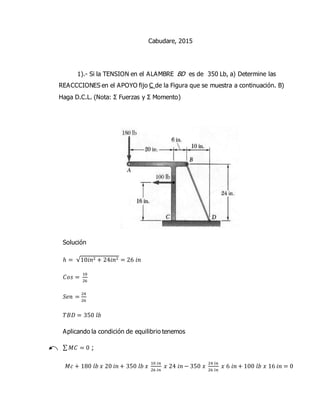
1).- Si la TENSION en el ALAMBRE BD es de 350 Lb, a) Determine las
REACCCIONES en el APOYO fijo C de la Figura que se muestra a continuación. B)
Haga D.C.L. (Nota: Σ Fuerzas y Σ Momento)
Solución
ℎ = √10𝑖𝑛2 + 24𝑖𝑛2 = 26 𝑖𝑛
𝐶𝑜𝑠 =
10
26
𝑆𝑒𝑛 =
24
26
𝑇𝐵𝐷 = 350 𝑙𝑏
Aplicando la condición de equilibrio tenemos
∑ 𝑀𝐶 = 0 ;
𝑀𝑐 + 180 𝑙𝑏 𝑥 20 𝑖𝑛 + 350 𝑙𝑏 𝑥
10 𝑖𝑛
26 𝑖𝑛
𝑥 24 𝑖𝑛 − 350 𝑥
24 𝑖𝑛
26 𝑖𝑛
𝑥 6 𝑖𝑛 + 100 𝑙𝑏 𝑥 16 𝑖𝑛 = 0
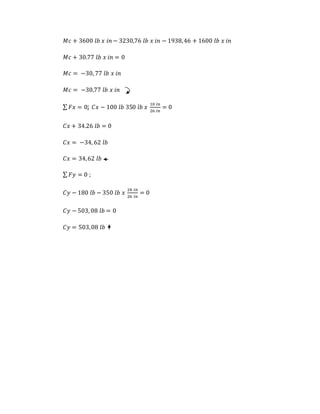
𝑀𝑐 + 3600 𝑙𝑏 𝑥 𝑖𝑛 − 3230,76 𝑙𝑏 𝑥 𝑖𝑛 − 1938,46 + 1600 𝑙𝑏 𝑥 𝑖𝑛
𝑀𝑐 + 30.77 𝑙𝑏 𝑥 𝑖𝑛 = 0
𝑀𝑐 = −30, 77 𝑙𝑏 𝑥 𝑖𝑛
𝑀𝑐 = −30,77 𝑙𝑏 𝑥 𝑖𝑛
∑ 𝐹𝑥 = 0; 𝐶𝑥 − 100 𝑙𝑏 350 𝑙𝑏 𝑥
10 𝑖𝑛
26 𝑖𝑛
= 0
𝐶𝑥 + 34.26 𝑙𝑏 = 0
𝐶𝑥 = −34, 62 𝑙𝑏
𝐶𝑥 = 34,62 𝑙𝑏
∑ 𝐹𝑦 = 0 ;
𝐶𝑦 − 180 𝑙𝑏 − 350 𝑙𝑏 𝑥
24 𝑖𝑛
26 𝑖𝑛
= 0
𝐶𝑦 − 503, 08 𝑙𝑏 = 0
𝐶𝑦 = 503,08 𝑙𝑏
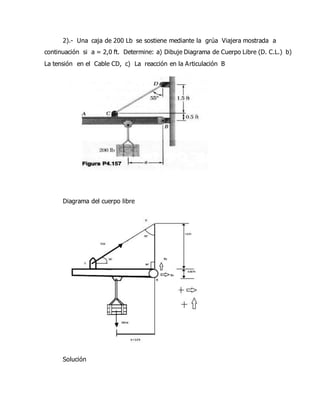
2).- Una caja de 200 Lb se sostiene mediante la grúa Viajera mostrada a
continuación si a = 2,0 ft. Determine: a) Dibuje Diagrama de Cuerpo Libre (D. C.L.) b)
La tensión en el Cable CD, c) La reacción en la Articulación B
Diagrama del cuerpo libre
Solución
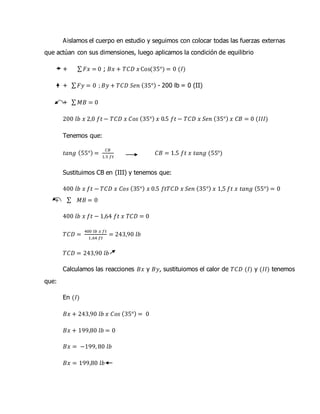
Aislamos el cuerpo en estudio y seguimos con colocar todas las fuerzas externas
que actúan con sus dimensiones, luego aplicamos la condición de equilibrio
+ ∑ 𝐹𝑥 = 0 ; 𝐵𝑥 + 𝑇𝐶𝐷 𝑥 Cos(35°) = 0 (𝐼)
+ ∑ 𝐹𝑦 = 0 ; 𝐵𝑦 + 𝑇𝐶𝐷 𝑆𝑒𝑛 (35°) - 200 lb = 0 (II)
+ ∑ 𝑀𝐵 = 0
200 𝑙𝑏 𝑥 2,0 𝑓𝑡 − 𝑇𝐶𝐷 𝑥 𝐶𝑜𝑠 (35°) 𝑥 0.5 𝑓𝑡 − 𝑇𝐶𝐷 𝑥 𝑆𝑒𝑛 (35°) 𝑥 𝐶𝐵 = 0 (𝐼𝐼𝐼)
Tenemos que:
𝑡𝑎𝑛𝑔 (55°) =
𝐶𝐵
1.5 𝑓𝑡
𝐶𝐵 = 1.5 𝑓𝑡 𝑥 𝑡𝑎𝑛𝑔 (55°)
Sustituimos CB en (III) y tenemos que:
400 𝑙𝑏 𝑥 𝑓𝑡 − 𝑇𝐶𝐷 𝑥 𝐶𝑜𝑠 (35°) 𝑥 0.5 𝑓𝑡𝑇𝐶𝐷 𝑥 𝑆𝑒𝑛 (35°) 𝑥 1,5 𝑓𝑡 𝑥 𝑡𝑎𝑛𝑔 (55°) = 0
+ ∑ 𝑀𝐵 = 0
400 𝑙𝑏 𝑥 𝑓𝑡 − 1,64 𝑓𝑡 𝑥 𝑇𝐶𝐷 = 0
𝑇𝐶𝐷 =
400 𝑙𝑏 𝑥 𝑓𝑡
1,64 𝑓𝑡
= 243,90 𝑙𝑏
𝑇𝐶𝐷 = 243,90 𝑙𝑏
Calculamos las reacciones 𝐵𝑥 y 𝐵𝑦, sustituiomos el calor de 𝑇𝐶𝐷 (𝐼) y (𝐼𝐼) tenemos
que:
En (𝐼)
𝐵𝑥 + 243,90 𝑙𝑏 𝑥 𝐶𝑜𝑠 (35°) = 0
𝐵𝑥 + 199,80 𝑙𝑏 = 0
𝐵𝑥 = −199, 80 𝑙𝑏
𝐵𝑥 = 199,80 𝑙𝑏
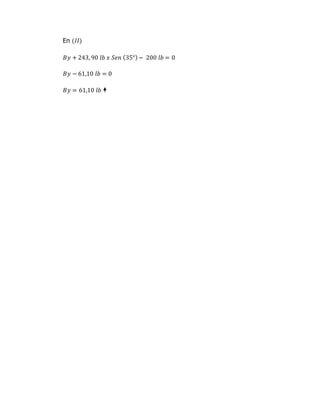
En (𝐼𝐼)
𝐵𝑦 + 243, 90 𝑙𝑏 𝑥 𝑆𝑒𝑛 (35°)− 200 𝑙𝑏 = 0
𝐵𝑦 − 61,10 𝑙𝑏 = 0
𝐵𝑦 = 61,10 𝑙𝑏
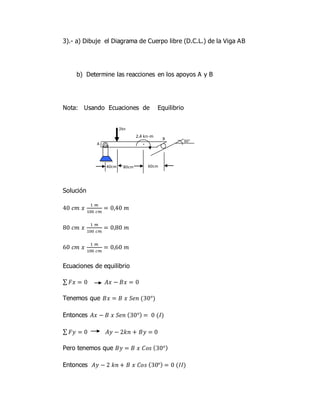
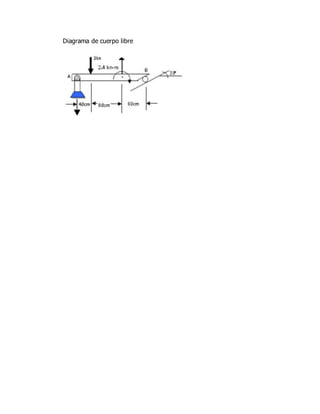
3).- a) Dibuje el Diagrama de Cuerpo libre (D.C.L.) de la Viga AB
b) Determine las reacciones en los apoyos A y B
Nota: Usando Ecuaciones de Equilibrio
Solución
40 𝑐𝑚 𝑥
1 𝑚
100 𝑐𝑚
= 0,40 𝑚
80 𝑐𝑚 𝑥
1 𝑚
100 𝑐𝑚
= 0,80 𝑚
60 𝑐𝑚 𝑥
1 𝑚
100 𝑐𝑚
= 0,60 𝑚
Ecuaciones de equilibrio
∑ 𝐹𝑥 = 0 𝐴𝑥 − 𝐵𝑥 = 0
Tenemos que 𝐵𝑥 = 𝐵 𝑥 𝑆𝑒𝑛 (30°)
Entonces 𝐴𝑥 − 𝐵 𝑥 𝑆𝑒𝑛 (30°) = 0 (𝐼)
∑ 𝐹𝑦 = 0 𝐴𝑦 − 2𝑘𝑛 + 𝐵𝑦 = 0
Pero tenemos que 𝐵𝑦 = 𝐵 𝑥 𝐶𝑜𝑠 (30°)
Entonces 𝐴𝑦 − 2 𝑘𝑛 + 𝐵 𝑥 𝐶𝑜𝑠 (30°) = 0 (𝐼𝐼)
A
B
80cm 60cm40cm
30°
2kn
·
2.4 kn-m
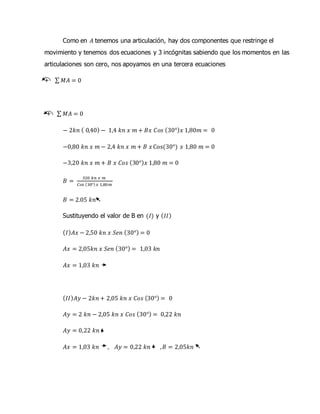
Como en 𝐴 tenemos una articulación, hay dos componentes que restringe el
movimiento y tenemos dos ecuaciones y 3 incógnitas sabiendo que los momentos en las
articulaciones son cero, nos apoyamos en una tercera ecuaciones
+ ∑ 𝑀𝐴 = 0
+ ∑ 𝑀𝐴 = 0
− 2𝑘𝑛 ( 0,40) − 1,4 𝑘𝑛 𝑥 𝑚 + 𝐵𝑥 𝐶𝑜𝑠 (30°) 𝑥 1,80𝑚 = 0
−0,80 𝑘𝑛 𝑥 𝑚 − 2,4 𝑘𝑛 𝑥 𝑚 + 𝐵 𝑥 Cos(30°) 𝑥 1,80 𝑚 = 0
−3,20 𝑘𝑛 𝑥 𝑚 + 𝐵 𝑥 𝐶𝑜𝑠 (30°) 𝑥 1,80 𝑚 = 0
𝐵 =
320 𝑘𝑛 𝑥 𝑚
𝐶𝑜𝑠 (30°) 𝑥 1,80𝑚
𝐵 = 2.05 𝑘𝑛
Sustituyendo el valor de B en (𝐼) y ( 𝐼𝐼)
( 𝐼) 𝐴𝑥 − 2,50 𝑘𝑛 𝑥 𝑆𝑒𝑛 (30°) = 0
𝐴𝑥 = 2,05𝑘𝑛 𝑥 𝑆𝑒𝑛 (30°) = 1,03 𝑘𝑛
𝐴𝑥 = 1,03 𝑘𝑛
( 𝐼𝐼) 𝐴𝑦 − 2𝑘𝑛 + 2,05 𝑘𝑛 𝑥 𝐶𝑜𝑠 (30°) = 0
𝐴𝑦 = 2 𝑘𝑛 − 2,05 𝑘𝑛 𝑥 𝐶𝑜𝑠 (30°) = 0,22 𝑘𝑛
𝐴𝑦 = 0,22 𝑘𝑛
𝐴𝑥 = 1,03 𝑘𝑛 , 𝐴𝑦 = 0,22 𝑘𝑛 , 𝐵 = 2,05𝑘𝑛
Diagrama de cuerpo libre

Alvimar vargas actividad 4

  • 1.
    UNIVERSIDAD FERMIN TORO VICERRECTORADOACADEMICO FACULTAD DE INGENIERIA ACTIVIDAD N°04 Autor: Alvimar Vargas: 23849955
  • 2.
    Cabudare, 2015 1).- Sila TENSION en el ALAMBRE BD es de 350 Lb, a) Determine las REACCCIONES en el APOYO fijo C de la Figura que se muestra a continuación. B) Haga D.C.L. (Nota: Σ Fuerzas y Σ Momento) Solución ℎ = √10𝑖𝑛2 + 24𝑖𝑛2 = 26 𝑖𝑛 𝐶𝑜𝑠 = 10 26 𝑆𝑒𝑛 = 24 26 𝑇𝐵𝐷 = 350 𝑙𝑏 Aplicando la condición de equilibrio tenemos ∑ 𝑀𝐶 = 0 ; 𝑀𝑐 + 180 𝑙𝑏 𝑥 20 𝑖𝑛 + 350 𝑙𝑏 𝑥 10 𝑖𝑛 26 𝑖𝑛 𝑥 24 𝑖𝑛 − 350 𝑥 24 𝑖𝑛 26 𝑖𝑛 𝑥 6 𝑖𝑛 + 100 𝑙𝑏 𝑥 16 𝑖𝑛 = 0
  • 3.
    𝑀𝑐 + 3600𝑙𝑏 𝑥 𝑖𝑛 − 3230,76 𝑙𝑏 𝑥 𝑖𝑛 − 1938,46 + 1600 𝑙𝑏 𝑥 𝑖𝑛 𝑀𝑐 + 30.77 𝑙𝑏 𝑥 𝑖𝑛 = 0 𝑀𝑐 = −30, 77 𝑙𝑏 𝑥 𝑖𝑛 𝑀𝑐 = −30,77 𝑙𝑏 𝑥 𝑖𝑛 ∑ 𝐹𝑥 = 0; 𝐶𝑥 − 100 𝑙𝑏 350 𝑙𝑏 𝑥 10 𝑖𝑛 26 𝑖𝑛 = 0 𝐶𝑥 + 34.26 𝑙𝑏 = 0 𝐶𝑥 = −34, 62 𝑙𝑏 𝐶𝑥 = 34,62 𝑙𝑏 ∑ 𝐹𝑦 = 0 ; 𝐶𝑦 − 180 𝑙𝑏 − 350 𝑙𝑏 𝑥 24 𝑖𝑛 26 𝑖𝑛 = 0 𝐶𝑦 − 503, 08 𝑙𝑏 = 0 𝐶𝑦 = 503,08 𝑙𝑏
  • 4.
    2).- Una cajade 200 Lb se sostiene mediante la grúa Viajera mostrada a continuación si a = 2,0 ft. Determine: a) Dibuje Diagrama de Cuerpo Libre (D. C.L.) b) La tensión en el Cable CD, c) La reacción en la Articulación B Diagrama del cuerpo libre Solución
  • 5.
    Aislamos el cuerpoen estudio y seguimos con colocar todas las fuerzas externas que actúan con sus dimensiones, luego aplicamos la condición de equilibrio + ∑ 𝐹𝑥 = 0 ; 𝐵𝑥 + 𝑇𝐶𝐷 𝑥 Cos(35°) = 0 (𝐼) + ∑ 𝐹𝑦 = 0 ; 𝐵𝑦 + 𝑇𝐶𝐷 𝑆𝑒𝑛 (35°) - 200 lb = 0 (II) + ∑ 𝑀𝐵 = 0 200 𝑙𝑏 𝑥 2,0 𝑓𝑡 − 𝑇𝐶𝐷 𝑥 𝐶𝑜𝑠 (35°) 𝑥 0.5 𝑓𝑡 − 𝑇𝐶𝐷 𝑥 𝑆𝑒𝑛 (35°) 𝑥 𝐶𝐵 = 0 (𝐼𝐼𝐼) Tenemos que: 𝑡𝑎𝑛𝑔 (55°) = 𝐶𝐵 1.5 𝑓𝑡 𝐶𝐵 = 1.5 𝑓𝑡 𝑥 𝑡𝑎𝑛𝑔 (55°) Sustituimos CB en (III) y tenemos que: 400 𝑙𝑏 𝑥 𝑓𝑡 − 𝑇𝐶𝐷 𝑥 𝐶𝑜𝑠 (35°) 𝑥 0.5 𝑓𝑡𝑇𝐶𝐷 𝑥 𝑆𝑒𝑛 (35°) 𝑥 1,5 𝑓𝑡 𝑥 𝑡𝑎𝑛𝑔 (55°) = 0 + ∑ 𝑀𝐵 = 0 400 𝑙𝑏 𝑥 𝑓𝑡 − 1,64 𝑓𝑡 𝑥 𝑇𝐶𝐷 = 0 𝑇𝐶𝐷 = 400 𝑙𝑏 𝑥 𝑓𝑡 1,64 𝑓𝑡 = 243,90 𝑙𝑏 𝑇𝐶𝐷 = 243,90 𝑙𝑏 Calculamos las reacciones 𝐵𝑥 y 𝐵𝑦, sustituiomos el calor de 𝑇𝐶𝐷 (𝐼) y (𝐼𝐼) tenemos que: En (𝐼) 𝐵𝑥 + 243,90 𝑙𝑏 𝑥 𝐶𝑜𝑠 (35°) = 0 𝐵𝑥 + 199,80 𝑙𝑏 = 0 𝐵𝑥 = −199, 80 𝑙𝑏 𝐵𝑥 = 199,80 𝑙𝑏
  • 6.
    En (𝐼𝐼) 𝐵𝑦 +243, 90 𝑙𝑏 𝑥 𝑆𝑒𝑛 (35°)− 200 𝑙𝑏 = 0 𝐵𝑦 − 61,10 𝑙𝑏 = 0 𝐵𝑦 = 61,10 𝑙𝑏
  • 7.
    3).- a) Dibujeel Diagrama de Cuerpo libre (D.C.L.) de la Viga AB b) Determine las reacciones en los apoyos A y B Nota: Usando Ecuaciones de Equilibrio Solución 40 𝑐𝑚 𝑥 1 𝑚 100 𝑐𝑚 = 0,40 𝑚 80 𝑐𝑚 𝑥 1 𝑚 100 𝑐𝑚 = 0,80 𝑚 60 𝑐𝑚 𝑥 1 𝑚 100 𝑐𝑚 = 0,60 𝑚 Ecuaciones de equilibrio ∑ 𝐹𝑥 = 0 𝐴𝑥 − 𝐵𝑥 = 0 Tenemos que 𝐵𝑥 = 𝐵 𝑥 𝑆𝑒𝑛 (30°) Entonces 𝐴𝑥 − 𝐵 𝑥 𝑆𝑒𝑛 (30°) = 0 (𝐼) ∑ 𝐹𝑦 = 0 𝐴𝑦 − 2𝑘𝑛 + 𝐵𝑦 = 0 Pero tenemos que 𝐵𝑦 = 𝐵 𝑥 𝐶𝑜𝑠 (30°) Entonces 𝐴𝑦 − 2 𝑘𝑛 + 𝐵 𝑥 𝐶𝑜𝑠 (30°) = 0 (𝐼𝐼) A B 80cm 60cm40cm 30° 2kn · 2.4 kn-m
  • 8.
    Como en 𝐴tenemos una articulación, hay dos componentes que restringe el movimiento y tenemos dos ecuaciones y 3 incógnitas sabiendo que los momentos en las articulaciones son cero, nos apoyamos en una tercera ecuaciones + ∑ 𝑀𝐴 = 0 + ∑ 𝑀𝐴 = 0 − 2𝑘𝑛 ( 0,40) − 1,4 𝑘𝑛 𝑥 𝑚 + 𝐵𝑥 𝐶𝑜𝑠 (30°) 𝑥 1,80𝑚 = 0 −0,80 𝑘𝑛 𝑥 𝑚 − 2,4 𝑘𝑛 𝑥 𝑚 + 𝐵 𝑥 Cos(30°) 𝑥 1,80 𝑚 = 0 −3,20 𝑘𝑛 𝑥 𝑚 + 𝐵 𝑥 𝐶𝑜𝑠 (30°) 𝑥 1,80 𝑚 = 0 𝐵 = 320 𝑘𝑛 𝑥 𝑚 𝐶𝑜𝑠 (30°) 𝑥 1,80𝑚 𝐵 = 2.05 𝑘𝑛 Sustituyendo el valor de B en (𝐼) y ( 𝐼𝐼) ( 𝐼) 𝐴𝑥 − 2,50 𝑘𝑛 𝑥 𝑆𝑒𝑛 (30°) = 0 𝐴𝑥 = 2,05𝑘𝑛 𝑥 𝑆𝑒𝑛 (30°) = 1,03 𝑘𝑛 𝐴𝑥 = 1,03 𝑘𝑛 ( 𝐼𝐼) 𝐴𝑦 − 2𝑘𝑛 + 2,05 𝑘𝑛 𝑥 𝐶𝑜𝑠 (30°) = 0 𝐴𝑦 = 2 𝑘𝑛 − 2,05 𝑘𝑛 𝑥 𝐶𝑜𝑠 (30°) = 0,22 𝑘𝑛 𝐴𝑦 = 0,22 𝑘𝑛 𝐴𝑥 = 1,03 𝑘𝑛 , 𝐴𝑦 = 0,22 𝑘𝑛 , 𝐵 = 2,05𝑘𝑛
  • 9.