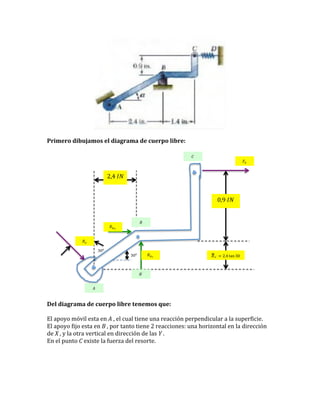
Primero	
  dibujamos	
  el	
  diagrama	
  de	
  cuerpo	
  libre:	


!!

!! !

2,4!!"!

0,9!!"!

!!

!! ! !
!! !
30! !

!! ! !

30! !

!! ´ = 2,4 tan 30!

!´ !
!!


Del	
  diagrama	
  de	
  cuerpo	
  libre	
  tenemos	
  que:	


El	
  apoyo	
  móvil	
  esta	
  en	
  A	
  ,	
  el	
  cual	
  tiene	
  una	
  reacción	
  perpendicular	
  a	
  la	
  superficie.	
  
El	
  apoyo	
  fijo	
  esta	
  en	
  B	
  ,	
  por	
  tanto	
  tiene	
  2	
  reacciones:	
  una	
  horizontal	
  en	
  la	
  dirección	
  
de	
  X	
  ,	
  y	
  la	
  otra	
  vertical	
  en	
  dirección	
  de	
  las	
  Y	
  .	
  
En	
  el	
  punto	
  C	
  existe	
  la	
  fuerza	
  del	
  resorte.	


-Body Diagram:
e-Body Diagram:
(a) From free-body diagram of lever BCD
ΣM C = 0: TAB ((50 mm ) − 200 N ( 75 mm ) = 0
ΣM C = 0: TAB 50 mm −
AB = 300
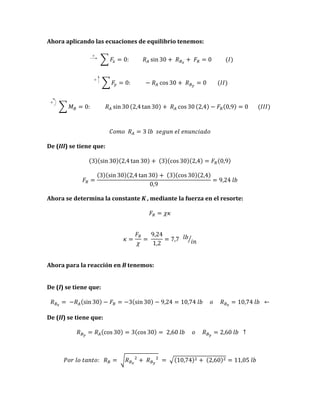
Ahora	
  aplicando	
  las	
  ecuaciones	
  de	
  equilibrio	
  tenemos:	
   ∴ TAB = 300
(b) From free-body diagram of lever BCD


olutions Manual Organization System

19.


ΣFxx = 0: 0:                    𝑅Cxsin0.6 ( 300 N ) = 0 𝐹 = 0                    (𝐼)	
  
ΣF 𝐹 0: 200 N + C x + 30 +    𝑅! +    !
= = 200 N + ! +
!
!
∴ C xx = −380 N
or
C x = 380 N
∴ C = −380 N
or
C x = 380 N

ΣFyy = 0: C yy + 0.8 ( 300 N ) = 0
ΣF = 0: C + 0.8 300 N = 0

𝐹! = 0:                     − 𝑅! cos 30 +    𝑅!! = 0                (𝐼𝐼)	
  

∴ C = −240 N
∴C
(a) From free-body diagram of lever BCD yy = −240 N


or
or

C y = 240 N
C y = 240 N

2
2
ΣM C Then TAB ( 50 mm )C x2200 y2 (= mm ))2 + ( 240 )2 = 449.44 N
= 0:
C = C2 + C N = ( 380 = + 240 2 = 449.44 N
C = −x + C y 75 380 0
Then

𝑀! = 0:                      𝑅! sin 30 2,4 tan 30 +    𝑅! cos 30 2,4 − 𝐹! 0,9 = 0              (𝐼𝐼𝐼)	
  
∴T

= 300

AB
⎛ Cy ⎞
C ⎞
⎛ − 240 ⎞
1
⎞
⎛
	
  
and
θ = tan −−1⎜⎛ y ⎟ = tan −−11⎜ − 240 ⎟ = 32.276°
⎟
and
θ lever BCD ⎟ = tan ⎜
= tan ⎜⎜
⎟ = 32.276°
(b) From free-body diagram of
⎟
⎝ − 380 ⎠
	
  
⎝⎜C xx ⎠
⎝ − 380 ⎠
⎝C ⎠
𝐶𝑜𝑚𝑜    𝑅! N ) = 0
ΣFx = 0: 200 N + Cx + 0.6 ( 300= 3  𝑙𝑏    𝑠𝑒𝑔𝑢𝑛  𝑒𝑙  𝑒𝑛𝑢𝑛𝑐𝑖𝑎𝑑𝑜	
   32.3° ▹
or C = 449 N
32.3° ▹
or C = 449 N
	
  
∴ C x = −380 N
or
C x = 380 N
De	
  (III)	
  se	
  tiene	
  que:	
  
ΣFy = 0: C y + 0.8 ( 300 N ) = 0
	
  
3 sin 30 2,4 tan 30 = 240 N cos 30 2,4 = 𝐹! 0,9 	
  
+    3
∴ C y = −240 N
or
Cy
	
  
2
2
2
2
sin 30 240 tan 449.44 3
C = C x + C y =3 ( 380 ) + ( 2,4 ) = 30 +    N cos 30 2,4 = 9,24  𝑙𝑏	
  
Then
𝐹! =
0,9
⎛ Cy ⎞
	
  
−1
−1 ⎛ − 240 ⎞
and
θ = tan ⎜ ⎟ = tan ⎜
⎟ = 32.276°
⎜C ⎟
Ahora	
  se	
  determina	
  la	
  c− 380 ⎠
⎝ onstante	
  K	
  ,	
  mediante	
  la	
  fuerza	
  en	
  el	
  resorte:	
  
⎝ x⎠
	
  
or C = 449 N
32.3° ▹
𝐹! = 𝜒𝜅	


𝐹!
9,24
𝜅=
=   
= 7,7     𝑙𝑏 𝑖𝑛	
  
𝜒
1,2


Ahora	
  para	
  la	
  reacción	
  en	
  B	
  tenemos:	


De	
  (I)	
  se	
  tiene	
  que:	


    𝑅!! =    −𝑅! sin 30 − 𝐹! = −3 sin 30 − 9,24 = 10,74  𝑙𝑏          𝑜          𝑅!! = 10,74  𝑙𝑏     ←    	


De	
  (II)	
  se	
  tiene	
  que:	


Mechanics for Engineers: Statics and Dynamics, 8/e, Ferdinandcos 30 E.Russell cos 30 Jr.,   2,60  𝑙𝑏          𝑜          𝑅! = 2,60  𝑙𝑏     ↑	
  
    𝑅 8/e, Ferdinand P. Beer, Russell Johnston, =
Mechanics for Engineers: Statics and Dynamics,!! = 𝑅! P. Beer, E. = 3 Johnston, Jr.,
!
Eisenberg, William E. Clausen, David Mazurek, Phillip J. Cornwell
R. Eisenberg, William E. Clausen, David Mazurek,Phillip J. Cornwell
	
  
The McGraw-Hill Companies.
7 The McGraw-Hill Companies.


𝑃𝑜𝑟  𝑙𝑜  𝑡𝑎𝑛𝑡𝑜:      𝑅! =   

s: Statics and Dynamics, 8/e, Ferdinand P. Beer, E. Russell Johnston, Jr.,

𝑅!! ! +    𝑅!! !    =   

10,74

!

+    2,60

!

= 11,05  𝑙𝑏	
  

Ejercicio

  • 1.
        Primero  dibujamos  el  diagrama  de  cuerpo  libre:     !! !! ! 2,4!!"! 0,9!!"! !! !! ! ! !! ! 30! ! !! ! ! 30! ! !! ´ = 2,4 tan 30! !´ ! !!   Del  diagrama  de  cuerpo  libre  tenemos  que:     El  apoyo  móvil  esta  en  A  ,  el  cual  tiene  una  reacción  perpendicular  a  la  superficie.   El  apoyo  fijo  esta  en  B  ,  por  tanto  tiene  2  reacciones:  una  horizontal  en  la  dirección   de  X  ,  y  la  otra  vertical  en  dirección  de  las  Y  .   En  el  punto  C  existe  la  fuerza  del  resorte.              
  • 2.
    -Body Diagram: e-Body Diagram: (a)From free-body diagram of lever BCD (a) From free-body diagram of lever BCD ΣM C = 0: TAB ((50 mm ) − 200 N ( 75 mm ) = 0 ΣM C = 0: TAB 50 mm − AB = 300 Ahora  aplicando  las  ecuaciones  de  equilibrio  tenemos:   ∴ TAB = 300 (b) From free-body diagram of lever BCD (b) From free-body diagram of lever BCD   olutions Manual Organization System 19.   ΣFxx = 0: 0:                    𝑅Cxsin0.6 ( 300 N ) = 0 𝐹 = 0                    (𝐼)   ΣF 𝐹 0: 200 N + C x + 30 +   𝑅! +   ! = = 200 N + ! + ! ! ∴ C xx = −380 N or C x = 380 N ∴ C = −380 N or C x = 380 N ΣFyy = 0: C yy + 0.8 ( 300 N ) = 0 ΣF = 0: C + 0.8 300 N = 0 𝐹! = 0:                     − 𝑅! cos 30 +   𝑅!! = 0                (𝐼𝐼)   ∴ C = −240 N ∴C (a) From free-body diagram of lever BCD yy = −240 N   or or C y = 240 N C y = 240 N 2 2 ΣM C Then TAB ( 50 mm )C x2200 y2 (= mm ))2 + ( 240 )2 = 449.44 N = 0: C = C2 + C N = ( 380 = + 240 2 = 449.44 N C = −x + C y 75 380 0 Then 𝑀! = 0:                      𝑅! sin 30 2,4 tan 30 +   𝑅! cos 30 2,4 − 𝐹! 0,9 = 0              (𝐼𝐼𝐼)   ∴T = 300 AB ⎛ Cy ⎞ C ⎞ ⎛ − 240 ⎞ 1 ⎞ ⎛   and θ = tan −−1⎜⎛ y ⎟ = tan −−11⎜ − 240 ⎟ = 32.276° ⎟ and θ lever BCD ⎟ = tan ⎜ = tan ⎜⎜ ⎟ = 32.276° (b) From free-body diagram of ⎟ ⎝ − 380 ⎠   ⎝⎜C xx ⎠ ⎝ − 380 ⎠ ⎝C ⎠ 𝐶𝑜𝑚𝑜    𝑅! N ) = 0 ΣFx = 0: 200 N + Cx + 0.6 ( 300= 3  𝑙𝑏    𝑠𝑒𝑔𝑢𝑛  𝑒𝑙  𝑒𝑛𝑢𝑛𝑐𝑖𝑎𝑑𝑜   32.3° ▹ or C = 449 N 32.3° ▹ or C = 449 N   ∴ C x = −380 N or C x = 380 N De  (III)  se  tiene  que:   ΣFy = 0: C y + 0.8 ( 300 N ) = 0   3 sin 30 2,4 tan 30 = 240 N cos 30 2,4 = 𝐹! 0,9   +   3 ∴ C y = −240 N or Cy   2 2 2 2 sin 30 240 tan 449.44 3 C = C x + C y =3 ( 380 ) + ( 2,4 ) = 30 +   N cos 30 2,4 = 9,24  𝑙𝑏   Then 𝐹! = 0,9 ⎛ Cy ⎞   −1 −1 ⎛ − 240 ⎞ and θ = tan ⎜ ⎟ = tan ⎜ ⎟ = 32.276° ⎜C ⎟ Ahora  se  determina  la  c− 380 ⎠ ⎝ onstante  K  ,  mediante  la  fuerza  en  el  resorte:   ⎝ x⎠   or C = 449 N 32.3° ▹ 𝐹! = 𝜒𝜅       𝐹! 9,24 𝜅= =   = 7,7     𝑙𝑏 𝑖𝑛   𝜒 1,2     Ahora  para  la  reacción  en  B  tenemos:       De  (I)  se  tiene  que:        𝑅!! =   −𝑅! sin 30 − 𝐹! = −3 sin 30 − 9,24 = 10,74  𝑙𝑏          𝑜          𝑅!! = 10,74  𝑙𝑏     ←         De  (II)  se  tiene  que:     Mechanics for Engineers: Statics and Dynamics, 8/e, Ferdinandcos 30 E.Russell cos 30 Jr.,  2,60  𝑙𝑏          𝑜          𝑅! = 2,60  𝑙𝑏     ↑      𝑅 8/e, Ferdinand P. Beer, Russell Johnston, = Mechanics for Engineers: Statics and Dynamics,!! = 𝑅! P. Beer, E. = 3 Johnston, Jr., ! Eisenberg, William E. Clausen, David Mazurek, Phillip J. Cornwell R. Eisenberg, William E. Clausen, David Mazurek,Phillip J. Cornwell   The McGraw-Hill Companies. 7 The McGraw-Hill Companies.   𝑃𝑜𝑟  𝑙𝑜  𝑡𝑎𝑛𝑡𝑜:      𝑅! =   s: Statics and Dynamics, 8/e, Ferdinand P. Beer, E. Russell Johnston, Jr., 𝑅!! ! +   𝑅!! !   =   10,74 ! +   2,60 ! = 11,05  𝑙𝑏