Este documento es de distribución gratuita
y llega gracias a
“Ciencia Matemática”
www.cienciamatematica.com
El mayor portal de recursos educativos a tu servicio!
1
Cap´ıtulo 5
Valor Absoluto
M.Sc. Alcides Astorga M., Lic. Julio Rodr´ıguez S.
Instituto Tecnol´ogico de Costa Rica
Escuela de Matem´atica
· · ·
Revista digital Matem´atica, educaci´on e internet (www.cidse.itcr.ac.cr)
2
Cr´editos
Primera edici´on impresa: Rosario ´Alvarez, 1984.
Edici´on LaTeX: Marieth Villalobos, Alejandra Araya, Jessica Chac´on, Marianela Abarca, Lisseth Angulo.
y Walter Mora.
Colaboradores: Cristhian Pa´ez, Alex Borb´on, Juan Jos´e Fallas, Jeffrey Chavarr´ıa
Edici´on y composici´on final: Walter Mora.
Gr´aficos: Walter Mora, Marieth Villalobos.
Comentarios y correcciones: escribir a wmora2@yahoo.com.mx
Contenido
5.1 Ecuaciones e Inecuaciones con valor absoluto . . . . . . . . . . . . . . . . . . . . . . . . . . . . . 3
5.1.1 Propiedades del valor absoluto . . . . . . . . . . . . . . . . . . . . . . . . . . . . . . . . . 5
5.1.2 Ecuaciones que involucran valor absoluto . . . . . . . . . . . . . . . . . . . . . . . . . . . 11
5.1.3 Inecuaciones que involucran valor absoluto . . . . . . . . . . . . . . . . . . . . . . . . . . 25
5.1 Ecuaciones e Inecuaciones con valor absoluto
Nuestro objetivo en este cap´ıtulo es lograr que el estudiante resuelva ecuaciones e inecuaciones que involucran
valor absoluto de expresiones algebraicas de la forma ax + b, donde a y b son constantes reales con a = 0, y x
es una variable real.
Para esto conviene recordar la definici´on de valor absoluto siguiente:
Para cada n´umero real x, se define su valor absoluto (y se denota |x| ) de la siguiente manera:
|x| = x si x ≥ 0
o
|x| = −x si x < 0
Esta definici´on frecuentemente se denota de la siguiente manera:
|x| =
x si x ≥ 0
−x si x < 0
Aplicando esta definici´on a expresiones de la forma ax + b se tiene:
|ax + b| =
ax + b si ax + b ≥ 0
−(ax + b) si ax + b < 0
Usando la definici´on de valor absoluto se tiene:
Ejemplo 1
|x + 5| =



x + 5 si x + 5 ≥ 0
−(x + 5) si x + 5 < 0
3
4 Valor Absoluto
pero: x + 5 ≥ 0 ⇐⇒ x ≥ −5
y x + 5 < 0 ⇐⇒ x < −5
∴ |x + 5| =



x + 5 si x ≥ −5
−(x + 5) si x < −5
Para efectos de lograr mayor claridad podemos resumir esta informaci´on en la tabla siguiente:
−∞ −5 +∞
|x + 5| −(x + 5) x + 5
Ejemplo 2
|x − 7| =



x − 7 si x − 7 ≥ 0
−(x − 7) si x − 7 < 0
pero: x − 7 ≥ 0 ⇐⇒ x ≥ 7
y x − 7 < 0 ⇐⇒ x < 7
∴ |x − 7| =



x − 7 si x ≥ 7
−(x − 7) si x < 7
y en forma resumida podemos escribir:
−∞ 7 +∞
|x − 7| −(x − 7) x − 7
Ejemplo 3
| − 2x + 3| =



−2x + 3 si −2x + 3 ≥ 0
−(−2x + 3) si −2x + 3 < 0
pero: −2x + 3 ≥ 0 ⇐⇒ −2x ≥ −3, o sea x ≤
3
2
y −2x + 3 < 0 ⇐⇒ −2x < −3, o sea x >
3
2
∴ | − 2x + 3| =



−2x + 3 si x ≥
3
2
−(−2x + 3) si x <
3
2
y en forma resumida podemos escribir:
www.cienciamatematica.com
J. Rodr´ıguez S. A. Astorga M. 5
−∞ 3/2 +∞
| − 2x + 3| −2x + 3 −(−2x + 3)
Ejemplo 4
| − 3 − 5x| =



−3 − 5x si −3 − 5x ≥ 0
−(−3 − 5x) si −3 − 5x < 0
pero: −3 − 5x ≥ 0 ⇐⇒ −5x ≥ 3, o sea x ≤
−3
5
y −3 − 5x < 0 ⇐⇒ −5x < 3, o sea x >
−3
5
∴ | − 3 − 5x| =



−3 − 5x si x ≤
−3
5
−(−3 − 5x) si x >
−3
5
y en forma resumida podemos escribir:
−∞ −3/5 +∞
| − 3 − 5x| −3 − 5x −(−3 − 5x)
5.1.1 Propiedades del valor absoluto
Enunciaremos a continuaci´on algunas propiedades del valor absoluto, las cuales podr´an ser utilizadas para fa-
cilitar el trabajo en la resoluci´on de ecuaciones o inecuaciones que incluyen valor absoluto.
Propiedad 1
∀x, x ∈ R : |x| ≥ 0
Demostraci´on
x ∈ R : |x| =



x si x ≥ 0
−x si x < 0
Hay dos posibles casos:
Caso 1: x ≥ 0
x ≥ 0 =⇒ |x| = x
∴ |x| ≥ 0
www.cienciamatematica.com
6 Valor Absoluto
Caso 2: x < 0
x < 0 =⇒ |x| = −x
∴ |x| ≥ 0; pues x < 0 =⇒ −x > 0
Propiedad 2
Si x ∈ R y |x| = 0 entonces x = 0
Demostraci´on: (ejercicio para el estudiante)
Propiedad 3
Si x ∈ R, y ∈ R entonces |x · y| = |x| |y|
Demostraci´on
Para demostrar esta propiedad conviene recordar que:
∀a, a ∈ R : |a| = n
√
an, si n es par (ver p´agina 94)
en particular:
|a| =
√
a2 ; ∀a, a ∈ R
Usando esta definici´on se tiene que:
|xy| = (xy)2 = x2y2 =
√
x2 · y2 = |x| · |y|
∴ = |x| · |y|
Propiedad 4
∀x, x ∈ R : | − x| = |x|
Demostraci´on:(ejercicio para el estudiante)
Propiedad 5
Si x ∈ R, y ∈ R, y = 0 entonces
x
y
=
|x|
|y|
Demostraci´on
Aqu´ı tambi´en usaremos el hecho que:
∀a, a ∈ R : |a| =
√
a2
www.cienciamatematica.com
J. Rodr´ıguez S. A. Astorga M. 7
Si x ∈ R, y ∈ R, y = 0 entonces
x
y
∈ R
∴
x
y
=
x
y
2
=
x2
y2
=
√
x2
y2
=
|x|
|y|
x
y
=
|x|
|y|
Propiedad 6
∀x, x ∈ R : |x|2
= x2
Demostraci´on
∀x, x ∈ R : , se tiene que:
|x| =
√
x2
⇒ |x|2
= (
√
x2)2
⇒ |x|2
= x2
pues ∀a, a ∈ R (
√
a ∈ R =⇒ (
√
a)2
= a)
∴ ∀x, x ∈ R : |x|2
= x2
Propiedad 7
Sea x una variable real y k un n´umero real positivo entonces:
|x| = k ⇐⇒ x = k ´o x = −k
Demostraci´on:
Como |x| =
√
x2, se tiene:
|x| = k
⇐⇒
√
x2 = k
⇐⇒ (
√
x2)2
= k2
⇐⇒ x2
= k2
⇐⇒ x2
− k2
= 0
⇐⇒ (x − k)(x + k) = 0
⇐⇒ x = k o x = −k
∴ |x| = k ⇐⇒ x = k o x = −k
www.cienciamatematica.com
8 Valor Absoluto
x2, se tiene:
|x| < k
⇐⇒
√
x2 < k
⇐⇒ (
√
x2)2
< k2
⇐⇒ x2
< k2
⇐⇒ x2
− k2
< 0
⇐⇒ (x − k)(x + k) < 0
Resolviendo esta inecuaci´on:
−∞ −k k +∞
x − k − − +
x + k − + +
(x − k)(x + k) + − +
De aqu´ı se tiene:
(x − k)(x + k) < 0 ⇐⇒ x ∈ ] − k, k[
o sea: −k < x < k
∴ |x| < k ⇐⇒ −k < x < k
Propiedad 9
Sea x una variable real y k un n´umero real positivo entonces:
|x| > k ⇐⇒ x > k o x < −k
Demostraci´on:
Esta propiedad se demuestra en forma similar a la propiedad 9, ya demostrada, dejaremos esta demostraci´on
como ejercicio para el estudiante.
Propiedad 10
www.cienciamatematica.com
J. Rodr´ıguez S. A. Astorga M. 9
Sea x una variable real y k un n´umero real positivo entonces:
i.) |x| ≤ k ⇐⇒ −k ≤ x ≤ k
ii.) |x| ≥ k ⇐⇒ x ≥ k o x ≤ k
Demostraci´on:
El procedimiento usado para demostrar esta propiedad es similar al usado para demostrar la propiedad 8.
Dejaremos esta demostraci´on como ejercicio para el estudiante.
Propiedad 11
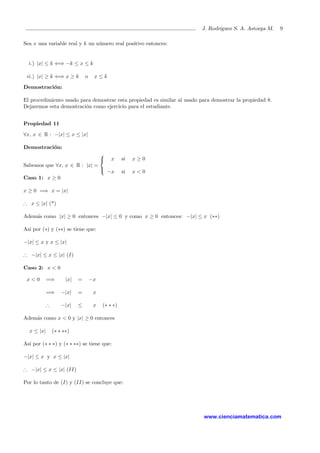
∀x, x ∈ R : −|x| ≤ x ≤ |x|
Demostraci´on:
Sabemos que ∀x, x ∈ R : |x| =



x si x ≥ 0
−x si x < 0
Caso 1: x ≥ 0
x ≥ 0 =⇒ x = |x|
∴ x ≤ |x| (*)
Adem´as como |x| ≥ 0 entonces −|x| ≤ 0 y como x ≥ 0 entonces: −|x| ≤ x (∗∗)
As´ı por (∗) y (∗∗) se tiene que:
−|x| ≤ x y x ≤ |x|
∴ −|x| ≤ x ≤ |x| (I)
Caso 2: x < 0
x < 0 =⇒ |x| = −x
=⇒ −|x| = x
∴ −|x| ≤ x (∗ ∗ ∗)
Adem´as como x < 0 y |x| ≥ 0 entonces
x ≤ |x| (∗ ∗ ∗∗)
As´ı por (∗ ∗ ∗) y (∗ ∗ ∗∗) se tiene que:
−|x| ≤ x y x ≤ |x|
∴ −|x| ≤ x ≤ |x| (II)
Por lo tanto de (I) y (II) se concluye que:
www.cienciamatematica.com
10 Valor Absoluto
∀x, x ∈ R : −|x| ≤ x ≤ |x|
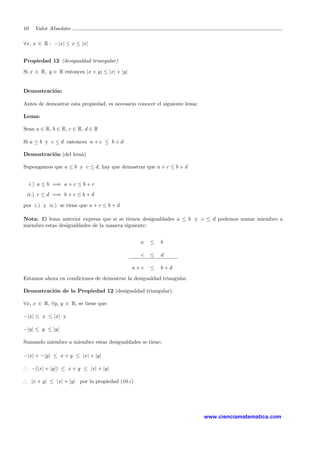
Propiedad 12 (desigualdad triangular)
Si x ∈ R, y ∈ R entonces |x + y| ≤ |x| + |y|
Demostraci´on:
Antes de demostrar esta propiedad, es necesario conocer el siguiente lema:
Lema:
Sean a ∈ R, b ∈ R, c ∈ R, d ∈ R
Si a ≤ b y c ≤ d entonces a + c ≤ b + d
Demostraci´on (del lema)
Supongamos que a ≤ b y c ≤ d, hay que demostrar que a + c ≤ b + d
i.) a ≤ b =⇒ a + c ≤ b + c
ii.) c ≤ d =⇒ b + c ≤ b + d
por i.) y ii.) se tiene que a + c ≤ b + d
Nota: El lema anterior expresa que si se tienen desigualdades a ≤ b y c ≤ d podemos sumar miembro a
miembro estas desigualdades de la manera siguiente:
a ≤ b
c ≤ d
a + c ≤ b + d
Estamos ahora en condiciones de demostrar la desigualdad triangular.
Demostraci´on de la Propiedad 12 (desigualdad triangular).
∀x, x ∈ R, ∀y, y ∈ R, se tiene que:
−|x| ≤ x ≤ |x| y
−|y| ≤ y ≤ |y|
Sumando miembro a miembro estas desigualdades se tiene:
−|x| + −|y| ≤ x + y ≤ |x| + |y|
∴ −(|x| + |y|) ≤ x + y ≤ |x| + |y|
∴ |x + y| ≤ |x| + |y| por la propiedad (10.i)
www.cienciamatematica.com
J. Rodr´ıguez S. A. Astorga M. 11
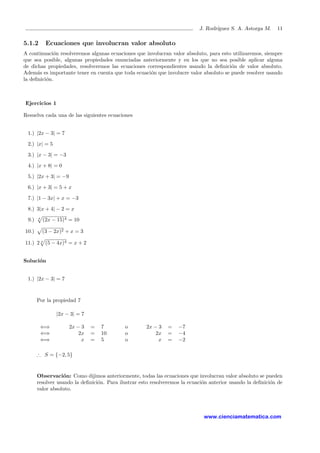
5.1.2 Ecuaciones que involucran valor absoluto
A continuaci´on resolveremos algunas ecuaciones que involucran valor absoluto, para esto utilizaremos, siempre
que sea posible, algunas propiedades enunciadas anteriormente y en los que no sea posible aplicar alguna
de dichas propiedades, resolveremos las ecuaciones correspondientes usando la definici´on de valor absoluto.
Adem´as es importante tener en cuenta que toda ecuaci´on que involucre valor absoluto se puede resolver usando
la definici´on.
Ejercicios 1
Resuelva cada una de las siguientes ecuaciones
1.) |2x − 3| = 7
2.) |x| = 5
3.) |x − 3| = −3
4.) |x + 8| = 0
5.) |2x + 3| = −9
6.) |x + 3| = 5 + x
7.) |1 − 3x| + x = −3
8.) 3|x + 4| − 2 = x
9.) 4
(2x − 15)4 = 10
10.) (3 − 2x)2 + x = 3
11.) 2 4
(5 − 4x)4 = x + 2
Soluci´on
1.) |2x − 3| = 7
Por la propiedad 7
|2x − 3| = 7
⇐⇒ 2x − 3 = 7 o 2x − 3 = −7
⇐⇒ 2x = 10 o 2x = −4
⇐⇒ x = 5 o x = −2
∴ S = {−2, 5}
Observaci´on: Como dijimos anteriormente, todas las ecuaciones que involucran valor absoluto se pueden
resolver usando la definici´on. Para ilustrar esto resolveremos la ecuaci´on anterior usando la definici´on de
valor absoluto.
www.cienciamatematica.com
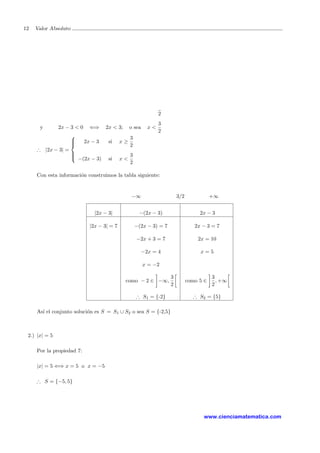
12 Valor Absoluto
2
y 2x − 3 < 0 ⇐⇒ 2x < 3; o sea x <
3
2
∴ |2x − 3| =



2x − 3 si x ≥
3
2
−(2x − 3) si x <
3
2
Con esta informaci´on construimos la tabla siguiente:
−∞ 3/2 +∞
|2x − 3| −(2x − 3) 2x − 3
|2x − 3| = 7 −(2x − 3) = 7 2x − 3 = 7
−2x + 3 = 7 2x = 10
−2x = 4 x = 5
x = −2
como − 2 ∈ −∞,
3
2
como 5 ∈
3
2
, +∞
∴ S1 = {-2} ∴ S2 = {5}
As´ı el conjunto soluci´on es S = S1 ∪ S2 o sea S = {-2,5}
2.) |x| = 5
Por la propiedad 7:
|x| = 5 ⇐⇒ x = 5 o x = −5
∴ S = {−5, 5}
www.cienciamatematica.com
J. Rodr´ıguez S. A. Astorga M. 13
3.) |x − 3| = −3
Por la propiedad 1, |x − 3| ≥ 0, ∀x, x ∈ R, por lo tanto:
|x − 3| = −3 !Nunca!
∴ S = ∅
4.) |x + 8| = 0
Por la propiedad 2,
|x + 8| = 0 ⇐⇒ x + 8 = 0
⇐⇒ x = −8
∴ S = {−8}
5.) |2x + 3| = −9
Por la propiedad 1, |2x + 3| ≥ 0, ∀x, x ∈ R
∴ |2x + 3| = −9 ¡Nunca!
∴ S = ∅
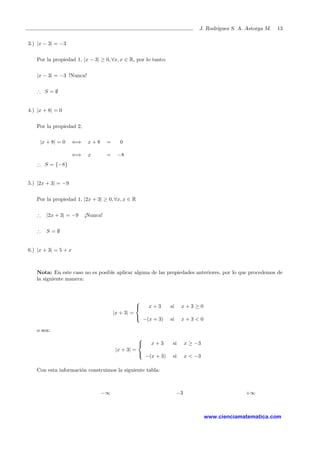
6.) |x + 3| = 5 + x
Nota: En este caso no es posible aplicar alguna de las propiedades anteriores, por lo que procedemos de
la siguiente manera:
|x + 3| =



x + 3 si x + 3 ≥ 0
−(x + 3) si x + 3 < 0
o sea:
|x + 3| =



x + 3 si x ≥ −3
−(x + 3) si x < −3
Con esta informaci´on construimos la siguiente tabla:
−∞ −3 +∞
www.cienciamatematica.com
14 Valor Absoluto
|x + 3| −(x + 3) x + 3
|x + 3| = 5 + x −(x + 3) = 5 + x x + 3 = 5 + x
Resolviendo esta ecuaci´on: Resolviendo esta ecuaci´on:
−x − 3 = 5 + x x + 3 = 5 + x
−x − x = 5 + 3 x − x = 5 − 3
−2x = 8 0 = 2
x = −4
como − 4 ∈ ]−∞, −3[
∴ S1 = {−4} ∴ S2 = ∅
As´ı el conjunto soluci´on S de |x + 3| = 5 + x es S1 ∪ S2, o sea S = {−4}
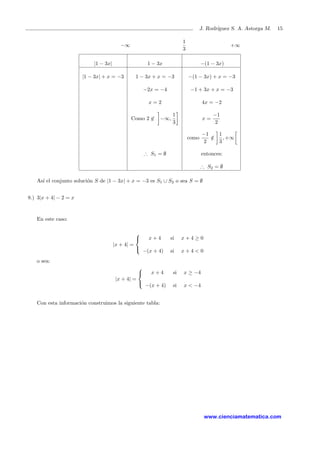
7.) |1 − 3x| + x = −3
En este caso debemos proceder como en el ejemplo anterior:
|1 − 3x| =



1 − 3x si 1 − 3x ≥ 0
−(1 − 3x) si 1 − 3x < 0
pero: 1 − 3x ≥ 0 ⇐⇒ −3x ≥ −1, o sea x ≤
1
3
y 1 − 3x < 0 ⇐⇒ −3x < −1, o sea x >
1
3
|1 − 3x| =



1 − 3x si x ≤
1
3
−(1 − 3x) si x >
1
3
Con esta informaci´on construiremos la siguiente tabla:
www.cienciamatematica.com
J. Rodr´ıguez S. A. Astorga M. 15
−∞
1
3
+∞
|1 − 3x| 1 − 3x −(1 − 3x)
|1 − 3x| + x = −3 1 − 3x + x = −3 −(1 − 3x) + x = −3
−2x = −4 −1 + 3x + x = −3
x = 2 4x = −2
Como 2 ∈ −∞,
1
3
x =
−1
2
como
−1
2
/∈
1
3
, +∞
∴ S1 = ∅ entonces:
∴ S2 = ∅
As´ı el conjunto soluci´on S de |1 − 3x| + x = −3 es S1 ∪ S2 o sea S = ∅
8.) 3|x + 4| − 2 = x
En este caso:
|x + 4| =



x + 4 si x + 4 ≥ 0
−(x + 4) si x + 4 < 0
o sea:
|x + 4| =



x + 4 si x ≥ −4
−(x + 4) si x < −4
Con esta informaci´on construimos la siguiente tabla:
www.cienciamatematica.com
16 Valor Absoluto
−∞ −4 +∞
|x + 4| −(x + 4) x + 4
3|x + 4| − 2 = x 3[−(x + 4)] − 2 = x 3(x + 4) − 2 = x
3[−x − 4] − 2 = x 3x + 12 − 2 = x
−3x − 12 − 2 = x 3x − x + 10 = 0
−3x − 14 − x = 0 2x = −10
−4x = 14 x = −5
x =
−14
4
Como − 5 ∈ [−4, +∞[
x =
−7
2
entonces: S2 = ∅
Como −7/2 ∈ ] − ∞, −4]
entonces: S1 = ∅
De aqu´ı se tiene que el conjunto soluci´on S de 3|x − 4| − 2 = x es vac´ıo o sea S = ∅
9.) 4
(2x − 15)4 = 10
4
(2x − 15)4 = 10 ⇐⇒
|2x − 15| = 10 ⇐⇒ 2x − 15 = 10 o 2x − 15 = −10
⇐⇒ 2x = 25 o 2x = 5
⇐⇒ x =
25
2
o x =
5
2
∴ S =
25
2
,
5
2
10.) (3 − x)2 = 5
(3 − x)2 = 5 ⇐⇒
|3 − x| = 5 ⇐⇒ 3 − x = 5 o 3 − x = −5
⇐⇒ −x = 2 o −x = −8
⇐⇒ x = −2 o x = 8
∴ S = {−2, 8}
www.cienciamatematica.com
J. Rodr´ıguez S. A. Astorga M. 17
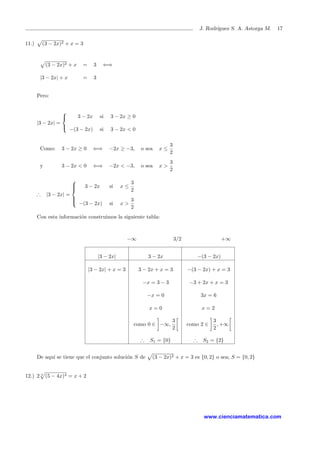
11.) (3 − 2x)2 + x = 3
(3 − 2x)2 + x = 3 ⇐⇒
|3 − 2x| + x = 3
Pero:
|3 − 2x| =



3 − 2x si 3 − 2x ≥ 0
−(3 − 2x) si 3 − 2x < 0
Como: 3 − 2x ≥ 0 ⇐⇒ −2x ≥ −3, o sea x ≤
3
2
y 3 − 2x < 0 ⇐⇒ −2x < −3, o sea x >
3
2
∴ |3 − 2x| =



3 − 2x si x ≤
3
2
−(3 − 2x) si x >
3
2
Con esta informaci´on construimos la siguiente tabla:
−∞ 3/2 +∞
|3 − 2x| 3 − 2x −(3 − 2x)
|3 − 2x| + x = 3 3 − 2x + x = 3 −(3 − 2x) + x = 3
−x = 3 − 3 −3 + 2x + x = 3
−x = 0 3x = 6
x = 0 x = 2
como 0 ∈ −∞,
3
2
como 2 ∈
3
2
, +∞
∴ S1 = {0} ∴ S2 = {2}
De aqu´ı se tiene que el conjunto soluci´on S de (3 − 2x)2 + x = 3 es {0, 2} o sea; S = {0, 2}
12.) 2 4
(5 − 4x)4 = x + 2
www.cienciamatematica.com
18 Valor Absoluto
2|5 − 4x| = x + 2
Pero: |5 − 4x| =



5 − 4x si 5 − 4x ≥ 0
−(5 − 4x) si 5 − 4x < 0
Como: 5 − 4x ≥ 0 ⇐⇒ −4x ≥ −5, o sea x ≤
5
4
y 5 − 4x < 0 ⇐⇒ −4x < −5, o sea x >
5
4
∴ |5 − 4x| =



5 − 4x si x ≤
5
4
−(5 − 4x) si x >
5
4
Con esta informaci´on construimos la siguiente tabla:
−∞ 5/4 +∞
|5 − 4x| 5 − 4x −(5 − 4x)
2|5 − 4x| = x + 2 2(5 − 4x) = x + 2 2[−(5 − 4x)] = x + 2
10 − 8x = x + 2 2[−5 + 4x] = x + 2
−8x − x = 2 − 10 −10 + 8x = x + 2
−9x = −8 8x − x = 2 + 10
x =
8
9
7x = 12
x =
12
7
como
8
9
∈ −∞,
5
4
como
12
7
∈
5
4
, +∞
∴ S1 =
8
9
∴ S2 =
12
7
De aqu´ı se tiene que el conjunto soluci´on S de 2 4
(5 − 4x)4 = x + 3 es
8
9
,
12
7
, o sea S =
8
9
,
12
7
Ejercicios 2
Resuelva cada una de las siguientes ecuaciones:
1.) |x| = 7
www.cienciamatematica.com
J. Rodr´ıguez S. A. Astorga M. 19
2.) |2x + 5| = −8
3.) | − 2x + 9| = 11
4.) −3|3 − 2x| = −12
5.) |3x + 2| = x + 1
6.) 2|2x − 5| = x − 3
7.) 3| − 5x − 1| = −2x + 3
8.) −1 − 2|5 − 3x| = x
9.) 6
(2x + 1)6 = 3
10.) −2 (1 − 7x)2 = −6
11.) (x − 2)2 + 3x = 6
12.) x + 2 4
(x − 6)4 = 5
13.) 2|x| + |x − 1| = 4
14.) |2x − 3| − 2|x| = 3
15.)
x − 1
x + 1
= 2
16.) 2|3x − 1| = (x − 7)2
17.) 2|2 − x| + |2x − 1| = x
18.) |3 − 2x| − 3|x + 2| − x = 0
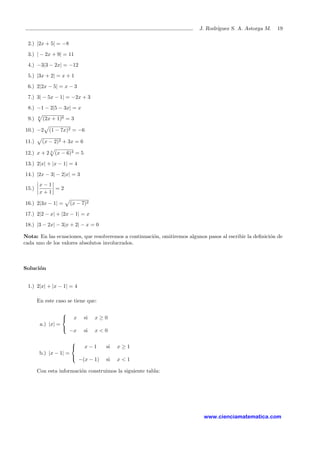
Nota: En las ecuaciones, que resolveremos a continuaci´on, omitiremos algunos pasos al escribir la definici´on de
cada uno de los valores absolutos involucrados.
Soluci´on
1.) 2|x| + |x − 1| = 4
En este caso se tiene que:
a.) |x| =



x si x ≥ 0
−x si x < 0
b.) |x − 1| =



x − 1 si x ≥ 1
−(x − 1) si x < 1
Con esta informaci´on construimos la siguiente tabla:
www.cienciamatematica.com
20 Valor Absoluto
−∞ 0 1 +∞
|x| −x x x
|x − 1| −(x − 1) −(x − 1) x − 1
2|x| + |x − 1| = 4 2x + −(x − 1) = 4 2x + −(x − 1) = 4 2(−x) + (x − 1) = 4
−2x − x + 1 = 4 2x − x + 1 = 4 2x + x − 1 = 4
−3x = 3 x = 3 3x = 5
x = −1 x =
5
3
como − 1 ∈] − ∞, 0[ Como 3 ∈ ]0, 1[ como
5
3
∈
5
3
, +∞
∴ S1 = {−1} ∴ S2 = ∅ ∴ S2 =
5
De aqu´ı se tiene que el conjunto soluci´on de 2|x| + |x − 1| = 4 es S donde S = S1 ∪ S2 ∪ S3
∴ S = −1,
5
3
2.) |2x − 3| − 2|x| = 3
En este caso se tiene que:
a.) |2x − 3| =



2x − 3 si x ≥
3
2
−(2x − 3) si x <
3
2
b.) |x| =



x si x ≥ 0
−x si x < 0
Con esta informaci´on construimos la siguiente tabla:
www.cienciamatematica.com
J. Rodr´ıguez S. A. Astorga M. 21
−∞ 0 3/2 +∞
|2x − 3| −(2x − 3) −(2x − 3) 2x − 3
|x| −x x x
|2x − 3| − 2|x| = 3 −(2x − 3) − 2(−x) = 3 −(2x − 3) − 2(x) = 3 2x − 3 − 2x = 3
−2x + 3 + 2x = 3 −2x + 3 − 2x = 3 −3 = 3
3 = 3 −4x = 0 ∴ S3 = ∅
∴ S1 =] − ∞, 0[ x = 0
como 0 ∈ 0,
3
2
∴ S2 = {0}
De aqu´ı que el conjunto soluci´on de |2x − 3| − 2|x| = 3 es S = S1 ∪ S2 ∪ S3
∴ S =] − ∞, 0]
3.)
x − 1
x + 1
= 2
x − 1
x + 1
= 2 ⇐⇒
|x − 1|
|x + 1|
= 2, por la propiedad 5
⇐⇒ |x − 1| = 2|x + 1| (∗), con x = −1
⇐⇒ |x − 1|2
= (2|x + 1|)2
⇐⇒ |x − 1|2
= 4|x + 1|2
⇐⇒ (x − 1)2
= 4(x + 1)2
, por la propiedad 6
⇐⇒ x2
− 2x + 1 = 4(x2
+ 2x + 1)
⇐⇒ x2
− 2x + 1 = 4x2
+ 8x + 4
⇐⇒ −3x2
− 10x − 3 = 0
⇐⇒ 3x2
+ 10x + 3 = 0
Resolviendo esta ecuaci´on por f´ormula general:
www.cienciamatematica.com
22 Valor Absoluto
= 100 − 4(3)(3)
= 100 − 36
= 64
x1 =
−10 + 8
6
=⇒ x1 =
−1
3
x2 =
−10 − 8
6
=⇒ x2 = −3
De aqu´ı se tiene que el conjunto soluci´on de
x − 1
x + 1
= 2 es S, donde
S = −3,
−1
3
Nota: A partir de (∗) esta ecuaci´on se puede resolver utilizando un procedimiento similar al usado en los
ejemplos (1) y (2) anteriores.
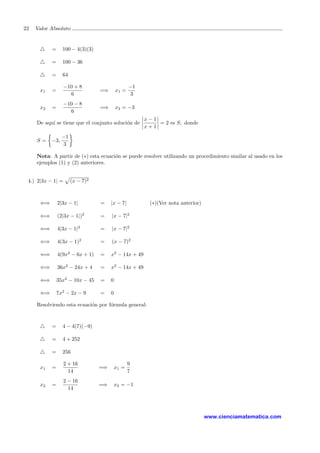
4.) 2|3x − 1| = (x − 7)2
⇐⇒ 2|3x − 1| = |x − 7| (∗)(Ver nota anterior)
⇐⇒ (2|3x − 1|)2
= |x − 7|2
⇐⇒ 4|3x − 1|2
= |x − 7|2
⇐⇒ 4(3x − 1)2
= (x − 7)2
⇐⇒ 4(9x2
− 6x + 1) = x2
− 14x + 49
⇐⇒ 36x2
− 24x + 4 = x2
− 14x + 49
⇐⇒ 35x2
− 10x − 45 = 0
⇐⇒ 7x2
− 2x − 9 = 0
Resolviendo esta ecuaci´on por f´ormula general:
= 4 − 4(7)(−9)
= 4 + 252
= 256
x1 =
2 + 16
14
=⇒ x1 =
9
7
x2 =
2 − 16
14
=⇒ x2 = −1
www.cienciamatematica.com
J. Rodr´ıguez S. A. Astorga M. 23
De aqui se tiene que el conjunto soluci´on de 2|3x − 1| = (x − 7)2 es S donde: S =
9
7
, −1
5.) 2|2 − x| + |2x − 1| = x
En este caso se tiene que:
a.) |2 − x| =



2 − x si x ≤ 2
−(2 − x) si x > 2
b.) |2x − 1| =



2x − 1 si x ≥
1
2
−(2x − 1) si x <
1
2
Con esta informaci´on construimos la siguiente tabla:
−∞ 1/2 2 +∞
|2 − x| 2 − x 2 − x −(2 − x)
|2x − 1| −(2x − 1) 2x − 1 2x − 1
2|2 − x| + |2x − 1| = x 2(2 − x) + −(2x − 1) = x 2(2 − x) + (2x − 1) = x 2[−(2 − x)] + (2x − 1) = x
4 − 2x − 2x + 1 = x 4 − 2x + 2x − 1 = x 2[−2 + x] + 2x − 1 = x
−2x − 2x − x = −4 − 1 3 = x −4 + 2x + 2x − 1 = x
−5x = −5 Como 3 ∈
−1
2
, 2 2x + 2x − x = 4 + 1
x = 1 entonces: 3x = 5
Como 1 ∈ −∞,
1
2
S2 = ∅ x =
5
3
entonces: Como
5
3
∈ ]2, +∞[
S1 = ∅
S3 = ∅
De aqu´ı que el conjunto soluci´on de 2|2 − x| + |2x − 1| = x es S, donde S = ∅
www.cienciamatematica.com
24 Valor Absoluto
6.) |3 − 2x| − 3|x + 2| − x = 0
En este caso se tiene que:
a.) |3 − 2x| =



3 − 2x si x ≤
3
2
−(3 − 2x) si x >
3
2
b.) |x + 2| =



x + 2 si x ≥ −2
−(x + 2) si x < −2
Con esta informaci´on construimos la siguiente tabla:
−∞ −2 3/2 +∞
3 − 2x 3 − 2x −(3 − 2x)
|x + 2| −(x + 2) x + 2 x + 2
|3 − 2x| − 3|x + 2| − x = 0 3 − 2x − 3[−(x + 2)] − x = 0 3 − 2x − 3(x + 2) − x = 0 −(3 − 2x) − 3(x + 2) − x = 0
3 − 2x − 3[−x − 2] − x = 0 3 − 2x − 3x − 6 − x = 0 −3 + 2x − 3x − 6 − x = 0
3 − 2x + 3x + 6 − x = 0 −6x − 3 = 0 −2x − 9 = 0
9 = 0 −6x = 3 −2x = 9
∴ S1 = ∅ x =
−1
2
x =
−9
2
como
−1
2
∈ −2,
3
2
Como:
−9
2
∈
3
2
, +∞
∴ S2 =
−1
2
∴ S3 = ∅
De aqu´ı que el conjunto soluci´on de |3 − 2x| − 3|x + 2| − x = 0 es S, donde S =
−1
2
Ejercicios 3
Resuelva cada una de las siguientes ecuaciones:
1.) (4x − 1)2 = |3 − 8x|
2.)
2x + 1
1 − x
= 3
3.) |x + 3| − |x − 2| = x
www.cienciamatematica.com
J. Rodr´ıguez S. A. Astorga M. 25
4.) 4
(x + 1)4 − 3|x − 2| = 6
5.) |x − 4| −
x − 1
5
= 4 − x
6.)
|x|
2
+ 3x + 4 = |x − 1|
5.1.3 Inecuaciones que involucran valor absoluto
Resolveremos inecuaciones que involucran valor absoluto de expresiones de la forma ax + b, donde a y b son
constantes con a = 0 y x es una variable real. Para esto utilizaremos la definici´on de valor absoluto, y en los
casos en donde sea posible usar alguna de las propiedades estudiadas, las aplicaremos, con el fin de facilitar el
procedimiento de resoluci´on.
Ejercicios 4
Resuelva cada una de las siguientes inecuaciones:
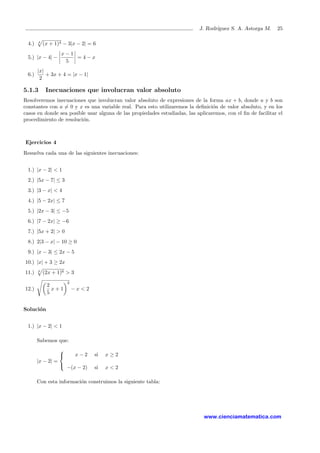
1.) |x − 2| < 1
2.) |5x − 7| ≤ 3
3.) |3 − x| < 4
4.) |5 − 2x| ≤ 7
5.) |2x − 3| ≤ −5
6.) |7 − 2x| ≥ −6
7.) |5x + 2| > 0
8.) 2|3 − x| − 10 ≥ 0
9.) |x − 3| ≤ 2x − 5
10.) |x| + 3 ≥ 2x
11.) 6
(2x + 1)6 > 3
12.)
2
5
x + 1
2
− x < 2
Soluci´on
1.) |x − 2| < 1
Sabemos que:
|x − 2| =



x − 2 si x ≥ 2
−(x − 2) si x < 2
Con esta informaci´on construimos la siguiente tabla:
www.cienciamatematica.com
26 Valor Absoluto
−∞ 2 +∞
|x − 2| −(x − 2) x − 2
|x − 2| < 1 −(x − 2) < 1 x − 2 < 1
−x + 2 < 1 x < 3
−x < −1 As´ı debe cumplirse que
x > 1 x ≥ 2 y x < 3
As´ı debe cumplirse que ∴ S2 = [2, 3[
x < 2 y x > 1
∴ S1 = ]1, 2[
En consecuencia el conjunto soluci´on S, de |x − 2| < 1 es S1 ∪ S2 o sea S = ]1, 3[
Nota: La inecuaci´on |x − 2| < 1 y otras similares, se pueden resolver aplicando propiedades del valor
absoluto y adem´as algunos resultados que se enuncian a continuaci´on y que aceptaremos sin demostrar.
Resultado 1
∀a, a ∈ R, ∀b, b ∈ R, ∀c, c ∈ R, ∀k, k ∈ R
i.) a < b < c ⇐⇒ a + k < b + k < c + k
ii.) a ≤ b ≤ c ⇐⇒ a + k ≤ b + k ≤ c + k
Resultado 2
∀a, a ∈ R, ∀b, b ∈ R, ∀c, c ∈ R, ∀k, k ∈ R con k > 0
i.) a < b < c ⇐⇒ ak < bk < ck
ii.) a ≤ b ≤ c ⇐⇒ ak ≤ bk ≤ ck
Resultado 3
∀a, a ∈ R, ∀b, b ∈ R, ∀c, c ∈ R, ∀k, k ∈ R con k < 0
i.) a < b < c ⇐⇒ ak > bk > ck
ii.) a ≤ b ≤ c ⇐⇒ ak ≥ bk ≥ ck
Usando estos resultados y las propiedades correspondientes del valor absoluto, |x − 2| < 1 se resuelve as´ı.
www.cienciamatematica.com
J. Rodr´ıguez S. A. Astorga M. 27
|x − 2| < 1 ⇐⇒ −1 < x − 2 < 1
⇐⇒ −1 + 2 < x − 2 + 2 < 1 + 2
⇐⇒ 1 < x < 3
∴ S =]1, 3[
2.) |5x − 7| ≤ 3
|5x − 7| ≤ 3 ⇐⇒ −3 ≤ 5x − 7 ≤ 3
⇐⇒ −3 + 7 ≤ 5x − 7 + 7 ≤ 3 + 7
⇐⇒ 4 ≤ 5x ≤ 10
⇐⇒
1
5
· 4 ≤
1
5
· 5x ≤
1
5
· 10
⇐⇒
4
5
≤ x ≤ 2
∴ S =
4
www.cienciamatematica.com
28 Valor Absoluto
|5 − 2x| ≤ 7 ⇐⇒ −7 ≤ 5 − 2x ≤ 7
⇐⇒ −7 − 5 ≤ −5 + 5 − 2x ≤ −5 + 7
⇐⇒ −12 ≤ −2x ≤ 2
⇐⇒
−1
2
· (−12) ≥
−1
2
· 2
⇐⇒ 6 ≥ x ≥ −1
⇐⇒ −1 ≤ x ≤ 6
∴ S = [−1, 6]
5.) |2x − 3| < −5
por propiedad 1:
|2x − 3| ≥ 0, ∀x, x ∈ R
∴ |2x − 3| ≥ −5; ¡Nunca!
∴ S = ∅
6.) |7 − 2x| ≥ −6
por propiedad 1;
|7 − 2x| ≥ 0, ∀x, x ∈ R
en particular
|7 − 2x| ≥ −6, ∀x, x ∈ R
∴ S = R
7.) |5x + 2| > 0
por propiedad 1;
|5x + 2| ≥ 0, ∀x, x ∈ R
por propiedad 2;
|5x + 2| = 0 ⇐⇒ 5x + 2 = 0
⇐⇒ 5x = −2
⇐⇒ x =
−2
5
www.cienciamatematica.com
J. Rodr´ıguez S. A. Astorga M. 29
∴ |5x + 2| > 0; ∀x, x ∈ R, tal que x =
−2
5
∴ S = R −
−2
5
8.) 2|3 − x| − 10 ≥ 0
2|3 − x| − 10 ≥ 0 ⇐⇒ 2|3 − x| ≥ 10
⇐⇒ |3 − x| ≥ 5
⇐⇒ 3 − x ≥ 5 o 3 − x ≤ −5
⇐⇒ −x ≥ 2 o −x ≤ −8
⇐⇒ x ≤ −2 o x ≥ 8
∴ S = ] − ∞, −2] ∪ [8, +∞[
9.) |x − 3| ≤ 2x − 5
Nota: en este caso no es posible aplicar alguna de las propiedades de valor absoluto enunciadas en p´aginas
anteriores, por lo que procedemos de la manera siguiente:
|x − 3| =



x − 3 si x ≥ 3
−(x − 3) si x < 3
Con esta informaci´on construimos la tabla siguiente
www.cienciamatematica.com
30 Valor Absoluto
−∞ 3 +∞
|x − 3| −(x − 3) x − 3
|x − 3| ≤ 2x − 5 −(x − 3) ≤ 2x − 5 x − 3 ≤ 2x − 5
−x + 3 ≤ 2x − 5 x − 2x ≤ −5 + 3
−x − 2x ≤ −5 − 3 −x ≤ −2
−3x ≤ −8 −x ≥ −2
x ≥
8
3
As´ı debe cumplirse As´ı debe cumplirse
x ≥
8
3
y x < 3 x ≥ 2 y x ≥ 3
∴ S1 =
8
3
, 3 ∴ S2 = [3, +∞[
En consecuencia el conjunto soluci´on S, de |x − 3| ≤ 2x − 5 es S1 ∪ S2; o sea S =
8
3
, +∞
10.) |x| + 3 ≥ 2x
Como
|x| =



x si x ≥ 0
−x si x < 0
Con esta informaci´on construimos la siguiente tabla:
−∞ 0 +∞
|x| −x x
|x| + 3 ≥ 2x −x + 3 ≥ 2x x + 3 ≥ 2x
−x − 2x ≥ −3 x − 2x ≥ −3
−3x ≥ −3 −x ≥ −3
x ≤ 1 x ≤ 3
As´ı debe cumplirse As´ı debe cumplirse
x ≤ 1 y x < 0 x ≤ 3 y x ≥ 0
∴ S1 = ] − ∞, 0[ ∴ S2 = [0, 3]
www.cienciamatematica.com
J. Rodr´ıguez S. A. Astorga M. 31
En consecuencia el conjunto soluci´on S, de |x| + 3 ≥ 2x es S1 ∪ S2 o sea S = ] − ∞, 3]
11.) 6
(2x + 1)6 > 3
6
(2x + 1)6 > 3 ⇐⇒ |2x + 1| > 3
⇐⇒ 2x + 1 > 3 o 2x + 1 < −3
⇐⇒ 2x > 2 o 2x < −4
⇐⇒ x > 1 o x < −2
S1 = ]1, +∞[ y S2 = ] − ∞, −2[
El conjunto soluci´on S, de 6
(2x + 1)6 > 3 es S1 ∪ S2, o sea S = ]1, +∞[ ∪ ] − ∞, −2[
12.)
2
5
x + 1
2
− x < 2
2
5
x + 1
2
− x < 2 ⇐⇒
2
5
x + 1 − x < 2
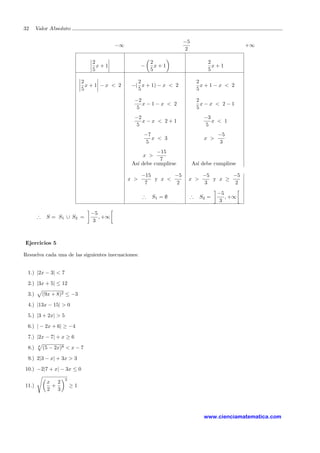
Para este caso se tiene que:
2
5
x + 1 =



2
5
x + 1 si x ≥
−5
2
−
2
5
x + 1 si x <
−5
2
Con esta informai´on construimos la tabla siguiente:
www.cienciamatematica.com
32 Valor Absoluto
−∞
−5
2
+∞
2
5
x + 1 −
2
5
x + 1
2
5
x + 1
2
5
x + 1 − x < 2 −(
2
5
x + 1) − x < 2
2
5
x + 1 − x < 2
−2
5
x − 1 − x < 2
2
5
x − x < 2 − 1
−2
5
x − x < 2 + 1
−3
5
x < 1
−7
5
x < 3 x >
−5
3
x >
−15
7
As´ı debe cumplirse As´ı debe cumplirse
x >
−15
7
y x <
−5
2
x >
−5
3
y x ≥
−5
2
∴ S1 = ∅ ∴ S2 =
−5
3
, +∞
∴ S = S1 ∪ S2 =
−5
3
, +∞
Ejercicios 5
Resuelva cada una de las siguientes inecuaciones:
1.) |2x − 3| < 7
2.) |3x + 5| ≤ 12
3.) (9x + 8)2 ≤ −3
4.) |13x − 15| > 0
5.) |3 + 2x| > 5
6.) | − 2x + 6| ≥ −4
7.) |2x − 7| + x ≥ 6
8.) 8
(5 − 2x)8 < x − 7
9.) 2|3 − x| + 3x > 3
10.) −2|7 + x| − 3x ≤ 0
11.)
x
2
+
2
3
2
≥ 1
www.cienciamatematica.com
J. Rodr´ıguez S. A. Astorga M. 33
12.) 2 (2x + 7)2 ≤ x
Ejercicios 6
Resuelva cada una de las siguientes inecuaciones:
1.) |x − 1| + |x + 1| < 4
2.) |x − 2| + 3|x| ≤ 6
3.) |4 − x| + |2x − 5| > 7 − x
4.) |x| − 2 (6 − x)2 ≥ x
Soluci´on
1.) |x − 1| + |x + 1| < 4
En este caso se tiene que:
|x − 1| =



x − 1 si x ≥ 1
−(x − 1) si x < 1
|x + 1| =



x + 1 si x ≥ −1
−(x + 1) si x < −1
As´ı:
−∞ −1 1 +∞
|x − 1| −(x − 1) −(x − 1) x − 1
|x + 1| −(x + 1) x + 1 x + 1
|x − 1| + |x + 1| < 4 −(x − 1) + −(x + 1) < 4 −(x − 1) + x + 1 < 4 x − 1 + x + 1 < 4
−x + 1 − x − 1 < 4 −x + 1 + x + 1 < 4 2x < 4
−2x < 4 2 < 4 x < 2
x > −2
S1 = ] − 2, −1[ S2 = [−1, 1[ S3 = [1, 2[
∴ Como S = S1 ∪ S2 ∪ S3, entonces: S = ] − 2, 2[
www.cienciamatematica.com
34 Valor Absoluto
2.) |x − 2| + 3|x| ≤ 6
En este caso se tiene que:
|x − 2| =



x − 2 si x ≥ 2
−(x − 2) si x < 2
y
|x| =



x si x ≥ 0
−x si x < 0
Con esta informaci´on construimos la siguiente tabla:
−∞ 0 2 +∞
|x − 2| −(x − 2) −(x − 2) x − 2
|x| −x x x
|x − 2| + 3|x| ≤ 6 −(x − 2) + 3(−x) ≤ 6 −(x − 2) + 3x ≤ 6 x − 2 + 3x ≤ 6
−x + 2 − 3x ≤ 6 −x + 2 + 3x ≤ 6 4x ≤ 6 + 2
−4x ≤ 6 − 2 2x ≤ 6 − 2 4x ≤ 8
−4x ≤ 4 2x ≤ 4 x ≤ 2
x ≥ −1 x ≤ 2
S1 = [−1, 0[ S2 = [0, 2[ S3 = {2}
Como S = S1 ∪ S2 ∪ S3 entonces S = [−1, 2]
3.) |4 − x| + |2x − 5| > 7 − x
Como:
|4 − x| =



4 − x si x ≤ 4
−(4 − x) si x > 4
y
|2x − 5| =



2x − 5 si x ≥
5
2
−(2x − 5) si x <
5
2
www.cienciamatematica.com
J. Rodr´ıguez S. A. Astorga M. 35
As´ı:
−∞ 5/2 4 +∞
|4 − x| 4 − x 4 − x −(4 − x)
|2x − 5| −(2x − 5) 2x − 5 2x − 5
|4 − x| + |2x − 5| > 7 − x 4 − x + −(2x − 5) > 7 − x 4 − x + 2x − 5 > 7 − x −(4 − x) + 2x − 5 > 7 − x
4 − x − 2x + 5 > 7 − x −x + 2x + x > 7 + 5 − 4 −4 + x + 2x − 5 > 7 − x
−x − 2x + x > 7 − 5 − 4 2x > 8 x + 2x + x > 7 + 5 + 4
−2x > −2 x >
8
2
4x > 16
x < 1 x > 4 x > 4
S1 = ] − ∞, 1[ S2 = ∅ S3 = ]4, +∞[
Como S = S1 ∪ S2 ∪ S3 entonces S = ] − ∞, 1[ ∪ ]4, +∞[
4.) |x| − 2 (6 − x)2 ≥ x
|x| − 2 (6 − x)2 ≥ x ⇐⇒
|x| − 2|6 − x| ≥ x
Adem´as:
|x| =



x si x ≥ 0
−x si x < 0
y
|6 − x| =



6 − x si x ≤ 6
−(6 − x) si x > 6
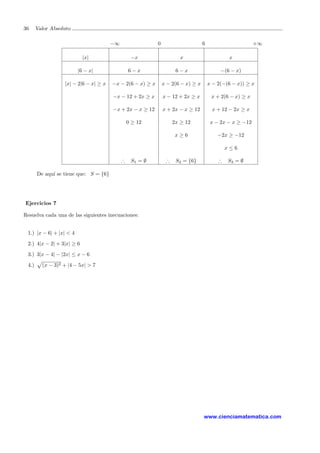
As´ı:
www.cienciamatematica.com
36 Valor Absoluto
−∞ 0 6 +∞
|x| −x x x
|6 − x| 6 − x 6 − x −(6 − x)
|x| − 2|6 − x| ≥ x −x − 2(6 − x) ≥ x x − 2(6 − x) ≥ x x − 2(−(6 − x)) ≥ x
−x − 12 + 2x ≥ x x − 12 + 2x ≥ x x + 2(6 − x) ≥ x
−x + 2x − x ≥ 12 x + 2x − x ≥ 12 x + 12 − 2x ≥ x
0 ≥ 12 2x ≥ 12 x − 2x − x ≥ −12
x ≥ 6 −2x ≥ −12
x ≤ 6
∴ S1 = ∅ ∴ S2 = {6} ∴ S3 = ∅
De aqu´ı se tiene que: S = {6}
Ejercicios 7
Resuelva cada una de las siguientes inecuaciones:
1.) |x − 6| + |x| < 4
2.) 4|x − 2| + 3|x| ≥ 6
3.) 3|x − 4| − |2x| ≤ x − 6
4.) (x − 3)2 + |4 − 5x| > 7
www.cienciamatematica.com

Ejercicios resueltos con_valor_absoluto__977__

  • 1.
    Este documento esde distribución gratuita y llega gracias a “Ciencia Matemática” www.cienciamatematica.com El mayor portal de recursos educativos a tu servicio!
  • 2.
    1 Cap´ıtulo 5 Valor Absoluto M.Sc.Alcides Astorga M., Lic. Julio Rodr´ıguez S. Instituto Tecnol´ogico de Costa Rica Escuela de Matem´atica · · · Revista digital Matem´atica, educaci´on e internet (www.cidse.itcr.ac.cr)
  • 3.
    2 Cr´editos Primera edici´on impresa:Rosario ´Alvarez, 1984. Edici´on LaTeX: Marieth Villalobos, Alejandra Araya, Jessica Chac´on, Marianela Abarca, Lisseth Angulo. y Walter Mora. Colaboradores: Cristhian Pa´ez, Alex Borb´on, Juan Jos´e Fallas, Jeffrey Chavarr´ıa Edici´on y composici´on final: Walter Mora. Gr´aficos: Walter Mora, Marieth Villalobos. Comentarios y correcciones: escribir a wmora2@yahoo.com.mx
  • 4.
    Contenido 5.1 Ecuaciones eInecuaciones con valor absoluto . . . . . . . . . . . . . . . . . . . . . . . . . . . . . 3 5.1.1 Propiedades del valor absoluto . . . . . . . . . . . . . . . . . . . . . . . . . . . . . . . . . 5 5.1.2 Ecuaciones que involucran valor absoluto . . . . . . . . . . . . . . . . . . . . . . . . . . . 11 5.1.3 Inecuaciones que involucran valor absoluto . . . . . . . . . . . . . . . . . . . . . . . . . . 25 5.1 Ecuaciones e Inecuaciones con valor absoluto Nuestro objetivo en este cap´ıtulo es lograr que el estudiante resuelva ecuaciones e inecuaciones que involucran valor absoluto de expresiones algebraicas de la forma ax + b, donde a y b son constantes reales con a = 0, y x es una variable real. Para esto conviene recordar la definici´on de valor absoluto siguiente: Para cada n´umero real x, se define su valor absoluto (y se denota |x| ) de la siguiente manera: |x| = x si x ≥ 0 o |x| = −x si x < 0 Esta definici´on frecuentemente se denota de la siguiente manera: |x| = x si x ≥ 0 −x si x < 0 Aplicando esta definici´on a expresiones de la forma ax + b se tiene: |ax + b| = ax + b si ax + b ≥ 0 −(ax + b) si ax + b < 0 Usando la definici´on de valor absoluto se tiene: Ejemplo 1 |x + 5| =    x + 5 si x + 5 ≥ 0 −(x + 5) si x + 5 < 0 3
  • 5.
    4 Valor Absoluto pero:x + 5 ≥ 0 ⇐⇒ x ≥ −5 y x + 5 < 0 ⇐⇒ x < −5 ∴ |x + 5| =    x + 5 si x ≥ −5 −(x + 5) si x < −5 Para efectos de lograr mayor claridad podemos resumir esta informaci´on en la tabla siguiente: −∞ −5 +∞ |x + 5| −(x + 5) x + 5 Ejemplo 2 |x − 7| =    x − 7 si x − 7 ≥ 0 −(x − 7) si x − 7 < 0 pero: x − 7 ≥ 0 ⇐⇒ x ≥ 7 y x − 7 < 0 ⇐⇒ x < 7 ∴ |x − 7| =    x − 7 si x ≥ 7 −(x − 7) si x < 7 y en forma resumida podemos escribir: −∞ 7 +∞ |x − 7| −(x − 7) x − 7 Ejemplo 3 | − 2x + 3| =    −2x + 3 si −2x + 3 ≥ 0 −(−2x + 3) si −2x + 3 < 0 pero: −2x + 3 ≥ 0 ⇐⇒ −2x ≥ −3, o sea x ≤ 3 2 y −2x + 3 < 0 ⇐⇒ −2x < −3, o sea x > 3 2 ∴ | − 2x + 3| =    −2x + 3 si x ≥ 3 2 −(−2x + 3) si x < 3 2 y en forma resumida podemos escribir: www.cienciamatematica.com
  • 6.
    J. Rodr´ıguez S.A. Astorga M. 5 −∞ 3/2 +∞ | − 2x + 3| −2x + 3 −(−2x + 3) Ejemplo 4 | − 3 − 5x| =    −3 − 5x si −3 − 5x ≥ 0 −(−3 − 5x) si −3 − 5x < 0 pero: −3 − 5x ≥ 0 ⇐⇒ −5x ≥ 3, o sea x ≤ −3 5 y −3 − 5x < 0 ⇐⇒ −5x < 3, o sea x > −3 5 ∴ | − 3 − 5x| =    −3 − 5x si x ≤ −3 5 −(−3 − 5x) si x > −3 5 y en forma resumida podemos escribir: −∞ −3/5 +∞ | − 3 − 5x| −3 − 5x −(−3 − 5x) 5.1.1 Propiedades del valor absoluto Enunciaremos a continuaci´on algunas propiedades del valor absoluto, las cuales podr´an ser utilizadas para fa- cilitar el trabajo en la resoluci´on de ecuaciones o inecuaciones que incluyen valor absoluto. Propiedad 1 ∀x, x ∈ R : |x| ≥ 0 Demostraci´on x ∈ R : |x| =    x si x ≥ 0 −x si x < 0 Hay dos posibles casos: Caso 1: x ≥ 0 x ≥ 0 =⇒ |x| = x ∴ |x| ≥ 0 www.cienciamatematica.com
  • 7.
    6 Valor Absoluto Caso2: x < 0 x < 0 =⇒ |x| = −x ∴ |x| ≥ 0; pues x < 0 =⇒ −x > 0 Propiedad 2 Si x ∈ R y |x| = 0 entonces x = 0 Demostraci´on: (ejercicio para el estudiante) Propiedad 3 Si x ∈ R, y ∈ R entonces |x · y| = |x| |y| Demostraci´on Para demostrar esta propiedad conviene recordar que: ∀a, a ∈ R : |a| = n √ an, si n es par (ver p´agina 94) en particular: |a| = √ a2 ; ∀a, a ∈ R Usando esta definici´on se tiene que: |xy| = (xy)2 = x2y2 = √ x2 · y2 = |x| · |y| ∴ = |x| · |y| Propiedad 4 ∀x, x ∈ R : | − x| = |x| Demostraci´on:(ejercicio para el estudiante) Propiedad 5 Si x ∈ R, y ∈ R, y = 0 entonces x y = |x| |y| Demostraci´on Aqu´ı tambi´en usaremos el hecho que: ∀a, a ∈ R : |a| = √ a2 www.cienciamatematica.com
  • 8.
    J. Rodr´ıguez S.A. Astorga M. 7 Si x ∈ R, y ∈ R, y = 0 entonces x y ∈ R ∴ x y = x y 2 = x2 y2 = √ x2 y2 = |x| |y| x y = |x| |y| Propiedad 6 ∀x, x ∈ R : |x|2 = x2 Demostraci´on ∀x, x ∈ R : , se tiene que: |x| = √ x2 ⇒ |x|2 = ( √ x2)2 ⇒ |x|2 = x2 pues ∀a, a ∈ R ( √ a ∈ R =⇒ ( √ a)2 = a) ∴ ∀x, x ∈ R : |x|2 = x2 Propiedad 7 Sea x una variable real y k un n´umero real positivo entonces: |x| = k ⇐⇒ x = k ´o x = −k Demostraci´on: Como |x| = √ x2, se tiene: |x| = k ⇐⇒ √ x2 = k ⇐⇒ ( √ x2)2 = k2 ⇐⇒ x2 = k2 ⇐⇒ x2 − k2 = 0 ⇐⇒ (x − k)(x + k) = 0 ⇐⇒ x = k o x = −k ∴ |x| = k ⇐⇒ x = k o x = −k www.cienciamatematica.com
  • 9.
    8 Valor Absoluto x2,se tiene: |x| < k ⇐⇒ √ x2 < k ⇐⇒ ( √ x2)2 < k2 ⇐⇒ x2 < k2 ⇐⇒ x2 − k2 < 0 ⇐⇒ (x − k)(x + k) < 0 Resolviendo esta inecuaci´on: −∞ −k k +∞ x − k − − + x + k − + + (x − k)(x + k) + − + De aqu´ı se tiene: (x − k)(x + k) < 0 ⇐⇒ x ∈ ] − k, k[ o sea: −k < x < k ∴ |x| < k ⇐⇒ −k < x < k Propiedad 9 Sea x una variable real y k un n´umero real positivo entonces: |x| > k ⇐⇒ x > k o x < −k Demostraci´on: Esta propiedad se demuestra en forma similar a la propiedad 9, ya demostrada, dejaremos esta demostraci´on como ejercicio para el estudiante. Propiedad 10 www.cienciamatematica.com
  • 10.
    J. Rodr´ıguez S.A. Astorga M. 9 Sea x una variable real y k un n´umero real positivo entonces: i.) |x| ≤ k ⇐⇒ −k ≤ x ≤ k ii.) |x| ≥ k ⇐⇒ x ≥ k o x ≤ k Demostraci´on: El procedimiento usado para demostrar esta propiedad es similar al usado para demostrar la propiedad 8. Dejaremos esta demostraci´on como ejercicio para el estudiante. Propiedad 11 ∀x, x ∈ R : −|x| ≤ x ≤ |x| Demostraci´on: Sabemos que ∀x, x ∈ R : |x| =    x si x ≥ 0 −x si x < 0 Caso 1: x ≥ 0 x ≥ 0 =⇒ x = |x| ∴ x ≤ |x| (*) Adem´as como |x| ≥ 0 entonces −|x| ≤ 0 y como x ≥ 0 entonces: −|x| ≤ x (∗∗) As´ı por (∗) y (∗∗) se tiene que: −|x| ≤ x y x ≤ |x| ∴ −|x| ≤ x ≤ |x| (I) Caso 2: x < 0 x < 0 =⇒ |x| = −x =⇒ −|x| = x ∴ −|x| ≤ x (∗ ∗ ∗) Adem´as como x < 0 y |x| ≥ 0 entonces x ≤ |x| (∗ ∗ ∗∗) As´ı por (∗ ∗ ∗) y (∗ ∗ ∗∗) se tiene que: −|x| ≤ x y x ≤ |x| ∴ −|x| ≤ x ≤ |x| (II) Por lo tanto de (I) y (II) se concluye que: www.cienciamatematica.com
  • 11.
    10 Valor Absoluto ∀x,x ∈ R : −|x| ≤ x ≤ |x| Propiedad 12 (desigualdad triangular) Si x ∈ R, y ∈ R entonces |x + y| ≤ |x| + |y| Demostraci´on: Antes de demostrar esta propiedad, es necesario conocer el siguiente lema: Lema: Sean a ∈ R, b ∈ R, c ∈ R, d ∈ R Si a ≤ b y c ≤ d entonces a + c ≤ b + d Demostraci´on (del lema) Supongamos que a ≤ b y c ≤ d, hay que demostrar que a + c ≤ b + d i.) a ≤ b =⇒ a + c ≤ b + c ii.) c ≤ d =⇒ b + c ≤ b + d por i.) y ii.) se tiene que a + c ≤ b + d Nota: El lema anterior expresa que si se tienen desigualdades a ≤ b y c ≤ d podemos sumar miembro a miembro estas desigualdades de la manera siguiente: a ≤ b c ≤ d a + c ≤ b + d Estamos ahora en condiciones de demostrar la desigualdad triangular. Demostraci´on de la Propiedad 12 (desigualdad triangular). ∀x, x ∈ R, ∀y, y ∈ R, se tiene que: −|x| ≤ x ≤ |x| y −|y| ≤ y ≤ |y| Sumando miembro a miembro estas desigualdades se tiene: −|x| + −|y| ≤ x + y ≤ |x| + |y| ∴ −(|x| + |y|) ≤ x + y ≤ |x| + |y| ∴ |x + y| ≤ |x| + |y| por la propiedad (10.i) www.cienciamatematica.com
  • 12.
    J. Rodr´ıguez S.A. Astorga M. 11 5.1.2 Ecuaciones que involucran valor absoluto A continuaci´on resolveremos algunas ecuaciones que involucran valor absoluto, para esto utilizaremos, siempre que sea posible, algunas propiedades enunciadas anteriormente y en los que no sea posible aplicar alguna de dichas propiedades, resolveremos las ecuaciones correspondientes usando la definici´on de valor absoluto. Adem´as es importante tener en cuenta que toda ecuaci´on que involucre valor absoluto se puede resolver usando la definici´on. Ejercicios 1 Resuelva cada una de las siguientes ecuaciones 1.) |2x − 3| = 7 2.) |x| = 5 3.) |x − 3| = −3 4.) |x + 8| = 0 5.) |2x + 3| = −9 6.) |x + 3| = 5 + x 7.) |1 − 3x| + x = −3 8.) 3|x + 4| − 2 = x 9.) 4 (2x − 15)4 = 10 10.) (3 − 2x)2 + x = 3 11.) 2 4 (5 − 4x)4 = x + 2 Soluci´on 1.) |2x − 3| = 7 Por la propiedad 7 |2x − 3| = 7 ⇐⇒ 2x − 3 = 7 o 2x − 3 = −7 ⇐⇒ 2x = 10 o 2x = −4 ⇐⇒ x = 5 o x = −2 ∴ S = {−2, 5} Observaci´on: Como dijimos anteriormente, todas las ecuaciones que involucran valor absoluto se pueden resolver usando la definici´on. Para ilustrar esto resolveremos la ecuaci´on anterior usando la definici´on de valor absoluto. www.cienciamatematica.com
  • 13.
    12 Valor Absoluto 2 y2x − 3 < 0 ⇐⇒ 2x < 3; o sea x < 3 2 ∴ |2x − 3| =    2x − 3 si x ≥ 3 2 −(2x − 3) si x < 3 2 Con esta informaci´on construimos la tabla siguiente: −∞ 3/2 +∞ |2x − 3| −(2x − 3) 2x − 3 |2x − 3| = 7 −(2x − 3) = 7 2x − 3 = 7 −2x + 3 = 7 2x = 10 −2x = 4 x = 5 x = −2 como − 2 ∈ −∞, 3 2 como 5 ∈ 3 2 , +∞ ∴ S1 = {-2} ∴ S2 = {5} As´ı el conjunto soluci´on es S = S1 ∪ S2 o sea S = {-2,5} 2.) |x| = 5 Por la propiedad 7: |x| = 5 ⇐⇒ x = 5 o x = −5 ∴ S = {−5, 5} www.cienciamatematica.com
  • 14.
    J. Rodr´ıguez S.A. Astorga M. 13 3.) |x − 3| = −3 Por la propiedad 1, |x − 3| ≥ 0, ∀x, x ∈ R, por lo tanto: |x − 3| = −3 !Nunca! ∴ S = ∅ 4.) |x + 8| = 0 Por la propiedad 2, |x + 8| = 0 ⇐⇒ x + 8 = 0 ⇐⇒ x = −8 ∴ S = {−8} 5.) |2x + 3| = −9 Por la propiedad 1, |2x + 3| ≥ 0, ∀x, x ∈ R ∴ |2x + 3| = −9 ¡Nunca! ∴ S = ∅ 6.) |x + 3| = 5 + x Nota: En este caso no es posible aplicar alguna de las propiedades anteriores, por lo que procedemos de la siguiente manera: |x + 3| =    x + 3 si x + 3 ≥ 0 −(x + 3) si x + 3 < 0 o sea: |x + 3| =    x + 3 si x ≥ −3 −(x + 3) si x < −3 Con esta informaci´on construimos la siguiente tabla: −∞ −3 +∞ www.cienciamatematica.com
  • 15.
    14 Valor Absoluto |x+ 3| −(x + 3) x + 3 |x + 3| = 5 + x −(x + 3) = 5 + x x + 3 = 5 + x Resolviendo esta ecuaci´on: Resolviendo esta ecuaci´on: −x − 3 = 5 + x x + 3 = 5 + x −x − x = 5 + 3 x − x = 5 − 3 −2x = 8 0 = 2 x = −4 como − 4 ∈ ]−∞, −3[ ∴ S1 = {−4} ∴ S2 = ∅ As´ı el conjunto soluci´on S de |x + 3| = 5 + x es S1 ∪ S2, o sea S = {−4} 7.) |1 − 3x| + x = −3 En este caso debemos proceder como en el ejemplo anterior: |1 − 3x| =    1 − 3x si 1 − 3x ≥ 0 −(1 − 3x) si 1 − 3x < 0 pero: 1 − 3x ≥ 0 ⇐⇒ −3x ≥ −1, o sea x ≤ 1 3 y 1 − 3x < 0 ⇐⇒ −3x < −1, o sea x > 1 3 |1 − 3x| =    1 − 3x si x ≤ 1 3 −(1 − 3x) si x > 1 3 Con esta informaci´on construiremos la siguiente tabla: www.cienciamatematica.com
  • 16.
    J. Rodr´ıguez S.A. Astorga M. 15 −∞ 1 3 +∞ |1 − 3x| 1 − 3x −(1 − 3x) |1 − 3x| + x = −3 1 − 3x + x = −3 −(1 − 3x) + x = −3 −2x = −4 −1 + 3x + x = −3 x = 2 4x = −2 Como 2 ∈ −∞, 1 3 x = −1 2 como −1 2 /∈ 1 3 , +∞ ∴ S1 = ∅ entonces: ∴ S2 = ∅ As´ı el conjunto soluci´on S de |1 − 3x| + x = −3 es S1 ∪ S2 o sea S = ∅ 8.) 3|x + 4| − 2 = x En este caso: |x + 4| =    x + 4 si x + 4 ≥ 0 −(x + 4) si x + 4 < 0 o sea: |x + 4| =    x + 4 si x ≥ −4 −(x + 4) si x < −4 Con esta informaci´on construimos la siguiente tabla: www.cienciamatematica.com
  • 17.
    16 Valor Absoluto −∞−4 +∞ |x + 4| −(x + 4) x + 4 3|x + 4| − 2 = x 3[−(x + 4)] − 2 = x 3(x + 4) − 2 = x 3[−x − 4] − 2 = x 3x + 12 − 2 = x −3x − 12 − 2 = x 3x − x + 10 = 0 −3x − 14 − x = 0 2x = −10 −4x = 14 x = −5 x = −14 4 Como − 5 ∈ [−4, +∞[ x = −7 2 entonces: S2 = ∅ Como −7/2 ∈ ] − ∞, −4] entonces: S1 = ∅ De aqu´ı se tiene que el conjunto soluci´on S de 3|x − 4| − 2 = x es vac´ıo o sea S = ∅ 9.) 4 (2x − 15)4 = 10 4 (2x − 15)4 = 10 ⇐⇒ |2x − 15| = 10 ⇐⇒ 2x − 15 = 10 o 2x − 15 = −10 ⇐⇒ 2x = 25 o 2x = 5 ⇐⇒ x = 25 2 o x = 5 2 ∴ S = 25 2 , 5 2 10.) (3 − x)2 = 5 (3 − x)2 = 5 ⇐⇒ |3 − x| = 5 ⇐⇒ 3 − x = 5 o 3 − x = −5 ⇐⇒ −x = 2 o −x = −8 ⇐⇒ x = −2 o x = 8 ∴ S = {−2, 8} www.cienciamatematica.com
  • 18.
    J. Rodr´ıguez S.A. Astorga M. 17 11.) (3 − 2x)2 + x = 3 (3 − 2x)2 + x = 3 ⇐⇒ |3 − 2x| + x = 3 Pero: |3 − 2x| =    3 − 2x si 3 − 2x ≥ 0 −(3 − 2x) si 3 − 2x < 0 Como: 3 − 2x ≥ 0 ⇐⇒ −2x ≥ −3, o sea x ≤ 3 2 y 3 − 2x < 0 ⇐⇒ −2x < −3, o sea x > 3 2 ∴ |3 − 2x| =    3 − 2x si x ≤ 3 2 −(3 − 2x) si x > 3 2 Con esta informaci´on construimos la siguiente tabla: −∞ 3/2 +∞ |3 − 2x| 3 − 2x −(3 − 2x) |3 − 2x| + x = 3 3 − 2x + x = 3 −(3 − 2x) + x = 3 −x = 3 − 3 −3 + 2x + x = 3 −x = 0 3x = 6 x = 0 x = 2 como 0 ∈ −∞, 3 2 como 2 ∈ 3 2 , +∞ ∴ S1 = {0} ∴ S2 = {2} De aqu´ı se tiene que el conjunto soluci´on S de (3 − 2x)2 + x = 3 es {0, 2} o sea; S = {0, 2} 12.) 2 4 (5 − 4x)4 = x + 2 www.cienciamatematica.com
  • 19.
    18 Valor Absoluto 2|5− 4x| = x + 2 Pero: |5 − 4x| =    5 − 4x si 5 − 4x ≥ 0 −(5 − 4x) si 5 − 4x < 0 Como: 5 − 4x ≥ 0 ⇐⇒ −4x ≥ −5, o sea x ≤ 5 4 y 5 − 4x < 0 ⇐⇒ −4x < −5, o sea x > 5 4 ∴ |5 − 4x| =    5 − 4x si x ≤ 5 4 −(5 − 4x) si x > 5 4 Con esta informaci´on construimos la siguiente tabla: −∞ 5/4 +∞ |5 − 4x| 5 − 4x −(5 − 4x) 2|5 − 4x| = x + 2 2(5 − 4x) = x + 2 2[−(5 − 4x)] = x + 2 10 − 8x = x + 2 2[−5 + 4x] = x + 2 −8x − x = 2 − 10 −10 + 8x = x + 2 −9x = −8 8x − x = 2 + 10 x = 8 9 7x = 12 x = 12 7 como 8 9 ∈ −∞, 5 4 como 12 7 ∈ 5 4 , +∞ ∴ S1 = 8 9 ∴ S2 = 12 7 De aqu´ı se tiene que el conjunto soluci´on S de 2 4 (5 − 4x)4 = x + 3 es 8 9 , 12 7 , o sea S = 8 9 , 12 7 Ejercicios 2 Resuelva cada una de las siguientes ecuaciones: 1.) |x| = 7 www.cienciamatematica.com
  • 20.
    J. Rodr´ıguez S.A. Astorga M. 19 2.) |2x + 5| = −8 3.) | − 2x + 9| = 11 4.) −3|3 − 2x| = −12 5.) |3x + 2| = x + 1 6.) 2|2x − 5| = x − 3 7.) 3| − 5x − 1| = −2x + 3 8.) −1 − 2|5 − 3x| = x 9.) 6 (2x + 1)6 = 3 10.) −2 (1 − 7x)2 = −6 11.) (x − 2)2 + 3x = 6 12.) x + 2 4 (x − 6)4 = 5 13.) 2|x| + |x − 1| = 4 14.) |2x − 3| − 2|x| = 3 15.) x − 1 x + 1 = 2 16.) 2|3x − 1| = (x − 7)2 17.) 2|2 − x| + |2x − 1| = x 18.) |3 − 2x| − 3|x + 2| − x = 0 Nota: En las ecuaciones, que resolveremos a continuaci´on, omitiremos algunos pasos al escribir la definici´on de cada uno de los valores absolutos involucrados. Soluci´on 1.) 2|x| + |x − 1| = 4 En este caso se tiene que: a.) |x| =    x si x ≥ 0 −x si x < 0 b.) |x − 1| =    x − 1 si x ≥ 1 −(x − 1) si x < 1 Con esta informaci´on construimos la siguiente tabla: www.cienciamatematica.com
  • 21.
    20 Valor Absoluto −∞0 1 +∞ |x| −x x x |x − 1| −(x − 1) −(x − 1) x − 1 2|x| + |x − 1| = 4 2x + −(x − 1) = 4 2x + −(x − 1) = 4 2(−x) + (x − 1) = 4 −2x − x + 1 = 4 2x − x + 1 = 4 2x + x − 1 = 4 −3x = 3 x = 3 3x = 5 x = −1 x = 5 3 como − 1 ∈] − ∞, 0[ Como 3 ∈ ]0, 1[ como 5 3 ∈ 5 3 , +∞ ∴ S1 = {−1} ∴ S2 = ∅ ∴ S2 = 5 De aqu´ı se tiene que el conjunto soluci´on de 2|x| + |x − 1| = 4 es S donde S = S1 ∪ S2 ∪ S3 ∴ S = −1, 5 3 2.) |2x − 3| − 2|x| = 3 En este caso se tiene que: a.) |2x − 3| =    2x − 3 si x ≥ 3 2 −(2x − 3) si x < 3 2 b.) |x| =    x si x ≥ 0 −x si x < 0 Con esta informaci´on construimos la siguiente tabla: www.cienciamatematica.com
  • 22.
    J. Rodr´ıguez S.A. Astorga M. 21 −∞ 0 3/2 +∞ |2x − 3| −(2x − 3) −(2x − 3) 2x − 3 |x| −x x x |2x − 3| − 2|x| = 3 −(2x − 3) − 2(−x) = 3 −(2x − 3) − 2(x) = 3 2x − 3 − 2x = 3 −2x + 3 + 2x = 3 −2x + 3 − 2x = 3 −3 = 3 3 = 3 −4x = 0 ∴ S3 = ∅ ∴ S1 =] − ∞, 0[ x = 0 como 0 ∈ 0, 3 2 ∴ S2 = {0} De aqu´ı que el conjunto soluci´on de |2x − 3| − 2|x| = 3 es S = S1 ∪ S2 ∪ S3 ∴ S =] − ∞, 0] 3.) x − 1 x + 1 = 2 x − 1 x + 1 = 2 ⇐⇒ |x − 1| |x + 1| = 2, por la propiedad 5 ⇐⇒ |x − 1| = 2|x + 1| (∗), con x = −1 ⇐⇒ |x − 1|2 = (2|x + 1|)2 ⇐⇒ |x − 1|2 = 4|x + 1|2 ⇐⇒ (x − 1)2 = 4(x + 1)2 , por la propiedad 6 ⇐⇒ x2 − 2x + 1 = 4(x2 + 2x + 1) ⇐⇒ x2 − 2x + 1 = 4x2 + 8x + 4 ⇐⇒ −3x2 − 10x − 3 = 0 ⇐⇒ 3x2 + 10x + 3 = 0 Resolviendo esta ecuaci´on por f´ormula general: www.cienciamatematica.com
  • 23.
    22 Valor Absoluto =100 − 4(3)(3) = 100 − 36 = 64 x1 = −10 + 8 6 =⇒ x1 = −1 3 x2 = −10 − 8 6 =⇒ x2 = −3 De aqu´ı se tiene que el conjunto soluci´on de x − 1 x + 1 = 2 es S, donde S = −3, −1 3 Nota: A partir de (∗) esta ecuaci´on se puede resolver utilizando un procedimiento similar al usado en los ejemplos (1) y (2) anteriores. 4.) 2|3x − 1| = (x − 7)2 ⇐⇒ 2|3x − 1| = |x − 7| (∗)(Ver nota anterior) ⇐⇒ (2|3x − 1|)2 = |x − 7|2 ⇐⇒ 4|3x − 1|2 = |x − 7|2 ⇐⇒ 4(3x − 1)2 = (x − 7)2 ⇐⇒ 4(9x2 − 6x + 1) = x2 − 14x + 49 ⇐⇒ 36x2 − 24x + 4 = x2 − 14x + 49 ⇐⇒ 35x2 − 10x − 45 = 0 ⇐⇒ 7x2 − 2x − 9 = 0 Resolviendo esta ecuaci´on por f´ormula general: = 4 − 4(7)(−9) = 4 + 252 = 256 x1 = 2 + 16 14 =⇒ x1 = 9 7 x2 = 2 − 16 14 =⇒ x2 = −1 www.cienciamatematica.com
  • 24.
    J. Rodr´ıguez S.A. Astorga M. 23 De aqui se tiene que el conjunto soluci´on de 2|3x − 1| = (x − 7)2 es S donde: S = 9 7 , −1 5.) 2|2 − x| + |2x − 1| = x En este caso se tiene que: a.) |2 − x| =    2 − x si x ≤ 2 −(2 − x) si x > 2 b.) |2x − 1| =    2x − 1 si x ≥ 1 2 −(2x − 1) si x < 1 2 Con esta informaci´on construimos la siguiente tabla: −∞ 1/2 2 +∞ |2 − x| 2 − x 2 − x −(2 − x) |2x − 1| −(2x − 1) 2x − 1 2x − 1 2|2 − x| + |2x − 1| = x 2(2 − x) + −(2x − 1) = x 2(2 − x) + (2x − 1) = x 2[−(2 − x)] + (2x − 1) = x 4 − 2x − 2x + 1 = x 4 − 2x + 2x − 1 = x 2[−2 + x] + 2x − 1 = x −2x − 2x − x = −4 − 1 3 = x −4 + 2x + 2x − 1 = x −5x = −5 Como 3 ∈ −1 2 , 2 2x + 2x − x = 4 + 1 x = 1 entonces: 3x = 5 Como 1 ∈ −∞, 1 2 S2 = ∅ x = 5 3 entonces: Como 5 3 ∈ ]2, +∞[ S1 = ∅ S3 = ∅ De aqu´ı que el conjunto soluci´on de 2|2 − x| + |2x − 1| = x es S, donde S = ∅ www.cienciamatematica.com
  • 25.
    24 Valor Absoluto 6.)|3 − 2x| − 3|x + 2| − x = 0 En este caso se tiene que: a.) |3 − 2x| =    3 − 2x si x ≤ 3 2 −(3 − 2x) si x > 3 2 b.) |x + 2| =    x + 2 si x ≥ −2 −(x + 2) si x < −2 Con esta informaci´on construimos la siguiente tabla: −∞ −2 3/2 +∞ 3 − 2x 3 − 2x −(3 − 2x) |x + 2| −(x + 2) x + 2 x + 2 |3 − 2x| − 3|x + 2| − x = 0 3 − 2x − 3[−(x + 2)] − x = 0 3 − 2x − 3(x + 2) − x = 0 −(3 − 2x) − 3(x + 2) − x = 0 3 − 2x − 3[−x − 2] − x = 0 3 − 2x − 3x − 6 − x = 0 −3 + 2x − 3x − 6 − x = 0 3 − 2x + 3x + 6 − x = 0 −6x − 3 = 0 −2x − 9 = 0 9 = 0 −6x = 3 −2x = 9 ∴ S1 = ∅ x = −1 2 x = −9 2 como −1 2 ∈ −2, 3 2 Como: −9 2 ∈ 3 2 , +∞ ∴ S2 = −1 2 ∴ S3 = ∅ De aqu´ı que el conjunto soluci´on de |3 − 2x| − 3|x + 2| − x = 0 es S, donde S = −1 2 Ejercicios 3 Resuelva cada una de las siguientes ecuaciones: 1.) (4x − 1)2 = |3 − 8x| 2.) 2x + 1 1 − x = 3 3.) |x + 3| − |x − 2| = x www.cienciamatematica.com
  • 26.
    J. Rodr´ıguez S.A. Astorga M. 25 4.) 4 (x + 1)4 − 3|x − 2| = 6 5.) |x − 4| − x − 1 5 = 4 − x 6.) |x| 2 + 3x + 4 = |x − 1| 5.1.3 Inecuaciones que involucran valor absoluto Resolveremos inecuaciones que involucran valor absoluto de expresiones de la forma ax + b, donde a y b son constantes con a = 0 y x es una variable real. Para esto utilizaremos la definici´on de valor absoluto, y en los casos en donde sea posible usar alguna de las propiedades estudiadas, las aplicaremos, con el fin de facilitar el procedimiento de resoluci´on. Ejercicios 4 Resuelva cada una de las siguientes inecuaciones: 1.) |x − 2| < 1 2.) |5x − 7| ≤ 3 3.) |3 − x| < 4 4.) |5 − 2x| ≤ 7 5.) |2x − 3| ≤ −5 6.) |7 − 2x| ≥ −6 7.) |5x + 2| > 0 8.) 2|3 − x| − 10 ≥ 0 9.) |x − 3| ≤ 2x − 5 10.) |x| + 3 ≥ 2x 11.) 6 (2x + 1)6 > 3 12.) 2 5 x + 1 2 − x < 2 Soluci´on 1.) |x − 2| < 1 Sabemos que: |x − 2| =    x − 2 si x ≥ 2 −(x − 2) si x < 2 Con esta informaci´on construimos la siguiente tabla: www.cienciamatematica.com
  • 27.
    26 Valor Absoluto −∞2 +∞ |x − 2| −(x − 2) x − 2 |x − 2| < 1 −(x − 2) < 1 x − 2 < 1 −x + 2 < 1 x < 3 −x < −1 As´ı debe cumplirse que x > 1 x ≥ 2 y x < 3 As´ı debe cumplirse que ∴ S2 = [2, 3[ x < 2 y x > 1 ∴ S1 = ]1, 2[ En consecuencia el conjunto soluci´on S, de |x − 2| < 1 es S1 ∪ S2 o sea S = ]1, 3[ Nota: La inecuaci´on |x − 2| < 1 y otras similares, se pueden resolver aplicando propiedades del valor absoluto y adem´as algunos resultados que se enuncian a continuaci´on y que aceptaremos sin demostrar. Resultado 1 ∀a, a ∈ R, ∀b, b ∈ R, ∀c, c ∈ R, ∀k, k ∈ R i.) a < b < c ⇐⇒ a + k < b + k < c + k ii.) a ≤ b ≤ c ⇐⇒ a + k ≤ b + k ≤ c + k Resultado 2 ∀a, a ∈ R, ∀b, b ∈ R, ∀c, c ∈ R, ∀k, k ∈ R con k > 0 i.) a < b < c ⇐⇒ ak < bk < ck ii.) a ≤ b ≤ c ⇐⇒ ak ≤ bk ≤ ck Resultado 3 ∀a, a ∈ R, ∀b, b ∈ R, ∀c, c ∈ R, ∀k, k ∈ R con k < 0 i.) a < b < c ⇐⇒ ak > bk > ck ii.) a ≤ b ≤ c ⇐⇒ ak ≥ bk ≥ ck Usando estos resultados y las propiedades correspondientes del valor absoluto, |x − 2| < 1 se resuelve as´ı. www.cienciamatematica.com
  • 28.
    J. Rodr´ıguez S.A. Astorga M. 27 |x − 2| < 1 ⇐⇒ −1 < x − 2 < 1 ⇐⇒ −1 + 2 < x − 2 + 2 < 1 + 2 ⇐⇒ 1 < x < 3 ∴ S =]1, 3[ 2.) |5x − 7| ≤ 3 |5x − 7| ≤ 3 ⇐⇒ −3 ≤ 5x − 7 ≤ 3 ⇐⇒ −3 + 7 ≤ 5x − 7 + 7 ≤ 3 + 7 ⇐⇒ 4 ≤ 5x ≤ 10 ⇐⇒ 1 5 · 4 ≤ 1 5 · 5x ≤ 1 5 · 10 ⇐⇒ 4 5 ≤ x ≤ 2 ∴ S = 4 www.cienciamatematica.com
  • 29.
    28 Valor Absoluto |5− 2x| ≤ 7 ⇐⇒ −7 ≤ 5 − 2x ≤ 7 ⇐⇒ −7 − 5 ≤ −5 + 5 − 2x ≤ −5 + 7 ⇐⇒ −12 ≤ −2x ≤ 2 ⇐⇒ −1 2 · (−12) ≥ −1 2 · 2 ⇐⇒ 6 ≥ x ≥ −1 ⇐⇒ −1 ≤ x ≤ 6 ∴ S = [−1, 6] 5.) |2x − 3| < −5 por propiedad 1: |2x − 3| ≥ 0, ∀x, x ∈ R ∴ |2x − 3| ≥ −5; ¡Nunca! ∴ S = ∅ 6.) |7 − 2x| ≥ −6 por propiedad 1; |7 − 2x| ≥ 0, ∀x, x ∈ R en particular |7 − 2x| ≥ −6, ∀x, x ∈ R ∴ S = R 7.) |5x + 2| > 0 por propiedad 1; |5x + 2| ≥ 0, ∀x, x ∈ R por propiedad 2; |5x + 2| = 0 ⇐⇒ 5x + 2 = 0 ⇐⇒ 5x = −2 ⇐⇒ x = −2 5 www.cienciamatematica.com
  • 30.
    J. Rodr´ıguez S.A. Astorga M. 29 ∴ |5x + 2| > 0; ∀x, x ∈ R, tal que x = −2 5 ∴ S = R − −2 5 8.) 2|3 − x| − 10 ≥ 0 2|3 − x| − 10 ≥ 0 ⇐⇒ 2|3 − x| ≥ 10 ⇐⇒ |3 − x| ≥ 5 ⇐⇒ 3 − x ≥ 5 o 3 − x ≤ −5 ⇐⇒ −x ≥ 2 o −x ≤ −8 ⇐⇒ x ≤ −2 o x ≥ 8 ∴ S = ] − ∞, −2] ∪ [8, +∞[ 9.) |x − 3| ≤ 2x − 5 Nota: en este caso no es posible aplicar alguna de las propiedades de valor absoluto enunciadas en p´aginas anteriores, por lo que procedemos de la manera siguiente: |x − 3| =    x − 3 si x ≥ 3 −(x − 3) si x < 3 Con esta informaci´on construimos la tabla siguiente www.cienciamatematica.com
  • 31.
    30 Valor Absoluto −∞3 +∞ |x − 3| −(x − 3) x − 3 |x − 3| ≤ 2x − 5 −(x − 3) ≤ 2x − 5 x − 3 ≤ 2x − 5 −x + 3 ≤ 2x − 5 x − 2x ≤ −5 + 3 −x − 2x ≤ −5 − 3 −x ≤ −2 −3x ≤ −8 −x ≥ −2 x ≥ 8 3 As´ı debe cumplirse As´ı debe cumplirse x ≥ 8 3 y x < 3 x ≥ 2 y x ≥ 3 ∴ S1 = 8 3 , 3 ∴ S2 = [3, +∞[ En consecuencia el conjunto soluci´on S, de |x − 3| ≤ 2x − 5 es S1 ∪ S2; o sea S = 8 3 , +∞ 10.) |x| + 3 ≥ 2x Como |x| =    x si x ≥ 0 −x si x < 0 Con esta informaci´on construimos la siguiente tabla: −∞ 0 +∞ |x| −x x |x| + 3 ≥ 2x −x + 3 ≥ 2x x + 3 ≥ 2x −x − 2x ≥ −3 x − 2x ≥ −3 −3x ≥ −3 −x ≥ −3 x ≤ 1 x ≤ 3 As´ı debe cumplirse As´ı debe cumplirse x ≤ 1 y x < 0 x ≤ 3 y x ≥ 0 ∴ S1 = ] − ∞, 0[ ∴ S2 = [0, 3] www.cienciamatematica.com
  • 32.
    J. Rodr´ıguez S.A. Astorga M. 31 En consecuencia el conjunto soluci´on S, de |x| + 3 ≥ 2x es S1 ∪ S2 o sea S = ] − ∞, 3] 11.) 6 (2x + 1)6 > 3 6 (2x + 1)6 > 3 ⇐⇒ |2x + 1| > 3 ⇐⇒ 2x + 1 > 3 o 2x + 1 < −3 ⇐⇒ 2x > 2 o 2x < −4 ⇐⇒ x > 1 o x < −2 S1 = ]1, +∞[ y S2 = ] − ∞, −2[ El conjunto soluci´on S, de 6 (2x + 1)6 > 3 es S1 ∪ S2, o sea S = ]1, +∞[ ∪ ] − ∞, −2[ 12.) 2 5 x + 1 2 − x < 2 2 5 x + 1 2 − x < 2 ⇐⇒ 2 5 x + 1 − x < 2 Para este caso se tiene que: 2 5 x + 1 =    2 5 x + 1 si x ≥ −5 2 − 2 5 x + 1 si x < −5 2 Con esta informai´on construimos la tabla siguiente: www.cienciamatematica.com
  • 33.
    32 Valor Absoluto −∞ −5 2 +∞ 2 5 x+ 1 − 2 5 x + 1 2 5 x + 1 2 5 x + 1 − x < 2 −( 2 5 x + 1) − x < 2 2 5 x + 1 − x < 2 −2 5 x − 1 − x < 2 2 5 x − x < 2 − 1 −2 5 x − x < 2 + 1 −3 5 x < 1 −7 5 x < 3 x > −5 3 x > −15 7 As´ı debe cumplirse As´ı debe cumplirse x > −15 7 y x < −5 2 x > −5 3 y x ≥ −5 2 ∴ S1 = ∅ ∴ S2 = −5 3 , +∞ ∴ S = S1 ∪ S2 = −5 3 , +∞ Ejercicios 5 Resuelva cada una de las siguientes inecuaciones: 1.) |2x − 3| < 7 2.) |3x + 5| ≤ 12 3.) (9x + 8)2 ≤ −3 4.) |13x − 15| > 0 5.) |3 + 2x| > 5 6.) | − 2x + 6| ≥ −4 7.) |2x − 7| + x ≥ 6 8.) 8 (5 − 2x)8 < x − 7 9.) 2|3 − x| + 3x > 3 10.) −2|7 + x| − 3x ≤ 0 11.) x 2 + 2 3 2 ≥ 1 www.cienciamatematica.com
  • 34.
    J. Rodr´ıguez S.A. Astorga M. 33 12.) 2 (2x + 7)2 ≤ x Ejercicios 6 Resuelva cada una de las siguientes inecuaciones: 1.) |x − 1| + |x + 1| < 4 2.) |x − 2| + 3|x| ≤ 6 3.) |4 − x| + |2x − 5| > 7 − x 4.) |x| − 2 (6 − x)2 ≥ x Soluci´on 1.) |x − 1| + |x + 1| < 4 En este caso se tiene que: |x − 1| =    x − 1 si x ≥ 1 −(x − 1) si x < 1 |x + 1| =    x + 1 si x ≥ −1 −(x + 1) si x < −1 As´ı: −∞ −1 1 +∞ |x − 1| −(x − 1) −(x − 1) x − 1 |x + 1| −(x + 1) x + 1 x + 1 |x − 1| + |x + 1| < 4 −(x − 1) + −(x + 1) < 4 −(x − 1) + x + 1 < 4 x − 1 + x + 1 < 4 −x + 1 − x − 1 < 4 −x + 1 + x + 1 < 4 2x < 4 −2x < 4 2 < 4 x < 2 x > −2 S1 = ] − 2, −1[ S2 = [−1, 1[ S3 = [1, 2[ ∴ Como S = S1 ∪ S2 ∪ S3, entonces: S = ] − 2, 2[ www.cienciamatematica.com
  • 35.
    34 Valor Absoluto 2.)|x − 2| + 3|x| ≤ 6 En este caso se tiene que: |x − 2| =    x − 2 si x ≥ 2 −(x − 2) si x < 2 y |x| =    x si x ≥ 0 −x si x < 0 Con esta informaci´on construimos la siguiente tabla: −∞ 0 2 +∞ |x − 2| −(x − 2) −(x − 2) x − 2 |x| −x x x |x − 2| + 3|x| ≤ 6 −(x − 2) + 3(−x) ≤ 6 −(x − 2) + 3x ≤ 6 x − 2 + 3x ≤ 6 −x + 2 − 3x ≤ 6 −x + 2 + 3x ≤ 6 4x ≤ 6 + 2 −4x ≤ 6 − 2 2x ≤ 6 − 2 4x ≤ 8 −4x ≤ 4 2x ≤ 4 x ≤ 2 x ≥ −1 x ≤ 2 S1 = [−1, 0[ S2 = [0, 2[ S3 = {2} Como S = S1 ∪ S2 ∪ S3 entonces S = [−1, 2] 3.) |4 − x| + |2x − 5| > 7 − x Como: |4 − x| =    4 − x si x ≤ 4 −(4 − x) si x > 4 y |2x − 5| =    2x − 5 si x ≥ 5 2 −(2x − 5) si x < 5 2 www.cienciamatematica.com
  • 36.
    J. Rodr´ıguez S.A. Astorga M. 35 As´ı: −∞ 5/2 4 +∞ |4 − x| 4 − x 4 − x −(4 − x) |2x − 5| −(2x − 5) 2x − 5 2x − 5 |4 − x| + |2x − 5| > 7 − x 4 − x + −(2x − 5) > 7 − x 4 − x + 2x − 5 > 7 − x −(4 − x) + 2x − 5 > 7 − x 4 − x − 2x + 5 > 7 − x −x + 2x + x > 7 + 5 − 4 −4 + x + 2x − 5 > 7 − x −x − 2x + x > 7 − 5 − 4 2x > 8 x + 2x + x > 7 + 5 + 4 −2x > −2 x > 8 2 4x > 16 x < 1 x > 4 x > 4 S1 = ] − ∞, 1[ S2 = ∅ S3 = ]4, +∞[ Como S = S1 ∪ S2 ∪ S3 entonces S = ] − ∞, 1[ ∪ ]4, +∞[ 4.) |x| − 2 (6 − x)2 ≥ x |x| − 2 (6 − x)2 ≥ x ⇐⇒ |x| − 2|6 − x| ≥ x Adem´as: |x| =    x si x ≥ 0 −x si x < 0 y |6 − x| =    6 − x si x ≤ 6 −(6 − x) si x > 6 As´ı: www.cienciamatematica.com
  • 37.
    36 Valor Absoluto −∞0 6 +∞ |x| −x x x |6 − x| 6 − x 6 − x −(6 − x) |x| − 2|6 − x| ≥ x −x − 2(6 − x) ≥ x x − 2(6 − x) ≥ x x − 2(−(6 − x)) ≥ x −x − 12 + 2x ≥ x x − 12 + 2x ≥ x x + 2(6 − x) ≥ x −x + 2x − x ≥ 12 x + 2x − x ≥ 12 x + 12 − 2x ≥ x 0 ≥ 12 2x ≥ 12 x − 2x − x ≥ −12 x ≥ 6 −2x ≥ −12 x ≤ 6 ∴ S1 = ∅ ∴ S2 = {6} ∴ S3 = ∅ De aqu´ı se tiene que: S = {6} Ejercicios 7 Resuelva cada una de las siguientes inecuaciones: 1.) |x − 6| + |x| < 4 2.) 4|x − 2| + 3|x| ≥ 6 3.) 3|x − 4| − |2x| ≤ x − 6 4.) (x − 3)2 + |4 − 5x| > 7 www.cienciamatematica.com