Capítulo 11:Psicología de la Salud
Conceptos
Psicología de la Salud: investiga la relación entre los
factores psicológicos relacionados al bienestar y la
enfermedad, incluyendo prevención, diagnosis, y
tratamiento de los problemas médicos
Psiconeuroinmunología
Estudio de la relación entre los factores
psicológicos , el sistema inmunológico y el
cerebro
Estrés
• Estrés
Activación del sistema psico-fisiológico la cuál si es
prolongada e intensa puede causar fatiga o daño al
sistema del organismo
• Desórdenes psico-fisiológicos (desordenes psico-
somáticos)
Problemas médicos que son influenciados por la
interacción entre factores psicológicos,
emocionales y físicos
Enfermedades psicosomáticas
• Dolores de espalda
• Úlceras
• Migrañas
• Asma
• Alergias
• Cáncer
• Artritis
• Alta presión
• Enfermedades cardiovasculares
Estrés y salud
• Nuestra mente puede curarnos pero también
puede enfermarnos
• Toda la medicina es psico-somática
• Ejemplos:
– Muertes por vudú
Tipos de estrés
• Eustrés
• Distrés
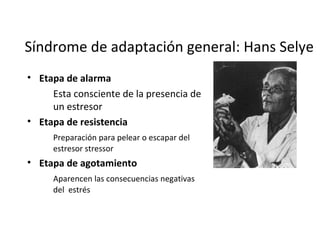
Síndrome de adaptación general: Hans Selye
• Etapa de alarma
Esta consciente de la presencia de
un estresor
• Etapa de resistencia
Preparación para pelear o escapar del
estresor stressor
• Etapa de agotamiento
Aparencen las consecuencias negativas
del estrés
Video sobre Hans Selye
http://www.youtube.com/watch?v=YJCeDtNh_Aw
Estresores
• Eventos estresantes: Escala de Reajuste Social de Holmes and
Rahe
• Sobre-carga o sobre-estimulación
• Frustración
• Nutrición: Cafeína, Sal, Refrescos
• Ruidos: sube la presión, afecta la concentración, y crea bajo
nivel de frustración
• Personalidad: Tipo A y Tipo B
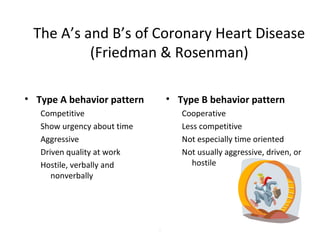
The A’s and B’s of Coronary Heart Disease
(Friedman & Rosenman)
• Type A behavior pattern
Competitive
Show urgency about time
Aggressive
Driven quality at work
Hostile, verbally and
nonverbally
• Type B behavior pattern
Cooperative
Less competitive
Not especially time oriented
Not usually aggressive, driven, or
hostile
.
Desesperanza aprendida (Martin
Seligman)
Learned Helplessness
• Se piensa que los eventos aversivos
no se pueden controlar.
• Un pesimismo que hace que la
persona no intenta cambiar la
situación de su vida
Experimento de Seligman
• Three groups of dogs were placed in harnesses. Group One
dogs were simply put in the harnesses for a period of time
and later released. Groups Two and Three consisted of
"yoked pairs." A dog in Group 2 would be intentionally
subjected to pain by being given electric shocks, which the
dog could end by pressing a lever. A Group 3 dog was wired
in parallel with a Group 2 dog, receiving shocks of identical
intensity and duration, but his lever didn't stop the electric
shocks. To a dog in Group 3, it seemed that the shock ended
at random, because it was his paired dog in Group 2 that was
causing it to stop. For Group 3 dogs, the shock was
apparently "inescapable." Group 1 and Group 2 dogs quickly
recovered from the experience, but Group 3 dogs learned to
be helpless, and exhibited symptoms similar to chronic
clinical depression.
Naturaleza de los conflictos
• Conflicto de acercamiento-acercamiento:
atraído por dos actividades deseables
–Dos buenas películas
• Conflicto de evitación-evitación: se
siente repulsión por dos actividades
indeseables
–Unwanted pregnancy-abortion
–Dentist-tooth decay
–Trabajo aburrido-pobreza
Conflictos
• Aproximación-evitación: cuando una sola opción
tiene a la vez elementos positivos y negativos:
– Amorío y valores morales
– Atleta con lesión y analgésico
– Casarse con alguien que los padres no quieren
– Ver una película y sentir miedo
• Múltiple aproximación-evitación: dos metas con
opciones positivas y negativas
– Dos empleos con cosas buenas y negativas
En torno a la felicidad y el bienestar
humano
Mario A. Núñez Molina
Catedrático de Psicología
Definición
• “a person is said to have high [well-being or
happiness] if she or he experiences life
satisfaction and frequent joy, and only
infrequently experiences unpleasant emotions
such as sadness or anger. (Ed Diener)
La felicidad
• The experience of joy, contentment or
positive well being, combined with a sense
that one’s life is good, meaningful and
worthwhile (Sonja Lyubomirsky)
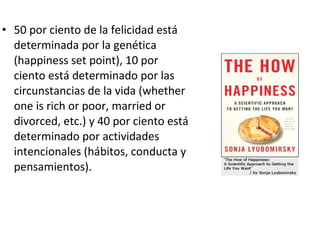
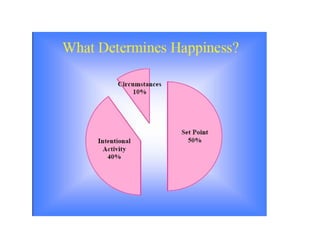
• 50 por ciento de la felicidad está
determinada por la genética
(happiness set point), 10 por
ciento está determinado por las
circunstancias de la vida (whether
one is rich or poor, married or
divorced, etc.) y 40 por ciento está
determinado por actividades
intencionales (hábitos, conducta y
pensamientos).
Hallazgos de las investigaciones
El mercado de la felicidad
La ciencia de
la felicidad
Dinero y felicidad
¿Son felices las personas en su trabajo?
• Según un estudio de Gallup, entre el 60% y el 80% de
los trabajadores no está comprometido con su trabajo.
Sienten poca o ninguna lealtad, pasión o motivación
por el trabajo. Cumplen con las horas requeridas, pero
no hacen un buen trabajo ya que no son felices en su
trabajo.
• La gente no es más feliz ahora de lo que decían serlo
hace pongamos 50 años. Esto es para EEUU, Reino
Unido y Japón. Para España y la mayoría de países
europeos sólo tenemos información recogida desde
hace 30 años, y los resultados son los mismos, aunque
ha habido un gran aumento de la riqueza.
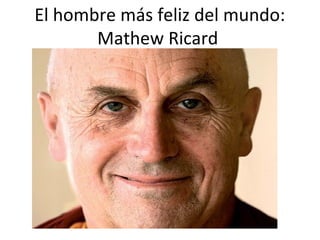
El hombre más feliz del mundo:
Mathew Ricard
• Científicos de la Universidad de Wisconsin llevan
años estudiando el cerebro del asesor personal del
Dalai Lama dentro de un proyecto en el que la
cabeza de Matthew Ricard ha sido sometida a
constantes resonancias magnéticas nucleares, en
sesiones de hasta tres horas de duración. Su cerebro
fue conectado a 256 sensores para detectar su nivel
de estrés, irritabilidad, enfado, placer, satisfacción y
así con decenas de sensaciones diferentes.
• Los resultados fueron comparados con los obtenidos en
cientos de voluntarios cuya felicidad fue clasificada en
niveles que iban del 0.3 (muy infeliz) a -0.3 (muy feliz).
Matthieu Ricard logró -0.45, desbordando los límites
previstos en el estudio, superando todos los registros
anteriores y ganándose un título –«el hombre más feliz
de la tierra»– que él mismo no termina de aceptar. ¿Está
también la modestia ligada a la felicidad? El monje
prefiere limitarse a resaltar que efectivamente la
cantidad de «emociones positivas» que produce su
cerebro está «muy lejos de los parámetros normales».
• .
Affective forecasting
• We are bad at “affective forecasting,” that is,
predicting how we’ll feel in the future. We
grossly overestimate the intensity and the
duration of our emotional reactions. Within a
year, lottery winners and paraplegics have
both (on average) returned most of the way
to their baseline levels of happiness.
• Studies that have assigned people to perform
a random act of kindness every week, or to
count their blessings regularly for several
weeks, find small but sustained increases in
happiness. Haidt, Jonathan (2006-12-26). The
Happiness Hypothesis: Finding Modern Truth
in Ancient Wisdom (p. 98).
• Van Boven and Gilovich concluded that
experiences give more happiness in part
because they have greater social value: Most
activities that cost more than a hundred
dollars are things we do with other people,
but expensive material possessions are often
purchased in part to impress other people.
Activities connect us to others; objects often
separate us.
• Having strong social relationships strengthens
the immune system, extends life (more than
does quitting smoking), speeds recovery from
surgery, and reduces the risks of depression
and anxiety disorders. Haidt, Jonathan (2006-
12-26). The Happiness Hypothesis: Finding
Modern Truth in Ancient Wisdom (p. 133).
Perseus Books Group. Kindle Edition.
La hipotesis de adversidad
• “posttraumatic growth,” Haidt, Jonathan
(2006-12-26). The Happiness Hypothesis:
Finding Modern Truth in Ancient Wisdom (p.
138). Perseus Books Group. Kindle Edition.
• Money matters, but less than we think and
not in the way that we think. Family is
important. So are friends. Envy is toxic. So is
excessive thinking. Beaches are optional. Trust
is not. Neither is gratitude. Weiner, Eric (2008-
01-03). The Geography of Bliss: One Grump's
Search for the Happiest Places in the World (p.
322).
La felicidad
• Pleasure comes more from making progress
toward goals than from achieving them. Haidt,
Jonathan (2006-12-26). The Happiness
Hypothesis: Finding Modern Truth in Ancient
Wisdom (p. 84).
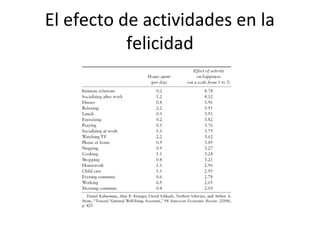
El efecto de actividades en la
felicidad
.
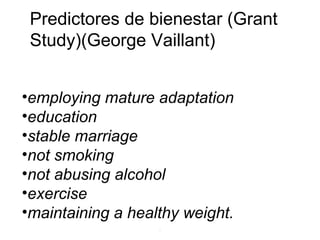
•employing mature adaptation
•education
•stable marriage
•not smoking
•not abusing alcohol
•exercise
•maintaining a healthy weight.
Predictores de bienestar (Grant
Study)(George Vaillant)
Hacer ejercicio nos hace felices
Vivir en el aqui y ahora
Tener una mascota
Diario de la felicidad
Visualizando el yo ideal
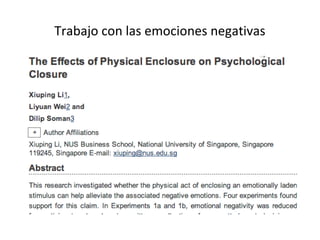
Trabajo con las emociones negativas
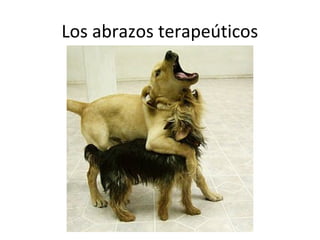
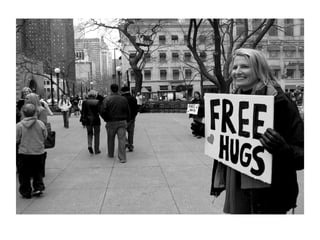
Los abrazos terapeúticos
Invertir dinero en experiencias, no
en posesiones
Actos aleatorios de amabilidad
• Traerle a alguien una taza de café sin que te la
haya pedido.
• Escribir un mensaje agradable sobre un post-it
adhesivo y pegarlo sobre su escritorio u
ordenador.
• Ofrecer colaboración a otros con sus trabajos.
• Escribir a alguien una tarjeta de
agradecimiento.
La experiencia de flow
En el flow
F
L
O
W
Ayudar a otros
Meditación
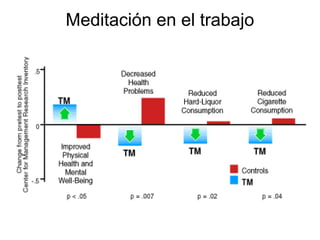
Meditación en el trabajo
Proverbio chino
• Si quieres ser feliz por una hora, toma una
siesta.
• Si quieres ser feliz por un día- sal a pescar.
• Si quieres ser feliz por un mes - cásate.
• Si quieres ser feliz por un año - hereda una
fortuna.
• Si quieres ser feliz para toda la vida - ayuda a
alguien y aprende a amar lo que haces.
The negative path to happiness:
• “The premeditations of evils”
Felicidad y tristeza
• The word "happiness" would lose its meaning
if it were not balanced by sadness. Carl Jung
• “The more you deliberately seek happiness
the more sure you are not to find it.” Carl Jung
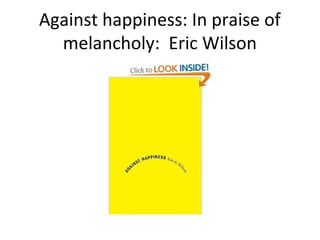
Against happiness: In praise of
melancholy: Eric Wilson
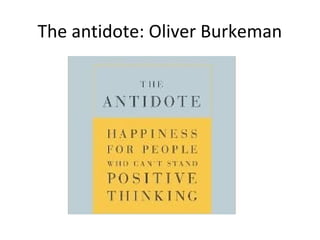
The antidote: Oliver Burkeman
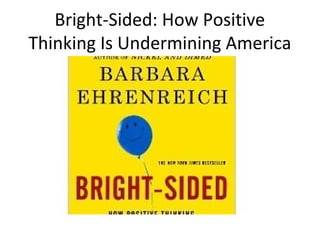
Bright-Sided: How Positive
Thinking Is Undermining America
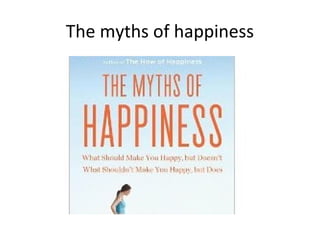
The myths of happiness
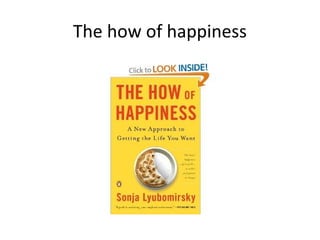
The how of happiness
The happiness hypothesis

Estres2

  • 1.
  • 2.
    Conceptos Psicología de laSalud: investiga la relación entre los factores psicológicos relacionados al bienestar y la enfermedad, incluyendo prevención, diagnosis, y tratamiento de los problemas médicos Psiconeuroinmunología Estudio de la relación entre los factores psicológicos , el sistema inmunológico y el cerebro
  • 3.
    Estrés • Estrés Activación delsistema psico-fisiológico la cuál si es prolongada e intensa puede causar fatiga o daño al sistema del organismo • Desórdenes psico-fisiológicos (desordenes psico- somáticos) Problemas médicos que son influenciados por la interacción entre factores psicológicos, emocionales y físicos
  • 4.
    Enfermedades psicosomáticas • Doloresde espalda • Úlceras • Migrañas • Asma • Alergias • Cáncer • Artritis • Alta presión • Enfermedades cardiovasculares
  • 5.
    Estrés y salud •Nuestra mente puede curarnos pero también puede enfermarnos • Toda la medicina es psico-somática • Ejemplos: – Muertes por vudú
  • 6.
    Tipos de estrés •Eustrés • Distrés
  • 7.
    Síndrome de adaptacióngeneral: Hans Selye • Etapa de alarma Esta consciente de la presencia de un estresor • Etapa de resistencia Preparación para pelear o escapar del estresor stressor • Etapa de agotamiento Aparencen las consecuencias negativas del estrés
  • 8.
    Video sobre HansSelye http://www.youtube.com/watch?v=YJCeDtNh_Aw
  • 9.
    Estresores • Eventos estresantes:Escala de Reajuste Social de Holmes and Rahe • Sobre-carga o sobre-estimulación • Frustración • Nutrición: Cafeína, Sal, Refrescos • Ruidos: sube la presión, afecta la concentración, y crea bajo nivel de frustración • Personalidad: Tipo A y Tipo B
  • 10.
    The A’s andB’s of Coronary Heart Disease (Friedman & Rosenman) • Type A behavior pattern Competitive Show urgency about time Aggressive Driven quality at work Hostile, verbally and nonverbally • Type B behavior pattern Cooperative Less competitive Not especially time oriented Not usually aggressive, driven, or hostile .
  • 11.
    Desesperanza aprendida (Martin Seligman) LearnedHelplessness • Se piensa que los eventos aversivos no se pueden controlar. • Un pesimismo que hace que la persona no intenta cambiar la situación de su vida
  • 12.
    Experimento de Seligman •Three groups of dogs were placed in harnesses. Group One dogs were simply put in the harnesses for a period of time and later released. Groups Two and Three consisted of "yoked pairs." A dog in Group 2 would be intentionally subjected to pain by being given electric shocks, which the dog could end by pressing a lever. A Group 3 dog was wired in parallel with a Group 2 dog, receiving shocks of identical intensity and duration, but his lever didn't stop the electric shocks. To a dog in Group 3, it seemed that the shock ended at random, because it was his paired dog in Group 2 that was causing it to stop. For Group 3 dogs, the shock was apparently "inescapable." Group 1 and Group 2 dogs quickly recovered from the experience, but Group 3 dogs learned to be helpless, and exhibited symptoms similar to chronic clinical depression.
  • 13.
    Naturaleza de losconflictos • Conflicto de acercamiento-acercamiento: atraído por dos actividades deseables –Dos buenas películas • Conflicto de evitación-evitación: se siente repulsión por dos actividades indeseables –Unwanted pregnancy-abortion –Dentist-tooth decay –Trabajo aburrido-pobreza
  • 14.
    Conflictos • Aproximación-evitación: cuandouna sola opción tiene a la vez elementos positivos y negativos: – Amorío y valores morales – Atleta con lesión y analgésico – Casarse con alguien que los padres no quieren – Ver una película y sentir miedo • Múltiple aproximación-evitación: dos metas con opciones positivas y negativas – Dos empleos con cosas buenas y negativas
  • 15.
    En torno ala felicidad y el bienestar humano Mario A. Núñez Molina Catedrático de Psicología
  • 16.
    Definición • “a personis said to have high [well-being or happiness] if she or he experiences life satisfaction and frequent joy, and only infrequently experiences unpleasant emotions such as sadness or anger. (Ed Diener)
  • 17.
    La felicidad • Theexperience of joy, contentment or positive well being, combined with a sense that one’s life is good, meaningful and worthwhile (Sonja Lyubomirsky)
  • 18.
    • 50 porciento de la felicidad está determinada por la genética (happiness set point), 10 por ciento está determinado por las circunstancias de la vida (whether one is rich or poor, married or divorced, etc.) y 40 por ciento está determinado por actividades intencionales (hábitos, conducta y pensamientos).
  • 20.
    Hallazgos de lasinvestigaciones
  • 21.
    El mercado dela felicidad
  • 22.
  • 23.
  • 24.
    ¿Son felices laspersonas en su trabajo?
  • 25.
    • Según unestudio de Gallup, entre el 60% y el 80% de los trabajadores no está comprometido con su trabajo. Sienten poca o ninguna lealtad, pasión o motivación por el trabajo. Cumplen con las horas requeridas, pero no hacen un buen trabajo ya que no son felices en su trabajo. • La gente no es más feliz ahora de lo que decían serlo hace pongamos 50 años. Esto es para EEUU, Reino Unido y Japón. Para España y la mayoría de países europeos sólo tenemos información recogida desde hace 30 años, y los resultados son los mismos, aunque ha habido un gran aumento de la riqueza.
  • 26.
    El hombre másfeliz del mundo: Mathew Ricard
  • 27.
    • Científicos dela Universidad de Wisconsin llevan años estudiando el cerebro del asesor personal del Dalai Lama dentro de un proyecto en el que la cabeza de Matthew Ricard ha sido sometida a constantes resonancias magnéticas nucleares, en sesiones de hasta tres horas de duración. Su cerebro fue conectado a 256 sensores para detectar su nivel de estrés, irritabilidad, enfado, placer, satisfacción y así con decenas de sensaciones diferentes.
  • 28.
    • Los resultadosfueron comparados con los obtenidos en cientos de voluntarios cuya felicidad fue clasificada en niveles que iban del 0.3 (muy infeliz) a -0.3 (muy feliz). Matthieu Ricard logró -0.45, desbordando los límites previstos en el estudio, superando todos los registros anteriores y ganándose un título –«el hombre más feliz de la tierra»– que él mismo no termina de aceptar. ¿Está también la modestia ligada a la felicidad? El monje prefiere limitarse a resaltar que efectivamente la cantidad de «emociones positivas» que produce su cerebro está «muy lejos de los parámetros normales». • .
  • 29.
    Affective forecasting • Weare bad at “affective forecasting,” that is, predicting how we’ll feel in the future. We grossly overestimate the intensity and the duration of our emotional reactions. Within a year, lottery winners and paraplegics have both (on average) returned most of the way to their baseline levels of happiness.
  • 30.
    • Studies thathave assigned people to perform a random act of kindness every week, or to count their blessings regularly for several weeks, find small but sustained increases in happiness. Haidt, Jonathan (2006-12-26). The Happiness Hypothesis: Finding Modern Truth in Ancient Wisdom (p. 98).
  • 31.
    • Van Bovenand Gilovich concluded that experiences give more happiness in part because they have greater social value: Most activities that cost more than a hundred dollars are things we do with other people, but expensive material possessions are often purchased in part to impress other people. Activities connect us to others; objects often separate us.
  • 32.
    • Having strongsocial relationships strengthens the immune system, extends life (more than does quitting smoking), speeds recovery from surgery, and reduces the risks of depression and anxiety disorders. Haidt, Jonathan (2006- 12-26). The Happiness Hypothesis: Finding Modern Truth in Ancient Wisdom (p. 133). Perseus Books Group. Kindle Edition.
  • 33.
    La hipotesis deadversidad • “posttraumatic growth,” Haidt, Jonathan (2006-12-26). The Happiness Hypothesis: Finding Modern Truth in Ancient Wisdom (p. 138). Perseus Books Group. Kindle Edition.
  • 34.
    • Money matters,but less than we think and not in the way that we think. Family is important. So are friends. Envy is toxic. So is excessive thinking. Beaches are optional. Trust is not. Neither is gratitude. Weiner, Eric (2008- 01-03). The Geography of Bliss: One Grump's Search for the Happiest Places in the World (p. 322).
  • 35.
    La felicidad • Pleasurecomes more from making progress toward goals than from achieving them. Haidt, Jonathan (2006-12-26). The Happiness Hypothesis: Finding Modern Truth in Ancient Wisdom (p. 84).
  • 36.
    El efecto deactividades en la felicidad
  • 37.
    . •employing mature adaptation •education •stablemarriage •not smoking •not abusing alcohol •exercise •maintaining a healthy weight. Predictores de bienestar (Grant Study)(George Vaillant)
  • 38.
    Hacer ejercicio noshace felices
  • 39.
    Vivir en elaqui y ahora
  • 40.
  • 41.
    Diario de lafelicidad
  • 42.
  • 43.
    Trabajo con lasemociones negativas
  • 46.
  • 48.
    Invertir dinero enexperiencias, no en posesiones
  • 49.
    Actos aleatorios deamabilidad • Traerle a alguien una taza de café sin que te la haya pedido. • Escribir un mensaje agradable sobre un post-it adhesivo y pegarlo sobre su escritorio u ordenador. • Ofrecer colaboración a otros con sus trabajos. • Escribir a alguien una tarjeta de agradecimiento.
  • 50.
  • 51.
  • 52.
  • 53.
  • 54.
  • 55.
  • 56.
    Proverbio chino • Siquieres ser feliz por una hora, toma una siesta. • Si quieres ser feliz por un día- sal a pescar. • Si quieres ser feliz por un mes - cásate. • Si quieres ser feliz por un año - hereda una fortuna. • Si quieres ser feliz para toda la vida - ayuda a alguien y aprende a amar lo que haces.
  • 57.
    The negative pathto happiness: • “The premeditations of evils”
  • 58.
    Felicidad y tristeza •The word "happiness" would lose its meaning if it were not balanced by sadness. Carl Jung
  • 59.
    • “The moreyou deliberately seek happiness the more sure you are not to find it.” Carl Jung
  • 60.
    Against happiness: Inpraise of melancholy: Eric Wilson
  • 61.
  • 62.
  • 63.
    The myths ofhappiness
  • 64.
    The how ofhappiness
  • 65.

Notas del editor

  • #3 Health psychology investigates the psychological factors related to wellness and illness, including the prevention, diagnosis, and treatment of medical problems. Health psychologists consider questions about the ways in which illness is influenced by psychological factors such as the experience of stress. They examine the psychological principles underlying treatments for disease and illness. They are also concerned with issues of prevention: how health problems such as heart disease and stress can be avoided by more healthful behavior.In their view, the mind and body are clearly linked, rather than representing two distinct systems. Health psychologists recognize that good health and the ability to cope with illness are affected by psychological factors such as thoughts, emotions, and the ability to manage stress. They have paid particular attention to the immune system, the complex of organs, glands, and cells that constitute our body’s natural line of defense in fighting disease. In fact, health psychologists are among the primary investigators in a growing field Psychoneuroimmunology (PNI) It is the study of the relationship among psychological factors, the immune system, and the brain. PNI has led to discoveries such as the existence of an association between one’s emotional state and the success of the immune system in fighting disease .
  • #4 stress, the response to events that threaten or challenge a person. Whether it be a paper or exam deadline, a family problem, or even a cumulative series of events such as those faced by Tara Knox, life is full of circumstances and events, known as stressors, that produce threats to our well-being. Even pleasant events—such as planning a party or beginning a sought-after job—can produce stress, although negative events result in greater detrimental consequences than positive ones. psychophysiological disorders are actual medical problems are influenced by an interaction of psychological, emotional, and physical difficulties. Among the common psychophysiological disorders are headaches, skin problems, and high blood pressure. On a psychological level, high levels of stress prevent people from adequately coping with life. Their view of the environment can become clouded (e.g., a minor criticism made by a friend is blown out of proportion). Moreover, at the greatest levels of stress, emotional responses may be so extreme that people are unable to act at all. People under a lot of stress also become less able to deal with new stressors. The ability to contend with future stress, then, declines as a result of past stress. In short, stress affects us in multiple ways. It may increase the risk that we will become ill; it may directly produce illness; it may make us less able to recover from a disease; and it may reduce our ability to cope with future stress.
  • #8 The effects of stress are illustrated in a model devised by Hans Selye called the general adaptation syndrome (GAS) It suggests that the same set of physiological reactions to stress occurs regardless of the particular cause of stress. The first stage, the alarm and mobilization stage, occurs when people become aware of the presence of a stressor. On a biological level, the sympathetic nervous system (Chapter 3) becomes energized, helping to cope initially with the stressor. if the stressor persists, people move into the next stage of the model. In the resistance stage, people prepare themselves to fight the stressor. During resistance, people use a variety of means to cope with the stressor—sometimes successfully—but at a cost of some degree of physical or psychological general well-being. If resistance is inadequate, people enter the last stage of the model, the exhaustion stage. During the exhaustion stage, a person’s ability to adapt to the stressor declines to the point where negative consequences of stress appear: physical illness, psychological symptoms in the form of an inability to concentrate, heightened irritability, or, in severe instances, disorientation and a loss of touch with reality. In a sense, people wear out, and their physical reserves are taxed to the limit. The GAS model has had a substantial impact on our understanding of stress. By suggesting that the exhaustion of resources in the third stage of the model produces biological damage, it has provided a specific explanation of how stress can lead to illness. Furthermore, the model can be applied to both people and nonhuman species. Contemporary health psychologists specializing in PNI have taken a broader approach than the GAS. Focusing on the outcomes of stress, they have identified three main consequences. First, stress has direct physiological results, including an increase in blood pressure, increased hormonal activity, and an overall decline in the functioning of the immune system. Second, stress leads people to engage in behavior that is harmful to their health, including increased nicotine, drug, and alcohol use, poor eating habits, and decreased sleep. Finally, stress produces indirect consequences that result in declines in health: a reduction in the likelihood of obtaining health care and decreased compliance with medical advice when it is sought.
  • #10 Cataclysmic events are strong stressors that occur suddenly and typically affect many people simultaneously. Disasters such as tornadoes and plane crashes are examples of cataclysmic events that can affect hundreds or thousands of people simultaneously. Although it might seem that cataclysmic events would produce potent, lingering stress, in many cases this is not true. In fact, cataclysmic events may produce less stress in the long run than events that are initially not as devastating. One reason is that cataclysmic events have a clear resolution. Once they are over and done with. Moreover, the stress induced by cataclysmic events is shared by others who have also experienced the disaster. On the other hand, some victims of major catastrophes can experience posttraumatic stress disorder or PTSD, in which the original events and the feelings associated with them are experienced again in vivid flashbacks or dreams. Depending upon what statistics one accepts, between 5 and 60 percent of the veterans of the Vietnam War suffer from PTSD. Furthermore, those who have suffered child abuse or rape, rescue workers facing overwhelming situations, or victims of any sudden natural disaster or accident that produces feelings of helplessness and terror may suffer from the same disorder. Symptoms of posttraumatic stress disorder include reexperiencing the event, emotional numbing, sleep difficulties, problems relating to others, alcohol and drug abuse, and—in some cases—suicide. For instance, the suicide rate for Vietnam veterans is as high as 25 percent higher than for the general population.
  • #11 Type A individuals are competitive, show a continual sense of urgency about time, are aggressive, exhibit a driven quality regarding their work, and are hostile, both verbally and nonverbally—especially when interrupted while trying to complete a task. On the other hand, people who show the Type B behavior pattern are more cooperative, far less competitive, not especially time-oriented, and not usually aggressive, driven, or hostile. Although people are typically not “pure” Type A’s or Type B’s, showing instead a combination of both behavior types, they generally do fall into one or the other category (Rosenman, 1990; Strube The importance of the Type A behavior pattern lies in its links to coronary heart disease. Studies have found that men who display the Type A pattern develop coronary heart disease twice as often and suffer significantly more fatal heart attacks compared with those classified as having the Type B pattern. Moreover, the Type A pattern predicts who is going to develop heart disease at least as well as—and independently of—any other single factor, including age, blood pressure, smoking habits, and cholesterol levels in the body It’s important to keep in mind that not everyone who displays Type A behaviors is destined to have coronary heart disease. For one thing, a firm association between Type A behaviors and coronary heart disease has not been established for women; most findings pertain to males, not females. Furthermore, the evidence relating Type A behavior and coronary heart disease is correlational. Consequently, as we first discussed in Chapter 2, we cannot say for sure whether Type A behavior causes heart disease or whether, instead, some other factor causes both heart disease and Type A behavior. In fact, rather than focusing on Type A behavior as the cause of heart disease, it may make more sense to ask whether Type B behavior prevents heart disease (Powell et al., 1993; Orth-Gomér, Chesney, & Wenger, 1996).
  • #12 According to psychologist Martin Seligman, learned helplessness occurs when people conclude that unpleasant or aversive stimuli cannot be controlled—a view of the world that becomes so ingrained that they cease trying to remedy the aversive circumstances, even if they actually can exert some influence. Take, for example, what often happens to elderly persons when they are placed in nursing homes or hospitals. One of the most striking features of their new environment is that they are no longer independent: They do not have control over the most basic activities in their lives. It is not hard to see how this loss of control can have negative effects upon people suddenly placed, often reluctantly, in such a situation. The results of this loss of control and the ensuing stress are frequently poorer health and even a likelihood of earlier death. Other research confirms that learned helplessness has negative consequences, and not just for elderly people. People of all ages report more physical symptoms and depression when they perceive that they have little or no control than when they feel a sense of control over a situation (Rodin, 1986; Joiner & Wagner, 1995; Shnek et al., 1995).
  • #25 Según un estudio de Gallup, entre el 60% y el 80% de los trabajadores no está comprometido con su trabajo. Sienten poca o ninguna lealtad, pasión o motivación por el trabajo. Cumplen con las horas requeridas, pero no hacen un buen trabajo ya que no son felices en su trabajo. La gente no es más feliz ahora de lo que decían serlo hace pongamos 50 años. Esto es para EEUU, Reino Unido y Japón. Para España y la mayoría de países europeos sólo tenemos información recogida desde hace 30 años, y los resultados son los mismos, aunque ha habido un gran aumento de la riqueza. Richard Layard
  • #27 Científicos de la Universidad de Wisconsin llevan años estudiando el cerebro del asesor personal del Dalai Lama dentro de un proyecto en el que la cabeza de Ricard ha sido sometida a constantes resonancias magnéticas nucleares, en sesiones de hasta tres horas de duración. Su cerebro fue conectado a 256 sensores para detectar su nivel de estrés, irritabilidad, enfado, placer, satisfacción y así con decenas de sensaciones diferentes. Los resultados fueron comparados con los obtenidos en cientos de voluntarios cuya felicidad fue clasificada en niveles que iban del 0.3 (muy infeliz) a -0.3 (muy feliz). Matthieu Ricard logró -0.45, desbordando los límites previstos en el estudio, superando todos los registros anteriores y ganándose un título –«el hombre más feliz de la tierra»– que él mismo no termina de aceptar. ¿Está también la modestia ligada a la felicidad? El monje prefiere limitarse a resaltar que efectivamente la cantidad de «emociones positivas» que produce su cerebro está «muy lejos de los parámetros normales».
  • #41 Reducen estres Disminuyen riesgo de ataque cardiaco Reducen la presion sanguinea y el colesterol. Le ayudan a perder peso
  • #42 ¿Cuáles son los eventos que te hacen feliz? Count your blessings una vez a la semana o una vez al mes. Writing letters of appreciation In one of the first studies on gratitude (Emmons & McCullough, 2003), one group of volunteers was asked to list five things for which they were thankful, once a week for 10 weeks in a row. Their “blessings” ranged from “my family” to “good health” to “The Rolling Stones.” Other volunteers participated in two control groups – that is, instead of focusing on gratitude every week, these individuals were asked either to think about their five daily hassles or five major events that had occurred. Relative to these two groups, those who were asked to express gratitude felt more optimistic and more satisfied with their lives. Also, they reported fewer physical symptoms (such as headaches, coughing, or nausea) and more time spent exercising. In one internet study, two interventions increased happiness and decreased depressive symptoms for at least six months. One exercise involves writing down three things that went well and why, every day for a week. The other is about identifying your signature strengths and using one of them in a new and different way every day for a week. A third technique involves writing a long letter to someone you're grateful to but have never properly thanked, and visiting them to read it out in person.
  • #43 In one study (King, 2001), participants spent 20 minutes a day, for four days, writing about how they want their life to be in the future. Compared to those who wrote about more neutral topics, people who wrote about their best possible future selves experienced increases in positive mood both immediately after the writing exercises and several weeks later.
  • #45 A second activity for increasing happiness works by creating a sense of optimism. It involves thinking about your life in the future and visualizing living it as your “best possible self” (BPS; King, 2001).
  • #47 pp. 148-9   Hugs make people happier. Students at Penn State who were instructed to give or receive a minimum of five hugs per day over the course of four weeks and to record the details became much happier. Students who merely recorded their reading activity showed no changes.
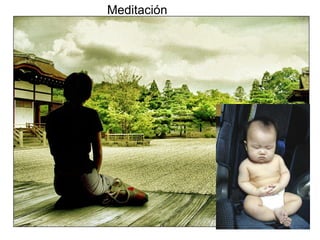
  • #51 p. 198  People high in mindfulness - that is, those who are prone to be mindfully attentive to the here and now and keenly aware of their surroundings - are models of flourishing and positive mental health.
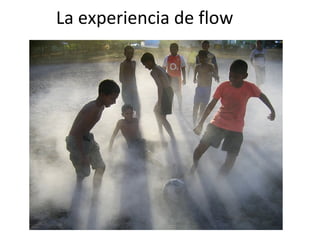
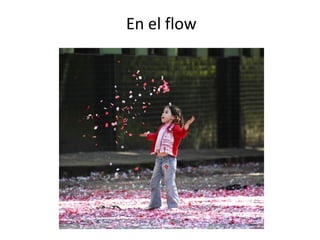
  • #52 High performance and high satisfaction Motivation Creativity Self-esteem Happiness Flow (Mihaly Csikszentmihalyi)
  • #54 Dr. Richard Davidson would agree. He has studied the brains of Buddhist monks, men who spend their lives deliberately forcing positive emotions, and their happiness is off the charts. His new data claims that if a person sits quietly for a half-hour a day just thinking about kindness and compassion, their brain will show noticeable changes in just two weeks.