Pontificia Universidad Cat´lica de Chile
                         o
Facultad de Matem´ticas
                   a
Primer Semestre 2009


                             SOLUCION INTERROGACION II
                                   MAT 220E ∗ CALCULO II


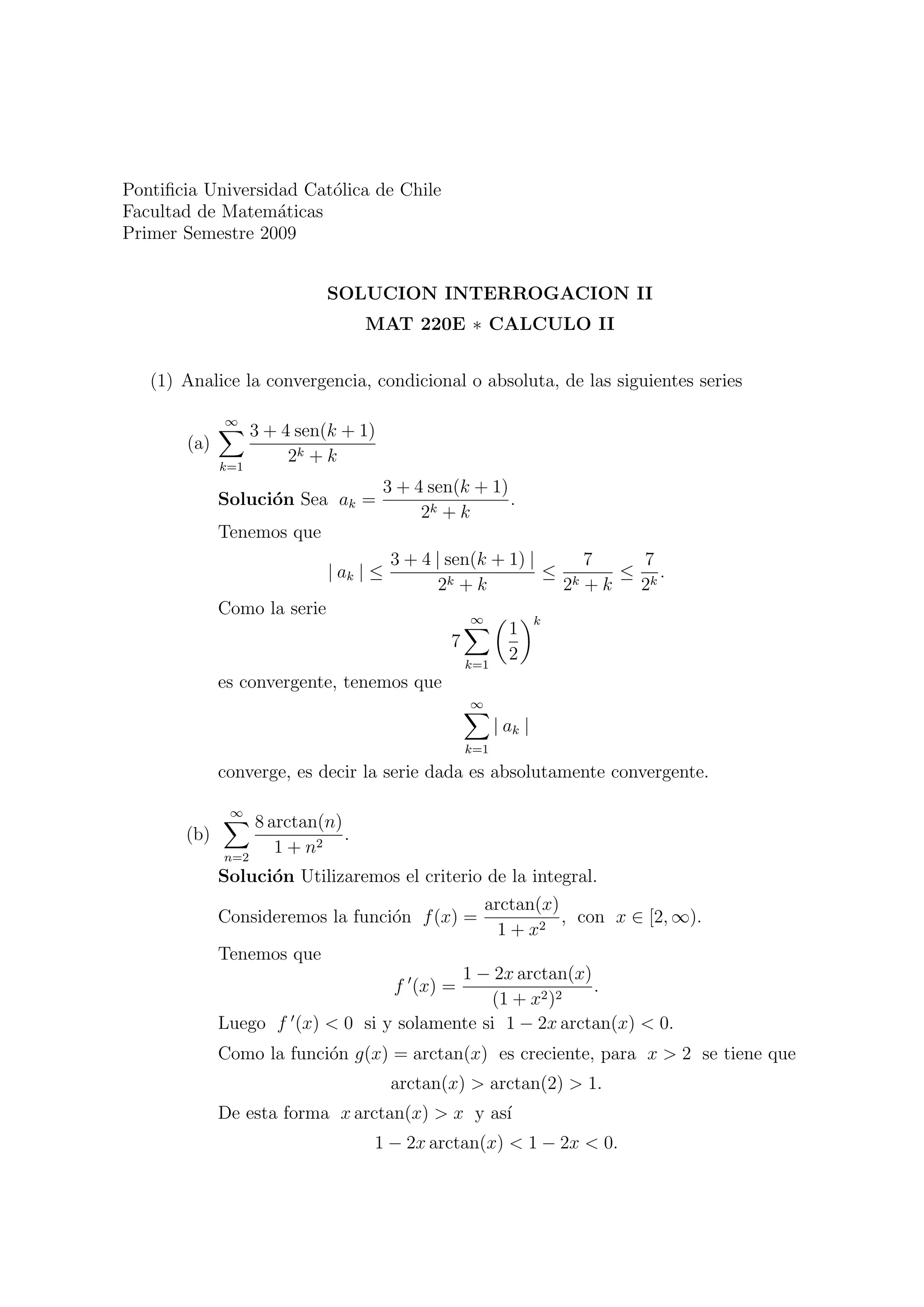
   (1) Analice la convergencia, condicional o absoluta, de las siguientes series

             ∞
                   3 + 4 sen(k + 1)
       (a)
             k=1
                        2k + k
                                      3 + 4 sen(k + 1)
             Soluci´n Sea ak =
                   o                                   .
                                           2k + k
             Tenemos que
                                        3 + 4 | sen(k + 1) |     7   7
                             | ak | ≤                        ≤ k   ≤ k.
                                               2k + k         2 +k  2
             Como la serie
                                                   ∞              k
                                                           1
                                               7
                                                   k=1
                                                           2
             es convergente, tenemos que
                                                   ∞
                                                         | ak |
                                                   k=1
             converge, es decir la serie dada es absolutamente convergente.

              ∞
                   8 arctan(n)
       (b)                     .
             n=2
                      1 + n2
             Soluci´n Utilizaremos el criterio de la integral.
                   o
                                                       arctan(x)
             Consideremos la funci´n f (x) =
                                  o                              , con x ∈ [2, ∞).
                                                         1 + x2
             Tenemos que
                                         1 − 2x arctan(x)
                                        f (x) =           .
                                             (1 + x2 )2
             Luego f (x) < 0 si y solamente si 1 − 2x arctan(x) < 0.
             Como la funci´n g(x) = arctan(x) es creciente, para x > 2 se tiene que
                          o
                                        arctan(x) > arctan(2) > 1.
             De esta forma x arctan(x) > x y as´
                                               ı
                                   1 − 2x arctan(x) < 1 − 2x < 0.
1


         Ahora, integrando por partes
                       u                                                     u
                           arctan(x)      arctan2 (x)                                 1
                                     dx =                                        =      arctan2 (u) − arctan2 (2)
                   2         1 + x2            2                             2        2

         Finalmente
             u
                 arctan(x)          1                             1                                                π2
   lim                  2
                           dx = lim   arctan2 (u) − arctan2 (2) =                                                     − arctan2 (2) .
  u→∞    2         1+x          u→∞ 2                             2                                                4

         As´ la serie dada converge.
           ı,

(2) Utilizando series geom´tricas, calcule
                          e
                                                         ∞
                                                             (n + 1)2 3n−1
                                                                            .
                                                     n=1
                                                                n     22n−1

   Soluci´n
         o
             ∞                                       ∞                                           n
                   (n + 1)2 3n−1   2                              1                         3
                        2n−1
                                 =                           n+2+
             n=1
                      n2           3             n=1
                                                                  n                         4
                                                   ∞                             n          ∞          n       ∞             n
                                             2                           3                       3                   1   3
                                           =                     n                   +2                    +
                                             3        n=1
                                                                         4                 n=1
                                                                                                 4             n=1
                                                                                                                     n   4
      Considere la serie geom´trica
                             e
                                                 ∞
                                                                      1
                                                     xn =                , |x| < 1
                                             n=0
                                                                     1−x

   Derivando
                                 ∞                                                   ∞
                                           n−1        1                                                 1
                                      nx         =          ⇔                              nxn =
                                n=0
                                                   (1 − x)2                          n=1
                                                                                                     (1 − x)2
                                             ∞                       n
                              3                              3
   haciendo x =                 se tiene             n                   = 12
                              4             n=1
                                                             4
                                                             ∞                   n
                                                                         3
   La segunda suma es inmediata,                                                      =3
                                                             n=1
                                                                         4
                                                             ∞
                                                                                        1
   Para la tercera suma, considere                                   xn−1 =                ,         |x| < 1.
                                                             n=1
                                                                                       1−x
                                             ∞
                                                     xn
   integrando tenemos que                               = − ln (1 − x),
                                            n=1
                                                     n
2

                                  ∞                 n
                  3                     1       3                  1
       para x =     se tiene                            = − ln          .
                  4               n=1
                                        n       4                  4
       Finalmente

                      ∞
                            (n + 1)2 3n−1   2                         1                       2    1
                                 2n−1
                                          =               12 + 6 − ln( )             = 12 −     ln( )
                      n=1
                               n2           3                         4                       3    4

    (3) Considere la serie de potencias
                                             ∞
                                                             xn
                                                            √    √      .
                                            n=1
                                                    (n + 1) n + n n + 1


        (a) Determine su radio de convergencia.
                                         1
            Soluci´n De inmediato, r =
                  o
                                         l
                                              √     √                                           1
                                                                                                √
                          an+1         (n + 1) n + n n + 1                                     n n
            donde l = lim       =        √               √      ·                               1
                      n→∞ an      (n + 2) n + 1 + (n + 1) n + 2                                 √
                                                                                               n n
                                            1                  1
                                    1+      n
                                                    +    1+    n
            l = lim                                                             =1
                n→∞           2                 1          1                2
                     1+       n
                                        1+      n
                                                    + 1+   n
                                                                   1+       n
            luego r = 1

                          ∞
                                       1
        (b) Calcule                     √  √      .
                       n=1
                              (n + 1) n + n n + 1
            Soluci´n Calculamos Sn
                   o                                      √     √
                   n                            n
                                 1                 (k + 1) k − k k + 1
            Sn =             √       √       =
                  k=1
                      (k + 1) k + k k + 1 k=1 (k + 1)2 k − k 2 (k + 1)
                   n         √       √          n √       √
                      (k + 1) k − k k + 1            k      k+1
            Sn =                             =         −
                  k=1
                             (k + 1)k          k=1
                                                    k      k+1
                      √
                        n+1
            Sn = 1 −          , as´ resulta que lim Sn = 1 por lo tanto
                                   ı
                       n+1                      n→∞
             ∞
                           1
                        √       √      =1
            n=1
                (n + 1) n + n n + 1

                          1
    (4) Sea f (x) = √                 con |x| < 1.
                        1 − x2

        (a) Determine el desarrollo en series de potencias de f (x) en torno a a = 0.
3

   Soluci´n Tenemos que
         o
                                              1                 1
                              f (x) = √            = (1 − x2 )− 2 .
                                            1 − x2
   Utilizando desarrollo binomial, para | x | < 1
                                                ∞        1
                                                       −2
                                      f (x) =              (−x2 )k
                                                k=0
                                                        k

   donde
                                                −12        =1
                                                 0
   y
                                  1       1                     1         1
             1                −          − −1                  − − 2 ··· − − k + 1
           −                      2       2                     2         2
             2       =
            k                                                    k!

                                        1       3          5          2k − 1
                            (−1)k                               ···
                                        2       2          2             2
                     =
                                                      k!
                            (−1)k 1 · 3 · 5 · · · (2k − 1)
                     =
                                       2k k!
   Luego
                       ∞        1                              ∞
                              −2                    1 · 3 · 5 · · · (2k − 1) 2k
           f (x) =                (−x2 )k = 1 +                             x
                      k=0
                               k                k=1
                                                             2k k!


                 ∞
                  1 · 3 · · · (2n − 1)
(b) Calcule                            . Soluci´n Por el item anterior, tenemos que, para
                                               o
              n=1
                    2n n!(2n + 1)
   | x | < 1, vale
                                                ∞
                            1            1 · 3 · 5 · · · (2k − 1) 2k
                      √          =1+                             x .
                           1−x 2
                                     k=1
                                                  2k k!

   Integrando, tenemos que
                                                ∞
                                                    1 · 3 · 5 · · · (2k − 1) 2k+1
                     arcsen(x) = x +                                        x     .
                                            k=1
                                                        2k k!(2k + 1)

   Es decir
                     ∞
                           1 · 3 · 5 · · · (2k − 1) 2k+1
                                                   x     = arcsen(x) − x.
                     k=1
                               2k k!(2k + 1)
4

                                    π
    Adem´s lim (arcsen(x) − x) =
        a                             − 1.
            x→1                     2
    Finalmente        ∞
                           1 · 3 · 5 · · · (2k − 1)  π
                                k k!(2k + 1)
                                                    = − 1.
                     k=1
                               2                     2

I2 1er 2009

  • 1.
    Pontificia Universidad Cat´licade Chile o Facultad de Matem´ticas a Primer Semestre 2009 SOLUCION INTERROGACION II MAT 220E ∗ CALCULO II (1) Analice la convergencia, condicional o absoluta, de las siguientes series ∞ 3 + 4 sen(k + 1) (a) k=1 2k + k 3 + 4 sen(k + 1) Soluci´n Sea ak = o . 2k + k Tenemos que 3 + 4 | sen(k + 1) | 7 7 | ak | ≤ ≤ k ≤ k. 2k + k 2 +k 2 Como la serie ∞ k 1 7 k=1 2 es convergente, tenemos que ∞ | ak | k=1 converge, es decir la serie dada es absolutamente convergente. ∞ 8 arctan(n) (b) . n=2 1 + n2 Soluci´n Utilizaremos el criterio de la integral. o arctan(x) Consideremos la funci´n f (x) = o , con x ∈ [2, ∞). 1 + x2 Tenemos que 1 − 2x arctan(x) f (x) = . (1 + x2 )2 Luego f (x) < 0 si y solamente si 1 − 2x arctan(x) < 0. Como la funci´n g(x) = arctan(x) es creciente, para x > 2 se tiene que o arctan(x) > arctan(2) > 1. De esta forma x arctan(x) > x y as´ ı 1 − 2x arctan(x) < 1 − 2x < 0.
  • 2.
    1 Ahora, integrando por partes u u arctan(x) arctan2 (x) 1 dx = = arctan2 (u) − arctan2 (2) 2 1 + x2 2 2 2 Finalmente u arctan(x) 1 1 π2 lim 2 dx = lim arctan2 (u) − arctan2 (2) = − arctan2 (2) . u→∞ 2 1+x u→∞ 2 2 4 As´ la serie dada converge. ı, (2) Utilizando series geom´tricas, calcule e ∞ (n + 1)2 3n−1 . n=1 n 22n−1 Soluci´n o ∞ ∞ n (n + 1)2 3n−1 2 1 3 2n−1 = n+2+ n=1 n2 3 n=1 n 4 ∞ n ∞ n ∞ n 2 3 3 1 3 = n +2 + 3 n=1 4 n=1 4 n=1 n 4 Considere la serie geom´trica e ∞ 1 xn = , |x| < 1 n=0 1−x Derivando ∞ ∞ n−1 1 1 nx = ⇔ nxn = n=0 (1 − x)2 n=1 (1 − x)2 ∞ n 3 3 haciendo x = se tiene n = 12 4 n=1 4 ∞ n 3 La segunda suma es inmediata, =3 n=1 4 ∞ 1 Para la tercera suma, considere xn−1 = , |x| < 1. n=1 1−x ∞ xn integrando tenemos que = − ln (1 − x), n=1 n
  • 3.
    2 ∞ n 3 1 3 1 para x = se tiene = − ln . 4 n=1 n 4 4 Finalmente ∞ (n + 1)2 3n−1 2 1 2 1 2n−1 = 12 + 6 − ln( ) = 12 − ln( ) n=1 n2 3 4 3 4 (3) Considere la serie de potencias ∞ xn √ √ . n=1 (n + 1) n + n n + 1 (a) Determine su radio de convergencia. 1 Soluci´n De inmediato, r = o l √ √ 1 √ an+1 (n + 1) n + n n + 1 n n donde l = lim = √ √ · 1 n→∞ an (n + 2) n + 1 + (n + 1) n + 2 √ n n 1 1 1+ n + 1+ n l = lim =1 n→∞ 2 1 1 2 1+ n 1+ n + 1+ n 1+ n luego r = 1 ∞ 1 (b) Calcule √ √ . n=1 (n + 1) n + n n + 1 Soluci´n Calculamos Sn o √ √ n n 1 (k + 1) k − k k + 1 Sn = √ √ = k=1 (k + 1) k + k k + 1 k=1 (k + 1)2 k − k 2 (k + 1) n √ √ n √ √ (k + 1) k − k k + 1 k k+1 Sn = = − k=1 (k + 1)k k=1 k k+1 √ n+1 Sn = 1 − , as´ resulta que lim Sn = 1 por lo tanto ı n+1 n→∞ ∞ 1 √ √ =1 n=1 (n + 1) n + n n + 1 1 (4) Sea f (x) = √ con |x| < 1. 1 − x2 (a) Determine el desarrollo en series de potencias de f (x) en torno a a = 0.
  • 4.
    3 Soluci´n Tenemos que o 1 1 f (x) = √ = (1 − x2 )− 2 . 1 − x2 Utilizando desarrollo binomial, para | x | < 1 ∞ 1 −2 f (x) = (−x2 )k k=0 k donde −12 =1 0 y 1 1 1 1 1 − − −1 − − 2 ··· − − k + 1 − 2 2 2 2 2 = k k! 1 3 5 2k − 1 (−1)k ··· 2 2 2 2 = k! (−1)k 1 · 3 · 5 · · · (2k − 1) = 2k k! Luego ∞ 1 ∞ −2 1 · 3 · 5 · · · (2k − 1) 2k f (x) = (−x2 )k = 1 + x k=0 k k=1 2k k! ∞ 1 · 3 · · · (2n − 1) (b) Calcule . Soluci´n Por el item anterior, tenemos que, para o n=1 2n n!(2n + 1) | x | < 1, vale ∞ 1 1 · 3 · 5 · · · (2k − 1) 2k √ =1+ x . 1−x 2 k=1 2k k! Integrando, tenemos que ∞ 1 · 3 · 5 · · · (2k − 1) 2k+1 arcsen(x) = x + x . k=1 2k k!(2k + 1) Es decir ∞ 1 · 3 · 5 · · · (2k − 1) 2k+1 x = arcsen(x) − x. k=1 2k k!(2k + 1)
  • 5.
    4 π Adem´s lim (arcsen(x) − x) = a − 1. x→1 2 Finalmente ∞ 1 · 3 · 5 · · · (2k − 1) π k k!(2k + 1) = − 1. k=1 2 2