Los Mandatos
Informales
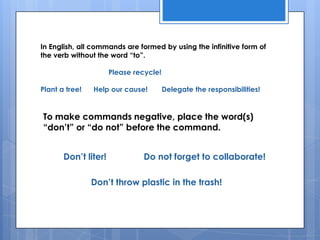
In English, all commands are formed by using the infinitive form of
the verb without the word “to”.

                      Please recycle!

Plant a tree!   Help our cause!         Delegate the responsibilities!


To make commands negative, place the word(s)
“don’t” or “do not” before the command.


       Don’t liter!            Do not forget to collaborate!

                Don’t throw plastic in the trash!
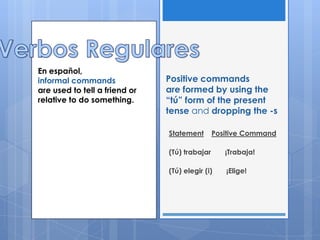
En español,
informal commands              Positive commands
are used to tell a friend or   are formed by using the
relative to do something.      “tú” form of the present
                               tense and dropping the -s

                               Statement       Positive Command

                               (Tú) trabajar      ¡Trabaja!

                               (Tú) elegir (i)    ¡Elige!
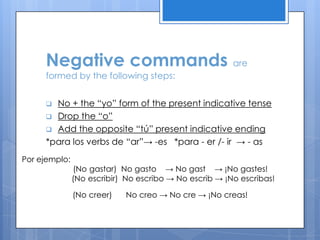
Negative commands are
     formed by the following steps:


      No + the “yo” form of the present indicative tense
      Drop the “o”
      Add the opposite “tú” present indicative ending
     *para los verbs de “ar”→ -es *para - er /- ir → - as
Por ejemplo:
               (No gastar) No gasto → No gast → ¡No gastes!
               (No escribir) No escribo → No escrib → ¡No escribas!

               (No creer)   No creo → No cre → ¡No creas!
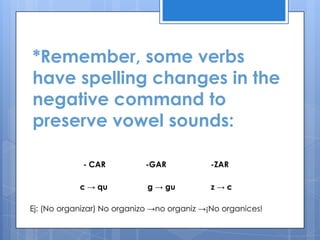
*Remember, some verbs
have spelling changes in the
negative command to
preserve vowel sounds:

             - CAR          -GAR             -ZAR

            c → qu           g → gu          z→c

Ej: (No organizar) No organizo →no organiz →¡No organices!
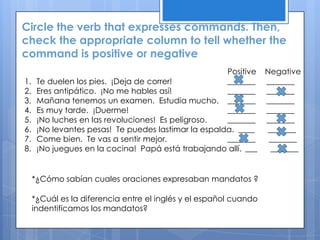
Circle the verb that expresses commands. Then,
check the appropriate column to tell whether the
command is positive or negative
                                                      Positive Negative
1.    Te duelen los pies. ¡Deja de correr!            _______ _______
2.    Eres antipático. ¡No me hables así!             _______ _______
3.    Mañana tenemos un examen. Estudia mucho. _______ _______
4.    Es muy tarde. ¡Duerme!                          _______ _______
5.    ¡No luches en las revoluciones! Es peligroso.   _______ _______
6.    ¡No levantes pesas! Te puedes lastimar la espalda. ____  _______
7.    Come bien. Te vas a sentir mejor.               _______   _______
8.    ¡No juegues en la cocina! Papá está trabajando allí. ___  _______


     *¿Cómo sabían cuales oraciones expresaban mandatos ?

     *¿Cuál es la diferencia entre el inglés y el español cuando
     indentificamos los mandatos?
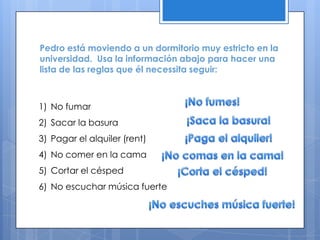
Pedro está moviendo a un dormitorio muy estricto en la
universidad. Usa la información abajo para hacer una
lista de las reglas que él necessita seguir:


1) No fumar
2) Sacar la basura
3) Pagar el alquiler (rent)
4) No comer en la cama
5) Cortar el césped
6) No escuchar música fuerte
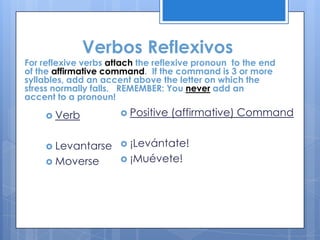
Verbos Reflexivos
For reflexive verbs attach the reflexive pronoun to the end
of the affirmative command. If the command is 3 or more
syllables, add an accent above the letter on which the
stress normally falls. REMEMBER: You never add an
accent to a pronoun!

     Verb             Positive   (affirmative) Command


     Levantarse       ¡Levántate!

     Moverse          ¡Muévete!
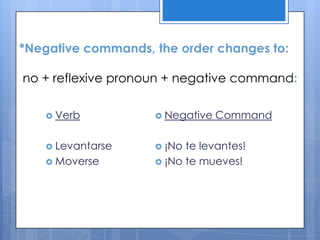
*Negative commands, the order changes to:

no + reflexive pronoun + negative command:

     Verb           Negative   Command

     Levantarse     ¡No te levantes!
     Moverse        ¡No te mueves!
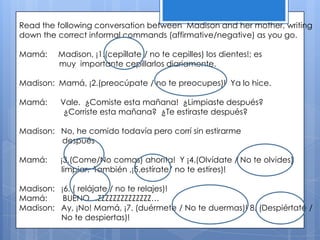
Read the following conversation between Madison and her mother, writing
down the correct informal commands (affirmative/negative) as you go.

Mamá:    Madison, ¡1.(cepíllate / no te cepilles) los dientes!; es
         muy importante cepillarlos diariamente.

Madison: Mamá, ¡2.(preocúpate / no te preocupes)! Ya lo hice.

Mamá:     Vale. ¿Comiste esta mañana! ¿Limpiaste después?
           ¿Corriste esta mañana? ¿Te estiraste después?

Madison: No, he comido todavía pero corrí sin estirarme
         después

Mamá:     ¡3.(Come/No comas) ahorita! Y ¡4.(Olvídate / No te olvides)
          limpiar. También ,¡5.estírate/ no te estires)!

Madison: ¡6. ( relájate / no te relajes)!
Mamá:     BUENO…ZZZZZZZZZZZZZZ…
Madison: Ay, ¡No! Mamá, ¡7. (duérmete / No te duermas)! 8. (Despiértate /
         No te despiertas)!
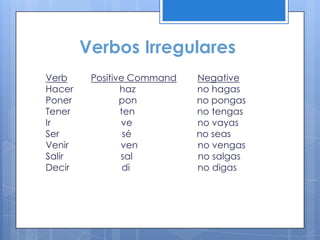
Verbos Irregulares
Verb     Positive Command   Negative
Hacer           haz         no hagas
Poner           pon         no pongas
Tener           ten         no tengas
Ir              ve          no vayas
Ser              sé         no seas
Venir           ven         no vengas
Salir           sal         no salgas
Decir            di         no digas
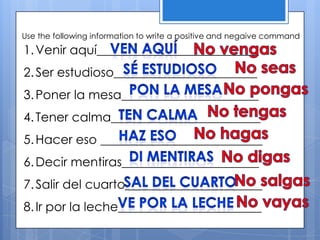
Use the following information to write a positive and negaive command
1. Venir aquí__________________________
2. Ser estudioso_______________________
3. Poner la mesa______________________
4. Tener calma________________________
5. Hacer eso __________________________
6. Decir mentiras______________________
7. Salir del cuarto______________________
8. Ir por la leche_______________________
Video de Mandatos
    Informales

Informal tú commands

  • 1.
  • 2.
    In English, allcommands are formed by using the infinitive form of the verb without the word “to”. Please recycle! Plant a tree! Help our cause! Delegate the responsibilities! To make commands negative, place the word(s) “don’t” or “do not” before the command. Don’t liter! Do not forget to collaborate! Don’t throw plastic in the trash!
  • 3.
    En español, informal commands Positive commands are used to tell a friend or are formed by using the relative to do something. “tú” form of the present tense and dropping the -s Statement Positive Command (Tú) trabajar ¡Trabaja! (Tú) elegir (i) ¡Elige!
  • 4.
    Negative commands are formed by the following steps:  No + the “yo” form of the present indicative tense  Drop the “o”  Add the opposite “tú” present indicative ending *para los verbs de “ar”→ -es *para - er /- ir → - as Por ejemplo: (No gastar) No gasto → No gast → ¡No gastes! (No escribir) No escribo → No escrib → ¡No escribas! (No creer) No creo → No cre → ¡No creas!
  • 5.
    *Remember, some verbs havespelling changes in the negative command to preserve vowel sounds: - CAR -GAR -ZAR c → qu g → gu z→c Ej: (No organizar) No organizo →no organiz →¡No organices!
  • 6.
    Circle the verbthat expresses commands. Then, check the appropriate column to tell whether the command is positive or negative Positive Negative 1. Te duelen los pies. ¡Deja de correr! _______ _______ 2. Eres antipático. ¡No me hables así! _______ _______ 3. Mañana tenemos un examen. Estudia mucho. _______ _______ 4. Es muy tarde. ¡Duerme! _______ _______ 5. ¡No luches en las revoluciones! Es peligroso. _______ _______ 6. ¡No levantes pesas! Te puedes lastimar la espalda. ____ _______ 7. Come bien. Te vas a sentir mejor. _______ _______ 8. ¡No juegues en la cocina! Papá está trabajando allí. ___ _______ *¿Cómo sabían cuales oraciones expresaban mandatos ? *¿Cuál es la diferencia entre el inglés y el español cuando indentificamos los mandatos?
  • 7.
    Pedro está moviendoa un dormitorio muy estricto en la universidad. Usa la información abajo para hacer una lista de las reglas que él necessita seguir: 1) No fumar 2) Sacar la basura 3) Pagar el alquiler (rent) 4) No comer en la cama 5) Cortar el césped 6) No escuchar música fuerte
  • 8.
    Verbos Reflexivos For reflexiveverbs attach the reflexive pronoun to the end of the affirmative command. If the command is 3 or more syllables, add an accent above the letter on which the stress normally falls. REMEMBER: You never add an accent to a pronoun!  Verb  Positive (affirmative) Command  Levantarse  ¡Levántate!  Moverse  ¡Muévete!
  • 9.
    *Negative commands, theorder changes to: no + reflexive pronoun + negative command:  Verb  Negative Command  Levantarse  ¡No te levantes!  Moverse  ¡No te mueves!
  • 10.
    Read the followingconversation between Madison and her mother, writing down the correct informal commands (affirmative/negative) as you go. Mamá: Madison, ¡1.(cepíllate / no te cepilles) los dientes!; es muy importante cepillarlos diariamente. Madison: Mamá, ¡2.(preocúpate / no te preocupes)! Ya lo hice. Mamá: Vale. ¿Comiste esta mañana! ¿Limpiaste después? ¿Corriste esta mañana? ¿Te estiraste después? Madison: No, he comido todavía pero corrí sin estirarme después Mamá: ¡3.(Come/No comas) ahorita! Y ¡4.(Olvídate / No te olvides) limpiar. También ,¡5.estírate/ no te estires)! Madison: ¡6. ( relájate / no te relajes)! Mamá: BUENO…ZZZZZZZZZZZZZZ… Madison: Ay, ¡No! Mamá, ¡7. (duérmete / No te duermas)! 8. (Despiértate / No te despiertas)!
  • 11.
    Verbos Irregulares Verb Positive Command Negative Hacer haz no hagas Poner pon no pongas Tener ten no tengas Ir ve no vayas Ser sé no seas Venir ven no vengas Salir sal no salgas Decir di no digas
  • 12.
    Use the followinginformation to write a positive and negaive command 1. Venir aquí__________________________ 2. Ser estudioso_______________________ 3. Poner la mesa______________________ 4. Tener calma________________________ 5. Hacer eso __________________________ 6. Decir mentiras______________________ 7. Salir del cuarto______________________ 8. Ir por la leche_______________________
  • 13.