Familiar (tú) Commands
These are commands addressed to a person that:
you know well, call by their first name, is a family
member or a younger person.
For regular verbs:
1. Take the él/ella form of the verb from the
Present Tense. These will end "a" for -ar verbs
and "e" for -er/-ir verbs.
 
¡Habla! (Speak!), ¡Come! (Eat!), ¡Escribe! (Write!)
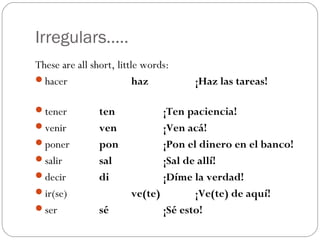
Irregulars.....
These are all short, little words:
hacer haz ¡Haz las tareas!
tener ten ¡Ten paciencia!
venir ven ¡Ven acá!
poner pon ¡Pon el dinero en el banco!
salir sal ¡Sal de allí!
decir di ¡Díme la verdad!
ir(se) ve(te) ¡Ve(te) de aquí!
ser sé ¡Sé esto!
Object and reflexive pronouns are attached to the
end of an affirmative command.
¡Cómpra un periódico! Buy a newspaper!
¡Cómpralo! Buy it!
¡Lávate las manos! Wash your hands!
¡Manda un paquete a tus amigos! Send your friends a package!
¡Mándales un paquete! Send them a package!
¡Da el juguete a tu hermanita! Give the toy to your little sister!
¡Dáselo! Give it to her!
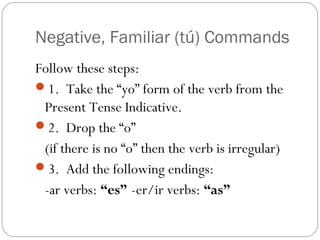
Negative, Familiar (tú) Commands
Follow these steps:
1. Take the “yo” form of the verb from the
Present Tense Indicative.
2. Drop the “o”
(if there is no “o” then the verb is irregular)
3. Add the following endings:
-ar verbs: “es” -er/ir verbs: “as”
Examples
¡No hables! Don’t speak!
¡No escribas con lápiz! Don’t write with pencil!
¡No hagas ruido! Don’t make noise!
¡No tengas miedo! Don’t be afraid!
Irregulars....
Irregular forms all use the tú form of the Present Tense
Subjunctive.
dar ¡no des...! Don’t give!
estar ¡no estés...! Don’t be...!
ir ¡no vayas...! Don’t go....!
ser ¡no seas...! Don’t be...!
saber ¡no sepas...! Don’t know...!
Spelling Changes....
The same spelling changes apply for verbs ending in:
–car, -gar, and -zar.
c  qu ¡No saques fotos! Don’t take photo!.
g  gu ¡No lo tragues! Don’t swallow it!
z  c ¡No empieces...! Don’t start...!
Object and reflexive pronouns are placed
separately, before a negative command.
¡No lo compres! Don’t buy it!
¡No te laves las manos! Don’t wash your hands!
¡No les mandes un paquete! Don’t send them a package!
¡No des el juguete a tu hermanita! Don’t give the toy to your little
sister!
¡No se lo des! Don’t give it to her!
Negative Examples....
¡No lo compres!
Don’t buy it!
¡No te laves las manos ahora!
Don’t wash your hands now!
¡No les mándes el paquete!
Don’t send them(you) the package.
¡No se lo des!
Don’t give it to her(him/you)!

Familiar commands

  • 1.
  • 2.
    These are commandsaddressed to a person that: you know well, call by their first name, is a family member or a younger person. For regular verbs: 1. Take the él/ella form of the verb from the Present Tense. These will end "a" for -ar verbs and "e" for -er/-ir verbs.   ¡Habla! (Speak!), ¡Come! (Eat!), ¡Escribe! (Write!)
  • 3.
    Irregulars..... These are allshort, little words: hacer haz ¡Haz las tareas! tener ten ¡Ten paciencia! venir ven ¡Ven acá! poner pon ¡Pon el dinero en el banco! salir sal ¡Sal de allí! decir di ¡Díme la verdad! ir(se) ve(te) ¡Ve(te) de aquí! ser sé ¡Sé esto!
  • 4.
    Object and reflexivepronouns are attached to the end of an affirmative command. ¡Cómpra un periódico! Buy a newspaper! ¡Cómpralo! Buy it! ¡Lávate las manos! Wash your hands! ¡Manda un paquete a tus amigos! Send your friends a package! ¡Mándales un paquete! Send them a package! ¡Da el juguete a tu hermanita! Give the toy to your little sister! ¡Dáselo! Give it to her!
  • 5.
    Negative, Familiar (tú)Commands Follow these steps: 1. Take the “yo” form of the verb from the Present Tense Indicative. 2. Drop the “o” (if there is no “o” then the verb is irregular) 3. Add the following endings: -ar verbs: “es” -er/ir verbs: “as”
  • 6.
    Examples ¡No hables! Don’tspeak! ¡No escribas con lápiz! Don’t write with pencil! ¡No hagas ruido! Don’t make noise! ¡No tengas miedo! Don’t be afraid!
  • 7.
    Irregulars.... Irregular forms alluse the tú form of the Present Tense Subjunctive. dar ¡no des...! Don’t give! estar ¡no estés...! Don’t be...! ir ¡no vayas...! Don’t go....! ser ¡no seas...! Don’t be...! saber ¡no sepas...! Don’t know...!
  • 8.
    Spelling Changes.... The samespelling changes apply for verbs ending in: –car, -gar, and -zar. c  qu ¡No saques fotos! Don’t take photo!. g  gu ¡No lo tragues! Don’t swallow it! z  c ¡No empieces...! Don’t start...!
  • 9.
    Object and reflexivepronouns are placed separately, before a negative command. ¡No lo compres! Don’t buy it! ¡No te laves las manos! Don’t wash your hands! ¡No les mandes un paquete! Don’t send them a package! ¡No des el juguete a tu hermanita! Don’t give the toy to your little sister! ¡No se lo des! Don’t give it to her!
  • 10.
    Negative Examples.... ¡No locompres! Don’t buy it! ¡No te laves las manos ahora! Don’t wash your hands now! ¡No les mándes el paquete! Don’t send them(you) the package. ¡No se lo des! Don’t give it to her(him/you)!