3er grado Bloque 1

Inglés III

Apuntes (Traducción).
Memories
3er Grado

INGLÉS III
Unit 1
Memories
La elaboración de inglés III. Bloque 1 . Apuntes, estuvo a cargo d e la Dirección General d e Materiales
Educativos d e la Subsecretaría de Educación Básica.
Secretaría d e Educación Pública

Josefina Vázquez Mota
Subsecretaría de Educación Básica
José Fernando González Sánchez
Dirección General d e Materiales Educativos
María Edith Bernáldez Reyes
Coordinación general:
María C r i s t i n a M a r t í n e z Mercado
Elaboración de textos:
Jezabel Barrera Fuentes
Revisión:
Jorge Barbiere Mejía
Claudia Elín Garduño Néstor
Estela Maldonado Chávez
Asesoría pedagógica:
Alejandra Montserrat Castillo Robledo
Karina Bustos Hernández
Diseño de portada e ilustraciones:
Marco Tulio Ángel Zárate
Formación y corrección:
Dirección Editorial DGME

Primera edición, 2008 (ciclo escolar 2008-2009)

D.R. © Secretaría de Educación Pública, 2008
Argentina 28, Centro,
06020, México, D.F.
ISBN 978-968-01-1743-7 (obra completa)
978-968-01-1744-4 (bloque 1)
Impreso en México
DISTRIBUCIÓN GRATUITA-PROHIBIDA

SU VENTA
Table of contents
Presentation

8
11
15
18
22
25
29
33
36
39
42
46
50
54
57
61
65
68
72
75
78
82
86
89
91
92
93
94
96
99
101
109
111

Lesson 1
Lesson 2
Lesson 3
Lesson 4
Lesson 5
Lesson 6
Lesson 7
Lesson 8
Lesson 9
Lesson 10
Lesson 11
Lesson 12
Lesson 13
Lesson 14
Lesson 15
Lesson 16
Lesson 17
Lesson 18
Lesson 19
Lesson 20
Lesson 21
Lesson 22
Lesson 23
Lesson 24
Lesson 25
Lesson 26
Lesson 27
Lesson 28
Lesson 29
Lesson 30

Unit1 / Memories
My last vacation
I visited Veracruz
What did you do on vacation?
I had a terrible day yesterday
My friend visited Mexico
My visit to Cuernavaca
An ancient sport
Did you wash your uniform?
I didn’t do my chores
What did Diego Rivera do?
The Aztecs and Tenochtitlan
Mini Check
Who was the first presidentof the United States?
They weren’t actors, they were muralists
Was Iturbide the first presidentof Mexico?
My first day at school
We were cleaning the house
Samuel was chewing gum when the teacher arrived
Linda and Robert were dancing when my parents got home
Were you washing the windows?
Strong earthquakeshakes Mexico
What was your family doing when the earthquakebegan?
Mini Check
Project:A profile book. Part one
Project:A profile book. Part two
Project:A profile book. Part three
Project:A profile book. Part four
Review
Review
Review
Answer Key
Materialesde apoyo
Bibliografía
Presentación

La S e cre t a ría de Ed u ca ció n Pú b lica , co m p rom e t id a co n la co
m un id ad de telesecundaria —autoridades, docentes, alumnos, padres de
familia—, tarea de fortalecer el modelo de enseñanza-aprendizaje de esta
dio a la se
modalidad educativa. Este modelo fortalecido ofrece materiales que apoyan
de manera significativa la comprensión y dominio de los contenidos de los
planes de estudio vigentes.
La serie de Apuntes Bimodales de Telesecundaria está desarrollada para que
maestros y alumnos compartan un mismo material a partir del trabajo de
proyectos, estudios de caso o resolución de situaciones problemáticas. Con
este objetivo se han desarrollado secuencias de aprendizaje que despiertan el
interés de los alumnos por la materia, promueven la interacción en el aula y
propician la colaboración y la participación reflexiva, además de que emplean
una evaluación que orienta las decisiones tanto del docente como del alumno y
establecen estrategias claras de vinculación con la comunidad.
Estos materiales, que la SEP pone ahora en manos de alumnos y maestros,
expone de manera objetiva los temas, conceptos, actitudes y procedimientos
necesarios para un mayor y mejor entendimiento de cada una de las materias
que comprende la serie.
El empleo de estos Apuntes Bimodales y las sugerencias que brinde la
comunidad de telesecundaria darán la pauta para el enriquecimiento y mejora
de cada una de las ediciones de esta obra que busca contribuir a una
educación equitativa y de calidad en el país.
SECRETARÍA

DE

EDUCACIÓN PÚBLICA
En l o s A p u n t e s
de
Inglés
se
utilizaron
i c o n o s que r e p r e s e n t a n determinadas
actividades. Los incluimos
a continuación para facilitar su
identificación y uso.

Speak / Hablar
Think / Pensar
Play/ Juega

Write / Escribir

Read / Leer

Check your progress / Revisa tu avance
Unit

1

Memories
Purpose
The purpose of this unit is to enable students to discuss their
memories and describe actions that happened when other actions were in
progress.

Topics
Lesson 1

My last vacation

Lesson 2

I visited Veracruz

Mis vacaciones pasadas
Visité Veracruz

Lesson 3

What did you do on vacation?
¿Qué hiciste en vacaciones?

Lesson 4

I had a terrible day yesterday

Lesson 5

My friend visited Mexico

Tuve un día terrible ayer
Mi amigo visitó México

Lesson 6

My visit to Cuernavaca

Lesson 7

An ancient sport

Lesson 8

Did you wash your uniform?

Lesson 9

I didn’t do my chores

Mi visita a Cuernavaca
Un deporte antiguo
¿Lavaste tu uniforme?
No hice mis quehaceres domésticos

Lesson 10 What did Diego Rivera do?
¿Qué hizo Diego Rivera?

Lesson 11 The Aztecs and Tenochtitlán
Los Aztecas y Tenochtitlán

Lesson 12 Mini Check

Mini Evaluación

Lesson 13 Who was the first president of the United States?
¿Quién fue el primer presidente de los Estados Unidos?

Lesson 14 They weren’t actors, they were muralists
No eran actores, eran pintores

Lesson 15 Was Iturbide the first president of México?
¿Fue Iturbide el primer presidente de México?

Lesson 16 My first day at school
Mi primer día en la escuela

Lesson 17 We were cleaning the house
Estuvimos limpiando la casa

7
Lesson 18 Samuel was chewing gum when the teacher
arrived
Samuel estaba mascando chicle cuando el maestro llegó

Lesson 19 Linda and Robert were dancing when my parents got
home
Linda y Roberto estaban bailando cuando mis papás llegaron a casa

Lesson 20 Were you washing the windows?
¿Estabas lavando las ventanas?

Lesson 21 Strong earthquake shakes Mexico
Fuerte temblor sacude México

Lesson 22 What were your family doing when the earthquake
began?
¿Qué estaba haciendo tu familia cuando el temblor empezó?

Lesson 23 Mini Check
Mini Evaluación

Lesson 24 Project: A profile book. Part one
Proyecto: Libro. Primera parte

Lesson 25 Project: A profile book. Part two
Proyecto: Libro. Segunda parte

Lesson 26 Project: A profile book. Part three
Proyecto: Libro. Tercera parte

Lesson 27 Project: A profile book. Part four
Proyecto: Libro. Cuarta parte

Lesson 28 Review Revisión
Lesson 29 Review Revisión
Lesson 30 Review Revisión

8
Lesson 1
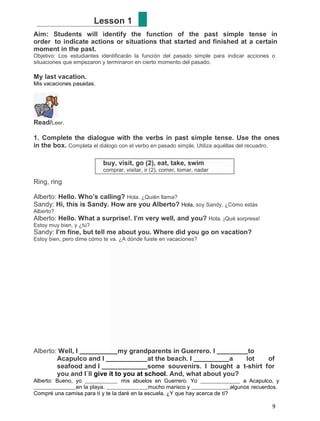
Aim: Students will identify the function of the past simple tense in
order to indicate actions or situations that started and finished at a certain
moment in the past.
Objetivo: Los estudiantes identificarán la función del pasado simple para indicar acciones o
situaciones que empezaron y terminaron en cierto momento del pasado.

My last vacation.
Mis vacaciones pasadas.

Read/Leer.
1. Complete the dialogue with the verbs in past simple tense. Use the ones
in the box. Completa el diálogo con el verbo en pasado simple. Utiliza aquéllas del recuadro.
buy, visit, go (2), eat, take, swim
comprar, visitar, ir (2), comer, tomar, nadar

Ring, ring
Alberto: Hello. Who’s calling? Hola. ¿Quién llama?
Sandy: Hi, this is Sandy. How are you Alberto? Hola, soy Sandy, ¿Cómo estás
Alberto?

Alberto: Hello. What a surprise!. I’m very well, and you? Hola. ¡Qué sorpresa!
Estoy muy bien, y ¿tú?

Sandy: I’m fine, but tell me about you. Where did you go on vacation?
Estoy bien, pero dime cómo te va. ¿A dónde fuiste en vacaciones?

Alberto: Well, I
my grandparents in Guerrero. I
to
Acapulco and I
at the beach. I
a
lot
of
seafood and I
some souvenirs. I bought a t-shirt for
you and I`ll give it to you at school. And, what about you?
Alberto: Bueno, yo
mis abuelos en Guerrero. Yo
a Acapulco, y
en la playa.
mucho marisco y
algunos recuerdos.
Compré una camisa para tí y te la daré en la escuela. ¿Y que hay acerca de tí?

9
Sandy: Well, I
Veracruz with my family as I told you in the email
I sent to you.
Alberto: Oh! Yes, I read it. Did you enjoy your
visit?
Sandy: Yes, I had a great time. Well see you next Monday at school.
Bye.
Alberto: OK. Bye.
Sandy: Bueno, yo
Veracruz, con mi familia como te dije en el correo electrónico que te
envié.
Alberto: Oh, sí, lo leí. ¿Disfrutaste de tu visita?
Sandy: Si, me la pasé bien. Nos vemos el próximo lunes en la escuela. Adiós.
Alberto: Bueno, Adiós.

2. Read the dialogue and write √ in the place Alberto visited last
vacation.
Lee el diálogo y escribe √ en el lugar que Alberto visitó las vacaciones pasadas.

Write/Escribir.

3. Write True or False. Escribe verdadero o falso.
a) Last vacation Alberto went to the beach.
Alberto fue a la playa las vacaciones pasadas.

b) He visited his parents. El visitó a sus padres.
c) Sandy was in Acapulco. Sandy estuvo en Acapulco.
d) She sent an e-mail to Alberto.
Ella envió un correo electrónico a Alberto.

e) Alberto ate fish and shrimps.
Alberto comió pescados y camarones.

f ) He bought a sweater for Sandy.
El compró un suéter para Sandy.
Think/Pensar.
4. Choose an option to complete the sentence. Selecciona una opción para completar
las oraciones.

The
indicates actions / situations that started and finished at a
certain moment in the past. El
indica acciones-situaciones que empezaron y
terminaron en cierto momento del pasado.
a) Present simple tense. Presente simple.
b) Past progressive tense. Pasado progresivo.
c) Past simple tense. Pasado simple.

Write/Escribir.
5. Write √ to the activities you did last vacation and x to the activities
you didn’t. Escribe una √ a las actividades que hiciste las vacaciones pasadas y una x
a las
actividades que no hiciste.

Visitar a los abuelos
Tomar un curso
Jugar fútbol
Cabalgar en caballo
Ir al cine
Leer un libro
Ir a la playa
Visitar un zoológico
Lavar los tenis
Tener una fiesta
Trabajar en el supermercado
Limpiar tu recámara
Preparar un pastel de chocolate
Visitar un museo
Ir a un concierto de rock

Activities/Actividades did/hice didn’t/no hice
visit grandparents
take a course
play soccer
ride a horse
go to the movies
read a book
go to the beach
visit a zoo
wash your tennis shoes
have a party
work at a supermarket
clean your bedroom
cook a chocolate cake
visit a museum
go to a rock concert

6. Use the information to write about what you did last vacation. Utiliza la
información para escribír lo que hiciste las vacaciones pasadas.

Last vacation I

Las vacaciones pasadas yo
Check your progress/ Evalúa tu avance.
Write the following sentences in the past simple tense. Escribe las siguientes
oraciones en el pasado simple.

Example/Ejemplo:
a) I visit my grandmother. I visited my grandmother.
Yo visito a mi abuela. Visité a mi abuela.

b) Mario goes to the movies.
Mario va al cine.

c) My mother cooks a delicious chocolate cake.
Mi mamá cocina un delicioso pastel de chocolate.

d) Juan and his friends play soccer in the park. Juan y sus amigos juegan fútbol en
el parque.

e) Melissa buys a new dress.
Melisa compra un nuevo vestido.

Lesson 2

Aim: Students will identify regular and irregular verbs in past simple tense.
Objetivo: Los estudiantes identificarán verbos regulares e irregulares en el pasado simple.

I visited Veracruz. Visité Veracruz.

Read/Leer.
1. Write the missing information in the e-mail.
Escribe la información faltante en el correo electrónico.
a) betogarcia@meetme.com
b) sandym ar@cooltown.com
2. Read the e-mail. Lee el correo electrónico.
From:
To:
Subject: Greetings from Veracruz
Dear Alberto,
I want to tell you I’m having a great time in Veracruz with my family. W e
stayed at the Sunset Hotel. On Friday we went to San Juan de Ulua and
had dinner at the Parroquia. On Saturday we visited the beach and swam
all day. In the afternoon we watched a beautiful sunset and ate delicious
sea food. On Sunday we visited the aquarium, it was so interesting. I
bought some souvenirs for you. Also I took many photos that I will show
you when we come back to Mexico City.
Regards.
Sandy
De:
Para:
Tema: Saludos desde Veracruz.
Querido Alberto,
Quiero decirte que me la estoy pasando muy bien con mi familia en Veracruz. Nos
hospedamos en el hotel Puesta de Sol. El sábado fuimos a San Juan de Ulúa y cenamos en
la parroquia. El sábado visitamos la playa y nadamos todo el día. En la tarde vimos el
hermoso atardecer y comimos deliciosos mariscos. El domingo visitamos el acuario, estuvo
muy interesante. Te compré algunos recuerdos.También tomé muchas fotos que te las
mostraré cuando regresemos a la ciudad de México.
Saludos, Sandy.

Write/Escribir.

3. Complete the chart with activities about Sandy according to the
information in the e-mail. Completa el cuadro con las actividades de Sandy, de acuerdo a la
información del correo electrónico.

Friday-Viernes

Activities-Actividades
Saturday-Sábado

Sunday-Domingo
Think/Pensar.
4. Complete the chart with the verbs in bold in the e-mail. Completa el cuadro
con los verbos en negrita en el correo electrónico.

Regular verbs- Verbos Regulares
Present tense
Past tense

Irregular Verbs- Verbos Irregulares
Present tense
Past tense

Write/Escribir.
5. Write √ to the activities you did on vacation and write x to the ones you
didn’t. Escribe √ a las actividades que hiciste en las vacaciones y escribe x a aquéllas que no
hiciste.

visit relatives

practice a sport

visitar a los parientes

practicar un deporte

read a book or a magazine
leer un libro o revista

go to the movies
ír al cine

clean your bedroom

take an English course

limpiar tu cuarto

tomar un curso de Inglés
visit a state of the
Mexican Republic
visitar los estados de la República
Mexicana

watch T.V.
ver la TV

eat traditional food
comer comida tradicional

wash the dishes
lavar los trastes

swim at the beach
nadar en la playa

have a party
tener una fiesta

6. Use the information from exercise five to send an e-mail to your friend.
Utiliza la información del ejercicio cinco para enviar un correo electrónico a tu amigo.
From:
To:
Subject:

Dear

,

De:
Para:
Tema:
Querido:

Regards
Check your progress/ Evalúa tu avance.
Complete the text with the past simple tense of the verbs in
parentheses.
Completa el texto con el pasado simple de los verbos en paréntesis.

Yesterday, Julio and his brother

(go) to the movies. They

(watch) a horror movie. They
and

(eat) pop corns

(drink) a soda. After the movies, they

(visit) their grandmother. She

(invite) them to have dinner. They

(have) a good time at their grandmother’s house.
Ayer, Julio y su hermano
(ír) al cine. Ellos
(ver) una película de terror. Ellos
(comer) palomitas de maíz y
(tomar) refresco. Después del cine, ellos
(visitor) a
su abuela. Ella
(invitar) a cenar. Ellos
(tener) un buen momento en casa de su
abuela.
Lesson 3
Aim: Students will identify “Wh-questions words” to obtain specific
information about past events.
Objetivo: Los estudiantes identificarán preguntas con ―WH‖ para obtener información específica de
eventos pasados.

What did you do on vacation? ¿Qué hiciste en las vacaciones?

Read/Leer.
1. Answer the question. Responde las pregunta.
a) What’s the topic of conversation between Alberto, Jorge and Luis?
¿De qué habla la conversación entre Alberto, Jorge y Luis?

2. Read the dialogue. Lee el diálogo.
Alberto: Hello boys. What did you do on vacation? Hola chicos. ¿Qué hicieron en
vacaciones?

Jorge: I visited Cuernavaca with my cousins, and you? Where did you go?
Visité Cuernavaca con mis primos, y tú? ¿A dónde fuiste?

Alberto: I went to Acapulco to visit my grandparents. Fui a Acapulco a visitar a mis
abuelos.

Jorge: Who did you go with? ¿Con quién fuiste?
Alberto: I went with my family. What about you Luis? When did you come back
from Guadalajara? Fui con mi familia. ¿Y tú Luis? ¿Cuándo regresaste a Guadalajara?
Luis: Well, I didn’t go to Guadalajara. Bueno, no fui a Guadalajara.
Jorge: Why not? ¿Por qué no?
Luis: Because my cousins, uncles and aunts from Guadalajara visited Mexico
City and they stayed in my house. Porque mis primos, tíos y tías de Guadalajara
visitaron la Ciudad de México y se quedaron en mi casa.

Alberto: Really? And, how was your time? ¿En serio? y, ¿Cómo te la pasaste?
Luis: I had I great time with all of them. But I would like to visit Guadalajara next
time. Me la pasé bien con todos ellos, pero me gustaría visitar Guadalajara la próxima vez.
Write/Escribir.
3. Write the names according to the activities. Use the information from
exercise two. Escribe los nombres de acuerdo a las actividades. Usa la información del ejercicio
dos.

1. He visited Acapulco on vacation.
Él visitó Acapulco en vacaciones.

2. He didn’t go to Guadalajara.
No fue a Guadalajara.

3. He went to Cuernavaca.
Fue a Cuernavaca.

4. He visited his grandparents.
Visitó a sus abuelos.

5. His relatives visited Mexico City.
Sus familiares visitaron la Ciudad de México.

6. He wants to visit Guadalajara next time.
Él quiere visitar Guadalajara la próxima vez.

Think/Pensar.
4. Underline the corresponding option and write it on the line. Subraya la opción
que corresponda y escribelo en la línea.

The words in bold in the dialogue are called:
Las palabras en negrita en el diálogo se llaman:

a) verbs-verbos

b) Wh-questions words- preguntas con Wh c) adjectives-adjetivos

Write/Escribir.
5. Ask some classmates about the activities they did or places they visited
on vacation. Write the information in the chart. Pregunta a tus compañeros acerca de las
actividades que hicieron o lugares que visitaron en vacaciones. Escribe la información en el cuadro.

Example/Ejemplo:
What’s your name? I’m Roberto ¿Cómo te llamas? Soy Roberto.
What did you do on vacation? I played soccer every weekend. ¿Qué hiciste en
vacaciones? Jugué fútbol los fines de semana.

What places did you visit? I visited the Zócalo, the zoo and an aquatic park.
¿Qué lugares visitaste? Visité el zócalo, el zoológico y un parque acuático.
Name/Nombre
Roberto

Places/Lugares
the Zocalo, the zoo, an
aquatic

Roberto

Activities/Actividades
play soccer

El zócalo, el zoológico, un parque acuático

Name/Nombre

Places/Lugares

Jugar fútbol

Activities/Actividades

6. Use the information to write about a classmate. Utiliza la información para escribir
acerca de un compañero de clase.

Last vacation

visited

and

Las vacaciones pasadas

visité

y

Check your progress/Revisa tu avance.

Complete the following sentences with words in the box. Completa las siguientes
oraciones con las palabras en el cuadro.

What/Qué Where/Dónde
Who/Quién When/Cuándo
Why/Porqué
was Benito Juarez?
¿

fue Benito Juárez?

did you go last Friday?
¿

fuiste el viernes pasado?

did you visit Acapulco?
¿

visitaste Acapulco?

did you do yesterday?
¿

hiciste ayer?

He was a president.
Él fue presidente.

I went to Acapulco.
Fui a Acapulco.

Last Friday.
El viernes pasado.

I visited my grandmother.
Visité a mi abuela.

did you buy a cake? Because it was my mother’s birthday.
¿

compraste un pastel?

Por que fue el cumpleaños de mi mamá.
Lesson 4
Aim: Students will recognize when irregular verbs change their structure in
past simple tense.
Objetivo: Los estudiantes identificarán cuando los verbos irregulares cambian su estructura en el
pasado simple.

I had a terrible day, yesterday. Tuve un día terrible ayer.

Read/Leer.
1. Write in Spanish the following words. Escribe en Español las siguientes palabras.
a) Yesterday
b) This morning
c) Last night
d) Last week
e) Last weekend
f ) Last month
g) Last year
(Ayer, esta mañana, la noche pasada, la semana pasada, el fin de semana pasado, el mes
pasado, el año pasado).

2. Read the dialogue. Lee el diálogo.

Hi, Paty. What a
surprise!. How are you?
Hola Paty.
¡Qué sorpresa!
¿Cómo estás?

Oh, I’m not good. I had a
terrible day yesterday.

Oh, no muy bien.
Tuve un mal día ayer.
Llevé al perro a caminar por la
mañana. Después fui al gimnasio
por la tarde.
¿Por qué?

I took my dog for
a walk in the
morning. Then, I
went to the gym
in the afternoon.

Why?

Also, I went to a shopping
mall and bought a
skirt. I came back
home and I watched
television in the
evening.
También fui a la tienda comercial y
me compré una playera. Regresé a
casa y vi la televisión por la noche.

That’s
not
terrible!

Eso no esta tan mal!

Yes, it is! At night
Mike invited to me to
a party and I couldn’t
go because I was
so tired.

Sí, lo es. Por la noche Miguel me
invitó a una fiesta y no pude ir por
que estaba muy cansada.
Write/Leer.
3. Write True or False/Escribe cierto o falso.
a) Sandy was happy to see Paty.
b) Paty told Sandy about her excellent day.
c) Paty took her cat for a walk.
d) Paty went to a party with Mike at night.
e) Sandy talked with Paty every time.
f ) Paty watched television in the evening.
g) Paty was so tired at the end of the day.

_

a) Sandy estaba feliz de ver a Paty.
b) Paty le dijo a Sandy a cerca de su excelente día.
c) Paty se llevó a su gato a caminar.
d) Paty fue a la fiesta con Mike en la noche.
e) Sandy habló todo el tiempo con Paty.
f) Paty vió la televisión por la noche.
g) Paty estaba muy cansada al final del día.

Think/Pensar.
4. Underline the corresponding option. Subraya la opción que corresponda.
These verbs change their structure to form the past simple tense.
Estos verbos cambian su estructura para formar el pasado simple.

a) Regular verbs/Verbos regulares.
b) Irregular verbs/Verbos irregulares.
Complete the chart using verbs in bold from the dialogue. Completa el
cuadro utilizando los verbos en negrita del diálogo.

Verbs in present tense/Verbos en presente Verbs in past simple tense/Verbos en pasado
Write/Leer.
5. Look at Julia’s items and write what she did last weekend. Use the
verbs in the box. Observa los objetos de Julia y escribe lo que hizo el fin de semana. Utiliza
los verbos del cuadro.

Example:

Julia visited the
beach

eat

read visit drink wear

comer leer

visitar

tomar

usar

buy go
comprar ir

a)
b)
c)
d)
e)
f)
6. Use the following verbs to write about what you did last weekend.
Utiliza los siguientes verbos para escribir acerca de lo que hiciste el fin de semana.

wash watch go play visit do
buy sleep eat write cook swim
(lavar, ver, ir, jugar, visitar, hacer, comprar, dormír, comer, escribír, cocinar, nadar).

Last weekend I

_.
Check your progress/Revisa tu avance.
Complete the text with the corresponding form of the verbs in the box.
Completa el texto de la forma correspondiente de los verbos en el cuadro.

listen
visit

watch
go

read
do

wash
fish

(escuchar, ver, leer, lavar, visitar, ir, hacer, pescar).

When I was young I didn’t ___ T.V. I
books and

to the radio. I

a wash machine. I

have

my clothes by hand. In

my free time I didn’t

to

the

cinemas

because in my town there weren’t any of
them. I

in the river or I

my

friends and relatives.
De joven no
T.V. Yo_
libros y
la radio.
_tuve una
lavadora.
mi ropa a mano. En mi tiempo libre
a los
cines por que en mi pueblo no había ninguno.
en el río o
a
mis amigos o parientes.

Lesson 5
Aim: Students will identify two kinds of verbs and write the rules for each one
to form the past simple tense. Objetivo: Los estudiantes identificarán dos tipos de verbos y
escribe las reglas para cada una de las formas del pasado simple.

My friend visited Mexico/ Mis amigos visitaron México.

Read/Leer.
1. Look at the dialogue and answer the questions. Observa el diálogo y responde a
las preguntas.

a) What’s the name of Sandy’s friend?
¿Cuál es el nombre del amigo de Sandy?
2. Read the dialogue. Lee el diálogo.
Gaby: Hello, Sandy. How are you? Hola, Sandy. ¿Cómo estás?
What did you do last summer? ¿Qué hiciste el verano pasado?
Sandy: Hi, Gaby. I’m fine. Last summer
I went to Veracruz and I visited
Cuernavaca with my friend
Susan. Hola, Gaby. Estoy bien. El
verano pasado fui a Veracruz y visité
Cuernavaca con mi amiga Susan.

Gaby: Susan? Who is she?
¿Susan? ¿Quién es ella?

Sandy: She is a friend from the
United States. She came to
Mexico and stayed at my
house. She wanted to know
Cuernavaca, so, my family
and I took her, there. Es una
amiga de los Estados Unidos. Vino a
México y se quedó en mi casa. Quería
conocer Cuernavaca, así que mi
familia y yo la llevamos, ahí.
Did she like it? ¿Le gustó?

Gaby:
Sandy: Yes, she did. And what about you? Sí, y dime ¿qué has hecho?
What did you do on vacation? ¿Qué hiciste en las vacaciones?
Gaby: Well, I didn’t visit a specific place but I took an English course
and I stayed at home with my family. Bueno, no visité algún lugar en
específico pero tomé un curso de Inglés y me quedé en casa con mí familia.

Write/Escribir.
3. Match the columns. Relaciona las columnas.
Who is Susan?

a) She took an English course.

¿Quién es Susan?

Where is Susan from?

Ella tomó un curso de Inglés.

b) She stayed at Sandy’s house.

¿De dónde es?

Where is Sandy from?
¿De dónde es Sandy?

Se quedó en casa de Sandy.

c) She is Sandy’s friend.
Ella es la amiga de Sandy.

What place did Susan want to visit? d) She is from Mexico.
¿Qué lugar queria visitar Susan?

What did Gaby do on vacation?

Es de México.

e) She is from the U.S.A.

¿Qué hizo Gaby en las vacaciones?

Es de los Estados Unidos.

____Where did Susan stay in Mexico?

f ) She wanted to visit
Cuernavaca.

¿En dónde se quedó Susan en México?

Quiso visitar Cuernavaca.
Think/Pensar.
4. Look at the chart and write how can be formed i n the past simple
tense for regular and irregular verbs.
Observa el cuadro y escribe como puede formarse el pasado simple para los verbos
regulares e irregulares.

Regular verbs
Irregular verbs
Present
Past
Present Past
Visit
visited
go
went
Stay
stayed
come came
want
wanted
take
took
play
played
do
did
watch watched drink drank
work
worked teach taught

Verbos regulares
Presente
Pasado
visitar
visitó
quedar
quedó
querer
quizo
jugar
jugó
ver
vio
trabajar trabajó

Verbos Irregulares
Presente
Pasado
ir
fue
venir
vino
tomar
tomó
hacer
hizo
beber
bebió
enseñar enseñó

Regular verbs form the past simple tense

_

Verbos regulares del pasado simple.

Irregular verbs form the past simple tense
Verbos irregulares del pasado simple.

Write/Escribe.

5. Find the past simple tense of the following verbs. Encuentra el tiempo
pasado de los siguientes verbos.

TEACH
DRINK
THINK
MEET
DRIVE
SW IM
DO
TELL
WORK
DANCE
GO
STUDY
SING
HAVE
WRITE

enseñar
tomar
pensar
conocer
manejar
nadar
hacer
decir
trabajar
bailar
ir
estudiar
cantar
tener
escribir

S V C B
T D X M
M R A E
O A T T
S N S T
A K W R
R A D F
H P S A
A W O T
D R R O
Y A I O
U W E N
P A R W
O Z X D

T
E
U
Y
O
E
H
N
B
U
A
T
Q
A

H
R
I
V
H
R
I
G
D
I
D
P
E
N

O U
T Y
E U
S K
J W
T F
T D
R I
F D
E V
Q Z
I O
Z E
C E

G
U
N
T
Y
A
S
D
G
C
X
I
W
D

H
I
J
H
G
F
M
D
W
O
R
K
E
D

T
A
U
G
H
T
S
S
T
O
L
D
M
B
6. Imagine that a friend from another country visited you on vacation.
Use the verbs above to write about the places you visited or the
activities you did.
Imagina que un amigo de otro país te visitó en vacaciones. Utiliza los verbos de arriba para
escribir acerca de los lugares que visitaste o las actividades que realizaste.

On vacation my friend

from

En las vacaciones mi amigo

desde

Check your progress. Revisa tu avance.
Complete the information with the verbs in the box. Completa la información
con los verbos del recuadro.

lived

was born
rang
attacked
died
abolished became

(vivió, nació, sonó, atacó, murió, abolió, llegó a ser)

The father of Independence, Miguel Hidalgo y Costilla…
El padre de la independencia, Miguel Hidalgo y Costilla…

in Corralejo on May 8th, 1753. En Corralejo el 8 de mayo de 1753.
in Valladolid (Morelia) for many years. En Valladolid (Morelia)
por varios años.

a priest in 1778. Sacerdote en 1778.
th
the bell in Dolores on September 15 , 1810. Las campanas
de Dolores el 15 de septiembre de 1810.

th
the Alhóndiga de Granaditas on September 28 . La

Alhóndiga de Granaditas el 28 de septiembre.

th
slavery on December 6 , in Guadalajara. Esclavitud el 6 de
diciembre, en Guadalajara.

th
in Acatitla, Chihuahua, on July 30 , 1811. En Acatitla,
Chihuahua, el 30 de julio de 1811.
Lesson 6
Aim: Students will use linking devices that indicate sequence to
express events in the past. Los estudiantes utilizarán los conectores que indiquen
secuencia para expresar hechos en el pasado.
My visit to Cuernavaca. Mi visita a Guadalajara.

Read/Leer.
1. Write the missing information in the following postcard. Escribe la
información que haga falta en la siguiente tarjeta postal.

a) Love, Susan.

b) Hilary Steves
27 Roble Street
Florida, 03479
U.S.A

c) Dear parents

2. Read the postcard. Lee la postal.
Yesterday morning Sandy and her family took me
on a tour to Cuernavaca. First, we went to the
Cortes Palace and I read about the history of this
city. Then, we went to a restaurant and ate
delicious traditional food. W e also drank a lot
of water because it was so hot. After that, in the
evening we had dinner in a cafeteria a t the
Zocaloand I bought some souvenirs for you.
Finally, I swam in the pool of the hotel where we
stayed.
You should come to
Mexico.

Ayer por la mañana Sandy y su familia me llevaron a una excursión a Cuernavaca. Primero
fuimos al Palacio de Cortés y leí la historia de la ciudad. Después nos fuimos a un restaurante
y comimos una deliciosa comida tradicional. Tomamos mucha agua porque hacía mucho
calor. Después por la noche cenamos en la cafetería del zócalo y compramos algunos
regalos para tí. Finalmente nadé en la alberca del hotel donde nos hospedamos. Deberías
venir a México.
Write/Escribir.
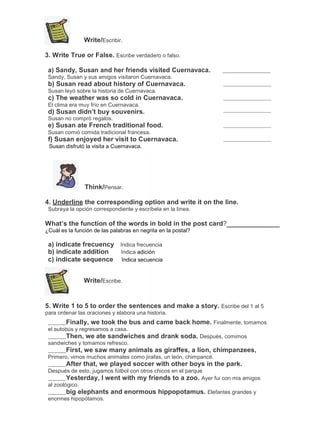
3. Write True or False. Escribe verdadero o falso.
a) Sandy, Susan and her friends visited Cuernavaca.
Sandy, Susan y sus amigos visitaron Cuernavaca.

b) Susan read about history of Cuernavaca.
Susan leyó sobre la historia de Cuernavaca.

c) The weather was so cold in Cuernavaca.
El clima era muy frío en Cuernavaca.

d) Susan didn’t buy souvenirs.
Susan no compró regalos.

e) Susan ate French traditional food.
Susan comió comida tradicional francesa.

f) Susan enjoyed her visit to Cuernavaca.
Susan disfrutó la visita a Cuernavaca.

Think/Pensar.
4. Underline the corresponding option and write it on the line.
Subraya la opción correspondiente y escríbela en la línea.

What’s the function of the words in bold in the post card?
¿Cuál es la función de las palabras en negrita en la postal?

a) indicate frecuency Indica frecuencia
b) indicate addition
Indica adición
c) indicate sequence Indica secuencia
Write/Escribe.

5. Write 1 to 5 to order the sentences and make a story. Escribe del 1 al 5
para ordenar las oraciones y elabora una historia.

Finally, we took the bus and came back home. Finalmente, tomamos
el autobús y regresamos a casa.

Then, we ate sandwiches and drank soda. Después, comimos
sandwiches y tomamos refresco.

First, we saw many animals as giraffes, a lion, chimpanzees,
Primero, vimos muchos animales como jirafas, un león, chimpancé.

After that, we played soccer with other boys in the park.
Después de esto, jugamos fútbol con otros chicos en el parque
Yesterday, I went with my friends to a zoo. Ayer fui con mis amigos
al zoológico.
big elephants and enormous hippopotamus. Elefantes grandes y
enormes hipopótamos.
6. Look at the pictures and write the sentences o f exercise five
under the corresponding picture.
Observa las fotos y escribe las oraciones en el ejercicio 5 debajo de las fotos
correspondientes.
Check your progress. Evalúa tu progreso.
Match the description with the corresponding words. Write them on the line.
Une las descripciones con las palabras correspondientes. Escríbelas en la línea.

Talking about what happened in the past.
Hablar de lo que pasó en el pasado.
Describe an action. Describe una acción.
Indicate sequence. Indica secuencia.

I bought some souvenirs.
Compré algunos regalos.

Past simple tense verbs.
Verbos en pasado simple.

In this lesson you learned:
En esta lección aprendimos:

Verbs: Verbos
Vocabulary: Vocabulario
Functions: Funciones
Grammar: Gramática:
Sequence words: Secuencia de palabras

Lesson 7
Aim: Students will use the expression “used to” to talk about activities
people did frequently in some time in the past.
Los estudiantes utilizarán la expresión ―solía‖ para hablar de actividades que la gente hacía
frecuentemente en alguna vez del pasado.

An ancient sport./ Un deporte antigüo.

Read/Leer.
1. Write the word that corresponds.
Escribe la palabra que corresponda.

In this subject you learn about sports and practice some of them.
Sometimos your teacher talks about the history of them.
En este tema aprendiste acerca de los deportes y prácticas de alguno de ellos. En algunas
ocasiones tu maestro habla acerca de la historia de ellos.

Mathematics
Matemáticas

English
Inglés

Physical Education

Spanish

Educación física

Español
2. Read the text. Lee el texto.
Teacher: Good morning students, today we are going to learn about
an ancient sport, the ball game.
Maestro: Buenos días jóvenes, hoy aprenderemos a cerca de los deportes
antiguos, el juego de pelota.

Jorge: What’s that teacher? Is it like soccer or football?
¿Qué es eso maestro? ¿Es cómo el fútbol o el fútbol americano?

Diana: No, it isn’t. It was a kind of sport that the Maya civilization played.
No, es un tipo de deporte que la civilización maya jugaba.

Teacher: You’re right.
Estás en lo correcto.

The Ball Game
Long time ago the Mesoamerican civilizations
used to play the Ball Game or Juego de Pelota
in Spanish. It was a sport of life and death. The
Ball Game was usually played by two teams in a
court with a rubber ball that weighed more than
a kilo and was about the size of a man’s head.
About the rules, historians think the players
could only touch the ball with their hips, elbows
and knees but not with their hands or feet. The
players had to get the ball through a stone ring
on the wall until the first team scored a point.
The captain or some of the players of the losing
team used to be sacrificed. The Mesoamerican
civilizations believed that human sacrifice
pleased their goods.

El juego de pelota.
Hace mucho tiempo las civilizaciones mesoamericanas solían jugar el juego de pelota.
Era un deporte de vida y muerte. El juego de pelota era usualmente jugado por dos
equipos en una cancha con una pelota de goma que pesaba más de un kilo y era del
tamaño de la cabeza de un hombre. Respecto a las reglas, los historiadores piensan que
los jugadores podían sólo tocar el balón con sus caderas, codos, y rodillas; pero no con
sus manos o pies. Los jugadores tenían que pasar el balón a través de un anillo de piedra
en la pared hasta que el primer equipo anotara el punto.
El capitán o alguno de los jugadores del equipo perdedor solían ser sacrificados. Las
civilizaciones mesoamericanas creían que el sacrificio humano agradaba a sus dioses.
Write/Escribe.
3. Correct the wrong information.
Corrige la información.

Example:
a) The French civilizations used to play the Ball Game.
The Mesoamerican civilizations used to play the Ball Game.
a) La civilización francesa solía jugar el juego de pelota.
Las civilizaciones mesoamericanas solían jugar el juego de pelota.

b) The Ball Game was usually played by three teams.
b) El juego de pelota usualmente fue jugada por tres equipos.

c) The players could touch the ball with their hands or feet.
c) Los jugadores podían tocar la pelota con sus manos y pies.

d) The captain or some of the players of the winner team were sacrificed.
d) El capitán o algunos de los jugadores del equipo ganador fueron sacrificados.

e) The Mesoamerican civilizations didn’t believe that human sacrifice
pleased their gods.
e) Las civilizaciones mesoamericanas no creían que los sacrificios humanos encantaban a sus
dioses.

Think/Pensar.

4. Use the words in bold in the text to complete the rule. Write the meaning in
Spanish.
Utiliza las palabras en negritas en el texto para completar la regla. Escribe el significado en Español.

We use
to talk about activities people did frequently in
some time in the past. Utilizamos
para hablar acerca de las actividades que las
personas realizaban frecuentemente en alguna ocasión del pasado.

used to =
solía =
Write/Escribe.
5. Write √ or x to the activities people used to do or didn’t use to do in the
past.
Escribe √ o

x a las actividades que las personas solían hacer o que no solían hacer en el pasado.

travel by airplane. Viajar en avión.

wear long dresses and big hats.

Usar vestido largo y unos sombreros grandes.

travel in carriages.Viajar en carruaje.

wear long jackets, boots and hats

Vestír chamarras largas, botas y sombreros .
travel by train. Viajar en tren.

wear mini skirts and jeans. Vestír
Minifaldas y pantalónes de mezclilla.

send letters. Enviar una carta.

use computers. Utilizar la computadora.

write e-mails. Escribir correos electrónicos.

ride horses. Cabalgar caballos.

6. Write sentences with information in exercise five.
Escribe oraciones con información del ejercicio cinco.
Example: ejemplo:

People used to ride horses. / People didn’t use to drive cars.
La gente solía cabalgar en caballos. La gente no solía manejar carros.

used to
solía
didn’t use to. No solía

Check your progress. / Evalúa tu avance.
Answer the questions with your own information.
Responde las preguntas con tu propia información.

Did your father use to ride horses when he was younger?
¿Solía tu papá cabalgar caballos cuando era más joven?

Did your mother use to wear mini skirts when she was younger?
¿Solía tu mamá vestir minifaldas cuando era más joven?

Did you use to visit your grandmother when you were a child?
¿Solías visitar a tu abuela cuando eras niño?

Did your grandmother use to watch T.V. when she was a child?
¿Solía tu abuela ver la Televisión cuando era niña?

Lesson 8
Aim: Students will identify “do” as an auxiliary verb in questions in
past simple tense.
Los estudiantes identificarán ―DID‖ como un verbo auxiliar en preguntas en el pasado simple.

Did you wash your uniform? ¿Lavaste tu uniforme?

Read/Leer.
1. Write √ or
Escribe √ ó

x

x

to the activities you did or didn’t yesterday.

a las actividades que hiciste o no ayer.
List of chores. Lista de quehaceres.
wash the uniform
sweep the room
iron the uniform
clean the shoes
watch T.V.
do homework

Lavar el uniforme.
Barrer el cuarto.
Planchar el uniforme.
Limpiar los zapatos.
Ver la T.V.
Hacer la tarea.

2. Read the dialogue.
Lee el diálogo.

Sandy: Mom, can I go to the movies with my friends? Mamá, ¿Puedo ir al
cine con mis amigos?

Sandy’s mother: Just if you have done all your chores. Let’s check. Did
you clean your shoes? Sólo si terminaste tus quehaceres. Vamos a
checar. ¿Limpiaste tus zapatos?

Sandy: Yes, I did. Sí, lo hice.
Sandy’s mother: Did you sweep your room? ¿Barriste tu cuarto?
Sandy: Yes, I did. Sí
Sandy’s mother: Did you wash your
uniform? ¿Lavaste tu uniforme?
Sandy’s mother: Did you wash your uniform? ¿Lavaste tu uniforme?
Sandy: Yes, I did. Sí
Sandy’s mother: Did you iron your uniform? ¿Planchaste tu uniforme?
Sandy: Yes, I did. Sí
Sandy’s mother: Did you take out the trash? ¿Sacaste la basura?
Sandy: Yes, I did, and I put a new bag in the trash can. Sí, y puse una
bolsa nueva en el bote de basura.

Sandy’s mother: I think you did a good job. Just some more questions.
Did you cook the meal?
Creo que hiciste buen trabajo. Sólo algunas otras preguntas. ¿Hiciste la comida?
Sandy: No, I didn’t. No.

Sandy’s mother: Did you wash the dishes? Did you clean the windows?
Did you wash all the clothes? Did you go to the supermarket?
¿Lavaste los trastos? ¿Limpiaste la ventana? ¿Lavaste toda la ropa? ¿Fuiste al supermercado?
Sandy: No, I didn’t’. No
Sandy’s mother: So, you can’t go to the movies. Pues, entonces no puedes ir
al cine.
Sandy: Ops! Really? Ups!! ¿En serio?
Sandy’s mother: Just kidding! Of course, you can go. ¡Solo bromeo!
Por supuesto, puedes ir.

Sandy: Thanks, mom. I’ll be back early to help you to do all those things.
Gracias mamá, regresaré temprano para ayudarte a hacer todas esas cosas.
Write. / Escribir.
3. Match the questions with the answers A or B.
Une las preguntas con la respuesta A o B.

A) Yes, she did. Si.
B) No, she didn’t. No.
a) Did Sandy wash her uniform? ¿Lavó Sandy su uniforme?
b) Did she cook the meal? ¿Preparó la comida?
c) Did she sweep her room? ¿Barrió su cuarto?
d) Did she iron her uniform? ¿Planchó el uniforme?
e) Did she take out the trash? ¿Sacó la basura?
f ) Did she get permission for going to the movies?
¿Obtuvo permiso para ir al cine?

g) Did she wash the dishes?
¿Lavó los trastes?

h) Did she go to the supermarket?
¿Fue al supermercado?

Think/Pensar.
4. Answer the question.
a) This verb is an auxiliary which indicates that the question is in past
simple tense.
a) Este verbo es un auxiliar que indica que la pregunta está en pasado simple.

Write/Escribir.
5. Write questions about your activities at home last week, use the
words in parentheses.
Escribe preguntas a cerca de tus actividades en casa la semana pasada, utiliza las palabras del
paréntesis.
Example/ejemplo:

(take, trash can)
(tomar, bote de basura)

Did you take out the trash can?
¿Sacaste el bote de basura?

a) (wash, dishes)

?

b) (clean, windows)

?

(lavar, trastes)

(limpiar, ventanas)

c) (make, breakfast)

?

(hacer, desayuno)

d) (feed, cat)
(alimentar, gato)

?
e) (go, market)

?

(ir, mercado)

f ) (take care, sister)

?

(cuidar, hermana)

g) (take care, brother)

?

(cuidar, hermano)

6. Use the questions to interview a classmate. Write the
answers.
Utiliza las preguntas para entrevistar a un compañero. Escribe las respuestas.

Name:
Nombre:

Answers/Respuestas.
a)
b)
c)
d)
e)
f)
g)

Check your progress.Checa tu avance.
Order the sentences to make questions and answer them with your
information.
Ordena las oraciones para elaborar preguntas y respóndelas con la información .
wash / Did / you / uniform / last Friday / your

?

yesterday / your mother / cook / Did / dinner

?

lavaste / tu / uniforme / el viernes pasado

ayer / tu mamá / cocinó / la
cena

visit / your / Did / you / grandmother / last weekend

?

English / do / homework / you / Did / your

?

visitaste / a tu abuela / la semana pasada
Inglés / hiciste / tarea / tu

Lesson 9
Aim: Students will recognize “did” in a negative form to express actions
that weren´t done in a certain moment in the past.
Objetivo: Los estudiantes reconocerán el ―DID‖ en forma negativa para expresar acciones que no
fueron realizadas en cierto momento del pasado.

I didn’t do my chores.

No hice mis quehaceres.
Read/Leer.
1. Match the pictures with the sentences. Une las fotos con las oraciones.
a) wash the dishes
b) sweep the kitchen
c) iron the clothes
d) make breakfast

Lavar los trastes.
Barrer la cocina.
Planchar la ropa.
Hacer el desayuno.

2. Read the conversation. Lee la conversación.
Ring, ring
Alicia: Hello. Who’s calling? Hola. ¿quién llama?
Sandy: Hi Alicia. This is Sandy, I’m waiting for you to go to the
movies.
Hola Alicia. Soy Sandy, Te estoy esperando para ir al cine.

Alicia: I can’t go because I didn’t do my chores. I didn’t wash my uniform, I
didn’t do my English homework, I didn’t clean my bedroom, I didn’t feed my
dog, I didn’t clean my shoes and I didn’t iron my uniform. The only thing I did
is my math homework.No puedo ir porque no hice mis quehaceres. No lavé mi uniforme, no
hice mi tarea de inglés, no limpié mi recámara, no alimenté a mi perro, no limpié mis zapatos y no
planché mi uniforme. Lo único que hice es mi tarea de matemáticas.
Sandy: Why? ¿Por qué?
Alicia: Because I wasn’t at home. My family and I went to Puebla.
My grandmother was sick. We took care of her. Porque no
estuve en casa. Mi familia y yo fuimos a Puebla. Mi abuela estuvo enferma.
Así que la cuidamos.
Sandy: And how is she now? ¿Y cómo está ella ahora?
Alicia: She is better but I’m not. I have to do a lot of things. Está mejor pero yo
no. Tengo que hacer muchas cosas.

Sandy: OK. It will be some other time. See you tomorrow at school.
Está bien. Será en otra ocasión. Nos vemos mañana en la escuela.

Write/Escribir.
3. Write True or False.Escribe verdadero o falso.
a) Sandy invited Alicia to the movies.
Sandy invitó a Alicia al cine.

b) Alicia accepted Pablo’s invitation.
Alicia aceptó la invitación de Pablo.

c) Alicia did her English homework.
Alicia hizo su tarea de Inglés.

d) Alicia didn’t wash her uniform.
Alicia no lavó su uniforme.

e) Alicia took care of her grandfather.
Alicia cuidó a su abuelo.

f) Alicia’s grandmother was sick.
La abuela de Alicia estuvo enferma.

g) Alicia wasn’t at home on the weekend.
Alicia no estuvo en casa el fin de semana.

_
Think/Pensar.
4. Write the corresponding word. Escribe la palabra que corresponda.
a) This word is an auxiliary verb in negative statements.
Esta palabra es un verbo auxiliar en oraciones negativas.

Notice that after this word you have to write the verb in present tense.
Date cuenta que después de esta palabra tienes que escribir el verbo en el presente simple.

Example:
Ejemplo:

Yesterday I didn’t go to the movies. Ayer no fui al cine.
Mariana didn’t visit her friend. Mariana no visitó a sus amigos.
Jorge didn’t eat a sandwich. He ate a hamburger. Jorge no comió un sandwich. Él
comió una hamburguesa.

Write/Escribir.
5. Write √ next to the activities that happened to you last week.
Marca con una √ junto a las actividades que te sucedieron la semana pasada.

You didn’t have a math exam. No tuviste examen de matemáticas.
The English teacher didn’t give you a good grade. El maestro de Inglés
no te otorgó una calificación.

You didn’t wash your tennis shoes. No lavaste tus tenis.
Your parent’s didn’t give you permission to watch T.V yesterday.
Tus papás no te dieron permiso de ver la television ayer.

You enjoyed school yesterday. Disfrutaste la escuela ayer.
You met a new friend. Conociste un nuevo amigo.
You didn’t take your dog for a walk. No sacaste a tu perro a pasear.
You went to the movies. Fuiste al cine.
You didn’t go to a party. No fuiste a una fiesta.
It was your birthday. Fue tu cumpleaños.
6. Write a text with the information from exercise five. Escribe un texto con la
información del ejercicio cinco.

For example:
Ejemplo:

Last week I didn’t have a math exam. The English teacher didn’t give me
a good grade.
La semana pasada no tuve examen de matemáticas. El maestro de Inglés no me dio mi
calificación.

Last week/ La semana pasada.

Check your progress/ Evalua tu avance.
Look at the pictures and match them with the corresponding sentence.
Observa las fotos y únelas con las oraciones correspondientes.

a) Mariana didn’t study for her math exam. Mariana no estudió para su examen
de matemáticas.

b) Sandra didn’t wash the dishes. Sandra no lavó los trastes.
c) Luis and Jorge didn’t clean their shoes. Luis y Jorge no limpiaron sus zapatos.
d) I didn’t iron my shirt. No planché mi camisa.

43
Lesson 10
Aim: Students will identify grammar rules for regular and irregular verbs in
past simple tense.
Los estudiantes identificarán las reglas gramaticales de los verbos regulares e irregulares en el
pasado simple.

What did Diego Rivera do?
¿Qué hizo Diego Rivera?

Read/Leer.
1. Previous knowledge. Before you read the biography answer the questions.
Conocimiento previo. Antes de leer la biografia responde a las preguntas.

a) Who was Diego Rivera?
¿Quién fue Diego Rivera?

b) Where was he born?
¿Dónde nació?

c) When was he born?
¿Cuándo nació?

d) Why was he famous?
¿Por qué fue famoso?

e) When did he die?
¿Cuándo murió?

2. Read the text. Lee el texto.

Diego Rivera
(1866 – 1957)

Diego Rivera was born in Guanajuato
th
on December 8 , 1866. When he was a
child he liked to draw pictures. He began
to study art at the San Carlos Academy
in Mexico City when he was ten years
old. Later he went to Europe and when he
returned to Mexico he had many
revolutionary ideas. He painted the famous
murals in the National Palace and many
other arts pieces. Diego had three wives,
the last one was Frida Kahlo. He died of
th
cancer
on
November 25 , 1957.
We remember him as one of Mexico’s
greatest painters.

44
Diego Rivera nació en Guanajuato el 8 de diciembre de 1886. De niño le gustaba dibujar figuras.
Empezó a estudiar arte en la Academia de San Carlos en la Ciudad de México cuando tenía 10
años. Después se fue a Europa y cuando regresó a México trajo varias ideas revolucionarias. Él
pintó los murales famosos en el Palacio Nacional y algunos otros trabajos de arte. Diego tuvo tres
esposas, la última fue Frida Kahlo. Murió de cáncer el 25 de noviembre de 1957. Lo recordamos
como uno de los pintores más grandes de México.

Write/Escribe.

3. Write the missing information about Diego
Rivera.
Escribe la información que haga falta acerca de Diego Rivera.

Name/Nombre:
Date of birth/Cumpleaños:
Place of birth/Lugar de nacimiento:
Date of death/Fecha de muerte:
Studied at/Estudios:
Painted/Pinturas:
Traveled to/Viajes:
Last wife/Última esposa:

Think/Pensar.
4. Complete the chart with the past simple tense of the verbs. Look at
the example.
Completa el cuadro con el pasado simple de los verbos. Observa el ejemplo.

clap
work
cry

write
drive
hug

walk
carry
do

study
stop
jump

(aplaudir, escribir, caminar, estudiar, trabajar, manejar, llevar, detener, llorar, abrazar, hacer,
brincar).

Regular verbs

Irregular verbs

Verbos regulares

Verbos irregulares

worked/trabajó

wrote/escribió

Words of one syllable
Consonant + vowel + consonant
Palabras de una silaba
Consonante+vocal+consonante
clapped/aplaudió

-y

carried/llevó

45
Write/Escribir.
5. Think about a person who lived in the past and you admire. Look for
information about him or her. Then, complete the lines.
Piensa en una persona que vivió en el pasado y a quien admiraste. Busca información a cerca de él
o ella. Luego, completa las líneas.

a) Name/Nombre:
b) Occupation/Ocupación:
c) Date of birth/Cumpleaños:
d) Place of birth/Lugar de nacimiento:
e) Date of death/Fecha de muerte:
f ) Nationality/Nacionalidad:
g) Why is she or he famous?/¿Por qué es famoso/a?:

_

h) Why do you admire him / her?/¿Por qué lo/la admiras?

6. Write a biography with the information in exercise five and paste or
draw a picture. Escribe una biografia con la información del ejercicio cinco y pega o dibuja
una foto.

(

46

)
Check your progress/Evalúa tu avance.
Ask the following questions to your mother or father and complete the chart.
Realiza las siguientes preguntas a tu mamá o papá y completa el cuadro.

Name/Nombre:
Date of birth/Cumpleaños:
Place of birth/Lugar de nacimiento:
Lived in/Vivió en:
Studied at/Estudio en:

Lesson 11
Aim: Students will identify that the past simple tense has a regular form
for all persons.
Objetivo: Los estudiantes identificarán que el pasado simple tiene una forma regular para todas
las personas.

The Aztecs and Tenochtitlan/ Los Aztecas y Tenochtitlán

Read/Leer.
1. Answer the question. Responde la pregunta.
Who were the founders of Tenochtitlan?
¿Quiénes fueron los fundadores de Tenochtitlan?

2. Read the text/Lee el texto.
The Aztecs and Tenochtitlan
One day long time ago, the god Huitzilopochtli told the leader of the
Aztecs, Tenoch, to go with his people to an island in the middle of a lake.
Huitzilopochtli told Tenoch to look for an eagle perched on a cactus,
growing from a rock surrounded by water. They should build their city
there. The Aztecs ha d be e n l ook i ng f or for this place for many
years. Finally, they found the island on a lake where they built their
city. They called their
city
Tenochtitlan,
around
1325. Tenochtitlan turned into Mexico City.

47
Los Aztecas y Tenochtitlán
Hace mucho tiempo, el dios Huitzilopochtli le dijo al lider de los aztecas, Tenoch, ir con su gente a
una isla en medio de un lago. Huitzilopochtli le dijo a Tenoch buscar un águila sobre un nopal,
emergiendo de las rocas rodeadas por aguas. Ellos deberían construir su ciudad ahí. Los aztecas
buscaron este lugar por muchos años. Finalmente encontraron la isla en medio de un lago donde
construyeron su ciudad. Le llamaron a su ciudad Tenochtitlán, cerca del año 1325. Tenochtitlán
llegó a ser la Ciudad de México.

Write/Escribir.
3. Write True or False. Escribe verdadero o falso.
a) Tenoch was the leader of the Aztecs.
Tenoch fue el líder de los aztecas.

b) The Aztecs looked for an eagle perched on a
tree.
Los aztecas buscaron a un águila trepada en un árbol.

c) They didn’t find the place Huitzilopochtli told.
No encontraron el lugar que Huitzilopochtli les dijo.

d) They found the island on a lake where they built their
city.
Encontraron una isla en medio de un lago donde construyeron su ciudad.

e) They called their city Aztlán.
Le llamaron Aztlán a su ciudad.

f) Tenochtitlan turned into Mexico
City.
Tenochtitlan llegó a ser la Ciudad de México.

Think/Pensar.

4. Read the information and complete the sentences.
Lee la información y completa las oraciones.

I played soccer/Jugué fútbol.

I bought a book/Compré un libro.

You played soccer/Jugaste fútbol.
He
soccer.
She
soccer.
They
soccer.
We
soccer.

You bought a book/Compraste un libro.
He
a book.
She
a book.
They
a book.
We
a book.

Notice that the past simple tense has a regular form for all the pronouns.
Date cuenta que el pasado simple tiene una forma regular para todos los pronombres.

48
Write/Escribe.
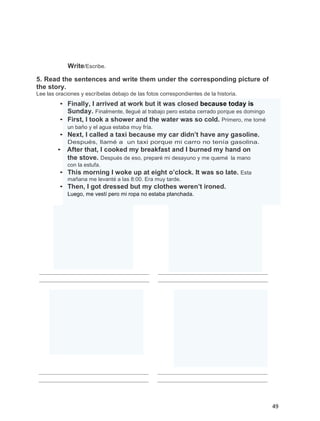
5. Read the sentences and write them under the corresponding picture of
the story.
Lee las oraciones y escríbelas debajo de las fotos correspondientes de la historia.

• Finally, I arrived at work but it was closed because today is
Sunday. Finalmente, llegué al trabajo pero estaba cerrado porque es domingo
• First, I took a shower and the water was so cold. Primero, me tomé
un baño y el agua estaba muy fría.

• Next, I called a taxi because my car didn’t have any gasoline.
Después, llamé a un taxi porque mi carro no tenía gasolina.

• After that, I cooked my breakfast and I burned my hand on
the stove. Después de eso, preparé mi desayuno y me quemé la mano
con la estufa.

• This morning I woke up at eight o’clock. It was so late. Esta
mañana me levanté a las 8:00. Era muy tarde.

• Then, I got dressed but my clothes weren’t ironed.
Luego, me vestí pero mi ropa no estaba planchada.

49
6. Write a story as you imagine it. Use the past form of the verbs in the
box or other verbs that you choose.
Escribe una historia como te la imagines. Usa las formas de los verbos en pasado que están en el
cuadro o algún otro verbo que selecciones .

shout/gritar break/romper
phone/llamar watch/ver
return/regresar knock/tocar
open/abrir
is/es, está
cook/cocinar

50
Check your progress. Evalúa tu progreso.
Complete the sentences with information from the text.
Completa las oraciones con la información del texto.

A) This word indicates contrast:
B) These words indicate sequence:

Esta palabra indica contraste

Estas palabras indican secuencia:

Lesson 12
Aim: Students will use their knowledge to solve different kinds of
exercises about past simple tense. Objetivo: Los estudiantes utilizarán sus
conocimientos para resolver diferentes tipos de ejercicios acerca del pasado simple.

Mini Check/Mini Evaluación.

Read/Leer.
1. Read the story and underline the verbs in past simple tense, then, write
them on the lines.
Lee la historia y subraya los verbos en pasado simple, después escríbelos en las líneas .

2. Read the story again and number the pictures in the correct
order.
Lee la historia nuevamente y ennumera las fotos en el orden correcto.

A shopping day
One week ago Alberto’s parents went to a large shopping mall. Mrs.
Padilla wanted to bu y a dress and a pair of slippers for a party. She
got into a boutique and tried about fifteen dresses and ten pairs of
slippers. Mr. Padilla was waiting for her but he was bored, so he
went into a coffee shop. Finally, Mrs. Padilla bought a dress, a purse, a
coat and a pair of slippers. She was going down the escalator carrying a
lot of packages and she fell. She broke her leg and hurt her arm. After some
days at the hospital, she went to the party. She wore her new dress, her
purse and her coat but she didn’t wear her new pair of slippers.

51
Un dia de compras
Hace una semana los papás de Alberto fueron a un centro comercial grande. La Sra. Padilla
quería un vestido y un par de zapatillas para una fiesta. Entró a una boutique se probó como 15
vestidos y 10 pares de zapatillas. El Sr. Padilla la estaba esperando pero estaba aburrido, así que
se fue a una cafetería. Finalmente la Sra. Padilla compró un vestido, una bolsa, un abrigo y un
par de zapatillas. Ella iba bajando el elevador cargando todas sus bolsas y se cayó. Se rompió la
pierna y se lastimó un brazo. Después de unos días en el hospital, ella fue a la fiesta. Uso su
vestido nuevo, su bolsa y su abrigo pero no utilizó el par de zapatillas nuevas.

52
Write/Escribe.
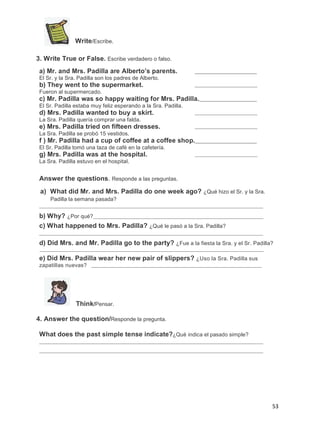
3. Write True or False. Escribe verdadero o falso.
a) Mr. and Mrs. Padilla are Alberto’s parents.
El Sr. y la Sra. Padilla son los padres de Alberto.

b) They went to the supermarket.
Fueron al supermercado.

c) Mr. Padilla was so happy waiting for Mrs. Padilla.
El Sr. Padilla estaba muy feliz esperando a la Sra. Padilla.

d) Mrs. Padilla wanted to buy a skirt.
La Sra. Padilla quería comprar una falda.

e) Mrs. Padilla tried on fifteen dresses.
La Sra. Padilla se probó 15 vestidos.

f ) Mr. Padilla had a cup of coffee at a coffee shop.
El Sr. Padilla tomó una taza de café en la cafetería.

g) Mrs. Padilla was at the hospital.
La Sra. Padilla estuvo en el hospital.

Answer the questions. Responde a las preguntas.
a) What did Mr. and Mrs. Padilla do one week ago? ¿Qué hizo el Sr. y la Sra.
Padilla la semana pasada?

b) Why? ¿Por qué?
c) What happened to Mrs. Padilla? ¿Qué le pasó a la Sra. Padilla?
d) Did Mrs. and Mr. Padilla go to the party? ¿Fue a la fiesta la Sra. y el Sr. Padilla?
e) Did Mrs. Padilla wear her new pair of slippers? ¿Uso la Sra. Padilla sus
zapatillas nuevas?

Think/Pensar.
4. Answer the question/Responde la pregunta.
What does the past simple tense indicate?¿Qué indica el pasado simple?

53
Write/Escribe.
5. Find the past simple tense of the following verbs in the search word.
Encuentra el pasado simple de los siguientes verbos en el cuadro.

a) teach/enseñar
b) run/correr
c)write/escribir
d) work/trabajar
e) read/leer
f ) sleep/dormir
g) swim/nadar

R E
R A
T U
U H
O I
G O
Y W
R S
W R
M N

R
A
N
U
W
P
T
R
E
R

T U O
X V T
R T N
I W V
R O T
G R X
T K D
F E E
A D U
V P I

N
Y
S
L
E
P
T
T
F
I

T I
A S
U W
G A
H M
T A
Y E
U D
H C
O H

6. Look at the picture and answer the questions about Mike. Observa la foto y
responde a las preguntas acerca de Mike.

a) Did Mike iron his uniform?
¿Planchó Mike su uniforme?

b) Did he do his English homework?
¿Hizo su tarea de Inglés?

c) Did he wash the window?
¿Lavó la ventana?

d) Did he clean his shoes?
¿Limpió sus zapatos?

e) Did he sweep his bedroom?
¿Barrió su recámara?

54
Check your progress/Evalúa tu avance.
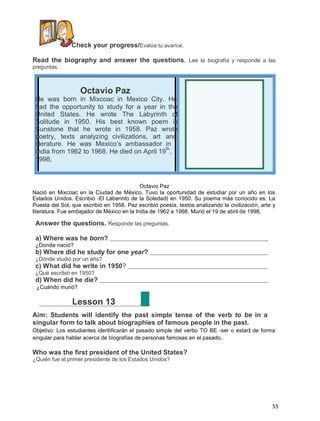
Read the biography and answer the questions. Lee la biografía y responde a las
preguntas.

Octavio Paz

He was born in Mixcoac in Mexico City. He
had the opportunity to study for a year in the
United States. He wrote The Labyrinth of
Solitude in 1950. His best known poem is
Sunstone that he wrote in 1958. Paz wrote
poetry, texts analyzing civilizations, art and
literature. He was Mexico’s ambassador in
th
India from 1962 to 1968. He died on April 19 ,
1998.

Octavio Paz
Nació en Mixcoac en la Ciudad de México. Tuvo la oportunidad de estudiar por un año en los
Estados Unidos. Escribió ―El Laberinto de la Soledad‖ en 1950. Su poema más conocido es: La
Puesta del Sol, que escribió en 1958. Paz escribió poesía, textos analizando la civilización, arte y
literatura. Fue embajador de México en la India de 1962 a 1968. Murió el 19 de abril de 1998.

Answer the questions. Responde las preguntas.
a) Where was he born?
¿Donde nació?

b) Where did he study for one year?
¿Dónde studió por un año?

c) What did he write in 1950?
¿Qué escribió en 1950?

d) When did he die?
¿Cuándo murió?

Lesson 13
Aim: Students will identify the past simple tense of the verb to be in a
singular form to talk about biographies of famous people in the past.
Objetivo: Los estudiantes identificarán el pasado simple del verbo TO BE ―ser o estar‖ de forma
singular para hablar acerca de biografías de personas famosas en el pasado .

Who was the first president of the United States?
¿Quién fue el primer presidente de los Estados Unidos?

55
Read/Leer.
1. Answer the question.
Responde a la pregunta.

Who was he?
¿Quién fue él?

2. Read the biography. Lee la biografia.
George Washington
1732 – 1799
George Washington was the first
president of the United States. He
nd
was born on February 22 , 1732 in
Wakefield, in the state of Virginia.
When he was young he was a
soldier. Later, he became a
president. He was president from
th
rd
April 30 , 1789 until March 3 , 1797.
He married Martha Dandridge
Custis. They didn’t have any
children. George died on December
th
14 , 1799.
George Washington 1732-1799.
George Washington fue el primer presidente de los Estados Unidos. Nació el 22 de febrero de 1732
en Wakefield, en el estado de Virginia. De joven fue soldado. Después, llegó a ser presidente. Fue
presidente del 30 de abril de 1789 hasta el 3 de marzo de 1797. Se casó con Martha Dandridge
Custis. No tuvieron niños. George murió el 14 de diciembre de 1799.

Write/Escribe.
3. Use the information in the biography to solve the following
activities.
Utiliza la información en la biografía para resolver las siguientes actividades.

a) Write the missing information.
Escribe la información que haga falta.

56
Name:
Date of birth:
Place of birth:
Profession:
Married to:
Died:
b) Write True or False.
Escribe Verdadero o Falso.

A) George Washington was a president.
George Washington fue presidente.

B) It was his profession after being a soldier.
Fue su profesión después de ser soldado.

C) He wasn’t born in1932. He was born in 1732.
No nació en 1932. Nació en 1732.

D) He wasn’t born in Dakota. He was born in Virginia.
No nació en Dakota. Nació en Virginia.

E) Martha Dandridge Custis was his wife.
Martha Dandridge Custis fue su esposa.

F) She wasn’t mother. They didn’t have any children
No fue mamá. No tuvieron hijos.

Think/Pensar.

4. Look at the words in bold in exercise b) and complete the chart. Look at
theexample. Observa las palabras en negrita en el ejercicio b) y completa el cuadro. Observa
los ejemplos.
Pronouns/Pronombres
Affirmative/Afirmativa
Negative/Negativa
wasn’ t/no fue
Was/fue

Write/Escribe.
5. Look at the pictures and write where these people were last weekend. Use
the words in the box. Observa las fotos y escribe dónde estaban éstas personas la semana
pasada. Utiliza las palabras del cuadro.

park parque zoo zoológico museum museo
beach playa
rock concert estrella de rock
home casa

57
Last weekend… La semana pasada…
Claudia wasn’t at home. She was in a
.
Claudia no estaba en casa. Ella estaba en

Mrs. Estrada wasn’t at work. She
had a pic nic in the
with her
family. La Sra. Estrada no estaba en el
trabajo. Tuvo un dia de campo en el
con su familia.

Mr. Bell wasn’t at office.
He was at the
. El Sr.
Bell no estaba en la oficina. El
estaba en el

58

Mike was in an interesting place. He
was in a
.
Mike estaba en un lugar interesante. Estaba
en

Jenny was very sick so she was at
Jenny estuvo muy enferma así que estaba en
_.

Luis wasn’t at school.
He was in the
.
Luis no estaba en la escuela.
Estaba en el
.
6. Write about the places where you were or weren’t last weekend.
Escribe acerca de los lugares donde estuviste o no la semana pasada.

Example/Ejemplo.
I wasn’t at home. I was in the library.
No estaba en casa. Estaba en la biblioteca.

Check your progress /Evalúa tu avance.

After reflection, write the missing words about the topics in this lesson.
Después de reflexionar, escribe las palabras que hagan falta acerca de los temas en esta
lección.

A) In this lesson you learned that
are words to indicate the past simple
tense of the verb to be in a singular form.
En esta lección aprendiste que
BE de forma singular.

son palabras que indican el pasado simple del verbo TO

B) Also, we can use was/wasn’t to talk about
También, podemos utilizar was/wasn´t para hablar a cerca de
pasado.

where we were in the past.
dónde estuvimos en el
Lesson 14
Aim: Students will identify the past simple tense of the verb to be in a
plural form to talk about biographies of famous people who lived in the past.
Objetivo: Los estudiantes identificarán el pasado simple del verbo TO BE/ ARE (son, están) de
forma plural para hablar acerca de biografias de personas famosas quienes vivieron en el pasado.

They weren’t actors, they were painters.
No eran actores, eran pintores.

Read/Leer.
1. Order the following words to write the names of these
painters.
Ordena las siguientes palabras para escribir los nombres de estos pintores.
Alfaro

Clemente

a)

b)

Siqueiros

Jose

Orozco

David
2. Read the text/Lee el texto.
Alberto’s mother: What are you doing Alberto? Remember, you have to do
your homework. ¿Qué haces Alberto? Recuerda, tienes que hacer tu
tarea.

Alberto: I’m doing it, mom. I’m looking for information about some
Mexican muralist on the Internet. Look, I found something.
La estoy haciendo mamá. Estoy buscando información de algunos pintores mexicanos en el
internet. Mira, encontré algo.

⌫

back

⌦

forward

⌧

stop

mail

print

Address: http://www.artsearch.com

ARTSEARCH

⌦ go

Jose Clemente Orozco
José Clemente Orozco
He was born in Jalisco on November
Nació en Jalisco el 22 de noviembre de
nd
22 , 1883. When he was seven years 1883. Cuando tenía 7 años se mudó a la
old he moved to Mexico City where he ciudad de México dónde estudió. Pintó
studied. He painted murals in Mexico and murales en México y en los Estados
in the United States. His main topics in his Unidos. Sus principales temas en sus
murals were about Mexican history. He was pinturas fueron
acerca de la
an excellent and famous muralist. He died historia mexicana. Fue un pintor
th
on September 7 , 1949. You can admire excelente y famoso. Murió el 7 de
some of his murals in the Palacio de septiembre de 1949. Puedes admirar
Bellas Artes.
algunas de sus pinturas en el palacio de
Bellas Artes.

David Alfaro Siqueiros
Fue un pintor y muralista mexicano.
Nació en Chihuahua en 1896. De

David Alfaro Siqueiros

He was a Mexican muralist and painter. He
joven fue soldado en el ejército de was born in Chihuahua in 1896. When he was
Venustiano Carranza. Al final del young he was a soldier in the Venustiano
conflicto mexicano se fue a Europa Carranza’s army. At the end of the Mexican
donde estudió. Cuando regresó a conflict he went to Europe where he studied.
México participó en la elaboración When he came back to Mexicoheparticipated
de murales de la Escuela Nacional painting the murals in the Escuela Nacional
Preparatoria. His most famous murals are
Preparatoria. Sus murales famosos
Proceso al fascismo (1939) and Muerte al
son Proceso al fascismo (1939)
invasor (1940). He died in Cuernavaca in
Muerte al invasor (1940). Murió en
1974.
Cuernavaca en 1974.
Write/Leer.
3. Complete the sentences with information in the web page.
Completa las oraciones con la información de la página web.

a)

and (y)

were muralists.

(fueron pintores)

b) They weren’t American. They were
No eran americanos. Eran

c) They
Ellos

.

in other countries.

en otros países.

d)

nd

was born in Jalisco on November 22 , 1883.
nació en Jalisco el 22 de noviembre de 1883.

e)

was a soldier in the Venustiano Carranza’s army.
fue soldado en el ejército de Venustiano Carranza.

Think/Pensar.
4. Look at the words in bold in exercise three and complete the chart.
Busca las palabras en negrita en el ejercicio 3 y completa el cuadro.

Pronouns

Verb to be in past simple tense
Affirmative/Afirmativo
Negative/Negativo

Pronombres

You/tú
We/nosotros

Write/Escribe.
5. Complete the chart with information about you and a classmate.
Completa el cuadro con la información a cerca de tí y un compañero de clase.

Where were
you…
¿Dónde estabas…?

Where was your
classmate…
¿Dónde estaba tú
compañero de
clase…?

last weekend?
¿La semana
pasada?

yesterday morning? at 8 last night?
¿Ayer por la mañana?

¿A las 8 de la
noche?
6. Use the information to write a text about you and your classmate
and illustrate them. Utiliza la información y escribe un texto acerca de tí y tu
compañero e ilústralos.

Last weekend I was (La semana pasada estaba)

Last weekend

was

Check your progress/Evalua tu progreso.

After reflection, write the missing words about the topics in this
lesson.
Después de reflexionar, escribe las palabras faltantes de los temas en esta lección .
A) In this lesson you learned that
are words that
indicate the past simple tense of the verb to be in a plural form.
A) En esta lección aprendiste que
―ser o estar‖ de una forma en plural.

son palabras que indican el pasado simple del verbo
Lesson 15
Aim: Students will use the past simple tense of the verb to be to ask and
answer questions in singular and plural form.
Objetivo: Los estudiantes utilizarán el pasado simple del verbo ser o estar para preguntar y
responder preguntas en forma singular y plural.

Was Iturbide the first president of Mexico? ¿Fue Iturbide el primer presidente de
México?

Read/Leer.
1. Choose the corresponding option and write it on the line.
Selecciona la oración correspondiente y escríbela en la línea.

In this subject you learn about historic events and personalities who lived
in the past
En esta materia aprendes acerca de eventos históricos y personalidades que vivieron en el
pasado.

a) Mathematics

b) History

Matemáticas

Historia

c) Spanish
Español

2. Read the dialogue. Lee el diálogo.
Roberto: Hello Richard. We were waiting for you at the party yesterday
afternoon. Were you at home? Hola Richard. Te estuvimos esperando ayer
en la tarde en la fiesta. ¿Estuviste en casa?.

Richard: No, I wasn’t. I was at the library. No, estuve en la biblioteca.
Roberto: What were you doing? ¿Qué estabas haciendo?
Richard: I was doing my History homework. Estaba haciendo mi tarea de historia.
Roberto: What was it about? ¿De qué era?
Richard: It was about the first president of Mexico. Trataba del primer presidente
de México.

Roberto: Was Iturbide the first president of Mexico? ¿Fue Iturbide el primer
presidente de México?

Richard: No, he wasn’t. The first president of Mexico was Guadalupe
Victoria. He governed from 1824 to 1829. No, El primer presidente de
México fue Guadalupe Victoria. Gobernó de 1824 a 1829.

Roberto: Was it his real name? ¿Fue éste su
nombre real?

Richard: No, it wasn’t. It was Jose Miguel Ramon Adaucto Fernandez y
Felix. No, fue José Miguel Ramón Adaucto Fernández y Félix.
Roberto: He was born in Durango, wasn’t he?
Nació en Durango, ¿o no?

Richard:Yes, he was. He was born in Villa de Tamazula, Durango on
th
st
September 29 , 1786. And he died on March 21 , 1843 in the state
of Mexico. But, tell me about the party. Were you and Jenny
dancing?
Sí, nació en Villa de Tamazula, Durango el 29 de septiembre de 1786. Murió el 21 de
marzo de 1843 en el Estado de México. Pero cuéntame de la fiesta. ¿Estuviste
bailando con Nancy?

Roberto: Yes, we were. It was a funny party but we missed you.

Sí, la fiesta estuvo muy divertida pero te extrañamos porque no fuiste.
Write/Escribe.
3. Use the information in the dialogue to solve the following activities.
Utiliza la información en el diálogo para resolver las siguientes actividades.

A) Answer the questions/Responde las preguntas.
a) Was Richard at the party yesterday afternoon?
¿Estuvo Ricardo en la fiesta ayer en la tarde?

b) Was Roberto at the library yesterday afternoon?
¿Estuvo Roberto en la biblioteca ayer en la tarde?

c) Were Richard and Roberto at school yesterday afternoon?
¿Estuvieron Ricardo y Roberto en la escuela ayer en la tarde?

d) Was Richard looking for information about the first president of
Mexico?
¿Estuvo buscando Ricardo información a cerca del primer presidente de México?
e) Were Roberto and Jenny dancing at the party?
¿Estuvieron Roberto y Jenny bailando en la fiesta?

B) Write the missing information. Escribe la información que haga falta.

Name: Guadalupe Victoria
Real name:
Occupation:
Date of birth:
Place of birth:
Died:
Think/Pensar.
4. Look at the words in bold in exercise two and complete the chart.
Observa las palabras en negrita del ejercicio dos y completa el cuadro.

Pronouns

Affirmative

Negative

Pronombres

Afirmativo

Negativo

I

Yes, I was.

No, I wasn’t.

Was…?

Were…?

Write/Escribe.

5. Complete the chart with your information then, ask some classmates.
Completa el cuadro con tu propia información después, pregúntale a tus compañeros.

Questions
You
¿Estuviste la semana
Were you at
pasada en tu casa?
home last
weekend
Was your mother ¿Estuvo tu mamá en la
at the office on oficina el lunes?
Monday?
Was your father ¿Estuvo tu papá en el
trabajo el domingo
at work last
pasado?
Saturday?
¿Estuviste en la
Were you at
escuela ayer en la
school
mañana?
yesterday
¿Estuvo interesante tu
Was your
clase de Español?
Spanish class
interesting?
¿Estuvieron tus
Were your
amigos en el zoológico
friends in the
el domingo pasado?
zoo last
Sunday?
7. Use the information in the chart to complete the sentences.
Utiliza la información del cuadro para completar las oraciones.

Example: Ejemplo:
Questions

You

Preguntas

Maricela

Were you at
home last
weekend?

No, I wasn’t.

¿Estuviste
en casa la
semana
pasada?

No

Fernando

Maricela

Tu

Fernando

Yes, she was.

No, he wasn’t.

Si

Si

Last weekend Maricela was at home. El fin de semana pasado Maricela estaba
en casa.

a) Last week

wasn’t at home. La semana pasada

no estaba

en casa.

b) My father

at work last Saturday. Mi papá

en el trabajo

el domingo pasado.

c) My Spanish class

interesting. Mi clase de español

interesante.

d) Last Sunday my friends
amigos

in the zoo. El lunes pasado mis

en el zoológico.

e) My mother

at the office on Monday. Mi mamá

en la

oficina el lunes.

Check your progress / Evalúa tu avance.
Choose the corresponding option to complete the sentence. Write it on the
line. Selecciona la opción correspondiente para completar la oración. Escríbelas en la línea.
In this lesson you learned how
En esta lección aprendiste como

a) asking for events in the present. Preguntar por eventos en el presente.
b) answering questions about events in the future. Responder a preguntas a
cerca de acciones en el futuro.

c) answering questions about events in the past. Responder preguntas de
eventos en el pasado.

“was, were, wasn’t, weren’t” are the
were, wasn´t, weren´t‖ son las

a)present/presente

forms of the verb to be. ―was,

_formas del verbo ―ser o estar‖

b)past/pasado

c)future/futuro
Lesson 16
Aim: Students will identify the structure of the past continuous.
Objetivo: Los estudiantes identificarán la estructura del pasado continuo.

My first day at school/ Mi primer día en la escuela.

Read/Leer.
1. Underline the corresponding option that answers the question. Subraya
la opción correspondiente que responda a la pregunta.

A) What was Jacky’s mother doing? ¿Qué estaba haciendo la mamá de
Jacky?

a) She was cooking. Estaba cocinando.
b) She was reading a magazine. Estaba leyendo una revista.
c) She was reading a newspaper. Estaba leyendo un periódico

2. Read the information. Lee la información.
Jacky: What are you doing Mom? ¿Qué haces
mamá?

Jacky’s mother: I’m reading a magazine. There is an interesting article
about the feelings of the students in the first day at school.
Estoy leyendo una revista. Hay un artículo interesante acerca de los
sentimientos de los estudiantes en su primer dia de clase.

Jacky: Mom, do you remember your first day at secondary
school?
Mamá, recuerdas tu primer día en la secundaria?

Jacky’s mother: Of course. I’m not so old. Por supuesto. No estoy muy
grande.

Jacky: Were you nervous? ¿estabas nerviosa?
Jacky’s mother: Yes, I was a little nervous. Sí. Estaba un poco
nerviosa.

Jacky: Did you meet someone the first day? ¿Conociste a alguien el primer dia?
Jacky’s mother: Yes, I did. The first day I met Marcia and she’s still my
best friend. Si. El primer día conocí a Marcia y ella es aún mi mejor amiga
Jacky: What were you wearing? ¿Qué
vestías?
Jacky’s mother: I was wearing a blue dress, a black jacket and black
shoes.
Vestía un vestido azul, una chamarra negra y zapatos negros.
***Teenagers

time***

Do you remember your first
day at secondary school?
A recent survey showed that 5 %
of the students are not nervous at all.
20 % are a little bit nervous. But 88
% of students are nervous the first
school day.
22 % make friends but change them
during the year. 13 % of friends
made that day continue being friends later.
40 % of students just talk to
classmates and make friends
later. Finally, 35 % make
friends the first day of school.
Were you nervous the first
day of school?

ADOLESCENTES
¿Te acuerdas de tu primer dia en la secundaria?
Un estudio reciente mostró que el 5% de los estudiantes no son nerviosos del todo. El 20% no
son nerviosos. Pero el 88% de los estudiantes están nerviosos el primer día de clase. El 22%
hace amigos pero los cambia durante el ciclo escolar. El 13% de los amigos que se hacen el
primer día continúan siendo amigos después.
40% de los estudiantes sólo hablan con sus compañeros de clase y hacen amigos después.
Finalmente el 35% hace amigos el primer día de clase.
¿Estabas nervioso el primer dia de clase?
Write/Escribe.
5. Write the percents according to the article then, make a graphic.
Escribe Los porcentajes acorde al artículo, después elabora una gráfica.

% of students are not nervous.
% de los estudiantes no son nerviosos.

% of students are not very nervous.
% de los estudiantes no son muy nerviosos.

% of students are absolutely nervous the first day of school.
% de los estudiantes son absolutamente nerviosos el primer día de clase.

% of students make friends but change them during the year.
% de los estudiantes hacen amigos pero los cambian durante el ciclo escolar.

% of friends made that day continue being friends later.
% de los amigos hechos ese día continúan siendo hasta el final.

% of students just talk to classmates and make friends later.
% de los estudiantes sólo hablan con sus compañeros y hacen más amigos
después.

% of students make friends the first day of school.
% de los estudiantes hacen amigos el primer día de clase.

Draw your graphic here. Dibuja tu gráfica.
Think/Pensar.
6. Read the following sentences and complete the diagram. Lee las siguientes
oraciones y completa el diagrama.

Martha was wearing blue jeans and a yellow T-shirt.
Martha vestía pantalones azules y una camisa amarilla.

My friends were eating sandwiches. Mis amigos estaban comiendo sandwiches.
I was running in the park. Estaba corriendo en el parque.
Marcia and Lorena were talking the first day of school.
Marcia y Lorena estaban hablando el primer día de clase.

Past continuous tense.
+ verb +

Write/Escribe.

7. Think about your first day at secondary school and answer these
questions. Piensa en tu primer dia en la secundaria y responde las preguntas.
a) Were you nervous?

_

¿Estabas nervioso?

b) How were you feeling when you arrived to school?

_
_

¿Cuáles eran tus emociones cuando llegaste a la escuela?

c) What were you wearing?
¿Qué vestías?

d) What were you thinking about?

¿En qué pensabas?

e) What were you talking about with your classmates?
¿De qué hablaste con tus compañeros?

f) How were you feeling at the end of the day?

_

¿Cómo te sentiste al final del día?

75
6. Imagine you are writing in your diary what was happening in your first
day at school.
Imagina que estás escribiendo un diario de lo que pasaba en tu primer día de clase.

Dear diary, today was my first day at secondary
school. I felt nervous. I

Today was a fantastic day.

Querido diario, hoy fue mi primer día de clase en la secundaria. Estaba muy nervioso.

Hoy fue un día fantástico.

74
Check your progress / Evalua tu avance.
Order the words to write sentences and write √ if it was true according to
your information.
Ordena las palabras para escribir las oraciones y escribe √ si fue cierto acorde a tu información.
a) Morning / washing / my father / dishes / was /
This b) were / soccer /on Sunday / playing / My
brothers
c) I / yesterday / doing / was / my / homework /
afternoon d) was / my mother / dinner / Last night /
cooking

Lesson 17
Aim: Students will identify the function of the past continuous.
Los estudiantes identificarán la función del pasado continuo.

We were cleaning the house/ Estábamos limpiando la casa

Read/Leer.
1. Match the sentences with the pictures. Une las oraciones con las fotos.
a) Mariana was watching T.V.
Mariana estaba viendo la T.V.

b) My friends were playing soccer.
Mis amigos estaban jugando fútbol.

c) I was doing my homework.
Estaba haciendo mi tarea.

75
2. Read the dialogue. Lee el diáologo.
Roxana: What happened to your finger Sofia?
¿Qué le pasó a tu dedo Sofía?

Sofia: I cut it yesterday. Me corté ayer
Roxana: Why? What were you doing? ¿Por qué? ¿Qué estabas haciendo?
Sofia: Well, let me tell you the story. Yesterday was my mother’s birthday
so my family and I wanted to surprise her. We were cleaning the
house while my mother was at work. My father was washing the
dishes, my brother Joaquin was taking out the trash, my sister
Sabina was ironing the clothes, my brother Ernesto was sweeping
and I was cooking. I was cutting some tomatoes and I cut my finger.
Bueno, déjame contarte la historia. Ayer fue el cumpleaños de mi mamá así que mi
familia y yo quisimos darle una sorpresa. Estábamos limpiando la casa mientras mi
mamá estaba en su trabajo. Mi papá estaba lavando los trastes. Mi hermano
Joaquín estaba sacando la basura. Mi hermana Sabina estaba planchando la ropa,
mi hermano Ernesto estaba barriendo y yo estaba cocinando. Estaba cortando unos
tomates y que me corté el dedo.

Roxana: What did you do then? ¿Qué hiciste?
Sofia: I washed my finger with soap and water then, I put
some alcohol on it. Me lavé el dedo con jabón y agua. Luego me puse
alcohol.

Roxana: And what were you cooking? ¿Qué estabas cocinando?
Sofia: I was cooking a mushroom soup, chicken and vegetables. My
father bought a chocolate cake for dessert. In the afternoon we had
meal together and my mother was happy.
Estaba cocinando sopa de hongos, pollo y verduras. Mi papá compró un pastel de
chocolate como postre. En la noche comimos juntos, mi mamá estaba muy feliz.

74
Write/Leer.
3. Use the information in the dialogue to solve the following activities.
Utiliza la información en el diálogo para resolver las siguientes actividades.

A) Write on the line the corresponding names according to the dialogue.

Escribe en la línea los nombres correspondientes acorde al diálogo.

B) Write True or False. Escribe verdadero o falso.
a) Roxana cut her finger.
Roxana se cortó el dedo.

b) Sofia and her family were watching T.V.
Sofía y su familia estaban viendo la TV.

c) Sofia’s mother was cleaning the house.
La mamá de Sofía estaba limpiando la casa.

d) Sofia’s mother wasn’t at home.
La mamá de Sofia no estaba en casa.

e) Sofia’s brothers were cleaning the house too.
El hermano de Sofia estaba limpiando la casa también.
f ) Sofia’s sister was cleaning the house too.
La hermana de Sofía estaba limpiando la casa también.

76
Think/Pensar.
4. Choose the corresponding option and write it on the line.
Selecciona la opción que corresponda y escribela en la linea.

The past continuous indicates
El pasado continuo indica

a) Actions that happens at the moment. Acciones que suceden en el momento.
b) Actions that will happen. Acciones que pasarán
c) Actions that were in progress in the past. Acciones que estuvieron en el
proceso del pasado.

Write/Escribir.
5. Look at the picture and write about what was happening. Use the
words in the box. Observa la foto y escibe acerca de lo que está pasando. Utiliza las
palabras del recuadro.

dance

eat a sandwich
drink a
soda
talk on the phone
sleep on the sofa

77
Last Sunday I was at a party.
dancing.

El sábado pasado estuve en una fiesta.

and

y

were

estuvimos bailando.

5. Write about activities you were doing last weekend.
Escribe a cerca de las actividades que estuviste haciendo la semana pasada.

Last weekend I was

El fin de semana pasado estaba.

Check your progress/ Evalúa tu avance.

Answer the questions. Responde las preguntas.
How do you form the past continuous?
¿Cómo formas el pasado continuo?

When do you use the past continuous?
¿Cuándo utilizas el pasado continuo?

Lesson 18
Aim: Students will identify that when the past continuous and the past
simple structures are used in the same sentence, the action/situation
described in past simple interrupts the action described in past continuous.
Los estudiantes identificarán que cuando las estructuras del pasado continuo y el pasado simple
se utilizan en las mismas oraciones, la acción/situación descritas en el pasado simple interrumpe
la acción descrita en el pasado continuo.

Samuel was chewing gum when the teacher
arrived.
Samuel estaba masticando chicle cuando el maestro llegó.

78
Read/Leer.
1. Answer the following questions with information in the
dialogue.
Responde las siguientes preguntas con la información en el diálogo.

Who is she?¿Quién es ella?

Who is she?¿Quié es ella?

2. Read the dialogue and write the names in the correct
chart.
Lee el diálogo y escribe los nombres en el cuadro correcto.

Paty: Hello, Mom. Hola, mamá.
Paty’s mother: Hello, Paty. How was your day at
school?
Hola, Paty. ¿Qué tal te fue en la escuela?
Paty: It was not good. No tan bien.

Paty’s mother: Why? Tell me, please. ¿Por qué?
Dime

Paty: Because Miss Olalde wasn’t in the classroom and when she arrived
all my classmates were doing different things and a lot of noise. Marco
was drawing on the blackboard; Alicia was eating a sandwich; Jenny and
Mauricio were dancing; Saul was sleeping; Nestor was drinking soda;
Rubén, Jorge and John were playing soccer; Laura was talking on the
phone Susy was reading a fashion magazine, Samuel was chewing gum;
and …
Porque la Srita. Olalde no estaba en el salón y cuando llegó mis compañeros estaban realizando
diferentes actividades y haciendo mucho ruido. Marcos estaba dibujando en el pizarrón; Alicia
estaba comiendo un Sandwich, Jenny y Mauricio estaban bailando; Saúl estaba durmiendo;
Néstor estaba bebiendo un refresco; Rubén, Jorge y John estaban jugando fútbol; Laura estaba
hablando por teléfono; Susy estaba leyendo una revista de moda, Samuel estaba masticando un
chicle; y….
79
Paty’s mother: And what were you doing? ¿Y qué estabas haciendo?
Paty: Well, I was talking to Rosy. Bueno, estaba hablando con Rosy.
Paty’s mother: And, did you finish your activities?
Y ¿terminaste tus actividades?

Paty: No, I didn’t. No
Paty’s mother: What happened when Miss Olalde arrived into the
classroom?
¿Qué pasó cuando la Srita. Olalde llegó al salón?

Paty: Miss Olalde was so angered because nobody finished the activities
she indicated, so, she gave us a lot of homework.
La Srita. Olalde estaba enfurecida por que nadie terminó las actividades que indicó y nos
dejó bastante tarea.

Write/Escribe.
3. Write True or False. Escribe verdadero o falso.
a) Marco was eating a sandwich when Miss Olalde
arrived into the classroom.
Marco estaba comiendo un sandwich cuando la Srita. Olalde llegó al salón.

b) Jenny and Saul were dancing in the classroom
when Miss Olalde arrived into the classroom.
Jenny y Saúl estaban bailando en el salón cuando la Srita.
Olalde llegó al salón.

c) Samuel was chewing gum when Miss Olalde
arrived into the classroom.
Samuel estaba masticando chicle cuando la Srita. Olalde
llegó al salón.

d) All the students were working when Miss Olalde
arrived into the classroom.
Todos los estudiantes estaban trabajando cuando la Srita. Olalde
llegó al salón.

e) Paty was talking to Rosy when Miss Olalde
arrived into the classroom.
Paty estaba hablando con Rosy cuando la Srita. Olalde llegó al
salón.

f) Néstor wasn’t drinking a soda when Miss Olalde
arrived into the classroom.
Néstor no estaba tomando soda cuando la Srita. Olalde llegó al
salón.

g) Students weren’t doing a lot of noise when Miss
Olalde arrived into the classroom.
Los estudiantes no estaban haciendo ruido cuando la Srita.
Olalde llegó al salón.

80
Think/Pensar.
4. Complete the chart with information in exercise three. Look at the example.
Completa el cuadro con la información del ejercicio tres. Observa los ejemplos.

Past continuous

Past simple

Pasado continuo

Pasado simple

was eating/Estaba comiendo
were dancing/Estaban bailando

When/Cuando

arrived/llegó
arrived

Answer the question. Responde la pregunta.
What’s the function of the structures past continuous and past simple in
the same sentence? ¿Cuál es la función de las estructuras del pasado continuo y simple en
la misma oración?

Write/Escribe.
5. Look at the picture and write what Andrea and her family were doing
when the lights went out.
Observa las fotos y escribe qué estaba haciendo Andrea y su familia cuando la luz se fue.

81
Example/Ejemplo:
Melissa was doing her homework when the lights went out.
Melisa estaba haciendo su tarea cuando la luz se fue.

6. Write what the members of your family were doing when you got
home yesterday.
Escribe lo que hacía tu familia cuando llegaste ayer a casa.

My mother
Mi madre

when I got home yesterday.
cuando llegué a casa ayer.

Check your progress /Evalúa tu avance.

Order the words to make sentences. Ordena las palabras para formar oraciones.
on the blackboard / when / I / the teacher / was / arrived / drawing /
en el pizarron / cuando / Yo / el maestro / estaba / llegó / dibujando /

.
got home / his mother / Mario / cooking dinner / was / when /
llegó a casa / su mamá / Mario / preparando la cena / estaba / cuando /

.
were / We / when / Watching T.V. / went out / the lights /
estabamos / Nosotros / viendo la TV / se fue / la luz /

.

82
Lesson 19
Aim: Students will use appropriately past continuous and past simple
structures in order to produce relevant and clear texts when describing
what people were doing at a certain moment in the past.
Objetivo: Los estudiantes utilizarán apropiadamente las estructuras del pasado continuo y
simple para producir textos relevantes y claros cuando se describe lo que las personas hacían
en cierto momento del pasado.

Linda and Robert were dancing when my parents got
home.
Linda y Roberto estaban bailando cuando mis papás llegaron a casa.

Read/Leer.
1. Answer the questions. Responde las preguntas.
Have you ever organized a party without permission from your parents?
¿Haz organizado alguna vez una fiesta sin el permiso de tus padres?

What happened when they discovered it?
¿Qué pasó cuando te descubrieron?

2. Read the e-mail. Underline the verbs in past simple tense and circle
the verbs in past progressive.
Lee el correo electrónico. Subraya los verbos en pasado simple y subraya los verbos en pasado
progresivo.

83
From: melissa@cooltown.com
To: angela@meetme.com
Subject: Greetings from Mexico
Dear Angela:
Hello. I want to tell you what happened to me last
Saturday.
I organized a big party and I invited all my friends and classmates. That was a
good it was supposed that permissioncome back on They weren’t at home
and idea but I didn’t ask for they will to my parents. Monday
morning.
A t the party Tom, Sandy and Mike were drinking sodas. The twins
were eating sandwiches. Some friends were blowing up balloons. The rest of
the boys and girls were dancing.
I Also invited a rock band. They are my cousins. Marcela was singing, Randy
was playing the guitar, Samuel was playing the drums and Susan was playing
the piano.
I was talking to Mario when my parents opened the door! That was terrible.
They were so angered. So, I told my friends that the party was over and they
went out from my house.
That night my parents talked to me and they forgave me. I promised I won’t
do the same thing again.
Send me an e-mail back. Bye
Regards
Melissa

Querida Angela:
Hola! Quiero decirte lo que me pasó el sábado pasado.
Organicé una fiesta grande e invité a todos mis amigos y compañeros de clase. Fue una muy
buena idea pero no pedí permiso a mis papás. No estaban en casa y se suponía que regresaban
en lunes por la mañana. En la fiesta Tom, Sandy y Mike estaban tomando refrescos. Las gemelas
estaban comiendo emparedados. Algunos amigos inflando globos. El resto de los chicos y chicas
estaban bailando.
También invité a una banda de rock. Ellos son mis primos. Marcela estaba cantando, Randy
estaba tocando la guitarra, Samuel estaba tocando los tambores y Susan estaba tocando el piano.
Estaba hablando con Mario cuando mis papás abrieron la puerta. Fue horrible. Estaban enojados.
Así que le dije a mis amigos que la fiesta había terminado y se fueron de la casa.
Esa noche mis papás hablaron conmigo y me disculparon. Prometí no volver hacerlo nuevamente.
Envíame un correo electrónico. Adiós.
Saludos
Melissa

84
Write/Escribe.
3. Use the information in the e-mail and complete the sentences.
Utiliza la información del correo electrónico y completa las oraciones.

a) Tom, Sandy and Mike
Melissa’s parents
Tom, Sandy y Mike

sodas when
the door.
refresco cuando los padres de Melissa

b) The twins

la puerta.

sandwiches when
the door.

Los gemelos

sandwiches cuando

c) Melissa

la puerta.

to Mario when
.

Melissa

a Mario cuando

d) The rock band
La banda de rock

.

when
.
_cuando

.

e) Some Melissa’s friends
Algunos amigos de Melissa

balloons when
.
globos cuando

.

Think/Pensar.
4. Answer the questions.
Responde a las preguntas.

a) Which tense is for an event that happened over a period of time?
¿Qué tiempo es para eventos que pasaron en cierto periodo?

b) Which tense is for an event that happened at a specific point in time?
¿Qué tiempo es para un evento que pasó en un punto específico del tiempo?

85
Write/Escribe.
5. Work in pairs, think in a situation and answer the following questions.
Trabaja en parejas, piensa en una situación y responde a las siguientes preguntas.

a) What’s the situation of your story?
a) ¿Cuál es la situación de tu historia?

b) Who is the major character?
¿Quién es el personaje principal?

c) Where did the story take place?
¿Dónde tomó lugar la historia?

d) What was happening in the situation you are describing?
¿Qué pasaba en la situación que describías?

e) What was the action that interrupted the situation you are describing?
¿Cuál fue la acción que interrumpió la situación que estás describiendo?

6. Work in pairs, use the information in exercise five to write the story
and illustrate it. Use Angela’s story as an example.
Trabaja en parejas, utiliza la información del ejercicio 5 para escribír la historia e ilústrala. Utiliza
la historia de Angela como ejemplo.

86
Check your progress / Evalua tu progreso.
Answer the questions. Responde a las preguntas.
What’s the function of the past simple tense?
¿Cuál es la función del pasado simple?

What’s the function of the past continuous?
¿Cuál es la función del pasado continuo?

What happen when we use both structures in a same sentence?
¿Qué pasa cuando utilizamos ambas estructuras en la misma oración?

Lesson 20
Aim: Students will identify Yes/No questions and Wh-questions words.
Objetivo: Los estudiantes identificarán preuntas con SI/NO y preguntas con Wh.

Were you washing the windows?
¿Estabas lavando las ventanas?

Read/Leer.
1. Use your information to underline the corresponding answer.
Utiliza tu información para subrayar la respuesta correcta.

Were you at school yesterday morning? Yes, I was. / No, I wasn’t.
Where was your mother yesterday morning? She was at home.
She was at the office.

¿Estabas en la escuela ayer por la mañana? Si/No
¿Dónde estaba tu mamá ayer por la mañana? Estaba en casa.
Estaba en la oficina.

87
2. Read the dialogue and complete it, look at the example. Then, write
the name in the corresponding box.
Lee el diálogo y complétalo, mira el ejemplo. Luego, escribe el nombre en el recuadro
correspondiente.

Mireya’s mother: Hello, honey. How was your day at school?
Hola, cariño. ¿Que tal estuvo tu día en la escuela?

Mireya: It was great. Muy bien.
Mireya’s mother: Why? Tell me, please. ¿Por qué? Dime, por favor.
Mireya: Because we were working out from the classroom in our Biology
class.
Porque estuvimos trabajando afuera del salón en la clase de biología.

Mireya’s mother: Were you making an experiment or something like that?
¿Estuvieron haciendo algún experimento o algo así?

Mireya: No, we weren’t. Our task was to clean the school and plant trees
and flowers.
No, Nuestra tarea fue limpiar la escuela y plantar árboles y flores.

Mireya’s mother: That sounds great. Were you happy doing different
activities?
Suena bien. Estuvieron felices haciendo diferentes actividades?
were.
Sí.

Mireya: Yes, we
Mireya’s mother: Let me guess what you were doing.
Déjame adivinar lo que estaban haciendo.

Mireya: Esta bien.
Mireya’s mother: W ere you planting a tree?
¿Estuviste plantando un árbol?

Mireya: No, I wasn’t. Susana was.
Yo no, Susana si.

Mireya’s mother: W ere you planting a flower?
¿Estuviste plantando flores?

88
Mireya: No, I wasn’ t. Karla was.
No, Karla si.

Mireya’s mother:

you washing the windows?

¿

lavando la ventana?

Mireya: No,

. Carlos was.

Yo no, Carlos si.

Mireya’s mother: Were you sweeping the playground?
¿Estuviste barriendo el patio?

Mireya: No,

. Pedro was.

Yo no, Pedro si.

Mireya’s mother: Were you watering the flowers?
¿Estuviste regando las flores?

Mireya: No,

. Mariana was.

Yo no, María.

Mireya’s mother: Were you doing something?
¿Estuviste haciendo algo?

Mireya: Yes, I was. Sí
Mireya’s mother: What were you doing?
¿Qué estabas haciendo?

Mireya: I was supervising everything.
Estuve supervisando todo.

Mireya’s mother: And, what was your teacher doing?
Y ¿Qué estaba haciendo tu maestro?

Mireya: He was cleaning the chairs.
Estaba limpiando las sillas.

Write/Escribe.
3. Answer the questions. Responde las preguntas.
a) What was Susana doing?

_

¿Qué estaba haciendo Susana?

b) What was Carlos doing?
¿Qué estaba haciendo Carlos?

c) What was the teacher doing?
¿Qué estaba haciendo el maestro?

d) Who was watering the flowers?
¿Quién estaba regando las flores?

e) Where were the students?
¿Dónde estaban los estudiantes?

89
Think/Pensar.
4. Look at the words in bold in the dialogue and complete the chart.
Observa las palabras en negritas en el diálogo y complete el cuadro.

Yes/Si

Yes/Si

he/el
she/ella
it/es
I/Yo

was/estaba

they/ellos
we/nosotros
You/tu

No

No

he/el
she/ella
it/es
I/Yo
they/ellos
we/nosotros weren’t
no estuvimos
You/tu

Write/Escribe.
5. Read the dialogue again and answer the questions.
Lee el diálogo nuevamente y responde las pereguntas.

a) Was Susana cleaning the chairs?
¿Estaba limpiando las sillas Susana?

b) Was the teacher supervising the job?
¿Estaba surpervisando el trabajo el maestro?

c) Were the students cleaning the school?

_

¿Estaban limpiando la escuela los estudiantes?

d) Was Carlos washing the windows?
¿Estaba limpiando las ventanas Carlos?

e) Was Pedro sweeping the playground?
¿Estaba limpiando el patio Pedro?

f) Were the students playing soccer?
¿Estaban jugando fútbol los estudiantes?

90

_
7. Look at the picture and describe what was happening.
Observa la foto y describe lo que estaba pasando.

Last Saturday morning

Check you progress / Evalúa tu avance.
Answer the questions with your information.
Responde a las preguntas con tu información.

What were you doing yesterday morning?
¿Qué estuviste haciendo ayer por la mañana?

Where were you yesterday morning?
¿Dónde estuviste ayer por la mañana?

Were you at school yesterday morning?
¿Estuviste en la escuela ayer por lamañana?

Was your father at work yesterday morning?
¿Estuvo tu papá en el trabajo ayer por la mañana?

91
Lesson 21
Aim: Students will recognize and understand short literary texts (tales
or fragments of stories) in order to comment on the feelings generated by
them.
Objetivo: Los estudiantes reconocerán y entenderán textos literarios cortos (cuentos o fragmentos
de historias) para comentar los sentimientos generados por ellos.

Strong earthquake shakes Mexico/ Fuerte temblor sacude México.

Read/Leer.
1. Underline the correct option and write it on the line to answer the question
Subraya la opción correcta y escríbela en la línea para responder la pregunta.

Where does the text probably come from?

_

¿De dónde proviene el texto?

a) A sport magazine.
Revista deportiva.

92

b) A newspaper.
Periódico.

c) An encyclopedia.
Enciclopedia.
2. Read the text. Lee el texto.

Strong earthquake shakes
Mexico.

THE NEWS

Saturday April 14th, 2007

Last Friday morning a strong
earthquake of magnitude 6.0
shook Mexico. It was centered in
the Pacific coastal state of
Guerrero. Thousand of tourists
in Acapulco were into
the
streets in panic, others were
evacuated from their hotels in
pajamas. ―When the earthquake
began I was sleeping and I
thought it was a dream‖ a tourist
said. About 100 people from one
community near Acapulco were
evacuated to a park. There were
still no reports of damage or
injures in Acapulco or México
City, emergency services said.

Noticias.
Fuerte temblor sacude a México.
Sábado 14 de abril del 2007.
El viernes pasado por la mañana un fuerte temblor de magnitud 6.0 sacudió a México. El
epicentro tuvo lugar en las costas del pacífico en el estado de Guerrero. Miles de turistas en
Acapulco salieron a las calles con pánico, otros fueron evacuados de los hoteles en pijama.
―Cuando el temblor empezó estaba durmiendo y pensé que era un sueño‖ dijo un turista. Cerca
de 100 personas de una comunidad cerca de Acapulco fueron evacuadas a un parque. No había
aún reportes de daños o lesionados en Acapulco o la ciudad de México, dijeron los servicios de
emergencia.

Write/Escribe.

3. Answer the questions. Responde las preguntas.
a) What is the article about?
¿De qué habla el artículo?

b) Where did the earthquake shake?

¿Dónde sacudió el temblor?

93
c) What was the magnitude of the earthquake?

¿Cuál fue la magnitud del temblor?

d) Where was it centered?

¿Dónde fue el epicentro?

e) When did the earthquake happen?

¿Cuándo sucedió?

f) Have you ever been in an earthquake?
¿Haz estado alguna vez en un temblor?

Think/Pensar.

4. Read the sentences. Lee las oraciones.
I was sleeping when the earthquake began.
Estaba durmiendo cuando el temblor empezó.

When the earthquake began, I was sleeping.
Cuando el temblor empezó estaba durmiendo.

Write your reflection about the place of the words in bold.
Escribe tu reflexión a cerca de la posición de las palabras en negritas.

Write/Escribe.

5. Read the sentences and write them under the corresponding picture.
Lee las oraciones y escríbeles los números debajo de las fotos correspondientes.

When the earthquake began
… Cuando el temblor empezó…
a) Mario was taking a shower.
Mario estaba bañandose.
b) Susana was sleeping.
Susana estaba durmiendo.

c) Mrs. Olivares was cooking breakfast.
La Sra. Olivares estaba preparando el desayuno.

d) Alan and Miguel were walking to school.
Alan y Miguel estaban caminando hacia la escuela.

e) I was doing exercise.
Yo estaba haciendo ejercicio.

f) The twins were running in the park.
Los gemelos estaban corriendo en el parque.
6. Look at the picture and write a newspaper article describing what
were happening when the fire brigade arrived.
Observa la foto y escribe un artículo del periódico describiendo lo que estaba pasando cuando
los bomberos llegaron.

__

Yesterday afternoon a fire
burned at Castillo’s
house.
When the fire brigade arrived
to the place,

Ayer por la tarde el fuego quemó la casa
de la familia Castillo. Cuando los
bomberos llegaron al lugar,
Check your progress/ Revisa tu avance.
Circle the correct option. Encierra la opción correcta.
The twins were running / ran when the teacher arrived into the
classroom.
Los gemelos estaban corriendo/corrieron cuando el maestro llegó al salón.

When I did / was doing my homework, the lights went out.
Cuando hice/estaba haciendo mi tarea, la luz se fue.

Susana was sleeping / slept when the doorbell rang.
Susana estaba durmiendo/ se durmió cuando el timbre sonó.

Lesson 22
Aim: Students will use Wh-questions words to get specific information
about what was happening when an event began.
Objetivo: Los estudiantes utilizarán preguntas con ―Wh‖ para obtener información específica
acerca de lo que estaba pasando cuando la acción empezó.

What was your family doing when the earthquake
began?
¿Qué estaba haciendo tu familia cuando el temblor empezó?

Read/Leer.
1. Match the sentences with the pictures. Une las oraciones con las fotos.
a) Roberto was writing an e-mail when the lights went out.
Roberto estaba escribiendo un correo electrónico cuando la luz se fue.

b) Mrs. Olvera was washing dishes when the doorbell rang.
La Sra. Olvera estaba lavando los trastes cuando sonó la campana.

c) Andy and Julian were fighting when the teacher arrived into the
classroom.
Andy and Julian estaban peleando cuando el maestro llegó al salón.
2. Read the interview / Lee la entrevista.

Reporter: Good morning. This is Luis
Salazar reporting from Acapulco.
This morning, inhabitants in this
City felt a strong earthquake of
magnitude 6.0. This is Angela.
Please, tell us what was you doing
when the earthquake began.
Buenos días. Soy Luis Salazar transmitiendo desde Acapulco. Esta mañana,
habitantes de esta ciudad sintieron un fuerte temblor de magnitud 6.0. Aquí está
Angela. Por favor, dinos qué estabas haciendo cuando el temblor empezó.

Angela: I was sleeping and suddenly I felt my bedroom shaking and I woke
up.
Estaba durmiendo cuando repentinamente sentí
que mi cama se movía y me desperté.
Reporter: How do you feel now? ¿Cómo te sientes ahora?

Angela: I’m nervous but I’m fine.
Estoy nerviosa pero todo bien.

Reporter: Thanks. Over there is Mr. Olivos
and his family. Please, tell us where
were you when the earthquake began?
Gracias. Por acá está el Sr. Olivos y su familia.
Díganos por favor dónde estaba cuando el temblor
empezó?

Mr. Olivos: We were in our house. We were already
sleeping. We heard Spinky, our dog,
barking then, we woke up and went out
from the house.
Estábamos en nuestra casa. Estábamos durmiendo aún. Escuchamos a Spinky,
nuestro perro, ladrar, entonces nos levantamos y salimos de la casa.
Reporter: Are you fine? ¿Están bien?
Mr. Olivos: Yes, we are. Sí.
Reporter: Finally, this is John. He is a tourist from Canada. What were you
doing when the earthquake began?
Finalmente, John. Es un turista de Canada. ¿Qué estabas haciendo cuando el
temblor empezó?
was dancing. Estaba bailando.

John: I
Reporter: Dancing? Where were you in that
moment? ¿Bailando? ¿Dónde estabas en
ese momento?

John: I was at a party. I’m in holydays.
Estaba en una fiesta. Estoy de vacaciones.

Reporter: How do you feel now?
¿Cómo te sientes ahora?

John: I’m fine. I have never been in a
earthquake and at a party at the
same time but it’s horrible.
Estoy bien. Nunca había estado en un temblor y
en una fiesta al mismo tiempo, pero es horrible.

Write/Escribe.
3. Answer the following questions. Responde las siguientes preguntas.
a) Where was Ángela when the earthquake began?
¿Dónde estaba Ángela cuando el temblor empezó?

b) What was she doing when the earthquake began?
¿Qué estaba hacienda ella cuando el temblor empezó?

c) What were Mr. Olivos and his family doing when the earthquake began?
¿Qué estaba haciendo el Sr. Olivos y su familia cuando el temblor empezó?

d) Where were they when the earthquake began?
¿Dónde estaban ellos cuando empezó el temblor?

e) Where was John when the earthquake began?
¿Dónde estaba John cuando el temblor empezó?

f) What was he doing when the earthquake began?
¿Qué estaba haciendo él cuando el temblor empezó?
Think/Pensar.
4. Answer the question. Responde la pregunta.
What kind of information is required when we use Wh-questions
words?
¿Qué tipo de información se requiere cuando se utilizan las preguntas con Wh?

Write/Escribe.

5. Read the description and put a √ in the corresponding
picture.
Lee la descripción y pon una √ en las fotos correspondientes.

What was happening when the parents got home?
¿Qué pasaba cuando los papás llegaron a casa?

Yesterday afternoon at Murillo’s house the nanny was sleeping; Alice
was drawing on the wall; the baby was kissing the dog; Kevin was pouring
water on the cat’s head and the telephone was ringing when the parents got
home.
Ayer por la tarde en la casa de Murillo la nana estaba durmiendo. Alicia estaba dibujando en la
pared; el bebé estaba besando al perro; Kevin estaba vaciando agua en la cabeza del gato y el
teléfono estaba sonando cuando los papás llegaron a casa.

100
6. Ask the following questions to a classmate.
Responde las siguientes preguntas a un compañero de clase.

a) What’s your name?
¿Cuál es tu nombre?

b) What was your mother doing when you got home yesterday?
¿Qué estaba haciendo tu mamá ayer cuando llegó a casa?

c) What was your father doing when you got home yesterday?
¿Qué estaba haciendo tu papá cuando llegaste a casa ayer?

d) What were your brothers doing when you got home yesterday?
¿Qué estaban haciendo tus hermanos cuando llegaste a casa ayer?

e) What were your sisters doing when you got home yesterday?
¿Qué estaba haciendo tu hermana cuando llegaste a casa ayer?

f ) Write other things that were happening in your house when you arrived.
Escribe otras cosas que estaban pasando en tu casa cuando llegaste.

Check your progress / Checa tu avance.
Use the information in exercise six to write a text like the one in exercise
five and illustrate it. Utiliza la información en el ejercicio 6 para escribir un texto como en el
ejercicio 5 e ilústralo.

Yesterday, when
got home his mother was

Ayer, cuando

llegó a su casa su mamá estaba

101
Lesson 23
Aim: Students will use their previous knowledge to solve different
exercises using past simple tense and past continuous.
Objetivo: Los estudiantes utilizarán sus conocimientos previos para resolver diferentes ejercicios
utilizando el pasado simple y continuo.

Mini Check / Mini Evaluación.

Read/Leer.
1. Match the option with the corresponding picture. Une la opción con la foto
correspondiente.

a) Detective
b) Mrs. Stevens
c) Mr. Stevens
d) Miss Linares

2. Write the corresponding number in the
the picture.
Escribe el número correspondiente en el

to match the dialogues with

para unir los diálogos con la foto.

Yesterday afternoon, Miss Linares’ jewels were stolen and Detective Glass
is investigating.
Ayer por la tarde, a la Srita. Linares le robaron sus joyas y el detective Glass está investigando.

1
Detective: Excuse me, Mrs. Stevens, what
were you doing last night at 6:45?
Mrs. Stevens: I was cooking dinner.
Detective: And what were you cooking?
Mrs. Stevens: I was preparing pasta and
a green salad with chicken. Detective:
That’s all. Thank you very much Mrs.
Stevens.
102
Detective: Disculpe, Sra. Stevens, ¿qué estaba haciendo la noche pasada a las 6:45?
Sra. Stevens: Estaba preparando la cena.
Detective: Y ¿qué cocinaba?
Sra Stevens: Estaba preparando pasta y ensalada verde con pollo.
Detective: Eso es todo. Muchas gracias Sra. Stevens.

2
Detective: Mr. Stevens. What were you
doing last night at 6:45?
Mr. Stevens: Let me think. Ah, I was
helping my wife cooking
dinner.
Detective: And what were you cooking?
Mr. Stevens: Spaghetti, chicken and
salad. Detective: That’s all. Thanks.
Sr. Stevens ¿qué estaba haciendo la noche pasada
a las 6:45?
Déjeme pensar. Ah, estaba ayudando a mi esposa a
preparar la cena.
Y ¿qué cocinaba?
Spaghetti, pollo y ensalada.
Eso es todo. Gracias.

3
Detective: Miss Linares, what were you
doing last night at 6:45?
Miss Linares: Well, last night I was getting
ready to go out for a meeting.
Detective: What time did you go out from
your apartment, Miss Linares?
Miss Linares: At seven o’clock. Detective:
What time did you come back home? Miss
Linares: I came back at twelve o’clock.
Detective: That’s all. Thank you very much
Miss Linares.
Srita. Linares, ¿qué estaba haciendo la noche pasada a las 6:45?
Bueno, la noche pasada estaba arreglándome para salir a una cita.
¿A qué hora salió de su departamento, Srita. Linares?
A las 7:00
¿A qué hora regresaste a casa?
Regresé a las 12:00
Eso es todo. Muchas gracias Srita. Linares.

103
Write/Leer.
3. Answer the questions. Responde las preguntas.
a) What happened last night at Miss Linares apartment?
¿Qué pasó la noche pasada en el departamento de la Srita. Linares?

b) What was Miss Linares doing when her jewels were stolen?
¿Qué estaba haciendo la Srita. Linares cuando sus joyas fueron robadas?

c) What were Mr. and Mrs. Stevens doing last night?
¿Qué estaban haciendo el Sr. y la Sra. Stevens la noche pasada?

d) What were they cooking?
¿Qué estaban cocinando?

e) What’s Detective’s name?
¿Cuál es el nombre del detective?

f) Do you think Mr. and Mrs. Stevens are saying the truth?
¿Crees que el Sr. y la Srita. Stevens están diciendo la verdad?

g) How long was Miss Linares out from her apartment?
¿Cuánto tiempo estuvo la Srita. Linares fuera de su departamento?

Think/Pensar.
4. Find the past continuous of the following verbs in the search word and
write them on the lines.
Encuentra el pasado continuo de los siguientes verbos en la búsqueda de palabras y escríbelas
en las líneas.

wash/lavar sleep/dormír paint/pintar write/escribír
play/jugar dream/soñar cook/cocinar eat/comer
teach/enseñar

104
f
g
f
w
e
r
e
w
r
i
t
i
n
g
n
v
e

w
t
t
a
s
w
e
e
r
f
v
w
n
y
m
v
n

e r e w a s h
u w i o h c s
f c a t y b f
x w a s s l e
r t s d e d f
w a w e r a w
e a g w t y t
r e p a i n t
e o j s h y u
p p k d b h o
l l l r x g h
a s t e a c h
y m u a a s d
i b d m w e r
n d f i x c v
g c i n h j m
u i o g r t u

i
g
j
e
t
e
d
i
i
p
l
i
r
t
b
n
l

n
h
k
p
y
y
t
n
n
d
s
n
t
y
g
v
i

g
g
l
i
u
h
f
g
t
g
t
g
u
u
t
a
s

y
h
s
n
d
r
c
v
t
y
j
k
n
s
e
v
g

w
t
r
g
j
e
w
a
s
c
o
o
k
i
n
g
y

Write/Leer.
5. Ask some classmates what they were doing yesterday afternoon at 6:45
and complete the chart.
Pregúntale a algunos de tus compañeros qué estaban haciendo ayer por la tarde a las 6:45 y
completa el cuadro.

What’s your name? / ¿Cuál es tu nombre

What were you doing yesterday afternoon at 6:45?
¿Que estabas haciendo ayer a las 6:45 de la tarde?

105
7. Use the information in the chart to write a story like the one in
exercise two. Imagine you are a detective.
Utiliza la información en el cuadro y escribe una historia como la del ejercicio dos. Imagina
que eres un detective.

Check your progress. Evalua tu avance.

Complete the sentences, use was, wasn’t, were, weren’t.
Completa las oraciones con estaba, no estaba, estaban, no estaban.

a) Mariana
the office.

at home yesterday afternoon. She was at

Mariana

en la casa ayer por la tarde. Estaba en la oficina.

b) Robert and Mario
at home.
Roberto y Mario

c) I

at the soccer game. They weren’t
en el juego de fútbol. No estaban en casa.

doing my homework. I was watching T.V.
haciendo mi tarea. Estaba viendo T.V.

d) My brothers

listening to music. They were dancing.

Mis hermanos

escuchando mùsica. Estaban bailando._

Lesson 24
Aim: Students will read and discuss about some important and relevant
people in their community or country.
Objetivo: Los estudiantes leerán y discutirán acerca de personas importantes y relevantes en sus
comunidades o país.

Project: A profile book. Part one.
Proyecto: Libro. Parte uno.

106
Read/Leer.
Reading some biographies. Leyendo algunas biografías
In many communities around the world, there is or there was always a
person whom everyone seems to look up. That person has earned
people’s respect through courage or generosity or for attending the
needs of the people in a community, a town or a country. Do you know
if anyone is respected in your community or in a close one? What
qualities does that person possess?
En muchas comunidades de todo el mundo siempre hay o había una persona a quien todo
mundo observa. Esa persona ha ganado el respeto de la gente por su valentía y generosidad en
la atención y necesidades de las personas de una comunidad, un pueblo o país. ¿Conoces si
alguien es respetado en tu país o cerca de él? ¿Qué cualidades posee la persona?

Reading/lectura.

Mrs. Juanita Atala
A remarkable woman

She was born in Mexico City. She is a
journalist. She also specialized in
simultaneous translation. She has
worked for Mexican television as an
announcer for many years. She is also
a generous and altruistic person. In
1990
Juanita
and some friends
founded Ayudemos
to
help the
earthquake victims. Since that year
Ayudemos has worked hard to get
money, food and help for
children,
adolescents and old
people.
Juanita
has
received numerous
national and international awards for her
excellent work, effort and dedication
helping for help people.
La Sra. Juanita Atala. / Una mujer admirable.
Nació en la ciudad de México. Es periodista. Se especializó en traducción. Ha trabajado para la
televisión mexicana como conductora por muchos años. Es una persona generosa y altruista. En
1990 Juanita y algunos amigos fundaron ―Ayudemos‖ para ayudar a las víctimas del temblor.
Desde ese año ―Ayudemos‖ ha trabajado fuertemente para obtener dinero, comida y para ayudar
a los niños, adolescentes y adultos. Juanita ha recibido numerosos reconocimientos nacionales e
internacionales por su excelente trabajo, esfuerzo y dedicación por ayudar a la personas.

107
Jorge Medina
An excellent teacher

He was born in Mexico City. He studied to be a teacher
and he specialized in geography. He has taken a lot of
courses about education to improve his knowledge in order to
do a good job in his area. At recent he works as an assistant
director at a Secondary School in a small community in the
Distrito Federal. He is a generous, altruistic and a good person.
He always takes care of the students and holds an excellent
communication with all of them. He has helped many students
in their academic and personal life by listening to their troubles
and giving advice. He has also given courses after classes to
students when they are going to present their exams to join t h
e high school. Sometimes he helps poor people giving a job
or
food. He hasn’t received an award but he has earned respect and
admiration.

Jorge Medina / Un excelente profesor.
Nació en la ciudad de México. Estudió para ser maestro y se especializó en geografía. Ha
tomado muchos cursos acerca de la educación para mejorar sus conocimientos y realizar un
buen trabajo en su área. Recientemente trabaja como asistente del Director de una secundaria
en una comunidad pequeña en el Distrito Federal. Es generoso, altruista y buena persona.
Siempre cuida de sus estudiantes y mantiene una excelente comunicación con todos ellos. Ha
ayudado a muchos estudiantes en su vida académica y personal escuchando sus problemas y
dando consejos. También ha dado cursos después de las clases a los estudiantes cuando van a
presentar sus exámenes para formar parte de la preparatoria. Algunas veces ayuda a la gente
pobre dándole comida. No ha recibido ninguna recompensa pero ha ganado el respeto y
admiración.

108
MAURICIO MIRANDA
Mauricio Miranda is a boy from La
Paz, Baja California. He is twenty
two years old. He studies biology
at University. In 2004, together
with some friends, he founded
―Sea guarders‖. This is an
organization that
cares
about
dolphins and whales trapped in the
shallow water near the beaches.
Mauricio and his friends instruct
the volunteers in the rescue
operations for doing different
activities as to put ropes around
the whale’s tail and to tow the
whale into deeper water. They take
care of the beaches, too. They
enjoy it to save maritime animals.

Mauricio Miranda
Es un chico de la Paz, Baja California, tiene 22 años. Estudia Biología en la Universidad. En el
2004 junto con algunos amigos, fundó ―Los guardianes del mar‖. Esta es una organización que se
preocupa por los delfines y ballenas atrapadas en las aguas cerca de las playas. Mauricio y sus
amigos instruyen a los voluntarios en las operaciones de rescate para elaborar diferentes
actividades como poner cuerdas alrededor de la cola de las ballenas para llevarlas hacia aguas
más profundas. Ellos cuidan de las playas también. Disfrutan de rescatar a los animales marinos.

Giving opinions. Dando opiniones.
After reading, discuss about the people in the biographies. Then, give
an opinion about some important or relevant person in your community.
Después de leer discute acerca de las biografia de las personas, luego da tu opinión a acerca de
algunas personas importantes o relevantes de tu comunidad.

Lesson 25
Aim: Students will work in teams and organize information about an
important person in their community or country.
Objetivo: Los estudiantes trabajarán en equipos y organizarán información acerca de una
persona importante en tu comunidad y país.

Project: A profile book. Part two.
Proyecto: Libro. Segunda parte.

109
Read/Leer.
Choosing a person.
Selecciona una persona.

1. Get in teams of three or four students.
Forma equipos de 3 o 4 estudiantes.

2. Discuss about the types of actions that earn respect and admiration
then, write a list of them.
Discute acerca de los tipos de acciones que producen respeto y admiración. Luego escribe
una lista de ellos.

3. Write a list of people who are admired in you community, city or country.
For example: the principal of your school, a teacher in your school, the
president of your town, a writer, etc.
Escribe una lista de personas que han sido admiradas en tu comunidad, ciudad o país. Por
ejemplo: el director de tu escuela, un maestro de tu escuela, el presidente de tu pueblo, un
escritor, etc.

3. Choose one person from your list and complete the chart.
Selecciona una persona de tu lista y completa el cuadro.

Name/Nombre:
Date of birth/Fecha de nacimiento:
Place of birth/Lugar de nacimiento:
Date of death/Fecha de muerte:
Age/Edad:
Occupation/Ocupación:
Actions to earn admiration/Logros para ganarse admiración:

110
As a homework, look for more information about the person you chose and
wrote it in the chart. Also get a photograph of him/her.
Tarea. Busca más informacion acerca de la persona que seleccionaste y escríbelo en el
cuadro.Si puedes busca una fotografía de él o ella.

Lesson 26
Aim: Students will write a draft of the biography about an important
person in their community or country.
Objetivo: Los estudiantes escribirán un párrafo de la biografía acerca de una persona importante
de su comunidad o país.

Project: A profile book. Part three
Proyecto: Libro. Tercera parte.

Read/Leer.
Writing a draft of the biography.
Escribe una biografia.

1. Get in teams and analyze the information you brought to the class. In
this unit you have to read some biographies of important people,
so, you know what information should be included.
Formen equipos y analicen la información que trajiste a la clase. En esta unidad habrás
leído algunas biografias de personas importantes, así que ya sabes que información debe
estar incluida.

2. Start to write the biography, include the information you wrote in the
chart and the one you investigated. Show your draft to your teacher in
order to check the text then, you will correct the mistakes.
Empieza a escribir la biografia, incluye la información que incluiste en el cuadro y la que
investigaste. Muestra tu borrador a tu maestro para checar el texto y luego corregir los
errores.

3. After you have corrected the mistakes show your text to your teacher
again. He will tell you if you have done a good job.
Después de haber corregido los errores muestra tu texto a tu maestro nuevamente. Él te
dirá si has hecho un buen trabajo.

For next class you have to bring a sheet of colored paper, the photograph,
glue and a pen.
Para la próxima clase trae una hoja de color, la fotografía, resistol y una pluma.

111
Lesson 27
Aim: Students will edit the biography about an important person in
their community or country in order to create a profile book.
Objetivo: Los estudiantes editarán la biografía de una persona importante de su comunidad para
crear un libro.

Project: A profile book. Part four.
Proyecto: Libro. Cuarta parte.

Read/Leer.
Editing the biography.
Edición de biografia.

1. Draw the following format on your colored paper and write your
biography. After that paste the photo in the corresponding place.
Dibuja el siguiente formato en tu hoja de color y escribe tu biografia, después pega la foto en
el lugar correspondiente.

photo

2. Design the cover of the profile book. Use a piece of construction
paper. On the cover write the name of your school, the name of your
book, your grade and group and your teacher’s name. You can put an
illustration.
Diseña el libro. Utiliza una pieza de papel. En la portada escribe el nombre de tu escuela, el
nombre del libro, grado y grupo y el nombre de tu maestro.

112
3. Use a stapler or a clip to join all the biographies with the covers. Also
you can fasten your book.
Utiliza una engrapadora o clip para unir las biografias con las portadas. Puedes empastar el
libro.

4. You can exchange your books with other groups. Also you can put
them in the library of your school or in your classroom.
Puedes cambiar tus libros con otros grupos. Los puesdes poner en la biblioteca de tu escuela
o en tu salón.

Lesson 28
Aim: Students will solve some exercises about past simple tense and
past continuous using the knowledge learned in this unit.
Objetivo: Los estudiantes resolverán algunos ejercicios acerca del pasado simple y continuo
utilizando el conocimiento aprendido en esta unidad.

Review/Repaso.

Read/Leer.
1. Read the biography. Lee la biografia.

Luis Pasteur
Luis Pasteur was born in Dole,
th
France, on December 27 , 1822. He
discovered that germs and microbes
cause diseases. He established
methods of sterilization. He was the
first person who developed
and
use vaccinesthat
helped
animals
and people. He
developed pasteurización
This is a technique that killed the
microbes that contaminated food
products but did not destroy the
nutrients. He was an extraordinary
and talented scientist. He died at the
age of 73.
Luis Pasteur
Luis Pasteur nació en Dole, Francia, el 27 de diciembre de 1822. Descubrió que los germenes y
microbios causaban la muerte estableció métodos de esterilización. Fue la primera persona en
mejorar y utilizar las vacunas que ayudaban a los animales y personas. Mejoró la pasteurización,
esta es una técnica que mataba los microbios y los productos de comida contaminada pero no
destruía los nutrientes. Fue un científico extraordinario y talentoso. Murió a la edad de 73 años.

113
2. Match the columns. Relaciona las columnas.
When was Luis Pasteur born?

a) He developed pasteurización.

¿Cuándo nació Luis Pasteur?

a) Él mejoró la pasteurización.

Where was he born?

b) At age of 73.

¿Dónde nació?

b) A la edad de 73 años.

What was his profession?

th
c) On December 27 , 1822.

What did he develop?

d) No, he wasn’t.

¿Qué mejoró?

d) No.

When did he die?

e) He was a scientist.

¿Cuándo murió?

e) Fue un cientifico.

Was he a teacher?

f) I n Dole, France.

¿Fue maestro?

f) En Dole, Francia.

¿Cuál fue su profesión?

c) El 27 de diciembre de 1822.

3. Complete the verb table. Completa la tabla de verbos.
Verb in Spanish

Verb in English

Verb in past tense

Verbos en Español

Verbos en Inglés

Verbos en pasado

aplaudir
abrazar
cocinar
caminar
dormir
estudiar
gritar
lavar
morir
nadar
necesitar
pensar
soñar
unir
vivir

4. Order the words to form a sentence. Ordena las palabras para formar la oración.
a) the father/was/Miguel Hidalgo/of Independence
el padre / fue / Miguel hidalgo / de la Independencia

b) soccer/Juan/with his friends/Last/played/Saturday
fútbol / Juan / con sus amigos / el pasado / jugó / Sábado

c) didn’t/Mariana/do/homework/her/English
no / Mariana / hizo / tarea / su / de Inglés

d) my math/didn’t/study/ I /for/exam
de matemáticas / no / studie / Yo / para / mi examen

114
e) developed/Luis Pasteur/“pasteurización”
mejoró / Luis Pasteur / la pasteurización

f) talented/ was/scientist/He/a/
talentoso / fue / científico / Él / un

5. Answer the questions with your information.
Responde las preguntas con tu información.

a) What did you do last Saturday?
¿Qué hiciste el sábado pasado?

b) What did you eat yesterday?
¿Qué comiste ayer?

c) Where did you go last summer?

_

¿A dónde fuiste el verano pasado?

d) Did you have a math exam this week?

_

¿Tuviste examen de matemáticas esta semana?

e) Did you take a shower this morning?
¿Te bañaste esta mañana?

f ) Did your mother cook dinner last night?
¿Preparó tu mamá la cena anoche?

g) Did your father buy a new car?
¿Compró tu papá un carro nuevo?

6. Join with a line the verb in present tense with its past tense. Don’t
cross the lines.

Une con una línea el verbo en presente simple con el pasado simple. No juntes las líneas.

read/leer

swam/nadó
slept/durmió

sang/cantó
do/hacer

wrote/escribió
sing/cantar

listen/escuchar
sleep/dormir
read/leyó

write/escribir

swim/nadar
did/hizo

listened/escuchó

115
7. Write Affirmative, Negative and Interrogative on the correct line.
Escribe Afirmativo, Negativo e interrogative en la linea correcta.

Did you visit Acapulco last summer?
¿Visitaste Acapulco el verano pasado?

I didn’t clean my bedroom.
No limpié mi recámara.

Last Friday Mariana went to the
movies.
El viernes pasado Mariana fue al cine.

Lesson 29
Aim: Students will solve some exercises about past simple tense and
past continuous tense using the knowledge learned in this unit.
Objetivo: Los estudiantes resolverán algunos ejercicios acerca del pasado simple y continuo
utilizando el conocimiento aprendido en esta unidad.

Review/Repaso.

Read/Leer.
1. Answer the following question with your information.
Responde la siguiente pregunta con tu información.

What was your mother doing last Friday when you got home?
¿Qué estaba haciendo tu mamá el viernes pasado cuando llegaste a casa?

_
2. Read the story.
Lee la historia.

Yesterday was my birthday but I was sad in the
morning because Ithought
my family had
forgotten about it. So, I went to school. When I
got home my mother was cooking meal, my
father was washing his car, and my brothers
were playing soccer. It s e e m e d l i k e a
common day. Later, my mother sent me to
the market. When I g o t home there were
my friends, my cousins and nephews. It was a
surprise party. I was so happy.

Wendy

Ayer fue mi cumpleaños pero estaba muy triste en la mañana porque pensé que mi familia lo
había olvidado. Así que me fui a la escuela. Cuando llegué a casa mi mamá estaba preparando la
comida, mi papá estaba lavando su carro y mis hermanos estaban jugando fútbol. Parecía un día
común. Después mi mamá me mandó al mercado. Cuando regresé a casa estaban mis amigos,
primos y sobrinos. Fue una fiesta de sorpresa. Estuve muy feliz.

3. Draw a picture to illustrate Wendy’s story. Elabora un dibujo e ilustra la
historia de Wendy.
4. Answer the questions with information from Wendy’s story.
Responde las preguntas con la información de la historia de Wendy.

a) What was happening when Wendy got home?
¿Qué pasó cuando Wendy llegó a casa?

b) Why was she sad in the morning?
¿Por qué estaba triste en la mañana?

c) Who was at Wendy’s house when she came back from the
market?
_
¿Quiénes estaban en la casa de Wendy cuando regresó del mercado?

d) Were her brothers blowing up balloons?
¿Estaban inflando globos sus hermanos?

e) What were they doing?

_

¿Qué estaban haciendo?

f) Was Wendy’s mother baking a chocolate cake?
¿Estaba preparando un pastel de chocolate la mamá de Wendy?

g) What was her father doing when she got home?
¿Qué estaba haciendo su papá cuando llegó a casa?

5. What was Robert doing at different times yesterday? Use the
information in his agenda to complete the sentences.
¿Qué estaba haciendo Roberto en los diferentes horarios ayer? Utiliza la información en su
agenda para completar las oraciones.

Hour
7:30 – 1:40
3:00 – 4:00
4:00 – 6:00
6:00 – 7:00
7:30 – 8:30

Hora
7:30-1:40
3:00-4:00
4:00-6:00
6:00-7:00
7:30-8:30

Activity
Study at school.
Have meal at home.
Do homework.
Play soccer with friends.
Have dinner at grandmother’s home.

Actividad
Estudiar en la escuela.
Comer en casa.
Hacer la tarea.
Jugar fútbol con tus amigos.
Cenar en la casa de la abuela.
Example/Ejemplo:
a) At 12:00, he was studying at school. A las 12:45, el estaba estudiando en la escuela.
b) At 3:30, he
meal at home. Comer en casa.
c) At 4:45, he
homework at home. Tarea en la casa.
d) At 6:50, he
soccer with his friends. Fútbol con sus amigos.
e) At 7:45, he
dinner at his grandmother’s home. Cenar en casa de la abuela.
f) At 11:00, he
in his bed. En su cama.

6. Match the questions with the answers.
Une las preguntas con sus respuestas.

Where were you at eleven in the morning?
¿Dónde estabas hoy por la mañana a las 11:00?

Were you playing video games at 4:00 yesterday afternoon?
¿Jugaste ayer video juegos a las 4:00 pm?

What was your mother doing this morning at six o’clock?
¿Qué hacía tu mamá esta mañana a las 6:00?

Was your father working last Sunday?
¿Estuvo trabajando tu papá el domingo pasado?

Were your brothers swimming in the pool this morning?
¿Estuvieron tus hermanos nandando en la alberca esta mañana?

a) She was preparing breakfast.
Estaba preparando el desayuno.

b) No, they weren’t.
No.

c) I was at school.
Estaba en la escuela.

d) No, I wasn’t. I was doing my homework.
No, Estaba haciendo mi tarea.

e) No, he wasn’t. He was at home.
No, estaba en casa.
Lesson 30
Aim: Students will solve some exercises about past simple tense and
past continuous using their knowledge learned in this unit.
Objetivo: Los estudiantes resolverán algunos ejercicios a cerca del pasado simple y el pasado
continuo utilizando sus conocimientos aprendidos en esta unidad.

Review/ Repaso.

Read/Leer.
1. Read the text and write the punctuation marks.
Lee el texto y escribe los signos de puntuación.

Indians and Spanish.
st

It was a beautiful day on the coast of Veracruz on April 21 , 1519
when the Spanish arrived
The sun was shinning and
the Indian children were running on the beach and swimming in the
ocean
The men and woman were working
Suddenly
a little
boy shouted
Look, there is monster on the ocean
Every one turned and looked big galleons near the coast
When
the ships anchored Hernan Cortes
his men and some horses came to
the beach in small boats Indians believed the blond Spanish man was a
god sent by Quetzalcoatl. Who do you think was more amazed
The
Spanish or the Indians
Indios y Españoles.
Era un día muy bonito del 21 de abril de 1519 en la costa de Veracruz cuando los españoles
llegaron --- El sol brillaba y los niños indios corrían en la playa y nadaban en el océano—Los
hombres y mujeres estaban trabajando—Repentinamente --- un niño gritó --- mira, hay un
monstruo en el océano --- todos voltearon y vieron galeones grandes cerca de la costa – cuando
el barco se ancló –Hernán Cortés y sus hombres, así como algunos caballos llegaron a la playa
en botes pequeños --- los indios crían que el hombre blanco español era un dios enviado por
Quetzalcóatl. ¿Quién crees/piensas que estaba más asombrado? – ¿Los españoles o los
indios?

120
2. Write True or False. Escribe verdadero o Falso
a) Hernán Cortés arrived to India.
Hernán Cortés llegó a la India

b) He was from Spain.
Era de España.

c) He arrived on April 22

nd

, 1519.

Llegó el 22 de abril de 1519.

d) People in Veracruz was having a party
when Hernán Cortés arrived.
La gente de Veracruz tuvo una fiesta cuando Hernán Cortés llegó.

e) Hernán Cortés was god sent by Quetzalcoatl.
Hernán Cortés fue un dios enviado por Quetzalcóatl.

f ) He traveled by ships.
Viajó por barcos.

3. Underline the verbs in past simple tense and in past continuous in
the text and write them on the line.
Subraya los verbos en el pasado simple y el continuo en el texto y escríbelos en la línea.

Verbs in past simple tense:
Verbos en pasado simple:

Past continuous:
Pasado continuo:

4. Order the words to write sentences.
Ordena las palabras para escribir oraciones.

a) went out/when/Mariana/was/homework/doing/the lights / her /
se fue / cuando / Mariana / estaba / tarea / haciendo / la luz / su /

b) the teacher/into/the classroom/when/Nancy and Pedro / dancing / were /
arrived / el maestro / en el salon de clases / cuando / Nancy y Pedro / bailando / estaban / llegó

c) got home/doing/?/were/What/when/you/your mother/
llegó a casa / haciendo / estabas / Qué / cuando / tu mamá

121
d) began/the earthquake/What/?/were/doing/when/you
empezó / el temblor / Qué / estabas / haciendo / cuando

5. Complete the verb table.
Completa los verbos de la tabla.

Verb
Hacer
Lavar

Alimentar

English
Do
Wash
Take
Iron
Feed
Clean
Sweep
Write

Past tense

6. Answer the following questions.
Responde las siguientes preguntas.

a) Who was the father of the Mexican Independence?
¿Quién fue el padre de la Independencia de México?

b) Who was the conqueror of Mexico?
¿Quién fue el conquistador de México?

c) Who was the last Aztec emperor?
¿Quién fue el último emperador Azteca?

d) Who were the founders of Tenochtitlán?
¿Quiénes fueron los fundadores de Tenochtitlán?

e) Who was Tláloc?
¿Quién fue Tláloc?

f ) Who wrote Romeo and Juliet?
¿Quién escribió Romeo y Julieta?

122
Answer key
Lesson 12
Mini Check
Page 46
1.
went
wanted
go t
tried
bored

bought
fell
broke
hurt
wore

2.
Page 47
5 3
4 6
1 2
3.
Page 48
a) True
b) False
c) False
d) False
e) True
f ) T ru e
g) True
a) They went to a shopping mall.
b) Because Mrs. Padilla wanted a dress.
c) She fell and broke a leg.
d) Yes, they did.
e) No, she didn’t.
4.
Page 48
It indicates events in a certain moment in the past.

123
5.
Page 49
R E
R A
T U
U H
O I
G O
Y W
R S
W R
M N

R
A
N
U
W
P
T
R
E
R

T U
X V
R T
I W
R O
G R
T K
F E
A D
V P

O
T
N
V
T
X
D
E
U
I

N
Y
S
L
E
P
T
T
F
I

T I
A S
U W
G A
H M
T A
Y E
U D
H C
O H

6.
Page 49
a) Yes, he did.
b) No, he didn’t.
c) No, he didn’t.
d) Yes, he did.
e) Yes, he did.
Lesson 23
Mini Check
1.
Page 86
d

c

3.
Page 87
a) Her jewels were stolen.
b) She was getting ready to go out for a
meeting c) They were cooking dinner.
d) Pasta, chicken and salad.
e) Mr. Glass
f) five hours

124

a

b
4.
Page 88
were washing
was sleeping
were painting
was teaching
was eating
were writing
were playing
was dreaming
was cooking

f w e r e w
g t u w i o
f t f c a t
w a x w a s
e s r t s d
r w w a w e
e e e a g w
w e r e p a
r r e o j s
i f p p k d
t v l l l r
i w a s t e
n n y m u a
g y i b d m
n m n d f i
v v g c i n
e n u i o g

a
h
y
s
e
r
t
i
h
b
x
a
a
w
x
h
r

s
c
b
l
d
a
y
n
y
h
g
c
s
e
c
j
t

h
s
f
e
f
w
t
t
u
o
h
h
d
r
v
m
u

i
g
j
e
t
e
d
i
i
p
l
i
r
t
b
n
l

n
h
k
p
y
y
t
n
n
d
s
n
t
y
g
v
i

g
g
l
i
u
h
f
g
t
g
t
g
u
u
t
a
s

y
h
s
n
d
r
c
v
t
y
j
k
n
s
e
v
g

w
t
r
g
j
e
w
a
s
c
o
o
k
i
n
g
y

Lesson 28
Review
2.
Page 95
c
f
e
a
b
d
3.
Page 95
Verb in Spanish Verb in English Verb in past tense
aplaudir
clap
clapped
abrazar
hug
hugged
cocinar
cook
cooked
caminar
walk
walked
dormir
sleep
slept
estudiar
study
studied
gritar
shout
shouted
lavar
wash
washed
morir
die
died
nadar
swim
swam
necesitar
need
needed
pensar
think
though
soñar
dream
dreamt
unir
join
joined
vivir
live
lived
125
4.
Page 95
a) Miguel Hidalgo was the father of Independence.
b) Last Saturday Juan played soccer with his friends.
c) Mariana didn’t do her English homework.
d) I didn’t study for my math exam.
e) Luis Pasteur developed ―pasteurización‖.
f ) He was a talented scientist.
7.
Page 96
Interrogative
Negative
Affirmative
Lesson 29
Review
4.
Pages 97-98
a) There was a surprise party.
b) Because she thought her family forgot her
birthday. c) Her friends, cousins and nephews.
d) No, they weren’t.
e) They were playing soccer.
f) He ,was washing his car.
g) No she wasn’t.
5.
Page 98
b) At 3:30, he was having meal at home.
c) At 4:45, he was doing homework at home.
d) At 6:50, he was playing soccer with his friends.
e) At 7:45, he was having dinner at his grandmother’s
home.
f) At 11:00, he was sleeping in his bed.
6.
Page 98
c
d
a
e
b

126
Lesson 30
Review
1.
Page 99
st
It was a beautiful day on the coast of Veracruz on April 21 , 1519 when
Spanish arrived. The sun was shinning and the Indian children were running
on
the beach and swimming in the ocean. The men and woman were working.
Suddenly, a little boy shouted ―Look, there is monster on the ocean !‖ Every
one
turned and looked big galleons near the coast. When the ships anchored,
Hernan Cortes, his men and some horses came to the beach in small boats.
Indians believed the blond Spanish man was a god sent by Quetzalcoatl. Who
do you think was more amazed: The Spanish or the Indians?
2.
Page 99
a) False
b) True
c) False
d) False
e) False
f) True
3.
Page 99
Verbs in past simple tense: arrived, anchored, believed, came, shouted, looked,
turned, was, amazed.
Past continuous: was shinning, were running, were working.
4.
Page 99-100
a) Mariana was doing her homework when the lights went out.
b) Nancy and Pedro were dancing when the teacher arrived into the classroom.
c) What were you doing when your mother got home?
d) What were you doing when the earthquake began?
5.
Page 100
Verb
Hacer
Lavar
Tomar
Planchar
Alimentar
Limpiar
Barrer
Escribir

English
Do
Wash
Take
Iron
Feed
Clean
Sweep
Write

Past tense
Did
Washed
Took
Ironed
Fed
Cleaned
Swept
Wrote
127
6.
Page 100
a) Miguel Hidalgo was.
b) Hernan Cortes was.
c)¡¡ was.
d) The Aztecs were.
e) The rain god.
f
)
W
illiam
Shakespeare.

Check your progress
Lesson 1
Page 10
b) Mario went to the movies.
c) My mother cooked a delicious cake.
d) Juan and his friends played soccer in the
park. e) Melissa bought a new dress.
Lesson 2
Page 14
Yesterday Julio and his brother went (go) to the movies. They watched (see) a
horror movie. They ate (eat) pop corns and drank (drink) a soda. After the
movies, they visited (visit) their grandmother. She invited (invite) them to have
dinner. They had (have) a good time at their grandmother’s
house.
Lesson 3
Page 17
W ho
W here
W hen
W hat
W hy
Lesson 4
Page 22
When I was young I didn’t watch T.V. I read books and listened to the radio. I
didn’t have a wash machine. I washed my clothes by hand. In my free time I
didn’t go to the cinemas because in my town there weren’t any of them. I fished
in the river or I visited my friends and relatives.

128
Lesson 5
Page 25
was born
lived
became
rang
attacked
abolished
died
Lesson 6
Page 29
Verbs: Describe an action.
Vocabulary: Past simple tense verbs.
Functions: Talking about what happened in the past.
Grammar: I bought some souvenirs.
Sequence words: Indicate sequence.
Lesson 8
Page 35-36
Did you wash your uniform last Friday
Did you mother cook dinner yesterday?
Did you visit your grandmother last weekend?
Did you do your English homework?
Lesson 9
Page 39

b
a

d
c

Lesson 11
Page 46
A) but
B) First, Then, After that, Next, Finally.
Lesson 12
Page 50
a) W here was he born? in Mixcoac, in Mexico City.
b) W here did he study for one year? in the United
States. c) W hat did he write in 1950? The Labyrinth of
Solitude. d) W hen did he die? on April 19th, 1998.
Lesson 13
Page 54
A) was, wasn’t
B) places

129
Lesson 14
Page 57
A) were, weren’t
Lesson 15
Page 61
In this lesson you learned how answering questions about events in the past.
―was, were, wasn’t, weren’t‖ are the past forms of the verb to be.
Lesson 16
Page 65
a) This morning my father was washing dishes.
b) My brothers were playing soccer on
Sunday.
c) I was doing my homework yesterday
afternoon d) Last night my mother was cooking
dinner.
Lesson 17
Page 68
was/were + verb + ing
to talk about actions that were in progress in the past.
Lesson 18
Page 72
I was drawing on the blackboard when the teacher
arrived. Mario was cooking dinner when his mother got
home.
We were watching T.V. when the lights went
out.
Lesson 19
Page 75
It indicates past events in a certain moment in the
past. It indicates actions that were in progress in the
past.
The action/situation described in past simple interrupts the action described in
past continuous.
Lesson 21
Page 82
were running / ran I
did / w as doing was
sleeping / slept
Lesson 23
Page 89
a) Mariana wasn’t at home yesterday afternoon. She was at the
office.
b) Robert and Mario were at the soccer game. They weren’t at
130
home.
c) I wasn’t doing my homework. I was watching
T.V.
d) My brothers weren’t listening to music. They were
dancing.

131
Materiales de apoyo
Temas

Material sugerido

Pasado simple y pasado continuo

Artículos de periódicos.
Biografías de personalidades.
Libros de cuentos, leyendas o historias.

Propósitos para cada lección
Unidad 1
Lección 1
Lección 2
Lección 3
Lección 4
Lección 5
Lección 6
Lección 7
Lección 8
Lección 9
Lección 10
Lección 11
Lección 12

132

El propósito de esta unidad es capacitar a los estudiantes para
hablar acerca de sus recuerdos y describir acciones que pasaron
cuando otras acciones estaban ocurriendo.
Al finalizar la sesión, los alumnos identificarán el uso del tiempo
pasado simple para expresar acciones o situaciones que
comenzaron y terminaron en cierto momento.
Al finalizar la sesión, los alumnos identificarán los verbos
regulares e irregulares en tiempo pasado simple.
Al finalizar la sesión, los alumnos identificarán las Wh-questions
words con la finalidad de obtener información específica sobre
acontecimientos pasados.
Al finalizar la sesión, los alumnos identificarán el cambio en la
estructura de la mayoría de los verbos irregulares en tiempo
pasado simple.
Al finalizar la sesión, los alumnos utilizarán los dos tipos de
verbos y escribirán las reglas para formar el tiempo pasado
simple de cada uno de ellos.
Al finalizar la sesión los alumnos, describirán secuencias que
indican eventos en el pasado.
Al finalizar la sesión, los alumnos emplearán el uso de la
expresión used to para hablar sobre lo que las personas solían
hacer frecuentemente en cierto momento del pasado.
Al finalizar la sesión, los alumnos identificarán el uso de do como
verbo auxiliar para preguntar por actividades realizadas en
tiempo pasado.
Al finalizar la sesión, los alumnos identificarán la forma negativa
de did para expresar lo que no se hizo en cierto momento.
Al finalizar la sesión los alumnos identificarán las reglas
gramaticales de los verbos regulares e irregulares, para el tiempo
pasado simple.
Al finalizar la sesión los alumnos serán capaces de identificar
que el pasado simple tiene una forma regular para todas las
personas.
Al finalizar la sesión, los alumnos demostrarán el progreso de
sus conocimientos resolviendo diferentes ejercicios sobre el tema
pasado simple.
Lección 13
Lección 14
Lección 15
Lección 16
Lección 17
Lección 18

Lección 19

Lección 20
Lección 21
Lección 22

Lección 23
Lección 24
Lección 25
Lección 26
Lección 27
Lección 28

Al finalizar la sesión, los alumnos identificarán el tiempo pasado
simple del verbo to be en forma singular, de biografías y
personas sobresalientes.
Al finalizar la sesión, los alumnos identificarán el tiempo pasado
simple del verbo to be en forma plural, de biografías y personas
sobresalientes.
Al finalizar la sesión, los alumnos usarán el tiempo pasado del
verbo to be para formular y contestar preguntas en forma
singular y plural.
Al finalizar la sesión, los alumnos identificarán cómo se forma el
pasado continuo.
Al finalizar la sesión, los alumnos identificarán la función que
tiene el pasado continuo.
Al finalizar la sesión, los alumnos serán capaces de identificar
que, cuando las estructuras pasado simple y pasado continuo
son usadas en un mismo enunciado, la acción o situación
descrita en pasado simple interrumpe la acción descrita en
pasado continuo.
Al finalizar la sesión, los alumnos serán capaces de usar
apropiadamente el pasado continuo y el pasado simple para
elaborar textos relevantes y claros, describiendo lo que la gente
estaba haciendo en cierto momento.
Al finalizar la sesión, los alumnos distinguirán entre Yes/No
questions y Wh-questions words.
Al finalizar la sesión, los alumnos serán capaces de entender
textos literarios (cuentos o fragmentos de historias), para
comentar los sentimientos producidos por el texto.
Al finalizar la sesión, los alumnos serán capaces de hacer uso de
las Wh-questions words, para obtener información específica
acerca de algo que estaba ocurriendo cuando otro evento dio
inicio.
Al finalizar la sesión, los alumnos evaluarán los conocimientos
adquiridos en lecciones anteriores, resolviendo diferentes
ejercicios, usando los temas pasado simple y pasado continuo.
Al finalizar la sesión, los alumnos hablarán acerca de alguna
persona sobresaliente en su comunidad o país.
Al finalizar la sesión, los alumnos trabajarán en equipos para
organizar la información acerca de una persona sobresaliente en
su comunidad o país.
Al finalizar la sesión, los alumnos elaborarán un borrador de la
biografía de la persona sobresaliente en su comunidad o país.
Al finalizar la sesión, los alumnos crearán un compendio de
biografías, acerca de personas sobresalientes en su comunidad
o país.
Al finalizar la sesión, los alumnos verificarán los conocimientos
aprendidos en esta unidad, acerca de los tiempos pasado simple
y pasado continuo, resolviendo diferentes ejercicios.

133
Lección 29
Lección 30

Al finalizar la sesión, los alumnos verificarán los conocimientos
aprendidos en esta unidad, resolviendo ejercicios.
Al finalizar la sesión, los alumnos verificarán los conocimientos
aprendidos en esta unidad, acerca de los tiempos pasado simple
y pasado continuo, resolviendo diferentes ejercicios.
Bibliografía
Beare, N., Links 2 Teacher´s Guide, México, Macmillan, 2005.
Celorio, G., Smash! 2, Teacher´s Resource Book, México, Richmond
Publishing, 1997.
Domínguez, E., et al., Connections one. Student´s Book, México, Nuevo
México, 2006.
Kirn, E., et al., A Communicative Grammar, México, McGraw-Hill,1996.
Programas de Estudio. Educación básica. Secundaria. Lengua extranjera
Inglés, México, SEP, 2006.
Van der Werff,J., New Passport Student´s Book, México, Richmond
Publishhing, 2006.
Luna, M., et al., Rally on 2. Student’s book, México, Macmillan,
2007. Emilsson, E., et al., Dialogues. English 2, México, Fondo
de Cultura
Económica, 2003.
Prieto, M. Winners two. Student book, México, McGraw-Hill, 2001.

Ingles Tercero, bloque1

  • 1.
    3er grado Bloque1 Inglés III Apuntes (Traducción). Memories
  • 2.
  • 3.
    La elaboración deinglés III. Bloque 1 . Apuntes, estuvo a cargo d e la Dirección General d e Materiales Educativos d e la Subsecretaría de Educación Básica. Secretaría d e Educación Pública Josefina Vázquez Mota Subsecretaría de Educación Básica José Fernando González Sánchez Dirección General d e Materiales Educativos María Edith Bernáldez Reyes Coordinación general: María C r i s t i n a M a r t í n e z Mercado Elaboración de textos: Jezabel Barrera Fuentes Revisión: Jorge Barbiere Mejía Claudia Elín Garduño Néstor Estela Maldonado Chávez Asesoría pedagógica: Alejandra Montserrat Castillo Robledo Karina Bustos Hernández Diseño de portada e ilustraciones: Marco Tulio Ángel Zárate Formación y corrección: Dirección Editorial DGME Primera edición, 2008 (ciclo escolar 2008-2009) D.R. © Secretaría de Educación Pública, 2008 Argentina 28, Centro, 06020, México, D.F. ISBN 978-968-01-1743-7 (obra completa) 978-968-01-1744-4 (bloque 1) Impreso en México DISTRIBUCIÓN GRATUITA-PROHIBIDA SU VENTA
  • 4.
    Table of contents Presentation 8 11 15 18 22 25 29 33 36 39 42 46 50 54 57 61 65 68 72 75 78 82 86 89 91 92 93 94 96 99 101 109 111 Lesson1 Lesson 2 Lesson 3 Lesson 4 Lesson 5 Lesson 6 Lesson 7 Lesson 8 Lesson 9 Lesson 10 Lesson 11 Lesson 12 Lesson 13 Lesson 14 Lesson 15 Lesson 16 Lesson 17 Lesson 18 Lesson 19 Lesson 20 Lesson 21 Lesson 22 Lesson 23 Lesson 24 Lesson 25 Lesson 26 Lesson 27 Lesson 28 Lesson 29 Lesson 30 Unit1 / Memories My last vacation I visited Veracruz What did you do on vacation? I had a terrible day yesterday My friend visited Mexico My visit to Cuernavaca An ancient sport Did you wash your uniform? I didn’t do my chores What did Diego Rivera do? The Aztecs and Tenochtitlan Mini Check Who was the first presidentof the United States? They weren’t actors, they were muralists Was Iturbide the first presidentof Mexico? My first day at school We were cleaning the house Samuel was chewing gum when the teacher arrived Linda and Robert were dancing when my parents got home Were you washing the windows? Strong earthquakeshakes Mexico What was your family doing when the earthquakebegan? Mini Check Project:A profile book. Part one Project:A profile book. Part two Project:A profile book. Part three Project:A profile book. Part four Review Review Review Answer Key Materialesde apoyo Bibliografía
  • 5.
    Presentación La S ecre t a ría de Ed u ca ció n Pú b lica , co m p rom e t id a co n la co m un id ad de telesecundaria —autoridades, docentes, alumnos, padres de familia—, tarea de fortalecer el modelo de enseñanza-aprendizaje de esta dio a la se modalidad educativa. Este modelo fortalecido ofrece materiales que apoyan de manera significativa la comprensión y dominio de los contenidos de los planes de estudio vigentes. La serie de Apuntes Bimodales de Telesecundaria está desarrollada para que maestros y alumnos compartan un mismo material a partir del trabajo de proyectos, estudios de caso o resolución de situaciones problemáticas. Con este objetivo se han desarrollado secuencias de aprendizaje que despiertan el interés de los alumnos por la materia, promueven la interacción en el aula y propician la colaboración y la participación reflexiva, además de que emplean una evaluación que orienta las decisiones tanto del docente como del alumno y establecen estrategias claras de vinculación con la comunidad. Estos materiales, que la SEP pone ahora en manos de alumnos y maestros, expone de manera objetiva los temas, conceptos, actitudes y procedimientos necesarios para un mayor y mejor entendimiento de cada una de las materias que comprende la serie. El empleo de estos Apuntes Bimodales y las sugerencias que brinde la comunidad de telesecundaria darán la pauta para el enriquecimiento y mejora de cada una de las ediciones de esta obra que busca contribuir a una educación equitativa y de calidad en el país. SECRETARÍA DE EDUCACIÓN PÚBLICA
  • 6.
    En l os A p u n t e s de Inglés se utilizaron i c o n o s que r e p r e s e n t a n determinadas actividades. Los incluimos a continuación para facilitar su identificación y uso. Speak / Hablar Think / Pensar Play/ Juega Write / Escribir Read / Leer Check your progress / Revisa tu avance
  • 7.
    Unit 1 Memories Purpose The purpose ofthis unit is to enable students to discuss their memories and describe actions that happened when other actions were in progress. Topics Lesson 1 My last vacation Lesson 2 I visited Veracruz Mis vacaciones pasadas Visité Veracruz Lesson 3 What did you do on vacation? ¿Qué hiciste en vacaciones? Lesson 4 I had a terrible day yesterday Lesson 5 My friend visited Mexico Tuve un día terrible ayer Mi amigo visitó México Lesson 6 My visit to Cuernavaca Lesson 7 An ancient sport Lesson 8 Did you wash your uniform? Lesson 9 I didn’t do my chores Mi visita a Cuernavaca Un deporte antiguo ¿Lavaste tu uniforme? No hice mis quehaceres domésticos Lesson 10 What did Diego Rivera do? ¿Qué hizo Diego Rivera? Lesson 11 The Aztecs and Tenochtitlán Los Aztecas y Tenochtitlán Lesson 12 Mini Check Mini Evaluación Lesson 13 Who was the first president of the United States? ¿Quién fue el primer presidente de los Estados Unidos? Lesson 14 They weren’t actors, they were muralists No eran actores, eran pintores Lesson 15 Was Iturbide the first president of México? ¿Fue Iturbide el primer presidente de México? Lesson 16 My first day at school Mi primer día en la escuela Lesson 17 We were cleaning the house Estuvimos limpiando la casa 7
  • 8.
    Lesson 18 Samuelwas chewing gum when the teacher arrived Samuel estaba mascando chicle cuando el maestro llegó Lesson 19 Linda and Robert were dancing when my parents got home Linda y Roberto estaban bailando cuando mis papás llegaron a casa Lesson 20 Were you washing the windows? ¿Estabas lavando las ventanas? Lesson 21 Strong earthquake shakes Mexico Fuerte temblor sacude México Lesson 22 What were your family doing when the earthquake began? ¿Qué estaba haciendo tu familia cuando el temblor empezó? Lesson 23 Mini Check Mini Evaluación Lesson 24 Project: A profile book. Part one Proyecto: Libro. Primera parte Lesson 25 Project: A profile book. Part two Proyecto: Libro. Segunda parte Lesson 26 Project: A profile book. Part three Proyecto: Libro. Tercera parte Lesson 27 Project: A profile book. Part four Proyecto: Libro. Cuarta parte Lesson 28 Review Revisión Lesson 29 Review Revisión Lesson 30 Review Revisión 8
  • 9.
    Lesson 1 Aim: Studentswill identify the function of the past simple tense in order to indicate actions or situations that started and finished at a certain moment in the past. Objetivo: Los estudiantes identificarán la función del pasado simple para indicar acciones o situaciones que empezaron y terminaron en cierto momento del pasado. My last vacation. Mis vacaciones pasadas. Read/Leer. 1. Complete the dialogue with the verbs in past simple tense. Use the ones in the box. Completa el diálogo con el verbo en pasado simple. Utiliza aquéllas del recuadro. buy, visit, go (2), eat, take, swim comprar, visitar, ir (2), comer, tomar, nadar Ring, ring Alberto: Hello. Who’s calling? Hola. ¿Quién llama? Sandy: Hi, this is Sandy. How are you Alberto? Hola, soy Sandy, ¿Cómo estás Alberto? Alberto: Hello. What a surprise!. I’m very well, and you? Hola. ¡Qué sorpresa! Estoy muy bien, y ¿tú? Sandy: I’m fine, but tell me about you. Where did you go on vacation? Estoy bien, pero dime cómo te va. ¿A dónde fuiste en vacaciones? Alberto: Well, I my grandparents in Guerrero. I to Acapulco and I at the beach. I a lot of seafood and I some souvenirs. I bought a t-shirt for you and I`ll give it to you at school. And, what about you? Alberto: Bueno, yo mis abuelos en Guerrero. Yo a Acapulco, y en la playa. mucho marisco y algunos recuerdos. Compré una camisa para tí y te la daré en la escuela. ¿Y que hay acerca de tí? 9
  • 10.
    Sandy: Well, I Veracruzwith my family as I told you in the email I sent to you. Alberto: Oh! Yes, I read it. Did you enjoy your visit? Sandy: Yes, I had a great time. Well see you next Monday at school. Bye. Alberto: OK. Bye. Sandy: Bueno, yo Veracruz, con mi familia como te dije en el correo electrónico que te envié. Alberto: Oh, sí, lo leí. ¿Disfrutaste de tu visita? Sandy: Si, me la pasé bien. Nos vemos el próximo lunes en la escuela. Adiós. Alberto: Bueno, Adiós. 2. Read the dialogue and write √ in the place Alberto visited last vacation. Lee el diálogo y escribe √ en el lugar que Alberto visitó las vacaciones pasadas. Write/Escribir. 3. Write True or False. Escribe verdadero o falso. a) Last vacation Alberto went to the beach. Alberto fue a la playa las vacaciones pasadas. b) He visited his parents. El visitó a sus padres. c) Sandy was in Acapulco. Sandy estuvo en Acapulco. d) She sent an e-mail to Alberto. Ella envió un correo electrónico a Alberto. e) Alberto ate fish and shrimps. Alberto comió pescados y camarones. f ) He bought a sweater for Sandy. El compró un suéter para Sandy.
  • 11.
    Think/Pensar. 4. Choose anoption to complete the sentence. Selecciona una opción para completar las oraciones. The indicates actions / situations that started and finished at a certain moment in the past. El indica acciones-situaciones que empezaron y terminaron en cierto momento del pasado. a) Present simple tense. Presente simple. b) Past progressive tense. Pasado progresivo. c) Past simple tense. Pasado simple. Write/Escribir. 5. Write √ to the activities you did last vacation and x to the activities you didn’t. Escribe una √ a las actividades que hiciste las vacaciones pasadas y una x a las actividades que no hiciste. Visitar a los abuelos Tomar un curso Jugar fútbol Cabalgar en caballo Ir al cine Leer un libro Ir a la playa Visitar un zoológico Lavar los tenis Tener una fiesta Trabajar en el supermercado Limpiar tu recámara Preparar un pastel de chocolate Visitar un museo Ir a un concierto de rock Activities/Actividades did/hice didn’t/no hice visit grandparents take a course play soccer ride a horse go to the movies read a book go to the beach visit a zoo wash your tennis shoes have a party work at a supermarket clean your bedroom cook a chocolate cake visit a museum go to a rock concert 6. Use the information to write about what you did last vacation. Utiliza la información para escribír lo que hiciste las vacaciones pasadas. Last vacation I Las vacaciones pasadas yo
  • 12.
    Check your progress/Evalúa tu avance. Write the following sentences in the past simple tense. Escribe las siguientes oraciones en el pasado simple. Example/Ejemplo: a) I visit my grandmother. I visited my grandmother. Yo visito a mi abuela. Visité a mi abuela. b) Mario goes to the movies. Mario va al cine. c) My mother cooks a delicious chocolate cake. Mi mamá cocina un delicioso pastel de chocolate. d) Juan and his friends play soccer in the park. Juan y sus amigos juegan fútbol en el parque. e) Melissa buys a new dress. Melisa compra un nuevo vestido. Lesson 2 Aim: Students will identify regular and irregular verbs in past simple tense. Objetivo: Los estudiantes identificarán verbos regulares e irregulares en el pasado simple. I visited Veracruz. Visité Veracruz. Read/Leer. 1. Write the missing information in the e-mail. Escribe la información faltante en el correo electrónico. a) betogarcia@meetme.com b) sandym ar@cooltown.com
  • 13.
    2. Read thee-mail. Lee el correo electrónico. From: To: Subject: Greetings from Veracruz Dear Alberto, I want to tell you I’m having a great time in Veracruz with my family. W e stayed at the Sunset Hotel. On Friday we went to San Juan de Ulua and had dinner at the Parroquia. On Saturday we visited the beach and swam all day. In the afternoon we watched a beautiful sunset and ate delicious sea food. On Sunday we visited the aquarium, it was so interesting. I bought some souvenirs for you. Also I took many photos that I will show you when we come back to Mexico City. Regards. Sandy De: Para: Tema: Saludos desde Veracruz. Querido Alberto, Quiero decirte que me la estoy pasando muy bien con mi familia en Veracruz. Nos hospedamos en el hotel Puesta de Sol. El sábado fuimos a San Juan de Ulúa y cenamos en la parroquia. El sábado visitamos la playa y nadamos todo el día. En la tarde vimos el hermoso atardecer y comimos deliciosos mariscos. El domingo visitamos el acuario, estuvo muy interesante. Te compré algunos recuerdos.También tomé muchas fotos que te las mostraré cuando regresemos a la ciudad de México. Saludos, Sandy. Write/Escribir. 3. Complete the chart with activities about Sandy according to the information in the e-mail. Completa el cuadro con las actividades de Sandy, de acuerdo a la información del correo electrónico. Friday-Viernes Activities-Actividades Saturday-Sábado Sunday-Domingo
  • 14.
    Think/Pensar. 4. Complete thechart with the verbs in bold in the e-mail. Completa el cuadro con los verbos en negrita en el correo electrónico. Regular verbs- Verbos Regulares Present tense Past tense Irregular Verbs- Verbos Irregulares Present tense Past tense Write/Escribir. 5. Write √ to the activities you did on vacation and write x to the ones you didn’t. Escribe √ a las actividades que hiciste en las vacaciones y escribe x a aquéllas que no hiciste. visit relatives practice a sport visitar a los parientes practicar un deporte read a book or a magazine leer un libro o revista go to the movies ír al cine clean your bedroom take an English course limpiar tu cuarto tomar un curso de Inglés
  • 15.
    visit a stateof the Mexican Republic visitar los estados de la República Mexicana watch T.V. ver la TV eat traditional food comer comida tradicional wash the dishes lavar los trastes swim at the beach nadar en la playa have a party tener una fiesta 6. Use the information from exercise five to send an e-mail to your friend. Utiliza la información del ejercicio cinco para enviar un correo electrónico a tu amigo. From: To: Subject: Dear , De: Para: Tema: Querido: Regards
  • 16.
    Check your progress/Evalúa tu avance. Complete the text with the past simple tense of the verbs in parentheses. Completa el texto con el pasado simple de los verbos en paréntesis. Yesterday, Julio and his brother (go) to the movies. They (watch) a horror movie. They and (eat) pop corns (drink) a soda. After the movies, they (visit) their grandmother. She (invite) them to have dinner. They (have) a good time at their grandmother’s house. Ayer, Julio y su hermano (ír) al cine. Ellos (ver) una película de terror. Ellos (comer) palomitas de maíz y (tomar) refresco. Después del cine, ellos (visitor) a su abuela. Ella (invitar) a cenar. Ellos (tener) un buen momento en casa de su abuela.
  • 17.
    Lesson 3 Aim: Studentswill identify “Wh-questions words” to obtain specific information about past events. Objetivo: Los estudiantes identificarán preguntas con ―WH‖ para obtener información específica de eventos pasados. What did you do on vacation? ¿Qué hiciste en las vacaciones? Read/Leer. 1. Answer the question. Responde las pregunta. a) What’s the topic of conversation between Alberto, Jorge and Luis? ¿De qué habla la conversación entre Alberto, Jorge y Luis? 2. Read the dialogue. Lee el diálogo. Alberto: Hello boys. What did you do on vacation? Hola chicos. ¿Qué hicieron en vacaciones? Jorge: I visited Cuernavaca with my cousins, and you? Where did you go? Visité Cuernavaca con mis primos, y tú? ¿A dónde fuiste? Alberto: I went to Acapulco to visit my grandparents. Fui a Acapulco a visitar a mis abuelos. Jorge: Who did you go with? ¿Con quién fuiste? Alberto: I went with my family. What about you Luis? When did you come back from Guadalajara? Fui con mi familia. ¿Y tú Luis? ¿Cuándo regresaste a Guadalajara? Luis: Well, I didn’t go to Guadalajara. Bueno, no fui a Guadalajara. Jorge: Why not? ¿Por qué no? Luis: Because my cousins, uncles and aunts from Guadalajara visited Mexico City and they stayed in my house. Porque mis primos, tíos y tías de Guadalajara visitaron la Ciudad de México y se quedaron en mi casa. Alberto: Really? And, how was your time? ¿En serio? y, ¿Cómo te la pasaste? Luis: I had I great time with all of them. But I would like to visit Guadalajara next time. Me la pasé bien con todos ellos, pero me gustaría visitar Guadalajara la próxima vez.
  • 18.
    Write/Escribir. 3. Write thenames according to the activities. Use the information from exercise two. Escribe los nombres de acuerdo a las actividades. Usa la información del ejercicio dos. 1. He visited Acapulco on vacation. Él visitó Acapulco en vacaciones. 2. He didn’t go to Guadalajara. No fue a Guadalajara. 3. He went to Cuernavaca. Fue a Cuernavaca. 4. He visited his grandparents. Visitó a sus abuelos. 5. His relatives visited Mexico City. Sus familiares visitaron la Ciudad de México. 6. He wants to visit Guadalajara next time. Él quiere visitar Guadalajara la próxima vez. Think/Pensar. 4. Underline the corresponding option and write it on the line. Subraya la opción que corresponda y escribelo en la línea. The words in bold in the dialogue are called: Las palabras en negrita en el diálogo se llaman: a) verbs-verbos b) Wh-questions words- preguntas con Wh c) adjectives-adjetivos Write/Escribir. 5. Ask some classmates about the activities they did or places they visited on vacation. Write the information in the chart. Pregunta a tus compañeros acerca de las actividades que hicieron o lugares que visitaron en vacaciones. Escribe la información en el cuadro. Example/Ejemplo: What’s your name? I’m Roberto ¿Cómo te llamas? Soy Roberto. What did you do on vacation? I played soccer every weekend. ¿Qué hiciste en vacaciones? Jugué fútbol los fines de semana. What places did you visit? I visited the Zócalo, the zoo and an aquatic park. ¿Qué lugares visitaste? Visité el zócalo, el zoológico y un parque acuático.
  • 19.
    Name/Nombre Roberto Places/Lugares the Zocalo, thezoo, an aquatic Roberto Activities/Actividades play soccer El zócalo, el zoológico, un parque acuático Name/Nombre Places/Lugares Jugar fútbol Activities/Actividades 6. Use the information to write about a classmate. Utiliza la información para escribir acerca de un compañero de clase. Last vacation visited and Las vacaciones pasadas visité y Check your progress/Revisa tu avance. Complete the following sentences with words in the box. Completa las siguientes oraciones con las palabras en el cuadro. What/Qué Where/Dónde Who/Quién When/Cuándo Why/Porqué was Benito Juarez? ¿ fue Benito Juárez? did you go last Friday? ¿ fuiste el viernes pasado? did you visit Acapulco? ¿ visitaste Acapulco? did you do yesterday? ¿ hiciste ayer? He was a president. Él fue presidente. I went to Acapulco. Fui a Acapulco. Last Friday. El viernes pasado. I visited my grandmother. Visité a mi abuela. did you buy a cake? Because it was my mother’s birthday. ¿ compraste un pastel? Por que fue el cumpleaños de mi mamá.
  • 20.
    Lesson 4 Aim: Studentswill recognize when irregular verbs change their structure in past simple tense. Objetivo: Los estudiantes identificarán cuando los verbos irregulares cambian su estructura en el pasado simple. I had a terrible day, yesterday. Tuve un día terrible ayer. Read/Leer. 1. Write in Spanish the following words. Escribe en Español las siguientes palabras. a) Yesterday b) This morning c) Last night d) Last week e) Last weekend f ) Last month g) Last year (Ayer, esta mañana, la noche pasada, la semana pasada, el fin de semana pasado, el mes pasado, el año pasado). 2. Read the dialogue. Lee el diálogo. Hi, Paty. What a surprise!. How are you? Hola Paty. ¡Qué sorpresa! ¿Cómo estás? Oh, I’m not good. I had a terrible day yesterday. Oh, no muy bien. Tuve un mal día ayer.
  • 21.
    Llevé al perroa caminar por la mañana. Después fui al gimnasio por la tarde. ¿Por qué? I took my dog for a walk in the morning. Then, I went to the gym in the afternoon. Why? Also, I went to a shopping mall and bought a skirt. I came back home and I watched television in the evening. También fui a la tienda comercial y me compré una playera. Regresé a casa y vi la televisión por la noche. That’s not terrible! Eso no esta tan mal! Yes, it is! At night Mike invited to me to a party and I couldn’t go because I was so tired. Sí, lo es. Por la noche Miguel me invitó a una fiesta y no pude ir por que estaba muy cansada.
  • 22.
    Write/Leer. 3. Write Trueor False/Escribe cierto o falso. a) Sandy was happy to see Paty. b) Paty told Sandy about her excellent day. c) Paty took her cat for a walk. d) Paty went to a party with Mike at night. e) Sandy talked with Paty every time. f ) Paty watched television in the evening. g) Paty was so tired at the end of the day. _ a) Sandy estaba feliz de ver a Paty. b) Paty le dijo a Sandy a cerca de su excelente día. c) Paty se llevó a su gato a caminar. d) Paty fue a la fiesta con Mike en la noche. e) Sandy habló todo el tiempo con Paty. f) Paty vió la televisión por la noche. g) Paty estaba muy cansada al final del día. Think/Pensar. 4. Underline the corresponding option. Subraya la opción que corresponda. These verbs change their structure to form the past simple tense. Estos verbos cambian su estructura para formar el pasado simple. a) Regular verbs/Verbos regulares. b) Irregular verbs/Verbos irregulares. Complete the chart using verbs in bold from the dialogue. Completa el cuadro utilizando los verbos en negrita del diálogo. Verbs in present tense/Verbos en presente Verbs in past simple tense/Verbos en pasado
  • 23.
    Write/Leer. 5. Look atJulia’s items and write what she did last weekend. Use the verbs in the box. Observa los objetos de Julia y escribe lo que hizo el fin de semana. Utiliza los verbos del cuadro. Example: Julia visited the beach eat read visit drink wear comer leer visitar tomar usar buy go comprar ir a) b) c) d) e) f) 6. Use the following verbs to write about what you did last weekend. Utiliza los siguientes verbos para escribir acerca de lo que hiciste el fin de semana. wash watch go play visit do buy sleep eat write cook swim (lavar, ver, ir, jugar, visitar, hacer, comprar, dormír, comer, escribír, cocinar, nadar). Last weekend I _.
  • 24.
    Check your progress/Revisatu avance. Complete the text with the corresponding form of the verbs in the box. Completa el texto de la forma correspondiente de los verbos en el cuadro. listen visit watch go read do wash fish (escuchar, ver, leer, lavar, visitar, ir, hacer, pescar). When I was young I didn’t ___ T.V. I books and to the radio. I a wash machine. I have my clothes by hand. In my free time I didn’t to the cinemas because in my town there weren’t any of them. I in the river or I my friends and relatives. De joven no T.V. Yo_ libros y la radio. _tuve una lavadora. mi ropa a mano. En mi tiempo libre a los cines por que en mi pueblo no había ninguno. en el río o a mis amigos o parientes. Lesson 5 Aim: Students will identify two kinds of verbs and write the rules for each one to form the past simple tense. Objetivo: Los estudiantes identificarán dos tipos de verbos y escribe las reglas para cada una de las formas del pasado simple. My friend visited Mexico/ Mis amigos visitaron México. Read/Leer. 1. Look at the dialogue and answer the questions. Observa el diálogo y responde a las preguntas. a) What’s the name of Sandy’s friend? ¿Cuál es el nombre del amigo de Sandy?
  • 25.
    2. Read thedialogue. Lee el diálogo. Gaby: Hello, Sandy. How are you? Hola, Sandy. ¿Cómo estás? What did you do last summer? ¿Qué hiciste el verano pasado? Sandy: Hi, Gaby. I’m fine. Last summer I went to Veracruz and I visited Cuernavaca with my friend Susan. Hola, Gaby. Estoy bien. El verano pasado fui a Veracruz y visité Cuernavaca con mi amiga Susan. Gaby: Susan? Who is she? ¿Susan? ¿Quién es ella? Sandy: She is a friend from the United States. She came to Mexico and stayed at my house. She wanted to know Cuernavaca, so, my family and I took her, there. Es una amiga de los Estados Unidos. Vino a México y se quedó en mi casa. Quería conocer Cuernavaca, así que mi familia y yo la llevamos, ahí. Did she like it? ¿Le gustó? Gaby: Sandy: Yes, she did. And what about you? Sí, y dime ¿qué has hecho? What did you do on vacation? ¿Qué hiciste en las vacaciones? Gaby: Well, I didn’t visit a specific place but I took an English course and I stayed at home with my family. Bueno, no visité algún lugar en específico pero tomé un curso de Inglés y me quedé en casa con mí familia. Write/Escribir. 3. Match the columns. Relaciona las columnas. Who is Susan? a) She took an English course. ¿Quién es Susan? Where is Susan from? Ella tomó un curso de Inglés. b) She stayed at Sandy’s house. ¿De dónde es? Where is Sandy from? ¿De dónde es Sandy? Se quedó en casa de Sandy. c) She is Sandy’s friend. Ella es la amiga de Sandy. What place did Susan want to visit? d) She is from Mexico. ¿Qué lugar queria visitar Susan? What did Gaby do on vacation? Es de México. e) She is from the U.S.A. ¿Qué hizo Gaby en las vacaciones? Es de los Estados Unidos. ____Where did Susan stay in Mexico? f ) She wanted to visit Cuernavaca. ¿En dónde se quedó Susan en México? Quiso visitar Cuernavaca.
  • 26.
    Think/Pensar. 4. Look atthe chart and write how can be formed i n the past simple tense for regular and irregular verbs. Observa el cuadro y escribe como puede formarse el pasado simple para los verbos regulares e irregulares. Regular verbs Irregular verbs Present Past Present Past Visit visited go went Stay stayed come came want wanted take took play played do did watch watched drink drank work worked teach taught Verbos regulares Presente Pasado visitar visitó quedar quedó querer quizo jugar jugó ver vio trabajar trabajó Verbos Irregulares Presente Pasado ir fue venir vino tomar tomó hacer hizo beber bebió enseñar enseñó Regular verbs form the past simple tense _ Verbos regulares del pasado simple. Irregular verbs form the past simple tense Verbos irregulares del pasado simple. Write/Escribe. 5. Find the past simple tense of the following verbs. Encuentra el tiempo pasado de los siguientes verbos. TEACH DRINK THINK MEET DRIVE SW IM DO TELL WORK DANCE GO STUDY SING HAVE WRITE enseñar tomar pensar conocer manejar nadar hacer decir trabajar bailar ir estudiar cantar tener escribir S V C B T D X M M R A E O A T T S N S T A K W R R A D F H P S A A W O T D R R O Y A I O U W E N P A R W O Z X D T E U Y O E H N B U A T Q A H R I V H R I G D I D P E N O U T Y E U S K J W T F T D R I F D E V Q Z I O Z E C E G U N T Y A S D G C X I W D H I J H G F M D W O R K E D T A U G H T S S T O L D M B
  • 27.
    6. Imagine thata friend from another country visited you on vacation. Use the verbs above to write about the places you visited or the activities you did. Imagina que un amigo de otro país te visitó en vacaciones. Utiliza los verbos de arriba para escribir acerca de los lugares que visitaste o las actividades que realizaste. On vacation my friend from En las vacaciones mi amigo desde Check your progress. Revisa tu avance. Complete the information with the verbs in the box. Completa la información con los verbos del recuadro. lived was born rang attacked died abolished became (vivió, nació, sonó, atacó, murió, abolió, llegó a ser) The father of Independence, Miguel Hidalgo y Costilla… El padre de la independencia, Miguel Hidalgo y Costilla… in Corralejo on May 8th, 1753. En Corralejo el 8 de mayo de 1753. in Valladolid (Morelia) for many years. En Valladolid (Morelia) por varios años. a priest in 1778. Sacerdote en 1778. th the bell in Dolores on September 15 , 1810. Las campanas de Dolores el 15 de septiembre de 1810. th the Alhóndiga de Granaditas on September 28 . La Alhóndiga de Granaditas el 28 de septiembre. th slavery on December 6 , in Guadalajara. Esclavitud el 6 de diciembre, en Guadalajara. th in Acatitla, Chihuahua, on July 30 , 1811. En Acatitla, Chihuahua, el 30 de julio de 1811.
  • 28.
    Lesson 6 Aim: Studentswill use linking devices that indicate sequence to express events in the past. Los estudiantes utilizarán los conectores que indiquen secuencia para expresar hechos en el pasado. My visit to Cuernavaca. Mi visita a Guadalajara. Read/Leer. 1. Write the missing information in the following postcard. Escribe la información que haga falta en la siguiente tarjeta postal. a) Love, Susan. b) Hilary Steves 27 Roble Street Florida, 03479 U.S.A c) Dear parents 2. Read the postcard. Lee la postal. Yesterday morning Sandy and her family took me on a tour to Cuernavaca. First, we went to the Cortes Palace and I read about the history of this city. Then, we went to a restaurant and ate delicious traditional food. W e also drank a lot of water because it was so hot. After that, in the evening we had dinner in a cafeteria a t the Zocaloand I bought some souvenirs for you. Finally, I swam in the pool of the hotel where we stayed. You should come to Mexico. Ayer por la mañana Sandy y su familia me llevaron a una excursión a Cuernavaca. Primero fuimos al Palacio de Cortés y leí la historia de la ciudad. Después nos fuimos a un restaurante y comimos una deliciosa comida tradicional. Tomamos mucha agua porque hacía mucho calor. Después por la noche cenamos en la cafetería del zócalo y compramos algunos regalos para tí. Finalmente nadé en la alberca del hotel donde nos hospedamos. Deberías venir a México.
  • 29.
    Write/Escribir. 3. Write Trueor False. Escribe verdadero o falso. a) Sandy, Susan and her friends visited Cuernavaca. Sandy, Susan y sus amigos visitaron Cuernavaca. b) Susan read about history of Cuernavaca. Susan leyó sobre la historia de Cuernavaca. c) The weather was so cold in Cuernavaca. El clima era muy frío en Cuernavaca. d) Susan didn’t buy souvenirs. Susan no compró regalos. e) Susan ate French traditional food. Susan comió comida tradicional francesa. f) Susan enjoyed her visit to Cuernavaca. Susan disfrutó la visita a Cuernavaca. Think/Pensar. 4. Underline the corresponding option and write it on the line. Subraya la opción correspondiente y escríbela en la línea. What’s the function of the words in bold in the post card? ¿Cuál es la función de las palabras en negrita en la postal? a) indicate frecuency Indica frecuencia b) indicate addition Indica adición c) indicate sequence Indica secuencia Write/Escribe. 5. Write 1 to 5 to order the sentences and make a story. Escribe del 1 al 5 para ordenar las oraciones y elabora una historia. Finally, we took the bus and came back home. Finalmente, tomamos el autobús y regresamos a casa. Then, we ate sandwiches and drank soda. Después, comimos sandwiches y tomamos refresco. First, we saw many animals as giraffes, a lion, chimpanzees, Primero, vimos muchos animales como jirafas, un león, chimpancé. After that, we played soccer with other boys in the park. Después de esto, jugamos fútbol con otros chicos en el parque Yesterday, I went with my friends to a zoo. Ayer fui con mis amigos al zoológico. big elephants and enormous hippopotamus. Elefantes grandes y enormes hipopótamos.
  • 30.
    6. Look atthe pictures and write the sentences o f exercise five under the corresponding picture. Observa las fotos y escribe las oraciones en el ejercicio 5 debajo de las fotos correspondientes.
  • 31.
    Check your progress.Evalúa tu progreso. Match the description with the corresponding words. Write them on the line. Une las descripciones con las palabras correspondientes. Escríbelas en la línea. Talking about what happened in the past. Hablar de lo que pasó en el pasado. Describe an action. Describe una acción. Indicate sequence. Indica secuencia. I bought some souvenirs. Compré algunos regalos. Past simple tense verbs. Verbos en pasado simple. In this lesson you learned: En esta lección aprendimos: Verbs: Verbos Vocabulary: Vocabulario Functions: Funciones Grammar: Gramática: Sequence words: Secuencia de palabras Lesson 7 Aim: Students will use the expression “used to” to talk about activities people did frequently in some time in the past. Los estudiantes utilizarán la expresión ―solía‖ para hablar de actividades que la gente hacía frecuentemente en alguna vez del pasado. An ancient sport./ Un deporte antigüo. Read/Leer. 1. Write the word that corresponds. Escribe la palabra que corresponda. In this subject you learn about sports and practice some of them. Sometimos your teacher talks about the history of them. En este tema aprendiste acerca de los deportes y prácticas de alguno de ellos. En algunas ocasiones tu maestro habla acerca de la historia de ellos. Mathematics Matemáticas English Inglés Physical Education Spanish Educación física Español
  • 32.
    2. Read thetext. Lee el texto. Teacher: Good morning students, today we are going to learn about an ancient sport, the ball game. Maestro: Buenos días jóvenes, hoy aprenderemos a cerca de los deportes antiguos, el juego de pelota. Jorge: What’s that teacher? Is it like soccer or football? ¿Qué es eso maestro? ¿Es cómo el fútbol o el fútbol americano? Diana: No, it isn’t. It was a kind of sport that the Maya civilization played. No, es un tipo de deporte que la civilización maya jugaba. Teacher: You’re right. Estás en lo correcto. The Ball Game Long time ago the Mesoamerican civilizations used to play the Ball Game or Juego de Pelota in Spanish. It was a sport of life and death. The Ball Game was usually played by two teams in a court with a rubber ball that weighed more than a kilo and was about the size of a man’s head. About the rules, historians think the players could only touch the ball with their hips, elbows and knees but not with their hands or feet. The players had to get the ball through a stone ring on the wall until the first team scored a point. The captain or some of the players of the losing team used to be sacrificed. The Mesoamerican civilizations believed that human sacrifice pleased their goods. El juego de pelota. Hace mucho tiempo las civilizaciones mesoamericanas solían jugar el juego de pelota. Era un deporte de vida y muerte. El juego de pelota era usualmente jugado por dos equipos en una cancha con una pelota de goma que pesaba más de un kilo y era del tamaño de la cabeza de un hombre. Respecto a las reglas, los historiadores piensan que los jugadores podían sólo tocar el balón con sus caderas, codos, y rodillas; pero no con sus manos o pies. Los jugadores tenían que pasar el balón a través de un anillo de piedra en la pared hasta que el primer equipo anotara el punto. El capitán o alguno de los jugadores del equipo perdedor solían ser sacrificados. Las civilizaciones mesoamericanas creían que el sacrificio humano agradaba a sus dioses.
  • 33.
    Write/Escribe. 3. Correct thewrong information. Corrige la información. Example: a) The French civilizations used to play the Ball Game. The Mesoamerican civilizations used to play the Ball Game. a) La civilización francesa solía jugar el juego de pelota. Las civilizaciones mesoamericanas solían jugar el juego de pelota. b) The Ball Game was usually played by three teams. b) El juego de pelota usualmente fue jugada por tres equipos. c) The players could touch the ball with their hands or feet. c) Los jugadores podían tocar la pelota con sus manos y pies. d) The captain or some of the players of the winner team were sacrificed. d) El capitán o algunos de los jugadores del equipo ganador fueron sacrificados. e) The Mesoamerican civilizations didn’t believe that human sacrifice pleased their gods. e) Las civilizaciones mesoamericanas no creían que los sacrificios humanos encantaban a sus dioses. Think/Pensar. 4. Use the words in bold in the text to complete the rule. Write the meaning in Spanish. Utiliza las palabras en negritas en el texto para completar la regla. Escribe el significado en Español. We use to talk about activities people did frequently in some time in the past. Utilizamos para hablar acerca de las actividades que las personas realizaban frecuentemente en alguna ocasión del pasado. used to = solía =
  • 34.
    Write/Escribe. 5. Write √or x to the activities people used to do or didn’t use to do in the past. Escribe √ o x a las actividades que las personas solían hacer o que no solían hacer en el pasado. travel by airplane. Viajar en avión. wear long dresses and big hats. Usar vestido largo y unos sombreros grandes. travel in carriages.Viajar en carruaje. wear long jackets, boots and hats Vestír chamarras largas, botas y sombreros .
  • 35.
    travel by train.Viajar en tren. wear mini skirts and jeans. Vestír Minifaldas y pantalónes de mezclilla. send letters. Enviar una carta. use computers. Utilizar la computadora. write e-mails. Escribir correos electrónicos. ride horses. Cabalgar caballos. 6. Write sentences with information in exercise five. Escribe oraciones con información del ejercicio cinco. Example: ejemplo: People used to ride horses. / People didn’t use to drive cars. La gente solía cabalgar en caballos. La gente no solía manejar carros. used to solía
  • 36.
    didn’t use to.No solía Check your progress. / Evalúa tu avance. Answer the questions with your own information. Responde las preguntas con tu propia información. Did your father use to ride horses when he was younger? ¿Solía tu papá cabalgar caballos cuando era más joven? Did your mother use to wear mini skirts when she was younger? ¿Solía tu mamá vestir minifaldas cuando era más joven? Did you use to visit your grandmother when you were a child? ¿Solías visitar a tu abuela cuando eras niño? Did your grandmother use to watch T.V. when she was a child? ¿Solía tu abuela ver la Televisión cuando era niña? Lesson 8 Aim: Students will identify “do” as an auxiliary verb in questions in past simple tense. Los estudiantes identificarán ―DID‖ como un verbo auxiliar en preguntas en el pasado simple. Did you wash your uniform? ¿Lavaste tu uniforme? Read/Leer. 1. Write √ or Escribe √ ó x x to the activities you did or didn’t yesterday. a las actividades que hiciste o no ayer.
  • 37.
    List of chores.Lista de quehaceres. wash the uniform sweep the room iron the uniform clean the shoes watch T.V. do homework Lavar el uniforme. Barrer el cuarto. Planchar el uniforme. Limpiar los zapatos. Ver la T.V. Hacer la tarea. 2. Read the dialogue. Lee el diálogo. Sandy: Mom, can I go to the movies with my friends? Mamá, ¿Puedo ir al cine con mis amigos? Sandy’s mother: Just if you have done all your chores. Let’s check. Did you clean your shoes? Sólo si terminaste tus quehaceres. Vamos a checar. ¿Limpiaste tus zapatos? Sandy: Yes, I did. Sí, lo hice. Sandy’s mother: Did you sweep your room? ¿Barriste tu cuarto? Sandy: Yes, I did. Sí Sandy’s mother: Did you wash your uniform? ¿Lavaste tu uniforme? Sandy’s mother: Did you wash your uniform? ¿Lavaste tu uniforme? Sandy: Yes, I did. Sí Sandy’s mother: Did you iron your uniform? ¿Planchaste tu uniforme? Sandy: Yes, I did. Sí Sandy’s mother: Did you take out the trash? ¿Sacaste la basura? Sandy: Yes, I did, and I put a new bag in the trash can. Sí, y puse una bolsa nueva en el bote de basura. Sandy’s mother: I think you did a good job. Just some more questions. Did you cook the meal? Creo que hiciste buen trabajo. Sólo algunas otras preguntas. ¿Hiciste la comida? Sandy: No, I didn’t. No. Sandy’s mother: Did you wash the dishes? Did you clean the windows? Did you wash all the clothes? Did you go to the supermarket? ¿Lavaste los trastos? ¿Limpiaste la ventana? ¿Lavaste toda la ropa? ¿Fuiste al supermercado? Sandy: No, I didn’t’. No Sandy’s mother: So, you can’t go to the movies. Pues, entonces no puedes ir al cine. Sandy: Ops! Really? Ups!! ¿En serio? Sandy’s mother: Just kidding! Of course, you can go. ¡Solo bromeo! Por supuesto, puedes ir. Sandy: Thanks, mom. I’ll be back early to help you to do all those things. Gracias mamá, regresaré temprano para ayudarte a hacer todas esas cosas.
  • 38.
    Write. / Escribir. 3.Match the questions with the answers A or B. Une las preguntas con la respuesta A o B. A) Yes, she did. Si. B) No, she didn’t. No. a) Did Sandy wash her uniform? ¿Lavó Sandy su uniforme? b) Did she cook the meal? ¿Preparó la comida? c) Did she sweep her room? ¿Barrió su cuarto? d) Did she iron her uniform? ¿Planchó el uniforme? e) Did she take out the trash? ¿Sacó la basura? f ) Did she get permission for going to the movies? ¿Obtuvo permiso para ir al cine? g) Did she wash the dishes? ¿Lavó los trastes? h) Did she go to the supermarket? ¿Fue al supermercado? Think/Pensar. 4. Answer the question. a) This verb is an auxiliary which indicates that the question is in past simple tense. a) Este verbo es un auxiliar que indica que la pregunta está en pasado simple. Write/Escribir. 5. Write questions about your activities at home last week, use the words in parentheses. Escribe preguntas a cerca de tus actividades en casa la semana pasada, utiliza las palabras del paréntesis. Example/ejemplo: (take, trash can) (tomar, bote de basura) Did you take out the trash can? ¿Sacaste el bote de basura? a) (wash, dishes) ? b) (clean, windows) ? (lavar, trastes) (limpiar, ventanas) c) (make, breakfast) ? (hacer, desayuno) d) (feed, cat) (alimentar, gato) ?
  • 39.
    e) (go, market) ? (ir,mercado) f ) (take care, sister) ? (cuidar, hermana) g) (take care, brother) ? (cuidar, hermano) 6. Use the questions to interview a classmate. Write the answers. Utiliza las preguntas para entrevistar a un compañero. Escribe las respuestas. Name: Nombre: Answers/Respuestas. a) b) c) d) e) f) g) Check your progress.Checa tu avance. Order the sentences to make questions and answer them with your information. Ordena las oraciones para elaborar preguntas y respóndelas con la información . wash / Did / you / uniform / last Friday / your ? yesterday / your mother / cook / Did / dinner ? lavaste / tu / uniforme / el viernes pasado ayer / tu mamá / cocinó / la cena visit / your / Did / you / grandmother / last weekend ? English / do / homework / you / Did / your ? visitaste / a tu abuela / la semana pasada Inglés / hiciste / tarea / tu Lesson 9 Aim: Students will recognize “did” in a negative form to express actions that weren´t done in a certain moment in the past. Objetivo: Los estudiantes reconocerán el ―DID‖ en forma negativa para expresar acciones que no fueron realizadas en cierto momento del pasado. I didn’t do my chores. No hice mis quehaceres.
  • 40.
    Read/Leer. 1. Match thepictures with the sentences. Une las fotos con las oraciones. a) wash the dishes b) sweep the kitchen c) iron the clothes d) make breakfast Lavar los trastes. Barrer la cocina. Planchar la ropa. Hacer el desayuno. 2. Read the conversation. Lee la conversación. Ring, ring Alicia: Hello. Who’s calling? Hola. ¿quién llama? Sandy: Hi Alicia. This is Sandy, I’m waiting for you to go to the movies. Hola Alicia. Soy Sandy, Te estoy esperando para ir al cine. Alicia: I can’t go because I didn’t do my chores. I didn’t wash my uniform, I didn’t do my English homework, I didn’t clean my bedroom, I didn’t feed my dog, I didn’t clean my shoes and I didn’t iron my uniform. The only thing I did is my math homework.No puedo ir porque no hice mis quehaceres. No lavé mi uniforme, no hice mi tarea de inglés, no limpié mi recámara, no alimenté a mi perro, no limpié mis zapatos y no planché mi uniforme. Lo único que hice es mi tarea de matemáticas.
  • 41.
    Sandy: Why? ¿Porqué? Alicia: Because I wasn’t at home. My family and I went to Puebla. My grandmother was sick. We took care of her. Porque no estuve en casa. Mi familia y yo fuimos a Puebla. Mi abuela estuvo enferma. Así que la cuidamos. Sandy: And how is she now? ¿Y cómo está ella ahora? Alicia: She is better but I’m not. I have to do a lot of things. Está mejor pero yo no. Tengo que hacer muchas cosas. Sandy: OK. It will be some other time. See you tomorrow at school. Está bien. Será en otra ocasión. Nos vemos mañana en la escuela. Write/Escribir. 3. Write True or False.Escribe verdadero o falso. a) Sandy invited Alicia to the movies. Sandy invitó a Alicia al cine. b) Alicia accepted Pablo’s invitation. Alicia aceptó la invitación de Pablo. c) Alicia did her English homework. Alicia hizo su tarea de Inglés. d) Alicia didn’t wash her uniform. Alicia no lavó su uniforme. e) Alicia took care of her grandfather. Alicia cuidó a su abuelo. f) Alicia’s grandmother was sick. La abuela de Alicia estuvo enferma. g) Alicia wasn’t at home on the weekend. Alicia no estuvo en casa el fin de semana. _
  • 42.
    Think/Pensar. 4. Write thecorresponding word. Escribe la palabra que corresponda. a) This word is an auxiliary verb in negative statements. Esta palabra es un verbo auxiliar en oraciones negativas. Notice that after this word you have to write the verb in present tense. Date cuenta que después de esta palabra tienes que escribir el verbo en el presente simple. Example: Ejemplo: Yesterday I didn’t go to the movies. Ayer no fui al cine. Mariana didn’t visit her friend. Mariana no visitó a sus amigos. Jorge didn’t eat a sandwich. He ate a hamburger. Jorge no comió un sandwich. Él comió una hamburguesa. Write/Escribir. 5. Write √ next to the activities that happened to you last week. Marca con una √ junto a las actividades que te sucedieron la semana pasada. You didn’t have a math exam. No tuviste examen de matemáticas. The English teacher didn’t give you a good grade. El maestro de Inglés no te otorgó una calificación. You didn’t wash your tennis shoes. No lavaste tus tenis. Your parent’s didn’t give you permission to watch T.V yesterday. Tus papás no te dieron permiso de ver la television ayer. You enjoyed school yesterday. Disfrutaste la escuela ayer. You met a new friend. Conociste un nuevo amigo. You didn’t take your dog for a walk. No sacaste a tu perro a pasear. You went to the movies. Fuiste al cine. You didn’t go to a party. No fuiste a una fiesta. It was your birthday. Fue tu cumpleaños.
  • 43.
    6. Write atext with the information from exercise five. Escribe un texto con la información del ejercicio cinco. For example: Ejemplo: Last week I didn’t have a math exam. The English teacher didn’t give me a good grade. La semana pasada no tuve examen de matemáticas. El maestro de Inglés no me dio mi calificación. Last week/ La semana pasada. Check your progress/ Evalua tu avance. Look at the pictures and match them with the corresponding sentence. Observa las fotos y únelas con las oraciones correspondientes. a) Mariana didn’t study for her math exam. Mariana no estudió para su examen de matemáticas. b) Sandra didn’t wash the dishes. Sandra no lavó los trastes. c) Luis and Jorge didn’t clean their shoes. Luis y Jorge no limpiaron sus zapatos. d) I didn’t iron my shirt. No planché mi camisa. 43
  • 44.
    Lesson 10 Aim: Studentswill identify grammar rules for regular and irregular verbs in past simple tense. Los estudiantes identificarán las reglas gramaticales de los verbos regulares e irregulares en el pasado simple. What did Diego Rivera do? ¿Qué hizo Diego Rivera? Read/Leer. 1. Previous knowledge. Before you read the biography answer the questions. Conocimiento previo. Antes de leer la biografia responde a las preguntas. a) Who was Diego Rivera? ¿Quién fue Diego Rivera? b) Where was he born? ¿Dónde nació? c) When was he born? ¿Cuándo nació? d) Why was he famous? ¿Por qué fue famoso? e) When did he die? ¿Cuándo murió? 2. Read the text. Lee el texto. Diego Rivera (1866 – 1957) Diego Rivera was born in Guanajuato th on December 8 , 1866. When he was a child he liked to draw pictures. He began to study art at the San Carlos Academy in Mexico City when he was ten years old. Later he went to Europe and when he returned to Mexico he had many revolutionary ideas. He painted the famous murals in the National Palace and many other arts pieces. Diego had three wives, the last one was Frida Kahlo. He died of th cancer on November 25 , 1957. We remember him as one of Mexico’s greatest painters. 44
  • 45.
    Diego Rivera nacióen Guanajuato el 8 de diciembre de 1886. De niño le gustaba dibujar figuras. Empezó a estudiar arte en la Academia de San Carlos en la Ciudad de México cuando tenía 10 años. Después se fue a Europa y cuando regresó a México trajo varias ideas revolucionarias. Él pintó los murales famosos en el Palacio Nacional y algunos otros trabajos de arte. Diego tuvo tres esposas, la última fue Frida Kahlo. Murió de cáncer el 25 de noviembre de 1957. Lo recordamos como uno de los pintores más grandes de México. Write/Escribe. 3. Write the missing information about Diego Rivera. Escribe la información que haga falta acerca de Diego Rivera. Name/Nombre: Date of birth/Cumpleaños: Place of birth/Lugar de nacimiento: Date of death/Fecha de muerte: Studied at/Estudios: Painted/Pinturas: Traveled to/Viajes: Last wife/Última esposa: Think/Pensar. 4. Complete the chart with the past simple tense of the verbs. Look at the example. Completa el cuadro con el pasado simple de los verbos. Observa el ejemplo. clap work cry write drive hug walk carry do study stop jump (aplaudir, escribir, caminar, estudiar, trabajar, manejar, llevar, detener, llorar, abrazar, hacer, brincar). Regular verbs Irregular verbs Verbos regulares Verbos irregulares worked/trabajó wrote/escribió Words of one syllable Consonant + vowel + consonant Palabras de una silaba Consonante+vocal+consonante clapped/aplaudió -y carried/llevó 45
  • 46.
    Write/Escribir. 5. Think abouta person who lived in the past and you admire. Look for information about him or her. Then, complete the lines. Piensa en una persona que vivió en el pasado y a quien admiraste. Busca información a cerca de él o ella. Luego, completa las líneas. a) Name/Nombre: b) Occupation/Ocupación: c) Date of birth/Cumpleaños: d) Place of birth/Lugar de nacimiento: e) Date of death/Fecha de muerte: f ) Nationality/Nacionalidad: g) Why is she or he famous?/¿Por qué es famoso/a?: _ h) Why do you admire him / her?/¿Por qué lo/la admiras? 6. Write a biography with the information in exercise five and paste or draw a picture. Escribe una biografia con la información del ejercicio cinco y pega o dibuja una foto. ( 46 )
  • 47.
    Check your progress/Evalúatu avance. Ask the following questions to your mother or father and complete the chart. Realiza las siguientes preguntas a tu mamá o papá y completa el cuadro. Name/Nombre: Date of birth/Cumpleaños: Place of birth/Lugar de nacimiento: Lived in/Vivió en: Studied at/Estudio en: Lesson 11 Aim: Students will identify that the past simple tense has a regular form for all persons. Objetivo: Los estudiantes identificarán que el pasado simple tiene una forma regular para todas las personas. The Aztecs and Tenochtitlan/ Los Aztecas y Tenochtitlán Read/Leer. 1. Answer the question. Responde la pregunta. Who were the founders of Tenochtitlan? ¿Quiénes fueron los fundadores de Tenochtitlan? 2. Read the text/Lee el texto. The Aztecs and Tenochtitlan One day long time ago, the god Huitzilopochtli told the leader of the Aztecs, Tenoch, to go with his people to an island in the middle of a lake. Huitzilopochtli told Tenoch to look for an eagle perched on a cactus, growing from a rock surrounded by water. They should build their city there. The Aztecs ha d be e n l ook i ng f or for this place for many years. Finally, they found the island on a lake where they built their city. They called their city Tenochtitlan, around 1325. Tenochtitlan turned into Mexico City. 47
  • 48.
    Los Aztecas yTenochtitlán Hace mucho tiempo, el dios Huitzilopochtli le dijo al lider de los aztecas, Tenoch, ir con su gente a una isla en medio de un lago. Huitzilopochtli le dijo a Tenoch buscar un águila sobre un nopal, emergiendo de las rocas rodeadas por aguas. Ellos deberían construir su ciudad ahí. Los aztecas buscaron este lugar por muchos años. Finalmente encontraron la isla en medio de un lago donde construyeron su ciudad. Le llamaron a su ciudad Tenochtitlán, cerca del año 1325. Tenochtitlán llegó a ser la Ciudad de México. Write/Escribir. 3. Write True or False. Escribe verdadero o falso. a) Tenoch was the leader of the Aztecs. Tenoch fue el líder de los aztecas. b) The Aztecs looked for an eagle perched on a tree. Los aztecas buscaron a un águila trepada en un árbol. c) They didn’t find the place Huitzilopochtli told. No encontraron el lugar que Huitzilopochtli les dijo. d) They found the island on a lake where they built their city. Encontraron una isla en medio de un lago donde construyeron su ciudad. e) They called their city Aztlán. Le llamaron Aztlán a su ciudad. f) Tenochtitlan turned into Mexico City. Tenochtitlan llegó a ser la Ciudad de México. Think/Pensar. 4. Read the information and complete the sentences. Lee la información y completa las oraciones. I played soccer/Jugué fútbol. I bought a book/Compré un libro. You played soccer/Jugaste fútbol. He soccer. She soccer. They soccer. We soccer. You bought a book/Compraste un libro. He a book. She a book. They a book. We a book. Notice that the past simple tense has a regular form for all the pronouns. Date cuenta que el pasado simple tiene una forma regular para todos los pronombres. 48
  • 49.
    Write/Escribe. 5. Read thesentences and write them under the corresponding picture of the story. Lee las oraciones y escríbelas debajo de las fotos correspondientes de la historia. • Finally, I arrived at work but it was closed because today is Sunday. Finalmente, llegué al trabajo pero estaba cerrado porque es domingo • First, I took a shower and the water was so cold. Primero, me tomé un baño y el agua estaba muy fría. • Next, I called a taxi because my car didn’t have any gasoline. Después, llamé a un taxi porque mi carro no tenía gasolina. • After that, I cooked my breakfast and I burned my hand on the stove. Después de eso, preparé mi desayuno y me quemé la mano con la estufa. • This morning I woke up at eight o’clock. It was so late. Esta mañana me levanté a las 8:00. Era muy tarde. • Then, I got dressed but my clothes weren’t ironed. Luego, me vestí pero mi ropa no estaba planchada. 49
  • 50.
    6. Write astory as you imagine it. Use the past form of the verbs in the box or other verbs that you choose. Escribe una historia como te la imagines. Usa las formas de los verbos en pasado que están en el cuadro o algún otro verbo que selecciones . shout/gritar break/romper phone/llamar watch/ver return/regresar knock/tocar open/abrir is/es, está cook/cocinar 50
  • 51.
    Check your progress.Evalúa tu progreso. Complete the sentences with information from the text. Completa las oraciones con la información del texto. A) This word indicates contrast: B) These words indicate sequence: Esta palabra indica contraste Estas palabras indican secuencia: Lesson 12 Aim: Students will use their knowledge to solve different kinds of exercises about past simple tense. Objetivo: Los estudiantes utilizarán sus conocimientos para resolver diferentes tipos de ejercicios acerca del pasado simple. Mini Check/Mini Evaluación. Read/Leer. 1. Read the story and underline the verbs in past simple tense, then, write them on the lines. Lee la historia y subraya los verbos en pasado simple, después escríbelos en las líneas . 2. Read the story again and number the pictures in the correct order. Lee la historia nuevamente y ennumera las fotos en el orden correcto. A shopping day One week ago Alberto’s parents went to a large shopping mall. Mrs. Padilla wanted to bu y a dress and a pair of slippers for a party. She got into a boutique and tried about fifteen dresses and ten pairs of slippers. Mr. Padilla was waiting for her but he was bored, so he went into a coffee shop. Finally, Mrs. Padilla bought a dress, a purse, a coat and a pair of slippers. She was going down the escalator carrying a lot of packages and she fell. She broke her leg and hurt her arm. After some days at the hospital, she went to the party. She wore her new dress, her purse and her coat but she didn’t wear her new pair of slippers. 51
  • 52.
    Un dia decompras Hace una semana los papás de Alberto fueron a un centro comercial grande. La Sra. Padilla quería un vestido y un par de zapatillas para una fiesta. Entró a una boutique se probó como 15 vestidos y 10 pares de zapatillas. El Sr. Padilla la estaba esperando pero estaba aburrido, así que se fue a una cafetería. Finalmente la Sra. Padilla compró un vestido, una bolsa, un abrigo y un par de zapatillas. Ella iba bajando el elevador cargando todas sus bolsas y se cayó. Se rompió la pierna y se lastimó un brazo. Después de unos días en el hospital, ella fue a la fiesta. Uso su vestido nuevo, su bolsa y su abrigo pero no utilizó el par de zapatillas nuevas. 52
  • 53.
    Write/Escribe. 3. Write Trueor False. Escribe verdadero o falso. a) Mr. and Mrs. Padilla are Alberto’s parents. El Sr. y la Sra. Padilla son los padres de Alberto. b) They went to the supermarket. Fueron al supermercado. c) Mr. Padilla was so happy waiting for Mrs. Padilla. El Sr. Padilla estaba muy feliz esperando a la Sra. Padilla. d) Mrs. Padilla wanted to buy a skirt. La Sra. Padilla quería comprar una falda. e) Mrs. Padilla tried on fifteen dresses. La Sra. Padilla se probó 15 vestidos. f ) Mr. Padilla had a cup of coffee at a coffee shop. El Sr. Padilla tomó una taza de café en la cafetería. g) Mrs. Padilla was at the hospital. La Sra. Padilla estuvo en el hospital. Answer the questions. Responde a las preguntas. a) What did Mr. and Mrs. Padilla do one week ago? ¿Qué hizo el Sr. y la Sra. Padilla la semana pasada? b) Why? ¿Por qué? c) What happened to Mrs. Padilla? ¿Qué le pasó a la Sra. Padilla? d) Did Mrs. and Mr. Padilla go to the party? ¿Fue a la fiesta la Sra. y el Sr. Padilla? e) Did Mrs. Padilla wear her new pair of slippers? ¿Uso la Sra. Padilla sus zapatillas nuevas? Think/Pensar. 4. Answer the question/Responde la pregunta. What does the past simple tense indicate?¿Qué indica el pasado simple? 53
  • 54.
    Write/Escribe. 5. Find thepast simple tense of the following verbs in the search word. Encuentra el pasado simple de los siguientes verbos en el cuadro. a) teach/enseñar b) run/correr c)write/escribir d) work/trabajar e) read/leer f ) sleep/dormir g) swim/nadar R E R A T U U H O I G O Y W R S W R M N R A N U W P T R E R T U O X V T R T N I W V R O T G R X T K D F E E A D U V P I N Y S L E P T T F I T I A S U W G A H M T A Y E U D H C O H 6. Look at the picture and answer the questions about Mike. Observa la foto y responde a las preguntas acerca de Mike. a) Did Mike iron his uniform? ¿Planchó Mike su uniforme? b) Did he do his English homework? ¿Hizo su tarea de Inglés? c) Did he wash the window? ¿Lavó la ventana? d) Did he clean his shoes? ¿Limpió sus zapatos? e) Did he sweep his bedroom? ¿Barrió su recámara? 54
  • 55.
    Check your progress/Evalúatu avance. Read the biography and answer the questions. Lee la biografía y responde a las preguntas. Octavio Paz He was born in Mixcoac in Mexico City. He had the opportunity to study for a year in the United States. He wrote The Labyrinth of Solitude in 1950. His best known poem is Sunstone that he wrote in 1958. Paz wrote poetry, texts analyzing civilizations, art and literature. He was Mexico’s ambassador in th India from 1962 to 1968. He died on April 19 , 1998. Octavio Paz Nació en Mixcoac en la Ciudad de México. Tuvo la oportunidad de estudiar por un año en los Estados Unidos. Escribió ―El Laberinto de la Soledad‖ en 1950. Su poema más conocido es: La Puesta del Sol, que escribió en 1958. Paz escribió poesía, textos analizando la civilización, arte y literatura. Fue embajador de México en la India de 1962 a 1968. Murió el 19 de abril de 1998. Answer the questions. Responde las preguntas. a) Where was he born? ¿Donde nació? b) Where did he study for one year? ¿Dónde studió por un año? c) What did he write in 1950? ¿Qué escribió en 1950? d) When did he die? ¿Cuándo murió? Lesson 13 Aim: Students will identify the past simple tense of the verb to be in a singular form to talk about biographies of famous people in the past. Objetivo: Los estudiantes identificarán el pasado simple del verbo TO BE ―ser o estar‖ de forma singular para hablar acerca de biografías de personas famosas en el pasado . Who was the first president of the United States? ¿Quién fue el primer presidente de los Estados Unidos? 55
  • 56.
    Read/Leer. 1. Answer thequestion. Responde a la pregunta. Who was he? ¿Quién fue él? 2. Read the biography. Lee la biografia. George Washington 1732 – 1799 George Washington was the first president of the United States. He nd was born on February 22 , 1732 in Wakefield, in the state of Virginia. When he was young he was a soldier. Later, he became a president. He was president from th rd April 30 , 1789 until March 3 , 1797. He married Martha Dandridge Custis. They didn’t have any children. George died on December th 14 , 1799. George Washington 1732-1799. George Washington fue el primer presidente de los Estados Unidos. Nació el 22 de febrero de 1732 en Wakefield, en el estado de Virginia. De joven fue soldado. Después, llegó a ser presidente. Fue presidente del 30 de abril de 1789 hasta el 3 de marzo de 1797. Se casó con Martha Dandridge Custis. No tuvieron niños. George murió el 14 de diciembre de 1799. Write/Escribe. 3. Use the information in the biography to solve the following activities. Utiliza la información en la biografía para resolver las siguientes actividades. a) Write the missing information. Escribe la información que haga falta. 56
  • 57.
    Name: Date of birth: Placeof birth: Profession: Married to: Died: b) Write True or False. Escribe Verdadero o Falso. A) George Washington was a president. George Washington fue presidente. B) It was his profession after being a soldier. Fue su profesión después de ser soldado. C) He wasn’t born in1932. He was born in 1732. No nació en 1932. Nació en 1732. D) He wasn’t born in Dakota. He was born in Virginia. No nació en Dakota. Nació en Virginia. E) Martha Dandridge Custis was his wife. Martha Dandridge Custis fue su esposa. F) She wasn’t mother. They didn’t have any children No fue mamá. No tuvieron hijos. Think/Pensar. 4. Look at the words in bold in exercise b) and complete the chart. Look at theexample. Observa las palabras en negrita en el ejercicio b) y completa el cuadro. Observa los ejemplos. Pronouns/Pronombres Affirmative/Afirmativa Negative/Negativa wasn’ t/no fue Was/fue Write/Escribe. 5. Look at the pictures and write where these people were last weekend. Use the words in the box. Observa las fotos y escribe dónde estaban éstas personas la semana pasada. Utiliza las palabras del cuadro. park parque zoo zoológico museum museo beach playa rock concert estrella de rock home casa 57
  • 58.
    Last weekend… Lasemana pasada… Claudia wasn’t at home. She was in a . Claudia no estaba en casa. Ella estaba en Mrs. Estrada wasn’t at work. She had a pic nic in the with her family. La Sra. Estrada no estaba en el trabajo. Tuvo un dia de campo en el con su familia. Mr. Bell wasn’t at office. He was at the . El Sr. Bell no estaba en la oficina. El estaba en el 58 Mike was in an interesting place. He was in a . Mike estaba en un lugar interesante. Estaba en Jenny was very sick so she was at Jenny estuvo muy enferma así que estaba en _. Luis wasn’t at school. He was in the . Luis no estaba en la escuela. Estaba en el .
  • 59.
    6. Write aboutthe places where you were or weren’t last weekend. Escribe acerca de los lugares donde estuviste o no la semana pasada. Example/Ejemplo. I wasn’t at home. I was in the library. No estaba en casa. Estaba en la biblioteca. Check your progress /Evalúa tu avance. After reflection, write the missing words about the topics in this lesson. Después de reflexionar, escribe las palabras que hagan falta acerca de los temas en esta lección. A) In this lesson you learned that are words to indicate the past simple tense of the verb to be in a singular form. En esta lección aprendiste que BE de forma singular. son palabras que indican el pasado simple del verbo TO B) Also, we can use was/wasn’t to talk about También, podemos utilizar was/wasn´t para hablar a cerca de pasado. where we were in the past. dónde estuvimos en el
  • 60.
    Lesson 14 Aim: Studentswill identify the past simple tense of the verb to be in a plural form to talk about biographies of famous people who lived in the past. Objetivo: Los estudiantes identificarán el pasado simple del verbo TO BE/ ARE (son, están) de forma plural para hablar acerca de biografias de personas famosas quienes vivieron en el pasado. They weren’t actors, they were painters. No eran actores, eran pintores. Read/Leer. 1. Order the following words to write the names of these painters. Ordena las siguientes palabras para escribir los nombres de estos pintores. Alfaro Clemente a) b) Siqueiros Jose Orozco David
  • 61.
    2. Read thetext/Lee el texto. Alberto’s mother: What are you doing Alberto? Remember, you have to do your homework. ¿Qué haces Alberto? Recuerda, tienes que hacer tu tarea. Alberto: I’m doing it, mom. I’m looking for information about some Mexican muralist on the Internet. Look, I found something. La estoy haciendo mamá. Estoy buscando información de algunos pintores mexicanos en el internet. Mira, encontré algo. ⌫ back ⌦ forward ⌧ stop mail print Address: http://www.artsearch.com ARTSEARCH ⌦ go Jose Clemente Orozco José Clemente Orozco He was born in Jalisco on November Nació en Jalisco el 22 de noviembre de nd 22 , 1883. When he was seven years 1883. Cuando tenía 7 años se mudó a la old he moved to Mexico City where he ciudad de México dónde estudió. Pintó studied. He painted murals in Mexico and murales en México y en los Estados in the United States. His main topics in his Unidos. Sus principales temas en sus murals were about Mexican history. He was pinturas fueron acerca de la an excellent and famous muralist. He died historia mexicana. Fue un pintor th on September 7 , 1949. You can admire excelente y famoso. Murió el 7 de some of his murals in the Palacio de septiembre de 1949. Puedes admirar Bellas Artes. algunas de sus pinturas en el palacio de Bellas Artes. David Alfaro Siqueiros Fue un pintor y muralista mexicano. Nació en Chihuahua en 1896. De David Alfaro Siqueiros He was a Mexican muralist and painter. He joven fue soldado en el ejército de was born in Chihuahua in 1896. When he was Venustiano Carranza. Al final del young he was a soldier in the Venustiano conflicto mexicano se fue a Europa Carranza’s army. At the end of the Mexican donde estudió. Cuando regresó a conflict he went to Europe where he studied. México participó en la elaboración When he came back to Mexicoheparticipated de murales de la Escuela Nacional painting the murals in the Escuela Nacional Preparatoria. His most famous murals are Preparatoria. Sus murales famosos Proceso al fascismo (1939) and Muerte al son Proceso al fascismo (1939) invasor (1940). He died in Cuernavaca in Muerte al invasor (1940). Murió en 1974. Cuernavaca en 1974.
  • 62.
    Write/Leer. 3. Complete thesentences with information in the web page. Completa las oraciones con la información de la página web. a) and (y) were muralists. (fueron pintores) b) They weren’t American. They were No eran americanos. Eran c) They Ellos . in other countries. en otros países. d) nd was born in Jalisco on November 22 , 1883. nació en Jalisco el 22 de noviembre de 1883. e) was a soldier in the Venustiano Carranza’s army. fue soldado en el ejército de Venustiano Carranza. Think/Pensar. 4. Look at the words in bold in exercise three and complete the chart. Busca las palabras en negrita en el ejercicio 3 y completa el cuadro. Pronouns Verb to be in past simple tense Affirmative/Afirmativo Negative/Negativo Pronombres You/tú We/nosotros Write/Escribe. 5. Complete the chart with information about you and a classmate. Completa el cuadro con la información a cerca de tí y un compañero de clase. Where were you… ¿Dónde estabas…? Where was your classmate… ¿Dónde estaba tú compañero de clase…? last weekend? ¿La semana pasada? yesterday morning? at 8 last night? ¿Ayer por la mañana? ¿A las 8 de la noche?
  • 63.
    6. Use theinformation to write a text about you and your classmate and illustrate them. Utiliza la información y escribe un texto acerca de tí y tu compañero e ilústralos. Last weekend I was (La semana pasada estaba) Last weekend was Check your progress/Evalua tu progreso. After reflection, write the missing words about the topics in this lesson. Después de reflexionar, escribe las palabras faltantes de los temas en esta lección . A) In this lesson you learned that are words that indicate the past simple tense of the verb to be in a plural form. A) En esta lección aprendiste que ―ser o estar‖ de una forma en plural. son palabras que indican el pasado simple del verbo
  • 65.
    Lesson 15 Aim: Studentswill use the past simple tense of the verb to be to ask and answer questions in singular and plural form. Objetivo: Los estudiantes utilizarán el pasado simple del verbo ser o estar para preguntar y responder preguntas en forma singular y plural. Was Iturbide the first president of Mexico? ¿Fue Iturbide el primer presidente de México? Read/Leer. 1. Choose the corresponding option and write it on the line. Selecciona la oración correspondiente y escríbela en la línea. In this subject you learn about historic events and personalities who lived in the past En esta materia aprendes acerca de eventos históricos y personalidades que vivieron en el pasado. a) Mathematics b) History Matemáticas Historia c) Spanish Español 2. Read the dialogue. Lee el diálogo. Roberto: Hello Richard. We were waiting for you at the party yesterday afternoon. Were you at home? Hola Richard. Te estuvimos esperando ayer en la tarde en la fiesta. ¿Estuviste en casa?. Richard: No, I wasn’t. I was at the library. No, estuve en la biblioteca.
  • 67.
    Roberto: What wereyou doing? ¿Qué estabas haciendo? Richard: I was doing my History homework. Estaba haciendo mi tarea de historia. Roberto: What was it about? ¿De qué era? Richard: It was about the first president of Mexico. Trataba del primer presidente de México. Roberto: Was Iturbide the first president of Mexico? ¿Fue Iturbide el primer presidente de México? Richard: No, he wasn’t. The first president of Mexico was Guadalupe Victoria. He governed from 1824 to 1829. No, El primer presidente de México fue Guadalupe Victoria. Gobernó de 1824 a 1829. Roberto: Was it his real name? ¿Fue éste su nombre real? Richard: No, it wasn’t. It was Jose Miguel Ramon Adaucto Fernandez y Felix. No, fue José Miguel Ramón Adaucto Fernández y Félix. Roberto: He was born in Durango, wasn’t he? Nació en Durango, ¿o no? Richard:Yes, he was. He was born in Villa de Tamazula, Durango on th st September 29 , 1786. And he died on March 21 , 1843 in the state of Mexico. But, tell me about the party. Were you and Jenny dancing? Sí, nació en Villa de Tamazula, Durango el 29 de septiembre de 1786. Murió el 21 de marzo de 1843 en el Estado de México. Pero cuéntame de la fiesta. ¿Estuviste bailando con Nancy? Roberto: Yes, we were. It was a funny party but we missed you. Sí, la fiesta estuvo muy divertida pero te extrañamos porque no fuiste.
  • 68.
    Write/Escribe. 3. Use theinformation in the dialogue to solve the following activities. Utiliza la información en el diálogo para resolver las siguientes actividades. A) Answer the questions/Responde las preguntas. a) Was Richard at the party yesterday afternoon? ¿Estuvo Ricardo en la fiesta ayer en la tarde? b) Was Roberto at the library yesterday afternoon? ¿Estuvo Roberto en la biblioteca ayer en la tarde? c) Were Richard and Roberto at school yesterday afternoon? ¿Estuvieron Ricardo y Roberto en la escuela ayer en la tarde? d) Was Richard looking for information about the first president of Mexico? ¿Estuvo buscando Ricardo información a cerca del primer presidente de México? e) Were Roberto and Jenny dancing at the party? ¿Estuvieron Roberto y Jenny bailando en la fiesta? B) Write the missing information. Escribe la información que haga falta. Name: Guadalupe Victoria Real name: Occupation: Date of birth: Place of birth: Died:
  • 69.
    Think/Pensar. 4. Look atthe words in bold in exercise two and complete the chart. Observa las palabras en negrita del ejercicio dos y completa el cuadro. Pronouns Affirmative Negative Pronombres Afirmativo Negativo I Yes, I was. No, I wasn’t. Was…? Were…? Write/Escribe. 5. Complete the chart with your information then, ask some classmates. Completa el cuadro con tu propia información después, pregúntale a tus compañeros. Questions You ¿Estuviste la semana Were you at pasada en tu casa? home last weekend Was your mother ¿Estuvo tu mamá en la at the office on oficina el lunes? Monday? Was your father ¿Estuvo tu papá en el trabajo el domingo at work last pasado? Saturday? ¿Estuviste en la Were you at escuela ayer en la school mañana? yesterday ¿Estuvo interesante tu Was your clase de Español? Spanish class interesting? ¿Estuvieron tus Were your amigos en el zoológico friends in the el domingo pasado? zoo last Sunday?
  • 70.
    7. Use theinformation in the chart to complete the sentences. Utiliza la información del cuadro para completar las oraciones. Example: Ejemplo: Questions You Preguntas Maricela Were you at home last weekend? No, I wasn’t. ¿Estuviste en casa la semana pasada? No Fernando Maricela Tu Fernando Yes, she was. No, he wasn’t. Si Si Last weekend Maricela was at home. El fin de semana pasado Maricela estaba en casa. a) Last week wasn’t at home. La semana pasada no estaba en casa. b) My father at work last Saturday. Mi papá en el trabajo el domingo pasado. c) My Spanish class interesting. Mi clase de español interesante. d) Last Sunday my friends amigos in the zoo. El lunes pasado mis en el zoológico. e) My mother at the office on Monday. Mi mamá en la oficina el lunes. Check your progress / Evalúa tu avance. Choose the corresponding option to complete the sentence. Write it on the line. Selecciona la opción correspondiente para completar la oración. Escríbelas en la línea. In this lesson you learned how En esta lección aprendiste como a) asking for events in the present. Preguntar por eventos en el presente. b) answering questions about events in the future. Responder a preguntas a cerca de acciones en el futuro. c) answering questions about events in the past. Responder preguntas de eventos en el pasado. “was, were, wasn’t, weren’t” are the were, wasn´t, weren´t‖ son las a)present/presente forms of the verb to be. ―was, _formas del verbo ―ser o estar‖ b)past/pasado c)future/futuro
  • 71.
    Lesson 16 Aim: Studentswill identify the structure of the past continuous. Objetivo: Los estudiantes identificarán la estructura del pasado continuo. My first day at school/ Mi primer día en la escuela. Read/Leer. 1. Underline the corresponding option that answers the question. Subraya la opción correspondiente que responda a la pregunta. A) What was Jacky’s mother doing? ¿Qué estaba haciendo la mamá de Jacky? a) She was cooking. Estaba cocinando. b) She was reading a magazine. Estaba leyendo una revista. c) She was reading a newspaper. Estaba leyendo un periódico 2. Read the information. Lee la información. Jacky: What are you doing Mom? ¿Qué haces mamá? Jacky’s mother: I’m reading a magazine. There is an interesting article about the feelings of the students in the first day at school. Estoy leyendo una revista. Hay un artículo interesante acerca de los sentimientos de los estudiantes en su primer dia de clase. Jacky: Mom, do you remember your first day at secondary school? Mamá, recuerdas tu primer día en la secundaria? Jacky’s mother: Of course. I’m not so old. Por supuesto. No estoy muy grande. Jacky: Were you nervous? ¿estabas nerviosa? Jacky’s mother: Yes, I was a little nervous. Sí. Estaba un poco nerviosa. Jacky: Did you meet someone the first day? ¿Conociste a alguien el primer dia? Jacky’s mother: Yes, I did. The first day I met Marcia and she’s still my best friend. Si. El primer día conocí a Marcia y ella es aún mi mejor amiga Jacky: What were you wearing? ¿Qué vestías?
  • 72.
    Jacky’s mother: Iwas wearing a blue dress, a black jacket and black shoes. Vestía un vestido azul, una chamarra negra y zapatos negros.
  • 73.
    ***Teenagers time*** Do you rememberyour first day at secondary school? A recent survey showed that 5 % of the students are not nervous at all. 20 % are a little bit nervous. But 88 % of students are nervous the first school day. 22 % make friends but change them during the year. 13 % of friends made that day continue being friends later. 40 % of students just talk to classmates and make friends later. Finally, 35 % make friends the first day of school. Were you nervous the first day of school? ADOLESCENTES ¿Te acuerdas de tu primer dia en la secundaria? Un estudio reciente mostró que el 5% de los estudiantes no son nerviosos del todo. El 20% no son nerviosos. Pero el 88% de los estudiantes están nerviosos el primer día de clase. El 22% hace amigos pero los cambia durante el ciclo escolar. El 13% de los amigos que se hacen el primer día continúan siendo amigos después. 40% de los estudiantes sólo hablan con sus compañeros de clase y hacen amigos después. Finalmente el 35% hace amigos el primer día de clase. ¿Estabas nervioso el primer dia de clase?
  • 74.
    Write/Escribe. 5. Write thepercents according to the article then, make a graphic. Escribe Los porcentajes acorde al artículo, después elabora una gráfica. % of students are not nervous. % de los estudiantes no son nerviosos. % of students are not very nervous. % de los estudiantes no son muy nerviosos. % of students are absolutely nervous the first day of school. % de los estudiantes son absolutamente nerviosos el primer día de clase. % of students make friends but change them during the year. % de los estudiantes hacen amigos pero los cambian durante el ciclo escolar. % of friends made that day continue being friends later. % de los amigos hechos ese día continúan siendo hasta el final. % of students just talk to classmates and make friends later. % de los estudiantes sólo hablan con sus compañeros y hacen más amigos después. % of students make friends the first day of school. % de los estudiantes hacen amigos el primer día de clase. Draw your graphic here. Dibuja tu gráfica.
  • 75.
    Think/Pensar. 6. Read thefollowing sentences and complete the diagram. Lee las siguientes oraciones y completa el diagrama. Martha was wearing blue jeans and a yellow T-shirt. Martha vestía pantalones azules y una camisa amarilla. My friends were eating sandwiches. Mis amigos estaban comiendo sandwiches. I was running in the park. Estaba corriendo en el parque. Marcia and Lorena were talking the first day of school. Marcia y Lorena estaban hablando el primer día de clase. Past continuous tense. + verb + Write/Escribe. 7. Think about your first day at secondary school and answer these questions. Piensa en tu primer dia en la secundaria y responde las preguntas. a) Were you nervous? _ ¿Estabas nervioso? b) How were you feeling when you arrived to school? _ _ ¿Cuáles eran tus emociones cuando llegaste a la escuela? c) What were you wearing? ¿Qué vestías? d) What were you thinking about? ¿En qué pensabas? e) What were you talking about with your classmates? ¿De qué hablaste con tus compañeros? f) How were you feeling at the end of the day? _ ¿Cómo te sentiste al final del día? 75
  • 76.
    6. Imagine youare writing in your diary what was happening in your first day at school. Imagina que estás escribiendo un diario de lo que pasaba en tu primer día de clase. Dear diary, today was my first day at secondary school. I felt nervous. I Today was a fantastic day. Querido diario, hoy fue mi primer día de clase en la secundaria. Estaba muy nervioso. Hoy fue un día fantástico. 74
  • 77.
    Check your progress/ Evalua tu avance. Order the words to write sentences and write √ if it was true according to your information. Ordena las palabras para escribir las oraciones y escribe √ si fue cierto acorde a tu información. a) Morning / washing / my father / dishes / was / This b) were / soccer /on Sunday / playing / My brothers c) I / yesterday / doing / was / my / homework / afternoon d) was / my mother / dinner / Last night / cooking Lesson 17 Aim: Students will identify the function of the past continuous. Los estudiantes identificarán la función del pasado continuo. We were cleaning the house/ Estábamos limpiando la casa Read/Leer. 1. Match the sentences with the pictures. Une las oraciones con las fotos. a) Mariana was watching T.V. Mariana estaba viendo la T.V. b) My friends were playing soccer. Mis amigos estaban jugando fútbol. c) I was doing my homework. Estaba haciendo mi tarea. 75
  • 78.
    2. Read thedialogue. Lee el diáologo. Roxana: What happened to your finger Sofia? ¿Qué le pasó a tu dedo Sofía? Sofia: I cut it yesterday. Me corté ayer Roxana: Why? What were you doing? ¿Por qué? ¿Qué estabas haciendo? Sofia: Well, let me tell you the story. Yesterday was my mother’s birthday so my family and I wanted to surprise her. We were cleaning the house while my mother was at work. My father was washing the dishes, my brother Joaquin was taking out the trash, my sister Sabina was ironing the clothes, my brother Ernesto was sweeping and I was cooking. I was cutting some tomatoes and I cut my finger. Bueno, déjame contarte la historia. Ayer fue el cumpleaños de mi mamá así que mi familia y yo quisimos darle una sorpresa. Estábamos limpiando la casa mientras mi mamá estaba en su trabajo. Mi papá estaba lavando los trastes. Mi hermano Joaquín estaba sacando la basura. Mi hermana Sabina estaba planchando la ropa, mi hermano Ernesto estaba barriendo y yo estaba cocinando. Estaba cortando unos tomates y que me corté el dedo. Roxana: What did you do then? ¿Qué hiciste? Sofia: I washed my finger with soap and water then, I put some alcohol on it. Me lavé el dedo con jabón y agua. Luego me puse alcohol. Roxana: And what were you cooking? ¿Qué estabas cocinando? Sofia: I was cooking a mushroom soup, chicken and vegetables. My father bought a chocolate cake for dessert. In the afternoon we had meal together and my mother was happy. Estaba cocinando sopa de hongos, pollo y verduras. Mi papá compró un pastel de chocolate como postre. En la noche comimos juntos, mi mamá estaba muy feliz. 74
  • 79.
    Write/Leer. 3. Use theinformation in the dialogue to solve the following activities. Utiliza la información en el diálogo para resolver las siguientes actividades. A) Write on the line the corresponding names according to the dialogue. Escribe en la línea los nombres correspondientes acorde al diálogo. B) Write True or False. Escribe verdadero o falso. a) Roxana cut her finger. Roxana se cortó el dedo. b) Sofia and her family were watching T.V. Sofía y su familia estaban viendo la TV. c) Sofia’s mother was cleaning the house. La mamá de Sofía estaba limpiando la casa. d) Sofia’s mother wasn’t at home. La mamá de Sofia no estaba en casa. e) Sofia’s brothers were cleaning the house too. El hermano de Sofia estaba limpiando la casa también. f ) Sofia’s sister was cleaning the house too. La hermana de Sofía estaba limpiando la casa también. 76
  • 80.
    Think/Pensar. 4. Choose thecorresponding option and write it on the line. Selecciona la opción que corresponda y escribela en la linea. The past continuous indicates El pasado continuo indica a) Actions that happens at the moment. Acciones que suceden en el momento. b) Actions that will happen. Acciones que pasarán c) Actions that were in progress in the past. Acciones que estuvieron en el proceso del pasado. Write/Escribir. 5. Look at the picture and write about what was happening. Use the words in the box. Observa la foto y escibe acerca de lo que está pasando. Utiliza las palabras del recuadro. dance eat a sandwich drink a soda talk on the phone sleep on the sofa 77
  • 81.
    Last Sunday Iwas at a party. dancing. El sábado pasado estuve en una fiesta. and y were estuvimos bailando. 5. Write about activities you were doing last weekend. Escribe a cerca de las actividades que estuviste haciendo la semana pasada. Last weekend I was El fin de semana pasado estaba. Check your progress/ Evalúa tu avance. Answer the questions. Responde las preguntas. How do you form the past continuous? ¿Cómo formas el pasado continuo? When do you use the past continuous? ¿Cuándo utilizas el pasado continuo? Lesson 18 Aim: Students will identify that when the past continuous and the past simple structures are used in the same sentence, the action/situation described in past simple interrupts the action described in past continuous. Los estudiantes identificarán que cuando las estructuras del pasado continuo y el pasado simple se utilizan en las mismas oraciones, la acción/situación descritas en el pasado simple interrumpe la acción descrita en el pasado continuo. Samuel was chewing gum when the teacher arrived. Samuel estaba masticando chicle cuando el maestro llegó. 78
  • 82.
    Read/Leer. 1. Answer thefollowing questions with information in the dialogue. Responde las siguientes preguntas con la información en el diálogo. Who is she?¿Quién es ella? Who is she?¿Quié es ella? 2. Read the dialogue and write the names in the correct chart. Lee el diálogo y escribe los nombres en el cuadro correcto. Paty: Hello, Mom. Hola, mamá. Paty’s mother: Hello, Paty. How was your day at school? Hola, Paty. ¿Qué tal te fue en la escuela? Paty: It was not good. No tan bien. Paty’s mother: Why? Tell me, please. ¿Por qué? Dime Paty: Because Miss Olalde wasn’t in the classroom and when she arrived all my classmates were doing different things and a lot of noise. Marco was drawing on the blackboard; Alicia was eating a sandwich; Jenny and Mauricio were dancing; Saul was sleeping; Nestor was drinking soda; Rubén, Jorge and John were playing soccer; Laura was talking on the phone Susy was reading a fashion magazine, Samuel was chewing gum; and … Porque la Srita. Olalde no estaba en el salón y cuando llegó mis compañeros estaban realizando diferentes actividades y haciendo mucho ruido. Marcos estaba dibujando en el pizarrón; Alicia estaba comiendo un Sandwich, Jenny y Mauricio estaban bailando; Saúl estaba durmiendo; Néstor estaba bebiendo un refresco; Rubén, Jorge y John estaban jugando fútbol; Laura estaba hablando por teléfono; Susy estaba leyendo una revista de moda, Samuel estaba masticando un chicle; y….
  • 83.
  • 84.
    Paty’s mother: Andwhat were you doing? ¿Y qué estabas haciendo? Paty: Well, I was talking to Rosy. Bueno, estaba hablando con Rosy. Paty’s mother: And, did you finish your activities? Y ¿terminaste tus actividades? Paty: No, I didn’t. No Paty’s mother: What happened when Miss Olalde arrived into the classroom? ¿Qué pasó cuando la Srita. Olalde llegó al salón? Paty: Miss Olalde was so angered because nobody finished the activities she indicated, so, she gave us a lot of homework. La Srita. Olalde estaba enfurecida por que nadie terminó las actividades que indicó y nos dejó bastante tarea. Write/Escribe. 3. Write True or False. Escribe verdadero o falso. a) Marco was eating a sandwich when Miss Olalde arrived into the classroom. Marco estaba comiendo un sandwich cuando la Srita. Olalde llegó al salón. b) Jenny and Saul were dancing in the classroom when Miss Olalde arrived into the classroom. Jenny y Saúl estaban bailando en el salón cuando la Srita. Olalde llegó al salón. c) Samuel was chewing gum when Miss Olalde arrived into the classroom. Samuel estaba masticando chicle cuando la Srita. Olalde llegó al salón. d) All the students were working when Miss Olalde arrived into the classroom. Todos los estudiantes estaban trabajando cuando la Srita. Olalde llegó al salón. e) Paty was talking to Rosy when Miss Olalde arrived into the classroom. Paty estaba hablando con Rosy cuando la Srita. Olalde llegó al salón. f) Néstor wasn’t drinking a soda when Miss Olalde arrived into the classroom. Néstor no estaba tomando soda cuando la Srita. Olalde llegó al salón. g) Students weren’t doing a lot of noise when Miss Olalde arrived into the classroom. Los estudiantes no estaban haciendo ruido cuando la Srita. Olalde llegó al salón. 80
  • 85.
    Think/Pensar. 4. Complete thechart with information in exercise three. Look at the example. Completa el cuadro con la información del ejercicio tres. Observa los ejemplos. Past continuous Past simple Pasado continuo Pasado simple was eating/Estaba comiendo were dancing/Estaban bailando When/Cuando arrived/llegó arrived Answer the question. Responde la pregunta. What’s the function of the structures past continuous and past simple in the same sentence? ¿Cuál es la función de las estructuras del pasado continuo y simple en la misma oración? Write/Escribe. 5. Look at the picture and write what Andrea and her family were doing when the lights went out. Observa las fotos y escribe qué estaba haciendo Andrea y su familia cuando la luz se fue. 81
  • 86.
    Example/Ejemplo: Melissa was doingher homework when the lights went out. Melisa estaba haciendo su tarea cuando la luz se fue. 6. Write what the members of your family were doing when you got home yesterday. Escribe lo que hacía tu familia cuando llegaste ayer a casa. My mother Mi madre when I got home yesterday. cuando llegué a casa ayer. Check your progress /Evalúa tu avance. Order the words to make sentences. Ordena las palabras para formar oraciones. on the blackboard / when / I / the teacher / was / arrived / drawing / en el pizarron / cuando / Yo / el maestro / estaba / llegó / dibujando / . got home / his mother / Mario / cooking dinner / was / when / llegó a casa / su mamá / Mario / preparando la cena / estaba / cuando / . were / We / when / Watching T.V. / went out / the lights / estabamos / Nosotros / viendo la TV / se fue / la luz / . 82
  • 87.
    Lesson 19 Aim: Studentswill use appropriately past continuous and past simple structures in order to produce relevant and clear texts when describing what people were doing at a certain moment in the past. Objetivo: Los estudiantes utilizarán apropiadamente las estructuras del pasado continuo y simple para producir textos relevantes y claros cuando se describe lo que las personas hacían en cierto momento del pasado. Linda and Robert were dancing when my parents got home. Linda y Roberto estaban bailando cuando mis papás llegaron a casa. Read/Leer. 1. Answer the questions. Responde las preguntas. Have you ever organized a party without permission from your parents? ¿Haz organizado alguna vez una fiesta sin el permiso de tus padres? What happened when they discovered it? ¿Qué pasó cuando te descubrieron? 2. Read the e-mail. Underline the verbs in past simple tense and circle the verbs in past progressive. Lee el correo electrónico. Subraya los verbos en pasado simple y subraya los verbos en pasado progresivo. 83
  • 88.
    From: melissa@cooltown.com To: angela@meetme.com Subject:Greetings from Mexico Dear Angela: Hello. I want to tell you what happened to me last Saturday. I organized a big party and I invited all my friends and classmates. That was a good it was supposed that permissioncome back on They weren’t at home and idea but I didn’t ask for they will to my parents. Monday morning. A t the party Tom, Sandy and Mike were drinking sodas. The twins were eating sandwiches. Some friends were blowing up balloons. The rest of the boys and girls were dancing. I Also invited a rock band. They are my cousins. Marcela was singing, Randy was playing the guitar, Samuel was playing the drums and Susan was playing the piano. I was talking to Mario when my parents opened the door! That was terrible. They were so angered. So, I told my friends that the party was over and they went out from my house. That night my parents talked to me and they forgave me. I promised I won’t do the same thing again. Send me an e-mail back. Bye Regards Melissa Querida Angela: Hola! Quiero decirte lo que me pasó el sábado pasado. Organicé una fiesta grande e invité a todos mis amigos y compañeros de clase. Fue una muy buena idea pero no pedí permiso a mis papás. No estaban en casa y se suponía que regresaban en lunes por la mañana. En la fiesta Tom, Sandy y Mike estaban tomando refrescos. Las gemelas estaban comiendo emparedados. Algunos amigos inflando globos. El resto de los chicos y chicas estaban bailando. También invité a una banda de rock. Ellos son mis primos. Marcela estaba cantando, Randy estaba tocando la guitarra, Samuel estaba tocando los tambores y Susan estaba tocando el piano. Estaba hablando con Mario cuando mis papás abrieron la puerta. Fue horrible. Estaban enojados. Así que le dije a mis amigos que la fiesta había terminado y se fueron de la casa. Esa noche mis papás hablaron conmigo y me disculparon. Prometí no volver hacerlo nuevamente. Envíame un correo electrónico. Adiós. Saludos Melissa 84
  • 89.
    Write/Escribe. 3. Use theinformation in the e-mail and complete the sentences. Utiliza la información del correo electrónico y completa las oraciones. a) Tom, Sandy and Mike Melissa’s parents Tom, Sandy y Mike sodas when the door. refresco cuando los padres de Melissa b) The twins la puerta. sandwiches when the door. Los gemelos sandwiches cuando c) Melissa la puerta. to Mario when . Melissa a Mario cuando d) The rock band La banda de rock . when . _cuando . e) Some Melissa’s friends Algunos amigos de Melissa balloons when . globos cuando . Think/Pensar. 4. Answer the questions. Responde a las preguntas. a) Which tense is for an event that happened over a period of time? ¿Qué tiempo es para eventos que pasaron en cierto periodo? b) Which tense is for an event that happened at a specific point in time? ¿Qué tiempo es para un evento que pasó en un punto específico del tiempo? 85
  • 90.
    Write/Escribe. 5. Work inpairs, think in a situation and answer the following questions. Trabaja en parejas, piensa en una situación y responde a las siguientes preguntas. a) What’s the situation of your story? a) ¿Cuál es la situación de tu historia? b) Who is the major character? ¿Quién es el personaje principal? c) Where did the story take place? ¿Dónde tomó lugar la historia? d) What was happening in the situation you are describing? ¿Qué pasaba en la situación que describías? e) What was the action that interrupted the situation you are describing? ¿Cuál fue la acción que interrumpió la situación que estás describiendo? 6. Work in pairs, use the information in exercise five to write the story and illustrate it. Use Angela’s story as an example. Trabaja en parejas, utiliza la información del ejercicio 5 para escribír la historia e ilústrala. Utiliza la historia de Angela como ejemplo. 86
  • 91.
    Check your progress/ Evalua tu progreso. Answer the questions. Responde a las preguntas. What’s the function of the past simple tense? ¿Cuál es la función del pasado simple? What’s the function of the past continuous? ¿Cuál es la función del pasado continuo? What happen when we use both structures in a same sentence? ¿Qué pasa cuando utilizamos ambas estructuras en la misma oración? Lesson 20 Aim: Students will identify Yes/No questions and Wh-questions words. Objetivo: Los estudiantes identificarán preuntas con SI/NO y preguntas con Wh. Were you washing the windows? ¿Estabas lavando las ventanas? Read/Leer. 1. Use your information to underline the corresponding answer. Utiliza tu información para subrayar la respuesta correcta. Were you at school yesterday morning? Yes, I was. / No, I wasn’t. Where was your mother yesterday morning? She was at home. She was at the office. ¿Estabas en la escuela ayer por la mañana? Si/No ¿Dónde estaba tu mamá ayer por la mañana? Estaba en casa. Estaba en la oficina. 87
  • 92.
    2. Read thedialogue and complete it, look at the example. Then, write the name in the corresponding box. Lee el diálogo y complétalo, mira el ejemplo. Luego, escribe el nombre en el recuadro correspondiente. Mireya’s mother: Hello, honey. How was your day at school? Hola, cariño. ¿Que tal estuvo tu día en la escuela? Mireya: It was great. Muy bien. Mireya’s mother: Why? Tell me, please. ¿Por qué? Dime, por favor. Mireya: Because we were working out from the classroom in our Biology class. Porque estuvimos trabajando afuera del salón en la clase de biología. Mireya’s mother: Were you making an experiment or something like that? ¿Estuvieron haciendo algún experimento o algo así? Mireya: No, we weren’t. Our task was to clean the school and plant trees and flowers. No, Nuestra tarea fue limpiar la escuela y plantar árboles y flores. Mireya’s mother: That sounds great. Were you happy doing different activities? Suena bien. Estuvieron felices haciendo diferentes actividades? were. Sí. Mireya: Yes, we Mireya’s mother: Let me guess what you were doing. Déjame adivinar lo que estaban haciendo. Mireya: Esta bien. Mireya’s mother: W ere you planting a tree? ¿Estuviste plantando un árbol? Mireya: No, I wasn’t. Susana was. Yo no, Susana si. Mireya’s mother: W ere you planting a flower? ¿Estuviste plantando flores? 88
  • 93.
    Mireya: No, Iwasn’ t. Karla was. No, Karla si. Mireya’s mother: you washing the windows? ¿ lavando la ventana? Mireya: No, . Carlos was. Yo no, Carlos si. Mireya’s mother: Were you sweeping the playground? ¿Estuviste barriendo el patio? Mireya: No, . Pedro was. Yo no, Pedro si. Mireya’s mother: Were you watering the flowers? ¿Estuviste regando las flores? Mireya: No, . Mariana was. Yo no, María. Mireya’s mother: Were you doing something? ¿Estuviste haciendo algo? Mireya: Yes, I was. Sí Mireya’s mother: What were you doing? ¿Qué estabas haciendo? Mireya: I was supervising everything. Estuve supervisando todo. Mireya’s mother: And, what was your teacher doing? Y ¿Qué estaba haciendo tu maestro? Mireya: He was cleaning the chairs. Estaba limpiando las sillas. Write/Escribe. 3. Answer the questions. Responde las preguntas. a) What was Susana doing? _ ¿Qué estaba haciendo Susana? b) What was Carlos doing? ¿Qué estaba haciendo Carlos? c) What was the teacher doing? ¿Qué estaba haciendo el maestro? d) Who was watering the flowers? ¿Quién estaba regando las flores? e) Where were the students? ¿Dónde estaban los estudiantes? 89
  • 94.
    Think/Pensar. 4. Look atthe words in bold in the dialogue and complete the chart. Observa las palabras en negritas en el diálogo y complete el cuadro. Yes/Si Yes/Si he/el she/ella it/es I/Yo was/estaba they/ellos we/nosotros You/tu No No he/el she/ella it/es I/Yo they/ellos we/nosotros weren’t no estuvimos You/tu Write/Escribe. 5. Read the dialogue again and answer the questions. Lee el diálogo nuevamente y responde las pereguntas. a) Was Susana cleaning the chairs? ¿Estaba limpiando las sillas Susana? b) Was the teacher supervising the job? ¿Estaba surpervisando el trabajo el maestro? c) Were the students cleaning the school? _ ¿Estaban limpiando la escuela los estudiantes? d) Was Carlos washing the windows? ¿Estaba limpiando las ventanas Carlos? e) Was Pedro sweeping the playground? ¿Estaba limpiando el patio Pedro? f) Were the students playing soccer? ¿Estaban jugando fútbol los estudiantes? 90 _
  • 95.
    7. Look atthe picture and describe what was happening. Observa la foto y describe lo que estaba pasando. Last Saturday morning Check you progress / Evalúa tu avance. Answer the questions with your information. Responde a las preguntas con tu información. What were you doing yesterday morning? ¿Qué estuviste haciendo ayer por la mañana? Where were you yesterday morning? ¿Dónde estuviste ayer por la mañana? Were you at school yesterday morning? ¿Estuviste en la escuela ayer por lamañana? Was your father at work yesterday morning? ¿Estuvo tu papá en el trabajo ayer por la mañana? 91
  • 96.
    Lesson 21 Aim: Studentswill recognize and understand short literary texts (tales or fragments of stories) in order to comment on the feelings generated by them. Objetivo: Los estudiantes reconocerán y entenderán textos literarios cortos (cuentos o fragmentos de historias) para comentar los sentimientos generados por ellos. Strong earthquake shakes Mexico/ Fuerte temblor sacude México. Read/Leer. 1. Underline the correct option and write it on the line to answer the question Subraya la opción correcta y escríbela en la línea para responder la pregunta. Where does the text probably come from? _ ¿De dónde proviene el texto? a) A sport magazine. Revista deportiva. 92 b) A newspaper. Periódico. c) An encyclopedia. Enciclopedia.
  • 97.
    2. Read thetext. Lee el texto. Strong earthquake shakes Mexico. THE NEWS Saturday April 14th, 2007 Last Friday morning a strong earthquake of magnitude 6.0 shook Mexico. It was centered in the Pacific coastal state of Guerrero. Thousand of tourists in Acapulco were into the streets in panic, others were evacuated from their hotels in pajamas. ―When the earthquake began I was sleeping and I thought it was a dream‖ a tourist said. About 100 people from one community near Acapulco were evacuated to a park. There were still no reports of damage or injures in Acapulco or México City, emergency services said. Noticias. Fuerte temblor sacude a México. Sábado 14 de abril del 2007. El viernes pasado por la mañana un fuerte temblor de magnitud 6.0 sacudió a México. El epicentro tuvo lugar en las costas del pacífico en el estado de Guerrero. Miles de turistas en Acapulco salieron a las calles con pánico, otros fueron evacuados de los hoteles en pijama. ―Cuando el temblor empezó estaba durmiendo y pensé que era un sueño‖ dijo un turista. Cerca de 100 personas de una comunidad cerca de Acapulco fueron evacuadas a un parque. No había aún reportes de daños o lesionados en Acapulco o la ciudad de México, dijeron los servicios de emergencia. Write/Escribe. 3. Answer the questions. Responde las preguntas. a) What is the article about? ¿De qué habla el artículo? b) Where did the earthquake shake? ¿Dónde sacudió el temblor? 93
  • 98.
    c) What wasthe magnitude of the earthquake? ¿Cuál fue la magnitud del temblor? d) Where was it centered? ¿Dónde fue el epicentro? e) When did the earthquake happen? ¿Cuándo sucedió? f) Have you ever been in an earthquake? ¿Haz estado alguna vez en un temblor? Think/Pensar. 4. Read the sentences. Lee las oraciones. I was sleeping when the earthquake began. Estaba durmiendo cuando el temblor empezó. When the earthquake began, I was sleeping. Cuando el temblor empezó estaba durmiendo. Write your reflection about the place of the words in bold. Escribe tu reflexión a cerca de la posición de las palabras en negritas. Write/Escribe. 5. Read the sentences and write them under the corresponding picture. Lee las oraciones y escríbeles los números debajo de las fotos correspondientes. When the earthquake began … Cuando el temblor empezó… a) Mario was taking a shower. Mario estaba bañandose.
  • 99.
    b) Susana wassleeping. Susana estaba durmiendo. c) Mrs. Olivares was cooking breakfast. La Sra. Olivares estaba preparando el desayuno. d) Alan and Miguel were walking to school. Alan y Miguel estaban caminando hacia la escuela. e) I was doing exercise. Yo estaba haciendo ejercicio. f) The twins were running in the park. Los gemelos estaban corriendo en el parque.
  • 100.
    6. Look atthe picture and write a newspaper article describing what were happening when the fire brigade arrived. Observa la foto y escribe un artículo del periódico describiendo lo que estaba pasando cuando los bomberos llegaron. __ Yesterday afternoon a fire burned at Castillo’s house. When the fire brigade arrived to the place, Ayer por la tarde el fuego quemó la casa de la familia Castillo. Cuando los bomberos llegaron al lugar,
  • 101.
    Check your progress/Revisa tu avance. Circle the correct option. Encierra la opción correcta. The twins were running / ran when the teacher arrived into the classroom. Los gemelos estaban corriendo/corrieron cuando el maestro llegó al salón. When I did / was doing my homework, the lights went out. Cuando hice/estaba haciendo mi tarea, la luz se fue. Susana was sleeping / slept when the doorbell rang. Susana estaba durmiendo/ se durmió cuando el timbre sonó. Lesson 22 Aim: Students will use Wh-questions words to get specific information about what was happening when an event began. Objetivo: Los estudiantes utilizarán preguntas con ―Wh‖ para obtener información específica acerca de lo que estaba pasando cuando la acción empezó. What was your family doing when the earthquake began? ¿Qué estaba haciendo tu familia cuando el temblor empezó? Read/Leer. 1. Match the sentences with the pictures. Une las oraciones con las fotos. a) Roberto was writing an e-mail when the lights went out. Roberto estaba escribiendo un correo electrónico cuando la luz se fue. b) Mrs. Olvera was washing dishes when the doorbell rang. La Sra. Olvera estaba lavando los trastes cuando sonó la campana. c) Andy and Julian were fighting when the teacher arrived into the classroom. Andy and Julian estaban peleando cuando el maestro llegó al salón.
  • 102.
    2. Read theinterview / Lee la entrevista. Reporter: Good morning. This is Luis Salazar reporting from Acapulco. This morning, inhabitants in this City felt a strong earthquake of magnitude 6.0. This is Angela. Please, tell us what was you doing when the earthquake began. Buenos días. Soy Luis Salazar transmitiendo desde Acapulco. Esta mañana, habitantes de esta ciudad sintieron un fuerte temblor de magnitud 6.0. Aquí está Angela. Por favor, dinos qué estabas haciendo cuando el temblor empezó. Angela: I was sleeping and suddenly I felt my bedroom shaking and I woke up. Estaba durmiendo cuando repentinamente sentí que mi cama se movía y me desperté. Reporter: How do you feel now? ¿Cómo te sientes ahora? Angela: I’m nervous but I’m fine. Estoy nerviosa pero todo bien. Reporter: Thanks. Over there is Mr. Olivos and his family. Please, tell us where were you when the earthquake began? Gracias. Por acá está el Sr. Olivos y su familia. Díganos por favor dónde estaba cuando el temblor empezó? Mr. Olivos: We were in our house. We were already sleeping. We heard Spinky, our dog, barking then, we woke up and went out from the house. Estábamos en nuestra casa. Estábamos durmiendo aún. Escuchamos a Spinky, nuestro perro, ladrar, entonces nos levantamos y salimos de la casa. Reporter: Are you fine? ¿Están bien? Mr. Olivos: Yes, we are. Sí.
  • 103.
    Reporter: Finally, thisis John. He is a tourist from Canada. What were you doing when the earthquake began? Finalmente, John. Es un turista de Canada. ¿Qué estabas haciendo cuando el temblor empezó? was dancing. Estaba bailando. John: I Reporter: Dancing? Where were you in that moment? ¿Bailando? ¿Dónde estabas en ese momento? John: I was at a party. I’m in holydays. Estaba en una fiesta. Estoy de vacaciones. Reporter: How do you feel now? ¿Cómo te sientes ahora? John: I’m fine. I have never been in a earthquake and at a party at the same time but it’s horrible. Estoy bien. Nunca había estado en un temblor y en una fiesta al mismo tiempo, pero es horrible. Write/Escribe. 3. Answer the following questions. Responde las siguientes preguntas. a) Where was Ángela when the earthquake began? ¿Dónde estaba Ángela cuando el temblor empezó? b) What was she doing when the earthquake began? ¿Qué estaba hacienda ella cuando el temblor empezó? c) What were Mr. Olivos and his family doing when the earthquake began? ¿Qué estaba haciendo el Sr. Olivos y su familia cuando el temblor empezó? d) Where were they when the earthquake began? ¿Dónde estaban ellos cuando empezó el temblor? e) Where was John when the earthquake began? ¿Dónde estaba John cuando el temblor empezó? f) What was he doing when the earthquake began? ¿Qué estaba haciendo él cuando el temblor empezó?
  • 104.
    Think/Pensar. 4. Answer thequestion. Responde la pregunta. What kind of information is required when we use Wh-questions words? ¿Qué tipo de información se requiere cuando se utilizan las preguntas con Wh? Write/Escribe. 5. Read the description and put a √ in the corresponding picture. Lee la descripción y pon una √ en las fotos correspondientes. What was happening when the parents got home? ¿Qué pasaba cuando los papás llegaron a casa? Yesterday afternoon at Murillo’s house the nanny was sleeping; Alice was drawing on the wall; the baby was kissing the dog; Kevin was pouring water on the cat’s head and the telephone was ringing when the parents got home. Ayer por la tarde en la casa de Murillo la nana estaba durmiendo. Alicia estaba dibujando en la pared; el bebé estaba besando al perro; Kevin estaba vaciando agua en la cabeza del gato y el teléfono estaba sonando cuando los papás llegaron a casa. 100
  • 105.
    6. Ask thefollowing questions to a classmate. Responde las siguientes preguntas a un compañero de clase. a) What’s your name? ¿Cuál es tu nombre? b) What was your mother doing when you got home yesterday? ¿Qué estaba haciendo tu mamá ayer cuando llegó a casa? c) What was your father doing when you got home yesterday? ¿Qué estaba haciendo tu papá cuando llegaste a casa ayer? d) What were your brothers doing when you got home yesterday? ¿Qué estaban haciendo tus hermanos cuando llegaste a casa ayer? e) What were your sisters doing when you got home yesterday? ¿Qué estaba haciendo tu hermana cuando llegaste a casa ayer? f ) Write other things that were happening in your house when you arrived. Escribe otras cosas que estaban pasando en tu casa cuando llegaste. Check your progress / Checa tu avance. Use the information in exercise six to write a text like the one in exercise five and illustrate it. Utiliza la información en el ejercicio 6 para escribir un texto como en el ejercicio 5 e ilústralo. Yesterday, when got home his mother was Ayer, cuando llegó a su casa su mamá estaba 101
  • 106.
    Lesson 23 Aim: Studentswill use their previous knowledge to solve different exercises using past simple tense and past continuous. Objetivo: Los estudiantes utilizarán sus conocimientos previos para resolver diferentes ejercicios utilizando el pasado simple y continuo. Mini Check / Mini Evaluación. Read/Leer. 1. Match the option with the corresponding picture. Une la opción con la foto correspondiente. a) Detective b) Mrs. Stevens c) Mr. Stevens d) Miss Linares 2. Write the corresponding number in the the picture. Escribe el número correspondiente en el to match the dialogues with para unir los diálogos con la foto. Yesterday afternoon, Miss Linares’ jewels were stolen and Detective Glass is investigating. Ayer por la tarde, a la Srita. Linares le robaron sus joyas y el detective Glass está investigando. 1 Detective: Excuse me, Mrs. Stevens, what were you doing last night at 6:45? Mrs. Stevens: I was cooking dinner. Detective: And what were you cooking? Mrs. Stevens: I was preparing pasta and a green salad with chicken. Detective: That’s all. Thank you very much Mrs. Stevens. 102
  • 107.
    Detective: Disculpe, Sra.Stevens, ¿qué estaba haciendo la noche pasada a las 6:45? Sra. Stevens: Estaba preparando la cena. Detective: Y ¿qué cocinaba? Sra Stevens: Estaba preparando pasta y ensalada verde con pollo. Detective: Eso es todo. Muchas gracias Sra. Stevens. 2 Detective: Mr. Stevens. What were you doing last night at 6:45? Mr. Stevens: Let me think. Ah, I was helping my wife cooking dinner. Detective: And what were you cooking? Mr. Stevens: Spaghetti, chicken and salad. Detective: That’s all. Thanks. Sr. Stevens ¿qué estaba haciendo la noche pasada a las 6:45? Déjeme pensar. Ah, estaba ayudando a mi esposa a preparar la cena. Y ¿qué cocinaba? Spaghetti, pollo y ensalada. Eso es todo. Gracias. 3 Detective: Miss Linares, what were you doing last night at 6:45? Miss Linares: Well, last night I was getting ready to go out for a meeting. Detective: What time did you go out from your apartment, Miss Linares? Miss Linares: At seven o’clock. Detective: What time did you come back home? Miss Linares: I came back at twelve o’clock. Detective: That’s all. Thank you very much Miss Linares. Srita. Linares, ¿qué estaba haciendo la noche pasada a las 6:45? Bueno, la noche pasada estaba arreglándome para salir a una cita. ¿A qué hora salió de su departamento, Srita. Linares? A las 7:00 ¿A qué hora regresaste a casa? Regresé a las 12:00 Eso es todo. Muchas gracias Srita. Linares. 103
  • 108.
    Write/Leer. 3. Answer thequestions. Responde las preguntas. a) What happened last night at Miss Linares apartment? ¿Qué pasó la noche pasada en el departamento de la Srita. Linares? b) What was Miss Linares doing when her jewels were stolen? ¿Qué estaba haciendo la Srita. Linares cuando sus joyas fueron robadas? c) What were Mr. and Mrs. Stevens doing last night? ¿Qué estaban haciendo el Sr. y la Sra. Stevens la noche pasada? d) What were they cooking? ¿Qué estaban cocinando? e) What’s Detective’s name? ¿Cuál es el nombre del detective? f) Do you think Mr. and Mrs. Stevens are saying the truth? ¿Crees que el Sr. y la Srita. Stevens están diciendo la verdad? g) How long was Miss Linares out from her apartment? ¿Cuánto tiempo estuvo la Srita. Linares fuera de su departamento? Think/Pensar. 4. Find the past continuous of the following verbs in the search word and write them on the lines. Encuentra el pasado continuo de los siguientes verbos en la búsqueda de palabras y escríbelas en las líneas. wash/lavar sleep/dormír paint/pintar write/escribír play/jugar dream/soñar cook/cocinar eat/comer teach/enseñar 104
  • 109.
    f g f w e r e w r i t i n g n v e w t t a s w e e r f v w n y m v n e r ew a s h u w i o h c s f c a t y b f x w a s s l e r t s d e d f w a w e r a w e a g w t y t r e p a i n t e o j s h y u p p k d b h o l l l r x g h a s t e a c h y m u a a s d i b d m w e r n d f i x c v g c i n h j m u i o g r t u i g j e t e d i i p l i r t b n l n h k p y y t n n d s n t y g v i g g l i u h f g t g t g u u t a s y h s n d r c v t y j k n s e v g w t r g j e w a s c o o k i n g y Write/Leer. 5. Ask some classmates what they were doing yesterday afternoon at 6:45 and complete the chart. Pregúntale a algunos de tus compañeros qué estaban haciendo ayer por la tarde a las 6:45 y completa el cuadro. What’s your name? / ¿Cuál es tu nombre What were you doing yesterday afternoon at 6:45? ¿Que estabas haciendo ayer a las 6:45 de la tarde? 105
  • 110.
    7. Use theinformation in the chart to write a story like the one in exercise two. Imagine you are a detective. Utiliza la información en el cuadro y escribe una historia como la del ejercicio dos. Imagina que eres un detective. Check your progress. Evalua tu avance. Complete the sentences, use was, wasn’t, were, weren’t. Completa las oraciones con estaba, no estaba, estaban, no estaban. a) Mariana the office. at home yesterday afternoon. She was at Mariana en la casa ayer por la tarde. Estaba en la oficina. b) Robert and Mario at home. Roberto y Mario c) I at the soccer game. They weren’t en el juego de fútbol. No estaban en casa. doing my homework. I was watching T.V. haciendo mi tarea. Estaba viendo T.V. d) My brothers listening to music. They were dancing. Mis hermanos escuchando mùsica. Estaban bailando._ Lesson 24 Aim: Students will read and discuss about some important and relevant people in their community or country. Objetivo: Los estudiantes leerán y discutirán acerca de personas importantes y relevantes en sus comunidades o país. Project: A profile book. Part one. Proyecto: Libro. Parte uno. 106
  • 111.
    Read/Leer. Reading some biographies.Leyendo algunas biografías In many communities around the world, there is or there was always a person whom everyone seems to look up. That person has earned people’s respect through courage or generosity or for attending the needs of the people in a community, a town or a country. Do you know if anyone is respected in your community or in a close one? What qualities does that person possess? En muchas comunidades de todo el mundo siempre hay o había una persona a quien todo mundo observa. Esa persona ha ganado el respeto de la gente por su valentía y generosidad en la atención y necesidades de las personas de una comunidad, un pueblo o país. ¿Conoces si alguien es respetado en tu país o cerca de él? ¿Qué cualidades posee la persona? Reading/lectura. Mrs. Juanita Atala A remarkable woman She was born in Mexico City. She is a journalist. She also specialized in simultaneous translation. She has worked for Mexican television as an announcer for many years. She is also a generous and altruistic person. In 1990 Juanita and some friends founded Ayudemos to help the earthquake victims. Since that year Ayudemos has worked hard to get money, food and help for children, adolescents and old people. Juanita has received numerous national and international awards for her excellent work, effort and dedication helping for help people. La Sra. Juanita Atala. / Una mujer admirable. Nació en la ciudad de México. Es periodista. Se especializó en traducción. Ha trabajado para la televisión mexicana como conductora por muchos años. Es una persona generosa y altruista. En 1990 Juanita y algunos amigos fundaron ―Ayudemos‖ para ayudar a las víctimas del temblor. Desde ese año ―Ayudemos‖ ha trabajado fuertemente para obtener dinero, comida y para ayudar a los niños, adolescentes y adultos. Juanita ha recibido numerosos reconocimientos nacionales e internacionales por su excelente trabajo, esfuerzo y dedicación por ayudar a la personas. 107
  • 112.
    Jorge Medina An excellentteacher He was born in Mexico City. He studied to be a teacher and he specialized in geography. He has taken a lot of courses about education to improve his knowledge in order to do a good job in his area. At recent he works as an assistant director at a Secondary School in a small community in the Distrito Federal. He is a generous, altruistic and a good person. He always takes care of the students and holds an excellent communication with all of them. He has helped many students in their academic and personal life by listening to their troubles and giving advice. He has also given courses after classes to students when they are going to present their exams to join t h e high school. Sometimes he helps poor people giving a job or food. He hasn’t received an award but he has earned respect and admiration. Jorge Medina / Un excelente profesor. Nació en la ciudad de México. Estudió para ser maestro y se especializó en geografía. Ha tomado muchos cursos acerca de la educación para mejorar sus conocimientos y realizar un buen trabajo en su área. Recientemente trabaja como asistente del Director de una secundaria en una comunidad pequeña en el Distrito Federal. Es generoso, altruista y buena persona. Siempre cuida de sus estudiantes y mantiene una excelente comunicación con todos ellos. Ha ayudado a muchos estudiantes en su vida académica y personal escuchando sus problemas y dando consejos. También ha dado cursos después de las clases a los estudiantes cuando van a presentar sus exámenes para formar parte de la preparatoria. Algunas veces ayuda a la gente pobre dándole comida. No ha recibido ninguna recompensa pero ha ganado el respeto y admiración. 108
  • 113.
    MAURICIO MIRANDA Mauricio Mirandais a boy from La Paz, Baja California. He is twenty two years old. He studies biology at University. In 2004, together with some friends, he founded ―Sea guarders‖. This is an organization that cares about dolphins and whales trapped in the shallow water near the beaches. Mauricio and his friends instruct the volunteers in the rescue operations for doing different activities as to put ropes around the whale’s tail and to tow the whale into deeper water. They take care of the beaches, too. They enjoy it to save maritime animals. Mauricio Miranda Es un chico de la Paz, Baja California, tiene 22 años. Estudia Biología en la Universidad. En el 2004 junto con algunos amigos, fundó ―Los guardianes del mar‖. Esta es una organización que se preocupa por los delfines y ballenas atrapadas en las aguas cerca de las playas. Mauricio y sus amigos instruyen a los voluntarios en las operaciones de rescate para elaborar diferentes actividades como poner cuerdas alrededor de la cola de las ballenas para llevarlas hacia aguas más profundas. Ellos cuidan de las playas también. Disfrutan de rescatar a los animales marinos. Giving opinions. Dando opiniones. After reading, discuss about the people in the biographies. Then, give an opinion about some important or relevant person in your community. Después de leer discute acerca de las biografia de las personas, luego da tu opinión a acerca de algunas personas importantes o relevantes de tu comunidad. Lesson 25 Aim: Students will work in teams and organize information about an important person in their community or country. Objetivo: Los estudiantes trabajarán en equipos y organizarán información acerca de una persona importante en tu comunidad y país. Project: A profile book. Part two. Proyecto: Libro. Segunda parte. 109
  • 114.
    Read/Leer. Choosing a person. Seleccionauna persona. 1. Get in teams of three or four students. Forma equipos de 3 o 4 estudiantes. 2. Discuss about the types of actions that earn respect and admiration then, write a list of them. Discute acerca de los tipos de acciones que producen respeto y admiración. Luego escribe una lista de ellos. 3. Write a list of people who are admired in you community, city or country. For example: the principal of your school, a teacher in your school, the president of your town, a writer, etc. Escribe una lista de personas que han sido admiradas en tu comunidad, ciudad o país. Por ejemplo: el director de tu escuela, un maestro de tu escuela, el presidente de tu pueblo, un escritor, etc. 3. Choose one person from your list and complete the chart. Selecciona una persona de tu lista y completa el cuadro. Name/Nombre: Date of birth/Fecha de nacimiento: Place of birth/Lugar de nacimiento: Date of death/Fecha de muerte: Age/Edad: Occupation/Ocupación: Actions to earn admiration/Logros para ganarse admiración: 110
  • 115.
    As a homework,look for more information about the person you chose and wrote it in the chart. Also get a photograph of him/her. Tarea. Busca más informacion acerca de la persona que seleccionaste y escríbelo en el cuadro.Si puedes busca una fotografía de él o ella. Lesson 26 Aim: Students will write a draft of the biography about an important person in their community or country. Objetivo: Los estudiantes escribirán un párrafo de la biografía acerca de una persona importante de su comunidad o país. Project: A profile book. Part three Proyecto: Libro. Tercera parte. Read/Leer. Writing a draft of the biography. Escribe una biografia. 1. Get in teams and analyze the information you brought to the class. In this unit you have to read some biographies of important people, so, you know what information should be included. Formen equipos y analicen la información que trajiste a la clase. En esta unidad habrás leído algunas biografias de personas importantes, así que ya sabes que información debe estar incluida. 2. Start to write the biography, include the information you wrote in the chart and the one you investigated. Show your draft to your teacher in order to check the text then, you will correct the mistakes. Empieza a escribir la biografia, incluye la información que incluiste en el cuadro y la que investigaste. Muestra tu borrador a tu maestro para checar el texto y luego corregir los errores. 3. After you have corrected the mistakes show your text to your teacher again. He will tell you if you have done a good job. Después de haber corregido los errores muestra tu texto a tu maestro nuevamente. Él te dirá si has hecho un buen trabajo. For next class you have to bring a sheet of colored paper, the photograph, glue and a pen. Para la próxima clase trae una hoja de color, la fotografía, resistol y una pluma. 111
  • 116.
    Lesson 27 Aim: Studentswill edit the biography about an important person in their community or country in order to create a profile book. Objetivo: Los estudiantes editarán la biografía de una persona importante de su comunidad para crear un libro. Project: A profile book. Part four. Proyecto: Libro. Cuarta parte. Read/Leer. Editing the biography. Edición de biografia. 1. Draw the following format on your colored paper and write your biography. After that paste the photo in the corresponding place. Dibuja el siguiente formato en tu hoja de color y escribe tu biografia, después pega la foto en el lugar correspondiente. photo 2. Design the cover of the profile book. Use a piece of construction paper. On the cover write the name of your school, the name of your book, your grade and group and your teacher’s name. You can put an illustration. Diseña el libro. Utiliza una pieza de papel. En la portada escribe el nombre de tu escuela, el nombre del libro, grado y grupo y el nombre de tu maestro. 112
  • 117.
    3. Use astapler or a clip to join all the biographies with the covers. Also you can fasten your book. Utiliza una engrapadora o clip para unir las biografias con las portadas. Puedes empastar el libro. 4. You can exchange your books with other groups. Also you can put them in the library of your school or in your classroom. Puedes cambiar tus libros con otros grupos. Los puesdes poner en la biblioteca de tu escuela o en tu salón. Lesson 28 Aim: Students will solve some exercises about past simple tense and past continuous using the knowledge learned in this unit. Objetivo: Los estudiantes resolverán algunos ejercicios acerca del pasado simple y continuo utilizando el conocimiento aprendido en esta unidad. Review/Repaso. Read/Leer. 1. Read the biography. Lee la biografia. Luis Pasteur Luis Pasteur was born in Dole, th France, on December 27 , 1822. He discovered that germs and microbes cause diseases. He established methods of sterilization. He was the first person who developed and use vaccinesthat helped animals and people. He developed pasteurización This is a technique that killed the microbes that contaminated food products but did not destroy the nutrients. He was an extraordinary and talented scientist. He died at the age of 73. Luis Pasteur Luis Pasteur nació en Dole, Francia, el 27 de diciembre de 1822. Descubrió que los germenes y microbios causaban la muerte estableció métodos de esterilización. Fue la primera persona en mejorar y utilizar las vacunas que ayudaban a los animales y personas. Mejoró la pasteurización, esta es una técnica que mataba los microbios y los productos de comida contaminada pero no destruía los nutrientes. Fue un científico extraordinario y talentoso. Murió a la edad de 73 años. 113
  • 118.
    2. Match thecolumns. Relaciona las columnas. When was Luis Pasteur born? a) He developed pasteurización. ¿Cuándo nació Luis Pasteur? a) Él mejoró la pasteurización. Where was he born? b) At age of 73. ¿Dónde nació? b) A la edad de 73 años. What was his profession? th c) On December 27 , 1822. What did he develop? d) No, he wasn’t. ¿Qué mejoró? d) No. When did he die? e) He was a scientist. ¿Cuándo murió? e) Fue un cientifico. Was he a teacher? f) I n Dole, France. ¿Fue maestro? f) En Dole, Francia. ¿Cuál fue su profesión? c) El 27 de diciembre de 1822. 3. Complete the verb table. Completa la tabla de verbos. Verb in Spanish Verb in English Verb in past tense Verbos en Español Verbos en Inglés Verbos en pasado aplaudir abrazar cocinar caminar dormir estudiar gritar lavar morir nadar necesitar pensar soñar unir vivir 4. Order the words to form a sentence. Ordena las palabras para formar la oración. a) the father/was/Miguel Hidalgo/of Independence el padre / fue / Miguel hidalgo / de la Independencia b) soccer/Juan/with his friends/Last/played/Saturday fútbol / Juan / con sus amigos / el pasado / jugó / Sábado c) didn’t/Mariana/do/homework/her/English no / Mariana / hizo / tarea / su / de Inglés d) my math/didn’t/study/ I /for/exam de matemáticas / no / studie / Yo / para / mi examen 114
  • 119.
    e) developed/Luis Pasteur/“pasteurización” mejoró/ Luis Pasteur / la pasteurización f) talented/ was/scientist/He/a/ talentoso / fue / científico / Él / un 5. Answer the questions with your information. Responde las preguntas con tu información. a) What did you do last Saturday? ¿Qué hiciste el sábado pasado? b) What did you eat yesterday? ¿Qué comiste ayer? c) Where did you go last summer? _ ¿A dónde fuiste el verano pasado? d) Did you have a math exam this week? _ ¿Tuviste examen de matemáticas esta semana? e) Did you take a shower this morning? ¿Te bañaste esta mañana? f ) Did your mother cook dinner last night? ¿Preparó tu mamá la cena anoche? g) Did your father buy a new car? ¿Compró tu papá un carro nuevo? 6. Join with a line the verb in present tense with its past tense. Don’t cross the lines. Une con una línea el verbo en presente simple con el pasado simple. No juntes las líneas. read/leer swam/nadó slept/durmió sang/cantó do/hacer wrote/escribió sing/cantar listen/escuchar sleep/dormir read/leyó write/escribir swim/nadar did/hizo listened/escuchó 115
  • 120.
    7. Write Affirmative,Negative and Interrogative on the correct line. Escribe Afirmativo, Negativo e interrogative en la linea correcta. Did you visit Acapulco last summer? ¿Visitaste Acapulco el verano pasado? I didn’t clean my bedroom. No limpié mi recámara. Last Friday Mariana went to the movies. El viernes pasado Mariana fue al cine. Lesson 29 Aim: Students will solve some exercises about past simple tense and past continuous tense using the knowledge learned in this unit. Objetivo: Los estudiantes resolverán algunos ejercicios acerca del pasado simple y continuo utilizando el conocimiento aprendido en esta unidad. Review/Repaso. Read/Leer. 1. Answer the following question with your information. Responde la siguiente pregunta con tu información. What was your mother doing last Friday when you got home? ¿Qué estaba haciendo tu mamá el viernes pasado cuando llegaste a casa? _
  • 121.
    2. Read thestory. Lee la historia. Yesterday was my birthday but I was sad in the morning because Ithought my family had forgotten about it. So, I went to school. When I got home my mother was cooking meal, my father was washing his car, and my brothers were playing soccer. It s e e m e d l i k e a common day. Later, my mother sent me to the market. When I g o t home there were my friends, my cousins and nephews. It was a surprise party. I was so happy. Wendy Ayer fue mi cumpleaños pero estaba muy triste en la mañana porque pensé que mi familia lo había olvidado. Así que me fui a la escuela. Cuando llegué a casa mi mamá estaba preparando la comida, mi papá estaba lavando su carro y mis hermanos estaban jugando fútbol. Parecía un día común. Después mi mamá me mandó al mercado. Cuando regresé a casa estaban mis amigos, primos y sobrinos. Fue una fiesta de sorpresa. Estuve muy feliz. 3. Draw a picture to illustrate Wendy’s story. Elabora un dibujo e ilustra la historia de Wendy.
  • 122.
    4. Answer thequestions with information from Wendy’s story. Responde las preguntas con la información de la historia de Wendy. a) What was happening when Wendy got home? ¿Qué pasó cuando Wendy llegó a casa? b) Why was she sad in the morning? ¿Por qué estaba triste en la mañana? c) Who was at Wendy’s house when she came back from the market? _ ¿Quiénes estaban en la casa de Wendy cuando regresó del mercado? d) Were her brothers blowing up balloons? ¿Estaban inflando globos sus hermanos? e) What were they doing? _ ¿Qué estaban haciendo? f) Was Wendy’s mother baking a chocolate cake? ¿Estaba preparando un pastel de chocolate la mamá de Wendy? g) What was her father doing when she got home? ¿Qué estaba haciendo su papá cuando llegó a casa? 5. What was Robert doing at different times yesterday? Use the information in his agenda to complete the sentences. ¿Qué estaba haciendo Roberto en los diferentes horarios ayer? Utiliza la información en su agenda para completar las oraciones. Hour 7:30 – 1:40 3:00 – 4:00 4:00 – 6:00 6:00 – 7:00 7:30 – 8:30 Hora 7:30-1:40 3:00-4:00 4:00-6:00 6:00-7:00 7:30-8:30 Activity Study at school. Have meal at home. Do homework. Play soccer with friends. Have dinner at grandmother’s home. Actividad Estudiar en la escuela. Comer en casa. Hacer la tarea. Jugar fútbol con tus amigos. Cenar en la casa de la abuela.
  • 123.
    Example/Ejemplo: a) At 12:00,he was studying at school. A las 12:45, el estaba estudiando en la escuela. b) At 3:30, he meal at home. Comer en casa. c) At 4:45, he homework at home. Tarea en la casa. d) At 6:50, he soccer with his friends. Fútbol con sus amigos. e) At 7:45, he dinner at his grandmother’s home. Cenar en casa de la abuela. f) At 11:00, he in his bed. En su cama. 6. Match the questions with the answers. Une las preguntas con sus respuestas. Where were you at eleven in the morning? ¿Dónde estabas hoy por la mañana a las 11:00? Were you playing video games at 4:00 yesterday afternoon? ¿Jugaste ayer video juegos a las 4:00 pm? What was your mother doing this morning at six o’clock? ¿Qué hacía tu mamá esta mañana a las 6:00? Was your father working last Sunday? ¿Estuvo trabajando tu papá el domingo pasado? Were your brothers swimming in the pool this morning? ¿Estuvieron tus hermanos nandando en la alberca esta mañana? a) She was preparing breakfast. Estaba preparando el desayuno. b) No, they weren’t. No. c) I was at school. Estaba en la escuela. d) No, I wasn’t. I was doing my homework. No, Estaba haciendo mi tarea. e) No, he wasn’t. He was at home. No, estaba en casa.
  • 124.
    Lesson 30 Aim: Studentswill solve some exercises about past simple tense and past continuous using their knowledge learned in this unit. Objetivo: Los estudiantes resolverán algunos ejercicios a cerca del pasado simple y el pasado continuo utilizando sus conocimientos aprendidos en esta unidad. Review/ Repaso. Read/Leer. 1. Read the text and write the punctuation marks. Lee el texto y escribe los signos de puntuación. Indians and Spanish. st It was a beautiful day on the coast of Veracruz on April 21 , 1519 when the Spanish arrived The sun was shinning and the Indian children were running on the beach and swimming in the ocean The men and woman were working Suddenly a little boy shouted Look, there is monster on the ocean Every one turned and looked big galleons near the coast When the ships anchored Hernan Cortes his men and some horses came to the beach in small boats Indians believed the blond Spanish man was a god sent by Quetzalcoatl. Who do you think was more amazed The Spanish or the Indians Indios y Españoles. Era un día muy bonito del 21 de abril de 1519 en la costa de Veracruz cuando los españoles llegaron --- El sol brillaba y los niños indios corrían en la playa y nadaban en el océano—Los hombres y mujeres estaban trabajando—Repentinamente --- un niño gritó --- mira, hay un monstruo en el océano --- todos voltearon y vieron galeones grandes cerca de la costa – cuando el barco se ancló –Hernán Cortés y sus hombres, así como algunos caballos llegaron a la playa en botes pequeños --- los indios crían que el hombre blanco español era un dios enviado por Quetzalcóatl. ¿Quién crees/piensas que estaba más asombrado? – ¿Los españoles o los indios? 120
  • 125.
    2. Write Trueor False. Escribe verdadero o Falso a) Hernán Cortés arrived to India. Hernán Cortés llegó a la India b) He was from Spain. Era de España. c) He arrived on April 22 nd , 1519. Llegó el 22 de abril de 1519. d) People in Veracruz was having a party when Hernán Cortés arrived. La gente de Veracruz tuvo una fiesta cuando Hernán Cortés llegó. e) Hernán Cortés was god sent by Quetzalcoatl. Hernán Cortés fue un dios enviado por Quetzalcóatl. f ) He traveled by ships. Viajó por barcos. 3. Underline the verbs in past simple tense and in past continuous in the text and write them on the line. Subraya los verbos en el pasado simple y el continuo en el texto y escríbelos en la línea. Verbs in past simple tense: Verbos en pasado simple: Past continuous: Pasado continuo: 4. Order the words to write sentences. Ordena las palabras para escribir oraciones. a) went out/when/Mariana/was/homework/doing/the lights / her / se fue / cuando / Mariana / estaba / tarea / haciendo / la luz / su / b) the teacher/into/the classroom/when/Nancy and Pedro / dancing / were / arrived / el maestro / en el salon de clases / cuando / Nancy y Pedro / bailando / estaban / llegó c) got home/doing/?/were/What/when/you/your mother/ llegó a casa / haciendo / estabas / Qué / cuando / tu mamá 121
  • 126.
    d) began/the earthquake/What/?/were/doing/when/you empezó/ el temblor / Qué / estabas / haciendo / cuando 5. Complete the verb table. Completa los verbos de la tabla. Verb Hacer Lavar Alimentar English Do Wash Take Iron Feed Clean Sweep Write Past tense 6. Answer the following questions. Responde las siguientes preguntas. a) Who was the father of the Mexican Independence? ¿Quién fue el padre de la Independencia de México? b) Who was the conqueror of Mexico? ¿Quién fue el conquistador de México? c) Who was the last Aztec emperor? ¿Quién fue el último emperador Azteca? d) Who were the founders of Tenochtitlán? ¿Quiénes fueron los fundadores de Tenochtitlán? e) Who was Tláloc? ¿Quién fue Tláloc? f ) Who wrote Romeo and Juliet? ¿Quién escribió Romeo y Julieta? 122
  • 127.
    Answer key Lesson 12 MiniCheck Page 46 1. went wanted go t tried bored bought fell broke hurt wore 2. Page 47 5 3 4 6 1 2 3. Page 48 a) True b) False c) False d) False e) True f ) T ru e g) True a) They went to a shopping mall. b) Because Mrs. Padilla wanted a dress. c) She fell and broke a leg. d) Yes, they did. e) No, she didn’t. 4. Page 48 It indicates events in a certain moment in the past. 123
  • 128.
    5. Page 49 R E RA T U U H O I G O Y W R S W R M N R A N U W P T R E R T U X V R T I W R O G R T K F E A D V P O T N V T X D E U I N Y S L E P T T F I T I A S U W G A H M T A Y E U D H C O H 6. Page 49 a) Yes, he did. b) No, he didn’t. c) No, he didn’t. d) Yes, he did. e) Yes, he did. Lesson 23 Mini Check 1. Page 86 d c 3. Page 87 a) Her jewels were stolen. b) She was getting ready to go out for a meeting c) They were cooking dinner. d) Pasta, chicken and salad. e) Mr. Glass f) five hours 124 a b
  • 129.
    4. Page 88 were washing wassleeping were painting was teaching was eating were writing were playing was dreaming was cooking f w e r e w g t u w i o f t f c a t w a x w a s e s r t s d r w w a w e e e e a g w w e r e p a r r e o j s i f p p k d t v l l l r i w a s t e n n y m u a g y i b d m n m n d f i v v g c i n e n u i o g a h y s e r t i h b x a a w x h r s c b l d a y n y h g c s e c j t h s f e f w t t u o h h d r v m u i g j e t e d i i p l i r t b n l n h k p y y t n n d s n t y g v i g g l i u h f g t g t g u u t a s y h s n d r c v t y j k n s e v g w t r g j e w a s c o o k i n g y Lesson 28 Review 2. Page 95 c f e a b d 3. Page 95 Verb in Spanish Verb in English Verb in past tense aplaudir clap clapped abrazar hug hugged cocinar cook cooked caminar walk walked dormir sleep slept estudiar study studied gritar shout shouted lavar wash washed morir die died nadar swim swam necesitar need needed pensar think though soñar dream dreamt unir join joined vivir live lived 125
  • 130.
    4. Page 95 a) MiguelHidalgo was the father of Independence. b) Last Saturday Juan played soccer with his friends. c) Mariana didn’t do her English homework. d) I didn’t study for my math exam. e) Luis Pasteur developed ―pasteurización‖. f ) He was a talented scientist. 7. Page 96 Interrogative Negative Affirmative Lesson 29 Review 4. Pages 97-98 a) There was a surprise party. b) Because she thought her family forgot her birthday. c) Her friends, cousins and nephews. d) No, they weren’t. e) They were playing soccer. f) He ,was washing his car. g) No she wasn’t. 5. Page 98 b) At 3:30, he was having meal at home. c) At 4:45, he was doing homework at home. d) At 6:50, he was playing soccer with his friends. e) At 7:45, he was having dinner at his grandmother’s home. f) At 11:00, he was sleeping in his bed. 6. Page 98 c d a e b 126
  • 131.
    Lesson 30 Review 1. Page 99 st Itwas a beautiful day on the coast of Veracruz on April 21 , 1519 when Spanish arrived. The sun was shinning and the Indian children were running on the beach and swimming in the ocean. The men and woman were working. Suddenly, a little boy shouted ―Look, there is monster on the ocean !‖ Every one turned and looked big galleons near the coast. When the ships anchored, Hernan Cortes, his men and some horses came to the beach in small boats. Indians believed the blond Spanish man was a god sent by Quetzalcoatl. Who do you think was more amazed: The Spanish or the Indians? 2. Page 99 a) False b) True c) False d) False e) False f) True 3. Page 99 Verbs in past simple tense: arrived, anchored, believed, came, shouted, looked, turned, was, amazed. Past continuous: was shinning, were running, were working. 4. Page 99-100 a) Mariana was doing her homework when the lights went out. b) Nancy and Pedro were dancing when the teacher arrived into the classroom. c) What were you doing when your mother got home? d) What were you doing when the earthquake began? 5. Page 100 Verb Hacer Lavar Tomar Planchar Alimentar Limpiar Barrer Escribir English Do Wash Take Iron Feed Clean Sweep Write Past tense Did Washed Took Ironed Fed Cleaned Swept Wrote 127
  • 132.
    6. Page 100 a) MiguelHidalgo was. b) Hernan Cortes was. c)¡¡ was. d) The Aztecs were. e) The rain god. f ) W illiam Shakespeare. Check your progress Lesson 1 Page 10 b) Mario went to the movies. c) My mother cooked a delicious cake. d) Juan and his friends played soccer in the park. e) Melissa bought a new dress. Lesson 2 Page 14 Yesterday Julio and his brother went (go) to the movies. They watched (see) a horror movie. They ate (eat) pop corns and drank (drink) a soda. After the movies, they visited (visit) their grandmother. She invited (invite) them to have dinner. They had (have) a good time at their grandmother’s house. Lesson 3 Page 17 W ho W here W hen W hat W hy Lesson 4 Page 22 When I was young I didn’t watch T.V. I read books and listened to the radio. I didn’t have a wash machine. I washed my clothes by hand. In my free time I didn’t go to the cinemas because in my town there weren’t any of them. I fished in the river or I visited my friends and relatives. 128
  • 133.
    Lesson 5 Page 25 wasborn lived became rang attacked abolished died Lesson 6 Page 29 Verbs: Describe an action. Vocabulary: Past simple tense verbs. Functions: Talking about what happened in the past. Grammar: I bought some souvenirs. Sequence words: Indicate sequence. Lesson 8 Page 35-36 Did you wash your uniform last Friday Did you mother cook dinner yesterday? Did you visit your grandmother last weekend? Did you do your English homework? Lesson 9 Page 39 b a d c Lesson 11 Page 46 A) but B) First, Then, After that, Next, Finally. Lesson 12 Page 50 a) W here was he born? in Mixcoac, in Mexico City. b) W here did he study for one year? in the United States. c) W hat did he write in 1950? The Labyrinth of Solitude. d) W hen did he die? on April 19th, 1998. Lesson 13 Page 54 A) was, wasn’t B) places 129
  • 134.
    Lesson 14 Page 57 A)were, weren’t Lesson 15 Page 61 In this lesson you learned how answering questions about events in the past. ―was, were, wasn’t, weren’t‖ are the past forms of the verb to be. Lesson 16 Page 65 a) This morning my father was washing dishes. b) My brothers were playing soccer on Sunday. c) I was doing my homework yesterday afternoon d) Last night my mother was cooking dinner. Lesson 17 Page 68 was/were + verb + ing to talk about actions that were in progress in the past. Lesson 18 Page 72 I was drawing on the blackboard when the teacher arrived. Mario was cooking dinner when his mother got home. We were watching T.V. when the lights went out. Lesson 19 Page 75 It indicates past events in a certain moment in the past. It indicates actions that were in progress in the past. The action/situation described in past simple interrupts the action described in past continuous. Lesson 21 Page 82 were running / ran I did / w as doing was sleeping / slept Lesson 23 Page 89 a) Mariana wasn’t at home yesterday afternoon. She was at the office. b) Robert and Mario were at the soccer game. They weren’t at 130
  • 135.
    home. c) I wasn’tdoing my homework. I was watching T.V. d) My brothers weren’t listening to music. They were dancing. 131
  • 136.
    Materiales de apoyo Temas Materialsugerido Pasado simple y pasado continuo Artículos de periódicos. Biografías de personalidades. Libros de cuentos, leyendas o historias. Propósitos para cada lección Unidad 1 Lección 1 Lección 2 Lección 3 Lección 4 Lección 5 Lección 6 Lección 7 Lección 8 Lección 9 Lección 10 Lección 11 Lección 12 132 El propósito de esta unidad es capacitar a los estudiantes para hablar acerca de sus recuerdos y describir acciones que pasaron cuando otras acciones estaban ocurriendo. Al finalizar la sesión, los alumnos identificarán el uso del tiempo pasado simple para expresar acciones o situaciones que comenzaron y terminaron en cierto momento. Al finalizar la sesión, los alumnos identificarán los verbos regulares e irregulares en tiempo pasado simple. Al finalizar la sesión, los alumnos identificarán las Wh-questions words con la finalidad de obtener información específica sobre acontecimientos pasados. Al finalizar la sesión, los alumnos identificarán el cambio en la estructura de la mayoría de los verbos irregulares en tiempo pasado simple. Al finalizar la sesión, los alumnos utilizarán los dos tipos de verbos y escribirán las reglas para formar el tiempo pasado simple de cada uno de ellos. Al finalizar la sesión los alumnos, describirán secuencias que indican eventos en el pasado. Al finalizar la sesión, los alumnos emplearán el uso de la expresión used to para hablar sobre lo que las personas solían hacer frecuentemente en cierto momento del pasado. Al finalizar la sesión, los alumnos identificarán el uso de do como verbo auxiliar para preguntar por actividades realizadas en tiempo pasado. Al finalizar la sesión, los alumnos identificarán la forma negativa de did para expresar lo que no se hizo en cierto momento. Al finalizar la sesión los alumnos identificarán las reglas gramaticales de los verbos regulares e irregulares, para el tiempo pasado simple. Al finalizar la sesión los alumnos serán capaces de identificar que el pasado simple tiene una forma regular para todas las personas. Al finalizar la sesión, los alumnos demostrarán el progreso de sus conocimientos resolviendo diferentes ejercicios sobre el tema pasado simple.
  • 137.
    Lección 13 Lección 14 Lección15 Lección 16 Lección 17 Lección 18 Lección 19 Lección 20 Lección 21 Lección 22 Lección 23 Lección 24 Lección 25 Lección 26 Lección 27 Lección 28 Al finalizar la sesión, los alumnos identificarán el tiempo pasado simple del verbo to be en forma singular, de biografías y personas sobresalientes. Al finalizar la sesión, los alumnos identificarán el tiempo pasado simple del verbo to be en forma plural, de biografías y personas sobresalientes. Al finalizar la sesión, los alumnos usarán el tiempo pasado del verbo to be para formular y contestar preguntas en forma singular y plural. Al finalizar la sesión, los alumnos identificarán cómo se forma el pasado continuo. Al finalizar la sesión, los alumnos identificarán la función que tiene el pasado continuo. Al finalizar la sesión, los alumnos serán capaces de identificar que, cuando las estructuras pasado simple y pasado continuo son usadas en un mismo enunciado, la acción o situación descrita en pasado simple interrumpe la acción descrita en pasado continuo. Al finalizar la sesión, los alumnos serán capaces de usar apropiadamente el pasado continuo y el pasado simple para elaborar textos relevantes y claros, describiendo lo que la gente estaba haciendo en cierto momento. Al finalizar la sesión, los alumnos distinguirán entre Yes/No questions y Wh-questions words. Al finalizar la sesión, los alumnos serán capaces de entender textos literarios (cuentos o fragmentos de historias), para comentar los sentimientos producidos por el texto. Al finalizar la sesión, los alumnos serán capaces de hacer uso de las Wh-questions words, para obtener información específica acerca de algo que estaba ocurriendo cuando otro evento dio inicio. Al finalizar la sesión, los alumnos evaluarán los conocimientos adquiridos en lecciones anteriores, resolviendo diferentes ejercicios, usando los temas pasado simple y pasado continuo. Al finalizar la sesión, los alumnos hablarán acerca de alguna persona sobresaliente en su comunidad o país. Al finalizar la sesión, los alumnos trabajarán en equipos para organizar la información acerca de una persona sobresaliente en su comunidad o país. Al finalizar la sesión, los alumnos elaborarán un borrador de la biografía de la persona sobresaliente en su comunidad o país. Al finalizar la sesión, los alumnos crearán un compendio de biografías, acerca de personas sobresalientes en su comunidad o país. Al finalizar la sesión, los alumnos verificarán los conocimientos aprendidos en esta unidad, acerca de los tiempos pasado simple y pasado continuo, resolviendo diferentes ejercicios. 133
  • 138.
    Lección 29 Lección 30 Alfinalizar la sesión, los alumnos verificarán los conocimientos aprendidos en esta unidad, resolviendo ejercicios. Al finalizar la sesión, los alumnos verificarán los conocimientos aprendidos en esta unidad, acerca de los tiempos pasado simple y pasado continuo, resolviendo diferentes ejercicios.
  • 139.
    Bibliografía Beare, N., Links2 Teacher´s Guide, México, Macmillan, 2005. Celorio, G., Smash! 2, Teacher´s Resource Book, México, Richmond Publishing, 1997. Domínguez, E., et al., Connections one. Student´s Book, México, Nuevo México, 2006. Kirn, E., et al., A Communicative Grammar, México, McGraw-Hill,1996. Programas de Estudio. Educación básica. Secundaria. Lengua extranjera Inglés, México, SEP, 2006. Van der Werff,J., New Passport Student´s Book, México, Richmond Publishhing, 2006. Luna, M., et al., Rally on 2. Student’s book, México, Macmillan, 2007. Emilsson, E., et al., Dialogues. English 2, México, Fondo de Cultura Económica, 2003. Prieto, M. Winners two. Student book, México, McGraw-Hill, 2001.