Sistemas de informaciónSistemas de información
organizaciones y estrategiaorganizaciones y estrategia
Capítulo 3
3.2 Copyright © 2016 Pearson Education, Inc.
Management Information Systems
Chapter 3: Information Systems, Organizations, and Strategy
• Problema: No tenían presencia online,
fuertes competidores, inventario variable
• Soluciones:
– Desarrollo de proceso de ventas en línea
– Experimento con ventas flash
• Demuestra el rol central que tiene tecnología
de información en la definición de estrategias
competitivas
Should T.J. Maxx Sell Online?
3.3 Copyright © 2016 Pearson Education, Inc.
Management Information Systems
Chapter 3: Information Systems, Organizations, and Strategy
Features of Organizations
• La tecnología de información y las
organizaciones se influencian una a la otra
– La relación es compleja y está influenciada por
características de la organización tales como:
•Estructura
•Procesos de negocios
•Politica
•Cultura
•Ambiente y
•Decisiones administrativas
3.4 Copyright © 2016 Pearson Education, Inc.
Management Information Systems
Chapter 3: Information Systems, Organizations, and Strategy
This complex two-way
relationship is mediated by
many factors, not the least of
which are the decisions made
—or not made—by managers.
Other factors mediating the
relationship include the
organizational culture,
structure, politics, business
processes, and environment.
FIGURE 3-1
THE TWO-WAY RELATIONSHIP BETWEEN ORGANIZATIONS AND INFORMATION TECHNOLOGY
3.5 Copyright © 2016 Pearson Education, Inc.
Management Information Systems
Chapter 3: Information Systems, Organizations, and Strategy
Features of Organizations
• Qué es una organización?
– Definición ténica:
• Estructura social estable y formal que toma recursos
del ambiente y los convierte en productos.
• Una entidad legal con reglas y procedimientos internos,
así como su propia estructura social.
– Definición conductual:
• Un compendio de derechos, privilegios, obligaciones y
responsabilidades delicadamente balanceadas en un
período de tiempo a través de la ocurrencia de
conflictos y la resolución de los mismos.
3.6 Copyright © 2016 Pearson Education, Inc.
Management Information Systems
Chapter 3: Information Systems, Organizations, and Strategy
In the microeconomic definition of organizations, capital and labor (the primary production factors provided by
the environment) are transformed by the firm through the production process into products and services
(outputs to the environment). The products and services are consumed by the environment, which supplies
additional capital and labor as inputs in the feedback loop.
FIGURE 3-2
THE TECHNICAL MICROECONOMIC DEFINITION OF THE ORGANIZATION
3.7 Copyright © 2016 Pearson Education, Inc.
Management Information Systems
Chapter 3: Information Systems, Organizations, and Strategy
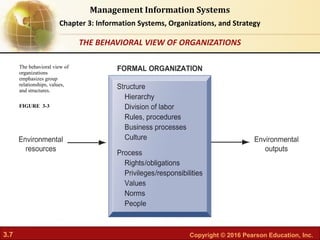
THE BEHAVIORAL VIEW OF ORGANIZATIONS
The behavioral view of
organizations
emphasizes group
relationships, values,
and structures.
FIGURE 3-3
3.8 Copyright © 2016 Pearson Education, Inc.
Management Information Systems
Chapter 3: Information Systems, Organizations, and Strategy
• Factores centrales de la organización que deben ser
considerados cuando se planea un nuevo sistema
de información:
– Ambiente
– Estructura (jerarquía, especialización, rutinas, procesos de
negocios)
– Cultura and políticas
– Tipo de organización y estilo de liderazgo
– Principales grupos de interés afectados por el sistema,
actitudes de los usuarios finales.
– Tareas, decisiones y procesos de negocios que el sistema
va a apoyar
3.9 Copyright © 2016 Pearson Education, Inc.
Management Information Systems
Chapter 3: Information Systems, Organizations, and Strategy
• Resistencia al cambio organizacional
– Los sistemas de información se atan a las politicas
de las organizaciones, dado que influencian el
acceso a los recursos o información clave.
– Los sistemas de información potencialmente
cambian la estructura de una organización, su
cultura, políticas y trabajo.
– La razón más común para el fracaso de grandess
proyectos, se relaciona con la resistencia
organizacional y política al cambio.
The Impact of Information Systems on Organizations
3.10 Copyright © 2016 Pearson Education, Inc.
Management Information Systems
Chapter 3: Information Systems, Organizations, and Strategy
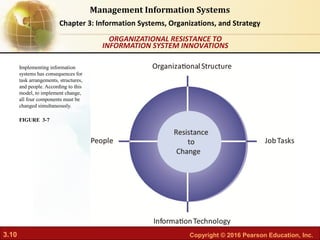
Implementing information
systems has consequences for
task arrangements, structures,
and people. According to this
model, to implement change,
all four components must be
changed simultaneously.
FIGURE 3-7
ORGANIZATIONAL RESISTANCE TO
INFORMATION SYSTEM INNOVATIONS
3.11 Copyright © 2016 Pearson Education, Inc.
Management Information Systems
Chapter 3: Information Systems, Organizations, and Strategy
Using Information Systems to Develop Competitive Strategies
• Existen 4 estrategias genéricas para
manejar las fuerzas competitivas,
habilitadas por el uso de TI
– Liderazgo en costos bajos
– Diferenciación del producto
– Focalización en un nicho de mercado
– Fortalecimiento de la relación con
clientes y proveedores
3.12 Copyright © 2016 Pearson Education, Inc.
Management Information Systems
Chapter 3: Information Systems, Organizations, and Strategy
• El impacto de internet en la ventaja
competitiva
– Tranformación o amenaza de algunas industrias.
• Ejemplos: Agencias de viaje, enciclopedias impresas.
– Las fuerzas competitivas actúan, pero la rivalidad es
más intensa.
– Estandares universales permiten el ingreso al
mercado de nuevos rivales.
– Nuevas oportunidades para construir marcas y bases
para elaltad del consumidor.
Using Information Systems to Develop Competitive Strategies
3.13 Copyright © 2016 Pearson Education, Inc.
Management Information Systems
Chapter 3: Information Systems, Organizations, and Strategy

Laudon mis14 cap3_español

  • 1.
    Sistemas de informaciónSistemasde información organizaciones y estrategiaorganizaciones y estrategia Capítulo 3
  • 2.
    3.2 Copyright ©2016 Pearson Education, Inc. Management Information Systems Chapter 3: Information Systems, Organizations, and Strategy • Problema: No tenían presencia online, fuertes competidores, inventario variable • Soluciones: – Desarrollo de proceso de ventas en línea – Experimento con ventas flash • Demuestra el rol central que tiene tecnología de información en la definición de estrategias competitivas Should T.J. Maxx Sell Online?
  • 3.
    3.3 Copyright ©2016 Pearson Education, Inc. Management Information Systems Chapter 3: Information Systems, Organizations, and Strategy Features of Organizations • La tecnología de información y las organizaciones se influencian una a la otra – La relación es compleja y está influenciada por características de la organización tales como: •Estructura •Procesos de negocios •Politica •Cultura •Ambiente y •Decisiones administrativas
  • 4.
    3.4 Copyright ©2016 Pearson Education, Inc. Management Information Systems Chapter 3: Information Systems, Organizations, and Strategy This complex two-way relationship is mediated by many factors, not the least of which are the decisions made —or not made—by managers. Other factors mediating the relationship include the organizational culture, structure, politics, business processes, and environment. FIGURE 3-1 THE TWO-WAY RELATIONSHIP BETWEEN ORGANIZATIONS AND INFORMATION TECHNOLOGY
  • 5.
    3.5 Copyright ©2016 Pearson Education, Inc. Management Information Systems Chapter 3: Information Systems, Organizations, and Strategy Features of Organizations • Qué es una organización? – Definición ténica: • Estructura social estable y formal que toma recursos del ambiente y los convierte en productos. • Una entidad legal con reglas y procedimientos internos, así como su propia estructura social. – Definición conductual: • Un compendio de derechos, privilegios, obligaciones y responsabilidades delicadamente balanceadas en un período de tiempo a través de la ocurrencia de conflictos y la resolución de los mismos.
  • 6.
    3.6 Copyright ©2016 Pearson Education, Inc. Management Information Systems Chapter 3: Information Systems, Organizations, and Strategy In the microeconomic definition of organizations, capital and labor (the primary production factors provided by the environment) are transformed by the firm through the production process into products and services (outputs to the environment). The products and services are consumed by the environment, which supplies additional capital and labor as inputs in the feedback loop. FIGURE 3-2 THE TECHNICAL MICROECONOMIC DEFINITION OF THE ORGANIZATION
  • 7.
    3.7 Copyright ©2016 Pearson Education, Inc. Management Information Systems Chapter 3: Information Systems, Organizations, and Strategy THE BEHAVIORAL VIEW OF ORGANIZATIONS The behavioral view of organizations emphasizes group relationships, values, and structures. FIGURE 3-3
  • 8.
    3.8 Copyright ©2016 Pearson Education, Inc. Management Information Systems Chapter 3: Information Systems, Organizations, and Strategy • Factores centrales de la organización que deben ser considerados cuando se planea un nuevo sistema de información: – Ambiente – Estructura (jerarquía, especialización, rutinas, procesos de negocios) – Cultura and políticas – Tipo de organización y estilo de liderazgo – Principales grupos de interés afectados por el sistema, actitudes de los usuarios finales. – Tareas, decisiones y procesos de negocios que el sistema va a apoyar
  • 9.
    3.9 Copyright ©2016 Pearson Education, Inc. Management Information Systems Chapter 3: Information Systems, Organizations, and Strategy • Resistencia al cambio organizacional – Los sistemas de información se atan a las politicas de las organizaciones, dado que influencian el acceso a los recursos o información clave. – Los sistemas de información potencialmente cambian la estructura de una organización, su cultura, políticas y trabajo. – La razón más común para el fracaso de grandess proyectos, se relaciona con la resistencia organizacional y política al cambio. The Impact of Information Systems on Organizations
  • 10.
    3.10 Copyright ©2016 Pearson Education, Inc. Management Information Systems Chapter 3: Information Systems, Organizations, and Strategy Implementing information systems has consequences for task arrangements, structures, and people. According to this model, to implement change, all four components must be changed simultaneously. FIGURE 3-7 ORGANIZATIONAL RESISTANCE TO INFORMATION SYSTEM INNOVATIONS
  • 11.
    3.11 Copyright ©2016 Pearson Education, Inc. Management Information Systems Chapter 3: Information Systems, Organizations, and Strategy Using Information Systems to Develop Competitive Strategies • Existen 4 estrategias genéricas para manejar las fuerzas competitivas, habilitadas por el uso de TI – Liderazgo en costos bajos – Diferenciación del producto – Focalización en un nicho de mercado – Fortalecimiento de la relación con clientes y proveedores
  • 12.
    3.12 Copyright ©2016 Pearson Education, Inc. Management Information Systems Chapter 3: Information Systems, Organizations, and Strategy • El impacto de internet en la ventaja competitiva – Tranformación o amenaza de algunas industrias. • Ejemplos: Agencias de viaje, enciclopedias impresas. – Las fuerzas competitivas actúan, pero la rivalidad es más intensa. – Estandares universales permiten el ingreso al mercado de nuevos rivales. – Nuevas oportunidades para construir marcas y bases para elaltad del consumidor. Using Information Systems to Develop Competitive Strategies
  • 13.
    3.13 Copyright ©2016 Pearson Education, Inc. Management Information Systems Chapter 3: Information Systems, Organizations, and Strategy

Notas del editor

  • #4 This concept was briefly discussed in Chapter 1. Figure 1-2 and 1-3 as well as the figure on the next slide, 3-1, display this interdependent relationship graphically.
  • #5 Ask students to explain how each factor might affect the relationship between organizations and information technology. Emphasize to students that the relationship between these two and its effects on the future of a business are difficult to predict. For example, very few people could have predicted the prominence of e-mail and instant messaging in business communication 15 years ago.
  • #6 Which of the two definitions do students find more accurate and why? It is important to consider both definitions rather than exclusively use one at the expense of the other. The two definitions are complementary.
  • #7 Ask students what are the inputs from the environment? What do organizations output (goods and services). In this view, the organization or business firm is rather easily changed, and malleable. The organization is a collection of parts, like a machine, that can be rearranged as needed. There are no humans in this model, or if there are, they are assumed to be relatively simple.
  • #8 In this view, the business firm is a little more difficult to change rapidly or on command because it is a very complex machine populated with human beings. Firms operate with an existing hierarchy, job definitions, business rules, legal contracts, procedures, and processes. Efficient organizations become very good at these elements of business. Changing these elements takes more time.
  • #10 Explain what is meant by changes in culture and politics of the firm. For example, workers may resist changes that disrupt their routines. Also explain to students that as important as technical understanding of information systems may be for potential managers, it is equally important to understand the people and organizational structures and customs affected by information systems.
  • #11 The circle shape in the figure represents the mutual relationship among the concepts shown.
  • #12 Here you can make a list of five well-known firms and then analyze with students the major thrust of their strategy. Walmart is a good example to start with because of its emphasis on low-cost leadership.
  • #13 Do students believe it is easier or harder to gain a competitive advantage via the Internet as opposed to more traditional means? Table 3-5 describes the impact of the Internet on various competitive forces.