4.1 Copyright © 2014 Pearson Education, Inc.
Aspectos éticos y sociales enAspectos éticos y sociales en
los sistemas de informaciónlos sistemas de información
Capítulo 4
4.2 Copyright © 2016 Pearson Education, Inc.
Management Information Systems
Chapter 4: Ethical and Social Issues in Information Systems
• Problema: Contenido pirata cuesta a la
economía de EEUU $58 billiones por año,
incluyendo pérdida de trabajos e impuestos.
• Soluciones: Algoritmos de motores de
búsqueda tratan de prevenir que aparezca
contenido pirata en las búsquedas
• Los rastreadores encuentran contenido pirata y
notifican a los usuarios del contenido.
• Nuevos productos y servicios que compiten
conla apelación de contenido pirata.
Content Pirates Sail the Web
4.3 Copyright © 2016 Pearson Education, Inc.
Management Information Systems
Chapter 4: Ethical and Social Issues in Information Systems
Ethical, Social, and Political Issues
• Sistemas de información y ética
– Los sistemas de información ocasionan que
emerjan nuevas interrogantes éticas pues
crean oportunidades para:
•Cambio social intenso, negociando la
distribución de las cuotas existentes, de
poder, dinero, derechos y obligaciones.
•Nuevas clases de crímenes
4.4 Copyright © 2016 Pearson Education, Inc.
Management Information Systems
Chapter 4: Ethical and Social Issues in Information Systems
The introduction of new
information technology has a
ripple effect, raising new
ethical, social, and political
issues that must be dealt with
on the individual, social, and
political levels. These issues
have five moral dimensions:
information rights and
obligations, property rights and
obligations, system quality,
quality of life, and
accountability and control.
Figure 4-1
THE RELATIONSHIP AMONG ETHICAL, SOCIAL, POLITICALTHE RELATIONSHIP AMONG ETHICAL, SOCIAL, POLITICAL
ISSUES IN AN INFORMATION SOCIETYISSUES IN AN INFORMATION SOCIETY
4.5 Copyright © 2016 Pearson Education, Inc.
Management Information Systems
Chapter 4: Ethical and Social Issues in Information Systems
Ethical, Social, and Political Issues
• 5 dimensiones morales de la era de la
información:
1. Derechos y obligaciones derivados de la
información
2. Derechos y obligaciones de propiedad
3. Rendición de cuentas y control
4. Calidad de la información
5. Calidad de vida
4.6 Copyright © 2016 Pearson Education, Inc.
Management Information Systems
Chapter 4: Ethical and Social Issues in Information Systems
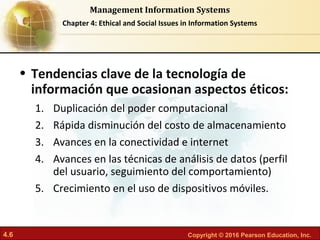
• Tendencias clave de la tecnología de
información que ocasionan aspectos éticos:
1. Duplicación del poder computacional
2. Rápida disminución del costo de almacenamiento
3. Avances en la conectividad e internet
4. Avances en las técnicas de análisis de datos (perfil
del usuario, seguimiento del comportamiento)
5. Crecimiento en el uso de dispositivos móviles.
4.7 Copyright © 2016 Pearson Education, Inc.
Management Information Systems
Chapter 4: Ethical and Social Issues in Information Systems
Principles to Guide Ethical Decisions
• Protección de la información personal
• Derechos de propiedad intelectual
• Rendimiento de cuentas, obligaciones y control
• Calidad de los sistemas
• Calidad de vida
• Cibercrimen
• Empleo
• Equidad y acceso
• Riesgos para la salud
4.8 Copyright © 2016 Pearson Education, Inc.
Management Information Systems
Chapter 4: Ethical and Social Issues in Information Systems
Trabajo en clase
Tecnología de Big Data se vuelve
personal: marketing dirigido en base
al comportamiento
Página 141

Laudon mis14 cap4_español

  • 1.
    4.1 Copyright ©2014 Pearson Education, Inc. Aspectos éticos y sociales enAspectos éticos y sociales en los sistemas de informaciónlos sistemas de información Capítulo 4
  • 2.
    4.2 Copyright ©2016 Pearson Education, Inc. Management Information Systems Chapter 4: Ethical and Social Issues in Information Systems • Problema: Contenido pirata cuesta a la economía de EEUU $58 billiones por año, incluyendo pérdida de trabajos e impuestos. • Soluciones: Algoritmos de motores de búsqueda tratan de prevenir que aparezca contenido pirata en las búsquedas • Los rastreadores encuentran contenido pirata y notifican a los usuarios del contenido. • Nuevos productos y servicios que compiten conla apelación de contenido pirata. Content Pirates Sail the Web
  • 3.
    4.3 Copyright ©2016 Pearson Education, Inc. Management Information Systems Chapter 4: Ethical and Social Issues in Information Systems Ethical, Social, and Political Issues • Sistemas de información y ética – Los sistemas de información ocasionan que emerjan nuevas interrogantes éticas pues crean oportunidades para: •Cambio social intenso, negociando la distribución de las cuotas existentes, de poder, dinero, derechos y obligaciones. •Nuevas clases de crímenes
  • 4.
    4.4 Copyright ©2016 Pearson Education, Inc. Management Information Systems Chapter 4: Ethical and Social Issues in Information Systems The introduction of new information technology has a ripple effect, raising new ethical, social, and political issues that must be dealt with on the individual, social, and political levels. These issues have five moral dimensions: information rights and obligations, property rights and obligations, system quality, quality of life, and accountability and control. Figure 4-1 THE RELATIONSHIP AMONG ETHICAL, SOCIAL, POLITICALTHE RELATIONSHIP AMONG ETHICAL, SOCIAL, POLITICAL ISSUES IN AN INFORMATION SOCIETYISSUES IN AN INFORMATION SOCIETY
  • 5.
    4.5 Copyright ©2016 Pearson Education, Inc. Management Information Systems Chapter 4: Ethical and Social Issues in Information Systems Ethical, Social, and Political Issues • 5 dimensiones morales de la era de la información: 1. Derechos y obligaciones derivados de la información 2. Derechos y obligaciones de propiedad 3. Rendición de cuentas y control 4. Calidad de la información 5. Calidad de vida
  • 6.
    4.6 Copyright ©2016 Pearson Education, Inc. Management Information Systems Chapter 4: Ethical and Social Issues in Information Systems • Tendencias clave de la tecnología de información que ocasionan aspectos éticos: 1. Duplicación del poder computacional 2. Rápida disminución del costo de almacenamiento 3. Avances en la conectividad e internet 4. Avances en las técnicas de análisis de datos (perfil del usuario, seguimiento del comportamiento) 5. Crecimiento en el uso de dispositivos móviles.
  • 7.
    4.7 Copyright ©2016 Pearson Education, Inc. Management Information Systems Chapter 4: Ethical and Social Issues in Information Systems Principles to Guide Ethical Decisions • Protección de la información personal • Derechos de propiedad intelectual • Rendimiento de cuentas, obligaciones y control • Calidad de los sistemas • Calidad de vida • Cibercrimen • Empleo • Equidad y acceso • Riesgos para la salud
  • 8.
    4.8 Copyright ©2016 Pearson Education, Inc. Management Information Systems Chapter 4: Ethical and Social Issues in Information Systems Trabajo en clase Tecnología de Big Data se vuelve personal: marketing dirigido en base al comportamiento Página 141

Notas del editor

  • #3 Ask students if they know they are tracked on the Web. Would they like to know what information companies such as Google have about them? Do they feel comfortable that they can control and manage their online personal information, or, do they feel they have no control over this information? Ask students to imagine that, when they turn on their televisions to watch a show, more than one hundred cameras are activated inside the TV watching their every move, comment, and of course what show they are watching. Many Web sites today have more than one hundred tracking programs (“bugs”) on their home page.
  • #4 Ask students to describe some of the ethical dilemmas that are presented by information systems and new developments in technology. Privacy is an important issue—mention the opening case again and explain that the business models of Google, Facebook, and many other sites depend on getting users to give up their personal information so it can be used to market and sell them products.
  • #5 Explain to students that the graphic displays the five moral dimensions listed in the caption. Consider online P2P bit torrent shared music as an example of how a new technology has ethical, social, and eventually political (legal) ramifications. If music can be ripped off, why pay any money for it? Why should anyone care about record labels or artist’s income?
  • #6 Which of these trends do students believe might have the most adverse consequences? Why do they feel this way? Do the positives outweigh the negatives for all four issues? Why or why not?
  • #8 Explain that information systems do not exist in a vacuum and that these concepts are instrumental in understanding the impact of systems and measuring their success. Ask students why liability and due process are such important ethical concepts? (A rough answer would be that they provide recourse to individuals negatively effected by mismanagement of information systems, providing incentive to “play by the rules”.)