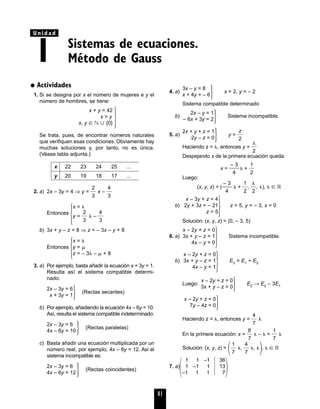
● Actividades
1. Si se designa por x el número de mujeres e y el
número de hombres, se tiene:
·
Se trata, pues, de encontrar números naturales
que verifiquen esas condiciones. Obviamente hay
muchas soluciones y, por tanto, no es única.
(Véase tabla adjunta.)
x 22 23 24 25 ...
y 20 19 18 17 ...
2. a) 2x – 3y = 4 ⇒ y = ᎏ
2
3
ᎏ x – ᎏ
4
3
ᎏ
Entonces
Ά
b) 3x + y – z = 8 ⇒ z = – 3x – y + 8
Entonces
Ά
3. a) Por ejemplo, basta añadir la ecuación x + 3y = 1.
Resulta así el sistema compatible determi-
nado:
· (Rectas secantes)
b) Por ejemplo, añadiendo la ecuación 4x – 6y = 10.
Así, resulta el sistema compatible indeterminado:
· (Rectas paralelas)
c) Basta añadir una ecuación multiplicada por un
número real, por ejemplo, 4x – 6y = 12. Así el
sistema incompatible es:
· (Rectas coincidentes)
4. a)
· x = 2, y = – 2
Sistema compatible determinado
b)
· Sistema incompatible.
5. a)
· y = ᎏ
2
z
ᎏ
Haciendo z = ␭, entonces y = ᎏ
2
␭
ᎏ
Despejando x de la primera ecuación queda:
x = ᎏ
–
4
3
ᎏ␭ + ᎏ
2
1
ᎏ
Luego:
(x, y, z) = (ᎏ
–
4
3
ᎏ ␭ + ᎏ
1
2
ᎏ, ᎏ
␭
2
ᎏ, ␭), ␭ ʦ ‫ޒ‬
b)
· z = 5, y = – 3, x = 0
Solución: (x, y, z) = (0, – 3, 5)
6. a)
· Sistema incompatible.
b)
· E3
= E1
+ E2
Luego:
· E2
→ E2
– 3E1
·
Haciendo z = ␭, entonces y = ᎏ
4
7
ᎏ ␭
En la primera ecuación: x = ᎏ
8
7
ᎏ ␭ – ␭ = ᎏ
1
7
ᎏ ␭
Solución: (x, y, z) =
΂ᎏ
1
7
ᎏ ␭, ᎏ
4
7
ᎏ ␭, ␭
΃, ␭ ʦ ‫ޒ‬
7. a)
΂ ΃
1 1 –1 36
1 –1 1 13
–1 1 1 7
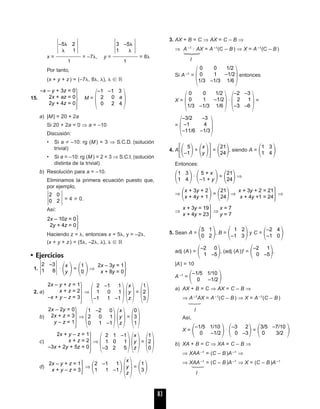
x – 2y + z = 0
7y – 4z = 0
x – 2y + z = 0
3x + y – z = 0
x – 2y + z = 0
3x + y – z = 1
4x – y = 1
x – 2y + z = 0
3x + y – z = 1
4x – y = 0
x – 3y + z = 4
2y + 3z = – 21
z = 5
2x + y + z = 1
2y – z = 0
2x – y = 1
– 6x + 3y = 2
3x – y = 8
x + 4y = – 6
2x – 3y = 6
4x – 6y = 12
2x – 3y = 6
4x – 6y = 10
2x – 3y = 6
x + 3y = 1
x = ␭
y = ␮
z = – 3␭ – ␮ + 8
x = ␭
y = ᎏ
2
3
ᎏ ␭ – ᎏ
4
3
ᎏ
x + y = 42
x > y
x, y ʦ ‫ގ‬ ʜ {0}
41
Sistemas de ecuaciones.
Método de Gauss
Unidad
1
01_unidades 1 a 3 25/5/04 12:17 Página 41
F2 → F2 – F1; F3 → F3 + F1
΂ ΃
· (x, y, z) =
΂ᎏ
4
2
9
ᎏ, ᎏ
4
2
3
ᎏ, 10
΃
Sistema compatible determinado.
b)
΂ ΃
F2
→ F2
– 2F1
; F3
→ F3
– F1
΂ ΃
F3
→ F3
– F2
΂ ΃
· Sistema compatible
indeterminado
Solución: (x, y, z) = (2␭ – 1, ␭ + 1, ␭), ␭ ʦ ‫ޒ‬
8. a)
΂ ΃
F2
→ F2
– 2F1
; F3
→ F3
– 3F1
΂ ΃
· (x, y, z) = (1, 1, 1)
Sistema compatible determinado.
b)
΂ ΃ F1 ↔ F2
΂ ΃
F2 → F2 – 2F1
΂ ΃
F3 → F3 – 5F2
΂ ΃ ·
Solución: (x, y, z) = (1, 3, 5)
Sistema compatible determinado.
9. a)
΂ ΃ F3
→ F3
– F1
΂ ΃
F3 → F3 + 2F2
΂ ΃ ·
(x, y, z) = (8, – 6, 9)
Sistema compatible determinado.
b) Sí, por ejemplo, añadiendo una ecuación que
sea suma de las dos primeras.
E3
′ = E1
+ E2
Esto es:
·
(x, y, z) = (␭ – 1, –␭ + 3, ␭), ␭ ʦ ‫ޒ‬
10. a)
΂ ΃ F1 ↔ F2
΂ ΃
F2 → F2 – 2F1
F3
→ F3
– F1
΂ ΃ F3 → F3 – F2
΂ ΃ ·
Sistema incompatible.
x – 3y – 2z = 3
5y + 5z = –8
0 = 4
1 –3 –2 3
0 5 5 –8
0 0 0 4
1 –3 –2 3
0 5 5 –8
0 5 5 –4
1 –3 –2 3
2 –1 1 –2
1 2 3 –1
2 –1 1 –2
1 –3 –2 3
1 2 3 –1
x + y = 2
y + z = 3
x + 2y + z = 5
x + y = 2
y + z = 3
z = 9
1 1 0 2
0 1 1 3
0 0 1 9
1 1 0 2
0 1 1 3
0 –2 –1 3
1 1 0 2
0 1 1 3
1 –1 –1 5
x + 3z = 16
y – 6z = –27
29z = 145
1 0 3 16
0 1 –6 –27
0 0 29 145
1 0 3 16
0 1 –6 –27
0 5 –1 10
1 0 3 16
2 1 0 5
0 5 –1 10
2 1 0 5
1 0 3 16
0 5 –1 10
x + 2y + z = 4
3y – 3z = 0
–11y = –11
1 2 1 4
0 3 –3 0
0 –11 0 –11
1 2 1 4
2 7 –1 8
3 –5 3 1
x + 2y – 4z = 1
–3y + 3z = –3
1 2 –4 1
0 –3 3 –3
0 0 0 0
1 2 –4 1
0 –3 3 –3
0 –3 3 –3
1 2 –4 1
2 1 –5 –1
1 –1 –1 –2
x + y – z = 36
–2y + 2z = –23
2y = 43
1 1 –1 36
0 –2 2 –23
0 2 0 43
42
01_unidades 1 a 3 25/5/04 12:17 Página 42
43
b)
΂ ΃
F2
→ F2
– 3F1
F3 → F3 – 5F1
΂ ΃
·
Sistema compatible indeterminado.
(x, y, z) =
΂ᎏ
1
5
ᎏ, ␭ + ᎏ
1
5
ᎏ, ␭
΃, ␭ ʦ ‫ޒ‬
11. No es necesario. Por ejemplo, el sistema de la
actividad 10 b).
12.
΂ ΃ F1 ↔ F2 ΂ ΃
F2
→ F2
– 3F1 ΂ ΃
·
Sistema compatible indeterminado.
(x, y, z) =
΂ᎏ
7
2
ᎏ ␭ + ᎏ
3
2
ᎏ, ᎏ
5
2
ᎏ ␭ + ᎏ
9
4
ᎏ, ␭
΃, ␭ ʦ ‫ޒ‬
13. Por ejemplo, el sistema de la actividad 10 a).
· Es un sistema incompatible.
Suprimiendo la tercera ecuación:
·
Resulta un sistema compatible indeterminado.
14. a)
΂ ΃ F1 ↔ F2
΂ ΃ F3 = F3 – 2F1
F4 = F4 – 3F1
΂ ΃ F3
= 2F3
+ 7F2
F4
= 2F4
+ 5F2
΂ ΃ F4
= F4
– F3
΂ ΃
b)
΂ ΃ F3 ↔ F1
΂ ΃
΂ ΃ Sistema incompatible.
15. a) Sistema incompatible.
b) Sistema compatible determinado:
(x, y, z) =
΂–ᎏ
1
2
ᎏ, ᎏ
5
8
ᎏ, ᎏ
1
2
ᎏ
΃
c) Sistema compatible indeterminado:
(x, y, z) = (–4␭ + 2, ␭, –4␭+ 3), ␭ ʦ ‫ޒ‬
d) Sistema compatible indeterminado:
(x, y, z, w) = (–␭ – 2␮ + 5, ␮, – 3␭ + 4, ␭),
␭, ␮ ʦ ‫ޒ‬
e) Sistema incompatible.
f) Sistema compatible determinado:
(x, y, z, w) = (1, 0, 1, 1)
g) Sistema compatible determinado:
(x, y) = (–1, 2)
h) Sistema incompatible.
1 2 3 11
0 –6 –7 –20
0 –7 –11 –21
0 –6 –7 –33
F2
→ F2
– 2F1
F3
→ F3
– 3F1
F4
→ F4
– 3F1
1 2 3 11
2 –2 –1 2
3 –1 –2 12
3 0 2 0
3 –1 –2 12
2 –2 –1 2
1 2 3 11
3 0 2 0
2 2 3 2 –2
0 2 0 1 0
0 0 –12 1 –6
0 0 0 –39/2 15
30
ᎏ
12
2 2 3 2 –2
0 2 0 1 0
0 0 –12 1 –6
0 0 –30 –17 0
2 2 3 2 –2
0 2 0 1 0
0 –7 –6 –3 –3
0 –5 –15 –11 0
2 2 3 2 –2
0 2 0 1 0
4 –3 0 1 –7
6 1 –6 –5 –6
0 2 0 1 0
2 2 3 2 –2
4 –3 0 1 –7
6 1 –6 –5 6
2x – y + z = –2
x – 3y – 2z = 3
2x – y + z = –2
x – 3y – 2z = 3
x + 2y + 3z = –1
x + 2y – 3z = 6
–8y + 10z = –18
1 2 –3 6
0 –8 10 –18
1 2 –3 6
3 –2 1 0
3 –2 1 0
1 2 –3 6
x – y + z = 0
5y – 5z = 1
1 –1 1 0
0 5 –5 1
0 5 –5 1
1 –1 1 0
3 2 –2 1
5 0 0 1
01_unidades 1 a 3 25/5/04 12:17 Página 43
16. a)
΂ ΃ F1
↔ F2
΂ ΃ F2
→ F2
– 2F1
F3
→ F3
– 2F1
΂ ΃ F3
→ F3
– ᎏ
5
3
ᎏ F2
΂ ΃
Solución trivial:
x = 0; y = 0; z = 0
b)
΂ ΃ F2 → F2 – 3F1
F3 → F3 – F1
΂ ΃ F3
→ F3
– ᎏ
1
2
ᎏ F2
΂ ΃
(x, y, z) = (2␭, –3␭, 5␭), ␭ ʦ ‫ޒ‬
Solución distinta de la trivial.
17. No es posible.
18.
΂ ΃ F2 → F2 – 2F1
F3 → F3 – 5F1
΂ ΃ F3 → F3 – 2F2
΂ ΃
·
• Si a 8: sistema compatible determinado.
• Si a = 8: sistema compatible indeterminado.
Resolución para a = 0
(x, y, z) =
΂ᎏ
2
3
ᎏ, ᎏ
2
3
ᎏ, 0
΃
● Ejercicios
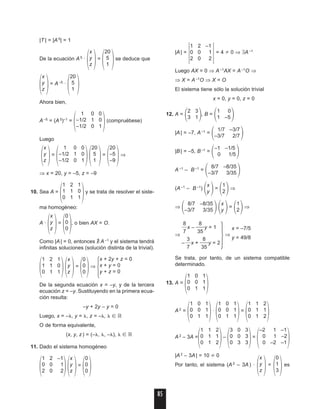
1. 2x + 3y – 2z = 1
Haciendo z = ␭, y = ␮, entonces x = ␭ – ᎏ
3
2
ᎏ ␮ + ᎏ
1
2
ᎏ
(x, y, z) = (␭ – ᎏ
3
2
ᎏ ␮ + ᎏ
1
2
ᎏ, ␮, ␭), ␭, ␮ ʦ ‫ޒ‬
Para encontrar tres puntos del plano basta dar
valores a los parámetros ␭ y ␮. Así:
␭ = 0, ␮ = 0 ⇒ (1/2, 0, 0)
␭ = 1, ␮ = 0 ⇒ (3/2, 0, 1)
␭ = 0, ␮ = 1 ⇒ (–1, 1, 0)
Sin embargo, para hallar tres puntos que no perte-
nezcan se deben dar valores a ␭ y ␮ que no cum-
plan la solución. Por ejemplo: (3, 0, 0), (2, 0, 1) y
(0, 1, 0).
2. a)
΂ ΃ F1
↔ F2
΂ ΃ F2
→ F2
– 2F1
F3
→ F3
– 5F1
΂ ΃ F3
→ F3
– F2
΂ ΃
· x = 0, y = 1, z = 2
Sistema compatible determinado.
b)
΂ ΃ F2
→ F2
– F1
F3
→ F3
– 3F1
1 –1 –1 0
1 4 2 1
3 7 3 2
x + 3y – z = 1
–7y + 3z = –1
ᎏ
2
7
5
ᎏz = ᎏ
5
7
0
ᎏ
1 3 –1 1
0 –7 3 –1
0 0 ᎏ
2
7
5
ᎏ ᎏ
5
7
0
ᎏ
22
ᎏ
7
1 3 –1 1
0 –7 3 –1
0 –22 13 4
1 3 –1 1
2 –1 1 1
5 –7 8 9
2 –1 1 1
1 3 –1 1
5 –7 8 9
x + 2y + 2z = 2
–3y – z = –2
(a – 8)z = 0
1 1 2 2
0 –3 –1 –2
0 0 a – 8 0
1 1 2 2
0 –3 –1 –2
0 –6 a – 10 –4
1 1 2 2
2 –1 3 2
5 –1 a 6
1 –1 –1 0
0 10 6 0
0 0 0 0
1 –1 –1 0
0 10 6 0
0 5 3 0
1 –1 –1 0
3 7 3 0
1 4 2 0
1 2 1 0
0 –3 –3 0
0 0 6 0
1 2 1 0
0 –3 –3 0
0 –5 1 0
1 2 1 0
2 1 –1 0
2 –1 3 0
2 1 –1 0
1 2 1 0
2 –1 3 0
44
01_unidades 1 a 3 25/5/04 12:17 Página 44
΂ ΃ F3
→ F3
– 2F2
΂ ΃ ·
(x, y, z) =
΂ , , ␭
΃, ␭ ʦ ‫ޒ‬
Sistema compatible indeterminado.
3.
΂ ΃ F1
↔ F3
΂ ΃ F2 → F2 – 4F1
F3 → F3 – 2F1
΂ ΃
· Sistema compatible indeterminado.
(x, y, z) = (–␭ + 1, ␭ – 1, ␭), ␭ ʦ ‫ޒ‬
4.
· E2
→ E2
– 2E1 ·
x = ᎏ
1
7
ᎏ, y = ᎏ
7
3
ᎏ
El sistema dado es compatible determinado.
Sí es posible. Basta añadir una ecuación que verifi-
que la solución del sistema propuesto. Por ejemplo:
3x + 2y = 3 · ᎏ
1
7
ᎏ + 2 · ᎏ
3
7
ᎏ = ᎏ
7
9
ᎏ
Así,
3x + 2y = ᎏ
9
7
ᎏ ⇔ 21x + 14y = 9
5.
·
Sistema compatible determinado con solución:
x = 2, y = 2.
a) Basta con añadir una ecuación que no verifique
la solución anterior. Por ejemplo:
x + 2y =7
b) No es posible.
6. a)
΂ ΃ F2
→ F2
– F1
F3
→ F3
– F1
΂ ΃ F3 → F3 – ᎏ
3
4
ᎏF2
΂ ΃
·
(x, y, z) = (–2, 0, 7)
Sistema compatible determinado.
b) No, porque si se elimina una ecuación el siste-
ma resultante sería compatible indeterminado.
7. a)
΂ ΃ F2
→ F2
– F1
F3
→ F3
– 2F1
΂ ΃ F2 → F3
΂ ΃
· (x, y, z) = (0, 0, 0)
Solución trivial.
b)
΂ ΃ F2
→ F2
– F1
F3
→ F3
– 3F1
΂ ΃ F3 → F3 – 2F2
΂ ΃ ·
(x, y, z) = (␭, 2␭, ␭), ␭ ʦ ‫ޒ‬
Sistema compatible indeterminado o con solu-
ción distinta de la trivial.
x + y – 3z = 1
– y + 2z = 0
1 1 –3 0
0 –1 2 0
0 0 0 0
1 1 –3 0
0 –1 2 0
0 –2 6 0
1 1 –3 0
1 0 –1 0
3 1 –3 0
x – y + z = 0
5y – 3z = 0
y = 0
1 –1 1 0
0 5 –3 0
0 1 0 0
1 –1 1 0
0 1 0 0
0 5 –3 0
1 –1 1 0
1 0 1 0
2 3 –1 0
x = –2
y = 0
z = 7
x – 9y + 5z = 33
8y – 4z = –28
–3z = –21
1 –9 5 33
0 8 –4 –28
0 0 –3 –21
1 –9 5 33
0 8 –4 –28
0 6 –6 –42
1 –9 5 33
1 –1 1 5
1 –3 –1 –9
x + y = 4
x – y = 0
x + 2y = 1
– 7y = –3
x + 2y = 1
2x – 3y = –1
x + z = 1
– y + z = 1
1 0 1 1
0 –1 1 1
1 –1 1 1
1 0 1 1
4 –1 5 5
2 –1 3 3
2 –1 3 3
4 –1 5 5
1 0 1 1
–3␭ + 1
ᎏ
5
2␭ + 1
ᎏ
5
x – y – z = 0
5y + 3z = 1
1 –1 –1 0
0 5 3 1
0 0 0 0
1 –1 –1 0
0 5 3 1
0 10 6 2
45
01_unidades 1 a 3 25/5/04 12:17 Página 45
8.
΂ ΃ F2
→ F2
– 3F1
΂ ΃ ·
(x, y, z) = (␭, 5␭, 11␭), ␭ ʦ ‫ޒ‬
Sistema con solución distinta de la trivial.
9.
΂ ΃ F2
→ F2
– 2F1
΂ ΃ ·
(x, y, z, w) = (␭ – ␮, ␮, ␭, 0), ␭, ␮ ʦ ‫ޒ‬
Sistema compatible indeterminado dependiente
de 2 parámetros.
10. Sí, es posible.
11. Sí, por ejemplo:
·
΂ ΃ F2
→ F2
– F1
΂ ΃ ·
Sistema incompatible de 2 ecuaciones y 4 incógni-
tas.
12. Sí, por ejemplo:
·Sistema compatible indeterminado.
Eliminando la tercera ecuación resulta:
· Sistema incompatible.
13. x4
+ ax2
+ bx + c = 0
·⇒
⇒
·
La ecuación propuesta es:
x4
– 15x2
+ 10x + 24 = 0
La otra raíz es x = 3
14.
· ΂ ΃ F2
→ F2
– ᎏ
2
3
ᎏF1
΂ ΃
·
El sistema tiene solución única si: 5 – ᎏ
2
3
ᎏ m 0. Es
decir:
m ᎏ
1
2
5
ᎏ
15.
· ΂ ΃
F2
→ F2
– ᎏ
4
5
ᎏF1
΂ ΃
·
El sistema no tiene solución si: 6 – 3k = 0.
Esto es: k = 2.
16.
· ΂ ΃ F1
↔ F2
΂ ΃ F2
→ F2
– ᎏ
2k
1
–
5
1
ᎏ F1
΂ ΃
·
El sistema tendrá infinitas soluciones si:
·
Esto es: si k = 8.
Así, quedaría sólo la ecuación 15x + 8y = 6
Haciendo y = ␭, x = ᎏ
6 –
15
8␭
ᎏ
(x, y) =
΂ᎏ
–8␭
15
+ 6
ᎏ, ␭
΃, ␭ ʦ ‫ޒ‬
–k + 8 = 0
96 – 12k = 0
15x + 8y = 6
(–k + 8)y = 96 – 12k
15 8 6
0 ᎏ
–k
1
+
5
8
ᎏ ᎏ
96
1
–
5
12k
ᎏ
15 8 6
2k – 1 k 6
2k – 1 k 6
15 8 6
(2k – 1)x + ky = 6
15x + 8y = 6
(1 + 2k)x + 5y = 7
(6 – 3k)x = 12
1 + 2k 5 7
ᎏ
6 –
5
3k
ᎏ 0 ᎏ
1
5
2
ᎏ
1 + 2k 5 7
2 + k 4 8
(1 + 2k)x + 5y = 7
(2 + k)x + 4y = 8
3x + my = 5 + m
(5 – ᎏ
2
3
ᎏ m)y = ᎏ
1
3
4
ᎏ – ᎏ
2
3
ᎏ m
3 m 5 + m
0 5 – ᎏ
2
3
ᎏ m ᎏ
1
3
4
ᎏ – ᎏ
2
3
ᎏ m
3 m 5
2 5 8
3x + my = 5
2x + 5y = 8
a = –15
b = 10
c = 24
16a – 4b + c = –256
a – b + c = –1
4a + 2b + c = –16
x = –4 ⇒ 256 + 16a – 4b + c = 0
x = –1 ⇒ 1 + a – b + c = 0
x = 2 ⇒ 16 + 4a + 2b + c = 0
x + y = 1
2x + 2y = 0
x + y = 1
2x + 2y = 0
3x + 3y = 2
2x + 3y + 4z + 2w = 1
0 = 1
2 3 4 2 1
0 0 0 0 1
2 3 4 2 1
2 2 4 2 2
2x + 3y + 4z + 2w = 1
2x + 3y + 4z + 2w = 2
x + y – z + w = 0
–3w = 0
1 1 –1 1 0
0 0 0 –3 0
1 1 –1 1 0
2 2 –2 –1 0
x + 2y – z = 0
–11y + 5z = 0
1 2 –1 0
0 –11 5 0
1 2 –1 0
3 –5 2 0
46
01_unidades 1 a 3 25/5/04 12:17 Página 46
17.
· ΂ ΃
F1
↔ F2
΂ ΃
΂ ΃
΂ ΃
·
El sistema tendrá solución distinta de la trivial si:
k – 5 = 0, es decir, k = 5.
18. a)
·
΂ ΃ F3 → F3 – F2
΂ ΃ ·
k2
– 1 = 0 ⇒ k = ±1
k + 1 = 0 ⇒ k = –1
Estudio:
• Si k = –1, queda el sistema:
·
que es compatible indeterminado depen-
diente de 1 parámetro.
• Si k = 1, el sistema
·es incompatible.
b) Si k = –1,
·
(x, y, z) = (–7␭ – 1, 2␭, ␭), ␭ ʦ ‫ޒ‬
Sistema compatible indeterminado.
19.
· ΂ ΃
F2
↔ F1
΂ ΃
΂ ΃ F3
→ F3
– F2
΂ ΃ ·
El sistema tendrá infinitas soluciones si: a – 4 = 0
⇒ a = 4.
Así, resulta el sistema:
·
(x, y, z) = (␭, –7␭ + 1, –17␭ + 4), ␭ ʦ ‫ޒ‬
20.
· ΂ ΃
΂ ΃
F3 → F3 + ᎏ
k +
4
1
ᎏ F2
΂ ΃ ·
El sistema tendrá infinitas soluciones si: k2+ k = 0
⇒ k(k + 1) = 0 ⇒ k = 0 o k = –1.
21.
· ΂ ΃
΂ ΃ F3 → F3 – ᎏ
3
5
ᎏ F2
΂ ΃
1 2 3
0 –5 –2
0 0 m – ᎏ
2
5
4
ᎏ
1 2 3
0 –5 –2
0 –3 m – 6
F2
→ F2
– F1
F3 → F3 – 2F1
1 2 3
1 –3 1
2 1 m
x + 2y = 3
x – 3y = 1
2x + y = m
x – y + kz = 0
4y – (4 + 4k)z = 0
–(k 2
+ k)z = 0
1 –1 k 0
0 4 –4 – 4k 0
0 0 –k2
– k 0
1 –1 k 0
0 4 –4 – 4k 0
0 –k – 1 –1 + k 0
F2
→ F2
– 4F1
F3
→ F3
+ F1
1 –1 k 0
4 0 –4 0
–1 –k –1 0
x – y + kz = 0
4x – 4z = 0
–x – ky – z = 0
3x – 2y + z = 2
7x + y = 1
3x – 2y + z = 2
7x + y = 1
(a – 4)x = 0
3 –1 1 2
7 1 0 1
a – 4 0 0 0
3 –1 1 2
7 1 0 1
a + 3 1 0 1
F2
→ F2
+ 2F1
F3 → F3 + F1
3 –1 1 2
1 3 –2 –3
a 2 –1 –1
1 3 –2 –3
3 –1 1 2
a 2 –1 –1
x + 3y – 2z = –3
3x – y + z = 2
ax + 2y – z = – 1
x + 2y + 3z = –1
y – 2z = 0
x + 2y + 3z = –1
y – 2z = 0
0 = 2
x + 2y + 3z = –1
y – 2z = 0
x + 2y + 3z = –1
y – 2z = 0
(k 2
– 1)z = k + 1
1 2 3 –1
0 1 –2 0
0 0 k2
– 1 k + 1
1 2 3 –1
0 1 –2 0
0 1 k2
– 3 k + 1
F2
→ F2
– 2F1
F3 → F3 – F1
x + 2y + 3z = –1
2x + 5y + 4z = –2
x + 3y + k 2
z = k
x + 2y – 3z = 0
–8y + 10z = 0
(k – 5)z = 0
1 2 –3 0
0 –8 10 0
0 0 ᎏ
k –
2
5
ᎏ 0
F3
→ F3
+ ᎏ
–14
8
–2k
ᎏ F2
1 2 –3 0
0 –8 10 0
0 –14 – 2k 15 + 3k 0
F2 → F2 – 3F1
F3
→ F3
– kF1
1 2 –3 0
3 –2 1 0
k –14 15 0
3 –2 1 0
1 2 –3 0
k –14 15 0
3x – 2y + z = 0
x + 2y – 3z = 0
kx – 14y + 15z = 0
47
01_unidades 1 a 3 25/5/04 12:17 Página 47
• Si m = ᎏ
2
5
4
ᎏ, el sistema es compatible determina-
do con solución (x, y) =
΂ᎏ
1
5
1
ᎏ, ᎏ
2
5
ᎏ
΃
• Si m el sistema es incompatible.
22.
· ΂ ΃
F2 → F2 – F1 ΂ ΃
·
• Si k = 2, resulta el sistema:
·,
que es compatible indeterminado.
(x, y, z) = (–2␭, ␭, 0), ␭ ʦ ‫ޒ‬
• Si k 2, resulta el sistema:
·,
que también es compatible indeterminado.
(x, y, z) =
΂ , , ␭
΃␭ ʦ ‫ޒ‬
En resumen, ∀k ʦ ‫ޒ‬ el sistema es compatible
indeterminado, o sea, con solución distinta de la
trivial.
23. a) Nunca.
b) Sí. Por ejemplo:
·
c) Sí. Por ejemplo:
·
24.
·
a) M =
΂ ΃= M*
|M | = 1 – 1 – k + k = 0
Έ Έ= 1 0 ·⇒ rg (M) = 2, ∀k ʦ ‫ޒ‬
Έ Έ = k + k – k2 – k = –k2 + k =
= k(–k + 1) = 0 ⇒ k = 0 y k = 1
• Si k = 0 o k = 1: rg (M) = rg (M*) = 2 < 3 ⇒
⇒ Sistema compatible indeterminado (infini-
tas soluciones).
• Si k 0 y k 1: rg (M) = 2 y rg (M*) = 3 ⇒
⇒ Sistema incompatible (no tiene solución).
b) • Si k = 0, resulta el siguiente sistema homo-
géneo:
· (x, y, z) = (–␭, ␭, ␭), ␭ ʦ ‫ޒ‬
• Si k = 1, queda el siguiente sistema:
· ⇔
·
(x, y, z) = (–2␭, ␭ + 1, ␭), ␭ ʦ ‫ޒ‬
25.
· ΂ ΃ F2
→ F2
– F1
F3
→ F3
– kF1
΂ ΃ F3 → F3 – ᎏ
8 –
4
3k
ᎏ F2
΂ ΃
Si – 12 + 4k = 0, es decir, k = 3 el sistema es
compatible determinado con solución (x, y ) =
= (–4, 2).
26.
· ΂ ΃
F2
→ F2
– F1
F3 → F3 + F1
΂ ΃ ·
x – y + z = a
2y – 2z = b – a
2z = a + c
1 –1 1 a
0 2 –2 b – a
0 0 2 a + c
1 –1 1 a
1 1 –1 b
–1 1 1 c
x – y + z = a
x +y – z = b
–x + y + z = c
1 3 2
0 4 8
0 0 –12 + 4k
1 3 2
0 4 8
0 8 – 3k 4 – 2k
1 3 2
1 7 10
k 8 4
x + 3y = 2
x + 7y = 10
kx + 8y = 4
x + y + z = 1
y – z = 1
x + y + z = 1
y – z = 1
x + y + z = 1
x + y = 0
y – z = 0
x + z = 0
1 1 k2
0 1 k
1 k k
1 1
0 1
1 1 k k2
0 1 –1 k
1 k 1 k
x + y + kz = k2
y – z = k
x + ky + z = k
x + y + z = 1
2x + 2y + 2z = 3
x + y + z = 1
2x + y – z = 2
–2␭
ᎏ
k – 2
(k + 2)␭
ᎏ
k – 2
x + 2y – z = 0
(k – 2)y + 2z = 0
x + 2y – z = 0
2z = 0
x + 2y – z = 0
(k – 2)y + 2z = 0
1 2 –1 0
0 k – 2 2 0
1 2 –1 0
1 k 1 0
x + 2y – z = 0
x + ky + z = 0
24
ᎏ
5
48
01_unidades 1 a 3 25/5/04 12:17 Página 48
x = ᎏ
a +
2
b
ᎏ, y = ᎏ
b
2
+ c
ᎏ, z = ᎏ
a
2
+ c
ᎏ
Sistema compatible determinado ∀a, b, c ʦ ‫.ޒ‬
• Problemas
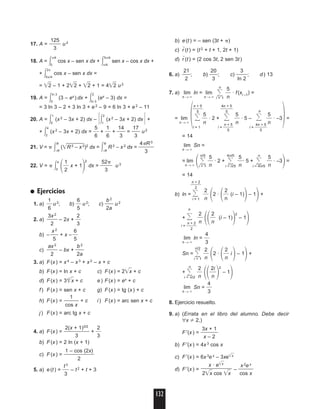
1. Se designa por x, y, z los números mayor, media-
no y menor, respectivamente. Entonces:
· ⇔
·
΂ ΃ F2 → F2 – F1
F3 → F3 – F1
΂ ΃
·
Los números pedidos son 16, 14 y 10.
2. x = Número de localidades del patio de butacas
vendidas.
y = Número de localidades de entresuelo vendi-
das.
z = Número de localidades de palco vendidas.
Así:
·⇔
⇔
·
΂ ΃ F2 → F2 – 10F1
F3 → F3 – 5F1
΂ ΃ ·
x = 100, y = 210, z = 190
Se vendieron, pues, 100 butacas de patio, 210 de
entresuelo y 190 de palco.
3. x = litros de la solución que contienen el 15% de
ácido sulfúrico.
y = litros de la solución que contienen el 25% de
ácido sulfúrico.
z = litros de la solución que contienen el 50% de
ácido sulfúrico.
Así, se tiene:
·⇔
⇔
·
΂ ΃ F2
→ F2
+ 5F1
΂ ΃
·
Sistema compatible indeterminado
(x, y, z) =
΂ᎏ
5
2
ᎏ␭ – 150, ᎏ
–
2
7
ᎏ ␭ + 250, ␭
΃
Como el número de libros ha de ser mayor o igual
que cero, se debe exigir que:
·
␭ у 0
4. x = euros invertidos en Letras del Tesoro.
y = euros invertidos en Bonos.
z = euros invertidos en Obligaciones.
Entonces:
·⇔
⇔
·
x + y + z = 10000
3x + 5y + 4z = 42500
x + y – 3z = 0
x + y + z = 10000
0,03x + 0,05y + 0,04z = 425
x + y = 3z
60 р ␭ р ᎏ
5
7
00
ᎏ
ᎏ
5
2
ᎏ␭ – 150 у 0 ⇒ ␭ у 60
ᎏ
–
2
7
ᎏ␭ + 250 у 0 ⇒ ␭ р ᎏ
50
7
0
ᎏ
x + y + z = 100
2y + 7z = 500
1 1 1 100
0 2 7 500
1 1 1 100
–5 –3 2 0
x + y + z = 100
–5x – 3y + 2z = 0
x + y + z = 100
0,15x + 0,25y + 0,50z = 0,40 (x + y + z)
x + y + z = 500
–3y – 5z = –1580
2y = 420
1 1 1 500
0 –3 –5 –1580
0 2 0 420
1 1 1 500
10 7 5 3420
5 7 5 2920
x + y + z = 500
10x + 7y + 5z = 3420
5x + 7y + 5z = 2920
x + y + z = 500
50x + 35y + 25z = 17100
50 · ᎏ
2
x
ᎏ + 35y + 25z = 14600
x = 16
y = 14
z = 10
x + y + z = 40
–4z = –40
–2y – 2z = –48
1 1 1 40
0 0 –4 –40
0 –2 –2 –48
1 1 1 40
0 1 –3 0
1 –1 –1 –8
x + y + z = 40
x +y – 3z = 0
x – y – z = – 8
x + y + z = 40
x + y = 3z
x = y + z – 8
49
01_unidades 1 a 3 25/5/04 12:17 Página 49
΂ ΃ F2
→ F2
– 3F1
F3
→ F3
– F1
΂ ΃ ·
x = 2500, y = 5000, z = 2500
Deberá invertir 2500 € en letras del Tesoro, 5000 €
en Bonos y 2500 € en Obligaciones.
5. x = plantas compradas a 7 €.
y = plantas compradas a 10 €.
z = plantas compradas a 13 €.
De esta manera se tiene el siguiente sistema:
·
΂ ΃ F2
→ F2
– 7F1
΂ ΃
·
Sistema compatible indeterminado.
(x, y, z) = (␭, 15 – 2␭, ␭) donde ␭ ha de ser natu-
ral y, además, 15 – 2␭ у 0; ␭ р 7,5. Es decir:
␭ = 0, 1, 2, 3, 4, 5, 6, 7
Todas las posibles combinaciones de macetas que
pueden comprar Azucena y Jacinto se dan en la
siguiente tabla:
␭ x y z
0 0 15 0
1 1 13 1
2 2 11 2
3 3 9 3
4 4 7 4
5 5 5 5
6 6 3 6
7 7 1 7
6. x = gramos del producto A incluidos en la mezcla.
y = gramos del producto B incluidos en la mezcla.
z = gramos del producto C incluidos en la mezcla.
Entonces:
·
·
Se deberán utilizar 60 g del producto A, 50 g del
producto B y 40 g del producto C.
7. Sea el polinomio de tercer grado siguiente:
p(x) = x3
+ ax2
+ bx + c
Imponiéndole que pase por cada uno de los pun-
tos resulta el siguiente sistema de 3 ecuaciones
con 3 incógnitas:
·⇔
⇔
·
c b a
΂ ΃ F2 → F2 – F1
F3 → F3 – F1
΂ ΃
F3 → F3 – 2F2
΂ ΃
·
Luego p(x) = x3
– 18x 2
+ 76x – 83
8. x = kg de café de Colombia en la mezcla
y = kg de café de Brasil en la mezcla
z = kg de café de Kenia en la mezcla
Así:
·⇔
·
x + y + z = 1
5x + 3y + 4z = 4,25
x – 3y = 0
x + y + z = 1
10x + 6y + 8z = 8,50
x = 3y
a = –18
b = 76
c = –83
c + 2b + 4a = –3
b + 5a = –14
2a = –36
1 2 4 –3
0 1 5 –14
0 0 2 –36
1 2 4 –3
0 1 5 –14
0 2 12 –64
1 2 4 –3
1 3 9 –17
1 4 16 –67
c + 2b + 4a = –3
c + 3b + 9a = –17
c + 4b + 16a = –67
(2, 5) → 5 = 8 + 4a + 2b + c
(3, 10) → 10 = 27 + 9a + 3b + c
(4, –3) → –3 = 64 + 16a + 4b + c
x = 60
y = 50
z = 40
4x + 2y + 3z = 460
2x + 6y + 5z = 620
3x + 2y + z = 320
20x + 10y + 15z = 2300 (proteínas)
2x + 6y + 5z = 620 (grasas)
15x + 10y + 5z = 1600 (humedad)
x + y + z = 15
3y + 6z = 45
1 1 1 15
0 3 6 45
1 1 1 15
7 10 13 150
x + y + z = 15
7x + 10y + 13z = 150
x + y + z = 10000
2y + z = 12500
–4z = –10000
1 1 1 10000
0 2 1 12500
0 0 –4 –10000
1 1 1 10000
3 5 4 42500
1 1 –3 0
50
01_unidades 1 a 3 25/5/04 12:17 Página 50
΂ ΃ F2
→ F2
– 5F1
F3
→ F3
– F1
΂ ΃
F3 → F3 – 2F2
΂ ΃
·
Se deberán mezclar 375 g de café de Colombia,
125 g de Brasil y 500 g de Kenia.
9. x = número de respuestas correctas.
y = número de respuestas incorrectas.
x = número de respuestas no contestadas.
De esta manera se tiene:
·
⇔
· E2
→ E2
– E1
·
Respondió correctamente 20 preguntas, se equi-
vocó en 5 y no respondió a otras 5.
10. x2 + y2 + ax + by + c = 0
·⇔
⇔
·
΂ ΃ F2
→ F2
– F1
F3
→ F3
– F1
΂ ΃ F3
→ F3
– ᎏ
4
5
ᎏF2
΂ ΃
·
La circunferencia que pasa por esos tres puntos
es:
x2
+ y2
– x + 3y – 6 = 0
11. x = edad del abuelo.
y = edad del padre.
z = edad del hijo.
Así:
·⇔
·
΂ ΃ F3
→ F3
– F1
΂ ΃ F3
→ F3
– 3F2
΂ ΃
·
El abuelo tiene 72 años, el padre 36 y el hijo 12.
12. x = km recorridos por la corredora más en forma.
y = km recorridos por la corredora mediana.
z = km recorridos por la corredora más fondona.
Por tanto:
·⇔
·
΂ ΃ F2
→ F2
– 3F1
F3
→ F3
+ F1
1 1 1 41
3 2 2 102
–1 –1 2 –20
x + y + z = 41
3x + 2y + 2z = 102
–x – y + 2z = –20
x + y + z = 41
ᎏ
2
x
ᎏ + ᎏ
y +
2
z
ᎏ = 17
2z = x + y – 20
x = 72
y = 36
z = 12
x – 2y = 0
y – 3z = 0
10z = 120
1 –2 0 0
0 1 –3 0
0 0 10 120
1 –2 0 0
0 1 –3 0
0 3 1 120
1 –2 0 0
0 1 –3 0
1 1 1 120
x – 2y = 0
y – 3z = 0
x + y + z = 120
x = 2y
y = 3z
x + y + z = 120
c = –6
b = 3
a = –1
c – 4b – a = –17
5b + 3a = 12
a = –1
1 –4 –1 –17
0 5 3 12
0 0 8/5 –8/5
1 –4 –1 –17
0 5 3 12
0 4 4 8
1 –4 –1 –17
1 1 2 –5
1 0 3 –9
c – 4b – a = –17
c + b + 2a = –5
c + 3a = –9
(–1, –4) → 1 + 16 – a – 4b + c = 0
(2, 1) → 4 + 1 + 2a + b + c = 0
(3, 0) → 9 + 0 + 3a + 0 + c = 0
x = 20
z = 5
y = 5
x + 2z = 30
–2,5z = –12,5
x + 2z = 30
x – 0,5z = 17,5
(Total de respuestas)
(Puntuación de un alumno)
(Igualdad de respuestas in-
correctas y no contestadas)
x + y + z = 30
x – 0,5y = 17,5
y = z
x = 0,375
y = 0,125
z = 0,500
x + y + z = 1
–2y – z = –0,75
z = 0,5
1 1 1 1
0 –2 –1 –0,75
0 0 1 0,5
1 1 1 1
0 –2 –1 –0,75
0 –4 –1 –1
1 1 1 1
5 3 4 4,25
1 –3 0 0
51
01_unidades 1 a 3 25/5/04 12:17 Página 51
΂ ΃
·
La corredora más en forma recorrió ese día 20 km,
la mediana 14 km y la más fondona 7 km.
13. Sean x, y, z las edades respectivas del hermano
mayor, mediano y pequeño. Entonces:
·
x = 9, y = 3, z = 1
El mayor tiene 9 años, el mediano 3 y el peque-
ño 1.
14. Sean x e y el porcentaje de alcohol que contiene
el vino blanco y el vino tinto, respectivamente.
Así:
·
x = ᎏ
1
1
6
9
0
ᎏ = 0,11875
y =ᎏ
1
2
6
3
0
ᎏ = 0,14375
De esta manera se tiene que:
40x + 40y = 40 · ᎏ
1
1
6
9
0
ᎏ + 40 · ᎏ
1
2
6
3
0
ᎏ = 10,5
10,5 es la graduación de esta mezcla de vino tinto
y blanco.
15. Designemos por x, y, z el número de camisetas
vendidas de los modelos A, B y C, respectiva-
mente. Por tanto:
·
΂ ΃ F2 →
F2 – F1
F3 → F3 – 2F1
΂ ΃ F3 → F3 + F2
΂ ΃ ·
x = 50, y = 75, z = 75
Vendió 50 camisetas del modelo A y 75 de cada
uno de los modelos B y C.
16. x = cajas de 250 g.
y = cajas de 500 g.
z = cajas de 1 kg.
Así:
·⇔
·
΂ ΃ F2
→ F2
– F1
F3
→ F3
– F1
΂ ΃ F3
↔ F2
΂ ΃ F3
→ F3
+ 2F2
΂ ΃
·
Se envasaron 25 cajas de 250 g, 20 cajas de
500 g y 15 de 1 kg.
17. x = días de estancia en Francia.
y = días de estancia en Italia.
z = días de estancia en Suiza.
·⇔
·⇔
⇔
·
Pasaron, por tanto, 4 días en Francia y otros tan-
tos en Italia.
x = 4
y = 4
4x + 3y = 28
5x + 4y = 36
80x + 60y = 560
50x + 40y = 360
80x + 60y + 70z = 700
50x + 40y + 40z = 440
z = 2
x = 25
y = 20
z = 15
x + y + z = 60
y + 3z = 65
5z = 75
1 1 1 60
0 1 3 65
0 0 5 75
1 1 1 60
0 1 3 65
0 –2 –1 –55
1 1 1 60
0 –2 –1 –55
0 1 3 65
1 1 1 60
1 –1 0 5
1 2 4 125
x + y + z = 60
x – y = 5
x + 2y + 4z = 125
x + y + z = 60
x = y + 5
10x + 20y + 40z = 1250
x + y + z = 200
y + 2z = 225
3z = 225
1 1 1 200
0 1 2 225
0 0 3 225
1 1 1 200
0 1 2 225
0 –1 1 0
1 1 1 200
1 2 3 425
2 1 3 400
(N.o
total de camisetas)
(Ingresos por venta 1)
(Ingresos por venta 2)
x + y + z = 200
10x + 20y + 30z = 4250
20x + 10y + 30z = 4000
60x + 20y = 10
20x + 60y = 11
5x + 4y + 3z = 60
4x + 3y + 5z = 50
3x + 5y + 4z = 46
x = 20
y = 14
z = 7
x + y + z = 41
y + z = 21
3z = 21
1 1 1 41
0 –1 –1 –21
0 0 3 21
52
01_unidades 1 a 3 25/5/04 12:17 Página 52
18. x = precio del artículo A en la 1.a
tienda.
y = precio del artículo B en la 2.a
tienda.
z = precio del artículo C en la 3.a tienda.
·
΂ ΃ F2
→ F2
– 1,1F1
΂ ΃ · z = 5
a) El precio del artículo C en la 1.a
tienda es de 5 €.
b) 1,1x + 1,1y + 0,9 · 5 = 10 ⇒ 1,1x + 1,1y = 5,5
Luego, entre los artículos A y B en la segunda
tienda cuestan 5,5 €.
• Márgenes
— Página 13.
Una posible solución es:
·
— Página 17.
·
— Página 18.
Respuesta abierta.
— Página 19.
·
No es posible porque el sistema propuesto es
incompatible.
— Página 20.
Sí es posible. Por ejemplo:
·
— Página 21.
·⇔ x + y + z = 1
(x, y, z) = (␭, ␮, 1 – ␭ – ␮)
·⇔
·
E2
→ E2
– 2E1
Resulta un sistema incompatible.
— Página 22.
No es posible.
— Página 27.
(x, y, z) =
΂–ᎏ
3
1
2
1
ᎏ␭, –ᎏ
1
3
1
ᎏ␭, ␭
΃, ␭ ʦ ‫ޒ‬
• Cajón de sastre
Sean las siguientes variables:
x = número de conejos.
y = número de pavos.
z = gramos que come un pavo diariamente.
t = número de conejos que se comieron en la
celebración.
Ά
·
Sistema que no tiene solución entera positiva.
Por tanto, los datos facilitados no son correc-
tos.
2x + y = 16
200x + zy = 2400
x + y – 2t = 2
200x + zy – 200t – z = 1300
4x + 2y = 32
200x + zy = 2400
(x – t) + (y – 1) = ᎏ
x +
2
y
ᎏ
200(x – t) + z(y – 1) = 1300
x + y + z = 1
0 = –2
x + y + z = 1
2x + 2y + 2z = 0
x + y + z = 1
2x + 2y + 2z = 2
2x + y – z = 1
x – y + z = 2
3x = 5
2x – y + z = 3
–2x + y – z = –1
2x – y = 0
3x + 5y = –6
2x – y + z = 0
y + z = –2
z = –2
x + y + z = 10
– 0,2z = –1
1 1 1 10
0 0 –0,2 –1
1 1 1 10
1,1 1,1 0,9 10
x + y + z = 10
1,1x + 1,1y + 0,9z = 10
53
(patas)
(consumo en g)
(después
celebración)
(consumo
después
de la celebración
en g)
01_unidades 1 a 3 25/5/04 12:17 Página 53
• Actividades
1. a)
·⇒ a = 3, b = 5
b)
·⇒ a = 3, b = 2
2. M3 × 2
P2 × 3
Q3 × 1
R1 × 2
3. A: cuadrada E: cuadrada
B: triangular inferior F: rectangular
C: fila G: columna
D: rectangular H: diagonal
4. a)
΂ ΃+
΂ ΃=
΂ ΃
b)
΂ ΃–
΂ ΃=
΂ ΃
c)
΂ ΃+
΂ ΃=
=
΂ ΃
d) (2 –0,5) – (0,3 1,6) = (1,7 –2,1)
5. A + I = B ⇒
΂ ΃+
΂ ΃=
΂ ΃
⇒
·⇒ x = 1, y = 3
6. M + X = N ⇒
΂ ΃+
΂ ΃=
΂ ΃⇒
⇒
΂ ΃=
΂ ΃–
΂ ΃⇒
⇒
΂ ΃=
΂ ΃
7. a) –3A = –3 ·
΂ ΃=
΂ ΃
b) B – 3A =
΂ ΃– 3 ·
΂ ΃=
=
΂ ΃
c) A + B =
΂ ΃+
΂ ΃=
=
΂ ΃
d) 3C – D = 3 ·
΂ ΃–
΂ ΃=
΂ ΃–
΂ ΃
No es posible efectuar esta operación de matri-
ces, ya que no tienen la misma dimensión.
8. • M =
΂ ΃= Mt ⇒ M es simétrica
• N =
΂ ΃y Nt
=
΂ ΃⇒
⇒ N = – Nt
y, por tanto, N es antisimétrica.
• P =
΂ ΃y P t =
΂ ΃⇒
⇒ P no es ni simétrica ni antisimétrica.
• Q =
΂ ΃= Qt ⇒ Q es simétrica.
• R =
΂ ΃y Rt =
΂ ΃⇒
⇒ R = Rt
y, por tanto, R es simétrica.
• S =
΂ ΃y St
=
΂ ΃⇒
⇒ S no es ni simétrica ni antisimétrica.
–2 –1
1 5
–2 1
–1 5
1 2 5
2 0 3
5 3 –4
1 2 5
2 0 3
5 3 –4
0 1
1 0
3 1 4
1 2 –3
4 3 0
3 1 4
1 2 3
4 –3 0
0 –3
3 0
0 3
–3 0
2 0
0 2
1
2
6 0
3 3
1
2
2 0
1 3
4 2 –2
2 6 7
0 2 –1
3 1 5
4 0 –1
–1 5 2
–12 2 2
6 –14 –1
4 0 –1
–1 5 2
0 2 –1
3 1 5
–12 0 3
3 –15 –6
4 0 –1
–1 5 2
8 –3
–3 1
a b
c d
–2 3
1 0
6 0
–2 1
a b
c d
6 0
–2 1
a b
c d
–2 3
1 0
3 = y
x = 1
1 = x
2 = 2
y 1
x 2
1 0
0 1
2 x
1 1
7/3 4 –1/2
4 8 –1/2
1 4 9/2
1/3 0 –1
4 5 3/2
0 –2 3
2 4 1/2
0 3 –2
1 6 3/2
–1 –8
–5 –11
3 7
8 13
2 –1
3 2
7
4
0
6
4
–3
1
0
3
3 = a
a = 3
2 = b
a = 3
b = 2 + a
54
Matrices
Unidad
2
01_unidades 1 a 3 25/5/04 12:17 Página 54
9. A3 × 5 · Bm × n = A · B3 × 7
Para que se pueda efectuar el producto A · B, la
matriz B ha de tener el mismo número de filas que
de columnas tiene A, es decir, m = 5. Por otra parte,
como el resultado AB tiene 7 columnas, entonces
B debe de tener 7 columnas, es decir, n = 7.
En resumen:
B5 × 7
10. B2 × m · Am × 4 = B · A2 × 4
Con estos datos, la matriz B debe de tener 2 filas
que concuerda con el resultado. Sin embargo, B
puede tener cualquier número de columnas.
11. A5 × 4 · Bm × n · C3 × 7 = ABC5 × 7
Luego B4 × 3
y ABC5 × 7
12. A · B =
΂ ΃·
΂ ΃=
΂ ΃
B · A =
΂ ΃·
΂ ΃=
΂ ΃
C · D =
΂ ΃·
΂ ΃=
΂ ΃
D · C =
΂ ΃·
΂ ΃=
΂ ΃
13. A · B =
΂ ΃·
΂ ΃=
΂ ΃
B · A =
΂ ΃·
΂ ΃=
΂ ΃
1 = 1
A · B = B · A ⇒
Ά ; k = 9
14. At = (2 4 1) ⇒ A =
΂ ΃
Entonces:
A · A t
=
΂ ΃3 × 1
· (2 4 1)1 × 3 =
΂ ΃3 × 3
At
· A = (2 4 1)1 × 3 ·
΂ ΃3 × 1
= (21)1 × 1
clase tutorías guardias
15. a) A =
΂ ΃
B =
΂ ΃
1.o
2.o
3.o
C = (6 5 4)
b) • C · A = (6 5 4)1 × 3 ·
΂ ΃3 × 3
=
= (214 51 60)1 × 3
El número total de horas de clase, tutorías
y gardias en esta academia son, respecti-
vamente, 214, 51 y 60.
• A · B =
΂ ΃3 × 3
·
΂ ΃3 × 1
=
΂ ΃3 × 1
A los profesores de primer curso se les paga
660 €, a los de segundo curso 575 €, sien-
do 515 € lo pagado a los de tercer curso.
C · A · B = (214 51 60)1 × 3 ·
΂ ΃3 × 1
=
= (8895)1 × 1
La cantidad pagada al conjunto de profeso-
res en esta academia es de 8895 €.
16. Las matrices P y Q serán inversas si su producto
es la matriz identidad. Esto es:
P · Q =
΂ ΃·
΂ ΃=
΂ ΃= I
Entonces:
PQ + X = O ⇒ X = O – PQ = O – I = –I =
΂ ΃–1 0
0 –1
1 0
0 1
2 –1
–3 2
2 1
3 2
30
25
20
660
575
515
30
25
20
16 4 4
14 3 4
12 3 4
16 4 4
14 3 4
12 3 4
clase
tutoría
guardia
30
25
20
16 4 4
14 3 4
12 3 4
1.o
2.o
3.o
2
4
1
4 8 2
8 16 4
2 4 1
2
4
1
2
4
1
12 – 4k = –24 ⇒ k = 9
–30 = 15 – 5k ⇒ k = 9
–20 + k = –20 + k
1 – 24
15 – 5k –20 + k
3 –4
–5 1
7 4
5 k
1 12 – 4k
–30 –20 + k
7 4
5 k
3 –4
–5 1
8 11 13
2 5 6
9 13 15
1 3 4
2 5 6
7 8 9
1 0 1
0 1 0
0 1 1
1 7 5
2 11 8
7 17 16
1 0 1
0 1 0
0 1 1
1 3 4
2 5 6
7 8 9
14 32
7 1
1 3
5 7
8 2
2 4 –1
6 –3 2
20 –5 5
52 –1 9
28 26 –4
2 4 –1
6 –3 2
1 3
5 7
8 2
55
01_unidades 1 a 3 25/5/04 12:17 Página 55
17. B · B –1 = I ⇒
΂ ΃·
΂ ΃=
΂ ΃⇒
⇒
΂ ΃=
΂ ΃
·=
B–1 =
΂ ΃
18. (M|I) =
΂ ΃
F3
→ F3
– 4F1
΂ ΃= (I|M–1
)
Luego:
M–1
=
΂ ΃
19. (P |I) =
΂ ΃
F2
→ F2
– 2F1 ΂ ΃
Debido al «cero recuadrado» no es posible conti-
nuar el algoritmo y, en consecuencia, no existe la
matriz inversa P –1
.
20. (A|I) =
΂ ΃
F1
→ F1
– F2
΂ ΃
F1 → F1 – F3
΂ ΃= (I|A–1
)
Así:
X = A–1 · B · C =
΂ ΃·
΂ ΃· (1 1 2) =
=
΂ ΃·
΂ ΃=
΂ ΃
21. a) A–1 =
΂ ΃
b) (B|I) =
΂ ΃
F1
→ ᎏ
1
3
ᎏF1 ΂ ΃
F2
→ F2
– F1
F3 → F3 – F1
΂ ΃
F3 → F3 + 2F2
΂ ΃
Al tener todos los elementos cero en la última fila,
no existe B –1.
c) X · A = B + 2 · I
X · A · A–1 = (B + 2 · I) · A–1
X = (B + 2 · I) · A–1
X =
΄΂ ΃+ 2 ·
΂ ΃΅·
·
΂ ΃
X =
΂ ΃
22. (T|I) =
΂ ΃a 1 1 0
0 –2 0 1
27 –20 3
17 –13 2
3 –2 1
4 –3 0
4 –3 1
1 –1 –1
1 0 0
0 1 0
0 0 1
3 2 –1
1 1 1
1 0 –3
1 ᎏ
2
3
ᎏ ᎏ
–
3
1
ᎏ ᎏ
1
3
ᎏ 0 0
0 ᎏ
1
3
ᎏ ᎏ
4
3
ᎏ ᎏ
–
3
1
ᎏ 1 0
0 0 0 –1 2 1
1 ᎏ
2
3
ᎏ ᎏ
–
3
1
ᎏ ᎏ
1
3
ᎏ 0 0
0 ᎏ
1
3
ᎏ ᎏ
4
3
ᎏ ᎏ
–
3
1
ᎏ 1 0
0 ᎏ
–
3
2
ᎏ ᎏ
–
3
8
ᎏ ᎏ
–
3
1
ᎏ 0 1
1 ᎏ
2
3
ᎏ ᎏ
–
3
1
ᎏ ᎏ
1
3
ᎏ 0 0
1 1 1 0 1 0
1 0 –3 0 0 1
3 2 –1 1 0 0
1 1 1 0 1 0
1 0 –3 0 0 1
4 –3 0
4 –3 1
1 –1 –1
0 0 0
1 1 2
–1 –1 –2
0 0 0
1 1 2
–1 –1 –2
1 –1 –1
0 1 0
0 0 1
0
1
–1
1 –1 –1
0 1 0
0 0 1
1 0 0 1 –1 –1
0 1 0 0 1 0
0 0 1 0 0 1
1 0 1 1 –1 0
0 1 0 0 1 0
0 0 1 0 0 1
1 1 1 1 0 0
0 1 0 0 1 0
0 0 1 0 0 1
1 4 1 0
0 0 –2 1
1 4 1 0
2 8 0 1
1 0 0
0 1 0
–4 0 1
1 0 0 1 0 0
0 1 0 0 1 0
0 0 1 –4 0 1
1 0 0 1 0 0
0 1 0 0 1 0
4 0 1 0 0 1
–3 2
5/2 –3/2
3a + 4c = 1 a = –3
5a + 6c = 0 · c = 5/2
3b + 4d = 0 b = 2
5b + 6d = 10 · d = –3/2
3a + 4c = 1
3b + 4d = 0
5a + 6c = 0
5b + 6d = 1
1 0
0 1
3a + 4c 3b + 4d
5a + 6c 5b + 6d
1 0
0 1
a b
c d
3 4
5 6
56
01_unidades 1 a 3 25/5/04 12:17 Página 56
57
F1
→ F1
+ ᎏ
1
2
ᎏF2 ΂ ΃
F2
→ –ᎏ
1
2
ᎏF2 ΂ ΃= (I|T–1)
Si a = 0, no es posible obtener la matriz identidad
y, en consecuencia, no existirá la matriz inversa
T–1. Para cualquier a 1, existiría la matriz in-
versa:
T–1 =
΂ ΃
23. Se calculará en primer lugar la matriz inversa
M–1
. Así:
(M|I) =
΂ ΃
F1
→ F1
+ F2
΂ ΃
F1
→ F1
– F3
΂ ΃
F2
→ F2
/(–1)
΂ ΃= (I|M–1
)
Así:
M–1
=
΂ ΃
Por otra parte,
M 2 = M · M =
΂ ΃·
΂ ΃=
=
΂ ΃
M 3 = M · M 2 =
΂ ΃·
΂ ΃=
=
΂ ΃
M 4 = M · M 3 =
΂ ΃·
΂ ΃=
=
΂ ΃
΂ ΃, si n es impar
΂ ΃, si n es par
Además,
M–2 = M–1 · M–1 =
΂ ΃·
΂ ΃=
=
΂ ΃
M–3 = M–1 · M–2 =
΂ ΃·
΂ ΃=
=
΂ ΃
M–4 =
΂ ΃·
΂ ΃=
΂ ΃
΂ ΃, si n es impar
΂ ΃, si n es par
24. P =
΂ ΃ M = P2
– 3P – 2I =
=
΂ ΃·
΂ ΃–3 ·
΂ ΃–
– 2
΂ ΃=
΂ ΃–
΂ ΃ –
΂ ΃=
=
΂ ΃8 –9
–6 2
2 0
0 2
–3 9
6 3
7 0
0 7
1 0
0 1
–1 3
2 1
–1 3
2 1
–1 3
2 1
–1 3
2 1
1 0 0
0 1 0
0 0 1
1 1 0
0 –1 0
0 0 0
1 0 0
0 1 0
0 0 0
1 0 0
0 1 0
0 0 0
1 0 0
0 1 0
0 0 0
1 1 0
0 –1 0
0 0 0
1 0 0
0 1 0
0 0 0
1 1 0
0 –1 0
0 0 0
1 0 0
0 1 0
0 0 0
1 1 0
0 –1 0
0 0 0
1 1 0
0 –1 0
0 0 0
1 0 n
0 1 0
0 0 1
1 1 n
0 –1 0
0 0 1
1 0 4
0 1 0
0 0 1
1 1 3
0 –1 0
0 0 1
1 1 1
0 –1 0
0 0 1
1 1 3
0 –1 0
0 0 1
1 0 2
0 1 0
0 0 1
1 1 1
0 –1 0
0 0 1
1 0 2
0 1 0
0 0 1
1 1 1
0 –1 0
0 0 1
1 1 1
0 –1 0
0 0 1
1 1 0
0 –1 0
0 0 0
1 0 0 1 1 0
0 1 0 0 –1 0
0 0 1 0 0 0
1 0 0 1 1 0
0 –1 0 0 1 0
0 0 1 0 0 1
1 0 1 1 0 0
0 –1 0 0 1 0
0 0 1 0 0 1
1 1 1 1 0 0
0 –1 0 0 1 0
0 0 1 0 0 1
1/a 1/2a
0 –1/2
a 0 1 1/2
0 1 0 –1/2
a 0 1 1/2
0 –2 0 1
M n
=
Ά
M n =
Ά
01_unidades 1 a 3 25/5/04 12:17 Página 57
25. • R =
΂ ΃ F3
– 3F1 ΂ ΃
΂ ΃ rg (R) = 2
• S =
΂ ΃ ΂ ΃
F2
↔ F4 ΂ ΃ ΂ ΃
F4 + 3F3 ΂ ΃ rg (S) = 3
• T =
΂ ΃ ΂ ΃
F3
– F2 ΂ ΃ rg (T) = 3
• U =
΂ ΃ F2
+ 2F1 ΂ ΃
F3 – F2 ΂ ΃ rg (U) = 2
26. M =
΂ ΃ F3 – 4F1 ΂ ΃
F2
↔ F3 ΂ ΃
F3
– kF2 ΂ ΃
k2 – 4k + 3 = 0 ⇒ k = 1 y k = 3
Por tanto:
• Si k 1 y k 3: rg (M) = 3
• Si k = 1 o k = 3: rg (M) = 2
27. A =
΂ ΃ ΂ ΃
F2
– F3΂ ΃ ΂ ΃
F4
– F3 ΂ ΃ rg (A) = 3
28. A =
΂ ΃
΂ ΃
En consecuencia:
• Si a 0 : rg (A) = 3
• Si a = 0 : rg (A) = 2
• Ejercicios
1. a) A2 × 1 · B1 × 2 = AB2 × 2
A2 × 1
· C2 × 2
, no es posible
B1 × 2 · A2 × 1 = BA1 × 1
C2 × 2 · A2 × 1 = CA2 × 1
b) I · C = C =
΂ ΃
B · A = (7 9) ·
΂ ΃= (61)
B · C = (7 9) ·
΂ ΃=
΂ ΃50
66
2 3
4 5
1
6
2 3
4 5
a – 1 –1 –1
0 2 1
0 0 – ᎏ
a
2
ᎏ
a – 1 –1 –1
0 2 1
0 a + 2 1
1 0 –1 1
0 –1 2 3
0 0 –1 –1
0 0 0 0
1 0 –1 1
0 –1 2 3
0 0 –1 –1
0 0 –1 –1
1 0 –1 1
0 –1 2 3
0 –2 3 5
0 –1 1 2
1 0 –1 1
0 –2 3 5
0 –1 2 3
0 –1 1 2
1 0 –1 1
2 –2 1 7
–1 –1 3 2
0 –1 1 2
1 0 –1
0 1 –k + 4
0 0 k 2 – 4k + 3
1 0 –1
0 1 –k + 4
0 k 3
1 0 –1
0 k 3
0 1 –k + 4
1 0 –1
0 k 3
4 1 –k
2 0 6
0 5 14
0 0 0
2 0 6
0 5 14
0 5 14
2 0 6
–4 5 2
0 5 14
2 0 –4 3
0 3 8 –2
0 0 8 –2
2 0 –4 3
0 3 8 –2
0 3 16 –4
2 0 –4 3
2 3 4 1
6 3 4 5
1 5 0
0 –1 5
0 0 31
0 0 0
1 5 0
0 –1 5
0 0 31
0 0 –93
1 5 0
0 –1 5
0 5 6
0 –18 –3
1 5 0
0 –18 –3
0 5 6
0 –1 5
1 5 0
5 7 –3
0 5 6
1 4 5
1 5
0 6
0 0
1 5
0 6
0 –13
1 5
0 6
3 2
58
F3 + 5F2
F4
– 18F2
F3 – 2F2
F4 – F2
F2
– F1
F3
– 3F1
F2 – 2F1
F3 + F1
F3 – ᎏ
a +
2
2
ᎏF2
F3
+ F2
13
ᎏ
6
F2
– 5F1
F4
– F1
01_unidades 1 a 3 25/5/04 12:17 Página 58
C · D =
΂ ΃·
΂ ΃=
΂ ΃
2. A = (1 –1 1), At
=
΂ ΃
B =
΂ ΃, Bt
=
΂ ΃
A · B t = (1 –1 1) ·
΂ ΃= (0 0)
B · At =
΂ ΃·
΂ ΃= (0, 0)
3. (A + B) (A – B) = A · A – A · B + B · A – B · B =
= A2
– AB + BA – B 2
= A2
– B 2
⇔
⇔ – AB + BA = 0 ⇔ AB = BA
Esto es: se verifica que (A + B) (A – B) = A2
– B 2
si, y sólo si, se emplea la propiedad conmutativa
del producto de matrices.
Ejemplo:
A =
΂ ΃, B =
΂ ΃
A · B =
΂ ΃·
΂ ΃=
΂ ΃
B · A =
΂ ΃·
΂ ΃=
΂ ΃
AB BA, y, en consecuencia,
(A + B) · (A – B) A2
– B 2
4. Para que se puedan efectuar los productos A · B
y B · A, la matriz B debe tener dimensión 2 × 2.
Sea B =
΂ ΃la matriz buscada. Entonces:
A · B =
΂ ΃·
΂ ΃=
΂ ΃
B · A =
΂ ΃·
΂ ΃=
΂ ΃
·
AsÍ:
B =
΂ ΃
5. A =
΂ ΃, B =
΂ ΃
a) (A + B)2
=
΂ ΃·
΂ ΃=
΂ ΃
b) A2
+ 2AB + B2
=
΂ ΃·
΂ ΃+
+ 2
΂ ΃·
΂ ΃+
΂ ΃ ·
΂ ΃=
=
΂ ΃
c) (A + B)2
A2
+ 2AB + B2
porque A · B B · A.
6. Si A es una matriz cualquiera de orden m × n
entonces At
tendrá orden n × m. De tal forma que,
At
n × m
· Am × n
= At
· An × n
y
Am × n
· At
n × m
= A · At
m × m
Luego siempre existen los productos A · At
y At
· A.
7. P =
΂ ΃
P2
=
΂ ΃·
΂ ΃=
΂ ΃
Luego:
·
(1 – a)2 – (1 – a) = 0 →
→ (1 – a) [1 – a – 1] = 0 → Ά
En consecuencia:
c ʦ ‫ޒ‬ y a = 0 o a = 1
Existen matrices P tales que:
P =
΂ ΃o P =
΂ ΃1 0
c 0
0 0
c 1
a = 0
a = 1
→ a2 – a = 0 →
a = 0
→ a(a – 1) = 0 →
Άa = 1
a2
= a
(1 – a)2
= 1 – a
a2
0
c (1 – a)2
a 0
c 1 – a
a 0
c 1 – a
a 0
c 1 – a
–3 –6
–2 7
–2 0
1 2
–2 0
1 2
–2 0
1 2
1 –1
2 1
1 –1
2 1
1 –1
2 1
–2 –2
6 6
–1 –1
3 3
–1 –1
3 3
–2 0
1 2
1 –1
2 1
d – 2b b
0 d
c = 0
a = d – 2b
b, d ʦ ‫ޒ‬
c = 0
d = a + 2b
2c = 0
2d = c + 2d
0 a + 2b
0 c + 2d
0 1
0 2
a b
c d
c d
2c 2d
a b
c d
0 1
0 2
a b
c d
0 –2 0
0 0 1
4 2 1
2 1 0
0 0 1
0 2 0
0 0 –1
0 1 0
2 1 0
0 1 –2
2 1 0
0 2 0
0 0 –1
0 1 0
2 1 0
2 1 0
0 0 1
0 2 0
0 0 –1
0 1 0
2 1 0
2 1 0
0 0 1
0 2 0
1
–1
1
2 3 1
4 8 4
2 4
3 8
1 4
2 4
3 8
1 4
2 3 1
4 8 4
1
–1
1
4 7
8 11
2 –1
0 3
2 3
4 5
59
01_unidades 1 a 3 25/5/04 12:17 Página 59
8. A =
΂ ΃, B =
΂ ΃
Si AC = BD = I ⇒ C = A–1 y D = B –1
Luego:
(A|I) =
΂ ΃→ ... A–1
=
΂ ΃
(B|I) =
΂ ΃→ ... B–1 =
΂ ΃
9. B =
΂ ΃F1
↔ F3 ΂ ΃
΂ ΃
rg (B) = 2 si hay 2 filas no nulas. Esto es:
Si b = –2, a = –1 y c 3 o a = –1, c = 3 y b –2
o b = –2, c = 3 y a –1
10. M =
΂ ΃
΂ ΃
F2
↔ F3 ΂ ΃
1 – m2 = 0 ⇒ m = ±1
Entonces:
• Si m = 1,
΂ ΃, rg (M) = 1
• Si m = –1,
΂ ΃, rg (M) = 2
• Si m 1 y m –1, rg (M) = 3
11. a) El rango será 2, ya que si el rango de la matriz
inicial es 3 es porque existen 3 filas no nulas,
pero al suprimir una columna la matriz resul-
tante es de orden 2 × 3 y, por tanto, el máximo
rango será 2, y únicamente 2 por ser la inicial
de rango 3.
b) No. Puede tener rango 2 o rango 1. Por ejemplo:
΂ ΃tiene rango 2,
΂ ΃tiene rango 2
y, sin embargo,
΂ ΃→
΂ ΃es de rango 1
12. A =
΂ ΃
A2 =
΂ ΃·
΂ ΃=
΂ ΃
A3
= A · A2
΂ ΃·
΂ ΃=
΂ ΃
An
= Ά
13. Sean A y B dos matrices diagonales de orden 3.
A =
΂ ΃, B =
΂ ΃
a) A · B =
΂ ΃·
΂ ΃=
=
΂ ΃
Efectivamente el producto de dos matrices
diagonales es una matriz diagonal.
b) Depende de los elementos de la diagonal.
Tendrá inversa A–1 si, y sólo si, el producto de
los elementos de la diagonal principal es dis-
tinto de cero.
∃A–1 ⇔ a11
· a22
· a33
0
14. P =
΂ ΃
• Qm × 2 · P2 × 2 = QPm × 2, sí es posible cuando
m = 1, es decir, si Q tiene una fila y 2 columnas
Q1 × 2
1 0
–2 4
a11b11 0 0
0 a22b22 0
0 0 a33b33
b11
0 0
0 b22 0
0 0 b33
a11
0 0
0 a22 0
0 0 a33
b11
0 0
0 b22
0
0 0 b33
a11
0 0
0 a22
0
0 0 a33
A, si n es impar
I, si n es par
–1 0 0
0 1 0
0 0 –1
1 0 0
0 1 0
0 0 1
–1 0 0
0 1 0
0 0 –1
1 0 0
0 1 0
0 0 1
–1 0 0
0 1 0
0 0 –1
–1 0 0
0 1 0
0 0 –1
–1 0 0
0 1 0
0 0 –1
3 5
0 0
0 0
3 5
3 5
0 0
2 3
0 3
0 0
2 3 5
0 3 5
0 0 0
1 1 –1 –1
0 –2 –2 0
0 0 0 0
1 1 1 1
0 0 0 0
0 0 0 0
1 1 m m
0 m – 1 1 – m 0
0 0 1 – m2 1 – m2
1 1 m m
0 0 1 – m2
1 – m2
0 m – 1 1 – m 0
1 1 m m
m m 1 1
1 m 1 m
–1 1
0 b + 2
0 a + 1
0 c – 3
–1 1
2 b
1 a
–3 c
1 a
2 b
–1 1
–3 c
1 0
1/5 –1/5
1 0 1 0
1 –5 0 1
–1/7 3/7
3/7 –2/7
2 3 1 0
3 1 0 1
1 0
1 –5
2 3
3 1
60
F2
+ 2F1
F3
+ F1
F4
– 3F1
F2
– mF1
F3
– F1
01_unidades 1 a 3 25/5/04 12:17 Página 60
• P2 × 2 · Q2 × n = PQ2 × n, no es posible porque el
producto PQ siempre tendrá 2 filas.
15. A es ortogonal ⇔ A–1
= At
Por tanto, si ∃A–1
entonces A · A–1
= I ⇒
⇒ A · At = I
Así:
A · At
=
΂ ΃·
΂ ΃=
=
΂ ΃=
΂ ΃⇒
⇒
Ά ⇒
Ά
Luego: x = y = 4/5 o x = y = –4/5
16. 2A + B =
΂ ΃
·A – B =
΂ ΃
Sumando las dos ecuaciones resulta:
3A =
΂ ΃⇒ A = ᎏ
1
3
ᎏ
΂ ΃=
΂ ΃
Despejando B de la segunda ecuación:
B =
΂ ΃–
΂ ΃=
΂ ΃
A2
=
΂ ΃·
΂ ΃=
΂ ΃
B2
=
΂ ΃·
΂ ΃=
΂ ΃
A2
+ B2
=
΂ ΃
17. Por ejemplo:
B =
΂ ΃y C =
΂ ΃
A · B =
΂ ΃·
΂ ΃=
΂ ΃
A · C =
΂ ΃·
΂ ΃=
΂ ΃
⇒ A · B = A · C
Sin embargo, B C
A2 = A · A =
΂ ΃·
΂ ΃=
΂ ΃
A3 = A · A2 =
΂ ΃·
΂ ΃=
΂ ΃
Luego A3 = 0, es decir, es igual a la matriz nula.
Por otra parte:
I + A + A2 =
΂ ΃, I – A =
΂ ΃
(I + A + A2
) · (I – A) =
΂ ΃·
΂ ΃=
=
΂ ΃= I
Luego son inversas.
19. Sean M =
΂ ΃y P =
΂ ΃
M · P = O ⇒
΂ ΃·
΂ ΃=
΂ ΃⇒
⇒
΂ ΃=
΂ ΃⇒
⇒ ·
Luego P =
΂ ΃, c, d ʦ ‫*ޒ‬
20. D =
΂ ΃ M =
΂ ΃= Dt
a) D · M =
΂ ΃·
΂ ΃=
=
΂ ΃
b) (DM|I) =
΂ ΃→...
΂ ΃1 0 1/3 0
0 1 0 1/3
3 0 1 0
0 3 0 1
3 0
0 3
1/3 2/3
–2/3 2/3
2/3 1/3
1/3 –2/3 2/3
2/3 2/3 1/3
1/3 2/3
–2/3 2/3
2/3 1/3
1/3 –2/3 2/3
2/3 2/3 1/3
3c 3d
c d
a = 3c
b = 3d
2a – 6c = 0
2b – 6d = 0
–a + 3c = 0
–b + 3d = 0
0 0
0 0
2a – 6c 2b – 6d
–a + 3c –b + 3d
0 0
0 0
a b
c d
2 –6
–1 3
a b
c d
2 –6
–1 3
1 0 0
0 1 0
0 0 1
1 –2 1
0 1 –1
0 0 1
1 2 1
0 1 1
0 0 1
1 –2 1
0 1 –1
0 0 1
1 2 1
0 1 1
0 0 1
0 0 0
0 0 0
0 0 0
0 0 2
0 0 0
0 0 0
0 2 –1
0 0 1
0 0 0
0 0 2
0 0 0
0 0 0
0 2 –1
0 0 1
0 0 0
0 2 –1
0 0 1
0 0 0
0 0
0 0
1 1
–1 –1
1 1
1 1
0 0
0 0
0 0
0 0
1 1
1 1
1 1
–1 –1
0 0
0 0
14/9 0
2/3 0
1/9 –2/3
0 0
–1/3 2
0 0
–1/3 2
0 0
13/9 2/3
2/3 1
2/3 1
1 0
2/3 1
1 0
–1/3 2
0 0
1 –1
1 0
2/3 1
1 0
2/3 1
1 0
2 3
3 0
2 3
3 0
1 –1
1 0
1 4
2 0
x = ±4/5
y = x
y = ±4/5
9/25 + x 2 = 1
3/5 (y – x) = 0
y 2 + 925 = 1
1 0 0
0 1 0
0 0 1
9 /25 + x 2 3/5y – 3/5x 0
3/5y – 3/5x y2 + 9/25 0
0 0 1
3/5 y 0
x –3/5 0
0 0 1
3/5 x 0
y –3/5 0
0 0 1
61
·
18. A =
΂ ΃
0 2 –1
0 0 1
0 0 0
01_unidades 1 a 3 25/5/04 12:17 Página 61
Así:
(DM)–1
=
΂ ΃
21. A =
΂ ΃
A2 =
΂ ΃·
΂ ΃=
΂ ΃
A3 =
΂ ΃·
΂ ΃=
΂ ΃= O
Por consiguiente:
An = O, n у 3
22. a) Si Am × n
y Bm × n
entonces At
n × m
y Bt
n × m
Así:
Am × n
· B t
n × m
= ABt
m × m
At
n × m
· Bm × n
= At
Bn × n
Verdadera, están definidas AB t y AtB.
b) Falso. Por ejemplo, si A =
΂ ΃
y B =
΂ ΃, entonces
A · B =
΂ ΃·
΂ ΃=
΂ ΃
y, sin embargo A O y B O.
c) Falso en general. Sólo es cierto si AB = BA.
(A + B) · (A – B) = A2
– AB + BA – B2
A2
– B2
d) Hipótesis Tesis
AB = BA A–1B = BA–1
y
A tiene inversa.
Si AB = BA multiplicar a la izquierda por A–1
A–1(AB) = A–1(BA) aplicamos la propie-
dad asociativa
(A–1
· A)B = (A–1
B) · A A tiene inversa
I · B = (A–1B) · A Elemento neutro
B = (A–1B) · A Multiplicamos a la
derecha por A–1
BA–1
= (A–1
· B) (A · A–1
) inversa y neutro
BA–1
= A–1
B
Por tanto, es verdadera.
23. A =
΂ ΃, B =
΂ ΃
A2 =
΂ ΃·
΂ ΃=
΂ ΃= I
B2 =
΂ ΃·
΂ ΃=
΂ ΃= I
A · B =
΂ ΃·
΂ ΃=
΂ ΃
B · A =
΂ ΃·
΂ ΃=
΂ ΃
⇒ A · B = B · A
24. a) (A|I) =
΂ ΃F1
→ ᎏ
F
3
1
ᎏ
΂ ΃
F2
→ F2
– 5F1΂ ΃F2
→ 3F2
΂ ΃F1
→ F1
– ᎏ
4
3
ᎏ F2
΂ ΃= (I|A–1
)
luego A–1 =
΂ ΃
b) (B|I) =
΂ ΃ F1 ↔ F2
΂ ΃ F3 → F3 – F2
΂ ΃ F3
→ ᎏ
1
2
ᎏ F3
΂ ΃ F2
→ F2
– 2F3
F1
→ F1
– 3F3
1 0 3 0 1 0
0 1 2 1 0 0
0 0 1 –1/2 0 1/2
1 0 3 0 1 0
0 1 2 1 0 0
0 0 2 –1 0 1
1 0 3 0 1 0
0 1 2 1 0 0
0 1 4 0 0 1
0 1 2 1 0 0
1 0 3 0 1 0
0 1 4 0 0 1
7 –4
–5 3
1 0 7 –4
0 1 –5 3
1 4/3 1/3 0
0 1 –5 3
1 4/3 1/3 0
0 1/3 –5/3 1
1 4/3 1/3 0
5 7 0 1
3 4 1 0
5 7 0 1
0 1
–1 0
1 0
0 –1
0 1
1 0
0 1
–1 0
0 1
1 0
1 0
0 –1
1 0
0 1
0 1
1 0
0 1
1 0
1 0
0 1
1 0
0 –1
1 0
0 –1
0 1
1 0
1 0
0 –1
0 0
0 0
1 1
–1 –1
1 1
1 1
1 1
–1 –1
1 1
1 1
0 0 0
0 0 0
0 0 0
0 0 0
0 0 0
1 0 0
0 0 0
1 0 0
0 1 0
0 0 0
0 0 0
1 0 0
0 0 0
1 0 0
0 1 0
0 0 0
1 0 0
0 1 0
0 0 0
1 0 0
0 1 0
1/3 0
0 1/3
62
·⇒
01_unidades 1 a 3 25/5/04 12:17 Página 62
΂ ΃= (I|B–1)
Luego B–1 =
΂ ΃
25. Sea A =
΂ ΃la matriz buscada.
Entonces:
A · B + C = 2A ⇒
⇒
΂ ΃·
΂ ΃+
΂ ΃=
΂ ΃⇒
⇒
΂ ΃+
΂ ΃=
΂ ΃ ⇒
⇒
·⇒
En consecuencia:
A =
΂ ΃
26. a) Por ejemplo, A =
΂ ΃es una matriz idem-
potente ya que A 2
= A. En efecto:
΂ ΃·
΂ ΃=
΂ ΃
b)
΂ ΃·
΂ ΃=
΂ ΃
27 A2 = A + I ⇒ A · A = A + I ⇒ A · A – A = I ⇒
⇒ A(A – I) = I
Así, A–1
= A – I y, por tanto, admite inversa.
• Problemas
1. a) Matriz de costes: M =
΂ ΃
Matriz de ingresos: P =
΂ ΃
Matriz de ventas: V = (2400 1625 842)
b) Ingresos anuales
V · P = (2400 1625 842) ·
·
΂ ΃=
A B C
= (432000 455000 336800)
Gastos anuales
V · M = (144000 149500 120406)
Beneficios
VP – VM = (288000 305500 216394)
2. a) (5 50 10 20) ·
΂ ΃=
= (1440 830 1955)
Los costes en Almería, Murcia y Barcelona
son, respectivamente 14400, 8300 y 19550
euros.
b) (2 5 5 2) ·
΂ ΃= (231 135 325)
Los costes se incrementan en 2310, 1350 y
3250 euros en cada una de las fábricas.
3. (500000 125000) ·
΂ ΃=
= (483750 141250)
En el año 2001 había 483750 habitantes en el
centro y 141250 en el extrarradio.
4. a)
΂ ΃·
΂΃=
=
΂ ΃
La nota media del profesor A es de 6,10, la del B
de 6,65 y 5,30 la del profesor C.
6,10
6,65
5,30
4
5
6
7
9
0,10 0,20 0,40 0,20 0,10
0,05 0,10 0,40 0,25 0,20
0,25 0,30 0,35 0,10 0,00
0,96 0,04
0,03 0,97
10 8 25
15 9 20
18 10 23
23 12 30
10 8 25
15 9 20
18 10 23
23 12 30
180 0 0
0 280 0
0 0 400
180 0 0
0 280 0
0 0 400
60 0 0
0 92 0
0 0 143
–1 1 1
–1 1 1
–1 1 1
–1 1 1
–1 1 1
–1 1 1
–1 1 1
–1 1 1
–1 1 1
1 0
1 0
1 0
1 0
1 0
1 0
1 0
1 0
–1 –1
0 2
a = –1
b = –1
c = 0
d = 2
a – 1 = 2a
a + b = 2b
c = 2c
c + d + 2 = 2d
2a 2b
2c 2d
–1 0
0 2
a a + b
c c + d
2a 2b
2c 2d
–1 0
0 2
1 1
0 1
a b
c d
a b
c d
3/2 1 –3/2
2 0 –1
–1/2 0 1/2
1 0 0 3/2 1 –3/2
0 1 0 2 0 –1
0 0 1 –1/2 0 1/2
63
01_unidades 1 a 3 25/5/04 12:17 Página 63
b) (24 32 30) ·
΂ ΃= (11,50 8,80)
12 insuficientes y 9 sobresalientes.
5. a) A · C = (700 180 400) ·
΂ ΃ =
= (10440 19080 14120)
Coste de noviembre
A · D = (700 180 400) ·
΂ ΃ =
= (13 900 23 200 19 000)
Coste de diciembre
b) B · C = (1200 300 650) ·
΂ ΃=
= (17650 32300 23950)
Venta de noviembre
B · D = (1200 300 650) ·
΂ ΃=
= (23600 39300 32200)
Venta de diciembre
c) B – A = (500 120 250) Beneficio
B – A = (500 120 250) ·
΂ ΃=
= (7210 13220 9830)
Beneficio de noviembre
(B – A) · D Beneficio de diciembre
d) C + D =
΂ ΃
Ventas de noviembre y diciembre
(B + A) · (C + D) = (1900 480 1050) ·
·
΂ ΃= (65590 113880 89270)
Beneficio de los dos meses.
a b c d e
6. A =
΂ ΃
x y z w
B =
΂ ΃
7. a)
Dígrafo o grafo dirigido.
b)
Grafo no dirigido.
8. Si A es la matriz de adyacencia de un grafo,
entonces A 3
indica el número de caminos de
longitud 3 entre cada par de vértices y, en parti-
cular, la diagonal indica el número de circuitos.
Por tanto, la traza de la matriz de A 3
representa
el número total de circuitos de longitud 3 del
grafo.
a b c d e
9. M =
΂ ΃
M2
=
΂ ΃·
΂ ΃=
=
΂ ΃
2 0 2 0 1
0 2 0 2 0
2 0 2 0 1
0 2 0 3 0
1 0 1 0 1
0 1 0 1 0
1 0 1 0 0
0 1 0 1 0
1 0 1 0 1
0 0 0 1 0
0 1 0 1 0
1 0 1 0 0
0 1 0 1 0
1 0 1 0 1
0 0 0 1 0
0 1 0 1 0
1 0 1 0 0
0 1 0 1 0
1 0 1 0 1
0 0 0 1 0
a
b
c
d
e
x y
z
wt
a b
c
de
0 0 1 0
1 0 0 1
0 1 0 0
1 0 1 0
x
y
z
w
0 1 1 1 1
1 0 1 0 0
1 1 0 0 0
1 0 0 0 1
1 0 0 1 0
a
b
c
d
e
25 45 35
18 11 19
9 22 13
25 45 35
18 11 19
9 22 13
10 20 15
8 6 9
5 10 5
15 25 20
10 5 10
4 12 8
10 20 15
8 6 9
5 10 5
15 25 20
10 5 10
4 12 8
10 20 15
8 6 9
5 10 5
0,10 0,10
0,05 0,20
0,25 0,00
64
01_unidades 1 a 3 25/5/04 12:17 Página 64
a b c d e
M4
=
΂ ΃
Por ejemplo, entre a y c hay 9 caminos de longi-
tud 4; mientras no hay ningún camino con esa
longitud entre a y d; siendo 5 el número de cami-
nos entre a y e.
Entre a y e los caminos son:
a - b - c - d - e; a - d - e -d - e; a - d - c - d - e;
a - b - a - d - e; a - d - a - d - e
10. La matriz de un giro de 30° es:
΂ ΃=
΂ ΃
Entonces:
A′: (1 1) ·
΂ ΃=
=
΂ ΃
B′: (2 3) ·
΂ ΃=
=
΂ ΃
C′: (1 4) ·
΂ ΃=
=
΂ ΃
Así:
A′
΂ ,
΃
B′
΂ ,
΃
C′
΂ ,
΃
11. A2 =
΂ ΃, A =
΂ ΃
c1 = a11 + a12 + a13 + a14 + ᎏ
1
2
ᎏ [a2
11 + a2
12 + a2
13 + a2
14] =
= 2 + ᎏ
3
2
ᎏ = ᎏ
5
2
ᎏ = 2,5
c2
= 1 + 1 = 2
c3
= 2 + 1 = 3
c4
= 1 + ᎏ
1
2
ᎏ = 1,5
Por tanto, la clasificación es la siguiente:
1.er clasificado, c3
, con 3 puntos
2.o
clasificado, c1, con 2,5 puntos
3.er
clasificado, c2
, con 2 puntos
4.º clasificado, c4
, con 1,5 puntos
• Márgenes
— Página 48.
Una matriz triangular y simétrica es, por ejemplo,
΂ ΃
Salvo la matriz nula, no existe ninguna matriz
triangular y antisimétrica.
— Página 52.
(A · B)t = At · Bt (Falsa)
(A · B)t = Bt · At (Cierta)
— Página 54.
Por ejemplo, A =
΂ ΃y B =
΂ ΃
A–1 =
΂ ΃y B –1 =
΂ ΃
A–1 + B–1 =
΂ ΃y (A + B)–1 =
΂ ΃
Luego, (A + B)–1
A–1
+ B–1
— Página 58.
Sí, es cierto. Basta aplicar la propiedad asociati-
va del producto de matrices.
A2 · A = (A · A) · A = A · (A · A) = A · A2
1/2 –1/4
0 1/2
2 –1
0 2
1 –1
0 1
1 0
0 1
1 1
0 1
1 0
0 1
1 0
0 3
0 0 1 1
1 0 0 0
0 1 0 1
0 1 0 0
0 2 0 1
0 0 1 1
1 1 0 0
1 0 0 0
–1 +4͙3ෆ
ᎏᎏ
2
͙3ෆ + 4
ᎏ
2
–2 + 3͙3ෆ
ᎏᎏ
2
2͙3ෆ + 3
ᎏᎏ
2
–1+ ͙3ෆ
ᎏ
2
͙3ෆ + 1
ᎏ
2
–1 +4͙3ෆ
ᎏᎏ
2
͙3ෆ + 4
ᎏ
2
͙3ෆ/2 –1/2
1/2 ͙3ෆ/2
–2 + 3͙3ෆ
ᎏᎏ
2
2͙3ෆ + 3
ᎏᎏ
2
͙3ෆ/2 –1/2
1/2 ͙3ෆ/2
–1+ ͙3ෆ
ᎏ
2
͙3ෆ + 1
ᎏ
2
͙3ෆ/2 –1/2
1/2 ͙3ෆ/2
͙3ෆ/2 –1/2
1/2 ͙3ෆ/2
cos 30° –sen 30°
sen 30° cos 30°
9 0 9 0 5
0 8 0 8 0
9 0 9 0 5
0 8 0 13 0
5 0 5 0 3
a
b
c
d
e
65
01_unidades 1 a 3 25/5/04 12:17 Página 65
— Página 59.
A =
΂ ΃ A–1
=
΂ ΃
(A–1
)2
=
΂ ΃·
΂ ΃=
=
΂ ΃
(A–1)4 =
΂ ΃
• Cajón de sastre
No es posible. Habría que suprimir al menos dos
puentes. Por ejemplo:
1 2 3 4 5
A - B - D - C - B - A
A
B
C
1 5
4
3
2
D
1 0 0
0 1/16 0
0 0 1/81
1 0 0
0 1/4 0
0 0 1/9
1 0 0
0 1/2 0
0 0 1/3
1 0 0
0 1/2 0
0 0 1/3
1 0 0
0 1/2 0
0 0 1/3
1 0 0
0 2 0
0 0 3
66
Determinantes
Unidad
3
• Actividades
1. Έ Έ= cos2
␣ + sen2
␣ = 1
2. Έ Έ= 0 ⇒ x(x + 3) – 10 = 0 ⇒
⇒ x 2
+ 3x – 10 = 0 ⇒
–5
⇒ = =
2
3. a)
Έ Έ= –6 + 90 – 20 = 64
b)
Έ Έ= –24 + 30 = 6
c)
Έ Έ= 45 + 84 + 96 – 105 – 54 – 48 = 18
d)
Έ Έ= 18 + 24 – 24 – 18 = 0
4. a)
Έ Έ= 0 ⇒ –x 2
= 0 ⇒ x = 0
b)
Έ Έ= 0 ⇒ 4x + 2 –x 2
= 0 ⇒
⇒ x 2 – 4x – 2 = 0
x = = = 2 ± ͙6ෆ
5.
Έ Έ= 0 ⇒ 2a – 3 + b = 0 ⇒ 2a + b = 3
6. • A =
΂ ΃
A11
= –5 A12
= –6
A21
= –2 A22
= 0
0 2
6 –5
a b 1
–1 2 0
0 3 1
4 ± ͙24ෆ
ᎏᎏ
2
4 ± ͙16 + 8ෆ
ᎏᎏ
2
x 0 2
2 1 x
0 1 4
0 0 1
2 x 3
x 0 2
0 1 2
2 4 6
3 6 9
1 2 3
4 5 6
7 8 9
–3 0 3
2 2 0
1 5 4
2 3 0
0 –1 5
6 2 3
–3 ± 7
ᎏ
2
–3 ± ͙9 + 40ෆ
ᎏᎏ
2
x 2
5 x + 3
cos ␣ sen ␣
–sen ␣ cos ␣
01_unidades 1 a 3 25/5/04 12:17 Página 66
Adj (A ) =
΂ ΃
• B =
΂ ΃
B11
= Έ Έ= – 10; B12
= –Έ Έ= 5 ...
Adj (B) =
΂ ΃
• C =
΂ ΃ Adj (C) =
΂ ΃
• D =
΂ ΃ Adj (D) =
΂ ΃
7. P =
΂ ΃ Pt
=
΂ ΃
Adj (P) =
΂ ΃
(Adj (P ))t
=
΂ ΃
Adj (Pt) =
΂ ΃
8. Sea M =
΂ ΃, entonces Mt
=
΂ ΃
· Adj (M) =
΂ ΃ ·
Adj (Mt
) =
΂ ΃
Adj (M) = Adj (Mt
) ⇒
΂ ΃=
΂ ΃⇒
⇒ b = c
En consecuencia, las matrices cuadradas de or-
den 2 de la forma M =
΂ ΃siendo a, b, d ʦ ‫,ޒ‬
cumplen que Adj (M) = Adj (Mt
).
9. En ambos casos de trata de determinantes de
matrices triangulares y, por consiguiente, el valor
de su determinante es igual al producto de los
elementos de la diagonal principal.
a)
Έ Έ= 2 · 1 · 5 = 10
b)
Έ Έ= (–1) · 8 · 12 = –96
10. |A| = 3 |B| = 2
|A · B| = |A| · |B| = 3 · 2 = 6
|A3
| = |A| · |A| · |A| = 33
= 27
11. M =
΂ ΃, 3M =
΂ ΃=
΂ ΃
|M| = 2 – 20 = –18, |3M| = 18 – 180 = –162
luego:
|3M| = –162 3|M| = –54
12. |A · Bt
| = |A| · |B t
| = |A t
| · |B|, ya que
|A| = |At
| y |Bt
| = |B|
13. C =
΂ ΃, |C| = –4 + 24 – 20 – 4 = –4
• |Ct
| = |C| = –4
• |3C| = 33 · |C| = 27 · (–4) = –108
• |4C · Ct
| = |4C| · |Ct
| = 43
|C| · |C| = 43
(|C|)2
=
= 64 · (–4)2 = 1024
14.
Έ Έ= 7
a)
Έ Έ= –3
Έ Έ= –3 · 7 = –21
b)
Έ Έ= –
Έ Έ= –7
F1 ↔ F2
a b c
c d e
f g h
c d e
a b c
f g h
a b c
c d e
f g h
a b c
c d e
–3f –3g –3h
a b c
c d e
f g h
1 0 2
3 2 1
5 4 –2
3 12
15 6
1 4
5 2
1 4
5 2
–1 0 0
6 8 0
1 7 12
2 0 2
0 1 3
0 0 5
a b
b d
d –b
–c a
d –c
–b a
d –b
–c a
Mt
11
= d
Mt
12
= –b
Mt
21
= –c
Mt
22
= a
d –c
–b a
M11
= d
M12
= –c
M21
= –b
M22
= a
a c
b d
a b
c d
–5 2 –1
6 –3 3
–2 2 –1
–5 2 –1
6 –3 3
–2 2 –1
–5 6 –2
2 –3 2
–1 3 –1
–1 0 2
0 1 2
1 3 1
–1 0 1
0 1 3
2 2 1
–1 0 0
0 –1 0
0 0 1
–1 0 0
0 –1 0
0 0 1
–14 19 8
18 –30 12
16 –5 2
0 2 5
–1 –2 3
6 4 1
–10 5 0
5 3 –7
–15 –10 0
0 5
1 2
0 5
2 2
2 –3 1
0 0 5
1 2 2
–5 –6
–2 0
67
01_unidades 1 a 3 25/5/04 12:17 Página 67
15.
Έ Έ=
Έ Έ= 0, porque
c′3 = c3 – pc2
c1
= c′3
16. a)
Έ Έ= –1 ·
Έ Έ=
Desarrollando por la 2.a
fila
= –[12 – 24 – 36 – 8] = 56
b)
Έ Έ=
Έ Έ=
c′3
= c3
– 2c2
Desarrollando
por la 2.a fila
=
Έ Έ= –32 + 50 + 160 + 28 = 206
17.
Έ Έ= 0 ⇒
Έ Έ=
F′2
= F2
– F1
F′3
= F3
– F1
F′4
= F4
– F1
= x
Έ Έ=
Desarrollando por la 1.a columna
= x (–1(1 – x )3 + x3) = x (2x3 – 3x 2 + 3x – 1) = 0
⇒ x1 = 0, x2 = ᎏ
1
2
ᎏ, x3 = , x4 =
18. Si |M| = –5 ⇒ |M–1| = ᎏ
|M
1
|
ᎏ = ᎏ
1
5
ᎏ
19. • B =
΂ ΃ |B| = 5 0 ⇒ ∃B–1
B–1 =
΂ ΃
• C =
΂ ΃, |C| = 0 ⇒ ∃/ C–1
20. • |A| =
Έ Έ= 4 – 36 – 16 – 24 =
= –72 0 ⇒ rg (A) = 3
• |5| 0, Έ Έ= –10 0 ⇒ rg (B) = 2
• |–1| 0, Έ Έ= –3 0
Έ Έ= 0 y
Έ Έ= 0
Luego rg (C) = 2
• |–2| 0, Έ Έ= –7 0
Έ Έ= –21 0 ⇒ rg (D) = 3
21. A =
΂ ΃, a ʦ ‫ޒ‬
a) rg (A) = 2 ⇔ |A| = 0
|A| = a2 – 1 = 0 ⇔ a = ±1
Por tanto, rg (A) = 2 si, y sólo si, a = ±1.
b) ∃A –1 ⇔ |A| 0 ⇔ a –1 y a 1.
De esta manera, rg (A) = 3.
• Ejercicios
1.
Έ Έ= –
Έ Έ=
Έ Έ=
F′1
= (–1)F1
F′2
= (–1)F2
= –
Έ Έ= –10
F′3
= (–1)F3
–a –b –c
–d –e –f
–g –h –i
–a –b –c
–d –e –f
g h i
–a –b –c
d e f
g h i
a b c
d e f
g h i
1 a 1
a –a 1
a 1 1
–2 1 0
3 2 0
0 0 3
–2 1
3 2
–1 4 3
0 3 1
2 –8 –6
–1 4 –5
0 3 6
2 –8 10
–1 4
0 3
0 2
5 0
1 0 2
3 –2 4
–4 6 –2
0 2 –3
1 0 5
1 2 2
–1 –3/5
0 1/5
1 3
0 5
1 + ͙3ෆi
ᎏ
2
1 – ͙3ෆi
ᎏ
2
1 – x –x 0
–x 0 1 – x
0 1 – x –x
x x x x
0 1 – x –x 0
0 –x 0 1 – x
0 0 1 – x –x
x x x x
x 1 0 x
x 0 x 1
x x 1 0
2 5 4
0 –8 2
5 7 2
2 –1 5 4
0 1 0 0
0 3 –8 2
5 0 7 2
2 –1 3 4
0 1 2 0
0 3 –2 2
5 0 7 2
1 –2 2
–2 6 4
3 0 2
1 –2 5 2
0 0 1 0
–2 6 7 4
3 0 1 2
a d a
b e b
c f c
a d a + pd
b e b + pe
c f c + pf
68
01_unidades 1 a 3 25/5/04 12:17 Página 68
2.
Έ Έ =
Έ Έ=
F′2 = F2 – 2F1
F′3
= F3
– F1
= 3a + 1
Entonces, 3a + 1 = 0 ⇔ a = –1/3
3.
Έ Έ= 2
Έ Έ=
= ᎏ
2
3
ᎏ
Έ Έ= ᎏ
2
3
ᎏ
Έ Έ=
F′1
= F1
– F3
= ᎏ
2
3
ᎏ · 1 = ᎏ
2
3
ᎏ
4.
Έ Έ= (x – 3) (x + 2) (x – 1) = 0
⇒ x1
= 1, x2
= 2, x3
= 3
5. Si A 2
= A ⇒ A · A = A ⇒ |A · A| = |A| ⇒
⇒ |A | · |A | = |A | ⇒ |A | = 1, puesto que |A| 0
6. a)
Έ Έ= –3
Έ Έ=
= (–3) · 7 = –21
b)
Έ Έ= –
Έ Έ= –7
F1
↔ F2
c)
Έ Έ=
Έ Έ= 7
F′3 = F3 – 2F1
7. ∃A–1 ⇔ |A| 0
|A| =
Έ Έ= –␭3
+ 2␭2
+ ␭ – 2 = 0
–1 2 1 –2
1 –1 1 2
–1 1 2 0
␭2 = –1
–␭2
+ ␭ + 2 = 0
␭3 = 2
Por tanto, ∃A –1 ⇔ ␭ 1, ␭ –1 y ␭ 2
Para ␭ = 0 sí existe la matriz inversa A–1.
|A| = –1 A =
΂ ΃
A–1 =
΂ ΃
8. ∃A–1 ⇔ |A| 0
|A| =
Έ Έ= 2m2
– 2m 0 ⇒ m 0 y m 1
Luego, ∃A–1
⇔ m 0 y m 1
Para m = –1 sí existe A–1
.
|A| = 4 A =
΂ ΃
A–1
=
΂ ΃
9. ∃/A–1
⇔ |A| = 0
|A| =
Έ Έ=
Έ Έ=
F′2
= F2
– F1
F′3 = F3 – F1
= –3k + 9 = 0 ⇒ k = 3
Entonces, no existe la matriz inversa A –1 si, y sólo
si, k = 3.
10. a)
Έ Έ=
C′2 = C2 – C1
C′3
= C3
– C1
C′4 = C4 – C1
–1 x x x
x –1 x x
x x –1 x
x x x –1
1 1 k
1 0 1
2 –3 –4
1 1 k
2 1 k + 1
3 –2 k – 4
–1/4 –3/4 1
1/4 –1/4 1
–1/4 1/4 0
–1 1 –2
–1 1 2
0 1 1
m 1 2m
m 1 2
0 1 1
–1 1 2
1 0 –1
1 –1 –1
1 1 1
0 1 –1
1 0 1
1 1 1
␭ 1 ␭ – 1
1 ␭ 1
a b c
c d e
f g h
a b c
c d e
f + 2a g + 2b h + 2c
a b c
c d e
f g h
c d e
a b c
f g h
a b c
c d e
f g h
a b c
c d e
–3f –3g –3h
x – 3 5 –1
0 x + 2 2
0 0 x – 1
x y z
1 0 2
3 8 4
3 + x 8 + y 4 + z
1 0 2
3 8 4
3 + x 8 + y 4 + z
1 0 2
1 8/3 4/3
3 + x 8 + y 4 + z
2 0 4
1 8/3 4/3
3a + 1 a a
0 1 0
0 0 1
3a + 1 a a
6a + 2 2a + 1 2a
3a + 1 a a + 1
69
01_unidades 1 a 3 25/5/04 12:17 Página 69
=
Έ Έ=
F′3
= F3
+ F1
=
Έ Έ=
Desarrollando por la 4.a columna
= –(x + 1) ·
Έ Έ=
F′1
= F1
+ F2
= –(x + 1) ·
Έ Έ=
Desarrollando por la 1.a
fila
= (x + 1)2
· Έ Έ=
= –(x + 1)3 (x – 1) = 0 ⇒ x 1
= –1 (triple) y
x 2
= 1.
b)
Έ Έ=
C′1 = C1 + C4
C′2
= C2
+ C4
C′3
= C3
+ C4
=
Έ Έ=
Desarrollando por la 4.a
fila
= (–1) ·
Έ Έ=
C′1 = C′1 – C′3
C′2 = C′2 – C′3
= –
Έ Έ=
Έ Έ=
F′3
= F3
+ F1
= –x Έ Έ= –x 2 (6 + x) = 0 ⇒
Desarrollando por la 4.a columna
⇒ x1
= 0 (doble), x2
= –6.
11. (5At
)–1
=
΂ ΃. Sea M =
΂ ΃.
(5At ) · (5At )–1 = (5At ) · M ⇒ I = (5At ) · M ⇒
⇒ (5At ) = M–1
Entonces,
M11
= 2; M12
= –5; M21
= 1; M22
= –3
Adj (M) =
΂ ΃, M–1 =
΂ ΃, |M| = –1
Por tanto,
(5At
) =
΂ ΃⇒ At
=
΂ ΃⇒
⇒ A =
΂ ΃
12. (I + 2A)–1
=
΂ ΃. Sea P =
΂ ΃
Entonces:
(I + 2A)–1
= P ⇒ (I + 2A) · (I + 2A)–1
=
= (I + 2A) · P ⇒ I = (I + 2A) · P ⇒ (I + 2A) = P–1
P11
= 5; P12
= –4; P21
= –2; P22
= –1
Adj (P) =
΂ ΃, P–1
=
΂ ΃,
|P| = –13
Luego,
(I + 2A) =
΂ ΃⇒
⇒ 2A =
΂ ΃–
΂ ΃⇒
⇒ 2A =
΂ ΃⇒
⇒ A =
΂ ΃–9/13 2/13
1/13 –6/13
–18/13 4/13
2/13 –12/13
1 0
0 1
–5/13 4/13
2/13 1/13
–5/13 4/13
2/13 1/13
–5/13 4/13
2/13 1/13
5 –4
–2 –1
–1 2
4 5
–1 2
4 5
–2/5 –1/5
1 3/5
–2/5 1
–1/5 3/5
–2 5
–1 3
–2 5
–1 3
2 –5
1 –3
–3 –1
5 2
–3 –1
5 2
x 2
–x x + 4
x 0 2
0 x 2
0 –x x + 4
x 0 2
0 x 2
–x –x 2 + x
2 + x 2 2
2 2 + x 2
2 2 2 + x
2 + x 2 2 1
2 2 + x 2 1
2 2 2 + x 1
0 0 0 –1
1 + x 1 1 1
1 1 + x 1 1
1 1 1 + x 1
1 1 1 –1
x 1 + x
x – 1 0
0 0 –1 – x
x 1 + x –1 – x
x – 1 0 x + 1
–x –1 – x 0
x 0 –1 – x
x – 1 x + 1 x + 1
–1 x + 1 x + 1 x + 1
–x –1 – x 0 0
x 0 –1 – x 0
x – 1 x + 1 x + 1 0
–1 x + 1 x + 1 x + 1
x –1 – x 0 0
x 0 –1 – x 0
x 0 0 –1 – x
70
01_unidades 1 a 3 25/5/04 12:17 Página 70
13. Sean A =
΂ ΃y B =
΂ ΃
|A| = –3, |B| = 1
A + B =
΂ ΃, |A + B | = 3 – 15 = –12
|A + B| |A | + |B|
–12 –3 + 1
14. XA – 2B + 3C = D
A =
΂ ΃, B =
΂ ΃, C =
΂ ΃,
D =
΂ ΃
XA = D + 2B – 3C ⇒ XA = T ⇒
ll
T
⇒ (X · A) · A –1
= T · A–1
⇒ X · I = T · A–1
⇒
⇒ X = TA–1
Por tanto,
X =
΂ ΃·
΂ ΃=
΂ ΃
15. |A| = 2, |B| = 6
a) |A · B| = |A| · |B | = 2 · 6 = 12
b) |2B | = 23 · |B | = 8 · 6 = 48
c) |3AB | = 33 · |A | · |B | = 27 · 2 · 6 = 324
d) |A –1
· B| = |A–1
| · |B| = ᎏ
|A
1
|
ᎏ · |B| = ᎏ
1
2
ᎏ · 6 = 3
16. • M =
΂ ΃, |M| = 6
M–1
=
΂ ΃
• N =
΂ ΃, |N| = 0
∃/N–1
• P =
΂ ΃, |P | = 3
P–1 =
΂ ΃
• Q =
΂ ΃, |Q| = 1
Q–1
=
΂ ΃
17. a)
Έ Έ=
Έ Έ
A la 2.a columna se le ha restado dos veces la
1.a columna:
C′2 = C2 – 2C1
b)
Έ Έ=
Έ Έ
A la 3.a
fila se le ha restado la 1.a
fila:
F′3
= F3
– F1
18. a) Έ Έ= 0
Verdadera, porque las dos filas son proporcio-
nales.
b) Έ Έ= Έ Έ
Falsa, porque al intercambiar las dos colum-
nas cambia el signo del valor del determinan-
te. Es decir:
Έ Έ= – Έ Έ
c) Έ Έ= – Έ Έ
Falsa. (Basta resolverlo.)
d) Έ Έ= k Έ Έ
Verdadera, porque al multiplicar una fila por un
número real el valor del determinante queda
multiplicado por dicho número.
a b
c d
ka kb
c d
a c
b d
a b
c d
b a
d c
a b
c d
b a
d c
a b
c d
a b
ka kb
1 2 3
0 9 –4
2 5 1
1 2 3
0 5 –4
3 7 4
1 0 5
3 –6 –4
–4 9 –1
1 2 5
3 0 –4
–4 1 –1
1 –1 0
0 1 –1
0 0 1
1 1 1
0 1 1
0 0 1
–1 5/3 2/3
0 1/3 1/3
2 –8/3 –5/3
1 3 1
2 1 1
–2 2 –1
5 2
–10 –4
1/2 –1/6
0 1/3
2 1
0 3
–7/3 2
–7/2 –21/2
–1/6 1/2
–1/6 –1/2
9 –5
–7 14
5 4
–3 6
0 3
2 0
2 0
1 4
2 3
–1 1
3 3
5 1
1 0
4 1
2 3
1 0
71
01_unidades 1 a 3 25/5/04 12:17 Página 71
19. •
Έ Έ=
Έ Έ= (–1) · Έ Έ= 10
C′2 = C2 + 2C3 Desarrollando por
la 3.a
fila
•
Έ Έ=
Έ Έ= Έ Έ= –26
C′1
= C1
– C3
Desarrollando por
C′2
= C2
– C3
la 3.a fila
•
Έ Έ=
Έ Έ=
F′2
= F2
– 5F1
Desarrollando
F′3
= F3
– F1
por la 4.a
F′4
= F4
+ 3F1
columna
=
Έ Έ=
Έ Έ=
C′1 = C1 – C3 C′2 = C2 – C1
=
Έ Έ= Έ Έ= 274
Desarrollando por la 2.a
fila
•
Έ Έ=
Έ Έ=
C′2 = C2 – C1 Desarrollando
C′4 = C4 – C1 por la 4.a fila
= –3
Έ Έ= –3
Έ Έ= 96
C′1
= C1
+ 2C3
20. a)
Έ Έ= 2
Έ Έ= 2 · 4 = 8
b)
Έ Έ= –
Έ Έ=
Έ Έ= 4
F1
↔ F2
F2
↔ F3
c)
Έ Έ=
= –
Έ Έ= –
Έ Έ= –4
F′2
= F2
– F1
d)
Έ Έ= – 3
Έ Έ= 0
F1
= F3
21. |A| = 2 y |B| = –4
a) |A · B| = |A| · |B| = 2 · (–4) = –8
b) |3A| = 33
· |A| = 27 · 2 = 54
c) |Bt
| = |B| = –4
d) |A –1
| = ᎏ
|A
1
|
ᎏ = ᎏ
1
2
ᎏ
e) |–2B| = (–2)3
· |B| = (–8) · (–4) = 32
f) |A2
| = |A · A| = |A| · |A| = 4
22. |X| = 1 y |Y| = 5
a) |X · Y| = |X| · |Y| = 1 · 5 = 5
b) |5X| = 54
· |X| = 625 · 1 = 625
c) |Xt
· X| = |Xt
| · |X| = |X| · |X| = 1
d) |Y–1| = ᎏ
|Y
1
|
ᎏ = ᎏ
1
5
ᎏ
e) |Y4
| = |Y|4
= 54
= 625
f) |Y–1
· X · Y| = |Y–1
| · |X| · |Y| =
= ᎏ
|Y
1
|
ᎏ · |X| · |Y| = |X| = 1
23. A es una matriz de orden 3.
a) Verdadero. Es una propiedad de los determi-
nantes.
b) Falso. |3A| = 33 · |A| 3 · |A|
c) Verdadero. Si |A| = 3 entonces |A3| = |A|3 =
= 33 = 27
d) Falso. |At | = |A|
e) Verdadero. |–A| = (–1)3
· |A| = –|A |
f) Verdadero. |A · At
| = |A| · |At
| = |A| · |A| =
= (|A|)2
у 0
g h i
a b c
g h i
–g –h –i
a b c
3g 3h 3i
a b c
d e f
g h i
a b c
a + d e + b f + c
g h i
–a b c
–(a + d) e + b f + c
–g h i
a b c
d e f
g h i
a b c
g h i
d e f
g h i
a b c
d e f
a b c
d e f
g h i
a b c
d e f
2g 2h 2i
9 2 2
–1 –2 1
0 0 2
5 2 2
–3 –2 1
–4 0 2
–1 5 2 2
2 –3 –2 1
1 –4 0 2
3 0 0 0
–1 4 2 1
2 –1 –2 3
1 –3 0 3
3 3 0 3
27 7
11 13
–19 27 7
–1 0 0
0 11 13
–19 27 7
–1 0 0
0 11 13
–12 8 7
–1 –1 0
13 11 13
3 2 3 1
–12 8 7 0
–1 –1 0 0
13 11 13 0
3 2 3 1
3 –2 8 5
2 1 3 1
4 5 4 –3
–2 –5
–6 –2
–2 –5 5
–6 –2 4
0 0 1
3 0 5
–2 2 4
1 1 1
4 7
2 1
4 7 3
2 1 0
0 0 –1
4 1 3
2 1 0
0 2 –1
72
01_unidades 1 a 3 25/5/04 12:17 Página 72
g) Falso. |A –1
| =
h) Verdadero. Si A · A–1
= I, entonces |A · A –1
| =
= |I| ⇒ |A | · |A–1
| = 1
• Problemas
1.
Έ Έ=
Έ Έ=
C′1 = C1 – C3 Desarrollando
C′2 = C2 – C3 la 1.a
fila
= Έ Έ= (a – c) (b – c)
= Έ Έ= (a – c) (b – c) (b + c – a – c) =
= (a – c) (b – c) (b – a) = (b – a) (c – a) (c – b)
2. Si A · B = A · C y |A | 0, entonces existe A –1
.
Multiplicando a la izquierda por A–1
, se tiene:
A–1
· (A · B) = A –1
· (A · C) ⇒
⇒ (A–1
· A) · B = (A –1
· A) · C ⇒
⇒ I · B = I · C ⇒ B = C
3. ∃M–1
⇔ |M| 0
|M| =
Έ Έ= –␣2
+ 4␣ – 3 0 ⇒
⇒ ␣ 1 y ␣ 3.
La matriz M no tiene inversa si ␣ = 1 o ␣ = 3.
Para ␣ = 2
M =
΂ ΃ |M| = 1
M–1 =
΂ ΃
4. M =
΂ ΃ N = M + I
N =
΂ ΃
N2
=
΂ ΃·
΂ ΃=
΂ ΃
M2 =
΂ ΃·
΂ ΃=
΂ ΃
M3 =
΂ ΃·
΂ ΃=
΂ ΃= 0
Por otra parte:
|M| = 0 ⇒ ∃/M–1. Luego M no es invertible.
|N| = 1 ⇒ ∃N–1. Luego N sí es invertible.
5. T =
΂ ΃
|T| = 6 + a – 3 + 2 – 3a – 3 = –2a + 2 = 0 ⇒ a = 1
Discusión:
• Si a 1 ⇒ rg (T) = 3
• Si a = 1, como Έ Έ 0 ⇒ rg (T) = 2
6. P =
΂ ΃ P4 × 4 |P| = 3
a) |P–1
| = ᎏ
|P
1
|
ᎏ = ᎏ
1
3
ᎏ
b) |␣ · P| = ␣4
· |P| = 3␣4
c) T =
΂ ΃
|T| = 7 Έ Έ= –7 Έ Έ= –7 Έ Έ=
f2
↔ f3
f1
′ = f1
+ f4
= –14 Έ Έ= –14 |P| = –14 · 3 = –42
7. A =
΂ ΃, X =
΂ ΃
At =
΂ ΃, Xt =
΂ ΃x z
y x
2 a
–1 a
x y
z x
2 –1
a a
F1
F2
F3
F4
2F1
F2
F3
F4
2F1 – F4
F2
F3
F4
2F1 – F4
F3
F2
F4
2F1 – F4
F3
7F2
F4
F1
F2
F3
F4
3 1
3 2
3 1 –1
3 2 a
1 1 1
0 0 0
0 0 0
0 0 0
0 0 1
0 0 0
0 0 0
0 1 1
0 0 1
0 0 0
0 0 1
0 0 0
0 0 0
0 1 1
0 0 1
0 0 0
0 1 1
0 0 1
0 0 0
1 2 3
0 1 2
0 0 1
1 1 1
0 1 1
0 0 1
1 1 1
0 1 1
0 0 1
1 1 1
0 1 1
0 0 1
0 1 1
0 0 1
0 0 0
–7 –1 2
12 2 –3
–8 –1 2
1 0 –1
0 2 3
4 1 –2
1 0 –1
0 ␣ 3
4 1 –␣
1 1
a + c b + c
a – c b – c
a2 – c 2 b2 – c 2
0 0 1
a – c b – c c
a2
– c 2
b2
– c 2
c2
1 1 1
a b c
a2
b2
c2
1
ᎏ
|A|
73
01_unidades 1 a 3 25/5/04 12:17 Página 73
At · X =
΂ ΃·
΂ ΃=
΂ ΃
A · Xt =
΂ ΃·
΂ ΃ =
΂ ΃
Si At
· X = A · X t
⇒
Ά ⇒
⇒
Ά → –x – y = a(x + y) ⇒
⇒ a = –1 → 2y – x = 2z – x → y = z
Luego:
X =
΂ ΃, si x –y y a = –1
X =
΂ ΃, si a –1
8. |A| = 2 y |B | = 3
|B–1
· A · B| = |B –1
| · |A| · |B | = |A| = 2
ll
1
9.
Έ Έ=
Έ Έ=
F′2 = F2 – 2F1 Desarrollando por
F′3 = F3 + F1 la 1.a
columna
=
Έ Έ= 0
Por ejemplo: Έ Έ= –2 0
y
Έ Έ= –2 0
Por tanto: rg (A ) = 3.
10. 2A2
= A ⇒ |2A 2
| = |A | ⇒ 22
· |A2
| = |A| ⇒
⇒ 4|A| · |A| = |A| ⇒ 4|A | · |A| – |A| = 0 ⇒
⇒ |A| (4|A| –1) = 0 ⇒ |A | = 0 o |A| = 1/4
11. A =
΂ ΃, B =
΂ ΃
A · B =
΂ ΃·
΂ ΃=
΂ ΃
|A · B| = (2x + 1) – (–x + 1)(2x + 3) = 2x2
+ 3x – 2
Entonces ∃(A · B)–1
⇔ |A · B| 0
2x2 + 3x – 2 0 ⇔ x –2 y x 12.
12. |A| =
Έ Έ=
F′1 = F1 – F4
F′2 = F2 – F4
F′3 = F3 – F4
=
Έ Έ=
F″1 = F′1 – aF′4
=
Έ Έ=
Desarrollando por la 1.a
columna
= –
Έ Έ=
= –[(b – a + ab) (–ab) + ab2 – a2b] = a2b2
Por otro lado,
Έ Έ= –a2
, Έ Έ= 0
Έ Έ= –b2
Luego:
|B| = Έ Έ= a2
b2
En efecto, pues |A| = |B |
13. M =
΂ ΃
|M| = 2 0, ∀ a, b ʦ ‫ޒ‬
1 a 0
a a2
+ 2 2b
0 2b 2b2
+ 1
–a2
0
0 –b2
1 + b 1
1 1 – b
1 1
1 1
1 + a 1
1 1 – a
–a –a b – a + ab
–a 0 b
0 b b
0 –a –a b – a + ab
0 –a 0 b
0 0 b b
1 1 1 1 – b
a 0 0 b
0 –a 0 b
0 0 b b
1 1 1 1 – b
1 + a 1 1 1
1 1 – a 1 1
1 1 1 + b 1
1 1 1 1 – b
2x + 1 2x + 3
–x + 1 1
1 3
x 0
0 2
1 2 x
1 –1 –1
1 3
x 0
0 2
1 2 x
1 –1 –1
1 0 –1
2 –2 1
–1 –1 3
1 0
2 –2
–2 3 5
–1 2 3
–1 1 2
1 0 –1 1
0 –2 3 5
0 –1 2 3
0 –1 1 2
1 0 –1 1
2 –2 1 7
–1 –1 3 2
0 –1 1 2
x –x
–x x
x y
y x
az = –y
2y + ax = 2z – x
–x + az = ax + ay
2x + az = 2x – y
2y + ax = 2z – x
–x + az = ax + ay
–y + ax = az + ax
2x – y 2z – x
ax + ay az + ax
x z
y x
2 –1
a a
2x + az 2y + ax
–x + az –y + ax
x y
z x
2 a
–1 a
74
01_unidades 1 a 3 25/5/04 12:17 Página 74
Por tanto, rg (M) = 3, ∀ a, b ʦ ‫ޒ‬
14. A =
΂ ΃, B =
΂ ΃N = (1 1 2)
a) A 2 =
΂ ΃·
΂ ΃=
΂ ΃
A3
=
΂ ΃·
΂ ΃=
΂ ΃
Ak =
΂ ΃, k ʦ ‫ގ‬
b) A k · X = B · C
|Ak | = 1 0 ⇒ ∃ (Ak )–1 = A–k
De tal forma que:
A–k
· (Ak
· X) = A –k
(B · C) ⇒
⇒ I · X = A–k
· B · C⇒ X = A –k
· B · C
Se comprueba que:
A–k
=
΂ ΃
Por tanto:
X =
΂ ΃·
΂ ΃· (1 1 2) =
=
΂ ΃
15. M = (C1 C2 C3) M3 × 3 |M| = 2
a) |A| = |–C2 C3 + C2 3C1| =
= –3 |C2
C3
+ C2
C1
| = –3 |C2
C3
C1
| =
= 3 |C1
C3
C2
| = –3 |C1
C2
C3
| =
= –3|M| = –3 · 2 = –6
Entonces:
|A–1| = ᎏ
|A
1
|
ᎏ = = –ᎏ
1
6
ᎏ, puesto que ∃A–1
al ser |A | 0.
b) |B| = |C1 + C2 C2 + C3 C3 – C1| =
C′1 = C1 + C2
C′2
= C2
+ C3
C′3
= C3
– C1
= |C1 C2 C3| = |M| = 2
Como |B| 0 entonces existe B–1.
16. |B| =
Έ Έ= –
Έ Έ= – Έ Έ= –1
Desarrollando por Desarrollando por
la 1.a columna la 1.a columna
|A| = 2 A =
΂ ΃
A4 × 4
a) |A · B| = |A| · |B| = 2 · (–1) = –2
b) |3A| = 34
· |A| = 81 · 2 = 162
c) |T| =
Έ Έ= –3
Έ Έ=
f1
′ = f1
– f2
= –3
Έ Έ= –6
Έ Έ= –6
Έ Έ=
f4
′ = f4
– f1
= 6
Έ Έ= 6 |A| = 6 · 2 = 12
f3 ↔ f4
17. Sea A =
΂ ΃la matriz buscada.
a) Si A = At
⇒
΂ ΃=
΂ ΃⇒ b = c
Luego, A =
΂ ΃
b)
΂ ΃·
΂ ΃·
΂ ΃=
΂ ΃⇒
–3 –3
3 3
1 –1
0 1
a b
b d
1 1
–1 –1
a b
b d
a c
b d
a b
c d
a b
c d
F1
F2
F3
F4
F1
F2
F4
F3
F1
F2
F4
F3
+ F1
2F1
F2
F4
F3
+ F1
2F1 + F2
F2
F4
F3 + F1
2F1 + F2
–F2
3F4
F3 + F1
F1
F2
F3
F4
1 0
0 1
0 1 0
0 0 1
1 0 0
0 0 1 0
0 0 0 1
0 1 0 0
1 0 0 0
1
ᎏ
–6
0 0 0
1 1 2
–1 –1 –2
0
1
–1
1 –k –k
0 1 0
0 0 1
1 –k –k
0 1 0
0 0 1
1 k k
0 1 0
0 0 1
1 3 3
0 1 0
0 0 1
1 2 2
0 1 0
0 0 1
1 1 1
0 1 0
0 0 1
1 2 2
0 1 0
0 0 1
1 1 1
0 1 0
0 0 1
1 1 1
0 1 0
0 0 1
0
1
–1
1 1 1
0 1 0
0 0 1
75
01_unidades 1 a 3 25/5/04 12:17 Página 75
⇒
΂ ΃=
΂ ΃⇒
⇒
Ά ⇒ Ά
c) Si |A| = 9 ⇒ Έ Έ= 9 ⇒
⇒ –9 – 6a = 9 ⇒ a = –2
Por tanto, b = –1 y d = –5, y la matriz pedida es:
A =
΂ ΃
18. A =
΂ ΃
a) |A| = –b2
+ 4b – 3 = 0 ⇒ b = 1 y b = 3
∃A –1 ⇔ |A | 0 ⇔ b 1 y b 3
b) Si b = 2, entonces A =
΂ ΃
Se comprueba que A–1 =
΂ ΃
19. a) |A| =
Έ Έ= –
Έ Έ=
F1 ↔ F4
= –
Έ Έ= –a
Έ Έ=
F′2 = F2 – F1 Desarrollando por
F′3 = F3 – F1 la 1.a
columna
F′4 = F4 – 2F1
= –a
Έ Έ= –a2
Έ Έ= 4a4
F″3 = F′3 + F′1 Desarrollando por
la 1.a
columna
b) ∃A –1 ⇔ |A| 0 ⇔ 4a4 0 ⇔ a 0
Para a = 1 sí existe la matriz inversa A–1 y se
comprueba que es:
A –1
=
΂ ΃
siendo A =
΂ ΃ y |A| = 4
20. Sea A =
΂ ΃
• A 2
= I ⇒
΂ ΃·
΂ ΃=
΂ ΃⇒
⇒
΂ ΃=
΂ ΃⇒
⇒
Ά
• |A| = 1 ⇒ Έ Έ= ad – bc = 1
Entonces:
a = 1, d = 1
— Si c = 0, b = 0,
a = –1, d = –1
΂ ΃,
΂ ΃
a = +1, d = +1
— Si c = 0, b 0,
a = –1, d = –1
΂ ΃,
΂ ΃, b 0.
a = 1, d = 1
— Si c 0, b = 0,
a = –1, d = –1
΂ ΃,
΂ ΃, c 0
En resumen:
A =
΂ ΃, A =
΂ ΃, A =
΂ ΃,
1 0
c 1
–1 b
0 –1
1 b
0 1
1 0
c 1
1 0
c 1
–1 b
0 –1
1 b
0 1
–1 0
0 –1
1 0
0 1
a b
c d
b = 0
→ b(a + d) = 0 a + d = 0
→ c(a + d) = 0 c = 0
a + d = 0
a 2
+ bc = 1
ab + bd = 0
ac + cd = 0
bc + d 2
= 1
1 0
0 1
a2
+ bc ab + bd
ac + cd bc + d2
1 0
0 1
a b
c d
a b
c d
a b
c d
2 1 1 1
1 2 1 1
1 1 2 1
1 1 1 2
4/5 –1/5 –1/5 –1/5
–1/5 4/5 –1/5 –1/5
–1/5 –1/5 4/5 –1/5
–1/5 –1/5 –1/5 4/5
a –a
–a –3a
a 0 –a
0 a –a
0 –a –3a
a 0 –a
0 a –a
–a –a –2a
a a a 2a
0 a 0 –a
0 0 a –a
0 –a –a –2a
a a a 2a
a 2a a a
a a 2a a
2a a a 2a
2a a a a
a 2a a a
a a 2a a
a a a 2a
–7 –1 2
12 2 –3
–8 –1 2
1 0 –1
0 2 3
4 1 –2
1 0 –1
0 b 3
4 1 –b
–2 –1
–1 –5
a –3 – a
–3 – a –3 + a
b = –3 – a
d = –3 + a
a + b = –3
–a + d = –3
–a – b = 3
a – d = 3
–3 –3
3 3
a + b –a + d
–a – b a – d
76
01_unidades 1 a 3 25/5/04 12:17 Página 76
A =
΂ ΃, b ʦ ‫ޒ‬ c ʦ ‫ޒ‬
21. C =
΂ ΃
Έ Έ= –1 0,
Έ Έ= a + 3
Έ Έ= –b – 3
Estudio:
• Si a –3 y b ʦ ‫ޒ‬ ⇒ rg (C) = 3
• Si b –3 y a ʦ ‫ޒ‬ ⇒ rg (C) = 3
• Si a = –3 y b = –3 ⇒ rg (C) = 2
22.
Έ Έ= 0 ⇒ –2x + 3y + 6 – 5x = 0 ⇒
⇒ –7x + 3y + 6 = 0 ⇒ 7x – 3y – 6 = 0
P1(0, –2) → 0 + 6 – 6 = 0
P2
(3, 5) → 21 – 15 – 6 = 0
Luego, efectivamente, se trata de una recta que
pasa por los puntos (0, –2) y (3, 5).
En general,
Έ Έ=
= y1x + x2 y + x1y2 – x2y1 – x1y – y2x = 0 ⇒
⇒ (y1
– y2
)x + (x2
– x1
)y + (x1
y2
– x2
y1
) = 0
23. a) |P| =
Έ Έ= –d
Έ Έ=
Desarrollando por
por la 4.a fila
= –cd Έ Έ= abcd
Desarrollando por la 1.a columna
b) ∃P –1 ⇔ |P| 0 ⇒ abcd 0.
Es decir, existirá la matriz inversa P–1 si, y sólo
si, a, b, c y d son no nulos.
a, b, c, d ʦ ‫*ޒ‬
24. A =
΂ ΃
Έ Έ= –15 0
Έ Έ= 12a;
Έ Έ=
= (a + 4) (3a + 2)
Entonces: rg (A) = 3, ∀ a ʦ ‫,ޒ‬ ya que los dos
determinantes hallados no se anulan para ningún
valor común.
25. M =
΂ ΃
|M| = –(k(k –2) – 2(k – 1)(k – 2) – k =
= –k2
+ 2k – 2k 2
+ 6k – 4 – k =
= –3k 2
+ 7k – 4 = 0 ⇒ 3k 2
– 7k + 4 = 0
1
k = = =
ᎏ
8
6
ᎏ = ᎏ
4
3
ᎏ
∃M–1
⇔ k 1 y k ᎏ
4
3
ᎏ
Para k = 2, M =
΂ ΃
M–1
=
΂ ΃
• Márgenes
— Página 74.
Ninguno, porque las matrices no son cuadradas.
0 1/2 –1
1 –1/2 2
0 0 –1
1 1 –1
2 0 2
0 0 1
7 ± 1
ᎏ
6
7 ± ͙49 – 4ෆ8ෆ
ᎏᎏ
6
k – 1 1 –1
k 0 2
0 k –2 1
a + 4 –4 –3
0 a 2
0 –1 3
5 –4 –3
–2 a 2
–1 –1 3
–4 –3
–1 3
5 a + 4 –4 –3
–2 0 a 2
–1 0 –1 3
2 a
b 0
0 2 a
0 b 0
c 4 5
1 0 2 a
2 0 b 0
3 c 4 5
d 0 0 0
x y 1
x1
y1
1
x2
y2
1
x y 1
0 –2 1
3 5 1
2 1 1
1 1 0
3 0 b
2 1 3
1 0 1
3 a 0
2 1
1 0
2 1 3 1
1 0 1 0
3 a 0 b
–1 0
c –1
77
01_unidades 1 a 3 25/5/04 12:17 Página 77
— Página 76.
•
Έ Έ= –32 ⇒ 3x = –32 ⇒ x = –ᎏ
3
3
2
ᎏ
• El determinante de una matriz diagonal es
igual al producto de los elementos de la dia-
gonal principal.
— Página 79.
• |A + B | |A | + |B |. Por ejemplo:
A =
΂ ΃, B =
΂ ΃, A + B =
΂ ΃
|A + B | = 4, |A | = 1, |B| = 1
4 1 + 1
•
Έ Έ=
Έ Έ=
C′3
= C3
– 2C1
= 2 ·
Έ Έ= –2 ·
Έ Έ= –2 · 6 = –12
C2 ↔ C3
— Página 81.
a)
Έ Έ⇒
Έ Έ=
F′2
= 2F2
+ 3F1
= 2 · 4 = 8
b)
Έ Έ⇒
Έ Έ=
F′2
= F2
+ ᎏ
3
2
ᎏF1
= 4
— Página 84.
Si |P–1
| = 6. Entonces |P | = ᎏ
|P
1
–1
|
ᎏ = ᎏ
1
6
ᎏ
Una posible expresión con todos los elementos
positivos puede ser:
P =
΂ ΃
• Cajón de sastre
V4
=
Έ Έ=
A cada columna se le resta la 1.a
=
Έ Έ=
=
Έ Έ=
= (b – a)(c – a)(d – a) ·
·
Έ Έ=
A cada columna se le resta la 1.a
= (b – a) (c – a) (d – a) ·
·
Έ Έ=
= (b – a) (c – a) (d – a) ·
· Έ Έ=
= (b – a) (c – a) (d – a) (c – b) (d – b) ·
· Έ Έ=
= (b – a) (c – a) (d – a) (c – b) (d – b) (d – c)
1 1
a + b + c a + b + d
c – b d – b
(c – b)(a + b + c) (d – b)(a + b + d)
1 0 0
b + a c – b d – b
b 2
+ a2
+ ab (c – b)(a + b + c) (d – b)(a + b + d)
1 1 1
b + a c + a d + a
b 2
+ a2
+ ab c 2
+ a2
+ ac d 2
+ a2
+ ad
b – a c – a d – a
b 2
– a2
c2
– a2
d 2
– a2
b3
– a3
c3
– a3
d 3
– a3
1 0 0 0
a b – a c – a d – a
a2 b2 – a2 c2 – a2 d 2 – a2
a3 b3 – a3 c3 – a3 d 3 – a3
1 1 1 1
a b c d
a2 b2 c2 d2
a3 b3 c3 d3
1 5
1/6 1
a b c
d + ᎏ
3
2
ᎏ a e + ᎏ
3
2
ᎏ b f + ᎏ
3
2
ᎏ c
g h i
a b c
d e f
g h i
a b c
2d + 3a 2e + 3b 2f + 3c
g h i
a b c
d e f
g h i
2 a b
3 c d
1 e f
2 b a
3 d c
1 f e
2 b a
3 d c
2 2f 2e
2 b a + 4
3 d c + 6
2 2f 2e + 4
2 3
0 2
1 3
0 1
1 0
0 1
x 0 0
0 1 0
0 0 3
78
01_unidades 1 a 3 25/5/04 12:17 Página 78
● Actividades
1. a)
·⇒
΂ ΃΂ ΃=
΂ ΃
b)
·⇒
΂ ΃΂ ΃=
΂ ΃
c)
·⇒
΂ ΃΂ ΃=
΂ ΃
d)
·⇒
΂ ΃΂ ΃=
΂ ΃
2. a)
·⇒
΂ ΃΂ ΃=
΂ ΃
A
A–1 =
΂ ΃
Luego
΂ ΃=
΂ ΃·
΂ ΃=
΂ ΃⇒
⇒
Ά
b)
΂ ΃΂ ΃=
΂ ΃
B
B–1
=
΂ ΃
Luego,
΂ ΃=
΂ ΃΂ ΃=
΂ ΃⇒
⇒
Ά
3. A =
΂ ΃, B =
΂ ΃, |A | = –3 0
AX = B ⇒ A–1
AX = A–1
B ⇒ X = A –1
B
I
Luego, X =
΂ ΃΂ ΃=
΂ ΃
4. a)
· |M| =
Έ Έ= –4
Έ Έx = ᎏᎏᎏᎏᎏᎏᎏᎏ = ᎏ
–
20
4
ᎏ = –5
–4
Έ Έy = ᎏᎏᎏᎏᎏᎏᎏᎏ = ᎏ
–
8
4
ᎏ = –2
–4
De la primera ecuación, z = 7
Luego (x, y, z) = (–5, –2, 7)
b)
· |M| =
Έ Έ= 16
Έ Έx = ᎏᎏᎏᎏᎏᎏᎏ = ᎏ
1
7
6
ᎏ
16
Έ Έy = ᎏᎏᎏᎏᎏᎏ = – ᎏ
1
5
6
ᎏ
16
Έ Έz = ᎏᎏᎏᎏᎏᎏ = – ᎏ
1
1
3
6
ᎏ
16
2 –3 1
1 4 0
3 –1 0
2 1 1
1 0 –1
3 0 2
1 –3 1
0 4 –1
0 –1 2
2 –3 1
1 4 –1
3 –1 2
2x – 3y + z = 1
x + 4y – z = 0
3x – y + 2z = 0
1 0 1
–1 –8 –1
2 –1 1
0 1 1
–8 3 –1
–1 –1 1
1 1 1
–1 3 –1
2 –1 1
x + y + z = 0
–x + 3y – z = –8
2x – y + z = –1
2 –1
–1 2
0 3
3 0
–1/3 2/3
2/3 –1/3
·
0 3
3 0
1 2
2 1
x = 5
y = 3
5
3
1
8
1/5 3/5
–1/5 2/5
x
y
1/5 3/5
–1/5 2/5
·
1
8
x
y
2 –3
1 1
x = 5
y = –3
5
–3
3
7
–3 2
5/2 –3/2
x
y
–3 2
5/2 –3/2
·
3
7
x
y
3 4
5 6
3x + 4y = 3
5x + 6y = 7
3
1
0
x
y
z
1 –1 1
0 1 –1
1 0 1
x – y + z = 3
y – z = 1
x + z = 0
1
3
x
y
z
1 0 1
1 –1 0
x + z = 1
x – y = 3
0
3
–1
x
y
z
1 2 0
2 0 1
1 0 1
x + 2y = 0
2x + z = 3
x + z = –1
1
2
x
y
2 –1
1 0
2x – y = 1
x = 2
79
Sistemas de ecuaciones
Unidad
4
02_unidades 4 a 5 25/5/04 12:19 Página 79
5. Un sistema, que tiene el mismo número de ecua-
ciones que de incógnitas, no es de Cramer si el
determinante de la matriz de coeficientes es nulo.
Así,
· |M| = Έ Έ= 5 + 2a = 0 ⇒
⇒ a = –5/2
En consecuencia, para a = –1 el sistema es de
Cramer:
·
Έ Έ Έ Έ
x = ᎏᎏᎏᎏᎏ = ᎏ
5
3
ᎏ; y = ᎏᎏᎏᎏᎏ = ᎏ
8
3
ᎏ
3 3
(x, y) =
΂ᎏ
5
3
ᎏ, ᎏ
8
3
ᎏ
΃
6.
΂ ΃΂ ΃=
΂ ΃⇒
·
|M| = Έ Έ= 24
Έ Έ
x = ᎏᎏᎏᎏ = –ᎏ
2
2
4
ᎏ = –ᎏ
1
1
2
ᎏ
24
Έ Έ
y = ᎏᎏᎏᎏ = ᎏ
1
2
0
4
ᎏ = ᎏ
1
5
2
ᎏ
24
(x, y) =
΂–ᎏ
1
1
2
ᎏ, ᎏ
1
5
2
ᎏ
΃
7.
΂ ΃΂ ΃=
΂ ΃⇒
⇒
· |A| =
Έ Έ= 0
rg (A) = 2, ya que Έ Έ= –4 0
Έ Έ= 0. Por tanto, rg (A*) = 2
Como rg (A) = rg (A*) = 2 < 3. el sistema es com-
patible indeterminado.
Eliminando la tercera ecuación que no interviene
en el determinante de orden 2 no nulo, resulta el
sistema:
· Haciendo z = ␭
·
Έ Έ
x = ᎏᎏᎏᎏᎏᎏᎏ = ᎏ
–1 – ␭
–4
– 1 –␭
ᎏ = ᎏ
1
2
ᎏ + ᎏ
1
2
ᎏ ␭
–4
Έ Έ
y = ᎏᎏᎏᎏᎏᎏᎏ = ᎏ
1 + ␭
–
–
4
3 –3␭
ᎏ = ᎏ
1
2
ᎏ + ᎏ
1
2
ᎏ ␭
–4
Luego,
(x, y, z) =
΂ᎏ
1
2
ᎏ + ᎏ
1
2
ᎏ ␭, ᎏ
1
2
ᎏ + ᎏ
1
2
ᎏ ␭, ␭
΃ ␭ ʦ ‫ޒ‬
8.
·
a)
· |A| =
Έ Έ= 0
Έ Έ= –5 0 ⇒ rg (A) = 2
Έ Έ= 0 ⇒ rg (A*) = 2
Como rg (A) = rg (A*) = 2 < 3, entonces el sis-
tema es compatible indeterminado, es decir,
con infinitas soluciones dependiente de un
parámetro.
Eliminando la tercera ecuación, resulta:
·⇔
·
z = ␭
Έ Έ
x = ᎏᎏᎏᎏᎏᎏᎏ = ᎏ
–7
–
+
5
␭
ᎏ = ᎏ
7
5
ᎏ – ᎏ
1
5
ᎏ ␭
–5
5 – ␭ –2
4 – ␭ –3
3x – 2y = 5 – ␭
2x – 3y = 4 – ␭
3x – 2y + z = 5
2x – 3y + z = 4
3 –2 5
2 –3 4
0 5 –2
3 –2
2 –3
3 –2 1
2 –3 1
0 5 –1
3x – 2y + z = 5
2x – 3y + z = 4
5y – z = –2
3x – 2y + z = 5
2x – 3y + z = 4
1 1 + ␭
3 1 + ␭
1 + ␭ 1
1 + ␭ –1
x + y = 1 + ␭
3x – y = 1 + ␭
x + y – z = 1
3x – y – z = 1
1 1 1
3 –1 1
2 0 1
1 1
3 –1
1 1 –1
3 –1 –1
2 0 –1
x + y – z = 1
3x – y – z = 1
2x – z = 1
1
1
1
x
y
z
1 1 –1
3 –1 –1
2 0 –1
5 0
1 2
0 1
2 5
5 1
1 5
5x + y = 0
x + 5y = 2
0
2
x
y
5 1
1 5
5 3
–1 1
3 –2
1 1
5x – 2y = 3
–x + y = 1
5 –2
a 1
5x – 2y = 3
ax + y = 1
80
02_unidades 4 a 5 25/5/04 12:19 Página 80
Έ Έ
y = ᎏᎏᎏᎏᎏᎏᎏ = ᎏ
2
–
–
5
␭
ᎏ = –ᎏ
2
5
ᎏ + ᎏ
1
5
ᎏ ␭
–5
Luego,
(x, y, z) =
΂ᎏ
7
5
ᎏ – ᎏ
1
5
ᎏ ␭, –ᎏ
2
5
ᎏ + ᎏ
1
5
ᎏ ␭, ␭
΃ ␭ ʦ ‫ޒ‬
b)
·
Sólo se modifica la matriz ampliada.
Έ Έ= –10 0
Entonces, rg (A) = 2 y rg (A *) = 3, y el siste-
ma es incompatible.
9. (Errata en el libro. La tercera ecuación es x + y = 0.)
· M =
΂ ΃= M*
Comenzamos con el determinante de la matriz
ampliada que es de orden 3,
|M*| = m2
– 2m + 4
m2
– 2m + 4 = 0 ⇒ m = =
Luego |M*| 0, ∀m ʦ ‫,ޒ‬ por tanto, rg (M*) = 3.
Como, además, rg (M) р 2 ya que M es de orden
2 × 3. El sistema es incompatible para todo valor
de m.
10.
· M =
΂ ΃= M*
|M*| = –4k – 6
Si –4k – 6 = 0 ⇒ k = – ᎏ
3
2
ᎏ
Para k = –ᎏ
3
2
ᎏ
Έ Έ= 0 Έ Έ= 0 ⇒ rg (M) = 1
Entonces,
• Si k – ᎏ
3
2
ᎏ: rg (M) = 2 y rg (M*) = 3 ⇒
⇒ Sistema incompatible.
• Si k – : rg (M) = 1 y rg (M*) = 2 ⇒
⇒ Sistema incompatible.
En resumen, para todo valor de k el sistema
es incompatible y carece, por tanto, de solu-
ción. No existe, pues, ningún valor de k para
que el sistema sea compatible.
11.
· M =
΂ ΃= M*
En este caso la matriz de coeficientes, M, es cua-
drada.
|M| = 0, ∀k ʦ ‫ޒ‬
Έ Έ= 0, Έ Έ= k + 1
Έ Έ= –2k 2
+ 2k + 4
–2k 2
+ 2k + 4 = 0 ⇒ k2
– k – 2 = 0 ⇒
–1
⇒ k = =
2
Discusión
• Si k –1 y k 2: rg (M) = 2 y rg (M*) = 3 ⇒
⇒ Sistema incompatible.
• Si k = –1: rg (M) = 1 y rg (M*) = 2 ⇒
⇒ Sistema incompatible.
• Si k = 2: rg (M) = 2 y rg (M*) < 3 ⇒
⇒ Sistema compatible indeterminado.
12. a)
· M =
΂ ΃= M*
|M| = –2 + 2␭
Si –2 + 2␭ = 0 ⇒ ␭ = 1
Por tanto,
• Si ␭ 1: rg (M) = rg (M*) = 3 ⇒ S.C.D.
• Si ␭ = 1: rg (M) = 2 y rg (M*) = 3 ⇒ S.I.
Έ Έ= 2 0
1 1 0
0 1 0
1 1 2
1 1 –␭ 0
0 1 –1 0
1 ␭ –1 2
x + y – ␭z = 0
y – z = 0
x + ␭y – z = 2
1 ± ͙1 + 8ෆ
ᎏᎏ
2
1 –1 2
1 k 8
k 1 10
1 –1
1 k
1 1
1 1
1 –1 1 2
1 k 1 8
k 1 k 10
x – y + z = 2
x + ky + z = 8
kx + y + kz = 10
3
ᎏ
2
–3 –1
3 1
3 1
6 2
2k –1 2
3 1 1
6 2 0
2kx – y = 2
3x + y = 1
6x + 2y = 0
2 ± ͙–12ෆ
ᎏᎏ
2
2 ± ͙4 – 16ෆ
ᎏᎏ
2
2 m 1
1 –3 m
1 1 0
2x + my = 1
x – 3y = m
x + y = 0
3 –2 5
2 –3 4
0 5 0
3x – 2y + z = 5
2x – 3y + z = 4
5y – z = 0
3 5 – ␭
2 4 – ␭
81
02_unidades 4 a 5 25/5/04 12:19 Página 81
b) Resolver el sistema para ␭ 1.
Έ Έx = ᎏᎏᎏᎏᎏᎏᎏ = ᎏ
–
–
2
2
+
+
2
2
␭
␭
ᎏ = 1
–2 + 2␭
Έ Έy = ᎏᎏᎏᎏᎏᎏ = ᎏ
–2 +
2
2␭
ᎏ = ᎏ
–1
1
+ ␭
ᎏ
–2 + 2␭
De la segunda ecuación, se obtiene:
z = y = ᎏ
–1
1
+ ␭
ᎏ
Luego,
(x, y, z) =
΂1, ᎏ
–1
1
+ ␭
ᎏ, ᎏ
–1
1
+ ␭
ᎏ
΃ ␭ 1
13.
΂ ΃΂ ΃=
΂΃⇒
·
|M*| =
Έ Έ=
F′2
= F2
– F1
F′3 = F3 – F1
F′4 = F4 – ␭F1
=
Έ Έ=
Desarrollando por la primera columna
=
Έ Έ= (1 –␭)3
· (–3 – ␭)
a) Entonces, ␭ = –3, ␭ = 1.
• Si ␭ = 1, entonces rg (M) = 1 = rg (M*) y el
sistema es compatible indeterminado.
• Si ␭ = –3, entonces rg (M) = 3 = rg (M*) y
el sistema es compatible determinado.
• Si ␭ 1 y ␭ –3, entonces rg (M) = 4 =
= rg (M*) y el sistema es compatible deter-
minado.
b)
΂ ΃ F2
↔ F3
΂ ΃=
΂ ΃=
F′4 = F4 + F2 F′4 = F4 + F3
=
΂ ΃
·
Solución: x = –1, y = –1, z = –1
c)
΂ ΃
x + y + z = 1} Si z = t, y = ␮
Solución: x = 1 – ␮ – t, y = ␮, z = t, ∀␮, t ʦ ‫ޒ‬
14. a)
· M =
΂ ΃
|M| = –8 0 ⇒ rg (M) = 3
Por consiguiente el sistema homogéneo sólo
tiene la solución trivial x = 0, y = 0, z = 0.
b)
· M =
΂ ΃
|M| = 0, Έ Έ= 1 0
Así, rg (M) = 2 < 3 y el sistema tiene infinitas
soluciones dependiente de un parámetro.
Eliminando la tercera ecuación, nos queda el
siguiente sistema:
·⇔
·
Haciendo z = ␭,
3x + 2y = –5z
x + y = z
3x + 2y + 5z = 0
x + y – z = 0
3 2
1 1
3 2 5
1 1 –1
2 1 6
3x + 2y + 5z = 0
x + y – z = 0
2x + y + 6z = 0
3 2 –1
1 –1 2
–1 2 –1
3x + 2y – z = 0
x – y + 2z = 0
–x + 2y – z = 0
1 1 1 1
0 0 0 0
0 0 0 0
0 0 0 0
x + y + z = –3
–4y = 4
–4z = 4
1 1 1 –3
0 –4 0 4
0 0 –4 4
0 0 0 0
1 1 1 –3
0 –4 0 4
0 0 –4 4
0 0 4 –4
1 1 1 –3
0 –4 0 4
0 0 –4 4
0 4 4 –8
1 1 1 –3
0 0 –4 4
0 –4 0 4
0 4 4 –8
0 ␭ – 1 1 – ␭
␭ – 1 0 1 – ␭
1 – ␭ 1 – ␭ 1 – ␭2
1 1 1 ␭
0 0 ␭ – 1 1 – ␭
0 ␭ – 1 0 1 – ␭
0 1 – ␭ 1 – ␭ 1 – ␭2
1 1 1 ␭
1 1 ␭ 1
1 ␭ 1 1
␭ 1 1 1
x + y + z = ␭
x + y + ␭z = 1
x + ␭y + z = 1
␭x + y + z = 1
␭
1
1
1<
x
y
z
1 1 1
1 1 ␭
1 ␭ 1
␭ 1 1
1 0 –␭
0 0 –1
1 2 –1
0 1 –␭
0 1 –1
2 ␭ –1
82
02_unidades 4 a 5 25/5/04 12:19 Página 82
Έ Έ Έ Έ
x = ᎏᎏᎏᎏᎏᎏ = –7␭, y = ᎏᎏᎏᎏᎏᎏ = 8␭
1 1
Por tanto,
(x + y + z) = (–7␭, 8␭, ␭), ␭ ʦ ‫ޒ‬
15.
· M =
΂ ΃
a) |M| = 20 + 2a
Si 20 + 2a = 0 ⇒ a = –10
Discusión:
• Si a –10: rg (M) = 3 ⇒ S.C.D. (solución
trivial)
• Si a = –10: rg (M) = 2 < 3 ⇒ S.C.I. (solución
distinta de la trivial)
b) Resolución para a = –10.
Eliminamos la primera ecuación puesto que,
por ejemplo,
Έ Έ= 4 0.
Así:
·
Haciendo z = ␭, entonces x = 5␭, y = –2␭,
(x + y + z) = (5␭, –2␭, ␭), ␭ ʦ ‫ޒ‬
• Ejercicios
1. Έ Έ·
΂ ΃=
΂ ΃⇒
·
2. a)
·⇒
΂ ΃΂ ΃=
΂ ΃
b)
·⇒
΂ ΃΂ ΃=
΂ ΃
c)
·⇒
΂ ΃΂ ΃=
΂ ΃
d)
·⇒
΂ ΃΂ ΃=
΂ ΃
3. AX + B = C ⇒ AX = C – B ⇒
⇒ A –1
· AX = A –1
(C – B) ⇒ X = A –1
(C – B )
I
Si A –1
=
΂ ΃entonces
X =
΂ ΃·
΂ ΃=
=
΂ ΃
4. A
΄΂ ΃+
΂ ΃΅=
΂ ΃, siendo A =
΂ ΃
Entonces:
΂ ΃·
΂ ΃=
΂ ΃⇒
⇒
΂ ΃=
΂ ΃⇒
·⇒
⇒
·⇒
5. Sean A =
΂ ΃, B =
΂ ΃y C =
΂ ΃
adj (A) =
΂ ΃, (adj (A))t =
΂ ΃,
|A| = 10
A–1 =
΂ ΃
a) AX + B = C ⇒ AX = C – B ⇒
⇒ A –1AX = A–1(C – B) ⇒ X = A –1(C – B )
I
Así,
X =
΂ ΃·
΂ ΃=
΂ ΃
b) XA + B = C ⇒ XA = C – B ⇒
⇒ XAA –1 = (C – B)A–1 ⇒
⇒ XAA–1
= (C – B)A–1
⇒ X = (C – B)A –1
I
·
3/5 –7/10
0 3/2
–3 2
0 –3
–1/5 1/10
0 –1/2
·
–1/5 1/10
0 –1/2
–2 1
0 –5
–2 0
1 –5
–2 4
–1 0
1 2
–1 3
5 1
0 2
x = 7
y = 7
x + 3y = 19
x + 4y = 23
x + 3y + 2 = 21
x + 4y +1 = 24
21
24
x + 3y + 2
x + 4y + 1
21
24
5 + x
–1 + y
1 3
1 4
1 3
1 4
21
24
x
y
5
–1
–3/2 –3
–1 4
–11/6 –1/3
–2 –3
2 1
–3 –6
0 0 1/2
0 1 –1/2
1/3 –1/3 1/6
0 0 1/2
0 1 –1/2
1/3 –1/3 1/6
·
1
3
x
y
z
2 –1 1
1 1 –1
2x – y + z = 1
x + y – z = 3
1
2
0
x
y
z
2 1 –1
1 0 1
–3 2 5
2x + y – z = 1
x + z = 2
–3x + 2y + 5z = 0
0
3
1
x
y
z
1 –2 0
2 0 1
0 1 –1
2x – 2y = 0
2x + z = 3
y – z = 1
1
2
3
x
y
z
2 –1 1
1 0 1
–1 1 –1
2x – y + z = 1
x + z = 2
–x + y – z = 3
2x – 3y = 1
x + 8y = 0
1
0
x
y
2 –3
1 8
2x – 10z = 0
2y + 4z = 0
2 0
0 2
–1 –1 3
2 0 a
0 2 4
–x – y + 3z = 0
2x + az = 0
2y + 4z = 0
3 –5␭
1 ␭
–5␭ 2
␭ 1
83
02_unidades 4 a 5 25/5/04 12:19 Página 83
Luego,
X =
΂ ΃·
΂ ΃=
΂ ΃
c) AX + B = X ⇒ AX – X = –B ⇒
⇒ (A – I)X = –B ⇒
⇒ (A – I)–1(A – I)X = (A – I)–1(–B) ⇒
I
⇒ X = (A – I)–1
· (–B)
Ahora bien,
A – I =
΂ ΃·
΂ ΃=
΂ ΃
|A – I| = 4
adj (A – I) =
΂ ΃,
(adj (A – I))t
=
΂ ΃
(A – I)–1
=
΂ ΃,
Luego,
X =
΂ ΃·
΂ ΃=
΂ ΃
d) XA + C = X ⇒ XA – X = –C ⇒
⇒ X (A – I) = –C ⇒
⇒ X (A – I)(A – I)–1 = (–C)(A – I)–1 ⇒
I
⇒ X = (–C)(A – I)–1
=
=
΂ ΃·
΂ ΃ =
΂ ΃
6. A =
΂ ΃, B =
΂ ΃y C =
΂ ΃
AX = BX + C ⇒ AX – BX = C ⇒ (A – B)X = C ⇒
⇒ (A – B )–1(A – B )X =
I
= (A – B)–1C ⇒ X = (A – B)–1C
De esta manera habrá que calcular (A – B)–1.
Así:
(A – B) =
΂ ΃, |A – B| = –1
adj (A – B) =
΂ ΃, (adj (A – B))t =
΂ ΃
(A – B)–1 =
΂ ΃
Por tanto,
X =
΂ ΃΂ ΃=
΂ ΃
7. A =
΂ ΃, B =
΂ ΃,
A + BX = I ⇒ BX = (I – A) ⇒
⇒ B–1
BX = B–1
(I – A) ⇒ X = B–1
(I – A)
I
|B| = 1, B–1
=
΂ ΃
Luego,
X =
΂ ΃
8. x = –3, y = 4, z = –5
9. Dada la matriz
A =
΂ ΃
A2 = A · A =
΂ ΃·
΂ ΃=
=
΂ ΃
A3
= A · A 2
=
΂ ΃·
΂ ΃=
=
΂ ΃
T = A5
=
΂ ΃=
΂ ΃
1 0 0
1/2 1 0
1/2 0 1
1 0 0
5/10 1 0
5/10 0 1
1 0 0
3/10 1 0
3/10 0 1
1 0 0
2/10 1 0
2/10 0 1
1 0 0
1/10 1 0
1/10 0 1
1 0 0
2/10 1 0
2/10 0 1
1 0 0
1/10 1 0
1/10 0 1
1 0 0
1/10 1 0
1/10 0 1
1 0 0
1/10 1 0
1/10 0 1
12 4 1
–3 –2 –1
14 4 1
3 –4 –2
–1 2 1
3 –5 –2
·
1 2 0
1 0 –1
–1 3 2
–1 0 1
2 1 0
–1 2 3
–1
2
0
–1
2 1
–3 –2
2 1
–3 –2
–2 –1
3 2
–2 3
–1 2
2 1
–3 –2
·
0
–1
–3 1
1 2
–1 2
–2 0
–1/2 9/2
–1/4 1/4
–1/4 1/4
0 –1
2 –4
1 0
·
1/2 –1/4
–1 3
–1 –2
1 –3
–1/4 1/4
0 –1
–1/4 1/4
0 –1
–1 1
0 –4
–1 0
1 –4
4 1
0 1
1 0
0 1
5 1
0 2
· 3/5 –13/10
0 3/2
–1/5 1/10
0 –1/2
–3 2
0 –3
84
02_unidades 4 a 5 25/5/04 12:19 Página 84
|T | = |A 5
| = 1
De la ecuación A5 ·
΂ ΃=
΂ ΃se deduce que
΂ ΃= A–5
·
΂ ΃
Ahora bien,
A–5
= (A5
)–1
=
΂ ΃(compruébese)
Luego
΂ ΃=
΂ ΃΂ ΃=
΂ ΃⇒
⇒ x = 20, y = –5, z = –9
10. Sea A =
΂ ΃y se trata de resolver el siste-
ma homogéneo:
A ·
΂ ΃=
΂ ΃, o bien AX = O.
Como |A | = 0, entonces ∃/ A–1
y el sistema tendrá
infinitas soluciones (solución distinta de la trivial).
΂ ΃΂ ΃=
΂ ΃⇒
Ά
De la segunda ecuación x = –y, y de la tercera
ecuación z = –y. Sustituyendo en la primera ecua-
ción resulta:
–y + 2y – y = 0
Luego, x = –␭, y = ␭, z = –␭, ␭ ʦ ‫ޒ‬
O de forma equivalente,
(x, y, z) = (–␭, ␭, –␭), ␭ ʦ ‫ޒ‬
11. Dado el sistema homogéneo
΂ ΃΂ ΃=
΂ ΃
|A| =
Έ Έ= 4 0 ⇒ ∃A–1
Luego AX = 0 ⇒ A–1AX = A–1O ⇒
⇒ X = A –1O ⇒ X = O
El sistema tiene sólo la solución trivial
x = 0, y = 0, z = 0
12. A =
΂ ΃, B =
΂ ΃
|A| = –7, A–1 =
΂ ΃
|B| = –5, B–1
=
΂ ΃
A–1 – B –1 =
΂ ΃
(A–1
– B –1
)
΂ ΃=
΂ ΃⇒
⇒
΂ ΃΂ ΃=
΂ ΃⇒
⇒
·⇒
Se trata, por tanto, de un sistema compatible
determinado.
13. A =
΂ ΃
A2 =
΂ ΃·
΂ ΃=
΂ ΃
A2 – 3A =
΂ ΃–
΂ ΃=
΂ ΃
|A2 – 3A| = 10 0
Por tanto, el sistema (A2 – 3A) ·
΂ ΃=
΂ ΃es
0
1
3
x
y
z
–2 1 –1
0 1 –2
0 –2 –1
3 0 3
0 0 3
0 3 3
1 1 2
0 1 1
0 1 2
1 1 2
0 1 1
0 1 2
1 0 1
0 0 1
0 1 1
1 0 1
0 0 1
0 1 1
1 0 1
0 0 1
0 1 1
x = –7/5
y = 49/8
ᎏ
8
7
ᎏx – ᎏ
3
8
5
ᎏy = 1
–ᎏ
3
7
ᎏx + ᎏ
3
8
5
ᎏy = 2
1
2
x
y
8/7 –8/35
–3/7 3/35
1
2
x
y
8/7 –8/35
–3/7 3/35
–1 –1/5
0 1/5
1/7 –3/7
–3/7 2/7
1 0
1 –5
2 3
3 1
1 2 –1
0 0 1
2 0 2
0
0
0
x
y
z
1 2 –1
0 0 1
2 0 2
x + 2y + z = 0
x + y = 0
y + z = 0
0
0
0
x
y
z
1 2 1
1 1 0
0 1 1
0
0
0
x
y
z
1 2 1
1 1 0
0 1 1
20
–5
–9
20
5
1
1 0 0
–1/2 1 0
–1/2 0 1
x
y
z
1 0 0
–1/2 1 0
–1/2 0 1
20
5
1
x
y
z
20
5
1
x
y
z
85
02_unidades 4 a 5 25/5/04 12:19 Página 85
compatible determinado y su solución se halla
por:
΂ ΃= (A 2
– 3A )–1
·
΂ ΃⇒ x = –2, y = –5, z = –5
14. Hacemos y = ␭, y tenemos:
· (1)
· (2)
Resolvemos por Cramer ambos sistemas:
x1 = ; z1 =
x2
= ; z2
=
Igualando: x1
= x2
; z1
= z2
, obtenemos que a = –6
y b = –1.
15.
·
El sistema será incompatible si el rango de la
matriz de coeficientes es distinto del rango de la
matriz ampliada.
M =
΂ ΃= M*
|M| = –12 – a2
+ 7a
a2
– 7a + 12 = 0 ⇒
3
⇒ a = = =
4
Entonces:
• Si a 3 y a 4: rg (M) = rg (M*) = 2 ⇒ S.C.D.
• Si a = 3: rg (M) = rg (M*) = 1 ⇒ S.C.I.
Έ Έ= 0 ⇒ rg (M*) = 1
• Si a = 4: rg (M) = 1 y rg (M*) = 2 ⇒ S.I.
Έ Έ 0 ⇒ rg (M*) = 2
El sistema es incompatible para a = 4, y es
compatible indeterminado si a = 3.
16. a)
·
M =
΂ ΃= M*, |M| = –6 0
rg (M) = rg (M*) = 3 ⇒ Sistema compatible
determinado.
M–1
=
΂ ΃
΂ ΃=
΂ ΃·
΂ ΃=
΂ ΃
b)
·
M =
΂ ΃= M*, |M| = 0
Έ Έ= 1 0
Έ Έ= 0
rg (M) = rg (M*) = 2 < 3 ⇒ Sistema compati-
ble indeterminado con infinitas soluciones
dependiente de un parámetro.
Quedándonos con las dos primeras ecuacio-
nes que aportan un determinante no nulo,
resulta:
·
Si z = ␭, x = 1 – ␭ en la segunda ecuación.
Finalmente, en la primera ecuación
2(1 –␭) – y + 3␭ = 3 ⇒ y = –1 + ␭
Luego:
(x, y, z) = (1 – ␭, –1 + ␭, ␭), ␭ ʦ ‫ޒ‬
17.
·
M =
΂ ΃= M*,
2 a 1 2
1 a 0 1
0 –1 a 0
2x + ay + z = 2
x + ay = 1
–y + az = 0
2x – y + 3z = 3
x + z = 1
2 –1 3
1 0 1
4 –1 5
2 –1
1 0
2 –1 3 3
1 0 1 1
4 –1 5 5
2x – y + 3z = 3
x + z = 1
4x – y + 5z = 5
1
0
1
2
3
–2
–5/3 1 –2/3
–1/6 0 –1/6
17/6 –1 5/6
x
y
z
–5/3 1 –2/3
–1/6 0 –1/6
17/6 –1 5/6
1 1 1 2
2 –3 1 3
–1 –7 –1 –2
x + y + z = 2
2x – 3y + z = 3
–x – 7y – z = –2
2 1
4 17
2 8
3 12
7 ± 1
ᎏ
2
7 ± ͙49 – 4ෆ8ෆ
ᎏᎏ
2
2 a –7 29 – 7a
a –6 5a – 3
2x + (a – 7)y = 29 – 7a
ax – 6y = 5a – 3
–␭(1 + b)
ᎏᎏ
b – 1
␭(1 + b)
ᎏᎏ
b – 1
–␭
ᎏ
9
–␭(6 + a)
ᎏᎏ
9
x + (1 + b)z = 0
(b – 1)x + b(b – 1)z = –␭
2x – (3 + 2a)z = –␭
x + (3 – a)z = –␭
0
1
3
x
y
z
86
02_unidades 4 a 5 25/5/04 12:19 Página 86
El sistema será compatible indeterminado si
rg (M) = rg (M*) < 3.
|M| = 2a2
– 1 – a2
= a2
– 1
• Si a = 1: rg (M) = rg (M*) = 2 < 3, porque
Έ Έ 0 y
Έ Έ= 0
• Si a = –1 ⇒ rg (M) = rg (M*) = 2, porque
Έ Έ 0 y
Έ Έ= 0
Por tanto, el sistema es compatible indeterminado
si a = –1 o a = 1.
Si nos quedamos con las dos primeras ecuacio-
nes, que aportan un determinante de orden 2 no
nulo, resulta:
·
Haciendo y = ␭, entonces en la segunda ecuación
x = 1 – a␭.
Despejando z de la primera ecuación, se tiene:
2(1 – a␭) + a␭+ z = 2 ⇒ z = a␭
Luego,
(x, y, z) = (1 – a␭, ␭, a␭), ␭ ʦ ‫ޒ‬
• Si a = –1, (x, y, z) = (1 + ␭, ␭, –␭), ␭ ʦ ‫ޒ‬
• Si a = 1, (x, y, z) = (1 – ␭, ␭, ␭), ␭ ʦ ‫ޒ‬
18.
·
a) M =
΂ ΃= M*
|M| = –3␭2
– 6␭ – 3
Si –3␭2 – 6␭ – 3 = 0 ⇒ ␭ = –1
Έ Έ 0,
Έ Έ= 0
En consecuencia:
• Si ␭ –1, rg (M) = rg (M*) = 3 ⇒ Sistema
compatible determinado.
• Si ␭ = –1, rg (M) = rg (M*) = 2 < 3 ⇒
Sistema compatible indeterminado.
b) Si ␭ = –1, entonces el sistema tiene infinitas
soluciones y basta quedarse con las dos pri-
meras ecuaciones que aportan un determi-
nante de orden 2 no nulo. Así,
·⇔
·
Έ Έ
x = ᎏᎏᎏᎏᎏᎏᎏᎏ = ᎏ
1 + 2␭
3
+ 2 + ␭
ᎏ = 1 + ␭
3
Έ Έ
y = ᎏᎏᎏᎏᎏᎏᎏᎏ = ᎏ
–2 – ␭+
3
2 + 4␭
ᎏ = –␭
3
Luego,
(x, y, z) = (1 + ␭, –␭, ␭), ␭ ʦ ‫ޒ‬
c) Si ␭ = 2, el sistema es compatible determina-
do.
·|M| = –3 · 4 – 6 · 2 – 3 = –27
Έ Έx = ᎏᎏᎏᎏᎏᎏᎏᎏ = ᎏ
–
–
1
2
8
7
ᎏ = ᎏ
2
3
ᎏ
–27
Έ Έy = ᎏᎏᎏᎏᎏᎏᎏᎏ = ᎏ
–
–
1
2
8
7
ᎏ = ᎏ
2
3
ᎏ
–27
Sustituyendo estos valores de x e y, por ejem-
plo, en la segunda ecuación, se obtiene el
valor de z.
z = ᎏ
4
3
ᎏ + ᎏ
4
3
ᎏ – 2 = ᎏ
2
3
ᎏ
Luego,
(x, y, z) =
΂ᎏ
2
3
ᎏ, ᎏ
2
3
ᎏ, ᎏ
2
3
ᎏ
΃
19.
· ΂ ΃3 –2 1 5
2 –3 1 4
3x – 2y + z = 5
2x – 3y + z = 4
–1 2 2
2 2 –1
2 2 2
2 2 2
2 2 –1
2 –1 2
–x + 2y + 2z = 2
2x + 2y – z = 2
2x – y + 2z = 2
–1 –1 – 2␭
2 2 + ␭
–1 – 2␭ –1
2 + ␭ –1
–x – y = –1 – 2␭
2x – y = 2 + ␭
–x – y + 2z = –1
2x – y – z = 2
–1 –1 –1
2 –1 2
–1 –1 –1
–1 –1
2 –1
–1 ␭ 2 ␭
2 ␭ –1 2
␭ –1 2 ␭
–x + ␭y + 2z = ␭
2x + ␭y – z = 2
␭x – y + 2z = ␭
2x + ay + z = 2
x + ay = 1
2 –1 2
1 –1 1
0 –1 0
2 –1
1 –1
2 1 2
1 1 1
0 –1 0
2 1
1 1
87
02_unidades 4 a 5 25/5/04 12:19 Página 87
a) Al añadir una ecuación el sistema resultante
será incompatible si el rango de la matriz de
coeficientes y el de la matriz ampliada son dis-
tintos. Por ejemplo, basta añadir una fila que
sea una de las dos filas anteriores, excep-
tuando el término independiente. Así,
M =
΂ ΃= M *
5x – 5y + 2z = 0
Así, rg (M ) = 2 y rg (M *) = 3
b) Basta sumar las dos filas de M *
5x – 5y + 2z = 9
M =
΂ ΃= M *
Así, rg (M ) = rg (M *) = 2 < 3
20.
·
M =
΂ ΃= M*
|M| = –3a + 24
–3a + 24 = 0 ⇒ a = 8
a) • Si a 8; rg (M ) = rg (M *) = 3 ⇒ Sistema
compatible determinado.
• Si a = 8; rg (M ) = rg (M *) = 2 < 3 ⇒
Sistema compatible indeterminado.
Έ Έ= –3 0
Έ Έ= 0
b) Para a = 8, podemos utilizar las dos primeras
ecuaciones:
·⇒
·
z = ␭
Έ Έ
x = ᎏᎏᎏᎏᎏᎏᎏᎏ = ᎏ
4
3
ᎏ – ᎏ
5
3
ᎏ␭
–3
Έ Έ
y = ᎏᎏᎏᎏᎏᎏᎏ = ᎏ
2
3
ᎏ – ᎏ
1
3
ᎏ␭
–3
Por tanto,
(x, y, z) =
΂ᎏ
4
3
ᎏ – ᎏ
5
3
ᎏ ␭, ᎏ
2
3
ᎏ – ᎏ
1
3
ᎏ ␭, ␭
΃, ␭ ʦ ‫ޒ‬
21.
·
a) M =
΂ ΃= M *
|M | = 0
Έ Έ= 1 0·⇒ rg (M ) = 2, ∀␭ ʦ ‫ޒ‬
Έ Έ= –2␭2
+ 2␭
␭ = 0
–2␭2
+ 2␭ = 0 ⇒ 2␭(–␭ + 1) = 0
␭ = 1
Discusión:
• Si ␭ 0 y ␭ 1: rg (M ) = 2 y rg (M *) = 3
⇒ Sistema incompatible.
• Si ␭ = 0 o ␭ = 1: rg (M ) = rg (M *) = 2 < 3 ⇒
Sistema compatible indeterminado.
b) • Para ␭ = 0
·F1 = F2 + F3 ⇒
·z = ␭
Solución: x = –␭, y = ␭, z = ␭, ∀␭ ʦ ‫ޒ‬
• Para ␭ = 1
·F1 = F3 ⇒
·z = ␭
x + y + z = 1
y – z = 1
x + y + z = 1
y – z = 1
x + y + z = 1
y – z = 0
x + z = 0
x + y = 0
y – z = 0
x + z = 0
1 1 ␭2
0 1 ␭
1 ␭ ␭
1 1
0 1
1 1 ␭ ␭2
0 1 –1 ␭
1 ␭ 1 ␭
x + y + ␭z = ␭2
y – z = ␭
x + ␭y + z = ␭
1 2 – 2␭
2 2 – 3␭
2 – 2␭ 1
2 – 3␭ –1
x + y = 2 – 2␭
2x – y = 2 – 3␭
x + y + 2z = 2
2x – y + 3z = 2
1 1 2
2 –1 2
5 –1 6
1 1
2 –1
1 1 2 2
2 –1 3 2
5 –1 a 6
x + y + 2z = 2
2x – y + 3z = 2
5x – y + az = 6
3 –2 1 5
2 –3 1 4
5 5 2 9
3 –2 1 5
2 –3 1 4
5 –5 2 0
88
02_unidades 4 a 5 25/5/04 12:19 Página 88
⇒
·
Solución: x = –2␭, y = 1 + ␭, z = ␭, ∀␭ ʦ ‫ޒ‬
22.
·
a) M =
΂ ΃= M *
|M| = –2a2
+ 4a – 2
Si –2a2 + 4a – 2 = 0 ⇒ a2 – 2a + 1 = 0 ⇒ a = 1
Discusión:
• Si a 1: rg (M ) = rg (M *) = 3 ⇒ Sistema
compatible determinado.
• Si a = 1: rg (M ) = rg (M *) = 1 < 3 ⇒
Sistema compatible indeterminado.
M =
΂ ΃= M *
b) Para a = 1, el sistema tiene infinitas soluciones
dependiente de dos parámetros, ya que las 3
ecuaciones son iguales y, por tanto, el orden
del mayor no nulo es 1. Así:
2x + y + z = 1
Haciendo z = ␭, y = ␮, x = ᎏ
1
2
ᎏ – ᎏ
␭
2
ᎏ – ᎏ
␮
2
ᎏ
(x, y, z) =
΂ᎏ
1 – ␭
2
– ␮
ᎏ, ␮, ␭
΃, ␭, ␮ ʦ ‫ޒ‬
23.
·
M =
΂ ΃
Έ Έ= 5 0
Έ Έ= –6 0
Como rg (M) = 3 < 4, entonces el sistema tiene
infinitas soluciones dependiente de un parámetro.
Haciendo w = ␭, resulta:
·
Έ Έx = ᎏᎏᎏᎏᎏᎏᎏᎏᎏ = ᎏ
6
–
␭
6
ᎏ = –␭
–6
Έ Έy = ᎏᎏᎏᎏᎏᎏᎏᎏ = ᎏ
6
–
␭
6
ᎏ = –␭
–6
De la misma ecuación, despejamos z
z = x + 2␭ = ␭
Por tanto,
(x, y, z, w) = (–␭, ␭, ␭, ␭), ␭ ʦ ‫ޒ‬
• Problemas
1. x = dinero aportado por Pedro.
y = dinero aportado por Juan.
z = dinero aportado por José.
·⇒
·
Έ Έ= 20
Έ Έx = ᎏᎏᎏᎏᎏᎏᎏᎏᎏ = ᎏ
12
2
9
0
00
ᎏ = 645
20
Έ Έy = ᎏᎏᎏᎏᎏᎏᎏᎏ = ᎏ
2
2
5
0
80
ᎏ = 129
20
De la última ecuación z = ᎏ
2
3
ᎏ · 129 = 86
Se deduce, pues, que Pedro aportó 645 €, Juan
129 € y José 86 €.
1 860 1
1 0 –3
0 0 –3
860 1 1
0 –3 –3
0 2 –3
1 1 1
1 –3 –3
0 2 –3
x + y + z = 860
x – 3y – 3z = 0
2y – 3z = 0
x + y + z = 860
x = 3(y + z)
2y = 3z
2 –␭ 4
1 –␭ –1
1 –2␭ –1
–␭ –3 4
–␭ 1 –1
–2␭ 0 –1
2x – 3y + 4z = –␭
x + y – z = –␭
x – z = –2␭
2 –3 4
1 1 –1
1 0 –1
2 –3
1 1
2 –3 4 1
1 1 –1 1
1 0 –1 2
2x – 3y + 4z + w = 0
x + y – z + w = 0
x – z + 2w = 0
2 1 1 1
2 1 1 1
–2 –1 –1 –1
2 1 1 1
2 a 1 a
–2 –1 –a –a
2x + y + z = 1
2x + ay + z = a
–2x – y – az = –a
x + y = 1 – ␭
y = 1 + ␭
89
02_unidades 4 a 5 25/5/04 12:19 Página 89
2. x = número de hombres.
y = número de mujeres.
z = número de niños.
·⇒
·
Έ Έx = ᎏᎏᎏᎏᎏᎏᎏ = ᎏ
5
8
6
ᎏ = 7
8
Έ Έy = ᎏᎏᎏᎏᎏᎏᎏᎏ = ᎏ
18
8
4
ᎏ = 23
8
De la primera ecuación: z = 40 – 7 – 23 = 10
En consecuencia, en la reunión habría 7 hom-
bres, 23 mujeres y 10 niños.
3. x = calificación obtenida en el 1.er
examen parcial.
y = calificación obtenida en el 2.o
examen parcial.
z = calificación obtenida en el examen final.
= 6
0,20x + 0,20y + 0,60z = 7,6
0,10x + 0,20y + 0,70z = 8,3
⇒
· Έ Έ= –2
Έ Έx = ᎏᎏᎏᎏᎏᎏ = ᎏ
–
–
6
2
ᎏ = 3
–2
Έ Έy = ᎏᎏᎏᎏᎏᎏᎏ = ᎏ
–
–
1
2
0
ᎏ = 5
–2
De la primera ecuación: z = 10
En consecuencia, Luis obtuvo en la primera eva-
luación las siguientes calificaciones: 3, 5 y 10.
4. Sean:
x = edad actual de la madre.
y = edad actual del hijo mayor.
z = edad actual del hijo menor.
Entonces hace 14 años las edades de la madre y
de los dos hijos eran, respectivamente, x – 14,
y – 14, z – 14. Luego:
x – 14 = 5[(y – 14) + (z – 14)]
Dentro de 10 años las edades respectivas serán:
x + 10, y + 10, z + 10. Por tanto:
x + 10 = (y + 10) + (z + 10)
Por otra parte, dentro de m años se cumplirá:
y + m = x
z + m = 42
Por consiguente, el sistema a que da lugar el
enunciado es:
·
La edad de la madre es de 44 años, siendo 18 y
16 las edades de los hijos.
5.
·⇒
·
Haciendo z = ␭
Έ Έ
x = ᎏᎏᎏᎏᎏᎏᎏᎏᎏ = ᎏ
1 +
4
5␭
ᎏ
4
Έ Έ
y = ᎏᎏᎏᎏᎏᎏᎏᎏ = ᎏ
44 – 10␭
4
– 9 + ␭
ᎏ =
4
= ᎏ
35 –
4
9␭
ᎏ
(x, y, z) =
΂ᎏ
1 +
4
5␭
ᎏ, ᎏ
35 –
4
9␭
ᎏ, ␭
΃
Como x у 0, y у 0, z у 0 y, además, x, y, z ʦ ‫ޚ‬
entonces:
x = ᎏ
1 +
4
5␭
ᎏ у 0, y = ᎏ
35 –
4
9␭
ᎏ у 0, z = ␭ у 0,
␭ ʦ ‫ޚ‬
1 + 5␭ у 0, 35 – 9␭ у 0, ␭ у 0, ␭ ʦ ‫ޚ‬
␭ у –ᎏ
1
5
ᎏ, ␭ р ᎏ
3
9
5
ᎏ, ␭ у 0, ␭ ʦ ‫ޚ‬
␭
•––––•––––•––––•––––•
0 1 2 3 35/9
1 9 – ␭
1 44 – 10␭
9 – ␭ 1
44 – 10␭ 5
x + y = 9 – ␭
x + 5y = 44 – 10␭
x + y + z = 9
x + 5y + 10z = 44
x = 44
y = 18
z = 16
m = 26
x – 5y – 5z = –126
x – y – z = 10
–x + y + m = 0
z + m = 42
1 18 1
1 38 3
1 83 7
18 1 1
38 1 3
83 2 7
1 1 1
1 1 3
1 2 7
x + y + z = 18
x + y + 3z = 38
x + 2y + 7z = 83
x + y + z
ᎏᎏ
3
1 40 1
1 0 –3
–1 6 –1
40 1 1
0 1 –3
6 1 –1
x + y + z = 40
x + y – 3z = 0
–x + y – z = 6
x + y + z = 40
x + y = 3z
y = x + z + 6
90
·⇒
02_unidades 4 a 5 25/5/04 12:19 Página 90
Si ␭ = 0 ⇒ x = 1/4, y = 35/4, z = 0 ← no sirven
Si ␭ = 1 ⇒ x = 3/2, y = 17/4, z = 1 ← no sirven
Si ␭ = 2 ⇒ x = 11/4, y = 2, z = 2 ← no sirven
Si ␭ = 3 ⇒ x = 4, y = 2, z = 3 ← sí, es la única
solución.
6.
·
a) En notación matricial el sistema es:
΂ ΃΂ ΃=
΂ ΃
b) Sea A =
΂ ΃
A–1 =
΂ ΃
Luego,
΂ ΃=
΂ ΃΂ ΃
c)
΂ ΃=
΂ ΃΂ ΃=
΂ ΃
Habrá, por tanto, 110000 personas casadas y
40000 solteras.
d)
΂ ΃=
΂ ΃΂ ΃=
΂ ΃
Dos años más tarde habría 130000 casadas y
20000 solteras.
7. Problema resuelto.
8.
· M =
΂ ΃= M*
M* = b
Έ Έ= –3b
Si –3b = 0 ⇒ b = 0
Por tanto,
• Si b 0: rg (M ) = 3 y rg (M *) = 4 ⇒ Sistema
incompatible.
• Si b = 0: rg (M ) = rg (M *) = 3 ⇒ Sistema com-
patible determinado.
La resolución si b = 0, basta quedarse con las tres
primeras ecuaciones que dan lugar a un sistema
homogéneo con única solución, la trivial. Es decir:
x = 0, y = 0, z = 0
9.
· M =
΂ ΃= M*
a) |M| = –a
Si –a = 0 ⇒ a = 0
Έ Έ 0
Έ Έ= 0
Discusión:
• Si a 0: rg (M ) = rg (M *) = 3 ⇒ S.C.D.
• Si a = 0: rg (M ) = rg (M *) = 2 < 3 ⇒ S.C.I.
b) Si a = 0, nos quedaremos con las dos prime-
ras ecuaciones que aportan el menor de
orden 2 no nulo.
·
(x, y, z) = (–␭, ␭, –␭), ␭ ʦ ‫ޒ‬
10.
· M =
΂ ΃= M*
a) |M| = a 2 + a
Si a2
+ a = 0 ⇒ a(a + 1) = 0 ⇒ a = 0 y a = –1
Discusión:
• Si a 0 y a –1: rg (M ) = rg (M *) = 3 ⇒
S.C.D.
• Si a = 0: rg (M ) = 2 y rg (M *) = 3 ⇒ S.I.
M =
΂ ΃= M*
Έ Έ 0
Έ Έ 0
• Si a = –1: rg (M ) = rg (M *) = 2 < 3 ⇒ S.C.I.
M =
΂ ΃= M*
Έ Έ 0
Έ Έ= 0
b) Para a = –1 el sistema es compatible indeter-
minado dependiente de 3 – 2 = 1 parámetro.
–1 0 2
1 2 0
–1 –1 1
–1 0
1 2
1 –1 0 2
–1 1 2 0
1 –1 –1 1
1 –1 2
0 1 0
1 –1 1
1 –1
0 1
1 –1 0 2
0 1 2 0
1 –1 0 1
1 –1 0 2
a 1 2 0
1 –1 a 1
x – y = 2
ax + y + 2z = 0
x – y + az = 1
z = –␭
y = ␭, x = –␭
x + 2y + z = 0
x + y = 0
1 2 0
1 1 0
2 3 0
1 2
1 1
1 2 1 a
1 1 –a a
2 3 1 a
x + 2y + z = a
x + y – az = a
2x + 3y + z = a
1 1 5
2 –3 0
1 –1 1
1 1 5 0
2 –3 0 0
1 –1 1 0
1 2 2b b
x + y + 5z = 0
2x – 3y = 0
x – y + z = 0
x + 2y + 2bz = b
130000
20000
110000
40000
1,4 –0,6
–0,4 1,6
x
y
110000
40000
100000
50000
1,4 –0,6
–0,4 1,6
x
y
m
n
1,4 –0,6
–0,4 1,6
x
y
1,4 –0,6
–0,4 1,6
0,8 0,3
0,2 0,7
m
n
x
y
0,8 0,3
0,2 0,7
0,8x + 0,3y = m
0,2x + 0,7y = n
91
02_unidades 4 a 5 25/5/04 12:19 Página 91
Las dos primeras ecuaciones aportan el deter-
minante no nulo.
·
Haciendo en la primera ecuación y = ␭, resul-
ta x = 2 + ␭.
Y, finalmente, de la tercera ecuación se des-
peja z
z = 1
Luego,
(x, y, z) = (2 + ␭, ␭, 1), ␭ ʦ ‫ޒ‬
c) Para a = 2 el sistema es compatible determi-
nado.
· |M| = 22 + 2 = 6
Έ Έx = ᎏᎏᎏᎏᎏᎏ = ᎏ
6
6
ᎏ = 1
6
Έ Έy = ᎏᎏᎏᎏᎏᎏ = ᎏ
–
6
6
ᎏ = –1
6
De la segunda ecuación z = – ᎏ
1
2
ᎏ
11.
· M =
΂ ΃= M*
a) |M| = –a2
+ 2a –1
Si –a 2
+ 2a –1 = 0 ⇒ a = 1
Discusión:
• Si a 1: rg (M ) = rg (M *) = 3 ⇒ S.C.D.
• Si a = 1: rg (M ) = rg (M *) = 2 < 3 ⇒ S.C.I.
b)
΂ ΃=
΂ ΃=
F′3
= F3
– F1
=
΂ ΃
F″3 = F′3 – 2F2
· z = ␭
Solución: (x, y, z) = (1 – ␭, ␭, ␭), ␭ ʦ ‫ޒ‬
12.
·
M =
΂ ΃= M*
a) |M| = a(a –1)
Si a(a –1) = 0 ⇒ a = 0 y a = 1
• Si a 0 y a 1: rg (M ) = rg (M *) = 3 ⇒
S.C.D.
• Si a = 0: rg (M ) = 2 y rg (M *) = 3 ⇒ S.I.
Έ Έ 0
Έ Έ 0
• Si a = 1: rg (M ) = rg (M *) = 2 < 3 ⇒ S.C.I.
Έ Έ= 0, Έ Έ 0
Έ Έ= 0
b) Para a = 0 el sistema es incompatible. No pro-
cede su resolución.
c) Para a = 3 el sistema es compatible determi-
nado.
· |M| = 3(3 – 1) = 6
Έ Έx = ᎏᎏᎏᎏᎏᎏ = ᎏ
6
6
ᎏ = 1
6
Έ Έy = ᎏᎏᎏᎏᎏᎏ = 0
6
z = 1 – 0 = 1.
Luego (x, y, z) = (1, 0, 1).
0 1 1
2 3 1
1 0 –1
1 1 1
3 1 1
0 2 –1
y + z = 1
2x + y + z = 3
x + 2y – z = 0
0 1 1
0 1 1
1 0 0
0 1
1 0
0 1
0 1
0 1 1
–1 1 –1
1 –1 0
0 1
–1 1
0 1 1 1
a – 1 1 1 a
1 a – 1 –1 0
y + z = 1
(a – 1)x – y + z = a
x + (a – 1)y + z = 0
x + 2y – z = 1
–y + z = 0
1 2 –1 1
0 –1 1 0
0 0 0 0
1 2 –1 1
0 –1 1 0
0 –2 2 0
1 2 –1 1
0 –1 1 0
1 0 1 1
1 2 –a 1
0 –1 1 0
a 0 1 a
x + 2y – az = 1
– y + z = 0
ax + z = a
1 2 0
2 0 2
1 1 2
2 –1 0
0 1 2
1 –1 2
x – y = 2
2x + y + 2z = 0
x – y + 2z = 1
x – y = 2
–x + y + 2z = 0
92
02_unidades 4 a 5 25/5/04 12:19 Página 92
13.
·
M =
΂ ΃= M*
|M| = a –2
Discusión:
• Si a 2: rg (M ) = rg (M *) = 3 ⇒ Sistema com-
patible determinado.
• Si a = 2: rg (M ) = 2 y rg (M *) = 3 ⇒ Sistema
incompatible.
Έ Έ 0
Έ Έ 0
Resolución si a 2
Έ Έx = ᎏᎏᎏᎏᎏᎏᎏᎏᎏᎏ = ᎏ
a2
–
a
2
–
a
2
+ 1
ᎏ
a – 2
Έ Έy = ᎏᎏᎏᎏᎏᎏᎏᎏ = ᎏ
a
a
–
–
1
2
ᎏ
a – 2
z = ᎏ
a
–
–
1
2
ᎏ
14.
·
M =
΂ ΃= M*
|M| = 13a + 5 = 0 ⇒ a = –5/13
Discusión:
• Si a –5/13: rg (M ) = rg (M *) = 3 ⇒ S.C.D.
• Si a = –5/13: rg (M ) = 2 y rg (M *) = 3 ⇒ S.I.
Έ Έ 0
Έ Έ 0
Resolución para a = 1
|M| = 18
Έ Έx = ᎏᎏᎏᎏᎏᎏᎏᎏ = ᎏ
1
1
0
8
ᎏ = ᎏ
5
9
ᎏ
18
Έ Έy = ᎏᎏᎏᎏᎏᎏᎏ = 0
18
z = ᎏ
7
9
ᎏ
Así,
(x, y, z) =
΂ᎏ
5
9
ᎏ, 0, ᎏ
7
9
ᎏ
΃
15.
· M =
΂ ΃= M*
a) M = –5a + 44
Έ Έ= –5b + 25
Como Έ Έ 0 entonces rg (M) у 2. Por
tanto, para que el sistema tenga infinitas solu-
ciones, se ha de verificar que rg (M) = rg (M*)
= 2 < 3.
Así,
rg (M) = 2 ⇒ |M| = 0 ⇒ –5a + 44 = 0 ⇒
⇒ a = ᎏ
4
5
4
ᎏ
rg (M*) = 2 ⇒ |M| = 0 y –5b + 25 = 0 ⇒
⇒ a = ᎏ
4
5
4
ᎏ y b = 5
En resumen, si a = ᎏ
4
5
4
ᎏ y b = 5 el sistema
será compatible indeterminado dependiendo
de un parámetro.
b) Las dos primeras ecuaciones aportan un
determinante no nulo porque, por ejemplo,
Έ Έ= –5 0. Además, evitamos los pará-
metros.
3 2
4 1
3 2
4 1
3 2 1
4 1 3
2 –3 b
3 2 –5 1
4 1 –2 3
2 –3 a b
3x + 2y – 5z = 1
4x + y – 2z = 3
2x – 3y + az = b
1 –1 –2
5 2 –1
4 3 1
–1 –3 –2
2 –2 –1
3 –1 1
1 –3 –1
5 –2 34/13
4 –1 3
1 –3
5 –2
1 –3 –2 –1
5 –2 –1 3 – a
4 –1 a 3
x – 3y – 2z = –1
5x – 2y + – z = 3 – a
4x – y + az = 3
0 1 1
0 0 a – 1
1 a a
1 1 1
0 1 a – 1
a a – 1 a
0 1 1
0 1 0
1 1 2
0 1
1 1
0 1 1 1
1 0 a – 1 0
1 a – 1 a a
y + z = 1
x + (a – 1)z = 0
x + (a – 1)y + az = a
93
02_unidades 4 a 5 25/5/04 12:19 Página 93
·⇒
·
Haciendo z = ␭, resulta:
Έ Έ
x = ᎏᎏᎏᎏᎏᎏᎏᎏ = ᎏ
–5
–
+
5
␭
ᎏ = 1 – ᎏ
1
5
ᎏ ␭
–5
Έ Έ
y = ᎏᎏᎏᎏᎏᎏᎏ = ᎏ
5 –
–5
14␭
ᎏ = –1 + ᎏ
1
5
4
ᎏ ␭
–5
Es decir: (x, y, z) =
= (1 – ᎏ
1
5
ᎏ ␭, –1 + ᎏ
1
5
4
ᎏ ␭, ␭), ␭ ʦ ‫ޒ‬
16. (Error en el libro, la segunda ecuación tiene un
signo positivo entre x e y.)
· M =
΂ ΃= M*
Έ Έ 0 Έ Έ= 1 – a Έ Έ= 2 – b
• Si a 1 y b ʦ ‫:ޒ‬ rg (M ) = rg (M *) = 2 < 3
⇒ Sistema compatible Indeterminado
(1 parámetro).
• Si a = 1 y b 2: rg (M ) = 1 y rg (M *) = 2 ⇒
Sistema incompatible.
• Si a = 1 y b = 2: rg (M ) = rg (M *) = 1 < 3 ⇒
Sistema compatible indeterminado (2 pará-
metros).
17.
· M =
΂ ΃
Έ Έ=
Έ Έ=
F2 – F1 F3 + F2
F3 – F1
F4 – F1
Έ Έ= –a(b – 2)
a(b – 2) = 0 ⇒ a = 0 y b = 2
Discusión:
• Si a 0 y b 2: rg (M ) = 3 y rg (M *) = 4 ⇒
Sistema incompatible.
• Si a = 1 y b ʦ ‫:ޒ‬ rg (M ) = 2 y rg (M *) = 3 ⇒
Sistema incompatible.
Έ Έ= –a
Έ Έ 0
• Si a 0 y b = 2: rg (M ) = rg (M *) = 3 ⇒
Sistema compatible determinado.
Procede la resolución cuando a 0 y b = 2.
·⇔
·
Έ Έx = ᎏᎏᎏᎏᎏᎏ = ᎏ
–4
a
a
ᎏ = 4
–a
Έ Έy = ᎏᎏᎏᎏᎏᎏ = ᎏ
–
a
a
ᎏ = –1
–a
z = 0
● Márgenes
— Página 94
Se designa:
x = precio de un vaso de limonada.
y = precio de un sandwich.
z = precio de un bizcocho.
·⇔ ·
x = 5 + 2z, y = 3 – 3z
Hay que hallar x + y + z, luego:
x + y + z = 5 + 2z + 3 – 3z + z = 8 peniques.
— Página 97
· Έ Έ= 3 0
5 –2
–1 1
5x – 2y = 1
–x + y = 0
x + 3y = 14 – 7z
x + 4y = 17 – 10z
x + 3y + 7z = 14
x + 4y + 10z = 17
1 2 1
1 3 2
1 1 a
2 2 1
3 1 2
1 3 a
x + 2y + z = 2
x + y + 2z = 3
x + 3y + az = 1
x + 2y + z = 2
x + y + 2z = 3
x + 3y + az = 1
x + 2y + z = 2
1 2 2
1 1 3
1 3 1
1 2 1
1 1 2
1 3 a
1 2 1 2
0 –1 1 1
0 0 a 0
0 0 0 b – 2
1 2 1 2
0 –1 1 1
0 1 a – 1 –1
0 0 0 b – 2
1 2 1 2
1 1 2 3
1 3 a 1
1 2 1 b
1 2 1 2
1 1 2 3
1 3 a 1
1 2 1 b
x + 2y + z = 2
x + y + 2z = 3
x + 3y + az = 1
x + 2y + z = b
1 2
1 b
1 a
1 1
1 1
1 1
1 1 a 2
1 1 1 b
x + y + az = 2
x + y + z = b
3 1 + 5␭
4 3 + 2␭
1 + 5␭ 2
3 + 2␭ 1
3x + 2y = 1 +5z
4x + y = 3 + 2z
3x + 2y – 5z = 1
4x + y – 2z = 3
94
02_unidades 4 a 5 25/5/04 12:19 Página 94
Sí se puede aplicar porque el determinante de la
matriz de coeficientes es distinto de cero y tiene
el mismo número de ecuaciones que de incóg-
nitas.
Έ Έ Έ Έ
x = ᎏᎏᎏᎏᎏ = ᎏ
1
3
ᎏ y = ᎏᎏᎏᎏᎏ = ᎏ
1
3
ᎏ
3 3
— Página 100
A* =
΂ ΃ ·⇒
(x, y, z ) = (9 + 2␭, 3 – ␭, ␭), ␭ ʦ ‫ޒ‬
— Página 102
• (x, y, z) = (–␭, 2␭, 5␭ – 2), ␭ ʦ ‫ޒ‬
·
No es solución
• (x, y, z) = (–␮ – 1, 2␮ + 2, 5␮), ␮ ʦ ‫ޒ‬
–␮ – 1 + 3(2␮ + 2) – 5␮ = 5 1
No es solución tampoco.
— Página 103
a) Sí es posible. Por ejemplo:
· ⇒ ·⇒
Sistema Sistema compatible
incompatible determinado
b) Sí es posible. Por ejemplo:
· ⇒ ·
S. incompatible S. incompatible
— Página 105
El rango de la matriz ampliada puede ser 1 o 2. Si
el rango es 1 el sistema será compatible indeter-
minado dependiendo de 2 parámetros. Pero, si el
rango es 2, el sistema es incompatible.
— Página 107
· Έ Έ= 3 – 2a; Έ Έ= b – 2
Si a = ⇒ rg (M) = 1
Si b = 2 ⇒ rg (M*) = 1
Por tanto:
a) Es incompatible si a = ᎏ
3
2
ᎏ y b 2.
b) Es compatible determinado si a ᎏ
3
2
ᎏ y b ʦ ‫.ޒ‬
c) Es compatible indeterminado si a = ᎏ
3
2
ᎏ y b = 2.
● Cajón de sastre
Representemos en la siguiente tabla los datos del
enunciado.
Minas/Minerales A B C
1.a
4 3 5
2.a
1 1 1
3.a
2 4 3
Llamando x, y, z al número de horas de trabajo
en las minas primera, segunda y tercera, res-
pectivamente, se tienen los siguientes sistemas
de ecuaciones, cada uno de ellos para cada
pedido.
·,
·,
·
Por tanto, se trata de resolver tres sistemas con la
misma matriz de coeficientes. Lo haremos utili-
zando el método de Gauss.
Así,
΂ ΃→
4 1 2 19 13 8
3 1 4 25 16 12
5 1 3 25 16 10
4x + y + 2z = 8
3x + y + 4z = 12
5x + y + 3z = 10
4x + y + 2z = 13
3x + y + 4z = 16
5x + y + 3z = 16
4x + y + 2z = 19
3x + y + 4z = 25
5x + y + 3z = 25
3
ᎏ
2
1 1
2 b
1 a
2 3
x + ay = 1
2x + 3y = b
x + 2y = 1
x + 2y = 0
x + 2y = 1
3x – y = 3
x + 2y = 0
x = 1
y = 0
x + 2y = 1
3x – y = 3
x + 2y = 1
3x – y = 3
x + 2y = 0
–␭ + 3 · 2␭ – (5␭ – 2) = 2 1
2(–␭) + 2␭ = 0
x – 3y – 5z = 0
y + z = 3
1 –3 –5 0
0 1 1 3
5 1
–1 0
1 –2
0 1
95
F2
→ F2
– F1
F3 → F3 – F1
→
5
ᎏ
4
3
ᎏ
4
02_unidades 4 a 5 25/5/04 12:19 Página 95
→
→
΂ ΃→
→ →
→
΂ ΃→
→
→
΂ ΃→
→ F1
→ ᎏ
1
4
ᎏF1
, F2
→ 4F2
, F3
→ ᎏ
1
3
ᎏ F3
→
→
΂ ΃
Entonces, para el primer pedido se necesitan
2 horas de trabajo en la primera mina, 3 horas
en la segunda y 4 horas en la tercera. Para el
segundo pedido, 1, 5 y 2 horas en cada mina,
respectivamente.Y para satisfacer el tercer pedi-
do, 4 horas en la segunda mina y 2 horas en la
tercera mina.
1 0 0 2 1 0
0 1 0 3 5 4
0 0 1 4 2 2
4 0 0 8 4 0
0 ᎏ
1
4
ᎏ 0 ᎏ
3
4
ᎏ ᎏ
5
4
ᎏ 1
0 0 3 12 6 6
4 0 –8 –24 –12 –16
0 ᎏ
1
4
ᎏ ᎏ
5
2
ᎏ ᎏ
4
4
3
ᎏ ᎏ
2
4
5
ᎏ 6
0 0 3 12 6 6
F1
→ F1
– 4F2
F3
→ F3
+ F2
4 1 2 19 13 8
0 ᎏ
1
4
ᎏ ᎏ
5
2
ᎏ ᎏ
4
4
3
ᎏ ᎏ
2
4
5
ᎏ 6
0 – ᎏ
1
4
ᎏ ᎏ
1
2
ᎏ ᎏ
5
4
ᎏ – ᎏ
1
4
ᎏ 0
96
F1 → F1 + F3
F2
→ F2
– F3
→
6
ᎏ
5
8
ᎏ
3
Vectores en el espacio
Unidad
5
● Actividades
1. AB៮៮៬ = (–1, –2, –3)
AC៮៮៬ = (1, –6, 0)
ABCD ⇒ AB៮៮៬ = DC៮៮៬; D (4, 1, 4)
ABDC ⇒ AB៮៮៬ = CD៮៮៬; D (2, –3, –2)
ADBC ⇒ AC៮៮៬ = DB៮៮៬; D (0, 9, –2)
2. a) B (2, 0, 8)
b) A (2, –1, –3)
3. |AB៮៮៬| = ͙(–1)2
+ෆ (–2)2
ෆ+ (5)2
ෆ = ͙30ෆ
|AC៮៮៬| = ͙12 + (–ෆ6)2 + 6ෆ2
ෆ = ͙73ෆ
|BC៮៮៬| = ͙22 + (–ෆ4)2 + 1ෆ2
ෆ = ͙21ෆ
4. a) |AB៮៮៬| = ͙9 + 1ෆ+ 4ෆ = ͙14ෆ;
|AC៮៮៬| = ͙4 + 9ෆ+ 1ෆ = ͙14ෆ;
|BC៮៮៬| = ͙1 + 4ෆ+ 9ෆ = ͙14ෆ. Equilátero.
b) |AB៮៮៬| = ͙9 + 0ෆ+ 16ෆ = 5;
|AC៮៮៬| = ͙9 + 16ෆ + 1ෆ = ͙26ෆ;
|BC៮៮៬| = ͙42
+ 3ෆ2
ෆ = 5. Isósceles.
c) |AB៮៮៬| = ͙16 + 0ෆ + 3ෆ = ͙19ෆ;
|AC៮៮៬| = ͙1 + 9ෆ+ 12ෆ = ͙22ෆ;
|BC៮៮៬| = ͙25 + 9ෆ + 3ෆ = ͙37ෆ. Escaleno.
d) |AB៮៮៬| = ͙16 + 1ෆ + 64ෆ = ͙81ෆ = 9;
|AC៮៮៬| = ͙16 + 1ෆ6 + 49ෆ = 9;
|BC៮៮៬| = ͙0 + 9ෆ+ 1ෆ = ͙10ෆ. Isósceles.
e) |AB៮៮៬| = ͙2 + 0ෆ+ 8ෆ = ͙10ෆ;
|AC៮៮៬| = ͙8 + 2ෆ+ 0ෆ = ͙10ෆ;
|BC៮៮៬| = ͙2 + 2ෆ+ 8ෆ = ͙12ෆ. Isósceles.
02_unidades 4 a 5 25/5/04 12:19 Página 96
f) |AB៮៮៬| = Ίᎏ
1
4
ᎏ + ᎏ๶1
4
ᎏ + ᎏ
4
9๶ᎏ๶= Ίᎏ
3
3
4
6
ᎏ๶= ;
|AC៮៮៬| = Ίᎏ
2
3
5
6
ᎏ +๶ᎏ
1
4
ᎏ +๶ᎏ
1
9
6
ᎏ๶= Ίᎏ
4
1
9
8
ᎏ๶= ;
|BC៮៮៬| = Ίᎏ
1
9
6
ᎏ +๶0 + 4๶= Ίᎏ
5
9
2
ᎏ๶= .
Escaleno.
5. u៮៬ + v៮៬ = (+2, 1, 3)
u៮៬ + w៮៬ = (4, 0, 6)
v៮៬ + w៮៬ = (0, 5, –1)
u៮៬ + v៮៬ + w៮៬ = (3, 3, 4)
6.
a) AB៮៮៬ + FD៮៮៬ = AB៮៮៬ + BE៮៮៬ = AE៮៮៬
b) AC៮៮៬ + CD៮៮៬ = AD៮៮៬
c) AB៮៮៬ + CD៮៮៬ + EF៮៮៬ = EF៮៮៬
d) AE៮៮៬ + EF៮៮៬ = AF៮៮៬
7. Deben tener la misma dirección, y el mismo sen-
tido.
|u៮៬ + v៮៬| = ͙|u៮៬|2
+ |v៮៬|2
+ 2|u៮៬||v៮៬| · cos (u៮៬, v៮៬)
8. Sea D(x, y, z), tenemos:
(x – 1, y – 5, z – 3) = (1, –1, 2) + 2 (3, –2, –4)
x – 1 = 1 + 6; x = 8
y – 5 = –1 – 4; y = 0
z – 3 = 2 – 8; z = –3
9. u៮៬//w៮៬//y៮៬
v៮៬//x៮៬
10. v៮៬ = (4, –6, 8), w៮៬ = (1, –3/2, 2), x៮៬ = (–2, 3, –4)
x៮៬ = (2k, –3k, 4k) ∀k ʦ ‫ޒ‬ – {0}
11. ᎏ
3
␭
ᎏ = ᎏ
–
2
2
ᎏ = ᎏ
␭
3
ᎏ ⇒ ␭ = –3
ᎏ
1
3
2
ᎏ = ᎏ
–
␮
2
ᎏ = ᎏ
–
␮
3
ᎏ ⇒
Ά : No tiene solución.
Si ␭ = –3 los vectores u៮៬ y v៮៬ son paralelos, pero
entonces no existe ningún valor de ␮ que haga
que w៮៬ también tenga la misma dirección.
12. u៮៬ = AB៮៮៬ = (–3, 2, –2)
v៮៬ = AC៮៮៬ (2, 4, 1)
w៮៬ = AD៮៮៬ = (–6, 1, 4)
a) u៮៬
1
=
΂ᎏ
͙
–
1
3
7ෆ
ᎏ, ᎏ
͙
2
17ෆ
ᎏ, ᎏ
͙
–
1
2
7ෆ
ᎏ
΃
v៮៬
1
=
΂ᎏ
͙
2
21ෆ
ᎏ, ᎏ
͙
4
21ෆ
ᎏ, ᎏ
͙
1
21ෆ
ᎏ
΃
w៮៬
1
=
΂ᎏ
͙
–
5
6
3ෆ
ᎏ, ᎏ
͙
1
53ෆ
ᎏ, ᎏ
͙
4
53ෆ
ᎏ
΃
b) BD៮៮៬ = ᎏ
2
3
ᎏ u៮៬ ⇒ (x – 0, y – 3, z + 2) =
= ᎏ
2
3
ᎏ (–3, 2, –2)
x = –2
y – 3 = ᎏ
4
3
ᎏ; y = ᎏ
1
3
3
ᎏ
·D
΂–2, ᎏ
1
3
3
ᎏ, – ᎏ
1
3
0
ᎏ
΃
z + 2 = ᎏ
–
3
4
ᎏ; z = – ᎏ
1
3
0
ᎏ
c) AE៮៮៬ = 2u៮៬ – 3v៮៬ ⇒ (x – 3, y – 1, z) =
= (–6, 4, –4) + (–6, –12, –3) = (–12, –8, –7)
·E (–9, –7, –7)
d) AF៮៮៬ = u៮៬ – v៮៬ + 2w៮៬ ⇒ (x – 3, y – 1, z) =
= (–3, 2, –2) + (–2, –4, –1) + (–12, 2, 8) =
= (–17, 0, 5)
·F (–14, 1, 5)
13. a) AB៮៮៬ = (–6, 6, 3) ᎏ
1
3
ᎏAB៮៮៬ = (–2, 2, 1)
C = A + ᎏ
1
3
ᎏAB៮៮៬ = (4, 3, 2) + (–2, 2, 1) = (2, 5, 3)
D = A + ᎏ
2
3
ᎏ AB៮៮៬ = (4, 3, 2) + (–4, 4, 2) = (0, 7, 4)
b) ᎏ
1
4
ᎏ AB៮៮៬ =
΂– ᎏ
3
2
ᎏ, ᎏ
3
2
ᎏ, ᎏ
3
4
ᎏ
΃
x = –14
y = 1
z = 5
x = –9
y = –7
z = –7
␮ = –8
␮ = –12
E
C
A
B
O
D
F
2͙13ෆ
ᎏ
3
7
ᎏ
3͙2ෆ
͙34ෆ
ᎏ
6
97
02_unidades 4 a 5 25/5/04 12:19 Página 97
C = A + ᎏ
1
4
ᎏ AB៮៮៬ = (4, 3, 2) +
΂–ᎏ
3
2
ᎏ, ᎏ
3
2
ᎏ, ᎏ
3
4
ᎏ
΃=
=
΂ᎏ
5
2
ᎏ, ᎏ
9
2
ᎏ, ᎏ
1
4
1
ᎏ
΃
D = A + AB៮៮៬ = (4, 3, 2) +
΂–3, 3, ᎏ
3
2
ᎏ
΃=
=
΂1, 6, ᎏ
7
2
ᎏ
΃
E = A + ᎏ
3
4
ᎏ AB៮៮៬ = (4, 3, 2) +
΂–ᎏ
2
9
,
ᎏ ᎏ
9
2
ᎏ, ᎏ
9
4
ᎏ
΃=
=
΂–ᎏ
1
2
ᎏ, ᎏ
1
2
5
ᎏ, ᎏ
1
4
7
ᎏ
΃
14. a) A (2, –3, 4); B (5, 3, 1); A′(8, 9, –2)
b) A(4, –1, 5);B
΂ᎏ
2
3
ᎏ, ᎏ
1
6
ᎏ, –ᎏ
2
3
ᎏ
΃; A′
΂–ᎏ
8
3
ᎏ, ᎏ
4
3
ᎏ, –ᎏ
1
3
9
ᎏ
΃
15.
΂ ΃΂ ΃=
΂ ΃ x = 8; y = –5; z = 0
16. Debe pertenecer al plano que determinan esos
dos vectores.
17. a) Dependientes, rango = 2.
b) Independientes, rango = 3.
c) Dependientes, rango = 1.
d) Independientes, rango = 3.
e) Dependientes, rango = 2.
18.
Έ Έ= 0 ⇒ 2␭ = 0; ␭ = 0
19. G = {(1, 2, 3) (2, –1, 2) (1, –3, –1)}. No forman un
sistema de generadores.
΂ ΃→
΂ ΃→
→
΂ ΃
ᎏ
3x1
4
– x3
ᎏ – ᎏ
2x1
5
– x2
ᎏ = 0
15x1 – 5x3 – 8x1 + 4x2 = 0
7x1 + 4x2 – 5x3 = 0
Un vector (x1
, x2
, x3
) se puede escribir como com-
binación lineal de los vectores de G si y sólo si
7x1
+ 4x2
– 5x3
= 0.
20. a) x៮៬ = ␭u៮៬ + ␮v៮៬ = (3␭ + 2␮, –2␭ + 3␮, ␭)
b) No, porque no forman un sistema de genera-
dores.
c) Sí. Por ejemplo, el vector w៮៬ = (1, 1, 1)
21. Sea D(x, y, z)
AD៮៮៬ = (x – 1, y – 1, z)
AB៮៮៬ = (–1, 1, 1)
AC៮៮៬ = (1, –1, –1)
x – 1 = k x = 1 + k
y – 1 = –k
·y = 1 – k
z = –k z = – k
En este caso los puntos A, B, C y D están alinea-
dos.
22. a) No forman base. Son dependientes.
b) Forman base. Son independientes y forman
un sistema de generadores.
c) No forman base.
d) Sí forman base.
e) No forman base.
23. u៮៬ · v៮៬ = 3 – 2 – 1 = 0. Que los vectores son per-
pendiculares.
24. a) AB៮៮៬ · AC៮៮៬ = (–3, 2, –3) (2, 4, 1) =
= –6 + 8 – 3 = –1
b) AB៮៮៬ · AD៮៮៬ = (–3, 2, –3) (–2, –3, –4) =
= 6 – 6 + 12 = 12
c) AC៮៮៬ · AD៮៮៬ = (2, 4, 1) (–2, –3, –4) =
= –4 – 12 – 4 = –20
d) BC៮៮៬ · BD៮៮៬ = (5, 2, 4) (1, –5, –1) =
= 5 – 10 – 4 = –9
25. a) cos ␣ = ᎏ
͙
5
3
–
0ෆ
4
· ͙
+
3
5
0ෆ
ᎏ = ᎏ
3
6
0
ᎏ = ᎏ
1
5
ᎏ ⇒
⇒ ␣ = arc cos
΂ᎏ
1
5
ᎏ
΃Ӎ 78° 28´
b) cos ␣ = ᎏ
͙
0
5ෆ
+
·
2
͙
+
1
0
0ෆ
ᎏ = ᎏ
͙
5
2ෆ
ᎏ ⇒
1 2 1 x1
0 1 1 ᎏ
2x1
5
– x2
ᎏ
0 1 1 ᎏ
3x1
4
– x3
ᎏ
1 2 1 x1
0 –5 –5 x2 – 2x1
0 –4 –4 x3 – 3x1
1 2 1 x1
2 –1 –3 x2
3 2 –1 x3
1 –1 2
3 1 ␭
2 0 ␭ + 1
3
8
–5
x
y
z
1 1 0
1 0 1
0 1 1
2
ᎏ
4
98
02_unidades 4 a 5 25/5/04 12:19 Página 98
⇒ ␣ = arc cos
΂ᎏ
͙
5
2ෆ
ᎏ
΃Ӎ 73° 34´
c) cos ␣ = 0 ⇒ ␣ = 90°
d) cos ␣ = = = ⇒
⇒ ␣ = arc cos
΂ ΃= 45°
26.
Έcos A^ = =
= ⇒ 69° 37´
Έcos B
^
= =
= ᎏ
͙
1
6
4
60ෆ
ᎏ ⇒ 56° 59´
Έcos C
^
= =
= ᎏ
͙
1
7
6
20ෆ
ᎏ ⇒ 53° 24´
Triángulo acutángulo.
–––––→
27. proyv៮៬ u៮៬ = ᎏ
u៮៬
|v៮
·
៬|
v៮៬
ᎏ · ᎏ
|
v
v
៮
៮
៬
៬|
ᎏ = ᎏ
͙
–
2
2
6ෆ
ᎏ · ᎏ
(0,
͙
5
2
,
6ෆ
–1)
ᎏ =
=
΂0, –ᎏ
1
5
3
ᎏ, ᎏ
1
1
3
ᎏ
΃
–––––→
proyu៮៬ v៮៬ = ᎏ
u៮៬
|u៮
·
៬|
v៮៬
ᎏ · ᎏ
|
u
u
៮
៮
៬
៬|
ᎏ = ᎏ
͙
–
1
2
3ෆ
ᎏ · ᎏ
(3
͙
, 0
1
,
3ෆ
2)
ᎏ =
=
΂–ᎏ
1
6
3
ᎏ, 0, –ᎏ
1
4
3
ᎏ
΃
28. v៮៬ ⊥ u៮៬ ⇔ u៮៬ · v៮៬ = 0 ⇒ 3v1 – 2v2 – 3v3 = 0;
v1 = ᎏ
2v2 +
3
3v3
ᎏ ; v2 = v2 ; v3 = v3
a) v៮៬ =
΂ᎏ
2
3
ᎏ␭ + ␮, ␭, ␮
΃ ∀␭, ␮ ʦ ‫.ޒ‬
b) Infinitas.
c) Son coplanarias.
29. i៮៬ × j៮៬ = k៮៬; i៮៬ × k៮៬ = –j៮៬; j៮៬ × k៮៬ = i៮៬
j៮៬ × i៮៬ = –k៮៬; k៮៬ × i៮៬ = j៮៬; k៮៬ × j៮៬ = –i៮៬
30. u៮៬ × v៮៬ =
Έ Έ= –9i៮៬ – 8j៮៬ – 2k៮៬
(u៮៬ × v៮៬) · u៮៬ = –9 · 2 – 8 · (–3) –2 · (3) =
= –18 + 24 – 6 = 0 ⇒ u៮៬ × v៮៬ ⊥ u៮៬
(u៮៬ × v៮៬) · v៮៬ = –9 · (–2) – 8 · 2 – 2 · 1 =
= 18 – 16 – 2 = 0 ⇒ u៮៬ × v៮៬ ⊥ v៮៬
31. u៮៬ = (1, 1, 0)
v៮៬ = (–3, +3, 0)
w៮៬ = u៮៬ × v៮៬ =
Έ Έ= 0i៮៬ + 0j៮៬ + 6k៮៬ = (0, 0, +6)
B = {(1, 1, 0) (–3, +3, 0) (0, 0, +6)}
B′ =
Ά΂ᎏ
͙
2
2ෆ
ᎏ, ᎏ
͙
2
2ෆ
ᎏ, 0
΃΂–ᎏ
͙
2
2ෆ
ᎏ, +ᎏ
͙
2
2ෆ
ᎏ, 0
΃(0, 0, 1)
·
32. AB៮៮៬ = (2, 4, 10)
AC៮៮៬ = (–2, –3, 5)
AB៮៮៬ × AC៮៮៬ = 50i៮៬ – 30j៮៬ + 0k៮៬
AABC
= ᎏ
1
2
ᎏ |AB៮៮៬ × AC៮៮៬| = ᎏ
1
2
ᎏ ͙2500ෆ+ 900ෆ + 0ෆ =
= ᎏ
͙3
2
400ෆ
ᎏ = 5͙34ෆu2
33. (Errata en el libro del alumno. Esta actividad corres-
ponde a la actividad 32 de la columna derecha.)
AB៮៮៬ = (2, –7, –2)
AC៮៮៬ = (–2, 2, 3)
AD៮៮៬ = (2, 1, –6)
Έ Έ= –24 – 42 + 4 + 8 + 84 – 6 =
= 24 0 ⇒ No coplanario.
VParalelepípedo = 24 u3
34. (Errata en el libro del alumno. Se refiere a la acti-
vidad 32.)
A = (3, 1, –2)
B = (5, 5, 8)
C = (1, –2, 3)
D = (0, 0, 0)
AB៮៮៬ = (2, 4, 10)
AC៮៮៬ = (–2, –3, 5)
AO៮៮៬ = (–3, –1, 2)
2 –2 2
–7 2 1
–2 3 –6
i៮៬ 1 –3
j៮៬ 1 +3
k៮៬ 0 0
i៮៬ 2 –2
j៮៬ –3 3
k៮៬ 3 1
–2 + 10 + 8
ᎏᎏ
͙24ෆ · ͙30ෆ
CA៮៮៬ = (–2, –2, –4)
CB៮៮៬ = (1, –5, –2)
3 + 15 – 4
ᎏᎏ
͙22ෆ · ͙30ෆ
BA៮៮៬ = (–3, 3, –2)
BC៮៮៬ = (–1, 5, 2)
8
ᎏ
͙528ෆ
6 – 6 + 8
ᎏᎏ
͙22ෆ · ͙24ෆ
AB៮៮៬ = (3, – 3, 2)
AC៮៮៬ = (2, 2, 4)
͙2ෆ
ᎏ
2
͙2ෆ
ᎏ
2
1
ᎏ
͙2ෆ
5
ᎏᎏ
͙5ෆ · ͙10ෆ
99
02_unidades 4 a 5 25/5/04 12:19 Página 99
VPrisma = VParalelepípedo =
= ᎏ
1
2
ᎏ
Έ Έ= ᎏ
1
2
ᎏ · 116 = 58 u3
35. VT = ᎏ
1
6
ᎏ VPar = ᎏ
1
6
ᎏ
Έ Έ= ᎏ
1
6
ᎏ 60 = 10 u3
● Ejercicios
1. a) AB៮៮៬ = (2, 6, –3)
BC៮៮៬ = (1, –7, 1)
b) AD៮៮៬ = AB៮៮៬ + AC៮៮៬
(x, y + 3, z – 3) = (2, 6, –3) + (3, –1, –2) =
= (5, 5, –5)
·⇒ D(5, 2, – 2)
2. a) (3, 1, 2) – (x, y, z) = (1, 0, 1) ⇒
⇒ x = 2, y = 1, z = 1 ⇒ A(2, 1, 1)
b) (x, y, z) – (2, 1, –3) = (–3, 5, 6) ⇒
⇒ x = –1, y = 6, z = 3 ⇒ B (–1, 6, 3)
3. AM៮៮៬ = MB៮៮៬; (x – x1
, y – y1
, z – z1
) =
= (x2 – x, y2 – y, z2 – z)
x – x1
= x2
– x; 2x = x1
+ x2
; x = ᎏ
x1
+
2
x2
ᎏ
y – y1
= y2
– y; 2y = y1
+ y2
; y = ᎏ
y1
+
2
y2
ᎏ
Έz – z1
= z2
– z; 2z = z1
+ z2
; z = ᎏ
z1 +
2
z2
ᎏ
M = (3, –1, 2)
4. AB៮៮៬ = (9, 1, –7); ᎏ
1
3
ᎏAB៮៮៬ =
΂3, ᎏ
1
3
ᎏ, ᎏ
–
3
7
ᎏ
΃
A + ᎏ
1
3
ᎏ AB៮៮៬ = (–5, 1, 7) +
΂3, ᎏ
1
3
ᎏ, –ᎏ
7
3
ᎏ
΃=
=
΂–2, ᎏ
4
3
ᎏ, ᎏ
1
3
4
ᎏ
΃⇒ C
΂–2, ᎏ
4
3
ᎏ, ᎏ
1
3
4
ᎏ
΃
A + ᎏ
2
3
ᎏ AB៮៮៬ = (–5, 1, 7) +
΂6, ᎏ
2
3
ᎏ, –ᎏ
1
3
4
ᎏ
΃=
=
΂1, ᎏ
5
3
ᎏ, ᎏ
7
3
ᎏ
΃⇒ D
΂1, ᎏ
5
3
ᎏ, ᎏ
7
3
ᎏ
΃
5. A′ = 2C – A = (10, 6, 2) – (2, –3, 4) = (8, 9, –2)
A′ (8, 9, –2)
6. G =
΂1, ᎏ
4
3
ᎏ, ᎏ
4
3
ᎏ
΃
7.
΂ ΃΂ ΃=
΂ ΃⇒
΂ ΃=
΂ ΃⇒
⇒ u៮៬ = ᎏ
1
7
3
ᎏ a៮៬ + ᎏ
1
3
3
ᎏ b៮៬ + ᎏ
1
2
3
ᎏ c៮៬
8. AB៮៮៬ = ␭AC៮៮៬ ⇒ ᎏ
x
x
2
3
–
–
x
x
1
1
ᎏ = ᎏ
y
y
2
3
–
–
y
y
1
1
ᎏ = ᎏ
z
z
2
3
–
–
z
z
1
1
ᎏ
ᎏ
–
2
1
ᎏ = ᎏ
–
1
2
ᎏ = ᎏ
–
3
6
ᎏ; Sí están alineados.
9. AD៮៮៬ = ␭AB៮៮៬ + ␮AC៮៮៬ ⇒ det (AB៮៮៬, AC៮៮៬, AD៮៮៬) = 0
Έ Έ= 0 ⇒
⇒
Έ Έ= 0
Έ Έ=
Έ Έ=
=
Έ Έ= 52 – k = 0 ⇒ k = 52
10. x៮៬ = k · a៮៬; (x1
, x2
, x3
) = k(2, –1, 1) ⇒
Ά
V = {(2k, –k, k), k ʦ ‫}ޒ‬ representa el conjunto de
todos los vectores paralelos a a៮៬ = (2, –1, 1).
11. x៮៬ = ␭ · a៮៬ + ␮ · b៮៬; (x1
, x2
, x3
) = ␭(2, –1, 1) +
+ ␮(1, 1, 0) ⇒
Ά ⇒ x1
– x2
– 3x3
= 0
V = {(x1
, x2
, x3
) ʦ ‫ޒ‬3 / x1
– x2
– 3x3
= 0}
representa el conjunto de todos los vectores
coplanarios con
a៮៬ = (2, –1, 1) y b៮៬ = (1, 1, 0)
x1
= 2␭ + ␮
x2
= –␭ + ␮
x3
= ␭
x1 = 2k
x2 = –k
x3 = k
–3 4 –2
3 1 k
–1 1 –4
2 0 1 5
–3 4 0 –2
3 1 0 k
–1 1 0 –4
2 0 1 5
–1 4 1 3
3 1 0 k
1 1 1 1
x1
x2
x3
x4
y1
y2
y3
y4
z1
z2
z3
z4
1 1 1 1
x4 – x1 x3 – x1 x2 – x1
y4 – y1 y3 – y1 y2 – y1
z4 – z1 z3 – z1 z2 – z1
7/13
3/13
2/13
x
y
z
1
0
1
x
y
z
2 1 –2
–1 1 2
1 0 3
x = 5
y + 3 = 5 → y = 2
z – 3 = –5 → z = –2
4 0 0
0 3 0
0 0 5
2 –2 –3
4 –3 –1
10 5 2
1
ᎏ
2
100
02_unidades 4 a 5 25/5/04 12:19 Página 100
12. a) Dependientes: u៮៬
1
+ 2u៮៬
2
= 0៮៬
b) Independientes: det (u៮៬
1, u៮៬
2, u៮៬
3) 0
c) Dependientes: u៮៬
1
– 2u៮៬
2
– 3u៮៬
3
= 0៮៬
d) Dependientes: 2u៮៬
1
– u៮៬
2
+ 7u៮៬
3
= 0៮៬
13. Son dependientes porque se puede despejar
u៮៬ = ᎏ
1
2
ᎏ v៮៬ – ᎏ
3
2
ᎏ w៮៬
14. Que son linealmente independientes, puesto que
no se puede despejar ninguno de ellos como
combinación lineal de los demás.
15. Si k 8 los vectores son linealmente indepen-
dientes.
Si k = 8 ⇒ 2u៮៬ + 2v៮៬ – w៮៬ = 0៮៬
16.
΂ ΃΂ ΃=
΂ ΃⇒
΂ ΃=
΂ ΃
17.
Έ Έ= 0 ⇒ 3x1 + x2 – 5x3 = 0
V = {(x1
, x2
, x3
) ʦ ‫ޒ‬3
/ 3x1
+ x2
– 5x3
= 0} es el con-
junto de todos los vectores que se pueden es-
cribir como combinación lineal de u៮៬ = (1, 2, 1) y
v៮៬ = (2, –1, 1).
18. a) No tiene solución: el producto escalar de dos
vectores no es un vector.
b) (–1, 2, 1) · x = (2, –1, 3) ⇒
Ά
No tiene solución. Los vectores u៮៬ y v៮៬ no son
paralelos.
c) (1, 1, 4) · x = (2, 2, 8) ⇒
Ά ⇒ x = 2
d) (–1, 2, 1) · (x1, x2, x3) = 1 ⇒
⇒ –x1 + 2x2 + x3 = 1 ⇒
Ά
x៮៬ = (␭, ␮, 1 + ␭ – 2␮), ∀␭, ␮ ʦ ‫.ޒ‬
19. u៮៬
1 = =
΂ᎏ
4
5
ᎏ, 0, ᎏ
–
5
3
ᎏ
΃
20. ·u៮៬ ⊥ v៮៬ ⇒ u៮៬ · v៮៬ = 0 ⇒
⇒ 3v1
– v2
+ 5v3
= 0
v2 = 3v1 + 5v3
v៮៬ = (␭, 3␭ + 5␮, ␮), ∀ ␭, ␮ ʦ ‫.ޒ‬
21. ·⇒ w៮៬ = u៮៬ × v៮៬ =
Έ Έ=
= 3i៮៬ + 7j៮៬ – k៮៬ ⇒ w៮៬ = (3, 7, –1)
22. u៮៬ ⊥ v៮៬ ⇔ u៮៬ · v៮៬ = 0 ⇔ (2, 3, ␭) (1, 2, 3) = 0 ⇒
⇒ 2 + 6 + 3␭ = 0 ⇒ ␭ = ᎏ
–
3
8
ᎏ
23. ␣ = arc cos
΂ ΃= 118° 34´
–––––→
24. proyv៮៬ u៮៬ = ᎏ
u៮៬
|v៮
·
៬|
v៮៬
ᎏ = = = 1 ⇒
–––––→
⇒ proyv៮៬ u៮៬ = ᎏ
|
v
v
៮
៮
៬
៬|
ᎏ =
΂ᎏ
2
3
ᎏ, ᎏ
–
3
1
ᎏ, ᎏ
–
3
2
ᎏ
΃
25. No, pues de ser así, sería:
cos ␣ = ᎏ
|
u
u
៮
៮
៬
៬|
·
|v
v
៮
៮
៬
៬
|
ᎏ = ᎏ
1
7
· 2
ᎏ = ᎏ
7
2
ᎏ > 1, que es imposible.
26. u៮៬ · v៮៬ = u៮៬ · w៮៬ no implica que v៮៬ = w៮៬, ya que
u៮៬ · v៮៬ = u៮៬ · w៮៬ ⇒ u៮៬ · v៮៬ – u៮៬ · w៮៬ = 0 ⇒
⇒ u៮៬ · (v៮៬ – w៮៬) = 0. Pero si u៮៬ 0៮៬ esta igualdad no
exige que v៮៬ – w៮៬ = 0, ya que podría ser v៮៬ – w៮៬ 0៮៬
y cos (u៮៬, v៮៬ – w៮៬) = 0.
27. |u៮៬ + v៮៬|2
+ |u៮៬ – v៮៬|2
= 2|u៮៬|2
+ 2|v៮៬|2
|u៮៬ + v៮៬|2 + |u៮៬ – v៮៬|2 = (u៮៬ + v៮៬) · (u៮៬ + v៮៬) + (u៮៬ – v៮៬) ·
· (u៮៬ – v៮៬) = u៮៬2
+ 2 u៮៬ · v៮៬ + v៮៬2
+ u៮៬2
– 2 u៮៬ · v៮៬ + v៮៬2
=
= |u៮៬|2
+ |v៮៬|2
+ |u៮៬|2
+ |v៮៬|2
= 2|u៮៬|2
+ 2 |v៮៬|2
.
En todo paralelogramo la suma de los cuadrados
de las diagonales coincide con la suma de los
cuadrados de los lados.
28. ·⇒ a + 1 = ͙2ෆ · ͙a2
+ 2ෆ · ᎏ
1
2
ᎏ
4a2
+ 8a + 4 = 2a2
+ 4
2a2
+ 8a = 0
2a(a + 4) = 0
a = 0
a = –4
u៮៬ = (1, 1, 0)
v៮៬ = (a, 1, –1)
␣ = 60°
3
ᎏ
3
6 + 1 – 4
ᎏᎏ
͙9ෆ
0 – 6 + 2
ᎏᎏ
͙14ෆ · ͙5ෆ
i៮៬ 1 3
j៮៬ 0 –1
k៮៬ 3 2
w៮៬ ⊥ u៮៬
w៮៬ ⊥ v៮៬
v៮៬ = (v1, v2, v3)
u៮៬ = (3, –1, 5)
u៮៬
ᎏ
|u៮៬|
x1 = ␭
x2 = ␮
x3 = 1 + ␭ – 2␮
x = 2
x = 2
4x = 8
–x = 2
2x = –1
x = 3
x1
1 2
x2
2 –1
x3
1 1
2
0
3
x1
x2
x3
2
5
3
x1
x2
x3
1 1 0
1 0 1
0 1 1
101
02_unidades 4 a 5 25/5/04 12:19 Página 101
29. u៮៬ × v៮៬ =
Έ Έ= 19i៮៬ – 16j៮៬ – 23k៮៬
30. w៮៬ = u៮៬ × v៮៬ =
Έ Έ= –5i៮៬ – 5j៮៬ – 5k៮៬
w៮៬
1 = ᎏ
|
w
w
៮
៮
៬
៬|
ᎏ = =
= – i៮៬ – j៮៬ – k៮៬
w៮៬
5
= 5 · w៮៬
1
= – i៮៬ – j៮៬ – k៮៬
o
w៮៬′
5
= i៮៬ + j៮៬+ k៮៬.
31. w៮៬ = au៮៬ + bv៮៬
(u៮៬ + v៮៬ + w៮៬) × (u៮៬ – v៮៬ – w៮៬) =
= [(1 + a)u៮៬ + (1 + b)v៮៬] × [(1 – a)u៮៬ – (1 + b)v៮៬] =
= – (1 + a)(1 + b)u៮៬ × v៮៬ – (1 – a)(1 + b)u៮៬ × v៮៬ =
= –[(1 + a)(1 + b) + (1 – a)(1 + b)]u៮៬ × v៮៬ =
= –[(1 + a + 1 – a)(1 + b)]u៮៬ × v៮៬ = –2(1 + b)u៮៬ × v៮៬
32. [u៮៬, v៮៬, w៮៬] =
Έ Έ= –19
33. APar.
= |u៮៬ × v៮៬| =
͙Έ Έ
2
+
Έ Έ
2
+
Έ Έ
2
=
= ͙1 + 1ෆ+ 0ෆ = ͙2ෆ u2
34. ATriang. = ᎏ
1
2
ᎏ APar. = ᎏ
1
2
ᎏ |AB៮៮៬ × AC៮៮៬| =
= ᎏ
1
2
ᎏ ͙9 + 0ෆ+ 81ෆ = ᎏ
1
2
ᎏ ͙90ෆ = ᎏ
3
2
ᎏ ͙10ෆ
·= AB៮៮៬ × AC៮៮៬ =
=
Έ Έ= 3i៮៬ + 0j៮៬ – 9k៮៬
35. AParalelep.
= [u៮៬, v៮៬, w៮៬]| =
ΈΈ ΈΈ= 13 u3
36. VTetraedro
= ᎏ
1
6
ᎏ |[AB៮៮៬, AC៮៮៬, AD៮៮៬]| = ᎏ
1
6
ᎏ
ΈΈ ΈΈ=
= ᎏ
1
6
ᎏ · 5 = ᎏ
5
6
ᎏ u3
37. AB៮៮៬ · AC៮៮៬ = 0 ⇒ (3, 4, 4) · (2, 3, ␭ – 1) = 0
6 + 12 + 4(␭ – 1) = 0; ␭ – 1 = –ᎏ
1
4
8
ᎏ = –ᎏ
9
2
ᎏ
␭ = –ᎏ
7
2
ᎏ
A = ᎏ
1
2
ᎏ ͙9 + 16ෆ + 16ෆ · Ί4 + 9๶+๶๶=
= Ӎ 18,46
AB៮៮៬ × AC៮៮៬ =
Έ Έ= –30i៮៬ + ᎏ
4
2
3
ᎏ j៮៬ + k៮៬
A = ᎏ
1
2
ᎏ |AB៮៮៬ × AC៮៮៬| = = Ӎ 18,46
38. AB៮៮៬ = CD៮៮៬ ⇒ AC៮៮៬ = BD៮៮៬, BA៮៮៬ = DC៮៮៬, CA៮៮៬ = DB៮៮៬
1) AD៮៮៬ = AD៮៮៬ ⇒ AB៮៮៬ + BD៮៮៬ = AC៮៮៬ + CD៮៮៬ ⇒
⇒ AB៮៮៬ + BD៮៮៬ = AC៮៮៬ + AB៮៮៬ ⇒ BD៮៮៬ = AC៮៮៬
2) Como ΈAB៮៮៬ = CD៮៮៬ ⇒
⇒ – AB៮៮៬ = – CD៮៮៬ ⇒ BA៮៮៬ = DC៮៮៬
3) A partir de 1) y 2) queda demostrado.
39. a) |u៮៬ + v៮៬|2
= |u៮៬|2
+ |v៮៬|2
Como |u៮៬ + v៮៬|2
= (u៮៬ + v៮៬) · (u៮៬ + v៮៬) =
= u៮៬2 + 2u៮៬ · v៮៬ + v៮៬2 = |u៮៬|2 + |v៮៬|2 = 2u៮៬ · v៮៬
La igualdad anterior implica que 2u៮៬ · v៮៬ = 0, es
decir, u៮៬ ⊥ v៮៬.
b) (u៮៬ + v៮៬) ⊥ (u៮៬ – v៮៬) ⇒ (u៮៬ + v៮៬) · (u៮៬ – v៮៬) = 0 ⇒
⇒ |u៮៬|2 – |v៮៬|2 = 0 ⇒ |u៮៬|2 = |v៮៬|2 ⇒ |u៮៬| = |v៮៬|
BA៮៮៬ = – AB៮៮៬
DC៮៮៬ = – CD៮៮៬
͙5453ෆ
ᎏ
4
͙5453ෆ
ᎏ
2
i៮៬ 3 2
j៮៬ 4 3
k៮៬ 4 –9/2
͙5453ෆ
ᎏ
4
81
ᎏ
4
–7 2 0
0 1 3
–5 3 4
1 3 4
2 1 1
1 2 0
i៮៬ 3 –9
j៮៬ –2 3
k៮៬ 1 –3
AB៮៮៬ = (3, –2, 1)
AC៮៮៬ = (–9, 3, –3)
0 0
1 1
0 1
1 1
0 1
1 1
2 0 1
–1 2 –1
3 –5 –2
5͙3ෆ
ᎏ
3
5͙3ෆ
ᎏ
3
5͙3ෆ
ᎏ
3
5͙3ෆ
ᎏ
3
5͙3ෆ
ᎏ
3
5͙3ෆ
ᎏ
3
͙3ෆ
ᎏ
3
͙3ෆ
ᎏ
3
͙3ෆ
ᎏ
3
–5i៮៬ – 5j៮៬ – 5k៮៬
ᎏᎏ
5͙3ෆ
i៮៬ 2 1
j៮៬ 1 –2
k៮៬ –3 1
i៮៬ 3 7
j៮៬ 5 4
k៮៬ –1 3
102
02_unidades 4 a 5 25/5/04 12:19 Página 102
40. u៮៬
1
· u៮៬
2
= 0, |u៮៬
1
| = 2, |u៮៬
2
| = 5
v៮៬ = ␭ · u៮៬ + w៮៬ y u៮៬ ⊥ w៮៬ si Ά
2u៮៬
1
+ 10u៮៬
2
= ␭ · (8u៮៬
1
– 7u៮៬
2
) + w៮៬ ⇒
⇒ w៮៬ = (2 – 8␭)u៮៬
1 + (10 + 7␭)u៮៬
2
u៮៬ · w៮៬ = 0 ⇒ 8 · (2 – 8␭) · u៮៬
1
2 – 7(10 + 7␭) · u៮៬
2
2 = 0
32(2 – 8␭) – 175(10 + 7␭) = 0 ⇒ ␭ = ᎏ
–
1
1
4
6
8
8
1
6
ᎏ
w៮៬ = u៮៬
1
+ u៮៬
2
41. u៮៬
1
· u៮៬
2
= 0, |u៮៬
1
| = |u៮៬
2
| = 1
v៮៬ = ␭ · u៮៬ + w៮៬ y u៮៬ ⊥ w៮៬ si Ά
2u៮៬
1
– 7u៮៬
2
= ␭ · (3u៮៬
1
+ 4u៮៬
2
) + w៮៬ ⇒
⇒ w៮៬ = (2 – 3␭)u៮៬
1 – (7 + 4␭)u៮៬
2
u៮៬ · w៮៬ = 0 ⇒ 3(2 – 3␭) · u៮៬
1
2
– 4(7 + 4␭) · u៮៬
2
2
= 0
6 – 9␭ – 28 – 16␭ = 0 ⇒ ␭ = –ᎏ
2
2
2
5
ᎏ
w៮៬ = ᎏ
1
2
1
5
6
ᎏ u៮៬
1
– ᎏ
8
2
7
5
ᎏ u៮៬
2
42. u៮៬ = (5, 1, 3)
v៮៬ · u៮៬ = 0 ⇒ 5v1 + v2 + 3v3 = 0;
v1
= ␭; v2
= –5␭ – 3␮; v3
= ␮
para ␭ = –1, ␮ = 1 ⇒ v៮៬ = (–1, 2, 1);
|v៮៬| = ͙1 + 4ෆ+ 1ෆ = ͙6ෆ
v៮៬′ = 2 ᎏ
|
v
v
៮
៮
៬
៬|
ᎏ = 2 · =
΂ , ,
΃
● Problemas
1. a) Una superficie esférica.
b) Una recta.
2. 2AB៮៮៬ + 3BC៮៮៬ + 4CA៮៮៬ =
= 2AB៮៮៬ + 2BC៮៮៬ + 2CA៮៮៬ + BC៮៮៬ + 2CA៮៮៬ =
= 2(AB៮៮៬ + BC៮៮៬ + CA៮៮៬) + BC៮៮៬ + CA៮៮៬ + CA៮៮៬ =
= 2 · 0៮៬ + BA៮៮៬ + CA៮៮៬ = BA៮៮៬ + CA៮៮៬
3. u៮៬ = AB៮៮៬
v៮៬ = AD៮៮៬
w៮៬ = AC៮៮៬
AB៮៮៬ + AD៮៮៬ = AC៮៮៬; u៮៬ + v៮៬ = w៮៬
u៮៬ + ᎏ
1
2
ᎏ (v៮៬ – u៮៬) = ᎏ
1
2
ᎏ w៮៬
u៮៬ + ᎏ
1
2
ᎏ (v៮៬ – u៮៬) = u៮៬ + ᎏ
1
2
ᎏ v៮៬ – ᎏ
1
2
ᎏ u៮៬ =
= ᎏ
1
2
ᎏ u៮៬ + ᎏ
1
2
ᎏ v៮៬ = ᎏ
1
2
ᎏ (u៮៬ + v៮៬) = ᎏ
1
2
ᎏ w៮៬
4. Sean u៮៬ = AD៮៮៬ y v៮៬ = AB៮៮៬
AE៮៮៬ = x · AM៮៮៬ = x
΂AB៮៮៬ + ᎏ
1
2
ᎏ AD៮៮៬
΃= ᎏ
1
2
ᎏ xu៮៬ + xv៮៬
AE៮៮៬ = AB៮៮៬ + BE៮៮៬ = v៮៬ + y · BD៮៮៬ = v៮៬ + y(AD៮៮៬ – AB៮៮៬) =
= y · u៮៬ + (1 – y) · v៮៬
·x = ᎏ
2
3
ᎏ; y = ᎏ
1
3
ᎏ
Del mismo modo se demuestra que FD៮៮៬ = ᎏ
1
3
ᎏ BD៮៮៬.
Quedando finalmente que EF៮៮៬ = ᎏ
1
3
ᎏ BD៮៮៬.
5. a) AB៮៮៬ = DC៮៮៬ ⇒ (–1, –5, –6) = (–x, 1 – y, 1 – z) ⇒
⇒
Ά D (1, 6, 7)
b) AB៮៮៬ = DC៮៮៬ ⇒ (+1, –6, 3) = (–x, –5 – y, –z) ⇒
⇒
Ά D (–1, 1, –3)
c) AB៮៮៬ = DC៮៮៬ ⇒ (x2 – x1, y2 – y1, z2 – z1) =
= (x3
– x, y3
– y, z3
– z) ⇒
⇒
Ά
6. a) G
΂ᎏ
2 + 1
3
+ 0
ᎏ, ᎏ
5 + 0
3
+ 1
ᎏ, ᎏ
3 – 3
3
+ 1
ᎏ
΃⇒
⇒ G
΂1, 2, ᎏ
1
3
ᎏ
΃
b) G
΂ᎏ
1 + 2
3
+ 0
ᎏ, ᎏ
3 – 3
3
– 5
ᎏ, ᎏ
2 + 5
3
+ 0
ᎏ
΃⇒
⇒ G
΂1, ᎏ
–
3
5
ᎏ, ᎏ
7
3
ᎏ
΃
x = x1 – x2 + x3
y = y1 – y2 + y3
z = z1 – z2 + z3
x = –1
y = 1
z = –3
x = 1
y = 6
z = 7
ᎏ
1
2
ᎏ x = y
x = 1 – y
͙6ෆ
ᎏ
3
2͙6ෆ
ᎏ
3
–͙6ෆ
ᎏ
3
(–1, 2, 1)
ᎏᎏ
͙6ෆ
u៮៬ = 3u៮៬
1 + 4u៮៬
2
v៮៬ = 2u៮៬
1 – 7u៮៬
2
3008
ᎏ
1481
16450
ᎏ
1481
u៮៬ = 8u៮៬
1
– 7u៮៬
2
v៮៬ = 2u៮៬
1
+ 10u៮៬
2
103
02_unidades 4 a 5 25/5/04 12:19 Página 103
7. A(1, 0, 2)
B(0, 1, 1)
G(1, 1, 3)
C = 3G – A – B = 3(1, 1, 3) – (1, 0, 2) – (0, 1, 1)
C = (2, 2, 6)
8. A(2, 1, 2)
B(8, 7, 14)
AB៮៮៬ = (6, 6, 12)
a) ᎏ
1
3
ᎏ AB៮៮៬ = (2, 2, 4)
X1(4, 3, 6) y X2(6, 5, 10)
b) ᎏ
1
4
ᎏ AB៮៮៬ =
΂ᎏ
3
2
ᎏ, ᎏ
3
2
ᎏ, 3
΃
X1΂ᎏ
7
2
ᎏ, ᎏ
5
2
ᎏ, 5
΃, X2
(5, 4, 8) y X3΂ᎏ
1
2
3
ᎏ, ᎏ
1
2
1
ᎏ, 11
΃
c) ᎏ
1
5
ᎏ AB៮៮៬ =
΂ᎏ
6
5
ᎏ, ᎏ
6
5
ᎏ, ᎏ
1
5
2
ᎏ
΃
X1΂ᎏ
1
5
6
ᎏ, ᎏ
1
5
1
ᎏ, ᎏ
2
5
2
ᎏ
΃, X2΂ᎏ
2
5
2
ᎏ, ᎏ
1
5
7
ᎏ, ᎏ
3
5
4
ᎏ
΃,
X3΂ᎏ
2
5
8
ᎏ, ᎏ
2
5
3
ᎏ, ᎏ
4
5
6
ᎏ
΃y X4΂ᎏ
3
5
4
ᎏ, ᎏ
2
5
9
ᎏ, ᎏ
5
5
8
ᎏ
΃
9. A(3, 4, 5)
C
΂ᎏ
7
3
ᎏ, ᎏ
1
3
0
ᎏ, ᎏ
2
3
ᎏ
΃
C divide al segmento AB en dos partes propor-
cionales a 1 y 3.
O bien AC៮៮៬ = ᎏ
1
4
ᎏ AB៮៮៬ o bien AC៮៮៬ = ᎏ
3
4
ᎏ AB៮៮៬
• (x – 3, y – 4, z – 5) = 4 ·
΂– ᎏ
2
3
ᎏ, – ᎏ
2
3
ᎏ, – ᎏ
1
3
3
ᎏ
΃
x = 3 – ᎏ
8
3
ᎏ = ᎏ
1
3
ᎏ
y = 4 – ᎏ
2
3
ᎏ = ᎏ
1
3
0
ᎏ
·B =
΂ᎏ
1
3
ᎏ, ᎏ
1
3
0
ᎏ, ᎏ
–3
3
7
ᎏ
΃
z = 5 – ᎏ
5
3
2
ᎏ = –ᎏ
3
3
7
ᎏ
• (x – 3, y – 4, z – 5) = ᎏ
4
3
ᎏ
΂– ᎏ
2
3
ᎏ, – ᎏ
2
3
ᎏ, – ᎏ
1
3
3
ᎏ
΃=
=
΂– ᎏ
8
9
ᎏ, – ᎏ
8
9
ᎏ, – ᎏ
5
9
2
ᎏ
΃⇒ B
΂ᎏ
1
9
9
ᎏ, ᎏ
2
9
8
ᎏ, – ᎏ
7
9
ᎏ
΃
10. Problema resuelto.
11. Que tiene la misma dirección pero sentidos con-
trarios.
12. ␣(u៮៬, v៮៬) = ␲ր4 ⇒ ␣(u៮៬, ␭v៮៬) = ␲ր4 si ␭ > 0
␣(u៮៬, ␭v៮៬) = 3␲ր4 si ␭ < 0
13. Como |u៮៬| = |v៮៬|, el triángulo formado por u៮៬, v៮៬ y
u៮៬ + v៮៬ es isósceles, siendo iguales los ángulos
formados por u៮៬ y u៮៬ + v៮៬ y por v៮៬ y u៮៬ + v៮៬. Su suma
coincide con el ángulo formado por u៮៬ y v៮៬, de
modo que 2␤ = ␣, ␤ = ␣/2.
14. Si el producto escalar es negativo, el ángulo que
forman los dos vectores es mayor que ␲ր2 pero
menor o igual que ␲.
15. A(1, 2, 3)
B(3, 5, –1)
C(–1, 1, –3)
AB៮៮៬ = (2, 3, –4)
BC៮៮៬ = (–4, –4, –2)
proyBC៮៮៬ AB៮៮៬ = ᎏ
AB៮៮
|
៬
B
·
C៮៮
B
៬|
C៮៮៬
ᎏ = ᎏ
–8 – 1
6
2 + 8
ᎏ = –2
–––––––→
proyBC៮៮៬ AB៮៮៬ = –2 · ᎏ
(–4, –
6
4, –2)
ᎏ =
΂ᎏ
4
3
ᎏ, ᎏ
4
3
ᎏ, ᎏ
2
3
ᎏ
΃
16. a) (u៮៬ + v៮៬ – w៮៬)(u៮៬ + v៮៬ + w៮៬) =
= [(u៮៬ + v៮៬) – w៮៬][(u៮៬ + v៮៬) + w៮៬] =
= (u៮៬ + v៮៬)2
+ (u៮៬ + v៮៬) · w៮៬ – w៮៬ · (u៮៬ + v៮៬) – w៮៬2
=
= (u៮៬ + v៮៬)2
– w៮៬2
b) (u៮៬ – v៮៬ – w៮៬)(u៮៬ + v៮៬ + w៮៬) =
=[(u៮៬ – (v៮៬ + w៮៬)][u៮៬ + (v៮៬ + w៮៬)] =
= (u៮៬)2
+u៮៬(v៮៬ + w៮៬) – (v៮៬ + w៮៬) · u៮៬ – (v៮៬ + w៮៬)2
=
= u៮៬2
– (v៮៬ + w៮៬)2
17. u៮៬ = (1, 3, –2)
v៮៬ = (–2, 3, 1)
w៮៬ = (2, 2, 1)
Έ Έ= 33 0 ⇒ vectores linealmente
independientes.
x៮៬ = v៮៬ + ␭ · u៮៬
y៮៬ = w៮៬ + ␮v៮៬ + k · u៮៬
u៮៬ · x៮៬ = 0; u៮៬ · y៮៬ = 0; x៮៬ · y៮៬ = 0
u៮៬ · x៮៬ = 0 ⇒ 0 = u៮៬ · v៮៬ + ␭ · u៮៬2
0 = 5 + ␭ · 14; ␭ = – ᎏ
1
5
4
ᎏ;
1 –2 2
3 3 2
–2 1 1
104
02_unidades 4 a 5 25/5/04 12:19 Página 104
x៮៬ = (–2, 3, 1) – ᎏ
1
5
4
ᎏ (1, 3, –2) =
=
΂– ᎏ
3
1
3
4
ᎏ, ᎏ
2
1
7
4
ᎏ, ᎏ
1
1
2
4
ᎏ
΃
·⇒ ·
0 = ᎏ
6
7
ᎏ + ᎏ
17
4
1
ᎏ ␮ + 0 ⇒ ␮ = – ᎏ
5
4
7
ᎏ
0 = 6 + 5␮ + 14k ⇒ k = – ᎏ
2
5
3
7
ᎏ
y៮៬ =
΂ᎏ
3
1
3
9
ᎏ, ᎏ
1
1
1
9
ᎏ, ᎏ
3
1
3
9
ᎏ
΃
18. |u៮៬| = |v៮៬| ␣(u៮៬, v៮៬) = ␲/4
a) ␣(u៮៬, u៮៬ + v៮៬) = ␲/8
b) ␣(v៮៬, u៮៬ + v៮៬) = ␲/8
c) ␣(u៮៬, u៮៬ – v៮៬) = 3␲/8
d) ␣(v៮៬, u៮៬ – v៮៬) = 5␲/8
19. Si |u៮៬| = |v៮៬| ⇒ (u៮៬ + v៮៬) · (u៮៬ – v៮៬) = u៮៬2
– v៮៬2
=
= |u៮៬|2
– |v៮៬|2
= |u៮៬|2
– |u៮៬|2
= 0
20. |u៮៬| = 6
|v៮៬| = 2
cos ␣ = ᎏ
2
3
ᎏ
u៮៬ · (u៮៬ + v៮៬) = u៮៬2
+ u៮៬ · v៮៬ = 36 + 12 · ᎏ
2
3
ᎏ = 44
21. |u៮៬| = |v៮៬| = 2
␣(u៮៬, v៮៬) = 0
a) u៮៬ · u៮៬ = |u៮៬2
| = 4
b) v៮៬ · v៮៬ = |v៮៬|2 = 4
c) u៮៬ · v៮៬ =|u៮៬| |v៮៬| cos ␣ = 4
22. (u៮៬ + v៮៬)2 = 25
(u៮៬ – v៮៬)2
= 9
(u៮៬ + v៮៬)2
– (u៮៬ – v៮៬)2
=
= u៮៬2 + v៮៬2 + 2 · u៮៬ · v៮៬ – u៮៬2 – v៮៬2 + 2 · u៮៬ · v៮៬ =
= 4 · u៮៬ · v៮៬ = 25 – 9 = 16 ⇒ u៮៬ · v៮៬ = 4
23. ␣(u៮៬, v៮៬)= ␣ ⇒ cos ␣ =
|u៮៬ + v៮៬|2
– |u៮៬ – v៮៬|2
= (u៮៬ + v៮៬)2
– (u៮៬ – v៮៬)2
=
=2 · u៮៬ · v៮៬ + 2 · u៮៬ · v៮៬ = 4 · u៮៬ · v៮៬
ᎏ
1
4
ᎏ
΂|u៮៬ + v៮៬|2
– |u៮៬ – v៮៬|2
΃= u៮៬ · v៮៬
Como cos ␣ = ᎏ
|u
u
៮
៮
៬
៬
|
·
|
v
v
៮
៮
៬
៬|
ᎏ ⇒
⇒ cos ␣ =
● Márgenes
— Página 128
El máximo rango de una matriz con tres filas es 3.
El número máximo de vectores de 3 componen-
tes que pueden ser linealmente independientes
es 3.
● Cajón de Sastre
Problema
Se trazan paralelas a MN y PQ por C y D respec-
tivamente que cortan a AB en X y a CB en Y. Se
trata de demostrar que CX = DY. Considérense
los vectores:
CX៮៮៬ = CB៮៮៬ + BX៮៮៬
DY៮៮៬ = DC៮៮៬ + CY៮៮៬
como r ⊥ s ⇒ CX៮៮៬ · DY៮៮៬ = 0 ⇒
⇒ CB៮៮៬ · DC៮៮៬ + CB៮៮៬ · CY៮៮៬ + BX៮៮៬ · DC៮៮៬ + BX៮៮៬ · CY៮៮៬ = 0
0 + ᐉCY – ᐉBX + 0 = 0 ⇒ CY = BX
Y si CY = BX ⇒ DY = CX, ya está demostrado
1/4(|u៮៬ + v៮៬|2 – |u៮៬ – v៮៬|2)
ᎏᎏᎏ
|u៮៬| · |v៮៬|
1/4(|u៮៬ + v៮៬|2
– |u៮៬ – v៮៬|2
)
ᎏᎏᎏ
|u៮៬| · |v៮៬|
0 = u៮៬ · w៮៬ + ␮ · u៮៬ · v៮៬ + k · u៮៬2
0 = x៮៬ · w៮៬ + ␮ · x៮៬ · v៮៬ + k · x៮៬ · u៮៬
u៮៬ · y៮៬ = 0
x៮៬ · y៮៬ = 0
105
02_unidades 4 a 5 25/5/04 12:19 Página 105
● Actividades
1. a) (x, y, z) = (2, –3, 1) + ␭(2, –4, 5)
Ά
ᎏ
x –
2
2
ᎏ = ᎏ
y
–
+
4
3
ᎏ = ᎏ
z –
5
1
ᎏ
b) (x, y, z) = (3 – 1, 0) + ␭(–5, 6, 3)
Ά
ᎏ
x
–
–
5
3
ᎏ = ᎏ
y +
6
1
ᎏ = ᎏ
3
z
ᎏ
c) (x, y, z) = (2, 5, 0) + ␭(–2, –7, 3)
Ά
ᎏ
x
–
–
2
2
ᎏ = ᎏ
y
–
–
7
5
ᎏ = ᎏ
3
z
ᎏ
d) (x, y, z) = (3, 2, 1) + ␭
΂2, ᎏ
3
2
ᎏ, –2
΃
Ά
ᎏ
x –
2
3
ᎏ = ᎏ
y
3
–
/2
2
ᎏ = ᎏ
z
–
–
2
1
ᎏ
2. a) Punto: A(–1, 2, –1). Vector: u៮៬ = (3, 0, 5)
b) Punto: A(3, 2, 0). Vector: u៮៬ = (–1, 3, 1)
c) Punto: A(2, –1, 0). Vector: u៮៬ = (0, 0, 1)
d) Punto: A
΂– ᎏ
1
2
ᎏ, 1, ᎏ
1
2
ᎏ
΃.Vector: u៮៬ =
΂ᎏ
1
2
ᎏ, 2, – ᎏ
1
2
ᎏ
΃
3. a) Eje OX:
Ά ; Eje OY:
Ά ; Eje OZ:
Ά
b) r ≡
Ά
c) r ≡
Ά
4. r ≡ (x, y, z) = (2, –1, 1) = ␭(–3, 3, –2)
Ά
ᎏ
x
–
–
3
2
ᎏ = ᎏ
y +
3
1
ᎏ = ᎏ
z
–
–
2
1
ᎏ
5. a) ␲ ≡ (x, y, z) = (3, 3, –1) + ␭(2, 1, 3) + ␮(1, 4, –2)
Ά
Έ Έ= 0 ⇒
⇒ –14(x – 3) + 7(y – 3) + 7(z + 1) = 0
␲ ≡ 2x – y – z – 4 = 0
b) ␲ ≡ (x, y, z) = (0, 2, –2) + ␭(2, –4, 3) + ␮(3, 1, 5)
Ά
Έ Έ= 0 ⇒
␲ ≡ 23x + y – 14z – 30 = 0
c) ␲ ≡ (x, y, z) = (1, 0, –2) + ␭(2, 3, 2) + ␮(2, –1, –4)
Ά
x = 1 + 2␭ + 2␮
y = 3␭ – ␮
z = –2 + 2␭ – 4␮
x 2 3
y – 2 –4 1
z + 2 3 5
x = 2␭ + 3␮
y = 2 – 4␭ + ␮
z = –2 + 3␭ + 5␮
x – 3 2 1
y – 3 1 4
z + 1 3 –2
x = 3 + 2␭ + ␮
y = 3 + ␭ + 4␮
z = –1 + 3␭ – 2␮
x = 2 – 3␭
y = –1 + 3␭
z = 1 – 2␭
x = –1
y = 3
z = 2 + ␭
x = 3 + ␭
y = 1
z = 5
x = 0
y = 0
z = ␭
x = 0
y = ␭
z = 0
x = ␭
y = 0
z = 0
x = 3 + 2␭
y = 2 + ᎏ
3
2
ᎏ␭
z = 1 – 2␭
x = 2 – 2␭
y = 5 – 7␭
z = 3␭
x = 3 – 5␭
y = –1 + 6␭
z = 3␭
x = 2 + 2␭
y = –3 – 4␭
z = 1 + 5␭
106
Rectas y planos
Unidad
6
03_unidades 6 a 10 25/5/04 12:21 Página 106
Έ Έ= 0 ⇒
␲ ≡ 5x – 6y + 4z + 3 = 0
d) ␲ ≡ (x, y, z) = (a, 0, 0) + ␭(–a, b, 0) + ␮(–a, 0, c)
Ά
Έ Έ= 0 ⇒
␲ ≡ bcx + acy + abz = abc
␲ ≡ ᎏ
a
x
ᎏ + ᎏ
b
y
ᎏ + ᎏ
z
c
ᎏ = 1
6. a)
Έ Έ= 0 ⇒ ␲ ≡ 4x – 18y + 3z + 35 = 0
b)
Έ Έ= 0 ⇒ ␲ ≡ 7x + y – 5z – 9 = 0
c)
Έ Έ= 0 ⇒
⇒ ␲ ≡ 10x + 3y + 4z + 7 = 0
7. ␲1
≡ x + y + z + 1 = 0
␲2 ≡
Έ Έ= 0 ⇒ 2(y – 1) – z + 1 = 0;
␲2
≡ 2y – z – 1 = 0
ᎏ
1
0
ᎏ ᎏ
1
2
ᎏ ᎏ
–
1
1
ᎏ: Secantes
r ≡
Ά r ≡
Ά
u៮៬
r = (–3, 1, 2)
8. ␲1 ≡ x + 2y – 3z + 5 = 0
␲2 ≡
Ά Έ Έ= 0;
␲2
≡ 3x + 2y + z + 1 = 0
r ≡
Ά ⇒ r ≡
Ά
P(0, –1, 1)
u៮៬ = (–4, 5, 2)
r ≡ ᎏ
–
x
4
ᎏ = ᎏ
y +
5
1
ᎏ = ᎏ
z –
2
1
ᎏ
9.
Ά
␲1
//␲2
= ᎏ
1
1
ᎏ = ᎏ
–
k
1
ᎏ = ᎏ
–
1
k
ᎏ ᎏ
–
1
2
ᎏ ⇒ k = –1
10. ␲′ ≡ 2(x – 3) – 3(y –1) + 5(z – 2) = 0
2x – 3y + 5z – 13 = 0
11. Eje OX:
Ά ; ᎏ
1
x
ᎏ = ᎏ
0
y
ᎏ = ᎏ
0
z
ᎏ;
Ά
Eje OY:
Ά ; ᎏ
0
x
ᎏ = ᎏ
1
y
ᎏ = ᎏ
0
z
ᎏ;
Ά
Eje OZ:
Ά ; ᎏ
0
x
ᎏ = ᎏ
0
y
ᎏ = ᎏ
1
z
ᎏ;
Ά
12. Plano paralelo a XY: z = k
Plano paralelo a XZ: y = k
Plano paralelo a YZ: x = k
13. r ≡
Ά
14. P(2, 4, –1)
r ≡
Ά
u៮៬
r
=
Έ Έ= 8i៮៬ – 2j៮៬ + 12k៮៬; u៮៬
r
= (4, –1, 6)
s ≡ ᎏ
x –
4
2
ᎏ = ᎏ
y
–
–
1
4
ᎏ = ᎏ
z +
6
1
ᎏ
15. P(2, –1, 5)
␲1
≡ 2x + 3y – 4z = 6
␲2
≡ 3x – y + z = 4
i៮៬ 1 –1
j៮៬ 10 2
k៮៬ 1 1
x + 10y + z = 82
–x + 2y + z = 22
2x + 3y + 5 = 0
z – 1 = 0
x = 0
y = 0
x = 0
y = 0
z = ␭
x = 0
z = 0
x = 0
y = ␭
z = 0
y = 0
z = 0
x = ␭
y = 0
z = 0
␲1
≡ x + ky + z + 1 = 0
␲2
≡ x – y – kz – 2 = 0
x = 2 – 2␭
y = –7/2 + 5/2␭
z = ␭
x + 2y – 3z + 5 = 0
3x + 2y + z + 1 = 0
x – 1 –1 1
y + 2 1 –2
z 1 1
x = 1 – ␭ + ␮
y = –2 + ␭ – 2␮
z = ␭ + ␮
x = –3␭
y = ␭
z = – 1 + 2␭
x + y + z = –1
2y – z = 1
x 1 1
y – 1 1 0
z – 1 2 0
x – 1 –1 –4
y + 3 2 4
z + 2 1 7
x + 1 2 1
y – 1 1 3
z + 3 3 2
x – 1 3 0
y – 3 1 1
z – 5 2 6
x – a –a –a
y b 0
z 0 c
x = a – ␭a – ␮a
y = ␭b
z = ␮c
x – 1 2 2
y 3 –1
z + 2 2 –4
107
03_unidades 6 a 10 25/5/04 12:21 Página 107
u៮៬
r
=
Έ Έ= –i៮៬ – 14j៮៬ – 11k៮៬; u៮៬
r
= (1, 14, 11)
r ≡ ᎏ
x –
1
2
ᎏ = ᎏ
y
1
+
4
1
ᎏ = ᎏ
z
1
–
1
5
ᎏ
16. r ≡
Ά
␲ ≡
Έ Έ= 0 ␲ ≡ x – 2y + z + 3 = 0
17. ␲1
≡ 3x + 2y + 5z – 8 = 0
␲2 ≡ 2x – y + 3z – 1 = 0
P(1, 5, 0)
a៮៬
␲
= a៮៬
␲1
× a៮៬
␲2
=
Έ Έ= 11i៮៬ + j៮៬ – 7k៮៬
␲ ≡ 11(x – 1) + (y – 5) – 7(z – 0) = 0
␲ ≡ 11x + y – 7z – 16 = 0
18. ␭(x – y – z + 5) + ␮(2x – 2y – z + 1) = 0
Έ M
΂0, ᎏ
–
2
1
ᎏ, ᎏ
–
2
1
ᎏ
΃⇒
␭
΂0 + ᎏ
1
2
ᎏ + ᎏ
1
2
ᎏ + 5
΃+ ␮
΂0 + 1 + ᎏ
1
2
ᎏ + 1
΃= 0
6␭ + ᎏ
5
2
ᎏ ␮ = 0
12␭ + 5␮ = 0
Ά
–5(x – y – z + 5) + 12(2x – 2y – z + 1) = 0
19x – 19y – 7z – 13 = 0
19. a) 2kx + (k + 1)y – 3(k – 1)z + 2k + 4 = 0
k(2x + y – 3z + 2) + (y + 3z + 4) = 0 ⇒
⇒ r ≡
Ά r ≡
Ά
ᎏ
x –
3
1
ᎏ = ᎏ
y
–
+
3
4
ᎏ = ᎏ
1
z
ᎏ
b) s ≡
Ά ␲//s ⇔ a៮៬
␲
· u៮៬
s
= 0 ⇒
⇒ –3(2k) + 5(k + 1) – 3(k – 1) = 0
–6k + 5k + 5 – 3k + 3 = 0
–4k + 8 = 0
k = 2
␲ ≡ 4x + 3y – 3z + 8 = 0
20. A(1, –2, 3), B(–3, 1, 2) y C(2, 3, –1). E (1, 1, 1)
a) AB៮៮៬ = CD៮៮៬ ⇒ (–4, 3, –1) = (x – 2, y – 3, z + 1) ⇒
⇒
Ά ⇒ D(–2, 6, –2)
b)
Έ Έ= 0 ⇒
⇒ ␲ ≡ 7x + 17y – 23z – 47 = 0
21. ␭(x + y – 1) + ␮(2x + z – 3) = 0;
(␭ + 2␮)x + ␭y + ␮z – ␭ – 3␮ = 0;
2(␭ + 2␮) + 3␭ + 2␮ = 0;
5␭ + 6␮ = 0 →
Ά
6(x + y – 1) – 5(2x + z – 3) = 0;
–4x + 6y – 5z + 9 = 0
4x – 6y + 5z – 9 = 0
22. r ≡
Ά ¿plano que contiene a r
y es perpendicular a ␲ ≡ 2x – 5y – z + 4 = 0?
␭(x – 2y + 5z – 3) + ␮(8x + 3y + z – 1) = 0
(␭ + 8␮)x + (–2␭ + 3␮)y + (5␭ + ␮)z – 3␭ – ␮ = 0
2(␭ + 8␮) – 5(–2␭ + 3␮) – (5␭ + ␮) = 0
2␭ + 16␮ + 10␭ – 15␮ – 5␭ – ␮ = 0
7␭ = 0 ⇒ ␭ = 0
El plano es ␲′ ≡ 8x + 3y + z – 1 = 0
23. r ≡
Ά ⇒ r ≡
Ά
H ≡ x – 9y + 5z + k = 0
r pertenece a algún plano del haz H si u៮៬
r
· a៮៬
H
= 0.
Como u៮៬
r
= (2, 3, 5) y a៮៬
H
= (1, –9, 5), u៮៬
r
· a៮៬
H
=
= 2 – 27 + 25 = 0. Por tanto existe un plano de H
que contiene a r. Dicho plano es ␲ ≡ x – 9y +
+ 5z – 16 = 0
x = 3 + 2␭
y = –2 + 3␭
z = – 1 + 5␭
x + y – z – 2 = 0
x – 4y + 2z – 9 = 0
x – 2y + 5z – 3 = 0
8x + 3y + z – 1 = 0
␭ = 6
␮ = –5
x – 1 –4 1
y – 1 3 5
z – 1 –1 –4
x – 2 = –4; x = –2
y – 3 = 3; y = 6
z + 1 = –1; z = –2
x = 1 – 3z
y = –2 + 5z
z = z
x = 1 + 3z
y = –4 – 3z
z = z
2x + y – 3z + 2 = 0
y + 3z + 4 = 0
␭ = –5
␮ = 12
A(–2, –1, 0)
B(2, 0, 1)
i៮៬ 3 2
j៮៬ 2 –1
k៮៬ 5 3
x + 1 1 3
y 4 2
z + 2 7 1
x – 2y + z + 3 = 0
3x + y – z + 1 = 0
i៮៬ 2 3
j៮៬ 3 –1
k៮៬ –4 1
108
03_unidades 6 a 10 25/5/04 12:21 Página 108
24. a) r ≡ ᎏ
x –
3
1
ᎏ = ᎏ
y +
2
2
ᎏ = ᎏ
z –
4
3
ᎏ ⇒
Ά
s ≡ ᎏ
x
–
+
1
2
ᎏ = ᎏ
y +
2
3
ᎏ = ᎏ
4
z
ᎏ ⇒
Ά
AB៮៮៬ = (–3, –1, –3)
[AB៮៮៬, u៮៬, v៮៬] =
Έ Έ= –8 0
r y s se cruzan.
b) r ≡
Ά
s ≡
Ά
rango (A) = rango (Aa) = 2 ⇒ Coincidentes.
25. a) r ≡ ᎏ
x +
3
2
ᎏ = ᎏ
y
–
–
1
2
ᎏ = ᎏ
z –
2
3
ᎏ ⇒
Ά
AB៮៮៬ = (0, 0, –4)
s ≡
Ά
s ≡ ᎏ
x +
3
2
ᎏ = ᎏ
y
–
–
1
2
ᎏ = ᎏ
z +
4
1
ᎏ ⇒
Ά
Έ Έ= 0
Como u៮៬ k · v៮៬, las rectas son secantes. Su
punto común es P(4, 0, 7).
b) r ≡ ᎏ
x +
2
1
ᎏ = ᎏ
y –
3
1
ᎏ = ᎏ
z +
5
2
ᎏ ⇒
Ά
AB៮៮៬ = (2, 0, 2)
s ≡
Ά
s ≡ ᎏ
x –
0
1
ᎏ = ᎏ
y
1
–1
ᎏ = ᎏ
1
z
ᎏ ⇒
Ά
Έ Έ=
Έ Έ= 0
Como u៮៬ k · v៮៬, las rectas se cortan. Su punto
común es P (1, 4, 3).
26. a) [AB៮៮៬, u៮៬, v៮៬] = –6 ⇒ Las rectas se cruzan:
h␲ ≡ y + z + k = 0.
b) [AB៮៮៬, u៮៬, v៮៬] = 0 y rango [AB៮៮៬, u៮៬, v៮៬] = 1 ⇒ Las
rectas son coincidentes:
r ≡ ᎏ
x –
5
1
ᎏ = ᎏ
y
–
–
1
4
ᎏ = ᎏ
z
1
ᎏ.
c) [AB៮៮៬, u៮៬, v៮៬] = 0 y u៮៬ = k · v៮៬ ⇒ Las rectas son
paralelas:
u៮៬
r = v៮៬
s = (2, –1, 1).
d) [AB៮៮៬, u៮៬, v៮៬] = 9 ⇒ Las rectas se cruzan:
h␲
≡ 3y + 2y – z + k = 0.
27. Las rectas son secantes y su punto de intersec-
ción es P
΂ᎏ
1
6
3
ᎏ, ᎏ
–
6
5
ᎏ, ᎏ
–
6
7
ᎏ
΃.
28. a) La recta r está contenida en el plano ␲.
b) Son secantes. El punto común es P(1, 0, 4).
29. a) Son secantes. El punto común es P
΂ᎏ
3
2
ᎏ, 0, ᎏ
3
2
ᎏ
΃.
b) Son secantes. El punto común es
P
΂– ᎏ
11
5
2
ᎏ, ᎏ
6
5
4
ᎏ, ᎏ
9
5
ᎏ
΃.
30.
·
• Si a 7 ⇒ Los planos forman un triedro.
• Si a = 7 y b = 3 ⇒ Los planos forman un haz.
• Si a = 7 y b 3 ⇒ Forman una superficie pris-
mática triangular.
31. a) Triedro con vértice V
΂– ᎏ
5
4
ᎏ, ᎏ
3
4
3
ᎏ, ᎏ
2
4
3
ᎏ
΃.
b) Haz de planos cuyo eje es r ≡
Ά
c) Haz de planos cuyo eje es r ≡
Ά
d) Superficie prismática triangular.
32. Para que formen un haz dos ecuaciones deben
ser independientes y la tercera debe ser combi-
nación lineal de ellas. Por ejemplo:
x = –1 + ␭
y = –2 + 7␭
z = 2 – 5␭
x = –2 – 3␭
y = –5 – 5␭
z = ␭
␲1 ≡ 2x – y + 3z = 1
␲2 ≡ x + 2y – z = –b
␲3 ≡ x + ay – 6z = –10
2 0 0
0 3 1
2 3 1
2 2 0
0 3 1
2 5 1
B(1, 1, 0)
v៮៬ = (0, 1, 1)
x + y – z – 2 = 0
2x – y + z – 1 = 0
A(–1, 1, –2)
u៮៬ = (2, 3, 5)
0 3 3
0 –1 –1
–4 2 4
B(–2, 2, –1)
v៮៬ = (3, –1, 4)
3x + y – 2z + 2 = 0
5x + 7y – 2z – 6 = 0
A(–2, 2, 3)
u៮៬ = (3, –1, 2)
3x + 2y – 2z + 2 = 0
2x – y – 6z + 7 = 0
4x + 5y + 2z – 3 = 0
x + 3y + 4z – 5 = 0
–3 3 –1
–1 2 2
–3 4 4
B(–2, –3, 0)
v៮៬ = (–1, 2, 4)
A(1, –2, 3)
u៮៬ = (3, 2, 4)
109
03_unidades 6 a 10 25/5/04 12:21 Página 109
·donde se ve que la 3.a es suma
de las dos primeras.
Para que formen una superficie prismática, dos
ecuaciones deben ser independientes, y de la
tercera, los coeficientes de las incógnitas deben
ser combinación lineal de los coeficientes de las
incógnitas de las dos primeras, pero los términos
independientes no. Por ejemplo:
·
● Ejercicios
1. ␲ ≡ y + z – 2 = 0
2. ␲ ≡ x – 2y + z – 1 = 0
3. ␲ ≡ 11x + y – 2z – 11 = 0
4. ␲ ≡ 2x + y + z – 9 = 0
5. Sí pertenece: ␭ = 5 y ␮ = 4
6. a = 6
7. a = ᎏ
2
2
3
ᎏ y ␲ ≡ 9x + 2y – 2z – 6 = 0
8.
·
9. ␲ ≡ x + y – z – 4 = 0
10. ␲ ≡ 2x – y + z – 3 = 0
11. Las rectas son coplanarias. El plano que determi-
nan es: ␲ ≡ 10x – 3y + z + 23 = 0
12. A sí pertenece, B no.
13. Los planos forman un triedro con vértice en
V(4, 1, –2).
14. a) Se cruzan b) Se cruzan
c) Paralelas d) Se cortan: P(–13, 28, 5)
e) Se cruzan f) Se cruzan
g) Se cruzan
15. k = 4
16. a) k = 6; P
΂– ᎏ
3
8
ᎏ, – ᎏ
5
4
ᎏ, ᎏ
4
8
7
ᎏ
΃
b) k = ᎏ
1
2
3
5
ᎏ; P(10, –18, 25)
17. ␲ ≡ 7x + 4y – 3z + 20 = 0
18. r ≡ ᎏ
x –
2
3
ᎏ = ᎏ
–
y
3
ᎏ = ᎏ
z
–
+
1
1
ᎏ
19. ␲ ≡ x – 2y + 3z + 3 = 0
20. ␲ ≡ 2x – y – z – 6 = 0
21. ␲ ≡ 2x + y + 2z – 5 = 0
22. ␲ ≡ x – 2z + 4 = 0
23. r ≡
Ά
24. ␲ ≡ 4x + 7y – z – 6 = 0
25. a) Triedro con vértice en
΂ᎏ
1
7
3
ᎏ, ᎏ
1
7
0
ᎏ, – ᎏ
9
7
ᎏ
΃.
b) Los tres planos son paralelos.
c) ␲1
y ␲3
son coincidentes y tienen en común
con ␲2
la recta de ecuaciones:
x = – ᎏ
1
1
1
ᎏ + ᎏ
1
5
1
ᎏ ␭
y = ᎏ
4
1
0
1
ᎏ + ᎏ
2
1
0
1
ᎏ ␭
·z = ␭
d) Los planos forman una superficie prismática
triangular.
26. La recta es paralela al plano.
27. La recta corta al plano en el punto P (3, –6, 0)
(␭ = –5).
28. La recta corta al plano en el punto P
΂ᎏ
3
2
ᎏ, –2, 4
΃.
29. La recta está contenida en el plano.
30. s ≡
Ά
31. s ≡
Ά
32. ␴ ≡ 2x – y – 5z + 12 = 0
● Problemas
1. k = 8 ⇒ P
΂– ᎏ
1
7
6
ᎏ, ᎏ
1
7
1
ᎏ, ᎏ
1
7
5
ᎏ
΃
2. md ≡
Ά
x = 3 + ␭
y = 1
z = 2 + 2␭
x = ␭
y = 1
z = 1
x = 1 + 3␭
y = –1 – ␭
z = 3 – 2␭
x = 2 + 6␭
y = –3 – 3␭
z = –5 – 5␭
x = ␭
y = – 9 + 3␭ + 3␮
z = ␮
x + 3y – z = 5
2x – y + 3z = 3
3x + 2y + 2z = cualquier n.o distinto de 8
x + 3y – z = 5
2x – y + 3z = 3
3x + 2y + 2z = 8
110
03_unidades 6 a 10 25/5/04 12:21 Página 110
3. k = ⇒ P(5, 2, 8)
4. r ≡
Ά
5. Problema resuelto
6. r ≡
Ά
7. P′(–5, 1, 0)
8. P′
΂ᎏ
7
2
ᎏ, – ᎏ
1
2
ᎏ, –2
΃
9. P′(4, 1, –3)
10. r′ ≡
Ά
11. ␲ ≡ 2x + y – 3z + 6 = 0
12. ␴ ≡ x – y = 0
13.
·∀k ʦ ‫ޒ‬
14. ␲ ≡ x + y + 2z – 2 = 0
15. ␲ ≡ x + 2y – 2 = 0
16. • Si a 2 y a –2, las rectas se cruzan.
• Si a = 2, las rectas son paralelas.
• Si a = –2, las rectas se cortan en el punto
P
΂ᎏ
4
3
ᎏ, ᎏ
5
3
ᎏ, ᎏ
7
2
ᎏ
΃.
17. t ≡
Ά
18. ␲ ≡ y – 4z = 0
19. • Si m – ᎏ
2
7
3
ᎏ ⇒ r y ␲ son secantes.
• Si m = – ᎏ
2
7
3
ᎏ ⇒
⇒ y
Ά
20. A′
΂ᎏ
1
9
4
ᎏ, ᎏ
1
4
4
ᎏ, ᎏ
–
1
1
4
ᎏ
΃
21. t ≡
Ά3x + y – z – 2 = 0
x – 2y + z – 3 = 0
n 0 ⇒ r y ␲ son paralelos.
n = 0 ⇒ r está contenida en ␲.
7x – 5y + z – 15 = 0
7x – 4y – z – 8 = 0
(1 – k)x + (3 – k)y = 0
z – k = 0
x – 2y + 3z – 4 = 0
11x – 8y – 9z – 11 = 0
x + 2y = 0
y – z = 0
x = 2 – 9,12␭
y = –4 – 12,72␭
z = –1 + 7,45␭
15
ᎏ
2
111
Distancias, áreas y volúmenes
Unidad
7
● Actividades
1. cos ␣ = ᎏ
1
2
ᎏ ⇒ ␣ = 60°
΂ᎏ
␲
3
ᎏ rad
΃
2. cos ␣ = 0,9649 ⇒ ␣ = 15° 13´
3. sen ␣ = 0,0393 ⇒ ␣ = 2° 15´
4. p ≡
Ά
5. a) P ′
΂– ᎏ
2
1
5
6
4
9
ᎏ, ᎏ
4
1
5
6
0
9
ᎏ, ᎏ
1
1
6
6
7
9
ᎏ
΃;
d(P, P′) = u
b) Área = ͙7666ෆ u2; d(P, r) = u
6. hAB = u; Área = ᎏ
1
2
ᎏ ͙1811ෆ u2
7. d(P, t) = 8,22 [P(–4, –5, 4)]
d(P, t) = u
8. d(P, r) = 2͙3ෆ u
9. d(P, ␲) = u
34͙35ෆ
ᎏ
35
͙20885ෆ
ᎏᎏ
͙309ෆ
͙1811ෆ
ᎏ
30
͙7666ෆ
ᎏ
13
͙7666ෆ
ᎏ
13
x + 3y – z + 1 = 0
4x – 5y – 11z + 10 = 0
03_unidades 6 a 10 25/5/04 12:21 Página 111
10. d(P, ␲) = u
11. P ′
΂– ᎏ
3
7
ᎏ, ᎏ
1
7
9
ᎏ, ᎏ
1
7
5
ᎏ
΃
12. A ′B′ = ͙2ෆ u
13. d(P, r) = u
14. ␲ ≡ x – 2y – 3z + 14 = 0
15. d(P, r) = 3u
16. p ≡ x – 1 = y = ᎏ
z –
2
2
ᎏ
17. b = 2; d(r, ␲) = ᎏ
3͙
14
14ෆ
ᎏ u
18. d(P, ␲) > 0 y d(Q, ␲) > 0 ⇒ es el mismo semies-
pacio.
19. a) En diedros adyacentes:
[d(M, ␲1
) > 0, d(M, ␲2
) > 0 y
d(N, ␲1
) < 0, d(N, ␲2
) > 0]
b) En diedros opuestos:
[d(M, ␲1
) > 0, d(M, ␲2
) > 0 y
d(N, ␲1
) < 0, d(N, ␲2
) < 0]
20. a) d(␲, ␲′) = 4 u
b) d(␲, ␲′) = u
21. r y ␲ son paralelos; d(r, ␲) = u
22. d(r, s) = 3Ίᎏ
7
2
8
9
ᎏ๶u
23. d(r, ␲) = u
24. d(r, s) = u
25. d(r, s) = 7 u
26. d(r, s) = u
27. d(r, ␲) = u
28. p ≡
Ά ⇒ p ≡
Ά
29. b1
≡ (9 – ͙34ෆ)x + (12 – 2͙34ෆ)y + (9 + 2͙34ෆ)z +
+ 5͙34ෆ – 39 = 0
b2 ≡ (9 + ͙34ෆ)x + (12 + 2͙34ෆ)y + (9 – 2͙34ෆ)z –
(– 5͙34ෆ + 39) = 0
30. r y s se cortan en el punto P(6, 6, 10)
La perpendicular común es:
p ≡ ᎏ
x –
1
6
ᎏ = ᎏ
y –
1
6
ᎏ = ᎏ
z –
–1
10
ᎏ
31. P1΂–3, – ᎏ
1
2
ᎏ, ᎏ
5
2
ᎏ
΃y P2΂0, ᎏ
1
4
ᎏ, ᎏ
1
4
ᎏ
΃
32. P1΂ᎏ
9
4
ᎏ, – ᎏ
5
8
ᎏ, ᎏ
9
4
ᎏ
΃y P2΂ᎏ
8
5
ᎏ, – ᎏ
8
5
ᎏ, ᎏ
8
5
ᎏ
΃
33. ␲ ≡ 2x + 10y – 2z – 15 = 0
34. A = ͙2ෆ u2
35. A = u2
36. V = 25 u3
37. V = ᎏ
9
6
5
ᎏ u3
38. A = ᎏ
1
2
ᎏ ͙854ෆ u2
39. (Errata en el libro del alumno. En la segunda acti-
vidad 38 debería poner 39.)
␭ = 2, ␮ = 3, V = ᎏ
2
3
ᎏ u3
; AT = ͙42ෆ + 4͙6ෆ + 2 u2
● Ejercicios
1. ␣ = 35° 22´
2. ␣ = 66° 54´
3. ␣ = 45°
4. ␣ = 19° 6´
5. a) s ≡
Ά b) t ≡
Ά
c) ␲ ≡ 2x – 2y – z + 5 = 0
d) ␲ ≡ 4x + 3y + 2z – 7 = 0
x = 3 + 2␭
y = 1 – 2␭
z = –␭
x = 1 + 4␭
y = 3 + 3␭
z = 2 + 2␭
3͙10ෆ
ᎏ
2
x = –2 – ␭
y = ␭
z = – ᎏ
1
4
3
ᎏ + ␭
x + 5y + 4z + 15 = 0
x + y + 2 = 0
5͙6ෆ
ᎏ
3
11͙5ෆ
ᎏ
5
103
ᎏ
͙545ෆ
5͙6ෆ
ᎏ
3
2͙19ෆ
ᎏ
19
4 ͙185ෆ
ᎏ
185
͙365ෆ
ᎏ
3
5͙14ෆ
ᎏ
14
112
03_unidades 6 a 10 25/5/04 12:21 Página 112
6. a) r ≡
Ά b) s ≡
Ά
c) ␴ ≡ 2x – 3y = 0
d) ␶ ≡ 3x + 2y + z – 7 = 0
7. d(0, r) =
8. (a – 7)2
= 47 ⇒ Ά
9. ␲ ≡ x + y + z – a = 0
d(0, ␲) = u
10. d(P, QR) = u; APQR
∆ = 5 u2
11. Los planos son secantes: d(␲, ␲′) = 0
12. d(␲, ␲′) =
13. d(r, ␲) =
14. La recta y el plano son secantes: d(r, ␲) = 0
15. A′(1, 4, –7)
16. a) Sí; b) El segmento está contenido en el plano;
c) No; d) No
17. d(P, r) = 5 u
18. d(r, s) = u
19. p ≡
Ά
20. P1΂ᎏ
1
3
ᎏ, ᎏ
1
3
ᎏ, 0
΃y P2΂– ᎏ
1
5
ᎏ, ᎏ
1
5
ᎏ, ᎏ
2
5
ᎏ
΃
21. ␲m
≡ 3x + 6y + 4z – 12 = 0
22. Sea P (x, y, z) tal que d(P, r) = d(P, s)
Por un lado,
d(P, r) = · ͙x2
+ yෆ2
+ z2
ෆ – xy –ෆ xz – yෆzෆ
Por otro lado,
d(P, s) = · ͙x2
+ yෆ2
+ z2
ෆ – xy +ෆ xz +ෆyzෆ
d(P, r) = d(P, s) ⇔ 2xz + 2yz = 0 ⇔ 2z(x + y) = 0
Si z = 0, entonces se cumple d(P, r) = d(P, s).
Existen puntos con z 0 para los que x + y = 0 y,
por tanto, también equidistan de r y s.
23. p ≡
Ά
o p ≡ ᎏ
x –
1
2
ᎏ = ᎏ
y
–
–
1
2
ᎏ = ᎏ
2
z
ᎏ
24. Las rectas son paralelas. La distancia entre ellas
es: d(r, s) = y el plano que las contiene es
␲ ≡ 3x – 4y – 2z + 1 = 0
25. P(1, 2, –4); p ≡
Ά
26. ␶ ≡ 8x2
+ 8y2
+ 17z 2
–18xy – 72z + 72 = 0
27. P(–1, 0, –1)
28. a = ᎏ
4
3
ᎏ, b = ᎏ
2
3
ᎏ
29. P(–1, –2, –3)
30. d(r, s) = ;
p ≡
Ά
31. p ≡
Ά
32. P1(0, 2, 1) y P2΂– ᎏ
2
3
ᎏ, ᎏ
1
3
4
ᎏ, 3
΃
33. P(–6, 3, 3)
34. ␲1
≡ x + y + z – 2 = 0 y ␲2
≡ x + y + z = 0
35. VT = ᎏ
1
6
ᎏ |{AB៮៮៬, AC៮៮៬, AD៮៮៬}| =
= ᎏ
1
6
ᎏ
Έ Έ= ᎏ
1
3
ᎏ ∀␭, ␮ ʦ ‫ޒ‬
1 –1 0
1 0 –1
␮ – ␭ ␮ – ␭ – 1 –2(␮ – ␭) – 1
x – z + 1 = 0
x – y = 0
35x + 53y – 22z = 0
12x + 11y + 57z + 217 = 0
5͙251ෆ
ᎏ
251
x = 1 –␭
y = 2
z = –4 + ␭
͙174ෆ
ᎏ
6
x + y – 4 = 0
3x – y – 2z – 4 = 0
͙2ෆ
ᎏ
͙3ෆ
͙2ෆ
ᎏ
͙3ෆ
38x + 79y + z + 315 = 0
6x – 10y + 13z + 4 = 0
21͙10ෆ
ᎏ
10
5͙6ෆ
ᎏ
3
͙30ෆ
ᎏ
6
5͙2ෆ
ᎏ
2
a͙3ෆ
ᎏ
3
a = 7 – ͙47ෆ
a = 7 + ͙47ෆ
͙1309ෆ
ᎏ
17
x = 3 + 2␭
y = 4 – 3␭
z = 5
x = 3 + 3␭
y = 4 + 2␭
z = 5 + ␭
113
03_unidades 6 a 10 25/5/04 12:21 Página 113
● Problemas
1. Las ecuaciones del rayo reflejado son:
Ά
que no pasa por el punto P(2, 8, –14).
2. ␲ ≡ x – 2y – 3z + 14 = 0
3. p ≡
Ά
4. Las rectas se cruzan. Su perpendicular común es
p ≡
Ά
La distancia entre ellas es: d(r, s) = u.
5. Problema resuelto.
6. l = d(r, s) = ᎏ
2
7
ᎏ ͙91ෆ, V = ᎏ
1
4
0
9
4
ᎏ ͙91ෆ u3
.
7. No existe
8. a) s ≡
Ά
b) t ≡
Ά ; cos ␣ = ᎏ
1
3
ᎏ
9. No existe ningún rectángulo. El que tiene área
mínima es:
A = u2
10. P
΂– ᎏ
1
3
ᎏ, ᎏ
1
3
ᎏ, – ᎏ
1
3
ᎏ
΃
11. P
΂ᎏ
1
2
ᎏ, 1, 1
΃
12. A (–1, 0, –1). El otro punto es
΂– ᎏ
1
3
ᎏ, ᎏ
2
3
ᎏ, ᎏ
1
3
ᎏ
΃, pero
no está debajo del plano XY.
13. Los vectores AB៮៮៬ = (0, 1 – ␭, ␭ – 2) y AC៮៮៬ =
= (0, –1 – ␭, ␭) no tienen la misma dirección por-
que la ecuación ᎏ
–
1
1
–
–
␭
␭
ᎏ = ᎏ
␭ –
␭
2
ᎏ no tiene solu-
ción.
AT = |AB៮៮៬ × AC៮៮៬| = · 2 = 1 u2
14. Tres soluciones: D1
(0, 2, 2), D2
(2, 0, 0) y D3
(2, 4, 4)
Área = 2͙2ෆ u2
.
P1
= P2
= P3
= 2͙2ෆ + 2͙3ෆ = 2(͙2ෆ + ͙3ෆ) u
15. Si a –2, las rectas se cruzan.
Si a = –2, las rectas son paralelas.
d(r, s) = u
16. P(0, 1, 2) P′
΂– ᎏ
2
3
ᎏ, ᎏ
1
3
ᎏ, ᎏ
4
3
ᎏ
΃
17. Lugar geométrico formado por las rectas:
r1 ≡
Ά
y r2
≡
Ά
18. Lugar geométrico formado por las rectas paralelas:
r1
≡
Ά
y r2
≡
Ά
19. r ≡ ᎏ
x –
2
1
ᎏ = ᎏ
–
y
1
ᎏ = ᎏ
z
–
–
3
2
ᎏ
20. V = 10 u3
21. A(3, –2, 4), d(A, P) = ͙3ෆ u
22. ␲m ≡ 5x + 7y + 6z + 7 = 0; d(0, ␲) = u;
V = ᎏ
1
4
8
9
0
ᎏ u3.
23. ␲1
≡ x – 2y + 3z + 12͙14ෆ = 0
␲2
≡ x – 2y + 3z – 12͙14ෆ = 0
24. ␲1 ≡ 4y + 3z = 0; ␲2 ≡ 4y – 3z = 0
25. r′ ≡ x – ᎏ
1
3
ᎏ = y + ᎏ
2
3
ᎏ = z – ᎏ
1
3
ᎏ
26. La base es un paralelogramo de área Ab
= 9 u2.
La altura es la distancia desde la cúspide hasta el
plano z = 0: d(v, ␲) = 5 u.
El volumen es V = ᎏ
1
3
ᎏ Ab · h = ᎏ
1
3
ᎏ · 9 · 5 = 15 u3
.
27. D(0, 3, 4)
7͙110ෆ
ᎏ
110
x – y = 0
2x – y + 2z + 1 = 0
x – y = 0
2x – y + 2z – 5 = 0
x – y + 1 = 0
4x – 7y + z + 12 = 0
x – y + 1 = 0
2x + y – z + 12 = 0
͙53ෆ
ᎏ
9
1
ᎏ
2
1
ᎏ
2
͙3ෆ
ᎏ
2
x + y + z – 2 = 0
x – y + 1 = 0
x = ␭
y = 1 + ␭
z = 1 + 2␭
11͙5ෆ
ᎏ
5
2x – y – 7 = 0
2x – y – 5z + 1 = 0
2x – y – 2z + 5 = 0
x – y + 2 = 0
x = 2 – 2␭
y = –1 – ␭
z = –5 + 11␭
114
03_unidades 6 a 10 25/5/04 12:21 Página 114
● Responde
— Página 185.
Porque la distancia mínima entre las rectas
corresponde a la perpendicular común, y usando
un punto cualquiera de una de las rectas no se
garantiza que sea perpendicular a ambas.
— Página 187.
No, en general. Porque la recta que pasa por A ʦ r
y tiene la dirección de u៮៬ × v,៮៬ si bien es perpen-
diocular a r y s, no tiene por qué cortarlas a
ambas.
● Cajón de sastre
Problema
(Nota: Se han cambiado los colores en la figura, pero
no se han cambiado las referencias a los colores en
el texto. Por tanto no se sabe qué área es la que se
da como dato ni cuál se pide.)
El dato es que el área coloreada en azul vale 5␲, y se
pide el área coloreada en verde y el área coloreada
en amarillo.
Averde
(gris oscura) = 4␲
Aamarilla (gris clara) = 9␲
115
Curvas y superficies
Unidad
8
● Actividades
1. a) b)
c) d)
2. a) y = x b) x = y2
c) y = (x – 1)2 d) y = x 3
3. a)
Ά b)
Ά
c)
Ά
4.
Ά t ʦ [0, 2␲]
5. cos 2 t + sen2 t = 1
6. x =
Ά t ʦ [0, 2␲ ]
7. (x + 1)2
+ (y – 2)2
= 4
8. a)
΂1, ᎏ
␲
2
ᎏ
΃; b) (1, 0); c)
΂͙2ෆ, ᎏ
␲
4
ᎏ
΃; d) (2, ␲)
9. a) (2, 0); b) (0, 2); c) (–3, 0); d) (0, –1)
10. a) r cos ␪ = 1; b) r = 1; c) r2
· cos ␪ · sen ␪ = 1;
d) r = 4
11. a) b)
c) d) Z
Y
X
Z
Y
X
Z
Y
X
Z
Y
X
x = 1 + 2 cos t
y = 2 sen t
x = 3 cos t
y = 3 sen t
x = –4t – 5t2
y = t
x = t
y = –1 – t4
– 5t
x = t
y = 3 sen t + t3
+ 2
Y
X
Y
X1
Y
X
Y
X
03_unidades 6 a 10 25/5/04 12:21 Página 115
12. a) b)
c) d)
13. (x + 1)2 + (y + 1)2 + (z + 1)2 = 25
14. a) (x + 1)2
+ y2
+ z2
= –9. No es una esfera.
b) (x – 1)2 + y 2 + z 2 = 5. Centro (1, 0, 0) y ra-
dio ͙5ෆ.
15. 2x + 2y + z – 9 = 0
● Ejercicios
1.
Ά
2. a) b)
c) d)
3. a) x – 2y + 2 = 0 b) y = ᎏ
1
x
ᎏ
c) 9x = y 2
+ 2y + 1 d) y = sen x
4. a)
Ά
b)
Ά
c)
Ά
d)
Ά
5.
Ά
6.
Ά
7. (x – 1)2
+ (y + 2)2
= 49
8. a) b)
c)
9. b)
10. b)
11. b)
12. Es una recta.
␲/2
␲
3␲/2
2␲
Y
X
␲/4
Y
X
Y
X
2
2
Y
X–1
–2
–2
Y
X1 2
1
Y
X1
x = 2 + 2 cos t
y = –2 + 2 sen t
x = 5 cos t
y = 5 sen t
x = 2t3
y = t
x = – ᎏ
1
2
ᎏ (3 + cos t)
y = t
x = t
y = ᎏ
1
2
ᎏ (sen t + 3t3
+ 1)
x = –t3
y = t
Y
X
Y
X
Y
X
Y
X
x = t
y = 1 – 3t
Z
Y
X
Z
Y
X
Z
Y
X
Z
Y
X
116
03_unidades 6 a 10 25/5/04 12:21 Página 116
13. a) b)
c) d)
14. a) Apartado resuelto.
b) c)
d)
15. a) x 2
+ y2
+ z 2
= 4
b) (x – 1)2
+ (y – 1)2
+ (z + 1)2
= 1
c) (x – 3)2
+ (y + 3)2
+ (z – 2)2
= 25
d) (x – 2)2 + (y + 2)2 + z 2 = 9
16. (x + 1)2 + (y – 1)2 + (z – 2)2 = 6
17. (x – 1)2 + (y – 1)2 + (z – 1)2 = 3
18. a) x 2 + y2 + z 2 = –5. No es una esfera.
b) Esfera de centro (0, 0, 0) y radio 5.
c) (x – 1)2
+ y2
+ (z + 1)2
= –2. No es una esfera.
d) Esfera de centro (0, 1, 0) y radio 3.
19. Es exterior.
20. El plano es secante a la esfera.
21. P
΂ , ,
΃
Q
΂ , ,
΃
22. x = 1
23. z = –2; z = 2
● Problemas
1. a) 2x + y – 2 = 0
b) x + y – 1 = 0
2. 2x(x + y) = (x + y)2 + 4. Son la misma curva.
3.
Ά
4. ᎏ
(x –
32
2)2
ᎏ + ᎏ
(y –
22
1)2
ᎏ = 1
5.
Ά
6. Problema resuelto.
7. x2
+ y2
= ͙x2
+ yෆ2
ෆ + x
8.
9. (x – 2)2 + (y – 2)2 + (z – 3)2 = 9
10. (x – 1)2 + (y – 2)2 + (z + 3)2 = 9
11. x2
+ y2
+ z2
= ᎏ
4
3
ᎏ
12. Q(–1, –1, –1)
13. V =
14. P
΂ , ,
΃ Q
΂ , ,
΃
15. El problema tiene realmente infinitas soluciones,
todas las esferas centradas en algún punto de la
perpendicular al plano por el punto P(1, 0, 0).
16. Punto medio: M(2, 3, 2)
Esferas: (x – 1)2 + (y – 2)2 + (z + 3)2 = 27
(x – 3)2
+ (y – 4)2
+ (z – 7)2
= 27
–͙3ෆ
ᎏ
3
–͙3ෆ
ᎏ
3
–͙3ෆ
ᎏ
3
͙3ෆ
ᎏ
3
͙3ෆ
ᎏ
3
͙3ෆ
ᎏ
3
␲͙6ෆ
ᎏ
8
Es una hélice que se va
separando cada vez más del
eje Z.
Z
Y
X
x = ᎏ
1
2
+
t
t3
ᎏ
y = ᎏ
1
2
+
t2
t3
ᎏ
x = x0 + a cos t
y = y0 + b sen t
1 + ͙10ෆ
ᎏᎏ
3
2 + ͙10ෆ
ᎏᎏ
3
1 – ͙10ෆ
ᎏᎏ
3
1 + ͙10ෆ
ᎏᎏ
3
2 – ͙10ෆ
ᎏᎏ
3
1 + ͙10ෆ
ᎏᎏ
3
Z
Y
X
Z
Y
X
Z
Y
X
Z
Y
X
Z
Y
X
1
1
1
Z
Y
X
Z
Y
X
1
1
117
03_unidades 6 a 10 25/5/04 12:21 Página 117
Las dos tienen el mismo tamaño.
17. (x – 3)2
+ (y – 3)2
+ (z – 3)2
= 27
18. (x – 2)2 + (y – 1)2 + (z – 3)2 = 5
19. x2
+ y2
+ (z – 4)2
= 13
20. Máxima distancia =
● Cajón de Sastre
Si desarrollamos el cilindro, obtenemos un rectán-
gulo.
Entonces la distancia más corta es una recta, que al
enrollarla de nuevo, se convierte en un trozo de héli-
ce.
B
A
10͙3ෆ + 6
ᎏᎏ
3
P Q
M
118
Límites y continuidad
Unidad
9
● Actividades
1. a) ‫ޒ‬ b) (–ϱ, –2] ʜ [0, +ϱ)
c) [–1, + ϱ) d) ‫ޒ‬
e) (–ϱ, –͙5ෆ) ʜ (͙5ෆ, +ϱ)
f) (–ϱ, 0] ʜ (1, +ϱ)
2. a)
dom (f) = ‫ޒ‬
im (f) = [0, +ϱ)
b)
dom (f) = ‫ޒ‬
im (f) = (0, +ϱ)
c)
dom (f) = (0, +ϱ)
im (f) = ‫ޒ‬
d)
dom (f) = ‫ޒ‬
im (f) = [–1, 1]
e)
dom (f) = ‫ޒ‬
im (f) = [–1, 1]
f)
dom (f) = ‫ޒ‬ –
Ά(2k + 1) ᎏ
␲
2
ᎏ; k entero
·
im (f) = ‫ޒ‬
3. a) Creciente. Acotada inferior y superiormente.
b) Decreciente. Acotada superiormente.
Y
X
–1
1
Y
X
–1
1
Y
X
1
Y
X
1
Y
X
Y
X
03_unidades 6 a 10 25/5/04 12:21 Página 118
c) Creciente. Acotada inferiormente.
d) Decreciente. Acotada inferior y superiormente.
e) Decreciente. Acotada inferior y superiormente.
4. a)+ϱ b) Indeterminación ᎏ
ϱ
ϱ
ᎏ
c) 0 d) ϱ e) 0
5. a)+ϱ b) ᎏ
2
3
ᎏ
c) –ϱ d) –ᎏ
3
2
ᎏ
6. a) –ϱ b) +ϱ
7. a) 0 b) 1 c) ϱ
d)e2
8.
lim
x → –1
f(x) no existe
lim
x → 2
f(x ) = 2
9.
lim
x → 0
–
f(x ) = –ϱ
lim
x → 0
+
f(x ) = 0
No existe
10. a) –ᎏ
2
3
ᎏ. No hay indeterminación.
b) 2. No hay indeterminación.
c) 0. No hay indeterminación.
d) No existe y tampoco hay indeterminación.
11. a) 12 b) ᎏ
4
1
ᎏ c) ᎏ
2
1
ᎏ
d)No existe e) 8 f) 4
12. a) e b) 0 c) 125 d) e2
13. a) Por la izquierda: 0. Por la derecha: +ϱ
b) 0
14. Por ejemplo, la gráfica siguiente:
‘
15.
lim
x → + ϱ
f(x ) = lim
x → – ϱ
f(x ) = 0
16. a) 0 b) ᎏ
1
3
ᎏ c) 0 d) e3
e) e–1
f) 0 g) 0
17.
Continua en 0. Discontinuidad de salto infinito en 1.
18.
Discontinuidad de salto infinito en 1. Continua en 2.
19.
Cota superior 0. Cota inferior –1.
20. a) Continua y acotada.
b) Continua pero no acotada.
c) Continua y acotada.
d) Continua pero no acotada.
21.
22. La gráfica anterior.
1
–1
Y
X
–1
1–1
Y
X
–2
2
1
Y
X
1
1
Y
X
Y
X
2
–1
Y
X
Y
X
2
–1
–1 2
Y
X
119
03_unidades 6 a 10 25/5/04 12:21 Página 119
23.
Máximo en x = 1
Mínimo en x = 0
24. Por ejemplo, en [–2, 0] y en [0, 2].
25. No, porque no es continua en ᎏ
␲
2
ᎏ.
26. c = 0,7390851.
27.
● Ejercicios
1. a) dom (f) = ‫ޒ‬ – {2 }.
b) dom (g) = ‫ޒ‬ – {–2,2 }.
c) dom (h) = (– ϱ, –2) ʜ [0, +ϱ).
d) dom (p) = ‫ޒ‬ – {0}.
2. a) dom (f) = (–3, + ϱ).
b) dom (g) = (0, + ϱ).
c) dom (h) = ‫ޒ‬ – {2 }.
d) dom (p) = ‫ޒ‬ – {0}.
3. a) Decreciente. Cota superior ᎏ
1
2
ᎏ. Cota inferior 0.
b) Decreciente. Cota superior 1. Cota inferior 0.
c) Decreciente. Cota superior 2. Cota inferior 1.
d) No monótona. Cota superior 1. Cota inferior –1.
4. a) –ϱ b) – ᎏ
7
8
ᎏ
c) ᎏ
͙
2
3ෆ
ᎏ d) ᎏ
2
3
ᎏ
5. a) –ϱ b) 0
c) –ϱ d) 0
6. a) e2. b) e1/4
c) 22/3 d) 1
7.
lim
x → 0
f(x) = 1
lim
x → 1
f(x) no existe
8.
lim
x → – ϱ
f(x) = 0
lim
x → 0
f(x) no existe
lim
x → 1
f(x) = 0
9. a) ᎏ
1
4
ᎏ b) ᎏ
2
3
ᎏ
c) Sólo existe por la derecha: 0
d) No existe
10. a) No existe b) e2
c) e d) 2
11. a) 0 b) 0
c) e–1
d) 0
12. a) y = 1 b) y = 1
c) No tiene d) y = 0
13. a) Discontinuidad inevitable de salto finito en
x = 0.
b) Continua en x = 0. Discontinuidad inevitable
de salto finito en x = 1.
14. Discontinuidad inevitable de salto infinito en 0.
15. Ejercicio resuelto.
16.
a = –2
17.
a = 1; b = 0
18. Máximo en x = 1. Mínimo en x = –1.
1
1
–1
–1–2
Y
X
1
1
2
Y
X
1
Y
X
1
1
0
Y
X
a b
Y
X
1
e
Y
X
120
03_unidades 6 a 10 25/5/04 12:21 Página 120
19.
20.
21. No, porque no es continua en ␲/2.
22. No, porque no cambia de signo.
23. Aplicar el teorema de Bolzano en el intervalo
[7/2, 5].
24. a) No b) Sí c) Sí d) Sí
25. a) Máximo absoluto en x = –1. No tiene mínimo
absoluto.
b) Máximo absoluto en x = 0. Mínimos absolutos
en x = 1, x = –1.
● Problemas
1. a4 = 16, pero a5 = 21, y no 32 como cabría espe-
rar.
2. an +1
=
lim
n → ϱ
= lim
n → ϱ ΂ ΃
n
= e.
3. a) 1, ᎏ
5
2
ᎏ, ᎏ
2
4
5
ᎏ, ᎏ
6
2
8
0
9
0
ᎏ , ᎏ
9
3
9
1
1
9
ᎏ
b) Parecen aproximarse a un número menor
que 3.
c) L = 2
4.
dom (f) = ‫ޒ‬ – {0}
No se puede asignar ningún valor.
5. 1/2
6. Si a > 0, lim
n → ϱ
f(x) = +ϱ. Entonces, existe k tal que
f(k) > 0. Análogamente, lim
n → – ϱ
f(x) = –ϱ, por lo
que existe m tal que f(m) < 0. Aplicar el teorema
de Bolzano en [m,k ].
7. No
8. Aplicar el teorema de Bolzano en [–1,1 ] .
Además, 0 20 – sen 0 = 0.
9. Aplicar el teorema de Bolzano a h(x) = f(x) – 2
en [0,␲].
10. Problema resuelto.
11. Aplicar el teorema de los valores intermedios a f
en [1,2].
12. Aplicar el teorema de Bolzano a h(x) = f(x) – x
en [0,1].
13. Interpretación gráfica:
14. No se puede aplicar. Corta en ±2. No contradice,
porque es una condición suficiente, no necesaria.
15. c = 2,153292364.
16. x = –0,8721040388.
17. c = 0,567143.
18. c = 0,567143.
19. c = 1,309799589.
20.
21. Utilizar el mismo argumento que en el problema 6.
22.
23. Y
X
Y
X
f
Y
X
a b c
g
f
Y
X
–1
1
Y
X
n + 1
ᎏ
n
an+1
ᎏ
an
2n +1
(n + 1)n +1
ᎏᎏ
(n + 1)!
Y
X
Y
X
121
03_unidades 6 a 10 25/5/04 12:21 Página 121
24. Utilizar el mismo argumento que en problema 6.
25. Aplicar el problema 13.
26. P (0) = –5; P (3) = 7. Aplicar el teorema de los
valores intermedios en [0, 3].
27. Aplicar el teorema de Bolzano a f(x) = x – tg x en
[␲, 3␲/2].
● Cajón de sastre
El mayor radio es r = ͙7,52
+ෆ 2,52
ෆ = 7,9057 cm.
7,5 cm
2,5 cm
122
● Actividades
1. a) – b) 1
2. No
3. a) f′(2) = –1; f′(3) = –1
b) f′(–2) = –4 c) ᎏ
d
d
x
f
ᎏ (1) = 6
d) ᎏ
d
d
x
f
ᎏ(2) = ᎏ
–
1
3
6
ᎏ
4. a) y = ᎏ
1
2
ᎏ x + ᎏ
1
2
ᎏ; y = –2x + 3
b) y = 0; x = 0
5.
Tangente a f -1: x = 0. Normal: y = 0.
6. a) f′(x) = 3x 2 b) f′(x) = ᎏ
͙
1
xෆ
ᎏ
c) f′(x) = ᎏ
(x +
–1
1)2
ᎏ d) f′(x) = ᎏ
(x2
–
+
6x
1)2
ᎏ
7. a) y′ = 0 b) y′ = 6x 5
c) y′ = ᎏ
2x
–1
͙xෆ
ᎏ d) y′ = ᎏ
3
4
ᎏ x–1/4
e) y′ = ᎏ
(ln
1
3) x
ᎏ f) y′ = ᎏ
3
2
ᎏ x1/2
8. a) y′ = x 2 ex (3 + x)
b) y′ = ᎏ
–
x
1
1
8
0
ᎏ c) y′ = ᎏ
ln
2
x
͙
+
xෆ
2
ᎏ
d) y′ =
e) y′ = 4 + 3x –4
9. (arc sen x)′ = ᎏ
͙1
1
– x 2
ෆ
ᎏ; (arc cos x)′ =
10. a) y′ = cos (x3
– 7x) и (3 x2
– 7)
b) y′ =
c) y′ =
d) y ′ = eex
и ex
2 ͙xෆ + 1
ᎏᎏ
4 ͙x (x +ෆ ͙xෆ)ෆ
5x 4
ᎏ
x5
+ 1
–1
ᎏᎏ
͙1 – x2
ෆ
–x sen x – cos x + 1
ᎏᎏᎏ
(x – 1)2
f -1
Y
X
fY
X
1
ᎏ
2
Derivadas
Unidad
10
03_unidades 6 a 10 25/5/04 12:21 Página 122
11. a) y′ = (sen x)cos x –1 · [cos2 x – sen2 x и ln (sen x)]
b) y′ = 2x ln x –1 и ln x
12. Continua pero no derivable en x = 1.
13. No
14. Continua y derivable.
15. Continua y derivable si a = 2 y b = –1.
16. Continua si a = 1. No derivable.
17. v = 9,86 m/min. a = 0,046 m/min2
.
18. M′ (1) = 0,2 partes por millón/año. Tasa de varia-
ción media = 0,15 partes por millón/año.
● Ejercicios
1. a) ᎏ
1
3
0
ᎏ b) ᎏ
␲
4
ᎏ
c) e–1
d)
2. a) f′(2) = 160 b) f′(1) = – ᎏ
1
2
ᎏ
c) f′(2) = ᎏ
1
9
ᎏ d) f′(3) =
3. a) x = –1. Tangente: y = –x – 2. Normal: y = x.
x = 1. Tangente: y = –x + 2. Normal: y = x.
b) Tangente: y = 0. Normal: x = 0.
c) Tangente: y = –2x. Normal: y = ᎏ
1
2
ᎏ x.
d) En todos los puntos la tangente es y = 3x.
Normal: en x = –1, y = – ᎏ
1
3
ᎏ x – ᎏ
1
3
0
ᎏ; en x = 0,
y = – ᎏ
1
3
ᎏ x; en x = 1, y = ᎏ
1
3
ᎏ x + ᎏ
1
3
0
ᎏ.
4. a) y′ = 0 b) y′ = – .
c) y′ = 5 cos x. d) y′ = .
5. a) y′ = 3x 2
+ cos x – x sen x
b) y′ = c) y′ =
d) y ′ = e x (x2 + 2x)
6. a) y′ = b) y′ = – ᎏ
x
1
2
ᎏ cos
΂ᎏ
1
x
ᎏ΃
c) y′ = – + ᎏ
2
x
ᎏ
d) y′ = – ᎏ
1
x
ᎏ
7. ᎏ
d
d
x
ᎏ (sen h (x)) = cos h (x)
ᎏ
d
d
x
ᎏ (cos h (x)) = sen h (x)
ᎏ
d
d
x
ᎏ (tg h (x)) = 1 + tg h2
(x)
8. a) f′(x) = xx 2
+ 1
(2 ln x + 1)
b) g′(x) = (x + 1)x + 1
и [(x + 1) и ln (x + 2) + x + 2]
c) h′(x ) = (2 sen x + x )x – 1
и [ln (2 sen x + x) и (2 sen x + x) + x (2 cos x + 1)]
d) p′(x) =
΂ᎏ
1
x
ᎏ΃
x
и
΂ln
΂ᎏ
1
x
ᎏ΃– 1
΃
9. Problema resuelto.
10. fn
(x ) = 2n
и e2x
11. Continua pero no derivable.
12. Problema resuelto.
13. Continua si a = 0, pero no hay ninguno para que
sea derivable.
14. c = 1; b = –ᎏ
1
2
ᎏ
15. a = –1; b = ᎏ
3
2
␲
ᎏ + 2␲k; k ʦ ‫.ޚ‬ Pero no es deriva-
ble ni en 0 ni en ␲.
16. m = 4; n = –1
17. Si a = 0, b = 4, continua. Derivable en x = 0. No
derivable en x = 2.
18. a = 3; b = –3
19. a = 1; b = 0
20. a = 2; b = 2
21. v (t) = 4t3
– 9t2
+ 6t
a (t) = 12t2
– 18t + 6
1
ᎏ
x ln x
1
ᎏᎏ
sen x и cos x
1
ᎏ
x ln x
1 + cos x
ᎏᎏ
2 ͙x + seෆn xෆ
–(1 + x)
ᎏ
2x ͙xෆ
ex (x + 2)
ᎏᎏ
(x + 3)2
x + 1
ᎏ
x – 1
9
ᎏ
x4
͙2ෆ
ᎏ
4
͙10ෆ – 1
ᎏᎏ
9
123
03_unidades 6 a 10 25/5/04 12:21 Página 123
● Problemas
1. t.v.m. = ᎏ
b
b
3
–
–
a
a
3
ᎏ > 0; ya que b – a > 0; b3
– a3
> 0.
El único punto en el que la derivada es nula es 0.
2. f par, t.v.m. = 0.
g impar, t.v.m. = ᎏ
g
a
(a)
ᎏ.
3. 1
4. 1
5. x0
= 1 ± ͙2ෆ
6. (2, 4). Recta normal: y = – ᎏ
1
4
ᎏ x + ᎏ
2
9
ᎏ
7. x0
= 1
8. ␣ = 1
9. x0 = –1
10. No hay derivada en 0. La tangente es vertical.
11. Se cortan en x0
= 0, y las dos rectas tangentes
son y = x + 1; y = –x + 1.
12. El triángulo siempre tiene vértices O (0, 0);
P
΂a, ᎏ
1
a
ᎏ΃; Q (2a, 0). Por tanto, es isósceles.
13. Recta tangente: y = –5x + 22. Se para en el punto
(4, 2).
14. a = –4, b = 3. El teorema del valor medio se veri-
fica en c = ± ᎏ
1
1
3
0
ᎏ.
15. f′(x) = nxn – 1
16. a) Derivable en todo ‫ޒ‬ excepto en 0.
b) f′(x) =
Ά
17. Con k = 3, es continua y derivable. Para calcular
f′(0), usar la definición.
18. Problema resuelto.
19. Continua pero no derivable en x = 0.
20. a) f′(0) = k
b) f′(x)=
Ά
c) No, porque lim
x → 0
f′(x) no existe.
21. Por ejemplo, f(x) =
Ά
g(x) =
Ά
No son continuas ni derivables en x0
= 0. Sin
embargo, h(x) = f(x) + g(x) = x + 1.
22. f′(x) =
Ά
Es derivable en todo ‫.ޒ‬
23. La distancia varía con el tiempo
d(t) = ͙602
+ෆ452
ෆ и t
La tasa de variación, d′(t) = ͙602
+ෆ452
ෆ
24. ᎏ
d
d
A
t
ᎏ = –12 ͙3
30ෆ cm2/hora.
● Márgenes
— Página 243.
En el punto (f(a), a) tendrá tangente vertical.
● Cajón de sastre
R2
=
΂ᎏ
a
2
ᎏ΃
2
+ r2
R2 – r2 =
Área = ␲ (R2
– r2
) =
␲a2
ᎏ
4
a2
ᎏ
4
a
r R
–2x si x < 0
2x si x у 0
x + 1 si x < 0
0 si x у 0
0 si x < 0
x + 1 si x у 0
–cos
΂ᎏ
x
1
ᎏ΃+ 2x sen
΂ᎏ
x
1
ᎏ΃+ k si x ≠ 0
k si x = 0
3x 2
– 8x + 4 si x < 0
–3x 2
+ 8x – 4 si 0 < x р 2
3x2
– 8x + 4 si x > 2
Y
X
–1 1
y = ln (1 + x 2
)
Y
X
124
03_unidades 6 a 10 25/5/04 12:21 Página 124
● Actividades
1. Sí. c = ᎏ
␲
2
ᎏ.
2. No, porque no es derivable en 0.
3. Aplicar el teorema de Bolzano en [–1,0] y el teo-
rema de Rolle.
4. f(0) = f(͙2ෆ) = 1. No contradice el teorema de
Rolle, porque no es derivable en 1.
5. c = ᎏ
4
4
9
ᎏ
6. c = ᎏ
2
1
ᎏ. Recta tangente: y = x + ᎏ
4
3
ᎏ
7. Aplicando el teorema del valor medio a f en [a, a +
+ h], se obtiene que existe c ʦ (a, a + h) tal que
f′(c) =
8. c = 1. Recta tangente y = –x + 2
9. Mínimo en x0 = 0.
10. f(x) = x3 . No tiene extremos.
g(x) = –x8 . Máximo en x0 = 0.
11. a) –2 b) 1 c) 0 d) 0
12. a) 1 b) 0 c) –2 d) 0
13. a) 1 b) e 2
c) 1 d) e–1/2
14. Mínimo en . Máximo en 10.
15. Los mínimos son 6 y 12.
16. Base = 10 ͙2ෆ. Altura = 5 ͙2ෆ.
17. Radio de la base = 5 Ί3 ᎏ
␲
2
ᎏ๶. Altura = ᎏ
4
␲
0
ᎏ Ί3 ᎏ
␲
4
2
ᎏ๶.
18. A 12 y 18 metros, respectivamente.
● Ejercicios
1. c = 1/3.
2. No es derivable en –1, 0, 1. No se puede aplicar
en [–1, 1]. Sí, en [–1, 0]. c = – ᎏ
͙
1
3ෆ
ᎏ
3. Sí, se puede aplicar, c = ␲.
4. Sí, se puede aplicar, c = e–1
.
5. Ejercicio resuelto.
6. a) 0 b) –2 c) 1 d) ᎏ
1
2
ᎏ
7. a) 0 b) 0 c) 0 d) No existe
8. 1
9. a) e8 b) 1 c) e2 d) 1
10. Ejercicio resuelto.
11. lim
x → 0
+
= 1
12. a) 1 b) 0 c) 0 d) e3/2
13. Porque no es indeterminación ᎏ
ϱ
ϱ
ᎏ.
lim
x → ϱ
ᎏ
co
x
s x
ᎏ = 0.
Por tanto, lim
x → ϱ
= 1.
14. f: Mínimo en x = 0. Máximo en x = ᎏ
1
1
0
0
0
1
ᎏ
g: Máximo en x = ᎏ
1
1
0
0
1
2
ᎏ. No hay mínimo.
15. Máximo en x = 0. Mínimo en x = ␲.
x – cos x
ᎏᎏ
x
1
ᎏ
e–1/x
1
ᎏ
͙2ෆ
11
3
3
Y
X
f(a + h) – f(a)
ᎏᎏ
h
1 2
Y
X
125
Estudio local de funciones.
Optimización
Unidad
11
04_unidades 11 a 14 25/5/04 12:25 Página 125
16. Mínimo en x = ᎏ
–
1
1
0
0
ᎏ . Máximo en x = 0.
17. Mínimos en x = –1, x = 1. Máximo en x = 0.
● Problemas
1. Aplicar el teorema de Bolzano a f(x) = x5
+ x – 1
en [0,1] y el teorema de Rolle.
2. Aplicar el teorema de Bolzano a f(x) = x1995
+ x +
+ 1 en [–1,0] y el teorema de Rolle.
3. Suponer que tiene tres y aplicar el teorema de
Rolle.
4. Aplicar el teorema de Bolzano a
f(x) = sen x + 2x – 1 en
΄0,ᎏ
␲
2
ᎏ΅
y el teorema de Rolle.
5. Si f′(x) > 0, f es estrictamente creciente. Si f(x) =
= 2x – e –2x
+ 1, f′(x) = 2 + 2e–2x
> 0 para todo x.
6. m = 28; n = –8; c = 3.
7. Si e(t) es el espacio recorrido, existe c tal que
e′(c) = Velocidad media = 75 km/h.
8. h(a) = h(b) = f(a) и g(b) – g(a) и f(b). Aplicando
el teorema de Rolle, existe c ʦ (a, b) tal que
h′(c) = 0.
h′(c) = f′(c) и [g(b) – g(a)] – g′(c) и [f(b) – f(a)].
9. f es constante en
΂– Ίᎏ
1
2
ᎏ๶, Ίᎏ
1
2
ᎏ๶΃.
10. ␣ = 0. Límite = 2.
11. Aplicar la regla d L'Hôpital n veces.
12. 2 ϫ 2 ϫ 2 dm3
.
13. Mínimo en t = 6. Máximos en t = 2, t = 10.
14. a) Aumenta en
΂0, ᎏ
3
2
ᎏ΃. Disminuye en
΂ᎏ
3
2
ᎏ, 3
΃. Es
nula en t = 0, t = 3.
b) El máximo se alcanza en t = ᎏ
3
2
ᎏ.
15. Problema resuelto.
16. x = 5 metros.
17. a) d = ͙(40 –ෆ60t )2
ෆ + (30ෆ – 120ෆt )2
ෆ
b) Mínimo en t = 1/3.
Distancia mínima. = 10 ͙5ෆ km
18. Lado de la base: Ίᎏ
2
2
7
ᎏ๶dm. Altura: 2 dm.
19. x = ᎏ
3
2
͙2ෆ
ᎏ ; y = ͙2ෆ. Área = 3.
● Márgenes
— Página 254.
El máximo absoluto no es el mayor de los máxi-
mos relativos, porque una función puede tener
máximos relativos sin máximo absoluto.
Lo mismo con los mínimos.
— Página 264.
lim
x → 0
+
sólo se pide por la derecha porque ln (ex
– 1) no
existe para x < 0.
● Cajón de sastre
El hombre que subió y bajó de la montaña
Sea f(x) el camino recorrido por el hombre cuando
sube 9 ≤ x ≤ 18 horas. Sea g(x) el camino recorrido
por el hombre cuando baja. Gráficamente:
Entonces, a la hora c, se encuentra en f(c) = g(c)
cuando sube y cuando baja.
9 c 18
f
g
Cima
Y
X
1
ᎏᎏ
xln (e x – 1)
f
Y
X
126
04_unidades 11 a 14 25/5/04 12:25 Página 126
● Actividades
1. a) dom (f) = [–1, 1].
b) dom (f) = (–ϱ, 0).
2. a) dom (f) = ‫ޒ‬ – {0}. No tiene puntos de corte. Es
par y siempre positiva.
b) dom (f) = ‫.ޒ‬ Puntos de corte: (0, –1) y (1, 0).
No tiene simetrías. Es negativa en (–ϱ, 1) y
positiva en (1, +ϱ).
3. Par.
4. No es periódica.
5. Decreciente en (–ϱ, 0) y (0, +ϱ).
6. Creciente en (–ϱ, 0). Decreciente en (0, +ϱ).
Máximo en (0, 1).
7. En (–ϱ, 0) es creciente. En x = 0 hay un máximo.
8. a) Decreciente en
΂–ϱ, ᎏ
3
2
ᎏ΃.
Creciente en
΂ᎏ
3
2
ᎏ, +ϱ
΃.
Mínimo en
΂ᎏ
3
2
ᎏ, – ᎏ
1
4
ᎏ΃.
b) Creciente en (–ϱ, 0). Decreciente en (0, +ϱ).
No tiene extremos.
c) Creciente en ‫.ޒ‬ No tiene extremos.
d) Decreciente en (– ϱ, –1). Creciente en
(–1, + ϱ). Mínimo en (–1, –e–1 ).
e) Decreciente en (–ϱ, 0). Creciente en (0, +ϱ).
No tiene extremos. Atención: ln (x 2
) está defi-
nida en ‫ޒ‬ – {0}. ln (x 2
) ≠ 2 ln (x).
f ) Creciente en (–ϱ, 0). Decreciente en (0, +ϱ).
Máximo en (0, 1).
9. Todos sus puntos críticos son puntos de inflexión.
Observar la gráfica de f′(x) = 1 + cos x.
10. Decreciente en (0, 1). Creciente en (1, +ϱ).
Mínimo en (1, 0).
11. Cóncava en
΂–ϱ ,–
΃.
Convexa en
΂– ,
΃.
Cóncava en
΂ , +ϱ
΃.
Puntos de inflexión en
΂± , e–1/2
΃.
12. No tiene puntos de inflexión.
13. Convexa en
΂–ϱ, –Ίᎏ
2
3
ᎏ๶΃.
Cóncava en
΂–Ίᎏ
2
3
ᎏ๶, Ίᎏ
2
3
ᎏ๶΃.
Convexa en
΂Ίᎏ
2
3
ᎏ๶, +ϱ
΃.
Puntos de inflexión en
΂±Ίᎏ
2
3
ᎏ๶, –ᎏ
2
9
0
ᎏ΃.
14. a) Vertical en x = 2. Horizontal en y = 1.
b) Verticales en x = –2, x = 2. Horizontal en
y = 0.
c) No tiene asíntotas verticales ni horizontales.
d) Verticales en x = –2, x = 3. Horizontal en
y = 0.
15. a) y = 2x + 1
b) y = x
c) y = x – 1
d) y = x – 3
16. a) b) 1
Y
X
Y
X
4
8
–2
–3
–4
͙2ෆ
ᎏ
2
͙2ෆ
ᎏ
2
͙2ෆ
ᎏ
2
͙2ෆ
ᎏ
2
͙2ෆ
ᎏ
2
127
Representación de funciones
Unidad
12
04_unidades 11 a 14 25/5/04 12:25 Página 127
c) d)
● Ejercicios
1. f(x) = ex ln ΂1 + ΃. dom (f) = (–ϱ, –1) ʜ (0, +ϱ).
2. y′ = 2 – sen x, no se anula nunca.
3. x = ᎏ
␲
4
ᎏ, máximo absoluto. x = ᎏ
5
4
␲
ᎏ, mínimo absolu-
to. x = 0, mínimo relativo. x = 2␲, máximo relativo.
4. x = 0, x = 2␲, máximos absolutos.
x = ᎏ
2
3
␲
ᎏ, x = ᎏ
4
3
␲
ᎏ, mínimos absolutos.
x = ␲, máximo relativo.
5. Decreciente en (–ϱ, –1). Creciente en (–1, 1).
Decreciente en (1, +ϱ).
6. Máximo en
΂–͙3ෆ, –
΃.
Mínimo en
΂͙3ෆ,
΃.
Punto de inflexión en (0, 0).
7. Ejercicio resuelto.
8.
9.
10.
11. Decreciente en (–ϱ, –2). Creciente en (–2, 0).
Creciente en (0, +ϱ).
12.
13.
14. Ejercicio resuelto.
15.
16.
17.
6
Y
X
Y
X– 6 6
Y
X
–4
2 3
2–2
Y
X
1
Y
X
–2
Y
X
4
Y
X
1
a– a
Y
X
3͙3ෆ
ᎏ
2
3͙3ෆ
ᎏ
2
1
ᎏx
Y
X
4
Y
X
128
04_unidades 11 a 14 25/5/04 12:25 Página 128
18.
19.
20.
21.
22.
23.
24.
25.
● Problemas
1. c > . Es el valor máximo de la función
.
2. Decreciente en (–ϱ, –1). Creciente en (–1, +ϱ).
Mínimo en (–1, ͙3
2ෆ).
3. a = –3, b = 3.
4. a = –9, b = 24, c = –16.
5. No es extremo.
6. Creciente en todo ‫.ޒ‬
7. Por ejemplo, f(x) = – x.
8. a) Si m < 1, f′′(1) = m (m – 1) < 0.
b) Si m > 1, f′′(1) = m (m – 1) > 0.
9. f′′(x) = 6ax + 2b = 0, tiene solución única.
10.
11. Simetría par.
1
Y
X
1
Y
X
x3
ᎏ
3
2x
ᎏᎏ
(1 + x2
)
2
3͙3ෆ
ᎏ
8
8
Y
X
4
–4
Y
X
1
–1
Y
X
2
–2
–1
Y
X
Y
X
1
–2
–1
Y
X
3
–2
–3
Y
X
1
Y
X
129
04_unidades 11 a 14 25/5/04 12:25 Página 129
12.
13.
14. No es posible, ya que debería ser decreciente
(estrictamente) y cóncava, por lo que cortaría al
eje X .
15.
16.
17.
18.
19.
20.
21.
22.
23. Problema resuelto.
24.
La ecuación tiene 4 soluciones, que son los 4
puntos de corte con las dos curvas.
25.
26.
● Márgenes
— Página 274.
No puede cortar en dos puntos al eje Y porque no
sería una función.
— Página 282.
• Puede tener horizontal y oblicua siempre y
cuando no estén al mismo lado, es decir, una
debe estar a la derecha y la otra a la izquierda.
␲/2
␲ 3␲/2
2␲
1
Y
X
␲/2 ␲ 3␲/2
2␲
1/e
e
1
Y
X
2–2
–3
1
16
–8 85
3
Y
X
1–1
Y
X
Y
X
Y
X
Y
X
Y
X
1
Y
X
3
–2
–5–8
Y
X
2
2
1
Y
X
1–1
Y
X
1–1
Y
X
130
04_unidades 11 a 14 25/5/04 12:25 Página 130
• Una función f(x) = ax + b es una recta oblicua
y, por tanto, su propia asíntota.
● Cajón de sastre
El tiempo en recorrerlo es infinito. Se puede compro-
bar que el espacio recorrido está dado por:
x(t) = 100 и (1 – e–t )
que verifica la ecuación:
v(t) = = 100 – x(t).
dx(t)
ᎏ
dt
131
La integral
Unidad
13
● Actividades
1. F(x) = x2
– x; G(x) = = x 2
– x – 2
Difieren en el término independiente.
2. F(x) = ᎏ
x
3
3
ᎏ – 2x 2
+ 3x +1
3. F(x) = tg2
x + 0
4. F(x) = –sen x + C, C ʦ ‫ޒ‬
5. F(x) = ͵x
1
2 dt = 2x – 2 ∀x ʦ [1, 5].
6. F(x) =
Ά
7. In = Α
n
i =1
(xi
– xi –1
) и f(xi –1
) =
= Α
n
i =1
ᎏ
2
n
ᎏ ΄2
΂1 + ᎏ
2
n
ᎏ (i – 1)
΃+ 1
΅=
= Α
n
i =1
΂ᎏ
6
n
ᎏ + (i – 1)
΃=
= 6 + · ᎏ
n(n
2
– 1)
ᎏ = 6 + ᎏ
8n
2
–
n
8
ᎏ = 10 – ᎏ
4
n
ᎏ
͵
3
1
(2t + 1) dt = lim
n → ϱ
In = 10
8. F′(x) = 2xe–x 4
Crece en (0, +ϱ)
Decrece en (–ϱ, 0)
Presenta un mínimo en (0, 0).
9. (Errata en el libro del alumno, la función es:
F(x) = –2x + ͵
2x
0
e(t 2–10t + 24)
dx)
Los puntos en los que se anula su derivada son
x = 2 y x = 3.
10. (Errata en el libro del alumno, el límite es:
lim
x → 0 ΃
lim
x → 0
=
= lim
x → 0
= lim
x → 0
=
lim
x → 0
= ᎏ
4
5
ᎏ
11. a) 10; b) 1/4; c) 16/3; d) 1
12. a) 9/2; b) 1/12; c) 1; d) 2
13. F′(x ) = 2x · ͵x
0
f(t)dt + x2 · f(x)
14. F(x) = ͵x
0
dt
15. ͵b
0
͙n
xෆ dx = ᎏ
n +
n
1
ᎏ · b ͙n
bෆ
16. F′(x ) = 3x2 · sen3 x3
1
ᎏᎏ
͙1 + seෆn2tෆ
4x 2
ᎏ
5x 2
ln (1 + 4 x 2)
ᎏᎏ
5x 2
x2 · ln (1 + 4 x2)
ᎏᎏ
5x4
͵x
0
t2
· ln (1 + 4t2
)dt
x5
͵x
0
t2
· ln (1 + 4t2
)dt
x5
8
ᎏ
n2
8
ᎏ
n2
x ∀x ʦ [0, 2).
3x – 4 ∀x ʦ [2, 4]
04_unidades 11 a 14 25/5/04 12:25 Página 131
17. A = u2
18. A = ͵␲/4
0
cos x – sen x dx + ͵5␲/4
␲/4
sen x – cos x dx +
+ ͵2␲
5␲/4
cos x – sen x dx =
= ͙2ෆ – 1 + 2͙2ෆ + ͙2ෆ + 1 = 4͙2ෆ u2
19. A = ͵ln 3
0
(3 – ex
) dx + ͵2
ln 3
(ex
– 3) dx =
= 3 ln 3 – 2 + 3 ln 3 + e2
– 9 = 6 ln 3 + e2
– 11
20. A = ͵1
0
(x2
– 3x + 2) dx – Έ͵2
1
(x2
– 3x + 2) dx Έ +
+ ͵4
2
(x2 – 3x + 2) dx = ᎏ
5
6
ᎏ + ᎏ
1
6
ᎏ + ᎏ
1
3
4
ᎏ = ᎏ
1
3
7
ᎏ u2
21. V = ␲ ͵R
–R
(͙R2
– xෆ2
ෆ)2
dx = ͵R
–R
R2
– x 2
dx = ᎏ
4␲
3
R3
ᎏ
22. V = ␲ ͵4
0 ΂ᎏ
1
2
ᎏ x + 1
΃
2
dx = ᎏ
52
3
␲
ᎏ u3
● Ejercicios
1. a) ᎏ
1
6
ᎏu2
; b) ᎏ
6
5
ᎏ u2
; c) ᎏ
2
b
a
2
ᎏ u2
2. a) ᎏ
3
2
x2
ᎏ – 2x + ᎏ
2
3
ᎏ
b) –ᎏ
x
5
2
ᎏ + x –ᎏ
6
5
ᎏ
c) ᎏ
a
2
x2
ᎏ – bx + ᎏ
2
b
a
2
ᎏ
3. a) F(x) = x4
– x 3
+ x2
– x + c
b) F(x) = ln x + c c) F(x) = 2͙xෆ + c
d) F(x) = 3͙3
xෆ + c e) F(x) = ex + c
f) F(x) = sen x + c g) F(x) = tg (x) + c
h) F(x) = ᎏ
co
1
s x
ᎏ + c i) F(x ) = arc sen x + c
j) F(x) = arc tg x + c
4. a) F(x) = ᎏ
2(x +
3
1)3/2
ᎏ + ᎏ
2
3
ᎏ
b) F(x) = 2 ln (x + 1)
c) F(x) = ᎏ
1 – co
2
s (2x)
ᎏ
5. a) e(t) = ᎏ
t
3
3
ᎏ – t2
+ t + 3
b) e(t) = – sen (3t + ␲)
c) r៮៬(t) = (t2 + t + 1, 2t + 1)
d) r៮៬(t) = (2 cos 3t, 2 sen 3t)
6. a) ᎏ
2
2
1
ᎏ; b) ᎏ
2
3
0
ᎏ; c) ᎏ
ln
3
2
ᎏ; d) 13
7. a) lim
n → ϱ
ln = lim
n → ϱ
Α
n
i = 1
ᎏ
5
n
ᎏ · f(xi –1
) =
ᎏ
n +
5
5
ᎏ ᎏ
4n
5
+ 5
ᎏ
n
= lim
n → ϱ ΂Α ᎏ
5
n
ᎏ · 2 + Α ᎏ
5
n
ᎏ · 5 – Α ᎏ
5
n
ᎏ · –3
΃=
i = 1 i = ᎏ
n +
5
5
ᎏ i = ᎏ
4n
5
+ 5
ᎏ
= 14
lim
n → ϱ
Sn =
= lim
n → ϱ ΂Α
n/5
i = 1
ᎏ
5
n
ᎏ · 2 + Α
4n/5
i = n/5
ᎏ
5
n
ᎏ· 5 + Α
n
i = 4n/5
ᎏ
5
n
ᎏ · –3
΃=
= 14
ᎏ
n +
2
2
ᎏ
b) ln = Α ᎏ
2
n
ᎏ
΂2 ·
΂ᎏ
2
n
ᎏ (i – 1)
΃– 1
΃+
i = 1
n
+ Α ᎏ
2
n
ᎏ
΂΂ᎏ
2
n
ᎏ (i – 1)
΃
2
– 1
΃i = ᎏ
n +
2
2
ᎏ
lim
n → ϱ
ln = ᎏ
4
3
ᎏ
Sn = Α
n/2
i = 1
ᎏ
2
n
ᎏ
΂2 ·
΂ᎏ
2
n
ᎏ i
΃– 1
΃+
+ Α
n
i = n/2
ᎏ
2
n
ᎏ
΂΂ᎏ
2
n
i
ᎏ
΃
2
– 1
΃
lim
n → ϱ
Sn = ᎏ
4
3
ᎏ
8. Ejercicio resuelto.
9. a) (Errata en el libro del alumno. Debe decir
∀x 2,)
F′(x) = ᎏ
3
x
x
–
+
2
1
ᎏ
b) F′(x) = 4x 3 cos x
c) F′(x) = 6x 3
ex
– 3xe͙xෆෆ
d) F′(x) = – ᎏ
c
x
o
2
s
e
x
x
ᎏ
x · e͙xෆෆ
ᎏᎏ
2͙xෆ cos ͙xෆ
125
ᎏ
3
132
04_unidades 11 a 14 25/5/04 12:25 Página 132
10. a) F′(x) = ; F′(x) = 0 en x = 2
F′′(2) = 0 ⇒ en x = 2 hay un máximo.
b) F′(x) = ;
F′(x) = 0 ⇔
Ά
11. a) ᎏ
2
2
1
ᎏ; b) ᎏ
2
3
0
ᎏ; c) ᎏ
ln
3
2
ᎏ; d) ᎏ
␲
3
ᎏ
12. a) A = ͵2
0
t3 dt – ͵0
–1
t3 dt = ᎏ
1
4
7
ᎏ u2
b) A = ͵␲/2
0
cos t dt – ͵␲
␲/2
cos t dt = 2 u2
c) A = ͵1
0
t2
– 3t + 2 dt + ͵5
2
t2
– 3t + 2 dt –
– ͵2
1
t2
– 3t + 2 dt = ᎏ
2
2
9
ᎏ u2
d) A = – ͵0
–␲/4
tg t dt + ͵␲/4
0
tg t dt = ln 2 u2
13. a) A = ͵2
0
f(t) – g(t) dt = ͵2
0
2t – t2
dt = ᎏ
4
3
ᎏ u2
b) A = ͵1
0
f(t) – g(t) dt = ͵1
0
t2
– t3
dt = ᎏ
1
1
2
ᎏ u2
c) A = ͵1
0
g(t) – f(t) dt = ͵1
0
͙tෆ – t2
dt = ᎏ
1
3
ᎏ u2
d) A = 2͙2ෆu2
14. a) A = 9 u2
b) A = ͵0
–1
t2
dt = ͵0
–1
t3
dt = ᎏ
1
1
2
ᎏ u2
c) A = ͵4
2
6 – t – ᎏ
8
t
ᎏ dt = 6 – 8 ln 2 u2
d) A = ͵1
0
et
– et
dt = e + e–1
– 2 u2
● Problemas
1. F(x) = ln
΂ᎏ
ex
2
+ 1
ᎏ
΃+ 2
2. F(x) = + –
3. f(x) = Ύ3x2 + 2x + 1 dx = x 3 + x2 + x + c;
pasa por P(1, 1); c = –2
y = x 3 + x2 + x – 2
4. A = ͵2
0
(3x – x 2
) dx – ͵2
0
(x2
– x) dx = ᎏ
8
3
ᎏ u2
5. A = 2 ·
΂e2
+ – 2
΃
6. Espacio = 114 m
7. A = ͵1
0 ΂4x – ᎏ
2
3
ᎏ x
΃dx + ͵3
1 ΂–x + 5 – ᎏ
2
3
ᎏ x
΃dx = 5u2
8. F(x) =
Ά
9. F(x) = x3
+ x – 4
10. ͵␲/a
0
sen (ax) · cos (ax) dx = 0
11. A = – ͵4
1
(x – 1)2
(x – 4) dx = ᎏ
2
4
7
ᎏ u2
12. a) A = 4 – ln 3 u2
b) A = 20
c) A = ͵2
–2
8 – 2x2
– x 2
+ 4 dx = 32 u2
d) A = ͵2
–3
9 – x2 – (x + 3) dx = ᎏ
12
6
5
ᎏ u2
e) A = ᎏ
1
3
6
ᎏ u2
f) A = 2 · ͵2͙2ෆ
2
[4x 2
– (x4
– 4x 2
)dx = u2
13. Problema resuelto.
14. s = ͵v dt
͵2
0
ᎏ
3
2
ᎏ t + 1 dt + ͵6
2
4 dt = ͵9
6
– ᎏ
4
3
ᎏ t + 23 dt =
= 5 + 16 + 6 = 27 m
15. W = ͵
40
20
2 · dV + ͵
80
40
ᎏ
8
V
0
ᎏ dV = 40 + 80 ln 2 = 9668,6 J
512͙2ෆ
ᎏ
15
1
X
Y
x – x 2
si x < 1
x – 1 si x > 1
1
ᎏ
e2
3
ᎏ
4x 4
2
ᎏ
3x3
1
ᎏ
x
x = 0 → mínimo
x = ␲/2 → máximo
x = ␲ → mínimo
x = 3␲/2 → máximo
2 sen x cos x
ᎏᎏ
͙1 + seෆn2
xෆ
x – 2
ᎏ
x + 2
133
04_unidades 11 a 14 25/5/04 12:25 Página 133
16. m = ͵2
0
(500 x + 1000) · 10–4␲ dx = 0,9425 kg
17. V = Ίᎏ
2G
R
M
ᎏ๶; VTierra Ϸ 11,2 km/s
18. v៮៬ = (–1,2t + 300)i៮៬ – 9,8tj៮៬
r៮៮៬ =
΂ᎏ
–1
2
,2t2
ᎏ + 300t
΃i៮៬ +
΂ᎏ
9,
2
8t2
ᎏ – 10000
΃j៮៬
19. W = ͵t =10
t = 0
F · ds = ͵10
0
(2t + 1)(t2
+ t) dt = 6050 J
20. a) F(x) =
Ά
b) F(x) =
Ά
● Cajón de sastre
Problema
Observa que el área A1 es igual al área A2.
En efecto, el área del cuadrante de circunferencia c es
El lado del cuadrado inscrito en c es l = R · ͙2ෆ, y el
radio de la semicircunferencia que da origen a la
lúnula es
r =
El área del semicírculo es:
␲
΂ ΃
2
= ␲ · =
Como el cuadrante y el semicírculo tienen la misma
área y tienen el segmento circular en común, las
áreas A1
y A2
son iguales.
␲ · R2
ᎏ
4
R2
ᎏ
2
1
ᎏ
2
R ͙2ෆ
ᎏ
2
1
ᎏ
2
R ͙2ෆ
ᎏ
2
␲ · R2
ᎏ
4
A1
A2
c
0 si x р 0
x/6 si 0 < x р 1
x/3 – 1/6 si 1 < x р 2
x/2 – 1/2 si 2 < x р 3
1 si x > 3
0 si x р 0
ᎏ
x3
–
8
7x
ᎏ 0 < x р 4
0 x > 4
134
Cálculo de primitivas
Unidad
14
● Actividades
1. a) ᎏ
x
4
4
ᎏ – x 3 + ᎏ
5
2
x2
ᎏ + 3x + c
b) ᎏ
1
3
ᎏx3 + ᎏ
3
2
ᎏ x2 + 3x + ln |x| + c
c) ᎏ
3
5
ᎏ x ͙3
x2
ෆ – ᎏ
1
7
2
ᎏ x ͙6
xෆ + ᎏ
3
2
ᎏ ͙3
x2
ෆ + c
d) + c e) ᎏ
(arc
2
tg x)2
ᎏ + c
f) ᎏ
ln
2
2 x
ᎏ + c g) ᎏ
arc s
2
en2 x
ᎏ + c
h) –2 ͙cos xෆ + c i) ln |ln x| + c
–4
ᎏ
x – 1
04_unidades 11 a 14 25/5/04 12:25 Página 134
2. a) esen x
+ c
b) Errata en el liro del alumno, debe ser:͵ dx
͵ dx= – ᎏ
1
2
ᎏ e–x 2
+ c
c) x – ᎏ
1
2
ᎏ e–2x + c d) x – + c
e) + c f) 2e͙xෆෆ + c
g) earc tg x + c
h) Ojo, errata en el libro, debe ser:
͵ · ex dx
͵ · ex
dx = –2͙cos ex
ෆ + c
i) earc sen x
+ c j) –e–arc tg x
+ c
3. a) – ᎏ
cos
4
4
x
ᎏ + c b) ᎏ
5 · s
3
en 3x
ᎏ + c
c) – ᎏ
cos
2
e2x
ᎏ + c d) ᎏ
4 co
1
s4
x
ᎏ + c
e) ᎏ
tg
4
4
x
ᎏ + c f) 2͙senx +ෆ 1ෆ + c
g) – ln |cos ex
| + c h) ᎏ
sen
8
4x
ᎏ + ᎏ
2
x
ᎏ + c
4. a) + c b) ln |sen x – cos x| + c
c) ln |1 – cos x| + c d) 3 · arc tg ex
+ c
e) + c f) 2 arc tg (͙xෆ) + c
g) + c
h) ᎏ
1
2
ᎏ arc tg ᎏ
se
2
n x
ᎏ + c
i) 3 ͙3
xෆ + ᎏ
6
5
ᎏ ͙6
x5
ෆ+ c
5. a) ln |x2 + x + 1| + c
b) +
+ + c
c) tg x 2 + c
d) + c
e) + c
f) ᎏ
–
ln
31
3
/x
ᎏ + c
g) arc tg
΂ ΃+ c
h) (arc sen ͙xෆ)2+ c
i) + c
j) –cos (ln x) + c
6. a) + c b) + c
c) + c
d) + c
e) – ᎏ
1
3
ᎏ cos3
x + ᎏ
1
5
ᎏ cos5
x + c
f) cos x + ᎏ
co
1
s x
ᎏ + c
g) sen x – sen3 x + ᎏ
3
5
ᎏ sen5 x – ᎏ
1
7
ᎏ sen7 x + c
h) ᎏ
1
3
ᎏ sen3
x – ᎏ
2
5
ᎏ sen5
x + ᎏ
1
7
ᎏ sen7
x + c
7. a) ᎏ
cos
4
2x
ᎏ – ᎏ
co
1
s
6
8x
ᎏ + c
b) + + c
c) – + c
8. a) cos x + x · sen x + c b) ln |cos x| + x tg x + c
c) ᎏ
1
6
ᎏ x2
(2x2
– 1) ͙2x2
–ෆ 1ෆ –
– (2x 2 – 1) ͙2x2 –ෆ 1ෆ + c
1
ᎏ
30
sen 2x
ᎏ
4
sen x
ᎏ
2
sen 2x
ᎏ
4
sen 6x
ᎏ
12
x – sen x · cos x
ᎏᎏ
2
2 · (sen x)5/2
ᎏᎏ
5
1
ᎏ
cos x
sen4 x
ᎏ
4
(ex
+ 1)5
ᎏᎏ
5
͙5ෆ(x + 2)
ᎏᎏ
5
arc tg
΂ᎏ
a
x2
2
ᎏ
΃ᎏᎏ
2a2
arc tg
΂ᎏ
2x
3
+ 1
ᎏ
΃ᎏᎏ
6
ln |x2 + x + 1|
ᎏᎏ
2
5͙3ෆ arc tg
΂ᎏ
͙3ෆ(2
3
x + 1)
ᎏ
΃ᎏᎏᎏᎏ
3
2(x2 + 5x – 7)3/2
ᎏᎏ
3
arc tg x 3
ᎏᎏ
3
͙3
(3x +ෆ5)4
ෆ
ᎏᎏ
4
sen ex
ᎏᎏ
͙cos ex
ෆ
sen ex
ᎏᎏ
͙cos ex
ෆ
ln (e2x
+ 1)
ᎏᎏ
2
ln (2e2x
+ 3)
ᎏᎏ
4
x
ᎏ
ex 2
x
ᎏ
ex 2
135
04_unidades 11 a 14 25/5/04 12:25 Página 135
d) + c
e) e2x
΂ ΃+ c
f) x · arc sen x + ͙1 – x 2
ෆ + c
g) ᎏ
1
2
ᎏ x2 ln x – ᎏ
1
4
ᎏ x2 + c
h) ᎏ
1
2
ᎏ x3 cos 2x + ᎏ
3
4
ᎏ x2 sen 2x + ᎏ
3
4
ᎏ x cos 2x –
– ᎏ
3
8
ᎏ sen 2x+ c
i) ᎏ
1
2
5
ᎏ ͙x + 1ෆ · (3x 2
– 4x + 8) + c
j) ᎏ
2
9
ᎏ x3 (3x – 2)3/2 – ᎏ
4
4
5
ᎏ x2 (3x – 2)5/2 +
+ ᎏ
9
1
4
6
5
ᎏ x (3x – 2)7/2
– (3x – 2)9/2
+ c
k) ᎏ
1
4
ᎏ x2
+ ᎏ
1
2
ᎏ x · sen x · cos x + ᎏ
1
4
ᎏ cos2
x + c
l) ᎏ
1
4
ᎏ x2
– ᎏ
1
2
ᎏ x · sen x · cos x – ᎏ
1
4
ᎏ cos2
x + c
9. a) 2 arc tg x + x ln (x2
+ 1) – 2x + c
b) + c
c) ln (x + 1) – + + c
d) + c
e) · arc tg x – + c
f) x · arc cos x – ͙1 – x2
ෆ + c
g) sen x cos x – +
+ + c
h) –e –2x
+ c
10. a) ͵sen (3x) cos (2x) dx =
= ͵ᎏ
1
2
ᎏ [sen (5x) + sen x] dx =
= – ᎏ
1
1
0
ᎏ cos 5x – ᎏ
1
2
ᎏ cos x + c
b) – ᎏ
2
5
ᎏ sen 2x · sen 3x – ᎏ
3
5
ᎏ cos 2x · cos 3x + c
11. a) 2ln |x| + ln |x + 1| + c
b) ᎏ
2
3
ᎏ ln |x + 3| + ᎏ
1
3
ᎏ ln |x – 3| + c
c) 3 ln |x | – 3 ln |x – 1| – – + c
d) ͵ dx = – –
– + + c
e) – + c
f) ᎏ
1
3
6
ᎏ ln |x2
+ 4| + ᎏ
1
5
6
ᎏ ln |x – 2| + ᎏ
1
5
6
ᎏ ln |x + 2| + c
g) –
– + ᎏ
2 l
5
n x
ᎏ + 2x + c
h) 82 · ln |x – 3| – 17 ln |x – 2| + ᎏ
x
3
3
ᎏ + ᎏ
5
2
x2
ᎏ +
+ 19x + c
12. a) 4 arc tg (͙x – 1ෆ) + c
b) 3 ͙3
xෆ + ᎏ
3
2
ᎏ ͙3
x2
ෆ + ᎏ
3
4
ᎏ x ͙3
xෆ + ᎏ
3
5
ᎏ x ͙3
x2
ෆ +
+ 3 ln |͙3
xෆ – 1| + c
c) – ln
΂Ίᎏ
x –
x
1
ᎏ๶– 1
΃+ +
+ (x – 1)Ίᎏ
x –
x
1
ᎏ๶+ c
ln (x – 1)
ᎏᎏ
2
77 ln (x 2 + 8x + 20)
ᎏᎏᎏ
10
67 · arc tg
΂ᎏ
x +
2
4
ᎏ
΃ᎏᎏᎏ
10
ln (x + 1)
ᎏᎏ
3
7 ln (x + 4)
ᎏᎏ
3
ln (x – 1)
ᎏᎏ
3
ln (x 2
+ x + 1)
ᎏᎏ
6
͙3ෆ · arc tg
΂ᎏ
͙3ෆ(2
3
x + 1)
ᎏ
΃ᎏᎏᎏᎏ
3
1
ᎏ
x3
– 1
2
ᎏ
x2
4
ᎏ
x
(4x3 + 6x2 + 6x + 3)
ᎏᎏᎏ
8
x(2x2 + 3)
ᎏᎏ
12
x cos2 x
ᎏᎏ
2
2x2 – 1
ᎏᎏ
4
x
ᎏ
2
(x2 + 1)
ᎏ
2
ln2
x
ᎏ
2
x
ᎏ
2
x2
ᎏ
4
x2
– 1
ᎏ
2
(5x + 3) ln (5x + 3) – 5x
ᎏᎏᎏ
10
32
ᎏ
25515
2 cos 3x + 3 sen (3x)
ᎏᎏᎏ
13
x – sen x · cos x
ᎏᎏ
2
136
04_unidades 11 a 14 25/5/04 12:25 Página 136
d) 5 ln
΂ ΃+ ͙25 – xෆ2
ෆ + c
e) 2 ln (͙x2 – 4ෆ + x ) + + c
f) + + c
g) arc tg ΂ ΃+ c
h) – x(͙2ෆ arc tg
΂ ΃+ c
● Ejercicios
1. a) x4
+ x3
+ x2
+ x + c
b) + c
c) + c d) + c
e) ͙x2
+ 2ෆx + 3ෆ + c f) + c
g) ln |x3
+ x + 1| + c h) + c
i) + c
j) + c
k) + c
l) 2 arc sen
΂ᎏ
3
x
ᎏ
΃+ c m) + c
n) ᎏ
–
3
1
ᎏ
΂1 + ᎏ
tg
1
x
ᎏ
΃
3
+ c
o) eex
+ c p) – ᎏ
2
32
ln
– x
3
2
ᎏ + c
q) ᎏ
e
2
2x
ᎏ – ᎏ
e
2
–2x
ᎏ + 2x + c
r) ln (tg x) + c
s) ᎏ
–
2
1
0
ᎏ cos5
(4x) + c
t) ᎏ
sen
2
2 x
ᎏ + c u) –2 · cotg ͙xෆ + c
v) ᎏ
ln (e2
2
x + 2)
ᎏ + c
w) ᎏ
1
8
ᎏ ln (3 + 4x2
) + ᎏ
͙
2
3ෆ
ᎏ arc tg + c
x) ᎏ
se
ln
n
2
2x
ᎏ + c y) ᎏ
sen
2
2
b
bx
ᎏ + c
z) arc sen (tg x) + c
2. a) + c
b) + c
͙3ෆ · arc tg
΂ ΃
c) ––––––––––––––––––– + c
3
d) + c
e) ln |sen ex
+ 1| + c
f) ᎏ
–
4
3
ᎏ ͙3
(2 + cෆotg x)ෆ4
ෆ + c
3. a) ex
– 3 ln(ex
+ 1) + c
b) ln (cos x – 1) + cos x + c
c) + c
d) 4 ln (͙sen xෆ + 1) + sen x – 4͙sen xෆ + c
4. Ejercicio resuelto
5. a) ᎏ
1 –
co
s
s
e
x
n x
ᎏ + c
b) sen x – ln (sen x + 1) + c
c) ᎏ
cos
2
2
x
ᎏ – cos x + c
arc tg
΂ᎏ
e2x
2
– 1
ᎏ
΃ᎏᎏᎏ
4
2 · ͙(ln (x)ෆ + 1)3
ෆ
ᎏᎏ
3
͙3ෆex
ᎏ
3
2͙(x2
+ෆ5x + 4ෆ)3
ෆ
ᎏᎏ
3
arc tg
΂ᎏ
x
3
4
ᎏ
΃ᎏᎏ
12
2x
ᎏ
͙3ෆ
2 ͙tg3
xෆ
ᎏᎏ
3
͙5ෆ · arc tg
΂ᎏ
͙
5
5ෆx
ᎏ
΃ᎏᎏᎏ
5
sen (x2
+ 1)
ᎏᎏ
2
2 · ͙sen5
xෆ
ᎏᎏ
5
4͙3x + 1ෆ
ᎏᎏ
3
– (1 – x3
)3
ᎏᎏ
9
2͙3
(5x + 2ෆ)2
ෆ
ᎏᎏ
15
(x2
+ 1)3
ᎏᎏ
6
x(3x4
+ 10x2
+ 15)
ᎏᎏᎏ
15
tg x
ᎏ
͙2ෆ
tg ᎏ
x
2
ᎏ
ᎏ
͙3ෆ
4 ͙3ෆ
ᎏ
3
9 ln (͙x2
+ 9ෆ + x)
ᎏᎏᎏ
2
x͙x2
+ 9ෆ
ᎏᎏ
2
x͙x2 – 4ෆ
ᎏᎏ
2
͙25 – xෆ2
ෆ – 5
ᎏᎏ
x
137
04_unidades 11 a 14 25/5/04 12:25 Página 137
d) 3 · ln (cos x + 2) + – 2 · cos x + c
e) ᎏ
1
3
ᎏ sen3 x – 2 sen x – ᎏ
se
1
n x
ᎏ + c
f) –2 ͙1 + coෆs xෆ + c
6. a) 2 ln |x – 2| + ln |x + 2| – 2 ln |x + 3| + c
b) ᎏ
5
9
ᎏ ln |3x + 1| + ᎏ
27x
2
+ 9
ᎏ + c
c) ᎏ
4
5
ᎏ arc tg (x) – ᎏ
ln (x
5
2 + 1)
ᎏ +
ᎏ
1
5
7
ᎏ ln |x + 2| + ᎏ
x
2
2
ᎏ – 2x + c
d) ᎏ
1
7
5
ᎏ arc tg –
+ ᎏ
2
5
ᎏ ln |x – 1| + c
e) ᎏ
2
1
4
ᎏ
΂9 ln (4x2
+ 4x + 10) – 2 arc tg ᎏ
2x
3
+ 1
ᎏ
΃+ c
f) ᎏ
ln |x
3
+ 2|
ᎏ + ᎏ
5
3
ᎏ ln |x – 1| – 2 ln |x| + c
g) 2x – 2 ln |x | + ln |x + 2| – 3 ln |x + 2| + c
h) ᎏ
8
7
ᎏ ͙3ෆ arc tg
΂ ΃+
+ – ᎏ
2
7
ᎏ ln |x – 2| + c
i) – + + c
j) –2 ln |x + 3| + ᎏ
4
5
ᎏ ln |x + 2| + ᎏ
6
5
ᎏ ln |x – 3| + c
7. Ejercicio resuelto
8. a) 3e(5e2 – 1) b)
c) – ln (2͙3ෆ – 3) d) 2e3 + 1
9. a)
΂ – ᎏ
1
4
ᎏ
΃arc sen (x) + ᎏ
4
x
ᎏ ͙1 – x 2
ෆ + c
b) x · ln |x 2 + 3x + 2| + 2 ln |x + 1| + ln |x + 2| –
– 2x + c
c) arc tg (x) + – + c
d) y e) ᎏ
1
3
6
ᎏ x2
͙3
(1 + 2ෆx)2
ෆ – ᎏ
8
9
0
ᎏ x ͙3
(1 + 2ෆx)2
ෆ+
+ ᎏ
3
2
2
7
0
ᎏ ͙3
(1 + 2ෆx)2
ෆ + c
f) sen x ln (sen x) – sen x + c
g) 4 arc tg ͙4
x + 1ෆ + ᎏ
4
3
ᎏ ͙4
x + 1ෆ (͙x + 1ෆ – 3) + c
h) ᎏ
1
4
ᎏ ln
΂ ΃– + c
10. a) ᎏ
1
2
ᎏ earc sen x
· (x – ͙1 – x2
ෆ) + c
b) (arc sen ͙xෆ)2
+ c
c) cos (ln (x)) + sen (ln (x)) + c
d) ln |cos x – 1| – ᎏ
1
2
ᎏ ln |1 + cos2
x| +
+ arc tg (cos x) + c
● Problemas
1. A = 1 – ᎏ
e
3
2
ᎏ u2
2. Fc(x) = x2
+ c
f(x) = x2
+ 2
3. f(x) = ͵3x 2
+ 2x + 5 dx = x 3
+ x2
+ 5x + c
4. f(x) = ᎏ
x
4
4
ᎏ – ᎏ
x
2
2
ᎏ – ᎏ
x
2
ᎏ + ᎏ
7
4
ᎏ
5. A = ᎏ
1
4
ᎏ u2
6. A = ᎏ
1
2
ᎏ ln 2 – ᎏ
3
␲
2
2
ᎏ u2
7. y = ͙R2 – xෆ2
ෆ; A = 4 ͵R
0
͙R2 – xෆ2
ෆ dx =
= arc sen
΂ ΃+ ᎏ
2
x
ᎏ ͙R2 – xෆ2
ෆ
A = 4 · = ␲R2
R2 arc sen (1)
ᎏᎏ
2
x
ᎏ
R
R2
ᎏ
2
x
ᎏ
2
x
ᎏ
2
1
ᎏᎏ
2(1 – cos x)
1 – cos x
ᎏᎏ
1 + cos x
x 2
ᎏ
6
ln (x2 + 1)
ᎏᎏ
6
x3
ᎏ
3
x2
ᎏ
2
1215
ᎏ
2
ln |x – 1|
ᎏᎏ
2
ln (x2
+ 1)
ᎏᎏ
4
arc tg (x)
ᎏᎏ
2
ln (x2
+ x + 1)
ᎏᎏ
7
͙3ෆ (2x + 1)
ᎏᎏ
3
ln (x 2
– 4x + 13)
ᎏᎏ
5
x – 2
ᎏ
3
cos2
x
ᎏ
2
138
04_unidades 11 a 14 25/5/04 12:25 Página 138
8. A = 3␲ u2
9. A = área de la circunferencia para x′ –
– área del triángulo
Para R = 1
A =
΄ +
΅– ᎏ
x
2
· y
ᎏ =
=
΄ + –
΅=
= =
10. A = 2
΄ᎏ
x
2
· y
ᎏ – ͵x
1
͙t2
– 1ෆ dt
΅=
= x · ͙x2 – 1ෆ – 2 ͵x
1
͙t2 – 1ෆ dt =
= x · ͙x2
– 1ෆ – x · ͙x2
– 1ෆ + ln |x + ͙x2
– 1ෆ| =
ln |x + ͙x2
– 1ෆ|
11. A = – ͵2
–2
dx = ᎏ
ln
3
(5)
ᎏ u2
12. a) Vpersona
= 0,5045 cm3
mpeana
= d · V = 19,32 g/cm3
· 0,5045 cm3
=
= 9,75 g de oro.
b) Vcopa
= ␲͵e
1
(ln x)2
dx = 2,256 cm3
13. V = 10,76 km/s.
14. a) V = ␲͵4
0
(͙xෆ)2
dx =␲͵4
0
x dx = ᎏ
x
2
2
ᎏ
΅
4
0
= 8␲ u3
b) V = ␲͵␲
0
(sen x)2
dx = ᎏ
␲
2
2
ᎏ u3
15. Problema resuelto.
16. I = ͵R
0
r2
dm = ␳͵R
0
r2
dv = ␳͵R
0
2␲r3
L dr =
= ␳2␲L͵R
0
r3
dr = ␳2␲L ᎏ
R
4
4
ᎏ = ␳2Vcil ᎏ
R
4
2
ᎏ;
Vcil = ␲R2
L; I = ᎏ
1
2
ᎏ ␳Vcil; R2
= ᎏ
M
2
cil
ᎏ R2
17. W = 627,2 kJ
18. a) l = ͵␭
0
͙1 + (2ෆx)2
ෆ dx =
= +
b) l = ͵1
0 Ί1 +
΂ᎏ
๶3
2
ᎏ͙xෆ΃๶2
๶dx =
=
΅
1
0
= u
● Márgenes
— Página 314.
El conjunto de todas las primitivas de f(x).
— Página 319.
(Errata en el libro del alumno, debe decir:
͵sen x · cos x dx = ᎏ
1
2
ᎏ sen2
x + c =
= – ᎏ
1
2
ᎏ cos2
x + c′
La respuesta correcta es la d).
● Cajón de sastre
Scilindro
= 2␲R · 2R + 2␲R2 = 4␲R2 + 2␲R2 = 6␲R2
Sesfera
= 4␲R2 ·
ᎏ
S
S
c
e
il
s
in
fe
d
r
r
a
o
ᎏ = ᎏ
3
2
ᎏ
Vcilindro = ␲R2 · 2R = 2␲R3
Vesfera
= ᎏ
4
3
ᎏ ␲R3 ·ᎏ
V
V
c
e
il
s
in
fe
d
r
r
a
o
ᎏ = ᎏ
3
2
ᎏ
13͙13ෆ – 8
ᎏᎏ
27
(9x + 4)3/2
ᎏᎏ
27
␭͙4␭2
+ෆ1ෆ
ᎏᎏ
2
ln (͙4␭2
+ෆ1ෆ + 2␭)
ᎏᎏᎏ
4
1
ᎏ
x2
– 9
␣
ᎏ
2
arc sen (x)
ᎏᎏ
2
x ͙1 – x2
ෆ
ᎏᎏ
2
x ͙1 – x2
ෆ
ᎏᎏ
2
arc sen (x )
ᎏᎏ
2
x ͙1 – x2
ෆ
ᎏᎏ
2
arc sen (x )
ᎏᎏ
2
x'
139
04_unidades 11 a 14 25/5/04 12:25 Página 139
NOTAS
140
04_unidades 11 a 14 25/5/04 12:25 Página 140
NOTAS
141
04_unidades 11 a 14 25/5/04 12:25 Página 141
NOTAS
142
04_unidades 11 a 14 25/5/04 12:25 Página 142
NOTAS
143
04_unidades 11 a 14 25/5/04 12:25 Página 143
NOTAS
144
04_unidades 11 a 14 25/5/04 12:25 Página 144
145
NOTAS
04_unidades 11 a 14 25/5/04 12:25 Página 145
146
NOTAS
04_unidades 11 a 14 25/5/04 12:25 Página 146
147
NOTAS
04_unidades 11 a 14 25/5/04 12:25 Página 147
04_unidades 11 a 14 25/5/04 12:25 Página 148

Mc grawhill sol-bac-2-ccnn-2003

  • 1.
    ● Actividades 1. Sise designa por x el número de mujeres e y el número de hombres, se tiene: · Se trata, pues, de encontrar números naturales que verifiquen esas condiciones. Obviamente hay muchas soluciones y, por tanto, no es única. (Véase tabla adjunta.) x 22 23 24 25 ... y 20 19 18 17 ... 2. a) 2x – 3y = 4 ⇒ y = ᎏ 2 3 ᎏ x – ᎏ 4 3 ᎏ Entonces Ά b) 3x + y – z = 8 ⇒ z = – 3x – y + 8 Entonces Ά 3. a) Por ejemplo, basta añadir la ecuación x + 3y = 1. Resulta así el sistema compatible determi- nado: · (Rectas secantes) b) Por ejemplo, añadiendo la ecuación 4x – 6y = 10. Así, resulta el sistema compatible indeterminado: · (Rectas paralelas) c) Basta añadir una ecuación multiplicada por un número real, por ejemplo, 4x – 6y = 12. Así el sistema incompatible es: · (Rectas coincidentes) 4. a) · x = 2, y = – 2 Sistema compatible determinado b) · Sistema incompatible. 5. a) · y = ᎏ 2 z ᎏ Haciendo z = ␭, entonces y = ᎏ 2 ␭ ᎏ Despejando x de la primera ecuación queda: x = ᎏ – 4 3 ᎏ␭ + ᎏ 2 1 ᎏ Luego: (x, y, z) = (ᎏ – 4 3 ᎏ ␭ + ᎏ 1 2 ᎏ, ᎏ ␭ 2 ᎏ, ␭), ␭ ʦ ‫ޒ‬ b) · z = 5, y = – 3, x = 0 Solución: (x, y, z) = (0, – 3, 5) 6. a) · Sistema incompatible. b) · E3 = E1 + E2 Luego: · E2 → E2 – 3E1 · Haciendo z = ␭, entonces y = ᎏ 4 7 ᎏ ␭ En la primera ecuación: x = ᎏ 8 7 ᎏ ␭ – ␭ = ᎏ 1 7 ᎏ ␭ Solución: (x, y, z) = ΂ᎏ 1 7 ᎏ ␭, ᎏ 4 7 ᎏ ␭, ␭ ΃, ␭ ʦ ‫ޒ‬ 7. a) ΂ ΃ 1 1 –1 36 1 –1 1 13 –1 1 1 7 x – 2y + z = 0 7y – 4z = 0 x – 2y + z = 0 3x + y – z = 0 x – 2y + z = 0 3x + y – z = 1 4x – y = 1 x – 2y + z = 0 3x + y – z = 1 4x – y = 0 x – 3y + z = 4 2y + 3z = – 21 z = 5 2x + y + z = 1 2y – z = 0 2x – y = 1 – 6x + 3y = 2 3x – y = 8 x + 4y = – 6 2x – 3y = 6 4x – 6y = 12 2x – 3y = 6 4x – 6y = 10 2x – 3y = 6 x + 3y = 1 x = ␭ y = ␮ z = – 3␭ – ␮ + 8 x = ␭ y = ᎏ 2 3 ᎏ ␭ – ᎏ 4 3 ᎏ x + y = 42 x > y x, y ʦ ‫ގ‬ ʜ {0} 41 Sistemas de ecuaciones. Método de Gauss Unidad 1 01_unidades 1 a 3 25/5/04 12:17 Página 41
  • 2.
    F2 → F2– F1; F3 → F3 + F1 ΂ ΃ · (x, y, z) = ΂ᎏ 4 2 9 ᎏ, ᎏ 4 2 3 ᎏ, 10 ΃ Sistema compatible determinado. b) ΂ ΃ F2 → F2 – 2F1 ; F3 → F3 – F1 ΂ ΃ F3 → F3 – F2 ΂ ΃ · Sistema compatible indeterminado Solución: (x, y, z) = (2␭ – 1, ␭ + 1, ␭), ␭ ʦ ‫ޒ‬ 8. a) ΂ ΃ F2 → F2 – 2F1 ; F3 → F3 – 3F1 ΂ ΃ · (x, y, z) = (1, 1, 1) Sistema compatible determinado. b) ΂ ΃ F1 ↔ F2 ΂ ΃ F2 → F2 – 2F1 ΂ ΃ F3 → F3 – 5F2 ΂ ΃ · Solución: (x, y, z) = (1, 3, 5) Sistema compatible determinado. 9. a) ΂ ΃ F3 → F3 – F1 ΂ ΃ F3 → F3 + 2F2 ΂ ΃ · (x, y, z) = (8, – 6, 9) Sistema compatible determinado. b) Sí, por ejemplo, añadiendo una ecuación que sea suma de las dos primeras. E3 ′ = E1 + E2 Esto es: · (x, y, z) = (␭ – 1, –␭ + 3, ␭), ␭ ʦ ‫ޒ‬ 10. a) ΂ ΃ F1 ↔ F2 ΂ ΃ F2 → F2 – 2F1 F3 → F3 – F1 ΂ ΃ F3 → F3 – F2 ΂ ΃ · Sistema incompatible. x – 3y – 2z = 3 5y + 5z = –8 0 = 4 1 –3 –2 3 0 5 5 –8 0 0 0 4 1 –3 –2 3 0 5 5 –8 0 5 5 –4 1 –3 –2 3 2 –1 1 –2 1 2 3 –1 2 –1 1 –2 1 –3 –2 3 1 2 3 –1 x + y = 2 y + z = 3 x + 2y + z = 5 x + y = 2 y + z = 3 z = 9 1 1 0 2 0 1 1 3 0 0 1 9 1 1 0 2 0 1 1 3 0 –2 –1 3 1 1 0 2 0 1 1 3 1 –1 –1 5 x + 3z = 16 y – 6z = –27 29z = 145 1 0 3 16 0 1 –6 –27 0 0 29 145 1 0 3 16 0 1 –6 –27 0 5 –1 10 1 0 3 16 2 1 0 5 0 5 –1 10 2 1 0 5 1 0 3 16 0 5 –1 10 x + 2y + z = 4 3y – 3z = 0 –11y = –11 1 2 1 4 0 3 –3 0 0 –11 0 –11 1 2 1 4 2 7 –1 8 3 –5 3 1 x + 2y – 4z = 1 –3y + 3z = –3 1 2 –4 1 0 –3 3 –3 0 0 0 0 1 2 –4 1 0 –3 3 –3 0 –3 3 –3 1 2 –4 1 2 1 –5 –1 1 –1 –1 –2 x + y – z = 36 –2y + 2z = –23 2y = 43 1 1 –1 36 0 –2 2 –23 0 2 0 43 42 01_unidades 1 a 3 25/5/04 12:17 Página 42
  • 3.
    43 b) ΂ ΃ F2 → F2 –3F1 F3 → F3 – 5F1 ΂ ΃ · Sistema compatible indeterminado. (x, y, z) = ΂ᎏ 1 5 ᎏ, ␭ + ᎏ 1 5 ᎏ, ␭ ΃, ␭ ʦ ‫ޒ‬ 11. No es necesario. Por ejemplo, el sistema de la actividad 10 b). 12. ΂ ΃ F1 ↔ F2 ΂ ΃ F2 → F2 – 3F1 ΂ ΃ · Sistema compatible indeterminado. (x, y, z) = ΂ᎏ 7 2 ᎏ ␭ + ᎏ 3 2 ᎏ, ᎏ 5 2 ᎏ ␭ + ᎏ 9 4 ᎏ, ␭ ΃, ␭ ʦ ‫ޒ‬ 13. Por ejemplo, el sistema de la actividad 10 a). · Es un sistema incompatible. Suprimiendo la tercera ecuación: · Resulta un sistema compatible indeterminado. 14. a) ΂ ΃ F1 ↔ F2 ΂ ΃ F3 = F3 – 2F1 F4 = F4 – 3F1 ΂ ΃ F3 = 2F3 + 7F2 F4 = 2F4 + 5F2 ΂ ΃ F4 = F4 – F3 ΂ ΃ b) ΂ ΃ F3 ↔ F1 ΂ ΃ ΂ ΃ Sistema incompatible. 15. a) Sistema incompatible. b) Sistema compatible determinado: (x, y, z) = ΂–ᎏ 1 2 ᎏ, ᎏ 5 8 ᎏ, ᎏ 1 2 ᎏ ΃ c) Sistema compatible indeterminado: (x, y, z) = (–4␭ + 2, ␭, –4␭+ 3), ␭ ʦ ‫ޒ‬ d) Sistema compatible indeterminado: (x, y, z, w) = (–␭ – 2␮ + 5, ␮, – 3␭ + 4, ␭), ␭, ␮ ʦ ‫ޒ‬ e) Sistema incompatible. f) Sistema compatible determinado: (x, y, z, w) = (1, 0, 1, 1) g) Sistema compatible determinado: (x, y) = (–1, 2) h) Sistema incompatible. 1 2 3 11 0 –6 –7 –20 0 –7 –11 –21 0 –6 –7 –33 F2 → F2 – 2F1 F3 → F3 – 3F1 F4 → F4 – 3F1 1 2 3 11 2 –2 –1 2 3 –1 –2 12 3 0 2 0 3 –1 –2 12 2 –2 –1 2 1 2 3 11 3 0 2 0 2 2 3 2 –2 0 2 0 1 0 0 0 –12 1 –6 0 0 0 –39/2 15 30 ᎏ 12 2 2 3 2 –2 0 2 0 1 0 0 0 –12 1 –6 0 0 –30 –17 0 2 2 3 2 –2 0 2 0 1 0 0 –7 –6 –3 –3 0 –5 –15 –11 0 2 2 3 2 –2 0 2 0 1 0 4 –3 0 1 –7 6 1 –6 –5 –6 0 2 0 1 0 2 2 3 2 –2 4 –3 0 1 –7 6 1 –6 –5 6 2x – y + z = –2 x – 3y – 2z = 3 2x – y + z = –2 x – 3y – 2z = 3 x + 2y + 3z = –1 x + 2y – 3z = 6 –8y + 10z = –18 1 2 –3 6 0 –8 10 –18 1 2 –3 6 3 –2 1 0 3 –2 1 0 1 2 –3 6 x – y + z = 0 5y – 5z = 1 1 –1 1 0 0 5 –5 1 0 5 –5 1 1 –1 1 0 3 2 –2 1 5 0 0 1 01_unidades 1 a 3 25/5/04 12:17 Página 43
  • 4.
    16. a) ΂ ΃F1 ↔ F2 ΂ ΃ F2 → F2 – 2F1 F3 → F3 – 2F1 ΂ ΃ F3 → F3 – ᎏ 5 3 ᎏ F2 ΂ ΃ Solución trivial: x = 0; y = 0; z = 0 b) ΂ ΃ F2 → F2 – 3F1 F3 → F3 – F1 ΂ ΃ F3 → F3 – ᎏ 1 2 ᎏ F2 ΂ ΃ (x, y, z) = (2␭, –3␭, 5␭), ␭ ʦ ‫ޒ‬ Solución distinta de la trivial. 17. No es posible. 18. ΂ ΃ F2 → F2 – 2F1 F3 → F3 – 5F1 ΂ ΃ F3 → F3 – 2F2 ΂ ΃ · • Si a 8: sistema compatible determinado. • Si a = 8: sistema compatible indeterminado. Resolución para a = 0 (x, y, z) = ΂ᎏ 2 3 ᎏ, ᎏ 2 3 ᎏ, 0 ΃ ● Ejercicios 1. 2x + 3y – 2z = 1 Haciendo z = ␭, y = ␮, entonces x = ␭ – ᎏ 3 2 ᎏ ␮ + ᎏ 1 2 ᎏ (x, y, z) = (␭ – ᎏ 3 2 ᎏ ␮ + ᎏ 1 2 ᎏ, ␮, ␭), ␭, ␮ ʦ ‫ޒ‬ Para encontrar tres puntos del plano basta dar valores a los parámetros ␭ y ␮. Así: ␭ = 0, ␮ = 0 ⇒ (1/2, 0, 0) ␭ = 1, ␮ = 0 ⇒ (3/2, 0, 1) ␭ = 0, ␮ = 1 ⇒ (–1, 1, 0) Sin embargo, para hallar tres puntos que no perte- nezcan se deben dar valores a ␭ y ␮ que no cum- plan la solución. Por ejemplo: (3, 0, 0), (2, 0, 1) y (0, 1, 0). 2. a) ΂ ΃ F1 ↔ F2 ΂ ΃ F2 → F2 – 2F1 F3 → F3 – 5F1 ΂ ΃ F3 → F3 – F2 ΂ ΃ · x = 0, y = 1, z = 2 Sistema compatible determinado. b) ΂ ΃ F2 → F2 – F1 F3 → F3 – 3F1 1 –1 –1 0 1 4 2 1 3 7 3 2 x + 3y – z = 1 –7y + 3z = –1 ᎏ 2 7 5 ᎏz = ᎏ 5 7 0 ᎏ 1 3 –1 1 0 –7 3 –1 0 0 ᎏ 2 7 5 ᎏ ᎏ 5 7 0 ᎏ 22 ᎏ 7 1 3 –1 1 0 –7 3 –1 0 –22 13 4 1 3 –1 1 2 –1 1 1 5 –7 8 9 2 –1 1 1 1 3 –1 1 5 –7 8 9 x + 2y + 2z = 2 –3y – z = –2 (a – 8)z = 0 1 1 2 2 0 –3 –1 –2 0 0 a – 8 0 1 1 2 2 0 –3 –1 –2 0 –6 a – 10 –4 1 1 2 2 2 –1 3 2 5 –1 a 6 1 –1 –1 0 0 10 6 0 0 0 0 0 1 –1 –1 0 0 10 6 0 0 5 3 0 1 –1 –1 0 3 7 3 0 1 4 2 0 1 2 1 0 0 –3 –3 0 0 0 6 0 1 2 1 0 0 –3 –3 0 0 –5 1 0 1 2 1 0 2 1 –1 0 2 –1 3 0 2 1 –1 0 1 2 1 0 2 –1 3 0 44 01_unidades 1 a 3 25/5/04 12:17 Página 44
  • 5.
    ΂ ΃ F3 →F3 – 2F2 ΂ ΃ · (x, y, z) = ΂ , , ␭ ΃, ␭ ʦ ‫ޒ‬ Sistema compatible indeterminado. 3. ΂ ΃ F1 ↔ F3 ΂ ΃ F2 → F2 – 4F1 F3 → F3 – 2F1 ΂ ΃ · Sistema compatible indeterminado. (x, y, z) = (–␭ + 1, ␭ – 1, ␭), ␭ ʦ ‫ޒ‬ 4. · E2 → E2 – 2E1 · x = ᎏ 1 7 ᎏ, y = ᎏ 7 3 ᎏ El sistema dado es compatible determinado. Sí es posible. Basta añadir una ecuación que verifi- que la solución del sistema propuesto. Por ejemplo: 3x + 2y = 3 · ᎏ 1 7 ᎏ + 2 · ᎏ 3 7 ᎏ = ᎏ 7 9 ᎏ Así, 3x + 2y = ᎏ 9 7 ᎏ ⇔ 21x + 14y = 9 5. · Sistema compatible determinado con solución: x = 2, y = 2. a) Basta con añadir una ecuación que no verifique la solución anterior. Por ejemplo: x + 2y =7 b) No es posible. 6. a) ΂ ΃ F2 → F2 – F1 F3 → F3 – F1 ΂ ΃ F3 → F3 – ᎏ 3 4 ᎏF2 ΂ ΃ · (x, y, z) = (–2, 0, 7) Sistema compatible determinado. b) No, porque si se elimina una ecuación el siste- ma resultante sería compatible indeterminado. 7. a) ΂ ΃ F2 → F2 – F1 F3 → F3 – 2F1 ΂ ΃ F2 → F3 ΂ ΃ · (x, y, z) = (0, 0, 0) Solución trivial. b) ΂ ΃ F2 → F2 – F1 F3 → F3 – 3F1 ΂ ΃ F3 → F3 – 2F2 ΂ ΃ · (x, y, z) = (␭, 2␭, ␭), ␭ ʦ ‫ޒ‬ Sistema compatible indeterminado o con solu- ción distinta de la trivial. x + y – 3z = 1 – y + 2z = 0 1 1 –3 0 0 –1 2 0 0 0 0 0 1 1 –3 0 0 –1 2 0 0 –2 6 0 1 1 –3 0 1 0 –1 0 3 1 –3 0 x – y + z = 0 5y – 3z = 0 y = 0 1 –1 1 0 0 5 –3 0 0 1 0 0 1 –1 1 0 0 1 0 0 0 5 –3 0 1 –1 1 0 1 0 1 0 2 3 –1 0 x = –2 y = 0 z = 7 x – 9y + 5z = 33 8y – 4z = –28 –3z = –21 1 –9 5 33 0 8 –4 –28 0 0 –3 –21 1 –9 5 33 0 8 –4 –28 0 6 –6 –42 1 –9 5 33 1 –1 1 5 1 –3 –1 –9 x + y = 4 x – y = 0 x + 2y = 1 – 7y = –3 x + 2y = 1 2x – 3y = –1 x + z = 1 – y + z = 1 1 0 1 1 0 –1 1 1 1 –1 1 1 1 0 1 1 4 –1 5 5 2 –1 3 3 2 –1 3 3 4 –1 5 5 1 0 1 1 –3␭ + 1 ᎏ 5 2␭ + 1 ᎏ 5 x – y – z = 0 5y + 3z = 1 1 –1 –1 0 0 5 3 1 0 0 0 0 1 –1 –1 0 0 5 3 1 0 10 6 2 45 01_unidades 1 a 3 25/5/04 12:17 Página 45
  • 6.
    8. ΂ ΃ F2 →F2 – 3F1 ΂ ΃ · (x, y, z) = (␭, 5␭, 11␭), ␭ ʦ ‫ޒ‬ Sistema con solución distinta de la trivial. 9. ΂ ΃ F2 → F2 – 2F1 ΂ ΃ · (x, y, z, w) = (␭ – ␮, ␮, ␭, 0), ␭, ␮ ʦ ‫ޒ‬ Sistema compatible indeterminado dependiente de 2 parámetros. 10. Sí, es posible. 11. Sí, por ejemplo: · ΂ ΃ F2 → F2 – F1 ΂ ΃ · Sistema incompatible de 2 ecuaciones y 4 incógni- tas. 12. Sí, por ejemplo: ·Sistema compatible indeterminado. Eliminando la tercera ecuación resulta: · Sistema incompatible. 13. x4 + ax2 + bx + c = 0 ·⇒ ⇒ · La ecuación propuesta es: x4 – 15x2 + 10x + 24 = 0 La otra raíz es x = 3 14. · ΂ ΃ F2 → F2 – ᎏ 2 3 ᎏF1 ΂ ΃ · El sistema tiene solución única si: 5 – ᎏ 2 3 ᎏ m 0. Es decir: m ᎏ 1 2 5 ᎏ 15. · ΂ ΃ F2 → F2 – ᎏ 4 5 ᎏF1 ΂ ΃ · El sistema no tiene solución si: 6 – 3k = 0. Esto es: k = 2. 16. · ΂ ΃ F1 ↔ F2 ΂ ΃ F2 → F2 – ᎏ 2k 1 – 5 1 ᎏ F1 ΂ ΃ · El sistema tendrá infinitas soluciones si: · Esto es: si k = 8. Así, quedaría sólo la ecuación 15x + 8y = 6 Haciendo y = ␭, x = ᎏ 6 – 15 8␭ ᎏ (x, y) = ΂ᎏ –8␭ 15 + 6 ᎏ, ␭ ΃, ␭ ʦ ‫ޒ‬ –k + 8 = 0 96 – 12k = 0 15x + 8y = 6 (–k + 8)y = 96 – 12k 15 8 6 0 ᎏ –k 1 + 5 8 ᎏ ᎏ 96 1 – 5 12k ᎏ 15 8 6 2k – 1 k 6 2k – 1 k 6 15 8 6 (2k – 1)x + ky = 6 15x + 8y = 6 (1 + 2k)x + 5y = 7 (6 – 3k)x = 12 1 + 2k 5 7 ᎏ 6 – 5 3k ᎏ 0 ᎏ 1 5 2 ᎏ 1 + 2k 5 7 2 + k 4 8 (1 + 2k)x + 5y = 7 (2 + k)x + 4y = 8 3x + my = 5 + m (5 – ᎏ 2 3 ᎏ m)y = ᎏ 1 3 4 ᎏ – ᎏ 2 3 ᎏ m 3 m 5 + m 0 5 – ᎏ 2 3 ᎏ m ᎏ 1 3 4 ᎏ – ᎏ 2 3 ᎏ m 3 m 5 2 5 8 3x + my = 5 2x + 5y = 8 a = –15 b = 10 c = 24 16a – 4b + c = –256 a – b + c = –1 4a + 2b + c = –16 x = –4 ⇒ 256 + 16a – 4b + c = 0 x = –1 ⇒ 1 + a – b + c = 0 x = 2 ⇒ 16 + 4a + 2b + c = 0 x + y = 1 2x + 2y = 0 x + y = 1 2x + 2y = 0 3x + 3y = 2 2x + 3y + 4z + 2w = 1 0 = 1 2 3 4 2 1 0 0 0 0 1 2 3 4 2 1 2 2 4 2 2 2x + 3y + 4z + 2w = 1 2x + 3y + 4z + 2w = 2 x + y – z + w = 0 –3w = 0 1 1 –1 1 0 0 0 0 –3 0 1 1 –1 1 0 2 2 –2 –1 0 x + 2y – z = 0 –11y + 5z = 0 1 2 –1 0 0 –11 5 0 1 2 –1 0 3 –5 2 0 46 01_unidades 1 a 3 25/5/04 12:17 Página 46
  • 7.
    17. · ΂ ΃ F1 ↔F2 ΂ ΃ ΂ ΃ ΂ ΃ · El sistema tendrá solución distinta de la trivial si: k – 5 = 0, es decir, k = 5. 18. a) · ΂ ΃ F3 → F3 – F2 ΂ ΃ · k2 – 1 = 0 ⇒ k = ±1 k + 1 = 0 ⇒ k = –1 Estudio: • Si k = –1, queda el sistema: · que es compatible indeterminado depen- diente de 1 parámetro. • Si k = 1, el sistema ·es incompatible. b) Si k = –1, · (x, y, z) = (–7␭ – 1, 2␭, ␭), ␭ ʦ ‫ޒ‬ Sistema compatible indeterminado. 19. · ΂ ΃ F2 ↔ F1 ΂ ΃ ΂ ΃ F3 → F3 – F2 ΂ ΃ · El sistema tendrá infinitas soluciones si: a – 4 = 0 ⇒ a = 4. Así, resulta el sistema: · (x, y, z) = (␭, –7␭ + 1, –17␭ + 4), ␭ ʦ ‫ޒ‬ 20. · ΂ ΃ ΂ ΃ F3 → F3 + ᎏ k + 4 1 ᎏ F2 ΂ ΃ · El sistema tendrá infinitas soluciones si: k2+ k = 0 ⇒ k(k + 1) = 0 ⇒ k = 0 o k = –1. 21. · ΂ ΃ ΂ ΃ F3 → F3 – ᎏ 3 5 ᎏ F2 ΂ ΃ 1 2 3 0 –5 –2 0 0 m – ᎏ 2 5 4 ᎏ 1 2 3 0 –5 –2 0 –3 m – 6 F2 → F2 – F1 F3 → F3 – 2F1 1 2 3 1 –3 1 2 1 m x + 2y = 3 x – 3y = 1 2x + y = m x – y + kz = 0 4y – (4 + 4k)z = 0 –(k 2 + k)z = 0 1 –1 k 0 0 4 –4 – 4k 0 0 0 –k2 – k 0 1 –1 k 0 0 4 –4 – 4k 0 0 –k – 1 –1 + k 0 F2 → F2 – 4F1 F3 → F3 + F1 1 –1 k 0 4 0 –4 0 –1 –k –1 0 x – y + kz = 0 4x – 4z = 0 –x – ky – z = 0 3x – 2y + z = 2 7x + y = 1 3x – 2y + z = 2 7x + y = 1 (a – 4)x = 0 3 –1 1 2 7 1 0 1 a – 4 0 0 0 3 –1 1 2 7 1 0 1 a + 3 1 0 1 F2 → F2 + 2F1 F3 → F3 + F1 3 –1 1 2 1 3 –2 –3 a 2 –1 –1 1 3 –2 –3 3 –1 1 2 a 2 –1 –1 x + 3y – 2z = –3 3x – y + z = 2 ax + 2y – z = – 1 x + 2y + 3z = –1 y – 2z = 0 x + 2y + 3z = –1 y – 2z = 0 0 = 2 x + 2y + 3z = –1 y – 2z = 0 x + 2y + 3z = –1 y – 2z = 0 (k 2 – 1)z = k + 1 1 2 3 –1 0 1 –2 0 0 0 k2 – 1 k + 1 1 2 3 –1 0 1 –2 0 0 1 k2 – 3 k + 1 F2 → F2 – 2F1 F3 → F3 – F1 x + 2y + 3z = –1 2x + 5y + 4z = –2 x + 3y + k 2 z = k x + 2y – 3z = 0 –8y + 10z = 0 (k – 5)z = 0 1 2 –3 0 0 –8 10 0 0 0 ᎏ k – 2 5 ᎏ 0 F3 → F3 + ᎏ –14 8 –2k ᎏ F2 1 2 –3 0 0 –8 10 0 0 –14 – 2k 15 + 3k 0 F2 → F2 – 3F1 F3 → F3 – kF1 1 2 –3 0 3 –2 1 0 k –14 15 0 3 –2 1 0 1 2 –3 0 k –14 15 0 3x – 2y + z = 0 x + 2y – 3z = 0 kx – 14y + 15z = 0 47 01_unidades 1 a 3 25/5/04 12:17 Página 47
  • 8.
    • Si m= ᎏ 2 5 4 ᎏ, el sistema es compatible determina- do con solución (x, y) = ΂ᎏ 1 5 1 ᎏ, ᎏ 2 5 ᎏ ΃ • Si m el sistema es incompatible. 22. · ΂ ΃ F2 → F2 – F1 ΂ ΃ · • Si k = 2, resulta el sistema: ·, que es compatible indeterminado. (x, y, z) = (–2␭, ␭, 0), ␭ ʦ ‫ޒ‬ • Si k 2, resulta el sistema: ·, que también es compatible indeterminado. (x, y, z) = ΂ , , ␭ ΃␭ ʦ ‫ޒ‬ En resumen, ∀k ʦ ‫ޒ‬ el sistema es compatible indeterminado, o sea, con solución distinta de la trivial. 23. a) Nunca. b) Sí. Por ejemplo: · c) Sí. Por ejemplo: · 24. · a) M = ΂ ΃= M* |M | = 1 – 1 – k + k = 0 Έ Έ= 1 0 ·⇒ rg (M) = 2, ∀k ʦ ‫ޒ‬ Έ Έ = k + k – k2 – k = –k2 + k = = k(–k + 1) = 0 ⇒ k = 0 y k = 1 • Si k = 0 o k = 1: rg (M) = rg (M*) = 2 < 3 ⇒ ⇒ Sistema compatible indeterminado (infini- tas soluciones). • Si k 0 y k 1: rg (M) = 2 y rg (M*) = 3 ⇒ ⇒ Sistema incompatible (no tiene solución). b) • Si k = 0, resulta el siguiente sistema homo- géneo: · (x, y, z) = (–␭, ␭, ␭), ␭ ʦ ‫ޒ‬ • Si k = 1, queda el siguiente sistema: · ⇔ · (x, y, z) = (–2␭, ␭ + 1, ␭), ␭ ʦ ‫ޒ‬ 25. · ΂ ΃ F2 → F2 – F1 F3 → F3 – kF1 ΂ ΃ F3 → F3 – ᎏ 8 – 4 3k ᎏ F2 ΂ ΃ Si – 12 + 4k = 0, es decir, k = 3 el sistema es compatible determinado con solución (x, y ) = = (–4, 2). 26. · ΂ ΃ F2 → F2 – F1 F3 → F3 + F1 ΂ ΃ · x – y + z = a 2y – 2z = b – a 2z = a + c 1 –1 1 a 0 2 –2 b – a 0 0 2 a + c 1 –1 1 a 1 1 –1 b –1 1 1 c x – y + z = a x +y – z = b –x + y + z = c 1 3 2 0 4 8 0 0 –12 + 4k 1 3 2 0 4 8 0 8 – 3k 4 – 2k 1 3 2 1 7 10 k 8 4 x + 3y = 2 x + 7y = 10 kx + 8y = 4 x + y + z = 1 y – z = 1 x + y + z = 1 y – z = 1 x + y + z = 1 x + y = 0 y – z = 0 x + z = 0 1 1 k2 0 1 k 1 k k 1 1 0 1 1 1 k k2 0 1 –1 k 1 k 1 k x + y + kz = k2 y – z = k x + ky + z = k x + y + z = 1 2x + 2y + 2z = 3 x + y + z = 1 2x + y – z = 2 –2␭ ᎏ k – 2 (k + 2)␭ ᎏ k – 2 x + 2y – z = 0 (k – 2)y + 2z = 0 x + 2y – z = 0 2z = 0 x + 2y – z = 0 (k – 2)y + 2z = 0 1 2 –1 0 0 k – 2 2 0 1 2 –1 0 1 k 1 0 x + 2y – z = 0 x + ky + z = 0 24 ᎏ 5 48 01_unidades 1 a 3 25/5/04 12:17 Página 48
  • 9.
    x = ᎏ a+ 2 b ᎏ, y = ᎏ b 2 + c ᎏ, z = ᎏ a 2 + c ᎏ Sistema compatible determinado ∀a, b, c ʦ ‫.ޒ‬ • Problemas 1. Se designa por x, y, z los números mayor, media- no y menor, respectivamente. Entonces: · ⇔ · ΂ ΃ F2 → F2 – F1 F3 → F3 – F1 ΂ ΃ · Los números pedidos son 16, 14 y 10. 2. x = Número de localidades del patio de butacas vendidas. y = Número de localidades de entresuelo vendi- das. z = Número de localidades de palco vendidas. Así: ·⇔ ⇔ · ΂ ΃ F2 → F2 – 10F1 F3 → F3 – 5F1 ΂ ΃ · x = 100, y = 210, z = 190 Se vendieron, pues, 100 butacas de patio, 210 de entresuelo y 190 de palco. 3. x = litros de la solución que contienen el 15% de ácido sulfúrico. y = litros de la solución que contienen el 25% de ácido sulfúrico. z = litros de la solución que contienen el 50% de ácido sulfúrico. Así, se tiene: ·⇔ ⇔ · ΂ ΃ F2 → F2 + 5F1 ΂ ΃ · Sistema compatible indeterminado (x, y, z) = ΂ᎏ 5 2 ᎏ␭ – 150, ᎏ – 2 7 ᎏ ␭ + 250, ␭ ΃ Como el número de libros ha de ser mayor o igual que cero, se debe exigir que: · ␭ у 0 4. x = euros invertidos en Letras del Tesoro. y = euros invertidos en Bonos. z = euros invertidos en Obligaciones. Entonces: ·⇔ ⇔ · x + y + z = 10000 3x + 5y + 4z = 42500 x + y – 3z = 0 x + y + z = 10000 0,03x + 0,05y + 0,04z = 425 x + y = 3z 60 р ␭ р ᎏ 5 7 00 ᎏ ᎏ 5 2 ᎏ␭ – 150 у 0 ⇒ ␭ у 60 ᎏ – 2 7 ᎏ␭ + 250 у 0 ⇒ ␭ р ᎏ 50 7 0 ᎏ x + y + z = 100 2y + 7z = 500 1 1 1 100 0 2 7 500 1 1 1 100 –5 –3 2 0 x + y + z = 100 –5x – 3y + 2z = 0 x + y + z = 100 0,15x + 0,25y + 0,50z = 0,40 (x + y + z) x + y + z = 500 –3y – 5z = –1580 2y = 420 1 1 1 500 0 –3 –5 –1580 0 2 0 420 1 1 1 500 10 7 5 3420 5 7 5 2920 x + y + z = 500 10x + 7y + 5z = 3420 5x + 7y + 5z = 2920 x + y + z = 500 50x + 35y + 25z = 17100 50 · ᎏ 2 x ᎏ + 35y + 25z = 14600 x = 16 y = 14 z = 10 x + y + z = 40 –4z = –40 –2y – 2z = –48 1 1 1 40 0 0 –4 –40 0 –2 –2 –48 1 1 1 40 0 1 –3 0 1 –1 –1 –8 x + y + z = 40 x +y – 3z = 0 x – y – z = – 8 x + y + z = 40 x + y = 3z x = y + z – 8 49 01_unidades 1 a 3 25/5/04 12:17 Página 49
  • 10.
    ΂ ΃ F2 →F2 – 3F1 F3 → F3 – F1 ΂ ΃ · x = 2500, y = 5000, z = 2500 Deberá invertir 2500 € en letras del Tesoro, 5000 € en Bonos y 2500 € en Obligaciones. 5. x = plantas compradas a 7 €. y = plantas compradas a 10 €. z = plantas compradas a 13 €. De esta manera se tiene el siguiente sistema: · ΂ ΃ F2 → F2 – 7F1 ΂ ΃ · Sistema compatible indeterminado. (x, y, z) = (␭, 15 – 2␭, ␭) donde ␭ ha de ser natu- ral y, además, 15 – 2␭ у 0; ␭ р 7,5. Es decir: ␭ = 0, 1, 2, 3, 4, 5, 6, 7 Todas las posibles combinaciones de macetas que pueden comprar Azucena y Jacinto se dan en la siguiente tabla: ␭ x y z 0 0 15 0 1 1 13 1 2 2 11 2 3 3 9 3 4 4 7 4 5 5 5 5 6 6 3 6 7 7 1 7 6. x = gramos del producto A incluidos en la mezcla. y = gramos del producto B incluidos en la mezcla. z = gramos del producto C incluidos en la mezcla. Entonces: · · Se deberán utilizar 60 g del producto A, 50 g del producto B y 40 g del producto C. 7. Sea el polinomio de tercer grado siguiente: p(x) = x3 + ax2 + bx + c Imponiéndole que pase por cada uno de los pun- tos resulta el siguiente sistema de 3 ecuaciones con 3 incógnitas: ·⇔ ⇔ · c b a ΂ ΃ F2 → F2 – F1 F3 → F3 – F1 ΂ ΃ F3 → F3 – 2F2 ΂ ΃ · Luego p(x) = x3 – 18x 2 + 76x – 83 8. x = kg de café de Colombia en la mezcla y = kg de café de Brasil en la mezcla z = kg de café de Kenia en la mezcla Así: ·⇔ · x + y + z = 1 5x + 3y + 4z = 4,25 x – 3y = 0 x + y + z = 1 10x + 6y + 8z = 8,50 x = 3y a = –18 b = 76 c = –83 c + 2b + 4a = –3 b + 5a = –14 2a = –36 1 2 4 –3 0 1 5 –14 0 0 2 –36 1 2 4 –3 0 1 5 –14 0 2 12 –64 1 2 4 –3 1 3 9 –17 1 4 16 –67 c + 2b + 4a = –3 c + 3b + 9a = –17 c + 4b + 16a = –67 (2, 5) → 5 = 8 + 4a + 2b + c (3, 10) → 10 = 27 + 9a + 3b + c (4, –3) → –3 = 64 + 16a + 4b + c x = 60 y = 50 z = 40 4x + 2y + 3z = 460 2x + 6y + 5z = 620 3x + 2y + z = 320 20x + 10y + 15z = 2300 (proteínas) 2x + 6y + 5z = 620 (grasas) 15x + 10y + 5z = 1600 (humedad) x + y + z = 15 3y + 6z = 45 1 1 1 15 0 3 6 45 1 1 1 15 7 10 13 150 x + y + z = 15 7x + 10y + 13z = 150 x + y + z = 10000 2y + z = 12500 –4z = –10000 1 1 1 10000 0 2 1 12500 0 0 –4 –10000 1 1 1 10000 3 5 4 42500 1 1 –3 0 50 01_unidades 1 a 3 25/5/04 12:17 Página 50
  • 11.
    ΂ ΃ F2 →F2 – 5F1 F3 → F3 – F1 ΂ ΃ F3 → F3 – 2F2 ΂ ΃ · Se deberán mezclar 375 g de café de Colombia, 125 g de Brasil y 500 g de Kenia. 9. x = número de respuestas correctas. y = número de respuestas incorrectas. x = número de respuestas no contestadas. De esta manera se tiene: · ⇔ · E2 → E2 – E1 · Respondió correctamente 20 preguntas, se equi- vocó en 5 y no respondió a otras 5. 10. x2 + y2 + ax + by + c = 0 ·⇔ ⇔ · ΂ ΃ F2 → F2 – F1 F3 → F3 – F1 ΂ ΃ F3 → F3 – ᎏ 4 5 ᎏF2 ΂ ΃ · La circunferencia que pasa por esos tres puntos es: x2 + y2 – x + 3y – 6 = 0 11. x = edad del abuelo. y = edad del padre. z = edad del hijo. Así: ·⇔ · ΂ ΃ F3 → F3 – F1 ΂ ΃ F3 → F3 – 3F2 ΂ ΃ · El abuelo tiene 72 años, el padre 36 y el hijo 12. 12. x = km recorridos por la corredora más en forma. y = km recorridos por la corredora mediana. z = km recorridos por la corredora más fondona. Por tanto: ·⇔ · ΂ ΃ F2 → F2 – 3F1 F3 → F3 + F1 1 1 1 41 3 2 2 102 –1 –1 2 –20 x + y + z = 41 3x + 2y + 2z = 102 –x – y + 2z = –20 x + y + z = 41 ᎏ 2 x ᎏ + ᎏ y + 2 z ᎏ = 17 2z = x + y – 20 x = 72 y = 36 z = 12 x – 2y = 0 y – 3z = 0 10z = 120 1 –2 0 0 0 1 –3 0 0 0 10 120 1 –2 0 0 0 1 –3 0 0 3 1 120 1 –2 0 0 0 1 –3 0 1 1 1 120 x – 2y = 0 y – 3z = 0 x + y + z = 120 x = 2y y = 3z x + y + z = 120 c = –6 b = 3 a = –1 c – 4b – a = –17 5b + 3a = 12 a = –1 1 –4 –1 –17 0 5 3 12 0 0 8/5 –8/5 1 –4 –1 –17 0 5 3 12 0 4 4 8 1 –4 –1 –17 1 1 2 –5 1 0 3 –9 c – 4b – a = –17 c + b + 2a = –5 c + 3a = –9 (–1, –4) → 1 + 16 – a – 4b + c = 0 (2, 1) → 4 + 1 + 2a + b + c = 0 (3, 0) → 9 + 0 + 3a + 0 + c = 0 x = 20 z = 5 y = 5 x + 2z = 30 –2,5z = –12,5 x + 2z = 30 x – 0,5z = 17,5 (Total de respuestas) (Puntuación de un alumno) (Igualdad de respuestas in- correctas y no contestadas) x + y + z = 30 x – 0,5y = 17,5 y = z x = 0,375 y = 0,125 z = 0,500 x + y + z = 1 –2y – z = –0,75 z = 0,5 1 1 1 1 0 –2 –1 –0,75 0 0 1 0,5 1 1 1 1 0 –2 –1 –0,75 0 –4 –1 –1 1 1 1 1 5 3 4 4,25 1 –3 0 0 51 01_unidades 1 a 3 25/5/04 12:17 Página 51
  • 12.
    ΂ ΃ · La corredoramás en forma recorrió ese día 20 km, la mediana 14 km y la más fondona 7 km. 13. Sean x, y, z las edades respectivas del hermano mayor, mediano y pequeño. Entonces: · x = 9, y = 3, z = 1 El mayor tiene 9 años, el mediano 3 y el peque- ño 1. 14. Sean x e y el porcentaje de alcohol que contiene el vino blanco y el vino tinto, respectivamente. Así: · x = ᎏ 1 1 6 9 0 ᎏ = 0,11875 y =ᎏ 1 2 6 3 0 ᎏ = 0,14375 De esta manera se tiene que: 40x + 40y = 40 · ᎏ 1 1 6 9 0 ᎏ + 40 · ᎏ 1 2 6 3 0 ᎏ = 10,5 10,5 es la graduación de esta mezcla de vino tinto y blanco. 15. Designemos por x, y, z el número de camisetas vendidas de los modelos A, B y C, respectiva- mente. Por tanto: · ΂ ΃ F2 → F2 – F1 F3 → F3 – 2F1 ΂ ΃ F3 → F3 + F2 ΂ ΃ · x = 50, y = 75, z = 75 Vendió 50 camisetas del modelo A y 75 de cada uno de los modelos B y C. 16. x = cajas de 250 g. y = cajas de 500 g. z = cajas de 1 kg. Así: ·⇔ · ΂ ΃ F2 → F2 – F1 F3 → F3 – F1 ΂ ΃ F3 ↔ F2 ΂ ΃ F3 → F3 + 2F2 ΂ ΃ · Se envasaron 25 cajas de 250 g, 20 cajas de 500 g y 15 de 1 kg. 17. x = días de estancia en Francia. y = días de estancia en Italia. z = días de estancia en Suiza. ·⇔ ·⇔ ⇔ · Pasaron, por tanto, 4 días en Francia y otros tan- tos en Italia. x = 4 y = 4 4x + 3y = 28 5x + 4y = 36 80x + 60y = 560 50x + 40y = 360 80x + 60y + 70z = 700 50x + 40y + 40z = 440 z = 2 x = 25 y = 20 z = 15 x + y + z = 60 y + 3z = 65 5z = 75 1 1 1 60 0 1 3 65 0 0 5 75 1 1 1 60 0 1 3 65 0 –2 –1 –55 1 1 1 60 0 –2 –1 –55 0 1 3 65 1 1 1 60 1 –1 0 5 1 2 4 125 x + y + z = 60 x – y = 5 x + 2y + 4z = 125 x + y + z = 60 x = y + 5 10x + 20y + 40z = 1250 x + y + z = 200 y + 2z = 225 3z = 225 1 1 1 200 0 1 2 225 0 0 3 225 1 1 1 200 0 1 2 225 0 –1 1 0 1 1 1 200 1 2 3 425 2 1 3 400 (N.o total de camisetas) (Ingresos por venta 1) (Ingresos por venta 2) x + y + z = 200 10x + 20y + 30z = 4250 20x + 10y + 30z = 4000 60x + 20y = 10 20x + 60y = 11 5x + 4y + 3z = 60 4x + 3y + 5z = 50 3x + 5y + 4z = 46 x = 20 y = 14 z = 7 x + y + z = 41 y + z = 21 3z = 21 1 1 1 41 0 –1 –1 –21 0 0 3 21 52 01_unidades 1 a 3 25/5/04 12:17 Página 52
  • 13.
    18. x =precio del artículo A en la 1.a tienda. y = precio del artículo B en la 2.a tienda. z = precio del artículo C en la 3.a tienda. · ΂ ΃ F2 → F2 – 1,1F1 ΂ ΃ · z = 5 a) El precio del artículo C en la 1.a tienda es de 5 €. b) 1,1x + 1,1y + 0,9 · 5 = 10 ⇒ 1,1x + 1,1y = 5,5 Luego, entre los artículos A y B en la segunda tienda cuestan 5,5 €. • Márgenes — Página 13. Una posible solución es: · — Página 17. · — Página 18. Respuesta abierta. — Página 19. · No es posible porque el sistema propuesto es incompatible. — Página 20. Sí es posible. Por ejemplo: · — Página 21. ·⇔ x + y + z = 1 (x, y, z) = (␭, ␮, 1 – ␭ – ␮) ·⇔ · E2 → E2 – 2E1 Resulta un sistema incompatible. — Página 22. No es posible. — Página 27. (x, y, z) = ΂–ᎏ 3 1 2 1 ᎏ␭, –ᎏ 1 3 1 ᎏ␭, ␭ ΃, ␭ ʦ ‫ޒ‬ • Cajón de sastre Sean las siguientes variables: x = número de conejos. y = número de pavos. z = gramos que come un pavo diariamente. t = número de conejos que se comieron en la celebración. Ά · Sistema que no tiene solución entera positiva. Por tanto, los datos facilitados no son correc- tos. 2x + y = 16 200x + zy = 2400 x + y – 2t = 2 200x + zy – 200t – z = 1300 4x + 2y = 32 200x + zy = 2400 (x – t) + (y – 1) = ᎏ x + 2 y ᎏ 200(x – t) + z(y – 1) = 1300 x + y + z = 1 0 = –2 x + y + z = 1 2x + 2y + 2z = 0 x + y + z = 1 2x + 2y + 2z = 2 2x + y – z = 1 x – y + z = 2 3x = 5 2x – y + z = 3 –2x + y – z = –1 2x – y = 0 3x + 5y = –6 2x – y + z = 0 y + z = –2 z = –2 x + y + z = 10 – 0,2z = –1 1 1 1 10 0 0 –0,2 –1 1 1 1 10 1,1 1,1 0,9 10 x + y + z = 10 1,1x + 1,1y + 0,9z = 10 53 (patas) (consumo en g) (después celebración) (consumo después de la celebración en g) 01_unidades 1 a 3 25/5/04 12:17 Página 53
  • 14.
    • Actividades 1. a) ·⇒a = 3, b = 5 b) ·⇒ a = 3, b = 2 2. M3 × 2 P2 × 3 Q3 × 1 R1 × 2 3. A: cuadrada E: cuadrada B: triangular inferior F: rectangular C: fila G: columna D: rectangular H: diagonal 4. a) ΂ ΃+ ΂ ΃= ΂ ΃ b) ΂ ΃– ΂ ΃= ΂ ΃ c) ΂ ΃+ ΂ ΃= = ΂ ΃ d) (2 –0,5) – (0,3 1,6) = (1,7 –2,1) 5. A + I = B ⇒ ΂ ΃+ ΂ ΃= ΂ ΃ ⇒ ·⇒ x = 1, y = 3 6. M + X = N ⇒ ΂ ΃+ ΂ ΃= ΂ ΃⇒ ⇒ ΂ ΃= ΂ ΃– ΂ ΃⇒ ⇒ ΂ ΃= ΂ ΃ 7. a) –3A = –3 · ΂ ΃= ΂ ΃ b) B – 3A = ΂ ΃– 3 · ΂ ΃= = ΂ ΃ c) A + B = ΂ ΃+ ΂ ΃= = ΂ ΃ d) 3C – D = 3 · ΂ ΃– ΂ ΃= ΂ ΃– ΂ ΃ No es posible efectuar esta operación de matri- ces, ya que no tienen la misma dimensión. 8. • M = ΂ ΃= Mt ⇒ M es simétrica • N = ΂ ΃y Nt = ΂ ΃⇒ ⇒ N = – Nt y, por tanto, N es antisimétrica. • P = ΂ ΃y P t = ΂ ΃⇒ ⇒ P no es ni simétrica ni antisimétrica. • Q = ΂ ΃= Qt ⇒ Q es simétrica. • R = ΂ ΃y Rt = ΂ ΃⇒ ⇒ R = Rt y, por tanto, R es simétrica. • S = ΂ ΃y St = ΂ ΃⇒ ⇒ S no es ni simétrica ni antisimétrica. –2 –1 1 5 –2 1 –1 5 1 2 5 2 0 3 5 3 –4 1 2 5 2 0 3 5 3 –4 0 1 1 0 3 1 4 1 2 –3 4 3 0 3 1 4 1 2 3 4 –3 0 0 –3 3 0 0 3 –3 0 2 0 0 2 1 2 6 0 3 3 1 2 2 0 1 3 4 2 –2 2 6 7 0 2 –1 3 1 5 4 0 –1 –1 5 2 –12 2 2 6 –14 –1 4 0 –1 –1 5 2 0 2 –1 3 1 5 –12 0 3 3 –15 –6 4 0 –1 –1 5 2 8 –3 –3 1 a b c d –2 3 1 0 6 0 –2 1 a b c d 6 0 –2 1 a b c d –2 3 1 0 3 = y x = 1 1 = x 2 = 2 y 1 x 2 1 0 0 1 2 x 1 1 7/3 4 –1/2 4 8 –1/2 1 4 9/2 1/3 0 –1 4 5 3/2 0 –2 3 2 4 1/2 0 3 –2 1 6 3/2 –1 –8 –5 –11 3 7 8 13 2 –1 3 2 7 4 0 6 4 –3 1 0 3 3 = a a = 3 2 = b a = 3 b = 2 + a 54 Matrices Unidad 2 01_unidades 1 a 3 25/5/04 12:17 Página 54
  • 15.
    9. A3 ×5 · Bm × n = A · B3 × 7 Para que se pueda efectuar el producto A · B, la matriz B ha de tener el mismo número de filas que de columnas tiene A, es decir, m = 5. Por otra parte, como el resultado AB tiene 7 columnas, entonces B debe de tener 7 columnas, es decir, n = 7. En resumen: B5 × 7 10. B2 × m · Am × 4 = B · A2 × 4 Con estos datos, la matriz B debe de tener 2 filas que concuerda con el resultado. Sin embargo, B puede tener cualquier número de columnas. 11. A5 × 4 · Bm × n · C3 × 7 = ABC5 × 7 Luego B4 × 3 y ABC5 × 7 12. A · B = ΂ ΃· ΂ ΃= ΂ ΃ B · A = ΂ ΃· ΂ ΃= ΂ ΃ C · D = ΂ ΃· ΂ ΃= ΂ ΃ D · C = ΂ ΃· ΂ ΃= ΂ ΃ 13. A · B = ΂ ΃· ΂ ΃= ΂ ΃ B · A = ΂ ΃· ΂ ΃= ΂ ΃ 1 = 1 A · B = B · A ⇒ Ά ; k = 9 14. At = (2 4 1) ⇒ A = ΂ ΃ Entonces: A · A t = ΂ ΃3 × 1 · (2 4 1)1 × 3 = ΂ ΃3 × 3 At · A = (2 4 1)1 × 3 · ΂ ΃3 × 1 = (21)1 × 1 clase tutorías guardias 15. a) A = ΂ ΃ B = ΂ ΃ 1.o 2.o 3.o C = (6 5 4) b) • C · A = (6 5 4)1 × 3 · ΂ ΃3 × 3 = = (214 51 60)1 × 3 El número total de horas de clase, tutorías y gardias en esta academia son, respecti- vamente, 214, 51 y 60. • A · B = ΂ ΃3 × 3 · ΂ ΃3 × 1 = ΂ ΃3 × 1 A los profesores de primer curso se les paga 660 €, a los de segundo curso 575 €, sien- do 515 € lo pagado a los de tercer curso. C · A · B = (214 51 60)1 × 3 · ΂ ΃3 × 1 = = (8895)1 × 1 La cantidad pagada al conjunto de profeso- res en esta academia es de 8895 €. 16. Las matrices P y Q serán inversas si su producto es la matriz identidad. Esto es: P · Q = ΂ ΃· ΂ ΃= ΂ ΃= I Entonces: PQ + X = O ⇒ X = O – PQ = O – I = –I = ΂ ΃–1 0 0 –1 1 0 0 1 2 –1 –3 2 2 1 3 2 30 25 20 660 575 515 30 25 20 16 4 4 14 3 4 12 3 4 16 4 4 14 3 4 12 3 4 clase tutoría guardia 30 25 20 16 4 4 14 3 4 12 3 4 1.o 2.o 3.o 2 4 1 4 8 2 8 16 4 2 4 1 2 4 1 2 4 1 12 – 4k = –24 ⇒ k = 9 –30 = 15 – 5k ⇒ k = 9 –20 + k = –20 + k 1 – 24 15 – 5k –20 + k 3 –4 –5 1 7 4 5 k 1 12 – 4k –30 –20 + k 7 4 5 k 3 –4 –5 1 8 11 13 2 5 6 9 13 15 1 3 4 2 5 6 7 8 9 1 0 1 0 1 0 0 1 1 1 7 5 2 11 8 7 17 16 1 0 1 0 1 0 0 1 1 1 3 4 2 5 6 7 8 9 14 32 7 1 1 3 5 7 8 2 2 4 –1 6 –3 2 20 –5 5 52 –1 9 28 26 –4 2 4 –1 6 –3 2 1 3 5 7 8 2 55 01_unidades 1 a 3 25/5/04 12:17 Página 55
  • 16.
    17. B ·B –1 = I ⇒ ΂ ΃· ΂ ΃= ΂ ΃⇒ ⇒ ΂ ΃= ΂ ΃ ·= B–1 = ΂ ΃ 18. (M|I) = ΂ ΃ F3 → F3 – 4F1 ΂ ΃= (I|M–1 ) Luego: M–1 = ΂ ΃ 19. (P |I) = ΂ ΃ F2 → F2 – 2F1 ΂ ΃ Debido al «cero recuadrado» no es posible conti- nuar el algoritmo y, en consecuencia, no existe la matriz inversa P –1 . 20. (A|I) = ΂ ΃ F1 → F1 – F2 ΂ ΃ F1 → F1 – F3 ΂ ΃= (I|A–1 ) Así: X = A–1 · B · C = ΂ ΃· ΂ ΃· (1 1 2) = = ΂ ΃· ΂ ΃= ΂ ΃ 21. a) A–1 = ΂ ΃ b) (B|I) = ΂ ΃ F1 → ᎏ 1 3 ᎏF1 ΂ ΃ F2 → F2 – F1 F3 → F3 – F1 ΂ ΃ F3 → F3 + 2F2 ΂ ΃ Al tener todos los elementos cero en la última fila, no existe B –1. c) X · A = B + 2 · I X · A · A–1 = (B + 2 · I) · A–1 X = (B + 2 · I) · A–1 X = ΄΂ ΃+ 2 · ΂ ΃΅· · ΂ ΃ X = ΂ ΃ 22. (T|I) = ΂ ΃a 1 1 0 0 –2 0 1 27 –20 3 17 –13 2 3 –2 1 4 –3 0 4 –3 1 1 –1 –1 1 0 0 0 1 0 0 0 1 3 2 –1 1 1 1 1 0 –3 1 ᎏ 2 3 ᎏ ᎏ – 3 1 ᎏ ᎏ 1 3 ᎏ 0 0 0 ᎏ 1 3 ᎏ ᎏ 4 3 ᎏ ᎏ – 3 1 ᎏ 1 0 0 0 0 –1 2 1 1 ᎏ 2 3 ᎏ ᎏ – 3 1 ᎏ ᎏ 1 3 ᎏ 0 0 0 ᎏ 1 3 ᎏ ᎏ 4 3 ᎏ ᎏ – 3 1 ᎏ 1 0 0 ᎏ – 3 2 ᎏ ᎏ – 3 8 ᎏ ᎏ – 3 1 ᎏ 0 1 1 ᎏ 2 3 ᎏ ᎏ – 3 1 ᎏ ᎏ 1 3 ᎏ 0 0 1 1 1 0 1 0 1 0 –3 0 0 1 3 2 –1 1 0 0 1 1 1 0 1 0 1 0 –3 0 0 1 4 –3 0 4 –3 1 1 –1 –1 0 0 0 1 1 2 –1 –1 –2 0 0 0 1 1 2 –1 –1 –2 1 –1 –1 0 1 0 0 0 1 0 1 –1 1 –1 –1 0 1 0 0 0 1 1 0 0 1 –1 –1 0 1 0 0 1 0 0 0 1 0 0 1 1 0 1 1 –1 0 0 1 0 0 1 0 0 0 1 0 0 1 1 1 1 1 0 0 0 1 0 0 1 0 0 0 1 0 0 1 1 4 1 0 0 0 –2 1 1 4 1 0 2 8 0 1 1 0 0 0 1 0 –4 0 1 1 0 0 1 0 0 0 1 0 0 1 0 0 0 1 –4 0 1 1 0 0 1 0 0 0 1 0 0 1 0 4 0 1 0 0 1 –3 2 5/2 –3/2 3a + 4c = 1 a = –3 5a + 6c = 0 · c = 5/2 3b + 4d = 0 b = 2 5b + 6d = 10 · d = –3/2 3a + 4c = 1 3b + 4d = 0 5a + 6c = 0 5b + 6d = 1 1 0 0 1 3a + 4c 3b + 4d 5a + 6c 5b + 6d 1 0 0 1 a b c d 3 4 5 6 56 01_unidades 1 a 3 25/5/04 12:17 Página 56
  • 17.
    57 F1 → F1 + ᎏ 1 2 ᎏF2΂ ΃ F2 → –ᎏ 1 2 ᎏF2 ΂ ΃= (I|T–1) Si a = 0, no es posible obtener la matriz identidad y, en consecuencia, no existirá la matriz inversa T–1. Para cualquier a 1, existiría la matriz in- versa: T–1 = ΂ ΃ 23. Se calculará en primer lugar la matriz inversa M–1 . Así: (M|I) = ΂ ΃ F1 → F1 + F2 ΂ ΃ F1 → F1 – F3 ΂ ΃ F2 → F2 /(–1) ΂ ΃= (I|M–1 ) Así: M–1 = ΂ ΃ Por otra parte, M 2 = M · M = ΂ ΃· ΂ ΃= = ΂ ΃ M 3 = M · M 2 = ΂ ΃· ΂ ΃= = ΂ ΃ M 4 = M · M 3 = ΂ ΃· ΂ ΃= = ΂ ΃ ΂ ΃, si n es impar ΂ ΃, si n es par Además, M–2 = M–1 · M–1 = ΂ ΃· ΂ ΃= = ΂ ΃ M–3 = M–1 · M–2 = ΂ ΃· ΂ ΃= = ΂ ΃ M–4 = ΂ ΃· ΂ ΃= ΂ ΃ ΂ ΃, si n es impar ΂ ΃, si n es par 24. P = ΂ ΃ M = P2 – 3P – 2I = = ΂ ΃· ΂ ΃–3 · ΂ ΃– – 2 ΂ ΃= ΂ ΃– ΂ ΃ – ΂ ΃= = ΂ ΃8 –9 –6 2 2 0 0 2 –3 9 6 3 7 0 0 7 1 0 0 1 –1 3 2 1 –1 3 2 1 –1 3 2 1 –1 3 2 1 1 0 0 0 1 0 0 0 1 1 1 0 0 –1 0 0 0 0 1 0 0 0 1 0 0 0 0 1 0 0 0 1 0 0 0 0 1 0 0 0 1 0 0 0 0 1 1 0 0 –1 0 0 0 0 1 0 0 0 1 0 0 0 0 1 1 0 0 –1 0 0 0 0 1 0 0 0 1 0 0 0 0 1 1 0 0 –1 0 0 0 0 1 1 0 0 –1 0 0 0 0 1 0 n 0 1 0 0 0 1 1 1 n 0 –1 0 0 0 1 1 0 4 0 1 0 0 0 1 1 1 3 0 –1 0 0 0 1 1 1 1 0 –1 0 0 0 1 1 1 3 0 –1 0 0 0 1 1 0 2 0 1 0 0 0 1 1 1 1 0 –1 0 0 0 1 1 0 2 0 1 0 0 0 1 1 1 1 0 –1 0 0 0 1 1 1 1 0 –1 0 0 0 1 1 1 0 0 –1 0 0 0 0 1 0 0 1 1 0 0 1 0 0 –1 0 0 0 1 0 0 0 1 0 0 1 1 0 0 –1 0 0 1 0 0 0 1 0 0 1 1 0 1 1 0 0 0 –1 0 0 1 0 0 0 1 0 0 1 1 1 1 1 0 0 0 –1 0 0 1 0 0 0 1 0 0 1 1/a 1/2a 0 –1/2 a 0 1 1/2 0 1 0 –1/2 a 0 1 1/2 0 –2 0 1 M n = Ά M n = Ά 01_unidades 1 a 3 25/5/04 12:17 Página 57
  • 18.
    25. • R= ΂ ΃ F3 – 3F1 ΂ ΃ ΂ ΃ rg (R) = 2 • S = ΂ ΃ ΂ ΃ F2 ↔ F4 ΂ ΃ ΂ ΃ F4 + 3F3 ΂ ΃ rg (S) = 3 • T = ΂ ΃ ΂ ΃ F3 – F2 ΂ ΃ rg (T) = 3 • U = ΂ ΃ F2 + 2F1 ΂ ΃ F3 – F2 ΂ ΃ rg (U) = 2 26. M = ΂ ΃ F3 – 4F1 ΂ ΃ F2 ↔ F3 ΂ ΃ F3 – kF2 ΂ ΃ k2 – 4k + 3 = 0 ⇒ k = 1 y k = 3 Por tanto: • Si k 1 y k 3: rg (M) = 3 • Si k = 1 o k = 3: rg (M) = 2 27. A = ΂ ΃ ΂ ΃ F2 – F3΂ ΃ ΂ ΃ F4 – F3 ΂ ΃ rg (A) = 3 28. A = ΂ ΃ ΂ ΃ En consecuencia: • Si a 0 : rg (A) = 3 • Si a = 0 : rg (A) = 2 • Ejercicios 1. a) A2 × 1 · B1 × 2 = AB2 × 2 A2 × 1 · C2 × 2 , no es posible B1 × 2 · A2 × 1 = BA1 × 1 C2 × 2 · A2 × 1 = CA2 × 1 b) I · C = C = ΂ ΃ B · A = (7 9) · ΂ ΃= (61) B · C = (7 9) · ΂ ΃= ΂ ΃50 66 2 3 4 5 1 6 2 3 4 5 a – 1 –1 –1 0 2 1 0 0 – ᎏ a 2 ᎏ a – 1 –1 –1 0 2 1 0 a + 2 1 1 0 –1 1 0 –1 2 3 0 0 –1 –1 0 0 0 0 1 0 –1 1 0 –1 2 3 0 0 –1 –1 0 0 –1 –1 1 0 –1 1 0 –1 2 3 0 –2 3 5 0 –1 1 2 1 0 –1 1 0 –2 3 5 0 –1 2 3 0 –1 1 2 1 0 –1 1 2 –2 1 7 –1 –1 3 2 0 –1 1 2 1 0 –1 0 1 –k + 4 0 0 k 2 – 4k + 3 1 0 –1 0 1 –k + 4 0 k 3 1 0 –1 0 k 3 0 1 –k + 4 1 0 –1 0 k 3 4 1 –k 2 0 6 0 5 14 0 0 0 2 0 6 0 5 14 0 5 14 2 0 6 –4 5 2 0 5 14 2 0 –4 3 0 3 8 –2 0 0 8 –2 2 0 –4 3 0 3 8 –2 0 3 16 –4 2 0 –4 3 2 3 4 1 6 3 4 5 1 5 0 0 –1 5 0 0 31 0 0 0 1 5 0 0 –1 5 0 0 31 0 0 –93 1 5 0 0 –1 5 0 5 6 0 –18 –3 1 5 0 0 –18 –3 0 5 6 0 –1 5 1 5 0 5 7 –3 0 5 6 1 4 5 1 5 0 6 0 0 1 5 0 6 0 –13 1 5 0 6 3 2 58 F3 + 5F2 F4 – 18F2 F3 – 2F2 F4 – F2 F2 – F1 F3 – 3F1 F2 – 2F1 F3 + F1 F3 – ᎏ a + 2 2 ᎏF2 F3 + F2 13 ᎏ 6 F2 – 5F1 F4 – F1 01_unidades 1 a 3 25/5/04 12:17 Página 58
  • 19.
    C · D= ΂ ΃· ΂ ΃= ΂ ΃ 2. A = (1 –1 1), At = ΂ ΃ B = ΂ ΃, Bt = ΂ ΃ A · B t = (1 –1 1) · ΂ ΃= (0 0) B · At = ΂ ΃· ΂ ΃= (0, 0) 3. (A + B) (A – B) = A · A – A · B + B · A – B · B = = A2 – AB + BA – B 2 = A2 – B 2 ⇔ ⇔ – AB + BA = 0 ⇔ AB = BA Esto es: se verifica que (A + B) (A – B) = A2 – B 2 si, y sólo si, se emplea la propiedad conmutativa del producto de matrices. Ejemplo: A = ΂ ΃, B = ΂ ΃ A · B = ΂ ΃· ΂ ΃= ΂ ΃ B · A = ΂ ΃· ΂ ΃= ΂ ΃ AB BA, y, en consecuencia, (A + B) · (A – B) A2 – B 2 4. Para que se puedan efectuar los productos A · B y B · A, la matriz B debe tener dimensión 2 × 2. Sea B = ΂ ΃la matriz buscada. Entonces: A · B = ΂ ΃· ΂ ΃= ΂ ΃ B · A = ΂ ΃· ΂ ΃= ΂ ΃ · AsÍ: B = ΂ ΃ 5. A = ΂ ΃, B = ΂ ΃ a) (A + B)2 = ΂ ΃· ΂ ΃= ΂ ΃ b) A2 + 2AB + B2 = ΂ ΃· ΂ ΃+ + 2 ΂ ΃· ΂ ΃+ ΂ ΃ · ΂ ΃= = ΂ ΃ c) (A + B)2 A2 + 2AB + B2 porque A · B B · A. 6. Si A es una matriz cualquiera de orden m × n entonces At tendrá orden n × m. De tal forma que, At n × m · Am × n = At · An × n y Am × n · At n × m = A · At m × m Luego siempre existen los productos A · At y At · A. 7. P = ΂ ΃ P2 = ΂ ΃· ΂ ΃= ΂ ΃ Luego: · (1 – a)2 – (1 – a) = 0 → → (1 – a) [1 – a – 1] = 0 → Ά En consecuencia: c ʦ ‫ޒ‬ y a = 0 o a = 1 Existen matrices P tales que: P = ΂ ΃o P = ΂ ΃1 0 c 0 0 0 c 1 a = 0 a = 1 → a2 – a = 0 → a = 0 → a(a – 1) = 0 → Άa = 1 a2 = a (1 – a)2 = 1 – a a2 0 c (1 – a)2 a 0 c 1 – a a 0 c 1 – a a 0 c 1 – a –3 –6 –2 7 –2 0 1 2 –2 0 1 2 –2 0 1 2 1 –1 2 1 1 –1 2 1 1 –1 2 1 –2 –2 6 6 –1 –1 3 3 –1 –1 3 3 –2 0 1 2 1 –1 2 1 d – 2b b 0 d c = 0 a = d – 2b b, d ʦ ‫ޒ‬ c = 0 d = a + 2b 2c = 0 2d = c + 2d 0 a + 2b 0 c + 2d 0 1 0 2 a b c d c d 2c 2d a b c d 0 1 0 2 a b c d 0 –2 0 0 0 1 4 2 1 2 1 0 0 0 1 0 2 0 0 0 –1 0 1 0 2 1 0 0 1 –2 2 1 0 0 2 0 0 0 –1 0 1 0 2 1 0 2 1 0 0 0 1 0 2 0 0 0 –1 0 1 0 2 1 0 2 1 0 0 0 1 0 2 0 1 –1 1 2 3 1 4 8 4 2 4 3 8 1 4 2 4 3 8 1 4 2 3 1 4 8 4 1 –1 1 4 7 8 11 2 –1 0 3 2 3 4 5 59 01_unidades 1 a 3 25/5/04 12:17 Página 59
  • 20.
    8. A = ΂΃, B = ΂ ΃ Si AC = BD = I ⇒ C = A–1 y D = B –1 Luego: (A|I) = ΂ ΃→ ... A–1 = ΂ ΃ (B|I) = ΂ ΃→ ... B–1 = ΂ ΃ 9. B = ΂ ΃F1 ↔ F3 ΂ ΃ ΂ ΃ rg (B) = 2 si hay 2 filas no nulas. Esto es: Si b = –2, a = –1 y c 3 o a = –1, c = 3 y b –2 o b = –2, c = 3 y a –1 10. M = ΂ ΃ ΂ ΃ F2 ↔ F3 ΂ ΃ 1 – m2 = 0 ⇒ m = ±1 Entonces: • Si m = 1, ΂ ΃, rg (M) = 1 • Si m = –1, ΂ ΃, rg (M) = 2 • Si m 1 y m –1, rg (M) = 3 11. a) El rango será 2, ya que si el rango de la matriz inicial es 3 es porque existen 3 filas no nulas, pero al suprimir una columna la matriz resul- tante es de orden 2 × 3 y, por tanto, el máximo rango será 2, y únicamente 2 por ser la inicial de rango 3. b) No. Puede tener rango 2 o rango 1. Por ejemplo: ΂ ΃tiene rango 2, ΂ ΃tiene rango 2 y, sin embargo, ΂ ΃→ ΂ ΃es de rango 1 12. A = ΂ ΃ A2 = ΂ ΃· ΂ ΃= ΂ ΃ A3 = A · A2 ΂ ΃· ΂ ΃= ΂ ΃ An = Ά 13. Sean A y B dos matrices diagonales de orden 3. A = ΂ ΃, B = ΂ ΃ a) A · B = ΂ ΃· ΂ ΃= = ΂ ΃ Efectivamente el producto de dos matrices diagonales es una matriz diagonal. b) Depende de los elementos de la diagonal. Tendrá inversa A–1 si, y sólo si, el producto de los elementos de la diagonal principal es dis- tinto de cero. ∃A–1 ⇔ a11 · a22 · a33 0 14. P = ΂ ΃ • Qm × 2 · P2 × 2 = QPm × 2, sí es posible cuando m = 1, es decir, si Q tiene una fila y 2 columnas Q1 × 2 1 0 –2 4 a11b11 0 0 0 a22b22 0 0 0 a33b33 b11 0 0 0 b22 0 0 0 b33 a11 0 0 0 a22 0 0 0 a33 b11 0 0 0 b22 0 0 0 b33 a11 0 0 0 a22 0 0 0 a33 A, si n es impar I, si n es par –1 0 0 0 1 0 0 0 –1 1 0 0 0 1 0 0 0 1 –1 0 0 0 1 0 0 0 –1 1 0 0 0 1 0 0 0 1 –1 0 0 0 1 0 0 0 –1 –1 0 0 0 1 0 0 0 –1 –1 0 0 0 1 0 0 0 –1 3 5 0 0 0 0 3 5 3 5 0 0 2 3 0 3 0 0 2 3 5 0 3 5 0 0 0 1 1 –1 –1 0 –2 –2 0 0 0 0 0 1 1 1 1 0 0 0 0 0 0 0 0 1 1 m m 0 m – 1 1 – m 0 0 0 1 – m2 1 – m2 1 1 m m 0 0 1 – m2 1 – m2 0 m – 1 1 – m 0 1 1 m m m m 1 1 1 m 1 m –1 1 0 b + 2 0 a + 1 0 c – 3 –1 1 2 b 1 a –3 c 1 a 2 b –1 1 –3 c 1 0 1/5 –1/5 1 0 1 0 1 –5 0 1 –1/7 3/7 3/7 –2/7 2 3 1 0 3 1 0 1 1 0 1 –5 2 3 3 1 60 F2 + 2F1 F3 + F1 F4 – 3F1 F2 – mF1 F3 – F1 01_unidades 1 a 3 25/5/04 12:17 Página 60
  • 21.
    • P2 ×2 · Q2 × n = PQ2 × n, no es posible porque el producto PQ siempre tendrá 2 filas. 15. A es ortogonal ⇔ A–1 = At Por tanto, si ∃A–1 entonces A · A–1 = I ⇒ ⇒ A · At = I Así: A · At = ΂ ΃· ΂ ΃= = ΂ ΃= ΂ ΃⇒ ⇒ Ά ⇒ Ά Luego: x = y = 4/5 o x = y = –4/5 16. 2A + B = ΂ ΃ ·A – B = ΂ ΃ Sumando las dos ecuaciones resulta: 3A = ΂ ΃⇒ A = ᎏ 1 3 ᎏ ΂ ΃= ΂ ΃ Despejando B de la segunda ecuación: B = ΂ ΃– ΂ ΃= ΂ ΃ A2 = ΂ ΃· ΂ ΃= ΂ ΃ B2 = ΂ ΃· ΂ ΃= ΂ ΃ A2 + B2 = ΂ ΃ 17. Por ejemplo: B = ΂ ΃y C = ΂ ΃ A · B = ΂ ΃· ΂ ΃= ΂ ΃ A · C = ΂ ΃· ΂ ΃= ΂ ΃ ⇒ A · B = A · C Sin embargo, B C A2 = A · A = ΂ ΃· ΂ ΃= ΂ ΃ A3 = A · A2 = ΂ ΃· ΂ ΃= ΂ ΃ Luego A3 = 0, es decir, es igual a la matriz nula. Por otra parte: I + A + A2 = ΂ ΃, I – A = ΂ ΃ (I + A + A2 ) · (I – A) = ΂ ΃· ΂ ΃= = ΂ ΃= I Luego son inversas. 19. Sean M = ΂ ΃y P = ΂ ΃ M · P = O ⇒ ΂ ΃· ΂ ΃= ΂ ΃⇒ ⇒ ΂ ΃= ΂ ΃⇒ ⇒ · Luego P = ΂ ΃, c, d ʦ ‫*ޒ‬ 20. D = ΂ ΃ M = ΂ ΃= Dt a) D · M = ΂ ΃· ΂ ΃= = ΂ ΃ b) (DM|I) = ΂ ΃→... ΂ ΃1 0 1/3 0 0 1 0 1/3 3 0 1 0 0 3 0 1 3 0 0 3 1/3 2/3 –2/3 2/3 2/3 1/3 1/3 –2/3 2/3 2/3 2/3 1/3 1/3 2/3 –2/3 2/3 2/3 1/3 1/3 –2/3 2/3 2/3 2/3 1/3 3c 3d c d a = 3c b = 3d 2a – 6c = 0 2b – 6d = 0 –a + 3c = 0 –b + 3d = 0 0 0 0 0 2a – 6c 2b – 6d –a + 3c –b + 3d 0 0 0 0 a b c d 2 –6 –1 3 a b c d 2 –6 –1 3 1 0 0 0 1 0 0 0 1 1 –2 1 0 1 –1 0 0 1 1 2 1 0 1 1 0 0 1 1 –2 1 0 1 –1 0 0 1 1 2 1 0 1 1 0 0 1 0 0 0 0 0 0 0 0 0 0 0 2 0 0 0 0 0 0 0 2 –1 0 0 1 0 0 0 0 0 2 0 0 0 0 0 0 0 2 –1 0 0 1 0 0 0 0 2 –1 0 0 1 0 0 0 0 0 0 0 1 1 –1 –1 1 1 1 1 0 0 0 0 0 0 0 0 1 1 1 1 1 1 –1 –1 0 0 0 0 14/9 0 2/3 0 1/9 –2/3 0 0 –1/3 2 0 0 –1/3 2 0 0 13/9 2/3 2/3 1 2/3 1 1 0 2/3 1 1 0 –1/3 2 0 0 1 –1 1 0 2/3 1 1 0 2/3 1 1 0 2 3 3 0 2 3 3 0 1 –1 1 0 1 4 2 0 x = ±4/5 y = x y = ±4/5 9/25 + x 2 = 1 3/5 (y – x) = 0 y 2 + 925 = 1 1 0 0 0 1 0 0 0 1 9 /25 + x 2 3/5y – 3/5x 0 3/5y – 3/5x y2 + 9/25 0 0 0 1 3/5 y 0 x –3/5 0 0 0 1 3/5 x 0 y –3/5 0 0 0 1 61 · 18. A = ΂ ΃ 0 2 –1 0 0 1 0 0 0 01_unidades 1 a 3 25/5/04 12:17 Página 61
  • 22.
    Así: (DM)–1 = ΂ ΃ 21. A= ΂ ΃ A2 = ΂ ΃· ΂ ΃= ΂ ΃ A3 = ΂ ΃· ΂ ΃= ΂ ΃= O Por consiguiente: An = O, n у 3 22. a) Si Am × n y Bm × n entonces At n × m y Bt n × m Así: Am × n · B t n × m = ABt m × m At n × m · Bm × n = At Bn × n Verdadera, están definidas AB t y AtB. b) Falso. Por ejemplo, si A = ΂ ΃ y B = ΂ ΃, entonces A · B = ΂ ΃· ΂ ΃= ΂ ΃ y, sin embargo A O y B O. c) Falso en general. Sólo es cierto si AB = BA. (A + B) · (A – B) = A2 – AB + BA – B2 A2 – B2 d) Hipótesis Tesis AB = BA A–1B = BA–1 y A tiene inversa. Si AB = BA multiplicar a la izquierda por A–1 A–1(AB) = A–1(BA) aplicamos la propie- dad asociativa (A–1 · A)B = (A–1 B) · A A tiene inversa I · B = (A–1B) · A Elemento neutro B = (A–1B) · A Multiplicamos a la derecha por A–1 BA–1 = (A–1 · B) (A · A–1 ) inversa y neutro BA–1 = A–1 B Por tanto, es verdadera. 23. A = ΂ ΃, B = ΂ ΃ A2 = ΂ ΃· ΂ ΃= ΂ ΃= I B2 = ΂ ΃· ΂ ΃= ΂ ΃= I A · B = ΂ ΃· ΂ ΃= ΂ ΃ B · A = ΂ ΃· ΂ ΃= ΂ ΃ ⇒ A · B = B · A 24. a) (A|I) = ΂ ΃F1 → ᎏ F 3 1 ᎏ ΂ ΃ F2 → F2 – 5F1΂ ΃F2 → 3F2 ΂ ΃F1 → F1 – ᎏ 4 3 ᎏ F2 ΂ ΃= (I|A–1 ) luego A–1 = ΂ ΃ b) (B|I) = ΂ ΃ F1 ↔ F2 ΂ ΃ F3 → F3 – F2 ΂ ΃ F3 → ᎏ 1 2 ᎏ F3 ΂ ΃ F2 → F2 – 2F3 F1 → F1 – 3F3 1 0 3 0 1 0 0 1 2 1 0 0 0 0 1 –1/2 0 1/2 1 0 3 0 1 0 0 1 2 1 0 0 0 0 2 –1 0 1 1 0 3 0 1 0 0 1 2 1 0 0 0 1 4 0 0 1 0 1 2 1 0 0 1 0 3 0 1 0 0 1 4 0 0 1 7 –4 –5 3 1 0 7 –4 0 1 –5 3 1 4/3 1/3 0 0 1 –5 3 1 4/3 1/3 0 0 1/3 –5/3 1 1 4/3 1/3 0 5 7 0 1 3 4 1 0 5 7 0 1 0 1 –1 0 1 0 0 –1 0 1 1 0 0 1 –1 0 0 1 1 0 1 0 0 –1 1 0 0 1 0 1 1 0 0 1 1 0 1 0 0 1 1 0 0 –1 1 0 0 –1 0 1 1 0 1 0 0 –1 0 0 0 0 1 1 –1 –1 1 1 1 1 1 1 –1 –1 1 1 1 1 0 0 0 0 0 0 0 0 0 0 0 0 0 0 0 1 0 0 0 0 0 1 0 0 0 1 0 0 0 0 0 0 0 1 0 0 0 0 0 1 0 0 0 1 0 0 0 0 1 0 0 0 1 0 0 0 0 1 0 0 0 1 0 1/3 0 0 1/3 62 ·⇒ 01_unidades 1 a 3 25/5/04 12:17 Página 62
  • 23.
    ΂ ΃= (I|B–1) LuegoB–1 = ΂ ΃ 25. Sea A = ΂ ΃la matriz buscada. Entonces: A · B + C = 2A ⇒ ⇒ ΂ ΃· ΂ ΃+ ΂ ΃= ΂ ΃⇒ ⇒ ΂ ΃+ ΂ ΃= ΂ ΃ ⇒ ⇒ ·⇒ En consecuencia: A = ΂ ΃ 26. a) Por ejemplo, A = ΂ ΃es una matriz idem- potente ya que A 2 = A. En efecto: ΂ ΃· ΂ ΃= ΂ ΃ b) ΂ ΃· ΂ ΃= ΂ ΃ 27 A2 = A + I ⇒ A · A = A + I ⇒ A · A – A = I ⇒ ⇒ A(A – I) = I Así, A–1 = A – I y, por tanto, admite inversa. • Problemas 1. a) Matriz de costes: M = ΂ ΃ Matriz de ingresos: P = ΂ ΃ Matriz de ventas: V = (2400 1625 842) b) Ingresos anuales V · P = (2400 1625 842) · · ΂ ΃= A B C = (432000 455000 336800) Gastos anuales V · M = (144000 149500 120406) Beneficios VP – VM = (288000 305500 216394) 2. a) (5 50 10 20) · ΂ ΃= = (1440 830 1955) Los costes en Almería, Murcia y Barcelona son, respectivamente 14400, 8300 y 19550 euros. b) (2 5 5 2) · ΂ ΃= (231 135 325) Los costes se incrementan en 2310, 1350 y 3250 euros en cada una de las fábricas. 3. (500000 125000) · ΂ ΃= = (483750 141250) En el año 2001 había 483750 habitantes en el centro y 141250 en el extrarradio. 4. a) ΂ ΃· ΂΃= = ΂ ΃ La nota media del profesor A es de 6,10, la del B de 6,65 y 5,30 la del profesor C. 6,10 6,65 5,30 4 5 6 7 9 0,10 0,20 0,40 0,20 0,10 0,05 0,10 0,40 0,25 0,20 0,25 0,30 0,35 0,10 0,00 0,96 0,04 0,03 0,97 10 8 25 15 9 20 18 10 23 23 12 30 10 8 25 15 9 20 18 10 23 23 12 30 180 0 0 0 280 0 0 0 400 180 0 0 0 280 0 0 0 400 60 0 0 0 92 0 0 0 143 –1 1 1 –1 1 1 –1 1 1 –1 1 1 –1 1 1 –1 1 1 –1 1 1 –1 1 1 –1 1 1 1 0 1 0 1 0 1 0 1 0 1 0 1 0 1 0 –1 –1 0 2 a = –1 b = –1 c = 0 d = 2 a – 1 = 2a a + b = 2b c = 2c c + d + 2 = 2d 2a 2b 2c 2d –1 0 0 2 a a + b c c + d 2a 2b 2c 2d –1 0 0 2 1 1 0 1 a b c d a b c d 3/2 1 –3/2 2 0 –1 –1/2 0 1/2 1 0 0 3/2 1 –3/2 0 1 0 2 0 –1 0 0 1 –1/2 0 1/2 63 01_unidades 1 a 3 25/5/04 12:17 Página 63
  • 24.
    b) (24 3230) · ΂ ΃= (11,50 8,80) 12 insuficientes y 9 sobresalientes. 5. a) A · C = (700 180 400) · ΂ ΃ = = (10440 19080 14120) Coste de noviembre A · D = (700 180 400) · ΂ ΃ = = (13 900 23 200 19 000) Coste de diciembre b) B · C = (1200 300 650) · ΂ ΃= = (17650 32300 23950) Venta de noviembre B · D = (1200 300 650) · ΂ ΃= = (23600 39300 32200) Venta de diciembre c) B – A = (500 120 250) Beneficio B – A = (500 120 250) · ΂ ΃= = (7210 13220 9830) Beneficio de noviembre (B – A) · D Beneficio de diciembre d) C + D = ΂ ΃ Ventas de noviembre y diciembre (B + A) · (C + D) = (1900 480 1050) · · ΂ ΃= (65590 113880 89270) Beneficio de los dos meses. a b c d e 6. A = ΂ ΃ x y z w B = ΂ ΃ 7. a) Dígrafo o grafo dirigido. b) Grafo no dirigido. 8. Si A es la matriz de adyacencia de un grafo, entonces A 3 indica el número de caminos de longitud 3 entre cada par de vértices y, en parti- cular, la diagonal indica el número de circuitos. Por tanto, la traza de la matriz de A 3 representa el número total de circuitos de longitud 3 del grafo. a b c d e 9. M = ΂ ΃ M2 = ΂ ΃· ΂ ΃= = ΂ ΃ 2 0 2 0 1 0 2 0 2 0 2 0 2 0 1 0 2 0 3 0 1 0 1 0 1 0 1 0 1 0 1 0 1 0 0 0 1 0 1 0 1 0 1 0 1 0 0 0 1 0 0 1 0 1 0 1 0 1 0 0 0 1 0 1 0 1 0 1 0 1 0 0 0 1 0 0 1 0 1 0 1 0 1 0 0 0 1 0 1 0 1 0 1 0 1 0 0 0 1 0 a b c d e x y z wt a b c de 0 0 1 0 1 0 0 1 0 1 0 0 1 0 1 0 x y z w 0 1 1 1 1 1 0 1 0 0 1 1 0 0 0 1 0 0 0 1 1 0 0 1 0 a b c d e 25 45 35 18 11 19 9 22 13 25 45 35 18 11 19 9 22 13 10 20 15 8 6 9 5 10 5 15 25 20 10 5 10 4 12 8 10 20 15 8 6 9 5 10 5 15 25 20 10 5 10 4 12 8 10 20 15 8 6 9 5 10 5 0,10 0,10 0,05 0,20 0,25 0,00 64 01_unidades 1 a 3 25/5/04 12:17 Página 64
  • 25.
    a b cd e M4 = ΂ ΃ Por ejemplo, entre a y c hay 9 caminos de longi- tud 4; mientras no hay ningún camino con esa longitud entre a y d; siendo 5 el número de cami- nos entre a y e. Entre a y e los caminos son: a - b - c - d - e; a - d - e -d - e; a - d - c - d - e; a - b - a - d - e; a - d - a - d - e 10. La matriz de un giro de 30° es: ΂ ΃= ΂ ΃ Entonces: A′: (1 1) · ΂ ΃= = ΂ ΃ B′: (2 3) · ΂ ΃= = ΂ ΃ C′: (1 4) · ΂ ΃= = ΂ ΃ Así: A′ ΂ , ΃ B′ ΂ , ΃ C′ ΂ , ΃ 11. A2 = ΂ ΃, A = ΂ ΃ c1 = a11 + a12 + a13 + a14 + ᎏ 1 2 ᎏ [a2 11 + a2 12 + a2 13 + a2 14] = = 2 + ᎏ 3 2 ᎏ = ᎏ 5 2 ᎏ = 2,5 c2 = 1 + 1 = 2 c3 = 2 + 1 = 3 c4 = 1 + ᎏ 1 2 ᎏ = 1,5 Por tanto, la clasificación es la siguiente: 1.er clasificado, c3 , con 3 puntos 2.o clasificado, c1, con 2,5 puntos 3.er clasificado, c2 , con 2 puntos 4.º clasificado, c4 , con 1,5 puntos • Márgenes — Página 48. Una matriz triangular y simétrica es, por ejemplo, ΂ ΃ Salvo la matriz nula, no existe ninguna matriz triangular y antisimétrica. — Página 52. (A · B)t = At · Bt (Falsa) (A · B)t = Bt · At (Cierta) — Página 54. Por ejemplo, A = ΂ ΃y B = ΂ ΃ A–1 = ΂ ΃y B –1 = ΂ ΃ A–1 + B–1 = ΂ ΃y (A + B)–1 = ΂ ΃ Luego, (A + B)–1 A–1 + B–1 — Página 58. Sí, es cierto. Basta aplicar la propiedad asociati- va del producto de matrices. A2 · A = (A · A) · A = A · (A · A) = A · A2 1/2 –1/4 0 1/2 2 –1 0 2 1 –1 0 1 1 0 0 1 1 1 0 1 1 0 0 1 1 0 0 3 0 0 1 1 1 0 0 0 0 1 0 1 0 1 0 0 0 2 0 1 0 0 1 1 1 1 0 0 1 0 0 0 –1 +4͙3ෆ ᎏᎏ 2 ͙3ෆ + 4 ᎏ 2 –2 + 3͙3ෆ ᎏᎏ 2 2͙3ෆ + 3 ᎏᎏ 2 –1+ ͙3ෆ ᎏ 2 ͙3ෆ + 1 ᎏ 2 –1 +4͙3ෆ ᎏᎏ 2 ͙3ෆ + 4 ᎏ 2 ͙3ෆ/2 –1/2 1/2 ͙3ෆ/2 –2 + 3͙3ෆ ᎏᎏ 2 2͙3ෆ + 3 ᎏᎏ 2 ͙3ෆ/2 –1/2 1/2 ͙3ෆ/2 –1+ ͙3ෆ ᎏ 2 ͙3ෆ + 1 ᎏ 2 ͙3ෆ/2 –1/2 1/2 ͙3ෆ/2 ͙3ෆ/2 –1/2 1/2 ͙3ෆ/2 cos 30° –sen 30° sen 30° cos 30° 9 0 9 0 5 0 8 0 8 0 9 0 9 0 5 0 8 0 13 0 5 0 5 0 3 a b c d e 65 01_unidades 1 a 3 25/5/04 12:17 Página 65
  • 26.
    — Página 59. A= ΂ ΃ A–1 = ΂ ΃ (A–1 )2 = ΂ ΃· ΂ ΃= = ΂ ΃ (A–1)4 = ΂ ΃ • Cajón de sastre No es posible. Habría que suprimir al menos dos puentes. Por ejemplo: 1 2 3 4 5 A - B - D - C - B - A A B C 1 5 4 3 2 D 1 0 0 0 1/16 0 0 0 1/81 1 0 0 0 1/4 0 0 0 1/9 1 0 0 0 1/2 0 0 0 1/3 1 0 0 0 1/2 0 0 0 1/3 1 0 0 0 1/2 0 0 0 1/3 1 0 0 0 2 0 0 0 3 66 Determinantes Unidad 3 • Actividades 1. Έ Έ= cos2 ␣ + sen2 ␣ = 1 2. Έ Έ= 0 ⇒ x(x + 3) – 10 = 0 ⇒ ⇒ x 2 + 3x – 10 = 0 ⇒ –5 ⇒ = = 2 3. a) Έ Έ= –6 + 90 – 20 = 64 b) Έ Έ= –24 + 30 = 6 c) Έ Έ= 45 + 84 + 96 – 105 – 54 – 48 = 18 d) Έ Έ= 18 + 24 – 24 – 18 = 0 4. a) Έ Έ= 0 ⇒ –x 2 = 0 ⇒ x = 0 b) Έ Έ= 0 ⇒ 4x + 2 –x 2 = 0 ⇒ ⇒ x 2 – 4x – 2 = 0 x = = = 2 ± ͙6ෆ 5. Έ Έ= 0 ⇒ 2a – 3 + b = 0 ⇒ 2a + b = 3 6. • A = ΂ ΃ A11 = –5 A12 = –6 A21 = –2 A22 = 0 0 2 6 –5 a b 1 –1 2 0 0 3 1 4 ± ͙24ෆ ᎏᎏ 2 4 ± ͙16 + 8ෆ ᎏᎏ 2 x 0 2 2 1 x 0 1 4 0 0 1 2 x 3 x 0 2 0 1 2 2 4 6 3 6 9 1 2 3 4 5 6 7 8 9 –3 0 3 2 2 0 1 5 4 2 3 0 0 –1 5 6 2 3 –3 ± 7 ᎏ 2 –3 ± ͙9 + 40ෆ ᎏᎏ 2 x 2 5 x + 3 cos ␣ sen ␣ –sen ␣ cos ␣ 01_unidades 1 a 3 25/5/04 12:17 Página 66
  • 27.
    Adj (A )= ΂ ΃ • B = ΂ ΃ B11 = Έ Έ= – 10; B12 = –Έ Έ= 5 ... Adj (B) = ΂ ΃ • C = ΂ ΃ Adj (C) = ΂ ΃ • D = ΂ ΃ Adj (D) = ΂ ΃ 7. P = ΂ ΃ Pt = ΂ ΃ Adj (P) = ΂ ΃ (Adj (P ))t = ΂ ΃ Adj (Pt) = ΂ ΃ 8. Sea M = ΂ ΃, entonces Mt = ΂ ΃ · Adj (M) = ΂ ΃ · Adj (Mt ) = ΂ ΃ Adj (M) = Adj (Mt ) ⇒ ΂ ΃= ΂ ΃⇒ ⇒ b = c En consecuencia, las matrices cuadradas de or- den 2 de la forma M = ΂ ΃siendo a, b, d ʦ ‫,ޒ‬ cumplen que Adj (M) = Adj (Mt ). 9. En ambos casos de trata de determinantes de matrices triangulares y, por consiguiente, el valor de su determinante es igual al producto de los elementos de la diagonal principal. a) Έ Έ= 2 · 1 · 5 = 10 b) Έ Έ= (–1) · 8 · 12 = –96 10. |A| = 3 |B| = 2 |A · B| = |A| · |B| = 3 · 2 = 6 |A3 | = |A| · |A| · |A| = 33 = 27 11. M = ΂ ΃, 3M = ΂ ΃= ΂ ΃ |M| = 2 – 20 = –18, |3M| = 18 – 180 = –162 luego: |3M| = –162 3|M| = –54 12. |A · Bt | = |A| · |B t | = |A t | · |B|, ya que |A| = |At | y |Bt | = |B| 13. C = ΂ ΃, |C| = –4 + 24 – 20 – 4 = –4 • |Ct | = |C| = –4 • |3C| = 33 · |C| = 27 · (–4) = –108 • |4C · Ct | = |4C| · |Ct | = 43 |C| · |C| = 43 (|C|)2 = = 64 · (–4)2 = 1024 14. Έ Έ= 7 a) Έ Έ= –3 Έ Έ= –3 · 7 = –21 b) Έ Έ= – Έ Έ= –7 F1 ↔ F2 a b c c d e f g h c d e a b c f g h a b c c d e f g h a b c c d e –3f –3g –3h a b c c d e f g h 1 0 2 3 2 1 5 4 –2 3 12 15 6 1 4 5 2 1 4 5 2 –1 0 0 6 8 0 1 7 12 2 0 2 0 1 3 0 0 5 a b b d d –b –c a d –c –b a d –b –c a Mt 11 = d Mt 12 = –b Mt 21 = –c Mt 22 = a d –c –b a M11 = d M12 = –c M21 = –b M22 = a a c b d a b c d –5 2 –1 6 –3 3 –2 2 –1 –5 2 –1 6 –3 3 –2 2 –1 –5 6 –2 2 –3 2 –1 3 –1 –1 0 2 0 1 2 1 3 1 –1 0 1 0 1 3 2 2 1 –1 0 0 0 –1 0 0 0 1 –1 0 0 0 –1 0 0 0 1 –14 19 8 18 –30 12 16 –5 2 0 2 5 –1 –2 3 6 4 1 –10 5 0 5 3 –7 –15 –10 0 0 5 1 2 0 5 2 2 2 –3 1 0 0 5 1 2 2 –5 –6 –2 0 67 01_unidades 1 a 3 25/5/04 12:17 Página 67
  • 28.
    15. Έ Έ= Έ Έ=0, porque c′3 = c3 – pc2 c1 = c′3 16. a) Έ Έ= –1 · Έ Έ= Desarrollando por la 2.a fila = –[12 – 24 – 36 – 8] = 56 b) Έ Έ= Έ Έ= c′3 = c3 – 2c2 Desarrollando por la 2.a fila = Έ Έ= –32 + 50 + 160 + 28 = 206 17. Έ Έ= 0 ⇒ Έ Έ= F′2 = F2 – F1 F′3 = F3 – F1 F′4 = F4 – F1 = x Έ Έ= Desarrollando por la 1.a columna = x (–1(1 – x )3 + x3) = x (2x3 – 3x 2 + 3x – 1) = 0 ⇒ x1 = 0, x2 = ᎏ 1 2 ᎏ, x3 = , x4 = 18. Si |M| = –5 ⇒ |M–1| = ᎏ |M 1 | ᎏ = ᎏ 1 5 ᎏ 19. • B = ΂ ΃ |B| = 5 0 ⇒ ∃B–1 B–1 = ΂ ΃ • C = ΂ ΃, |C| = 0 ⇒ ∃/ C–1 20. • |A| = Έ Έ= 4 – 36 – 16 – 24 = = –72 0 ⇒ rg (A) = 3 • |5| 0, Έ Έ= –10 0 ⇒ rg (B) = 2 • |–1| 0, Έ Έ= –3 0 Έ Έ= 0 y Έ Έ= 0 Luego rg (C) = 2 • |–2| 0, Έ Έ= –7 0 Έ Έ= –21 0 ⇒ rg (D) = 3 21. A = ΂ ΃, a ʦ ‫ޒ‬ a) rg (A) = 2 ⇔ |A| = 0 |A| = a2 – 1 = 0 ⇔ a = ±1 Por tanto, rg (A) = 2 si, y sólo si, a = ±1. b) ∃A –1 ⇔ |A| 0 ⇔ a –1 y a 1. De esta manera, rg (A) = 3. • Ejercicios 1. Έ Έ= – Έ Έ= Έ Έ= F′1 = (–1)F1 F′2 = (–1)F2 = – Έ Έ= –10 F′3 = (–1)F3 –a –b –c –d –e –f –g –h –i –a –b –c –d –e –f g h i –a –b –c d e f g h i a b c d e f g h i 1 a 1 a –a 1 a 1 1 –2 1 0 3 2 0 0 0 3 –2 1 3 2 –1 4 3 0 3 1 2 –8 –6 –1 4 –5 0 3 6 2 –8 10 –1 4 0 3 0 2 5 0 1 0 2 3 –2 4 –4 6 –2 0 2 –3 1 0 5 1 2 2 –1 –3/5 0 1/5 1 3 0 5 1 + ͙3ෆi ᎏ 2 1 – ͙3ෆi ᎏ 2 1 – x –x 0 –x 0 1 – x 0 1 – x –x x x x x 0 1 – x –x 0 0 –x 0 1 – x 0 0 1 – x –x x x x x x 1 0 x x 0 x 1 x x 1 0 2 5 4 0 –8 2 5 7 2 2 –1 5 4 0 1 0 0 0 3 –8 2 5 0 7 2 2 –1 3 4 0 1 2 0 0 3 –2 2 5 0 7 2 1 –2 2 –2 6 4 3 0 2 1 –2 5 2 0 0 1 0 –2 6 7 4 3 0 1 2 a d a b e b c f c a d a + pd b e b + pe c f c + pf 68 01_unidades 1 a 3 25/5/04 12:17 Página 68
  • 29.
    2. Έ Έ = ΈΈ= F′2 = F2 – 2F1 F′3 = F3 – F1 = 3a + 1 Entonces, 3a + 1 = 0 ⇔ a = –1/3 3. Έ Έ= 2 Έ Έ= = ᎏ 2 3 ᎏ Έ Έ= ᎏ 2 3 ᎏ Έ Έ= F′1 = F1 – F3 = ᎏ 2 3 ᎏ · 1 = ᎏ 2 3 ᎏ 4. Έ Έ= (x – 3) (x + 2) (x – 1) = 0 ⇒ x1 = 1, x2 = 2, x3 = 3 5. Si A 2 = A ⇒ A · A = A ⇒ |A · A| = |A| ⇒ ⇒ |A | · |A | = |A | ⇒ |A | = 1, puesto que |A| 0 6. a) Έ Έ= –3 Έ Έ= = (–3) · 7 = –21 b) Έ Έ= – Έ Έ= –7 F1 ↔ F2 c) Έ Έ= Έ Έ= 7 F′3 = F3 – 2F1 7. ∃A–1 ⇔ |A| 0 |A| = Έ Έ= –␭3 + 2␭2 + ␭ – 2 = 0 –1 2 1 –2 1 –1 1 2 –1 1 2 0 ␭2 = –1 –␭2 + ␭ + 2 = 0 ␭3 = 2 Por tanto, ∃A –1 ⇔ ␭ 1, ␭ –1 y ␭ 2 Para ␭ = 0 sí existe la matriz inversa A–1. |A| = –1 A = ΂ ΃ A–1 = ΂ ΃ 8. ∃A–1 ⇔ |A| 0 |A| = Έ Έ= 2m2 – 2m 0 ⇒ m 0 y m 1 Luego, ∃A–1 ⇔ m 0 y m 1 Para m = –1 sí existe A–1 . |A| = 4 A = ΂ ΃ A–1 = ΂ ΃ 9. ∃/A–1 ⇔ |A| = 0 |A| = Έ Έ= Έ Έ= F′2 = F2 – F1 F′3 = F3 – F1 = –3k + 9 = 0 ⇒ k = 3 Entonces, no existe la matriz inversa A –1 si, y sólo si, k = 3. 10. a) Έ Έ= C′2 = C2 – C1 C′3 = C3 – C1 C′4 = C4 – C1 –1 x x x x –1 x x x x –1 x x x x –1 1 1 k 1 0 1 2 –3 –4 1 1 k 2 1 k + 1 3 –2 k – 4 –1/4 –3/4 1 1/4 –1/4 1 –1/4 1/4 0 –1 1 –2 –1 1 2 0 1 1 m 1 2m m 1 2 0 1 1 –1 1 2 1 0 –1 1 –1 –1 1 1 1 0 1 –1 1 0 1 1 1 1 ␭ 1 ␭ – 1 1 ␭ 1 a b c c d e f g h a b c c d e f + 2a g + 2b h + 2c a b c c d e f g h c d e a b c f g h a b c c d e f g h a b c c d e –3f –3g –3h x – 3 5 –1 0 x + 2 2 0 0 x – 1 x y z 1 0 2 3 8 4 3 + x 8 + y 4 + z 1 0 2 3 8 4 3 + x 8 + y 4 + z 1 0 2 1 8/3 4/3 3 + x 8 + y 4 + z 2 0 4 1 8/3 4/3 3a + 1 a a 0 1 0 0 0 1 3a + 1 a a 6a + 2 2a + 1 2a 3a + 1 a a + 1 69 01_unidades 1 a 3 25/5/04 12:17 Página 69
  • 30.
    = Έ Έ= F′3 = F3 +F1 = Έ Έ= Desarrollando por la 4.a columna = –(x + 1) · Έ Έ= F′1 = F1 + F2 = –(x + 1) · Έ Έ= Desarrollando por la 1.a fila = (x + 1)2 · Έ Έ= = –(x + 1)3 (x – 1) = 0 ⇒ x 1 = –1 (triple) y x 2 = 1. b) Έ Έ= C′1 = C1 + C4 C′2 = C2 + C4 C′3 = C3 + C4 = Έ Έ= Desarrollando por la 4.a fila = (–1) · Έ Έ= C′1 = C′1 – C′3 C′2 = C′2 – C′3 = – Έ Έ= Έ Έ= F′3 = F3 + F1 = –x Έ Έ= –x 2 (6 + x) = 0 ⇒ Desarrollando por la 4.a columna ⇒ x1 = 0 (doble), x2 = –6. 11. (5At )–1 = ΂ ΃. Sea M = ΂ ΃. (5At ) · (5At )–1 = (5At ) · M ⇒ I = (5At ) · M ⇒ ⇒ (5At ) = M–1 Entonces, M11 = 2; M12 = –5; M21 = 1; M22 = –3 Adj (M) = ΂ ΃, M–1 = ΂ ΃, |M| = –1 Por tanto, (5At ) = ΂ ΃⇒ At = ΂ ΃⇒ ⇒ A = ΂ ΃ 12. (I + 2A)–1 = ΂ ΃. Sea P = ΂ ΃ Entonces: (I + 2A)–1 = P ⇒ (I + 2A) · (I + 2A)–1 = = (I + 2A) · P ⇒ I = (I + 2A) · P ⇒ (I + 2A) = P–1 P11 = 5; P12 = –4; P21 = –2; P22 = –1 Adj (P) = ΂ ΃, P–1 = ΂ ΃, |P| = –13 Luego, (I + 2A) = ΂ ΃⇒ ⇒ 2A = ΂ ΃– ΂ ΃⇒ ⇒ 2A = ΂ ΃⇒ ⇒ A = ΂ ΃–9/13 2/13 1/13 –6/13 –18/13 4/13 2/13 –12/13 1 0 0 1 –5/13 4/13 2/13 1/13 –5/13 4/13 2/13 1/13 –5/13 4/13 2/13 1/13 5 –4 –2 –1 –1 2 4 5 –1 2 4 5 –2/5 –1/5 1 3/5 –2/5 1 –1/5 3/5 –2 5 –1 3 –2 5 –1 3 2 –5 1 –3 –3 –1 5 2 –3 –1 5 2 x 2 –x x + 4 x 0 2 0 x 2 0 –x x + 4 x 0 2 0 x 2 –x –x 2 + x 2 + x 2 2 2 2 + x 2 2 2 2 + x 2 + x 2 2 1 2 2 + x 2 1 2 2 2 + x 1 0 0 0 –1 1 + x 1 1 1 1 1 + x 1 1 1 1 1 + x 1 1 1 1 –1 x 1 + x x – 1 0 0 0 –1 – x x 1 + x –1 – x x – 1 0 x + 1 –x –1 – x 0 x 0 –1 – x x – 1 x + 1 x + 1 –1 x + 1 x + 1 x + 1 –x –1 – x 0 0 x 0 –1 – x 0 x – 1 x + 1 x + 1 0 –1 x + 1 x + 1 x + 1 x –1 – x 0 0 x 0 –1 – x 0 x 0 0 –1 – x 70 01_unidades 1 a 3 25/5/04 12:17 Página 70
  • 31.
    13. Sean A= ΂ ΃y B = ΂ ΃ |A| = –3, |B| = 1 A + B = ΂ ΃, |A + B | = 3 – 15 = –12 |A + B| |A | + |B| –12 –3 + 1 14. XA – 2B + 3C = D A = ΂ ΃, B = ΂ ΃, C = ΂ ΃, D = ΂ ΃ XA = D + 2B – 3C ⇒ XA = T ⇒ ll T ⇒ (X · A) · A –1 = T · A–1 ⇒ X · I = T · A–1 ⇒ ⇒ X = TA–1 Por tanto, X = ΂ ΃· ΂ ΃= ΂ ΃ 15. |A| = 2, |B| = 6 a) |A · B| = |A| · |B | = 2 · 6 = 12 b) |2B | = 23 · |B | = 8 · 6 = 48 c) |3AB | = 33 · |A | · |B | = 27 · 2 · 6 = 324 d) |A –1 · B| = |A–1 | · |B| = ᎏ |A 1 | ᎏ · |B| = ᎏ 1 2 ᎏ · 6 = 3 16. • M = ΂ ΃, |M| = 6 M–1 = ΂ ΃ • N = ΂ ΃, |N| = 0 ∃/N–1 • P = ΂ ΃, |P | = 3 P–1 = ΂ ΃ • Q = ΂ ΃, |Q| = 1 Q–1 = ΂ ΃ 17. a) Έ Έ= Έ Έ A la 2.a columna se le ha restado dos veces la 1.a columna: C′2 = C2 – 2C1 b) Έ Έ= Έ Έ A la 3.a fila se le ha restado la 1.a fila: F′3 = F3 – F1 18. a) Έ Έ= 0 Verdadera, porque las dos filas son proporcio- nales. b) Έ Έ= Έ Έ Falsa, porque al intercambiar las dos colum- nas cambia el signo del valor del determinan- te. Es decir: Έ Έ= – Έ Έ c) Έ Έ= – Έ Έ Falsa. (Basta resolverlo.) d) Έ Έ= k Έ Έ Verdadera, porque al multiplicar una fila por un número real el valor del determinante queda multiplicado por dicho número. a b c d ka kb c d a c b d a b c d b a d c a b c d b a d c a b c d a b ka kb 1 2 3 0 9 –4 2 5 1 1 2 3 0 5 –4 3 7 4 1 0 5 3 –6 –4 –4 9 –1 1 2 5 3 0 –4 –4 1 –1 1 –1 0 0 1 –1 0 0 1 1 1 1 0 1 1 0 0 1 –1 5/3 2/3 0 1/3 1/3 2 –8/3 –5/3 1 3 1 2 1 1 –2 2 –1 5 2 –10 –4 1/2 –1/6 0 1/3 2 1 0 3 –7/3 2 –7/2 –21/2 –1/6 1/2 –1/6 –1/2 9 –5 –7 14 5 4 –3 6 0 3 2 0 2 0 1 4 2 3 –1 1 3 3 5 1 1 0 4 1 2 3 1 0 71 01_unidades 1 a 3 25/5/04 12:17 Página 71
  • 32.
    19. • Έ Έ= ΈΈ= (–1) · Έ Έ= 10 C′2 = C2 + 2C3 Desarrollando por la 3.a fila • Έ Έ= Έ Έ= Έ Έ= –26 C′1 = C1 – C3 Desarrollando por C′2 = C2 – C3 la 3.a fila • Έ Έ= Έ Έ= F′2 = F2 – 5F1 Desarrollando F′3 = F3 – F1 por la 4.a F′4 = F4 + 3F1 columna = Έ Έ= Έ Έ= C′1 = C1 – C3 C′2 = C2 – C1 = Έ Έ= Έ Έ= 274 Desarrollando por la 2.a fila • Έ Έ= Έ Έ= C′2 = C2 – C1 Desarrollando C′4 = C4 – C1 por la 4.a fila = –3 Έ Έ= –3 Έ Έ= 96 C′1 = C1 + 2C3 20. a) Έ Έ= 2 Έ Έ= 2 · 4 = 8 b) Έ Έ= – Έ Έ= Έ Έ= 4 F1 ↔ F2 F2 ↔ F3 c) Έ Έ= = – Έ Έ= – Έ Έ= –4 F′2 = F2 – F1 d) Έ Έ= – 3 Έ Έ= 0 F1 = F3 21. |A| = 2 y |B| = –4 a) |A · B| = |A| · |B| = 2 · (–4) = –8 b) |3A| = 33 · |A| = 27 · 2 = 54 c) |Bt | = |B| = –4 d) |A –1 | = ᎏ |A 1 | ᎏ = ᎏ 1 2 ᎏ e) |–2B| = (–2)3 · |B| = (–8) · (–4) = 32 f) |A2 | = |A · A| = |A| · |A| = 4 22. |X| = 1 y |Y| = 5 a) |X · Y| = |X| · |Y| = 1 · 5 = 5 b) |5X| = 54 · |X| = 625 · 1 = 625 c) |Xt · X| = |Xt | · |X| = |X| · |X| = 1 d) |Y–1| = ᎏ |Y 1 | ᎏ = ᎏ 1 5 ᎏ e) |Y4 | = |Y|4 = 54 = 625 f) |Y–1 · X · Y| = |Y–1 | · |X| · |Y| = = ᎏ |Y 1 | ᎏ · |X| · |Y| = |X| = 1 23. A es una matriz de orden 3. a) Verdadero. Es una propiedad de los determi- nantes. b) Falso. |3A| = 33 · |A| 3 · |A| c) Verdadero. Si |A| = 3 entonces |A3| = |A|3 = = 33 = 27 d) Falso. |At | = |A| e) Verdadero. |–A| = (–1)3 · |A| = –|A | f) Verdadero. |A · At | = |A| · |At | = |A| · |A| = = (|A|)2 у 0 g h i a b c g h i –g –h –i a b c 3g 3h 3i a b c d e f g h i a b c a + d e + b f + c g h i –a b c –(a + d) e + b f + c –g h i a b c d e f g h i a b c g h i d e f g h i a b c d e f a b c d e f g h i a b c d e f 2g 2h 2i 9 2 2 –1 –2 1 0 0 2 5 2 2 –3 –2 1 –4 0 2 –1 5 2 2 2 –3 –2 1 1 –4 0 2 3 0 0 0 –1 4 2 1 2 –1 –2 3 1 –3 0 3 3 3 0 3 27 7 11 13 –19 27 7 –1 0 0 0 11 13 –19 27 7 –1 0 0 0 11 13 –12 8 7 –1 –1 0 13 11 13 3 2 3 1 –12 8 7 0 –1 –1 0 0 13 11 13 0 3 2 3 1 3 –2 8 5 2 1 3 1 4 5 4 –3 –2 –5 –6 –2 –2 –5 5 –6 –2 4 0 0 1 3 0 5 –2 2 4 1 1 1 4 7 2 1 4 7 3 2 1 0 0 0 –1 4 1 3 2 1 0 0 2 –1 72 01_unidades 1 a 3 25/5/04 12:17 Página 72
  • 33.
    g) Falso. |A–1 | = h) Verdadero. Si A · A–1 = I, entonces |A · A –1 | = = |I| ⇒ |A | · |A–1 | = 1 • Problemas 1. Έ Έ= Έ Έ= C′1 = C1 – C3 Desarrollando C′2 = C2 – C3 la 1.a fila = Έ Έ= (a – c) (b – c) = Έ Έ= (a – c) (b – c) (b + c – a – c) = = (a – c) (b – c) (b – a) = (b – a) (c – a) (c – b) 2. Si A · B = A · C y |A | 0, entonces existe A –1 . Multiplicando a la izquierda por A–1 , se tiene: A–1 · (A · B) = A –1 · (A · C) ⇒ ⇒ (A–1 · A) · B = (A –1 · A) · C ⇒ ⇒ I · B = I · C ⇒ B = C 3. ∃M–1 ⇔ |M| 0 |M| = Έ Έ= –␣2 + 4␣ – 3 0 ⇒ ⇒ ␣ 1 y ␣ 3. La matriz M no tiene inversa si ␣ = 1 o ␣ = 3. Para ␣ = 2 M = ΂ ΃ |M| = 1 M–1 = ΂ ΃ 4. M = ΂ ΃ N = M + I N = ΂ ΃ N2 = ΂ ΃· ΂ ΃= ΂ ΃ M2 = ΂ ΃· ΂ ΃= ΂ ΃ M3 = ΂ ΃· ΂ ΃= ΂ ΃= 0 Por otra parte: |M| = 0 ⇒ ∃/M–1. Luego M no es invertible. |N| = 1 ⇒ ∃N–1. Luego N sí es invertible. 5. T = ΂ ΃ |T| = 6 + a – 3 + 2 – 3a – 3 = –2a + 2 = 0 ⇒ a = 1 Discusión: • Si a 1 ⇒ rg (T) = 3 • Si a = 1, como Έ Έ 0 ⇒ rg (T) = 2 6. P = ΂ ΃ P4 × 4 |P| = 3 a) |P–1 | = ᎏ |P 1 | ᎏ = ᎏ 1 3 ᎏ b) |␣ · P| = ␣4 · |P| = 3␣4 c) T = ΂ ΃ |T| = 7 Έ Έ= –7 Έ Έ= –7 Έ Έ= f2 ↔ f3 f1 ′ = f1 + f4 = –14 Έ Έ= –14 |P| = –14 · 3 = –42 7. A = ΂ ΃, X = ΂ ΃ At = ΂ ΃, Xt = ΂ ΃x z y x 2 a –1 a x y z x 2 –1 a a F1 F2 F3 F4 2F1 F2 F3 F4 2F1 – F4 F2 F3 F4 2F1 – F4 F3 F2 F4 2F1 – F4 F3 7F2 F4 F1 F2 F3 F4 3 1 3 2 3 1 –1 3 2 a 1 1 1 0 0 0 0 0 0 0 0 0 0 0 1 0 0 0 0 0 0 0 1 1 0 0 1 0 0 0 0 0 1 0 0 0 0 0 0 0 1 1 0 0 1 0 0 0 0 1 1 0 0 1 0 0 0 1 2 3 0 1 2 0 0 1 1 1 1 0 1 1 0 0 1 1 1 1 0 1 1 0 0 1 1 1 1 0 1 1 0 0 1 0 1 1 0 0 1 0 0 0 –7 –1 2 12 2 –3 –8 –1 2 1 0 –1 0 2 3 4 1 –2 1 0 –1 0 ␣ 3 4 1 –␣ 1 1 a + c b + c a – c b – c a2 – c 2 b2 – c 2 0 0 1 a – c b – c c a2 – c 2 b2 – c 2 c2 1 1 1 a b c a2 b2 c2 1 ᎏ |A| 73 01_unidades 1 a 3 25/5/04 12:17 Página 73
  • 34.
    At · X= ΂ ΃· ΂ ΃= ΂ ΃ A · Xt = ΂ ΃· ΂ ΃ = ΂ ΃ Si At · X = A · X t ⇒ Ά ⇒ ⇒ Ά → –x – y = a(x + y) ⇒ ⇒ a = –1 → 2y – x = 2z – x → y = z Luego: X = ΂ ΃, si x –y y a = –1 X = ΂ ΃, si a –1 8. |A| = 2 y |B | = 3 |B–1 · A · B| = |B –1 | · |A| · |B | = |A| = 2 ll 1 9. Έ Έ= Έ Έ= F′2 = F2 – 2F1 Desarrollando por F′3 = F3 + F1 la 1.a columna = Έ Έ= 0 Por ejemplo: Έ Έ= –2 0 y Έ Έ= –2 0 Por tanto: rg (A ) = 3. 10. 2A2 = A ⇒ |2A 2 | = |A | ⇒ 22 · |A2 | = |A| ⇒ ⇒ 4|A| · |A| = |A| ⇒ 4|A | · |A| – |A| = 0 ⇒ ⇒ |A| (4|A| –1) = 0 ⇒ |A | = 0 o |A| = 1/4 11. A = ΂ ΃, B = ΂ ΃ A · B = ΂ ΃· ΂ ΃= ΂ ΃ |A · B| = (2x + 1) – (–x + 1)(2x + 3) = 2x2 + 3x – 2 Entonces ∃(A · B)–1 ⇔ |A · B| 0 2x2 + 3x – 2 0 ⇔ x –2 y x 12. 12. |A| = Έ Έ= F′1 = F1 – F4 F′2 = F2 – F4 F′3 = F3 – F4 = Έ Έ= F″1 = F′1 – aF′4 = Έ Έ= Desarrollando por la 1.a columna = – Έ Έ= = –[(b – a + ab) (–ab) + ab2 – a2b] = a2b2 Por otro lado, Έ Έ= –a2 , Έ Έ= 0 Έ Έ= –b2 Luego: |B| = Έ Έ= a2 b2 En efecto, pues |A| = |B | 13. M = ΂ ΃ |M| = 2 0, ∀ a, b ʦ ‫ޒ‬ 1 a 0 a a2 + 2 2b 0 2b 2b2 + 1 –a2 0 0 –b2 1 + b 1 1 1 – b 1 1 1 1 1 + a 1 1 1 – a –a –a b – a + ab –a 0 b 0 b b 0 –a –a b – a + ab 0 –a 0 b 0 0 b b 1 1 1 1 – b a 0 0 b 0 –a 0 b 0 0 b b 1 1 1 1 – b 1 + a 1 1 1 1 1 – a 1 1 1 1 1 + b 1 1 1 1 1 – b 2x + 1 2x + 3 –x + 1 1 1 3 x 0 0 2 1 2 x 1 –1 –1 1 3 x 0 0 2 1 2 x 1 –1 –1 1 0 –1 2 –2 1 –1 –1 3 1 0 2 –2 –2 3 5 –1 2 3 –1 1 2 1 0 –1 1 0 –2 3 5 0 –1 2 3 0 –1 1 2 1 0 –1 1 2 –2 1 7 –1 –1 3 2 0 –1 1 2 x –x –x x x y y x az = –y 2y + ax = 2z – x –x + az = ax + ay 2x + az = 2x – y 2y + ax = 2z – x –x + az = ax + ay –y + ax = az + ax 2x – y 2z – x ax + ay az + ax x z y x 2 –1 a a 2x + az 2y + ax –x + az –y + ax x y z x 2 a –1 a 74 01_unidades 1 a 3 25/5/04 12:17 Página 74
  • 35.
    Por tanto, rg(M) = 3, ∀ a, b ʦ ‫ޒ‬ 14. A = ΂ ΃, B = ΂ ΃N = (1 1 2) a) A 2 = ΂ ΃· ΂ ΃= ΂ ΃ A3 = ΂ ΃· ΂ ΃= ΂ ΃ Ak = ΂ ΃, k ʦ ‫ގ‬ b) A k · X = B · C |Ak | = 1 0 ⇒ ∃ (Ak )–1 = A–k De tal forma que: A–k · (Ak · X) = A –k (B · C) ⇒ ⇒ I · X = A–k · B · C⇒ X = A –k · B · C Se comprueba que: A–k = ΂ ΃ Por tanto: X = ΂ ΃· ΂ ΃· (1 1 2) = = ΂ ΃ 15. M = (C1 C2 C3) M3 × 3 |M| = 2 a) |A| = |–C2 C3 + C2 3C1| = = –3 |C2 C3 + C2 C1 | = –3 |C2 C3 C1 | = = 3 |C1 C3 C2 | = –3 |C1 C2 C3 | = = –3|M| = –3 · 2 = –6 Entonces: |A–1| = ᎏ |A 1 | ᎏ = = –ᎏ 1 6 ᎏ, puesto que ∃A–1 al ser |A | 0. b) |B| = |C1 + C2 C2 + C3 C3 – C1| = C′1 = C1 + C2 C′2 = C2 + C3 C′3 = C3 – C1 = |C1 C2 C3| = |M| = 2 Como |B| 0 entonces existe B–1. 16. |B| = Έ Έ= – Έ Έ= – Έ Έ= –1 Desarrollando por Desarrollando por la 1.a columna la 1.a columna |A| = 2 A = ΂ ΃ A4 × 4 a) |A · B| = |A| · |B| = 2 · (–1) = –2 b) |3A| = 34 · |A| = 81 · 2 = 162 c) |T| = Έ Έ= –3 Έ Έ= f1 ′ = f1 – f2 = –3 Έ Έ= –6 Έ Έ= –6 Έ Έ= f4 ′ = f4 – f1 = 6 Έ Έ= 6 |A| = 6 · 2 = 12 f3 ↔ f4 17. Sea A = ΂ ΃la matriz buscada. a) Si A = At ⇒ ΂ ΃= ΂ ΃⇒ b = c Luego, A = ΂ ΃ b) ΂ ΃· ΂ ΃· ΂ ΃= ΂ ΃⇒ –3 –3 3 3 1 –1 0 1 a b b d 1 1 –1 –1 a b b d a c b d a b c d a b c d F1 F2 F3 F4 F1 F2 F4 F3 F1 F2 F4 F3 + F1 2F1 F2 F4 F3 + F1 2F1 + F2 F2 F4 F3 + F1 2F1 + F2 –F2 3F4 F3 + F1 F1 F2 F3 F4 1 0 0 1 0 1 0 0 0 1 1 0 0 0 0 1 0 0 0 0 1 0 1 0 0 1 0 0 0 1 ᎏ –6 0 0 0 1 1 2 –1 –1 –2 0 1 –1 1 –k –k 0 1 0 0 0 1 1 –k –k 0 1 0 0 0 1 1 k k 0 1 0 0 0 1 1 3 3 0 1 0 0 0 1 1 2 2 0 1 0 0 0 1 1 1 1 0 1 0 0 0 1 1 2 2 0 1 0 0 0 1 1 1 1 0 1 0 0 0 1 1 1 1 0 1 0 0 0 1 0 1 –1 1 1 1 0 1 0 0 0 1 75 01_unidades 1 a 3 25/5/04 12:17 Página 75
  • 36.
    ⇒ ΂ ΃= ΂ ΃⇒ ⇒ Ά⇒ Ά c) Si |A| = 9 ⇒ Έ Έ= 9 ⇒ ⇒ –9 – 6a = 9 ⇒ a = –2 Por tanto, b = –1 y d = –5, y la matriz pedida es: A = ΂ ΃ 18. A = ΂ ΃ a) |A| = –b2 + 4b – 3 = 0 ⇒ b = 1 y b = 3 ∃A –1 ⇔ |A | 0 ⇔ b 1 y b 3 b) Si b = 2, entonces A = ΂ ΃ Se comprueba que A–1 = ΂ ΃ 19. a) |A| = Έ Έ= – Έ Έ= F1 ↔ F4 = – Έ Έ= –a Έ Έ= F′2 = F2 – F1 Desarrollando por F′3 = F3 – F1 la 1.a columna F′4 = F4 – 2F1 = –a Έ Έ= –a2 Έ Έ= 4a4 F″3 = F′3 + F′1 Desarrollando por la 1.a columna b) ∃A –1 ⇔ |A| 0 ⇔ 4a4 0 ⇔ a 0 Para a = 1 sí existe la matriz inversa A–1 y se comprueba que es: A –1 = ΂ ΃ siendo A = ΂ ΃ y |A| = 4 20. Sea A = ΂ ΃ • A 2 = I ⇒ ΂ ΃· ΂ ΃= ΂ ΃⇒ ⇒ ΂ ΃= ΂ ΃⇒ ⇒ Ά • |A| = 1 ⇒ Έ Έ= ad – bc = 1 Entonces: a = 1, d = 1 — Si c = 0, b = 0, a = –1, d = –1 ΂ ΃, ΂ ΃ a = +1, d = +1 — Si c = 0, b 0, a = –1, d = –1 ΂ ΃, ΂ ΃, b 0. a = 1, d = 1 — Si c 0, b = 0, a = –1, d = –1 ΂ ΃, ΂ ΃, c 0 En resumen: A = ΂ ΃, A = ΂ ΃, A = ΂ ΃, 1 0 c 1 –1 b 0 –1 1 b 0 1 1 0 c 1 1 0 c 1 –1 b 0 –1 1 b 0 1 –1 0 0 –1 1 0 0 1 a b c d b = 0 → b(a + d) = 0 a + d = 0 → c(a + d) = 0 c = 0 a + d = 0 a 2 + bc = 1 ab + bd = 0 ac + cd = 0 bc + d 2 = 1 1 0 0 1 a2 + bc ab + bd ac + cd bc + d2 1 0 0 1 a b c d a b c d a b c d 2 1 1 1 1 2 1 1 1 1 2 1 1 1 1 2 4/5 –1/5 –1/5 –1/5 –1/5 4/5 –1/5 –1/5 –1/5 –1/5 4/5 –1/5 –1/5 –1/5 –1/5 4/5 a –a –a –3a a 0 –a 0 a –a 0 –a –3a a 0 –a 0 a –a –a –a –2a a a a 2a 0 a 0 –a 0 0 a –a 0 –a –a –2a a a a 2a a 2a a a a a 2a a 2a a a 2a 2a a a a a 2a a a a a 2a a a a a 2a –7 –1 2 12 2 –3 –8 –1 2 1 0 –1 0 2 3 4 1 –2 1 0 –1 0 b 3 4 1 –b –2 –1 –1 –5 a –3 – a –3 – a –3 + a b = –3 – a d = –3 + a a + b = –3 –a + d = –3 –a – b = 3 a – d = 3 –3 –3 3 3 a + b –a + d –a – b a – d 76 01_unidades 1 a 3 25/5/04 12:17 Página 76
  • 37.
    A = ΂ ΃,b ʦ ‫ޒ‬ c ʦ ‫ޒ‬ 21. C = ΂ ΃ Έ Έ= –1 0, Έ Έ= a + 3 Έ Έ= –b – 3 Estudio: • Si a –3 y b ʦ ‫ޒ‬ ⇒ rg (C) = 3 • Si b –3 y a ʦ ‫ޒ‬ ⇒ rg (C) = 3 • Si a = –3 y b = –3 ⇒ rg (C) = 2 22. Έ Έ= 0 ⇒ –2x + 3y + 6 – 5x = 0 ⇒ ⇒ –7x + 3y + 6 = 0 ⇒ 7x – 3y – 6 = 0 P1(0, –2) → 0 + 6 – 6 = 0 P2 (3, 5) → 21 – 15 – 6 = 0 Luego, efectivamente, se trata de una recta que pasa por los puntos (0, –2) y (3, 5). En general, Έ Έ= = y1x + x2 y + x1y2 – x2y1 – x1y – y2x = 0 ⇒ ⇒ (y1 – y2 )x + (x2 – x1 )y + (x1 y2 – x2 y1 ) = 0 23. a) |P| = Έ Έ= –d Έ Έ= Desarrollando por por la 4.a fila = –cd Έ Έ= abcd Desarrollando por la 1.a columna b) ∃P –1 ⇔ |P| 0 ⇒ abcd 0. Es decir, existirá la matriz inversa P–1 si, y sólo si, a, b, c y d son no nulos. a, b, c, d ʦ ‫*ޒ‬ 24. A = ΂ ΃ Έ Έ= –15 0 Έ Έ= 12a; Έ Έ= = (a + 4) (3a + 2) Entonces: rg (A) = 3, ∀ a ʦ ‫,ޒ‬ ya que los dos determinantes hallados no se anulan para ningún valor común. 25. M = ΂ ΃ |M| = –(k(k –2) – 2(k – 1)(k – 2) – k = = –k2 + 2k – 2k 2 + 6k – 4 – k = = –3k 2 + 7k – 4 = 0 ⇒ 3k 2 – 7k + 4 = 0 1 k = = = ᎏ 8 6 ᎏ = ᎏ 4 3 ᎏ ∃M–1 ⇔ k 1 y k ᎏ 4 3 ᎏ Para k = 2, M = ΂ ΃ M–1 = ΂ ΃ • Márgenes — Página 74. Ninguno, porque las matrices no son cuadradas. 0 1/2 –1 1 –1/2 2 0 0 –1 1 1 –1 2 0 2 0 0 1 7 ± 1 ᎏ 6 7 ± ͙49 – 4ෆ8ෆ ᎏᎏ 6 k – 1 1 –1 k 0 2 0 k –2 1 a + 4 –4 –3 0 a 2 0 –1 3 5 –4 –3 –2 a 2 –1 –1 3 –4 –3 –1 3 5 a + 4 –4 –3 –2 0 a 2 –1 0 –1 3 2 a b 0 0 2 a 0 b 0 c 4 5 1 0 2 a 2 0 b 0 3 c 4 5 d 0 0 0 x y 1 x1 y1 1 x2 y2 1 x y 1 0 –2 1 3 5 1 2 1 1 1 1 0 3 0 b 2 1 3 1 0 1 3 a 0 2 1 1 0 2 1 3 1 1 0 1 0 3 a 0 b –1 0 c –1 77 01_unidades 1 a 3 25/5/04 12:17 Página 77
  • 38.
    — Página 76. • ΈΈ= –32 ⇒ 3x = –32 ⇒ x = –ᎏ 3 3 2 ᎏ • El determinante de una matriz diagonal es igual al producto de los elementos de la dia- gonal principal. — Página 79. • |A + B | |A | + |B |. Por ejemplo: A = ΂ ΃, B = ΂ ΃, A + B = ΂ ΃ |A + B | = 4, |A | = 1, |B| = 1 4 1 + 1 • Έ Έ= Έ Έ= C′3 = C3 – 2C1 = 2 · Έ Έ= –2 · Έ Έ= –2 · 6 = –12 C2 ↔ C3 — Página 81. a) Έ Έ⇒ Έ Έ= F′2 = 2F2 + 3F1 = 2 · 4 = 8 b) Έ Έ⇒ Έ Έ= F′2 = F2 + ᎏ 3 2 ᎏF1 = 4 — Página 84. Si |P–1 | = 6. Entonces |P | = ᎏ |P 1 –1 | ᎏ = ᎏ 1 6 ᎏ Una posible expresión con todos los elementos positivos puede ser: P = ΂ ΃ • Cajón de sastre V4 = Έ Έ= A cada columna se le resta la 1.a = Έ Έ= = Έ Έ= = (b – a)(c – a)(d – a) · · Έ Έ= A cada columna se le resta la 1.a = (b – a) (c – a) (d – a) · · Έ Έ= = (b – a) (c – a) (d – a) · · Έ Έ= = (b – a) (c – a) (d – a) (c – b) (d – b) · · Έ Έ= = (b – a) (c – a) (d – a) (c – b) (d – b) (d – c) 1 1 a + b + c a + b + d c – b d – b (c – b)(a + b + c) (d – b)(a + b + d) 1 0 0 b + a c – b d – b b 2 + a2 + ab (c – b)(a + b + c) (d – b)(a + b + d) 1 1 1 b + a c + a d + a b 2 + a2 + ab c 2 + a2 + ac d 2 + a2 + ad b – a c – a d – a b 2 – a2 c2 – a2 d 2 – a2 b3 – a3 c3 – a3 d 3 – a3 1 0 0 0 a b – a c – a d – a a2 b2 – a2 c2 – a2 d 2 – a2 a3 b3 – a3 c3 – a3 d 3 – a3 1 1 1 1 a b c d a2 b2 c2 d2 a3 b3 c3 d3 1 5 1/6 1 a b c d + ᎏ 3 2 ᎏ a e + ᎏ 3 2 ᎏ b f + ᎏ 3 2 ᎏ c g h i a b c d e f g h i a b c 2d + 3a 2e + 3b 2f + 3c g h i a b c d e f g h i 2 a b 3 c d 1 e f 2 b a 3 d c 1 f e 2 b a 3 d c 2 2f 2e 2 b a + 4 3 d c + 6 2 2f 2e + 4 2 3 0 2 1 3 0 1 1 0 0 1 x 0 0 0 1 0 0 0 3 78 01_unidades 1 a 3 25/5/04 12:17 Página 78
  • 39.
    ● Actividades 1. a) ·⇒ ΂΃΂ ΃= ΂ ΃ b) ·⇒ ΂ ΃΂ ΃= ΂ ΃ c) ·⇒ ΂ ΃΂ ΃= ΂ ΃ d) ·⇒ ΂ ΃΂ ΃= ΂ ΃ 2. a) ·⇒ ΂ ΃΂ ΃= ΂ ΃ A A–1 = ΂ ΃ Luego ΂ ΃= ΂ ΃· ΂ ΃= ΂ ΃⇒ ⇒ Ά b) ΂ ΃΂ ΃= ΂ ΃ B B–1 = ΂ ΃ Luego, ΂ ΃= ΂ ΃΂ ΃= ΂ ΃⇒ ⇒ Ά 3. A = ΂ ΃, B = ΂ ΃, |A | = –3 0 AX = B ⇒ A–1 AX = A–1 B ⇒ X = A –1 B I Luego, X = ΂ ΃΂ ΃= ΂ ΃ 4. a) · |M| = Έ Έ= –4 Έ Έx = ᎏᎏᎏᎏᎏᎏᎏᎏ = ᎏ – 20 4 ᎏ = –5 –4 Έ Έy = ᎏᎏᎏᎏᎏᎏᎏᎏ = ᎏ – 8 4 ᎏ = –2 –4 De la primera ecuación, z = 7 Luego (x, y, z) = (–5, –2, 7) b) · |M| = Έ Έ= 16 Έ Έx = ᎏᎏᎏᎏᎏᎏᎏ = ᎏ 1 7 6 ᎏ 16 Έ Έy = ᎏᎏᎏᎏᎏᎏ = – ᎏ 1 5 6 ᎏ 16 Έ Έz = ᎏᎏᎏᎏᎏᎏ = – ᎏ 1 1 3 6 ᎏ 16 2 –3 1 1 4 0 3 –1 0 2 1 1 1 0 –1 3 0 2 1 –3 1 0 4 –1 0 –1 2 2 –3 1 1 4 –1 3 –1 2 2x – 3y + z = 1 x + 4y – z = 0 3x – y + 2z = 0 1 0 1 –1 –8 –1 2 –1 1 0 1 1 –8 3 –1 –1 –1 1 1 1 1 –1 3 –1 2 –1 1 x + y + z = 0 –x + 3y – z = –8 2x – y + z = –1 2 –1 –1 2 0 3 3 0 –1/3 2/3 2/3 –1/3 · 0 3 3 0 1 2 2 1 x = 5 y = 3 5 3 1 8 1/5 3/5 –1/5 2/5 x y 1/5 3/5 –1/5 2/5 · 1 8 x y 2 –3 1 1 x = 5 y = –3 5 –3 3 7 –3 2 5/2 –3/2 x y –3 2 5/2 –3/2 · 3 7 x y 3 4 5 6 3x + 4y = 3 5x + 6y = 7 3 1 0 x y z 1 –1 1 0 1 –1 1 0 1 x – y + z = 3 y – z = 1 x + z = 0 1 3 x y z 1 0 1 1 –1 0 x + z = 1 x – y = 3 0 3 –1 x y z 1 2 0 2 0 1 1 0 1 x + 2y = 0 2x + z = 3 x + z = –1 1 2 x y 2 –1 1 0 2x – y = 1 x = 2 79 Sistemas de ecuaciones Unidad 4 02_unidades 4 a 5 25/5/04 12:19 Página 79
  • 40.
    5. Un sistema,que tiene el mismo número de ecua- ciones que de incógnitas, no es de Cramer si el determinante de la matriz de coeficientes es nulo. Así, · |M| = Έ Έ= 5 + 2a = 0 ⇒ ⇒ a = –5/2 En consecuencia, para a = –1 el sistema es de Cramer: · Έ Έ Έ Έ x = ᎏᎏᎏᎏᎏ = ᎏ 5 3 ᎏ; y = ᎏᎏᎏᎏᎏ = ᎏ 8 3 ᎏ 3 3 (x, y) = ΂ᎏ 5 3 ᎏ, ᎏ 8 3 ᎏ ΃ 6. ΂ ΃΂ ΃= ΂ ΃⇒ · |M| = Έ Έ= 24 Έ Έ x = ᎏᎏᎏᎏ = –ᎏ 2 2 4 ᎏ = –ᎏ 1 1 2 ᎏ 24 Έ Έ y = ᎏᎏᎏᎏ = ᎏ 1 2 0 4 ᎏ = ᎏ 1 5 2 ᎏ 24 (x, y) = ΂–ᎏ 1 1 2 ᎏ, ᎏ 1 5 2 ᎏ ΃ 7. ΂ ΃΂ ΃= ΂ ΃⇒ ⇒ · |A| = Έ Έ= 0 rg (A) = 2, ya que Έ Έ= –4 0 Έ Έ= 0. Por tanto, rg (A*) = 2 Como rg (A) = rg (A*) = 2 < 3. el sistema es com- patible indeterminado. Eliminando la tercera ecuación que no interviene en el determinante de orden 2 no nulo, resulta el sistema: · Haciendo z = ␭ · Έ Έ x = ᎏᎏᎏᎏᎏᎏᎏ = ᎏ –1 – ␭ –4 – 1 –␭ ᎏ = ᎏ 1 2 ᎏ + ᎏ 1 2 ᎏ ␭ –4 Έ Έ y = ᎏᎏᎏᎏᎏᎏᎏ = ᎏ 1 + ␭ – – 4 3 –3␭ ᎏ = ᎏ 1 2 ᎏ + ᎏ 1 2 ᎏ ␭ –4 Luego, (x, y, z) = ΂ᎏ 1 2 ᎏ + ᎏ 1 2 ᎏ ␭, ᎏ 1 2 ᎏ + ᎏ 1 2 ᎏ ␭, ␭ ΃ ␭ ʦ ‫ޒ‬ 8. · a) · |A| = Έ Έ= 0 Έ Έ= –5 0 ⇒ rg (A) = 2 Έ Έ= 0 ⇒ rg (A*) = 2 Como rg (A) = rg (A*) = 2 < 3, entonces el sis- tema es compatible indeterminado, es decir, con infinitas soluciones dependiente de un parámetro. Eliminando la tercera ecuación, resulta: ·⇔ · z = ␭ Έ Έ x = ᎏᎏᎏᎏᎏᎏᎏ = ᎏ –7 – + 5 ␭ ᎏ = ᎏ 7 5 ᎏ – ᎏ 1 5 ᎏ ␭ –5 5 – ␭ –2 4 – ␭ –3 3x – 2y = 5 – ␭ 2x – 3y = 4 – ␭ 3x – 2y + z = 5 2x – 3y + z = 4 3 –2 5 2 –3 4 0 5 –2 3 –2 2 –3 3 –2 1 2 –3 1 0 5 –1 3x – 2y + z = 5 2x – 3y + z = 4 5y – z = –2 3x – 2y + z = 5 2x – 3y + z = 4 1 1 + ␭ 3 1 + ␭ 1 + ␭ 1 1 + ␭ –1 x + y = 1 + ␭ 3x – y = 1 + ␭ x + y – z = 1 3x – y – z = 1 1 1 1 3 –1 1 2 0 1 1 1 3 –1 1 1 –1 3 –1 –1 2 0 –1 x + y – z = 1 3x – y – z = 1 2x – z = 1 1 1 1 x y z 1 1 –1 3 –1 –1 2 0 –1 5 0 1 2 0 1 2 5 5 1 1 5 5x + y = 0 x + 5y = 2 0 2 x y 5 1 1 5 5 3 –1 1 3 –2 1 1 5x – 2y = 3 –x + y = 1 5 –2 a 1 5x – 2y = 3 ax + y = 1 80 02_unidades 4 a 5 25/5/04 12:19 Página 80
  • 41.
    Έ Έ y =ᎏᎏᎏᎏᎏᎏᎏ = ᎏ 2 – – 5 ␭ ᎏ = –ᎏ 2 5 ᎏ + ᎏ 1 5 ᎏ ␭ –5 Luego, (x, y, z) = ΂ᎏ 7 5 ᎏ – ᎏ 1 5 ᎏ ␭, –ᎏ 2 5 ᎏ + ᎏ 1 5 ᎏ ␭, ␭ ΃ ␭ ʦ ‫ޒ‬ b) · Sólo se modifica la matriz ampliada. Έ Έ= –10 0 Entonces, rg (A) = 2 y rg (A *) = 3, y el siste- ma es incompatible. 9. (Errata en el libro. La tercera ecuación es x + y = 0.) · M = ΂ ΃= M* Comenzamos con el determinante de la matriz ampliada que es de orden 3, |M*| = m2 – 2m + 4 m2 – 2m + 4 = 0 ⇒ m = = Luego |M*| 0, ∀m ʦ ‫,ޒ‬ por tanto, rg (M*) = 3. Como, además, rg (M) р 2 ya que M es de orden 2 × 3. El sistema es incompatible para todo valor de m. 10. · M = ΂ ΃= M* |M*| = –4k – 6 Si –4k – 6 = 0 ⇒ k = – ᎏ 3 2 ᎏ Para k = –ᎏ 3 2 ᎏ Έ Έ= 0 Έ Έ= 0 ⇒ rg (M) = 1 Entonces, • Si k – ᎏ 3 2 ᎏ: rg (M) = 2 y rg (M*) = 3 ⇒ ⇒ Sistema incompatible. • Si k – : rg (M) = 1 y rg (M*) = 2 ⇒ ⇒ Sistema incompatible. En resumen, para todo valor de k el sistema es incompatible y carece, por tanto, de solu- ción. No existe, pues, ningún valor de k para que el sistema sea compatible. 11. · M = ΂ ΃= M* En este caso la matriz de coeficientes, M, es cua- drada. |M| = 0, ∀k ʦ ‫ޒ‬ Έ Έ= 0, Έ Έ= k + 1 Έ Έ= –2k 2 + 2k + 4 –2k 2 + 2k + 4 = 0 ⇒ k2 – k – 2 = 0 ⇒ –1 ⇒ k = = 2 Discusión • Si k –1 y k 2: rg (M) = 2 y rg (M*) = 3 ⇒ ⇒ Sistema incompatible. • Si k = –1: rg (M) = 1 y rg (M*) = 2 ⇒ ⇒ Sistema incompatible. • Si k = 2: rg (M) = 2 y rg (M*) < 3 ⇒ ⇒ Sistema compatible indeterminado. 12. a) · M = ΂ ΃= M* |M| = –2 + 2␭ Si –2 + 2␭ = 0 ⇒ ␭ = 1 Por tanto, • Si ␭ 1: rg (M) = rg (M*) = 3 ⇒ S.C.D. • Si ␭ = 1: rg (M) = 2 y rg (M*) = 3 ⇒ S.I. Έ Έ= 2 0 1 1 0 0 1 0 1 1 2 1 1 –␭ 0 0 1 –1 0 1 ␭ –1 2 x + y – ␭z = 0 y – z = 0 x + ␭y – z = 2 1 ± ͙1 + 8ෆ ᎏᎏ 2 1 –1 2 1 k 8 k 1 10 1 –1 1 k 1 1 1 1 1 –1 1 2 1 k 1 8 k 1 k 10 x – y + z = 2 x + ky + z = 8 kx + y + kz = 10 3 ᎏ 2 –3 –1 3 1 3 1 6 2 2k –1 2 3 1 1 6 2 0 2kx – y = 2 3x + y = 1 6x + 2y = 0 2 ± ͙–12ෆ ᎏᎏ 2 2 ± ͙4 – 16ෆ ᎏᎏ 2 2 m 1 1 –3 m 1 1 0 2x + my = 1 x – 3y = m x + y = 0 3 –2 5 2 –3 4 0 5 0 3x – 2y + z = 5 2x – 3y + z = 4 5y – z = 0 3 5 – ␭ 2 4 – ␭ 81 02_unidades 4 a 5 25/5/04 12:19 Página 81
  • 42.
    b) Resolver elsistema para ␭ 1. Έ Έx = ᎏᎏᎏᎏᎏᎏᎏ = ᎏ – – 2 2 + + 2 2 ␭ ␭ ᎏ = 1 –2 + 2␭ Έ Έy = ᎏᎏᎏᎏᎏᎏ = ᎏ –2 + 2 2␭ ᎏ = ᎏ –1 1 + ␭ ᎏ –2 + 2␭ De la segunda ecuación, se obtiene: z = y = ᎏ –1 1 + ␭ ᎏ Luego, (x, y, z) = ΂1, ᎏ –1 1 + ␭ ᎏ, ᎏ –1 1 + ␭ ᎏ ΃ ␭ 1 13. ΂ ΃΂ ΃= ΂΃⇒ · |M*| = Έ Έ= F′2 = F2 – F1 F′3 = F3 – F1 F′4 = F4 – ␭F1 = Έ Έ= Desarrollando por la primera columna = Έ Έ= (1 –␭)3 · (–3 – ␭) a) Entonces, ␭ = –3, ␭ = 1. • Si ␭ = 1, entonces rg (M) = 1 = rg (M*) y el sistema es compatible indeterminado. • Si ␭ = –3, entonces rg (M) = 3 = rg (M*) y el sistema es compatible determinado. • Si ␭ 1 y ␭ –3, entonces rg (M) = 4 = = rg (M*) y el sistema es compatible deter- minado. b) ΂ ΃ F2 ↔ F3 ΂ ΃= ΂ ΃= F′4 = F4 + F2 F′4 = F4 + F3 = ΂ ΃ · Solución: x = –1, y = –1, z = –1 c) ΂ ΃ x + y + z = 1} Si z = t, y = ␮ Solución: x = 1 – ␮ – t, y = ␮, z = t, ∀␮, t ʦ ‫ޒ‬ 14. a) · M = ΂ ΃ |M| = –8 0 ⇒ rg (M) = 3 Por consiguiente el sistema homogéneo sólo tiene la solución trivial x = 0, y = 0, z = 0. b) · M = ΂ ΃ |M| = 0, Έ Έ= 1 0 Así, rg (M) = 2 < 3 y el sistema tiene infinitas soluciones dependiente de un parámetro. Eliminando la tercera ecuación, nos queda el siguiente sistema: ·⇔ · Haciendo z = ␭, 3x + 2y = –5z x + y = z 3x + 2y + 5z = 0 x + y – z = 0 3 2 1 1 3 2 5 1 1 –1 2 1 6 3x + 2y + 5z = 0 x + y – z = 0 2x + y + 6z = 0 3 2 –1 1 –1 2 –1 2 –1 3x + 2y – z = 0 x – y + 2z = 0 –x + 2y – z = 0 1 1 1 1 0 0 0 0 0 0 0 0 0 0 0 0 x + y + z = –3 –4y = 4 –4z = 4 1 1 1 –3 0 –4 0 4 0 0 –4 4 0 0 0 0 1 1 1 –3 0 –4 0 4 0 0 –4 4 0 0 4 –4 1 1 1 –3 0 –4 0 4 0 0 –4 4 0 4 4 –8 1 1 1 –3 0 0 –4 4 0 –4 0 4 0 4 4 –8 0 ␭ – 1 1 – ␭ ␭ – 1 0 1 – ␭ 1 – ␭ 1 – ␭ 1 – ␭2 1 1 1 ␭ 0 0 ␭ – 1 1 – ␭ 0 ␭ – 1 0 1 – ␭ 0 1 – ␭ 1 – ␭ 1 – ␭2 1 1 1 ␭ 1 1 ␭ 1 1 ␭ 1 1 ␭ 1 1 1 x + y + z = ␭ x + y + ␭z = 1 x + ␭y + z = 1 ␭x + y + z = 1 ␭ 1 1 1< x y z 1 1 1 1 1 ␭ 1 ␭ 1 ␭ 1 1 1 0 –␭ 0 0 –1 1 2 –1 0 1 –␭ 0 1 –1 2 ␭ –1 82 02_unidades 4 a 5 25/5/04 12:19 Página 82
  • 43.
    Έ Έ ΈΈ x = ᎏᎏᎏᎏᎏᎏ = –7␭, y = ᎏᎏᎏᎏᎏᎏ = 8␭ 1 1 Por tanto, (x + y + z) = (–7␭, 8␭, ␭), ␭ ʦ ‫ޒ‬ 15. · M = ΂ ΃ a) |M| = 20 + 2a Si 20 + 2a = 0 ⇒ a = –10 Discusión: • Si a –10: rg (M) = 3 ⇒ S.C.D. (solución trivial) • Si a = –10: rg (M) = 2 < 3 ⇒ S.C.I. (solución distinta de la trivial) b) Resolución para a = –10. Eliminamos la primera ecuación puesto que, por ejemplo, Έ Έ= 4 0. Así: · Haciendo z = ␭, entonces x = 5␭, y = –2␭, (x + y + z) = (5␭, –2␭, ␭), ␭ ʦ ‫ޒ‬ • Ejercicios 1. Έ Έ· ΂ ΃= ΂ ΃⇒ · 2. a) ·⇒ ΂ ΃΂ ΃= ΂ ΃ b) ·⇒ ΂ ΃΂ ΃= ΂ ΃ c) ·⇒ ΂ ΃΂ ΃= ΂ ΃ d) ·⇒ ΂ ΃΂ ΃= ΂ ΃ 3. AX + B = C ⇒ AX = C – B ⇒ ⇒ A –1 · AX = A –1 (C – B) ⇒ X = A –1 (C – B ) I Si A –1 = ΂ ΃entonces X = ΂ ΃· ΂ ΃= = ΂ ΃ 4. A ΄΂ ΃+ ΂ ΃΅= ΂ ΃, siendo A = ΂ ΃ Entonces: ΂ ΃· ΂ ΃= ΂ ΃⇒ ⇒ ΂ ΃= ΂ ΃⇒ ·⇒ ⇒ ·⇒ 5. Sean A = ΂ ΃, B = ΂ ΃y C = ΂ ΃ adj (A) = ΂ ΃, (adj (A))t = ΂ ΃, |A| = 10 A–1 = ΂ ΃ a) AX + B = C ⇒ AX = C – B ⇒ ⇒ A –1AX = A–1(C – B) ⇒ X = A –1(C – B ) I Así, X = ΂ ΃· ΂ ΃= ΂ ΃ b) XA + B = C ⇒ XA = C – B ⇒ ⇒ XAA –1 = (C – B)A–1 ⇒ ⇒ XAA–1 = (C – B)A–1 ⇒ X = (C – B)A –1 I · 3/5 –7/10 0 3/2 –3 2 0 –3 –1/5 1/10 0 –1/2 · –1/5 1/10 0 –1/2 –2 1 0 –5 –2 0 1 –5 –2 4 –1 0 1 2 –1 3 5 1 0 2 x = 7 y = 7 x + 3y = 19 x + 4y = 23 x + 3y + 2 = 21 x + 4y +1 = 24 21 24 x + 3y + 2 x + 4y + 1 21 24 5 + x –1 + y 1 3 1 4 1 3 1 4 21 24 x y 5 –1 –3/2 –3 –1 4 –11/6 –1/3 –2 –3 2 1 –3 –6 0 0 1/2 0 1 –1/2 1/3 –1/3 1/6 0 0 1/2 0 1 –1/2 1/3 –1/3 1/6 · 1 3 x y z 2 –1 1 1 1 –1 2x – y + z = 1 x + y – z = 3 1 2 0 x y z 2 1 –1 1 0 1 –3 2 5 2x + y – z = 1 x + z = 2 –3x + 2y + 5z = 0 0 3 1 x y z 1 –2 0 2 0 1 0 1 –1 2x – 2y = 0 2x + z = 3 y – z = 1 1 2 3 x y z 2 –1 1 1 0 1 –1 1 –1 2x – y + z = 1 x + z = 2 –x + y – z = 3 2x – 3y = 1 x + 8y = 0 1 0 x y 2 –3 1 8 2x – 10z = 0 2y + 4z = 0 2 0 0 2 –1 –1 3 2 0 a 0 2 4 –x – y + 3z = 0 2x + az = 0 2y + 4z = 0 3 –5␭ 1 ␭ –5␭ 2 ␭ 1 83 02_unidades 4 a 5 25/5/04 12:19 Página 83
  • 44.
    Luego, X = ΂ ΃· ΂΃= ΂ ΃ c) AX + B = X ⇒ AX – X = –B ⇒ ⇒ (A – I)X = –B ⇒ ⇒ (A – I)–1(A – I)X = (A – I)–1(–B) ⇒ I ⇒ X = (A – I)–1 · (–B) Ahora bien, A – I = ΂ ΃· ΂ ΃= ΂ ΃ |A – I| = 4 adj (A – I) = ΂ ΃, (adj (A – I))t = ΂ ΃ (A – I)–1 = ΂ ΃, Luego, X = ΂ ΃· ΂ ΃= ΂ ΃ d) XA + C = X ⇒ XA – X = –C ⇒ ⇒ X (A – I) = –C ⇒ ⇒ X (A – I)(A – I)–1 = (–C)(A – I)–1 ⇒ I ⇒ X = (–C)(A – I)–1 = = ΂ ΃· ΂ ΃ = ΂ ΃ 6. A = ΂ ΃, B = ΂ ΃y C = ΂ ΃ AX = BX + C ⇒ AX – BX = C ⇒ (A – B)X = C ⇒ ⇒ (A – B )–1(A – B )X = I = (A – B)–1C ⇒ X = (A – B)–1C De esta manera habrá que calcular (A – B)–1. Así: (A – B) = ΂ ΃, |A – B| = –1 adj (A – B) = ΂ ΃, (adj (A – B))t = ΂ ΃ (A – B)–1 = ΂ ΃ Por tanto, X = ΂ ΃΂ ΃= ΂ ΃ 7. A = ΂ ΃, B = ΂ ΃, A + BX = I ⇒ BX = (I – A) ⇒ ⇒ B–1 BX = B–1 (I – A) ⇒ X = B–1 (I – A) I |B| = 1, B–1 = ΂ ΃ Luego, X = ΂ ΃ 8. x = –3, y = 4, z = –5 9. Dada la matriz A = ΂ ΃ A2 = A · A = ΂ ΃· ΂ ΃= = ΂ ΃ A3 = A · A 2 = ΂ ΃· ΂ ΃= = ΂ ΃ T = A5 = ΂ ΃= ΂ ΃ 1 0 0 1/2 1 0 1/2 0 1 1 0 0 5/10 1 0 5/10 0 1 1 0 0 3/10 1 0 3/10 0 1 1 0 0 2/10 1 0 2/10 0 1 1 0 0 1/10 1 0 1/10 0 1 1 0 0 2/10 1 0 2/10 0 1 1 0 0 1/10 1 0 1/10 0 1 1 0 0 1/10 1 0 1/10 0 1 1 0 0 1/10 1 0 1/10 0 1 12 4 1 –3 –2 –1 14 4 1 3 –4 –2 –1 2 1 3 –5 –2 · 1 2 0 1 0 –1 –1 3 2 –1 0 1 2 1 0 –1 2 3 –1 2 0 –1 2 1 –3 –2 2 1 –3 –2 –2 –1 3 2 –2 3 –1 2 2 1 –3 –2 · 0 –1 –3 1 1 2 –1 2 –2 0 –1/2 9/2 –1/4 1/4 –1/4 1/4 0 –1 2 –4 1 0 · 1/2 –1/4 –1 3 –1 –2 1 –3 –1/4 1/4 0 –1 –1/4 1/4 0 –1 –1 1 0 –4 –1 0 1 –4 4 1 0 1 1 0 0 1 5 1 0 2 · 3/5 –13/10 0 3/2 –1/5 1/10 0 –1/2 –3 2 0 –3 84 02_unidades 4 a 5 25/5/04 12:19 Página 84
  • 45.
    |T | =|A 5 | = 1 De la ecuación A5 · ΂ ΃= ΂ ΃se deduce que ΂ ΃= A–5 · ΂ ΃ Ahora bien, A–5 = (A5 )–1 = ΂ ΃(compruébese) Luego ΂ ΃= ΂ ΃΂ ΃= ΂ ΃⇒ ⇒ x = 20, y = –5, z = –9 10. Sea A = ΂ ΃y se trata de resolver el siste- ma homogéneo: A · ΂ ΃= ΂ ΃, o bien AX = O. Como |A | = 0, entonces ∃/ A–1 y el sistema tendrá infinitas soluciones (solución distinta de la trivial). ΂ ΃΂ ΃= ΂ ΃⇒ Ά De la segunda ecuación x = –y, y de la tercera ecuación z = –y. Sustituyendo en la primera ecua- ción resulta: –y + 2y – y = 0 Luego, x = –␭, y = ␭, z = –␭, ␭ ʦ ‫ޒ‬ O de forma equivalente, (x, y, z) = (–␭, ␭, –␭), ␭ ʦ ‫ޒ‬ 11. Dado el sistema homogéneo ΂ ΃΂ ΃= ΂ ΃ |A| = Έ Έ= 4 0 ⇒ ∃A–1 Luego AX = 0 ⇒ A–1AX = A–1O ⇒ ⇒ X = A –1O ⇒ X = O El sistema tiene sólo la solución trivial x = 0, y = 0, z = 0 12. A = ΂ ΃, B = ΂ ΃ |A| = –7, A–1 = ΂ ΃ |B| = –5, B–1 = ΂ ΃ A–1 – B –1 = ΂ ΃ (A–1 – B –1 ) ΂ ΃= ΂ ΃⇒ ⇒ ΂ ΃΂ ΃= ΂ ΃⇒ ⇒ ·⇒ Se trata, por tanto, de un sistema compatible determinado. 13. A = ΂ ΃ A2 = ΂ ΃· ΂ ΃= ΂ ΃ A2 – 3A = ΂ ΃– ΂ ΃= ΂ ΃ |A2 – 3A| = 10 0 Por tanto, el sistema (A2 – 3A) · ΂ ΃= ΂ ΃es 0 1 3 x y z –2 1 –1 0 1 –2 0 –2 –1 3 0 3 0 0 3 0 3 3 1 1 2 0 1 1 0 1 2 1 1 2 0 1 1 0 1 2 1 0 1 0 0 1 0 1 1 1 0 1 0 0 1 0 1 1 1 0 1 0 0 1 0 1 1 x = –7/5 y = 49/8 ᎏ 8 7 ᎏx – ᎏ 3 8 5 ᎏy = 1 –ᎏ 3 7 ᎏx + ᎏ 3 8 5 ᎏy = 2 1 2 x y 8/7 –8/35 –3/7 3/35 1 2 x y 8/7 –8/35 –3/7 3/35 –1 –1/5 0 1/5 1/7 –3/7 –3/7 2/7 1 0 1 –5 2 3 3 1 1 2 –1 0 0 1 2 0 2 0 0 0 x y z 1 2 –1 0 0 1 2 0 2 x + 2y + z = 0 x + y = 0 y + z = 0 0 0 0 x y z 1 2 1 1 1 0 0 1 1 0 0 0 x y z 1 2 1 1 1 0 0 1 1 20 –5 –9 20 5 1 1 0 0 –1/2 1 0 –1/2 0 1 x y z 1 0 0 –1/2 1 0 –1/2 0 1 20 5 1 x y z 20 5 1 x y z 85 02_unidades 4 a 5 25/5/04 12:19 Página 85
  • 46.
    compatible determinado ysu solución se halla por: ΂ ΃= (A 2 – 3A )–1 · ΂ ΃⇒ x = –2, y = –5, z = –5 14. Hacemos y = ␭, y tenemos: · (1) · (2) Resolvemos por Cramer ambos sistemas: x1 = ; z1 = x2 = ; z2 = Igualando: x1 = x2 ; z1 = z2 , obtenemos que a = –6 y b = –1. 15. · El sistema será incompatible si el rango de la matriz de coeficientes es distinto del rango de la matriz ampliada. M = ΂ ΃= M* |M| = –12 – a2 + 7a a2 – 7a + 12 = 0 ⇒ 3 ⇒ a = = = 4 Entonces: • Si a 3 y a 4: rg (M) = rg (M*) = 2 ⇒ S.C.D. • Si a = 3: rg (M) = rg (M*) = 1 ⇒ S.C.I. Έ Έ= 0 ⇒ rg (M*) = 1 • Si a = 4: rg (M) = 1 y rg (M*) = 2 ⇒ S.I. Έ Έ 0 ⇒ rg (M*) = 2 El sistema es incompatible para a = 4, y es compatible indeterminado si a = 3. 16. a) · M = ΂ ΃= M*, |M| = –6 0 rg (M) = rg (M*) = 3 ⇒ Sistema compatible determinado. M–1 = ΂ ΃ ΂ ΃= ΂ ΃· ΂ ΃= ΂ ΃ b) · M = ΂ ΃= M*, |M| = 0 Έ Έ= 1 0 Έ Έ= 0 rg (M) = rg (M*) = 2 < 3 ⇒ Sistema compati- ble indeterminado con infinitas soluciones dependiente de un parámetro. Quedándonos con las dos primeras ecuacio- nes que aportan un determinante no nulo, resulta: · Si z = ␭, x = 1 – ␭ en la segunda ecuación. Finalmente, en la primera ecuación 2(1 –␭) – y + 3␭ = 3 ⇒ y = –1 + ␭ Luego: (x, y, z) = (1 – ␭, –1 + ␭, ␭), ␭ ʦ ‫ޒ‬ 17. · M = ΂ ΃= M*, 2 a 1 2 1 a 0 1 0 –1 a 0 2x + ay + z = 2 x + ay = 1 –y + az = 0 2x – y + 3z = 3 x + z = 1 2 –1 3 1 0 1 4 –1 5 2 –1 1 0 2 –1 3 3 1 0 1 1 4 –1 5 5 2x – y + 3z = 3 x + z = 1 4x – y + 5z = 5 1 0 1 2 3 –2 –5/3 1 –2/3 –1/6 0 –1/6 17/6 –1 5/6 x y z –5/3 1 –2/3 –1/6 0 –1/6 17/6 –1 5/6 1 1 1 2 2 –3 1 3 –1 –7 –1 –2 x + y + z = 2 2x – 3y + z = 3 –x – 7y – z = –2 2 1 4 17 2 8 3 12 7 ± 1 ᎏ 2 7 ± ͙49 – 4ෆ8ෆ ᎏᎏ 2 2 a –7 29 – 7a a –6 5a – 3 2x + (a – 7)y = 29 – 7a ax – 6y = 5a – 3 –␭(1 + b) ᎏᎏ b – 1 ␭(1 + b) ᎏᎏ b – 1 –␭ ᎏ 9 –␭(6 + a) ᎏᎏ 9 x + (1 + b)z = 0 (b – 1)x + b(b – 1)z = –␭ 2x – (3 + 2a)z = –␭ x + (3 – a)z = –␭ 0 1 3 x y z 86 02_unidades 4 a 5 25/5/04 12:19 Página 86
  • 47.
    El sistema serácompatible indeterminado si rg (M) = rg (M*) < 3. |M| = 2a2 – 1 – a2 = a2 – 1 • Si a = 1: rg (M) = rg (M*) = 2 < 3, porque Έ Έ 0 y Έ Έ= 0 • Si a = –1 ⇒ rg (M) = rg (M*) = 2, porque Έ Έ 0 y Έ Έ= 0 Por tanto, el sistema es compatible indeterminado si a = –1 o a = 1. Si nos quedamos con las dos primeras ecuacio- nes, que aportan un determinante de orden 2 no nulo, resulta: · Haciendo y = ␭, entonces en la segunda ecuación x = 1 – a␭. Despejando z de la primera ecuación, se tiene: 2(1 – a␭) + a␭+ z = 2 ⇒ z = a␭ Luego, (x, y, z) = (1 – a␭, ␭, a␭), ␭ ʦ ‫ޒ‬ • Si a = –1, (x, y, z) = (1 + ␭, ␭, –␭), ␭ ʦ ‫ޒ‬ • Si a = 1, (x, y, z) = (1 – ␭, ␭, ␭), ␭ ʦ ‫ޒ‬ 18. · a) M = ΂ ΃= M* |M| = –3␭2 – 6␭ – 3 Si –3␭2 – 6␭ – 3 = 0 ⇒ ␭ = –1 Έ Έ 0, Έ Έ= 0 En consecuencia: • Si ␭ –1, rg (M) = rg (M*) = 3 ⇒ Sistema compatible determinado. • Si ␭ = –1, rg (M) = rg (M*) = 2 < 3 ⇒ Sistema compatible indeterminado. b) Si ␭ = –1, entonces el sistema tiene infinitas soluciones y basta quedarse con las dos pri- meras ecuaciones que aportan un determi- nante de orden 2 no nulo. Así, ·⇔ · Έ Έ x = ᎏᎏᎏᎏᎏᎏᎏᎏ = ᎏ 1 + 2␭ 3 + 2 + ␭ ᎏ = 1 + ␭ 3 Έ Έ y = ᎏᎏᎏᎏᎏᎏᎏᎏ = ᎏ –2 – ␭+ 3 2 + 4␭ ᎏ = –␭ 3 Luego, (x, y, z) = (1 + ␭, –␭, ␭), ␭ ʦ ‫ޒ‬ c) Si ␭ = 2, el sistema es compatible determina- do. ·|M| = –3 · 4 – 6 · 2 – 3 = –27 Έ Έx = ᎏᎏᎏᎏᎏᎏᎏᎏ = ᎏ – – 1 2 8 7 ᎏ = ᎏ 2 3 ᎏ –27 Έ Έy = ᎏᎏᎏᎏᎏᎏᎏᎏ = ᎏ – – 1 2 8 7 ᎏ = ᎏ 2 3 ᎏ –27 Sustituyendo estos valores de x e y, por ejem- plo, en la segunda ecuación, se obtiene el valor de z. z = ᎏ 4 3 ᎏ + ᎏ 4 3 ᎏ – 2 = ᎏ 2 3 ᎏ Luego, (x, y, z) = ΂ᎏ 2 3 ᎏ, ᎏ 2 3 ᎏ, ᎏ 2 3 ᎏ ΃ 19. · ΂ ΃3 –2 1 5 2 –3 1 4 3x – 2y + z = 5 2x – 3y + z = 4 –1 2 2 2 2 –1 2 2 2 2 2 2 2 2 –1 2 –1 2 –x + 2y + 2z = 2 2x + 2y – z = 2 2x – y + 2z = 2 –1 –1 – 2␭ 2 2 + ␭ –1 – 2␭ –1 2 + ␭ –1 –x – y = –1 – 2␭ 2x – y = 2 + ␭ –x – y + 2z = –1 2x – y – z = 2 –1 –1 –1 2 –1 2 –1 –1 –1 –1 –1 2 –1 –1 ␭ 2 ␭ 2 ␭ –1 2 ␭ –1 2 ␭ –x + ␭y + 2z = ␭ 2x + ␭y – z = 2 ␭x – y + 2z = ␭ 2x + ay + z = 2 x + ay = 1 2 –1 2 1 –1 1 0 –1 0 2 –1 1 –1 2 1 2 1 1 1 0 –1 0 2 1 1 1 87 02_unidades 4 a 5 25/5/04 12:19 Página 87
  • 48.
    a) Al añadiruna ecuación el sistema resultante será incompatible si el rango de la matriz de coeficientes y el de la matriz ampliada son dis- tintos. Por ejemplo, basta añadir una fila que sea una de las dos filas anteriores, excep- tuando el término independiente. Así, M = ΂ ΃= M * 5x – 5y + 2z = 0 Así, rg (M ) = 2 y rg (M *) = 3 b) Basta sumar las dos filas de M * 5x – 5y + 2z = 9 M = ΂ ΃= M * Así, rg (M ) = rg (M *) = 2 < 3 20. · M = ΂ ΃= M* |M| = –3a + 24 –3a + 24 = 0 ⇒ a = 8 a) • Si a 8; rg (M ) = rg (M *) = 3 ⇒ Sistema compatible determinado. • Si a = 8; rg (M ) = rg (M *) = 2 < 3 ⇒ Sistema compatible indeterminado. Έ Έ= –3 0 Έ Έ= 0 b) Para a = 8, podemos utilizar las dos primeras ecuaciones: ·⇒ · z = ␭ Έ Έ x = ᎏᎏᎏᎏᎏᎏᎏᎏ = ᎏ 4 3 ᎏ – ᎏ 5 3 ᎏ␭ –3 Έ Έ y = ᎏᎏᎏᎏᎏᎏᎏ = ᎏ 2 3 ᎏ – ᎏ 1 3 ᎏ␭ –3 Por tanto, (x, y, z) = ΂ᎏ 4 3 ᎏ – ᎏ 5 3 ᎏ ␭, ᎏ 2 3 ᎏ – ᎏ 1 3 ᎏ ␭, ␭ ΃, ␭ ʦ ‫ޒ‬ 21. · a) M = ΂ ΃= M * |M | = 0 Έ Έ= 1 0·⇒ rg (M ) = 2, ∀␭ ʦ ‫ޒ‬ Έ Έ= –2␭2 + 2␭ ␭ = 0 –2␭2 + 2␭ = 0 ⇒ 2␭(–␭ + 1) = 0 ␭ = 1 Discusión: • Si ␭ 0 y ␭ 1: rg (M ) = 2 y rg (M *) = 3 ⇒ Sistema incompatible. • Si ␭ = 0 o ␭ = 1: rg (M ) = rg (M *) = 2 < 3 ⇒ Sistema compatible indeterminado. b) • Para ␭ = 0 ·F1 = F2 + F3 ⇒ ·z = ␭ Solución: x = –␭, y = ␭, z = ␭, ∀␭ ʦ ‫ޒ‬ • Para ␭ = 1 ·F1 = F3 ⇒ ·z = ␭ x + y + z = 1 y – z = 1 x + y + z = 1 y – z = 1 x + y + z = 1 y – z = 0 x + z = 0 x + y = 0 y – z = 0 x + z = 0 1 1 ␭2 0 1 ␭ 1 ␭ ␭ 1 1 0 1 1 1 ␭ ␭2 0 1 –1 ␭ 1 ␭ 1 ␭ x + y + ␭z = ␭2 y – z = ␭ x + ␭y + z = ␭ 1 2 – 2␭ 2 2 – 3␭ 2 – 2␭ 1 2 – 3␭ –1 x + y = 2 – 2␭ 2x – y = 2 – 3␭ x + y + 2z = 2 2x – y + 3z = 2 1 1 2 2 –1 2 5 –1 6 1 1 2 –1 1 1 2 2 2 –1 3 2 5 –1 a 6 x + y + 2z = 2 2x – y + 3z = 2 5x – y + az = 6 3 –2 1 5 2 –3 1 4 5 5 2 9 3 –2 1 5 2 –3 1 4 5 –5 2 0 88 02_unidades 4 a 5 25/5/04 12:19 Página 88
  • 49.
    ⇒ · Solución: x =–2␭, y = 1 + ␭, z = ␭, ∀␭ ʦ ‫ޒ‬ 22. · a) M = ΂ ΃= M * |M| = –2a2 + 4a – 2 Si –2a2 + 4a – 2 = 0 ⇒ a2 – 2a + 1 = 0 ⇒ a = 1 Discusión: • Si a 1: rg (M ) = rg (M *) = 3 ⇒ Sistema compatible determinado. • Si a = 1: rg (M ) = rg (M *) = 1 < 3 ⇒ Sistema compatible indeterminado. M = ΂ ΃= M * b) Para a = 1, el sistema tiene infinitas soluciones dependiente de dos parámetros, ya que las 3 ecuaciones son iguales y, por tanto, el orden del mayor no nulo es 1. Así: 2x + y + z = 1 Haciendo z = ␭, y = ␮, x = ᎏ 1 2 ᎏ – ᎏ ␭ 2 ᎏ – ᎏ ␮ 2 ᎏ (x, y, z) = ΂ᎏ 1 – ␭ 2 – ␮ ᎏ, ␮, ␭ ΃, ␭, ␮ ʦ ‫ޒ‬ 23. · M = ΂ ΃ Έ Έ= 5 0 Έ Έ= –6 0 Como rg (M) = 3 < 4, entonces el sistema tiene infinitas soluciones dependiente de un parámetro. Haciendo w = ␭, resulta: · Έ Έx = ᎏᎏᎏᎏᎏᎏᎏᎏᎏ = ᎏ 6 – ␭ 6 ᎏ = –␭ –6 Έ Έy = ᎏᎏᎏᎏᎏᎏᎏᎏ = ᎏ 6 – ␭ 6 ᎏ = –␭ –6 De la misma ecuación, despejamos z z = x + 2␭ = ␭ Por tanto, (x, y, z, w) = (–␭, ␭, ␭, ␭), ␭ ʦ ‫ޒ‬ • Problemas 1. x = dinero aportado por Pedro. y = dinero aportado por Juan. z = dinero aportado por José. ·⇒ · Έ Έ= 20 Έ Έx = ᎏᎏᎏᎏᎏᎏᎏᎏᎏ = ᎏ 12 2 9 0 00 ᎏ = 645 20 Έ Έy = ᎏᎏᎏᎏᎏᎏᎏᎏ = ᎏ 2 2 5 0 80 ᎏ = 129 20 De la última ecuación z = ᎏ 2 3 ᎏ · 129 = 86 Se deduce, pues, que Pedro aportó 645 €, Juan 129 € y José 86 €. 1 860 1 1 0 –3 0 0 –3 860 1 1 0 –3 –3 0 2 –3 1 1 1 1 –3 –3 0 2 –3 x + y + z = 860 x – 3y – 3z = 0 2y – 3z = 0 x + y + z = 860 x = 3(y + z) 2y = 3z 2 –␭ 4 1 –␭ –1 1 –2␭ –1 –␭ –3 4 –␭ 1 –1 –2␭ 0 –1 2x – 3y + 4z = –␭ x + y – z = –␭ x – z = –2␭ 2 –3 4 1 1 –1 1 0 –1 2 –3 1 1 2 –3 4 1 1 1 –1 1 1 0 –1 2 2x – 3y + 4z + w = 0 x + y – z + w = 0 x – z + 2w = 0 2 1 1 1 2 1 1 1 –2 –1 –1 –1 2 1 1 1 2 a 1 a –2 –1 –a –a 2x + y + z = 1 2x + ay + z = a –2x – y – az = –a x + y = 1 – ␭ y = 1 + ␭ 89 02_unidades 4 a 5 25/5/04 12:19 Página 89
  • 50.
    2. x =número de hombres. y = número de mujeres. z = número de niños. ·⇒ · Έ Έx = ᎏᎏᎏᎏᎏᎏᎏ = ᎏ 5 8 6 ᎏ = 7 8 Έ Έy = ᎏᎏᎏᎏᎏᎏᎏᎏ = ᎏ 18 8 4 ᎏ = 23 8 De la primera ecuación: z = 40 – 7 – 23 = 10 En consecuencia, en la reunión habría 7 hom- bres, 23 mujeres y 10 niños. 3. x = calificación obtenida en el 1.er examen parcial. y = calificación obtenida en el 2.o examen parcial. z = calificación obtenida en el examen final. = 6 0,20x + 0,20y + 0,60z = 7,6 0,10x + 0,20y + 0,70z = 8,3 ⇒ · Έ Έ= –2 Έ Έx = ᎏᎏᎏᎏᎏᎏ = ᎏ – – 6 2 ᎏ = 3 –2 Έ Έy = ᎏᎏᎏᎏᎏᎏᎏ = ᎏ – – 1 2 0 ᎏ = 5 –2 De la primera ecuación: z = 10 En consecuencia, Luis obtuvo en la primera eva- luación las siguientes calificaciones: 3, 5 y 10. 4. Sean: x = edad actual de la madre. y = edad actual del hijo mayor. z = edad actual del hijo menor. Entonces hace 14 años las edades de la madre y de los dos hijos eran, respectivamente, x – 14, y – 14, z – 14. Luego: x – 14 = 5[(y – 14) + (z – 14)] Dentro de 10 años las edades respectivas serán: x + 10, y + 10, z + 10. Por tanto: x + 10 = (y + 10) + (z + 10) Por otra parte, dentro de m años se cumplirá: y + m = x z + m = 42 Por consiguente, el sistema a que da lugar el enunciado es: · La edad de la madre es de 44 años, siendo 18 y 16 las edades de los hijos. 5. ·⇒ · Haciendo z = ␭ Έ Έ x = ᎏᎏᎏᎏᎏᎏᎏᎏᎏ = ᎏ 1 + 4 5␭ ᎏ 4 Έ Έ y = ᎏᎏᎏᎏᎏᎏᎏᎏ = ᎏ 44 – 10␭ 4 – 9 + ␭ ᎏ = 4 = ᎏ 35 – 4 9␭ ᎏ (x, y, z) = ΂ᎏ 1 + 4 5␭ ᎏ, ᎏ 35 – 4 9␭ ᎏ, ␭ ΃ Como x у 0, y у 0, z у 0 y, además, x, y, z ʦ ‫ޚ‬ entonces: x = ᎏ 1 + 4 5␭ ᎏ у 0, y = ᎏ 35 – 4 9␭ ᎏ у 0, z = ␭ у 0, ␭ ʦ ‫ޚ‬ 1 + 5␭ у 0, 35 – 9␭ у 0, ␭ у 0, ␭ ʦ ‫ޚ‬ ␭ у –ᎏ 1 5 ᎏ, ␭ р ᎏ 3 9 5 ᎏ, ␭ у 0, ␭ ʦ ‫ޚ‬ ␭ •––––•––––•––––•––––• 0 1 2 3 35/9 1 9 – ␭ 1 44 – 10␭ 9 – ␭ 1 44 – 10␭ 5 x + y = 9 – ␭ x + 5y = 44 – 10␭ x + y + z = 9 x + 5y + 10z = 44 x = 44 y = 18 z = 16 m = 26 x – 5y – 5z = –126 x – y – z = 10 –x + y + m = 0 z + m = 42 1 18 1 1 38 3 1 83 7 18 1 1 38 1 3 83 2 7 1 1 1 1 1 3 1 2 7 x + y + z = 18 x + y + 3z = 38 x + 2y + 7z = 83 x + y + z ᎏᎏ 3 1 40 1 1 0 –3 –1 6 –1 40 1 1 0 1 –3 6 1 –1 x + y + z = 40 x + y – 3z = 0 –x + y – z = 6 x + y + z = 40 x + y = 3z y = x + z + 6 90 ·⇒ 02_unidades 4 a 5 25/5/04 12:19 Página 90
  • 51.
    Si ␭ =0 ⇒ x = 1/4, y = 35/4, z = 0 ← no sirven Si ␭ = 1 ⇒ x = 3/2, y = 17/4, z = 1 ← no sirven Si ␭ = 2 ⇒ x = 11/4, y = 2, z = 2 ← no sirven Si ␭ = 3 ⇒ x = 4, y = 2, z = 3 ← sí, es la única solución. 6. · a) En notación matricial el sistema es: ΂ ΃΂ ΃= ΂ ΃ b) Sea A = ΂ ΃ A–1 = ΂ ΃ Luego, ΂ ΃= ΂ ΃΂ ΃ c) ΂ ΃= ΂ ΃΂ ΃= ΂ ΃ Habrá, por tanto, 110000 personas casadas y 40000 solteras. d) ΂ ΃= ΂ ΃΂ ΃= ΂ ΃ Dos años más tarde habría 130000 casadas y 20000 solteras. 7. Problema resuelto. 8. · M = ΂ ΃= M* M* = b Έ Έ= –3b Si –3b = 0 ⇒ b = 0 Por tanto, • Si b 0: rg (M ) = 3 y rg (M *) = 4 ⇒ Sistema incompatible. • Si b = 0: rg (M ) = rg (M *) = 3 ⇒ Sistema com- patible determinado. La resolución si b = 0, basta quedarse con las tres primeras ecuaciones que dan lugar a un sistema homogéneo con única solución, la trivial. Es decir: x = 0, y = 0, z = 0 9. · M = ΂ ΃= M* a) |M| = –a Si –a = 0 ⇒ a = 0 Έ Έ 0 Έ Έ= 0 Discusión: • Si a 0: rg (M ) = rg (M *) = 3 ⇒ S.C.D. • Si a = 0: rg (M ) = rg (M *) = 2 < 3 ⇒ S.C.I. b) Si a = 0, nos quedaremos con las dos prime- ras ecuaciones que aportan el menor de orden 2 no nulo. · (x, y, z) = (–␭, ␭, –␭), ␭ ʦ ‫ޒ‬ 10. · M = ΂ ΃= M* a) |M| = a 2 + a Si a2 + a = 0 ⇒ a(a + 1) = 0 ⇒ a = 0 y a = –1 Discusión: • Si a 0 y a –1: rg (M ) = rg (M *) = 3 ⇒ S.C.D. • Si a = 0: rg (M ) = 2 y rg (M *) = 3 ⇒ S.I. M = ΂ ΃= M* Έ Έ 0 Έ Έ 0 • Si a = –1: rg (M ) = rg (M *) = 2 < 3 ⇒ S.C.I. M = ΂ ΃= M* Έ Έ 0 Έ Έ= 0 b) Para a = –1 el sistema es compatible indeter- minado dependiente de 3 – 2 = 1 parámetro. –1 0 2 1 2 0 –1 –1 1 –1 0 1 2 1 –1 0 2 –1 1 2 0 1 –1 –1 1 1 –1 2 0 1 0 1 –1 1 1 –1 0 1 1 –1 0 2 0 1 2 0 1 –1 0 1 1 –1 0 2 a 1 2 0 1 –1 a 1 x – y = 2 ax + y + 2z = 0 x – y + az = 1 z = –␭ y = ␭, x = –␭ x + 2y + z = 0 x + y = 0 1 2 0 1 1 0 2 3 0 1 2 1 1 1 2 1 a 1 1 –a a 2 3 1 a x + 2y + z = a x + y – az = a 2x + 3y + z = a 1 1 5 2 –3 0 1 –1 1 1 1 5 0 2 –3 0 0 1 –1 1 0 1 2 2b b x + y + 5z = 0 2x – 3y = 0 x – y + z = 0 x + 2y + 2bz = b 130000 20000 110000 40000 1,4 –0,6 –0,4 1,6 x y 110000 40000 100000 50000 1,4 –0,6 –0,4 1,6 x y m n 1,4 –0,6 –0,4 1,6 x y 1,4 –0,6 –0,4 1,6 0,8 0,3 0,2 0,7 m n x y 0,8 0,3 0,2 0,7 0,8x + 0,3y = m 0,2x + 0,7y = n 91 02_unidades 4 a 5 25/5/04 12:19 Página 91
  • 52.
    Las dos primerasecuaciones aportan el deter- minante no nulo. · Haciendo en la primera ecuación y = ␭, resul- ta x = 2 + ␭. Y, finalmente, de la tercera ecuación se des- peja z z = 1 Luego, (x, y, z) = (2 + ␭, ␭, 1), ␭ ʦ ‫ޒ‬ c) Para a = 2 el sistema es compatible determi- nado. · |M| = 22 + 2 = 6 Έ Έx = ᎏᎏᎏᎏᎏᎏ = ᎏ 6 6 ᎏ = 1 6 Έ Έy = ᎏᎏᎏᎏᎏᎏ = ᎏ – 6 6 ᎏ = –1 6 De la segunda ecuación z = – ᎏ 1 2 ᎏ 11. · M = ΂ ΃= M* a) |M| = –a2 + 2a –1 Si –a 2 + 2a –1 = 0 ⇒ a = 1 Discusión: • Si a 1: rg (M ) = rg (M *) = 3 ⇒ S.C.D. • Si a = 1: rg (M ) = rg (M *) = 2 < 3 ⇒ S.C.I. b) ΂ ΃= ΂ ΃= F′3 = F3 – F1 = ΂ ΃ F″3 = F′3 – 2F2 · z = ␭ Solución: (x, y, z) = (1 – ␭, ␭, ␭), ␭ ʦ ‫ޒ‬ 12. · M = ΂ ΃= M* a) |M| = a(a –1) Si a(a –1) = 0 ⇒ a = 0 y a = 1 • Si a 0 y a 1: rg (M ) = rg (M *) = 3 ⇒ S.C.D. • Si a = 0: rg (M ) = 2 y rg (M *) = 3 ⇒ S.I. Έ Έ 0 Έ Έ 0 • Si a = 1: rg (M ) = rg (M *) = 2 < 3 ⇒ S.C.I. Έ Έ= 0, Έ Έ 0 Έ Έ= 0 b) Para a = 0 el sistema es incompatible. No pro- cede su resolución. c) Para a = 3 el sistema es compatible determi- nado. · |M| = 3(3 – 1) = 6 Έ Έx = ᎏᎏᎏᎏᎏᎏ = ᎏ 6 6 ᎏ = 1 6 Έ Έy = ᎏᎏᎏᎏᎏᎏ = 0 6 z = 1 – 0 = 1. Luego (x, y, z) = (1, 0, 1). 0 1 1 2 3 1 1 0 –1 1 1 1 3 1 1 0 2 –1 y + z = 1 2x + y + z = 3 x + 2y – z = 0 0 1 1 0 1 1 1 0 0 0 1 1 0 0 1 0 1 0 1 1 –1 1 –1 1 –1 0 0 1 –1 1 0 1 1 1 a – 1 1 1 a 1 a – 1 –1 0 y + z = 1 (a – 1)x – y + z = a x + (a – 1)y + z = 0 x + 2y – z = 1 –y + z = 0 1 2 –1 1 0 –1 1 0 0 0 0 0 1 2 –1 1 0 –1 1 0 0 –2 2 0 1 2 –1 1 0 –1 1 0 1 0 1 1 1 2 –a 1 0 –1 1 0 a 0 1 a x + 2y – az = 1 – y + z = 0 ax + z = a 1 2 0 2 0 2 1 1 2 2 –1 0 0 1 2 1 –1 2 x – y = 2 2x + y + 2z = 0 x – y + 2z = 1 x – y = 2 –x + y + 2z = 0 92 02_unidades 4 a 5 25/5/04 12:19 Página 92
  • 53.
    13. · M = ΂ ΃=M* |M| = a –2 Discusión: • Si a 2: rg (M ) = rg (M *) = 3 ⇒ Sistema com- patible determinado. • Si a = 2: rg (M ) = 2 y rg (M *) = 3 ⇒ Sistema incompatible. Έ Έ 0 Έ Έ 0 Resolución si a 2 Έ Έx = ᎏᎏᎏᎏᎏᎏᎏᎏᎏᎏ = ᎏ a2 – a 2 – a 2 + 1 ᎏ a – 2 Έ Έy = ᎏᎏᎏᎏᎏᎏᎏᎏ = ᎏ a a – – 1 2 ᎏ a – 2 z = ᎏ a – – 1 2 ᎏ 14. · M = ΂ ΃= M* |M| = 13a + 5 = 0 ⇒ a = –5/13 Discusión: • Si a –5/13: rg (M ) = rg (M *) = 3 ⇒ S.C.D. • Si a = –5/13: rg (M ) = 2 y rg (M *) = 3 ⇒ S.I. Έ Έ 0 Έ Έ 0 Resolución para a = 1 |M| = 18 Έ Έx = ᎏᎏᎏᎏᎏᎏᎏᎏ = ᎏ 1 1 0 8 ᎏ = ᎏ 5 9 ᎏ 18 Έ Έy = ᎏᎏᎏᎏᎏᎏᎏ = 0 18 z = ᎏ 7 9 ᎏ Así, (x, y, z) = ΂ᎏ 5 9 ᎏ, 0, ᎏ 7 9 ᎏ ΃ 15. · M = ΂ ΃= M* a) M = –5a + 44 Έ Έ= –5b + 25 Como Έ Έ 0 entonces rg (M) у 2. Por tanto, para que el sistema tenga infinitas solu- ciones, se ha de verificar que rg (M) = rg (M*) = 2 < 3. Así, rg (M) = 2 ⇒ |M| = 0 ⇒ –5a + 44 = 0 ⇒ ⇒ a = ᎏ 4 5 4 ᎏ rg (M*) = 2 ⇒ |M| = 0 y –5b + 25 = 0 ⇒ ⇒ a = ᎏ 4 5 4 ᎏ y b = 5 En resumen, si a = ᎏ 4 5 4 ᎏ y b = 5 el sistema será compatible indeterminado dependiendo de un parámetro. b) Las dos primeras ecuaciones aportan un determinante no nulo porque, por ejemplo, Έ Έ= –5 0. Además, evitamos los pará- metros. 3 2 4 1 3 2 4 1 3 2 1 4 1 3 2 –3 b 3 2 –5 1 4 1 –2 3 2 –3 a b 3x + 2y – 5z = 1 4x + y – 2z = 3 2x – 3y + az = b 1 –1 –2 5 2 –1 4 3 1 –1 –3 –2 2 –2 –1 3 –1 1 1 –3 –1 5 –2 34/13 4 –1 3 1 –3 5 –2 1 –3 –2 –1 5 –2 –1 3 – a 4 –1 a 3 x – 3y – 2z = –1 5x – 2y + – z = 3 – a 4x – y + az = 3 0 1 1 0 0 a – 1 1 a a 1 1 1 0 1 a – 1 a a – 1 a 0 1 1 0 1 0 1 1 2 0 1 1 1 0 1 1 1 1 0 a – 1 0 1 a – 1 a a y + z = 1 x + (a – 1)z = 0 x + (a – 1)y + az = a 93 02_unidades 4 a 5 25/5/04 12:19 Página 93
  • 54.
    ·⇒ · Haciendo z =␭, resulta: Έ Έ x = ᎏᎏᎏᎏᎏᎏᎏᎏ = ᎏ –5 – + 5 ␭ ᎏ = 1 – ᎏ 1 5 ᎏ ␭ –5 Έ Έ y = ᎏᎏᎏᎏᎏᎏᎏ = ᎏ 5 – –5 14␭ ᎏ = –1 + ᎏ 1 5 4 ᎏ ␭ –5 Es decir: (x, y, z) = = (1 – ᎏ 1 5 ᎏ ␭, –1 + ᎏ 1 5 4 ᎏ ␭, ␭), ␭ ʦ ‫ޒ‬ 16. (Error en el libro, la segunda ecuación tiene un signo positivo entre x e y.) · M = ΂ ΃= M* Έ Έ 0 Έ Έ= 1 – a Έ Έ= 2 – b • Si a 1 y b ʦ ‫:ޒ‬ rg (M ) = rg (M *) = 2 < 3 ⇒ Sistema compatible Indeterminado (1 parámetro). • Si a = 1 y b 2: rg (M ) = 1 y rg (M *) = 2 ⇒ Sistema incompatible. • Si a = 1 y b = 2: rg (M ) = rg (M *) = 1 < 3 ⇒ Sistema compatible indeterminado (2 pará- metros). 17. · M = ΂ ΃ Έ Έ= Έ Έ= F2 – F1 F3 + F2 F3 – F1 F4 – F1 Έ Έ= –a(b – 2) a(b – 2) = 0 ⇒ a = 0 y b = 2 Discusión: • Si a 0 y b 2: rg (M ) = 3 y rg (M *) = 4 ⇒ Sistema incompatible. • Si a = 1 y b ʦ ‫:ޒ‬ rg (M ) = 2 y rg (M *) = 3 ⇒ Sistema incompatible. Έ Έ= –a Έ Έ 0 • Si a 0 y b = 2: rg (M ) = rg (M *) = 3 ⇒ Sistema compatible determinado. Procede la resolución cuando a 0 y b = 2. ·⇔ · Έ Έx = ᎏᎏᎏᎏᎏᎏ = ᎏ –4 a a ᎏ = 4 –a Έ Έy = ᎏᎏᎏᎏᎏᎏ = ᎏ – a a ᎏ = –1 –a z = 0 ● Márgenes — Página 94 Se designa: x = precio de un vaso de limonada. y = precio de un sandwich. z = precio de un bizcocho. ·⇔ · x = 5 + 2z, y = 3 – 3z Hay que hallar x + y + z, luego: x + y + z = 5 + 2z + 3 – 3z + z = 8 peniques. — Página 97 · Έ Έ= 3 0 5 –2 –1 1 5x – 2y = 1 –x + y = 0 x + 3y = 14 – 7z x + 4y = 17 – 10z x + 3y + 7z = 14 x + 4y + 10z = 17 1 2 1 1 3 2 1 1 a 2 2 1 3 1 2 1 3 a x + 2y + z = 2 x + y + 2z = 3 x + 3y + az = 1 x + 2y + z = 2 x + y + 2z = 3 x + 3y + az = 1 x + 2y + z = 2 1 2 2 1 1 3 1 3 1 1 2 1 1 1 2 1 3 a 1 2 1 2 0 –1 1 1 0 0 a 0 0 0 0 b – 2 1 2 1 2 0 –1 1 1 0 1 a – 1 –1 0 0 0 b – 2 1 2 1 2 1 1 2 3 1 3 a 1 1 2 1 b 1 2 1 2 1 1 2 3 1 3 a 1 1 2 1 b x + 2y + z = 2 x + y + 2z = 3 x + 3y + az = 1 x + 2y + z = b 1 2 1 b 1 a 1 1 1 1 1 1 1 1 a 2 1 1 1 b x + y + az = 2 x + y + z = b 3 1 + 5␭ 4 3 + 2␭ 1 + 5␭ 2 3 + 2␭ 1 3x + 2y = 1 +5z 4x + y = 3 + 2z 3x + 2y – 5z = 1 4x + y – 2z = 3 94 02_unidades 4 a 5 25/5/04 12:19 Página 94
  • 55.
    Sí se puedeaplicar porque el determinante de la matriz de coeficientes es distinto de cero y tiene el mismo número de ecuaciones que de incóg- nitas. Έ Έ Έ Έ x = ᎏᎏᎏᎏᎏ = ᎏ 1 3 ᎏ y = ᎏᎏᎏᎏᎏ = ᎏ 1 3 ᎏ 3 3 — Página 100 A* = ΂ ΃ ·⇒ (x, y, z ) = (9 + 2␭, 3 – ␭, ␭), ␭ ʦ ‫ޒ‬ — Página 102 • (x, y, z) = (–␭, 2␭, 5␭ – 2), ␭ ʦ ‫ޒ‬ · No es solución • (x, y, z) = (–␮ – 1, 2␮ + 2, 5␮), ␮ ʦ ‫ޒ‬ –␮ – 1 + 3(2␮ + 2) – 5␮ = 5 1 No es solución tampoco. — Página 103 a) Sí es posible. Por ejemplo: · ⇒ ·⇒ Sistema Sistema compatible incompatible determinado b) Sí es posible. Por ejemplo: · ⇒ · S. incompatible S. incompatible — Página 105 El rango de la matriz ampliada puede ser 1 o 2. Si el rango es 1 el sistema será compatible indeter- minado dependiendo de 2 parámetros. Pero, si el rango es 2, el sistema es incompatible. — Página 107 · Έ Έ= 3 – 2a; Έ Έ= b – 2 Si a = ⇒ rg (M) = 1 Si b = 2 ⇒ rg (M*) = 1 Por tanto: a) Es incompatible si a = ᎏ 3 2 ᎏ y b 2. b) Es compatible determinado si a ᎏ 3 2 ᎏ y b ʦ ‫.ޒ‬ c) Es compatible indeterminado si a = ᎏ 3 2 ᎏ y b = 2. ● Cajón de sastre Representemos en la siguiente tabla los datos del enunciado. Minas/Minerales A B C 1.a 4 3 5 2.a 1 1 1 3.a 2 4 3 Llamando x, y, z al número de horas de trabajo en las minas primera, segunda y tercera, res- pectivamente, se tienen los siguientes sistemas de ecuaciones, cada uno de ellos para cada pedido. ·, ·, · Por tanto, se trata de resolver tres sistemas con la misma matriz de coeficientes. Lo haremos utili- zando el método de Gauss. Así, ΂ ΃→ 4 1 2 19 13 8 3 1 4 25 16 12 5 1 3 25 16 10 4x + y + 2z = 8 3x + y + 4z = 12 5x + y + 3z = 10 4x + y + 2z = 13 3x + y + 4z = 16 5x + y + 3z = 16 4x + y + 2z = 19 3x + y + 4z = 25 5x + y + 3z = 25 3 ᎏ 2 1 1 2 b 1 a 2 3 x + ay = 1 2x + 3y = b x + 2y = 1 x + 2y = 0 x + 2y = 1 3x – y = 3 x + 2y = 0 x = 1 y = 0 x + 2y = 1 3x – y = 3 x + 2y = 1 3x – y = 3 x + 2y = 0 –␭ + 3 · 2␭ – (5␭ – 2) = 2 1 2(–␭) + 2␭ = 0 x – 3y – 5z = 0 y + z = 3 1 –3 –5 0 0 1 1 3 5 1 –1 0 1 –2 0 1 95 F2 → F2 – F1 F3 → F3 – F1 → 5 ᎏ 4 3 ᎏ 4 02_unidades 4 a 5 25/5/04 12:19 Página 95
  • 56.
    → → ΂ ΃→ → → → ΂΃→ → → ΂ ΃→ → F1 → ᎏ 1 4 ᎏF1 , F2 → 4F2 , F3 → ᎏ 1 3 ᎏ F3 → → ΂ ΃ Entonces, para el primer pedido se necesitan 2 horas de trabajo en la primera mina, 3 horas en la segunda y 4 horas en la tercera. Para el segundo pedido, 1, 5 y 2 horas en cada mina, respectivamente.Y para satisfacer el tercer pedi- do, 4 horas en la segunda mina y 2 horas en la tercera mina. 1 0 0 2 1 0 0 1 0 3 5 4 0 0 1 4 2 2 4 0 0 8 4 0 0 ᎏ 1 4 ᎏ 0 ᎏ 3 4 ᎏ ᎏ 5 4 ᎏ 1 0 0 3 12 6 6 4 0 –8 –24 –12 –16 0 ᎏ 1 4 ᎏ ᎏ 5 2 ᎏ ᎏ 4 4 3 ᎏ ᎏ 2 4 5 ᎏ 6 0 0 3 12 6 6 F1 → F1 – 4F2 F3 → F3 + F2 4 1 2 19 13 8 0 ᎏ 1 4 ᎏ ᎏ 5 2 ᎏ ᎏ 4 4 3 ᎏ ᎏ 2 4 5 ᎏ 6 0 – ᎏ 1 4 ᎏ ᎏ 1 2 ᎏ ᎏ 5 4 ᎏ – ᎏ 1 4 ᎏ 0 96 F1 → F1 + F3 F2 → F2 – F3 → 6 ᎏ 5 8 ᎏ 3 Vectores en el espacio Unidad 5 ● Actividades 1. AB៮៮៬ = (–1, –2, –3) AC៮៮៬ = (1, –6, 0) ABCD ⇒ AB៮៮៬ = DC៮៮៬; D (4, 1, 4) ABDC ⇒ AB៮៮៬ = CD៮៮៬; D (2, –3, –2) ADBC ⇒ AC៮៮៬ = DB៮៮៬; D (0, 9, –2) 2. a) B (2, 0, 8) b) A (2, –1, –3) 3. |AB៮៮៬| = ͙(–1)2 +ෆ (–2)2 ෆ+ (5)2 ෆ = ͙30ෆ |AC៮៮៬| = ͙12 + (–ෆ6)2 + 6ෆ2 ෆ = ͙73ෆ |BC៮៮៬| = ͙22 + (–ෆ4)2 + 1ෆ2 ෆ = ͙21ෆ 4. a) |AB៮៮៬| = ͙9 + 1ෆ+ 4ෆ = ͙14ෆ; |AC៮៮៬| = ͙4 + 9ෆ+ 1ෆ = ͙14ෆ; |BC៮៮៬| = ͙1 + 4ෆ+ 9ෆ = ͙14ෆ. Equilátero. b) |AB៮៮៬| = ͙9 + 0ෆ+ 16ෆ = 5; |AC៮៮៬| = ͙9 + 16ෆ + 1ෆ = ͙26ෆ; |BC៮៮៬| = ͙42 + 3ෆ2 ෆ = 5. Isósceles. c) |AB៮៮៬| = ͙16 + 0ෆ + 3ෆ = ͙19ෆ; |AC៮៮៬| = ͙1 + 9ෆ+ 12ෆ = ͙22ෆ; |BC៮៮៬| = ͙25 + 9ෆ + 3ෆ = ͙37ෆ. Escaleno. d) |AB៮៮៬| = ͙16 + 1ෆ + 64ෆ = ͙81ෆ = 9; |AC៮៮៬| = ͙16 + 1ෆ6 + 49ෆ = 9; |BC៮៮៬| = ͙0 + 9ෆ+ 1ෆ = ͙10ෆ. Isósceles. e) |AB៮៮៬| = ͙2 + 0ෆ+ 8ෆ = ͙10ෆ; |AC៮៮៬| = ͙8 + 2ෆ+ 0ෆ = ͙10ෆ; |BC៮៮៬| = ͙2 + 2ෆ+ 8ෆ = ͙12ෆ. Isósceles. 02_unidades 4 a 5 25/5/04 12:19 Página 96
  • 57.
    f) |AB៮៮៬| =Ίᎏ 1 4 ᎏ + ᎏ๶1 4 ᎏ + ᎏ 4 9๶ᎏ๶= Ίᎏ 3 3 4 6 ᎏ๶= ; |AC៮៮៬| = Ίᎏ 2 3 5 6 ᎏ +๶ᎏ 1 4 ᎏ +๶ᎏ 1 9 6 ᎏ๶= Ίᎏ 4 1 9 8 ᎏ๶= ; |BC៮៮៬| = Ίᎏ 1 9 6 ᎏ +๶0 + 4๶= Ίᎏ 5 9 2 ᎏ๶= . Escaleno. 5. u៮៬ + v៮៬ = (+2, 1, 3) u៮៬ + w៮៬ = (4, 0, 6) v៮៬ + w៮៬ = (0, 5, –1) u៮៬ + v៮៬ + w៮៬ = (3, 3, 4) 6. a) AB៮៮៬ + FD៮៮៬ = AB៮៮៬ + BE៮៮៬ = AE៮៮៬ b) AC៮៮៬ + CD៮៮៬ = AD៮៮៬ c) AB៮៮៬ + CD៮៮៬ + EF៮៮៬ = EF៮៮៬ d) AE៮៮៬ + EF៮៮៬ = AF៮៮៬ 7. Deben tener la misma dirección, y el mismo sen- tido. |u៮៬ + v៮៬| = ͙|u៮៬|2 + |v៮៬|2 + 2|u៮៬||v៮៬| · cos (u៮៬, v៮៬) 8. Sea D(x, y, z), tenemos: (x – 1, y – 5, z – 3) = (1, –1, 2) + 2 (3, –2, –4) x – 1 = 1 + 6; x = 8 y – 5 = –1 – 4; y = 0 z – 3 = 2 – 8; z = –3 9. u៮៬//w៮៬//y៮៬ v៮៬//x៮៬ 10. v៮៬ = (4, –6, 8), w៮៬ = (1, –3/2, 2), x៮៬ = (–2, 3, –4) x៮៬ = (2k, –3k, 4k) ∀k ʦ ‫ޒ‬ – {0} 11. ᎏ 3 ␭ ᎏ = ᎏ – 2 2 ᎏ = ᎏ ␭ 3 ᎏ ⇒ ␭ = –3 ᎏ 1 3 2 ᎏ = ᎏ – ␮ 2 ᎏ = ᎏ – ␮ 3 ᎏ ⇒ Ά : No tiene solución. Si ␭ = –3 los vectores u៮៬ y v៮៬ son paralelos, pero entonces no existe ningún valor de ␮ que haga que w៮៬ también tenga la misma dirección. 12. u៮៬ = AB៮៮៬ = (–3, 2, –2) v៮៬ = AC៮៮៬ (2, 4, 1) w៮៬ = AD៮៮៬ = (–6, 1, 4) a) u៮៬ 1 = ΂ᎏ ͙ – 1 3 7ෆ ᎏ, ᎏ ͙ 2 17ෆ ᎏ, ᎏ ͙ – 1 2 7ෆ ᎏ ΃ v៮៬ 1 = ΂ᎏ ͙ 2 21ෆ ᎏ, ᎏ ͙ 4 21ෆ ᎏ, ᎏ ͙ 1 21ෆ ᎏ ΃ w៮៬ 1 = ΂ᎏ ͙ – 5 6 3ෆ ᎏ, ᎏ ͙ 1 53ෆ ᎏ, ᎏ ͙ 4 53ෆ ᎏ ΃ b) BD៮៮៬ = ᎏ 2 3 ᎏ u៮៬ ⇒ (x – 0, y – 3, z + 2) = = ᎏ 2 3 ᎏ (–3, 2, –2) x = –2 y – 3 = ᎏ 4 3 ᎏ; y = ᎏ 1 3 3 ᎏ ·D ΂–2, ᎏ 1 3 3 ᎏ, – ᎏ 1 3 0 ᎏ ΃ z + 2 = ᎏ – 3 4 ᎏ; z = – ᎏ 1 3 0 ᎏ c) AE៮៮៬ = 2u៮៬ – 3v៮៬ ⇒ (x – 3, y – 1, z) = = (–6, 4, –4) + (–6, –12, –3) = (–12, –8, –7) ·E (–9, –7, –7) d) AF៮៮៬ = u៮៬ – v៮៬ + 2w៮៬ ⇒ (x – 3, y – 1, z) = = (–3, 2, –2) + (–2, –4, –1) + (–12, 2, 8) = = (–17, 0, 5) ·F (–14, 1, 5) 13. a) AB៮៮៬ = (–6, 6, 3) ᎏ 1 3 ᎏAB៮៮៬ = (–2, 2, 1) C = A + ᎏ 1 3 ᎏAB៮៮៬ = (4, 3, 2) + (–2, 2, 1) = (2, 5, 3) D = A + ᎏ 2 3 ᎏ AB៮៮៬ = (4, 3, 2) + (–4, 4, 2) = (0, 7, 4) b) ᎏ 1 4 ᎏ AB៮៮៬ = ΂– ᎏ 3 2 ᎏ, ᎏ 3 2 ᎏ, ᎏ 3 4 ᎏ ΃ x = –14 y = 1 z = 5 x = –9 y = –7 z = –7 ␮ = –8 ␮ = –12 E C A B O D F 2͙13ෆ ᎏ 3 7 ᎏ 3͙2ෆ ͙34ෆ ᎏ 6 97 02_unidades 4 a 5 25/5/04 12:19 Página 97
  • 58.
    C = A+ ᎏ 1 4 ᎏ AB៮៮៬ = (4, 3, 2) + ΂–ᎏ 3 2 ᎏ, ᎏ 3 2 ᎏ, ᎏ 3 4 ᎏ ΃= = ΂ᎏ 5 2 ᎏ, ᎏ 9 2 ᎏ, ᎏ 1 4 1 ᎏ ΃ D = A + AB៮៮៬ = (4, 3, 2) + ΂–3, 3, ᎏ 3 2 ᎏ ΃= = ΂1, 6, ᎏ 7 2 ᎏ ΃ E = A + ᎏ 3 4 ᎏ AB៮៮៬ = (4, 3, 2) + ΂–ᎏ 2 9 , ᎏ ᎏ 9 2 ᎏ, ᎏ 9 4 ᎏ ΃= = ΂–ᎏ 1 2 ᎏ, ᎏ 1 2 5 ᎏ, ᎏ 1 4 7 ᎏ ΃ 14. a) A (2, –3, 4); B (5, 3, 1); A′(8, 9, –2) b) A(4, –1, 5);B ΂ᎏ 2 3 ᎏ, ᎏ 1 6 ᎏ, –ᎏ 2 3 ᎏ ΃; A′ ΂–ᎏ 8 3 ᎏ, ᎏ 4 3 ᎏ, –ᎏ 1 3 9 ᎏ ΃ 15. ΂ ΃΂ ΃= ΂ ΃ x = 8; y = –5; z = 0 16. Debe pertenecer al plano que determinan esos dos vectores. 17. a) Dependientes, rango = 2. b) Independientes, rango = 3. c) Dependientes, rango = 1. d) Independientes, rango = 3. e) Dependientes, rango = 2. 18. Έ Έ= 0 ⇒ 2␭ = 0; ␭ = 0 19. G = {(1, 2, 3) (2, –1, 2) (1, –3, –1)}. No forman un sistema de generadores. ΂ ΃→ ΂ ΃→ → ΂ ΃ ᎏ 3x1 4 – x3 ᎏ – ᎏ 2x1 5 – x2 ᎏ = 0 15x1 – 5x3 – 8x1 + 4x2 = 0 7x1 + 4x2 – 5x3 = 0 Un vector (x1 , x2 , x3 ) se puede escribir como com- binación lineal de los vectores de G si y sólo si 7x1 + 4x2 – 5x3 = 0. 20. a) x៮៬ = ␭u៮៬ + ␮v៮៬ = (3␭ + 2␮, –2␭ + 3␮, ␭) b) No, porque no forman un sistema de genera- dores. c) Sí. Por ejemplo, el vector w៮៬ = (1, 1, 1) 21. Sea D(x, y, z) AD៮៮៬ = (x – 1, y – 1, z) AB៮៮៬ = (–1, 1, 1) AC៮៮៬ = (1, –1, –1) x – 1 = k x = 1 + k y – 1 = –k ·y = 1 – k z = –k z = – k En este caso los puntos A, B, C y D están alinea- dos. 22. a) No forman base. Son dependientes. b) Forman base. Son independientes y forman un sistema de generadores. c) No forman base. d) Sí forman base. e) No forman base. 23. u៮៬ · v៮៬ = 3 – 2 – 1 = 0. Que los vectores son per- pendiculares. 24. a) AB៮៮៬ · AC៮៮៬ = (–3, 2, –3) (2, 4, 1) = = –6 + 8 – 3 = –1 b) AB៮៮៬ · AD៮៮៬ = (–3, 2, –3) (–2, –3, –4) = = 6 – 6 + 12 = 12 c) AC៮៮៬ · AD៮៮៬ = (2, 4, 1) (–2, –3, –4) = = –4 – 12 – 4 = –20 d) BC៮៮៬ · BD៮៮៬ = (5, 2, 4) (1, –5, –1) = = 5 – 10 – 4 = –9 25. a) cos ␣ = ᎏ ͙ 5 3 – 0ෆ 4 · ͙ + 3 5 0ෆ ᎏ = ᎏ 3 6 0 ᎏ = ᎏ 1 5 ᎏ ⇒ ⇒ ␣ = arc cos ΂ᎏ 1 5 ᎏ ΃Ӎ 78° 28´ b) cos ␣ = ᎏ ͙ 0 5ෆ + · 2 ͙ + 1 0 0ෆ ᎏ = ᎏ ͙ 5 2ෆ ᎏ ⇒ 1 2 1 x1 0 1 1 ᎏ 2x1 5 – x2 ᎏ 0 1 1 ᎏ 3x1 4 – x3 ᎏ 1 2 1 x1 0 –5 –5 x2 – 2x1 0 –4 –4 x3 – 3x1 1 2 1 x1 2 –1 –3 x2 3 2 –1 x3 1 –1 2 3 1 ␭ 2 0 ␭ + 1 3 8 –5 x y z 1 1 0 1 0 1 0 1 1 2 ᎏ 4 98 02_unidades 4 a 5 25/5/04 12:19 Página 98
  • 59.
    ⇒ ␣ =arc cos ΂ᎏ ͙ 5 2ෆ ᎏ ΃Ӎ 73° 34´ c) cos ␣ = 0 ⇒ ␣ = 90° d) cos ␣ = = = ⇒ ⇒ ␣ = arc cos ΂ ΃= 45° 26. Έcos A^ = = = ⇒ 69° 37´ Έcos B ^ = = = ᎏ ͙ 1 6 4 60ෆ ᎏ ⇒ 56° 59´ Έcos C ^ = = = ᎏ ͙ 1 7 6 20ෆ ᎏ ⇒ 53° 24´ Triángulo acutángulo. –––––→ 27. proyv៮៬ u៮៬ = ᎏ u៮៬ |v៮ · ៬| v៮៬ ᎏ · ᎏ | v v ៮ ៮ ៬ ៬| ᎏ = ᎏ ͙ – 2 2 6ෆ ᎏ · ᎏ (0, ͙ 5 2 , 6ෆ –1) ᎏ = = ΂0, –ᎏ 1 5 3 ᎏ, ᎏ 1 1 3 ᎏ ΃ –––––→ proyu៮៬ v៮៬ = ᎏ u៮៬ |u៮ · ៬| v៮៬ ᎏ · ᎏ | u u ៮ ៮ ៬ ៬| ᎏ = ᎏ ͙ – 1 2 3ෆ ᎏ · ᎏ (3 ͙ , 0 1 , 3ෆ 2) ᎏ = = ΂–ᎏ 1 6 3 ᎏ, 0, –ᎏ 1 4 3 ᎏ ΃ 28. v៮៬ ⊥ u៮៬ ⇔ u៮៬ · v៮៬ = 0 ⇒ 3v1 – 2v2 – 3v3 = 0; v1 = ᎏ 2v2 + 3 3v3 ᎏ ; v2 = v2 ; v3 = v3 a) v៮៬ = ΂ᎏ 2 3 ᎏ␭ + ␮, ␭, ␮ ΃ ∀␭, ␮ ʦ ‫.ޒ‬ b) Infinitas. c) Son coplanarias. 29. i៮៬ × j៮៬ = k៮៬; i៮៬ × k៮៬ = –j៮៬; j៮៬ × k៮៬ = i៮៬ j៮៬ × i៮៬ = –k៮៬; k៮៬ × i៮៬ = j៮៬; k៮៬ × j៮៬ = –i៮៬ 30. u៮៬ × v៮៬ = Έ Έ= –9i៮៬ – 8j៮៬ – 2k៮៬ (u៮៬ × v៮៬) · u៮៬ = –9 · 2 – 8 · (–3) –2 · (3) = = –18 + 24 – 6 = 0 ⇒ u៮៬ × v៮៬ ⊥ u៮៬ (u៮៬ × v៮៬) · v៮៬ = –9 · (–2) – 8 · 2 – 2 · 1 = = 18 – 16 – 2 = 0 ⇒ u៮៬ × v៮៬ ⊥ v៮៬ 31. u៮៬ = (1, 1, 0) v៮៬ = (–3, +3, 0) w៮៬ = u៮៬ × v៮៬ = Έ Έ= 0i៮៬ + 0j៮៬ + 6k៮៬ = (0, 0, +6) B = {(1, 1, 0) (–3, +3, 0) (0, 0, +6)} B′ = Ά΂ᎏ ͙ 2 2ෆ ᎏ, ᎏ ͙ 2 2ෆ ᎏ, 0 ΃΂–ᎏ ͙ 2 2ෆ ᎏ, +ᎏ ͙ 2 2ෆ ᎏ, 0 ΃(0, 0, 1) · 32. AB៮៮៬ = (2, 4, 10) AC៮៮៬ = (–2, –3, 5) AB៮៮៬ × AC៮៮៬ = 50i៮៬ – 30j៮៬ + 0k៮៬ AABC = ᎏ 1 2 ᎏ |AB៮៮៬ × AC៮៮៬| = ᎏ 1 2 ᎏ ͙2500ෆ+ 900ෆ + 0ෆ = = ᎏ ͙3 2 400ෆ ᎏ = 5͙34ෆu2 33. (Errata en el libro del alumno. Esta actividad corres- ponde a la actividad 32 de la columna derecha.) AB៮៮៬ = (2, –7, –2) AC៮៮៬ = (–2, 2, 3) AD៮៮៬ = (2, 1, –6) Έ Έ= –24 – 42 + 4 + 8 + 84 – 6 = = 24 0 ⇒ No coplanario. VParalelepípedo = 24 u3 34. (Errata en el libro del alumno. Se refiere a la acti- vidad 32.) A = (3, 1, –2) B = (5, 5, 8) C = (1, –2, 3) D = (0, 0, 0) AB៮៮៬ = (2, 4, 10) AC៮៮៬ = (–2, –3, 5) AO៮៮៬ = (–3, –1, 2) 2 –2 2 –7 2 1 –2 3 –6 i៮៬ 1 –3 j៮៬ 1 +3 k៮៬ 0 0 i៮៬ 2 –2 j៮៬ –3 3 k៮៬ 3 1 –2 + 10 + 8 ᎏᎏ ͙24ෆ · ͙30ෆ CA៮៮៬ = (–2, –2, –4) CB៮៮៬ = (1, –5, –2) 3 + 15 – 4 ᎏᎏ ͙22ෆ · ͙30ෆ BA៮៮៬ = (–3, 3, –2) BC៮៮៬ = (–1, 5, 2) 8 ᎏ ͙528ෆ 6 – 6 + 8 ᎏᎏ ͙22ෆ · ͙24ෆ AB៮៮៬ = (3, – 3, 2) AC៮៮៬ = (2, 2, 4) ͙2ෆ ᎏ 2 ͙2ෆ ᎏ 2 1 ᎏ ͙2ෆ 5 ᎏᎏ ͙5ෆ · ͙10ෆ 99 02_unidades 4 a 5 25/5/04 12:19 Página 99
  • 60.
    VPrisma = VParalelepípedo= = ᎏ 1 2 ᎏ Έ Έ= ᎏ 1 2 ᎏ · 116 = 58 u3 35. VT = ᎏ 1 6 ᎏ VPar = ᎏ 1 6 ᎏ Έ Έ= ᎏ 1 6 ᎏ 60 = 10 u3 ● Ejercicios 1. a) AB៮៮៬ = (2, 6, –3) BC៮៮៬ = (1, –7, 1) b) AD៮៮៬ = AB៮៮៬ + AC៮៮៬ (x, y + 3, z – 3) = (2, 6, –3) + (3, –1, –2) = = (5, 5, –5) ·⇒ D(5, 2, – 2) 2. a) (3, 1, 2) – (x, y, z) = (1, 0, 1) ⇒ ⇒ x = 2, y = 1, z = 1 ⇒ A(2, 1, 1) b) (x, y, z) – (2, 1, –3) = (–3, 5, 6) ⇒ ⇒ x = –1, y = 6, z = 3 ⇒ B (–1, 6, 3) 3. AM៮៮៬ = MB៮៮៬; (x – x1 , y – y1 , z – z1 ) = = (x2 – x, y2 – y, z2 – z) x – x1 = x2 – x; 2x = x1 + x2 ; x = ᎏ x1 + 2 x2 ᎏ y – y1 = y2 – y; 2y = y1 + y2 ; y = ᎏ y1 + 2 y2 ᎏ Έz – z1 = z2 – z; 2z = z1 + z2 ; z = ᎏ z1 + 2 z2 ᎏ M = (3, –1, 2) 4. AB៮៮៬ = (9, 1, –7); ᎏ 1 3 ᎏAB៮៮៬ = ΂3, ᎏ 1 3 ᎏ, ᎏ – 3 7 ᎏ ΃ A + ᎏ 1 3 ᎏ AB៮៮៬ = (–5, 1, 7) + ΂3, ᎏ 1 3 ᎏ, –ᎏ 7 3 ᎏ ΃= = ΂–2, ᎏ 4 3 ᎏ, ᎏ 1 3 4 ᎏ ΃⇒ C ΂–2, ᎏ 4 3 ᎏ, ᎏ 1 3 4 ᎏ ΃ A + ᎏ 2 3 ᎏ AB៮៮៬ = (–5, 1, 7) + ΂6, ᎏ 2 3 ᎏ, –ᎏ 1 3 4 ᎏ ΃= = ΂1, ᎏ 5 3 ᎏ, ᎏ 7 3 ᎏ ΃⇒ D ΂1, ᎏ 5 3 ᎏ, ᎏ 7 3 ᎏ ΃ 5. A′ = 2C – A = (10, 6, 2) – (2, –3, 4) = (8, 9, –2) A′ (8, 9, –2) 6. G = ΂1, ᎏ 4 3 ᎏ, ᎏ 4 3 ᎏ ΃ 7. ΂ ΃΂ ΃= ΂ ΃⇒ ΂ ΃= ΂ ΃⇒ ⇒ u៮៬ = ᎏ 1 7 3 ᎏ a៮៬ + ᎏ 1 3 3 ᎏ b៮៬ + ᎏ 1 2 3 ᎏ c៮៬ 8. AB៮៮៬ = ␭AC៮៮៬ ⇒ ᎏ x x 2 3 – – x x 1 1 ᎏ = ᎏ y y 2 3 – – y y 1 1 ᎏ = ᎏ z z 2 3 – – z z 1 1 ᎏ ᎏ – 2 1 ᎏ = ᎏ – 1 2 ᎏ = ᎏ – 3 6 ᎏ; Sí están alineados. 9. AD៮៮៬ = ␭AB៮៮៬ + ␮AC៮៮៬ ⇒ det (AB៮៮៬, AC៮៮៬, AD៮៮៬) = 0 Έ Έ= 0 ⇒ ⇒ Έ Έ= 0 Έ Έ= Έ Έ= = Έ Έ= 52 – k = 0 ⇒ k = 52 10. x៮៬ = k · a៮៬; (x1 , x2 , x3 ) = k(2, –1, 1) ⇒ Ά V = {(2k, –k, k), k ʦ ‫}ޒ‬ representa el conjunto de todos los vectores paralelos a a៮៬ = (2, –1, 1). 11. x៮៬ = ␭ · a៮៬ + ␮ · b៮៬; (x1 , x2 , x3 ) = ␭(2, –1, 1) + + ␮(1, 1, 0) ⇒ Ά ⇒ x1 – x2 – 3x3 = 0 V = {(x1 , x2 , x3 ) ʦ ‫ޒ‬3 / x1 – x2 – 3x3 = 0} representa el conjunto de todos los vectores coplanarios con a៮៬ = (2, –1, 1) y b៮៬ = (1, 1, 0) x1 = 2␭ + ␮ x2 = –␭ + ␮ x3 = ␭ x1 = 2k x2 = –k x3 = k –3 4 –2 3 1 k –1 1 –4 2 0 1 5 –3 4 0 –2 3 1 0 k –1 1 0 –4 2 0 1 5 –1 4 1 3 3 1 0 k 1 1 1 1 x1 x2 x3 x4 y1 y2 y3 y4 z1 z2 z3 z4 1 1 1 1 x4 – x1 x3 – x1 x2 – x1 y4 – y1 y3 – y1 y2 – y1 z4 – z1 z3 – z1 z2 – z1 7/13 3/13 2/13 x y z 1 0 1 x y z 2 1 –2 –1 1 2 1 0 3 x = 5 y + 3 = 5 → y = 2 z – 3 = –5 → z = –2 4 0 0 0 3 0 0 0 5 2 –2 –3 4 –3 –1 10 5 2 1 ᎏ 2 100 02_unidades 4 a 5 25/5/04 12:19 Página 100
  • 61.
    12. a) Dependientes:u៮៬ 1 + 2u៮៬ 2 = 0៮៬ b) Independientes: det (u៮៬ 1, u៮៬ 2, u៮៬ 3) 0 c) Dependientes: u៮៬ 1 – 2u៮៬ 2 – 3u៮៬ 3 = 0៮៬ d) Dependientes: 2u៮៬ 1 – u៮៬ 2 + 7u៮៬ 3 = 0៮៬ 13. Son dependientes porque se puede despejar u៮៬ = ᎏ 1 2 ᎏ v៮៬ – ᎏ 3 2 ᎏ w៮៬ 14. Que son linealmente independientes, puesto que no se puede despejar ninguno de ellos como combinación lineal de los demás. 15. Si k 8 los vectores son linealmente indepen- dientes. Si k = 8 ⇒ 2u៮៬ + 2v៮៬ – w៮៬ = 0៮៬ 16. ΂ ΃΂ ΃= ΂ ΃⇒ ΂ ΃= ΂ ΃ 17. Έ Έ= 0 ⇒ 3x1 + x2 – 5x3 = 0 V = {(x1 , x2 , x3 ) ʦ ‫ޒ‬3 / 3x1 + x2 – 5x3 = 0} es el con- junto de todos los vectores que se pueden es- cribir como combinación lineal de u៮៬ = (1, 2, 1) y v៮៬ = (2, –1, 1). 18. a) No tiene solución: el producto escalar de dos vectores no es un vector. b) (–1, 2, 1) · x = (2, –1, 3) ⇒ Ά No tiene solución. Los vectores u៮៬ y v៮៬ no son paralelos. c) (1, 1, 4) · x = (2, 2, 8) ⇒ Ά ⇒ x = 2 d) (–1, 2, 1) · (x1, x2, x3) = 1 ⇒ ⇒ –x1 + 2x2 + x3 = 1 ⇒ Ά x៮៬ = (␭, ␮, 1 + ␭ – 2␮), ∀␭, ␮ ʦ ‫.ޒ‬ 19. u៮៬ 1 = = ΂ᎏ 4 5 ᎏ, 0, ᎏ – 5 3 ᎏ ΃ 20. ·u៮៬ ⊥ v៮៬ ⇒ u៮៬ · v៮៬ = 0 ⇒ ⇒ 3v1 – v2 + 5v3 = 0 v2 = 3v1 + 5v3 v៮៬ = (␭, 3␭ + 5␮, ␮), ∀ ␭, ␮ ʦ ‫.ޒ‬ 21. ·⇒ w៮៬ = u៮៬ × v៮៬ = Έ Έ= = 3i៮៬ + 7j៮៬ – k៮៬ ⇒ w៮៬ = (3, 7, –1) 22. u៮៬ ⊥ v៮៬ ⇔ u៮៬ · v៮៬ = 0 ⇔ (2, 3, ␭) (1, 2, 3) = 0 ⇒ ⇒ 2 + 6 + 3␭ = 0 ⇒ ␭ = ᎏ – 3 8 ᎏ 23. ␣ = arc cos ΂ ΃= 118° 34´ –––––→ 24. proyv៮៬ u៮៬ = ᎏ u៮៬ |v៮ · ៬| v៮៬ ᎏ = = = 1 ⇒ –––––→ ⇒ proyv៮៬ u៮៬ = ᎏ | v v ៮ ៮ ៬ ៬| ᎏ = ΂ᎏ 2 3 ᎏ, ᎏ – 3 1 ᎏ, ᎏ – 3 2 ᎏ ΃ 25. No, pues de ser así, sería: cos ␣ = ᎏ | u u ៮ ៮ ៬ ៬| · |v v ៮ ៮ ៬ ៬ | ᎏ = ᎏ 1 7 · 2 ᎏ = ᎏ 7 2 ᎏ > 1, que es imposible. 26. u៮៬ · v៮៬ = u៮៬ · w៮៬ no implica que v៮៬ = w៮៬, ya que u៮៬ · v៮៬ = u៮៬ · w៮៬ ⇒ u៮៬ · v៮៬ – u៮៬ · w៮៬ = 0 ⇒ ⇒ u៮៬ · (v៮៬ – w៮៬) = 0. Pero si u៮៬ 0៮៬ esta igualdad no exige que v៮៬ – w៮៬ = 0, ya que podría ser v៮៬ – w៮៬ 0៮៬ y cos (u៮៬, v៮៬ – w៮៬) = 0. 27. |u៮៬ + v៮៬|2 + |u៮៬ – v៮៬|2 = 2|u៮៬|2 + 2|v៮៬|2 |u៮៬ + v៮៬|2 + |u៮៬ – v៮៬|2 = (u៮៬ + v៮៬) · (u៮៬ + v៮៬) + (u៮៬ – v៮៬) · · (u៮៬ – v៮៬) = u៮៬2 + 2 u៮៬ · v៮៬ + v៮៬2 + u៮៬2 – 2 u៮៬ · v៮៬ + v៮៬2 = = |u៮៬|2 + |v៮៬|2 + |u៮៬|2 + |v៮៬|2 = 2|u៮៬|2 + 2 |v៮៬|2 . En todo paralelogramo la suma de los cuadrados de las diagonales coincide con la suma de los cuadrados de los lados. 28. ·⇒ a + 1 = ͙2ෆ · ͙a2 + 2ෆ · ᎏ 1 2 ᎏ 4a2 + 8a + 4 = 2a2 + 4 2a2 + 8a = 0 2a(a + 4) = 0 a = 0 a = –4 u៮៬ = (1, 1, 0) v៮៬ = (a, 1, –1) ␣ = 60° 3 ᎏ 3 6 + 1 – 4 ᎏᎏ ͙9ෆ 0 – 6 + 2 ᎏᎏ ͙14ෆ · ͙5ෆ i៮៬ 1 3 j៮៬ 0 –1 k៮៬ 3 2 w៮៬ ⊥ u៮៬ w៮៬ ⊥ v៮៬ v៮៬ = (v1, v2, v3) u៮៬ = (3, –1, 5) u៮៬ ᎏ |u៮៬| x1 = ␭ x2 = ␮ x3 = 1 + ␭ – 2␮ x = 2 x = 2 4x = 8 –x = 2 2x = –1 x = 3 x1 1 2 x2 2 –1 x3 1 1 2 0 3 x1 x2 x3 2 5 3 x1 x2 x3 1 1 0 1 0 1 0 1 1 101 02_unidades 4 a 5 25/5/04 12:19 Página 101
  • 62.
    29. u៮៬ ×v៮៬ = Έ Έ= 19i៮៬ – 16j៮៬ – 23k៮៬ 30. w៮៬ = u៮៬ × v៮៬ = Έ Έ= –5i៮៬ – 5j៮៬ – 5k៮៬ w៮៬ 1 = ᎏ | w w ៮ ៮ ៬ ៬| ᎏ = = = – i៮៬ – j៮៬ – k៮៬ w៮៬ 5 = 5 · w៮៬ 1 = – i៮៬ – j៮៬ – k៮៬ o w៮៬′ 5 = i៮៬ + j៮៬+ k៮៬. 31. w៮៬ = au៮៬ + bv៮៬ (u៮៬ + v៮៬ + w៮៬) × (u៮៬ – v៮៬ – w៮៬) = = [(1 + a)u៮៬ + (1 + b)v៮៬] × [(1 – a)u៮៬ – (1 + b)v៮៬] = = – (1 + a)(1 + b)u៮៬ × v៮៬ – (1 – a)(1 + b)u៮៬ × v៮៬ = = –[(1 + a)(1 + b) + (1 – a)(1 + b)]u៮៬ × v៮៬ = = –[(1 + a + 1 – a)(1 + b)]u៮៬ × v៮៬ = –2(1 + b)u៮៬ × v៮៬ 32. [u៮៬, v៮៬, w៮៬] = Έ Έ= –19 33. APar. = |u៮៬ × v៮៬| = ͙Έ Έ 2 + Έ Έ 2 + Έ Έ 2 = = ͙1 + 1ෆ+ 0ෆ = ͙2ෆ u2 34. ATriang. = ᎏ 1 2 ᎏ APar. = ᎏ 1 2 ᎏ |AB៮៮៬ × AC៮៮៬| = = ᎏ 1 2 ᎏ ͙9 + 0ෆ+ 81ෆ = ᎏ 1 2 ᎏ ͙90ෆ = ᎏ 3 2 ᎏ ͙10ෆ ·= AB៮៮៬ × AC៮៮៬ = = Έ Έ= 3i៮៬ + 0j៮៬ – 9k៮៬ 35. AParalelep. = [u៮៬, v៮៬, w៮៬]| = ΈΈ ΈΈ= 13 u3 36. VTetraedro = ᎏ 1 6 ᎏ |[AB៮៮៬, AC៮៮៬, AD៮៮៬]| = ᎏ 1 6 ᎏ ΈΈ ΈΈ= = ᎏ 1 6 ᎏ · 5 = ᎏ 5 6 ᎏ u3 37. AB៮៮៬ · AC៮៮៬ = 0 ⇒ (3, 4, 4) · (2, 3, ␭ – 1) = 0 6 + 12 + 4(␭ – 1) = 0; ␭ – 1 = –ᎏ 1 4 8 ᎏ = –ᎏ 9 2 ᎏ ␭ = –ᎏ 7 2 ᎏ A = ᎏ 1 2 ᎏ ͙9 + 16ෆ + 16ෆ · Ί4 + 9๶+๶๶= = Ӎ 18,46 AB៮៮៬ × AC៮៮៬ = Έ Έ= –30i៮៬ + ᎏ 4 2 3 ᎏ j៮៬ + k៮៬ A = ᎏ 1 2 ᎏ |AB៮៮៬ × AC៮៮៬| = = Ӎ 18,46 38. AB៮៮៬ = CD៮៮៬ ⇒ AC៮៮៬ = BD៮៮៬, BA៮៮៬ = DC៮៮៬, CA៮៮៬ = DB៮៮៬ 1) AD៮៮៬ = AD៮៮៬ ⇒ AB៮៮៬ + BD៮៮៬ = AC៮៮៬ + CD៮៮៬ ⇒ ⇒ AB៮៮៬ + BD៮៮៬ = AC៮៮៬ + AB៮៮៬ ⇒ BD៮៮៬ = AC៮៮៬ 2) Como ΈAB៮៮៬ = CD៮៮៬ ⇒ ⇒ – AB៮៮៬ = – CD៮៮៬ ⇒ BA៮៮៬ = DC៮៮៬ 3) A partir de 1) y 2) queda demostrado. 39. a) |u៮៬ + v៮៬|2 = |u៮៬|2 + |v៮៬|2 Como |u៮៬ + v៮៬|2 = (u៮៬ + v៮៬) · (u៮៬ + v៮៬) = = u៮៬2 + 2u៮៬ · v៮៬ + v៮៬2 = |u៮៬|2 + |v៮៬|2 = 2u៮៬ · v៮៬ La igualdad anterior implica que 2u៮៬ · v៮៬ = 0, es decir, u៮៬ ⊥ v៮៬. b) (u៮៬ + v៮៬) ⊥ (u៮៬ – v៮៬) ⇒ (u៮៬ + v៮៬) · (u៮៬ – v៮៬) = 0 ⇒ ⇒ |u៮៬|2 – |v៮៬|2 = 0 ⇒ |u៮៬|2 = |v៮៬|2 ⇒ |u៮៬| = |v៮៬| BA៮៮៬ = – AB៮៮៬ DC៮៮៬ = – CD៮៮៬ ͙5453ෆ ᎏ 4 ͙5453ෆ ᎏ 2 i៮៬ 3 2 j៮៬ 4 3 k៮៬ 4 –9/2 ͙5453ෆ ᎏ 4 81 ᎏ 4 –7 2 0 0 1 3 –5 3 4 1 3 4 2 1 1 1 2 0 i៮៬ 3 –9 j៮៬ –2 3 k៮៬ 1 –3 AB៮៮៬ = (3, –2, 1) AC៮៮៬ = (–9, 3, –3) 0 0 1 1 0 1 1 1 0 1 1 1 2 0 1 –1 2 –1 3 –5 –2 5͙3ෆ ᎏ 3 5͙3ෆ ᎏ 3 5͙3ෆ ᎏ 3 5͙3ෆ ᎏ 3 5͙3ෆ ᎏ 3 5͙3ෆ ᎏ 3 ͙3ෆ ᎏ 3 ͙3ෆ ᎏ 3 ͙3ෆ ᎏ 3 –5i៮៬ – 5j៮៬ – 5k៮៬ ᎏᎏ 5͙3ෆ i៮៬ 2 1 j៮៬ 1 –2 k៮៬ –3 1 i៮៬ 3 7 j៮៬ 5 4 k៮៬ –1 3 102 02_unidades 4 a 5 25/5/04 12:19 Página 102
  • 63.
    40. u៮៬ 1 · u៮៬ 2 =0, |u៮៬ 1 | = 2, |u៮៬ 2 | = 5 v៮៬ = ␭ · u៮៬ + w៮៬ y u៮៬ ⊥ w៮៬ si Ά 2u៮៬ 1 + 10u៮៬ 2 = ␭ · (8u៮៬ 1 – 7u៮៬ 2 ) + w៮៬ ⇒ ⇒ w៮៬ = (2 – 8␭)u៮៬ 1 + (10 + 7␭)u៮៬ 2 u៮៬ · w៮៬ = 0 ⇒ 8 · (2 – 8␭) · u៮៬ 1 2 – 7(10 + 7␭) · u៮៬ 2 2 = 0 32(2 – 8␭) – 175(10 + 7␭) = 0 ⇒ ␭ = ᎏ – 1 1 4 6 8 8 1 6 ᎏ w៮៬ = u៮៬ 1 + u៮៬ 2 41. u៮៬ 1 · u៮៬ 2 = 0, |u៮៬ 1 | = |u៮៬ 2 | = 1 v៮៬ = ␭ · u៮៬ + w៮៬ y u៮៬ ⊥ w៮៬ si Ά 2u៮៬ 1 – 7u៮៬ 2 = ␭ · (3u៮៬ 1 + 4u៮៬ 2 ) + w៮៬ ⇒ ⇒ w៮៬ = (2 – 3␭)u៮៬ 1 – (7 + 4␭)u៮៬ 2 u៮៬ · w៮៬ = 0 ⇒ 3(2 – 3␭) · u៮៬ 1 2 – 4(7 + 4␭) · u៮៬ 2 2 = 0 6 – 9␭ – 28 – 16␭ = 0 ⇒ ␭ = –ᎏ 2 2 2 5 ᎏ w៮៬ = ᎏ 1 2 1 5 6 ᎏ u៮៬ 1 – ᎏ 8 2 7 5 ᎏ u៮៬ 2 42. u៮៬ = (5, 1, 3) v៮៬ · u៮៬ = 0 ⇒ 5v1 + v2 + 3v3 = 0; v1 = ␭; v2 = –5␭ – 3␮; v3 = ␮ para ␭ = –1, ␮ = 1 ⇒ v៮៬ = (–1, 2, 1); |v៮៬| = ͙1 + 4ෆ+ 1ෆ = ͙6ෆ v៮៬′ = 2 ᎏ | v v ៮ ៮ ៬ ៬| ᎏ = 2 · = ΂ , , ΃ ● Problemas 1. a) Una superficie esférica. b) Una recta. 2. 2AB៮៮៬ + 3BC៮៮៬ + 4CA៮៮៬ = = 2AB៮៮៬ + 2BC៮៮៬ + 2CA៮៮៬ + BC៮៮៬ + 2CA៮៮៬ = = 2(AB៮៮៬ + BC៮៮៬ + CA៮៮៬) + BC៮៮៬ + CA៮៮៬ + CA៮៮៬ = = 2 · 0៮៬ + BA៮៮៬ + CA៮៮៬ = BA៮៮៬ + CA៮៮៬ 3. u៮៬ = AB៮៮៬ v៮៬ = AD៮៮៬ w៮៬ = AC៮៮៬ AB៮៮៬ + AD៮៮៬ = AC៮៮៬; u៮៬ + v៮៬ = w៮៬ u៮៬ + ᎏ 1 2 ᎏ (v៮៬ – u៮៬) = ᎏ 1 2 ᎏ w៮៬ u៮៬ + ᎏ 1 2 ᎏ (v៮៬ – u៮៬) = u៮៬ + ᎏ 1 2 ᎏ v៮៬ – ᎏ 1 2 ᎏ u៮៬ = = ᎏ 1 2 ᎏ u៮៬ + ᎏ 1 2 ᎏ v៮៬ = ᎏ 1 2 ᎏ (u៮៬ + v៮៬) = ᎏ 1 2 ᎏ w៮៬ 4. Sean u៮៬ = AD៮៮៬ y v៮៬ = AB៮៮៬ AE៮៮៬ = x · AM៮៮៬ = x ΂AB៮៮៬ + ᎏ 1 2 ᎏ AD៮៮៬ ΃= ᎏ 1 2 ᎏ xu៮៬ + xv៮៬ AE៮៮៬ = AB៮៮៬ + BE៮៮៬ = v៮៬ + y · BD៮៮៬ = v៮៬ + y(AD៮៮៬ – AB៮៮៬) = = y · u៮៬ + (1 – y) · v៮៬ ·x = ᎏ 2 3 ᎏ; y = ᎏ 1 3 ᎏ Del mismo modo se demuestra que FD៮៮៬ = ᎏ 1 3 ᎏ BD៮៮៬. Quedando finalmente que EF៮៮៬ = ᎏ 1 3 ᎏ BD៮៮៬. 5. a) AB៮៮៬ = DC៮៮៬ ⇒ (–1, –5, –6) = (–x, 1 – y, 1 – z) ⇒ ⇒ Ά D (1, 6, 7) b) AB៮៮៬ = DC៮៮៬ ⇒ (+1, –6, 3) = (–x, –5 – y, –z) ⇒ ⇒ Ά D (–1, 1, –3) c) AB៮៮៬ = DC៮៮៬ ⇒ (x2 – x1, y2 – y1, z2 – z1) = = (x3 – x, y3 – y, z3 – z) ⇒ ⇒ Ά 6. a) G ΂ᎏ 2 + 1 3 + 0 ᎏ, ᎏ 5 + 0 3 + 1 ᎏ, ᎏ 3 – 3 3 + 1 ᎏ ΃⇒ ⇒ G ΂1, 2, ᎏ 1 3 ᎏ ΃ b) G ΂ᎏ 1 + 2 3 + 0 ᎏ, ᎏ 3 – 3 3 – 5 ᎏ, ᎏ 2 + 5 3 + 0 ᎏ ΃⇒ ⇒ G ΂1, ᎏ – 3 5 ᎏ, ᎏ 7 3 ᎏ ΃ x = x1 – x2 + x3 y = y1 – y2 + y3 z = z1 – z2 + z3 x = –1 y = 1 z = –3 x = 1 y = 6 z = 7 ᎏ 1 2 ᎏ x = y x = 1 – y ͙6ෆ ᎏ 3 2͙6ෆ ᎏ 3 –͙6ෆ ᎏ 3 (–1, 2, 1) ᎏᎏ ͙6ෆ u៮៬ = 3u៮៬ 1 + 4u៮៬ 2 v៮៬ = 2u៮៬ 1 – 7u៮៬ 2 3008 ᎏ 1481 16450 ᎏ 1481 u៮៬ = 8u៮៬ 1 – 7u៮៬ 2 v៮៬ = 2u៮៬ 1 + 10u៮៬ 2 103 02_unidades 4 a 5 25/5/04 12:19 Página 103
  • 64.
    7. A(1, 0,2) B(0, 1, 1) G(1, 1, 3) C = 3G – A – B = 3(1, 1, 3) – (1, 0, 2) – (0, 1, 1) C = (2, 2, 6) 8. A(2, 1, 2) B(8, 7, 14) AB៮៮៬ = (6, 6, 12) a) ᎏ 1 3 ᎏ AB៮៮៬ = (2, 2, 4) X1(4, 3, 6) y X2(6, 5, 10) b) ᎏ 1 4 ᎏ AB៮៮៬ = ΂ᎏ 3 2 ᎏ, ᎏ 3 2 ᎏ, 3 ΃ X1΂ᎏ 7 2 ᎏ, ᎏ 5 2 ᎏ, 5 ΃, X2 (5, 4, 8) y X3΂ᎏ 1 2 3 ᎏ, ᎏ 1 2 1 ᎏ, 11 ΃ c) ᎏ 1 5 ᎏ AB៮៮៬ = ΂ᎏ 6 5 ᎏ, ᎏ 6 5 ᎏ, ᎏ 1 5 2 ᎏ ΃ X1΂ᎏ 1 5 6 ᎏ, ᎏ 1 5 1 ᎏ, ᎏ 2 5 2 ᎏ ΃, X2΂ᎏ 2 5 2 ᎏ, ᎏ 1 5 7 ᎏ, ᎏ 3 5 4 ᎏ ΃, X3΂ᎏ 2 5 8 ᎏ, ᎏ 2 5 3 ᎏ, ᎏ 4 5 6 ᎏ ΃y X4΂ᎏ 3 5 4 ᎏ, ᎏ 2 5 9 ᎏ, ᎏ 5 5 8 ᎏ ΃ 9. A(3, 4, 5) C ΂ᎏ 7 3 ᎏ, ᎏ 1 3 0 ᎏ, ᎏ 2 3 ᎏ ΃ C divide al segmento AB en dos partes propor- cionales a 1 y 3. O bien AC៮៮៬ = ᎏ 1 4 ᎏ AB៮៮៬ o bien AC៮៮៬ = ᎏ 3 4 ᎏ AB៮៮៬ • (x – 3, y – 4, z – 5) = 4 · ΂– ᎏ 2 3 ᎏ, – ᎏ 2 3 ᎏ, – ᎏ 1 3 3 ᎏ ΃ x = 3 – ᎏ 8 3 ᎏ = ᎏ 1 3 ᎏ y = 4 – ᎏ 2 3 ᎏ = ᎏ 1 3 0 ᎏ ·B = ΂ᎏ 1 3 ᎏ, ᎏ 1 3 0 ᎏ, ᎏ –3 3 7 ᎏ ΃ z = 5 – ᎏ 5 3 2 ᎏ = –ᎏ 3 3 7 ᎏ • (x – 3, y – 4, z – 5) = ᎏ 4 3 ᎏ ΂– ᎏ 2 3 ᎏ, – ᎏ 2 3 ᎏ, – ᎏ 1 3 3 ᎏ ΃= = ΂– ᎏ 8 9 ᎏ, – ᎏ 8 9 ᎏ, – ᎏ 5 9 2 ᎏ ΃⇒ B ΂ᎏ 1 9 9 ᎏ, ᎏ 2 9 8 ᎏ, – ᎏ 7 9 ᎏ ΃ 10. Problema resuelto. 11. Que tiene la misma dirección pero sentidos con- trarios. 12. ␣(u៮៬, v៮៬) = ␲ր4 ⇒ ␣(u៮៬, ␭v៮៬) = ␲ր4 si ␭ > 0 ␣(u៮៬, ␭v៮៬) = 3␲ր4 si ␭ < 0 13. Como |u៮៬| = |v៮៬|, el triángulo formado por u៮៬, v៮៬ y u៮៬ + v៮៬ es isósceles, siendo iguales los ángulos formados por u៮៬ y u៮៬ + v៮៬ y por v៮៬ y u៮៬ + v៮៬. Su suma coincide con el ángulo formado por u៮៬ y v៮៬, de modo que 2␤ = ␣, ␤ = ␣/2. 14. Si el producto escalar es negativo, el ángulo que forman los dos vectores es mayor que ␲ր2 pero menor o igual que ␲. 15. A(1, 2, 3) B(3, 5, –1) C(–1, 1, –3) AB៮៮៬ = (2, 3, –4) BC៮៮៬ = (–4, –4, –2) proyBC៮៮៬ AB៮៮៬ = ᎏ AB៮៮ | ៬ B · C៮៮ B ៬| C៮៮៬ ᎏ = ᎏ –8 – 1 6 2 + 8 ᎏ = –2 –––––––→ proyBC៮៮៬ AB៮៮៬ = –2 · ᎏ (–4, – 6 4, –2) ᎏ = ΂ᎏ 4 3 ᎏ, ᎏ 4 3 ᎏ, ᎏ 2 3 ᎏ ΃ 16. a) (u៮៬ + v៮៬ – w៮៬)(u៮៬ + v៮៬ + w៮៬) = = [(u៮៬ + v៮៬) – w៮៬][(u៮៬ + v៮៬) + w៮៬] = = (u៮៬ + v៮៬)2 + (u៮៬ + v៮៬) · w៮៬ – w៮៬ · (u៮៬ + v៮៬) – w៮៬2 = = (u៮៬ + v៮៬)2 – w៮៬2 b) (u៮៬ – v៮៬ – w៮៬)(u៮៬ + v៮៬ + w៮៬) = =[(u៮៬ – (v៮៬ + w៮៬)][u៮៬ + (v៮៬ + w៮៬)] = = (u៮៬)2 +u៮៬(v៮៬ + w៮៬) – (v៮៬ + w៮៬) · u៮៬ – (v៮៬ + w៮៬)2 = = u៮៬2 – (v៮៬ + w៮៬)2 17. u៮៬ = (1, 3, –2) v៮៬ = (–2, 3, 1) w៮៬ = (2, 2, 1) Έ Έ= 33 0 ⇒ vectores linealmente independientes. x៮៬ = v៮៬ + ␭ · u៮៬ y៮៬ = w៮៬ + ␮v៮៬ + k · u៮៬ u៮៬ · x៮៬ = 0; u៮៬ · y៮៬ = 0; x៮៬ · y៮៬ = 0 u៮៬ · x៮៬ = 0 ⇒ 0 = u៮៬ · v៮៬ + ␭ · u៮៬2 0 = 5 + ␭ · 14; ␭ = – ᎏ 1 5 4 ᎏ; 1 –2 2 3 3 2 –2 1 1 104 02_unidades 4 a 5 25/5/04 12:19 Página 104
  • 65.
    x៮៬ = (–2,3, 1) – ᎏ 1 5 4 ᎏ (1, 3, –2) = = ΂– ᎏ 3 1 3 4 ᎏ, ᎏ 2 1 7 4 ᎏ, ᎏ 1 1 2 4 ᎏ ΃ ·⇒ · 0 = ᎏ 6 7 ᎏ + ᎏ 17 4 1 ᎏ ␮ + 0 ⇒ ␮ = – ᎏ 5 4 7 ᎏ 0 = 6 + 5␮ + 14k ⇒ k = – ᎏ 2 5 3 7 ᎏ y៮៬ = ΂ᎏ 3 1 3 9 ᎏ, ᎏ 1 1 1 9 ᎏ, ᎏ 3 1 3 9 ᎏ ΃ 18. |u៮៬| = |v៮៬| ␣(u៮៬, v៮៬) = ␲/4 a) ␣(u៮៬, u៮៬ + v៮៬) = ␲/8 b) ␣(v៮៬, u៮៬ + v៮៬) = ␲/8 c) ␣(u៮៬, u៮៬ – v៮៬) = 3␲/8 d) ␣(v៮៬, u៮៬ – v៮៬) = 5␲/8 19. Si |u៮៬| = |v៮៬| ⇒ (u៮៬ + v៮៬) · (u៮៬ – v៮៬) = u៮៬2 – v៮៬2 = = |u៮៬|2 – |v៮៬|2 = |u៮៬|2 – |u៮៬|2 = 0 20. |u៮៬| = 6 |v៮៬| = 2 cos ␣ = ᎏ 2 3 ᎏ u៮៬ · (u៮៬ + v៮៬) = u៮៬2 + u៮៬ · v៮៬ = 36 + 12 · ᎏ 2 3 ᎏ = 44 21. |u៮៬| = |v៮៬| = 2 ␣(u៮៬, v៮៬) = 0 a) u៮៬ · u៮៬ = |u៮៬2 | = 4 b) v៮៬ · v៮៬ = |v៮៬|2 = 4 c) u៮៬ · v៮៬ =|u៮៬| |v៮៬| cos ␣ = 4 22. (u៮៬ + v៮៬)2 = 25 (u៮៬ – v៮៬)2 = 9 (u៮៬ + v៮៬)2 – (u៮៬ – v៮៬)2 = = u៮៬2 + v៮៬2 + 2 · u៮៬ · v៮៬ – u៮៬2 – v៮៬2 + 2 · u៮៬ · v៮៬ = = 4 · u៮៬ · v៮៬ = 25 – 9 = 16 ⇒ u៮៬ · v៮៬ = 4 23. ␣(u៮៬, v៮៬)= ␣ ⇒ cos ␣ = |u៮៬ + v៮៬|2 – |u៮៬ – v៮៬|2 = (u៮៬ + v៮៬)2 – (u៮៬ – v៮៬)2 = =2 · u៮៬ · v៮៬ + 2 · u៮៬ · v៮៬ = 4 · u៮៬ · v៮៬ ᎏ 1 4 ᎏ ΂|u៮៬ + v៮៬|2 – |u៮៬ – v៮៬|2 ΃= u៮៬ · v៮៬ Como cos ␣ = ᎏ |u u ៮ ៮ ៬ ៬ | · | v v ៮ ៮ ៬ ៬| ᎏ ⇒ ⇒ cos ␣ = ● Márgenes — Página 128 El máximo rango de una matriz con tres filas es 3. El número máximo de vectores de 3 componen- tes que pueden ser linealmente independientes es 3. ● Cajón de Sastre Problema Se trazan paralelas a MN y PQ por C y D respec- tivamente que cortan a AB en X y a CB en Y. Se trata de demostrar que CX = DY. Considérense los vectores: CX៮៮៬ = CB៮៮៬ + BX៮៮៬ DY៮៮៬ = DC៮៮៬ + CY៮៮៬ como r ⊥ s ⇒ CX៮៮៬ · DY៮៮៬ = 0 ⇒ ⇒ CB៮៮៬ · DC៮៮៬ + CB៮៮៬ · CY៮៮៬ + BX៮៮៬ · DC៮៮៬ + BX៮៮៬ · CY៮៮៬ = 0 0 + ᐉCY – ᐉBX + 0 = 0 ⇒ CY = BX Y si CY = BX ⇒ DY = CX, ya está demostrado 1/4(|u៮៬ + v៮៬|2 – |u៮៬ – v៮៬|2) ᎏᎏᎏ |u៮៬| · |v៮៬| 1/4(|u៮៬ + v៮៬|2 – |u៮៬ – v៮៬|2 ) ᎏᎏᎏ |u៮៬| · |v៮៬| 0 = u៮៬ · w៮៬ + ␮ · u៮៬ · v៮៬ + k · u៮៬2 0 = x៮៬ · w៮៬ + ␮ · x៮៬ · v៮៬ + k · x៮៬ · u៮៬ u៮៬ · y៮៬ = 0 x៮៬ · y៮៬ = 0 105 02_unidades 4 a 5 25/5/04 12:19 Página 105
  • 66.
    ● Actividades 1. a)(x, y, z) = (2, –3, 1) + ␭(2, –4, 5) Ά ᎏ x – 2 2 ᎏ = ᎏ y – + 4 3 ᎏ = ᎏ z – 5 1 ᎏ b) (x, y, z) = (3 – 1, 0) + ␭(–5, 6, 3) Ά ᎏ x – – 5 3 ᎏ = ᎏ y + 6 1 ᎏ = ᎏ 3 z ᎏ c) (x, y, z) = (2, 5, 0) + ␭(–2, –7, 3) Ά ᎏ x – – 2 2 ᎏ = ᎏ y – – 7 5 ᎏ = ᎏ 3 z ᎏ d) (x, y, z) = (3, 2, 1) + ␭ ΂2, ᎏ 3 2 ᎏ, –2 ΃ Ά ᎏ x – 2 3 ᎏ = ᎏ y 3 – /2 2 ᎏ = ᎏ z – – 2 1 ᎏ 2. a) Punto: A(–1, 2, –1). Vector: u៮៬ = (3, 0, 5) b) Punto: A(3, 2, 0). Vector: u៮៬ = (–1, 3, 1) c) Punto: A(2, –1, 0). Vector: u៮៬ = (0, 0, 1) d) Punto: A ΂– ᎏ 1 2 ᎏ, 1, ᎏ 1 2 ᎏ ΃.Vector: u៮៬ = ΂ᎏ 1 2 ᎏ, 2, – ᎏ 1 2 ᎏ ΃ 3. a) Eje OX: Ά ; Eje OY: Ά ; Eje OZ: Ά b) r ≡ Ά c) r ≡ Ά 4. r ≡ (x, y, z) = (2, –1, 1) = ␭(–3, 3, –2) Ά ᎏ x – – 3 2 ᎏ = ᎏ y + 3 1 ᎏ = ᎏ z – – 2 1 ᎏ 5. a) ␲ ≡ (x, y, z) = (3, 3, –1) + ␭(2, 1, 3) + ␮(1, 4, –2) Ά Έ Έ= 0 ⇒ ⇒ –14(x – 3) + 7(y – 3) + 7(z + 1) = 0 ␲ ≡ 2x – y – z – 4 = 0 b) ␲ ≡ (x, y, z) = (0, 2, –2) + ␭(2, –4, 3) + ␮(3, 1, 5) Ά Έ Έ= 0 ⇒ ␲ ≡ 23x + y – 14z – 30 = 0 c) ␲ ≡ (x, y, z) = (1, 0, –2) + ␭(2, 3, 2) + ␮(2, –1, –4) Ά x = 1 + 2␭ + 2␮ y = 3␭ – ␮ z = –2 + 2␭ – 4␮ x 2 3 y – 2 –4 1 z + 2 3 5 x = 2␭ + 3␮ y = 2 – 4␭ + ␮ z = –2 + 3␭ + 5␮ x – 3 2 1 y – 3 1 4 z + 1 3 –2 x = 3 + 2␭ + ␮ y = 3 + ␭ + 4␮ z = –1 + 3␭ – 2␮ x = 2 – 3␭ y = –1 + 3␭ z = 1 – 2␭ x = –1 y = 3 z = 2 + ␭ x = 3 + ␭ y = 1 z = 5 x = 0 y = 0 z = ␭ x = 0 y = ␭ z = 0 x = ␭ y = 0 z = 0 x = 3 + 2␭ y = 2 + ᎏ 3 2 ᎏ␭ z = 1 – 2␭ x = 2 – 2␭ y = 5 – 7␭ z = 3␭ x = 3 – 5␭ y = –1 + 6␭ z = 3␭ x = 2 + 2␭ y = –3 – 4␭ z = 1 + 5␭ 106 Rectas y planos Unidad 6 03_unidades 6 a 10 25/5/04 12:21 Página 106
  • 67.
    Έ Έ= 0⇒ ␲ ≡ 5x – 6y + 4z + 3 = 0 d) ␲ ≡ (x, y, z) = (a, 0, 0) + ␭(–a, b, 0) + ␮(–a, 0, c) Ά Έ Έ= 0 ⇒ ␲ ≡ bcx + acy + abz = abc ␲ ≡ ᎏ a x ᎏ + ᎏ b y ᎏ + ᎏ z c ᎏ = 1 6. a) Έ Έ= 0 ⇒ ␲ ≡ 4x – 18y + 3z + 35 = 0 b) Έ Έ= 0 ⇒ ␲ ≡ 7x + y – 5z – 9 = 0 c) Έ Έ= 0 ⇒ ⇒ ␲ ≡ 10x + 3y + 4z + 7 = 0 7. ␲1 ≡ x + y + z + 1 = 0 ␲2 ≡ Έ Έ= 0 ⇒ 2(y – 1) – z + 1 = 0; ␲2 ≡ 2y – z – 1 = 0 ᎏ 1 0 ᎏ ᎏ 1 2 ᎏ ᎏ – 1 1 ᎏ: Secantes r ≡ Ά r ≡ Ά u៮៬ r = (–3, 1, 2) 8. ␲1 ≡ x + 2y – 3z + 5 = 0 ␲2 ≡ Ά Έ Έ= 0; ␲2 ≡ 3x + 2y + z + 1 = 0 r ≡ Ά ⇒ r ≡ Ά P(0, –1, 1) u៮៬ = (–4, 5, 2) r ≡ ᎏ – x 4 ᎏ = ᎏ y + 5 1 ᎏ = ᎏ z – 2 1 ᎏ 9. Ά ␲1 //␲2 = ᎏ 1 1 ᎏ = ᎏ – k 1 ᎏ = ᎏ – 1 k ᎏ ᎏ – 1 2 ᎏ ⇒ k = –1 10. ␲′ ≡ 2(x – 3) – 3(y –1) + 5(z – 2) = 0 2x – 3y + 5z – 13 = 0 11. Eje OX: Ά ; ᎏ 1 x ᎏ = ᎏ 0 y ᎏ = ᎏ 0 z ᎏ; Ά Eje OY: Ά ; ᎏ 0 x ᎏ = ᎏ 1 y ᎏ = ᎏ 0 z ᎏ; Ά Eje OZ: Ά ; ᎏ 0 x ᎏ = ᎏ 0 y ᎏ = ᎏ 1 z ᎏ; Ά 12. Plano paralelo a XY: z = k Plano paralelo a XZ: y = k Plano paralelo a YZ: x = k 13. r ≡ Ά 14. P(2, 4, –1) r ≡ Ά u៮៬ r = Έ Έ= 8i៮៬ – 2j៮៬ + 12k៮៬; u៮៬ r = (4, –1, 6) s ≡ ᎏ x – 4 2 ᎏ = ᎏ y – – 1 4 ᎏ = ᎏ z + 6 1 ᎏ 15. P(2, –1, 5) ␲1 ≡ 2x + 3y – 4z = 6 ␲2 ≡ 3x – y + z = 4 i៮៬ 1 –1 j៮៬ 10 2 k៮៬ 1 1 x + 10y + z = 82 –x + 2y + z = 22 2x + 3y + 5 = 0 z – 1 = 0 x = 0 y = 0 x = 0 y = 0 z = ␭ x = 0 z = 0 x = 0 y = ␭ z = 0 y = 0 z = 0 x = ␭ y = 0 z = 0 ␲1 ≡ x + ky + z + 1 = 0 ␲2 ≡ x – y – kz – 2 = 0 x = 2 – 2␭ y = –7/2 + 5/2␭ z = ␭ x + 2y – 3z + 5 = 0 3x + 2y + z + 1 = 0 x – 1 –1 1 y + 2 1 –2 z 1 1 x = 1 – ␭ + ␮ y = –2 + ␭ – 2␮ z = ␭ + ␮ x = –3␭ y = ␭ z = – 1 + 2␭ x + y + z = –1 2y – z = 1 x 1 1 y – 1 1 0 z – 1 2 0 x – 1 –1 –4 y + 3 2 4 z + 2 1 7 x + 1 2 1 y – 1 1 3 z + 3 3 2 x – 1 3 0 y – 3 1 1 z – 5 2 6 x – a –a –a y b 0 z 0 c x = a – ␭a – ␮a y = ␭b z = ␮c x – 1 2 2 y 3 –1 z + 2 2 –4 107 03_unidades 6 a 10 25/5/04 12:21 Página 107
  • 68.
    u៮៬ r = Έ Έ= –i៮៬– 14j៮៬ – 11k៮៬; u៮៬ r = (1, 14, 11) r ≡ ᎏ x – 1 2 ᎏ = ᎏ y 1 + 4 1 ᎏ = ᎏ z 1 – 1 5 ᎏ 16. r ≡ Ά ␲ ≡ Έ Έ= 0 ␲ ≡ x – 2y + z + 3 = 0 17. ␲1 ≡ 3x + 2y + 5z – 8 = 0 ␲2 ≡ 2x – y + 3z – 1 = 0 P(1, 5, 0) a៮៬ ␲ = a៮៬ ␲1 × a៮៬ ␲2 = Έ Έ= 11i៮៬ + j៮៬ – 7k៮៬ ␲ ≡ 11(x – 1) + (y – 5) – 7(z – 0) = 0 ␲ ≡ 11x + y – 7z – 16 = 0 18. ␭(x – y – z + 5) + ␮(2x – 2y – z + 1) = 0 Έ M ΂0, ᎏ – 2 1 ᎏ, ᎏ – 2 1 ᎏ ΃⇒ ␭ ΂0 + ᎏ 1 2 ᎏ + ᎏ 1 2 ᎏ + 5 ΃+ ␮ ΂0 + 1 + ᎏ 1 2 ᎏ + 1 ΃= 0 6␭ + ᎏ 5 2 ᎏ ␮ = 0 12␭ + 5␮ = 0 Ά –5(x – y – z + 5) + 12(2x – 2y – z + 1) = 0 19x – 19y – 7z – 13 = 0 19. a) 2kx + (k + 1)y – 3(k – 1)z + 2k + 4 = 0 k(2x + y – 3z + 2) + (y + 3z + 4) = 0 ⇒ ⇒ r ≡ Ά r ≡ Ά ᎏ x – 3 1 ᎏ = ᎏ y – + 3 4 ᎏ = ᎏ 1 z ᎏ b) s ≡ Ά ␲//s ⇔ a៮៬ ␲ · u៮៬ s = 0 ⇒ ⇒ –3(2k) + 5(k + 1) – 3(k – 1) = 0 –6k + 5k + 5 – 3k + 3 = 0 –4k + 8 = 0 k = 2 ␲ ≡ 4x + 3y – 3z + 8 = 0 20. A(1, –2, 3), B(–3, 1, 2) y C(2, 3, –1). E (1, 1, 1) a) AB៮៮៬ = CD៮៮៬ ⇒ (–4, 3, –1) = (x – 2, y – 3, z + 1) ⇒ ⇒ Ά ⇒ D(–2, 6, –2) b) Έ Έ= 0 ⇒ ⇒ ␲ ≡ 7x + 17y – 23z – 47 = 0 21. ␭(x + y – 1) + ␮(2x + z – 3) = 0; (␭ + 2␮)x + ␭y + ␮z – ␭ – 3␮ = 0; 2(␭ + 2␮) + 3␭ + 2␮ = 0; 5␭ + 6␮ = 0 → Ά 6(x + y – 1) – 5(2x + z – 3) = 0; –4x + 6y – 5z + 9 = 0 4x – 6y + 5z – 9 = 0 22. r ≡ Ά ¿plano que contiene a r y es perpendicular a ␲ ≡ 2x – 5y – z + 4 = 0? ␭(x – 2y + 5z – 3) + ␮(8x + 3y + z – 1) = 0 (␭ + 8␮)x + (–2␭ + 3␮)y + (5␭ + ␮)z – 3␭ – ␮ = 0 2(␭ + 8␮) – 5(–2␭ + 3␮) – (5␭ + ␮) = 0 2␭ + 16␮ + 10␭ – 15␮ – 5␭ – ␮ = 0 7␭ = 0 ⇒ ␭ = 0 El plano es ␲′ ≡ 8x + 3y + z – 1 = 0 23. r ≡ Ά ⇒ r ≡ Ά H ≡ x – 9y + 5z + k = 0 r pertenece a algún plano del haz H si u៮៬ r · a៮៬ H = 0. Como u៮៬ r = (2, 3, 5) y a៮៬ H = (1, –9, 5), u៮៬ r · a៮៬ H = = 2 – 27 + 25 = 0. Por tanto existe un plano de H que contiene a r. Dicho plano es ␲ ≡ x – 9y + + 5z – 16 = 0 x = 3 + 2␭ y = –2 + 3␭ z = – 1 + 5␭ x + y – z – 2 = 0 x – 4y + 2z – 9 = 0 x – 2y + 5z – 3 = 0 8x + 3y + z – 1 = 0 ␭ = 6 ␮ = –5 x – 1 –4 1 y – 1 3 5 z – 1 –1 –4 x – 2 = –4; x = –2 y – 3 = 3; y = 6 z + 1 = –1; z = –2 x = 1 – 3z y = –2 + 5z z = z x = 1 + 3z y = –4 – 3z z = z 2x + y – 3z + 2 = 0 y + 3z + 4 = 0 ␭ = –5 ␮ = 12 A(–2, –1, 0) B(2, 0, 1) i៮៬ 3 2 j៮៬ 2 –1 k៮៬ 5 3 x + 1 1 3 y 4 2 z + 2 7 1 x – 2y + z + 3 = 0 3x + y – z + 1 = 0 i៮៬ 2 3 j៮៬ 3 –1 k៮៬ –4 1 108 03_unidades 6 a 10 25/5/04 12:21 Página 108
  • 69.
    24. a) r≡ ᎏ x – 3 1 ᎏ = ᎏ y + 2 2 ᎏ = ᎏ z – 4 3 ᎏ ⇒ Ά s ≡ ᎏ x – + 1 2 ᎏ = ᎏ y + 2 3 ᎏ = ᎏ 4 z ᎏ ⇒ Ά AB៮៮៬ = (–3, –1, –3) [AB៮៮៬, u៮៬, v៮៬] = Έ Έ= –8 0 r y s se cruzan. b) r ≡ Ά s ≡ Ά rango (A) = rango (Aa) = 2 ⇒ Coincidentes. 25. a) r ≡ ᎏ x + 3 2 ᎏ = ᎏ y – – 1 2 ᎏ = ᎏ z – 2 3 ᎏ ⇒ Ά AB៮៮៬ = (0, 0, –4) s ≡ Ά s ≡ ᎏ x + 3 2 ᎏ = ᎏ y – – 1 2 ᎏ = ᎏ z + 4 1 ᎏ ⇒ Ά Έ Έ= 0 Como u៮៬ k · v៮៬, las rectas son secantes. Su punto común es P(4, 0, 7). b) r ≡ ᎏ x + 2 1 ᎏ = ᎏ y – 3 1 ᎏ = ᎏ z + 5 2 ᎏ ⇒ Ά AB៮៮៬ = (2, 0, 2) s ≡ Ά s ≡ ᎏ x – 0 1 ᎏ = ᎏ y 1 –1 ᎏ = ᎏ 1 z ᎏ ⇒ Ά Έ Έ= Έ Έ= 0 Como u៮៬ k · v៮៬, las rectas se cortan. Su punto común es P (1, 4, 3). 26. a) [AB៮៮៬, u៮៬, v៮៬] = –6 ⇒ Las rectas se cruzan: h␲ ≡ y + z + k = 0. b) [AB៮៮៬, u៮៬, v៮៬] = 0 y rango [AB៮៮៬, u៮៬, v៮៬] = 1 ⇒ Las rectas son coincidentes: r ≡ ᎏ x – 5 1 ᎏ = ᎏ y – – 1 4 ᎏ = ᎏ z 1 ᎏ. c) [AB៮៮៬, u៮៬, v៮៬] = 0 y u៮៬ = k · v៮៬ ⇒ Las rectas son paralelas: u៮៬ r = v៮៬ s = (2, –1, 1). d) [AB៮៮៬, u៮៬, v៮៬] = 9 ⇒ Las rectas se cruzan: h␲ ≡ 3y + 2y – z + k = 0. 27. Las rectas son secantes y su punto de intersec- ción es P ΂ᎏ 1 6 3 ᎏ, ᎏ – 6 5 ᎏ, ᎏ – 6 7 ᎏ ΃. 28. a) La recta r está contenida en el plano ␲. b) Son secantes. El punto común es P(1, 0, 4). 29. a) Son secantes. El punto común es P ΂ᎏ 3 2 ᎏ, 0, ᎏ 3 2 ᎏ ΃. b) Son secantes. El punto común es P ΂– ᎏ 11 5 2 ᎏ, ᎏ 6 5 4 ᎏ, ᎏ 9 5 ᎏ ΃. 30. · • Si a 7 ⇒ Los planos forman un triedro. • Si a = 7 y b = 3 ⇒ Los planos forman un haz. • Si a = 7 y b 3 ⇒ Forman una superficie pris- mática triangular. 31. a) Triedro con vértice V ΂– ᎏ 5 4 ᎏ, ᎏ 3 4 3 ᎏ, ᎏ 2 4 3 ᎏ ΃. b) Haz de planos cuyo eje es r ≡ Ά c) Haz de planos cuyo eje es r ≡ Ά d) Superficie prismática triangular. 32. Para que formen un haz dos ecuaciones deben ser independientes y la tercera debe ser combi- nación lineal de ellas. Por ejemplo: x = –1 + ␭ y = –2 + 7␭ z = 2 – 5␭ x = –2 – 3␭ y = –5 – 5␭ z = ␭ ␲1 ≡ 2x – y + 3z = 1 ␲2 ≡ x + 2y – z = –b ␲3 ≡ x + ay – 6z = –10 2 0 0 0 3 1 2 3 1 2 2 0 0 3 1 2 5 1 B(1, 1, 0) v៮៬ = (0, 1, 1) x + y – z – 2 = 0 2x – y + z – 1 = 0 A(–1, 1, –2) u៮៬ = (2, 3, 5) 0 3 3 0 –1 –1 –4 2 4 B(–2, 2, –1) v៮៬ = (3, –1, 4) 3x + y – 2z + 2 = 0 5x + 7y – 2z – 6 = 0 A(–2, 2, 3) u៮៬ = (3, –1, 2) 3x + 2y – 2z + 2 = 0 2x – y – 6z + 7 = 0 4x + 5y + 2z – 3 = 0 x + 3y + 4z – 5 = 0 –3 3 –1 –1 2 2 –3 4 4 B(–2, –3, 0) v៮៬ = (–1, 2, 4) A(1, –2, 3) u៮៬ = (3, 2, 4) 109 03_unidades 6 a 10 25/5/04 12:21 Página 109
  • 70.
    ·donde se veque la 3.a es suma de las dos primeras. Para que formen una superficie prismática, dos ecuaciones deben ser independientes, y de la tercera, los coeficientes de las incógnitas deben ser combinación lineal de los coeficientes de las incógnitas de las dos primeras, pero los términos independientes no. Por ejemplo: · ● Ejercicios 1. ␲ ≡ y + z – 2 = 0 2. ␲ ≡ x – 2y + z – 1 = 0 3. ␲ ≡ 11x + y – 2z – 11 = 0 4. ␲ ≡ 2x + y + z – 9 = 0 5. Sí pertenece: ␭ = 5 y ␮ = 4 6. a = 6 7. a = ᎏ 2 2 3 ᎏ y ␲ ≡ 9x + 2y – 2z – 6 = 0 8. · 9. ␲ ≡ x + y – z – 4 = 0 10. ␲ ≡ 2x – y + z – 3 = 0 11. Las rectas son coplanarias. El plano que determi- nan es: ␲ ≡ 10x – 3y + z + 23 = 0 12. A sí pertenece, B no. 13. Los planos forman un triedro con vértice en V(4, 1, –2). 14. a) Se cruzan b) Se cruzan c) Paralelas d) Se cortan: P(–13, 28, 5) e) Se cruzan f) Se cruzan g) Se cruzan 15. k = 4 16. a) k = 6; P ΂– ᎏ 3 8 ᎏ, – ᎏ 5 4 ᎏ, ᎏ 4 8 7 ᎏ ΃ b) k = ᎏ 1 2 3 5 ᎏ; P(10, –18, 25) 17. ␲ ≡ 7x + 4y – 3z + 20 = 0 18. r ≡ ᎏ x – 2 3 ᎏ = ᎏ – y 3 ᎏ = ᎏ z – + 1 1 ᎏ 19. ␲ ≡ x – 2y + 3z + 3 = 0 20. ␲ ≡ 2x – y – z – 6 = 0 21. ␲ ≡ 2x + y + 2z – 5 = 0 22. ␲ ≡ x – 2z + 4 = 0 23. r ≡ Ά 24. ␲ ≡ 4x + 7y – z – 6 = 0 25. a) Triedro con vértice en ΂ᎏ 1 7 3 ᎏ, ᎏ 1 7 0 ᎏ, – ᎏ 9 7 ᎏ ΃. b) Los tres planos son paralelos. c) ␲1 y ␲3 son coincidentes y tienen en común con ␲2 la recta de ecuaciones: x = – ᎏ 1 1 1 ᎏ + ᎏ 1 5 1 ᎏ ␭ y = ᎏ 4 1 0 1 ᎏ + ᎏ 2 1 0 1 ᎏ ␭ ·z = ␭ d) Los planos forman una superficie prismática triangular. 26. La recta es paralela al plano. 27. La recta corta al plano en el punto P (3, –6, 0) (␭ = –5). 28. La recta corta al plano en el punto P ΂ᎏ 3 2 ᎏ, –2, 4 ΃. 29. La recta está contenida en el plano. 30. s ≡ Ά 31. s ≡ Ά 32. ␴ ≡ 2x – y – 5z + 12 = 0 ● Problemas 1. k = 8 ⇒ P ΂– ᎏ 1 7 6 ᎏ, ᎏ 1 7 1 ᎏ, ᎏ 1 7 5 ᎏ ΃ 2. md ≡ Ά x = 3 + ␭ y = 1 z = 2 + 2␭ x = ␭ y = 1 z = 1 x = 1 + 3␭ y = –1 – ␭ z = 3 – 2␭ x = 2 + 6␭ y = –3 – 3␭ z = –5 – 5␭ x = ␭ y = – 9 + 3␭ + 3␮ z = ␮ x + 3y – z = 5 2x – y + 3z = 3 3x + 2y + 2z = cualquier n.o distinto de 8 x + 3y – z = 5 2x – y + 3z = 3 3x + 2y + 2z = 8 110 03_unidades 6 a 10 25/5/04 12:21 Página 110
  • 71.
    3. k =⇒ P(5, 2, 8) 4. r ≡ Ά 5. Problema resuelto 6. r ≡ Ά 7. P′(–5, 1, 0) 8. P′ ΂ᎏ 7 2 ᎏ, – ᎏ 1 2 ᎏ, –2 ΃ 9. P′(4, 1, –3) 10. r′ ≡ Ά 11. ␲ ≡ 2x + y – 3z + 6 = 0 12. ␴ ≡ x – y = 0 13. ·∀k ʦ ‫ޒ‬ 14. ␲ ≡ x + y + 2z – 2 = 0 15. ␲ ≡ x + 2y – 2 = 0 16. • Si a 2 y a –2, las rectas se cruzan. • Si a = 2, las rectas son paralelas. • Si a = –2, las rectas se cortan en el punto P ΂ᎏ 4 3 ᎏ, ᎏ 5 3 ᎏ, ᎏ 7 2 ᎏ ΃. 17. t ≡ Ά 18. ␲ ≡ y – 4z = 0 19. • Si m – ᎏ 2 7 3 ᎏ ⇒ r y ␲ son secantes. • Si m = – ᎏ 2 7 3 ᎏ ⇒ ⇒ y Ά 20. A′ ΂ᎏ 1 9 4 ᎏ, ᎏ 1 4 4 ᎏ, ᎏ – 1 1 4 ᎏ ΃ 21. t ≡ Ά3x + y – z – 2 = 0 x – 2y + z – 3 = 0 n 0 ⇒ r y ␲ son paralelos. n = 0 ⇒ r está contenida en ␲. 7x – 5y + z – 15 = 0 7x – 4y – z – 8 = 0 (1 – k)x + (3 – k)y = 0 z – k = 0 x – 2y + 3z – 4 = 0 11x – 8y – 9z – 11 = 0 x + 2y = 0 y – z = 0 x = 2 – 9,12␭ y = –4 – 12,72␭ z = –1 + 7,45␭ 15 ᎏ 2 111 Distancias, áreas y volúmenes Unidad 7 ● Actividades 1. cos ␣ = ᎏ 1 2 ᎏ ⇒ ␣ = 60° ΂ᎏ ␲ 3 ᎏ rad ΃ 2. cos ␣ = 0,9649 ⇒ ␣ = 15° 13´ 3. sen ␣ = 0,0393 ⇒ ␣ = 2° 15´ 4. p ≡ Ά 5. a) P ′ ΂– ᎏ 2 1 5 6 4 9 ᎏ, ᎏ 4 1 5 6 0 9 ᎏ, ᎏ 1 1 6 6 7 9 ᎏ ΃; d(P, P′) = u b) Área = ͙7666ෆ u2; d(P, r) = u 6. hAB = u; Área = ᎏ 1 2 ᎏ ͙1811ෆ u2 7. d(P, t) = 8,22 [P(–4, –5, 4)] d(P, t) = u 8. d(P, r) = 2͙3ෆ u 9. d(P, ␲) = u 34͙35ෆ ᎏ 35 ͙20885ෆ ᎏᎏ ͙309ෆ ͙1811ෆ ᎏ 30 ͙7666ෆ ᎏ 13 ͙7666ෆ ᎏ 13 x + 3y – z + 1 = 0 4x – 5y – 11z + 10 = 0 03_unidades 6 a 10 25/5/04 12:21 Página 111
  • 72.
    10. d(P, ␲)= u 11. P ′ ΂– ᎏ 3 7 ᎏ, ᎏ 1 7 9 ᎏ, ᎏ 1 7 5 ᎏ ΃ 12. A ′B′ = ͙2ෆ u 13. d(P, r) = u 14. ␲ ≡ x – 2y – 3z + 14 = 0 15. d(P, r) = 3u 16. p ≡ x – 1 = y = ᎏ z – 2 2 ᎏ 17. b = 2; d(r, ␲) = ᎏ 3͙ 14 14ෆ ᎏ u 18. d(P, ␲) > 0 y d(Q, ␲) > 0 ⇒ es el mismo semies- pacio. 19. a) En diedros adyacentes: [d(M, ␲1 ) > 0, d(M, ␲2 ) > 0 y d(N, ␲1 ) < 0, d(N, ␲2 ) > 0] b) En diedros opuestos: [d(M, ␲1 ) > 0, d(M, ␲2 ) > 0 y d(N, ␲1 ) < 0, d(N, ␲2 ) < 0] 20. a) d(␲, ␲′) = 4 u b) d(␲, ␲′) = u 21. r y ␲ son paralelos; d(r, ␲) = u 22. d(r, s) = 3Ίᎏ 7 2 8 9 ᎏ๶u 23. d(r, ␲) = u 24. d(r, s) = u 25. d(r, s) = 7 u 26. d(r, s) = u 27. d(r, ␲) = u 28. p ≡ Ά ⇒ p ≡ Ά 29. b1 ≡ (9 – ͙34ෆ)x + (12 – 2͙34ෆ)y + (9 + 2͙34ෆ)z + + 5͙34ෆ – 39 = 0 b2 ≡ (9 + ͙34ෆ)x + (12 + 2͙34ෆ)y + (9 – 2͙34ෆ)z – (– 5͙34ෆ + 39) = 0 30. r y s se cortan en el punto P(6, 6, 10) La perpendicular común es: p ≡ ᎏ x – 1 6 ᎏ = ᎏ y – 1 6 ᎏ = ᎏ z – –1 10 ᎏ 31. P1΂–3, – ᎏ 1 2 ᎏ, ᎏ 5 2 ᎏ ΃y P2΂0, ᎏ 1 4 ᎏ, ᎏ 1 4 ᎏ ΃ 32. P1΂ᎏ 9 4 ᎏ, – ᎏ 5 8 ᎏ, ᎏ 9 4 ᎏ ΃y P2΂ᎏ 8 5 ᎏ, – ᎏ 8 5 ᎏ, ᎏ 8 5 ᎏ ΃ 33. ␲ ≡ 2x + 10y – 2z – 15 = 0 34. A = ͙2ෆ u2 35. A = u2 36. V = 25 u3 37. V = ᎏ 9 6 5 ᎏ u3 38. A = ᎏ 1 2 ᎏ ͙854ෆ u2 39. (Errata en el libro del alumno. En la segunda acti- vidad 38 debería poner 39.) ␭ = 2, ␮ = 3, V = ᎏ 2 3 ᎏ u3 ; AT = ͙42ෆ + 4͙6ෆ + 2 u2 ● Ejercicios 1. ␣ = 35° 22´ 2. ␣ = 66° 54´ 3. ␣ = 45° 4. ␣ = 19° 6´ 5. a) s ≡ Ά b) t ≡ Ά c) ␲ ≡ 2x – 2y – z + 5 = 0 d) ␲ ≡ 4x + 3y + 2z – 7 = 0 x = 3 + 2␭ y = 1 – 2␭ z = –␭ x = 1 + 4␭ y = 3 + 3␭ z = 2 + 2␭ 3͙10ෆ ᎏ 2 x = –2 – ␭ y = ␭ z = – ᎏ 1 4 3 ᎏ + ␭ x + 5y + 4z + 15 = 0 x + y + 2 = 0 5͙6ෆ ᎏ 3 11͙5ෆ ᎏ 5 103 ᎏ ͙545ෆ 5͙6ෆ ᎏ 3 2͙19ෆ ᎏ 19 4 ͙185ෆ ᎏ 185 ͙365ෆ ᎏ 3 5͙14ෆ ᎏ 14 112 03_unidades 6 a 10 25/5/04 12:21 Página 112
  • 73.
    6. a) r≡ Ά b) s ≡ Ά c) ␴ ≡ 2x – 3y = 0 d) ␶ ≡ 3x + 2y + z – 7 = 0 7. d(0, r) = 8. (a – 7)2 = 47 ⇒ Ά 9. ␲ ≡ x + y + z – a = 0 d(0, ␲) = u 10. d(P, QR) = u; APQR ∆ = 5 u2 11. Los planos son secantes: d(␲, ␲′) = 0 12. d(␲, ␲′) = 13. d(r, ␲) = 14. La recta y el plano son secantes: d(r, ␲) = 0 15. A′(1, 4, –7) 16. a) Sí; b) El segmento está contenido en el plano; c) No; d) No 17. d(P, r) = 5 u 18. d(r, s) = u 19. p ≡ Ά 20. P1΂ᎏ 1 3 ᎏ, ᎏ 1 3 ᎏ, 0 ΃y P2΂– ᎏ 1 5 ᎏ, ᎏ 1 5 ᎏ, ᎏ 2 5 ᎏ ΃ 21. ␲m ≡ 3x + 6y + 4z – 12 = 0 22. Sea P (x, y, z) tal que d(P, r) = d(P, s) Por un lado, d(P, r) = · ͙x2 + yෆ2 + z2 ෆ – xy –ෆ xz – yෆzෆ Por otro lado, d(P, s) = · ͙x2 + yෆ2 + z2 ෆ – xy +ෆ xz +ෆyzෆ d(P, r) = d(P, s) ⇔ 2xz + 2yz = 0 ⇔ 2z(x + y) = 0 Si z = 0, entonces se cumple d(P, r) = d(P, s). Existen puntos con z 0 para los que x + y = 0 y, por tanto, también equidistan de r y s. 23. p ≡ Ά o p ≡ ᎏ x – 1 2 ᎏ = ᎏ y – – 1 2 ᎏ = ᎏ 2 z ᎏ 24. Las rectas son paralelas. La distancia entre ellas es: d(r, s) = y el plano que las contiene es ␲ ≡ 3x – 4y – 2z + 1 = 0 25. P(1, 2, –4); p ≡ Ά 26. ␶ ≡ 8x2 + 8y2 + 17z 2 –18xy – 72z + 72 = 0 27. P(–1, 0, –1) 28. a = ᎏ 4 3 ᎏ, b = ᎏ 2 3 ᎏ 29. P(–1, –2, –3) 30. d(r, s) = ; p ≡ Ά 31. p ≡ Ά 32. P1(0, 2, 1) y P2΂– ᎏ 2 3 ᎏ, ᎏ 1 3 4 ᎏ, 3 ΃ 33. P(–6, 3, 3) 34. ␲1 ≡ x + y + z – 2 = 0 y ␲2 ≡ x + y + z = 0 35. VT = ᎏ 1 6 ᎏ |{AB៮៮៬, AC៮៮៬, AD៮៮៬}| = = ᎏ 1 6 ᎏ Έ Έ= ᎏ 1 3 ᎏ ∀␭, ␮ ʦ ‫ޒ‬ 1 –1 0 1 0 –1 ␮ – ␭ ␮ – ␭ – 1 –2(␮ – ␭) – 1 x – z + 1 = 0 x – y = 0 35x + 53y – 22z = 0 12x + 11y + 57z + 217 = 0 5͙251ෆ ᎏ 251 x = 1 –␭ y = 2 z = –4 + ␭ ͙174ෆ ᎏ 6 x + y – 4 = 0 3x – y – 2z – 4 = 0 ͙2ෆ ᎏ ͙3ෆ ͙2ෆ ᎏ ͙3ෆ 38x + 79y + z + 315 = 0 6x – 10y + 13z + 4 = 0 21͙10ෆ ᎏ 10 5͙6ෆ ᎏ 3 ͙30ෆ ᎏ 6 5͙2ෆ ᎏ 2 a͙3ෆ ᎏ 3 a = 7 – ͙47ෆ a = 7 + ͙47ෆ ͙1309ෆ ᎏ 17 x = 3 + 2␭ y = 4 – 3␭ z = 5 x = 3 + 3␭ y = 4 + 2␭ z = 5 + ␭ 113 03_unidades 6 a 10 25/5/04 12:21 Página 113
  • 74.
    ● Problemas 1. Lasecuaciones del rayo reflejado son: Ά que no pasa por el punto P(2, 8, –14). 2. ␲ ≡ x – 2y – 3z + 14 = 0 3. p ≡ Ά 4. Las rectas se cruzan. Su perpendicular común es p ≡ Ά La distancia entre ellas es: d(r, s) = u. 5. Problema resuelto. 6. l = d(r, s) = ᎏ 2 7 ᎏ ͙91ෆ, V = ᎏ 1 4 0 9 4 ᎏ ͙91ෆ u3 . 7. No existe 8. a) s ≡ Ά b) t ≡ Ά ; cos ␣ = ᎏ 1 3 ᎏ 9. No existe ningún rectángulo. El que tiene área mínima es: A = u2 10. P ΂– ᎏ 1 3 ᎏ, ᎏ 1 3 ᎏ, – ᎏ 1 3 ᎏ ΃ 11. P ΂ᎏ 1 2 ᎏ, 1, 1 ΃ 12. A (–1, 0, –1). El otro punto es ΂– ᎏ 1 3 ᎏ, ᎏ 2 3 ᎏ, ᎏ 1 3 ᎏ ΃, pero no está debajo del plano XY. 13. Los vectores AB៮៮៬ = (0, 1 – ␭, ␭ – 2) y AC៮៮៬ = = (0, –1 – ␭, ␭) no tienen la misma dirección por- que la ecuación ᎏ – 1 1 – – ␭ ␭ ᎏ = ᎏ ␭ – ␭ 2 ᎏ no tiene solu- ción. AT = |AB៮៮៬ × AC៮៮៬| = · 2 = 1 u2 14. Tres soluciones: D1 (0, 2, 2), D2 (2, 0, 0) y D3 (2, 4, 4) Área = 2͙2ෆ u2 . P1 = P2 = P3 = 2͙2ෆ + 2͙3ෆ = 2(͙2ෆ + ͙3ෆ) u 15. Si a –2, las rectas se cruzan. Si a = –2, las rectas son paralelas. d(r, s) = u 16. P(0, 1, 2) P′ ΂– ᎏ 2 3 ᎏ, ᎏ 1 3 ᎏ, ᎏ 4 3 ᎏ ΃ 17. Lugar geométrico formado por las rectas: r1 ≡ Ά y r2 ≡ Ά 18. Lugar geométrico formado por las rectas paralelas: r1 ≡ Ά y r2 ≡ Ά 19. r ≡ ᎏ x – 2 1 ᎏ = ᎏ – y 1 ᎏ = ᎏ z – – 3 2 ᎏ 20. V = 10 u3 21. A(3, –2, 4), d(A, P) = ͙3ෆ u 22. ␲m ≡ 5x + 7y + 6z + 7 = 0; d(0, ␲) = u; V = ᎏ 1 4 8 9 0 ᎏ u3. 23. ␲1 ≡ x – 2y + 3z + 12͙14ෆ = 0 ␲2 ≡ x – 2y + 3z – 12͙14ෆ = 0 24. ␲1 ≡ 4y + 3z = 0; ␲2 ≡ 4y – 3z = 0 25. r′ ≡ x – ᎏ 1 3 ᎏ = y + ᎏ 2 3 ᎏ = z – ᎏ 1 3 ᎏ 26. La base es un paralelogramo de área Ab = 9 u2. La altura es la distancia desde la cúspide hasta el plano z = 0: d(v, ␲) = 5 u. El volumen es V = ᎏ 1 3 ᎏ Ab · h = ᎏ 1 3 ᎏ · 9 · 5 = 15 u3 . 27. D(0, 3, 4) 7͙110ෆ ᎏ 110 x – y = 0 2x – y + 2z + 1 = 0 x – y = 0 2x – y + 2z – 5 = 0 x – y + 1 = 0 4x – 7y + z + 12 = 0 x – y + 1 = 0 2x + y – z + 12 = 0 ͙53ෆ ᎏ 9 1 ᎏ 2 1 ᎏ 2 ͙3ෆ ᎏ 2 x + y + z – 2 = 0 x – y + 1 = 0 x = ␭ y = 1 + ␭ z = 1 + 2␭ 11͙5ෆ ᎏ 5 2x – y – 7 = 0 2x – y – 5z + 1 = 0 2x – y – 2z + 5 = 0 x – y + 2 = 0 x = 2 – 2␭ y = –1 – ␭ z = –5 + 11␭ 114 03_unidades 6 a 10 25/5/04 12:21 Página 114
  • 75.
    ● Responde — Página185. Porque la distancia mínima entre las rectas corresponde a la perpendicular común, y usando un punto cualquiera de una de las rectas no se garantiza que sea perpendicular a ambas. — Página 187. No, en general. Porque la recta que pasa por A ʦ r y tiene la dirección de u៮៬ × v,៮៬ si bien es perpen- diocular a r y s, no tiene por qué cortarlas a ambas. ● Cajón de sastre Problema (Nota: Se han cambiado los colores en la figura, pero no se han cambiado las referencias a los colores en el texto. Por tanto no se sabe qué área es la que se da como dato ni cuál se pide.) El dato es que el área coloreada en azul vale 5␲, y se pide el área coloreada en verde y el área coloreada en amarillo. Averde (gris oscura) = 4␲ Aamarilla (gris clara) = 9␲ 115 Curvas y superficies Unidad 8 ● Actividades 1. a) b) c) d) 2. a) y = x b) x = y2 c) y = (x – 1)2 d) y = x 3 3. a) Ά b) Ά c) Ά 4. Ά t ʦ [0, 2␲] 5. cos 2 t + sen2 t = 1 6. x = Ά t ʦ [0, 2␲ ] 7. (x + 1)2 + (y – 2)2 = 4 8. a) ΂1, ᎏ ␲ 2 ᎏ ΃; b) (1, 0); c) ΂͙2ෆ, ᎏ ␲ 4 ᎏ ΃; d) (2, ␲) 9. a) (2, 0); b) (0, 2); c) (–3, 0); d) (0, –1) 10. a) r cos ␪ = 1; b) r = 1; c) r2 · cos ␪ · sen ␪ = 1; d) r = 4 11. a) b) c) d) Z Y X Z Y X Z Y X Z Y X x = 1 + 2 cos t y = 2 sen t x = 3 cos t y = 3 sen t x = –4t – 5t2 y = t x = t y = –1 – t4 – 5t x = t y = 3 sen t + t3 + 2 Y X Y X1 Y X Y X 03_unidades 6 a 10 25/5/04 12:21 Página 115
  • 76.
    12. a) b) c)d) 13. (x + 1)2 + (y + 1)2 + (z + 1)2 = 25 14. a) (x + 1)2 + y2 + z2 = –9. No es una esfera. b) (x – 1)2 + y 2 + z 2 = 5. Centro (1, 0, 0) y ra- dio ͙5ෆ. 15. 2x + 2y + z – 9 = 0 ● Ejercicios 1. Ά 2. a) b) c) d) 3. a) x – 2y + 2 = 0 b) y = ᎏ 1 x ᎏ c) 9x = y 2 + 2y + 1 d) y = sen x 4. a) Ά b) Ά c) Ά d) Ά 5. Ά 6. Ά 7. (x – 1)2 + (y + 2)2 = 49 8. a) b) c) 9. b) 10. b) 11. b) 12. Es una recta. ␲/2 ␲ 3␲/2 2␲ Y X ␲/4 Y X Y X 2 2 Y X–1 –2 –2 Y X1 2 1 Y X1 x = 2 + 2 cos t y = –2 + 2 sen t x = 5 cos t y = 5 sen t x = 2t3 y = t x = – ᎏ 1 2 ᎏ (3 + cos t) y = t x = t y = ᎏ 1 2 ᎏ (sen t + 3t3 + 1) x = –t3 y = t Y X Y X Y X Y X x = t y = 1 – 3t Z Y X Z Y X Z Y X Z Y X 116 03_unidades 6 a 10 25/5/04 12:21 Página 116
  • 77.
    13. a) b) c)d) 14. a) Apartado resuelto. b) c) d) 15. a) x 2 + y2 + z 2 = 4 b) (x – 1)2 + (y – 1)2 + (z + 1)2 = 1 c) (x – 3)2 + (y + 3)2 + (z – 2)2 = 25 d) (x – 2)2 + (y + 2)2 + z 2 = 9 16. (x + 1)2 + (y – 1)2 + (z – 2)2 = 6 17. (x – 1)2 + (y – 1)2 + (z – 1)2 = 3 18. a) x 2 + y2 + z 2 = –5. No es una esfera. b) Esfera de centro (0, 0, 0) y radio 5. c) (x – 1)2 + y2 + (z + 1)2 = –2. No es una esfera. d) Esfera de centro (0, 1, 0) y radio 3. 19. Es exterior. 20. El plano es secante a la esfera. 21. P ΂ , , ΃ Q ΂ , , ΃ 22. x = 1 23. z = –2; z = 2 ● Problemas 1. a) 2x + y – 2 = 0 b) x + y – 1 = 0 2. 2x(x + y) = (x + y)2 + 4. Son la misma curva. 3. Ά 4. ᎏ (x – 32 2)2 ᎏ + ᎏ (y – 22 1)2 ᎏ = 1 5. Ά 6. Problema resuelto. 7. x2 + y2 = ͙x2 + yෆ2 ෆ + x 8. 9. (x – 2)2 + (y – 2)2 + (z – 3)2 = 9 10. (x – 1)2 + (y – 2)2 + (z + 3)2 = 9 11. x2 + y2 + z2 = ᎏ 4 3 ᎏ 12. Q(–1, –1, –1) 13. V = 14. P ΂ , , ΃ Q ΂ , , ΃ 15. El problema tiene realmente infinitas soluciones, todas las esferas centradas en algún punto de la perpendicular al plano por el punto P(1, 0, 0). 16. Punto medio: M(2, 3, 2) Esferas: (x – 1)2 + (y – 2)2 + (z + 3)2 = 27 (x – 3)2 + (y – 4)2 + (z – 7)2 = 27 –͙3ෆ ᎏ 3 –͙3ෆ ᎏ 3 –͙3ෆ ᎏ 3 ͙3ෆ ᎏ 3 ͙3ෆ ᎏ 3 ͙3ෆ ᎏ 3 ␲͙6ෆ ᎏ 8 Es una hélice que se va separando cada vez más del eje Z. Z Y X x = ᎏ 1 2 + t t3 ᎏ y = ᎏ 1 2 + t2 t3 ᎏ x = x0 + a cos t y = y0 + b sen t 1 + ͙10ෆ ᎏᎏ 3 2 + ͙10ෆ ᎏᎏ 3 1 – ͙10ෆ ᎏᎏ 3 1 + ͙10ෆ ᎏᎏ 3 2 – ͙10ෆ ᎏᎏ 3 1 + ͙10ෆ ᎏᎏ 3 Z Y X Z Y X Z Y X Z Y X Z Y X 1 1 1 Z Y X Z Y X 1 1 117 03_unidades 6 a 10 25/5/04 12:21 Página 117
  • 78.
    Las dos tienenel mismo tamaño. 17. (x – 3)2 + (y – 3)2 + (z – 3)2 = 27 18. (x – 2)2 + (y – 1)2 + (z – 3)2 = 5 19. x2 + y2 + (z – 4)2 = 13 20. Máxima distancia = ● Cajón de Sastre Si desarrollamos el cilindro, obtenemos un rectán- gulo. Entonces la distancia más corta es una recta, que al enrollarla de nuevo, se convierte en un trozo de héli- ce. B A 10͙3ෆ + 6 ᎏᎏ 3 P Q M 118 Límites y continuidad Unidad 9 ● Actividades 1. a) ‫ޒ‬ b) (–ϱ, –2] ʜ [0, +ϱ) c) [–1, + ϱ) d) ‫ޒ‬ e) (–ϱ, –͙5ෆ) ʜ (͙5ෆ, +ϱ) f) (–ϱ, 0] ʜ (1, +ϱ) 2. a) dom (f) = ‫ޒ‬ im (f) = [0, +ϱ) b) dom (f) = ‫ޒ‬ im (f) = (0, +ϱ) c) dom (f) = (0, +ϱ) im (f) = ‫ޒ‬ d) dom (f) = ‫ޒ‬ im (f) = [–1, 1] e) dom (f) = ‫ޒ‬ im (f) = [–1, 1] f) dom (f) = ‫ޒ‬ – Ά(2k + 1) ᎏ ␲ 2 ᎏ; k entero · im (f) = ‫ޒ‬ 3. a) Creciente. Acotada inferior y superiormente. b) Decreciente. Acotada superiormente. Y X –1 1 Y X –1 1 Y X 1 Y X 1 Y X Y X 03_unidades 6 a 10 25/5/04 12:21 Página 118
  • 79.
    c) Creciente. Acotadainferiormente. d) Decreciente. Acotada inferior y superiormente. e) Decreciente. Acotada inferior y superiormente. 4. a)+ϱ b) Indeterminación ᎏ ϱ ϱ ᎏ c) 0 d) ϱ e) 0 5. a)+ϱ b) ᎏ 2 3 ᎏ c) –ϱ d) –ᎏ 3 2 ᎏ 6. a) –ϱ b) +ϱ 7. a) 0 b) 1 c) ϱ d)e2 8. lim x → –1 f(x) no existe lim x → 2 f(x ) = 2 9. lim x → 0 – f(x ) = –ϱ lim x → 0 + f(x ) = 0 No existe 10. a) –ᎏ 2 3 ᎏ. No hay indeterminación. b) 2. No hay indeterminación. c) 0. No hay indeterminación. d) No existe y tampoco hay indeterminación. 11. a) 12 b) ᎏ 4 1 ᎏ c) ᎏ 2 1 ᎏ d)No existe e) 8 f) 4 12. a) e b) 0 c) 125 d) e2 13. a) Por la izquierda: 0. Por la derecha: +ϱ b) 0 14. Por ejemplo, la gráfica siguiente: ‘ 15. lim x → + ϱ f(x ) = lim x → – ϱ f(x ) = 0 16. a) 0 b) ᎏ 1 3 ᎏ c) 0 d) e3 e) e–1 f) 0 g) 0 17. Continua en 0. Discontinuidad de salto infinito en 1. 18. Discontinuidad de salto infinito en 1. Continua en 2. 19. Cota superior 0. Cota inferior –1. 20. a) Continua y acotada. b) Continua pero no acotada. c) Continua y acotada. d) Continua pero no acotada. 21. 22. La gráfica anterior. 1 –1 Y X –1 1–1 Y X –2 2 1 Y X 1 1 Y X Y X 2 –1 Y X Y X 2 –1 –1 2 Y X 119 03_unidades 6 a 10 25/5/04 12:21 Página 119
  • 80.
    23. Máximo en x= 1 Mínimo en x = 0 24. Por ejemplo, en [–2, 0] y en [0, 2]. 25. No, porque no es continua en ᎏ ␲ 2 ᎏ. 26. c = 0,7390851. 27. ● Ejercicios 1. a) dom (f) = ‫ޒ‬ – {2 }. b) dom (g) = ‫ޒ‬ – {–2,2 }. c) dom (h) = (– ϱ, –2) ʜ [0, +ϱ). d) dom (p) = ‫ޒ‬ – {0}. 2. a) dom (f) = (–3, + ϱ). b) dom (g) = (0, + ϱ). c) dom (h) = ‫ޒ‬ – {2 }. d) dom (p) = ‫ޒ‬ – {0}. 3. a) Decreciente. Cota superior ᎏ 1 2 ᎏ. Cota inferior 0. b) Decreciente. Cota superior 1. Cota inferior 0. c) Decreciente. Cota superior 2. Cota inferior 1. d) No monótona. Cota superior 1. Cota inferior –1. 4. a) –ϱ b) – ᎏ 7 8 ᎏ c) ᎏ ͙ 2 3ෆ ᎏ d) ᎏ 2 3 ᎏ 5. a) –ϱ b) 0 c) –ϱ d) 0 6. a) e2. b) e1/4 c) 22/3 d) 1 7. lim x → 0 f(x) = 1 lim x → 1 f(x) no existe 8. lim x → – ϱ f(x) = 0 lim x → 0 f(x) no existe lim x → 1 f(x) = 0 9. a) ᎏ 1 4 ᎏ b) ᎏ 2 3 ᎏ c) Sólo existe por la derecha: 0 d) No existe 10. a) No existe b) e2 c) e d) 2 11. a) 0 b) 0 c) e–1 d) 0 12. a) y = 1 b) y = 1 c) No tiene d) y = 0 13. a) Discontinuidad inevitable de salto finito en x = 0. b) Continua en x = 0. Discontinuidad inevitable de salto finito en x = 1. 14. Discontinuidad inevitable de salto infinito en 0. 15. Ejercicio resuelto. 16. a = –2 17. a = 1; b = 0 18. Máximo en x = 1. Mínimo en x = –1. 1 1 –1 –1–2 Y X 1 1 2 Y X 1 Y X 1 1 0 Y X a b Y X 1 e Y X 120 03_unidades 6 a 10 25/5/04 12:21 Página 120
  • 81.
    19. 20. 21. No, porqueno es continua en ␲/2. 22. No, porque no cambia de signo. 23. Aplicar el teorema de Bolzano en el intervalo [7/2, 5]. 24. a) No b) Sí c) Sí d) Sí 25. a) Máximo absoluto en x = –1. No tiene mínimo absoluto. b) Máximo absoluto en x = 0. Mínimos absolutos en x = 1, x = –1. ● Problemas 1. a4 = 16, pero a5 = 21, y no 32 como cabría espe- rar. 2. an +1 = lim n → ϱ = lim n → ϱ ΂ ΃ n = e. 3. a) 1, ᎏ 5 2 ᎏ, ᎏ 2 4 5 ᎏ, ᎏ 6 2 8 0 9 0 ᎏ , ᎏ 9 3 9 1 1 9 ᎏ b) Parecen aproximarse a un número menor que 3. c) L = 2 4. dom (f) = ‫ޒ‬ – {0} No se puede asignar ningún valor. 5. 1/2 6. Si a > 0, lim n → ϱ f(x) = +ϱ. Entonces, existe k tal que f(k) > 0. Análogamente, lim n → – ϱ f(x) = –ϱ, por lo que existe m tal que f(m) < 0. Aplicar el teorema de Bolzano en [m,k ]. 7. No 8. Aplicar el teorema de Bolzano en [–1,1 ] . Además, 0 20 – sen 0 = 0. 9. Aplicar el teorema de Bolzano a h(x) = f(x) – 2 en [0,␲]. 10. Problema resuelto. 11. Aplicar el teorema de los valores intermedios a f en [1,2]. 12. Aplicar el teorema de Bolzano a h(x) = f(x) – x en [0,1]. 13. Interpretación gráfica: 14. No se puede aplicar. Corta en ±2. No contradice, porque es una condición suficiente, no necesaria. 15. c = 2,153292364. 16. x = –0,8721040388. 17. c = 0,567143. 18. c = 0,567143. 19. c = 1,309799589. 20. 21. Utilizar el mismo argumento que en el problema 6. 22. 23. Y X Y X f Y X a b c g f Y X –1 1 Y X n + 1 ᎏ n an+1 ᎏ an 2n +1 (n + 1)n +1 ᎏᎏ (n + 1)! Y X Y X 121 03_unidades 6 a 10 25/5/04 12:21 Página 121
  • 82.
    24. Utilizar elmismo argumento que en problema 6. 25. Aplicar el problema 13. 26. P (0) = –5; P (3) = 7. Aplicar el teorema de los valores intermedios en [0, 3]. 27. Aplicar el teorema de Bolzano a f(x) = x – tg x en [␲, 3␲/2]. ● Cajón de sastre El mayor radio es r = ͙7,52 +ෆ 2,52 ෆ = 7,9057 cm. 7,5 cm 2,5 cm 122 ● Actividades 1. a) – b) 1 2. No 3. a) f′(2) = –1; f′(3) = –1 b) f′(–2) = –4 c) ᎏ d d x f ᎏ (1) = 6 d) ᎏ d d x f ᎏ(2) = ᎏ – 1 3 6 ᎏ 4. a) y = ᎏ 1 2 ᎏ x + ᎏ 1 2 ᎏ; y = –2x + 3 b) y = 0; x = 0 5. Tangente a f -1: x = 0. Normal: y = 0. 6. a) f′(x) = 3x 2 b) f′(x) = ᎏ ͙ 1 xෆ ᎏ c) f′(x) = ᎏ (x + –1 1)2 ᎏ d) f′(x) = ᎏ (x2 – + 6x 1)2 ᎏ 7. a) y′ = 0 b) y′ = 6x 5 c) y′ = ᎏ 2x –1 ͙xෆ ᎏ d) y′ = ᎏ 3 4 ᎏ x–1/4 e) y′ = ᎏ (ln 1 3) x ᎏ f) y′ = ᎏ 3 2 ᎏ x1/2 8. a) y′ = x 2 ex (3 + x) b) y′ = ᎏ – x 1 1 8 0 ᎏ c) y′ = ᎏ ln 2 x ͙ + xෆ 2 ᎏ d) y′ = e) y′ = 4 + 3x –4 9. (arc sen x)′ = ᎏ ͙1 1 – x 2 ෆ ᎏ; (arc cos x)′ = 10. a) y′ = cos (x3 – 7x) и (3 x2 – 7) b) y′ = c) y′ = d) y ′ = eex и ex 2 ͙xෆ + 1 ᎏᎏ 4 ͙x (x +ෆ ͙xෆ)ෆ 5x 4 ᎏ x5 + 1 –1 ᎏᎏ ͙1 – x2 ෆ –x sen x – cos x + 1 ᎏᎏᎏ (x – 1)2 f -1 Y X fY X 1 ᎏ 2 Derivadas Unidad 10 03_unidades 6 a 10 25/5/04 12:21 Página 122
  • 83.
    11. a) y′= (sen x)cos x –1 · [cos2 x – sen2 x и ln (sen x)] b) y′ = 2x ln x –1 и ln x 12. Continua pero no derivable en x = 1. 13. No 14. Continua y derivable. 15. Continua y derivable si a = 2 y b = –1. 16. Continua si a = 1. No derivable. 17. v = 9,86 m/min. a = 0,046 m/min2 . 18. M′ (1) = 0,2 partes por millón/año. Tasa de varia- ción media = 0,15 partes por millón/año. ● Ejercicios 1. a) ᎏ 1 3 0 ᎏ b) ᎏ ␲ 4 ᎏ c) e–1 d) 2. a) f′(2) = 160 b) f′(1) = – ᎏ 1 2 ᎏ c) f′(2) = ᎏ 1 9 ᎏ d) f′(3) = 3. a) x = –1. Tangente: y = –x – 2. Normal: y = x. x = 1. Tangente: y = –x + 2. Normal: y = x. b) Tangente: y = 0. Normal: x = 0. c) Tangente: y = –2x. Normal: y = ᎏ 1 2 ᎏ x. d) En todos los puntos la tangente es y = 3x. Normal: en x = –1, y = – ᎏ 1 3 ᎏ x – ᎏ 1 3 0 ᎏ; en x = 0, y = – ᎏ 1 3 ᎏ x; en x = 1, y = ᎏ 1 3 ᎏ x + ᎏ 1 3 0 ᎏ. 4. a) y′ = 0 b) y′ = – . c) y′ = 5 cos x. d) y′ = . 5. a) y′ = 3x 2 + cos x – x sen x b) y′ = c) y′ = d) y ′ = e x (x2 + 2x) 6. a) y′ = b) y′ = – ᎏ x 1 2 ᎏ cos ΂ᎏ 1 x ᎏ΃ c) y′ = – + ᎏ 2 x ᎏ d) y′ = – ᎏ 1 x ᎏ 7. ᎏ d d x ᎏ (sen h (x)) = cos h (x) ᎏ d d x ᎏ (cos h (x)) = sen h (x) ᎏ d d x ᎏ (tg h (x)) = 1 + tg h2 (x) 8. a) f′(x) = xx 2 + 1 (2 ln x + 1) b) g′(x) = (x + 1)x + 1 и [(x + 1) и ln (x + 2) + x + 2] c) h′(x ) = (2 sen x + x )x – 1 и [ln (2 sen x + x) и (2 sen x + x) + x (2 cos x + 1)] d) p′(x) = ΂ᎏ 1 x ᎏ΃ x и ΂ln ΂ᎏ 1 x ᎏ΃– 1 ΃ 9. Problema resuelto. 10. fn (x ) = 2n и e2x 11. Continua pero no derivable. 12. Problema resuelto. 13. Continua si a = 0, pero no hay ninguno para que sea derivable. 14. c = 1; b = –ᎏ 1 2 ᎏ 15. a = –1; b = ᎏ 3 2 ␲ ᎏ + 2␲k; k ʦ ‫.ޚ‬ Pero no es deriva- ble ni en 0 ni en ␲. 16. m = 4; n = –1 17. Si a = 0, b = 4, continua. Derivable en x = 0. No derivable en x = 2. 18. a = 3; b = –3 19. a = 1; b = 0 20. a = 2; b = 2 21. v (t) = 4t3 – 9t2 + 6t a (t) = 12t2 – 18t + 6 1 ᎏ x ln x 1 ᎏᎏ sen x и cos x 1 ᎏ x ln x 1 + cos x ᎏᎏ 2 ͙x + seෆn xෆ –(1 + x) ᎏ 2x ͙xෆ ex (x + 2) ᎏᎏ (x + 3)2 x + 1 ᎏ x – 1 9 ᎏ x4 ͙2ෆ ᎏ 4 ͙10ෆ – 1 ᎏᎏ 9 123 03_unidades 6 a 10 25/5/04 12:21 Página 123
  • 84.
    ● Problemas 1. t.v.m.= ᎏ b b 3 – – a a 3 ᎏ > 0; ya que b – a > 0; b3 – a3 > 0. El único punto en el que la derivada es nula es 0. 2. f par, t.v.m. = 0. g impar, t.v.m. = ᎏ g a (a) ᎏ. 3. 1 4. 1 5. x0 = 1 ± ͙2ෆ 6. (2, 4). Recta normal: y = – ᎏ 1 4 ᎏ x + ᎏ 2 9 ᎏ 7. x0 = 1 8. ␣ = 1 9. x0 = –1 10. No hay derivada en 0. La tangente es vertical. 11. Se cortan en x0 = 0, y las dos rectas tangentes son y = x + 1; y = –x + 1. 12. El triángulo siempre tiene vértices O (0, 0); P ΂a, ᎏ 1 a ᎏ΃; Q (2a, 0). Por tanto, es isósceles. 13. Recta tangente: y = –5x + 22. Se para en el punto (4, 2). 14. a = –4, b = 3. El teorema del valor medio se veri- fica en c = ± ᎏ 1 1 3 0 ᎏ. 15. f′(x) = nxn – 1 16. a) Derivable en todo ‫ޒ‬ excepto en 0. b) f′(x) = Ά 17. Con k = 3, es continua y derivable. Para calcular f′(0), usar la definición. 18. Problema resuelto. 19. Continua pero no derivable en x = 0. 20. a) f′(0) = k b) f′(x)= Ά c) No, porque lim x → 0 f′(x) no existe. 21. Por ejemplo, f(x) = Ά g(x) = Ά No son continuas ni derivables en x0 = 0. Sin embargo, h(x) = f(x) + g(x) = x + 1. 22. f′(x) = Ά Es derivable en todo ‫.ޒ‬ 23. La distancia varía con el tiempo d(t) = ͙602 +ෆ452 ෆ и t La tasa de variación, d′(t) = ͙602 +ෆ452 ෆ 24. ᎏ d d A t ᎏ = –12 ͙3 30ෆ cm2/hora. ● Márgenes — Página 243. En el punto (f(a), a) tendrá tangente vertical. ● Cajón de sastre R2 = ΂ᎏ a 2 ᎏ΃ 2 + r2 R2 – r2 = Área = ␲ (R2 – r2 ) = ␲a2 ᎏ 4 a2 ᎏ 4 a r R –2x si x < 0 2x si x у 0 x + 1 si x < 0 0 si x у 0 0 si x < 0 x + 1 si x у 0 –cos ΂ᎏ x 1 ᎏ΃+ 2x sen ΂ᎏ x 1 ᎏ΃+ k si x ≠ 0 k si x = 0 3x 2 – 8x + 4 si x < 0 –3x 2 + 8x – 4 si 0 < x р 2 3x2 – 8x + 4 si x > 2 Y X –1 1 y = ln (1 + x 2 ) Y X 124 03_unidades 6 a 10 25/5/04 12:21 Página 124
  • 85.
    ● Actividades 1. Sí.c = ᎏ ␲ 2 ᎏ. 2. No, porque no es derivable en 0. 3. Aplicar el teorema de Bolzano en [–1,0] y el teo- rema de Rolle. 4. f(0) = f(͙2ෆ) = 1. No contradice el teorema de Rolle, porque no es derivable en 1. 5. c = ᎏ 4 4 9 ᎏ 6. c = ᎏ 2 1 ᎏ. Recta tangente: y = x + ᎏ 4 3 ᎏ 7. Aplicando el teorema del valor medio a f en [a, a + + h], se obtiene que existe c ʦ (a, a + h) tal que f′(c) = 8. c = 1. Recta tangente y = –x + 2 9. Mínimo en x0 = 0. 10. f(x) = x3 . No tiene extremos. g(x) = –x8 . Máximo en x0 = 0. 11. a) –2 b) 1 c) 0 d) 0 12. a) 1 b) 0 c) –2 d) 0 13. a) 1 b) e 2 c) 1 d) e–1/2 14. Mínimo en . Máximo en 10. 15. Los mínimos son 6 y 12. 16. Base = 10 ͙2ෆ. Altura = 5 ͙2ෆ. 17. Radio de la base = 5 Ί3 ᎏ ␲ 2 ᎏ๶. Altura = ᎏ 4 ␲ 0 ᎏ Ί3 ᎏ ␲ 4 2 ᎏ๶. 18. A 12 y 18 metros, respectivamente. ● Ejercicios 1. c = 1/3. 2. No es derivable en –1, 0, 1. No se puede aplicar en [–1, 1]. Sí, en [–1, 0]. c = – ᎏ ͙ 1 3ෆ ᎏ 3. Sí, se puede aplicar, c = ␲. 4. Sí, se puede aplicar, c = e–1 . 5. Ejercicio resuelto. 6. a) 0 b) –2 c) 1 d) ᎏ 1 2 ᎏ 7. a) 0 b) 0 c) 0 d) No existe 8. 1 9. a) e8 b) 1 c) e2 d) 1 10. Ejercicio resuelto. 11. lim x → 0 + = 1 12. a) 1 b) 0 c) 0 d) e3/2 13. Porque no es indeterminación ᎏ ϱ ϱ ᎏ. lim x → ϱ ᎏ co x s x ᎏ = 0. Por tanto, lim x → ϱ = 1. 14. f: Mínimo en x = 0. Máximo en x = ᎏ 1 1 0 0 0 1 ᎏ g: Máximo en x = ᎏ 1 1 0 0 1 2 ᎏ. No hay mínimo. 15. Máximo en x = 0. Mínimo en x = ␲. x – cos x ᎏᎏ x 1 ᎏ e–1/x 1 ᎏ ͙2ෆ 11 3 3 Y X f(a + h) – f(a) ᎏᎏ h 1 2 Y X 125 Estudio local de funciones. Optimización Unidad 11 04_unidades 11 a 14 25/5/04 12:25 Página 125
  • 86.
    16. Mínimo enx = ᎏ – 1 1 0 0 ᎏ . Máximo en x = 0. 17. Mínimos en x = –1, x = 1. Máximo en x = 0. ● Problemas 1. Aplicar el teorema de Bolzano a f(x) = x5 + x – 1 en [0,1] y el teorema de Rolle. 2. Aplicar el teorema de Bolzano a f(x) = x1995 + x + + 1 en [–1,0] y el teorema de Rolle. 3. Suponer que tiene tres y aplicar el teorema de Rolle. 4. Aplicar el teorema de Bolzano a f(x) = sen x + 2x – 1 en ΄0,ᎏ ␲ 2 ᎏ΅ y el teorema de Rolle. 5. Si f′(x) > 0, f es estrictamente creciente. Si f(x) = = 2x – e –2x + 1, f′(x) = 2 + 2e–2x > 0 para todo x. 6. m = 28; n = –8; c = 3. 7. Si e(t) es el espacio recorrido, existe c tal que e′(c) = Velocidad media = 75 km/h. 8. h(a) = h(b) = f(a) и g(b) – g(a) и f(b). Aplicando el teorema de Rolle, existe c ʦ (a, b) tal que h′(c) = 0. h′(c) = f′(c) и [g(b) – g(a)] – g′(c) и [f(b) – f(a)]. 9. f es constante en ΂– Ίᎏ 1 2 ᎏ๶, Ίᎏ 1 2 ᎏ๶΃. 10. ␣ = 0. Límite = 2. 11. Aplicar la regla d L'Hôpital n veces. 12. 2 ϫ 2 ϫ 2 dm3 . 13. Mínimo en t = 6. Máximos en t = 2, t = 10. 14. a) Aumenta en ΂0, ᎏ 3 2 ᎏ΃. Disminuye en ΂ᎏ 3 2 ᎏ, 3 ΃. Es nula en t = 0, t = 3. b) El máximo se alcanza en t = ᎏ 3 2 ᎏ. 15. Problema resuelto. 16. x = 5 metros. 17. a) d = ͙(40 –ෆ60t )2 ෆ + (30ෆ – 120ෆt )2 ෆ b) Mínimo en t = 1/3. Distancia mínima. = 10 ͙5ෆ km 18. Lado de la base: Ίᎏ 2 2 7 ᎏ๶dm. Altura: 2 dm. 19. x = ᎏ 3 2 ͙2ෆ ᎏ ; y = ͙2ෆ. Área = 3. ● Márgenes — Página 254. El máximo absoluto no es el mayor de los máxi- mos relativos, porque una función puede tener máximos relativos sin máximo absoluto. Lo mismo con los mínimos. — Página 264. lim x → 0 + sólo se pide por la derecha porque ln (ex – 1) no existe para x < 0. ● Cajón de sastre El hombre que subió y bajó de la montaña Sea f(x) el camino recorrido por el hombre cuando sube 9 ≤ x ≤ 18 horas. Sea g(x) el camino recorrido por el hombre cuando baja. Gráficamente: Entonces, a la hora c, se encuentra en f(c) = g(c) cuando sube y cuando baja. 9 c 18 f g Cima Y X 1 ᎏᎏ xln (e x – 1) f Y X 126 04_unidades 11 a 14 25/5/04 12:25 Página 126
  • 87.
    ● Actividades 1. a)dom (f) = [–1, 1]. b) dom (f) = (–ϱ, 0). 2. a) dom (f) = ‫ޒ‬ – {0}. No tiene puntos de corte. Es par y siempre positiva. b) dom (f) = ‫.ޒ‬ Puntos de corte: (0, –1) y (1, 0). No tiene simetrías. Es negativa en (–ϱ, 1) y positiva en (1, +ϱ). 3. Par. 4. No es periódica. 5. Decreciente en (–ϱ, 0) y (0, +ϱ). 6. Creciente en (–ϱ, 0). Decreciente en (0, +ϱ). Máximo en (0, 1). 7. En (–ϱ, 0) es creciente. En x = 0 hay un máximo. 8. a) Decreciente en ΂–ϱ, ᎏ 3 2 ᎏ΃. Creciente en ΂ᎏ 3 2 ᎏ, +ϱ ΃. Mínimo en ΂ᎏ 3 2 ᎏ, – ᎏ 1 4 ᎏ΃. b) Creciente en (–ϱ, 0). Decreciente en (0, +ϱ). No tiene extremos. c) Creciente en ‫.ޒ‬ No tiene extremos. d) Decreciente en (– ϱ, –1). Creciente en (–1, + ϱ). Mínimo en (–1, –e–1 ). e) Decreciente en (–ϱ, 0). Creciente en (0, +ϱ). No tiene extremos. Atención: ln (x 2 ) está defi- nida en ‫ޒ‬ – {0}. ln (x 2 ) ≠ 2 ln (x). f ) Creciente en (–ϱ, 0). Decreciente en (0, +ϱ). Máximo en (0, 1). 9. Todos sus puntos críticos son puntos de inflexión. Observar la gráfica de f′(x) = 1 + cos x. 10. Decreciente en (0, 1). Creciente en (1, +ϱ). Mínimo en (1, 0). 11. Cóncava en ΂–ϱ ,– ΃. Convexa en ΂– , ΃. Cóncava en ΂ , +ϱ ΃. Puntos de inflexión en ΂± , e–1/2 ΃. 12. No tiene puntos de inflexión. 13. Convexa en ΂–ϱ, –Ίᎏ 2 3 ᎏ๶΃. Cóncava en ΂–Ίᎏ 2 3 ᎏ๶, Ίᎏ 2 3 ᎏ๶΃. Convexa en ΂Ίᎏ 2 3 ᎏ๶, +ϱ ΃. Puntos de inflexión en ΂±Ίᎏ 2 3 ᎏ๶, –ᎏ 2 9 0 ᎏ΃. 14. a) Vertical en x = 2. Horizontal en y = 1. b) Verticales en x = –2, x = 2. Horizontal en y = 0. c) No tiene asíntotas verticales ni horizontales. d) Verticales en x = –2, x = 3. Horizontal en y = 0. 15. a) y = 2x + 1 b) y = x c) y = x – 1 d) y = x – 3 16. a) b) 1 Y X Y X 4 8 –2 –3 –4 ͙2ෆ ᎏ 2 ͙2ෆ ᎏ 2 ͙2ෆ ᎏ 2 ͙2ෆ ᎏ 2 ͙2ෆ ᎏ 2 127 Representación de funciones Unidad 12 04_unidades 11 a 14 25/5/04 12:25 Página 127
  • 88.
    c) d) ● Ejercicios 1.f(x) = ex ln ΂1 + ΃. dom (f) = (–ϱ, –1) ʜ (0, +ϱ). 2. y′ = 2 – sen x, no se anula nunca. 3. x = ᎏ ␲ 4 ᎏ, máximo absoluto. x = ᎏ 5 4 ␲ ᎏ, mínimo absolu- to. x = 0, mínimo relativo. x = 2␲, máximo relativo. 4. x = 0, x = 2␲, máximos absolutos. x = ᎏ 2 3 ␲ ᎏ, x = ᎏ 4 3 ␲ ᎏ, mínimos absolutos. x = ␲, máximo relativo. 5. Decreciente en (–ϱ, –1). Creciente en (–1, 1). Decreciente en (1, +ϱ). 6. Máximo en ΂–͙3ෆ, – ΃. Mínimo en ΂͙3ෆ, ΃. Punto de inflexión en (0, 0). 7. Ejercicio resuelto. 8. 9. 10. 11. Decreciente en (–ϱ, –2). Creciente en (–2, 0). Creciente en (0, +ϱ). 12. 13. 14. Ejercicio resuelto. 15. 16. 17. 6 Y X Y X– 6 6 Y X –4 2 3 2–2 Y X 1 Y X –2 Y X 4 Y X 1 a– a Y X 3͙3ෆ ᎏ 2 3͙3ෆ ᎏ 2 1 ᎏx Y X 4 Y X 128 04_unidades 11 a 14 25/5/04 12:25 Página 128
  • 89.
    18. 19. 20. 21. 22. 23. 24. 25. ● Problemas 1. c> . Es el valor máximo de la función . 2. Decreciente en (–ϱ, –1). Creciente en (–1, +ϱ). Mínimo en (–1, ͙3 2ෆ). 3. a = –3, b = 3. 4. a = –9, b = 24, c = –16. 5. No es extremo. 6. Creciente en todo ‫.ޒ‬ 7. Por ejemplo, f(x) = – x. 8. a) Si m < 1, f′′(1) = m (m – 1) < 0. b) Si m > 1, f′′(1) = m (m – 1) > 0. 9. f′′(x) = 6ax + 2b = 0, tiene solución única. 10. 11. Simetría par. 1 Y X 1 Y X x3 ᎏ 3 2x ᎏᎏ (1 + x2 ) 2 3͙3ෆ ᎏ 8 8 Y X 4 –4 Y X 1 –1 Y X 2 –2 –1 Y X Y X 1 –2 –1 Y X 3 –2 –3 Y X 1 Y X 129 04_unidades 11 a 14 25/5/04 12:25 Página 129
  • 90.
    12. 13. 14. No esposible, ya que debería ser decreciente (estrictamente) y cóncava, por lo que cortaría al eje X . 15. 16. 17. 18. 19. 20. 21. 22. 23. Problema resuelto. 24. La ecuación tiene 4 soluciones, que son los 4 puntos de corte con las dos curvas. 25. 26. ● Márgenes — Página 274. No puede cortar en dos puntos al eje Y porque no sería una función. — Página 282. • Puede tener horizontal y oblicua siempre y cuando no estén al mismo lado, es decir, una debe estar a la derecha y la otra a la izquierda. ␲/2 ␲ 3␲/2 2␲ 1 Y X ␲/2 ␲ 3␲/2 2␲ 1/e e 1 Y X 2–2 –3 1 16 –8 85 3 Y X 1–1 Y X Y X Y X Y X Y X 1 Y X 3 –2 –5–8 Y X 2 2 1 Y X 1–1 Y X 1–1 Y X 130 04_unidades 11 a 14 25/5/04 12:25 Página 130
  • 91.
    • Una funciónf(x) = ax + b es una recta oblicua y, por tanto, su propia asíntota. ● Cajón de sastre El tiempo en recorrerlo es infinito. Se puede compro- bar que el espacio recorrido está dado por: x(t) = 100 и (1 – e–t ) que verifica la ecuación: v(t) = = 100 – x(t). dx(t) ᎏ dt 131 La integral Unidad 13 ● Actividades 1. F(x) = x2 – x; G(x) = = x 2 – x – 2 Difieren en el término independiente. 2. F(x) = ᎏ x 3 3 ᎏ – 2x 2 + 3x +1 3. F(x) = tg2 x + 0 4. F(x) = –sen x + C, C ʦ ‫ޒ‬ 5. F(x) = ͵x 1 2 dt = 2x – 2 ∀x ʦ [1, 5]. 6. F(x) = Ά 7. In = Α n i =1 (xi – xi –1 ) и f(xi –1 ) = = Α n i =1 ᎏ 2 n ᎏ ΄2 ΂1 + ᎏ 2 n ᎏ (i – 1) ΃+ 1 ΅= = Α n i =1 ΂ᎏ 6 n ᎏ + (i – 1) ΃= = 6 + · ᎏ n(n 2 – 1) ᎏ = 6 + ᎏ 8n 2 – n 8 ᎏ = 10 – ᎏ 4 n ᎏ ͵ 3 1 (2t + 1) dt = lim n → ϱ In = 10 8. F′(x) = 2xe–x 4 Crece en (0, +ϱ) Decrece en (–ϱ, 0) Presenta un mínimo en (0, 0). 9. (Errata en el libro del alumno, la función es: F(x) = –2x + ͵ 2x 0 e(t 2–10t + 24) dx) Los puntos en los que se anula su derivada son x = 2 y x = 3. 10. (Errata en el libro del alumno, el límite es: lim x → 0 ΃ lim x → 0 = = lim x → 0 = lim x → 0 = lim x → 0 = ᎏ 4 5 ᎏ 11. a) 10; b) 1/4; c) 16/3; d) 1 12. a) 9/2; b) 1/12; c) 1; d) 2 13. F′(x ) = 2x · ͵x 0 f(t)dt + x2 · f(x) 14. F(x) = ͵x 0 dt 15. ͵b 0 ͙n xෆ dx = ᎏ n + n 1 ᎏ · b ͙n bෆ 16. F′(x ) = 3x2 · sen3 x3 1 ᎏᎏ ͙1 + seෆn2tෆ 4x 2 ᎏ 5x 2 ln (1 + 4 x 2) ᎏᎏ 5x 2 x2 · ln (1 + 4 x2) ᎏᎏ 5x4 ͵x 0 t2 · ln (1 + 4t2 )dt x5 ͵x 0 t2 · ln (1 + 4t2 )dt x5 8 ᎏ n2 8 ᎏ n2 x ∀x ʦ [0, 2). 3x – 4 ∀x ʦ [2, 4] 04_unidades 11 a 14 25/5/04 12:25 Página 131
  • 92.
    17. A =u2 18. A = ͵␲/4 0 cos x – sen x dx + ͵5␲/4 ␲/4 sen x – cos x dx + + ͵2␲ 5␲/4 cos x – sen x dx = = ͙2ෆ – 1 + 2͙2ෆ + ͙2ෆ + 1 = 4͙2ෆ u2 19. A = ͵ln 3 0 (3 – ex ) dx + ͵2 ln 3 (ex – 3) dx = = 3 ln 3 – 2 + 3 ln 3 + e2 – 9 = 6 ln 3 + e2 – 11 20. A = ͵1 0 (x2 – 3x + 2) dx – Έ͵2 1 (x2 – 3x + 2) dx Έ + + ͵4 2 (x2 – 3x + 2) dx = ᎏ 5 6 ᎏ + ᎏ 1 6 ᎏ + ᎏ 1 3 4 ᎏ = ᎏ 1 3 7 ᎏ u2 21. V = ␲ ͵R –R (͙R2 – xෆ2 ෆ)2 dx = ͵R –R R2 – x 2 dx = ᎏ 4␲ 3 R3 ᎏ 22. V = ␲ ͵4 0 ΂ᎏ 1 2 ᎏ x + 1 ΃ 2 dx = ᎏ 52 3 ␲ ᎏ u3 ● Ejercicios 1. a) ᎏ 1 6 ᎏu2 ; b) ᎏ 6 5 ᎏ u2 ; c) ᎏ 2 b a 2 ᎏ u2 2. a) ᎏ 3 2 x2 ᎏ – 2x + ᎏ 2 3 ᎏ b) –ᎏ x 5 2 ᎏ + x –ᎏ 6 5 ᎏ c) ᎏ a 2 x2 ᎏ – bx + ᎏ 2 b a 2 ᎏ 3. a) F(x) = x4 – x 3 + x2 – x + c b) F(x) = ln x + c c) F(x) = 2͙xෆ + c d) F(x) = 3͙3 xෆ + c e) F(x) = ex + c f) F(x) = sen x + c g) F(x) = tg (x) + c h) F(x) = ᎏ co 1 s x ᎏ + c i) F(x ) = arc sen x + c j) F(x) = arc tg x + c 4. a) F(x) = ᎏ 2(x + 3 1)3/2 ᎏ + ᎏ 2 3 ᎏ b) F(x) = 2 ln (x + 1) c) F(x) = ᎏ 1 – co 2 s (2x) ᎏ 5. a) e(t) = ᎏ t 3 3 ᎏ – t2 + t + 3 b) e(t) = – sen (3t + ␲) c) r៮៬(t) = (t2 + t + 1, 2t + 1) d) r៮៬(t) = (2 cos 3t, 2 sen 3t) 6. a) ᎏ 2 2 1 ᎏ; b) ᎏ 2 3 0 ᎏ; c) ᎏ ln 3 2 ᎏ; d) 13 7. a) lim n → ϱ ln = lim n → ϱ Α n i = 1 ᎏ 5 n ᎏ · f(xi –1 ) = ᎏ n + 5 5 ᎏ ᎏ 4n 5 + 5 ᎏ n = lim n → ϱ ΂Α ᎏ 5 n ᎏ · 2 + Α ᎏ 5 n ᎏ · 5 – Α ᎏ 5 n ᎏ · –3 ΃= i = 1 i = ᎏ n + 5 5 ᎏ i = ᎏ 4n 5 + 5 ᎏ = 14 lim n → ϱ Sn = = lim n → ϱ ΂Α n/5 i = 1 ᎏ 5 n ᎏ · 2 + Α 4n/5 i = n/5 ᎏ 5 n ᎏ· 5 + Α n i = 4n/5 ᎏ 5 n ᎏ · –3 ΃= = 14 ᎏ n + 2 2 ᎏ b) ln = Α ᎏ 2 n ᎏ ΂2 · ΂ᎏ 2 n ᎏ (i – 1) ΃– 1 ΃+ i = 1 n + Α ᎏ 2 n ᎏ ΂΂ᎏ 2 n ᎏ (i – 1) ΃ 2 – 1 ΃i = ᎏ n + 2 2 ᎏ lim n → ϱ ln = ᎏ 4 3 ᎏ Sn = Α n/2 i = 1 ᎏ 2 n ᎏ ΂2 · ΂ᎏ 2 n ᎏ i ΃– 1 ΃+ + Α n i = n/2 ᎏ 2 n ᎏ ΂΂ᎏ 2 n i ᎏ ΃ 2 – 1 ΃ lim n → ϱ Sn = ᎏ 4 3 ᎏ 8. Ejercicio resuelto. 9. a) (Errata en el libro del alumno. Debe decir ∀x 2,) F′(x) = ᎏ 3 x x – + 2 1 ᎏ b) F′(x) = 4x 3 cos x c) F′(x) = 6x 3 ex – 3xe͙xෆෆ d) F′(x) = – ᎏ c x o 2 s e x x ᎏ x · e͙xෆෆ ᎏᎏ 2͙xෆ cos ͙xෆ 125 ᎏ 3 132 04_unidades 11 a 14 25/5/04 12:25 Página 132
  • 93.
    10. a) F′(x)= ; F′(x) = 0 en x = 2 F′′(2) = 0 ⇒ en x = 2 hay un máximo. b) F′(x) = ; F′(x) = 0 ⇔ Ά 11. a) ᎏ 2 2 1 ᎏ; b) ᎏ 2 3 0 ᎏ; c) ᎏ ln 3 2 ᎏ; d) ᎏ ␲ 3 ᎏ 12. a) A = ͵2 0 t3 dt – ͵0 –1 t3 dt = ᎏ 1 4 7 ᎏ u2 b) A = ͵␲/2 0 cos t dt – ͵␲ ␲/2 cos t dt = 2 u2 c) A = ͵1 0 t2 – 3t + 2 dt + ͵5 2 t2 – 3t + 2 dt – – ͵2 1 t2 – 3t + 2 dt = ᎏ 2 2 9 ᎏ u2 d) A = – ͵0 –␲/4 tg t dt + ͵␲/4 0 tg t dt = ln 2 u2 13. a) A = ͵2 0 f(t) – g(t) dt = ͵2 0 2t – t2 dt = ᎏ 4 3 ᎏ u2 b) A = ͵1 0 f(t) – g(t) dt = ͵1 0 t2 – t3 dt = ᎏ 1 1 2 ᎏ u2 c) A = ͵1 0 g(t) – f(t) dt = ͵1 0 ͙tෆ – t2 dt = ᎏ 1 3 ᎏ u2 d) A = 2͙2ෆu2 14. a) A = 9 u2 b) A = ͵0 –1 t2 dt = ͵0 –1 t3 dt = ᎏ 1 1 2 ᎏ u2 c) A = ͵4 2 6 – t – ᎏ 8 t ᎏ dt = 6 – 8 ln 2 u2 d) A = ͵1 0 et – et dt = e + e–1 – 2 u2 ● Problemas 1. F(x) = ln ΂ᎏ ex 2 + 1 ᎏ ΃+ 2 2. F(x) = + – 3. f(x) = Ύ3x2 + 2x + 1 dx = x 3 + x2 + x + c; pasa por P(1, 1); c = –2 y = x 3 + x2 + x – 2 4. A = ͵2 0 (3x – x 2 ) dx – ͵2 0 (x2 – x) dx = ᎏ 8 3 ᎏ u2 5. A = 2 · ΂e2 + – 2 ΃ 6. Espacio = 114 m 7. A = ͵1 0 ΂4x – ᎏ 2 3 ᎏ x ΃dx + ͵3 1 ΂–x + 5 – ᎏ 2 3 ᎏ x ΃dx = 5u2 8. F(x) = Ά 9. F(x) = x3 + x – 4 10. ͵␲/a 0 sen (ax) · cos (ax) dx = 0 11. A = – ͵4 1 (x – 1)2 (x – 4) dx = ᎏ 2 4 7 ᎏ u2 12. a) A = 4 – ln 3 u2 b) A = 20 c) A = ͵2 –2 8 – 2x2 – x 2 + 4 dx = 32 u2 d) A = ͵2 –3 9 – x2 – (x + 3) dx = ᎏ 12 6 5 ᎏ u2 e) A = ᎏ 1 3 6 ᎏ u2 f) A = 2 · ͵2͙2ෆ 2 [4x 2 – (x4 – 4x 2 )dx = u2 13. Problema resuelto. 14. s = ͵v dt ͵2 0 ᎏ 3 2 ᎏ t + 1 dt + ͵6 2 4 dt = ͵9 6 – ᎏ 4 3 ᎏ t + 23 dt = = 5 + 16 + 6 = 27 m 15. W = ͵ 40 20 2 · dV + ͵ 80 40 ᎏ 8 V 0 ᎏ dV = 40 + 80 ln 2 = 9668,6 J 512͙2ෆ ᎏ 15 1 X Y x – x 2 si x < 1 x – 1 si x > 1 1 ᎏ e2 3 ᎏ 4x 4 2 ᎏ 3x3 1 ᎏ x x = 0 → mínimo x = ␲/2 → máximo x = ␲ → mínimo x = 3␲/2 → máximo 2 sen x cos x ᎏᎏ ͙1 + seෆn2 xෆ x – 2 ᎏ x + 2 133 04_unidades 11 a 14 25/5/04 12:25 Página 133
  • 94.
    16. m =͵2 0 (500 x + 1000) · 10–4␲ dx = 0,9425 kg 17. V = Ίᎏ 2G R M ᎏ๶; VTierra Ϸ 11,2 km/s 18. v៮៬ = (–1,2t + 300)i៮៬ – 9,8tj៮៬ r៮៮៬ = ΂ᎏ –1 2 ,2t2 ᎏ + 300t ΃i៮៬ + ΂ᎏ 9, 2 8t2 ᎏ – 10000 ΃j៮៬ 19. W = ͵t =10 t = 0 F · ds = ͵10 0 (2t + 1)(t2 + t) dt = 6050 J 20. a) F(x) = Ά b) F(x) = Ά ● Cajón de sastre Problema Observa que el área A1 es igual al área A2. En efecto, el área del cuadrante de circunferencia c es El lado del cuadrado inscrito en c es l = R · ͙2ෆ, y el radio de la semicircunferencia que da origen a la lúnula es r = El área del semicírculo es: ␲ ΂ ΃ 2 = ␲ · = Como el cuadrante y el semicírculo tienen la misma área y tienen el segmento circular en común, las áreas A1 y A2 son iguales. ␲ · R2 ᎏ 4 R2 ᎏ 2 1 ᎏ 2 R ͙2ෆ ᎏ 2 1 ᎏ 2 R ͙2ෆ ᎏ 2 ␲ · R2 ᎏ 4 A1 A2 c 0 si x р 0 x/6 si 0 < x р 1 x/3 – 1/6 si 1 < x р 2 x/2 – 1/2 si 2 < x р 3 1 si x > 3 0 si x р 0 ᎏ x3 – 8 7x ᎏ 0 < x р 4 0 x > 4 134 Cálculo de primitivas Unidad 14 ● Actividades 1. a) ᎏ x 4 4 ᎏ – x 3 + ᎏ 5 2 x2 ᎏ + 3x + c b) ᎏ 1 3 ᎏx3 + ᎏ 3 2 ᎏ x2 + 3x + ln |x| + c c) ᎏ 3 5 ᎏ x ͙3 x2 ෆ – ᎏ 1 7 2 ᎏ x ͙6 xෆ + ᎏ 3 2 ᎏ ͙3 x2 ෆ + c d) + c e) ᎏ (arc 2 tg x)2 ᎏ + c f) ᎏ ln 2 2 x ᎏ + c g) ᎏ arc s 2 en2 x ᎏ + c h) –2 ͙cos xෆ + c i) ln |ln x| + c –4 ᎏ x – 1 04_unidades 11 a 14 25/5/04 12:25 Página 134
  • 95.
    2. a) esenx + c b) Errata en el liro del alumno, debe ser:͵ dx ͵ dx= – ᎏ 1 2 ᎏ e–x 2 + c c) x – ᎏ 1 2 ᎏ e–2x + c d) x – + c e) + c f) 2e͙xෆෆ + c g) earc tg x + c h) Ojo, errata en el libro, debe ser: ͵ · ex dx ͵ · ex dx = –2͙cos ex ෆ + c i) earc sen x + c j) –e–arc tg x + c 3. a) – ᎏ cos 4 4 x ᎏ + c b) ᎏ 5 · s 3 en 3x ᎏ + c c) – ᎏ cos 2 e2x ᎏ + c d) ᎏ 4 co 1 s4 x ᎏ + c e) ᎏ tg 4 4 x ᎏ + c f) 2͙senx +ෆ 1ෆ + c g) – ln |cos ex | + c h) ᎏ sen 8 4x ᎏ + ᎏ 2 x ᎏ + c 4. a) + c b) ln |sen x – cos x| + c c) ln |1 – cos x| + c d) 3 · arc tg ex + c e) + c f) 2 arc tg (͙xෆ) + c g) + c h) ᎏ 1 2 ᎏ arc tg ᎏ se 2 n x ᎏ + c i) 3 ͙3 xෆ + ᎏ 6 5 ᎏ ͙6 x5 ෆ+ c 5. a) ln |x2 + x + 1| + c b) + + + c c) tg x 2 + c d) + c e) + c f) ᎏ – ln 31 3 /x ᎏ + c g) arc tg ΂ ΃+ c h) (arc sen ͙xෆ)2+ c i) + c j) –cos (ln x) + c 6. a) + c b) + c c) + c d) + c e) – ᎏ 1 3 ᎏ cos3 x + ᎏ 1 5 ᎏ cos5 x + c f) cos x + ᎏ co 1 s x ᎏ + c g) sen x – sen3 x + ᎏ 3 5 ᎏ sen5 x – ᎏ 1 7 ᎏ sen7 x + c h) ᎏ 1 3 ᎏ sen3 x – ᎏ 2 5 ᎏ sen5 x + ᎏ 1 7 ᎏ sen7 x + c 7. a) ᎏ cos 4 2x ᎏ – ᎏ co 1 s 6 8x ᎏ + c b) + + c c) – + c 8. a) cos x + x · sen x + c b) ln |cos x| + x tg x + c c) ᎏ 1 6 ᎏ x2 (2x2 – 1) ͙2x2 –ෆ 1ෆ – – (2x 2 – 1) ͙2x2 –ෆ 1ෆ + c 1 ᎏ 30 sen 2x ᎏ 4 sen x ᎏ 2 sen 2x ᎏ 4 sen 6x ᎏ 12 x – sen x · cos x ᎏᎏ 2 2 · (sen x)5/2 ᎏᎏ 5 1 ᎏ cos x sen4 x ᎏ 4 (ex + 1)5 ᎏᎏ 5 ͙5ෆ(x + 2) ᎏᎏ 5 arc tg ΂ᎏ a x2 2 ᎏ ΃ᎏᎏ 2a2 arc tg ΂ᎏ 2x 3 + 1 ᎏ ΃ᎏᎏ 6 ln |x2 + x + 1| ᎏᎏ 2 5͙3ෆ arc tg ΂ᎏ ͙3ෆ(2 3 x + 1) ᎏ ΃ᎏᎏᎏᎏ 3 2(x2 + 5x – 7)3/2 ᎏᎏ 3 arc tg x 3 ᎏᎏ 3 ͙3 (3x +ෆ5)4 ෆ ᎏᎏ 4 sen ex ᎏᎏ ͙cos ex ෆ sen ex ᎏᎏ ͙cos ex ෆ ln (e2x + 1) ᎏᎏ 2 ln (2e2x + 3) ᎏᎏ 4 x ᎏ ex 2 x ᎏ ex 2 135 04_unidades 11 a 14 25/5/04 12:25 Página 135
  • 96.
    d) + c e)e2x ΂ ΃+ c f) x · arc sen x + ͙1 – x 2 ෆ + c g) ᎏ 1 2 ᎏ x2 ln x – ᎏ 1 4 ᎏ x2 + c h) ᎏ 1 2 ᎏ x3 cos 2x + ᎏ 3 4 ᎏ x2 sen 2x + ᎏ 3 4 ᎏ x cos 2x – – ᎏ 3 8 ᎏ sen 2x+ c i) ᎏ 1 2 5 ᎏ ͙x + 1ෆ · (3x 2 – 4x + 8) + c j) ᎏ 2 9 ᎏ x3 (3x – 2)3/2 – ᎏ 4 4 5 ᎏ x2 (3x – 2)5/2 + + ᎏ 9 1 4 6 5 ᎏ x (3x – 2)7/2 – (3x – 2)9/2 + c k) ᎏ 1 4 ᎏ x2 + ᎏ 1 2 ᎏ x · sen x · cos x + ᎏ 1 4 ᎏ cos2 x + c l) ᎏ 1 4 ᎏ x2 – ᎏ 1 2 ᎏ x · sen x · cos x – ᎏ 1 4 ᎏ cos2 x + c 9. a) 2 arc tg x + x ln (x2 + 1) – 2x + c b) + c c) ln (x + 1) – + + c d) + c e) · arc tg x – + c f) x · arc cos x – ͙1 – x2 ෆ + c g) sen x cos x – + + + c h) –e –2x + c 10. a) ͵sen (3x) cos (2x) dx = = ͵ᎏ 1 2 ᎏ [sen (5x) + sen x] dx = = – ᎏ 1 1 0 ᎏ cos 5x – ᎏ 1 2 ᎏ cos x + c b) – ᎏ 2 5 ᎏ sen 2x · sen 3x – ᎏ 3 5 ᎏ cos 2x · cos 3x + c 11. a) 2ln |x| + ln |x + 1| + c b) ᎏ 2 3 ᎏ ln |x + 3| + ᎏ 1 3 ᎏ ln |x – 3| + c c) 3 ln |x | – 3 ln |x – 1| – – + c d) ͵ dx = – – – + + c e) – + c f) ᎏ 1 3 6 ᎏ ln |x2 + 4| + ᎏ 1 5 6 ᎏ ln |x – 2| + ᎏ 1 5 6 ᎏ ln |x + 2| + c g) – – + ᎏ 2 l 5 n x ᎏ + 2x + c h) 82 · ln |x – 3| – 17 ln |x – 2| + ᎏ x 3 3 ᎏ + ᎏ 5 2 x2 ᎏ + + 19x + c 12. a) 4 arc tg (͙x – 1ෆ) + c b) 3 ͙3 xෆ + ᎏ 3 2 ᎏ ͙3 x2 ෆ + ᎏ 3 4 ᎏ x ͙3 xෆ + ᎏ 3 5 ᎏ x ͙3 x2 ෆ + + 3 ln |͙3 xෆ – 1| + c c) – ln ΂Ίᎏ x – x 1 ᎏ๶– 1 ΃+ + + (x – 1)Ίᎏ x – x 1 ᎏ๶+ c ln (x – 1) ᎏᎏ 2 77 ln (x 2 + 8x + 20) ᎏᎏᎏ 10 67 · arc tg ΂ᎏ x + 2 4 ᎏ ΃ᎏᎏᎏ 10 ln (x + 1) ᎏᎏ 3 7 ln (x + 4) ᎏᎏ 3 ln (x – 1) ᎏᎏ 3 ln (x 2 + x + 1) ᎏᎏ 6 ͙3ෆ · arc tg ΂ᎏ ͙3ෆ(2 3 x + 1) ᎏ ΃ᎏᎏᎏᎏ 3 1 ᎏ x3 – 1 2 ᎏ x2 4 ᎏ x (4x3 + 6x2 + 6x + 3) ᎏᎏᎏ 8 x(2x2 + 3) ᎏᎏ 12 x cos2 x ᎏᎏ 2 2x2 – 1 ᎏᎏ 4 x ᎏ 2 (x2 + 1) ᎏ 2 ln2 x ᎏ 2 x ᎏ 2 x2 ᎏ 4 x2 – 1 ᎏ 2 (5x + 3) ln (5x + 3) – 5x ᎏᎏᎏ 10 32 ᎏ 25515 2 cos 3x + 3 sen (3x) ᎏᎏᎏ 13 x – sen x · cos x ᎏᎏ 2 136 04_unidades 11 a 14 25/5/04 12:25 Página 136
  • 97.
    d) 5 ln ΂΃+ ͙25 – xෆ2 ෆ + c e) 2 ln (͙x2 – 4ෆ + x ) + + c f) + + c g) arc tg ΂ ΃+ c h) – x(͙2ෆ arc tg ΂ ΃+ c ● Ejercicios 1. a) x4 + x3 + x2 + x + c b) + c c) + c d) + c e) ͙x2 + 2ෆx + 3ෆ + c f) + c g) ln |x3 + x + 1| + c h) + c i) + c j) + c k) + c l) 2 arc sen ΂ᎏ 3 x ᎏ ΃+ c m) + c n) ᎏ – 3 1 ᎏ ΂1 + ᎏ tg 1 x ᎏ ΃ 3 + c o) eex + c p) – ᎏ 2 32 ln – x 3 2 ᎏ + c q) ᎏ e 2 2x ᎏ – ᎏ e 2 –2x ᎏ + 2x + c r) ln (tg x) + c s) ᎏ – 2 1 0 ᎏ cos5 (4x) + c t) ᎏ sen 2 2 x ᎏ + c u) –2 · cotg ͙xෆ + c v) ᎏ ln (e2 2 x + 2) ᎏ + c w) ᎏ 1 8 ᎏ ln (3 + 4x2 ) + ᎏ ͙ 2 3ෆ ᎏ arc tg + c x) ᎏ se ln n 2 2x ᎏ + c y) ᎏ sen 2 2 b bx ᎏ + c z) arc sen (tg x) + c 2. a) + c b) + c ͙3ෆ · arc tg ΂ ΃ c) ––––––––––––––––––– + c 3 d) + c e) ln |sen ex + 1| + c f) ᎏ – 4 3 ᎏ ͙3 (2 + cෆotg x)ෆ4 ෆ + c 3. a) ex – 3 ln(ex + 1) + c b) ln (cos x – 1) + cos x + c c) + c d) 4 ln (͙sen xෆ + 1) + sen x – 4͙sen xෆ + c 4. Ejercicio resuelto 5. a) ᎏ 1 – co s s e x n x ᎏ + c b) sen x – ln (sen x + 1) + c c) ᎏ cos 2 2 x ᎏ – cos x + c arc tg ΂ᎏ e2x 2 – 1 ᎏ ΃ᎏᎏᎏ 4 2 · ͙(ln (x)ෆ + 1)3 ෆ ᎏᎏ 3 ͙3ෆex ᎏ 3 2͙(x2 +ෆ5x + 4ෆ)3 ෆ ᎏᎏ 3 arc tg ΂ᎏ x 3 4 ᎏ ΃ᎏᎏ 12 2x ᎏ ͙3ෆ 2 ͙tg3 xෆ ᎏᎏ 3 ͙5ෆ · arc tg ΂ᎏ ͙ 5 5ෆx ᎏ ΃ᎏᎏᎏ 5 sen (x2 + 1) ᎏᎏ 2 2 · ͙sen5 xෆ ᎏᎏ 5 4͙3x + 1ෆ ᎏᎏ 3 – (1 – x3 )3 ᎏᎏ 9 2͙3 (5x + 2ෆ)2 ෆ ᎏᎏ 15 (x2 + 1)3 ᎏᎏ 6 x(3x4 + 10x2 + 15) ᎏᎏᎏ 15 tg x ᎏ ͙2ෆ tg ᎏ x 2 ᎏ ᎏ ͙3ෆ 4 ͙3ෆ ᎏ 3 9 ln (͙x2 + 9ෆ + x) ᎏᎏᎏ 2 x͙x2 + 9ෆ ᎏᎏ 2 x͙x2 – 4ෆ ᎏᎏ 2 ͙25 – xෆ2 ෆ – 5 ᎏᎏ x 137 04_unidades 11 a 14 25/5/04 12:25 Página 137
  • 98.
    d) 3 ·ln (cos x + 2) + – 2 · cos x + c e) ᎏ 1 3 ᎏ sen3 x – 2 sen x – ᎏ se 1 n x ᎏ + c f) –2 ͙1 + coෆs xෆ + c 6. a) 2 ln |x – 2| + ln |x + 2| – 2 ln |x + 3| + c b) ᎏ 5 9 ᎏ ln |3x + 1| + ᎏ 27x 2 + 9 ᎏ + c c) ᎏ 4 5 ᎏ arc tg (x) – ᎏ ln (x 5 2 + 1) ᎏ + ᎏ 1 5 7 ᎏ ln |x + 2| + ᎏ x 2 2 ᎏ – 2x + c d) ᎏ 1 7 5 ᎏ arc tg – + ᎏ 2 5 ᎏ ln |x – 1| + c e) ᎏ 2 1 4 ᎏ ΂9 ln (4x2 + 4x + 10) – 2 arc tg ᎏ 2x 3 + 1 ᎏ ΃+ c f) ᎏ ln |x 3 + 2| ᎏ + ᎏ 5 3 ᎏ ln |x – 1| – 2 ln |x| + c g) 2x – 2 ln |x | + ln |x + 2| – 3 ln |x + 2| + c h) ᎏ 8 7 ᎏ ͙3ෆ arc tg ΂ ΃+ + – ᎏ 2 7 ᎏ ln |x – 2| + c i) – + + c j) –2 ln |x + 3| + ᎏ 4 5 ᎏ ln |x + 2| + ᎏ 6 5 ᎏ ln |x – 3| + c 7. Ejercicio resuelto 8. a) 3e(5e2 – 1) b) c) – ln (2͙3ෆ – 3) d) 2e3 + 1 9. a) ΂ – ᎏ 1 4 ᎏ ΃arc sen (x) + ᎏ 4 x ᎏ ͙1 – x 2 ෆ + c b) x · ln |x 2 + 3x + 2| + 2 ln |x + 1| + ln |x + 2| – – 2x + c c) arc tg (x) + – + c d) y e) ᎏ 1 3 6 ᎏ x2 ͙3 (1 + 2ෆx)2 ෆ – ᎏ 8 9 0 ᎏ x ͙3 (1 + 2ෆx)2 ෆ+ + ᎏ 3 2 2 7 0 ᎏ ͙3 (1 + 2ෆx)2 ෆ + c f) sen x ln (sen x) – sen x + c g) 4 arc tg ͙4 x + 1ෆ + ᎏ 4 3 ᎏ ͙4 x + 1ෆ (͙x + 1ෆ – 3) + c h) ᎏ 1 4 ᎏ ln ΂ ΃– + c 10. a) ᎏ 1 2 ᎏ earc sen x · (x – ͙1 – x2 ෆ) + c b) (arc sen ͙xෆ)2 + c c) cos (ln (x)) + sen (ln (x)) + c d) ln |cos x – 1| – ᎏ 1 2 ᎏ ln |1 + cos2 x| + + arc tg (cos x) + c ● Problemas 1. A = 1 – ᎏ e 3 2 ᎏ u2 2. Fc(x) = x2 + c f(x) = x2 + 2 3. f(x) = ͵3x 2 + 2x + 5 dx = x 3 + x2 + 5x + c 4. f(x) = ᎏ x 4 4 ᎏ – ᎏ x 2 2 ᎏ – ᎏ x 2 ᎏ + ᎏ 7 4 ᎏ 5. A = ᎏ 1 4 ᎏ u2 6. A = ᎏ 1 2 ᎏ ln 2 – ᎏ 3 ␲ 2 2 ᎏ u2 7. y = ͙R2 – xෆ2 ෆ; A = 4 ͵R 0 ͙R2 – xෆ2 ෆ dx = = arc sen ΂ ΃+ ᎏ 2 x ᎏ ͙R2 – xෆ2 ෆ A = 4 · = ␲R2 R2 arc sen (1) ᎏᎏ 2 x ᎏ R R2 ᎏ 2 x ᎏ 2 x ᎏ 2 1 ᎏᎏ 2(1 – cos x) 1 – cos x ᎏᎏ 1 + cos x x 2 ᎏ 6 ln (x2 + 1) ᎏᎏ 6 x3 ᎏ 3 x2 ᎏ 2 1215 ᎏ 2 ln |x – 1| ᎏᎏ 2 ln (x2 + 1) ᎏᎏ 4 arc tg (x) ᎏᎏ 2 ln (x2 + x + 1) ᎏᎏ 7 ͙3ෆ (2x + 1) ᎏᎏ 3 ln (x 2 – 4x + 13) ᎏᎏ 5 x – 2 ᎏ 3 cos2 x ᎏ 2 138 04_unidades 11 a 14 25/5/04 12:25 Página 138
  • 99.
    8. A =3␲ u2 9. A = área de la circunferencia para x′ – – área del triángulo Para R = 1 A = ΄ + ΅– ᎏ x 2 · y ᎏ = = ΄ + – ΅= = = 10. A = 2 ΄ᎏ x 2 · y ᎏ – ͵x 1 ͙t2 – 1ෆ dt ΅= = x · ͙x2 – 1ෆ – 2 ͵x 1 ͙t2 – 1ෆ dt = = x · ͙x2 – 1ෆ – x · ͙x2 – 1ෆ + ln |x + ͙x2 – 1ෆ| = ln |x + ͙x2 – 1ෆ| 11. A = – ͵2 –2 dx = ᎏ ln 3 (5) ᎏ u2 12. a) Vpersona = 0,5045 cm3 mpeana = d · V = 19,32 g/cm3 · 0,5045 cm3 = = 9,75 g de oro. b) Vcopa = ␲͵e 1 (ln x)2 dx = 2,256 cm3 13. V = 10,76 km/s. 14. a) V = ␲͵4 0 (͙xෆ)2 dx =␲͵4 0 x dx = ᎏ x 2 2 ᎏ ΅ 4 0 = 8␲ u3 b) V = ␲͵␲ 0 (sen x)2 dx = ᎏ ␲ 2 2 ᎏ u3 15. Problema resuelto. 16. I = ͵R 0 r2 dm = ␳͵R 0 r2 dv = ␳͵R 0 2␲r3 L dr = = ␳2␲L͵R 0 r3 dr = ␳2␲L ᎏ R 4 4 ᎏ = ␳2Vcil ᎏ R 4 2 ᎏ; Vcil = ␲R2 L; I = ᎏ 1 2 ᎏ ␳Vcil; R2 = ᎏ M 2 cil ᎏ R2 17. W = 627,2 kJ 18. a) l = ͵␭ 0 ͙1 + (2ෆx)2 ෆ dx = = + b) l = ͵1 0 Ί1 + ΂ᎏ ๶3 2 ᎏ͙xෆ΃๶2 ๶dx = = ΅ 1 0 = u ● Márgenes — Página 314. El conjunto de todas las primitivas de f(x). — Página 319. (Errata en el libro del alumno, debe decir: ͵sen x · cos x dx = ᎏ 1 2 ᎏ sen2 x + c = = – ᎏ 1 2 ᎏ cos2 x + c′ La respuesta correcta es la d). ● Cajón de sastre Scilindro = 2␲R · 2R + 2␲R2 = 4␲R2 + 2␲R2 = 6␲R2 Sesfera = 4␲R2 · ᎏ S S c e il s in fe d r r a o ᎏ = ᎏ 3 2 ᎏ Vcilindro = ␲R2 · 2R = 2␲R3 Vesfera = ᎏ 4 3 ᎏ ␲R3 ·ᎏ V V c e il s in fe d r r a o ᎏ = ᎏ 3 2 ᎏ 13͙13ෆ – 8 ᎏᎏ 27 (9x + 4)3/2 ᎏᎏ 27 ␭͙4␭2 +ෆ1ෆ ᎏᎏ 2 ln (͙4␭2 +ෆ1ෆ + 2␭) ᎏᎏᎏ 4 1 ᎏ x2 – 9 ␣ ᎏ 2 arc sen (x) ᎏᎏ 2 x ͙1 – x2 ෆ ᎏᎏ 2 x ͙1 – x2 ෆ ᎏᎏ 2 arc sen (x ) ᎏᎏ 2 x ͙1 – x2 ෆ ᎏᎏ 2 arc sen (x ) ᎏᎏ 2 x' 139 04_unidades 11 a 14 25/5/04 12:25 Página 139
  • 100.
    NOTAS 140 04_unidades 11 a14 25/5/04 12:25 Página 140
  • 101.
    NOTAS 141 04_unidades 11 a14 25/5/04 12:25 Página 141
  • 102.
    NOTAS 142 04_unidades 11 a14 25/5/04 12:25 Página 142
  • 103.
    NOTAS 143 04_unidades 11 a14 25/5/04 12:25 Página 143
  • 104.
    NOTAS 144 04_unidades 11 a14 25/5/04 12:25 Página 144
  • 105.
    145 NOTAS 04_unidades 11 a14 25/5/04 12:25 Página 145
  • 106.
    146 NOTAS 04_unidades 11 a14 25/5/04 12:25 Página 146
  • 107.
    147 NOTAS 04_unidades 11 a14 25/5/04 12:25 Página 147
  • 108.
    04_unidades 11 a14 25/5/04 12:25 Página 148