ISSN
1697-2341
9
2
5
9
7
7
1
6
9
7
2
3
4
0
0
9
arte cultura nuevos medios
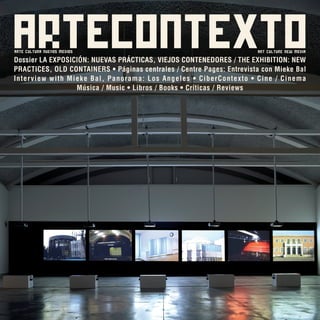
ARTECONTEXTO
Dossier LA EXPOSICIÓN: NUEVAS PRÁCTICAS, VIEJOS CONTENEDORES / THE EXHIBITION: NEW
PRACTICES, OLD CONTAINERS • Páginas centrales / Centre Pages: Entrevista con Mieke Bal
Interview with Mieke Bal, Panorama: Los Angeles • CiberContexto • Cine / Cinema
Música / Music • Libros / Books • Críticas / Reviews
ART CULTURE NEW MEDIA
Editora y Directora / Director & Editor:
Alicia Murría
Equipo de Redacción / Editorial Staff:
Natalia Maya Santacruz,
Santiago B. Olmo, Eva Navarro
info@artecontexto.com
Redactora jefe / Editor-in-chief:
Natalia Maya Santacruz
Responsable de Relaciones Externas y Publicidad
Public Relations and Advertising Manager:
Eva Navarro
publicidad@artecontexto.com
Administración / Accounting Department:
Carmen Villalba
administracion@artecontexto.com
Suscripciones / Subscriptions:
Pablo D. Olmos
suscripciones@artecontexto.com
Distribución / Distribution:
distribucion@artecontexto.com
Oficinas / Office:
Tel. + 34 913 656 596
C/ Santa Ana 14, 2º C.
28005 Madrid. (España)
www.artecontexto.com
Diseño / Design:
Jacinto Martín
El viajero: www.elviajero.org
Traducciones / Translations:
Joanna Porter
Portada / Cover:
ANDREAS FOGARASI Kultur und Freizeit, 2007.
Videoinstalación en la muestra
El pasado en el presente y lo propio en lo ajeno
en Laboral Centro de Arte y Creación Industrial, 2009.
Colaboran en este número / Contributors to this Issue:
José Manuel Costa, Christiane Paul, Juan Antonio Álvarez Reyes, Mónica
Núñez Luis, Alicia Murría, Juan Sebastián Cárdenas, Micol Hebrón, Abraham
Rivera, Elena Duque, Bruno Reis, Eva Grinstein, Jason Edward Kaufman,
Isabel Tejeda, Alanna Lockward, José Ángel Artetxe, Alfonso López Rojo,
Emanuela Saladini, Iñaki Stella, Sema D’Acosta, Pedro Medina, Carlos García
de Castro, Francisco Baena, Pablo G. Polite, Juan Carlos Rego de la Torre,
Mireia Antón, Mariano Navarro, Luis Francisco Pérez, Santiago B. Olmo,
Fernada Nogueira.
Especial agradecimiento / Special thanks:
A José Manuel Costa por su colaboración en este dossier
To José Manuel Costa for his help making this dossier
ARTECONTEXTO
ARTECONTEXTO arte cultura nuevos medios
es una publicación trimestral de ARTEHOY Publicaciones y Gestión, S.L.
Impreso en España por Técnicas Gráficas Forma
Producción gráfica: El viajero / Eva Bonilla. Procograf S.L.
ISSN: 1697-2341. Depósito legal: M-1968–2004
Todos los derechos reservados. Ninguna parte de esta publicación puede ser
reproducida o transmitida por ningún medio sin el permiso escrito del editor.
All rights reserved. No part of this publication may be reproduced or transmitted
by any means without written permission from the publisher.
© de la edición, ARTEHOY Publicaciones y Gestión, S.L.
© de las imágenes, sus autores
© de los textos, sus autores
© de las traducciones, sus autores
© de las reproducciones autorizadas, VEGAP. Madrid 2010
Esta publicación es miembro de la Asociación de Revistas Culturales de España (ARCE)
y de la Federación Iberoamericana de Revistas Culturales (FIRC)
Esta revista ha recibido una subvención de la Dirección General del Libro, Archivos y Bibliotecas para su difusión
en bibliotecas, centros culturales y universidades de España, para la totalidad de los números editados en el año.
Esta revista ha recibido una subvención de la Comunidad de Madrid para el año 2010.
ARTECONTEXTO reúne diversos puntos de vista para activar el debate y no se identifica forzosamente
con todas las opiniones de sus autores. / ARTECONTEXTO does not necessarily share the opinions expressed by the authors.
La editorial ARTEHOY Publicaciones y Gestión S.L., a los efectos previstos en el art. 32,1, párrafo segundo, del TRLPI
se opone expresamente a que cualquiera de las páginas de ARTECONTEXTO sea utilizada para la realización de resúmenes de prensa.
Cualquier forma de reproducción, distribución, comunicación pública o transformación de esta obra sólo
puede ser realizada con la autorización de sus titulares, salvo excepción prevista por la ley.
Diríjase a CEDRO (Centro Español de Derechos Reprográficos: www.cedro.org) si necesita fotocopiar o escanear algún fragmento de esta obra.
SUMARIO
/
INDEX
/
21
SUMARIO
/
INDEX
/
25 	 Primera página / Page One
4	 Arte y nuevos retos / Art and New Challenges
	 ALICIA MURRÍA
	 Dossier. La exposición: nuevas prácticas, viejos contenedores /
	 The Exhibition: New Practices, Old Containers
9	 De lo curioso a lo inmaterial. Las formas de presentación del arte como superestructura ideológica
	 From the Unusual to the Immaterial. Presentation Forms of Art as an Ideological Superstructure
	 JOSÉ MANUEL COSTA
17 	 Contextos flexibles, filtración democrática y comisariado asistido por ordenador:
	 modelos para la práctica curatorial on-line / Flexible Contexts, Democratic Filtering
	 and Computer-aided Curating: Models for Online Curatorial Practice
	 CHRISTIANE PAUL
24 	 Lo que ha de venir, ya ha llegado / What Is to Come Is Already Here
	 JUAN ANTONIO ÁLVAREZ REYES
33 	 Nuevas formas de arte, nuevos mercados / New Art Forms, New Markets
	 MÓNICA NÚÑEZ LUIS
41 	 Prácticas artísticas de intervención. Entrevista con Daniel G. Andújar
	 Intervention Art Practices. Interview with Daniel G. Andújar
	 ALICIA MURRÍA
	 Páginas Centrales / Central Pages
51	 Territorios del análisis cultural. Una entrevista con Mieke Bal
	 Landscapes of Cultural Analysis. An Interview with Mieke Bal
	 JUAN SEBASTIÁN CÁRDENAS
58 	 La fuerza está en los números: Tomando el pulso a la escena galerística de Los Ángeles
	 Strength in Numbers: Taking the Pulse of the Los Angeles Gallery Scene
	 MICOL HEBRON
64	 CiberContexto
	 La labor curatorial en Internet / The Curatorial Task on the Internet
	 ABRAHAM RIVERA
68	 Cine / Cinema
	 Reseñas / Reviews ELENA DUQUE
	 Sobre Béla Tarr / On Béla Tarr. JUAN SEBASTIÁN CÁRDENAS
72	 Música / Music
	 Reseñas / Reviews ABRAHAM RIVERA
	 Al Régimen no le gusta compartir / The Regime Does Not Like to Share
	 JOSÉ MANUEL COSTA
76	 Libros / Books
	 Reseñas / Reviews BRUNO CARRIÇO REIS- ALICIA MURRÍA
	 Futuretainment. JOSÉ MANUEL COSTA
80	 Críticas de exposiciones / Reviews of Exhibitions
Art and New Challenges
In a little more than fifteen years the technological industry and the Internet have brought major
changes to the accessing and distribution of information and knowledge, substantially modifying the
ways in which we communicate and relate to each other, exponentially multiplying control over the
individual and drastically altering the notion of privacy, to mention only a few of the consequences.
Meanwhile, and in parallel to this, these new phenomena have generated previously unimaginable
spaces for horizontal cooperation and collective participation on a scale that transcends countries
and states. So it is surprising that in the face of such profound transformations touching on every
aspect of existence, numerous cultural and especially art-focused institutions and the discourses
on which they stand have closed ranks in a show of impermeability and resistance to all challenges
to their raison d’être, instead of spearheading the changes, which is meant to be their role, in both
theory and practice.
It is true that the external aspects of the containers of art have been altered, but change is
far less evident in their internal structure and the ideas on which they are based, or in the legacy of
conservation and exhibition models that have been little changed in the past three centuries, and
of which auratic objects continue to be the centrepiece. Many of today’s artistic practices do not fit
comfortably in such settings, and not only the ones that employ the so-called “new media” (many
have now been with us for a longish time)—such as video, audio installations, and works that call
for some kind of interaction, but also such forms as net-art, which is conceived for “virtual” public
spaces and whose full embodiment requires collective participation in which the classical notions
of “art work” and “author” are blurred. It is also true that some institutions are now endeavouring
to adapt themselves to these new demands, and facing the challenges they pose, which are not
confined to questions of storage or exhibition, but necessitate a comprehensive re-examination of
their role as nodes of artistic experimentation and creation, as engines, as it were, for the production
of knowledge.
Our contribution to the consideration of these processes and their contradictions takes the
form of articles by José Manuel Costa, who reviews the genealogy of the exhibition; Christiane
Paul, who regards the Internet as a cultural production space; Juan Antonio Álvarez Reyes, whose
experience as a curator informs his views on how to deploy the new languages in physical space;
Mónica Núñez Luis, whose focus is how the market now seeks to embrace types of production that
not long ago were viewed as irrelevant to its interests, even as those interests are often called into
question by these very artistic practices. Lastly, in an interview, Daniel G. Andujar furnishes a lucid
analysis of the new horizons that are being shaped and the responsibility of artists in drafting their
outlines.
Outside this dossier, but not far from the issues it addresses, Mieke Bal speaks of her
experience in the field of cultural theory as well as her cinema work in a conversation with Juan S.
Cárdenas, on the occasion of the launch of her book Travelling Concepts in the Humanities. The
central pages end with a glance at the city of Los Angeles, this year’s special guest at Madrid’s
ARCO fair, by Micol Hebron. Articles about film, music, and books, the Cibercontexto section, and a
raft of reviews of shows around the world round off this issue, which marks the sixth anniversary of
the founding of ARTECONTEXTO
Alicia Murría
Arte y nuevos retos
La industria tecnológica e Internet, de manera fundamental y en poco más de quince años, han
redibujado el acceso a la información, al conocimiento y su distribución, modificado sustancialmente
nuestras formas de comunicar y relacionarnos, multiplicado exponencialmente el control sobre los
individuos y alterado de manera drástica el concepto de privacidad, por mencionar sólo algunos
de sus efectos. También, y de forma paralela, han propiciado espacios de actuación horizontal y
participación colectiva, antes difícilmente imaginables, cuyas dimensiones rebasan países y estados.
Resulta sorprendente sin embargo que, frente a estas trasformaciones de calado profundo que
afectan a todos los órdenes de la existencia, muchas instituciones y los discursos sobre los que se
sustentan –y nos referimos ahora al ámbito de la cultura y en particular al del arte– hayan hecho de
la impermeabilidad y la resistencia a cualquier cambio su razón de ser, sobre todo cuando –en teoría
y por definición– deberían constituirse en avanzadilla.
Ciertamente ha variado el aspecto externo de los contenedores de arte pero mucho menos
sus estructuras internas y las ideas que los cimentan, heredadas de modelos de conservación y
exhibición que apenas se han modificado en los tres últimos siglos y cuyo eje gravitatorio continúa
siendo el objeto aurático. Muchas de las actuales prácticas artísticas encuentran difícil acomodo en
estos escenarios, no sólo aquellas que utilizan los llamados nuevos medios –que en buena medida
hace mucho que dejaron de serlo– como el vídeo, las instalaciones sonoras o las obras que exigen
algún tipo de interacción, sino las que como el net.art se conciben por y para el espacio público
virtual y demandan para su desarrollo una participación colectiva donde se diluyen los conceptos
clásicos de “obra de arte” y de autor. También es cierto que algunas instituciones están abordando
su adaptación a estas nuevas necesidades y asumiendo los retos que tienen ante sí; unos retos que
no se limitan al descifrado de la mejor manera de almacenar o exhibir, sino a repensar el papel que
les corresponde jugar como nodos de experimentación y creación, como motores –valga la manida
expresión– para la producción de conocimiento.
Al análisis de estos procesos y sus contradicciones hemos querido contribuir a través de
colaboradores como José Manuel Costa, que traza una genealogía de la exposición; Christian
Paul, quien se detiene en la Red como espacio de producción cultural; Juan Antonio Álvarez
Reyes habla, desde su propia experiencia en el comisariado, sobre cómo trasladar los nuevos
lenguajes al espacio físico; por su parte, Mónica Núñez Luis se detiene en cómo el mercado busca
adaptarse a un tipo de producciones que hasta hace muy poco se encontraban alejados de sus
intereses, los cuales son cuestionados a menudo por esas mismas practicas artísticas. Por ultimo,
Daniel G. Andujar, a través de una entrevista, aporta un lúcido análisis sobre el paisaje que se está
configurando y subraya la responsabilidad de los artistas en su delineamiento.
Al margen del dossier, pero no lejos de estas cuestiones, Mieke Bal habla de su trabajo en
el campo de la teoría cultural así como de su obra cinematográfica en una charla con Juan S.
Cárdenas, con motivo de la publicación de su último libro Conceptos viajeros en las humanidades.
Cierra las páginas centrales un vistazo a Los Ángeles, ciudad invitada a la cita anual de ARCO, a
cargo de Micol Hebron. Textos sobre cine, música y libros, así como la sección Cibercontexto y un
amplio recorrido internacional de exposiciones completan este número, con el que ARTECONTEXTO
cumple su sexto aniversario.
Alicia Murría
La exposición: nuevas prácticas, viejos contenedores
The Exhibition: New Practices, Old Containers
DOSSIER
JANET CARDIFF y GEORGE BURES MILLER The Murder of Crows, 2008
Vista de la instalación en Hamburger Bahnhof, 2009
Hay algo en la humanidad que conduce al acto de
mostrar. De mostrar lo no inmediatamente útil. Tam-
bién hay algo que la conduce a coleccionar, a acu-
mular lo raro o significativo. La confluencia de ambas
propensiones ha evolucionado a lo largo del tiempo
hasta la actual división canónica de la Ilustración y
sus museos, del más variado tipo. La única variación
sustancial en el funcionamiento y la estructura de los
de artes visuales, surgió en la segunda mitad del pa-
sado siglo con la idea de unos centros de arte que,
en principio, se harían cargo de lo contemporáneo
y vivo hasta que sus productos pudieran ser musei-
ficados. Se trata de una variación, dado que no es
posible hablar de un cambio radical: los nuevos cen-
tros han sido concebidos y regidos (también apre-
ciados) con ideas adaptadas del antiguo orden. La
aparición del vídeo como arte planteó ya problemas
que aún hoy siguen sin estar resueltos de manera
satisfactoria y el advenimiento de lo digital es algo
sobre lo que ahora se esta comenzando a reflexio-
nar y sobre lo que sólo hay algo seguro: las institu-
ciones de la contemporaneidad no están ni material
ni ideológicamente preparadas para lidiar con unas
prácticas contemporáneas que sólo en muy esca-
sas ocasiones producen objetos tangibles o, cuando
menos, estáticos. En este dossier se pretende reali-
zar un breve repaso sobre los problemas que plan-
tea la presentación de estas nuevas prácticas. Para
ello considerábamos imprescindible un estudio so-
bre esas formas de presentación del hecho estético
a lo largo del tiempo; una reflexión sobre el trabajo
con lo inmaterial; una de orden práctico-teórico en
torno a las dificultades que entrañan hoy en día los
intentos de mostrar esas nuevas prácticas y como
estas (des)encajan en el tejido económico del mun-
do del arte. De hecho, es posible que la misma idea
“mundo del arte” sea ya insuficiente y esos centros,
u otros venideros, hayan de reinventarse por com-
pleto. No es fácil, al fin y al cabo dichas instituciones
son emanaciones de un orden económico-social,
que no va a ser subvertido por cuatro piezas de net.
art. Pero la mera conciencia de esa inadecuación,
de ese chirriar de actitudes, quizás pueda jugar un
papel en el cambio.
There is something in human nature which leads
to the act of showing; of showing that which is
not clearly useful. There is also something which
leads to collecting, to hoarding the unusual or
meaningful. The confluence of these tendencies
has evolved over time, leading to the current
canonical division of the Enlightenment and its
wide variety of museums. The only substantial
variation in the structure and operation of Visual
Arts museums emerged in the second half of last
century, with the notion of Arts Centres which
would deal with the living and contemporary until
it could be museified. This was a variation rather
than a radical change: the new centres have been
conceived and ruled (as well as appreciated) on
the basis of old ideas which have been adapted
to these recent needs. The emergence of video as
a form of art gave rise to issues which have still
not been entirely resolved, and the advent of the
digital is something which is now being analysed,
and about which only one thing is certain:
contemporary institutions are not prepared, on
either a material or an ideological basis, to deal
with contemporary practices, which only very
seldom produce tangible or, at the very least,
static objects. This dossier aims to offer a brief
description of the issues posed by the display of
these new practices. In order to do this we felt
it was essential to examine the forms of display
of the aesthetic fact over time; to reflect on what
it is to work with the immaterial; to analyse, in
a practical-theoretical way, the difficulties we
find today when attempting to display these new
practices, and the way these fit in with (or not)
the economic fabric of the art world. In fact, it
is possible that they very idea of the “art world”
is already insufficient and that these Centres, or
the future ones, must be entirely reinvented. It is
not easy, as, after all, these institutions are the
result of an economic and social order, which is
not going to be subverted by a few net.art pieces.
However, the very awareness of this inadequacy,
of these grating attitudes, might be able to play a
part in bringing about change.
J. M. C.
Especímenes de historia natural del
Museo Ferrante Imperato. Nápoles, 1550-1631
Palacio de Sabbioneta. 1580-1584
DOSSIER · ARTECONTEXTO · 9
La comprensión de las artes y, de manera concomitante, su presen-
tación han sufrido a lo largo del tiempo cambios que, como ocurre
con toda actividad social, son emanación y consecuencia dialéctica
del sistema dominante. Estas formas de presentación, como toda
superestructura (aquí en su significado marxista y su argumentación
gramsciana) podían adelantarse a los cambios político-económicos o
ir detrás de ellos. Pero no en exceso: la estructura económico-social
subyacente impone sus reglas –que hasta cierto punto puede variar–
para seguir siendo la misma.
En lo que respecta a las artes visuales, el gran cambio desde los
tesoros eclesiales o principescos de la antigüedad, tuvo lugar hacia
1520, cuando un prelado de Como (Italia alpina), Paolo Giovio (1483-
1552) comienza a reunir en su palacio una gran colección de retratos
históricos divididos en cuatro apartados (sabios y poetas muertos;
sabios y poetas vivos; artistas y políticos). Fue, por así decir, el primer
museo con pretensiones, no diríamos científicas, pero sí normativas.
La influencia de una idea tan sencilla llegó hasta mediados del siglo
XIX, al menos, en lo que respecta a los museos de historia o a la
misma National Portrait Gallery de Londres (1856).
El museo joviano, como pasó a conocerse, era un hijo del hu-
manismo cristiano y respondía también al paso desde el feudalismo a
un tipo de organización política que desembocaría en el absolutismo
y en las nuevas formas económicas basadas en el comercio y las
finanzas que habían surgido hacia el siglo XIV como primer aviso del
emergente poderío burgués.
El manierismo, en apariencia tan poco riguroso, trajo consigo los
primeros museos concebidos, en principio, como galerías artísticas
y/o gabinetes de curiosidades. Este tipo de gabinetes suponían una
balbuciente entrada de la curiosidad científica que había despertado
el Renacimiento. En este contexto, las artes visuales poseían un valor,
incluso muy elevado, pero no más allá de objetos (falsos, al igual que
muchos otros animales fantásticos coleccionados) como los restos de
una hidra: porcelanas, conchas de nautilus, armas… Un ejemplo fue-
ron las colecciones de Fernando del Tirol en Innsbruck. En el castillo
de Ambras, cerca de la ciudad, Fernando montó en 1563 un santuario
del coleccionismo manierista de lo más revelador. Estaba dividido en
una Kunstkammer o gabinete de arte, una Wunderkammer con ma-
ravillas de la naturaleza, una Schatzkammer con piezas de orfebrería,
una Rüstkammer dedicada a las armaduras y un museo histórico de
tipo joviano. Entre ellas, se nos recuerda, la menos importante era la
Kunstkammer.
Todo esto tiene consecuencias para la presentación de las ar-
tes. Donde antes las obras contemporáneas (no así las antigüedades)
solían mantenerse en el lugar para el cual se habían ideado habitual-
mente una iglesia o un palacio, las nuevas y voluminosas colecciones
exigían nuevos lugares de presentación, como la galería de antigüe-
dades (y trofeos de caza) del Palacio de Sabbioneta, edificado entre
1580 y 1584 por la familia Gonzaga. Aún no puede hablarse de museo
(el término Museografía no llegaría hasta 1727 con el tratado del mar-
chante de Hamburgo, Caspar F. Neickel, pero desde el momento en
que estas construcciones, galerías o rotondas, se realizaban ex novo
y ex profeso, se planteaban necesariamente cuestiones museológicas
como iluminación, orientación, materiales, ordenación y conservación
de las colecciones, etc.
De lo curioso a lo inmaterial
Las formas de presentación del arte como superestructura ideológica
JOSÉ MANUEL COSTA*
10 · ARTECONTEXTO · DOSSIER
De otra parte, al no permanecer las obras en las estancias pri-
vadas u oficiales de los príncipes y progresivamente de los grandes
burgueses, sino en estas construcciones específicas de nuevo cuño,
venía casi de la mano establecer un régimen de visitas para un público
limitado entonces a artistas, estudiosos o amateurs, pero público al fin.
De hecho, en algunos de estos pre-museos ya se cobraba la entrada.
No sólo esto. Las colecciones trajeron consigo la necesidad de
un inventario separado del ajuar común y de esta manera aparecieron
los catálogos, en muchas ocasiones ilustrados. Estamos ya en la era
de la imprenta de Gutenberg y la difusión de estos catálogos tendría
una enorme influencia.
No debe extrañar que estas novedades prepararan el terreno
para el comercio de artes y antigüedades a gran escala. Monarcas
como Catalina de Rusia compraban en el extranjero colecciones ente-
ras para su Ermitage, pero también patricios burgueses participaban
en lo que durante el siglo XVIII se convirtió en una verdadera fiebre,
reflejada también en un mercado algo más “minorista” y popular. De
esta forma, las bellas artes se incluían en el tráfico de objetos que
constituye la base de todo mercantilismo. En realidad, el sistema de
marchantes y tiendas (galerías) que aún pervive no ha variado sustan-
cialmente desde el siglo XVIII, como si el sistema capitalista hubiera
querido conservar algo del elitisimo y exclusivismo social de la pri-
mera gran burguesía.
En este sentido se produjo otra evolución fundamental y que tam-
bién persiste: la entrada de instituciones públicas y civiles, como ayun-
tamientos o universidades, en la formación y exposición de objetos
culturales. Algo que sucedió primero en los países protestantes, donde
los poderes burgueses habían de sustituir en las artes a los antiguos
mecenas eclesiásticos, reales o nobiliarios. El Ashmolean de Oxford,
fundado en 1683, es el primer gran ejemplo pero rápidamente le siguie-
ron muchas otras instituciones a lo largo y ancho del continente.
Estos acontecimientos, dibujados en sus rasgos básicos duran-
te el siglo XVII y principios del XVIII, fijaron de forma indeleble el tipo
de museo que, a través de su reglamentación ilustrada y su extensión
geográfica tras la Revolución Francesa, ha llegado hasta nuestros
días. No tan paradójicamente los grandes museos históricos o de an-
tigüedades pueden presentar diferencias notables entre sí, pero los de
pintura o escultura resultan de una asombrosa monotonía a lo largo
del tiempo. Se trata de un canon plasmado en arquitecturas, nombres
de departamentos o profesiones, como conservadores, organización
sistemática de colecciones, modos de funcionamiento, e infraestruc-
turas, como almacenes, electricidad, relaciones institucionales y con
el entorno… Un canon consagrado a mostrar objetos estáticos de alto
valor cultural y económico.
No se trata de discutir aquí si este canon, variable en sus mati-
ces pero tan resistente en lo básico, es la mejor manera de presentar
obras de arte. De hecho, es probable que así sea para las generacio-
nes de artistas coetáneas a la creación de los museos del XIX que
consideraban a estos con el mayor de los respetos, incluso aunque
no se estuviera de acuerdo con sus contenidos.
Pero ese canon no puede de ninguna manera llamarse contem-
poráneo. Algo que se pone agudamente de manifiesto cuando pen-
samos en nuevas prácticas artísticas asociadas con el uso de nuevas
tecnologías. No tan nuevas, si tenemos en cuenta que la cinta magne-
tofónica o el vídeo tienen ya más de medio siglo y los principios de las
digitalización en lo visual y lo auditivo unos cuarenta años.
Aparte de los ataques futuristas o dadaístas contra los museos
y su astuta y brutal puesta en cuestión por R. Mutt, en nuestra cultura
se encuentran ideas y proyectos tan sensatos y utilizables como los
de El Lissitzsky: «En las grandes exposiciones internacionales de pin-
tura, el visitante se siente como atacado por mil bestias diferentes.
(...) Si los visitantes eran tradicionalmente conducidos a la pasividad
mientras pasaban frente a las pinturas, nuestro diseño debe convertir
en activo al individuo. (...) El espectador se verá físicamente forzado
a interactuar con los objetos de la exposición». Lo que El Lissitzky
proponía suena tan radical porque estaba ideado para un cambio,
político y económico, radical que necesitaba de un nuevo lugar donde
hacer viables estas propuestas. Sus ideas no sólo son radicales sino
que se adaptan perfectamente a nuestras nuevas prácticas, lo cual
permite preguntarse si dichas prácticas sólo podrán florecer en otro
sistema, y sólo de forma imperfecta en el actual estado de cosas.
Frente a las propuestas de El Lissitzky, lo que se impuso fue, por
un lado, la idea de contendor nítido, que llega a su máxima expresión
con la Neue Nationalgalerie de Mies van der Rohe (1962-68) y, por
otro, la de espacios dinámicos y extremadamente flexibles, como el
Centro Pompidou, de Piano y Rogers. A ellos habrían de sumarse re-
habilitaciones de espacios pre-existentes, como el Reina Sofía de Ma-
drid, al cual se añadió más tarde un aditamento, ejemplo de la última
escuela –la expresiva de sí misma–, realizado por Jean Nouvelle.
Por supuesto, estos edificios, y sus innumerables hermanos sur-
gidos por todo el mundo a lo largo de los años 80 y primeros 90, nacie-
ron con nuevas consideraciones, siendo la principal la que conducía
a situar al visitante en el centro de las preocupaciones en detrimento
de las obras de arte.
Sin embargo, ninguno de ellos –como puede comprobarse
en Museos de la última generación de Joseph M. Muntaner y Jordi
Oliveras (1986)– considera en lo más mínimo las necesidades ni las
dinámicas impuestas por las nuevas prácticas artísticas, ya entonces
plenamente funcionantes. Ni siquiera el ZKM de Kalrsruhe, dedicado
a todo lo nuevo, se libra de este mal: está radicado en una antigua
fábrica de armamento.
Con todo, el problema no es tanto arquitectónico o técnico como
ideológico. Las nuevas prácticas no han nacido para ser validadas
por un museo, ni siquiera por un mercado en el sentido tradicional.
Algunas de ellas, como el net.art, nacen ya expuestas urbi et orbi.
Otras, como el videoarte, son perfectamente copiables y carecen de
cualquier aura de lo original; y a ellas se suman las instalaciones mul-
ti-mediales, las cuales reclaman mucho más espacio que un cuadro.
Además, resulta que mucho de este arte no funciona si no es me-
diante la interacción, y los catálogos son ahora apuntes de realidades
mucho más complejas…
Los centros y museos de “lo contemporáneo” se ven así ante el
DOSSIER · ARTECONTEXTO · 11
dilema de no poder “contener”
buena parte de lo que está ge-
nerando la contemporaneidad.
Simplemente porque, en el
mejor de los casos, están di-
señados para la modernidad.
Lo que se reclama es un cam-
bio de paradigma en donde los
centros, junto a una función
expositiva de nuevo cuño,
operen como nodos físicos en
el intercambio de información
y cooperación que funcione
en el rizoma digital-interco-
nectado. Aunque, cabe dudar
sobre si ese cambio puede
producirse en este sistema, tal
vez sea posible avanzar hasta
cierto punto, al menos, para
que no chirríen demasiado las
instituciones de poder, que son
los centros y museos, y un arte
que, si no los ignora, tampoco
los considera más que como
otra vía de difusión y presen-
tación entre varias posibles.
En este limbo, entre una su-
perestructura anticuada y una
revolución aún no llegada, los
centros contemporáneos tie-
nen complicado hacia donde
ir. Cualquier empujón es bien-
venido.
*José Manuel Costa es
crítico de arte y música.
Fachada de la Neue Nationalgalerie. Berlin, 1968
Gemäldegalerie. Berlín, 1884
RENZO PIANO and RICHARD ROGERS
Scaled model of the final project of the
Centre Georges Pompidou,1973. © Photo D.R.
Illustration by LORENZO LEGATI
of Ferdinando Cospi
and his collection at the Cospi Museum.
Bolonia 1606-1686.
DOSSIER · ARTECONTEXTO · 13
Over time, the understanding of the arts, and in a similar manner, their
display, have undergone changes, which, as with any social activity, are
the emanation and dialectical consequence of the dominant system.
These forms of display, as with any superstructure (used here in the
Marxist and Gramscian sense) may anticipate political and economic
changes; or come in their wake. But not by too far: the underlying
socio-economic structure imposes its rules, which to some extent
may vary, and things carry on as before.
As regards the visual arts, the great change since the ecclesiastical
and princely treasures of antiquity took place around 1520, when a
prelate in the Italian alpine city of Como, Paolo Giovio (1483-1552)
began to assemble in his mansion a great collection of historical
portraits, divided into four categories: dead sages and poets; living
sages and poets; artists; and politicians. It could be described as the
first museum with normative, if not quite scientific, pretensions. The
influence of such a simple idea was to endure under the mid-19th
century, with the founding of historical museums, and of the National
Portrait Gallery itself, which opened in London in 1856.
The Jovian Museum, as it became known, was the offspring of
Christian humanism and also reflected the shift from feudalism to a
type of political organization that would evolve into absolutism and
now economic patterns based on the trade and finance that had
arisen in the 14th
C. as the first harbinger of the emerging power of
the bourgeoisie.
The Mannerist style, ostensibly so little rigorous, brought in its train
the first museums to be conceived, in principle, as galleries of art and/
or cabinets of curiosities. These cabinets amounted to a stammering
entrance of the scientific curiosity awakened by the Renaissance. In
such a context, the visual arts possessed a value, and even a high
one, but no more so than objects, many of them fakes, like many
other fantastic animals that were collected, the remains of a hydra,
porcelains, sea shells, weapons, etc. Ferdinand of Tyrol’s collection in
Innsbruck were an example. In 1563 in Ambras castle, near the city,
Fernando established a telling shrine to Mannerist collecting. It was
divided into a Kunstkammer of art gallery, a Wunderkammer showing
marvels of nature, a Schatzkammer with silver and gold items, a
Rüstkammer dedicated to weapons, and a historical museum after the
Jovian model. Of them all, the least important, we are told, was the
Kunstkammer.
All this was to affect the display of the arts. While formerly
contemporary artworks (unlike antique ones), had usually been kept in
the place for which they were made, typically a church or a palace, the
new and voluminous collections required new venues for their display,
such as the Gallery of Antiquities (and hunting trophies) in the Palace
of Sabbioneta, erected by the Gonzaga family between 1580 and
1584. It could not yet be termed a museum (the term Museographia
first appeared in a 1727 agreement written by the Hamburg art dealer
Caspar F. Neickel), but as soon as these constructions, galleries or
rotundas, were built ex novo and ex profeso, there arose museological
issues such as illumination, orientation, materials, and the ordering
and conservation of collections.
In addition, since the works no longer remained in the private
or state rooms of princes and, increasingly, of the wealthy merchant
class, but rather in new buildings designed expressly for the purpose,
it became necessary to establish a regime of visits by members
of the public, though this was initially limited to artists, scholars,
From the Unusual to the Immaterial.
Presentation Forms of Art as an Ideological Superstructure
JOSÉ MANUEL COSTA*
14 · ARTECONTEXTO · DOSSIER
and dilettantes. Indeed, some of these pre-museums charged for
admission.
Furthermore, the collection necessitated an inventory that was
separate from that of ordinary possessions, and from this need there
arose the catalogue, many of the early ones being illustrated. This was
the era of Gutenberg, and the dissemination of these catalogues had
an enormous impact.
It is by no means surprising that these innovations should
open the way to large-scale trade in art and antiques. Monarchs like
Catherine the Great of Russia purchased entire collections abroad for
her Hermitage, but bourgeois patricians also joined what in the 18th
century was to become a veritable craze, which gave rise to another
more “retail” and accessible market. And so it was that the fine arts
were included in the traffic of objects that is the basis of all forms
of trade. In fact, the system of art dealers and shops (galleries) that
survives today has changed but little since the 18th
century, as if the
capitalist system had wanted to preserve a fragment of the elitism and
exclusiveness that marked the first grande bourgeoisie.
And there was another crucial development that also survives:
the participation of public and civic institutions, such as city councils
and universities, in the collection and display of cultural objects. This
occurred first in the Protestant lands, where the rich merchants had
supplanted the church, the royals, and the nobility, as patrons of the
arts. Oxford’s Ashmolean collection, founded in 1683, is the first major
example; but it was soon followed by many other institutions across
the length and breadth of the Continent.
These developments, whose first outlines appeared in the 17th
and early 18th
centuries, would indelibly shape the model of museum
which, by way of the Enlightenment and the French Revolution,
would survive until our day. It may not be so paradoxical that the
great museums of history and antiquities are so varied; while those
of painting or sculpture are so strikingly and monotonously alike and
unchanged over time. There is a canon enshrined in architecture,
the name departments and of professions such as conservators,
the systematic organisation of collections, modes of operation,
and infrastructures such as storerooms, electricity, institutional and
environmental relations, etc., a canon for displaying static objects of
great cultural and monetary value.
This is not the place to discuss whether this canon, variable in
its nuances but so resistant in its essence, is the best way to display
art works. Indeed, it is likely that this was true for the generations
of artists who witnessed the creation of the 19th
century museums,
and looked upon them with the greatest of respect, even when they
disagreed with their contents.
But there is no way that the canon can be considered
contemporary. And this is brought sharply to the fore when we think
of new artistic practices associated with the use of new technologies
–and even those not so new, for sound and video recording have been
with us for half a century, and development of the earliest digital media
began some four decades ago.
Aside from attacks by Futurists and Dadaists against the
museum, and their shrewd and scathing questioning by “R. Mutt”,
in our culture we find ideas and projects and sensible as those of
El Lissitzsky: “The great international picture review resemble a zoo,
where the visitors are roared at by a thousand different beasts [..] If
on previous occasions […] he was lulled into a certain passivity, now
our design should make the man active. [..] The viewer should be
physically forced to interact with the objects of the exhibition”. What
El Lissitzky proposed sounds so radical because it was conceived for
radical political and economic change that called for a new place for
making these proposals viable. His ideas are not only radical; they are
perfectly suited to our new practices, which makes us wonder if such
practices will only be able to flourish within another system, and only
imperfectly under the current state of affairs.
Instead of what El Lissitzky proposed, what ensued was, on the
one hand, the idea of a sharply defined container, which reached its
maximum expression with Mies van der Rohe’s Neue National Gallerie
(1962-68), and, on the other, dynamic and extremely flexible spaces,
like the Centre Pompidou, by Piano and Rogers. One should also must
mention the rehabilitations of pre-existing spaces, such as the Reina
Sofía in Madrid, to which a complement was added later, and example
of the latest school –the expression of itself– by Jean Nouvelle.
Naturally these buildings, and their innumerable cognates built
all over the world in the 1980s and early 1990s, were born with new
consideration in minds, the chief one being to make the visitor the
centre of attention, to the detriment of the art works.
However, none of these –as we see in the 1986 study Museos de
la última generation by Joseph M. Muntaner y Jordi Oliveras– spares
a thought for the needs or the dynamics imposed by the new artistic
practices, even though they were already in full swing. Not even
the ZKM, in Karlsruhe, is an exception, since it is located in an old
armoury.
Ultimately, the problem is less architectural or technical than it is
ideological. The new practices were not devised to be validated in a
museum, nor yet by a market in the traditional sense. Some of them,
like Net Art, are displayed urbi et orbi from their very inception. Others,
such as video art, are easily copyable and lack any aura of being
original. And the same can be said of multimedia installations, which
need much more space than a picture. Furthermore, it so happens that
much of this art only works through interaction, and catalogues are
now notes on much more complex realities.
So art centres and museums that focus on “the contemporary”
now find themselves in the dilemma of being unable to “contain” a
good part of the work being produced today. And this is simply
because, at best, there are designed for modernity. What is needed
is a paradigm shift, whereby the institutions, along with a new type of
exhibition function, also operate as physical nodes in the exchange of
information and cooperation the works in the digital-interconnected
rhizome. Although it may be too much to expect such a change to
occur within the current system, it may be possible to advance to
a certain point, at least, so the wheels of the institutions of power
don’t squeak too much –these institutions being the art centres and
museums, and an art which while
not ignoring them, plainly regards
them as just one more dissemination
channel amongst so many others.
In this limbo between an antiquated
superstructure and a revolution that
has not yet arrived, the contemporary
art institutions don’t know which
direction they should be moving. And
any push is welcome.
*José Manuel Costa is
an art and music critic.
Ole Worm’s cabinet of curiosities at the Museum Wormianum, S. XVII
Facade of the ZKM Center for Art and Media Karlsruhe. 1999. Photo: ONUK
16 · ARTECONTEXTO · DOSSIER
MARTIN WATTENBERG y MAREK WALCZAK Apartment, 2001.
ANDY DECK Imagen creada con Open Studio, 1999
DOSSIER · ARTECONTEXTO · 17
La aparición oficial del net.art, que coincidió con el desarrollo de la World
Wide Web, a principios de los años 90, no tardó en engendrar una gran
variedad de ilusiones sobre el futuro de la práctica artística y curatorial,
entre las que se hallaba una reconfiguración más o menos radical de los
modelos y “espacios” tradicionales de acceso al arte. Al basarse en una
forma artística que existe en el contexto de un espacio público (virtual)
creado con el fin de que cualquiera pueda verlo, en cualquier lugar y
en cualquier momento (siempre y cuando se tenga acceso a la red), el
net.art no siempre requiere el espacio físico de la institución para llegar
al público. Ofrece nuevos modos de distribución y acceso al arte, que
funcionan con independencia del mundo institucional y sus estructuras
de validación y mercantilización. Se podría decir que el net.art busca la
creación de un “museo sin muros”, un espacio de información paralelo,
expandido y “vivo”, abierto a las intervenciones de artistas, público,
comisarios, teóricos y otros expertos. De esta forma se dan las con-
diciones para un espacio de intercambio, creación y trabajo colectivo,
transparente y flexible. Su reto es conseguir una escena artística on-
line de forma ajena al mundo institucional. A finales de los años 90, las
instituciones artísticas empezaron a fijarse en el net.art como parte de
la práctica contemporánea, y poco a poco fueron introduciéndolo en su
programación. La práctica curatorial en el mundo on-line se comenzó
a desarrollar, por un lado, de forma autónoma –a través de proyectos
Web creados por comisarios y colectivos de artistas– y, por otro, en un
contexto institucional –a través de páginas Web asociadas a museos,
como Gallery 9 del Walker Art Center, e-space del SF MOMA y Artport
del Whitney Museum1
.
Redes, intercambios colaborativos y democratización
Internet, los dispositivos móviles en red –desde los teléfonos móviles
a las PDA (asistentes digitales personales)– y los sistemas de software
y hardware, cada vez más asequibles, han inaugurado una nueva era
en la creación y la distribución de los contenidos mediáticos. La pro-
mesa utópica de esta nueva era se centra en la idea de “tecnologías
para las personas”, y en un sistema de emisión “de muchos a mu-
chos” capaz de devolver el control sobre la distribución al individuo,
produciendo un efecto democratizador. En sus principios, Internet se
vio dominada por las instituciones educativas y de investigación, a la
vez que ofrecía un espacio para la experimentación artística. El sue-
ño de “una red para la gente” no duró mucho y, desde un principio,
ocultó las cuestiones más complejas, relativas al control del poder
sobre los medios. Sólo una parte del mundo está conectada a la red
“global”, y algunos países están sometidos a restricciones impuestas
por sus gobiernos. Internet no ha tardado en convertirse en un espejo
del mundo real, en el que las grandes empresas y el comercio elec-
trónico se encargan de colonizar el paisaje. El fin de la burbuja “punto
com” ha acabado con gran parte de la ilusión inicial por la economía
on-line, impulsando una relectura de las nociones del comercio elec-
trónico, pero la industria de las tecnologías digitales sigue gozando de
buena salud. Sin embargo, podría decirse que las características de
la red aumentan la democratización y la capacidad de manifestación
pública en varios aspectos –por ejemplo, a través de la mejora de los
mecanismos de distribución, filtrado y archivo, que dan fuerza a la
“voz del individuo”; a pesar de que las intervenciones (en el sentido
más amplio de la palabra) ya no están necesariamente limitadas a una
zona geográfica. De hecho, la estructura actual se nos muestra de
forma descentralizada, en lugar de jerárquica. Ciertamente, esto no
implica que se haya eliminado el concepto de autoridad. En palabras
de Charles Bernstein: «La autoridad nunca desaparece, sino que se
reinserta constantemente en nuevos lugares. (...) La descentralización
hace posible que coexistan numerosas autoridades en conflicto, pero
Contextos flexibles, filtración democrática y comisariado asistido por ordenador:
Modelos para la práctica curatorial on-line
Christiane Paul*
18 · ARTECONTEXTO · DOSSIER
no es capaz de abolir la autoridad» (Bernstein 2003). En general, los
procesos de participación han adquirido mayor complejidad a través de
la mediación tecnológica. El hecho de que el net.art sea potencialmente
interactivo, participativo o incluso colaborativo y abierto al intercambio
con las comunidades trans-locales, hace que las cuestiones relativas a
la capacidad de acción colectiva y la autoridad de la autoría se hayan
convertido en un elemento central de las prácticas artísticas new media.
Esta voluntad de participación pública se manifiesta en la capacidad de
influir, cambiar y crear instituciones y eventos, o de actuar como me-
diador. Los niveles de acción pública se miden según la capacidad a la
hora de conseguir un efecto significativo en el mundo y en un contexto
social específico, lo cual implica ciertas responsabilidades. En el media
art, cualquier forma de participación aparece mediada y, por tanto, su
grado de implicación se ve parcialmente determinado por los niveles
de mediación que se despliegan en una obra de arte. La capacidad de
operar del creador/usuario/público/audiencia depende en gran medida
del control que se tenga sobre la producción y distribución de la obra,
elemento esencial en el discurso sobre los mass media. Una de las di-
ferencias fundamentales entre los niveles de control en los medios ana-
lógicos y digitales surge de la naturaleza y de las características de la
propia tecnología. Medios como la radio, el vídeo y la televisión se han
apoyado en una superestructura tecnológica de producción, transmi-
sión y recepción relativamente definida. La modularidad y variabilidad
del medio digital, sin embargo, constituye un terreno de producción y
distribución mucho más amplio y difuso. No sólo nos enfrentamos a
una enorme variedad de tecnologías y programas de software, cada
uno con una tarea diferente (como la manipulación de imágenes, los
modelos 3D, la navegación en Internet, etc.) sino que además, a raíz
de la modularidad del medio, estos programas son susceptibles de ser
manipulados o expandidos. Por tanto, existen numerosos puntos de
intervención para la producción artística y cultural en general. Así, Inter-
net y los new media han abierto el camino al trabajo artístico, la capa-
cidad de participación y las autoridades en conflicto. En los contextos
de trabajo en red, el intercambio colaborativo es una parte fundamental
de la producción artística y cultural, dando lugar a transformaciones en
nuestra forma de entender la idea de la obra de arte y la autoría, lo cual
a su vez conlleva enormes consecuencias para la práctica curatorial.
Los comisarios deben hacer mayor hincapié en las estrategias nece-
sarias para la documentación de obras creadas por varios autores, o
aquellas que se van desarrollando a lo largo del tiempo. En cuanto al
arte on-line, el proceso colaborativo es fundamental, afecta el papel del
comisario, el artista, el público y la institución. La colaboración permite
una mayor apertura en la producción y presentación; en este sentido,
es necesario ser consciente del proceso y tener en cuenta que los re-
sultados pueden ser impredecibles.
La participación y la colaboración son consustanciales al medio
digital en red, que promueve y depende de un intercambio constante
de información, además de ser elementos importantes en la creación
de entornos multi-usuario como los mundos en 3D, que permiten a
sus habitantes extender y “construir” su infraestructura. El modelo co-
laborativo también es un elemento crucial a la hora de iniciar el propio
proceso artístico. Las obras new media suelen necesitar una compleja
colaboración entre artistas, programadores, investigadores, diseña-
dores y científicos, cuya participación puede ser como consultor o
como colaborador “a tiempo completo”. Este proceso de trabajo es
fundamentalmente diferente de las situaciones en las que los artistas
contratan a gente para que construyan o diseñen los componentes de
sus obras según una serie de instrucciones, ya que en las obras new
media los colaboradores suelen involucrarse en las decisiones esté-
ticas. Este tipo de arte tiende a necesitar la colaboración de expertos
en varios campos. Podemos encontrar otra forma de cooperación
en aquellos proyectos en los que un artista establece una estructu-
ra, en cuyo contexto pueden trabajar otros artistas. La obra de Lisa
Jevbratt Mapping the Web Infome (2001)2
, junto con Carnivore, de
Alex Galloway y el Radical Software Group (RSG) (2001-actualidad)3
constituyen ejemplos de esta forma de enfrentar el trabajo. En ambos
casos, los artistas establecen una serie de parámetros, a través de
un programa de software o un servidor, e invitan a otros artistas a
crear “clientes”, propiciando la creación de obras de arte. En este
contexto, el artista que establece el proyecto puede asumir el papel
de comisario, y las colaboraciones suelen ser el resultado de exten-
sas discusiones previas que, a veces, se materializan en listas de di-
recciones creadas específicamente para este fin. Muchos proyectos
new media se desarrollan gracias a la colaboración del público, dando
LISA JEVBRATT Mapping the Web Informe, 2001.
DOSSIER · ARTECONTEXTO · 19
lugar a un nuevo nivel de participación, que
no siempre se asemeja a la colaboración en
el sentido estricto. Aunque los artistas man-
tienen cierto control sobre la organización
visual, obras como P-Soup (2000)4
de Mark
Napier, Open Studio (1999)5
de Andy Deck
o Apartment (2001)6
de Martin Wattenberg
y Marek Walczak se quedarían en pantallas
vacías si no fuese por la colaboración del
público. En última instancia, estos proyec-
tos son sistemas de software en los que la
creación de significado depende del conte-
nido proporcionado por el público. A me-
nudo el artista acaba convertido en agente
mediador y facilitador –con respecto tanto
a la colaboración con otros artistas como a
la interacción y la aportación del público a la
obra artística.
Las estructuras en red y los modelos
colaborativos tienden a crear zonas de au-
tonomía cultural –a menudo formadas para
ese fin por las comunidades de interés– que
existen siempre y cuando cumplan una serie
de funciones, antes de dispersarse o trans-
formarse en nuevos espacios. Esto no impli-
ca necesariamente que las redes estén tras
la creación de nuevos modelos de demo-
cracia o autogobierno, sino que se apoyan
en una serie de protocolos y estructuras de
gobierno, y están conectadas inextricablemente a la industria tecnoló-
gica. La existencia de redes ha dado lugar a nuevos espacios para los
productores autónomos y la cultura del “hazlo tú mismo”, además de
la industria de los medios impulsados por el mercado. La producción
artística oscila entre los polos de la apertura de sistemas y las restric-
ciones impuestas por los protocolos y la industria tecnológica.
* Christiane Paul es directora del Programa de Nuevos Medios en la New
School de Nueva York y Comisaria Adjunta del departamento de New Media
Arts del Whitney Museum of American Art.
** Este texto es una versión abreviada del ensayo original publicado en Joasia
Krysa (ed.), Curating, Immateriality, Systems: On Curating Digital Media, Data
Browser Series Vol. 3 (Autonomedia Press: New York, 2006).
NOTAS
1.- Gallery 9 - Walker Art Center: http://gallery9.walkerart.org
e-space - SF MOMA: http://www.sfmoma.org/exhibitions/espace
Artport - Whitney Museum: http://artport.whitney.org
2.- Lisa Jevbratt, Mapping the Web Infome http://128.111.69.4/~jevbratt/lifelike/
3.- Alex Galloway y Radical Software Group (RSG), Carnivore http://www.rhizome.
org/carnivore
4.- Mark Napier, P-Soup http://www.potatoland.org/p-soup
5.- Andy Deck, Open Studio http://draw.artcontext.net
6.- Martin Wattenberg & Marek Walczak, Apartment http://www.turbulence.org/
Works/apartment
REFERENCIAS BIBLIOGRÁFICAS
1.- “About”, runme software art repository www.runme.org/about.tt2.
Bernstein, Charles. “Electronic Pies in the Poetry Skies”, 2003. En M. Bousquet y K.
Wills (eds.) The Politics of Information: The Electronic Mediation of Social Change,
Alt-X Press www.altx.com/ebooks/infopol.html.
2.- Daniel, Sharon. “Systems and Subjects: Redefining Public Art”, 2004. En Mar-
got Lovejoy, Christiane Paul & Victoria Vesna, (eds.) Context Providers: Conditions of
Meaning in Digital Arts, Cambridge, Mass.: MIT Press.
3.- Hayles, N. Katherine. “Liberal Subjectivity Imperiled: Norbert Wiener and Cyber-
netic Anxiety”, 1999. En How We Became Posthuman: Virtual Bodies in Cybernetics,
Literature, and Informatics, Chicago: University of Chicago Press.
4.- Schleiner, Anne-Marie. “Fluidities and Oppositions among Curators, Filter Fee-
ders, and Future Artists”, 2003. En Intelligent Agent magazine, Vol. 3 No. www.intelli-
gentagent.com/archive/Vol3_No1_curation_schleiner.html.
5.- US Department of Labor. “Archivists, Curators, and Museum Technicians” www.
bls.gov/oco/ocos065.htm.
Gallery 9 del Walker Art Center.
20 · ARTECONTEXTO · DOSSIER
STANZA Genomixer Version 097, 2003. Cortesía: MEIAC.
DOSSIER · ARTECONTEXTO · 21
When Internet art officially came into being with the advent of the WWW
in the early 1990s, it immediately inspired a variety of dreams about the
future of artistic and curatorial practice, among them the dream of a
more or less radical reconfiguration of traditional models and ‘spaces’
for accessing art. As an art form that exists within a (virtual) public
space and that has been created to be seen by anyone, anywhere, at
any time (provided one has access to the network), net art does not
necessarily need the physical space of an art institution to be presented
or introduced to the public. It promises new ways of distributing and
accessing art that can function independently of the institutional art
world and its structures of validation and commodification. Net art
seems to call for a ‘museum without walls’, a parallel, distributed,
living information space that is open to interferences by artists,
audiences, and curators –a space for exchange, collaborative creation
and presentation that is transparent and flexible. An online art world
–consisting of artists, critics, curators, theorists and other practitioners–
immediately developed in tandem with Internet art and outside of the
institutional art world. In the late 1990s, institutions also began to
pay attention to net art as part of contemporary artistic practice and
slowly incorporated it into their programming. Curatorial practice in
the online world began to unfold not only independent of institutions
–through Web projects created by independent curators and (artist)
collaboratives– but also in an institutional context –through websites
affiliated with museums, such as the Walker Art Center’s Gallery 9, SF
MOMA’s e-space and the Whitney Museum’s artport1
.
Networks, Collaborative Exchange and Democratisation
The Internet, networked mobile devices –from cellphones to PDAs
(Personal Digital Assistants)– and increasingly affordable software
and hardware, have brought about a new era for the creation and
distribution of media content. The utopian promise of this era is
‘technologies for the people’ and a many-to-many broadcasting
system that returns the power over distribution to the individual and
has a democratising effect. In its early days, the Internet was dominated
by research and educational institutions and provided a playground for
artistic experimentation. The dream of a ‘network for the people’ did
not last long and, from the very beginning, obscured the more complex
issues of power and control over media. Only a portion of the world
is connected to the ‘global’ network, and some countries have been
subject to government-imposed access restrictions. The Internet itself
quickly became a mirror of the actual world, with corporations and
e-commerce colonising the landscape. The burst of the ‘dot com’ bubble
may have ended a lot of the hype surrounding the Internet economy
and led to reconsiderations of e-commerce, but the industry of digital
technologies is still very much alive. Nevertheless, one could argue that
networked environments enhance the potential for democratisation and
increase the public’s agency in several respects –for example through
enhanced distribution, filtering, and archiving mechanisms that give
importance to an ‘individual’s voice’; through the fact that interventions
(in the broadest sense) are not necessarily bound to a geographic space
any more; and through a largely decentralised rather than hierarchical
structure. This obviously does not mean that authority itself has been
eliminated. As Charles Bernstein has put it: ‘Authority is never abolished
but constantly reinscribes itself in new places. [...] Decentralisation
allows for multiple, conflicting authorities, not the absence of authority’
(Bernstein 2003). In general, agency has become considerably more
complex through the process of technological mediation. The fact that
Internet art is potentially interactive, participatory, or even collaborative
and potentially open to exchanges with trans-local communities,
makes questions surrounding agency and the authority of authorship
Flexible Contexts, Democratic Filtering and Computer-aided Curating:
Models for Online Curatorial Practice
Christiane Paul*
22 · ARTECONTEXTO · DOSSIER
a central element of new media art practice. Agency manifests itself in
the possibilities for influencing, changing, or creating institutions and
events, or acting as a proxy. Degrees of agency are measured by the
ability to have a meaningful effect in the world and in a social context,
which naturally entails responsibilities. In media art, any form of agency
is necessarily mediated, and the degree of agency is therefore partly
determined by the levels of mediation unfolding within an artwork. The
agency of the creator/user/public/audience is highly dependent on the
extent of control over production and distribution of a work, which has
been a central issue of the discourse on mass media. One of the most
fundamental differences between the degrees of control and agency
in analogue and digital media lies in the nature and specifics of the
technology itself. Media such as radio, video, or television mostly relied
on a technological super-structure of production, transmission, and
reception that was relatively defined. The modularity and variability of the
digital medium, however, constitutes a far broader and more scattered
landscape of production and distribution. Not only is there a plethora of
technologies and softwares, each responsible for different tasks (such
as image manipulation, 3D modelling, Web browsing, etc.) but due to
the modularity of the medium, these softwares can also potentially be
manipulated or expanded. As a result, there are numerous potential
points of intervention for artistic practice and cultural production in
general. In this respect, the Internet and ‘new media’ certainly have
opened the field for artistic engagement, agency, and conflicting
authorities. In networked environments, collaborative exchange is a
fundamental part of artistic and cultural production and has led to shifts
in the understanding of the artwork and authorship, which in turn has
fundamental consequences for curatorial practice. Curators need to
place more emphasis on and develop strategies for documentation of
works that are created by multiple authors and constantly develop over
time. When it comes to online art, a collaborative process and model is
almost a necessity and naturally affects the roles of the curator, artist,
audience, and institution. Collaboration leads to an increased openness
of the production and presentation process, it requires awareness of
process, and its results are not necessarily predictable.
Participation and collaboration are inherent to the networked
digital medium, which supports and relies on a constant exchange
and flow of information, and are important elements in multi-user
environments such as 3D worlds that allow their inhabitants to
extend and ‘build’ their framework. The collaborative model also is
a crucial concept when it comes to the artistic process itself. New
media works in general often require a complex collaboration between
artists, programmers, researchers, designers or scientists, whose role
may range from that of a consultant to a full collaborator. This work
process is fundamentally different from the scenario where artists
hire people to build or create components for their work according to
instructions, since collaborators in new media practice are often very
much involved in aesthetic decisions. New media art tends to demand
expertise in various fields, which one individual alone can hardly
acquire. Another form of cooperation occurs in projects where an artist
establishes a framework in which other artists create original works.
Lisa Jevbratt’s Mapping the Web Infome (2001)2
and Carnivore by
Alex Galloway and the Radical Software Group (RSG) (2001-present)3
are perfect examples of this approach. In both cases, the artists set
certain parameters through software or a server and invite other
artists to create ‘clients’, which in and of themselves again constitute
art works. In these scenarios, the initiating artist occasionally plays
a role similar to that of a curator, and the collaborations are usually
the result of extensive previous discussions, which sometimes take
place on mailing lists specifically established for this purpose. Many
new media projects are ultimately created by audience input, which
constitutes another level of participation, although not necessarily
collaboration in the narrower sense. While the artists still maintain a
certain (often substantial) control over the visual display, works such
as Mark Napier’s P-Soup (2000)4
, Andy Deck’s Open Studio (1999)5
or
Martin Wattenberg’s and Marek Walczak’s Apartment (2001)6
would
all consist of a blank screen without the audience’s contribution.
These projects ultimately are software systems in which the creation
of meaning to varying degrees relies on the content provided by the
audience. The artist often becomes a mediatory agent and facilitator -
both for collaboration with other artists and for audiences’ interaction
with and contribution to the artwork.
Network structures and collaborative models tend to create zones
of cultural autonomy - often formed ad hoc by communities of interest
- that exist as long as they fulfill a set of functions and then often
disperse or move on. This does not necessarily mean that networks
create new models of democracy or selfgovernance, since they are
supported by numerous protocols and governing structures and are
inextricably connected to the technological industry. The existence of
networks has opened up new spaces both for autonomous producers
and DIY culture, and the industry of market-driven media. Artistic
production oscillates between the poles of openness of systems and
restrictions imposed by protocols and the technological industry.
* Christiane Paul is Director of Graduate Programs at The New School of New
York and Adjunct Curator at the Whitney Museum of American Art.
** This text is an abridged version of the original essay published in Joasia
Krysa (ed.), Curating, Immateriality, Systems: On Curating Digital Media, Data
Browser Series Vol. 3 (Autonomedia Press: New York, 2006).
NOTES
1 Gallery 9 - Walker Art Center: http://gallery9.walkerart.org
e-space - SF MOMA: http://www.sfmoma.org/exhibitions/espace
Artport - Whitney Museum: http://artport.whitney.org
2 Lisa Jevbratt, Mapping the Web Infome http://128.111.69.4/~jevbratt/lifelike/
3 Alex Galloway and Radical Software Group (RSG), Carnivore http://www.rhizome.
org/carnivore
4 Mark Napier, P-Soup http://www.potatoland.org/p-soup
5 Andy Deck, Open Studio http://draw.artcontext.net
6 Martin Wattenberg & Marek Walczak, Apartment http://www.turbulence.org/Works/apartment
DOSSIER · ARTECONTEXTO · 23
REFERENCES
1.- “About”, runme software art repository <http://www.runme.org/about.tt2>.
Bernstein, Charles. “Electronic Pies in the Poetry Skies”, 2003, in M. Bousquet y K.
Wills (eds.) The Politics of Information: The Electronic Mediation of Social Change,
Alt-X Press www.altx.com/ebooks/infopol.html.
2.- Daniel, Sharon. “Systems and Subjects: Redefining Public Art”, 2004, in Margot
Lovejoy, Christiane Paul & Victoria Vesna, (eds.) Context Providers: Conditions of
Meaning in Digital Arts, Cambridge, Mass.: MIT Press.
3.- Hayles, N. Katherine. “Liberal Subjectivity Imperiled: Norbert Wiener and
Cybernetic Anxiety”, 1999, in How We Became Posthuman: Virtual Bodies in
Cybernetics, Literature, and Informatics, Chicago: University of Chicago Press.
4.- Schleiner, Anne-Marie. “Fluidities and Oppositions among Curators, Filter
Feeders, and Future Artists”, 2003, in Intelligent Agent magazine, Vol. 3 No. 1 www.
intelligentagent.com/archive/Vol3_No1_curation_schleiner.html.
US Department of Labor. “Archivists, Curators, and Museum Technicians” www.bls.
gov/oco/ocos065.htm.
Artport - Whitney Museum
MARK NAPIER P-Soup, 2000.
24 · ARTECONTEXTO · DOSSIER
Lo que ha de venir, ya ha llegado
CHARLES SANDISON The reading room, 2006. Instalación de datos, proyección digitalizada informatizada 24 canales.
Cortesía: Koldo Mitxelena Kulturunea.
DOSSIER · ARTECONTEXTO · 25
En el epílogo del libro de entrevistas realizadas por Hans Ulrich Obrist
a comisarios que le precedieron en el tiempo, el también curator Daniel
Birnbaum escribía que «cuando nuevas formas culturales aparecen,
tienden a usar fragmentos de formas ya obsoletas». Es más, citando
a uno de los padres de la historia del arte, Erwin Panofsky, advertía
que el futuro se construye con elementos del pasado y nada surge
de la nada. Evidentemente, Daniel Birnbaum –director artístico de la
última Bienal de Venecia– se refería en ese epílogo principalmente al
trabajo curatorial y a diversas manifestaciones como son las bienales
o las ferias de arte. Sin embargo, la frase de Birnbaum es totalmente
oportuna en cuanto a la adecuación en el espacio expositivo tradicio-
nal de lo que se ha venido llamando nuevos medios. Realmente, estos
new media han utilizado elementos que ya emplearon otras formas
artísticas que le precedieron en el tiempo. Es más, para su aceptación
e implantación no sólo han tendido «a usar fragmentos de formas ya
obsoletas», sino que han tenido que adaptarse a ellas, pese a no ser
los formatos más adecuados a sus planteamientos conceptuales o a
su desarrollo meramente visual o físico. Lo que de algún modo aquí
se intenta analizar es que, debido a esa adaptación a espacios obso-
letos o simplemente inadecuados, esos nuevos medios que han ido
surgiendo en las últimas décadas se han ido transformando en otros
diferentes. El fruto de esa adecuación –a la búsqueda de un determi-
nado acomodo en los diferentes dispositivos artísticos– es una gran
transformación que ha operado en un doble sentido: hacia el propio
medio incipiente y hacia el propio formato expositivo.
En este análisis de cómo lo expositivo asume y reelabora los
nuevos medios, conviene recordar lo que Deleuze dijo acerca de qué
es un dispositivo, en el Encuentro Internacional en torno a Foucault,
celebrado en París, en 1988. Así, en relación a nuestro tema, advierte
que los dispositivos son «máquinas para hacer ver y máquinas para
hacer hablar». Evidentemente toda exposición es una máquina para
hacer ver –su función más primigenia–, pero también para hacer ha-
blar. En primer lugar, para hacer ver las obras, los trabajos artísticos
que en ella se incluyen. Y, en segundo lugar, para poner a hablar a las
obras entre sí y con el espectador. Estas funciones parecen básicas.
También resulta clara la afirmación de Deleuze sobre que un disposi-
tivo «no es sólo pintura, sino también arquitectura». Así, respecto al
objeto de nuestro estudio, no sólo es superficie, sino también estruc-
JUAN ANTONIO ÁLVAREZ REYES*
26 · ARTECONTEXTO · DOSSIER
tura; no sólo el objeto a exponer, sino también cómo se expone y en
qué modelo se introduce.
En la evolución de la crisis de los formatos –con especial inci-
dencia en el expositivo y museístico– están surgiendo quizás tímida-
mente nuevas formas culturales que, aún utilizando esos formatos
ya antiguos y obsoletos, tienden a buscar e incluso superar modelos
estandarizados, oteando nuevas audiencias y ensayando en espa-
cios o lugares menos encorsetados. Quizás sea conveniente, en-
tonces, preguntar acerca de quién incide más en el empleo de esas
“formas obsoletas”, asumiendo casi su obligatoriedad en momentos
de transición. Es decir, interrogar a los diversos estamentos artísti-
cos para que, aunque aceptando “culpabilidades” compartidas, sea
posible ir más allá o, utópicamente, hallar fórmulas y dispositivos
que posibiliten la adecuación conceptual de su visualidad en algún
tipo de espacio.
Quizás para entender todo este proceso, que se ha ido sucedien-
do de manera más o menos rápida y que las instituciones culturales
han ido aceptando con inercias y resistencias iniciales –para luego en-
tregarse completamente seducidas–, es fundamental fijar la atención
en un actor clave, que trastoca su función o, al menos, sufre un añadi-
do: la del artista como comisario. Jens Hoffmann –actual director del
CCA Wattis Institute– ha analizado en diversos textos y conferencias
las relaciones entre ambos, especialmente en aquellos casos en los
que el artista ha tomado el rol del comisario. Y ha analizado este tema
para llegar a la conclusión de que esta estrecha relación –cuando no
intercambio de papeles– ha sido especialmente fructífera desde el lado
curatorial, al cambiar su rol de simples organizadores de exposición a
autores y creadores. De este análisis lo más relevante para este artículo
es algo que Hoffmann también señala: «la emancipación del comisa-
riado no hubiera ocurrido sin los artistas y sin sus conceptos y estra-
tegias». Es decir, readaptando y transformando lo que dice y escribe
Hoffmann, en todo el proceso de creación de dispositivos expositivos
para los nuevos medios y su aceptación en el espacio museal han sido
fundamentales los posicionamientos que los artistas han ido tomando
al respecto. Los comisarios han ido aprendiendo de ellos.
Junto a esto, se produjo un determinado fenómeno: algunos
artistas se tuvieron que convertir en comisarios para poder exponer
tanto sus trabajos como el de otros colegas ante lo que podría ser
llamado como incomprensión o simple desconocimiento del entra-
mado institucional. También es cierto que algunos museos y centros
de arte recurrieron a estos artistas-comisarios para poner en marcha
pioneramente los departamentos de nuevos medios. Quizás de ahí
viene en parte la adaptación a estructuras obsoletas, al inscribirse los
primeros comisarios new media a museos preexistentes con determi-
nadas formas de hacer y organizarse. Es decir, tuvieron que hallar la
fórmula para que los nuevos trabajos artísticos encontraran su aco-
modo en instituciones no preparadas para ello y que fueron pensadas
–espacial y orgánicamente– para alojar otras disciplinas artísticas con
una más larga tradición en el tiempo. En esta línea, conviene recordar
que la ideología del cubo blanco –de la que se ocupó en un conocido
ensayo Brian O’Doherty– no sólo está en su formato original, sino que
también se expande hacia otras construcciones que participan de la
idea expositiva, más allá de si es cubo o caja, blanco o negro.
Llevándolo hacia sus extremos, quizás haya habido dos modelos
que han triunfado en la última década respecto a instituciones artísticas
dedicadas a las nuevas tecnologías. Son dos modelos distintos, tanto
en intenciones como en escala, pero que de algún modo han ido ex-
tendiendo su misión por otras geografías. Estos dos modelos podrían
ser simbolizados por el ZKM (Karlsruhe) y por Eyebeam (Nueva York).
Ambos nacieron a finales de los 90 y comparten dedicación hacia los
nuevos medios. Hasta aquí las coincidencias. Sin embargo, el primero
es sobre todo un centro de arte y museo, pero también se organiza
alrededor de varios institutos. Desde una pequeña ciudad alemana, ha
logrado cierta centralidad al crear un modelo que se ha ido expandien-
do hacia otras geografías (por ejemplo, Laboral de Gijón). El segundo
es un lugar de investigación y producción, basado especialmente en
residencias para artistas y en la creación de sinergias entre el equipo de
residentes y las actividades públicas que realizan. Es decir, en lo esen-
cial, estamos ante la readaptación y repetición de los modelos museo
y centro de producción o recursos, que con particularidades se repite
en Ars Electronica Center (Linz), para la estructura museo, y Le Fresnoy
(Tourcoing) para el laboratorio de creación.
Pero en lo que ambos modelos suelen coincidir es en el espacio
de presentación, ya sea el cubo blanco o, su variante, la caja negra. El
primero ha demostrado –como el capitalismo– una gran versatilidad.
De hecho, con una mano de pintura se puede transformar en caja ne-
gra o, con una determinada escenografía, en casi cualquier otra cosa.
Es un gran contenedor que puede adaptarse a los nuevos medios fá-
cilmente y está en un continuo proceso de reinventarse a sí mismo.
Pongamos dos ejemplos. El primero es una exposición, Try Again –de
la que fui comisario–, que en sus dos sedes tuvo presentaciones dia-
metralmente opuestas: en La Casa Encendida (Madrid) el cubo blanco
fue enmascarado por un diseñador que transformó el espacio a par-
tir de un pasillo-circuito que no tenía principio ni final; mientras, en el
Koldo Mitxelena (San Sebastián), los videojuegos fueron instalados sin
alterar el cubo blanco, demostrando no ser un mal anfitrión. El segun-
do ejemplo es de hace apenas cinco años, cuando todavía se podía
escuchar de responsables de centros de arte la imposibilidad de hacer
una muestra mayoritariamente con piezas que requerían proyecciones,
tanto por problemas técnicos y/o presupuestarios, como por no enten-
der que sus espacios estaban perfectamente adecuados para ello. Sin
embargo, si instituciones tradicionales ya han invertido en proyectores
o en tener conectividad en sus salas, aún hay un asunto pendiente: la
adquisición o alquiler de equipos eficientes de sonido –que abaratarían
enormemente los montajes–. El arte sonoro es, sin lugar a dudas, el
que presenta mayores dificultades de adaptación, pese a que algunos
responsables museísticos repitan la cantinela de que son piezas escul-
tóricas. El único “pero” al cubo blanco es, paradójicamente, su fisicidad
–por mucho que se disfrace de no lugar–, puesto que en una cultura y
en un arte desmaterializado quizás sobre o, al menos, deba tender a
perder la centralidad que actualmente ocupa en las preocupaciones y
presupuestos de las instituciones artísticas.
DOSSIER · ARTECONTEXTO · 27
Cada tipo de arte ha conformado una determinada estructu-
ra social, ya fuera la sala de conciertos, el teatro, el cine o la gale-
ría. El diálogo entre artista y audiencia ha contribuido, según Brian
O’Doherty, «a una útil definición del tipo de sociedad hacia la que
hemos evolucionado». Pero, actualmente, esos dispositivos puede
que no sirvan del todo, puesto que como él mismo afirma, a partir del
postmodernismo «artista y público se parecen cada vez más el uno al
otro». Y en esta equiparación o semejanza estamos, ensayando otras
estructuras sociales que ya están aquí, puesto que lo que ha de venir,
ya ha llegado. Sólo hace falta aceptarlo.
* Juan Antonio Álvarez Reyes es crítico de arte y comisario independiente.
BIBLIOGRAFÍA
Deleuze, Gilles. “¿Qué es un dispositivo?”. En AAVV: Michel Foucault, filósofo. Gedi-
sa. 2ª edición. Barcelona, 1995.
Welchman, John C. (ed.). Institutional Critique and After. JRP/Ringier. Zúrich, 2006.
Obrist, Hans-Ulrich. A Brief History of Curating. JRP/Ringier & Les presses du reel.
Zúrich, 2008.
O’Doherty, Brian. Inside the White Cube. The Ideology of the Gallery Space. Univers-
tity of California Press.4ª edición. Berkeley, 1999.
Paul, Christiane (ed.). New Media in the White Cube and Beyond. University of Cali-
fornia Press. Berkeley, 2008.
ÁNGEL DE LA RUBIA La fosa de Valdediós, 2009. Instalación. Cortesía: Laboral Centro de Arte y Creación Industrial.
28 · ARTECONTEXTO · DOSSIER
SERGI
JORDÀ
and
Grupo
de
Tecnología
Musical
de
la
Universitat
Pompeu
Fabra
Reactable,
2005.
Courtesy:
Laboral
Centro
de
Arte
y
Creación
Industrial.
Photo:
Marcos
Morilla.
DOSSIER · ARTECONTEXTO · 29
In the epilogue of the book of interviews conducted by Hans Ulrich
Obrist with curators who worked before him, Daniel Birnbaum, also
a curator, wrote that “when new cultural forms emerge, they tend to
use fragments from obsolete forms”. Furthermore, and quoting one of
the fathers of art history, Erwin Panofsky, he warned that the future is
built from elements of the past, and that nothing comes from nothing.
Clearly, Birnbaum –the art director at the latest Venice Biennale– was
referring mainly to curatorial work and to several manifestations of it,
such as biennales and art fairs. However, Birnbaum’s words are entirely
appropriate in terms of the adaptation of the traditional exhibition to
what has come to be known as the new media. In fact, these new
media have used elements which other prior art forms had already
explored. Furthermore, in order to be accepted and adopted not only
have they tended to “use fragments from now obsolete forms”, but
they have also been forced to adapt to them, despite not being the
most suitable formats for their conceptual approaches and their purely
visual and physical development. What we are trying to analyse here,
in a way, is that, because of this adaptation to obsolete or simply
inadequate spaces, these new media have gradually given rise to new
formats. The fruit of this adaptation process –the search for a certain
way of fitting into a range of art devices– is a huge transformation
which has materialised in two ways: with regards to both the incipient
medium itself and the exhibition format.
When conducting an analysis of the way in which exhibition
elements adopt and redraw new media it is worth returning to what
Deleuze said about the nature of a device at the International Summit
on Foucault, held in Paris in 1988. In relation to the subject about
which we are writing here, he warned that devices are “machines to
make people see and machines to make them talk”. Obviously, all
exhibitions are a machine to make people see –it is their most essential
role–, but they also make people speak. In the first place, in order to
display the works they include. And, secondly, in order to establish a
dialogue between the works and the viewers. These functions seem
essential. Deleuze’s statement that a device is “not only painting, but
also architecture”, also seems quite clear. Therefore, with regards
to the object of this article, it is not just surface, but also structure;
not only the object to be displayed, but also the way in which it is
displayed and the model which has inspired it.
As the format crisis unfolds –particularly in the exhibition and
museistic context– a new series of cultural forms are timidly emerging,
which, even as they continue to use those old and obsolete formats,
tend to aspire to, and sometimes surpass, standard models, searching
for new audiences and experimenting in less constrained spaces
and locations. It might be a good idea, therefore, to think about who
focuses most on the use of those “obsolete forms”, thus assuming
their inevitability in transitional times. In other words, to question
the various strata of the art world so that, even as we accept shared
“responsibility”, it may be possible to go beyond this, or, in a Utopian
way, to find models and devices which make it possible to conceptually
adapt their visuality to some form of space.
Perhaps in order to understand this whole process, which has
taken place at varying rates, and which cultural institutions have
gradually accepted, albeit with initial inertia and resistance –before
allowing themselves to be completely seduced–, it is essential to
observe a key element whose function is altered, or, the very least,
expanded: the artist as curator. Jens Hoffmann –the current director
of the CCA Wattis Institute– has analysed in several texts and lectures
the relationship between the two, particularly in cases where the artist
has adopted the role of the curator. Hoffmann reached the conclusion
that this close relationship –this exchange of roles, even– has been
particularly fruitful for curators, by enabling them to go from simple
exhibition organisers to authors and artists. The most relevant element
of this analysis is another of Hoffmann’s findings: “The emancipation
of the curator would not have happened without artists and their
concepts and strategies”. In other words, transforming and adapting
Hoffmann’s words, the production of devices for the display of new
JUAN ANTONIO ÁLVAREZ REYES*
What Is to Come Is Already Here
30 · ARTECONTEXTO · DOSSIER
media and their insertion in the museum space has been defined
by the positions of artists which regards to this issue. Curators, on
the other hand, have learnt from them.
Along with this, a specific phenomenon has taken place:
some artists have been forced to become curators in order to
be able to exhibit their work and that of other colleagues in the
face of what could be termed as a lack of understanding of the
institutional structure. Additionally, some museums and art centres
resorted to these artist-curators in order to launch pioneering new
media departments. Perhaps this is the source of the adaption of
obsolete structures: the first new media curators needed to adapt
to pre-existing museums with their own way of doing things and
organising their activities. In other words, they had to find a way to
include new artworks in institutions which were not prepared for
them, and which had been designed –spatially and organically–
to house other art disciplines with a long history behind them.
It is worth remembering that the ideology of the white cube
–described by Brian O’Doherty in a well-known essay– is not
expressed only in its original format, but also expands towards
other constructions which participate in the same exhibition idea,
regardless of whether they are cubes or boxes, black or white.
Taking it to the extreme, perhaps there have been two
models which have triumphed in the last decade in the context of
institutions devoted to new technologies. They are very different
from one another, both in terms of their intentions and their scale,
but they have somehow found a way to make their way all over
the world. These two models could be symbolised by the ZKM
(Karlsruhe) and the Eyebeam (New York). They both emerged in
the late 90s, and share their devotion to the new media, but that
is it in terms of similarities. The first is above all an art centre and
a museum, but it also is at the head of several institutes. From a
small German city, it has gained certain importance by creating a
model which has spread to other countries (in Spain, for example,
it is represented by Laboral). The second is a space for research
and production, particularly focused on organising residency
programmes for artists, with the aim of creating synergies between
the resident team and the public activities they carry out. In other
words, we are essentially facing the readaptation and repetition
of the museum and the production and resource centre model,
which can also be seen at the Ars Electronica Center (Linz), which
has adopted a museum-like structure, and Le Fresnoy (Tourcoing),
a creation laboratory.
However, both models tend to coincide in their presentation
space, whether it is the white cube, or the black box. The first
has proven –like capitalism– to be highly versatile. In fact, all
that it needs is a coat of paint to be transformed into a black
box, or, with the appropriate design, into almost anything else.
It is a great container which can be easily adapted to new media
and is subject to a constant reinvention process. Let us look at a
couple of examples. The first is an exhibition, Try Again –which
I curated–, and which took place at two different spaces, with
General view of the exhibition Playware at Laboral Centro de Arte y Creación Industrial, 2008.
Photo: Marcos Morilla
Partial view of the exhibition Try Again at La Casa Encendida, 2008.
Photo: Mercedes Rodriguez.
DOSSIER · ARTECONTEXTO · 31
entirely different approaches: at La Casa Encendida (Madrid)
the white cube was concealed by a designer which transformed
the space on the basis of a passageway-circuit which had
no beginning and no end; on the other hand, at the Koldo
Mitxelena (San Sebastian), the video games were installed
without altering the white cube structure, which proved itself
to be an excellent host. The second example is from scarcely
five years ago, when it was still possible to hear art centre
managers speak about the impossibility of organising a show
made up of pieces which required screenings, for technical
and budget-related reasons, as well as because of their refusal
to understand that their spaces were perfectly suited to this.
However, although traditional institutions have already made
sure to have projectors and connectivity in their rooms, there is
still one issue which is yet to be resolved: the purchase or hiring
of appropriate sound equipment –which would significantly
reduce the cost of the exhibitions. Sound art is, without a
doubt, the discipline which poses the greatest adaptation
difficulties, despite the way some museum managers persist
in claiming these are sculptural pieces. The only defect of the
white cube is, paradoxically, its physical nature –however much
they dress it up as a non-place–, given that, in the context of
dematerialised art and culture, there might be no grounds
for the central role it currently occupies in the concerns and
approaches of art institutions.
Each kind of art has given rise to a certain social structure,
regardless of whether it is set in the concert hall, in the theatre,
the film theatre or the art gallery. The dialogue between artist
and audience has contributed, according to Brian O’Doherty,
“to a useful definition of the kind of society we have become”.
However, at the moment, these devices might not be entirely
useful, given that, as he himself claims, from Modernism
onwards “artist and audience increasingly resemble one
another”. We are in the midst of this similarity or comparison,
trying out new social structures which are already here, given
that, what is to come has already arrived. All we have to do is
accept it.
* Juan Antonio Álvarez Reyes is an art critic and independent curator.
BIBLIOGRAPHY:
Deleuze, Gilles. “What Is a Device?”. In AAVV: Michel Foucault, filósofo.
Gedisa, (2nd
edition). Barcelona, 1995.
Welchman, John C. (ed.). Institutional Critique and After. JRP/Ringier. Zurich,
2006.
Obrist. Hans Ulrich. A Brief History of Curating. JRP/Ringier & Les presses
du reel. Zurich, 2008.
O’Doherty, Brian. Inside the White Cube. The Ideology of the Gallery Space.
University of California Press, (4th
edition). Berkeley, 1999.
Paul, Christiane (ed.). New Media in the White Cube and Beyond. University
of California Press. Berkeley, 2008.
TILMAN REIFF and VOLKER MORAWE PainStation 2.5, 2004.
Coustesy: Laboral Centro de Arte y Creación Industrial.
32 · ARTECONTEXTO · DOSSIER
JANET CARDIFF y GEORGE BURES MILLER The Murder of Crows, 2008
Vista de la instalación en Hamburger Bahnhof, 2009
DOSSIER · ARTECONTEXTO · 33
Durante los últimos años el mercado del arte ha visto la incorporación
creciente de formatos y tendencias artísticas asociadas a las nuevas
tecnologías. Estas experimentaciones han tenido una repercusión muy
notable en propuestas expositivas e intervenciones públicas aunque
poco menos en el espacio comercial, donde cuentan con demanda
tanto en el primer como en el segundo mercado. Las instalaciones, en
su amplia variedad, el net.art y cada día más los videojuegos, consti-
tuyen manifestaciones de gran representatividad que poseen como
denominador común un aspecto frecuente en el arte de hoy: la inte-
racción. Ésta, es determinante en una de las tendencias más intere-
santes de la última década, el arte relacional, en el que la tecnología
se emplea de manera colateral frente a los ejemplos comentados pero
su aplicabilidad merece atención.
El arte relacional hace del acontecimiento, el transcurrir de la
obra, las formas de existencia o las relaciones personales la definición
de su discurso. Para Nicolás Bourriaud, lo relacional no es una teoría
del arte sino una “forma” de crear un “mundo de hechos”1
. Para de-
mostrarlo, ciertos dispositivos electrónicos sirven para implementar
estrategias creativas, entre las que destacan las logradas por Douglas
Gordon, Dominique González-Foerster, Carsten Höller, Pierre Huyghe,
Philippe Parreno y, en particular, las de Rirkrit Tiravanija. El uso del
email para convocatorias de citas y encuentros como parte de per-
formances; sensores acústicos y altavoces activados por interacción;
teléfonos para la interconexión de individuos en acciones performati-
vas o el vídeo como medio de evocación y vía de registro, entre otros
recursos, sirven aquí de ejemplo. Aunque la innovación no es lo más
destacable en esta manifestación artística, el uso de la tecnología per-
mite en muchas ocasiones la construcción del discurso.
Los trabajos relacionales ponen de relieve uno de los aspec-
tos más notorios del espacio creativo presente: el posicionamiento
político del espectador, que en el net.art ha dado aportaciones fun-
damentales a partir de las implicaciones del uso de herramientas in-
formáticas para la interacción, la comunicación y la creación. Estas
herramientas trascienden el carácter artístico y dan cabida única al
espectador, ahora amateur creativo y pieza crítica del entorno. El rol
del espectador en su interacción con la producción artística, eviden-
cia la sonada democratización de los medios y, en el net.art, confirma
que las estrategias de comunicación –centradas en la transmisión de
significación2
– desdibujan el protagonismo de la figura creativa re-
planteando su naturaleza individual, las formas a partir de las que la
producción expresa su contenido y las maneras cómo se relaciona
con sus receptores.
A pesar de la variedad de propuestas y tendencias del net.art y
demás expresiones atadas a las tecnologías este compendio puede
entenderse, fundamentalmente, a partir de las prestaciones del hard-
ware y el software. En el primer caso, muchas manifestaciones de-
finen su discurso gracias al equipamiento sobre el que se apoyan,
desde donde es posible hablar de experimentaciones visuales, auditi-
vas, combinación de ambas o interactivas (interfaces). En el caso del
software se plantean dos tendencias básicas, las obras creadas con
softwares libres o con softwares de licencia. Ambas, abren un uni-
verso bastante dilatado para la experimentación con imagen y sonido,
que sigue descansando en el uso de sensores y demás dispositivos
multimedia en el marco de su integración con formatos tradicionales.
En la instalación actual, con vídeo o sonido, se producen entor-
nos sensoriales como nunca antes pero es el procesamiento de datos
y su visualización donde se miden las ampliaciones discursivas más
notables de este formato, dadas las posibilidades que ofrecen para la
experimentación. Así, la interactividad tiene que ver con una relación
entre las partes, y no como en tiempos precedentes, con la simple
activación de dispositivos en la obra por parte del espectador. Tecno-
logías provenientes de varios ámbitos como cámaras de vigilancia in-
frarrojas y blanco y negro, dispositivos de home cinema, vídeo de alta
definición, proyectores, altavoces, dvds o censores de ultrasonidos,
son algunos de los recursos frecuentes que han ayudado a abaratar
costos y que se traducen en acciones y efectos que transforman áreas
arquitectónicas, replantean miradas hacia el espacio público, amplifi-
can el potencial de significación de elementos de expresión, ofrecen
nuevas visiones sobre situaciones, desplazan el uso o significación
de materiales... Expresión de esto se aprecia en el trabajo de Olafur
Nuevas formas de arte, nuevos mercados
MÓNICA NÚÑEZ LUIS*
34 · ARTECONTEXTO · DOSSIER
Eliasson, Rafael Lozano-Hemmer, Gregor Schneider o James Turrell,
entre tantos ejemplos posibles, mientras Saâdane Afif o Janet Cardiff
& George Bures Miller reflexionan con sentido crítico sobre la música
como acontecimiento, como lenguaje o desde su función social.
La comunicación hoy hace de la inmediatez y la distancia física
la forma de experiencia más cotidiana. Si bien el net.art es expresión
de esto también lo es como plataforma magnífica para el intercambio
de ideas y opiniones, que trasciende lo artístico hacia lo político y so-
cial; en el afán de hacer del arte una experiencia que pertenezca cada
día más a nuestras vidas. Como nunca antes, los artistas están co-
nectados, comparten experiencias, forman comunidades e intercam-
bian ideas, como lo evidencian los conocidos colectivos: Puredyne,
Planetary Collegium, onedotzero o GOTO10. Esto se debe, en cierta
medida, al uso de los softwares libres, sobre todo Csound, Fluxus,
Icecast, Processin, Pure Data, Supercollider o Arduino, los cuales jun-
to al desarrollo de librerías de recursos como Open Frameworks han
estimulado la necesidad del intercambio. En general, creadores como
Benjamin Fry, Casey Reas o Clara Boj + Diego Díaz construyen sus
obras desde este tipo de softwares. Sin embargo, unos pocos artistas
generan los suyos propios (Paul De Marinis, Hyun-Chul Kim, Christa
Sommerer o José Manuel Berenguer). Caso especial es Arduino, que
como hardware y software, permite usar interfaces sencillas, crear
instalaciones interactivas o simples prototipos electro-mecánicos.
Recientemente una de las mejores aplicaciones de este recurso lo ob-
tuvieron Material Beliefs junto con J. Auger, J. Loizeau y A. Zivanovic
en Carnivorous Domestic Entertainment Robots (2008).
El videojuego, por su parte, se ha convertido en medio de sub-
sistencia de muchos creadores, como desarrolladores y diseñadores,
y en la actualidad es objeto de reflexión artística con o sin asociación
directa de su uso en videoconsolas. El videojuego ha alcanzado un
desarrollo conceptual, estético y lúdico que hace incuestionable su
valoración como manifestación artística manteniendo su sentido bá-
sico como juego, es decir, obtener disfrute y diversión bajo ciertos
criterios funcionales. En la línea de propuestas estéticas vale la pena
mencionar: The Night Journey (2009) de Bill Viola + The USC EA Game
Innovation Lab, Linger in Shadows (2008) de Plastic o Blueberry Gar-
den (2009) de Erik Svedäng. Entre los videojuegos de sentido crítico,
de corte social o político, están: Global Conflicts: Latin America (2008)
de Serious Games Interactive, Play the News (2008) de ImpactGames
(EEUU) o los microjuegos de The Croopier creados por Abelardo Gil-
Fournier.
Al estudiar las tendencias y propuestas artísticas comentadas
frente al mercado del arte se observa una acogida más amplia en el
ámbito institucional que en el coleccionista. Una revisión de lo que
han sido las compras de las grandes instituciones en los últimos años
refleja un interés hacia la incorporación de las nuevas tecnologías,
que en realidad se ve sobrepasado por las programaciones exposi-
tivas que dan mejor cuenta de ellas por su profusión. El impacto re-
ciente de la crisis económica ante la adquisición de piezas y la realiza-
ción de grandes exposiciones ha hecho que en el segundo mercado
aumenten las ventas de valores más consolidados, mientras que en el
primer mercado las adquisiciones respondan a tendencias más vigen-
tes. Sin embargo, se advierte un interés muy importante por parte de
organismos oficiales y privados por hacer uso de estas expresiones
en grandes eventos públicos.
A pesar de contracciones y hechos puntuales desde el inicio
de los años noventa cualquier proyección sobre el mercado del
arte ha roto todo pronóstico, alcanzándose un crecimiento de
ventas del 132%3
y un alza del 103%4
durante los últimos siete
años. Si bien desde finales de 2008 y durante 2009 las cosas han
cambiado, consecuencia de la falta de liquidez producida por la
crisis económica, la desaceleración de ventas no ha repercutido de
manera contundente en el posicionamiento del arte contemporáneo.
En la actualidad, el expresionismo, la abstracción geométrica, la
figuración de post-guerra, el arte objetual y conceptual, estrellas por
mucho tiempo de las ventas, han sido desplazados en cierta medida
por la documentación del performance, la fotografía en sus múltiples
variantes, tendencias postconceptuales y postminimalistas, o las
amplias experimentaciones con instalación y pintura. En este marco
de ideas, ninguno de los artistas más cotizados del 2009 posee un
trabajo particularmente tecnológico (Damien Hirst, Jean-Michel
Basquiat, Richard Prince, Jeff Koons, Peter Doig, Zeng Fanzhi, Takashi
Murakami, Anish Kapoor, Subodh Gupta y Antony Gormley5
), lo que
hace pensar que el atractivo de las nuevas tecnologías no priva, por
ejemplo, ante las implicaciones de la fuerte “mutación geopolítica”6
que se viene produciendo en el arte durante los últimos años.
El aumento de colecciones por parte de instituciones estatales
y empresas privadas; el afianzamiento de nuevos mercados del arte
(asiático, latinoamericano) y el mejoramiento de otros a nivel local
(europeo, norteamericano); la apertura sostenida de bienales, ferias
y centros de arte –dentro de los que destacan los laboratorios de
medios–; el surgimiento de nuevos nichos de mercado con colec-
cionistas de geografías que no habían tenido buena capacidad de
compra, por la naturaleza de sus economías o regímenes políticos;
o la creación de un número relevante de medios digitales e impresos
dedicados a la difusión del arte, son algunos de los factores que han
estimulado el crecimiento del mercado. Todo esto reitera una diná-
mica particularmente activa que ha posicionado muy bien las ventas
del arte contemporáneo y emergente. De hecho, su comercialización
entre el año 2000 y el 2007 subió un 47%7
como respuesta a un no-
torio aumento de la oferta8
; y entre el 2007 y el 2008 la demanda del
mercado se incrementó aún más, aunque hubo grandes contradiccio-
nes9
. El 2009 fue parecido al 2008 pero en momentos de crisis el mer-
cado del arte funciona como un “valor refugio”, ya que su estabilidad
supera la de los valores de rentas variables o el mercado inmobiliario.
El 2009 reiteró el sentido de la contradicción, entre la naturaleza del
arte más vendido y la producción circulante, en donde lo tecnológico
ha tenido buena cabida. La comprensión del espacio-tiempo que pro-
ponen estas tendencias se construye en el desarrollo de su devenir10
y
no como hasta ahora, en un espacio concreto y en un tiempo pasado.
Así, las piezas se presentan como organismos en constante permu-
tación lo que ratifica, con el uso de las tecnologías, las posibilidades
DOSSIER · ARTECONTEXTO · 35
del arte contemporáneo de alcanzar aún un mayor posicionamiento
en el mercado.
* Mónica Núñez Luis es Doctora en Estética y Teoría del Arte. Crítica in-
dependiente, colabora en diversas revistas y portales de arte contem-
poráneo.
NOTES
1.- Borriaud, Nicolas. Estética relacional. 1ra edición. Adriana Hidalgo Editora.
Buenos Aires, 2006. Pp. 19-21.
2.- “Frente a los sistemas de lenguaje dominantes en Internet basados en la efica-
cia, el mejor net. art, y desde luego que no sólo el más explícito activismo político,
es siempre metáfora de la transmisión, de la distribución, de la diseminación de
los significados, de las intenciones de significación”. En: Martín Prada, Juan Luis.
El net.art, o la definición social de los nuevos medios. http://aleph-arts.org/pens/
definicion_social.html
3.- Estos datos corresponden al periodo que va entre el 1 de julio de 1991 al 1 de
julio de 2008. Con ellos se refleja cómo el arte contemporáneo ha superado los
segmentos del mercado hasta ahora más importantes: maestros antiguos, arte del
siglo XIX, arte moderno y arte de post-guerra. En: Le marché de L’art contempo-
rain 2007/2008. Le rapport annuel artprice. Paris: Art Price. Pp. 5.
4.- “Contemporary art loses its shine”. Paris: Art Price, November, 2008
(http://web.artprice.com/AMI/AMI.aspx?id=MjIyMDU1NzUwMzI5ODk=)
(http://web.artprice.com/AMI/AMI.aspx?id=ODQ1NDU1NzY1OTk4NTk=).
5.- Los precios alcanzados por estos artistas durante el 2009 fueron: Damien Hirst
(134,7 M€), Jean-Michel Basquiat (31,7 M€), Richard Prince (24,2 M€), Jeff Koons
(23 M€), Peter Doig (12,2 M€), Zeng Fanzhi (11 M€), Takashi Murakami (8,1 M€),
Anish Kapoor (6,8 M€), Subodh Gupta (5,7 M€), Antony Gormley (4,7 M€). En:
Le marché de L’art contemporain 2008/2009. Le rapport annuel Artprice. Paris: Art
Price, 2009. Pp. 14-30.
6.- El informe anual de Artprice de 2009 quiere expresar con este término los
innegables cambios geográficos de interés y poder ante los que se está viendo
afectado, positivamente, el arte de hoy. Ibid pp. 13.
7.- Le marché de L’art contemporain 2007/2008. Le rapport annuel artprice. Ibid
pp. 4.
8.- Este aumento se ha visto nutrido de forma muy importante por la incorporación
de la producción artística de países como India y China, y su consecuente acep-
tación. Por ejemplo, los precios del arte contemporáneo de éste han aumentado
entre el año 2005 y el 2009 un 583%. New art markets and the crisis. En: Art Price,
02/2009 (http://web.artprice.com/AMI/AMI.aspx?id=ODA2OTE4MTEzOTQ5NTk=)
9.- Sin duda las contradicciones fueron muy destacables en el 2008 (1). En él,
se alcanzaron precios récords a la vez que bajadas muy importantes de precios,
como las de Nueva York con un 22,8 % (2), mientras Damien Hirst, rompiendo las
reglas del mercado, logró vender por cantidades exorbitantes su obra en una casa
de subastas y no a través de su galerista. (1) Art Market Trends 2008. Artprice.com
S.A, pp. 4); (2) Le marché de L’art contemporain 2007/2008. Ibid, pp. 8.).
10.- Nicolas Borriaud señala al definir el arte relacional, como buena expresión del
arte reciente: “El aura del arte ya no se sitúa en el mundo representado por la obra,
ni en la forma misma, sino delante, en medio de la forma colectiva temporaria que
produce al exponerse.” En: Bourriaud, Nicolas. Pp. 73.
<SA/JO> (Sabine Schäfer y Joachim Krebs) MicroSonical Shining Biospheres No.1, 2009-10.
Vistas de instalación. Cortesía: ZKM. Center for Art and Media, Karlsruhe. Fotos: Reinhard E. Vollmer
BILL
VIOLA
+
THE
USC
EA
GAME
INNOVATION
LAB
The
Night
Journey,
2009.
Images
of
the
videogame.
Courtesy:
Laboral
Centro
de
Arte
y
Creación
Industrial.
DOSSIER · ARTECONTEXTO · 37
In the last few years the art market has witnessed an increase in the
formats and trends linked to new technologies. These experiments
have had a significant impact in recent exhibition proposals and
public interventions, although this has been less noticeable in the
commercial space, where they enjoy demand in the primary and
secondary markets. Installations, in their various formats, net.art and,
increasingly, video games, constitute highly representative expressions
which share a common denominator which is increasingly frequent in
today’s art: interaction. This element is essential to one of the most
interesting trends in the last decade, relational art, where technology is
used in a collateral way, in contrast to the examples mentioned above,
although it is worth paying attention to its applicability.
Relational art turns the event, the development of the work,
forms of existence and personal relations into the definition of its
discourse. For Nicolas Bourriaud, the relational is not an art theory but
a “way” of creating “a world of facts”1
. In order to prove this, certain
electronic devices can be used to implement creative strategies,
among which it is worth noting those achieved by Douglas Gordon,
Dominique González-Foerster, Carsten Höller, Pierre Huyghe, Philippe
Parreno and, most strikingly, Rirkrit Tiravanija. The use of email for
meetings and summits, as part of a performance; acoustic sensors
and speakers activated through interaction; telephones for the
interconnection of individuals taking part in performative actions and
video as a form of evocation and a way of registering actions, among
other resources, serve as examples of this. Although innovation is not
the most important element in this form of art expression, the use of
technology often allows for the building of the discourse.
Relational works highlight one of the most noticeable aspects of
today’s creative space: the political positioning of the viewer, which
in net.art has given rise to essential contributions on the basis of the
implications of the use of computer tools in interaction, communication
and creation. These tools transcend the artistic real and appeal only to
the viewer, turned creative amateur, a critical piece in the landscape.
The role of the viewer in his or her interaction with art production
reveals the undeniable democratisation of the media, and, especially
in the field of net.art, it confirms the fact that communication strategies
–centred on the transmission of meaning2
– diluting the starring role of
creative figures, re-examining their natures as individuals, the forms
which define the way in which their production conveys content and
relates to their audience.
Despite the variety of proposals and trends in net.art and
other expressions linked to technology, this compendium could be
essentially seen in terms of the applications of hardware and software.
In the first case, many expressions define their discourse on the basis
of the technical foundations on which they stand, from where it is
possible to speak of visual and auditory experiments, combinations
of the two and interactive displays (interfaces). In the case of software
we find two basic trends: works created with open-source software
and works created with licensed software. They both open the way
to a wide universe of experimentation with images and sounds, which
continues to rely on sensors and other multimedia devices in its
insertion in traditional format.
The current installation trend, which features video and sound,
gives rise to new sensory environments, but it is in terms of its data
processing and visualisation that the most significant discursive
expansions can be observed, because of the experimentation
possibilities they offer. In this way, interactivity is connected to a
relationship between different parties, rather than the previous model,
where all that was needed was for the viewer to activate the devices
in the work. Technologies from several fields, such as black-and-white
infrared security cameras, home cinema devices, high definition video,
projectors, speakers, DVD players and ultrasound sensors are some
of the resources which have contributed to bringing down costs,
giving rise to actions and effects which transform architectural areas,
shedding new light on the public space, building on the potential of
expressive elements, offering new versions of things, replacing the
function and meaning of materials, etc. This can be observed in the
work of Olafur Eliasson, Rafael Lozano-Hemmer, Gregor Schneider
New Art Forms, New Markets
MÓNICA NÚÑEZ LUIS*
38 · ARTECONTEXTO · DOSSIER
and James Turrell, among many possible examples, whilst Saâdane
Afif and Janet Cardiff & George Bures Miller reflect, in a critical way, on
music as an event, as a language, as something with a social role.
Today, communication is born from immediacy and physical
distance, the most day-to-day form of experience. Although net.
art is an expression of this, it also functions as a platform for the
exchange of ideas and opinions, transcending the artistic and entering
the political and social realms; all of which is the result of the efforts
to turn art into an experience which forms greater part of our lives.
Artists are connected like never before; they share experiences, build
communities and exchange ideas, as can be seen in the work by the
well-known collectives Puredyne, Planetary Collegium, onedotzero
and GOTO10. To a certain degree, this is due to the use of open-
source software, especially Csound, Fluxus, Icecast, Processin,
Pure Data, Supercollider and Arduino, which, along with the advent
of resource libraries such as Open Frameworks, have stimulated the
need for exchange. In general, artists such as Benjamin Fry, Casey
Reas and Clara Boj + Diego Díaz build their work on the basis of this
type of software. However, a few artists generate their own (Paul
De Marinis, Hyun-Chul Kim, Christa Sommerer and José Manuel
Berenguer). Arduino, on the other hand, constitutes a special case,
as it combines hardware and software, enabling users to work with
simple interfaces, creating interactive installations and simple electro-
mechanic prototypes. Recently, one of the best applications of this
resource was achieved by Material Beliefs, along with J. Auger, J.
Loizeau and A. Zivanovic in Carnivorous Domestic Entertainment
Robots (2008).
Video games, on the other hand, have become the bread and
butter of many artists in their role as developers and designers, and
this medium is currently the object of art reflection, with and without
a direct association to their use in games consoles. Video games
have reached a level of conceptual, aesthetics and entertainment
development which leaves no doubt as to their status as a form of
artistic expression, whilst maintaining their basic nature as games,
i.e. a device offering entertainment in the context of certain functional
criteria. In terms of aesthetics proposals, it is worth mentioning The
Night Journey (2009) by Bill Viola + The USC EA Game Innovation
Lab, Linger in Shadows (2008) by Plastic and Blueberry Garden
(2009) by Erik Svedäng. As for video games with a critical, social and
political subtext, we have Global Conflicts: Latin America (2008) by
Serious Games Interactive, Play the News (2008) by ImpactGames
(EEUU) and the minigames of The Croopier, created by Abelardo Gil-
Fournier.
When studying the art trends and proposals mentioned above in
the context of the art market it is clear that they have been welcomed
more warmly by the institutional realm than by collectors. A review of
the acquisitions by large institutions in the last few years reflects an
interest in new technologies, which, in fact, is surpassed by exhibition
programmes which feature them widely. The recent impact of the
economic crisis in terms of artwork acquisition and the production
of large-scale exhibition have meant that the secondary market has
seen an increase in the sales of more consolidated values, while in the
primary market acquisitions tend to respond to more relevant trends.
However, there is a clear interest on the part of official and private
bodies to make use of these forms of expression at large public
events.
Despite contradictions and a number of isolated events, since
the early 1990s all forecasts regarding the art market have been wide
of the mark, with a sales growth of 132%3
and a 103%4
rise in the last
seven years. Although since the end of 2008 and throughout 2009
things have been different as a result of the lack of liquidity caused by
the economic crisis, the sales downturn has only slightly affected the
position of contemporary art. At the moment, expressionism, geometric
abstraction, post-war figurativism, objectual and conceptual art,
which were the star-sellers for a long time, have been partly replaced
by the documentation of performance, photography in its many forms,
post-conceptual and post-minimalist trends, as well as the extensive
experimentation with installation and painting. In this context, none of
the most highly-valued artists in 2009 boasts particularly technological
work (Damien Hirst, Jean-Michel Basquiat, Richard Prince, Jeff
Koons, Peter Doig, Zeng Fanzhi, Takashi Murakami, Anish Kapoor,
Subodh Gupta and Antony Gormley5
), which leads us to believe that
the attraction of the new technologies does not prevail, for example,
in the face of the implications of the intense “geopolitical mutation”6
which has taken place over the last years.
The increase in the number of collections at public bodies and
private corporations; the consolidation of new art markets, such as
in Asia and Latin America, and the improvement of other markets
on a local level (Europe, North America); the sustained increase in
biennales, fairs and art centres –among which it is worth noting
media laboratories–; the emergence of new market niches with
collectors from countries which previously did not enjoy good sales
capacity as a result of their economies or political regimes; and the
creation of the a large number of digital and printed media devoted
to art diffusion are some of the factors which have stimulated the
market growth. All of this does nothing but confirm a particularly
active dynamic which has done wonders for contemporary and
emerging art. In fact, their commercialisation between 2000 and
2007 saw a 47%7
increase, in response to a striking increase in
supply8
; and, between 2007 and 2008 demand grew even more,
although there were also important contradictions9
. 2009 was
similar to 2008, but, during financial crises, the art market functions
as a “shelter value”, as its stability is greater than variable-yield
securities and the real estate market. Therefore, 2009 confirmed the
direction of the contradiction between the nature of best-selling art
and the circulating production, where the technological has found a
niche. The understanding of space-time proposed by these trends
is built in terms of their transformations10
rather than the old model
of a specific place and a past time. Thus, pieces are presented like
organisms undergoing constant changes, ratifying, with the help
of technology, the potential of contemporary art to reach an even
greater position in the market.
DOSSIER · ARTECONTEXTO · 39
* Mónica Núñez Luis is a Doctor in Aesthetics and Art Theory. She
works as an independent critic and contributes to several magazines
and contemporary art platforms.
NOTES
1.- Borriaud, Nicolas. Relational Aesthetics. 1st edition. Adriana Hidalgo
Editora. Buenos Aires, 2006. Pp. 19-21.
2.- “In the face of dominant language systems on the Internet based on
efficiency, the best net. art, not only the most explicit political activism,
is always a metaphor of transmission, distribution, the circulation and
purpose of meanings”. In: Martín Prada, Juan Luis. El net.art, o la definición
social de los nuevos medios. http://aleph-arts.org/pens/definicion_social.
html
3.- This data refers to the period between the 1st
of July, 1991 and the 1st of
July, 2008. It reflects the way contemporary art has surpassed the market
segments which were hitherto most important: old masters, 19th
-century
art, modern art and post-war art. In Le marché de L’art contemporain
2007/2008. Le rapport annuel artprice. Paris: Art Price. Pp. 5.
4.- “Contemporary art loses its shine”. Paris: Art Price, November, 2008
(http://web.artprice.com/AMI/AMI.aspx?id=MjIyMDU1NzUwMzI5ODk=)
(http://web.artprice.com/AMI/AMI.aspx?id=ODQ1NDU1NzY1OTk4NTk=).
5.- The prices of the work by these artists in 2009 are the following:
Damien Hirst (€134.7M), Jean-Michel Basquiat (€31.7M), Richard Prince
(€24.2M), Jeff Koons (€23 M), Peter Doig (€12.2M), Zeng Fanzhi (€11M),
Takashi Murakami (€8.1M), Anish Kapoor (€6.8M), Subodh Gupta (€5.7M),
Antony Gormley (€4.7M). In Le marché de L’art contemporain 2008/2009.
Le rapport annuel Artprice. Paris: Art Price, 2009. Pp. 14-30.
6.- The Artprice annual report for 2009 uses this term to refer to the
undeniable geographic changes which are taking place in terms of interest
and power, and which are positively affecting today’s art. Ibid pp. 13.
7.- Le marché de L’art contemporain 2007/2008. Le rapport annuel
artprice. Ibid pp. 4.
8.- This increase has been significantly aided by the incorporation
of the art production from countries such as India and China, and its
subsequent popularity. For example, the price of contemporary Chinese
art has increased by 583% between 2005 and 2009. New art markets
and the crisis. In Art Price, 02/2009 (http://web.artprice.com/AMI/AMI.
aspx?id=ODA2OTE4MTEzOTQ5NTk=)
9.- Without a doubt, the contradictions were highly significant in 2008 (1).
That year, record prices were reached, followed by significant price drops,
such as those in New York, with 22.8% (2), while Damien Hirst, breaking
the rules of the market, managed to sell his work for exorbitant prices
through an auction house instead of his gallery. (1) Art Market Trends 2008.
Artprice.com S.A, pp. 4); (2) Le marché de L’art contemporain 2007/2008.
Ibid, pp. 8.).
10.- Nicolas Borriaud, when defining relational art as a good expression
of recent art, said “The aura of art is no longer located in the world
represented by the work, nor the form itself, but in front of it, in the midst of
the temporary collective form which comes into being when it is exhibited.”
In Bourriaud, Nicolas. pp. 73.
RAFAEL LOZANO HEMMER Almacén de Corazonadas, 2006. Interactive installation.
Courtesy of the artist.
REJANE CANTONI and DANIELA KUTSCHAT OP_ERA Haptics for the 5th Dimension, 2007.
Interactive sound installation. Programming: Víctor Gomes. Courtesy of the artists.
TILMAN REIFF and VOLKER MORAWE PainStation 2.5, 2004.
Courtesy: Laboral Centro de Arte y Creación Industrial.
40 · ARTECONTEXTO · DOSSIER
DOSSIER · ARTECONTEXTO · 41
Desvelar, releer, decodificar, desmantelar, reconceptualizar, recodificar,
reapropiar, acceder, documentar, intervenir, construir, socializar, opinar,
participar, alfabetizar, enlazar, reunir, compartir... Todos estos conceptos
pueden utilizarse para hablar de la producción que Daniel García An-
dújar (Almoradí, Valencia, 1966) ha ido desarrollando desde sus inicios,
a finales de la década de los 80. De entonces a hoy sus obras han es-
tado presentes en exposiciones por medio mundo y han adquirido una
difusión de largo alcance, ya que Internet ha sido uno de los medios, se
podría decir que fundamental, en el desarrollo de sus proyectos, siem-
pre enfocados a la intervención en la esfera pública.
Su propuesta artística podría inscribirse en una especie de cruce
entre la cultura hacker y el arte conceptual de los 60 y 70, incluidas sus
vertientes más críticas como el situacionismo y determinados movi-
mientos del conceptualismo latinoamericano, de los que él propio ar-
tista se considera deudor. Si sus primeros trabajos se mantienen en un
horizonte virtual –que ironiza respecto a las promesas de igualitarismo
y democratización que los discursos sobre las nuevas tecnologías e
Internet proponían en sus comienzos, y a los que dota de amplias do-
sis de ficción y humor–, progresivamente pone énfasis en el desarrollo
de herramientas, metodologías y estrategias de actuación cuyo obje-
tivo es contribuir a cuestionar los modos de producción, transmisión
y distribución del conocimiento, de la información y la cultura. En ese
sentido, la programación libre y el código abierto son el fundamento
de unas propuestas empeñadas en utilizar (y dilatar) las fisuras que
contiene todo sistema.
En 1996 crea Technologies To The People® (TTTP), empresa fic-
ticia que desarrolla productos virtuales, como Street Acces Machine
(1997), una maquina que supuestamente facilitaba la transacción de
donativos a los sin techo –y por la que se interesó Microsoft–; The
Body Research Machine (1998), que “posibilitaba” el escaneo y proce-
samiento de las cadenas de ADN del cuerpo humano con fines cien-
tíficos, o x-devian by knoppix (1999), un sistema operativo de código
abierto. Si los primeros adquieren la fisonomía de productos dispues-
tos para su lanzamiento en el mercado, poco después y a través de
TTTP Foundation, desarrolla Photo Collection (1997), Video Collection
(1998) y Net Art Classic Collection (1999) donde plantea la distribución
gratuita y sin permiso de obras artísticas ajenas, cuestionando así los
derechos de propiedad intelectual. Paradójicamente, la complejidad
de los recorridos que debía seguir el usuario hacía prácticamente im-
posible su descarga. En 1999 crea Art Power Database, una serie de
herramientas puesta a disposición de los artistas que permiten hac-
kear la infraestructura de la Red. De forma paralela, Andujar impulsa
la creación de las páginas e- (e-barcelona, e-sevilla, e-norte, e-va-
lencia y, más recientemente, e-madrid), una serie de plataformas de
reflexión y participación vinculadas tanto al ámbito de la cultura como
a problemáticas sociales muy concretas, que concibe como trabajo
artístico.
Desde 2004 viene desarrollando la construcción del ambicioso
proyecto Postcapital Archive (1989-2001), un work in progress mul-
timedia que permite no sólo la consulta por parte del público sino
también la modificación y la copia de archivos, y que ha ido ampliando
en sucesivas exposiciones, talleres e intervenciones en el espacio pú-
blico. Se ha presentado en Oslo, Santiago de Chile, Bremen, Montreal,
Estambul, Dortmund, Stuttgart, y en Pekin hace escasos meses. Cabe
destacar que formó parte del proyecto La comunidad inconfesable
presentado en el Pabellón de Cataluña, en la pasada edición de la
Bienal de Venecia.
El punto de partida de Postcapital es la recopilación de una in-
Prácticas artísticas de intervención
Entrevista con Daniel G. Andújar
ALICIA MURRÍA*
La Sociedad Informacional, 2000. MUA, Alicante. Foto: Enrique Carrazoni
42 · ARTECONTEXTO · DOSSIER
gente cantidad de archivos (250.000) bajados de Internet que durante
una década Andújar ha ido seleccionando y almacenando, y entre los
que se encuentran textos históricos, documentos desclasificados,
imágenes de todo tipo, vídeos y audios. Esta documentación abarca
un lapso temporal marcado por dos hitos determinantes de la historia
reciente: por un lado la caída del Muro de Berlín en 1989 y, por otro, el
atentado de las Torres Gemelas en 2001. Su objetivo es cuestionar los
modos en que se almacena, se clasifica y se dispone la información,
y, en consecuencia, cómo se distribuye y accede a ella, facilitando pa-
ralelamente al visitante herramientas de interpretación y participación
que le permiten interactuar pudiendo, por ejemplo, llevarse una copia
de aquello que le interese en una memoria.
Posiblemente el Pabellón de Cataluña en la pasada Bienal de Ve-
necia haya sido una de las propuestas más radicales presentadas
no sólo en esa edición sino a lo largo de la historia de la propia
Bienal. Fue una propuesta crítica impecablemente formulada y
bien desarrollada en el espacio, y algo tenía de OVNI en aquel
contexto. En el catálogo/libro que se editó señalabas cómo «La
práctica del arte ha de poner al descubierto las estructuras de
poder, establecer mecanismos de relación social que aseguren
el impacto a largo plazo y desplieguen su discurso más allá de
las fronteras de los amantes del arte, de los turistas ocasionales
y de la institución misma»1
. ¿No hay un conflicto de partida al
participar en un marco de espectacularización tan evidente como
es la Bienal de Venecia con un trabajo como el que tú vienes de-
sarrollando?
Pudiera parecerlo y, desde luego, es una pregunta que siempre te
planteas, sobre todo cuando pretendes que tu trabajo se sitúe en las
fisuras, tanto de la institución arte como de los modelos de producción
cultural. Cuando llega una propuesta como esta tienes que asumirla
siendo consecuente. Desde el momento en que el curator, Va-
lentín Roma, decidió presentarse con este proyecto, valoramos
los diferentes aspectos que acompañan a este tipo de partici-
paciones. Uno de ellos fue, sin duda, el propio diseño del pro-
ceso. El Institut Ramón Llull, siguiendo las prescripciones del
Documento de Buenas Prácticas en Museos y Centros de Arte,
nombró un comité de expertos externos que elaboró las bases
de la participación de Cataluña en la Bienal. Este mismo comité
decidió, mediante concurso público internacional, cuál sería el
proyecto que conformaría el pabellón, algo que valoramos de
forma positiva ya que marcaba distancia con otras propuestas
donde los conflictos de partida son evidentes.
A partir de ahí, el resto, era ya trabajo nuestro, y pasaba
por negociar y reivindicar un espacio y unas condiciones de
trabajo acordes a los planteamientos del proyecto. Un espacio
que nos permitiera desarrollar el encargo en absoluta libertad,
y plantear ciertas cuestiones que nos parecían pertinentes. Por
cierto, temas que una parte de la crítica ha intentado eludir,
incluso ocultar. Cuando se dan estas mínimas condiciones, y
se asumen con transparencia, es cuando estamos en situación
de reivindicar, y recuperar, determinados espacios y fondos públicos
para la práctica artística. Pero tampoco hay que ser ingenuos; es ne-
cesario ser consciente del nivel de negociación que esto conlleva. Por
otro lado, cuando estas mínimas condiciones no se cumplen, cuando
el sistema está corrupto o demasiado manipulado, mejor no intentar el
asalto; la maquinaria pasará sobre ti dejándote a su merced.
En este caso concreto estoy muy contento de la alta participación
a lo largo de todo el proceso, mas allá de los primeros días en los que
se dieron los mayores niveles de superficialidad y cierta banalización
gremial. El pabellón no buscaba una foto de cierta espectacularidad,
requería un nivel de participación, y el público nos lo ha agradecido
acudiendo, en algunos momentos, de forma sorprendentemente ma-
siva. Creamos un proyecto con diferentes niveles de percepción, que
permitiera extender el proceso durante el largo periodo de exposición
y que fuera atractivo para diferentes capas de público especialmente
en el contexto local.
En la misma publicación señalabas «Los que dirigen la estructura
de las industrias culturales y la gestión de las instituciones cultu-
rales parece que han abandonado, hace ya décadas, los procesos
de creación de nuevos contenidos y producciones culturales como
una construcción colectiva»2
. Pienso que la diferencia con el pasa-
do radica fundamentalmente en el crecimiento de esas estructu-
ras, convertidas ahora en industrias, lo que conlleva a un “perfec-
cionamiento” de su maquinaria; pero dudo que en algún momento
anterior la participación colectiva tuviera algún papel determinante
en ellas. Incluso diría que, aún cuando el acceso al conocimiento
dejó de ser minoritario, podemos convenir que las posibilidades
de participación, siendo estrechas, resultan ahora comparativa-
mente muy superiores. No obstante el marco de las instituciones
culturales, incluido el museo, como tú bien has señalado, delimita
BanqueteWireless Individual Citizen Republic Project, 2003. ZKM Karlsruhe.
DOSSIER · ARTECONTEXTO · 43
y ejerce una asepsia de considerables propor-
ciones respecto a cualquier “virus” que pueda
desestabilizarlas.
La cultura siempre ha sido un proceso de cons-
trucción colectivo, puede que excesivamente
lento frente a unos ritmos frenéticos de desarro-
llo tecnológico y social. Debemos huir de algunos
modelos de referencia ya que están en plena dis-
cusión y revisión, o que han quedado claramente
obsoletos
Hemos presenciado cómo se ha producido
un cambio en determinados procesos de trabajo
y aprendizaje colectivos. El intercambio, la innova-
ción y la creación se desarrollan fuera de la esfera
tradicional. Al intentar trasladar estas experien-
cias al ámbito aislado del museo se pervierten,
perdiendo intensidad y modificando su sentido.
Si la estructura del museo no forma parte de la
experiencia misma, si no participa en igualdad de
condiciones en la creación del contexto especifi-
co, esta nunca tendrá lugar. Será otra cosa, algo inerte, cargada de
otro sentido muy diferente al original. Hasta aquí nada nuevo, es como
quién contempla la fuente del señor R. Mutt convencido de que el
objeto que tiene enfrente es una obra maestra por sí misma, aislada
de su contexto.
Gran parte de las instituciones culturales se enfrentan a la pa-
radoja de existir como espacio físico que promueve iniciativas con
un marco de representación cada vez más difuso. Sin embargo, los
sistemas de representación y difusión que pasan a través de redes
inmateriales necesitan a su vez, irremediablemente, de un contenedor
físico, un espacio real desde el que emitir y producir. Sinceramente,
creo que se enfrentan a un proceso de redefinición necesaria o a una
fase agónica. Los artistas debemos reconsiderar también nuestro rol
en este proceso. Tal vez implicándonos en la transformación y reivin-
dicando espacios de los que tradicionalmente hemos participado. El
arte tiene ahí una función también política que necesita de posiciona-
mientos éticos claros. La práctica artística, los artistas, somos parte
activa de la definición de estos procesos culturales y no podemos
eludir nuestra responsabilidad.
La cuestión central, entonces, es el “cómo” se actúa dentro de
las estructuras institucionales para que esa actuación no se con-
vierta en mero reforzamiento de la maquinaria.
Todo, ya comentaba antes, es un ejercicio de responsabilidad. Somos
parte del proceso, nuestra obligación es la conquista y recuperación
de estos espacios, y como proceso de negociación debemos impli-
carnos en su trasformación. Todo es negociable. Si algo no nos gusta
tendremos que cambiarlo, si la estructura está podrida, tendremos
que derribarla y construir otra. Hay mucho por destruir, algunos edi-
ficios caerán por su propia obsolescencia, pero otros necesitan de
un empujón definitivo. La institución arte ha sido absorbida como un
mecanismo más de los procesos de producción de servicios, es parte
activa de la turistización del contexto urbano y participa en la comple-
ja readaptación de las infraestructuras de la nueva ciudad. Los artistas
debemos tenerlo claro, o nos integramos al viejo y obsoleto modelo
aceptando el estadio de derrota y pérdida permanente en el que nos
hemos acomodado, o asumimos una actitud de “resistencia, acoso
y derribo”. La práctica artística, como yo la concibo, debe transfor-
marse en esa forma de “resistencia” contra un modelo que aspira, de
forma obstinada, a dominar un espacio de relaciones cada vez más
confuso, normalizado, globalizado, jerárquico, difuso y estandarizado.
Evidentemente nuestras batallas, aunque intensas, tienen un tamaño
acorde a nuestra significación dentro del contexto social ya que, si
aplicamos un baremo en términos de consideración e influencia, po-
demos deducir que es más bien escasa. Pero estoy convencido de
que el lenguaje puede cambiar el mundo, o debería. En cuanto a la
institución museo creo que comienza a ser consciente de las trans-
formaciones que ha de sufrir, tenemos algunos ejemplos que lo cons-
tatan. Empieza a atender, sobre todo, a artistas, colectivos, obras,
proyectos y corrientes de pensamiento que tratan de interpretar las
prácticas artísticas y la producción de conocimiento en el marco de
una relación social y política con los contextos en los que se desarro-
llan. Deberán convertirse en la plataforma de una práctica cultural que
devuelva a la estética su capacidad política y permita a las prácticas
artísticas ser un instrumento de transformación social.
Desde que creas TTTP® hasta tus proyectos más recientes, como
Post Capital, has situado tu trabajo en la esfera pública y, fun-
damentalmente, en la esfera pública digital, donde has desarro-
llado herramientas, metodologías y estrategias de actuación que
buscan contribuir al cuestionamiento y la reformulación de las
tradicionales formas de producción, distribución y transmisión
Postcapital Archive (1989 – 2001), 2009. Iberia Art Center, Beijing.
44 · ARTECONTEXTO · DOSSIER
de la cultura. La programación libre y el código abierto son la
base para una participación colectiva que impulsas tanto desde
tus propios trabajos artísticos como desde los talleres que de-
sarrollas habitualmente. ¿Hasta qué punto ambas actividades se
nutren mutuamente o se confunden en tu manera de entender y
desarrollar la práctica artística?
Tal y como yo entiendo la práctica artística contemporánea, tan im-
portante es utilizar bien las distintas herramientas del artista como
mantener un contacto directo con el contexto social, cultural y político
dónde ha de desarrollarse el trabajo o dónde debe incidir de una for-
ma más directa. Una proporción muy alta de toda esta actividad está
muy relacionada con la transmisión misma de información, de ahí que
los talleres y actividades de formación sean una parte más del trabajo
global del artista. Son parte indivisible de una manera de entender la
práctica artística en particular y los procesos culturales en general.
Tenemos que entender algo que cada vez será mas importante: no
podemos aprehender la complejidad de cuanto nos rodea de forma
individual, es necesario activar procesos de inteligencia colectiva. Por
ello me parece fundamental la búsqueda de nuevos modelos de pro-
ducción y de relación social, de investigación y experimentación, de
reflexión y debate, de divulgación y comunicación. En este sentido,
los modelos de trabajo y desarrollo del mundo del software libre han
sido una fuente de inspiración a poner en práctica en los laboratorios
y talleres. Estamos ante un proceso que pondrá a prueba nuestra ca-
pacidad para gestionar todos y cada uno de los aspectos de nuestra
vida. De un modelo que implicaba la gestión de cantidad asumible
de información, la búsqueda y la gestión de la misma asociada a un
recurso físico, pasamos a un nuevo modelo que nos sitúa en el centro
de un caos informativo, una especie de archivo infinito sin orden ni
sentido aparente, donde el recurso principal es la propia información.
La economía informacional pone el conocimiento en el centro de
la producción de riqueza, es decir, lo más importante no es la canti-
dad de conocimiento, sino su productividad. En esta sociedad de la
información el recurso básico será el saber, y la voluntad de aplicar
conocimiento para generar más conocimiento deberá basarse en un
elevado esfuerzo de sistematización y organización, exigiendo apren-
dizaje durante toda la vida. Los sistemas educativos y pedagógicos
que hemos seguido hasta ahora no serán suficientes, la vieja doctri-
na no nos permitirá oír entre tanto ruido. La escuela, las diferentes
corrientes pedagógicas tradicionales, están perdiendo su monopolio
como proveedoras de instrucción. No nos proporcionan instrumentos
útiles para convertir todo ese ruido, datos, documentos, información,
en conocimiento específico. Necesitamos inventar nuevos métodos,
explorar nuevas ideas, reinventar todo el sistema y los procesos edu-
cativos: aprender a aprender. Deberemos readaptar nuestros sistemas
de producción, de vida, mediante nuevos procesos educativos que
nos acompañaran durante toda nuestra existencia, deberemos actua-
lizar continuamente nuestros conocimientos, de lo contrario nuestro
valor se devaluará progresivamente. Seguramente la educación y la
formación continua se estén convirtiendo en uno de los valores estra-
tégicos más importantes de nuestra sociedad.
* Alicia Murría es crítica de arte, comisaria de exposiciones
y directora de ARTECONTEXTO.
** Todas las imágenes son cortesía del artista.
NOTAS
1.- Dressler, Iris. “Formes de treballar”. En VVAA; Roma, Valentí (ed). La Comunitat
Inconfessable. Institut Ramon Llul y ACTAR. Barcelona, 2009. Pp. 261-304.
2.- Ibid, pp. 261-304.
Postcapital. Archive 1989 – 2001, 2008. Württembergischer Kunstverein, Stuttgart. Comisariado por Hans D. Christ e Iris Dressler, Alemania
DOSSIER · ARTECONTEXTO · 45
To reveal, reinterpret, decode, dismantle, recontextualise, recode,
reappropriate, access, document, intervene, construct, socialise,
opine, participate, alphabetise, link, join, share… All of these concepts
can be applied to the work which Daniel García Andújar (Almoradí,
Valencia, 1966) has been producing since he began working as an
artist, in the late 1980s. Since then, his works have been on show all
over the world, and he has become very well-known, thanks partly to
the Internet, which has been an essential medium for the development
of his projects, all of which focus on the intervention in the public
sphere.
His artistic proposals could be described as a sort of cross
between hacker culture and the conceptual art from the 1960s and
1970s, including its most critical variants, such as Situationism and
certain trends in Latin American conceptualism, which the artist
himself refers to as inspirations for his work. Although his early work
remained in a virtual horizon, from where he spoke ironically about the
early promises of egalitarianism and democratisation proposed by the
first discourses on new technologies and the Internet, which he dealt
with in a humorous and inventive way, he has gone on to gradually
emphasise the development of tools, methods and strategies whose
aim is to contribute to the questioning of current forms of production,
transmission and distribution of knowledge, information and culture.
In this sense, free programming and open source code constitute the
basis of a series of proposals committed to using (and expanding) the
cracks displayed by all systems.
In 1996 he created Technologies To The People® (TTTP), a
fictional company developing virtual products, such as Street Access
Machine (1997), a device which was supposedly used to speed up
charity donations for homeless people –which aroused the interest
of Microsoft–; The Body Research Machine (1998), which made it
“possible” to scan and process the DNA chains of the human body
for scientific purposes, and x-devian by knoppix (1999), an open-
source operating system. While these early projects resembled
products aimed to be launched onto the market, he later produced,
through TTTP Foundation, the projects Photo Collection (1997),
Video Collection (1998) and Net Art Classic Collection (1999) where
he examined the issue of free unlicensed distribution of artworks by
others, questioning intellectual property rights. Paradoxically, the
complexity of the paths which the users had to follow made it almost
impossible to download. In 1999 he created Art Power Database, a
series of tools made available to artists so that they could hack the
infrastructure of the net. In parallel to all this, Andujar promoted the
creation of e- pages (e-barcelona, e-sevilla, e-norte, e-valencia and,
more recently, e-madrid), a series of platforms for reflection and
participation linked to both the field of culture and to very specific
social issues, which he conceived as a work of art.
Since 2004 he has been working on developing the ambitious
project Postcapital Archive (1989-2001), a multimedia work in progress
which enables users not only to check it, but to modify and copy the
files it contains, and which he has been expanding through several
exhibitions, workshops and interventions on the public space. It has
been on show in Oslo, Santiago de Chile, Bremen, Montreal, Istanbul,
Dortmund, Stuttgart, and, a few months ago, in Beijing. It is worth
noting that it formed part of the project La comunidad inconfesable
presented at the Catalonia Pavilion during the last edition of the Venice
Biennale.
Artistic Intervention Practices
Interview with Daniel G. Andújar
ALICIA MURRÍA*
46 · ARTECONTEXTO · DOSSIER
The starting point of Postcapital is the compilation of a huge
amount of files (250,000) downloaded from the internet, which
Andújar has spent a decade selecting and storing, and which include
historic texts, unclassified documents, all sorts of images, videos
and audio clips. This documentation covers a time period defined
by two milestones in recent history: on the one hand the fall of the
Berlin Wall in 1989 and, on the other, the World Trade Centre attacks
in 2001. The aim of the project is to question the ways in which
information is stored, classified and used, and, therefore, the way it is
distributed and accessed, offering visitors a number of interpretation
and participation tools which allow them to interact with the work,
to the extent that they can take a copy of whatever they want, on a
memory stick.
The Catalonia Pavilion at the latest Venice Biennale might have
been one of the most radical proposals ever presented at the
Biennale. It was an impeccably-formulated critical proposal which
was very well carried out in the space, and stood out a bit like a
UFO in that context. In the catalogue/book which was published
you mentioned the way in which “art practices must reveal power
structures, establishing social relationship mechanisms which
ensure long-term impact and take their discourse beyond the
confines of the world of art lovers, occasional tourists and the
institution itself”1
. Don’t you think there is a basic conflict in taking
part in such a spectacularised event as the Venice Biennale with
work like the one you have been producing?
It could seem that way, and it is certainly a question one always
asks oneself, particularly when one wants one’s work to situate itself
in the cracks, both in terms of the art institution and in the forms of
cultural production. When one is faced with a proposal such as this
one has to deal with it in a consistent way. From the moment the
curator, Valentín Roma, decided to present this project, we assessed
the various elements which are attached to this kind of participation.
One of them was undoubtedly the actual design of the process. The
Institut Ramón Llull, following the guidelines set out in the Document
for Good Practices at Museums and Art Centres, created a committee
of external experts to define the way in which Catalonia would take
part in the Biennale. This committee decided, through an international
call for proposals, which project would be used for the pavilion, which
I believe to be a positive approach, as it set itself apart from other
proposals where initial conflicts were undeniable.
From that point onwards, the rest was up to us. We had to
negotiate and defend a space and a set of working conditions which
suited the project’s foundations. A space which would enable us to
fulfil the commission with absolute freedom, and bring up some issues
which we felt to be relevant. These are issues, by the way, which
some critics have tried to avoid, or even conceal. When these basic
conditions are in place, and they are assumed in a transparent way,
we are in a position to vindicate and rescue certain public spaces and
collections and use them in our art practice. However, let’s not be naive;
it is necessary to be aware of the amount of negotiation this entails.
On the other hand, when these basic conditions are not fulfilled, when
the system is corrupt or subject to too much manipulation, it is best
not to attempt an assault; the machinery will drive over you, leaving
you at its mercy.
In this specific case I am very happy about the high level of
participation throughout the entire process, after the first days,
where there was a greater sense of superficiality and a certain guild
trivialisation. The pavilion was not to be spectacular, and it required a
certain amount of participation, and the audience has expressed its
gratitude for this by visiting it, at times, in surprisingly huge numbers.
We created a project with different levels of perception, which enabled
us to extend the process over a long exhibition period, making it
attractive to various segments of the audience, particularly in the local
context.
In the same publication, you said “Those who head the structure
of cultural industries and the management of cultural institutions
seem to have abandoned, decades ago, the processes whereby
new contents are created and cultural productions emerge as a
collective construct”2
. I think that the difference now lies in the
growth of these structures, which have become industries, which
entails a certain “perfecting” of their machinery; however, I don’t
believe collective participation ever played an important part
in them. I would go as far as to say that, even when access to
information stopped being enjoyed only by a minority, although
possibilities are still few and far between, they are relatively
greater. Despite this, the structure of cultural institutions, including
museums, as you have rightly pointed out, sets boundaries and
imposes sterile conditions which are considerably more powerful
than any “virus” which might destabilise them.
Culture has always been a collective construction process, even if it
might have been too slow in comparison with the frenzied technological
and social development. We must escape from certain models which
are already subject to discussion and revision, as well as those which
have become entirely obsolete.
We have witnessed a change in certain collective work and
training processes. Exchange, innovation and creation are now taking
place outside the traditional sphere. Trying to place these experiences
in the isolated realm of the museum only serves to corrupt them,
reduce their intensity and modify their meaning. If the structure of
the museum does not form part of the experience itself, it if does not
participate in equal conditions in the creation of a specific context,
this will never take place. It will be something else, something inert,
with a very different meaning from the original. Up to this point there is
nothing new; it is like someone contemplating the R. Mutt fontaine, in
the certainty that the object they are seeing is a masterpiece in itself,
isolated from its context.
A large number of cultural institutions are facing the paradox
of existing in the form of a physical space which promotes cultural
initiatives whose frame of representation is increasingly unclear.
However, the representation and diffusion systems which require
DOSSIER · ARTECONTEXTO · 47
immaterial networks also require a physical space, a real space from
where to transmit and produce. Sincerely, I think they are facing the
choice between a necessary process of redefinition and the throes
of death. As artists we must also reconsider our role in this process.
Perhaps we should take part in the transformation, demanding the
space in which we have traditionally participated. In this sense, art
plays a political role which requires clear ethical positions. Art practices
and artists make up an active part of the definition of these cultural
processes, and we cannot elude this responsibility.
The central issue, then, is how to act within these institutional
structures in a way which does not simply reinforce the
machinery.
As I said, it is all a matter of responsibility. We form part of the
process; our duty is to conquer and rescue these spaces, and we
must enter a negotiation process by becoming involved in this
transformation. Everything is negotiable. If we don’t like something
we have to change it; if the structure is rotten we must tear it down
and build another one. There is a lot to be destroyed; some buildings
will fall under the weight of their own obsolescence, whilst other will
need a final push. The art institution has been absorbed as another
mechanism in the service production processes; it is an active part
of the touristification of the urban context, and it takes part in the
complex renovation of the infrastructures which make up the new
city. We artists must realise that we either become part of the old
and obsolete model, accepting the permanent state of defeat and
loss which has become so comfortable for us, or we adopt an
attitude of “resistance, search and destroy”. As I see it, artistic
practices must become a form of “resistance” against a model
which stubbornly attempts to dominate an increasingly confusing,
normalised, globalised, hierarchical, diffuse and standardised world
of relationships. Obviously, our battles, although intense, are directly
proportional to our position in the social context, given that, if we
apply criteria based on consideration and influence, we can deduce
that it not very significant. However, I am convinced that language
can change, or should change, the world. As for the museum
institution, I believe it is becoming aware of the transformations
it must undergo, and we have examples which prove this. It is
Postcapital. Archive 1989 – 2001, 2008. Württembergischer Kunstverein, Stuttgart. Curated by Hans D. Christ and Iris Dressler, Germany
48 · ARTECONTEXTO · DOSSIER
beginning to play attention, above all, to artists, collectives, works,
projects and schools of thought which are attempting to interpret art
practices and the production of knowledge in the context of a social
and political relationship with the areas in which they are developed.
They must become the platform for a cultural practice which returns
to aesthetics its political capacity, and allows art practices to be an
instrument for social transformation.
Since you created TTTP® and right up to your most recent
projects, such as Post Capital, you have positioned your work in
the public sphere, particularly in the digital public sphere, where
you have developed tools, methods and strategies which seek
to contribute to the questioning and reformulation of traditional
forms of production, distribution and transmission of culture.
Free programming and open-code software form the basis for a
collective participation which you promote with your own work
and with the workshops you regularly organise. To what extent do
these activities nurture one another? Or are they merged together
in your way of understanding and developing art?
The way I see it, with contemporary art practices it is just as
important to use correctly the different tools we have as artists as
it is to maintain direct contact with the social, cultural and political
context in which the work takes place, or where it must play a more
direct role. A very large part of this activity is linked to the actual
transmission of information, which is why workshops and training
activities are just another part of an artist’s global work. They are
an inescapable part of a certain way of understanding art practice
in particular and cultural processes in general. We must realise
something which is only going to become more noticeable: we
cannot conceive the complexity of what surrounds us on an individual
basis; it is necessary to activate collective intelligence processes.
Because of this, I think it is essential to search for new models for
production, social relations, research and experimentation, reflection
and debate, circulation and communication. In this sense, new work
models and the development of open-code software have been a
source of inspiration for laboratories and workshops. We are facing a
process which will test our ability to manage each and every one of
the facets of our life. From a model which entailed the management
Honor, 2006-2008. Mediating Conflict exhibition, Postcapital (Honor). Maison de La Culture, Montreal. Curated by Sylvie Lacerte. Canada
DOSSIER · ARTECONTEXTO · 49
of a reasonable amount of information, the search for this information
and its management linked to a physical resource, we have arrived
at a new situation where we stand at the centre of an information
chaos, a sort of infinite archive with no apparent rhyme or reason,
where the main resource is information itself.
Informational economy places knowledge at the centre of the
production of wealth, i.e. the most important thing is not the amount
of knowledge, but its productivity. In this information society, the
basic resource will be knowledge, and the desire to apply knowledge
in order to generate greater knowledge must be based on a huge
systematization and organisation effort, demanding that people
continue to learn throughout their lives. The educational and pedagogic
systems we have followed until now will not be enough; the old
doctrine will not let us hear, surrounded as we are by so much noise.
The schools, the various traditional educational trends are all losing
their monopoly as providers of knowledge. They fail to furnish us with
useful tools to convert all that noise, all that data, documents and
information into specific knowledge. We need to invent new methods,
explore new ideas, reinvent the entire system and the education
systems: we must learn to learn. Our production and life systems must
be readapted, through new educational processes which accompany
us throughout our existence, constantly updating our knowledge;
otherwise our values will be progressively devalued. Education and
continued training are becoming one of the most important strategic
values in our society.
* Alicia Murría is an art critic, exhibition curator
and the director of ARTECONTEXTO.
** All images are courtesy of the artist.
NOTES
1.- Dressler, Iris. “Formes de treballar”. In VVAA; Roma, Valentí (ed). La Comunitat
Inconfessable. Institut Ramon Llul and ACTAR. Barcelona, 2009. Pp. 261-304.
2.- Ibid, pp. 261-304.
Postcapital. Archive 1989 – 2001, 2008. Württembergischer Kunstverein, Stuttgart. Curated by Hans D. Christ and Iris Dressler, Germany
50 · ARTECONTEXTO
Fotogramas del vídeo Nothing is missing, 2006.
ARTECONTEXTO · 51
La holandesa Mieke Bal es una de las más reconocidas teóricas y
críticas culturales. Es profesora de la Academia Real de Artes y
Ciencias de Holanda, además de cineasta y curadora independiente.
Tuvimos la oportunidad de entrevistarla con motivo de la reciente
presentación de su libro Conceptos viajeros en las humanidades
(CENDEAC, 2009).
Hablemos de los conceptos viajeros. Usted parece situarse en
tierra de nadie para poder describir ese curioso proceso mediante
el cual un concepto se traslada de una disciplina a otra.
Esa tierra de nadie es en realidad el espacio del análisis cultural, don-
de también caben otros objetos de estudio de los que no se podría
ocupar ningún otro campo en particular. Esto resulta más comprensi-
ble una vez que concebimos los límites no como líneas divisorias sino
como territorios en sí mismos, espacios de negociación. Cada disci-
plina está demasiado anclada a sus categorías. Para que entienda a
qué me refiero, en mi libro Conceptos viajeros en las humanidades ha-
blo del caso −bastante habitual por cierto− de ese tipo de seminarios
interdisciplinares en los que, digamos, se cuenta con la participación
de un filósofo, un crítico psicoanalítico, un narratólogo, un historiador
de la arquitectura y un historiador del arte. La palabra “sujeto” aparece
una y otra vez. Sin embargo, mientras el primero asume que se habla
del auge del individuo, el segundo sólo ve el inconsciente; a su vez,
el tercero ve la voz del narrador, el cuarto al ser humano enfrentado
al espacio y el quinto al destinatario, al creador o al tema de la obra
de arte, por ejemplo. El problema es que cada participante cree estar
encarando el asunto de la única manera correcta posible. Los con-
ceptos, sin embargo, tienen una vida propia mucho más rica que la
que supone cada disciplina entre las cuatro paredes de sus métodos.
Los conceptos viajan. Tomemos el concepto de performatividad.
Inicialmente nació en el terreno de la filosofía, de donde se trasladó
a la teoría literaria. Luego regresó a la filosofía, de donde partió ha-
cia los estudios culturales, para volver nuevamente a la filosofía. En
todas esas idas y venidas, en cada regreso que efectúa a su campo
original –la filosofía–, el concepto sufre una serie de mutaciones que
crean el terreno del análisis cultural.
¿Se trataría entonces de una disciplina nueva sin métodos pre-
cisos?
En el análisis cultural no es posible delimitar con facilidad el campo
de estudio y, por ende, la construcción habitual del objeto mediante
la utilización de un método fijo es un asunto bien distinto. El hecho
de que existan esos conceptos viajeros y la elección de estos como
objeto de estudio, nos conduce a una situación nueva en la que se
propicia un encuentro entre varios métodos y en ese encuentro par-
ticipa también el objeto. Objeto y métodos constituyen el campo, pero
ese campo no está claramente delimitado. Por eso insisto en que el
viaje es el terreno del análisis cultural. Al igual que la antropología,
Territorios del análisis cultural
Una entrevista con Mieke Bal
JUAN SEBASTIÁN CÁRDENAS*
52 · ARTECONTEXTO
el análisis cultural construye un objeto, pero lo hace con un sentido
diferente. Después de tus viajes es posible que ese objeto ya no se
parezca a lo que inicialmente te llevó a elegirlo.
Lo cual permite tener presente en todo momento que el objeto
forma parte del campo más amplio de la cultura.
Sin embargo hay que aclarar que el objeto del análisis cultural tampoco
es la cultura. El adjetivo cultural sirve en este caso para recalcar que
este tipo de análisis no toma el objeto como una piedra preciosa
aislada, sino que lo concibe siempre inmerso en ese contexto más
amplio del que emerge. Lejos de ofrecerse exclusivamente a las
limitaciones de una u otra especialidad, el objeto construido en este
caso queda expuesto al dominio público y es allí donde contribuye a
los debates culturales.
La teoría tiene una modalidad ficcional. La teoría no encapsula
al objeto, se acerca, lo asedia hasta que éste empieza a mostrar re-
sistencia. La teoría hace hablar al objeto. Se trata de permitir que el
objeto sobresalga, contando incluso con las fracturas que pueda oca-
sionar a la teoría.
Su propia trayectoria intelectual parece una puesta en escena de
esta idea de los conceptos viajeros. De la narratología a la histo-
ria del arte, pasando por los estudios bíblicos…
En realidad nunca he pertenecido de lleno a ninguna de estas disci-
plinas. Precisamente mi interés inicial por la narratología se debió a
que consideré que la teoría de la narrativa no se limitaba a una única
disciplina. La narrativa no es un género, sino un modo. Una fuerza.
Fluctúa entre los diversos estratos de la cultura y permite recorrerlos.
Sin embargo, con los años me di cuenta de que fue a través del con-
cepto difuso de narrativa (no de la narratología, que es la disciplina
específica enmarcada en el campo de los estudios literarios) como
empecé a pensar en la cultura. Sin desdeñar la teoría que se produce
desde cada campo específico, mis objetos de estudio toman cuerpo
a partir de conceptos transdisciplinares.
En su trabajo de vídeo o cine parece haber un interés por tratar
esta clase de cuestiones en casos reales donde los conceptos,
digámoslo así, se hacen explícitos, cobran vida. El trabajo en todo
caso se da como un viaje, como si usted esperara a que el objeto
se construya y se manifieste.
Así es. Yo empecé a hacer películas de un modo más bien accidental.
Vivía en París y por entonces mis actividades en la academia no podían
estar más lejos del cine. Mi vecino era un joven tunecino sin papeles
que había llegado a París con la intención de estudiar informática.
Trabajaba ilegalmente para pagarse los estudios y recibía constantes
visitas de la policía, que pretendía expulsarlo, una situación habitual
que habría podido dejarme indiferente. Pero no fue así. Me pareció
que de algún modo me atañía y que mi responsabilidad era asumir
una postura al respecto. La ética por sí misma, como un saber aislado
y hermético, no me interesa. La ética sólo puede interesarme en el
contexto de lo político, de lo social. Fue así como empecé a filmar
su vida, su lucha diaria por quedarse en Francia, por terminar sus
estudios. El vídeo está organizado desde un evento central: su boda
con su novia, una ciudadana francesa de origen magrebí. Era el hecho,
por tanto, que le permitiría conseguir sus papeles y continuar con su
vida. El montaje permite que, bajo la superficie de las celebraciones,
continúe surgiendo la política de la inmigración. Y el propósito de
toda la película es conseguir que quien la vea no pueda continuar
indiferente. Hacer del espectador un invitado a la boda y mostrar, por
otro lado, cómo la gente se las arregla para vencer al “sistema” o cómo
se enfrenta a las distintas situaciones adversas que la experiencia de
la inmigración pone en juego.
Posteriormente realizó una película en Brasil llamada Separations.
Fue una película autobiográfica que codirigí con Andréa Seligmann,
una cineasta judía que vive en Amsterdam. Su madre huyó del ex-
terminio nazi cuando tenía sólo tres años, en 1939, y emigró a Brasil,
donde hizo su vida y tuvo cinco hijos. En el filme los cinco hijos se
reúnen y rememoran su diáspora, además de incidir en un evento
traumático: la crisis psicótica que sufriera la madre unos años atrás.
Nos centramos en este hecho para indagar en los traumas heredados
de la generación anterior. De nuevo, las cuestiones de la migración
ocupan un lugar central en el relato. En los dos filmes que hice en
Israel, State of Suspension y Access Denied estos conflictos quedan
expuestos desde otra perspectiva. La metáfora del viaje es en reali-
dad el camino de los desencuentros culturales.
Y así como en estos casos los desencuentros sacan a la luz el
objeto complejo del análisis cultural, en el filme que hizo en Brasil
la locura aparece como otro de esos terrenos de nadie que per-
miten un abordaje donde las categorías de una disciplina entran
en conflicto con las categorías de las otras especialidades.
Sin duda. El tema de la enfermedad mental queda revelado como
producto, no de una simple disfunción personal, individual, sino de
un entramado social, político, económico, histórico. Asimismo, el
loco tiene una particularidad y es que no es encajable ni siquiera
en las categorías de exclusión habituales de raza, credo, nación,
opción sexual, etc. Un loco puede ser cualquiera. Actualmente estoy
trabajando, con la artista británica Michelle Williams Gamaker, en una
película de ficción un poco más grande, con más presupuesto, Mère
folle [Madre loca], basada en la novela de la psicoanalista Françoise
Davoine. La narración pone en escena dos enfrentamientos: por un
lado el de una terapeuta con sus pacientes y por otro, el del mundo
contemporáneo con el de los locos o bufones. La película mezcla
ficción, documental y teoría en un montaje que lleva a la protagonista a
ser juzgada por una corte de locos medievales a lo largo de una noche
que también dura varios siglos, tiempo necesario para que la terapeuta
intente demostrar su inocencia ante un jurado bastante particular. En
el transcurso de este viaje la narradora también se traslada a su propio
pasado, de modo que los límites de su “normalidad”, espacio, tiempo,
memoria, se funden en una misma materia extraña, lo cual conduce
a la terapeuta a un proceso de identificación con sus pacientes. Esta
ARTECONTEXTO · 53
especie de método radical de
inmersión y hermanamiento con
el delirio de sus pacientes es lo
que a la postre le permitirá a la
terapeuta crear espacios para el
enfrentamientoylaposiblesanación
de las “regiones catastróficas”. Me
interesa evitar una interpretación
individualista y autobiográfica de
la historia, pues de ese modo se
pasarían por alto todos los niveles
discursivos, los hallazgos teóricos
y la singularidad de los personajes.
La importancia de la película radica
en la representación positiva del
psicótico, en la posibilidad de
abrir una relación fructífera entre
la gente sana y los enfermos
mentales. En la película son los
locos medievales los que rompen
esa dialéctica. Ellos no son locos,
pero se hacen los locos. Aún así,
¿cómo podemos saber lo que
significa ser loco? ¿Cómo percibir
la diferencia entre ser un loco y
jugar a ser un loco?
* Juan Sebastián Cárdenas es
escritor, traductor y crítico de arte.
** Todas las imágenes son
cortesía de Mieke Bal.
Fotogramas del vídeo State of Suspension, 2008. Codirigido junto a BENNY BRUNNER.
MIEKE BAL
54 · ARTECONTEXTO
Stills from Mère Folle.
Co-directed with MICHELLE WILLIAMS.
ARTECONTEXTO · 55
The renowned Dutch cultural theoretician and critic Mieke Bal teaches
at the Royal Academy of Arts and Sciences of The Netherlands, as
well as being an independent filmmaker and curator. We had a chance
to interview her on the occasion of the recent presentation of her book
Travelling Concepts in the Humanities (CENDEAC, 2009).
Let’s speak about travelling concepts. It seems that you must
stand in a no man’s land in order to describe the unusual process
whereby a concept moves from one discipline to another.
The no man’s land you mention is in fact the space in which cultural
analysis is conducted, as well as the place where the other issues,
which are outside the usual fields of study, can be found. This is easier
to understand once you see boundaries not as dividing lines but as
fields in themselves, as spaces for negotiation. All disciplines are
excessively anchored to their categories. So that you can get an idea
of what I mean, in my book Travelling Concepts in the Humanities I
speak about the fairly unusual case of those interdisciplinary seminars
which feature, for example, the contributions of a philosopher,
a psychoanalytic critic, a narratologist, an architecture historian
and an art historian. The word “individual” crops up time and time
again. However, while the philosopher takes for granted it is the rise
of the individual that is being described, the second only sees the
unconscious; at the same time, the third thinks of the narrative voice,
the fourth of the human being faced with space and the fifth of the
recipient, the maker or the subject of the work of art, for example.
The problem is that each participant believes he or she is dealing with
the issue in the only way possible. Concepts, on the other hand, have
a life of their own, which is much richer than that imagined by each
discipline, locked between the four walls of its methods. Concepts
travel. The concept of performativity, for example, emerged in the
field of philosophy, before moving to the world of literary theory. It
later returned to philosophy, from where it travelled to cultural studies,
before returning, once again, to philosophy. During all of these comings
and goings, each time it returned to its original field –philosophy–, the
concept suffered a series of mutations created in the field of cultural
analysis.
Therefore, are we speaking about a new discipline, with no set
methods?
In the context of cultural analysis it is difficult to establish the field of
study, and, thus, the way the object is normally constructed, i.e. by
means of the use of a set method, is a very complex issue. The fact
that these travelling concepts exist, and the choice of these concepts
as our objects of study, take us to a new situation, in which several
methods, as well as the object, are encouraged to come together.
The object and the methods constitute the field, but this field is never
entirely defined. Because of this, I insist that the journey lies in the
field of cultural analysis. Like anthropology, cultural analysis builds an
object, but it does so with a different purpose. After your travels, it is
possible that the object does not resemble whatever it was that led
you to chose it in the first place.
Which makes it possible to keep in mind the fact that the object
forms part of the wider cultural field.
It must be pointed out, however, that the object of cultural analysis
is not culture either. The adjective “cultural” serves, in this case, to
highlight the fact that this type of analysis does not take the object
as an isolated precious stone, but, rather, sees it as permanently
JUAN SEBASTIÁN CÁRDENAS*
Landscapes of Cultural Analysis
An Interview with Mieke Bal
56 · ARTECONTEXTO
immersed in the wider context from which it emerges. Far from limiting
itself exclusively to the conditions of each discipline, the constructed
object becomes part of the public domain, and it is in this context that
it contributes to cultural debates.
Theory includes a fictional side. Theory does not encapsulate the
object, but, rather, it approaches it, it pesters it until the object begins
to display resistance. Theory makes the object speak. It is a question
of allowing the object to stand out, taking for granted that it may cause
fissures in the theory.
Your own intellectual career seems to represent this notion of
travelling concepts. From narratology to art history, passing
through biblical studies …
I have never really belonged wholeheartedly to any of those disciplines.
In fact, my initial interest in narratology was the result of the realisation
that the theory of the narrative was not limited to a single discipline.
Narration is not a genre, but a method. A force. It fluctuates between
the different strata of culture, and makes it possible to travel through
them. However, over the years I realised that it was through the diffuse
concept of narration (not that of narratology, which refers to the
specific discipline, set in the field of literary studies) that I began to
think about culture. Without wishing to pour scorn on the theoretical
body which emerges from each specific field, my objects of study take
shape on the basis of transdisciplinary concepts.
Your video and film work seems to reveal an interest
in examining these kinds of issues through real
stories in which the concepts, shall we say, become
explicit, alive. In any case, the work is presented as
a journey, as if you were waiting for the object to be
built and become visible.
You’re right. I began to produce films by accident,
basically. At that point I was living in Paris, and my
work in academia could not have been further from
the film world. I had a Tunisian neighbour, an illegal
immigrant, who had come to Paris hoping to study
computer science. He worked illegally to pay for his
training, and he was constantly being visited by the
police, who were trying to get him expelled from the
country, a fairly common story which could have left
me completely indifferent. However, this was not the
case. I felt as though it somehow had something
to do with me, and that I was compelled to adopt
a position with regards to what was happening to
him. Ethics alone, in the sense of an isolated and
hermetic body of knowledge, has never interested
me. Ethics only interests me in the context of the
political, the social. This was what led me to start
filming his life, his daily fight to stay in France, to
finish his training. The video is organised around
a central event: his wedding with his girlfriend,
a French woman of North African descent. This
was the event, therefore, which would allow him to obtain legal
status and carry on with his life. The editing of the film makes it
possible to see, under the surface of the celebrations, the politics
of immigration. The aim of the film is to make anyone who sees it
realise it is not possible to remain indifferent. I wanted the viewer
to feel as though he or she was a guest at the wedding, and to
show the way people manage to beat the “system” and how they
deal with the various adverse situations which take place within
the experience of immigration.
Later on, you made a film in Brazil, entitled Separations.
This was an autobiographical film which I co-directed with Andréa
Seligmann. She is a Jewish filmmaker living in Amsterdam whose
mother escaped the Nazis in 1939, when Andrea was only three years
old. They emigrated to Brazil and the mother continued with her life,
eventually going on to have five children. In the film the five children get
together to remember their diaspora, as well as going over a traumatic
event: the psychotic crisis suffered by the mother a few years before.
We focused on this fact as a way of examining the traumas inherited
from the prior generation. Once again, issues relating to immigration
make up a central part of the narrative. In the two films I made in Israel,
State of Suspension and Access Denied, these conflicts are revealed
from a different perspective. The metaphor of the journey is in fact the
path of cultural disagreements.
Stills from the documentary Becoming Vera, 2008.
Co-directed with ALEXANDRA LOUMPET-GALITZINE and MICHELLE WILLIAMS.
ARTECONTEXTO · 57
And, in the same way that these disagreements reveal
the complex object of cultural analysis, in the film you
made in Brazil madness appears like another of those
no man’s lands which make it possible to examine the
spaces where the categories of a discipline come into
conflict with the categories of other fields of study.
Exactly. The issue of mental illness is reflected as a product,
not as a simple personal dysfunction which exists on a
purely individual level, but rather as something which takes
place in a social, political, economic and historic framework.
In the same way, the insane are characterised by not being
susceptible to categorisation, even on the basis of the usual
excluding categories: race, religion, nationality, sexuality,
etc. A madman can be anyone. At the moment I am working
with the British artist Michelle Williams Gamaker on a
slightly bigger fiction film, with a bigger budget, Mère folle
[Crazy Mother], based on the novel by the psychoanalyst
Françoise Davoine. The narrative stages two conflicts: on
the one hand that of a therapist and her patients, and, on
the other, that of the contemporary world and the world
of the insane or the clowns. The film combines fiction,
documentary and theory, with a narrative which takes the
protagonist to being judged by a court of medieval madmen
over a night which lasts several centuries, the time needed
for the therapist to attempt to prove her innocence before
another somewhat unusual jury. As the journey progresses,
the narrator also moves to her own past, in such a way that
the limits of her “normalcy”, space, time, memory, etc., all
merge into a strange substance, leading the therapist to be
in a position where she can identify with her patients. This
sort of radical immersion and twinning with the delirium of
her patients is what will eventually lead her to create spaces
for conflict and for the possible healing of “catastrophic
regions”. I am interested in avoiding an individualistic and
autobiographical interpretation of the film which would
neglect its discursive levels and theoretical findings, as well
as the uniqueness of the characters. The importance of
the film lies in the positive representation of the psychotic
patient, in the chance to establish a fruitful relationship
between healthy people and the mentally ill. In the film the
medieval madmen are the ones who break this dialogue.
They are not crazy, but they pretend to be crazy. Despite
this, how are we to know what it means to be crazy? How
to perceive the difference between being crazy and playing
crazy?
* Juan Sebastián Cárdenas is a writer, translator and art critic.
** All images are courtesy of Mieke Bal.
MIEKE BAL. Photo MEHDI
Book cover
Conceptos viajeros
en las humanidades
(CENDEAC, 2009)
58 · ARTECONTEXTO
Los Ángeles se define por su pluralidad. Es una ciudad fundada sobre
aspiraciones utópicas y posmodernas, que puede alardear de su
diversidad a todos los niveles, desde su demografía a su geografía, y
su escena artística no es una excepción. La actual recesión económica
ha dado lugar a una sorprendente dicotomía en las galerías de arte
de Los Ángeles: por un lado, muchas están trasladándose a nuevos
espacios, o en proceso de ampliación, y más fuertes que nunca; por
otro lado, cada vez más artistas están rechazando el concepto de
galería tradicional, prefiriendo embarcarse en proyectos y espacios
alternativos.
La escena galerística de Los Ángeles no gira alrededor de
un único núcleo, sino de varias zonas en las que se concentra
una gran cantidad de galerías. Culver City y Chinatown cuentan
con los ejes galerísticos más activos y populares, pero también
encontramos numerosas galerías individuales, tanto consagradas
como emergentes, por toda la ciudad.
Cuando el mercado empezó a caer en 2007, el pesimismo ge-
neralizado trajo consigo especulaciones sobre cuántas galerías se
cerrarían en Los Ángeles y Nueva York. De hecho, muchas de ellas
cesaron su actividad en ambas costas de los Estados Unidos (Los
Ángeles perdió más de veinte galerías pequeñas y medianas). A pesar
de esto, últimamente, el panorama en la escena galerística de Los
Ángeles también se ha visto marcado por tres importantes expansio-
nes. En 2007 Shaun Caley Regen, de Regen Projects, decidió duplicar
el tamaño de su espacio expositivo de West Hollywood al abrir Regen
Projects II. En septiembre de 2009, Tim Blum y Jeff Poe inauguraron
su nuevo espacio, casi un museo, con una muestra colectiva distribui-
da por una superficie de 2.045 m2
en pleno La Cienega Blvd, en Culver
City, dotando de credibilidad a su autoproclamación como “la me-
jor galería de Los Ángeles” (indudablemente, es uno de los mayores
espacios expositivos de la ciudad). En 2010, Gagosian Beverly Hills
inaugurará una ampliación de más de 90m2
, diseñada por Michael
Paladino. Puede decirse que estos votos de confianza en el poder y
la longevidad de la escena artística de la ciudad se ven potenciados
por el enorme número de nuevas aperturas, una programación inno-
vadora y las colaboraciones artísticas que llevan produciéndose en la
ciudad durante los últimos tres años.
Culver City, situada en el centro de la región de Los Ángeles, se ha
convertido en uno de los núcleos galerísticos de la ciudad, sobre todo
cuando Blum & Poe llegó desde Santa Monica en 2003. En los últimos
seis años las galerías se han dedicado a una especie de juego de
ajedrez con el fin de encontrar espacios expositivos en la zona, dando
lugar a una densa hilera de estos espacios en La Cienega Boulevard,
de la que todos se benefician. Poco después de que llegasen Blum
& Poe aparecieron Susanne Vielmetter, QED, Sandroni Rey, LAXART,
Honor Fraser, Walter Maciel y Cardwell Jimmerson, entre otros. El año
pasado Cherry & Martin, Roberts & Tilton, David Kordansky Gallery
y Peres Projects se trasladaron hasta ahí, y en enero de 2010 se les
sumaron Western Projects y Angles Gallery.
Cherry & Martin, junto con David Kordansky Gallery, son cen-
tros de gran influencia que ofrecen programaciones colmadas de
estrellas del mundo del arte, como Nathan Mabry y Elad Lassry,
respectivamente. Kinkead Contemporary ha destacado por su se-
lección de artistas emergentes, un programa de residencias a corto
plazo y oportunos debates sobre temas de actualidad en el terreno
del arte. La programación de Lauri Firstenberg en el espacio LAXART
se encuentra entre las más visionarias e innovadoras de la ciudad
e incluye proyectos por encargo, obras site-specific, carteleras,
debates y proyectos para una versión en miniatura de Wrong Gallery
de Maurizio Cattelan, situada en el interior de LAXART. Los artistas
encargados de los últimos proyectos son Mungo Thomson y Shana
Lutker.
El conjunto de galerías de Culver City también ha sufrido
pérdidas, como el cierre de The Project, MC Kunst, Lizabeth Oliveria,
Anna Helwing y Kim Light/Lightbox. Asimismo, David Quadrini tiene
previsto el traslado de su espacio actual, Angstrom Gallery, y Honor
Fraser planea organizar eventos sin ánimo de lucro en su viejo espacio
expositivo.
Acercándonos al centro de Los Ángeles, el distrito de Chinatown
se ha convertido en un centro galerístico joven y sofisticado, gracias
a que en 1999 Giovanni Intra inauguró la galería China Art Objects.
Encontramos una gran concentración de galerías a lo largo de Chung
King Road y las calles aledañas, como la zona peatonal decorada con
linternas chinas de papel. Las galerías Sam Lee, Happy Lion, David
Salow, Solway Jones, Sabina Lee, L2 Kontemporary, Redling Fine
Art y Jancar completan el panorama artístico de la zona. En 2005,
Mara McCarthy abrió la galería Box LA, con el objetivo de ofrecer
un programa variado de «artistas de todas las generaciones, muchos
MICOL HEBRON*
La fuerza está en los números
Tomando el pulso a la escena galerística de Los Ángeles
ARTECONTEXTO · 59
de los cuales han disfrutado de poco o ningún reconocimiento en el
panorama artístico general», como es el caso de Barbara Smith y Stan
Vanderbeek. Unas puertas más abajo, Public School ofrece clases
gratuitas sobre temáticas que van desde Walter Benjamin hasta las
Queer Technologies. La comisaria Anat Ebgi y la artista Annie Wharton
inauguraron The Company en 2008, con un interés especial en el vídeo
y la performance. El artista europeo Francois Ghebaly, de Chung King
Projects, ha liderado numerosos proyectos colaborativos, entre los
que encontramos festivales multi-galería de performance y videoarte
en Chinatown. Los galeristas Kathryn Brennan y Steve Hansen,
junto con el veterano del mundo del arte Tom Solomon, han aunado
esfuerzos para liderar el consorcio Cottage Home, que permite a cada
galería organizar exposiciones satélite en un espacio compartido.
Nueve de las galerías de Chinatown se reunieron en agosto de 2009
para presentar la I Feria Anual de Arte de Malibu.
En cuanto a las pérdidas sufridas por Chinatown, el pintor Roger
Herman y el tratante de arte Parker Jones cerraron las puertas de
Black Dragon Society en 2009 tras 10 años de trayectoria, y Jones
abrió su propio espacio. También han desaparecido INMO, Kontainer,
David Patton, Jack Hanley, Telic Arts Exchange, Mary Goldman,
Bonelli Contemporary y Mesler & Hug. En el espacio que ocupaban
estos últimos se instaló WPA, un nuevo y enérgico modelo galerístico
que busca promover la colaboración y la concienciación social.
A pocas manzanas, el distrito artístico del centro urbano también
acoge numerosas galerías. El galerista Bert Green ha encabezado los
esfuerzos de revitalización de la zona con la creación de un recorrido
mensual por las galerías, que atrae a cientos (o miles) de visitantes
cada primer jueves del mes. Aunque la mayoría de estas galerías están
dirigidas a una estética más amateur, también podemos encontrar
algunos espacios más serios entre todas las muestras de artesanía
y kitsch. Cabe resaltar el colectivo y la galería de Glenna Jennings,
Compact Space, centrados en la fotografía y las instalaciones
experimentales, además de los proyectos más innovadores, como las
clases de crítica que imparten Eve Fowler y Erika Voigt. Tras cuatro
años alejado de la escena del arte, Habib Kheradyar ha reabierto su
viejo espacio expositivo, POST (ahora convertido en PØST). Entre
1995 y 2005 POST presentó más de 200 exposiciones, y su director
afirma haber acogido obras de casi todos los artistas de L.A.
Algunas de las galerías más veteranas han preferido conservar
sus espacios, alejadas de la mentalidad “todo en un mismo sitio”.
Es el caso de Margo Leavin, una leyenda de la escena galerística,
que continúa en West Hollywood. Desde 1970 ha mostrado lo mejor
del arte contemporáneo, conceptual y Blue Chip, con artistas como
Brenna Youngblood y John Baldessari. L.A. Louver lleva en Venice
Beach desde 1975, con Elizabeth East, Kimberly Davis, y Peter Goulds
a la cabeza. Su exposición semi-anual Rogue Wave, comisariada por
Christopher Pate y Peter Goulds, sigue siendo un foco de actividad
para las nuevas generaciones de artistas. Otra galería legendaria, la
Christopher Grimes Gallery, lleva desde 1979 en Santa Mónica. La
galería ACE de Douglas Christmas cuenta con dos sedes, en Beverly
Hills y Mid-Wilshire, de escala casi museística. Además, está entre las
que impulsarán la tendencia de este año: la apertura de organizaciones
non-profit. Por otro lado, Richard Telles Gallery, posiblemente la galería
con el espacio más reducido, está situada en la zona de Midtown,
rodeada de las tiendas de muebles del Beverly Boulevard.
Las galerías Marc Foxx, ACME y 1301 PE siguen aferradas al
esqueleto del que fuera el animado complejo artístico “6150”, llamado
así en honor a su dirección en la Wilshire Boulevard, cerca del Los
Ángeles County Museum of Art. Los proyectos de Brian Butler, 1301
PE y Brain Multiples tienden a pasar desapercibidos, pero Butler
cuenta con un amplio listado de importantes artistas, como Kerry
Tribe y Rirkrit Tirivanija. Bajando un poco la calle, Steve Turner se ha
erigido como defensor de los nuevos talentos del dibujo y la pintura
de L.A. (como Rowan Wood), además de contar con una de las
colecciones más importantes de ephemera afroamericana y fotografía
histórica de la ciudad. El que fuera vecino de Turner, Carl Berg,
cerró recientemente su galería de Mid-Wilshire e inauguró Carl Berg
ARTECONTEXTO · 59
CHRIS LIPOMI Edition of 3 + 2 AP’s (A Brief History of Art), 2009.
Vista general de la exposición en el JMOCA
ERIN DUNN Salt Spray Garden, 2009. Vista de la instalación. Cortesía: Carl Berg Gallery.
60 · ARTECONTEXTO
Projects, una producción itinerante que actualmente tiene sede en el
Pacific Design Center de West Hollywood. Los galeristas Berg, Janet
Levy y Tim Fleming han contribuido a lanzar la iniciativa Design Loves
Art, según la cual las galerías establecen espacios provisionales en
las salas vacías del PDC, donde muestran exposiciones colectivas
y proyectos especiales creados por su plantilla habitual de artistas.
El PDC también fue la sede de la nueva Feria Internacional de Arte
Contemporáneo de Los Ángeles, dirigida por Tim Fleming, en la que
participaron más de cincuenta galerías.
Dadas las constricciones del mercado actual, algunos galeristas
se han visto obligados a renovar las formas de distribución, llevando
al arte a nuevos modelos de sustento. El director de Cottage Home,
Tim Christian, también dirige Real Art Works, una consultora de arte y
servicios profesionales. La artista Karen Atkinson ha montado GYST
(Get Your Shit Together) [Búscate la Vida], una empresa que vende
software y organiza talleres en los que otros artistas aprenden a lidiar
con todas las cuestiones relativas a ganarse la vida como artista. La
empresa de marketing on-line de Bettina Korek, For Your Art, toma el
pulso de todas las tendencias y actividades de la zona de Los Ángeles.
La artista Dorit Cypis, por su parte, ha creado Foreign Exchange, un
servicio profesional que ofrece mediación de conflictos a través de la
práctica artística.
Los artistas también se han apretado el cinturón, modificando
sus espacios de trabajo –pintando con pintura acrílica en lugar de
óleos, realizando más dibujos, o dejando atrás la costosa fabricación
de objetos para dedicarse a actividades performativas. Adam Overton
ha montado una innovadora Wiki, Upload, Download, Perform,
que permite el intercambio on-line y open-source de partituras
de performances, poesía concreta y piezas sonoras. Otros, como
My Barbarian o The LA Art Girls, han encontrado la solución a la
precariedad en el trabajo colectivo. Aunque las ventas hayan bajado
de forma temporal, la reducción en el interés por el mercado ha
promovido y potenciado innovaciones muy importantes.
Las actividades artísticas que tienen lugar en L.A. parecen estar
recuperando una mentalidad experimental y de base, con el uso de
la comida y el hogar como núcleo central de las prácticas artísticas
basadas en la Estética Relacional de Bourriaud. Los Ángeles cuenta
con una fértil historia de casas-galerías que se remonta a los años
70, con el Woman’s Building y el Al’s Hotel de Allen Ruppersberg.
Mary Leigh Cherry inauguró su primera galería, Cherry, en su garaje,
en 1996, mientras que Dave Muller fundó los eventos de Three-Day
Weekend en su propia casa. Desde 2005 el artista Justin Baner
Hansch viene organizando exposiciones semi-anuales en el JMOCA
(Justin’s Museum of Contemporary Art), con sede en su casa, en lo
alto de una colina en la zona de Silver Lake. Artist Curated Projects es
una empresa que Eve Fowler y Lucas Michael dirigen desde su casa.
Fucked Up Drawing Party reúne a un colectivo de jóvenes artistas que
celebran fiestas de dibujo, con el fin de facilitar el proceso creativo.
Leonardo Bravo, por su parte, lidera Big City Forum, una reunión
mensual en la que se debaten temas relevantes, con la participación
de artistas y arquitectos, y que tiene lugar en sus casas o en espacios
galerísticos alternativos.
El espacio público, el activismo comunitario y la sostenibilidad se
han convertido en nexos de unión en los proyectos artísticos, de forma
similar a los happenings de los 60 y 70. El MAK Center tiene previsto
mostrar 23 carteleras diseñadas por artistas, que estarán distribuidas
por toda la ciudad en febrero y marzo, entre las que encontramos
obras de Allan Sekula y James Welling. Jules Rochielle ha creado el
Portable City Project, una serie de performances site-specific en las
que se presenta la comida como una forma de crear una comunidad
y promover el diálogo. El proyecto de jardinería Sundown Salon de
Fritz Haeg, y las performances de recolección de fruta y fabricación
de mermelada, realizadas por el colectivo Fallen Fruit, también
utilizan lo comestible como medio de trabajo. El Center for Land Use
Interpretation y Farmlab, por su parte, proponen la reinterpretación
del terreno como espacio artístico. Entre los proyectos comunitarios
más notables encontramos el House Project, de Edgar Arceneaux,
una “obra colaborativa basada en la renovación urbana”, ubicada en
el barrio marginal de Watts, al sur de Los Ángeles.
Las ventas y la producción de objetos artísticos se han
reducido en algunas zonas de la ciudad, pero la colaboración, la
experimentación, el discurso y la reinvención están por todas partes.
En una ciudad que asociamos con la fantasía cinemática y la cirugía
plástica, con lo superficial y egoísta, es agradable poder decir que
la fuerza y vitalidad del panorama artístico ofrece una base cultural
profunda, honesta e inteligente que constituye uno de los pilares de
esta metrópolis polimorfa.
* Micol Hebron es artista, profesora y escritora. Vive en Los Ángeles.
ALEXANDRA GRANT Love House, propuesta para Watts House Project, 2008.
ARTECONTEXTO · 61
Los Angeles is characterized by its pluralism. It is a city that has
its foundations in both Utopian and postmodern endeavors. It
boasts diversity in everything from demographics to geography,
and its art scene is no exception. The recent American recession
has taken effect in the form of a surprising dichotomy among Los
Angeles galleries: on the one hand, many galleries are moving
and growing, and are stronger than ever; on the other hand, more
and more artists are rejecting the traditional gallery and starting
alternative spaces and projects.
The gallery scene in Los Angeles has no single centre, but
rather a few nuclei which are densely populated with galleries.
Culver City and China Town have the most active and popular
clusters of galleries, but established and emerging individual
galleries are rooted all over the city.
When the market began its downward spiral in 2007,
widespread pessimism bore speculation about how many galleries
would be lost in Los Angeles and New York. Many galleries on
both coasts did in fact close (Los Angeles lost over twenty small
and mid-range galleries), but, despite this, lately the Los Angeles
gallery scene has also been marked by three notable expansions.
In 2007 Shaun Caley Regen led Regen Projects to more than
double its West Hollywood exhibition space, opening Regen
Projects II. In September 2009, Tim Blum and Jeff Poe inaugurated
their new museum-like space with a group show in a 2,045 square
meter building on La Cienega Blvd in Culver City, lending possible
credence to their self-described position as the “best gallery in
Los Angeles” (if not the best, they’re certainly among the biggest).
In 2010 Gagosian Beverly Hills will unveil its Michael Paladino-
designed 1,080 square foot expansion. Votes of confidence
in the strength and longevity of the Los Angeles Art scene are
further evidenced in the larger number of new galleries, alternative
spaces, innovative programming and art-world collaborations that
have occurred in Los Angeles during the last three years.
Culver City, located in the geographic center of the Los
Angeles region, has become one of the gallery hotspots in the
city, particularly since the Blum & Poe gallery first moved there
from Santa Monica in 2003. For the last 6 years galleries have
engaged in chess-like maneuvering to relocate their spaces in
the area, forming a dense, mutually beneficial gallery row on La
Cienega Boulevard. Soon after Blum and Poe came Susanne
Vielmetter, QED, Sandroni Rey, LAXART, Honor Fraser, Walter
Maciel, Cardwell Jimmerson and several others. Last year Cherry
& Martin, Roberts & Tilton, David Kordansky Gallery, and Peres
Projects moved into the area and in January of 2010 Western
Projects and Angles Gallery joined them.
Cherry and Martin and David Kordansky are galleries with
rising influence, and all-star rosters that include Nathan Mabry and
Elad Lassry respectively. Kinkead Contemporary has distinguished
itself with good emerging artists, a short-term residency program,
and relevant salon discussions on current issues in the arts. Lauri
Firstenberg’s programming at the non-profit LAXART space is
among the most visionary and innovative in the city. Programming
includes commissioned artist projects, site-specific works,
billboards, murals, panel discussions, and projects for a miniature
version of Maurizio Cattelan’s Wrong Gallery, which is housed
inside LAXART. The latest LAXART billboard project artists are
Mungo Thomson and Shana Lutker.
The Culver City gallery group has suffered losses too, with
closures of The Project, MC Kunst, Lizabeth Oliveria, Anna
Helwing, and Kim Light/Lightbox. In the same way, David Quadrini
is expected to move his current space, the Angstrom Gallery, and
Honor Fraser will conduct non-profit events in his old space.
Closer to down town Los Angeles, the China Town district
has been the site of a young and smart gallery scene thanks to
Giovanni Intra’s inauguration of China Art Objects in 1999. A
dense and prominent cluster of galleries is situated along and
near Chung King Road, a pedestrian street peppered with paper
Chinese lanterns. Sam Lee, Happy Lion, David Salow, Solway
Jones, Sabina Lee, L2 Kontemporary, Redling Fine Art and Jancar
galleries round out the scene. In 2005 Mara McCarthy opened
the Box L.A. with the mandate of providing a diverse program
with “artists of all generations, many of whom have had little or
no formal recognition by the art world at large”. Barbara Smith
and Stan Vanderbeek are two examples. A few doors down, the
Public School offers free classes on topics from Walter Benjamin
to Queer Technologies. Dealer Anat Egbi and artist Annie Wharton
MICOL HEBRON*
Strength in Numbers
Taking the Pulse of the Los Angeles Gallery Scene
62 · ARTECONTEXTO
opened The Company in 2008, with an emphasis on video and
performance. European ex-patriot Francois Ghebaly, of Chung
King Projects, has spearheaded numerous collaborative projects
including multi-gallery performance and video festivals in China
Town. Gallerists Kathryn Brennan, Steve Hansen, and art world
veteran Tom Solomon have teamed up to run the Cottage Home
consortium, allowing each gallery to mount satellite exhibitions
through a shared common space. Nine of the China Town galleries
teamed up in August 2009 to present the First Annual Malibu Art
Fair.
As for China Town casualties, painter Roger Herman and
dealer Parker Jones shuttered Black Dragon Society in 2009
after 10 years and Jones opened his own self-titled space. Gone
too are INMO, Kontainer, David Patton, Jack Hanley, Telic Arts
Exchange, Mary Goldman, Bonelli Contemporary and Mesler &
Hug. The space occupied by the latter was taken over by WPA,
an enthusiastic new gallery model for collaboration and social
consciousness.
Nearby, the downtown arts district is also home to many
galleries. Gallerist Bert Green spearheaded revitalization efforts for
this area and has succeeded in building a monthly gallery crawl that
attracts hundreds if not thousands of people on the first Thursday
of the month. While most of these galleries cater to a more amateur
art aesthetic, a few serious spaces are nestled in the midst of the
kitsch and the craft. Most notable is Glenna Jennings’ collective
and gallery Compact Space, with an emphasis on experimental
photography and installation, as well as innovations such as Eve
Fowler and Erika Voigt’s critique classes. After a 4-year hiatus,
Habib Kheradyar re-opened his former art space, POST (now
PØST). From 1995 – 2005 POST presented over 200 exhibitions
and claims to have shown nearly every artist in L.A.
Some of the veteran galleries continue to hold their own in
locations, in contrast with one-stop-shopping mentality. Margo
Leavin, one of the grand dame gallerists, has been in West
Hollywood. Since 1970 she has offered a top-notch roster of
contemporary, conceptual, and blue chip artists such as Brenna
Youngblood and John Baldessari. L.A. Louver has had its feet
firmly planted in Venice Beach since 1975 with Elizabeth East,
Kimberly Davis, and Peter Goulds at the helm. Their semi-annual
Rogue Wave exhibition, curated by Christopher Pate and Peter
Goulds remains a bellwether of significant emerging Los Angeles
artists. Another stalwart, Christopher Grimes’ gallery has been in
Santa Monica since 1979. Douglas Christmas’ ACE gallery has two
locations, in Beverly Hills and Mid-Wilshire with huge, museum-
scale exhibition spaces. Additionally, it is among the galleries that
will boost the 2010 trend of opening non-profit organizations. With
possibly the smallest space in L.A., Richard Telles gallery can be
found amidst designer furniture stores on Beverly Boulevard in the
Midtown area.
Marc Foxx, ACME, and 1301 PE galleries still cling to the
skeletal remains of the once bustling “6150” art complex, named
for its street address on Wilshire Boulevard near the Los Angeles
County Museum of Art. Brian Butler’s 1301 PE and Brain Multiples
tend to fly under the radar, but have a stellar roster of powerful
and critical artists including Kerry Tribe and Rirkrit Tirivanija. Down
the street, Steve Turner has been a champion of new drawing and
painting talent in L.A. (like Rowan Wood), but also holds one of
the city’s most important private collections of African American
ephemera and historic photography. Once neighbor to Turner,
Carl Berg recently closed his Mid-Wilshire gallery and opened Carl
Berg Projects, an itinerant production now operating out of the
Pacific Design Center in West Hollywood. Gallerists Berg, Janet
Levy and Tim Fleming have helped launch the Design Loves Art
initiative in which galleries establish temporary project spaces in
the “PDC” filling large empty showrooms with group shows and
special projects culled from their regular stable of artists. The
PDC was also the site of the new Art Los Angeles Contemporary
international art fair under the directorship of Tim Fleming and
featuring over fifty galleries.
Given the constrictions of the current market, some gallery
owners have been forced to alter their distribution methods,
leading artistic practice into new models of livelihood. Cottage
Home director Tim Christian also runs Real Art Works art consulting
and professional services. Artist Karen Atkinson’s enterprise GYST
(Get Your Shit Together) sells software and workshops to artists
on how to navigate all aspects of the business of being an artist.
Bettina Korek’s web-based art marketing firm For Your Art has its
finger on every pulse and heartbeat in the Los Angeles area. Artist
Dorit Cypis’ created Foreign Exchange, a professional service that
offers conflict mediation through artistic practices.
Belt-tightening has happened in the studio as some artists
are modifying their practice –making paintings with acrylic paint
instead of oil, making more drawings, or abandoning costly –object
making in favor of performative activities. Adam Overton has been
running a cutting-edge wiki, Upload, Download, Perform, an online
open-source exchange of performance scores, concrete poetry,
and audio pieces. For others, like My Barbarian or the L.A. Art
Girls, working as a collective has been the answer. Though sales
may be down temporarily, a reduced emphasis on the market has
fostered and magnified valuable innovations.
Art activities in Los Angeles seem to be returning to an
experimental, grass-roots mindset, with the use of food and
home as centerpieces for artistic practices involving Bourriaudian
Relational Aesthetics. Los Angeles has a rich history of house-
galleries, starting in the 1970s with the Woman’s Building and
Allen Ruppersberg’s Al’s Hotel. Mary Leigh Cherry started her
first gallery, Cherry, in her garage in 1996 and Dave Muller started
Three-Day Weekend events at his house. Since 2005 artist Justin
Baner Hansch has held semi-yearly exhibitions and events at
JMOCA (Justin’s Museum of Contemporary Art) in his multi-room
house atop a hill the Silver Lake area of Los Angeles. Artist Curated
Projects is an eponymous endeavor based out of the homes of
ARTECONTEXTO · 63
Eve Fowler and Lucas Michael. Fucked Up Drawing Party is
an open collective of young artists that have in-house drawing
parties that, as their name implies, often involve intoxication to
facilitate the creative process. Leonardo Bravo has spearheaded
Big City Forum, a series of monthly topical conversations lead by
artists and architects and hosted in homes or alternative gallery
spaces.
Public space, community activism, and sustainability have
become allying points for artist’s projects, echoing the Happenings
of the 60s and 70s. The MAK Center will unveil 23 artist-designed
billboardsthroughoutthecityinFebruaryandMarchincludingpieces
by Allan Sekula and James Welling. Jules Rochielle has created
the Portable City Project, a series of site-specific performances
involvingthepresentationoffoodasameansofcreatingcommunity
and dialogue. Fritz Haeg’s Sundown Salon gardens-as-art project
and the fruit-picking, jam-making performances by the collective
Fallen Fruit also employ the edible as medium. The Center for
Land Use Interpretation and Farmlab are two organizations that
encourage reconsideration of the terrain as site of artistic practice.
Of the notable community based projects is Edgar Arceneaux’s
Watt’s House Project, “a collaborative artwork in the shape of
neighborhood redevelopment” in the historically poverty stricken
neighborhood of Watts in South Los Angeles.
Art sales and object production may be down in some parts
of Los Angeles, but collaboration, experimentation, discourse and
reinvention are pervasive. In a city known for cinematic fantasy
and plastic surgery, superficiality and indulgence, it is nice to be
able to say that the strength and vitality of the contemporary art
scene offers a profound, honest and intelligent cultural core that
anchors this polymorphous metropolis.
* Micol Hebron is an artist, professor, and writer in Los Angeles.
ROWAN WOOD Copy 12, 2009. Courtesy: Steve Turner Contemporary. MY BARBARIAN Death Panel Discussion, 2009.
Performance in Participant, Inc., NY. Courtesy: Steve Turner Contemporary.
64 · ARTECONTEXTO
THE FUTURE OF EVERYTHING
http://spacecollective.org/
Hogar de un amplio y heterogéneo conjunto de artistas que nos dan la posibilidad
de viajar en el tiempo y el espacio. Sus conocimientos abordan botánica, filosofía,
antropología, diseño, tecnología, mecánica… Su manera de trabajar, poniendo
en común las ideas de sus integrantes, nos ayuda a entender que hay otras
posibilidades para mostrar arte. No sólo es un archivo de obras de naturaleza
científica, sino que parte de su interés radica en hacer uso de las herramientas de la
sociedad de la información para, a través de ella, desentrañar y enredar la madeja
de lo social. De esta manera se ofrecen puntos de vista cercanos a la conspiranoia
o a la creación de mundos paralelos. Deudora de todas las corrientes Post-,
spacecollective se siente tocada por la virtud de poder relacionar e interconectar
materias como si de un tejido neuronal se tratase. Uno de los lugares más brillantes
de la Red.
La labor curatorial en Internet
La comunidad artística ha tenido una presencia destacada
en Internet desde sus inicios. La Red se ha mostrado como
un lugar con enormes posibilidades, no sólo en lo referente a
visibilidad sino también como motor de búsqueda y generador
de conexiones insólitas en la interpretación y reflexión en torno
al arte. Los hipervínculos y demás modos de indexación han
ayudado a que nuestra capacidad de percepción se ampliase,
al igual que ocurriera en el Renacimiento con el descubrimiento
de la perspectiva: el link nos ha permitido expandir el régimen
bidimensional de la pantalla. De esta forma, muchos artistas se
han mostrado receptivos a exponer su obra en Internet.
Plataformas como Vimeo, Flickr o Tumblr han logrado un
mayor acercamiento entre artistas y usuarios. Pero la forma
de trabajo e intercambio horizontal en que se basan estas
comunidades ha supuesto también una merma para la creatividad
individual y la producción de contenidos originales, imponiéndose
en su lugar el mecanismo de la cita y la copia de la copia. A pesar
de todo, las conexiones logradas ocasionalmente han contribuido
de manera notable a mejorar el diálogo entre espectadores,
artistas y disciplinas. Al eliminarse los condicionamientos
espaciales en estos nuevos formatos, alejados de los modos de
recepción convencionales, podemos decir con seguridad que el
trabajo de producción simbólica de la Red también lo ha sido de
producción experimental, propiciando constantemente nuevas
maneras de acercarse al hecho artístico.
No sólo las comunidades de artistas han reparado en el
poder de Internet como catalizador e impulsor de nuevas formas
de observar el arte; también pequeñas iniciativas de aspecto
curatorial han querido tomarle el pulso a un proceder mas
flexible y práctico. En la Red todo se vuelve mas ágil a la vez que
intrincado, lo que nos permite, una vez conocido el medio, poder
dialogar con imágenes y conceptos de una forma que no sería
posible en ningún otro medio.
Es en este momento cuando tenemos las herramientas
propicias para poder organizar la Red a nuestro antojo. Cada
vez más se nos invita a participar y a ofrecer una mirada que sea
representativa de nuestro sentir del arte: ya sea mediante breves
comentarios (twitter), imágenes (flickr) o tags (delicious).
cibercontexto
Por ABRAHAM RIVERA
ARTECONTEXTO · 65
BOOKMARK
http://tagallery.cont3xt.net/
Tagallery es un espacio curatorial que hace uso del programa
Delicious, que permite indexar paginas que consideramos de
interés por medio de etiquetas. De este modo, artistas y comisarios
han podido ofrecer veintiuna exposiciones que giraban en torno a
la economía, la ciudad, la apropiación o el loop. Estrategias que
articulan un discurso alrededor del archivo y la forma en que este
se muestra ante nosotros desde lo creativo y experimental. A partir
del verano de 2008 la página dejó de actualizarse, pero han sido los
propios usuarios desde Delicious quienes han continuado la labor de
Tagallery: http://delicious.com/tagallery
RHIZOME
http://rhizome.org/
Una de las principales páginas de Internet relacionadas con el arte y
las nuevas tecnologías. Se dedica a comisariar y atesorar el trabajo
de la mayoría de artistas emergentes con contenido tecnológico
y new media. Su valor está en descubrirlos antes de que sean
reconocidos, convocando becas y ofreciendo su espacio para que
puedan mostrar su trabajo. Su archivo on-line contiene más de 2000
obras y se presta a ser comisariado por sus propios miembros,
estableciendo temas y documentación de interés para los artistas y
agrupándolos mediante finas líneas que hacen que las obras puedan
ser vistas de forma mas dúctil.
VIDEOARTE
http://tank.tv/ http://www.thepoliticsintheroom.org/
Galería on-line que ofrece exposiciones de reconocidos artistas
relacionados con la imagen en movimiento. El valor y la riqueza de
todo lo ofrecido hasta el momento situan a tank.tv dentro de los
principales lugares de exhibición de videoarte. No sólo ha hecho
individuales de artistas tan importantes como Ken Jacobs o John
Latham, sino que ha invitado a comisarios como Stuart Comer (Tate
Modern) o Ian White (Whitechapel Gallery). Este último también llevó
a cabo para LUX el proyecto de videoarte The politics in the Room,
que durante un mes exhibió on-line 8 episodios de videoarte en
torno a las ideas del artista Gregg Bordowitz. Para este año entre los
elegidos están Luke Fowler y Stina Wirfelt.
66 · ARTECONTEXTO
cibercontexto
The art community has played an important role in the development
of the Internet since it first began. The net has emerged as a space
offering huge opportunities, not only in terms of visibility but also as
a search engine and a generator of unexpected connections in the
context of the interpretation of art. Hyperlinks and other indexing
formats have contributed to increasing our perception, in the same
way that the Renaissance gave rise to the discovery of perspective:
links allow us to expand the two-dimensional nature of the screen. As
a result of this, many artists have been open to exhibiting their work
online.
Platforms such as Vimeo, Flickr and Tumblr have brought
artists and users closer together. However, the way of working and
the horizontal exchange on which these communities are founded
have also brought about a decrease in individual creativity and
in the production of original content, in favour of a mechanism of
quotation and copy of copies. Despite this, the connections which
have occasionally been forged have contributed in a significant way
to the improvement of the dialogue between spectators, artists and
disciplines. The Net has removed spatial obstacles in these new
formats, far from conventional forms of reception, to the extent that it
can be said with absolute certainty that its symbolic production work
has also been experimental, and has constantly favoured new ways
of approaching the artistic event.
Artist communities are not the only ones to notice the power of
the web as a catalyst and engine for new ways of seeing art; small
curatorial initiatives are also trying out this flexible and practical
approach. On the Net everything becomes much faster, although it is
also a much more intricate medium. All in all, once we have become
accustomed to using it, it enables us to establish a dialogue with
images and concepts in a way which would be impossible in any
other context.
At this moment we have at our fingertips the most suitable tools
to organise the Net as we wish. We are increasingly being invited to
be active participants, and to offer a gaze which represents our way
of experiencing art: whether by means of brief comments (twitter),
images (flickr) or tags (delicious).
The curatorial task on the Internet
By ABRAHAM RIVERA
THE FUTURE OF EVERYTHING
http://spacecollective.org/
This site, which is host to a wide and heterogeneous group of artists,
offers us the chance to travel through time and space. Its members’ areas
of expertise include botany, philosophy, anthropology, design, technology,
mechanics, etc. Their way of working, which takes inspiration from the
ideas of other members, helps us to understand the fact that there are
other ways of exhibiting art. In addition to being an archive of scientific
works, it is particularly interesting because of its use of the tools of
information society, with which it seeks to untangle the complex social
mesh. In this way, it offers points of view which are close to conspiranoia,
as well as the creation of parallel worlds. An heir to all post- trends,
spacecollective is able to connect and link subjects as if they were nerve
tissue. It is one of the brightest spots on the Net.
ARTECONTEXTO · 67
BOOKMARK
http://tagallery.cont3xt.net/
Tagallery is a curatorial space which makes use of Delicious,
a system which makes it possible to index the pages we find
interesting by means of tags. In this way, artists and curators have
been able to organise some 21 exhibitions revolving around issues
such as the economy, the city, appropriation and loops. These
strategies articulate a discourse on the archive and the way it is
shown from an experimental and creative perspective. The site
stopped being updated in the summer of 2008, but its users have
continued with its activity through of Delicious, by adding to its
tagallery: http://delicious.com/tagallery
RHIZOME
http://rhizome.org/
This is one of the most important sites on art and new technologies.
It curates and stores the work of emerging artists whose work
includes technological and new media components. Its value lies
in the way it finds these artists before they have been discovered,
offering scholarships and spaces in which they can show their work.
Its online archive contains more than 2,000 pieces, and it is open
to being curated by its own members, establishing subjects and
documents which may be of interest to the artists, and organising
them by means of fine lines which make it easier to see the artworks.
VIDEOARTE
http://tank.tv/ http://www.thepoliticsintheroom.org/
This online gallery offers exhibitions by renowned artists working with
the moving image. The value and richness of all it has offered until
now has placed tank.tv among the main videoart exhibition spaces.
Not only has it organised solo shows by such important artists as
Ken Jacobs and John Latham, but it has also invited curators such
as Stuart Comer (Tate Modern) and Ian White (Whitechapel Gallery)
to take part in its projects. Ian White, for instance, carried out the
videoart project The Politics in the Room for LUX, which, for a month,
showed 8 online videoart episodes revolving around the ideas of the
artist Gregg Bordowitz. This year, the artists chosen are Luke Fowler
and Stina Wirfelt.
68 · ARTECONTEXTO
HERE
Director: Ho Tzu Nyen
86 min
2009
E.D.
Ho Tzu Nyen es un singapurense que hasta ahora había tran-
sitado las bienales de arte con sus instalaciones de vídeo, per-
formance y pintura. Con Here ha saltado de ese circuito al de
los festivales de cine, pasando por la quincena de realizadores
de Cannes. Pero aunque éste sea un film narrativo y por tanto
“convencional”, su trabajo sigue por la misma senda: «no hay una
línea entre cine experimental y narrativo. Sólo hay películas más
o menos interesantes». Y Here juega del lado de las interesantes,
estableciendo un diálogo entre los dos lados del espejo en el que se
mira el ser humano: representación versus realidad, locura/cordura,
documental/ficción. Partiendo de un videotratamiento que describe
el psicoanalista y filósofo Felix Guattari en uno de sus libros, Ho
Tzu Nyen hace el reverso antisiquiátrico de Alguien Voló sobre el
Nido del Cuco. Una película que transcurre en un frenopático en el
que los pacientes no actúan como los locos que solemos ver en el
cine. Allí el tratamiento es una videoterapia en la que representan
ante las cámaras momentos cruciales de su descenso a la locura.
El protagonista ingresa allí después de haber asesinado a su mujer,
asistiendo al acto como si fuese una película. Y finalmente, este
hospital (que es en la realidad un psiquiátrico abandonado) es
visitado por un equipo de filmación que hace un documental sobre
el centro. Una envolvente dicotomía que indaga sobre los borrosos
límites entre unos contrarios que, en realidad, se complementan.
BORDER
Director: Harutyun Khachatryan
82 min.
2009
ELENA DUQUE
La veteranía del documentalista Harutyun Khachatryan hace fácil
lo difícil: que lo que filma comunique ideas con fuerza arrolladora.
Khachatryan, que es quizás el más importante cineasta armenio
vivo, ha recorrido ya con Border diversos festivales internacionales
como, por ejemplo, Rotterdam o Gijón, donde ha sido premiada como
mejor película de no ficción. La muda cercanía de Border al grupo
que retrata parte de la serena mirada de un buey al que un hombre
rescata. A través de sus ojos compartimos los momentos cotidianos
de la vida de un pueblo nómada, que come, duerme y existe en un
punto de la frontera entre Armenia y Azerbaiyán. La cámara observa
al animal sin prisas y sin acentos dramáticos innecesarios pero
transmitiendo la sensación de comunidad y la dureza de la vida en un
paisaje melancólico y hostil. El medio de vida allí son los animales, y
aunque las personas los exploten de forma sistemática, Border retrata
a la especie humana como una más, con sus particularidades, igual
en el fondo a perros, cabras y vacas. Pero el abismo se abre, y es ahí
donde reside la importancia de que quien mire sea el buey: cuando
los conflictos humanos se basan en abstracciones como unas líneas
imaginarias sobre un terreno, meterse en el pellejo del animal es la
mejor forma de atar nuestra percepción a lo esencial. Y de sopesar
en su justa medida la importancia de las ideas, y preguntarse por qué
estas han de tener más peso que la vida de cualquier individuo.
cine
ARTECONTEXTO · 69
Preguntar por qué resulta difícil mantenerse despierto durante el visionado
de cualquier película de Béla Tarr (Pécs, Hungría,1955) podría servirnos
para abrir esta breve nota. En efecto, uno se duerme. Pero, al menos en mi
caso, nunca por falta de interés o por aburrimiento. Kárhozat [La Condena]
(1987), por ejemplo, empieza con un plano general en blanco y negro muy
extraño: pendiendo de cables tensados sobre gigantescas torres me-
tálicas, se observan las idas y venidas de unos receptáculos por encima
de un paisaje de suaves colinas desérticas. Una bruma sutil lo envuelve
todo. La música concreta que produce el trasiego mecánico no deja
dudas: estamos ante una ruinosa industria pesada que, valga el juego de
palabras, se torna así muy leve. Pues, ¿qué se está transportando? Quizás
por la velocidad con la que avanzan, quizás porque las torres parecen a
punto de ponerse a flotar a unos palmos del suelo, los receptáculos dan
la impresión de estar vacíos. ¿Acaso todo aquel ingenio se ha puesto en
movimiento por sí solo y para nada? ¿De qué sirve continuar produciendo
y transportando si el juego ya está perdido? Los cables que sostienen los
receptáculos se hunden en un horizonte de niebla espesa. Es una industria
fantasma. Muy gradualmente la cámara retrocede, paso a paso, hasta que
el paisaje y todo lo que éste incluye queda enmarcado en una ventana. Pero
no se detiene ahí. Continúa retrocediendo y a medida que aparecen los
objetos de la habitación alrededor de la ventana, muy despacio, el paisaje
de los cables va dejando paso a un cielo uniforme. El movimiento de la
cámara por momentos es casi imperceptible. Finalmente, en la esquina
inferior derecha de la imagen empieza a surgir una cabeza humana, un
pescuezo, unos hombros. Los sucesivos reencuadres han acabado
construyendo un plano semi-subjetivo: un hombre solitario mira el cielo
gris por la ventana mientras escucha el ciclo interminable de los ruidos
metálicos. Si bien no conseguí llegar a este punto del plano-secuencia
hasta el tercer intento, creo que sin duda valió la pena. Es una imagen
riquísima, llena de detalles y sugerencias, un complejo nudo trenzado
de tal forma que no se puede tirar de un hilo estético sin tirar a su vez
de otro político, psicológico o filosófico. Pero asimismo, entregarse a la
combinación de texturas en clara oposición (metal, peso/niebla, levedad,
luz; densidad, humedad/vacío, soledad, frío…) y caer poco a poco en el
sueño me parece una experiencia igualmente gratificante. Esta sensación
envolvente se consigue gracias al método del reencuadre. Ocurre a menudo
que la espacialización resultante de este proceso en el que no se efectúa
ni un solo corte es tan exhaustiva que el cuerpo del espectador queda,
de algún modo, rodeado por las imágenes. En el plano antes mencionado
las correcciones incluyen movimientos zigzagueantes que intensifican el
efecto de tridimensionalidad.
Otros ejemplos soberbios los encontramos en las secuencias iniciales
de Werckmeister harmóniák [Armonías de Werckmeister] (2000) y A Londoni
férfi [El hombre de Londres] (estrenada en 2007 y recientemente editada en
DVD como parte de la colección filmoteca FNAC/Avalon). En ésta última
el plano traza, después de un par de vaivenes, un cuidadoso semicírculo
alrededor del protagonista (y del espectador). Si a ello le sumamos el
agua, los murmullos, el tren, las situaciones apenas insinuadas, la música
de acordes graves que se superponen como discretas corrientes de aire,
¿cómo no dejarse ganar por el sueño ahí adentro?
Y es que estas películas escamotean la cadena retórica compuesta de
sucesos, información y estimulación que pone en marcha todo el aparato
ficcional del cine. Aquí los trucos no tienen el objeto de imponer ninguna
lógica y unos contenidos sino que sirven para liberar la mirada generando
espacios que propician esa experiencia. A menudo se ha citado a Susan
Sontag, quien, después de ver Sátántangó [El tango de Satán] (1994),
afirmó que se trataba de unas de las «escasísimas violaciones heroicas de
las normas cinematográficas de nuestros tiempos». Y antes de que alguien
se pregunte maliciosamente si es posible quedarse dormido delante de
una violación heroica diremos que, a pesar de la desafortunada elección de
términos, a Sontag no le faltaba algo de razón. La ralentización excesiva de
las situaciones lleva la película hacia la disolución paulatina de la narrativa. De
ahí la torpeza con la que se suelen redactar las sinopsis de los argumentos,
pues, incluso en aquellos filmes donde hay más concesiones a los géneros
como La Condena o El hombre de Londres, nadie está muy seguro de qué
es lo que se está contando. Paradójicamente, la máxima continuidad en el
interior de los planos asegura la máxima desconexión del sentido argumental
y abre la narración a otras intensidades (sensoriales y conceptuales).
Se ha hablado también muchas veces −citando a medias unas
declaraciones del propio director− de una “mirada cósmica” que dotaría a
su cine de un discurso “metafísico”, clichés que repite un poco inspirado
Antonio Weinrichter en los extras del DVD de El hombre de Londres. Lo
que ha dicho Tarr es, sin embargo, mucho más interesante: «cuando
empezamos había una gran responsabilidad social que todavía existe hoy
en día. Entonces pensábamos: ‘OK, tenemos algunos problemas sociales
en este sistema político, quizás habría que tratar esas cuestiones’. Luego
hicimos una segunda película y una tercera, entonces vimos que no sólo
había problemas sociales, sino también ontológicos. Ahora creo que hay
una enorme cantidad de mierda proveniente del cosmos. Se trata de
escuchar la vida. Con ello estamos pensando en lo que nos rodea. Estoy
hablando de la calidad de la vida humana y cuando digo ‘mierda’ me
refiero a la que tenemos más cerca1
».
*Juan Sebastián Cárdenas es escritor, traductor y crítico de arte.
1.- Fergus Daly y Maximilian Le Cain. “Waiting For The Prince. An Interview with Béla
Tarr”. Disponible en http://archive.sensesofcinema.com/contents/01/12/tarr.html
cine
Sobre Béla Tarr
JUAN SEBASTIÁN CÁRDENAS*
70 · ARTECONTEXTO
HERE
Director: Ho Tzu Nyen
86 min
2009
E.D.
Ho Tzu Nyen is a Singapore artist who, until now, had attended
art biennales with his video installations, performance and pictorial
pieces. With Here he leaves this circuit behind in favour of film
festivals –including the fortnight at Cannes. However, although this
is a narrative –and therefore a “conventional” film– his work treads
the same paths as before: “there isn’t a line between experimental
and narrative films. There are only films, which can be interesting
or not”. Here is included among the interesting ones, establishing
a dialogue between the two sides of the mirror in which humans
gaze at themselves: representation versus reality, sanity/insanity,
and documentary/fiction. Starting from a video-treatment described
by the philosopher and psychoanalyst Felix Guattari in one of his
books, Ho Tzu Nyen carries out the anti-psychiatric reverse of One
Flew over the Cuckoo’s Nest. This film takes place in a mental home
where the patients do not act in the same way as the madmen
we usually see in movies, i.e. a videotherapy in which the camera
witnesses the crucial moments in their descent into madness. The
protagonist is admitted to the home after murdering his wife, having
witnessed the act as if it were a film. Finally, the hospital (which is in
fact an abandoned psychiatric unit) is visited by a film crew which
produces a documentary on the place. An enveloping dichotomy
which delves into the blurred edges between opposing elements
which, in fact, complement one another.
BORDER
Director: Harutyun Khachatryan
82 min.
2009
ELENA DUQUE
The long career of the documentary-maker Harutyun Khachatryan
has enabled him to make the hardest thing look easy: to ensure
his films convey ideas with a torrential force. Khachatryan, who is
perhaps the most important living Armenian filmmaker, has already
taken his documentary Border to several international festivals, such
as, for example, the ones taking place in Rotterdam and Gijón, where
it was awarded the prize to best non-fiction film. The mute closeness
of Border to the group it portrays begins with the serene gaze of
an ox who has been rescued by a man. Through its eyes, we share
the day-to-day moments of the life of a nomadic community, which
sleeps, eats and exists in an area on the border between Armenia
and Azerbaijan. The camera unhurriedly observes the animal, with no
unnecessary dramatic nuances, conveying the sense of a community
and the harshness of its life in a melancholy and hostile landscape.
These people’s livelihood depends on their animals, and, although
the latter are systematically being exploited by humans, they are both
portrayed in the same way, as species with their own characteristics,
yet essentially the same as dogs, goats and cows. However, the
abyss opens up, and it is then that the importance of the ox’s gaze
is revealed: when human conflicts are founded on abstract ideas,
such as the imaginary lines on the ground, the best way to moor
our perception to what is most essential is to look at things from the
perspective of an animal, as well as assessing the importance of
these ideas, and wondering why they should be more valuable than
the life of any individual.
cinema
ARTECONTEXTO · 71
We could begin this brief note by wondering why it is so hard to stay
awake during any of the films by Bèla Tarr (Pécs, Hungary, 1955). Truly,
one does fall asleep. However, at least in my case, it is never as a
result of boredom or lack of interest. Kárhozat [Damnation] (1987),
for example, begins with a very strange wide-angle shot in black and
white: hanging from cables extended across gigantic metal towers, we
see the comings and goings of several receptacles over a landscape
of rolling desert hills. A subtle mist surrounds everything. The music
produced by their mechanical movement leaves us in no doubt: we are
facing a dilapidated heavy industry which, paradoxically, is becoming
very light. The question is: what is being transported? Perhaps because
of the speed at which they move, or because the towers seem as
though they are about to start floating a few feet away from the ground,
the receptacles seem to be empty. Could it be that this huge industry
has been set in motion for nothing? What is the point of continuing to
produce and transport if the game is already over? The cables from
which the receptacles hang are submerged in the thick fog. It is a
ghost industry. Very slowly, the camera pans out, step by step, until
the landscape and everything it includes is framed by a window. The
camera doesn’t stop though. It continues to pan out and, as we see
the objects around the window, in a room, very slowly, the view of the
cables is left behind, until we see a clear sky. The camera movement
is almost imperceptible at this point. Finally, on the bottom right corner
of the image we begin to see a human head, a neck, and a set of
shoulders. The next few frames build a semi-subjective image: a lonely
man looks at the grey sky outside, as he listens to the endless cycle
of metallic sounds. Although I did not manage to reach this point until
the third try, it was certainly worth it. It is an extremely rich, detailed
and suggestive image, a complex knot woven in such a way that it is
impossible to pull an aesthetic thread without also pulling a political,
philosophical or psychological one. However, abandoning oneself to
the combination of contrasting elements (metal, weight/fog, lightness,
light; density, damp/void, loneliness, cold…) and gradually falling
asleep is an equally gratifying experience. This enveloping sensation
is achieved thanks to the reframe method. It is not uncommon for the
spatial set-up resulting from this process, which is filmed without cuts,
to be so exhaustive that the viewer’s body is somehow surrounded
by the images. In the frame mentioned above, the corrections include
zigzag movements which intensify the three-dimensional effect. We find
other superb examples of this in the opening scenes of Werckmeister
harmóniák [Werckmeister Harmonies] (2000) and A Londoni férfi [The
Man from London] (which premiered in 2007 and was recently released
on DVD as part of the Avalon/FNAC Filmoteca collection). In the latter,
after a couple of brief movements, the camera draws a careful semi-
circle around the protagonist (and the viewer). If we add to this the
water, the murmurs, the train, the barely insinuated situations, the
down-tuned chords which are superimposed like discrete air currents,
how could we resist sleep?
These films avoid the rhetoric chain of events, information and
stimulus which drive the entire fictional film apparatus. Here, the tricks
aim not to impose a specific logic, or a set of contexts, but, rather, to
liberate the gaze by generating spaces which promote an experience.
Susan Sontag has often been quoted with regards to this, when she
claimed, after watching Sátántangó [Satan’s Tango] (1994), that it
was one of the “very scarce heroic violations of the rules of today’s
films”. And, before anyone mischievously wonders how one can fall
asleep whilst watching a heroic violation, we should say that, despite
her unfortunate choice of words, Sontag had a point. The excessive
slowing down of the films leads to the gradual dissolution of the
narrative. This is why the attempts at summarising the plots tend to
be somewhat clumsy, as, even in the films where the director makes
greater concessions to genre, such as Damnation or The Man from
London, no one is very sure of what is being told. Paradoxically, the
high level of continuity within the shots ensures an enormous sense
of disconnection from the plot, opening the narrative to other (sensory
and conceptual) intensities.
When speaking about Tarr, it is not uncommon to mention
−sometimes by quoting the director himself− a “cosmic” gaze which
lends his work a “metaphysical” discourse, clichés repeated by a not
very inspired Antonio Weinrichter in the DVD extras of The Man from
London. What Tarr has said with regards to this, however, is much
more interesting: “when we began there was a great sense of social
responsibility which still exists today. At that point we were thinking:
‘OK, we have some social issues in this political system; it might be
a good idea to deal with them’. Then we made a second film, and a
third one, and we realised there are not only social problems, but also
ontological ones. Now I believe there is a huge amount of crap coming
from the cosmos. It is a matter of listening to life. By doing this we
think about what is happening around us. I am talking about the quality
of human life, and when I use the word crap I am referring to what is
closest to us”1
.
*Juan Sebastián Cárdenas is a writer, translator and art critic.
1.- Fergus Daly and Maximilian Le Cain. “Waiting For the Prince. An Interview with
Béla Tarr”. Available at http://archive.sensesofcinema.com/contents/01/12/tarr.html
cinema
On Béla Tarr
JUAN SEBASTIÁN CÁRDENAS*
72 · ARTECONTEXTO
Touch Strings
Album: Touch Strings
Autor: Phill Niblock
Sello: Touch
ABRAHAM RIVERA
Phill Niblock es uno de esos compositores a los que la corriente
minimalista le viene pequeña: conocedor desde sus comienzos del
movimiento que Reich, Riley y Glass popularizasen, ha sido también
uno de los fundadores de la Experimental Intermedia Foundation,
organización que durante cuatro décadas ha hecho que la ciudad
escuche en los sótanos neoyorkinos todo tipo de vanguardia lo más
ajena posible al academicismo de las salas de conciertos.
Sus obras parten de grabaciones con instrumentos acústicos
para, posteriormente, ser procesadas y modificadas, llegando a
trabajar con más de 40 canales de audio. La singularidad de su
propuesta reside en una fijación casi enfermiza por el timbre del
instrumento, haciendo que éste no varíe las notas, sino que module
su frecuencia. Esto produce durante la escucha de sus grabaciones
una sensación de impasse espacio/temporal; sabemos que el tiempo
pasa, pero no lo percibimos. De este modo se produce una ilusión
aural de la continuidad. En palabras del teórico Kyle Gann: «Niblock ha
elaborado sus composiciones de largos, lentos y cambiantes drones
en términos de tonos de frecuencia exacta, que a menudo desarrollan
una tendencia hacia asombrosos efectos acústicos de disonancia
gradual y sorprendente baja resolución».
En la última grabación que ha realizado para Touch destacan
dos composiciones: Stosspeng para guitarra y bajo y Poure para
violonchelo. En la primera somos conscientes, durante casi sesenta
minutos, del continuo entrecruzamiento de los instrumentos sin llegar
a distinguir nada parecido a una guitarra o un bajo, mientras que Poure
va un poco mas allá, pues la interpretación de un acorde por Arne
DeForce es sepultada por una montaña de ruido eléctrico. La belleza
de la composición reside en poder observar/escuchar todo el proceso.
El propio Phill Niblock señala: «Entiendo que mi música sólo deba ser
escuchada a un volumen bastante elevado».
Strange Keys
To Untune Gods’ Firmament
Album: Strange Keys To Untune Gods’ Firmament
Autor: Skullflower
Sello: Neurot
A. R.
Vivir en la Inglaterra de Margaret Thatcher durante la década de los
ochenta no debió de resultar nada sencillo: un país gobernado por
un asfixiante liberalismo económico, unos niveles de patriotismo que
no se recordaban desde Churchill y unos valores tradicionales que
provocaron innumerables disturbios juveniles, parecen explicación
suficiente. Sin embargo, todo ello sólo sirvió de revulsivo para un
pequeño grupo de jóvenes que decidieron fundar un sello llamado
Broken Flag; de esta manera dieron luz sobre el frío y oscuro
panorama inglés. Con más de setenta referencias durante el periodo
que va de 1982 a 1988, Broken Flag simbolizó el primer ruido, aquél
conformado por instrumentos digitales y analógicos, donde primaba
lo árido, cortante y agresivo. Alejado de la inmediatez del punk,
muchas de las formaciones que grabaron para el sello, como Ramleh,
Kleistwahr, Mauthausen Orchestra, MB, Total o la que nos ocupa,
Skullflower, supieron enfrentarse a lo establecido desde una posición
de inferioridad, manteniendo un vínculo con el exterior de la isla y
estableciendo lazos que simbolizaban el modus operandi de sellos
independientes como Aeon, Murder o York House Recordings.
Skullflower siempre tuvo a Matthew Bower como principal
instigador del grupo, un hombre que durante parte de los noventa
dejó de lado la banda para dedicar sus energías a otras formaciones
como Hototogisu o Sunroof. Es este último año cuando ha decidido
retomar Skullflower junto a Stuart Dennison, batería original. De esta
manera, nos encontramos con uno de los discos más esperados
de la década y que todavía mantiene en todo lo alto aquello que lo
inspiró: las guitarras y la electrónica desfilando por los valles mas
agrestes del drone.
música
ARTECONTEXTO · 73
Es muy probable que estemos viviendo una edad de oro de la
música. Los simples números nos dicen que de la música viven
cada vez más personas. Hay más conciertos que nunca, abren más
sellos independientes, las revistas-blogs o tiendas en la Red son ya
incontables, los creadores de hardware y software musicales (semi-
profesionales y de consumo) surgen como las setas… Por otra parte,
la música jamás ha sido tan variada y jamás ha sido tan sencillo
acceder a ella, como creador y como oyente.
Todo esto sucedía mientras la antigua industria monopolista
del entretenimiento aún no había logrado imponer el mayor atentado
contra una Internet libre desde el principio de la misma: el cierre
cautelar de websites o blogs que, quizás, estén atentando contra
algún tipo de ley, más en concreto la enormemente cuestionable y
caduca de la Propiedad Intelectual.	
Sin embargo, ha sido precisamente la idea de compartir a través
del intercambio de archivos, de blogs con descargas de lo que no se
puede encontrar, de selecciones para escuchar on-line o de vídeos
musicales, casi sin límite, lo que ha permitido generar una cultura
musical ubicua y mucho más profunda que en cualquier época
anterior en la que podamos pensar. Una cultura o un conocimiento
que ha lanzado a multitudes a la apreciación en vivo de la música
al tiempo que compran exactamente aquellos discos que realmente
les han conmovido o que, como objeto de diseño, poseen un valor
plurisensorial. Pero no necesariamente las porquerías infumables que
ofrece una industria cuyo único leit motiv estético es el mínimo común
denominador.
Todo esto no importa ni interesa. Aquí no se trata de cultura
democrática ni de nada que se le parezca, aquí asistimos a una
muestra descarnada de cómo funciona un régimen, en este caso el
capitalismo tardío. Nada medianamente institucional se alza frente a
este atentado, no sólo contra la mayor fuente de difusión de ideas
y creaciones artísticas que ha conocido la humanidad sino, mucho
más ampliamente, contra las libertades de información, opinión y
acceso a la cultura. Incluso, si como es el caso, cerca de un 90% de la
población está a favor del libre intercambio de archivos. Ni aunque las
sociedades recaudadoras administren de forma opaca y sospechosa
lo que es dinero público.
Nadie se opone por una razón muy sencilla: el cambio de
paradigma hacia un tipo de creación y difusión artística basada en
compartir no puede llevarse a cabo sin un cambio sistémico, radical.
Las actuales formaciones políticas, la industria cultural con sus
artistas tan progresistas y sus contables tan implacables, los medios
de comunicación, trufados de intereses ajenos, todos ellos forman
parte del mismo régimen y, en pura lógica, se resisten como gato
panza arriba a lo que en gran medida supondría una superación de la
sociedad del espectáculo, que, para serlo, debe estar incluida en el
flujo económico controlado por las grandes corporaciones o aquellas
que aspiran a serlo.
La voluntad de los ciudadanos: miserere; al igual que la de los
nuevos creadores y las fuerzas renovadoras de las formas económicas
y comerciales que tratan de surgir al amparo de Internet y de esa
cultura de compartir. No deben tener lugar. Y no lo tendrán. El anterior
responsable de Relaciones Institucionales de la SGAE, Pedro Farré,
lo dijo una vez bien clarito: «Todo esto se puede evitar, los chinos nos
han enseñado como se hace». Ese es el orden de cosas al que se
nos quiere conducir: a una sociedad pinochetista-postmaoista donde
reine el libre mercado pero no la libre opinión.
Ante esto, cabe pensar en montar un Partido Pirata –como en
Alemania o Suecia– presentar recursos ante jueces ignorantes, agitar
en los medios… Todo esto ha de hacerse, pero el final está escrito en
la pared. Como presagiaba en su lecho de muerte el gran Dürrenmatt:
«Caminamos hacia una sociedad realmente totalitaria». De forma
alternativa habrá que ir pensando en pasar a la clandestinidad en
Internet, en establecer nuevos campos para el juego social que no
sean los baldíos de la política institucional, en desarrollar formas de
acción que toquen al Régimen, o a alguno de sus eslabones, donde
más le duela… Quieren muchedumbres controladas. Bien, que en-
cuentren multitudes sublevadas.
*José Manuel Costa es crítico de arte y música.
música
Al régimen
no le gusta compartir
JOSÉ MANUEL COSTA*
74 · ARTECONTEXTO
Touch Strings
Album: Touch Strings
Artist: Phill Niblock
Label: Touch
ABRAHAM RIVERA
Phill Niblock is one of those composers who go beyond minimalist
trends: from the beginning of his career he has been familiar with
the movement popularised by Reich, Riley and Glass, and he was
one of the founders of the Experimental Intermedia Foundation, an
organisation which, for the last four decades, has brought to New
York basements all sorts of avant-garde trends which are as distant
from the academicism of concert halls as possible.
His works are based on recordings with acoustic instruments
which are later processed and modified, sometimes through more
than 40 audio channels. The uniqueness of his approach resides in
an almost obsessive fixation with instruments’ timbre, so, rather than
changing the notes played, he modulates their frequencies. When
listening to his work, it conveys a sense of space/time impasse; we
know that time is passing, but we cannot perceive it. In this way, he
gives rise to an aural illusion of continuity. To use the words of the
theoretician Kyle Gann, “Niblock has produced compositions with
long, slow and changing drones based on of exact frequency tones,
which often manifest a tendency towards astounding acoustic
effects of gradual dissonance and surprisingly low resolution”.
In the last recording Niblock has produced for Touch, it is worth
pointing out two compositions: Stosspeng for guitar and bass, and
Poure for cello. When listening to the former, we are aware, for almost
sixty minutes, of the constant interlacing of instruments, which
makes it impossible to discern anything resembling the sound of a
guitar or a bass, while with Poure he goes a bit further, burying Arne
DeForce’s rendition of a chord under a mountain of electric noise.
The beauty of the composition lies in the way the entire process can
be observed and heard. As Niblock himself points out, “I am aware
that my music should only be listened to at a fairly high volume”.
Strange Keys
to Untune Gods’ Firmament
Album: Strange Keys to Untune Gods’ Firmament
Artist: Skullflower
Label: Neurot
A. R.
Living in Thatcher’s Britain during the 1980s must have been
an arduous task: the country was governed by a suffocating
economic liberalism, levels of patriotism unheard of since the
days of Churchill and a set of traditional values which caused
countless riots on the streets –not much more needs to be said.
However, all of this functioned as call to action for a small group of
young entrepreneurs who decided to set up a label called Broken
Flag; their aim was to shed some light on the cold and dark British
scene. With over seventy releases between 1982 and 1988, Broken
Flag symbolised a primeval noise made up of digital and analogue
instruments playing arid, cutting and aggressive sounds. Far from
the immediacy of punk, many of the bands signed to the label,
such as Ramleh, Kleistwahr, Mauthausen Orchestra, MB, Total,
and, the one on which we are focusing here, Skullflower, were
able to confront the establishment from a position of inferiority,
reaching listeners beyond the British Isles and establishing links
which symbolised the modus operandi of independent labels
such as Aeon, Murder and York House Recordings.
The main instigator of Skullflower was always Matthew
Bower, who, in the 1990s, left the band to devote his efforts to
other groups, such as Hototogisu and Sunroof. It was only last
year that he decided to resume his work with Skullflower, along
with Stuart Dennison, the band’s original drummer. As a result,
we can now enjoy one of the most eagerly-awaited albums of
the decade, which preserves all the elements which originally
inspired it: guitars and electronica parading through the wildest
landscapes of drone music.
music
ARTECONTEXTO · 75
It is very likely that music is going through a golden age. The facts
speak for themselves: an increasing number of people make a
living from music. There are more concerts than ever before, more
independent labels, and countless blogs, magazines and online shops,
while (professional and consumer) music software and hardware
developers are sprouting up everywhere. On the other hand, music
has never been as varied, and it has never been so easy to access it,
both as an artist and as a listener.
All this happened before the old monopolist entertainment
industry succeeded in carrying out the greatest attack on the notion of
a free Internet since the medium’s creation: the preventive shutdown
of websites and blogs which may be breaking some kind of law,
specifically the hugely controversial and anachronistic Intellectual
Property legislation.	
However, it is precisely the idea of sharing information through
file-sharing programmes, blogs offering downloads of rarities, and
extensive online catalogues of songs and videos that has made it
possible to generate a ubiquitous musical culture boasting greater
depth than anything seen before. This culture, this knowledge, has
encouraged huge numbers of people to enjoy live music at the same
time as they buy the records which truly move them, or which, as
design objects, interest them on a multisensory level. However, it
has not necessarily driven them to purchase the unbearable rubbish
offered by an industry whose only leitmotiv is the lowest common
denominator.
None of this is important or interesting. The issue here is not
democratic culture or anything related to it, but the fact that we are
witnessing a clear display of the workings of a regime, in this case late
capitalism. Nothing remotely institutional is standing up to this attack
on not only the greatest source of the sharing of ideas and artistic
production the world has ever seen, but, on a wider scale, the freedom
of information, opinion and access to culture. This is despite the fact
that around 90% of the population is in favour of the free exchange
of information, not to mention the fact that tax collection bodies are
administering public money in an opaque and suspicious way.
No one is opposing what is happening for a very simple reason:
the paradigmatic move toward a kind of artistic creation and circulation
based on sharing cannot be carried out without a radical and systemic
change. Current political formations, the cultural industry, with its
progressive artists and implacable accountants, and the media,
driven by their vested interests, all form part of the same regime, and,
therefore, they are ferociously resisting something which would bring
about an overcoming of the society of spectacle, which, in order to
exist, must be included in the economic flow controlled by large or
aspiring corporations.
The wishes of citizens: it is as if they did not exist. The same can
be said of emerging artists and the forces for renewal of economic and
commercial formats, which are fighting to make their way with the help
of the Internet and this new sharing culture. They must not find their
place. And they will not. The former manager of Institutional Relations
of the SGAE, Pedro Farré, made this very clear: “All of this can be
avoided; the Chinese showed us how to do it”. This is the path we are
being forced down, a Pinocheist-Post Maoist society ruled by the free
market in detriment of freedom of opinion.
In the face of all this, it is worth thinking about setting up a Pirate
Party –like the ones in Germany and Sweden–, to file appeals before
ignorant judges, to stir up the media, etc. All of this must be done,
but the writing is on the wall. As the great Dürrenmatt predicted on his
deathbed: “We are making our way toward a truly totalitarian society”.
Alternatively, it may be time to start thinking about going underground on
the Net, about establishing new fields for social interaction instead of the
wastelands of institutional policies, about developing forms of action that
hit the Regime, or some of its infrastructures, where it hurts the most…
They want controlled masses. Good, let them find crowds in revolt.
* José Manuel Costa is an art and music reviewer.
music
The Regime
Does Not Like to Share
JOSÉ MANUEL COSTA*
76 · ARTECONTEXTO
libros
QUÉDENSE DENTRO
Y CIERREN LAS VENTANAS
VV.AA
AIratxe Jaio + Klaas van Gorkum (Ed.)
Editorial: Consonni
96 Páginas
Bilbao, 2009
ALICIA MURRÍA
Con este singular título y el subtítulo La sociedad de consumo y el
apocalipsis zombi, apareció hace unos pocos meses este libro/
catálogo, o a la inversa, que testimonia dos experiencias colectivas
desarrolladas en Barakaldo y Utrecht, y ofrece una serie de inte-
resantes textos que reflexionan sobre la ciudad, el consumo y los
estrechos márgenes que impone el capitalismo al individuo bajo
una –muy lograda– apariencia de libertad, derechos democráticos
y respeto al ciudadano, y cuyos autores son Jordi Costa, Jaime
Cuenca, Maaike Hartjes, Iratxe Jaio + Klaas van Gorkum, María Mur
Dean, Emily Pethick, Laurence Rassel y Zaloa Zabala.
La publicación, que abre sus páginas con el crítico e irónico
Manifiesto Zombi, es un eslabón más de un proyecto de intervención
en el espacio público ideado por los artistas Iratxe Jaio y Klaas van
Gorkum, consistente en movilizar a un nutrido número de individuos
que, convenientemente maquillados y vestidos como muertos
vivientes, recorrían la ciudad concentrándose frente a unos grandes
almacenes para pasmo de los inadvertidos viandantes. La acción,
plateada como una especie de happening, buscaba crear una
situación de “choque”, sorpresa y fricción en la habitual monotonía
que caracteriza las actividades cotidianas. Elegir centros comerciales
suponía además enfatizar cómo el consumo ha venido a erigirse en
principal factor de socialización. Ambas acciones se materializaron en
2008 gracias a Consonni, una productora artística, fundada en 1997,
que cuenta con una notable trayectoria en la activación del contexto
cultural vasco.
El Ruido Eterno
Autor: Alex Ross
Editorial: Seix Barral
800 Páginas
Barcelona, 2009
BRUNO CARRIÇO REIS
Dicho de una forma resumida, El ruido eterno es un tratado
que abarca la música del siglo XX. El riesgo de definirlo de esta
forma es que lleve al lector a pensar que tiene ante sí una densa
literatura descriptiva. Nada más lejos de la verdad. Este libro,
al contrario de otros intentos similares, en especial de los que
vienen del encriptado lenguaje de la musicología, es un ameno
pero riguroso relato de cien años de actividad musical. El estilo
sigue la mejor tradición del autor en sus artículos como crítico
musical para The New Yorker, visión personalísima e incisiva de
un melómano que nos cuenta que la «música nos puede decir
algo sobre la historia». En particular en tres momentos álgidos
que corresponden a otras tantas partes en que se divide el libro;
en primer lugar el florecimiento de la música clásica como alta
cultura desde el inicio del siglo hasta 1933. Después, su declive
por apropiación ideológica con la llegada de los totalitarismos. Por
último, su expansión popular con la industria de entretenimiento
de la posguerra. Lo que nos cuenta Ross es una Historia por
medio de historias. Relata las interesantes relaciones entre
compositores con las elites políticas, culturales y el público, y
cómo el estilo se forja en las propias contingencias de la praxis
social. Si no fuera por la apología obsesionada del autor hacia la
música erudita como redención de la propia música, que le lleva
a no dedicar un análisis profundo de las tendencias musicales
actuales, estaríamos ante una obra completísima y magistral.
ARTECONTEXTO · 77
libros
Futuretaintment no es un libro al uso. De hecho, viene a significar
un modelo para tiempos presentes y venideros. En la era de la
digitalización, cuando datos como escritura o música pueden ser
almacenados en soportes cada vez mas simples (pen-drive, iPod
–o similares–, eBook readers, etc.) la necesidad de poseer un objeto
compuesto por paginas de celulosa y varias tintas comienza a carecer
de sentido, al igual que comenzaron a perder su carácter de necesidad
soportes de audio o de vídeo, como cintas, CDs, DVDs, y demás
ecos de una era donde el intercambio fundamental de información se
contenía en objetos más o menos voluminosos. Como tantas otras
personas interesadas, maldigo los cientos de kilos de papel que se
agolpan en mi casa, sobre todo teniendo en cuenta que esos libros
pueden estar cayéndose a pedazos o que de un tocho de 700 páginas
sólo resulte destacable un ensayo de 25. Por no hablar de todos los
libros de bolsillo de géneros literarios contenidos en mal papel, mala
impresión y mala encuadernación que se empeñan en permanecer
ocupando espacio vital. Esto es algo que han entendido de manera
intuitiva millones de personas, la generación P2P, que no sólo se
bajan música, películas o textos para que les salga gratis (motivo
fundamental, tampoco pretendemos ser ingenuos) pero también
porque no tienen espacio donde meterlos.
Esta es la era del disco, la película o el libro “objeto”. Es decir,
la era en la cual los objetos portadores de información pueden ser
apreciados por sí mismos como ejercicios de diseño. Como es lógico,
los mejores de estos objetos se encuentran en una estrecha relación
conceptual (o emocional) con el contenido literario o musical que
encierran. La expresión de “es un libro muy bonito” no es nueva (ahí
hemos tenido la diferencia entre hardback y paperback, sin ir más
lejos), pero ahora adquiere una dimensión muy distinta: los libros que
no sean “bonitos” no serán.
Quien dice bonito, puede decir interesante si prefiere no entrar
en discusiones estéticas que escaparían de esta reseña. Aunque
Futuretainment es indudablemente bonito. Cada una de sus 280
páginas está diseñadas de manera diferente por Vince Frost y Quan
Payne con utilización de todo tipo de recursos, desde fotografías,
hasta visualización de datos pasando por recursos puramente
gráficos. Existe una coherencia de fondo, y cada vez que se pasa una
página nos encontramos con algo distinto y nuevo.
Esta aproximación hace honor a los contenidos ideados por
Mike Walsh, un experto en consumo contemporáneo y cultura digital.
Para empezar, el libro no se entiende a sí mismo como una reflexión
filosófica sino como un «manual indispensable para cualquiera que
desee comprender el futuro de los medios de comunicación y el
marketing y explica el reto que supone para compañías y marcas
operar en este nuevo ambiente». Fiel a dicho ambiente, Walsh no
presenta un texto corrido sino una larga serie de aforismos que lo
mismo beben de Fichte que de Chuan Tzu, Jeni Holzer o Barbara
Kruger. En realidad, se trata de algo muy parecido a un blog, con las
capitales diferencias de que pesa y de que no permite la publicación
de comentarios (esto de escribirlos en unos márgenes, que tampoco
existen, no resulta ya suficiente).
Lo que plantea Walsh son ideas muy interesantes que cualquier
persona de menos de 35 años tiene ya perfectamente asumidas pero
quizás no formuladas. Tienen que ver con Google, redes sociales,
juegos on-line, comercio ídem… Un nuevo mundo que aquí aparece
como en fogonazos, ideas útiles, reflexiones sobre lo cotidiano.
Pretende ser una guía para negociantes pero, seguramente, es útil
para cualquiera. Aunque sólo sea para saber como defenderse.
*José Manuel Costa es crítico de arte y música.
FUTURETAINMENT
Autor: Mike Walsh
Editorial: Phaidon
288 Páginas
Londres, 2009
JOSÉ MANUEL COSTA*
78 · ARTECONTEXTO
books
STAY INDOORS
AND CLOSE THE WINDOWS
VV.AA
AIratxe Jaio + Klaas van Gorkum (Ed.)
Publisher: Consonni
96 Pages
Bilbao, 2009
ALICIA MURRÍA
Bearing this unusual title and the subtitle Consumer Society and the
Zombie Apocalypse, this book/catalogue appeared a few months ago,
with the aim of documenting two collective experiences conducted in
Barakaldo and Utrecht, and offering a series of interesting texts which
reflect on the city, on consumption, and the narrow margins imposed
by capitalism on the individual under the –very successful– guise of
freedom, democratic rights and respect for citizens. The authors of
the text are Jordi Costa, Jaime Cuenca, Maaike Hartjes, Iratxe Jaio +
Klaas van Gorkum, María Mur Dean, Emily Pethick, Laurence Rassel
and Zaloa Zabala.
The book, which begins with the critical and ironic Zombie
Manifesto, is just another link in the chain of a project which seeks
to intervene on the public space, devised by the artists Iratxe Jaio
and Klaas van Gorkum, and which consists of mobilising a large
number of individuals who, suitably made up and dressed as zombies,
wandered through the city, gathering in front of a department store,
to the surprise of passersby. The event, which was designed to be a
sort of happening, sought to provoke shock, surprise and friction in
the context of the usual monotony which characterises day-to-day
activities. In addition, by choosing a department store, those taking
part in the intervention succeeded in highlighting the way in which
consumption has become one of our main socialisation factors. Both
actions were organised in 2008, thanks to the work of Consonni, an
art production company founded in 1997, which boasts a long history
as an engine driving the Basque cultural context.
The Rest is Noise
Author: Alex Ross
Publisher: Seix Barral
800 Pages
Barcelona, 2009
Bruno Carriço Reis
In short, The Rest is Noise offers an analysis of the music of the 20th
century. By describing the book in this way we run the risk that the
reader might believe he or she is embarking on a piece of dense
descriptive writing. Nothing could be further from the truth. This book,
unlike similar attempts, particularly those made in the encrypted
language of musicology, is an entertaining yet rigorous tale of 100 years
of musical activity. It is written in the same style used by the author
in his work as music reviewer for The New Yorker, i.e. the intensely
personal and incisive vision of a music lover who claims that “music
can tell us something about history”. This is a particularly apt at three
decisive moments, defined in the three sections into which the book
is divided; first of all the flourishing of classical music as a form of
high culture, between the earliest part of the century and 1933. Then,
its decline as a result of the ideological appropriation, with the arrival
of totalitarian regimes. Lastly, its popular expansion, thanks to the
post-war entertainment industry. What Ross does is tell us a History
through stories. He describes the interesting relationships between
composers and the political and cultural elites and the audiences,
and the way style is forged on the basis of the actual possibilities of
social practices. If it weren’t for the author’s obsessive defence of
erudite music as a form of redemption for music itself, which prevents
him from carrying out an in-depth analysis of today’s musical trends,
we would be speaking about a masterful and highly comprehensive
tome.
ARTECONTEXTO · 79
books
Futuretaintment is not an ordinary book. In fact, it exemplifies a model
for present and future literature. In the digital era, when data such
as text and music can be stored in increasingly easy-to-use devices
(pen-drives, iPods and other media players, eBook readers, etc.) the
need to possess an object made up of cellulose pages and a range
of inks is starting to seem pointless, in the same way that audio and
video formats, such as cassettes, CDs and DVDs, have become
unnecessary, and are reduced to harking back to a time when the
essential exchange of information required containers of varying sizes.
Like so many others, I detest the hundreds of kilograms of paper which
are piled up in my home, especially when I realise that some of them are
falling apart, or that a 700-page tome might contain only 25 worthwhile
pages; not to mention the dozens of badly-bound paperbacks printed
on cheap paper with cheap ink which take up precious space. This is
something which millions of people understand in an intuitive way, and
has given rise to the P2P generation, who download music, films and
texts not only because they are free (although that is the main reason,
let us not be naive) but also because they don’t have any space to
store them.
This is the era of the record, the film and the book as “objects”, i.e.
the time in which these containers of information can be appreciated
for their own sake, as design objects. As is to be expected, the quality
of these objects is directly related, on a conceptual (and emotional)
level, to their literary or musical contents. There is nothing new
about saying “it is a very pretty book” (just think about the difference
between hardbacks and paperbacks), but it now takes on a whole new
meaning: books which are not “pretty” will simply not be.
Instead of “pretty”, we can just as easily say “interesting”,
to avoid veering into any sort of debate on aesthetics. However,
Futuretainment is, without a doubt, pretty. Each of its 280 pages has
a unique design, devised by Vince Frost and Quan Payne, using all
sorts of resources, from photographs to data visualisation and purely
graphic elements. There is a basic consistency to it, but each page
brings with it something new and different.
This approach pays homage to the ideas conveyed by Mike
Walsh, an expert on contemporary consumption and digital culture. To
begin with, the book does not see itself as a philosophical reflection,
but rather as an “essential handbook for anyone who wishes to
understand the future of the media and marketing fields, as well as
the challenge faced by companies and brands who want to operate in
this new landscape”. Accordingly, Walsh does not express his ideas
with a straightforward text; instead he uses a long series of aphorisms
inspired by everyone from Fichte to Chuan Tzu, Jeni Holzer and
Barbara Kruger. In fact, it is quite similar to a blog, despite the not
insignificant fact that it is physically heavy and that it does not allow
for comments to be published (writing them on the margins, which no
longer exist either, is not enough).
What Walsh proposes is a series of very interesting ideas which
anyone under 35 has already accepted entirely, even if they might
not have articulated them entirely. They have to do with Google, with
social networking, with online games and shopping, etc. A new world
which appears in the form of brief flashes, useful ideas, reflections on
the day to day. It aims to be a guide for business people, but it is useful
to anyone. If nothing else, it is a handbook on how to defend oneself.
*José Manuel Costa is an art and music critic.
FUTURETAINMENT
Author: Mike Walsh
Publisher: Phaidon
288 Pages
Londres, 2009
JOSÉ MANUEL COSTA*
Javier Barilaro
BUENOS AIRES
Galería Braga Menéndez
Eva Grinstein
Javier Barilaro (Buenos Aires, 1974) is one of the greatest surprises
in the Argentinean art scene from the first decade of the 21st
century.
This is due not only to the fact that he has been able to articulate–in a
relatively short period of time– a very personal style, but also because
this style functions as the catalyst of a time and a place. With his early
work as an artist working at the legendary Belleza y Felicidad gallery,
his activities as co-founder of Eloísa Cartonera –an ultra-low budget
publishing house which gained great significance–, and his solo
exhibitions, where he was not afraid of combining cheap materials
with marginal aesthetics, Barilaro has built a body of work which, in
hindsight, looks like an unambiguous declaration of principles regarding
the possibilities of art in today’s world. His most outstanding gesture lies
in his desire to mark out the world, to turn it into his world: a mixture
of warm and danceable music, romantic and idealistic words, torrid
landscapes and maps defined by political-economic events. As an
artist, he stands firmly in the Latin American context, falling in love with
its cultural accidents and using them as food for his imagination. He
trained to be a designer and is renowned as a master of collage, as well
as being able to leap back and forth from the street poster format to
the blackboard painted with coloured chalk, paying homage to forms
of popular expression. Those who manage to get through that colourful
and sparkling façade for which he is well-known will soon discover an
extremely refined sensitivity in his paintings which lends the most joyful
of works a profound thematic seriousness.
In his latest exhibition,
entitled Un guión para muchas
películas [A Screenplay for Many
Films], the artist presents some
of the pieces he developed
during the making of his most
recent large-scale project,
which consists of the writing and
filming of El beso paraguayo.
Based on both true and fictional
historical events, this film tells a
love story with autobiographical
elements, set in the War of the
Triple Alliance, which took place
between 1864 and 1870 and set
Argentina, Brazil and Uruguay
against Paraguay. (The context
chosen allows Barilaro to speak
about all his concerns since
the beginning of his career).
Driven by the rhythm of his film,
he opens up a world of palm
trees and cataracts, parrots
and toucans and hypothesis of
conflict under black skies. The
artist, who is accustomed to
including in his graphic-pictorial
pieces a number of statements
and rhetorical questions,
inserts in these new works the
sentences which must have been ringing in his brain: “with the desire
to devote myself to fantasy only” and “it is I and no one else who
must assign myself my role”. In addition, and in keeping with his usual
poetic lucidity, he offers non-linear statements which could be read as
follows: “mistakes surround us / a world on your lips”. The show is a
breeding ground of images revolving around the creation of a story, as
well as, at times, a film journal in which the –multifaceted, unbridled–
artist finds a new point of view and the materials he needs to tell the
exciting story of a young filmmaker with lots of ideas but not much
money, who one day decides to make a movie.
80 · ARTECONTEXTO · REVIEWS
El beso paraguayo, 2009. Courtesy of the artist. Photo: Guido Ignatti
Javier Barilaro
BUENOS AIRES
Galería Braga Menéndez
Eva Grinstein
Javier Barilaro (Buenos Aires, 1974) es una de las grandes revela-
ciones del arte argentino de esta primera década del siglo XXI. No
sólo porque ha sabido acuñar –en relativamente poco tiempo– un es-
tilo inconfundible, sino
porque ese estilo se
comporta como catali-
zador de una época y
de un lugar. Desde sus
comienzos como ar-
tista de la mítica gale-
ría Belleza y Felicidad;
en su actividad como
co-fundador de Eloísa
Cartonera –una edito-
rial de bajísimo pre-
supuesto y altísimos
alcances-, en sus ex-
hibiciones individuales,
que no temen combi-
nar materiales baratos
y estéticas marginales,
Barilaro tejió un cuerpo
de obra que visto en
perspectiva resulta una
verdadera declaración
de principios acerca
de las posibilidades
del arte en el mundo
actual. Su gesto más
notable radica pre-
cisamente en acotar el
mundo, convirtiéndolo en su mundo: una mixtura de música caliente
y bailable, palabras románticas e idealistas, paisajes tórridos y mapas
signados por avatares político-económicos. Como artista se sitúa sin
titubeos en América Latina, enamorándose de sus accidentes cul-
turales y convirtiéndolos en carne para su imaginación. Formado en
diseño y reconocido como maestro del collage, salta sin prejuicios del
formato de afiche callejero al de pizarra pintada con tizas de colores,
rindiendo una suerte de tributo a los modos de expresión popular.
Quienes logran atravesar esa fachada chispeante y colorida, que lo
caracterizan, no tardan en descubrir en sus pinturas una sensibilidad
refinadísima que consigue dotar a la obra más alegre de una profunda
seriedad temática.
En su más reciente exhibición, titulada Un guión para muchas
películas, el artista presenta algunas de las piezas que ha desarrollado
durante la gestación de su último gran proyecto, que consiste en la es-
critura y filmación de El beso paraguayo. Basado en hechos históricos
reales y ficticios, este largometraje narra una historia de amor con ri-
betes autobiográficos y transcurre durante la Guerra de la Triple Alian-
za que entre 1864 y 1870 enfrentó a Argentina, Brasil y Uruguay con el
Paraguay. (El contexto elegido para colocar a sus personajes sin duda
le permite a Barilaro hablar de aquello que consecuentemente le inte-
resa, desde sus comienzos). Tomado por el pulso y por el impulso de su
película, despliega palmeras y cataratas, loros y tucanes e hipótesis de
conflicto bajo cielos negros. Habituado a incluir en sus piezas gráfico-
pictóricas afirmaciones y preguntas retóricas, el artista infiltra en estas
nuevas obras las frases que seguramente hoy están repicando en su
cabeza: «con ganas de dedicarme sólo a la fantasía» o «soy yo y nadie
más que yo el que debe designarme el papel que me corresponde». Y
también, en sintonía con su habitual lucidez poética, declaraciones no
lineales que podrían leerse como «el error nos rodea / un mundo en tus
labios». La muestra es un semillero de imágenes en torno a la creación
de una historia, y también por momentos es un diario de rodaje en el
que un artista –múltiple, desbordado– encuentra otro enfoque y otros
materiales aptos para contar la flamante experiencia de un joven direc-
tor con muchas ideas y poco dinero que decide un día hacer cine.
CRÍTICAS · ARTECONTEXTO · 81
La garganta del diablo, 2009. Cortesía del artista. Foto: Guido Ignatti
82 · ARTECONTEXTO · REVIEWS
GABRIEL OROZCO
NUEVA YORK
MUSEUM OF MODERN ART (MOMA)
JASON EDWARD KAUFMAN
The centrepiece of the Gabriel Orozco retrospective at The Museum
of Modern Art –the museum’s first of a post-war Mexican– is La D.S.
(1993). This piece is built on the basis of an iconic French Citroen
DS whose central lengthwise third has been removed and the two
remaining parts welded together, transforming it into a streamlined
and suggestive missile, an exception in a show that for the most part
is not visually gratifying. After all, Orozco (b. 1962) has cast himself as
a conceptual artist, so we are supposed to reflect on the art-historical,
theoretical, philosophical and cultural ideas indexed, regardless of
how materially meagre these offerings are.
The tone of the show is set by an immobile elevator cabin,
salvaged from a derelict Chicago building, which invites visitors to enter
an intellectual hall of mirrors. Its interior space warns of the presence
of the artist (he’s physically absent but the ceiling was brought down to
his height) in a structure for vertical transport that has been rendered
stationary. Orozco deploys this architectural remnant as a conceptual
Rubik’s Cube whose components are space, movement, and the
exchange that occurs between artist and audience.
An empty shoebox on the floor by the exhibition entrance is to
be interpreted as more than a throwaway gag, perhaps an emblem of
containment or architecture as well as a statement about the priority of
ideas over material artistry. Entering the show the first room is empty
except for four transparent lids of yogurt containers attached to each
wall. Originally installed for a 1994 show at Marian Goodman’s gallery
on West 57th
Street, this piece might be construed as a rejection of
the commercialism rampant in the art world. Food for thought, but
the critical gesture does not reward contemplation with an edifying
alternative.
The photographs on display are mainly documents of ephemeral
and inconsequential installations or found situations that, in the artist’s
opinion, are meaningful as art. They record oranges placed here and
there in a warehouse, a condensation of breath on a piano’s shiny
surface, a flooded rooftop that disorientingly reflects the sky. Though
imbued with gravitas, the truth is that they do not offer a complex
subtext.
Orozco’s work often makes reference to the body. An early
sculpture, Yielding Stone (1992), is a ball of malleable plasticine
equal to his own weight that he rolled around city streets picking
up dust, imprints and debris –a metaphorical self-portrait of sorts.
A photographic diptych from 1991 show the artist’s hands clenched
together then opened to reveal a lump of red clay pressed into a
heart shape– self-expression reduced to an elemental act. A pair
of shoes glued sole-to-sole with a hole cut through the foot beds
are reconfigured in a way that suggests the absence or physical
disintegration of the wearer – another sculpture that is more mind
game than monument.
A table covered with sculptural experiments– vessels, spheres
and related forms roughly modelled in clay and other materials
–evinces a mind intrigued by circles, orbs and spatial inversion. He
explores these themes in a series of paintings, prints and collages
based on structures of quartered circles. On the other hand, a set of
hundreds of digitally printed permutations in red, white, blue and gold
(Samurai Tree Invariants, 2006, acquired by MoMA in 2008) turns a
second-floor gallery into what one might think of as Orozco’s version
of Mondrian’s Broadway Boogie Woogie.
Despite all this, one of the most interesting works is Black Kites
(1997), a human skull with a graphite checkerboard pattern neatly
inscribed on its undulating surface. The decorative geometric overlay
on the brain case stimulates the mind going and is pleasing to the eye;
it reminds me of the mystical and aestheticized approach to death that
has been fundamental to Mexican culture since the Aztecs.
In a similar work, Mobile Matrix, 2006, a whale skeleton is
suspended within MoMA’s atrium. The surrounding air becomes an
invisible sea in which the leviathan glides, its bones adorned with
a linear pattern that suggests waves of energy coursing through
space, time and matter. The uncanny work was a commission for the
cavernous interior of the new Vasconcelos Library in Mexico City, but
temporarily it has become one of the visual highlights of this heady
survey.
Four Bicycles (There Is Always One Direction), 1994. Courtesy of the artist
CRÍTICAS · ARTECONTEXTO · 83
GABRIEL OROZCO
NUEVA YORK
MUSEUM OF MODERN ART (MOMA)
JASON EDWARD KAUFMAN
La pieza central de la exposición retrospectiva que el MoMA dedica
a Gabriel Orozco es La D.S. (1993). Construida a partir de un icónico
Citroën DS, despojado de su parte central y con los dos extremos
restantes soldados entre sí, se transforma en un estilizado y sugerente
misil. Algo anómalo en una exposición que en general resulta poco
gratificante a nivel visual. Orozco se presenta como un artista
conceptual, de modo que debemos considerar las ideas artísticas,
históricas y culturales contenidas en sus propuestas, por escasas que
sean en términos materiales.
El tono de la muestra viene marcado por una cabina de ascensor
inmovilizada, procedente de un edificio abandonado de Chicago, que
invita a entrar en un laberinto de espejos. Su espacio interior advierte la
presencia del artista –aunque éste se encuentra físicamente ausente–
pues el tejado ha sido adaptado a su estatura. Orozco despliega esta
reliquia arquitectónica con el fin de crear una especie de cubo de
Rubik conceptual cuyos componentes son el espacio, el movimiento
y el intercambio entre el artista y el público.
Una caja de zapatos vacía a la entrada de la exposición ofrece
una interpretación que va más allá de la anécdota; constituye, quizá,
un emblema del contenido o de la arquitectura, además de una decla-
ración en defensa de las ideas por encima de lo material. Una vez que
entramos a la muestra, la primera sala parece vacía, a excepción de
cuatro tapas transparentes de botes de yogur pegadas a cada una de
las cuatro paredes. Esta
pieza puede interpre-
tarse como un acto de
rechazo al consumismo
que campa a sus anchas
por el mundo del arte. Y
aunque da qué pensar, el
gesto crítico no recom-
pensa la contemplación
con ninguna alternativa
edificante.
Las fotografías pre-
sentes son sobre todo
documentos de instala-
ciones o situaciones efí-
meras e intrascendentes
que, según Orozco, con-
llevan una carga artísti-
ca. Las fotos muestran
naranjas distribuidas por
un almacén, una capa de condensación sobre la lustrosa superficie
de un piano o un tejado cubierto de agua en el que aparece reflejado
el cielo, causando cierta desorientación en el espectador. A pesar del
pretendido tono riguroso, lo cierto es no ofrecen un trasfondo com-
plejo.
La obra de Orozco suele vincularse al cuerpo. Una de sus
primeras esculturas, Yielding Stone (1992), está formada por una
bola de plastilina del mismo peso que el propio artista. Orozco la
llevó rodando por la ciudad, atrayendo polvo y basura, creando una
especie de autoretrato metafórico. Por otro lado, un díptico fotográfico
muestra las manos del artista apretadas en un puño y, a continuación,
abiertas, sujetando un pedazo de arcilla roja en forma de corazón –la
auto expresión reducida a un único acto esencial. Un par de zapatos,
pegados suela con suela, con un agujero en el lugar donde se asienta
el pie, son colocados por el artista para lograr transmitir la ausencia, o
la desintegración física, del que los lleva –otra escultura que tiene más
de juego mental que de monumento.
Una mesa sobre la que vemos numerosos experimentos
escultóricos– vasijas, esferas y otras formas modeladas en diversos
materiales–, sugiere una mente intrigada por los círculos, las orbes y la
inversión espacial. Ideas que el artista profundiza a través de cuadros,
grabados y collages basados en estructuras de círculos divididos.
En Mobile Matrix (2006) el esqueleto de una ballena aparece
suspendido en el atrio del MoMA. El aire que fluye alrededor de
la pieza se convierte en un mar invisible por el que se desplaza el
leviatán, cuyos huesos han sido decorados con un diseño lineal que
sugiere olas de energía que viajan por el espacio, el tiempo y la materia.
Esta inquietante obra fue creada para el sombrío espacio de la nueva
Biblioteca Vasconcelos en México D.F., pero se ha convertido, aunque
sólo sea de forma temporal, en uno de los momentos visuales más
álgidos de esta embriagadora muestra.
Vista de la instalación Mobile Matrix, 2006. Cortesía del artista. Foto: Charles Watlington.
84 · ARTECONTEXTO · REVIEWS
GOSHKA MACUGA:
The Nature of the Beast
LONDON
Whitechapel
ISABEL TEJEDA MARTÍN
In 1939, Guernica, the mural painted by Pablo Picasso for the 1937
Paris World’s Fair, arrived at what, at the time, was one of the London
galleries with the greatest contemporary aspirations and the most
ambitious social and educational aims. In the midst of the Civil War,
and commissioned by the Republican government, Picasso had
produced a large painting for the Spanish pavilion which, along with
the works by Julio González, Alberto Sánchez, Josep Renau, Miró
and Calder, was formulated as a piece of international propaganda
aimed at expressing the resilience of a country which had only recently
embarked on its new awakening. Although Guernica did not arouse
any special enthusiasm in Paris, its travels through Europe took on an
intense political and artistic meaning. Around 15,000 visitors, almost
all of whom belonged to the East End working class, visited the
London gallery, each donating a penny to the Republican cause. All
of this took place a few months after the painting had been shown in
London for the first time, at the New Burlington Galleries, a well-known
Avant-Garde venue, where it was displayed along with the drawings
which the Malaga artist had produced in parallel to the painting. From
London, it went to the MoMA, where, when it was not travelling all over
the world, it remained until its arrival in Madrid in the 1980s.
The artist Gushka Macuga (Poland, 1967) has carried out a
suggestive intervention at the Whitechapel venue, coinciding with the
70th
anniversary of the mural’s first stint at the gallery. The project takes
the form of an archive, reviewing the importance
of the Guernica as a pacifist symbol, as well as
the intensity of its political echoes. To this end,
she has used the tapestry of the Guernica which
Nelson Rockefeller presented as a gift to the
United Nations in 1955. Opposite the tapestry
is a large round table, which is reminiscent of
the one in the UN Security Council, and invites
the visitor to sit down and initiate debates. The
table, however, also functions as a showcase in
which the artist has included several valuable
documents from the gallery’s archives, ranging
from photographs of the political speech given by
the Labour leader Clement Attlee in front of the
painting, to images of demonstrations supporting
the Spanish people, as well as press cuttings and
pamphlets on the propaganda art workshops
which were held in London at that time. The
showcase also displays the documents sent by
two of the gallery directors to the MoMA, asking
to be loaned the painting for two exhibitions
(Robertson in 1952 and Serota in 1980) and the
subsequent refusals by MoMA, which claimed
there were preservation issues that needed
to be addressed. In addition, visitors will see
photographs of the Art Workers’ Coalition and
the Guerrilla Art Action Group protesting the war
at the New York museum in 1970, as well as the impressive image of
the Civil Guard watching over the painting upon its arrival at the Casón
del Buen Retiro.
However,thetapestrytakesonitsownsignificance,independently
from the painting on which it is based, in the context of the recent Iraq
war. On the 5th
of February 2003, the U.S. Secretary of State Colin
Powell showed what he claimed was proof of the existence of Iraqi
weapons of mass destruction before the U.N. Security Council. At the
press conference which followed, something happened which drew
attention to the fact that Guernica, or, rather, its image, is more than
just a painting. Normally, the tapestry serves as background to the
press conferences, as it hangs in the entrance to the Security Council;
on this occasion, however, it was covered with a blue cloth, with the
excuse that it distorted the television footage. This has led Macuga
to include documentation on Powell’s mendacious appearance;
ultimately, it reminds us of the fact that truth can defend itself, and
only lies require the help of governments.
General view of the exhibition. Courtesy: Whitechapel Gallery.
CRÍTICAS · ARTECONTEXTO · 85
GOSHKA MACUGA:
The Nature of the Beast
LONDRES
WHITECHAPEL GALLERY
ISABEL TEJEDA MARTÍN
En 1939, Guernica, el mural que Pablo Picasso había pintado para la
exposición universal parisina de 1937, recaló en una de las salas con
mayor proyección contemporánea y ambición didáctica y social de
entre las que había por entonces en Londres, Whitechapel Gallery.
En plena Guerra Civil y por encargo del gobierno republicano, Picas-
so había pintado para el pabellón español un gran cuadro que, junto
a piezas de Julio González, Alberto Sánchez, Josep Renau, Miró y
Calder, se formuló como un medio de propaganda internacional que
diera a conocer la resistencia de un país que hacía poco no había
sino iniciado su despertar. Si bien Guernica pasó sin pena ni gloria
por París, su itinerancia por Europa fue un evento de gran calado,
con significaciones tanto políticas como artísticas. Unas 15.000 per-
sonas, casi todas ellas pertenecientes a las clases populares del
East End, pasaron por la sala donando penique a penique a la cau-
sa republicana. Y eso que unos meses antes el cuadro ya se había
mostrado en Londres en las New Burlington Galleries, conocida sala
de la vanguardia británica, junto con los dibujos que paralelamente
realizó el pintor malagueño. De ahí, viajó al MoMA donde, con la
excepción de sus numerosas itin-
erancias por todo el mundo, se
mostró hasta su llegada a Madrid
en los años 80.
La artista Gushka Macuga
(Polonia, 1967) ha realizado
una sugerente intervención en
Whitechapel coincidiendo con el
70 aniversario del paso del mural
por la sala. El proyecto rememora
a modo de archivo la importancia
que Guernica ha tenido como
símbolo pacifista, sin olvidar sus
ecos políticos. Para ello se ha
servido del tapiz del Guernica que
Nelson Rockefeller regaló en 1955
a las Naciones Unidas. Frente a
él una gran mesa redonda, que
recuerda a la de la cámara del
Consejo de Seguridad de la ONU,
invita al espectador a sentarse
para propiciar debates. Pero la
mesa funciona también como una
vitrina en la que la artista ha incluido los valiosos documentos que
el archivo de la sala custodia. Desde fotografías con el mitin que el
líder laborista Clement Attlee dio delante del cuadro, a fotografías
de las manifestaciones de apoyo al pueblo español, recortes de
prensa o panfletos sobre los talleres de arte de propaganda que se
celebraron por aquel entonces en Londres. La vitrina reúne asimismo
la documentación de dos directores de la sala solicitando el cuadro al
MoMA para realizar sendas exposiciones (Robertson en 1952 y Serota
en 1980) y los subsiguientes rechazos por parte del MoMA aduciendo
problemas de conservación. También se muestran fotografías de los
Art Workers’ Coalition y Guerrilla Art Action Group protestando contra
la guerra en 1970 en el museo neoyorquino o la impresionante imagen
del guardia civil custodiando la obra a su llegada al Casón del Buen
Retiro.
Pero donde el tapiz cobra protagonismo, de forma independiente
al cuadro que le dio origen, es en referencia a la reciente Guerra de
Irak. El 5 de febrero de 2003, el Secretario de Estado norteamericano
Colin Powel mostró presuntas evidencias de las armas de destrucción
masiva iraquíes en el Consejo de Seguridad de la ONU. En la rueda
de prensa que tuvo lugar a continuación pasó algo que subrayó que
Guernica, o más bien su imagen, no es sólo un cuadro. Normalmente
el tapiz sirve de fondo a las ruedas de prensa al encontrarse en la
entrada de la sala del Consejo de Seguridad; sin embargo, en esta
ocasión se tapo con una tela azul aduciendo que distorsionaba las
imágenes que debía tomar la televisión. Esto da pie a Macuga a incluir
documentación sobre la mendaz comparecencia de Powel; y todo
ello, en suma, nos recuerda que la verdad se defiende por sí misma,
sólo las mentiras necesitan de gobiernos.
Vista general de la exposición. Cortesía: Whitechapel Gallery.
Chasing Napoleon
PARIS
PALAIS DE TOKYO
Hidden Utopias
JUAN ANTONIO ÁLVAREZ REYES
There is a kind of exhibition which leads us to question things, rather
than offering a handful of certainties. This kind of exhibition does
not tend to be collective, although the second phase of the Palais
de Tokyo –led by Marc-Olivier Whaler– has been defined precisely by
this, by offering a general context which constructs a rich sense of
puzzlement. Within the European scene, its exhibitions –which often
include a solo show as well– stand out for being radically unique. In
this sense, it is worth noting them whilst making sure to maintain a
sense of proportion which leads not to acclaim but to being interested
in getting to know more, and, above all, to understand more. If the
term could apply to them, we would describe them as abstract
exhibitions.
What is Chasing Napoleon? It is, obviously, a collective show,
although it is somewhat lacking in artworks, another of the trademarks
of the venue. However, there is one thing that changes everything.
Chasing Napoleon is a state –this is the only way to define it–. It is not,
and this is worth pointing out, a mood, although puzzlement and the
desire to understand more do contribute to a knowledge that is not
only rational but also instinctively aware of that which is on the verge
of being expressed, but which does not find the right paths to do so,
given that it is only that, intuition, even though it does boast a high
level of certainty.
This exhibition gives rise, therefore, to a state. An indefinable
state, with no set boundaries, almost without any possible explanation,
which promotes the desire to know something, a little bit, much more.
Despite this, it is not a collective show in which the pieces establish
a dialogue with one another, and it lacks even an exhibition
discourse. This is precisely, and paradoxically, the source of its
value. It is made up of a series of brief paragraphs, which are
essentially independent from one another, but which, when read
together, give rise to meaning, to sense.
Marc-Olivier Wahler says that Chasing Napoleon seeks to
“remove itself from the gaze and take shelter in the margins of
what is visible”, but it does so in a way which could be described
as political, even if there is no proof of this. It shelters from the
gaze in a similar way as the Unabomber, or the way in which
Napoleon and Saddam Hussein went into hiding. It is a political
exhibition in the anarchist sense. It is not, therefore, militant,
at least not in the Marxist sense of the word. It is, however, an
exhibition in fitting with the crisis suffered by capitalism and post-
communism. There is a certain sense of anarcho-primitivism in
political thinking, from which it could be beneficial to take some
ideas and proposals, given the crisis in which the industrial
(and post-industrial) system is immersed. In fact, some of the
recommended texts are Primitive Future and Against Civilisation
–both by John Herzan–, as well as Walden or Life in the Woods
and Civil Disobedience –both by Thoreau–. However, perhaps it
might be better, rather than re-reading these texts, to look at a new
book, an extract of which is published in the exhibition, American
Utopias, by Ronald Creagh. Here, in these American Utopias
–which display anarchist undertones, like most Utopias– is where we
find the figure of the Unabomber, the true protagonist of the show;
this can be seen in the reproduction of his cabin and in the Identikit
pictures produced by the FBI, all of which are on show. Additionally,
he can be found in the reconstruction of his library, by the Dora Winter
collective, and, above all, in the remake of the documentary on him,
an animated film produced by Ola Pehrson (which he presented at the
Istanbul Biennale shortly before his death in a traffic accident).
It is not all about the Unabomber, however. In fact, there are
a number of works which have nothing to do with him, such as
the individual exhibition within the collective show devoted to Paul
Laffoley –who was convinced he had abandoned the physical world
and had entered the fifth dimension–, with some huge and tangled
paintings which are truly out of this world, like something from Mars.
With regard to this, it is worth pointing out that there might be life
on Mars –which we cannot know for sure, of course–, but what we
can say with complete certainty is that this possibility has historically
aroused our interest, as do the paintings by Laffoley and this exhibition
as a whole.
86 · ARTECONTEXTO · REVIEWS
DIETER ROTH Reykjavik slides, 1970-1975, 1990-1995.
Courtesy: The Estate of Dieter Roth and Hauser & Wirth. Photo: André Morin.
CRÍTICAS · ARTECONTEXTO · 87
Chasing Napoleon
PARÍS
PALAIS DE TOKYO
Utopías ocultas
JUAN ANTONIO ÁLVAREZ REYES
Hay un tipo de exposiciones que nos interrogan por su sentido, más
que ofrecernos algunas certezas. Este tipo de exposiciones no suelen
ser colectivas, aunque la segunda etapa del Palais de Tokyo –a cargo
de Marc-Olivier Whaler– se está caracterizando precisamente por ello,
por lograrlo mediante un contexto general que produce una rica ex-
trañeza. Dentro del panorama europeo, sus exposiciones –que suelen
incluir con frecuencia alguna individual dentro– destacan por su radi-
cal diferencia. En este sentido, conviene llamar la atención sobre ellas,
pero siempre desde una mesura que no lleve al aplauso sino al interés
y al deseo de conocer y, sobre todo, de comprender más. Son, si
pudieran calificarse como tales, exposiciones abstractas.
¿Qué es Chasing Napoleon? Es, evidentemente, una exposición
de grupo, aunque bastante vacía –esta es otra de las marcas de la
casa–. Pero decir esto y nada es lo mismo. Chasing Napoleon es un
estado –esta es la única manera con la que se podría definir–. No
es, conviene aclararlo, un estado de ánimo, aunque la extrañeza y la
voluntad de comprender más sí inducen favorablemente a un cono-
cimiento que no sólo es racional sino también intuitivo de aquello que
está a punto de poder expresarse, pero que no encuentra exacta-
mente las vías para ello, puesto que sólo es eso, intuición, aunque con
un alto grado de certeza.
La exposición crea, por tanto, un estado. Un estado no definible,
sin límites precisos, sin casi explicación posible, que fomenta la vo-
luntad de saber siquiera algo, un poco más, bastante más. Pese a
ello, no es una colectiva donde las obras dialoguen unas con otras, ni
tan siquiera se establece un discurso expositivo. Y ahí reside, precisa
y paradójicamente, su valor. Es más un conjunto de párrafos breves,
prácticamente independientes en su sentido unos de otros, pero que
leídos de manera conjunta favorece eso, un estado.
Marc-Olivier Wahler dice que Chasing Napoleon busca «sus-
traerse a la mirada y refugiarse en los márgenes de los visible», pero lo
hace de una manera que quizás pudiera calificarse como de política,
aunque fuera de toda evidencia. Se refugia de la mirada de un modo
similar a como lo hizo Unabomber, o bien a como lo hicieron a su
manera Napoleón o Saddam Hussein. Y es una exposición política
por la vía anarquista. No es, por tanto, militante o, al menos, no lo
es al modo marxista. Pero sí es una exposición apropiada tanto a la
crisis del capitalismo, como al postcomunismo. Hay cierto deje del
anarco-primitivismo como tendencia del pensamiento político de la
que quizás retomar algunas enseñanzas y propuestas ante la crisis del
sistema industrial (y post-industrial). De hecho, algunas de las lecturas
recomendadas son Futuro primitivo o Contra la civilización –ambas de
John Herzan– o Walden o la vida en los bosques y Desobediencia civil
–de Thoreau–. Pero, quizás, más que las relecturas, convenga un libro
nuevo del que publican un extracto: el titulado Utopías americanas,
de Ronald Creagh. Aquí, en estas utopías americanas –ciertamente
de corte anarquista, como son la mayoría de las utopías– es donde se
encuadra la figura de Unabomber, que es el auténtico protagonista de
la exposición. Y lo es tanto por la presencia de una reproducción de
su cabaña, como por sus retratos robots basados en los que elaboró
el FBI. Pero también por la reconstrucción de su biblioteca que hace
el colectivo Dora Winter o, sobre todo, por la presencia del remake del
documental sobre este personaje filmado mediante animación pobre
por Ola Pehrson (y que expuso en la Bienal de Estambul poco antes
de morir en un accidente de tráfico).
Pero no todo es Unabomber, de hecho hay otras obras que no
tienen nada que ver con él. Entre ellas, la exposición individual dentro
de esta colectiva dedicada a Paul Laffoley –que estaba convencido de
haber abandonado el mundo físico y encontrarse en la quinta dimen-
sión–, con unos enormes cuadros que son una auténtica y enmaraña-
da “marcianada”. Al respecto cabría decir que puede que hubiera vida
en Marte –aunque no lo sabemos a ciencia cierta–, pero lo que sí está
claro es que ello ha despertado históricamente nuestro interés, como
los cuadros de Laffoley y el conjunto de este estado de exposición.
Vista de la exposición Chasing Napoleon, 2009. Foto: André Morin.
88 · ARTECONTEXTO · REVIEWS
PAUL PFEIFFER: The Saints
BERLIN
HAMBURGER BAHNHOF
ALANNA LOCKWARD
In its Berlin incarnation, The Saints, produced in 2007 in London, by
Artangel, welcomes the viewer with the pure mastery of Paul Pfeiffer
in the field of documental recovery and transmutation. Conceived
originally as a sound installation, the architecture of the piece evolved
along with its new production conditions, in an impressive qualitative
leap, somewhere between the intimacy of the prior work and the
heroic aesthetics which characterises the work of Dan Graham. In
order to make the most of viewers’ ability to become engrossed in an
exercise of anti-narrative, of almost religious sublimation, The Saints
is presented in a white box of monumental proportions, with the
visceral sound of two superimposed audio tracks. The script, the main
structure of the work, is the direct recording, without the sound of the
commentators, of the crowd at the legendary 1966 World Cup Final
where England beat the Federal German Republic 4:2. Over this sound
file, purchased at auction by a collector from New Zealand, Pfeiffer has
added the voices of an audience from the Philippines, which, following
a complex production process plays the role of a group of fans, giving
rise to an imagery in which postcolonial criticism takes on truly ghostly
dimensions. The incorporeal presence of the audiences, combined in
an exercise of spectacular ventriloquism, conveys to the viewer an all-
encompassing, almost trance-like emotion.
The biblical allusions in Pfeiffer’s work go beyond this
extracorporeal and mega-sensory recreation; they are biographical
details in the literal sense of the word. The artist is the son of two
teachers who were employed by the Hawaii Methodist Church,
and he grew up on a Navajo reservation. In other words, he lived
in a symptomatic map of U.S. colonialism. The notion of double-
consciousness, coined by W.E.B. Du Bois and Frantz Fanon, that
sense of living both in and outside Otherness, observing oneself
as a subject of one’s own self-colonisation, is re-examined by the
artist through a continuous conversation between the fascination for
mass culture –the temptation of melting into the wild anonymity at a
stadium– and the most sophisticated cultural criticism of the media
phenomenon, which, one could argue, defines current artistic practice.
In his interview with the curator of Artangel, James Lingwood, Pfeiffer
speaks about this tension, this dichotomy, in his work, defining his
approach to criticism and the experimental as multidimensional, in the
sense that both fields must always be shown together.
The installation articulates three elements: sound, reproduced
through invisible megaphones concealed in the wall; a mini-screen
at the back of the room, showing a video of the centre-forward
Geoff Hurst, completely alone on the pitch, and, behind the screen,
an installation made up of two channels in a more organic space.
The video of Hurst is an example of the characteristic rhetoric of
absence used by Pfeiffer, who manipulates, with non-linear editing
tools, the footage, displaying mantric patience. In order to remove
all elements except for Hurst himself, he had to work on the
film frame-by-frame; additionally, many hours of manual work
were required to reach this ascetic vision. For Pfeiffer, this
meditative, meticulous and perhaps escapist activity offers
him the unique chance to reflect on the illusions of the society
of entertainment. The rigorous observation of the conditions
whereby the media phenomenon is perceived and distilled is
combined with a need to present the aura of what is observed
from infinite perspectives. The loop, the repetition of this void
(we know that the goalkeeper is surrounded by other players,
that there is a ball somewhere, an audience, etc. but we do
not see any of this), that sense of simultaneous alienation and
connection, of being both within and without this observed
reality, even while we feel surrounded by the visceral immensity
of the sound at Wembley stadium in 1966, conveys a sense of
truly epic dislocation. In the third and final element, the two-
channel screening, all we can hear is the original sound, the
real one, but “staged” by an all-male Philippine audience.
Queen Elizabeth, to the right of the audience from Manila,
is listening to the New Orleans gospel, which sports teams
the world over have adopted as their own hymn: “Oh when
the saints go marching in, oh when…”. Nation and religion
are tacitly blessed by royalty, appearing to draw a new social
asymmetry in the Queen’s faint smile.
The Saints, 2007. Courtesy: Fimstill.
CRÍTICAS · ARTECONTEXTO · 89
PAUL PFEIFFER: The Saints
BERLÍN
HAMBURGER BAHNHOF
ALANNA LOCKWARD
En su edición berlinesa, The Saints, producida en 2007 en Londres
por Artangel, recibe al espectador con la destilada maestría de Paul
Pfeiffer para la recuperación y transmutación documental. Concebida
originalmente como una instalación de sonido, la arquitectura de la
pieza evolucionó de la mano de sus nuevas condiciones de producción
en un salto cualitativo impresionante entre el intimismo previo de la
obra anterior a una estética heroica muy al estilo de Dan Graham. Para
concentrar al máximo la capacidad de absorción del espectador en
un ejercicio de anti-narrativa, de sublimación casi religiosa, The Saints
se presenta en un cubo blanco, de proporciones monumentales, con
el sonido visceral de dos pistas de audio superpuestas. El guión,
la estructura principal, es la grabación directa, sin comentarios de
locutores, del público presente en la legendaria Copa Mundial de
1966, ganada por Inglaterra 4:2 frente a la República Federal Alemana.
Sobre este archivo, adquirido en subasta por un coleccionista de
Nueva Zelanda, Pfeiffer superpone las voces de un público filipino
que, tras una complicada logística de producción, juega el papel
de una “fanaticada” ficticia, creando un imaginario donde la crítica
poscolonial asume dimensiones verdaderamente fantasmagóricas. La
incorpórea presencia de estos públicos, combinados en un ejercicio de
espectacular ventriloquismo, recrea en el espectador una sensación
todopoderosa, casi de trance.
Las alusiones bíblicas en la obra de Pfeiffer van más allá de una
recreación extracorporal, mega-sensorial, son literalmente citas bio-
gráficas. El artista creció como hijo de una pareja de maestros finan-
ciados por la Iglesia Metodista en Hawái, y en una reserva para Nava-
jos, es decir, en un mapa sintomático del colonialismo estadouniden-
se. La noción de Double-Consciousness de W.E.B. Du Bois y Frantz
Fanon, de vivir dentro y fuera de la otredad observándose a sí mismo
como sujeto de su propia autocolonización, es recuperada por el ar-
tista en una conversación continua entre la fascinación con la cultura
de masas –la tentación de fundirse en la anonimidad salvaje de un
estadio– y la más sofisticada crítica cultural al fenómeno mediático,
que se supone debe definir la práctica artística actual. Pfeiffer habla
en su entrevista con el curador de Artangel, James Lingwood, de esta
tensión, o dicotomía, en su trabajo proponiendo su aproximación a
lo crítico y lo experimental como multidimensional, entendiendo que
ambas perspectivas deben manifestarse siempre en conjunto.
La instalación articula tres elementos: el sonido, reproducido a
través de bocinas camufladas en las paredes, invisibles; una mini-
pantalla al fondo de la sala con el vídeo del delantero Geoff Hurst
completamente solo en el campo de juego y, detrás, una instalación
de dos canales en un espacio más orgánico. El vídeo de Hurst es un
ejemplo de la retórica de la ausencia característica de Pfeiffer, que
manipula con herramientas de edición no-lineal el material encontrado
con paciencia mántrica. El trabajo de hacer desaparecer todos los
elementos, excepto el sujeto en cuestión, se realiza cuadro a cuadro,
y para lograr esta visión ascética también se necesitan largas horas
de trabajo manual. Para Pfeiffer, esta actividad casi meditativa, mi-
nuciosa y tal vez escapista, ofrece posibilidades de reflexión únicas
sobre las ilusiones de la sociedad del espectáculo. La observación
rigurosa de las condiciones de percepción del fenómeno mediático,
su destilación, converge con una necesidad de presentar el aura de
lo observado desde infinitas posibilidades. El loop, la repetición de
este vacío, (sabemos que el portero está rodeado por otros jugadores,
que hay una pelota en juego, una audiencia, etc., pero no lo vemos),
esta sensación de alienación y conexión a la vez, de estar dentro y
fuera de la realidad observada, mientras sentimos detrás y alrededor
nues-tro la inmensidad visceral del sonido del estadio de Wembley en
1966, crea una experiencia de dislocación verdaderamente épica. En
el tercer y último elemento, la videoproyección de dos canales, sólo
escuchamos el sonido original, el auténtico, pero quien lo “escenifica”
es una audiencia filipina. Todos hombres. La reina Isabel, a la derecha
del público de Manila, escucha el Gospel originario de New Orleans,
apropiado por equipos deportivos de todo el mundo como himno par-
ticular: «Oh when the saints go marching in, oh when…». Nación y
religión bendecidos, tácitamente por la flema real, parecen dibujar una
nueva asimetría social en la sonrisa tenue de la reina.
The Saints, 2007. Cortesía: Fimstill.
90 · ARTECONTEXTO · REVIEWS
BEGOÑA ZUBERO: Tempelhof
SAN SEBASTIÁN
GALERÍA ALTXERRI
JOSÉ ÁNGEL ARTETXE
Walter Benjamin pointed out that “bringing closer that which is distant”
is a symptom of the social need which photography is best equipped
to fulfil, that of “bringing things closer to the masses, on a spatial
and human level”. Photography, he went on, drives the move from
“cultural” value to “exhibitional” value, the circulation of the work of
art. In fact, those empty images of the human element become pieces
of evidence in the historic process. And, in his reflections regarding
the flâneur as detective, the individual in the modern metropolis
pursues an oscillating memory, between personal reminiscence and
the collective past.
According to Barthes, when one describes photography as a
language, it is a simultaneously false and true statement. The truth
lies in the fact that photography works as a language in terms of its
composition and style. What Benjamin described as the loss of the aura,
the loss of the “here and now” of the work, is an illogical conjunction
between “here and a time”, and an awareness of having been there.
This is somewhat similar to what Sontag wrote about photography,
which she described as an art of nostalgia: “a photograph is both a
pseudo-presence and the indication of an absence”.
The maturity displayed by Begoña Zubero in Existenz (1999-
2007), a work based on the constructions defined by the communist
and fascist context in which took place the most chilling and
significant events in the 20th
century, contrasts with the axiom
accordingtowhich “all architecture
is made to be destroyed”. All
demolition processes add an
aesthetic experience to the simple
documenting aspiration of the
photographer: the evacuation
of the premises, the dismantling
of the buildings and the final
demolition,whichwillleavenothing
more than a faint trace on the land,
as a memory of what was once
there. The physical disappearance
of buildings transforms the
landscape, eliminating the
auratic presence of those who
inhabited those places. Zubero’s
work is based on the idea that
the buildings which housed the
historical moments in totalitarian
Utopias were created in such a
way that their monumentality was
highlighted, while the human scale
was disregarded, and that these
buildings have survived people
and ideas.
Berlin marks the project’s
central point, as well as a turning point. The series Tempelhof brings
us closer to the largest airport in Europe, created for all eternity by
the architect Sagabiel with the aim of overwhelming all who saw it,
because of its size and operational capacity. It was salvaged as a
military base and a shuttle service headquarters during the Cold War,
and was in use until recently, although now it serves as an example
of one of those “places filled with memory”. Before embarking on this
project, Zubero had dealt with day-to-day objects, which she saw as
“memory detonators”, combining the “(actuarial) documentary use of
the image and the intensity of the author’s gaze” (Ramón Esparza).
Tempelhof, which includes no human presence, uses a striking
contrast of black and white with slanted compositions to reveal an
absence in the midst of the intense architectural presence, which
leads to a Benjaminian individual reminiscence and a return to the
collective past. The aesthetic experience proposed by Zubero’s
images offers suspended echoes and feelings, the traces of time and
people. She places the viewer in front of crucial scenarios of a recent
past, encouraging memory to search for meaning.
Tempelhof, 2007. Courtesy of the artist.
CRÍTICAS · ARTECONTEXTO · 91
BEGOÑA ZUBERO: Tempelhof
SAN SEBASTIÁN
GALERÍA ALTXERRI
JOSÉ ÁNGEL ARTETXE
Walter Benjamin destacaba que el «acercamiento de la
lejanía» es el síntoma de la necesidad social que la fotografía
puede satisfacer con mayor plenitud, de «acercar espacial y
humanamente las cosas a las masas. Con la fotografía, sigue,
se produce el paso del valor ‘cultural’ al valor de ‘exponibili-
dad’», de difusión de la obra de arte. Mejor aún, aquellas
imágenes vacías del elemento humano, se convertían en
documentos probatorios en el proceso histórico. Y en sus re-
flexiones a propósito del flâneur como detective, el sujeto de
la metrópolis moderna persigue una memoria oscilante entre
la reminiscencia individual y el pasado colectivo.
Según Barthes, cuando se afirma que la fotografía es un
lenguaje, se dice algo verdadero y algo falso a un tiempo. Lo
verdadero, en la medida en que es la composición y el estilo
lo que en la fotografía funciona como un lenguaje. Lo que
para Benjamin era la pérdida del aura, la pérdida del “aquí y
del ahora” de la obra, es una conjunción ilógica entre un “aquí
y un tiempo” y una conciencia de haber estado ahí. Algo simi-
lar a lo que había escrito Sontag definiendo la fotografía como
un arte de la nostalgia: «una fotografía es al mismo tiempo
una pseudopresencia y la indicación de una ausencia».
La madurez mostrada por Begoña Zubero en Existenz
(1999-2007), sobre construcciones marcadas por el comu-
nismo y el fascismo en las que tuvieron lugar los aconte-
cimientos más significativos y estremecedores del siglo XX,
contraviene el axioma “toda arquitectura en sí misma está
hecha para ser derruida”. Todo proceso de demolición of-
recería una experiencia estética para un escueto afán docu-
mentador del fotógrafo: desalojo de instalaciones, desman-
telamiento de edificios y demolición final de la que sólo
quedará una huella en el terreno como recuerdo de lo que
hubo allí. Toda desaparición física de edificios supone una
transformación del paisaje que pone fin a una presencia aurática de
quienes ocuparon esos lugares. El trabajo de Zubero parte de que
los edificios que acogieron momentos históricos de las utopías to-
talitarias fueron creados resaltando su monumentalidad y el desprecio
por la escala humana. Y han sobrevivido a las personas y a las ideas.
Berlín es su centro y punto de inflexión. Y la serie Tempelhof
relativa al mayor aeropuerto europeo, creado para la eternidad por
el arquitecto Sagabiel, con la intención de abrumar por sus dimen-
siones y capacidad operativa, salvado como base militar y puente
aéreo durante la guerra fría y en uso hasta hace poco, nos acerca
uno de esos “lugares cargados de memoria”. Zubero se había ocu-
pado anteriormente de objetos cotidianos como “disparadores de la
memoria”, combinando el «uso documental (actuarial) de la imagen y
la intensidad de la mirada del autor» (Ramón Esparza). En Tempelhof,
sin presencia humana, mediante un contundente contraste del b/n y
sesgadas composiciones, se nos muestra una ausencia en el seno
de la rotunda presencia arquitectónica que induce a la benjaminiana
reminiscencia individual y del pasado colectivo. La experiencia esté-
tica que proponen las imágenes de Zubero ofrece ecos y sentimientos
suspendidos, huellas del tiempo y de las personas. Coloca al especta-
dor ante escenarios cruciales de un pasado reciente que moverán la
memoria a la búsqueda de un sentido.
Tempelhof, 2007. Cortesía de la artista.
92 · ARTECONTEXTO · REVIEWS
Rummaging through Rubbish,
Waste and Recycling in Today’s Art
SAN SEBASTIÁN
KOLDO MITXELENA KULTURUNEA
HUESCA
CENTRO DE ARTE Y NATURALEZA (CDAN)
The Recycling Culture
ALFONSO LÓPEZ ROJO
The fact that a large part of our lives involves generating rubbish
makes it easy to forget that nature does not generate waste, but rather,
it came into being from the moment when the dominion over nature
became a civilising principle. Since then, it is not so much a question
of dirt following us around as it being inseparable from us.
Expressing this inescapably essential truth is one of the aims of
the nine artists whose work makes up the exhibition Revolviendo en
la basura, residuos y reciclajes en el arte actual [Rummaging through
Rubbish. Waste and Recycling in Today’s Art], devised by Seve Penelas
for the Koldo Mitxelena Kulturunea in Donostia-San Sebastián and
the Centro de Arte y Naturaleza, in Huesca. It is undeniable that the
magnitude of the problem regarding waste in modern society cannot
be swept under the carpet of progress and wellbeing any longer. In
fact, along with the depletion of natural resources and global warming,
the overflow of waste has become one of the best indicators of the
“limits to growth” about which we were unsuccessfully warned by the
famous Meadows report, which could be summarised thus: “infinite
growth is not possible in a finite world”. This principle essentially
appeals to common sense, and, as early as 2007, it was the focal
point of an exhibition at the Alcalá 31 gallery in Madrid.
On the other hand, it is worth noting that an honest awareness
of the problem is not to be found in political or institutional activities,
but in a series of social movements –such as Degrowth– which
offer alternatives to the economy and consumption –exchange
markets, food recycling, time banks, etc–, and which, like the old
environmentalist movements, are on the way to being gobbled up by
the recently coined “green capitalism”.
In this context, the exhibition Rummaging through Rubbish also
offers the chance to examine the almost always critical use which, since
the time of the historical avant-garde, artists have
made of waste materials, to the extent that these
have become one of the most obvious common
places in contemporary creative work. The fact
is that the secular turning point which focused
the gaze of legions of creators on the remains of
industrialisation and the consumer society is to
be found in New Realist artists from the 1960s.
This becomes even clearer if we keep in mind the
fact that post-modernity, which saw itself as a
“culture of recycling”, was soon to arrive.
Among the works that are on display we find
the symbolic gesture by the group M-etxea, which
has recycled materials used by local cultural
institutions (including the red carpets from the
famous San Sebastián Film Festival). In addition,
the Basurama collective, from Madrid, has set up
a space from which to offer information regarding
its activities in the field of artistic recycling,
following in the steps of the work begun in 1995
by Drap-Art, based in Catalonia.
The show also makes it possible to compare
the well-known photographs of rubbish tips by
Chris Jordan with works such as the eloquent
Saturno devorando a sus hijos [Saturn Devouring
His Children] by Vik Muniz. David after Dinner,
by Diet Wiegman (which shows the shadow of the classical figure of
David projected from a medley of objects relating to food), establishes
an easy dialogue with Pantone, where 14 rubbish containers with gold
wheels form the standard scale of colour. This work by Chus Garcia-
Fraile ironically announces the qualities of the world which is hurtling
toward us.
CHUS GARCÍA-FRAILE Pantone (14 Containers), 2008. Courtesy: Galería AND. Photo: Ull Clínic.
CRÍTICAS · ARTECONTEXTO · 93
Revolviendo en la basura,
residuos y reciclajes en el arte actual
SAN SEBASTIÁN
KOLDO MITXELENA KULTURUNEA
HUESCA
CENTRO DE ARTE Y NATURALEZA (CDAN)
La cultura del reciclaje
ALFONSO LÓPEZ ROJO
El hecho de que buena parte de nuestra existencia se resuelva
produciendo basura conduce a olvidar que la naturaleza no genera
residuos, sino que éstos comenzaron a hacerse realidad en el momento
en el que el dominio de la naturaleza se convirtió en principio civilizatorio.
Desde entonces, no es que la inmundicia nos persiga, sino que nos es
consustancial.
Hacer presente de manera ineludible esta verdad fundacional
es una de las reflexiones que nos proponen los nueve artistas que
componen la exposición Revolviendo en la basura, residuos y reciclajes
en el arte actual concebida por Seve Penelas para el Koldo Mitxelena
Kulturunea de Donostia-San Sebastián y el Centro de Arte y Naturaleza
de Huesca. Cierto es que la magnitud del problema de los residuos
ha alcanzando en las sociedades modernas no puede ocultarse por
más tiempo bajo la alfombra del progreso y el bienestar. De hecho,
junto al agotamiento de los recursos naturales y el calentamiento del
planeta, el desbordamiento de los residuos se ha convertido en uno
de los mejores indicadores de “los límites del crecimiento” que hace
casi cuarenta años advirtió sin éxito el famoso informe Meadows bajo
la fórmula «no es posible el crecimiento infinito en un mundo que
es finito». Principio que, en realidad, apela al sentido común y que,
en 2007, ya fue motivo de una exposición en la sala Alcalá 31 de la
Comunidad de Madrid.
Por otra parte, es significativo el hecho de que la conciencia
sincera del problema no proviene del ámbito político o institucional
sino de movimientos sociales que, como el movimiento por el
decrecimiento, están desplegado alternativas a la economía y al
consumo –mercados de intercambio, reciclaje de alimentos, bancos
de tiempo…–, y que, al igual que el viejo ecologismo, llevan camino
de ser fagotizados de inmediato por el recién estrenado “capitalismo
verde”.
En este contexto, la exposición Revolviendo en la basura ofrece
también la posibilidad de considerar con detalle el uso casi siempre
crítico que –desde las vanguardias históricas– los artistas vienen
haciendo de los materiales de desecho, hasta convertirse en uno de
los lugares comunes más obvios de la creación contemporánea. Y es
que, donde mejor se puede situar el punto de inflexión secular que
centrará la mirada de legiones de creadores en los despojos de la
industrialización y de la sociedad de consumo, es en los artistas del
Nuevo Realismo de la década de 1960. Sobre todo si tenemos en
cuenta que lo que vendrá más tarde es la postmodernidad entendida
a sí misma como una “cultura del reciclaje”.
Entre los trabajos que se presentan en la exposición, se
encuentra el gesto simbólico del grupo M-etxea reciclando materiales
utilizados por las instituciones culturales locales (entre ellos, las
alfombras de gala del renombrado festival de cine de San Sebastián).
Así como un espacio en el que el colectivo Basurama de Madrid da
a conocer su trayectoria de actividades en torno al reciclaje artístico.
Una trayectoria que sigue los pasos de la iniciada en 1995 por la
asociación Drap-Art en Cataluña.
También pueden contrastarse en la muestra las conocidas
fotos de vertederos de Chris Jordan con obras como el elocuente
Saturno devorando a sus hijos de Vik Muniz. Mientras que David after
dinner, de Diet Wiegman (la sombra del David clásico proyectada
desde un amasijo de objetos relacionados con la comida), dialoga a
la perfección con Pantone: 14 contenedores de basura con ruedas de
oro que forman la escala estándar de color, una obra de Chus García-
Fraile nos anuncia con ironía las cualidades del mundo que nos viene
encima.
DIET WIEGMAN David after dinner, 1983. Cortesía: Koldo Mitxelena y Rafael Tous. Foto: Ull Clínic.
94 · ARTECONTEXTO · REVIEWS
CRISTINA SILVÁN: Linii
ZARAGOZA
GALERÍA ANTONIA PUYÓ
The Line, Coincidences and the Point if View
ALEJANDRO RATIA
A very unusual painter, Richard Wright, said in an interview that painting
was more than images. He also said that paintings were not made to
be read, but that they should be learnt by heart. Lines play a role in this
secret mission of painting: they are essential elements in Wright’s work
and are becoming more significant in the pieces by Cristina Silván,
which are in the process of becoming increasingly autonomous plots.
In a way, lines become the discourse of a plotless text, a narrative with
no characters. We find an apparent return to Concrete art, to painting
based on Constructivism, which gained newfound notoriety thanks
to Op Art. The independence of painting is cooled –and justified– by
geometry and the method, the way in which the artist is shielded from
herself. Silván becomes a manufacturer of “new realities”, a privilege
which she does not want to renounce. Another painter working today,
Tomma Abts, recently claimed that her creatures, her “forms”, “did
not refer to anything else; they did not symbolise anything and did
not describe anything outside of the painting. They represented only
themselves”.
This survival of Concrete art in the 21st
century cannot be seen
as an innocent event. It is certainly not innocent in the case of Cristina
Silván. From the beginning, her work has directly
addressed the viewer. The independence
achieved by her paintings lies, to a large degree,
in the autonomy of the labyrinth. However, the
pleasure of becoming lost in them is becoming
less and less naive. At one point, her figures
boasted the seductiveness of Pop Art labyrinths,
of almost edible vortices, like coloured lollipops.
Her current works, although as refreshing as ever,
are reminiscent of the style of Pablo Palazuelo.
The line plays its part through both its presence
and its absence, abandoning the forms to direct
interaction. The lines she paints –which, in her
case, have more to do with painting than with
drawing– give rise to a three-dimensional fiction,
in the subtle style inaugurated, according to
Gombrich, the famous line of Apelles. However,
in the style of Op Art, the illusionist qualities of
the line are used to confuse the viewer. This
system of complex relations between the line
and colour moves pure painting toward the field
of sculpture.
The best of today’s painting –and the work
of Cristina Silván is no exception– willingly gives
in to the temptation of sculpture. The show at
the Antonia Puyó Gallery includes a large floor
piece, which can be circumnavigated by visitors.
It is built from wooden planks, arranged as if they
were a house of cards. The piece’s provisional
nature is contradicted by the exactness of
what is painted on the wood, which seeks the
confluence of forms. The folds, which could be seen as accidental,
have been made at exactly the right places. However, the resulting
forms return to their original lack of stability as soon as the viewer
moves around them, thanks to the variety of perspectives. The notion
of perspective is relevant not only here, but in the entire exhibition,
such as in the very striking piece on paper, where drawing becomes a
subtle collage (or vice versa). The excellent black paintings, showing
structures which only become visible thanks to the textures and the
changes in the light, are another tour de force. This living rationality,
the kingdom of the point of view, ultimately turns Cristina Silván’s work
into a Proustian geometry, if one could use such an expression to
define an artist who, at this point, is entirely free from literary ties.
Instalación Piezas-cubo, 2009. Courtesy of the artist.
CRÍTICAS · ARTECONTEXTO · 95
CRISTINA SILVÁN: Linii
ZARAGOZA
GALERÍA ANTONIA PUYÓ
La línea, las coincidencias y el punto de vista
ALEJANDRO RATIA
Un pintor muy particular, Richard Wright, decía en una entrevista que
la pintura era algo más que imágenes. Decía también que las pintu-
ras no estaban hechas para ser leídas, sino para ser aprendidas de
memoria. Las líneas tienen su importancia en esta misión secreta de
la pintura. Tienen un papel fundamental en las obras de Wright y van
ganando protagonismo en las obras de Cristina Silván, que tienden a
transformarse en tramas cada día más autónomas. De algún modo,
las líneas se convierten en el discurso de un texto sin argumento, de
un relato sin personajes. Nos encontramos con un aparente retorno
al arte concreto, a la pintura de ascendencia constructivista que tuvo
en el op art otro momento de notoriedad. La autonomía de la pintura
queda enfriada aquí –y justificada, al tiempo– por la geometría y el mé-
todo, de modo que el artista, o la artista en este caso, cuenta con un
escudo para defenderse de sí misma. Se convierte en lo que se llamó
una fabricante de “realidades nuevas”, privilegio al que no quiere re-
nunciar. Otra pintora de hoy mismo, Tomma Abts, afirmaba reciente-
mente que sus criaturas, sus
«formas no se referían a ninguna
otra cosa, que no simbolizaban
nada y que no describían nada
fuera de la pintura», que ellas «se
representaban a sí mismas».
Esta supervivencia del
arte concreto en pleno siglo XXI
no puede ser ingenua. No lo es
en el caso de Cristina Silván.
Desde un principio, su trabajo
ha interpelado de un modo
muy directo al espectador. La
autonomía que han conseguido
sus pinturas es, en buena parte,
la autonomía del laberinto. Eso
sí, el placer de perderse en ellas
es cada vez menos inocente. En
su momento, sus figuras tuvieron
el atractivo de laberintos pop,
de vórtices casi comestibles,
como piruletas de colores. Los
desarrollos actuales, sin perder
frescura, hacen pensar más en un
Pablo Palazuelo. La línea cumple
su papel tanto en la presencia como en la ausencia, abandonando
a las formas a una interacción directa. Las líneas que pinta –más
asunto de pintura, en su caso, que de dibujo– inducen a una ficción
tridimensional, del modo sutil que inauguró, según Gombrich, la
famosa línea de Apeles. Pero, al uso de los artistas del op art, las
virtudes ilusionistas de la línea se utilizan para confundir. Este sistema
de relaciones complejas entre línea y color conduce a la pintura pura
hacia territorios escultóricos.
La mejor de la pintura actual –y la de Cristina Silván no es ex-
cepción– cae voluntariamente en la tentación escultórica. En Antonia
Puyó se exhibe una gran pieza de suelo, alrededor de la cual se puede
transitar. Está construida por tableros de madera, colocados unos so-
bre otros al modo de un castillo de naipes. Esta provisionalidad se
contradice con la exactitud de lo pintado sobre ellos, que busca la
coincidencia de las formas. El plegamiento, que podría pensarse acci-
dental, se detiene en el momento justo. No obstante, las formas resul-
tantes retornan a la inestabilidad si el visitante se mueve, gracias a las
variantes del punto de vista. Y no sólo es aquí donde la perspectiva
es relevante. Lo es en toda la exposición. Muy llamativa es su pieza
sobre papel, donde la delineación se hace un collage sutil (o vicever-
sa). Sus excelentes cuadros negros, con tramas que sólo se revelan
gracias a las texturas y los cambios de la luz, son otro tour de force.
Esta racionalidad viva, reino del punto de vista, termina convirtiendo
la pintura de Cristina Silván en una geometría proustiana, si se me
permite la expresión para definir a una artista bastante liberada, ahora
mismo, de ataduras literarias.
Construcción V.P.A. 2009. Cortesía de la artista.
96 · ARTECONTEXTO · REVIEWS
JORGE BARBI: 41º 52’ 59’’ latitude
/ 8º 51’ 12’’ longitude W
VIGO
MUSEO DE ARTE CONTEMPORÁNEO (MARCO)
LISBON
FUNDACIÓN CALOUSTE GULBENKIAN
ALICIA MURRÍA
One couldn’t exactly define Jorge Barbi (born in A Guarda, Pontevedra,
in 1950) as an outsider, but he does have something of that, and
has always chosen to occupy a lateral space with regards to media
attention and social pressures, be they market-driven or institutional.
This attitude, which has allowed him to develop a reflexive and
deliberate work, added to a certain reputation for having a difficult
personality, is perhaps the reason why his work is less well-known
than it deserves.
This is what explains the relevance of this extensive presentation
of his works, which is not so much an anthology as a revision of the
moments of greatest intensity of a career which spans thirty years.
Articulated as an unburdened journey through time, it is an exhibition
where the role of the curator, Juan de Nieves, is clearly defined,
something to be emphasised, given how infrequently it happens; I am
referring to the fact that his work, which conveys the importance of
certain moments and ideas through the selection of the works, in the
first place, and their positioning, in the second, establishing a series of
dialogues and a subtle balance between them, allowing them to speak
and discreetly “diluting” his responsibility in this process.
The title chosen by Barbi, 41º 52’ 59’’ latitud / 8º 51’ 12’’ longitud
O, is highly eloquent with regard to what he shows us. He displays a
scientific type of precision, the meticulous observation of changes,
even the most minimal, that occur in a landscape which he knows well,
the attitude of an entomologist and systematic classifier who seems to
want to look at things as the only way of approaching one –possible–
form of understanding the world and the life it contains. However, on
this surface of –radical– rationalism appear folds, cracks through which
seeps an expression charged with sensuality. It insistently conveys the
idea that it should be humans, with their excesses and contradictions,
who should be the real protagonists of his discourse.
Barbi’s photographs capture the sense of being at one with
surrounding space, with the land and the landscape, with the accidents
of nature and the passing of time, all shown with meticulous and calm
observation, both in the series of diptychs Antes /Después, 2002-2009
(Before and After, 2002-2009), where he connects images separated
by time, highlighting the changes to which this has given rise in certain
places, and then, halfway along, through nine projections which
receive us with a torrent of two-hundred images, in order to convey
us to the interior of a personal archive which covers several decades,
and which is offered as a personal portrait, referencing other works.
However, it is in the site-specific installations –works carried out at
different times– which are perfectly adapted to the
architecture, where the most intense moments of
the exhibition are to be found. Thus, the great
central prison area of the MARCO is the location
of the piece Estoy perdido, no me retenga [I’m
Lost, Don’t Hold Me], a large polyurethane disc
that seems to transmit –as the curator himself
points out– a whole declaration of principles on
the part of the artist. One of the radial spaces
on the ground floor, with its impressive height,
acts as the setting for Esperanza de vida animal
[Animal Life Expectancy], a display of minimal
figures silhuetted against the wall –which tell
us about the longevity of an infinity of animal
species– turned into graphic elements, signs
that form a place where the visitor is enveloped
by a murmur of voices, an invitation to an
introspective experience. This is undoubtedly an
exhibition which allows us to see the production
of an artist who possesses numerous registers.
The show has been co-produced by the
MARCO of Vigo, SEACEX and the Calouste
Gulbenkian Foundation of Lisbon, where it will
be on show in May.
Diluculum, 1995. Courtesy of the artist.
CRÍTICAS · ARTECONTEXTO · 97
JORGE BARBI: 41º 52’ 59’’ latitud
/ 8º 51’ 12’’ longitud O
VIGO
MUSEO DE ARTE CONTEMPORÁNEO (MARCO)
LISBOA
FUNDACIÓN CALOUSTE GULBENKIAN
ALICIA MURRÍA
No se puede definir a Jorge Barbi (nacido en A Guarda,
Pontevedra, en 1950) exactamente como un outsider, sin
embargo algo hay de ello; de siempre ha optado por ocupar
un espacio lateral respecto al foco mediático y a las presiones
sociales, sean las del mercado o las institucionales. A esa
actitud, que le ha permitido desarrollar un trabajo pausado
y reflexivo, añádase cierta fama de personalidad difícil y
se tendrán las razones de que su obra sea mucho menos
conocida de lo que merece.
De ahí la pertinencia de esta extensa presentación de
trabajos suyos, que no es tanto una antológica como una re-
visión de los momentos de mayor intensidad de una trayec-
toria que se extiende a lo largo de tres décadas. Articulada
como un recorrido no lastrado por la cronología, se trata
de una exposición donde el papel del comisario, Juan de
Nieves, aparece con un peso exacto, algo a destacar por
lo infrecuente; me refiero a que su labor va rubricando la
importancia de determinados momentos e ideas a través,
en primer lugar, de la selección de las piezas y, en segundo
lugar, mediante su disposición espacial, estableciendo una
serie de diálogos y sutiles equilibrios entre ellas, dejándolas
hablar, y “diluyendo” su responsabilidad en este proceso
con discreción.
El título que Barbi ha elegido, 41º 52’ 59’’ latitud /
8º 51’ 12’’ longitud O, es elocuente respecto a lo que se nos da a
ver. Aparece ya en él esa precisión de corte cientifista que atraviesa
su mirada, la observación minuciosa de los cambios, aún los más
mínimos, que se dan en el paisaje que le es familiar, esa actitud de
entomólogo y clasificador sistemático que parece querer abarcarlo
todo como única manera de aproximarse a una –posible– forma de
entender el mundo y la vida en él. Sin embargo, sobre esa superficie
de –radical– racionalismo aparecen pliegues, fisuras por las que se
cuela una expresión cargada de sensualidad y empeñada en que sea lo
humano, en sus excesos y contradicciones, el verdadero protagonista
de su discurso.
Las fotografías de Barbi dan cuenta de la compenetración con
el espacio circundante, con la tierra y el paisaje, con los accidentes
de la naturaleza y el paso del tiempo, con la observación minuciosa
y calmada, tanto en la serie de dípticos Antes /Después, 2002-2009,
donde enlaza imágenes separadas por el tiempo y refleja los cambios
que éste ha introducido en determinados lugares, como luego, a mitad
del recorrido, a través de las nueve proyecciones que nos reciben con
un torrente de doscientas imágenes para trasladarnos al interior de
un archivo íntimo que recorre varias décadas, y que se ofrece como
retrato personal y referente de otros trabajos. Sin embargo, es en las
instalaciones, –obras elaboradas en diferentes fechas– que se han
recreado como piezas site specific y que se adaptan con precisión
a la arquitectura, donde se producen los momentos más intensos
del recorrido. Así, el gran panóptico central del MARCO acoge la
pieza Estoy perdido, no me retenga, un gran disco de poliuretano,
que parece trasladar –como señala el propio comisario– toda una
declaración de principios por parte del artista. Uno de los espacios
radiales de la planta baja, con su imponente altura, sirve de escenario
para Esperanza de vida animal, un despliegue de mínimas figuras
recortadas sobre el muro –que dan cuenta de la longevidad de infinidad
de especies animales– convertidas en elementos gráficos, signos que
configuran un lugar donde el visitante queda envuelto como por un
rumor de voces, invitación a una experiencia introspectiva. Sin duda,
se trata de una exposición que da a ver la producción de un artista
que posee múltiples registros.
La muestra ha sido coproducida por MARCO de Vigo, SEACEX
y La Fundación Calouste Gulbenkian de Lisboa, donde se exhibirá a
partir de mayo.
Esperanza de vida animal, 2004-2009. Cortesía: MARCO/Enrique Touriño.
98 · ARTECONTEXTO · REVIEWS
Sur le dandysme aujourd’hui
SANTIAGO DE COMPOSTELA
CENTRO GALLEGO DE ARTE CONTEMPORÁNEO (CGAC)
The Artwork as an Exercise in Philology,
or Why We Like to Be Célibataire de l’Art
EMANUELA SALADINI
The exhibition which opens the new season at the CGAC is surprising
because of the complexity of its possible interpretations, as well as
because of its undeniable elegance. The references and interpretations
of the works on show are founded on quotations regarding the
intellectual experience and Dandyism. However, the temporal and
spatial jump from the complex feelings of a dandy like Baudelaire
to the version of Dandyism of Brummell and Oscar Wilde’s England,
seems to transform the exhibition into an initiation journey. It combines
references to revolutionary France (Untitled. Evil exist where by Piero
Golia, 2005, and From the Escape. Of Marie Antoinette by T. J. Wilcox,
2006) with the English Industrial Revolution, in order to somehow
emphasise the resistance of some intellectuals to the vulgarity of the
nascent bourgeoisie. The references to D’Auberville, Odilon Redon,
Manet, Gustave Moreau, etc., create a fil rouge which links the dandy
to the myth of the artist proposed by Duchamp (Font by Gavin Turk,
2006, and Pols by Ignasi Aballí, 2005). The labyrinth of
the Passages portrayed by Walter Benjamin and the
birth of the concept of merchandise are mixed with
images of mass culture. David Bowie (Untitled. Bowie
III by Meredyth Sparks, 2006) is shown alongside
Sidney Poitier and the beauty of the Greek ephebe
(Urbis Paganus III, 9 by Richard Hawkins, 2006) as well
as the camouflage carried out by Douglas Gordon in
Self-Portrait as Kurt Cobain, as Andy Warhol, as Myra
Hindley, as Marilyn Monroe (1996). It is precisely this
“as…” that defines the development of today’s art.
Art, yet again, is merely a reflection, as suspected
by Plato, and we see our reflection in the water, just
like Narcissus, in the hope that we will find our own
identity. Or, perhaps, we are looking for some pallid
heroics in the lives of others: “We can be heroes, just
one day”. The hero of modern life that Baudelaire saw
in the man who walked through Paris wearing a top hat
is now a combination of a character from a reality show,
a transvestite (Voy a hacer de mí una estrella by Carlos
Pazos, 1975) and an Armani model (Narcissus by Mat
Collishaw, 1991). It is not necessary to read all of the
quotations and references to the Dandyism of the 19th
century to realise that what matters is that the viewer
uses his or her imagination. A work by Dora García
reads: “Art is for all but only the elite knows this”. This
is why we have such fun looking for explanations. We
are the elite. We feel part of this privileged world, part of
Proust’s célibataire de l’art.
There is something fascinating and also terribly
sombre in this attempt to find a parallel between
le dandysme of the 19th
century and today’s media
stars. What is left of Oscar Wilde’s dreams is not the
transformation of his existence into a work of art, but,
rather, his literature. When we look at the portrait of
Baudelaire we don’t find any sign of heroism, but we do feel it in his
poetry, and, to a lesser degree perhaps, in his critical work. This is the
real problem. The exhibition commissioned by RMS La Asociación is
an exercise in exquisite complexity, in aesthetic meticulousness, in
the visually spectacular, but Dandyism seems to be a good excuse to
display a group of works which, in themselves, boast varying levels of
transcendence.
HERNAN BAS A Dying Dandy, 2004. Courtesy of the artist
CRÍTICAS · ARTECONTEXTO · 99
Sur le dandysme aujourd’hui
SANTIAGO DE COMPOSTELA
CENTRO GALLEGO DE ARTE CONTEMPORÁNEO (CGAC)
La obra de arte como ejercicio de filología
o porqué nos gusta ser célibataire de l’art
EMANUELA SALADINI
La exposición que abre el nuevo curso del CGAC sorprende por la
complejidad de sus posibles lecturas. También por su innegable
elegancia. Las referencias y las interpretaciones de las obras expuestas
se encuentran sustentadas por unas citas que se refieren a la experiencia
intelectual y estética del dandismo. Sin embargo, el salto temporal y
espacial desde el complejo sentir de un dandy como Baudelaire hasta
la interpretación del dandismo propia de la Inglaterra de Brummell y
Oscar Wilde, parece transformar la exposición en un recorrido iniciático.
Se entremezclan las referencias a la Francia revolucionaria (Untitled.
Evil exist where de Piero Golia, 2005, y From the Escape. Of Marie
Antoinette de T. J. Wilcox, 2006) con la Inglaterra de la revolución
industrial para subrayar, en cierto sentido, la resistencia de algunos
intelectuales a la vulgaridad de la burguesía naciente. Las referencias
a D’Auberville, Odilon Redon, Manet, Gustave Moreau, etc., crean
un fil rouge que une al dandy con el mito del artista inaugurado por
Duchamp (Font de Gavin Turk, 2006, y Pols de Ignasi Aballí, 2005). El
laberinto de los Pasajes retratado por Walter Benjamin y el nacimiento
del concepto de mercancía se mezclan con las imágenes de la cultura
de masas. David Bowie (Untitled. Bowie III de Meredyth Sparks, 2006)
convive con Sidney Poitier y la belleza del efebo griego (Urbis Paganus
III, 9 de Richard Hawkins, 2006) con el camuflaje de Douglas Gordon
en Self-Portrait as Kurt Cobain, as Andy Warhol, as Myra Hindley, as
Marilyn Monroe, de 1996. Y es propiamente este as lo que marca el
desarrollo del arte hoy día.
El arte es nuevamente sólo un reflejo, como suponía Platón, y
nos reflejamos en el agua como Narciso para encontrar nuestra propia
identidad. O, a lo mejor, sólo buscamos en la vida de los demás un
pálido reflejo de heroicidad: «We can be heroe, just one day». El
héroe de la vida moderna que Baudelaire reconocía en el hombre que
paseaba por París, con un sombrero de copa alta, es hoy una mezcla
entre un personaje de reality show, un transformista (Voy a hacer
de mí una estrella de Carlos Pazos, 1975) y un modelo de Armani
(Narcissus de Mat Collishaw, 1991). No es necesario leer todas las
citas y referencias al dandismo del siglo XIX para darnos cuenta de
que lo que importa es que el espectador haga su propio ejercicio de
imaginación. Una obra de Dora García reza: «El arte es para todos
pero solo una élite lo sabe». Por eso nos divertimos tanto buscando
explicaciones. Somos esta élite. Nos sentimos parte de este mundo
de privilegiados, de célibataire de l’art como diría Proust.
Hay algo fascinante y al mismo tiempo terriblemente sombrío en
este intento de encontrar un paralelismo entre le dandysme del XIX y la
estrella mediática de nuestro siglo. Lo que queda de las pretensiones
de Oscar Wilde no es la transformación de su existencia en una obra
de arte sino, justamente, su literatura. Mirando el retrato de Baudelaire
tampoco encontramos rastro de heroicidad pero sí la sentimos
profundamente en su poesía y quizá, aunque en menor medida, en
su crítica. Éste es el verdadero problema. La exposición comisariada
por RMS La Asociación es un ejercicio de exquisita complejidad, de
cuidado estético, de espectáculo visual, pero el dandismo parece
ser una excusa para reunir obras que, por sí mismas, tienen una
trascendencia desigual.
YINKA SHONIBARE Affectionate Men, 1999. Cortesía de la artista.
100 · ARTECONTEXTO · REVIEWS
LAWRENCE WIENER: Under the Sun
CASTELLÓN
ESPAI D’ART CONTEMPORANI DE CASTELLÓ (EACC)
Under the Sun (or Specificity as Phenotype)
INAKI ESTELLA
Lawrence Wiener’s show at the EACC is one of the boldest ever
staged in that space. It is an endeavour with some successes and a
few disappointments. It is always interesting to see how the prominent
figures of contemporary art operate in these times under circumstances
very different from the ones enjoyed by those who were perceived as
dominant from their beginnings. In some instances, they engender
disquiet, a sensation that time subjects us to constant change, leaving
us hardly knowing how to respond.
One of the most interesting achievements of the exhibition is
the programme of audiovisual projections assembled by the EACC,
displaying one of the artist’s most interesting and least known facets.
Another is the installation of one of his works in a landscaped public
square in the city, where citizens in the not distant future may enjoy a
public work by one of the most renowned conceptual artists. The show,
with the rich sobriety that we have come to expect from Wiener, is a
sterling example of the phenomenological interconnections between
corporality, vacuity, spatiality, language, and context.
However, we are presently witnessing a moment of rewriting of
contemporary art in which the most generally well-accepted notions
of recent artistic trends are being called into question. In the instance
of conceptual art, a perfect example of the profusion of readings,
Alexander Alberro already pointed out the manner in which supposed
dematerialisation, ostensibly related to the negation of the art work
as merchandise, ushered in one of the most sophisticated form of
mercantilism. And this deserves our attention during such a transition
towards new economic models (immaterial ones, to be precise). At the
same time, Branden Joseph conducts a re-reading of 1960s art with a
focus on the smaller histories (parallel to and omitted from the overall
narrative) what were cast aside
for the sake of others now viewed
a hegemonic (in this instance
stressing the importance of Henry
Flynt’s “concept art”). Though the
Spanish context is not irrelevant to
these re-readings, one must also
keep in mind the territory to which
the EACC seeks to lay claim with a
show of this nature.
Some have already pointed
out the errors in the translation of the
informative brochure about Weiner
in English, Valencian, and Spanish,
a problem since resolved by the art
centre’s management. Even so, it
casts doubt upon the suspension of
the effective making of the work by
an artist who is one of the principal
exponents of this idea.
But if this brings us back to
an eloquent palimpsest, neither
shouldweneglecttoconsiderother
facts that deserve our attention and
that have to do with the title of the
show, Under the Sun, and with the
public installation project whose
curved forms evoke the gesture
that emerges from one of its possible constructions, one of which
says “kill a bull with elegance”. As we can see, the specificity that
appears to come away from the whole simply refers to the centrality of
the phenotypical qualities so traditionally situated in the identificatory
dimension of the landscape. The other, probably more cultural in its
reference to the bullfight, to us seems out of place as an allusion to
the exaggerated exoticism tiresomely evoked by traditional tourism
promotion campaigns. Indeed, there is nothing new under the sun.
Under the Sun, 2009-2010. Courtesy: EACC. Photo: Ángel Sánchez.
CRÍTICAS · ARTECONTEXTO · 101
LAWRENCE WIENER: Under the Sun
CATELLÓN
ESPAI D’ART CONTEMPORANI DE CASTELLÓ (EACC)
Bajo el sol (o la especificidad como fenotipia)
IÑAKI ESTELLA
La exposición de Lawrence Wiener en el EACC supone una de las
más potentes apuestas de este espacio. Una iniciativa que tiene sus
logros y algunas decepciones. Siempre es interesante ver cómo las
grandes figuras del arte contemporáneo
solucionan su presencia en la actualidad bajo
condicionantes muy diferentes de aquellos
que se percibían como dominantes en sus
inicios. En algunos casos, estas soluciones
generan desasosiego, cierta sensación de
que el tiempo nos somete a un constante
cambio ante el cual no sabemos muy bien
cómo responder.
Uno de los logros más interesantes de la
presente exposición consiste en el programa
de proyecciones audiovisuales que el EACC
ha elaborado, mostrando una de las facetas
más interesantes y desconocidas de este ar-
tista. Otro consiste en la instalación de una
obra suya en un espacio público y ajardina-
do de la ciudad, con lo que los habitantes
de Castellón podrán contar en un futuro no
muy lejano con una obra pública de uno de
los artistas más renombrados del conceptual.
La exposición, con la rica sobriedad a la que
nos tiene acostumbrados la obra de Wiener,
es un claro ejemplo de las interconexiones fe-
nomenológicas entre corporalidad, vacuidad,
espacialidad, lenguaje y contexto.
Sin embargo, en la actualidad estamos
viviendo un momento de reescritura del arte
contemporáneo en el que se están ponien-
do en duda las nociones generalmente más
aceptadas de las tendencias artísticas recientes. En el caso del con-
ceptual, clarísimo ejemplo de profusión de lecturas, ya Alexander Al-
berro evidenció los modos en los que la supuesta desmaterialización,
evidentemente relacionada con la negación de la obra como mercan-
cía, desembocaba en una de las formas más sofisticadas de mercan-
tilismo. Algo que merece atención en este tránsito hacia nuevos mo-
delos económicos (exactamente inmateriales). Por otro lado, Branden
Joseph está haciendo una relectura del arte de los sesenta teniendo
en cuenta las historias menores (paralelas y desatendidas en la narra-
ción generalizada) que se dejaron a un lado en favor de otras ya hoy
concebidas como hegemónicas (en su caso poniendo de relieve la im-
portancia del “concept art” de Henry Flynt). Si el contexto español no
es ajeno a estas relecturas, también hay que tener en cuenta el lugar
que el EACC quiere ocupar con una exposición como esta.
Algunos ya han comentado errores en las traducciones de los fo-
lletos informativos de Wiener en tres idiomas (inglés, valenciano y es-
pañol), un problema ya solucionado por la dirección del centro. Aún así,
esto pone en duda la suspensión de la efectiva realización de la obra en
un artista que es uno de los más representativos de esta idea.
Pero si esto remite a un elocuente palimpsesto, tampoco debe-
mos dejar de tener en cuenta otros hechos que merecen nuestra aten-
ción y que están relacionados con el título de la exposición, Bajo el sol,
y con el proyecto de instalación pública cuyas formas curvadas recuer-
dan el gesto que resulta de alguna de sus posibles realizaciones: una
de las cuales reza «matar un toro con elegancia». Como se puede ver, la
especificidad que parece desprenderse del conjunto no hace más que
remitir a la centralidad de las cualidades fenotípicas tan tradicionalmen-
te asentadas en la dimensión identitaria del paisaje. La otra, probable-
mente más cultural por ser taurina, nos parece fuera de lugar y remite
a un acentuado exotismo divulgado hasta la saciedad por la tradicional
publicidad turística. En efecto: nada nuevo bajo el sol.
Under the Sun, 2009-2010. Cortesía: EACC. Foto: Ángel Sánchez.
102 · ARTECONTEXTO · REVIEWS
Re/apropiaciones
BADAJOZ
MUSEO EXTREMEÑO E IBEROAMERICANO DE ARTE CONTEMPORÁNEO (MEIAC)
The Immaterial Museum:
When What Is Real Is No Longer Necessary
SEMA D’ACOSTA
For an exhibition centre like the MEIAC, located in Badajoz and far from
the usual circuits, opting to become an immaterial museum is a sure
fire way to acquire visibility (as well as being an intelligent alternative
because of its adaptation to the mood of the times), in addition to
reaching an interested public which, because of the museum’s
remoteness, would find it difficult to visit its exhibition rooms. In fact,
since the first virtual gallery was presented in Arco in 2002, created
by a Spanish contemporary art space, it has opted for Net.art and
its derivations, understanding (and using) the Net as a ubiquitous
place where the exchange of ideas and communication facilitates the
diffusion of their proposals beyond the usual parameters.
In line with this, Re/apropiaciones [Re/Appropriations] is presented
as the second phase of the project NETescopio, a virtual archive
managed by the museum, which possesses over eighty catalogued
works and whose main aim is to preserve artistic works generated
by and for the Internet. Therefore, it shouldn’t come as a surprise that
this exhibition can be seen in its entirety from our homes. It isn’t even
necessary to go to the MEIAC –little more than some explanatory panels
and several computers on tables are there–, and can be contemplated
calmly from an office chair or from a sitting room sofa whilst wrapped
up in front of the fire. The special essence of the selected works delimits
the field of action for us. By being conceived
outside reality, they have no corporeal nature;
the only way to show them is through a screen
with an online connection. They do not exist
beyond that infinite and immaterial universe; an
apparent disadvantage which truly becomes
their greatest virtue, for they can be completely
enjoyed with the closest attention in any part
of the world.
In favour of the show it must be said that
both its approach and its presentation are clear
and attainable. The five sections into which
Re/apropiaciones is divided are well delimited
by colours and each one is easily accessed.
Perhaps the only disadvantage is that there
is not a parallel version in English. In contrast
to what one would expect, in general, these
cybernetic pieces are attractive and easy to
tackle, emphasizing interesting questions
regarding the usual concepts (although they
are difficult to define today), such as reality,
credibility, identity, authorship, original idea
and copy, notions called into question from
the rapid and uncontrolled emergence of the
Internet. The majority of the works presented
re-use material to convert images and text
found on the Web, emphasizing the need to
re-define the artistic practices of the Société
Anonyme, reflection around the blue Yves
Klein by Ryan Barone or the approach to Kosuth by Miltos Manetas. As
Gustavo Romano, the curator of the exhibition, has said “Unlike other
technological media, more than reproduction, digitalisation makes
manipulation possible. More than invariability, perpetual mutation.
More than the copy, the re-mix”. A miscellaneous agreement with our
globalised present and the near future that we can glimpse, creative
universes where the (re)combination of materials, the (re)circulation of
information and the (re)mix of ideas result in a new way of using elements
themselves at our convenience which casts doubt on the circumstances
of their creation. A debate on the reality that we are living, where retro
feeding, evanescence and simultaneousness derived from the Web lead
us to a different museum, work and spectator model.
MILTOS MANETAS www.jacksonpollock.org, 2009.
CRÍTICAS · ARTECONTEXTO · 103
Re/apropiaciones
BADAJOZ
MUSEO EXTREMEÑO E IBEROAMERICANO DE ARTE CONTEMPORÁNEO (MEIAC)
El museo inmaterial: cuando lo real ya no es necesario
SEMA D’ACOSTA
Para un centro expositivo periférico como el
MEIAC, afincado en Badajoz y distante de los
circuitos habituales, optar por la consecución
de un museo inmaterial, además de ser una
alternativa inteligente por su adecuación al
pulso de los tiempos, es una manera más que
acertada de adquirir visibilidad y alcanzar un
público interesado que debido a la lejanía sería
difícil que pudiera acudir a sus salas. De hecho,
desde que en el año 2000 presentara en ARCO la
primera galería virtual creada por un espacio de
arte contemporáneo español, viene apostando
por el Net.art y sus derivaciones, entendiendo
(y aprovechando) la red como un lugar ubicuo
donde el intercambio de ideas y la comunicación
facilitan la difusión de sus propuestas más allá de
los parámetros habituales.
Enmarcada dentro de esta línea, Re/
apropiaciones se presenta como la segunda
fase del proyecto NETescopio, un archivo
virtual gestionado desde el propio museo que
posee más de ochenta trabajos catalogados
y cuyo objetivo principal es preservar obras
artísticas generadas por y para Internet. No debe
extrañarnos entonces que esta exposición pueda
visitarse al completo desde nuestras casas.
Ni siquiera hace falta acercarse al MEIAC –allí
sólo aparecen los paneles explicativos y varias
mesas con ordenadores, poco más–, se contempla con tranquilidad
desde el sillón de un despacho o desde el sofá del salón arropado
en un brasero. La particular esencia de los trabajos seleccionados
nos delimita el campo de actuación. Al estar concebidos fuera de la
realidad, no tienen corporeidad, la única manera de mostrarlos es
a través de una pantalla con conexión on line. No existen más allá
de ese universo infinito e inmaterial, un supuesto inconveniente que
realmente se convierte en su mayor virtud, ya que puede ser disfrutada
al completo con la máxima atención en cualquier parte del mundo.
A favor de la muestra hay que decir que tanto su planteamiento
como su presentación, son claros y asequibles. Los cinco apartados
en que se divide Re/apropiaciones están bien delimitados por colores y
se accede a cada uno de ellos con sencillez. Quizás la única desventaja
es que debería haberse desarrollado de forma paralela una versión
en inglés. Al contrario de lo que pudiera parecer, en general, estas
piezas cibernéticas son atractivas y fáciles de abordar, subrayando
cuestionamientos interesantes en torno a conceptos usuales (pero
complicados de definir hoy) como realidad, credibilidad, identidad,
autoría, idea original o copia, nociones puestas en entredicho a partir
de la rápida y descontrolada eclosión de Internet. En su mayoría los
trabajos presentados reutilizan materiales o reconvierten imágenes y
textos encontrados en la Web, destacando el manifiesto para redefinir
las prácticas artísticas de La Société Anonyme, la reflexión en torno al
azul Yves Klein de Ryan Barone o la aproximación a Kosuth de Miltos
Manetas. Como comenta el comisario de la muestra, Gustavo Romano
«a diferencia de otros medios tecnológicos, el digital posibilita, más que
la reproducción, la manipulación. Más que la invariancia, la perpetua
mutación. Más que la copia, el remix». Una miscelánea acorde con
el presente globalizado que tenemos y el futuro que se vislumbra
a corto plazo, universos creativos donde la (re)combinación de
materiales, la (re)circulación de información y la (re)mezcla de ideas
desembocan en una nueva manera de aplicar elementos propios a
conveniencia que ponen en duda las circunstancias que los conciben.
Un debate sobre la realidad que vivimos donde la retroalimentación,
evanescencia y simultaneidad derivadas de la red nos llevan a un
modelo distinto de museo, obra y espectador.
ANTONI MUNTADAS On Translation, 1997. Proyecto on-line. Cortesía: MEIAC.
104 · ARTECONTEXTO · REVIEWS
FOD: Available Space
MURCIA
LA CONSERVERA and ESPACIO AV
Forms of Habitation
PEDRO MEDINA
Manfredo Tafuri liked to quote two articles from the first issue of Das
Andere in which Adolf Loos reflected on “the modern”, going from the
issue of habitation to the production of the industrial object, with the
aim of defending the figure of the artisan, who is the only one who truly
knows how to make things; he is the Bau-meister, combining technical
knowledge and the ability to build. Strangely enough, Richard Sennett
advocates something similar in his latest book, The Artisan, with the
hope that it serves as a call for action in today’s consumer society,
immersed as it is in a replacement economy, oblivious to excellence
and to the knowledge which makes up the fabric of society and the
economy.
These issues revolve around concepts such as that of “inhabiting”,
taking into account (physical and social) architecture and the (manual
and conceptual) means needed to carry it out. In the midst of these
concerns we find the work by FOD (Francisco Olivares Díaz), although,
if the artisan –in Loos’s view– is the one who truly transforms language,
FOD explores the inverse path, trying to find the best way to reveal the
habitats he discovers.
In his earlier exhibition, Cuarto primera, he took as his starting
point the party walls of buildings, those pieces of architecture which
are no more than traces of past lives, destined to disappear as soon as
someone occupies that temporarily empty space. Within its simplicity
it is a complex narrative, open to numerous
interpretations, thanks partly to the richness of
its sources, among which it is worth mentioning
Gordon Matta-Clark, as pointed out by Nacho Ruiz
when he established the coordinates of his work:
geometry, tekné and memory. It is, therefore, a song
to the geometry built around the idea of habitation,
a hypnotic puzzle which contains thousands of
stories, all of which have been experienced directly.
With Espacio disponible, on show
simultaneously at the Espacio AV and La Conservera,
FOD seems to be giving the finishing touches to a
formal transition within an architectural narrative
which has been reduced to its essential elements.
Although he never rejects the pictorial language,
he has gone from drawing with the colours of the
construction materials used in buildings to making
the leap to the three-dimension field.
Inthisway,hehasgivenrisetoanewexperience:
the creation of a place, rather than merely the setting
up of a show, given that the work now “occupies”
the space, rather than only representing it, as
happened with his previous pieces. He is now in a
position to establish an attractive dialogue between
his two-dimensional pieces (on this occasion, a
series of large-scale drawings in ink), which point at
something outside, and his three-dimensional works
(whose purest expression is the large piece in the
patio of La Conservera), which build an inside space.
However, all of these pieces share an obvious love for the manual
work which defines the process from beginning to end, a professional
longing which gives rise to a powerful work. It is easy, therefore, to
understand the way he revels in the use of the paintbrush, on the
cut in the wood, the preparation of the surfaces, the assembly of the
aluminium components, the sparse reflection of the metachrylate, etc.
A combination in which it is possible to appreciate a gradual formal
purity and a fate which takes the artist toward a greater essential
nature.
In fact, his language moves toward a greater sense of synthesis,
one which is capable of bringing together the architectural dimensions of
human habitation, reaching a harmonious composition of colour, materials
and life, which causes the viewer to embark on a profound reflexion on
the inhabitable and the most relevant ways to experience it.
General view of the exhibition. Courtesy: Consejería de Cultura y Turismo de la Región de Murcia.
CRÍTICAS · ARTECONTEXTO · 105
FOD: Espacio disponible
MURCIA
LA CONSERVERA y ESPACIO AV
La forma del habitar
PEDRO MEDINA
A Manfredo Tafuri le gustaba citar dos ar-
tículos del primer número de Das Andere
en los que Adolf Loos reflexionaba sobre
lo “moderno”, yendo del problema sobre
la habitación a la elaboración del objeto
industrial con el fin de reivindicar la figura
del artesano, porque es quien realmente
sabe hacer las cosas, es el Bau-meister
que reúne conocimiento técnico y cons-
trucción. Curiosamente, Richard Sennett
defiende algo similar en su último libro, El
artesano, para llamar a la acción dentro de
la actual sociedad de consumo, inmersa
en una economía de sustitución, que ol-
vida la excelencia y no piensa en aquellos
conocimientos que constituyen la textura
de la sociedad y la economía.
Estas cuestiones giran en torno a
conceptos como el de “habitar”, conside-
rando la arquitectura (física o social), y los
medios cualificados (manuales o concep-
tuales) para llevarla a cabo. En medio de
estas preocupaciones se sitúa la obra de
FOD (Francisco Olivares Díaz), aunque si el
artesano –para Loos– es el que transforma
en realidad el lenguaje, FOD explora el camino inverso, investigando
la manera de descubrir la forma idónea para mostrar los hábitats que
encuentra.
Ya en la exposición Cuarto primera partía de las medianeras de
los edificios, esas arquitecturas que no son sino huellas de vidas pa-
sadas destinadas a desaparecer en cuanto alguien cubra ese espa-
cio temporalmente yermo. Se trata de una narración compleja en su
simplicidad y abierta a la multiplicación de las interpretaciones debido
en parte a la riqueza de sus fuentes, entre las que destaca Gordon
Matta-Clark, como hizo evidente Nacho Ruiz al establecer las coorde-
nadas de su obra: geometría, tekné y memoria. Es, pues, un canto a la
geometría en torno al habitar, un hipnótico puzzle que contiene miles
de historias, todas ellas vividas en primera persona.
En Espacio disponible, simultáneamente en el Espacio AV y en
La Conservera, FOD parece completar una transición formal dentro
de un relato arquitectónico reducido a los mínimos elementos. Sin
renunciar nunca a un lenguaje pictórico, ha avanzado dibujando con
los colores propios de los materiales de construcción utilizados hasta
dar el salto a las tres dimensiones.
Esta deriva consigue una nueva experiencia: la creación de lu-
gar y no solamente su muestra, puesto que ahora la obra “ocupa” el
espacio, no lo representa únicamente como ocurría con sus piezas
anteriores, estableciendo así un atractivo diálogo entre sus obras en
dos dimensiones (en esta ocasión grandes dibujos realizados en tinta
china), que remiten a algo exterior, y sus obras tridimensionales (cuya
máxima expresión es la gran pieza situada en el patio de La Conser-
vera), que erigen un interior.
Pero todas estas obras tienen en común un evidente amor por
lo manual expresado en el proceso de creación de principio a fin, una
querencia profesional que logra una obra de considerable contunden-
cia. Así, es fácil comprobar cómo se entretiene en el curso del pincel,
en el corte de la madera, en la preparación de las superficies, en el
ensamblaje del aluminio, en el parco reflejo de los metacrilatos… Una
combinación en la que se aprecia una progresiva pureza formal y un
destino que le lleva a una mayor esencialidad.
En efecto, el periplo de su lenguaje se encamina hacia una gran
síntesis, capaz de reunir las dimensiones arquitectónicas del habitar
humano, alcanzando una armónica composición de color, materiales y
vida, que provoca en el espectador una honda reflexión sobre lo habita-
tivo y sobre los medios más pertinentes para experimentarlo.
Vista general de la exposición. Cortesía: Consejería de Cultura y Turismo de la Región de Murcia.
106 · ARTECONTEXTO · REVIEWS
Cannibal Dominoes
MURCIA
SALA VERÓNICAS
Jimmie Durham, Traces of the Day-to-Day
ALICIA MURRÏA
The exhibition on show at the Sala Verónicas marks the start of the
second edition of an ambitious event which will take place between
January and December, 2010, under the title of Murcia Contemporary
Art Project, following ESTRATOS, a similar event which took place a
couple of years ago, and was curated by Nicolas Bourriaud.
This project has emerged with the aim to ensure continuity,
through the intervention by Jimmie Durham in the space of an old
church in Verónicas, a room which, for a decade, has offered a number
of interesting proposals, and which, this year, will house the various
chapters of Domino caníbal. Under this title, the Mexican curator
Cuauhtémoc Medina will initiate a sequence of interventions with artists
with very different careers and origins, from different generations, who
will be prompted to conduct to a number of interventions which are
somehow connected to one another. It may not sound as though the
proposal contains any great innovations, but this is not so. Durham’s
intervention will be followed by the work, in this order, of the Spanish
artist Cristina Lucas, the New York collective Bruce High Quality
Foundation, the South African artist Kendell Geers, Tania Bruguera,
from Cuba, the Brazilian Rivane Neuenschwander and Francis Alÿs,
who was born in Belgium but grew up in Mexico.
In what way, therefore, does this successive way of exhibiting the
work of these artists add greater relevance to their individual careers?
It is simple: each of them will conduct their own intervention on the
basis of that offered by the preceding artist, establishing an intense
dialogue, whether through formal elements or based on conceptual
connections, either by affirmation or by negation. This does not seem
like an easy task, given that, however much freedom is given to the
artists, they will each have to work in the context of a set frame of
reference. We will witness the results of these alliances as they take
place.
As for the intervention by Jimmie Durham (Washington,
U.S.A.1940), it could be said that it contains all of the facets of this
artist’s sharp intelligence, and that, without moving away in the slightest
from his usual way of working, it offers a reflection on the space in
which it is set, at the same time as it observes and appropriates
–residual– elements of the city in order to build the objectual repertoire
on which this installation work is founded.
This poet and essayist, as well as
sculptor, is a seasoned advocate of the
rights of indigenous American communities
–in the 1970s, Durham, who has Cherokee
blood, was the director of the International
Treaty Council, which he represented at the
United Nations. He takes the time to look
at street texts, regardless of whether they
are complex graffiti or simple reflections,
from the most banal stammering to the
deepest wisdom; next to the signs he has
reproduced on the walls of an old temple,
he places wires, trash cans, bones, old
home appliances which have been dumped
in the street, fragments from tiles, stones
from derelict buildings, etc. Anything can
be reused by the artist to build a universe
of traces and metaphors of what is human,
and, in parallel, to establish, through the way
they are arranged, a symbolic connection
with the history and the architecture of
such a landmark as this old, deconsecrated
church. Durham draws a landscape in which
we recognise ourselves, a sort of Baroque
“nature” which, however, moves way from
the Catholic idea of vanitas to emerge as a
metaphor of the intensity of life.
JIMMIE DURHAM, 2010. Cortesía: PAC Murcia y Urroz Proyectos
CRÍTICAS · ARTECONTEXTO · 107
Dominó caníbal
MURCIA
SALA VERÓNICAS
Jimmie Durham, rastros de lo cotidiano
ALICIA MURRÍA
La exposición que se presenta ahora en la Sala Verónicas marca
el arranque de la segunda edición de un ambicioso evento que
se extiende de enero a diciembre de 2010 bajo la denominación
Proyecto de Arte Contemporáneo Murcia y cuyo precedente,
ESTRATOS, tuvo lugar hace un par de años bajo el comisariado de
Nicolas Bourriaud.
Nacido con vocación de continuidad este PAC arranca con la
intervención de Jimmie Durham en el espacio en la antigua iglesia
de Verónicas, sala que durante una década ha ofrecido interesantes
propuestas, y lugar donde a lo largo de este año se presentarán los
diferentes capítulos de Domino caníbal. Con este título su comisario,
el mexicano Cuauhtémoc Medina, inicia una secuencia de interven-
ciones con artistas de muy diversa trayectoria, origen y generación,
a los que insta a idear intervenciones conectadas entre sí. Dicho
de este modo no parece que la propuesta contenga novedad, pero
no es así. A la de Durham le sucederán las intervenciones, en este
orden, de la española Cristina Lucas, el colectivo neoyorquino Bruce
High Quality Foundation, el sudafricano Kendell Geers, la cubana
Tania Bruguera, la brasileña Rivane Neuenschwander y el belga de
origen y mexicano de adopción, Francis Alÿs.
¿Dónde radica, entonces, la particularidad de exponer sucesi-
vamente a estos artistas más allá de la relevancia de sus respectivas
trayectorias? Ni más ni menos en que cada uno de ellos habrá de
desarrollar su propia intervención a partir de la realizada por el artista
que le preceda, estableciendo de ese modo un estrecho diálogo, sea
a través de los elementos formales o basada en conexiones concep-
tuales, bien por afirmación o negación. De entrada no parece tarea
fácil pues, por más libertad que se permita, cada cual habrá de tra-
bajar sobre un cierto marco referencial dado. Veremos los sucesivos
resultados de estas alianzas.
En cuanto a la intervención de Jimmie Durham (Washington,
U.S.A., 1940), se puede decir que contiene todos los rasgos de su
afilada inteligencia y, sin separarse un ápice de sus modos habituales
de trabajar, se ha detenido a reflexionar sobre el lugar que acoge su
obra al igual que ha salido a observar y a apropiarse de elementos
–residuales– de la ciudad para construir el repertorio objetual que
sustenta este trabajo instalativo.
Poeta y ensayista además de escultor, este veterano luchador
por los derechos de los pueblos indígenas americanos –Durham, de
ascendencia cherokee, fue durante la década de los 70 director del
International Treaty Council y su representante en las Naciones Uni-
das– se detiene en los textos callejeros, sean elaborados graffitis o
escuetas reflexiones que oscilan desde el balbuceo banal hasta la
sabiduría más honda; junto a esos signos que ha reproducido en los
muros del antiguo templo, reúne cables, bidones, huesos, viejos elec-
trodomésticos abandonados en la calle, fragmentos de baldosas, pie-
dras de edificios derruidos... cualquier cosa puede ser reaprovechada
para componer un universo de huellas y metáforas de lo humano y,
paralelamente, establecer a través de su disposición unos enlaces de
orden simbólico con la historia y la arquitectura de un espacio tan
connotado como esta antigua iglesia desacralizada. Durham dibuja
un paisaje en el cual nos reconocemos, una especie de “naturaleza”
barroca que, sin embargo, se aleja de idea católica de la vanitas para
constituirse en una metáfora de la intensidad de la vida.
JIMMIE DURHAM, 2010. Vista parcial de la instalación. Cortesía: PAC Murcia y Urroz Proyectos
108 · ARTECONTEXTO · REVIEWS
Expanded Mediathèque: Playlist
GIJÓN
LABORAL CENTRO DE ARTE Y CREACIÓN INDUSTRIAL
The Discreet Charm of the Obsolete
ELENA DUQUE VIÑA
Obsolescence does not remain immutable, but rather is transformed.
What we have today is encoded in a few bits that are utilised by those
who regard limitations as a challenge and who embrace them ethically
and aesthetically. This is true of people who play with Ataris, NES, or
Gameboys and then take them apart and turn them into something new.
Playlist is intended chiefly to document the 8-bit scene, partisans
of low-fi and creators of the so-called “chiptunes” –music made with
the sound chips of video consoles. Starting with the popular hits
“sung” by the 386 DX computer belonging to Alexei Shulgin’s, one of
the pioneers, we sample the works of this group such as that by Mikro
Orchestra, Gameboy virtuosos, or the micromusic.com platform –the
first to distribute software for making chiptunes– or Tristan Perich, with
the incredible work 1-Bit Symphony, a circuit packed in a CD box with
an earphone jack from which there emerge, thanks to binary electrical
impulses, evocative symphonies whose quality dwarfs the cleverness
of the invention.
There is also room for the visual. Corrupting the images created
by video consoles, as in glitchNES by Don Miller (No Carrier), altering
the source code of the first Nintendo consol to produce psychedelic
results, as does Nullsleep with its variety of punk Bach saying “eat
shit”, with one of the minuets interpreted in the key of 8-bits in the
background. The NES cartridges hacked by Paul B Davis render an
enigmatic homage to those pirate copies that held several games in
a single one, and Jeff Donaldson (Notendo) uses the errors of that
same console to create abstract images in a work entitled Reset v2.0.
Raquel Meyers used 8-bit tiles to create a disturbing “surreality” in her
video clips.
Archaic low-res digital cameras are used by Dragan Espenschield
to create his Hupel-Pupel Magazine, a comic made from camera shots
of Gameboy, a console also evoked by Gijs Gieskes, who made bricks
to resemble it.
A special mention is richly deserved by the Irishman Mike
Johnston, alias Mike in Mono, who since childhood has used a
Spectrum to push “the boundaries between the computable and
the non-computable, which, for me, is the space found between
technical manuals and poetry”. His animations for Spectrum come
from the same poetic world inhabited by Norman McLaren and Oscar
Fischinger, mixed with that of such mathematicians as Gregory Chaitin
or philosophers like Wittgenstein. Here, apart from some animation,
we can see his first bitmap, a drawing on graph paper (a technique
used by the early video game creators), illustrating the docks of his
native Portstewart.
The road to obsolescence is also a place for technical advances
(or retreats, depending on how one views them). This is the example
set by those who turn to the oldest technologies, such as the novel
VynilVideo by Gebhard Sengmüller, a veritable missing link who, at last,
recorded video images on vinyl disk with a shadowy lo-fi result, lending
a more tangible dimension to the VJ concept. Paul B Davis also turns
to vinyl to publish music sampled
from the Atari and Commodore 64
consoles, which can actually be
loaded on a console if recorded
on tape by users.
Playlist, then, is what
happens when the geek and the
artist are merged. This show’s
laudable intention of disseminating
and compiling a promising scene
which one suspects is still in its
infancy (and which must one day
address the task of working harder
on the contents, leaving the form
aside), is marred by the perhaps
insufficient efforts to lend a hand to
the spectator who is not computer-
savvy enough to understand some
of the IT terms used to explain the
works, and hence misses some of
the nuances.
RAQUEL MEYERS General view of the exhibition. Photo: Enrique Cárdenas.
CRÍTICAS · ARTECONTEXTO · 109
Mediateca Expandida: Playlist
GIJÓN
LABORAL CENTRO DE ARTE Y CREACIÓN INDUSTRIAL
El discreto encanto de lo obsoleto
ELENA DUQUE VIÑA
La obsolescencia no permanece inmutable sino que se transforma.
La que hoy nos toca se codifica en pocos bits que son
aprovechados por quienes ven las limitaciones como un
reto y las abrazan como ética y estética. Es el caso de
quienes jugaron con Ataris, NES o Gameboys para luego
destriparlas y crear algo nuevo a partir de ellas.
Playlist pretende, principalmente, documentar la
escena 8bit, partidarios de la baja fidelidad y creadores
de los llamados chiptunes: música hecha con el chip
de sonido de las videoconsolas. Partiendo de los hits
populares que “canta” el ordenador 386 DX de Alexei
Shulgin, uno de los pioneros, se recorre a este colectivo
a través del trabajo de artistas como Mikro Orchestra,
virtuosos de la Gameboy, la plataforma micromusic.com,
–la primera en distribuir un software para la creación de
chiptunes–, o Tristan Perich, con la increíble obra 1-Bit
Symphony: un circuito empaquetado en una caja de CD
con una toma de auricular de la que salen, gracias a
impulsos binarios de electricidad, evocadoras sinfonías
cuya calidad va más allá del ingenio del invento.
También hay espacio para lo visual. Corromper las
imágenes creadas por las videoconsolas, como el caso
de glitchNES de Don Miller (No Carrier), alterando el
código fuente de la primera consola Nintendo da lugar
a psicodélicos resultados, como también hace Nullsleep
con su suerte de Bach punk diciendo «eat shit», con
uno de sus minuetos interpretados en clave 8 bits de fondo. Los
cartuchos NES hackeados de Paul B Davis homenajean de forma
enigmática esas copias piratas que incluyen varios juegos en uno,
y Jeff Donaldson (Notendo) utiliza los errores de esta misma consola
para crear imágenes abstractas en su obra interactiva Reset v2.0.
Raquel Meyers, por su parte, emplea los tiles 8 bits para crear una
inquietante “surrealidad” en sus videoclips
Las arcaicas cámaras digitales de resolución paupérrima sirven
a Dragan Espenschield, para crear su Hupel-Pupel Magazine, una re-
vista de cómic hecha a partir de imágenes de la cámara de la Game-
boy, consola con la que Gijs Gieskes, autor de los ladrillos en forma de
Gameboy, hace un guiño al mote de esta popular consola.
Mención aparte merece el irlandés Mike Johnston, alias Mike in
Mono, que desde niño intentaba explorar, a fuerza de provocar a su
Spectrum, «los límites entre la computabilidad y la incomputabilidad,
que, para mí, es también el lugar que se encuentra entre los manuales
técnicos y la poesía». Sus animaciones para Spectrum provienen del
mismo mundo poético de Norman McLaren u Oscar Fischinger mez-
clado con el de matemáticos como Gregory Chaitin o filósofos como
Wittgenstein. Aquí, además de algunas animaciones, se puede ver su
primer mapa de bits, un dibujo en papel milimetrado (técnica usada
por los primeros creadores de videojuegos) que ilustra el embarca-
dero de su natal Portstewart.
En el camino de lo obsoleto también caben los avances (o retro-
cesos, según se vea) de la técnica. Tal es el ejemplo de los que recu-
rren a una tecnología aún más anticuada, como es el caso del nove-
doso VynilVideo de Gebhard Sengmüller, todo un eslabón perdido que
se encarga de, por fin, grabar imágenes de vídeo en discos de vinilo
con un nebuloso resultado lo-fi, dándole una dimensión más tangible
al concepto de VJ. También Paul B Davis echa mano del vinilo para
editar música sampleada de consolas Atari y Commodore 64, que
tiene la particularidad de poder cargarse en una consola si es grabada
en cinta por los usuarios.
Playlist es, pues, el resultado de lo que ocurre cuando el geek y
el artista se funden. La encomiable intención de esta exposición por
difundir y recopilar una prometedora escena que se sospecha aún en
ciernes (y que tiene como tarea pendiente trabajar más sus conteni-
dos al margen de sus formas) sólo se ve empañada por el quizás in-
suficiente esfuerzo para tender un cable al espectador que no maneje
ciertos conceptos informáticos que explican las obras y sin los cuales
se pierde parte del jugo de las mismas.
TRISTAN PERICH 1 BIT Symphony, 2009. Foto: Enrique Cárdenas.
110 · ARTECONTEXTO · REVIEWS
ERWIN OLAF:
Darts of Pleasure, 1984-2009
SALAMANCA
DOMUS ARTIUM (DA2)
Between Reality and Desire
SEMA D’ACOSTA
The images by the Dutch photographer Erwin Olaf (Hilversum, 1959)
leave no one indifferent. They possess all of the ingredients necessary
to be compelling: a dash of scandal, suppressed tension, puzzlement,
ambiguity and narrative density. Although his first important series,
Chessmen, was almost Baroque and revelled excessively in the dark
beauty of deformity (a combination of Mapplethorpe, Joel-Peter
Witkin and Jan Saudek), it denoted a scrupulous technique, a strong
interest in staging, and a methodological pulchritude well seasoned
with morbid elements, which led him to be awarded the 1988 Young
European Photographer prize, as well as displaying the entire series
at the prestigious Ludwig Museum in Cologne and gaining, almost on
his first try and in the best possible context, an unexpected reputation
as a provocateur. Advertising, which is always keen to attach itself
to those who have proven themselves capable of arousing opinions,
noticed him, and Olaf found himself in an endless universe, free to
explore his interests and define his own style, through hyperbolic and
artificial creations which work very well in lifestyle magazines and
fashion commercials, but which generally lack the necessary depth to
encourage reflection
Mature (1999), Blacks (1990-2000), Royal Blood (2000), Fashion
Victims (2000) and Paradise, The Club (2001), among others, are works
which become exhausted as soon as they have been seen. They are
founded on simple strategies for visual persuasion, resorting to the
imminent impact (sometimes ironically, sometimes with a caustic
sense of humour), extremism (black or white, nudity or colourfulness)
and the oxymoron (fragile sweetness and the truculence of blood,
the cult of beauty and decrepitude, sadistic violence and innocent
appearance) but they are not capable of articulating a deep discourse
regarding the subjects they deal with because they go no further than
the initial lure of advertising. They are lacking subtlety and they are
overly theatrical. Their form is exquisite (Photoshop galore), and their
content minimal.
The same cannot be said of his latest works, such as Hope (2005),
Rain (2007) and Grief (2007), which are much more introspective,
suggestive and mysterious. Along with Annoyed (2005) they are
the best pieces on display, the most complex and deep; brief video
sequences accompanied by concise screenshots of the characters. By
measuring out the information given about the characters, apathetic
characters full of a languid sadness, which anxiously await something
we cannot identify, concentrating the intensity of the moment and
deepening the sense of mystery which envelops the scene, he offers a
glimpse into an unsolvable history with which we are not familiar and
which keeps us on tenterhooks. As in the paintings by Edward Hopper
and the stories by Raymond Carver, the burdensome, pessimistic
and silent atmosphere recreated by these middle-class American
homes is linked in our minds to the frustrations and disappointments
of the human being. In the short films, sound is essential: it give rise
to expectations and tension. In the photographs, meticulous interior
spaces from the 50s and 60s, we observe a clear cinematic sense,
with the images functioning as decontextualised instants, generating
an atmosphere of unease.
Organised by the DA2 gallery in Salamanca, Darts of Pleasure is
the first large-scale retrospective on Erwin Olaf to take place in Spain.
It reviews the most relevant series developed by the photographer
in the 25 years he has been working. The exhibition includes a wide
repertoire of almost two-hundred works which reveal the way the artist
has evolved between the early days of his career, when he was direct
and aggressive, and his current, more melancholy and transcendent,
approach.
Sissi+1898, 2000. Courtesy: Erwin Olaf Studio and Galería Espacio Mínimo.
CRÍTICAS · ARTECONTEXTO · 111
ERWIN OLAF:
Darts of Pleasure, 1984-2009
SALAMANCA
DOMUS ARTIUM (DA2)
Entre la realidad y el deseo
SEMA D’ACOSTA
Las imágenes del fotógrafo holandés Erwin Olaf
(Hilversum, 1959) no dejan indiferente a nadie.
Poseen todos los ingredientes de la atracción.
Una pizca de escándalo, tensión contenida,
extrañamiento, ambigüedad y densidad narrativa.
Aunque su primera serie importante, Chessmen, es
barroquizante y se regocija con exceso en la belleza
oscura de la deformidad (es una mezcla entre
Mapplethorpe, Joel-Peter Witkin y Jan Saudek),
ya denota un escrupuloso sentido de la técnica y
una notoria preocupación por la puesta un escena,
una pulcritud metodológica bien aderezada con
morbo que le valdría para ser galardonado en
1988 con el premio Young European Photographer,
presentar el conjunto en el prestigioso museo
Ludwig de Colonia y adquirir, casi a la primera y en
el escaparate más oportuno, una inusitada fama de
provocador. Siempre atento a los que son capaces
de despertar opiniones, la publicidad se fijó en él y
Olaf encontró ahí un universo interminable para dar
rienda suelta a sus inquietudes y definir un estilo
propio, creaciones exageradas y artificiales que
funcionan muy bien en las revistas Life-Style y en
los anuncios de moda pero que en la mayoría de
las ocasiones adolecen de la hondura necesaria para llevarnos a la
reflexión.
Mature (1999), Blacks (1990-2000), Royal Blood (2000), Fashion
Victims (2000) o Paradise, The Club (2001) son trabajos que se agotan
al primer golpe de vista. Sus fundamentos se basan en estrategias
sencillas de persuasión visual: recurren al impacto inminente (ora con
ironía, ora con humor ácido), al extremismo (blanco o negro, desnudez
o abigarramiento) y al oxímoron (la dulzura frágil con la truculencia de
la sangre, el culto a la belleza con la senectud, la violencia sádica con
la apariencia inocente) pero no son capaces de plantear un discurso
hondo en torno a los temas que manejan porque no van más allá
del reclamo. Les falta sutileza y les sobra teatralidad. La forma es
primorosa (Photoshop a tutiplén), el contenido raso.
No ocurre lo mismo con algunas de sus últimas creaciones, caso
de Hope (2005), Rain (2007) y Grief (2007) mucho más introspectivas
y sugerentes. Junto a Annoyed (2005) son las mejores piezas que
pueden verse en la muestra, las más complejas; breves secuencias de
vídeo que acompaña con enigmáticos fotogramas de los personajes.
Al dosificar la información de los protagonistas, seres abúlicos de
una tristeza lánguida que esperan o se inquietan por no sabemos
qué, concentra la intensidad del momento y potencia el misterio que
envuelve la escena, mostrándonos sólo un segundo de una historia
irresoluble que no conocemos y que nos mantiene en vilo. Como en
los cuadros de Edward Hopper o en los cuentos de Raymond Carver,
la atmósfera onerosa, pesimista y silenciosa que recrean esos hogares
americanos de clase media-alta la relacionamos con las frustraciones
y desengaños del ser humano. En los cortos, el sonido es esencial,
produce expectativas y suscita tensión. En las fotografías, esmerados
interiores de los años cincuenta y sesenta que poseen un marcado
carácter cinematográfico, las imágenes actúan como instantes
descontextualizados que generan desasosiego.
Organizada por el DA2 de Salamanca, Darts of Pleasure es la
primera gran retrospectiva en España de Erwin Olaf, una antología
que repasa las series más relevantes desarrolladas por el fotógrafo
a lo largo de sus 25 años de carrera. La exposición reúne un amplio
repertorio de casi doscientas obras que revelan con detenimiento
cómo ha evolucionado el artista desde sus comienzos, en los que se
mostraba directo y agresivo, hasta su estado actual, más melancólico
y trascendente.
The Classroom, 2005. Cortesía: Erwin Olaf Studio y Galería Espacio Mínimo.
112 · ARTECONTEXTO · REVIEWS
WILHELM SASNAL
MALAGA
Centro de Arte Contemporáneo
CARLOS G. DE CASTRO
Some twenty canvases and a film, The Ranch (2006), make up the
exhibition on display at the CAC in Malaga, which covers the last ten
years in the career of the Polish artist Wilhelm Sasnal (Tarnow, 1972),
the winner of the Vincent Van Gogh Biennial Award for Contemporary
Art in Europe (2006). The technical diversity displayed by the work
of this multi-faceted artist does not stop us from finding a common
denominator which runs through it: the distance from the “original
image”, which gives way to its reinterpretation and re-reading by the
artist. Sasnal began working in this way during his time as part of the
Ladnie Collective, and continues to do so today. His modus operandi
enables us to interpret the disconcerting mixture of styles and genres
which can be observed in this exhibition as a sort of dictionary of
images.
Aproposofliterature,inhisbookTheWhisperofLanguagebeyond
the Word and Writing, Roland Barthes talks about understanding
writing as a gesture which simply imitates a prior, and never original,
gesture; a work in which writers would only be capable of mixing pieces
of writing, building a universe in which words can only be explained
through other words. This operational logic constitutes the foundation
of Sasnal’s works. It is worth reading, therefore, what Fernando
Huici points out in the show’s catalogue, with regard to the artist’s
way of working. According to Huici, Sasnal begins with photographic
materials (or any prior image), which he uses as a source of reference
for his painting. Since 2002 this process has been used by the artist
to seek the greatest possible distance between the initial
source and the painted image, in order to lend the final
result the maximum sense of autonomy. His systematic
use of the prior image tells us about a constant reworking
“of the image, from the image”, and allows him to build
an infinite semantic chain in which Sasnal’s painting
constitutes the final link.
With regard to this, it is possible to observe
constant winks to the History of Art in the exhibition, as
well as reinterpretations and new versions, rather than
simple acts of homage. This is the case of the Neo-Attic
piece Spinario (3rd
century BC.) with which Sasnal gets
even in the anonymous corner of a random pub, with
the gray images of athletes reminding us of socialist
realism, as well as in abstract pieces such as Cemetery
(2002), in which small brushstrokes of blue paint against
an ochre background remind us of Avant-Garde abstract
expressionism.
The show is rounded off with the screening of the
film The Ranch (2006), a road movie filmed in Deep
America, where documentary images reinterpret the
grand issues of day-to-day life in the US. This work is
based on a selection of scenes, where the images of
cowboys branding cattle, a game of girls’ baseball and
the daily activities of young African Americans from the
fringes are subjectified through the choice of what is
filmed and the music which accompanies each scene.
The film offers a range of image sequences which
change depending on the subject-matter and the music
used; this way of working inevitably reminds us of the
animation work produced in the 70s by Sasnal’s compatriot Ryszard
Antoniszczak, who, in his film Żegnaj Paro! used music as a way of
setting the tone of the scenes, which did not include any dialogue, a
resource which can also be seen in The Ranch.
To finish this brief description of the exhibition, it must be said
that both the pictorial and the film work by this artist constitute a
subjective and personal view of the world, a constant and selective
reinterpretation of images which gives rise to a sort of archive of
memory, and that this, ultimately, is what Wilhelm Sasnal’s work is
about.
Untitled, 2002. Courtesy of the artista.
CRÍTICAS · ARTECONTEXTO · 113
WILHELM SASNAL
MÁLAGA
CENTRO DE ARTE CONTEMPORÁNEO (CAC)
CARLOS G. DE CASTRO
Una veintena de lienzos y una película, The Ranch (2006),
componen la muestra que el CAC de Málaga dedica a los
diez últimos años de trabajo del artista polaco Wilhelm Sas-
nal (Tarnów, 1972), ganador del The Vicent Van Gogh Biennial
Award for Contemporany Art in Europe, en 2006. Artista poli-
facético en el que la diversidad técnica no es óbice para que
hallemos en ella un denominador común: el distanciamiento
de la “imagen original” que da paso a su reinterpretación/
relectura por parte del creador. Procedimiento iniciado du-
rante la época en la que trabajó en el contexto del Colectivo
Ladnie y que continúa en la actualidad. De este modo, po-
demos interpretar la desconcertante mezcla de estilos y gé-
neros que a priori están presentes en esta exposición como
una suerte de diccionario de imágenes.
A propósito de la literatura, en su libro El susurro del
lenguaje más allá de la palabra y la escritura, habla Roland
Barthes de entender la escritura como un gesto que se limita
a imitar otro gesto siempre anterior, nunca original; un trabajo
en el que el escritor tendría el único poder de mezclar las
escrituras construyendo un universo en el que las palabras
no pueden explicarse sino a través de otras palabras. Y
es precisamente esta lógica operacional la que sigue Sas-
nal en la realización de sus obras. No es banal entonces lo
que Fernando Huici comenta en el catálogo de la muestra,
a propósito del método de trabajo seguido por el artista, al indicar
que éste parte de materiales fotográficos (o cualquier imagen previa) a
modo de fuente referencial para su pintura. Proceso –continúa Huici–
que desde el año 2002 ha buscado el máximo distanciamiento entre
la fuente primera y la imagen pintada, dando la máxima autonomía al
resultado final. Un uso sistemático de la imagen previa que nos habla
de una continúa reelaboración de la imagen desde la imagen, cons-
truyendo una infinita cadena semántica de la que la pintura de Sasnal
sería sólo el último eslabón.
En este sentido cabe leer los continuos guiños a la Historia del
Arte que observamos en la exposición, relecturas y nuevas versiones
que no simples homenajes, como en el caso del neoático Espinario
(siglo III a. C.) sacándose su espina en el anónimo rincón de un pub
cualquiera, las grises escenas de atletas que recuerdan a los tiempos
del realismo socialista o abstracciones como Cemetery (2002), en la
que pequeños gestos de pintura azul sobre un fondo ocre nos traen a
la memoria el expresionismo abstracto de vanguardia.
La muestra se completa con la proyección del film The Ranch
(2006), una road movie grabada en la América profunda en la que imá-
genes documentales reinterpretan los grandes tópicos sobre la vida
cotidiana en el interior de los USA. Un trabajo basado en la selección
de escenas donde imágenes de cowboys marcando el ganado, un
partido de béisbol femenino o momentos cotidianos de jóvenes afro-
americanos de la periferia, quedan subjetivadas a través de la elección
de lo que se graba y de la música que acompaña a cada escena. Así
encontramos en la película distintas secuencias de imágenes que se
diferencian tanto por el tema a tratar como por la música; un modo de
trabajar en el que no podemos dejar de recordar la influencia del cine
de animación que desarrollara en los setenta su compatriota Ryszard
Antoniszczak, quien en su película Żegnaj Paro! usa la música como
elemento determinante de la escena en ausencia de diálogos, al igual
que Sasnal en The Ranch.
Podríamos concluir esta rápida descripción de la exposición afir-
mando que tanto la obra pictórica como la cinematográfica de este
artista constituyen una visión subjetiva y personal del mundo. Una
constante y selectiva reinterpretación de imágenes que da lugar a esta
suerte de archivo de la memoria que, en definitiva, es el trabajo de
Wilhelm Sasnal.
Sin título, 2009. Cortesía del artista.
114 · ARTECONTEXTO · REVIEWS
Great Feat – with Casualties!
CÓRDOBA
FUNDACIÓN BOTÍ. SALA PUERTANUEVA
The Disasters of War
SEMA D’ACOSTA
In his acceptance speech, after unexpectedly receiving the 2009
Nobel Peace Prize, Barack Obama justified war and claimed that
violence cannot be eradicated from the world, that evil exists and we
must fight it. “To say that force is sometimes necessary is not a call to
cynicism - it is recognition of history; the imperfections of man and the
limits of reason”, said the US president, in a succinct style which had
more in common with Julius Caesar or Napoleon than with what we
expect from a contemporary world leader. Once violence is justified,
defended or excused, nothing can stop it.
Prevailing ideologies have always resorted to syllogisms to justify
their innocence, their good intentions and their possession of the truth,
an overly simple approach which conceals the true nature of an evil
fact which ruins the lives of innocents. Reality has more in common
with the pathos conveyed by Goya in The Disasters of War than with
this kind of statement, which is why the collective exhibition Grande
Hazaña ¡con muertos! aims to encourage us to reflect on the (inevitable)
other side of human conflict. Art looks behind the surface of things,
delving into the nooks and crannies of events, searching for paradoxes
which may help us become aware of the abuse of power. For Robert
Hughes, Goya is the first painter to reveal the huge authenticity of war:
wretched death. Before his engravings, battles were idyllic events,
falsified by the gaze of the victor. After him, bellicose heroics gave
way to suffering and misfortune.
The museographic approach to the show is clear, and revolves
around interconnected and similar groups of works. Although the
Sala Puertanueva is not an easy space, the set-up of the show takes
advantage of the inconveniences to
drive the discourse while keeping
visitors interested throughout. At
the entrance, in a group of works
on the violence against women, it is
worth noting the installation by Julião
Sarmento. We then move on to domestic
violence and political violence, which
are best conveyed by the photographs,
perforated with bullet holes, by Carlos
Garaicoa, and the sculpture, cut into
pieces, by Diango Hernández. In the
Second World War section, the most
striking elements were the detailed and
meaningful subtlety of Bleda y Rosa
and the drawing by Robert Longo,
which shows the devastating beauty of
a nuclear explosion. The last section in
the show is devoted to the Spanish Civil
War. Here, the most outstanding works
are the video on the subject of exile
by Eugenio Ampudia and the models
and drawings by Fernando Sánchez
Castillo. When we observe any sort of
observation regarding violence (and war can be seen as one of its
maximum forms of expression), each image conveys a forced tension
which gives rise to mixed feelings: revulsion, annoyance, discomfort,
anxiety … A cumulus of perturbing impressions which, merely by
moving us, does a lot to raise our awareness.
The only problem faced by man, as a social being, are the
instincts inherent to human nature. Homo homimi lupus est. Thomas
Hobbes expressed it perfectly. When faced with adverse conditions,
we are merciless predators who will do anything to impose our will.
Unfortunately, confrontation is part of our nature, and we cannot
stop ourselves from being vicious and greedy; however, we should
try to think about the consequences of these tendencies, to limit the
damage we cause and avoid making mistakes. If we look around us,
or pay attention to the media, we will realise that our environment is
riddled with aggressiveness; a landscape, sometimes obvious and
sometimes invisible, to which this exhibition seeks to draw attention,
in a “militant and committed” way, according to the curator Mariano
Navarro, in order to make us think about dignity, peace and the respect
for others.
MARINA ABRAMOVIC The Family VI, 2008. Courtesy: Galería La Fábrica.
CRÍTICAS · ARTECONTEXTO · 115
Grande hazaña ¡con muertos!
CÓRDOBA
FUNDACIÓN BOTÍ. SALA PUERTANUEVA
Los desastres de la guerra
SEMA D’ACOSTA
En su discurso de proclamación, tras recibir el premio Nobel de la Paz
2009 de manera sorprendente, Barack Obama justificaba la guerra
y afirmaba concluyente que la violencia no puede ser erradicada
del mundo porque el mal existe y hay que combatirlo. «Decir que
la fuerza a veces es necesaria no es una llamada al cinismo, es un
reconocimiento a la Historia, las imperfecciones del hombre y los
límites de la razón» sentenciaba el presidente norteamericano con
un planteamiento sucinto más cercano a César o Napoleón que a un
líder de nuestro tiempo. Desde el momento en que la violencia se
acredita, desde el momento en que se argumenta y disculpa, nada
puede frenarla.
Las ideologías dominantes siempre han recurrido a silogismos
para declararse inocentes, bienintencionadas y en posesión de la
verdad, un planteamiento simplista que oculta la faz de un hecho
ruin que arrasa con la vida de seres inocentes. La realidad está
más próxima al patetismo que representa Goya en Los Desastres
que a una declaración de este tipo, por eso la exposición colectiva
Grande Hazaña ¡con muertos! pretende hacernos reflexionar sobre
el reverso (inevitable) de los conflictos humanos. El arte interpreta
más allá de la superficie y hurga en los resquicios, buscando en las
situaciones límite paradojas que nos sensibilicen ante los abusos del
poder. Para Robert Hughes, Goya es el primer pintor que expone la
tremenda autenticidad de la guerra: la muerte miserable. Antes de sus
aguafuertes, las batallas eran acontecimientos idílicos falseados por
la mirada del vencedor. Después de él, la heroicidad combativa se
convierte en desventura y desgracia.
El planteamiento museográfico de la muestra es claro y se
organiza en torno a conjuntos afines interrelacionados. Aunque la Sala
Puertanueva es dificultosa, el montaje aprovecha esos inconvenientes
para conducir el discurso sin que decaiga el interés. A la entrada, en
un grupo centrado en la violencia de género, destaca la instalación
de Julião Sarmento. Continúa con la violencia familiar y la violencia
política, cuya obras más certeras son las fotografías tiroteadas de
Carlos Garaicoa y la escultura troceada de Diango Hernández. En
relación con la Segunda Guerra Mundial, reseñar la sutileza en el
detalle significante de Bleda y Rosa y el dibujo de Robert Longo, que
muestra la belleza devastadora de una explosión nuclear. La visita
concluye con las obras dedicadas a la Guerra Civil Española, donde
sobresalen el vídeo sobre el exilio de Eugenio Ampudia y las maquetas
y dibujos de Fernando Sánchez Castillo. Cuando observamos
cualquier interpretación derivada de la violencia (y la guerra puede
entenderse como uno de sus modos máximos de sublevación), cada
imagen incorpora una tensión forzosa que nos genera sensaciones
encontradas. Repulsión, fastidio, incomodidad, desasosiego…Un
cúmulo de impresiones perturbadoras que al conmovernos ya nos
están concienciando.
El único problema del hombre, como ser social, son los instintos
inherentes a su condición humana. Homo homimi lupus est. Thomas
Hobbes no pudo ser más preciso. En condiciones adversas, somos
depredadores inmisericordes que quieren imponer su voluntad. Por
desgracia, la confrontación es algo consustancial a nosotros, no
podemos evitar ni la lucha ni la codicia, pero sí debemos intentar
considerarsusconsecuenciasparaminimizarlosdañosyevitarerrores.
Si miramos alrededor o escudriñamos los medios de comunicación,
nuestro entorno se nos presenta plagado de agresividad, un
panorama, a veces invisible a veces palmario, que intenta evidenciar
esta exposición «militante y convencida», según palabras del propio
comisario Mariano Navarro, que nos hace pensar sobre la dignidad, la
paz y el respeto a los demás.
JOTA CASTRO Peace Tower, 2006. Cortesía: Galería Oliva Arauna.
116 · ARTECONTEXTO · REVIEWS
Over The Game
SEVILLA
ESPACIO INICIARTE
CARLOS G. DE CASTRO
The Gothic-Mudejar Santa Lucia church, which houses the Espacio
Iniciarte, in Seville, is displaying Over the Game, a show on art and
videogames curated by Flavio Escribano, a member of Arsgame, and
the Zemos98 team.
The exhibition, organised around a series of settings which follow
the building’s spatial logic, seems to build an analogy between ancient
Catholic rituals and the current cult of technology, which in this case
is expressed through videogames. With this in mind, at the front of
the church, we find the piece In the Name of Kernel! Song of the Iron
Bird (2006-2007), by Joan Leandre, a video-projection based on the
aesthetics of flight simulators, which projects celestial images onto
the church’s altar.
Opposite Leandre’s piece, in the centre of the main nave, we
find a flexible structure made out of cardboard cylinders, produced by
the architects Paco González and Nacho Domínguez-Adame, which
encloses this area as if it were an ancient choir. This space exemplifies
the most outstanding achievement of this exhibition: the joining of the
local and the global. Here, pieces by Andalusian filmmakers, such as
Estrecho Adventure (1996) by Valeriano López, a video which uses
videogame aesthetics to draw attention to the tragedy of immigration,
ands-2211 (2007-2008), avirtual journey throughthe flooded basement
of the Fine Arts Department in the University of Seville, by Daniel
Franca and Enrique Colinet, coexist with internationally-renowned
works, such as levelHead (2007), a three-dimensional game by the
New Zealand artist Julian
Oliver, a Kafkian labyrinth
based on interactive cubes.
The last space in
the exhibition is a games
room placed in the chapel
of the church’s transept
which houses four games
machines and two pieces
produced exclusively for
the exhibition: Sala de
máquinas, a symphony of
sound environments for
six speakers conducted by
Chiu Longina and produced
by Berio Molina, and
PrayStation 4 an Extra Life,
an installation of lights and
drawings by Pedro Delgado,
which follows the classical
split pediment architectural
style, functioning as an
altarpiece in a post-modern
chapeldevotedtoleisureand
collective entertainment.
The exhibition is
rounded off with several pieces placed in the aisles, of which it is worth
mentioning Atari Cold War, 2007, the most self-critical work on show,
created by one of the curators, Flavio Escribano. Here, large-scale
infographics combine two images from legendary Atari videogames:
the top part shows a Soviet fighter plane, surrounded by hammers
and sickles, flies around ominously, while the bottom part shows a
U.S. helicopter, against a starry background, conveying the sense of
an imminent battle. In the exhibition catalogue Escribano writes about
these propaganda-related videogames, used as ways to demonise the
enemy and lend an aesthetics to repression/emancipation elements.
Despite Escribano’s piece, it is perhaps this self-criticism that
is most lacking in Over the Game. However, this is shared by most
of the recent shows on Net.art videogames. The celebration of the
2.0 Web, and the apparent freedom conferred by these technologies,
is not an excuse not to maintain an always useful certain critical
distance between professionals and their field. As Paul Virilio said to
Philippe Petit, in 1997, during the interview included in the book The
Cyberworld. The Politics of the Worst, “without freedom to criticise
technology there can be no technical progress, only a tyranny of
technoscience”.
General view of the exhibition. Courtesy: Espacio Iniciarte.
CRÍTICAS · ARTECONTEXTO · 117
Over The Game
SEVILLA
ESPACIO INICIARTE
CARLOS G. DE CASTRO
La iglesia gótico-mudéjar de Santa Lucía, sede del Espacio Iniciarte de
Sevilla, alberga Over the game, una muestra sobre arte y videojuegos
que ha sido comisariada por Flavio Escribano, integrante de Arsgame,
y el equipo Zemos98.
La exposición organizada a través de diferentes lugares que
siguen la lógica espacial del edificio, parece configurar una analogía
entre el antiguo culto católico y el actual culto a la tecnología,
encarnado en forma de videojuegos. Así, en la cabecera de la iglesia,
encontramos la pieza In the name of Kernel! Song of the Iron Bird
(2006-2007) de Joan Leandre, una videoproyección basada en la
estética de los simuladores de vuelo, celestes imágenes para el altar
del templo de Santa Lucía.
Frente a la pieza de Leandre, en el centro de la nave mayor, se
sitúa una estructura flexible de tubos de cartón, obra de los arquitectos
Paco González y Nacho Domínguez-Adame, que cierra esta zona
como si de un antiguo coro se tratase. En este lugar ejemplifica el
más notable de los aciertos de esta exposición: el de unir lo local
con lo global. Aquí, piezas de realizadores andaluces, como Estrecho
Adventure (1996) de Valeriano López, vídeo que a través de la estética
de los videojuegos denuncia el drama de la inmigración, o s-2211
(2007-2008), paseo virtual por un inundado sótano de la facultad de
Bellas Artes de Sevilla, de Daniel Franca y Enrique Colinet, conviven
con obras de reconocimiento internacional, caso de levelHead (2007)
el juego tridimensional del neozelandés Julián Oliver, un kafkiano
laberinto a base de cubos interactivos.
El último espacio de la exposición es una sala de juegos, situada
en la capilla del crucero de la iglesia, que alberga cuatro máquinas
para jugar y dos piezas producidas exclusivamente para la exposición:
Sala de máquinas, concierto de ambientes sonoros para seis altavoces
dirigido por Chiu Longina y producido por Berio Molina, y PrayStation
4 an extra life, instalación de luces y dibujos de Pedro Delgado que,
siguiendo una arquitectura clásica de frontón partido, hace las veces
de retablo de altar en una postmoderna capilla consagrada al ocio y
la recreación colectiva.
La exposición se completa con varias piezas situadas en las
naves laterales. De entre ellas podemos destacar Atari Cold War,
2007, la obra más autocrítica de la exposición, creación de uno de sus
comisarios, Flavio Escribano. La infografía de gran formato combina
dos imágenes de míticos videojuego de Atari: en la parte superior
un caza soviético, rodeado de hoces y martillos, vuela amenazante;
mientras en la inferior un helicóptero norteamericano, sobre un fondo
estrellado, augura un inminente enfrentamiento. En el catálogo de
la exposición habla Escribano sobre estos videojuegos, orientados
a la propaganda, como medios de demonización del enemigo y
estetización de los elementos de represión/emancipación.
A pesar de la pieza de Flavio, quizás sea precisamente la
autocrítica al entorno de los videojuegos, lo que más se eche en falta
en Over the Game. Carencia compartida, no obstante, con la mayoría
de muestras que sobre Net.art y videojuegos se vienen realizando.
La celebración del entorno de la Web 2.0 y la supuesta libertad que
conllevan estas tecnologías, no es excusa para olvidar una cierta
distancia crítica, siempre útil, entre los profesionales y el propio
medio. Pues como decía Paul Virilio a Philippe Petit, en 1997, durante
la entrevista recogida en el libro El Cibermundo, la política de lo peor:
«Sin libertad para criticar la técnica no existe progreso técnico, sino
una tiranía de la tecnociencia».
PEDRO DELGADO Praystation 4 an extra life, 2009. Cortesía: Espacio Iniciarte.
118 · ARTECONTEXTO · REVIEWS
MARIO GARCÍA TORRES:
It’s embarrassing, but for some time now
I’ve only had title ideas in English
BARCELONA
FUNDACIÓ JOAN MIRÓ
PABLO G. POLITE
With It’s embarrassing, but for some time now I’ve only had title ideas
in English, Mario García Torres has written a new and magnificent
chapter in his self-confessed and persistent obsession for untangling
the forgotten narratives of conceptual art in order to rescue old ideas
and erect renewed meanings. The show, which formed part of the
Silencio explícito [Explicit Silence] cycle, set in the Espai 13 of the
Fundació Joan Miró, is both a declaration of intentions and a series
of veiled tributes, a laborious piece of research which reflects on the
secret and immateriality of art and an artefact of fine archaeology which
is simultaneously surprising, suggestive and astounding, revealing
suggestive historic connections, going beyond the usual clichés and
over-exploited formulas displayed by similar multidisciplinary, and
apparently more ambitious, proposals.
We are not, therefore, speaking about an easy exhibition; rather, it
requires the viewer to persevere in patiently seeking out the treasures
concealed in each of the pieces on show: particularly when seeing Lo
que ocurre en Halifax se queda en Halifax [What Happens in Halifax
Stays in Halifax] and Transparencias del no-acto [Transparencies of
the Non-Act], a piece made up of 36 photos and a video-installation,
based on memory, yes, but presented in a dynamic way, whereby the
past is reconstructed and mixed, fused even, with the thread of the
present, in order to question the value of the artistic work and push
its limits, regardless of whether or not they are identifiable. With this
show, Mario García Torres reveals his understanding of research work,
as one of his main virtues is his ability to rediscover remote projects,
and, above all, to use them to create fascinating stories.
In what is an unusual combination, somewhere between La
Jetée, by Chris Marker, and Paolo Gioli’s Filmarilyn, Lo que ocurre
en Halifax se queda en Halifax is an account, through slides (and in
absolute silence), of García Torres’s investigation regarding a semi-
forgotten project, proposed in 1969 by the conceptual artist Robert
Barry to a group of art students in Halifax (Canada). The students were
supposed to think of an idea and simply keep it secret, without ever
telling Barry about it. The efficiency with which the artist constructs
this sort of strange film forty years after the fact owes a lot to his
expressive restraint and sobriety, to his concealed associative and
playful abilities, and to the careful way in which he goes adding the
ingredients of a real-life intrigue which ends up moving irretrievably
towards the most intimate territory.
Something similar happens with
Transparencias del no-acto, a work made
up of fifty black and white slides with
varying degrees of opacity and a series of
superimposed texts harking back to the
supposed legacy of Oscar Neuestern, an
unknown artist whose career was built on
the concept of “absence” and the search
for “the absolute”, and of whom all we
have is what the art critic Kiki Kundry wrote
in a 1969 article published in the magazine
Art News. In this work, Mario García
Torres moves us back and forth between
opposite poles: dream and reality, truth and
mendacity. These dichotomies become
increasingly tangled in his strange poetic
breath and his unusual intensity; there
is a moment when the viewer is plunged
into doubt, not knowing where to stand in
the forest of constantly bifurcating paths,
which can only be understood at the end,
when García Torres finally achieves what
he set out to do: to persuade us that there
are artistic channels still to be explored and
an infinite number of narrative strategies.
What Happens in Halifax, Stays in Halifax, 2004 - 2006.
CRÍTICAS · ARTECONTEXTO · 119
MARIO GARCÍA TORRES:
It’s embarrassing, but for some time now
I’ve only had title ideas in English
BARCELONA
FUNDACIÓ JOAN MIRÓ
PABLO G. POLITE
Con It’s embarrassing, but for some time now I’ve
only had title ideas in English, Mario García Torres ha
escrito un nuevo, magnífico capítulo en su confesa
y pertinaz obsesión por desentrañar narrativas
olvidadas del arte conceptual para rescatar viejas
ideas y erigir renovados significados. La muestra,
que forma parte del ciclo Silencio explícito
ubicado en el Espai 13 de la Fundació Joan Miró,
es al tiempo una declaración de intenciones y
un conjunto de homenajes velados, un laborioso
trabajo de investigación que reflexiona sobre
el secreto y la inmaterialidad en el arte y un
artefacto de fina arqueología que sorprende,
sugiere, despierta asombro y muestra sugerentes
conexiones históricas, desbordando los habituales
clichés y las fórmulas desgastadas de propuestas
multidisciplinares afines, en apariencia mucho más
ambiciosas.
No se trata, pues, de una perita en dulce y
requiere que el espectador se muestre perseverante
para poder ir descifrando con paciencia los tesoros
que ocultan, una a una, todas las piezas de la
exposición: en especial Lo que ocurre en Hallifax
se queda en Hallifax y Transparencias del no-acto,
un diaporama de 36 fotos y una video-instalación,
basados, es verdad, en la memoria y en el recuerdo,
pero en una concepción dinámica, que reconstruye
el pasado y lo mezcla y funde con el hilo del presente
para cuestionar el valor de la obra artística y llevar mucho más lejos
sus límites, reconocibles o no. Mario García Torres demuestra aquí un
perfecto conocimiento del trabajo del investigador, puesto que una
de sus principales virtudes es la de redescubrir proyectos remotos y,
sobre todo, formar con ellos tramas con resultados apasionantes.
A caballo, insólita mezcla, entre La Jetée, de Chris Marker,
y Filmarilyn, de Paolo Gioli, Lo que ocurre en Hallifax se queda en
Hallifax es una crónica en diapositivas (y absoluto silencio) sobre la
investigación de García Torres en torno a un proyecto semiolvidado,
propuesto en 1969 por el artista conceptual Rober Barry a un grupo
de estudiantes de arte en Hallifax (Canadá). Los estudiantes tenían
que pensar una idea y simplemente mantenerla en secreto sin que la
supieran nunca artista y coordinador. La eficacia con la que el autor
construye esta especie de extraña película cuarenta años después de
aquel suceso debe mucho a la contención y sobriedad expresivas,
a su soterrada capacidad asociativa y lúdica, y al cuidadoso modo
de dosificar los ingredientes de una intriga real que acaba rebotando
irremisiblemente hacia el plano más íntimo.
Algo parecido ocurre con Transparencias del no-acto, cincuenta
diapositivas en blanco y negro de opacidad variada y textos
superpuestos que recuperan el supuesto legado de Oscar Neuestern,
un artista desconocido cuya trayectoria estaba construida sobre el
concepto de “ausencia” y la búsqueda de “lo absoluto”, del cual sólo
sabemos lo que escribió, en 1969, la crítica de arte Kiki Kundry en
un artículo publicado en la revista Art News. Mario García Torres nos
mueve aquí entre polos opuestos: el sueño y la realidad, la verdad y la
mentira. Como estas dicotomías se van enredando cada vez más con
su extraño aliento poético y su singular intensidad, hay un momento
en que el espectador duda. No sabe situarse en ese bosque de
senderos que se bifurcan constantemente y que sólo se encuentran al
final, cuando García Torres ha conseguido por fin lo que quería desde
el principio: convencernos de que todavía existen canales artísticos
por explorar e infinitas estrategias narrativas.
What Happens in Halifax, Stays in Halifax, 2004 - 2006.
120 · ARTECONTEXTO · REVIEWS
Dogmatic Aesthetics
BARCELONA
FUNDACIÓN LA CAIXA
The Labyrinth of Affinities
JUAN CARLOS REGO DE LA TORRE
It is not difficult to understand why the organisers of the Contemporary
Art Collection at the Fundación La Caixa, on the occasion of its 25th
anniversary, have asked Luis Gordillo to contribute to the cycle La
mirada del artista [The Gaze of the Artist] which has featured the work
of a number of visual artists who have devised exhibitions in which they
have worked as curators, imbuing the collection with their personal
vision. The figure of Luis Gordillo and his influence on Spanish art is so
striking that his intervention on the collection, following in the footsteps
of Juan Uslé and Soledad Sevilla, is highly stimulating. Gordillo’s
proposal poses associations and contextualisations of works and
artists from unusual, and sometimes unheard-of, interpretations of a
vast and sumptuous collection, which has done nothing but improve
over time.
The works selected are linked by the curator on the basis of
their affinities and connections. These relationships are extended to
the creators of the works, in a way which is perhaps most noticeable
in the room devoted to Spanish sculptures linked to the work of
Oteiza, which is presented in a dialogue with the minimalist grey-scale
photographs by Hiroshi Sugimoto.
The journey through the twenty rooms of the exhibition is
somewhat oppressive, as the set-up is disjointed and in some cases
the distance allowed to contemplate the works is not sufficient;
however, some interesting combinations are established between
certain groups of works by a single artist, as is the case of the
excellent series of photographic self-portraits by Gillian Wearing, as
well as isolated pieces, such as the huge anthropomorphic sculpture
by Ernesto Neto.
On other occasions the spaces of this labyrinth are devoted
to close stylistic and temporal affinities, as can be seen in the room
dedicated to the most important artists of the El Paso collective,
including Manuel Millares and Antonio Saura. Other spaces house
pieces that share a clear aesthetic connection, but, in an apparently
whimsical way, Gordillo causes distortions, perhaps in order to use this
journey, which spans from the 1950s to the present day, to translate
the formal tensions which the artist himself has perceived over time,
and to render them visible through the connection he establishes
between the artists and the works. Jordi Colomer and Runa Islam,
with their audiovisual works, stand out from a show which is clearly
dominated by painting and sculpture.
Despite the fact that Gordillo himself points out that he is not a
curator in the usual sense of the word, but rather “an artist who has
organised, or set up, the exhibition”, it is just as easy to be critical
of his work as of that of any other curator. However, in my opinion,
what makes his work interesting is the fact that he has imbued the
show with his own personality as an artist, by drawing subjective,
and occasionally not very orthodox relationships. This can be clearly
observed, for example, in the contrast between the sculpture by Martin
Kippenberger, Love and Leave Me and Let Me Be Lonely (1989), and
the painting by Manuel Millares, Sin Título. Sarcofago para indeseables
[Untitled. Sarcophagus for the Undesirable] (1960), a contrast which
Gordillo himself describes as “fundamental”. The works on show reveal
a somewhat dramatic and Baroque vision of the art which makes up
this collection, spanning over half a century. He lends new value to
artists from the recent past who had been forgotten, showing their
work with renewed vigour, as can be seen in the magnificent works
by García Sevilla from his time of greatest creative vitality, as well as
the early Barceló, among so many other painters who formed part of
new Spanish figurative art and the latest abstract trends; additionally,
here they are shown with no trace of “Italian transvanguards” or “New
German Objectivity”.
Among the latest acquisitions in the collection, it is worth noting
the sculptural plasticity of the work by Ángela de la Cruz; the colourful
analogue video work by Runa Islam and the morbid pieces by Thomas
Hirschhorn. Peyo Irazu’s rotund sculptures stand out in their own right
from the work by the greats, while Susana Solano showcases her
expressive versatility. They all bring us back to the present, making a
change from the flashbacks which viewers so often experience.
CHRISTOPHER WILLIAMS Cutaway model Nikon E.M. Shutter, 2007.
Courtesy: Colección de Arte Contemporáneo. Fundación La Caixa.
CRÍTICAS · ARTECONTEXTO · 121
Estética dogmática
BARCELONA
FUNDACIÓN LA CAIXA
El laberinto de las afinidades
JUAN CARLOS REGO DE LA TORRE
Es plausible la iniciativa de que los responsables de la Colec-
ción de Arte Contemporáneo de la Fundación La Caixa, en los
albores de su veinticinco aniversario, hayan propuesto a Luis
Gordillo contribuir al ciclo La mirada del artista, en el cual se
invita a un creador plástico a concebir una exposición, actu-
ando como comisario e imprimiendo su personal visión de la
colección. La figura de Luis Gordillo y su influencia en el arte
actual español es tan significativa que resulta muy estimulante
su intervención en este ciclo, en el que ya tomaron parte Juan
Uslé y Soledad Sevilla en anteriores ediciones. La propuesta de
Gordillo nos ofrece asociaciones y contextualizaciones de obras
y autores desde peculiares y, en algún caso inauditas, lecturas
sobre una basta y rica colección revalorizada por el tiempo.
Las obras seleccionadas se vinculan por las afinidades y
conexiones que entre ellas el comisario establece. Estas rela-
ciones se hacen extensivas a sus creadores evidenciándose de
manera explícita, por ejemplo, en la sala dedicada a escultores
españoles vinculados con la obra de Oteiza, que se presenta en
diálogo con las minimalistas fotografías de tonalidades grises
de Hiroshi Sugimoto.
El recorrido de las veinte salas resulta un tanto opresivo,
pues el montaje es abigarrado y el algunos casos las distan-
cias para la contemplación de las obras es mínima, pero se
establecen interesante juegos con determinados conjuntos de obras
pertenecientes a un solo artista, como ocurre con la excelente serie
de autorretratos fotográficos de Gillian Wearing, y piezas aisladas,
como la gran escultura antropomórfica de Ernesto Neto.
En otras ocasiones los espacios de este laberinto están dedica-
dos a estrechas afinidades estilísticas y temporales, como es el caso
de la sala que alberga a destacadas figuras del grupo El Paso, como
Manuel Millares o Antonio Saura. En otros espacios se muestran pie-
zas en clara conexión estética pero donde, de manera aparentemente
caprichosa, Gordillo provoca distorsiones, quizás para que en este
recorrido que abarca desde los años cincuenta hasta la actualidad se
traduzcan las tensiones formales que el propio artista ha percibido a
lo largo del tiempo, y que son visibles en la conexión que establece
entre autores y obras. Tanto Jordi Colomer como Runa Islam, con sus
obras audiovisuales, marcan la diferencia en una muestra dominada
claramente por la pintura y la escultura.
A pesar de que el propio Gordillo enfatiza que él no es un
comisario al uso sino «un artista que organiza, que ordena una expos-
ición» se puede ser tan crítico con el trabajo que ha realizado como
con cualquier otro comisario. Pero, a mi modo de ver, el interés que
él añade es la impronta de su propia personalidad como creador al
trazar relaciones subjetivas y, en ocasiones, escasamente ortodoxas.
Una muestra clara de ello es, por ejemplo, la confrontación entre la
escultura de Martin Kippenberger Love and Leave Me and Let Me Be
Lonely (1989) y la pintura de Manuel Millares Sin Título. Sarcofago para
indeseables (1960), una confrontación que el propio Gordillo califica
de «fundamental». Las obras aquí seleccionadas afloran una visión
un tanto dramática y barroca del arte contenido en esta colección
que abarca medio siglo. Se ven revalorizados creadores de nuestro
pasado reciente que parecieran olvidados cuyos trabajos emergen
con renovada energía, como las magníficas obras de García Sevilla
en toda su vitalidad creativa, o el primer Barceló, entre otros tantos
pintores que conformaron la nueva figuración española y la última
abstracción; eso sí, aquí sin mácula de “transvanguardia italiana” o
de “nueva objetividad alemana”.
Entre las últimas adquisiciones llaman la atención la plasticidad
escultórica de Ángela de la Cruz; la videocreación de colorismo
analógico de Runa Islam o las mórbidas piezas de Thomas Hirschhorn.
Las rotundas esculturas de Pello Irazu consiguen por méritos propios
destacar entre los grandes nombres como Susana Solano, mostrando
su versatilidad expresiva. Todos ellos nos devuelven al presente tras
el flash back al que el espectador se ve inducido en numerosas
ocasiones.
RUNA ISLAM Assault, 2008. Cortesía: Colección de Arte Contemporáneo Fundación La Caixa.
122 · ARTECONTEXTO · REVIEWS
Cultures of Change, Social Atoms
and Electronic Lives
BARCELONA
CENTRO DE ARTE SANTA MÓNICA (CASM)
Creation and Complexity
ALFONSO LÓPEZ ROJO
Could the experiment of a robot looking at itself in the mirror with
the hope of storing information and learning by imitating its own
movements be deemed a poetic act? This is the sort of question which
may arise when visiting the exhibition Culturas del cambio, átomos
sociales y vidas electrónicas, organised by the Laboratorio Arts Santa
Mónica in Barcelona. The show features ten pieces created by artists
and scientists (as well as a one-off interdisciplinary conference in
which university researchers analysed the implications of science in
cultural changes).
The most interesting aspect of the exhibition, devised by Josep
Perelló and Pau Alsina, is the fact that it attempts to focus (if such a
thing is possible) on the relationship between art and the sciences
of complexity. There is no doubt that the sinuous path which can
be drawn from Heisenberg’s uncertainty principle to more tentative
approaches such as the “complex thought” formulated by Edgar
Morin contains the most decisive issues which make up contemporary
knowledge. At this point, it is hard not to think about creative work
in terms of complexity, keeping in mind the constant feedback effect
between art and science, through the synergy produced by the
cognitive integration of elements such as randomness, uncertainty,
the order-chaos binomial, and network systems, all of which are seen
as the components from which reality is built
In this sense, it is relevant to recall the emblematic nature of
the international summit on randomness which took place in 1985 in
Figueras, under the watchful eye of Salvador Dalí, and which brought
together such important scientists as René Thom and IIya Prigogine.
In addition, we should mention the –sometimes misunderstood– work
of Juan Luis Moraza, an artist whose pieces are largely based on
complexity theories.
Another interesting aspect of Culturas del Cambio is the range
of approaches displayed by the works on show, which go beyond
the mere visualisation of the fractal geometries contained in nature,
the most commonly-used aesthetic in the
events which seek to analyse the relationship
between art and science. However, this does
not mean that nature is not the focal point of this
exhibition, as can be seen in works such as Luci,
by José Manuel Berenguer (the man behind the
Orquesta del Caos), in which the behaviour of a
colony of glow-worm is imitated electronically,
on the basis of their ability to emit energy, self-
manage and establish synchronies. Artificial
life, on the other hand, is the central point of
the work entitled Life Writer, in which an old-
fashioned typewriter interacts with the user by
means of a series of autonomous bugs, which
have been programmed with genetic algorithms
so that they gobble up anything the user tries
to type. Lastly, cellular behaviour is the principle
behind the luminous robots which make up
the POEtic-Cubes installation, as can be seen
each time they alter their position with regard
to the visitors. However, we are most likely to
find ourselves feeling like elements in a complex
structure when looking at the two works which
examine social networks from the perspective
of information technology. This is also the point
where visitors will be most aware of the absence
of a political analysis of the proverbial capacity
of the system to turn individuals into egoistical
atoms.
LUC STEELS Y MICHAEL SPRANGER The Robot in the Mirror, 2008. Courtesy: CASM
CRÍTICAS · ARTECONTEXTO · 123
Culturas del cambio, átomos sociales
y vidas electrónicas
BARCELONA
CENTRO DE ARTE SANTA MÓNICA (CASM)
Creación y complejidad
ALFONSO LÓPEZ ROJO
¿Es un acto poético el experimento de un robot mirándose en un
espejo con el fin de almacenar información y aprender de la imitación
de sus propios movimientos? Preguntas como esta son las que puede
suscitar la exposición Culturas del cambio, átomos sociales y vidas
electrónicas organizada por el Laboratorio Arts Santa Mónica de
Barcelona. La muestra reúne diez trabajos creados indistintamente
por artistas y científicos, y ha contado con la celebración de
una conferencia interdisciplinar en la que han participado
investigadores del ámbito universitario en torno al análisis de las
implicaciones de la ciencia en los cambios culturales.
El aspecto más interesante de la exposición, concebida por
Josep Perelló y Pau Alsina, es el hecho de que trata de centrarse
(¡si esto es posible!) en las relaciones entre el arte y las ciencias
de la complejidad. Y es que, no cabe duda, de que en el sinuoso
recorrido que puede trazarse desde el principio de incertidumbre
de Heisenberg hasta tentativas como el «pensamiento complejo»
formulado por Edgar Morin se encuentran expresadas las
cuestiones más decisivas que conforman el conocimiento
contemporáneo. A estas alturas, difícil es ya no pensar la creación
en términos de complejidad ni percibir el efecto constante de
retroalimentación que se produce entre el arte y la ciencia a
través de la sinergia producida por la incorporación cognitiva
de elementos como el azar, la indeterminación, el binomio
orden-caos o los sistemas “en red” en tanto que componentes
constitutivos de la realidad.
En este sentido, no está de más traer al recuerdo el carácter
emblemático del encuentro internacional que, en 1985, se celebró
en Figueras reuniendo en torno al tema del azar, y bajo la mirada
atenta de Salvador Dalí, a científicos tan representativos como
René Thom o IIya Prigogine. Ni tampoco está de más mencionar
la trayectoria –no siempre comprendida– de Juan Luis Moraza,
artista cuyas creaciones se nutren en gran medida de las teorías
de la complejidad.
Otro aspecto interesante de Culturas del Cambio es la
diversidad de enfoques que proponen las obras mostradas,
trascendiendo de ese modo la mera visualización de las
geometrías fractales contenidas en la naturaleza; ya que éste
suele ser el recurso estetizante más utilizado en los eventos
que se proponen abordar las relaciones entre arte y ciencia. Sin
embargo, no por ello deja de ser la naturaleza la protagonista de esta
exposición, sobre todo en obras como Luci, de José Manuel Berenguer
(creador de la Orquesta del Caos) en la que se imita a través de la
electrónica el comportamiento de una colonia de luciérnagas a partir
de su capacidad de emitir energía, de autoorganizarse y de establecer
sincronías. La vida artificial es, por otra parte, la base de Life Writer,
una máquina de escribir tradicional dispuesta para interactuar con
el usuario a través de unos bichos autónomos, programados con
algoritmos genéticos, que engullen cualquier texto que se trate de
escribir. Y, el comportamiento de las células, es el principio que
inspira a los robots luminosos de la instalación POEtic-Cubes cada
vez que modifican sus posiciones en relación con el visitante. Pero
donde mejor nos podemos sentir identificados como elementos de
estructuras complejas es en los dos trabajos que abordan las “redes
sociales” desde las tecnologías de la información. Es ahí, también,
donde más se echa a faltar en esta exposición el análisis político de
la proverbial capacidad que posee el sistema para convertir a los
individuos en átomos egoístas.
LAURENT MIGNONNEAU y CHRISTA SOMMERER Life Writer, 2006. Cortesía: CASM
124 · ARTECONTEXTO · REVIEWS
SUSAN ColliOLLIS
MADRID
GALERÍA ESPACIO MÍNIMO
The Ruins of Value (or Vice Versa)
IÑAKI ESTELLA
Anyone who walks down the Calle Fourquet, in Madrid, and arrives
at the Espacio Mínimo Gallery, will have the feeling that it does not
have an exhibition on show, or that it is sorting out the final touches
of an upcoming event. Nothing could be further from the truth, as,
in a display of anti-spectacular-ness, the gallery is currently host to
the first individual exhibition in Spain by Susan Collis (1956), which
uses the show’s infrastructure as the only sign of an artistic presence:
screws hammered into the ground, or just lying around, sheets of
fabric to protect the floor from the inevitable drops of paint, holes
whose bright blackness reveals the traces of a work of art, etc. This
sense of emptiness, of there being nothing there to attract even
the most superficial of interest, is dissipated as soon as we realise,
thanks to the necessary explanatory text, that these objects possess
an unquestionable value, as they have been made out of expensive
materials: several of the screws are made of gold, and the holes in the
wall are in fact precious stones. Once inside the gallery, we realise that
what looks like the debris from the setting up of a new show is in fact
the fruit of a meticulous work of craftsmanship, thanks to which the
artist has managed to emulate the accidents of rubble out of valuable
materials and with a meticulousness which can only be perceived
under the surface of the
obsolescence of the
characteristic methods of
traditional crafts. In fact, the
work by the artist is ultimately
rendered mechanical, not
because of its serial nature
or the use of manufacturing
techniques, but because of
the imperceptible dimension
of a work which is completely
concealed, outside any kind
of perception, despite being
the result of intense labour.
Although sleight of hand
and the indifference between
art and non-art have been
the arguments most often
used when approaching
the work of this artist (who
has recently arrived in the
world of art production,
and shows great promise),
I have the feeling that her
work poses a series of
dilemmas which go beyond
technical traditions and the
approaches so insatiably
exploited throughout the past century.
It is still strange to witness the way the gurus of digital culture
found their field of reflection in the justification that new technological
products were susceptible of being conceived like merchandise
improved by its immateriality: despite the new forms, they seemed
to be saying, we find a market offering unexpected advantages. From
the bottleless wine by J. P. Barlow, and the Open Source Movement,
which encountered difficulties in the use of the term Free Software
because of the ambiguity of the world free, to the richness of the
networks which emulated the “richness of the nations”, the theories
on the immaterial have attempted to reconceptualise their object only
within the market’s parameters. The problem with these approaches
lies in the fact that they reject other perspectives on the issue, and
focus only on justifying its exchange value. In this context Collis’s
boldness resides not so much in the rejection of the use value, in the
exhibition of the essential elements of the white cube, dispossessed
of their function, but in the surprises their replacement can offer, the
sign value: this is a field in which art has a long tradition.
Why we dream II, 2009. Courtesy of the gallery
CRÍTICAS · ARTECONTEXTO · 125
SUSAN ColliOLLIS
MADRID
GALERÍA ESPACIO MÍNIMO
Ruina del valor (o viceversa)
IÑAKI ESTELLA
Cualquiera que pasee por la madrileña calle Fourquet y se tope con la
galería Espacio Mínimo tendrá la sensación de que esta se encuentra
sin programa o realizando los retoques de alguna exposición venide-
ra. Ni mucho menos puesto que, en un alarde anti-espectacular, se
encuentra allí la primera exposición individual en España de Susan
Collis (1956), que exhibe la infraestructura expositiva como única se-
ñal de presencia artística: tornillos clavados y esparcidos por el suelo,
telas que impiden la inevitable gota de pintura, agujeros cuya brillante
negritud desvela que allí se colgó una obra de arte... La sensación
de vacío, de que allí no hay nada que atraiga la más superficial de
las atenciones, queda anulada cuando nos percatamos, gracias al
necesario texto explicativo, que estos objetos poseen un valor indu-
dable puesto que están realizados con materiales preciosos: varios
tornillos son de oro, los agujeros de
los cuadros no son tales sino piedras
preciosas. Una vez adentrados en la
galería nos percatamos de que lo que
parecen desperdicios de un nuevo
montaje son en realidad los frutos de
un esmerado trabajo artesano, gracias
al cual la artista ha conseguido emu-
lar los accidentes de unos escombros
realizados con materiales de elevado
coste y mediante un trabajo y laborio-
sidad que sólo pueden ser percibidos
bajo la obsolescencia de los modos de
trabajo característicos de las manua-
lidades tradicionales. En efecto, final-
mente el trabajo de la artista deviene
maquínico no tanto por la serialidad o
por el empleo de técnicas fabriles, sino
por lo imperceptible de un trabajo que
ha quedado totalmente oculto, fuera
de toda posible percepción, a pesar
de que éste ha requerido un gran es-
fuerzo.
Si el trampantojo y la indiferencia
entre arte y no arte han sido los argu-
mentos más utilizados para enfrentarse
a la obra de esta artista (recientemen-
te llegada al mundo de la producción
artística y con una prometedora proyección), tengo la sensación de
que su obra plantea una serie de dilemas que se salen de cualquier
tradición técnica y de los esquemas explotados insaciablemente a lo
largo del pasado siglo.
Todavía nos resulta extraño cómo los gurús de la cultura digital
encontraron su ámbito de reflexión en la justificación de que los
nuevos productos tecnológicos eran susceptibles de ser concebidos
como mercancía potenciada por su inmaterialidad: a pesar de las
nuevas formas, parecían decirnos, «aquí encontramos un mercado de
imprevisibles beneficios». Desde el Vino sin botellas de J. P. Barlow,
pasando por el Open Source Movement, que encontró inconvenientes
en el Free Software por la ambigüedad de la palabra free (libre,
pero también gratis), hasta “la riqueza de las redes” que emulaba
el fundador del mercado “la riqueza de las naciones”, las teorías
sobre lo inmaterial se han esforzado en reconceptualizar su objeto
únicamente dentro de los parámetros del mercado. El inconveniente
de estos planteamientos reside en que seguramente dejan al margen
otras perspectivas sobre este tema en favor sólo de la justificación
de su valor de cambio. En este contexto el arrojo de Collis no reside
tanto en la expulsión del valor de uso, en la exposición de los útiles
fundamentales del cubo blanco desposeídos de su función, sino en
las sorpresas que puede adoptar su substituto, el valor de signo: en
esto el arte tiene una larga tradición.
Where as I?, 2009. Cortesía de la galería.
126 · ARTECONTEXTO · REVIEWS
ELIZABETH ARO: Big Show
MADRID
GALERÍA METTA
MIREIA A. PUIGVENTÓS
Operating within the human body requires the ability to navigate
arterial roads and avenues which make up a complex network of
communicating vessels. The Argentinean artist Elizabeth Aro presents,
at the Metta gallery, in Madrid, Big Show, a group of pieces produced
in the last four years, which focus on the circulation of blood and the
way energy travels through the body, building a map which details the
structures behind vital flows.
The exhibition proposes an intuitive journey through the
geography of emotions, beginning with the first huge pulse of the
essential engine, the heart, and which branches out throughout the
entire exhibition space. Big Show is made up of a series of fabric
sculptures, photographs and warped drawings, whose main suture
materials are a needle and thread. The artist uses sewing as a way
to pay homage to an ancient craft, as well as to a symbolic act which
connects paths and interweaves human relationships. Within the
thematic sequences which make up the show it is worth noting the
installation Santa Sangre [Saint Blood], a mass of velvety appendixes
arranged in a Baroque way, inspired by the visuals of the film of the
same title directed by Alejandro Jodorowsky in 1989. The extensions
slide down like a river of blood, conveying to the viewer the idea of
martyrdom but also that of the umbilical cord, and are intertwined, as if
they were Solomonic columns, highlighting the sumptuousness of the
rite and decorum of a carnal landscape. Membrane-like prolongations
lead to the Red Net series: a central piece in the shape of a spider’s
web cocoon made from velvet woven with synthetic cotton. On this
occasion, Elizabeth Aro analyses the anatomy of deceit on the basis
of a structure of knots which is as delicate as it is dense. In this way,
she succeeds in projecting a psychological dimension thanks to the
formal behaviour of the materials used. The process whereby the
space is occupied by filaments lends the work as a whole a sense
of an internal rhythm, which gives rise to the emergence of branches
suspended from the ceiling and of anamorphic forms on the surface.
In the same way, the series Branches is presented as a velvet body
whose roots all grow from the same spot, branching out into a wall
drawing which creates an abstract shape. The combination of the
fabric and drawing appeals to the perception of an organic skin which
constantly regenerates.
The concept of arteries and blood flow changes as we move
through the exhibition, establishing a dialogue between the work and
the architectural context in an almost liturgical way. Each element
adapts to its surroundings, like a living being. Thus, the series
Encompas is made up of a group of works (sculptures, photographs
and hand-sewn drawings) conceived as expressions of our inner life. A
large part of the series reflects a symphony of images which become
tangled up in our minds, pointing at thoughts and obsessions which
paralyse our bodies. Proof of this are the photographs, which show the
way in which tentacles move like limbs, trapping a man. In the same
way, we find, hanging from the ceiling in the last room, a monumental
dress, accompanied by a video in which we see a model trapped by
the garment and trying to escape from its clutches. Both examples
are allegories of something which happens in the subconscious mind,
which embraces/traps us in its web. With her pictures, sewn with
a sewing machine, the artist allows herself to improvise, drawing a
poetic play of lines and figures which ooze symbolism.
There have been many female artists who have used textile
techniques to highlight the visual expressiveness of the method and the
materials (threads, wool, fibres, etc.) which suggest a world of tactile
and visual sensations linked to experience. It has been particularly
popular since the early days of feminist art (The Subversive Stitch:
Embroidery and the Making of the Feminine, Rozsika Parker, 1984)
and the subsequent emphasis on the discursive practice of identity. To
mention a few cases, let us think about the female bodies embroidered
by Ghade Amer, the use of fibres in the geometric sculptures by
Jackie Winsor and the minimalist art pieces by Eva Hesse. Fabric
constitutes an archive of thoughts, and manipulating it is a way of
creating structures. Elena del Rivero points out that distance is one of
the things which encourages artists to work with needle and thread, as
sewing is an action which brings things closer together. Elizabeth Aro
assembles arterial channels in order to reach the depths of the human
being. Her work is linked to the visceral, and takes us to a place where
art and life are created.
Branches, 2005. Courtesy of the gallery.
CRÍTICAS · ARTECONTEXTO · 127
ELIZABETH ARO: Big Show
MADRID
GALERÍA METTA
MIREIA A. PUIGVENTÓS
Operar dentro del cuerpo humano es saber moverse por avenidas
y calles arteriales que conforman un entramado complejo de vasos
comunicantes. La artista argentina Elizabeth Aro presenta en la ga-
lería Metta, de Madrid, Big Show, un conjunto de piezas realizadas
en los últimos cuatro años, que evocan la circulación del flujo san-
guíneo y el tránsito de energía configurando un verdadero mapa
sobre la formación de corrientes vitales.
La exposición plantea un recorrido intuitivo por la geografía de
las emociones que comienza con el gran impulso del motor esencial,
el corazón y que se ramifica por toda la sala. Big Show se compo-
ne de una serie de esculturas de tela, fotografías y dibujos urdidos,
cuyos principales recursos de suturación son el hilo y la aguja. La ar-
tista usa la técnica del tejido como un referente artesanal milenario y
una actividad simbólica que conecta caminos y trenza las relaciones
humanas. Dentro de las secuencias temáticas destaca la instalación
Santa Sangre, una masa de apéndices aterciopelados en clave ba-
rroca inspirada en la plástica visual del film que, con el mismo título,
realizó Alejandro Jodorowsky en 1989. Las extensiones se deslizan
como un río de sangre trasladando al espectador la idea de martirio
pero también de cordón umbilical, éstas se entrelazan como colum-
nas salomónicas marcando la suntuosidad del rito y el decoro de un
escenario carnal. Las prolongaciones membranosas conducen a la
serie de Red Net: una pieza central en forma de capullo de tela de ara-
ña confeccionada en terciopelo de algodón sintético. En esta ocasión
Elizabeth Aro analiza la fisonomía del engaño a partir de una estructu-
ra de enredos tan delicada como consistente. Con ello logra proyectar
una dimensión psicológica gracias al comportamiento formal de los
materiales textiles que emplea. El proceso de ocupación espacial por
filamentos confiere al conjunto de la obra un sentido de ritmo interno,
que origina la aparición de tramas suspendidas en el aire y de formas
anamórficas sobre la superficie. Igualmente la serie Branches, se pre-
senta como un cuerpo de terciopelo cuyas raíces parten del mismo
punto y se ramifican originalmente en un walldrawing creando un perfil
de líneas abstractas. La combinación del tejido y del dibujo apela a la
percepción de una piel orgánica que se regenera sin cesar.
El concepto de vía arterial y de corriente sanguínea muta a lo
largo del recorrido expositivo estableciendo un diálogo entre la pro-
pia obra y el contexto arquitectónico de un modo casi litúrgico. Cada
elemento se adapta al entorno que le rodea como un ser vivo. Así mis-
mo, la serie Encompas está formada por un grupo de producciones
(escultura, fotografía y dibujos cosidos a mano), concebidas como
manifestaciones de nuestro mundo interior. Gran parte de la puesta en
escena refleja un concierto de imágenes que se enredan en la mente,
señalan pensamientos y obsesiones que inmovilizan el cuerpo. Prue-
ba de ello son las fotografías expuestas que dejan ver el modo en que
unos tentáculos actúan como extremidades que apresan al hombre.
Del mismo modo, colgado en la última sala de la galería, se exhibe
un monumental vestido, acompañado de un vídeo en el que aparece
una modelo atrapada en la prenda tratando de escapar de sus garras.
Ambos ejemplos son alegorías de algo que sucede en el inconsciente
y que nos abraza-atrapa entre sus redes. En los dibujos bordados con
máquina de coser, la artista se abandona a la improvisación perfilando
un juego poético de líneas y figuras cargadas de simbolismo.
Son muchas las mujeres artistas que han utilizado la técnica textil
para poner de relieve la expresividad estética del método y de los ma-
teriales (hilos, lanas, fibras…) que sugieren un mundo de sensaciones
táctiles y visuales relacionadas con la experiencia. Principalmente a
partir de las reivindicaciones del arte feminista (The Subversive Stitch:
Embroidery and the Making of the Feminine, Rozsika Parker, 1984) y
el énfasis en la práctica discursiva de la identidad. Por citar diferen-
tes casos, pensemos en los cuerpos femeninos bordados por Ghade
Amer, en la incorporación de la fibra en las esculturas geométricas
de Jackie Winsor o en las piezas de arte minimalista de Eva Hesse.
El tejido constituye un registro de los pensamientos y su manejo un
modo de crear tramas. Elena del Rivero apunta que la lejanía empuja
al desafío de trabajar con el cosido por ser una acción que acorta las
distancias. Elizabeth Aro ensambla conductos arteriales para llegar a
las profundidades del ser humano. Su trabajo conecta con lo visceral
y nos transporta a un lugar donde se urden el arte y la vida.
Santa sangre, 2007. Cortesía de la galería.
128 · ARTECONTEXTO · REVIEWS
IÑIGO MANGLANO-OVALLE
MADRID
GALERÍA SOLEDAD LORENZO
MARIANO NAVARRO
Ever since he broke into the Spanish art scene with an extraordinary
exhibition at this same gallery, in the early years of the new millennium,
the most outstanding feature of the work by Iñigo Manglano-Ovalle
(Madrid, 1961) is its impenetrable nature, the sense it conveys to
the viewer that what he or she is seeing is unintelligible, despite its
impeccable appearance.
Each of his pieces must therefore be accompanied by a narrative
of varying length, which explains them and confers meaning on them.
This is not for the sake of literature, but because every one of his pieces
is the product of a new narrative on the subjects it examines, whether it is
because of the artist’s ability to establish the most unexpected analogies
between issues which seemed entirely unrelated, because of the way the
story is actually created, or, lastly, because of his constant desire to lend
visibility to the social structures of all the countries he visits.
His subject-matter, however, is presented in a fairly well-defined
framework. He is interested in identity and melting pots –possibly
because of his own background as the son of a Spaniard and a
Colombian, who lives in Chicago–, in forms of communication between
individuals and communities, in the manipulation of languages and
their social transformation, in architecture –especially that of Mies van
der Rohe– as a metaphor for Utopia and
its disappointments, in climate change
as a model for social events, and in the
form and meaning of contemporary war
and violence, to mention just the issues
which seem most important to him.
Having used the adjective
“impeccable” to describe his works, I now
must add that his shows are set-up in an
emphatic way, and that they submerge
visitors into a succession of linked stimuli
which are exhaustingly intense.
He has entitled this show White
on White, in what might be seen as a
Malevichian wink, and which also refers,
I believe, to the coexistence of pieces
referring to the Artic and to the destruction
of large glaciers, with others produced in
the huge salt mines of Baja Sur, in Mexico,
near the natural reservation which seeks
to protect the grey whale. The piéce
de resistance is Dirty Bomb, 2008, an
exact replica of Fat Man, the atomic
bomb dropped on Nagasaki on the 9th
of August 1945, made from the same
kind of fibreglass used in sports cars, in
the brightest of whites. Manglano-Ovalle
splashes it with mud and them cleans it
carefully, in an ambiguous act which links
the work to his past pieces on weapons
of mass destruction, as well as to the work he presented at Documenta
12, in Kassel, Phantom Truck, 2007 –of which we find a souvenir on
the ground floor–, the video Oppenheimer, 2003, and the washing of
Fostworth glass in Le Baiser/The Kiss, 2000.
Juggernaut, 2007, a hermetic and disarmingly beautiful black
and white video, shows us a slow and drawn-out tracking shot over
the white ground and the homogeneous horizon of the salt mines,
sometimes interrupted by huge extractor trucks, of which all we
see are the enormous wheels, which barely make a mark on the salt
crystals.
Everything, the bomb replica, the replica of the shelter designed
by Buckminster Fuller for an Arctic expedition, the sequential
photographs of Iceberg B15, which has broken away from the
Antarctic, the video… it all builds a convincing narrative enigma which
speaks to us about the progressive or violent destruction of a world
which, strangely enough, is our own.
Dirty bomb, 2008. Courtesy of the gallery.
CRÍTICAS · ARTECONTEXTO · 129
IÑIGO MANGLANO-OVALLE
MADRID
GALERÍA SOLEDAD LORENZO
MARIANO NAVARRO
Desde su irrupción en la escena nacional con
una extraordinaria exposición en esta misma
galería a principios de siglo, el rasgo más
definitorio del trabajo de Iñigo Manglano-
Ovalle (Madrid, 1961) es su impenetrabilidad,
la sensación que invade al espectador de que
lo que tiene ante los ojos, una obra siempre
de factura impecable, resulta ininteligible.
Así, cada pieza suya debe acompañarse
siempre de un relato más o menos extenso,
que la explica y le confiere sentido. No por
literatura, sino porque todas sus obras son
el producto de una narrativa nueva sobre los
asuntos que aborda, ya sea por su capacidad
paraestablecerlasanalogíasmásinesperadas
entre cuestiones hasta entonces lejanas,
ya sea por la génesis misma del cuento o,
por último, por su voluntad permanente de
alumbrar estructuras sociales en cualquier
terreno que pise.
Sus temas tienen, sin embargo, un mar-
co bastante bien definido. Se interesa por la
identidad y el mestizaje –seguramente por su
propio origen, mezcla de español y colom-
biana, residente en Chicago–, por los modos
de comunicación entre individuos y comuni-
dades, por la manipulación de los lenguajes
y su transformación social, por la arquitectura –especialmente la de
Mies van der Rohe– como metáfora de la utopía y sus desengaños,
por los cambios climáticos como modelos de los avatares sociales, y
por el fondo y la forma de la violencia y la guerra contemporáneas, por
citar aquellos que me parecen predominantes.
Si antes he empleado el adjetivo impecable para la factura de
sus obras, debo añadir ahora el de enfático respecto a los montajes,
que sumergen al visitante en una sucesión de estímulos concatenan-
tes y de intensidades similares y agotadoras.
Ha titulado la exposición White on White [Blanco sobre blanco]
en un guiño que puede entenderse como malevichiano, pero que hace
referencia más clara, creo, a la convivencia de piezas referentes al
ártico y la destrucción de los grandes glaciares, con otras realizadas
en las grandes salinas de Baja Sur, en México, a espaldas de la reserva
natural que busca preservar a la ballena gris. La piéce de resistance es
Dirty Bomb, 2008, una réplica exacta de Fatman, la bomba atómica
lanzada sobre Nagasaki el 9 de agosto de 1945, hecha con la misma
fibra de vidrio que se emplea en los coches deportivos. De un extraño
blanco resplandeciente, Manglano-Ovalle la salpica de lodo y la limpia
luego meticulosamente, en una ambigua relación que vincula la obra
tanto a otras anteriores suyas sobre armas de destrucción masiva, así
la que presentó en la 12 Documenta de Kassel, Phantom Truck, 2007
–del que hay un recuerdo en la sala baja–, o el video Oppenheimer,
2003, pero también al lavado de cristales de la casa Fostworth de Le
Baiser/The Kiss, 2000.
Hermético, pero de una subyugante belleza es Juggernaut,
2007, un vídeo filmado en blanco y negro en el que asistimos a un
prolongado y lentísimo travelling sobre el blanco suelo y el uniforme
horizonte de las salinas interrumpido de vez en cuando por el paso de
los inmensos camiones extractores, de los que sólo vemos las ruedas
gigantescas que apenas si dejan huellas en los cristales de sal.
Todo, la réplica de la bomba, la réplica del refugio diseñado por
Buckminster Fuller para una expedición a los hielos, las fotografías
secuenciales del Iceberg B15, desprendido en la Antártida, el vídeo,
todo construye un enigma narrativo convincente que nos dice de la
progresiva o violenta destrucción de un mundo que, curiosamente, es
el nuestro.
Tent, 2010. Cortesía de la galería.
130 · ARTECONTEXTO · REVIEWS
HREINN FRIDFINNSSON
MADRID
GALERÍA ELBA BENÍTEZ
LUIS FRANCISCO PÉREZ
Comfortably installed in the “the primacy of matter over thought”
(the title chosen by Man Ray for a small photograph –a female nude–
taken in the late 1920s), astonishment (and even incredulity) reach
their maximum expression when we come up against a body of work
such as that produced by the Icelandic artist Hreinn Fridfinnsson.
His pieces are reminiscent of Ray’s title, although the sequence of its
enunciation has been altered here, becoming “the primacy of thought
over matter”.
I was entirely unfamiliar with the work by Fridfinnsson before
visiting the show at this Madrid gallery, which was perhaps the reason
why it felt like a strange epiphany (and I realise that this word might
seem hyperbolic) to see the pieces on display. Added to my ignorance
regarding this artist, I was faced with the surprise caused by a series
of works which demanded qualitative and quantitative consideration,
unlike what we have come to expect in so many similar situations.
On this occasion it was necessary to forget the old and perverse
habits of looking, classifying, judging, seeing. The work demanded
–shock horror!– a clean retina and purity
of thought. The effort was considerable,
as was the reward.
In 1971 the Icelandic artist
abandoned his birthplace and moved
to Amsterdam, taking with him, rather
than the political baggage of his country
of origin, a space-time poetics which
served him, in the early 1970s, to situate
his aesthetic discourse in parallel with
the best examples of Land Art and Arte
Povera, despite the fact that his work
with regard to these discursive practices
began much earlier, in Reykjavik, during
his time as one of the founding members
of the SUN group, an art collective which
fuelled the Icelandic scene in the 60s with
proposals which adopted the unusual
Icelandic geography as the source of
inspiration of a variety of conceptual
trends, all of which shared a communion
with the magical (or what were seen as
such) elements in popular Icelandic
culture.
In this exhibition, Fridfinnsson has
installed a group of works, most of which
are objects, whose liminal condition,
added to the semantic indifference they
exude, in what could be described as the
“presentation before the world”, gives
rise to a (paradoxical) “auratic bonus” to
the extent that the object, indifferent to
itself and its meaning, is elevated toward
a critical and aesthetic consideration which is far superior to the
humility and timidity of a series of artefacts which, yes, form part of
(at the same time as they reject) a discursive path around which are
clustered the main aesthetic trends from the 60s and 70s. However,
in Fridfinnsson’s case it could be said that nothing is what it seems,
as he shows the object along with its double and its negative version.
Mirrors which do not reflect the gaze which absorbs them, dark shelves
projecting mysterious golden reflections, sculptures which (literally) hide
from whomever tries to trap them, videos in which what is seen is the
sound of the wind … Ultimately, an extraordinary work (extremely rich
in its practical and discursive instrumentalisation) and the pleasure of
discovering (in the case of the author of these words) a truly admirable
artist. Without a doubt, Loos was entirely right: Less is more.
View of the installation. Courtesy of the gallery. Photo: Luis Asín.
CRÍTICAS · ARTECONTEXTO · 131
HREINN FRIDFINNSSON
MADRID
GALERÍA ELBA BENÍTEZ
LUIS FRANCISCO PÉREZ
Cómodamente instalados en «la
primacía de la materia sobre el
pensamiento» (así titulaba Man Ray
una pequeña fotografía –un desnudo
femenino– de finales de la década de
los veinte), el asombro (e incluso la
incredulidad) manifiestan su máximo
esplendor cuando nos damos de
bruces con una obra, como así
ocurre con la realizada por el artista
islandés Hreinn Fridfinnsson, donde
el título de Ray viene a la memoria
para ser leído alterando la secuencia
de su enunciación: «la primacía del
pensamiento sobre la materia».
Mi desconocimiento de la obra
de Fridfinnsson, antes de contemplar-
la en esta galería madrileña, era total y
absoluto, de ahí, supongo, la impresión
como de extraña epifanía (asumo gus-
toso que se considere esta definición
como exagerada) que la visión de las
piezas presentadas me deparó. Al des-
conocimiento nominal del artista se
unía el efecto sorpresa ante la visión de
unas obras que me “exigían” una con-
sideración, cualitativa y cuantitativa,
“otra” respecto a la acostumbrada en tantas y similares situaciones. Para
esta ocasión había que olvidar antiguos y perversos hábitos del mirar,
del clasificar, del enjuiciar, del ver. La obra demandaba –¡Dios mío!– una
retina limpia y una pureza de pensamiento. El esfuerzo era considerable,
no menor la recompensa.
En 1.971 el artista islandés abandona su isla natal y se radica en
Amsterdam, llevando consigo no tanto un bagaje político de su lugar
de nacimiento y procedencia como una poética espacio temporal
que le servirá, recién iniciada la década de los setenta, para situar su
discurso estético en paralelo con los ejemplos más nobles del land-
art y del povera, si bien los inicios en estas prácticas discursivas se
iniciaron, mucho antes, en Reykiavik, y en calidad de socio fundador del
grupo SUN, un colectivo artístico que animaba la escena islandesa de
los sesenta con propuestas que tenían la singular geografía islandesa
como elemento inspirador de diversas derivas conceptuales, pero
manteniendo siempre una “comunión” con los elementos mágicos (o
tenidos por tales) de la cultura popular islandesa.
En la exposición que nos ocupa, Fridfinnsson ha instalado un
grupo de obras, objetos en su mayoría, en los cuales la condición
liminar de los mismos, unida a la indiferencia semántica que los
propios objetos destilan, en lo que podríamos definir como su
“presentación al mundo”, consigue una suerte (paradójicamente) de
“plus aurático” en la medida que el objeto, indiferente a sí mismo
tanto como a su significado, se “eleva” hacia una consideración
crítica y estética muy por encima de la humildad y timidez de unos
artefactos que, insistimos, forman parte (y a su vez rechazan esa
filiación) de una estela discursiva donde se agrupan los principales
movimientos estéticos de las décadas de los sesenta y setenta.
Pero en Fridfinnsson se diría que nada es lo que parece, pues
muestra el objeto y su doble o negativo. Espejos que no devuelven
la mirada que los acoge, baldas sin luz que proyectan misteriosos
reflejos dorados, esculturas que se esconden (literalmente) de quien
desea atraparlas, vídeos en lo que aquello que se ve es el sonido
del viento… En definitiva, una obra extraordinaria (riquísima en su
instrumentalidad práctica y discursiva) y el placer de descubrir (para
quien esto escribe) un artista en verdad admirable. Sí, por supuesto,
Loos tenía mucha razón: «Menos es más».
Study in Black I, 2009. Cortesía de la galería. Foto: Luis Asín.
132 · ARTECONTEXTO · REVIEWS
ETTORE SPALLETTI
MADRID
GALERÍA HELGA DE ALVEAR
SANTIAGO B. OLMO
If there is one thing which can be said to define the exhibitions by Ettore
Spalletti (Cappelle sul Tavo, Pescara, 1940) it is the sensory immersion
into the experience of shapes and colours. Since the 1970s his work
has focused on the construction of spaces for contemplation, where
a sense of surprise leads to the marvel of simplicity. His themes are
almost always presented in an allegorical way, through colour and the
almost mystical perspective of the early Renaissance. The treatment
of the painted surfaces, similar to the fresco technique of impasto,
balances the visual facet of the work with its tactile nature, thanks to
the use of a plaster mix base. He applies the colour onto this base when
it is still wet, so that the colour impregnates and penetrates the mix,
while the original white of the base softens and lends nuances to the
intensity of the colour. It is not difficult to observe in his works echoes
of the brightness of Piero della Francesca and the nostalgic clarity of
Fra Angelico. However, these Renaissance elements are rounded off
by a simultaneously formal and dreamlike rigour which is reminiscent
of Italian metaphysical painting from the early 20th
century. This
connection appears very clearly in his sculptural work, which updates
the “metaphysical” approach to the reinterpretation of space fleetingly
examined by Carrà and De Chirico. In fact, his installations and works
in public spaces convey, with great precision, a platonic atmosphere,
which is as surreal as it is perfect, even if only in appearance, lending
objects, those pure forms, a subtle and thoughtful transparency which
hints at a pleasurable sensorial enjoyment. Spalletti’s pieces are
metaphysical, but also very carnal.
Ultimately, what characterises his work is the richness of
historical references, combined with contemporary artistic debates,
from a conceptual approach which is highly tuned to the dissonances
produced by tradition. Lessons and legacies as varied as those by
Giorgio Morandi and Francesco Lo Savio can coexist in a synthesis of
tensions which centre, above all, on the details affecting perception.
The attitude of Ettore Spalletti belongs to, and is defined by, the
context of the artistic debates which took place in Italy in the 1970s,
somewhere between Minimalism and Conceptual art, approached
from a pictorial and sculptural point of view which is immersed in an
open dialogue with its cultural tradition. Although it arrives at different
results, it follows a parallel path to that of, for example, Giulio Paolini.
His work must be understood as a flow between volume and
the two-dimensional, rendering it irrelevant to differentiate between
painting and sculpture. In the exhibition at the Galería Helga de
Alvear, some of the two-dimensional pieces, made with the impasto
technique, constitute another turn of the screw with regards to previous
series of rounded borders, generically
entitled cuscini [cushions], in a reference
to the way their edges were treated with
gold leaf in order to give the impression
of diaphanous shadows. In one of the
diptychs on show, one of the sides has
been slightly separated from the wall, so
that it rests on the sharp ends of a white
pencil: the weight of light and lightness
gives the impression of a wall.
Nostalgia, Roma is the title of an
installation made up of several white
columns: one of the sides of each column
bears a longitudinal cut which makes it
seem as though we can look into a colourful
interior. The work as a whole plunges the
viewer into a world of light and colour, into
a diffuse milky whiteness which carries
him or her to the inexpressible sensations
of intimacy.
This show arrives in Spain after
two institutional exhibitions (in 1992, at
the Valencia IVAM, and in 2000, at the
Fundación La Caixa in Madrid), and it
offers an essential look at a legendary
artist in all his splendour.
Nostalgia, Roma, 2009. Courtesy of the gallery.
CRÍTICAS · ARTECONTEXTO · 133
ETTORE SPALLETTI
MADRID
GALERÍA HELGA DE ALVEAR
SANTIAGO B. OLMO
Si algo caracteriza las exposiciones de Ettore Spalletti (Cappelle sul
Tavo, Pescara, 1940) es una inmersión sensorial en la experiencia de
las formas y de los colores. Desde los años 70 su trabajo ha incidido
en la construcción de espacios de contemplación donde la sorpresa
conduce simplemente a la maravilla de lo sencillo. Sus referencias
se sitúan, casi siempre, en clave alegórica a través del color, en la
perspectiva casi mística del primer renacimiento. El tratamiento de
las superficies de pintura al modo del fresco, impasto, equilibra la vi-
sualidad con lo táctil, utilizando como base una mezcla de escayola.
Sobre ella se aplica la pintura cuando aún está húmeda para que el
color impregne y penetre en la materia, mientras el blanco de la mez-
cla base atenúa y matiza la intensidad del color. No es difícil reconocer
en sus obras el eco del destello de las obras de Piero della Francesca
y la nitidez arcaizante de Fra Angelico. Pero esas referencias rena-
centistas deben completarse con el rigor formal y a la vez onírico que
remite a la pintura metafísica italiana de principios del siglo XX. Esta
conexión aparece de manera muy clara en su trabajo escultórico, que
actualiza la reconsideración del espa-
cio en clave “metafísica” que intuyeron
fugazmente Carrà y De Chirico. De
hecho sus instalaciones y obras en es-
pacios públicos transmiten de manera
muy precisa una atmósfera platónica,
tan irreal como perfecta, aunque sea
sólo aparentemente, trasladando a
objetos que son formas puras una sutil
transparencia meditativa que tiende
hacia un goce placentero de los sen-
tidos. Spalletti es un metafísico, pero
muy carnal.
En definitiva lo que singulariza
su obra es la riqueza de referencias
históricas cruzadas con debates
artísticos contemporáneos, desde
una actitud conceptual muy atenta
a las disonancias que produce
la tradición. Lecciones y legados
tan dispares como el de Giorgio
Morandi y el de Francesco Lo Savio,
pueden convivir en una síntesis de
tensiones que están pendientes,
sobre todo, de los detalles que
afectan a la percepción.
La actitud de Ettore Spalletti se explica y se inscribe en el
contexto de los debates artísticos de los años 70 en Italia, a caballo
entre el minimalismo y el conceptual, que son encarados desde una
perspectiva pictórica y escultórica en diálogo abierto con su tradición
cultural. Con resultados diferentes es un camino paralelo al de Giulio
Paolini, por ejemplo.
Su obra debe entenderse como un fluir entre la bidimensionalidad
y el volumen, por lo que resulta irrelevante distinguir entre pintura y
escultura. En la exposición en la Galería Helga de Alvear algunas de
las piezas bidimensionales creadas mediante impasto suponen un
giro de tuerca respecto a anteriores series de bordes redondeados y
tituladas genéricamente cuscini [almohadas] al ser tratados sus lados
con pan de oro para fingir sombras diáfanas. En un díptico, una de
las partes ha sido levemente separada de la pared y queda apoyada
en las puntas afiladas en los dos extremos de un lápiz blanco: luz y
ligereza en el peso que ofrece una idea de muro.
Nostalgia, Roma es el título de una instalación formada por varias
columnas blancas: en uno de los lados de cada columna un corte
longitudinal finge dejar ver un interior de color. El conjunto sumerge al
espectador en luz y color, en una difusa blancura lechosa que remite
a las sensaciones inexpresables de la intimidad.
Esta muestra que llega a España tras dos exposiciones
institucionales (en1992 en el IVAM de Valencia y en 2000 en la
Fundación La Caixa de Madrid) muestra fundamentalmente a un
clásico en todo su esplendor.
Vista parcial de la exposición. Cortesía de la galería.
134 · ARTECONTEXTO · REVIEWS
RAILI AND REIMA PIETILÄ
A Challenge to Modern Architecture
MADRID
MUSEO DEL INSTITUTO DE CRÉDITO OFICIAL (MUICO)
Modern Impressions from Finland
PEDRO MEDINA
In the last few decades we have witnessed the decentralisation of the
hegemonic discourse in architecture, and, along with this, we have
gradually been able to observe the way in which a series of international
trends have left behind the prevalent canons, giving rise to a new form
of expression, beyond the main circuits and the most important capital
cities. In this way, along with the trends which benefit the big names, a
number of other political, social and cultural landscapes have gained
greater relevance, allowing us to interpret our time in all its richness
and complexity.
This exhibition, organised as part of the Month of Finnish Design,
displays the work of Raili and Reima Pietilä. In the 1960s, their designs
brought them international fame, and they became, after Alvar Aalto,
two of the most important representatives of the insertion of nature in
architecture. As in Aalto’s case, their greatest virtue is their vision of
an alternative and fecund modernity, which can be observed in such
emblematic buildings as the official residence of the Finnish president
and the Kaleva church in Tampere.
In examples such as these, where the starring role of concrete
–shared by some many of the masters of the modern movement– is
shown in all its splendour, it is easy to pinpoint some characteristics
which appear in many of the buildings designed by the Pietiläs, such
as the visible structures and the tendency towards verticality, which
enables them, in many constructions, to combine diverging elements
which, however, make perfect sense within an integrated whole. The
consequences are clear: the simple and repetitive composition systems
used by architects such as Mies van der Rohe and Le Corbusier are
left behind, and are replaced by less rigid solutions, which are more
open to the imagination of new forms.
All of this gives rise to a narrative boasting great visual and
tectonics consistency, with the architecture reacting to the different
challenges posed by a changing context, adopting an almost theatrical
approach through the combination of nature and architecture, with the
aim of generating unexpected forms. In this way, we find a moderate
complexity which betrays a personal search for a balance between
spatial and volumetric diversity, transforming the linear composition
and arriving at a non-schematic proposal.
This path is clearly explained in an exhibition which resorts
to countless sketches, models and original objects with the aim of
offering visitors an insight into the creative process of the Pietiläs. Its
didactic arrangement enables us to understand the way in which their
work has widened the horizons of modern architecture, at the same
time as it examines other issues –further explored in the catalogue–
which emphasise not only the power of architecture, but also the
ability of language to convey architectural ideas.
In this way, the exhibition succeeds in offering an interesting view
of other cultural expressions linked to human habitation, continuing
with the wide-ranging questions posed by the founding fathers of the
modern movement in the field of architecture, in order to reveal new
possible answers. Thus, in the same way that the aforementioned
Aalto introduced natural forms in his work, or that the curve was used
by Oscar Niemeyer to reveal the hidden expressiveness of reinforced
concrete, we become aware of other ways of understanding modernity
in architecture, this time from the vantage point offered by these
suggestive sidelines, which popular history tends to disregard. The
aim is to change this “outside” and to champion the rightful position of
a way of thinking which imagines and builds a new avant-garde.
Hervanta Meeting, Shopping and Leisure Centre. Tampere, Finland, 1979.
CRÍTICAS · ARTECONTEXTO · 135
RAILI Y REIMA PIETILÄ
Un desafío a la arquitectura moderna
MADRID
MUSEO DEL INSTITUTO DE CRÉDITO OFICIAL (MUICO)
Impronta moderna desde Finlandia
PEDRO MEDINA
En las últimas décadas se ha ido descentralizando el discurso
hegemónico dentro del mundo de la arquitectura y, al hacerlo, he-
mos ido descubriendo cómo una serie de corrientes internacionales
desbordaban los cánones predominantes, apareciendo una nueva
expresividad más allá de los grandes circuitos y las principales
capitales mundiales. Así, junto a la moda que privilegia los grandes
nombres, también han ido cobrando una mayor visibilidad otros con-
textos políticos, sociales y culturales, lo que nos permite interpretar
nuestra época en toda su riqueza y complejidad.
En este caso, dentro del Mes del diseño finlandés, se da a cono-
cer el trabajo de Raili y Reima Pietilä, cuya obra adquirió un recono-
cimiento internacional en los años sesenta, convirtiéndose, después
de la obra de Alvar Aalto, en representantes muy significativos de la
integración de la naturaleza en la arquitectura. Como en el caso de
Aalto, su gran virtud reside en el planteamiento de una modernidad
alternativa y fecunda, de la que dan buena prueba construcciones
tan emblemáticas como la residencia oficial del presidente de Fin-
landia o la iglesia Kaleva de Tampere.
En ejemplos como este último, donde se manifiesta en todo su
esplendor ese protagonismo del hormigón tan común en muchos de
los maestros del movimiento moderno, se hacen evidentes algunas
características que estarán presentes en buena parte de los edificios
de los Pietilä, como la exhibición de la estructura y la tendencia a la
verticalidad, siendo capaces de mostrar en otras muchas obras dis-
posiciones de elementos divergentes que, sin embargo, no carecen
en absoluto de sentido dentro de un todo integrado. La consecuencia
es obvia: se dejan atrás los sistemas de composición simple y repeti-
tiva, tan propios de arquitectos como Mies van der Rohe o Le Cor-
busier, en pos de soluciones menos rígidas y abiertas a la imaginación
de nuevas formas.
Todo ello va construyendo una narrativa de gran coherencia plás-
tica y tectónica en la que la arquitectura reacciona ante los distintos
retos de un contexto cambiante, donde se va imponiendo un carácter
teatral a través de una naturaleza que se introduce en la arquitectura
para generar formas insospechadas. Así, se produce una complejidad
moderada que afirma una personal búsqueda del equilibrio entre la di-
versidad espacial y volumétrica, transformando la composición lineal
hasta llegar a una propuesta no esquemática.
Este camino es explicado con claridad en una exposición que
acude a la profusión de bocetos, maquetas y objetos originales con el
fin de mostrar el proceso creador de los Pietilä. Esta disposición pe-
dagógica nos permite descubrir cómo su trayectoria amplía los límites
de la arquitectura moderna mientras nos sitúan en otras cuestiones
–más ostensibles en el catálogo– que destacan no sólo la potenciali-
dad de la arquitectura, sino también la del lenguaje como medio para
entender las cuestiones arquitectónicas.
De esta forma, se consigue divulgar una interesante deriva de
otras manifestaciones culturales del habitar humano, que hereda
los grandes interrogantes de los padres fundadores del movimiento
moderno en arquitectura para mostrar nuevas posibilidades de
respuesta. Así, igual que ocurre con la introducción de formas
naturales en el citado Aalto o con la inclusión de la curva para
exhibir la expresividad oculta del hormigón armado en la obra de
Oscar Niemeyer, se ponen de manifiesto otras maneras de entender
la modernidad en la arquitectura, esta vez desde unos sugerentes
márgenes que suele ignorar la historia más popular, cambiando ese
afuera para reivindicar el justo lugar de un pensamiento que imagina y
construye nuevas vanguardias.
Iglesia Kaleva (exterior). Tampere, Finlandia, 1969.
136 · ARTECONTEXTO · REVIEWS
The Enraged Alphabet:
León Ferrari and Mira Schendel
MADRID
MUSEO NACIONAL CENTRO DE ARTE REINA SOFIA (MNCARS)
The Unassigned Critical Condition
FERNANDA NOGUEIRA
In 1969 Mira Schendel presented, at the 10th São Paulo Biennale,
Ondas paradas de probabilidad [Stopped Waves of Probability],
a work made up of thousands of nylon threads hanging from the
ceiling, which partially obscured what was behind them, evoking a
sort of fake transparency through its various layers. On one of the
walls was written a biblical fragment from the Book of Kings, which
alludes to the absence of God in times of great need. 1969 was also
the year which saw artists from Brazil and abroad boycott the São
Paulo Biennale in response to the institution’s “silence” in the face
of the reiterated decrees of the dictatorial government which limited
freedom in the country. For many artists the lack of action on the part
of the Fundación displayed its consent to the brutal situation which
was unfolding at the time. Mira Schendel, on the other hand, decided
to take part in the event. Her tactic was to infiltrate and criticise the
event from within.
The controversial decision by this artist reveals part of the
complexity of the show El alfabeto enfurecido [The Enraged Alphabet].
This retrospective exhibition, which begins with the 1960s, covers
four decades in the production of the Latin American artists Mira
Schendel and León Ferrari. The show, curated by Luís Pérez-Oramas
for the MoMA, opts for a chronological organisation of the works,
revealing a taste for associating formal coincidences in the work of
these two artists. However, the arrangement chosen in this version
opts for the parallel display of their work, and, rather than highlighting
the similarities between the pieces, their differences are shown by
means of their arrangement in the exhibition space.
The exhibition shows various strategies operating between
obvious questioning and a more symbolic criticism. Both artists
constantly subvert language and discourses in order to denaturalise
the communicative code. By interfering in the materiality of the
verbal sign and pointing out its communicative (im)possibility, they
also contradict all sorts of ratified and accepted messages. This
impugnation can be seen in the series Graphic Objects (1967-73),
by Schendel, which is subtly articulated around Ferrari’s “deformed
writings”. In Letter to a General (1963), for example, which was
written in a moment of pre-dictatorship tension, Ferrari alludes to the
impossibility of writing a logical message to a general. Its meaning
lies in its lack of meaning.
On the other hand, the disturbance of the media incorporates the
criticism by these artists. This can be seen in Schendel’s Droguinhas
(1965-68), a series of manipulated and fragile sculptures made from
knots of Japanese paper, and even in the outrageous composition
by León Ferrari, Huesos (2006), a gory formalisation of the recent
genocides witnessed by humanity. The motivation behind this kind
of violence is displayed in a series of montages and collages which
question and protest, in a perturbing way, the West’s Christian morals
and judicious ethics, implicit in the oft-repeated discourses of politics,
religion and the media.
The rebellious approach of the exhibition reveals the tireless
conflict in the poetics of Schendel and Ferrari. The two artists open
a fissure capable of fracturing the day-to-day. They appropriate
quotidian matter in order to critically return it to the shared space in
an anarchic, deconsecrated and insubordinate way. This mobilising
manner of working rejects all classification. Rather than simply
“understanding reality”, the works on show manifest the intention of
adopting a position and interfering in the state of things.
LEÓN FERRARI Mujer preocupada, 1960-1961. Photo: Adrián Rocha Novoa. Courtesy: MNCARS.
CRÍTICAS · ARTECONTEXTO · 137
El alfabeto enfurecido:
León Ferrari y Mira Schendel
MADRID
MUSEO NACIONAL CENTRO DE ARTE REINA SOFIA (MNCARS)
La condición crítica desasignada
FERNANDA NOGUEIRA
En 1969 Mira Schendel presenta, en la X Bienal de São Paulo, Ondas
paradas de probabilidad: una obra compuesta por miles de hilos de
nylon transparente que cuelgan del techo y que dificultan la visibilidad
de aquello que se encuentre por detrás, evocando una suerte de
falsa transparencia a través de sus distintas capas. En la pared lateral
aparece un fragmento bíblico del Libro de los Reyes, que alude a la
ausencia de Dios en momentos de alarma. 1969 es también el año
en el que se inicia el boicot de artistas brasileños y extranjeros a la
Bienal de São Paulo como respuesta al “silencio” de la Institución
frente a los reiterados decretos del gobierno dictatorial que limitaban
la libertad en el país. Para muchos artistas esa falta de actitud de la
Fundación indicaba el consentimiento de la brutal situación que se
vivía en aquellos momentos. Pero Mira Schendel, en cambio, decide
participar en el evento. Su táctica era infiltrar allí la posibilidad de la
crítica.
La polémica decisión de la artista señala parte de la complejidad
de la muestra El alfabeto enfurecido. En esta exposición retrospectiva,
que parte de los años 60, se presentan cuatro décadas de la producción
de los artistas latinoamericanos Mira Schendel y León Ferrari. La
muestra, comisariada por Luís Pérez-Oramas para el MoMA, se
inclina a una organización cronológica de los trabajos y evidencia la
predilección por asociar coincidencias formales en las prácticas de
ambos artistas. Sin embargo, la disposición elegida en esta versión
de la muestra opta por la exhibición paralela de sus trayectorias y,
más que asociar semejanzas, confronta sus propuestas mediante su
disposición en el espacio.
Se exponen allí distintas estrategias que operan entre el
cuestionamiento evidente y una crítica más simbólica. Ambos
artistas subvierten constantemente el lenguaje y los discursos para
desnaturalizar el código comunicativo. Al interferir en la materialidad
del signo verbal o señalar su (im)posibilidad comunicativa, contradicen
también los mensajes aceptados y ratificados de toda orden. Esta
impugnación es clara en la serie Objetos gráficos (1967-73) de
Schendel, sutilmente articulada respecto a las “escrituras deformadas”
de Ferrari. En la Carta a un general (1963), por ejemplo, escrita en un
momento de tensión pre-dictadura, Ferrari alude a la imposibilidad
de escribir un mensaje lógico a un general. Su significado está
precisamente en su no significado.
Por otro lado, el propio trastorno de los soportes incorpora las
críticas de estos artistas. Lo demuestran las Droguinhas (1965-68) de
Schendel, serie de esculturas manipulables y frágiles hechas a partir de
nudos de papel japonés, o incluso en la inaudita composición llevada
a cabo por León Ferrari en Huesos (2006), cruenta formalización de los
genocidios que tuvieron lugar en la historia reciente de la humanidad.
La motivación en ese tipo de violencia es confrontada en sus montajes
y collages que cuestionan y denuncian de forma perturbadora la
moral cristiana y la ética juiciosa de Occidente, implícitas en los
repetidos discursos de la política, de la religión y de los medios de
comunicación.
El recorrido “insurrecto” de la exposición hace evidente las
incansables pugnas en las poéticas de Schendel y Ferrari. Los dos
artistas operan una fisura capaz de fracturar lo habitual. Se apropian
de la materia cotidiana de forma contundente para devolverla
críticamente al espacio común en su uso anárquico, desacralizado
e insubordinado. Y, precisamente, ese modo de hacer movilizador
reniega de cualquier clasificación. Más que simplemente ‘comprender
la realidad’, los trabajos allí mostrados manifiestan la intención de
posicionarse e interferir en un estado de cosas.
MIRA SCHENDEL Sin título, 1964-1966. De la serie Droguinhas.
Foto: John Wronn. Cortesía: MNCARS.

Revista Artecontexto n25

  • 1.
    ISSN 1697-2341 9 2 5 9 7 7 1 6 9 7 2 3 4 0 0 9 arte cultura nuevosmedios ARTECONTEXTO Dossier LA EXPOSICIÓN: NUEVAS PRÁCTICAS, VIEJOS CONTENEDORES / THE EXHIBITION: NEW PRACTICES, OLD CONTAINERS • Páginas centrales / Centre Pages: Entrevista con Mieke Bal Interview with Mieke Bal, Panorama: Los Angeles • CiberContexto • Cine / Cinema Música / Music • Libros / Books • Críticas / Reviews ART CULTURE NEW MEDIA
  • 2.
    Editora y Directora/ Director & Editor: Alicia Murría Equipo de Redacción / Editorial Staff: Natalia Maya Santacruz, Santiago B. Olmo, Eva Navarro info@artecontexto.com Redactora jefe / Editor-in-chief: Natalia Maya Santacruz Responsable de Relaciones Externas y Publicidad Public Relations and Advertising Manager: Eva Navarro publicidad@artecontexto.com Administración / Accounting Department: Carmen Villalba administracion@artecontexto.com Suscripciones / Subscriptions: Pablo D. Olmos suscripciones@artecontexto.com Distribución / Distribution: distribucion@artecontexto.com Oficinas / Office: Tel. + 34 913 656 596 C/ Santa Ana 14, 2º C. 28005 Madrid. (España) www.artecontexto.com Diseño / Design: Jacinto Martín El viajero: www.elviajero.org Traducciones / Translations: Joanna Porter Portada / Cover: ANDREAS FOGARASI Kultur und Freizeit, 2007. Videoinstalación en la muestra El pasado en el presente y lo propio en lo ajeno en Laboral Centro de Arte y Creación Industrial, 2009. Colaboran en este número / Contributors to this Issue: José Manuel Costa, Christiane Paul, Juan Antonio Álvarez Reyes, Mónica Núñez Luis, Alicia Murría, Juan Sebastián Cárdenas, Micol Hebrón, Abraham Rivera, Elena Duque, Bruno Reis, Eva Grinstein, Jason Edward Kaufman, Isabel Tejeda, Alanna Lockward, José Ángel Artetxe, Alfonso López Rojo, Emanuela Saladini, Iñaki Stella, Sema D’Acosta, Pedro Medina, Carlos García de Castro, Francisco Baena, Pablo G. Polite, Juan Carlos Rego de la Torre, Mireia Antón, Mariano Navarro, Luis Francisco Pérez, Santiago B. Olmo, Fernada Nogueira. Especial agradecimiento / Special thanks: A José Manuel Costa por su colaboración en este dossier To José Manuel Costa for his help making this dossier ARTECONTEXTO ARTECONTEXTO arte cultura nuevos medios es una publicación trimestral de ARTEHOY Publicaciones y Gestión, S.L. Impreso en España por Técnicas Gráficas Forma Producción gráfica: El viajero / Eva Bonilla. Procograf S.L. ISSN: 1697-2341. Depósito legal: M-1968–2004 Todos los derechos reservados. Ninguna parte de esta publicación puede ser reproducida o transmitida por ningún medio sin el permiso escrito del editor. All rights reserved. No part of this publication may be reproduced or transmitted by any means without written permission from the publisher. © de la edición, ARTEHOY Publicaciones y Gestión, S.L. © de las imágenes, sus autores © de los textos, sus autores © de las traducciones, sus autores © de las reproducciones autorizadas, VEGAP. Madrid 2010 Esta publicación es miembro de la Asociación de Revistas Culturales de España (ARCE) y de la Federación Iberoamericana de Revistas Culturales (FIRC) Esta revista ha recibido una subvención de la Dirección General del Libro, Archivos y Bibliotecas para su difusión en bibliotecas, centros culturales y universidades de España, para la totalidad de los números editados en el año. Esta revista ha recibido una subvención de la Comunidad de Madrid para el año 2010. ARTECONTEXTO reúne diversos puntos de vista para activar el debate y no se identifica forzosamente con todas las opiniones de sus autores. / ARTECONTEXTO does not necessarily share the opinions expressed by the authors. La editorial ARTEHOY Publicaciones y Gestión S.L., a los efectos previstos en el art. 32,1, párrafo segundo, del TRLPI se opone expresamente a que cualquiera de las páginas de ARTECONTEXTO sea utilizada para la realización de resúmenes de prensa. Cualquier forma de reproducción, distribución, comunicación pública o transformación de esta obra sólo puede ser realizada con la autorización de sus titulares, salvo excepción prevista por la ley. Diríjase a CEDRO (Centro Español de Derechos Reprográficos: www.cedro.org) si necesita fotocopiar o escanear algún fragmento de esta obra.
  • 3.
    SUMARIO / INDEX / 21 SUMARIO / INDEX / 25 Primerapágina / Page One 4 Arte y nuevos retos / Art and New Challenges ALICIA MURRÍA Dossier. La exposición: nuevas prácticas, viejos contenedores / The Exhibition: New Practices, Old Containers 9 De lo curioso a lo inmaterial. Las formas de presentación del arte como superestructura ideológica From the Unusual to the Immaterial. Presentation Forms of Art as an Ideological Superstructure JOSÉ MANUEL COSTA 17 Contextos flexibles, filtración democrática y comisariado asistido por ordenador: modelos para la práctica curatorial on-line / Flexible Contexts, Democratic Filtering and Computer-aided Curating: Models for Online Curatorial Practice CHRISTIANE PAUL 24 Lo que ha de venir, ya ha llegado / What Is to Come Is Already Here JUAN ANTONIO ÁLVAREZ REYES 33 Nuevas formas de arte, nuevos mercados / New Art Forms, New Markets MÓNICA NÚÑEZ LUIS 41 Prácticas artísticas de intervención. Entrevista con Daniel G. Andújar Intervention Art Practices. Interview with Daniel G. Andújar ALICIA MURRÍA Páginas Centrales / Central Pages 51 Territorios del análisis cultural. Una entrevista con Mieke Bal Landscapes of Cultural Analysis. An Interview with Mieke Bal JUAN SEBASTIÁN CÁRDENAS 58 La fuerza está en los números: Tomando el pulso a la escena galerística de Los Ángeles Strength in Numbers: Taking the Pulse of the Los Angeles Gallery Scene MICOL HEBRON 64 CiberContexto La labor curatorial en Internet / The Curatorial Task on the Internet ABRAHAM RIVERA 68 Cine / Cinema Reseñas / Reviews ELENA DUQUE Sobre Béla Tarr / On Béla Tarr. JUAN SEBASTIÁN CÁRDENAS 72 Música / Music Reseñas / Reviews ABRAHAM RIVERA Al Régimen no le gusta compartir / The Regime Does Not Like to Share JOSÉ MANUEL COSTA 76 Libros / Books Reseñas / Reviews BRUNO CARRIÇO REIS- ALICIA MURRÍA Futuretainment. JOSÉ MANUEL COSTA 80 Críticas de exposiciones / Reviews of Exhibitions
  • 4.
    Art and NewChallenges In a little more than fifteen years the technological industry and the Internet have brought major changes to the accessing and distribution of information and knowledge, substantially modifying the ways in which we communicate and relate to each other, exponentially multiplying control over the individual and drastically altering the notion of privacy, to mention only a few of the consequences. Meanwhile, and in parallel to this, these new phenomena have generated previously unimaginable spaces for horizontal cooperation and collective participation on a scale that transcends countries and states. So it is surprising that in the face of such profound transformations touching on every aspect of existence, numerous cultural and especially art-focused institutions and the discourses on which they stand have closed ranks in a show of impermeability and resistance to all challenges to their raison d’être, instead of spearheading the changes, which is meant to be their role, in both theory and practice. It is true that the external aspects of the containers of art have been altered, but change is far less evident in their internal structure and the ideas on which they are based, or in the legacy of conservation and exhibition models that have been little changed in the past three centuries, and of which auratic objects continue to be the centrepiece. Many of today’s artistic practices do not fit comfortably in such settings, and not only the ones that employ the so-called “new media” (many have now been with us for a longish time)—such as video, audio installations, and works that call for some kind of interaction, but also such forms as net-art, which is conceived for “virtual” public spaces and whose full embodiment requires collective participation in which the classical notions of “art work” and “author” are blurred. It is also true that some institutions are now endeavouring to adapt themselves to these new demands, and facing the challenges they pose, which are not confined to questions of storage or exhibition, but necessitate a comprehensive re-examination of their role as nodes of artistic experimentation and creation, as engines, as it were, for the production of knowledge. Our contribution to the consideration of these processes and their contradictions takes the form of articles by José Manuel Costa, who reviews the genealogy of the exhibition; Christiane Paul, who regards the Internet as a cultural production space; Juan Antonio Álvarez Reyes, whose experience as a curator informs his views on how to deploy the new languages in physical space; Mónica Núñez Luis, whose focus is how the market now seeks to embrace types of production that not long ago were viewed as irrelevant to its interests, even as those interests are often called into question by these very artistic practices. Lastly, in an interview, Daniel G. Andujar furnishes a lucid analysis of the new horizons that are being shaped and the responsibility of artists in drafting their outlines. Outside this dossier, but not far from the issues it addresses, Mieke Bal speaks of her experience in the field of cultural theory as well as her cinema work in a conversation with Juan S. Cárdenas, on the occasion of the launch of her book Travelling Concepts in the Humanities. The central pages end with a glance at the city of Los Angeles, this year’s special guest at Madrid’s ARCO fair, by Micol Hebron. Articles about film, music, and books, the Cibercontexto section, and a raft of reviews of shows around the world round off this issue, which marks the sixth anniversary of the founding of ARTECONTEXTO Alicia Murría
  • 5.
    Arte y nuevosretos La industria tecnológica e Internet, de manera fundamental y en poco más de quince años, han redibujado el acceso a la información, al conocimiento y su distribución, modificado sustancialmente nuestras formas de comunicar y relacionarnos, multiplicado exponencialmente el control sobre los individuos y alterado de manera drástica el concepto de privacidad, por mencionar sólo algunos de sus efectos. También, y de forma paralela, han propiciado espacios de actuación horizontal y participación colectiva, antes difícilmente imaginables, cuyas dimensiones rebasan países y estados. Resulta sorprendente sin embargo que, frente a estas trasformaciones de calado profundo que afectan a todos los órdenes de la existencia, muchas instituciones y los discursos sobre los que se sustentan –y nos referimos ahora al ámbito de la cultura y en particular al del arte– hayan hecho de la impermeabilidad y la resistencia a cualquier cambio su razón de ser, sobre todo cuando –en teoría y por definición– deberían constituirse en avanzadilla. Ciertamente ha variado el aspecto externo de los contenedores de arte pero mucho menos sus estructuras internas y las ideas que los cimentan, heredadas de modelos de conservación y exhibición que apenas se han modificado en los tres últimos siglos y cuyo eje gravitatorio continúa siendo el objeto aurático. Muchas de las actuales prácticas artísticas encuentran difícil acomodo en estos escenarios, no sólo aquellas que utilizan los llamados nuevos medios –que en buena medida hace mucho que dejaron de serlo– como el vídeo, las instalaciones sonoras o las obras que exigen algún tipo de interacción, sino las que como el net.art se conciben por y para el espacio público virtual y demandan para su desarrollo una participación colectiva donde se diluyen los conceptos clásicos de “obra de arte” y de autor. También es cierto que algunas instituciones están abordando su adaptación a estas nuevas necesidades y asumiendo los retos que tienen ante sí; unos retos que no se limitan al descifrado de la mejor manera de almacenar o exhibir, sino a repensar el papel que les corresponde jugar como nodos de experimentación y creación, como motores –valga la manida expresión– para la producción de conocimiento. Al análisis de estos procesos y sus contradicciones hemos querido contribuir a través de colaboradores como José Manuel Costa, que traza una genealogía de la exposición; Christian Paul, quien se detiene en la Red como espacio de producción cultural; Juan Antonio Álvarez Reyes habla, desde su propia experiencia en el comisariado, sobre cómo trasladar los nuevos lenguajes al espacio físico; por su parte, Mónica Núñez Luis se detiene en cómo el mercado busca adaptarse a un tipo de producciones que hasta hace muy poco se encontraban alejados de sus intereses, los cuales son cuestionados a menudo por esas mismas practicas artísticas. Por ultimo, Daniel G. Andujar, a través de una entrevista, aporta un lúcido análisis sobre el paisaje que se está configurando y subraya la responsabilidad de los artistas en su delineamiento. Al margen del dossier, pero no lejos de estas cuestiones, Mieke Bal habla de su trabajo en el campo de la teoría cultural así como de su obra cinematográfica en una charla con Juan S. Cárdenas, con motivo de la publicación de su último libro Conceptos viajeros en las humanidades. Cierra las páginas centrales un vistazo a Los Ángeles, ciudad invitada a la cita anual de ARCO, a cargo de Micol Hebron. Textos sobre cine, música y libros, así como la sección Cibercontexto y un amplio recorrido internacional de exposiciones completan este número, con el que ARTECONTEXTO cumple su sexto aniversario. Alicia Murría
  • 6.
    La exposición: nuevasprácticas, viejos contenedores The Exhibition: New Practices, Old Containers DOSSIER JANET CARDIFF y GEORGE BURES MILLER The Murder of Crows, 2008 Vista de la instalación en Hamburger Bahnhof, 2009
  • 7.
    Hay algo enla humanidad que conduce al acto de mostrar. De mostrar lo no inmediatamente útil. Tam- bién hay algo que la conduce a coleccionar, a acu- mular lo raro o significativo. La confluencia de ambas propensiones ha evolucionado a lo largo del tiempo hasta la actual división canónica de la Ilustración y sus museos, del más variado tipo. La única variación sustancial en el funcionamiento y la estructura de los de artes visuales, surgió en la segunda mitad del pa- sado siglo con la idea de unos centros de arte que, en principio, se harían cargo de lo contemporáneo y vivo hasta que sus productos pudieran ser musei- ficados. Se trata de una variación, dado que no es posible hablar de un cambio radical: los nuevos cen- tros han sido concebidos y regidos (también apre- ciados) con ideas adaptadas del antiguo orden. La aparición del vídeo como arte planteó ya problemas que aún hoy siguen sin estar resueltos de manera satisfactoria y el advenimiento de lo digital es algo sobre lo que ahora se esta comenzando a reflexio- nar y sobre lo que sólo hay algo seguro: las institu- ciones de la contemporaneidad no están ni material ni ideológicamente preparadas para lidiar con unas prácticas contemporáneas que sólo en muy esca- sas ocasiones producen objetos tangibles o, cuando menos, estáticos. En este dossier se pretende reali- zar un breve repaso sobre los problemas que plan- tea la presentación de estas nuevas prácticas. Para ello considerábamos imprescindible un estudio so- bre esas formas de presentación del hecho estético a lo largo del tiempo; una reflexión sobre el trabajo con lo inmaterial; una de orden práctico-teórico en torno a las dificultades que entrañan hoy en día los intentos de mostrar esas nuevas prácticas y como estas (des)encajan en el tejido económico del mun- do del arte. De hecho, es posible que la misma idea “mundo del arte” sea ya insuficiente y esos centros, u otros venideros, hayan de reinventarse por com- pleto. No es fácil, al fin y al cabo dichas instituciones son emanaciones de un orden económico-social, que no va a ser subvertido por cuatro piezas de net. art. Pero la mera conciencia de esa inadecuación, de ese chirriar de actitudes, quizás pueda jugar un papel en el cambio. There is something in human nature which leads to the act of showing; of showing that which is not clearly useful. There is also something which leads to collecting, to hoarding the unusual or meaningful. The confluence of these tendencies has evolved over time, leading to the current canonical division of the Enlightenment and its wide variety of museums. The only substantial variation in the structure and operation of Visual Arts museums emerged in the second half of last century, with the notion of Arts Centres which would deal with the living and contemporary until it could be museified. This was a variation rather than a radical change: the new centres have been conceived and ruled (as well as appreciated) on the basis of old ideas which have been adapted to these recent needs. The emergence of video as a form of art gave rise to issues which have still not been entirely resolved, and the advent of the digital is something which is now being analysed, and about which only one thing is certain: contemporary institutions are not prepared, on either a material or an ideological basis, to deal with contemporary practices, which only very seldom produce tangible or, at the very least, static objects. This dossier aims to offer a brief description of the issues posed by the display of these new practices. In order to do this we felt it was essential to examine the forms of display of the aesthetic fact over time; to reflect on what it is to work with the immaterial; to analyse, in a practical-theoretical way, the difficulties we find today when attempting to display these new practices, and the way these fit in with (or not) the economic fabric of the art world. In fact, it is possible that they very idea of the “art world” is already insufficient and that these Centres, or the future ones, must be entirely reinvented. It is not easy, as, after all, these institutions are the result of an economic and social order, which is not going to be subverted by a few net.art pieces. However, the very awareness of this inadequacy, of these grating attitudes, might be able to play a part in bringing about change. J. M. C.
  • 8.
    Especímenes de historianatural del Museo Ferrante Imperato. Nápoles, 1550-1631 Palacio de Sabbioneta. 1580-1584
  • 9.
    DOSSIER · ARTECONTEXTO· 9 La comprensión de las artes y, de manera concomitante, su presen- tación han sufrido a lo largo del tiempo cambios que, como ocurre con toda actividad social, son emanación y consecuencia dialéctica del sistema dominante. Estas formas de presentación, como toda superestructura (aquí en su significado marxista y su argumentación gramsciana) podían adelantarse a los cambios político-económicos o ir detrás de ellos. Pero no en exceso: la estructura económico-social subyacente impone sus reglas –que hasta cierto punto puede variar– para seguir siendo la misma. En lo que respecta a las artes visuales, el gran cambio desde los tesoros eclesiales o principescos de la antigüedad, tuvo lugar hacia 1520, cuando un prelado de Como (Italia alpina), Paolo Giovio (1483- 1552) comienza a reunir en su palacio una gran colección de retratos históricos divididos en cuatro apartados (sabios y poetas muertos; sabios y poetas vivos; artistas y políticos). Fue, por así decir, el primer museo con pretensiones, no diríamos científicas, pero sí normativas. La influencia de una idea tan sencilla llegó hasta mediados del siglo XIX, al menos, en lo que respecta a los museos de historia o a la misma National Portrait Gallery de Londres (1856). El museo joviano, como pasó a conocerse, era un hijo del hu- manismo cristiano y respondía también al paso desde el feudalismo a un tipo de organización política que desembocaría en el absolutismo y en las nuevas formas económicas basadas en el comercio y las finanzas que habían surgido hacia el siglo XIV como primer aviso del emergente poderío burgués. El manierismo, en apariencia tan poco riguroso, trajo consigo los primeros museos concebidos, en principio, como galerías artísticas y/o gabinetes de curiosidades. Este tipo de gabinetes suponían una balbuciente entrada de la curiosidad científica que había despertado el Renacimiento. En este contexto, las artes visuales poseían un valor, incluso muy elevado, pero no más allá de objetos (falsos, al igual que muchos otros animales fantásticos coleccionados) como los restos de una hidra: porcelanas, conchas de nautilus, armas… Un ejemplo fue- ron las colecciones de Fernando del Tirol en Innsbruck. En el castillo de Ambras, cerca de la ciudad, Fernando montó en 1563 un santuario del coleccionismo manierista de lo más revelador. Estaba dividido en una Kunstkammer o gabinete de arte, una Wunderkammer con ma- ravillas de la naturaleza, una Schatzkammer con piezas de orfebrería, una Rüstkammer dedicada a las armaduras y un museo histórico de tipo joviano. Entre ellas, se nos recuerda, la menos importante era la Kunstkammer. Todo esto tiene consecuencias para la presentación de las ar- tes. Donde antes las obras contemporáneas (no así las antigüedades) solían mantenerse en el lugar para el cual se habían ideado habitual- mente una iglesia o un palacio, las nuevas y voluminosas colecciones exigían nuevos lugares de presentación, como la galería de antigüe- dades (y trofeos de caza) del Palacio de Sabbioneta, edificado entre 1580 y 1584 por la familia Gonzaga. Aún no puede hablarse de museo (el término Museografía no llegaría hasta 1727 con el tratado del mar- chante de Hamburgo, Caspar F. Neickel, pero desde el momento en que estas construcciones, galerías o rotondas, se realizaban ex novo y ex profeso, se planteaban necesariamente cuestiones museológicas como iluminación, orientación, materiales, ordenación y conservación de las colecciones, etc. De lo curioso a lo inmaterial Las formas de presentación del arte como superestructura ideológica JOSÉ MANUEL COSTA*
  • 10.
    10 · ARTECONTEXTO· DOSSIER De otra parte, al no permanecer las obras en las estancias pri- vadas u oficiales de los príncipes y progresivamente de los grandes burgueses, sino en estas construcciones específicas de nuevo cuño, venía casi de la mano establecer un régimen de visitas para un público limitado entonces a artistas, estudiosos o amateurs, pero público al fin. De hecho, en algunos de estos pre-museos ya se cobraba la entrada. No sólo esto. Las colecciones trajeron consigo la necesidad de un inventario separado del ajuar común y de esta manera aparecieron los catálogos, en muchas ocasiones ilustrados. Estamos ya en la era de la imprenta de Gutenberg y la difusión de estos catálogos tendría una enorme influencia. No debe extrañar que estas novedades prepararan el terreno para el comercio de artes y antigüedades a gran escala. Monarcas como Catalina de Rusia compraban en el extranjero colecciones ente- ras para su Ermitage, pero también patricios burgueses participaban en lo que durante el siglo XVIII se convirtió en una verdadera fiebre, reflejada también en un mercado algo más “minorista” y popular. De esta forma, las bellas artes se incluían en el tráfico de objetos que constituye la base de todo mercantilismo. En realidad, el sistema de marchantes y tiendas (galerías) que aún pervive no ha variado sustan- cialmente desde el siglo XVIII, como si el sistema capitalista hubiera querido conservar algo del elitisimo y exclusivismo social de la pri- mera gran burguesía. En este sentido se produjo otra evolución fundamental y que tam- bién persiste: la entrada de instituciones públicas y civiles, como ayun- tamientos o universidades, en la formación y exposición de objetos culturales. Algo que sucedió primero en los países protestantes, donde los poderes burgueses habían de sustituir en las artes a los antiguos mecenas eclesiásticos, reales o nobiliarios. El Ashmolean de Oxford, fundado en 1683, es el primer gran ejemplo pero rápidamente le siguie- ron muchas otras instituciones a lo largo y ancho del continente. Estos acontecimientos, dibujados en sus rasgos básicos duran- te el siglo XVII y principios del XVIII, fijaron de forma indeleble el tipo de museo que, a través de su reglamentación ilustrada y su extensión geográfica tras la Revolución Francesa, ha llegado hasta nuestros días. No tan paradójicamente los grandes museos históricos o de an- tigüedades pueden presentar diferencias notables entre sí, pero los de pintura o escultura resultan de una asombrosa monotonía a lo largo del tiempo. Se trata de un canon plasmado en arquitecturas, nombres de departamentos o profesiones, como conservadores, organización sistemática de colecciones, modos de funcionamiento, e infraestruc- turas, como almacenes, electricidad, relaciones institucionales y con el entorno… Un canon consagrado a mostrar objetos estáticos de alto valor cultural y económico. No se trata de discutir aquí si este canon, variable en sus mati- ces pero tan resistente en lo básico, es la mejor manera de presentar obras de arte. De hecho, es probable que así sea para las generacio- nes de artistas coetáneas a la creación de los museos del XIX que consideraban a estos con el mayor de los respetos, incluso aunque no se estuviera de acuerdo con sus contenidos. Pero ese canon no puede de ninguna manera llamarse contem- poráneo. Algo que se pone agudamente de manifiesto cuando pen- samos en nuevas prácticas artísticas asociadas con el uso de nuevas tecnologías. No tan nuevas, si tenemos en cuenta que la cinta magne- tofónica o el vídeo tienen ya más de medio siglo y los principios de las digitalización en lo visual y lo auditivo unos cuarenta años. Aparte de los ataques futuristas o dadaístas contra los museos y su astuta y brutal puesta en cuestión por R. Mutt, en nuestra cultura se encuentran ideas y proyectos tan sensatos y utilizables como los de El Lissitzsky: «En las grandes exposiciones internacionales de pin- tura, el visitante se siente como atacado por mil bestias diferentes. (...) Si los visitantes eran tradicionalmente conducidos a la pasividad mientras pasaban frente a las pinturas, nuestro diseño debe convertir en activo al individuo. (...) El espectador se verá físicamente forzado a interactuar con los objetos de la exposición». Lo que El Lissitzky proponía suena tan radical porque estaba ideado para un cambio, político y económico, radical que necesitaba de un nuevo lugar donde hacer viables estas propuestas. Sus ideas no sólo son radicales sino que se adaptan perfectamente a nuestras nuevas prácticas, lo cual permite preguntarse si dichas prácticas sólo podrán florecer en otro sistema, y sólo de forma imperfecta en el actual estado de cosas. Frente a las propuestas de El Lissitzky, lo que se impuso fue, por un lado, la idea de contendor nítido, que llega a su máxima expresión con la Neue Nationalgalerie de Mies van der Rohe (1962-68) y, por otro, la de espacios dinámicos y extremadamente flexibles, como el Centro Pompidou, de Piano y Rogers. A ellos habrían de sumarse re- habilitaciones de espacios pre-existentes, como el Reina Sofía de Ma- drid, al cual se añadió más tarde un aditamento, ejemplo de la última escuela –la expresiva de sí misma–, realizado por Jean Nouvelle. Por supuesto, estos edificios, y sus innumerables hermanos sur- gidos por todo el mundo a lo largo de los años 80 y primeros 90, nacie- ron con nuevas consideraciones, siendo la principal la que conducía a situar al visitante en el centro de las preocupaciones en detrimento de las obras de arte. Sin embargo, ninguno de ellos –como puede comprobarse en Museos de la última generación de Joseph M. Muntaner y Jordi Oliveras (1986)– considera en lo más mínimo las necesidades ni las dinámicas impuestas por las nuevas prácticas artísticas, ya entonces plenamente funcionantes. Ni siquiera el ZKM de Kalrsruhe, dedicado a todo lo nuevo, se libra de este mal: está radicado en una antigua fábrica de armamento. Con todo, el problema no es tanto arquitectónico o técnico como ideológico. Las nuevas prácticas no han nacido para ser validadas por un museo, ni siquiera por un mercado en el sentido tradicional. Algunas de ellas, como el net.art, nacen ya expuestas urbi et orbi. Otras, como el videoarte, son perfectamente copiables y carecen de cualquier aura de lo original; y a ellas se suman las instalaciones mul- ti-mediales, las cuales reclaman mucho más espacio que un cuadro. Además, resulta que mucho de este arte no funciona si no es me- diante la interacción, y los catálogos son ahora apuntes de realidades mucho más complejas… Los centros y museos de “lo contemporáneo” se ven así ante el
  • 11.
    DOSSIER · ARTECONTEXTO· 11 dilema de no poder “contener” buena parte de lo que está ge- nerando la contemporaneidad. Simplemente porque, en el mejor de los casos, están di- señados para la modernidad. Lo que se reclama es un cam- bio de paradigma en donde los centros, junto a una función expositiva de nuevo cuño, operen como nodos físicos en el intercambio de información y cooperación que funcione en el rizoma digital-interco- nectado. Aunque, cabe dudar sobre si ese cambio puede producirse en este sistema, tal vez sea posible avanzar hasta cierto punto, al menos, para que no chirríen demasiado las instituciones de poder, que son los centros y museos, y un arte que, si no los ignora, tampoco los considera más que como otra vía de difusión y presen- tación entre varias posibles. En este limbo, entre una su- perestructura anticuada y una revolución aún no llegada, los centros contemporáneos tie- nen complicado hacia donde ir. Cualquier empujón es bien- venido. *José Manuel Costa es crítico de arte y música. Fachada de la Neue Nationalgalerie. Berlin, 1968 Gemäldegalerie. Berlín, 1884
  • 12.
    RENZO PIANO andRICHARD ROGERS Scaled model of the final project of the Centre Georges Pompidou,1973. © Photo D.R. Illustration by LORENZO LEGATI of Ferdinando Cospi and his collection at the Cospi Museum. Bolonia 1606-1686.
  • 13.
    DOSSIER · ARTECONTEXTO· 13 Over time, the understanding of the arts, and in a similar manner, their display, have undergone changes, which, as with any social activity, are the emanation and dialectical consequence of the dominant system. These forms of display, as with any superstructure (used here in the Marxist and Gramscian sense) may anticipate political and economic changes; or come in their wake. But not by too far: the underlying socio-economic structure imposes its rules, which to some extent may vary, and things carry on as before. As regards the visual arts, the great change since the ecclesiastical and princely treasures of antiquity took place around 1520, when a prelate in the Italian alpine city of Como, Paolo Giovio (1483-1552) began to assemble in his mansion a great collection of historical portraits, divided into four categories: dead sages and poets; living sages and poets; artists; and politicians. It could be described as the first museum with normative, if not quite scientific, pretensions. The influence of such a simple idea was to endure under the mid-19th century, with the founding of historical museums, and of the National Portrait Gallery itself, which opened in London in 1856. The Jovian Museum, as it became known, was the offspring of Christian humanism and also reflected the shift from feudalism to a type of political organization that would evolve into absolutism and now economic patterns based on the trade and finance that had arisen in the 14th C. as the first harbinger of the emerging power of the bourgeoisie. The Mannerist style, ostensibly so little rigorous, brought in its train the first museums to be conceived, in principle, as galleries of art and/ or cabinets of curiosities. These cabinets amounted to a stammering entrance of the scientific curiosity awakened by the Renaissance. In such a context, the visual arts possessed a value, and even a high one, but no more so than objects, many of them fakes, like many other fantastic animals that were collected, the remains of a hydra, porcelains, sea shells, weapons, etc. Ferdinand of Tyrol’s collection in Innsbruck were an example. In 1563 in Ambras castle, near the city, Fernando established a telling shrine to Mannerist collecting. It was divided into a Kunstkammer of art gallery, a Wunderkammer showing marvels of nature, a Schatzkammer with silver and gold items, a Rüstkammer dedicated to weapons, and a historical museum after the Jovian model. Of them all, the least important, we are told, was the Kunstkammer. All this was to affect the display of the arts. While formerly contemporary artworks (unlike antique ones), had usually been kept in the place for which they were made, typically a church or a palace, the new and voluminous collections required new venues for their display, such as the Gallery of Antiquities (and hunting trophies) in the Palace of Sabbioneta, erected by the Gonzaga family between 1580 and 1584. It could not yet be termed a museum (the term Museographia first appeared in a 1727 agreement written by the Hamburg art dealer Caspar F. Neickel), but as soon as these constructions, galleries or rotundas, were built ex novo and ex profeso, there arose museological issues such as illumination, orientation, materials, and the ordering and conservation of collections. In addition, since the works no longer remained in the private or state rooms of princes and, increasingly, of the wealthy merchant class, but rather in new buildings designed expressly for the purpose, it became necessary to establish a regime of visits by members of the public, though this was initially limited to artists, scholars, From the Unusual to the Immaterial. Presentation Forms of Art as an Ideological Superstructure JOSÉ MANUEL COSTA*
  • 14.
    14 · ARTECONTEXTO· DOSSIER and dilettantes. Indeed, some of these pre-museums charged for admission. Furthermore, the collection necessitated an inventory that was separate from that of ordinary possessions, and from this need there arose the catalogue, many of the early ones being illustrated. This was the era of Gutenberg, and the dissemination of these catalogues had an enormous impact. It is by no means surprising that these innovations should open the way to large-scale trade in art and antiques. Monarchs like Catherine the Great of Russia purchased entire collections abroad for her Hermitage, but bourgeois patricians also joined what in the 18th century was to become a veritable craze, which gave rise to another more “retail” and accessible market. And so it was that the fine arts were included in the traffic of objects that is the basis of all forms of trade. In fact, the system of art dealers and shops (galleries) that survives today has changed but little since the 18th century, as if the capitalist system had wanted to preserve a fragment of the elitism and exclusiveness that marked the first grande bourgeoisie. And there was another crucial development that also survives: the participation of public and civic institutions, such as city councils and universities, in the collection and display of cultural objects. This occurred first in the Protestant lands, where the rich merchants had supplanted the church, the royals, and the nobility, as patrons of the arts. Oxford’s Ashmolean collection, founded in 1683, is the first major example; but it was soon followed by many other institutions across the length and breadth of the Continent. These developments, whose first outlines appeared in the 17th and early 18th centuries, would indelibly shape the model of museum which, by way of the Enlightenment and the French Revolution, would survive until our day. It may not be so paradoxical that the great museums of history and antiquities are so varied; while those of painting or sculpture are so strikingly and monotonously alike and unchanged over time. There is a canon enshrined in architecture, the name departments and of professions such as conservators, the systematic organisation of collections, modes of operation, and infrastructures such as storerooms, electricity, institutional and environmental relations, etc., a canon for displaying static objects of great cultural and monetary value. This is not the place to discuss whether this canon, variable in its nuances but so resistant in its essence, is the best way to display art works. Indeed, it is likely that this was true for the generations of artists who witnessed the creation of the 19th century museums, and looked upon them with the greatest of respect, even when they disagreed with their contents. But there is no way that the canon can be considered contemporary. And this is brought sharply to the fore when we think of new artistic practices associated with the use of new technologies –and even those not so new, for sound and video recording have been with us for half a century, and development of the earliest digital media began some four decades ago. Aside from attacks by Futurists and Dadaists against the museum, and their shrewd and scathing questioning by “R. Mutt”, in our culture we find ideas and projects and sensible as those of El Lissitzsky: “The great international picture review resemble a zoo, where the visitors are roared at by a thousand different beasts [..] If on previous occasions […] he was lulled into a certain passivity, now our design should make the man active. [..] The viewer should be physically forced to interact with the objects of the exhibition”. What El Lissitzky proposed sounds so radical because it was conceived for radical political and economic change that called for a new place for making these proposals viable. His ideas are not only radical; they are perfectly suited to our new practices, which makes us wonder if such practices will only be able to flourish within another system, and only imperfectly under the current state of affairs. Instead of what El Lissitzky proposed, what ensued was, on the one hand, the idea of a sharply defined container, which reached its maximum expression with Mies van der Rohe’s Neue National Gallerie (1962-68), and, on the other, dynamic and extremely flexible spaces, like the Centre Pompidou, by Piano and Rogers. One should also must mention the rehabilitations of pre-existing spaces, such as the Reina Sofía in Madrid, to which a complement was added later, and example of the latest school –the expression of itself– by Jean Nouvelle. Naturally these buildings, and their innumerable cognates built all over the world in the 1980s and early 1990s, were born with new consideration in minds, the chief one being to make the visitor the centre of attention, to the detriment of the art works. However, none of these –as we see in the 1986 study Museos de la última generation by Joseph M. Muntaner y Jordi Oliveras– spares a thought for the needs or the dynamics imposed by the new artistic practices, even though they were already in full swing. Not even the ZKM, in Karlsruhe, is an exception, since it is located in an old armoury. Ultimately, the problem is less architectural or technical than it is ideological. The new practices were not devised to be validated in a museum, nor yet by a market in the traditional sense. Some of them, like Net Art, are displayed urbi et orbi from their very inception. Others, such as video art, are easily copyable and lack any aura of being original. And the same can be said of multimedia installations, which need much more space than a picture. Furthermore, it so happens that much of this art only works through interaction, and catalogues are now notes on much more complex realities. So art centres and museums that focus on “the contemporary” now find themselves in the dilemma of being unable to “contain” a good part of the work being produced today. And this is simply because, at best, there are designed for modernity. What is needed is a paradigm shift, whereby the institutions, along with a new type of exhibition function, also operate as physical nodes in the exchange of information and cooperation the works in the digital-interconnected rhizome. Although it may be too much to expect such a change to occur within the current system, it may be possible to advance to a certain point, at least, so the wheels of the institutions of power don’t squeak too much –these institutions being the art centres and
  • 15.
    museums, and anart which while not ignoring them, plainly regards them as just one more dissemination channel amongst so many others. In this limbo between an antiquated superstructure and a revolution that has not yet arrived, the contemporary art institutions don’t know which direction they should be moving. And any push is welcome. *José Manuel Costa is an art and music critic. Ole Worm’s cabinet of curiosities at the Museum Wormianum, S. XVII Facade of the ZKM Center for Art and Media Karlsruhe. 1999. Photo: ONUK
  • 16.
    16 · ARTECONTEXTO· DOSSIER MARTIN WATTENBERG y MAREK WALCZAK Apartment, 2001. ANDY DECK Imagen creada con Open Studio, 1999
  • 17.
    DOSSIER · ARTECONTEXTO· 17 La aparición oficial del net.art, que coincidió con el desarrollo de la World Wide Web, a principios de los años 90, no tardó en engendrar una gran variedad de ilusiones sobre el futuro de la práctica artística y curatorial, entre las que se hallaba una reconfiguración más o menos radical de los modelos y “espacios” tradicionales de acceso al arte. Al basarse en una forma artística que existe en el contexto de un espacio público (virtual) creado con el fin de que cualquiera pueda verlo, en cualquier lugar y en cualquier momento (siempre y cuando se tenga acceso a la red), el net.art no siempre requiere el espacio físico de la institución para llegar al público. Ofrece nuevos modos de distribución y acceso al arte, que funcionan con independencia del mundo institucional y sus estructuras de validación y mercantilización. Se podría decir que el net.art busca la creación de un “museo sin muros”, un espacio de información paralelo, expandido y “vivo”, abierto a las intervenciones de artistas, público, comisarios, teóricos y otros expertos. De esta forma se dan las con- diciones para un espacio de intercambio, creación y trabajo colectivo, transparente y flexible. Su reto es conseguir una escena artística on- line de forma ajena al mundo institucional. A finales de los años 90, las instituciones artísticas empezaron a fijarse en el net.art como parte de la práctica contemporánea, y poco a poco fueron introduciéndolo en su programación. La práctica curatorial en el mundo on-line se comenzó a desarrollar, por un lado, de forma autónoma –a través de proyectos Web creados por comisarios y colectivos de artistas– y, por otro, en un contexto institucional –a través de páginas Web asociadas a museos, como Gallery 9 del Walker Art Center, e-space del SF MOMA y Artport del Whitney Museum1 . Redes, intercambios colaborativos y democratización Internet, los dispositivos móviles en red –desde los teléfonos móviles a las PDA (asistentes digitales personales)– y los sistemas de software y hardware, cada vez más asequibles, han inaugurado una nueva era en la creación y la distribución de los contenidos mediáticos. La pro- mesa utópica de esta nueva era se centra en la idea de “tecnologías para las personas”, y en un sistema de emisión “de muchos a mu- chos” capaz de devolver el control sobre la distribución al individuo, produciendo un efecto democratizador. En sus principios, Internet se vio dominada por las instituciones educativas y de investigación, a la vez que ofrecía un espacio para la experimentación artística. El sue- ño de “una red para la gente” no duró mucho y, desde un principio, ocultó las cuestiones más complejas, relativas al control del poder sobre los medios. Sólo una parte del mundo está conectada a la red “global”, y algunos países están sometidos a restricciones impuestas por sus gobiernos. Internet no ha tardado en convertirse en un espejo del mundo real, en el que las grandes empresas y el comercio elec- trónico se encargan de colonizar el paisaje. El fin de la burbuja “punto com” ha acabado con gran parte de la ilusión inicial por la economía on-line, impulsando una relectura de las nociones del comercio elec- trónico, pero la industria de las tecnologías digitales sigue gozando de buena salud. Sin embargo, podría decirse que las características de la red aumentan la democratización y la capacidad de manifestación pública en varios aspectos –por ejemplo, a través de la mejora de los mecanismos de distribución, filtrado y archivo, que dan fuerza a la “voz del individuo”; a pesar de que las intervenciones (en el sentido más amplio de la palabra) ya no están necesariamente limitadas a una zona geográfica. De hecho, la estructura actual se nos muestra de forma descentralizada, en lugar de jerárquica. Ciertamente, esto no implica que se haya eliminado el concepto de autoridad. En palabras de Charles Bernstein: «La autoridad nunca desaparece, sino que se reinserta constantemente en nuevos lugares. (...) La descentralización hace posible que coexistan numerosas autoridades en conflicto, pero Contextos flexibles, filtración democrática y comisariado asistido por ordenador: Modelos para la práctica curatorial on-line Christiane Paul*
  • 18.
    18 · ARTECONTEXTO· DOSSIER no es capaz de abolir la autoridad» (Bernstein 2003). En general, los procesos de participación han adquirido mayor complejidad a través de la mediación tecnológica. El hecho de que el net.art sea potencialmente interactivo, participativo o incluso colaborativo y abierto al intercambio con las comunidades trans-locales, hace que las cuestiones relativas a la capacidad de acción colectiva y la autoridad de la autoría se hayan convertido en un elemento central de las prácticas artísticas new media. Esta voluntad de participación pública se manifiesta en la capacidad de influir, cambiar y crear instituciones y eventos, o de actuar como me- diador. Los niveles de acción pública se miden según la capacidad a la hora de conseguir un efecto significativo en el mundo y en un contexto social específico, lo cual implica ciertas responsabilidades. En el media art, cualquier forma de participación aparece mediada y, por tanto, su grado de implicación se ve parcialmente determinado por los niveles de mediación que se despliegan en una obra de arte. La capacidad de operar del creador/usuario/público/audiencia depende en gran medida del control que se tenga sobre la producción y distribución de la obra, elemento esencial en el discurso sobre los mass media. Una de las di- ferencias fundamentales entre los niveles de control en los medios ana- lógicos y digitales surge de la naturaleza y de las características de la propia tecnología. Medios como la radio, el vídeo y la televisión se han apoyado en una superestructura tecnológica de producción, transmi- sión y recepción relativamente definida. La modularidad y variabilidad del medio digital, sin embargo, constituye un terreno de producción y distribución mucho más amplio y difuso. No sólo nos enfrentamos a una enorme variedad de tecnologías y programas de software, cada uno con una tarea diferente (como la manipulación de imágenes, los modelos 3D, la navegación en Internet, etc.) sino que además, a raíz de la modularidad del medio, estos programas son susceptibles de ser manipulados o expandidos. Por tanto, existen numerosos puntos de intervención para la producción artística y cultural en general. Así, Inter- net y los new media han abierto el camino al trabajo artístico, la capa- cidad de participación y las autoridades en conflicto. En los contextos de trabajo en red, el intercambio colaborativo es una parte fundamental de la producción artística y cultural, dando lugar a transformaciones en nuestra forma de entender la idea de la obra de arte y la autoría, lo cual a su vez conlleva enormes consecuencias para la práctica curatorial. Los comisarios deben hacer mayor hincapié en las estrategias nece- sarias para la documentación de obras creadas por varios autores, o aquellas que se van desarrollando a lo largo del tiempo. En cuanto al arte on-line, el proceso colaborativo es fundamental, afecta el papel del comisario, el artista, el público y la institución. La colaboración permite una mayor apertura en la producción y presentación; en este sentido, es necesario ser consciente del proceso y tener en cuenta que los re- sultados pueden ser impredecibles. La participación y la colaboración son consustanciales al medio digital en red, que promueve y depende de un intercambio constante de información, además de ser elementos importantes en la creación de entornos multi-usuario como los mundos en 3D, que permiten a sus habitantes extender y “construir” su infraestructura. El modelo co- laborativo también es un elemento crucial a la hora de iniciar el propio proceso artístico. Las obras new media suelen necesitar una compleja colaboración entre artistas, programadores, investigadores, diseña- dores y científicos, cuya participación puede ser como consultor o como colaborador “a tiempo completo”. Este proceso de trabajo es fundamentalmente diferente de las situaciones en las que los artistas contratan a gente para que construyan o diseñen los componentes de sus obras según una serie de instrucciones, ya que en las obras new media los colaboradores suelen involucrarse en las decisiones esté- ticas. Este tipo de arte tiende a necesitar la colaboración de expertos en varios campos. Podemos encontrar otra forma de cooperación en aquellos proyectos en los que un artista establece una estructu- ra, en cuyo contexto pueden trabajar otros artistas. La obra de Lisa Jevbratt Mapping the Web Infome (2001)2 , junto con Carnivore, de Alex Galloway y el Radical Software Group (RSG) (2001-actualidad)3 constituyen ejemplos de esta forma de enfrentar el trabajo. En ambos casos, los artistas establecen una serie de parámetros, a través de un programa de software o un servidor, e invitan a otros artistas a crear “clientes”, propiciando la creación de obras de arte. En este contexto, el artista que establece el proyecto puede asumir el papel de comisario, y las colaboraciones suelen ser el resultado de exten- sas discusiones previas que, a veces, se materializan en listas de di- recciones creadas específicamente para este fin. Muchos proyectos new media se desarrollan gracias a la colaboración del público, dando LISA JEVBRATT Mapping the Web Informe, 2001.
  • 19.
    DOSSIER · ARTECONTEXTO· 19 lugar a un nuevo nivel de participación, que no siempre se asemeja a la colaboración en el sentido estricto. Aunque los artistas man- tienen cierto control sobre la organización visual, obras como P-Soup (2000)4 de Mark Napier, Open Studio (1999)5 de Andy Deck o Apartment (2001)6 de Martin Wattenberg y Marek Walczak se quedarían en pantallas vacías si no fuese por la colaboración del público. En última instancia, estos proyec- tos son sistemas de software en los que la creación de significado depende del conte- nido proporcionado por el público. A me- nudo el artista acaba convertido en agente mediador y facilitador –con respecto tanto a la colaboración con otros artistas como a la interacción y la aportación del público a la obra artística. Las estructuras en red y los modelos colaborativos tienden a crear zonas de au- tonomía cultural –a menudo formadas para ese fin por las comunidades de interés– que existen siempre y cuando cumplan una serie de funciones, antes de dispersarse o trans- formarse en nuevos espacios. Esto no impli- ca necesariamente que las redes estén tras la creación de nuevos modelos de demo- cracia o autogobierno, sino que se apoyan en una serie de protocolos y estructuras de gobierno, y están conectadas inextricablemente a la industria tecnoló- gica. La existencia de redes ha dado lugar a nuevos espacios para los productores autónomos y la cultura del “hazlo tú mismo”, además de la industria de los medios impulsados por el mercado. La producción artística oscila entre los polos de la apertura de sistemas y las restric- ciones impuestas por los protocolos y la industria tecnológica. * Christiane Paul es directora del Programa de Nuevos Medios en la New School de Nueva York y Comisaria Adjunta del departamento de New Media Arts del Whitney Museum of American Art. ** Este texto es una versión abreviada del ensayo original publicado en Joasia Krysa (ed.), Curating, Immateriality, Systems: On Curating Digital Media, Data Browser Series Vol. 3 (Autonomedia Press: New York, 2006). NOTAS 1.- Gallery 9 - Walker Art Center: http://gallery9.walkerart.org e-space - SF MOMA: http://www.sfmoma.org/exhibitions/espace Artport - Whitney Museum: http://artport.whitney.org 2.- Lisa Jevbratt, Mapping the Web Infome http://128.111.69.4/~jevbratt/lifelike/ 3.- Alex Galloway y Radical Software Group (RSG), Carnivore http://www.rhizome. org/carnivore 4.- Mark Napier, P-Soup http://www.potatoland.org/p-soup 5.- Andy Deck, Open Studio http://draw.artcontext.net 6.- Martin Wattenberg & Marek Walczak, Apartment http://www.turbulence.org/ Works/apartment REFERENCIAS BIBLIOGRÁFICAS 1.- “About”, runme software art repository www.runme.org/about.tt2. Bernstein, Charles. “Electronic Pies in the Poetry Skies”, 2003. En M. Bousquet y K. Wills (eds.) The Politics of Information: The Electronic Mediation of Social Change, Alt-X Press www.altx.com/ebooks/infopol.html. 2.- Daniel, Sharon. “Systems and Subjects: Redefining Public Art”, 2004. En Mar- got Lovejoy, Christiane Paul & Victoria Vesna, (eds.) Context Providers: Conditions of Meaning in Digital Arts, Cambridge, Mass.: MIT Press. 3.- Hayles, N. Katherine. “Liberal Subjectivity Imperiled: Norbert Wiener and Cyber- netic Anxiety”, 1999. En How We Became Posthuman: Virtual Bodies in Cybernetics, Literature, and Informatics, Chicago: University of Chicago Press. 4.- Schleiner, Anne-Marie. “Fluidities and Oppositions among Curators, Filter Fee- ders, and Future Artists”, 2003. En Intelligent Agent magazine, Vol. 3 No. www.intelli- gentagent.com/archive/Vol3_No1_curation_schleiner.html. 5.- US Department of Labor. “Archivists, Curators, and Museum Technicians” www. bls.gov/oco/ocos065.htm. Gallery 9 del Walker Art Center.
  • 20.
    20 · ARTECONTEXTO· DOSSIER STANZA Genomixer Version 097, 2003. Cortesía: MEIAC.
  • 21.
    DOSSIER · ARTECONTEXTO· 21 When Internet art officially came into being with the advent of the WWW in the early 1990s, it immediately inspired a variety of dreams about the future of artistic and curatorial practice, among them the dream of a more or less radical reconfiguration of traditional models and ‘spaces’ for accessing art. As an art form that exists within a (virtual) public space and that has been created to be seen by anyone, anywhere, at any time (provided one has access to the network), net art does not necessarily need the physical space of an art institution to be presented or introduced to the public. It promises new ways of distributing and accessing art that can function independently of the institutional art world and its structures of validation and commodification. Net art seems to call for a ‘museum without walls’, a parallel, distributed, living information space that is open to interferences by artists, audiences, and curators –a space for exchange, collaborative creation and presentation that is transparent and flexible. An online art world –consisting of artists, critics, curators, theorists and other practitioners– immediately developed in tandem with Internet art and outside of the institutional art world. In the late 1990s, institutions also began to pay attention to net art as part of contemporary artistic practice and slowly incorporated it into their programming. Curatorial practice in the online world began to unfold not only independent of institutions –through Web projects created by independent curators and (artist) collaboratives– but also in an institutional context –through websites affiliated with museums, such as the Walker Art Center’s Gallery 9, SF MOMA’s e-space and the Whitney Museum’s artport1 . Networks, Collaborative Exchange and Democratisation The Internet, networked mobile devices –from cellphones to PDAs (Personal Digital Assistants)– and increasingly affordable software and hardware, have brought about a new era for the creation and distribution of media content. The utopian promise of this era is ‘technologies for the people’ and a many-to-many broadcasting system that returns the power over distribution to the individual and has a democratising effect. In its early days, the Internet was dominated by research and educational institutions and provided a playground for artistic experimentation. The dream of a ‘network for the people’ did not last long and, from the very beginning, obscured the more complex issues of power and control over media. Only a portion of the world is connected to the ‘global’ network, and some countries have been subject to government-imposed access restrictions. The Internet itself quickly became a mirror of the actual world, with corporations and e-commerce colonising the landscape. The burst of the ‘dot com’ bubble may have ended a lot of the hype surrounding the Internet economy and led to reconsiderations of e-commerce, but the industry of digital technologies is still very much alive. Nevertheless, one could argue that networked environments enhance the potential for democratisation and increase the public’s agency in several respects –for example through enhanced distribution, filtering, and archiving mechanisms that give importance to an ‘individual’s voice’; through the fact that interventions (in the broadest sense) are not necessarily bound to a geographic space any more; and through a largely decentralised rather than hierarchical structure. This obviously does not mean that authority itself has been eliminated. As Charles Bernstein has put it: ‘Authority is never abolished but constantly reinscribes itself in new places. [...] Decentralisation allows for multiple, conflicting authorities, not the absence of authority’ (Bernstein 2003). In general, agency has become considerably more complex through the process of technological mediation. The fact that Internet art is potentially interactive, participatory, or even collaborative and potentially open to exchanges with trans-local communities, makes questions surrounding agency and the authority of authorship Flexible Contexts, Democratic Filtering and Computer-aided Curating: Models for Online Curatorial Practice Christiane Paul*
  • 22.
    22 · ARTECONTEXTO· DOSSIER a central element of new media art practice. Agency manifests itself in the possibilities for influencing, changing, or creating institutions and events, or acting as a proxy. Degrees of agency are measured by the ability to have a meaningful effect in the world and in a social context, which naturally entails responsibilities. In media art, any form of agency is necessarily mediated, and the degree of agency is therefore partly determined by the levels of mediation unfolding within an artwork. The agency of the creator/user/public/audience is highly dependent on the extent of control over production and distribution of a work, which has been a central issue of the discourse on mass media. One of the most fundamental differences between the degrees of control and agency in analogue and digital media lies in the nature and specifics of the technology itself. Media such as radio, video, or television mostly relied on a technological super-structure of production, transmission, and reception that was relatively defined. The modularity and variability of the digital medium, however, constitutes a far broader and more scattered landscape of production and distribution. Not only is there a plethora of technologies and softwares, each responsible for different tasks (such as image manipulation, 3D modelling, Web browsing, etc.) but due to the modularity of the medium, these softwares can also potentially be manipulated or expanded. As a result, there are numerous potential points of intervention for artistic practice and cultural production in general. In this respect, the Internet and ‘new media’ certainly have opened the field for artistic engagement, agency, and conflicting authorities. In networked environments, collaborative exchange is a fundamental part of artistic and cultural production and has led to shifts in the understanding of the artwork and authorship, which in turn has fundamental consequences for curatorial practice. Curators need to place more emphasis on and develop strategies for documentation of works that are created by multiple authors and constantly develop over time. When it comes to online art, a collaborative process and model is almost a necessity and naturally affects the roles of the curator, artist, audience, and institution. Collaboration leads to an increased openness of the production and presentation process, it requires awareness of process, and its results are not necessarily predictable. Participation and collaboration are inherent to the networked digital medium, which supports and relies on a constant exchange and flow of information, and are important elements in multi-user environments such as 3D worlds that allow their inhabitants to extend and ‘build’ their framework. The collaborative model also is a crucial concept when it comes to the artistic process itself. New media works in general often require a complex collaboration between artists, programmers, researchers, designers or scientists, whose role may range from that of a consultant to a full collaborator. This work process is fundamentally different from the scenario where artists hire people to build or create components for their work according to instructions, since collaborators in new media practice are often very much involved in aesthetic decisions. New media art tends to demand expertise in various fields, which one individual alone can hardly acquire. Another form of cooperation occurs in projects where an artist establishes a framework in which other artists create original works. Lisa Jevbratt’s Mapping the Web Infome (2001)2 and Carnivore by Alex Galloway and the Radical Software Group (RSG) (2001-present)3 are perfect examples of this approach. In both cases, the artists set certain parameters through software or a server and invite other artists to create ‘clients’, which in and of themselves again constitute art works. In these scenarios, the initiating artist occasionally plays a role similar to that of a curator, and the collaborations are usually the result of extensive previous discussions, which sometimes take place on mailing lists specifically established for this purpose. Many new media projects are ultimately created by audience input, which constitutes another level of participation, although not necessarily collaboration in the narrower sense. While the artists still maintain a certain (often substantial) control over the visual display, works such as Mark Napier’s P-Soup (2000)4 , Andy Deck’s Open Studio (1999)5 or Martin Wattenberg’s and Marek Walczak’s Apartment (2001)6 would all consist of a blank screen without the audience’s contribution. These projects ultimately are software systems in which the creation of meaning to varying degrees relies on the content provided by the audience. The artist often becomes a mediatory agent and facilitator - both for collaboration with other artists and for audiences’ interaction with and contribution to the artwork. Network structures and collaborative models tend to create zones of cultural autonomy - often formed ad hoc by communities of interest - that exist as long as they fulfill a set of functions and then often disperse or move on. This does not necessarily mean that networks create new models of democracy or selfgovernance, since they are supported by numerous protocols and governing structures and are inextricably connected to the technological industry. The existence of networks has opened up new spaces both for autonomous producers and DIY culture, and the industry of market-driven media. Artistic production oscillates between the poles of openness of systems and restrictions imposed by protocols and the technological industry. * Christiane Paul is Director of Graduate Programs at The New School of New York and Adjunct Curator at the Whitney Museum of American Art. ** This text is an abridged version of the original essay published in Joasia Krysa (ed.), Curating, Immateriality, Systems: On Curating Digital Media, Data Browser Series Vol. 3 (Autonomedia Press: New York, 2006). NOTES 1 Gallery 9 - Walker Art Center: http://gallery9.walkerart.org e-space - SF MOMA: http://www.sfmoma.org/exhibitions/espace Artport - Whitney Museum: http://artport.whitney.org 2 Lisa Jevbratt, Mapping the Web Infome http://128.111.69.4/~jevbratt/lifelike/ 3 Alex Galloway and Radical Software Group (RSG), Carnivore http://www.rhizome. org/carnivore 4 Mark Napier, P-Soup http://www.potatoland.org/p-soup 5 Andy Deck, Open Studio http://draw.artcontext.net 6 Martin Wattenberg & Marek Walczak, Apartment http://www.turbulence.org/Works/apartment
  • 23.
    DOSSIER · ARTECONTEXTO· 23 REFERENCES 1.- “About”, runme software art repository <http://www.runme.org/about.tt2>. Bernstein, Charles. “Electronic Pies in the Poetry Skies”, 2003, in M. Bousquet y K. Wills (eds.) The Politics of Information: The Electronic Mediation of Social Change, Alt-X Press www.altx.com/ebooks/infopol.html. 2.- Daniel, Sharon. “Systems and Subjects: Redefining Public Art”, 2004, in Margot Lovejoy, Christiane Paul & Victoria Vesna, (eds.) Context Providers: Conditions of Meaning in Digital Arts, Cambridge, Mass.: MIT Press. 3.- Hayles, N. Katherine. “Liberal Subjectivity Imperiled: Norbert Wiener and Cybernetic Anxiety”, 1999, in How We Became Posthuman: Virtual Bodies in Cybernetics, Literature, and Informatics, Chicago: University of Chicago Press. 4.- Schleiner, Anne-Marie. “Fluidities and Oppositions among Curators, Filter Feeders, and Future Artists”, 2003, in Intelligent Agent magazine, Vol. 3 No. 1 www. intelligentagent.com/archive/Vol3_No1_curation_schleiner.html. US Department of Labor. “Archivists, Curators, and Museum Technicians” www.bls. gov/oco/ocos065.htm. Artport - Whitney Museum MARK NAPIER P-Soup, 2000.
  • 24.
    24 · ARTECONTEXTO· DOSSIER Lo que ha de venir, ya ha llegado CHARLES SANDISON The reading room, 2006. Instalación de datos, proyección digitalizada informatizada 24 canales. Cortesía: Koldo Mitxelena Kulturunea.
  • 25.
    DOSSIER · ARTECONTEXTO· 25 En el epílogo del libro de entrevistas realizadas por Hans Ulrich Obrist a comisarios que le precedieron en el tiempo, el también curator Daniel Birnbaum escribía que «cuando nuevas formas culturales aparecen, tienden a usar fragmentos de formas ya obsoletas». Es más, citando a uno de los padres de la historia del arte, Erwin Panofsky, advertía que el futuro se construye con elementos del pasado y nada surge de la nada. Evidentemente, Daniel Birnbaum –director artístico de la última Bienal de Venecia– se refería en ese epílogo principalmente al trabajo curatorial y a diversas manifestaciones como son las bienales o las ferias de arte. Sin embargo, la frase de Birnbaum es totalmente oportuna en cuanto a la adecuación en el espacio expositivo tradicio- nal de lo que se ha venido llamando nuevos medios. Realmente, estos new media han utilizado elementos que ya emplearon otras formas artísticas que le precedieron en el tiempo. Es más, para su aceptación e implantación no sólo han tendido «a usar fragmentos de formas ya obsoletas», sino que han tenido que adaptarse a ellas, pese a no ser los formatos más adecuados a sus planteamientos conceptuales o a su desarrollo meramente visual o físico. Lo que de algún modo aquí se intenta analizar es que, debido a esa adaptación a espacios obso- letos o simplemente inadecuados, esos nuevos medios que han ido surgiendo en las últimas décadas se han ido transformando en otros diferentes. El fruto de esa adecuación –a la búsqueda de un determi- nado acomodo en los diferentes dispositivos artísticos– es una gran transformación que ha operado en un doble sentido: hacia el propio medio incipiente y hacia el propio formato expositivo. En este análisis de cómo lo expositivo asume y reelabora los nuevos medios, conviene recordar lo que Deleuze dijo acerca de qué es un dispositivo, en el Encuentro Internacional en torno a Foucault, celebrado en París, en 1988. Así, en relación a nuestro tema, advierte que los dispositivos son «máquinas para hacer ver y máquinas para hacer hablar». Evidentemente toda exposición es una máquina para hacer ver –su función más primigenia–, pero también para hacer ha- blar. En primer lugar, para hacer ver las obras, los trabajos artísticos que en ella se incluyen. Y, en segundo lugar, para poner a hablar a las obras entre sí y con el espectador. Estas funciones parecen básicas. También resulta clara la afirmación de Deleuze sobre que un disposi- tivo «no es sólo pintura, sino también arquitectura». Así, respecto al objeto de nuestro estudio, no sólo es superficie, sino también estruc- JUAN ANTONIO ÁLVAREZ REYES*
  • 26.
    26 · ARTECONTEXTO· DOSSIER tura; no sólo el objeto a exponer, sino también cómo se expone y en qué modelo se introduce. En la evolución de la crisis de los formatos –con especial inci- dencia en el expositivo y museístico– están surgiendo quizás tímida- mente nuevas formas culturales que, aún utilizando esos formatos ya antiguos y obsoletos, tienden a buscar e incluso superar modelos estandarizados, oteando nuevas audiencias y ensayando en espa- cios o lugares menos encorsetados. Quizás sea conveniente, en- tonces, preguntar acerca de quién incide más en el empleo de esas “formas obsoletas”, asumiendo casi su obligatoriedad en momentos de transición. Es decir, interrogar a los diversos estamentos artísti- cos para que, aunque aceptando “culpabilidades” compartidas, sea posible ir más allá o, utópicamente, hallar fórmulas y dispositivos que posibiliten la adecuación conceptual de su visualidad en algún tipo de espacio. Quizás para entender todo este proceso, que se ha ido sucedien- do de manera más o menos rápida y que las instituciones culturales han ido aceptando con inercias y resistencias iniciales –para luego en- tregarse completamente seducidas–, es fundamental fijar la atención en un actor clave, que trastoca su función o, al menos, sufre un añadi- do: la del artista como comisario. Jens Hoffmann –actual director del CCA Wattis Institute– ha analizado en diversos textos y conferencias las relaciones entre ambos, especialmente en aquellos casos en los que el artista ha tomado el rol del comisario. Y ha analizado este tema para llegar a la conclusión de que esta estrecha relación –cuando no intercambio de papeles– ha sido especialmente fructífera desde el lado curatorial, al cambiar su rol de simples organizadores de exposición a autores y creadores. De este análisis lo más relevante para este artículo es algo que Hoffmann también señala: «la emancipación del comisa- riado no hubiera ocurrido sin los artistas y sin sus conceptos y estra- tegias». Es decir, readaptando y transformando lo que dice y escribe Hoffmann, en todo el proceso de creación de dispositivos expositivos para los nuevos medios y su aceptación en el espacio museal han sido fundamentales los posicionamientos que los artistas han ido tomando al respecto. Los comisarios han ido aprendiendo de ellos. Junto a esto, se produjo un determinado fenómeno: algunos artistas se tuvieron que convertir en comisarios para poder exponer tanto sus trabajos como el de otros colegas ante lo que podría ser llamado como incomprensión o simple desconocimiento del entra- mado institucional. También es cierto que algunos museos y centros de arte recurrieron a estos artistas-comisarios para poner en marcha pioneramente los departamentos de nuevos medios. Quizás de ahí viene en parte la adaptación a estructuras obsoletas, al inscribirse los primeros comisarios new media a museos preexistentes con determi- nadas formas de hacer y organizarse. Es decir, tuvieron que hallar la fórmula para que los nuevos trabajos artísticos encontraran su aco- modo en instituciones no preparadas para ello y que fueron pensadas –espacial y orgánicamente– para alojar otras disciplinas artísticas con una más larga tradición en el tiempo. En esta línea, conviene recordar que la ideología del cubo blanco –de la que se ocupó en un conocido ensayo Brian O’Doherty– no sólo está en su formato original, sino que también se expande hacia otras construcciones que participan de la idea expositiva, más allá de si es cubo o caja, blanco o negro. Llevándolo hacia sus extremos, quizás haya habido dos modelos que han triunfado en la última década respecto a instituciones artísticas dedicadas a las nuevas tecnologías. Son dos modelos distintos, tanto en intenciones como en escala, pero que de algún modo han ido ex- tendiendo su misión por otras geografías. Estos dos modelos podrían ser simbolizados por el ZKM (Karlsruhe) y por Eyebeam (Nueva York). Ambos nacieron a finales de los 90 y comparten dedicación hacia los nuevos medios. Hasta aquí las coincidencias. Sin embargo, el primero es sobre todo un centro de arte y museo, pero también se organiza alrededor de varios institutos. Desde una pequeña ciudad alemana, ha logrado cierta centralidad al crear un modelo que se ha ido expandien- do hacia otras geografías (por ejemplo, Laboral de Gijón). El segundo es un lugar de investigación y producción, basado especialmente en residencias para artistas y en la creación de sinergias entre el equipo de residentes y las actividades públicas que realizan. Es decir, en lo esen- cial, estamos ante la readaptación y repetición de los modelos museo y centro de producción o recursos, que con particularidades se repite en Ars Electronica Center (Linz), para la estructura museo, y Le Fresnoy (Tourcoing) para el laboratorio de creación. Pero en lo que ambos modelos suelen coincidir es en el espacio de presentación, ya sea el cubo blanco o, su variante, la caja negra. El primero ha demostrado –como el capitalismo– una gran versatilidad. De hecho, con una mano de pintura se puede transformar en caja ne- gra o, con una determinada escenografía, en casi cualquier otra cosa. Es un gran contenedor que puede adaptarse a los nuevos medios fá- cilmente y está en un continuo proceso de reinventarse a sí mismo. Pongamos dos ejemplos. El primero es una exposición, Try Again –de la que fui comisario–, que en sus dos sedes tuvo presentaciones dia- metralmente opuestas: en La Casa Encendida (Madrid) el cubo blanco fue enmascarado por un diseñador que transformó el espacio a par- tir de un pasillo-circuito que no tenía principio ni final; mientras, en el Koldo Mitxelena (San Sebastián), los videojuegos fueron instalados sin alterar el cubo blanco, demostrando no ser un mal anfitrión. El segun- do ejemplo es de hace apenas cinco años, cuando todavía se podía escuchar de responsables de centros de arte la imposibilidad de hacer una muestra mayoritariamente con piezas que requerían proyecciones, tanto por problemas técnicos y/o presupuestarios, como por no enten- der que sus espacios estaban perfectamente adecuados para ello. Sin embargo, si instituciones tradicionales ya han invertido en proyectores o en tener conectividad en sus salas, aún hay un asunto pendiente: la adquisición o alquiler de equipos eficientes de sonido –que abaratarían enormemente los montajes–. El arte sonoro es, sin lugar a dudas, el que presenta mayores dificultades de adaptación, pese a que algunos responsables museísticos repitan la cantinela de que son piezas escul- tóricas. El único “pero” al cubo blanco es, paradójicamente, su fisicidad –por mucho que se disfrace de no lugar–, puesto que en una cultura y en un arte desmaterializado quizás sobre o, al menos, deba tender a perder la centralidad que actualmente ocupa en las preocupaciones y presupuestos de las instituciones artísticas.
  • 27.
    DOSSIER · ARTECONTEXTO· 27 Cada tipo de arte ha conformado una determinada estructu- ra social, ya fuera la sala de conciertos, el teatro, el cine o la gale- ría. El diálogo entre artista y audiencia ha contribuido, según Brian O’Doherty, «a una útil definición del tipo de sociedad hacia la que hemos evolucionado». Pero, actualmente, esos dispositivos puede que no sirvan del todo, puesto que como él mismo afirma, a partir del postmodernismo «artista y público se parecen cada vez más el uno al otro». Y en esta equiparación o semejanza estamos, ensayando otras estructuras sociales que ya están aquí, puesto que lo que ha de venir, ya ha llegado. Sólo hace falta aceptarlo. * Juan Antonio Álvarez Reyes es crítico de arte y comisario independiente. BIBLIOGRAFÍA Deleuze, Gilles. “¿Qué es un dispositivo?”. En AAVV: Michel Foucault, filósofo. Gedi- sa. 2ª edición. Barcelona, 1995. Welchman, John C. (ed.). Institutional Critique and After. JRP/Ringier. Zúrich, 2006. Obrist, Hans-Ulrich. A Brief History of Curating. JRP/Ringier & Les presses du reel. Zúrich, 2008. O’Doherty, Brian. Inside the White Cube. The Ideology of the Gallery Space. Univers- tity of California Press.4ª edición. Berkeley, 1999. Paul, Christiane (ed.). New Media in the White Cube and Beyond. University of Cali- fornia Press. Berkeley, 2008. ÁNGEL DE LA RUBIA La fosa de Valdediós, 2009. Instalación. Cortesía: Laboral Centro de Arte y Creación Industrial.
  • 28.
    28 · ARTECONTEXTO· DOSSIER SERGI JORDÀ and Grupo de Tecnología Musical de la Universitat Pompeu Fabra Reactable, 2005. Courtesy: Laboral Centro de Arte y Creación Industrial. Photo: Marcos Morilla.
  • 29.
    DOSSIER · ARTECONTEXTO· 29 In the epilogue of the book of interviews conducted by Hans Ulrich Obrist with curators who worked before him, Daniel Birnbaum, also a curator, wrote that “when new cultural forms emerge, they tend to use fragments from obsolete forms”. Furthermore, and quoting one of the fathers of art history, Erwin Panofsky, he warned that the future is built from elements of the past, and that nothing comes from nothing. Clearly, Birnbaum –the art director at the latest Venice Biennale– was referring mainly to curatorial work and to several manifestations of it, such as biennales and art fairs. However, Birnbaum’s words are entirely appropriate in terms of the adaptation of the traditional exhibition to what has come to be known as the new media. In fact, these new media have used elements which other prior art forms had already explored. Furthermore, in order to be accepted and adopted not only have they tended to “use fragments from now obsolete forms”, but they have also been forced to adapt to them, despite not being the most suitable formats for their conceptual approaches and their purely visual and physical development. What we are trying to analyse here, in a way, is that, because of this adaptation to obsolete or simply inadequate spaces, these new media have gradually given rise to new formats. The fruit of this adaptation process –the search for a certain way of fitting into a range of art devices– is a huge transformation which has materialised in two ways: with regards to both the incipient medium itself and the exhibition format. When conducting an analysis of the way in which exhibition elements adopt and redraw new media it is worth returning to what Deleuze said about the nature of a device at the International Summit on Foucault, held in Paris in 1988. In relation to the subject about which we are writing here, he warned that devices are “machines to make people see and machines to make them talk”. Obviously, all exhibitions are a machine to make people see –it is their most essential role–, but they also make people speak. In the first place, in order to display the works they include. And, secondly, in order to establish a dialogue between the works and the viewers. These functions seem essential. Deleuze’s statement that a device is “not only painting, but also architecture”, also seems quite clear. Therefore, with regards to the object of this article, it is not just surface, but also structure; not only the object to be displayed, but also the way in which it is displayed and the model which has inspired it. As the format crisis unfolds –particularly in the exhibition and museistic context– a new series of cultural forms are timidly emerging, which, even as they continue to use those old and obsolete formats, tend to aspire to, and sometimes surpass, standard models, searching for new audiences and experimenting in less constrained spaces and locations. It might be a good idea, therefore, to think about who focuses most on the use of those “obsolete forms”, thus assuming their inevitability in transitional times. In other words, to question the various strata of the art world so that, even as we accept shared “responsibility”, it may be possible to go beyond this, or, in a Utopian way, to find models and devices which make it possible to conceptually adapt their visuality to some form of space. Perhaps in order to understand this whole process, which has taken place at varying rates, and which cultural institutions have gradually accepted, albeit with initial inertia and resistance –before allowing themselves to be completely seduced–, it is essential to observe a key element whose function is altered, or, the very least, expanded: the artist as curator. Jens Hoffmann –the current director of the CCA Wattis Institute– has analysed in several texts and lectures the relationship between the two, particularly in cases where the artist has adopted the role of the curator. Hoffmann reached the conclusion that this close relationship –this exchange of roles, even– has been particularly fruitful for curators, by enabling them to go from simple exhibition organisers to authors and artists. The most relevant element of this analysis is another of Hoffmann’s findings: “The emancipation of the curator would not have happened without artists and their concepts and strategies”. In other words, transforming and adapting Hoffmann’s words, the production of devices for the display of new JUAN ANTONIO ÁLVAREZ REYES* What Is to Come Is Already Here
  • 30.
    30 · ARTECONTEXTO· DOSSIER media and their insertion in the museum space has been defined by the positions of artists which regards to this issue. Curators, on the other hand, have learnt from them. Along with this, a specific phenomenon has taken place: some artists have been forced to become curators in order to be able to exhibit their work and that of other colleagues in the face of what could be termed as a lack of understanding of the institutional structure. Additionally, some museums and art centres resorted to these artist-curators in order to launch pioneering new media departments. Perhaps this is the source of the adaption of obsolete structures: the first new media curators needed to adapt to pre-existing museums with their own way of doing things and organising their activities. In other words, they had to find a way to include new artworks in institutions which were not prepared for them, and which had been designed –spatially and organically– to house other art disciplines with a long history behind them. It is worth remembering that the ideology of the white cube –described by Brian O’Doherty in a well-known essay– is not expressed only in its original format, but also expands towards other constructions which participate in the same exhibition idea, regardless of whether they are cubes or boxes, black or white. Taking it to the extreme, perhaps there have been two models which have triumphed in the last decade in the context of institutions devoted to new technologies. They are very different from one another, both in terms of their intentions and their scale, but they have somehow found a way to make their way all over the world. These two models could be symbolised by the ZKM (Karlsruhe) and the Eyebeam (New York). They both emerged in the late 90s, and share their devotion to the new media, but that is it in terms of similarities. The first is above all an art centre and a museum, but it also is at the head of several institutes. From a small German city, it has gained certain importance by creating a model which has spread to other countries (in Spain, for example, it is represented by Laboral). The second is a space for research and production, particularly focused on organising residency programmes for artists, with the aim of creating synergies between the resident team and the public activities they carry out. In other words, we are essentially facing the readaptation and repetition of the museum and the production and resource centre model, which can also be seen at the Ars Electronica Center (Linz), which has adopted a museum-like structure, and Le Fresnoy (Tourcoing), a creation laboratory. However, both models tend to coincide in their presentation space, whether it is the white cube, or the black box. The first has proven –like capitalism– to be highly versatile. In fact, all that it needs is a coat of paint to be transformed into a black box, or, with the appropriate design, into almost anything else. It is a great container which can be easily adapted to new media and is subject to a constant reinvention process. Let us look at a couple of examples. The first is an exhibition, Try Again –which I curated–, and which took place at two different spaces, with General view of the exhibition Playware at Laboral Centro de Arte y Creación Industrial, 2008. Photo: Marcos Morilla Partial view of the exhibition Try Again at La Casa Encendida, 2008. Photo: Mercedes Rodriguez.
  • 31.
    DOSSIER · ARTECONTEXTO· 31 entirely different approaches: at La Casa Encendida (Madrid) the white cube was concealed by a designer which transformed the space on the basis of a passageway-circuit which had no beginning and no end; on the other hand, at the Koldo Mitxelena (San Sebastian), the video games were installed without altering the white cube structure, which proved itself to be an excellent host. The second example is from scarcely five years ago, when it was still possible to hear art centre managers speak about the impossibility of organising a show made up of pieces which required screenings, for technical and budget-related reasons, as well as because of their refusal to understand that their spaces were perfectly suited to this. However, although traditional institutions have already made sure to have projectors and connectivity in their rooms, there is still one issue which is yet to be resolved: the purchase or hiring of appropriate sound equipment –which would significantly reduce the cost of the exhibitions. Sound art is, without a doubt, the discipline which poses the greatest adaptation difficulties, despite the way some museum managers persist in claiming these are sculptural pieces. The only defect of the white cube is, paradoxically, its physical nature –however much they dress it up as a non-place–, given that, in the context of dematerialised art and culture, there might be no grounds for the central role it currently occupies in the concerns and approaches of art institutions. Each kind of art has given rise to a certain social structure, regardless of whether it is set in the concert hall, in the theatre, the film theatre or the art gallery. The dialogue between artist and audience has contributed, according to Brian O’Doherty, “to a useful definition of the kind of society we have become”. However, at the moment, these devices might not be entirely useful, given that, as he himself claims, from Modernism onwards “artist and audience increasingly resemble one another”. We are in the midst of this similarity or comparison, trying out new social structures which are already here, given that, what is to come has already arrived. All we have to do is accept it. * Juan Antonio Álvarez Reyes is an art critic and independent curator. BIBLIOGRAPHY: Deleuze, Gilles. “What Is a Device?”. In AAVV: Michel Foucault, filósofo. Gedisa, (2nd edition). Barcelona, 1995. Welchman, John C. (ed.). Institutional Critique and After. JRP/Ringier. Zurich, 2006. Obrist. Hans Ulrich. A Brief History of Curating. JRP/Ringier & Les presses du reel. Zurich, 2008. O’Doherty, Brian. Inside the White Cube. The Ideology of the Gallery Space. University of California Press, (4th edition). Berkeley, 1999. Paul, Christiane (ed.). New Media in the White Cube and Beyond. University of California Press. Berkeley, 2008. TILMAN REIFF and VOLKER MORAWE PainStation 2.5, 2004. Coustesy: Laboral Centro de Arte y Creación Industrial.
  • 32.
    32 · ARTECONTEXTO· DOSSIER JANET CARDIFF y GEORGE BURES MILLER The Murder of Crows, 2008 Vista de la instalación en Hamburger Bahnhof, 2009
  • 33.
    DOSSIER · ARTECONTEXTO· 33 Durante los últimos años el mercado del arte ha visto la incorporación creciente de formatos y tendencias artísticas asociadas a las nuevas tecnologías. Estas experimentaciones han tenido una repercusión muy notable en propuestas expositivas e intervenciones públicas aunque poco menos en el espacio comercial, donde cuentan con demanda tanto en el primer como en el segundo mercado. Las instalaciones, en su amplia variedad, el net.art y cada día más los videojuegos, consti- tuyen manifestaciones de gran representatividad que poseen como denominador común un aspecto frecuente en el arte de hoy: la inte- racción. Ésta, es determinante en una de las tendencias más intere- santes de la última década, el arte relacional, en el que la tecnología se emplea de manera colateral frente a los ejemplos comentados pero su aplicabilidad merece atención. El arte relacional hace del acontecimiento, el transcurrir de la obra, las formas de existencia o las relaciones personales la definición de su discurso. Para Nicolás Bourriaud, lo relacional no es una teoría del arte sino una “forma” de crear un “mundo de hechos”1 . Para de- mostrarlo, ciertos dispositivos electrónicos sirven para implementar estrategias creativas, entre las que destacan las logradas por Douglas Gordon, Dominique González-Foerster, Carsten Höller, Pierre Huyghe, Philippe Parreno y, en particular, las de Rirkrit Tiravanija. El uso del email para convocatorias de citas y encuentros como parte de per- formances; sensores acústicos y altavoces activados por interacción; teléfonos para la interconexión de individuos en acciones performati- vas o el vídeo como medio de evocación y vía de registro, entre otros recursos, sirven aquí de ejemplo. Aunque la innovación no es lo más destacable en esta manifestación artística, el uso de la tecnología per- mite en muchas ocasiones la construcción del discurso. Los trabajos relacionales ponen de relieve uno de los aspec- tos más notorios del espacio creativo presente: el posicionamiento político del espectador, que en el net.art ha dado aportaciones fun- damentales a partir de las implicaciones del uso de herramientas in- formáticas para la interacción, la comunicación y la creación. Estas herramientas trascienden el carácter artístico y dan cabida única al espectador, ahora amateur creativo y pieza crítica del entorno. El rol del espectador en su interacción con la producción artística, eviden- cia la sonada democratización de los medios y, en el net.art, confirma que las estrategias de comunicación –centradas en la transmisión de significación2 – desdibujan el protagonismo de la figura creativa re- planteando su naturaleza individual, las formas a partir de las que la producción expresa su contenido y las maneras cómo se relaciona con sus receptores. A pesar de la variedad de propuestas y tendencias del net.art y demás expresiones atadas a las tecnologías este compendio puede entenderse, fundamentalmente, a partir de las prestaciones del hard- ware y el software. En el primer caso, muchas manifestaciones de- finen su discurso gracias al equipamiento sobre el que se apoyan, desde donde es posible hablar de experimentaciones visuales, auditi- vas, combinación de ambas o interactivas (interfaces). En el caso del software se plantean dos tendencias básicas, las obras creadas con softwares libres o con softwares de licencia. Ambas, abren un uni- verso bastante dilatado para la experimentación con imagen y sonido, que sigue descansando en el uso de sensores y demás dispositivos multimedia en el marco de su integración con formatos tradicionales. En la instalación actual, con vídeo o sonido, se producen entor- nos sensoriales como nunca antes pero es el procesamiento de datos y su visualización donde se miden las ampliaciones discursivas más notables de este formato, dadas las posibilidades que ofrecen para la experimentación. Así, la interactividad tiene que ver con una relación entre las partes, y no como en tiempos precedentes, con la simple activación de dispositivos en la obra por parte del espectador. Tecno- logías provenientes de varios ámbitos como cámaras de vigilancia in- frarrojas y blanco y negro, dispositivos de home cinema, vídeo de alta definición, proyectores, altavoces, dvds o censores de ultrasonidos, son algunos de los recursos frecuentes que han ayudado a abaratar costos y que se traducen en acciones y efectos que transforman áreas arquitectónicas, replantean miradas hacia el espacio público, amplifi- can el potencial de significación de elementos de expresión, ofrecen nuevas visiones sobre situaciones, desplazan el uso o significación de materiales... Expresión de esto se aprecia en el trabajo de Olafur Nuevas formas de arte, nuevos mercados MÓNICA NÚÑEZ LUIS*
  • 34.
    34 · ARTECONTEXTO· DOSSIER Eliasson, Rafael Lozano-Hemmer, Gregor Schneider o James Turrell, entre tantos ejemplos posibles, mientras Saâdane Afif o Janet Cardiff & George Bures Miller reflexionan con sentido crítico sobre la música como acontecimiento, como lenguaje o desde su función social. La comunicación hoy hace de la inmediatez y la distancia física la forma de experiencia más cotidiana. Si bien el net.art es expresión de esto también lo es como plataforma magnífica para el intercambio de ideas y opiniones, que trasciende lo artístico hacia lo político y so- cial; en el afán de hacer del arte una experiencia que pertenezca cada día más a nuestras vidas. Como nunca antes, los artistas están co- nectados, comparten experiencias, forman comunidades e intercam- bian ideas, como lo evidencian los conocidos colectivos: Puredyne, Planetary Collegium, onedotzero o GOTO10. Esto se debe, en cierta medida, al uso de los softwares libres, sobre todo Csound, Fluxus, Icecast, Processin, Pure Data, Supercollider o Arduino, los cuales jun- to al desarrollo de librerías de recursos como Open Frameworks han estimulado la necesidad del intercambio. En general, creadores como Benjamin Fry, Casey Reas o Clara Boj + Diego Díaz construyen sus obras desde este tipo de softwares. Sin embargo, unos pocos artistas generan los suyos propios (Paul De Marinis, Hyun-Chul Kim, Christa Sommerer o José Manuel Berenguer). Caso especial es Arduino, que como hardware y software, permite usar interfaces sencillas, crear instalaciones interactivas o simples prototipos electro-mecánicos. Recientemente una de las mejores aplicaciones de este recurso lo ob- tuvieron Material Beliefs junto con J. Auger, J. Loizeau y A. Zivanovic en Carnivorous Domestic Entertainment Robots (2008). El videojuego, por su parte, se ha convertido en medio de sub- sistencia de muchos creadores, como desarrolladores y diseñadores, y en la actualidad es objeto de reflexión artística con o sin asociación directa de su uso en videoconsolas. El videojuego ha alcanzado un desarrollo conceptual, estético y lúdico que hace incuestionable su valoración como manifestación artística manteniendo su sentido bá- sico como juego, es decir, obtener disfrute y diversión bajo ciertos criterios funcionales. En la línea de propuestas estéticas vale la pena mencionar: The Night Journey (2009) de Bill Viola + The USC EA Game Innovation Lab, Linger in Shadows (2008) de Plastic o Blueberry Gar- den (2009) de Erik Svedäng. Entre los videojuegos de sentido crítico, de corte social o político, están: Global Conflicts: Latin America (2008) de Serious Games Interactive, Play the News (2008) de ImpactGames (EEUU) o los microjuegos de The Croopier creados por Abelardo Gil- Fournier. Al estudiar las tendencias y propuestas artísticas comentadas frente al mercado del arte se observa una acogida más amplia en el ámbito institucional que en el coleccionista. Una revisión de lo que han sido las compras de las grandes instituciones en los últimos años refleja un interés hacia la incorporación de las nuevas tecnologías, que en realidad se ve sobrepasado por las programaciones exposi- tivas que dan mejor cuenta de ellas por su profusión. El impacto re- ciente de la crisis económica ante la adquisición de piezas y la realiza- ción de grandes exposiciones ha hecho que en el segundo mercado aumenten las ventas de valores más consolidados, mientras que en el primer mercado las adquisiciones respondan a tendencias más vigen- tes. Sin embargo, se advierte un interés muy importante por parte de organismos oficiales y privados por hacer uso de estas expresiones en grandes eventos públicos. A pesar de contracciones y hechos puntuales desde el inicio de los años noventa cualquier proyección sobre el mercado del arte ha roto todo pronóstico, alcanzándose un crecimiento de ventas del 132%3 y un alza del 103%4 durante los últimos siete años. Si bien desde finales de 2008 y durante 2009 las cosas han cambiado, consecuencia de la falta de liquidez producida por la crisis económica, la desaceleración de ventas no ha repercutido de manera contundente en el posicionamiento del arte contemporáneo. En la actualidad, el expresionismo, la abstracción geométrica, la figuración de post-guerra, el arte objetual y conceptual, estrellas por mucho tiempo de las ventas, han sido desplazados en cierta medida por la documentación del performance, la fotografía en sus múltiples variantes, tendencias postconceptuales y postminimalistas, o las amplias experimentaciones con instalación y pintura. En este marco de ideas, ninguno de los artistas más cotizados del 2009 posee un trabajo particularmente tecnológico (Damien Hirst, Jean-Michel Basquiat, Richard Prince, Jeff Koons, Peter Doig, Zeng Fanzhi, Takashi Murakami, Anish Kapoor, Subodh Gupta y Antony Gormley5 ), lo que hace pensar que el atractivo de las nuevas tecnologías no priva, por ejemplo, ante las implicaciones de la fuerte “mutación geopolítica”6 que se viene produciendo en el arte durante los últimos años. El aumento de colecciones por parte de instituciones estatales y empresas privadas; el afianzamiento de nuevos mercados del arte (asiático, latinoamericano) y el mejoramiento de otros a nivel local (europeo, norteamericano); la apertura sostenida de bienales, ferias y centros de arte –dentro de los que destacan los laboratorios de medios–; el surgimiento de nuevos nichos de mercado con colec- cionistas de geografías que no habían tenido buena capacidad de compra, por la naturaleza de sus economías o regímenes políticos; o la creación de un número relevante de medios digitales e impresos dedicados a la difusión del arte, son algunos de los factores que han estimulado el crecimiento del mercado. Todo esto reitera una diná- mica particularmente activa que ha posicionado muy bien las ventas del arte contemporáneo y emergente. De hecho, su comercialización entre el año 2000 y el 2007 subió un 47%7 como respuesta a un no- torio aumento de la oferta8 ; y entre el 2007 y el 2008 la demanda del mercado se incrementó aún más, aunque hubo grandes contradiccio- nes9 . El 2009 fue parecido al 2008 pero en momentos de crisis el mer- cado del arte funciona como un “valor refugio”, ya que su estabilidad supera la de los valores de rentas variables o el mercado inmobiliario. El 2009 reiteró el sentido de la contradicción, entre la naturaleza del arte más vendido y la producción circulante, en donde lo tecnológico ha tenido buena cabida. La comprensión del espacio-tiempo que pro- ponen estas tendencias se construye en el desarrollo de su devenir10 y no como hasta ahora, en un espacio concreto y en un tiempo pasado. Así, las piezas se presentan como organismos en constante permu- tación lo que ratifica, con el uso de las tecnologías, las posibilidades
  • 35.
    DOSSIER · ARTECONTEXTO· 35 del arte contemporáneo de alcanzar aún un mayor posicionamiento en el mercado. * Mónica Núñez Luis es Doctora en Estética y Teoría del Arte. Crítica in- dependiente, colabora en diversas revistas y portales de arte contem- poráneo. NOTES 1.- Borriaud, Nicolas. Estética relacional. 1ra edición. Adriana Hidalgo Editora. Buenos Aires, 2006. Pp. 19-21. 2.- “Frente a los sistemas de lenguaje dominantes en Internet basados en la efica- cia, el mejor net. art, y desde luego que no sólo el más explícito activismo político, es siempre metáfora de la transmisión, de la distribución, de la diseminación de los significados, de las intenciones de significación”. En: Martín Prada, Juan Luis. El net.art, o la definición social de los nuevos medios. http://aleph-arts.org/pens/ definicion_social.html 3.- Estos datos corresponden al periodo que va entre el 1 de julio de 1991 al 1 de julio de 2008. Con ellos se refleja cómo el arte contemporáneo ha superado los segmentos del mercado hasta ahora más importantes: maestros antiguos, arte del siglo XIX, arte moderno y arte de post-guerra. En: Le marché de L’art contempo- rain 2007/2008. Le rapport annuel artprice. Paris: Art Price. Pp. 5. 4.- “Contemporary art loses its shine”. Paris: Art Price, November, 2008 (http://web.artprice.com/AMI/AMI.aspx?id=MjIyMDU1NzUwMzI5ODk=) (http://web.artprice.com/AMI/AMI.aspx?id=ODQ1NDU1NzY1OTk4NTk=). 5.- Los precios alcanzados por estos artistas durante el 2009 fueron: Damien Hirst (134,7 M€), Jean-Michel Basquiat (31,7 M€), Richard Prince (24,2 M€), Jeff Koons (23 M€), Peter Doig (12,2 M€), Zeng Fanzhi (11 M€), Takashi Murakami (8,1 M€), Anish Kapoor (6,8 M€), Subodh Gupta (5,7 M€), Antony Gormley (4,7 M€). En: Le marché de L’art contemporain 2008/2009. Le rapport annuel Artprice. Paris: Art Price, 2009. Pp. 14-30. 6.- El informe anual de Artprice de 2009 quiere expresar con este término los innegables cambios geográficos de interés y poder ante los que se está viendo afectado, positivamente, el arte de hoy. Ibid pp. 13. 7.- Le marché de L’art contemporain 2007/2008. Le rapport annuel artprice. Ibid pp. 4. 8.- Este aumento se ha visto nutrido de forma muy importante por la incorporación de la producción artística de países como India y China, y su consecuente acep- tación. Por ejemplo, los precios del arte contemporáneo de éste han aumentado entre el año 2005 y el 2009 un 583%. New art markets and the crisis. En: Art Price, 02/2009 (http://web.artprice.com/AMI/AMI.aspx?id=ODA2OTE4MTEzOTQ5NTk=) 9.- Sin duda las contradicciones fueron muy destacables en el 2008 (1). En él, se alcanzaron precios récords a la vez que bajadas muy importantes de precios, como las de Nueva York con un 22,8 % (2), mientras Damien Hirst, rompiendo las reglas del mercado, logró vender por cantidades exorbitantes su obra en una casa de subastas y no a través de su galerista. (1) Art Market Trends 2008. Artprice.com S.A, pp. 4); (2) Le marché de L’art contemporain 2007/2008. Ibid, pp. 8.). 10.- Nicolas Borriaud señala al definir el arte relacional, como buena expresión del arte reciente: “El aura del arte ya no se sitúa en el mundo representado por la obra, ni en la forma misma, sino delante, en medio de la forma colectiva temporaria que produce al exponerse.” En: Bourriaud, Nicolas. Pp. 73. <SA/JO> (Sabine Schäfer y Joachim Krebs) MicroSonical Shining Biospheres No.1, 2009-10. Vistas de instalación. Cortesía: ZKM. Center for Art and Media, Karlsruhe. Fotos: Reinhard E. Vollmer
  • 36.
  • 37.
    DOSSIER · ARTECONTEXTO· 37 In the last few years the art market has witnessed an increase in the formats and trends linked to new technologies. These experiments have had a significant impact in recent exhibition proposals and public interventions, although this has been less noticeable in the commercial space, where they enjoy demand in the primary and secondary markets. Installations, in their various formats, net.art and, increasingly, video games, constitute highly representative expressions which share a common denominator which is increasingly frequent in today’s art: interaction. This element is essential to one of the most interesting trends in the last decade, relational art, where technology is used in a collateral way, in contrast to the examples mentioned above, although it is worth paying attention to its applicability. Relational art turns the event, the development of the work, forms of existence and personal relations into the definition of its discourse. For Nicolas Bourriaud, the relational is not an art theory but a “way” of creating “a world of facts”1 . In order to prove this, certain electronic devices can be used to implement creative strategies, among which it is worth noting those achieved by Douglas Gordon, Dominique González-Foerster, Carsten Höller, Pierre Huyghe, Philippe Parreno and, most strikingly, Rirkrit Tiravanija. The use of email for meetings and summits, as part of a performance; acoustic sensors and speakers activated through interaction; telephones for the interconnection of individuals taking part in performative actions and video as a form of evocation and a way of registering actions, among other resources, serve as examples of this. Although innovation is not the most important element in this form of art expression, the use of technology often allows for the building of the discourse. Relational works highlight one of the most noticeable aspects of today’s creative space: the political positioning of the viewer, which in net.art has given rise to essential contributions on the basis of the implications of the use of computer tools in interaction, communication and creation. These tools transcend the artistic real and appeal only to the viewer, turned creative amateur, a critical piece in the landscape. The role of the viewer in his or her interaction with art production reveals the undeniable democratisation of the media, and, especially in the field of net.art, it confirms the fact that communication strategies –centred on the transmission of meaning2 – diluting the starring role of creative figures, re-examining their natures as individuals, the forms which define the way in which their production conveys content and relates to their audience. Despite the variety of proposals and trends in net.art and other expressions linked to technology, this compendium could be essentially seen in terms of the applications of hardware and software. In the first case, many expressions define their discourse on the basis of the technical foundations on which they stand, from where it is possible to speak of visual and auditory experiments, combinations of the two and interactive displays (interfaces). In the case of software we find two basic trends: works created with open-source software and works created with licensed software. They both open the way to a wide universe of experimentation with images and sounds, which continues to rely on sensors and other multimedia devices in its insertion in traditional format. The current installation trend, which features video and sound, gives rise to new sensory environments, but it is in terms of its data processing and visualisation that the most significant discursive expansions can be observed, because of the experimentation possibilities they offer. In this way, interactivity is connected to a relationship between different parties, rather than the previous model, where all that was needed was for the viewer to activate the devices in the work. Technologies from several fields, such as black-and-white infrared security cameras, home cinema devices, high definition video, projectors, speakers, DVD players and ultrasound sensors are some of the resources which have contributed to bringing down costs, giving rise to actions and effects which transform architectural areas, shedding new light on the public space, building on the potential of expressive elements, offering new versions of things, replacing the function and meaning of materials, etc. This can be observed in the work of Olafur Eliasson, Rafael Lozano-Hemmer, Gregor Schneider New Art Forms, New Markets MÓNICA NÚÑEZ LUIS*
  • 38.
    38 · ARTECONTEXTO· DOSSIER and James Turrell, among many possible examples, whilst Saâdane Afif and Janet Cardiff & George Bures Miller reflect, in a critical way, on music as an event, as a language, as something with a social role. Today, communication is born from immediacy and physical distance, the most day-to-day form of experience. Although net. art is an expression of this, it also functions as a platform for the exchange of ideas and opinions, transcending the artistic and entering the political and social realms; all of which is the result of the efforts to turn art into an experience which forms greater part of our lives. Artists are connected like never before; they share experiences, build communities and exchange ideas, as can be seen in the work by the well-known collectives Puredyne, Planetary Collegium, onedotzero and GOTO10. To a certain degree, this is due to the use of open- source software, especially Csound, Fluxus, Icecast, Processin, Pure Data, Supercollider and Arduino, which, along with the advent of resource libraries such as Open Frameworks, have stimulated the need for exchange. In general, artists such as Benjamin Fry, Casey Reas and Clara Boj + Diego Díaz build their work on the basis of this type of software. However, a few artists generate their own (Paul De Marinis, Hyun-Chul Kim, Christa Sommerer and José Manuel Berenguer). Arduino, on the other hand, constitutes a special case, as it combines hardware and software, enabling users to work with simple interfaces, creating interactive installations and simple electro- mechanic prototypes. Recently, one of the best applications of this resource was achieved by Material Beliefs, along with J. Auger, J. Loizeau and A. Zivanovic in Carnivorous Domestic Entertainment Robots (2008). Video games, on the other hand, have become the bread and butter of many artists in their role as developers and designers, and this medium is currently the object of art reflection, with and without a direct association to their use in games consoles. Video games have reached a level of conceptual, aesthetics and entertainment development which leaves no doubt as to their status as a form of artistic expression, whilst maintaining their basic nature as games, i.e. a device offering entertainment in the context of certain functional criteria. In terms of aesthetics proposals, it is worth mentioning The Night Journey (2009) by Bill Viola + The USC EA Game Innovation Lab, Linger in Shadows (2008) by Plastic and Blueberry Garden (2009) by Erik Svedäng. As for video games with a critical, social and political subtext, we have Global Conflicts: Latin America (2008) by Serious Games Interactive, Play the News (2008) by ImpactGames (EEUU) and the minigames of The Croopier, created by Abelardo Gil- Fournier. When studying the art trends and proposals mentioned above in the context of the art market it is clear that they have been welcomed more warmly by the institutional realm than by collectors. A review of the acquisitions by large institutions in the last few years reflects an interest in new technologies, which, in fact, is surpassed by exhibition programmes which feature them widely. The recent impact of the economic crisis in terms of artwork acquisition and the production of large-scale exhibition have meant that the secondary market has seen an increase in the sales of more consolidated values, while in the primary market acquisitions tend to respond to more relevant trends. However, there is a clear interest on the part of official and private bodies to make use of these forms of expression at large public events. Despite contradictions and a number of isolated events, since the early 1990s all forecasts regarding the art market have been wide of the mark, with a sales growth of 132%3 and a 103%4 rise in the last seven years. Although since the end of 2008 and throughout 2009 things have been different as a result of the lack of liquidity caused by the economic crisis, the sales downturn has only slightly affected the position of contemporary art. At the moment, expressionism, geometric abstraction, post-war figurativism, objectual and conceptual art, which were the star-sellers for a long time, have been partly replaced by the documentation of performance, photography in its many forms, post-conceptual and post-minimalist trends, as well as the extensive experimentation with installation and painting. In this context, none of the most highly-valued artists in 2009 boasts particularly technological work (Damien Hirst, Jean-Michel Basquiat, Richard Prince, Jeff Koons, Peter Doig, Zeng Fanzhi, Takashi Murakami, Anish Kapoor, Subodh Gupta and Antony Gormley5 ), which leads us to believe that the attraction of the new technologies does not prevail, for example, in the face of the implications of the intense “geopolitical mutation”6 which has taken place over the last years. The increase in the number of collections at public bodies and private corporations; the consolidation of new art markets, such as in Asia and Latin America, and the improvement of other markets on a local level (Europe, North America); the sustained increase in biennales, fairs and art centres –among which it is worth noting media laboratories–; the emergence of new market niches with collectors from countries which previously did not enjoy good sales capacity as a result of their economies or political regimes; and the creation of the a large number of digital and printed media devoted to art diffusion are some of the factors which have stimulated the market growth. All of this does nothing but confirm a particularly active dynamic which has done wonders for contemporary and emerging art. In fact, their commercialisation between 2000 and 2007 saw a 47%7 increase, in response to a striking increase in supply8 ; and, between 2007 and 2008 demand grew even more, although there were also important contradictions9 . 2009 was similar to 2008, but, during financial crises, the art market functions as a “shelter value”, as its stability is greater than variable-yield securities and the real estate market. Therefore, 2009 confirmed the direction of the contradiction between the nature of best-selling art and the circulating production, where the technological has found a niche. The understanding of space-time proposed by these trends is built in terms of their transformations10 rather than the old model of a specific place and a past time. Thus, pieces are presented like organisms undergoing constant changes, ratifying, with the help of technology, the potential of contemporary art to reach an even greater position in the market.
  • 39.
    DOSSIER · ARTECONTEXTO· 39 * Mónica Núñez Luis is a Doctor in Aesthetics and Art Theory. She works as an independent critic and contributes to several magazines and contemporary art platforms. NOTES 1.- Borriaud, Nicolas. Relational Aesthetics. 1st edition. Adriana Hidalgo Editora. Buenos Aires, 2006. Pp. 19-21. 2.- “In the face of dominant language systems on the Internet based on efficiency, the best net. art, not only the most explicit political activism, is always a metaphor of transmission, distribution, the circulation and purpose of meanings”. In: Martín Prada, Juan Luis. El net.art, o la definición social de los nuevos medios. http://aleph-arts.org/pens/definicion_social. html 3.- This data refers to the period between the 1st of July, 1991 and the 1st of July, 2008. It reflects the way contemporary art has surpassed the market segments which were hitherto most important: old masters, 19th -century art, modern art and post-war art. In Le marché de L’art contemporain 2007/2008. Le rapport annuel artprice. Paris: Art Price. Pp. 5. 4.- “Contemporary art loses its shine”. Paris: Art Price, November, 2008 (http://web.artprice.com/AMI/AMI.aspx?id=MjIyMDU1NzUwMzI5ODk=) (http://web.artprice.com/AMI/AMI.aspx?id=ODQ1NDU1NzY1OTk4NTk=). 5.- The prices of the work by these artists in 2009 are the following: Damien Hirst (€134.7M), Jean-Michel Basquiat (€31.7M), Richard Prince (€24.2M), Jeff Koons (€23 M), Peter Doig (€12.2M), Zeng Fanzhi (€11M), Takashi Murakami (€8.1M), Anish Kapoor (€6.8M), Subodh Gupta (€5.7M), Antony Gormley (€4.7M). In Le marché de L’art contemporain 2008/2009. Le rapport annuel Artprice. Paris: Art Price, 2009. Pp. 14-30. 6.- The Artprice annual report for 2009 uses this term to refer to the undeniable geographic changes which are taking place in terms of interest and power, and which are positively affecting today’s art. Ibid pp. 13. 7.- Le marché de L’art contemporain 2007/2008. Le rapport annuel artprice. Ibid pp. 4. 8.- This increase has been significantly aided by the incorporation of the art production from countries such as India and China, and its subsequent popularity. For example, the price of contemporary Chinese art has increased by 583% between 2005 and 2009. New art markets and the crisis. In Art Price, 02/2009 (http://web.artprice.com/AMI/AMI. aspx?id=ODA2OTE4MTEzOTQ5NTk=) 9.- Without a doubt, the contradictions were highly significant in 2008 (1). That year, record prices were reached, followed by significant price drops, such as those in New York, with 22.8% (2), while Damien Hirst, breaking the rules of the market, managed to sell his work for exorbitant prices through an auction house instead of his gallery. (1) Art Market Trends 2008. Artprice.com S.A, pp. 4); (2) Le marché de L’art contemporain 2007/2008. Ibid, pp. 8.). 10.- Nicolas Borriaud, when defining relational art as a good expression of recent art, said “The aura of art is no longer located in the world represented by the work, nor the form itself, but in front of it, in the midst of the temporary collective form which comes into being when it is exhibited.” In Bourriaud, Nicolas. pp. 73. RAFAEL LOZANO HEMMER Almacén de Corazonadas, 2006. Interactive installation. Courtesy of the artist. REJANE CANTONI and DANIELA KUTSCHAT OP_ERA Haptics for the 5th Dimension, 2007. Interactive sound installation. Programming: Víctor Gomes. Courtesy of the artists. TILMAN REIFF and VOLKER MORAWE PainStation 2.5, 2004. Courtesy: Laboral Centro de Arte y Creación Industrial.
  • 40.
  • 41.
    DOSSIER · ARTECONTEXTO· 41 Desvelar, releer, decodificar, desmantelar, reconceptualizar, recodificar, reapropiar, acceder, documentar, intervenir, construir, socializar, opinar, participar, alfabetizar, enlazar, reunir, compartir... Todos estos conceptos pueden utilizarse para hablar de la producción que Daniel García An- dújar (Almoradí, Valencia, 1966) ha ido desarrollando desde sus inicios, a finales de la década de los 80. De entonces a hoy sus obras han es- tado presentes en exposiciones por medio mundo y han adquirido una difusión de largo alcance, ya que Internet ha sido uno de los medios, se podría decir que fundamental, en el desarrollo de sus proyectos, siem- pre enfocados a la intervención en la esfera pública. Su propuesta artística podría inscribirse en una especie de cruce entre la cultura hacker y el arte conceptual de los 60 y 70, incluidas sus vertientes más críticas como el situacionismo y determinados movi- mientos del conceptualismo latinoamericano, de los que él propio ar- tista se considera deudor. Si sus primeros trabajos se mantienen en un horizonte virtual –que ironiza respecto a las promesas de igualitarismo y democratización que los discursos sobre las nuevas tecnologías e Internet proponían en sus comienzos, y a los que dota de amplias do- sis de ficción y humor–, progresivamente pone énfasis en el desarrollo de herramientas, metodologías y estrategias de actuación cuyo obje- tivo es contribuir a cuestionar los modos de producción, transmisión y distribución del conocimiento, de la información y la cultura. En ese sentido, la programación libre y el código abierto son el fundamento de unas propuestas empeñadas en utilizar (y dilatar) las fisuras que contiene todo sistema. En 1996 crea Technologies To The People® (TTTP), empresa fic- ticia que desarrolla productos virtuales, como Street Acces Machine (1997), una maquina que supuestamente facilitaba la transacción de donativos a los sin techo –y por la que se interesó Microsoft–; The Body Research Machine (1998), que “posibilitaba” el escaneo y proce- samiento de las cadenas de ADN del cuerpo humano con fines cien- tíficos, o x-devian by knoppix (1999), un sistema operativo de código abierto. Si los primeros adquieren la fisonomía de productos dispues- tos para su lanzamiento en el mercado, poco después y a través de TTTP Foundation, desarrolla Photo Collection (1997), Video Collection (1998) y Net Art Classic Collection (1999) donde plantea la distribución gratuita y sin permiso de obras artísticas ajenas, cuestionando así los derechos de propiedad intelectual. Paradójicamente, la complejidad de los recorridos que debía seguir el usuario hacía prácticamente im- posible su descarga. En 1999 crea Art Power Database, una serie de herramientas puesta a disposición de los artistas que permiten hac- kear la infraestructura de la Red. De forma paralela, Andujar impulsa la creación de las páginas e- (e-barcelona, e-sevilla, e-norte, e-va- lencia y, más recientemente, e-madrid), una serie de plataformas de reflexión y participación vinculadas tanto al ámbito de la cultura como a problemáticas sociales muy concretas, que concibe como trabajo artístico. Desde 2004 viene desarrollando la construcción del ambicioso proyecto Postcapital Archive (1989-2001), un work in progress mul- timedia que permite no sólo la consulta por parte del público sino también la modificación y la copia de archivos, y que ha ido ampliando en sucesivas exposiciones, talleres e intervenciones en el espacio pú- blico. Se ha presentado en Oslo, Santiago de Chile, Bremen, Montreal, Estambul, Dortmund, Stuttgart, y en Pekin hace escasos meses. Cabe destacar que formó parte del proyecto La comunidad inconfesable presentado en el Pabellón de Cataluña, en la pasada edición de la Bienal de Venecia. El punto de partida de Postcapital es la recopilación de una in- Prácticas artísticas de intervención Entrevista con Daniel G. Andújar ALICIA MURRÍA* La Sociedad Informacional, 2000. MUA, Alicante. Foto: Enrique Carrazoni
  • 42.
    42 · ARTECONTEXTO· DOSSIER gente cantidad de archivos (250.000) bajados de Internet que durante una década Andújar ha ido seleccionando y almacenando, y entre los que se encuentran textos históricos, documentos desclasificados, imágenes de todo tipo, vídeos y audios. Esta documentación abarca un lapso temporal marcado por dos hitos determinantes de la historia reciente: por un lado la caída del Muro de Berlín en 1989 y, por otro, el atentado de las Torres Gemelas en 2001. Su objetivo es cuestionar los modos en que se almacena, se clasifica y se dispone la información, y, en consecuencia, cómo se distribuye y accede a ella, facilitando pa- ralelamente al visitante herramientas de interpretación y participación que le permiten interactuar pudiendo, por ejemplo, llevarse una copia de aquello que le interese en una memoria. Posiblemente el Pabellón de Cataluña en la pasada Bienal de Ve- necia haya sido una de las propuestas más radicales presentadas no sólo en esa edición sino a lo largo de la historia de la propia Bienal. Fue una propuesta crítica impecablemente formulada y bien desarrollada en el espacio, y algo tenía de OVNI en aquel contexto. En el catálogo/libro que se editó señalabas cómo «La práctica del arte ha de poner al descubierto las estructuras de poder, establecer mecanismos de relación social que aseguren el impacto a largo plazo y desplieguen su discurso más allá de las fronteras de los amantes del arte, de los turistas ocasionales y de la institución misma»1 . ¿No hay un conflicto de partida al participar en un marco de espectacularización tan evidente como es la Bienal de Venecia con un trabajo como el que tú vienes de- sarrollando? Pudiera parecerlo y, desde luego, es una pregunta que siempre te planteas, sobre todo cuando pretendes que tu trabajo se sitúe en las fisuras, tanto de la institución arte como de los modelos de producción cultural. Cuando llega una propuesta como esta tienes que asumirla siendo consecuente. Desde el momento en que el curator, Va- lentín Roma, decidió presentarse con este proyecto, valoramos los diferentes aspectos que acompañan a este tipo de partici- paciones. Uno de ellos fue, sin duda, el propio diseño del pro- ceso. El Institut Ramón Llull, siguiendo las prescripciones del Documento de Buenas Prácticas en Museos y Centros de Arte, nombró un comité de expertos externos que elaboró las bases de la participación de Cataluña en la Bienal. Este mismo comité decidió, mediante concurso público internacional, cuál sería el proyecto que conformaría el pabellón, algo que valoramos de forma positiva ya que marcaba distancia con otras propuestas donde los conflictos de partida son evidentes. A partir de ahí, el resto, era ya trabajo nuestro, y pasaba por negociar y reivindicar un espacio y unas condiciones de trabajo acordes a los planteamientos del proyecto. Un espacio que nos permitiera desarrollar el encargo en absoluta libertad, y plantear ciertas cuestiones que nos parecían pertinentes. Por cierto, temas que una parte de la crítica ha intentado eludir, incluso ocultar. Cuando se dan estas mínimas condiciones, y se asumen con transparencia, es cuando estamos en situación de reivindicar, y recuperar, determinados espacios y fondos públicos para la práctica artística. Pero tampoco hay que ser ingenuos; es ne- cesario ser consciente del nivel de negociación que esto conlleva. Por otro lado, cuando estas mínimas condiciones no se cumplen, cuando el sistema está corrupto o demasiado manipulado, mejor no intentar el asalto; la maquinaria pasará sobre ti dejándote a su merced. En este caso concreto estoy muy contento de la alta participación a lo largo de todo el proceso, mas allá de los primeros días en los que se dieron los mayores niveles de superficialidad y cierta banalización gremial. El pabellón no buscaba una foto de cierta espectacularidad, requería un nivel de participación, y el público nos lo ha agradecido acudiendo, en algunos momentos, de forma sorprendentemente ma- siva. Creamos un proyecto con diferentes niveles de percepción, que permitiera extender el proceso durante el largo periodo de exposición y que fuera atractivo para diferentes capas de público especialmente en el contexto local. En la misma publicación señalabas «Los que dirigen la estructura de las industrias culturales y la gestión de las instituciones cultu- rales parece que han abandonado, hace ya décadas, los procesos de creación de nuevos contenidos y producciones culturales como una construcción colectiva»2 . Pienso que la diferencia con el pasa- do radica fundamentalmente en el crecimiento de esas estructu- ras, convertidas ahora en industrias, lo que conlleva a un “perfec- cionamiento” de su maquinaria; pero dudo que en algún momento anterior la participación colectiva tuviera algún papel determinante en ellas. Incluso diría que, aún cuando el acceso al conocimiento dejó de ser minoritario, podemos convenir que las posibilidades de participación, siendo estrechas, resultan ahora comparativa- mente muy superiores. No obstante el marco de las instituciones culturales, incluido el museo, como tú bien has señalado, delimita BanqueteWireless Individual Citizen Republic Project, 2003. ZKM Karlsruhe.
  • 43.
    DOSSIER · ARTECONTEXTO· 43 y ejerce una asepsia de considerables propor- ciones respecto a cualquier “virus” que pueda desestabilizarlas. La cultura siempre ha sido un proceso de cons- trucción colectivo, puede que excesivamente lento frente a unos ritmos frenéticos de desarro- llo tecnológico y social. Debemos huir de algunos modelos de referencia ya que están en plena dis- cusión y revisión, o que han quedado claramente obsoletos Hemos presenciado cómo se ha producido un cambio en determinados procesos de trabajo y aprendizaje colectivos. El intercambio, la innova- ción y la creación se desarrollan fuera de la esfera tradicional. Al intentar trasladar estas experien- cias al ámbito aislado del museo se pervierten, perdiendo intensidad y modificando su sentido. Si la estructura del museo no forma parte de la experiencia misma, si no participa en igualdad de condiciones en la creación del contexto especifi- co, esta nunca tendrá lugar. Será otra cosa, algo inerte, cargada de otro sentido muy diferente al original. Hasta aquí nada nuevo, es como quién contempla la fuente del señor R. Mutt convencido de que el objeto que tiene enfrente es una obra maestra por sí misma, aislada de su contexto. Gran parte de las instituciones culturales se enfrentan a la pa- radoja de existir como espacio físico que promueve iniciativas con un marco de representación cada vez más difuso. Sin embargo, los sistemas de representación y difusión que pasan a través de redes inmateriales necesitan a su vez, irremediablemente, de un contenedor físico, un espacio real desde el que emitir y producir. Sinceramente, creo que se enfrentan a un proceso de redefinición necesaria o a una fase agónica. Los artistas debemos reconsiderar también nuestro rol en este proceso. Tal vez implicándonos en la transformación y reivin- dicando espacios de los que tradicionalmente hemos participado. El arte tiene ahí una función también política que necesita de posiciona- mientos éticos claros. La práctica artística, los artistas, somos parte activa de la definición de estos procesos culturales y no podemos eludir nuestra responsabilidad. La cuestión central, entonces, es el “cómo” se actúa dentro de las estructuras institucionales para que esa actuación no se con- vierta en mero reforzamiento de la maquinaria. Todo, ya comentaba antes, es un ejercicio de responsabilidad. Somos parte del proceso, nuestra obligación es la conquista y recuperación de estos espacios, y como proceso de negociación debemos impli- carnos en su trasformación. Todo es negociable. Si algo no nos gusta tendremos que cambiarlo, si la estructura está podrida, tendremos que derribarla y construir otra. Hay mucho por destruir, algunos edi- ficios caerán por su propia obsolescencia, pero otros necesitan de un empujón definitivo. La institución arte ha sido absorbida como un mecanismo más de los procesos de producción de servicios, es parte activa de la turistización del contexto urbano y participa en la comple- ja readaptación de las infraestructuras de la nueva ciudad. Los artistas debemos tenerlo claro, o nos integramos al viejo y obsoleto modelo aceptando el estadio de derrota y pérdida permanente en el que nos hemos acomodado, o asumimos una actitud de “resistencia, acoso y derribo”. La práctica artística, como yo la concibo, debe transfor- marse en esa forma de “resistencia” contra un modelo que aspira, de forma obstinada, a dominar un espacio de relaciones cada vez más confuso, normalizado, globalizado, jerárquico, difuso y estandarizado. Evidentemente nuestras batallas, aunque intensas, tienen un tamaño acorde a nuestra significación dentro del contexto social ya que, si aplicamos un baremo en términos de consideración e influencia, po- demos deducir que es más bien escasa. Pero estoy convencido de que el lenguaje puede cambiar el mundo, o debería. En cuanto a la institución museo creo que comienza a ser consciente de las trans- formaciones que ha de sufrir, tenemos algunos ejemplos que lo cons- tatan. Empieza a atender, sobre todo, a artistas, colectivos, obras, proyectos y corrientes de pensamiento que tratan de interpretar las prácticas artísticas y la producción de conocimiento en el marco de una relación social y política con los contextos en los que se desarro- llan. Deberán convertirse en la plataforma de una práctica cultural que devuelva a la estética su capacidad política y permita a las prácticas artísticas ser un instrumento de transformación social. Desde que creas TTTP® hasta tus proyectos más recientes, como Post Capital, has situado tu trabajo en la esfera pública y, fun- damentalmente, en la esfera pública digital, donde has desarro- llado herramientas, metodologías y estrategias de actuación que buscan contribuir al cuestionamiento y la reformulación de las tradicionales formas de producción, distribución y transmisión Postcapital Archive (1989 – 2001), 2009. Iberia Art Center, Beijing.
  • 44.
    44 · ARTECONTEXTO· DOSSIER de la cultura. La programación libre y el código abierto son la base para una participación colectiva que impulsas tanto desde tus propios trabajos artísticos como desde los talleres que de- sarrollas habitualmente. ¿Hasta qué punto ambas actividades se nutren mutuamente o se confunden en tu manera de entender y desarrollar la práctica artística? Tal y como yo entiendo la práctica artística contemporánea, tan im- portante es utilizar bien las distintas herramientas del artista como mantener un contacto directo con el contexto social, cultural y político dónde ha de desarrollarse el trabajo o dónde debe incidir de una for- ma más directa. Una proporción muy alta de toda esta actividad está muy relacionada con la transmisión misma de información, de ahí que los talleres y actividades de formación sean una parte más del trabajo global del artista. Son parte indivisible de una manera de entender la práctica artística en particular y los procesos culturales en general. Tenemos que entender algo que cada vez será mas importante: no podemos aprehender la complejidad de cuanto nos rodea de forma individual, es necesario activar procesos de inteligencia colectiva. Por ello me parece fundamental la búsqueda de nuevos modelos de pro- ducción y de relación social, de investigación y experimentación, de reflexión y debate, de divulgación y comunicación. En este sentido, los modelos de trabajo y desarrollo del mundo del software libre han sido una fuente de inspiración a poner en práctica en los laboratorios y talleres. Estamos ante un proceso que pondrá a prueba nuestra ca- pacidad para gestionar todos y cada uno de los aspectos de nuestra vida. De un modelo que implicaba la gestión de cantidad asumible de información, la búsqueda y la gestión de la misma asociada a un recurso físico, pasamos a un nuevo modelo que nos sitúa en el centro de un caos informativo, una especie de archivo infinito sin orden ni sentido aparente, donde el recurso principal es la propia información. La economía informacional pone el conocimiento en el centro de la producción de riqueza, es decir, lo más importante no es la canti- dad de conocimiento, sino su productividad. En esta sociedad de la información el recurso básico será el saber, y la voluntad de aplicar conocimiento para generar más conocimiento deberá basarse en un elevado esfuerzo de sistematización y organización, exigiendo apren- dizaje durante toda la vida. Los sistemas educativos y pedagógicos que hemos seguido hasta ahora no serán suficientes, la vieja doctri- na no nos permitirá oír entre tanto ruido. La escuela, las diferentes corrientes pedagógicas tradicionales, están perdiendo su monopolio como proveedoras de instrucción. No nos proporcionan instrumentos útiles para convertir todo ese ruido, datos, documentos, información, en conocimiento específico. Necesitamos inventar nuevos métodos, explorar nuevas ideas, reinventar todo el sistema y los procesos edu- cativos: aprender a aprender. Deberemos readaptar nuestros sistemas de producción, de vida, mediante nuevos procesos educativos que nos acompañaran durante toda nuestra existencia, deberemos actua- lizar continuamente nuestros conocimientos, de lo contrario nuestro valor se devaluará progresivamente. Seguramente la educación y la formación continua se estén convirtiendo en uno de los valores estra- tégicos más importantes de nuestra sociedad. * Alicia Murría es crítica de arte, comisaria de exposiciones y directora de ARTECONTEXTO. ** Todas las imágenes son cortesía del artista. NOTAS 1.- Dressler, Iris. “Formes de treballar”. En VVAA; Roma, Valentí (ed). La Comunitat Inconfessable. Institut Ramon Llul y ACTAR. Barcelona, 2009. Pp. 261-304. 2.- Ibid, pp. 261-304. Postcapital. Archive 1989 – 2001, 2008. Württembergischer Kunstverein, Stuttgart. Comisariado por Hans D. Christ e Iris Dressler, Alemania
  • 45.
    DOSSIER · ARTECONTEXTO· 45 To reveal, reinterpret, decode, dismantle, recontextualise, recode, reappropriate, access, document, intervene, construct, socialise, opine, participate, alphabetise, link, join, share… All of these concepts can be applied to the work which Daniel García Andújar (Almoradí, Valencia, 1966) has been producing since he began working as an artist, in the late 1980s. Since then, his works have been on show all over the world, and he has become very well-known, thanks partly to the Internet, which has been an essential medium for the development of his projects, all of which focus on the intervention in the public sphere. His artistic proposals could be described as a sort of cross between hacker culture and the conceptual art from the 1960s and 1970s, including its most critical variants, such as Situationism and certain trends in Latin American conceptualism, which the artist himself refers to as inspirations for his work. Although his early work remained in a virtual horizon, from where he spoke ironically about the early promises of egalitarianism and democratisation proposed by the first discourses on new technologies and the Internet, which he dealt with in a humorous and inventive way, he has gone on to gradually emphasise the development of tools, methods and strategies whose aim is to contribute to the questioning of current forms of production, transmission and distribution of knowledge, information and culture. In this sense, free programming and open source code constitute the basis of a series of proposals committed to using (and expanding) the cracks displayed by all systems. In 1996 he created Technologies To The People® (TTTP), a fictional company developing virtual products, such as Street Access Machine (1997), a device which was supposedly used to speed up charity donations for homeless people –which aroused the interest of Microsoft–; The Body Research Machine (1998), which made it “possible” to scan and process the DNA chains of the human body for scientific purposes, and x-devian by knoppix (1999), an open- source operating system. While these early projects resembled products aimed to be launched onto the market, he later produced, through TTTP Foundation, the projects Photo Collection (1997), Video Collection (1998) and Net Art Classic Collection (1999) where he examined the issue of free unlicensed distribution of artworks by others, questioning intellectual property rights. Paradoxically, the complexity of the paths which the users had to follow made it almost impossible to download. In 1999 he created Art Power Database, a series of tools made available to artists so that they could hack the infrastructure of the net. In parallel to all this, Andujar promoted the creation of e- pages (e-barcelona, e-sevilla, e-norte, e-valencia and, more recently, e-madrid), a series of platforms for reflection and participation linked to both the field of culture and to very specific social issues, which he conceived as a work of art. Since 2004 he has been working on developing the ambitious project Postcapital Archive (1989-2001), a multimedia work in progress which enables users not only to check it, but to modify and copy the files it contains, and which he has been expanding through several exhibitions, workshops and interventions on the public space. It has been on show in Oslo, Santiago de Chile, Bremen, Montreal, Istanbul, Dortmund, Stuttgart, and, a few months ago, in Beijing. It is worth noting that it formed part of the project La comunidad inconfesable presented at the Catalonia Pavilion during the last edition of the Venice Biennale. Artistic Intervention Practices Interview with Daniel G. Andújar ALICIA MURRÍA*
  • 46.
    46 · ARTECONTEXTO· DOSSIER The starting point of Postcapital is the compilation of a huge amount of files (250,000) downloaded from the internet, which Andújar has spent a decade selecting and storing, and which include historic texts, unclassified documents, all sorts of images, videos and audio clips. This documentation covers a time period defined by two milestones in recent history: on the one hand the fall of the Berlin Wall in 1989 and, on the other, the World Trade Centre attacks in 2001. The aim of the project is to question the ways in which information is stored, classified and used, and, therefore, the way it is distributed and accessed, offering visitors a number of interpretation and participation tools which allow them to interact with the work, to the extent that they can take a copy of whatever they want, on a memory stick. The Catalonia Pavilion at the latest Venice Biennale might have been one of the most radical proposals ever presented at the Biennale. It was an impeccably-formulated critical proposal which was very well carried out in the space, and stood out a bit like a UFO in that context. In the catalogue/book which was published you mentioned the way in which “art practices must reveal power structures, establishing social relationship mechanisms which ensure long-term impact and take their discourse beyond the confines of the world of art lovers, occasional tourists and the institution itself”1 . Don’t you think there is a basic conflict in taking part in such a spectacularised event as the Venice Biennale with work like the one you have been producing? It could seem that way, and it is certainly a question one always asks oneself, particularly when one wants one’s work to situate itself in the cracks, both in terms of the art institution and in the forms of cultural production. When one is faced with a proposal such as this one has to deal with it in a consistent way. From the moment the curator, Valentín Roma, decided to present this project, we assessed the various elements which are attached to this kind of participation. One of them was undoubtedly the actual design of the process. The Institut Ramón Llull, following the guidelines set out in the Document for Good Practices at Museums and Art Centres, created a committee of external experts to define the way in which Catalonia would take part in the Biennale. This committee decided, through an international call for proposals, which project would be used for the pavilion, which I believe to be a positive approach, as it set itself apart from other proposals where initial conflicts were undeniable. From that point onwards, the rest was up to us. We had to negotiate and defend a space and a set of working conditions which suited the project’s foundations. A space which would enable us to fulfil the commission with absolute freedom, and bring up some issues which we felt to be relevant. These are issues, by the way, which some critics have tried to avoid, or even conceal. When these basic conditions are in place, and they are assumed in a transparent way, we are in a position to vindicate and rescue certain public spaces and collections and use them in our art practice. However, let’s not be naive; it is necessary to be aware of the amount of negotiation this entails. On the other hand, when these basic conditions are not fulfilled, when the system is corrupt or subject to too much manipulation, it is best not to attempt an assault; the machinery will drive over you, leaving you at its mercy. In this specific case I am very happy about the high level of participation throughout the entire process, after the first days, where there was a greater sense of superficiality and a certain guild trivialisation. The pavilion was not to be spectacular, and it required a certain amount of participation, and the audience has expressed its gratitude for this by visiting it, at times, in surprisingly huge numbers. We created a project with different levels of perception, which enabled us to extend the process over a long exhibition period, making it attractive to various segments of the audience, particularly in the local context. In the same publication, you said “Those who head the structure of cultural industries and the management of cultural institutions seem to have abandoned, decades ago, the processes whereby new contents are created and cultural productions emerge as a collective construct”2 . I think that the difference now lies in the growth of these structures, which have become industries, which entails a certain “perfecting” of their machinery; however, I don’t believe collective participation ever played an important part in them. I would go as far as to say that, even when access to information stopped being enjoyed only by a minority, although possibilities are still few and far between, they are relatively greater. Despite this, the structure of cultural institutions, including museums, as you have rightly pointed out, sets boundaries and imposes sterile conditions which are considerably more powerful than any “virus” which might destabilise them. Culture has always been a collective construction process, even if it might have been too slow in comparison with the frenzied technological and social development. We must escape from certain models which are already subject to discussion and revision, as well as those which have become entirely obsolete. We have witnessed a change in certain collective work and training processes. Exchange, innovation and creation are now taking place outside the traditional sphere. Trying to place these experiences in the isolated realm of the museum only serves to corrupt them, reduce their intensity and modify their meaning. If the structure of the museum does not form part of the experience itself, it if does not participate in equal conditions in the creation of a specific context, this will never take place. It will be something else, something inert, with a very different meaning from the original. Up to this point there is nothing new; it is like someone contemplating the R. Mutt fontaine, in the certainty that the object they are seeing is a masterpiece in itself, isolated from its context. A large number of cultural institutions are facing the paradox of existing in the form of a physical space which promotes cultural initiatives whose frame of representation is increasingly unclear. However, the representation and diffusion systems which require
  • 47.
    DOSSIER · ARTECONTEXTO· 47 immaterial networks also require a physical space, a real space from where to transmit and produce. Sincerely, I think they are facing the choice between a necessary process of redefinition and the throes of death. As artists we must also reconsider our role in this process. Perhaps we should take part in the transformation, demanding the space in which we have traditionally participated. In this sense, art plays a political role which requires clear ethical positions. Art practices and artists make up an active part of the definition of these cultural processes, and we cannot elude this responsibility. The central issue, then, is how to act within these institutional structures in a way which does not simply reinforce the machinery. As I said, it is all a matter of responsibility. We form part of the process; our duty is to conquer and rescue these spaces, and we must enter a negotiation process by becoming involved in this transformation. Everything is negotiable. If we don’t like something we have to change it; if the structure is rotten we must tear it down and build another one. There is a lot to be destroyed; some buildings will fall under the weight of their own obsolescence, whilst other will need a final push. The art institution has been absorbed as another mechanism in the service production processes; it is an active part of the touristification of the urban context, and it takes part in the complex renovation of the infrastructures which make up the new city. We artists must realise that we either become part of the old and obsolete model, accepting the permanent state of defeat and loss which has become so comfortable for us, or we adopt an attitude of “resistance, search and destroy”. As I see it, artistic practices must become a form of “resistance” against a model which stubbornly attempts to dominate an increasingly confusing, normalised, globalised, hierarchical, diffuse and standardised world of relationships. Obviously, our battles, although intense, are directly proportional to our position in the social context, given that, if we apply criteria based on consideration and influence, we can deduce that it not very significant. However, I am convinced that language can change, or should change, the world. As for the museum institution, I believe it is becoming aware of the transformations it must undergo, and we have examples which prove this. It is Postcapital. Archive 1989 – 2001, 2008. Württembergischer Kunstverein, Stuttgart. Curated by Hans D. Christ and Iris Dressler, Germany
  • 48.
    48 · ARTECONTEXTO· DOSSIER beginning to play attention, above all, to artists, collectives, works, projects and schools of thought which are attempting to interpret art practices and the production of knowledge in the context of a social and political relationship with the areas in which they are developed. They must become the platform for a cultural practice which returns to aesthetics its political capacity, and allows art practices to be an instrument for social transformation. Since you created TTTP® and right up to your most recent projects, such as Post Capital, you have positioned your work in the public sphere, particularly in the digital public sphere, where you have developed tools, methods and strategies which seek to contribute to the questioning and reformulation of traditional forms of production, distribution and transmission of culture. Free programming and open-code software form the basis for a collective participation which you promote with your own work and with the workshops you regularly organise. To what extent do these activities nurture one another? Or are they merged together in your way of understanding and developing art? The way I see it, with contemporary art practices it is just as important to use correctly the different tools we have as artists as it is to maintain direct contact with the social, cultural and political context in which the work takes place, or where it must play a more direct role. A very large part of this activity is linked to the actual transmission of information, which is why workshops and training activities are just another part of an artist’s global work. They are an inescapable part of a certain way of understanding art practice in particular and cultural processes in general. We must realise something which is only going to become more noticeable: we cannot conceive the complexity of what surrounds us on an individual basis; it is necessary to activate collective intelligence processes. Because of this, I think it is essential to search for new models for production, social relations, research and experimentation, reflection and debate, circulation and communication. In this sense, new work models and the development of open-code software have been a source of inspiration for laboratories and workshops. We are facing a process which will test our ability to manage each and every one of the facets of our life. From a model which entailed the management Honor, 2006-2008. Mediating Conflict exhibition, Postcapital (Honor). Maison de La Culture, Montreal. Curated by Sylvie Lacerte. Canada
  • 49.
    DOSSIER · ARTECONTEXTO· 49 of a reasonable amount of information, the search for this information and its management linked to a physical resource, we have arrived at a new situation where we stand at the centre of an information chaos, a sort of infinite archive with no apparent rhyme or reason, where the main resource is information itself. Informational economy places knowledge at the centre of the production of wealth, i.e. the most important thing is not the amount of knowledge, but its productivity. In this information society, the basic resource will be knowledge, and the desire to apply knowledge in order to generate greater knowledge must be based on a huge systematization and organisation effort, demanding that people continue to learn throughout their lives. The educational and pedagogic systems we have followed until now will not be enough; the old doctrine will not let us hear, surrounded as we are by so much noise. The schools, the various traditional educational trends are all losing their monopoly as providers of knowledge. They fail to furnish us with useful tools to convert all that noise, all that data, documents and information into specific knowledge. We need to invent new methods, explore new ideas, reinvent the entire system and the education systems: we must learn to learn. Our production and life systems must be readapted, through new educational processes which accompany us throughout our existence, constantly updating our knowledge; otherwise our values will be progressively devalued. Education and continued training are becoming one of the most important strategic values in our society. * Alicia Murría is an art critic, exhibition curator and the director of ARTECONTEXTO. ** All images are courtesy of the artist. NOTES 1.- Dressler, Iris. “Formes de treballar”. In VVAA; Roma, Valentí (ed). La Comunitat Inconfessable. Institut Ramon Llul and ACTAR. Barcelona, 2009. Pp. 261-304. 2.- Ibid, pp. 261-304. Postcapital. Archive 1989 – 2001, 2008. Württembergischer Kunstverein, Stuttgart. Curated by Hans D. Christ and Iris Dressler, Germany
  • 50.
    50 · ARTECONTEXTO Fotogramasdel vídeo Nothing is missing, 2006.
  • 51.
    ARTECONTEXTO · 51 Laholandesa Mieke Bal es una de las más reconocidas teóricas y críticas culturales. Es profesora de la Academia Real de Artes y Ciencias de Holanda, además de cineasta y curadora independiente. Tuvimos la oportunidad de entrevistarla con motivo de la reciente presentación de su libro Conceptos viajeros en las humanidades (CENDEAC, 2009). Hablemos de los conceptos viajeros. Usted parece situarse en tierra de nadie para poder describir ese curioso proceso mediante el cual un concepto se traslada de una disciplina a otra. Esa tierra de nadie es en realidad el espacio del análisis cultural, don- de también caben otros objetos de estudio de los que no se podría ocupar ningún otro campo en particular. Esto resulta más comprensi- ble una vez que concebimos los límites no como líneas divisorias sino como territorios en sí mismos, espacios de negociación. Cada disci- plina está demasiado anclada a sus categorías. Para que entienda a qué me refiero, en mi libro Conceptos viajeros en las humanidades ha- blo del caso −bastante habitual por cierto− de ese tipo de seminarios interdisciplinares en los que, digamos, se cuenta con la participación de un filósofo, un crítico psicoanalítico, un narratólogo, un historiador de la arquitectura y un historiador del arte. La palabra “sujeto” aparece una y otra vez. Sin embargo, mientras el primero asume que se habla del auge del individuo, el segundo sólo ve el inconsciente; a su vez, el tercero ve la voz del narrador, el cuarto al ser humano enfrentado al espacio y el quinto al destinatario, al creador o al tema de la obra de arte, por ejemplo. El problema es que cada participante cree estar encarando el asunto de la única manera correcta posible. Los con- ceptos, sin embargo, tienen una vida propia mucho más rica que la que supone cada disciplina entre las cuatro paredes de sus métodos. Los conceptos viajan. Tomemos el concepto de performatividad. Inicialmente nació en el terreno de la filosofía, de donde se trasladó a la teoría literaria. Luego regresó a la filosofía, de donde partió ha- cia los estudios culturales, para volver nuevamente a la filosofía. En todas esas idas y venidas, en cada regreso que efectúa a su campo original –la filosofía–, el concepto sufre una serie de mutaciones que crean el terreno del análisis cultural. ¿Se trataría entonces de una disciplina nueva sin métodos pre- cisos? En el análisis cultural no es posible delimitar con facilidad el campo de estudio y, por ende, la construcción habitual del objeto mediante la utilización de un método fijo es un asunto bien distinto. El hecho de que existan esos conceptos viajeros y la elección de estos como objeto de estudio, nos conduce a una situación nueva en la que se propicia un encuentro entre varios métodos y en ese encuentro par- ticipa también el objeto. Objeto y métodos constituyen el campo, pero ese campo no está claramente delimitado. Por eso insisto en que el viaje es el terreno del análisis cultural. Al igual que la antropología, Territorios del análisis cultural Una entrevista con Mieke Bal JUAN SEBASTIÁN CÁRDENAS*
  • 52.
    52 · ARTECONTEXTO elanálisis cultural construye un objeto, pero lo hace con un sentido diferente. Después de tus viajes es posible que ese objeto ya no se parezca a lo que inicialmente te llevó a elegirlo. Lo cual permite tener presente en todo momento que el objeto forma parte del campo más amplio de la cultura. Sin embargo hay que aclarar que el objeto del análisis cultural tampoco es la cultura. El adjetivo cultural sirve en este caso para recalcar que este tipo de análisis no toma el objeto como una piedra preciosa aislada, sino que lo concibe siempre inmerso en ese contexto más amplio del que emerge. Lejos de ofrecerse exclusivamente a las limitaciones de una u otra especialidad, el objeto construido en este caso queda expuesto al dominio público y es allí donde contribuye a los debates culturales. La teoría tiene una modalidad ficcional. La teoría no encapsula al objeto, se acerca, lo asedia hasta que éste empieza a mostrar re- sistencia. La teoría hace hablar al objeto. Se trata de permitir que el objeto sobresalga, contando incluso con las fracturas que pueda oca- sionar a la teoría. Su propia trayectoria intelectual parece una puesta en escena de esta idea de los conceptos viajeros. De la narratología a la histo- ria del arte, pasando por los estudios bíblicos… En realidad nunca he pertenecido de lleno a ninguna de estas disci- plinas. Precisamente mi interés inicial por la narratología se debió a que consideré que la teoría de la narrativa no se limitaba a una única disciplina. La narrativa no es un género, sino un modo. Una fuerza. Fluctúa entre los diversos estratos de la cultura y permite recorrerlos. Sin embargo, con los años me di cuenta de que fue a través del con- cepto difuso de narrativa (no de la narratología, que es la disciplina específica enmarcada en el campo de los estudios literarios) como empecé a pensar en la cultura. Sin desdeñar la teoría que se produce desde cada campo específico, mis objetos de estudio toman cuerpo a partir de conceptos transdisciplinares. En su trabajo de vídeo o cine parece haber un interés por tratar esta clase de cuestiones en casos reales donde los conceptos, digámoslo así, se hacen explícitos, cobran vida. El trabajo en todo caso se da como un viaje, como si usted esperara a que el objeto se construya y se manifieste. Así es. Yo empecé a hacer películas de un modo más bien accidental. Vivía en París y por entonces mis actividades en la academia no podían estar más lejos del cine. Mi vecino era un joven tunecino sin papeles que había llegado a París con la intención de estudiar informática. Trabajaba ilegalmente para pagarse los estudios y recibía constantes visitas de la policía, que pretendía expulsarlo, una situación habitual que habría podido dejarme indiferente. Pero no fue así. Me pareció que de algún modo me atañía y que mi responsabilidad era asumir una postura al respecto. La ética por sí misma, como un saber aislado y hermético, no me interesa. La ética sólo puede interesarme en el contexto de lo político, de lo social. Fue así como empecé a filmar su vida, su lucha diaria por quedarse en Francia, por terminar sus estudios. El vídeo está organizado desde un evento central: su boda con su novia, una ciudadana francesa de origen magrebí. Era el hecho, por tanto, que le permitiría conseguir sus papeles y continuar con su vida. El montaje permite que, bajo la superficie de las celebraciones, continúe surgiendo la política de la inmigración. Y el propósito de toda la película es conseguir que quien la vea no pueda continuar indiferente. Hacer del espectador un invitado a la boda y mostrar, por otro lado, cómo la gente se las arregla para vencer al “sistema” o cómo se enfrenta a las distintas situaciones adversas que la experiencia de la inmigración pone en juego. Posteriormente realizó una película en Brasil llamada Separations. Fue una película autobiográfica que codirigí con Andréa Seligmann, una cineasta judía que vive en Amsterdam. Su madre huyó del ex- terminio nazi cuando tenía sólo tres años, en 1939, y emigró a Brasil, donde hizo su vida y tuvo cinco hijos. En el filme los cinco hijos se reúnen y rememoran su diáspora, además de incidir en un evento traumático: la crisis psicótica que sufriera la madre unos años atrás. Nos centramos en este hecho para indagar en los traumas heredados de la generación anterior. De nuevo, las cuestiones de la migración ocupan un lugar central en el relato. En los dos filmes que hice en Israel, State of Suspension y Access Denied estos conflictos quedan expuestos desde otra perspectiva. La metáfora del viaje es en reali- dad el camino de los desencuentros culturales. Y así como en estos casos los desencuentros sacan a la luz el objeto complejo del análisis cultural, en el filme que hizo en Brasil la locura aparece como otro de esos terrenos de nadie que per- miten un abordaje donde las categorías de una disciplina entran en conflicto con las categorías de las otras especialidades. Sin duda. El tema de la enfermedad mental queda revelado como producto, no de una simple disfunción personal, individual, sino de un entramado social, político, económico, histórico. Asimismo, el loco tiene una particularidad y es que no es encajable ni siquiera en las categorías de exclusión habituales de raza, credo, nación, opción sexual, etc. Un loco puede ser cualquiera. Actualmente estoy trabajando, con la artista británica Michelle Williams Gamaker, en una película de ficción un poco más grande, con más presupuesto, Mère folle [Madre loca], basada en la novela de la psicoanalista Françoise Davoine. La narración pone en escena dos enfrentamientos: por un lado el de una terapeuta con sus pacientes y por otro, el del mundo contemporáneo con el de los locos o bufones. La película mezcla ficción, documental y teoría en un montaje que lleva a la protagonista a ser juzgada por una corte de locos medievales a lo largo de una noche que también dura varios siglos, tiempo necesario para que la terapeuta intente demostrar su inocencia ante un jurado bastante particular. En el transcurso de este viaje la narradora también se traslada a su propio pasado, de modo que los límites de su “normalidad”, espacio, tiempo, memoria, se funden en una misma materia extraña, lo cual conduce a la terapeuta a un proceso de identificación con sus pacientes. Esta
  • 53.
    ARTECONTEXTO · 53 especiede método radical de inmersión y hermanamiento con el delirio de sus pacientes es lo que a la postre le permitirá a la terapeuta crear espacios para el enfrentamientoylaposiblesanación de las “regiones catastróficas”. Me interesa evitar una interpretación individualista y autobiográfica de la historia, pues de ese modo se pasarían por alto todos los niveles discursivos, los hallazgos teóricos y la singularidad de los personajes. La importancia de la película radica en la representación positiva del psicótico, en la posibilidad de abrir una relación fructífera entre la gente sana y los enfermos mentales. En la película son los locos medievales los que rompen esa dialéctica. Ellos no son locos, pero se hacen los locos. Aún así, ¿cómo podemos saber lo que significa ser loco? ¿Cómo percibir la diferencia entre ser un loco y jugar a ser un loco? * Juan Sebastián Cárdenas es escritor, traductor y crítico de arte. ** Todas las imágenes son cortesía de Mieke Bal. Fotogramas del vídeo State of Suspension, 2008. Codirigido junto a BENNY BRUNNER. MIEKE BAL
  • 54.
    54 · ARTECONTEXTO Stillsfrom Mère Folle. Co-directed with MICHELLE WILLIAMS.
  • 55.
    ARTECONTEXTO · 55 Therenowned Dutch cultural theoretician and critic Mieke Bal teaches at the Royal Academy of Arts and Sciences of The Netherlands, as well as being an independent filmmaker and curator. We had a chance to interview her on the occasion of the recent presentation of her book Travelling Concepts in the Humanities (CENDEAC, 2009). Let’s speak about travelling concepts. It seems that you must stand in a no man’s land in order to describe the unusual process whereby a concept moves from one discipline to another. The no man’s land you mention is in fact the space in which cultural analysis is conducted, as well as the place where the other issues, which are outside the usual fields of study, can be found. This is easier to understand once you see boundaries not as dividing lines but as fields in themselves, as spaces for negotiation. All disciplines are excessively anchored to their categories. So that you can get an idea of what I mean, in my book Travelling Concepts in the Humanities I speak about the fairly unusual case of those interdisciplinary seminars which feature, for example, the contributions of a philosopher, a psychoanalytic critic, a narratologist, an architecture historian and an art historian. The word “individual” crops up time and time again. However, while the philosopher takes for granted it is the rise of the individual that is being described, the second only sees the unconscious; at the same time, the third thinks of the narrative voice, the fourth of the human being faced with space and the fifth of the recipient, the maker or the subject of the work of art, for example. The problem is that each participant believes he or she is dealing with the issue in the only way possible. Concepts, on the other hand, have a life of their own, which is much richer than that imagined by each discipline, locked between the four walls of its methods. Concepts travel. The concept of performativity, for example, emerged in the field of philosophy, before moving to the world of literary theory. It later returned to philosophy, from where it travelled to cultural studies, before returning, once again, to philosophy. During all of these comings and goings, each time it returned to its original field –philosophy–, the concept suffered a series of mutations created in the field of cultural analysis. Therefore, are we speaking about a new discipline, with no set methods? In the context of cultural analysis it is difficult to establish the field of study, and, thus, the way the object is normally constructed, i.e. by means of the use of a set method, is a very complex issue. The fact that these travelling concepts exist, and the choice of these concepts as our objects of study, take us to a new situation, in which several methods, as well as the object, are encouraged to come together. The object and the methods constitute the field, but this field is never entirely defined. Because of this, I insist that the journey lies in the field of cultural analysis. Like anthropology, cultural analysis builds an object, but it does so with a different purpose. After your travels, it is possible that the object does not resemble whatever it was that led you to chose it in the first place. Which makes it possible to keep in mind the fact that the object forms part of the wider cultural field. It must be pointed out, however, that the object of cultural analysis is not culture either. The adjective “cultural” serves, in this case, to highlight the fact that this type of analysis does not take the object as an isolated precious stone, but, rather, sees it as permanently JUAN SEBASTIÁN CÁRDENAS* Landscapes of Cultural Analysis An Interview with Mieke Bal
  • 56.
    56 · ARTECONTEXTO immersedin the wider context from which it emerges. Far from limiting itself exclusively to the conditions of each discipline, the constructed object becomes part of the public domain, and it is in this context that it contributes to cultural debates. Theory includes a fictional side. Theory does not encapsulate the object, but, rather, it approaches it, it pesters it until the object begins to display resistance. Theory makes the object speak. It is a question of allowing the object to stand out, taking for granted that it may cause fissures in the theory. Your own intellectual career seems to represent this notion of travelling concepts. From narratology to art history, passing through biblical studies … I have never really belonged wholeheartedly to any of those disciplines. In fact, my initial interest in narratology was the result of the realisation that the theory of the narrative was not limited to a single discipline. Narration is not a genre, but a method. A force. It fluctuates between the different strata of culture, and makes it possible to travel through them. However, over the years I realised that it was through the diffuse concept of narration (not that of narratology, which refers to the specific discipline, set in the field of literary studies) that I began to think about culture. Without wishing to pour scorn on the theoretical body which emerges from each specific field, my objects of study take shape on the basis of transdisciplinary concepts. Your video and film work seems to reveal an interest in examining these kinds of issues through real stories in which the concepts, shall we say, become explicit, alive. In any case, the work is presented as a journey, as if you were waiting for the object to be built and become visible. You’re right. I began to produce films by accident, basically. At that point I was living in Paris, and my work in academia could not have been further from the film world. I had a Tunisian neighbour, an illegal immigrant, who had come to Paris hoping to study computer science. He worked illegally to pay for his training, and he was constantly being visited by the police, who were trying to get him expelled from the country, a fairly common story which could have left me completely indifferent. However, this was not the case. I felt as though it somehow had something to do with me, and that I was compelled to adopt a position with regards to what was happening to him. Ethics alone, in the sense of an isolated and hermetic body of knowledge, has never interested me. Ethics only interests me in the context of the political, the social. This was what led me to start filming his life, his daily fight to stay in France, to finish his training. The video is organised around a central event: his wedding with his girlfriend, a French woman of North African descent. This was the event, therefore, which would allow him to obtain legal status and carry on with his life. The editing of the film makes it possible to see, under the surface of the celebrations, the politics of immigration. The aim of the film is to make anyone who sees it realise it is not possible to remain indifferent. I wanted the viewer to feel as though he or she was a guest at the wedding, and to show the way people manage to beat the “system” and how they deal with the various adverse situations which take place within the experience of immigration. Later on, you made a film in Brazil, entitled Separations. This was an autobiographical film which I co-directed with Andréa Seligmann. She is a Jewish filmmaker living in Amsterdam whose mother escaped the Nazis in 1939, when Andrea was only three years old. They emigrated to Brazil and the mother continued with her life, eventually going on to have five children. In the film the five children get together to remember their diaspora, as well as going over a traumatic event: the psychotic crisis suffered by the mother a few years before. We focused on this fact as a way of examining the traumas inherited from the prior generation. Once again, issues relating to immigration make up a central part of the narrative. In the two films I made in Israel, State of Suspension and Access Denied, these conflicts are revealed from a different perspective. The metaphor of the journey is in fact the path of cultural disagreements. Stills from the documentary Becoming Vera, 2008. Co-directed with ALEXANDRA LOUMPET-GALITZINE and MICHELLE WILLIAMS.
  • 57.
    ARTECONTEXTO · 57 And,in the same way that these disagreements reveal the complex object of cultural analysis, in the film you made in Brazil madness appears like another of those no man’s lands which make it possible to examine the spaces where the categories of a discipline come into conflict with the categories of other fields of study. Exactly. The issue of mental illness is reflected as a product, not as a simple personal dysfunction which exists on a purely individual level, but rather as something which takes place in a social, political, economic and historic framework. In the same way, the insane are characterised by not being susceptible to categorisation, even on the basis of the usual excluding categories: race, religion, nationality, sexuality, etc. A madman can be anyone. At the moment I am working with the British artist Michelle Williams Gamaker on a slightly bigger fiction film, with a bigger budget, Mère folle [Crazy Mother], based on the novel by the psychoanalyst Françoise Davoine. The narrative stages two conflicts: on the one hand that of a therapist and her patients, and, on the other, that of the contemporary world and the world of the insane or the clowns. The film combines fiction, documentary and theory, with a narrative which takes the protagonist to being judged by a court of medieval madmen over a night which lasts several centuries, the time needed for the therapist to attempt to prove her innocence before another somewhat unusual jury. As the journey progresses, the narrator also moves to her own past, in such a way that the limits of her “normalcy”, space, time, memory, etc., all merge into a strange substance, leading the therapist to be in a position where she can identify with her patients. This sort of radical immersion and twinning with the delirium of her patients is what will eventually lead her to create spaces for conflict and for the possible healing of “catastrophic regions”. I am interested in avoiding an individualistic and autobiographical interpretation of the film which would neglect its discursive levels and theoretical findings, as well as the uniqueness of the characters. The importance of the film lies in the positive representation of the psychotic patient, in the chance to establish a fruitful relationship between healthy people and the mentally ill. In the film the medieval madmen are the ones who break this dialogue. They are not crazy, but they pretend to be crazy. Despite this, how are we to know what it means to be crazy? How to perceive the difference between being crazy and playing crazy? * Juan Sebastián Cárdenas is a writer, translator and art critic. ** All images are courtesy of Mieke Bal. MIEKE BAL. Photo MEHDI Book cover Conceptos viajeros en las humanidades (CENDEAC, 2009)
  • 58.
    58 · ARTECONTEXTO LosÁngeles se define por su pluralidad. Es una ciudad fundada sobre aspiraciones utópicas y posmodernas, que puede alardear de su diversidad a todos los niveles, desde su demografía a su geografía, y su escena artística no es una excepción. La actual recesión económica ha dado lugar a una sorprendente dicotomía en las galerías de arte de Los Ángeles: por un lado, muchas están trasladándose a nuevos espacios, o en proceso de ampliación, y más fuertes que nunca; por otro lado, cada vez más artistas están rechazando el concepto de galería tradicional, prefiriendo embarcarse en proyectos y espacios alternativos. La escena galerística de Los Ángeles no gira alrededor de un único núcleo, sino de varias zonas en las que se concentra una gran cantidad de galerías. Culver City y Chinatown cuentan con los ejes galerísticos más activos y populares, pero también encontramos numerosas galerías individuales, tanto consagradas como emergentes, por toda la ciudad. Cuando el mercado empezó a caer en 2007, el pesimismo ge- neralizado trajo consigo especulaciones sobre cuántas galerías se cerrarían en Los Ángeles y Nueva York. De hecho, muchas de ellas cesaron su actividad en ambas costas de los Estados Unidos (Los Ángeles perdió más de veinte galerías pequeñas y medianas). A pesar de esto, últimamente, el panorama en la escena galerística de Los Ángeles también se ha visto marcado por tres importantes expansio- nes. En 2007 Shaun Caley Regen, de Regen Projects, decidió duplicar el tamaño de su espacio expositivo de West Hollywood al abrir Regen Projects II. En septiembre de 2009, Tim Blum y Jeff Poe inauguraron su nuevo espacio, casi un museo, con una muestra colectiva distribui- da por una superficie de 2.045 m2 en pleno La Cienega Blvd, en Culver City, dotando de credibilidad a su autoproclamación como “la me- jor galería de Los Ángeles” (indudablemente, es uno de los mayores espacios expositivos de la ciudad). En 2010, Gagosian Beverly Hills inaugurará una ampliación de más de 90m2 , diseñada por Michael Paladino. Puede decirse que estos votos de confianza en el poder y la longevidad de la escena artística de la ciudad se ven potenciados por el enorme número de nuevas aperturas, una programación inno- vadora y las colaboraciones artísticas que llevan produciéndose en la ciudad durante los últimos tres años. Culver City, situada en el centro de la región de Los Ángeles, se ha convertido en uno de los núcleos galerísticos de la ciudad, sobre todo cuando Blum & Poe llegó desde Santa Monica en 2003. En los últimos seis años las galerías se han dedicado a una especie de juego de ajedrez con el fin de encontrar espacios expositivos en la zona, dando lugar a una densa hilera de estos espacios en La Cienega Boulevard, de la que todos se benefician. Poco después de que llegasen Blum & Poe aparecieron Susanne Vielmetter, QED, Sandroni Rey, LAXART, Honor Fraser, Walter Maciel y Cardwell Jimmerson, entre otros. El año pasado Cherry & Martin, Roberts & Tilton, David Kordansky Gallery y Peres Projects se trasladaron hasta ahí, y en enero de 2010 se les sumaron Western Projects y Angles Gallery. Cherry & Martin, junto con David Kordansky Gallery, son cen- tros de gran influencia que ofrecen programaciones colmadas de estrellas del mundo del arte, como Nathan Mabry y Elad Lassry, respectivamente. Kinkead Contemporary ha destacado por su se- lección de artistas emergentes, un programa de residencias a corto plazo y oportunos debates sobre temas de actualidad en el terreno del arte. La programación de Lauri Firstenberg en el espacio LAXART se encuentra entre las más visionarias e innovadoras de la ciudad e incluye proyectos por encargo, obras site-specific, carteleras, debates y proyectos para una versión en miniatura de Wrong Gallery de Maurizio Cattelan, situada en el interior de LAXART. Los artistas encargados de los últimos proyectos son Mungo Thomson y Shana Lutker. El conjunto de galerías de Culver City también ha sufrido pérdidas, como el cierre de The Project, MC Kunst, Lizabeth Oliveria, Anna Helwing y Kim Light/Lightbox. Asimismo, David Quadrini tiene previsto el traslado de su espacio actual, Angstrom Gallery, y Honor Fraser planea organizar eventos sin ánimo de lucro en su viejo espacio expositivo. Acercándonos al centro de Los Ángeles, el distrito de Chinatown se ha convertido en un centro galerístico joven y sofisticado, gracias a que en 1999 Giovanni Intra inauguró la galería China Art Objects. Encontramos una gran concentración de galerías a lo largo de Chung King Road y las calles aledañas, como la zona peatonal decorada con linternas chinas de papel. Las galerías Sam Lee, Happy Lion, David Salow, Solway Jones, Sabina Lee, L2 Kontemporary, Redling Fine Art y Jancar completan el panorama artístico de la zona. En 2005, Mara McCarthy abrió la galería Box LA, con el objetivo de ofrecer un programa variado de «artistas de todas las generaciones, muchos MICOL HEBRON* La fuerza está en los números Tomando el pulso a la escena galerística de Los Ángeles
  • 59.
    ARTECONTEXTO · 59 delos cuales han disfrutado de poco o ningún reconocimiento en el panorama artístico general», como es el caso de Barbara Smith y Stan Vanderbeek. Unas puertas más abajo, Public School ofrece clases gratuitas sobre temáticas que van desde Walter Benjamin hasta las Queer Technologies. La comisaria Anat Ebgi y la artista Annie Wharton inauguraron The Company en 2008, con un interés especial en el vídeo y la performance. El artista europeo Francois Ghebaly, de Chung King Projects, ha liderado numerosos proyectos colaborativos, entre los que encontramos festivales multi-galería de performance y videoarte en Chinatown. Los galeristas Kathryn Brennan y Steve Hansen, junto con el veterano del mundo del arte Tom Solomon, han aunado esfuerzos para liderar el consorcio Cottage Home, que permite a cada galería organizar exposiciones satélite en un espacio compartido. Nueve de las galerías de Chinatown se reunieron en agosto de 2009 para presentar la I Feria Anual de Arte de Malibu. En cuanto a las pérdidas sufridas por Chinatown, el pintor Roger Herman y el tratante de arte Parker Jones cerraron las puertas de Black Dragon Society en 2009 tras 10 años de trayectoria, y Jones abrió su propio espacio. También han desaparecido INMO, Kontainer, David Patton, Jack Hanley, Telic Arts Exchange, Mary Goldman, Bonelli Contemporary y Mesler & Hug. En el espacio que ocupaban estos últimos se instaló WPA, un nuevo y enérgico modelo galerístico que busca promover la colaboración y la concienciación social. A pocas manzanas, el distrito artístico del centro urbano también acoge numerosas galerías. El galerista Bert Green ha encabezado los esfuerzos de revitalización de la zona con la creación de un recorrido mensual por las galerías, que atrae a cientos (o miles) de visitantes cada primer jueves del mes. Aunque la mayoría de estas galerías están dirigidas a una estética más amateur, también podemos encontrar algunos espacios más serios entre todas las muestras de artesanía y kitsch. Cabe resaltar el colectivo y la galería de Glenna Jennings, Compact Space, centrados en la fotografía y las instalaciones experimentales, además de los proyectos más innovadores, como las clases de crítica que imparten Eve Fowler y Erika Voigt. Tras cuatro años alejado de la escena del arte, Habib Kheradyar ha reabierto su viejo espacio expositivo, POST (ahora convertido en PØST). Entre 1995 y 2005 POST presentó más de 200 exposiciones, y su director afirma haber acogido obras de casi todos los artistas de L.A. Algunas de las galerías más veteranas han preferido conservar sus espacios, alejadas de la mentalidad “todo en un mismo sitio”. Es el caso de Margo Leavin, una leyenda de la escena galerística, que continúa en West Hollywood. Desde 1970 ha mostrado lo mejor del arte contemporáneo, conceptual y Blue Chip, con artistas como Brenna Youngblood y John Baldessari. L.A. Louver lleva en Venice Beach desde 1975, con Elizabeth East, Kimberly Davis, y Peter Goulds a la cabeza. Su exposición semi-anual Rogue Wave, comisariada por Christopher Pate y Peter Goulds, sigue siendo un foco de actividad para las nuevas generaciones de artistas. Otra galería legendaria, la Christopher Grimes Gallery, lleva desde 1979 en Santa Mónica. La galería ACE de Douglas Christmas cuenta con dos sedes, en Beverly Hills y Mid-Wilshire, de escala casi museística. Además, está entre las que impulsarán la tendencia de este año: la apertura de organizaciones non-profit. Por otro lado, Richard Telles Gallery, posiblemente la galería con el espacio más reducido, está situada en la zona de Midtown, rodeada de las tiendas de muebles del Beverly Boulevard. Las galerías Marc Foxx, ACME y 1301 PE siguen aferradas al esqueleto del que fuera el animado complejo artístico “6150”, llamado así en honor a su dirección en la Wilshire Boulevard, cerca del Los Ángeles County Museum of Art. Los proyectos de Brian Butler, 1301 PE y Brain Multiples tienden a pasar desapercibidos, pero Butler cuenta con un amplio listado de importantes artistas, como Kerry Tribe y Rirkrit Tirivanija. Bajando un poco la calle, Steve Turner se ha erigido como defensor de los nuevos talentos del dibujo y la pintura de L.A. (como Rowan Wood), además de contar con una de las colecciones más importantes de ephemera afroamericana y fotografía histórica de la ciudad. El que fuera vecino de Turner, Carl Berg, cerró recientemente su galería de Mid-Wilshire e inauguró Carl Berg ARTECONTEXTO · 59 CHRIS LIPOMI Edition of 3 + 2 AP’s (A Brief History of Art), 2009. Vista general de la exposición en el JMOCA ERIN DUNN Salt Spray Garden, 2009. Vista de la instalación. Cortesía: Carl Berg Gallery.
  • 60.
    60 · ARTECONTEXTO Projects,una producción itinerante que actualmente tiene sede en el Pacific Design Center de West Hollywood. Los galeristas Berg, Janet Levy y Tim Fleming han contribuido a lanzar la iniciativa Design Loves Art, según la cual las galerías establecen espacios provisionales en las salas vacías del PDC, donde muestran exposiciones colectivas y proyectos especiales creados por su plantilla habitual de artistas. El PDC también fue la sede de la nueva Feria Internacional de Arte Contemporáneo de Los Ángeles, dirigida por Tim Fleming, en la que participaron más de cincuenta galerías. Dadas las constricciones del mercado actual, algunos galeristas se han visto obligados a renovar las formas de distribución, llevando al arte a nuevos modelos de sustento. El director de Cottage Home, Tim Christian, también dirige Real Art Works, una consultora de arte y servicios profesionales. La artista Karen Atkinson ha montado GYST (Get Your Shit Together) [Búscate la Vida], una empresa que vende software y organiza talleres en los que otros artistas aprenden a lidiar con todas las cuestiones relativas a ganarse la vida como artista. La empresa de marketing on-line de Bettina Korek, For Your Art, toma el pulso de todas las tendencias y actividades de la zona de Los Ángeles. La artista Dorit Cypis, por su parte, ha creado Foreign Exchange, un servicio profesional que ofrece mediación de conflictos a través de la práctica artística. Los artistas también se han apretado el cinturón, modificando sus espacios de trabajo –pintando con pintura acrílica en lugar de óleos, realizando más dibujos, o dejando atrás la costosa fabricación de objetos para dedicarse a actividades performativas. Adam Overton ha montado una innovadora Wiki, Upload, Download, Perform, que permite el intercambio on-line y open-source de partituras de performances, poesía concreta y piezas sonoras. Otros, como My Barbarian o The LA Art Girls, han encontrado la solución a la precariedad en el trabajo colectivo. Aunque las ventas hayan bajado de forma temporal, la reducción en el interés por el mercado ha promovido y potenciado innovaciones muy importantes. Las actividades artísticas que tienen lugar en L.A. parecen estar recuperando una mentalidad experimental y de base, con el uso de la comida y el hogar como núcleo central de las prácticas artísticas basadas en la Estética Relacional de Bourriaud. Los Ángeles cuenta con una fértil historia de casas-galerías que se remonta a los años 70, con el Woman’s Building y el Al’s Hotel de Allen Ruppersberg. Mary Leigh Cherry inauguró su primera galería, Cherry, en su garaje, en 1996, mientras que Dave Muller fundó los eventos de Three-Day Weekend en su propia casa. Desde 2005 el artista Justin Baner Hansch viene organizando exposiciones semi-anuales en el JMOCA (Justin’s Museum of Contemporary Art), con sede en su casa, en lo alto de una colina en la zona de Silver Lake. Artist Curated Projects es una empresa que Eve Fowler y Lucas Michael dirigen desde su casa. Fucked Up Drawing Party reúne a un colectivo de jóvenes artistas que celebran fiestas de dibujo, con el fin de facilitar el proceso creativo. Leonardo Bravo, por su parte, lidera Big City Forum, una reunión mensual en la que se debaten temas relevantes, con la participación de artistas y arquitectos, y que tiene lugar en sus casas o en espacios galerísticos alternativos. El espacio público, el activismo comunitario y la sostenibilidad se han convertido en nexos de unión en los proyectos artísticos, de forma similar a los happenings de los 60 y 70. El MAK Center tiene previsto mostrar 23 carteleras diseñadas por artistas, que estarán distribuidas por toda la ciudad en febrero y marzo, entre las que encontramos obras de Allan Sekula y James Welling. Jules Rochielle ha creado el Portable City Project, una serie de performances site-specific en las que se presenta la comida como una forma de crear una comunidad y promover el diálogo. El proyecto de jardinería Sundown Salon de Fritz Haeg, y las performances de recolección de fruta y fabricación de mermelada, realizadas por el colectivo Fallen Fruit, también utilizan lo comestible como medio de trabajo. El Center for Land Use Interpretation y Farmlab, por su parte, proponen la reinterpretación del terreno como espacio artístico. Entre los proyectos comunitarios más notables encontramos el House Project, de Edgar Arceneaux, una “obra colaborativa basada en la renovación urbana”, ubicada en el barrio marginal de Watts, al sur de Los Ángeles. Las ventas y la producción de objetos artísticos se han reducido en algunas zonas de la ciudad, pero la colaboración, la experimentación, el discurso y la reinvención están por todas partes. En una ciudad que asociamos con la fantasía cinemática y la cirugía plástica, con lo superficial y egoísta, es agradable poder decir que la fuerza y vitalidad del panorama artístico ofrece una base cultural profunda, honesta e inteligente que constituye uno de los pilares de esta metrópolis polimorfa. * Micol Hebron es artista, profesora y escritora. Vive en Los Ángeles. ALEXANDRA GRANT Love House, propuesta para Watts House Project, 2008.
  • 61.
    ARTECONTEXTO · 61 LosAngeles is characterized by its pluralism. It is a city that has its foundations in both Utopian and postmodern endeavors. It boasts diversity in everything from demographics to geography, and its art scene is no exception. The recent American recession has taken effect in the form of a surprising dichotomy among Los Angeles galleries: on the one hand, many galleries are moving and growing, and are stronger than ever; on the other hand, more and more artists are rejecting the traditional gallery and starting alternative spaces and projects. The gallery scene in Los Angeles has no single centre, but rather a few nuclei which are densely populated with galleries. Culver City and China Town have the most active and popular clusters of galleries, but established and emerging individual galleries are rooted all over the city. When the market began its downward spiral in 2007, widespread pessimism bore speculation about how many galleries would be lost in Los Angeles and New York. Many galleries on both coasts did in fact close (Los Angeles lost over twenty small and mid-range galleries), but, despite this, lately the Los Angeles gallery scene has also been marked by three notable expansions. In 2007 Shaun Caley Regen led Regen Projects to more than double its West Hollywood exhibition space, opening Regen Projects II. In September 2009, Tim Blum and Jeff Poe inaugurated their new museum-like space with a group show in a 2,045 square meter building on La Cienega Blvd in Culver City, lending possible credence to their self-described position as the “best gallery in Los Angeles” (if not the best, they’re certainly among the biggest). In 2010 Gagosian Beverly Hills will unveil its Michael Paladino- designed 1,080 square foot expansion. Votes of confidence in the strength and longevity of the Los Angeles Art scene are further evidenced in the larger number of new galleries, alternative spaces, innovative programming and art-world collaborations that have occurred in Los Angeles during the last three years. Culver City, located in the geographic center of the Los Angeles region, has become one of the gallery hotspots in the city, particularly since the Blum & Poe gallery first moved there from Santa Monica in 2003. For the last 6 years galleries have engaged in chess-like maneuvering to relocate their spaces in the area, forming a dense, mutually beneficial gallery row on La Cienega Boulevard. Soon after Blum and Poe came Susanne Vielmetter, QED, Sandroni Rey, LAXART, Honor Fraser, Walter Maciel, Cardwell Jimmerson and several others. Last year Cherry & Martin, Roberts & Tilton, David Kordansky Gallery, and Peres Projects moved into the area and in January of 2010 Western Projects and Angles Gallery joined them. Cherry and Martin and David Kordansky are galleries with rising influence, and all-star rosters that include Nathan Mabry and Elad Lassry respectively. Kinkead Contemporary has distinguished itself with good emerging artists, a short-term residency program, and relevant salon discussions on current issues in the arts. Lauri Firstenberg’s programming at the non-profit LAXART space is among the most visionary and innovative in the city. Programming includes commissioned artist projects, site-specific works, billboards, murals, panel discussions, and projects for a miniature version of Maurizio Cattelan’s Wrong Gallery, which is housed inside LAXART. The latest LAXART billboard project artists are Mungo Thomson and Shana Lutker. The Culver City gallery group has suffered losses too, with closures of The Project, MC Kunst, Lizabeth Oliveria, Anna Helwing, and Kim Light/Lightbox. In the same way, David Quadrini is expected to move his current space, the Angstrom Gallery, and Honor Fraser will conduct non-profit events in his old space. Closer to down town Los Angeles, the China Town district has been the site of a young and smart gallery scene thanks to Giovanni Intra’s inauguration of China Art Objects in 1999. A dense and prominent cluster of galleries is situated along and near Chung King Road, a pedestrian street peppered with paper Chinese lanterns. Sam Lee, Happy Lion, David Salow, Solway Jones, Sabina Lee, L2 Kontemporary, Redling Fine Art and Jancar galleries round out the scene. In 2005 Mara McCarthy opened the Box L.A. with the mandate of providing a diverse program with “artists of all generations, many of whom have had little or no formal recognition by the art world at large”. Barbara Smith and Stan Vanderbeek are two examples. A few doors down, the Public School offers free classes on topics from Walter Benjamin to Queer Technologies. Dealer Anat Egbi and artist Annie Wharton MICOL HEBRON* Strength in Numbers Taking the Pulse of the Los Angeles Gallery Scene
  • 62.
    62 · ARTECONTEXTO openedThe Company in 2008, with an emphasis on video and performance. European ex-patriot Francois Ghebaly, of Chung King Projects, has spearheaded numerous collaborative projects including multi-gallery performance and video festivals in China Town. Gallerists Kathryn Brennan, Steve Hansen, and art world veteran Tom Solomon have teamed up to run the Cottage Home consortium, allowing each gallery to mount satellite exhibitions through a shared common space. Nine of the China Town galleries teamed up in August 2009 to present the First Annual Malibu Art Fair. As for China Town casualties, painter Roger Herman and dealer Parker Jones shuttered Black Dragon Society in 2009 after 10 years and Jones opened his own self-titled space. Gone too are INMO, Kontainer, David Patton, Jack Hanley, Telic Arts Exchange, Mary Goldman, Bonelli Contemporary and Mesler & Hug. The space occupied by the latter was taken over by WPA, an enthusiastic new gallery model for collaboration and social consciousness. Nearby, the downtown arts district is also home to many galleries. Gallerist Bert Green spearheaded revitalization efforts for this area and has succeeded in building a monthly gallery crawl that attracts hundreds if not thousands of people on the first Thursday of the month. While most of these galleries cater to a more amateur art aesthetic, a few serious spaces are nestled in the midst of the kitsch and the craft. Most notable is Glenna Jennings’ collective and gallery Compact Space, with an emphasis on experimental photography and installation, as well as innovations such as Eve Fowler and Erika Voigt’s critique classes. After a 4-year hiatus, Habib Kheradyar re-opened his former art space, POST (now PØST). From 1995 – 2005 POST presented over 200 exhibitions and claims to have shown nearly every artist in L.A. Some of the veteran galleries continue to hold their own in locations, in contrast with one-stop-shopping mentality. Margo Leavin, one of the grand dame gallerists, has been in West Hollywood. Since 1970 she has offered a top-notch roster of contemporary, conceptual, and blue chip artists such as Brenna Youngblood and John Baldessari. L.A. Louver has had its feet firmly planted in Venice Beach since 1975 with Elizabeth East, Kimberly Davis, and Peter Goulds at the helm. Their semi-annual Rogue Wave exhibition, curated by Christopher Pate and Peter Goulds remains a bellwether of significant emerging Los Angeles artists. Another stalwart, Christopher Grimes’ gallery has been in Santa Monica since 1979. Douglas Christmas’ ACE gallery has two locations, in Beverly Hills and Mid-Wilshire with huge, museum- scale exhibition spaces. Additionally, it is among the galleries that will boost the 2010 trend of opening non-profit organizations. With possibly the smallest space in L.A., Richard Telles gallery can be found amidst designer furniture stores on Beverly Boulevard in the Midtown area. Marc Foxx, ACME, and 1301 PE galleries still cling to the skeletal remains of the once bustling “6150” art complex, named for its street address on Wilshire Boulevard near the Los Angeles County Museum of Art. Brian Butler’s 1301 PE and Brain Multiples tend to fly under the radar, but have a stellar roster of powerful and critical artists including Kerry Tribe and Rirkrit Tirivanija. Down the street, Steve Turner has been a champion of new drawing and painting talent in L.A. (like Rowan Wood), but also holds one of the city’s most important private collections of African American ephemera and historic photography. Once neighbor to Turner, Carl Berg recently closed his Mid-Wilshire gallery and opened Carl Berg Projects, an itinerant production now operating out of the Pacific Design Center in West Hollywood. Gallerists Berg, Janet Levy and Tim Fleming have helped launch the Design Loves Art initiative in which galleries establish temporary project spaces in the “PDC” filling large empty showrooms with group shows and special projects culled from their regular stable of artists. The PDC was also the site of the new Art Los Angeles Contemporary international art fair under the directorship of Tim Fleming and featuring over fifty galleries. Given the constrictions of the current market, some gallery owners have been forced to alter their distribution methods, leading artistic practice into new models of livelihood. Cottage Home director Tim Christian also runs Real Art Works art consulting and professional services. Artist Karen Atkinson’s enterprise GYST (Get Your Shit Together) sells software and workshops to artists on how to navigate all aspects of the business of being an artist. Bettina Korek’s web-based art marketing firm For Your Art has its finger on every pulse and heartbeat in the Los Angeles area. Artist Dorit Cypis’ created Foreign Exchange, a professional service that offers conflict mediation through artistic practices. Belt-tightening has happened in the studio as some artists are modifying their practice –making paintings with acrylic paint instead of oil, making more drawings, or abandoning costly –object making in favor of performative activities. Adam Overton has been running a cutting-edge wiki, Upload, Download, Perform, an online open-source exchange of performance scores, concrete poetry, and audio pieces. For others, like My Barbarian or the L.A. Art Girls, working as a collective has been the answer. Though sales may be down temporarily, a reduced emphasis on the market has fostered and magnified valuable innovations. Art activities in Los Angeles seem to be returning to an experimental, grass-roots mindset, with the use of food and home as centerpieces for artistic practices involving Bourriaudian Relational Aesthetics. Los Angeles has a rich history of house- galleries, starting in the 1970s with the Woman’s Building and Allen Ruppersberg’s Al’s Hotel. Mary Leigh Cherry started her first gallery, Cherry, in her garage in 1996 and Dave Muller started Three-Day Weekend events at his house. Since 2005 artist Justin Baner Hansch has held semi-yearly exhibitions and events at JMOCA (Justin’s Museum of Contemporary Art) in his multi-room house atop a hill the Silver Lake area of Los Angeles. Artist Curated Projects is an eponymous endeavor based out of the homes of
  • 63.
    ARTECONTEXTO · 63 EveFowler and Lucas Michael. Fucked Up Drawing Party is an open collective of young artists that have in-house drawing parties that, as their name implies, often involve intoxication to facilitate the creative process. Leonardo Bravo has spearheaded Big City Forum, a series of monthly topical conversations lead by artists and architects and hosted in homes or alternative gallery spaces. Public space, community activism, and sustainability have become allying points for artist’s projects, echoing the Happenings of the 60s and 70s. The MAK Center will unveil 23 artist-designed billboardsthroughoutthecityinFebruaryandMarchincludingpieces by Allan Sekula and James Welling. Jules Rochielle has created the Portable City Project, a series of site-specific performances involvingthepresentationoffoodasameansofcreatingcommunity and dialogue. Fritz Haeg’s Sundown Salon gardens-as-art project and the fruit-picking, jam-making performances by the collective Fallen Fruit also employ the edible as medium. The Center for Land Use Interpretation and Farmlab are two organizations that encourage reconsideration of the terrain as site of artistic practice. Of the notable community based projects is Edgar Arceneaux’s Watt’s House Project, “a collaborative artwork in the shape of neighborhood redevelopment” in the historically poverty stricken neighborhood of Watts in South Los Angeles. Art sales and object production may be down in some parts of Los Angeles, but collaboration, experimentation, discourse and reinvention are pervasive. In a city known for cinematic fantasy and plastic surgery, superficiality and indulgence, it is nice to be able to say that the strength and vitality of the contemporary art scene offers a profound, honest and intelligent cultural core that anchors this polymorphous metropolis. * Micol Hebron is an artist, professor, and writer in Los Angeles. ROWAN WOOD Copy 12, 2009. Courtesy: Steve Turner Contemporary. MY BARBARIAN Death Panel Discussion, 2009. Performance in Participant, Inc., NY. Courtesy: Steve Turner Contemporary.
  • 64.
    64 · ARTECONTEXTO THEFUTURE OF EVERYTHING http://spacecollective.org/ Hogar de un amplio y heterogéneo conjunto de artistas que nos dan la posibilidad de viajar en el tiempo y el espacio. Sus conocimientos abordan botánica, filosofía, antropología, diseño, tecnología, mecánica… Su manera de trabajar, poniendo en común las ideas de sus integrantes, nos ayuda a entender que hay otras posibilidades para mostrar arte. No sólo es un archivo de obras de naturaleza científica, sino que parte de su interés radica en hacer uso de las herramientas de la sociedad de la información para, a través de ella, desentrañar y enredar la madeja de lo social. De esta manera se ofrecen puntos de vista cercanos a la conspiranoia o a la creación de mundos paralelos. Deudora de todas las corrientes Post-, spacecollective se siente tocada por la virtud de poder relacionar e interconectar materias como si de un tejido neuronal se tratase. Uno de los lugares más brillantes de la Red. La labor curatorial en Internet La comunidad artística ha tenido una presencia destacada en Internet desde sus inicios. La Red se ha mostrado como un lugar con enormes posibilidades, no sólo en lo referente a visibilidad sino también como motor de búsqueda y generador de conexiones insólitas en la interpretación y reflexión en torno al arte. Los hipervínculos y demás modos de indexación han ayudado a que nuestra capacidad de percepción se ampliase, al igual que ocurriera en el Renacimiento con el descubrimiento de la perspectiva: el link nos ha permitido expandir el régimen bidimensional de la pantalla. De esta forma, muchos artistas se han mostrado receptivos a exponer su obra en Internet. Plataformas como Vimeo, Flickr o Tumblr han logrado un mayor acercamiento entre artistas y usuarios. Pero la forma de trabajo e intercambio horizontal en que se basan estas comunidades ha supuesto también una merma para la creatividad individual y la producción de contenidos originales, imponiéndose en su lugar el mecanismo de la cita y la copia de la copia. A pesar de todo, las conexiones logradas ocasionalmente han contribuido de manera notable a mejorar el diálogo entre espectadores, artistas y disciplinas. Al eliminarse los condicionamientos espaciales en estos nuevos formatos, alejados de los modos de recepción convencionales, podemos decir con seguridad que el trabajo de producción simbólica de la Red también lo ha sido de producción experimental, propiciando constantemente nuevas maneras de acercarse al hecho artístico. No sólo las comunidades de artistas han reparado en el poder de Internet como catalizador e impulsor de nuevas formas de observar el arte; también pequeñas iniciativas de aspecto curatorial han querido tomarle el pulso a un proceder mas flexible y práctico. En la Red todo se vuelve mas ágil a la vez que intrincado, lo que nos permite, una vez conocido el medio, poder dialogar con imágenes y conceptos de una forma que no sería posible en ningún otro medio. Es en este momento cuando tenemos las herramientas propicias para poder organizar la Red a nuestro antojo. Cada vez más se nos invita a participar y a ofrecer una mirada que sea representativa de nuestro sentir del arte: ya sea mediante breves comentarios (twitter), imágenes (flickr) o tags (delicious). cibercontexto Por ABRAHAM RIVERA
  • 65.
    ARTECONTEXTO · 65 BOOKMARK http://tagallery.cont3xt.net/ Tagalleryes un espacio curatorial que hace uso del programa Delicious, que permite indexar paginas que consideramos de interés por medio de etiquetas. De este modo, artistas y comisarios han podido ofrecer veintiuna exposiciones que giraban en torno a la economía, la ciudad, la apropiación o el loop. Estrategias que articulan un discurso alrededor del archivo y la forma en que este se muestra ante nosotros desde lo creativo y experimental. A partir del verano de 2008 la página dejó de actualizarse, pero han sido los propios usuarios desde Delicious quienes han continuado la labor de Tagallery: http://delicious.com/tagallery RHIZOME http://rhizome.org/ Una de las principales páginas de Internet relacionadas con el arte y las nuevas tecnologías. Se dedica a comisariar y atesorar el trabajo de la mayoría de artistas emergentes con contenido tecnológico y new media. Su valor está en descubrirlos antes de que sean reconocidos, convocando becas y ofreciendo su espacio para que puedan mostrar su trabajo. Su archivo on-line contiene más de 2000 obras y se presta a ser comisariado por sus propios miembros, estableciendo temas y documentación de interés para los artistas y agrupándolos mediante finas líneas que hacen que las obras puedan ser vistas de forma mas dúctil. VIDEOARTE http://tank.tv/ http://www.thepoliticsintheroom.org/ Galería on-line que ofrece exposiciones de reconocidos artistas relacionados con la imagen en movimiento. El valor y la riqueza de todo lo ofrecido hasta el momento situan a tank.tv dentro de los principales lugares de exhibición de videoarte. No sólo ha hecho individuales de artistas tan importantes como Ken Jacobs o John Latham, sino que ha invitado a comisarios como Stuart Comer (Tate Modern) o Ian White (Whitechapel Gallery). Este último también llevó a cabo para LUX el proyecto de videoarte The politics in the Room, que durante un mes exhibió on-line 8 episodios de videoarte en torno a las ideas del artista Gregg Bordowitz. Para este año entre los elegidos están Luke Fowler y Stina Wirfelt.
  • 66.
    66 · ARTECONTEXTO cibercontexto Theart community has played an important role in the development of the Internet since it first began. The net has emerged as a space offering huge opportunities, not only in terms of visibility but also as a search engine and a generator of unexpected connections in the context of the interpretation of art. Hyperlinks and other indexing formats have contributed to increasing our perception, in the same way that the Renaissance gave rise to the discovery of perspective: links allow us to expand the two-dimensional nature of the screen. As a result of this, many artists have been open to exhibiting their work online. Platforms such as Vimeo, Flickr and Tumblr have brought artists and users closer together. However, the way of working and the horizontal exchange on which these communities are founded have also brought about a decrease in individual creativity and in the production of original content, in favour of a mechanism of quotation and copy of copies. Despite this, the connections which have occasionally been forged have contributed in a significant way to the improvement of the dialogue between spectators, artists and disciplines. The Net has removed spatial obstacles in these new formats, far from conventional forms of reception, to the extent that it can be said with absolute certainty that its symbolic production work has also been experimental, and has constantly favoured new ways of approaching the artistic event. Artist communities are not the only ones to notice the power of the web as a catalyst and engine for new ways of seeing art; small curatorial initiatives are also trying out this flexible and practical approach. On the Net everything becomes much faster, although it is also a much more intricate medium. All in all, once we have become accustomed to using it, it enables us to establish a dialogue with images and concepts in a way which would be impossible in any other context. At this moment we have at our fingertips the most suitable tools to organise the Net as we wish. We are increasingly being invited to be active participants, and to offer a gaze which represents our way of experiencing art: whether by means of brief comments (twitter), images (flickr) or tags (delicious). The curatorial task on the Internet By ABRAHAM RIVERA THE FUTURE OF EVERYTHING http://spacecollective.org/ This site, which is host to a wide and heterogeneous group of artists, offers us the chance to travel through time and space. Its members’ areas of expertise include botany, philosophy, anthropology, design, technology, mechanics, etc. Their way of working, which takes inspiration from the ideas of other members, helps us to understand the fact that there are other ways of exhibiting art. In addition to being an archive of scientific works, it is particularly interesting because of its use of the tools of information society, with which it seeks to untangle the complex social mesh. In this way, it offers points of view which are close to conspiranoia, as well as the creation of parallel worlds. An heir to all post- trends, spacecollective is able to connect and link subjects as if they were nerve tissue. It is one of the brightest spots on the Net.
  • 67.
    ARTECONTEXTO · 67 BOOKMARK http://tagallery.cont3xt.net/ Tagalleryis a curatorial space which makes use of Delicious, a system which makes it possible to index the pages we find interesting by means of tags. In this way, artists and curators have been able to organise some 21 exhibitions revolving around issues such as the economy, the city, appropriation and loops. These strategies articulate a discourse on the archive and the way it is shown from an experimental and creative perspective. The site stopped being updated in the summer of 2008, but its users have continued with its activity through of Delicious, by adding to its tagallery: http://delicious.com/tagallery RHIZOME http://rhizome.org/ This is one of the most important sites on art and new technologies. It curates and stores the work of emerging artists whose work includes technological and new media components. Its value lies in the way it finds these artists before they have been discovered, offering scholarships and spaces in which they can show their work. Its online archive contains more than 2,000 pieces, and it is open to being curated by its own members, establishing subjects and documents which may be of interest to the artists, and organising them by means of fine lines which make it easier to see the artworks. VIDEOARTE http://tank.tv/ http://www.thepoliticsintheroom.org/ This online gallery offers exhibitions by renowned artists working with the moving image. The value and richness of all it has offered until now has placed tank.tv among the main videoart exhibition spaces. Not only has it organised solo shows by such important artists as Ken Jacobs and John Latham, but it has also invited curators such as Stuart Comer (Tate Modern) and Ian White (Whitechapel Gallery) to take part in its projects. Ian White, for instance, carried out the videoart project The Politics in the Room for LUX, which, for a month, showed 8 online videoart episodes revolving around the ideas of the artist Gregg Bordowitz. This year, the artists chosen are Luke Fowler and Stina Wirfelt.
  • 68.
    68 · ARTECONTEXTO HERE Director:Ho Tzu Nyen 86 min 2009 E.D. Ho Tzu Nyen es un singapurense que hasta ahora había tran- sitado las bienales de arte con sus instalaciones de vídeo, per- formance y pintura. Con Here ha saltado de ese circuito al de los festivales de cine, pasando por la quincena de realizadores de Cannes. Pero aunque éste sea un film narrativo y por tanto “convencional”, su trabajo sigue por la misma senda: «no hay una línea entre cine experimental y narrativo. Sólo hay películas más o menos interesantes». Y Here juega del lado de las interesantes, estableciendo un diálogo entre los dos lados del espejo en el que se mira el ser humano: representación versus realidad, locura/cordura, documental/ficción. Partiendo de un videotratamiento que describe el psicoanalista y filósofo Felix Guattari en uno de sus libros, Ho Tzu Nyen hace el reverso antisiquiátrico de Alguien Voló sobre el Nido del Cuco. Una película que transcurre en un frenopático en el que los pacientes no actúan como los locos que solemos ver en el cine. Allí el tratamiento es una videoterapia en la que representan ante las cámaras momentos cruciales de su descenso a la locura. El protagonista ingresa allí después de haber asesinado a su mujer, asistiendo al acto como si fuese una película. Y finalmente, este hospital (que es en la realidad un psiquiátrico abandonado) es visitado por un equipo de filmación que hace un documental sobre el centro. Una envolvente dicotomía que indaga sobre los borrosos límites entre unos contrarios que, en realidad, se complementan. BORDER Director: Harutyun Khachatryan 82 min. 2009 ELENA DUQUE La veteranía del documentalista Harutyun Khachatryan hace fácil lo difícil: que lo que filma comunique ideas con fuerza arrolladora. Khachatryan, que es quizás el más importante cineasta armenio vivo, ha recorrido ya con Border diversos festivales internacionales como, por ejemplo, Rotterdam o Gijón, donde ha sido premiada como mejor película de no ficción. La muda cercanía de Border al grupo que retrata parte de la serena mirada de un buey al que un hombre rescata. A través de sus ojos compartimos los momentos cotidianos de la vida de un pueblo nómada, que come, duerme y existe en un punto de la frontera entre Armenia y Azerbaiyán. La cámara observa al animal sin prisas y sin acentos dramáticos innecesarios pero transmitiendo la sensación de comunidad y la dureza de la vida en un paisaje melancólico y hostil. El medio de vida allí son los animales, y aunque las personas los exploten de forma sistemática, Border retrata a la especie humana como una más, con sus particularidades, igual en el fondo a perros, cabras y vacas. Pero el abismo se abre, y es ahí donde reside la importancia de que quien mire sea el buey: cuando los conflictos humanos se basan en abstracciones como unas líneas imaginarias sobre un terreno, meterse en el pellejo del animal es la mejor forma de atar nuestra percepción a lo esencial. Y de sopesar en su justa medida la importancia de las ideas, y preguntarse por qué estas han de tener más peso que la vida de cualquier individuo. cine
  • 69.
    ARTECONTEXTO · 69 Preguntarpor qué resulta difícil mantenerse despierto durante el visionado de cualquier película de Béla Tarr (Pécs, Hungría,1955) podría servirnos para abrir esta breve nota. En efecto, uno se duerme. Pero, al menos en mi caso, nunca por falta de interés o por aburrimiento. Kárhozat [La Condena] (1987), por ejemplo, empieza con un plano general en blanco y negro muy extraño: pendiendo de cables tensados sobre gigantescas torres me- tálicas, se observan las idas y venidas de unos receptáculos por encima de un paisaje de suaves colinas desérticas. Una bruma sutil lo envuelve todo. La música concreta que produce el trasiego mecánico no deja dudas: estamos ante una ruinosa industria pesada que, valga el juego de palabras, se torna así muy leve. Pues, ¿qué se está transportando? Quizás por la velocidad con la que avanzan, quizás porque las torres parecen a punto de ponerse a flotar a unos palmos del suelo, los receptáculos dan la impresión de estar vacíos. ¿Acaso todo aquel ingenio se ha puesto en movimiento por sí solo y para nada? ¿De qué sirve continuar produciendo y transportando si el juego ya está perdido? Los cables que sostienen los receptáculos se hunden en un horizonte de niebla espesa. Es una industria fantasma. Muy gradualmente la cámara retrocede, paso a paso, hasta que el paisaje y todo lo que éste incluye queda enmarcado en una ventana. Pero no se detiene ahí. Continúa retrocediendo y a medida que aparecen los objetos de la habitación alrededor de la ventana, muy despacio, el paisaje de los cables va dejando paso a un cielo uniforme. El movimiento de la cámara por momentos es casi imperceptible. Finalmente, en la esquina inferior derecha de la imagen empieza a surgir una cabeza humana, un pescuezo, unos hombros. Los sucesivos reencuadres han acabado construyendo un plano semi-subjetivo: un hombre solitario mira el cielo gris por la ventana mientras escucha el ciclo interminable de los ruidos metálicos. Si bien no conseguí llegar a este punto del plano-secuencia hasta el tercer intento, creo que sin duda valió la pena. Es una imagen riquísima, llena de detalles y sugerencias, un complejo nudo trenzado de tal forma que no se puede tirar de un hilo estético sin tirar a su vez de otro político, psicológico o filosófico. Pero asimismo, entregarse a la combinación de texturas en clara oposición (metal, peso/niebla, levedad, luz; densidad, humedad/vacío, soledad, frío…) y caer poco a poco en el sueño me parece una experiencia igualmente gratificante. Esta sensación envolvente se consigue gracias al método del reencuadre. Ocurre a menudo que la espacialización resultante de este proceso en el que no se efectúa ni un solo corte es tan exhaustiva que el cuerpo del espectador queda, de algún modo, rodeado por las imágenes. En el plano antes mencionado las correcciones incluyen movimientos zigzagueantes que intensifican el efecto de tridimensionalidad. Otros ejemplos soberbios los encontramos en las secuencias iniciales de Werckmeister harmóniák [Armonías de Werckmeister] (2000) y A Londoni férfi [El hombre de Londres] (estrenada en 2007 y recientemente editada en DVD como parte de la colección filmoteca FNAC/Avalon). En ésta última el plano traza, después de un par de vaivenes, un cuidadoso semicírculo alrededor del protagonista (y del espectador). Si a ello le sumamos el agua, los murmullos, el tren, las situaciones apenas insinuadas, la música de acordes graves que se superponen como discretas corrientes de aire, ¿cómo no dejarse ganar por el sueño ahí adentro? Y es que estas películas escamotean la cadena retórica compuesta de sucesos, información y estimulación que pone en marcha todo el aparato ficcional del cine. Aquí los trucos no tienen el objeto de imponer ninguna lógica y unos contenidos sino que sirven para liberar la mirada generando espacios que propician esa experiencia. A menudo se ha citado a Susan Sontag, quien, después de ver Sátántangó [El tango de Satán] (1994), afirmó que se trataba de unas de las «escasísimas violaciones heroicas de las normas cinematográficas de nuestros tiempos». Y antes de que alguien se pregunte maliciosamente si es posible quedarse dormido delante de una violación heroica diremos que, a pesar de la desafortunada elección de términos, a Sontag no le faltaba algo de razón. La ralentización excesiva de las situaciones lleva la película hacia la disolución paulatina de la narrativa. De ahí la torpeza con la que se suelen redactar las sinopsis de los argumentos, pues, incluso en aquellos filmes donde hay más concesiones a los géneros como La Condena o El hombre de Londres, nadie está muy seguro de qué es lo que se está contando. Paradójicamente, la máxima continuidad en el interior de los planos asegura la máxima desconexión del sentido argumental y abre la narración a otras intensidades (sensoriales y conceptuales). Se ha hablado también muchas veces −citando a medias unas declaraciones del propio director− de una “mirada cósmica” que dotaría a su cine de un discurso “metafísico”, clichés que repite un poco inspirado Antonio Weinrichter en los extras del DVD de El hombre de Londres. Lo que ha dicho Tarr es, sin embargo, mucho más interesante: «cuando empezamos había una gran responsabilidad social que todavía existe hoy en día. Entonces pensábamos: ‘OK, tenemos algunos problemas sociales en este sistema político, quizás habría que tratar esas cuestiones’. Luego hicimos una segunda película y una tercera, entonces vimos que no sólo había problemas sociales, sino también ontológicos. Ahora creo que hay una enorme cantidad de mierda proveniente del cosmos. Se trata de escuchar la vida. Con ello estamos pensando en lo que nos rodea. Estoy hablando de la calidad de la vida humana y cuando digo ‘mierda’ me refiero a la que tenemos más cerca1 ». *Juan Sebastián Cárdenas es escritor, traductor y crítico de arte. 1.- Fergus Daly y Maximilian Le Cain. “Waiting For The Prince. An Interview with Béla Tarr”. Disponible en http://archive.sensesofcinema.com/contents/01/12/tarr.html cine Sobre Béla Tarr JUAN SEBASTIÁN CÁRDENAS*
  • 70.
    70 · ARTECONTEXTO HERE Director:Ho Tzu Nyen 86 min 2009 E.D. Ho Tzu Nyen is a Singapore artist who, until now, had attended art biennales with his video installations, performance and pictorial pieces. With Here he leaves this circuit behind in favour of film festivals –including the fortnight at Cannes. However, although this is a narrative –and therefore a “conventional” film– his work treads the same paths as before: “there isn’t a line between experimental and narrative films. There are only films, which can be interesting or not”. Here is included among the interesting ones, establishing a dialogue between the two sides of the mirror in which humans gaze at themselves: representation versus reality, sanity/insanity, and documentary/fiction. Starting from a video-treatment described by the philosopher and psychoanalyst Felix Guattari in one of his books, Ho Tzu Nyen carries out the anti-psychiatric reverse of One Flew over the Cuckoo’s Nest. This film takes place in a mental home where the patients do not act in the same way as the madmen we usually see in movies, i.e. a videotherapy in which the camera witnesses the crucial moments in their descent into madness. The protagonist is admitted to the home after murdering his wife, having witnessed the act as if it were a film. Finally, the hospital (which is in fact an abandoned psychiatric unit) is visited by a film crew which produces a documentary on the place. An enveloping dichotomy which delves into the blurred edges between opposing elements which, in fact, complement one another. BORDER Director: Harutyun Khachatryan 82 min. 2009 ELENA DUQUE The long career of the documentary-maker Harutyun Khachatryan has enabled him to make the hardest thing look easy: to ensure his films convey ideas with a torrential force. Khachatryan, who is perhaps the most important living Armenian filmmaker, has already taken his documentary Border to several international festivals, such as, for example, the ones taking place in Rotterdam and Gijón, where it was awarded the prize to best non-fiction film. The mute closeness of Border to the group it portrays begins with the serene gaze of an ox who has been rescued by a man. Through its eyes, we share the day-to-day moments of the life of a nomadic community, which sleeps, eats and exists in an area on the border between Armenia and Azerbaijan. The camera unhurriedly observes the animal, with no unnecessary dramatic nuances, conveying the sense of a community and the harshness of its life in a melancholy and hostile landscape. These people’s livelihood depends on their animals, and, although the latter are systematically being exploited by humans, they are both portrayed in the same way, as species with their own characteristics, yet essentially the same as dogs, goats and cows. However, the abyss opens up, and it is then that the importance of the ox’s gaze is revealed: when human conflicts are founded on abstract ideas, such as the imaginary lines on the ground, the best way to moor our perception to what is most essential is to look at things from the perspective of an animal, as well as assessing the importance of these ideas, and wondering why they should be more valuable than the life of any individual. cinema
  • 71.
    ARTECONTEXTO · 71 Wecould begin this brief note by wondering why it is so hard to stay awake during any of the films by Bèla Tarr (Pécs, Hungary, 1955). Truly, one does fall asleep. However, at least in my case, it is never as a result of boredom or lack of interest. Kárhozat [Damnation] (1987), for example, begins with a very strange wide-angle shot in black and white: hanging from cables extended across gigantic metal towers, we see the comings and goings of several receptacles over a landscape of rolling desert hills. A subtle mist surrounds everything. The music produced by their mechanical movement leaves us in no doubt: we are facing a dilapidated heavy industry which, paradoxically, is becoming very light. The question is: what is being transported? Perhaps because of the speed at which they move, or because the towers seem as though they are about to start floating a few feet away from the ground, the receptacles seem to be empty. Could it be that this huge industry has been set in motion for nothing? What is the point of continuing to produce and transport if the game is already over? The cables from which the receptacles hang are submerged in the thick fog. It is a ghost industry. Very slowly, the camera pans out, step by step, until the landscape and everything it includes is framed by a window. The camera doesn’t stop though. It continues to pan out and, as we see the objects around the window, in a room, very slowly, the view of the cables is left behind, until we see a clear sky. The camera movement is almost imperceptible at this point. Finally, on the bottom right corner of the image we begin to see a human head, a neck, and a set of shoulders. The next few frames build a semi-subjective image: a lonely man looks at the grey sky outside, as he listens to the endless cycle of metallic sounds. Although I did not manage to reach this point until the third try, it was certainly worth it. It is an extremely rich, detailed and suggestive image, a complex knot woven in such a way that it is impossible to pull an aesthetic thread without also pulling a political, philosophical or psychological one. However, abandoning oneself to the combination of contrasting elements (metal, weight/fog, lightness, light; density, damp/void, loneliness, cold…) and gradually falling asleep is an equally gratifying experience. This enveloping sensation is achieved thanks to the reframe method. It is not uncommon for the spatial set-up resulting from this process, which is filmed without cuts, to be so exhaustive that the viewer’s body is somehow surrounded by the images. In the frame mentioned above, the corrections include zigzag movements which intensify the three-dimensional effect. We find other superb examples of this in the opening scenes of Werckmeister harmóniák [Werckmeister Harmonies] (2000) and A Londoni férfi [The Man from London] (which premiered in 2007 and was recently released on DVD as part of the Avalon/FNAC Filmoteca collection). In the latter, after a couple of brief movements, the camera draws a careful semi- circle around the protagonist (and the viewer). If we add to this the water, the murmurs, the train, the barely insinuated situations, the down-tuned chords which are superimposed like discrete air currents, how could we resist sleep? These films avoid the rhetoric chain of events, information and stimulus which drive the entire fictional film apparatus. Here, the tricks aim not to impose a specific logic, or a set of contexts, but, rather, to liberate the gaze by generating spaces which promote an experience. Susan Sontag has often been quoted with regards to this, when she claimed, after watching Sátántangó [Satan’s Tango] (1994), that it was one of the “very scarce heroic violations of the rules of today’s films”. And, before anyone mischievously wonders how one can fall asleep whilst watching a heroic violation, we should say that, despite her unfortunate choice of words, Sontag had a point. The excessive slowing down of the films leads to the gradual dissolution of the narrative. This is why the attempts at summarising the plots tend to be somewhat clumsy, as, even in the films where the director makes greater concessions to genre, such as Damnation or The Man from London, no one is very sure of what is being told. Paradoxically, the high level of continuity within the shots ensures an enormous sense of disconnection from the plot, opening the narrative to other (sensory and conceptual) intensities. When speaking about Tarr, it is not uncommon to mention −sometimes by quoting the director himself− a “cosmic” gaze which lends his work a “metaphysical” discourse, clichés repeated by a not very inspired Antonio Weinrichter in the DVD extras of The Man from London. What Tarr has said with regards to this, however, is much more interesting: “when we began there was a great sense of social responsibility which still exists today. At that point we were thinking: ‘OK, we have some social issues in this political system; it might be a good idea to deal with them’. Then we made a second film, and a third one, and we realised there are not only social problems, but also ontological ones. Now I believe there is a huge amount of crap coming from the cosmos. It is a matter of listening to life. By doing this we think about what is happening around us. I am talking about the quality of human life, and when I use the word crap I am referring to what is closest to us”1 . *Juan Sebastián Cárdenas is a writer, translator and art critic. 1.- Fergus Daly and Maximilian Le Cain. “Waiting For the Prince. An Interview with Béla Tarr”. Available at http://archive.sensesofcinema.com/contents/01/12/tarr.html cinema On Béla Tarr JUAN SEBASTIÁN CÁRDENAS*
  • 72.
    72 · ARTECONTEXTO TouchStrings Album: Touch Strings Autor: Phill Niblock Sello: Touch ABRAHAM RIVERA Phill Niblock es uno de esos compositores a los que la corriente minimalista le viene pequeña: conocedor desde sus comienzos del movimiento que Reich, Riley y Glass popularizasen, ha sido también uno de los fundadores de la Experimental Intermedia Foundation, organización que durante cuatro décadas ha hecho que la ciudad escuche en los sótanos neoyorkinos todo tipo de vanguardia lo más ajena posible al academicismo de las salas de conciertos. Sus obras parten de grabaciones con instrumentos acústicos para, posteriormente, ser procesadas y modificadas, llegando a trabajar con más de 40 canales de audio. La singularidad de su propuesta reside en una fijación casi enfermiza por el timbre del instrumento, haciendo que éste no varíe las notas, sino que module su frecuencia. Esto produce durante la escucha de sus grabaciones una sensación de impasse espacio/temporal; sabemos que el tiempo pasa, pero no lo percibimos. De este modo se produce una ilusión aural de la continuidad. En palabras del teórico Kyle Gann: «Niblock ha elaborado sus composiciones de largos, lentos y cambiantes drones en términos de tonos de frecuencia exacta, que a menudo desarrollan una tendencia hacia asombrosos efectos acústicos de disonancia gradual y sorprendente baja resolución». En la última grabación que ha realizado para Touch destacan dos composiciones: Stosspeng para guitarra y bajo y Poure para violonchelo. En la primera somos conscientes, durante casi sesenta minutos, del continuo entrecruzamiento de los instrumentos sin llegar a distinguir nada parecido a una guitarra o un bajo, mientras que Poure va un poco mas allá, pues la interpretación de un acorde por Arne DeForce es sepultada por una montaña de ruido eléctrico. La belleza de la composición reside en poder observar/escuchar todo el proceso. El propio Phill Niblock señala: «Entiendo que mi música sólo deba ser escuchada a un volumen bastante elevado». Strange Keys To Untune Gods’ Firmament Album: Strange Keys To Untune Gods’ Firmament Autor: Skullflower Sello: Neurot A. R. Vivir en la Inglaterra de Margaret Thatcher durante la década de los ochenta no debió de resultar nada sencillo: un país gobernado por un asfixiante liberalismo económico, unos niveles de patriotismo que no se recordaban desde Churchill y unos valores tradicionales que provocaron innumerables disturbios juveniles, parecen explicación suficiente. Sin embargo, todo ello sólo sirvió de revulsivo para un pequeño grupo de jóvenes que decidieron fundar un sello llamado Broken Flag; de esta manera dieron luz sobre el frío y oscuro panorama inglés. Con más de setenta referencias durante el periodo que va de 1982 a 1988, Broken Flag simbolizó el primer ruido, aquél conformado por instrumentos digitales y analógicos, donde primaba lo árido, cortante y agresivo. Alejado de la inmediatez del punk, muchas de las formaciones que grabaron para el sello, como Ramleh, Kleistwahr, Mauthausen Orchestra, MB, Total o la que nos ocupa, Skullflower, supieron enfrentarse a lo establecido desde una posición de inferioridad, manteniendo un vínculo con el exterior de la isla y estableciendo lazos que simbolizaban el modus operandi de sellos independientes como Aeon, Murder o York House Recordings. Skullflower siempre tuvo a Matthew Bower como principal instigador del grupo, un hombre que durante parte de los noventa dejó de lado la banda para dedicar sus energías a otras formaciones como Hototogisu o Sunroof. Es este último año cuando ha decidido retomar Skullflower junto a Stuart Dennison, batería original. De esta manera, nos encontramos con uno de los discos más esperados de la década y que todavía mantiene en todo lo alto aquello que lo inspiró: las guitarras y la electrónica desfilando por los valles mas agrestes del drone. música
  • 73.
    ARTECONTEXTO · 73 Esmuy probable que estemos viviendo una edad de oro de la música. Los simples números nos dicen que de la música viven cada vez más personas. Hay más conciertos que nunca, abren más sellos independientes, las revistas-blogs o tiendas en la Red son ya incontables, los creadores de hardware y software musicales (semi- profesionales y de consumo) surgen como las setas… Por otra parte, la música jamás ha sido tan variada y jamás ha sido tan sencillo acceder a ella, como creador y como oyente. Todo esto sucedía mientras la antigua industria monopolista del entretenimiento aún no había logrado imponer el mayor atentado contra una Internet libre desde el principio de la misma: el cierre cautelar de websites o blogs que, quizás, estén atentando contra algún tipo de ley, más en concreto la enormemente cuestionable y caduca de la Propiedad Intelectual. Sin embargo, ha sido precisamente la idea de compartir a través del intercambio de archivos, de blogs con descargas de lo que no se puede encontrar, de selecciones para escuchar on-line o de vídeos musicales, casi sin límite, lo que ha permitido generar una cultura musical ubicua y mucho más profunda que en cualquier época anterior en la que podamos pensar. Una cultura o un conocimiento que ha lanzado a multitudes a la apreciación en vivo de la música al tiempo que compran exactamente aquellos discos que realmente les han conmovido o que, como objeto de diseño, poseen un valor plurisensorial. Pero no necesariamente las porquerías infumables que ofrece una industria cuyo único leit motiv estético es el mínimo común denominador. Todo esto no importa ni interesa. Aquí no se trata de cultura democrática ni de nada que se le parezca, aquí asistimos a una muestra descarnada de cómo funciona un régimen, en este caso el capitalismo tardío. Nada medianamente institucional se alza frente a este atentado, no sólo contra la mayor fuente de difusión de ideas y creaciones artísticas que ha conocido la humanidad sino, mucho más ampliamente, contra las libertades de información, opinión y acceso a la cultura. Incluso, si como es el caso, cerca de un 90% de la población está a favor del libre intercambio de archivos. Ni aunque las sociedades recaudadoras administren de forma opaca y sospechosa lo que es dinero público. Nadie se opone por una razón muy sencilla: el cambio de paradigma hacia un tipo de creación y difusión artística basada en compartir no puede llevarse a cabo sin un cambio sistémico, radical. Las actuales formaciones políticas, la industria cultural con sus artistas tan progresistas y sus contables tan implacables, los medios de comunicación, trufados de intereses ajenos, todos ellos forman parte del mismo régimen y, en pura lógica, se resisten como gato panza arriba a lo que en gran medida supondría una superación de la sociedad del espectáculo, que, para serlo, debe estar incluida en el flujo económico controlado por las grandes corporaciones o aquellas que aspiran a serlo. La voluntad de los ciudadanos: miserere; al igual que la de los nuevos creadores y las fuerzas renovadoras de las formas económicas y comerciales que tratan de surgir al amparo de Internet y de esa cultura de compartir. No deben tener lugar. Y no lo tendrán. El anterior responsable de Relaciones Institucionales de la SGAE, Pedro Farré, lo dijo una vez bien clarito: «Todo esto se puede evitar, los chinos nos han enseñado como se hace». Ese es el orden de cosas al que se nos quiere conducir: a una sociedad pinochetista-postmaoista donde reine el libre mercado pero no la libre opinión. Ante esto, cabe pensar en montar un Partido Pirata –como en Alemania o Suecia– presentar recursos ante jueces ignorantes, agitar en los medios… Todo esto ha de hacerse, pero el final está escrito en la pared. Como presagiaba en su lecho de muerte el gran Dürrenmatt: «Caminamos hacia una sociedad realmente totalitaria». De forma alternativa habrá que ir pensando en pasar a la clandestinidad en Internet, en establecer nuevos campos para el juego social que no sean los baldíos de la política institucional, en desarrollar formas de acción que toquen al Régimen, o a alguno de sus eslabones, donde más le duela… Quieren muchedumbres controladas. Bien, que en- cuentren multitudes sublevadas. *José Manuel Costa es crítico de arte y música. música Al régimen no le gusta compartir JOSÉ MANUEL COSTA*
  • 74.
    74 · ARTECONTEXTO TouchStrings Album: Touch Strings Artist: Phill Niblock Label: Touch ABRAHAM RIVERA Phill Niblock is one of those composers who go beyond minimalist trends: from the beginning of his career he has been familiar with the movement popularised by Reich, Riley and Glass, and he was one of the founders of the Experimental Intermedia Foundation, an organisation which, for the last four decades, has brought to New York basements all sorts of avant-garde trends which are as distant from the academicism of concert halls as possible. His works are based on recordings with acoustic instruments which are later processed and modified, sometimes through more than 40 audio channels. The uniqueness of his approach resides in an almost obsessive fixation with instruments’ timbre, so, rather than changing the notes played, he modulates their frequencies. When listening to his work, it conveys a sense of space/time impasse; we know that time is passing, but we cannot perceive it. In this way, he gives rise to an aural illusion of continuity. To use the words of the theoretician Kyle Gann, “Niblock has produced compositions with long, slow and changing drones based on of exact frequency tones, which often manifest a tendency towards astounding acoustic effects of gradual dissonance and surprisingly low resolution”. In the last recording Niblock has produced for Touch, it is worth pointing out two compositions: Stosspeng for guitar and bass, and Poure for cello. When listening to the former, we are aware, for almost sixty minutes, of the constant interlacing of instruments, which makes it impossible to discern anything resembling the sound of a guitar or a bass, while with Poure he goes a bit further, burying Arne DeForce’s rendition of a chord under a mountain of electric noise. The beauty of the composition lies in the way the entire process can be observed and heard. As Niblock himself points out, “I am aware that my music should only be listened to at a fairly high volume”. Strange Keys to Untune Gods’ Firmament Album: Strange Keys to Untune Gods’ Firmament Artist: Skullflower Label: Neurot A. R. Living in Thatcher’s Britain during the 1980s must have been an arduous task: the country was governed by a suffocating economic liberalism, levels of patriotism unheard of since the days of Churchill and a set of traditional values which caused countless riots on the streets –not much more needs to be said. However, all of this functioned as call to action for a small group of young entrepreneurs who decided to set up a label called Broken Flag; their aim was to shed some light on the cold and dark British scene. With over seventy releases between 1982 and 1988, Broken Flag symbolised a primeval noise made up of digital and analogue instruments playing arid, cutting and aggressive sounds. Far from the immediacy of punk, many of the bands signed to the label, such as Ramleh, Kleistwahr, Mauthausen Orchestra, MB, Total, and, the one on which we are focusing here, Skullflower, were able to confront the establishment from a position of inferiority, reaching listeners beyond the British Isles and establishing links which symbolised the modus operandi of independent labels such as Aeon, Murder and York House Recordings. The main instigator of Skullflower was always Matthew Bower, who, in the 1990s, left the band to devote his efforts to other groups, such as Hototogisu and Sunroof. It was only last year that he decided to resume his work with Skullflower, along with Stuart Dennison, the band’s original drummer. As a result, we can now enjoy one of the most eagerly-awaited albums of the decade, which preserves all the elements which originally inspired it: guitars and electronica parading through the wildest landscapes of drone music. music
  • 75.
    ARTECONTEXTO · 75 Itis very likely that music is going through a golden age. The facts speak for themselves: an increasing number of people make a living from music. There are more concerts than ever before, more independent labels, and countless blogs, magazines and online shops, while (professional and consumer) music software and hardware developers are sprouting up everywhere. On the other hand, music has never been as varied, and it has never been so easy to access it, both as an artist and as a listener. All this happened before the old monopolist entertainment industry succeeded in carrying out the greatest attack on the notion of a free Internet since the medium’s creation: the preventive shutdown of websites and blogs which may be breaking some kind of law, specifically the hugely controversial and anachronistic Intellectual Property legislation. However, it is precisely the idea of sharing information through file-sharing programmes, blogs offering downloads of rarities, and extensive online catalogues of songs and videos that has made it possible to generate a ubiquitous musical culture boasting greater depth than anything seen before. This culture, this knowledge, has encouraged huge numbers of people to enjoy live music at the same time as they buy the records which truly move them, or which, as design objects, interest them on a multisensory level. However, it has not necessarily driven them to purchase the unbearable rubbish offered by an industry whose only leitmotiv is the lowest common denominator. None of this is important or interesting. The issue here is not democratic culture or anything related to it, but the fact that we are witnessing a clear display of the workings of a regime, in this case late capitalism. Nothing remotely institutional is standing up to this attack on not only the greatest source of the sharing of ideas and artistic production the world has ever seen, but, on a wider scale, the freedom of information, opinion and access to culture. This is despite the fact that around 90% of the population is in favour of the free exchange of information, not to mention the fact that tax collection bodies are administering public money in an opaque and suspicious way. No one is opposing what is happening for a very simple reason: the paradigmatic move toward a kind of artistic creation and circulation based on sharing cannot be carried out without a radical and systemic change. Current political formations, the cultural industry, with its progressive artists and implacable accountants, and the media, driven by their vested interests, all form part of the same regime, and, therefore, they are ferociously resisting something which would bring about an overcoming of the society of spectacle, which, in order to exist, must be included in the economic flow controlled by large or aspiring corporations. The wishes of citizens: it is as if they did not exist. The same can be said of emerging artists and the forces for renewal of economic and commercial formats, which are fighting to make their way with the help of the Internet and this new sharing culture. They must not find their place. And they will not. The former manager of Institutional Relations of the SGAE, Pedro Farré, made this very clear: “All of this can be avoided; the Chinese showed us how to do it”. This is the path we are being forced down, a Pinocheist-Post Maoist society ruled by the free market in detriment of freedom of opinion. In the face of all this, it is worth thinking about setting up a Pirate Party –like the ones in Germany and Sweden–, to file appeals before ignorant judges, to stir up the media, etc. All of this must be done, but the writing is on the wall. As the great Dürrenmatt predicted on his deathbed: “We are making our way toward a truly totalitarian society”. Alternatively, it may be time to start thinking about going underground on the Net, about establishing new fields for social interaction instead of the wastelands of institutional policies, about developing forms of action that hit the Regime, or some of its infrastructures, where it hurts the most… They want controlled masses. Good, let them find crowds in revolt. * José Manuel Costa is an art and music reviewer. music The Regime Does Not Like to Share JOSÉ MANUEL COSTA*
  • 76.
    76 · ARTECONTEXTO libros QUÉDENSEDENTRO Y CIERREN LAS VENTANAS VV.AA AIratxe Jaio + Klaas van Gorkum (Ed.) Editorial: Consonni 96 Páginas Bilbao, 2009 ALICIA MURRÍA Con este singular título y el subtítulo La sociedad de consumo y el apocalipsis zombi, apareció hace unos pocos meses este libro/ catálogo, o a la inversa, que testimonia dos experiencias colectivas desarrolladas en Barakaldo y Utrecht, y ofrece una serie de inte- resantes textos que reflexionan sobre la ciudad, el consumo y los estrechos márgenes que impone el capitalismo al individuo bajo una –muy lograda– apariencia de libertad, derechos democráticos y respeto al ciudadano, y cuyos autores son Jordi Costa, Jaime Cuenca, Maaike Hartjes, Iratxe Jaio + Klaas van Gorkum, María Mur Dean, Emily Pethick, Laurence Rassel y Zaloa Zabala. La publicación, que abre sus páginas con el crítico e irónico Manifiesto Zombi, es un eslabón más de un proyecto de intervención en el espacio público ideado por los artistas Iratxe Jaio y Klaas van Gorkum, consistente en movilizar a un nutrido número de individuos que, convenientemente maquillados y vestidos como muertos vivientes, recorrían la ciudad concentrándose frente a unos grandes almacenes para pasmo de los inadvertidos viandantes. La acción, plateada como una especie de happening, buscaba crear una situación de “choque”, sorpresa y fricción en la habitual monotonía que caracteriza las actividades cotidianas. Elegir centros comerciales suponía además enfatizar cómo el consumo ha venido a erigirse en principal factor de socialización. Ambas acciones se materializaron en 2008 gracias a Consonni, una productora artística, fundada en 1997, que cuenta con una notable trayectoria en la activación del contexto cultural vasco. El Ruido Eterno Autor: Alex Ross Editorial: Seix Barral 800 Páginas Barcelona, 2009 BRUNO CARRIÇO REIS Dicho de una forma resumida, El ruido eterno es un tratado que abarca la música del siglo XX. El riesgo de definirlo de esta forma es que lleve al lector a pensar que tiene ante sí una densa literatura descriptiva. Nada más lejos de la verdad. Este libro, al contrario de otros intentos similares, en especial de los que vienen del encriptado lenguaje de la musicología, es un ameno pero riguroso relato de cien años de actividad musical. El estilo sigue la mejor tradición del autor en sus artículos como crítico musical para The New Yorker, visión personalísima e incisiva de un melómano que nos cuenta que la «música nos puede decir algo sobre la historia». En particular en tres momentos álgidos que corresponden a otras tantas partes en que se divide el libro; en primer lugar el florecimiento de la música clásica como alta cultura desde el inicio del siglo hasta 1933. Después, su declive por apropiación ideológica con la llegada de los totalitarismos. Por último, su expansión popular con la industria de entretenimiento de la posguerra. Lo que nos cuenta Ross es una Historia por medio de historias. Relata las interesantes relaciones entre compositores con las elites políticas, culturales y el público, y cómo el estilo se forja en las propias contingencias de la praxis social. Si no fuera por la apología obsesionada del autor hacia la música erudita como redención de la propia música, que le lleva a no dedicar un análisis profundo de las tendencias musicales actuales, estaríamos ante una obra completísima y magistral.
  • 77.
    ARTECONTEXTO · 77 libros Futuretaintmentno es un libro al uso. De hecho, viene a significar un modelo para tiempos presentes y venideros. En la era de la digitalización, cuando datos como escritura o música pueden ser almacenados en soportes cada vez mas simples (pen-drive, iPod –o similares–, eBook readers, etc.) la necesidad de poseer un objeto compuesto por paginas de celulosa y varias tintas comienza a carecer de sentido, al igual que comenzaron a perder su carácter de necesidad soportes de audio o de vídeo, como cintas, CDs, DVDs, y demás ecos de una era donde el intercambio fundamental de información se contenía en objetos más o menos voluminosos. Como tantas otras personas interesadas, maldigo los cientos de kilos de papel que se agolpan en mi casa, sobre todo teniendo en cuenta que esos libros pueden estar cayéndose a pedazos o que de un tocho de 700 páginas sólo resulte destacable un ensayo de 25. Por no hablar de todos los libros de bolsillo de géneros literarios contenidos en mal papel, mala impresión y mala encuadernación que se empeñan en permanecer ocupando espacio vital. Esto es algo que han entendido de manera intuitiva millones de personas, la generación P2P, que no sólo se bajan música, películas o textos para que les salga gratis (motivo fundamental, tampoco pretendemos ser ingenuos) pero también porque no tienen espacio donde meterlos. Esta es la era del disco, la película o el libro “objeto”. Es decir, la era en la cual los objetos portadores de información pueden ser apreciados por sí mismos como ejercicios de diseño. Como es lógico, los mejores de estos objetos se encuentran en una estrecha relación conceptual (o emocional) con el contenido literario o musical que encierran. La expresión de “es un libro muy bonito” no es nueva (ahí hemos tenido la diferencia entre hardback y paperback, sin ir más lejos), pero ahora adquiere una dimensión muy distinta: los libros que no sean “bonitos” no serán. Quien dice bonito, puede decir interesante si prefiere no entrar en discusiones estéticas que escaparían de esta reseña. Aunque Futuretainment es indudablemente bonito. Cada una de sus 280 páginas está diseñadas de manera diferente por Vince Frost y Quan Payne con utilización de todo tipo de recursos, desde fotografías, hasta visualización de datos pasando por recursos puramente gráficos. Existe una coherencia de fondo, y cada vez que se pasa una página nos encontramos con algo distinto y nuevo. Esta aproximación hace honor a los contenidos ideados por Mike Walsh, un experto en consumo contemporáneo y cultura digital. Para empezar, el libro no se entiende a sí mismo como una reflexión filosófica sino como un «manual indispensable para cualquiera que desee comprender el futuro de los medios de comunicación y el marketing y explica el reto que supone para compañías y marcas operar en este nuevo ambiente». Fiel a dicho ambiente, Walsh no presenta un texto corrido sino una larga serie de aforismos que lo mismo beben de Fichte que de Chuan Tzu, Jeni Holzer o Barbara Kruger. En realidad, se trata de algo muy parecido a un blog, con las capitales diferencias de que pesa y de que no permite la publicación de comentarios (esto de escribirlos en unos márgenes, que tampoco existen, no resulta ya suficiente). Lo que plantea Walsh son ideas muy interesantes que cualquier persona de menos de 35 años tiene ya perfectamente asumidas pero quizás no formuladas. Tienen que ver con Google, redes sociales, juegos on-line, comercio ídem… Un nuevo mundo que aquí aparece como en fogonazos, ideas útiles, reflexiones sobre lo cotidiano. Pretende ser una guía para negociantes pero, seguramente, es útil para cualquiera. Aunque sólo sea para saber como defenderse. *José Manuel Costa es crítico de arte y música. FUTURETAINMENT Autor: Mike Walsh Editorial: Phaidon 288 Páginas Londres, 2009 JOSÉ MANUEL COSTA*
  • 78.
    78 · ARTECONTEXTO books STAYINDOORS AND CLOSE THE WINDOWS VV.AA AIratxe Jaio + Klaas van Gorkum (Ed.) Publisher: Consonni 96 Pages Bilbao, 2009 ALICIA MURRÍA Bearing this unusual title and the subtitle Consumer Society and the Zombie Apocalypse, this book/catalogue appeared a few months ago, with the aim of documenting two collective experiences conducted in Barakaldo and Utrecht, and offering a series of interesting texts which reflect on the city, on consumption, and the narrow margins imposed by capitalism on the individual under the –very successful– guise of freedom, democratic rights and respect for citizens. The authors of the text are Jordi Costa, Jaime Cuenca, Maaike Hartjes, Iratxe Jaio + Klaas van Gorkum, María Mur Dean, Emily Pethick, Laurence Rassel and Zaloa Zabala. The book, which begins with the critical and ironic Zombie Manifesto, is just another link in the chain of a project which seeks to intervene on the public space, devised by the artists Iratxe Jaio and Klaas van Gorkum, and which consists of mobilising a large number of individuals who, suitably made up and dressed as zombies, wandered through the city, gathering in front of a department store, to the surprise of passersby. The event, which was designed to be a sort of happening, sought to provoke shock, surprise and friction in the context of the usual monotony which characterises day-to-day activities. In addition, by choosing a department store, those taking part in the intervention succeeded in highlighting the way in which consumption has become one of our main socialisation factors. Both actions were organised in 2008, thanks to the work of Consonni, an art production company founded in 1997, which boasts a long history as an engine driving the Basque cultural context. The Rest is Noise Author: Alex Ross Publisher: Seix Barral 800 Pages Barcelona, 2009 Bruno Carriço Reis In short, The Rest is Noise offers an analysis of the music of the 20th century. By describing the book in this way we run the risk that the reader might believe he or she is embarking on a piece of dense descriptive writing. Nothing could be further from the truth. This book, unlike similar attempts, particularly those made in the encrypted language of musicology, is an entertaining yet rigorous tale of 100 years of musical activity. It is written in the same style used by the author in his work as music reviewer for The New Yorker, i.e. the intensely personal and incisive vision of a music lover who claims that “music can tell us something about history”. This is a particularly apt at three decisive moments, defined in the three sections into which the book is divided; first of all the flourishing of classical music as a form of high culture, between the earliest part of the century and 1933. Then, its decline as a result of the ideological appropriation, with the arrival of totalitarian regimes. Lastly, its popular expansion, thanks to the post-war entertainment industry. What Ross does is tell us a History through stories. He describes the interesting relationships between composers and the political and cultural elites and the audiences, and the way style is forged on the basis of the actual possibilities of social practices. If it weren’t for the author’s obsessive defence of erudite music as a form of redemption for music itself, which prevents him from carrying out an in-depth analysis of today’s musical trends, we would be speaking about a masterful and highly comprehensive tome.
  • 79.
    ARTECONTEXTO · 79 books Futuretaintmentis not an ordinary book. In fact, it exemplifies a model for present and future literature. In the digital era, when data such as text and music can be stored in increasingly easy-to-use devices (pen-drives, iPods and other media players, eBook readers, etc.) the need to possess an object made up of cellulose pages and a range of inks is starting to seem pointless, in the same way that audio and video formats, such as cassettes, CDs and DVDs, have become unnecessary, and are reduced to harking back to a time when the essential exchange of information required containers of varying sizes. Like so many others, I detest the hundreds of kilograms of paper which are piled up in my home, especially when I realise that some of them are falling apart, or that a 700-page tome might contain only 25 worthwhile pages; not to mention the dozens of badly-bound paperbacks printed on cheap paper with cheap ink which take up precious space. This is something which millions of people understand in an intuitive way, and has given rise to the P2P generation, who download music, films and texts not only because they are free (although that is the main reason, let us not be naive) but also because they don’t have any space to store them. This is the era of the record, the film and the book as “objects”, i.e. the time in which these containers of information can be appreciated for their own sake, as design objects. As is to be expected, the quality of these objects is directly related, on a conceptual (and emotional) level, to their literary or musical contents. There is nothing new about saying “it is a very pretty book” (just think about the difference between hardbacks and paperbacks), but it now takes on a whole new meaning: books which are not “pretty” will simply not be. Instead of “pretty”, we can just as easily say “interesting”, to avoid veering into any sort of debate on aesthetics. However, Futuretainment is, without a doubt, pretty. Each of its 280 pages has a unique design, devised by Vince Frost and Quan Payne, using all sorts of resources, from photographs to data visualisation and purely graphic elements. There is a basic consistency to it, but each page brings with it something new and different. This approach pays homage to the ideas conveyed by Mike Walsh, an expert on contemporary consumption and digital culture. To begin with, the book does not see itself as a philosophical reflection, but rather as an “essential handbook for anyone who wishes to understand the future of the media and marketing fields, as well as the challenge faced by companies and brands who want to operate in this new landscape”. Accordingly, Walsh does not express his ideas with a straightforward text; instead he uses a long series of aphorisms inspired by everyone from Fichte to Chuan Tzu, Jeni Holzer and Barbara Kruger. In fact, it is quite similar to a blog, despite the not insignificant fact that it is physically heavy and that it does not allow for comments to be published (writing them on the margins, which no longer exist either, is not enough). What Walsh proposes is a series of very interesting ideas which anyone under 35 has already accepted entirely, even if they might not have articulated them entirely. They have to do with Google, with social networking, with online games and shopping, etc. A new world which appears in the form of brief flashes, useful ideas, reflections on the day to day. It aims to be a guide for business people, but it is useful to anyone. If nothing else, it is a handbook on how to defend oneself. *José Manuel Costa is an art and music critic. FUTURETAINMENT Author: Mike Walsh Publisher: Phaidon 288 Pages Londres, 2009 JOSÉ MANUEL COSTA*
  • 80.
    Javier Barilaro BUENOS AIRES GaleríaBraga Menéndez Eva Grinstein Javier Barilaro (Buenos Aires, 1974) is one of the greatest surprises in the Argentinean art scene from the first decade of the 21st century. This is due not only to the fact that he has been able to articulate–in a relatively short period of time– a very personal style, but also because this style functions as the catalyst of a time and a place. With his early work as an artist working at the legendary Belleza y Felicidad gallery, his activities as co-founder of Eloísa Cartonera –an ultra-low budget publishing house which gained great significance–, and his solo exhibitions, where he was not afraid of combining cheap materials with marginal aesthetics, Barilaro has built a body of work which, in hindsight, looks like an unambiguous declaration of principles regarding the possibilities of art in today’s world. His most outstanding gesture lies in his desire to mark out the world, to turn it into his world: a mixture of warm and danceable music, romantic and idealistic words, torrid landscapes and maps defined by political-economic events. As an artist, he stands firmly in the Latin American context, falling in love with its cultural accidents and using them as food for his imagination. He trained to be a designer and is renowned as a master of collage, as well as being able to leap back and forth from the street poster format to the blackboard painted with coloured chalk, paying homage to forms of popular expression. Those who manage to get through that colourful and sparkling façade for which he is well-known will soon discover an extremely refined sensitivity in his paintings which lends the most joyful of works a profound thematic seriousness. In his latest exhibition, entitled Un guión para muchas películas [A Screenplay for Many Films], the artist presents some of the pieces he developed during the making of his most recent large-scale project, which consists of the writing and filming of El beso paraguayo. Based on both true and fictional historical events, this film tells a love story with autobiographical elements, set in the War of the Triple Alliance, which took place between 1864 and 1870 and set Argentina, Brazil and Uruguay against Paraguay. (The context chosen allows Barilaro to speak about all his concerns since the beginning of his career). Driven by the rhythm of his film, he opens up a world of palm trees and cataracts, parrots and toucans and hypothesis of conflict under black skies. The artist, who is accustomed to including in his graphic-pictorial pieces a number of statements and rhetorical questions, inserts in these new works the sentences which must have been ringing in his brain: “with the desire to devote myself to fantasy only” and “it is I and no one else who must assign myself my role”. In addition, and in keeping with his usual poetic lucidity, he offers non-linear statements which could be read as follows: “mistakes surround us / a world on your lips”. The show is a breeding ground of images revolving around the creation of a story, as well as, at times, a film journal in which the –multifaceted, unbridled– artist finds a new point of view and the materials he needs to tell the exciting story of a young filmmaker with lots of ideas but not much money, who one day decides to make a movie. 80 · ARTECONTEXTO · REVIEWS El beso paraguayo, 2009. Courtesy of the artist. Photo: Guido Ignatti
  • 81.
    Javier Barilaro BUENOS AIRES GaleríaBraga Menéndez Eva Grinstein Javier Barilaro (Buenos Aires, 1974) es una de las grandes revela- ciones del arte argentino de esta primera década del siglo XXI. No sólo porque ha sabido acuñar –en relativamente poco tiempo– un es- tilo inconfundible, sino porque ese estilo se comporta como catali- zador de una época y de un lugar. Desde sus comienzos como ar- tista de la mítica gale- ría Belleza y Felicidad; en su actividad como co-fundador de Eloísa Cartonera –una edito- rial de bajísimo pre- supuesto y altísimos alcances-, en sus ex- hibiciones individuales, que no temen combi- nar materiales baratos y estéticas marginales, Barilaro tejió un cuerpo de obra que visto en perspectiva resulta una verdadera declaración de principios acerca de las posibilidades del arte en el mundo actual. Su gesto más notable radica pre- cisamente en acotar el mundo, convirtiéndolo en su mundo: una mixtura de música caliente y bailable, palabras románticas e idealistas, paisajes tórridos y mapas signados por avatares político-económicos. Como artista se sitúa sin titubeos en América Latina, enamorándose de sus accidentes cul- turales y convirtiéndolos en carne para su imaginación. Formado en diseño y reconocido como maestro del collage, salta sin prejuicios del formato de afiche callejero al de pizarra pintada con tizas de colores, rindiendo una suerte de tributo a los modos de expresión popular. Quienes logran atravesar esa fachada chispeante y colorida, que lo caracterizan, no tardan en descubrir en sus pinturas una sensibilidad refinadísima que consigue dotar a la obra más alegre de una profunda seriedad temática. En su más reciente exhibición, titulada Un guión para muchas películas, el artista presenta algunas de las piezas que ha desarrollado durante la gestación de su último gran proyecto, que consiste en la es- critura y filmación de El beso paraguayo. Basado en hechos históricos reales y ficticios, este largometraje narra una historia de amor con ri- betes autobiográficos y transcurre durante la Guerra de la Triple Alian- za que entre 1864 y 1870 enfrentó a Argentina, Brasil y Uruguay con el Paraguay. (El contexto elegido para colocar a sus personajes sin duda le permite a Barilaro hablar de aquello que consecuentemente le inte- resa, desde sus comienzos). Tomado por el pulso y por el impulso de su película, despliega palmeras y cataratas, loros y tucanes e hipótesis de conflicto bajo cielos negros. Habituado a incluir en sus piezas gráfico- pictóricas afirmaciones y preguntas retóricas, el artista infiltra en estas nuevas obras las frases que seguramente hoy están repicando en su cabeza: «con ganas de dedicarme sólo a la fantasía» o «soy yo y nadie más que yo el que debe designarme el papel que me corresponde». Y también, en sintonía con su habitual lucidez poética, declaraciones no lineales que podrían leerse como «el error nos rodea / un mundo en tus labios». La muestra es un semillero de imágenes en torno a la creación de una historia, y también por momentos es un diario de rodaje en el que un artista –múltiple, desbordado– encuentra otro enfoque y otros materiales aptos para contar la flamante experiencia de un joven direc- tor con muchas ideas y poco dinero que decide un día hacer cine. CRÍTICAS · ARTECONTEXTO · 81 La garganta del diablo, 2009. Cortesía del artista. Foto: Guido Ignatti
  • 82.
    82 · ARTECONTEXTO· REVIEWS GABRIEL OROZCO NUEVA YORK MUSEUM OF MODERN ART (MOMA) JASON EDWARD KAUFMAN The centrepiece of the Gabriel Orozco retrospective at The Museum of Modern Art –the museum’s first of a post-war Mexican– is La D.S. (1993). This piece is built on the basis of an iconic French Citroen DS whose central lengthwise third has been removed and the two remaining parts welded together, transforming it into a streamlined and suggestive missile, an exception in a show that for the most part is not visually gratifying. After all, Orozco (b. 1962) has cast himself as a conceptual artist, so we are supposed to reflect on the art-historical, theoretical, philosophical and cultural ideas indexed, regardless of how materially meagre these offerings are. The tone of the show is set by an immobile elevator cabin, salvaged from a derelict Chicago building, which invites visitors to enter an intellectual hall of mirrors. Its interior space warns of the presence of the artist (he’s physically absent but the ceiling was brought down to his height) in a structure for vertical transport that has been rendered stationary. Orozco deploys this architectural remnant as a conceptual Rubik’s Cube whose components are space, movement, and the exchange that occurs between artist and audience. An empty shoebox on the floor by the exhibition entrance is to be interpreted as more than a throwaway gag, perhaps an emblem of containment or architecture as well as a statement about the priority of ideas over material artistry. Entering the show the first room is empty except for four transparent lids of yogurt containers attached to each wall. Originally installed for a 1994 show at Marian Goodman’s gallery on West 57th Street, this piece might be construed as a rejection of the commercialism rampant in the art world. Food for thought, but the critical gesture does not reward contemplation with an edifying alternative. The photographs on display are mainly documents of ephemeral and inconsequential installations or found situations that, in the artist’s opinion, are meaningful as art. They record oranges placed here and there in a warehouse, a condensation of breath on a piano’s shiny surface, a flooded rooftop that disorientingly reflects the sky. Though imbued with gravitas, the truth is that they do not offer a complex subtext. Orozco’s work often makes reference to the body. An early sculpture, Yielding Stone (1992), is a ball of malleable plasticine equal to his own weight that he rolled around city streets picking up dust, imprints and debris –a metaphorical self-portrait of sorts. A photographic diptych from 1991 show the artist’s hands clenched together then opened to reveal a lump of red clay pressed into a heart shape– self-expression reduced to an elemental act. A pair of shoes glued sole-to-sole with a hole cut through the foot beds are reconfigured in a way that suggests the absence or physical disintegration of the wearer – another sculpture that is more mind game than monument. A table covered with sculptural experiments– vessels, spheres and related forms roughly modelled in clay and other materials –evinces a mind intrigued by circles, orbs and spatial inversion. He explores these themes in a series of paintings, prints and collages based on structures of quartered circles. On the other hand, a set of hundreds of digitally printed permutations in red, white, blue and gold (Samurai Tree Invariants, 2006, acquired by MoMA in 2008) turns a second-floor gallery into what one might think of as Orozco’s version of Mondrian’s Broadway Boogie Woogie. Despite all this, one of the most interesting works is Black Kites (1997), a human skull with a graphite checkerboard pattern neatly inscribed on its undulating surface. The decorative geometric overlay on the brain case stimulates the mind going and is pleasing to the eye; it reminds me of the mystical and aestheticized approach to death that has been fundamental to Mexican culture since the Aztecs. In a similar work, Mobile Matrix, 2006, a whale skeleton is suspended within MoMA’s atrium. The surrounding air becomes an invisible sea in which the leviathan glides, its bones adorned with a linear pattern that suggests waves of energy coursing through space, time and matter. The uncanny work was a commission for the cavernous interior of the new Vasconcelos Library in Mexico City, but temporarily it has become one of the visual highlights of this heady survey. Four Bicycles (There Is Always One Direction), 1994. Courtesy of the artist
  • 83.
    CRÍTICAS · ARTECONTEXTO· 83 GABRIEL OROZCO NUEVA YORK MUSEUM OF MODERN ART (MOMA) JASON EDWARD KAUFMAN La pieza central de la exposición retrospectiva que el MoMA dedica a Gabriel Orozco es La D.S. (1993). Construida a partir de un icónico Citroën DS, despojado de su parte central y con los dos extremos restantes soldados entre sí, se transforma en un estilizado y sugerente misil. Algo anómalo en una exposición que en general resulta poco gratificante a nivel visual. Orozco se presenta como un artista conceptual, de modo que debemos considerar las ideas artísticas, históricas y culturales contenidas en sus propuestas, por escasas que sean en términos materiales. El tono de la muestra viene marcado por una cabina de ascensor inmovilizada, procedente de un edificio abandonado de Chicago, que invita a entrar en un laberinto de espejos. Su espacio interior advierte la presencia del artista –aunque éste se encuentra físicamente ausente– pues el tejado ha sido adaptado a su estatura. Orozco despliega esta reliquia arquitectónica con el fin de crear una especie de cubo de Rubik conceptual cuyos componentes son el espacio, el movimiento y el intercambio entre el artista y el público. Una caja de zapatos vacía a la entrada de la exposición ofrece una interpretación que va más allá de la anécdota; constituye, quizá, un emblema del contenido o de la arquitectura, además de una decla- ración en defensa de las ideas por encima de lo material. Una vez que entramos a la muestra, la primera sala parece vacía, a excepción de cuatro tapas transparentes de botes de yogur pegadas a cada una de las cuatro paredes. Esta pieza puede interpre- tarse como un acto de rechazo al consumismo que campa a sus anchas por el mundo del arte. Y aunque da qué pensar, el gesto crítico no recom- pensa la contemplación con ninguna alternativa edificante. Las fotografías pre- sentes son sobre todo documentos de instala- ciones o situaciones efí- meras e intrascendentes que, según Orozco, con- llevan una carga artísti- ca. Las fotos muestran naranjas distribuidas por un almacén, una capa de condensación sobre la lustrosa superficie de un piano o un tejado cubierto de agua en el que aparece reflejado el cielo, causando cierta desorientación en el espectador. A pesar del pretendido tono riguroso, lo cierto es no ofrecen un trasfondo com- plejo. La obra de Orozco suele vincularse al cuerpo. Una de sus primeras esculturas, Yielding Stone (1992), está formada por una bola de plastilina del mismo peso que el propio artista. Orozco la llevó rodando por la ciudad, atrayendo polvo y basura, creando una especie de autoretrato metafórico. Por otro lado, un díptico fotográfico muestra las manos del artista apretadas en un puño y, a continuación, abiertas, sujetando un pedazo de arcilla roja en forma de corazón –la auto expresión reducida a un único acto esencial. Un par de zapatos, pegados suela con suela, con un agujero en el lugar donde se asienta el pie, son colocados por el artista para lograr transmitir la ausencia, o la desintegración física, del que los lleva –otra escultura que tiene más de juego mental que de monumento. Una mesa sobre la que vemos numerosos experimentos escultóricos– vasijas, esferas y otras formas modeladas en diversos materiales–, sugiere una mente intrigada por los círculos, las orbes y la inversión espacial. Ideas que el artista profundiza a través de cuadros, grabados y collages basados en estructuras de círculos divididos. En Mobile Matrix (2006) el esqueleto de una ballena aparece suspendido en el atrio del MoMA. El aire que fluye alrededor de la pieza se convierte en un mar invisible por el que se desplaza el leviatán, cuyos huesos han sido decorados con un diseño lineal que sugiere olas de energía que viajan por el espacio, el tiempo y la materia. Esta inquietante obra fue creada para el sombrío espacio de la nueva Biblioteca Vasconcelos en México D.F., pero se ha convertido, aunque sólo sea de forma temporal, en uno de los momentos visuales más álgidos de esta embriagadora muestra. Vista de la instalación Mobile Matrix, 2006. Cortesía del artista. Foto: Charles Watlington.
  • 84.
    84 · ARTECONTEXTO· REVIEWS GOSHKA MACUGA: The Nature of the Beast LONDON Whitechapel ISABEL TEJEDA MARTÍN In 1939, Guernica, the mural painted by Pablo Picasso for the 1937 Paris World’s Fair, arrived at what, at the time, was one of the London galleries with the greatest contemporary aspirations and the most ambitious social and educational aims. In the midst of the Civil War, and commissioned by the Republican government, Picasso had produced a large painting for the Spanish pavilion which, along with the works by Julio González, Alberto Sánchez, Josep Renau, Miró and Calder, was formulated as a piece of international propaganda aimed at expressing the resilience of a country which had only recently embarked on its new awakening. Although Guernica did not arouse any special enthusiasm in Paris, its travels through Europe took on an intense political and artistic meaning. Around 15,000 visitors, almost all of whom belonged to the East End working class, visited the London gallery, each donating a penny to the Republican cause. All of this took place a few months after the painting had been shown in London for the first time, at the New Burlington Galleries, a well-known Avant-Garde venue, where it was displayed along with the drawings which the Malaga artist had produced in parallel to the painting. From London, it went to the MoMA, where, when it was not travelling all over the world, it remained until its arrival in Madrid in the 1980s. The artist Gushka Macuga (Poland, 1967) has carried out a suggestive intervention at the Whitechapel venue, coinciding with the 70th anniversary of the mural’s first stint at the gallery. The project takes the form of an archive, reviewing the importance of the Guernica as a pacifist symbol, as well as the intensity of its political echoes. To this end, she has used the tapestry of the Guernica which Nelson Rockefeller presented as a gift to the United Nations in 1955. Opposite the tapestry is a large round table, which is reminiscent of the one in the UN Security Council, and invites the visitor to sit down and initiate debates. The table, however, also functions as a showcase in which the artist has included several valuable documents from the gallery’s archives, ranging from photographs of the political speech given by the Labour leader Clement Attlee in front of the painting, to images of demonstrations supporting the Spanish people, as well as press cuttings and pamphlets on the propaganda art workshops which were held in London at that time. The showcase also displays the documents sent by two of the gallery directors to the MoMA, asking to be loaned the painting for two exhibitions (Robertson in 1952 and Serota in 1980) and the subsequent refusals by MoMA, which claimed there were preservation issues that needed to be addressed. In addition, visitors will see photographs of the Art Workers’ Coalition and the Guerrilla Art Action Group protesting the war at the New York museum in 1970, as well as the impressive image of the Civil Guard watching over the painting upon its arrival at the Casón del Buen Retiro. However,thetapestrytakesonitsownsignificance,independently from the painting on which it is based, in the context of the recent Iraq war. On the 5th of February 2003, the U.S. Secretary of State Colin Powell showed what he claimed was proof of the existence of Iraqi weapons of mass destruction before the U.N. Security Council. At the press conference which followed, something happened which drew attention to the fact that Guernica, or, rather, its image, is more than just a painting. Normally, the tapestry serves as background to the press conferences, as it hangs in the entrance to the Security Council; on this occasion, however, it was covered with a blue cloth, with the excuse that it distorted the television footage. This has led Macuga to include documentation on Powell’s mendacious appearance; ultimately, it reminds us of the fact that truth can defend itself, and only lies require the help of governments. General view of the exhibition. Courtesy: Whitechapel Gallery.
  • 85.
    CRÍTICAS · ARTECONTEXTO· 85 GOSHKA MACUGA: The Nature of the Beast LONDRES WHITECHAPEL GALLERY ISABEL TEJEDA MARTÍN En 1939, Guernica, el mural que Pablo Picasso había pintado para la exposición universal parisina de 1937, recaló en una de las salas con mayor proyección contemporánea y ambición didáctica y social de entre las que había por entonces en Londres, Whitechapel Gallery. En plena Guerra Civil y por encargo del gobierno republicano, Picas- so había pintado para el pabellón español un gran cuadro que, junto a piezas de Julio González, Alberto Sánchez, Josep Renau, Miró y Calder, se formuló como un medio de propaganda internacional que diera a conocer la resistencia de un país que hacía poco no había sino iniciado su despertar. Si bien Guernica pasó sin pena ni gloria por París, su itinerancia por Europa fue un evento de gran calado, con significaciones tanto políticas como artísticas. Unas 15.000 per- sonas, casi todas ellas pertenecientes a las clases populares del East End, pasaron por la sala donando penique a penique a la cau- sa republicana. Y eso que unos meses antes el cuadro ya se había mostrado en Londres en las New Burlington Galleries, conocida sala de la vanguardia británica, junto con los dibujos que paralelamente realizó el pintor malagueño. De ahí, viajó al MoMA donde, con la excepción de sus numerosas itin- erancias por todo el mundo, se mostró hasta su llegada a Madrid en los años 80. La artista Gushka Macuga (Polonia, 1967) ha realizado una sugerente intervención en Whitechapel coincidiendo con el 70 aniversario del paso del mural por la sala. El proyecto rememora a modo de archivo la importancia que Guernica ha tenido como símbolo pacifista, sin olvidar sus ecos políticos. Para ello se ha servido del tapiz del Guernica que Nelson Rockefeller regaló en 1955 a las Naciones Unidas. Frente a él una gran mesa redonda, que recuerda a la de la cámara del Consejo de Seguridad de la ONU, invita al espectador a sentarse para propiciar debates. Pero la mesa funciona también como una vitrina en la que la artista ha incluido los valiosos documentos que el archivo de la sala custodia. Desde fotografías con el mitin que el líder laborista Clement Attlee dio delante del cuadro, a fotografías de las manifestaciones de apoyo al pueblo español, recortes de prensa o panfletos sobre los talleres de arte de propaganda que se celebraron por aquel entonces en Londres. La vitrina reúne asimismo la documentación de dos directores de la sala solicitando el cuadro al MoMA para realizar sendas exposiciones (Robertson en 1952 y Serota en 1980) y los subsiguientes rechazos por parte del MoMA aduciendo problemas de conservación. También se muestran fotografías de los Art Workers’ Coalition y Guerrilla Art Action Group protestando contra la guerra en 1970 en el museo neoyorquino o la impresionante imagen del guardia civil custodiando la obra a su llegada al Casón del Buen Retiro. Pero donde el tapiz cobra protagonismo, de forma independiente al cuadro que le dio origen, es en referencia a la reciente Guerra de Irak. El 5 de febrero de 2003, el Secretario de Estado norteamericano Colin Powel mostró presuntas evidencias de las armas de destrucción masiva iraquíes en el Consejo de Seguridad de la ONU. En la rueda de prensa que tuvo lugar a continuación pasó algo que subrayó que Guernica, o más bien su imagen, no es sólo un cuadro. Normalmente el tapiz sirve de fondo a las ruedas de prensa al encontrarse en la entrada de la sala del Consejo de Seguridad; sin embargo, en esta ocasión se tapo con una tela azul aduciendo que distorsionaba las imágenes que debía tomar la televisión. Esto da pie a Macuga a incluir documentación sobre la mendaz comparecencia de Powel; y todo ello, en suma, nos recuerda que la verdad se defiende por sí misma, sólo las mentiras necesitan de gobiernos. Vista general de la exposición. Cortesía: Whitechapel Gallery.
  • 86.
    Chasing Napoleon PARIS PALAIS DETOKYO Hidden Utopias JUAN ANTONIO ÁLVAREZ REYES There is a kind of exhibition which leads us to question things, rather than offering a handful of certainties. This kind of exhibition does not tend to be collective, although the second phase of the Palais de Tokyo –led by Marc-Olivier Whaler– has been defined precisely by this, by offering a general context which constructs a rich sense of puzzlement. Within the European scene, its exhibitions –which often include a solo show as well– stand out for being radically unique. In this sense, it is worth noting them whilst making sure to maintain a sense of proportion which leads not to acclaim but to being interested in getting to know more, and, above all, to understand more. If the term could apply to them, we would describe them as abstract exhibitions. What is Chasing Napoleon? It is, obviously, a collective show, although it is somewhat lacking in artworks, another of the trademarks of the venue. However, there is one thing that changes everything. Chasing Napoleon is a state –this is the only way to define it–. It is not, and this is worth pointing out, a mood, although puzzlement and the desire to understand more do contribute to a knowledge that is not only rational but also instinctively aware of that which is on the verge of being expressed, but which does not find the right paths to do so, given that it is only that, intuition, even though it does boast a high level of certainty. This exhibition gives rise, therefore, to a state. An indefinable state, with no set boundaries, almost without any possible explanation, which promotes the desire to know something, a little bit, much more. Despite this, it is not a collective show in which the pieces establish a dialogue with one another, and it lacks even an exhibition discourse. This is precisely, and paradoxically, the source of its value. It is made up of a series of brief paragraphs, which are essentially independent from one another, but which, when read together, give rise to meaning, to sense. Marc-Olivier Wahler says that Chasing Napoleon seeks to “remove itself from the gaze and take shelter in the margins of what is visible”, but it does so in a way which could be described as political, even if there is no proof of this. It shelters from the gaze in a similar way as the Unabomber, or the way in which Napoleon and Saddam Hussein went into hiding. It is a political exhibition in the anarchist sense. It is not, therefore, militant, at least not in the Marxist sense of the word. It is, however, an exhibition in fitting with the crisis suffered by capitalism and post- communism. There is a certain sense of anarcho-primitivism in political thinking, from which it could be beneficial to take some ideas and proposals, given the crisis in which the industrial (and post-industrial) system is immersed. In fact, some of the recommended texts are Primitive Future and Against Civilisation –both by John Herzan–, as well as Walden or Life in the Woods and Civil Disobedience –both by Thoreau–. However, perhaps it might be better, rather than re-reading these texts, to look at a new book, an extract of which is published in the exhibition, American Utopias, by Ronald Creagh. Here, in these American Utopias –which display anarchist undertones, like most Utopias– is where we find the figure of the Unabomber, the true protagonist of the show; this can be seen in the reproduction of his cabin and in the Identikit pictures produced by the FBI, all of which are on show. Additionally, he can be found in the reconstruction of his library, by the Dora Winter collective, and, above all, in the remake of the documentary on him, an animated film produced by Ola Pehrson (which he presented at the Istanbul Biennale shortly before his death in a traffic accident). It is not all about the Unabomber, however. In fact, there are a number of works which have nothing to do with him, such as the individual exhibition within the collective show devoted to Paul Laffoley –who was convinced he had abandoned the physical world and had entered the fifth dimension–, with some huge and tangled paintings which are truly out of this world, like something from Mars. With regard to this, it is worth pointing out that there might be life on Mars –which we cannot know for sure, of course–, but what we can say with complete certainty is that this possibility has historically aroused our interest, as do the paintings by Laffoley and this exhibition as a whole. 86 · ARTECONTEXTO · REVIEWS DIETER ROTH Reykjavik slides, 1970-1975, 1990-1995. Courtesy: The Estate of Dieter Roth and Hauser & Wirth. Photo: André Morin.
  • 87.
    CRÍTICAS · ARTECONTEXTO· 87 Chasing Napoleon PARÍS PALAIS DE TOKYO Utopías ocultas JUAN ANTONIO ÁLVAREZ REYES Hay un tipo de exposiciones que nos interrogan por su sentido, más que ofrecernos algunas certezas. Este tipo de exposiciones no suelen ser colectivas, aunque la segunda etapa del Palais de Tokyo –a cargo de Marc-Olivier Whaler– se está caracterizando precisamente por ello, por lograrlo mediante un contexto general que produce una rica ex- trañeza. Dentro del panorama europeo, sus exposiciones –que suelen incluir con frecuencia alguna individual dentro– destacan por su radi- cal diferencia. En este sentido, conviene llamar la atención sobre ellas, pero siempre desde una mesura que no lleve al aplauso sino al interés y al deseo de conocer y, sobre todo, de comprender más. Son, si pudieran calificarse como tales, exposiciones abstractas. ¿Qué es Chasing Napoleon? Es, evidentemente, una exposición de grupo, aunque bastante vacía –esta es otra de las marcas de la casa–. Pero decir esto y nada es lo mismo. Chasing Napoleon es un estado –esta es la única manera con la que se podría definir–. No es, conviene aclararlo, un estado de ánimo, aunque la extrañeza y la voluntad de comprender más sí inducen favorablemente a un cono- cimiento que no sólo es racional sino también intuitivo de aquello que está a punto de poder expresarse, pero que no encuentra exacta- mente las vías para ello, puesto que sólo es eso, intuición, aunque con un alto grado de certeza. La exposición crea, por tanto, un estado. Un estado no definible, sin límites precisos, sin casi explicación posible, que fomenta la vo- luntad de saber siquiera algo, un poco más, bastante más. Pese a ello, no es una colectiva donde las obras dialoguen unas con otras, ni tan siquiera se establece un discurso expositivo. Y ahí reside, precisa y paradójicamente, su valor. Es más un conjunto de párrafos breves, prácticamente independientes en su sentido unos de otros, pero que leídos de manera conjunta favorece eso, un estado. Marc-Olivier Wahler dice que Chasing Napoleon busca «sus- traerse a la mirada y refugiarse en los márgenes de los visible», pero lo hace de una manera que quizás pudiera calificarse como de política, aunque fuera de toda evidencia. Se refugia de la mirada de un modo similar a como lo hizo Unabomber, o bien a como lo hicieron a su manera Napoleón o Saddam Hussein. Y es una exposición política por la vía anarquista. No es, por tanto, militante o, al menos, no lo es al modo marxista. Pero sí es una exposición apropiada tanto a la crisis del capitalismo, como al postcomunismo. Hay cierto deje del anarco-primitivismo como tendencia del pensamiento político de la que quizás retomar algunas enseñanzas y propuestas ante la crisis del sistema industrial (y post-industrial). De hecho, algunas de las lecturas recomendadas son Futuro primitivo o Contra la civilización –ambas de John Herzan– o Walden o la vida en los bosques y Desobediencia civil –de Thoreau–. Pero, quizás, más que las relecturas, convenga un libro nuevo del que publican un extracto: el titulado Utopías americanas, de Ronald Creagh. Aquí, en estas utopías americanas –ciertamente de corte anarquista, como son la mayoría de las utopías– es donde se encuadra la figura de Unabomber, que es el auténtico protagonista de la exposición. Y lo es tanto por la presencia de una reproducción de su cabaña, como por sus retratos robots basados en los que elaboró el FBI. Pero también por la reconstrucción de su biblioteca que hace el colectivo Dora Winter o, sobre todo, por la presencia del remake del documental sobre este personaje filmado mediante animación pobre por Ola Pehrson (y que expuso en la Bienal de Estambul poco antes de morir en un accidente de tráfico). Pero no todo es Unabomber, de hecho hay otras obras que no tienen nada que ver con él. Entre ellas, la exposición individual dentro de esta colectiva dedicada a Paul Laffoley –que estaba convencido de haber abandonado el mundo físico y encontrarse en la quinta dimen- sión–, con unos enormes cuadros que son una auténtica y enmaraña- da “marcianada”. Al respecto cabría decir que puede que hubiera vida en Marte –aunque no lo sabemos a ciencia cierta–, pero lo que sí está claro es que ello ha despertado históricamente nuestro interés, como los cuadros de Laffoley y el conjunto de este estado de exposición. Vista de la exposición Chasing Napoleon, 2009. Foto: André Morin.
  • 88.
    88 · ARTECONTEXTO· REVIEWS PAUL PFEIFFER: The Saints BERLIN HAMBURGER BAHNHOF ALANNA LOCKWARD In its Berlin incarnation, The Saints, produced in 2007 in London, by Artangel, welcomes the viewer with the pure mastery of Paul Pfeiffer in the field of documental recovery and transmutation. Conceived originally as a sound installation, the architecture of the piece evolved along with its new production conditions, in an impressive qualitative leap, somewhere between the intimacy of the prior work and the heroic aesthetics which characterises the work of Dan Graham. In order to make the most of viewers’ ability to become engrossed in an exercise of anti-narrative, of almost religious sublimation, The Saints is presented in a white box of monumental proportions, with the visceral sound of two superimposed audio tracks. The script, the main structure of the work, is the direct recording, without the sound of the commentators, of the crowd at the legendary 1966 World Cup Final where England beat the Federal German Republic 4:2. Over this sound file, purchased at auction by a collector from New Zealand, Pfeiffer has added the voices of an audience from the Philippines, which, following a complex production process plays the role of a group of fans, giving rise to an imagery in which postcolonial criticism takes on truly ghostly dimensions. The incorporeal presence of the audiences, combined in an exercise of spectacular ventriloquism, conveys to the viewer an all- encompassing, almost trance-like emotion. The biblical allusions in Pfeiffer’s work go beyond this extracorporeal and mega-sensory recreation; they are biographical details in the literal sense of the word. The artist is the son of two teachers who were employed by the Hawaii Methodist Church, and he grew up on a Navajo reservation. In other words, he lived in a symptomatic map of U.S. colonialism. The notion of double- consciousness, coined by W.E.B. Du Bois and Frantz Fanon, that sense of living both in and outside Otherness, observing oneself as a subject of one’s own self-colonisation, is re-examined by the artist through a continuous conversation between the fascination for mass culture –the temptation of melting into the wild anonymity at a stadium– and the most sophisticated cultural criticism of the media phenomenon, which, one could argue, defines current artistic practice. In his interview with the curator of Artangel, James Lingwood, Pfeiffer speaks about this tension, this dichotomy, in his work, defining his approach to criticism and the experimental as multidimensional, in the sense that both fields must always be shown together. The installation articulates three elements: sound, reproduced through invisible megaphones concealed in the wall; a mini-screen at the back of the room, showing a video of the centre-forward Geoff Hurst, completely alone on the pitch, and, behind the screen, an installation made up of two channels in a more organic space. The video of Hurst is an example of the characteristic rhetoric of absence used by Pfeiffer, who manipulates, with non-linear editing tools, the footage, displaying mantric patience. In order to remove all elements except for Hurst himself, he had to work on the film frame-by-frame; additionally, many hours of manual work were required to reach this ascetic vision. For Pfeiffer, this meditative, meticulous and perhaps escapist activity offers him the unique chance to reflect on the illusions of the society of entertainment. The rigorous observation of the conditions whereby the media phenomenon is perceived and distilled is combined with a need to present the aura of what is observed from infinite perspectives. The loop, the repetition of this void (we know that the goalkeeper is surrounded by other players, that there is a ball somewhere, an audience, etc. but we do not see any of this), that sense of simultaneous alienation and connection, of being both within and without this observed reality, even while we feel surrounded by the visceral immensity of the sound at Wembley stadium in 1966, conveys a sense of truly epic dislocation. In the third and final element, the two- channel screening, all we can hear is the original sound, the real one, but “staged” by an all-male Philippine audience. Queen Elizabeth, to the right of the audience from Manila, is listening to the New Orleans gospel, which sports teams the world over have adopted as their own hymn: “Oh when the saints go marching in, oh when…”. Nation and religion are tacitly blessed by royalty, appearing to draw a new social asymmetry in the Queen’s faint smile. The Saints, 2007. Courtesy: Fimstill.
  • 89.
    CRÍTICAS · ARTECONTEXTO· 89 PAUL PFEIFFER: The Saints BERLÍN HAMBURGER BAHNHOF ALANNA LOCKWARD En su edición berlinesa, The Saints, producida en 2007 en Londres por Artangel, recibe al espectador con la destilada maestría de Paul Pfeiffer para la recuperación y transmutación documental. Concebida originalmente como una instalación de sonido, la arquitectura de la pieza evolucionó de la mano de sus nuevas condiciones de producción en un salto cualitativo impresionante entre el intimismo previo de la obra anterior a una estética heroica muy al estilo de Dan Graham. Para concentrar al máximo la capacidad de absorción del espectador en un ejercicio de anti-narrativa, de sublimación casi religiosa, The Saints se presenta en un cubo blanco, de proporciones monumentales, con el sonido visceral de dos pistas de audio superpuestas. El guión, la estructura principal, es la grabación directa, sin comentarios de locutores, del público presente en la legendaria Copa Mundial de 1966, ganada por Inglaterra 4:2 frente a la República Federal Alemana. Sobre este archivo, adquirido en subasta por un coleccionista de Nueva Zelanda, Pfeiffer superpone las voces de un público filipino que, tras una complicada logística de producción, juega el papel de una “fanaticada” ficticia, creando un imaginario donde la crítica poscolonial asume dimensiones verdaderamente fantasmagóricas. La incorpórea presencia de estos públicos, combinados en un ejercicio de espectacular ventriloquismo, recrea en el espectador una sensación todopoderosa, casi de trance. Las alusiones bíblicas en la obra de Pfeiffer van más allá de una recreación extracorporal, mega-sensorial, son literalmente citas bio- gráficas. El artista creció como hijo de una pareja de maestros finan- ciados por la Iglesia Metodista en Hawái, y en una reserva para Nava- jos, es decir, en un mapa sintomático del colonialismo estadouniden- se. La noción de Double-Consciousness de W.E.B. Du Bois y Frantz Fanon, de vivir dentro y fuera de la otredad observándose a sí mismo como sujeto de su propia autocolonización, es recuperada por el ar- tista en una conversación continua entre la fascinación con la cultura de masas –la tentación de fundirse en la anonimidad salvaje de un estadio– y la más sofisticada crítica cultural al fenómeno mediático, que se supone debe definir la práctica artística actual. Pfeiffer habla en su entrevista con el curador de Artangel, James Lingwood, de esta tensión, o dicotomía, en su trabajo proponiendo su aproximación a lo crítico y lo experimental como multidimensional, entendiendo que ambas perspectivas deben manifestarse siempre en conjunto. La instalación articula tres elementos: el sonido, reproducido a través de bocinas camufladas en las paredes, invisibles; una mini- pantalla al fondo de la sala con el vídeo del delantero Geoff Hurst completamente solo en el campo de juego y, detrás, una instalación de dos canales en un espacio más orgánico. El vídeo de Hurst es un ejemplo de la retórica de la ausencia característica de Pfeiffer, que manipula con herramientas de edición no-lineal el material encontrado con paciencia mántrica. El trabajo de hacer desaparecer todos los elementos, excepto el sujeto en cuestión, se realiza cuadro a cuadro, y para lograr esta visión ascética también se necesitan largas horas de trabajo manual. Para Pfeiffer, esta actividad casi meditativa, mi- nuciosa y tal vez escapista, ofrece posibilidades de reflexión únicas sobre las ilusiones de la sociedad del espectáculo. La observación rigurosa de las condiciones de percepción del fenómeno mediático, su destilación, converge con una necesidad de presentar el aura de lo observado desde infinitas posibilidades. El loop, la repetición de este vacío, (sabemos que el portero está rodeado por otros jugadores, que hay una pelota en juego, una audiencia, etc., pero no lo vemos), esta sensación de alienación y conexión a la vez, de estar dentro y fuera de la realidad observada, mientras sentimos detrás y alrededor nues-tro la inmensidad visceral del sonido del estadio de Wembley en 1966, crea una experiencia de dislocación verdaderamente épica. En el tercer y último elemento, la videoproyección de dos canales, sólo escuchamos el sonido original, el auténtico, pero quien lo “escenifica” es una audiencia filipina. Todos hombres. La reina Isabel, a la derecha del público de Manila, escucha el Gospel originario de New Orleans, apropiado por equipos deportivos de todo el mundo como himno par- ticular: «Oh when the saints go marching in, oh when…». Nación y religión bendecidos, tácitamente por la flema real, parecen dibujar una nueva asimetría social en la sonrisa tenue de la reina. The Saints, 2007. Cortesía: Fimstill.
  • 90.
    90 · ARTECONTEXTO· REVIEWS BEGOÑA ZUBERO: Tempelhof SAN SEBASTIÁN GALERÍA ALTXERRI JOSÉ ÁNGEL ARTETXE Walter Benjamin pointed out that “bringing closer that which is distant” is a symptom of the social need which photography is best equipped to fulfil, that of “bringing things closer to the masses, on a spatial and human level”. Photography, he went on, drives the move from “cultural” value to “exhibitional” value, the circulation of the work of art. In fact, those empty images of the human element become pieces of evidence in the historic process. And, in his reflections regarding the flâneur as detective, the individual in the modern metropolis pursues an oscillating memory, between personal reminiscence and the collective past. According to Barthes, when one describes photography as a language, it is a simultaneously false and true statement. The truth lies in the fact that photography works as a language in terms of its composition and style. What Benjamin described as the loss of the aura, the loss of the “here and now” of the work, is an illogical conjunction between “here and a time”, and an awareness of having been there. This is somewhat similar to what Sontag wrote about photography, which she described as an art of nostalgia: “a photograph is both a pseudo-presence and the indication of an absence”. The maturity displayed by Begoña Zubero in Existenz (1999- 2007), a work based on the constructions defined by the communist and fascist context in which took place the most chilling and significant events in the 20th century, contrasts with the axiom accordingtowhich “all architecture is made to be destroyed”. All demolition processes add an aesthetic experience to the simple documenting aspiration of the photographer: the evacuation of the premises, the dismantling of the buildings and the final demolition,whichwillleavenothing more than a faint trace on the land, as a memory of what was once there. The physical disappearance of buildings transforms the landscape, eliminating the auratic presence of those who inhabited those places. Zubero’s work is based on the idea that the buildings which housed the historical moments in totalitarian Utopias were created in such a way that their monumentality was highlighted, while the human scale was disregarded, and that these buildings have survived people and ideas. Berlin marks the project’s central point, as well as a turning point. The series Tempelhof brings us closer to the largest airport in Europe, created for all eternity by the architect Sagabiel with the aim of overwhelming all who saw it, because of its size and operational capacity. It was salvaged as a military base and a shuttle service headquarters during the Cold War, and was in use until recently, although now it serves as an example of one of those “places filled with memory”. Before embarking on this project, Zubero had dealt with day-to-day objects, which she saw as “memory detonators”, combining the “(actuarial) documentary use of the image and the intensity of the author’s gaze” (Ramón Esparza). Tempelhof, which includes no human presence, uses a striking contrast of black and white with slanted compositions to reveal an absence in the midst of the intense architectural presence, which leads to a Benjaminian individual reminiscence and a return to the collective past. The aesthetic experience proposed by Zubero’s images offers suspended echoes and feelings, the traces of time and people. She places the viewer in front of crucial scenarios of a recent past, encouraging memory to search for meaning. Tempelhof, 2007. Courtesy of the artist.
  • 91.
    CRÍTICAS · ARTECONTEXTO· 91 BEGOÑA ZUBERO: Tempelhof SAN SEBASTIÁN GALERÍA ALTXERRI JOSÉ ÁNGEL ARTETXE Walter Benjamin destacaba que el «acercamiento de la lejanía» es el síntoma de la necesidad social que la fotografía puede satisfacer con mayor plenitud, de «acercar espacial y humanamente las cosas a las masas. Con la fotografía, sigue, se produce el paso del valor ‘cultural’ al valor de ‘exponibili- dad’», de difusión de la obra de arte. Mejor aún, aquellas imágenes vacías del elemento humano, se convertían en documentos probatorios en el proceso histórico. Y en sus re- flexiones a propósito del flâneur como detective, el sujeto de la metrópolis moderna persigue una memoria oscilante entre la reminiscencia individual y el pasado colectivo. Según Barthes, cuando se afirma que la fotografía es un lenguaje, se dice algo verdadero y algo falso a un tiempo. Lo verdadero, en la medida en que es la composición y el estilo lo que en la fotografía funciona como un lenguaje. Lo que para Benjamin era la pérdida del aura, la pérdida del “aquí y del ahora” de la obra, es una conjunción ilógica entre un “aquí y un tiempo” y una conciencia de haber estado ahí. Algo simi- lar a lo que había escrito Sontag definiendo la fotografía como un arte de la nostalgia: «una fotografía es al mismo tiempo una pseudopresencia y la indicación de una ausencia». La madurez mostrada por Begoña Zubero en Existenz (1999-2007), sobre construcciones marcadas por el comu- nismo y el fascismo en las que tuvieron lugar los aconte- cimientos más significativos y estremecedores del siglo XX, contraviene el axioma “toda arquitectura en sí misma está hecha para ser derruida”. Todo proceso de demolición of- recería una experiencia estética para un escueto afán docu- mentador del fotógrafo: desalojo de instalaciones, desman- telamiento de edificios y demolición final de la que sólo quedará una huella en el terreno como recuerdo de lo que hubo allí. Toda desaparición física de edificios supone una transformación del paisaje que pone fin a una presencia aurática de quienes ocuparon esos lugares. El trabajo de Zubero parte de que los edificios que acogieron momentos históricos de las utopías to- talitarias fueron creados resaltando su monumentalidad y el desprecio por la escala humana. Y han sobrevivido a las personas y a las ideas. Berlín es su centro y punto de inflexión. Y la serie Tempelhof relativa al mayor aeropuerto europeo, creado para la eternidad por el arquitecto Sagabiel, con la intención de abrumar por sus dimen- siones y capacidad operativa, salvado como base militar y puente aéreo durante la guerra fría y en uso hasta hace poco, nos acerca uno de esos “lugares cargados de memoria”. Zubero se había ocu- pado anteriormente de objetos cotidianos como “disparadores de la memoria”, combinando el «uso documental (actuarial) de la imagen y la intensidad de la mirada del autor» (Ramón Esparza). En Tempelhof, sin presencia humana, mediante un contundente contraste del b/n y sesgadas composiciones, se nos muestra una ausencia en el seno de la rotunda presencia arquitectónica que induce a la benjaminiana reminiscencia individual y del pasado colectivo. La experiencia esté- tica que proponen las imágenes de Zubero ofrece ecos y sentimientos suspendidos, huellas del tiempo y de las personas. Coloca al especta- dor ante escenarios cruciales de un pasado reciente que moverán la memoria a la búsqueda de un sentido. Tempelhof, 2007. Cortesía de la artista.
  • 92.
    92 · ARTECONTEXTO· REVIEWS Rummaging through Rubbish, Waste and Recycling in Today’s Art SAN SEBASTIÁN KOLDO MITXELENA KULTURUNEA HUESCA CENTRO DE ARTE Y NATURALEZA (CDAN) The Recycling Culture ALFONSO LÓPEZ ROJO The fact that a large part of our lives involves generating rubbish makes it easy to forget that nature does not generate waste, but rather, it came into being from the moment when the dominion over nature became a civilising principle. Since then, it is not so much a question of dirt following us around as it being inseparable from us. Expressing this inescapably essential truth is one of the aims of the nine artists whose work makes up the exhibition Revolviendo en la basura, residuos y reciclajes en el arte actual [Rummaging through Rubbish. Waste and Recycling in Today’s Art], devised by Seve Penelas for the Koldo Mitxelena Kulturunea in Donostia-San Sebastián and the Centro de Arte y Naturaleza, in Huesca. It is undeniable that the magnitude of the problem regarding waste in modern society cannot be swept under the carpet of progress and wellbeing any longer. In fact, along with the depletion of natural resources and global warming, the overflow of waste has become one of the best indicators of the “limits to growth” about which we were unsuccessfully warned by the famous Meadows report, which could be summarised thus: “infinite growth is not possible in a finite world”. This principle essentially appeals to common sense, and, as early as 2007, it was the focal point of an exhibition at the Alcalá 31 gallery in Madrid. On the other hand, it is worth noting that an honest awareness of the problem is not to be found in political or institutional activities, but in a series of social movements –such as Degrowth– which offer alternatives to the economy and consumption –exchange markets, food recycling, time banks, etc–, and which, like the old environmentalist movements, are on the way to being gobbled up by the recently coined “green capitalism”. In this context, the exhibition Rummaging through Rubbish also offers the chance to examine the almost always critical use which, since the time of the historical avant-garde, artists have made of waste materials, to the extent that these have become one of the most obvious common places in contemporary creative work. The fact is that the secular turning point which focused the gaze of legions of creators on the remains of industrialisation and the consumer society is to be found in New Realist artists from the 1960s. This becomes even clearer if we keep in mind the fact that post-modernity, which saw itself as a “culture of recycling”, was soon to arrive. Among the works that are on display we find the symbolic gesture by the group M-etxea, which has recycled materials used by local cultural institutions (including the red carpets from the famous San Sebastián Film Festival). In addition, the Basurama collective, from Madrid, has set up a space from which to offer information regarding its activities in the field of artistic recycling, following in the steps of the work begun in 1995 by Drap-Art, based in Catalonia. The show also makes it possible to compare the well-known photographs of rubbish tips by Chris Jordan with works such as the eloquent Saturno devorando a sus hijos [Saturn Devouring His Children] by Vik Muniz. David after Dinner, by Diet Wiegman (which shows the shadow of the classical figure of David projected from a medley of objects relating to food), establishes an easy dialogue with Pantone, where 14 rubbish containers with gold wheels form the standard scale of colour. This work by Chus Garcia- Fraile ironically announces the qualities of the world which is hurtling toward us. CHUS GARCÍA-FRAILE Pantone (14 Containers), 2008. Courtesy: Galería AND. Photo: Ull Clínic.
  • 93.
    CRÍTICAS · ARTECONTEXTO· 93 Revolviendo en la basura, residuos y reciclajes en el arte actual SAN SEBASTIÁN KOLDO MITXELENA KULTURUNEA HUESCA CENTRO DE ARTE Y NATURALEZA (CDAN) La cultura del reciclaje ALFONSO LÓPEZ ROJO El hecho de que buena parte de nuestra existencia se resuelva produciendo basura conduce a olvidar que la naturaleza no genera residuos, sino que éstos comenzaron a hacerse realidad en el momento en el que el dominio de la naturaleza se convirtió en principio civilizatorio. Desde entonces, no es que la inmundicia nos persiga, sino que nos es consustancial. Hacer presente de manera ineludible esta verdad fundacional es una de las reflexiones que nos proponen los nueve artistas que componen la exposición Revolviendo en la basura, residuos y reciclajes en el arte actual concebida por Seve Penelas para el Koldo Mitxelena Kulturunea de Donostia-San Sebastián y el Centro de Arte y Naturaleza de Huesca. Cierto es que la magnitud del problema de los residuos ha alcanzando en las sociedades modernas no puede ocultarse por más tiempo bajo la alfombra del progreso y el bienestar. De hecho, junto al agotamiento de los recursos naturales y el calentamiento del planeta, el desbordamiento de los residuos se ha convertido en uno de los mejores indicadores de “los límites del crecimiento” que hace casi cuarenta años advirtió sin éxito el famoso informe Meadows bajo la fórmula «no es posible el crecimiento infinito en un mundo que es finito». Principio que, en realidad, apela al sentido común y que, en 2007, ya fue motivo de una exposición en la sala Alcalá 31 de la Comunidad de Madrid. Por otra parte, es significativo el hecho de que la conciencia sincera del problema no proviene del ámbito político o institucional sino de movimientos sociales que, como el movimiento por el decrecimiento, están desplegado alternativas a la economía y al consumo –mercados de intercambio, reciclaje de alimentos, bancos de tiempo…–, y que, al igual que el viejo ecologismo, llevan camino de ser fagotizados de inmediato por el recién estrenado “capitalismo verde”. En este contexto, la exposición Revolviendo en la basura ofrece también la posibilidad de considerar con detalle el uso casi siempre crítico que –desde las vanguardias históricas– los artistas vienen haciendo de los materiales de desecho, hasta convertirse en uno de los lugares comunes más obvios de la creación contemporánea. Y es que, donde mejor se puede situar el punto de inflexión secular que centrará la mirada de legiones de creadores en los despojos de la industrialización y de la sociedad de consumo, es en los artistas del Nuevo Realismo de la década de 1960. Sobre todo si tenemos en cuenta que lo que vendrá más tarde es la postmodernidad entendida a sí misma como una “cultura del reciclaje”. Entre los trabajos que se presentan en la exposición, se encuentra el gesto simbólico del grupo M-etxea reciclando materiales utilizados por las instituciones culturales locales (entre ellos, las alfombras de gala del renombrado festival de cine de San Sebastián). Así como un espacio en el que el colectivo Basurama de Madrid da a conocer su trayectoria de actividades en torno al reciclaje artístico. Una trayectoria que sigue los pasos de la iniciada en 1995 por la asociación Drap-Art en Cataluña. También pueden contrastarse en la muestra las conocidas fotos de vertederos de Chris Jordan con obras como el elocuente Saturno devorando a sus hijos de Vik Muniz. Mientras que David after dinner, de Diet Wiegman (la sombra del David clásico proyectada desde un amasijo de objetos relacionados con la comida), dialoga a la perfección con Pantone: 14 contenedores de basura con ruedas de oro que forman la escala estándar de color, una obra de Chus García- Fraile nos anuncia con ironía las cualidades del mundo que nos viene encima. DIET WIEGMAN David after dinner, 1983. Cortesía: Koldo Mitxelena y Rafael Tous. Foto: Ull Clínic.
  • 94.
    94 · ARTECONTEXTO· REVIEWS CRISTINA SILVÁN: Linii ZARAGOZA GALERÍA ANTONIA PUYÓ The Line, Coincidences and the Point if View ALEJANDRO RATIA A very unusual painter, Richard Wright, said in an interview that painting was more than images. He also said that paintings were not made to be read, but that they should be learnt by heart. Lines play a role in this secret mission of painting: they are essential elements in Wright’s work and are becoming more significant in the pieces by Cristina Silván, which are in the process of becoming increasingly autonomous plots. In a way, lines become the discourse of a plotless text, a narrative with no characters. We find an apparent return to Concrete art, to painting based on Constructivism, which gained newfound notoriety thanks to Op Art. The independence of painting is cooled –and justified– by geometry and the method, the way in which the artist is shielded from herself. Silván becomes a manufacturer of “new realities”, a privilege which she does not want to renounce. Another painter working today, Tomma Abts, recently claimed that her creatures, her “forms”, “did not refer to anything else; they did not symbolise anything and did not describe anything outside of the painting. They represented only themselves”. This survival of Concrete art in the 21st century cannot be seen as an innocent event. It is certainly not innocent in the case of Cristina Silván. From the beginning, her work has directly addressed the viewer. The independence achieved by her paintings lies, to a large degree, in the autonomy of the labyrinth. However, the pleasure of becoming lost in them is becoming less and less naive. At one point, her figures boasted the seductiveness of Pop Art labyrinths, of almost edible vortices, like coloured lollipops. Her current works, although as refreshing as ever, are reminiscent of the style of Pablo Palazuelo. The line plays its part through both its presence and its absence, abandoning the forms to direct interaction. The lines she paints –which, in her case, have more to do with painting than with drawing– give rise to a three-dimensional fiction, in the subtle style inaugurated, according to Gombrich, the famous line of Apelles. However, in the style of Op Art, the illusionist qualities of the line are used to confuse the viewer. This system of complex relations between the line and colour moves pure painting toward the field of sculpture. The best of today’s painting –and the work of Cristina Silván is no exception– willingly gives in to the temptation of sculpture. The show at the Antonia Puyó Gallery includes a large floor piece, which can be circumnavigated by visitors. It is built from wooden planks, arranged as if they were a house of cards. The piece’s provisional nature is contradicted by the exactness of what is painted on the wood, which seeks the confluence of forms. The folds, which could be seen as accidental, have been made at exactly the right places. However, the resulting forms return to their original lack of stability as soon as the viewer moves around them, thanks to the variety of perspectives. The notion of perspective is relevant not only here, but in the entire exhibition, such as in the very striking piece on paper, where drawing becomes a subtle collage (or vice versa). The excellent black paintings, showing structures which only become visible thanks to the textures and the changes in the light, are another tour de force. This living rationality, the kingdom of the point of view, ultimately turns Cristina Silván’s work into a Proustian geometry, if one could use such an expression to define an artist who, at this point, is entirely free from literary ties. Instalación Piezas-cubo, 2009. Courtesy of the artist.
  • 95.
    CRÍTICAS · ARTECONTEXTO· 95 CRISTINA SILVÁN: Linii ZARAGOZA GALERÍA ANTONIA PUYÓ La línea, las coincidencias y el punto de vista ALEJANDRO RATIA Un pintor muy particular, Richard Wright, decía en una entrevista que la pintura era algo más que imágenes. Decía también que las pintu- ras no estaban hechas para ser leídas, sino para ser aprendidas de memoria. Las líneas tienen su importancia en esta misión secreta de la pintura. Tienen un papel fundamental en las obras de Wright y van ganando protagonismo en las obras de Cristina Silván, que tienden a transformarse en tramas cada día más autónomas. De algún modo, las líneas se convierten en el discurso de un texto sin argumento, de un relato sin personajes. Nos encontramos con un aparente retorno al arte concreto, a la pintura de ascendencia constructivista que tuvo en el op art otro momento de notoriedad. La autonomía de la pintura queda enfriada aquí –y justificada, al tiempo– por la geometría y el mé- todo, de modo que el artista, o la artista en este caso, cuenta con un escudo para defenderse de sí misma. Se convierte en lo que se llamó una fabricante de “realidades nuevas”, privilegio al que no quiere re- nunciar. Otra pintora de hoy mismo, Tomma Abts, afirmaba reciente- mente que sus criaturas, sus «formas no se referían a ninguna otra cosa, que no simbolizaban nada y que no describían nada fuera de la pintura», que ellas «se representaban a sí mismas». Esta supervivencia del arte concreto en pleno siglo XXI no puede ser ingenua. No lo es en el caso de Cristina Silván. Desde un principio, su trabajo ha interpelado de un modo muy directo al espectador. La autonomía que han conseguido sus pinturas es, en buena parte, la autonomía del laberinto. Eso sí, el placer de perderse en ellas es cada vez menos inocente. En su momento, sus figuras tuvieron el atractivo de laberintos pop, de vórtices casi comestibles, como piruletas de colores. Los desarrollos actuales, sin perder frescura, hacen pensar más en un Pablo Palazuelo. La línea cumple su papel tanto en la presencia como en la ausencia, abandonando a las formas a una interacción directa. Las líneas que pinta –más asunto de pintura, en su caso, que de dibujo– inducen a una ficción tridimensional, del modo sutil que inauguró, según Gombrich, la famosa línea de Apeles. Pero, al uso de los artistas del op art, las virtudes ilusionistas de la línea se utilizan para confundir. Este sistema de relaciones complejas entre línea y color conduce a la pintura pura hacia territorios escultóricos. La mejor de la pintura actual –y la de Cristina Silván no es ex- cepción– cae voluntariamente en la tentación escultórica. En Antonia Puyó se exhibe una gran pieza de suelo, alrededor de la cual se puede transitar. Está construida por tableros de madera, colocados unos so- bre otros al modo de un castillo de naipes. Esta provisionalidad se contradice con la exactitud de lo pintado sobre ellos, que busca la coincidencia de las formas. El plegamiento, que podría pensarse acci- dental, se detiene en el momento justo. No obstante, las formas resul- tantes retornan a la inestabilidad si el visitante se mueve, gracias a las variantes del punto de vista. Y no sólo es aquí donde la perspectiva es relevante. Lo es en toda la exposición. Muy llamativa es su pieza sobre papel, donde la delineación se hace un collage sutil (o vicever- sa). Sus excelentes cuadros negros, con tramas que sólo se revelan gracias a las texturas y los cambios de la luz, son otro tour de force. Esta racionalidad viva, reino del punto de vista, termina convirtiendo la pintura de Cristina Silván en una geometría proustiana, si se me permite la expresión para definir a una artista bastante liberada, ahora mismo, de ataduras literarias. Construcción V.P.A. 2009. Cortesía de la artista.
  • 96.
    96 · ARTECONTEXTO· REVIEWS JORGE BARBI: 41º 52’ 59’’ latitude / 8º 51’ 12’’ longitude W VIGO MUSEO DE ARTE CONTEMPORÁNEO (MARCO) LISBON FUNDACIÓN CALOUSTE GULBENKIAN ALICIA MURRÍA One couldn’t exactly define Jorge Barbi (born in A Guarda, Pontevedra, in 1950) as an outsider, but he does have something of that, and has always chosen to occupy a lateral space with regards to media attention and social pressures, be they market-driven or institutional. This attitude, which has allowed him to develop a reflexive and deliberate work, added to a certain reputation for having a difficult personality, is perhaps the reason why his work is less well-known than it deserves. This is what explains the relevance of this extensive presentation of his works, which is not so much an anthology as a revision of the moments of greatest intensity of a career which spans thirty years. Articulated as an unburdened journey through time, it is an exhibition where the role of the curator, Juan de Nieves, is clearly defined, something to be emphasised, given how infrequently it happens; I am referring to the fact that his work, which conveys the importance of certain moments and ideas through the selection of the works, in the first place, and their positioning, in the second, establishing a series of dialogues and a subtle balance between them, allowing them to speak and discreetly “diluting” his responsibility in this process. The title chosen by Barbi, 41º 52’ 59’’ latitud / 8º 51’ 12’’ longitud O, is highly eloquent with regard to what he shows us. He displays a scientific type of precision, the meticulous observation of changes, even the most minimal, that occur in a landscape which he knows well, the attitude of an entomologist and systematic classifier who seems to want to look at things as the only way of approaching one –possible– form of understanding the world and the life it contains. However, on this surface of –radical– rationalism appear folds, cracks through which seeps an expression charged with sensuality. It insistently conveys the idea that it should be humans, with their excesses and contradictions, who should be the real protagonists of his discourse. Barbi’s photographs capture the sense of being at one with surrounding space, with the land and the landscape, with the accidents of nature and the passing of time, all shown with meticulous and calm observation, both in the series of diptychs Antes /Después, 2002-2009 (Before and After, 2002-2009), where he connects images separated by time, highlighting the changes to which this has given rise in certain places, and then, halfway along, through nine projections which receive us with a torrent of two-hundred images, in order to convey us to the interior of a personal archive which covers several decades, and which is offered as a personal portrait, referencing other works. However, it is in the site-specific installations –works carried out at different times– which are perfectly adapted to the architecture, where the most intense moments of the exhibition are to be found. Thus, the great central prison area of the MARCO is the location of the piece Estoy perdido, no me retenga [I’m Lost, Don’t Hold Me], a large polyurethane disc that seems to transmit –as the curator himself points out– a whole declaration of principles on the part of the artist. One of the radial spaces on the ground floor, with its impressive height, acts as the setting for Esperanza de vida animal [Animal Life Expectancy], a display of minimal figures silhuetted against the wall –which tell us about the longevity of an infinity of animal species– turned into graphic elements, signs that form a place where the visitor is enveloped by a murmur of voices, an invitation to an introspective experience. This is undoubtedly an exhibition which allows us to see the production of an artist who possesses numerous registers. The show has been co-produced by the MARCO of Vigo, SEACEX and the Calouste Gulbenkian Foundation of Lisbon, where it will be on show in May. Diluculum, 1995. Courtesy of the artist.
  • 97.
    CRÍTICAS · ARTECONTEXTO· 97 JORGE BARBI: 41º 52’ 59’’ latitud / 8º 51’ 12’’ longitud O VIGO MUSEO DE ARTE CONTEMPORÁNEO (MARCO) LISBOA FUNDACIÓN CALOUSTE GULBENKIAN ALICIA MURRÍA No se puede definir a Jorge Barbi (nacido en A Guarda, Pontevedra, en 1950) exactamente como un outsider, sin embargo algo hay de ello; de siempre ha optado por ocupar un espacio lateral respecto al foco mediático y a las presiones sociales, sean las del mercado o las institucionales. A esa actitud, que le ha permitido desarrollar un trabajo pausado y reflexivo, añádase cierta fama de personalidad difícil y se tendrán las razones de que su obra sea mucho menos conocida de lo que merece. De ahí la pertinencia de esta extensa presentación de trabajos suyos, que no es tanto una antológica como una re- visión de los momentos de mayor intensidad de una trayec- toria que se extiende a lo largo de tres décadas. Articulada como un recorrido no lastrado por la cronología, se trata de una exposición donde el papel del comisario, Juan de Nieves, aparece con un peso exacto, algo a destacar por lo infrecuente; me refiero a que su labor va rubricando la importancia de determinados momentos e ideas a través, en primer lugar, de la selección de las piezas y, en segundo lugar, mediante su disposición espacial, estableciendo una serie de diálogos y sutiles equilibrios entre ellas, dejándolas hablar, y “diluyendo” su responsabilidad en este proceso con discreción. El título que Barbi ha elegido, 41º 52’ 59’’ latitud / 8º 51’ 12’’ longitud O, es elocuente respecto a lo que se nos da a ver. Aparece ya en él esa precisión de corte cientifista que atraviesa su mirada, la observación minuciosa de los cambios, aún los más mínimos, que se dan en el paisaje que le es familiar, esa actitud de entomólogo y clasificador sistemático que parece querer abarcarlo todo como única manera de aproximarse a una –posible– forma de entender el mundo y la vida en él. Sin embargo, sobre esa superficie de –radical– racionalismo aparecen pliegues, fisuras por las que se cuela una expresión cargada de sensualidad y empeñada en que sea lo humano, en sus excesos y contradicciones, el verdadero protagonista de su discurso. Las fotografías de Barbi dan cuenta de la compenetración con el espacio circundante, con la tierra y el paisaje, con los accidentes de la naturaleza y el paso del tiempo, con la observación minuciosa y calmada, tanto en la serie de dípticos Antes /Después, 2002-2009, donde enlaza imágenes separadas por el tiempo y refleja los cambios que éste ha introducido en determinados lugares, como luego, a mitad del recorrido, a través de las nueve proyecciones que nos reciben con un torrente de doscientas imágenes para trasladarnos al interior de un archivo íntimo que recorre varias décadas, y que se ofrece como retrato personal y referente de otros trabajos. Sin embargo, es en las instalaciones, –obras elaboradas en diferentes fechas– que se han recreado como piezas site specific y que se adaptan con precisión a la arquitectura, donde se producen los momentos más intensos del recorrido. Así, el gran panóptico central del MARCO acoge la pieza Estoy perdido, no me retenga, un gran disco de poliuretano, que parece trasladar –como señala el propio comisario– toda una declaración de principios por parte del artista. Uno de los espacios radiales de la planta baja, con su imponente altura, sirve de escenario para Esperanza de vida animal, un despliegue de mínimas figuras recortadas sobre el muro –que dan cuenta de la longevidad de infinidad de especies animales– convertidas en elementos gráficos, signos que configuran un lugar donde el visitante queda envuelto como por un rumor de voces, invitación a una experiencia introspectiva. Sin duda, se trata de una exposición que da a ver la producción de un artista que posee múltiples registros. La muestra ha sido coproducida por MARCO de Vigo, SEACEX y La Fundación Calouste Gulbenkian de Lisboa, donde se exhibirá a partir de mayo. Esperanza de vida animal, 2004-2009. Cortesía: MARCO/Enrique Touriño.
  • 98.
    98 · ARTECONTEXTO· REVIEWS Sur le dandysme aujourd’hui SANTIAGO DE COMPOSTELA CENTRO GALLEGO DE ARTE CONTEMPORÁNEO (CGAC) The Artwork as an Exercise in Philology, or Why We Like to Be Célibataire de l’Art EMANUELA SALADINI The exhibition which opens the new season at the CGAC is surprising because of the complexity of its possible interpretations, as well as because of its undeniable elegance. The references and interpretations of the works on show are founded on quotations regarding the intellectual experience and Dandyism. However, the temporal and spatial jump from the complex feelings of a dandy like Baudelaire to the version of Dandyism of Brummell and Oscar Wilde’s England, seems to transform the exhibition into an initiation journey. It combines references to revolutionary France (Untitled. Evil exist where by Piero Golia, 2005, and From the Escape. Of Marie Antoinette by T. J. Wilcox, 2006) with the English Industrial Revolution, in order to somehow emphasise the resistance of some intellectuals to the vulgarity of the nascent bourgeoisie. The references to D’Auberville, Odilon Redon, Manet, Gustave Moreau, etc., create a fil rouge which links the dandy to the myth of the artist proposed by Duchamp (Font by Gavin Turk, 2006, and Pols by Ignasi Aballí, 2005). The labyrinth of the Passages portrayed by Walter Benjamin and the birth of the concept of merchandise are mixed with images of mass culture. David Bowie (Untitled. Bowie III by Meredyth Sparks, 2006) is shown alongside Sidney Poitier and the beauty of the Greek ephebe (Urbis Paganus III, 9 by Richard Hawkins, 2006) as well as the camouflage carried out by Douglas Gordon in Self-Portrait as Kurt Cobain, as Andy Warhol, as Myra Hindley, as Marilyn Monroe (1996). It is precisely this “as…” that defines the development of today’s art. Art, yet again, is merely a reflection, as suspected by Plato, and we see our reflection in the water, just like Narcissus, in the hope that we will find our own identity. Or, perhaps, we are looking for some pallid heroics in the lives of others: “We can be heroes, just one day”. The hero of modern life that Baudelaire saw in the man who walked through Paris wearing a top hat is now a combination of a character from a reality show, a transvestite (Voy a hacer de mí una estrella by Carlos Pazos, 1975) and an Armani model (Narcissus by Mat Collishaw, 1991). It is not necessary to read all of the quotations and references to the Dandyism of the 19th century to realise that what matters is that the viewer uses his or her imagination. A work by Dora García reads: “Art is for all but only the elite knows this”. This is why we have such fun looking for explanations. We are the elite. We feel part of this privileged world, part of Proust’s célibataire de l’art. There is something fascinating and also terribly sombre in this attempt to find a parallel between le dandysme of the 19th century and today’s media stars. What is left of Oscar Wilde’s dreams is not the transformation of his existence into a work of art, but, rather, his literature. When we look at the portrait of Baudelaire we don’t find any sign of heroism, but we do feel it in his poetry, and, to a lesser degree perhaps, in his critical work. This is the real problem. The exhibition commissioned by RMS La Asociación is an exercise in exquisite complexity, in aesthetic meticulousness, in the visually spectacular, but Dandyism seems to be a good excuse to display a group of works which, in themselves, boast varying levels of transcendence. HERNAN BAS A Dying Dandy, 2004. Courtesy of the artist
  • 99.
    CRÍTICAS · ARTECONTEXTO· 99 Sur le dandysme aujourd’hui SANTIAGO DE COMPOSTELA CENTRO GALLEGO DE ARTE CONTEMPORÁNEO (CGAC) La obra de arte como ejercicio de filología o porqué nos gusta ser célibataire de l’art EMANUELA SALADINI La exposición que abre el nuevo curso del CGAC sorprende por la complejidad de sus posibles lecturas. También por su innegable elegancia. Las referencias y las interpretaciones de las obras expuestas se encuentran sustentadas por unas citas que se refieren a la experiencia intelectual y estética del dandismo. Sin embargo, el salto temporal y espacial desde el complejo sentir de un dandy como Baudelaire hasta la interpretación del dandismo propia de la Inglaterra de Brummell y Oscar Wilde, parece transformar la exposición en un recorrido iniciático. Se entremezclan las referencias a la Francia revolucionaria (Untitled. Evil exist where de Piero Golia, 2005, y From the Escape. Of Marie Antoinette de T. J. Wilcox, 2006) con la Inglaterra de la revolución industrial para subrayar, en cierto sentido, la resistencia de algunos intelectuales a la vulgaridad de la burguesía naciente. Las referencias a D’Auberville, Odilon Redon, Manet, Gustave Moreau, etc., crean un fil rouge que une al dandy con el mito del artista inaugurado por Duchamp (Font de Gavin Turk, 2006, y Pols de Ignasi Aballí, 2005). El laberinto de los Pasajes retratado por Walter Benjamin y el nacimiento del concepto de mercancía se mezclan con las imágenes de la cultura de masas. David Bowie (Untitled. Bowie III de Meredyth Sparks, 2006) convive con Sidney Poitier y la belleza del efebo griego (Urbis Paganus III, 9 de Richard Hawkins, 2006) con el camuflaje de Douglas Gordon en Self-Portrait as Kurt Cobain, as Andy Warhol, as Myra Hindley, as Marilyn Monroe, de 1996. Y es propiamente este as lo que marca el desarrollo del arte hoy día. El arte es nuevamente sólo un reflejo, como suponía Platón, y nos reflejamos en el agua como Narciso para encontrar nuestra propia identidad. O, a lo mejor, sólo buscamos en la vida de los demás un pálido reflejo de heroicidad: «We can be heroe, just one day». El héroe de la vida moderna que Baudelaire reconocía en el hombre que paseaba por París, con un sombrero de copa alta, es hoy una mezcla entre un personaje de reality show, un transformista (Voy a hacer de mí una estrella de Carlos Pazos, 1975) y un modelo de Armani (Narcissus de Mat Collishaw, 1991). No es necesario leer todas las citas y referencias al dandismo del siglo XIX para darnos cuenta de que lo que importa es que el espectador haga su propio ejercicio de imaginación. Una obra de Dora García reza: «El arte es para todos pero solo una élite lo sabe». Por eso nos divertimos tanto buscando explicaciones. Somos esta élite. Nos sentimos parte de este mundo de privilegiados, de célibataire de l’art como diría Proust. Hay algo fascinante y al mismo tiempo terriblemente sombrío en este intento de encontrar un paralelismo entre le dandysme del XIX y la estrella mediática de nuestro siglo. Lo que queda de las pretensiones de Oscar Wilde no es la transformación de su existencia en una obra de arte sino, justamente, su literatura. Mirando el retrato de Baudelaire tampoco encontramos rastro de heroicidad pero sí la sentimos profundamente en su poesía y quizá, aunque en menor medida, en su crítica. Éste es el verdadero problema. La exposición comisariada por RMS La Asociación es un ejercicio de exquisita complejidad, de cuidado estético, de espectáculo visual, pero el dandismo parece ser una excusa para reunir obras que, por sí mismas, tienen una trascendencia desigual. YINKA SHONIBARE Affectionate Men, 1999. Cortesía de la artista.
  • 100.
    100 · ARTECONTEXTO· REVIEWS LAWRENCE WIENER: Under the Sun CASTELLÓN ESPAI D’ART CONTEMPORANI DE CASTELLÓ (EACC) Under the Sun (or Specificity as Phenotype) INAKI ESTELLA Lawrence Wiener’s show at the EACC is one of the boldest ever staged in that space. It is an endeavour with some successes and a few disappointments. It is always interesting to see how the prominent figures of contemporary art operate in these times under circumstances very different from the ones enjoyed by those who were perceived as dominant from their beginnings. In some instances, they engender disquiet, a sensation that time subjects us to constant change, leaving us hardly knowing how to respond. One of the most interesting achievements of the exhibition is the programme of audiovisual projections assembled by the EACC, displaying one of the artist’s most interesting and least known facets. Another is the installation of one of his works in a landscaped public square in the city, where citizens in the not distant future may enjoy a public work by one of the most renowned conceptual artists. The show, with the rich sobriety that we have come to expect from Wiener, is a sterling example of the phenomenological interconnections between corporality, vacuity, spatiality, language, and context. However, we are presently witnessing a moment of rewriting of contemporary art in which the most generally well-accepted notions of recent artistic trends are being called into question. In the instance of conceptual art, a perfect example of the profusion of readings, Alexander Alberro already pointed out the manner in which supposed dematerialisation, ostensibly related to the negation of the art work as merchandise, ushered in one of the most sophisticated form of mercantilism. And this deserves our attention during such a transition towards new economic models (immaterial ones, to be precise). At the same time, Branden Joseph conducts a re-reading of 1960s art with a focus on the smaller histories (parallel to and omitted from the overall narrative) what were cast aside for the sake of others now viewed a hegemonic (in this instance stressing the importance of Henry Flynt’s “concept art”). Though the Spanish context is not irrelevant to these re-readings, one must also keep in mind the territory to which the EACC seeks to lay claim with a show of this nature. Some have already pointed out the errors in the translation of the informative brochure about Weiner in English, Valencian, and Spanish, a problem since resolved by the art centre’s management. Even so, it casts doubt upon the suspension of the effective making of the work by an artist who is one of the principal exponents of this idea. But if this brings us back to an eloquent palimpsest, neither shouldweneglecttoconsiderother facts that deserve our attention and that have to do with the title of the show, Under the Sun, and with the public installation project whose curved forms evoke the gesture that emerges from one of its possible constructions, one of which says “kill a bull with elegance”. As we can see, the specificity that appears to come away from the whole simply refers to the centrality of the phenotypical qualities so traditionally situated in the identificatory dimension of the landscape. The other, probably more cultural in its reference to the bullfight, to us seems out of place as an allusion to the exaggerated exoticism tiresomely evoked by traditional tourism promotion campaigns. Indeed, there is nothing new under the sun. Under the Sun, 2009-2010. Courtesy: EACC. Photo: Ángel Sánchez.
  • 101.
    CRÍTICAS · ARTECONTEXTO· 101 LAWRENCE WIENER: Under the Sun CATELLÓN ESPAI D’ART CONTEMPORANI DE CASTELLÓ (EACC) Bajo el sol (o la especificidad como fenotipia) IÑAKI ESTELLA La exposición de Lawrence Wiener en el EACC supone una de las más potentes apuestas de este espacio. Una iniciativa que tiene sus logros y algunas decepciones. Siempre es interesante ver cómo las grandes figuras del arte contemporáneo solucionan su presencia en la actualidad bajo condicionantes muy diferentes de aquellos que se percibían como dominantes en sus inicios. En algunos casos, estas soluciones generan desasosiego, cierta sensación de que el tiempo nos somete a un constante cambio ante el cual no sabemos muy bien cómo responder. Uno de los logros más interesantes de la presente exposición consiste en el programa de proyecciones audiovisuales que el EACC ha elaborado, mostrando una de las facetas más interesantes y desconocidas de este ar- tista. Otro consiste en la instalación de una obra suya en un espacio público y ajardina- do de la ciudad, con lo que los habitantes de Castellón podrán contar en un futuro no muy lejano con una obra pública de uno de los artistas más renombrados del conceptual. La exposición, con la rica sobriedad a la que nos tiene acostumbrados la obra de Wiener, es un claro ejemplo de las interconexiones fe- nomenológicas entre corporalidad, vacuidad, espacialidad, lenguaje y contexto. Sin embargo, en la actualidad estamos viviendo un momento de reescritura del arte contemporáneo en el que se están ponien- do en duda las nociones generalmente más aceptadas de las tendencias artísticas recientes. En el caso del con- ceptual, clarísimo ejemplo de profusión de lecturas, ya Alexander Al- berro evidenció los modos en los que la supuesta desmaterialización, evidentemente relacionada con la negación de la obra como mercan- cía, desembocaba en una de las formas más sofisticadas de mercan- tilismo. Algo que merece atención en este tránsito hacia nuevos mo- delos económicos (exactamente inmateriales). Por otro lado, Branden Joseph está haciendo una relectura del arte de los sesenta teniendo en cuenta las historias menores (paralelas y desatendidas en la narra- ción generalizada) que se dejaron a un lado en favor de otras ya hoy concebidas como hegemónicas (en su caso poniendo de relieve la im- portancia del “concept art” de Henry Flynt). Si el contexto español no es ajeno a estas relecturas, también hay que tener en cuenta el lugar que el EACC quiere ocupar con una exposición como esta. Algunos ya han comentado errores en las traducciones de los fo- lletos informativos de Wiener en tres idiomas (inglés, valenciano y es- pañol), un problema ya solucionado por la dirección del centro. Aún así, esto pone en duda la suspensión de la efectiva realización de la obra en un artista que es uno de los más representativos de esta idea. Pero si esto remite a un elocuente palimpsesto, tampoco debe- mos dejar de tener en cuenta otros hechos que merecen nuestra aten- ción y que están relacionados con el título de la exposición, Bajo el sol, y con el proyecto de instalación pública cuyas formas curvadas recuer- dan el gesto que resulta de alguna de sus posibles realizaciones: una de las cuales reza «matar un toro con elegancia». Como se puede ver, la especificidad que parece desprenderse del conjunto no hace más que remitir a la centralidad de las cualidades fenotípicas tan tradicionalmen- te asentadas en la dimensión identitaria del paisaje. La otra, probable- mente más cultural por ser taurina, nos parece fuera de lugar y remite a un acentuado exotismo divulgado hasta la saciedad por la tradicional publicidad turística. En efecto: nada nuevo bajo el sol. Under the Sun, 2009-2010. Cortesía: EACC. Foto: Ángel Sánchez.
  • 102.
    102 · ARTECONTEXTO· REVIEWS Re/apropiaciones BADAJOZ MUSEO EXTREMEÑO E IBEROAMERICANO DE ARTE CONTEMPORÁNEO (MEIAC) The Immaterial Museum: When What Is Real Is No Longer Necessary SEMA D’ACOSTA For an exhibition centre like the MEIAC, located in Badajoz and far from the usual circuits, opting to become an immaterial museum is a sure fire way to acquire visibility (as well as being an intelligent alternative because of its adaptation to the mood of the times), in addition to reaching an interested public which, because of the museum’s remoteness, would find it difficult to visit its exhibition rooms. In fact, since the first virtual gallery was presented in Arco in 2002, created by a Spanish contemporary art space, it has opted for Net.art and its derivations, understanding (and using) the Net as a ubiquitous place where the exchange of ideas and communication facilitates the diffusion of their proposals beyond the usual parameters. In line with this, Re/apropiaciones [Re/Appropriations] is presented as the second phase of the project NETescopio, a virtual archive managed by the museum, which possesses over eighty catalogued works and whose main aim is to preserve artistic works generated by and for the Internet. Therefore, it shouldn’t come as a surprise that this exhibition can be seen in its entirety from our homes. It isn’t even necessary to go to the MEIAC –little more than some explanatory panels and several computers on tables are there–, and can be contemplated calmly from an office chair or from a sitting room sofa whilst wrapped up in front of the fire. The special essence of the selected works delimits the field of action for us. By being conceived outside reality, they have no corporeal nature; the only way to show them is through a screen with an online connection. They do not exist beyond that infinite and immaterial universe; an apparent disadvantage which truly becomes their greatest virtue, for they can be completely enjoyed with the closest attention in any part of the world. In favour of the show it must be said that both its approach and its presentation are clear and attainable. The five sections into which Re/apropiaciones is divided are well delimited by colours and each one is easily accessed. Perhaps the only disadvantage is that there is not a parallel version in English. In contrast to what one would expect, in general, these cybernetic pieces are attractive and easy to tackle, emphasizing interesting questions regarding the usual concepts (although they are difficult to define today), such as reality, credibility, identity, authorship, original idea and copy, notions called into question from the rapid and uncontrolled emergence of the Internet. The majority of the works presented re-use material to convert images and text found on the Web, emphasizing the need to re-define the artistic practices of the Société Anonyme, reflection around the blue Yves Klein by Ryan Barone or the approach to Kosuth by Miltos Manetas. As Gustavo Romano, the curator of the exhibition, has said “Unlike other technological media, more than reproduction, digitalisation makes manipulation possible. More than invariability, perpetual mutation. More than the copy, the re-mix”. A miscellaneous agreement with our globalised present and the near future that we can glimpse, creative universes where the (re)combination of materials, the (re)circulation of information and the (re)mix of ideas result in a new way of using elements themselves at our convenience which casts doubt on the circumstances of their creation. A debate on the reality that we are living, where retro feeding, evanescence and simultaneousness derived from the Web lead us to a different museum, work and spectator model. MILTOS MANETAS www.jacksonpollock.org, 2009.
  • 103.
    CRÍTICAS · ARTECONTEXTO· 103 Re/apropiaciones BADAJOZ MUSEO EXTREMEÑO E IBEROAMERICANO DE ARTE CONTEMPORÁNEO (MEIAC) El museo inmaterial: cuando lo real ya no es necesario SEMA D’ACOSTA Para un centro expositivo periférico como el MEIAC, afincado en Badajoz y distante de los circuitos habituales, optar por la consecución de un museo inmaterial, además de ser una alternativa inteligente por su adecuación al pulso de los tiempos, es una manera más que acertada de adquirir visibilidad y alcanzar un público interesado que debido a la lejanía sería difícil que pudiera acudir a sus salas. De hecho, desde que en el año 2000 presentara en ARCO la primera galería virtual creada por un espacio de arte contemporáneo español, viene apostando por el Net.art y sus derivaciones, entendiendo (y aprovechando) la red como un lugar ubicuo donde el intercambio de ideas y la comunicación facilitan la difusión de sus propuestas más allá de los parámetros habituales. Enmarcada dentro de esta línea, Re/ apropiaciones se presenta como la segunda fase del proyecto NETescopio, un archivo virtual gestionado desde el propio museo que posee más de ochenta trabajos catalogados y cuyo objetivo principal es preservar obras artísticas generadas por y para Internet. No debe extrañarnos entonces que esta exposición pueda visitarse al completo desde nuestras casas. Ni siquiera hace falta acercarse al MEIAC –allí sólo aparecen los paneles explicativos y varias mesas con ordenadores, poco más–, se contempla con tranquilidad desde el sillón de un despacho o desde el sofá del salón arropado en un brasero. La particular esencia de los trabajos seleccionados nos delimita el campo de actuación. Al estar concebidos fuera de la realidad, no tienen corporeidad, la única manera de mostrarlos es a través de una pantalla con conexión on line. No existen más allá de ese universo infinito e inmaterial, un supuesto inconveniente que realmente se convierte en su mayor virtud, ya que puede ser disfrutada al completo con la máxima atención en cualquier parte del mundo. A favor de la muestra hay que decir que tanto su planteamiento como su presentación, son claros y asequibles. Los cinco apartados en que se divide Re/apropiaciones están bien delimitados por colores y se accede a cada uno de ellos con sencillez. Quizás la única desventaja es que debería haberse desarrollado de forma paralela una versión en inglés. Al contrario de lo que pudiera parecer, en general, estas piezas cibernéticas son atractivas y fáciles de abordar, subrayando cuestionamientos interesantes en torno a conceptos usuales (pero complicados de definir hoy) como realidad, credibilidad, identidad, autoría, idea original o copia, nociones puestas en entredicho a partir de la rápida y descontrolada eclosión de Internet. En su mayoría los trabajos presentados reutilizan materiales o reconvierten imágenes y textos encontrados en la Web, destacando el manifiesto para redefinir las prácticas artísticas de La Société Anonyme, la reflexión en torno al azul Yves Klein de Ryan Barone o la aproximación a Kosuth de Miltos Manetas. Como comenta el comisario de la muestra, Gustavo Romano «a diferencia de otros medios tecnológicos, el digital posibilita, más que la reproducción, la manipulación. Más que la invariancia, la perpetua mutación. Más que la copia, el remix». Una miscelánea acorde con el presente globalizado que tenemos y el futuro que se vislumbra a corto plazo, universos creativos donde la (re)combinación de materiales, la (re)circulación de información y la (re)mezcla de ideas desembocan en una nueva manera de aplicar elementos propios a conveniencia que ponen en duda las circunstancias que los conciben. Un debate sobre la realidad que vivimos donde la retroalimentación, evanescencia y simultaneidad derivadas de la red nos llevan a un modelo distinto de museo, obra y espectador. ANTONI MUNTADAS On Translation, 1997. Proyecto on-line. Cortesía: MEIAC.
  • 104.
    104 · ARTECONTEXTO· REVIEWS FOD: Available Space MURCIA LA CONSERVERA and ESPACIO AV Forms of Habitation PEDRO MEDINA Manfredo Tafuri liked to quote two articles from the first issue of Das Andere in which Adolf Loos reflected on “the modern”, going from the issue of habitation to the production of the industrial object, with the aim of defending the figure of the artisan, who is the only one who truly knows how to make things; he is the Bau-meister, combining technical knowledge and the ability to build. Strangely enough, Richard Sennett advocates something similar in his latest book, The Artisan, with the hope that it serves as a call for action in today’s consumer society, immersed as it is in a replacement economy, oblivious to excellence and to the knowledge which makes up the fabric of society and the economy. These issues revolve around concepts such as that of “inhabiting”, taking into account (physical and social) architecture and the (manual and conceptual) means needed to carry it out. In the midst of these concerns we find the work by FOD (Francisco Olivares Díaz), although, if the artisan –in Loos’s view– is the one who truly transforms language, FOD explores the inverse path, trying to find the best way to reveal the habitats he discovers. In his earlier exhibition, Cuarto primera, he took as his starting point the party walls of buildings, those pieces of architecture which are no more than traces of past lives, destined to disappear as soon as someone occupies that temporarily empty space. Within its simplicity it is a complex narrative, open to numerous interpretations, thanks partly to the richness of its sources, among which it is worth mentioning Gordon Matta-Clark, as pointed out by Nacho Ruiz when he established the coordinates of his work: geometry, tekné and memory. It is, therefore, a song to the geometry built around the idea of habitation, a hypnotic puzzle which contains thousands of stories, all of which have been experienced directly. With Espacio disponible, on show simultaneously at the Espacio AV and La Conservera, FOD seems to be giving the finishing touches to a formal transition within an architectural narrative which has been reduced to its essential elements. Although he never rejects the pictorial language, he has gone from drawing with the colours of the construction materials used in buildings to making the leap to the three-dimension field. Inthisway,hehasgivenrisetoanewexperience: the creation of a place, rather than merely the setting up of a show, given that the work now “occupies” the space, rather than only representing it, as happened with his previous pieces. He is now in a position to establish an attractive dialogue between his two-dimensional pieces (on this occasion, a series of large-scale drawings in ink), which point at something outside, and his three-dimensional works (whose purest expression is the large piece in the patio of La Conservera), which build an inside space. However, all of these pieces share an obvious love for the manual work which defines the process from beginning to end, a professional longing which gives rise to a powerful work. It is easy, therefore, to understand the way he revels in the use of the paintbrush, on the cut in the wood, the preparation of the surfaces, the assembly of the aluminium components, the sparse reflection of the metachrylate, etc. A combination in which it is possible to appreciate a gradual formal purity and a fate which takes the artist toward a greater essential nature. In fact, his language moves toward a greater sense of synthesis, one which is capable of bringing together the architectural dimensions of human habitation, reaching a harmonious composition of colour, materials and life, which causes the viewer to embark on a profound reflexion on the inhabitable and the most relevant ways to experience it. General view of the exhibition. Courtesy: Consejería de Cultura y Turismo de la Región de Murcia.
  • 105.
    CRÍTICAS · ARTECONTEXTO· 105 FOD: Espacio disponible MURCIA LA CONSERVERA y ESPACIO AV La forma del habitar PEDRO MEDINA A Manfredo Tafuri le gustaba citar dos ar- tículos del primer número de Das Andere en los que Adolf Loos reflexionaba sobre lo “moderno”, yendo del problema sobre la habitación a la elaboración del objeto industrial con el fin de reivindicar la figura del artesano, porque es quien realmente sabe hacer las cosas, es el Bau-meister que reúne conocimiento técnico y cons- trucción. Curiosamente, Richard Sennett defiende algo similar en su último libro, El artesano, para llamar a la acción dentro de la actual sociedad de consumo, inmersa en una economía de sustitución, que ol- vida la excelencia y no piensa en aquellos conocimientos que constituyen la textura de la sociedad y la economía. Estas cuestiones giran en torno a conceptos como el de “habitar”, conside- rando la arquitectura (física o social), y los medios cualificados (manuales o concep- tuales) para llevarla a cabo. En medio de estas preocupaciones se sitúa la obra de FOD (Francisco Olivares Díaz), aunque si el artesano –para Loos– es el que transforma en realidad el lenguaje, FOD explora el camino inverso, investigando la manera de descubrir la forma idónea para mostrar los hábitats que encuentra. Ya en la exposición Cuarto primera partía de las medianeras de los edificios, esas arquitecturas que no son sino huellas de vidas pa- sadas destinadas a desaparecer en cuanto alguien cubra ese espa- cio temporalmente yermo. Se trata de una narración compleja en su simplicidad y abierta a la multiplicación de las interpretaciones debido en parte a la riqueza de sus fuentes, entre las que destaca Gordon Matta-Clark, como hizo evidente Nacho Ruiz al establecer las coorde- nadas de su obra: geometría, tekné y memoria. Es, pues, un canto a la geometría en torno al habitar, un hipnótico puzzle que contiene miles de historias, todas ellas vividas en primera persona. En Espacio disponible, simultáneamente en el Espacio AV y en La Conservera, FOD parece completar una transición formal dentro de un relato arquitectónico reducido a los mínimos elementos. Sin renunciar nunca a un lenguaje pictórico, ha avanzado dibujando con los colores propios de los materiales de construcción utilizados hasta dar el salto a las tres dimensiones. Esta deriva consigue una nueva experiencia: la creación de lu- gar y no solamente su muestra, puesto que ahora la obra “ocupa” el espacio, no lo representa únicamente como ocurría con sus piezas anteriores, estableciendo así un atractivo diálogo entre sus obras en dos dimensiones (en esta ocasión grandes dibujos realizados en tinta china), que remiten a algo exterior, y sus obras tridimensionales (cuya máxima expresión es la gran pieza situada en el patio de La Conser- vera), que erigen un interior. Pero todas estas obras tienen en común un evidente amor por lo manual expresado en el proceso de creación de principio a fin, una querencia profesional que logra una obra de considerable contunden- cia. Así, es fácil comprobar cómo se entretiene en el curso del pincel, en el corte de la madera, en la preparación de las superficies, en el ensamblaje del aluminio, en el parco reflejo de los metacrilatos… Una combinación en la que se aprecia una progresiva pureza formal y un destino que le lleva a una mayor esencialidad. En efecto, el periplo de su lenguaje se encamina hacia una gran síntesis, capaz de reunir las dimensiones arquitectónicas del habitar humano, alcanzando una armónica composición de color, materiales y vida, que provoca en el espectador una honda reflexión sobre lo habita- tivo y sobre los medios más pertinentes para experimentarlo. Vista general de la exposición. Cortesía: Consejería de Cultura y Turismo de la Región de Murcia.
  • 106.
    106 · ARTECONTEXTO· REVIEWS Cannibal Dominoes MURCIA SALA VERÓNICAS Jimmie Durham, Traces of the Day-to-Day ALICIA MURRÏA The exhibition on show at the Sala Verónicas marks the start of the second edition of an ambitious event which will take place between January and December, 2010, under the title of Murcia Contemporary Art Project, following ESTRATOS, a similar event which took place a couple of years ago, and was curated by Nicolas Bourriaud. This project has emerged with the aim to ensure continuity, through the intervention by Jimmie Durham in the space of an old church in Verónicas, a room which, for a decade, has offered a number of interesting proposals, and which, this year, will house the various chapters of Domino caníbal. Under this title, the Mexican curator Cuauhtémoc Medina will initiate a sequence of interventions with artists with very different careers and origins, from different generations, who will be prompted to conduct to a number of interventions which are somehow connected to one another. It may not sound as though the proposal contains any great innovations, but this is not so. Durham’s intervention will be followed by the work, in this order, of the Spanish artist Cristina Lucas, the New York collective Bruce High Quality Foundation, the South African artist Kendell Geers, Tania Bruguera, from Cuba, the Brazilian Rivane Neuenschwander and Francis Alÿs, who was born in Belgium but grew up in Mexico. In what way, therefore, does this successive way of exhibiting the work of these artists add greater relevance to their individual careers? It is simple: each of them will conduct their own intervention on the basis of that offered by the preceding artist, establishing an intense dialogue, whether through formal elements or based on conceptual connections, either by affirmation or by negation. This does not seem like an easy task, given that, however much freedom is given to the artists, they will each have to work in the context of a set frame of reference. We will witness the results of these alliances as they take place. As for the intervention by Jimmie Durham (Washington, U.S.A.1940), it could be said that it contains all of the facets of this artist’s sharp intelligence, and that, without moving away in the slightest from his usual way of working, it offers a reflection on the space in which it is set, at the same time as it observes and appropriates –residual– elements of the city in order to build the objectual repertoire on which this installation work is founded. This poet and essayist, as well as sculptor, is a seasoned advocate of the rights of indigenous American communities –in the 1970s, Durham, who has Cherokee blood, was the director of the International Treaty Council, which he represented at the United Nations. He takes the time to look at street texts, regardless of whether they are complex graffiti or simple reflections, from the most banal stammering to the deepest wisdom; next to the signs he has reproduced on the walls of an old temple, he places wires, trash cans, bones, old home appliances which have been dumped in the street, fragments from tiles, stones from derelict buildings, etc. Anything can be reused by the artist to build a universe of traces and metaphors of what is human, and, in parallel, to establish, through the way they are arranged, a symbolic connection with the history and the architecture of such a landmark as this old, deconsecrated church. Durham draws a landscape in which we recognise ourselves, a sort of Baroque “nature” which, however, moves way from the Catholic idea of vanitas to emerge as a metaphor of the intensity of life. JIMMIE DURHAM, 2010. Cortesía: PAC Murcia y Urroz Proyectos
  • 107.
    CRÍTICAS · ARTECONTEXTO· 107 Dominó caníbal MURCIA SALA VERÓNICAS Jimmie Durham, rastros de lo cotidiano ALICIA MURRÍA La exposición que se presenta ahora en la Sala Verónicas marca el arranque de la segunda edición de un ambicioso evento que se extiende de enero a diciembre de 2010 bajo la denominación Proyecto de Arte Contemporáneo Murcia y cuyo precedente, ESTRATOS, tuvo lugar hace un par de años bajo el comisariado de Nicolas Bourriaud. Nacido con vocación de continuidad este PAC arranca con la intervención de Jimmie Durham en el espacio en la antigua iglesia de Verónicas, sala que durante una década ha ofrecido interesantes propuestas, y lugar donde a lo largo de este año se presentarán los diferentes capítulos de Domino caníbal. Con este título su comisario, el mexicano Cuauhtémoc Medina, inicia una secuencia de interven- ciones con artistas de muy diversa trayectoria, origen y generación, a los que insta a idear intervenciones conectadas entre sí. Dicho de este modo no parece que la propuesta contenga novedad, pero no es así. A la de Durham le sucederán las intervenciones, en este orden, de la española Cristina Lucas, el colectivo neoyorquino Bruce High Quality Foundation, el sudafricano Kendell Geers, la cubana Tania Bruguera, la brasileña Rivane Neuenschwander y el belga de origen y mexicano de adopción, Francis Alÿs. ¿Dónde radica, entonces, la particularidad de exponer sucesi- vamente a estos artistas más allá de la relevancia de sus respectivas trayectorias? Ni más ni menos en que cada uno de ellos habrá de desarrollar su propia intervención a partir de la realizada por el artista que le preceda, estableciendo de ese modo un estrecho diálogo, sea a través de los elementos formales o basada en conexiones concep- tuales, bien por afirmación o negación. De entrada no parece tarea fácil pues, por más libertad que se permita, cada cual habrá de tra- bajar sobre un cierto marco referencial dado. Veremos los sucesivos resultados de estas alianzas. En cuanto a la intervención de Jimmie Durham (Washington, U.S.A., 1940), se puede decir que contiene todos los rasgos de su afilada inteligencia y, sin separarse un ápice de sus modos habituales de trabajar, se ha detenido a reflexionar sobre el lugar que acoge su obra al igual que ha salido a observar y a apropiarse de elementos –residuales– de la ciudad para construir el repertorio objetual que sustenta este trabajo instalativo. Poeta y ensayista además de escultor, este veterano luchador por los derechos de los pueblos indígenas americanos –Durham, de ascendencia cherokee, fue durante la década de los 70 director del International Treaty Council y su representante en las Naciones Uni- das– se detiene en los textos callejeros, sean elaborados graffitis o escuetas reflexiones que oscilan desde el balbuceo banal hasta la sabiduría más honda; junto a esos signos que ha reproducido en los muros del antiguo templo, reúne cables, bidones, huesos, viejos elec- trodomésticos abandonados en la calle, fragmentos de baldosas, pie- dras de edificios derruidos... cualquier cosa puede ser reaprovechada para componer un universo de huellas y metáforas de lo humano y, paralelamente, establecer a través de su disposición unos enlaces de orden simbólico con la historia y la arquitectura de un espacio tan connotado como esta antigua iglesia desacralizada. Durham dibuja un paisaje en el cual nos reconocemos, una especie de “naturaleza” barroca que, sin embargo, se aleja de idea católica de la vanitas para constituirse en una metáfora de la intensidad de la vida. JIMMIE DURHAM, 2010. Vista parcial de la instalación. Cortesía: PAC Murcia y Urroz Proyectos
  • 108.
    108 · ARTECONTEXTO· REVIEWS Expanded Mediathèque: Playlist GIJÓN LABORAL CENTRO DE ARTE Y CREACIÓN INDUSTRIAL The Discreet Charm of the Obsolete ELENA DUQUE VIÑA Obsolescence does not remain immutable, but rather is transformed. What we have today is encoded in a few bits that are utilised by those who regard limitations as a challenge and who embrace them ethically and aesthetically. This is true of people who play with Ataris, NES, or Gameboys and then take them apart and turn them into something new. Playlist is intended chiefly to document the 8-bit scene, partisans of low-fi and creators of the so-called “chiptunes” –music made with the sound chips of video consoles. Starting with the popular hits “sung” by the 386 DX computer belonging to Alexei Shulgin’s, one of the pioneers, we sample the works of this group such as that by Mikro Orchestra, Gameboy virtuosos, or the micromusic.com platform –the first to distribute software for making chiptunes– or Tristan Perich, with the incredible work 1-Bit Symphony, a circuit packed in a CD box with an earphone jack from which there emerge, thanks to binary electrical impulses, evocative symphonies whose quality dwarfs the cleverness of the invention. There is also room for the visual. Corrupting the images created by video consoles, as in glitchNES by Don Miller (No Carrier), altering the source code of the first Nintendo consol to produce psychedelic results, as does Nullsleep with its variety of punk Bach saying “eat shit”, with one of the minuets interpreted in the key of 8-bits in the background. The NES cartridges hacked by Paul B Davis render an enigmatic homage to those pirate copies that held several games in a single one, and Jeff Donaldson (Notendo) uses the errors of that same console to create abstract images in a work entitled Reset v2.0. Raquel Meyers used 8-bit tiles to create a disturbing “surreality” in her video clips. Archaic low-res digital cameras are used by Dragan Espenschield to create his Hupel-Pupel Magazine, a comic made from camera shots of Gameboy, a console also evoked by Gijs Gieskes, who made bricks to resemble it. A special mention is richly deserved by the Irishman Mike Johnston, alias Mike in Mono, who since childhood has used a Spectrum to push “the boundaries between the computable and the non-computable, which, for me, is the space found between technical manuals and poetry”. His animations for Spectrum come from the same poetic world inhabited by Norman McLaren and Oscar Fischinger, mixed with that of such mathematicians as Gregory Chaitin or philosophers like Wittgenstein. Here, apart from some animation, we can see his first bitmap, a drawing on graph paper (a technique used by the early video game creators), illustrating the docks of his native Portstewart. The road to obsolescence is also a place for technical advances (or retreats, depending on how one views them). This is the example set by those who turn to the oldest technologies, such as the novel VynilVideo by Gebhard Sengmüller, a veritable missing link who, at last, recorded video images on vinyl disk with a shadowy lo-fi result, lending a more tangible dimension to the VJ concept. Paul B Davis also turns to vinyl to publish music sampled from the Atari and Commodore 64 consoles, which can actually be loaded on a console if recorded on tape by users. Playlist, then, is what happens when the geek and the artist are merged. This show’s laudable intention of disseminating and compiling a promising scene which one suspects is still in its infancy (and which must one day address the task of working harder on the contents, leaving the form aside), is marred by the perhaps insufficient efforts to lend a hand to the spectator who is not computer- savvy enough to understand some of the IT terms used to explain the works, and hence misses some of the nuances. RAQUEL MEYERS General view of the exhibition. Photo: Enrique Cárdenas.
  • 109.
    CRÍTICAS · ARTECONTEXTO· 109 Mediateca Expandida: Playlist GIJÓN LABORAL CENTRO DE ARTE Y CREACIÓN INDUSTRIAL El discreto encanto de lo obsoleto ELENA DUQUE VIÑA La obsolescencia no permanece inmutable sino que se transforma. La que hoy nos toca se codifica en pocos bits que son aprovechados por quienes ven las limitaciones como un reto y las abrazan como ética y estética. Es el caso de quienes jugaron con Ataris, NES o Gameboys para luego destriparlas y crear algo nuevo a partir de ellas. Playlist pretende, principalmente, documentar la escena 8bit, partidarios de la baja fidelidad y creadores de los llamados chiptunes: música hecha con el chip de sonido de las videoconsolas. Partiendo de los hits populares que “canta” el ordenador 386 DX de Alexei Shulgin, uno de los pioneros, se recorre a este colectivo a través del trabajo de artistas como Mikro Orchestra, virtuosos de la Gameboy, la plataforma micromusic.com, –la primera en distribuir un software para la creación de chiptunes–, o Tristan Perich, con la increíble obra 1-Bit Symphony: un circuito empaquetado en una caja de CD con una toma de auricular de la que salen, gracias a impulsos binarios de electricidad, evocadoras sinfonías cuya calidad va más allá del ingenio del invento. También hay espacio para lo visual. Corromper las imágenes creadas por las videoconsolas, como el caso de glitchNES de Don Miller (No Carrier), alterando el código fuente de la primera consola Nintendo da lugar a psicodélicos resultados, como también hace Nullsleep con su suerte de Bach punk diciendo «eat shit», con uno de sus minuetos interpretados en clave 8 bits de fondo. Los cartuchos NES hackeados de Paul B Davis homenajean de forma enigmática esas copias piratas que incluyen varios juegos en uno, y Jeff Donaldson (Notendo) utiliza los errores de esta misma consola para crear imágenes abstractas en su obra interactiva Reset v2.0. Raquel Meyers, por su parte, emplea los tiles 8 bits para crear una inquietante “surrealidad” en sus videoclips Las arcaicas cámaras digitales de resolución paupérrima sirven a Dragan Espenschield, para crear su Hupel-Pupel Magazine, una re- vista de cómic hecha a partir de imágenes de la cámara de la Game- boy, consola con la que Gijs Gieskes, autor de los ladrillos en forma de Gameboy, hace un guiño al mote de esta popular consola. Mención aparte merece el irlandés Mike Johnston, alias Mike in Mono, que desde niño intentaba explorar, a fuerza de provocar a su Spectrum, «los límites entre la computabilidad y la incomputabilidad, que, para mí, es también el lugar que se encuentra entre los manuales técnicos y la poesía». Sus animaciones para Spectrum provienen del mismo mundo poético de Norman McLaren u Oscar Fischinger mez- clado con el de matemáticos como Gregory Chaitin o filósofos como Wittgenstein. Aquí, además de algunas animaciones, se puede ver su primer mapa de bits, un dibujo en papel milimetrado (técnica usada por los primeros creadores de videojuegos) que ilustra el embarca- dero de su natal Portstewart. En el camino de lo obsoleto también caben los avances (o retro- cesos, según se vea) de la técnica. Tal es el ejemplo de los que recu- rren a una tecnología aún más anticuada, como es el caso del nove- doso VynilVideo de Gebhard Sengmüller, todo un eslabón perdido que se encarga de, por fin, grabar imágenes de vídeo en discos de vinilo con un nebuloso resultado lo-fi, dándole una dimensión más tangible al concepto de VJ. También Paul B Davis echa mano del vinilo para editar música sampleada de consolas Atari y Commodore 64, que tiene la particularidad de poder cargarse en una consola si es grabada en cinta por los usuarios. Playlist es, pues, el resultado de lo que ocurre cuando el geek y el artista se funden. La encomiable intención de esta exposición por difundir y recopilar una prometedora escena que se sospecha aún en ciernes (y que tiene como tarea pendiente trabajar más sus conteni- dos al margen de sus formas) sólo se ve empañada por el quizás in- suficiente esfuerzo para tender un cable al espectador que no maneje ciertos conceptos informáticos que explican las obras y sin los cuales se pierde parte del jugo de las mismas. TRISTAN PERICH 1 BIT Symphony, 2009. Foto: Enrique Cárdenas.
  • 110.
    110 · ARTECONTEXTO· REVIEWS ERWIN OLAF: Darts of Pleasure, 1984-2009 SALAMANCA DOMUS ARTIUM (DA2) Between Reality and Desire SEMA D’ACOSTA The images by the Dutch photographer Erwin Olaf (Hilversum, 1959) leave no one indifferent. They possess all of the ingredients necessary to be compelling: a dash of scandal, suppressed tension, puzzlement, ambiguity and narrative density. Although his first important series, Chessmen, was almost Baroque and revelled excessively in the dark beauty of deformity (a combination of Mapplethorpe, Joel-Peter Witkin and Jan Saudek), it denoted a scrupulous technique, a strong interest in staging, and a methodological pulchritude well seasoned with morbid elements, which led him to be awarded the 1988 Young European Photographer prize, as well as displaying the entire series at the prestigious Ludwig Museum in Cologne and gaining, almost on his first try and in the best possible context, an unexpected reputation as a provocateur. Advertising, which is always keen to attach itself to those who have proven themselves capable of arousing opinions, noticed him, and Olaf found himself in an endless universe, free to explore his interests and define his own style, through hyperbolic and artificial creations which work very well in lifestyle magazines and fashion commercials, but which generally lack the necessary depth to encourage reflection Mature (1999), Blacks (1990-2000), Royal Blood (2000), Fashion Victims (2000) and Paradise, The Club (2001), among others, are works which become exhausted as soon as they have been seen. They are founded on simple strategies for visual persuasion, resorting to the imminent impact (sometimes ironically, sometimes with a caustic sense of humour), extremism (black or white, nudity or colourfulness) and the oxymoron (fragile sweetness and the truculence of blood, the cult of beauty and decrepitude, sadistic violence and innocent appearance) but they are not capable of articulating a deep discourse regarding the subjects they deal with because they go no further than the initial lure of advertising. They are lacking subtlety and they are overly theatrical. Their form is exquisite (Photoshop galore), and their content minimal. The same cannot be said of his latest works, such as Hope (2005), Rain (2007) and Grief (2007), which are much more introspective, suggestive and mysterious. Along with Annoyed (2005) they are the best pieces on display, the most complex and deep; brief video sequences accompanied by concise screenshots of the characters. By measuring out the information given about the characters, apathetic characters full of a languid sadness, which anxiously await something we cannot identify, concentrating the intensity of the moment and deepening the sense of mystery which envelops the scene, he offers a glimpse into an unsolvable history with which we are not familiar and which keeps us on tenterhooks. As in the paintings by Edward Hopper and the stories by Raymond Carver, the burdensome, pessimistic and silent atmosphere recreated by these middle-class American homes is linked in our minds to the frustrations and disappointments of the human being. In the short films, sound is essential: it give rise to expectations and tension. In the photographs, meticulous interior spaces from the 50s and 60s, we observe a clear cinematic sense, with the images functioning as decontextualised instants, generating an atmosphere of unease. Organised by the DA2 gallery in Salamanca, Darts of Pleasure is the first large-scale retrospective on Erwin Olaf to take place in Spain. It reviews the most relevant series developed by the photographer in the 25 years he has been working. The exhibition includes a wide repertoire of almost two-hundred works which reveal the way the artist has evolved between the early days of his career, when he was direct and aggressive, and his current, more melancholy and transcendent, approach. Sissi+1898, 2000. Courtesy: Erwin Olaf Studio and Galería Espacio Mínimo.
  • 111.
    CRÍTICAS · ARTECONTEXTO· 111 ERWIN OLAF: Darts of Pleasure, 1984-2009 SALAMANCA DOMUS ARTIUM (DA2) Entre la realidad y el deseo SEMA D’ACOSTA Las imágenes del fotógrafo holandés Erwin Olaf (Hilversum, 1959) no dejan indiferente a nadie. Poseen todos los ingredientes de la atracción. Una pizca de escándalo, tensión contenida, extrañamiento, ambigüedad y densidad narrativa. Aunque su primera serie importante, Chessmen, es barroquizante y se regocija con exceso en la belleza oscura de la deformidad (es una mezcla entre Mapplethorpe, Joel-Peter Witkin y Jan Saudek), ya denota un escrupuloso sentido de la técnica y una notoria preocupación por la puesta un escena, una pulcritud metodológica bien aderezada con morbo que le valdría para ser galardonado en 1988 con el premio Young European Photographer, presentar el conjunto en el prestigioso museo Ludwig de Colonia y adquirir, casi a la primera y en el escaparate más oportuno, una inusitada fama de provocador. Siempre atento a los que son capaces de despertar opiniones, la publicidad se fijó en él y Olaf encontró ahí un universo interminable para dar rienda suelta a sus inquietudes y definir un estilo propio, creaciones exageradas y artificiales que funcionan muy bien en las revistas Life-Style y en los anuncios de moda pero que en la mayoría de las ocasiones adolecen de la hondura necesaria para llevarnos a la reflexión. Mature (1999), Blacks (1990-2000), Royal Blood (2000), Fashion Victims (2000) o Paradise, The Club (2001) son trabajos que se agotan al primer golpe de vista. Sus fundamentos se basan en estrategias sencillas de persuasión visual: recurren al impacto inminente (ora con ironía, ora con humor ácido), al extremismo (blanco o negro, desnudez o abigarramiento) y al oxímoron (la dulzura frágil con la truculencia de la sangre, el culto a la belleza con la senectud, la violencia sádica con la apariencia inocente) pero no son capaces de plantear un discurso hondo en torno a los temas que manejan porque no van más allá del reclamo. Les falta sutileza y les sobra teatralidad. La forma es primorosa (Photoshop a tutiplén), el contenido raso. No ocurre lo mismo con algunas de sus últimas creaciones, caso de Hope (2005), Rain (2007) y Grief (2007) mucho más introspectivas y sugerentes. Junto a Annoyed (2005) son las mejores piezas que pueden verse en la muestra, las más complejas; breves secuencias de vídeo que acompaña con enigmáticos fotogramas de los personajes. Al dosificar la información de los protagonistas, seres abúlicos de una tristeza lánguida que esperan o se inquietan por no sabemos qué, concentra la intensidad del momento y potencia el misterio que envuelve la escena, mostrándonos sólo un segundo de una historia irresoluble que no conocemos y que nos mantiene en vilo. Como en los cuadros de Edward Hopper o en los cuentos de Raymond Carver, la atmósfera onerosa, pesimista y silenciosa que recrean esos hogares americanos de clase media-alta la relacionamos con las frustraciones y desengaños del ser humano. En los cortos, el sonido es esencial, produce expectativas y suscita tensión. En las fotografías, esmerados interiores de los años cincuenta y sesenta que poseen un marcado carácter cinematográfico, las imágenes actúan como instantes descontextualizados que generan desasosiego. Organizada por el DA2 de Salamanca, Darts of Pleasure es la primera gran retrospectiva en España de Erwin Olaf, una antología que repasa las series más relevantes desarrolladas por el fotógrafo a lo largo de sus 25 años de carrera. La exposición reúne un amplio repertorio de casi doscientas obras que revelan con detenimiento cómo ha evolucionado el artista desde sus comienzos, en los que se mostraba directo y agresivo, hasta su estado actual, más melancólico y trascendente. The Classroom, 2005. Cortesía: Erwin Olaf Studio y Galería Espacio Mínimo.
  • 112.
    112 · ARTECONTEXTO· REVIEWS WILHELM SASNAL MALAGA Centro de Arte Contemporáneo CARLOS G. DE CASTRO Some twenty canvases and a film, The Ranch (2006), make up the exhibition on display at the CAC in Malaga, which covers the last ten years in the career of the Polish artist Wilhelm Sasnal (Tarnow, 1972), the winner of the Vincent Van Gogh Biennial Award for Contemporary Art in Europe (2006). The technical diversity displayed by the work of this multi-faceted artist does not stop us from finding a common denominator which runs through it: the distance from the “original image”, which gives way to its reinterpretation and re-reading by the artist. Sasnal began working in this way during his time as part of the Ladnie Collective, and continues to do so today. His modus operandi enables us to interpret the disconcerting mixture of styles and genres which can be observed in this exhibition as a sort of dictionary of images. Aproposofliterature,inhisbookTheWhisperofLanguagebeyond the Word and Writing, Roland Barthes talks about understanding writing as a gesture which simply imitates a prior, and never original, gesture; a work in which writers would only be capable of mixing pieces of writing, building a universe in which words can only be explained through other words. This operational logic constitutes the foundation of Sasnal’s works. It is worth reading, therefore, what Fernando Huici points out in the show’s catalogue, with regard to the artist’s way of working. According to Huici, Sasnal begins with photographic materials (or any prior image), which he uses as a source of reference for his painting. Since 2002 this process has been used by the artist to seek the greatest possible distance between the initial source and the painted image, in order to lend the final result the maximum sense of autonomy. His systematic use of the prior image tells us about a constant reworking “of the image, from the image”, and allows him to build an infinite semantic chain in which Sasnal’s painting constitutes the final link. With regard to this, it is possible to observe constant winks to the History of Art in the exhibition, as well as reinterpretations and new versions, rather than simple acts of homage. This is the case of the Neo-Attic piece Spinario (3rd century BC.) with which Sasnal gets even in the anonymous corner of a random pub, with the gray images of athletes reminding us of socialist realism, as well as in abstract pieces such as Cemetery (2002), in which small brushstrokes of blue paint against an ochre background remind us of Avant-Garde abstract expressionism. The show is rounded off with the screening of the film The Ranch (2006), a road movie filmed in Deep America, where documentary images reinterpret the grand issues of day-to-day life in the US. This work is based on a selection of scenes, where the images of cowboys branding cattle, a game of girls’ baseball and the daily activities of young African Americans from the fringes are subjectified through the choice of what is filmed and the music which accompanies each scene. The film offers a range of image sequences which change depending on the subject-matter and the music used; this way of working inevitably reminds us of the animation work produced in the 70s by Sasnal’s compatriot Ryszard Antoniszczak, who, in his film Żegnaj Paro! used music as a way of setting the tone of the scenes, which did not include any dialogue, a resource which can also be seen in The Ranch. To finish this brief description of the exhibition, it must be said that both the pictorial and the film work by this artist constitute a subjective and personal view of the world, a constant and selective reinterpretation of images which gives rise to a sort of archive of memory, and that this, ultimately, is what Wilhelm Sasnal’s work is about. Untitled, 2002. Courtesy of the artista.
  • 113.
    CRÍTICAS · ARTECONTEXTO· 113 WILHELM SASNAL MÁLAGA CENTRO DE ARTE CONTEMPORÁNEO (CAC) CARLOS G. DE CASTRO Una veintena de lienzos y una película, The Ranch (2006), componen la muestra que el CAC de Málaga dedica a los diez últimos años de trabajo del artista polaco Wilhelm Sas- nal (Tarnów, 1972), ganador del The Vicent Van Gogh Biennial Award for Contemporany Art in Europe, en 2006. Artista poli- facético en el que la diversidad técnica no es óbice para que hallemos en ella un denominador común: el distanciamiento de la “imagen original” que da paso a su reinterpretación/ relectura por parte del creador. Procedimiento iniciado du- rante la época en la que trabajó en el contexto del Colectivo Ladnie y que continúa en la actualidad. De este modo, po- demos interpretar la desconcertante mezcla de estilos y gé- neros que a priori están presentes en esta exposición como una suerte de diccionario de imágenes. A propósito de la literatura, en su libro El susurro del lenguaje más allá de la palabra y la escritura, habla Roland Barthes de entender la escritura como un gesto que se limita a imitar otro gesto siempre anterior, nunca original; un trabajo en el que el escritor tendría el único poder de mezclar las escrituras construyendo un universo en el que las palabras no pueden explicarse sino a través de otras palabras. Y es precisamente esta lógica operacional la que sigue Sas- nal en la realización de sus obras. No es banal entonces lo que Fernando Huici comenta en el catálogo de la muestra, a propósito del método de trabajo seguido por el artista, al indicar que éste parte de materiales fotográficos (o cualquier imagen previa) a modo de fuente referencial para su pintura. Proceso –continúa Huici– que desde el año 2002 ha buscado el máximo distanciamiento entre la fuente primera y la imagen pintada, dando la máxima autonomía al resultado final. Un uso sistemático de la imagen previa que nos habla de una continúa reelaboración de la imagen desde la imagen, cons- truyendo una infinita cadena semántica de la que la pintura de Sasnal sería sólo el último eslabón. En este sentido cabe leer los continuos guiños a la Historia del Arte que observamos en la exposición, relecturas y nuevas versiones que no simples homenajes, como en el caso del neoático Espinario (siglo III a. C.) sacándose su espina en el anónimo rincón de un pub cualquiera, las grises escenas de atletas que recuerdan a los tiempos del realismo socialista o abstracciones como Cemetery (2002), en la que pequeños gestos de pintura azul sobre un fondo ocre nos traen a la memoria el expresionismo abstracto de vanguardia. La muestra se completa con la proyección del film The Ranch (2006), una road movie grabada en la América profunda en la que imá- genes documentales reinterpretan los grandes tópicos sobre la vida cotidiana en el interior de los USA. Un trabajo basado en la selección de escenas donde imágenes de cowboys marcando el ganado, un partido de béisbol femenino o momentos cotidianos de jóvenes afro- americanos de la periferia, quedan subjetivadas a través de la elección de lo que se graba y de la música que acompaña a cada escena. Así encontramos en la película distintas secuencias de imágenes que se diferencian tanto por el tema a tratar como por la música; un modo de trabajar en el que no podemos dejar de recordar la influencia del cine de animación que desarrollara en los setenta su compatriota Ryszard Antoniszczak, quien en su película Żegnaj Paro! usa la música como elemento determinante de la escena en ausencia de diálogos, al igual que Sasnal en The Ranch. Podríamos concluir esta rápida descripción de la exposición afir- mando que tanto la obra pictórica como la cinematográfica de este artista constituyen una visión subjetiva y personal del mundo. Una constante y selectiva reinterpretación de imágenes que da lugar a esta suerte de archivo de la memoria que, en definitiva, es el trabajo de Wilhelm Sasnal. Sin título, 2009. Cortesía del artista.
  • 114.
    114 · ARTECONTEXTO· REVIEWS Great Feat – with Casualties! CÓRDOBA FUNDACIÓN BOTÍ. SALA PUERTANUEVA The Disasters of War SEMA D’ACOSTA In his acceptance speech, after unexpectedly receiving the 2009 Nobel Peace Prize, Barack Obama justified war and claimed that violence cannot be eradicated from the world, that evil exists and we must fight it. “To say that force is sometimes necessary is not a call to cynicism - it is recognition of history; the imperfections of man and the limits of reason”, said the US president, in a succinct style which had more in common with Julius Caesar or Napoleon than with what we expect from a contemporary world leader. Once violence is justified, defended or excused, nothing can stop it. Prevailing ideologies have always resorted to syllogisms to justify their innocence, their good intentions and their possession of the truth, an overly simple approach which conceals the true nature of an evil fact which ruins the lives of innocents. Reality has more in common with the pathos conveyed by Goya in The Disasters of War than with this kind of statement, which is why the collective exhibition Grande Hazaña ¡con muertos! aims to encourage us to reflect on the (inevitable) other side of human conflict. Art looks behind the surface of things, delving into the nooks and crannies of events, searching for paradoxes which may help us become aware of the abuse of power. For Robert Hughes, Goya is the first painter to reveal the huge authenticity of war: wretched death. Before his engravings, battles were idyllic events, falsified by the gaze of the victor. After him, bellicose heroics gave way to suffering and misfortune. The museographic approach to the show is clear, and revolves around interconnected and similar groups of works. Although the Sala Puertanueva is not an easy space, the set-up of the show takes advantage of the inconveniences to drive the discourse while keeping visitors interested throughout. At the entrance, in a group of works on the violence against women, it is worth noting the installation by Julião Sarmento. We then move on to domestic violence and political violence, which are best conveyed by the photographs, perforated with bullet holes, by Carlos Garaicoa, and the sculpture, cut into pieces, by Diango Hernández. In the Second World War section, the most striking elements were the detailed and meaningful subtlety of Bleda y Rosa and the drawing by Robert Longo, which shows the devastating beauty of a nuclear explosion. The last section in the show is devoted to the Spanish Civil War. Here, the most outstanding works are the video on the subject of exile by Eugenio Ampudia and the models and drawings by Fernando Sánchez Castillo. When we observe any sort of observation regarding violence (and war can be seen as one of its maximum forms of expression), each image conveys a forced tension which gives rise to mixed feelings: revulsion, annoyance, discomfort, anxiety … A cumulus of perturbing impressions which, merely by moving us, does a lot to raise our awareness. The only problem faced by man, as a social being, are the instincts inherent to human nature. Homo homimi lupus est. Thomas Hobbes expressed it perfectly. When faced with adverse conditions, we are merciless predators who will do anything to impose our will. Unfortunately, confrontation is part of our nature, and we cannot stop ourselves from being vicious and greedy; however, we should try to think about the consequences of these tendencies, to limit the damage we cause and avoid making mistakes. If we look around us, or pay attention to the media, we will realise that our environment is riddled with aggressiveness; a landscape, sometimes obvious and sometimes invisible, to which this exhibition seeks to draw attention, in a “militant and committed” way, according to the curator Mariano Navarro, in order to make us think about dignity, peace and the respect for others. MARINA ABRAMOVIC The Family VI, 2008. Courtesy: Galería La Fábrica.
  • 115.
    CRÍTICAS · ARTECONTEXTO· 115 Grande hazaña ¡con muertos! CÓRDOBA FUNDACIÓN BOTÍ. SALA PUERTANUEVA Los desastres de la guerra SEMA D’ACOSTA En su discurso de proclamación, tras recibir el premio Nobel de la Paz 2009 de manera sorprendente, Barack Obama justificaba la guerra y afirmaba concluyente que la violencia no puede ser erradicada del mundo porque el mal existe y hay que combatirlo. «Decir que la fuerza a veces es necesaria no es una llamada al cinismo, es un reconocimiento a la Historia, las imperfecciones del hombre y los límites de la razón» sentenciaba el presidente norteamericano con un planteamiento sucinto más cercano a César o Napoleón que a un líder de nuestro tiempo. Desde el momento en que la violencia se acredita, desde el momento en que se argumenta y disculpa, nada puede frenarla. Las ideologías dominantes siempre han recurrido a silogismos para declararse inocentes, bienintencionadas y en posesión de la verdad, un planteamiento simplista que oculta la faz de un hecho ruin que arrasa con la vida de seres inocentes. La realidad está más próxima al patetismo que representa Goya en Los Desastres que a una declaración de este tipo, por eso la exposición colectiva Grande Hazaña ¡con muertos! pretende hacernos reflexionar sobre el reverso (inevitable) de los conflictos humanos. El arte interpreta más allá de la superficie y hurga en los resquicios, buscando en las situaciones límite paradojas que nos sensibilicen ante los abusos del poder. Para Robert Hughes, Goya es el primer pintor que expone la tremenda autenticidad de la guerra: la muerte miserable. Antes de sus aguafuertes, las batallas eran acontecimientos idílicos falseados por la mirada del vencedor. Después de él, la heroicidad combativa se convierte en desventura y desgracia. El planteamiento museográfico de la muestra es claro y se organiza en torno a conjuntos afines interrelacionados. Aunque la Sala Puertanueva es dificultosa, el montaje aprovecha esos inconvenientes para conducir el discurso sin que decaiga el interés. A la entrada, en un grupo centrado en la violencia de género, destaca la instalación de Julião Sarmento. Continúa con la violencia familiar y la violencia política, cuya obras más certeras son las fotografías tiroteadas de Carlos Garaicoa y la escultura troceada de Diango Hernández. En relación con la Segunda Guerra Mundial, reseñar la sutileza en el detalle significante de Bleda y Rosa y el dibujo de Robert Longo, que muestra la belleza devastadora de una explosión nuclear. La visita concluye con las obras dedicadas a la Guerra Civil Española, donde sobresalen el vídeo sobre el exilio de Eugenio Ampudia y las maquetas y dibujos de Fernando Sánchez Castillo. Cuando observamos cualquier interpretación derivada de la violencia (y la guerra puede entenderse como uno de sus modos máximos de sublevación), cada imagen incorpora una tensión forzosa que nos genera sensaciones encontradas. Repulsión, fastidio, incomodidad, desasosiego…Un cúmulo de impresiones perturbadoras que al conmovernos ya nos están concienciando. El único problema del hombre, como ser social, son los instintos inherentes a su condición humana. Homo homimi lupus est. Thomas Hobbes no pudo ser más preciso. En condiciones adversas, somos depredadores inmisericordes que quieren imponer su voluntad. Por desgracia, la confrontación es algo consustancial a nosotros, no podemos evitar ni la lucha ni la codicia, pero sí debemos intentar considerarsusconsecuenciasparaminimizarlosdañosyevitarerrores. Si miramos alrededor o escudriñamos los medios de comunicación, nuestro entorno se nos presenta plagado de agresividad, un panorama, a veces invisible a veces palmario, que intenta evidenciar esta exposición «militante y convencida», según palabras del propio comisario Mariano Navarro, que nos hace pensar sobre la dignidad, la paz y el respeto a los demás. JOTA CASTRO Peace Tower, 2006. Cortesía: Galería Oliva Arauna.
  • 116.
    116 · ARTECONTEXTO· REVIEWS Over The Game SEVILLA ESPACIO INICIARTE CARLOS G. DE CASTRO The Gothic-Mudejar Santa Lucia church, which houses the Espacio Iniciarte, in Seville, is displaying Over the Game, a show on art and videogames curated by Flavio Escribano, a member of Arsgame, and the Zemos98 team. The exhibition, organised around a series of settings which follow the building’s spatial logic, seems to build an analogy between ancient Catholic rituals and the current cult of technology, which in this case is expressed through videogames. With this in mind, at the front of the church, we find the piece In the Name of Kernel! Song of the Iron Bird (2006-2007), by Joan Leandre, a video-projection based on the aesthetics of flight simulators, which projects celestial images onto the church’s altar. Opposite Leandre’s piece, in the centre of the main nave, we find a flexible structure made out of cardboard cylinders, produced by the architects Paco González and Nacho Domínguez-Adame, which encloses this area as if it were an ancient choir. This space exemplifies the most outstanding achievement of this exhibition: the joining of the local and the global. Here, pieces by Andalusian filmmakers, such as Estrecho Adventure (1996) by Valeriano López, a video which uses videogame aesthetics to draw attention to the tragedy of immigration, ands-2211 (2007-2008), avirtual journey throughthe flooded basement of the Fine Arts Department in the University of Seville, by Daniel Franca and Enrique Colinet, coexist with internationally-renowned works, such as levelHead (2007), a three-dimensional game by the New Zealand artist Julian Oliver, a Kafkian labyrinth based on interactive cubes. The last space in the exhibition is a games room placed in the chapel of the church’s transept which houses four games machines and two pieces produced exclusively for the exhibition: Sala de máquinas, a symphony of sound environments for six speakers conducted by Chiu Longina and produced by Berio Molina, and PrayStation 4 an Extra Life, an installation of lights and drawings by Pedro Delgado, which follows the classical split pediment architectural style, functioning as an altarpiece in a post-modern chapeldevotedtoleisureand collective entertainment. The exhibition is rounded off with several pieces placed in the aisles, of which it is worth mentioning Atari Cold War, 2007, the most self-critical work on show, created by one of the curators, Flavio Escribano. Here, large-scale infographics combine two images from legendary Atari videogames: the top part shows a Soviet fighter plane, surrounded by hammers and sickles, flies around ominously, while the bottom part shows a U.S. helicopter, against a starry background, conveying the sense of an imminent battle. In the exhibition catalogue Escribano writes about these propaganda-related videogames, used as ways to demonise the enemy and lend an aesthetics to repression/emancipation elements. Despite Escribano’s piece, it is perhaps this self-criticism that is most lacking in Over the Game. However, this is shared by most of the recent shows on Net.art videogames. The celebration of the 2.0 Web, and the apparent freedom conferred by these technologies, is not an excuse not to maintain an always useful certain critical distance between professionals and their field. As Paul Virilio said to Philippe Petit, in 1997, during the interview included in the book The Cyberworld. The Politics of the Worst, “without freedom to criticise technology there can be no technical progress, only a tyranny of technoscience”. General view of the exhibition. Courtesy: Espacio Iniciarte.
  • 117.
    CRÍTICAS · ARTECONTEXTO· 117 Over The Game SEVILLA ESPACIO INICIARTE CARLOS G. DE CASTRO La iglesia gótico-mudéjar de Santa Lucía, sede del Espacio Iniciarte de Sevilla, alberga Over the game, una muestra sobre arte y videojuegos que ha sido comisariada por Flavio Escribano, integrante de Arsgame, y el equipo Zemos98. La exposición organizada a través de diferentes lugares que siguen la lógica espacial del edificio, parece configurar una analogía entre el antiguo culto católico y el actual culto a la tecnología, encarnado en forma de videojuegos. Así, en la cabecera de la iglesia, encontramos la pieza In the name of Kernel! Song of the Iron Bird (2006-2007) de Joan Leandre, una videoproyección basada en la estética de los simuladores de vuelo, celestes imágenes para el altar del templo de Santa Lucía. Frente a la pieza de Leandre, en el centro de la nave mayor, se sitúa una estructura flexible de tubos de cartón, obra de los arquitectos Paco González y Nacho Domínguez-Adame, que cierra esta zona como si de un antiguo coro se tratase. En este lugar ejemplifica el más notable de los aciertos de esta exposición: el de unir lo local con lo global. Aquí, piezas de realizadores andaluces, como Estrecho Adventure (1996) de Valeriano López, vídeo que a través de la estética de los videojuegos denuncia el drama de la inmigración, o s-2211 (2007-2008), paseo virtual por un inundado sótano de la facultad de Bellas Artes de Sevilla, de Daniel Franca y Enrique Colinet, conviven con obras de reconocimiento internacional, caso de levelHead (2007) el juego tridimensional del neozelandés Julián Oliver, un kafkiano laberinto a base de cubos interactivos. El último espacio de la exposición es una sala de juegos, situada en la capilla del crucero de la iglesia, que alberga cuatro máquinas para jugar y dos piezas producidas exclusivamente para la exposición: Sala de máquinas, concierto de ambientes sonoros para seis altavoces dirigido por Chiu Longina y producido por Berio Molina, y PrayStation 4 an extra life, instalación de luces y dibujos de Pedro Delgado que, siguiendo una arquitectura clásica de frontón partido, hace las veces de retablo de altar en una postmoderna capilla consagrada al ocio y la recreación colectiva. La exposición se completa con varias piezas situadas en las naves laterales. De entre ellas podemos destacar Atari Cold War, 2007, la obra más autocrítica de la exposición, creación de uno de sus comisarios, Flavio Escribano. La infografía de gran formato combina dos imágenes de míticos videojuego de Atari: en la parte superior un caza soviético, rodeado de hoces y martillos, vuela amenazante; mientras en la inferior un helicóptero norteamericano, sobre un fondo estrellado, augura un inminente enfrentamiento. En el catálogo de la exposición habla Escribano sobre estos videojuegos, orientados a la propaganda, como medios de demonización del enemigo y estetización de los elementos de represión/emancipación. A pesar de la pieza de Flavio, quizás sea precisamente la autocrítica al entorno de los videojuegos, lo que más se eche en falta en Over the Game. Carencia compartida, no obstante, con la mayoría de muestras que sobre Net.art y videojuegos se vienen realizando. La celebración del entorno de la Web 2.0 y la supuesta libertad que conllevan estas tecnologías, no es excusa para olvidar una cierta distancia crítica, siempre útil, entre los profesionales y el propio medio. Pues como decía Paul Virilio a Philippe Petit, en 1997, durante la entrevista recogida en el libro El Cibermundo, la política de lo peor: «Sin libertad para criticar la técnica no existe progreso técnico, sino una tiranía de la tecnociencia». PEDRO DELGADO Praystation 4 an extra life, 2009. Cortesía: Espacio Iniciarte.
  • 118.
    118 · ARTECONTEXTO· REVIEWS MARIO GARCÍA TORRES: It’s embarrassing, but for some time now I’ve only had title ideas in English BARCELONA FUNDACIÓ JOAN MIRÓ PABLO G. POLITE With It’s embarrassing, but for some time now I’ve only had title ideas in English, Mario García Torres has written a new and magnificent chapter in his self-confessed and persistent obsession for untangling the forgotten narratives of conceptual art in order to rescue old ideas and erect renewed meanings. The show, which formed part of the Silencio explícito [Explicit Silence] cycle, set in the Espai 13 of the Fundació Joan Miró, is both a declaration of intentions and a series of veiled tributes, a laborious piece of research which reflects on the secret and immateriality of art and an artefact of fine archaeology which is simultaneously surprising, suggestive and astounding, revealing suggestive historic connections, going beyond the usual clichés and over-exploited formulas displayed by similar multidisciplinary, and apparently more ambitious, proposals. We are not, therefore, speaking about an easy exhibition; rather, it requires the viewer to persevere in patiently seeking out the treasures concealed in each of the pieces on show: particularly when seeing Lo que ocurre en Halifax se queda en Halifax [What Happens in Halifax Stays in Halifax] and Transparencias del no-acto [Transparencies of the Non-Act], a piece made up of 36 photos and a video-installation, based on memory, yes, but presented in a dynamic way, whereby the past is reconstructed and mixed, fused even, with the thread of the present, in order to question the value of the artistic work and push its limits, regardless of whether or not they are identifiable. With this show, Mario García Torres reveals his understanding of research work, as one of his main virtues is his ability to rediscover remote projects, and, above all, to use them to create fascinating stories. In what is an unusual combination, somewhere between La Jetée, by Chris Marker, and Paolo Gioli’s Filmarilyn, Lo que ocurre en Halifax se queda en Halifax is an account, through slides (and in absolute silence), of García Torres’s investigation regarding a semi- forgotten project, proposed in 1969 by the conceptual artist Robert Barry to a group of art students in Halifax (Canada). The students were supposed to think of an idea and simply keep it secret, without ever telling Barry about it. The efficiency with which the artist constructs this sort of strange film forty years after the fact owes a lot to his expressive restraint and sobriety, to his concealed associative and playful abilities, and to the careful way in which he goes adding the ingredients of a real-life intrigue which ends up moving irretrievably towards the most intimate territory. Something similar happens with Transparencias del no-acto, a work made up of fifty black and white slides with varying degrees of opacity and a series of superimposed texts harking back to the supposed legacy of Oscar Neuestern, an unknown artist whose career was built on the concept of “absence” and the search for “the absolute”, and of whom all we have is what the art critic Kiki Kundry wrote in a 1969 article published in the magazine Art News. In this work, Mario García Torres moves us back and forth between opposite poles: dream and reality, truth and mendacity. These dichotomies become increasingly tangled in his strange poetic breath and his unusual intensity; there is a moment when the viewer is plunged into doubt, not knowing where to stand in the forest of constantly bifurcating paths, which can only be understood at the end, when García Torres finally achieves what he set out to do: to persuade us that there are artistic channels still to be explored and an infinite number of narrative strategies. What Happens in Halifax, Stays in Halifax, 2004 - 2006.
  • 119.
    CRÍTICAS · ARTECONTEXTO· 119 MARIO GARCÍA TORRES: It’s embarrassing, but for some time now I’ve only had title ideas in English BARCELONA FUNDACIÓ JOAN MIRÓ PABLO G. POLITE Con It’s embarrassing, but for some time now I’ve only had title ideas in English, Mario García Torres ha escrito un nuevo, magnífico capítulo en su confesa y pertinaz obsesión por desentrañar narrativas olvidadas del arte conceptual para rescatar viejas ideas y erigir renovados significados. La muestra, que forma parte del ciclo Silencio explícito ubicado en el Espai 13 de la Fundació Joan Miró, es al tiempo una declaración de intenciones y un conjunto de homenajes velados, un laborioso trabajo de investigación que reflexiona sobre el secreto y la inmaterialidad en el arte y un artefacto de fina arqueología que sorprende, sugiere, despierta asombro y muestra sugerentes conexiones históricas, desbordando los habituales clichés y las fórmulas desgastadas de propuestas multidisciplinares afines, en apariencia mucho más ambiciosas. No se trata, pues, de una perita en dulce y requiere que el espectador se muestre perseverante para poder ir descifrando con paciencia los tesoros que ocultan, una a una, todas las piezas de la exposición: en especial Lo que ocurre en Hallifax se queda en Hallifax y Transparencias del no-acto, un diaporama de 36 fotos y una video-instalación, basados, es verdad, en la memoria y en el recuerdo, pero en una concepción dinámica, que reconstruye el pasado y lo mezcla y funde con el hilo del presente para cuestionar el valor de la obra artística y llevar mucho más lejos sus límites, reconocibles o no. Mario García Torres demuestra aquí un perfecto conocimiento del trabajo del investigador, puesto que una de sus principales virtudes es la de redescubrir proyectos remotos y, sobre todo, formar con ellos tramas con resultados apasionantes. A caballo, insólita mezcla, entre La Jetée, de Chris Marker, y Filmarilyn, de Paolo Gioli, Lo que ocurre en Hallifax se queda en Hallifax es una crónica en diapositivas (y absoluto silencio) sobre la investigación de García Torres en torno a un proyecto semiolvidado, propuesto en 1969 por el artista conceptual Rober Barry a un grupo de estudiantes de arte en Hallifax (Canadá). Los estudiantes tenían que pensar una idea y simplemente mantenerla en secreto sin que la supieran nunca artista y coordinador. La eficacia con la que el autor construye esta especie de extraña película cuarenta años después de aquel suceso debe mucho a la contención y sobriedad expresivas, a su soterrada capacidad asociativa y lúdica, y al cuidadoso modo de dosificar los ingredientes de una intriga real que acaba rebotando irremisiblemente hacia el plano más íntimo. Algo parecido ocurre con Transparencias del no-acto, cincuenta diapositivas en blanco y negro de opacidad variada y textos superpuestos que recuperan el supuesto legado de Oscar Neuestern, un artista desconocido cuya trayectoria estaba construida sobre el concepto de “ausencia” y la búsqueda de “lo absoluto”, del cual sólo sabemos lo que escribió, en 1969, la crítica de arte Kiki Kundry en un artículo publicado en la revista Art News. Mario García Torres nos mueve aquí entre polos opuestos: el sueño y la realidad, la verdad y la mentira. Como estas dicotomías se van enredando cada vez más con su extraño aliento poético y su singular intensidad, hay un momento en que el espectador duda. No sabe situarse en ese bosque de senderos que se bifurcan constantemente y que sólo se encuentran al final, cuando García Torres ha conseguido por fin lo que quería desde el principio: convencernos de que todavía existen canales artísticos por explorar e infinitas estrategias narrativas. What Happens in Halifax, Stays in Halifax, 2004 - 2006.
  • 120.
    120 · ARTECONTEXTO· REVIEWS Dogmatic Aesthetics BARCELONA FUNDACIÓN LA CAIXA The Labyrinth of Affinities JUAN CARLOS REGO DE LA TORRE It is not difficult to understand why the organisers of the Contemporary Art Collection at the Fundación La Caixa, on the occasion of its 25th anniversary, have asked Luis Gordillo to contribute to the cycle La mirada del artista [The Gaze of the Artist] which has featured the work of a number of visual artists who have devised exhibitions in which they have worked as curators, imbuing the collection with their personal vision. The figure of Luis Gordillo and his influence on Spanish art is so striking that his intervention on the collection, following in the footsteps of Juan Uslé and Soledad Sevilla, is highly stimulating. Gordillo’s proposal poses associations and contextualisations of works and artists from unusual, and sometimes unheard-of, interpretations of a vast and sumptuous collection, which has done nothing but improve over time. The works selected are linked by the curator on the basis of their affinities and connections. These relationships are extended to the creators of the works, in a way which is perhaps most noticeable in the room devoted to Spanish sculptures linked to the work of Oteiza, which is presented in a dialogue with the minimalist grey-scale photographs by Hiroshi Sugimoto. The journey through the twenty rooms of the exhibition is somewhat oppressive, as the set-up is disjointed and in some cases the distance allowed to contemplate the works is not sufficient; however, some interesting combinations are established between certain groups of works by a single artist, as is the case of the excellent series of photographic self-portraits by Gillian Wearing, as well as isolated pieces, such as the huge anthropomorphic sculpture by Ernesto Neto. On other occasions the spaces of this labyrinth are devoted to close stylistic and temporal affinities, as can be seen in the room dedicated to the most important artists of the El Paso collective, including Manuel Millares and Antonio Saura. Other spaces house pieces that share a clear aesthetic connection, but, in an apparently whimsical way, Gordillo causes distortions, perhaps in order to use this journey, which spans from the 1950s to the present day, to translate the formal tensions which the artist himself has perceived over time, and to render them visible through the connection he establishes between the artists and the works. Jordi Colomer and Runa Islam, with their audiovisual works, stand out from a show which is clearly dominated by painting and sculpture. Despite the fact that Gordillo himself points out that he is not a curator in the usual sense of the word, but rather “an artist who has organised, or set up, the exhibition”, it is just as easy to be critical of his work as of that of any other curator. However, in my opinion, what makes his work interesting is the fact that he has imbued the show with his own personality as an artist, by drawing subjective, and occasionally not very orthodox relationships. This can be clearly observed, for example, in the contrast between the sculpture by Martin Kippenberger, Love and Leave Me and Let Me Be Lonely (1989), and the painting by Manuel Millares, Sin Título. Sarcofago para indeseables [Untitled. Sarcophagus for the Undesirable] (1960), a contrast which Gordillo himself describes as “fundamental”. The works on show reveal a somewhat dramatic and Baroque vision of the art which makes up this collection, spanning over half a century. He lends new value to artists from the recent past who had been forgotten, showing their work with renewed vigour, as can be seen in the magnificent works by García Sevilla from his time of greatest creative vitality, as well as the early Barceló, among so many other painters who formed part of new Spanish figurative art and the latest abstract trends; additionally, here they are shown with no trace of “Italian transvanguards” or “New German Objectivity”. Among the latest acquisitions in the collection, it is worth noting the sculptural plasticity of the work by Ángela de la Cruz; the colourful analogue video work by Runa Islam and the morbid pieces by Thomas Hirschhorn. Peyo Irazu’s rotund sculptures stand out in their own right from the work by the greats, while Susana Solano showcases her expressive versatility. They all bring us back to the present, making a change from the flashbacks which viewers so often experience. CHRISTOPHER WILLIAMS Cutaway model Nikon E.M. Shutter, 2007. Courtesy: Colección de Arte Contemporáneo. Fundación La Caixa.
  • 121.
    CRÍTICAS · ARTECONTEXTO· 121 Estética dogmática BARCELONA FUNDACIÓN LA CAIXA El laberinto de las afinidades JUAN CARLOS REGO DE LA TORRE Es plausible la iniciativa de que los responsables de la Colec- ción de Arte Contemporáneo de la Fundación La Caixa, en los albores de su veinticinco aniversario, hayan propuesto a Luis Gordillo contribuir al ciclo La mirada del artista, en el cual se invita a un creador plástico a concebir una exposición, actu- ando como comisario e imprimiendo su personal visión de la colección. La figura de Luis Gordillo y su influencia en el arte actual español es tan significativa que resulta muy estimulante su intervención en este ciclo, en el que ya tomaron parte Juan Uslé y Soledad Sevilla en anteriores ediciones. La propuesta de Gordillo nos ofrece asociaciones y contextualizaciones de obras y autores desde peculiares y, en algún caso inauditas, lecturas sobre una basta y rica colección revalorizada por el tiempo. Las obras seleccionadas se vinculan por las afinidades y conexiones que entre ellas el comisario establece. Estas rela- ciones se hacen extensivas a sus creadores evidenciándose de manera explícita, por ejemplo, en la sala dedicada a escultores españoles vinculados con la obra de Oteiza, que se presenta en diálogo con las minimalistas fotografías de tonalidades grises de Hiroshi Sugimoto. El recorrido de las veinte salas resulta un tanto opresivo, pues el montaje es abigarrado y el algunos casos las distan- cias para la contemplación de las obras es mínima, pero se establecen interesante juegos con determinados conjuntos de obras pertenecientes a un solo artista, como ocurre con la excelente serie de autorretratos fotográficos de Gillian Wearing, y piezas aisladas, como la gran escultura antropomórfica de Ernesto Neto. En otras ocasiones los espacios de este laberinto están dedica- dos a estrechas afinidades estilísticas y temporales, como es el caso de la sala que alberga a destacadas figuras del grupo El Paso, como Manuel Millares o Antonio Saura. En otros espacios se muestran pie- zas en clara conexión estética pero donde, de manera aparentemente caprichosa, Gordillo provoca distorsiones, quizás para que en este recorrido que abarca desde los años cincuenta hasta la actualidad se traduzcan las tensiones formales que el propio artista ha percibido a lo largo del tiempo, y que son visibles en la conexión que establece entre autores y obras. Tanto Jordi Colomer como Runa Islam, con sus obras audiovisuales, marcan la diferencia en una muestra dominada claramente por la pintura y la escultura. A pesar de que el propio Gordillo enfatiza que él no es un comisario al uso sino «un artista que organiza, que ordena una expos- ición» se puede ser tan crítico con el trabajo que ha realizado como con cualquier otro comisario. Pero, a mi modo de ver, el interés que él añade es la impronta de su propia personalidad como creador al trazar relaciones subjetivas y, en ocasiones, escasamente ortodoxas. Una muestra clara de ello es, por ejemplo, la confrontación entre la escultura de Martin Kippenberger Love and Leave Me and Let Me Be Lonely (1989) y la pintura de Manuel Millares Sin Título. Sarcofago para indeseables (1960), una confrontación que el propio Gordillo califica de «fundamental». Las obras aquí seleccionadas afloran una visión un tanto dramática y barroca del arte contenido en esta colección que abarca medio siglo. Se ven revalorizados creadores de nuestro pasado reciente que parecieran olvidados cuyos trabajos emergen con renovada energía, como las magníficas obras de García Sevilla en toda su vitalidad creativa, o el primer Barceló, entre otros tantos pintores que conformaron la nueva figuración española y la última abstracción; eso sí, aquí sin mácula de “transvanguardia italiana” o de “nueva objetividad alemana”. Entre las últimas adquisiciones llaman la atención la plasticidad escultórica de Ángela de la Cruz; la videocreación de colorismo analógico de Runa Islam o las mórbidas piezas de Thomas Hirschhorn. Las rotundas esculturas de Pello Irazu consiguen por méritos propios destacar entre los grandes nombres como Susana Solano, mostrando su versatilidad expresiva. Todos ellos nos devuelven al presente tras el flash back al que el espectador se ve inducido en numerosas ocasiones. RUNA ISLAM Assault, 2008. Cortesía: Colección de Arte Contemporáneo Fundación La Caixa.
  • 122.
    122 · ARTECONTEXTO· REVIEWS Cultures of Change, Social Atoms and Electronic Lives BARCELONA CENTRO DE ARTE SANTA MÓNICA (CASM) Creation and Complexity ALFONSO LÓPEZ ROJO Could the experiment of a robot looking at itself in the mirror with the hope of storing information and learning by imitating its own movements be deemed a poetic act? This is the sort of question which may arise when visiting the exhibition Culturas del cambio, átomos sociales y vidas electrónicas, organised by the Laboratorio Arts Santa Mónica in Barcelona. The show features ten pieces created by artists and scientists (as well as a one-off interdisciplinary conference in which university researchers analysed the implications of science in cultural changes). The most interesting aspect of the exhibition, devised by Josep Perelló and Pau Alsina, is the fact that it attempts to focus (if such a thing is possible) on the relationship between art and the sciences of complexity. There is no doubt that the sinuous path which can be drawn from Heisenberg’s uncertainty principle to more tentative approaches such as the “complex thought” formulated by Edgar Morin contains the most decisive issues which make up contemporary knowledge. At this point, it is hard not to think about creative work in terms of complexity, keeping in mind the constant feedback effect between art and science, through the synergy produced by the cognitive integration of elements such as randomness, uncertainty, the order-chaos binomial, and network systems, all of which are seen as the components from which reality is built In this sense, it is relevant to recall the emblematic nature of the international summit on randomness which took place in 1985 in Figueras, under the watchful eye of Salvador Dalí, and which brought together such important scientists as René Thom and IIya Prigogine. In addition, we should mention the –sometimes misunderstood– work of Juan Luis Moraza, an artist whose pieces are largely based on complexity theories. Another interesting aspect of Culturas del Cambio is the range of approaches displayed by the works on show, which go beyond the mere visualisation of the fractal geometries contained in nature, the most commonly-used aesthetic in the events which seek to analyse the relationship between art and science. However, this does not mean that nature is not the focal point of this exhibition, as can be seen in works such as Luci, by José Manuel Berenguer (the man behind the Orquesta del Caos), in which the behaviour of a colony of glow-worm is imitated electronically, on the basis of their ability to emit energy, self- manage and establish synchronies. Artificial life, on the other hand, is the central point of the work entitled Life Writer, in which an old- fashioned typewriter interacts with the user by means of a series of autonomous bugs, which have been programmed with genetic algorithms so that they gobble up anything the user tries to type. Lastly, cellular behaviour is the principle behind the luminous robots which make up the POEtic-Cubes installation, as can be seen each time they alter their position with regard to the visitors. However, we are most likely to find ourselves feeling like elements in a complex structure when looking at the two works which examine social networks from the perspective of information technology. This is also the point where visitors will be most aware of the absence of a political analysis of the proverbial capacity of the system to turn individuals into egoistical atoms. LUC STEELS Y MICHAEL SPRANGER The Robot in the Mirror, 2008. Courtesy: CASM
  • 123.
    CRÍTICAS · ARTECONTEXTO· 123 Culturas del cambio, átomos sociales y vidas electrónicas BARCELONA CENTRO DE ARTE SANTA MÓNICA (CASM) Creación y complejidad ALFONSO LÓPEZ ROJO ¿Es un acto poético el experimento de un robot mirándose en un espejo con el fin de almacenar información y aprender de la imitación de sus propios movimientos? Preguntas como esta son las que puede suscitar la exposición Culturas del cambio, átomos sociales y vidas electrónicas organizada por el Laboratorio Arts Santa Mónica de Barcelona. La muestra reúne diez trabajos creados indistintamente por artistas y científicos, y ha contado con la celebración de una conferencia interdisciplinar en la que han participado investigadores del ámbito universitario en torno al análisis de las implicaciones de la ciencia en los cambios culturales. El aspecto más interesante de la exposición, concebida por Josep Perelló y Pau Alsina, es el hecho de que trata de centrarse (¡si esto es posible!) en las relaciones entre el arte y las ciencias de la complejidad. Y es que, no cabe duda, de que en el sinuoso recorrido que puede trazarse desde el principio de incertidumbre de Heisenberg hasta tentativas como el «pensamiento complejo» formulado por Edgar Morin se encuentran expresadas las cuestiones más decisivas que conforman el conocimiento contemporáneo. A estas alturas, difícil es ya no pensar la creación en términos de complejidad ni percibir el efecto constante de retroalimentación que se produce entre el arte y la ciencia a través de la sinergia producida por la incorporación cognitiva de elementos como el azar, la indeterminación, el binomio orden-caos o los sistemas “en red” en tanto que componentes constitutivos de la realidad. En este sentido, no está de más traer al recuerdo el carácter emblemático del encuentro internacional que, en 1985, se celebró en Figueras reuniendo en torno al tema del azar, y bajo la mirada atenta de Salvador Dalí, a científicos tan representativos como René Thom o IIya Prigogine. Ni tampoco está de más mencionar la trayectoria –no siempre comprendida– de Juan Luis Moraza, artista cuyas creaciones se nutren en gran medida de las teorías de la complejidad. Otro aspecto interesante de Culturas del Cambio es la diversidad de enfoques que proponen las obras mostradas, trascendiendo de ese modo la mera visualización de las geometrías fractales contenidas en la naturaleza; ya que éste suele ser el recurso estetizante más utilizado en los eventos que se proponen abordar las relaciones entre arte y ciencia. Sin embargo, no por ello deja de ser la naturaleza la protagonista de esta exposición, sobre todo en obras como Luci, de José Manuel Berenguer (creador de la Orquesta del Caos) en la que se imita a través de la electrónica el comportamiento de una colonia de luciérnagas a partir de su capacidad de emitir energía, de autoorganizarse y de establecer sincronías. La vida artificial es, por otra parte, la base de Life Writer, una máquina de escribir tradicional dispuesta para interactuar con el usuario a través de unos bichos autónomos, programados con algoritmos genéticos, que engullen cualquier texto que se trate de escribir. Y, el comportamiento de las células, es el principio que inspira a los robots luminosos de la instalación POEtic-Cubes cada vez que modifican sus posiciones en relación con el visitante. Pero donde mejor nos podemos sentir identificados como elementos de estructuras complejas es en los dos trabajos que abordan las “redes sociales” desde las tecnologías de la información. Es ahí, también, donde más se echa a faltar en esta exposición el análisis político de la proverbial capacidad que posee el sistema para convertir a los individuos en átomos egoístas. LAURENT MIGNONNEAU y CHRISTA SOMMERER Life Writer, 2006. Cortesía: CASM
  • 124.
    124 · ARTECONTEXTO· REVIEWS SUSAN ColliOLLIS MADRID GALERÍA ESPACIO MÍNIMO The Ruins of Value (or Vice Versa) IÑAKI ESTELLA Anyone who walks down the Calle Fourquet, in Madrid, and arrives at the Espacio Mínimo Gallery, will have the feeling that it does not have an exhibition on show, or that it is sorting out the final touches of an upcoming event. Nothing could be further from the truth, as, in a display of anti-spectacular-ness, the gallery is currently host to the first individual exhibition in Spain by Susan Collis (1956), which uses the show’s infrastructure as the only sign of an artistic presence: screws hammered into the ground, or just lying around, sheets of fabric to protect the floor from the inevitable drops of paint, holes whose bright blackness reveals the traces of a work of art, etc. This sense of emptiness, of there being nothing there to attract even the most superficial of interest, is dissipated as soon as we realise, thanks to the necessary explanatory text, that these objects possess an unquestionable value, as they have been made out of expensive materials: several of the screws are made of gold, and the holes in the wall are in fact precious stones. Once inside the gallery, we realise that what looks like the debris from the setting up of a new show is in fact the fruit of a meticulous work of craftsmanship, thanks to which the artist has managed to emulate the accidents of rubble out of valuable materials and with a meticulousness which can only be perceived under the surface of the obsolescence of the characteristic methods of traditional crafts. In fact, the work by the artist is ultimately rendered mechanical, not because of its serial nature or the use of manufacturing techniques, but because of the imperceptible dimension of a work which is completely concealed, outside any kind of perception, despite being the result of intense labour. Although sleight of hand and the indifference between art and non-art have been the arguments most often used when approaching the work of this artist (who has recently arrived in the world of art production, and shows great promise), I have the feeling that her work poses a series of dilemmas which go beyond technical traditions and the approaches so insatiably exploited throughout the past century. It is still strange to witness the way the gurus of digital culture found their field of reflection in the justification that new technological products were susceptible of being conceived like merchandise improved by its immateriality: despite the new forms, they seemed to be saying, we find a market offering unexpected advantages. From the bottleless wine by J. P. Barlow, and the Open Source Movement, which encountered difficulties in the use of the term Free Software because of the ambiguity of the world free, to the richness of the networks which emulated the “richness of the nations”, the theories on the immaterial have attempted to reconceptualise their object only within the market’s parameters. The problem with these approaches lies in the fact that they reject other perspectives on the issue, and focus only on justifying its exchange value. In this context Collis’s boldness resides not so much in the rejection of the use value, in the exhibition of the essential elements of the white cube, dispossessed of their function, but in the surprises their replacement can offer, the sign value: this is a field in which art has a long tradition. Why we dream II, 2009. Courtesy of the gallery
  • 125.
    CRÍTICAS · ARTECONTEXTO· 125 SUSAN ColliOLLIS MADRID GALERÍA ESPACIO MÍNIMO Ruina del valor (o viceversa) IÑAKI ESTELLA Cualquiera que pasee por la madrileña calle Fourquet y se tope con la galería Espacio Mínimo tendrá la sensación de que esta se encuentra sin programa o realizando los retoques de alguna exposición venide- ra. Ni mucho menos puesto que, en un alarde anti-espectacular, se encuentra allí la primera exposición individual en España de Susan Collis (1956), que exhibe la infraestructura expositiva como única se- ñal de presencia artística: tornillos clavados y esparcidos por el suelo, telas que impiden la inevitable gota de pintura, agujeros cuya brillante negritud desvela que allí se colgó una obra de arte... La sensación de vacío, de que allí no hay nada que atraiga la más superficial de las atenciones, queda anulada cuando nos percatamos, gracias al necesario texto explicativo, que estos objetos poseen un valor indu- dable puesto que están realizados con materiales preciosos: varios tornillos son de oro, los agujeros de los cuadros no son tales sino piedras preciosas. Una vez adentrados en la galería nos percatamos de que lo que parecen desperdicios de un nuevo montaje son en realidad los frutos de un esmerado trabajo artesano, gracias al cual la artista ha conseguido emu- lar los accidentes de unos escombros realizados con materiales de elevado coste y mediante un trabajo y laborio- sidad que sólo pueden ser percibidos bajo la obsolescencia de los modos de trabajo característicos de las manua- lidades tradicionales. En efecto, final- mente el trabajo de la artista deviene maquínico no tanto por la serialidad o por el empleo de técnicas fabriles, sino por lo imperceptible de un trabajo que ha quedado totalmente oculto, fuera de toda posible percepción, a pesar de que éste ha requerido un gran es- fuerzo. Si el trampantojo y la indiferencia entre arte y no arte han sido los argu- mentos más utilizados para enfrentarse a la obra de esta artista (recientemen- te llegada al mundo de la producción artística y con una prometedora proyección), tengo la sensación de que su obra plantea una serie de dilemas que se salen de cualquier tradición técnica y de los esquemas explotados insaciablemente a lo largo del pasado siglo. Todavía nos resulta extraño cómo los gurús de la cultura digital encontraron su ámbito de reflexión en la justificación de que los nuevos productos tecnológicos eran susceptibles de ser concebidos como mercancía potenciada por su inmaterialidad: a pesar de las nuevas formas, parecían decirnos, «aquí encontramos un mercado de imprevisibles beneficios». Desde el Vino sin botellas de J. P. Barlow, pasando por el Open Source Movement, que encontró inconvenientes en el Free Software por la ambigüedad de la palabra free (libre, pero también gratis), hasta “la riqueza de las redes” que emulaba el fundador del mercado “la riqueza de las naciones”, las teorías sobre lo inmaterial se han esforzado en reconceptualizar su objeto únicamente dentro de los parámetros del mercado. El inconveniente de estos planteamientos reside en que seguramente dejan al margen otras perspectivas sobre este tema en favor sólo de la justificación de su valor de cambio. En este contexto el arrojo de Collis no reside tanto en la expulsión del valor de uso, en la exposición de los útiles fundamentales del cubo blanco desposeídos de su función, sino en las sorpresas que puede adoptar su substituto, el valor de signo: en esto el arte tiene una larga tradición. Where as I?, 2009. Cortesía de la galería.
  • 126.
    126 · ARTECONTEXTO· REVIEWS ELIZABETH ARO: Big Show MADRID GALERÍA METTA MIREIA A. PUIGVENTÓS Operating within the human body requires the ability to navigate arterial roads and avenues which make up a complex network of communicating vessels. The Argentinean artist Elizabeth Aro presents, at the Metta gallery, in Madrid, Big Show, a group of pieces produced in the last four years, which focus on the circulation of blood and the way energy travels through the body, building a map which details the structures behind vital flows. The exhibition proposes an intuitive journey through the geography of emotions, beginning with the first huge pulse of the essential engine, the heart, and which branches out throughout the entire exhibition space. Big Show is made up of a series of fabric sculptures, photographs and warped drawings, whose main suture materials are a needle and thread. The artist uses sewing as a way to pay homage to an ancient craft, as well as to a symbolic act which connects paths and interweaves human relationships. Within the thematic sequences which make up the show it is worth noting the installation Santa Sangre [Saint Blood], a mass of velvety appendixes arranged in a Baroque way, inspired by the visuals of the film of the same title directed by Alejandro Jodorowsky in 1989. The extensions slide down like a river of blood, conveying to the viewer the idea of martyrdom but also that of the umbilical cord, and are intertwined, as if they were Solomonic columns, highlighting the sumptuousness of the rite and decorum of a carnal landscape. Membrane-like prolongations lead to the Red Net series: a central piece in the shape of a spider’s web cocoon made from velvet woven with synthetic cotton. On this occasion, Elizabeth Aro analyses the anatomy of deceit on the basis of a structure of knots which is as delicate as it is dense. In this way, she succeeds in projecting a psychological dimension thanks to the formal behaviour of the materials used. The process whereby the space is occupied by filaments lends the work as a whole a sense of an internal rhythm, which gives rise to the emergence of branches suspended from the ceiling and of anamorphic forms on the surface. In the same way, the series Branches is presented as a velvet body whose roots all grow from the same spot, branching out into a wall drawing which creates an abstract shape. The combination of the fabric and drawing appeals to the perception of an organic skin which constantly regenerates. The concept of arteries and blood flow changes as we move through the exhibition, establishing a dialogue between the work and the architectural context in an almost liturgical way. Each element adapts to its surroundings, like a living being. Thus, the series Encompas is made up of a group of works (sculptures, photographs and hand-sewn drawings) conceived as expressions of our inner life. A large part of the series reflects a symphony of images which become tangled up in our minds, pointing at thoughts and obsessions which paralyse our bodies. Proof of this are the photographs, which show the way in which tentacles move like limbs, trapping a man. In the same way, we find, hanging from the ceiling in the last room, a monumental dress, accompanied by a video in which we see a model trapped by the garment and trying to escape from its clutches. Both examples are allegories of something which happens in the subconscious mind, which embraces/traps us in its web. With her pictures, sewn with a sewing machine, the artist allows herself to improvise, drawing a poetic play of lines and figures which ooze symbolism. There have been many female artists who have used textile techniques to highlight the visual expressiveness of the method and the materials (threads, wool, fibres, etc.) which suggest a world of tactile and visual sensations linked to experience. It has been particularly popular since the early days of feminist art (The Subversive Stitch: Embroidery and the Making of the Feminine, Rozsika Parker, 1984) and the subsequent emphasis on the discursive practice of identity. To mention a few cases, let us think about the female bodies embroidered by Ghade Amer, the use of fibres in the geometric sculptures by Jackie Winsor and the minimalist art pieces by Eva Hesse. Fabric constitutes an archive of thoughts, and manipulating it is a way of creating structures. Elena del Rivero points out that distance is one of the things which encourages artists to work with needle and thread, as sewing is an action which brings things closer together. Elizabeth Aro assembles arterial channels in order to reach the depths of the human being. Her work is linked to the visceral, and takes us to a place where art and life are created. Branches, 2005. Courtesy of the gallery.
  • 127.
    CRÍTICAS · ARTECONTEXTO· 127 ELIZABETH ARO: Big Show MADRID GALERÍA METTA MIREIA A. PUIGVENTÓS Operar dentro del cuerpo humano es saber moverse por avenidas y calles arteriales que conforman un entramado complejo de vasos comunicantes. La artista argentina Elizabeth Aro presenta en la ga- lería Metta, de Madrid, Big Show, un conjunto de piezas realizadas en los últimos cuatro años, que evocan la circulación del flujo san- guíneo y el tránsito de energía configurando un verdadero mapa sobre la formación de corrientes vitales. La exposición plantea un recorrido intuitivo por la geografía de las emociones que comienza con el gran impulso del motor esencial, el corazón y que se ramifica por toda la sala. Big Show se compo- ne de una serie de esculturas de tela, fotografías y dibujos urdidos, cuyos principales recursos de suturación son el hilo y la aguja. La ar- tista usa la técnica del tejido como un referente artesanal milenario y una actividad simbólica que conecta caminos y trenza las relaciones humanas. Dentro de las secuencias temáticas destaca la instalación Santa Sangre, una masa de apéndices aterciopelados en clave ba- rroca inspirada en la plástica visual del film que, con el mismo título, realizó Alejandro Jodorowsky en 1989. Las extensiones se deslizan como un río de sangre trasladando al espectador la idea de martirio pero también de cordón umbilical, éstas se entrelazan como colum- nas salomónicas marcando la suntuosidad del rito y el decoro de un escenario carnal. Las prolongaciones membranosas conducen a la serie de Red Net: una pieza central en forma de capullo de tela de ara- ña confeccionada en terciopelo de algodón sintético. En esta ocasión Elizabeth Aro analiza la fisonomía del engaño a partir de una estructu- ra de enredos tan delicada como consistente. Con ello logra proyectar una dimensión psicológica gracias al comportamiento formal de los materiales textiles que emplea. El proceso de ocupación espacial por filamentos confiere al conjunto de la obra un sentido de ritmo interno, que origina la aparición de tramas suspendidas en el aire y de formas anamórficas sobre la superficie. Igualmente la serie Branches, se pre- senta como un cuerpo de terciopelo cuyas raíces parten del mismo punto y se ramifican originalmente en un walldrawing creando un perfil de líneas abstractas. La combinación del tejido y del dibujo apela a la percepción de una piel orgánica que se regenera sin cesar. El concepto de vía arterial y de corriente sanguínea muta a lo largo del recorrido expositivo estableciendo un diálogo entre la pro- pia obra y el contexto arquitectónico de un modo casi litúrgico. Cada elemento se adapta al entorno que le rodea como un ser vivo. Así mis- mo, la serie Encompas está formada por un grupo de producciones (escultura, fotografía y dibujos cosidos a mano), concebidas como manifestaciones de nuestro mundo interior. Gran parte de la puesta en escena refleja un concierto de imágenes que se enredan en la mente, señalan pensamientos y obsesiones que inmovilizan el cuerpo. Prue- ba de ello son las fotografías expuestas que dejan ver el modo en que unos tentáculos actúan como extremidades que apresan al hombre. Del mismo modo, colgado en la última sala de la galería, se exhibe un monumental vestido, acompañado de un vídeo en el que aparece una modelo atrapada en la prenda tratando de escapar de sus garras. Ambos ejemplos son alegorías de algo que sucede en el inconsciente y que nos abraza-atrapa entre sus redes. En los dibujos bordados con máquina de coser, la artista se abandona a la improvisación perfilando un juego poético de líneas y figuras cargadas de simbolismo. Son muchas las mujeres artistas que han utilizado la técnica textil para poner de relieve la expresividad estética del método y de los ma- teriales (hilos, lanas, fibras…) que sugieren un mundo de sensaciones táctiles y visuales relacionadas con la experiencia. Principalmente a partir de las reivindicaciones del arte feminista (The Subversive Stitch: Embroidery and the Making of the Feminine, Rozsika Parker, 1984) y el énfasis en la práctica discursiva de la identidad. Por citar diferen- tes casos, pensemos en los cuerpos femeninos bordados por Ghade Amer, en la incorporación de la fibra en las esculturas geométricas de Jackie Winsor o en las piezas de arte minimalista de Eva Hesse. El tejido constituye un registro de los pensamientos y su manejo un modo de crear tramas. Elena del Rivero apunta que la lejanía empuja al desafío de trabajar con el cosido por ser una acción que acorta las distancias. Elizabeth Aro ensambla conductos arteriales para llegar a las profundidades del ser humano. Su trabajo conecta con lo visceral y nos transporta a un lugar donde se urden el arte y la vida. Santa sangre, 2007. Cortesía de la galería.
  • 128.
    128 · ARTECONTEXTO· REVIEWS IÑIGO MANGLANO-OVALLE MADRID GALERÍA SOLEDAD LORENZO MARIANO NAVARRO Ever since he broke into the Spanish art scene with an extraordinary exhibition at this same gallery, in the early years of the new millennium, the most outstanding feature of the work by Iñigo Manglano-Ovalle (Madrid, 1961) is its impenetrable nature, the sense it conveys to the viewer that what he or she is seeing is unintelligible, despite its impeccable appearance. Each of his pieces must therefore be accompanied by a narrative of varying length, which explains them and confers meaning on them. This is not for the sake of literature, but because every one of his pieces is the product of a new narrative on the subjects it examines, whether it is because of the artist’s ability to establish the most unexpected analogies between issues which seemed entirely unrelated, because of the way the story is actually created, or, lastly, because of his constant desire to lend visibility to the social structures of all the countries he visits. His subject-matter, however, is presented in a fairly well-defined framework. He is interested in identity and melting pots –possibly because of his own background as the son of a Spaniard and a Colombian, who lives in Chicago–, in forms of communication between individuals and communities, in the manipulation of languages and their social transformation, in architecture –especially that of Mies van der Rohe– as a metaphor for Utopia and its disappointments, in climate change as a model for social events, and in the form and meaning of contemporary war and violence, to mention just the issues which seem most important to him. Having used the adjective “impeccable” to describe his works, I now must add that his shows are set-up in an emphatic way, and that they submerge visitors into a succession of linked stimuli which are exhaustingly intense. He has entitled this show White on White, in what might be seen as a Malevichian wink, and which also refers, I believe, to the coexistence of pieces referring to the Artic and to the destruction of large glaciers, with others produced in the huge salt mines of Baja Sur, in Mexico, near the natural reservation which seeks to protect the grey whale. The piéce de resistance is Dirty Bomb, 2008, an exact replica of Fat Man, the atomic bomb dropped on Nagasaki on the 9th of August 1945, made from the same kind of fibreglass used in sports cars, in the brightest of whites. Manglano-Ovalle splashes it with mud and them cleans it carefully, in an ambiguous act which links the work to his past pieces on weapons of mass destruction, as well as to the work he presented at Documenta 12, in Kassel, Phantom Truck, 2007 –of which we find a souvenir on the ground floor–, the video Oppenheimer, 2003, and the washing of Fostworth glass in Le Baiser/The Kiss, 2000. Juggernaut, 2007, a hermetic and disarmingly beautiful black and white video, shows us a slow and drawn-out tracking shot over the white ground and the homogeneous horizon of the salt mines, sometimes interrupted by huge extractor trucks, of which all we see are the enormous wheels, which barely make a mark on the salt crystals. Everything, the bomb replica, the replica of the shelter designed by Buckminster Fuller for an Arctic expedition, the sequential photographs of Iceberg B15, which has broken away from the Antarctic, the video… it all builds a convincing narrative enigma which speaks to us about the progressive or violent destruction of a world which, strangely enough, is our own. Dirty bomb, 2008. Courtesy of the gallery.
  • 129.
    CRÍTICAS · ARTECONTEXTO· 129 IÑIGO MANGLANO-OVALLE MADRID GALERÍA SOLEDAD LORENZO MARIANO NAVARRO Desde su irrupción en la escena nacional con una extraordinaria exposición en esta misma galería a principios de siglo, el rasgo más definitorio del trabajo de Iñigo Manglano- Ovalle (Madrid, 1961) es su impenetrabilidad, la sensación que invade al espectador de que lo que tiene ante los ojos, una obra siempre de factura impecable, resulta ininteligible. Así, cada pieza suya debe acompañarse siempre de un relato más o menos extenso, que la explica y le confiere sentido. No por literatura, sino porque todas sus obras son el producto de una narrativa nueva sobre los asuntos que aborda, ya sea por su capacidad paraestablecerlasanalogíasmásinesperadas entre cuestiones hasta entonces lejanas, ya sea por la génesis misma del cuento o, por último, por su voluntad permanente de alumbrar estructuras sociales en cualquier terreno que pise. Sus temas tienen, sin embargo, un mar- co bastante bien definido. Se interesa por la identidad y el mestizaje –seguramente por su propio origen, mezcla de español y colom- biana, residente en Chicago–, por los modos de comunicación entre individuos y comuni- dades, por la manipulación de los lenguajes y su transformación social, por la arquitectura –especialmente la de Mies van der Rohe– como metáfora de la utopía y sus desengaños, por los cambios climáticos como modelos de los avatares sociales, y por el fondo y la forma de la violencia y la guerra contemporáneas, por citar aquellos que me parecen predominantes. Si antes he empleado el adjetivo impecable para la factura de sus obras, debo añadir ahora el de enfático respecto a los montajes, que sumergen al visitante en una sucesión de estímulos concatenan- tes y de intensidades similares y agotadoras. Ha titulado la exposición White on White [Blanco sobre blanco] en un guiño que puede entenderse como malevichiano, pero que hace referencia más clara, creo, a la convivencia de piezas referentes al ártico y la destrucción de los grandes glaciares, con otras realizadas en las grandes salinas de Baja Sur, en México, a espaldas de la reserva natural que busca preservar a la ballena gris. La piéce de resistance es Dirty Bomb, 2008, una réplica exacta de Fatman, la bomba atómica lanzada sobre Nagasaki el 9 de agosto de 1945, hecha con la misma fibra de vidrio que se emplea en los coches deportivos. De un extraño blanco resplandeciente, Manglano-Ovalle la salpica de lodo y la limpia luego meticulosamente, en una ambigua relación que vincula la obra tanto a otras anteriores suyas sobre armas de destrucción masiva, así la que presentó en la 12 Documenta de Kassel, Phantom Truck, 2007 –del que hay un recuerdo en la sala baja–, o el video Oppenheimer, 2003, pero también al lavado de cristales de la casa Fostworth de Le Baiser/The Kiss, 2000. Hermético, pero de una subyugante belleza es Juggernaut, 2007, un vídeo filmado en blanco y negro en el que asistimos a un prolongado y lentísimo travelling sobre el blanco suelo y el uniforme horizonte de las salinas interrumpido de vez en cuando por el paso de los inmensos camiones extractores, de los que sólo vemos las ruedas gigantescas que apenas si dejan huellas en los cristales de sal. Todo, la réplica de la bomba, la réplica del refugio diseñado por Buckminster Fuller para una expedición a los hielos, las fotografías secuenciales del Iceberg B15, desprendido en la Antártida, el vídeo, todo construye un enigma narrativo convincente que nos dice de la progresiva o violenta destrucción de un mundo que, curiosamente, es el nuestro. Tent, 2010. Cortesía de la galería.
  • 130.
    130 · ARTECONTEXTO· REVIEWS HREINN FRIDFINNSSON MADRID GALERÍA ELBA BENÍTEZ LUIS FRANCISCO PÉREZ Comfortably installed in the “the primacy of matter over thought” (the title chosen by Man Ray for a small photograph –a female nude– taken in the late 1920s), astonishment (and even incredulity) reach their maximum expression when we come up against a body of work such as that produced by the Icelandic artist Hreinn Fridfinnsson. His pieces are reminiscent of Ray’s title, although the sequence of its enunciation has been altered here, becoming “the primacy of thought over matter”. I was entirely unfamiliar with the work by Fridfinnsson before visiting the show at this Madrid gallery, which was perhaps the reason why it felt like a strange epiphany (and I realise that this word might seem hyperbolic) to see the pieces on display. Added to my ignorance regarding this artist, I was faced with the surprise caused by a series of works which demanded qualitative and quantitative consideration, unlike what we have come to expect in so many similar situations. On this occasion it was necessary to forget the old and perverse habits of looking, classifying, judging, seeing. The work demanded –shock horror!– a clean retina and purity of thought. The effort was considerable, as was the reward. In 1971 the Icelandic artist abandoned his birthplace and moved to Amsterdam, taking with him, rather than the political baggage of his country of origin, a space-time poetics which served him, in the early 1970s, to situate his aesthetic discourse in parallel with the best examples of Land Art and Arte Povera, despite the fact that his work with regard to these discursive practices began much earlier, in Reykjavik, during his time as one of the founding members of the SUN group, an art collective which fuelled the Icelandic scene in the 60s with proposals which adopted the unusual Icelandic geography as the source of inspiration of a variety of conceptual trends, all of which shared a communion with the magical (or what were seen as such) elements in popular Icelandic culture. In this exhibition, Fridfinnsson has installed a group of works, most of which are objects, whose liminal condition, added to the semantic indifference they exude, in what could be described as the “presentation before the world”, gives rise to a (paradoxical) “auratic bonus” to the extent that the object, indifferent to itself and its meaning, is elevated toward a critical and aesthetic consideration which is far superior to the humility and timidity of a series of artefacts which, yes, form part of (at the same time as they reject) a discursive path around which are clustered the main aesthetic trends from the 60s and 70s. However, in Fridfinnsson’s case it could be said that nothing is what it seems, as he shows the object along with its double and its negative version. Mirrors which do not reflect the gaze which absorbs them, dark shelves projecting mysterious golden reflections, sculptures which (literally) hide from whomever tries to trap them, videos in which what is seen is the sound of the wind … Ultimately, an extraordinary work (extremely rich in its practical and discursive instrumentalisation) and the pleasure of discovering (in the case of the author of these words) a truly admirable artist. Without a doubt, Loos was entirely right: Less is more. View of the installation. Courtesy of the gallery. Photo: Luis Asín.
  • 131.
    CRÍTICAS · ARTECONTEXTO· 131 HREINN FRIDFINNSSON MADRID GALERÍA ELBA BENÍTEZ LUIS FRANCISCO PÉREZ Cómodamente instalados en «la primacía de la materia sobre el pensamiento» (así titulaba Man Ray una pequeña fotografía –un desnudo femenino– de finales de la década de los veinte), el asombro (e incluso la incredulidad) manifiestan su máximo esplendor cuando nos damos de bruces con una obra, como así ocurre con la realizada por el artista islandés Hreinn Fridfinnsson, donde el título de Ray viene a la memoria para ser leído alterando la secuencia de su enunciación: «la primacía del pensamiento sobre la materia». Mi desconocimiento de la obra de Fridfinnsson, antes de contemplar- la en esta galería madrileña, era total y absoluto, de ahí, supongo, la impresión como de extraña epifanía (asumo gus- toso que se considere esta definición como exagerada) que la visión de las piezas presentadas me deparó. Al des- conocimiento nominal del artista se unía el efecto sorpresa ante la visión de unas obras que me “exigían” una con- sideración, cualitativa y cuantitativa, “otra” respecto a la acostumbrada en tantas y similares situaciones. Para esta ocasión había que olvidar antiguos y perversos hábitos del mirar, del clasificar, del enjuiciar, del ver. La obra demandaba –¡Dios mío!– una retina limpia y una pureza de pensamiento. El esfuerzo era considerable, no menor la recompensa. En 1.971 el artista islandés abandona su isla natal y se radica en Amsterdam, llevando consigo no tanto un bagaje político de su lugar de nacimiento y procedencia como una poética espacio temporal que le servirá, recién iniciada la década de los setenta, para situar su discurso estético en paralelo con los ejemplos más nobles del land- art y del povera, si bien los inicios en estas prácticas discursivas se iniciaron, mucho antes, en Reykiavik, y en calidad de socio fundador del grupo SUN, un colectivo artístico que animaba la escena islandesa de los sesenta con propuestas que tenían la singular geografía islandesa como elemento inspirador de diversas derivas conceptuales, pero manteniendo siempre una “comunión” con los elementos mágicos (o tenidos por tales) de la cultura popular islandesa. En la exposición que nos ocupa, Fridfinnsson ha instalado un grupo de obras, objetos en su mayoría, en los cuales la condición liminar de los mismos, unida a la indiferencia semántica que los propios objetos destilan, en lo que podríamos definir como su “presentación al mundo”, consigue una suerte (paradójicamente) de “plus aurático” en la medida que el objeto, indiferente a sí mismo tanto como a su significado, se “eleva” hacia una consideración crítica y estética muy por encima de la humildad y timidez de unos artefactos que, insistimos, forman parte (y a su vez rechazan esa filiación) de una estela discursiva donde se agrupan los principales movimientos estéticos de las décadas de los sesenta y setenta. Pero en Fridfinnsson se diría que nada es lo que parece, pues muestra el objeto y su doble o negativo. Espejos que no devuelven la mirada que los acoge, baldas sin luz que proyectan misteriosos reflejos dorados, esculturas que se esconden (literalmente) de quien desea atraparlas, vídeos en lo que aquello que se ve es el sonido del viento… En definitiva, una obra extraordinaria (riquísima en su instrumentalidad práctica y discursiva) y el placer de descubrir (para quien esto escribe) un artista en verdad admirable. Sí, por supuesto, Loos tenía mucha razón: «Menos es más». Study in Black I, 2009. Cortesía de la galería. Foto: Luis Asín.
  • 132.
    132 · ARTECONTEXTO· REVIEWS ETTORE SPALLETTI MADRID GALERÍA HELGA DE ALVEAR SANTIAGO B. OLMO If there is one thing which can be said to define the exhibitions by Ettore Spalletti (Cappelle sul Tavo, Pescara, 1940) it is the sensory immersion into the experience of shapes and colours. Since the 1970s his work has focused on the construction of spaces for contemplation, where a sense of surprise leads to the marvel of simplicity. His themes are almost always presented in an allegorical way, through colour and the almost mystical perspective of the early Renaissance. The treatment of the painted surfaces, similar to the fresco technique of impasto, balances the visual facet of the work with its tactile nature, thanks to the use of a plaster mix base. He applies the colour onto this base when it is still wet, so that the colour impregnates and penetrates the mix, while the original white of the base softens and lends nuances to the intensity of the colour. It is not difficult to observe in his works echoes of the brightness of Piero della Francesca and the nostalgic clarity of Fra Angelico. However, these Renaissance elements are rounded off by a simultaneously formal and dreamlike rigour which is reminiscent of Italian metaphysical painting from the early 20th century. This connection appears very clearly in his sculptural work, which updates the “metaphysical” approach to the reinterpretation of space fleetingly examined by Carrà and De Chirico. In fact, his installations and works in public spaces convey, with great precision, a platonic atmosphere, which is as surreal as it is perfect, even if only in appearance, lending objects, those pure forms, a subtle and thoughtful transparency which hints at a pleasurable sensorial enjoyment. Spalletti’s pieces are metaphysical, but also very carnal. Ultimately, what characterises his work is the richness of historical references, combined with contemporary artistic debates, from a conceptual approach which is highly tuned to the dissonances produced by tradition. Lessons and legacies as varied as those by Giorgio Morandi and Francesco Lo Savio can coexist in a synthesis of tensions which centre, above all, on the details affecting perception. The attitude of Ettore Spalletti belongs to, and is defined by, the context of the artistic debates which took place in Italy in the 1970s, somewhere between Minimalism and Conceptual art, approached from a pictorial and sculptural point of view which is immersed in an open dialogue with its cultural tradition. Although it arrives at different results, it follows a parallel path to that of, for example, Giulio Paolini. His work must be understood as a flow between volume and the two-dimensional, rendering it irrelevant to differentiate between painting and sculpture. In the exhibition at the Galería Helga de Alvear, some of the two-dimensional pieces, made with the impasto technique, constitute another turn of the screw with regards to previous series of rounded borders, generically entitled cuscini [cushions], in a reference to the way their edges were treated with gold leaf in order to give the impression of diaphanous shadows. In one of the diptychs on show, one of the sides has been slightly separated from the wall, so that it rests on the sharp ends of a white pencil: the weight of light and lightness gives the impression of a wall. Nostalgia, Roma is the title of an installation made up of several white columns: one of the sides of each column bears a longitudinal cut which makes it seem as though we can look into a colourful interior. The work as a whole plunges the viewer into a world of light and colour, into a diffuse milky whiteness which carries him or her to the inexpressible sensations of intimacy. This show arrives in Spain after two institutional exhibitions (in 1992, at the Valencia IVAM, and in 2000, at the Fundación La Caixa in Madrid), and it offers an essential look at a legendary artist in all his splendour. Nostalgia, Roma, 2009. Courtesy of the gallery.
  • 133.
    CRÍTICAS · ARTECONTEXTO· 133 ETTORE SPALLETTI MADRID GALERÍA HELGA DE ALVEAR SANTIAGO B. OLMO Si algo caracteriza las exposiciones de Ettore Spalletti (Cappelle sul Tavo, Pescara, 1940) es una inmersión sensorial en la experiencia de las formas y de los colores. Desde los años 70 su trabajo ha incidido en la construcción de espacios de contemplación donde la sorpresa conduce simplemente a la maravilla de lo sencillo. Sus referencias se sitúan, casi siempre, en clave alegórica a través del color, en la perspectiva casi mística del primer renacimiento. El tratamiento de las superficies de pintura al modo del fresco, impasto, equilibra la vi- sualidad con lo táctil, utilizando como base una mezcla de escayola. Sobre ella se aplica la pintura cuando aún está húmeda para que el color impregne y penetre en la materia, mientras el blanco de la mez- cla base atenúa y matiza la intensidad del color. No es difícil reconocer en sus obras el eco del destello de las obras de Piero della Francesca y la nitidez arcaizante de Fra Angelico. Pero esas referencias rena- centistas deben completarse con el rigor formal y a la vez onírico que remite a la pintura metafísica italiana de principios del siglo XX. Esta conexión aparece de manera muy clara en su trabajo escultórico, que actualiza la reconsideración del espa- cio en clave “metafísica” que intuyeron fugazmente Carrà y De Chirico. De hecho sus instalaciones y obras en es- pacios públicos transmiten de manera muy precisa una atmósfera platónica, tan irreal como perfecta, aunque sea sólo aparentemente, trasladando a objetos que son formas puras una sutil transparencia meditativa que tiende hacia un goce placentero de los sen- tidos. Spalletti es un metafísico, pero muy carnal. En definitiva lo que singulariza su obra es la riqueza de referencias históricas cruzadas con debates artísticos contemporáneos, desde una actitud conceptual muy atenta a las disonancias que produce la tradición. Lecciones y legados tan dispares como el de Giorgio Morandi y el de Francesco Lo Savio, pueden convivir en una síntesis de tensiones que están pendientes, sobre todo, de los detalles que afectan a la percepción. La actitud de Ettore Spalletti se explica y se inscribe en el contexto de los debates artísticos de los años 70 en Italia, a caballo entre el minimalismo y el conceptual, que son encarados desde una perspectiva pictórica y escultórica en diálogo abierto con su tradición cultural. Con resultados diferentes es un camino paralelo al de Giulio Paolini, por ejemplo. Su obra debe entenderse como un fluir entre la bidimensionalidad y el volumen, por lo que resulta irrelevante distinguir entre pintura y escultura. En la exposición en la Galería Helga de Alvear algunas de las piezas bidimensionales creadas mediante impasto suponen un giro de tuerca respecto a anteriores series de bordes redondeados y tituladas genéricamente cuscini [almohadas] al ser tratados sus lados con pan de oro para fingir sombras diáfanas. En un díptico, una de las partes ha sido levemente separada de la pared y queda apoyada en las puntas afiladas en los dos extremos de un lápiz blanco: luz y ligereza en el peso que ofrece una idea de muro. Nostalgia, Roma es el título de una instalación formada por varias columnas blancas: en uno de los lados de cada columna un corte longitudinal finge dejar ver un interior de color. El conjunto sumerge al espectador en luz y color, en una difusa blancura lechosa que remite a las sensaciones inexpresables de la intimidad. Esta muestra que llega a España tras dos exposiciones institucionales (en1992 en el IVAM de Valencia y en 2000 en la Fundación La Caixa de Madrid) muestra fundamentalmente a un clásico en todo su esplendor. Vista parcial de la exposición. Cortesía de la galería.
  • 134.
    134 · ARTECONTEXTO· REVIEWS RAILI AND REIMA PIETILÄ A Challenge to Modern Architecture MADRID MUSEO DEL INSTITUTO DE CRÉDITO OFICIAL (MUICO) Modern Impressions from Finland PEDRO MEDINA In the last few decades we have witnessed the decentralisation of the hegemonic discourse in architecture, and, along with this, we have gradually been able to observe the way in which a series of international trends have left behind the prevalent canons, giving rise to a new form of expression, beyond the main circuits and the most important capital cities. In this way, along with the trends which benefit the big names, a number of other political, social and cultural landscapes have gained greater relevance, allowing us to interpret our time in all its richness and complexity. This exhibition, organised as part of the Month of Finnish Design, displays the work of Raili and Reima Pietilä. In the 1960s, their designs brought them international fame, and they became, after Alvar Aalto, two of the most important representatives of the insertion of nature in architecture. As in Aalto’s case, their greatest virtue is their vision of an alternative and fecund modernity, which can be observed in such emblematic buildings as the official residence of the Finnish president and the Kaleva church in Tampere. In examples such as these, where the starring role of concrete –shared by some many of the masters of the modern movement– is shown in all its splendour, it is easy to pinpoint some characteristics which appear in many of the buildings designed by the Pietiläs, such as the visible structures and the tendency towards verticality, which enables them, in many constructions, to combine diverging elements which, however, make perfect sense within an integrated whole. The consequences are clear: the simple and repetitive composition systems used by architects such as Mies van der Rohe and Le Corbusier are left behind, and are replaced by less rigid solutions, which are more open to the imagination of new forms. All of this gives rise to a narrative boasting great visual and tectonics consistency, with the architecture reacting to the different challenges posed by a changing context, adopting an almost theatrical approach through the combination of nature and architecture, with the aim of generating unexpected forms. In this way, we find a moderate complexity which betrays a personal search for a balance between spatial and volumetric diversity, transforming the linear composition and arriving at a non-schematic proposal. This path is clearly explained in an exhibition which resorts to countless sketches, models and original objects with the aim of offering visitors an insight into the creative process of the Pietiläs. Its didactic arrangement enables us to understand the way in which their work has widened the horizons of modern architecture, at the same time as it examines other issues –further explored in the catalogue– which emphasise not only the power of architecture, but also the ability of language to convey architectural ideas. In this way, the exhibition succeeds in offering an interesting view of other cultural expressions linked to human habitation, continuing with the wide-ranging questions posed by the founding fathers of the modern movement in the field of architecture, in order to reveal new possible answers. Thus, in the same way that the aforementioned Aalto introduced natural forms in his work, or that the curve was used by Oscar Niemeyer to reveal the hidden expressiveness of reinforced concrete, we become aware of other ways of understanding modernity in architecture, this time from the vantage point offered by these suggestive sidelines, which popular history tends to disregard. The aim is to change this “outside” and to champion the rightful position of a way of thinking which imagines and builds a new avant-garde. Hervanta Meeting, Shopping and Leisure Centre. Tampere, Finland, 1979.
  • 135.
    CRÍTICAS · ARTECONTEXTO· 135 RAILI Y REIMA PIETILÄ Un desafío a la arquitectura moderna MADRID MUSEO DEL INSTITUTO DE CRÉDITO OFICIAL (MUICO) Impronta moderna desde Finlandia PEDRO MEDINA En las últimas décadas se ha ido descentralizando el discurso hegemónico dentro del mundo de la arquitectura y, al hacerlo, he- mos ido descubriendo cómo una serie de corrientes internacionales desbordaban los cánones predominantes, apareciendo una nueva expresividad más allá de los grandes circuitos y las principales capitales mundiales. Así, junto a la moda que privilegia los grandes nombres, también han ido cobrando una mayor visibilidad otros con- textos políticos, sociales y culturales, lo que nos permite interpretar nuestra época en toda su riqueza y complejidad. En este caso, dentro del Mes del diseño finlandés, se da a cono- cer el trabajo de Raili y Reima Pietilä, cuya obra adquirió un recono- cimiento internacional en los años sesenta, convirtiéndose, después de la obra de Alvar Aalto, en representantes muy significativos de la integración de la naturaleza en la arquitectura. Como en el caso de Aalto, su gran virtud reside en el planteamiento de una modernidad alternativa y fecunda, de la que dan buena prueba construcciones tan emblemáticas como la residencia oficial del presidente de Fin- landia o la iglesia Kaleva de Tampere. En ejemplos como este último, donde se manifiesta en todo su esplendor ese protagonismo del hormigón tan común en muchos de los maestros del movimiento moderno, se hacen evidentes algunas características que estarán presentes en buena parte de los edificios de los Pietilä, como la exhibición de la estructura y la tendencia a la verticalidad, siendo capaces de mostrar en otras muchas obras dis- posiciones de elementos divergentes que, sin embargo, no carecen en absoluto de sentido dentro de un todo integrado. La consecuencia es obvia: se dejan atrás los sistemas de composición simple y repeti- tiva, tan propios de arquitectos como Mies van der Rohe o Le Cor- busier, en pos de soluciones menos rígidas y abiertas a la imaginación de nuevas formas. Todo ello va construyendo una narrativa de gran coherencia plás- tica y tectónica en la que la arquitectura reacciona ante los distintos retos de un contexto cambiante, donde se va imponiendo un carácter teatral a través de una naturaleza que se introduce en la arquitectura para generar formas insospechadas. Así, se produce una complejidad moderada que afirma una personal búsqueda del equilibrio entre la di- versidad espacial y volumétrica, transformando la composición lineal hasta llegar a una propuesta no esquemática. Este camino es explicado con claridad en una exposición que acude a la profusión de bocetos, maquetas y objetos originales con el fin de mostrar el proceso creador de los Pietilä. Esta disposición pe- dagógica nos permite descubrir cómo su trayectoria amplía los límites de la arquitectura moderna mientras nos sitúan en otras cuestiones –más ostensibles en el catálogo– que destacan no sólo la potenciali- dad de la arquitectura, sino también la del lenguaje como medio para entender las cuestiones arquitectónicas. De esta forma, se consigue divulgar una interesante deriva de otras manifestaciones culturales del habitar humano, que hereda los grandes interrogantes de los padres fundadores del movimiento moderno en arquitectura para mostrar nuevas posibilidades de respuesta. Así, igual que ocurre con la introducción de formas naturales en el citado Aalto o con la inclusión de la curva para exhibir la expresividad oculta del hormigón armado en la obra de Oscar Niemeyer, se ponen de manifiesto otras maneras de entender la modernidad en la arquitectura, esta vez desde unos sugerentes márgenes que suele ignorar la historia más popular, cambiando ese afuera para reivindicar el justo lugar de un pensamiento que imagina y construye nuevas vanguardias. Iglesia Kaleva (exterior). Tampere, Finlandia, 1969.
  • 136.
    136 · ARTECONTEXTO· REVIEWS The Enraged Alphabet: León Ferrari and Mira Schendel MADRID MUSEO NACIONAL CENTRO DE ARTE REINA SOFIA (MNCARS) The Unassigned Critical Condition FERNANDA NOGUEIRA In 1969 Mira Schendel presented, at the 10th São Paulo Biennale, Ondas paradas de probabilidad [Stopped Waves of Probability], a work made up of thousands of nylon threads hanging from the ceiling, which partially obscured what was behind them, evoking a sort of fake transparency through its various layers. On one of the walls was written a biblical fragment from the Book of Kings, which alludes to the absence of God in times of great need. 1969 was also the year which saw artists from Brazil and abroad boycott the São Paulo Biennale in response to the institution’s “silence” in the face of the reiterated decrees of the dictatorial government which limited freedom in the country. For many artists the lack of action on the part of the Fundación displayed its consent to the brutal situation which was unfolding at the time. Mira Schendel, on the other hand, decided to take part in the event. Her tactic was to infiltrate and criticise the event from within. The controversial decision by this artist reveals part of the complexity of the show El alfabeto enfurecido [The Enraged Alphabet]. This retrospective exhibition, which begins with the 1960s, covers four decades in the production of the Latin American artists Mira Schendel and León Ferrari. The show, curated by Luís Pérez-Oramas for the MoMA, opts for a chronological organisation of the works, revealing a taste for associating formal coincidences in the work of these two artists. However, the arrangement chosen in this version opts for the parallel display of their work, and, rather than highlighting the similarities between the pieces, their differences are shown by means of their arrangement in the exhibition space. The exhibition shows various strategies operating between obvious questioning and a more symbolic criticism. Both artists constantly subvert language and discourses in order to denaturalise the communicative code. By interfering in the materiality of the verbal sign and pointing out its communicative (im)possibility, they also contradict all sorts of ratified and accepted messages. This impugnation can be seen in the series Graphic Objects (1967-73), by Schendel, which is subtly articulated around Ferrari’s “deformed writings”. In Letter to a General (1963), for example, which was written in a moment of pre-dictatorship tension, Ferrari alludes to the impossibility of writing a logical message to a general. Its meaning lies in its lack of meaning. On the other hand, the disturbance of the media incorporates the criticism by these artists. This can be seen in Schendel’s Droguinhas (1965-68), a series of manipulated and fragile sculptures made from knots of Japanese paper, and even in the outrageous composition by León Ferrari, Huesos (2006), a gory formalisation of the recent genocides witnessed by humanity. The motivation behind this kind of violence is displayed in a series of montages and collages which question and protest, in a perturbing way, the West’s Christian morals and judicious ethics, implicit in the oft-repeated discourses of politics, religion and the media. The rebellious approach of the exhibition reveals the tireless conflict in the poetics of Schendel and Ferrari. The two artists open a fissure capable of fracturing the day-to-day. They appropriate quotidian matter in order to critically return it to the shared space in an anarchic, deconsecrated and insubordinate way. This mobilising manner of working rejects all classification. Rather than simply “understanding reality”, the works on show manifest the intention of adopting a position and interfering in the state of things. LEÓN FERRARI Mujer preocupada, 1960-1961. Photo: Adrián Rocha Novoa. Courtesy: MNCARS.
  • 137.
    CRÍTICAS · ARTECONTEXTO· 137 El alfabeto enfurecido: León Ferrari y Mira Schendel MADRID MUSEO NACIONAL CENTRO DE ARTE REINA SOFIA (MNCARS) La condición crítica desasignada FERNANDA NOGUEIRA En 1969 Mira Schendel presenta, en la X Bienal de São Paulo, Ondas paradas de probabilidad: una obra compuesta por miles de hilos de nylon transparente que cuelgan del techo y que dificultan la visibilidad de aquello que se encuentre por detrás, evocando una suerte de falsa transparencia a través de sus distintas capas. En la pared lateral aparece un fragmento bíblico del Libro de los Reyes, que alude a la ausencia de Dios en momentos de alarma. 1969 es también el año en el que se inicia el boicot de artistas brasileños y extranjeros a la Bienal de São Paulo como respuesta al “silencio” de la Institución frente a los reiterados decretos del gobierno dictatorial que limitaban la libertad en el país. Para muchos artistas esa falta de actitud de la Fundación indicaba el consentimiento de la brutal situación que se vivía en aquellos momentos. Pero Mira Schendel, en cambio, decide participar en el evento. Su táctica era infiltrar allí la posibilidad de la crítica. La polémica decisión de la artista señala parte de la complejidad de la muestra El alfabeto enfurecido. En esta exposición retrospectiva, que parte de los años 60, se presentan cuatro décadas de la producción de los artistas latinoamericanos Mira Schendel y León Ferrari. La muestra, comisariada por Luís Pérez-Oramas para el MoMA, se inclina a una organización cronológica de los trabajos y evidencia la predilección por asociar coincidencias formales en las prácticas de ambos artistas. Sin embargo, la disposición elegida en esta versión de la muestra opta por la exhibición paralela de sus trayectorias y, más que asociar semejanzas, confronta sus propuestas mediante su disposición en el espacio. Se exponen allí distintas estrategias que operan entre el cuestionamiento evidente y una crítica más simbólica. Ambos artistas subvierten constantemente el lenguaje y los discursos para desnaturalizar el código comunicativo. Al interferir en la materialidad del signo verbal o señalar su (im)posibilidad comunicativa, contradicen también los mensajes aceptados y ratificados de toda orden. Esta impugnación es clara en la serie Objetos gráficos (1967-73) de Schendel, sutilmente articulada respecto a las “escrituras deformadas” de Ferrari. En la Carta a un general (1963), por ejemplo, escrita en un momento de tensión pre-dictadura, Ferrari alude a la imposibilidad de escribir un mensaje lógico a un general. Su significado está precisamente en su no significado. Por otro lado, el propio trastorno de los soportes incorpora las críticas de estos artistas. Lo demuestran las Droguinhas (1965-68) de Schendel, serie de esculturas manipulables y frágiles hechas a partir de nudos de papel japonés, o incluso en la inaudita composición llevada a cabo por León Ferrari en Huesos (2006), cruenta formalización de los genocidios que tuvieron lugar en la historia reciente de la humanidad. La motivación en ese tipo de violencia es confrontada en sus montajes y collages que cuestionan y denuncian de forma perturbadora la moral cristiana y la ética juiciosa de Occidente, implícitas en los repetidos discursos de la política, de la religión y de los medios de comunicación. El recorrido “insurrecto” de la exposición hace evidente las incansables pugnas en las poéticas de Schendel y Ferrari. Los dos artistas operan una fisura capaz de fracturar lo habitual. Se apropian de la materia cotidiana de forma contundente para devolverla críticamente al espacio común en su uso anárquico, desacralizado e insubordinado. Y, precisamente, ese modo de hacer movilizador reniega de cualquier clasificación. Más que simplemente ‘comprender la realidad’, los trabajos allí mostrados manifiestan la intención de posicionarse e interferir en un estado de cosas. MIRA SCHENDEL Sin título, 1964-1966. De la serie Droguinhas. Foto: John Wronn. Cortesía: MNCARS.