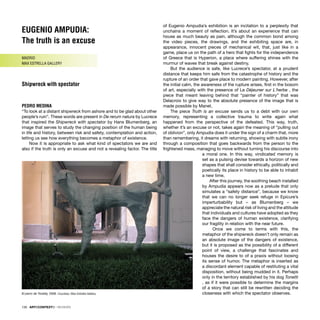
ARTECONTE
X
TO
ARTE
CULTURA
NUEVOS
MEDIOS
-
ART
CULTURE
NEW
MEDIA
Revista
trimestral.
Número
16
•
Quarterly
magazine.
Issue
16
•
España
18€
16
ARTE
CULTURA
NUEVOS
MEDIOS
-
2007
/
4
ART
CULTURE
NEW
MEDIA
-
2007
/
4
ARTECONTE
X
TO
Dossier: LA ENSEÑANZA DE LAS ARTES VISUALES / TEACHING VISUAL ARTS: (Luís Camnitzer,
Sara Diamond, Armando Montesinos, Justo Pastor Mellado, Daniel Canogar) • Ibon Aranberri
¿Qué sucede en Portugal? / What’s going on in Portugal? • Cibercontexto + Info + Críticas / Reviews
ARTECONTEXTO
ARTE CULTURA NUEVOS MEDIOS ART CULTURE NEW MEDIA
ISSN
1697-2341
9
7
7
1
6
9
7
2
3
4
0
0
9
0
0
0
1
6
ISSN
1697-2341
9
7
7
1
6
9
7
2
3
4
0
0
9
0
0
0
1
6
Colaboran en este número / Contributors in this Issue:
Luis Camnitzer, Armando Montesinos, Justo Pastor Mellado, Sara
Diamond, Daniel Canogar, Juan Antonio Álvarez Reyes, Filipa
Oliveira, Alma Molina Carvajal, Eva Grinstein, Miguel Chaia,
Agnaldo Farias, Luis M. Ruiz, Gisela Leal, Maria do Mar Fazenda,
Micol Hebron, Mónica Nuñez Luis, Isabel Tejeda, Asún Clar, Natalia
Maya Santacruz, José Ángel Artetxe, Alicia Murría, Pedro Medina,
Santiago B. Olmo, Mireia A. Puigventós, Juan Carlos Rego.
ARTECONTEXTO
ARTECONTEXTO arte cultura nuevos medios
es una publicación trimestral de
ARTEHOY Publicaciones y Gestión, S.L.
Impreso en España por Técnicas Gráficas Forma
Producción gráfica: El viajero / Eva Bonilla. Procograf S.L.
ISSN: 1697-2341. Depósito legal: M-1968–2004
Todos los derechos reservados. Ninguna parte de
esta publicación puede ser reproducida o transmitida
por ningún medio sin el permiso escrito del editor.
All rights reserved. No part of this publication
may be reproduced or transmitted by any means
without written permission from the publisher.
© de la edición, ARTEHOY Publicaciones y Gestión, S.L.
© de las imágenes, sus autores
© de los textos, sus autores
© de las traducciones, sus autores
© de las reproducciones, VEGAP. Madrid 2007
Esta publicación es miembro de la
Asociación de Revistas Culturales de España (ARCE)
y de la Federación Iberoamericana de Revistas Culturales (FIRC)
ARTECONTEXTO ha recibido una ayuda de la Dirección General del Libro, Archivos y Bibliotecas
para su difusión en bibliotecas, centros culturales y universidades de España, para la totalidad
de los números editados en el años 2007.
ARTECONTEXTO reúne diversos puntos de vista para activar el debate
y no se identifica forzosamente con todas las opiniones de sus autores.
ARTECONTEXTO does not necessarily share the opinions expressed by the authors.
La editorial ARTEHOY Publicaciones y Gestión S.L., a los efectos previstos en el art. 32,1, párrafo
segundo, del TRLPI se opone expresamente a que cualquiera de las páginas de ARTECONTEXTO
sea utilizada para la realización de resúmenes de prensa. Cualquier acto de explotación de la to-
talidad o parte de las páginas de ARTECONTEXTO precisará de la oportuna autorización, que será
concedida por CEDRO mediante licencia y dentro de los límites establecidos en la misma.
Editora y Directora / Director & Editor:
Alicia Murría
Coordinación en Latinoamérica
Latin America Coordinators:
Argentina: Eva Grinstein
México: Bárbara Perea
Equipo de Redacción / Editorial Staff:
Alicia Murría, Natalia Maya Santacruz,
Santiago B. Olmo.
info@artecontexto.com
Asistente editorial / Editorial Assistant:
Natalia Maya Santacruz
Directora de Publicidad / Advertising Director:
Marta Sagarmínaga
publicidad@artecontexto.com
Directora de Relaciones Internacionales
International Public Relations Manager:
Elena Vecino
Administración / Accounting Department:
Carmen Villalba
administracion@artecontexto.com
Suscripciones / Subscriptions:
Pablo D. Olmos
suscripciones@artecontexto.com
Distribución / Distribution:
distribucion@artecontexto.com
Oficinas / Office:
Tel. + 34 913 656 596
C/ Santa Ana 14, 2º C.
28005 Madrid. ESPAÑA
www.artecontexto.com
Diseño / Design:
Jacinto Martín
El viajero: www.elviajero.org
Traducciones / Translations:
Juan Sebastián Cárdenas, Benjamin S. Johnson,
Nicolás Serrano y Joanna Porter
Portada
/
Cover:
Lounge
&
Laptops.
Shots
taken
around
OCAD,
2006.
Photography
by
Angela
del
Buono
SUMARIO
/
INDEX
/
16
5 PRIMERA PÁGINA / PAGE ONE:
La necesaria trasformación del Reina Sofía / The necessary transformation of the Reina Sofía
ALICIA MURRÍA
6 DOSSIER
La enseñanza de las Artes Visuales / Teaching Visual Arts
7 Educación y Fraude
Fraud and Education
LUIS CAMNITZER
21 Zoología y fábulas de la educación artística
Zoology and Fables of Artistic Education
ARMANDO MONTESINOS
29 Por una relocalización institucional de la enseñanza de arte
Towards an Institutional Re-localization of Art Teaching
JUSTO PASTOR MELLADO
37 Cara a cara con el Siglo XXI: El futuro de las instituciones de enseñanza de arte y diseño
Face to Face With the 21st Century: The Future of Art and Design Institutions
SARA DIAMOND
45 Chinook
DANIEL CANOGAR
53 IBON ARANBERRI. De la identidad comunitaria y su fragilidad
IBON ARANBERRI. On communitarian identity and its fragility
JUAN ANTONIO ÁLVAREZ REYES
63 Portugal. Situación 2007
Portugal. Situation 2007
FILIPA OLIVEIRA
72 CiberContexto
Escuela Virtual / Virtual School
ALMA MOLINA CARVAJAL
80 Info
96 Críticas de exposiciones / Reviews
The necessary transformation of the Reina Sofía
The art season in our country has had a very hectic start. The resignation of the director of the Museo Nacional
Centro de Arte Reina Sofía, Ana Martínez de Aguilar, was a surprise for almost everyone. It seems certain
that her irrevocable decision was influenced by the project of the new Minister for Culture, Cesar Antonio
Molina, for the introduction of changes in the operation and structure of the MNCARS, as well as the statement
of the new General Director of Fine Arts, José Jiménez, regarding his intention to apply to state museums
the document of Good Practices, which was compiled by the representative associations of the different
sectors, and signed by the previous Minister, Carmen Calvo. However, this resignation has resulted in the
complication (and hastening) of what should have been a slow process. In its 20 years of history, the MNCARS
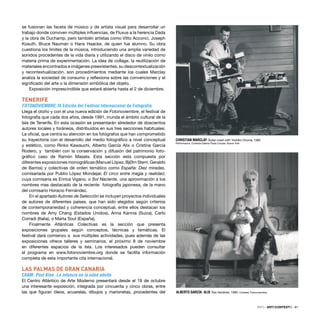
has never had real weight in the international scene, although, since it opened, there have been significant
differences in the work carried out by its successive directors. During these two decades, the debates on the
role of contemporary art museums have defined new plans of action which go far beyond the function of the
safekeeping of pieces of art and the production of temporary exhibitions; nowadays, museums are expected
to carry out a much more complex task, adapted to the current times, with much more elaborate projects,
which render them permanent engines of ideas, generators of knowledge, spaces for reflection on artistic
practices, places which are committed to the education of society. Undoubtedly, the expansion of the Board
of the Reina Sofía, the announcement of an international competition for the selection of its future director, and
the designation of an expert committee which will suggest a name after examining the list of candidates, are all
important steps. However, the main problem lies in the speed with which it is hoped this complex process will
be resolved, hardly allowing any time for the very necessary reflection on how, and, above all, in what direction
to re-orientate the principal contemporary art museum in Spain. In little over a month, the potential candidates
are expected to produce a project of action for the Museum; this is an extremely short deadline, as has been
pointed out by a number of associations. To this we must add the indispensable administrative reform of the
MNCARS and its transformation into a State Agency, a key issue in the improvement of its organisation chart
and operation, and an equally difficult issue to tackle in the short time that the Ministry for Culture is allowing
for all of these changes.
Another issue which has been rattling people is related to the ARCO fair. This year, the Committee which
selects the participating galleries (which is formed by gallery owners) has carried out an important reduction in
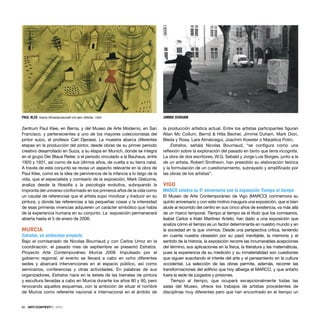
Spanish participation, with the aim of admitting a larger number of countries. For the director of the fair, Lourdes
Fernández, and for the Committee itself, the criteria have been based on the quality of careers, but there has
been a strong sense of disgruntlement among the rejected galleries, many of which have a long career behind
them, and have been constantly present at ARCO. Criticism on the arbitrary way in which the criteria have been
applied has been explicit. The financial damage suffered by the rejected galleries is significant, in addition to
the fact that many of them have been, and continue to be, the main support of Spanish artists over the last
few decades. On the other hand, it must not be forgotten that ARCO enjoys the significant support of public
funding, which is not something that happens at other international fairs. So, dissatisfaction in the heart of this
sector is guaranteed.
Neither have we escaped sad news, like the death of Pablo Palazuelo, one of the most important figures
in Spanish art. Fortunately, the large retrospective show presented last year by the MACBA and the MNCARS
served to recognise during his lifetime his extraordinary career and his contribution to contemporary art.
ALICIA MURRÍA
La necesaria trasformación del Reina Sofía
El comienzo de la temporada artística en nuestro país está siendo de lo más agitado. La dimisión de la directora
del Museo Nacional Centro de Arte Reina Sofía, Ana Martínez de Aguilar, sorprendió a casi todos. Seguramente,
debió pesar en su irrevocable decisión el proyecto del nuevo Ministro de Cultura, Cesar Antonio Molina, en
cuanto a introducir cambios en el funcionamiento y estructura del MNCARS, así como las manifestaciones
del nuevo Director General de Bellas Artes, José Jiménez, respecto a su intención de aplicar el documento
de Buenas Prácticas en los museos estatales, que fue elaborado por las asociaciones representativas de los
diferentes sectores y firmado con la anterior Ministra, Carmen Calvo. Sin embargo, esta dimisión ha venido a
complicar (y acelerar) lo que debía ser un proceso pausado. En sus 20 años de historia, el MNCARS nunca
ha gozado de verdadero peso en el panorama internacional, aunque desde su nacimiento ha habido notables
diferencias en el trabajo realizado por sus sucesivos directores. En estas dos décadas los debates en torno al
papel de los museos de arte contemporáneo han ido perfilando nuevos modelos de actuación que rebasan
en mucho la función de custodia de obras o la realización de exposiciones temporales; hoy se exige de
los museos una tarea más compleja, adaptada al presente, con proyectos mucho más elaborados que los
conviertan en permanentes impulsores de ideas, en generadores de conocimiento, en espacios de reflexión
en torno a las prácticas artísticas, en lugares comprometidos con la formación de la sociedad. Es indudable
que la ampliación del Patronato del Reina Sofía, la convocatoria de un concurso internacional para la elección
de su futuro director, y el nombramiento de una comisión de expertos que hará la propuesta de un nombre,
tras analizar las candidaturas presentadas, son pasos importantes. Sin embargo el problema fundamental se
encuentra en la celeridad con que se pretende resolver todo este complejo proceso, donde apenas se concede
margen a una muy necesaria reflexión sobre cómo y, sobre todo, hacia dónde reorientar el principal museo de
arte contemporáneo del Estado español. En poco más de un mes los posibles candidatos han de elaborar un
proyecto de actuación para el Museo; un plazo extremadamente corto, cuestión que ha sido señalada por varias
de las asociaciones. A ello se añade la indispensable reforma administrativa del MNCARS y su trasformación en
Agencia Estatal, aspecto clave para agilizar internamente su organigrama y funcionamiento, cuestión igualmente
difícil de abordar en el escaso tiempo que el Ministerio de Cultura plantea para todos estos cambios.
Otro tema que ha venido agitando los ánimos tiene que ver con la feria ARCO. El Comité que selecciona las
galerías participantes (a su vez integrado por galeristas) ha llevado a cabo este año una importante reducción
de la participación española con el objetivo de admitir un mayor número de otros países. Tanto para la directora
de la feria, Lourdes Fernández, como para el propio Comité, los criterios se han basado en la calidad de las
trayectorias, pero ha cundido el descontento entre las rechazadas, parte de ellas con muchos años de trabajo
a sus espaldas y una continuada presencia en ARCO. Las críticas sobre la arbitrariedad en la aplicación de los
baremos han sido explícitas. Para las galerías rechazadas el perjuicio económico no es pequeño, a lo que se
suma el hecho de que muchas de ellas han sido el principal sostén de los artistas españoles a lo largo de las
últimas décadas, y lo siguen siendo. De otro lado, no se debe ignorar que ARCO cuenta con un importante
apoyo de dinero público, algo que no sucede en otras ferias internacionales. Así, el mal clima en el seno de este
sector está servido.
Tampoco hemos estado a salvo de noticias luctuosas, como la muerte de Pablo Palazuelo, una de las
figuras más importantes del arte español. Afortunadamente, la gran antológica que el pasado año presentaron
el MACBA y el MNCARS sirvió como reconocimiento en vida de su extraordinaria trayectoria y de su aportación
al arte contemporáneo.
ALICIA MURRÍA
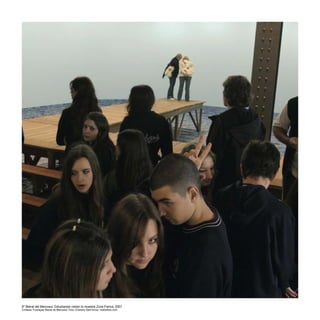
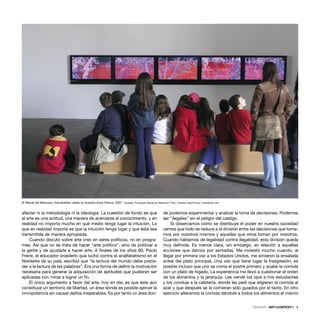
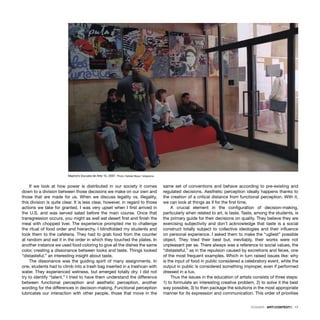
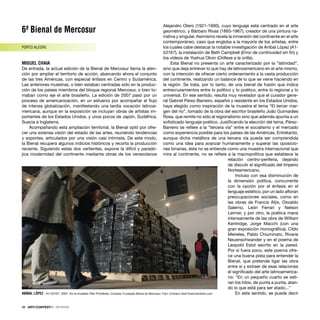
6ª Bienal del Mercosur. Estudiantes visitan la muestra Zona Franca, 2007
Cortesía: Fundaçao Bienal do Mercosul. Foto: Cristiano Sant’Anna / indicefoto.com
Me gustaría empezar haciendo dos afirmaciones, ambas negativas.
La primera es que la mayor parte de la educación artística actual es un
fraude, y la segunda es que la definición vigente del arte atenta contra
los intereses de las personas.
La parte del fraude es la visión comúnmente aceptada de que el
arte es un medio de producción, lo cual conduce a dos nuevos errores:
el primero es confundir creación con las prácticas artesanales y el otro
consiste en prometer, por extensión, que un título en artes conduce ne-
cesariamente a la supervivencia económica después de la graduación.
Existe la idea de que la información técnica forma artistas como
ocurre en cualquier otro campo. La promesa implícita, equivalente a la
que se produce en el resto de programas curriculares, es que después
de la graduación y con una inversión que en los Estados Unidos ron-
da los 200.000 dólares, uno podrá mantener a su familia con holgura.
Quizás esto se produzca mediante la venta de las obras producidas o a
través de la enseñanza dirigida a las siguientes generaciones.
Básicamente, lo que tenemos aquí es un fraude piramidal. Yo di
clases a nivel universitario durante 35 años y estuve en contacto con
unos cinco mil estudiantes, de los cuales estimo que sólo un diez por
ciento, unos quinientos, de los así llamados graduandos en arte, tenía
serias esperanzas de tener éxito en el circuito de galerías. Tal vez unos
veinte lo consiguieran. La mayoría de los otros 480 confiaban en vivir
de la docencia. Ignoro cuántos de ellos lograron un empleo estable,
pero lo que sí sé es que si yo necesité cinco mil estudiante para man-
tener mis ingresos durante esos años, aquellos 480 estudiante a su
DOSSIER · ARTECONTEXTO · 7
LUIS CAMNITZER *
EDUCACIÓN Y FRAUDE
vez necesitarán unos 240 mil nuevos estudiantes en promedio, y así
hasta el infinito.
La definición del arte es otro tema. Me gustaría creer que cuando
el arte fue inventado como algo cuya definición en todo caso acepta-
mos, no fue como un medio de producción sino como una forma de
expansión del conocimiento. Imagino que ocurrió por accidente, que
alguien formalizó una intuición inesperada y desconcertante que no se
ajustaba a ninguna categoría y entonces, en orden a denominar una
experiencia asombrosa, se eligió la palabra “arte”.
El problema con el nombre es que de esta manera toda la profe-
sión se reificó instantáneamente. Desde entonces, dejamos de forma-
lizar intuiciones y nos dedicamos a producir objetos que se adecuaran
a la categoría de “arte”. Así, pues, lo que antes podíamos llamar “arte
como actitud” se transformó en “arte como disciplina”. La forma, que
inicialmente no era más que el producto residual del empaquetado de
aquella primera intuición, tomó el lugar de lo producido. Hace un par
de semanas encontré esta cita: “Toda palabra fue alguna vez un poe-
ma”. Esto resume el proceso de degradación. La frase es de Ralph
Waldo Emerson, alguien a quien nunca había prestado atención por-
que, pensaba (paradójicamente), que sólo trabajaba con palabras.
El mercado capitalista nos enseña que si un objeto puede ven-
derse como arte, entonces es arte. Esta descripción culturalmente
cínica opaca una realidad más profunda. Esto es: que el propietario
del contexto definitivo de la obra determina su destino y su función.
La propiedad del contexto, una de las formalizaciones del poder, es
un hecho político. Que la propiedad es tan fuerte que incluso aquellas
manifestaciones que promueven un contenido más subversivo son
rápidamente convertidas en mercancía.
Esto pone en evidencia que la política forma parte de la definición
del arte. Y como tal, la separación de arte y política en entidades discre-
tas no es sólo una manera reaccionaria de coartar la libertad del artista,
sino también una falacia teórica. De modo que todo arte es político, y
no sólo aquella parcela que llamamos comúnmente “arte político”. El
arte político en cierta medida significa subdividir el conocimiento en la
porción de una porción. Hace poco, en un número de Artforum, Andrea
Fraser respondió a estas preguntas con precisión. Su definición de arte
político se corresponde con mi definición del arte en general:
“…una respuesta es que todo el arte es político, el problema es que la
mayor parte del mismo es reaccionario, esto es, pasivamente afirmativo de
las relaciones de poder vigentes en el lugar en que se produce…Yo definiría
el arte político como el arte que se propone conscientemente intervenir (y
no sólo reflexionar) sobre las relaciones de poder, y esto necesariamente
significa las relaciones de poder que hacen posible la existencia del arte.
Existe otra condición: esta intervención debe ser el principio de organiza-
ción del trabajo en todos los aspectos, no sólo en su “forma” y su “conte-
nido” sino también en el modo de producción y circulación.”1
No obstante, preferimos enseñar a producir e ignoramos el surgi-
miento de la intuición. Estamos absortos en la caligrafía a expensas
de los asuntos sobre los que escribimos. Y de paso servimos a la
estructura de poder político bajo el disfraz del apoliticismo obligatorio
o de la política instantáneamente consumida.
Enseñar a hacer productos es fácil y cómodo. La información exis-
tente se transmite y el proceso de transmisión se ajusta al modelo
autoritario de la pedagogía tradicional. Cualquier acto de agitación es
ignorado. Para cimentar este estado de cosas, se declara imposible
la enseñanza de la generación de intuiciones. Dicha negación es sólo
posible dentro de una estructura de valores competitivos que clasifica
a la gente de manera abrupta entre genios o idiotas, eliminando de
paso la normalidad. Hasta cierto punto este sistema presupone que,
en el ejemplo de mis 500 estudiantes, los veinte que lograron entrar al
circuito de las galerías son genios mientras que los 480 que intentaron
enseñar son idiotas. Y esto explica porqué las universidades buscan
a estrellas de las galerías para dictar clases, sin importar cuán malos
profesores sean.
De hecho, la ideología de esta clasificación va mucho más allá y
es bastante cínica en relación a los resultados. La premisa verdadera
es que el arte no se puede enseñar y en ese sentido, el proceso edu-
cativo no es más que una criba para identificar a los genios, que con
suerte se impondrán gracias a su poder individual. Esta era una de las
intenciones cuando la Bauhaus diseñó sus famosos cursos, y en el
fondo esa es la intención de todos los cursos creados en las escuelas
desde entonces. De modo que la gente invierte 200 mil dólares para
pasar por una criba.
En un escenario peor se podría justificar el proceso diciendo que
aquellos que no lo consiguen al menos aprenden cómo enfocar y
cómo consumir arte. La carrera artística se encuentra en esa envi-
diable posición en la que puede crear a la vez a los productores y al
mercado de consumidores. Sería equivalente a decir que quienes no
logran hacer una carrera como médicos pueden, con la misma inver-
sión, hacer las veces de enfermos.
Enseñar a tener intuiciones ciertamente requiere más esfuerzo
que pasar información. El maestro debe pasar de una posición en la
que ostenta el monopolio del conocimiento a la de agitador y catali-
zador. Las intuiciones son impredecibles y por lo tanto traen consigo
el riesgo de lo subversivo, dado que no siempre se ajustan a los
dictámenes del statu quo. En vista de que últimamente los gobiernos
han decidido que la subversión y el terrorismo son sinónimos, nadie
quiere generar actos subversivos. Pero la función del buen arte es
precisamente la de ser subversivo. El arte se aventura en lo desco-
nocido. Remueve los paradigmas fosilizados y pretende expandir el
conocimiento. El énfasis en la producción de objetos efectivamente
pasa por alto estos elementos. Las estructuras existentes están con-
solidadas y la sociedad, pacificada y aburrida. Este enfoque genera
arte-Valium.
Pareciera que estoy abogando por la eliminación de las escue-
las de arte y apoyando la creación de laboratorios interdisciplinarios
que incluyan el análisis político en sus prácticas. En cierto modo, sí,
pero las cosas no son tan simples. Buena parte de los laboratorios
interdisciplinarios, incluso aquellos que incluyen la discusión política,
están limitados a la transmisión de información interdisciplinaria, sin
8 · ARTECONTEXTO · DOSSIER
afectar ni la metodología ni la ideología. La cuestión de fondo es que
el arte es una actitud, una manera de acercarse al conocimiento, y en
realidad no importa mucho en qué medio tenga lugar la intuición. Lo
que en realidad importa es que la intuición tenga lugar y que ésta sea
transmitida de manera apropiada.
Cuando discuto sobre arte creo en seres políticos, no en progra-
mas. Así que no se trata de hacer “arte político”, sino de politizar a
la gente y de ayudarle a hacer arte. A finales de los años 60, Paulo
Freire, el educador brasileño que luchó contra el analfabetismo en el
Nordeste de su país, escribió que “la lectura del mundo debe prece-
der a la lectura de las palabras”. Era una forma de definir la motivación
necesaria para generar la adquisición de aptitudes que pudieran ser
aplicadas con miras a lograr un fin.
El único argumento a favor del arte, hoy en día, es que éste aún
constituye un territorio de libertad, un área donde es posible ejercer la
omnipotencia sin causar daños irreparables. Es por tanto un área don-
de podemos experimentar y analizar la toma de decisiones. Podemos
ser “ilegales” sin el peligro del castigo.
Si observamos cómo se distribuye el poder en nuestra sociedad
vemos que todo se reduce a la división entre las decisiones que toma-
mos por nosotros mismos y aquellas que otros toman por nosotros.
Cuando hablamos de legalidad contra ilegalidad, esta división queda
muy definida. Es menos clara, sin embargo, en relación a aquellas
acciones que damos por sentadas. Me molestó mucho cuando, al
llegar por primera vez a los Estados Unidos, me sirvieron la ensalada
antes del plato principal. Una vez que tiene lugar la trasgresión, es
posible incluso que uno se coma el postre primero y acabe la comida
con un plato de hígado. La experiencia me llevó a cuestionar el orden
de los alimentos y la jerarquía. Les vendé los ojos a mis estudiantes
y los conduje a la cafetería, donde les pedí que eligieran la comida al
azar y que después se la comieran sólo guiados por el tacto. En otro
ejercicio alteramos la comida dándole a todos los alimentos el mismo
DOSSIER · ARTECONTEXTO · 9
6ª Bienal del Mercosur. Estudiantes visitan la muestra Zona Franca, 2007. Cortesía: Fundaçao Bienal do Mercosul. Foto: Cristiano Sant’Anna / indicefoto.com
10 · ARTECONTEXTO · DOSSIER
color, creando una disonancia entre el aspecto y el gusto. Las cosas
se veían “poco apetitosas”, repugnantes, una intuición interesante so-
bre el gusto.
La disonancia era el espíritu guía de muchas de las tareas que pro-
ponía a mis alumnos. En una de ellas, los estudiantes debían meterse
en una bolsa de basura que a su vez estaba dentro de un cubo lleno
de agua. Éstos decían experimentar una sensación de humedad, pero
salían de la bolsa totalmente secos. No intento identificar el “talen-
to”. Intento que entiendan la diferencia entre la percepción funcional
y la percepción estética, otra terminología para referirse a la toma de
decisiones. La percepción funcional lubrica nuestra interacción con
otra gente, es decir, aquellos que se mueven en la misma esfera de
convenciones y conducta de acuerdo a decisiones preexistentes y
reguladas. La percepción estética ocurre gracias a la creación de una
distancia crítica respecto de la percepción funcional. De este modo
podemos mirar las cosas como si lo hiciéramos por primera vez.
Un elemento crucial en la configuración de la toma de decisiones,
particularmente en lo relativo al arte, es el gusto. El gusto, entre los
estudiantes, es la guía fundamental para sus decisiones sobre la cali-
dad. Ellos creen estar ejerciendo su subjetividad y no reconocen que
el gusto es una construcción social sujeta a las ideologías colectivas y
a su influencia sobre la experiencia personal. Les pedí que fabricaran
el objeto más feo posible. Hicieron lo que pudieron pero, inevitable-
mente, sus obras no eran desagradables per se. Siempre había una
referencia a los valores sociales, a lo “poco apetitoso”, como en la re-
pulsión provocada por excreciones y heces, uno de los ejemplos más
frecuentes, lo cual dio lugar a preguntas como: ¿porqué la ingestión
de alimentos en público está considerada como un acontecimiento
celebratorio, mientras que la deyección de los mismos se ve como
algo impropio, incluso si se hace en traje y con pajarita?
Así, pues, los temas en la educación de los artistas pasan por tres
fases: 1) formular un problema creativo interesante; 2) resolverlo de
la mejor manera posible; y 3) empaquetar las soluciones de la mane-
ra más apropiada para su expresión y comunicación. Este orden de
prioridades desmitifica un proceso generalmente aceptado como algo
oscuro y al alcance de unos pocos. La intuición en el arte no tiene un
papel mucho más importante que el que desempeña en la filosofía
o pueda que hasta en la ciencia. La expresión emocional no es más
importante aquí que en una buena confesión en la iglesia o cualquier
otro material biográfico. Es el nivel y la complejidad del cuestiona-
miento, evitar la simplificación, la elegancia de las respuestas, y la
efectividad con que se transmiten esas respuestas. Es esto último lo
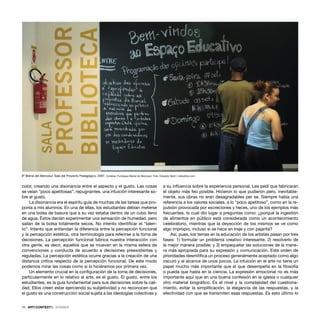
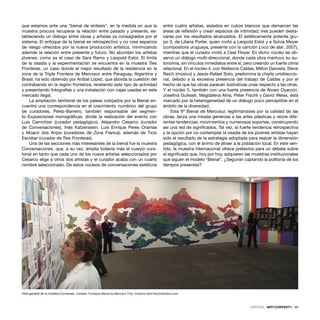
6ª Bienal del Mercosur. Sala del Proyecto Pedagógico, 2007. Cortesía: Fundaçao Bienal do Mercosul. Foto: Eduardo Seidl / indicefoto.com
DOSSIER · ARTECONTEXTO · 11
que requiere el uso del envoltorio y por tanto lo que es susceptible
de ser ajustado mediante el gusto. Pero detener la percepción en el
nivel del gusto significa ignorar el cuestionamiento y las respuestas.
Es como regodearse en el sonido de mi voz mientras leo este texto,
ignorando todo lo que digo.
Alguien podría malinterpretar esta manera de concebir el arte
como un programa racional, explícito e ilustrativo, algo que produje-
ra órdenes predecibles con productos muertos. Dicha interpretación,
sin embargo, pasaría por alto muchas cosas que, de hecho, también
pueden enseñarse. La principal es que probablemente el arte es el
lugar donde uno piensa en las cosas de un modo que no se puede
pensar en otros ámbitos. Las otras cosas son que un buen proble-
ma de arte no se agota nunca, que una buena solución produce
reverberaciones y que una buena comunicación genera sobre todo
nuevas evocaciones antes que una transmisión de información sin
más. También implicaría pasar por alto que entre las herramientas
usadas, más allá del análisis, se encuentran la empatía, la verosimi-
litud, la demagogia y la explotación emocional. Es más, significaría
ignorar que la cuestión principal planteada por el arte es “qué ocu-
rriría si”, y no “qué es”. Es en el procesamiento de las evocaciones
donde la obra de arte acaba tomando su forma real, y la función del
artista consiste en crear estrategias dirigidas a la administración de
las mismas.
Si bien estos temas constituyen el centro de lo que considero un
segundo nivel, más elevado, también pueden dar lugar a tareas en la
primera fase. Distribuí entre mis estudiantes piezas que encontré en la
basura y les dije que se trataba de productos terminados con un uso
práctico. Su misión consistía en descubrir las utilidades funcionales de
esas piezas. Dado que el uso original ya no era aplicable, ellos debían
hallar una nueva utilidad. Cualquier referencia al arte, la decoración o la
religión estaba excluida. El recurso de la navaja suiza también estaba
prohibido: un mismo objeto no podía ser multifuncional. La idea básica
es que el objeto era un diseño perfecto para una determinada aplica-
ción y por tanto, la mejor explicación era aquella que lograra sacarle el
máximo provecho a todas las partes del mismo.
Esta especie de proceso de inversión de la ingeniería refleja una
manera de enfocar algunas de las formas de comprensión del arte.
Otra metáfora consistía en pensar en la contraparte, esto es, diseñar
un juego capaz de producir obras de arte. El juego ideal generaría
buenas obras independientemente de la destreza o del nivel educa-
tivo del jugador. La definición de este juego aceptada dos extremos:
1) un juego totalmente abierto donde las reglas fueran: “tomar lápiz y
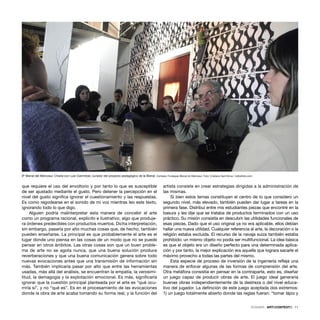
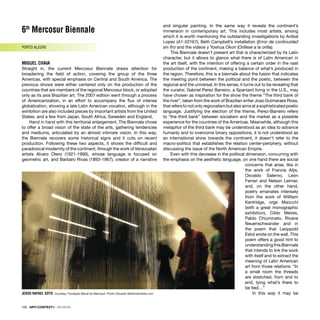
6ª Bienal del Mercosur. Charla con Luis Camnitzer, curador del proyecto pedagógico de la Bienal. Cortesía: Fundaçao Bienal do Mercosul. Foto: Cristiano Sant’Anna / indicefoto.com
12 · ARTECONTEXTO · DOSSIER
papel y dibujar cualquier cosa”; 2) un juego totalmente cerrado donde
las reglas fueran: “tomar un dibujo con números y rellenarlo con colo-
res, donde cada número correspondiera a un color”. El primer ejemplo
es completamente abierto e impredecible, pero las posibilidades de
fracasar son muy altas. El segundo es extremadamente cerrado y pre-
decible, pero las posibilidades de fracaso son prácticamente nulas. El
mejor, que no ideal, tipo de juego, encontraría una cantidad modera-
da de reglas que pudiera filtrar tantos errores como fuera posible, en
orden a maximizar tanto el azar (y la libertad) y a la vez tener éxito en
los resultados.
El paralelo social es la búsqueda de un modelo auténtico de de-
mocracia con equilibrio entre las leyes y la libertad. Sería una manera
de regular tanto la apertura total de la anarquía caricaturesca (liber-
taría y amoral), como la falta de libertad de decisiones tal como la
concibe el totalitarismo.
Esta descripción puede sonar como una metáfora pero no lo es.
Las reglas bajo las cuales el arte, su circulación y recepción, opera,
son ideológicas. Así que las reglas que el artista crea para el arte re-
flejan de manera precisa un complejo juego de interacciones de poder
entre el artista y la obra, entre el artista y el público, entre la obra y el
público. Es la incapacidad de percibir el papel del poder en este caso
lo que permite a nuestra sociedad alabar el arte apolítico, y ver el arte
como una actividad separada de la ética. Es por ello que se espera
que el arte no sea didáctico.
Hace setenta años, en “El escritor como productor”, Walter Benjamin
señaló los nexos entre la calidad y la didáctica: “un escritor que no en-
seña a otros escritores no le enseña a nadie. Por tanto, el punto crucial
es que la producción de un escritor debe tener el carácter de un mode-
lo: debe ser capaz de instruir a otros escritores en su producción y de
modo secundario, debe ser capaz de poner a su disposición un aparato
mejorado. Este aparato será mejor entre más consumidores ponga en
contacto con el proceso de producción –en suma, entre más lectores o
espectadores sea capaz de convertir en colaboradores–.”2
En el mismo
ensayo también definía al artista, ya lo avisa el título, como productor. Y
aunque esto tuviera un sentido ideológico para la izquierda de aquellos
años, tal como lo tuvo años después del término “trabajador cultural”,
ambas palabras traen consigo el riesgo de la reificación. Aceptan la
“cosa” como soporte del mensaje en tanto determinante del valor den-
tro del cual la “cosa” se juzga.
Yo diría que, en primer lugar, estamos tratando con los valores
mismos y con el proceso de juicio (de otro modo no estaríamos ha-
blando de los modos de producción y circulación que Fraser mencio-
naba). De hecho, Benjamin no estaba hablando de habilidades de es-
critura, sino de lo que él llamaba “compromiso”, un término complejo
que intentaba incluir todo el peso de la conciencia social, la militancia
y la claridad de metas para el mejoramiento de la sociedad. Es decir,
él intentaba cuestionar el sistema de valores bajo el cual los objetos
se juzgaban y la idea del autor o artista como mero productor de bie-
nes de consumo.
Todo esto me parece más importante que aprender a pintar o a ha-
cer videos o todo el “how to” en general. En una tarea, durante la fase
introductoria del curso en mi departamento, intenté abordar algunos
de estos temas y le pedí a la clase que creara un coleccionista de arte
humanoide. El humanoide era una criatura arbitraria hecha colectiva-
mente. Cada estudiante aportó un rasgo. La criatura resultante acabó
teniendo cola, muchos brazos, tres ojos, etc. Casi todo reflejaba ideas
tópicas sobre los alienígenas. Luego analizamos la criatura en términos
de cómo, dados sus atributos físicos, percibiría la realidad (cómo se
percibe el sonido con tres orejas, cómo afectan la perspectiva los ojos
añadidos, y así sucesivamente). A continuación intentamos determinar
cómo el humanoide interactuaría con otros miembros de su especie,
qué tipo de sociedad podía deducirse a partir de la información dispo-
nible, qué leyes, qué tipo de arquitectura, etc. En suma, tratamos de
especular sobre los valores que conformaban dicha sociedad: los po-
sitivos y los negativos, lo que era considerable como un delito punible
y cómo se llevaba a cabo el castigo, qué recompensas eran dignas de
esa denominación y en qué consistían. Todo este proceso tenía como
fin identificar el gusto estético básico bajo el cual operan los huma-
noides: qué colores y formas son positivas y cuáles negativas, entre
otras cuestiones. También intentamos descubrir qué función desempe-
ña para ellos una obra de arte deseable. Con todo esto formulado, los
estudiantes se convirtieron en productores mercenarios de arte para la
sociedad e hicieron una obra desligada por completo de sus deseos y
estéticas individuales, cumpliendo exclusivamente con los requisitos ar-
tísticos de la sociedad humanoide. La “adquisición” era aquí un término
relativo, dado que no había necesariamente ni dinero ni una noción de
la propiedad privada. El medio elegido dependía del sistema sensorial
del humanoide, no del artista. La ubicación dependía de la definición
humanoide de los lugares apropiados. Qué tipos de estímulos usaban
y cómo, dependiendo de los valores de esta sociedad particular. La
única exigencia arbitraria, sin embargo, es que tanto el artista humano
(un esclavo) como la obra producida fueran susceptibles de ser descar-
tadas. En caso de desaprobación, él o ella podrían ser descalificados,
eliminados, sin que ello significara una infracción de los presupuestos
éticos de aquella sociedad.
En una de mis clases, una estudiante mayor que los demás habló
tras la finalización de la tarea. Dijo que su marido, un pintor de ca-
sas, había formado parte del equipo que blanqueó el mural de Diego
Rivera en el Rockefeller Center en Nueva York. Al llegar a casa le había
comentado que “la pintura no eran tan mala”. Ella no había vuelto a
pensar en aquel incidente hasta ese mismo día.
Ÿ Luis Camnitzer es artista, extiende sus actividades a la enseñanza, la
curaduría, la crítica y la historia. Ha dirigido el proyecto pedagógico de la
6ª Bienal del Mercosur, 2007.
NOTAS
1.- Gregg Bordowitz, “Tactics Inside and Out”, Artforum 9. 2004, p. 215.
2.- Walter Benjamin, “The Author as a Producer”, Understanding Brecht, Verso, Lon-
don-New York, 2003, p.98.
DOSSIER · ARTECONTEXTO · 13
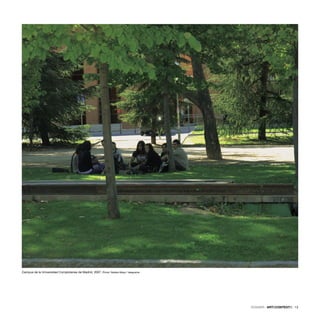
Campus de la Universidad Complutense de Madrid, 2007. Photo: Natalia Maya / telegrama
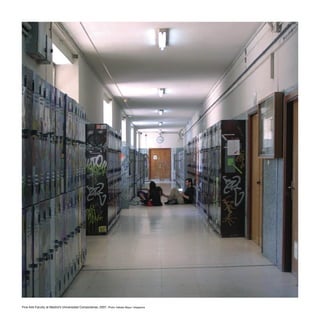
Fine Arts Faculty at Madrid’s Universidad Complutense, 2007. Photo: Natalia Maya / telegrama
DOSSIER · ARTECONTEXTO · 15
There are two affirmations I want to start with here, and both are negative.
One is that most of art education today is a scam, and the other is that
the operating definition of art is biased against the people.
The scam part is the disciplinary view that art is a means of
production, which leads to two mistakes. The first mistake is confusing
creation with the practicing of crafts. The other mistake is promising,
by implication, that a degree in art will lead to economic survival after
graduation.
There is the notion that technical information forms artists like in
other fields. The implicit promise, as with any other studies, is that upon
graduation and after a tuition investment of around $200,000, if one
studies in the U.S., one will be able to support oneself and one’s family.
Presumably this happens either through sales of the produced works,
or through teaching succeeding generations.
Basically, what we have here is a pyramid scam. I taught on the
college level for about 35 years and had contact with roughly 5000
students. Of those, I estimate that 10%, or about 500, the so-called art
majors, had serious hopes of making it in the gallery circuit. Maybe 20
actually did. The majority of the other 480 hoped to survive by teaching
art. I don’t know how many succeeded in securing a job, but I do know
that if I needed 5000 students to support my income during those years,
those 480 will in turn need a combined new student base of about
240,000 students, and so on into infinity.
The definition of art is another issue. I like to think that when art
was invented as whatever we accept it to be; it was not as a means
LUIS CAMNITZER *
FRAUD AND EDUCATION
DOSSIER · ARTECONTEXTO · 15
16 · ARTECONTEXTO · DOSSIER
of production but a way of expanding knowledge. I imagine that it
happened by accident, that somebody formalized an unexpected,
perplexing insight that didn’t fit any known category and then, to give
a name to a “wow” experience, they chose the word “art” instead.
The problem with the naming is that our whole profession became
instantly reified. From then on, we stopped formalizing insights and
proceeded to produce things that fit the “art” category instead. So,
what we can call “art as an attitude” became “art as a discipline.”Form,
that initially had been a byproduct from packaging that first insight, took
the place of the product. A couple of weeks ago I found a quote: “Every
word was once a poem,” that sums up this process of degradation. It
is by Ralph Waldo Emerson, somebody I never had paid attention to
because I thought, paradoxically, that he only worked with words.
The capitalist market teaches us that if an object can be sold
as art, it is art. This culturally cynical description obscures a deeper
reality. That is: that the owner of the ultimate context of the artwork
determines its destiny and its function. The ownership of context, one
of the formalizations of power, is a political fact. That ownership is
so strong that even those manifestations that are and bear a more
subversive content are quickly commodified.
This makes it clear that politics are part of the definition of art.
And as a consequence, the separation of art and politics into discrete
entities is not only reactionary and a way of curtailing the freedom of
the artist, but also a theoretical fallacy. So, yes, all art is political and
no, not all art is what we understand as “political art.” Political art in
certain ways means subdividing the pie of knowledge into a slice of a
slice. Recently, in an issue of Artforum, Andrea Fraser answered these
questions in a very accurate way, where political art is defined the way
I would define art:
“…One answer is that all art is political, the problem is that most
is reactionary, that is, passively affirmative of the relations of
power in which it is produced… I would define political art as art
that consciously sets out to intervene in (and not just reflect on)
relations of power, and this necessarily means relations of power
in which it exists. And there’s one more condition: This intervention
must be the organizing principle of the work in all its aspects, not
only in its “form” and its “content” but also its mode of production
and circulation.”1
So, instead, we teach product-making and ignore insight-having.
We are addressing calligraphy at the expense of the issues we write
about. And we are serving a political power structure under the guise
of forced apoliticism or instantly consumed politics.
Teaching how to make products is easy and comfortable. Existing
information is transmitted, and the process of transmission fits the
traditional authoritarian model of pedagogy. Any possible upheaval is
avoided. To cement this smoothness, the teaching to have insights is
declared impossible, a denial only sustainable within a competitive
value structure that classifies people abruptly into geniuses and
morons and erases normality. In certain ways this assumes that in the
example of my 500 students the 20 that made it into the gallery circuit
are the geniuses and the 480 that try to teach art are the morons. And
that explains why colleges look for gallery stars as teachers, no matter
how bad they are in teaching.
In fact, the ideology of this classification goes much further and
is quite cynical in relation to the results. The real assumption is that
art cannot be taught. Accordingly, the educational process is a sifter
to identify geniuses, which hopefully will emerge thanks to their own
power. This was one of the intentions when the Bauhaus designed its
famed foundation courses, and deep down was the intention of all
the foundation courses created in the schools that followed. So. The
$200.000 is invested in being sifted.
In a worst-case scenario one may justify the process by saying that
those that don’t “make it” at least learn how to approach and consume art.
The art career is in the enviable position of simultaneously creating both
the producers and its market. It is like having, for the same investment,
those who don’t make it in the medical profession, get sick.
Teaching to have insights certainly requires more effort than
passing-on information. The instructor has to shift from a position of
holding the monopoly of knowledge to one of prodding and acting as
a catalyst. Insights are unpredictable and therefore in constant danger
of being subversive, since they don’t necessarily fit the status quo.
Since lately subversion and terrorism have been made synonyms
by the governments, nobody wants to generate subversion. But the
function of good art is to be subversive. It ventures into the unknown;
it shakes up fossil paradigms, and it aims to expand knowledge. The
focus on making products effectively sidesteps these issues; existing
structures are confirmed and society is pacified and dulled. This focus
generates Valium-art.
So, it would seem that I am advocating the elimination of art schools
and endorsing the creation of interdisciplinary labs that hopefully
include political analysis. In certain ways I probably am, but it is not
that simple. Most of interdisciplinary labs, even if they include politics,
are limited to the transmission of interdisciplinary information, which
is not a great improvement. It is one way of reorganizing information,
without affecting either the methodology or the ideology. The real point
is that if art is an attitude, an approach to knowledge, it really doesn’t
matter much within what medium the insight takes place. What does
matter is that it does take place, and that it is properly conveyed.
When discussing art I believe in political beings, not in political
programs. So it is not about making political art, but about politicizing
people and helping them make art. In the late 1960s Paulo Freire, the
Brazilian educator who was fighting illiteracy in the Northeast of Brazil,
wrote that “reading the world has to precede reading the word.” It
was a way to help define a motivation strong enough to generate the
acquisition of skills to be applied with a purpose.
The only argument today in favor of art having its own space is
that it can be a territory of freedom, an area where we can exercise
omnipotence without causing irreparable damage. It is, therefore, an
area where we can experience and analyze decision-making. We can
be “illegal” without the danger of punishment.
DOSSIER · ARTECONTEXTO · 17
If we look at how power is distributed in our society it comes
down to a division between those decisions we make on our own and
those that are made for us. When we discuss legality vs. illegality,
this division is quite clear. It is less clear, however, in regard to those
actions we take for granted. I was very upset when I first arrived in
the U.S. and was served salad before the main course. Once that
transgression occurs, you might as well eat desert first and finish the
meal with chopped liver. The experience prompted me to challenge
the ritual of food order and hierarchy. I blindfolded my students and
took them to the cafeteria. They had to grab food from the counter
at random and eat it in the order in which they touched the plates. In
another instance we used food coloring to give all the dishes the same
color, creating a dissonance between looks and taste. Things looked
“distasteful,” an interesting insight about taste.
The dissonance was the guiding spirit of many assignments. In
one, students had to climb into a trash bag inserted in a trashcan with
water. They experienced wetness, but emerged totally dry. I did not
try to identify “talent.” I tried to have them understand the difference
between functional perception and aesthetic perception, another
wording for the differences in decision-making. Functional perception
lubricates our interaction with other people, those that move in the
same set of conventions and behave according to pre-existing and
regulated decisions. Aesthetic perception ideally happens thanks to
the creation of a critical distance from functional perception. With it,
we can look at things as if for the first time.
A crucial element in the configuration of decision-making,
particularly when related to art, is taste. Taste, among the students, is
the primary guide for their decisions on quality. They believe they are
exercising subjectivity and don’t acknowledge that taste is a social
construct totally subject to collective ideologies and their influence
on personal experience. I asked them to make the “ugliest” possible
object. They tried their best but, inevitably, their works were not
unpleasant per se. There always was a reference to social values, the
“distasteful,” as in the repulsion caused by excretions and feces, one
of the most frequent examples. Which in turn raised issues like: why
is the input of food in public considered a celebratory event, while the
output in public is considered something improper, even if performed
dressed in a tux.
Thus the issues in the education of artists consists of three steps:
1) to formulate an interesting creative problem, 2) to solve it the best
way possible, 3) to then package the solutions in the most appropriate
manner for its expression and communication. This order of priorities
Madrid’s Escuela de Arte 10, 2007. Photo: Natalia Maya / telegrama
18 · ARTECONTEXTO · DOSSIER
demystifies a process generally accepted as appallingly obscurantist.
Intuition in art has not a role much bigger than it has in philosophy or,
possibly, in science. Emotional expression is no more important than
any good church confession or any other biographical material may
be. It is the level and complexity of the questioning, the avoidance
of simplification, the elegance of the answers, and the effectiveness
with which these answers are conveyed. It is the latter that employs
packaging and therefore may be tweaked and adjusted with taste. But
to stop perception on the taste level means to ignore the questioning
and the answers. It is like basking in the sound of my voice while I read
this, and ignoring everything I am saying.
One may misunderstand this way of thinking about art as a rational,
explicit and illustrative program, one that produces predictable orders
with dead products. That interpretation, however, would ignore many
things that, by the way, also can and should be taught. The main
one is probably that art is the place where one thinks things that
one cannot think in other ways. Others are that a good art problem
is not exhaustible, that a good solution has reverberations and that
good communication produces more evocations than it conveys
information. It also would ignore that the tools being used, beyond
analysis, include empathy, make-believe, demagogy and emotional
exploitation. Further, it would ignore that the main question that
prompts art is “what if” and not “what is.” It is in the processing of
evocations that the artwork ultimately takes its real shape, and it is the
artist’s function to strategize about how they are administered.
While these issues constitute the core of what I consider a
second, tutorial, level, they also inform assignments in the first stage.
I distributed pieces of garbage I picked up from the floor, and told my
students that they were finished products that had a practical use.
Their mission was to find out what were the functional applications.
Since the original use was not applicable anymore, they had to come
up with a new function. They were not allowed to invoke art, decoration
or religion. The Swiss Army approach was ruled out as well. The same
object could not be multifunctional. The presumption was that the
object was a perfect design for the application and therefore the better
explanation was the one that made use of the most parts.
This sort of reverse engineering process reflected a way to
approach some of the ways of the understanding of art. Another
metaphor was to consider the work of art as the result of a game,
where one has to figure out the rules. And then the counterpart,
design a game that produces works of art. The ideal game would
generate good works of art regardless the skill level or education
of the player. The definition of this game accepted two extremes:
1) a totally open game where the rules are: “Take a pencil and a
sheet of paper and draw whatever you want.” 2) A totally closed
game where the rules are: “Take this drawing with numbers and fill
in with the corresponding numbered colors.” The first example is
totally open and unpredictable, but the failure rate is extremely high.
The second one is extremely closed and predictable, but the failure
rate is practically zero. The best, not the ideal game, would find a
moderate amount of rules that would filter out as many errors as
possible and maximize both the unpredictability (and freedom) and
the success of the results.
The social parallel is the search for a true model of democracy
with a balance between laws and freedom. It would rule out the total
openness of phony (libertarian, unethical) anarchy and the total lack of
a freedom of decisions as defined by totalitarianism.
This description may sound like a metaphor, but it isn’t. The
rules under which art making, the circulation of art, and its reception
operate, are ideological. Thus the rules the artist creates for the art
producing game reflect rather precisely a complex set of power
interactions between artist and artwork, artist and public, and artwork
and public. It is the failure to perceive the role of power here that
allows our society to expect and praise apolitical art, and to see art as
an activity separate from ethics. That is the reason why it is expected
that art should not be didactic.
Seventy years ago Walter Benjamin, in “The writer as a producer”
made a point linking didactics with quality: “A writer who does not
teach other writers teaches nobody. The crucial point, therefore, is
that a writer’s production must have the character of a model: it must
be able to instruct other writers in their production and, secondly, it
must be able to place an improved apparatus at their disposal. This
apparatus will be the better, the more consumers it brings into contact
with the production process—in short, the more readers or spectators
it turns into collaborators.”2
In the same essay he also defined the
artist, as the title well says, as a “producer.” While that may make some
ideological sense for the leftists at the time, like later the term “cultural
worker” did, both terms bear with them the danger of reification. They
accept the thing bearing the message as determining the values under
which the thing is judged.
I would say that what we are dealing with in the first place here are
the values themselves and the judging process (otherwise we would
not be addressing the modes of production and circulation Fraser
mentioned in her quote). Benjamin, in fact, wasn’t talking about writing
skills, but about what he called “commitment,” a complex word that
tried to include the whole weight of social awareness, militancy and
clarity of goals for social improvement. That is, he intended to challenge
the value system under which the objects are judged and the author or
artist as a producer was not merely a creator of products.
All this, I feel is more important than learning how to paint or to make
video or “how to” in general. In one assignment during the introductory
period of the course sequence in my department I tried to deal with
some of these issues and asked the class to create a humanoid
collector of art. The humanoid was an arbitrary creature created
collectively. On the blackboard the students took turns contributing
one body feature at a time. The resulting creature ended up having
tails, several arms, three eyes, etc., mostly reflecting stereotypical
notions about aliens. We then analyzed this creature in terms of how,
given its physical attributions, it might perceive reality (what is sound
like with three ears, how do more eyes affect perspective, and so on).
We then tried to determine how the hominoid might interact with other
members of its species, what kind of society can be deduced from the
DOSSIER · ARTECONTEXTO · 19
information available, what body of laws, what kind of architecture, and
so on. Mostly, we tried to speculate about the values that informed this
society: the positives and negatives, what was considered punishable
and how punishment carried out, and what was was worth rewarding
and what were the rewards. All this process was geared to identify
the basic aesthetic taste under which the hominoids functioned,
among them: what colors and shapes were positive, and which were
negative. We also tried to figure out what function a desirable work
of art fulfilled for them. With all this in place the students became
mercenary producers of art for this society and had to make a work
of art unrelated to their individual wishes or aesthetics, solely meeting
the artistic requirements of the humanoid society. “Acquisition” here
was a relative term since there was necessarily neither a currency
nor a notion of private property. The media chosen depended on the
sensorial system of the humanoid, not of the artist. The placement
depended on the humanoid’s definition of appropriate places. What
kinds of stimuli were used and how, depended on the values under
which that society operated. The only given, however, was that both the
human artist (a slave artist) and the work produced were expendable.
In case of displeasure, he or she could be fully disposed of, without
any breach of society’s ethical assumptions.
In one of my classes, an older student spoke up after the
completion of the assignment. She said that her husband, a house
painter, had been part of the team that whitewashed Diego Rivera’s
mural in Rockefeller Center. He had come home and commented that
“the painting really wasn’t that bad.” She had never thought about the
incident again until that day.
Ÿ Luis Camnitzer is an artist, teacher, critic, curator and art historian.
He was recently commissioned to create the pedagogic project for the 6th
Mercosur Biennial, 2007.
NOTES
1.- Gregg Bordowitz, “Tactics Inside and out,” Artforum 9.2004, p.215
2.- Walter Benjamin, “The Author as a Producer,” Understanding Brecht, Verso,
London-New York, 2003, p.98
6th
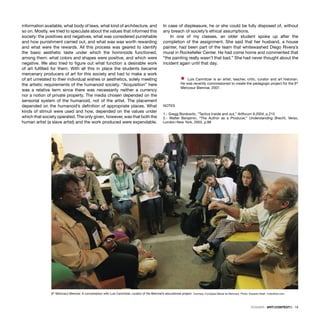
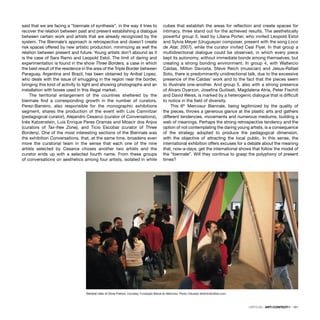
Mercosur Biennial. A conversation with Luis Camnitzer, curator of the Biennial’s educational project. Courtesy: Fundaçao Bienal do Mercosul. Photo: Eduardo Seidl / indicefoto.com
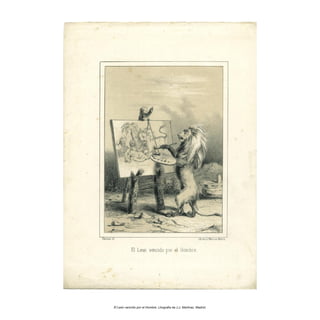
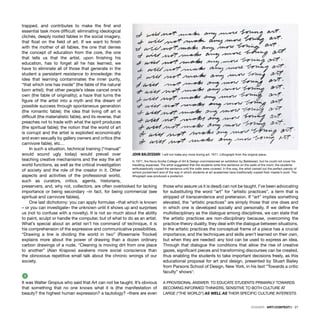
El León vencido por el Hombre. Litografía de J.J. Martínez. Madrid.
1
“Una persona nace artista como un hipopótamo nace hipopó-
tamo, y uno no puede convertirse en artista como no puede
convertirse en jirafa”.
La frase es de John Ruskin, y parece defender, aunque la zoológica
equiparación artista–paquidermo resulte sospechosa, la idea de que el
artista “nace”.
Si el lector comparte la cita, tendrá claro que un artista será siempre
artista, haga lo que haga y reciba la educación que reciba. Decir, hoy
día, que no tiene que recibir ninguna no es, desde luego, políticamente
correcto, con lo cual la idea de un lugar donde, en su primera juventud,
pueda no sólo hacer sus obras, sino oír hablar de otras cosas y conocer
a sus semejantes, es tan aceptable como tener un artista en la familia.
En nuestro entorno, la Universidad parece un lugar adecuado, aunque,
al ser ya artista, tal vez prefiera, en lugar de Bellas Artes, estudiar Dere-
cho, Filología o una ingeniería.
Pero habrá, imagino, quien, como cuando consideramos que la in-
mersión del estudiante en un entorno en el que sólo se hable el idioma
que se desea dominar es la mejor manera de aprenderlo, será partidario
de que en ese lugar sólo haya verdaderos semejantes, es decir, artistas,
en el convencimiento de que eso le hará no un artista, que ya lo es des-
de que nació, sino “mejor”, que es el sentido de toda educación. Ese
lugar puede ser el estudio de un artista que actúa como maestro, algo
ARMANDO MONTESINOS *
ZOOLOGÍA Y FABULAS
DE LA EDUCACIÓN ARTÍSTICA
DOSSIER · ARTECONTEXTO · 21
22 · ARTECONTEXTO · DOSSIER
bien contrastado desde el medioevo, o, más moderno, una escuela o
centro para artistas.
En cambio, el lector que no esté de acuerdo con la frase de Ruskin
sostendrá, probablemente, que el artista “se hace”, lógicamente a
partir de un proceso educativo. Al no serlo de nacimiento, difícilmente
podrá acceder al lugar al que sólo acuden los artistas natos, por lo
que –a menos que encuentre un taller de un artista que acceda a
enseñar a “aspirantes” no dotados por la naturaleza– la Universidad,
concretamente una Facultad de Bellas Artes, parece, de nuevo, el lu-
gar adecuado.
La formación en el estudio de un artista es la tradicional, aunque
hoy esa combinación donde el neófito es, a la vez, aprendiz y “macha-
ca”, equivale a trabajar de becario en una empresa o a una pasantía.
En este lugar la transmisión del conocimiento está basada en la expe-
riencia individual del artista–maestro y en la inmersión permanente
en el mundo profesional del arte.
En un centro para artistas no suele haber un programa docente
que cumplir, sino numerosas actividades e intercambios creativos en
absoluta libertad; a veces es un frenético lugar de experimentación,
otras un productivo retiro del mundanal ruido. Aquí la transmisión de
conocimiento se produce a través de la combinación de experiencias
individuales y problemáticas colectivas, ambas fruto de la inmersión
permanente en el mundo artístico.
En cuanto a las Facultades de BB.AA., teniendo en cuenta que
sólo una minoría (un 5% sería optimista) de los licenciados son reco-
nocidos –como los zoólogos reconocen a los hipopótamos– por los
especialistas del mundo del arte como artistas, habrá que convenir
que o bien esa minoría es especial (¿los nacidos para ello?) o que el
sistema no funciona. A no ser, claro, que aceptemos que no todo el
que estudia Bellas Artes quiere ser artista –sin ir más lejos, podríamos
pensar en aquellos que, nacidos médicos, prefieren familiarizarse con
lo artístico a estudiar Medicina–, o que entendamos que el objetivo de
la Universidad es, ni más ni menos, formar universitarios.
Tal vez hablo de una especie en extinción, pero un universitario
es un estudiante interesado en recibir una educación superior, que le
dote de una comprensión profunda de los conocimientos y compe-
tencias relativos a un campo del saber, y que le permita, acabados
los estudios, desarrollarse personal y profesionalmente, de manera
preferente en dicho campo. La transmisión del conocimiento en una
Facultad se basa en la experiencia colectiva del cuerpo docente y en
la inmersión temporal en el mundo académico, entre profesionales
del estudio y la investigación.
2
Por un lado, los contenidos ofrecidos en Bellas Artes (como en el res-
to de las facultades españolas) asumen que hay conocimientos que
deben transmitirse y adquirirse obligatoriamente –los llamados tron-
cales, entre un 30 y un 40% del total– y que hay otros optativos, entre
los que el estudiante puede elegir a su criterio. Los conocimientos
troncales vienen decididos por el Estado, que reserva ese porcen-
taje para ciertas disciplinas y materias que se consideran indispen-
sables y se quieren preservar o estimular, mientras que los optativos
son, idealmente, consensuados por el profesorado de cada centro,
ofreciendo otros enfoques variados. Las razones para mantener esta
división, aparte de la ideológica implícita en todo canon, suelen estar
dictadas por razones extraeducativas: puestos de trabajo, relaciones
interdepartamentales, luchas de poder, presupuestos...
Por otro, se distingue entre los contenidos “prácticos” y “teóri-
cos”. Aquí la razón parece prístina, si nos atenemos a la definición de
que el conocimiento práctico sólo se obtiene haciéndose, es decir,
que la teoría de la actividad no describe la esencia de la práctica de
esa actividad. Se supone que los conocimientos prácticos son –ojo al
dialecto militar– las disciplinas a dominar, y los teóricos son materias
abiertas a la mera especulación. Lo sorprendente es que nadie parece
reparar en que lo teórico también se hace haciéndose –lo que vengo
llamando, en mis clases y textos, la fisicidad del trabajo intelectual.
Esta doble dicotomía, a la que hay que añadir una tercera –la fa-
cultad versus el mundo exterior, tan proceloso el pobre–, mantiene
atrapados conceptualmente a estudiantes y docentes, y contribuye
a dificultar la primera y fundamental tarea: eliminar los clichés ideoló-
gicos, las fábulas profundamente arraigadas en el imaginario social,
que flotan sobre el campo del arte. Si queremos acabar con la madre
de todas las fábulas, la que niega de raíz el concepto de educación,
la que nos cuenta que el artista, al acabar su formación, tiene que
olvidar todo lo que ha aprendido, no nos queda más remedio que
intentar eliminar todas aquellas que generan en el estudiante una per-
tinaz resistencia al conocimiento: la idea de que aprender contamina
la pureza interior, “lo que uno lleva dentro” (la fábula del artista nato);
que las ideas de los demás anulan las propias (la fábula de la origina-
lidad); una nebulosa mitologizante de la figura del artista y el sueño de
un posible éxito por generación espontánea (la fábula romántica); la
idea de que vivir del arte es difícil (la fábula materialista), y su reverso,
que predica no comerciar con lo que el espíritu produce (la fábula es-
piritual); la noción de que el mundo del arte es corrupto y el artista es
explotado económica, e incluso sexualmente, por galeristas y críticos
(la fábula carnívora), etc., etc.
En esa situación, se suele primar la formación técnica (queda ya
feo decir “manual”) por encima de los mecanismos creativos y del
funcionamiento del mundo del arte, así como de la indagación crítica
sobre la sociedad y del papel del creador en la misma. Y se sue-
len ignorar, por secundarios o menores –en realidad, por comerciales
(véase fábulas espiritual y carnívora)– otros aspectos y actividades del
mundo profesional: comisarios, críticos, gestores, galeristas, conser-
vadores, historiadores y, por qué no, coleccionistas.
Una última dicotomía: se pueden aplicar recetas –lo conocido– o
se puede investigar –lo desconocido hasta que aparece y nos sorpren-
de (no confundir con lo novedoso). Se trata no tanto de la habilidad
para pintar, esculpir o manejar el ordenador, sino de qué hacer como
artista. Lo que tiene de especial un artista no es su dominio de una
técnica, es su comprensión de las posibilidades expresivas y comu-
nicativas. “Dibujar una línea es dividir el mundo en dos” (Rosemarie
DOSSIER · ARTECONTEXTO · 23
Trockel) explica más sobre el poder del dibujo que una docena de
adocenadas cartulinas al carboncillo de un modelo desnudo. “Limpiar
es cambiar la suciedad de sitio” (Alan Kaprow) despierta más con-
ciencia social que la quejumbrosa cháchara repetitiva sobre los males
endémicos de nuestra sociedad.
3
Nada menos que Walter Gropius dijo que el Arte no puede ser ense-
ñado. Es evidente que algo que nadie tiene claro qué es (¿la mani-
festación de la belleza?, ¿la más alta expresión de lo humano?, ¿una
tautología? –incluso hay quien asegura que ha muerto) no puede ser
enseñado. Vengo abogando por la sustitución de la palabra “arte”
por “prácticas artísticas”, un término despojado de trascendencia y
pretensiones. Si el “arte” implica algo elevado, las “prácticas artísti-
cas” son simplemente aquello que uno hace y en lo que se desarrolla
personal y socialmente. Si definimos lo multidisciplinar como el diá-
logo entre disciplinas, podemos afirmar que las prácticas artísticas
son adisciplinares, pues se ocupan, superando la dualidad prácti-
ca–teoría, del diálogo entre situaciones. En las prácticas artísticas
el marco conceptual de una obra es de capital importancia, y las
técnicas y habilidades no se aprenden por sí mismas, sino cuando
se las necesita: cualquier herramienta puede utilizarse para expresar
una idea. A través de ese diálogo pueden crearse las condiciones
que permitan el surgimiento de miradas creativas, obras significa-
tivas y discursos transformadores, que faculten a los estudiantes
para tomar decisiones importantes con libertad, como demuestra
esta propuesta educativa para arte y diseño, presentada por Stuart
Bailey en la Parsons School of Design, New York, en su texto “Hacia
una facultad crítica” 1
:
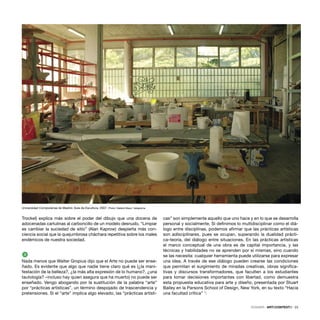
Universidad Complutense de Madrid. Aula de Escultura, 2007. Photo: Natalia Maya / telegrama
24 · ARTECONTEXTO · DOSSIER
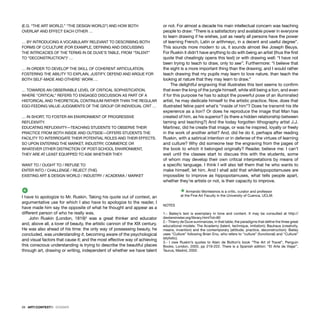
UNA RESPUESTA PROVISIONAL: EDUCAR A LOS ESTUDIANTES
PRINCIPALMENTE HACIA CONVERTIRSE EN PENSADORES INFORMADOS,
SENSIBLES TANTO A LA CULTURA GENERAL (“EL MUNDO”) COMO A SUS
INTERESES CULTURALES ESPECÍFICOS (“EL MUNDO DEL ARTE”, “EL
MUNDO DEL DISEÑO”) Y CÓMO AMBOS SE SUPERPONEN Y AFECTAN
MUTUAMENTE...
...INTRODUCIENDOUNVOCABULARIOADECUADOPARADESCRIBIRAMBAS
FORMAS DE c/CULTURA (POR EJEMPLO, DEFINIENDO Y DISCUTIENDO
LAS COMPLEJIDADES DE LOS TERMINOS DEL ESQUEMA DE DE DUVE, DE
“TALENTO” A “DECONSTRUCCION”) 2
...
...PARA DESARROLLAR LA CAPACIDAD DE ARTICULACIÓN COHERENTE,
FOMENTANDO LA HABILIDAD DE EXPLICAR, JUSTIFICAR, DEFENDER Y
ARGUMENTAR LOS TRABAJOS PROPIOS Y DE OTROS....
...HACIA UN NIVEL OBSERVABLE DE SOFISTICACIÓN CRÍTICA, DONDE
“CRÍTICA” SE REFIERE A DISCUSIÓN COMPROMETIDA COMO PARTE
DE UN CONTINUO HISTÓRICO Y TEÓRICO EN VEZ DE LOS HABITUALES
JUICIOS DE VALOR QUE ALIMENTAN EL EGO DE LA CRÍTICA COLECTIVA
O INDIVIDUAL...
...ENUNAPALABRA,FOMENTARUNAMBIENTEDEREFLEXIONPROGRESIVA.
EDUCAR LA CAPACIDAD DE REFLEXION –ENSEÑAR A LOS ESTUDIANTES
A OBSERVAR SU PRÁCTICA DESDE DENTRO Y DESDE FUERA– OFRECE
A LOS ESTUDIANTES LA DESTREZA DE INTERROGAR SUS POTENCIALES
ROLES Y SUS EFECTOS. PARA QUE AL ENTRAR EN EL MERCADO,
INDUSTRIA, COMERCIO O CUALQUIER OTRA DISTINCTION DEL AMBIENTE
POST–ESCOLAR, ESTÉN AL MENOS EQUIPADOS PARA PREGUNTARSE SI
QUIEREN / DEBEN / REHUSAN
ENTRAR EN / DESAFIAR A / RECHAZAR
EL MUNDO DEL ARTE–DISEÑO EXISTENTE / LA INDUSTRIA / LA ACADEMIA
/ EL MERCADO
4
Tengo que pedir disculpas a Ruskin. Al sacar su cita de contexto, una
argucia argumental por la que también pido perdón al lector, le he
hecho decir lo contrario de lo que pensaba y aparecer como quien
no era.
John Ruskin (Londres, 1819)3
fue un gran pensador y educador
y, sobre todo, un amante de la belleza, el canon artístico en el XIX.
Y también un avanzado de su tiempo: la única forma de poseer la
belleza, concluyó, es comprendiéndola, haciéndonos conscientes de
los factores, psicológicos y visuales, que la causan; y la forma más
eficaz de conseguir esa entendimiento consciente es intentar descri-
bir los lugares bellos a través del arte, de la escritura o del dibujo,
independientemente de si tenemos talento para ello o no. Durante
casi una década su principal preocupación intelectual fue enseñar a
la gente a dibujar: “Toda persona tiene la satisfactoria capacidad de
aprender a dibujar si quiere, del mismo modo que casi todo el mundo
tiene la capacidad de aprender francés, latín o aritmética, en grado útil
y suficiente”. Esto ya nos suena más moderno, casi a Joseph Beuys.
Para Ruskin no tenía nada que ver con ser un artista (de ahí la cita que
abre, tramposamente, este texto) o con dibujar bien: “No he intentado
enseñar a dibujar, sino a ver”. Y más aún: “Creo que la mirada es más
importante que el dibujo, y preferiría enseñar a dibujar para que mis
alumnos aprendieran a amar la naturaleza, que enseñar a mirar la na-
turaleza para que aprendieran a dibujar”.
El delicioso grabado que ilustra este texto parece confirmar que
hasta el mismísimo rey de la selva, sin dejar de ser león, y aunque para
ello tenga que adoptar esa poderosa pose de artista iluminado, puede
dedicarse a la práctica artística. Ahora bien, ese felino ilustrado, ¿pin-
ta “lo que lleva dentro”? ¿Nos transmite sus vivencias, su experiencia
de león, o reproduce la imagen que de él ha creado el hombre, su ven-
cedor (amaestrado viene de maestro)? Y el hoy olvidado litógrafo J. J.
Martínez, ¿creó esa imagen, o se inspiró, fiel o libremente, en la obra
de otro? ¿Y lo hizo, tal vez tras leer a Ruskin, con intención satírica o
como defensa de las virtudes del aprendizaje y la cultura? ¿Por qué
alguien arrancó el grabado de las páginas del libro al que pertenecía
originalmente? Créame, lector: no puedo esperar a que comiencen las
clases para discutir estas cosas con los estudiantes, algunos de los
cuales probablemente desarrollen sus propias interpretaciones críti-
cas mediante algún lenguaje específico. Creo que también les diré
que el que quiera hacerse, que se haga. Y añadiré que mientras que
los hipopótamos son inmejorables como hipopótamos, lo que distin-
gue a las personas, sean artistas o no, es su capacidad de mejorar.
Ÿ Armando Montesinos es crítico, comisario, y profesor
de la Facultad de Bellas Artes de Cuenca, UCLM.
NOTAS
1.- El texto de Bailey es ejemplar en contenido y tono. Puede consultarse, en inglés,
en http://dextersinister.org/library.html?id=80.
2.- Thierry de Duve sintetiza, en dicho esquema, los paradigmas que definen a los
tres grandes modelos educativos: la Academia (talento, técnica, imitación); la Bau-
haus (creatividad, medio, invención) y el Contemporánea (actitud, práctica, decons-
trucción). Bailey utiliza “c/Cultura” siguiendo a Brian Eno, que se refiere a “cultura”
(funcional) y “Cultura” (estilística).
3.- Debo las citas de Ruskin al libro de Alain de Botton “The Art of Travel”, Penguin
Books, London, 2003, pp. 219–222. Hay edición española: “El arte de viajar”, Taurus,
Madrid, 2002.
DOSSIER · ARTECONTEXTO · 25
1
“A man is born an artist as a hippopotamus is born an
hippopotamus; and you can no more make yourself one that
you can make yourself a giraffe”
The sentence is by John Ruskin, and it seems to defend, although the
comparison between artist and pachyderm may seem peculiar, the idea
that an artist is “born”.
If the reader agrees with the quote, he clearly believes that an artist
will always be an artist, whatever he does and no matter the education he
receives. To say, now-a-days, that an artist doesn’t have to receive any
isn’t, of course, politically correct. Therefore the idea of a place where,
in his early youth, he may produce his work but also hear about different
things and get to know his equals, is as acceptable as having an artist
in the family. In our environment, University seems to be an appropriate
place to do this, although, being already an artist, he might prefer to study
Law, Philology or a type of engineering instead of Fine Arts.
Just like when we believe that the best way to master a new
language is to totally immerse the student in it, I imagine there will
be someone who will be in favor of having only true equals. that is,
artists, in such a place, with the conviction that will not make him an
artist, which he already is from birth, but “better”, which is the idea
of all education.That place may be the studio of an artist that serves
the purpose of a teacher, something that has worked well since the
ARMANDO MONTESINOS *
ZOOLOGY AND FABLES
OF ARTISTIC EDUCATION
26 · ARTECONTEXTO · DOSSIER
middle ages, or, a more modern concept, an academy or center for
artists.
On the other hand, the reader who doesn’t agree with Ruskin’s
statement will probably maintain that an artist is “made”, logically from
an educational process. Not being an artist from birth, he will hardly
be able to access the places to which only natural born artists go, for
which –unless he finds the workshop of an artist who agrees to teach
“runner ups” that aren’t naturally qualified– University, in particular the
Faculty of Fine Arts, seems to be, again, the appropriate place to be.
Education in the studio of an artist is the traditional way, although
today the combination in which the beginner is both the apprentice
and hard working assistant, is equivalent to working as an intern in
a company during practical training. In such a place, the transfer of
knowledge is based on the individual master-artist experience and in
the permanent immersion in the professional world of art.
In a center for artists it is not usual to have a proper syllabus to
follow, but a number of creative activities and exchanges set in an
environment of absolute freedom; sometimes it is a frantic place for
experimenting, others it’s a productive retreat. In this place, the transfer
of knowledge is produced through the combination of individual
experience and collective issues, both fruit of the permanent
immersion in the art world.
As for the Faculties of Fine Arts, taking into account that only
a minority of graduates (an optimistic 5%) are recognized – just as
zoologists recognize hippopotamuses – by specialists of the art world
as artists, it will be necessary to establish that such a minority is special
(those who are born for it?) or that the system doesn’t work. Unless,
of course, we accept that not everyone
who studies Fine Arts wants to be an artist
–without going further we could think of
those who, born doctors, prefer to become
familiar with the arts instead of studying
Medicine–, or that we understand that the
goal of University is no more no less than to
produce scholars.
Maybe I’m talking about a specimen that
is on its way to extinction, but a University
student is someone who is interested
in receiving a superior education that
furnishes him with a deep comprehension
of the knowledge and responsibilities
relative to the field of study, and that
allows him, having finished those studies,
to develop personally and professionally
with preference in the cited field of work.
The transfer of knowledge in a Faculty is
based on the collective experience of the
teachers and the temporary immersion in
the academic world, among professionals
in the fields of studies and investigation.
2
On one hand, the contents offered at the faculty of Fine Arts (like the
rest of the Spanish Faculties) assume that there is knowledge that
must be transferred and acquired in a compulsory manner – the so
called pillars, between 30% and 40% of the total– and that there
is other knowledge that is optional, among which the student may
choose according to his own criteria. The pillars (of knowledge) are
agreed upon by the State, that reserves that percentage for certain
subjects and disciplines that are considered essential and that want
to be preserved and encouraged, while the optional subjects are,
ideally, agreed upon by the faculty of each center, offering a variation
of points of view. The reasons to maintain this division, apart from the
implicit ideology in every cannon, are usually dictated by reasons that
go beyond the purely educational: job positions, relations between
departments, struggles for power, budgets…
On the other hand, there is the distinction between the “practical”
and “theoretical” contents. Here the reason seems pristine, if we stick
to the definition that practical knowledge is only obtained through
the making, that is, that the theory of an activity doesn’t describe the
essence of that activity. It is supposed that practical knowledge is
–watch out for the military dialect– the discipline to dominate, and
theoretical knowledge is a subject open to mere speculation. What is
surprising is that no one seems to notice that the theoretical is also
done in the making –what I call, in my lessons and texts, the physicality
of intellectual work.
This double dichotomy, to which a third one must be added – the
Faculty against the outside world – keeps teachers and students
GONZALO PUCH Sin título. Courtesy of the artist.
DOSSIER · ARTECONTEXTO · 27
trapped, and contributes to make the first and
essential task more difficult: eliminating ideological
clichés, deeply rooted fables in the social imagery,
that float on the field of art. If we want to finish
with the mother of all fables, the one that denies
the concept of education from the core, the one
that tells us that the artist, upon finishing his
education, has to forget all he has learned, we
have to eliminate all of those that generate in the
student a persistent resistance to knowledge: the
idea that learning contaminates the inner purity,
“that which one has inside” (the fable of the natural
born artist); that other people’s ideas cancel one’s
own (the fable of originality); a haze that turns the
figure of the artist into a myth and the dream of
possible success through spontaneous generation
(the romantic fable); the idea that living off art is
difficult (the materialistic fable), and its reverse, that
preaches not to trade with what the spirit produces
(the spiritual fable); the notion that the world of art
is corrupt and the artist is exploited economically
and even sexually by gallery owners and critics (the
carnivore fable), etc…
In such a situation, technical training (“manual”
would sound ugly today) would prevail over
teaching creative mechanisms and the way the art
world functions, as well as the critical investigation
of society and the role of the creator in it. Other
aspects and activities of the professional world,
such as curators, critics, agents, historians,
preservers, and, why not, collectors, are often overlooked for lacking
importance or being secondary –in fact, for being commercial (see
spiritual and carnivore fables).
One last dichotomy: you can apply formulas –that which is known
– or you can investigate– the unknown until it shows up and surprises
us (not to confuse with a novelty). It is not so much about the ability
to paint, sculpt or handle the computer, but of what to do as an artist.
What’s special about an artist isn’t his command of technique, it is
his comprehension of the expressive and communicative possibilities.
“Drawing a line is dividing the world in two” (Rosemarie Trockel)
explains more about the power of drawing than a dozen ordinary
carbon drawings of a nude. “Cleaning is moving dirt from one place
to another” (Alan Krapow) awakens more social conscience than
the obnoxious repetitive small talk about the chronic wrongs of our
society.
3
It was Walter Gropius who said that Art can not be taught. It’s obvious
that something that no one knows what it is (the manifestation of
beauty? the highest human expression? a tautology? –there are even
those who assure us it is dead) can not be taught. I’ve been advocating
for substituting the word “art” for “artistic practices”, a term that is
stripped of transcendence and pretension. If “art” implies something
elevated, the “artistic practices” are simply those that one does and
in which one is developed socially and personally. If we define the
multidisciplinary as the dialogue among disciplines, we can state that
the artistic practices are non-disciplinary because, overcoming the
practice-theory duality, they deal with the dialogue between situations.
In the artistic practices the conceptual frame of a piece has a crucial
importance, and the techniques and skills aren’t learned on their own,
but when they are needed: any tool can be used to express an idea.
Through that dialogue the conditions that allow the rise of creative
gazes, significant pieces and transforming discourses can be created,
thus enabling the students to take important decisions freely, as this
educational proposal for art and design, presented by Stuart Bailey
from Parsons School of Design, New York, in his text “Towards a critic
faculty” shows1
:
A PROVISIONAL ANSWER: TO EDUCATE STUDENTS PRIMARILY TOWARDS
BECOMING INFORMED THINKERS, SENSITIVE TO BOTH CULTURE AT
LARGE (“THE WORLD”) AS WELL AS THEIR SPECIFIC CULTURE INTERESTS
JOHN BALDESSARI I will not make any more boring art, 1971. Lithograph from the original piece.
In 1971, the Nova Scotia College of Art & Design commissioned an exhibition by Baldessari, but he could not cover his
travelling expenses. The artist suggested that the students write this sentence on the walls of the room; the students
enthusiastically copied the sentence until the walls were covered. In this way, the artist carried out the perfect parody of
school punishment and of the way in which students at art academies have traditionally copied their master’s work. The
lithograph was produced a posteriori.
28 · ARTECONTEXTO · DOSSIER
(E.G. “THE ART WORLD,” “THE DESIGN WORLD”) AND HOW BOTH
OVERLAP AND EFFECT EACH OTHER …
… BY INTRODUCING A VOCABULARY RELEVANT TO DESCRIBING BOTH
FORMS OF C/CULTURE (FOR EXAMPLE, DEFINING AND DISCUSSING
THE INTRICACIES OF THE TERMS IN DE DUVE’S TABLE, FROM “TALENT”
TO “DECONSTRUCTION”)2
…
… IN ORDER TO DEVELOP THE SKILL OF COHERENT ARTICULATION,
FOSTERING THE ABILITY TO EXPLAIN, JUSTIFY, DEFEND AND ARGUE FOR
BOTH SELF-MADE AND OTHERS’ WORK …
… TOWARDS AN OBSERVABLE LEVEL OF CRITICAL SOPHISTICATION,
WHERE “CRITICAL” REFERS TO ENGAGED DISCUSSION AS PART OF A
HISTORICAL AND THEORETICAL CONTINUUM RATHER THAN THE REGULAR
EGO-FEEDING VALUE-JUDGMENTS OF THE GROUP OR INDIVIDUAL CRIT …
… IN SHORT, TO FOSTER AN ENVIRONMENT OF PROGRESSIVE
REFLEXIVITY.
EDUCATING REFLEXIVITY—TEACHING STUDENTS TO OBSERVE THEIR
PRACTICE FROM BOTH INSIDE AND OUTSIDE—OFFERS STUDENTS THE
FACILITY TO INTERROGATE THEIR POTENTIAL ROLES AND THEIR EFFECTS.
SO UPON ENTERING THE MARKET, INDUSTRY, COMMERCE OR
WHATEVER OTHER DISTINCTION OF POST-SCHOOL ENVIRONMENT,
THEY ARE AT LEAST EQUIPPED TO ASK WHETHER THEY
WANT TO / OUGHT TO / REFUSE TO
ENTER INTO / CHALLENGE / REJECT (THE)
EXISTING ART & DESIGN WORLD / INDUSTRY / ACADEMIA / MARKET
4
I have to apologize to Mr. Ruskin. Taking his quote out of context, an
argumentative use for which I also have to apologize to the reader, I
have made him say the opposite of what he thought and appear as a
different person of who he really was.
John Ruskin (London, 1819)3
was a great thinker and educator
and, above all, a lover of beauty, the artistic cannon of the XIX century.
He was also ahead of his time: the only way of possessing beauty, he
concluded, was understanding it, becoming aware of the psychological
and visual factors that cause it; and the most effective way of achieving
this conscious understanding is trying to describe the beautiful places
through art, drawing or writing, independent of whether we have talent
or not. For almost a decade his main intellectual concern was teaching
people to draw: “There is a satisfactory and available power in everyone
to learn drawing if he wishes, just as nearly all persons have the power
of learning French, Latin or arithmeyc, in a decent and useful degree”.
This sounds more modern to us, it sounds almost like Joseph Beuys.
For Ruskin it didn’t have anything to do with being an artist (thus the first
quote that cheatingly opens this text) or with drawing well: “I have not
been trying to teach to draw, only to see”. Furthermore: “I believe that
the sight is a more important thing than the drawing; and I would rather
teach drawing that my pupils may learn to love nature, than teach the
looking at nature that they may learn to draw.”
The delightful engraving that illustrates this text seems to confirm
that even the king of the jungle himself, while still being a lion, and even
if for this purpose he has to adopt the powerful pose of an illuminated
artist, he may dedicate himself to the artistic practice. Now, does that
illustrated feline paint what’s “inside of him”? Does he transmit his life
experience as a lion? Or does he reproduce the image that Man has
created of him, as his superior? (is there a hidden relationship between
taming and teaching?) And the today forgotten lithography artist J.J.
Martinez, did he create that image, or was he inspired, loyally or freely
in the work of another artist? And, did he do it, perhaps after reading
Ruskin, with a satirical intention or in defense of the virtues of learning
and culture? Why did someone tear the engraving from the pages of
the book to which it belonged originally? Reader, believe me: I can’t
wait until the classes start to discuss this with the students, some
of whom may develop their own critical interpretations by means of
a specific language. I think I will also tell them that he who wants to
make himself, let him. And I shall add that whilehippopotamuses are
impossible to improve as hippopotamuses, what tells people apart,
whether they’re artists or not, is their capacity to improve.
Ÿ Armando Montesinos is a critic, curator and professor
at the Fine Art Faculty in the University of Cuenca, UCLM.
NOTES
1.- Bailey’s text is exemplary in tone and content. It may be consulted at http://
dextersinister.org/library.html?id=80
2.- Thierry de Duve summarizes, in that table, the paradigms that define the three great
educational models: The Academy (talent, technique, imitation); Bauhaus (creativity,
means, invention) and the contemporary (attitude, practice, deconstruction). Bailey
uses “Culture” following Brian Eno, who refers to “culture” (functional) and “Culture”
(stylistic).
3.- I owe Ruskin’s quotes to Alain de Botton’s book “The Art of Travel”, Penguin
Books, London, 2003, pp 219-222. There is a Spanish edition: “El Arte de Viajar”,
Taurus, Madrid, 2002.
DOSSIER · ARTECONTEXTO · 29
La enseñanza es una de las dimensiones del sistema del arte que no
ha recibido suficiente atención crítica. Quizás ello se deba a la debili-
dad de su peso en la determinación del carácter de un campo artístico
concreto.
La enseñanza de las artes pertenece a la franja de mercado de la
enseñanza superior. Así, la docencia es un yacimiento de empleo al
que se dirigen aquellos artistas que carecen de posición sólida en el
mercado del arte. De este modo, la enseñanza es un mercado laboral
sustituto; un enclave salarial que debe asegurar su reproducción en el
interior de un aparato universitario que impone su lógica de adminis-
tración; a saber, elaboración de planes curriculares determinados por
las “ciencias de la educación”. Es preciso señalar que el espacio uni-
versitario, según los países, no es el espacio exclusivo de alojamiento
de esta enseñanza. Sin embargo, en aquellas formaciones artísticas en
que ésta se realiza fuera de la universidad, las formas de su reproduc-
ción participan de elementos más o menos comunes. De ahí que sea
posible sostener que la vida de una escuela esté determinada, más que
nada, por la gestión de planes curriculares. A lo que agrega, en algunos
casos, una especie de exacerbada disposición por la innovación curri-
cular. Por ello, los estudiantes padecen las modificaciones constantes
de los planes de estudio, las cuales no están determinados por las evo-
luciones del mercado ni por el límite de desarrollo establecido por la
articulación de los agentes del sistema del arte, sino por las exigencias
internas que los propios establecimientos de educación superior im-
ponen. De este modo, la administración de la enseñanza se convierte
JUSTO PASTOR MELLADO*
Por una relocalización institucional
de la enseñanza de arte
30 · ARTECONTEXTO · DOSSIER
en un fin universitario por sí mismo, y deja de tener contacto con la
realidad del arte contemporáneo.
En este sentido, proliferan las maestrías y los doctorados porque
los procesos de evaluación académica así lo exigen. Así, se ha po-
dido consolidar una carrera universitaria uniforme, dando lugar a un
concepto de investigación en arte, cuando no desde el arte, ajusta-
do a los modelos de la investigación científica; cuestión que ha sido
reconocida como una gran victoria de las humanidades en sus dis-
putas presupuestarias con sectores de las ciencias duras. En este
marco, el trabajo mayor de los artistas-docentes consiste en asegurar
su permanencia progresiva en el seno del aparato. Así las cosas, los
docentes aprenden a escribir informes y, luego, pequeños ensayos
destinados a satisfacer la demanda interna de evaluación académica.
Lo cual ha dado lugar a un nuevo tipo de escritura sobre arte que nu-
tre las demandas discursivas del propio espacio universitario.
Existen escuelas que ya están diseñadas para satisfacer las re-
presentaciones que algunas autoridades construyen acerca de lo
que puede ser un mercado del arte y orientan su plan de estudios
para encajar en esta ensoñación orgánica. Éstas suelen ser escuelas
de universidades privadas. Lo anterior da lugar a que se incorporen
nuevas materias en los planes de estudio: instalación, performance,
arte sonoro, arte político y/o de intervención urbana, arte fronterizo,
multimedia, etc. Con lo cual, las denominaciones de las escuelas han
experimentado severas modificaciones: ya no se proclaman de Bellas
Artes sino de Artes Visuales, para sustentar las incorporaciones disci-
plinares que caben bajo el apelativo de “nuevas tecnologías”. Incluso,
no pocas escuelas introducen cursos en que se enseña cómo confec-
cionar un dossier de presentación de trabajos, cómo redactar proyec-
tos y peticiones a fundaciones, cómo diseñar una presentación para
obtener una residencia, cómo diseñar los catálogos de sus primeras
exposiciones, etc.
En el caso de estas escuelas más abiertas, la innovación curricular
depende de la ubicación que sus propios artistas-docentes poseen en
el mercado. Es de suponer que, en su condición de artistas en vías
de consolidación, pueden orientar a sus estudiantes en las formas de
incorporación al mercado. Sin embargo, el mercado del arte para los
emergentes no presenta ofertas significativas y éste es el punto en
que se devela el hecho de que las escuelas son maquinarias destina-
das a incrementar expectativas que no pueden ser satisfechas.
En relación a lo dicho, Luis Camnitzer, en una de sus intervencio-
nes sobre el dispositivo educativo de la 6ª Bienal del MERCOSUR,
apelando a su propia experiencia de enseñanza, señalaba cifras y ac-
titudes que nos indican el estado de fraude general del modelo de
enseñanza imperante. Con el agravante de que, al parecer, el único
destino de estas enseñanzas es facilitar el ingreso en un mercado de
tamaño limitado. En este marco, frente a la hipótesis de que el arte no
es enseñable, se entiende que las instituciones educativas solo ope-
rarían como filtros de ingreso al mercado. De esta forma, el coste de
los mecanismos de selección sería extremadamente alto, obligando
perversamente a los propios estudiantes a financiar la existencia del
dispositivo que habilitará su propia exclusión.
Lo dicho supone un gran descubrimiento para el desarrollo de fu-
turas escuelas. Habría que sostener la posibilidad de una enseñanza
que no tuviera como único destino la obligatoriedad de ser artista.
Esta es una certeza que puede ser extremadamente útil para reorien-
tar la propia enseñanza del arte. Se trataría de idear mecanismos de
transmisión de saberes destinados simplemente a adquirir un diplo-
ma; esto es una estrategia académica que garantice un conjunto de
conocimientos transmitidos de forma consecuente y eficaz.
Es decir: un artista reconocido transferiría a un estudiante su ex-
periencia de construcción de obra. El punto de partida sería el diagra-
ma de las obras. Vale decir: sus recursos de lectura, sus procedi-
mientos de legitimación, sus estrategias de inscripción en el campo
social. Pero se trataría de obras y de métodos que darían lugar a una
flexibilidad curricular y analítica que marcaría la diferencia respecto de
otras tentativas de enseñanza.
El propósito de una enseñanza de este tipo sería otro que el de
formar un artista, simplemente un sujeto que puede adquirir unos co-
nocimientos y desarrollar unas actitudes analíticas que le permitan
ocupar un puesto de trabajo en una amplia gama de oferta de empleo
perteneciente a la industria cultural: desde el negocio editorial hasta la
producción audiovisual puntera, pasando por el diseño y la adminis-
tración cultural. En tal caso, la enseñanza del arte involucraría un ca-
rácter compensatorio, ocupándose de abrir posibilidades de inserción
laboral a aquella mayoría de estudiantes que no serían reconocidos
como artistas por el propio sistema de validación del arte.
Las escuelas de arte deberían existir, bajo esta consideración an-
terior, tan sólo para proporcionar un diploma de posesión de habilida-
des intelectuales. Y también deberían evitar depender de las escuelas
de diseño, porque la enseñanza de arte presentaría un valor suple-
mentario al no subordinar la estrategia de transferencia de conoci-
miento a la figura del “cliente”. Es decir, del que demanda servicios
de diseño.
No existen los servicios de arte. Y un estudiante de arte enfren-
tado a problemas de negociación institucional más complejos ad-
quiere otra habilidad que el estudiante de diseño para responder a la
demanda de servicios. De hecho, en la actualidad, quizá la principal
competencia de los diseñadores sea la de los licenciados en arte que
no ingresan al mercado. Sería útil pensar en la profesionalización de
estas expectativas, en vez de reproducir la existencia de escuelas de
desaliento y de frustración.
Lo anterior es una ficción destinada a mitigar el daño objetivo que
representa la existencia de las escuelas de arte en el mundo. La ense-
ñanza ha alcanzado tal nivel de presencia que ha logrado desmarcar-
se de la producción artística real. Es decir, que tampoco son eficaces
como dispositivos de selección. Incluso, en un esquema neoliberal
hegemónico, la propia permanencia de la enseñanza de arte en las
universidades ha sido puesta en duda.
La existencia de academias independientes, ya sean las antiguas
escuelas de bellas artes como las nuevas escuelas no universitarias,
puede representar un nuevo horizonte de posibilidades, en la medida
que formulen estructuras móviles que les permitan recoger la presen-
DOSSIER · ARTECONTEXTO · 31
cia de los modelos de enseñanza implíci-
tos en las producciones contemporáneas.
Esto podría significar una ruptura en las
estrategias de transmisión, ya que apare-
cen nuevos dispositivos que pueden ase-
gurarla y que estarían vinculados en forma
directa a la producción de arte. Pongo el
caso de talleres libres de grupos de artis-
tas, lugares de residencia de artistas en
los que se practica el trabajo riguroso de
análisis de obra, laboratorios multimedia
que se revelan como lugares de intercam-
bio entre cine, animación, diseño de ves-
tuario, etc., pero siempre conectados con
la producción de objetos.
En definitiva, la habilitación artística
tiene lugar como efecto de un sistema
complejo de reconocimiento que puede
perfectamente hacer caso omiso de la
existencia de las escuelas. Estas son sólo
dispositivos de entrega de conocimiento
que no superan las determinaciones in-
conscientes de las antiguas academias
de pintura y escultura del siglo XIX. Sólo
reacomodan constantemente sus planes
curriculares, como he dicho, en función
de los intereses de docentes cuyas prác-
ticas están por debajo de los desafíos del
arte contemporáneo. Es lo que ha verifi-
cado mi experiencia y conocimiento de
las escuelas universitarias alejadas de las
regiones metropolitanas. Estas escuelas
se convierten, muchas veces, en enclaves
de autoprotección docente, bloqueando la
información contemporánea.
En todo caso, no es de sorprender, ya
que las escuelas no existen para hacer
de las vanguardias un objeto de curso. Al
respecto, ya lo he señalado en otro lugar,
las vanguardias del siglo XX son nuestra
“antigüedad clásica”. No cabe duda que
resulta metodológicamente necesario res-
petar a los clásicos, a condición de saber
cómo construir dicha respetabilidad. De
todos modos, aún en las condiciones más
conservadoras, las conquistas formales
de las vanguardias históricas delimitan el
horizonte de las exigencias de la enseñan-
za contemporánea.
Las escuelas son entidades razonable-
mente conservadoras a la hora de afirmar
Escuela de Arte 10 de la Comunidad de Madrid. Aula de dibujo, 2007. Foto: Natalia Maya / telegrama
32 · ARTECONTEXTO · DOSSIER
sus condiciones de enseñanza sin que visitas de artistas eminentes
desarmen la lógica de sus programa docentes. Las visitas son aque-
llos momentos de discontinuidad que confirman la continuidad. No se
puede hacer escuela acogiendo secuencias incontroladas de discon-
tinuidad. La escuela es un sistema de regulación de su propia toleran-
cia. Incluso cuando debe abordar, en la formación de licenciados en
arte, la posición de la enseñanza de historia del arte y de teoría.
Para complicar las cosas, es de suponer que, siempre, lo que se
enseña es el arte que ya ha sido realizado. La tarea para una nueva
enseñanza tendría que ser la de anticipar el arte que viene. ¿Es acaso
transmisible el modo de la anticipación? Eso significaría trabajar so-
bre obras que indicarían caminos de ruptura formal. ¿De qué manera
verificaríamos el valor de dichas obras si no recurriéramos al trabajo
de la historia? Sin embargo, no se trata de cualquier relación con la
historia. Esto parece un contrasentido: hacer historia contemporánea
de la tradición; hacer del renacimiento, por poner un caso, nuestro
presente, en función de la demanda constructiva de las obras, cuando
se sobreentiende que no pocas instalaciones responden con medio
nuevos a viejos problemas de disposición de unos objetos en un es-
pacio; o bien, de objetos dispuestos en pequeñas escenografías que
nos hacen pensar en las determinaciones materiales de los “gabine-
tes de curiosidades”. Entonces, ¿si la contemporaneidad nos resulta
apenas aprehensible, cómo entender la enseñanza de historia del arte
en una escuela que pretende formar artistas?
Las prácticas artísticas son transmisibles; lo que está en duda es
si la facultad o la escuela de arte son los lugares adecuado para esta
transmision. La formación en arte no tiene por qué, en términos es-
trictos, depender de las garantías que pueda brindar el sistema de es-
cuelas, cuando se puede dar pie al montaje de múltiples experiencias
flexibles y abiertas que instituyan nuevas formas de reconocimiento
e inscripción.
Ÿ Justo Pastor Mellado, critico de arte, ex-director de Escuela,
curador del Museo Allende. Vive y trabaja en Santiago de Chile.
Facultad de Bellas Artes, Universidad Complutense de Madrid. Foto: Natalia Maya / telegrama
DOSSIER · ARTECONTEXTO · 33
Teaching is one of those dimensions of art that has not received enough
critical attention. Perhaps it is due to its weakness in the determination
of the character of a concrete artistic field.
Teaching of arts falls in a fissure in the superior education market.
Hence, teaching is only regarded as a work possibility for those artists
who are not consolidated in the art market. In that manner, teaching
is a surrogate labor market; a source of salaries that must secure its
own reproduction within an academic apparatus that imposes its
administration logics, that is, elaboration of curricular plans determined
by “educational sciences”. It’s worth pointing out that the university
environment, depending on the country, is not the exclusive space for
this kind of teaching. Nevertheless, all non-academic training cases
share some elements that are more or less common. Therefore, it’s
impossible to assert that life in an education center is determined, above
all, by the management of curricular plans. To which we must add, in
some cases, a sort of exacerbated disposition to curricular innovation.
As a result, students are obliged to cope with constant modifications
of curricular plans, which are determined neither by market evolutions
nor by development standards established by the articulation of the art
system agents, but by the centers’ internal requirements. Consequently,
the administration of teaching becomes an academic purpose per se,
far from any contact with contemporary art’s reality.
In that sense, masters and PhDs proliferate because of the
obligations imposed by processes of academic evaluation. Thus, a
homogeneous academic career has been consolidated, which has
JUSTO PASTOR MELLADO*
Towards an Institutional
Re-localization of Art Teaching
34 · ARTECONTEXTO · DOSSIER
produced a concept of investigation in arts –when not from arts– that
is adjusted to the models of scientific investigation (a situation that
has been regarded as a victory of the humanities in their budget career
against the sector of hard sciences. In such landscape, the main work
for artists-teachers consists in securing their progressive permanence
inside the apparatus. Consequently, teachers learn how to write a
report, and then, little essays created to fulfill the internal demand of
academic evaluation, in other words, a kind of art writing that only
nourishes the discursive demands of the university environment.
Some institutions have been designed to fulfill the representations
that some authorities construct about what an art market can be, and
orientate their curricular plan so that it fits in this organic hallucination.
This is usually the case in private universities. The aforementioned
encouragestheincorporationofnewcourses:installation,performance,
sound art, politic art and/or urban intervention, frontier art, multimedia,
etc. As a result, denominations of academies have suffered severe
modifications: they are not called Fine Art schools anymore but
Visual Art Schools, in order to include the new disciplines that can be
grouped under the name “new technologies”. There are even some
schools that teach their students how to make a dossier to present
their works, how to write projects and applications for scholarships,
how to design a presentation so that one obtains a residence or how
to design first exhibitions’ catalogues, etc.
In the case of more open schools, curricular innovation depends on
the position their artists-teachers occupy in the market. Hypothetically,
according to their condition of emerging artists, they can guide their
students in their incorporation to market. However, art market for
emergent artists doesn’t represent significant offerings; and that is the
point that reveals that schools are nothing but machineries created to
increase expectations that cannot be fulfilled.
Along the lines of these notes, in a conference about the educational
device of the 6th
MERCOSUR Biennial, according to his experience as
a teacher, Luis Camnitzer has pointed out statistics and attitudes that
reveal the general state of fraud in the prevailing education model.
And to top it all, it seems that the only purpose of this system is to
offer its students access to a very limited market. In such framework,
confronting the hypotheses that art cannot be taught, we realize that
educational institutions only work as filters for the market. The cost
of selection mechanisms is extremely high, obliging the students
themselves to finance the existence of the device that will habilitate
their own exclusion.
The aforementioned is a relevant discovery for the development
of future schools. We should defend the possibility to have a kind of
training that is not exclusively conceived to oblige students to become
artists. This could be extremely useful to redirect art teaching itself.
The main purpose would be to create mechanisms for transmitting
knowledge only for obtaining a diploma, that is, an academic
strategy that guarantees a consequent and effective transmission of
knowledge.
In other words: a renowned artist would transmit to others
his experiences in the construction of a work. The departure point
would be the diagramming of works, i.e., his reading resources, his
legitimating procedures, and his strategies for inscribing himself in
the social context. But these works and methods should encourage a
curricular and analytic flexibility that would make the difference with
respect to other forms of teaching.
The purpose of such kind of training would not be to train an artist,
but a subject that can acquire skills and develop analytic attitudes
that might permit him to have access to a job in a wide range of work
possibilities in the cultural industry: from editorial business to avant-
garde audiovisual production, to design and cultural administration. In
thatcase,teachingartwouldincludeacompensatorycharacter,dealing
with opening possibilities of labor insertion for all those students who
are not recognized as artists by the system of legitimation in art.
As a result, art schools’ existence is justified only if, according
to the aforementioned considerations, they provide diplomas for
possessing certain intellectual skills. And they also should avoid
depending on design schools, because, in that case, art training would
have a supplementary value as it doesn’t subordinate the strategy
of knowledge transference to the figure of the “costumer”, in other
words, to the person who pays for design services.
Art services do not exist. And an art student, when confronted
to more complex institutional negotiation problems, acquires a
new ability that designers don’t have. In fact, currently, the main
competitors of designers are art graduates who cannot make it in the
art world. It would be useful to think about professionalizing these
expectations, instead of reproducing the existence of discouragement
and frustration schools.
All I have said above is a fiction created to mitigate the objective
damage represented by the existence of art schools in the world.
Teaching has acquired such a presence that it is completely detached
from the real artistic production. That means art schools are not even
effective as selection devices. Even in a hegemonic liberal scheme,
the very permanence of art training in the universities has been put
under question.
The existence of independent academies, either old fine arts
schools or non-universitarian academies, might represent a new
horizon of possibilities as long as they create movable structures that
permit to attest the presence of educational models that are linked to
contemporary productions. This might mean a rupture in the strategies
of transmission, whereas new devices appear that can ensure it and
that are directly linked to art production. For instance, the independent
collective studios, residences for artists in which a rigorous analysis of
works is undertaken, multimedia labs that become exchange places
between cinema, animation, costume design, etc, although it is always
related to the production of objects.
All in all, the artistic habilitation is an effect of a complex system of
recognition that can perfectly ignore the existence of schools. Schools
are nothing but knowledge delivery devices that cannot overcome
unconscious associations with 19th
century’s painting and sculpture
academies. They only renovate their curricular plans over and over
again, as I already said, depending on the interests of those teachers
DOSSIER · ARTECONTEXTO · 35
whose practices are down bellow the level of contemporary art’s
challenges. That has been my experience at universities and schools
that are far from the metropolitan regions. These schools are, in many
cases, self-protecting fortresses that usually block contemporary
information.
Nonetheless, we should not be surprised, given that schools are
only there to transform the avant-gardes into an academic subject-
matter. As I have said somewhere else, avant-gardes are our “classic
antiquity”. There is no doubt about the fact that, methodologically, it
is necessary to respect the classics, as long as one is able to know
how to construct such respectability. In any case, even in the most
conservative environments, the formal achievements of historical
avant-gardes trace the horizon of the exigencies of contemporary
training.
Schools are reasonably conservative institutions when it’s up to
state their conditions of teaching in order to avoid that an eminent
artist may dismantle the logics of their programs. Visitors are those
who create an interruption that reveals the continuity. It’s impossible
to create a school using only uncontrolled sequences of discontinuity.
The school is a system of regulation of its own tolerance -even when
it has to carry out the tuition of art history and theory among art
graduates.
To top it all, the art people studies at schools is, of course, the
art from the past, an art that has been already done. The task for a
new kind of teaching would be to foresee the art in the future. Is the
form of anticipation transmissible? That would imply to work about
works that open paths for formal rupture. In what manner could we
verify the value of those works it we would disregard the work of
historians? However, that relation with history is a special one. There
seems to be a paradox: making a contemporary history of tradition;
for instance, transform the Renaissance into our present, according
to the constructive demands of the works, whereas we are perfectly
aware that many installations, through the use of new media, respond
to old problems of object positioning, or of objects arranged in small
scenarios that evoke the material determinations of “curiosities
cabinets”. Then, if contemporariness is barely apprehensible, how can
we understand the teaching of art history in a school that intends to
produce artists?
Artistic practices are transmissible. What is still under question is
whether schools are the proper places to carry out such transmission.
Art training doesn’t necessarily depend on the privileges provided by
the current system of schools: the creation of multiple, flexible, and
open experiences is a possibility that might institute new forms of
recognition and incorporation.
Ÿ Justo Pastor Mellado is an art critic, ex director of Escuela,
curator of the Allende Museum. He lives and works in Santiago de Chile.
Library of Museo Nacional Centro de Arte Reina Sofia (MNCARS). Photo: Natalia Maya / telegrama
36 · ARTECONTEXTO · DOSSIER
Ontario College of Art & Design. Actividades en el parque, 2006. Foto: Angela del Buono. Cortesía: OCAD
DOSSIER · ARTECONTEXTO · 37
Ésta ha sido una semana notable en Toronto. El lunes, frente al público
de la Universidad de Toronto, tuve la ocasión de realizar una entrevista
radiada con Judy Chicago1
y el viernes Lawrence Weiner2
dio una con-
ferencia en el Ontario College of Art & Design, mi universidad. La obra
de Chicago, sobre todo su The Dinner Party de principios de los años
80, marcó el surgimiento de un arte feminista esencialista y lleno de
contenido que, entre otras cosas, incluía la cita y la reivindicación de
las artes domésticas. Las obras de Weiner, por su parte, significaron
el auge del conceptualismo, la preeminencia del lenguaje dentro de la
práctica artística y la aserción de las influencias masculinas en el es-
cenario artístico norteamericano de posguerra. Estos dos oradores ex-
tremadamente sugerentes ofrecieron interpretaciones contrarias de los
tiempos en los que les tocó vivir. No obstante, en ambas charlas hubo
ataques contra las escuelas, universidades o institutos de arte y dise-
ño por lo que ellos consideraban su estrechez característica. Chicago
habló de su rechazo de las diferencias de género o cultura, del olvido
en que han caído los oficios manuales tradicionales y de la aversión
al “contenido” en las escuelas de arte, mientras que Weiner habló del
fracaso de los institutos especializados a la hora de proporcionar una
educación artística amplia capaz de ofrecer un sustento estable para la
práctica, el diseño y la vida futura.
¿Es tarea de los entornos de estudios superiores proporcionar no sólo
amplitud sino también herramientas formales y conceptuales? ¿Dónde
encajan aquellas prácticas que van en contra de la estética del arte o el
diseño del siglo XXI dentro de nuestro actual sistema educativo?
SARA DIAMOND*
CARA A CARA
CON EL SIGLO XXI:
El futuro de las instituciones
de enseñanza de arte y diseño
38 · ARTECONTEXTO · DOSSIER
Estas preguntas no sólo son muy importantes sino que en este pun-
to aparece otro nivel de complejidad. La educación superior, para un
artista o un diseñador emergente, debe abordar las capacidades que
los métodos y el conocimiento del arte y el diseño pueden aplicar en
campos que se encuentran en la periferia de estas disciplinas (tales
como la ciencia de la visualización, técnicas gráficas, la educación o
la interacción entre seres humanos y ordenadores) y en muchos otros
territorios (la etnografía y los cuidados paliativos, por ejemplo). La ma-
yoría de los estudiantes que sale del post-secundario de las institucio-
nes de arte y diseño no conseguirá hacerse una carrera como artista,
pasará algún tiempo hasta que muchos de ellos logren hallar trabajos
en el campo del diseño y no todos conseguirán graduarse. Nuestras
instituciones tienen la responsabilidad de pensar más allá de las cuatro
paredes de la academia en términos de las posibilidades laborales para
los casi ochocientos estudiantes que se licencian cada año.
Lo que mejor hacen las instituciones de arte y diseño es enseñar
a los alumnos a combinar las capacidades analíticas y la experiencia.
Ofrecen formas teóricas y corporales de conocimiento y estimulan a
los alumnos a usar la imaginación para establecer nexos entre estos
dos frentes. Estas técnicas son aplicables en un considerable número
de campos del saber que requieren el uso del pensamiento estraté-
gico y la resolución de problemas. Sin embargo, el reconocimiento
pleno de esta clase de entrecruzamientos hace necesario un cam-
bio significativo en la identidad de las instituciones, cambio que no
siempre resulta cómodo. Asimismo, es importante mantener una base
subyacente de conocimiento en la institución a la hora de reclutar a
los nuevos docentes. En las instituciones comprometidas con el cam-
bio es crucial apoyar activamente al profesorado durante el proceso
de reestructuración de los enfoques, bien procurando elevar el nivel
o bien proporcionando a los maestros recursos institucionales para
desarrollar nuevos programas piloto, ya que los profesores necesitan
incentivos para continuar su propio proceso de crecimiento.
En los últimos años he coordinado la creación de un plan estratégi-
co para la institución de la que soy presidenta, el Ontario College of Art
& Design3
; se llama Liderazgo en la era de la imaginación. Si bien el pro-
ceso fue ciertamente imperfecto, hubo, no obstante, un intento genuino
de explorar el futuro –con una previsión de hasta quince años– en orden
a intentar comprender el modo en que la gran diversidad de campos
del arte y el diseño podrían cambiar y para entender cómo acabaría
transformándose la educación en ese lapso. Entrevistamos a perso-
najes clave en muchas disciplinas para recoger su opinión sobre estos
temas y sobre la presteza del OCAD a la hora de asumirlos.
A continuación utilizamos un método de desarrollo de posibles
escenarios que consistía en imaginar las tendencias esenciales con
sus respectivos ejes de alineación y así dar lugar a la aparición de po-
sibles resultados referentes al valor otorgado a las prácticas artísticas
y de diseño, la forma futura de los sistemas económicos y sociales
y las formas en que el conocimiento se organizaría en torno a estos
sistemas. En ese proceso intentamos usar medios creativos como la
visualización, diálogos en red y brain storms dentro de un equipo di-
verso y multi-funcional que incluyó tanto a alumnos como a actuales
administradores, profesores, estudiantes, personal institucional y el
comité directivo. Tuvimos sesiones de brain storming con grupos más
grandes en la institución. Los estudiantes escribieron una respuesta
al borrador del documento, que finalmente se añadió al mismo. Nos
reunimos con todos y cada uno de los profesores. Este enfoque per-
formativo fue muy estimulante para las partes involucradas, aunque
a veces resultaba difícil comunicarlo a quienes no participaran en él.
No obstante, la propuesta fue muy bien recibida. Y si bien el espíritu
general del documento no se vio alterado, nuevas ideas fueron incor-
poradas en el proyecto. Un plan de acción para los siguientes seis
años entró a formar parte integral del documento. El OCAD ha estado
siguiendo dicho plan desde que fuera adoptado, aunque el debate
y los desafíos no han faltado. El plan, sin embargo, proporciona una
ruta que nos permite avanzar. El espíritu del plan situarían el arte y el
diseño, así como las instituciones que lo promueven y producen, en el
centro de la sociedad, y no en la periferia.
El Plan Estratégico redefinió la misión de nuestra universidad,
aunque procuró hacerlo dando continuidad a nuestras cualidades
principales, en especial al actual valor de “corporeizar el conocimien-
to”, esto es, aprender mediante la práctica y la crítica del taller –la
base misma de la educación de estudio–. Al mismo tiempo, el plan
se propuso revisar el modo en que se enseña en el estudio y, ante
todo, se pidió a los profesores que se posicionaran sobre sus en-
foques didácticos de modo que los estudiantes pudieran entender
que las metodologías varían, que son productos históricos y que, por
tanto, pueden ser cuestionadas. El plan establece que nuestra mi-
sión consiste en “proporcionar la educación de arte y diseño en los
niveles de pregrado y postgrado en un entorno de aprendizaje que
integra la educación basada en el taller con la investigación histórica,
crítica y científica”. Esto empieza a dar respuestas a las inquietudes
que Chicago y Weiner manifestaron desde perspectivas tan diferen-
tes. Exige también una práctica auto-reflexiva que no es muy común
en las instituciones de arte y diseño. Con miras a lograr este objetivo,
el OCAD continúa celebrando una serie de diálogos abiertos entre
miembros del profesorado sobre las distintas maneras de enfocar los
temas clave en la enseñanza del arte y el diseño (inicialmente pre-
sentados como dos grandes reuniones generales de diálogo). Hemos
descrito ya la integración efectiva del taller, la teoría y la historia como
la Nueva Ecología del Aprendizaje. Intentamos acabar con la sepa-
ración entre pensamiento y acción. Nuevas ideas se desprenden de
ambos extremos.
Una meta fundamental del plan estratégico es la de abrir nuevas
rutas interdisciplinarias para el aprendizaje. Se debatió hasta qué pun-
to seguía teniendo valor el conocimiento especializado, el cambio de
las disciplinas y la necesidad de establecer, tanto para el presente
como para el futuro, diálogos interdisciplinares. Las evidencias su-
gieren que los otrora rígidos límites entre arte y diseño, arte y arqui-
tectura, han sido borrados. Esto era efectivo en el caso de ciertas
partes del mundo profesional, entre los miembros más jóvenes del
profesorado y en la población estudiantil, así como en el contexto del
discurso expositivo y crítico. Los estudiantes de arte estaban intere-
DOSSIER · ARTECONTEXTO · 39
sados en los métodos de resolución de problemas en el campo del
diseño y los estudiantes de diseño estaban ansiosos por trabajar de
manera más experimental o aplicar la estética de la práctica artística.
Por ejemplo, la facultad de Diseño ofrece un curso muy popular llama-
do Think Tank, donde los estudiantes y el profesorado discuten pro-
blemas globales que ven desde la creación de un sistema energético
de bajo coste para la iluminación de un vecindario, hasta el desarrollo
de una campaña para reemplazar la espuma de poliestireno por con-
tenedores reciclables. Este curso también resulta muy atractivo para
los estudiantes de arte.
Nuestro nuevo programa expresa esta integración de conoci-
mientos. Es interdisciplinar y permite a los estudiantes trabajar con
las ciencias, la ingeniería, las ciencias sociales, además de brindar-
les la posibilidad de concentrarse en sus respectivas áreas o bien de
combinar arte y diseño. Nuestros cursos de postgrado en práctica
curatorial y crítica ponen el énfasis en el diseño de exposiciones, en
las técnicas empresariales y de producción, además de ofrecer la ins-
trucción teórica de la curaduría. Estamos desarrollando un programa
de nuevos medios en colaboración con una facultad de ingeniería que
permitiría a los estudiantes obtener un Master de Bellas Artes en dise-
ño, arte y un postgrado en administración o ciencias.
El plan estratégico propone también una serie de valores aplica-
bles a toda la institución que surgieron en el proceso de búsqueda de
nuevos escenarios y en nuestros diálogos de investigación: “el OCAD
valora la accesibilidad, la diversidad cultural, la ciudadanía global
equitativa, el compromiso con el arte y el diseño, la excelencia formal
y estética, la sostenibilidad y el espíritu emprendedor”. Estas ideas se
corresponden con una serie de temas que diseccionan las divisiones
entre las disciplinas y proporcionan medios para repensar las catego-
rías curriculares, tanto las que nosotros mismos enseñamos como el
Ontario College of Art & Design. Environmental Design Demo, 2006. Foto: Angela del Buono. Cortesía: OCAD
40 · ARTECONTEXTO · DOSSIER
modo en que este conocimiento se organiza, propiciando las inicia-
tivas y las colaboraciones institucionales a gran escala. Los temas
representan tendencias a largo plazo en la cultura y la sociedad:
ò Sostenibilidad tanto en los enfoques del arte y el diseño
como en la cultura y las prácticas de la institución.
ò Diversidad cultural.
ò Contribuir a la innovación tecnológica, incluyendo
el futuro digital.
ò Bienestar y salud.
ò Experiencia interdisciplinar.
ò Liderazgo y desarrollo de una ética contemporánea.
El plan estratégico adopta una posición que históricamente ha
sido menos habitual en Canadá y los Estados Unidos que en el Reino
Unido, India y algunos países europeos. Trabajamos para hacer de
nuestra institución un centro de investigación, tanto en las áreas dis-
ciplinares del arte, el diseño, las ciencias sociales y las humanidades,
como en la colaboración con otras instituciones, sectores y formas de
conocimiento. Esto se traduce en que el OCAD trabaja actualmente
con investigadores de las ciencias de la salud para analizar los patro-
nes de uso de los recursos sanitarios y el flujo de los servicios; con
ingenieros en el desarrollo de tecnologías de sensores para promover
la biodiversidad; con ingenieros de telefonía móvil y compañías de
servicios en un sistema de juegos y de contenido para los teléfonos;
con analistas de negocios para comprender la transformación de los
métodos de publicidad. Son numerosos y significativos los ejemplos
surgidos en tan sólo dos años, desde que decidimos abrir nuestras
puertas institucionales a la investigación.
Considera este plan estratégico que las universidades del siglo
XXI deben estar fuertemente conectadas con una comunidad más
grande, tanto a nivel local como global. En Toronto, el foco cultural
de habla inglesa más importante del país y una de las comunidades
con mayor diversidad étnica en el mundo, esto abre fantásticas po-
sibilidades, además de numerosos retos. Nos aseguramos de que
la contratación del profesorado, los servicios de asistencia y los
programas tengan en cuenta dicha diversidad. Asimismo estamos
creando programas destinados a alcanzar a la población aborigen
que se encuentra en las áreas circundantes. Esto implica una gran
inversión de recursos y un cambio cultural en el seno de la insti-
tución.
Esta nueva posición significa que el OCAD no sólo opera como
una universidad sino también como un central cultural y un foco in-
telectual. Estamos colaborando con centros e instituciones interna-
cionales y locales, celebrando eventos o conferencias, y situándonos
en el centro mismo de la escena cultural local. Un ejemplo es la Nuit
Blanche de Toronto, un evento que moviliza a cientos de miles de
participantes, y en el cual nuestra institución actúa como una de las
sedes principales –lo cual no formaba parte de la cultura institucional
hasta hace muy poco4
–.
Pero más allá de esto, intentamos transformarnos en una insti-
tución que tiene la mirada puesta en el futuro, mientras hace todo lo
posible por comprometer a la generación actual de estudiantes en el
fortalecimiento y la mejora del OCAD de hoy en día. Esto significa que
cada día confiamos más en los foros presenciales, para discutir ideas
y temas que afectan a los estudiantes, que en la participación a través
de las tecnologías. El equilibrio entre las previsiones, un entorno de
aprendizaje riguroso y exigente, y el compromiso presente de estu-
diantes y profesorado, determinará el éxito o el fracaso de muchas
de estas ideas –para nuestra universidad y para aquellas que intentan
ponerse al día en sus enfoques–. Lo cierto es que debemos ser inclu-
yentes, ofrecer un contexto de conocimientos mucho más amplio que
el que era tradicional en las escuelas, universidades e instituciones de
arte y diseño, y encontrar un equilibrio entre la práctica y el análisis.
Ÿ Sara Diamond es presidenta del Ontario College of Art & Design, una
institución especializada en programas de pregrado y postgrado asociada
a la Universidad de Toronto, Canadá. Diamond es también investigadora
de software y diseñadora, además de artista de nuevos medios y perfor-
mance. Ha escrito textos académicos sobre la historia del arte tecnoló-
gico y medial.
NOTAS
1.- Chicago, J. (2007) www.judychicago.com (Septiembre de 2007).
2.- Weiner, L. (2006) www.guggenheimcollection.org/site/artist_bio_162A.html (Sep-
tiembre de 2007)
3.- Consultar www.ocad.ca (2007) para ver todo el plan.
4.- Scotiabank Nuit Blanche www.scotiabanknuitblanche.ca (ultimo acceso en
diciembre de 2007).
DOSSIER · ARTECONTEXTO · 41
This has been a remarkable week in Toronto. Judy Chicago1
engaged
in a public interview that I conducted for live audience and radio on
Monday at the University of Toronto and Lawrence Weiner2
spoke at my
own university, the Ontario College of Art & Design on Friday. Chicago’s
body of work, most notably The Dinner Party in the early 1980s marked
the emergence of content rich essentialist feminist art, including the
quotation and elevation of domestic arts; Weiner’s works indicate the
rise of conceptualism, the pre-eminence of language within art-making
and the assertion of masculine influences within the post-war American
art world. Both of these extremely engaging speakers held contradictory
interpretations of their times. Yet, in both of their talks they attacked the
art and design college, institute or university for what they perceived as
its narrowness. Chicago talked about its rejection of gender and cultural
differences, the move away from traditional hand skills and the refusal
of ‘content’ within the art school and Weiner spoke about the failure of
specialized schools to provide a wide liberal arts education in order to
provide a stable ground for art-making, design and future life.
Is it incumbent on the art and design post-secondary environment
to provide breadth, as well as conceptual and formal skills? Where do
practices that contradict the aesthetics of the twenty-first century art or
design worlds fit within our current education?
Not only are these questions important, but there is another level of
complexity here. The undergraduate education for an emerging artist or
designer needs to address the capacities that art and design methods
and knowledge can bring to fields that lie both on the periphery of art
SARA DIAMOND*
FACE TO FACE
WITH THE 21ST
CENTURY:
The future of Art and
Design Teaching Institutions
42 · ARTECONTEXTO · DOSSIER
and design (such as visualization science, graphics science, education
or human computer interaction) and in altogether different territories
(such as ethnography or palliative care). Most undergraduates who
leave post-secondary art and design institutions will not find careers as
artists, many of them will not immediately enter the design professions
and not all of them will go on to graduate school. Our institutions have
a responsibility to think outside the box in terms of career possibilities
for the almost eight hundred students we graduate each year.
Art and design institutions at their best teach students to combine
experiential and analytic capabilities. They teach embodied and
theoretical ways of knowing and challenge students to use their
imagination to bridge between these sites. These skills are applicable
to wide arrays of knowledge that need strategic thinking and problem
solving. However, acknowledging cross-fertilization of this nature
requires significant shifts in identity for institutions –these are not
always comfortable. At the same time, is important to support an
existing base of knowledge that lies within the institution while
recruiting new faculty. In institutions committed to change it is critical
to actively support faculty through the process of retooling their
approaches, pursuing an advanced degree or receiving resources from
the institution to develop new pilot programs –faculty need incentives
to continue their own growth.
In the last years I have led the creation of a strategic plan, entitled
Leading in the Age of Imagination for the institution where I am
president, the Ontario College of Art & Design.3
While the process
was certainly imperfect there was a genuine attempt to look out into
the future –fifteen years downstream– in order to try to understand
the ways that the highly varied fields of art and design might change
and to understand the ways that education was also transforming. We
interviewed key people in many different disciplines in
order to get their understanding of these issues and of
OCAD and its readiness to approach these.
We then used a method of scenario development
where we imagined key trends, developed a number of
axes to align these and created a number of different
possible outcomes for the value placed on art and
design practices, the form of future economies and
social systems and the ways that knowledge would be
organized in relation to these. In our process we tried to
use creative means such as visualization, web dialogues
and brain storms within a cross-functional team that
included alumni as well as current administrators,
faculty, students, staff and our Board of Governors.
We held brain storming meetings with larger groups
inside the institution. Students wrote a response to
the draft of the document that was incorporated. We
met with each Faculty. This performative approach was
galvanizing for those involved, although at times more
difficult to communicate to outsiders. However, input
was genuinely welcomed. While the general spirit of the
document remained, new ideas were incorporated into
the plan. An action plan for the next six years became a core part of the
document. OCAD has been following that plan since its adoption, not
without debate or challenge. However, the plan provides a path forward.
The spirit of the plan would see art and design and the institutions that
produce and promote it positioned within the centre of society, not at
its periphery.
The Strategic Plan redefined our university’s mission, yet tried to
do this as a continuity of our core strengths, and in fact, the ongoing
value of ‘embodied knowledge’, that is learning through making and
the studio critique, the very base of studio education. At the same
time, the plan promised to look at the nature of how studio is taught
and more than anything, ask professors to position their approaches to
teaching so that students would understand that methodologies vary,
are historically produced and can be challenged. It cites our mission
as, “the delivery of art and design education at the undergraduate
and graduate levels in a learning environment that integrates studio-
based education with historical, critical and scientific inquiry”. This
begins to answer some of the concerns that both Chicago and Weiner
raise from very different perspectives. It demands a self-reflexive
practice that is not always common in art and design institutions. In
order to achieve this OCAD is continuing a series of open dialogues
between faculty members about their approaches to key issues in art
and design education (initially presented as two Big Talk summits). We
have described the effective integration of studio, theory and history
as the New Ecology of Learning. We are trying to end the separation
between thinking and making. New ideas come from both.
A key goal of the strategic plan was to open pathways for
learning that were cross-disciplinary. We debated the extent to
which disciplinary knowledge remained of value, how disciplines had
Ontario College of Art & Design. Inauguration of the exhibition Marked Absence, 2006. Photo: Angela Buono. Courtesy: OCAD
DOSSIER · ARTECONTEXTO · 43
changed and they ways that the current and future equally needs
dialogues across disciplines. Evidence suggested that the once hard
lines between art and design, art and architecture, are disrupted. This
was true in some parts of the professional world, amongst younger
faculty members and within the student population as well as in
the context of exhibition and critical discourse. Art students were
interested in some of the problem-solving approaches of design and
design students were eager to work in more experimental ways or
borrow the aesthetics of art-making. For example, the Design faculty
offers a popular course entitled Think Tank where students and faculty
address issues in the world, from creating energy efficient low cost
lighting for a neighborhood, to developing a campaign and approach
towards replacing Styrofoam with recyclable containers. This course
is attractive to students in the Art faculty as well.
Our new Interdisciplinary Studio Graduate Program expresses
this integration of knowledge. It is cross-disciplinary and allows
students to work with sciences, engineering, social science, as well as
concentrate in art or design or combine art and design. Our Curatorial
and Critical Practice Masters stresses exhibition design, producing
and entrepreneurial skills as well as literacy and curatorial knowledge.
We are developing a new media degree with an engineering university
that will allow students to pursue a Masters of Fine Art in Design, Art,
and an MA in Management or a Masters of Science.
The strategic plan lays out a number of values to which the entire
institution is accountable that emerged through the foresight work
of building scenarios, our research and attendant dialogues, “OCAD
values accessibility, cultural diversity, equitable global citizenship, art
and design advocacy, aesthetic and formal excellence, sustainability
and entrepreneurship.” These ideas in the mission correspond closely
to a set of themes that cut across the disciplinary divides and provide
a means to rethink curriculum categories, both what we are teaching
and the ways that this knowledge is organized, allowing large-scale
institutional initiatives and partnerships. The themes represent long-
term trends in culture and society. These are:
ò Sustainability in art and design approaches
and institutional practices and culture;
ò Cultural diversity;
ò Contributing to technological innovation,
including the digital future;
ò Wellness and health;
ò Cross-disciplinary experience; and
ò Leading in and developing contemporary ethics.
The strategic plan takes up a position for an art and design
institution that is historically less frequent in Canada and the USA than
in the United Kingdom, India and some European contexts. We are
working to position our institution as a centre for research, both in
the disciplinary areas of art, design and related social sciences and
humanities, but also in partnership with other institutions, sectors and
forms of knowledge. This has meant that OCAD is now working with
health science researchers to analyze patient facility use patterns and
the flow of services, with engineers developing sensor technologies
to promote biodiversity, with mobile telephone engineers and service
providers on a gaming engine and content for the mobile phone, with
business analysts to understand the transformation of advertising
patterns –there are significant examples that have emerged in just two
years, since we chose to open our institutional doors to research.
The strategic plan argues that 21st
century universities must be
strongly connected to the larger community, both the local community
that surrounds it and the wider global community. In Toronto, Canada’s
most significant English Canadian cultural centre and one of the
most ethnically diverse communities in the world, this offers fantastic
opportunities as well as challenges. We are making certain that student
and faculty recruitment, support services, and curriculum takes into
account such diversity. We are also building programs to reach out to
the large Aboriginal population in the area and beyond. This requires
significant resources and a cultural shift within the institution.
This repositioning means that OCAD acts not only as a university
but as a cultural centre and intellectual hub. We are partnering with local
and international centers and institutions, hosting events, conferences,
and at the core of local cultural activities. An example is Toronto’s
massive Nuit Blanche, an event that mobilizes hundreds of thousands
of participants, where our institution acts as one of the hubs –something
that was not part of the institution’s culture in the near past.4
More than this, we are trying to become an institution that keeps its
eyes on the future while doing its best to engage the current generation
of students in strengthening and bettering the OCAD of today. This
means that we are increasingly relying on face-to-face forums to
discuss ideas and issues that effect students, but on participatory
technologies. Striking the balance between looking ahead, a
demanding and rigorous learning environment and the engagement
of students and faculty who are focused on the present will define the
success or failure of many of these ideas –for our university but also
for others who are updating their approach. What is clear is that we
need to be inclusive, to provide a much wider context of knowledge
than was traditionally the case in art and design universities, colleges
or institutes and to find a balance between making and its analysis.
Ÿ Sara Diamond is the President of the Ontario College of Art & Design,
a specialised undergraduate and graduate degree granting university in
Toronto, Candada. Diamond is a software researcher and designer and a
media and performance artist. She contributes to scholarly writing about
the history of media art and art and technology.
NOTES
1.- Chicago, J. (2007) www.judychicago.com [Internet] (Accessed September, 2007).
2.- Weiner, L. (2006) www.guggenheimcollection.org/site/artist_bio_162A.html [Internet]
(Accessed September, 2007)
3.- See www.ocad.ca (2007) [Internet] (Accessed 2007) for the full plan.
4.- Scotiabank Nuit Blanche www.scotiabanknuitblanche.ca [Internet] (Last accessed
December 2007)
The Banff Centre. Aula en Trans Canada Pipelines Pavilion. Foto: Trudie Lee. Cortesía: The Banff Centre.
Los artistas residentes en el Banff Centre for the Arts en las Monta-
ñas Rocosas de Canadá pronto aprenden lo que es el Chinook. Este
fenómeno climático nombrado por los aborígenes de la zona consiste
en un viento templado que viene del océano Pacífico y que periódica-
mente sube las laderas de las Rocosas para entrar en contacto con
las gélidas temperaturas del sistema montañoso. En cuestión de ho-
ras se puede pasar de –20 bajo cero a 10 grados centígrados, creando
en los habitantes de la zona una sensación de euforia, insomnio y
otros estados anímicos alterados.
El Banff Centre for the Arts es como un chinook en la carrera artís-
tica de aquellos que hemos sido acogidos por este ejemplar centro de
recursos. A pesar de las bajísimas temperaturas de hasta –40 grados
que experimenté, recuerdo mi estancia como una estimulante ráfaga
de viento cálido que dio un impulso fundamental a mis exploraciones
artísticas–. Modélico en el mundo entero, su influencia se deja notar
años después de haber pasado por sus puertas. El revulsivo tiene
mucho que ver con el extremo respeto que se tiene en este lugar
por el proceso artístico. La institución se concibe como un verdadero
laboratorio para que los creadores puedan ahondar en sus premisas
artísticas, o comenzar nuevos derroteros al poder acceder a medios
que hasta ese momento le habían sido inaccesibles. No existe ningún
tipo de presión a la hora de producir obra, ni necesidad de exponer los
resultados de una estancia en el Banff Centre for the Arts. En mi caso,
y creo que en la de muchos artistas, los cinco meses de estancia no
fueron los más productivos de mis carrera artística, pero si fueron un
DANIEL CANOGAR *
CHINOOK
DOSSIER · ARTECONTEXTO · 45
46 · ARTECONTEXTO · DOSSIER
paréntesis que me permitieron asentar muchas de
las ideas y cuestiones que centrarían mi trabajo en la
siguiente década.
Fui invitado a formar parte de una residencia te-
mática en el invierno de 1994 sobre la imagen digi-
tal. Dirigida por Joan Fontcuberta, semanalmente se
convocaban reuniones para discutir y profundizar so-
bre como las tecnologías digitales estaban alterando
el medio fotográfico. Se repartían textos relacionados
con el tema, se creó un seminario con diversos teóri-
cos invitados de tres días de duración, y se organizó
una exposición sobre la naturaleza quimérica de la
fotografía digital en la sala de exposiciones del cen-
tro, el Walter Phillips Gallery. Además de las residen-
cias temáticas, un artista puede acudir a Banff para
desarrollar un proyecto específico, aprovechando el
sofisticado equipamiento tecnológico y los recursos
humanos que se ponen a disposición del creador. Es
importante destacar que el Banff Centre for the Arts
no es una institución académica. No hay profesores,
ni currículum, ni una metodología docente específica.
No es un centro de enseñanza y específicamente re-
chaza a estudiantes de arte para crear un entorno lo
más profesional posible. Es un centro con unas ins-
talaciones magníficas para producir arte, pero simul-
táneamente la institución consigue crear un espacio
acogedor e intelectualmente rico para fomentar un
foro de encuentro entre artistas de todo el mundo.
Ante todo, este centro es un laboratorio para pensar en la creación
contemporánea del futuro. Hay muchos centros de recursos para
artistas, pero el Banff Centre for the Arts es el más ambicioso de
todos. Su existencia a lo largo de muchas décadas, y su constante
adaptación a nuevos contextos artísticos, lo convierte en un referen-
te imprescindible.
Cada tres meses comienza una residencia temática que explora
un aspecto social, político o estético del arte contemporáneo. Para
poder acudir a estas residencias temáticas, el artista debe presentar
un dossier de su trabajo. El director de residencia invitado, general-
mente un comisario de exposiciones o un artista, hace la selección fi-
nal. Para ello es importante que el trabajo del artista candidato explore
la temática en la que está centrada la residencia. A pesar de estar ais-
lado en las montañas, el artista queda constantemente bombardeado
por información, bien a través de conferencias, lecturas recomenda-
das, diálogos entre artistas, seminarios, visitas de estudio por parte
de comisarios invitados, etc. La dirección del centro también tiene
unas líneas de investigación, muchas de ellas desarrolladas a lo largo
de años, que alimenta mediante la invitación a un artista reconocido a
desarrollar un proyecto específico en el centro.
Al llegar al Banff Centre for the Arts, me fue asignado un labora-
torio fotográfico, un ordenador de última generación, una oficina para
trabajar con una vista de las nevadas montañas rocosas y una tarjeta
de crédito con un saldo de 900 dólares para gastar en la cafetería
(pero no en el bar). Poco acostumbrado en ese momento a que una
institución respondiera a mis necesidades, pedí tímidamente un es-
tudio para poder realizar instalaciones. Para mi sorpresa, mi solicitud
fue tomada en serio: el coordinador del área fotográfica se reunió con
los responsables de otras áreas para buscarme un espacio. Al día
siguiente me dieron las llaves de un maravilloso y amplio estudio en el
que pude realizar experimentos con proyecciones.
El Banff Center for the Arts comenzó su andadura como una
escuela de artes escénicas en los años 30. Según iban pasando las
décadas, se fueron añadiendo diversas disciplinas creativas al cen-
tro: artes visuales, música y danza, literatura, cerámica, etc. La filo-
sofía romántica influyó en su creación; el Banff Centre se construyó
con la idea de otorgar a los creadores un paraje natural idílico en
el que inspirarse, y de esta manera distanciarse de las influencias
corruptas del proceso industrial y las distracciones de la ciudad.
Localizado en el corazón del magnífico Banff National Park, hoy el
centro ha dejado de ser una escuela para convertirse en un centro
de recursos para artistas que destaca por unas instalaciones tec-
nológicas admirables. Esta combinación de naturaleza y tecnología
hace del Banff Centre un lugar muy especial para trabajar. Resulta
sorprendente pasar el día en el laboratorio digital, y al final de la
jornada, volviendo a casa, encontrarse con un alce gigante blo-
DOSSIER · ARTECONTEXTO · 47
queando tu acceso al dormitorio. El Banff Centre está localizado en
el corazón de territorio indígena Black Foot, y la comisión de esta
tribu debe aprobar las actividades realizadas en el Banff Centre for
the Arts. Más sorprendente todavía es la gran cantidad de restau-
rantes japoneses presentes en el pequeño pueblo de Banff cerca
del centro, donde se puede tomar el mejor sushi de Norteamérica.
Este fenómeno es debido a que el gran hotel del pueblo, el Banff
Springs Hotel, es la localización de un famoso culebrón japonés,
que ha hecho de este lugar un viaje favorito para las lunas de miel
de jóvenes matrimonios japoneses.
El espíritu de interdisciplinariedad es importante en Banff. Es un
centro pionero en su defensa del arte de los nuevos medios, y de allí
han salido piezas fundamentales de la historia del arte electrónico.
Pero siguen manteniéndose al día las instalaciones para video, estu-
dios de pintura, talleres de escultura, laboratorios fotográficos, graba-
do y cerámica. Además, existen departamentos de otras disciplinas
creativas, como son el de música, o una colonia de cabañas para
escritores que quieran concentrarse y completar una obra. Aislados
en las montañas, los creadores llegan a conocerse íntimamente, e ine-
vitablemente surgen colaboraciones artísticas y grandes amistades.
El centro de recreación Sally Borden es el corazón social del Banff
Centre. Construido para los atletas que participaron en los juegos
olímpicos de Calgary de 1988, tiene un bar-cafetería, piscina clima-
tizada, jacuzzi, sauna, gimnasio y pistas de tenis, instalaciones que
hoy son disfrutados por creadores contemporáneos. No puedo dejar
de sonreír al recordar como más de una vez, con una cerveza en la
mano, saludé desde el mirador del bar a un grupo de artistas charlan-
do animadamente en el jacuzzi. El “club de campo” de los artistas es
como frecuentemente se habla socarronamente del Banff Centre for
the Arts, pero este lujo fue para muchos un regalo que contrastaba
con la cutrez de medios y de condiciones de vida en las que trabaja
la mayoría de artistas profesionales. El centro parecía recompensar
nuestro trabajo con semejantes instalaciones, al tiempo que sentía-
mos un respaldo social a nuestra investigación creativa como algo
digno de apoyo.
El Banff Centre for the Arts no solo es un centro de recursos; es
sobre todo una experiencia. Allí no solo se forjan grandes ideas, sino
también comunidades artísticas. La dirección entiende perfectamente
que son las comunidades artísticas las que al final generan los dis-
cursos artísticos, y que de la sinergia entre artistas procedentes de
todo el mundo pueden surgir grandes proyectos. Con este fin se da
un espacio importante en el centro a lugares donde puedan surgir
encuentros no-estructurados entre artistas. Muchas de las mejores
ideas sobre arte surgieron en los sofás del bar, y en este tiempo apa-
rentemente de ocio también nacieron importantes colaboraciones.
Todo centro de recursos debe tener estos espacios de encuentro no-
The Banff Centre. Panoramica del Eric Harvie Theatre. Foto:Trudie Lee. Cortesía: The Banff Centre.
48 · ARTECONTEXTO · DOSSIER
estructurados pero tan necesarios para un intercambio espontáneo
de ideas sobre la creación contemporánea.
Mi estancia en el Banff Centre for the Arts coincidió con un mo-
mento en el que se estaba modificando su modelo de financiación. La
provincia de Alberta donde se encuentra el centro es rica en petróleo
pero pobre en su apreciación al arte. Drásticas reducciones de las
ayudas públicas obligaron a la entonces nueva directora del centro,
Sara Diamond, a buscar financiación privada, acto que para muchos
de los fundadores era poco más que una traición. La batalla ideoló-
gica entre aquellos que defendían un modelo de financiación estatal
con una programación más modesta, y la directora, que para suplir el
recorte empezó a alquilar el centro a diversas compañías para realizar
congresos y retiros para sus empresarios, me hizo pensar mucho en
el delicado equilibrio entre la financiación pública y privada necesa-
rio para sacar a flote una institución de semejantes características.
Catorce años después de haber estado en Banff, el centro ha sobrevi-
vido, y sigue brindando a artistas la oportunidad de dar un impulso a
su proceso artístico. Es impresionante ver la lista de artistas, algunos
hoy muy conocidos, otros olvidados, que a lo largo de los años han
pasado por Banff. Si bien es verdad que en el momento presente no
hay tantos recursos como en el pasado, el centro históricamente se
ha caracterizado por una gran generosidad hacia artistas no-cana-
dienses, invitados desde todos los lugares del planeta prácticamente
con todos los gastos pagados. Hoy más que nunca, en un entorno tan
tremendamente mercantilista que incita a ver el arte como un mero
producto de consumo, son más necesarios que nunca espacios de
reflexión, de intercambio y de experimentación artística. El arte no
puede permitirse el lujo de no tener estos retiros del mundanal mer-
cantilismo artístico.
Ÿ Daniel Canogar es artista. Vive y trabaja en Madrid.
The Banff Centre. Rice Studio, estudio de post producción audiovisual. Foto: Donald Lee. Cortesía:The Banff Centre.
DOSSIER · ARTECONTEXTO · 49
It doesn’t take long for the artists residing at the Banff Centre for the
Arts, in the Rocky Mountains of Canada, to learn what the Chinook is.
This climatic phenomenon baptized by the local aborigins, consists in a
warm wind that comes from the Pacific Ocean and periodically describes
an ascending movement before it clashes with the extremely cold
temperatures of the Rocky Mountains. In just a few hours, temperatures
may rise from 20 degrees below zero to 10 above, provoking among the
inhabitants of the region a sensation that combines euphoria, insomnia,
and other unstable moods.
The Banff Cetre for the Arts is like a Chinook in the artistic careers
of those of us who were hosted by this exemplary resource center.
Despite temperatures as low as the -40 degrees I had to cope with, I
remember my stay at the center as a stimulating warm wind gust that
gave a fundamental thrust to my artistic explorations.
A worldwide model, its influence is still patent after years. The
revulsion has a lot to do with an extremely respectful attitude towards
the artistic process. The institution is conceived as a laboratory so that
creators can probe deeper into their artistic fundaments, or try new
routes, since there they enjoy resources that otherwise would have been
inaccessible. There isn’t any kind of pressure in producing works, or the
compulsory need to exhibit the results of the residence at the Banff Centre
for the Arts. In my case, and I think it was also the case for many artists,
the five months in the center were not the most productive in my career,
but they were a parentheses that allowed me to consolidate many ideas
and questions that would determine my work for the next decade.
DANIEL CANOGAR *
CHINOOK
50 · ARTECONTEXTO · DOSSIER
I was invited to take part in a thematic residence on digital image
on the winter of 1994. Under the direction of Joan Fontcuberta,
meetings were held every week in which we discussed how digital
technologies were modifying the photographic medium. Texts on the
subject were distributed among the residents, a three days seminar
with diverse theoreticians was held, and an exhibition on the chimerical
nature of digital photography was organizes in one of the center’s
rooms, the Walter Phillips Gallery. Besides the thematic residences,
an artist can also go to Banff in order to develop an specific project,
taking advantage of the sophisticated technological equipment and
human resources available at the center. It’s worth mentioning that
the Banff Center for the Arts is not an academic institution. There are
no professors, curriculum, or ay specific pedagogic methodology. It
is not an educational center and it specifically rejects art students so
as to create an environment that is as professional as possible. It is a
center that counts on an amazing infrastructure for the production of
art, but it simultaneously manages to create a cozy and intellectually
rich forum where artists from all over the world can meet. Above all,
this center is a laboratory for reflecting on the contemporary creation
of the future. There are many resource centers for artists, but the Banff
Centre for the Arts is the most ambitious one. Its role through the
decades and its constant adaptation to new artistic contexts, have
turned it into an indispensable reference.
Every three months a thematic residence is inaugurated that
explores social, politic or aesthetical contemporary art topics. Those
who want to attend these residences must send a dossier explaining
their works. The residence director, commonly a curator or an artist,
makes the final selection. It is important that the applicant artist’s
work explores the subject-matter on which the residence is based.
Despite being isolated in the mountains, the artist is under a constant
information avalanche because of the conferences, recommended
papers, dialogues between artists, seminars, or the guided visits
to studios organized by invited curators, etc. The center directives
also have an investigation guideline they reinforce by inviting an
acknowledged artist to develop a specific project at the center.
When I arrived to the Banff Centre for the Arts, I was provided
with a photographic laboratory, an office with an incredible view of
the Rocky Mountains and a 900 dollars credit card I could use at the
cafeteria (never at the bar). As I was not yet used to seeing that an
institution would meet my needs, I timidly asked for a studio where
I could make my installations. Surprisingly, my petition was taken
seriously: the coordinator of the photographic area had a meeting with
people in charge of other areas so as to find me a space. The next
day I had the keys for a wonderful large studio where I could make
experiments with projections.
The Banff Centre for the Arts was first conceived as an Academy
of Scenic Arts in the 30s. As decades went by, diverse disciplines
were included: visual arts, music, dance, literature, ceramic, etc. The
romantic philosophy had a strong influence in this process. The Banff
Centre was created in an attempt to provide creators with an idyllic
natural environment in which they could find inspiration, distanced
from the corrupt influences of industrial processes and metropolitan
distractions. Located in the middle of the magnificent Banff National
Park, the center has become a resource center for artists with a
reputation for its admirable technological facilities. This combination
of nature and technology makes up for a very special place for
working. It is quite surprising when you spend the whole day in a
digital laboratory and, by the end of the workday, coming back home,
you find yourself in front of a gigantic moose that won’t let you get
in your dormitory. The Banff Centre is also located in the indigenous
Black Foot territory, and every activity carried out in the center has to
be approved by the commission of this tribe. Even more surprising
is the dozens of Japanese restaurants you can find at the little town
of Banff, near downtown, where you can get the best sushi in North
America. This is due to the fact that a famous Japanese soap opera
was filmed at the Biggest Hotel in town, the Banff Springs Hotel, which
has turned this place into one of the favorite destinations for young
Japanese honeymooners.
The multi-disciplinary spirit is also important at Banff. It is a
pioneering centre in the defense of new media art –in fact, fundamental
pieces in the history of electronic art have been created at this
center. Nevertheless, facilities for video, painting studios, sculpture
workshops, photographic laboratories, engraving and ceramic
materials are constantly updated.
There are also departments for different creative disciplines such
as music or a group of cabins for writers who can thus concentrate and
complete their works. Isolated in the mountains, creators get to know
each other intimately, and inevitably, artistic collaborations emerge, as
well as close friendships and, of course, romantic affairs.
The Sally Borden creation center is the headquarters of social
life at the Banff Centre. Built for the athletes who participated in
the Olympic Games of Calgary in 1988, it has a bar, a warmed
pool, Jacuzzi, sauna, gym, and tennis courts –installations that are
currently enjoyed by contemporary creators. I can’t help smiling when
I remember how, more than once, I would salute a group of artists who
were enthusiastically chatting in the Jacuzzi as I was drinking a beer
at the bar. The “country club” for artists is how people mischievously
refers to the Banff Centre for the artist, but for many of us that luxury
was assumed as a gift, given the awful conditions and means in which
most artists have to work in their quotidian life. The center seemed to
reward our work with those installations, whereas we felt the social
support for our creative investigations we needed.
The Banff Centre for the Arts is not only a resource center; it is,
above all, an experience. That is not only a space for big ideas, but
also for artistic communities. The directives have a clear idea about
the fact that it is artistic communities that eventually generate artistic
discourses, and that synergy between artists coming from all over
the world may result in relevant projects. Consequently, an important
space at the center has been specially created to encourage these
non-structured encounters between artists.
Many of the best ideas about art emerged in the sofas of the
bar, and also in what apparently were leisure moments, important
DOSSIER · ARTECONTEXTO · 51
collaborations were concreted. Every resource center
should have these spaces for non-structured encounters,
which are so necessary for spontaneous exchanges of ideas
about contemporary creation.
My time at the Banff Centre for the Arts coincided with
a moment in which its financing model was being reformed.
The Province of Alberta, where the center is located, is rich
in petroleum albeit poor in its appreciation of art. Drastic
budget reductions obliged the Center’s director, Sarah
Diamond, to look for private funds, which for many founders
was almost a betrayal. The ideological battle between
those who defended a public financing system with a more
modest program, and the director, who, in order to counter
the budget restrictions, decided to rent the installations for
big companies’ conferences and businessmen leisure plans,
made me reflect on the delicate balance between public
and private funds that is necessary to maintain this kind of
institutions. After fourteen years, the center has survived
and it still gives the artists a thrust so they can develop
their artistic processes. It is amazing when you see the list
of artists (some have become very well-known, some have
been completely forgotten) who have been at Banff. Although
it is true that nowadays there are not as many resources
as there used to be, historically, the center is known for its
generosity towards non-Canadian artists, invited from all
over the world, all expenses covered. In a tremendously
mercantilist age that encourages a vision of artworks as
mere commodities, these spaces for reflection, exchange
and artistic experimentation are more necessary than ever.
Art can no longer afford to eliminate these retirements from
the worldly artistic mercantilism.
Ÿ Daniel Canogar is an artist. He lives and works in Madrid.
The Banff Centre. Sound Studio. Credit: Donald Lee. Courtesy: The Banff Centre.
52 · ARTECONTEXTO
Diapositiva del proyecto Política Hidráulica, 2004-2007. Cortesía del artista y Galería Pepe Cobo
ARTECONTEXTO · 53
¿Cómo se insertan las historias locales en los diseños globales?
Esta pregunta, que incluso ha dado título a un ensayo de Walter
D. Mignolo, bien podría ser hecha a muchos de los trabajos de
Ibon Aranberri, en cuanto a su recepción por parte de los distintos
públicos a los que se dirige, los cuales no pueden ni deben
tener las mismas herramientas culturales para su interpretación.
Como ha afirmado Mignolo, “somos de donde pensamos”.
Inevitablemente, por tanto, en esa conformación identitaria de
nuestro bagaje mental, en la construcción del imaginario individual,
pero también social, los símbolos son pasos intermedios que
ayudan a su elaboración y, posteriormente, a la lectura –y a una
posible deconstrucción– de su narración. Así, las aproximaciones
que hace Aranberri a diversos aspectos relacionados con “un
arte nacional”, junto a toda una batería de referencias locales,
son esenciales en la recepción y en la inserción de un imaginario
construido a golpe de símbolos.
Con seguridad, sus trabajos no pueden tener una única
recepción. La diversidad del público, de los espectadores o de las
audiencias, amplía o reduce esa capacidad interpretativa en tanto
en cuanto a las claves, los conocimientos previos o la información
de que disponen. Y, sin embargo, más allá de una habitual y
reconocible habilidad formal y compositiva en obras por lo general
en progreso, no es imposible para audiencias globales comprender
algunas de esas claves interpretativas, caracterizadas en muchos
casos, por una polisemia que funciona como los asideros en una
escalada. Aranberri suele acercarse a la materia y a la base de
sus trabajos mediante una acción de rodeo. Sin duda, una de
sus obras, Mirando a Madrid desde la distancia, puede simbolizar
una manera de trabajar. Lo único que variaría sería la distancia a
la que se sitúa respecto al objeto de investigación o respecto al
sujeto que interpreta. Los rastros dejados como posibles obras,
nunca del todo terminadas pese a la rotundidad de muchas de
ellas, constituyen un corpus que puede y debe ser leido o, al
menos, confrontado con el propio bagaje político y cultural del
receptor. Así, la polisemia interpretativa sería una de esas bases
de inserción de las historias locales en los diseños globales, pero
también habrá que contar con la capacidad que todo acercamiento
a un determinado asunto permite al ir analizando y descubriendo
maticesyestratossucesivosqueenunprimermomentoseescapan
o cuyas claves se desconocen. Así, en la obra Mirando a Madrid
desde la distancia, el lugar “desde” el que se piensa y se sitúa el
autor, más los ángulos en los que puede encontrarse el receptor y
quien en estos momentos construye la narración escrita, permite
crear un triángulo interpretativo en el que el acento sentimental
–el soy “de” donde pienso, pero también el soy “desde” donde
pienso– carga de distintos significados al significante.
Hay, en cualquier caso, un fuerte componente biográfico,
comunitario y de época en este trabajo. En él nos encontramos
con una fotografía del autor con mochila al hombro y mirando a
la ciudad desde su extrarradio, desde una lejanía cercana. Junto
JUAN ANTONIO ÁLVAREZ REYES*
IBON ARANBERRI
De la identidad comunitaria y su fragilidad
a la imagen, un croquis más mental que real y una especie de
escultura que enmarca la mirada sobre la ciudad al modo de unos
gigantescos prismáticos. Aranberri, al hablar sobre este trabajo,
señala que es una especie de antimonumento, a lo que se podría
añadir que funciona como una contraréplica al Elogio del horizonte
de Chillida, instalado en Gijón. Las formas y las alusiones están
fuertemente connotadas en cualquiera de los trabajos del autor, lo
que hace que se expandan y/o cierren, dependiendo del receptor.
¿Qué significa Madrid para un vasco? Y, aunque la respuesta no
puede ser unívoca, en el imaginario político colectivo de un territorio
nacional, en el lenguaje político de partidos o de cierto discurso
nacional, es el lugar al que culpabilizar o, desde esa posición, el
dominador causante del mal. Significativamente, Ibon escribe que
la obra, entre otras razones, surge de “los ingratos recuerdos que
me trae la ciudad”. Los sentimientos reales y construidos pueden
verse también desde la posición y la imagen de un vasco con
mochila, una referencia casi romántica a mitos paisajísticos y a
una actividad de encuentro con la naturaleza, con la tierra –en un
sentido no tan lejano a la concepción de Chillida en el monumento
citado–, pero también a otra imagen, simbólica, la de un vasco,
con mochila, prismáticos y croquis –en el que significativamente
aparece un cuartel militar– que se acerca a una ciudad-símbolo
castigada por los atentados terroristas. La posición del espectador
ante esta obra –hecha para una exposición en una galería de
Madrid– resulta finalmente esencial para su resignificación y
pone, de nuevo, en primer plano tanto el “soy desde donde
pienso”, como esa polisemia interpretativa que resulta –pese a
las referencias concretas con las que se autoconstruye el propio
autor– consustancial a los proyectos que él aborda. Por tanto,
mediante tres posiciones que aquí son simplificadas –de una
manera similar a como se hace en los medios de comunicación
y en los imaginarios colectivos– esta pieza puede entenderse,
dentro de su polisemia, al menos de tres diferentes modos: Madrid
como algo amenazante y dominador, el estereotipo que asocia
vasco y terrorista, junto a una tercera que trasciende la geografía
para ver la dificultad de enfrentarse a la gran ciudad y a contextos
que no son aquellos donde hemos crecido. A todo ello –y a lo
que a continuación se le prestará atención– habrá que envolverlo
con las alusiones a cierta tradición artística con la cual el autor se
siente, de algún modo, concernido.
Si uno de los debates planteados en la última Documenta de
Kassel –donde Ibon Aranberri participó– ha sido el de la migración
de las formas, interesaría aquí –más que la propia migración
de determinadas formulaciones estéticas– cómo en su viaje y
asentamiento se resignifican, se recargan de otros significados
que se suman a los previos con los que migraban, creando otros
54 · ARTECONTEXTO
Detalle documental de (Ir.T.no.513) Cave, 2003
Fotografía de Asier Larraza
Cortesía del artista y Galería Pepe Cobo
distintos a los propios y que tienen que ver, a veces, con el azar y con el
momento concreto, pero también con las especificidades del territorio
y de la cultura en la que se asientan. En este sentido, para reforzar
esta de idea de migración de formas que sobre todo se resignifican en
relación con el territorio y con el espacio, merece la pena citar –además
de a Mignolo– a Inmanuel Wallerstein y su concepción de “la geocultura
como la otra cara de la geopolítica”, pero sobre todo a Fredric Jameson
y su estudio de “la relación entre cine y espacio en el sistema mundial” al
analizar cierta “estética geopolítica”. Emparentada con conceptos como
geografía cognitiva y con el de psicogeografía, la estética geopolítica, en
conjunción con la migración de las formas, debe ser traída a colación
para casi todo el corpus conceptual de Aranberri y, especialmente, con
tres obras que tratan de la construcción del imaginario artístico local y
de su repercusión simbólica en la cotidianidad de lo real. Estas tres obra
serían: Horizontes, Gaur Egun (this is CNN) y Pabellón-G.
La primera, Horizontes, trabaja en diferentes planos mediante
imágenes fácilmente identificables respecto a una tradición escultórica
que ha acabado aceptándose como propia y de un territorio determinado,
si bien en principio formó parte de cierto estilo internacional, encontrando
acomodo en ese lugar específico (el País Vasco), pero también en
otros muchos. Aranberri trabaja sobre cómo el lenguaje de las formas
abstractas y geométricas puede ser adaptado a contextos, instituciones
y organizaciones muy dispares que, con el tiempo, va construyendo un
magma identitario; formas emparentadas y reconocibles apoyadas por
una política estética. Los banderines típicos de las fiestas con imágenes
de Chillida, repetidos hasta la saciedad, nos indican el camino de la
expansión y asimilación de las formas características de la sociedad
mediática que basa en la repetición constante el éxito de una idea,
un mensaje o una forma; Aranberri también está hablando de una
particularidad claramente local y epocal: la mezcla de lo festivo y lo
reivindicativo tan característico de las celebraciones en el País Vasco
desde los años setenta hasta prácticamente la actualidad. Él toma las
imágenes del imaginario artístico triunfante en lo real y convertido en
logotipo: de la Universidad del País Vasco, de la caja de ahorros, de
las gestoras pro-amnistía, del símbolo escultórico de la ciudad, etc.
Con todos ellos, con estos logotipos levemente modificados, hay una
relación sentimental, biográfica: la universidad donde se ha estudiado, la
caja donde se tiene el dinero y con la que se opera, el ambiente político
que nos rodea y que demanda una implicación, además del espacio
físico y urbano, junto al contexto artístico del que se forma parte. Me
interesa justo en este momento del presente texto, anotar un comentario
del crítico de arte, también nacido en el País Vasco, Peio Aguirre, en un
texto para un catálogo sobre Aranberri, cuando afirma que la memoria/
identidad colectiva es algo vivido y justo después olvidado, “como quien
no sabe que sabe”.
Este comentario de Aguirre me parece especialmente oportuno en
referencia a la obra Horizontes, pero sobre todo en relación a Gaur Egun
(this is CNN) y, de algún modo, también con Pabellón-G, todas ellas
piezas que operan en el terreno de lo artístico convertido en símbolo
mediático: Chillida y sus logotipos, Néstor Basterretxea y su escultura,
que preside el parlamento vasco, como símbolo de una época, de unos
ARTECONTEXTO · 55
Gaur Egun (This is CNN), 2002.
Fotografía de Anders Sune Berg. Cortesía del artista y Galería Pepe Cobo
G-Pavillion, 2002. Hormigón, estructura metálica y pintura.
Fotografía de Bernd Bodtländer. Cortesía del artista y Galería Pepe Cobo
56 · ARTECONTEXTO
problemas políticos y de un ruido de fondo mediático y, por último,
el Guernica de Picasso aunado con la arquitectura de Mies van der
Rohe, realizada para la alemana ciudad de Fráncfort, ella misma
bombardeada durante la II Guerra Mundial y, a su vez, la ciudad
de Guernica bombardeada y destruida en la Guerra Civil española
por la aviación alemana y que, en el contexto local, es símbolo de
resistencia política. Las referencias, de las que sólo hemos citado
algunas, en las producciones en progreso de Ibon Aranberri son
numerosas y exigirían un detallado estudio iconográfico de cada
una de ellas. Pero, por seguir interrogándonos sobre cómo se
insertan las historias locales en los diseños globales y en cómo se
leen, por distintos públicos y audiencias, trabajos enraizados en lo
local, convendría recordar otro texto, esta vez de Lars Bang Larsen,
cuando escribe que su visión de las obras de Aranberri es desde
fuera, ajena a las cuestiones locales, y “motivada por los códigos
y teorías del arte contemporáneo”. Es aquí, en esta inserción de
lo local en lo global, donde me interesa abrir brevemente y para
finalizar, un segundo aspecto característico en su corpus artístico
y que hace alusión a temas que aúnan espacio físico e ideológico
junto a cuestiones sobre la alteración del medio ambiente,
presentes en sus últimos proyectos: Dam-Dreams, Mar del Pirineo y
Política hidráulica. En ellos y en su inserción del contexto local en el
dispositivo global, cabría señalar la teoría de Ulrich Beck en relación
con “la sociedad del riesgo” y la “irresponsabilidad generalizada”.
Aranberri trata estas grandes intervenciones en el paisaje como
emblemas de la modernidad –capaz de modificar y transformarlo
todo– y de su doble cara. De algún modo, está hablando de la propia
tradición artística moderna, cuya culminación masculina sería la de
cierta escultura norteamericana: el mismo tono grandilocuente y
altanero que puede con todo y con todos. Pero, como ha señalado
Beck, los riesgos son ya globales y sólo cabe aquí y ahora una
modernidad que sea reflexiva.
Ÿ Juan Antonio Álvarez Reyes es crítico de arte
y comisario de exposiciones. Vive en Madrid.
Diapositivas del proyecto Política Hidráulica, 2004-2007. Cortesía del artista y Galería Pepe Cobo
ARTECONTEXTO · 57
How local histories are inserted in global designs? This question,
which has been used as a title for an essay by Walter Mignolo,
might well be asked to many works by Ibon Aranberri –as for their
reception on the part of the varied public they are addressed to,
different kinds of people who are not provided with the same
cultural tools of interpretation. As Mignolo has stated, “we are
from where we think”. As an inevitable result, in this identitarian
conformation of our mental background, in the construction of our
individual and social imagery, symbols are intermediary steps that
cooperate in their elaboration, towards a subsequent reading –and
a possible deconstruction– of their narration. Thus, approaches
made by Aranberri to diverse aspects related to a “national art”,
together with a series of local references, are essential for the
reception and insertion of an imagery constructed upon symbols.
Most probably his works are likely to have more than one
reception. The diversity of publics, spectators or audiences
expands or reduces interpretative capacity depending on the keys,
previous knowledge or available information. And even so, beyond
a usual and recognizable formal and compositional ability, mostly
in works in progress, it is not impossible for global audiences to
understand some of the interpretative keys, characterized in many
cases by a proliferation of meanings that work as grips in a climb.
Aranberri assumes matter and the base of his works by means of
a detour action. Undoubtedly, one of his works Mirando a Madrid
desde la distancia, may symbolize a manner of working. The only
variation would be the distance he situates himself with respect to
the investigation object or regarding the interpreting subject who
interprets it; traces as possible works, always unfinished in spite
of their rotundity, constitute a corpus that can –and must be– read,
or at least confronted to the political and cultural background of
the receiver. Thus, the interpretative proliferation of meanings
would be one of those zones for inserting local histories in global
designs, even though it is necessary to count on the proper ability
to analyze and discover nuances and successive layers that initially
escape or whose keys are unknown. For instance in Mirando a
Madrid desde la distancia, the place from where the artist thinks
himself, together with the angles in which the receiver is located in
his particular construction of the narration, allows for creating an
interpretative triangle in which the sentimental accent provides the
significant with several meanings.
In any case, there is a strong biographical, communitarian and
epochal element. Here we find a photograph of the author with a
bag, looking at the city from his outskirt, from a close distance.
Next to the image, there is a map that is more mental than real
and a sort of sculpture that frames the city view as if seen through
giant binoculars. Aranberri has pointed out that this piece is a
sort of anti-monument, to which one could add that it works as a
response to Chillida’s Elogio del horizonte, installed in Gijón. Forms
JUAN ANTONIO ÁLVAREZ REYES*
IBON ARANBERRI
On communitarian identity and its fragility
58 · ARTECONTEXTO
and allusions are strongly connoted in any of his
works, which provokes they expand and/or contract,
depending on the receiver. What’s the meaning of
Madrid for a Basque citizen? Albeit the answer is
not univocal, in the collective political imagery of a
national territory, in the political language used by
parties or by a certain nacional discourse, Madrid is
the place to be blamed, or the prevailing cause of
the problem. Significantly, Ibon has written that the
work, among other reasons, emerged from “the sad
memories the city brings to me”. Real and forfeited
feelings can also be seen from the position and the
image of a Basque citizen with a bag –an almost
romantic reference to landscape myths and a close
contact with nature and land –in a conception that
is not very far from Chillida’s piece-, but also to
another symbolic image: the Basque citizen with
a bag, binoculars and a map –which significantly
includes a military base–, coming closer to a city-
symbol that has suffered terrorist attacks. The
spectator’s position in front of this work –created
for a gallery in Madrid– eventually turns out to be
crucial for its resignification and it offers a close-up
of both the motto “I am from where I think”, and the
interpretative proliferation of meanings that results
–in spite of the concrete references with which the
author constructs himself– co-substantial with the
projects he embarks upon. Therefore, by means of
three positions that are simplified here –just the way
this is done in the media and imaginary collectives-,
this piece can be understood, within its polysemy,
in at least three manners: Madrid as a dominating
threat, the stereotype that associates Basques
and terrorists, and a third manner that transcends
geography and deals with the difficulties involved in
our confrontation to the big city or a context that is
not where we have grown up. All the aforementioned
–together with some subsequent observations-
must be wrapped up in allusions to an artistic
tradition in which the author is involved.
While one of the debates posed in the latest
Documenta –where Ibon Aranberri participated- has
beenthemigrationofforms,ratherthanjustanalyzing
the migration of some aesthetic formulations, it
would be more relevant to observe how, during
their translation and posterior establishment, those
forms are resignified, acquiring other meanings
that, added to the previous ones, compose new
elements that are sometimes related to chance
and concrete moments, but also to the specific
culture and territory where they finally settle in. In
Documental detail from (Ir.T.no.513) Cave, 2003
Photo: Asier Larraza. Courtesy of the artist and Galeria Pepe Cobo
Sin título, 2006. Courtesy: Colección MP Sevilla
ARTECONTEXTO · 59
Dam-Dreams, 2004
Traffic signs from flooded valley
Photo: López de Zubiria
Courtesy of the artist and Galeria Pepe Cobo
60 · ARTECONTEXTO
that sense, and in order to reinforce the notion of forms migration
which are mostly resignified according to the territory and space,
it’s worth quoting, besides Mignolo, Immanuel Wallerstein and
his conception of “geoculture as the other face of geopolitics”,
and above all, Frederic Jameson and his study on “the relation
between cinema and space in the global system”. Related to
concepts such as cognitive geography and psychogeography,
the geopolitical aesthetics, together with the migration of forms,
should be applied to the whole conceptual corpus of Aranberri,
especially in three works that deal with the construction of a local
artistic imagery and its social repercussion in the
quotidian life. These works are: Horizontes, Gaur
Egun (this is CNN) and Pabellón-G.
The first one, Horizontes, works in different
layers by means of easily identifiable images along
the lines of an sculpture tradition that Aranberri
has appropriated and in a determined territory,
even though it initially participated in a certain
international style, which permitted it to find a place
in an specific context (Basque Country), but also
at many other places. Aranberri works on how the
language of abstract and geometric forms can be
adapted to a wide range of contexts, institutions
and organizations that, in time, construct an identity
magma; forms that are linked to each other and
are recognizable by virtue of an aesthetical policy.
Nauseatingly repeated, a series of typical flags
with printed images by Chillida, used in popular
celebrations, signal the route towards expansion
and assimilation of forms that are characteristic
in a medial society, which bases the success of
an idea, message or form on repetition. Aranberri
is also talking about a clearly local and epochal
characteristic: the mixture of the celebratory and
the vindication spirit that is so typical in the Basque
Country’s celebrations from the 70s until our
days. The artist takes images from the prevailing
artistic imagery that have been transformed into
logotypes: the one used by the Basque Country
University, the one used by the banks, by the
pro-amnesty associations, the sculpturesque
symbol of the city, etc. With all these images,
with all these subtly modified logotypes, there is
a sentimental, biographical relation: the university
where he studied, the bank where he saves his
money, the political atmosphere that surrounds us
and demands an implication, besides the physical
urban space, together with an artistic context he
belongs to. At this point, I would like to quote a
comment by Basque Country-born art critic Peio
Aguirre, who, in a catalogue on Aranberri, affirms
that collective memory/identity is something vivid and almost
immediately forgotten, “a sort of knowledge we don’t know we
have”.
This comment is specially timely in relation to Horizontes, but
above all, in relation to Gaur Egun (this is CNN) and in a certain way
to Pabellón-G, whereas all these pieces operate on the territory of
the artistic as turned into medial symbol: Chillida and his logotypes,
Néstor Basterretxea and his sculptures at the Basque parliament,
as symbols that represent an epoch, a political problem, a medial
white noise, and finally, Picasso’s Guernica and Mies van der
Firestone, 1997. DVD, Ed. de 3. 16 min
Courtesy: Galeria Pepe Cobo
ARTECONTEXTO · 61
Documental detail from (Ir.T.no.513) Cave, 2003. Photo: Asier Larraza. Courtesy of the artist and Galeria Pepe Cobo
62 · ARTECONTEXTO
Rohe’s architectonic designs for Frankfurt, a city
that was bombed in World War II, and also the city
of Guernica, which was bombed and destroyed by
the German air force during the Spanish Civil War,
becoming a local symbol of political resistance.
References, of which we have just mentioned a
few, in the artist’s works in progress, are great in
number and demand a detailed iconic analysis.
However, so as to keep interrogating ourselves
about how local histories can be inserted in global
designs, and how are local works read by different
audiences, it would be pertinent to quote another
text, in this case, one by Lars Bang Larsen, when
he writes that his vision of Aranberri’s works takes
place from the outside, far from any local question
and “encouraged by codes and categories of
contemporary art”. It is here, in this insertion of the
local in the global, that I would like to cite a brief
final characteristic aspect of his artistic corpus,
one that alludes to subjects that unite physical and
ideological spaces, besides some topics on the
alteration of natural environments that are present
in his latest projects Dam-Dreams, Mar del Pirineo
and Política hidráulica. Both about them and their
insertion of a local context in a global device, it
is pertinent to remind Ulrich Beck’s theory of the
“risk society” and “generalized irresponsibility”.
Aranberri deals with these huge interventions in
the landscape as emblems of modernity -its ability
to transform everything- and its double standards.
Somehow, he is talking about the modern artistic
tradition, whose masculine culmination would
be a branch of American sculpture: the same
grandiloquent, arrogant tone. However, as Beck
has pointed out, the risks are now global and only
a reflecting modernity is pertinent in such context.
Ÿ Juan Antonio Álvarez Reyes is an art critic
and curator. He lives in Madrid.
Detail from Found Dead, 2007. Courtesy: Galería Pepe Cobo
Found Dead, 2007. Courtesy: Galería Pepe Cobo
Sin título, 2007. Courtesy: Galería Pepe Cobo
Hacer un balance del estado del arte en un país es un acto bastante
subjetivo. En realidad debería ser presentado como un cruce de dife-
rentes visiones, por ende, como la intersección de perspectivas distin-
tas. Sólo de este modo se podría hacer un análisis más amplio y fiel
de la situación (sin llegar a ofrecer verdades absolutas). Aclarado esto,
y restringidos como estamos a una lectura única, ésta debe asumirse
desde el principio como algo personal y ciertamente tendencioso en re-
lación al gusto de la autora. Queda todavía la cuestión temporal y claro,
la distancia necesaria para que el análisis no quede temperado por los
vientos de los cambios efímeros. Pese a todas las contraindicaciones,
presentamos una perspectiva de la situación del arte portugués en la
actualidad.
En los últimos diez años, el arte en Portugal –pensado como mer-
cado, instituciones e incluso propuestas estéticas– ha sufrido una
transformación radical. Uno de los momentos decisivos de dicha trans-
formación fue la apertura en 1998 del Museo de Arte Contemporáneo
de Serralves. Esta institución, que ya venía ejerciendo un papel funda-
mental en la divulgación y promoción del arte contemporáneo, pasó a
convertirse en un eje central para el encuentro entre los portugueses
y la creación más actual. Su primer director, Vicente Todolí, fue capaz
de transformar un pequeño centro de arte en un museo de prestigio
internacional. Incluso modificó los hábitos culturales de la ciudad de
Oporto (incluso podemos decir que los de todo el país). Serralves pasó,
en estos pocos años, a ser un lugar de referencia. La visita al museo
es un imperativo, más allá de las exposiciones que pueda albergar, en
ARTECONTEXTO · 63
FILIPA OLIVEIRA*
Portugal
Situación 2007
64 · ARTECONTEXTO
otras palabras, se creó una marca de confianza Serralves de un modo
tan decisivo que el público cree de manera casi obstinada en lo que
se le ofrece en la institución. La salida de Todolí hacia la Tate Modern
no alteró demasiado la situación. Tal vez los especialistas no mues-
tren tanto entusiasmo con la programación del nuevo director, João
Fernández, y el subdirector Ulrich Loock, pero el público se mantiene
fiel. Más recientemente asistimos a un deseo de descentralización de
la colección Serralves. En ese sentido, proliferan por el país las ex-
posiciones con sus obras. Esta difusión se da actualmente en una
nueva iniciativa, En Antena, creada por João Fernández y su adjunto,
Ricardo Nicolau, para invitar a jóvenes curadores a trabajar con la co-
lección y a jóvenes artistas para que expongan el resultado en centros
de arte regionales.
Otra institución que se transformó profundamente en los últimos
años fue el Culturgest. El cambio de director artístico y, en particular,
del programador de Artes Plásticas, actualmente a car-
go de Miguel Wandschneider, fue decisivo para imponer
un rumbo completamente diferente. De una programa-
ción centrada en los márgenes de la producción artística
contemporánea, esto es, los márgenes del mainstream,
se pasó a apostar por la divulgación de artistas contem-
poráneos con una actividad fuertemente marcada por el
aspecto conceptual. No obstante, aún se apuesta por la
producción de exposiciones de jóvenes artistas portugue-
ses que, de esa manera, tienen su primera oportunidad de
exponer en un museo. Entretanto, aunque la programa-
ción está muy bien estructurada, y pese a que las expo-
siciones que se vienen presentando sean de lo más inte-
resante que se ha exhibido en Lisboa, el Culturgest con-
tinúa con dificultades para que el público siga fielmente
la programación. No obstante su reputación en el medio
artístico, fuera de éste, sin embargo, no ha conseguido
transmitir la imagen de confianza que otras instituciones,
como Serralves, sí han sabido obtener.
La Fundación Calouste Gulbenkian, hasta hace poco
el bastión de la cultura nacional, se encuentra en un mo-
mento de indefinición. No son muchos los que saben de
las luchas en el interior de la institución, pero lo cierto es
que hay una sensación generalizada de malestar. Sigue
siendo un organismo indispensable en lo que respecta al
financiamiento de las artes, ya sea en el apoyo económico
directo a exposiciones y proyectos artísticos, o en forma
de becas de estudio para educación superior. La mayoría
de proyectos alternativos no podrían existir sin el apoyo
de esta fundación, así como la internacionalización e in-
tegración de los jóvenes profesionales en el mercado se
debe al hecho de que hayan tenido oportunidad de estu-
diar en escuelas de alto nivel o de participar en residen-
cias internacionales.
Aún queda mencionar otros dos espacios institucio-
nales. El primero es el Museo de la Colección Berardo.
Envuelto en una gran controversia, como resultado del protocolo que
estableció con el estado portugués, este museo alberga la colección
de José Berardo y ocupa todo el antiguo centro de exposiciones del
Centro Cultural de Belém. El montaje inaugural de la colección fue
sorprendente, aunque aún parece pronto para hacer previsiones so-
bre el futuro del centro y de la colección. El último espacio que cabe
mencionar es el Art Center de la Ellipse Foundation. Dicho centro de
arte alberga la colección que se constituyó en pocos años como la
más importante de arte contemporáneo internacional en Portugal.
Tiene la dinámica de una colección privada que abre las puertas al
público, aunque el énfasis en este caso no se pone en la divulgación
del espacio sino en la construcción de la colección. El montaje de las
obras expuestas cambiará una vez al año y el próximo responsable de
ofrecer su visión de la misma será Andrew Renton.
A pesar de la existencia de innumerables galerías de arte en
Vista exterior del Museo Serralves
Galería Filomena Soares. Vista de la instalación de Imi Knoebel, 2006
ARTECONTEXTO · 65
Portugal, concentradas sobre todo en Lisboa y
Oporto, pocas consiguen tener relevancia fuera de
las fronteras nacionales. Las que lo consiguen son
también las que dominan el mercado nacional. Hoy
día son dos: Cristina Guerra Contemporary Art y la
Galeria Filomena Soares. La primera entró en las
prestigiosas Art Basel y Art Basel Miami, mientras
que la segunda hizo lo propio en Art Cologne y en la
londinense Frieze. Los artistas con los que trabajan
a nivel nacional se cuentan entre los más relevantes
y han conseguido afianzarse internacionalmente.
De las galerías de Oporto debemos mencionar
Quadrado Azul y Graça Brandão. Entretanto, de-
bido a que el mercado en dicha ciudad atraviesa
por una crisis, ambas galerías se vieron obligadas a
abrir sucursales en Lisboa. A ellas se unieron tam-
bién otras galerías de la ciudad como Presença y
Fernando Santos (que en realidad fue la primera en
abrir sucursal en la capital).
También en Lisboa, una nueva galería ha gana-
do prestigio en sus pocos años de existencia: la Agencia de Arte Vêra
Cortês. Creada en 2003 para promover artistas emergentes, la galería
no ha hecho más que fortalecer su reputación. Fue aceptada en Art
Berlín, y participa en otras importantes ferias internacionales. Otra ga-
lería que se encuentra en plena fase de cambio y sobre la cual es po-
sible conjeturar un gran éxito, es Baginski. Empezó como un espacio
dedicado exclusivamente a la fotografía y fue alterando su proyecto
para integrar otras áreas. Actualmente ha conseguido reunir un grupo
de artistas muy interesante. El cambio de sede será una oportunidad
para reiniciar las actividades de la galería con energías renovadas. Las
expectativas son altas, aunque sólo son eso: expectativas.
En Oporto el mercado se encuentra más ralentizado. Las gale-
rías cierran y abren espacios con menor frecuencia. La calle Miguel
Bombarda sigue albergando un gran número de galerías, pero otras
empiezan a surgir fuera de ese perímetro. La Galería Pedro Oliveira,
que continúa activa tras 25 años de trayectoria, ha ido apostando,
cada vez más, por artistas jóvenes. Una nueva galería inaugurada en
Oporto, MCO, se ha afianzado como uno de los espacios más activos
en la promoción de artistas emergentes de la ciudad.
Debido a esa falta de dinamismo del sector comercial de Oporto,
los jóvenes artistas han explorado las posibilidades de la ciudad a
través de la creación de espacios expositivos no convencionales. Este
ha sido uno de los aspectos más interesantes de la creación artísti-
ca local: Caldeira 213 (el primer espacio, aunque ya extinto), Salão
Olímpico, PÊSSEGOpráSEMANA, Mad woman in the attic, A sala, son
sólo algunos de los muchos lugares que dinamizan a la ciudad con
una actividad regular, presentando además a un buen número de inte-
resantes artistas de la nueva generación.
En Lisboa, los espacios no convencionales son escasos y muchos
menos aquellos cuya programación corre a cargo de artistas. La ins-
titución más antigua de este tipo, aún en activo, es Zé dos Bois, un
espacio expositivo que también ofrece performances, música y que
está compuesto por un colectivo de creadores. Tras un periodo con
programación irregular o, al menos, poco interesante, este año volvió
a producir exposiciones importantes que no tendrían lugar en la ciu-
dad si no fuera por este espacio, ya sea por el carácter marginal de los
artistas, o bien por lo experimental de las propuestas.
De los curadores portugueses, quien únicamente goza prestigio
internacional es Isabel Carlos, que fue curadora en la Bienal de Sydney
de 2003. Miguel Amado, uno de los más dinámicos jóvenes curado-
res, abandonó Lisboa para trasladarse a Nueva York, donde escribe
para diversas revistas de arte internacional, entre ellas Artforum. A
nivel nacional es mucho más que una promesa, pero internacional-
mente aún tiene un largo camino que recorrer. La crítica ha sido una
de las áreas más nefastas en Portugal. Se habla de la inexistencia de
una masa crítica, se habla de la falta de espacio en los periódicos y
revistas para ejercer esta labor. En realidad, no hay muchos críticos,
pero empieza a haber más espacio para el ejercicio de la crítica. La
revista L + Arte se afianzó como uno de estos lugares tras crear su
nicho en el mercado. En la red se lanzó Arte capital y la revista Arte
e Leilões, que llevaba unos años fuera de circulación, volvió a la vida.
Finalmente, lo más importante: los artistas. Actualmente atrave-
samos en Portugal por un gran dinamismo creativo. No sólo hay un
crecimiento exponencial de artistas, derivado del aumento del número
de escuelas con licenciaturas en Artes Plásticas, sino que éstos tienen
ahora una capacidad mucho mayor de integrarse rápidamente en el
mercado (nacional e internacional). En el medio existe, y esto no es
sólo un fenómeno portugués, un ansia de jóvenes creadores. Se sien-
te una constante sed por descubrir nuevos talentos y con mucha rapi-
dez. A veces se trata de artistas que acaban de salir de la universidad
y en poco tiempo tienen la oportunidad de exponer individualmente
en una galería. Si por un lado este fenómeno se puede considerar
Galería Graça Brandao
66 · ARTECONTEXTO
como positivo, no podemos dejar de mencionar su lado profundamen-
te negativo. En cierto modo, este auge de los jóvenes, que permite a
los galeristas atraer la atención de nuevos coleccionistas, propicia la
invasión del mercado y la consecuente creación de colecciones com-
puestas por obras de artistas cuyo talento aún está por comprobarse.
A menudo estos artistas harán poco más de dos o tres exposiciones,
o de un momento a otro cambiarán completamente su estética y su
discurso. Este comentario, pese a su tono alarmista, no pretende más
que alertar de los riesgos potenciales de las inversiones que se hacen
en los creadores emergentes.
Los “pesos pesados” del arte portugués siguen siendo Julião
Sarmento y Pedro Cabrita Reis. Sus carreras son las más sedimenta-
das y sus trayectorias, sobre todo a nivel internacional, han ido cobran-
do gran relevancia. Otro artista que goza de una particular atención
internacional es Rui Chafes, cuya obra, desde hace ya unos años, ha
sido muy bien recibida en países como Alemania. João Pedro Croft, un
artista de la misma generación que Chafes, se ha ido afianzando inter-
nacionalmente también en los últimos años.
La representante portuguesa en la última Bienal de Venecia, Angela
Ferreira, ha sido objeto de particular atención, tras haber gozado del
evento italiano como plataforma excepcional de reconocimiento inter-
nacional. En las generaciones jóvenes destacan, por un lado, Vasco
Araujo, quizá uno de los artistas portugueses más internacionales, y por
otro, João Onofre, el primer portugués elegido para integrar la edición
de Cream. No podemos olvidar a Joana Vasconcelos, cuya carrera se
ha venido desarrollando, cada vez más, fuera de las fronteras naciona-
les. Jorge Queiroz y Filipa César son otros artistas que, establecidos
fuera de Portugal, han tenido una trayectoria excepcional.
El tándem formado por João Maria Gusmão y Pedro Paiva disfruta
de un éxito rotundo. Su participación en la última Bienal de São Paulo
los llevó a otros eventos posteriores como la Bienal de Mercosur. Este
mismo verano inauguraron una exposición individual en el MUSAC, y
las invitaciones para realizar proyectos futuros son innumerables. Entre
los aún más jóvenes se destaca Carlos Bunga, ganador de la 3ª edición
del Premio de Pintura Internacional de la Diputación de Castellón, y
quien está incluido ahora en la exposición inaugural del New Museum
of Contemporary Art de Nueva York.
Este lista final debe ser considerada sólo como un bosquejo y no
una enumeración exhaustiva de los mejores artistas portugueses. Éstos
son apenas unos cuantos, pero habría podido mencionar a muchos
más, otros cuyas carreras internacionales ya empiezan a descollar. Con
todo, debo remarcar lo dicho al comienzo: tanto el artículo como la
breve lista de nombres son una aproximación personal y subjetiva, ade-
más de estar centrados exclusivamente en el tiempo presente. No he
pretendido dibujar un panorama totalizador del arte portugués sino sólo
una visión, ciertamente, imperfecta e incompleta.
Ÿ Filipa Oliveira es crítica de arte y comisaria
independiente de exposiciones. Vive en Lisboa.
PEDRO PAIVA + JOÂO MARÍA GUSMÂO Cinemática, 2006. Cortesía. MUSAC
RUI CALÇADA BASTOS Ambitious, 2007. Courtesy: Vera Cortês Agência de Arte.
JOÃO ONOFRE Untitled version (I see a darkness), 2007. Cortesía: Galería Toni Tapies, Barcelona.
Making a balance of the state of art in a country is quite a subjective act.
It should actually be presented as a mix of different visions, therefore, as
the intersection of different visions. Only in this way a broader analysis
could be made that is closer to the truth of the situation (without offering
absolute truths). Having cleared this out, and restricted as we are to an
only reading, it should be assumed from the beginning as something
personal and tendentious in relation to the taste of the author. There is
also the temporary issue left and, of course, the required distance for
the analysis not to be tempered by the winds of ephemeral change. In
spite of all contradictions, we present a perspective of the situation of
current Portuguese art.
In the past ten years, art in Portugal –thought as a market,
institutions and even aesthetic proposals– has suffered a radical
transformation. One of the decisive moments of such transformation
was the opening of the Museum of Contemporary Art of Serralves in
1998. This institution, that was already exerted a fundamental role in the
promotion and popularization of contemporary art, became a central
axis for the encounter of the Portuguese and the most contemporary
creation. Its first director, Vicente Todolí, was capable of transforming
a small art center into a museum of international prestige. It even
modified the cultural habits of the city of Port (we can even say that the
whole country´s). Serralves became a place of reference in a few years.
Visiting the museum is a must, regardless of the exhibitions it may
accommodate, in other words, a Serralves trademark of confidence
was created in such a decisive way that the public believes in an almost
FILIPA OLIVEIRA*
Portugal
Situation 2007
ARTECONTEXTO · 67
68 · ARTECONTEXTO
obstinate way in what the institution offers. Todoli’s leaving for the Tate
Modern didn´t alter the situation much. Maybe specialists don’t show
as much enthusiasm about the program of the new director, Ulrich
Loock, but the public remains loyal. More recently we attended a desire
of decentralizing the Serralves collection. In that sense, exhibitions
with its pieces proliferate around the country. This dissemination is
taking place currently in a new initiative, En Antena created by Joao
Fernandez and his affiliate, Ricardo Nicolau, to invite young curators
to work with the collection and young artists to exhibit the result in
regional art centers.
Another situation that was deeply transformed in the last few
years was the Culturgest. The change of art director and, in particular,
of the programmer of Plastic Arts, currently managed by Miguel
Wandschneider, was decisive to impose a totally different course. From
a program centered on the margins of contemporary art production,
that is, the margins of mainstream , to betting for the dissemination
of contemporary artists with an activity that is strongly marked by the
conceptual aspect. However, there is still interest in the production of
exhibitions of young Portuguese artists, who have an opportunity to
show something in a museum. Meanwhile, although the program is
very well structured, and despite the fact that the exhibitions that have
been taking place are the most interesting ones that have been shown
in Lisbon, the Culturgest still has problems with the public following
the program loyally. Nevertheless its reputation in the artistic medium,
besides this one, however, hasn’t achieved to transmit the image of
confidence that other institutions, such as Serralves, have know how
to obtain.
The Calouste Gulbenkian Foundation, until recently the bastion of
national culture, finds itself in a moment of incertitude. Not many know
about the inner struggles of the institution, but the truth is that there is
a generalized feeling of uneasiness. It is still an indispensable organism
on what funding for the arts is concerned, whether it’s direct financial
support to exhibitions and artistic projects, or in the form of academic
scholarships for superior education. Most of the alternative projects
wouldn’t be able to exist without the support of this foundation, as
well as the integration and internationalization of young professionals
in the market is due to the fact that they have had the chance to study
in high level schools or to participating in international residencies.
There is still to mention two spaces/institutions. The first is the
Museum of the Berardo Collection. Immersed in great controversy as
the result of the protocol that it established with the Portuguese state,
this museum accommodates Jose Berardo’s collection and occupies
all the old center for exhibitions of the Cultural Center of Belem.
The opening montage of the collection was surprising, although it’s
still early to make predictions about the future of the center and the
collection.
The last space worth mentioning is the Art Center of the Ellipse
Foundation. This art center accommodates the collection that was
constituted in a few years as the most important in contemporary art
in Portugal. It has the dynamics of a private collection that opens its
Berardo Collection. General View
ARTECONTEXTO · 69
doors to the public, although emphasis in this case is not put on the
dissemination of the space but on the construction of the collection.
The montage of the exhibited work will change once a year and the
next responsible of offering his vision to it will be Andrew Renton.
Despite the existence of innumerable art galleries in Portugal,
concentrated especially in Lisbon and Port, few manage to have
relevance outside of the national borders. Those that achieve it are
also the ones that dominate the national market. Today there are two:
Cristina Guerra Contemporary Art and the Filomena Soares Gallery. The
first one got into the prestigious Art Basel and Art Basel Miami, while
the second one did the same in Art Cologne and in the London-based
Frieze. The artist they work with at a national level are among the most
prestigious and have managed to be consolidated internationally.
From the Port galleries we must mention Quadrado Azul and
Graça Brandao. Meanwhile, due to the fact that the market in that city
is going through a crisis, both galleries were forced to open branches
in Lisbon. They were joined by other galleries from the city such as
Presença and Fernando Santos (which was, in fact, the first to open a
branch at the capital).
Also on Lisbon, a new gallery has gained a lot of prestige in its
short existence: The Vera Cortes Art Agency. Created in 2003 to
promote emerging artists, the gallery has only strengthened its
reputation. It was accepted in Art Berlin, and it participates in other
important international fairs. Another gallery that finds itself in a phase
of change and about which it is possible to conjecture great success,
is Baginski. It started as a space dedicated only to photography and
started altering its project to integrate other areas. Currently it has
managed to gather a very interesting group of artists. The change of
venue will be a good opportunity to restart the activity of the gallery
with renewed energies. Expectations are high, although they’re only
that: expectations.
In Port the market goes slower. Galleries open and close spaces
RICARDO VALENTIM Start Series (Warsaw Ghetto, n/d; Police Officers: Day and Night (second
edition), 1982; Gap-Toothed Women, 1987; In Search of Man, 1965; There is a Place,1975; The
Battle of Algiers: Three Women, Three Bombs, 1975)”, 2007. Courtesy: Pedro Cera Gallery ÂNGELA FERREIRA Maison Tropicale, 2007. Courtesy: Filomena Soares Gallery
70 · ARTECONTEXTO
less frequently. Miguel Bombarda street still houses
a great number of galleries but others are opening
outside the perimeter. Pedro Oliveira Gallery,
still active after 25 years, has been betting on
young artists more and more often. A new gallery
inaugurated in Port, MCO, has settled as one of the
most dynamic spaces in the promotion of new artist
in the city.
DuetothelackofdynamisminPort’scommercial
sector, young artists have explores the possibilities
of the city through the creation of non-conventional
exhibition spaces. This has been one of the most
interesting aspects of local art production: Caldeira
213 (the first space, although already extinct), Salao
Olimpico, PESSEGOpráSEMANA, Mad Woman
in the Attic, A Sala, are some of the may places
that give dynamism to the city with regular activity,
presenting a good number of artists of the new
generation.
In Lisbon non-conventional spaces are scarce,
especially those in which the program is run by the
artists themselves. The oldest institution of this
type is Zé dos Bois, an exhibiting space that also
offers performances, music, and it’s made up of a
collective of creators. After a period with irregular
programming, or at least not very interesting, this
year it produced interesting exhibitions again that
wouldn’t take place in the city if it weren’t because
of this space, whether it’s because of the marginal
profile of the artists, or for the experimental content
of the proposals.
From the Portuguese curators, the only one that
enjoys international prestige is Isabel Carlos, who
was a curator a the Sidney Bienale in 2003. Miguel
Amado, one of the most dynamic young curators,
left Lisbon to live in New York, where he writes for
several international art magazines, among which is
Artforum. At a national level he’s much more than a
promise, but internationally he still has a long way
to go. Criticism has been one of the most disastrous
areas in Portugal. There is talk about the inexistence
of a critical mass. It is also said that there is a lack
of space in newspapers and magazines for this
purpose. In fact there aren’t many critics but there
is starting to be more space available for critics. L +
Arte magazine settled as one of these places after
creating its niche in the market. Arte Capital and
the magazine Arte e Leiloes were launched on the
web, the latter having come back to life after years
out of circulation.
Finally, the most important: the artists. Currently
PEDRO PAIVA + JOÂO MARÍA GUSMÂO The straw men, 2005. Courtesy: MUSAC
DANIEL BLAUFUKS De la serie Motel, 2005. Courtesy: Vera Cortês Agência de Arte
ARTECONTEXTO · 71
in Portugal we are going through a period of great creative dynamism.
There isn’t only an exponential growth of artists, derived from the
increase in the number of schools with a degree in Plastic Arts, but
that they now have a much greater capacity to get quickly integrated
in the market (national and international). There is, and this is not only
a Portuguese phenomenon, an anxiety for young creators, A constant
thirst for discovering young talents quickly is felt. Sometimes artists
that have just left university have the opportunity to show their work
individually in a gallery. If, on the one hand, this phenomenon can be
considered as something positive, we can’t avoid mentioning its very
negative side. To a certain extent, this boom among the young artists
that allows gallery owners to attract the attention of new collectors,
favors the invasion in the market of collections made up of the work of
new artists whose talent is yet to be proved. Very often these artists will
do no more than two or three exhibitions, or will change their discourse
and aesthetics from one moment to the next. This comment, despite
its alarmist tone, only pretends to warn about the potential risks of
investing in what emerging creators do.
The “heavy weights” of Portuguese art are still Juliao Sarmento and
Pedro Cabrita Reis. Their careers are the most consolidated and their
trajectories, especially at an international level, have been gaining a lot
of relevance. Another artists that enjoys a lot of international attention
is Rui Chafes, whose work has been well received in countries such as
Germany in the last few years. Joao Pedro Croft, an artist from the same
generations as Chafes, has also been consolidated internationally in
the past few years.
Angela Ferreira represented Portugal in the last Venice Bienale. She
has been object of special attention, after having used the Italian event
as a platform for international recognition. In the young generations
stand out Vasco Araujo, perhaps one of the most international
Portuguese artists, and Joao Onofre, the first Portuguese chosen
to join the edition of Cream. We can’t forget Joana Vasconcelos,
whose career has been developing more and more out side of the
national borders. Jorge Queiroz and Filipa Cesar are other artists that,
establishe outside of Portugal, have had an exceptional trajectory.
The tandem composed of Joao Maria Gusmao and Pedro Paiva
enjoys categorical success. Their participation in the las Sao Paulo
Bienale took them to later events such as the Mercosur Bienale. This
very Summer they inaugurated and individual exhibition at MUSAC,
and the invitations to produce future projects are countless. Among
the even younger Carlos Bunga stand out. Winner of the third edition
of the International Painting Prize of the Castellon Delegation and that
is included currently in the opening exhibition of the New Museum of
Contemporary Art of New York.
This final list must be considered only as a draft and not as an
exhaustive recount of the best Portuguese artists. These are only a few,
but I could have mentioned many more, others whose international
careers are now breaking through. All in all, I must stress on what
was said in the beginning: both the article and the brief list of names
are a personal and subjective approach, besides being centered
exclusively in the present time. I haven’t pretended to draw a totalizing
landscape of Portuguese art, but a vision that certainly is imperfect
and incomplete.
Ÿ Filipa Oliveira is an art critic and independent
curator. She lives and works in Lisbon.
Cristina Guerra Gallery
La enseñanza de las artes es un campo que ha ido cambiando
conforme el mismo concepto de arte se ha ido transformando, sin
embargo, pareciera que las metodologías con que se enseñan las
técnicas artísticas no han sufrido modificaciones sustanciales. Ello
se hace patente en el hecho de que aún existe una cierta resisten-
cia a abandonar el método tradicional del “taller de maestro”. Pero
con la aparición de nuevas técnicas y medios, se empieza a perfilar
un panorama distinto, en donde, ajustando el término de Hausser
“arte del pueblo”, nos acercamos mas a lo que sería un “arte del
ciber-pueblo” y donde la figura del artista se convierte en un “ci-
ber-autodidacta”, un artista capaz de absorber los conocimientos,
tanto técnicos como estéticos, de la creciente comunidad virtual.
Esto genera discusiones e interrogantes, tales como el protago-
nismo de los artistas y las producciones surgidas en el marco ins-
titucional, frente a la validez de los conocimientos y las obras que
circulan por la red. Resulta normal entonces que todo estudiante
de artes visuales encuentre en Internet un apoyo para su conoci-
miento además de una nueva técnica y herramienta de trabajo.
Escuela virtual
CIBERCONTEXTO
Por Alma Molina Carvajal
Art Direction
http://www.artdirection.cl/
Es ya una práctica común que tanto en los talleres de arte y diseño,
como en asignaturas de arte en general, los profesores encarguen a sus
alumnos la creación de un sitio web, un ejercicio que suele concebirse
como plataforma para exponer los trabajos desarrollados dentro de las
cátedras. Normalmente no se hace sólo con el propósito de exhibir la
obra, sino que también se describe el proceso y fundamento teórico de
los trabajos, lo que suele ilustrar de manera mas completa cuales son
las propuestas y conceptos que las instituciones universitarias imparten
en las carreras artísticas. Un buen ejemplo de estas web-taller, por su
repertorio de gran calidad, es Art Direction, espacio del taller de diseño
gráfico nivel IV de la Universidad de Chile, a cargo del profesor Juan
Guillermo Tejeda, que incluye 33 alumnos que explican y muestran sus
procesos de creación.
Stuart
http://www.saatchi-gallery.co.uk/stuart/
Desde noviembre del 2006, la influyente galería británica Saatchi, abrió en su site una sección
denominada Your Gallery, un espacio concebido como una especie de catalogo que hoy por hoy
cuenta con más de veinte mil nombres, firmas destacadas de la escena artística internacional
como Tracey Emin, Jake y Dinos Chapman, Jenny Saville, entre otros se encuentran aquí. Junto a
ellos, en el apartado Student’s Art, conocido como Stuart, Saatchi ha creado un lugar reservado
para los estudiantes de artes visuales de todo el mundo. De esta forma un usuario que rastree un
artista de renombre tendrá la posibilidad de ver también el trabajo de un estudiante.
Por otro lado, el estudiante encuentra la oportunidad de darse a conocer bajo el aval de una
reconocida firma como lo es Saatchi. Además tiene la posibilidad de subir imágenes de sus
trabajos, recibir comentarios, publicar listas de sus preferencias, crear links hacia las páginas de
sus colegas artistas y chatear con otros miembros registrados, generando una importante red de
comunicación. En definitiva Stuart busca promover, captar y lanzar nuevas y jóvenes propuestas
artísticas, algo así como un cazador de talentos on-line.
Domestika
http://www.domestika.org/seminarios/index.php
Domestika es un proyecto independiente que aplica
la filosofía colaborativa y de libre intercambio de
información, tan característica del ciberespacio y
de los grupos que impulsan el software libre, pero
en este caso aplicados a proyectos educativos
presenciales, orientados a todas las disciplinas
artísticas. Concretamente, DMSTK organiza talleres
artísticos y seminarios, dictados por profesionales
voluntarios y dirigidos a todo tipo de público. Con
este material pretende capacitar y ofrecer técnicas,
especialmente en el manejo de software de diseño
y edición digital, pero también tiene como objetivo
abrir espacios de reflexión y discusión disciplinar,
que se plasman además en el foro del site.
Proyecto Biopus
http://www.proyecto-biopus.com.ar/
Además de servir como plataforma de exhibición y
circulación de trabajos o de espacios de estudios artísticos,
Internet también aloja proyectos cuyo objetivo es guiar
al estudiante. El Proyecto Biopus está desarrollado por
académicosargentinosinteresadosenelestudiodelNet.Art,
y las plataformas interactivas aplicadas a las artes visuales.
Uno de sus empeños es la relación obra-público dentro del
contexto de los nuevos medios, en que éstas categorías
se complejizan y abren. En la sección Conocimientos, el
visitante puede acceder a diferentes tutorías que ofrecen
herramientas tecnológicas para generar instalaciones
interactivas. Si bien los estudiantes de artes pueden ser los
mayores beneficiarios, también está abierto a cualquiera
que esté interesado en aprender dichas tecnologías por su
fácil acceso, pues se pueden encontrar conceptos básicos
con los que experimentar y diseñar obras.
Talleres Internacionales
de Arte Contemporáneo
http://www.talleresdeartecontemporaneo.com/
El interés primordial de este proyecto, de autoría española pero con vínculos
y colaboraciones latinoamericanas, es indagar, reflexionar y actuar sobre el
proceso creativo, para lo cual estructura talleres de creación en distintas
áreas como la fotografía, la pintura o el arte digital, con el fin de ir orientando
la producción del trabajo. Además cuenta con clases de carácter teórico y
mesas de discusión.
Los talleres, abiertos para estudiantes, profesores e interesados en las
artes visuales, tienen cupos limitados. Cabe mencionar que un ítem que
garantiza el nivel de grupo es que los interesados deben postularse con
un proyecto para así acceder a becas que garanticen la conclusión del
mismo.
Este año ya se llevo a cabo el taller Open Art en la ciudad de Zaragoza,
cuyos resultados se presentarán a partir de octubre.
Becas y concursos
http://www.arte10.com/becas/index.php
Existen infinidad de becas y programas de apoyo a estudiantes
de todo el mundo, algunas de carácter oficial y otras de carácter
privado, pero muchas veces ocurre que debido, a la ineficiente
circulación y divulgación, los candidatos aptos para estas
convocatorias no tienen acceso a ellas. El otro lado del problema
es que cuando logran llegar a la información, ésta resulta tan
ingente y mal clasificada que es imposible leer con coherencia las
fechas y términos de una beca. Por esta razón es de agradecer
que existan portales especializados en la búsqueda de becas,
desde luego son muchísimos pero aquí destacamos solo algunos:
www.becas.com y http://becas.universia.net/es/index.jsp. Aquí el
estudiante encontrará información discriminada por área, fecha de
convocatoria, país, etc.
Para quienes estén interesados en ayudas relacionadas con
el área visual, el portal sobre artes visuales Arte10.com, además
de reunir información de actualidad, monografías, directorios de
artistas, museos y galerías, y un canal de televisión web, posee un
listado de información de becas actualizado, así como convocatorias
para programas de residencia artística, premios y concursos. Una
buena herramienta tanto para quienes desean empezar una carrera
como para aquellos que buscan especializarse.
I Encuentro de Estudiantes
deHistoriadelArteyEstética
(Santiago de Chile)
http://encuentroestudiantesdearte.blogspot.com
Esta iniciativa nace dentro del trabajo editorial que un grupo
de estudiantes de Teoría e Historia del Arte de la Universidad
de Chile –en el cual me incluyo–, viene desarrollando desde el
año 2005. El objetivo es, principalmente, inaugurar un espacio
de discusión académica, abierto exclusivamente a quienes se
están formando en el área de las artes, que, a pesar de ser un
campo reducido, adolece de una comunicación e interacción
entre las distintas unidades académicas que imparten
carreras afines. Esta primera experiencia, que comienza el
10 de octubre y que en 2008 contará con una publicación
que la documente, se perfila como un “panorama general”
del actual estado de la educación artística en Chile, así como
una instancia de evaluación, análisis y también de creación de
nuevos proyectos y actividades en conjunto.
Enseñanza virtual
http://cevug.ugr.es/
La universidad de Granada ofrece un interesante
proyecto de enseñanza on-line; ha creado el
Centro de Enseñanzas Virtuales, se trata de un
campus virtual donde estudiantes de cualquier
lugar del planeta tienen la posibilidad de cursar
cualquier asignatura de su interés. De momento
en el área de las artes se pueden encontrar
asignaturas como Historia de la Fotografía y
Diseño escenográfico, diseño ambiental y artes
plásticas.
Este proyecto parte del supuesto de que
las asignaturas ofrecidas tienen un contenido
que se basa ante todo, en un apoyo visual, por
consiguiente la virtualización ofrece la opción
de enriquecerla con imágenes en movimiento o
estáticas, animaciones y enlaces a sitios web,
además de poder utilizar vías como foros y
chats para consultar y poner en común algunos
datos.
Teaching of arts is a field that has been changing as the concept of
art itself was modified. Nevertheless, it seems that methodologies
employed to teach artistic techniques haven’t suffered a
substantial modification. This is made patent by the fact that that
there is still a certain resistance to abandon the traditional method
of “the master’s studio”. However, through the emergence of new
techniques and media, a different panorama is being constructed
in which, adjusting the Hausser’s term “people’s art”, we are
approaching a sort of “cyber-people’s art”, and in which the
figure of the artist becomes a “cyber-self-taught”, that is, an
artist who is capable to absorb knowledge, both technical and
aesthetical, from the growing virtual community. This generates
discussions and questions such as the role of the artists and the
productions that emerge under the institutional aegis, confronting
the validity of knowledge and the works distributed through the
Internet. Consequently, it is normal that every art student regards
the Internet as a crucial support for his training but also as a new
technique and a work tool.
Virtual School
CIBERCONTEXTO
Por Alma Molina Carvajal
Stuart
http://www.saatchi-gallery.co.uk/stuart/
Since November 2006, the influencing British gallery Saatchi opened on its site a new section called
Your Gallery, a space conceived as a sort of catalogue that, nowadays, includes above a thousand
names, notable international artists such as Tracey Emin, Jake and Dinos Chapman, Jenny Saville,
among others. The good news is that, besides all these people, in the subsection Student’s Art, also
known as Stuart, Saatchi has created a space reserved for visual arts students from all over the world.
In that manner, any user who looks for the work of a renowned artist will also have a chance to see a
student’s work.
On the other hand, the student finds a chance to divulge his work endorsed by a famous label like
Saatchi. Besides, artists can upload images of their pieces, receive comments, publish his lists of
preferences, create links to their colleagues’ sites and chat with other registered members, generating
an important network of communication. In short, Stuart looks forward to promote, discover and launch
new and fresh artistic proposals, a sort of on-line talent hunter.
Art Direction
http://www.artdirection.cl/
It is already a common practice that, both in art and design
studios and art courses, teachers ask their students to create a
website --an exercise that is usually understood as a platform
for exhibiting the pieces created during the classes. Normally,
this is not only done as a means to exhibit works, but also
to describe the process and theoretical bases, which in time
may offer a better illustration of what proposals and concepts
are being provided by academic institutions in the field of art.
A good example of this kind of websites-studios, and a high
quality gallery, is Art Direction, a space belonging to the fourth
level of graphic design at the Universidad de Chile, which,
headed by Juan Guillermo Tejada, comprises 33 students who
explain and show their creations.
Proyecto Biopus
http://www.proyecto-biopus.com.ar
Besides constituting a platform for exhibition and circulation of
works made by students or artistic centers, Internet also hosts
projects aimed to serve as a guide for students. The Proyecto
Biopus has been developed by a group of Argentine academics
who are interested in the analysis of net.art and interactive
platforms applied to visual arts. One of their points is the study of
the relation between works and audiences in the context of the
new media –where these categories expand and become more
complex. In the section Conocimientos, the visitor has access
to different tutorials that offer technological tools for generating
interactive installations. Although the main beneficiaries are
art students, the site is very accessible and offers many basic
concepts that permit any user who is interested in these
technologies to experiment and design works.
Domestika
http://www.domestika.org/seminarios/index.php
Doméstika is an independent project that
applies the philosophy of cooperation and free
exchange of information, a commonplace in the
cyberspace and among the groups that support
free software initiatives, although in this case
the field of application is educational projects
devoted to all artistic disciplines. Concretely,
DMSTK organizes workshops and conferences by
volunteer professionals for all kinds of audiences.
With this material they intend to train and offer
abilities, especially on design and digital edition
software, but it also intends to open spaces for
reflection and disciplinary discussion that are also
represented in the site’s forum.
Contemporary Art
International Workshops
http://www.talleresdeartecontemporaneo.com/
The essential objective of this project, made in Spain but
linked to Latin American collaborations, is to explore,
reflect and have an incidence on the creative process,
structuring creation workshops on different areas such
as photography, painting or digital art, in an attempt
to channel and conclude artworks. It also counts on
theoretical classes and discussion round tables.
The number of participants in the workshops, conceived
for students, teachers and visual arts’ fans, is limited. It’s
worth mentioning that an item that guarantees the level is
that those who are interested must send a formal request
so they can have access to scholarships that eventually
permit students to conclude the course.
An Open Art Workshop was carried out this year in
Zaragoza, and the results will be exhibited in October at
the city’s Centro Histórico.
Scholarships and contests
http://www.arte10.com/becas/index.php
There are several scholarships and support programs for students
around the world; some of them are official whereas some others
are private. However, due to an inefficient circulation and a good
divulgation, the really apt candidates usually don’t have access to
these convocations. Another side of the problem is, in case these
people reach the information, data is so awfully classified that it is
impossible to coherently read the dates and terms of a scholarships.
For that reason, fortunately, there are several specialized sites about
scholarships. Here we have decided to review a few of them: www.
becas.com and http://becas.universia.net/es/index.jsp. Students will
find here information classified according to areas, dates, countries,
etc.
Those who are interested in visual arts scholarships, the site Arte10.
com, besides including news, monographs, artists, museums and
galleries directories, and an on-line TV Channel, the site includes a
continually updated list of scholarships, as well as convocations for
residences, awards and contests; a good tool both for those who
have just begun their careers and those who intend to become
specialists.
1st
Meeting of Students of History
of Art and Aesthetic (Santiago de
Chile)
http://encuentroestudiantesdearte.blogspot.com
This initiative, which emerged as part of an editorial work developed by
a group of students of Theory and History of Art at the Universidad de
Chile –in which a partake-, has been taking place since 2005. The main
objective is to inaugurate a space of academic discussion, exclusively
open for those who participate in the arts, which, even though it’s a
small context, lacks from communication and interaction between the
different academic unities that teach similar disciplines. This pioneer
experience, which will take place in October 10, and which will launch
a publication in 2008, emerges as a “general panorama” of the current
state of artistic education in Chile, as well as a stage for evaluating,
analyzing and creating new projects and collective activities.
Enseñanza Virtual
http://cevug.ugr.es
The Universidad de Granada has an incredible on-
line teaching project, in which has counted on the
support o the Centro de Enseñanzas Virtuales. It is a
virtual campus where students from all over the world
have the chance to take the class they want. At the
moment, in the artistic field we find subjects such as
history of photography, stage design, environmental
design and fine arts.
This project was based on the premise that the
offered subjects have a predominantly visual content,
therefore visualization offers the option to enrich it
with moving or static images, animations and links,
not to mention the forums, chats for consulting and
sharing data.
80 · ARTECONTEXTO · INFO
SÃO PAULO
El MAM celebra una nueva edición de Panorama
El próximo 20 de octubre el Museo de Arte Moderno de São Paulo
inaugurará una nueva edición de Panorama, exposición bienal
dedicada exclusivamente al arte brasileño. La cita, que ya tiene un
lugar reconocido en el calendario de las artes latinoamericanas, se
ha convertido en uno de los vértices representativos de la producción
actual del continente.
Panorama fue ideado por la curadora Diná Lopes, en el año 69,
cuando el Museo vivía el periodo de reconstrucción de su acervo y
pasó a ocupar el Pabellón Bahía en el parque de Ibirapuera, donde hoy
permanece. A partir de 1997 se empezaron a promover itinerancias
de la muestra dando comienzo a un proceso de internacionalización
que se ha desarrollado con éxito, sin ir mas lejos Panorama visitó
España en 2003, de la mano del MARCO de Vigo y el curador Gerardo
Mosquera.
Contradictorio es el título que el comisario Moacir dos Anjos ha
dado a esta muestra, que en su 30ª edición cuenta con veintiocho
artistas y la presencia de un colectivo, todos ellos pertenecientes
a once estados brasileños, incluyendo al peruano Gabriel Acevedo
Velarde que presenta un trabajo conjunto con Lucia Koch. Entre la
extensa nómina se encuentran Cao Guimarães, Cínthia Marcelle,
Débora Bolsoni, Marepe, Rivane Neuenschwander, Efrain Almeida,
Luiz Braga y Barrão, por mencionar solo algunos nombres.
Para Dos Anjos la producción visual reciente del Brasil goza de
una característica común y ésta es que busca la aproximación a otros
elementos y contextos, diferentes a los de la plástica, que resultan
antagonistas y se repelen entre sí, tales como lo vernáculo y lo erudito,
lo concluido y las obras en proceso, y que otorgan a estas formas de
hacer arte un carácter híbrido y flexible. Dichas contradicciones hablan
también de las ambigüedades de la historia reciente del país, lo que
significa que hablan de una identidad social. Panorama permanecerá
abierta hasta el 6 de enero.
BERLIN
Hamburger Bahnhof Museum: Roman Signer
El Hamburger Bahnhof Museum dio inicio a esta temporada con una
exposición tan interesante como llamativa. El público berlinés tiene
la oportunidad de aproximarse, por primera vez, al peculiar trabajo
del artista suizo Roman Signer (Appenzell, 1938) a través de una gran
exposición retrospectiva que abrió sus puertas el pasado mes de
septiembre y que se podrá ver hasta el 27 de enero de 2008.
Signer, quien alterna con fluidez el vídeo, la fotografía, las
películas en super 8 y la performance, se siente liberado de los modos
de representación convencionales, así es como utiliza, de manera
recurrente, conceptos como la velocidad, la tensión, el suspense y
la ambigüedad. Quizá sea por ello que su trabajo está lleno de ironía
y de un humor mordaz que suelen causar aprensión en el público,
pero que el propio artista califica como sinceridad. Muchas veces
descalificado y reprobado desde los círculos más canónicos del arte,
debido a su caótico lenguaje, esta exposición ayuda a comprender
no sólo la complejidad de su trabajo gracias a la síntesis antológica
aquí planteada, sino que además permite ver con claridad las
diferentes etapas por las que ha pasado, su evolución y el desarrollo
de los conceptos que viene manejando y, por supuesto, le otorga el
reconocimiento que merece.
SALAMANCA
DA2: Chistian Marclay. Replay
El nombre de Crhistian Marclay (1955) ocupa un lugar clave en el
campo de la experimentación sonora y visual de las dos últimas
décadas. DA2 ofrece ahora una magnífica revisión de su obra que
reúne sus videoinstalaciones realizadas entre 1982 y 2007. Californiano
educado en Suiza, con veinte años recala en Nueva York para estudiar
el arte minimal americano pero la escena musical, especialmente
el punk, y la performance, que a mediados de los setenta vive su
eclosión, centrarían su interés. A partir de aquel momento, en Marclay
info
INFO · ARTECONTEXTO · 81
CHRISTIAN MARCLAY Guitar crash with Yoshiko Chuma, 1982
Performance. Cortesía Galeria Paula Cooper, Nueva York
ALBERTO GARCÍA- ALIX Tres hembras, 1989. Cortesía: Fotonoviembre
se fusionan las faceta de músico y de artista visual para desarrollar un
trabajo donde conviven múltiples influencias, de Fluxus a la herencia Dada
y la obra de Duchamp, pero también artistas como Vitto Acconci, Joseph
Kosuth, Bruce Nauman o Hans Haacke, de quien fue alumno. Su obra
cuestiona los límites de la música, introduciendo una amplia variedad de
sonidos procedentes de la vida diaria y utilizando el disco de vinilo como
materia prima de experimentación. La idea de collage, la reutilización de
materiales encontrados e imágenes preexistentes, su descontextualización
y recontextualización, son procedimientos mediante los cuales Marclay
analiza la sociedad de consumo y reflexiona sobre las convenciones y el
significado del arte o la dimensión simbólica del objeto.
Exposición imprescindible que estará abierta hasta el 2 de diciembre.
TENERIFE
FOTONOVIEMBRE: IX Edición del Festival Internacional de Fotografía
Llega el otoño y con él una nueva edición de Fotonoviembre, el festival de
fotografía que cada dos años, desde 1991, inunda el ámbito cultural de la
Isla de Tenerife. En esta ocasión se presentarán alrededor de doscientos
autores locales y foráneos, distribuidos en sus tres secciones habituales:
La oficial, que centra su atención en los fotógrafos que han comprometido
su trayectoria con el desarrollo del medio fotográfico a nivel conceptual
y estético, como Rinko Kawauchi, Alberto García Alix o Cristina García
Rodero, y también con la conservación y difusión del patrimonio foto-
gráfico caso de Ramón Masats. Esta sección esta compuesta por
diferentes exposiciones monográficas (Manuel López, BjØrn Sterri, Geraldo
de Barros) y colectivas de orden temático como España: Diez miradas,
comisariada por Publio López Mondejar, El circo entre magia y realidad,
cuya comisaria es Enrica Vigano, o Sol Naciente, una aproximación a los
nombres mas destacado de la reciente fotografía japonesa, de la mano
del comisario Horacio Fernández.
En el apartado Autores de Selección se incluyen proyectos individuales
de autores de diferentes países, que han sido elegidos según criterios
de contemporaneidad y coherencia conceptual, entre ellos destacan los
nombres de Amy Chang (Estados Unidos), Anna Kannia (Suiza), Carlo
Corradi (Italia), o Marta Soul (España).
Finalmente Atlánticas Colectivas es la sección que presenta
exposiciones grupales según conceptos, técnicas y temáticas. El
festival dará comienzo a sus múltiples actividades, pues además de las
exposiciones ofrece talleres y seminarios, el próximo 8 de noviembre
en diferentes espacios de la Isla. Los interesados pueden consultar
el programa en www.fotonoviembre.org donde se facilita información
completa de esta importante cita internacional.
LAS PALMAS DE GRAN CANARIA
CAAM: Paul Klee. La infancia en la edad adulta
El Centro Atlántico de Arte Moderno presentará desde el 19 de octubre
una interesante exposición, integrada por cincuenta y cinco obras, entre
las que figuran óleos, acuarelas, dibujos y marionetas, procedentes del
82 · ARTECONTEXTO · INFO
Zentrum Paul Klee, en Berna, y del Museo de Arte Moderno, en San
Francisco, y pertenecientes a uno de los mayores coleccionistas del
pintor suizo, el profesor Carl Djerassi. La muestra abarca diferentes
etapas en la producción del pintor, desde obras de su primer período
creativo desarrollado en Suiza, a su etapa en Munich, donde se integra
en el grupo Der Blaue Reiter, o el periodo vinculado a la Bauhaus, entre
1920 y 1931, así como de sus últimos años, de vuelta a su tierra natal.
A través de este conjunto se revisa un aspecto relevante en la obra de
Paul Klee, como es la idea de pervivencia de la infancia a lo largo de la
vida, que el especialista y comisario de la exposición, Mark Gisburne,
analiza desde la filosofía y la psicología evolutiva, subrayando la
impronta del universo conformado en los primeros años de la vida como
un caudal de referencias que el artista supo movilizar y traducir en su
pintura, y donde las referencias a las pequeñas cosas y la intensidad
de esas primeras vivencias adquieren un carácter simbólico que habla
de la experiencia humana en su conjunto. La exposición permanecerá
abierta hasta el 5 de enero de 2008.
MURCIA
Estratos, un ambicioso proyecto
Bajo el comisariado de Nicolas Bourriaud y con Carlos Urroz en la
coordinación, el pasado mes de septiembre se presentó Estratos.
Proyecto Arte Contemporáneo Murcia 2008. Impulsado por el
gobierno regional, el evento se llevará a cabo en ocho diferentes
sedes y abarcará intervenciones en el espacio público, así como
seminarios, conferencias y otras actividades. En palabras de sus
organizadores, Estratos nace en la estela de las bienales de pintura
y escultura llevadas a cabo en Murcia durante los años 80 y 90, pero
renovando aquellos esquemas, con la ambición de situar el nombre
de Murcia como referente nacional e internacional en el ámbito de
la producción artística actual. Entre los artistas participantes figuran
Allan Mc Collum, Bernd & Hilla Becher, Jimmie Duham, Mark Dion,
Bleda y Rosa, Lara Almárcegui, Joachim Koester o Marjetica Potrc.
Estratos, señala Nicolas Bourriaud, “se configura como una
reflexión sobre la exploración del pasado en tanto que terra incognita.
La obra de dos escritores, W.G. Sebald y Jorge Luis Borges, junto a la
de un artista, Robert Smithson, han presidido su elaboración teórica
y la formulación de un cuestionamiento, subrayado y amplificado por
las obras de los artistas”.
VIGO
MARCO celebra su 5º aniversario con la exposición Tiempo al tiempo
El Museo de Arte Contemporáneo de Vigo (MARCO) conmemora su
quinto aniversario y con este motivo inaugura una exposición, que si bien
alude al recorrido del centro en sus cinco años de existencia, va más allá
de un marco temporal. Tiempo al tiempo es el título que los comisarios,
Isabel Carlos e Iñaki Martínez Antelo, han dado a una exposición que
analiza cómo el tiempo es un factor determinante en nuestro mundo y en
la sociedad en la que vivimos. Desde una perspectiva crítica, teniendo
en cuenta nuestra obsesión por su pasó inevitable, la memoria y el
sentido de la historia, la exposición recorre las innumerables acepciones
del término, sus aplicaciones en la física, la literatura y las matemáticas,
pues la experiencia de su medición y su inmaterialidad son cuestiones
que siguen suscitando el interés del arte y el pensamiento en la cultura
occidental. La selección de las obras permite, además, recorrer las
transformaciones del edificio que hoy alberga el MARCO, y que antaño
fuera la sede de juzgados y prisiones.
Tiempo al tiempo, que ocupará excepcionalmente todas las
salas del Museo, ofrece los trabajos de artistas procedentes de
disciplinas muy diferentes pero que han encontrado en el tiempo un
PAUL KLEE Kleine Winterlandschaft mit dem Sililüfer, 1924 JIMMIE DURHAM
INFO · ARTECONTEXTO · 83
tema de estudio y desarrollo plástico. Es el caso de On Kawara quien,
como Ignasi Aballí, Gianni Motti o Jorge Barbi, plasma su obsesiva
medición de lapsos temporales, en su caso con obras integradas
por calendarios y relojes, cargadas de complejidad conceptual.
Asimismo están presentes los trabajos que se ocupan de elaborar
libres reinterpretaciones de la historia y sus símbolos, es el caso de
los artistas Giulio Paolini, Nedko Solakov o Sam Taylor-Wood. La
fragilidad de la memoria, el tiempo tanto para recordar como para
olvidar, quedan representados en las obra de Oscar Muñoz y Pedro
Mora. Son muchas las cuestiones que aluden a este tema inagotable,
fuente de innumerables análisis e interpretaciones y, a la vez, tan
explicito en nuestras formas de vida. Treinta y cuatro artistas estarán
representados en la muestra que se podrá visitar hasta el mes de
febrero de 2008.
SEVILLA
CAAC: Geopolíticas de la animación
El potencial del dibujo animado como transmisor de ideología es
analizado, a través de setenta autores, en esta exposición que incluye
obras de relevantes artistas y piezas de referencia en la historia de este
medio. Juan Antonio Álvarez Reyes es su comisario y ésta es su tercera
muestra en torno al tema de la animación, tras Fantasmagorías e
Historias animadas. Pero, sin duda, es éste su proyecto más ambicioso,
y ha sido posible gracias a la colaboración del Centro Andaluz de Arte
Contemporáneo, en Sevilla, y del Museo de Arte Contemporáneo de
Vigo, quienes la han coproducido. Geopolíticas... arranca con piezas
históricas que pusieron las bases de este medio como, por ejemplo,
los trabajos del aragonés Segundo de Chomón, que trabajó en París
para la compañía cinematográfica Pathé, y de quién se muestra una
obra de 1907, Los Kiriki, acróbatas japoneses, que él mismo coloreó
a mano. Otra pieza que remite a los orígenes de la animación es La
aventuras del Príncipe Achmed, realizada en 1926 por la alemana
Lotte Reininger. La exposición reúne piezas que proceden de los cinco
continentes y se detiene en analizar cómo los valores ideológicos de las
culturas dominantes son transmitidos, y cómo, a su vez, se impregnan
de valores de las culturas colonizadas. Junto a estas piezas históricas
encontramos una extensa nómina de artistas que en la actualidad
utilizan la animación desde posiciones críticas, caso del surafricano
William Kentridge, la estadounidense Kara Walker, el chino Zhou Xiauhu,
el japonés Tabaimo, los españoles Cristina Lucas, Valeriano López y
Federico Guzmán, o el mexicano Carlos Amorales. La exposición se
podrá ver en el CAAC de Sevilla hasta el 9 de diciembre y a continuación
se mostrará en el MARCO de Vigo.
MÁLAGA
Juan Uslé y Yoshimoto Nara en el CAC
El Centro de Arte Contemporáneo de Málaga inicia la temporada con
dos exposiciones monográficas que dan cuenta de la heterogeneidad
del arte actual. Quien visite las salas del centro malagueño encontrará
una amplia exposición del pintor Juan Uslé, uno de los nombres
españoles con mayor significación dentro de las coordenadas de la
herencia de la gran pintura abstracta. Bajo el título Switch on / Switch
off, Uslé presenta, a través de sesenta y cinco obras, su visión más
intima de la realidad. La exposición ha sido concebida en dos partes:
Las pinturas negras de grandes formatos, y las presididas por el color,
desarrolladas en pequeño formato. Todas ellas son obras inéditas y de
reciente producción, y con las cuales Uslé busca fusionar los ámbitos
de lo emocional y lo racional. Grandes manchas negras determinan,
en palabras del artista, “la pérdida de la memoria que hace posible
comenzar de nuevo”. Estos trabajos podrán verse hasta el próximo
mes de enero.
De forma paralela, el CAC exhibe la producción del artista japonés
Yoshimoto Nara y de su equipo de diseño graf. El trabajo de Nara se sitúa
en la línea de aquellas obras que usan las imágenes procedentes de la
sociedad de consumo y los prototipos gráficos que ésta genera. En su
obra, las figuras infantiles son recurrentes y a través de ellas interpreta la
confusión y la ansiedad que se encierra en las primeras etapas de la vida.
Con una instalación, titulada Torre de Málaga, realizada específicamente
para el Centro y que tiene como telón de fondo la ciudad, Nara ofrece su
primer proyecto artístico en España. Se trata de una torre de maderas
reutilizadas que contiene dibujos, pinturas y esculturas producidas a
lo largo de los últimos cinco años. Como complemento a la muestra,
el visitante tendrá la oportunidad de acercarse a los últimos proyectos
en desarrollo que Nara y su equipo gráfico llevan a cabo en diferentes
ciudades del mundo, que se muestran a través de la proyección de un
vídeo que documenta dichos trabajos.
KOTA EZAWA The Unbearable Lightness of Being, 2005. Animación en 16 mm.
84 · ARTECONTEXTO · INFO
VALENCIA
Galería pazYcomedias: Jorge Carla
Bajo el título Picnic, el artista madrileño Jorge Carla (1974) reúne, en
el espacio de la galería pazYcomedias, un conjunto de acrílicos sobre
lienzo donde traslada un repertorio de imágenes que oscilan entre un
lenguaje esquemático de gran simplicidad, que se apoya en el color,
adoptando influencias del universo del cómic, y formulaciones más
elaboradas donde las figuras dialogan con estructuras geométricas,
como sucede en la tela titulada Mujer (2007). Carla parece encontrase
cómodo en la mezcla de estilos y referencias contrapuestas; sus
obras tan pronto adoptan una apariencia naïf a base de colores planos
y un dibujo esquemático, caso de Obra de senectud, como aparecen
construidas mediante una factura más trabajada donde introduce
fragmentos de la realidad, o crea superficies abstractas a base de
trazos de color que se despliegan en grandes formatos, como My
car, también fechada en 2007. Que la mayoría de las obras aparezcan
fechadas este mismo año, siendo tan dispares los lenguajes que en
ellas se utilizan, habla de la actitud irónica de este pintor, que utiliza
la historia de la pintura, incluida la más reciente, como un banco de
imágenes a través del cual reflejar un universo caótico que tanto
puede referirse al mundo real como a un universo interior que asoma
a través de la contradicción o el juego.
El compromiso político de Renau en la Universidad de Valencia.
A la celebración del 70 aniversario de la capitalidad cultural de Valencia
durante la Segunda República Española, se une la conmemoración del
primer centenario del nacimiento de Josep Renau. Activista político,
intelectual comprometido, polemista infatigable, Renau supo llevar
ese carácter político e insumiso al medio plástico para convertirse en
un pintor emblemático de la resistencia republicana. Con su trabajo
logro llegar mas allá de una elite artística y, siempre reticente a un solo
público, puso su talento al servicio de una causa que era también su
convicción.
Para celebrar el centenario de su nacimiento, la Universitat de
València, en colaboración con la Sociedad Estatal de Conmemo-
raciones Culturales (SECC), organiza una serie de actividades
académicas y culturales que se llevarán a cabo hasta el mes de febrero
de 2008. Dentro de dicho marco destaca la exposición antológica
dedicada al que fuera uno de los más formidables cartelistas de su
época, titulada Josep Renau: Compromiso y cultura. Quienes visiten
esta muestra, comisariada por Jaime Brihuega, tendrán la oportunidad
de acercarse a su legado ideológico, intelectual y estético a través
del amplio abanico de géneros artísticos que Renau manejó de forma
original y desbordante, a lo largo de toda su obra. Cuadros, dibujos,
bocetos de murales, fotomontajes, carteles e ilustración gráfica
están presentes en las cuatro secciones cronológicas que componen
YOSHITOMO NARA + graf Torre de Málaga, 2007. Cortesía: CAC Málaga
JORGE CARLA My Car, 2007. Cortesía: Galería Paz y Comedias.
INFO · ARTECONTEXTO · 85
la exposición. En ésta se narra de manera ilustrativa los períodos
más convulsos de la historia española del siglo XX, los tiempos de
la formación de la República, la España en guerra, el exilio y los
comienzos de la democracia. Sin duda, una muestra de gran valor
histórico.
BARCELONA
Fundación Suñol
Un nuevo espacio, dedicado a la exhibición y difusión del arte
contemporáneo, nace en Barcelona impulsado por el coleccionista
Joseph Suñol, quien ha reunido 1.200 obras adquiridas desde los
años sesenta hasta hoy. La Fundación Suñol, ubicada en un edificio
del Paseo de Gracia, cuenta con 1.000 metros cuadrados de superficie
y centrará su actividad en dos aspectos, de un lado, la exhibición de
sus fondos, que serán mostrados de forma cronológica, temática o
abordando diálogos entre corrientes y autores representados en ella.
El segundo eje de trabajo estará centrado en el impulso a la creación
actual, y se llevará a cabo en un espacio diferenciado, denominado
Nivel Cero, donde tendrán cabida todo tipo de actividades prácticas
y teóricas relacionadas con el arte actual. Entre los nombres que
integran los fondos de la Fundación se encuentran artistas como Julio
González, Gargallo, Man Ray, Giacometti, Warhol, Tàpies, Palazuelo,
Fontana, Inge Morat, Richard Avedon, Gordillo, Susana Solano,
Chema Cobo, Pérez Villalta o Muntadas. La exposición inaugural ha
presentado una selección de piezas organizada teniendo en cuenta
aspectos cronológicos y relaciones entre autores y obras. A mediados
de octubre presentará, en la sala Nivel Cero, la exposición colectiva
titulada Observaciones. El escultor Sergi Aguilar ha asumido la
dirección de la Fundación Suñol.
VALLADOLID
El Paisaje Secreto de Monserrat Soto en el Museo Patio Herreriano
Solemos apreciar las grandes obras de arte en las paredes de blanco
inmaculado de museos y galerías y dispuestas de manera convencional,
pero es sabido que con el tiempo han trascendido estos espacios para
llegar a ambientes más íntimos, como por ejemplo, las casas de los
coleccionistas. Ambientes privados en los que pareciera inimaginable
encontrar piezas de gran valor y tamaño y a los que es imposible que
el gran público tenga acceso. La obra que Montserrat Soto (Barcelona,
1961) expone, a partir del mes de octubre y hasta enero de 2008 en el
Museo Patio Herreriano, nos acerca a estos espacios prohibidos.
A través de la serie fotográfica Paisaje Secreto, compuesta por
sesenta imágenes, la artista nos da a conocer las casas de diferentes
coleccionistas de Europa, Sudamérica y Estados Unidos para
adentrarnos en el dialogo que entablan las piezas con el contexto
que las rodea y, de paso, nos invita a observar el carácter y la imagen
que cada coleccionista quiere dar de sí mismo y de sus modos de
coleccionar. Soto, que viene desarrollando este trabajo desde 1998,
ha centrado su atención en las colecciones de arte contemporáneo
con el fin de dar una cierta unidad a las imágenes y por que, como
ella misma indica “las obras pasan a ser el signo de una época, una
ideología. Lo que estas casas contienen son informaciones sobre la
identidad, sobre la sexualidad, sobre la moda, sobre posicionamientos
sociales, sobre ideologías”. Soto superpone en sus fotografías
marcos artificiales a modo de dinteles, puertas y ventanas. Así, sus
encuadres, hechos desde rincones y recovecos, ahondan en la idea
de cotidianidad e intimidad, mostrando cómo estas obras conviven en
las paredes con fotografías familiares, libros o mobiliario del hábitat
doméstico, y son percibidas de una forma diferente.
MADRID
Galería Estampa: Jaime Aledo y Javier Fernández Lizán.
Obras recientes, realizadas entre 2005 y 2007, integran la exposición
de Jaime Aledo (Cartagena, Murcia, 1949) que presenta la galería
Estampa, a partir del 16 de octubre y hasta el 30 de noviembre. Son
obras donde el color protagoniza la superficie y se recorta con formas
definidas pero imprecisas en cuanto a su significado, que se ofrece
siempre abierto en su lectura, y donde aparecen ciertas referencias al
pop y a la pintura de Luís Gordillo. El propio artista denomina “pintura
de salón” a estas piezas, donde predominan los pequeños formatos
que funcionan como fragmentos de narraciones autosuficientes, y
señala cómo “El método de construcción del cuadro es semejante
al que se emplea en la confección de ciertos juegos de lenguaje, en
los que se trabaja baja una restricción previa” generando significados
sorprendentes.
En el segundo espacio de la galería, o Sala de Proyectos, se
Sala de exposiciones de la Fundación Suñol. © Carolina García & Eduardo Armentia
86 · ARTECONTEXTO · INFO
muestra, desde el 18 de octubre hasta el 17 de noviembre, el trabajo
de Javier Fernández Lizán. La exposición está integrada por dibujos
y bajo el título Metamorfosis, aborda temas de la mitología, cuyos
protagonistas (Argos, Apolo, Fateón o Galatea) tejen narraciones
que conocemos a través de un lenguaje plagado de símbolos y
referencias no siempre reconocibles a primera vista, y que reclaman
del espectador una mirada atenta.
Eva Montoro presenta Atraco en la Joyería Gandolfi
Las estadísticas hablan de que cada tres días es atracada una joyería
en la ciudad de Madrid, a veces con consecuencias trágicas. Para
llamar la atención sobre esta situación pero introduciendo una cierta
distancia, a través de la ironía, respecto a la presión psicológica con
la que convive este sector a diario, la madrileña Joyería Gandolfi se
convierte en espacio expositivo y presenta la obra de Eva Montoro,
titulada Atraco. Para definirla de una manera sintética, se trata de
una instalación hiperrealista que representa un asalto a mano a mano
armada (con atracadores en acción, dependienta aterrada, clienta
muerta por un disparo y paseante sorprendido). A escala real, la
escena se inspira tanto en la novela policíaca como en la estética
cinematográfica (las películas del viejo cine negro americano, como
Atraco perfecto, o títulos de la década de los 90, como Pulp Fiction).
La propia autora (madrileña, nacida en 1968, y formada en Bellas Artes
de la Complutense) apunta, entre las referencias utilizadas en esta
obra, las imágenes de violencia exacerbada creadas por el catalán
Jordi Benet en su cómic Torpedo, y declara su admiración por artistas
que adoptan un naturalismo extremo, como el australiano Ron Mueck.
La espectacularidad de la intervención de Montoro puede funcionar
como un antídoto contra la tensión (y el peligro) para quienes trabajan
en este sector de riesgo y una sorpresa importante para el público no
avisado.
Galería Michel Soskine: Humberto Rivas.
Argentino de nacimiento (Buenos Aires, 1937) pero afincado en
España desde 1976, país al que llega como tantos otros compatriotas
suyos huyendo de la violencia de la dictadura militar, Humberto Rivas
ha desarrollado una obra de extraordinaria intensidad mediante
recursos austeros, donde la presencia del fotógrafo parece quedar
en un segundo plano para que el motivo adquiera elocuencia
por sí mismo. Convertido en un referente incuestionable para la
fotografía española, en 1997, le fue concedido el Premio Nacional
de Fotografía.
El silencio y la ausencia, la soledad, presiden las arquitecturas
en blanco y negro que protagonizan la serie de imágenes que ahora
presenta: lugares abandonados y desiertos, edificios en ruinas que
fueron escenarios de la guerra civil española. Junto a estas fotografías
aparecen una serie de retratos donde la identidad sexual del retratado
pasa a un segundo plano; ahora el fotógrafo impone su mirada para
conseguir unas obras cuyos protagonistas han sido despojados de
atributos, referencias o detalles que aporten información sobre su
individualidad. También aquí impera el silencio bajo una aparente, y
sólo aparente, objetividad.
Manuel Vilariño en la Galería Metta
Instante Amarillo es el título que el artista gallego Manuel Vilariño
(A Coruña, 1952) ha dado a la exposición que presenta la Galería
Metta a partir del 25 de noviembre. Buena parte de los trabajos
fotográficos en grandes formatos que se muestran ahora integraron
la participación de Vilariño en el Pabellón Español, comisariado
por Ruiz de Samaniego, en la 52 Bienal de Venecia, que acaba
de cerrar sus puertas. Instante amarillo refleja y condensa la
trayectoria de este prolífico autor que ha desarrollado toda su
producción en el ámbito de la fotografía. Sus imágenes aparecen
pobladas de referencias eruditas y alusiones a la historia del arte;
las naturalezas muertas de Vilariño remiten a las vanitas del barroco
español pero también remiten a la simbología de otras tradiciones
culturales, como la brahmánica. La existencia como tránsito fugaz,
la presencia del paso del tiempo y de la muerte como eslabón
inseparable de la vida, son temas recurrentes en su producción,
donde, a la vez, estas referencias aparecen iluminadas por colores
intensos que retratan fragmentos de la naturaleza (especias,
pigmentos, el plumaje de un pájaro). La composición serial, que
indaga en un mismo o parecido motivo, las formas caleidoscópicas
o los mosaicos, donde alterna los elementos compositivos, son
procedimientos mediante los cuales Vilariño parece introducir una
cierta distancia respecto a la densidad de los temas que aborda
su obra.
EVA MONTORO Muerta, 2007 y Viejo mirando, 2007.
Cortesía de la artista. Foto: Javier Estrada
INFO · ARTECONTEXTO · 87
Arte Latinoamericano en la Colección BBVA
Con el objetivo de reforzar su presencia en Latinoamérica a través de
iniciativas culturales, el BBVA continúa una línea de exposiciones cuyo
empeño es mostrar los amplios fondos que integran sus colecciones.
Como ya hiciera con Obras Maestras de la Colección y Pintura
española de los siglos XV al XX, muestras que recorrieron seis países
latinoamericanos, ahora presenta en Madrid, conmemorando sus 150
años de existencia y antes de emprender viaje, Arte Latinoaméricano
en la Colección BBVA. Sus comisarios, Andrés Ciudad, Luís Eduardo
Wuffarden, Rodrigo Gutierrez Viñuelas y Guillermo de Osma, han
articulado un recorrido cronológico divido en tres etapas. La primera
arranca en la fase del arte prehispánico, cuya representación más
significativa es la cerámica precolombina de las culturas Moche
e Inca, aquí se exhibe una de las piezas fundamentales de este
periodo, hablamos de la conocida Vasija Nazca que muestra el
resplandor iconográfico de esta cultura. La segunda es la etapa de los
Virreinatos, con un abundante repertorio de pintura religiosa derivado
de los patronazgos hispanos instaurados en el nuevo continente. La
colección reúne obras de gran valor como pinturas del Quispe Tito,
uno de los más celebres pintores indígenas. La tercera etapa nos lleva
al siglo XIX, y muestra la forma en que la ilustración y el romanticismo
europeo influyeron en la estética paisajista de la sociedad criolla, en la
que se destaca la Escuela Chilena del paisaje.
También integra el trabajo de los retratistas de próceres de la
independencia y los altos cargos de la sociedad colonial. La cuarta y
última etapa nos introduce al siglo XX con las aportaciones singulares
que los artistas latinoamericanos hicieron a las vanguardias venidas de
Europa. Así, la abstracción, desarrollada en Argentina con la Asociación
de Arte Concreto e Innovación, que abogaba por la desaparición de un
arte representativo, está presente de manera notable en la muestra.
También se ofrece el surrealismo latinoamericano, que adquirió en Chile
un gran desarrollo, y se reúnen ejemplos de la llegada de las corrientes
geométricas y, más tarde, del movimiento informalista. Pero quizá sea
México el país que mejor sintetiza las características comunes de la
pintura latinoamericana. De la mano de artistas como Diego Rivera y
Leonora Carrington, la colección evidencia la importancia que este país
tuvo en las artes plásticas del continente. La exposición estará abierta
al público en la sede del Palacio del Marqués de Salamanca hasta el
mes de diciembre.
Centro de Arte Joven de la Comunidad de Madrid: TRANSART
Tras la exposición Humanas Realidadesn de los artistas María García-
Ibáñez y Guillermo Pérez Masedo, donde se mostraba una pintura
reflejo de las ciudades donde vivimos y las relaciones humanas que
construimos, el Centro de Arte Joven de la Comunidad de Madrid trae
la colectiva titulada TRANSART, una iniciativa enfocada en el trabajo
de jóvenes creadores en el campo de las artes visuales y la literatura,
que se lleva a cabo en Gerona, desde 1997.
Además de dar a conocer las prácticas artísticas de las nuevas
generaciones, el proyecto TRANSART funciona a manera de sondeo
para analizar el estado de los nuevos modos de producción. Asimismo,
posibilita la interacción entre creadores de diferentes disciplinas,
estableciendoundiálogoqueabretambiénnuevasvíasdecomunicación
con el público habitual y el lector. Esta edición incorpora la música, con
una programación de conciertos, y otras artes escénicas de carácter
experimental, cuyo objetivo es atraer nuevos públicos enlazando sus
intereses, de cara a impulsar redes de intercambio entre las diferentes
prácticas artísticas. Para cada modalidad se presentan diez proyectos,
JAIME ALEDO S.T, 2007.
Cortesía: Galería Estampa
HUMBERTO RIVAS Magda, 1986.
Cortesía: Galería Michel Soskine Inc.
LUIS SEOANE Dos mujeres, 1958.
Colección BBVA Banco Francés, Buenos Aires.
88 · ARTECONTEXTO · INFO
y la dinámica de trabajo funciona a través de un encargo a cada
artista plástico, quien debe crear una obra específica para un espacio
propuesto a priori, mientras cada escritor invitado elabora un texto sobre
dicha obra. Entre los participantes se encuentran la fotógrafa Anna
Bahí, Quelic Berga Carreras, el músico Kenneth Russo y la escultora
Estela Sáez, entre otros.
MNCARS: Paula Rego
Una exposición antológica muestra en el Museo Reina Sofía la trayectoria
de la artista portuguesa Paula Rego (Lisboa, 1935) a través 89 pinturas,
cinco libros, 44 aguafuertes y litografías, así como 64 dibujos. Se trata
de una revisión exhaustiva que recorre su producción desde los años
sesenta hasta hoy y que contribuye a afirmarla en un lugar destacado
de la creación contemporánea. Rego es una artista que se puede
calificar como singular, incluso extraña, pues su obra se ha desarrollado
al margen de las corrientes dominantes que se han ido sucediendo a
lo largo de las últimas cinco décadas. El universo que traslada a sus
pinturas, dibujos y grabados no establece diálogos con otros discursos
o corrientes artísticas sino que se centra en contar historias, relatos que
parecen suspendidos en el tiempo pero que a la vez abordan cuestiones
eternas. Sus narraciones están construidas con dureza tanto en la forma
como en los contenidos; hay en ellas influencias de la pintura española
(Goya, Solana) y continuas referencias a los cuentos infantiles, pero
ahondando en su lado más oscuro, el que habla de aquellos miedos y
pesadillas que se prolongan en el tiempo para asomar en la edad adulta.
Pero Rego no se limita a un mundo onírico sino que aborda la
soledad, la locura, la incomunicación, con especial énfasis en las
figuras femeninas que aparecen como atrapadas doblemente: como
seres humanos y como mujeres en un mundo que no les pertenece.
Hay una voluntad autobiográfica pero también el reflejo de una rebeldía
que la implica en los problemas políticos y sociales, y que aparece, por
ejemplo, en obras sobre la guerra o en aquellas que subrayan la doble
moral sobre temas como el aborto. La exposición ha sido comisariada
por el historiador Marco Livingstone, y permanecerá abierta hasta el
30 de diciembre.
Comunicado de los Artistas Visuales Asociados de Madrid
EnAVAM(ArtistasVisualesAsociadosdeMadrid)setrabajaenlacreación
e implantación de un centro de recursos para la producción artística
que responda a las demandas de los artistas plásticos y visuales de la
ComunidaddeMadrid.Paraqueestecentrosatisfagalasexpectativasde
todos,haelaboradounaencuestacuyasconclusionesseránincorporadas
al proyecto de centro de recursos, el cual será presentado durante las
jornadas organizadas por AVAM a finales del próximo mes de noviembre.
Artistas Visuales Asociados de Madrid ha solicitado a ARTECONTEXTO
la difusión de este proyecto y considera de la máxima importancia la
participación a través de esta encuesta. El cuestionario se encuentra en
http://www.avam.net/encuesta
PAULA REGO Ángel, 1998. Colección de la artista. Cortesía: MNCARS CLARA PALLÏ De la serie Inacabados, sin pena ni gloria, 2007. Instalación Cortesía: TRANSART 6
INFO · ARTECONTEXTO · 89
SÃO PAULO
The MAM is holding a new edition of Panorama
On the 20th of October, the Museum of Modern Art of São Paulo will
inaugurate a new edition of Panorama, a biennial exhibition which
is exclusively devoted to Brazilian art. The event, which already
occupies a recognised place in the arts calendar of Latin America,
has become one of the main exhibition points of current production
in this continent.
Panorama was conceived by the curator Diná Lopes, in 1969,
when the Museum was undergoing a period of reconstruction of its
collection, and was relocated to the Bahía Pavillion in the Ibirapuera
park, where it remains today. From 1997 onwards, travelling shows
were promoted, giving rise to a process of internationalization which
has been very successful. As it happens, Panorama came to Spain
in 2003, at the invitation of MARCO, in Vigo, and the curator Gerardo
Mosquera.
Contradictorio is the title chosen by the curator Moacir dos Anjos
for this show, which in its 30th edition features twenty-eight artists and
a collective, all from eleven Brazilian states, including the Peruvian
Gabriel Acevedo Velarde, who presents a joint project with Lucia
Koch. The extensive list of artists includes Cao Guimarães, Cínthia
Marcelle, Débora Bolsoni, Marepe, Rivane Neuenschwander, Efrain
Almeida, Luiz Braga and Barrão, to mention just a few.
According to Dos Anjos, Brazil’s recent visual production shares
a common feature, the search for the approximation to other
elements and contexts, outside the field of the visual arts, which
are antagonistic and incompatible, such as the vernacular and
the erudite, finished work and work in progress, and which lend
these ways of producing art a hybrid and flexible quality. These
contradictions also speak of the ambiguities of the country’s recent
history, and therefore they speak of social identity. Panorama will be
open until the 6th of January.
BERLIN
Hamburger Bahnhof Museum: Roman Signer
The Hamburger Bahnhof Museum began this season with an exhibition
both interesting and bold. Berlin audiences have the chance, for the
first time, to see the unusual work of the Swiss artist Roman Signer
(Appenzell, 1938) thanks to a great retrospective show which opened
in September and can be visited until the 27th of January, 2008.
Signer, who effortlessly alternates video, photography, 8mm
films and performance, feels liberated from conventional ways of
representation. In this way, he uses recurrent concepts such as speed,
tension, suspense and ambiguity. It may be because of this that his
work is brimming with irony and with a caustic humour which usually
provoke a sense of apprehension in the audience, but which the artist
himself describes as sincerity. He has often been discredited and
criticised by upholders of the canons of the art scene because of his
chaotic language, but this exhibition helps viewers’ to understand the
complexity of his work, by means of the retrospective synthesis posed
here, as well as allowing them to see clearly the different phases he
has gone through, his evolution and the development of the concepts
he deals with, while, of course, it awards him the recognition he
deserves.
SALAMANCA
DA2: Christian Marclay. Replay
The name Christian Marclay (1955) occupies a key place in the field of
audible and visual experimentation in the last two decades. DA2 now
offers a great revision of his work, gathering his video-installations that
were produced between 1982 and 2007. Born in California and raised
in Switzerland, when he´s 20 he arrives in New York to study minimal
American Art, but the music scene, especially punk and performance,
which is living its height in the mid-seventies, would draw his attention.
From that moment on, the musician and the visual artist are merged
info
90 · ARTECONTEXTO · INFO
in Marclay to develop a body of work in which multiple influences
cohabit, from Fluxus to the Dada heritage and Duchamp´s work, but
also of artists such as Vitto Acconci, Joseph Kosuth, Bruce Nauman
or Hans Haacke, who was his teacher. His work questions the limits of
music, introducing a wide variety of sounds drawn from everyday life
and using the vinyl record as a prime matter to experiment with. The
idea of collage, reusing found material and preexisting images, thier
placement out of context, are procedures with which Marclay analyses
consumer societyand ponders about the conventions and the meaning
of art or the symbolic dimension of the object. An essential exhibition
that will be open until December 2.
TENERIFE
FOTONOVIEMBRE: IX EDITION OF THE
INTERNATIONAL PHOTOGRAPHY FESTIVAL
Autumn arrives and with it the new edition of Fotonoviembre, the
photography festival that every two years, from 1991, floods the
cultural scene of the Island of Tenerife. On this occasion about two
hundred local and foreign authors will be presented, distributed in
its three habitual sections: the official, that centers its attention on
photographers that have committed their trajectory to the development
of the photographic medium at a conceptual and aesthetic level,
like Rinko Kawauchi, Alberto García Alix or Cristina García Rodero.
And also with the conservation and promotion of the photographic
patrimony, such id the case of Ramón Masats. This section is made
of different monographic exhibitions (Manuel Lopez, BjOrn Sterri,
Geraldo de Barros) and collectives of thematic order like Spain: ten
gazes, curated by Publio Lopez Mandejar, The circus between magic
and reality, curated by Enrica Vigano, or Rising Sun, an approach
to the most renowned names in Japanese photography, curated by
Horacio Fernandez.
In the section of Authors of Selection are included individual
projects from different countries that have been chosen according
to certain criteria of conceptual coherence and contemporariness,
among which stand out the names of Amy Chang (U.S.A.), Anna
Kannia (Switzerland), Carlo Corradi (Italy), or Marta Soul (Spain).
Finally Atlantic Collectives is the section that presents group
exhibitions according to concepts, techniques and themes. The festival
will begin its numerous activities, as apart from the exhibitions It offers
workshops and seminars, the upcoming 8 of November in different
spaces on the island. Those interested can consult the program at
www.fotonoviembre.org where you can fins important information
about this important international event.
LAS PALMAS DE GRAN CANARIA
CAAM: Paul klee. Childhood in adult age..
The Atlantic Center for Modern Art will present from October 19 an
interesting exhibition, made up of fifty five pieces, among oil paintings,
watercolors, drawings and puppets, coming from the Zentrum Paul
Klee in Bern, and from the Museum of Modern Art of San Francisco
and belonging to one of the most important collectors of the Swiss
painter, professor Carl Djerassi. The exhibit covers different stages in
the production of the painter, from pieces from his early creative period
developed in Switzerlad, to his Munich period, where he joins the
group Der Blaue Reitter, or the period related with Bauhaus, between
1920 and 1931, as well as from his last years, when he was back in
his homeland. With this set of work a relevant aspect of Klee´s work
is revised, as is the idea of the survival of childhood along life, that
the specialist and curator of the exhibition, Mark Gisburne, analyses
from the perspectives of philosophy and evolutionary psychology,
underlying the thesis of a universe constructed in the first years of
one´s life as a flow of references that the artist knew how to mobilize
and translate in his own paintings, and where the references to
little things and the intensity of first experiences acquire a symbolic
character that talks about human experience in general. The exhibition
will remain open until January 5.
MURCIA
Estratos (Stratus), an ambitious project
Curated by Nicolas Bourraud and with Carlos Urroz´s coordination,
Estratos. Murcia Contemporary Art Project 2008, was presented last
September. Motivated by the regional government, the event will
take place next year in eight different venues and will range from
interventions in public space as well as seminars, conferences and
other activities. In the organizers own words, Estratos is born from
the trail of the painting and sculpture biennales that took place in
Murcia in the 80´s and 90´s, but renewing those perceptions and with
the ambition of placing Murcia´s name as a national and international
reference in the field of contemporary art production. Among the artists
selected for this event are Allan Mc Collum, Bernd &Hilla Becher,
Jimmie Duham, Mark Dion, Bleda y Rosa, Lara Almárcegui, Joachim
Koester o Marjetica Potrc.
Estratos, says Nicolas Bourriaud, “is configured as a reflection
of the exploration of the past as an unknown land. The work of two
writers, W.G. Sebald and Jorge Luis Borges, as well as artist´s Robert
Snithson, have presided its theoretic elaboration and the formulation
of a question, underlined and amplified by the artists´ work”.
VIGO
MARCO celebrates 5 years with the exhibition Tiempo al Tiempo
The Museum of Contemporary Art of Vigo (MARCO) commemorates
its fifth anniversary by inaugurating this exhibition, that, whether it
refers to the center´s trajectory, in its five years of existence, it goes
further than a mere temporary frame. Tiempo al Tiempo (Time to Time)
is the title that the curators, Isabel and Iñaki Martinez Antelo, hav given
to an exhibition that analyses how time is determinant factor in our
INFO · ARTECONTEXTO · 91
world and in the society that we live in. From a critical perspective,
keeping in mind our obsession for its inevitable passing, memory and
the sense of history, the exhibition covers the innumerable meanings
of the term, its physical applications, literature and mathematics, for
the experience of its measuring and its lack of matter are issues that
continue to arise the interest of art and western thought. The selection
of the pieces allows to witness the changes in the building that today
houses MARCO and that used to be courthouses and prisons.
Time to Time, which will exceptionally occupy all of the museum´s
rooms, condenses the work of artists that come from very different
disciplines but that have found in time a topic of study and plastic
development. It´s the case of On Kawara who, like Ignasi Aballí, Gianni
Motti or George Barbi, places his obsessive measuring of time lapses,
in his case with pieces made of calendars and clocks, leaded with
conceptual complexity. In the same way the pieces that deal with
elaborating free reinterpretations of History and its symbols can be
found; this is the case of artists Giulio Paolini, Nedko Solakov or Sam
Taylor-Wood. The fragility of memory, the time to remember and the
time to forget, are represented int the work of Oscar Muñoz and Pedro
Mora. Many are the issues that refer to this endless topic, source of
innumerable analysis and interpretations and, at the same time, as
explicit as our lifestyles. Nearly thirty four artists will be represented in
the exhibit that will be open until February 2008.
SEVILLE
CAAC: Geopolitics of Animation
The potential of the animated drawing as a transmitter of ideology
is analyzed, by seventy authors, in this exhibition that includes the
work of relevant artists and referential pieces in the History of this
medium. Juan Antonio Alvarez Reyes is the curator and this is his
third exhibit around the theme of animation, after Fantasmagorías and
Historias Animadas. But, without a doubt, this is his most ambitious
project, made possible by the collaboration of the Andalusian Center
of Contemporary Art, in Seville and the Museum of Contemporary Art
in Vigo, who have produced it. Geopolitics… starts off with historical
pieces that set the basis of this medium, such as, for example, the work
of Aragon artist Segundo de Chomón, who worked in Paris with for
the Pathé film company, and whose 1907 work Los Kiriki, Japaneese
acrobats, which he hand-painted himself, is being shown.Another
piece that refers to the origins of animation is The Adventures of Prince
Achmed, produced in 1926 by the German artist Lotte Reininger. The
exhibition gathers pieces from the five continents and stops to analyze
how the ideological values of the dominating cultures are transmitted,
and how they are impregnated of values of the colonized cultures. Next
to these historical pieces we find a long list of artists that currently use
animation from critical positions, such is the case of the South African
artist William Kentridge, the U.S. artist Kara Walker, the Chinese artist
Zhou Xiauhu, the Japanese artist Tabaimo, the Spanish artists Cristina
Lucas, Valeriano López and Federico Guzmán, or the Mexican artist
Carlos Amorales. It will be possible to see the exhibition in the CAAC
of Seville until December 9 and later in the MARCO in Vigo.
MALAGA
Juan Uslé and Yoshimoto Nara at the CAC
Malaga´s Center for Contemporary Art starts its season with two
monographic exhibitions that give testimony of the heterogeneity of
contemporary art. Whoever visits the rooms of the Malaga Center
will find a broad exhibition of painter Juan Uslé, one of the most
meaningful Spanish names in the coordinates of the heritage of
great abstract painting. Under the title Switch on / Swith off, Uslé
presents, through sixty five pieces, his most intimate vision of reality.
The exhibition has been conceived in two parts: Black paintings
of big format and the ones preceded by color, developed in small
format. Al of them are unknown and of recent production, and with
which Uslé Attempts to merge the fields of the emotional and the
rational. Great black spots determine, in the artist´s own words, “the
loss of memory that makes possible to start over”. These pieces can
be until this coming January.
At the same time, the CAC exhibits the work of Japanse artist
Yoshimoto Nara and of his design team graf. Nara´s work is located
in the line of those pieces that use images taken from the consumer
society and the graphic prototypes it generates. In his body of
work, child figures appear often and through them he interprets the
confusion and anxiety that is trapped in the first stages of life. With
an installation entitled Torre de Málaga (Malaga Tower), especially
produced for the Center, and having the city as background, Nara
CARLOS AMORALES Useless Wonder, 2006. Animación DVD.
92 · ARTECONTEXTO · INFO
offers his first artistic project in Spain. It´s a tower made of used
wood containing drawings, paintings and sculptures produced along
the last five years. Complementing the exhibit, the visitor will have
the opportunity to get close to Nara´s projects in development that
he and his graphic team are working on in different cities around the
world, that are shown in projected images of a video that documents
the cited pieces.
VALENCIA
PazYcomedias gallery: Jorge Carla
Under the title Picnic, Madrid artist Jorge Carla (1974) presents, at the
space of pazYcomedias, a series of acrylics on canvass in which in
which he renders a repertory of images that oscillate between a very
simple schematic language, based on colour, adopting influences
taken from the comic universe, and more elaborated formulations
where the figures open a dialogue with geometric structures, as
it occurs in Mujer (2007). Carla seems to be comfortable in the
mixture of styles and juxtaposed references; his works adopt a naïf
tone based on flat colours and simple drawings, as it happens to
Obra de senectud, or they appear constructed by means of a more
elaborated work in which he introduces reality fragments or creates
abstract surfaces based on colour and big formats, as in the case
of My car, also made in 2007. The fact that most works were made
in the same year, even though they are varied in the languages they
use, indicates the ironic attitude of this author, who uses painting,
including his most recent works, as a archive of images where he can
reflect his chaotic universe that is both referred to real world and an
interior universe that emerges through contradictions or games.
VALENCIA
Renau´s political engagement at the University of Valencia
Joining the celebration of the 70th
anniversary of Valencia as cultural
capital during the Second Spanish Republic, is the celebration of the
hundredth year of the birth of Josep Renau, political activist, engaged
intellectual, Renau knew how to take that political and unsubmisive
character to the artistic medium to become an emblematic painter
in the republican resistance. With his work he managed to go further
that just an artistic elite and was always reluctant to an only audience,
he put his talent at the service of a cause that was also his own
conviction.
To celebrate the centenary of his birth, The University of Valencia,
in collaboration with The State Society of Cultural Commemorations
(SECC), organizes a series of academic and cultural activities that
will take place until the month of February 2008. In the frame of the
celebration, stands out an anthological exhibition dedicated to the man
who was one of the most outstanding poster artists of his time, entitled
Josep Renau: Commitment and Culture. Whoever visits the exhibit,
curated by Jaime Brihuega, will have the opportunity to get close to
his ideological, intellectual and aesthetic legacy through a wide array
of artistic genres that Renau treated in an original and overflowing
fashion along his whole body of work. Paintings, drawings, sketches
for murals, photomontages, posters and graphic illustrations, are
present in the four chronological sections that make up the exhibition.
In it, the most convulse periods of Spanish History in the XX century,
the time when the republic was formed, Spain at war, exile and the
beginning of democracy are narrated in an illustrative manner. It is,
without a doubt, an exhibition of great historical importance.
BARCELONA
Suñol Foundation
Anewspace,dedicatedtotheexhibitionandpromotionofcontemporary
art, is born in Barcelona with the support of collector Joseph Suñol,
who has gathered 1,200 pieces acquired since the seventies to the
present day. The Suñol Foundation, located in a building in Paseo de
Gracia has a surface of 1,000 square meters and will focus its activity
into two aspects. On one hand, the exhibition of its batch, which will be
shown chronologically, thematically or dealing with dialogues between
currents and authors represented in it. The second axis of work will
focus on the thrust of current creation and will take place in a different
space, called Level Zero, where all kinds of practical and theoretical
activities centered in contemporary art will be included in the program.
Among the names found in the batches of the Foundation are Julio
Gonzalez, Gargallo, Man Ray, Giacometti, Warhol, Tàpies, Palazuelo,
Fontana, Inge Morat, Richard Avedon, Gordillo, Susana Solano,
Chema Cobo, Pérez Villalta or Muntadas. The opening exhibition has
presented a selection of pieces organized taking into consideration
chronological factors and the relation between the artists and the
pieces. In mid-October the collective exhibition entitled Observations
will be presented in the Level Zero room. Sculptor Sergi Aguilar has
assumed the management of the Suñol Foundation.
VALLADOLID
The “Secret Landscape” of Monserrat Soto
at the Museo Patio Herreriano
We usually enjoy large-scale works of art on the spotless white walls
of museums and galleries, where they are arranged in a conventional
way, but it is well known that, in the course of time, they have gone
beyond these spaces and entered more intimate environments, such
as the homes of collectors; private settings in which it would seem
unimaginable to find large and valuable pieces of art, access to which
is impossible for the general public. The work which Montserrat Soto
(Barcelona, 1961) is exhibiting since October, and until January, 2008
at the Museo Patio Herreriano, takes us closer to these forbidden
spaces.
Through the series of photographs Paisaje Secreto (“Secret
Landscape”), which is comprised of sixty images, the artist introduces
INFO · ARTECONTEXTO · 93
us to the houses of several collectors from Europe, South America and
the United States, to enable us to delve into the dialogue established
between the pieces and the context in which they are set, as well
as inviting us to observe the character and image that each collector
wants to project of himself and his method of collecting. Soto, who
carried out this work between 1998 and 2000, has focused her attention
on contemporary art collections, in order to lend a certain sense of
unity to the images, and also because, as she herself points out, “the
works go on to become the sign of a time, of an ideology. What these
houses contain are assertions on identity, on sexuality, on fashion, on
social attitudes, on ideologies”. In her photographs, Soto superposes
artificial frames, as if they were lintels, doors and windows. Thus, her
compositions, produced from nooks and crannies, exploring the idea
of intimacy and the everyday, reveal how these pieces share the walls
with family snapshots, books, small pieces of furniture in the domestic
habitat, and are perceived in a different way.
MADRID
Galería Estampa: Jaime Aledo and Javier Fernández Lizán.
Recent works made between 2005 and 2007 are included in the
exhibition by Jaime Aledo (Cartagena, Murcia, 1949) presented at
Estampa from October 16 until November 30. These are works in which
colour is the protagonist of the surface and is defined in perfectly clear
forms whose meaning remains uncertain, including references to pop
and Luis Gordillo. The artist himself calls these pieces “living room
paintings”, in which little formats prevail that work as fragments of self-
sufficient narratives, and he point out how “the construction method
i similar to the one employed in the confection of certain language
games, in which one works under a previous restriction” generating
surprising meanings.
In the second space of the gallery called Sala de Proyectos,
from October 18 until November 17, there will be an exhibition by
Javier Fernández Lizán, which comprises drawings under the title
Metamorfosis. It deals with mythological themes, whose protagonists
(Argos, Apollo, Phaeton or Galatea) create narrations that we encounter
here in a language that is plagued with symbols and references that
are not always easily recognizable, and demand a close scrutiny on
the part of spectators.
Eva Montoro presents Atraco at the Gandolfi Jewellery
Statistics say that at least one jewellery is robbed in Madrid every
three days, sometimes with tragic consequences. In order to alert
people about this situation, albeit introducing a certain ironic
distance regarding the psychological pressure workers of this
sector have to live with, Madrid’s Jewellery Gandolfi has become
an exhibition space and present a work by Eva Montoro titled
Atraco. So as to define it in a synthetic manner, we could say it is
an hyperrealistic installation that represents a robbery (with robbers
in action, a terrified employee, a costumer who has been shot and
an astonished passer-by). In real scale, the scene is inspired both
JAVIER FERNÁNDEZ LIZÁN Hipomenes y Atalanta, 2007.
Courtesy: Galería Estampa
MONSERRAT SOTO De la serie Paisaje Secreto, 1998-2003
JOSEP RENAU Memoria de Alberto Sánchez, 1978
94 · ARTECONTEXTO · INFO
in crime novels and the cinematic aesthetic (old American noir
films or titles from the 90s like Pulp Fiction). The author (born in
madrileña, in 1968, and trained in Fine Arts at the Complutense
University) has pointed out, among the referentes she has used,
the images of exacerbated violence by Catalonian Jordi Benet
in his comic Torpedo, and declares her admiration for extremely
naturalist artists such as the Australian Ron Mueck. The spectacular
character of her intervention may function as an antidote against
tension (and danger) for those who work in this risky sector as well
as an important surprise for the audience.
Galería Michel Soskine: Humberto Rivas.
Born in Argentina (Buenos Aires, 1937) albeit residing in Spain since
1976, a country where he came, as many of his compatriots, running
away from the dictatorship’s violence, Humberto Rivas has developed
an extraordinarily intense work with austere resource, in which the
presence of the photographer seems to be in the background, so that
the motives acquires eloquence by itself. An indisputable reference
in Spanish photography, in 1997 he won the National Award of
Photography. Silence, absence and solitude preside the black and
white architectures that are part of the series of images that he now
presents: abandoned and deserted places, ruins that were scenarios
of the Civil War. Next to these photographs, we see a series of portraits
in which sexual identity is in the background; now the photographer
imposes his gaze in order to produce works where the protagonists’
traits, details or references have been removed to eliminate any
information about their individuality. Silence is also prevailing here,
albeit in an exclusively apparent objectivity.
Manuel Vilariño at the Metta Gallery
Instante Amarillo (Yellow Instant) is the title that the artist from
Galicia Manuel Vilariño (A Coruña, 1952) has given to the exhibition
presented at Mett Gallery starting on November 25. Most of the
photographic pieces in bog format that are shown now made up
Vilariño´s participation in the Spanish Pavilion, curated by Ruiz de
Samaniego, at the 52nd
Venice Biennale, that has just closed its doors.
Instante Amarillo reflects and condensates the trajectory of the this
prolific author that has developed all of his production in the field of
photography. His images are full of erudite references and allusions to
the History of Art; Vilariño´s still natures refer to the vanitas of Spanish
baroque but also to the symbology of other cultural traditions, such
as the brahmanic. Existense as a fleeting transit, the presence of the
passing of time and death as an inseparable link to life, are recurring
topics in his production, in which, at the same time, these references
appear illuminated with intense colors that illustrate fragments of
nature (spices, pigments, a birds foliage) .The serial composition, that
enquires in the same or a similar motive, the kaleidoscopic shapes or
mosaics, where he alters the composing elements, are procedures by
which Vilariño appears to introduce a certain distance in relation to the
density of the topics that he deals with in his work.
Latin American art in the BBVA Collection
With the objective of reinforcing its presence in Latin America through
cultural initiatives, the BBVA continues a line of exhibitions whose
effort is to show the broad batches that make up its collections. In the
same way they did Masterpieces of the Collection of Spanish Panting
from the XV to the XX centuries, exhibits that toured six Latin American
countries, they now present in Madrid as the commemorate their 150
years of existence and before it starts the tour, Latin American art in the
BBVA Collection. Its curators, Andrés Ciudad, Luis Eduardo Wuffarden,
Rodrigo Gutierrez Viñuelas and Guillermo e Osma, have articulated a
chronological journey divided into three stages. The first one starts off
in the pre-Hispanic phase, of which the most significant manifestation
is pre-columbian ceramics of the Moche and Inca cultures, is here
exhibited one of the fundamental pieces of that period, we are talking
about the well-known Vasija Nazca that shows the iconographic
splendor of that culture. The second is the stage of the viceroyalties,
with an abundant repertory of religious painting deriving from the
Hispanic patronages established in the new continent. The collection
gathers pieces of great value such as paintings of Quispe Tito, one of
the most well-known indigenous painters. The third stage takes us to
the XIX century, and shows the way in which European illustration and
romanticism influenced the landscape aesthetics of the local society
in which stands out the Chilean landscape School.
It also integrates the work of portrait artists of the heroes of
the independence and the high commands of colonial society. The
fourth and last stage takes us to the XX century with the singular
contributions that Latin American artists gave to the vanguards coming
from Europe. Thus, geometrical abstraction developed in Argentina
with the Association of Concrete Art and innovation, that stood for the
disappearance of a representational art, is present in an notable way in
the exhibition. Latin American surrealism is also present, that acquired
great development in Chile, and are gathered examples of the arrival
of the geometric currants and, later, of the informalist movement. But
it is perhaps in Mexico where Latin American painting is synthesized
best. By the hand of artists like Diego Rivera and Leonora Carrington,
the collection evidences the importance that this country had in the
continent´s plastic arts. The exhibition will be open to the public
at the head office of the Palace of the Marquis of Salamanca until
December.
Center for Young Art of the Community of Madrid: TRANSART
After the exhibition Humanas Realidades (Human Realities) by artists
Maria Garcia-Ibañez and Guillermo Perez Masedo, in which was shown a
painting that serves as reflection of the cities we live in and of the human
relations that we construct, The Center for Young Art of the Community
INFO · ARTECONTEXTO · 95
of Madrid brings the collective exhibition called TRANSART, an initiative
focused on the work of young creators in the fields of the visual arts and
literature, that takes place in Gerona since 1997.
Apart from promoting the artistic practices of the new generations
the TRANSART project serves as a survey to analyze the state of the
new means of production. In the same way, it enables the interaction
among creators from different disciplines, establishing a dialogue that
also opens new ways of communicating with the habitual audience and
with the reader. This edition includes music and other performing arts of
experimental character with the objective of attracting new audiences
linking their interests, in order to encourage exchange circuits among
the different artistic practices. Ten projects are presented for each
modality and the dynamics of the work works through an assignment
given to each plastic artist, who must elaborate a specific piece for a
space proposed beforehand, while each invited writer elaborates a
text about that piece. Among the participants are photographers Anna
Bahí, Quelic Berga Carreras, musician Kenneth Russo and sculptor
Estela Sáez, among others.
MNCARS. Paula Rego
An Anthological exhibition in the Reina Sofía Museum shows the
trajectory of Portuguese artist Paula Rego (Lisbon, 1935) through
89 paintings, five books, 44 etchings and lithographs, as well as
64 drawings. It´s an exhaustive revision that covers her production
from the seventies until today and contributes in strengthening her
position in a well known place in contemporary art production.
Rego is an artist that can be described as peculiar, even odd,
because her work has developed in the margins of the dominant
currents that have been happening one after the other in the past
five decades. The universe that she takes to her paintings, drawings
and engravings doesn´t establish a dialogue with other discourses
or artistic currents, but it focuses on telling tales that seem to
be suspended in time but that at the same time deal with eternal
issues. Her narrations are constructed with severity both in shape
and content; there is influence of Spanish painting (Goya Solana)
and continuous references to stories for children, but looking into
her darkest side, the one that talks about fear and nightmares that
endure through time to peep into adulthood.
But Rego doesn´t limit her work to a dreamlike world. She also
deals with loneliness, madness, miscommunication, with special
emphasis on the female figures that appear as trapped twice: as
human beings and as women in a world that doesn´t belong to them.
There is an autobiographical will but there is also the reflection of
rebelliousness that commit her to political and social problems,
and that appears, for example, in pieces about war or in those
that underline the double morale on topics such as abortion. The
exhibition has been curated by historian Marco Livingstone, and will
remain open until December 30.
AVAM asks for the artists’ opinion
AVAM (Associated Visual Artists of Madrid) works for the creation
and setting up of a resource centre for artistic production, one which
responds to the demands of visual artists in the Madrid Autonomous
Community. So that this centre can better fulfil everyone’s expectations,
it has compiled a survey, the conclusions of which will be incorporated
in the project for the resource centre, which will be presented during
the conference organised by AVAM toward the end of November.
The Associated Visual Artists of Madrid have asked
ARTECONTEXTO to inform readers about this project, and feels that
participation through this it is of the utmost importance that people
participate in the project through this survey. The questionnaire can be
found at http://www.avam.net/encuesta
ANNA BAHÍ Retornar, 2007. Courtesy: TRANSART 6
BENITO ROJO Torso desnudo, 1984. BBVA Santiago de Chile Collecton
96 · ARTECONTEXTO · REVIEWS
ADRIÁN VILLAR ROJAS
BUENOS AIRES
BORGES CULTURAL CENTER
EVA GRINSTEIN
“I´m not ready to lose anything” can be read in a book altered with
notes on pencil in the new exhibition of artist Adrián Villar Rojas
(Rosario, 1980). The sentence is one of the answers to the question
that seems to float at the bottom of the exhibit, a question about
the shapes of sadness. Recognized in his short but fruitful career as
leader of melancholy, Villar Rojas is submerged in “his theme” with
more density than ever, building a kind of laboratory of pain where he
subdues his character – like in his previous pieces, a character one
tends to homologate with the artist himself – to all kinds of emotional
endurance tests. The perspective of the parents´ death, the latent
possibility of the end of love and the new of the suicide of an idol are
three big blocks in this experiment in which the hypothetical meets the
real, in the same way that dinosaurs and robots meet.
The installation, presented in Contemporary cycle of the
Borges, is located in a corner of the lower floor, a place of passage
that contrasts the parameters of intimacy and introspection
that proposes and demands the work of this artist. However, he
succeeds: when the pieces begin their wrapping movement it isn´t
that difficult to isolate the environment. Jumping over a variety of
mediums, the itinerary invites to draw conceptual connections.
There are paintings of big format, on the hood of a car and on
a door leaning against a wall; two big hills of earth with crosses
sticking out evoking graves; several shelves containing books
and notebooks with texts and images; a park bench covered with
handwritten sentences; a basketball hoop with a drawing on the
board; a poster and some smaller sculptures. “I think all comes
together if one makes an effort”, writes the artist in one of the
books that could serve as guides to this journey entitled Intimate
Diary 3D. And it is so, slowly the figure of Kurt Cobain – drawn,
quoted, an homage dedicated to him – joins the terrible conscience
of fleetingness, the present seen in the shape of memories of the
future and an idea of love lived as condemnation and redemption.
The bench painted with graffiti reproduces the texts left by the
visitors of a park that surrounds the house where Kurt Cobain died. They
are sentences of admiration, of farewell, echoes of the shock after the
loss. Cobain appears again in full body, painted
with aerograph on the structure of a car; it´s
an image in which Villar Rojas recreates in full
detail the scene following the shot, which was
never registered but transmitted by witnesses:
the position of the body, the recognizable
blonde hair, the cigarettes and the needles
on the side, the shotgun and the puddle of
blood under the head. Both pieces, the bench
with text and the painted hood, make up the
heart of this Cobain memorial that enquires in
the choice of an early death, but also in the
great romantic topic of the artist´s suffering.
Cobain represents, at least in the context of
this exhibit, the most simple and excessive
option that an extreme sensitivity is capable of
giving itself.
Addicted to confessions of love and self-
educated with sad songs, Villar Rojas´s alter
ego knows that in the last rasping breath of
all catastrophe there is a threshold for a new
beginning, and it´s perhaps because of this
that he keeps coming back, fascinated, on the
figure of meteorite rain. There is in the texts
and images of this Diary someone that looks for
the most beautiful place to burry his parents.
It is, presumably, the same that denies being
prepared for loss, and the one who wants to
imagine how to go on after the loss.
Diario Íntimo 3D, 2007. Courtesy of the artist
ADRIÁN VILLAR ROJAS
BUENOS AIRES
CENTRO CULTURAL BORGES
EVA GRINSTEIN
“No estoy listo para perder nada”, se lee en un libro intervenido con
anotaciones en lápiz, en la nueva exhibición del artista Adrián Villar
Rojas (Rosario, 1980). La sentencia es una de las respuestas a la pre-
gunta que parece flotar en el fondo de la muestra, una pregunta acer-
ca de las formas de la tristeza. Reconocido en su corta pero fructífera
trayectoria como adalid de la melancolía, Villar Rojas se sumerge en
“su tema” con más densidad que nunca, construyendo una suerte
de laboratorio del dolor donde somete a su personaje –como en sus
piezas anteriores, un personaje que uno tiende a homologar con el
propio artista– a todo tipo de pruebas de resistencia emocional. La
perspectiva de la muerte de los padres, la posibilidad latente del final
del amor y la noticia del suicidio de un ídolo son tres grandes bloques
dentro de este experimento en el que lo hipotético se cruza con lo
real, del mismo modo en que se cruzan dinosaurios y robots.
La instalación presentada dentro del ciclo Contemporáneo del
Borges se ubica en una esquina de la planta baja, un lugar de paso
que contrasta fuertemente con los parámetros de intimidad e intros-
pección que propone y demanda la obra de este artista. Sin embargo,
sale airoso: cuando las obras inician su movimiento envolvente no
es tan complicado aislarse del entorno. Saltando sobre la variedad
de soportes, el itinerario invita a trazar conexiones conceptuales. Hay
pinturas de gran formato, sobre un capot de automóvil y sobre una
puerta apoyada en la pared; dos grandes montículos de tierra con
cruces clavadas que evocan tumbas; varios estantes que contienen
libros y cuadernos con textos y dibujos; un banco de plaza cubierto
de frases escritas a mano; un aro de básquet con un dibujo sobre el
tablero; un afiche y algunas piezas escultóricas más pequeñas. “Creo
que todo se une si uno se esfuerza”, escribe el artista en uno de los li-
bros que podrían oficiar como guías de este viaje titulado Diario íntimo
3D. Y así es, de a poco comienzan a unirse la figura de Kurt Cobain
–dibujado, citado, homenajeado– y la terrible consciencia de la fuga-
cidad, el presente visto en forma de recuerdos desde el futuro y una
idea del amor vivido como condena y redención.
El banco grafitteado reproduce los escritos dejados por visitantes
del parque que rodea la casa donde murió el músico Kurt Cobain. Son
frases de admiración, de despedida, ecos del shock ante la pérdida.
Cobain vuelve a aparecer de cuerpo entero, pintado con aerógrafo
sobre la carcasa de un coche; es una imagen en la que Villar Rojas
recrea en todos sus detalles la escena posterior al disparo, nunca
registrada pero transmitida por testigos: la posición del cuerpo, el
reconocible pelo rubio, los cigarrillos y las jeringas a un costado, la
escopeta y el charco de sangre bajo la cabeza. Ambas piezas, el ban-
co escrito y el capot pintado, conforman el corazón de este Memorial
Cobain que indaga en la elección de la muerte joven, pero también
en el gran tópico romántico del sufrimiento del artista. Cobain repre-
senta, al menos en el contexto de esta muestra, la opción más simple
y desmesurada que es capaz de brindarse, en su padecimiento, una
sensibilidad extrema.
Adicto a las declaraciones de amor y autoeducado con canciones
tristes, el alter ego de Villar Rojas sabe que en el último estertor de
toda catástrofe hay un umbral de recomienzo, y es tal vez por eso que
vuelve una y otra vez, fascinado, sobre la figura de la lluvia de meteori-
tos. Ronda en los textos e imágenes de este Diario alguien que busca
el lugar más hermoso donde enterrar a sus padres. Es, presumible-
mente, el mismo que dice no estar preparado para pérdidas, y el que
busca imaginar cómo seguir después de las pérdidas.
CRÍTICAS · ARTECONTEXTO · 97
Diario Íntimo 3D, 2007. Aerografía sobre capot de Ford F100. Foto: Ignacio Iasparra
98 · ARTECONTEXTO · REVIEWS
6ª Bienal de Mercosur
PORTO ALEGRE
MIGUEL CHAIA
De entrada, la actual edición de la Bienal de Mercosur llama la aten-
ción por ampliar el territorio de acción, abarcando ahora el conjunto
de las tres Américas, con especial énfasis en Centro y Sudamérica.
Las anteriores muestras, o bien estaban centradas sólo en la produc-
ción de los países miembros del bloque regional Mercosur, o bien to-
maban como eje el arte brasileño. La edición de 2007 pasó por un
proceso de americanización, en un esfuerzo por acompañar el flujo
de intensa globalización, manifestando una tardía vocación latinoa-
mericana, aunque en la exposición se incluyan obras de artistas im-
portantes de los Estados Unidos, y unos pocos de Japón, Sudáfrica,
Suecia e Inglaterra.
Acompañando esta ampliación territorial, la Bienal optó por ofre-
cer una extensa visión del estado de las artes, reuniendo tendencias
y soportes, articulados por una visión casi intimista. De este modo,
la Bienal recupera algunos indicios históricos y recorta la producción
reciente. Siguiendo estas dos vertientes, expone la difícil y paradó-
jica modernidad del continente mediante obras de los venezolanos
Alejandro Otero (1921-1990), cuyo lenguaje está centrado en el arte
geométrico, y Bárbaro Rivas (1893-1967), creador de una pintura na-
rrativa y singular. Asimismo revela la inmersión del continente en el arte
contemporáneo, caso que engloba a la mayoría de los artistas, entre
los cuales cabe destacar la notable investigación de Aníbal López (A1-
53167), la instalación de Beth Campbell (Error de continuidad sin fin) y
los vídeos de Yoshua Okon (Oríllese a la orilla).
Esta Bienal no presenta un arte caracterizado por la “latinidad”,
sino que deja entrever lo que hay de latinoamericano en el arte mismo,
con la intención de ofrecer cierto ordenamiento a la vasta producción
del continente, realizando un balance de lo que se viene haciendo en
la región. Se trata, por lo tanto, de una bienal de fusión que indica
entrecruzamientos entre lo político y lo poético, entre lo regional y lo
universal. En ese sentido, resulta muy revelador que el curador gene-
ral Gabriel Pérez-Barreiro, español y residente en los Estados Unidos,
haya elegido como inspiración de la muestra el tema “El tercer mar-
gen del río”, tomado de la obra del escritor brasileño João Guimarães
Rosa, que remite no sólo al regionalismo sino que además apunta a un
sofisticado lenguaje poético. Justificando la elección del tema, Pérez-
Barreiro se refiere a la “tercera vía” entre el socialismo y el mercado
como experiencia posible para los países de las Américas. Entretanto,
aunque dicha metáfora de una tercera vía pueda ser comprendida
como una idea para avanzar humanamente y superar las oposicio-
nes binarias, ésta no se entiende como una muestra internacional que
mira al continente, no se refiere a la macropolítica que establece la
relación centro-periferia, dejando
de discutir el significado del Imperio
Norteamericano.
Incluso con esa disminución de
la dimensión política, concurrente
con la opción por el énfasis en el
lenguaje estético, por un lado afloran
preocupaciones sociales, como en
las obras de Francis Alÿs, Osvaldo
Salerno, León Ferrari y Nelson
Leirner, y por otro, la poética mana
intensamente de las obra de William
Kentridge, Jorge Macchi (con una
gran exposición monográfica), Cildo
Meireles, Pablo Chiuminato, Rivane
Neuenschwander y en el poema de
Leopold Estol escrito en la pared.
Por si fuera poco, este poema ofre-
ce una buena pista para entender la
Bienal, que pretende ligar las obra
entre sí y extraer de esas relaciones
el significado del arte latinoamerica-
no: “En un pequeño cuarto se esti-
ran los hilos, de punta a punta, atan-
do lo que está para ser atado...”
En este sentido, se puede decir
ANÍBAL LÓPEZ A1-53167, 2007. En la muestra Tres Fronteras. Cortesía: Fundação Bienal do Mercosul. Foto: Cristiano Sant’Ana/indicefoto.com
CRÍTICAS · ARTECONTEXTO · 99
que estamos ante una “bienal de síntesis”, en la medida en que la
muestra procura recuperar la relación entre pasado y presente, es-
tableciendo un diálogo entre obras y artistas ya consagrados por el
sistema. El enfoque de la bienal es retrospectivo y no crea espacios
de riesgo ofrecidos por la nueva producción artística, minimizando
además la relación entre presente y futuro. No abundan los artistas
jóvenes, como es el caso de Sara Ramo y Leopold Estol. El límite
de la osadía y la experimentación se encuentra en la muestra Tres
Fronteras, un caso donde el mejor resultado de la residencia en la
zona de la Triple Frontera de Mercosur entre Paraguay, Argentina y
Brasil, ha sido obtenido por Aníbal López, que aborda la cuestión del
contrabando en la región fronteriza, revelando este tipo de actividad
y presentando fotografías y una instalación con cajas usadas en este
mercado ilegal.
La ampliación territorial de los países cobijados por la Bienal en-
cuentra una correspondencia en el crecimiento numérico del grupo
de curadores. Pérez-Barreiro, también responsable del segmen-
to Exposiciones monográficas, divide la realización del evento con
Luis Camnitzer (curador pedagógico), Alejandro Cesarco (curador
de Conversaciones), Inés Katzenstein, Luis Enrique Peres Oramas
y Moacir dos Anjos (curadores de Zona Franca), además de Ticio
Escobar (curador de Tres Fronteras).
Una de las secciones más interesantes de la bienal fue la muestra
Conversaciones, que, a su vez, amplía todavía más el cuerpo cura-
torial en tanto que cada uno de los nueve artistas seleccionados por
Cesarco elige a otros dos artistas y el curador acaba con un cuarto
nombre seleccionado. De estos núcleos de conversaciones estéticos
entre cuatro artistas, aislados en cubos blancos que demarcan las
áreas de reflexión y crean espacios de intimidad, tres pueden desta-
carse por los resultados alcanzados. El estéticamente potente gru-
po 3, de Liliana Porter, quien invitó a Leopold Estol y a Sylvia Meyer
(compositora uruguaya, presente con la canción Loco de atar, 2007),
mientras que el curador invitó a Ceal Floyer. En dicho núcleo se ob-
servó un diálogo multi-direccional, donde cada obra mantuvo su au-
tonomía, sin vínculos inmediatos entre sí, pero creando un fuerte clima
relacional. En el núcleo 4, con Waltercio Caldas, Milton Davosta, Steve
Reich (músico) y Jesús-Rafael Soto, predomina la charla unidireccio-
nal, debido a la excesiva presencia del trabajo de Caldas y por el
hecho de que las obras parecen ilustrativas unas respecto a las otras.
Y el núcleo 5, también con una fuerte presencia de Álvaro Oyarzún,
Josefina Guilisati, Magdalena Atria, Peter Fischli y David Weiss, está
marcado por la heterogeneidad de un diálogo poco perceptible en el
ámbito de la diversidad.
Esta 6ª Bienal de Mercosur, legitimándose por la calidad de las
obras, lanza una mirada generosa a las artes plásticas y reúne dife-
rentes tendencias, movimientos y numerosos soportes, construyendo
así una red de significados. Tal vez, la fuerte tendencia retrospectiva
y la opción por no contemplar la osadía de los jóvenes artistas hayan
sido el resultado de la estrategia adoptada para realzar la dimensión
pedagógica, con el ánimo de atraer a la población local. En este sen-
tido, la muestra internacional ofrece pretextos para un debate sobre
el significado que, hoy por hoy, adquieren las muestras institucionales
que siguen el modelo “Bienal”. ¿Seguirán captando la polifonía de los
tiempos presentes?
Vista general de la muestra Conversas. Cortesía: Fundação Bienal do Mercosul. Foto: Cristiano Sant’Ana/indicefoto.com.
6th
Mercosur Biennale
PORTO ALEGRE
MIGUEL CHAIA
Straight in, the current Mercosur Biennale draws attention for
broadening the field of action, covering the group of the three
Americas, with special emphasis on Central and South America. The
previous shows were either centered only on the production of the
countries that are members of the regional Mercosur block, or adopted
only as its axis Brazilian art. The 2007 edition went through a process
of Americanization, in an effort to accompany the flux of intense
globalization, showing a late Latin American vocation, although in the
exhibition are also included pieces by important artists from the United
States, and a few from Japan, South Africa, Sweeden and England.
Hand in hand with this territorial enlargement, The Biennale chose
to offer a broad vision of the state of the arts, gathering tendencies
and mediums, articulated by an almost intimate vision. In this way,
the Biennale recovers some historical signs and it cuts on recent
production. Following these two aspects, it shows the difficult and
paradoxical modernity of the continent, through the work of Venezuelan
artists Alvaro Otero (1921-1990), whose language is focused on
geometric art, and Barbaro Rivas (1893-1967), creator of a narrative
and singular painting. In the same way it reveals the continent’s
immersion in contemporary art. This includes most artists, among
which it is worth mentioning the outstanding investigations by Aníbal
Lopez (A1-53167), Beth Campbell’s installation (Error de continuidad
sin fin) and the videos y Yoshua Okon (Orillese a la orilla).
This Biennale doesn’t present art that is characterized by its Latin
character, but it allows to glance what there is of Latin American in
the art itself, with the intention of offering a certain order in the vast
production of the continent, making a balance of what’s produced in
the region. Therefore, this is a biennale about the fusion that indicates
the meeting point between the political and the poetic, between the
regional and the universal. In this sense, it turns out to be revealing that
the curator, Gabriel Perez Barreiro, a Spaniard living in the U.S., may
have chosen as inspiration for the show the theme “The third bank of
the river”, taken from the work of Brazilian writer Joao Guimaraes Rosa,
that refers to not only regionalism but also aims at a sophisticated poetic
language. Justifying the election of the theme, Perez-Barreiro refers
to “the third bank” between socialism and the market as a possible
experience for the countries of the Americas. Meanwhile, although this
metaphor of the third bank may be understood as an idea to advance
humanly and to overcome binary oppositions, it is not understood as
an international show towards the continent, it doesn’t refer to the
macro-politics that establishes the relation center-periphery, without
discussing the issue of the North American Empire.
Even with this decrease in the political dimension, concurring with
the emphasis on the aesthetic language, on one hand there are social
concerns that arise, like in
the work of Francis Alÿs,
Osvaldo Salerno, León
Ferrari and Nelson Leirner,
and, on the other hand,
poetry emanates intensely
from the work of Willliam
Kentridge, orge Maccchi
(with a great monographic
exhibition), Cildo Meires,
Pablo Chiuminato, Rivane
Neuenschwander and in
the poem that Leoppold
Estol wrote on the wall. This
poem offers a good hint to
understanding this Biennale
that intends to link the work
with itself and to extract the
meaning of Latin American
art from those relations: “In
a small room the threads
are stretched, from end to
end, tying what’s there to
be tied…”
In this way it may be
100 · ARTECONTEXTO · REVIEWS
JESÚS RAFAEL SOTO Courtesy: Fundação Bienal do Mercosul. Photo: Eduardo Seidl/indicefoto.com
CRÍTICAS · ARTECONTEXTO · 101
said that we are facing a “biennale of synthesis”, in the way it tries to
recover the relation between past and present establishing a dialogue
between certain work and artists that are already recognized by the
system. The Biennale’s approach is retrospective and doesn’t create
risk spaces offered by new artistic production, minimizing as well the
relation between present and future. Young artists don’t abound as it
is the case of Sara Ramo and Leopold Estol. The limit of daring and
experimentation is found in the show Three Borders, a case in which
the best result of the residence in the area of the Triple Border between
Paraguay, Argentina and Brazil, has been obtained by Aníbal Lopez,
who deals with the issue of smuggling in the region near the border,
bringing this kind of activity to light and showing photographs and an
installation with boxes used in this illegal market.
The territorial enlargement of the countries sheltered by the
biennale find a corresponding growth in the number of curators.
Perez-Barreiro, also responsible for the monographic exhibitions
segment, shares the production of the event with Luis Camnitzer
(pedagogical curator), Alejandro Cesarco (curator of Conversations),
Inés Katzenstein, Luis Enrique Peres Oramas and Moacir dos Anjos
(curators of Tax-free Zone), and Ticio Escobar (curator of Three
Borders). One of the most interesting sections of the Biennale was
the exhibition Conversations, that, at the same time, broadens even
more the curatorial team in the sense that each one of the nine
artists selected by Cesarce choses another two artists and the
curator ends up with a selected fourth name. From these groups
of conversations on aesthetics among four artists, isolated in white
cubes that establish the areas for reflection and create spaces for
intimacy, three stand out for the achieved results. The aesthetically
powerful group 3, lead by Liliana Porter, who invited Leopold Estol
and Sylvia Meyer (Uruguayan composer, present with the song Loco
de Atar, 2007), while the curator invited Ceal Flyer. In that group a
multidirectional dialogue could be observed, in which every piece
kept its autonomy, without immediate bonds among themselves, but
creating a strong bonding environment. In group 4, with Waltercio
Caldas, Milton Davosta, Steve Reich (musician) and Jesus-Rafael
Soto, there is predominantly unidirectional talk, due to the excessive
presence of the Caldas’ work and to the fact that the pieces seem
to illustrate one-another. And group 5, also with a strong presence
of Alvaro Oyarzún, Josefina Guilisati, Magdalena Atria, Peter Fischili
and David Weiss, is marked by a heterogenic dialogue that is difficult
to notice in the field of diversity.
This 6th
Mercosur Biennale, being legitimized by the quality of
the pieces, throws a generous glance at the plastic arts and gathers
different tendencies, movements and numerous mediums, building a
web of meanings. Perhaps the strong retrospective tendency and the
option of not contemplating the daring young artists, is a consequence
of the strategy adopted to produce the pedagogical dimension,
with the objective of attracting the local public. In this sense, the
international exhibition offers excuses for a debate about the meaning
that, now-a-days, get the international shows that follow the model of
the “biennale”. Will they continue to grasp the polyphony of present
times?
General view of Zona Franca. Courtesy: Fundação Bienal do Mercosul. Photo: Eduardo Seidl/indicefoto.com
VALESKA SOARES
SÃO PAULO
FORTES VILAÇA GALLERY
AGNALDO FARIAS
The artist returns with an immersion in language and in this occasion
she assumes discourses that deal with love and the sublime, two
commonplaces, affected by the frivolity of a society that, instead
of thinking about what it says, it limits itself to reproduce the same
messages over and over again. The dialogue opened with Roland
Barthes results fertile. On the other hand, I can’t think of a better
interlocutor, a thinker who, instead of developing a general science of
signs, took his readers towards the “rumor of the language”, towards
the “immense sonorous fabric in which the semantic apparatus is not
yet performed”. Valeska Soares is wise in her references and extremely
subtle with respect to the re-elaboration of those references in
disconcerting forms, with a noteworthy tranquillity in her use of varied
materials and techniques, from objects to installations, from palpable
things to perfumes and words. And in her polymorphic poetics there
is a rich confrontation between apparently emptied signs such as
red roses scattered on the floor, the smell of flowers, the diaphanous
–and somehow discordant- dance with the marriage in a room that is
full of mirrors. Surprise is gradually insinuated like in a group of iron
tanks that contain oil and perfume in Vanishing Point (1998), whose
smell, initially alluring, eventually becomes impossible to breath, and
consequently one cannot stay in the room much longer.
Dozens of pages taken from books and then put on the walls in
For To maintain a symmetric correspondence with Fragmentos (La
Dedicace), a sculpture made of all the words and signs comprised in
the definition of “dedication” that Barthes gave in A Lover’s Discourse.
The little conic mountain with eight thousand types and ciphers made
of white porcelain, Works as a sort of total opening of the text, its
transformation into an anagrammatic cloud. A myriad of meanings
pulses from within this piece, dragging along our gaze to its interior,
obliging us to scrutinize it. Meanwhile, at the other end of the room, a
pile of leaves advances on the wall, from the floor to the ceiling, with
an inverted format. It’s neither possible to read them nor to investigate
the relation between the title and the works, nor the nature of each
piece, the affective direction they imprint as they appear. What do
they hide? What´s behind all these tributes paid to unknown people,
causes of the authors’ feelings?
The enigma of dedications –that particular form of love– is
extended to Love Stories, a work in progress: a group of shelves with
more than a hundred and twenty-five books, all of them devoted to
love. Coming and going between more or less famous books written
in many languages, one can certainly attest that they don’t belong
to the same genre, which invites us to fantasy
and demonstrates her inexhaustible interest in
the things that, all in all, constitute the engine of
everything.
Twelve photographs of the same sky portion
–the sky glimpsed from the garden of the artist’s
house in Brooklyn, NY– make up the work After/
Images. Apparently identical, their contemplation
reveals subtle variations such as the movement of
clouds, light alterations, the manner in which time
rubs against things originating their movement.
The strange confluence between domestic
landscape and the tradition of a landscape
pictorial tradition –specially the Romantic one,
establishes a delicate counterpoint with literature,
conversations about passion that range from the
eloquent to the ridiculous. A discourse that can
be as crazy as Werther’s words, and as prosaic
as the Ideal pastry shop ad, which comprises
fourty-two photographs; between these pieces,
there is an individual bed and pillows made of
marble. In the case of the pillows, the traces of
use are clearly represented. The fact that it’s
all made of stone evokes an ancestral practice
studied by art historians, not as a soft matter, but
as a source of enticement and alteration.
Love Stories, 2007. Detail
102 · ARTECONTEXTO · REVIEWS
VALESKA SOARES
SÃO PAULO
GALERIA FORTES VILAÇA
AGNALDO FARIAS
La artista regresa realizando una inversión en el lenguaje y esta vez
aborda los discursos que atañen al amor y a lo sublime, dos temas
manidos, soterrados por la frivolidad de una sociedad que, en lugar
de pensar en lo que dice, se limita a reproducir los mismos mensajes.
El diálogo abierto con Roland Barthes se revela fértil. Por otro lado,
¿quién mejor que aquel que, en lugar de cumplir con la promesa de
contribuir a la organización de una ciencia general de los signos,
llevó a sus lectores rumbo al “rumor de la lengua”, al “inmenso tejido
sonoro” en el cual el aparato semántico se encontraba irrealizado?
Valeska Soares es sabia en sus referencias y extremadamente sutil en
lo referente a re-elaborarlas bajo formas desconcertantes. Empezando
por la tranquilidad con que circula por materiales y técnicas. Desde
objetos hasta instalaciones, desde cosas palpables hasta palabras y
perfumes. Y de su poética polimorfa llama la atención su gusto por el
enfrentamiento de signos aparentemente vaciados, como las rosas
rojas tiradas por el suelo, el aroma de las flores, la danza diáfana un
tanto discordante con el matrimonio dentro de un ambiente lleno
de espejos. La sorpresa se insinúa poco a poco como los tanques
de acero llenos de aceite y perfume de Vanishing Point (1998), cuyo
aroma, inicialmente agradable, acaba por hacerse
irrespirable, con lo cual es imposible permanecer
en aquel lugar.
Las decenas de páginas arrancadas de libros
antiguosypegadasalaparedenForTomantienen
una simetría con Fragmentos (La Dedicace),
escultura compuesta de todas la palabras y
signos que constituyen la definición que Barthes
da de la dedicatoria en sus Fragmentos de un
discurso amoroso. La pequeña montaña cónica
de ocho mil letras y cifras realizadas en porcelana
blanca funciona como una especie de apertura
total del texto, su transformación en una nube
anagramática. Una miríada de sentidos pulsa
en esta pieza, arrastrando nuestra mirada a su
interior, obligándonos a escrutarla. Entretanto,
al otro lado de la sala, la pila de hojas sueltas
avanza sobre la pared, del suelo al techo, con
un formato invertido. No hay manera de leerlas,
investigar la relación entre el título de las obras,
la naturaleza de cada una, la dirección afectiva
que éstas estampan una vez diseminadas. ¿Qué
esconden? ¿Qué hay detrás de cada uno de
estos homenajes a desconocidos, cuáles son los sentimientos de
los autores?
El enigma de la dedicatoria para otro, esa forma particular de
amor, se extiende a Love Stories, una obra en marcha: se trata de
una estantería poblada por una colección de cientoveinticinco libros,
todos ellos dedicados al amor. Saltando entre libros más o menos
conocidos y entre otros tantos idiomas, lo cierto es que aquellos no
pertenecen al mismo género, lo cual acentúa nuestra curiosidad, nos
invita a la fantasía y demuestra el interés inagotable por aquello que,
en últimas, es el motor de todo.
Doce fotografías de una misma parcela de cielo –el cielo entrevisto
desde el jardín de la casa donde vive la artista, en Brooklyn, Nueva
York– componen la obra After/Images. Idénticas en apariencia, su
contemplación deja ver variaciones sutiles como el paso de las nubes,
la alteración de la luminosidad, el modo en que el tiempo roza las cosas
dando origen al movimiento de las mismas. La extraña confluencia
entre paisaje doméstico y la tradición de la pintura paisajística, en
especial la de extracción romántica, establece un delicado contrapunto
con la literatura amorosa, las conversaciones sobre la pasión, que
van de la elocuencia a la cursilería. Un discurso que puede ser tan
excesivo como las palabras de un Werther, y tan prosaico como el
anuncio de una pastelería llamada Ideal, compuesta por cuarenta y
dos fotografías. Entre estas tres piezas, dispuestos sobre el suelo,
almohadas y un colchón de soltero, todo hecho de mármol. En el
caso de las almohadas, las marcas del uso son nítidas. El hecho de
que sean de piedra nos transporta a una práctica tradicional, tratada
por la historia del arte, no como materia suave, sino como fuente de
devaneo y trastorno.
Fragmentos, 2007
CRÍTICAS · ARTECONTEXTO · 103
104 · ARTECONTEXTO · REVIEWS
ENRICO DAVID
LONDON
INSTITUTE OF CONTEMPORARY ART (ICA)
In the boundaries of tradition
LUIS M. RUIZ
Although settled in the United Kingdom
since the early nineties, when he left
Italy, his native country, to study Fine
Arts in London, It is now that the name
of Enrico David starts to be well known
in the British art scene. As David himself
declares, drawing is the starting point for
most of his work, from the way of taking
a photography, supposedly mechanized,
to a more intuitive and spontaneous
artistic approach. He often gets
inspiration from techniques drawn from
handcrafts using their rules and their
potential with the intention of organizing
and giving a structure to the chaotic
nature of its emotional responses to
reality. In the artist’s own words, he sees
the potential of the creative process “as
the representation of a new language
that is simultaneously constructed and
discovered at the base of a preexisting
aesthetic and of cultural molds”. The
exhibitions in London at the galleries The Approach (1999) and Saatchi
Gallery (2001) were the point of inflection in David’s career, because
that was when his work was better known and when he started
experimenting with other artistic mediums such as sculpture.
The exhibition at ICA is structured in several rooms, among which
the lower room, that contains painting, graphic design, assemblages,
and photography. Of the paintings, the one that stands out the most
is the canvas The History of the Fracturing of Hope that represents
the key moment in which the protagonist is caught in a moment of
crisis breaking a huge arrow. According to Mark Sladen, director of
exhibitions at ICA, “David’s art can be interpreted as a form of theater
or psychodrama, focusing on trauma episodes through desire, guilt
and secret”. This way both theater and music are very present, in a
more or less explicit way, in the rest of David’s paintings as in the
gouaches: Musica Moment 1 or A theater of the Tolerated. The theatrical
component is again very present in the series of photographs Fait
drivers that appears as a document of representation in which David
himself appears next to other two “actors” in which the theme of the
family appears as the background. It is precisely the theme of family
and, more concretely, that of childhood memories that is expressed
in the installation Ultra Paste located in one of the upper rooms. In it,
taking as a model a photomontage by Dora Maar from 1935, David
reproduces what was his own room from the age of five to the age
of fourteen with the intention of not only giving visual testimony of
his personal experience, but of expressing how it is impossible to
configure an identity through nostalgic repetition.
This exhibit gathers then not only his most relevant work of the
last five years, but what his creative universe is, from his themes,
such as personal and family relations between individuals, to his
techniques, that owe a lot to the traditions of artistic representation in
order to distort them. All of this to communicate complex emotional
experiences that couldn’t be expressed otherwise because, as the
artists himself states, “the use of language whether it´s representational
or written, offers me the opportunity to give physical shape to the need
for discontinuity, interruption and transgression that resides in the core
of my artistic practice”.
Shitty Tantrum: on the eve of our kabuki play, I console my boyfriend for running out of ideas, 2007
Courtesy of the artist and Cabinet, London
ENRICO DAVID
LONDRES
INSTITUTE OF CONTEMPORARY ARTS (ICA)
En los límites de la tradición
LUIS M. RUIZ
Aunque afincado en el Reino Unido desde
los primeros años noventa, cuando se
desplazó desde su Italia natal para estudiar
Bellas Artes en Londres, es ahora cuando
empieza a sonar con fuerza el nombre de
Enrico David en la escena del arte británico.
Como el mismo David afirma, el dibujo es
el punto de partida de la mayor parte de su
trabajo, desde la manera de ejecutar una
fotografía,supuestamentemásmecanizada,
hasta una aproximación artística más
espontánea e intuitiva. Frecuentemente bebe
de las técnicas más artesanales usando sus
reglas y su potencial con la intención de
organizar y dar una estructura a la caótica
naturaleza de sus respuestas emocionales
a la realidad. En palabras del propio artista,
él ve el potencial del proceso creativo
“como una representación de un nuevo
lenguaje que simultáneamente se construye
y se descubre, en la base de una estética preexistente y de unos
moldes culturales.” Las exposiciones en las galerías londinenses The
Approach (1999) y Saatchi Gallery (2001) fueron el punto de inflexión
de la carrera de David, ya que fué el momento en el que se dio a
conocer ampliamente su trabajo y cuando empezó a experimentar
con otros medios artísticos como el escultórico.
La exposición del ICA está estructurada en varios espacios, entre
las cuales la sala baja contiene pintura, diseño gráfico, assemblages
y fotografías. Entre las pinturas, destaca el lienzo The history of
the fracturing of hope, que representa el momento en el cual el
protagonista es captado en plena crisis, rompiendo una enorme
flecha. Según Mark Sladen, director de exposiciones del ICA, “el
arte de David puede ser interpretado como una forma de teatro o
psicodrama, centrado en episodios de trauma a través del deseo,
la culpa y lo secreto.” De esta forma, tanto la música como el teatro
están muy presenten, de manera más o menos explícita, tanto en
las pinturas de David como en los gouaches Musical Moment 1
o A theatre of the tolerated. El componente teatral vuelve a estar
presente en la serie de fotografías Fait drivers, documento de una
representación en la que el propio David aparece junto a otros dos
“actores” y donde el ámbito de la familia funciona como telón de
fondo. Es precisamente el tema de la familia y, más concretamente,
el de los recuerdos infantiles, el que aparece en la instalación Ultra
Paste, ubicada en una de las salas superiores. En ella, tomando
como referencia un photo-collage de Dora Maar del año 1935, David
reproduce la que fue su habitación entre los cinco y los catorce años,
con la intención de, no sólo dar testimonio visual de su experiencia
personal, y de expresar cómo a través de la repetición nostálgica es
imposible configurar una identidad.
Esta muestra recoge así, no sólo sus más destacados trabajos de
los últimos cinco años, sino su universo creativo, desde sus temáti-
cas, como pueden ser las relaciones personales y familiares entre los
individuos, hasta sus técnicas, que beben de las tradiciones de la
representación artística con el fin de distorsionarlas. Todo ello para
comunicar unas complejas experiencias emocionales que, de otro
modo, no podrían ser expresadas, ya que como afirma el propio
artista: “El uso del lenguaje, ya sea representacional o escrito, me
proporciona una oportunidad de dar forma físicamente a la necesidad
de discontinuidad, interrupción y trasgresión que reside en el núcleo
de mi práctica artística.”
CRÍTICAS · ARTECONTEXTO · 105
Interior, 2007. Cortesía del artista y Cabinet, London
106 · ARTECONTEXTO · REVIEWS
LUISA CUNHA
OPORTO
CULTURGEST
Between Provocation and Eloquence
GISELA LEAL
Once the spectator enters the Culturgest, he is addressed by a
machine voice with a monotonic, synthesized tone that repeats, every
ten seconds, the following discourse: “Do what you have to do / what
is it that you do / you do have to do that/ you do have to do/ you do
what you have to/ do I have to do what / I have to do/ do what you
have to do/ what it is that you do/ that you have to do/ do what you
have to do”.
It’s a work by Luisa Cunha (Do what you have to do, 1994), made
up of two loudspeakers that hang from the ceiling and address us with
an ambiguity that might be interpreted both as a despotic imperative
order and as an incitation to act freely. Many sound works by Cunha
present this disconcerting characteristic that makes possible to
glimpse new underlying readings in a discourse that is apparently so
obvious and straightforward.
The second piece exhibited in Cultugest, Turn Around, conceived
in the early years of the artist’s career (early 90s), but a project that
was just concreted not long ago, retakes this triple relation between
sound, repetitive verbal discourse and the spectator, determined by
four huge loudspeakers installed on the room’s floor. “You are so
beautiful! You are so beautiful! You are so beautiful! Turn Around.” And
then we turn around obeying the reiterated provocation of the artist’s
voice (present in all her sound works, excepting Do what you have to
do, in which she uses a computer, and Dirty Mind, in which, for once,
she uses someone else’s voice). The spectator is the subject for the
work, confronted as he is to a duality in the discourse that the artist
exemplary elaborates: eulogy and posterior petition (or order) to turn
around, oscillate between the sensation of harmonic integration in a
single body –the artwork- and the threatening perspective to become
an instrument of observation and manipulation on the part of the
absent voice.
These two pieces, presented at the Culturgest, serve as a
complement for the retrospective exhibition that is currently shown
at the Museo de Arte Contemporáneo de Serralves. In this case,
besides many other sound works, we can attest that Luisa Cunha is
not limited to sound. Her practice ranges from ceramic and plaster
sculpturesque pieces –in which she is concerned in the forms of doing
and not only in the forms of saying–, to photograph, video, drawing
and even site-specific installations. The coherence is indisputable,
even when we attend to variations in the discourse: relations with
space, interpratative ability, the human condition (exemplified in the
works that deal with voyeurism such as Dirty Mind or the eloquently
expressed physical limitations in Projeto para Linha # 1, made in
2002).
A notion that impregnates both exhibitions is that of performativity:
the necessary presence of the spectator and its own relation to space,
and, on the other hand, the artist’s action in the realization of the
works, as well as the use of her own voice. In short, we are always
being addressed, which doesn’t imply that we are obliged to produce
a verbal response, but we are asked to question our relationship with
space, with artworks, and in this case, with the supporting, informing
discourse. In the end, through her very original language and discursive
forms, she intends to encourage a questioning of the manner in which
we perceive reality.
General View. Audio Installation
LUISA CUNHA
OPORTO
CULTURGEST
Entre la provocación y la elocuencia
GISELA LEAL
Al entrar a las salas de Culturgest, de
inmediato, el espectador es interpelado
por una voz maquinal, que en un tono
monocorde, sintetizado, repite cada diez
segundos el siguiente discurso: “Do what
you have to do / what is it that you do /
you do have to do that/ you do have to
do/ you do what you have to/ do I have to
do what / I have to do/ do what you have
to do/ what it is that you do/ that you have
to do/ do what you have to do”.
Se trata de una obra de Luisa Cunha
(Do what you have to do, 1994) compues-
ta por dos altavoces suspendidos del te-
cho, que se dirigen a nosotros con una
ambigüedad susceptible de ser interpre-
tada simultáneamente como un impera-
tivo despótico y como un incentivo a la
libre acción. Son muchas las obras sono-
ras de Cunha que presentan esta cara-
cterística desconcertante, y que hace
posible entrever segundas lecturas en un
discurso aparentemente obvio y directo.
La segunda obra presentada en
Cultugest, Turn Around, concebida en los primeros años de la carrera
artística de la autora (comienzos de los 90), pero que sólo hasta hace
poco pudo ser concretada, retoma esta relación triple entre el sonido,
el discurso verbal repetitivo y el espectador, determinada por cuatro
columnas de sonido instaladas en el suelo de la sala. “You are so
beautiful! You are so beautiful! You are so beautiful! Turn Around.” Y
nos damos la vuelta, obedeciendo a esa provocación reiterada por
la voz de la propia artista (presente en todos sus trabajos sonoros, a
excepción de Do what you have to do, donde se sirve del ordenador,
y de Dirty Mind, donde utiliza por única vez la voz de otra persona).
El espectador es el sujeto de la obra, nuevamente enfrentado con
esa dualidad del discurso que la artista trabaja de forma ejemplar:
el elogio y posterior petición (u orden) de darse la vuelta, están entre
la sensación de integración armónica en un cuerpo –la obra de
arte– y la perspectiva amenazadora de convertirse en un instrumento
de observación y manipulación por parte de una voz ausente.
Estas dos obras, presentadas en el Culturgest, sirven de comple-
mento a la exposición retrospectiva de la artista que alberga actual-
mente el Museo de Arte Contemporáneo de Serralves. Aquí, además
de muchos otros trabajos sonoros, podemos constatar que no sólo
de sonido vive la obra de Luisa Cunha. Su práctica va de los objetos
escultóricos en barro y yeso –donde la preocupación de la artista se
centra en las formas de hacer y no sólo en las de decir–, pasando por la
fotografía, el vídeo, el dibujo e incluso la instalación site-specific. La co-
herencia de la obra está fuera de toda duda, incluso cuando asistimos a
variaciones del discurso: las relaciones con el espacio, la capacidad de
interpretación, la condición humana (de la cual son ejemplos las obras
relacionadas con el voyeurismo como Dirty Mind o las limitaciones físi-
cas, elocuentemente expresadas en Projeto para Linha # 1, de 2002).
Una noción que atraviesa las dos exposiciones es la de
performatividad: la necesidad de la presencia del espectador y de
su propia relación con el espacio y, por otro lado, la acción de la
artista en la ejecución de las obras, así como el uso de su propia
voz. En suma, siempre estamos siendo interpelados, pero no se trata
de exigirnos una respuesta verbal, sino de que seamos capaces de
cuestionar nuestra relación con el espacio, con la obra de arte y, en
este caso, con un discurso que la sostiene y que, ciertamente, le da
forma. En última instancia, por el lenguaje y por las formas discursivas
que la artista propone de forma original, intentando conducirnos a un
cuestionamiento sobre nuestra percepción de la realidad.
CRÍTICAS · ARTECONTEXTO · 107
Words for Gardens, 2004. Fotografia: Daniel Malhão. Cortesia: Museu de Arte Contemporãnea de Serralves
MARTINHA MAIA
LISBOA
VERA CORTÊS ART AGENCY
The Game of Clouds
MARIA DO MAR FAZENDA
TheworkofPortugueseartistMartinhaMaia,bornin1976,recentlywent
through two decisive moments with Lisbon public: the inauguration of
her first solo exhibition called Negro, at the Vera Cortês Art Agency,
and the performance A fluxus thing versão 2 –the first version was
presented at the end of her residence in Madrid’s Casa Velázquez,
thanks to a scholarship she received from the Calouste Gulbenkian
foundation. The practice of this artist adopts several formats: drawing,
video, sculpture, performance, looking forward a relation with the
body –its presence and movement in a particular space– when such
relation is mediated by a particular material.
The performance was presented at an abandoned printing
workshop where the smell, still present, evokes the shining deep
black ink. Initially, it was the process of approaching a strange black
weightless object –matter in an undefined state– what directed our
gaze and announced the passage ritual. Once the initial strangeness
between body and matter was vanished, there appears a series of
organic and extensive involvement attempts, projected on a shadow
theatre. In the following paintings, volume –body, materials and its
assemblage–, synthesized in black areas printed on a white cardboard,
evoke Helena Almeida’s (Portugal, 1934) scenario photographs made
in the early 80s, more specifically the series A Casa. In the second
half of the performance, a violin arc was the element of transference
between actions and the device that mediates between the body
and the untouchable matter. Apart from image, it is the sound that
results from the approach between the body and another element: a
rudimentary mechanism of communication, a child’s game that here
becomes monumental: two buckets and a tensioned wire.
The convocation for a dialogue between body, matter and space
as the performance’s main impulse, as well as its recurrence in the
drawings, is inscribed along the lines of the work by Rebecca Horn
(Germany, 1944). Negro is currently at the Agência de Arte Vera
Cortês, a gallery located in a building that is right in the limit between
the city and the Tejo River. Through three continuing divisions,
Martinha Maia occupies the walls with “frescos” that celebrate the
dialogue propitiated by the view from the windows: the confrontation
between the surface of the water and the surface of the sky. In the
first room we are immediately fascinated by the texture, frail and poor,
generated by the layers of lines made using chalk and hydrated lime
that, once it’s solidified, remarks the
remaining traces of the action. As for
the next room, the walls are full of
traces made with vegetal coal. The
vestiges of the body in contact with
a particular material indicate a notion
of time, duration and disappearance
–gradations from black to an ash-like
tone result from the destruction of the
coal pieces, from its mutation into
dust. Our visit concludes in a room
where the walls are not completely
intervened, increasing the contrast
between the white wall –untouched–
and the action of the body mediated
by the black coal and the pulverized
iron rust. The similarities with the
exercize of observing the clouds and
its possible fixation, mentioned in
Goethe´s philosophical essay “The
game of clouds”, the monotypes
by Martinha Maia, also presented in
the gallery’s collection, synthesize
the capital of the artist’s current
investigations: her search for forms of
the deformed.
108 · ARTECONTEXTO · REVIEWS
General View
MARTINHA MAIA
LISBOA
VERA CORTÊS AGÊNCIA DE ARTE
El juego de las nubes
MARIA DO MAR FAZENDA
La obra de la artista portuguesa Martinha Maia, nacida en 1976,
pasó recientemente por dos momentos decisivos con el público de
Lisboa: la inauguración de su primera exposición individual Negro en
Vera Cortês Agência de Arte, y la performance A fluxus thing versão
2 –la primera versión fue presentada al término de su estancia,
financiada con una beca de la Fundação Calouste Gulbenkian, en la
Casa Velázquez de Madrid. La práctica de esta artista adopta varios
soportes, dibujo, vídeo, escultura, performance, a la búsqueda de la
relación con el cuerpo –su presencia y movimiento en un determinado
espacio– cuando se encuentra mediado por un material particular.
La performance fue presentada en la sala de máquinas de una
imprenta de periódicos en desuso donde el olor, todavía presente,
nos remite al negro brillante y profundo de la tinta de impresión. En
primera instancia, fue el proceso de aproximación de la artista a un
objeto extraño, sin peso y negro –materia
sin estado definido– lo que dirigió nuestra
mirada y anunció un ritual iniciático.
Después de la extrañeza inicial, entre
la materia y el cuerpo se desencadenó
una serie de ensayos de envolvimiento
orgánico y extensivo, proyectados en
un teatro de sombras. En los siguientes
cuadros, los volúmenes –cuerpo, materia
y su ensamblaje– sintetizados en áreas
negras impresas en un cartón blanco,
evocaban las fotografías escenográficas
de Helena Almeida (Portugal, 1934)
realizadas a comienzos de los años 80,
más específicamente la serie A Casa. En un
segundo acto de la performance, un arco
de violín fue el elemento de trasnferencia
de las acciones y el dispositivo de
mediación entre el cuerpo y la materia
no palpable. Después de la imagen, es el
sonido lo que resulta de la aproximación
del cuerpo a otro elemento: un mecanismo
rudimentario de comunicación, juego
infantil que aquí se vuelve monumental,
con dos baldes y cable tensado.
La convocatoria al diálogo entre el cuerpo, la materia y el
espacio como impulso de la performance, así como su recurrencia
en el dibujo, se inscriben en la línea del trabajo de Rebecca Horn
(Alemania, 1944). Negro se exhibe en la Agência de Arte Vera Cortês,
galería instalada en una planta de un edificio situado en la frontera
entre los límites de la ciudad y el Tajo. A lo largo de tres divisiones
continuas, Martinha Maia ocupa las paredes con “frescos” que
exaltan el diálogo que la vista de las ventanas proporciona: el
enfrentamiento entre la superficie del agua y del cielo. En la primera
sala quedamos inmediatamente fascinados por la textura, frágil y
precaria, generada por las capas de trazos de tiza y de cal hidratada
que, al solidificarse, destaca el vestigio resultante de la acción. En
cuanto al siguiente, las paredes están llenas de trazos hechos con
fragmentos de carbón vegetal. El vestigio del cuerpo en contacto
con un material determinado también indica una noción del tiempo,
durabilidad y desaparición –las gradaciones del negro al tono
ceniciento resultan de la destrucción del carbón, de su mutación
en polvo. Nuestro recorrido concluye en un cuarto cuyas paredes
no están totalmente intervenidas, aumentando el contraste entre la
pared blanca –intacta– y la acción del cuerpo mediado por el negro
del carbón y el óxido de hierro en polvo. La semejanza del ejercicio
de observación del movimiento de las nubes, y su posible fijación,
presente en el ensayo filosófico de Goethe El juego de las nubes, y
las monotipias de Martinha Maia, también presentes en la colección
de la galería, sintetizan el núcleo de la investigación actual de la
artista: la búsqueda de las formas de lo informe.
Vista parcial de la exposición
CRÍTICAS · ARTECONTEXTO · 109
FRANCIS ALŸS: Politics of Rehearsal
LOS ANGELES, CA
THE HAMMER MUSEUM
MICOL HEBRON
The Politics of Rehearsal at the Hammer Museum is Francis Alÿs’ first
major museum show in North America. It is fitting to Alÿs’ decentralized
practice that a Scottish curator (Russell Ferguson) in Los Angeles has
invited him, a Belgian-born artist from Mexico City to present this
show which is predominantly about the allegorical and dematerialist
mechanisms through which nations and people resist and recompose
the modernist ideals imposed by imperialism.
The Politics of Rehearsal features several videos, sketches, letters,
and noticeably few commodifiable objects, that outline Alÿs’ 20 years
of exploring acts in which it seems that doing (or making) something
leads to nothing. His practice is not about futility, however, but rather
about readjusting expectations and perspective; about rejecting the
modern hallmarks of progress and exploring a different notion of time
and social interactivity. Both Alÿs’ solo performances and his organized
group actions embody paradoxical elements of allegory that oscillate
between the monumental and the infinitesimal. In When Faith Moves
Mountains (2002), Alÿs organized a cadre of 500 volunteers to move
in a single file line as they heave shovels-full of sand across a large
sand dune outside Lima, Peru. While the dune appeared unmoved,
a mass of people had in fact imposed a geologic shift, paralleling the
collective action of a populous rebelling against government.
In Paradox of Praxis I (1997) Alÿs pushed a giant block of ice
through the streets of Mexico City for nine hours until it melted
away. The resulting ‘work’ is a 5-minute video documenting the act.
Through these pieces, Alÿs offers retorts to art history –Land Art and
Minimalism, respectively– through public behaviors that humanize the
sterile legacies of modernism.
Several of Alÿs’ videos infer a relationship to Fluxus as they
explore situations put into motion by found and at times serendipitous
forces. In Caracoles (1999) Alÿs films a young boy as he kicks a
bottle up a steep street, waits for it to roll down, and kicks it again,
continuously repeating the action as he slowly proceeds up the hill.
It’s hard not to notice the Coca-Cola label on the bottle and draw an
analogy to the Sisyphean struggle that developing nations face while
determining how to evolve in the face of industrialization while still
retaining national identity. The film Rehearsal
I (1999-2004) shows Alÿs repeatedly driving a
red Volkswagen up a steep hill. As he drives
he listens to a recording of a band rehearse
a danzon. Alÿs accelerates when the music
plays and allows the car to roll backwards
when the music pauses.
With the context of rehearsal as the
paradigmatic framework for his oeuvre, Alÿs
calls to question the veracity and significance
of each action. Is this the real thing, or is it
a precursor to some final, more perfect –and
perhaps imagined– outcome? In the video
Politics of Rehearsal (2005-2007) a stripper
continuously undresses and dresses under
the house lights as Alÿs’ crew members
mill around the staging area. In revealing
the mechanisms of her performance, she is
not sexy but simply pragmatic as she goes
through the motions of her strip routine.
Alÿs restages actions, re-titles his pieces,
and sometimes makes the same piece twice.
He acts as a DJ of sorts, remixing time,
actions, circumstance. Under the rubric of
rehearsal he proposes that it’s the act, and not
the sovereign end product, that matters. Alÿs
encourages singular shifts of perspective that
are at times imperceptible yet offer profound
implications for an alternative value structure.
Still from Rehearsal 1, 1999–2004. In collaboration with Rafael Ortega. Video projection. Courtesy of David Zwirner, New York
110 · ARTECONTEXTO · REVIEWS
FRANCIS ALŸS: Política del Ensayo
LOS ANGELES, CA
THE HAMMER MUSEUM
MICOL HEBRON
La muestra Politics of Rehearsal en el Hammer Museum es la primera
gran exposición de Francis Alÿs en Norteamérica. Resulta adecuado
a la práctica descentralizada de Alÿs que un curador escocés (Russell
Ferguson) en Los Angeles lo haya invitado a él, un artista nacido
en Bélgica y residente en México, a presentar su trabajo, que trata
básicamente de los mecanismos alegóricos y desmaterializaciones
mediante los cuales las naciones y la gente se resiste a y recompone
los ideales modernos impuestos por el imperialismo.
The Politics of Rehearsal incluye numerosos videos, dibujos,
cartas y, algo destacable, muy pocos objetos susceptibles de
mercantilización. Todo ello resume un trabajo de veinte años en los que
Alÿs ha estado explorando con acciones en las que parece que hacer
(o llevar a cabo) algo conduce a la nada. No obstante, sus prácticas
no tratan sobre lo fútil, sino sobre los reajustes en las expectativas
y perspectivas, sobre el rechazo de los signos visibles del progreso
moderno, explorando una noción diferente del tiempo y la interacción
social. Tanto sus muestras individuales como sus acciones en grupo,
encarnan elementos paradójicos de la alegoría que oscilan entre lo
monumental y lo infinitesimal. En When Faith Moves Mountains (2002),
Alÿs organizó una cuadrilla de 500 voluntarios para que se movieran
en fila mientras paleaban arena en unas dunas cercanas a Lima,
Perú. Pese a que la duna parecía inmutable, una masa de gente de
hecho había realizado un cambio geológico que equivalía a la acción
colectiva de una revuelta popular contra el gobierno.
En Paradox of Praxis (1997), Alÿs empujó un bloque de hielo
gigantesco por las calles de la Ciudad de México hasta que éste
se derritió. La “obra” resultante es un vídeo de cinco minutos que
documenta la acción. A través de estas piezas, Alÿs realiza relecturas
de la historia del arte –el Land Art y el Minimalismo, respectivamente–,
mediante acciones públicas que humanizan el legado estéril de la
modernidad.
Muchos de sus vídeos aluden a una relación con Fluxus, en tanto
que exploran situaciones que entran en acción gracias a fuerzas
halladas al azar o no buscadas en absoluto. En Caracoles (1999), Alÿs
filma a un joven que patea una botella por una calle ascendente; el
chico espera a que el objeto ruede hacia abajo y lo vuelve a patear,
repitiendo continuamente la acción a medida que él mismo sube por
la pendiente. Resulta difícil no percibir la marca de la Coca-Cola en la
etiqueta de la botella y por tanto, trazar una analogía con la tozudez
sisíficaconquelasnacionesenvíasdedesarrolloluchanporevolucionar
ante la industrialización, sin perder su identidad nacional. La película
Rehearsal (1999-2004) muestra a Alÿs conduciendo un Volkswagen
rojo por una pendiente. A medida que avanza, escucha una grabación
de los ensayos de una banda que toca un danzón. Alÿs acelera cuando
suena la música y deja que el coche ruede cuesta abajo cuando hay
silencios.
Con el concepto de ensayo como marco paradigmático de su
obra, Alÿs exige cuestionar la veracidad y el significado de cada
acción. ¿Es esto lo auténticamente real o se trata de una acción previa
que dará lugar a un resultado final, más perfecto y quizás imaginado?
En el vídeo Politics of Rehearsal (2005-2007) una stripper se viste y
se desviste una y otra vez bajo las luces de una casa, mientras los
miembros del equipo de Alÿs dan vueltas alrededor del escenario
improvisado. Al revelar los mecanismos de su actuación, ella no
parece sexy sino sencillamente pragmática mientras ejectura sus
movimientos rutinarios.
Alÿs re-escenifica acciones, retitula sus piezas y a veces hace la
misma pieza dos veces. Actúa como una especie de DJ, remezclando
el tiempo, las acciones, las circunstancias. Bajo la rúbrica del ensayo
propone que es el acto, y no el soberano producto final, lo que importa.
Alÿs da lugar a singulares cambios de perspectiva que a veces resultan
imperceptibles, si bien siempre ofrecen profundas implicaciones para
una estructura de valores alternativa.
Still de When Faith Moves Mountains, 2002. En colaboración con
Cuauhtémoc Medina y Rafael Ortega. Cortesía: David Zwirner, New York
CRÍTICAS · ARTECONTEXTO · 111
Bodypoliticx
ROTTERDAM
WITTE DE UIT CENTER FOR CONTEMPORARY ART
Porn as cultural practice
MONICA NUÑEZ LUIS
Pamela Anderson, Halle Berry and Catherine Zeta-Jones welcome
us to the gathering of the Witte de With, from a huge poster that
covers most of the façade of this center and in which can be read,
like in a movie poster: The Birth of the Feminist. Equality Now. This
piece by the Guerilla Girls serves the curators of Bodypoliticx , florian
Waldvogel and Thomas Edlinger, to announce what will be a space
for the confrontation of the uses and ways of assuming the body
regarding sexuality in popular culture. Seventy creators, including
artists, musicians, photo-journalists, filmmakers, video-artists and
activists, offer a wide variety of work that forces reflection on our
idea of love, sex, eroticism, human relations, social conditioning
and the lack of criteria founded on sexual behavior and identity.
The exhibition, with a careful selection of pieces, deploys on the
first of the two floors dedicated to it a gradation of proposals, from the
most to the least subtle. The visit starts with a beautiful and delicate
bronze sculpture by Olaf Metzel, Turkish Delight (2006), the figure of
a naked woman with a shador on her head, that set the critical and
provoking tone that will reign along the exhibition. There are many
pieces but among them some deserve to be mentioned, for example
Martha Rosler’s photomontages with her fun look at the female figure
turned into a fetish object in the 60`s mass media; Joep van Lieshout’s
gymnasium, adapted to the identities and sexual necessities that
today have social visibility. Robert Mapplethorpe states his presence
with images of sadomasochism and pedophilia, in front of which a
video full of tenderness is shown in which Jean Genet creates a story
about homosexual love in prison. As for him, Henrik Olessen fills a wall
with 240 photographs and their legends, where can be read and seen
the social and judicial consequences that implies homosexuality in
several countries in the world.
The following floor puts art, advertising and cinema in the
spotlight to talk about the fantasy of the orgiastic, from adolescence
to adulthood, by means of pieces that are
stripped from sheens of self-conscious
decency, as may have been seen in some
pieces on the previous floor. Perhaps, of all
the pieces the most accomplished is Martin
Arnold’s, who, in order to show the weight of
learned conducts, uses a black and white video
in the narrative construction of his discourse,
in which repetition of minimal fractions of
a movie classic transforms completely the
meaning of the film. The rest of the pieces,
videos, sculptures and installations, have,
in most cases, an explicitly porn and
homoerotic discourse that force us to miss
female positioning, although it’s precisely on
it that we are enquired in one of the many
questions that may have been read along
the rooms on the resting benches. On these,
issues such as: what defines porn; is such a
concept a way of symbolizing the patriarchal
structures opposed to the oppression under
which under which women live; why is porn
something socially negative, or considering
the current nature of advertising and cinema,
what does the concept of taboo mean now-
a-days? These are some of the many issues
that confront us with the necessity of self-
reflection about the value of pornography
itself and, in particular, as a cultural practice.
112 · ARTECONTEXTO · REVIEWS
Installation foreground: AFTER ROBERT MUELLER La Veuve du Coureur, 1957/2007. Replica, home-trainer.
Background: GENERAL IDEA Image Virus, 1989. Wallpaper. Courtesy of the artists. © Bob Goedewaagen and Witte de With
Bodypoliticx
RÓTERDAM
WITTE DE WITH CENTER FOR CONTEMPORARY ART
Lo porno como práctica cultural
MÓNICA NÚÑEZ LUIS
Pamela Anderson, Halle Berry y Catherine Zeta-Jones nos salen
al encuentro, en el Witte de With, desde un inmenso póster que
cubre buena parte de la fachada de este centro y donde se puede
leer, haciendo las veces de cartel de cine: The Birth of the Feminist.
Equality Now. Esta pieza de Guerrilla Girls sirve a los comisarios de
Bodypoliticx, Florian Waldvogel y Thomas Edlinger, para anunciar lo
que será un espacio para la confrontación de los usos y formas de
asunción del cuerpo frente a la sexualidad dentro de la cultura popular.
Setenta creadores, entre artistas, músicos, foto reporteros, cineastas,
videoartistas y activistas, ofrecen una amplísima
variedad de trabajos que obligan a reflexionar sobre
nuestraideadelamor,elsexo,elerotismo,lasrelaciones
humanas, los condicionamientos sociales y la falta de
un fundado criterio en torno a comportamientos e
identidades sexuales.
La exposición, con una cuidada selección de
piezas, va desplegando en la primera de las dos plantas
dedicadas a ella una gradación de propuestas, desde
las más hasta las menos sutiles. El recorrido se inicia
con una hermosa y delicada escultura en bronce de
Olaf Metzel, Turkish Delight (2006), una figura de mujer
desnuda y con shador en la cabeza, que nos habla ya
del sentido crítico y provocador que reinará durante
toda la exposición. Son muchas las obras pero entre
ellas merecen referencia, por ejemplo, los fotomontajes
de Martha Rosler, con su divertida mirada hacia la
fetichización de la figura femenina de los mass-media
en los años sesenta; el gimnasio de Joep van Lieshout,
adaptado a las identidades y necesidades sexuales
que en la actualidad tienen visibilidad social. Robert
Mapplethorpe se hace presente con imágenes de
sadomaquismo y pedofilia, frente a las cuales se exhibe
un vídeo, lleno de ternura, en el que el Jean Genet crea
una historia sobre el amor homosexual surgido en una
cárcel. Por su parte, Henrik Olessen llena una pared con
240 fotografías y sus leyendas, donde se pueden ver y
leer las consecuencias sociales y judiciales que implica
la homosexualidad en diversos países del mundo.
La siguiente planta de la muestra hace del arte, la publicidad y el
cine, el centro de atención para hablar sobre la fantasía de lo orgiástico,
desde la adolescencia hasta la adultez, a través de piezas despojadas
de actitudes de pudor, que sí estaban presentes en algunas obras de
la planta anterior. Quizá, de todas las obras, la mejor resuelta sea la de
Martin Arnold quien, para mostrar el peso de las conductas aprendidas,
utiliza en la construcción narrativa de su discurso un vídeo en blanco
y negro, donde la repetición de fragmentos mínimos de un clásico
del cine transforma completamente el sentido del filme. El resto de
los trabajos, vídeos, esculturas e instalaciones, poseen casi en su
mayoría un discurso explícitamente porno y homoerótico que obligan
a echar en falta posicionamientos femeninos, aunque precisamente
sobre ello se nos inquiere en una de las varias preguntas que a lo largo
de las salas han podido leerse en textos rotulados sobre las bancos
de descanso. En estos, preguntas como: ¿qué es lo que define lo
porno? Dicho concepto es una forma de simbolizar las estructuras
patriarcales frente a la opresión bajo la que vive la mujer; ¿por qué lo
porno es algo negativo socialmente? O, considerando la naturaleza
actual de la publicidad y el cine, ¿qué significa hoy el concepto de
tabú? Éstas son algunas de las tantas cuestiones que nos enfrentan a
la necesidad de una autoreflexión sobre el valor de la pornografía en
sí y, más exactamente, como práctica cultural.
CRÍTICAS · ARTECONTEXTO · 113
NIC ANDREWS, JOANNA ANGEL, JAMES AVALON, BELLADONNA, ANDREW BLAKE, LARRY CLARK, GERARD
DAMIANO, SACHIKO HANAI, JENNA JAMESON, EON MCKAI, JIM & ARTIE MITCHELL, RICHARD PRINCE,
IWATA ROKU, DOUG SAKMANN, SNOOP DOGG, PAUL THOMAS, OCTAVIO WINKYTIKI, NICK ZEDD, JACK THE
ZIPPER. Rainbow Wall, 2007. Foto: Mónica Núñez
ÍÑIGO MANGLANO-OVALLE A Single Iceberg Series, 2007. Courtesy of the artist
Weather Report
LAS PALMAS / ARRECIFE
CENTRO ATLÁNTICO DE ARTE MODERNO
MIAC Y ESPACIO EL ALMACÉN.
Weather Report: What you don’t see
ISABEL TEJEDA
Exhibitions are usually convenient according to what they show and
the presentation strategies they employ. In scarce albeit suggesting
occasions they are appropriate because of the things they don’t show,
because of the hidden elements. This is the case in the exhibition
Weather Report. Climate Change and Visual arts, which, curated by
Álvaro Rodíguez Fominaya at the CAAM, puts the stress in the topic
of climate change, global warming and pollution. The curator has
invited nineteen artists coming from different countries in a project
whose structure is quite a novelty. Nevertheless, we must say that this
subject –so poorly attended by contemporary artistic production– has
been unevenly dealt with by the artists present in this theses-collective
show, which has been one of the most visible and disheartening
points. The election of one single presentation format was a condition
imposed by the project’s direction to thirteen artists –a panel made up
of twenty four low-cost photographs (five euros each) and a slide show
presenting the same images in a larger size–, castrates the possibilities
of individualizing alternatives. Such reiteration is accentuated by the
predictable election of landscape as a resource in many of the works
exhibited in the show.
The reason for this display can be found precisely in the hidden
considerations with which we opened this text: the curator has made
an attempt to create an exhibition not on ecology but, coherently, an
ecological exhibition, for which he has used patterns of sustainability
that critically question the different phases of an exhibition’s
production. Although there are studies in our country that analyze the
contamination degree of temporary exhibition activities (for instance,
Joan Rieradevall in Pompeu i Fabra University), no one has applied
them yet. Nevertheless, in Weather Report, paper flyers, brochures,
expensive and polluting transports, insurances or a part of the
economic expenses of artworks production have been minimized.
According to the curator, one of the solutions consisted in using
digital supports for images –hence the reiteration of the photographic
material in the exhibition–. In that manner, the works could be sent via
email in order to be produced directly in a laboratory at the Canary
Island –a procedure named “logital” by the curator, a word that fusions
the words local and digital. Another strategy has consisted in producing
the installations in situ. As Rodríguez Fominaya has stated in the press
conference, we must not expect the spectacular presence of huge
pieces in this show –he was obviously referring to the size of the pieces.
Given that the project is focused on the ecological discourse of the
works, the very structure of the exhibition as a cultural product must
emulate such discourse. Finally, and in a symbolic manner, the CAAM
has paid the Climate Care company for the CO2 emissions provoked
during the exhibition, in order to transform such contamination into a
series of practices that might compensate the pollution.
Importantly, Weather Report has assumed the risk to question, from
an ecological point of view, our protocols of cultural production, using
one of the most common formats: the exhibition. Without doubt, this
should be applied in every kind of cultural presentation from now on.
After its launching at the CAAM, the exhibition will be presented in
Lanzarote until January 8 as part of ArteLanzarote 2007 at two venues:
the MIAC and El Almacén, in the city of Arrecife.
114 · ARTECONTEXTO · REVIEWS
Weather Report
LAS PALMAS / ARRECIFE
CENTRO ATLÁNTICO DE ARTE MODERNO (CAAM)
MIAC Y ESPACIO EL ALMACÉN
Weather Report: lo que no se ve
ISABEL TEJEDA
CRÍTICAS · ARTECONTEXTO · 115
Habitualmente las exposiciones son convenientes según lo que
muestran y las estrategias de presentación de las que se sirven. En
escasas pero sugestivas ocasiones lo son por lo que no se ve, por lo
que queda oculto. Este segundo es el caso concreto de la exposición
Weather Report. Cambio climático y artes visuales que, comisariada por
Álvaro Rodríguez Fominaya en el CAAM, saca a la palestra la cuestión
del cambio climático, del calentamiento global y de la contaminación
terrestre. El comisario ha invitado a diecinueve artistas de distintos
países a un proyecto cuya estructura resulta harto novedosa. Para
curarnos en salud, hemos de indicar que el tema, proporcionado por
el comisario, y extrañamente con poco predicamento en la producción
artística contemporánea, ha sido tratado de forma desigual por los
artistas de esta colectiva de tesis, uno de los puntos más visibles
y descorazonadores de Weather Report. La elección de un mismo
formato de presentación que fue ofrecido desde la dirección del
proyecto en trece de los artistas –un panel conformado por veinticuatro
fotografías de producción económica (a cinco € la unidad) y un
diaporama por el que van pasando las mismas imágenes a mayor
tamaño– castra la posibilidad de alternativas individualizadoras. Esta
reiteración se acentúa, también, con una más que previsible elección
del tema del paisaje en muchos de los trabajos.
La razón de este display se encuentra precisamente en las
consideraciones ocultas con las que abríamos esta crítica: el
comisario ha intentado realizar no una exposición sobre ecología sino,
coherentemente, una exposición ecológica y para ello se ha servido de
patrones de sostenibilidad que replanteen de forma crítica las distintas
fases del proceso de producción de una muestra. Aunque existen en
nuestro país estudios que analizan hasta qué punto contaminan las
actividades temporales de carácter expositivo –por ejemplo los de
Joan Rieradevall en la Universitat Pompeu i Fabra– nadie los pone
en práctica. Sin embargo, desde Weather Report se ha intentado
minimizar las invitaciones de papel, los folletos, los transportes,
costosos y contaminantes, los seguros o parte del volumen económico
dedicado a la producción de las obras.
Una de las soluciones se hallaba, para el comisario, en el uso
de los soportes digitales de la imagen –de ahí la reiteración de lo
fotográfico en la muestra–. De esta manera la obra podía enviarse por
la red para producirse directamente en un laboratorio canario –algo
que el comisario ha bautizado como “logital”, palabra que fusiona
local y digital–. Otra de las estrategias ha consistido en producir in
situ las instalaciones. Como Rodríguez Fominaya subrayó en rueda
de prensa, no hay que esperar en esta muestra la espectacularidad
de grandes piezones –se refería obviamente al tamaño–; puesto que
el proyecto se centra en el discurso ecológico de las obras, éste
debe tener necesariamente su parangón en la estructura de la misma
exposición como producto cultural. En último lugar, y de manera
simbólica, el CAAM ha pagado por las emisiones de CO2
originadas
por la exposición a la empresa Climate Care para que revierta dicho
montante en medidas que compensen la emisión de gases.
Lo importante, pues, de Weather Report ha sido asumir el riesgo
de cuestionar de forma ecológica nuestros protocolos de producción
cultural en uno de los formatos actuales más comunes, la exposición.
Algo que, sin duda, debería empezar a ponerse en práctica para
cualquier tipo de muestra.
La exposición, tras ser presentada en el CAAM, puede verse en
la isla de Lanzarote hasta el 8 de enero, integrada en ArteLanzarote
2007, y en dos sedes: el MIAC y el espacio El Almacén, en la ciudad
de Arrecife.
TOMÁS SARACENO Serie Nublándose, 2006. Cortesía Tomás Saraceno y Andersen Contemporary Art.
REGINA JOSÉ GALINDO:
Confession
PALMA DE MALLORCA
LA CAJA BLANCA GALLERY
ASUN CLAR
In a call surrounded by mystery (“the action will take place in a
clandestine space”), and in the context of the Nit de l´Art –a night
in which the galleries of Palma open their doors– artist Regina
José Galindo (Guatemala, 1974) presented Confession, a new
performance that confirms the ability of this author to express,
by means of her actions, concrete situations of protest, but that
finally point at the universal helplessness of the human being. In
this occasion, a run down basement allowed a few observers to
see through a small window –the rest saw it in a monitor placed in a
nearby patio– a show in which a strong man submerged, once and
again, in series of seven seconds, the head of the artist in a drum
full of water. Violence was the instruction given to the tormentor, and
the final gesture, in which her body was thrown violently against the
floor, proved to what point aggressiveness had been taking over the
improvised executioner.
The previous information associated this action to events related
with Palma but that affect all the international context; in particular, it
referred to the CIA planes that transported inmates to be interrogated
in clandestine prisons, and that stopped at the airport of this city.
However, its reach is broader: to evidence the existence, also in the
developed world, of torture, and to counteract the collective amnesia
that tends to ignore these facts.
This is the last action of an artist that comes to Spain for the first
time, but that started her performances in 1999 taking as a starting
point practices that, rising from actionism from Vienna, and body art
from the seventies, had derived in the nineties towards discourses
of social and political protest; her reiterated commitment with the
conflictive situation in her country, and her discourse on gender, have
been profiling a solid and engaged trajectory supported with the Prize
to the Best Young Artist in the Venice Biennale in 2005 for her piece
Himenoplastia.
A conference by the artist in the Pilar i Joan Miró Foundation
allowed to know her work better and the gallery exhibits audiovisual
pieces and photographs that document some other performances:
Island (2006), that shows the artist, naked and motionless on a rock,
surrounded by her urine; 1500 Volts (2007), that documents how she
falls on the ground due to a strong electrical discharge provoked by
a portable device; Camisa de Fuerza (Straight jacket) (2006), in which
she dresses with this garment and remains three days in a psychiatric
home in Belgium; Limpieza Social (Social Cleaning) (2006), in which,
naked, she receives a spurt of water alluding to the methods used
against protesters; Vertigo (2005), in which she is elevated by crane
to provoke a panic attack; and No perdemos nada con nacer (We
don’t lose anything by being born) (2000), an action in which she
locks herself in a plastic bag and is left in a dumpster.
In her actions, her body undergoes situations that compromise
her physical and psychological integrity to translate metaphorically
and symbolically the events about which it´s necessary to awake
awareness. The choice of emblematic locations occasionally
accentuates the complaint of the events, but the artist, who is also a
poet, demands a universal reading of her pieces. Now, with this last
performance, she offers torture as a motive about which, as she says,
“a question is to be set on the table”
116 · ARTECONTEXTO · REVIEWS
Vértigo, 2007. Courtesy: La Caja Blanca Gallery.
REGINA JOSÉ GALINDO:
Confesión
PALMA DE MALLORCA
GALERÍA LA CAJA BLANCA
ASUN CLAR
En una convocatoria rodeada de misterio (“la acción se desarrollará
en un espacio clandestino”), y en el contexto de la Nit de l’Art –noche
de puertas abiertas de las galerías de Palma– la artista Regina José
Galindo (Guatemala, 1974) presentó Confesión, una nueva perfor-
mance que confirma la capacidad de esta autora para expresar, por
medio de sus acciones, situaciones concretas de denuncia, pero que
apuntan finalmente al desamparo universal del ser humano. En esta
ocasión, un semisótano destartalado permitía a unos pocos observa-
dores entrever tras una pequeña ventana –el resto disponía de un mo-
nitor emplazado en un patio contiguo– un espectáculo en donde un
hombre fornido sumergía, una y otra vez, en series de siete segundos,
la cabeza de la artista en un bidón lleno de agua. La violencia era la
consigna trasmitida al torturador, y el gesto final, en el que su cuerpo
era arrojado con fuerza contra el suelo, demostró hasta qué punto la
agresividad se había ido apoderando del improvisado verdugo.
La información previa asociaba esta acción a sucesos relaciona-
dos con Palma pero que afectan a todo el ámbito internacional; en
concreto, se hacía eco de los aviones de la CIA que trasportaron pre-
sos para ser interrogados en cárceles clandestinas, y que recalaron
en el aeropuerto de esta ciudad. Sin embargo, su alcance es más
amplio: evidenciar la existencia, también en el primer mundo, de la
tortura, y contrarrestar así la amnesia colectiva que pretende ignorar
estos hechos.
Ésta es la última acción de una artista que viene por vez primera
a España, pero que inició sus performances en el año 1999 toman-
do como punto de partida prácticas que, partiendo del accionismo
vienés y el arte corporal de los años setenta, habían derivado en los
noventa hacia discursos de denuncia social y política; su reiterado
compromiso con la conflictiva situación de su país, y su discurso de
género, han ido perfilando una trayectoria sólida y comprometida res-
paldada con el Premio a la Mejor Artista Joven en la Bienal de Venecia
de 2005 por su obra Himenoplastia.
Una conferencia de la artista, realizada en la Fundació Pilar i Joan
Miró, permitió conocer mejor su trabajo y la galería expone obras
audiovisuales y fotográficas que documentan algunas otras perfor-
mances: Isla (2006), que muestra a la artista, desnuda e inmóvil en
una roca, rodeada de su orina; 1.500 Voltios (2007), que documenta
cómo cae al suelo a causa de una fuerte descarga eléctrica provocada
por un aparato portátil; Camisa de Fuerza (2006), en la que se viste
con esta prenda y permanece tres días en un psiquiátrico de Bélgica;
Limpieza Social (2006), donde, desnuda, recibe un chorro a presión
en alusión a los métodos utilizados contra los manifestantes; Vértigo
(2005), en la que es elevada por una grúa para provocarse un ataque
de pánico; y No perdemos nada con nacer (2000), acción en la que se
encerró en una bolsa de plástico y fue depositada en un basurero.
En sus acciones, su cuerpo es sometido a situaciones que com-
prometen su integridad física y psicológica para traducir metafórica
y simbólicamente acontecimientos sobre los que es necesario des-
pertar la reflexión. La elección de lugares emblemáticos acentúa en
ocasiones la denuncia de los hechos, pero la artista, que también es
poeta, reclama una lectura universal de sus obras. Ahora, con esta
última performance, trata la tortura como motivo sobre el que, como
ella dice, “poner una pregunta sobre la mesa”.
CRÍTICAS · ARTECONTEXTO · 117
Isla, 2006. Cortesía: Galería La Caja Blanca
PLAYWARE: Expansion Pack
GIJÓN
LABORAL CENTRO DE ARTE Y CREACIÓN INDUSTRIAL
NATALIA MAYA SANTACRUZ
118 · ARTECONTEXTO · REVIEWS
HAMPUS SÖDERSTRÖM Toribash, 2007. Suecia. Play for PC
Among the several forms of leisure and entertainment practices by
human beings, there is one that deserves a special consideration in
contemporary society: videogames. A form of entertainment that
emerged in the digital development era and one that keeps growing
every day. It has also created a very powerful industry that is not only
devoted to direct huge commercial strategies for increasing the sales
but also invests in research and technological development, employing
professional teams that specialize in several areas, producing new and
ambitious games for the most sophisticated consoles. Playware is the
second part of Gameworld, a series of exhibitions that LABoral hsa
devoted to videogames and whose initial edition was configures as a raw
plan of introducing the world of digital games. In this second approach,
curators from Ars Electronica and The Museum of the Moving Image,
have used the jargon expression Expansion Pack, which alludes to the
expansions of a videogame version available in the market. And despite
it was conceived as a second expanded phase, the exhibition continually
remarks the existence of a game art, which should be understood as an
elementary assumption in which the exhibition is based.
It is also true that videogames have been in our lives for
decades. The console is undoubtedly a quotidian “object” in almost
every Western middle-class home, therefore, it is just natural that
videogames have arrived to art spaces and that their aesthetic content
is debated, given that they are the representation of a contemporary
tendency that is eager to consume new forms of futurism. Thus, the
selection has been focused on the aesthetic uniformity between the
pieces and, according to the curatorial team, the degree of interaction.
Of course, in the exhibition there are many examples. However, is
there any videogame that is not “interactive”? In that sense, the most
interesting proposals are the most interactive ones such as Iamascope
–a videogame developed by Sydney Fels, in which a kaleidoscopic
image of the player is reproduced and, according to his movements,
a musical composition is generated that corresponds to that image.
We must mention the creation by the collective Assocreation, which
presented the project Bump, consisting of two wooden platforms
located in two different cities; when a user in one of the places walks
through the platform, an impulse is generated and then transmitted
via Internet to the other platform. Finally, the work by Japanese artist
Tetsuaki Baba, named Freqtic Project, in which a board with sensitive
metal handles serves as a vehicle to transform body contact into a
musical instrument. Baba has designed a skin contact interface in
which it is necessary to touch the other participant to generate music.
These projects are precisely what one vindicates because they pose a
sort of interface that, in spite of its technical simplicity, is very complex
with regards to its interaction degree. Baba goes all the way back
from cybernetics and gives a new turn of the screw as a result of his
approach to the human factor, a kind of body contact in which an
apparatus intervenes as a mediator.
The exhibition deals with aspects about which there is a general
consensus: entertainment, development of abilities, leisure, design,
technological progress, etc. Instead of debating if videogames are
an art form, instead of discussing their use among minors, it would
have been more pertinent to pose questions related to education,
consumerism strategies, the social configuration videogames
generate, their role in abstract reasoning development and perception,
the new conceptions of the body they arise, or the possibility to use
them as emancipation tools.
PLAYWARE: Expansion Pack
GIJÓN
LABORAL CENTRO DE ARTE Y CREACIÓN INDUSTRIAL
NATALIA MAYA
CRÍTICAS · ARTECONTEXTO · 119
De entre las muchas formas lúdicas y de ocio que practica el ser humano
una de las que merece atención en la sociedad contemporánea es sin
duda la del videojuego. Una forma de entretenimiento que aparece con
la era del desarrollo digital y que crece de manera exponencial. Crea a
su alrededor una potentísima industria que no sólo se ocupa de dirigir
bastas estrategias comerciales a sus consumidores sino que además
invierte en la investigación y el desarrollo tecnológico, empleando
equipos humanos especializados en muchísimas áreas para crear
una nueva y ambiciosa cabecera para las consolas más sofisticadas.
Playware es la segunda entrega de Gameworld, la serie de exposiciones
que LABoral dedica al videojuego y cuya primera versión se configuró
como un plan esquemático de introducción al mundo del juego digital.
Esta segunda aproximación, comisariada por Ars Electrónica y The
Museum of the Moving Image, se vale de la expresión Expansion Pack,
que hace referencia a lo que en el mercado del videojuego se conoce
como las ampliaciones de una versión. Y si bien fue concebida como
una segunda etapa ampliada, la exposición remarca en todo momento
la existencia de un game art, lo cuál debería entenderse como un
presupuesto elemental en el que se basa la muestra.
Cierto es que el videojuego convive entre nosotros desde hace
años; sin duda es un “objeto” cotidiano en los hogares de la clase
media occidental por lo que no es de extrañar que esté en las salas
de arte y que se discierna sobre su contenido estético, reflejo al fin y
al cabo, de una tendencia contemporánea ávida de futurismos. Así,
la selección se ha centrado básicamente en la uniformidad estética
entre las piezas y, en palabras del equipo curatorial, también por
la capacidad interactiva con el usuario. Desde luego en la muestra
sobran los ejemplos, pero ¿acaso existe algún videojuego que no
sea “interactivo”? En este sentido son interesantes propuestas como
Iamascope, videojuego desarrollado por Sydney Fels, en el que
se reproduce una imagen calidoscópica del jugador y, según sus
movimientos, se genera un compás musical acorde con esa imagen.
También la del colectivo Assocreation, con el proyecto Bump, que
consiste en dos pasarelas de madera ubicadas en ciudades diferentes,
de modo que cuando el usuario camina sobre una de ellas se genera
un impulso que es transmitido vía Internet a la otra plataforma. Por
último, el trabajo del japonés Tetsuaki Baba, titulado Freqtic Project,
en el que un tablero con asas metálicas sensibles sirve como vehículo
para hacer del contacto físico un instrumento musical. Baba ha
diseñado una interfaz de contacto epidérmico en el que es necesario
tocar al otro participante para generar música. Son precisamente este
tipo de proyectos los que se rescatan en la exposición porque plantean
una clase de interfaz que quizá sea simple en su técnica, pero algo
más compleja en cuanto a interactividad se refiere. Baba desanda el
camino de lo cibernético y da una vuelta de tuerca al buscar como
resultado un acercamiento humano, a través del contacto corporal en
el que media un “aparato”.
La exposición trata aspectos en los que ya existía un consenso
general respecto al videojuego: elemento lúdico, desarrollo de
habilidades, ocio, diseño, avance tecnológico, etc. Sin necesidad de
caer en debates como si estamos o no ante una forma de arte o discutir
su uso entre los menores, habría sido más oportuno plantear preguntas
referentes a la educación, las estrategias de consumo, la configuración
social que genera, su papel en el desarrollo del razonamiento abstracto
y la percepción del individuo, las nuevas corporalidades a las que da
lugar o sus posibles usos emancipatorios. Así como otras propuestas
que parten de los mismos principios tecnológicos pero que se sitúan
en la periferia, por ser de carácter más social como por ejemplo la
iniciativa de Border Games, un interesante video juego desarrollado
para la inclusión de jóvenes inmigrantes.
DETECTIVE BRAND: LUKE HETHERINGTON, ALEX AUSTIN Golf?, 2007. EEUU. Juego para PC
CONCHA JEREZ & JOSÉ IGES
SALAMANCA
DOMUNS ARTIUM (DA2)
Radiations (Between heterotopy and Interfeerence)
JOSE ANGEL ARTETXE
From a first glance, it will be easy to recognize in these radiations
pieces that were present in previous exhibitions by Jerez&Iges, that
that partly composed the Winess´gaze, The Watchman’s Threat, Net-
Opera or Terre di Tessuno. Exhibits that, all in all, took place before
Persona.
Materializing of flow (2005) is of a lesser objecting character, but
only after a first look. Both in Concha Jerez’s individual work and in
José Iges´ works, we can observe elements (glass fragments, illegible
texts, emergency lights, use of sounds, electronic interactivities…)
and themes (space and time, public and private, memory and archive,
utopia) that emphasize their authorship. And, among their exhibitions,
pieces that broaden, remodel or surpass previous decantations.
Lets remember the case of Joan Jonas, pioneer in performance
and video-installation, who, for example, conceived Mirage (1976)
as a performance and turned it into a video-installation in 1994. In
the same way as the New York artist, Jerez&Iges understand that, in
spite of being born as an action or as an installation, all work is visual
and the contents may be translated from one medium to another.
By appreciating equally the archaic resources and sophisticated
technologies, they give testimony that creativity is in the way the
preexisting elements and references are used. We saw it in previous
works: in the books contained in the album-book installed ideas (2007)
and now in this exhibition. In this way, in the detained vision of it, we
recognize a performance that is similar to the move of the horse in
chess that can advance on the chess board and then come back to
its starting place for a new move. This very same attitude should be
adopted by experts and by the attentive spectator. Radiations turns
around the Parcheesi table of Terre di Nessuno, with what every game
has of the space-time convention and, furthermore, with a disorienting
factor their rules can be altered continuously. Interference dissolves
an associative context towards new relations and interpretations that
place the audience in the other space, heterotopical in Foucault´s terms.
In the same way than Net-Opera, conceived in 2000 as an installation
for the Internet no-land, to represent
the complexity of the social body with
material extracted from the media. And
Bazaar of Broken Utopia, arisen from a
broadcast piece, this installation present
the table than shelters the E.U. leaders
and of which can be read violations of
the Human Rights, while two sound
recordings interfere: The letter for
European Safety and Cooperation and
diverse notions of Utopia. Utopia: another
theme item by Jerez&Iges; before being
an object of faith, it works as a complaint
of the incertitude of the present, it brings
forward the chaotic character of History,
and the experiences of humiliation and
misery. Or The Dark side of the Mirror,
conceived a decade ago from the work
with the inmates of the Carabanchel
prison and presented again in the heart
of the DA2, preserving the memory of its
past as a prison.
The postulates of the conceptual that
are interested in the artistic process, the
meaningofthepieceandthemechanisms
of presentation and interpretation,
involving the spectator as a speaker, as a
possible multiplier of its thought.
CONCHA JEREZ Mesa de conflictos móviles, 1994. Courtesy of the artist
120 · ARTECONTEXTO · REVIEWS
CONCHA JEREZ Y JOSÉ IGES
SALAMANCA
DOMUS ARTIUM (DA2)
Irradiaciones (Entre Heterotopías e Interferencias)
JOSÉ ÁNGEL ARTETXE
En un primer momento, en estas Irradiaciones será fácil reconocer
obras que estuvieron presentes en exposiciones anteriores de Jerez
& Iges, que formaron parte de La mirada del testigo. El acecho del
guardián, de Net-Opera o de Terre di nessuno. De muestras, en
definitiva, anteriores a Persona. Materializaciones del fluir (2005), de
un menor carácter objetual. Sólo en el primer momento. Tanto entre
los trabajos en solitario de Concha Jerez como entre los realizados
con José Iges, pueden observarse elementos (fragmentos de cristal,
textos ilegibles, luces giratorias de emergencia, empleo de sonidos,
interactividades electrónicas…) y temáticas (tiempo y espacio
público/privado, memoria y archivo, utopía) reiteradas que rubrican
su autoría. Y, entre sus exposiciones, piezas que amplían, remodelan
o trasponen anteriores decantaciones.
Recordemos el caso de la pionera de
la performance y de la videoinstalación,
Joan Jonas, quien, por ejemplo, concibió
Mirage (1976) como performance y la
convirtió en videoinstalación en 1994. Al
modo de la artista neoyorkina, Jerez&Iges
entienden que, pese a nacer como acción
o como instalación, toda obra es visual
y los contenidos pueden ser traducidos
de un medio a otro. Apreciando por
igual recursos arcaicos y sofisticadas
tecnologías,testimonianquelacreatividad
está en el empleo de elementos y
referencias preexistentes que de ellos
hace el arte. Lo vimos en anteriores
trabajos, en los vídeos contenidos en
el disco-libro Ideas instaladas (2007) y
ahora en esta exposición. Así, en la visión
detenida de la misma, reconoceremos un
hacer similar a la marcha del caballo de
ajedrez, el cual avanza por el tablero y
se permite volver a la casilla de partida
para un nuevo salto. Actitud semejante
habrán de adoptar el exegeta y el
espectador atento. Irradiaciones gira en
torno a la mesa de parchís de Terre di nessuno, con lo que todo
juego conlleva de nueva convención espacio-temporal y, aún más,
con un factor de desorientación al ser alteradas de modo continuo
sus reglas. La interferencia disuelve un contexto asociativo hacia
nuevas relaciones e interpretaciones, que situan al público en el
espacio otro, heterotópico en términos foucaultianos. Al igual que
Net-Ópera, concebida en el 2000 como instalación en el no-lugar de
Internet, para representar la complejidad del cuerpo social mediante
materiales extraídos de los media. Y Bazar de Utopías Rotas, surgida
de una obra radiofónica, esta instalación presenta la mesa que
acoge a los mandatarios de la U.E. y sobre la que pueden leerse
infracciones de los Derechos Humanos, mientras dos grabaciones
sonoras (se) interfieren: la Carta de Seguridad y Cooperación
europea y diversas nociones de utopía. Utopía, otro item temático
de Jerez & Iges, antes que objeto de fe, funciona como denuncia
de la incertidumbre del presente, evidencia el carácter caótico de
la Historia, y las experiencias de humillación y miseria. O El lado
oscuro del espejo, ideada hace una década a partir del trabajo con
los reclusos de la cárcel de Carabanchel y presentada nuevamente
en el seno del DA2, lugar que conserva la memoria de su pasado
uso penitenciario.
Los postulados del conceptual interesados en la idea del proceso
artístico, el significado de la obra y los mecanismos de presentación
e interpretación, implicando al espectador como interlocutor, como
posible multiplicador de su pensamiento.
CONCHA JEREZ y JOSÉ IGES Bazar de utopías rotas, (1993-2007). Videoinstalación
CRÍTICAS · ARTECONTEXTO · 121
The Battle of Genders
SANTIAGO DE COMPOSTELA
CENTRO GALLEGO DE ARTE CONTEMPORÁNEO (CGAC)
ALICIA MURRÍA
Among the works that welcome us we find a photograph taken in 1968,
during a performance by the Japanese artist Shigeco Kubota, in which
the naked artist paints with a paintbrush attached to her vagina, in a
clear parody of Jackson Pollock’s technique –incarnation of the macho
artist–. Curated by Juan Vicente Aliaga, La batalla de los géneros
traces a reading of the convulsed decade of the 70s through one of its
most characteristic aspects, that is, the feminism contribution –both
in the theoretical field and in activism–, which would impregnate an
essential part of art made by women. Including works by fifty artists
–photographs, paintings, movies, recordings of performances and
other documental materials–, many aspects of this ambitious exhibition
should be mentioned. First of all, the investigation work carried out at
those places that, even though there is a predominant presence of
Anglo-Saxons –in the end, the United States was the most thriving
scenario–, an effort to vindicate artists from other places such as Latin
America, but also Africa, Asia and of course, Europe –France, UK,
Austria– including Spanish names essentially linked to conceptual art
such as Ester Ferrer, Carlos Pazos, Juan Hidalgo, EULÁLIA or Fina
Miralles.
Besides the rigor and the inclusion of almost mythical works
(such as the ones that document the communitarian experiences
encouraged by Judy Chicago and Miriam Schapiro in Los Ángeles, in
1972), Aliaga’s open perspective, developed in his former curatorships
and publications, is a noteworthy element; a position that is based on
the assumption of the crucial role of the different historical currents
of feminism, but also including the contributions made in the last two
decades by the queer theory or post-colonial studies. From that point
of view, this revision of the 70s looks deeper into the debates and
representations that women artists in the orbit of feminism –but also
some men– posed in their struggle to dismantle patriarchal society.
The exhibition is divided in thematic blocks that reflect the main
problems that structured the debate through the decade: violence
exerted on the feminine body as a territory for masculine domination
(Ana Mendieta, Margaret Harrison, Semita Berksoy), and its affirmation
to rescue that body from colonization and exploitation (VALIE
EXPORT, Hannah Wilke), dealing with subjects such as pornography
or prostitution (Cosey Fanni Tutti); motherhood, the laboral dimension
of the children upbringing (Jo Spencer, Mary Kelly) or child
discrimination depending on sex (EULÁLIA); cultural and
medial stereotypes of beauty (Eleanor Antón, Sanja Ivekovic,
Fina Miralles); the critic against the false division between the
public and the private (Marta Rosler, Léa Lublin, Mónica Mayer);
the double racial discrimination (Faith Ringgold) or the war
and gender (Nancy Spero). The block titled Between Myth and
History, indagates in the fact that fundational myths of modern
humanity, avant-garde art or cinema have been base don a
completely sexist imagery. Consequently, Ulrike Rosenbach´s
work about the myth of Hercules is exhibited, as well as Mary
Beth Edelson´s deconstructive collage of the Last Supper, in
which the faces of the apostles and Jesus have been replaced
by those of the most relevant artist of our days.
A central section, and one that singularizes the battle of
genders, is about identity and its performativeness as seen
from the perspectiva of those artists who sabotagged the
binary divisions man/woman binarias hombre/mujer, as social
constructions that can be altered, and that appears in the
works by the German artist Jürgen Klauke, the Spanish Carlos
Pazos, the American Cindy Sherman and Adrian Piper, Samuel
Fosso from Cameroon , or the Chilean Carlos Leppe.
Undoubtedly, this is one of the best contributions that have
been ever done in our country with respect to the analysis of
the influence of the different currents of feminism in artistic
practices. There is no doubt that CGAC is to be congratulated
for assuming this project (which includes a catalogue with
indispensable texts.)
MARTHA ROESLER Pat Nixon. Bringing the War Home: House Beautiful, 1967-72
122 · ARTECONTEXTO · REVIEWS
La batalla de los géneros
SANTIAGO DE COMPOSTELA
CENTRO GALLEGO DE ARTE CONTEMPORÁNEO (CGAC)
ALICIA MURRÍA
Entre las obras que nos dan la bienvenida aparece la fotografía
tomada, el año 1968, durante una performance de la japonesa
Shigeco Kubota donde la artista desnuda pinta con un pincel sujeto a
su vagina, parodiando la técnica de Jackson Pollock, encarnación del
artista macho por excelencia. Comisariada por Juan Vicente Aliaga,
La batalla de los géneros traza una lectura de la convulsa década de
los setenta a través de uno de sus aspectos caracterizadores –si no
el más–, la aportación del feminismo –tanto desde el plano teórico
como desde el activismo–, que impregnaría una parte esencial del
arte realizado por mujeres. Con trabajos de cincuenta artistas –
fotografías, pinturas, películas, grabaciones de performances y otros
materiales documentales–, varios son los aspectos a destacar en
esta ambiciosa exposición. En primer lugar el trabajo de investigación
llevado a cabo donde, si prima la presencia de nombres anglosajones
–porque sin duda fue Estados Unidos el escenario más pujante–, se
ha hecho un esfuerzo por reivindicar artistas de otras latitudes, como
Latinoamérica, pero también África y Asia, y desde luego de Europa
–Francia, Gran Bretaña, Austria– incluidos nombres españoles,
vinculados esencialmente al arte conceptual, como Ester Ferrer,
Carlos Pazos, Juan Hidalgo, EULÀLIA o Fina Miralles.
Junto al rigor, y la inclusión de trabajos casi míticos
(como los que reflejan las experiencias comunitarias
impulsadas por Judy Chicago y Miriam Schapiro en
Los Ángeles, durante 1972), destaca la óptica abierta
desde la que viene trabajando Aliaga, desarrollada
en anteriores proyectos comisariales y abundantes
publicaciones; una posición que parte de la asunción
de la importancia capital de las diferentes corrientes
históricas del feminismo pero con la inclusión de las
aportaciones realizadas en las dos últimas décadas
desde los estudios de género, la teoría queer o los
estudios poscoloniales. Desde ahí, esta revisión
de los años setenta ahonda en los debates y las
representaciones que las mujeres artistas de la órbita
feminista –pero también algunos hombres– plantearon
en su lucha por desmantelar la sociedad patriarcal.
La exposición se organiza a través de bloques
temáticos que reflejan los problemas que centraron los
debates a lo largo de la década: la violencia ejercida
sobre el cuerpo de las mujeres como territorio de
dominio masculino (Ana Mendieta, Margaret Harrison,
Semita Berksoy), y su afirmación para rescatarlo de su
colonización y explotación (VALIE EXPORT, Hannah Wilke), abordando
también campos como la pornografía o la prostitución (Cosey Fanni
Tutti); la maternidad, la dimensión laboral de la crianza de los hijos (Jo
Spencer, Mary Kelly) o la discriminación desde la infancia en función
del sexo (EULÀLIA); los estereotipos culturales y mediáticos en torno
a la belleza (Eleanor Antón, Sanja Ivekovic, Fina Miralles); la crítica a
la falsa división entre lo público y lo privado (Marta Rosler, Léa Lublin,
Mónica Mayer); la doble discriminación racial (Faith Ringgold) o la
guerra y el género (Nancy Spero). El bloque titulado Entre el Mito y
la Historia indaga en el hecho de que tanto los mitos fundacionales
de la humanidad, como la modernidad, el arte de las vanguardias
o el cine, han fijado una imaginería netamente sexista, así de Ulrike
Rosenbach se muestra una obra sobre el mito de Hércules, y de Mary
Beth Edelson un deconstructivo collage de la última cena, donde los
rostros de los apóstoles y de Cristo han sido sustituidos por los de las
artistas más relevantes del momento.
Un apartado central, y que singulariza La batalla de los géneros,
es el que aborda la identidad y su performatividad a través de artistas
que sabotearon las rígidas divisiones binarias hombre/mujer, como
construcciones sociales que pueden ser alteradas, y que se refleja
en las obras del alemán Jürgen Klauke, el español Carlos Pazos, las
americanas Cindy Sherman y Adrian Piper, el camerunés Samuel
Fosso, o el chileno Carlos Leppe.
Sin duda, es ésta una de las mejores contribuciones, si no la mejor,
que se ha hecho desde nuestro país al análisis de las aportaciones de
las diferentes corrientes del feminismo a las prácticas artísticas; hay
que felicitar al CGAC por asumir este proyecto (al que acompaña un
catálogo con textos imprescindibles).
´
Vista general de la exposición, con la videoinstalación Herakles-Herkules King Kong, 1977, de ULRIKE ROSENBACH
CRÍTICAS · ARTECONTEXTO · 123
Archeology of the Future
BILBAO
SALA REKALDE
JOSÉ ÁNGEL ARTETXE
A title of oteisian reminiscence, if we remember that the sculptor from
Guipuzcoa referred to the view offered by the Spanish delegation if the
IV Sao Paulo Biennale (1957) as “the memory of the future”; this could
be, apart from Oteiza, a possible hidden quote of Walter Benjamin and
his interest for the search for a present and for a set of work divided
between a past from which it emerged and a future that extends it.
A concern typical of Benjamin to which studies have been
dedicated, such as Hope in the Past by Peter Szondi and Memory of
the Future by Anna Stüssi.
Peiio Aguirre, curator of the exhibition, takes the title from Frederic
Jameson. From a subjective point of view he proposes an exhibition
that doesn´t pretend to be an essay but a thesis; to emphasize
tendency and, of course, to participate in the debate.
The public center –and the museum– of contemporary art, in its
duty to interpret the current times, open to all the semantic pollution
possible in the dialogue with the spectators, offers here unlimited
escape holes. The exhibition places us in the wake of the “cultural
logic of advanced capitalism” by Jameson, in the “disappearance
of meaning of History, the way in which all our contemporary social
system has started, little by little, to loose its capability to retain its
own past, starting to live in a perpetual present and in a perpetual
change that devastates traditions of the kind that all previous social
formations have had to preserve in one way or another”, to propose a
reflection on the sedimentation of time in the cultural forms, by means
of examples that are near in time. In this way, an artist that explores
the interaction between the context and the subject, like Dora García,
presents a series of photographs of a naturist meeting and issues
of the Vibrations magazine. Carol Bove shows rows of books, like
Carl Andre, and a drawing that portrays the hippy Mke Oldfield. And
Mathias Poledna, in his reflection about the historical character of
cultural shapes and the impossibility to update memory in a present
image, we see folders with music records of what today is known as
“world music”, for which he proposes a non prototypical reading of
multiculturalism.
Next to them, the impressions with pigment and typographic
transparencies, plus a projection with bikers as
protagonists, that would serve as an example
for the “non alienated human relations”, by
Martin Beck. And another projection, this
time of slides referring to a designer lamp
by Pia Rönicke, an artist that is interested
in architectural projects and in the passage
from what´s planned to the real in the utopian
systems.
In the primacy of the documentary
character, among the elements of mass culture
that are exhibited, there is recurrence. Books,
fanzines and magazines as documentary
objects, were present this very Summer, in
Bilbao, in two exhibitions of unequal range,
also in line with the text Unwrapping my
Library by Walter Benjamin. This insistence
in the anti-formalism that could very well
saturate our notion of the contemporary, every
time these “fragments of culture of the XX
century” (Poledna) –through the appropriation
and the quoting of (recent) historical forms
perpetuated in the current artistic practices–
want to question the hegemonic values that
represent the West and Capitalism (Jameson).
The artist-curator mediation sketches out a
“text” with such arbitrariness in the selection
that it obstructs the possible “scripts of
alternative futures” (Hal Foster).
PIA RÖNICKE Without a Name, 2004-2006. Photo: Anders Sune Berg. Courtesy: ANDERSEN_S Contemporary, Copenhague
124 · ARTECONTEXTO · REVIEWS
Arqueologías del Futuro
BILBAO
SALA REKALDE
JOSÉ ÁNGEL ARTETXE
Un título de reminiscencia oteiziana, si recordamos que el escultor
guipuzcoano denominó “memoria del porvenir” al panorama ofreci-
do por la delegación española en la IV Bienal de Sao Paulo (1957);
lo cual pudiera ser, por parte de Oteiza, una probable cita oculta a
Walter Benjamín y su inquietud por la búsqueda de un “ahora” y por
la “obra”, dividida ésta entre un pasado del que surgió y un futuro que
la prolonga.
Preocupación benjaminiana a la que se han dedicado estudios
como Esperanza en el pasado de Peter Szondi y Memoria del futuro
de Anna Stüssi.
Peio Aguirre, comisario de la muestra, toma el título de Frederic
Jameson. Desde la subjetividad, plantea una exposición no de tesis
sino “de ensayo”; para remarcar tendencia y, desde luego, participar
en el debate.
El centro público –y el museo– de arte contemporáneo en su de-
ber de interpretar la actualidad, abierto a cuantas contaminaciones
semánticas sean posibles en el diálo-
go con los espectadores, ofrece aquí
limitados asideros. La exposición
nos sitúa en la estela de la “lógica
cultural del capitalismo avanzado” de
Jameson, en “la desaparición de un
sentido de la historia, la forma en que
todo nuestro sistema social contem-
poráneo ha empezado poco a poco
a perder su capacidad de retener su
propio pasado, ha empezado a vivir
en un presente perpetuo y en un per-
petuo cambio que arrasa tradiciones
de la clase que todas las anteriores
formaciones sociales han tenido que
preservar de un modo u otro”, para,
mediante ejemplos próximos en el
tiempo, proponer una reflexión so-
bre la sedimentación del tiempo en
las formas culturales. Así, una artista
que explora la interacción entre su-
jeto y contexto, como es Dora Gar-
cía, presenta series fotográficas de
una reunión naturista y ejemplares
de la revista Vibraciones. Carol Bove
muestra libros en hilera, al modo de
Carl André, y un dibujo que retrata al Mike Oldfield hippy. Y de Mathias
Poledna, en su reflexión sobre la historicidad de las formas culturales
y la imposibilidad para actualizar la memoria en una imagen presente,
vemos carpetas de vinilos musicales de lo que hoy se conoce como
“músicas del mundo”, para las que propone una lectura no prototípica
del multiculturalismo.
Junto a ellos, las impresiones con pigmento y transparencia tipo-
gráfica, más una proyección protagonizada por moteros, que ejempli-
ficaría las “relaciones humana no alienadas”, de Martin Beck. Y otra
proyección, ésta de diapositivas relativas a una lámpara de diseño, de
Pia Rönicke, artista interesada por proyectos arquitectónicos y por el
paso de lo planeado a lo real en los sistemas utopistas.
En la primacía del carácter documental, entre los elementos de la
cultura de masas expuestos, hay recurrencia. Libros, fancines y re-
vistas, como objetos documentales, estaban presentes este mismo
verano, en Bilbao, en dos exposiciones de desigual envergadura, tam-
bién al hilo del texto Desembalando mi biblioteca de Benjamin. Este
empeño per se en el anti-formalismo bien podría saturar nuestra con-
temporaneidad, toda vez que estos “fragmentos de cultura del siglo
XX” (Poledna) –a través de la apropiación y la cita de formas históricas
(recientes) perpetuadas en las prácticas artísticas actuales– buscan
cuestionar los valores hegemónicos que representan Occidente y el
capitalismo (Jameson). La mediación del artista-comisario pergeña un
“texto”, con tal arbitrariedad en la selección, que traba posibles “guio-
nes de futuros alternativos” (Hal Foster).
CAROL BOVE Touching, 2001. Cortesía de la artista y de Maccarone Inc., Nueva York
CRÍTICAS · ARTECONTEXTO · 125
EDUARDO KAC
VALENCIA
INSITUT VALENCIÀ D´ART MODERN (IVAM)
Permutations of discourse strategies
MÓNICA NUÑEZ LUIS
Eduardo Kac´s (Rio de Janeiro, 1962) paternity in the rising of
transgenic art is well known. In such an art artistic productions get
support from genetic engineering to produce pieces that are, in fact,
creations of living beings from the manipulation of their genes. Kac’s
proposals have made up an innovative and singular approach to the
artistic fact, in which an organism that is created in a laboratory may
be made equal to a traditional work of art, because, as the result of an
experiment, it also offers contributions to an aesthetic environment in
relation to its symbolic meaning.
The IVAM has organized an exhibition of this artist that gathers,
in a well cared for montaje, more than 50 pieces among which are
found holograms, video-installations, drawings, diverse objects,
photographs and even serigraphy. The exhibits curator, Ángel
Kalenberg, has selected key pieces: from the pieces, produced in the
early eighties, there are some interesting holograms with text, better
known as holopoems. These are similar to the visual poems done by
the surrealists, go even further by making the spectator´s movement
essential for the construction of the image and of the words, and
therefore proposing a totally unexpected relation between the physical
and the virtual. These last two aspects are also produced from other
strategies of discourse: telecommunications and telepresence, as
it is exemplified through three pieces produced between 1989 and
1996, that, exhibited as objects, document the experimentations with
which Kac studies the concept of ubiquity. While Teletransporting a
an Unknown State (1994-96) and Time Capsule) (1997) establish a
relation between the digital and the biological. In the first, the location
of an internet user determines the process of photosynthesis of a
plant, depending on the incidence of light that defines the location. In
the second, Kac proves the closeness of between a living being and a
technological one, having implanted during a performance a chip in its
body that it still carries with him.
Thedefiniteleaptowardsthepermutationofthediscoursestrategies
is observed in: Genesis (1999), GFP Bunny (2000) and Move 36 (2004).
The first piece shows the creation of bacteria from the recoding of the
biblical text. The third piece, after a process similar to the later, but
based on a binary process that allowed a machine to make the chess
move that would defeat the world chess champion in 1997, together
with the recoded information of a maxim by Descartes, allow Kac to
produce a synthetic gene that he uses to create a transgenic plant. But
GPF Bunny goes further than the last two examples after joining the
genetic information of a jellyfish with that of a female rabbit causing it
to glow under certain light. The animal, of which only illustrations are
shown, and allusive objects and serigraphs, places Kac before the
division of his critics: some consider him a great innovator and others
move to an ethical ground and don’t justify the use of living beings
in the name of aesthetic creation. However, Kac’s work isn’t more
than the application of a scientific tool, just like in video-art, Net-Art
or digital art. The technological and ideological transformation of the
world has always had its translation in the artistic expressions and Kac,
far from wanting to alter the biological development of functioning of
an organism, wants to provoke reflection around the relation between
art and life. This affects directly on the notion of specie, both from
the biological and social points of view, and defines the new relation
between art and the body in the post-biological era.
Free Alba (Folha de São Paulo), 2001. Mrs. and Mr. Alfredo Hertzog da Silva Collection.
126 · ARTECONTEXTO · REVIEWS
EDUARDO KAC
VALENCIA
INSTITUT VALENCIÀ D’ART MODERN (IVAM)
Permutaciones de las estrategias discursivas
MÓNICA NÚÑEZ LUIS
Es conocida la paternidad que se atribuye a Eduardo Kac (Río de Janeiro,
1962) en el surgimiento del arte transgénico, donde las producciones
artísticas se apoyan en la ingeniería genética para producir piezas que
son, en realidad, creaciones de seres vivos a partir de la manipulación
de sus genes. Las propuestas de Kac han constituido un novedoso y
singular acercamiento al hecho artístico, en el que el organismo creado
en laboratorio puede ser igualado a una obra de arte tradicional, porque
como fruto de una experimentación, también ofrece aportaciones en el
ámbito estético en función a su sentido simbólico.
El IVAM ha organizado una exposición de este artista que
reúne, en un cuidado montaje, más de 50 piezas entre hologramas,
videoinstalaciones, dibujos, objetos diversos, fotografías e incluso
serigrafías. El comisario de la muestra, Ángel Kalenberg, ha
seleccionado piezas clave; de los primeros trabajos, realizados
en los inicios de los años ochenta, se presentan interesantes
hologramas con texto, mejor conocidos como holopoesías. Éstas,
cercanas a los poemas visuales de los surrealistas, van más allá
al hacer imprescindible la acción del movimiento por parte del
espectador para la construcción de la imagen y las palabras, y
proponiendo así una relación entre lo físico y lo virtual totalmente
insospechada. Estos dos últimos aspectos también son trabajados
desde otras estrategias discursivas, las telecomunicaciones y la
telepresencia,comoseejemplificaatravésdetrespiezasrealizadas
entre 1989 y 1996 que, expuestas como objetos, documentan
las experimentaciones en las que Kac estudia el concepto de
ubicuidad. Mientras que Teletransporting an Unknown State (1994-
96) y Time Capsule (1997) establecen una relación entre lo digital y
lo biológico. En la primera, la localización de un usuario en internet
determina el proceso de fotosíntesis de una planta, en función a
la incidencia de luz que define la localización. En la segunda, Kac
desmuestra la cercanía entre el ser vivo y el tecnológico al haberse
implantado durante una performance un chip dentro de su cuerpo
que aún hoy lleva consigo.
El salto definitivo hacia la permutación de las estrategias
discursivas se observa en Génesis (1999), GFP Bunny (2000)
y Move 36 (2004). La primera obra muestra la creación de una
bacteria a partir de la recodificación de una frase del texto
bíblico. La tercera pieza, tras un proceso similar a éste, pero
teniendo como base la información binaria que permitió a una
máquina realizar la jugada que derrotaría al campeón mundial de
ajedrez en 1997, unida a la información recodificada de una máxima
de Descartes, permite a Kac producir un gen sintético con el cual crea
una planta transgénica. Pero GFP Bunny sobrepasa los dos ejemplos
anteriores, al unir la información genética de una medusa con la
de una coneja provocando que ésta, bajo cierta luz, sea capaz de
verse fluorescente. El animal, del que sólo se muestran ilustraciones,
objetos y serigrafías alusivas, ubica a Kac ante la aporía del consenso
de sus críticas, ya que unos lo consideran un gran innovador y otros,
en cambio, se trasladan al plano ético al ver injustificable el uso
de seres vivos en nombre de la creación estética. Sin embargo, el
trabajo de Kac no es más que el resultado de la aplicabilidad de una
herramienta científica, tal como sucede en el videoarte, el Net.Art o
el arte digital. La transformación tecnológica e ideológica del mundo
ha tenido siempre su traducción en las expresiones artísticas y Kac,
lejos de querer alterar el desarrollo o funcionamiento biológico de un
organismo, busca incitar la reflexión en torno a la relación ciencia y
vida. Esto incide, de forma directa, sobre la noción de especie, tanto
desde el punto de vista biológico como social, y define en la era post-
biológica la nueva relación entre el arte y el cuerpo.
Adhuc, 1991. Holograma digital de haluro de plata. Colección Karas, Madrid.
CRÍTICAS · ARTECONTEXTO · 127
MARIO GARCÍA TORRES:
Objects for a leisure time
ELBA BENÍTEZ GALLERY
MADRID
ALICIA MURRÍA
It’s not the first time that the Mexican artist Mario García Torres
(Monclava, 1975), who lives in Los Angeles, exhibits his works in
Spain, since he has been included in many collective exhibitions
(Conde Duque and MNCARS, in Madrid, Fundación Luis Seoane, in
A Coruña, Centro Santa Mónica, in Barcelona), but this is certainly his
first solo exhibition in our country. The venues are quite significant: the
Stedelich Museum, featuring a comprehensive individual exhibition,
and the 52th Venice Biennial, selected as he was by Robert Storr for
the official contest.
The work of García Torres is characterized by a transversal
behaviour, with incursions in curatorship, theory and critic, as supporter
of cooperative experiences with other artists, as well as an editor and,
essentially, as a generator of debate in every proposal. His production
is framed in the conceptual orbit and in a manner to conceive the
artistic practice as a tool that questions cultural phenomena and
social reality, the function of art and its production and distribution
strategies, but it also questions the manner in which knowledge is
transmitted, the role of storage structures and the possible forms to
intervene in their transformation…
This experience offers three new works in which he deals with
some of these topics. A brief History of Jimmie Johnson’s Legacy
(2006) is a video whose central narrative (three teenagers who
run through the rooms of a museum), is interrupted by the
inclusion of movie fragments (Bande à part, by Godard, The
Dreamers, by Bertolucci, among others) and documents of
diverse actions made in a museum context (such as the action
performed by Christofer D’Arcangelo in 1976, when he removed
a painting from the wall at the Louvre), while the narrator’s voice
produces a series of reflections about the images. The second
work is a projection of a series of black and white photographs
of deserted flatlands, which are really abandoned landing strips
in California, and which were used during World War II. These
images belong to the archives of an association of veteran pilots
who participated in the war; small documents García Torres offers
us as fragments of memories, under the explicit title Abandoned
and Forgotten Land Works That Are Not Necessarily Meant To Be
Seen As Art (2004). Título Prestado is precisely something the
artist has borrowed from the Museo Thyssen, but it’s not a piece
but the title of a painting by William M. Harnett, which belongs
to the museum’s collection. The institution guarantees, in a sign
put in the same spot where the title used to be, that it has been
borrowed and that it will be temporarily at the gallery until the end
of the exhibition. With these three works, García Torres manages
to create a corpus of ideas that retake notions that vertebrate the
discourse of a series of conceptual artists in the 60s –discourses
that are still pertinent. Defining artistic practice beyond their
possible objectuality, interrogating himself about what can be
conceived as art (an ironic attitude towards the aspect of old
landscape images that evoke Land art interventions), rethinking
the function of museums (a central subject for other projects
such as the creation of a virtual museum in which other artists
are invited to create pieces that are forcedly non-objectual),
rethinking the role of the artist, analyzing the meaning of actions
that are repeated or confronting individual memory to history, are
some of the proposals with which García Torres addresses the
spectator.
Abandoned and Forgotten Land Works that are not Necessarily Meant to be seen as Art, 2004
128 · ARTECONTEXTO · REVIEWS
MARIO GARCÍA TORRES:
Objetos para un rato de ocio
GALERÍA ELBA BENÍTEZ
MADRID
ALICIA MURRÍA
No es la primera vez que la obra del mexicano Mario García Torres
(Monclova, 1975), afincado ahora en Los Ángeles, se ve en España
pues son varias las exposiciones colectivas en las que ha participado
(Conde Duque y MNCARS, en Madrid, Fundación Luis Seoane, en A
Coruña, Centro Santa Mónica, en Barcelona), pero sí es esta la prime-
ra ocasión en que presenta una exposición individual, y lo hace tras
dos muestras en escenarios significativos: el Stedelich Museum, con
una amplia exposición individual, y la 52 Bienal de Venecia, seleccio-
nado por Robert Storr en su sección oficial.
El trabajo de García Torres se caracteriza por un comportamiento
transversal con incursiones en el comisariado, en el ámbito de la teo-
ría y de la crítica, como impulsor de experiencias colaborativas junto a
otros artistas, también como editor y, esencialmente, como generador
de debate en cada una de sus propuestas. Su producción se enmarca
en la órbita conceptual y en una forma de entender la práctica artística
como herramienta que interroga sobre los fenómenos culturales y la
realidad social, sobre la función del arte y sus estrategias de produc-
ción y distribución, sobre los modos de transmisión del conocimiento,
sobre el papel de las estructuras que lo almacenan y las formas posi-
bles de intervenir en ellas para trasformarlas...
Esta exposición ofrece tres trabajos donde aborda algunas de es-
tas cuestiones. A brief History of Jimmie Johnson’s Legacy (2006) es
un vídeo cuya narración central (tres adolescentes que recorren a la
carrera las salas de un museo) se ve interrumpida por la inclusión
de fragmentos de películas (Bande à part, de Godard, The Dreamers,
de Bertolucci, entre otras) y documentos de acciones de diverso tipo
realizadas en espacios museales (como la llevada a cabo en 1976 por
Christofer D’Arcangelo, descolgando un cuadro en el Louvre) mientras
la voz del narrador desgrana reflexiones en torno a las imágenes. El
segundo consiste en la proyección de una secuencia de fotografías en
blanco y negro de paisajes con llanuras desoladas, en realidad son an-
tiguas pistas de aterrizaje abandonadas, diseminadas por California, y
que fueron utilizadas en la Segunda Guerra Mundial. Estas imágenes
pertenecen a los fondos de una asociación de veteranos pilotos que
participaron en ella; pequeños documentos que nos ofrece García To-
rres como fragmentos de memoria ajena, bajo el explícito título Aban-
doned and Forgotten Land Works That Are Not Necessarily Meant To
Be Seen As Art (2004). Por último, Título Prestado, consiste exacta-
mente en un préstamo que el artista ha solicitado al Museo Thyssen,
pero no se trata de ninguna pieza sino del título de un cuadro del
pintor William M. Harnett, perteneciente a su colección; la institución
hace constar en el lugar donde debía aparecer la cartela que ha sido
prestada y se encuentra en la galería mientras dura esta exposición.
García Torres consigue con estas tres obras, realizadas en diferentes
momentos, crear un sólo corpus de ideas que retoman cuestiones
que vertebraron los discursos de una serie de artistas conceptuales
a partir de la década de los sesenta y que mantienen toda su perti-
nencia a pesar del tiempo trascurrido. Definir las prácticas artísticas
más allá de su posible objetualidad, interrogar sobre qué se considera
o no arte (ironizando sobre el aspecto de unas viejas imágenes de
paisajes que recuerdan a los documentos de las intervenciones del
Land art), replantear la función del museo hoy (tema que ha centrado
otros proyectos suyos, como la creación de un museo virtual al que
invita a otros artistas a realizar piezas que obligatoriamente no deben
materializarse como objetos), repensar el papel del artista, analizar el
significado de acciones que se repiten en el tiempo o confrontar la
memoria individual con la historia son algunas de las propuestas con
las que García Torres interroga al espectador.
A Brief History of Jimmie Johnson’s Legacy, 2006.
CRÍTICAS · ARTECONTEXTO · 129
130 · ARTECONTEXTO · REVIEWS
EUGENIO AMPUDIA:
The truth is an excuse
MADRID
MAX ESTRELLA GALLERY
Shipwreck with spectator
PEDRO MEDINA
“To look at a distant shipwreck from ashore and to be glad about other
people’s ruin”. These words are present in De rerum natura by Lucrece
that inspired the Shipwreck with spectator by Hans Blumenberg, an
image that serves to study the changing position of the human being
in life and history, between risk and safety, contemplation and action,
letting us see how everything becomes a metaphor of existence.
Now it is appropriate to ask what kind of spectators we are and
also if the truth is only an excuse and not a revealing factor. The title
of Eugenio Ampudia’s exhibition is an incitation to a perplexity that
unchains a moment of reflection. It’s about an experience that can
house as much beauty as pain, although the common bond among
the video pieces, the drawings, and the exhibiting space are, in
appearance, innocent pieces of mechanical wit, that, just like in a
game, place us on the path of a hero that fights for the independence
of Greece that is Hyperion, a place where suffering shines with the
murmur of waves that break against destiny.
But the audience is safe, like Lucrece’s spectator, at a prudent
distance that keeps him safe from the catastrophe of history and the
rupture of an order that gave place to modern painting. However, after
the initial calm, the awareness of the rupture arises, first in the bosom
of art, especially with the presence of Le Déjeuner sur L´herbe , the
piece that meant leaving behind that “painter of history” that was
Delacroix to give way to the absolute presence of the image that is
made possible by Manet.
The piece Truth is an excuse sends us to a debt with our own
memory, representing a collective trauma to write again what
happened from the perspective of the defeated. This way, truth,
whether it’s an excuse or not, takes again the meaning of “pulling out
of oblivion”, only Ampudia does it under the sign of a charm that, more
than remembering, it dreams with returning, showing with subtle irony
through a composition that goes backwards from the person to the
frightened mass, managing to move without turning his discourse into
a moral one. In this way, vindicated memory is
set as a pulsing devise towards a horizon of new
shapes that shall consider ethically, politically and
poetically its place in history to be able to inhabit
a new time.
After this journey, the soothing beach installed
by Ampudia appears now as a prelude that only
simulates a “safety distance”, because we know
that we can no longer seek refuge in Epicure’s
imperturbability but – as Blumenberg – we
appreciate the natural risk of living and the attitude
that individuals and cultures have adopted as they
face the dangers of human existence, clarifying
our fragility in relation with the near future.
Once we come to terms with this, the
metaphor of the shipwreck doesn’t only remain as
an absolute image of the dangers of existence,
but it is proposed as the possibility of a different
point of view, a challenge that fascinates and
houses the desire to of a praxis without loosing
its sense of humor. The metaphor is inserted as
a discordant element capable of restituting a vital
disposition, without being mudded in it. Perhaps
only in the territory established by his dog Tonetti
, as if it were possible to determine the margins
of a story that can still be rewritten deciding the
closeness with which the spectator observes.
El perro de Tonetty, 2006. Courtesy: Max Estrella Gallery.
EUGENIO AMPUDIA:
La verdad es una excusa
MADRID
GALERÍA MAX ESTRELLA
Naufragio con espectador
PEDRO MEDINA
“Mirar desde la tierra un naufragio lejano y alegrarse del espectáculo
de la ruina ajena”. Éstas son las palabras presentes en el De rerum na-
tura de Lucrecio que inspiraron el Naufragio con espectador de Hans
Blumenberg, una imagen que sirve para estudiar la posición cambian-
te del ser humano ante la vida y la historia, entre riesgo y seguridad,
contemplación y acción, para hacernos ver cómo todo deviene una
metáfora de la existencia.
Ahora cabe preguntarse qué tipo de espectador somos nosotros
y también si la verdad es solamente una excusa y ya no es deso-
cultamiento. El título de la exposición de Eugenio Ampudia es una
incitación a la perplejidad que desencadena un momento de reflexión.
Se trata de una experiencia que puede albergar tanta belleza como
dolor, aunque el nexo de unión entre las piezas de vídeo, los dibujos
y el espacio expositivo sean en apariencia inocentes ingenios mecá-
nicos que, como si de un juego se tratara, nos sitúan en la senda de
ese héroe que lucha por la independencia de Grecia que es Hiperión,
un lugar donde el sufrimiento resplandece con un rumor de olas que
chocan contra el destino.
Pero el público está a salvo, como el espectador de Lucrecio, a
una distancia prudente que lo asegure de la catástrofe histórica y de
la ruptura de un orden que dio lugar a la pintura moderna. Sin em-
bargo, tras la inicial calma, surge la conciencia de la fractura, primero
en el seno del arte, sobre todo con la presencia de Le Déjeuner sur
l’herbe, la obra que significó dejar atrás a ese “pintor de historia” que
fue Delacroix para dar paso a la presencia absoluta de la imagen que
posibilita Manet.
Acto seguido, la pieza La verdad es una excusa nos remite a una
deuda con nuestra memoria, representando un trauma colectivo para
escribir de nuevo lo ocurrido desde la óptica de los vencidos. Así, la
verdad, sea excusa o no, vuelve a tener ese sentido original de “arran-
car del olvido”, solo que Ampudia lo realiza bajo el signo de un en-
cantamiento que más que recordar, sueña con un regreso, mostrado
con sutil ironía a través de una composición marcha atrás que va de
la persona a la masa despavorida, logrando emocionar sin convertir
su discurso en moralina. De esta manera, la memoria reivindicada se
configura como dispositivo pulsional hacia un horizonte de nuevas
formas que deberá considerar ética, política y poéticamente su lugar
en la historia para poder habitar un tiempo nuevo.
Tras este recorrido, la tranquilizadora playa instalada por Ampudia
aparece ahora como una antesala que solo simula una “distancia de
seguridad”, porque sabemos que ya no podemos refugiarnos en la
imperturbabilidad de Epicuro, sino que más bien –como Blumenberg–
apreciamos el riesgo connatural de vivir y la actitud que individuos y
culturas han adoptado frente a los peligros de la existencia humana,
haciéndose evidente nuestra fragilidad ante el inmediato futuro.
Una vez asumido esto, la metáfora del naufragio no queda sólo
como una imagen absoluta de los peligros de la existencia, sino que
se propone como la posibilidad de otro punto de vista, un desafío que
fascina y alberga el deseo de una praxis sin perder el sentido del hu-
mor. La metáfora, en definitiva, se inserta como elemento discordan-
te capaz de restituir una disposición vital, sin quedar enfangados en
ella. Quizás únicamente en el territorio que marca El perro de Tonetty,
como si fuera posible determinar los márgenes de una historia que
aún se puede reescribir decidiendo la cercanía desde la que mira cada
espectador.
CRÍTICAS · ARTECONTEXTO · 131
Impression, soleil levant, 2007. Cortesía: Galería Max Estrella.
132 · ARTECONTEXTO · REVIEWS
Eight Visions: District C
MADRID
TELEFONICA FOUNDATION
SANTIAGO B. OLMO
The construction of a new social and corporate Telefonica building,
known as District C and located in the northern area of Madrid, under
the direction of architect Rafael de la Hoz, is the starting point of the
photographic project Eight Visions. Curated by Pep Benlloch, the
exhibition gathers the work that Montserrat Soto, Jordi Bernadó, Sergio
Belinchón, Xabier Ribas, Bleda and Rosa, Manel Esclusa, Aitor Ortiz
and Valentín Vallhonrat, have made about the process of construction
of a building considered as a horizontal skyscraper that strengthens
communication, in the frame of a tradition of corporate assignments in
which Telefonica has been a pioneer in Spain. Telefonica Foundation
recently presented in Madrid the exhibition Transformations rescuing
the company’s photographic archive from oblivion, organized from an
assignment commissioned to the most lucid photographers of their
time among which are found Alfonso, Marín and Claret, in the decade of
the 1920´s, when the telephone lines were laid and telecommunication
stations were built. In that exhibition one of the main topics was
documenting the development of the construction of the central
buildings of the company in Madrid and Barcelona, that, strangely
enough, played a symbolic and relevant role in the vicissitudes of the
Civil War in both cities: in Madrid in the autobiographical novel by Arturo
Barea, the making of a rebel and, in Barcelona it is one of the settings of
the fratricide war in the republican fields told in Homage to Catalonia by
George Orwell (also autobiographical).
The Telefonica building in Madrid, built in 1924 by Ignacio Cárdenas
Pastor was the modern symbol of the Madrid skyscrapers, is today the
venue for this exhibition that documents from other perspectives, less
documentary and more landscape oriented, visions of fiction, narratives
in which photography assumes the role of compiling the new urban
landscape. District C will retire the emblematic building on Gran Via, that
is why the vision of Bleda and Rosa, integrating images of the old and
the new buildings in texts that speak about the changes produced in the
idea of work, offering a link with the importance it has in our sensibility
(also the artistic) the corporate universe. However, the result doesn’t
conclude in the defense of the company,
although the corporate interest of the
company has been looking for some
time now to take delight of its greatness
and triumphs through its exhibitions,
leaving aside in its policy on exhibitions
higher goals in the horizon that would
continue their initial labor of cultural
diffusion and patronage. The result
offered by this group of photographers is
a contemporary vision: urban landscape
in permanent construction and real
estate speculation that substitutes
production while new parameters of
beauty are inscribed in the processes
that allow to appreciate (again) the
fragility of the passage of time.
Bernadó looks at the exterior
through the plotted covers of buildings,
while Vallhonrat composes in a mosaic
the endless accumulation of media of
multiplied images; Ribas reconstructs
a personal history through waste
and remains, while Belinchón shows
the theatricality of architecture, Soto
shows the brutal beauty of the building
process, Ortiz the set design and
Esclusa a night vision of romantic
echoes. Photography, today as well as
in the past, is a critical gaze.
JORDI BERNARDÓ Untittled, 2005
Ocho Visiones: Distrito C
MADRID
FUNDACIÓN TELEFÓNICA
SANTIAGO B. OLMO
La construcción de un nuevo edificio social y corporativo de Telefónica
conocido como Distrito C y situado en la zona norte de Madrid, bajo la
dirección del arquitecto Rafael de la Hoz, es el punto de arranque del
proyecto fotográfico Ocho visiones. Comisariada por Pep Benlloch, la
exposición reúne el trabajo que Montserrat Soto, Jordi Bernadó, Sergio
Belinchón, Xavier Ribas, Bleda y Rosa, Manel Esclusa, Aitor Ortiz y
Valentín Vallhonrat han realizado sobre el proceso de construcción de
un edificio considerado como un rascacielos horizontal que potencia
la comunicación, bajo el marco de una tradición de encargos corpora-
tivos, en la que Telefónica ha sido pionera en España.
Recientemente Fundación Telefónica presentó en
Madrid la exposición Transformaciones, rescatando del
olvido el archivo fotográfico de la compañía organizado
a partir de un encargo comisionado a los fotógrafos más
lúcidos de la época entre los que se cuentan Alfonso,
Marín y Claret, en la década de los años 20, cuando
se tienden las líneas telefónicas y se construyen esta-
ciones de telecomunicaciones. En aquella exposición,
uno de los temas centrales fue la documentación del
desarrollo de la construcción de los edificios centrales
de la compañía en Madrid y en Barcelona, que curiosa-
mente desempeñaron un papel simbólico y relevante en
las vicisitudes de la Guerra Civil en ambas ciudades: en
Madrid, en la novela autobiográfica de Arturo Barea La
forja de un rebelde, y, en Barcelona, como uno de los
escenarios de la lucha fratricida del campo republica-
no relatada en la, también autobiografica, Hommage to
Catalonia de George Orwell.
El edificio de Telefónica en Madrid, construido en
1924 por Ignacio Cárdenas Pastor fue el símbolo mo-
derno del rascacielos madrileño, hoy es la sede de esta
exposición que documenta desde otras perspectivas,
mucho menos documentales y más paisajísticas, visio-
nes de ficción, narrativas en las que la fotografía asume
el papel recopilador del nuevo paisaje urbano. Distrito
C jubilará al edificio emblemático de la Gran Vía, por
eso la visión de Bleda y Rosa, al integrar imágenes del
antiguo edificio y el nuevo en textos que hablan sobre
los cambios producidos en la idea de trabajo, ofrece un
engarce con la importancia que tiene en nuestra sensi-
bilidad (también la artística) el universo corporativo. Sin
embargo el resultado no concluye en una apología de la
compañía, aunque el interés corporativo de la empresa busque desde
hace algún tiempo a través de sus exposiciones un regodeo en su gran-
deza y sus triunfos, abandonando en su política expositiva horizontes
de más altas miras que continuasen su inicial labor de difusión cultural y
mecenazgo. Los resultados que ofrece este grupo de fotógrafos es una
visión contemporánea: paisaje urbano en permanente construcción y
especulación urbanística que sustituye a la producción mientras unos
nuevos parámetros de belleza inscritos en los procesos permiten apre-
ciar (nuevamente) la fragilidad del paso del tiempo.
Bernadó mira el exterior a través de las cubiertas tramadas de
los edificios, mientras Vallhonrat compone en mosaico la acumulación
mediática e inacabable de las imágenes multiplicadas; Ribas recons-
truye una historia personal a través de restos y deshechos, mientras
Belinchón muestra la teatralidad de la arquitectura, Soto muestra la
belleza brutal del proceso constructivo, Ortiz la escenografía y Esclusa
una visión nocturna de ecos románticos. La fotografía hoy como en el
pasado es una mirada crítica.
CRÍTICAS · ARTECONTEXTO · 133
MANUEL ESCLUSA Entre calma y silencio, 2006
CLARA MONTOYA: Chance
MADRID
VACIO 9 GALLERY
MIREIA A. PUIGVENTÓS
It is only a matter of being in the right place at the right time. Lets
consider the satisfaction that produces spotting a shooting star. The
possibilities of visual capture are part of a game of odds. Fortune fits in
a fraction of a second, blinking out o time might provoke the easy loss
of the meteor. But the pleasure offered by the certainty of the finding
is extraordinary. The meaning we give to a random event acquires the
sense of a premonition, of providence. For this reason we make a wish
when we see a shooting star.
Clara Montoya (Madrid 1974), presents in the exhibition Chance
a series of poetic sculptures where the “opportunity” o the “chance”
of finding a meaning is subdued to an infinite game of probabilities.
Each installation is an equation where all combinations fit. Chance is
treated as a mechanism that generates meaningful encounters. In her
piece Biblioteca (Library), a video-projection that evokes a panel in
a train station proposes and endless array of destinations or arrivals
by the random construction of words. The outcome of the search is
arbitrary and unexpected. Inspired in the Library of Babel by Borges,
the idea of the infinite appears translated in a sea of words. In the
measure that the panel contains all the letters, it also offers all the
world´s destinations, or all the novels that have been written and that
are still to be written. In this way, the verb “to love” is revealed in an
unexpected way, free of being interpreted as a form of destiny, as a
place for narration.
The exhibition Chance is never the same for the visitor. A mobile
phone and an add in the “contact section” of the newspaper, make up
a piece of unpredictable character. We never know when the call of
desire will be made. The fortuitous encounter with the event turns this
exhibition into an occasional setting for stories.
The installations present a kinetic attitude by the conjugation of
mechanisms and physical phenomena. 1 entre 2exp399 is composed
of 399 light switches that are interconnected and that, turned on,
activate a combinatory of 2 elevated to the 399. It seems to be subject
to a mathematical formula that hides a secret code or the access code
to a safe-box. In the same way, Acuarela is a piece in the shape of a
cylinder that flees from limits and is found suspended in space. Inside,
a water propelling system drags drops
of ink giving place to an infinite variation
of black and white. Just like in a coded
language, it presents the mystery that
produces the incomprehensible. In
Caja, the drawing appears timidly in an
interactive proposal that shows different
groups among the characters. The plates
are laid as a calendar. A crank allows
them to be sorted. A concrete action
cannot be chosen. On the contrary. The
sketched faces are the ones that choose
the spectator. Chance appears again in
the scene installing the doubt of who
has found who.
Montoya’s pieces behave like
couples, formulas, games of chance
that withhold the element of surprise.
The beauty of their equations resides
in the random encounter of meanings.
Time never stops, the Earth keeps
rotating, the probabilities of capturing a
shooting star, or of discovering the word
“love” as destiny, is a matter of being
in the right place at the right time. In
Chance, the artist challenges luck and
places us in a poetic orbit of odds and
chance. Without a doubt, an exhibition
one should let escape.
Cajas, 2007. Courtesy of the artist and Vacío 9
134 · ARTECONTEXTO · REVIEWS
Biblioteca, 2007. Vídeo, 15’. Cortesía de la artista
CLARA MONTOYA: Chance
MADRID
GALERÍA VACIO 9
MIREIA A. PUIGVENTÓS
Tan sólo es cuestión de estar en el lugar adecuado en el momento
preciso. Pensemos en la satisfacción que produce detectar el paso de
una estrella fugaz. Las posibilidades de captura visual forman parte de
un juego de azar. La fortuna cabe dentro de una milésima de segundo,
un parpadeo de ojos inoportuno puede generar la pérdida fácil del
meteoro. Pero el placer que proporciona la certeza del hallazgo es
extraordinario. El significado que proyectamos sobre un hecho casual,
adquiere el valor de señal premonitoria, de providencia. Por esa razón,
pedimos deseos a las estrellas fugaces.
Clara Montoya (Madrid, 1974), presenta en la exposición Chance
una serie de poemas escultóricos donde la “oportunidad” o la “suer-
te” de encontrar un significado, es sometida a un juego infinito de pro-
babilidades. Cada instalación es una ecuación donde caben todas las
combinaciones. El azar es tratado como mecanismo de generación de
encuentros significativos. En su obra Biblioteca, una videoproyección
que evoca un panel de estación de tren, propone un sinfín de desti-
nos o de llegadas mediante la construcción aleatoria de palabras. La
búsqueda desemboca en lo arbitrario e inesperado. Inspirada en la
Biblioteca de Babel de Borges, la idea del infinito aparece traducida
en un mar de letras. En la medida en que el panel contiene todos
los vocablos, también ofrece todos los destinos del mundo, o todas
las novelas que se han escrito y que aún quedan por escribir. Así, la
palabra “Amar” se revela de manera insospechada, libre de ser inter-
pretada como una forma de destino, de lugar o de relato.
La exposición Chance nunca es la misma para el visitante. Un
teléfono móvil y un anuncio en la “sección de contactos” de un perió-
dico, componen una pieza de carácter imprevisible. Nunca sabemos
en qué momento se producirá la llamada del deseo. El encuentro for-
tuito con el suceso convierte la exposición en un escenario ocasional
de historias.
Las instalaciones presentan una actitud cinética mediante la con-
jugación de mecanismos y fenómenos físicos. 1 entre 2 exp 399 está
compuesta por 399 interruptores de luz interconectados que pulsa-
dos activan una combinatoria de 2 elevado a 399. Parece estar sujeta
a una fórmula matemática que esconde una clave secreta o el código
de acceso de una caja fuerte. Del mismo modo, Acuarela es una pieza
cilíndrica que huye de los límites y se encuentra suspendida en el es-
pacio. En su interior, un sistema propulsor de agua arrastra gotas de
tinta dando lugar a infinitud de variaciones en blanco y negro. Como
si de un lenguaje codificado se tratara, nos presenta el misterio que
produce lo incomprensible. En Caja, el dibujo se asoma tímidamen-
te dentro de una propuesta interactiva que muestra distintas agru-
paciones entre personajes. Las láminas están dispuestas a modo de
calendario. Una manivela permite que sean sorteadas. No se puede
elegir una acción concreta. Sino más bien lo contrario. Son los rostros
esbozados quienes escogen al espectador. El azar reaparece en la
escena instalando la duda de quién ha encontrado a quién.
Las obras de Montoya, se comportan como binomios, fórmulas,
juegos de azar que encierran el factor sorpresa. La belleza de sus
ecuaciones reside en el encuentro azaroso de significados. El tiempo
nunca se detiene, la tierra sigue rotando, las posibilidades de capturar
una estrella fugaz, o de descubrir la palabra “Amar” como destino,
es cuestión de estar en el lugar adecuado en el momento preciso. En
Chance, la artista tienta a la suerte y nos sitúa en una órbita poética de
azares y albures. Sin duda, una exposición para no dejarla escapar.
CRÍTICAS · ARTECONTEXTO · 135
FILIPA CÉSAR: Rapport Raccord
MADRID
GALERÍA DISTRITO CU4TRO
A Berliner Scenario
PEDRO MEDINA
Building up an experience of the city constitutes a path that represents
many routes. In this case, Filipa César introduces us in a Berlin that has
been turned into a scenario. Firstly, she makes so through shooting
locations where the city is present. This panorama might be just one
more example of the obsession for cinematic procedures from its
backstage, as it occurs to On Ott, by Tobias Rehberger. Nevertheless,
these photographs are nothing but a waiting room before a diagnosis
about the city where the Portuguese artist lives.
Let’s think about Berlin. It is not only one of the most relevant
meeting points for art –a place that gathers new proposals and
accessible real state prices for galleries and new cultural producers–
but it is also a gathering of traces of our recent historical past. This city
summarizes, in its wounds and unceasing reconstructions, the spirit
of a century that was full of projects and failures. It is not casual that
Marc Augé has described it in Time in Ruins as an “experimental city:
there one can measure the strength of past and oblivion, the relations
between city and society, as well as the relations between the city and
art, since, from the painting on the Wall to the aggressive architecture
at Postdamer Platz, from the postmodernism to the alternative
culture, the capital of reunified Germany is at once a laboratory
and a museum”. Nonetheless, Filipa César’s gaze doesn’t applaud
the modernity of Postdamer Platz after Renzo Piano´s masterplan,
not even the modernity that Berlin lived in the 20s. As it occurred in
former works such as F for fake (2005), a sensation of paradoxical
artificiality is imposed here, narrated as a document that reveals how
the accelerated urban transformation has created something that is
more a scenario than an habitable place.
Not only the atmosphere of fiction is imposed there, but also
human relations become more complicated, as it is demonstrated in
the interesting video Rapport, in which she elaborates diverse psychic
geographies, following the techniques of neural-linguistic programming
(PNL). As a result, a univocal relation is vanished
and a territory of interpretation emerges instead.
Every character develops different roles in an
attempt to determine what kind of observer he/
she is, although, at the end, a conclusion appears
in the horizon: more than acting according to
what we are, we are just the way we act.
However, far from the validity and efficiency
of these Gestalt epigones, a conflict remains,
or at least, a certain nostalgia linked to a dream
of failed happiness. As Emmanuel Terray has
written, Berlin is “the paradise of shadows”, and
Filipa César is there to contemplate the recent
past, which permits us to perceive the lack of
relevance of a re-encountered identity in which
protagonists are almost absent.
In Allee der Kosmonauten, she moves with
the camera in order to show us a subjective
angle of that path that used to celebrate the links
betweenEasternGermanandtheUSSR,showing
those “exemplary” Siedlungen –buildings in the
tradition of the 20s, which in the second half of
the 20th
century were constructed to exhibit the
rationalization of inhabiting and the proud to
belong to a metropolis that, nowadays, is like
a daughter of losses and absences, narrating a
time that has gone but in which it is still possible
to point at the sky, like the cosmonauts used to
do, so we can recommence again.
136 · ARTECONTEXTO · REVIEWS
Raccord_#02, 2007
FILIPA CÉSAR: Rapport Raccord
MADRID
GALERÍA DISTRITO CU4TRO
Un escenario berlinés
PEDRO MEDINA
Construir una experiencia de la ciudad es un recorrido que presenta
siempre múltiples rutas. En este caso, Filipa César nos introduce en
un Berlín convertido en escenario. En un primer momento, lo hace
a través de espacios de rodaje donde la ciudad está presente. Este
panorama podría ser una muestra más de esa obsesión por los pro-
cedimientos del cine desde su trastienda, como ocurre en On Otto de
Tobias Rehberger, pero estas fotografías no son sino la antesala de un
diagnóstico sobre la ciudad elegida para vivir por la artista lusa.
Pensemos en Berlín. No es solo uno de los puntos de encuentro de
mayor efervescencia artística, un lugar que aúna nuevas propuestas y
precios inmobiliarios asequibles para galerías y
nuevos productores culturales, sino también la
huella de una historia cercana. Esta ciudad resu-
me en sus heridas y en sus incesantes reconstruc-
ciones el espíritu de un siglo lleno de proyectos y
fracasos. No por casualidad Marc Augé la des-
cribía en El tiempo en ruinas como “una ciudad
experimental: en ella se mide la fuerza del pasado
y la del olvido, las relaciones entre la ciudad y la
sociedad, así como las relaciones entre la ciudad
y el arte, ya que, de las pintadas sobre el muro
a la arquitectura agresiva de la Postdamer Platz,
de la posmodernidad a la cultura alternativa, la
capital de la Alemania reunificada es a un tiempo
un laboratorio y un museo”.
Pero la mirada de Filipa César no reivindica
la modernidad de la Potsdamer Platz tras el mas-
terplan de Renzo Piano, ni la que tuvo el Berlín
de los años veinte. Igual que en trabajos ante-
riores, como F for Fake (2005), se impone una
sensación de paradójica artificialidad, narrada
como un documento que exhibe cómo la acele-
rada transformación de la ciudad ha creado un
escenario más que un lugar habitable.
En él no sólo se impone esa atmósfera de
ficción, sino que se complican las relaciones
humanas, como muestra el interesante vídeo
Raccord, donde elabora diversas geografías
psíquicas siguiendo las técnicas de la Programación Neuro-Lingüística
(PNL), en éstas se desvanece una realidad unívoca para dar paso al
territorio de la interpretación. Cada personaje desarrolla distintos roles
para intentar determinar qué tipo de observador es, aunque al final
parece decantarse por una conclusión: más que actuar de acuerdo a
cómo somos, somos tal y como actuamos.
Pero al margen de la vigencia o eficacia de estos epígonos de
la Gestalt, permanece el conflicto o, al menos, cierta nostalgia liga-
da a un sueño de felicidad que se ha visto truncado. Como escribió
Emmanuel Terray, Berlín es “el paraíso de las sombras”, y desde él se
asoma Filipa César para contemplar el pasado reciente, lo que nos
permite percibir la falta de brillo de una identidad reencontrada de la
que prácticamente desaparecen sus protagonistas.
En Allee der Kosmonauten dirige la cámara para mostrarnos
una visión subjetiva que recorre ese paseo que ensalzaba los lazos
entre la Alemania Oriental y la URSS, mostrándonos las “ejempla-
res” Siedlungen, edificaciones en la tradición de los años veinte
que en la segunda mitad del siglo pasado se erigieron para exhibir
la racionalización del habitar y el orgullo de ser ciudadanos de esa
metrópolis que ahora se muestra como hija de pérdidas y ausen-
cias, contando un tiempo que ya no es, pero en el que todavía
es posible apuntar al cielo, como los cosmonautas, para volver a
empezar una vez más.
CRÍTICAS · ARTECONTEXTO · 137
Raccord_#01, 2007
JOAN JONAS
Timelines: Transparencies
in a dark room
BARCELONA
MUSEU D’ART CONTEMPORANI DE BARCELONA (MACBA)
Interpretative Delirium
JUAN CARLOS REGO DE LA TORRE
It is surprising that this exhibition wouldn’t have taken place before
in our country. Timelines: Transparencias en una habitación oscura
is a retrospective of Joan Jonas (New York, 1936) determined by
a kaleidoscopic vision of his work, The relevance of his work as a
precursor of the renewing techniques developed at the end of the
60s and early 70s, deserves an outstanding place among the most
notable productions from that fruitful decade, a period of maximum
fertility with regards to experimentation both formal and technological
in visual arts, whereas the most favourable contexts were developed
to reformulate old concepts. Nevertheless, this retrospective show
doesn’t follow an orthodox path but thematic orientations, creating
associations between Jonas’ most significant works, hoping along
between them, according to his expressive world which is as rich
as chaotic. Installed at the second floor of Meier’s building and the
recently renovated chapel, two architectonically antagonist venues
that, nonetheless, complement each other as they emphasize two
aspects that, at first sight, are the most appealing: on the one hand, the
baroque and versatile montage of the two installations: Revolved by
the Thought of Known Places…Sweeney Astray (1992) and the recent
The Shape, The Scent, The Feel of Things (2004/2006), both works
correspond with the profusion of mediums and formats employed in
his performances, quite efficiently resolves in the minimalist rooms of
the MACBA; and on the other hand, the very essence of the works that
are reinterpreted by the emergence of an unexpected ally, that is, the
space of the Capella with the installation Mirage (1976), which is put
here in relation to Lines in the Sand (2003-2004), and the projection
Volcanoes Saga (1985-1989). Besides these installations that made
up the central axis of the exhibition, we find movies, single-channel
videos, drawings and photographs, in which Jonas demonstrates his
experimental concerns in actions where, through dance or playacting,
achieves incredible results, both when he is the sole protagonist and
when he works in collaboration with other characters. In this sense, one
of his most paradigmatic creations is the movie Wind (1968). Indeed,
when we see these productions, several works by contemporary
artists come to our minds –Cindy Sherman, Matthew Barney or
Paul McCarthy, among others–, which provokes a very satisfactory
revaluation of his work. While in his origins the influence of the then
prevailing minimalism can be detected, subsequently he would redirect
his career towards the recovery of the object as a fundamental part
of a rich liturgy which, in a synchronic manner, integrates
mythical elements from our visual culture, deriving in a sort
of pop informality that is focused on quotidian aspects
that Jonas would gradually reinvent from the action,
provoking ephemeral events that are closely related to the
audience. Sometimes, his identification with ritual actions
and his interest in symbols and sacred manifestations
will lead him to delirious creations in the conception of a
phenomenology of time and space as part of his semiotic
conception of visual language, in which he actively
intervenes through performative actions. Influenced by a
well-known interest in the Romantic conception of Anglo-
Saxon poetry and nature from the late 19th
century, as well
as in authors such as Jorge Luis Borges or the Imaginists
Ezra Pound and Williams Carlos Williams, Jonas also
reflects on the stereotypes that define the construction
of the feminine, which is specially manifested in the
projection d’Organic Honey´s Visual Telepathy (1974) or
in the enigmatic installation Volcano Saga (1985-1989). In
every side, splendidly staged in the MACBA, Joan Jonas
reveals as an indisputable referent in the construction of a
fertile transversality of contemporary art, an inexhaustible
source of ideas.
Mirage, 1976. Performance. Anthology Film Archives, Nueva York, 1976. Photo: Babette Mangolte.
138 · ARTECONTEXTO · REVIEWS
Mirage, 1976. Fotograma. © Joan Jonas, 2007
JOAN JONAS
Timelines: Transparencias
en una habitación oscura
BARCELONA
MUSEU D’ART CONTEMPORANI DE BARCELONA (MACBA)
Delirio interpretativo
JUAN CARLOS REGO DE LA TORRE
Resulta sorprendente que no haya tenido lu-
gar hasta este momento, en nuestro país, una
exposición del carácter de la que nos ocupa.
Timelines: Transparencias en una habitación
oscura es una retrospectiva sobre Joan Jonas
(Nueva York, 1936) marcada por una visión calidoscópica de su obra.
La importancia de su trabajo como precursora de técnicas artísticas
novedosas a finales de los sesenta y principios de los setenta, merece
lugar destacado entre las producciones de esas fructíferas décadas,
periodos de máxima efervescencia en lo que respecta a la experimen-
tación tanto formal como tecnológica en las artes visuales, al mismo
tiempo que momentos en los que se produjeron los contextos más fa-
vorables para la reformulación de viejos conceptos. Esta retrospectiva
no se corresponde, sin embargo, con un recorrido ortodoxo sino con
orientaciones temáticas y se ha desarrollado estableciendo asocia-
ciones entre sus obras más significativas, saltando cronológicamente
sin pudor de unas a otras, en acuerdo con su mundo expresivo, tan
rico como caótico. Vertebrado entre las salas de la segunda planta
del edificio de Meier y la recién recuperada Capella, dos escenarios,
antagónicos arquitectónicamente, que se complementan muy bien al
enfatizar dos de los aspectos que a primera vista llaman más la aten-
ción: por un lado el abigarrado y versátil montaje de dos instalaciones,
Revolved by the Thought of Known Places… Sweeney Astray (1992)
y la reciente The Shape, The Scent, The Feel of Things (2004/2006),
ambas se corresponden con la profusión de medios y soportes en los
que se muestran sus acciones performáticas, muy bien resueltas en
las minimalistas salas del MACBA, y por otra parte, la propia esen-
cia de las mismas que se reinterpretan encontrando un insospechado
aliado en el espacio de La Capella, con las instalación Mirage (1976),
puesta en relación con Lines in the Sand (2003-2004), y la proyección
de Volcanos Saga (1985-1989). Además de estas instalaciones que
conforman el eje central de la muestra, encontramos películas, vídeos
monocanal, dibujos y fotografías, en los que demuestra su afán expe-
rimental en acciones en las que a través de la danza o la interpretación
dramática consigue resultados sorprendentes, tanto cuando ejerce de
única protagonista o en colaboración con otros personajes, siendo la
película Wind (1968) una de sus realizaciones más paradigmáticas.
Efectivamente, viendo estas producciones nos vienen a la mente nu-
merosas obras actuales de artistas como Cindy Sherman, Matthew
Barney o Paul McCarthy, entre otros, lo que revaloriza su trabajo enor-
memente. Si bien en sus orígenes se detecta la influencia de las co-
rrientes minimalistas, imperantes en esa época, se irá orientando por
la recuperación del objeto como parte integrante de una rica liturgia,
que de manera sincrónica integra elementos míticos de nuestra his-
toria visual, desembocando en la informalidad del Pop, que centra su
atención en los aspectos de la vida cotidiana, y que Joan Jonas irá
reinventando desde la acción, provocando acontecimientos efímeros
en estrecha interrelación con el público. En ocasiones su identifica-
ción con las acciones ritualistas y su interés por la simbología y las
manifestaciones de lo sagrado la llevarán a creaciones delirantes en
la concepción de una fenomenología del tiempo y el espacio, como
parte de su visión semiótica del lenguaje visual, donde ella interviene
activamente a través de la performance. Influida por un reconocido in-
terés hacia la visión romántica de la naturaleza y la poesía anglosajona
de finales del siglo XIX, así como por autores como Jorge Luis Borges
o los imaginistas Ezra Pound y William Carlos Williams, tampoco hay
que olvidar su reflexión sobre los estereotipos que definen la cons-
trucción de lo femenino especialmente manifiesta en la proyección de
d�Organic Honey´s Visual Telepathy (1974) o la enigmática instalación
Volcano Saga (1985-1989). En todas sus vertientes, espléndidamente
escenificadas en el MACBA, Joan Jonas se nos revela como un refe-
rente indiscutible en la construcción de una fecunda transversalidad
del arte contemporáneo, una eclosión de ideas inagotable.
CRÍTICAS · ARTECONTEXTO · 139

Revista Artecontexto n16

  • 1.
    ARTECONTE X TO ARTE CULTURA NUEVOS MEDIOS - ART CULTURE NEW MEDIA Revista trimestral. Número 16 • Quarterly magazine. Issue 16 • España 18€ 16 ARTE CULTURA NUEVOS MEDIOS - 2007 / 4 ART CULTURE NEW MEDIA - 2007 / 4 ARTECONTE X TO Dossier: LA ENSEÑANZADE LAS ARTES VISUALES / TEACHING VISUAL ARTS: (Luís Camnitzer, Sara Diamond, Armando Montesinos, Justo Pastor Mellado, Daniel Canogar) • Ibon Aranberri ¿Qué sucede en Portugal? / What’s going on in Portugal? • Cibercontexto + Info + Críticas / Reviews ARTECONTEXTO ARTE CULTURA NUEVOS MEDIOS ART CULTURE NEW MEDIA ISSN 1697-2341 9 7 7 1 6 9 7 2 3 4 0 0 9 0 0 0 1 6 ISSN 1697-2341 9 7 7 1 6 9 7 2 3 4 0 0 9 0 0 0 1 6
  • 2.
    Colaboran en estenúmero / Contributors in this Issue: Luis Camnitzer, Armando Montesinos, Justo Pastor Mellado, Sara Diamond, Daniel Canogar, Juan Antonio Álvarez Reyes, Filipa Oliveira, Alma Molina Carvajal, Eva Grinstein, Miguel Chaia, Agnaldo Farias, Luis M. Ruiz, Gisela Leal, Maria do Mar Fazenda, Micol Hebron, Mónica Nuñez Luis, Isabel Tejeda, Asún Clar, Natalia Maya Santacruz, José Ángel Artetxe, Alicia Murría, Pedro Medina, Santiago B. Olmo, Mireia A. Puigventós, Juan Carlos Rego. ARTECONTEXTO ARTECONTEXTO arte cultura nuevos medios es una publicación trimestral de ARTEHOY Publicaciones y Gestión, S.L. Impreso en España por Técnicas Gráficas Forma Producción gráfica: El viajero / Eva Bonilla. Procograf S.L. ISSN: 1697-2341. Depósito legal: M-1968–2004 Todos los derechos reservados. Ninguna parte de esta publicación puede ser reproducida o transmitida por ningún medio sin el permiso escrito del editor. All rights reserved. No part of this publication may be reproduced or transmitted by any means without written permission from the publisher. © de la edición, ARTEHOY Publicaciones y Gestión, S.L. © de las imágenes, sus autores © de los textos, sus autores © de las traducciones, sus autores © de las reproducciones, VEGAP. Madrid 2007 Esta publicación es miembro de la Asociación de Revistas Culturales de España (ARCE) y de la Federación Iberoamericana de Revistas Culturales (FIRC) ARTECONTEXTO ha recibido una ayuda de la Dirección General del Libro, Archivos y Bibliotecas para su difusión en bibliotecas, centros culturales y universidades de España, para la totalidad de los números editados en el años 2007. ARTECONTEXTO reúne diversos puntos de vista para activar el debate y no se identifica forzosamente con todas las opiniones de sus autores. ARTECONTEXTO does not necessarily share the opinions expressed by the authors. La editorial ARTEHOY Publicaciones y Gestión S.L., a los efectos previstos en el art. 32,1, párrafo segundo, del TRLPI se opone expresamente a que cualquiera de las páginas de ARTECONTEXTO sea utilizada para la realización de resúmenes de prensa. Cualquier acto de explotación de la to- talidad o parte de las páginas de ARTECONTEXTO precisará de la oportuna autorización, que será concedida por CEDRO mediante licencia y dentro de los límites establecidos en la misma. Editora y Directora / Director & Editor: Alicia Murría Coordinación en Latinoamérica Latin America Coordinators: Argentina: Eva Grinstein México: Bárbara Perea Equipo de Redacción / Editorial Staff: Alicia Murría, Natalia Maya Santacruz, Santiago B. Olmo. info@artecontexto.com Asistente editorial / Editorial Assistant: Natalia Maya Santacruz Directora de Publicidad / Advertising Director: Marta Sagarmínaga publicidad@artecontexto.com Directora de Relaciones Internacionales International Public Relations Manager: Elena Vecino Administración / Accounting Department: Carmen Villalba administracion@artecontexto.com Suscripciones / Subscriptions: Pablo D. Olmos suscripciones@artecontexto.com Distribución / Distribution: distribucion@artecontexto.com Oficinas / Office: Tel. + 34 913 656 596 C/ Santa Ana 14, 2º C. 28005 Madrid. ESPAÑA www.artecontexto.com Diseño / Design: Jacinto Martín El viajero: www.elviajero.org Traducciones / Translations: Juan Sebastián Cárdenas, Benjamin S. Johnson, Nicolás Serrano y Joanna Porter
  • 3.
    Portada / Cover: Lounge & Laptops. Shots taken around OCAD, 2006. Photography by Angela del Buono SUMARIO / INDEX / 16 5 PRIMERA PÁGINA/ PAGE ONE: La necesaria trasformación del Reina Sofía / The necessary transformation of the Reina Sofía ALICIA MURRÍA 6 DOSSIER La enseñanza de las Artes Visuales / Teaching Visual Arts 7 Educación y Fraude Fraud and Education LUIS CAMNITZER 21 Zoología y fábulas de la educación artística Zoology and Fables of Artistic Education ARMANDO MONTESINOS 29 Por una relocalización institucional de la enseñanza de arte Towards an Institutional Re-localization of Art Teaching JUSTO PASTOR MELLADO 37 Cara a cara con el Siglo XXI: El futuro de las instituciones de enseñanza de arte y diseño Face to Face With the 21st Century: The Future of Art and Design Institutions SARA DIAMOND 45 Chinook DANIEL CANOGAR 53 IBON ARANBERRI. De la identidad comunitaria y su fragilidad IBON ARANBERRI. On communitarian identity and its fragility JUAN ANTONIO ÁLVAREZ REYES 63 Portugal. Situación 2007 Portugal. Situation 2007 FILIPA OLIVEIRA 72 CiberContexto Escuela Virtual / Virtual School ALMA MOLINA CARVAJAL 80 Info 96 Críticas de exposiciones / Reviews
  • 4.
    The necessary transformationof the Reina Sofía The art season in our country has had a very hectic start. The resignation of the director of the Museo Nacional Centro de Arte Reina Sofía, Ana Martínez de Aguilar, was a surprise for almost everyone. It seems certain that her irrevocable decision was influenced by the project of the new Minister for Culture, Cesar Antonio Molina, for the introduction of changes in the operation and structure of the MNCARS, as well as the statement of the new General Director of Fine Arts, José Jiménez, regarding his intention to apply to state museums the document of Good Practices, which was compiled by the representative associations of the different sectors, and signed by the previous Minister, Carmen Calvo. However, this resignation has resulted in the complication (and hastening) of what should have been a slow process. In its 20 years of history, the MNCARS has never had real weight in the international scene, although, since it opened, there have been significant differences in the work carried out by its successive directors. During these two decades, the debates on the role of contemporary art museums have defined new plans of action which go far beyond the function of the safekeeping of pieces of art and the production of temporary exhibitions; nowadays, museums are expected to carry out a much more complex task, adapted to the current times, with much more elaborate projects, which render them permanent engines of ideas, generators of knowledge, spaces for reflection on artistic practices, places which are committed to the education of society. Undoubtedly, the expansion of the Board of the Reina Sofía, the announcement of an international competition for the selection of its future director, and the designation of an expert committee which will suggest a name after examining the list of candidates, are all important steps. However, the main problem lies in the speed with which it is hoped this complex process will be resolved, hardly allowing any time for the very necessary reflection on how, and, above all, in what direction to re-orientate the principal contemporary art museum in Spain. In little over a month, the potential candidates are expected to produce a project of action for the Museum; this is an extremely short deadline, as has been pointed out by a number of associations. To this we must add the indispensable administrative reform of the MNCARS and its transformation into a State Agency, a key issue in the improvement of its organisation chart and operation, and an equally difficult issue to tackle in the short time that the Ministry for Culture is allowing for all of these changes. Another issue which has been rattling people is related to the ARCO fair. This year, the Committee which selects the participating galleries (which is formed by gallery owners) has carried out an important reduction in Spanish participation, with the aim of admitting a larger number of countries. For the director of the fair, Lourdes Fernández, and for the Committee itself, the criteria have been based on the quality of careers, but there has been a strong sense of disgruntlement among the rejected galleries, many of which have a long career behind them, and have been constantly present at ARCO. Criticism on the arbitrary way in which the criteria have been applied has been explicit. The financial damage suffered by the rejected galleries is significant, in addition to the fact that many of them have been, and continue to be, the main support of Spanish artists over the last few decades. On the other hand, it must not be forgotten that ARCO enjoys the significant support of public funding, which is not something that happens at other international fairs. So, dissatisfaction in the heart of this sector is guaranteed. Neither have we escaped sad news, like the death of Pablo Palazuelo, one of the most important figures in Spanish art. Fortunately, the large retrospective show presented last year by the MACBA and the MNCARS served to recognise during his lifetime his extraordinary career and his contribution to contemporary art. ALICIA MURRÍA
  • 5.
    La necesaria trasformacióndel Reina Sofía El comienzo de la temporada artística en nuestro país está siendo de lo más agitado. La dimisión de la directora del Museo Nacional Centro de Arte Reina Sofía, Ana Martínez de Aguilar, sorprendió a casi todos. Seguramente, debió pesar en su irrevocable decisión el proyecto del nuevo Ministro de Cultura, Cesar Antonio Molina, en cuanto a introducir cambios en el funcionamiento y estructura del MNCARS, así como las manifestaciones del nuevo Director General de Bellas Artes, José Jiménez, respecto a su intención de aplicar el documento de Buenas Prácticas en los museos estatales, que fue elaborado por las asociaciones representativas de los diferentes sectores y firmado con la anterior Ministra, Carmen Calvo. Sin embargo, esta dimisión ha venido a complicar (y acelerar) lo que debía ser un proceso pausado. En sus 20 años de historia, el MNCARS nunca ha gozado de verdadero peso en el panorama internacional, aunque desde su nacimiento ha habido notables diferencias en el trabajo realizado por sus sucesivos directores. En estas dos décadas los debates en torno al papel de los museos de arte contemporáneo han ido perfilando nuevos modelos de actuación que rebasan en mucho la función de custodia de obras o la realización de exposiciones temporales; hoy se exige de los museos una tarea más compleja, adaptada al presente, con proyectos mucho más elaborados que los conviertan en permanentes impulsores de ideas, en generadores de conocimiento, en espacios de reflexión en torno a las prácticas artísticas, en lugares comprometidos con la formación de la sociedad. Es indudable que la ampliación del Patronato del Reina Sofía, la convocatoria de un concurso internacional para la elección de su futuro director, y el nombramiento de una comisión de expertos que hará la propuesta de un nombre, tras analizar las candidaturas presentadas, son pasos importantes. Sin embargo el problema fundamental se encuentra en la celeridad con que se pretende resolver todo este complejo proceso, donde apenas se concede margen a una muy necesaria reflexión sobre cómo y, sobre todo, hacia dónde reorientar el principal museo de arte contemporáneo del Estado español. En poco más de un mes los posibles candidatos han de elaborar un proyecto de actuación para el Museo; un plazo extremadamente corto, cuestión que ha sido señalada por varias de las asociaciones. A ello se añade la indispensable reforma administrativa del MNCARS y su trasformación en Agencia Estatal, aspecto clave para agilizar internamente su organigrama y funcionamiento, cuestión igualmente difícil de abordar en el escaso tiempo que el Ministerio de Cultura plantea para todos estos cambios. Otro tema que ha venido agitando los ánimos tiene que ver con la feria ARCO. El Comité que selecciona las galerías participantes (a su vez integrado por galeristas) ha llevado a cabo este año una importante reducción de la participación española con el objetivo de admitir un mayor número de otros países. Tanto para la directora de la feria, Lourdes Fernández, como para el propio Comité, los criterios se han basado en la calidad de las trayectorias, pero ha cundido el descontento entre las rechazadas, parte de ellas con muchos años de trabajo a sus espaldas y una continuada presencia en ARCO. Las críticas sobre la arbitrariedad en la aplicación de los baremos han sido explícitas. Para las galerías rechazadas el perjuicio económico no es pequeño, a lo que se suma el hecho de que muchas de ellas han sido el principal sostén de los artistas españoles a lo largo de las últimas décadas, y lo siguen siendo. De otro lado, no se debe ignorar que ARCO cuenta con un importante apoyo de dinero público, algo que no sucede en otras ferias internacionales. Así, el mal clima en el seno de este sector está servido. Tampoco hemos estado a salvo de noticias luctuosas, como la muerte de Pablo Palazuelo, una de las figuras más importantes del arte español. Afortunadamente, la gran antológica que el pasado año presentaron el MACBA y el MNCARS sirvió como reconocimiento en vida de su extraordinaria trayectoria y de su aportación al arte contemporáneo. ALICIA MURRÍA
  • 6.
    6ª Bienal delMercosur. Estudiantes visitan la muestra Zona Franca, 2007 Cortesía: Fundaçao Bienal do Mercosul. Foto: Cristiano Sant’Anna / indicefoto.com
  • 7.
    Me gustaría empezarhaciendo dos afirmaciones, ambas negativas. La primera es que la mayor parte de la educación artística actual es un fraude, y la segunda es que la definición vigente del arte atenta contra los intereses de las personas. La parte del fraude es la visión comúnmente aceptada de que el arte es un medio de producción, lo cual conduce a dos nuevos errores: el primero es confundir creación con las prácticas artesanales y el otro consiste en prometer, por extensión, que un título en artes conduce ne- cesariamente a la supervivencia económica después de la graduación. Existe la idea de que la información técnica forma artistas como ocurre en cualquier otro campo. La promesa implícita, equivalente a la que se produce en el resto de programas curriculares, es que después de la graduación y con una inversión que en los Estados Unidos ron- da los 200.000 dólares, uno podrá mantener a su familia con holgura. Quizás esto se produzca mediante la venta de las obras producidas o a través de la enseñanza dirigida a las siguientes generaciones. Básicamente, lo que tenemos aquí es un fraude piramidal. Yo di clases a nivel universitario durante 35 años y estuve en contacto con unos cinco mil estudiantes, de los cuales estimo que sólo un diez por ciento, unos quinientos, de los así llamados graduandos en arte, tenía serias esperanzas de tener éxito en el circuito de galerías. Tal vez unos veinte lo consiguieran. La mayoría de los otros 480 confiaban en vivir de la docencia. Ignoro cuántos de ellos lograron un empleo estable, pero lo que sí sé es que si yo necesité cinco mil estudiante para man- tener mis ingresos durante esos años, aquellos 480 estudiante a su DOSSIER · ARTECONTEXTO · 7 LUIS CAMNITZER * EDUCACIÓN Y FRAUDE
  • 8.
    vez necesitarán unos240 mil nuevos estudiantes en promedio, y así hasta el infinito. La definición del arte es otro tema. Me gustaría creer que cuando el arte fue inventado como algo cuya definición en todo caso acepta- mos, no fue como un medio de producción sino como una forma de expansión del conocimiento. Imagino que ocurrió por accidente, que alguien formalizó una intuición inesperada y desconcertante que no se ajustaba a ninguna categoría y entonces, en orden a denominar una experiencia asombrosa, se eligió la palabra “arte”. El problema con el nombre es que de esta manera toda la profe- sión se reificó instantáneamente. Desde entonces, dejamos de forma- lizar intuiciones y nos dedicamos a producir objetos que se adecuaran a la categoría de “arte”. Así, pues, lo que antes podíamos llamar “arte como actitud” se transformó en “arte como disciplina”. La forma, que inicialmente no era más que el producto residual del empaquetado de aquella primera intuición, tomó el lugar de lo producido. Hace un par de semanas encontré esta cita: “Toda palabra fue alguna vez un poe- ma”. Esto resume el proceso de degradación. La frase es de Ralph Waldo Emerson, alguien a quien nunca había prestado atención por- que, pensaba (paradójicamente), que sólo trabajaba con palabras. El mercado capitalista nos enseña que si un objeto puede ven- derse como arte, entonces es arte. Esta descripción culturalmente cínica opaca una realidad más profunda. Esto es: que el propietario del contexto definitivo de la obra determina su destino y su función. La propiedad del contexto, una de las formalizaciones del poder, es un hecho político. Que la propiedad es tan fuerte que incluso aquellas manifestaciones que promueven un contenido más subversivo son rápidamente convertidas en mercancía. Esto pone en evidencia que la política forma parte de la definición del arte. Y como tal, la separación de arte y política en entidades discre- tas no es sólo una manera reaccionaria de coartar la libertad del artista, sino también una falacia teórica. De modo que todo arte es político, y no sólo aquella parcela que llamamos comúnmente “arte político”. El arte político en cierta medida significa subdividir el conocimiento en la porción de una porción. Hace poco, en un número de Artforum, Andrea Fraser respondió a estas preguntas con precisión. Su definición de arte político se corresponde con mi definición del arte en general: “…una respuesta es que todo el arte es político, el problema es que la mayor parte del mismo es reaccionario, esto es, pasivamente afirmativo de las relaciones de poder vigentes en el lugar en que se produce…Yo definiría el arte político como el arte que se propone conscientemente intervenir (y no sólo reflexionar) sobre las relaciones de poder, y esto necesariamente significa las relaciones de poder que hacen posible la existencia del arte. Existe otra condición: esta intervención debe ser el principio de organiza- ción del trabajo en todos los aspectos, no sólo en su “forma” y su “conte- nido” sino también en el modo de producción y circulación.”1 No obstante, preferimos enseñar a producir e ignoramos el surgi- miento de la intuición. Estamos absortos en la caligrafía a expensas de los asuntos sobre los que escribimos. Y de paso servimos a la estructura de poder político bajo el disfraz del apoliticismo obligatorio o de la política instantáneamente consumida. Enseñar a hacer productos es fácil y cómodo. La información exis- tente se transmite y el proceso de transmisión se ajusta al modelo autoritario de la pedagogía tradicional. Cualquier acto de agitación es ignorado. Para cimentar este estado de cosas, se declara imposible la enseñanza de la generación de intuiciones. Dicha negación es sólo posible dentro de una estructura de valores competitivos que clasifica a la gente de manera abrupta entre genios o idiotas, eliminando de paso la normalidad. Hasta cierto punto este sistema presupone que, en el ejemplo de mis 500 estudiantes, los veinte que lograron entrar al circuito de las galerías son genios mientras que los 480 que intentaron enseñar son idiotas. Y esto explica porqué las universidades buscan a estrellas de las galerías para dictar clases, sin importar cuán malos profesores sean. De hecho, la ideología de esta clasificación va mucho más allá y es bastante cínica en relación a los resultados. La premisa verdadera es que el arte no se puede enseñar y en ese sentido, el proceso edu- cativo no es más que una criba para identificar a los genios, que con suerte se impondrán gracias a su poder individual. Esta era una de las intenciones cuando la Bauhaus diseñó sus famosos cursos, y en el fondo esa es la intención de todos los cursos creados en las escuelas desde entonces. De modo que la gente invierte 200 mil dólares para pasar por una criba. En un escenario peor se podría justificar el proceso diciendo que aquellos que no lo consiguen al menos aprenden cómo enfocar y cómo consumir arte. La carrera artística se encuentra en esa envi- diable posición en la que puede crear a la vez a los productores y al mercado de consumidores. Sería equivalente a decir que quienes no logran hacer una carrera como médicos pueden, con la misma inver- sión, hacer las veces de enfermos. Enseñar a tener intuiciones ciertamente requiere más esfuerzo que pasar información. El maestro debe pasar de una posición en la que ostenta el monopolio del conocimiento a la de agitador y catali- zador. Las intuiciones son impredecibles y por lo tanto traen consigo el riesgo de lo subversivo, dado que no siempre se ajustan a los dictámenes del statu quo. En vista de que últimamente los gobiernos han decidido que la subversión y el terrorismo son sinónimos, nadie quiere generar actos subversivos. Pero la función del buen arte es precisamente la de ser subversivo. El arte se aventura en lo desco- nocido. Remueve los paradigmas fosilizados y pretende expandir el conocimiento. El énfasis en la producción de objetos efectivamente pasa por alto estos elementos. Las estructuras existentes están con- solidadas y la sociedad, pacificada y aburrida. Este enfoque genera arte-Valium. Pareciera que estoy abogando por la eliminación de las escue- las de arte y apoyando la creación de laboratorios interdisciplinarios que incluyan el análisis político en sus prácticas. En cierto modo, sí, pero las cosas no son tan simples. Buena parte de los laboratorios interdisciplinarios, incluso aquellos que incluyen la discusión política, están limitados a la transmisión de información interdisciplinaria, sin 8 · ARTECONTEXTO · DOSSIER
  • 9.
    afectar ni lametodología ni la ideología. La cuestión de fondo es que el arte es una actitud, una manera de acercarse al conocimiento, y en realidad no importa mucho en qué medio tenga lugar la intuición. Lo que en realidad importa es que la intuición tenga lugar y que ésta sea transmitida de manera apropiada. Cuando discuto sobre arte creo en seres políticos, no en progra- mas. Así que no se trata de hacer “arte político”, sino de politizar a la gente y de ayudarle a hacer arte. A finales de los años 60, Paulo Freire, el educador brasileño que luchó contra el analfabetismo en el Nordeste de su país, escribió que “la lectura del mundo debe prece- der a la lectura de las palabras”. Era una forma de definir la motivación necesaria para generar la adquisición de aptitudes que pudieran ser aplicadas con miras a lograr un fin. El único argumento a favor del arte, hoy en día, es que éste aún constituye un territorio de libertad, un área donde es posible ejercer la omnipotencia sin causar daños irreparables. Es por tanto un área don- de podemos experimentar y analizar la toma de decisiones. Podemos ser “ilegales” sin el peligro del castigo. Si observamos cómo se distribuye el poder en nuestra sociedad vemos que todo se reduce a la división entre las decisiones que toma- mos por nosotros mismos y aquellas que otros toman por nosotros. Cuando hablamos de legalidad contra ilegalidad, esta división queda muy definida. Es menos clara, sin embargo, en relación a aquellas acciones que damos por sentadas. Me molestó mucho cuando, al llegar por primera vez a los Estados Unidos, me sirvieron la ensalada antes del plato principal. Una vez que tiene lugar la trasgresión, es posible incluso que uno se coma el postre primero y acabe la comida con un plato de hígado. La experiencia me llevó a cuestionar el orden de los alimentos y la jerarquía. Les vendé los ojos a mis estudiantes y los conduje a la cafetería, donde les pedí que eligieran la comida al azar y que después se la comieran sólo guiados por el tacto. En otro ejercicio alteramos la comida dándole a todos los alimentos el mismo DOSSIER · ARTECONTEXTO · 9 6ª Bienal del Mercosur. Estudiantes visitan la muestra Zona Franca, 2007. Cortesía: Fundaçao Bienal do Mercosul. Foto: Cristiano Sant’Anna / indicefoto.com
  • 10.
    10 · ARTECONTEXTO· DOSSIER color, creando una disonancia entre el aspecto y el gusto. Las cosas se veían “poco apetitosas”, repugnantes, una intuición interesante so- bre el gusto. La disonancia era el espíritu guía de muchas de las tareas que pro- ponía a mis alumnos. En una de ellas, los estudiantes debían meterse en una bolsa de basura que a su vez estaba dentro de un cubo lleno de agua. Éstos decían experimentar una sensación de humedad, pero salían de la bolsa totalmente secos. No intento identificar el “talen- to”. Intento que entiendan la diferencia entre la percepción funcional y la percepción estética, otra terminología para referirse a la toma de decisiones. La percepción funcional lubrica nuestra interacción con otra gente, es decir, aquellos que se mueven en la misma esfera de convenciones y conducta de acuerdo a decisiones preexistentes y reguladas. La percepción estética ocurre gracias a la creación de una distancia crítica respecto de la percepción funcional. De este modo podemos mirar las cosas como si lo hiciéramos por primera vez. Un elemento crucial en la configuración de la toma de decisiones, particularmente en lo relativo al arte, es el gusto. El gusto, entre los estudiantes, es la guía fundamental para sus decisiones sobre la cali- dad. Ellos creen estar ejerciendo su subjetividad y no reconocen que el gusto es una construcción social sujeta a las ideologías colectivas y a su influencia sobre la experiencia personal. Les pedí que fabricaran el objeto más feo posible. Hicieron lo que pudieron pero, inevitable- mente, sus obras no eran desagradables per se. Siempre había una referencia a los valores sociales, a lo “poco apetitoso”, como en la re- pulsión provocada por excreciones y heces, uno de los ejemplos más frecuentes, lo cual dio lugar a preguntas como: ¿porqué la ingestión de alimentos en público está considerada como un acontecimiento celebratorio, mientras que la deyección de los mismos se ve como algo impropio, incluso si se hace en traje y con pajarita? Así, pues, los temas en la educación de los artistas pasan por tres fases: 1) formular un problema creativo interesante; 2) resolverlo de la mejor manera posible; y 3) empaquetar las soluciones de la mane- ra más apropiada para su expresión y comunicación. Este orden de prioridades desmitifica un proceso generalmente aceptado como algo oscuro y al alcance de unos pocos. La intuición en el arte no tiene un papel mucho más importante que el que desempeña en la filosofía o pueda que hasta en la ciencia. La expresión emocional no es más importante aquí que en una buena confesión en la iglesia o cualquier otro material biográfico. Es el nivel y la complejidad del cuestiona- miento, evitar la simplificación, la elegancia de las respuestas, y la efectividad con que se transmiten esas respuestas. Es esto último lo 6ª Bienal del Mercosur. Sala del Proyecto Pedagógico, 2007. Cortesía: Fundaçao Bienal do Mercosul. Foto: Eduardo Seidl / indicefoto.com
  • 11.
    DOSSIER · ARTECONTEXTO· 11 que requiere el uso del envoltorio y por tanto lo que es susceptible de ser ajustado mediante el gusto. Pero detener la percepción en el nivel del gusto significa ignorar el cuestionamiento y las respuestas. Es como regodearse en el sonido de mi voz mientras leo este texto, ignorando todo lo que digo. Alguien podría malinterpretar esta manera de concebir el arte como un programa racional, explícito e ilustrativo, algo que produje- ra órdenes predecibles con productos muertos. Dicha interpretación, sin embargo, pasaría por alto muchas cosas que, de hecho, también pueden enseñarse. La principal es que probablemente el arte es el lugar donde uno piensa en las cosas de un modo que no se puede pensar en otros ámbitos. Las otras cosas son que un buen proble- ma de arte no se agota nunca, que una buena solución produce reverberaciones y que una buena comunicación genera sobre todo nuevas evocaciones antes que una transmisión de información sin más. También implicaría pasar por alto que entre las herramientas usadas, más allá del análisis, se encuentran la empatía, la verosimi- litud, la demagogia y la explotación emocional. Es más, significaría ignorar que la cuestión principal planteada por el arte es “qué ocu- rriría si”, y no “qué es”. Es en el procesamiento de las evocaciones donde la obra de arte acaba tomando su forma real, y la función del artista consiste en crear estrategias dirigidas a la administración de las mismas. Si bien estos temas constituyen el centro de lo que considero un segundo nivel, más elevado, también pueden dar lugar a tareas en la primera fase. Distribuí entre mis estudiantes piezas que encontré en la basura y les dije que se trataba de productos terminados con un uso práctico. Su misión consistía en descubrir las utilidades funcionales de esas piezas. Dado que el uso original ya no era aplicable, ellos debían hallar una nueva utilidad. Cualquier referencia al arte, la decoración o la religión estaba excluida. El recurso de la navaja suiza también estaba prohibido: un mismo objeto no podía ser multifuncional. La idea básica es que el objeto era un diseño perfecto para una determinada aplica- ción y por tanto, la mejor explicación era aquella que lograra sacarle el máximo provecho a todas las partes del mismo. Esta especie de proceso de inversión de la ingeniería refleja una manera de enfocar algunas de las formas de comprensión del arte. Otra metáfora consistía en pensar en la contraparte, esto es, diseñar un juego capaz de producir obras de arte. El juego ideal generaría buenas obras independientemente de la destreza o del nivel educa- tivo del jugador. La definición de este juego aceptada dos extremos: 1) un juego totalmente abierto donde las reglas fueran: “tomar lápiz y 6ª Bienal del Mercosur. Charla con Luis Camnitzer, curador del proyecto pedagógico de la Bienal. Cortesía: Fundaçao Bienal do Mercosul. Foto: Cristiano Sant’Anna / indicefoto.com
  • 12.
    12 · ARTECONTEXTO· DOSSIER papel y dibujar cualquier cosa”; 2) un juego totalmente cerrado donde las reglas fueran: “tomar un dibujo con números y rellenarlo con colo- res, donde cada número correspondiera a un color”. El primer ejemplo es completamente abierto e impredecible, pero las posibilidades de fracasar son muy altas. El segundo es extremadamente cerrado y pre- decible, pero las posibilidades de fracaso son prácticamente nulas. El mejor, que no ideal, tipo de juego, encontraría una cantidad modera- da de reglas que pudiera filtrar tantos errores como fuera posible, en orden a maximizar tanto el azar (y la libertad) y a la vez tener éxito en los resultados. El paralelo social es la búsqueda de un modelo auténtico de de- mocracia con equilibrio entre las leyes y la libertad. Sería una manera de regular tanto la apertura total de la anarquía caricaturesca (liber- taría y amoral), como la falta de libertad de decisiones tal como la concibe el totalitarismo. Esta descripción puede sonar como una metáfora pero no lo es. Las reglas bajo las cuales el arte, su circulación y recepción, opera, son ideológicas. Así que las reglas que el artista crea para el arte re- flejan de manera precisa un complejo juego de interacciones de poder entre el artista y la obra, entre el artista y el público, entre la obra y el público. Es la incapacidad de percibir el papel del poder en este caso lo que permite a nuestra sociedad alabar el arte apolítico, y ver el arte como una actividad separada de la ética. Es por ello que se espera que el arte no sea didáctico. Hace setenta años, en “El escritor como productor”, Walter Benjamin señaló los nexos entre la calidad y la didáctica: “un escritor que no en- seña a otros escritores no le enseña a nadie. Por tanto, el punto crucial es que la producción de un escritor debe tener el carácter de un mode- lo: debe ser capaz de instruir a otros escritores en su producción y de modo secundario, debe ser capaz de poner a su disposición un aparato mejorado. Este aparato será mejor entre más consumidores ponga en contacto con el proceso de producción –en suma, entre más lectores o espectadores sea capaz de convertir en colaboradores–.”2 En el mismo ensayo también definía al artista, ya lo avisa el título, como productor. Y aunque esto tuviera un sentido ideológico para la izquierda de aquellos años, tal como lo tuvo años después del término “trabajador cultural”, ambas palabras traen consigo el riesgo de la reificación. Aceptan la “cosa” como soporte del mensaje en tanto determinante del valor den- tro del cual la “cosa” se juzga. Yo diría que, en primer lugar, estamos tratando con los valores mismos y con el proceso de juicio (de otro modo no estaríamos ha- blando de los modos de producción y circulación que Fraser mencio- naba). De hecho, Benjamin no estaba hablando de habilidades de es- critura, sino de lo que él llamaba “compromiso”, un término complejo que intentaba incluir todo el peso de la conciencia social, la militancia y la claridad de metas para el mejoramiento de la sociedad. Es decir, él intentaba cuestionar el sistema de valores bajo el cual los objetos se juzgaban y la idea del autor o artista como mero productor de bie- nes de consumo. Todo esto me parece más importante que aprender a pintar o a ha- cer videos o todo el “how to” en general. En una tarea, durante la fase introductoria del curso en mi departamento, intenté abordar algunos de estos temas y le pedí a la clase que creara un coleccionista de arte humanoide. El humanoide era una criatura arbitraria hecha colectiva- mente. Cada estudiante aportó un rasgo. La criatura resultante acabó teniendo cola, muchos brazos, tres ojos, etc. Casi todo reflejaba ideas tópicas sobre los alienígenas. Luego analizamos la criatura en términos de cómo, dados sus atributos físicos, percibiría la realidad (cómo se percibe el sonido con tres orejas, cómo afectan la perspectiva los ojos añadidos, y así sucesivamente). A continuación intentamos determinar cómo el humanoide interactuaría con otros miembros de su especie, qué tipo de sociedad podía deducirse a partir de la información dispo- nible, qué leyes, qué tipo de arquitectura, etc. En suma, tratamos de especular sobre los valores que conformaban dicha sociedad: los po- sitivos y los negativos, lo que era considerable como un delito punible y cómo se llevaba a cabo el castigo, qué recompensas eran dignas de esa denominación y en qué consistían. Todo este proceso tenía como fin identificar el gusto estético básico bajo el cual operan los huma- noides: qué colores y formas son positivas y cuáles negativas, entre otras cuestiones. También intentamos descubrir qué función desempe- ña para ellos una obra de arte deseable. Con todo esto formulado, los estudiantes se convirtieron en productores mercenarios de arte para la sociedad e hicieron una obra desligada por completo de sus deseos y estéticas individuales, cumpliendo exclusivamente con los requisitos ar- tísticos de la sociedad humanoide. La “adquisición” era aquí un término relativo, dado que no había necesariamente ni dinero ni una noción de la propiedad privada. El medio elegido dependía del sistema sensorial del humanoide, no del artista. La ubicación dependía de la definición humanoide de los lugares apropiados. Qué tipos de estímulos usaban y cómo, dependiendo de los valores de esta sociedad particular. La única exigencia arbitraria, sin embargo, es que tanto el artista humano (un esclavo) como la obra producida fueran susceptibles de ser descar- tadas. En caso de desaprobación, él o ella podrían ser descalificados, eliminados, sin que ello significara una infracción de los presupuestos éticos de aquella sociedad. En una de mis clases, una estudiante mayor que los demás habló tras la finalización de la tarea. Dijo que su marido, un pintor de ca- sas, había formado parte del equipo que blanqueó el mural de Diego Rivera en el Rockefeller Center en Nueva York. Al llegar a casa le había comentado que “la pintura no eran tan mala”. Ella no había vuelto a pensar en aquel incidente hasta ese mismo día. Ÿ Luis Camnitzer es artista, extiende sus actividades a la enseñanza, la curaduría, la crítica y la historia. Ha dirigido el proyecto pedagógico de la 6ª Bienal del Mercosur, 2007. NOTAS 1.- Gregg Bordowitz, “Tactics Inside and Out”, Artforum 9. 2004, p. 215. 2.- Walter Benjamin, “The Author as a Producer”, Understanding Brecht, Verso, Lon- don-New York, 2003, p.98.
  • 13.
    DOSSIER · ARTECONTEXTO· 13 Campus de la Universidad Complutense de Madrid, 2007. Photo: Natalia Maya / telegrama
  • 14.
    Fine Arts Facultyat Madrid’s Universidad Complutense, 2007. Photo: Natalia Maya / telegrama
  • 15.
    DOSSIER · ARTECONTEXTO· 15 There are two affirmations I want to start with here, and both are negative. One is that most of art education today is a scam, and the other is that the operating definition of art is biased against the people. The scam part is the disciplinary view that art is a means of production, which leads to two mistakes. The first mistake is confusing creation with the practicing of crafts. The other mistake is promising, by implication, that a degree in art will lead to economic survival after graduation. There is the notion that technical information forms artists like in other fields. The implicit promise, as with any other studies, is that upon graduation and after a tuition investment of around $200,000, if one studies in the U.S., one will be able to support oneself and one’s family. Presumably this happens either through sales of the produced works, or through teaching succeeding generations. Basically, what we have here is a pyramid scam. I taught on the college level for about 35 years and had contact with roughly 5000 students. Of those, I estimate that 10%, or about 500, the so-called art majors, had serious hopes of making it in the gallery circuit. Maybe 20 actually did. The majority of the other 480 hoped to survive by teaching art. I don’t know how many succeeded in securing a job, but I do know that if I needed 5000 students to support my income during those years, those 480 will in turn need a combined new student base of about 240,000 students, and so on into infinity. The definition of art is another issue. I like to think that when art was invented as whatever we accept it to be; it was not as a means LUIS CAMNITZER * FRAUD AND EDUCATION DOSSIER · ARTECONTEXTO · 15
  • 16.
    16 · ARTECONTEXTO· DOSSIER of production but a way of expanding knowledge. I imagine that it happened by accident, that somebody formalized an unexpected, perplexing insight that didn’t fit any known category and then, to give a name to a “wow” experience, they chose the word “art” instead. The problem with the naming is that our whole profession became instantly reified. From then on, we stopped formalizing insights and proceeded to produce things that fit the “art” category instead. So, what we can call “art as an attitude” became “art as a discipline.”Form, that initially had been a byproduct from packaging that first insight, took the place of the product. A couple of weeks ago I found a quote: “Every word was once a poem,” that sums up this process of degradation. It is by Ralph Waldo Emerson, somebody I never had paid attention to because I thought, paradoxically, that he only worked with words. The capitalist market teaches us that if an object can be sold as art, it is art. This culturally cynical description obscures a deeper reality. That is: that the owner of the ultimate context of the artwork determines its destiny and its function. The ownership of context, one of the formalizations of power, is a political fact. That ownership is so strong that even those manifestations that are and bear a more subversive content are quickly commodified. This makes it clear that politics are part of the definition of art. And as a consequence, the separation of art and politics into discrete entities is not only reactionary and a way of curtailing the freedom of the artist, but also a theoretical fallacy. So, yes, all art is political and no, not all art is what we understand as “political art.” Political art in certain ways means subdividing the pie of knowledge into a slice of a slice. Recently, in an issue of Artforum, Andrea Fraser answered these questions in a very accurate way, where political art is defined the way I would define art: “…One answer is that all art is political, the problem is that most is reactionary, that is, passively affirmative of the relations of power in which it is produced… I would define political art as art that consciously sets out to intervene in (and not just reflect on) relations of power, and this necessarily means relations of power in which it exists. And there’s one more condition: This intervention must be the organizing principle of the work in all its aspects, not only in its “form” and its “content” but also its mode of production and circulation.”1 So, instead, we teach product-making and ignore insight-having. We are addressing calligraphy at the expense of the issues we write about. And we are serving a political power structure under the guise of forced apoliticism or instantly consumed politics. Teaching how to make products is easy and comfortable. Existing information is transmitted, and the process of transmission fits the traditional authoritarian model of pedagogy. Any possible upheaval is avoided. To cement this smoothness, the teaching to have insights is declared impossible, a denial only sustainable within a competitive value structure that classifies people abruptly into geniuses and morons and erases normality. In certain ways this assumes that in the example of my 500 students the 20 that made it into the gallery circuit are the geniuses and the 480 that try to teach art are the morons. And that explains why colleges look for gallery stars as teachers, no matter how bad they are in teaching. In fact, the ideology of this classification goes much further and is quite cynical in relation to the results. The real assumption is that art cannot be taught. Accordingly, the educational process is a sifter to identify geniuses, which hopefully will emerge thanks to their own power. This was one of the intentions when the Bauhaus designed its famed foundation courses, and deep down was the intention of all the foundation courses created in the schools that followed. So. The $200.000 is invested in being sifted. In a worst-case scenario one may justify the process by saying that those that don’t “make it” at least learn how to approach and consume art. The art career is in the enviable position of simultaneously creating both the producers and its market. It is like having, for the same investment, those who don’t make it in the medical profession, get sick. Teaching to have insights certainly requires more effort than passing-on information. The instructor has to shift from a position of holding the monopoly of knowledge to one of prodding and acting as a catalyst. Insights are unpredictable and therefore in constant danger of being subversive, since they don’t necessarily fit the status quo. Since lately subversion and terrorism have been made synonyms by the governments, nobody wants to generate subversion. But the function of good art is to be subversive. It ventures into the unknown; it shakes up fossil paradigms, and it aims to expand knowledge. The focus on making products effectively sidesteps these issues; existing structures are confirmed and society is pacified and dulled. This focus generates Valium-art. So, it would seem that I am advocating the elimination of art schools and endorsing the creation of interdisciplinary labs that hopefully include political analysis. In certain ways I probably am, but it is not that simple. Most of interdisciplinary labs, even if they include politics, are limited to the transmission of interdisciplinary information, which is not a great improvement. It is one way of reorganizing information, without affecting either the methodology or the ideology. The real point is that if art is an attitude, an approach to knowledge, it really doesn’t matter much within what medium the insight takes place. What does matter is that it does take place, and that it is properly conveyed. When discussing art I believe in political beings, not in political programs. So it is not about making political art, but about politicizing people and helping them make art. In the late 1960s Paulo Freire, the Brazilian educator who was fighting illiteracy in the Northeast of Brazil, wrote that “reading the world has to precede reading the word.” It was a way to help define a motivation strong enough to generate the acquisition of skills to be applied with a purpose. The only argument today in favor of art having its own space is that it can be a territory of freedom, an area where we can exercise omnipotence without causing irreparable damage. It is, therefore, an area where we can experience and analyze decision-making. We can be “illegal” without the danger of punishment.
  • 17.
    DOSSIER · ARTECONTEXTO· 17 If we look at how power is distributed in our society it comes down to a division between those decisions we make on our own and those that are made for us. When we discuss legality vs. illegality, this division is quite clear. It is less clear, however, in regard to those actions we take for granted. I was very upset when I first arrived in the U.S. and was served salad before the main course. Once that transgression occurs, you might as well eat desert first and finish the meal with chopped liver. The experience prompted me to challenge the ritual of food order and hierarchy. I blindfolded my students and took them to the cafeteria. They had to grab food from the counter at random and eat it in the order in which they touched the plates. In another instance we used food coloring to give all the dishes the same color, creating a dissonance between looks and taste. Things looked “distasteful,” an interesting insight about taste. The dissonance was the guiding spirit of many assignments. In one, students had to climb into a trash bag inserted in a trashcan with water. They experienced wetness, but emerged totally dry. I did not try to identify “talent.” I tried to have them understand the difference between functional perception and aesthetic perception, another wording for the differences in decision-making. Functional perception lubricates our interaction with other people, those that move in the same set of conventions and behave according to pre-existing and regulated decisions. Aesthetic perception ideally happens thanks to the creation of a critical distance from functional perception. With it, we can look at things as if for the first time. A crucial element in the configuration of decision-making, particularly when related to art, is taste. Taste, among the students, is the primary guide for their decisions on quality. They believe they are exercising subjectivity and don’t acknowledge that taste is a social construct totally subject to collective ideologies and their influence on personal experience. I asked them to make the “ugliest” possible object. They tried their best but, inevitably, their works were not unpleasant per se. There always was a reference to social values, the “distasteful,” as in the repulsion caused by excretions and feces, one of the most frequent examples. Which in turn raised issues like: why is the input of food in public considered a celebratory event, while the output in public is considered something improper, even if performed dressed in a tux. Thus the issues in the education of artists consists of three steps: 1) to formulate an interesting creative problem, 2) to solve it the best way possible, 3) to then package the solutions in the most appropriate manner for its expression and communication. This order of priorities Madrid’s Escuela de Arte 10, 2007. Photo: Natalia Maya / telegrama
  • 18.
    18 · ARTECONTEXTO· DOSSIER demystifies a process generally accepted as appallingly obscurantist. Intuition in art has not a role much bigger than it has in philosophy or, possibly, in science. Emotional expression is no more important than any good church confession or any other biographical material may be. It is the level and complexity of the questioning, the avoidance of simplification, the elegance of the answers, and the effectiveness with which these answers are conveyed. It is the latter that employs packaging and therefore may be tweaked and adjusted with taste. But to stop perception on the taste level means to ignore the questioning and the answers. It is like basking in the sound of my voice while I read this, and ignoring everything I am saying. One may misunderstand this way of thinking about art as a rational, explicit and illustrative program, one that produces predictable orders with dead products. That interpretation, however, would ignore many things that, by the way, also can and should be taught. The main one is probably that art is the place where one thinks things that one cannot think in other ways. Others are that a good art problem is not exhaustible, that a good solution has reverberations and that good communication produces more evocations than it conveys information. It also would ignore that the tools being used, beyond analysis, include empathy, make-believe, demagogy and emotional exploitation. Further, it would ignore that the main question that prompts art is “what if” and not “what is.” It is in the processing of evocations that the artwork ultimately takes its real shape, and it is the artist’s function to strategize about how they are administered. While these issues constitute the core of what I consider a second, tutorial, level, they also inform assignments in the first stage. I distributed pieces of garbage I picked up from the floor, and told my students that they were finished products that had a practical use. Their mission was to find out what were the functional applications. Since the original use was not applicable anymore, they had to come up with a new function. They were not allowed to invoke art, decoration or religion. The Swiss Army approach was ruled out as well. The same object could not be multifunctional. The presumption was that the object was a perfect design for the application and therefore the better explanation was the one that made use of the most parts. This sort of reverse engineering process reflected a way to approach some of the ways of the understanding of art. Another metaphor was to consider the work of art as the result of a game, where one has to figure out the rules. And then the counterpart, design a game that produces works of art. The ideal game would generate good works of art regardless the skill level or education of the player. The definition of this game accepted two extremes: 1) a totally open game where the rules are: “Take a pencil and a sheet of paper and draw whatever you want.” 2) A totally closed game where the rules are: “Take this drawing with numbers and fill in with the corresponding numbered colors.” The first example is totally open and unpredictable, but the failure rate is extremely high. The second one is extremely closed and predictable, but the failure rate is practically zero. The best, not the ideal game, would find a moderate amount of rules that would filter out as many errors as possible and maximize both the unpredictability (and freedom) and the success of the results. The social parallel is the search for a true model of democracy with a balance between laws and freedom. It would rule out the total openness of phony (libertarian, unethical) anarchy and the total lack of a freedom of decisions as defined by totalitarianism. This description may sound like a metaphor, but it isn’t. The rules under which art making, the circulation of art, and its reception operate, are ideological. Thus the rules the artist creates for the art producing game reflect rather precisely a complex set of power interactions between artist and artwork, artist and public, and artwork and public. It is the failure to perceive the role of power here that allows our society to expect and praise apolitical art, and to see art as an activity separate from ethics. That is the reason why it is expected that art should not be didactic. Seventy years ago Walter Benjamin, in “The writer as a producer” made a point linking didactics with quality: “A writer who does not teach other writers teaches nobody. The crucial point, therefore, is that a writer’s production must have the character of a model: it must be able to instruct other writers in their production and, secondly, it must be able to place an improved apparatus at their disposal. This apparatus will be the better, the more consumers it brings into contact with the production process—in short, the more readers or spectators it turns into collaborators.”2 In the same essay he also defined the artist, as the title well says, as a “producer.” While that may make some ideological sense for the leftists at the time, like later the term “cultural worker” did, both terms bear with them the danger of reification. They accept the thing bearing the message as determining the values under which the thing is judged. I would say that what we are dealing with in the first place here are the values themselves and the judging process (otherwise we would not be addressing the modes of production and circulation Fraser mentioned in her quote). Benjamin, in fact, wasn’t talking about writing skills, but about what he called “commitment,” a complex word that tried to include the whole weight of social awareness, militancy and clarity of goals for social improvement. That is, he intended to challenge the value system under which the objects are judged and the author or artist as a producer was not merely a creator of products. All this, I feel is more important than learning how to paint or to make video or “how to” in general. In one assignment during the introductory period of the course sequence in my department I tried to deal with some of these issues and asked the class to create a humanoid collector of art. The humanoid was an arbitrary creature created collectively. On the blackboard the students took turns contributing one body feature at a time. The resulting creature ended up having tails, several arms, three eyes, etc., mostly reflecting stereotypical notions about aliens. We then analyzed this creature in terms of how, given its physical attributions, it might perceive reality (what is sound like with three ears, how do more eyes affect perspective, and so on). We then tried to determine how the hominoid might interact with other members of its species, what kind of society can be deduced from the
  • 19.
    DOSSIER · ARTECONTEXTO· 19 information available, what body of laws, what kind of architecture, and so on. Mostly, we tried to speculate about the values that informed this society: the positives and negatives, what was considered punishable and how punishment carried out, and what was was worth rewarding and what were the rewards. All this process was geared to identify the basic aesthetic taste under which the hominoids functioned, among them: what colors and shapes were positive, and which were negative. We also tried to figure out what function a desirable work of art fulfilled for them. With all this in place the students became mercenary producers of art for this society and had to make a work of art unrelated to their individual wishes or aesthetics, solely meeting the artistic requirements of the humanoid society. “Acquisition” here was a relative term since there was necessarily neither a currency nor a notion of private property. The media chosen depended on the sensorial system of the humanoid, not of the artist. The placement depended on the humanoid’s definition of appropriate places. What kinds of stimuli were used and how, depended on the values under which that society operated. The only given, however, was that both the human artist (a slave artist) and the work produced were expendable. In case of displeasure, he or she could be fully disposed of, without any breach of society’s ethical assumptions. In one of my classes, an older student spoke up after the completion of the assignment. She said that her husband, a house painter, had been part of the team that whitewashed Diego Rivera’s mural in Rockefeller Center. He had come home and commented that “the painting really wasn’t that bad.” She had never thought about the incident again until that day. Ÿ Luis Camnitzer is an artist, teacher, critic, curator and art historian. He was recently commissioned to create the pedagogic project for the 6th Mercosur Biennial, 2007. NOTES 1.- Gregg Bordowitz, “Tactics Inside and out,” Artforum 9.2004, p.215 2.- Walter Benjamin, “The Author as a Producer,” Understanding Brecht, Verso, London-New York, 2003, p.98 6th Mercosur Biennial. A conversation with Luis Camnitzer, curator of the Biennial’s educational project. Courtesy: Fundaçao Bienal do Mercosul. Photo: Eduardo Seidl / indicefoto.com
  • 20.
    El León vencidopor el Hombre. Litografía de J.J. Martínez. Madrid.
  • 21.
    1 “Una persona naceartista como un hipopótamo nace hipopó- tamo, y uno no puede convertirse en artista como no puede convertirse en jirafa”. La frase es de John Ruskin, y parece defender, aunque la zoológica equiparación artista–paquidermo resulte sospechosa, la idea de que el artista “nace”. Si el lector comparte la cita, tendrá claro que un artista será siempre artista, haga lo que haga y reciba la educación que reciba. Decir, hoy día, que no tiene que recibir ninguna no es, desde luego, políticamente correcto, con lo cual la idea de un lugar donde, en su primera juventud, pueda no sólo hacer sus obras, sino oír hablar de otras cosas y conocer a sus semejantes, es tan aceptable como tener un artista en la familia. En nuestro entorno, la Universidad parece un lugar adecuado, aunque, al ser ya artista, tal vez prefiera, en lugar de Bellas Artes, estudiar Dere- cho, Filología o una ingeniería. Pero habrá, imagino, quien, como cuando consideramos que la in- mersión del estudiante en un entorno en el que sólo se hable el idioma que se desea dominar es la mejor manera de aprenderlo, será partidario de que en ese lugar sólo haya verdaderos semejantes, es decir, artistas, en el convencimiento de que eso le hará no un artista, que ya lo es des- de que nació, sino “mejor”, que es el sentido de toda educación. Ese lugar puede ser el estudio de un artista que actúa como maestro, algo ARMANDO MONTESINOS * ZOOLOGÍA Y FABULAS DE LA EDUCACIÓN ARTÍSTICA DOSSIER · ARTECONTEXTO · 21
  • 22.
    22 · ARTECONTEXTO· DOSSIER bien contrastado desde el medioevo, o, más moderno, una escuela o centro para artistas. En cambio, el lector que no esté de acuerdo con la frase de Ruskin sostendrá, probablemente, que el artista “se hace”, lógicamente a partir de un proceso educativo. Al no serlo de nacimiento, difícilmente podrá acceder al lugar al que sólo acuden los artistas natos, por lo que –a menos que encuentre un taller de un artista que acceda a enseñar a “aspirantes” no dotados por la naturaleza– la Universidad, concretamente una Facultad de Bellas Artes, parece, de nuevo, el lu- gar adecuado. La formación en el estudio de un artista es la tradicional, aunque hoy esa combinación donde el neófito es, a la vez, aprendiz y “macha- ca”, equivale a trabajar de becario en una empresa o a una pasantía. En este lugar la transmisión del conocimiento está basada en la expe- riencia individual del artista–maestro y en la inmersión permanente en el mundo profesional del arte. En un centro para artistas no suele haber un programa docente que cumplir, sino numerosas actividades e intercambios creativos en absoluta libertad; a veces es un frenético lugar de experimentación, otras un productivo retiro del mundanal ruido. Aquí la transmisión de conocimiento se produce a través de la combinación de experiencias individuales y problemáticas colectivas, ambas fruto de la inmersión permanente en el mundo artístico. En cuanto a las Facultades de BB.AA., teniendo en cuenta que sólo una minoría (un 5% sería optimista) de los licenciados son reco- nocidos –como los zoólogos reconocen a los hipopótamos– por los especialistas del mundo del arte como artistas, habrá que convenir que o bien esa minoría es especial (¿los nacidos para ello?) o que el sistema no funciona. A no ser, claro, que aceptemos que no todo el que estudia Bellas Artes quiere ser artista –sin ir más lejos, podríamos pensar en aquellos que, nacidos médicos, prefieren familiarizarse con lo artístico a estudiar Medicina–, o que entendamos que el objetivo de la Universidad es, ni más ni menos, formar universitarios. Tal vez hablo de una especie en extinción, pero un universitario es un estudiante interesado en recibir una educación superior, que le dote de una comprensión profunda de los conocimientos y compe- tencias relativos a un campo del saber, y que le permita, acabados los estudios, desarrollarse personal y profesionalmente, de manera preferente en dicho campo. La transmisión del conocimiento en una Facultad se basa en la experiencia colectiva del cuerpo docente y en la inmersión temporal en el mundo académico, entre profesionales del estudio y la investigación. 2 Por un lado, los contenidos ofrecidos en Bellas Artes (como en el res- to de las facultades españolas) asumen que hay conocimientos que deben transmitirse y adquirirse obligatoriamente –los llamados tron- cales, entre un 30 y un 40% del total– y que hay otros optativos, entre los que el estudiante puede elegir a su criterio. Los conocimientos troncales vienen decididos por el Estado, que reserva ese porcen- taje para ciertas disciplinas y materias que se consideran indispen- sables y se quieren preservar o estimular, mientras que los optativos son, idealmente, consensuados por el profesorado de cada centro, ofreciendo otros enfoques variados. Las razones para mantener esta división, aparte de la ideológica implícita en todo canon, suelen estar dictadas por razones extraeducativas: puestos de trabajo, relaciones interdepartamentales, luchas de poder, presupuestos... Por otro, se distingue entre los contenidos “prácticos” y “teóri- cos”. Aquí la razón parece prístina, si nos atenemos a la definición de que el conocimiento práctico sólo se obtiene haciéndose, es decir, que la teoría de la actividad no describe la esencia de la práctica de esa actividad. Se supone que los conocimientos prácticos son –ojo al dialecto militar– las disciplinas a dominar, y los teóricos son materias abiertas a la mera especulación. Lo sorprendente es que nadie parece reparar en que lo teórico también se hace haciéndose –lo que vengo llamando, en mis clases y textos, la fisicidad del trabajo intelectual. Esta doble dicotomía, a la que hay que añadir una tercera –la fa- cultad versus el mundo exterior, tan proceloso el pobre–, mantiene atrapados conceptualmente a estudiantes y docentes, y contribuye a dificultar la primera y fundamental tarea: eliminar los clichés ideoló- gicos, las fábulas profundamente arraigadas en el imaginario social, que flotan sobre el campo del arte. Si queremos acabar con la madre de todas las fábulas, la que niega de raíz el concepto de educación, la que nos cuenta que el artista, al acabar su formación, tiene que olvidar todo lo que ha aprendido, no nos queda más remedio que intentar eliminar todas aquellas que generan en el estudiante una per- tinaz resistencia al conocimiento: la idea de que aprender contamina la pureza interior, “lo que uno lleva dentro” (la fábula del artista nato); que las ideas de los demás anulan las propias (la fábula de la origina- lidad); una nebulosa mitologizante de la figura del artista y el sueño de un posible éxito por generación espontánea (la fábula romántica); la idea de que vivir del arte es difícil (la fábula materialista), y su reverso, que predica no comerciar con lo que el espíritu produce (la fábula es- piritual); la noción de que el mundo del arte es corrupto y el artista es explotado económica, e incluso sexualmente, por galeristas y críticos (la fábula carnívora), etc., etc. En esa situación, se suele primar la formación técnica (queda ya feo decir “manual”) por encima de los mecanismos creativos y del funcionamiento del mundo del arte, así como de la indagación crítica sobre la sociedad y del papel del creador en la misma. Y se sue- len ignorar, por secundarios o menores –en realidad, por comerciales (véase fábulas espiritual y carnívora)– otros aspectos y actividades del mundo profesional: comisarios, críticos, gestores, galeristas, conser- vadores, historiadores y, por qué no, coleccionistas. Una última dicotomía: se pueden aplicar recetas –lo conocido– o se puede investigar –lo desconocido hasta que aparece y nos sorpren- de (no confundir con lo novedoso). Se trata no tanto de la habilidad para pintar, esculpir o manejar el ordenador, sino de qué hacer como artista. Lo que tiene de especial un artista no es su dominio de una técnica, es su comprensión de las posibilidades expresivas y comu- nicativas. “Dibujar una línea es dividir el mundo en dos” (Rosemarie
  • 23.
    DOSSIER · ARTECONTEXTO· 23 Trockel) explica más sobre el poder del dibujo que una docena de adocenadas cartulinas al carboncillo de un modelo desnudo. “Limpiar es cambiar la suciedad de sitio” (Alan Kaprow) despierta más con- ciencia social que la quejumbrosa cháchara repetitiva sobre los males endémicos de nuestra sociedad. 3 Nada menos que Walter Gropius dijo que el Arte no puede ser ense- ñado. Es evidente que algo que nadie tiene claro qué es (¿la mani- festación de la belleza?, ¿la más alta expresión de lo humano?, ¿una tautología? –incluso hay quien asegura que ha muerto) no puede ser enseñado. Vengo abogando por la sustitución de la palabra “arte” por “prácticas artísticas”, un término despojado de trascendencia y pretensiones. Si el “arte” implica algo elevado, las “prácticas artísti- cas” son simplemente aquello que uno hace y en lo que se desarrolla personal y socialmente. Si definimos lo multidisciplinar como el diá- logo entre disciplinas, podemos afirmar que las prácticas artísticas son adisciplinares, pues se ocupan, superando la dualidad prácti- ca–teoría, del diálogo entre situaciones. En las prácticas artísticas el marco conceptual de una obra es de capital importancia, y las técnicas y habilidades no se aprenden por sí mismas, sino cuando se las necesita: cualquier herramienta puede utilizarse para expresar una idea. A través de ese diálogo pueden crearse las condiciones que permitan el surgimiento de miradas creativas, obras significa- tivas y discursos transformadores, que faculten a los estudiantes para tomar decisiones importantes con libertad, como demuestra esta propuesta educativa para arte y diseño, presentada por Stuart Bailey en la Parsons School of Design, New York, en su texto “Hacia una facultad crítica” 1 : Universidad Complutense de Madrid. Aula de Escultura, 2007. Photo: Natalia Maya / telegrama
  • 24.
    24 · ARTECONTEXTO· DOSSIER 24 · ARTECONTEXTO · DOSSIER UNA RESPUESTA PROVISIONAL: EDUCAR A LOS ESTUDIANTES PRINCIPALMENTE HACIA CONVERTIRSE EN PENSADORES INFORMADOS, SENSIBLES TANTO A LA CULTURA GENERAL (“EL MUNDO”) COMO A SUS INTERESES CULTURALES ESPECÍFICOS (“EL MUNDO DEL ARTE”, “EL MUNDO DEL DISEÑO”) Y CÓMO AMBOS SE SUPERPONEN Y AFECTAN MUTUAMENTE... ...INTRODUCIENDOUNVOCABULARIOADECUADOPARADESCRIBIRAMBAS FORMAS DE c/CULTURA (POR EJEMPLO, DEFINIENDO Y DISCUTIENDO LAS COMPLEJIDADES DE LOS TERMINOS DEL ESQUEMA DE DE DUVE, DE “TALENTO” A “DECONSTRUCCION”) 2 ... ...PARA DESARROLLAR LA CAPACIDAD DE ARTICULACIÓN COHERENTE, FOMENTANDO LA HABILIDAD DE EXPLICAR, JUSTIFICAR, DEFENDER Y ARGUMENTAR LOS TRABAJOS PROPIOS Y DE OTROS.... ...HACIA UN NIVEL OBSERVABLE DE SOFISTICACIÓN CRÍTICA, DONDE “CRÍTICA” SE REFIERE A DISCUSIÓN COMPROMETIDA COMO PARTE DE UN CONTINUO HISTÓRICO Y TEÓRICO EN VEZ DE LOS HABITUALES JUICIOS DE VALOR QUE ALIMENTAN EL EGO DE LA CRÍTICA COLECTIVA O INDIVIDUAL... ...ENUNAPALABRA,FOMENTARUNAMBIENTEDEREFLEXIONPROGRESIVA. EDUCAR LA CAPACIDAD DE REFLEXION –ENSEÑAR A LOS ESTUDIANTES A OBSERVAR SU PRÁCTICA DESDE DENTRO Y DESDE FUERA– OFRECE A LOS ESTUDIANTES LA DESTREZA DE INTERROGAR SUS POTENCIALES ROLES Y SUS EFECTOS. PARA QUE AL ENTRAR EN EL MERCADO, INDUSTRIA, COMERCIO O CUALQUIER OTRA DISTINCTION DEL AMBIENTE POST–ESCOLAR, ESTÉN AL MENOS EQUIPADOS PARA PREGUNTARSE SI QUIEREN / DEBEN / REHUSAN ENTRAR EN / DESAFIAR A / RECHAZAR EL MUNDO DEL ARTE–DISEÑO EXISTENTE / LA INDUSTRIA / LA ACADEMIA / EL MERCADO 4 Tengo que pedir disculpas a Ruskin. Al sacar su cita de contexto, una argucia argumental por la que también pido perdón al lector, le he hecho decir lo contrario de lo que pensaba y aparecer como quien no era. John Ruskin (Londres, 1819)3 fue un gran pensador y educador y, sobre todo, un amante de la belleza, el canon artístico en el XIX. Y también un avanzado de su tiempo: la única forma de poseer la belleza, concluyó, es comprendiéndola, haciéndonos conscientes de los factores, psicológicos y visuales, que la causan; y la forma más eficaz de conseguir esa entendimiento consciente es intentar descri- bir los lugares bellos a través del arte, de la escritura o del dibujo, independientemente de si tenemos talento para ello o no. Durante casi una década su principal preocupación intelectual fue enseñar a la gente a dibujar: “Toda persona tiene la satisfactoria capacidad de aprender a dibujar si quiere, del mismo modo que casi todo el mundo tiene la capacidad de aprender francés, latín o aritmética, en grado útil y suficiente”. Esto ya nos suena más moderno, casi a Joseph Beuys. Para Ruskin no tenía nada que ver con ser un artista (de ahí la cita que abre, tramposamente, este texto) o con dibujar bien: “No he intentado enseñar a dibujar, sino a ver”. Y más aún: “Creo que la mirada es más importante que el dibujo, y preferiría enseñar a dibujar para que mis alumnos aprendieran a amar la naturaleza, que enseñar a mirar la na- turaleza para que aprendieran a dibujar”. El delicioso grabado que ilustra este texto parece confirmar que hasta el mismísimo rey de la selva, sin dejar de ser león, y aunque para ello tenga que adoptar esa poderosa pose de artista iluminado, puede dedicarse a la práctica artística. Ahora bien, ese felino ilustrado, ¿pin- ta “lo que lleva dentro”? ¿Nos transmite sus vivencias, su experiencia de león, o reproduce la imagen que de él ha creado el hombre, su ven- cedor (amaestrado viene de maestro)? Y el hoy olvidado litógrafo J. J. Martínez, ¿creó esa imagen, o se inspiró, fiel o libremente, en la obra de otro? ¿Y lo hizo, tal vez tras leer a Ruskin, con intención satírica o como defensa de las virtudes del aprendizaje y la cultura? ¿Por qué alguien arrancó el grabado de las páginas del libro al que pertenecía originalmente? Créame, lector: no puedo esperar a que comiencen las clases para discutir estas cosas con los estudiantes, algunos de los cuales probablemente desarrollen sus propias interpretaciones críti- cas mediante algún lenguaje específico. Creo que también les diré que el que quiera hacerse, que se haga. Y añadiré que mientras que los hipopótamos son inmejorables como hipopótamos, lo que distin- gue a las personas, sean artistas o no, es su capacidad de mejorar. Ÿ Armando Montesinos es crítico, comisario, y profesor de la Facultad de Bellas Artes de Cuenca, UCLM. NOTAS 1.- El texto de Bailey es ejemplar en contenido y tono. Puede consultarse, en inglés, en http://dextersinister.org/library.html?id=80. 2.- Thierry de Duve sintetiza, en dicho esquema, los paradigmas que definen a los tres grandes modelos educativos: la Academia (talento, técnica, imitación); la Bau- haus (creatividad, medio, invención) y el Contemporánea (actitud, práctica, decons- trucción). Bailey utiliza “c/Cultura” siguiendo a Brian Eno, que se refiere a “cultura” (funcional) y “Cultura” (estilística). 3.- Debo las citas de Ruskin al libro de Alain de Botton “The Art of Travel”, Penguin Books, London, 2003, pp. 219–222. Hay edición española: “El arte de viajar”, Taurus, Madrid, 2002.
  • 25.
    DOSSIER · ARTECONTEXTO· 25 1 “A man is born an artist as a hippopotamus is born an hippopotamus; and you can no more make yourself one that you can make yourself a giraffe” The sentence is by John Ruskin, and it seems to defend, although the comparison between artist and pachyderm may seem peculiar, the idea that an artist is “born”. If the reader agrees with the quote, he clearly believes that an artist will always be an artist, whatever he does and no matter the education he receives. To say, now-a-days, that an artist doesn’t have to receive any isn’t, of course, politically correct. Therefore the idea of a place where, in his early youth, he may produce his work but also hear about different things and get to know his equals, is as acceptable as having an artist in the family. In our environment, University seems to be an appropriate place to do this, although, being already an artist, he might prefer to study Law, Philology or a type of engineering instead of Fine Arts. Just like when we believe that the best way to master a new language is to totally immerse the student in it, I imagine there will be someone who will be in favor of having only true equals. that is, artists, in such a place, with the conviction that will not make him an artist, which he already is from birth, but “better”, which is the idea of all education.That place may be the studio of an artist that serves the purpose of a teacher, something that has worked well since the ARMANDO MONTESINOS * ZOOLOGY AND FABLES OF ARTISTIC EDUCATION
  • 26.
    26 · ARTECONTEXTO· DOSSIER middle ages, or, a more modern concept, an academy or center for artists. On the other hand, the reader who doesn’t agree with Ruskin’s statement will probably maintain that an artist is “made”, logically from an educational process. Not being an artist from birth, he will hardly be able to access the places to which only natural born artists go, for which –unless he finds the workshop of an artist who agrees to teach “runner ups” that aren’t naturally qualified– University, in particular the Faculty of Fine Arts, seems to be, again, the appropriate place to be. Education in the studio of an artist is the traditional way, although today the combination in which the beginner is both the apprentice and hard working assistant, is equivalent to working as an intern in a company during practical training. In such a place, the transfer of knowledge is based on the individual master-artist experience and in the permanent immersion in the professional world of art. In a center for artists it is not usual to have a proper syllabus to follow, but a number of creative activities and exchanges set in an environment of absolute freedom; sometimes it is a frantic place for experimenting, others it’s a productive retreat. In this place, the transfer of knowledge is produced through the combination of individual experience and collective issues, both fruit of the permanent immersion in the art world. As for the Faculties of Fine Arts, taking into account that only a minority of graduates (an optimistic 5%) are recognized – just as zoologists recognize hippopotamuses – by specialists of the art world as artists, it will be necessary to establish that such a minority is special (those who are born for it?) or that the system doesn’t work. Unless, of course, we accept that not everyone who studies Fine Arts wants to be an artist –without going further we could think of those who, born doctors, prefer to become familiar with the arts instead of studying Medicine–, or that we understand that the goal of University is no more no less than to produce scholars. Maybe I’m talking about a specimen that is on its way to extinction, but a University student is someone who is interested in receiving a superior education that furnishes him with a deep comprehension of the knowledge and responsibilities relative to the field of study, and that allows him, having finished those studies, to develop personally and professionally with preference in the cited field of work. The transfer of knowledge in a Faculty is based on the collective experience of the teachers and the temporary immersion in the academic world, among professionals in the fields of studies and investigation. 2 On one hand, the contents offered at the faculty of Fine Arts (like the rest of the Spanish Faculties) assume that there is knowledge that must be transferred and acquired in a compulsory manner – the so called pillars, between 30% and 40% of the total– and that there is other knowledge that is optional, among which the student may choose according to his own criteria. The pillars (of knowledge) are agreed upon by the State, that reserves that percentage for certain subjects and disciplines that are considered essential and that want to be preserved and encouraged, while the optional subjects are, ideally, agreed upon by the faculty of each center, offering a variation of points of view. The reasons to maintain this division, apart from the implicit ideology in every cannon, are usually dictated by reasons that go beyond the purely educational: job positions, relations between departments, struggles for power, budgets… On the other hand, there is the distinction between the “practical” and “theoretical” contents. Here the reason seems pristine, if we stick to the definition that practical knowledge is only obtained through the making, that is, that the theory of an activity doesn’t describe the essence of that activity. It is supposed that practical knowledge is –watch out for the military dialect– the discipline to dominate, and theoretical knowledge is a subject open to mere speculation. What is surprising is that no one seems to notice that the theoretical is also done in the making –what I call, in my lessons and texts, the physicality of intellectual work. This double dichotomy, to which a third one must be added – the Faculty against the outside world – keeps teachers and students GONZALO PUCH Sin título. Courtesy of the artist.
  • 27.
    DOSSIER · ARTECONTEXTO· 27 trapped, and contributes to make the first and essential task more difficult: eliminating ideological clichés, deeply rooted fables in the social imagery, that float on the field of art. If we want to finish with the mother of all fables, the one that denies the concept of education from the core, the one that tells us that the artist, upon finishing his education, has to forget all he has learned, we have to eliminate all of those that generate in the student a persistent resistance to knowledge: the idea that learning contaminates the inner purity, “that which one has inside” (the fable of the natural born artist); that other people’s ideas cancel one’s own (the fable of originality); a haze that turns the figure of the artist into a myth and the dream of possible success through spontaneous generation (the romantic fable); the idea that living off art is difficult (the materialistic fable), and its reverse, that preaches not to trade with what the spirit produces (the spiritual fable); the notion that the world of art is corrupt and the artist is exploited economically and even sexually by gallery owners and critics (the carnivore fable), etc… In such a situation, technical training (“manual” would sound ugly today) would prevail over teaching creative mechanisms and the way the art world functions, as well as the critical investigation of society and the role of the creator in it. Other aspects and activities of the professional world, such as curators, critics, agents, historians, preservers, and, why not, collectors, are often overlooked for lacking importance or being secondary –in fact, for being commercial (see spiritual and carnivore fables). One last dichotomy: you can apply formulas –that which is known – or you can investigate– the unknown until it shows up and surprises us (not to confuse with a novelty). It is not so much about the ability to paint, sculpt or handle the computer, but of what to do as an artist. What’s special about an artist isn’t his command of technique, it is his comprehension of the expressive and communicative possibilities. “Drawing a line is dividing the world in two” (Rosemarie Trockel) explains more about the power of drawing than a dozen ordinary carbon drawings of a nude. “Cleaning is moving dirt from one place to another” (Alan Krapow) awakens more social conscience than the obnoxious repetitive small talk about the chronic wrongs of our society. 3 It was Walter Gropius who said that Art can not be taught. It’s obvious that something that no one knows what it is (the manifestation of beauty? the highest human expression? a tautology? –there are even those who assure us it is dead) can not be taught. I’ve been advocating for substituting the word “art” for “artistic practices”, a term that is stripped of transcendence and pretension. If “art” implies something elevated, the “artistic practices” are simply those that one does and in which one is developed socially and personally. If we define the multidisciplinary as the dialogue among disciplines, we can state that the artistic practices are non-disciplinary because, overcoming the practice-theory duality, they deal with the dialogue between situations. In the artistic practices the conceptual frame of a piece has a crucial importance, and the techniques and skills aren’t learned on their own, but when they are needed: any tool can be used to express an idea. Through that dialogue the conditions that allow the rise of creative gazes, significant pieces and transforming discourses can be created, thus enabling the students to take important decisions freely, as this educational proposal for art and design, presented by Stuart Bailey from Parsons School of Design, New York, in his text “Towards a critic faculty” shows1 : A PROVISIONAL ANSWER: TO EDUCATE STUDENTS PRIMARILY TOWARDS BECOMING INFORMED THINKERS, SENSITIVE TO BOTH CULTURE AT LARGE (“THE WORLD”) AS WELL AS THEIR SPECIFIC CULTURE INTERESTS JOHN BALDESSARI I will not make any more boring art, 1971. Lithograph from the original piece. In 1971, the Nova Scotia College of Art & Design commissioned an exhibition by Baldessari, but he could not cover his travelling expenses. The artist suggested that the students write this sentence on the walls of the room; the students enthusiastically copied the sentence until the walls were covered. In this way, the artist carried out the perfect parody of school punishment and of the way in which students at art academies have traditionally copied their master’s work. The lithograph was produced a posteriori.
  • 28.
    28 · ARTECONTEXTO· DOSSIER (E.G. “THE ART WORLD,” “THE DESIGN WORLD”) AND HOW BOTH OVERLAP AND EFFECT EACH OTHER … … BY INTRODUCING A VOCABULARY RELEVANT TO DESCRIBING BOTH FORMS OF C/CULTURE (FOR EXAMPLE, DEFINING AND DISCUSSING THE INTRICACIES OF THE TERMS IN DE DUVE’S TABLE, FROM “TALENT” TO “DECONSTRUCTION”)2 … … IN ORDER TO DEVELOP THE SKILL OF COHERENT ARTICULATION, FOSTERING THE ABILITY TO EXPLAIN, JUSTIFY, DEFEND AND ARGUE FOR BOTH SELF-MADE AND OTHERS’ WORK … … TOWARDS AN OBSERVABLE LEVEL OF CRITICAL SOPHISTICATION, WHERE “CRITICAL” REFERS TO ENGAGED DISCUSSION AS PART OF A HISTORICAL AND THEORETICAL CONTINUUM RATHER THAN THE REGULAR EGO-FEEDING VALUE-JUDGMENTS OF THE GROUP OR INDIVIDUAL CRIT … … IN SHORT, TO FOSTER AN ENVIRONMENT OF PROGRESSIVE REFLEXIVITY. EDUCATING REFLEXIVITY—TEACHING STUDENTS TO OBSERVE THEIR PRACTICE FROM BOTH INSIDE AND OUTSIDE—OFFERS STUDENTS THE FACILITY TO INTERROGATE THEIR POTENTIAL ROLES AND THEIR EFFECTS. SO UPON ENTERING THE MARKET, INDUSTRY, COMMERCE OR WHATEVER OTHER DISTINCTION OF POST-SCHOOL ENVIRONMENT, THEY ARE AT LEAST EQUIPPED TO ASK WHETHER THEY WANT TO / OUGHT TO / REFUSE TO ENTER INTO / CHALLENGE / REJECT (THE) EXISTING ART & DESIGN WORLD / INDUSTRY / ACADEMIA / MARKET 4 I have to apologize to Mr. Ruskin. Taking his quote out of context, an argumentative use for which I also have to apologize to the reader, I have made him say the opposite of what he thought and appear as a different person of who he really was. John Ruskin (London, 1819)3 was a great thinker and educator and, above all, a lover of beauty, the artistic cannon of the XIX century. He was also ahead of his time: the only way of possessing beauty, he concluded, was understanding it, becoming aware of the psychological and visual factors that cause it; and the most effective way of achieving this conscious understanding is trying to describe the beautiful places through art, drawing or writing, independent of whether we have talent or not. For almost a decade his main intellectual concern was teaching people to draw: “There is a satisfactory and available power in everyone to learn drawing if he wishes, just as nearly all persons have the power of learning French, Latin or arithmeyc, in a decent and useful degree”. This sounds more modern to us, it sounds almost like Joseph Beuys. For Ruskin it didn’t have anything to do with being an artist (thus the first quote that cheatingly opens this text) or with drawing well: “I have not been trying to teach to draw, only to see”. Furthermore: “I believe that the sight is a more important thing than the drawing; and I would rather teach drawing that my pupils may learn to love nature, than teach the looking at nature that they may learn to draw.” The delightful engraving that illustrates this text seems to confirm that even the king of the jungle himself, while still being a lion, and even if for this purpose he has to adopt the powerful pose of an illuminated artist, he may dedicate himself to the artistic practice. Now, does that illustrated feline paint what’s “inside of him”? Does he transmit his life experience as a lion? Or does he reproduce the image that Man has created of him, as his superior? (is there a hidden relationship between taming and teaching?) And the today forgotten lithography artist J.J. Martinez, did he create that image, or was he inspired, loyally or freely in the work of another artist? And, did he do it, perhaps after reading Ruskin, with a satirical intention or in defense of the virtues of learning and culture? Why did someone tear the engraving from the pages of the book to which it belonged originally? Reader, believe me: I can’t wait until the classes start to discuss this with the students, some of whom may develop their own critical interpretations by means of a specific language. I think I will also tell them that he who wants to make himself, let him. And I shall add that whilehippopotamuses are impossible to improve as hippopotamuses, what tells people apart, whether they’re artists or not, is their capacity to improve. Ÿ Armando Montesinos is a critic, curator and professor at the Fine Art Faculty in the University of Cuenca, UCLM. NOTES 1.- Bailey’s text is exemplary in tone and content. It may be consulted at http:// dextersinister.org/library.html?id=80 2.- Thierry de Duve summarizes, in that table, the paradigms that define the three great educational models: The Academy (talent, technique, imitation); Bauhaus (creativity, means, invention) and the contemporary (attitude, practice, deconstruction). Bailey uses “Culture” following Brian Eno, who refers to “culture” (functional) and “Culture” (stylistic). 3.- I owe Ruskin’s quotes to Alain de Botton’s book “The Art of Travel”, Penguin Books, London, 2003, pp 219-222. There is a Spanish edition: “El Arte de Viajar”, Taurus, Madrid, 2002.
  • 29.
    DOSSIER · ARTECONTEXTO· 29 La enseñanza es una de las dimensiones del sistema del arte que no ha recibido suficiente atención crítica. Quizás ello se deba a la debili- dad de su peso en la determinación del carácter de un campo artístico concreto. La enseñanza de las artes pertenece a la franja de mercado de la enseñanza superior. Así, la docencia es un yacimiento de empleo al que se dirigen aquellos artistas que carecen de posición sólida en el mercado del arte. De este modo, la enseñanza es un mercado laboral sustituto; un enclave salarial que debe asegurar su reproducción en el interior de un aparato universitario que impone su lógica de adminis- tración; a saber, elaboración de planes curriculares determinados por las “ciencias de la educación”. Es preciso señalar que el espacio uni- versitario, según los países, no es el espacio exclusivo de alojamiento de esta enseñanza. Sin embargo, en aquellas formaciones artísticas en que ésta se realiza fuera de la universidad, las formas de su reproduc- ción participan de elementos más o menos comunes. De ahí que sea posible sostener que la vida de una escuela esté determinada, más que nada, por la gestión de planes curriculares. A lo que agrega, en algunos casos, una especie de exacerbada disposición por la innovación curri- cular. Por ello, los estudiantes padecen las modificaciones constantes de los planes de estudio, las cuales no están determinados por las evo- luciones del mercado ni por el límite de desarrollo establecido por la articulación de los agentes del sistema del arte, sino por las exigencias internas que los propios establecimientos de educación superior im- ponen. De este modo, la administración de la enseñanza se convierte JUSTO PASTOR MELLADO* Por una relocalización institucional de la enseñanza de arte
  • 30.
    30 · ARTECONTEXTO· DOSSIER en un fin universitario por sí mismo, y deja de tener contacto con la realidad del arte contemporáneo. En este sentido, proliferan las maestrías y los doctorados porque los procesos de evaluación académica así lo exigen. Así, se ha po- dido consolidar una carrera universitaria uniforme, dando lugar a un concepto de investigación en arte, cuando no desde el arte, ajusta- do a los modelos de la investigación científica; cuestión que ha sido reconocida como una gran victoria de las humanidades en sus dis- putas presupuestarias con sectores de las ciencias duras. En este marco, el trabajo mayor de los artistas-docentes consiste en asegurar su permanencia progresiva en el seno del aparato. Así las cosas, los docentes aprenden a escribir informes y, luego, pequeños ensayos destinados a satisfacer la demanda interna de evaluación académica. Lo cual ha dado lugar a un nuevo tipo de escritura sobre arte que nu- tre las demandas discursivas del propio espacio universitario. Existen escuelas que ya están diseñadas para satisfacer las re- presentaciones que algunas autoridades construyen acerca de lo que puede ser un mercado del arte y orientan su plan de estudios para encajar en esta ensoñación orgánica. Éstas suelen ser escuelas de universidades privadas. Lo anterior da lugar a que se incorporen nuevas materias en los planes de estudio: instalación, performance, arte sonoro, arte político y/o de intervención urbana, arte fronterizo, multimedia, etc. Con lo cual, las denominaciones de las escuelas han experimentado severas modificaciones: ya no se proclaman de Bellas Artes sino de Artes Visuales, para sustentar las incorporaciones disci- plinares que caben bajo el apelativo de “nuevas tecnologías”. Incluso, no pocas escuelas introducen cursos en que se enseña cómo confec- cionar un dossier de presentación de trabajos, cómo redactar proyec- tos y peticiones a fundaciones, cómo diseñar una presentación para obtener una residencia, cómo diseñar los catálogos de sus primeras exposiciones, etc. En el caso de estas escuelas más abiertas, la innovación curricular depende de la ubicación que sus propios artistas-docentes poseen en el mercado. Es de suponer que, en su condición de artistas en vías de consolidación, pueden orientar a sus estudiantes en las formas de incorporación al mercado. Sin embargo, el mercado del arte para los emergentes no presenta ofertas significativas y éste es el punto en que se devela el hecho de que las escuelas son maquinarias destina- das a incrementar expectativas que no pueden ser satisfechas. En relación a lo dicho, Luis Camnitzer, en una de sus intervencio- nes sobre el dispositivo educativo de la 6ª Bienal del MERCOSUR, apelando a su propia experiencia de enseñanza, señalaba cifras y ac- titudes que nos indican el estado de fraude general del modelo de enseñanza imperante. Con el agravante de que, al parecer, el único destino de estas enseñanzas es facilitar el ingreso en un mercado de tamaño limitado. En este marco, frente a la hipótesis de que el arte no es enseñable, se entiende que las instituciones educativas solo ope- rarían como filtros de ingreso al mercado. De esta forma, el coste de los mecanismos de selección sería extremadamente alto, obligando perversamente a los propios estudiantes a financiar la existencia del dispositivo que habilitará su propia exclusión. Lo dicho supone un gran descubrimiento para el desarrollo de fu- turas escuelas. Habría que sostener la posibilidad de una enseñanza que no tuviera como único destino la obligatoriedad de ser artista. Esta es una certeza que puede ser extremadamente útil para reorien- tar la propia enseñanza del arte. Se trataría de idear mecanismos de transmisión de saberes destinados simplemente a adquirir un diplo- ma; esto es una estrategia académica que garantice un conjunto de conocimientos transmitidos de forma consecuente y eficaz. Es decir: un artista reconocido transferiría a un estudiante su ex- periencia de construcción de obra. El punto de partida sería el diagra- ma de las obras. Vale decir: sus recursos de lectura, sus procedi- mientos de legitimación, sus estrategias de inscripción en el campo social. Pero se trataría de obras y de métodos que darían lugar a una flexibilidad curricular y analítica que marcaría la diferencia respecto de otras tentativas de enseñanza. El propósito de una enseñanza de este tipo sería otro que el de formar un artista, simplemente un sujeto que puede adquirir unos co- nocimientos y desarrollar unas actitudes analíticas que le permitan ocupar un puesto de trabajo en una amplia gama de oferta de empleo perteneciente a la industria cultural: desde el negocio editorial hasta la producción audiovisual puntera, pasando por el diseño y la adminis- tración cultural. En tal caso, la enseñanza del arte involucraría un ca- rácter compensatorio, ocupándose de abrir posibilidades de inserción laboral a aquella mayoría de estudiantes que no serían reconocidos como artistas por el propio sistema de validación del arte. Las escuelas de arte deberían existir, bajo esta consideración an- terior, tan sólo para proporcionar un diploma de posesión de habilida- des intelectuales. Y también deberían evitar depender de las escuelas de diseño, porque la enseñanza de arte presentaría un valor suple- mentario al no subordinar la estrategia de transferencia de conoci- miento a la figura del “cliente”. Es decir, del que demanda servicios de diseño. No existen los servicios de arte. Y un estudiante de arte enfren- tado a problemas de negociación institucional más complejos ad- quiere otra habilidad que el estudiante de diseño para responder a la demanda de servicios. De hecho, en la actualidad, quizá la principal competencia de los diseñadores sea la de los licenciados en arte que no ingresan al mercado. Sería útil pensar en la profesionalización de estas expectativas, en vez de reproducir la existencia de escuelas de desaliento y de frustración. Lo anterior es una ficción destinada a mitigar el daño objetivo que representa la existencia de las escuelas de arte en el mundo. La ense- ñanza ha alcanzado tal nivel de presencia que ha logrado desmarcar- se de la producción artística real. Es decir, que tampoco son eficaces como dispositivos de selección. Incluso, en un esquema neoliberal hegemónico, la propia permanencia de la enseñanza de arte en las universidades ha sido puesta en duda. La existencia de academias independientes, ya sean las antiguas escuelas de bellas artes como las nuevas escuelas no universitarias, puede representar un nuevo horizonte de posibilidades, en la medida que formulen estructuras móviles que les permitan recoger la presen-
  • 31.
    DOSSIER · ARTECONTEXTO· 31 cia de los modelos de enseñanza implíci- tos en las producciones contemporáneas. Esto podría significar una ruptura en las estrategias de transmisión, ya que apare- cen nuevos dispositivos que pueden ase- gurarla y que estarían vinculados en forma directa a la producción de arte. Pongo el caso de talleres libres de grupos de artis- tas, lugares de residencia de artistas en los que se practica el trabajo riguroso de análisis de obra, laboratorios multimedia que se revelan como lugares de intercam- bio entre cine, animación, diseño de ves- tuario, etc., pero siempre conectados con la producción de objetos. En definitiva, la habilitación artística tiene lugar como efecto de un sistema complejo de reconocimiento que puede perfectamente hacer caso omiso de la existencia de las escuelas. Estas son sólo dispositivos de entrega de conocimiento que no superan las determinaciones in- conscientes de las antiguas academias de pintura y escultura del siglo XIX. Sólo reacomodan constantemente sus planes curriculares, como he dicho, en función de los intereses de docentes cuyas prác- ticas están por debajo de los desafíos del arte contemporáneo. Es lo que ha verifi- cado mi experiencia y conocimiento de las escuelas universitarias alejadas de las regiones metropolitanas. Estas escuelas se convierten, muchas veces, en enclaves de autoprotección docente, bloqueando la información contemporánea. En todo caso, no es de sorprender, ya que las escuelas no existen para hacer de las vanguardias un objeto de curso. Al respecto, ya lo he señalado en otro lugar, las vanguardias del siglo XX son nuestra “antigüedad clásica”. No cabe duda que resulta metodológicamente necesario res- petar a los clásicos, a condición de saber cómo construir dicha respetabilidad. De todos modos, aún en las condiciones más conservadoras, las conquistas formales de las vanguardias históricas delimitan el horizonte de las exigencias de la enseñan- za contemporánea. Las escuelas son entidades razonable- mente conservadoras a la hora de afirmar Escuela de Arte 10 de la Comunidad de Madrid. Aula de dibujo, 2007. Foto: Natalia Maya / telegrama
  • 32.
    32 · ARTECONTEXTO· DOSSIER sus condiciones de enseñanza sin que visitas de artistas eminentes desarmen la lógica de sus programa docentes. Las visitas son aque- llos momentos de discontinuidad que confirman la continuidad. No se puede hacer escuela acogiendo secuencias incontroladas de discon- tinuidad. La escuela es un sistema de regulación de su propia toleran- cia. Incluso cuando debe abordar, en la formación de licenciados en arte, la posición de la enseñanza de historia del arte y de teoría. Para complicar las cosas, es de suponer que, siempre, lo que se enseña es el arte que ya ha sido realizado. La tarea para una nueva enseñanza tendría que ser la de anticipar el arte que viene. ¿Es acaso transmisible el modo de la anticipación? Eso significaría trabajar so- bre obras que indicarían caminos de ruptura formal. ¿De qué manera verificaríamos el valor de dichas obras si no recurriéramos al trabajo de la historia? Sin embargo, no se trata de cualquier relación con la historia. Esto parece un contrasentido: hacer historia contemporánea de la tradición; hacer del renacimiento, por poner un caso, nuestro presente, en función de la demanda constructiva de las obras, cuando se sobreentiende que no pocas instalaciones responden con medio nuevos a viejos problemas de disposición de unos objetos en un es- pacio; o bien, de objetos dispuestos en pequeñas escenografías que nos hacen pensar en las determinaciones materiales de los “gabine- tes de curiosidades”. Entonces, ¿si la contemporaneidad nos resulta apenas aprehensible, cómo entender la enseñanza de historia del arte en una escuela que pretende formar artistas? Las prácticas artísticas son transmisibles; lo que está en duda es si la facultad o la escuela de arte son los lugares adecuado para esta transmision. La formación en arte no tiene por qué, en términos es- trictos, depender de las garantías que pueda brindar el sistema de es- cuelas, cuando se puede dar pie al montaje de múltiples experiencias flexibles y abiertas que instituyan nuevas formas de reconocimiento e inscripción. Ÿ Justo Pastor Mellado, critico de arte, ex-director de Escuela, curador del Museo Allende. Vive y trabaja en Santiago de Chile. Facultad de Bellas Artes, Universidad Complutense de Madrid. Foto: Natalia Maya / telegrama
  • 33.
    DOSSIER · ARTECONTEXTO· 33 Teaching is one of those dimensions of art that has not received enough critical attention. Perhaps it is due to its weakness in the determination of the character of a concrete artistic field. Teaching of arts falls in a fissure in the superior education market. Hence, teaching is only regarded as a work possibility for those artists who are not consolidated in the art market. In that manner, teaching is a surrogate labor market; a source of salaries that must secure its own reproduction within an academic apparatus that imposes its administration logics, that is, elaboration of curricular plans determined by “educational sciences”. It’s worth pointing out that the university environment, depending on the country, is not the exclusive space for this kind of teaching. Nevertheless, all non-academic training cases share some elements that are more or less common. Therefore, it’s impossible to assert that life in an education center is determined, above all, by the management of curricular plans. To which we must add, in some cases, a sort of exacerbated disposition to curricular innovation. As a result, students are obliged to cope with constant modifications of curricular plans, which are determined neither by market evolutions nor by development standards established by the articulation of the art system agents, but by the centers’ internal requirements. Consequently, the administration of teaching becomes an academic purpose per se, far from any contact with contemporary art’s reality. In that sense, masters and PhDs proliferate because of the obligations imposed by processes of academic evaluation. Thus, a homogeneous academic career has been consolidated, which has JUSTO PASTOR MELLADO* Towards an Institutional Re-localization of Art Teaching
  • 34.
    34 · ARTECONTEXTO· DOSSIER produced a concept of investigation in arts –when not from arts– that is adjusted to the models of scientific investigation (a situation that has been regarded as a victory of the humanities in their budget career against the sector of hard sciences. In such landscape, the main work for artists-teachers consists in securing their progressive permanence inside the apparatus. Consequently, teachers learn how to write a report, and then, little essays created to fulfill the internal demand of academic evaluation, in other words, a kind of art writing that only nourishes the discursive demands of the university environment. Some institutions have been designed to fulfill the representations that some authorities construct about what an art market can be, and orientate their curricular plan so that it fits in this organic hallucination. This is usually the case in private universities. The aforementioned encouragestheincorporationofnewcourses:installation,performance, sound art, politic art and/or urban intervention, frontier art, multimedia, etc. As a result, denominations of academies have suffered severe modifications: they are not called Fine Art schools anymore but Visual Art Schools, in order to include the new disciplines that can be grouped under the name “new technologies”. There are even some schools that teach their students how to make a dossier to present their works, how to write projects and applications for scholarships, how to design a presentation so that one obtains a residence or how to design first exhibitions’ catalogues, etc. In the case of more open schools, curricular innovation depends on the position their artists-teachers occupy in the market. Hypothetically, according to their condition of emerging artists, they can guide their students in their incorporation to market. However, art market for emergent artists doesn’t represent significant offerings; and that is the point that reveals that schools are nothing but machineries created to increase expectations that cannot be fulfilled. Along the lines of these notes, in a conference about the educational device of the 6th MERCOSUR Biennial, according to his experience as a teacher, Luis Camnitzer has pointed out statistics and attitudes that reveal the general state of fraud in the prevailing education model. And to top it all, it seems that the only purpose of this system is to offer its students access to a very limited market. In such framework, confronting the hypotheses that art cannot be taught, we realize that educational institutions only work as filters for the market. The cost of selection mechanisms is extremely high, obliging the students themselves to finance the existence of the device that will habilitate their own exclusion. The aforementioned is a relevant discovery for the development of future schools. We should defend the possibility to have a kind of training that is not exclusively conceived to oblige students to become artists. This could be extremely useful to redirect art teaching itself. The main purpose would be to create mechanisms for transmitting knowledge only for obtaining a diploma, that is, an academic strategy that guarantees a consequent and effective transmission of knowledge. In other words: a renowned artist would transmit to others his experiences in the construction of a work. The departure point would be the diagramming of works, i.e., his reading resources, his legitimating procedures, and his strategies for inscribing himself in the social context. But these works and methods should encourage a curricular and analytic flexibility that would make the difference with respect to other forms of teaching. The purpose of such kind of training would not be to train an artist, but a subject that can acquire skills and develop analytic attitudes that might permit him to have access to a job in a wide range of work possibilities in the cultural industry: from editorial business to avant- garde audiovisual production, to design and cultural administration. In thatcase,teachingartwouldincludeacompensatorycharacter,dealing with opening possibilities of labor insertion for all those students who are not recognized as artists by the system of legitimation in art. As a result, art schools’ existence is justified only if, according to the aforementioned considerations, they provide diplomas for possessing certain intellectual skills. And they also should avoid depending on design schools, because, in that case, art training would have a supplementary value as it doesn’t subordinate the strategy of knowledge transference to the figure of the “costumer”, in other words, to the person who pays for design services. Art services do not exist. And an art student, when confronted to more complex institutional negotiation problems, acquires a new ability that designers don’t have. In fact, currently, the main competitors of designers are art graduates who cannot make it in the art world. It would be useful to think about professionalizing these expectations, instead of reproducing the existence of discouragement and frustration schools. All I have said above is a fiction created to mitigate the objective damage represented by the existence of art schools in the world. Teaching has acquired such a presence that it is completely detached from the real artistic production. That means art schools are not even effective as selection devices. Even in a hegemonic liberal scheme, the very permanence of art training in the universities has been put under question. The existence of independent academies, either old fine arts schools or non-universitarian academies, might represent a new horizon of possibilities as long as they create movable structures that permit to attest the presence of educational models that are linked to contemporary productions. This might mean a rupture in the strategies of transmission, whereas new devices appear that can ensure it and that are directly linked to art production. For instance, the independent collective studios, residences for artists in which a rigorous analysis of works is undertaken, multimedia labs that become exchange places between cinema, animation, costume design, etc, although it is always related to the production of objects. All in all, the artistic habilitation is an effect of a complex system of recognition that can perfectly ignore the existence of schools. Schools are nothing but knowledge delivery devices that cannot overcome unconscious associations with 19th century’s painting and sculpture academies. They only renovate their curricular plans over and over again, as I already said, depending on the interests of those teachers
  • 35.
    DOSSIER · ARTECONTEXTO· 35 whose practices are down bellow the level of contemporary art’s challenges. That has been my experience at universities and schools that are far from the metropolitan regions. These schools are, in many cases, self-protecting fortresses that usually block contemporary information. Nonetheless, we should not be surprised, given that schools are only there to transform the avant-gardes into an academic subject- matter. As I have said somewhere else, avant-gardes are our “classic antiquity”. There is no doubt about the fact that, methodologically, it is necessary to respect the classics, as long as one is able to know how to construct such respectability. In any case, even in the most conservative environments, the formal achievements of historical avant-gardes trace the horizon of the exigencies of contemporary training. Schools are reasonably conservative institutions when it’s up to state their conditions of teaching in order to avoid that an eminent artist may dismantle the logics of their programs. Visitors are those who create an interruption that reveals the continuity. It’s impossible to create a school using only uncontrolled sequences of discontinuity. The school is a system of regulation of its own tolerance -even when it has to carry out the tuition of art history and theory among art graduates. To top it all, the art people studies at schools is, of course, the art from the past, an art that has been already done. The task for a new kind of teaching would be to foresee the art in the future. Is the form of anticipation transmissible? That would imply to work about works that open paths for formal rupture. In what manner could we verify the value of those works it we would disregard the work of historians? However, that relation with history is a special one. There seems to be a paradox: making a contemporary history of tradition; for instance, transform the Renaissance into our present, according to the constructive demands of the works, whereas we are perfectly aware that many installations, through the use of new media, respond to old problems of object positioning, or of objects arranged in small scenarios that evoke the material determinations of “curiosities cabinets”. Then, if contemporariness is barely apprehensible, how can we understand the teaching of art history in a school that intends to produce artists? Artistic practices are transmissible. What is still under question is whether schools are the proper places to carry out such transmission. Art training doesn’t necessarily depend on the privileges provided by the current system of schools: the creation of multiple, flexible, and open experiences is a possibility that might institute new forms of recognition and incorporation. Ÿ Justo Pastor Mellado is an art critic, ex director of Escuela, curator of the Allende Museum. He lives and works in Santiago de Chile. Library of Museo Nacional Centro de Arte Reina Sofia (MNCARS). Photo: Natalia Maya / telegrama
  • 36.
    36 · ARTECONTEXTO· DOSSIER Ontario College of Art & Design. Actividades en el parque, 2006. Foto: Angela del Buono. Cortesía: OCAD
  • 37.
    DOSSIER · ARTECONTEXTO· 37 Ésta ha sido una semana notable en Toronto. El lunes, frente al público de la Universidad de Toronto, tuve la ocasión de realizar una entrevista radiada con Judy Chicago1 y el viernes Lawrence Weiner2 dio una con- ferencia en el Ontario College of Art & Design, mi universidad. La obra de Chicago, sobre todo su The Dinner Party de principios de los años 80, marcó el surgimiento de un arte feminista esencialista y lleno de contenido que, entre otras cosas, incluía la cita y la reivindicación de las artes domésticas. Las obras de Weiner, por su parte, significaron el auge del conceptualismo, la preeminencia del lenguaje dentro de la práctica artística y la aserción de las influencias masculinas en el es- cenario artístico norteamericano de posguerra. Estos dos oradores ex- tremadamente sugerentes ofrecieron interpretaciones contrarias de los tiempos en los que les tocó vivir. No obstante, en ambas charlas hubo ataques contra las escuelas, universidades o institutos de arte y dise- ño por lo que ellos consideraban su estrechez característica. Chicago habló de su rechazo de las diferencias de género o cultura, del olvido en que han caído los oficios manuales tradicionales y de la aversión al “contenido” en las escuelas de arte, mientras que Weiner habló del fracaso de los institutos especializados a la hora de proporcionar una educación artística amplia capaz de ofrecer un sustento estable para la práctica, el diseño y la vida futura. ¿Es tarea de los entornos de estudios superiores proporcionar no sólo amplitud sino también herramientas formales y conceptuales? ¿Dónde encajan aquellas prácticas que van en contra de la estética del arte o el diseño del siglo XXI dentro de nuestro actual sistema educativo? SARA DIAMOND* CARA A CARA CON EL SIGLO XXI: El futuro de las instituciones de enseñanza de arte y diseño
  • 38.
    38 · ARTECONTEXTO· DOSSIER Estas preguntas no sólo son muy importantes sino que en este pun- to aparece otro nivel de complejidad. La educación superior, para un artista o un diseñador emergente, debe abordar las capacidades que los métodos y el conocimiento del arte y el diseño pueden aplicar en campos que se encuentran en la periferia de estas disciplinas (tales como la ciencia de la visualización, técnicas gráficas, la educación o la interacción entre seres humanos y ordenadores) y en muchos otros territorios (la etnografía y los cuidados paliativos, por ejemplo). La ma- yoría de los estudiantes que sale del post-secundario de las institucio- nes de arte y diseño no conseguirá hacerse una carrera como artista, pasará algún tiempo hasta que muchos de ellos logren hallar trabajos en el campo del diseño y no todos conseguirán graduarse. Nuestras instituciones tienen la responsabilidad de pensar más allá de las cuatro paredes de la academia en términos de las posibilidades laborales para los casi ochocientos estudiantes que se licencian cada año. Lo que mejor hacen las instituciones de arte y diseño es enseñar a los alumnos a combinar las capacidades analíticas y la experiencia. Ofrecen formas teóricas y corporales de conocimiento y estimulan a los alumnos a usar la imaginación para establecer nexos entre estos dos frentes. Estas técnicas son aplicables en un considerable número de campos del saber que requieren el uso del pensamiento estraté- gico y la resolución de problemas. Sin embargo, el reconocimiento pleno de esta clase de entrecruzamientos hace necesario un cam- bio significativo en la identidad de las instituciones, cambio que no siempre resulta cómodo. Asimismo, es importante mantener una base subyacente de conocimiento en la institución a la hora de reclutar a los nuevos docentes. En las instituciones comprometidas con el cam- bio es crucial apoyar activamente al profesorado durante el proceso de reestructuración de los enfoques, bien procurando elevar el nivel o bien proporcionando a los maestros recursos institucionales para desarrollar nuevos programas piloto, ya que los profesores necesitan incentivos para continuar su propio proceso de crecimiento. En los últimos años he coordinado la creación de un plan estratégi- co para la institución de la que soy presidenta, el Ontario College of Art & Design3 ; se llama Liderazgo en la era de la imaginación. Si bien el pro- ceso fue ciertamente imperfecto, hubo, no obstante, un intento genuino de explorar el futuro –con una previsión de hasta quince años– en orden a intentar comprender el modo en que la gran diversidad de campos del arte y el diseño podrían cambiar y para entender cómo acabaría transformándose la educación en ese lapso. Entrevistamos a perso- najes clave en muchas disciplinas para recoger su opinión sobre estos temas y sobre la presteza del OCAD a la hora de asumirlos. A continuación utilizamos un método de desarrollo de posibles escenarios que consistía en imaginar las tendencias esenciales con sus respectivos ejes de alineación y así dar lugar a la aparición de po- sibles resultados referentes al valor otorgado a las prácticas artísticas y de diseño, la forma futura de los sistemas económicos y sociales y las formas en que el conocimiento se organizaría en torno a estos sistemas. En ese proceso intentamos usar medios creativos como la visualización, diálogos en red y brain storms dentro de un equipo di- verso y multi-funcional que incluyó tanto a alumnos como a actuales administradores, profesores, estudiantes, personal institucional y el comité directivo. Tuvimos sesiones de brain storming con grupos más grandes en la institución. Los estudiantes escribieron una respuesta al borrador del documento, que finalmente se añadió al mismo. Nos reunimos con todos y cada uno de los profesores. Este enfoque per- formativo fue muy estimulante para las partes involucradas, aunque a veces resultaba difícil comunicarlo a quienes no participaran en él. No obstante, la propuesta fue muy bien recibida. Y si bien el espíritu general del documento no se vio alterado, nuevas ideas fueron incor- poradas en el proyecto. Un plan de acción para los siguientes seis años entró a formar parte integral del documento. El OCAD ha estado siguiendo dicho plan desde que fuera adoptado, aunque el debate y los desafíos no han faltado. El plan, sin embargo, proporciona una ruta que nos permite avanzar. El espíritu del plan situarían el arte y el diseño, así como las instituciones que lo promueven y producen, en el centro de la sociedad, y no en la periferia. El Plan Estratégico redefinió la misión de nuestra universidad, aunque procuró hacerlo dando continuidad a nuestras cualidades principales, en especial al actual valor de “corporeizar el conocimien- to”, esto es, aprender mediante la práctica y la crítica del taller –la base misma de la educación de estudio–. Al mismo tiempo, el plan se propuso revisar el modo en que se enseña en el estudio y, ante todo, se pidió a los profesores que se posicionaran sobre sus en- foques didácticos de modo que los estudiantes pudieran entender que las metodologías varían, que son productos históricos y que, por tanto, pueden ser cuestionadas. El plan establece que nuestra mi- sión consiste en “proporcionar la educación de arte y diseño en los niveles de pregrado y postgrado en un entorno de aprendizaje que integra la educación basada en el taller con la investigación histórica, crítica y científica”. Esto empieza a dar respuestas a las inquietudes que Chicago y Weiner manifestaron desde perspectivas tan diferen- tes. Exige también una práctica auto-reflexiva que no es muy común en las instituciones de arte y diseño. Con miras a lograr este objetivo, el OCAD continúa celebrando una serie de diálogos abiertos entre miembros del profesorado sobre las distintas maneras de enfocar los temas clave en la enseñanza del arte y el diseño (inicialmente pre- sentados como dos grandes reuniones generales de diálogo). Hemos descrito ya la integración efectiva del taller, la teoría y la historia como la Nueva Ecología del Aprendizaje. Intentamos acabar con la sepa- ración entre pensamiento y acción. Nuevas ideas se desprenden de ambos extremos. Una meta fundamental del plan estratégico es la de abrir nuevas rutas interdisciplinarias para el aprendizaje. Se debatió hasta qué pun- to seguía teniendo valor el conocimiento especializado, el cambio de las disciplinas y la necesidad de establecer, tanto para el presente como para el futuro, diálogos interdisciplinares. Las evidencias su- gieren que los otrora rígidos límites entre arte y diseño, arte y arqui- tectura, han sido borrados. Esto era efectivo en el caso de ciertas partes del mundo profesional, entre los miembros más jóvenes del profesorado y en la población estudiantil, así como en el contexto del discurso expositivo y crítico. Los estudiantes de arte estaban intere-
  • 39.
    DOSSIER · ARTECONTEXTO· 39 sados en los métodos de resolución de problemas en el campo del diseño y los estudiantes de diseño estaban ansiosos por trabajar de manera más experimental o aplicar la estética de la práctica artística. Por ejemplo, la facultad de Diseño ofrece un curso muy popular llama- do Think Tank, donde los estudiantes y el profesorado discuten pro- blemas globales que ven desde la creación de un sistema energético de bajo coste para la iluminación de un vecindario, hasta el desarrollo de una campaña para reemplazar la espuma de poliestireno por con- tenedores reciclables. Este curso también resulta muy atractivo para los estudiantes de arte. Nuestro nuevo programa expresa esta integración de conoci- mientos. Es interdisciplinar y permite a los estudiantes trabajar con las ciencias, la ingeniería, las ciencias sociales, además de brindar- les la posibilidad de concentrarse en sus respectivas áreas o bien de combinar arte y diseño. Nuestros cursos de postgrado en práctica curatorial y crítica ponen el énfasis en el diseño de exposiciones, en las técnicas empresariales y de producción, además de ofrecer la ins- trucción teórica de la curaduría. Estamos desarrollando un programa de nuevos medios en colaboración con una facultad de ingeniería que permitiría a los estudiantes obtener un Master de Bellas Artes en dise- ño, arte y un postgrado en administración o ciencias. El plan estratégico propone también una serie de valores aplica- bles a toda la institución que surgieron en el proceso de búsqueda de nuevos escenarios y en nuestros diálogos de investigación: “el OCAD valora la accesibilidad, la diversidad cultural, la ciudadanía global equitativa, el compromiso con el arte y el diseño, la excelencia formal y estética, la sostenibilidad y el espíritu emprendedor”. Estas ideas se corresponden con una serie de temas que diseccionan las divisiones entre las disciplinas y proporcionan medios para repensar las catego- rías curriculares, tanto las que nosotros mismos enseñamos como el Ontario College of Art & Design. Environmental Design Demo, 2006. Foto: Angela del Buono. Cortesía: OCAD
  • 40.
    40 · ARTECONTEXTO· DOSSIER modo en que este conocimiento se organiza, propiciando las inicia- tivas y las colaboraciones institucionales a gran escala. Los temas representan tendencias a largo plazo en la cultura y la sociedad: ò Sostenibilidad tanto en los enfoques del arte y el diseño como en la cultura y las prácticas de la institución. ò Diversidad cultural. ò Contribuir a la innovación tecnológica, incluyendo el futuro digital. ò Bienestar y salud. ò Experiencia interdisciplinar. ò Liderazgo y desarrollo de una ética contemporánea. El plan estratégico adopta una posición que históricamente ha sido menos habitual en Canadá y los Estados Unidos que en el Reino Unido, India y algunos países europeos. Trabajamos para hacer de nuestra institución un centro de investigación, tanto en las áreas dis- ciplinares del arte, el diseño, las ciencias sociales y las humanidades, como en la colaboración con otras instituciones, sectores y formas de conocimiento. Esto se traduce en que el OCAD trabaja actualmente con investigadores de las ciencias de la salud para analizar los patro- nes de uso de los recursos sanitarios y el flujo de los servicios; con ingenieros en el desarrollo de tecnologías de sensores para promover la biodiversidad; con ingenieros de telefonía móvil y compañías de servicios en un sistema de juegos y de contenido para los teléfonos; con analistas de negocios para comprender la transformación de los métodos de publicidad. Son numerosos y significativos los ejemplos surgidos en tan sólo dos años, desde que decidimos abrir nuestras puertas institucionales a la investigación. Considera este plan estratégico que las universidades del siglo XXI deben estar fuertemente conectadas con una comunidad más grande, tanto a nivel local como global. En Toronto, el foco cultural de habla inglesa más importante del país y una de las comunidades con mayor diversidad étnica en el mundo, esto abre fantásticas po- sibilidades, además de numerosos retos. Nos aseguramos de que la contratación del profesorado, los servicios de asistencia y los programas tengan en cuenta dicha diversidad. Asimismo estamos creando programas destinados a alcanzar a la población aborigen que se encuentra en las áreas circundantes. Esto implica una gran inversión de recursos y un cambio cultural en el seno de la insti- tución. Esta nueva posición significa que el OCAD no sólo opera como una universidad sino también como un central cultural y un foco in- telectual. Estamos colaborando con centros e instituciones interna- cionales y locales, celebrando eventos o conferencias, y situándonos en el centro mismo de la escena cultural local. Un ejemplo es la Nuit Blanche de Toronto, un evento que moviliza a cientos de miles de participantes, y en el cual nuestra institución actúa como una de las sedes principales –lo cual no formaba parte de la cultura institucional hasta hace muy poco4 –. Pero más allá de esto, intentamos transformarnos en una insti- tución que tiene la mirada puesta en el futuro, mientras hace todo lo posible por comprometer a la generación actual de estudiantes en el fortalecimiento y la mejora del OCAD de hoy en día. Esto significa que cada día confiamos más en los foros presenciales, para discutir ideas y temas que afectan a los estudiantes, que en la participación a través de las tecnologías. El equilibrio entre las previsiones, un entorno de aprendizaje riguroso y exigente, y el compromiso presente de estu- diantes y profesorado, determinará el éxito o el fracaso de muchas de estas ideas –para nuestra universidad y para aquellas que intentan ponerse al día en sus enfoques–. Lo cierto es que debemos ser inclu- yentes, ofrecer un contexto de conocimientos mucho más amplio que el que era tradicional en las escuelas, universidades e instituciones de arte y diseño, y encontrar un equilibrio entre la práctica y el análisis. Ÿ Sara Diamond es presidenta del Ontario College of Art & Design, una institución especializada en programas de pregrado y postgrado asociada a la Universidad de Toronto, Canadá. Diamond es también investigadora de software y diseñadora, además de artista de nuevos medios y perfor- mance. Ha escrito textos académicos sobre la historia del arte tecnoló- gico y medial. NOTAS 1.- Chicago, J. (2007) www.judychicago.com (Septiembre de 2007). 2.- Weiner, L. (2006) www.guggenheimcollection.org/site/artist_bio_162A.html (Sep- tiembre de 2007) 3.- Consultar www.ocad.ca (2007) para ver todo el plan. 4.- Scotiabank Nuit Blanche www.scotiabanknuitblanche.ca (ultimo acceso en diciembre de 2007).
  • 41.
    DOSSIER · ARTECONTEXTO· 41 This has been a remarkable week in Toronto. Judy Chicago1 engaged in a public interview that I conducted for live audience and radio on Monday at the University of Toronto and Lawrence Weiner2 spoke at my own university, the Ontario College of Art & Design on Friday. Chicago’s body of work, most notably The Dinner Party in the early 1980s marked the emergence of content rich essentialist feminist art, including the quotation and elevation of domestic arts; Weiner’s works indicate the rise of conceptualism, the pre-eminence of language within art-making and the assertion of masculine influences within the post-war American art world. Both of these extremely engaging speakers held contradictory interpretations of their times. Yet, in both of their talks they attacked the art and design college, institute or university for what they perceived as its narrowness. Chicago talked about its rejection of gender and cultural differences, the move away from traditional hand skills and the refusal of ‘content’ within the art school and Weiner spoke about the failure of specialized schools to provide a wide liberal arts education in order to provide a stable ground for art-making, design and future life. Is it incumbent on the art and design post-secondary environment to provide breadth, as well as conceptual and formal skills? Where do practices that contradict the aesthetics of the twenty-first century art or design worlds fit within our current education? Not only are these questions important, but there is another level of complexity here. The undergraduate education for an emerging artist or designer needs to address the capacities that art and design methods and knowledge can bring to fields that lie both on the periphery of art SARA DIAMOND* FACE TO FACE WITH THE 21ST CENTURY: The future of Art and Design Teaching Institutions
  • 42.
    42 · ARTECONTEXTO· DOSSIER and design (such as visualization science, graphics science, education or human computer interaction) and in altogether different territories (such as ethnography or palliative care). Most undergraduates who leave post-secondary art and design institutions will not find careers as artists, many of them will not immediately enter the design professions and not all of them will go on to graduate school. Our institutions have a responsibility to think outside the box in terms of career possibilities for the almost eight hundred students we graduate each year. Art and design institutions at their best teach students to combine experiential and analytic capabilities. They teach embodied and theoretical ways of knowing and challenge students to use their imagination to bridge between these sites. These skills are applicable to wide arrays of knowledge that need strategic thinking and problem solving. However, acknowledging cross-fertilization of this nature requires significant shifts in identity for institutions –these are not always comfortable. At the same time, is important to support an existing base of knowledge that lies within the institution while recruiting new faculty. In institutions committed to change it is critical to actively support faculty through the process of retooling their approaches, pursuing an advanced degree or receiving resources from the institution to develop new pilot programs –faculty need incentives to continue their own growth. In the last years I have led the creation of a strategic plan, entitled Leading in the Age of Imagination for the institution where I am president, the Ontario College of Art & Design.3 While the process was certainly imperfect there was a genuine attempt to look out into the future –fifteen years downstream– in order to try to understand the ways that the highly varied fields of art and design might change and to understand the ways that education was also transforming. We interviewed key people in many different disciplines in order to get their understanding of these issues and of OCAD and its readiness to approach these. We then used a method of scenario development where we imagined key trends, developed a number of axes to align these and created a number of different possible outcomes for the value placed on art and design practices, the form of future economies and social systems and the ways that knowledge would be organized in relation to these. In our process we tried to use creative means such as visualization, web dialogues and brain storms within a cross-functional team that included alumni as well as current administrators, faculty, students, staff and our Board of Governors. We held brain storming meetings with larger groups inside the institution. Students wrote a response to the draft of the document that was incorporated. We met with each Faculty. This performative approach was galvanizing for those involved, although at times more difficult to communicate to outsiders. However, input was genuinely welcomed. While the general spirit of the document remained, new ideas were incorporated into the plan. An action plan for the next six years became a core part of the document. OCAD has been following that plan since its adoption, not without debate or challenge. However, the plan provides a path forward. The spirit of the plan would see art and design and the institutions that produce and promote it positioned within the centre of society, not at its periphery. The Strategic Plan redefined our university’s mission, yet tried to do this as a continuity of our core strengths, and in fact, the ongoing value of ‘embodied knowledge’, that is learning through making and the studio critique, the very base of studio education. At the same time, the plan promised to look at the nature of how studio is taught and more than anything, ask professors to position their approaches to teaching so that students would understand that methodologies vary, are historically produced and can be challenged. It cites our mission as, “the delivery of art and design education at the undergraduate and graduate levels in a learning environment that integrates studio- based education with historical, critical and scientific inquiry”. This begins to answer some of the concerns that both Chicago and Weiner raise from very different perspectives. It demands a self-reflexive practice that is not always common in art and design institutions. In order to achieve this OCAD is continuing a series of open dialogues between faculty members about their approaches to key issues in art and design education (initially presented as two Big Talk summits). We have described the effective integration of studio, theory and history as the New Ecology of Learning. We are trying to end the separation between thinking and making. New ideas come from both. A key goal of the strategic plan was to open pathways for learning that were cross-disciplinary. We debated the extent to which disciplinary knowledge remained of value, how disciplines had Ontario College of Art & Design. Inauguration of the exhibition Marked Absence, 2006. Photo: Angela Buono. Courtesy: OCAD
  • 43.
    DOSSIER · ARTECONTEXTO· 43 changed and they ways that the current and future equally needs dialogues across disciplines. Evidence suggested that the once hard lines between art and design, art and architecture, are disrupted. This was true in some parts of the professional world, amongst younger faculty members and within the student population as well as in the context of exhibition and critical discourse. Art students were interested in some of the problem-solving approaches of design and design students were eager to work in more experimental ways or borrow the aesthetics of art-making. For example, the Design faculty offers a popular course entitled Think Tank where students and faculty address issues in the world, from creating energy efficient low cost lighting for a neighborhood, to developing a campaign and approach towards replacing Styrofoam with recyclable containers. This course is attractive to students in the Art faculty as well. Our new Interdisciplinary Studio Graduate Program expresses this integration of knowledge. It is cross-disciplinary and allows students to work with sciences, engineering, social science, as well as concentrate in art or design or combine art and design. Our Curatorial and Critical Practice Masters stresses exhibition design, producing and entrepreneurial skills as well as literacy and curatorial knowledge. We are developing a new media degree with an engineering university that will allow students to pursue a Masters of Fine Art in Design, Art, and an MA in Management or a Masters of Science. The strategic plan lays out a number of values to which the entire institution is accountable that emerged through the foresight work of building scenarios, our research and attendant dialogues, “OCAD values accessibility, cultural diversity, equitable global citizenship, art and design advocacy, aesthetic and formal excellence, sustainability and entrepreneurship.” These ideas in the mission correspond closely to a set of themes that cut across the disciplinary divides and provide a means to rethink curriculum categories, both what we are teaching and the ways that this knowledge is organized, allowing large-scale institutional initiatives and partnerships. The themes represent long- term trends in culture and society. These are: ò Sustainability in art and design approaches and institutional practices and culture; ò Cultural diversity; ò Contributing to technological innovation, including the digital future; ò Wellness and health; ò Cross-disciplinary experience; and ò Leading in and developing contemporary ethics. The strategic plan takes up a position for an art and design institution that is historically less frequent in Canada and the USA than in the United Kingdom, India and some European contexts. We are working to position our institution as a centre for research, both in the disciplinary areas of art, design and related social sciences and humanities, but also in partnership with other institutions, sectors and forms of knowledge. This has meant that OCAD is now working with health science researchers to analyze patient facility use patterns and the flow of services, with engineers developing sensor technologies to promote biodiversity, with mobile telephone engineers and service providers on a gaming engine and content for the mobile phone, with business analysts to understand the transformation of advertising patterns –there are significant examples that have emerged in just two years, since we chose to open our institutional doors to research. The strategic plan argues that 21st century universities must be strongly connected to the larger community, both the local community that surrounds it and the wider global community. In Toronto, Canada’s most significant English Canadian cultural centre and one of the most ethnically diverse communities in the world, this offers fantastic opportunities as well as challenges. We are making certain that student and faculty recruitment, support services, and curriculum takes into account such diversity. We are also building programs to reach out to the large Aboriginal population in the area and beyond. This requires significant resources and a cultural shift within the institution. This repositioning means that OCAD acts not only as a university but as a cultural centre and intellectual hub. We are partnering with local and international centers and institutions, hosting events, conferences, and at the core of local cultural activities. An example is Toronto’s massive Nuit Blanche, an event that mobilizes hundreds of thousands of participants, where our institution acts as one of the hubs –something that was not part of the institution’s culture in the near past.4 More than this, we are trying to become an institution that keeps its eyes on the future while doing its best to engage the current generation of students in strengthening and bettering the OCAD of today. This means that we are increasingly relying on face-to-face forums to discuss ideas and issues that effect students, but on participatory technologies. Striking the balance between looking ahead, a demanding and rigorous learning environment and the engagement of students and faculty who are focused on the present will define the success or failure of many of these ideas –for our university but also for others who are updating their approach. What is clear is that we need to be inclusive, to provide a much wider context of knowledge than was traditionally the case in art and design universities, colleges or institutes and to find a balance between making and its analysis. Ÿ Sara Diamond is the President of the Ontario College of Art & Design, a specialised undergraduate and graduate degree granting university in Toronto, Candada. Diamond is a software researcher and designer and a media and performance artist. She contributes to scholarly writing about the history of media art and art and technology. NOTES 1.- Chicago, J. (2007) www.judychicago.com [Internet] (Accessed September, 2007). 2.- Weiner, L. (2006) www.guggenheimcollection.org/site/artist_bio_162A.html [Internet] (Accessed September, 2007) 3.- See www.ocad.ca (2007) [Internet] (Accessed 2007) for the full plan. 4.- Scotiabank Nuit Blanche www.scotiabanknuitblanche.ca [Internet] (Last accessed December 2007)
  • 44.
    The Banff Centre.Aula en Trans Canada Pipelines Pavilion. Foto: Trudie Lee. Cortesía: The Banff Centre.
  • 45.
    Los artistas residentesen el Banff Centre for the Arts en las Monta- ñas Rocosas de Canadá pronto aprenden lo que es el Chinook. Este fenómeno climático nombrado por los aborígenes de la zona consiste en un viento templado que viene del océano Pacífico y que periódica- mente sube las laderas de las Rocosas para entrar en contacto con las gélidas temperaturas del sistema montañoso. En cuestión de ho- ras se puede pasar de –20 bajo cero a 10 grados centígrados, creando en los habitantes de la zona una sensación de euforia, insomnio y otros estados anímicos alterados. El Banff Centre for the Arts es como un chinook en la carrera artís- tica de aquellos que hemos sido acogidos por este ejemplar centro de recursos. A pesar de las bajísimas temperaturas de hasta –40 grados que experimenté, recuerdo mi estancia como una estimulante ráfaga de viento cálido que dio un impulso fundamental a mis exploraciones artísticas–. Modélico en el mundo entero, su influencia se deja notar años después de haber pasado por sus puertas. El revulsivo tiene mucho que ver con el extremo respeto que se tiene en este lugar por el proceso artístico. La institución se concibe como un verdadero laboratorio para que los creadores puedan ahondar en sus premisas artísticas, o comenzar nuevos derroteros al poder acceder a medios que hasta ese momento le habían sido inaccesibles. No existe ningún tipo de presión a la hora de producir obra, ni necesidad de exponer los resultados de una estancia en el Banff Centre for the Arts. En mi caso, y creo que en la de muchos artistas, los cinco meses de estancia no fueron los más productivos de mis carrera artística, pero si fueron un DANIEL CANOGAR * CHINOOK DOSSIER · ARTECONTEXTO · 45
  • 46.
    46 · ARTECONTEXTO· DOSSIER paréntesis que me permitieron asentar muchas de las ideas y cuestiones que centrarían mi trabajo en la siguiente década. Fui invitado a formar parte de una residencia te- mática en el invierno de 1994 sobre la imagen digi- tal. Dirigida por Joan Fontcuberta, semanalmente se convocaban reuniones para discutir y profundizar so- bre como las tecnologías digitales estaban alterando el medio fotográfico. Se repartían textos relacionados con el tema, se creó un seminario con diversos teóri- cos invitados de tres días de duración, y se organizó una exposición sobre la naturaleza quimérica de la fotografía digital en la sala de exposiciones del cen- tro, el Walter Phillips Gallery. Además de las residen- cias temáticas, un artista puede acudir a Banff para desarrollar un proyecto específico, aprovechando el sofisticado equipamiento tecnológico y los recursos humanos que se ponen a disposición del creador. Es importante destacar que el Banff Centre for the Arts no es una institución académica. No hay profesores, ni currículum, ni una metodología docente específica. No es un centro de enseñanza y específicamente re- chaza a estudiantes de arte para crear un entorno lo más profesional posible. Es un centro con unas ins- talaciones magníficas para producir arte, pero simul- táneamente la institución consigue crear un espacio acogedor e intelectualmente rico para fomentar un foro de encuentro entre artistas de todo el mundo. Ante todo, este centro es un laboratorio para pensar en la creación contemporánea del futuro. Hay muchos centros de recursos para artistas, pero el Banff Centre for the Arts es el más ambicioso de todos. Su existencia a lo largo de muchas décadas, y su constante adaptación a nuevos contextos artísticos, lo convierte en un referen- te imprescindible. Cada tres meses comienza una residencia temática que explora un aspecto social, político o estético del arte contemporáneo. Para poder acudir a estas residencias temáticas, el artista debe presentar un dossier de su trabajo. El director de residencia invitado, general- mente un comisario de exposiciones o un artista, hace la selección fi- nal. Para ello es importante que el trabajo del artista candidato explore la temática en la que está centrada la residencia. A pesar de estar ais- lado en las montañas, el artista queda constantemente bombardeado por información, bien a través de conferencias, lecturas recomenda- das, diálogos entre artistas, seminarios, visitas de estudio por parte de comisarios invitados, etc. La dirección del centro también tiene unas líneas de investigación, muchas de ellas desarrolladas a lo largo de años, que alimenta mediante la invitación a un artista reconocido a desarrollar un proyecto específico en el centro. Al llegar al Banff Centre for the Arts, me fue asignado un labora- torio fotográfico, un ordenador de última generación, una oficina para trabajar con una vista de las nevadas montañas rocosas y una tarjeta de crédito con un saldo de 900 dólares para gastar en la cafetería (pero no en el bar). Poco acostumbrado en ese momento a que una institución respondiera a mis necesidades, pedí tímidamente un es- tudio para poder realizar instalaciones. Para mi sorpresa, mi solicitud fue tomada en serio: el coordinador del área fotográfica se reunió con los responsables de otras áreas para buscarme un espacio. Al día siguiente me dieron las llaves de un maravilloso y amplio estudio en el que pude realizar experimentos con proyecciones. El Banff Center for the Arts comenzó su andadura como una escuela de artes escénicas en los años 30. Según iban pasando las décadas, se fueron añadiendo diversas disciplinas creativas al cen- tro: artes visuales, música y danza, literatura, cerámica, etc. La filo- sofía romántica influyó en su creación; el Banff Centre se construyó con la idea de otorgar a los creadores un paraje natural idílico en el que inspirarse, y de esta manera distanciarse de las influencias corruptas del proceso industrial y las distracciones de la ciudad. Localizado en el corazón del magnífico Banff National Park, hoy el centro ha dejado de ser una escuela para convertirse en un centro de recursos para artistas que destaca por unas instalaciones tec- nológicas admirables. Esta combinación de naturaleza y tecnología hace del Banff Centre un lugar muy especial para trabajar. Resulta sorprendente pasar el día en el laboratorio digital, y al final de la jornada, volviendo a casa, encontrarse con un alce gigante blo-
  • 47.
    DOSSIER · ARTECONTEXTO· 47 queando tu acceso al dormitorio. El Banff Centre está localizado en el corazón de territorio indígena Black Foot, y la comisión de esta tribu debe aprobar las actividades realizadas en el Banff Centre for the Arts. Más sorprendente todavía es la gran cantidad de restau- rantes japoneses presentes en el pequeño pueblo de Banff cerca del centro, donde se puede tomar el mejor sushi de Norteamérica. Este fenómeno es debido a que el gran hotel del pueblo, el Banff Springs Hotel, es la localización de un famoso culebrón japonés, que ha hecho de este lugar un viaje favorito para las lunas de miel de jóvenes matrimonios japoneses. El espíritu de interdisciplinariedad es importante en Banff. Es un centro pionero en su defensa del arte de los nuevos medios, y de allí han salido piezas fundamentales de la historia del arte electrónico. Pero siguen manteniéndose al día las instalaciones para video, estu- dios de pintura, talleres de escultura, laboratorios fotográficos, graba- do y cerámica. Además, existen departamentos de otras disciplinas creativas, como son el de música, o una colonia de cabañas para escritores que quieran concentrarse y completar una obra. Aislados en las montañas, los creadores llegan a conocerse íntimamente, e ine- vitablemente surgen colaboraciones artísticas y grandes amistades. El centro de recreación Sally Borden es el corazón social del Banff Centre. Construido para los atletas que participaron en los juegos olímpicos de Calgary de 1988, tiene un bar-cafetería, piscina clima- tizada, jacuzzi, sauna, gimnasio y pistas de tenis, instalaciones que hoy son disfrutados por creadores contemporáneos. No puedo dejar de sonreír al recordar como más de una vez, con una cerveza en la mano, saludé desde el mirador del bar a un grupo de artistas charlan- do animadamente en el jacuzzi. El “club de campo” de los artistas es como frecuentemente se habla socarronamente del Banff Centre for the Arts, pero este lujo fue para muchos un regalo que contrastaba con la cutrez de medios y de condiciones de vida en las que trabaja la mayoría de artistas profesionales. El centro parecía recompensar nuestro trabajo con semejantes instalaciones, al tiempo que sentía- mos un respaldo social a nuestra investigación creativa como algo digno de apoyo. El Banff Centre for the Arts no solo es un centro de recursos; es sobre todo una experiencia. Allí no solo se forjan grandes ideas, sino también comunidades artísticas. La dirección entiende perfectamente que son las comunidades artísticas las que al final generan los dis- cursos artísticos, y que de la sinergia entre artistas procedentes de todo el mundo pueden surgir grandes proyectos. Con este fin se da un espacio importante en el centro a lugares donde puedan surgir encuentros no-estructurados entre artistas. Muchas de las mejores ideas sobre arte surgieron en los sofás del bar, y en este tiempo apa- rentemente de ocio también nacieron importantes colaboraciones. Todo centro de recursos debe tener estos espacios de encuentro no- The Banff Centre. Panoramica del Eric Harvie Theatre. Foto:Trudie Lee. Cortesía: The Banff Centre.
  • 48.
    48 · ARTECONTEXTO· DOSSIER estructurados pero tan necesarios para un intercambio espontáneo de ideas sobre la creación contemporánea. Mi estancia en el Banff Centre for the Arts coincidió con un mo- mento en el que se estaba modificando su modelo de financiación. La provincia de Alberta donde se encuentra el centro es rica en petróleo pero pobre en su apreciación al arte. Drásticas reducciones de las ayudas públicas obligaron a la entonces nueva directora del centro, Sara Diamond, a buscar financiación privada, acto que para muchos de los fundadores era poco más que una traición. La batalla ideoló- gica entre aquellos que defendían un modelo de financiación estatal con una programación más modesta, y la directora, que para suplir el recorte empezó a alquilar el centro a diversas compañías para realizar congresos y retiros para sus empresarios, me hizo pensar mucho en el delicado equilibrio entre la financiación pública y privada necesa- rio para sacar a flote una institución de semejantes características. Catorce años después de haber estado en Banff, el centro ha sobrevi- vido, y sigue brindando a artistas la oportunidad de dar un impulso a su proceso artístico. Es impresionante ver la lista de artistas, algunos hoy muy conocidos, otros olvidados, que a lo largo de los años han pasado por Banff. Si bien es verdad que en el momento presente no hay tantos recursos como en el pasado, el centro históricamente se ha caracterizado por una gran generosidad hacia artistas no-cana- dienses, invitados desde todos los lugares del planeta prácticamente con todos los gastos pagados. Hoy más que nunca, en un entorno tan tremendamente mercantilista que incita a ver el arte como un mero producto de consumo, son más necesarios que nunca espacios de reflexión, de intercambio y de experimentación artística. El arte no puede permitirse el lujo de no tener estos retiros del mundanal mer- cantilismo artístico. Ÿ Daniel Canogar es artista. Vive y trabaja en Madrid. The Banff Centre. Rice Studio, estudio de post producción audiovisual. Foto: Donald Lee. Cortesía:The Banff Centre.
  • 49.
    DOSSIER · ARTECONTEXTO· 49 It doesn’t take long for the artists residing at the Banff Centre for the Arts, in the Rocky Mountains of Canada, to learn what the Chinook is. This climatic phenomenon baptized by the local aborigins, consists in a warm wind that comes from the Pacific Ocean and periodically describes an ascending movement before it clashes with the extremely cold temperatures of the Rocky Mountains. In just a few hours, temperatures may rise from 20 degrees below zero to 10 above, provoking among the inhabitants of the region a sensation that combines euphoria, insomnia, and other unstable moods. The Banff Cetre for the Arts is like a Chinook in the artistic careers of those of us who were hosted by this exemplary resource center. Despite temperatures as low as the -40 degrees I had to cope with, I remember my stay at the center as a stimulating warm wind gust that gave a fundamental thrust to my artistic explorations. A worldwide model, its influence is still patent after years. The revulsion has a lot to do with an extremely respectful attitude towards the artistic process. The institution is conceived as a laboratory so that creators can probe deeper into their artistic fundaments, or try new routes, since there they enjoy resources that otherwise would have been inaccessible. There isn’t any kind of pressure in producing works, or the compulsory need to exhibit the results of the residence at the Banff Centre for the Arts. In my case, and I think it was also the case for many artists, the five months in the center were not the most productive in my career, but they were a parentheses that allowed me to consolidate many ideas and questions that would determine my work for the next decade. DANIEL CANOGAR * CHINOOK
  • 50.
    50 · ARTECONTEXTO· DOSSIER I was invited to take part in a thematic residence on digital image on the winter of 1994. Under the direction of Joan Fontcuberta, meetings were held every week in which we discussed how digital technologies were modifying the photographic medium. Texts on the subject were distributed among the residents, a three days seminar with diverse theoreticians was held, and an exhibition on the chimerical nature of digital photography was organizes in one of the center’s rooms, the Walter Phillips Gallery. Besides the thematic residences, an artist can also go to Banff in order to develop an specific project, taking advantage of the sophisticated technological equipment and human resources available at the center. It’s worth mentioning that the Banff Center for the Arts is not an academic institution. There are no professors, curriculum, or ay specific pedagogic methodology. It is not an educational center and it specifically rejects art students so as to create an environment that is as professional as possible. It is a center that counts on an amazing infrastructure for the production of art, but it simultaneously manages to create a cozy and intellectually rich forum where artists from all over the world can meet. Above all, this center is a laboratory for reflecting on the contemporary creation of the future. There are many resource centers for artists, but the Banff Centre for the Arts is the most ambitious one. Its role through the decades and its constant adaptation to new artistic contexts, have turned it into an indispensable reference. Every three months a thematic residence is inaugurated that explores social, politic or aesthetical contemporary art topics. Those who want to attend these residences must send a dossier explaining their works. The residence director, commonly a curator or an artist, makes the final selection. It is important that the applicant artist’s work explores the subject-matter on which the residence is based. Despite being isolated in the mountains, the artist is under a constant information avalanche because of the conferences, recommended papers, dialogues between artists, seminars, or the guided visits to studios organized by invited curators, etc. The center directives also have an investigation guideline they reinforce by inviting an acknowledged artist to develop a specific project at the center. When I arrived to the Banff Centre for the Arts, I was provided with a photographic laboratory, an office with an incredible view of the Rocky Mountains and a 900 dollars credit card I could use at the cafeteria (never at the bar). As I was not yet used to seeing that an institution would meet my needs, I timidly asked for a studio where I could make my installations. Surprisingly, my petition was taken seriously: the coordinator of the photographic area had a meeting with people in charge of other areas so as to find me a space. The next day I had the keys for a wonderful large studio where I could make experiments with projections. The Banff Centre for the Arts was first conceived as an Academy of Scenic Arts in the 30s. As decades went by, diverse disciplines were included: visual arts, music, dance, literature, ceramic, etc. The romantic philosophy had a strong influence in this process. The Banff Centre was created in an attempt to provide creators with an idyllic natural environment in which they could find inspiration, distanced from the corrupt influences of industrial processes and metropolitan distractions. Located in the middle of the magnificent Banff National Park, the center has become a resource center for artists with a reputation for its admirable technological facilities. This combination of nature and technology makes up for a very special place for working. It is quite surprising when you spend the whole day in a digital laboratory and, by the end of the workday, coming back home, you find yourself in front of a gigantic moose that won’t let you get in your dormitory. The Banff Centre is also located in the indigenous Black Foot territory, and every activity carried out in the center has to be approved by the commission of this tribe. Even more surprising is the dozens of Japanese restaurants you can find at the little town of Banff, near downtown, where you can get the best sushi in North America. This is due to the fact that a famous Japanese soap opera was filmed at the Biggest Hotel in town, the Banff Springs Hotel, which has turned this place into one of the favorite destinations for young Japanese honeymooners. The multi-disciplinary spirit is also important at Banff. It is a pioneering centre in the defense of new media art –in fact, fundamental pieces in the history of electronic art have been created at this center. Nevertheless, facilities for video, painting studios, sculpture workshops, photographic laboratories, engraving and ceramic materials are constantly updated. There are also departments for different creative disciplines such as music or a group of cabins for writers who can thus concentrate and complete their works. Isolated in the mountains, creators get to know each other intimately, and inevitably, artistic collaborations emerge, as well as close friendships and, of course, romantic affairs. The Sally Borden creation center is the headquarters of social life at the Banff Centre. Built for the athletes who participated in the Olympic Games of Calgary in 1988, it has a bar, a warmed pool, Jacuzzi, sauna, gym, and tennis courts –installations that are currently enjoyed by contemporary creators. I can’t help smiling when I remember how, more than once, I would salute a group of artists who were enthusiastically chatting in the Jacuzzi as I was drinking a beer at the bar. The “country club” for artists is how people mischievously refers to the Banff Centre for the artist, but for many of us that luxury was assumed as a gift, given the awful conditions and means in which most artists have to work in their quotidian life. The center seemed to reward our work with those installations, whereas we felt the social support for our creative investigations we needed. The Banff Centre for the Arts is not only a resource center; it is, above all, an experience. That is not only a space for big ideas, but also for artistic communities. The directives have a clear idea about the fact that it is artistic communities that eventually generate artistic discourses, and that synergy between artists coming from all over the world may result in relevant projects. Consequently, an important space at the center has been specially created to encourage these non-structured encounters between artists. Many of the best ideas about art emerged in the sofas of the bar, and also in what apparently were leisure moments, important
  • 51.
    DOSSIER · ARTECONTEXTO· 51 collaborations were concreted. Every resource center should have these spaces for non-structured encounters, which are so necessary for spontaneous exchanges of ideas about contemporary creation. My time at the Banff Centre for the Arts coincided with a moment in which its financing model was being reformed. The Province of Alberta, where the center is located, is rich in petroleum albeit poor in its appreciation of art. Drastic budget reductions obliged the Center’s director, Sarah Diamond, to look for private funds, which for many founders was almost a betrayal. The ideological battle between those who defended a public financing system with a more modest program, and the director, who, in order to counter the budget restrictions, decided to rent the installations for big companies’ conferences and businessmen leisure plans, made me reflect on the delicate balance between public and private funds that is necessary to maintain this kind of institutions. After fourteen years, the center has survived and it still gives the artists a thrust so they can develop their artistic processes. It is amazing when you see the list of artists (some have become very well-known, some have been completely forgotten) who have been at Banff. Although it is true that nowadays there are not as many resources as there used to be, historically, the center is known for its generosity towards non-Canadian artists, invited from all over the world, all expenses covered. In a tremendously mercantilist age that encourages a vision of artworks as mere commodities, these spaces for reflection, exchange and artistic experimentation are more necessary than ever. Art can no longer afford to eliminate these retirements from the worldly artistic mercantilism. Ÿ Daniel Canogar is an artist. He lives and works in Madrid. The Banff Centre. Sound Studio. Credit: Donald Lee. Courtesy: The Banff Centre.
  • 52.
    52 · ARTECONTEXTO Diapositivadel proyecto Política Hidráulica, 2004-2007. Cortesía del artista y Galería Pepe Cobo
  • 53.
    ARTECONTEXTO · 53 ¿Cómose insertan las historias locales en los diseños globales? Esta pregunta, que incluso ha dado título a un ensayo de Walter D. Mignolo, bien podría ser hecha a muchos de los trabajos de Ibon Aranberri, en cuanto a su recepción por parte de los distintos públicos a los que se dirige, los cuales no pueden ni deben tener las mismas herramientas culturales para su interpretación. Como ha afirmado Mignolo, “somos de donde pensamos”. Inevitablemente, por tanto, en esa conformación identitaria de nuestro bagaje mental, en la construcción del imaginario individual, pero también social, los símbolos son pasos intermedios que ayudan a su elaboración y, posteriormente, a la lectura –y a una posible deconstrucción– de su narración. Así, las aproximaciones que hace Aranberri a diversos aspectos relacionados con “un arte nacional”, junto a toda una batería de referencias locales, son esenciales en la recepción y en la inserción de un imaginario construido a golpe de símbolos. Con seguridad, sus trabajos no pueden tener una única recepción. La diversidad del público, de los espectadores o de las audiencias, amplía o reduce esa capacidad interpretativa en tanto en cuanto a las claves, los conocimientos previos o la información de que disponen. Y, sin embargo, más allá de una habitual y reconocible habilidad formal y compositiva en obras por lo general en progreso, no es imposible para audiencias globales comprender algunas de esas claves interpretativas, caracterizadas en muchos casos, por una polisemia que funciona como los asideros en una escalada. Aranberri suele acercarse a la materia y a la base de sus trabajos mediante una acción de rodeo. Sin duda, una de sus obras, Mirando a Madrid desde la distancia, puede simbolizar una manera de trabajar. Lo único que variaría sería la distancia a la que se sitúa respecto al objeto de investigación o respecto al sujeto que interpreta. Los rastros dejados como posibles obras, nunca del todo terminadas pese a la rotundidad de muchas de ellas, constituyen un corpus que puede y debe ser leido o, al menos, confrontado con el propio bagaje político y cultural del receptor. Así, la polisemia interpretativa sería una de esas bases de inserción de las historias locales en los diseños globales, pero también habrá que contar con la capacidad que todo acercamiento a un determinado asunto permite al ir analizando y descubriendo maticesyestratossucesivosqueenunprimermomentoseescapan o cuyas claves se desconocen. Así, en la obra Mirando a Madrid desde la distancia, el lugar “desde” el que se piensa y se sitúa el autor, más los ángulos en los que puede encontrarse el receptor y quien en estos momentos construye la narración escrita, permite crear un triángulo interpretativo en el que el acento sentimental –el soy “de” donde pienso, pero también el soy “desde” donde pienso– carga de distintos significados al significante. Hay, en cualquier caso, un fuerte componente biográfico, comunitario y de época en este trabajo. En él nos encontramos con una fotografía del autor con mochila al hombro y mirando a la ciudad desde su extrarradio, desde una lejanía cercana. Junto JUAN ANTONIO ÁLVAREZ REYES* IBON ARANBERRI De la identidad comunitaria y su fragilidad
  • 54.
    a la imagen,un croquis más mental que real y una especie de escultura que enmarca la mirada sobre la ciudad al modo de unos gigantescos prismáticos. Aranberri, al hablar sobre este trabajo, señala que es una especie de antimonumento, a lo que se podría añadir que funciona como una contraréplica al Elogio del horizonte de Chillida, instalado en Gijón. Las formas y las alusiones están fuertemente connotadas en cualquiera de los trabajos del autor, lo que hace que se expandan y/o cierren, dependiendo del receptor. ¿Qué significa Madrid para un vasco? Y, aunque la respuesta no puede ser unívoca, en el imaginario político colectivo de un territorio nacional, en el lenguaje político de partidos o de cierto discurso nacional, es el lugar al que culpabilizar o, desde esa posición, el dominador causante del mal. Significativamente, Ibon escribe que la obra, entre otras razones, surge de “los ingratos recuerdos que me trae la ciudad”. Los sentimientos reales y construidos pueden verse también desde la posición y la imagen de un vasco con mochila, una referencia casi romántica a mitos paisajísticos y a una actividad de encuentro con la naturaleza, con la tierra –en un sentido no tan lejano a la concepción de Chillida en el monumento citado–, pero también a otra imagen, simbólica, la de un vasco, con mochila, prismáticos y croquis –en el que significativamente aparece un cuartel militar– que se acerca a una ciudad-símbolo castigada por los atentados terroristas. La posición del espectador ante esta obra –hecha para una exposición en una galería de Madrid– resulta finalmente esencial para su resignificación y pone, de nuevo, en primer plano tanto el “soy desde donde pienso”, como esa polisemia interpretativa que resulta –pese a las referencias concretas con las que se autoconstruye el propio autor– consustancial a los proyectos que él aborda. Por tanto, mediante tres posiciones que aquí son simplificadas –de una manera similar a como se hace en los medios de comunicación y en los imaginarios colectivos– esta pieza puede entenderse, dentro de su polisemia, al menos de tres diferentes modos: Madrid como algo amenazante y dominador, el estereotipo que asocia vasco y terrorista, junto a una tercera que trasciende la geografía para ver la dificultad de enfrentarse a la gran ciudad y a contextos que no son aquellos donde hemos crecido. A todo ello –y a lo que a continuación se le prestará atención– habrá que envolverlo con las alusiones a cierta tradición artística con la cual el autor se siente, de algún modo, concernido. Si uno de los debates planteados en la última Documenta de Kassel –donde Ibon Aranberri participó– ha sido el de la migración de las formas, interesaría aquí –más que la propia migración de determinadas formulaciones estéticas– cómo en su viaje y asentamiento se resignifican, se recargan de otros significados que se suman a los previos con los que migraban, creando otros 54 · ARTECONTEXTO Detalle documental de (Ir.T.no.513) Cave, 2003 Fotografía de Asier Larraza Cortesía del artista y Galería Pepe Cobo
  • 55.
    distintos a lospropios y que tienen que ver, a veces, con el azar y con el momento concreto, pero también con las especificidades del territorio y de la cultura en la que se asientan. En este sentido, para reforzar esta de idea de migración de formas que sobre todo se resignifican en relación con el territorio y con el espacio, merece la pena citar –además de a Mignolo– a Inmanuel Wallerstein y su concepción de “la geocultura como la otra cara de la geopolítica”, pero sobre todo a Fredric Jameson y su estudio de “la relación entre cine y espacio en el sistema mundial” al analizar cierta “estética geopolítica”. Emparentada con conceptos como geografía cognitiva y con el de psicogeografía, la estética geopolítica, en conjunción con la migración de las formas, debe ser traída a colación para casi todo el corpus conceptual de Aranberri y, especialmente, con tres obras que tratan de la construcción del imaginario artístico local y de su repercusión simbólica en la cotidianidad de lo real. Estas tres obra serían: Horizontes, Gaur Egun (this is CNN) y Pabellón-G. La primera, Horizontes, trabaja en diferentes planos mediante imágenes fácilmente identificables respecto a una tradición escultórica que ha acabado aceptándose como propia y de un territorio determinado, si bien en principio formó parte de cierto estilo internacional, encontrando acomodo en ese lugar específico (el País Vasco), pero también en otros muchos. Aranberri trabaja sobre cómo el lenguaje de las formas abstractas y geométricas puede ser adaptado a contextos, instituciones y organizaciones muy dispares que, con el tiempo, va construyendo un magma identitario; formas emparentadas y reconocibles apoyadas por una política estética. Los banderines típicos de las fiestas con imágenes de Chillida, repetidos hasta la saciedad, nos indican el camino de la expansión y asimilación de las formas características de la sociedad mediática que basa en la repetición constante el éxito de una idea, un mensaje o una forma; Aranberri también está hablando de una particularidad claramente local y epocal: la mezcla de lo festivo y lo reivindicativo tan característico de las celebraciones en el País Vasco desde los años setenta hasta prácticamente la actualidad. Él toma las imágenes del imaginario artístico triunfante en lo real y convertido en logotipo: de la Universidad del País Vasco, de la caja de ahorros, de las gestoras pro-amnistía, del símbolo escultórico de la ciudad, etc. Con todos ellos, con estos logotipos levemente modificados, hay una relación sentimental, biográfica: la universidad donde se ha estudiado, la caja donde se tiene el dinero y con la que se opera, el ambiente político que nos rodea y que demanda una implicación, además del espacio físico y urbano, junto al contexto artístico del que se forma parte. Me interesa justo en este momento del presente texto, anotar un comentario del crítico de arte, también nacido en el País Vasco, Peio Aguirre, en un texto para un catálogo sobre Aranberri, cuando afirma que la memoria/ identidad colectiva es algo vivido y justo después olvidado, “como quien no sabe que sabe”. Este comentario de Aguirre me parece especialmente oportuno en referencia a la obra Horizontes, pero sobre todo en relación a Gaur Egun (this is CNN) y, de algún modo, también con Pabellón-G, todas ellas piezas que operan en el terreno de lo artístico convertido en símbolo mediático: Chillida y sus logotipos, Néstor Basterretxea y su escultura, que preside el parlamento vasco, como símbolo de una época, de unos ARTECONTEXTO · 55 Gaur Egun (This is CNN), 2002. Fotografía de Anders Sune Berg. Cortesía del artista y Galería Pepe Cobo G-Pavillion, 2002. Hormigón, estructura metálica y pintura. Fotografía de Bernd Bodtländer. Cortesía del artista y Galería Pepe Cobo
  • 56.
    56 · ARTECONTEXTO problemaspolíticos y de un ruido de fondo mediático y, por último, el Guernica de Picasso aunado con la arquitectura de Mies van der Rohe, realizada para la alemana ciudad de Fráncfort, ella misma bombardeada durante la II Guerra Mundial y, a su vez, la ciudad de Guernica bombardeada y destruida en la Guerra Civil española por la aviación alemana y que, en el contexto local, es símbolo de resistencia política. Las referencias, de las que sólo hemos citado algunas, en las producciones en progreso de Ibon Aranberri son numerosas y exigirían un detallado estudio iconográfico de cada una de ellas. Pero, por seguir interrogándonos sobre cómo se insertan las historias locales en los diseños globales y en cómo se leen, por distintos públicos y audiencias, trabajos enraizados en lo local, convendría recordar otro texto, esta vez de Lars Bang Larsen, cuando escribe que su visión de las obras de Aranberri es desde fuera, ajena a las cuestiones locales, y “motivada por los códigos y teorías del arte contemporáneo”. Es aquí, en esta inserción de lo local en lo global, donde me interesa abrir brevemente y para finalizar, un segundo aspecto característico en su corpus artístico y que hace alusión a temas que aúnan espacio físico e ideológico junto a cuestiones sobre la alteración del medio ambiente, presentes en sus últimos proyectos: Dam-Dreams, Mar del Pirineo y Política hidráulica. En ellos y en su inserción del contexto local en el dispositivo global, cabría señalar la teoría de Ulrich Beck en relación con “la sociedad del riesgo” y la “irresponsabilidad generalizada”. Aranberri trata estas grandes intervenciones en el paisaje como emblemas de la modernidad –capaz de modificar y transformarlo todo– y de su doble cara. De algún modo, está hablando de la propia tradición artística moderna, cuya culminación masculina sería la de cierta escultura norteamericana: el mismo tono grandilocuente y altanero que puede con todo y con todos. Pero, como ha señalado Beck, los riesgos son ya globales y sólo cabe aquí y ahora una modernidad que sea reflexiva. Ÿ Juan Antonio Álvarez Reyes es crítico de arte y comisario de exposiciones. Vive en Madrid. Diapositivas del proyecto Política Hidráulica, 2004-2007. Cortesía del artista y Galería Pepe Cobo
  • 57.
    ARTECONTEXTO · 57 Howlocal histories are inserted in global designs? This question, which has been used as a title for an essay by Walter Mignolo, might well be asked to many works by Ibon Aranberri –as for their reception on the part of the varied public they are addressed to, different kinds of people who are not provided with the same cultural tools of interpretation. As Mignolo has stated, “we are from where we think”. As an inevitable result, in this identitarian conformation of our mental background, in the construction of our individual and social imagery, symbols are intermediary steps that cooperate in their elaboration, towards a subsequent reading –and a possible deconstruction– of their narration. Thus, approaches made by Aranberri to diverse aspects related to a “national art”, together with a series of local references, are essential for the reception and insertion of an imagery constructed upon symbols. Most probably his works are likely to have more than one reception. The diversity of publics, spectators or audiences expands or reduces interpretative capacity depending on the keys, previous knowledge or available information. And even so, beyond a usual and recognizable formal and compositional ability, mostly in works in progress, it is not impossible for global audiences to understand some of the interpretative keys, characterized in many cases by a proliferation of meanings that work as grips in a climb. Aranberri assumes matter and the base of his works by means of a detour action. Undoubtedly, one of his works Mirando a Madrid desde la distancia, may symbolize a manner of working. The only variation would be the distance he situates himself with respect to the investigation object or regarding the interpreting subject who interprets it; traces as possible works, always unfinished in spite of their rotundity, constitute a corpus that can –and must be– read, or at least confronted to the political and cultural background of the receiver. Thus, the interpretative proliferation of meanings would be one of those zones for inserting local histories in global designs, even though it is necessary to count on the proper ability to analyze and discover nuances and successive layers that initially escape or whose keys are unknown. For instance in Mirando a Madrid desde la distancia, the place from where the artist thinks himself, together with the angles in which the receiver is located in his particular construction of the narration, allows for creating an interpretative triangle in which the sentimental accent provides the significant with several meanings. In any case, there is a strong biographical, communitarian and epochal element. Here we find a photograph of the author with a bag, looking at the city from his outskirt, from a close distance. Next to the image, there is a map that is more mental than real and a sort of sculpture that frames the city view as if seen through giant binoculars. Aranberri has pointed out that this piece is a sort of anti-monument, to which one could add that it works as a response to Chillida’s Elogio del horizonte, installed in Gijón. Forms JUAN ANTONIO ÁLVAREZ REYES* IBON ARANBERRI On communitarian identity and its fragility
  • 58.
    58 · ARTECONTEXTO andallusions are strongly connoted in any of his works, which provokes they expand and/or contract, depending on the receiver. What’s the meaning of Madrid for a Basque citizen? Albeit the answer is not univocal, in the collective political imagery of a national territory, in the political language used by parties or by a certain nacional discourse, Madrid is the place to be blamed, or the prevailing cause of the problem. Significantly, Ibon has written that the work, among other reasons, emerged from “the sad memories the city brings to me”. Real and forfeited feelings can also be seen from the position and the image of a Basque citizen with a bag –an almost romantic reference to landscape myths and a close contact with nature and land –in a conception that is not very far from Chillida’s piece-, but also to another symbolic image: the Basque citizen with a bag, binoculars and a map –which significantly includes a military base–, coming closer to a city- symbol that has suffered terrorist attacks. The spectator’s position in front of this work –created for a gallery in Madrid– eventually turns out to be crucial for its resignification and it offers a close-up of both the motto “I am from where I think”, and the interpretative proliferation of meanings that results –in spite of the concrete references with which the author constructs himself– co-substantial with the projects he embarks upon. Therefore, by means of three positions that are simplified here –just the way this is done in the media and imaginary collectives-, this piece can be understood, within its polysemy, in at least three manners: Madrid as a dominating threat, the stereotype that associates Basques and terrorists, and a third manner that transcends geography and deals with the difficulties involved in our confrontation to the big city or a context that is not where we have grown up. All the aforementioned –together with some subsequent observations- must be wrapped up in allusions to an artistic tradition in which the author is involved. While one of the debates posed in the latest Documenta –where Ibon Aranberri participated- has beenthemigrationofforms,ratherthanjustanalyzing the migration of some aesthetic formulations, it would be more relevant to observe how, during their translation and posterior establishment, those forms are resignified, acquiring other meanings that, added to the previous ones, compose new elements that are sometimes related to chance and concrete moments, but also to the specific culture and territory where they finally settle in. In Documental detail from (Ir.T.no.513) Cave, 2003 Photo: Asier Larraza. Courtesy of the artist and Galeria Pepe Cobo Sin título, 2006. Courtesy: Colección MP Sevilla
  • 59.
    ARTECONTEXTO · 59 Dam-Dreams,2004 Traffic signs from flooded valley Photo: López de Zubiria Courtesy of the artist and Galeria Pepe Cobo
  • 60.
    60 · ARTECONTEXTO thatsense, and in order to reinforce the notion of forms migration which are mostly resignified according to the territory and space, it’s worth quoting, besides Mignolo, Immanuel Wallerstein and his conception of “geoculture as the other face of geopolitics”, and above all, Frederic Jameson and his study on “the relation between cinema and space in the global system”. Related to concepts such as cognitive geography and psychogeography, the geopolitical aesthetics, together with the migration of forms, should be applied to the whole conceptual corpus of Aranberri, especially in three works that deal with the construction of a local artistic imagery and its social repercussion in the quotidian life. These works are: Horizontes, Gaur Egun (this is CNN) and Pabellón-G. The first one, Horizontes, works in different layers by means of easily identifiable images along the lines of an sculpture tradition that Aranberri has appropriated and in a determined territory, even though it initially participated in a certain international style, which permitted it to find a place in an specific context (Basque Country), but also at many other places. Aranberri works on how the language of abstract and geometric forms can be adapted to a wide range of contexts, institutions and organizations that, in time, construct an identity magma; forms that are linked to each other and are recognizable by virtue of an aesthetical policy. Nauseatingly repeated, a series of typical flags with printed images by Chillida, used in popular celebrations, signal the route towards expansion and assimilation of forms that are characteristic in a medial society, which bases the success of an idea, message or form on repetition. Aranberri is also talking about a clearly local and epochal characteristic: the mixture of the celebratory and the vindication spirit that is so typical in the Basque Country’s celebrations from the 70s until our days. The artist takes images from the prevailing artistic imagery that have been transformed into logotypes: the one used by the Basque Country University, the one used by the banks, by the pro-amnesty associations, the sculpturesque symbol of the city, etc. With all these images, with all these subtly modified logotypes, there is a sentimental, biographical relation: the university where he studied, the bank where he saves his money, the political atmosphere that surrounds us and demands an implication, besides the physical urban space, together with an artistic context he belongs to. At this point, I would like to quote a comment by Basque Country-born art critic Peio Aguirre, who, in a catalogue on Aranberri, affirms that collective memory/identity is something vivid and almost immediately forgotten, “a sort of knowledge we don’t know we have”. This comment is specially timely in relation to Horizontes, but above all, in relation to Gaur Egun (this is CNN) and in a certain way to Pabellón-G, whereas all these pieces operate on the territory of the artistic as turned into medial symbol: Chillida and his logotypes, Néstor Basterretxea and his sculptures at the Basque parliament, as symbols that represent an epoch, a political problem, a medial white noise, and finally, Picasso’s Guernica and Mies van der Firestone, 1997. DVD, Ed. de 3. 16 min Courtesy: Galeria Pepe Cobo
  • 61.
    ARTECONTEXTO · 61 Documentaldetail from (Ir.T.no.513) Cave, 2003. Photo: Asier Larraza. Courtesy of the artist and Galeria Pepe Cobo
  • 62.
    62 · ARTECONTEXTO Rohe’sarchitectonic designs for Frankfurt, a city that was bombed in World War II, and also the city of Guernica, which was bombed and destroyed by the German air force during the Spanish Civil War, becoming a local symbol of political resistance. References, of which we have just mentioned a few, in the artist’s works in progress, are great in number and demand a detailed iconic analysis. However, so as to keep interrogating ourselves about how local histories can be inserted in global designs, and how are local works read by different audiences, it would be pertinent to quote another text, in this case, one by Lars Bang Larsen, when he writes that his vision of Aranberri’s works takes place from the outside, far from any local question and “encouraged by codes and categories of contemporary art”. It is here, in this insertion of the local in the global, that I would like to cite a brief final characteristic aspect of his artistic corpus, one that alludes to subjects that unite physical and ideological spaces, besides some topics on the alteration of natural environments that are present in his latest projects Dam-Dreams, Mar del Pirineo and Política hidráulica. Both about them and their insertion of a local context in a global device, it is pertinent to remind Ulrich Beck’s theory of the “risk society” and “generalized irresponsibility”. Aranberri deals with these huge interventions in the landscape as emblems of modernity -its ability to transform everything- and its double standards. Somehow, he is talking about the modern artistic tradition, whose masculine culmination would be a branch of American sculpture: the same grandiloquent, arrogant tone. However, as Beck has pointed out, the risks are now global and only a reflecting modernity is pertinent in such context. Ÿ Juan Antonio Álvarez Reyes is an art critic and curator. He lives in Madrid. Detail from Found Dead, 2007. Courtesy: Galería Pepe Cobo Found Dead, 2007. Courtesy: Galería Pepe Cobo Sin título, 2007. Courtesy: Galería Pepe Cobo
  • 63.
    Hacer un balancedel estado del arte en un país es un acto bastante subjetivo. En realidad debería ser presentado como un cruce de dife- rentes visiones, por ende, como la intersección de perspectivas distin- tas. Sólo de este modo se podría hacer un análisis más amplio y fiel de la situación (sin llegar a ofrecer verdades absolutas). Aclarado esto, y restringidos como estamos a una lectura única, ésta debe asumirse desde el principio como algo personal y ciertamente tendencioso en re- lación al gusto de la autora. Queda todavía la cuestión temporal y claro, la distancia necesaria para que el análisis no quede temperado por los vientos de los cambios efímeros. Pese a todas las contraindicaciones, presentamos una perspectiva de la situación del arte portugués en la actualidad. En los últimos diez años, el arte en Portugal –pensado como mer- cado, instituciones e incluso propuestas estéticas– ha sufrido una transformación radical. Uno de los momentos decisivos de dicha trans- formación fue la apertura en 1998 del Museo de Arte Contemporáneo de Serralves. Esta institución, que ya venía ejerciendo un papel funda- mental en la divulgación y promoción del arte contemporáneo, pasó a convertirse en un eje central para el encuentro entre los portugueses y la creación más actual. Su primer director, Vicente Todolí, fue capaz de transformar un pequeño centro de arte en un museo de prestigio internacional. Incluso modificó los hábitos culturales de la ciudad de Oporto (incluso podemos decir que los de todo el país). Serralves pasó, en estos pocos años, a ser un lugar de referencia. La visita al museo es un imperativo, más allá de las exposiciones que pueda albergar, en ARTECONTEXTO · 63 FILIPA OLIVEIRA* Portugal Situación 2007
  • 64.
    64 · ARTECONTEXTO otraspalabras, se creó una marca de confianza Serralves de un modo tan decisivo que el público cree de manera casi obstinada en lo que se le ofrece en la institución. La salida de Todolí hacia la Tate Modern no alteró demasiado la situación. Tal vez los especialistas no mues- tren tanto entusiasmo con la programación del nuevo director, João Fernández, y el subdirector Ulrich Loock, pero el público se mantiene fiel. Más recientemente asistimos a un deseo de descentralización de la colección Serralves. En ese sentido, proliferan por el país las ex- posiciones con sus obras. Esta difusión se da actualmente en una nueva iniciativa, En Antena, creada por João Fernández y su adjunto, Ricardo Nicolau, para invitar a jóvenes curadores a trabajar con la co- lección y a jóvenes artistas para que expongan el resultado en centros de arte regionales. Otra institución que se transformó profundamente en los últimos años fue el Culturgest. El cambio de director artístico y, en particular, del programador de Artes Plásticas, actualmente a car- go de Miguel Wandschneider, fue decisivo para imponer un rumbo completamente diferente. De una programa- ción centrada en los márgenes de la producción artística contemporánea, esto es, los márgenes del mainstream, se pasó a apostar por la divulgación de artistas contem- poráneos con una actividad fuertemente marcada por el aspecto conceptual. No obstante, aún se apuesta por la producción de exposiciones de jóvenes artistas portugue- ses que, de esa manera, tienen su primera oportunidad de exponer en un museo. Entretanto, aunque la programa- ción está muy bien estructurada, y pese a que las expo- siciones que se vienen presentando sean de lo más inte- resante que se ha exhibido en Lisboa, el Culturgest con- tinúa con dificultades para que el público siga fielmente la programación. No obstante su reputación en el medio artístico, fuera de éste, sin embargo, no ha conseguido transmitir la imagen de confianza que otras instituciones, como Serralves, sí han sabido obtener. La Fundación Calouste Gulbenkian, hasta hace poco el bastión de la cultura nacional, se encuentra en un mo- mento de indefinición. No son muchos los que saben de las luchas en el interior de la institución, pero lo cierto es que hay una sensación generalizada de malestar. Sigue siendo un organismo indispensable en lo que respecta al financiamiento de las artes, ya sea en el apoyo económico directo a exposiciones y proyectos artísticos, o en forma de becas de estudio para educación superior. La mayoría de proyectos alternativos no podrían existir sin el apoyo de esta fundación, así como la internacionalización e in- tegración de los jóvenes profesionales en el mercado se debe al hecho de que hayan tenido oportunidad de estu- diar en escuelas de alto nivel o de participar en residen- cias internacionales. Aún queda mencionar otros dos espacios institucio- nales. El primero es el Museo de la Colección Berardo. Envuelto en una gran controversia, como resultado del protocolo que estableció con el estado portugués, este museo alberga la colección de José Berardo y ocupa todo el antiguo centro de exposiciones del Centro Cultural de Belém. El montaje inaugural de la colección fue sorprendente, aunque aún parece pronto para hacer previsiones so- bre el futuro del centro y de la colección. El último espacio que cabe mencionar es el Art Center de la Ellipse Foundation. Dicho centro de arte alberga la colección que se constituyó en pocos años como la más importante de arte contemporáneo internacional en Portugal. Tiene la dinámica de una colección privada que abre las puertas al público, aunque el énfasis en este caso no se pone en la divulgación del espacio sino en la construcción de la colección. El montaje de las obras expuestas cambiará una vez al año y el próximo responsable de ofrecer su visión de la misma será Andrew Renton. A pesar de la existencia de innumerables galerías de arte en Vista exterior del Museo Serralves Galería Filomena Soares. Vista de la instalación de Imi Knoebel, 2006
  • 65.
    ARTECONTEXTO · 65 Portugal,concentradas sobre todo en Lisboa y Oporto, pocas consiguen tener relevancia fuera de las fronteras nacionales. Las que lo consiguen son también las que dominan el mercado nacional. Hoy día son dos: Cristina Guerra Contemporary Art y la Galeria Filomena Soares. La primera entró en las prestigiosas Art Basel y Art Basel Miami, mientras que la segunda hizo lo propio en Art Cologne y en la londinense Frieze. Los artistas con los que trabajan a nivel nacional se cuentan entre los más relevantes y han conseguido afianzarse internacionalmente. De las galerías de Oporto debemos mencionar Quadrado Azul y Graça Brandão. Entretanto, de- bido a que el mercado en dicha ciudad atraviesa por una crisis, ambas galerías se vieron obligadas a abrir sucursales en Lisboa. A ellas se unieron tam- bién otras galerías de la ciudad como Presença y Fernando Santos (que en realidad fue la primera en abrir sucursal en la capital). También en Lisboa, una nueva galería ha gana- do prestigio en sus pocos años de existencia: la Agencia de Arte Vêra Cortês. Creada en 2003 para promover artistas emergentes, la galería no ha hecho más que fortalecer su reputación. Fue aceptada en Art Berlín, y participa en otras importantes ferias internacionales. Otra ga- lería que se encuentra en plena fase de cambio y sobre la cual es po- sible conjeturar un gran éxito, es Baginski. Empezó como un espacio dedicado exclusivamente a la fotografía y fue alterando su proyecto para integrar otras áreas. Actualmente ha conseguido reunir un grupo de artistas muy interesante. El cambio de sede será una oportunidad para reiniciar las actividades de la galería con energías renovadas. Las expectativas son altas, aunque sólo son eso: expectativas. En Oporto el mercado se encuentra más ralentizado. Las gale- rías cierran y abren espacios con menor frecuencia. La calle Miguel Bombarda sigue albergando un gran número de galerías, pero otras empiezan a surgir fuera de ese perímetro. La Galería Pedro Oliveira, que continúa activa tras 25 años de trayectoria, ha ido apostando, cada vez más, por artistas jóvenes. Una nueva galería inaugurada en Oporto, MCO, se ha afianzado como uno de los espacios más activos en la promoción de artistas emergentes de la ciudad. Debido a esa falta de dinamismo del sector comercial de Oporto, los jóvenes artistas han explorado las posibilidades de la ciudad a través de la creación de espacios expositivos no convencionales. Este ha sido uno de los aspectos más interesantes de la creación artísti- ca local: Caldeira 213 (el primer espacio, aunque ya extinto), Salão Olímpico, PÊSSEGOpráSEMANA, Mad woman in the attic, A sala, son sólo algunos de los muchos lugares que dinamizan a la ciudad con una actividad regular, presentando además a un buen número de inte- resantes artistas de la nueva generación. En Lisboa, los espacios no convencionales son escasos y muchos menos aquellos cuya programación corre a cargo de artistas. La ins- titución más antigua de este tipo, aún en activo, es Zé dos Bois, un espacio expositivo que también ofrece performances, música y que está compuesto por un colectivo de creadores. Tras un periodo con programación irregular o, al menos, poco interesante, este año volvió a producir exposiciones importantes que no tendrían lugar en la ciu- dad si no fuera por este espacio, ya sea por el carácter marginal de los artistas, o bien por lo experimental de las propuestas. De los curadores portugueses, quien únicamente goza prestigio internacional es Isabel Carlos, que fue curadora en la Bienal de Sydney de 2003. Miguel Amado, uno de los más dinámicos jóvenes curado- res, abandonó Lisboa para trasladarse a Nueva York, donde escribe para diversas revistas de arte internacional, entre ellas Artforum. A nivel nacional es mucho más que una promesa, pero internacional- mente aún tiene un largo camino que recorrer. La crítica ha sido una de las áreas más nefastas en Portugal. Se habla de la inexistencia de una masa crítica, se habla de la falta de espacio en los periódicos y revistas para ejercer esta labor. En realidad, no hay muchos críticos, pero empieza a haber más espacio para el ejercicio de la crítica. La revista L + Arte se afianzó como uno de estos lugares tras crear su nicho en el mercado. En la red se lanzó Arte capital y la revista Arte e Leilões, que llevaba unos años fuera de circulación, volvió a la vida. Finalmente, lo más importante: los artistas. Actualmente atrave- samos en Portugal por un gran dinamismo creativo. No sólo hay un crecimiento exponencial de artistas, derivado del aumento del número de escuelas con licenciaturas en Artes Plásticas, sino que éstos tienen ahora una capacidad mucho mayor de integrarse rápidamente en el mercado (nacional e internacional). En el medio existe, y esto no es sólo un fenómeno portugués, un ansia de jóvenes creadores. Se sien- te una constante sed por descubrir nuevos talentos y con mucha rapi- dez. A veces se trata de artistas que acaban de salir de la universidad y en poco tiempo tienen la oportunidad de exponer individualmente en una galería. Si por un lado este fenómeno se puede considerar Galería Graça Brandao
  • 66.
    66 · ARTECONTEXTO comopositivo, no podemos dejar de mencionar su lado profundamen- te negativo. En cierto modo, este auge de los jóvenes, que permite a los galeristas atraer la atención de nuevos coleccionistas, propicia la invasión del mercado y la consecuente creación de colecciones com- puestas por obras de artistas cuyo talento aún está por comprobarse. A menudo estos artistas harán poco más de dos o tres exposiciones, o de un momento a otro cambiarán completamente su estética y su discurso. Este comentario, pese a su tono alarmista, no pretende más que alertar de los riesgos potenciales de las inversiones que se hacen en los creadores emergentes. Los “pesos pesados” del arte portugués siguen siendo Julião Sarmento y Pedro Cabrita Reis. Sus carreras son las más sedimenta- das y sus trayectorias, sobre todo a nivel internacional, han ido cobran- do gran relevancia. Otro artista que goza de una particular atención internacional es Rui Chafes, cuya obra, desde hace ya unos años, ha sido muy bien recibida en países como Alemania. João Pedro Croft, un artista de la misma generación que Chafes, se ha ido afianzando inter- nacionalmente también en los últimos años. La representante portuguesa en la última Bienal de Venecia, Angela Ferreira, ha sido objeto de particular atención, tras haber gozado del evento italiano como plataforma excepcional de reconocimiento inter- nacional. En las generaciones jóvenes destacan, por un lado, Vasco Araujo, quizá uno de los artistas portugueses más internacionales, y por otro, João Onofre, el primer portugués elegido para integrar la edición de Cream. No podemos olvidar a Joana Vasconcelos, cuya carrera se ha venido desarrollando, cada vez más, fuera de las fronteras naciona- les. Jorge Queiroz y Filipa César son otros artistas que, establecidos fuera de Portugal, han tenido una trayectoria excepcional. El tándem formado por João Maria Gusmão y Pedro Paiva disfruta de un éxito rotundo. Su participación en la última Bienal de São Paulo los llevó a otros eventos posteriores como la Bienal de Mercosur. Este mismo verano inauguraron una exposición individual en el MUSAC, y las invitaciones para realizar proyectos futuros son innumerables. Entre los aún más jóvenes se destaca Carlos Bunga, ganador de la 3ª edición del Premio de Pintura Internacional de la Diputación de Castellón, y quien está incluido ahora en la exposición inaugural del New Museum of Contemporary Art de Nueva York. Este lista final debe ser considerada sólo como un bosquejo y no una enumeración exhaustiva de los mejores artistas portugueses. Éstos son apenas unos cuantos, pero habría podido mencionar a muchos más, otros cuyas carreras internacionales ya empiezan a descollar. Con todo, debo remarcar lo dicho al comienzo: tanto el artículo como la breve lista de nombres son una aproximación personal y subjetiva, ade- más de estar centrados exclusivamente en el tiempo presente. No he pretendido dibujar un panorama totalizador del arte portugués sino sólo una visión, ciertamente, imperfecta e incompleta. Ÿ Filipa Oliveira es crítica de arte y comisaria independiente de exposiciones. Vive en Lisboa. PEDRO PAIVA + JOÂO MARÍA GUSMÂO Cinemática, 2006. Cortesía. MUSAC RUI CALÇADA BASTOS Ambitious, 2007. Courtesy: Vera Cortês Agência de Arte. JOÃO ONOFRE Untitled version (I see a darkness), 2007. Cortesía: Galería Toni Tapies, Barcelona.
  • 67.
    Making a balanceof the state of art in a country is quite a subjective act. It should actually be presented as a mix of different visions, therefore, as the intersection of different visions. Only in this way a broader analysis could be made that is closer to the truth of the situation (without offering absolute truths). Having cleared this out, and restricted as we are to an only reading, it should be assumed from the beginning as something personal and tendentious in relation to the taste of the author. There is also the temporary issue left and, of course, the required distance for the analysis not to be tempered by the winds of ephemeral change. In spite of all contradictions, we present a perspective of the situation of current Portuguese art. In the past ten years, art in Portugal –thought as a market, institutions and even aesthetic proposals– has suffered a radical transformation. One of the decisive moments of such transformation was the opening of the Museum of Contemporary Art of Serralves in 1998. This institution, that was already exerted a fundamental role in the promotion and popularization of contemporary art, became a central axis for the encounter of the Portuguese and the most contemporary creation. Its first director, Vicente Todolí, was capable of transforming a small art center into a museum of international prestige. It even modified the cultural habits of the city of Port (we can even say that the whole country´s). Serralves became a place of reference in a few years. Visiting the museum is a must, regardless of the exhibitions it may accommodate, in other words, a Serralves trademark of confidence was created in such a decisive way that the public believes in an almost FILIPA OLIVEIRA* Portugal Situation 2007 ARTECONTEXTO · 67
  • 68.
    68 · ARTECONTEXTO obstinateway in what the institution offers. Todoli’s leaving for the Tate Modern didn´t alter the situation much. Maybe specialists don’t show as much enthusiasm about the program of the new director, Ulrich Loock, but the public remains loyal. More recently we attended a desire of decentralizing the Serralves collection. In that sense, exhibitions with its pieces proliferate around the country. This dissemination is taking place currently in a new initiative, En Antena created by Joao Fernandez and his affiliate, Ricardo Nicolau, to invite young curators to work with the collection and young artists to exhibit the result in regional art centers. Another situation that was deeply transformed in the last few years was the Culturgest. The change of art director and, in particular, of the programmer of Plastic Arts, currently managed by Miguel Wandschneider, was decisive to impose a totally different course. From a program centered on the margins of contemporary art production, that is, the margins of mainstream , to betting for the dissemination of contemporary artists with an activity that is strongly marked by the conceptual aspect. However, there is still interest in the production of exhibitions of young Portuguese artists, who have an opportunity to show something in a museum. Meanwhile, although the program is very well structured, and despite the fact that the exhibitions that have been taking place are the most interesting ones that have been shown in Lisbon, the Culturgest still has problems with the public following the program loyally. Nevertheless its reputation in the artistic medium, besides this one, however, hasn’t achieved to transmit the image of confidence that other institutions, such as Serralves, have know how to obtain. The Calouste Gulbenkian Foundation, until recently the bastion of national culture, finds itself in a moment of incertitude. Not many know about the inner struggles of the institution, but the truth is that there is a generalized feeling of uneasiness. It is still an indispensable organism on what funding for the arts is concerned, whether it’s direct financial support to exhibitions and artistic projects, or in the form of academic scholarships for superior education. Most of the alternative projects wouldn’t be able to exist without the support of this foundation, as well as the integration and internationalization of young professionals in the market is due to the fact that they have had the chance to study in high level schools or to participating in international residencies. There is still to mention two spaces/institutions. The first is the Museum of the Berardo Collection. Immersed in great controversy as the result of the protocol that it established with the Portuguese state, this museum accommodates Jose Berardo’s collection and occupies all the old center for exhibitions of the Cultural Center of Belem. The opening montage of the collection was surprising, although it’s still early to make predictions about the future of the center and the collection. The last space worth mentioning is the Art Center of the Ellipse Foundation. This art center accommodates the collection that was constituted in a few years as the most important in contemporary art in Portugal. It has the dynamics of a private collection that opens its Berardo Collection. General View
  • 69.
    ARTECONTEXTO · 69 doorsto the public, although emphasis in this case is not put on the dissemination of the space but on the construction of the collection. The montage of the exhibited work will change once a year and the next responsible of offering his vision to it will be Andrew Renton. Despite the existence of innumerable art galleries in Portugal, concentrated especially in Lisbon and Port, few manage to have relevance outside of the national borders. Those that achieve it are also the ones that dominate the national market. Today there are two: Cristina Guerra Contemporary Art and the Filomena Soares Gallery. The first one got into the prestigious Art Basel and Art Basel Miami, while the second one did the same in Art Cologne and in the London-based Frieze. The artist they work with at a national level are among the most prestigious and have managed to be consolidated internationally. From the Port galleries we must mention Quadrado Azul and Graça Brandao. Meanwhile, due to the fact that the market in that city is going through a crisis, both galleries were forced to open branches in Lisbon. They were joined by other galleries from the city such as Presença and Fernando Santos (which was, in fact, the first to open a branch at the capital). Also on Lisbon, a new gallery has gained a lot of prestige in its short existence: The Vera Cortes Art Agency. Created in 2003 to promote emerging artists, the gallery has only strengthened its reputation. It was accepted in Art Berlin, and it participates in other important international fairs. Another gallery that finds itself in a phase of change and about which it is possible to conjecture great success, is Baginski. It started as a space dedicated only to photography and started altering its project to integrate other areas. Currently it has managed to gather a very interesting group of artists. The change of venue will be a good opportunity to restart the activity of the gallery with renewed energies. Expectations are high, although they’re only that: expectations. In Port the market goes slower. Galleries open and close spaces RICARDO VALENTIM Start Series (Warsaw Ghetto, n/d; Police Officers: Day and Night (second edition), 1982; Gap-Toothed Women, 1987; In Search of Man, 1965; There is a Place,1975; The Battle of Algiers: Three Women, Three Bombs, 1975)”, 2007. Courtesy: Pedro Cera Gallery ÂNGELA FERREIRA Maison Tropicale, 2007. Courtesy: Filomena Soares Gallery
  • 70.
    70 · ARTECONTEXTO lessfrequently. Miguel Bombarda street still houses a great number of galleries but others are opening outside the perimeter. Pedro Oliveira Gallery, still active after 25 years, has been betting on young artists more and more often. A new gallery inaugurated in Port, MCO, has settled as one of the most dynamic spaces in the promotion of new artist in the city. DuetothelackofdynamisminPort’scommercial sector, young artists have explores the possibilities of the city through the creation of non-conventional exhibition spaces. This has been one of the most interesting aspects of local art production: Caldeira 213 (the first space, although already extinct), Salao Olimpico, PESSEGOpráSEMANA, Mad Woman in the Attic, A Sala, are some of the may places that give dynamism to the city with regular activity, presenting a good number of artists of the new generation. In Lisbon non-conventional spaces are scarce, especially those in which the program is run by the artists themselves. The oldest institution of this type is Zé dos Bois, an exhibiting space that also offers performances, music, and it’s made up of a collective of creators. After a period with irregular programming, or at least not very interesting, this year it produced interesting exhibitions again that wouldn’t take place in the city if it weren’t because of this space, whether it’s because of the marginal profile of the artists, or for the experimental content of the proposals. From the Portuguese curators, the only one that enjoys international prestige is Isabel Carlos, who was a curator a the Sidney Bienale in 2003. Miguel Amado, one of the most dynamic young curators, left Lisbon to live in New York, where he writes for several international art magazines, among which is Artforum. At a national level he’s much more than a promise, but internationally he still has a long way to go. Criticism has been one of the most disastrous areas in Portugal. There is talk about the inexistence of a critical mass. It is also said that there is a lack of space in newspapers and magazines for this purpose. In fact there aren’t many critics but there is starting to be more space available for critics. L + Arte magazine settled as one of these places after creating its niche in the market. Arte Capital and the magazine Arte e Leiloes were launched on the web, the latter having come back to life after years out of circulation. Finally, the most important: the artists. Currently PEDRO PAIVA + JOÂO MARÍA GUSMÂO The straw men, 2005. Courtesy: MUSAC DANIEL BLAUFUKS De la serie Motel, 2005. Courtesy: Vera Cortês Agência de Arte
  • 71.
    ARTECONTEXTO · 71 inPortugal we are going through a period of great creative dynamism. There isn’t only an exponential growth of artists, derived from the increase in the number of schools with a degree in Plastic Arts, but that they now have a much greater capacity to get quickly integrated in the market (national and international). There is, and this is not only a Portuguese phenomenon, an anxiety for young creators, A constant thirst for discovering young talents quickly is felt. Sometimes artists that have just left university have the opportunity to show their work individually in a gallery. If, on the one hand, this phenomenon can be considered as something positive, we can’t avoid mentioning its very negative side. To a certain extent, this boom among the young artists that allows gallery owners to attract the attention of new collectors, favors the invasion in the market of collections made up of the work of new artists whose talent is yet to be proved. Very often these artists will do no more than two or three exhibitions, or will change their discourse and aesthetics from one moment to the next. This comment, despite its alarmist tone, only pretends to warn about the potential risks of investing in what emerging creators do. The “heavy weights” of Portuguese art are still Juliao Sarmento and Pedro Cabrita Reis. Their careers are the most consolidated and their trajectories, especially at an international level, have been gaining a lot of relevance. Another artists that enjoys a lot of international attention is Rui Chafes, whose work has been well received in countries such as Germany in the last few years. Joao Pedro Croft, an artist from the same generations as Chafes, has also been consolidated internationally in the past few years. Angela Ferreira represented Portugal in the last Venice Bienale. She has been object of special attention, after having used the Italian event as a platform for international recognition. In the young generations stand out Vasco Araujo, perhaps one of the most international Portuguese artists, and Joao Onofre, the first Portuguese chosen to join the edition of Cream. We can’t forget Joana Vasconcelos, whose career has been developing more and more out side of the national borders. Jorge Queiroz and Filipa Cesar are other artists that, establishe outside of Portugal, have had an exceptional trajectory. The tandem composed of Joao Maria Gusmao and Pedro Paiva enjoys categorical success. Their participation in the las Sao Paulo Bienale took them to later events such as the Mercosur Bienale. This very Summer they inaugurated and individual exhibition at MUSAC, and the invitations to produce future projects are countless. Among the even younger Carlos Bunga stand out. Winner of the third edition of the International Painting Prize of the Castellon Delegation and that is included currently in the opening exhibition of the New Museum of Contemporary Art of New York. This final list must be considered only as a draft and not as an exhaustive recount of the best Portuguese artists. These are only a few, but I could have mentioned many more, others whose international careers are now breaking through. All in all, I must stress on what was said in the beginning: both the article and the brief list of names are a personal and subjective approach, besides being centered exclusively in the present time. I haven’t pretended to draw a totalizing landscape of Portuguese art, but a vision that certainly is imperfect and incomplete. Ÿ Filipa Oliveira is an art critic and independent curator. She lives and works in Lisbon. Cristina Guerra Gallery
  • 72.
    La enseñanza delas artes es un campo que ha ido cambiando conforme el mismo concepto de arte se ha ido transformando, sin embargo, pareciera que las metodologías con que se enseñan las técnicas artísticas no han sufrido modificaciones sustanciales. Ello se hace patente en el hecho de que aún existe una cierta resisten- cia a abandonar el método tradicional del “taller de maestro”. Pero con la aparición de nuevas técnicas y medios, se empieza a perfilar un panorama distinto, en donde, ajustando el término de Hausser “arte del pueblo”, nos acercamos mas a lo que sería un “arte del ciber-pueblo” y donde la figura del artista se convierte en un “ci- ber-autodidacta”, un artista capaz de absorber los conocimientos, tanto técnicos como estéticos, de la creciente comunidad virtual. Esto genera discusiones e interrogantes, tales como el protago- nismo de los artistas y las producciones surgidas en el marco ins- titucional, frente a la validez de los conocimientos y las obras que circulan por la red. Resulta normal entonces que todo estudiante de artes visuales encuentre en Internet un apoyo para su conoci- miento además de una nueva técnica y herramienta de trabajo. Escuela virtual CIBERCONTEXTO Por Alma Molina Carvajal Art Direction http://www.artdirection.cl/ Es ya una práctica común que tanto en los talleres de arte y diseño, como en asignaturas de arte en general, los profesores encarguen a sus alumnos la creación de un sitio web, un ejercicio que suele concebirse como plataforma para exponer los trabajos desarrollados dentro de las cátedras. Normalmente no se hace sólo con el propósito de exhibir la obra, sino que también se describe el proceso y fundamento teórico de los trabajos, lo que suele ilustrar de manera mas completa cuales son las propuestas y conceptos que las instituciones universitarias imparten en las carreras artísticas. Un buen ejemplo de estas web-taller, por su repertorio de gran calidad, es Art Direction, espacio del taller de diseño gráfico nivel IV de la Universidad de Chile, a cargo del profesor Juan Guillermo Tejeda, que incluye 33 alumnos que explican y muestran sus procesos de creación. Stuart http://www.saatchi-gallery.co.uk/stuart/ Desde noviembre del 2006, la influyente galería británica Saatchi, abrió en su site una sección denominada Your Gallery, un espacio concebido como una especie de catalogo que hoy por hoy cuenta con más de veinte mil nombres, firmas destacadas de la escena artística internacional como Tracey Emin, Jake y Dinos Chapman, Jenny Saville, entre otros se encuentran aquí. Junto a ellos, en el apartado Student’s Art, conocido como Stuart, Saatchi ha creado un lugar reservado para los estudiantes de artes visuales de todo el mundo. De esta forma un usuario que rastree un artista de renombre tendrá la posibilidad de ver también el trabajo de un estudiante. Por otro lado, el estudiante encuentra la oportunidad de darse a conocer bajo el aval de una reconocida firma como lo es Saatchi. Además tiene la posibilidad de subir imágenes de sus trabajos, recibir comentarios, publicar listas de sus preferencias, crear links hacia las páginas de sus colegas artistas y chatear con otros miembros registrados, generando una importante red de comunicación. En definitiva Stuart busca promover, captar y lanzar nuevas y jóvenes propuestas artísticas, algo así como un cazador de talentos on-line.
  • 73.
    Domestika http://www.domestika.org/seminarios/index.php Domestika es unproyecto independiente que aplica la filosofía colaborativa y de libre intercambio de información, tan característica del ciberespacio y de los grupos que impulsan el software libre, pero en este caso aplicados a proyectos educativos presenciales, orientados a todas las disciplinas artísticas. Concretamente, DMSTK organiza talleres artísticos y seminarios, dictados por profesionales voluntarios y dirigidos a todo tipo de público. Con este material pretende capacitar y ofrecer técnicas, especialmente en el manejo de software de diseño y edición digital, pero también tiene como objetivo abrir espacios de reflexión y discusión disciplinar, que se plasman además en el foro del site. Proyecto Biopus http://www.proyecto-biopus.com.ar/ Además de servir como plataforma de exhibición y circulación de trabajos o de espacios de estudios artísticos, Internet también aloja proyectos cuyo objetivo es guiar al estudiante. El Proyecto Biopus está desarrollado por académicosargentinosinteresadosenelestudiodelNet.Art, y las plataformas interactivas aplicadas a las artes visuales. Uno de sus empeños es la relación obra-público dentro del contexto de los nuevos medios, en que éstas categorías se complejizan y abren. En la sección Conocimientos, el visitante puede acceder a diferentes tutorías que ofrecen herramientas tecnológicas para generar instalaciones interactivas. Si bien los estudiantes de artes pueden ser los mayores beneficiarios, también está abierto a cualquiera que esté interesado en aprender dichas tecnologías por su fácil acceso, pues se pueden encontrar conceptos básicos con los que experimentar y diseñar obras.
  • 74.
    Talleres Internacionales de ArteContemporáneo http://www.talleresdeartecontemporaneo.com/ El interés primordial de este proyecto, de autoría española pero con vínculos y colaboraciones latinoamericanas, es indagar, reflexionar y actuar sobre el proceso creativo, para lo cual estructura talleres de creación en distintas áreas como la fotografía, la pintura o el arte digital, con el fin de ir orientando la producción del trabajo. Además cuenta con clases de carácter teórico y mesas de discusión. Los talleres, abiertos para estudiantes, profesores e interesados en las artes visuales, tienen cupos limitados. Cabe mencionar que un ítem que garantiza el nivel de grupo es que los interesados deben postularse con un proyecto para así acceder a becas que garanticen la conclusión del mismo. Este año ya se llevo a cabo el taller Open Art en la ciudad de Zaragoza, cuyos resultados se presentarán a partir de octubre. Becas y concursos http://www.arte10.com/becas/index.php Existen infinidad de becas y programas de apoyo a estudiantes de todo el mundo, algunas de carácter oficial y otras de carácter privado, pero muchas veces ocurre que debido, a la ineficiente circulación y divulgación, los candidatos aptos para estas convocatorias no tienen acceso a ellas. El otro lado del problema es que cuando logran llegar a la información, ésta resulta tan ingente y mal clasificada que es imposible leer con coherencia las fechas y términos de una beca. Por esta razón es de agradecer que existan portales especializados en la búsqueda de becas, desde luego son muchísimos pero aquí destacamos solo algunos: www.becas.com y http://becas.universia.net/es/index.jsp. Aquí el estudiante encontrará información discriminada por área, fecha de convocatoria, país, etc. Para quienes estén interesados en ayudas relacionadas con el área visual, el portal sobre artes visuales Arte10.com, además de reunir información de actualidad, monografías, directorios de artistas, museos y galerías, y un canal de televisión web, posee un listado de información de becas actualizado, así como convocatorias para programas de residencia artística, premios y concursos. Una buena herramienta tanto para quienes desean empezar una carrera como para aquellos que buscan especializarse.
  • 75.
    I Encuentro deEstudiantes deHistoriadelArteyEstética (Santiago de Chile) http://encuentroestudiantesdearte.blogspot.com Esta iniciativa nace dentro del trabajo editorial que un grupo de estudiantes de Teoría e Historia del Arte de la Universidad de Chile –en el cual me incluyo–, viene desarrollando desde el año 2005. El objetivo es, principalmente, inaugurar un espacio de discusión académica, abierto exclusivamente a quienes se están formando en el área de las artes, que, a pesar de ser un campo reducido, adolece de una comunicación e interacción entre las distintas unidades académicas que imparten carreras afines. Esta primera experiencia, que comienza el 10 de octubre y que en 2008 contará con una publicación que la documente, se perfila como un “panorama general” del actual estado de la educación artística en Chile, así como una instancia de evaluación, análisis y también de creación de nuevos proyectos y actividades en conjunto. Enseñanza virtual http://cevug.ugr.es/ La universidad de Granada ofrece un interesante proyecto de enseñanza on-line; ha creado el Centro de Enseñanzas Virtuales, se trata de un campus virtual donde estudiantes de cualquier lugar del planeta tienen la posibilidad de cursar cualquier asignatura de su interés. De momento en el área de las artes se pueden encontrar asignaturas como Historia de la Fotografía y Diseño escenográfico, diseño ambiental y artes plásticas. Este proyecto parte del supuesto de que las asignaturas ofrecidas tienen un contenido que se basa ante todo, en un apoyo visual, por consiguiente la virtualización ofrece la opción de enriquecerla con imágenes en movimiento o estáticas, animaciones y enlaces a sitios web, además de poder utilizar vías como foros y chats para consultar y poner en común algunos datos.
  • 76.
    Teaching of artsis a field that has been changing as the concept of art itself was modified. Nevertheless, it seems that methodologies employed to teach artistic techniques haven’t suffered a substantial modification. This is made patent by the fact that that there is still a certain resistance to abandon the traditional method of “the master’s studio”. However, through the emergence of new techniques and media, a different panorama is being constructed in which, adjusting the Hausser’s term “people’s art”, we are approaching a sort of “cyber-people’s art”, and in which the figure of the artist becomes a “cyber-self-taught”, that is, an artist who is capable to absorb knowledge, both technical and aesthetical, from the growing virtual community. This generates discussions and questions such as the role of the artists and the productions that emerge under the institutional aegis, confronting the validity of knowledge and the works distributed through the Internet. Consequently, it is normal that every art student regards the Internet as a crucial support for his training but also as a new technique and a work tool. Virtual School CIBERCONTEXTO Por Alma Molina Carvajal Stuart http://www.saatchi-gallery.co.uk/stuart/ Since November 2006, the influencing British gallery Saatchi opened on its site a new section called Your Gallery, a space conceived as a sort of catalogue that, nowadays, includes above a thousand names, notable international artists such as Tracey Emin, Jake and Dinos Chapman, Jenny Saville, among others. The good news is that, besides all these people, in the subsection Student’s Art, also known as Stuart, Saatchi has created a space reserved for visual arts students from all over the world. In that manner, any user who looks for the work of a renowned artist will also have a chance to see a student’s work. On the other hand, the student finds a chance to divulge his work endorsed by a famous label like Saatchi. Besides, artists can upload images of their pieces, receive comments, publish his lists of preferences, create links to their colleagues’ sites and chat with other registered members, generating an important network of communication. In short, Stuart looks forward to promote, discover and launch new and fresh artistic proposals, a sort of on-line talent hunter. Art Direction http://www.artdirection.cl/ It is already a common practice that, both in art and design studios and art courses, teachers ask their students to create a website --an exercise that is usually understood as a platform for exhibiting the pieces created during the classes. Normally, this is not only done as a means to exhibit works, but also to describe the process and theoretical bases, which in time may offer a better illustration of what proposals and concepts are being provided by academic institutions in the field of art. A good example of this kind of websites-studios, and a high quality gallery, is Art Direction, a space belonging to the fourth level of graphic design at the Universidad de Chile, which, headed by Juan Guillermo Tejada, comprises 33 students who explain and show their creations.
  • 77.
    Proyecto Biopus http://www.proyecto-biopus.com.ar Besides constitutinga platform for exhibition and circulation of works made by students or artistic centers, Internet also hosts projects aimed to serve as a guide for students. The Proyecto Biopus has been developed by a group of Argentine academics who are interested in the analysis of net.art and interactive platforms applied to visual arts. One of their points is the study of the relation between works and audiences in the context of the new media –where these categories expand and become more complex. In the section Conocimientos, the visitor has access to different tutorials that offer technological tools for generating interactive installations. Although the main beneficiaries are art students, the site is very accessible and offers many basic concepts that permit any user who is interested in these technologies to experiment and design works. Domestika http://www.domestika.org/seminarios/index.php Doméstika is an independent project that applies the philosophy of cooperation and free exchange of information, a commonplace in the cyberspace and among the groups that support free software initiatives, although in this case the field of application is educational projects devoted to all artistic disciplines. Concretely, DMSTK organizes workshops and conferences by volunteer professionals for all kinds of audiences. With this material they intend to train and offer abilities, especially on design and digital edition software, but it also intends to open spaces for reflection and disciplinary discussion that are also represented in the site’s forum.
  • 78.
    Contemporary Art International Workshops http://www.talleresdeartecontemporaneo.com/ Theessential objective of this project, made in Spain but linked to Latin American collaborations, is to explore, reflect and have an incidence on the creative process, structuring creation workshops on different areas such as photography, painting or digital art, in an attempt to channel and conclude artworks. It also counts on theoretical classes and discussion round tables. The number of participants in the workshops, conceived for students, teachers and visual arts’ fans, is limited. It’s worth mentioning that an item that guarantees the level is that those who are interested must send a formal request so they can have access to scholarships that eventually permit students to conclude the course. An Open Art Workshop was carried out this year in Zaragoza, and the results will be exhibited in October at the city’s Centro Histórico. Scholarships and contests http://www.arte10.com/becas/index.php There are several scholarships and support programs for students around the world; some of them are official whereas some others are private. However, due to an inefficient circulation and a good divulgation, the really apt candidates usually don’t have access to these convocations. Another side of the problem is, in case these people reach the information, data is so awfully classified that it is impossible to coherently read the dates and terms of a scholarships. For that reason, fortunately, there are several specialized sites about scholarships. Here we have decided to review a few of them: www. becas.com and http://becas.universia.net/es/index.jsp. Students will find here information classified according to areas, dates, countries, etc. Those who are interested in visual arts scholarships, the site Arte10. com, besides including news, monographs, artists, museums and galleries directories, and an on-line TV Channel, the site includes a continually updated list of scholarships, as well as convocations for residences, awards and contests; a good tool both for those who have just begun their careers and those who intend to become specialists.
  • 79.
    1st Meeting of Studentsof History of Art and Aesthetic (Santiago de Chile) http://encuentroestudiantesdearte.blogspot.com This initiative, which emerged as part of an editorial work developed by a group of students of Theory and History of Art at the Universidad de Chile –in which a partake-, has been taking place since 2005. The main objective is to inaugurate a space of academic discussion, exclusively open for those who participate in the arts, which, even though it’s a small context, lacks from communication and interaction between the different academic unities that teach similar disciplines. This pioneer experience, which will take place in October 10, and which will launch a publication in 2008, emerges as a “general panorama” of the current state of artistic education in Chile, as well as a stage for evaluating, analyzing and creating new projects and collective activities. Enseñanza Virtual http://cevug.ugr.es The Universidad de Granada has an incredible on- line teaching project, in which has counted on the support o the Centro de Enseñanzas Virtuales. It is a virtual campus where students from all over the world have the chance to take the class they want. At the moment, in the artistic field we find subjects such as history of photography, stage design, environmental design and fine arts. This project was based on the premise that the offered subjects have a predominantly visual content, therefore visualization offers the option to enrich it with moving or static images, animations and links, not to mention the forums, chats for consulting and sharing data.
  • 80.
    80 · ARTECONTEXTO· INFO SÃO PAULO El MAM celebra una nueva edición de Panorama El próximo 20 de octubre el Museo de Arte Moderno de São Paulo inaugurará una nueva edición de Panorama, exposición bienal dedicada exclusivamente al arte brasileño. La cita, que ya tiene un lugar reconocido en el calendario de las artes latinoamericanas, se ha convertido en uno de los vértices representativos de la producción actual del continente. Panorama fue ideado por la curadora Diná Lopes, en el año 69, cuando el Museo vivía el periodo de reconstrucción de su acervo y pasó a ocupar el Pabellón Bahía en el parque de Ibirapuera, donde hoy permanece. A partir de 1997 se empezaron a promover itinerancias de la muestra dando comienzo a un proceso de internacionalización que se ha desarrollado con éxito, sin ir mas lejos Panorama visitó España en 2003, de la mano del MARCO de Vigo y el curador Gerardo Mosquera. Contradictorio es el título que el comisario Moacir dos Anjos ha dado a esta muestra, que en su 30ª edición cuenta con veintiocho artistas y la presencia de un colectivo, todos ellos pertenecientes a once estados brasileños, incluyendo al peruano Gabriel Acevedo Velarde que presenta un trabajo conjunto con Lucia Koch. Entre la extensa nómina se encuentran Cao Guimarães, Cínthia Marcelle, Débora Bolsoni, Marepe, Rivane Neuenschwander, Efrain Almeida, Luiz Braga y Barrão, por mencionar solo algunos nombres. Para Dos Anjos la producción visual reciente del Brasil goza de una característica común y ésta es que busca la aproximación a otros elementos y contextos, diferentes a los de la plástica, que resultan antagonistas y se repelen entre sí, tales como lo vernáculo y lo erudito, lo concluido y las obras en proceso, y que otorgan a estas formas de hacer arte un carácter híbrido y flexible. Dichas contradicciones hablan también de las ambigüedades de la historia reciente del país, lo que significa que hablan de una identidad social. Panorama permanecerá abierta hasta el 6 de enero. BERLIN Hamburger Bahnhof Museum: Roman Signer El Hamburger Bahnhof Museum dio inicio a esta temporada con una exposición tan interesante como llamativa. El público berlinés tiene la oportunidad de aproximarse, por primera vez, al peculiar trabajo del artista suizo Roman Signer (Appenzell, 1938) a través de una gran exposición retrospectiva que abrió sus puertas el pasado mes de septiembre y que se podrá ver hasta el 27 de enero de 2008. Signer, quien alterna con fluidez el vídeo, la fotografía, las películas en super 8 y la performance, se siente liberado de los modos de representación convencionales, así es como utiliza, de manera recurrente, conceptos como la velocidad, la tensión, el suspense y la ambigüedad. Quizá sea por ello que su trabajo está lleno de ironía y de un humor mordaz que suelen causar aprensión en el público, pero que el propio artista califica como sinceridad. Muchas veces descalificado y reprobado desde los círculos más canónicos del arte, debido a su caótico lenguaje, esta exposición ayuda a comprender no sólo la complejidad de su trabajo gracias a la síntesis antológica aquí planteada, sino que además permite ver con claridad las diferentes etapas por las que ha pasado, su evolución y el desarrollo de los conceptos que viene manejando y, por supuesto, le otorga el reconocimiento que merece. SALAMANCA DA2: Chistian Marclay. Replay El nombre de Crhistian Marclay (1955) ocupa un lugar clave en el campo de la experimentación sonora y visual de las dos últimas décadas. DA2 ofrece ahora una magnífica revisión de su obra que reúne sus videoinstalaciones realizadas entre 1982 y 2007. Californiano educado en Suiza, con veinte años recala en Nueva York para estudiar el arte minimal americano pero la escena musical, especialmente el punk, y la performance, que a mediados de los setenta vive su eclosión, centrarían su interés. A partir de aquel momento, en Marclay info
  • 81.
    INFO · ARTECONTEXTO· 81 CHRISTIAN MARCLAY Guitar crash with Yoshiko Chuma, 1982 Performance. Cortesía Galeria Paula Cooper, Nueva York ALBERTO GARCÍA- ALIX Tres hembras, 1989. Cortesía: Fotonoviembre se fusionan las faceta de músico y de artista visual para desarrollar un trabajo donde conviven múltiples influencias, de Fluxus a la herencia Dada y la obra de Duchamp, pero también artistas como Vitto Acconci, Joseph Kosuth, Bruce Nauman o Hans Haacke, de quien fue alumno. Su obra cuestiona los límites de la música, introduciendo una amplia variedad de sonidos procedentes de la vida diaria y utilizando el disco de vinilo como materia prima de experimentación. La idea de collage, la reutilización de materiales encontrados e imágenes preexistentes, su descontextualización y recontextualización, son procedimientos mediante los cuales Marclay analiza la sociedad de consumo y reflexiona sobre las convenciones y el significado del arte o la dimensión simbólica del objeto. Exposición imprescindible que estará abierta hasta el 2 de diciembre. TENERIFE FOTONOVIEMBRE: IX Edición del Festival Internacional de Fotografía Llega el otoño y con él una nueva edición de Fotonoviembre, el festival de fotografía que cada dos años, desde 1991, inunda el ámbito cultural de la Isla de Tenerife. En esta ocasión se presentarán alrededor de doscientos autores locales y foráneos, distribuidos en sus tres secciones habituales: La oficial, que centra su atención en los fotógrafos que han comprometido su trayectoria con el desarrollo del medio fotográfico a nivel conceptual y estético, como Rinko Kawauchi, Alberto García Alix o Cristina García Rodero, y también con la conservación y difusión del patrimonio foto- gráfico caso de Ramón Masats. Esta sección esta compuesta por diferentes exposiciones monográficas (Manuel López, BjØrn Sterri, Geraldo de Barros) y colectivas de orden temático como España: Diez miradas, comisariada por Publio López Mondejar, El circo entre magia y realidad, cuya comisaria es Enrica Vigano, o Sol Naciente, una aproximación a los nombres mas destacado de la reciente fotografía japonesa, de la mano del comisario Horacio Fernández. En el apartado Autores de Selección se incluyen proyectos individuales de autores de diferentes países, que han sido elegidos según criterios de contemporaneidad y coherencia conceptual, entre ellos destacan los nombres de Amy Chang (Estados Unidos), Anna Kannia (Suiza), Carlo Corradi (Italia), o Marta Soul (España). Finalmente Atlánticas Colectivas es la sección que presenta exposiciones grupales según conceptos, técnicas y temáticas. El festival dará comienzo a sus múltiples actividades, pues además de las exposiciones ofrece talleres y seminarios, el próximo 8 de noviembre en diferentes espacios de la Isla. Los interesados pueden consultar el programa en www.fotonoviembre.org donde se facilita información completa de esta importante cita internacional. LAS PALMAS DE GRAN CANARIA CAAM: Paul Klee. La infancia en la edad adulta El Centro Atlántico de Arte Moderno presentará desde el 19 de octubre una interesante exposición, integrada por cincuenta y cinco obras, entre las que figuran óleos, acuarelas, dibujos y marionetas, procedentes del
  • 82.
    82 · ARTECONTEXTO· INFO Zentrum Paul Klee, en Berna, y del Museo de Arte Moderno, en San Francisco, y pertenecientes a uno de los mayores coleccionistas del pintor suizo, el profesor Carl Djerassi. La muestra abarca diferentes etapas en la producción del pintor, desde obras de su primer período creativo desarrollado en Suiza, a su etapa en Munich, donde se integra en el grupo Der Blaue Reiter, o el periodo vinculado a la Bauhaus, entre 1920 y 1931, así como de sus últimos años, de vuelta a su tierra natal. A través de este conjunto se revisa un aspecto relevante en la obra de Paul Klee, como es la idea de pervivencia de la infancia a lo largo de la vida, que el especialista y comisario de la exposición, Mark Gisburne, analiza desde la filosofía y la psicología evolutiva, subrayando la impronta del universo conformado en los primeros años de la vida como un caudal de referencias que el artista supo movilizar y traducir en su pintura, y donde las referencias a las pequeñas cosas y la intensidad de esas primeras vivencias adquieren un carácter simbólico que habla de la experiencia humana en su conjunto. La exposición permanecerá abierta hasta el 5 de enero de 2008. MURCIA Estratos, un ambicioso proyecto Bajo el comisariado de Nicolas Bourriaud y con Carlos Urroz en la coordinación, el pasado mes de septiembre se presentó Estratos. Proyecto Arte Contemporáneo Murcia 2008. Impulsado por el gobierno regional, el evento se llevará a cabo en ocho diferentes sedes y abarcará intervenciones en el espacio público, así como seminarios, conferencias y otras actividades. En palabras de sus organizadores, Estratos nace en la estela de las bienales de pintura y escultura llevadas a cabo en Murcia durante los años 80 y 90, pero renovando aquellos esquemas, con la ambición de situar el nombre de Murcia como referente nacional e internacional en el ámbito de la producción artística actual. Entre los artistas participantes figuran Allan Mc Collum, Bernd & Hilla Becher, Jimmie Duham, Mark Dion, Bleda y Rosa, Lara Almárcegui, Joachim Koester o Marjetica Potrc. Estratos, señala Nicolas Bourriaud, “se configura como una reflexión sobre la exploración del pasado en tanto que terra incognita. La obra de dos escritores, W.G. Sebald y Jorge Luis Borges, junto a la de un artista, Robert Smithson, han presidido su elaboración teórica y la formulación de un cuestionamiento, subrayado y amplificado por las obras de los artistas”. VIGO MARCO celebra su 5º aniversario con la exposición Tiempo al tiempo El Museo de Arte Contemporáneo de Vigo (MARCO) conmemora su quinto aniversario y con este motivo inaugura una exposición, que si bien alude al recorrido del centro en sus cinco años de existencia, va más allá de un marco temporal. Tiempo al tiempo es el título que los comisarios, Isabel Carlos e Iñaki Martínez Antelo, han dado a una exposición que analiza cómo el tiempo es un factor determinante en nuestro mundo y en la sociedad en la que vivimos. Desde una perspectiva crítica, teniendo en cuenta nuestra obsesión por su pasó inevitable, la memoria y el sentido de la historia, la exposición recorre las innumerables acepciones del término, sus aplicaciones en la física, la literatura y las matemáticas, pues la experiencia de su medición y su inmaterialidad son cuestiones que siguen suscitando el interés del arte y el pensamiento en la cultura occidental. La selección de las obras permite, además, recorrer las transformaciones del edificio que hoy alberga el MARCO, y que antaño fuera la sede de juzgados y prisiones. Tiempo al tiempo, que ocupará excepcionalmente todas las salas del Museo, ofrece los trabajos de artistas procedentes de disciplinas muy diferentes pero que han encontrado en el tiempo un PAUL KLEE Kleine Winterlandschaft mit dem Sililüfer, 1924 JIMMIE DURHAM
  • 83.
    INFO · ARTECONTEXTO· 83 tema de estudio y desarrollo plástico. Es el caso de On Kawara quien, como Ignasi Aballí, Gianni Motti o Jorge Barbi, plasma su obsesiva medición de lapsos temporales, en su caso con obras integradas por calendarios y relojes, cargadas de complejidad conceptual. Asimismo están presentes los trabajos que se ocupan de elaborar libres reinterpretaciones de la historia y sus símbolos, es el caso de los artistas Giulio Paolini, Nedko Solakov o Sam Taylor-Wood. La fragilidad de la memoria, el tiempo tanto para recordar como para olvidar, quedan representados en las obra de Oscar Muñoz y Pedro Mora. Son muchas las cuestiones que aluden a este tema inagotable, fuente de innumerables análisis e interpretaciones y, a la vez, tan explicito en nuestras formas de vida. Treinta y cuatro artistas estarán representados en la muestra que se podrá visitar hasta el mes de febrero de 2008. SEVILLA CAAC: Geopolíticas de la animación El potencial del dibujo animado como transmisor de ideología es analizado, a través de setenta autores, en esta exposición que incluye obras de relevantes artistas y piezas de referencia en la historia de este medio. Juan Antonio Álvarez Reyes es su comisario y ésta es su tercera muestra en torno al tema de la animación, tras Fantasmagorías e Historias animadas. Pero, sin duda, es éste su proyecto más ambicioso, y ha sido posible gracias a la colaboración del Centro Andaluz de Arte Contemporáneo, en Sevilla, y del Museo de Arte Contemporáneo de Vigo, quienes la han coproducido. Geopolíticas... arranca con piezas históricas que pusieron las bases de este medio como, por ejemplo, los trabajos del aragonés Segundo de Chomón, que trabajó en París para la compañía cinematográfica Pathé, y de quién se muestra una obra de 1907, Los Kiriki, acróbatas japoneses, que él mismo coloreó a mano. Otra pieza que remite a los orígenes de la animación es La aventuras del Príncipe Achmed, realizada en 1926 por la alemana Lotte Reininger. La exposición reúne piezas que proceden de los cinco continentes y se detiene en analizar cómo los valores ideológicos de las culturas dominantes son transmitidos, y cómo, a su vez, se impregnan de valores de las culturas colonizadas. Junto a estas piezas históricas encontramos una extensa nómina de artistas que en la actualidad utilizan la animación desde posiciones críticas, caso del surafricano William Kentridge, la estadounidense Kara Walker, el chino Zhou Xiauhu, el japonés Tabaimo, los españoles Cristina Lucas, Valeriano López y Federico Guzmán, o el mexicano Carlos Amorales. La exposición se podrá ver en el CAAC de Sevilla hasta el 9 de diciembre y a continuación se mostrará en el MARCO de Vigo. MÁLAGA Juan Uslé y Yoshimoto Nara en el CAC El Centro de Arte Contemporáneo de Málaga inicia la temporada con dos exposiciones monográficas que dan cuenta de la heterogeneidad del arte actual. Quien visite las salas del centro malagueño encontrará una amplia exposición del pintor Juan Uslé, uno de los nombres españoles con mayor significación dentro de las coordenadas de la herencia de la gran pintura abstracta. Bajo el título Switch on / Switch off, Uslé presenta, a través de sesenta y cinco obras, su visión más intima de la realidad. La exposición ha sido concebida en dos partes: Las pinturas negras de grandes formatos, y las presididas por el color, desarrolladas en pequeño formato. Todas ellas son obras inéditas y de reciente producción, y con las cuales Uslé busca fusionar los ámbitos de lo emocional y lo racional. Grandes manchas negras determinan, en palabras del artista, “la pérdida de la memoria que hace posible comenzar de nuevo”. Estos trabajos podrán verse hasta el próximo mes de enero. De forma paralela, el CAC exhibe la producción del artista japonés Yoshimoto Nara y de su equipo de diseño graf. El trabajo de Nara se sitúa en la línea de aquellas obras que usan las imágenes procedentes de la sociedad de consumo y los prototipos gráficos que ésta genera. En su obra, las figuras infantiles son recurrentes y a través de ellas interpreta la confusión y la ansiedad que se encierra en las primeras etapas de la vida. Con una instalación, titulada Torre de Málaga, realizada específicamente para el Centro y que tiene como telón de fondo la ciudad, Nara ofrece su primer proyecto artístico en España. Se trata de una torre de maderas reutilizadas que contiene dibujos, pinturas y esculturas producidas a lo largo de los últimos cinco años. Como complemento a la muestra, el visitante tendrá la oportunidad de acercarse a los últimos proyectos en desarrollo que Nara y su equipo gráfico llevan a cabo en diferentes ciudades del mundo, que se muestran a través de la proyección de un vídeo que documenta dichos trabajos. KOTA EZAWA The Unbearable Lightness of Being, 2005. Animación en 16 mm.
  • 84.
    84 · ARTECONTEXTO· INFO VALENCIA Galería pazYcomedias: Jorge Carla Bajo el título Picnic, el artista madrileño Jorge Carla (1974) reúne, en el espacio de la galería pazYcomedias, un conjunto de acrílicos sobre lienzo donde traslada un repertorio de imágenes que oscilan entre un lenguaje esquemático de gran simplicidad, que se apoya en el color, adoptando influencias del universo del cómic, y formulaciones más elaboradas donde las figuras dialogan con estructuras geométricas, como sucede en la tela titulada Mujer (2007). Carla parece encontrase cómodo en la mezcla de estilos y referencias contrapuestas; sus obras tan pronto adoptan una apariencia naïf a base de colores planos y un dibujo esquemático, caso de Obra de senectud, como aparecen construidas mediante una factura más trabajada donde introduce fragmentos de la realidad, o crea superficies abstractas a base de trazos de color que se despliegan en grandes formatos, como My car, también fechada en 2007. Que la mayoría de las obras aparezcan fechadas este mismo año, siendo tan dispares los lenguajes que en ellas se utilizan, habla de la actitud irónica de este pintor, que utiliza la historia de la pintura, incluida la más reciente, como un banco de imágenes a través del cual reflejar un universo caótico que tanto puede referirse al mundo real como a un universo interior que asoma a través de la contradicción o el juego. El compromiso político de Renau en la Universidad de Valencia. A la celebración del 70 aniversario de la capitalidad cultural de Valencia durante la Segunda República Española, se une la conmemoración del primer centenario del nacimiento de Josep Renau. Activista político, intelectual comprometido, polemista infatigable, Renau supo llevar ese carácter político e insumiso al medio plástico para convertirse en un pintor emblemático de la resistencia republicana. Con su trabajo logro llegar mas allá de una elite artística y, siempre reticente a un solo público, puso su talento al servicio de una causa que era también su convicción. Para celebrar el centenario de su nacimiento, la Universitat de València, en colaboración con la Sociedad Estatal de Conmemo- raciones Culturales (SECC), organiza una serie de actividades académicas y culturales que se llevarán a cabo hasta el mes de febrero de 2008. Dentro de dicho marco destaca la exposición antológica dedicada al que fuera uno de los más formidables cartelistas de su época, titulada Josep Renau: Compromiso y cultura. Quienes visiten esta muestra, comisariada por Jaime Brihuega, tendrán la oportunidad de acercarse a su legado ideológico, intelectual y estético a través del amplio abanico de géneros artísticos que Renau manejó de forma original y desbordante, a lo largo de toda su obra. Cuadros, dibujos, bocetos de murales, fotomontajes, carteles e ilustración gráfica están presentes en las cuatro secciones cronológicas que componen YOSHITOMO NARA + graf Torre de Málaga, 2007. Cortesía: CAC Málaga JORGE CARLA My Car, 2007. Cortesía: Galería Paz y Comedias.
  • 85.
    INFO · ARTECONTEXTO· 85 la exposición. En ésta se narra de manera ilustrativa los períodos más convulsos de la historia española del siglo XX, los tiempos de la formación de la República, la España en guerra, el exilio y los comienzos de la democracia. Sin duda, una muestra de gran valor histórico. BARCELONA Fundación Suñol Un nuevo espacio, dedicado a la exhibición y difusión del arte contemporáneo, nace en Barcelona impulsado por el coleccionista Joseph Suñol, quien ha reunido 1.200 obras adquiridas desde los años sesenta hasta hoy. La Fundación Suñol, ubicada en un edificio del Paseo de Gracia, cuenta con 1.000 metros cuadrados de superficie y centrará su actividad en dos aspectos, de un lado, la exhibición de sus fondos, que serán mostrados de forma cronológica, temática o abordando diálogos entre corrientes y autores representados en ella. El segundo eje de trabajo estará centrado en el impulso a la creación actual, y se llevará a cabo en un espacio diferenciado, denominado Nivel Cero, donde tendrán cabida todo tipo de actividades prácticas y teóricas relacionadas con el arte actual. Entre los nombres que integran los fondos de la Fundación se encuentran artistas como Julio González, Gargallo, Man Ray, Giacometti, Warhol, Tàpies, Palazuelo, Fontana, Inge Morat, Richard Avedon, Gordillo, Susana Solano, Chema Cobo, Pérez Villalta o Muntadas. La exposición inaugural ha presentado una selección de piezas organizada teniendo en cuenta aspectos cronológicos y relaciones entre autores y obras. A mediados de octubre presentará, en la sala Nivel Cero, la exposición colectiva titulada Observaciones. El escultor Sergi Aguilar ha asumido la dirección de la Fundación Suñol. VALLADOLID El Paisaje Secreto de Monserrat Soto en el Museo Patio Herreriano Solemos apreciar las grandes obras de arte en las paredes de blanco inmaculado de museos y galerías y dispuestas de manera convencional, pero es sabido que con el tiempo han trascendido estos espacios para llegar a ambientes más íntimos, como por ejemplo, las casas de los coleccionistas. Ambientes privados en los que pareciera inimaginable encontrar piezas de gran valor y tamaño y a los que es imposible que el gran público tenga acceso. La obra que Montserrat Soto (Barcelona, 1961) expone, a partir del mes de octubre y hasta enero de 2008 en el Museo Patio Herreriano, nos acerca a estos espacios prohibidos. A través de la serie fotográfica Paisaje Secreto, compuesta por sesenta imágenes, la artista nos da a conocer las casas de diferentes coleccionistas de Europa, Sudamérica y Estados Unidos para adentrarnos en el dialogo que entablan las piezas con el contexto que las rodea y, de paso, nos invita a observar el carácter y la imagen que cada coleccionista quiere dar de sí mismo y de sus modos de coleccionar. Soto, que viene desarrollando este trabajo desde 1998, ha centrado su atención en las colecciones de arte contemporáneo con el fin de dar una cierta unidad a las imágenes y por que, como ella misma indica “las obras pasan a ser el signo de una época, una ideología. Lo que estas casas contienen son informaciones sobre la identidad, sobre la sexualidad, sobre la moda, sobre posicionamientos sociales, sobre ideologías”. Soto superpone en sus fotografías marcos artificiales a modo de dinteles, puertas y ventanas. Así, sus encuadres, hechos desde rincones y recovecos, ahondan en la idea de cotidianidad e intimidad, mostrando cómo estas obras conviven en las paredes con fotografías familiares, libros o mobiliario del hábitat doméstico, y son percibidas de una forma diferente. MADRID Galería Estampa: Jaime Aledo y Javier Fernández Lizán. Obras recientes, realizadas entre 2005 y 2007, integran la exposición de Jaime Aledo (Cartagena, Murcia, 1949) que presenta la galería Estampa, a partir del 16 de octubre y hasta el 30 de noviembre. Son obras donde el color protagoniza la superficie y se recorta con formas definidas pero imprecisas en cuanto a su significado, que se ofrece siempre abierto en su lectura, y donde aparecen ciertas referencias al pop y a la pintura de Luís Gordillo. El propio artista denomina “pintura de salón” a estas piezas, donde predominan los pequeños formatos que funcionan como fragmentos de narraciones autosuficientes, y señala cómo “El método de construcción del cuadro es semejante al que se emplea en la confección de ciertos juegos de lenguaje, en los que se trabaja baja una restricción previa” generando significados sorprendentes. En el segundo espacio de la galería, o Sala de Proyectos, se Sala de exposiciones de la Fundación Suñol. © Carolina García & Eduardo Armentia
  • 86.
    86 · ARTECONTEXTO· INFO muestra, desde el 18 de octubre hasta el 17 de noviembre, el trabajo de Javier Fernández Lizán. La exposición está integrada por dibujos y bajo el título Metamorfosis, aborda temas de la mitología, cuyos protagonistas (Argos, Apolo, Fateón o Galatea) tejen narraciones que conocemos a través de un lenguaje plagado de símbolos y referencias no siempre reconocibles a primera vista, y que reclaman del espectador una mirada atenta. Eva Montoro presenta Atraco en la Joyería Gandolfi Las estadísticas hablan de que cada tres días es atracada una joyería en la ciudad de Madrid, a veces con consecuencias trágicas. Para llamar la atención sobre esta situación pero introduciendo una cierta distancia, a través de la ironía, respecto a la presión psicológica con la que convive este sector a diario, la madrileña Joyería Gandolfi se convierte en espacio expositivo y presenta la obra de Eva Montoro, titulada Atraco. Para definirla de una manera sintética, se trata de una instalación hiperrealista que representa un asalto a mano a mano armada (con atracadores en acción, dependienta aterrada, clienta muerta por un disparo y paseante sorprendido). A escala real, la escena se inspira tanto en la novela policíaca como en la estética cinematográfica (las películas del viejo cine negro americano, como Atraco perfecto, o títulos de la década de los 90, como Pulp Fiction). La propia autora (madrileña, nacida en 1968, y formada en Bellas Artes de la Complutense) apunta, entre las referencias utilizadas en esta obra, las imágenes de violencia exacerbada creadas por el catalán Jordi Benet en su cómic Torpedo, y declara su admiración por artistas que adoptan un naturalismo extremo, como el australiano Ron Mueck. La espectacularidad de la intervención de Montoro puede funcionar como un antídoto contra la tensión (y el peligro) para quienes trabajan en este sector de riesgo y una sorpresa importante para el público no avisado. Galería Michel Soskine: Humberto Rivas. Argentino de nacimiento (Buenos Aires, 1937) pero afincado en España desde 1976, país al que llega como tantos otros compatriotas suyos huyendo de la violencia de la dictadura militar, Humberto Rivas ha desarrollado una obra de extraordinaria intensidad mediante recursos austeros, donde la presencia del fotógrafo parece quedar en un segundo plano para que el motivo adquiera elocuencia por sí mismo. Convertido en un referente incuestionable para la fotografía española, en 1997, le fue concedido el Premio Nacional de Fotografía. El silencio y la ausencia, la soledad, presiden las arquitecturas en blanco y negro que protagonizan la serie de imágenes que ahora presenta: lugares abandonados y desiertos, edificios en ruinas que fueron escenarios de la guerra civil española. Junto a estas fotografías aparecen una serie de retratos donde la identidad sexual del retratado pasa a un segundo plano; ahora el fotógrafo impone su mirada para conseguir unas obras cuyos protagonistas han sido despojados de atributos, referencias o detalles que aporten información sobre su individualidad. También aquí impera el silencio bajo una aparente, y sólo aparente, objetividad. Manuel Vilariño en la Galería Metta Instante Amarillo es el título que el artista gallego Manuel Vilariño (A Coruña, 1952) ha dado a la exposición que presenta la Galería Metta a partir del 25 de noviembre. Buena parte de los trabajos fotográficos en grandes formatos que se muestran ahora integraron la participación de Vilariño en el Pabellón Español, comisariado por Ruiz de Samaniego, en la 52 Bienal de Venecia, que acaba de cerrar sus puertas. Instante amarillo refleja y condensa la trayectoria de este prolífico autor que ha desarrollado toda su producción en el ámbito de la fotografía. Sus imágenes aparecen pobladas de referencias eruditas y alusiones a la historia del arte; las naturalezas muertas de Vilariño remiten a las vanitas del barroco español pero también remiten a la simbología de otras tradiciones culturales, como la brahmánica. La existencia como tránsito fugaz, la presencia del paso del tiempo y de la muerte como eslabón inseparable de la vida, son temas recurrentes en su producción, donde, a la vez, estas referencias aparecen iluminadas por colores intensos que retratan fragmentos de la naturaleza (especias, pigmentos, el plumaje de un pájaro). La composición serial, que indaga en un mismo o parecido motivo, las formas caleidoscópicas o los mosaicos, donde alterna los elementos compositivos, son procedimientos mediante los cuales Vilariño parece introducir una cierta distancia respecto a la densidad de los temas que aborda su obra. EVA MONTORO Muerta, 2007 y Viejo mirando, 2007. Cortesía de la artista. Foto: Javier Estrada
  • 87.
    INFO · ARTECONTEXTO· 87 Arte Latinoamericano en la Colección BBVA Con el objetivo de reforzar su presencia en Latinoamérica a través de iniciativas culturales, el BBVA continúa una línea de exposiciones cuyo empeño es mostrar los amplios fondos que integran sus colecciones. Como ya hiciera con Obras Maestras de la Colección y Pintura española de los siglos XV al XX, muestras que recorrieron seis países latinoamericanos, ahora presenta en Madrid, conmemorando sus 150 años de existencia y antes de emprender viaje, Arte Latinoaméricano en la Colección BBVA. Sus comisarios, Andrés Ciudad, Luís Eduardo Wuffarden, Rodrigo Gutierrez Viñuelas y Guillermo de Osma, han articulado un recorrido cronológico divido en tres etapas. La primera arranca en la fase del arte prehispánico, cuya representación más significativa es la cerámica precolombina de las culturas Moche e Inca, aquí se exhibe una de las piezas fundamentales de este periodo, hablamos de la conocida Vasija Nazca que muestra el resplandor iconográfico de esta cultura. La segunda es la etapa de los Virreinatos, con un abundante repertorio de pintura religiosa derivado de los patronazgos hispanos instaurados en el nuevo continente. La colección reúne obras de gran valor como pinturas del Quispe Tito, uno de los más celebres pintores indígenas. La tercera etapa nos lleva al siglo XIX, y muestra la forma en que la ilustración y el romanticismo europeo influyeron en la estética paisajista de la sociedad criolla, en la que se destaca la Escuela Chilena del paisaje. También integra el trabajo de los retratistas de próceres de la independencia y los altos cargos de la sociedad colonial. La cuarta y última etapa nos introduce al siglo XX con las aportaciones singulares que los artistas latinoamericanos hicieron a las vanguardias venidas de Europa. Así, la abstracción, desarrollada en Argentina con la Asociación de Arte Concreto e Innovación, que abogaba por la desaparición de un arte representativo, está presente de manera notable en la muestra. También se ofrece el surrealismo latinoamericano, que adquirió en Chile un gran desarrollo, y se reúnen ejemplos de la llegada de las corrientes geométricas y, más tarde, del movimiento informalista. Pero quizá sea México el país que mejor sintetiza las características comunes de la pintura latinoamericana. De la mano de artistas como Diego Rivera y Leonora Carrington, la colección evidencia la importancia que este país tuvo en las artes plásticas del continente. La exposición estará abierta al público en la sede del Palacio del Marqués de Salamanca hasta el mes de diciembre. Centro de Arte Joven de la Comunidad de Madrid: TRANSART Tras la exposición Humanas Realidadesn de los artistas María García- Ibáñez y Guillermo Pérez Masedo, donde se mostraba una pintura reflejo de las ciudades donde vivimos y las relaciones humanas que construimos, el Centro de Arte Joven de la Comunidad de Madrid trae la colectiva titulada TRANSART, una iniciativa enfocada en el trabajo de jóvenes creadores en el campo de las artes visuales y la literatura, que se lleva a cabo en Gerona, desde 1997. Además de dar a conocer las prácticas artísticas de las nuevas generaciones, el proyecto TRANSART funciona a manera de sondeo para analizar el estado de los nuevos modos de producción. Asimismo, posibilita la interacción entre creadores de diferentes disciplinas, estableciendoundiálogoqueabretambiénnuevasvíasdecomunicación con el público habitual y el lector. Esta edición incorpora la música, con una programación de conciertos, y otras artes escénicas de carácter experimental, cuyo objetivo es atraer nuevos públicos enlazando sus intereses, de cara a impulsar redes de intercambio entre las diferentes prácticas artísticas. Para cada modalidad se presentan diez proyectos, JAIME ALEDO S.T, 2007. Cortesía: Galería Estampa HUMBERTO RIVAS Magda, 1986. Cortesía: Galería Michel Soskine Inc. LUIS SEOANE Dos mujeres, 1958. Colección BBVA Banco Francés, Buenos Aires.
  • 88.
    88 · ARTECONTEXTO· INFO y la dinámica de trabajo funciona a través de un encargo a cada artista plástico, quien debe crear una obra específica para un espacio propuesto a priori, mientras cada escritor invitado elabora un texto sobre dicha obra. Entre los participantes se encuentran la fotógrafa Anna Bahí, Quelic Berga Carreras, el músico Kenneth Russo y la escultora Estela Sáez, entre otros. MNCARS: Paula Rego Una exposición antológica muestra en el Museo Reina Sofía la trayectoria de la artista portuguesa Paula Rego (Lisboa, 1935) a través 89 pinturas, cinco libros, 44 aguafuertes y litografías, así como 64 dibujos. Se trata de una revisión exhaustiva que recorre su producción desde los años sesenta hasta hoy y que contribuye a afirmarla en un lugar destacado de la creación contemporánea. Rego es una artista que se puede calificar como singular, incluso extraña, pues su obra se ha desarrollado al margen de las corrientes dominantes que se han ido sucediendo a lo largo de las últimas cinco décadas. El universo que traslada a sus pinturas, dibujos y grabados no establece diálogos con otros discursos o corrientes artísticas sino que se centra en contar historias, relatos que parecen suspendidos en el tiempo pero que a la vez abordan cuestiones eternas. Sus narraciones están construidas con dureza tanto en la forma como en los contenidos; hay en ellas influencias de la pintura española (Goya, Solana) y continuas referencias a los cuentos infantiles, pero ahondando en su lado más oscuro, el que habla de aquellos miedos y pesadillas que se prolongan en el tiempo para asomar en la edad adulta. Pero Rego no se limita a un mundo onírico sino que aborda la soledad, la locura, la incomunicación, con especial énfasis en las figuras femeninas que aparecen como atrapadas doblemente: como seres humanos y como mujeres en un mundo que no les pertenece. Hay una voluntad autobiográfica pero también el reflejo de una rebeldía que la implica en los problemas políticos y sociales, y que aparece, por ejemplo, en obras sobre la guerra o en aquellas que subrayan la doble moral sobre temas como el aborto. La exposición ha sido comisariada por el historiador Marco Livingstone, y permanecerá abierta hasta el 30 de diciembre. Comunicado de los Artistas Visuales Asociados de Madrid EnAVAM(ArtistasVisualesAsociadosdeMadrid)setrabajaenlacreación e implantación de un centro de recursos para la producción artística que responda a las demandas de los artistas plásticos y visuales de la ComunidaddeMadrid.Paraqueestecentrosatisfagalasexpectativasde todos,haelaboradounaencuestacuyasconclusionesseránincorporadas al proyecto de centro de recursos, el cual será presentado durante las jornadas organizadas por AVAM a finales del próximo mes de noviembre. Artistas Visuales Asociados de Madrid ha solicitado a ARTECONTEXTO la difusión de este proyecto y considera de la máxima importancia la participación a través de esta encuesta. El cuestionario se encuentra en http://www.avam.net/encuesta PAULA REGO Ángel, 1998. Colección de la artista. Cortesía: MNCARS CLARA PALLÏ De la serie Inacabados, sin pena ni gloria, 2007. Instalación Cortesía: TRANSART 6
  • 89.
    INFO · ARTECONTEXTO· 89 SÃO PAULO The MAM is holding a new edition of Panorama On the 20th of October, the Museum of Modern Art of São Paulo will inaugurate a new edition of Panorama, a biennial exhibition which is exclusively devoted to Brazilian art. The event, which already occupies a recognised place in the arts calendar of Latin America, has become one of the main exhibition points of current production in this continent. Panorama was conceived by the curator Diná Lopes, in 1969, when the Museum was undergoing a period of reconstruction of its collection, and was relocated to the Bahía Pavillion in the Ibirapuera park, where it remains today. From 1997 onwards, travelling shows were promoted, giving rise to a process of internationalization which has been very successful. As it happens, Panorama came to Spain in 2003, at the invitation of MARCO, in Vigo, and the curator Gerardo Mosquera. Contradictorio is the title chosen by the curator Moacir dos Anjos for this show, which in its 30th edition features twenty-eight artists and a collective, all from eleven Brazilian states, including the Peruvian Gabriel Acevedo Velarde, who presents a joint project with Lucia Koch. The extensive list of artists includes Cao Guimarães, Cínthia Marcelle, Débora Bolsoni, Marepe, Rivane Neuenschwander, Efrain Almeida, Luiz Braga and Barrão, to mention just a few. According to Dos Anjos, Brazil’s recent visual production shares a common feature, the search for the approximation to other elements and contexts, outside the field of the visual arts, which are antagonistic and incompatible, such as the vernacular and the erudite, finished work and work in progress, and which lend these ways of producing art a hybrid and flexible quality. These contradictions also speak of the ambiguities of the country’s recent history, and therefore they speak of social identity. Panorama will be open until the 6th of January. BERLIN Hamburger Bahnhof Museum: Roman Signer The Hamburger Bahnhof Museum began this season with an exhibition both interesting and bold. Berlin audiences have the chance, for the first time, to see the unusual work of the Swiss artist Roman Signer (Appenzell, 1938) thanks to a great retrospective show which opened in September and can be visited until the 27th of January, 2008. Signer, who effortlessly alternates video, photography, 8mm films and performance, feels liberated from conventional ways of representation. In this way, he uses recurrent concepts such as speed, tension, suspense and ambiguity. It may be because of this that his work is brimming with irony and with a caustic humour which usually provoke a sense of apprehension in the audience, but which the artist himself describes as sincerity. He has often been discredited and criticised by upholders of the canons of the art scene because of his chaotic language, but this exhibition helps viewers’ to understand the complexity of his work, by means of the retrospective synthesis posed here, as well as allowing them to see clearly the different phases he has gone through, his evolution and the development of the concepts he deals with, while, of course, it awards him the recognition he deserves. SALAMANCA DA2: Christian Marclay. Replay The name Christian Marclay (1955) occupies a key place in the field of audible and visual experimentation in the last two decades. DA2 now offers a great revision of his work, gathering his video-installations that were produced between 1982 and 2007. Born in California and raised in Switzerland, when he´s 20 he arrives in New York to study minimal American Art, but the music scene, especially punk and performance, which is living its height in the mid-seventies, would draw his attention. From that moment on, the musician and the visual artist are merged info
  • 90.
    90 · ARTECONTEXTO· INFO in Marclay to develop a body of work in which multiple influences cohabit, from Fluxus to the Dada heritage and Duchamp´s work, but also of artists such as Vitto Acconci, Joseph Kosuth, Bruce Nauman or Hans Haacke, who was his teacher. His work questions the limits of music, introducing a wide variety of sounds drawn from everyday life and using the vinyl record as a prime matter to experiment with. The idea of collage, reusing found material and preexisting images, thier placement out of context, are procedures with which Marclay analyses consumer societyand ponders about the conventions and the meaning of art or the symbolic dimension of the object. An essential exhibition that will be open until December 2. TENERIFE FOTONOVIEMBRE: IX EDITION OF THE INTERNATIONAL PHOTOGRAPHY FESTIVAL Autumn arrives and with it the new edition of Fotonoviembre, the photography festival that every two years, from 1991, floods the cultural scene of the Island of Tenerife. On this occasion about two hundred local and foreign authors will be presented, distributed in its three habitual sections: the official, that centers its attention on photographers that have committed their trajectory to the development of the photographic medium at a conceptual and aesthetic level, like Rinko Kawauchi, Alberto García Alix or Cristina García Rodero. And also with the conservation and promotion of the photographic patrimony, such id the case of Ramón Masats. This section is made of different monographic exhibitions (Manuel Lopez, BjOrn Sterri, Geraldo de Barros) and collectives of thematic order like Spain: ten gazes, curated by Publio Lopez Mandejar, The circus between magic and reality, curated by Enrica Vigano, or Rising Sun, an approach to the most renowned names in Japanese photography, curated by Horacio Fernandez. In the section of Authors of Selection are included individual projects from different countries that have been chosen according to certain criteria of conceptual coherence and contemporariness, among which stand out the names of Amy Chang (U.S.A.), Anna Kannia (Switzerland), Carlo Corradi (Italy), or Marta Soul (Spain). Finally Atlantic Collectives is the section that presents group exhibitions according to concepts, techniques and themes. The festival will begin its numerous activities, as apart from the exhibitions It offers workshops and seminars, the upcoming 8 of November in different spaces on the island. Those interested can consult the program at www.fotonoviembre.org where you can fins important information about this important international event. LAS PALMAS DE GRAN CANARIA CAAM: Paul klee. Childhood in adult age.. The Atlantic Center for Modern Art will present from October 19 an interesting exhibition, made up of fifty five pieces, among oil paintings, watercolors, drawings and puppets, coming from the Zentrum Paul Klee in Bern, and from the Museum of Modern Art of San Francisco and belonging to one of the most important collectors of the Swiss painter, professor Carl Djerassi. The exhibit covers different stages in the production of the painter, from pieces from his early creative period developed in Switzerlad, to his Munich period, where he joins the group Der Blaue Reitter, or the period related with Bauhaus, between 1920 and 1931, as well as from his last years, when he was back in his homeland. With this set of work a relevant aspect of Klee´s work is revised, as is the idea of the survival of childhood along life, that the specialist and curator of the exhibition, Mark Gisburne, analyses from the perspectives of philosophy and evolutionary psychology, underlying the thesis of a universe constructed in the first years of one´s life as a flow of references that the artist knew how to mobilize and translate in his own paintings, and where the references to little things and the intensity of first experiences acquire a symbolic character that talks about human experience in general. The exhibition will remain open until January 5. MURCIA Estratos (Stratus), an ambitious project Curated by Nicolas Bourraud and with Carlos Urroz´s coordination, Estratos. Murcia Contemporary Art Project 2008, was presented last September. Motivated by the regional government, the event will take place next year in eight different venues and will range from interventions in public space as well as seminars, conferences and other activities. In the organizers own words, Estratos is born from the trail of the painting and sculpture biennales that took place in Murcia in the 80´s and 90´s, but renewing those perceptions and with the ambition of placing Murcia´s name as a national and international reference in the field of contemporary art production. Among the artists selected for this event are Allan Mc Collum, Bernd &Hilla Becher, Jimmie Duham, Mark Dion, Bleda y Rosa, Lara Almárcegui, Joachim Koester o Marjetica Potrc. Estratos, says Nicolas Bourriaud, “is configured as a reflection of the exploration of the past as an unknown land. The work of two writers, W.G. Sebald and Jorge Luis Borges, as well as artist´s Robert Snithson, have presided its theoretic elaboration and the formulation of a question, underlined and amplified by the artists´ work”. VIGO MARCO celebrates 5 years with the exhibition Tiempo al Tiempo The Museum of Contemporary Art of Vigo (MARCO) commemorates its fifth anniversary by inaugurating this exhibition, that, whether it refers to the center´s trajectory, in its five years of existence, it goes further than a mere temporary frame. Tiempo al Tiempo (Time to Time) is the title that the curators, Isabel and Iñaki Martinez Antelo, hav given to an exhibition that analyses how time is determinant factor in our
  • 91.
    INFO · ARTECONTEXTO· 91 world and in the society that we live in. From a critical perspective, keeping in mind our obsession for its inevitable passing, memory and the sense of history, the exhibition covers the innumerable meanings of the term, its physical applications, literature and mathematics, for the experience of its measuring and its lack of matter are issues that continue to arise the interest of art and western thought. The selection of the pieces allows to witness the changes in the building that today houses MARCO and that used to be courthouses and prisons. Time to Time, which will exceptionally occupy all of the museum´s rooms, condenses the work of artists that come from very different disciplines but that have found in time a topic of study and plastic development. It´s the case of On Kawara who, like Ignasi Aballí, Gianni Motti or George Barbi, places his obsessive measuring of time lapses, in his case with pieces made of calendars and clocks, leaded with conceptual complexity. In the same way the pieces that deal with elaborating free reinterpretations of History and its symbols can be found; this is the case of artists Giulio Paolini, Nedko Solakov or Sam Taylor-Wood. The fragility of memory, the time to remember and the time to forget, are represented int the work of Oscar Muñoz and Pedro Mora. Many are the issues that refer to this endless topic, source of innumerable analysis and interpretations and, at the same time, as explicit as our lifestyles. Nearly thirty four artists will be represented in the exhibit that will be open until February 2008. SEVILLE CAAC: Geopolitics of Animation The potential of the animated drawing as a transmitter of ideology is analyzed, by seventy authors, in this exhibition that includes the work of relevant artists and referential pieces in the History of this medium. Juan Antonio Alvarez Reyes is the curator and this is his third exhibit around the theme of animation, after Fantasmagorías and Historias Animadas. But, without a doubt, this is his most ambitious project, made possible by the collaboration of the Andalusian Center of Contemporary Art, in Seville and the Museum of Contemporary Art in Vigo, who have produced it. Geopolitics… starts off with historical pieces that set the basis of this medium, such as, for example, the work of Aragon artist Segundo de Chomón, who worked in Paris with for the Pathé film company, and whose 1907 work Los Kiriki, Japaneese acrobats, which he hand-painted himself, is being shown.Another piece that refers to the origins of animation is The Adventures of Prince Achmed, produced in 1926 by the German artist Lotte Reininger. The exhibition gathers pieces from the five continents and stops to analyze how the ideological values of the dominating cultures are transmitted, and how they are impregnated of values of the colonized cultures. Next to these historical pieces we find a long list of artists that currently use animation from critical positions, such is the case of the South African artist William Kentridge, the U.S. artist Kara Walker, the Chinese artist Zhou Xiauhu, the Japanese artist Tabaimo, the Spanish artists Cristina Lucas, Valeriano López and Federico Guzmán, or the Mexican artist Carlos Amorales. It will be possible to see the exhibition in the CAAC of Seville until December 9 and later in the MARCO in Vigo. MALAGA Juan Uslé and Yoshimoto Nara at the CAC Malaga´s Center for Contemporary Art starts its season with two monographic exhibitions that give testimony of the heterogeneity of contemporary art. Whoever visits the rooms of the Malaga Center will find a broad exhibition of painter Juan Uslé, one of the most meaningful Spanish names in the coordinates of the heritage of great abstract painting. Under the title Switch on / Swith off, Uslé presents, through sixty five pieces, his most intimate vision of reality. The exhibition has been conceived in two parts: Black paintings of big format and the ones preceded by color, developed in small format. Al of them are unknown and of recent production, and with which Uslé Attempts to merge the fields of the emotional and the rational. Great black spots determine, in the artist´s own words, “the loss of memory that makes possible to start over”. These pieces can be until this coming January. At the same time, the CAC exhibits the work of Japanse artist Yoshimoto Nara and of his design team graf. Nara´s work is located in the line of those pieces that use images taken from the consumer society and the graphic prototypes it generates. In his body of work, child figures appear often and through them he interprets the confusion and anxiety that is trapped in the first stages of life. With an installation entitled Torre de Málaga (Malaga Tower), especially produced for the Center, and having the city as background, Nara CARLOS AMORALES Useless Wonder, 2006. Animación DVD.
  • 92.
    92 · ARTECONTEXTO· INFO offers his first artistic project in Spain. It´s a tower made of used wood containing drawings, paintings and sculptures produced along the last five years. Complementing the exhibit, the visitor will have the opportunity to get close to Nara´s projects in development that he and his graphic team are working on in different cities around the world, that are shown in projected images of a video that documents the cited pieces. VALENCIA PazYcomedias gallery: Jorge Carla Under the title Picnic, Madrid artist Jorge Carla (1974) presents, at the space of pazYcomedias, a series of acrylics on canvass in which in which he renders a repertory of images that oscillate between a very simple schematic language, based on colour, adopting influences taken from the comic universe, and more elaborated formulations where the figures open a dialogue with geometric structures, as it occurs in Mujer (2007). Carla seems to be comfortable in the mixture of styles and juxtaposed references; his works adopt a naïf tone based on flat colours and simple drawings, as it happens to Obra de senectud, or they appear constructed by means of a more elaborated work in which he introduces reality fragments or creates abstract surfaces based on colour and big formats, as in the case of My car, also made in 2007. The fact that most works were made in the same year, even though they are varied in the languages they use, indicates the ironic attitude of this author, who uses painting, including his most recent works, as a archive of images where he can reflect his chaotic universe that is both referred to real world and an interior universe that emerges through contradictions or games. VALENCIA Renau´s political engagement at the University of Valencia Joining the celebration of the 70th anniversary of Valencia as cultural capital during the Second Spanish Republic, is the celebration of the hundredth year of the birth of Josep Renau, political activist, engaged intellectual, Renau knew how to take that political and unsubmisive character to the artistic medium to become an emblematic painter in the republican resistance. With his work he managed to go further that just an artistic elite and was always reluctant to an only audience, he put his talent at the service of a cause that was also his own conviction. To celebrate the centenary of his birth, The University of Valencia, in collaboration with The State Society of Cultural Commemorations (SECC), organizes a series of academic and cultural activities that will take place until the month of February 2008. In the frame of the celebration, stands out an anthological exhibition dedicated to the man who was one of the most outstanding poster artists of his time, entitled Josep Renau: Commitment and Culture. Whoever visits the exhibit, curated by Jaime Brihuega, will have the opportunity to get close to his ideological, intellectual and aesthetic legacy through a wide array of artistic genres that Renau treated in an original and overflowing fashion along his whole body of work. Paintings, drawings, sketches for murals, photomontages, posters and graphic illustrations, are present in the four chronological sections that make up the exhibition. In it, the most convulse periods of Spanish History in the XX century, the time when the republic was formed, Spain at war, exile and the beginning of democracy are narrated in an illustrative manner. It is, without a doubt, an exhibition of great historical importance. BARCELONA Suñol Foundation Anewspace,dedicatedtotheexhibitionandpromotionofcontemporary art, is born in Barcelona with the support of collector Joseph Suñol, who has gathered 1,200 pieces acquired since the seventies to the present day. The Suñol Foundation, located in a building in Paseo de Gracia has a surface of 1,000 square meters and will focus its activity into two aspects. On one hand, the exhibition of its batch, which will be shown chronologically, thematically or dealing with dialogues between currents and authors represented in it. The second axis of work will focus on the thrust of current creation and will take place in a different space, called Level Zero, where all kinds of practical and theoretical activities centered in contemporary art will be included in the program. Among the names found in the batches of the Foundation are Julio Gonzalez, Gargallo, Man Ray, Giacometti, Warhol, Tàpies, Palazuelo, Fontana, Inge Morat, Richard Avedon, Gordillo, Susana Solano, Chema Cobo, Pérez Villalta or Muntadas. The opening exhibition has presented a selection of pieces organized taking into consideration chronological factors and the relation between the artists and the pieces. In mid-October the collective exhibition entitled Observations will be presented in the Level Zero room. Sculptor Sergi Aguilar has assumed the management of the Suñol Foundation. VALLADOLID The “Secret Landscape” of Monserrat Soto at the Museo Patio Herreriano We usually enjoy large-scale works of art on the spotless white walls of museums and galleries, where they are arranged in a conventional way, but it is well known that, in the course of time, they have gone beyond these spaces and entered more intimate environments, such as the homes of collectors; private settings in which it would seem unimaginable to find large and valuable pieces of art, access to which is impossible for the general public. The work which Montserrat Soto (Barcelona, 1961) is exhibiting since October, and until January, 2008 at the Museo Patio Herreriano, takes us closer to these forbidden spaces. Through the series of photographs Paisaje Secreto (“Secret Landscape”), which is comprised of sixty images, the artist introduces
  • 93.
    INFO · ARTECONTEXTO· 93 us to the houses of several collectors from Europe, South America and the United States, to enable us to delve into the dialogue established between the pieces and the context in which they are set, as well as inviting us to observe the character and image that each collector wants to project of himself and his method of collecting. Soto, who carried out this work between 1998 and 2000, has focused her attention on contemporary art collections, in order to lend a certain sense of unity to the images, and also because, as she herself points out, “the works go on to become the sign of a time, of an ideology. What these houses contain are assertions on identity, on sexuality, on fashion, on social attitudes, on ideologies”. In her photographs, Soto superposes artificial frames, as if they were lintels, doors and windows. Thus, her compositions, produced from nooks and crannies, exploring the idea of intimacy and the everyday, reveal how these pieces share the walls with family snapshots, books, small pieces of furniture in the domestic habitat, and are perceived in a different way. MADRID Galería Estampa: Jaime Aledo and Javier Fernández Lizán. Recent works made between 2005 and 2007 are included in the exhibition by Jaime Aledo (Cartagena, Murcia, 1949) presented at Estampa from October 16 until November 30. These are works in which colour is the protagonist of the surface and is defined in perfectly clear forms whose meaning remains uncertain, including references to pop and Luis Gordillo. The artist himself calls these pieces “living room paintings”, in which little formats prevail that work as fragments of self- sufficient narratives, and he point out how “the construction method i similar to the one employed in the confection of certain language games, in which one works under a previous restriction” generating surprising meanings. In the second space of the gallery called Sala de Proyectos, from October 18 until November 17, there will be an exhibition by Javier Fernández Lizán, which comprises drawings under the title Metamorfosis. It deals with mythological themes, whose protagonists (Argos, Apollo, Phaeton or Galatea) create narrations that we encounter here in a language that is plagued with symbols and references that are not always easily recognizable, and demand a close scrutiny on the part of spectators. Eva Montoro presents Atraco at the Gandolfi Jewellery Statistics say that at least one jewellery is robbed in Madrid every three days, sometimes with tragic consequences. In order to alert people about this situation, albeit introducing a certain ironic distance regarding the psychological pressure workers of this sector have to live with, Madrid’s Jewellery Gandolfi has become an exhibition space and present a work by Eva Montoro titled Atraco. So as to define it in a synthetic manner, we could say it is an hyperrealistic installation that represents a robbery (with robbers in action, a terrified employee, a costumer who has been shot and an astonished passer-by). In real scale, the scene is inspired both JAVIER FERNÁNDEZ LIZÁN Hipomenes y Atalanta, 2007. Courtesy: Galería Estampa MONSERRAT SOTO De la serie Paisaje Secreto, 1998-2003 JOSEP RENAU Memoria de Alberto Sánchez, 1978
  • 94.
    94 · ARTECONTEXTO· INFO in crime novels and the cinematic aesthetic (old American noir films or titles from the 90s like Pulp Fiction). The author (born in madrileña, in 1968, and trained in Fine Arts at the Complutense University) has pointed out, among the referentes she has used, the images of exacerbated violence by Catalonian Jordi Benet in his comic Torpedo, and declares her admiration for extremely naturalist artists such as the Australian Ron Mueck. The spectacular character of her intervention may function as an antidote against tension (and danger) for those who work in this risky sector as well as an important surprise for the audience. Galería Michel Soskine: Humberto Rivas. Born in Argentina (Buenos Aires, 1937) albeit residing in Spain since 1976, a country where he came, as many of his compatriots, running away from the dictatorship’s violence, Humberto Rivas has developed an extraordinarily intense work with austere resource, in which the presence of the photographer seems to be in the background, so that the motives acquires eloquence by itself. An indisputable reference in Spanish photography, in 1997 he won the National Award of Photography. Silence, absence and solitude preside the black and white architectures that are part of the series of images that he now presents: abandoned and deserted places, ruins that were scenarios of the Civil War. Next to these photographs, we see a series of portraits in which sexual identity is in the background; now the photographer imposes his gaze in order to produce works where the protagonists’ traits, details or references have been removed to eliminate any information about their individuality. Silence is also prevailing here, albeit in an exclusively apparent objectivity. Manuel Vilariño at the Metta Gallery Instante Amarillo (Yellow Instant) is the title that the artist from Galicia Manuel Vilariño (A Coruña, 1952) has given to the exhibition presented at Mett Gallery starting on November 25. Most of the photographic pieces in bog format that are shown now made up Vilariño´s participation in the Spanish Pavilion, curated by Ruiz de Samaniego, at the 52nd Venice Biennale, that has just closed its doors. Instante Amarillo reflects and condensates the trajectory of the this prolific author that has developed all of his production in the field of photography. His images are full of erudite references and allusions to the History of Art; Vilariño´s still natures refer to the vanitas of Spanish baroque but also to the symbology of other cultural traditions, such as the brahmanic. Existense as a fleeting transit, the presence of the passing of time and death as an inseparable link to life, are recurring topics in his production, in which, at the same time, these references appear illuminated with intense colors that illustrate fragments of nature (spices, pigments, a birds foliage) .The serial composition, that enquires in the same or a similar motive, the kaleidoscopic shapes or mosaics, where he alters the composing elements, are procedures by which Vilariño appears to introduce a certain distance in relation to the density of the topics that he deals with in his work. Latin American art in the BBVA Collection With the objective of reinforcing its presence in Latin America through cultural initiatives, the BBVA continues a line of exhibitions whose effort is to show the broad batches that make up its collections. In the same way they did Masterpieces of the Collection of Spanish Panting from the XV to the XX centuries, exhibits that toured six Latin American countries, they now present in Madrid as the commemorate their 150 years of existence and before it starts the tour, Latin American art in the BBVA Collection. Its curators, Andrés Ciudad, Luis Eduardo Wuffarden, Rodrigo Gutierrez Viñuelas and Guillermo e Osma, have articulated a chronological journey divided into three stages. The first one starts off in the pre-Hispanic phase, of which the most significant manifestation is pre-columbian ceramics of the Moche and Inca cultures, is here exhibited one of the fundamental pieces of that period, we are talking about the well-known Vasija Nazca that shows the iconographic splendor of that culture. The second is the stage of the viceroyalties, with an abundant repertory of religious painting deriving from the Hispanic patronages established in the new continent. The collection gathers pieces of great value such as paintings of Quispe Tito, one of the most well-known indigenous painters. The third stage takes us to the XIX century, and shows the way in which European illustration and romanticism influenced the landscape aesthetics of the local society in which stands out the Chilean landscape School. It also integrates the work of portrait artists of the heroes of the independence and the high commands of colonial society. The fourth and last stage takes us to the XX century with the singular contributions that Latin American artists gave to the vanguards coming from Europe. Thus, geometrical abstraction developed in Argentina with the Association of Concrete Art and innovation, that stood for the disappearance of a representational art, is present in an notable way in the exhibition. Latin American surrealism is also present, that acquired great development in Chile, and are gathered examples of the arrival of the geometric currants and, later, of the informalist movement. But it is perhaps in Mexico where Latin American painting is synthesized best. By the hand of artists like Diego Rivera and Leonora Carrington, the collection evidences the importance that this country had in the continent´s plastic arts. The exhibition will be open to the public at the head office of the Palace of the Marquis of Salamanca until December. Center for Young Art of the Community of Madrid: TRANSART After the exhibition Humanas Realidades (Human Realities) by artists Maria Garcia-Ibañez and Guillermo Perez Masedo, in which was shown a painting that serves as reflection of the cities we live in and of the human relations that we construct, The Center for Young Art of the Community
  • 95.
    INFO · ARTECONTEXTO· 95 of Madrid brings the collective exhibition called TRANSART, an initiative focused on the work of young creators in the fields of the visual arts and literature, that takes place in Gerona since 1997. Apart from promoting the artistic practices of the new generations the TRANSART project serves as a survey to analyze the state of the new means of production. In the same way, it enables the interaction among creators from different disciplines, establishing a dialogue that also opens new ways of communicating with the habitual audience and with the reader. This edition includes music and other performing arts of experimental character with the objective of attracting new audiences linking their interests, in order to encourage exchange circuits among the different artistic practices. Ten projects are presented for each modality and the dynamics of the work works through an assignment given to each plastic artist, who must elaborate a specific piece for a space proposed beforehand, while each invited writer elaborates a text about that piece. Among the participants are photographers Anna Bahí, Quelic Berga Carreras, musician Kenneth Russo and sculptor Estela Sáez, among others. MNCARS. Paula Rego An Anthological exhibition in the Reina Sofía Museum shows the trajectory of Portuguese artist Paula Rego (Lisbon, 1935) through 89 paintings, five books, 44 etchings and lithographs, as well as 64 drawings. It´s an exhaustive revision that covers her production from the seventies until today and contributes in strengthening her position in a well known place in contemporary art production. Rego is an artist that can be described as peculiar, even odd, because her work has developed in the margins of the dominant currents that have been happening one after the other in the past five decades. The universe that she takes to her paintings, drawings and engravings doesn´t establish a dialogue with other discourses or artistic currents, but it focuses on telling tales that seem to be suspended in time but that at the same time deal with eternal issues. Her narrations are constructed with severity both in shape and content; there is influence of Spanish painting (Goya Solana) and continuous references to stories for children, but looking into her darkest side, the one that talks about fear and nightmares that endure through time to peep into adulthood. But Rego doesn´t limit her work to a dreamlike world. She also deals with loneliness, madness, miscommunication, with special emphasis on the female figures that appear as trapped twice: as human beings and as women in a world that doesn´t belong to them. There is an autobiographical will but there is also the reflection of rebelliousness that commit her to political and social problems, and that appears, for example, in pieces about war or in those that underline the double morale on topics such as abortion. The exhibition has been curated by historian Marco Livingstone, and will remain open until December 30. AVAM asks for the artists’ opinion AVAM (Associated Visual Artists of Madrid) works for the creation and setting up of a resource centre for artistic production, one which responds to the demands of visual artists in the Madrid Autonomous Community. So that this centre can better fulfil everyone’s expectations, it has compiled a survey, the conclusions of which will be incorporated in the project for the resource centre, which will be presented during the conference organised by AVAM toward the end of November. The Associated Visual Artists of Madrid have asked ARTECONTEXTO to inform readers about this project, and feels that participation through this it is of the utmost importance that people participate in the project through this survey. The questionnaire can be found at http://www.avam.net/encuesta ANNA BAHÍ Retornar, 2007. Courtesy: TRANSART 6 BENITO ROJO Torso desnudo, 1984. BBVA Santiago de Chile Collecton
  • 96.
    96 · ARTECONTEXTO· REVIEWS ADRIÁN VILLAR ROJAS BUENOS AIRES BORGES CULTURAL CENTER EVA GRINSTEIN “I´m not ready to lose anything” can be read in a book altered with notes on pencil in the new exhibition of artist Adrián Villar Rojas (Rosario, 1980). The sentence is one of the answers to the question that seems to float at the bottom of the exhibit, a question about the shapes of sadness. Recognized in his short but fruitful career as leader of melancholy, Villar Rojas is submerged in “his theme” with more density than ever, building a kind of laboratory of pain where he subdues his character – like in his previous pieces, a character one tends to homologate with the artist himself – to all kinds of emotional endurance tests. The perspective of the parents´ death, the latent possibility of the end of love and the new of the suicide of an idol are three big blocks in this experiment in which the hypothetical meets the real, in the same way that dinosaurs and robots meet. The installation, presented in Contemporary cycle of the Borges, is located in a corner of the lower floor, a place of passage that contrasts the parameters of intimacy and introspection that proposes and demands the work of this artist. However, he succeeds: when the pieces begin their wrapping movement it isn´t that difficult to isolate the environment. Jumping over a variety of mediums, the itinerary invites to draw conceptual connections. There are paintings of big format, on the hood of a car and on a door leaning against a wall; two big hills of earth with crosses sticking out evoking graves; several shelves containing books and notebooks with texts and images; a park bench covered with handwritten sentences; a basketball hoop with a drawing on the board; a poster and some smaller sculptures. “I think all comes together if one makes an effort”, writes the artist in one of the books that could serve as guides to this journey entitled Intimate Diary 3D. And it is so, slowly the figure of Kurt Cobain – drawn, quoted, an homage dedicated to him – joins the terrible conscience of fleetingness, the present seen in the shape of memories of the future and an idea of love lived as condemnation and redemption. The bench painted with graffiti reproduces the texts left by the visitors of a park that surrounds the house where Kurt Cobain died. They are sentences of admiration, of farewell, echoes of the shock after the loss. Cobain appears again in full body, painted with aerograph on the structure of a car; it´s an image in which Villar Rojas recreates in full detail the scene following the shot, which was never registered but transmitted by witnesses: the position of the body, the recognizable blonde hair, the cigarettes and the needles on the side, the shotgun and the puddle of blood under the head. Both pieces, the bench with text and the painted hood, make up the heart of this Cobain memorial that enquires in the choice of an early death, but also in the great romantic topic of the artist´s suffering. Cobain represents, at least in the context of this exhibit, the most simple and excessive option that an extreme sensitivity is capable of giving itself. Addicted to confessions of love and self- educated with sad songs, Villar Rojas´s alter ego knows that in the last rasping breath of all catastrophe there is a threshold for a new beginning, and it´s perhaps because of this that he keeps coming back, fascinated, on the figure of meteorite rain. There is in the texts and images of this Diary someone that looks for the most beautiful place to burry his parents. It is, presumably, the same that denies being prepared for loss, and the one who wants to imagine how to go on after the loss. Diario Íntimo 3D, 2007. Courtesy of the artist
  • 97.
    ADRIÁN VILLAR ROJAS BUENOSAIRES CENTRO CULTURAL BORGES EVA GRINSTEIN “No estoy listo para perder nada”, se lee en un libro intervenido con anotaciones en lápiz, en la nueva exhibición del artista Adrián Villar Rojas (Rosario, 1980). La sentencia es una de las respuestas a la pre- gunta que parece flotar en el fondo de la muestra, una pregunta acer- ca de las formas de la tristeza. Reconocido en su corta pero fructífera trayectoria como adalid de la melancolía, Villar Rojas se sumerge en “su tema” con más densidad que nunca, construyendo una suerte de laboratorio del dolor donde somete a su personaje –como en sus piezas anteriores, un personaje que uno tiende a homologar con el propio artista– a todo tipo de pruebas de resistencia emocional. La perspectiva de la muerte de los padres, la posibilidad latente del final del amor y la noticia del suicidio de un ídolo son tres grandes bloques dentro de este experimento en el que lo hipotético se cruza con lo real, del mismo modo en que se cruzan dinosaurios y robots. La instalación presentada dentro del ciclo Contemporáneo del Borges se ubica en una esquina de la planta baja, un lugar de paso que contrasta fuertemente con los parámetros de intimidad e intros- pección que propone y demanda la obra de este artista. Sin embargo, sale airoso: cuando las obras inician su movimiento envolvente no es tan complicado aislarse del entorno. Saltando sobre la variedad de soportes, el itinerario invita a trazar conexiones conceptuales. Hay pinturas de gran formato, sobre un capot de automóvil y sobre una puerta apoyada en la pared; dos grandes montículos de tierra con cruces clavadas que evocan tumbas; varios estantes que contienen libros y cuadernos con textos y dibujos; un banco de plaza cubierto de frases escritas a mano; un aro de básquet con un dibujo sobre el tablero; un afiche y algunas piezas escultóricas más pequeñas. “Creo que todo se une si uno se esfuerza”, escribe el artista en uno de los li- bros que podrían oficiar como guías de este viaje titulado Diario íntimo 3D. Y así es, de a poco comienzan a unirse la figura de Kurt Cobain –dibujado, citado, homenajeado– y la terrible consciencia de la fuga- cidad, el presente visto en forma de recuerdos desde el futuro y una idea del amor vivido como condena y redención. El banco grafitteado reproduce los escritos dejados por visitantes del parque que rodea la casa donde murió el músico Kurt Cobain. Son frases de admiración, de despedida, ecos del shock ante la pérdida. Cobain vuelve a aparecer de cuerpo entero, pintado con aerógrafo sobre la carcasa de un coche; es una imagen en la que Villar Rojas recrea en todos sus detalles la escena posterior al disparo, nunca registrada pero transmitida por testigos: la posición del cuerpo, el reconocible pelo rubio, los cigarrillos y las jeringas a un costado, la escopeta y el charco de sangre bajo la cabeza. Ambas piezas, el ban- co escrito y el capot pintado, conforman el corazón de este Memorial Cobain que indaga en la elección de la muerte joven, pero también en el gran tópico romántico del sufrimiento del artista. Cobain repre- senta, al menos en el contexto de esta muestra, la opción más simple y desmesurada que es capaz de brindarse, en su padecimiento, una sensibilidad extrema. Adicto a las declaraciones de amor y autoeducado con canciones tristes, el alter ego de Villar Rojas sabe que en el último estertor de toda catástrofe hay un umbral de recomienzo, y es tal vez por eso que vuelve una y otra vez, fascinado, sobre la figura de la lluvia de meteori- tos. Ronda en los textos e imágenes de este Diario alguien que busca el lugar más hermoso donde enterrar a sus padres. Es, presumible- mente, el mismo que dice no estar preparado para pérdidas, y el que busca imaginar cómo seguir después de las pérdidas. CRÍTICAS · ARTECONTEXTO · 97 Diario Íntimo 3D, 2007. Aerografía sobre capot de Ford F100. Foto: Ignacio Iasparra
  • 98.
    98 · ARTECONTEXTO· REVIEWS 6ª Bienal de Mercosur PORTO ALEGRE MIGUEL CHAIA De entrada, la actual edición de la Bienal de Mercosur llama la aten- ción por ampliar el territorio de acción, abarcando ahora el conjunto de las tres Américas, con especial énfasis en Centro y Sudamérica. Las anteriores muestras, o bien estaban centradas sólo en la produc- ción de los países miembros del bloque regional Mercosur, o bien to- maban como eje el arte brasileño. La edición de 2007 pasó por un proceso de americanización, en un esfuerzo por acompañar el flujo de intensa globalización, manifestando una tardía vocación latinoa- mericana, aunque en la exposición se incluyan obras de artistas im- portantes de los Estados Unidos, y unos pocos de Japón, Sudáfrica, Suecia e Inglaterra. Acompañando esta ampliación territorial, la Bienal optó por ofre- cer una extensa visión del estado de las artes, reuniendo tendencias y soportes, articulados por una visión casi intimista. De este modo, la Bienal recupera algunos indicios históricos y recorta la producción reciente. Siguiendo estas dos vertientes, expone la difícil y paradó- jica modernidad del continente mediante obras de los venezolanos Alejandro Otero (1921-1990), cuyo lenguaje está centrado en el arte geométrico, y Bárbaro Rivas (1893-1967), creador de una pintura na- rrativa y singular. Asimismo revela la inmersión del continente en el arte contemporáneo, caso que engloba a la mayoría de los artistas, entre los cuales cabe destacar la notable investigación de Aníbal López (A1- 53167), la instalación de Beth Campbell (Error de continuidad sin fin) y los vídeos de Yoshua Okon (Oríllese a la orilla). Esta Bienal no presenta un arte caracterizado por la “latinidad”, sino que deja entrever lo que hay de latinoamericano en el arte mismo, con la intención de ofrecer cierto ordenamiento a la vasta producción del continente, realizando un balance de lo que se viene haciendo en la región. Se trata, por lo tanto, de una bienal de fusión que indica entrecruzamientos entre lo político y lo poético, entre lo regional y lo universal. En ese sentido, resulta muy revelador que el curador gene- ral Gabriel Pérez-Barreiro, español y residente en los Estados Unidos, haya elegido como inspiración de la muestra el tema “El tercer mar- gen del río”, tomado de la obra del escritor brasileño João Guimarães Rosa, que remite no sólo al regionalismo sino que además apunta a un sofisticado lenguaje poético. Justificando la elección del tema, Pérez- Barreiro se refiere a la “tercera vía” entre el socialismo y el mercado como experiencia posible para los países de las Américas. Entretanto, aunque dicha metáfora de una tercera vía pueda ser comprendida como una idea para avanzar humanamente y superar las oposicio- nes binarias, ésta no se entiende como una muestra internacional que mira al continente, no se refiere a la macropolítica que establece la relación centro-periferia, dejando de discutir el significado del Imperio Norteamericano. Incluso con esa disminución de la dimensión política, concurrente con la opción por el énfasis en el lenguaje estético, por un lado afloran preocupaciones sociales, como en las obras de Francis Alÿs, Osvaldo Salerno, León Ferrari y Nelson Leirner, y por otro, la poética mana intensamente de las obra de William Kentridge, Jorge Macchi (con una gran exposición monográfica), Cildo Meireles, Pablo Chiuminato, Rivane Neuenschwander y en el poema de Leopold Estol escrito en la pared. Por si fuera poco, este poema ofre- ce una buena pista para entender la Bienal, que pretende ligar las obra entre sí y extraer de esas relaciones el significado del arte latinoamerica- no: “En un pequeño cuarto se esti- ran los hilos, de punta a punta, atan- do lo que está para ser atado...” En este sentido, se puede decir ANÍBAL LÓPEZ A1-53167, 2007. En la muestra Tres Fronteras. Cortesía: Fundação Bienal do Mercosul. Foto: Cristiano Sant’Ana/indicefoto.com
  • 99.
    CRÍTICAS · ARTECONTEXTO· 99 que estamos ante una “bienal de síntesis”, en la medida en que la muestra procura recuperar la relación entre pasado y presente, es- tableciendo un diálogo entre obras y artistas ya consagrados por el sistema. El enfoque de la bienal es retrospectivo y no crea espacios de riesgo ofrecidos por la nueva producción artística, minimizando además la relación entre presente y futuro. No abundan los artistas jóvenes, como es el caso de Sara Ramo y Leopold Estol. El límite de la osadía y la experimentación se encuentra en la muestra Tres Fronteras, un caso donde el mejor resultado de la residencia en la zona de la Triple Frontera de Mercosur entre Paraguay, Argentina y Brasil, ha sido obtenido por Aníbal López, que aborda la cuestión del contrabando en la región fronteriza, revelando este tipo de actividad y presentando fotografías y una instalación con cajas usadas en este mercado ilegal. La ampliación territorial de los países cobijados por la Bienal en- cuentra una correspondencia en el crecimiento numérico del grupo de curadores. Pérez-Barreiro, también responsable del segmen- to Exposiciones monográficas, divide la realización del evento con Luis Camnitzer (curador pedagógico), Alejandro Cesarco (curador de Conversaciones), Inés Katzenstein, Luis Enrique Peres Oramas y Moacir dos Anjos (curadores de Zona Franca), además de Ticio Escobar (curador de Tres Fronteras). Una de las secciones más interesantes de la bienal fue la muestra Conversaciones, que, a su vez, amplía todavía más el cuerpo cura- torial en tanto que cada uno de los nueve artistas seleccionados por Cesarco elige a otros dos artistas y el curador acaba con un cuarto nombre seleccionado. De estos núcleos de conversaciones estéticos entre cuatro artistas, aislados en cubos blancos que demarcan las áreas de reflexión y crean espacios de intimidad, tres pueden desta- carse por los resultados alcanzados. El estéticamente potente gru- po 3, de Liliana Porter, quien invitó a Leopold Estol y a Sylvia Meyer (compositora uruguaya, presente con la canción Loco de atar, 2007), mientras que el curador invitó a Ceal Floyer. En dicho núcleo se ob- servó un diálogo multi-direccional, donde cada obra mantuvo su au- tonomía, sin vínculos inmediatos entre sí, pero creando un fuerte clima relacional. En el núcleo 4, con Waltercio Caldas, Milton Davosta, Steve Reich (músico) y Jesús-Rafael Soto, predomina la charla unidireccio- nal, debido a la excesiva presencia del trabajo de Caldas y por el hecho de que las obras parecen ilustrativas unas respecto a las otras. Y el núcleo 5, también con una fuerte presencia de Álvaro Oyarzún, Josefina Guilisati, Magdalena Atria, Peter Fischli y David Weiss, está marcado por la heterogeneidad de un diálogo poco perceptible en el ámbito de la diversidad. Esta 6ª Bienal de Mercosur, legitimándose por la calidad de las obras, lanza una mirada generosa a las artes plásticas y reúne dife- rentes tendencias, movimientos y numerosos soportes, construyendo así una red de significados. Tal vez, la fuerte tendencia retrospectiva y la opción por no contemplar la osadía de los jóvenes artistas hayan sido el resultado de la estrategia adoptada para realzar la dimensión pedagógica, con el ánimo de atraer a la población local. En este sen- tido, la muestra internacional ofrece pretextos para un debate sobre el significado que, hoy por hoy, adquieren las muestras institucionales que siguen el modelo “Bienal”. ¿Seguirán captando la polifonía de los tiempos presentes? Vista general de la muestra Conversas. Cortesía: Fundação Bienal do Mercosul. Foto: Cristiano Sant’Ana/indicefoto.com.
  • 100.
    6th Mercosur Biennale PORTO ALEGRE MIGUELCHAIA Straight in, the current Mercosur Biennale draws attention for broadening the field of action, covering the group of the three Americas, with special emphasis on Central and South America. The previous shows were either centered only on the production of the countries that are members of the regional Mercosur block, or adopted only as its axis Brazilian art. The 2007 edition went through a process of Americanization, in an effort to accompany the flux of intense globalization, showing a late Latin American vocation, although in the exhibition are also included pieces by important artists from the United States, and a few from Japan, South Africa, Sweeden and England. Hand in hand with this territorial enlargement, The Biennale chose to offer a broad vision of the state of the arts, gathering tendencies and mediums, articulated by an almost intimate vision. In this way, the Biennale recovers some historical signs and it cuts on recent production. Following these two aspects, it shows the difficult and paradoxical modernity of the continent, through the work of Venezuelan artists Alvaro Otero (1921-1990), whose language is focused on geometric art, and Barbaro Rivas (1893-1967), creator of a narrative and singular painting. In the same way it reveals the continent’s immersion in contemporary art. This includes most artists, among which it is worth mentioning the outstanding investigations by Aníbal Lopez (A1-53167), Beth Campbell’s installation (Error de continuidad sin fin) and the videos y Yoshua Okon (Orillese a la orilla). This Biennale doesn’t present art that is characterized by its Latin character, but it allows to glance what there is of Latin American in the art itself, with the intention of offering a certain order in the vast production of the continent, making a balance of what’s produced in the region. Therefore, this is a biennale about the fusion that indicates the meeting point between the political and the poetic, between the regional and the universal. In this sense, it turns out to be revealing that the curator, Gabriel Perez Barreiro, a Spaniard living in the U.S., may have chosen as inspiration for the show the theme “The third bank of the river”, taken from the work of Brazilian writer Joao Guimaraes Rosa, that refers to not only regionalism but also aims at a sophisticated poetic language. Justifying the election of the theme, Perez-Barreiro refers to “the third bank” between socialism and the market as a possible experience for the countries of the Americas. Meanwhile, although this metaphor of the third bank may be understood as an idea to advance humanly and to overcome binary oppositions, it is not understood as an international show towards the continent, it doesn’t refer to the macro-politics that establishes the relation center-periphery, without discussing the issue of the North American Empire. Even with this decrease in the political dimension, concurring with the emphasis on the aesthetic language, on one hand there are social concerns that arise, like in the work of Francis Alÿs, Osvaldo Salerno, León Ferrari and Nelson Leirner, and, on the other hand, poetry emanates intensely from the work of Willliam Kentridge, orge Maccchi (with a great monographic exhibition), Cildo Meires, Pablo Chiuminato, Rivane Neuenschwander and in the poem that Leoppold Estol wrote on the wall. This poem offers a good hint to understanding this Biennale that intends to link the work with itself and to extract the meaning of Latin American art from those relations: “In a small room the threads are stretched, from end to end, tying what’s there to be tied…” In this way it may be 100 · ARTECONTEXTO · REVIEWS JESÚS RAFAEL SOTO Courtesy: Fundação Bienal do Mercosul. Photo: Eduardo Seidl/indicefoto.com
  • 101.
    CRÍTICAS · ARTECONTEXTO· 101 said that we are facing a “biennale of synthesis”, in the way it tries to recover the relation between past and present establishing a dialogue between certain work and artists that are already recognized by the system. The Biennale’s approach is retrospective and doesn’t create risk spaces offered by new artistic production, minimizing as well the relation between present and future. Young artists don’t abound as it is the case of Sara Ramo and Leopold Estol. The limit of daring and experimentation is found in the show Three Borders, a case in which the best result of the residence in the area of the Triple Border between Paraguay, Argentina and Brazil, has been obtained by Aníbal Lopez, who deals with the issue of smuggling in the region near the border, bringing this kind of activity to light and showing photographs and an installation with boxes used in this illegal market. The territorial enlargement of the countries sheltered by the biennale find a corresponding growth in the number of curators. Perez-Barreiro, also responsible for the monographic exhibitions segment, shares the production of the event with Luis Camnitzer (pedagogical curator), Alejandro Cesarco (curator of Conversations), Inés Katzenstein, Luis Enrique Peres Oramas and Moacir dos Anjos (curators of Tax-free Zone), and Ticio Escobar (curator of Three Borders). One of the most interesting sections of the Biennale was the exhibition Conversations, that, at the same time, broadens even more the curatorial team in the sense that each one of the nine artists selected by Cesarce choses another two artists and the curator ends up with a selected fourth name. From these groups of conversations on aesthetics among four artists, isolated in white cubes that establish the areas for reflection and create spaces for intimacy, three stand out for the achieved results. The aesthetically powerful group 3, lead by Liliana Porter, who invited Leopold Estol and Sylvia Meyer (Uruguayan composer, present with the song Loco de Atar, 2007), while the curator invited Ceal Flyer. In that group a multidirectional dialogue could be observed, in which every piece kept its autonomy, without immediate bonds among themselves, but creating a strong bonding environment. In group 4, with Waltercio Caldas, Milton Davosta, Steve Reich (musician) and Jesus-Rafael Soto, there is predominantly unidirectional talk, due to the excessive presence of the Caldas’ work and to the fact that the pieces seem to illustrate one-another. And group 5, also with a strong presence of Alvaro Oyarzún, Josefina Guilisati, Magdalena Atria, Peter Fischili and David Weiss, is marked by a heterogenic dialogue that is difficult to notice in the field of diversity. This 6th Mercosur Biennale, being legitimized by the quality of the pieces, throws a generous glance at the plastic arts and gathers different tendencies, movements and numerous mediums, building a web of meanings. Perhaps the strong retrospective tendency and the option of not contemplating the daring young artists, is a consequence of the strategy adopted to produce the pedagogical dimension, with the objective of attracting the local public. In this sense, the international exhibition offers excuses for a debate about the meaning that, now-a-days, get the international shows that follow the model of the “biennale”. Will they continue to grasp the polyphony of present times? General view of Zona Franca. Courtesy: Fundação Bienal do Mercosul. Photo: Eduardo Seidl/indicefoto.com
  • 102.
    VALESKA SOARES SÃO PAULO FORTESVILAÇA GALLERY AGNALDO FARIAS The artist returns with an immersion in language and in this occasion she assumes discourses that deal with love and the sublime, two commonplaces, affected by the frivolity of a society that, instead of thinking about what it says, it limits itself to reproduce the same messages over and over again. The dialogue opened with Roland Barthes results fertile. On the other hand, I can’t think of a better interlocutor, a thinker who, instead of developing a general science of signs, took his readers towards the “rumor of the language”, towards the “immense sonorous fabric in which the semantic apparatus is not yet performed”. Valeska Soares is wise in her references and extremely subtle with respect to the re-elaboration of those references in disconcerting forms, with a noteworthy tranquillity in her use of varied materials and techniques, from objects to installations, from palpable things to perfumes and words. And in her polymorphic poetics there is a rich confrontation between apparently emptied signs such as red roses scattered on the floor, the smell of flowers, the diaphanous –and somehow discordant- dance with the marriage in a room that is full of mirrors. Surprise is gradually insinuated like in a group of iron tanks that contain oil and perfume in Vanishing Point (1998), whose smell, initially alluring, eventually becomes impossible to breath, and consequently one cannot stay in the room much longer. Dozens of pages taken from books and then put on the walls in For To maintain a symmetric correspondence with Fragmentos (La Dedicace), a sculpture made of all the words and signs comprised in the definition of “dedication” that Barthes gave in A Lover’s Discourse. The little conic mountain with eight thousand types and ciphers made of white porcelain, Works as a sort of total opening of the text, its transformation into an anagrammatic cloud. A myriad of meanings pulses from within this piece, dragging along our gaze to its interior, obliging us to scrutinize it. Meanwhile, at the other end of the room, a pile of leaves advances on the wall, from the floor to the ceiling, with an inverted format. It’s neither possible to read them nor to investigate the relation between the title and the works, nor the nature of each piece, the affective direction they imprint as they appear. What do they hide? What´s behind all these tributes paid to unknown people, causes of the authors’ feelings? The enigma of dedications –that particular form of love– is extended to Love Stories, a work in progress: a group of shelves with more than a hundred and twenty-five books, all of them devoted to love. Coming and going between more or less famous books written in many languages, one can certainly attest that they don’t belong to the same genre, which invites us to fantasy and demonstrates her inexhaustible interest in the things that, all in all, constitute the engine of everything. Twelve photographs of the same sky portion –the sky glimpsed from the garden of the artist’s house in Brooklyn, NY– make up the work After/ Images. Apparently identical, their contemplation reveals subtle variations such as the movement of clouds, light alterations, the manner in which time rubs against things originating their movement. The strange confluence between domestic landscape and the tradition of a landscape pictorial tradition –specially the Romantic one, establishes a delicate counterpoint with literature, conversations about passion that range from the eloquent to the ridiculous. A discourse that can be as crazy as Werther’s words, and as prosaic as the Ideal pastry shop ad, which comprises fourty-two photographs; between these pieces, there is an individual bed and pillows made of marble. In the case of the pillows, the traces of use are clearly represented. The fact that it’s all made of stone evokes an ancestral practice studied by art historians, not as a soft matter, but as a source of enticement and alteration. Love Stories, 2007. Detail 102 · ARTECONTEXTO · REVIEWS
  • 103.
    VALESKA SOARES SÃO PAULO GALERIAFORTES VILAÇA AGNALDO FARIAS La artista regresa realizando una inversión en el lenguaje y esta vez aborda los discursos que atañen al amor y a lo sublime, dos temas manidos, soterrados por la frivolidad de una sociedad que, en lugar de pensar en lo que dice, se limita a reproducir los mismos mensajes. El diálogo abierto con Roland Barthes se revela fértil. Por otro lado, ¿quién mejor que aquel que, en lugar de cumplir con la promesa de contribuir a la organización de una ciencia general de los signos, llevó a sus lectores rumbo al “rumor de la lengua”, al “inmenso tejido sonoro” en el cual el aparato semántico se encontraba irrealizado? Valeska Soares es sabia en sus referencias y extremadamente sutil en lo referente a re-elaborarlas bajo formas desconcertantes. Empezando por la tranquilidad con que circula por materiales y técnicas. Desde objetos hasta instalaciones, desde cosas palpables hasta palabras y perfumes. Y de su poética polimorfa llama la atención su gusto por el enfrentamiento de signos aparentemente vaciados, como las rosas rojas tiradas por el suelo, el aroma de las flores, la danza diáfana un tanto discordante con el matrimonio dentro de un ambiente lleno de espejos. La sorpresa se insinúa poco a poco como los tanques de acero llenos de aceite y perfume de Vanishing Point (1998), cuyo aroma, inicialmente agradable, acaba por hacerse irrespirable, con lo cual es imposible permanecer en aquel lugar. Las decenas de páginas arrancadas de libros antiguosypegadasalaparedenForTomantienen una simetría con Fragmentos (La Dedicace), escultura compuesta de todas la palabras y signos que constituyen la definición que Barthes da de la dedicatoria en sus Fragmentos de un discurso amoroso. La pequeña montaña cónica de ocho mil letras y cifras realizadas en porcelana blanca funciona como una especie de apertura total del texto, su transformación en una nube anagramática. Una miríada de sentidos pulsa en esta pieza, arrastrando nuestra mirada a su interior, obligándonos a escrutarla. Entretanto, al otro lado de la sala, la pila de hojas sueltas avanza sobre la pared, del suelo al techo, con un formato invertido. No hay manera de leerlas, investigar la relación entre el título de las obras, la naturaleza de cada una, la dirección afectiva que éstas estampan una vez diseminadas. ¿Qué esconden? ¿Qué hay detrás de cada uno de estos homenajes a desconocidos, cuáles son los sentimientos de los autores? El enigma de la dedicatoria para otro, esa forma particular de amor, se extiende a Love Stories, una obra en marcha: se trata de una estantería poblada por una colección de cientoveinticinco libros, todos ellos dedicados al amor. Saltando entre libros más o menos conocidos y entre otros tantos idiomas, lo cierto es que aquellos no pertenecen al mismo género, lo cual acentúa nuestra curiosidad, nos invita a la fantasía y demuestra el interés inagotable por aquello que, en últimas, es el motor de todo. Doce fotografías de una misma parcela de cielo –el cielo entrevisto desde el jardín de la casa donde vive la artista, en Brooklyn, Nueva York– componen la obra After/Images. Idénticas en apariencia, su contemplación deja ver variaciones sutiles como el paso de las nubes, la alteración de la luminosidad, el modo en que el tiempo roza las cosas dando origen al movimiento de las mismas. La extraña confluencia entre paisaje doméstico y la tradición de la pintura paisajística, en especial la de extracción romántica, establece un delicado contrapunto con la literatura amorosa, las conversaciones sobre la pasión, que van de la elocuencia a la cursilería. Un discurso que puede ser tan excesivo como las palabras de un Werther, y tan prosaico como el anuncio de una pastelería llamada Ideal, compuesta por cuarenta y dos fotografías. Entre estas tres piezas, dispuestos sobre el suelo, almohadas y un colchón de soltero, todo hecho de mármol. En el caso de las almohadas, las marcas del uso son nítidas. El hecho de que sean de piedra nos transporta a una práctica tradicional, tratada por la historia del arte, no como materia suave, sino como fuente de devaneo y trastorno. Fragmentos, 2007 CRÍTICAS · ARTECONTEXTO · 103
  • 104.
    104 · ARTECONTEXTO· REVIEWS ENRICO DAVID LONDON INSTITUTE OF CONTEMPORARY ART (ICA) In the boundaries of tradition LUIS M. RUIZ Although settled in the United Kingdom since the early nineties, when he left Italy, his native country, to study Fine Arts in London, It is now that the name of Enrico David starts to be well known in the British art scene. As David himself declares, drawing is the starting point for most of his work, from the way of taking a photography, supposedly mechanized, to a more intuitive and spontaneous artistic approach. He often gets inspiration from techniques drawn from handcrafts using their rules and their potential with the intention of organizing and giving a structure to the chaotic nature of its emotional responses to reality. In the artist’s own words, he sees the potential of the creative process “as the representation of a new language that is simultaneously constructed and discovered at the base of a preexisting aesthetic and of cultural molds”. The exhibitions in London at the galleries The Approach (1999) and Saatchi Gallery (2001) were the point of inflection in David’s career, because that was when his work was better known and when he started experimenting with other artistic mediums such as sculpture. The exhibition at ICA is structured in several rooms, among which the lower room, that contains painting, graphic design, assemblages, and photography. Of the paintings, the one that stands out the most is the canvas The History of the Fracturing of Hope that represents the key moment in which the protagonist is caught in a moment of crisis breaking a huge arrow. According to Mark Sladen, director of exhibitions at ICA, “David’s art can be interpreted as a form of theater or psychodrama, focusing on trauma episodes through desire, guilt and secret”. This way both theater and music are very present, in a more or less explicit way, in the rest of David’s paintings as in the gouaches: Musica Moment 1 or A theater of the Tolerated. The theatrical component is again very present in the series of photographs Fait drivers that appears as a document of representation in which David himself appears next to other two “actors” in which the theme of the family appears as the background. It is precisely the theme of family and, more concretely, that of childhood memories that is expressed in the installation Ultra Paste located in one of the upper rooms. In it, taking as a model a photomontage by Dora Maar from 1935, David reproduces what was his own room from the age of five to the age of fourteen with the intention of not only giving visual testimony of his personal experience, but of expressing how it is impossible to configure an identity through nostalgic repetition. This exhibit gathers then not only his most relevant work of the last five years, but what his creative universe is, from his themes, such as personal and family relations between individuals, to his techniques, that owe a lot to the traditions of artistic representation in order to distort them. All of this to communicate complex emotional experiences that couldn’t be expressed otherwise because, as the artists himself states, “the use of language whether it´s representational or written, offers me the opportunity to give physical shape to the need for discontinuity, interruption and transgression that resides in the core of my artistic practice”. Shitty Tantrum: on the eve of our kabuki play, I console my boyfriend for running out of ideas, 2007 Courtesy of the artist and Cabinet, London
  • 105.
    ENRICO DAVID LONDRES INSTITUTE OFCONTEMPORARY ARTS (ICA) En los límites de la tradición LUIS M. RUIZ Aunque afincado en el Reino Unido desde los primeros años noventa, cuando se desplazó desde su Italia natal para estudiar Bellas Artes en Londres, es ahora cuando empieza a sonar con fuerza el nombre de Enrico David en la escena del arte británico. Como el mismo David afirma, el dibujo es el punto de partida de la mayor parte de su trabajo, desde la manera de ejecutar una fotografía,supuestamentemásmecanizada, hasta una aproximación artística más espontánea e intuitiva. Frecuentemente bebe de las técnicas más artesanales usando sus reglas y su potencial con la intención de organizar y dar una estructura a la caótica naturaleza de sus respuestas emocionales a la realidad. En palabras del propio artista, él ve el potencial del proceso creativo “como una representación de un nuevo lenguaje que simultáneamente se construye y se descubre, en la base de una estética preexistente y de unos moldes culturales.” Las exposiciones en las galerías londinenses The Approach (1999) y Saatchi Gallery (2001) fueron el punto de inflexión de la carrera de David, ya que fué el momento en el que se dio a conocer ampliamente su trabajo y cuando empezó a experimentar con otros medios artísticos como el escultórico. La exposición del ICA está estructurada en varios espacios, entre las cuales la sala baja contiene pintura, diseño gráfico, assemblages y fotografías. Entre las pinturas, destaca el lienzo The history of the fracturing of hope, que representa el momento en el cual el protagonista es captado en plena crisis, rompiendo una enorme flecha. Según Mark Sladen, director de exposiciones del ICA, “el arte de David puede ser interpretado como una forma de teatro o psicodrama, centrado en episodios de trauma a través del deseo, la culpa y lo secreto.” De esta forma, tanto la música como el teatro están muy presenten, de manera más o menos explícita, tanto en las pinturas de David como en los gouaches Musical Moment 1 o A theatre of the tolerated. El componente teatral vuelve a estar presente en la serie de fotografías Fait drivers, documento de una representación en la que el propio David aparece junto a otros dos “actores” y donde el ámbito de la familia funciona como telón de fondo. Es precisamente el tema de la familia y, más concretamente, el de los recuerdos infantiles, el que aparece en la instalación Ultra Paste, ubicada en una de las salas superiores. En ella, tomando como referencia un photo-collage de Dora Maar del año 1935, David reproduce la que fue su habitación entre los cinco y los catorce años, con la intención de, no sólo dar testimonio visual de su experiencia personal, y de expresar cómo a través de la repetición nostálgica es imposible configurar una identidad. Esta muestra recoge así, no sólo sus más destacados trabajos de los últimos cinco años, sino su universo creativo, desde sus temáti- cas, como pueden ser las relaciones personales y familiares entre los individuos, hasta sus técnicas, que beben de las tradiciones de la representación artística con el fin de distorsionarlas. Todo ello para comunicar unas complejas experiencias emocionales que, de otro modo, no podrían ser expresadas, ya que como afirma el propio artista: “El uso del lenguaje, ya sea representacional o escrito, me proporciona una oportunidad de dar forma físicamente a la necesidad de discontinuidad, interrupción y trasgresión que reside en el núcleo de mi práctica artística.” CRÍTICAS · ARTECONTEXTO · 105 Interior, 2007. Cortesía del artista y Cabinet, London
  • 106.
    106 · ARTECONTEXTO· REVIEWS LUISA CUNHA OPORTO CULTURGEST Between Provocation and Eloquence GISELA LEAL Once the spectator enters the Culturgest, he is addressed by a machine voice with a monotonic, synthesized tone that repeats, every ten seconds, the following discourse: “Do what you have to do / what is it that you do / you do have to do that/ you do have to do/ you do what you have to/ do I have to do what / I have to do/ do what you have to do/ what it is that you do/ that you have to do/ do what you have to do”. It’s a work by Luisa Cunha (Do what you have to do, 1994), made up of two loudspeakers that hang from the ceiling and address us with an ambiguity that might be interpreted both as a despotic imperative order and as an incitation to act freely. Many sound works by Cunha present this disconcerting characteristic that makes possible to glimpse new underlying readings in a discourse that is apparently so obvious and straightforward. The second piece exhibited in Cultugest, Turn Around, conceived in the early years of the artist’s career (early 90s), but a project that was just concreted not long ago, retakes this triple relation between sound, repetitive verbal discourse and the spectator, determined by four huge loudspeakers installed on the room’s floor. “You are so beautiful! You are so beautiful! You are so beautiful! Turn Around.” And then we turn around obeying the reiterated provocation of the artist’s voice (present in all her sound works, excepting Do what you have to do, in which she uses a computer, and Dirty Mind, in which, for once, she uses someone else’s voice). The spectator is the subject for the work, confronted as he is to a duality in the discourse that the artist exemplary elaborates: eulogy and posterior petition (or order) to turn around, oscillate between the sensation of harmonic integration in a single body –the artwork- and the threatening perspective to become an instrument of observation and manipulation on the part of the absent voice. These two pieces, presented at the Culturgest, serve as a complement for the retrospective exhibition that is currently shown at the Museo de Arte Contemporáneo de Serralves. In this case, besides many other sound works, we can attest that Luisa Cunha is not limited to sound. Her practice ranges from ceramic and plaster sculpturesque pieces –in which she is concerned in the forms of doing and not only in the forms of saying–, to photograph, video, drawing and even site-specific installations. The coherence is indisputable, even when we attend to variations in the discourse: relations with space, interpratative ability, the human condition (exemplified in the works that deal with voyeurism such as Dirty Mind or the eloquently expressed physical limitations in Projeto para Linha # 1, made in 2002). A notion that impregnates both exhibitions is that of performativity: the necessary presence of the spectator and its own relation to space, and, on the other hand, the artist’s action in the realization of the works, as well as the use of her own voice. In short, we are always being addressed, which doesn’t imply that we are obliged to produce a verbal response, but we are asked to question our relationship with space, with artworks, and in this case, with the supporting, informing discourse. In the end, through her very original language and discursive forms, she intends to encourage a questioning of the manner in which we perceive reality. General View. Audio Installation
  • 107.
    LUISA CUNHA OPORTO CULTURGEST Entre laprovocación y la elocuencia GISELA LEAL Al entrar a las salas de Culturgest, de inmediato, el espectador es interpelado por una voz maquinal, que en un tono monocorde, sintetizado, repite cada diez segundos el siguiente discurso: “Do what you have to do / what is it that you do / you do have to do that/ you do have to do/ you do what you have to/ do I have to do what / I have to do/ do what you have to do/ what it is that you do/ that you have to do/ do what you have to do”. Se trata de una obra de Luisa Cunha (Do what you have to do, 1994) compues- ta por dos altavoces suspendidos del te- cho, que se dirigen a nosotros con una ambigüedad susceptible de ser interpre- tada simultáneamente como un impera- tivo despótico y como un incentivo a la libre acción. Son muchas las obras sono- ras de Cunha que presentan esta cara- cterística desconcertante, y que hace posible entrever segundas lecturas en un discurso aparentemente obvio y directo. La segunda obra presentada en Cultugest, Turn Around, concebida en los primeros años de la carrera artística de la autora (comienzos de los 90), pero que sólo hasta hace poco pudo ser concretada, retoma esta relación triple entre el sonido, el discurso verbal repetitivo y el espectador, determinada por cuatro columnas de sonido instaladas en el suelo de la sala. “You are so beautiful! You are so beautiful! You are so beautiful! Turn Around.” Y nos damos la vuelta, obedeciendo a esa provocación reiterada por la voz de la propia artista (presente en todos sus trabajos sonoros, a excepción de Do what you have to do, donde se sirve del ordenador, y de Dirty Mind, donde utiliza por única vez la voz de otra persona). El espectador es el sujeto de la obra, nuevamente enfrentado con esa dualidad del discurso que la artista trabaja de forma ejemplar: el elogio y posterior petición (u orden) de darse la vuelta, están entre la sensación de integración armónica en un cuerpo –la obra de arte– y la perspectiva amenazadora de convertirse en un instrumento de observación y manipulación por parte de una voz ausente. Estas dos obras, presentadas en el Culturgest, sirven de comple- mento a la exposición retrospectiva de la artista que alberga actual- mente el Museo de Arte Contemporáneo de Serralves. Aquí, además de muchos otros trabajos sonoros, podemos constatar que no sólo de sonido vive la obra de Luisa Cunha. Su práctica va de los objetos escultóricos en barro y yeso –donde la preocupación de la artista se centra en las formas de hacer y no sólo en las de decir–, pasando por la fotografía, el vídeo, el dibujo e incluso la instalación site-specific. La co- herencia de la obra está fuera de toda duda, incluso cuando asistimos a variaciones del discurso: las relaciones con el espacio, la capacidad de interpretación, la condición humana (de la cual son ejemplos las obras relacionadas con el voyeurismo como Dirty Mind o las limitaciones físi- cas, elocuentemente expresadas en Projeto para Linha # 1, de 2002). Una noción que atraviesa las dos exposiciones es la de performatividad: la necesidad de la presencia del espectador y de su propia relación con el espacio y, por otro lado, la acción de la artista en la ejecución de las obras, así como el uso de su propia voz. En suma, siempre estamos siendo interpelados, pero no se trata de exigirnos una respuesta verbal, sino de que seamos capaces de cuestionar nuestra relación con el espacio, con la obra de arte y, en este caso, con un discurso que la sostiene y que, ciertamente, le da forma. En última instancia, por el lenguaje y por las formas discursivas que la artista propone de forma original, intentando conducirnos a un cuestionamiento sobre nuestra percepción de la realidad. CRÍTICAS · ARTECONTEXTO · 107 Words for Gardens, 2004. Fotografia: Daniel Malhão. Cortesia: Museu de Arte Contemporãnea de Serralves
  • 108.
    MARTINHA MAIA LISBOA VERA CORTÊSART AGENCY The Game of Clouds MARIA DO MAR FAZENDA TheworkofPortugueseartistMartinhaMaia,bornin1976,recentlywent through two decisive moments with Lisbon public: the inauguration of her first solo exhibition called Negro, at the Vera Cortês Art Agency, and the performance A fluxus thing versão 2 –the first version was presented at the end of her residence in Madrid’s Casa Velázquez, thanks to a scholarship she received from the Calouste Gulbenkian foundation. The practice of this artist adopts several formats: drawing, video, sculpture, performance, looking forward a relation with the body –its presence and movement in a particular space– when such relation is mediated by a particular material. The performance was presented at an abandoned printing workshop where the smell, still present, evokes the shining deep black ink. Initially, it was the process of approaching a strange black weightless object –matter in an undefined state– what directed our gaze and announced the passage ritual. Once the initial strangeness between body and matter was vanished, there appears a series of organic and extensive involvement attempts, projected on a shadow theatre. In the following paintings, volume –body, materials and its assemblage–, synthesized in black areas printed on a white cardboard, evoke Helena Almeida’s (Portugal, 1934) scenario photographs made in the early 80s, more specifically the series A Casa. In the second half of the performance, a violin arc was the element of transference between actions and the device that mediates between the body and the untouchable matter. Apart from image, it is the sound that results from the approach between the body and another element: a rudimentary mechanism of communication, a child’s game that here becomes monumental: two buckets and a tensioned wire. The convocation for a dialogue between body, matter and space as the performance’s main impulse, as well as its recurrence in the drawings, is inscribed along the lines of the work by Rebecca Horn (Germany, 1944). Negro is currently at the Agência de Arte Vera Cortês, a gallery located in a building that is right in the limit between the city and the Tejo River. Through three continuing divisions, Martinha Maia occupies the walls with “frescos” that celebrate the dialogue propitiated by the view from the windows: the confrontation between the surface of the water and the surface of the sky. In the first room we are immediately fascinated by the texture, frail and poor, generated by the layers of lines made using chalk and hydrated lime that, once it’s solidified, remarks the remaining traces of the action. As for the next room, the walls are full of traces made with vegetal coal. The vestiges of the body in contact with a particular material indicate a notion of time, duration and disappearance –gradations from black to an ash-like tone result from the destruction of the coal pieces, from its mutation into dust. Our visit concludes in a room where the walls are not completely intervened, increasing the contrast between the white wall –untouched– and the action of the body mediated by the black coal and the pulverized iron rust. The similarities with the exercize of observing the clouds and its possible fixation, mentioned in Goethe´s philosophical essay “The game of clouds”, the monotypes by Martinha Maia, also presented in the gallery’s collection, synthesize the capital of the artist’s current investigations: her search for forms of the deformed. 108 · ARTECONTEXTO · REVIEWS General View
  • 109.
    MARTINHA MAIA LISBOA VERA CORTÊSAGÊNCIA DE ARTE El juego de las nubes MARIA DO MAR FAZENDA La obra de la artista portuguesa Martinha Maia, nacida en 1976, pasó recientemente por dos momentos decisivos con el público de Lisboa: la inauguración de su primera exposición individual Negro en Vera Cortês Agência de Arte, y la performance A fluxus thing versão 2 –la primera versión fue presentada al término de su estancia, financiada con una beca de la Fundação Calouste Gulbenkian, en la Casa Velázquez de Madrid. La práctica de esta artista adopta varios soportes, dibujo, vídeo, escultura, performance, a la búsqueda de la relación con el cuerpo –su presencia y movimiento en un determinado espacio– cuando se encuentra mediado por un material particular. La performance fue presentada en la sala de máquinas de una imprenta de periódicos en desuso donde el olor, todavía presente, nos remite al negro brillante y profundo de la tinta de impresión. En primera instancia, fue el proceso de aproximación de la artista a un objeto extraño, sin peso y negro –materia sin estado definido– lo que dirigió nuestra mirada y anunció un ritual iniciático. Después de la extrañeza inicial, entre la materia y el cuerpo se desencadenó una serie de ensayos de envolvimiento orgánico y extensivo, proyectados en un teatro de sombras. En los siguientes cuadros, los volúmenes –cuerpo, materia y su ensamblaje– sintetizados en áreas negras impresas en un cartón blanco, evocaban las fotografías escenográficas de Helena Almeida (Portugal, 1934) realizadas a comienzos de los años 80, más específicamente la serie A Casa. En un segundo acto de la performance, un arco de violín fue el elemento de trasnferencia de las acciones y el dispositivo de mediación entre el cuerpo y la materia no palpable. Después de la imagen, es el sonido lo que resulta de la aproximación del cuerpo a otro elemento: un mecanismo rudimentario de comunicación, juego infantil que aquí se vuelve monumental, con dos baldes y cable tensado. La convocatoria al diálogo entre el cuerpo, la materia y el espacio como impulso de la performance, así como su recurrencia en el dibujo, se inscriben en la línea del trabajo de Rebecca Horn (Alemania, 1944). Negro se exhibe en la Agência de Arte Vera Cortês, galería instalada en una planta de un edificio situado en la frontera entre los límites de la ciudad y el Tajo. A lo largo de tres divisiones continuas, Martinha Maia ocupa las paredes con “frescos” que exaltan el diálogo que la vista de las ventanas proporciona: el enfrentamiento entre la superficie del agua y del cielo. En la primera sala quedamos inmediatamente fascinados por la textura, frágil y precaria, generada por las capas de trazos de tiza y de cal hidratada que, al solidificarse, destaca el vestigio resultante de la acción. En cuanto al siguiente, las paredes están llenas de trazos hechos con fragmentos de carbón vegetal. El vestigio del cuerpo en contacto con un material determinado también indica una noción del tiempo, durabilidad y desaparición –las gradaciones del negro al tono ceniciento resultan de la destrucción del carbón, de su mutación en polvo. Nuestro recorrido concluye en un cuarto cuyas paredes no están totalmente intervenidas, aumentando el contraste entre la pared blanca –intacta– y la acción del cuerpo mediado por el negro del carbón y el óxido de hierro en polvo. La semejanza del ejercicio de observación del movimiento de las nubes, y su posible fijación, presente en el ensayo filosófico de Goethe El juego de las nubes, y las monotipias de Martinha Maia, también presentes en la colección de la galería, sintetizan el núcleo de la investigación actual de la artista: la búsqueda de las formas de lo informe. Vista parcial de la exposición CRÍTICAS · ARTECONTEXTO · 109
  • 110.
    FRANCIS ALŸS: Politicsof Rehearsal LOS ANGELES, CA THE HAMMER MUSEUM MICOL HEBRON The Politics of Rehearsal at the Hammer Museum is Francis Alÿs’ first major museum show in North America. It is fitting to Alÿs’ decentralized practice that a Scottish curator (Russell Ferguson) in Los Angeles has invited him, a Belgian-born artist from Mexico City to present this show which is predominantly about the allegorical and dematerialist mechanisms through which nations and people resist and recompose the modernist ideals imposed by imperialism. The Politics of Rehearsal features several videos, sketches, letters, and noticeably few commodifiable objects, that outline Alÿs’ 20 years of exploring acts in which it seems that doing (or making) something leads to nothing. His practice is not about futility, however, but rather about readjusting expectations and perspective; about rejecting the modern hallmarks of progress and exploring a different notion of time and social interactivity. Both Alÿs’ solo performances and his organized group actions embody paradoxical elements of allegory that oscillate between the monumental and the infinitesimal. In When Faith Moves Mountains (2002), Alÿs organized a cadre of 500 volunteers to move in a single file line as they heave shovels-full of sand across a large sand dune outside Lima, Peru. While the dune appeared unmoved, a mass of people had in fact imposed a geologic shift, paralleling the collective action of a populous rebelling against government. In Paradox of Praxis I (1997) Alÿs pushed a giant block of ice through the streets of Mexico City for nine hours until it melted away. The resulting ‘work’ is a 5-minute video documenting the act. Through these pieces, Alÿs offers retorts to art history –Land Art and Minimalism, respectively– through public behaviors that humanize the sterile legacies of modernism. Several of Alÿs’ videos infer a relationship to Fluxus as they explore situations put into motion by found and at times serendipitous forces. In Caracoles (1999) Alÿs films a young boy as he kicks a bottle up a steep street, waits for it to roll down, and kicks it again, continuously repeating the action as he slowly proceeds up the hill. It’s hard not to notice the Coca-Cola label on the bottle and draw an analogy to the Sisyphean struggle that developing nations face while determining how to evolve in the face of industrialization while still retaining national identity. The film Rehearsal I (1999-2004) shows Alÿs repeatedly driving a red Volkswagen up a steep hill. As he drives he listens to a recording of a band rehearse a danzon. Alÿs accelerates when the music plays and allows the car to roll backwards when the music pauses. With the context of rehearsal as the paradigmatic framework for his oeuvre, Alÿs calls to question the veracity and significance of each action. Is this the real thing, or is it a precursor to some final, more perfect –and perhaps imagined– outcome? In the video Politics of Rehearsal (2005-2007) a stripper continuously undresses and dresses under the house lights as Alÿs’ crew members mill around the staging area. In revealing the mechanisms of her performance, she is not sexy but simply pragmatic as she goes through the motions of her strip routine. Alÿs restages actions, re-titles his pieces, and sometimes makes the same piece twice. He acts as a DJ of sorts, remixing time, actions, circumstance. Under the rubric of rehearsal he proposes that it’s the act, and not the sovereign end product, that matters. Alÿs encourages singular shifts of perspective that are at times imperceptible yet offer profound implications for an alternative value structure. Still from Rehearsal 1, 1999–2004. In collaboration with Rafael Ortega. Video projection. Courtesy of David Zwirner, New York 110 · ARTECONTEXTO · REVIEWS
  • 111.
    FRANCIS ALŸS: Políticadel Ensayo LOS ANGELES, CA THE HAMMER MUSEUM MICOL HEBRON La muestra Politics of Rehearsal en el Hammer Museum es la primera gran exposición de Francis Alÿs en Norteamérica. Resulta adecuado a la práctica descentralizada de Alÿs que un curador escocés (Russell Ferguson) en Los Angeles lo haya invitado a él, un artista nacido en Bélgica y residente en México, a presentar su trabajo, que trata básicamente de los mecanismos alegóricos y desmaterializaciones mediante los cuales las naciones y la gente se resiste a y recompone los ideales modernos impuestos por el imperialismo. The Politics of Rehearsal incluye numerosos videos, dibujos, cartas y, algo destacable, muy pocos objetos susceptibles de mercantilización. Todo ello resume un trabajo de veinte años en los que Alÿs ha estado explorando con acciones en las que parece que hacer (o llevar a cabo) algo conduce a la nada. No obstante, sus prácticas no tratan sobre lo fútil, sino sobre los reajustes en las expectativas y perspectivas, sobre el rechazo de los signos visibles del progreso moderno, explorando una noción diferente del tiempo y la interacción social. Tanto sus muestras individuales como sus acciones en grupo, encarnan elementos paradójicos de la alegoría que oscilan entre lo monumental y lo infinitesimal. En When Faith Moves Mountains (2002), Alÿs organizó una cuadrilla de 500 voluntarios para que se movieran en fila mientras paleaban arena en unas dunas cercanas a Lima, Perú. Pese a que la duna parecía inmutable, una masa de gente de hecho había realizado un cambio geológico que equivalía a la acción colectiva de una revuelta popular contra el gobierno. En Paradox of Praxis (1997), Alÿs empujó un bloque de hielo gigantesco por las calles de la Ciudad de México hasta que éste se derritió. La “obra” resultante es un vídeo de cinco minutos que documenta la acción. A través de estas piezas, Alÿs realiza relecturas de la historia del arte –el Land Art y el Minimalismo, respectivamente–, mediante acciones públicas que humanizan el legado estéril de la modernidad. Muchos de sus vídeos aluden a una relación con Fluxus, en tanto que exploran situaciones que entran en acción gracias a fuerzas halladas al azar o no buscadas en absoluto. En Caracoles (1999), Alÿs filma a un joven que patea una botella por una calle ascendente; el chico espera a que el objeto ruede hacia abajo y lo vuelve a patear, repitiendo continuamente la acción a medida que él mismo sube por la pendiente. Resulta difícil no percibir la marca de la Coca-Cola en la etiqueta de la botella y por tanto, trazar una analogía con la tozudez sisíficaconquelasnacionesenvíasdedesarrolloluchanporevolucionar ante la industrialización, sin perder su identidad nacional. La película Rehearsal (1999-2004) muestra a Alÿs conduciendo un Volkswagen rojo por una pendiente. A medida que avanza, escucha una grabación de los ensayos de una banda que toca un danzón. Alÿs acelera cuando suena la música y deja que el coche ruede cuesta abajo cuando hay silencios. Con el concepto de ensayo como marco paradigmático de su obra, Alÿs exige cuestionar la veracidad y el significado de cada acción. ¿Es esto lo auténticamente real o se trata de una acción previa que dará lugar a un resultado final, más perfecto y quizás imaginado? En el vídeo Politics of Rehearsal (2005-2007) una stripper se viste y se desviste una y otra vez bajo las luces de una casa, mientras los miembros del equipo de Alÿs dan vueltas alrededor del escenario improvisado. Al revelar los mecanismos de su actuación, ella no parece sexy sino sencillamente pragmática mientras ejectura sus movimientos rutinarios. Alÿs re-escenifica acciones, retitula sus piezas y a veces hace la misma pieza dos veces. Actúa como una especie de DJ, remezclando el tiempo, las acciones, las circunstancias. Bajo la rúbrica del ensayo propone que es el acto, y no el soberano producto final, lo que importa. Alÿs da lugar a singulares cambios de perspectiva que a veces resultan imperceptibles, si bien siempre ofrecen profundas implicaciones para una estructura de valores alternativa. Still de When Faith Moves Mountains, 2002. En colaboración con Cuauhtémoc Medina y Rafael Ortega. Cortesía: David Zwirner, New York CRÍTICAS · ARTECONTEXTO · 111
  • 112.
    Bodypoliticx ROTTERDAM WITTE DE UITCENTER FOR CONTEMPORARY ART Porn as cultural practice MONICA NUÑEZ LUIS Pamela Anderson, Halle Berry and Catherine Zeta-Jones welcome us to the gathering of the Witte de With, from a huge poster that covers most of the façade of this center and in which can be read, like in a movie poster: The Birth of the Feminist. Equality Now. This piece by the Guerilla Girls serves the curators of Bodypoliticx , florian Waldvogel and Thomas Edlinger, to announce what will be a space for the confrontation of the uses and ways of assuming the body regarding sexuality in popular culture. Seventy creators, including artists, musicians, photo-journalists, filmmakers, video-artists and activists, offer a wide variety of work that forces reflection on our idea of love, sex, eroticism, human relations, social conditioning and the lack of criteria founded on sexual behavior and identity. The exhibition, with a careful selection of pieces, deploys on the first of the two floors dedicated to it a gradation of proposals, from the most to the least subtle. The visit starts with a beautiful and delicate bronze sculpture by Olaf Metzel, Turkish Delight (2006), the figure of a naked woman with a shador on her head, that set the critical and provoking tone that will reign along the exhibition. There are many pieces but among them some deserve to be mentioned, for example Martha Rosler’s photomontages with her fun look at the female figure turned into a fetish object in the 60`s mass media; Joep van Lieshout’s gymnasium, adapted to the identities and sexual necessities that today have social visibility. Robert Mapplethorpe states his presence with images of sadomasochism and pedophilia, in front of which a video full of tenderness is shown in which Jean Genet creates a story about homosexual love in prison. As for him, Henrik Olessen fills a wall with 240 photographs and their legends, where can be read and seen the social and judicial consequences that implies homosexuality in several countries in the world. The following floor puts art, advertising and cinema in the spotlight to talk about the fantasy of the orgiastic, from adolescence to adulthood, by means of pieces that are stripped from sheens of self-conscious decency, as may have been seen in some pieces on the previous floor. Perhaps, of all the pieces the most accomplished is Martin Arnold’s, who, in order to show the weight of learned conducts, uses a black and white video in the narrative construction of his discourse, in which repetition of minimal fractions of a movie classic transforms completely the meaning of the film. The rest of the pieces, videos, sculptures and installations, have, in most cases, an explicitly porn and homoerotic discourse that force us to miss female positioning, although it’s precisely on it that we are enquired in one of the many questions that may have been read along the rooms on the resting benches. On these, issues such as: what defines porn; is such a concept a way of symbolizing the patriarchal structures opposed to the oppression under which under which women live; why is porn something socially negative, or considering the current nature of advertising and cinema, what does the concept of taboo mean now- a-days? These are some of the many issues that confront us with the necessity of self- reflection about the value of pornography itself and, in particular, as a cultural practice. 112 · ARTECONTEXTO · REVIEWS Installation foreground: AFTER ROBERT MUELLER La Veuve du Coureur, 1957/2007. Replica, home-trainer. Background: GENERAL IDEA Image Virus, 1989. Wallpaper. Courtesy of the artists. © Bob Goedewaagen and Witte de With
  • 113.
    Bodypoliticx RÓTERDAM WITTE DE WITHCENTER FOR CONTEMPORARY ART Lo porno como práctica cultural MÓNICA NÚÑEZ LUIS Pamela Anderson, Halle Berry y Catherine Zeta-Jones nos salen al encuentro, en el Witte de With, desde un inmenso póster que cubre buena parte de la fachada de este centro y donde se puede leer, haciendo las veces de cartel de cine: The Birth of the Feminist. Equality Now. Esta pieza de Guerrilla Girls sirve a los comisarios de Bodypoliticx, Florian Waldvogel y Thomas Edlinger, para anunciar lo que será un espacio para la confrontación de los usos y formas de asunción del cuerpo frente a la sexualidad dentro de la cultura popular. Setenta creadores, entre artistas, músicos, foto reporteros, cineastas, videoartistas y activistas, ofrecen una amplísima variedad de trabajos que obligan a reflexionar sobre nuestraideadelamor,elsexo,elerotismo,lasrelaciones humanas, los condicionamientos sociales y la falta de un fundado criterio en torno a comportamientos e identidades sexuales. La exposición, con una cuidada selección de piezas, va desplegando en la primera de las dos plantas dedicadas a ella una gradación de propuestas, desde las más hasta las menos sutiles. El recorrido se inicia con una hermosa y delicada escultura en bronce de Olaf Metzel, Turkish Delight (2006), una figura de mujer desnuda y con shador en la cabeza, que nos habla ya del sentido crítico y provocador que reinará durante toda la exposición. Son muchas las obras pero entre ellas merecen referencia, por ejemplo, los fotomontajes de Martha Rosler, con su divertida mirada hacia la fetichización de la figura femenina de los mass-media en los años sesenta; el gimnasio de Joep van Lieshout, adaptado a las identidades y necesidades sexuales que en la actualidad tienen visibilidad social. Robert Mapplethorpe se hace presente con imágenes de sadomaquismo y pedofilia, frente a las cuales se exhibe un vídeo, lleno de ternura, en el que el Jean Genet crea una historia sobre el amor homosexual surgido en una cárcel. Por su parte, Henrik Olessen llena una pared con 240 fotografías y sus leyendas, donde se pueden ver y leer las consecuencias sociales y judiciales que implica la homosexualidad en diversos países del mundo. La siguiente planta de la muestra hace del arte, la publicidad y el cine, el centro de atención para hablar sobre la fantasía de lo orgiástico, desde la adolescencia hasta la adultez, a través de piezas despojadas de actitudes de pudor, que sí estaban presentes en algunas obras de la planta anterior. Quizá, de todas las obras, la mejor resuelta sea la de Martin Arnold quien, para mostrar el peso de las conductas aprendidas, utiliza en la construcción narrativa de su discurso un vídeo en blanco y negro, donde la repetición de fragmentos mínimos de un clásico del cine transforma completamente el sentido del filme. El resto de los trabajos, vídeos, esculturas e instalaciones, poseen casi en su mayoría un discurso explícitamente porno y homoerótico que obligan a echar en falta posicionamientos femeninos, aunque precisamente sobre ello se nos inquiere en una de las varias preguntas que a lo largo de las salas han podido leerse en textos rotulados sobre las bancos de descanso. En estos, preguntas como: ¿qué es lo que define lo porno? Dicho concepto es una forma de simbolizar las estructuras patriarcales frente a la opresión bajo la que vive la mujer; ¿por qué lo porno es algo negativo socialmente? O, considerando la naturaleza actual de la publicidad y el cine, ¿qué significa hoy el concepto de tabú? Éstas son algunas de las tantas cuestiones que nos enfrentan a la necesidad de una autoreflexión sobre el valor de la pornografía en sí y, más exactamente, como práctica cultural. CRÍTICAS · ARTECONTEXTO · 113 NIC ANDREWS, JOANNA ANGEL, JAMES AVALON, BELLADONNA, ANDREW BLAKE, LARRY CLARK, GERARD DAMIANO, SACHIKO HANAI, JENNA JAMESON, EON MCKAI, JIM & ARTIE MITCHELL, RICHARD PRINCE, IWATA ROKU, DOUG SAKMANN, SNOOP DOGG, PAUL THOMAS, OCTAVIO WINKYTIKI, NICK ZEDD, JACK THE ZIPPER. Rainbow Wall, 2007. Foto: Mónica Núñez
  • 114.
    ÍÑIGO MANGLANO-OVALLE ASingle Iceberg Series, 2007. Courtesy of the artist Weather Report LAS PALMAS / ARRECIFE CENTRO ATLÁNTICO DE ARTE MODERNO MIAC Y ESPACIO EL ALMACÉN. Weather Report: What you don’t see ISABEL TEJEDA Exhibitions are usually convenient according to what they show and the presentation strategies they employ. In scarce albeit suggesting occasions they are appropriate because of the things they don’t show, because of the hidden elements. This is the case in the exhibition Weather Report. Climate Change and Visual arts, which, curated by Álvaro Rodíguez Fominaya at the CAAM, puts the stress in the topic of climate change, global warming and pollution. The curator has invited nineteen artists coming from different countries in a project whose structure is quite a novelty. Nevertheless, we must say that this subject –so poorly attended by contemporary artistic production– has been unevenly dealt with by the artists present in this theses-collective show, which has been one of the most visible and disheartening points. The election of one single presentation format was a condition imposed by the project’s direction to thirteen artists –a panel made up of twenty four low-cost photographs (five euros each) and a slide show presenting the same images in a larger size–, castrates the possibilities of individualizing alternatives. Such reiteration is accentuated by the predictable election of landscape as a resource in many of the works exhibited in the show. The reason for this display can be found precisely in the hidden considerations with which we opened this text: the curator has made an attempt to create an exhibition not on ecology but, coherently, an ecological exhibition, for which he has used patterns of sustainability that critically question the different phases of an exhibition’s production. Although there are studies in our country that analyze the contamination degree of temporary exhibition activities (for instance, Joan Rieradevall in Pompeu i Fabra University), no one has applied them yet. Nevertheless, in Weather Report, paper flyers, brochures, expensive and polluting transports, insurances or a part of the economic expenses of artworks production have been minimized. According to the curator, one of the solutions consisted in using digital supports for images –hence the reiteration of the photographic material in the exhibition–. In that manner, the works could be sent via email in order to be produced directly in a laboratory at the Canary Island –a procedure named “logital” by the curator, a word that fusions the words local and digital. Another strategy has consisted in producing the installations in situ. As Rodríguez Fominaya has stated in the press conference, we must not expect the spectacular presence of huge pieces in this show –he was obviously referring to the size of the pieces. Given that the project is focused on the ecological discourse of the works, the very structure of the exhibition as a cultural product must emulate such discourse. Finally, and in a symbolic manner, the CAAM has paid the Climate Care company for the CO2 emissions provoked during the exhibition, in order to transform such contamination into a series of practices that might compensate the pollution. Importantly, Weather Report has assumed the risk to question, from an ecological point of view, our protocols of cultural production, using one of the most common formats: the exhibition. Without doubt, this should be applied in every kind of cultural presentation from now on. After its launching at the CAAM, the exhibition will be presented in Lanzarote until January 8 as part of ArteLanzarote 2007 at two venues: the MIAC and El Almacén, in the city of Arrecife. 114 · ARTECONTEXTO · REVIEWS
  • 115.
    Weather Report LAS PALMAS/ ARRECIFE CENTRO ATLÁNTICO DE ARTE MODERNO (CAAM) MIAC Y ESPACIO EL ALMACÉN Weather Report: lo que no se ve ISABEL TEJEDA CRÍTICAS · ARTECONTEXTO · 115 Habitualmente las exposiciones son convenientes según lo que muestran y las estrategias de presentación de las que se sirven. En escasas pero sugestivas ocasiones lo son por lo que no se ve, por lo que queda oculto. Este segundo es el caso concreto de la exposición Weather Report. Cambio climático y artes visuales que, comisariada por Álvaro Rodríguez Fominaya en el CAAM, saca a la palestra la cuestión del cambio climático, del calentamiento global y de la contaminación terrestre. El comisario ha invitado a diecinueve artistas de distintos países a un proyecto cuya estructura resulta harto novedosa. Para curarnos en salud, hemos de indicar que el tema, proporcionado por el comisario, y extrañamente con poco predicamento en la producción artística contemporánea, ha sido tratado de forma desigual por los artistas de esta colectiva de tesis, uno de los puntos más visibles y descorazonadores de Weather Report. La elección de un mismo formato de presentación que fue ofrecido desde la dirección del proyecto en trece de los artistas –un panel conformado por veinticuatro fotografías de producción económica (a cinco € la unidad) y un diaporama por el que van pasando las mismas imágenes a mayor tamaño– castra la posibilidad de alternativas individualizadoras. Esta reiteración se acentúa, también, con una más que previsible elección del tema del paisaje en muchos de los trabajos. La razón de este display se encuentra precisamente en las consideraciones ocultas con las que abríamos esta crítica: el comisario ha intentado realizar no una exposición sobre ecología sino, coherentemente, una exposición ecológica y para ello se ha servido de patrones de sostenibilidad que replanteen de forma crítica las distintas fases del proceso de producción de una muestra. Aunque existen en nuestro país estudios que analizan hasta qué punto contaminan las actividades temporales de carácter expositivo –por ejemplo los de Joan Rieradevall en la Universitat Pompeu i Fabra– nadie los pone en práctica. Sin embargo, desde Weather Report se ha intentado minimizar las invitaciones de papel, los folletos, los transportes, costosos y contaminantes, los seguros o parte del volumen económico dedicado a la producción de las obras. Una de las soluciones se hallaba, para el comisario, en el uso de los soportes digitales de la imagen –de ahí la reiteración de lo fotográfico en la muestra–. De esta manera la obra podía enviarse por la red para producirse directamente en un laboratorio canario –algo que el comisario ha bautizado como “logital”, palabra que fusiona local y digital–. Otra de las estrategias ha consistido en producir in situ las instalaciones. Como Rodríguez Fominaya subrayó en rueda de prensa, no hay que esperar en esta muestra la espectacularidad de grandes piezones –se refería obviamente al tamaño–; puesto que el proyecto se centra en el discurso ecológico de las obras, éste debe tener necesariamente su parangón en la estructura de la misma exposición como producto cultural. En último lugar, y de manera simbólica, el CAAM ha pagado por las emisiones de CO2 originadas por la exposición a la empresa Climate Care para que revierta dicho montante en medidas que compensen la emisión de gases. Lo importante, pues, de Weather Report ha sido asumir el riesgo de cuestionar de forma ecológica nuestros protocolos de producción cultural en uno de los formatos actuales más comunes, la exposición. Algo que, sin duda, debería empezar a ponerse en práctica para cualquier tipo de muestra. La exposición, tras ser presentada en el CAAM, puede verse en la isla de Lanzarote hasta el 8 de enero, integrada en ArteLanzarote 2007, y en dos sedes: el MIAC y el espacio El Almacén, en la ciudad de Arrecife. TOMÁS SARACENO Serie Nublándose, 2006. Cortesía Tomás Saraceno y Andersen Contemporary Art.
  • 116.
    REGINA JOSÉ GALINDO: Confession PALMADE MALLORCA LA CAJA BLANCA GALLERY ASUN CLAR In a call surrounded by mystery (“the action will take place in a clandestine space”), and in the context of the Nit de l´Art –a night in which the galleries of Palma open their doors– artist Regina José Galindo (Guatemala, 1974) presented Confession, a new performance that confirms the ability of this author to express, by means of her actions, concrete situations of protest, but that finally point at the universal helplessness of the human being. In this occasion, a run down basement allowed a few observers to see through a small window –the rest saw it in a monitor placed in a nearby patio– a show in which a strong man submerged, once and again, in series of seven seconds, the head of the artist in a drum full of water. Violence was the instruction given to the tormentor, and the final gesture, in which her body was thrown violently against the floor, proved to what point aggressiveness had been taking over the improvised executioner. The previous information associated this action to events related with Palma but that affect all the international context; in particular, it referred to the CIA planes that transported inmates to be interrogated in clandestine prisons, and that stopped at the airport of this city. However, its reach is broader: to evidence the existence, also in the developed world, of torture, and to counteract the collective amnesia that tends to ignore these facts. This is the last action of an artist that comes to Spain for the first time, but that started her performances in 1999 taking as a starting point practices that, rising from actionism from Vienna, and body art from the seventies, had derived in the nineties towards discourses of social and political protest; her reiterated commitment with the conflictive situation in her country, and her discourse on gender, have been profiling a solid and engaged trajectory supported with the Prize to the Best Young Artist in the Venice Biennale in 2005 for her piece Himenoplastia. A conference by the artist in the Pilar i Joan Miró Foundation allowed to know her work better and the gallery exhibits audiovisual pieces and photographs that document some other performances: Island (2006), that shows the artist, naked and motionless on a rock, surrounded by her urine; 1500 Volts (2007), that documents how she falls on the ground due to a strong electrical discharge provoked by a portable device; Camisa de Fuerza (Straight jacket) (2006), in which she dresses with this garment and remains three days in a psychiatric home in Belgium; Limpieza Social (Social Cleaning) (2006), in which, naked, she receives a spurt of water alluding to the methods used against protesters; Vertigo (2005), in which she is elevated by crane to provoke a panic attack; and No perdemos nada con nacer (We don’t lose anything by being born) (2000), an action in which she locks herself in a plastic bag and is left in a dumpster. In her actions, her body undergoes situations that compromise her physical and psychological integrity to translate metaphorically and symbolically the events about which it´s necessary to awake awareness. The choice of emblematic locations occasionally accentuates the complaint of the events, but the artist, who is also a poet, demands a universal reading of her pieces. Now, with this last performance, she offers torture as a motive about which, as she says, “a question is to be set on the table” 116 · ARTECONTEXTO · REVIEWS Vértigo, 2007. Courtesy: La Caja Blanca Gallery.
  • 117.
    REGINA JOSÉ GALINDO: Confesión PALMADE MALLORCA GALERÍA LA CAJA BLANCA ASUN CLAR En una convocatoria rodeada de misterio (“la acción se desarrollará en un espacio clandestino”), y en el contexto de la Nit de l’Art –noche de puertas abiertas de las galerías de Palma– la artista Regina José Galindo (Guatemala, 1974) presentó Confesión, una nueva perfor- mance que confirma la capacidad de esta autora para expresar, por medio de sus acciones, situaciones concretas de denuncia, pero que apuntan finalmente al desamparo universal del ser humano. En esta ocasión, un semisótano destartalado permitía a unos pocos observa- dores entrever tras una pequeña ventana –el resto disponía de un mo- nitor emplazado en un patio contiguo– un espectáculo en donde un hombre fornido sumergía, una y otra vez, en series de siete segundos, la cabeza de la artista en un bidón lleno de agua. La violencia era la consigna trasmitida al torturador, y el gesto final, en el que su cuerpo era arrojado con fuerza contra el suelo, demostró hasta qué punto la agresividad se había ido apoderando del improvisado verdugo. La información previa asociaba esta acción a sucesos relaciona- dos con Palma pero que afectan a todo el ámbito internacional; en concreto, se hacía eco de los aviones de la CIA que trasportaron pre- sos para ser interrogados en cárceles clandestinas, y que recalaron en el aeropuerto de esta ciudad. Sin embargo, su alcance es más amplio: evidenciar la existencia, también en el primer mundo, de la tortura, y contrarrestar así la amnesia colectiva que pretende ignorar estos hechos. Ésta es la última acción de una artista que viene por vez primera a España, pero que inició sus performances en el año 1999 toman- do como punto de partida prácticas que, partiendo del accionismo vienés y el arte corporal de los años setenta, habían derivado en los noventa hacia discursos de denuncia social y política; su reiterado compromiso con la conflictiva situación de su país, y su discurso de género, han ido perfilando una trayectoria sólida y comprometida res- paldada con el Premio a la Mejor Artista Joven en la Bienal de Venecia de 2005 por su obra Himenoplastia. Una conferencia de la artista, realizada en la Fundació Pilar i Joan Miró, permitió conocer mejor su trabajo y la galería expone obras audiovisuales y fotográficas que documentan algunas otras perfor- mances: Isla (2006), que muestra a la artista, desnuda e inmóvil en una roca, rodeada de su orina; 1.500 Voltios (2007), que documenta cómo cae al suelo a causa de una fuerte descarga eléctrica provocada por un aparato portátil; Camisa de Fuerza (2006), en la que se viste con esta prenda y permanece tres días en un psiquiátrico de Bélgica; Limpieza Social (2006), donde, desnuda, recibe un chorro a presión en alusión a los métodos utilizados contra los manifestantes; Vértigo (2005), en la que es elevada por una grúa para provocarse un ataque de pánico; y No perdemos nada con nacer (2000), acción en la que se encerró en una bolsa de plástico y fue depositada en un basurero. En sus acciones, su cuerpo es sometido a situaciones que com- prometen su integridad física y psicológica para traducir metafórica y simbólicamente acontecimientos sobre los que es necesario des- pertar la reflexión. La elección de lugares emblemáticos acentúa en ocasiones la denuncia de los hechos, pero la artista, que también es poeta, reclama una lectura universal de sus obras. Ahora, con esta última performance, trata la tortura como motivo sobre el que, como ella dice, “poner una pregunta sobre la mesa”. CRÍTICAS · ARTECONTEXTO · 117 Isla, 2006. Cortesía: Galería La Caja Blanca
  • 118.
    PLAYWARE: Expansion Pack GIJÓN LABORALCENTRO DE ARTE Y CREACIÓN INDUSTRIAL NATALIA MAYA SANTACRUZ 118 · ARTECONTEXTO · REVIEWS HAMPUS SÖDERSTRÖM Toribash, 2007. Suecia. Play for PC Among the several forms of leisure and entertainment practices by human beings, there is one that deserves a special consideration in contemporary society: videogames. A form of entertainment that emerged in the digital development era and one that keeps growing every day. It has also created a very powerful industry that is not only devoted to direct huge commercial strategies for increasing the sales but also invests in research and technological development, employing professional teams that specialize in several areas, producing new and ambitious games for the most sophisticated consoles. Playware is the second part of Gameworld, a series of exhibitions that LABoral hsa devoted to videogames and whose initial edition was configures as a raw plan of introducing the world of digital games. In this second approach, curators from Ars Electronica and The Museum of the Moving Image, have used the jargon expression Expansion Pack, which alludes to the expansions of a videogame version available in the market. And despite it was conceived as a second expanded phase, the exhibition continually remarks the existence of a game art, which should be understood as an elementary assumption in which the exhibition is based. It is also true that videogames have been in our lives for decades. The console is undoubtedly a quotidian “object” in almost every Western middle-class home, therefore, it is just natural that videogames have arrived to art spaces and that their aesthetic content is debated, given that they are the representation of a contemporary tendency that is eager to consume new forms of futurism. Thus, the selection has been focused on the aesthetic uniformity between the pieces and, according to the curatorial team, the degree of interaction. Of course, in the exhibition there are many examples. However, is there any videogame that is not “interactive”? In that sense, the most interesting proposals are the most interactive ones such as Iamascope –a videogame developed by Sydney Fels, in which a kaleidoscopic image of the player is reproduced and, according to his movements, a musical composition is generated that corresponds to that image. We must mention the creation by the collective Assocreation, which presented the project Bump, consisting of two wooden platforms located in two different cities; when a user in one of the places walks through the platform, an impulse is generated and then transmitted via Internet to the other platform. Finally, the work by Japanese artist Tetsuaki Baba, named Freqtic Project, in which a board with sensitive metal handles serves as a vehicle to transform body contact into a musical instrument. Baba has designed a skin contact interface in which it is necessary to touch the other participant to generate music. These projects are precisely what one vindicates because they pose a sort of interface that, in spite of its technical simplicity, is very complex with regards to its interaction degree. Baba goes all the way back from cybernetics and gives a new turn of the screw as a result of his approach to the human factor, a kind of body contact in which an apparatus intervenes as a mediator. The exhibition deals with aspects about which there is a general consensus: entertainment, development of abilities, leisure, design, technological progress, etc. Instead of debating if videogames are an art form, instead of discussing their use among minors, it would have been more pertinent to pose questions related to education, consumerism strategies, the social configuration videogames generate, their role in abstract reasoning development and perception, the new conceptions of the body they arise, or the possibility to use them as emancipation tools.
  • 119.
    PLAYWARE: Expansion Pack GIJÓN LABORALCENTRO DE ARTE Y CREACIÓN INDUSTRIAL NATALIA MAYA CRÍTICAS · ARTECONTEXTO · 119 De entre las muchas formas lúdicas y de ocio que practica el ser humano una de las que merece atención en la sociedad contemporánea es sin duda la del videojuego. Una forma de entretenimiento que aparece con la era del desarrollo digital y que crece de manera exponencial. Crea a su alrededor una potentísima industria que no sólo se ocupa de dirigir bastas estrategias comerciales a sus consumidores sino que además invierte en la investigación y el desarrollo tecnológico, empleando equipos humanos especializados en muchísimas áreas para crear una nueva y ambiciosa cabecera para las consolas más sofisticadas. Playware es la segunda entrega de Gameworld, la serie de exposiciones que LABoral dedica al videojuego y cuya primera versión se configuró como un plan esquemático de introducción al mundo del juego digital. Esta segunda aproximación, comisariada por Ars Electrónica y The Museum of the Moving Image, se vale de la expresión Expansion Pack, que hace referencia a lo que en el mercado del videojuego se conoce como las ampliaciones de una versión. Y si bien fue concebida como una segunda etapa ampliada, la exposición remarca en todo momento la existencia de un game art, lo cuál debería entenderse como un presupuesto elemental en el que se basa la muestra. Cierto es que el videojuego convive entre nosotros desde hace años; sin duda es un “objeto” cotidiano en los hogares de la clase media occidental por lo que no es de extrañar que esté en las salas de arte y que se discierna sobre su contenido estético, reflejo al fin y al cabo, de una tendencia contemporánea ávida de futurismos. Así, la selección se ha centrado básicamente en la uniformidad estética entre las piezas y, en palabras del equipo curatorial, también por la capacidad interactiva con el usuario. Desde luego en la muestra sobran los ejemplos, pero ¿acaso existe algún videojuego que no sea “interactivo”? En este sentido son interesantes propuestas como Iamascope, videojuego desarrollado por Sydney Fels, en el que se reproduce una imagen calidoscópica del jugador y, según sus movimientos, se genera un compás musical acorde con esa imagen. También la del colectivo Assocreation, con el proyecto Bump, que consiste en dos pasarelas de madera ubicadas en ciudades diferentes, de modo que cuando el usuario camina sobre una de ellas se genera un impulso que es transmitido vía Internet a la otra plataforma. Por último, el trabajo del japonés Tetsuaki Baba, titulado Freqtic Project, en el que un tablero con asas metálicas sensibles sirve como vehículo para hacer del contacto físico un instrumento musical. Baba ha diseñado una interfaz de contacto epidérmico en el que es necesario tocar al otro participante para generar música. Son precisamente este tipo de proyectos los que se rescatan en la exposición porque plantean una clase de interfaz que quizá sea simple en su técnica, pero algo más compleja en cuanto a interactividad se refiere. Baba desanda el camino de lo cibernético y da una vuelta de tuerca al buscar como resultado un acercamiento humano, a través del contacto corporal en el que media un “aparato”. La exposición trata aspectos en los que ya existía un consenso general respecto al videojuego: elemento lúdico, desarrollo de habilidades, ocio, diseño, avance tecnológico, etc. Sin necesidad de caer en debates como si estamos o no ante una forma de arte o discutir su uso entre los menores, habría sido más oportuno plantear preguntas referentes a la educación, las estrategias de consumo, la configuración social que genera, su papel en el desarrollo del razonamiento abstracto y la percepción del individuo, las nuevas corporalidades a las que da lugar o sus posibles usos emancipatorios. Así como otras propuestas que parten de los mismos principios tecnológicos pero que se sitúan en la periferia, por ser de carácter más social como por ejemplo la iniciativa de Border Games, un interesante video juego desarrollado para la inclusión de jóvenes inmigrantes. DETECTIVE BRAND: LUKE HETHERINGTON, ALEX AUSTIN Golf?, 2007. EEUU. Juego para PC
  • 120.
    CONCHA JEREZ &JOSÉ IGES SALAMANCA DOMUNS ARTIUM (DA2) Radiations (Between heterotopy and Interfeerence) JOSE ANGEL ARTETXE From a first glance, it will be easy to recognize in these radiations pieces that were present in previous exhibitions by Jerez&Iges, that that partly composed the Winess´gaze, The Watchman’s Threat, Net- Opera or Terre di Tessuno. Exhibits that, all in all, took place before Persona. Materializing of flow (2005) is of a lesser objecting character, but only after a first look. Both in Concha Jerez’s individual work and in José Iges´ works, we can observe elements (glass fragments, illegible texts, emergency lights, use of sounds, electronic interactivities…) and themes (space and time, public and private, memory and archive, utopia) that emphasize their authorship. And, among their exhibitions, pieces that broaden, remodel or surpass previous decantations. Lets remember the case of Joan Jonas, pioneer in performance and video-installation, who, for example, conceived Mirage (1976) as a performance and turned it into a video-installation in 1994. In the same way as the New York artist, Jerez&Iges understand that, in spite of being born as an action or as an installation, all work is visual and the contents may be translated from one medium to another. By appreciating equally the archaic resources and sophisticated technologies, they give testimony that creativity is in the way the preexisting elements and references are used. We saw it in previous works: in the books contained in the album-book installed ideas (2007) and now in this exhibition. In this way, in the detained vision of it, we recognize a performance that is similar to the move of the horse in chess that can advance on the chess board and then come back to its starting place for a new move. This very same attitude should be adopted by experts and by the attentive spectator. Radiations turns around the Parcheesi table of Terre di Nessuno, with what every game has of the space-time convention and, furthermore, with a disorienting factor their rules can be altered continuously. Interference dissolves an associative context towards new relations and interpretations that place the audience in the other space, heterotopical in Foucault´s terms. In the same way than Net-Opera, conceived in 2000 as an installation for the Internet no-land, to represent the complexity of the social body with material extracted from the media. And Bazaar of Broken Utopia, arisen from a broadcast piece, this installation present the table than shelters the E.U. leaders and of which can be read violations of the Human Rights, while two sound recordings interfere: The letter for European Safety and Cooperation and diverse notions of Utopia. Utopia: another theme item by Jerez&Iges; before being an object of faith, it works as a complaint of the incertitude of the present, it brings forward the chaotic character of History, and the experiences of humiliation and misery. Or The Dark side of the Mirror, conceived a decade ago from the work with the inmates of the Carabanchel prison and presented again in the heart of the DA2, preserving the memory of its past as a prison. The postulates of the conceptual that are interested in the artistic process, the meaningofthepieceandthemechanisms of presentation and interpretation, involving the spectator as a speaker, as a possible multiplier of its thought. CONCHA JEREZ Mesa de conflictos móviles, 1994. Courtesy of the artist 120 · ARTECONTEXTO · REVIEWS
  • 121.
    CONCHA JEREZ YJOSÉ IGES SALAMANCA DOMUS ARTIUM (DA2) Irradiaciones (Entre Heterotopías e Interferencias) JOSÉ ÁNGEL ARTETXE En un primer momento, en estas Irradiaciones será fácil reconocer obras que estuvieron presentes en exposiciones anteriores de Jerez & Iges, que formaron parte de La mirada del testigo. El acecho del guardián, de Net-Opera o de Terre di nessuno. De muestras, en definitiva, anteriores a Persona. Materializaciones del fluir (2005), de un menor carácter objetual. Sólo en el primer momento. Tanto entre los trabajos en solitario de Concha Jerez como entre los realizados con José Iges, pueden observarse elementos (fragmentos de cristal, textos ilegibles, luces giratorias de emergencia, empleo de sonidos, interactividades electrónicas…) y temáticas (tiempo y espacio público/privado, memoria y archivo, utopía) reiteradas que rubrican su autoría. Y, entre sus exposiciones, piezas que amplían, remodelan o trasponen anteriores decantaciones. Recordemos el caso de la pionera de la performance y de la videoinstalación, Joan Jonas, quien, por ejemplo, concibió Mirage (1976) como performance y la convirtió en videoinstalación en 1994. Al modo de la artista neoyorkina, Jerez&Iges entienden que, pese a nacer como acción o como instalación, toda obra es visual y los contenidos pueden ser traducidos de un medio a otro. Apreciando por igual recursos arcaicos y sofisticadas tecnologías,testimonianquelacreatividad está en el empleo de elementos y referencias preexistentes que de ellos hace el arte. Lo vimos en anteriores trabajos, en los vídeos contenidos en el disco-libro Ideas instaladas (2007) y ahora en esta exposición. Así, en la visión detenida de la misma, reconoceremos un hacer similar a la marcha del caballo de ajedrez, el cual avanza por el tablero y se permite volver a la casilla de partida para un nuevo salto. Actitud semejante habrán de adoptar el exegeta y el espectador atento. Irradiaciones gira en torno a la mesa de parchís de Terre di nessuno, con lo que todo juego conlleva de nueva convención espacio-temporal y, aún más, con un factor de desorientación al ser alteradas de modo continuo sus reglas. La interferencia disuelve un contexto asociativo hacia nuevas relaciones e interpretaciones, que situan al público en el espacio otro, heterotópico en términos foucaultianos. Al igual que Net-Ópera, concebida en el 2000 como instalación en el no-lugar de Internet, para representar la complejidad del cuerpo social mediante materiales extraídos de los media. Y Bazar de Utopías Rotas, surgida de una obra radiofónica, esta instalación presenta la mesa que acoge a los mandatarios de la U.E. y sobre la que pueden leerse infracciones de los Derechos Humanos, mientras dos grabaciones sonoras (se) interfieren: la Carta de Seguridad y Cooperación europea y diversas nociones de utopía. Utopía, otro item temático de Jerez & Iges, antes que objeto de fe, funciona como denuncia de la incertidumbre del presente, evidencia el carácter caótico de la Historia, y las experiencias de humillación y miseria. O El lado oscuro del espejo, ideada hace una década a partir del trabajo con los reclusos de la cárcel de Carabanchel y presentada nuevamente en el seno del DA2, lugar que conserva la memoria de su pasado uso penitenciario. Los postulados del conceptual interesados en la idea del proceso artístico, el significado de la obra y los mecanismos de presentación e interpretación, implicando al espectador como interlocutor, como posible multiplicador de su pensamiento. CONCHA JEREZ y JOSÉ IGES Bazar de utopías rotas, (1993-2007). Videoinstalación CRÍTICAS · ARTECONTEXTO · 121
  • 122.
    The Battle ofGenders SANTIAGO DE COMPOSTELA CENTRO GALLEGO DE ARTE CONTEMPORÁNEO (CGAC) ALICIA MURRÍA Among the works that welcome us we find a photograph taken in 1968, during a performance by the Japanese artist Shigeco Kubota, in which the naked artist paints with a paintbrush attached to her vagina, in a clear parody of Jackson Pollock’s technique –incarnation of the macho artist–. Curated by Juan Vicente Aliaga, La batalla de los géneros traces a reading of the convulsed decade of the 70s through one of its most characteristic aspects, that is, the feminism contribution –both in the theoretical field and in activism–, which would impregnate an essential part of art made by women. Including works by fifty artists –photographs, paintings, movies, recordings of performances and other documental materials–, many aspects of this ambitious exhibition should be mentioned. First of all, the investigation work carried out at those places that, even though there is a predominant presence of Anglo-Saxons –in the end, the United States was the most thriving scenario–, an effort to vindicate artists from other places such as Latin America, but also Africa, Asia and of course, Europe –France, UK, Austria– including Spanish names essentially linked to conceptual art such as Ester Ferrer, Carlos Pazos, Juan Hidalgo, EULÁLIA or Fina Miralles. Besides the rigor and the inclusion of almost mythical works (such as the ones that document the communitarian experiences encouraged by Judy Chicago and Miriam Schapiro in Los Ángeles, in 1972), Aliaga’s open perspective, developed in his former curatorships and publications, is a noteworthy element; a position that is based on the assumption of the crucial role of the different historical currents of feminism, but also including the contributions made in the last two decades by the queer theory or post-colonial studies. From that point of view, this revision of the 70s looks deeper into the debates and representations that women artists in the orbit of feminism –but also some men– posed in their struggle to dismantle patriarchal society. The exhibition is divided in thematic blocks that reflect the main problems that structured the debate through the decade: violence exerted on the feminine body as a territory for masculine domination (Ana Mendieta, Margaret Harrison, Semita Berksoy), and its affirmation to rescue that body from colonization and exploitation (VALIE EXPORT, Hannah Wilke), dealing with subjects such as pornography or prostitution (Cosey Fanni Tutti); motherhood, the laboral dimension of the children upbringing (Jo Spencer, Mary Kelly) or child discrimination depending on sex (EULÁLIA); cultural and medial stereotypes of beauty (Eleanor Antón, Sanja Ivekovic, Fina Miralles); the critic against the false division between the public and the private (Marta Rosler, Léa Lublin, Mónica Mayer); the double racial discrimination (Faith Ringgold) or the war and gender (Nancy Spero). The block titled Between Myth and History, indagates in the fact that fundational myths of modern humanity, avant-garde art or cinema have been base don a completely sexist imagery. Consequently, Ulrike Rosenbach´s work about the myth of Hercules is exhibited, as well as Mary Beth Edelson´s deconstructive collage of the Last Supper, in which the faces of the apostles and Jesus have been replaced by those of the most relevant artist of our days. A central section, and one that singularizes the battle of genders, is about identity and its performativeness as seen from the perspectiva of those artists who sabotagged the binary divisions man/woman binarias hombre/mujer, as social constructions that can be altered, and that appears in the works by the German artist Jürgen Klauke, the Spanish Carlos Pazos, the American Cindy Sherman and Adrian Piper, Samuel Fosso from Cameroon , or the Chilean Carlos Leppe. Undoubtedly, this is one of the best contributions that have been ever done in our country with respect to the analysis of the influence of the different currents of feminism in artistic practices. There is no doubt that CGAC is to be congratulated for assuming this project (which includes a catalogue with indispensable texts.) MARTHA ROESLER Pat Nixon. Bringing the War Home: House Beautiful, 1967-72 122 · ARTECONTEXTO · REVIEWS
  • 123.
    La batalla delos géneros SANTIAGO DE COMPOSTELA CENTRO GALLEGO DE ARTE CONTEMPORÁNEO (CGAC) ALICIA MURRÍA Entre las obras que nos dan la bienvenida aparece la fotografía tomada, el año 1968, durante una performance de la japonesa Shigeco Kubota donde la artista desnuda pinta con un pincel sujeto a su vagina, parodiando la técnica de Jackson Pollock, encarnación del artista macho por excelencia. Comisariada por Juan Vicente Aliaga, La batalla de los géneros traza una lectura de la convulsa década de los setenta a través de uno de sus aspectos caracterizadores –si no el más–, la aportación del feminismo –tanto desde el plano teórico como desde el activismo–, que impregnaría una parte esencial del arte realizado por mujeres. Con trabajos de cincuenta artistas – fotografías, pinturas, películas, grabaciones de performances y otros materiales documentales–, varios son los aspectos a destacar en esta ambiciosa exposición. En primer lugar el trabajo de investigación llevado a cabo donde, si prima la presencia de nombres anglosajones –porque sin duda fue Estados Unidos el escenario más pujante–, se ha hecho un esfuerzo por reivindicar artistas de otras latitudes, como Latinoamérica, pero también África y Asia, y desde luego de Europa –Francia, Gran Bretaña, Austria– incluidos nombres españoles, vinculados esencialmente al arte conceptual, como Ester Ferrer, Carlos Pazos, Juan Hidalgo, EULÀLIA o Fina Miralles. Junto al rigor, y la inclusión de trabajos casi míticos (como los que reflejan las experiencias comunitarias impulsadas por Judy Chicago y Miriam Schapiro en Los Ángeles, durante 1972), destaca la óptica abierta desde la que viene trabajando Aliaga, desarrollada en anteriores proyectos comisariales y abundantes publicaciones; una posición que parte de la asunción de la importancia capital de las diferentes corrientes históricas del feminismo pero con la inclusión de las aportaciones realizadas en las dos últimas décadas desde los estudios de género, la teoría queer o los estudios poscoloniales. Desde ahí, esta revisión de los años setenta ahonda en los debates y las representaciones que las mujeres artistas de la órbita feminista –pero también algunos hombres– plantearon en su lucha por desmantelar la sociedad patriarcal. La exposición se organiza a través de bloques temáticos que reflejan los problemas que centraron los debates a lo largo de la década: la violencia ejercida sobre el cuerpo de las mujeres como territorio de dominio masculino (Ana Mendieta, Margaret Harrison, Semita Berksoy), y su afirmación para rescatarlo de su colonización y explotación (VALIE EXPORT, Hannah Wilke), abordando también campos como la pornografía o la prostitución (Cosey Fanni Tutti); la maternidad, la dimensión laboral de la crianza de los hijos (Jo Spencer, Mary Kelly) o la discriminación desde la infancia en función del sexo (EULÀLIA); los estereotipos culturales y mediáticos en torno a la belleza (Eleanor Antón, Sanja Ivekovic, Fina Miralles); la crítica a la falsa división entre lo público y lo privado (Marta Rosler, Léa Lublin, Mónica Mayer); la doble discriminación racial (Faith Ringgold) o la guerra y el género (Nancy Spero). El bloque titulado Entre el Mito y la Historia indaga en el hecho de que tanto los mitos fundacionales de la humanidad, como la modernidad, el arte de las vanguardias o el cine, han fijado una imaginería netamente sexista, así de Ulrike Rosenbach se muestra una obra sobre el mito de Hércules, y de Mary Beth Edelson un deconstructivo collage de la última cena, donde los rostros de los apóstoles y de Cristo han sido sustituidos por los de las artistas más relevantes del momento. Un apartado central, y que singulariza La batalla de los géneros, es el que aborda la identidad y su performatividad a través de artistas que sabotearon las rígidas divisiones binarias hombre/mujer, como construcciones sociales que pueden ser alteradas, y que se refleja en las obras del alemán Jürgen Klauke, el español Carlos Pazos, las americanas Cindy Sherman y Adrian Piper, el camerunés Samuel Fosso, o el chileno Carlos Leppe. Sin duda, es ésta una de las mejores contribuciones, si no la mejor, que se ha hecho desde nuestro país al análisis de las aportaciones de las diferentes corrientes del feminismo a las prácticas artísticas; hay que felicitar al CGAC por asumir este proyecto (al que acompaña un catálogo con textos imprescindibles). ´ Vista general de la exposición, con la videoinstalación Herakles-Herkules King Kong, 1977, de ULRIKE ROSENBACH CRÍTICAS · ARTECONTEXTO · 123
  • 124.
    Archeology of theFuture BILBAO SALA REKALDE JOSÉ ÁNGEL ARTETXE A title of oteisian reminiscence, if we remember that the sculptor from Guipuzcoa referred to the view offered by the Spanish delegation if the IV Sao Paulo Biennale (1957) as “the memory of the future”; this could be, apart from Oteiza, a possible hidden quote of Walter Benjamin and his interest for the search for a present and for a set of work divided between a past from which it emerged and a future that extends it. A concern typical of Benjamin to which studies have been dedicated, such as Hope in the Past by Peter Szondi and Memory of the Future by Anna Stüssi. Peiio Aguirre, curator of the exhibition, takes the title from Frederic Jameson. From a subjective point of view he proposes an exhibition that doesn´t pretend to be an essay but a thesis; to emphasize tendency and, of course, to participate in the debate. The public center –and the museum– of contemporary art, in its duty to interpret the current times, open to all the semantic pollution possible in the dialogue with the spectators, offers here unlimited escape holes. The exhibition places us in the wake of the “cultural logic of advanced capitalism” by Jameson, in the “disappearance of meaning of History, the way in which all our contemporary social system has started, little by little, to loose its capability to retain its own past, starting to live in a perpetual present and in a perpetual change that devastates traditions of the kind that all previous social formations have had to preserve in one way or another”, to propose a reflection on the sedimentation of time in the cultural forms, by means of examples that are near in time. In this way, an artist that explores the interaction between the context and the subject, like Dora García, presents a series of photographs of a naturist meeting and issues of the Vibrations magazine. Carol Bove shows rows of books, like Carl Andre, and a drawing that portrays the hippy Mke Oldfield. And Mathias Poledna, in his reflection about the historical character of cultural shapes and the impossibility to update memory in a present image, we see folders with music records of what today is known as “world music”, for which he proposes a non prototypical reading of multiculturalism. Next to them, the impressions with pigment and typographic transparencies, plus a projection with bikers as protagonists, that would serve as an example for the “non alienated human relations”, by Martin Beck. And another projection, this time of slides referring to a designer lamp by Pia Rönicke, an artist that is interested in architectural projects and in the passage from what´s planned to the real in the utopian systems. In the primacy of the documentary character, among the elements of mass culture that are exhibited, there is recurrence. Books, fanzines and magazines as documentary objects, were present this very Summer, in Bilbao, in two exhibitions of unequal range, also in line with the text Unwrapping my Library by Walter Benjamin. This insistence in the anti-formalism that could very well saturate our notion of the contemporary, every time these “fragments of culture of the XX century” (Poledna) –through the appropriation and the quoting of (recent) historical forms perpetuated in the current artistic practices– want to question the hegemonic values that represent the West and Capitalism (Jameson). The artist-curator mediation sketches out a “text” with such arbitrariness in the selection that it obstructs the possible “scripts of alternative futures” (Hal Foster). PIA RÖNICKE Without a Name, 2004-2006. Photo: Anders Sune Berg. Courtesy: ANDERSEN_S Contemporary, Copenhague 124 · ARTECONTEXTO · REVIEWS
  • 125.
    Arqueologías del Futuro BILBAO SALAREKALDE JOSÉ ÁNGEL ARTETXE Un título de reminiscencia oteiziana, si recordamos que el escultor guipuzcoano denominó “memoria del porvenir” al panorama ofreci- do por la delegación española en la IV Bienal de Sao Paulo (1957); lo cual pudiera ser, por parte de Oteiza, una probable cita oculta a Walter Benjamín y su inquietud por la búsqueda de un “ahora” y por la “obra”, dividida ésta entre un pasado del que surgió y un futuro que la prolonga. Preocupación benjaminiana a la que se han dedicado estudios como Esperanza en el pasado de Peter Szondi y Memoria del futuro de Anna Stüssi. Peio Aguirre, comisario de la muestra, toma el título de Frederic Jameson. Desde la subjetividad, plantea una exposición no de tesis sino “de ensayo”; para remarcar tendencia y, desde luego, participar en el debate. El centro público –y el museo– de arte contemporáneo en su de- ber de interpretar la actualidad, abierto a cuantas contaminaciones semánticas sean posibles en el diálo- go con los espectadores, ofrece aquí limitados asideros. La exposición nos sitúa en la estela de la “lógica cultural del capitalismo avanzado” de Jameson, en “la desaparición de un sentido de la historia, la forma en que todo nuestro sistema social contem- poráneo ha empezado poco a poco a perder su capacidad de retener su propio pasado, ha empezado a vivir en un presente perpetuo y en un per- petuo cambio que arrasa tradiciones de la clase que todas las anteriores formaciones sociales han tenido que preservar de un modo u otro”, para, mediante ejemplos próximos en el tiempo, proponer una reflexión so- bre la sedimentación del tiempo en las formas culturales. Así, una artista que explora la interacción entre su- jeto y contexto, como es Dora Gar- cía, presenta series fotográficas de una reunión naturista y ejemplares de la revista Vibraciones. Carol Bove muestra libros en hilera, al modo de Carl André, y un dibujo que retrata al Mike Oldfield hippy. Y de Mathias Poledna, en su reflexión sobre la historicidad de las formas culturales y la imposibilidad para actualizar la memoria en una imagen presente, vemos carpetas de vinilos musicales de lo que hoy se conoce como “músicas del mundo”, para las que propone una lectura no prototípica del multiculturalismo. Junto a ellos, las impresiones con pigmento y transparencia tipo- gráfica, más una proyección protagonizada por moteros, que ejempli- ficaría las “relaciones humana no alienadas”, de Martin Beck. Y otra proyección, ésta de diapositivas relativas a una lámpara de diseño, de Pia Rönicke, artista interesada por proyectos arquitectónicos y por el paso de lo planeado a lo real en los sistemas utopistas. En la primacía del carácter documental, entre los elementos de la cultura de masas expuestos, hay recurrencia. Libros, fancines y re- vistas, como objetos documentales, estaban presentes este mismo verano, en Bilbao, en dos exposiciones de desigual envergadura, tam- bién al hilo del texto Desembalando mi biblioteca de Benjamin. Este empeño per se en el anti-formalismo bien podría saturar nuestra con- temporaneidad, toda vez que estos “fragmentos de cultura del siglo XX” (Poledna) –a través de la apropiación y la cita de formas históricas (recientes) perpetuadas en las prácticas artísticas actuales– buscan cuestionar los valores hegemónicos que representan Occidente y el capitalismo (Jameson). La mediación del artista-comisario pergeña un “texto”, con tal arbitrariedad en la selección, que traba posibles “guio- nes de futuros alternativos” (Hal Foster). CAROL BOVE Touching, 2001. Cortesía de la artista y de Maccarone Inc., Nueva York CRÍTICAS · ARTECONTEXTO · 125
  • 126.
    EDUARDO KAC VALENCIA INSITUT VALENCIÀD´ART MODERN (IVAM) Permutations of discourse strategies MÓNICA NUÑEZ LUIS Eduardo Kac´s (Rio de Janeiro, 1962) paternity in the rising of transgenic art is well known. In such an art artistic productions get support from genetic engineering to produce pieces that are, in fact, creations of living beings from the manipulation of their genes. Kac’s proposals have made up an innovative and singular approach to the artistic fact, in which an organism that is created in a laboratory may be made equal to a traditional work of art, because, as the result of an experiment, it also offers contributions to an aesthetic environment in relation to its symbolic meaning. The IVAM has organized an exhibition of this artist that gathers, in a well cared for montaje, more than 50 pieces among which are found holograms, video-installations, drawings, diverse objects, photographs and even serigraphy. The exhibits curator, Ángel Kalenberg, has selected key pieces: from the pieces, produced in the early eighties, there are some interesting holograms with text, better known as holopoems. These are similar to the visual poems done by the surrealists, go even further by making the spectator´s movement essential for the construction of the image and of the words, and therefore proposing a totally unexpected relation between the physical and the virtual. These last two aspects are also produced from other strategies of discourse: telecommunications and telepresence, as it is exemplified through three pieces produced between 1989 and 1996, that, exhibited as objects, document the experimentations with which Kac studies the concept of ubiquity. While Teletransporting a an Unknown State (1994-96) and Time Capsule) (1997) establish a relation between the digital and the biological. In the first, the location of an internet user determines the process of photosynthesis of a plant, depending on the incidence of light that defines the location. In the second, Kac proves the closeness of between a living being and a technological one, having implanted during a performance a chip in its body that it still carries with him. Thedefiniteleaptowardsthepermutationofthediscoursestrategies is observed in: Genesis (1999), GFP Bunny (2000) and Move 36 (2004). The first piece shows the creation of bacteria from the recoding of the biblical text. The third piece, after a process similar to the later, but based on a binary process that allowed a machine to make the chess move that would defeat the world chess champion in 1997, together with the recoded information of a maxim by Descartes, allow Kac to produce a synthetic gene that he uses to create a transgenic plant. But GPF Bunny goes further than the last two examples after joining the genetic information of a jellyfish with that of a female rabbit causing it to glow under certain light. The animal, of which only illustrations are shown, and allusive objects and serigraphs, places Kac before the division of his critics: some consider him a great innovator and others move to an ethical ground and don’t justify the use of living beings in the name of aesthetic creation. However, Kac’s work isn’t more than the application of a scientific tool, just like in video-art, Net-Art or digital art. The technological and ideological transformation of the world has always had its translation in the artistic expressions and Kac, far from wanting to alter the biological development of functioning of an organism, wants to provoke reflection around the relation between art and life. This affects directly on the notion of specie, both from the biological and social points of view, and defines the new relation between art and the body in the post-biological era. Free Alba (Folha de São Paulo), 2001. Mrs. and Mr. Alfredo Hertzog da Silva Collection. 126 · ARTECONTEXTO · REVIEWS
  • 127.
    EDUARDO KAC VALENCIA INSTITUT VALENCIÀD’ART MODERN (IVAM) Permutaciones de las estrategias discursivas MÓNICA NÚÑEZ LUIS Es conocida la paternidad que se atribuye a Eduardo Kac (Río de Janeiro, 1962) en el surgimiento del arte transgénico, donde las producciones artísticas se apoyan en la ingeniería genética para producir piezas que son, en realidad, creaciones de seres vivos a partir de la manipulación de sus genes. Las propuestas de Kac han constituido un novedoso y singular acercamiento al hecho artístico, en el que el organismo creado en laboratorio puede ser igualado a una obra de arte tradicional, porque como fruto de una experimentación, también ofrece aportaciones en el ámbito estético en función a su sentido simbólico. El IVAM ha organizado una exposición de este artista que reúne, en un cuidado montaje, más de 50 piezas entre hologramas, videoinstalaciones, dibujos, objetos diversos, fotografías e incluso serigrafías. El comisario de la muestra, Ángel Kalenberg, ha seleccionado piezas clave; de los primeros trabajos, realizados en los inicios de los años ochenta, se presentan interesantes hologramas con texto, mejor conocidos como holopoesías. Éstas, cercanas a los poemas visuales de los surrealistas, van más allá al hacer imprescindible la acción del movimiento por parte del espectador para la construcción de la imagen y las palabras, y proponiendo así una relación entre lo físico y lo virtual totalmente insospechada. Estos dos últimos aspectos también son trabajados desde otras estrategias discursivas, las telecomunicaciones y la telepresencia,comoseejemplificaatravésdetrespiezasrealizadas entre 1989 y 1996 que, expuestas como objetos, documentan las experimentaciones en las que Kac estudia el concepto de ubicuidad. Mientras que Teletransporting an Unknown State (1994- 96) y Time Capsule (1997) establecen una relación entre lo digital y lo biológico. En la primera, la localización de un usuario en internet determina el proceso de fotosíntesis de una planta, en función a la incidencia de luz que define la localización. En la segunda, Kac desmuestra la cercanía entre el ser vivo y el tecnológico al haberse implantado durante una performance un chip dentro de su cuerpo que aún hoy lleva consigo. El salto definitivo hacia la permutación de las estrategias discursivas se observa en Génesis (1999), GFP Bunny (2000) y Move 36 (2004). La primera obra muestra la creación de una bacteria a partir de la recodificación de una frase del texto bíblico. La tercera pieza, tras un proceso similar a éste, pero teniendo como base la información binaria que permitió a una máquina realizar la jugada que derrotaría al campeón mundial de ajedrez en 1997, unida a la información recodificada de una máxima de Descartes, permite a Kac producir un gen sintético con el cual crea una planta transgénica. Pero GFP Bunny sobrepasa los dos ejemplos anteriores, al unir la información genética de una medusa con la de una coneja provocando que ésta, bajo cierta luz, sea capaz de verse fluorescente. El animal, del que sólo se muestran ilustraciones, objetos y serigrafías alusivas, ubica a Kac ante la aporía del consenso de sus críticas, ya que unos lo consideran un gran innovador y otros, en cambio, se trasladan al plano ético al ver injustificable el uso de seres vivos en nombre de la creación estética. Sin embargo, el trabajo de Kac no es más que el resultado de la aplicabilidad de una herramienta científica, tal como sucede en el videoarte, el Net.Art o el arte digital. La transformación tecnológica e ideológica del mundo ha tenido siempre su traducción en las expresiones artísticas y Kac, lejos de querer alterar el desarrollo o funcionamiento biológico de un organismo, busca incitar la reflexión en torno a la relación ciencia y vida. Esto incide, de forma directa, sobre la noción de especie, tanto desde el punto de vista biológico como social, y define en la era post- biológica la nueva relación entre el arte y el cuerpo. Adhuc, 1991. Holograma digital de haluro de plata. Colección Karas, Madrid. CRÍTICAS · ARTECONTEXTO · 127
  • 128.
    MARIO GARCÍA TORRES: Objectsfor a leisure time ELBA BENÍTEZ GALLERY MADRID ALICIA MURRÍA It’s not the first time that the Mexican artist Mario García Torres (Monclava, 1975), who lives in Los Angeles, exhibits his works in Spain, since he has been included in many collective exhibitions (Conde Duque and MNCARS, in Madrid, Fundación Luis Seoane, in A Coruña, Centro Santa Mónica, in Barcelona), but this is certainly his first solo exhibition in our country. The venues are quite significant: the Stedelich Museum, featuring a comprehensive individual exhibition, and the 52th Venice Biennial, selected as he was by Robert Storr for the official contest. The work of García Torres is characterized by a transversal behaviour, with incursions in curatorship, theory and critic, as supporter of cooperative experiences with other artists, as well as an editor and, essentially, as a generator of debate in every proposal. His production is framed in the conceptual orbit and in a manner to conceive the artistic practice as a tool that questions cultural phenomena and social reality, the function of art and its production and distribution strategies, but it also questions the manner in which knowledge is transmitted, the role of storage structures and the possible forms to intervene in their transformation… This experience offers three new works in which he deals with some of these topics. A brief History of Jimmie Johnson’s Legacy (2006) is a video whose central narrative (three teenagers who run through the rooms of a museum), is interrupted by the inclusion of movie fragments (Bande à part, by Godard, The Dreamers, by Bertolucci, among others) and documents of diverse actions made in a museum context (such as the action performed by Christofer D’Arcangelo in 1976, when he removed a painting from the wall at the Louvre), while the narrator’s voice produces a series of reflections about the images. The second work is a projection of a series of black and white photographs of deserted flatlands, which are really abandoned landing strips in California, and which were used during World War II. These images belong to the archives of an association of veteran pilots who participated in the war; small documents García Torres offers us as fragments of memories, under the explicit title Abandoned and Forgotten Land Works That Are Not Necessarily Meant To Be Seen As Art (2004). Título Prestado is precisely something the artist has borrowed from the Museo Thyssen, but it’s not a piece but the title of a painting by William M. Harnett, which belongs to the museum’s collection. The institution guarantees, in a sign put in the same spot where the title used to be, that it has been borrowed and that it will be temporarily at the gallery until the end of the exhibition. With these three works, García Torres manages to create a corpus of ideas that retake notions that vertebrate the discourse of a series of conceptual artists in the 60s –discourses that are still pertinent. Defining artistic practice beyond their possible objectuality, interrogating himself about what can be conceived as art (an ironic attitude towards the aspect of old landscape images that evoke Land art interventions), rethinking the function of museums (a central subject for other projects such as the creation of a virtual museum in which other artists are invited to create pieces that are forcedly non-objectual), rethinking the role of the artist, analyzing the meaning of actions that are repeated or confronting individual memory to history, are some of the proposals with which García Torres addresses the spectator. Abandoned and Forgotten Land Works that are not Necessarily Meant to be seen as Art, 2004 128 · ARTECONTEXTO · REVIEWS
  • 129.
    MARIO GARCÍA TORRES: Objetospara un rato de ocio GALERÍA ELBA BENÍTEZ MADRID ALICIA MURRÍA No es la primera vez que la obra del mexicano Mario García Torres (Monclova, 1975), afincado ahora en Los Ángeles, se ve en España pues son varias las exposiciones colectivas en las que ha participado (Conde Duque y MNCARS, en Madrid, Fundación Luis Seoane, en A Coruña, Centro Santa Mónica, en Barcelona), pero sí es esta la prime- ra ocasión en que presenta una exposición individual, y lo hace tras dos muestras en escenarios significativos: el Stedelich Museum, con una amplia exposición individual, y la 52 Bienal de Venecia, seleccio- nado por Robert Storr en su sección oficial. El trabajo de García Torres se caracteriza por un comportamiento transversal con incursiones en el comisariado, en el ámbito de la teo- ría y de la crítica, como impulsor de experiencias colaborativas junto a otros artistas, también como editor y, esencialmente, como generador de debate en cada una de sus propuestas. Su producción se enmarca en la órbita conceptual y en una forma de entender la práctica artística como herramienta que interroga sobre los fenómenos culturales y la realidad social, sobre la función del arte y sus estrategias de produc- ción y distribución, sobre los modos de transmisión del conocimiento, sobre el papel de las estructuras que lo almacenan y las formas posi- bles de intervenir en ellas para trasformarlas... Esta exposición ofrece tres trabajos donde aborda algunas de es- tas cuestiones. A brief History of Jimmie Johnson’s Legacy (2006) es un vídeo cuya narración central (tres adolescentes que recorren a la carrera las salas de un museo) se ve interrumpida por la inclusión de fragmentos de películas (Bande à part, de Godard, The Dreamers, de Bertolucci, entre otras) y documentos de acciones de diverso tipo realizadas en espacios museales (como la llevada a cabo en 1976 por Christofer D’Arcangelo, descolgando un cuadro en el Louvre) mientras la voz del narrador desgrana reflexiones en torno a las imágenes. El segundo consiste en la proyección de una secuencia de fotografías en blanco y negro de paisajes con llanuras desoladas, en realidad son an- tiguas pistas de aterrizaje abandonadas, diseminadas por California, y que fueron utilizadas en la Segunda Guerra Mundial. Estas imágenes pertenecen a los fondos de una asociación de veteranos pilotos que participaron en ella; pequeños documentos que nos ofrece García To- rres como fragmentos de memoria ajena, bajo el explícito título Aban- doned and Forgotten Land Works That Are Not Necessarily Meant To Be Seen As Art (2004). Por último, Título Prestado, consiste exacta- mente en un préstamo que el artista ha solicitado al Museo Thyssen, pero no se trata de ninguna pieza sino del título de un cuadro del pintor William M. Harnett, perteneciente a su colección; la institución hace constar en el lugar donde debía aparecer la cartela que ha sido prestada y se encuentra en la galería mientras dura esta exposición. García Torres consigue con estas tres obras, realizadas en diferentes momentos, crear un sólo corpus de ideas que retoman cuestiones que vertebraron los discursos de una serie de artistas conceptuales a partir de la década de los sesenta y que mantienen toda su perti- nencia a pesar del tiempo trascurrido. Definir las prácticas artísticas más allá de su posible objetualidad, interrogar sobre qué se considera o no arte (ironizando sobre el aspecto de unas viejas imágenes de paisajes que recuerdan a los documentos de las intervenciones del Land art), replantear la función del museo hoy (tema que ha centrado otros proyectos suyos, como la creación de un museo virtual al que invita a otros artistas a realizar piezas que obligatoriamente no deben materializarse como objetos), repensar el papel del artista, analizar el significado de acciones que se repiten en el tiempo o confrontar la memoria individual con la historia son algunas de las propuestas con las que García Torres interroga al espectador. A Brief History of Jimmie Johnson’s Legacy, 2006. CRÍTICAS · ARTECONTEXTO · 129
  • 130.
    130 · ARTECONTEXTO· REVIEWS EUGENIO AMPUDIA: The truth is an excuse MADRID MAX ESTRELLA GALLERY Shipwreck with spectator PEDRO MEDINA “To look at a distant shipwreck from ashore and to be glad about other people’s ruin”. These words are present in De rerum natura by Lucrece that inspired the Shipwreck with spectator by Hans Blumenberg, an image that serves to study the changing position of the human being in life and history, between risk and safety, contemplation and action, letting us see how everything becomes a metaphor of existence. Now it is appropriate to ask what kind of spectators we are and also if the truth is only an excuse and not a revealing factor. The title of Eugenio Ampudia’s exhibition is an incitation to a perplexity that unchains a moment of reflection. It’s about an experience that can house as much beauty as pain, although the common bond among the video pieces, the drawings, and the exhibiting space are, in appearance, innocent pieces of mechanical wit, that, just like in a game, place us on the path of a hero that fights for the independence of Greece that is Hyperion, a place where suffering shines with the murmur of waves that break against destiny. But the audience is safe, like Lucrece’s spectator, at a prudent distance that keeps him safe from the catastrophe of history and the rupture of an order that gave place to modern painting. However, after the initial calm, the awareness of the rupture arises, first in the bosom of art, especially with the presence of Le Déjeuner sur L´herbe , the piece that meant leaving behind that “painter of history” that was Delacroix to give way to the absolute presence of the image that is made possible by Manet. The piece Truth is an excuse sends us to a debt with our own memory, representing a collective trauma to write again what happened from the perspective of the defeated. This way, truth, whether it’s an excuse or not, takes again the meaning of “pulling out of oblivion”, only Ampudia does it under the sign of a charm that, more than remembering, it dreams with returning, showing with subtle irony through a composition that goes backwards from the person to the frightened mass, managing to move without turning his discourse into a moral one. In this way, vindicated memory is set as a pulsing devise towards a horizon of new shapes that shall consider ethically, politically and poetically its place in history to be able to inhabit a new time. After this journey, the soothing beach installed by Ampudia appears now as a prelude that only simulates a “safety distance”, because we know that we can no longer seek refuge in Epicure’s imperturbability but – as Blumenberg – we appreciate the natural risk of living and the attitude that individuals and cultures have adopted as they face the dangers of human existence, clarifying our fragility in relation with the near future. Once we come to terms with this, the metaphor of the shipwreck doesn’t only remain as an absolute image of the dangers of existence, but it is proposed as the possibility of a different point of view, a challenge that fascinates and houses the desire to of a praxis without loosing its sense of humor. The metaphor is inserted as a discordant element capable of restituting a vital disposition, without being mudded in it. Perhaps only in the territory established by his dog Tonetti , as if it were possible to determine the margins of a story that can still be rewritten deciding the closeness with which the spectator observes. El perro de Tonetty, 2006. Courtesy: Max Estrella Gallery.
  • 131.
    EUGENIO AMPUDIA: La verdades una excusa MADRID GALERÍA MAX ESTRELLA Naufragio con espectador PEDRO MEDINA “Mirar desde la tierra un naufragio lejano y alegrarse del espectáculo de la ruina ajena”. Éstas son las palabras presentes en el De rerum na- tura de Lucrecio que inspiraron el Naufragio con espectador de Hans Blumenberg, una imagen que sirve para estudiar la posición cambian- te del ser humano ante la vida y la historia, entre riesgo y seguridad, contemplación y acción, para hacernos ver cómo todo deviene una metáfora de la existencia. Ahora cabe preguntarse qué tipo de espectador somos nosotros y también si la verdad es solamente una excusa y ya no es deso- cultamiento. El título de la exposición de Eugenio Ampudia es una incitación a la perplejidad que desencadena un momento de reflexión. Se trata de una experiencia que puede albergar tanta belleza como dolor, aunque el nexo de unión entre las piezas de vídeo, los dibujos y el espacio expositivo sean en apariencia inocentes ingenios mecá- nicos que, como si de un juego se tratara, nos sitúan en la senda de ese héroe que lucha por la independencia de Grecia que es Hiperión, un lugar donde el sufrimiento resplandece con un rumor de olas que chocan contra el destino. Pero el público está a salvo, como el espectador de Lucrecio, a una distancia prudente que lo asegure de la catástrofe histórica y de la ruptura de un orden que dio lugar a la pintura moderna. Sin em- bargo, tras la inicial calma, surge la conciencia de la fractura, primero en el seno del arte, sobre todo con la presencia de Le Déjeuner sur l’herbe, la obra que significó dejar atrás a ese “pintor de historia” que fue Delacroix para dar paso a la presencia absoluta de la imagen que posibilita Manet. Acto seguido, la pieza La verdad es una excusa nos remite a una deuda con nuestra memoria, representando un trauma colectivo para escribir de nuevo lo ocurrido desde la óptica de los vencidos. Así, la verdad, sea excusa o no, vuelve a tener ese sentido original de “arran- car del olvido”, solo que Ampudia lo realiza bajo el signo de un en- cantamiento que más que recordar, sueña con un regreso, mostrado con sutil ironía a través de una composición marcha atrás que va de la persona a la masa despavorida, logrando emocionar sin convertir su discurso en moralina. De esta manera, la memoria reivindicada se configura como dispositivo pulsional hacia un horizonte de nuevas formas que deberá considerar ética, política y poéticamente su lugar en la historia para poder habitar un tiempo nuevo. Tras este recorrido, la tranquilizadora playa instalada por Ampudia aparece ahora como una antesala que solo simula una “distancia de seguridad”, porque sabemos que ya no podemos refugiarnos en la imperturbabilidad de Epicuro, sino que más bien –como Blumenberg– apreciamos el riesgo connatural de vivir y la actitud que individuos y culturas han adoptado frente a los peligros de la existencia humana, haciéndose evidente nuestra fragilidad ante el inmediato futuro. Una vez asumido esto, la metáfora del naufragio no queda sólo como una imagen absoluta de los peligros de la existencia, sino que se propone como la posibilidad de otro punto de vista, un desafío que fascina y alberga el deseo de una praxis sin perder el sentido del hu- mor. La metáfora, en definitiva, se inserta como elemento discordan- te capaz de restituir una disposición vital, sin quedar enfangados en ella. Quizás únicamente en el territorio que marca El perro de Tonetty, como si fuera posible determinar los márgenes de una historia que aún se puede reescribir decidiendo la cercanía desde la que mira cada espectador. CRÍTICAS · ARTECONTEXTO · 131 Impression, soleil levant, 2007. Cortesía: Galería Max Estrella.
  • 132.
    132 · ARTECONTEXTO· REVIEWS Eight Visions: District C MADRID TELEFONICA FOUNDATION SANTIAGO B. OLMO The construction of a new social and corporate Telefonica building, known as District C and located in the northern area of Madrid, under the direction of architect Rafael de la Hoz, is the starting point of the photographic project Eight Visions. Curated by Pep Benlloch, the exhibition gathers the work that Montserrat Soto, Jordi Bernadó, Sergio Belinchón, Xabier Ribas, Bleda and Rosa, Manel Esclusa, Aitor Ortiz and Valentín Vallhonrat, have made about the process of construction of a building considered as a horizontal skyscraper that strengthens communication, in the frame of a tradition of corporate assignments in which Telefonica has been a pioneer in Spain. Telefonica Foundation recently presented in Madrid the exhibition Transformations rescuing the company’s photographic archive from oblivion, organized from an assignment commissioned to the most lucid photographers of their time among which are found Alfonso, Marín and Claret, in the decade of the 1920´s, when the telephone lines were laid and telecommunication stations were built. In that exhibition one of the main topics was documenting the development of the construction of the central buildings of the company in Madrid and Barcelona, that, strangely enough, played a symbolic and relevant role in the vicissitudes of the Civil War in both cities: in Madrid in the autobiographical novel by Arturo Barea, the making of a rebel and, in Barcelona it is one of the settings of the fratricide war in the republican fields told in Homage to Catalonia by George Orwell (also autobiographical). The Telefonica building in Madrid, built in 1924 by Ignacio Cárdenas Pastor was the modern symbol of the Madrid skyscrapers, is today the venue for this exhibition that documents from other perspectives, less documentary and more landscape oriented, visions of fiction, narratives in which photography assumes the role of compiling the new urban landscape. District C will retire the emblematic building on Gran Via, that is why the vision of Bleda and Rosa, integrating images of the old and the new buildings in texts that speak about the changes produced in the idea of work, offering a link with the importance it has in our sensibility (also the artistic) the corporate universe. However, the result doesn’t conclude in the defense of the company, although the corporate interest of the company has been looking for some time now to take delight of its greatness and triumphs through its exhibitions, leaving aside in its policy on exhibitions higher goals in the horizon that would continue their initial labor of cultural diffusion and patronage. The result offered by this group of photographers is a contemporary vision: urban landscape in permanent construction and real estate speculation that substitutes production while new parameters of beauty are inscribed in the processes that allow to appreciate (again) the fragility of the passage of time. Bernadó looks at the exterior through the plotted covers of buildings, while Vallhonrat composes in a mosaic the endless accumulation of media of multiplied images; Ribas reconstructs a personal history through waste and remains, while Belinchón shows the theatricality of architecture, Soto shows the brutal beauty of the building process, Ortiz the set design and Esclusa a night vision of romantic echoes. Photography, today as well as in the past, is a critical gaze. JORDI BERNARDÓ Untittled, 2005
  • 133.
    Ocho Visiones: DistritoC MADRID FUNDACIÓN TELEFÓNICA SANTIAGO B. OLMO La construcción de un nuevo edificio social y corporativo de Telefónica conocido como Distrito C y situado en la zona norte de Madrid, bajo la dirección del arquitecto Rafael de la Hoz, es el punto de arranque del proyecto fotográfico Ocho visiones. Comisariada por Pep Benlloch, la exposición reúne el trabajo que Montserrat Soto, Jordi Bernadó, Sergio Belinchón, Xavier Ribas, Bleda y Rosa, Manel Esclusa, Aitor Ortiz y Valentín Vallhonrat han realizado sobre el proceso de construcción de un edificio considerado como un rascacielos horizontal que potencia la comunicación, bajo el marco de una tradición de encargos corpora- tivos, en la que Telefónica ha sido pionera en España. Recientemente Fundación Telefónica presentó en Madrid la exposición Transformaciones, rescatando del olvido el archivo fotográfico de la compañía organizado a partir de un encargo comisionado a los fotógrafos más lúcidos de la época entre los que se cuentan Alfonso, Marín y Claret, en la década de los años 20, cuando se tienden las líneas telefónicas y se construyen esta- ciones de telecomunicaciones. En aquella exposición, uno de los temas centrales fue la documentación del desarrollo de la construcción de los edificios centrales de la compañía en Madrid y en Barcelona, que curiosa- mente desempeñaron un papel simbólico y relevante en las vicisitudes de la Guerra Civil en ambas ciudades: en Madrid, en la novela autobiográfica de Arturo Barea La forja de un rebelde, y, en Barcelona, como uno de los escenarios de la lucha fratricida del campo republica- no relatada en la, también autobiografica, Hommage to Catalonia de George Orwell. El edificio de Telefónica en Madrid, construido en 1924 por Ignacio Cárdenas Pastor fue el símbolo mo- derno del rascacielos madrileño, hoy es la sede de esta exposición que documenta desde otras perspectivas, mucho menos documentales y más paisajísticas, visio- nes de ficción, narrativas en las que la fotografía asume el papel recopilador del nuevo paisaje urbano. Distrito C jubilará al edificio emblemático de la Gran Vía, por eso la visión de Bleda y Rosa, al integrar imágenes del antiguo edificio y el nuevo en textos que hablan sobre los cambios producidos en la idea de trabajo, ofrece un engarce con la importancia que tiene en nuestra sensi- bilidad (también la artística) el universo corporativo. Sin embargo el resultado no concluye en una apología de la compañía, aunque el interés corporativo de la empresa busque desde hace algún tiempo a través de sus exposiciones un regodeo en su gran- deza y sus triunfos, abandonando en su política expositiva horizontes de más altas miras que continuasen su inicial labor de difusión cultural y mecenazgo. Los resultados que ofrece este grupo de fotógrafos es una visión contemporánea: paisaje urbano en permanente construcción y especulación urbanística que sustituye a la producción mientras unos nuevos parámetros de belleza inscritos en los procesos permiten apre- ciar (nuevamente) la fragilidad del paso del tiempo. Bernadó mira el exterior a través de las cubiertas tramadas de los edificios, mientras Vallhonrat compone en mosaico la acumulación mediática e inacabable de las imágenes multiplicadas; Ribas recons- truye una historia personal a través de restos y deshechos, mientras Belinchón muestra la teatralidad de la arquitectura, Soto muestra la belleza brutal del proceso constructivo, Ortiz la escenografía y Esclusa una visión nocturna de ecos románticos. La fotografía hoy como en el pasado es una mirada crítica. CRÍTICAS · ARTECONTEXTO · 133 MANUEL ESCLUSA Entre calma y silencio, 2006
  • 134.
    CLARA MONTOYA: Chance MADRID VACIO9 GALLERY MIREIA A. PUIGVENTÓS It is only a matter of being in the right place at the right time. Lets consider the satisfaction that produces spotting a shooting star. The possibilities of visual capture are part of a game of odds. Fortune fits in a fraction of a second, blinking out o time might provoke the easy loss of the meteor. But the pleasure offered by the certainty of the finding is extraordinary. The meaning we give to a random event acquires the sense of a premonition, of providence. For this reason we make a wish when we see a shooting star. Clara Montoya (Madrid 1974), presents in the exhibition Chance a series of poetic sculptures where the “opportunity” o the “chance” of finding a meaning is subdued to an infinite game of probabilities. Each installation is an equation where all combinations fit. Chance is treated as a mechanism that generates meaningful encounters. In her piece Biblioteca (Library), a video-projection that evokes a panel in a train station proposes and endless array of destinations or arrivals by the random construction of words. The outcome of the search is arbitrary and unexpected. Inspired in the Library of Babel by Borges, the idea of the infinite appears translated in a sea of words. In the measure that the panel contains all the letters, it also offers all the world´s destinations, or all the novels that have been written and that are still to be written. In this way, the verb “to love” is revealed in an unexpected way, free of being interpreted as a form of destiny, as a place for narration. The exhibition Chance is never the same for the visitor. A mobile phone and an add in the “contact section” of the newspaper, make up a piece of unpredictable character. We never know when the call of desire will be made. The fortuitous encounter with the event turns this exhibition into an occasional setting for stories. The installations present a kinetic attitude by the conjugation of mechanisms and physical phenomena. 1 entre 2exp399 is composed of 399 light switches that are interconnected and that, turned on, activate a combinatory of 2 elevated to the 399. It seems to be subject to a mathematical formula that hides a secret code or the access code to a safe-box. In the same way, Acuarela is a piece in the shape of a cylinder that flees from limits and is found suspended in space. Inside, a water propelling system drags drops of ink giving place to an infinite variation of black and white. Just like in a coded language, it presents the mystery that produces the incomprehensible. In Caja, the drawing appears timidly in an interactive proposal that shows different groups among the characters. The plates are laid as a calendar. A crank allows them to be sorted. A concrete action cannot be chosen. On the contrary. The sketched faces are the ones that choose the spectator. Chance appears again in the scene installing the doubt of who has found who. Montoya’s pieces behave like couples, formulas, games of chance that withhold the element of surprise. The beauty of their equations resides in the random encounter of meanings. Time never stops, the Earth keeps rotating, the probabilities of capturing a shooting star, or of discovering the word “love” as destiny, is a matter of being in the right place at the right time. In Chance, the artist challenges luck and places us in a poetic orbit of odds and chance. Without a doubt, an exhibition one should let escape. Cajas, 2007. Courtesy of the artist and Vacío 9 134 · ARTECONTEXTO · REVIEWS
  • 135.
    Biblioteca, 2007. Vídeo,15’. Cortesía de la artista CLARA MONTOYA: Chance MADRID GALERÍA VACIO 9 MIREIA A. PUIGVENTÓS Tan sólo es cuestión de estar en el lugar adecuado en el momento preciso. Pensemos en la satisfacción que produce detectar el paso de una estrella fugaz. Las posibilidades de captura visual forman parte de un juego de azar. La fortuna cabe dentro de una milésima de segundo, un parpadeo de ojos inoportuno puede generar la pérdida fácil del meteoro. Pero el placer que proporciona la certeza del hallazgo es extraordinario. El significado que proyectamos sobre un hecho casual, adquiere el valor de señal premonitoria, de providencia. Por esa razón, pedimos deseos a las estrellas fugaces. Clara Montoya (Madrid, 1974), presenta en la exposición Chance una serie de poemas escultóricos donde la “oportunidad” o la “suer- te” de encontrar un significado, es sometida a un juego infinito de pro- babilidades. Cada instalación es una ecuación donde caben todas las combinaciones. El azar es tratado como mecanismo de generación de encuentros significativos. En su obra Biblioteca, una videoproyección que evoca un panel de estación de tren, propone un sinfín de desti- nos o de llegadas mediante la construcción aleatoria de palabras. La búsqueda desemboca en lo arbitrario e inesperado. Inspirada en la Biblioteca de Babel de Borges, la idea del infinito aparece traducida en un mar de letras. En la medida en que el panel contiene todos los vocablos, también ofrece todos los destinos del mundo, o todas las novelas que se han escrito y que aún quedan por escribir. Así, la palabra “Amar” se revela de manera insospechada, libre de ser inter- pretada como una forma de destino, de lugar o de relato. La exposición Chance nunca es la misma para el visitante. Un teléfono móvil y un anuncio en la “sección de contactos” de un perió- dico, componen una pieza de carácter imprevisible. Nunca sabemos en qué momento se producirá la llamada del deseo. El encuentro for- tuito con el suceso convierte la exposición en un escenario ocasional de historias. Las instalaciones presentan una actitud cinética mediante la con- jugación de mecanismos y fenómenos físicos. 1 entre 2 exp 399 está compuesta por 399 interruptores de luz interconectados que pulsa- dos activan una combinatoria de 2 elevado a 399. Parece estar sujeta a una fórmula matemática que esconde una clave secreta o el código de acceso de una caja fuerte. Del mismo modo, Acuarela es una pieza cilíndrica que huye de los límites y se encuentra suspendida en el es- pacio. En su interior, un sistema propulsor de agua arrastra gotas de tinta dando lugar a infinitud de variaciones en blanco y negro. Como si de un lenguaje codificado se tratara, nos presenta el misterio que produce lo incomprensible. En Caja, el dibujo se asoma tímidamen- te dentro de una propuesta interactiva que muestra distintas agru- paciones entre personajes. Las láminas están dispuestas a modo de calendario. Una manivela permite que sean sorteadas. No se puede elegir una acción concreta. Sino más bien lo contrario. Son los rostros esbozados quienes escogen al espectador. El azar reaparece en la escena instalando la duda de quién ha encontrado a quién. Las obras de Montoya, se comportan como binomios, fórmulas, juegos de azar que encierran el factor sorpresa. La belleza de sus ecuaciones reside en el encuentro azaroso de significados. El tiempo nunca se detiene, la tierra sigue rotando, las posibilidades de capturar una estrella fugaz, o de descubrir la palabra “Amar” como destino, es cuestión de estar en el lugar adecuado en el momento preciso. En Chance, la artista tienta a la suerte y nos sitúa en una órbita poética de azares y albures. Sin duda, una exposición para no dejarla escapar. CRÍTICAS · ARTECONTEXTO · 135
  • 136.
    FILIPA CÉSAR: RapportRaccord MADRID GALERÍA DISTRITO CU4TRO A Berliner Scenario PEDRO MEDINA Building up an experience of the city constitutes a path that represents many routes. In this case, Filipa César introduces us in a Berlin that has been turned into a scenario. Firstly, she makes so through shooting locations where the city is present. This panorama might be just one more example of the obsession for cinematic procedures from its backstage, as it occurs to On Ott, by Tobias Rehberger. Nevertheless, these photographs are nothing but a waiting room before a diagnosis about the city where the Portuguese artist lives. Let’s think about Berlin. It is not only one of the most relevant meeting points for art –a place that gathers new proposals and accessible real state prices for galleries and new cultural producers– but it is also a gathering of traces of our recent historical past. This city summarizes, in its wounds and unceasing reconstructions, the spirit of a century that was full of projects and failures. It is not casual that Marc Augé has described it in Time in Ruins as an “experimental city: there one can measure the strength of past and oblivion, the relations between city and society, as well as the relations between the city and art, since, from the painting on the Wall to the aggressive architecture at Postdamer Platz, from the postmodernism to the alternative culture, the capital of reunified Germany is at once a laboratory and a museum”. Nonetheless, Filipa César’s gaze doesn’t applaud the modernity of Postdamer Platz after Renzo Piano´s masterplan, not even the modernity that Berlin lived in the 20s. As it occurred in former works such as F for fake (2005), a sensation of paradoxical artificiality is imposed here, narrated as a document that reveals how the accelerated urban transformation has created something that is more a scenario than an habitable place. Not only the atmosphere of fiction is imposed there, but also human relations become more complicated, as it is demonstrated in the interesting video Rapport, in which she elaborates diverse psychic geographies, following the techniques of neural-linguistic programming (PNL). As a result, a univocal relation is vanished and a territory of interpretation emerges instead. Every character develops different roles in an attempt to determine what kind of observer he/ she is, although, at the end, a conclusion appears in the horizon: more than acting according to what we are, we are just the way we act. However, far from the validity and efficiency of these Gestalt epigones, a conflict remains, or at least, a certain nostalgia linked to a dream of failed happiness. As Emmanuel Terray has written, Berlin is “the paradise of shadows”, and Filipa César is there to contemplate the recent past, which permits us to perceive the lack of relevance of a re-encountered identity in which protagonists are almost absent. In Allee der Kosmonauten, she moves with the camera in order to show us a subjective angle of that path that used to celebrate the links betweenEasternGermanandtheUSSR,showing those “exemplary” Siedlungen –buildings in the tradition of the 20s, which in the second half of the 20th century were constructed to exhibit the rationalization of inhabiting and the proud to belong to a metropolis that, nowadays, is like a daughter of losses and absences, narrating a time that has gone but in which it is still possible to point at the sky, like the cosmonauts used to do, so we can recommence again. 136 · ARTECONTEXTO · REVIEWS Raccord_#02, 2007
  • 137.
    FILIPA CÉSAR: RapportRaccord MADRID GALERÍA DISTRITO CU4TRO Un escenario berlinés PEDRO MEDINA Construir una experiencia de la ciudad es un recorrido que presenta siempre múltiples rutas. En este caso, Filipa César nos introduce en un Berlín convertido en escenario. En un primer momento, lo hace a través de espacios de rodaje donde la ciudad está presente. Este panorama podría ser una muestra más de esa obsesión por los pro- cedimientos del cine desde su trastienda, como ocurre en On Otto de Tobias Rehberger, pero estas fotografías no son sino la antesala de un diagnóstico sobre la ciudad elegida para vivir por la artista lusa. Pensemos en Berlín. No es solo uno de los puntos de encuentro de mayor efervescencia artística, un lugar que aúna nuevas propuestas y precios inmobiliarios asequibles para galerías y nuevos productores culturales, sino también la huella de una historia cercana. Esta ciudad resu- me en sus heridas y en sus incesantes reconstruc- ciones el espíritu de un siglo lleno de proyectos y fracasos. No por casualidad Marc Augé la des- cribía en El tiempo en ruinas como “una ciudad experimental: en ella se mide la fuerza del pasado y la del olvido, las relaciones entre la ciudad y la sociedad, así como las relaciones entre la ciudad y el arte, ya que, de las pintadas sobre el muro a la arquitectura agresiva de la Postdamer Platz, de la posmodernidad a la cultura alternativa, la capital de la Alemania reunificada es a un tiempo un laboratorio y un museo”. Pero la mirada de Filipa César no reivindica la modernidad de la Potsdamer Platz tras el mas- terplan de Renzo Piano, ni la que tuvo el Berlín de los años veinte. Igual que en trabajos ante- riores, como F for Fake (2005), se impone una sensación de paradójica artificialidad, narrada como un documento que exhibe cómo la acele- rada transformación de la ciudad ha creado un escenario más que un lugar habitable. En él no sólo se impone esa atmósfera de ficción, sino que se complican las relaciones humanas, como muestra el interesante vídeo Raccord, donde elabora diversas geografías psíquicas siguiendo las técnicas de la Programación Neuro-Lingüística (PNL), en éstas se desvanece una realidad unívoca para dar paso al territorio de la interpretación. Cada personaje desarrolla distintos roles para intentar determinar qué tipo de observador es, aunque al final parece decantarse por una conclusión: más que actuar de acuerdo a cómo somos, somos tal y como actuamos. Pero al margen de la vigencia o eficacia de estos epígonos de la Gestalt, permanece el conflicto o, al menos, cierta nostalgia liga- da a un sueño de felicidad que se ha visto truncado. Como escribió Emmanuel Terray, Berlín es “el paraíso de las sombras”, y desde él se asoma Filipa César para contemplar el pasado reciente, lo que nos permite percibir la falta de brillo de una identidad reencontrada de la que prácticamente desaparecen sus protagonistas. En Allee der Kosmonauten dirige la cámara para mostrarnos una visión subjetiva que recorre ese paseo que ensalzaba los lazos entre la Alemania Oriental y la URSS, mostrándonos las “ejempla- res” Siedlungen, edificaciones en la tradición de los años veinte que en la segunda mitad del siglo pasado se erigieron para exhibir la racionalización del habitar y el orgullo de ser ciudadanos de esa metrópolis que ahora se muestra como hija de pérdidas y ausen- cias, contando un tiempo que ya no es, pero en el que todavía es posible apuntar al cielo, como los cosmonautas, para volver a empezar una vez más. CRÍTICAS · ARTECONTEXTO · 137 Raccord_#01, 2007
  • 138.
    JOAN JONAS Timelines: Transparencies ina dark room BARCELONA MUSEU D’ART CONTEMPORANI DE BARCELONA (MACBA) Interpretative Delirium JUAN CARLOS REGO DE LA TORRE It is surprising that this exhibition wouldn’t have taken place before in our country. Timelines: Transparencias en una habitación oscura is a retrospective of Joan Jonas (New York, 1936) determined by a kaleidoscopic vision of his work, The relevance of his work as a precursor of the renewing techniques developed at the end of the 60s and early 70s, deserves an outstanding place among the most notable productions from that fruitful decade, a period of maximum fertility with regards to experimentation both formal and technological in visual arts, whereas the most favourable contexts were developed to reformulate old concepts. Nevertheless, this retrospective show doesn’t follow an orthodox path but thematic orientations, creating associations between Jonas’ most significant works, hoping along between them, according to his expressive world which is as rich as chaotic. Installed at the second floor of Meier’s building and the recently renovated chapel, two architectonically antagonist venues that, nonetheless, complement each other as they emphasize two aspects that, at first sight, are the most appealing: on the one hand, the baroque and versatile montage of the two installations: Revolved by the Thought of Known Places…Sweeney Astray (1992) and the recent The Shape, The Scent, The Feel of Things (2004/2006), both works correspond with the profusion of mediums and formats employed in his performances, quite efficiently resolves in the minimalist rooms of the MACBA; and on the other hand, the very essence of the works that are reinterpreted by the emergence of an unexpected ally, that is, the space of the Capella with the installation Mirage (1976), which is put here in relation to Lines in the Sand (2003-2004), and the projection Volcanoes Saga (1985-1989). Besides these installations that made up the central axis of the exhibition, we find movies, single-channel videos, drawings and photographs, in which Jonas demonstrates his experimental concerns in actions where, through dance or playacting, achieves incredible results, both when he is the sole protagonist and when he works in collaboration with other characters. In this sense, one of his most paradigmatic creations is the movie Wind (1968). Indeed, when we see these productions, several works by contemporary artists come to our minds –Cindy Sherman, Matthew Barney or Paul McCarthy, among others–, which provokes a very satisfactory revaluation of his work. While in his origins the influence of the then prevailing minimalism can be detected, subsequently he would redirect his career towards the recovery of the object as a fundamental part of a rich liturgy which, in a synchronic manner, integrates mythical elements from our visual culture, deriving in a sort of pop informality that is focused on quotidian aspects that Jonas would gradually reinvent from the action, provoking ephemeral events that are closely related to the audience. Sometimes, his identification with ritual actions and his interest in symbols and sacred manifestations will lead him to delirious creations in the conception of a phenomenology of time and space as part of his semiotic conception of visual language, in which he actively intervenes through performative actions. Influenced by a well-known interest in the Romantic conception of Anglo- Saxon poetry and nature from the late 19th century, as well as in authors such as Jorge Luis Borges or the Imaginists Ezra Pound and Williams Carlos Williams, Jonas also reflects on the stereotypes that define the construction of the feminine, which is specially manifested in the projection d’Organic Honey´s Visual Telepathy (1974) or in the enigmatic installation Volcano Saga (1985-1989). In every side, splendidly staged in the MACBA, Joan Jonas reveals as an indisputable referent in the construction of a fertile transversality of contemporary art, an inexhaustible source of ideas. Mirage, 1976. Performance. Anthology Film Archives, Nueva York, 1976. Photo: Babette Mangolte. 138 · ARTECONTEXTO · REVIEWS
  • 139.
    Mirage, 1976. Fotograma.© Joan Jonas, 2007 JOAN JONAS Timelines: Transparencias en una habitación oscura BARCELONA MUSEU D’ART CONTEMPORANI DE BARCELONA (MACBA) Delirio interpretativo JUAN CARLOS REGO DE LA TORRE Resulta sorprendente que no haya tenido lu- gar hasta este momento, en nuestro país, una exposición del carácter de la que nos ocupa. Timelines: Transparencias en una habitación oscura es una retrospectiva sobre Joan Jonas (Nueva York, 1936) marcada por una visión calidoscópica de su obra. La importancia de su trabajo como precursora de técnicas artísticas novedosas a finales de los sesenta y principios de los setenta, merece lugar destacado entre las producciones de esas fructíferas décadas, periodos de máxima efervescencia en lo que respecta a la experimen- tación tanto formal como tecnológica en las artes visuales, al mismo tiempo que momentos en los que se produjeron los contextos más fa- vorables para la reformulación de viejos conceptos. Esta retrospectiva no se corresponde, sin embargo, con un recorrido ortodoxo sino con orientaciones temáticas y se ha desarrollado estableciendo asocia- ciones entre sus obras más significativas, saltando cronológicamente sin pudor de unas a otras, en acuerdo con su mundo expresivo, tan rico como caótico. Vertebrado entre las salas de la segunda planta del edificio de Meier y la recién recuperada Capella, dos escenarios, antagónicos arquitectónicamente, que se complementan muy bien al enfatizar dos de los aspectos que a primera vista llaman más la aten- ción: por un lado el abigarrado y versátil montaje de dos instalaciones, Revolved by the Thought of Known Places… Sweeney Astray (1992) y la reciente The Shape, The Scent, The Feel of Things (2004/2006), ambas se corresponden con la profusión de medios y soportes en los que se muestran sus acciones performáticas, muy bien resueltas en las minimalistas salas del MACBA, y por otra parte, la propia esen- cia de las mismas que se reinterpretan encontrando un insospechado aliado en el espacio de La Capella, con las instalación Mirage (1976), puesta en relación con Lines in the Sand (2003-2004), y la proyección de Volcanos Saga (1985-1989). Además de estas instalaciones que conforman el eje central de la muestra, encontramos películas, vídeos monocanal, dibujos y fotografías, en los que demuestra su afán expe- rimental en acciones en las que a través de la danza o la interpretación dramática consigue resultados sorprendentes, tanto cuando ejerce de única protagonista o en colaboración con otros personajes, siendo la película Wind (1968) una de sus realizaciones más paradigmáticas. Efectivamente, viendo estas producciones nos vienen a la mente nu- merosas obras actuales de artistas como Cindy Sherman, Matthew Barney o Paul McCarthy, entre otros, lo que revaloriza su trabajo enor- memente. Si bien en sus orígenes se detecta la influencia de las co- rrientes minimalistas, imperantes en esa época, se irá orientando por la recuperación del objeto como parte integrante de una rica liturgia, que de manera sincrónica integra elementos míticos de nuestra his- toria visual, desembocando en la informalidad del Pop, que centra su atención en los aspectos de la vida cotidiana, y que Joan Jonas irá reinventando desde la acción, provocando acontecimientos efímeros en estrecha interrelación con el público. En ocasiones su identifica- ción con las acciones ritualistas y su interés por la simbología y las manifestaciones de lo sagrado la llevarán a creaciones delirantes en la concepción de una fenomenología del tiempo y el espacio, como parte de su visión semiótica del lenguaje visual, donde ella interviene activamente a través de la performance. Influida por un reconocido in- terés hacia la visión romántica de la naturaleza y la poesía anglosajona de finales del siglo XIX, así como por autores como Jorge Luis Borges o los imaginistas Ezra Pound y William Carlos Williams, tampoco hay que olvidar su reflexión sobre los estereotipos que definen la cons- trucción de lo femenino especialmente manifiesta en la proyección de d�Organic Honey´s Visual Telepathy (1974) o la enigmática instalación Volcano Saga (1985-1989). En todas sus vertientes, espléndidamente escenificadas en el MACBA, Joan Jonas se nos revela como un refe- rente indiscutible en la construcción de una fecunda transversalidad del arte contemporáneo, una eclosión de ideas inagotable. CRÍTICAS · ARTECONTEXTO · 139