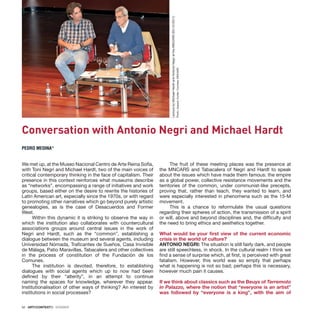
Editora y Directora / Director & Editor:
Alicia Murría
Equipo de Redacción / Editorial Staff:
Eva Navarro
Santiago Olmo
Miguel Verdaguer
info@artecontexto.com
Administración / Accounting Department:
Carmen Villalba
administracion@artecontexto.com
Publicidad / Advertising:
publicidad@artecontexto.com
Suscripciones / Subscriptions:
suscripciones@artecontexto.com
Distribución / Distribution:
distribucion@artecontexto.com
Oficinas / Office:
Tel. + 34 913 640 486
C/ Santa Ana 14, 2º C.
28005 Madrid. (España)
www.artecontexto.com
Diseño / Design:
Jacinto Martín
El viajero: www.elviajero.org
Traducciones / Translations:
Joanna Porter
Especial agradecimiento / Special thanks
A Enrique Larroy por su colaboración en este número
To Enrique Larroy for her contribution to this issue
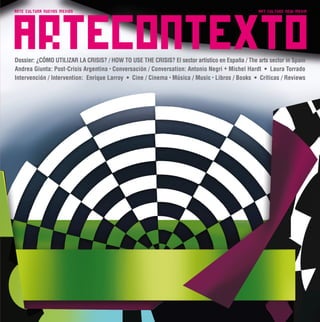
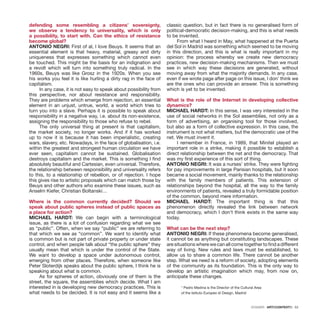
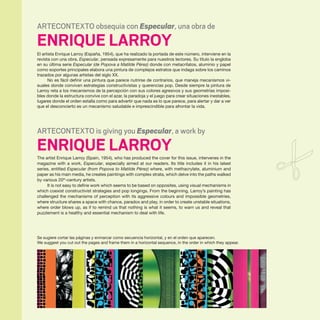
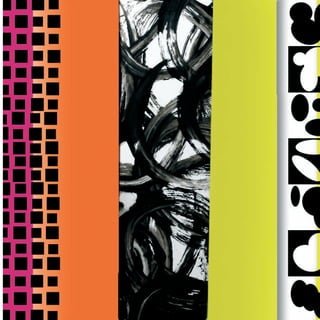
Portada realizada expresamente para ARTECONTEXTO
por el artista Enrique Larroy. Título: Especular.
Cover made especially for ARTECONTEXTO by the artist
Enrique Larroy. Title: Especular.
ARTECONTEXTO arte cultura nuevos medios
es una publicación trimestral de ARTEHOY Publicaciones y Gestión, S.L.
Impreso en España por Gráficas RUIZ POLO, S.A.
Producción gráfica: El viajero / Eva Bonilla. Procograf S.L.
ISSN: 1697-2341. Depósito legal: M-1968–2004
Todos los derechos reservados. Ninguna parte de esta publicación puede ser
reproducida o transmitida por ningún medio sin el permiso escrito del editor.
All rights reserved. No part of this publication may be reproduced or transmitted
by any means without written permission from the publisher.
© de la edición, ARTEHOY Publicaciones y Gestión, S.L.
© de las imágenes, sus autores
© de los textos, sus autores
© de las traducciones, sus autores
© de las reproducciones autorizadas, VEGAP. Madrid 2011
Esta publicación es miembro de la Asociación
de Revistas Culturales de España (ARCE) y de FIRC
Esta revista ha recibido una subvención de la Dirección General del Libro, Archivos y Bibliotecas
para su difusión en bibliotecas, centros culturales y universidades de España, para la totalidad de
los números editados en el año.
Actividad realizada con la ayuda del Ministerio de Cultura
ARTECONTEXTO reúne diversos puntos de vista para activar el debate y no se identifica
forzosamente con todas las opiniones de sus autores.
ARTECONTEXTO does not necessarily share the opinions expressed by the authors.
La editorial ARTEHOY Publicaciones y Gestión S.L., a los efectos previstos en el art. 32,1, párrafo
segundo, del TRLPI se opone expresamente a que cualquiera de las páginas de ARTECONTEXTO
sea utilizada para la realización de resúmenes de prensa.
ARTEHOY Publicaciones y Gestión S.L., as stated in the second paragraph of article 32,1 of the
TRLPI (Intellectual Property Law amended text) expressly forbids the use of any of the pages of
ARTECONTEXTO for the production of press summaries.
Cualquier forma de reproducción, distribución, comunicación pública o transformación de esta
obra sólo puede ser realizada con la autorización de sus titulares, salvo excepción prevista por la
ley. Diríjase a CEDRO (Centro Español de Derechos Reprográficos: www.cedro.org), si necesita
fotocopiar o escanear algún fragmento de esta obra.
Any form of reproduction, distribution, public communication or transformation of this work may
only be carried out with the express authorisation of its holders, with the exceptions contemplated
by law. Please get in touch with CEDRO (Centro Español de Derechos Reprográficos: www.cedro.
org), if you need to photocopy or scan any fragments of this work.
ARTECONTEXTO
DOSSIER · ARTECONTEXTO · 3
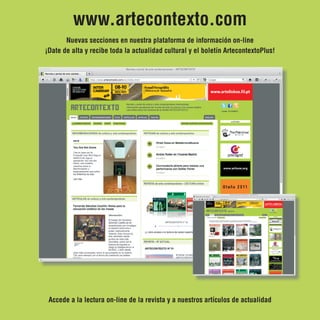
Nuevas secciones en nuestra plataforma de información on-line
¡Date de alta y recibe toda la actualidad cultural y el boletín ArtecontextoPlus!
www.artecontexto.com
Accede a la lectura on-line de la revista y a nuestros artículos de actualidad
4 · ARTECONTEXTO · DOSSIER
SUMARIO
/
INDEX
/
32
ARTECONTE
X
TO
Dossier: ¿Cómo utilizar la crisis? / How to use the Crisis?
6 	 Qué hacer en tiempos furtivos. (Arte, cultura, crisis)
	 What To Do in Furtive Times. (Art, Culture, Crisis)
	 ALICIA MURRÍA
10	 Opiniones / Opinions
	 Francesca Llopis
	 Presidenta de la Unión de Asociaciones de Artistas Visuales
	 President of the Unión de Asociaciones de Artistas Visuales
	 Miguel Von Hafe
	 Director del Centro Galego de Arte Contemporánea
	 Director of the Centro Galego de Arte Contemporánea
	 Glòria Picazo
	 Directora del Centre d’Art La Panera
	 Director of the Centre d’Art La Panera
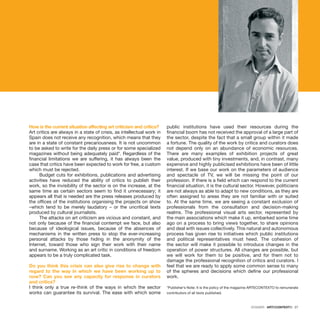
	 José Luis Pérez Pont
	 Presidente del Consejo de Comisaríos y Críticos de Artes Visuales
	 President of Consejo de Críticos y Comisaríos de Artes Visuales
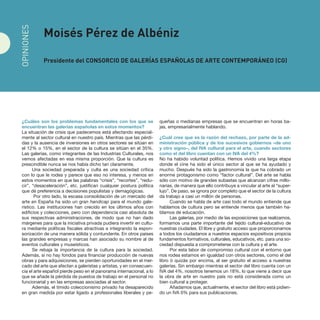
	 Moisés Pérez de Albéniz
	 Presidente del Consorcio de Galerías Españolas de Arte Contemporáneo
	 President of the Consorcio de Galerías Españolas de Arte Contemporáneo
	 Manuel Ortuño
	 Presidente de la Asociación de Revistas Culturales
	 President of the Asociación de Revistas Culturales
	 Yolanda Romero
	 Coordinadora del Grupo de Trabajo para la redacción
	 del documento Estrategia para las Artes Visuales
	 Coordinator of the Working Group for the drafting
	 of a Strategy for the Visual Arts.
40	 Postcrisis en la Argentina después de 2001
	 Post-Crisis in Argentina After 2001
	 ANDREA GIUNTA
50	 Conversación con Antonio Negri y Michael Hardt
	 Conversation with Antonio Negri and Michael Hardt
	 PEDRO MEDINA
Páginas Centrales / Central Pages
54	 Intervención de / Intervention by
	 Enrique Larroy
62	 Laura Torrado
	 Leche negra del alba / Black Milk of Daybreak
	 MARIANO NAVARRO
Cine / Cinema
74	 Le quattro volte
	 IRENE BONILLA
Música / Music
76	 Keith Rowe
	 JOSÉ MANUEL COSTA
Libros / Books
78	 Gustavo Marrone
	 No apagar la luz / Don’t Turn Out the Light
	 LUIS FRANCISCO PÉREZ
Críticas de exposiciones / Reviews of Exhibitions
80	 8ª Bienal de Mercosur: Ensayos de Geopoética
	 8th Biennial of Mercosur. Essays on Geopoetics
	 Varias sedes / Various Spaces, Porto Algre
	 MIGUEL A. PÉREZ
84	 Dublin Contemporary Art 2011
	 Earlsfort Terrace y otras sedes / and others spaces
	 MARIANO NAVARRO
88	 12ª Bienal de Estambul
	 12th Istanbul Biennial
	 Varias sedes / Various Spaces
	 MIGUEL A. LÓPEZ
92	 Sofía Jack
	 Todo lo sólido se desvanece en el aire
	 Everything Solid Vanishes into Thin Air
	 Galería Fúcares, Madrid
	 SUSET SÁNCHEZ
96	 Laylah Ali + Abigail Lazcoz
	 Relatos extraordinarios / Extraordinary Tales
	 Sala Parpalló, Valencia
	 JAVIER MARROQUÍ
100	 Juan Hidalgo
	 Desde Ayataca (1997 -2009)
	 From Ayataca (1997 – 2009)
	 CAAM, Las Palmas de Gran Canaria
	 CARLOS JIMÉNEZ
104	 Lluís Hortalà
	 CDAN, Huesca
	 LUIS FRANCISCO PÉREZ
108	 José Manuel Ballester
	 Sala Alcalá 31, Madrid
	 MÓNICA NÚÑEZ LUIS
112	 Alberto Giacometti
	 Museo Picasso, Málaga
	 MARIANO NAVARRO
116	 Séptimo ciclo de exposiciones de La Conservera
	 Seventh Cycle of Exhibitions at La Conservera
	 La Conservera y Sala Verónicas, Ceutí y Murcia
	 SEMA D’ACOSTA
120	 Francesc Torres
	 Memoria fragmentada 11-S NY. Artefactos en el hangar 17
	 Remains: 9/11. Artifacts at Hangar 17
	 Varias sedes, Barcelona, Madrid, Nueva York y Londres
	 ALFONSO LÓPEZ ROJO
124	 Mitsuo Miura
	 Memorias imaginadas / Imagined Memories
	 Galería Evelyn Botella, Madrid
	 ARMANDO MONTESINOS
128	 Gonzalo Puch
	 Una jornada sin nubes / A Day Without Clouds
	 CAB, Burgos
	 SEMA D’ACOSTA
132	 Jorge Perianes
	 Categorías / Categories
	 Matadero, Madrid
	 SARA GARCÍA
136	 Cambio de paradigma
	 Colección Serralves años 60 – 70
	 Paradigm Shift.
	 Serralves Collection 60’s – 70’s
	 MUSAC, León
	 CARLOS JIMÉNEZ
140	 Atsuko Tanaka
	 El arte de conectar / The Art of Connecting
	 EACC, Castellón
	 JAVIER MARROQUÍ
144	 Alighiero Boetti
	 Estrategia de juego / Game Strategy
	 MNCARS, Madrid
	 SANTIAGO OLMO
6 · ARTECONTEXTO · DOSSIER
Con esta frase interrogaba Nacho Criado desde una obra suya de
1994. Y resulta apropiada para expresar el desasosiego que siente
una gran parte de la ciudadanía, acuciada en múltiples frentes:
paro, precarización laboral, recortes, desmantelamiento de la (inci-
piente en nuestro país) sociedad del bienestar. Consecuencias to-
das de una crisis internacional que, como es sabido, no llegó como
caída del cielo, ni como consecuencia de un accidente en la mar-
cha de la economía mundial, ni siquiera como fruto de de la codicia
de unos cuantos especuladores desalmados, sino que es el fruto
de las políticas neoliberales, de la desregulación de los mercados,
de la abdicación por parte de estados y gobiernos de sus respon-
sabilidades y que, no suficientemente escarmentados, encargan a
los máximos responsables del colapso para que asesoren sobre
cómo salir de una crisis que ellos mismos provocaron.
Si enfocamos a nuestro país, los recortes que se están apli-
cando a la sanidad y la educación llegaron en primer lugar a la
cultura, un sector cuyos integrantes, entre ellos los dedicados al
arte, ven/vemos como se eleva al cubo la habitual precariedad.
A la vez, escuchamos que la cultura no es sólo un motor
económico sino un “sector estratégico”, afirmación reciente de
un alto cargo de nuestra administración central. En la misma línea
se manifestaban los participantes en el Congreso Europeo de la
Cultura, celebrado el pasado mes de septiembre en Broclaw. El
pensador Zygmunt Bauman habría el encuentro con la siguiente
declaración: «El futuro de Europa depende de la cultura». Y otro de
los participantes, Philip Kern, señalaba «En estos momentos hay
que situar a la cultura en el centro del discurso social y económico
de la nueva sociedad (…) y no solo porque actualmente la indus-
tria cultural proporciona millones de empleos y supone una parte
importante del PIB (…) Cuando hablamos de innovación pensamos
que solo procede del campo de la tecnología, cuando en realidad
es el campo de la tecnología el que bebe de las ideas y tendencias
que surgen del campo de la cultura».
En nuestro país hablamos de un sector productivo, que se
engloba bajo la denominación de Industrias Culturales, que hoy
aporta el 5% del PIB y que ocupa a 900.000 personas, sin incluir en
esta cifra los puestos indirectos que genera. Un sector integrado
por personas que poseen alta formación y cualificación (el 57%
cuenta con estudios superiores), fuerte capacidad de adaptación,
flexibilidad y dotes emprendedoras, conformando un potencial de
desarrollo mayor que el de otros sectores; sin embargo, estos as-
pectos a su favor no son cualidades suficientes para encarar la
magnitud de la actual crisis.
Tengamos en cuenta que en 2008 el gasto en cultura por
parte de la Administración General del Estado fue de un 0,10 % del
total, porcentaje que en los últimos tres años, como sabemos, ha
experimentado notables reducciones. Se concluye entonces que
es un sector productivo que genera importantes recursos mientras
recibe inversiones mínimas
Qué hacer en tiempos furtivos. (Arte, cultura, crisis)
ALICIA MURRÍA*
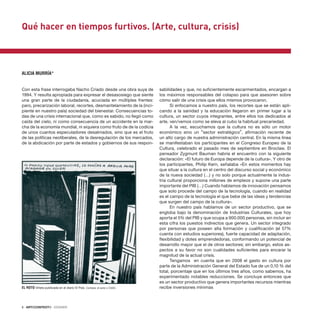
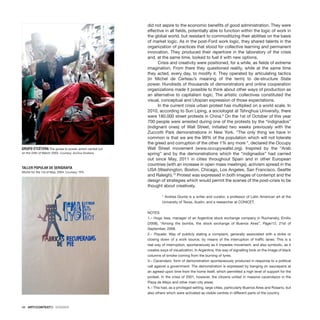
EL ROTO Viñeta publicada en el diario El País. Cortesía: el autor y CAAC.
DOSSIER · ARTECONTEXTO · 7
Pero cuando se habla de Industrias Culturales,
hay que distinguir entre sectores como el libro, tras
el que se encuentran grandes grupos editoriales, o
el del cine –que, por ejemplo, cuenta con una línea
específica de préstamos blandos del Instituto de
Crédito Oficial (ICO)–; ambos con la fuerza suficien-
te para negociar directamente con las administra-
ciones, y que reciben importantes ayudas. Mientras,
el sector del arte resulta ser uno de los más débiles
del conjunto pues, por sus propias peculiaridades,
no está estructurado como una industria. El tejido
que compone el sector arte, empezando por los
propios artistas y pasando por comisarios, críticos,
editores, gestores, mediadores, galerías, etc. está
conformado por microempresas, pequeñas coope-
rativas, asociaciones de autoempleo y un gran nú-
mero trabajadores autónomos, o lo que es lo mismo,
un entramado laboral muy fragmentado y desprote-
gido, cuya actividad está muy vinculada a las admi-
nistraciones públicas y que cuenta con una escasa
presencia de la iniciativa privada.
Por otro lado, los criterios que han imperado en los últimos
veinte años, lejos de desarrollar políticas culturales coherentes,
con objetivos a corto, medio y largo plazo, se han centrado en la
creación de infraestructuras, necesarias en muchos casos pero de
escala desproporcionada en otros tantos, un proceso inscrito en
el boom inmobiliario, y que no ha manejado conceptos de soste-
nibilidad ni de adecuación. Así, la parte del león de las inversiones
culturales ha buscado el impacto turístico o la rehabilitación de
zonas urbanas deterioradas, que se veían revalorizadas (sufriendo
los consiguientes procesos de gentrificación), y se ha empeñado
en crear, por encima de todo, llamativos iconos identificativos de
las ciudades. Grandes inversiones, en definitiva, que además de
vaciar las arcas públicas no contemplaban los gastos de mante-
nimiento y de actividades que dieran sentido a los edificios (audi-
torios sin orquestas, teatros sin compañías estables, museos sin
contenidos, etc).
La escasa valoración del trabajo intelectual ha traído consigo
la ausencia de políticas culturales coherentes, basadas en el análi-
sis de las necesidades reales del ámbito de la cultura y, específi-
camente de las artes visuales, que han sufrido de forma especial la
instrumentalización y el partidismo, y que ven cómo se ha consu-
mido un tiempo precioso de bonanza económica.
No se trata aquí de decir que todo se ha hecho mal, pero sí de
asumir que es urgente introducir cambios, pues esta crisis amena-
za muy seriamente al sector de las artes visuales, comenzando por
los propios creadores. Por fortuna, durante los últimos años se han
hecho enormes esfuerzos por vertebrar un tejido asociativo capaz
de articular posiciones comunes y de erigirse en interlocutores con
las administraciones públicas. Se trata ahora de impedir que los
recortes se ceben en un sector con extraordinarias carencias, y
que los recursos se racionalicen y se utilicen de manera eficaz,
teniendo como objetivos fundamentales la inversión en creación
y producción, en investigación, promoción e innovación, así como
en la mejora de las condiciones laborales, aspecto históricamente
desatendido.
En este marco de urgencia ve la luz un documento que ana-
liza y marca objetivos no solo en cuanto a demandas concretas en
el plano de las inversiones, sino también en aspectos legislativos,
protocolos de actuación y optimización de recursos. Bajo el título
Estrategia para las Artes Visuales, integra y amplía documentos
sectoriales anteriores y ha sido impulsado por la Dirección General
de Bellas Artes del Ministerio de Cultura. La redacción del docu-
mento ha ocupado buena parte de 2011, aunque se ha concluido
en puertas de las elecciones generales; tarde pues para que quie-
nes lo han impulsado puedan aplicarlo. Sin embargo, cuenta con el
apoyo decidido de las diferentes asociaciones representativas del
sector artístico, de modo que se convierte en una herramienta u
“hoja de ruta”, como lo han calificado sus autores, de cara al futuro
inmediato aunque sus objetivos son de largo alcance.
Será necesario redoblar los esfuerzos para que políticos y
administraciones públicas (tanto la estatal, como las autonómicas
y locales) asuman que la cultura y el arte son derechos fundamen-
tales, factores de salud social y de democracia, además de motor
de desarrollo económico. El sector de las artes visuales no se ha
caracterizado por su beligerancia ni por aplicar toda su energía, te-
nacidad, imaginación y potencial en sus demandas. Quizá la crisis
pueda ser un catalizador.
* Alicia Murría es escritora, crítica de arte, comisaria de exposiciones
independiente, profesora en el máster de Arte Contemporáneo en la
Universidad Europea de Madrid, editora y directora de ARTECONTEXTO.
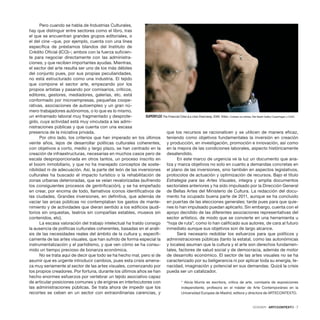
SUPERFLEX The Financial Crisis (La crisis financiera), 2009. Vídeo. Cortesía: los artistas, Nils Staerk Gallery Copenhagen y CAAC.
8 · ARTECONTEXTO · DOSSIER
This question was posed by Nacho Criado in a work he produced
in 1994. And it is appropriate to express the uncertainty felt by
a large number of citizens at present, as they are under siege
on a number of fronts: unemployment, precarious working
conditions, cuts, dismantling of the (emerging, in our country)
welfare society. These are the consequences of an international
crisis which, as we all know, did not happen as if by magic,
nor was it the result of an accident in the operations of global
economy, or even the fruit of the greed of a handful of heartless
speculators. Rather, it is the result of neoliberal policies,
market deregulation, the abdication on the part of states and
governments of their responsibilities and their unwise decision
to ask those responsible for the collapse for ways to escape a
crisis they themselves caused.
If we focus on our country, the cuts on healthcare and
education first affected culture, a sector whose members,
including those who are devoted to art, are witnessing the
exponential increase in their usual precarious situation.
At the same time, we are hearing that culture is not only an
economic engine but also a “strategic sector”, as was recently
stated by a high-ranking official in our central government. The
participants in the European Culture Congress spoke along the
same lines, during the event, which took place in September,
in Wroclaw. The thinker Zygmunt Bauman declared, during the
congress, that “The future of Europe depends on culture”. And
another of the participants, Philip Kern, pointed out, “at this time
it is necessary to situate culture at the heart of the social and
economic discourse of new society (…) and not only because
at present the cultural industry provides millions of jobs and
accounts for an important percentage of GDP (…) When we
speak about innovation we think only about technology, when in
fact this sector drinks from the ideas and trends which emerge
in the field of culture”.
In our country we speak about a productive sector, which
forms part of the Cultural Industries, which at present accounts
for 5% of GDP and which employs 900,000 people, without
including the indirect jobs it generates. A sector made up of
highly-trained people (57% are graduates), a strong capacity for
adaptation, flexibility and entrepreneurship,
giving rise to a greater potential for
development than other sectors; however,
these positive elements are not enough to
face a crisis of this magnitude.
We must take into account the fact
that in 2008 the investment in culture by the
General State Administration was 0.10% of
the total, a percentage which, as we know,
has been significantly reduced in the last
three years. We can conclude, then, that
it is a productive sector which generates
important resources even as it receives tiny
investments.
However, when we speak about Cultural
Industries, we must differentiate between
sectors such as the book industry, which
includes important publishing groups, or
the film industry–which, for example, enjoys
a specific soft credit line at the Instituto
EL ROTO, cartoon published in El País. View of the exhibition Sin realidad no hay utopía [Without Reality there is No
Utopia] at the Centro Andaluz de Arte Contemporaneo (CAAC) Seville, 2011. Courtesy of the autho. Photo: Guillermo Mendo.
What To Do in Furtive Times. (Art, Culture, Crisis)
ALICIA MURRÍA*
DOSSIER · ARTECONTEXTO · 9
de Crédito Oficial (ICO)–; both of which are strong enough to
negotiate directly with the administrations, as well as receiving
important subsidies. Meanwhile, the art sector is one of the
weakest as, because of its unique characteristics, it is not
structured like an industry. The fabric which makes up the art
sector, beginning with the artists themselves and including
curators, editors, critics, managers, mediators, galleries, etc.,
is made up of micro-companies, self-employment associations
and a large amount of freelance workers, i.e. a highly fragmented
and unprotected working network, whose activity is linked to
the state administrations and which does not benefit greatly
from private initiatives.
On the other hand, the criteria which have dominated in the
last two decades, far from developing consistent cultural policies,
with short-, medium- and long-term objectives, have focused on
the creation of infrastructures, often necessary but sometimes
on a disproportionate scale, a process which was part of the real
estate boom, which neglected issues such as sustainability and
adequacy. Therefore, the lion’s share of cultural investments has
sought tourist impact or the rehabilitation of deteriorated urban
areas, which experienced an increase in their value (and were
subsequently gentrified), with the intention, above all, of creating
striking icons for cities. Large investments which have depleted
public funds and failed to consider maintenance expenses and
the cost of activities to lend meaning to the buildings (auditoriums
without orchestras, theatres without stable companies, museums
without contents, etc.).
The low appreciation for intellectual work has brought about
an absence of consistent cultural policies, based on the analysis
of the real needs of the field of culture,
and specifically the visual arts, which
have most suffered the consequences
of instrumentalisation and partisanship,
and which have witnessed the waste of a
precious period of economic prosperity.
It is not a question of saying that
everything has been done wrong, but of
assuming that it is a matter of urgency
to introduce changes, as this crisis
poses a serious threat to the visual arts
sector, starting with artists themselves.
Fortunately, in the last few years huge
efforts have been made to articulate an
associative fabric capable of expressing
shared positions and functioning as
interlocutorsofthepublicadministrations.
It is a matter of preventing the cuts
from destroying an already damaged
sector, and to ensure that resources are
rationalised and used in an efficient way,
with the main aims of investing in creation
and production, research, promotion and innovation, as well as
the improvement of working conditions, an issue which has
always been neglected.
In this context of urgency, a document has emerged to
analyse and set objectives not only with regard to concrete
demands regarding investments, but also focusing on legislative
issues, protocols and the optimisation of resources. Under the
title Strategy for the Visual Arts, it presents and expands on
previous sectorial documents, and has been promoted by the
Dirección General de Bellas Artes of the Ministry for Culture.
The writing of the document has taken up a large part of 2011,
although it has been finished in time for the general elections;
too late for those who have promoted it to have a chance to
implement it. However, it enjoys the strong support of the
various representation associations of the arts sector, so it is
becoming a tool or roadmap, as its authors describe it, for the
immediate future, even if its aims are long reaching.
It will be necessary to increase our efforts so that
politicians and public administrations (on a state, regional and
local level) accept that culture and art are fundamental rights,
factors for social health and democracy, as well as an engine
for economic development. The visual arts sector has not been
characterised by its belligerence or by investing all its energy,
tenacity, imagination and potential in its demands. Perhaps the
crisis will be a catalyst.
* Alicia Murría is a writer, art critic, independent exhibition curator, teacher
of the Contemporary Art MA at the Universidad Europea de Madrid, and
editor and director of ARTECONTEXTO.
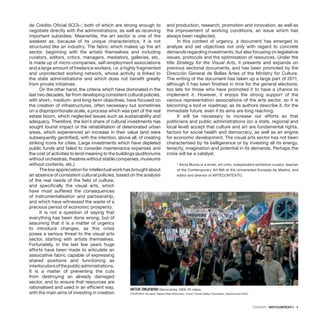
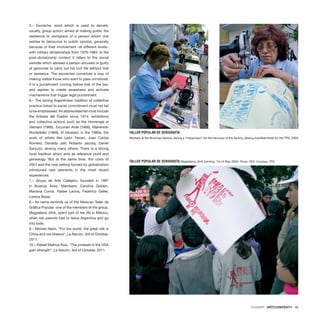
ARTUR ZMIJEWSKI Democracies, 2009. 20 videos.
COURTESY: the artist, Galerie Peter Kilchmann, Zurich, Foksal Gallery Foundation, Varsovia and CAAC.
10 · ARTECONTEXTO · DOSSIER
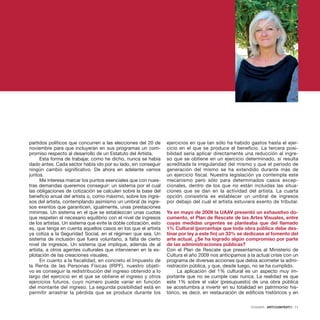
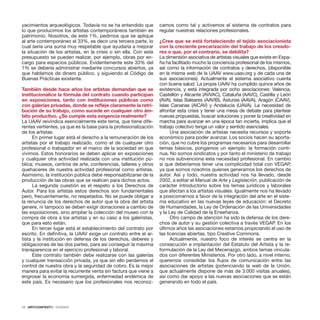
Francesca Llopis
Presidenta de la UNIÓN DE ASOCIACIONES DE ARTISTAS VISUALES (UAAV)
¿Cómo está afectando la crisis económica a los artistas?
Esta crisis nos afecta especialmente. Como sabemos en este
país la situación del arte contemporáneo siempre ha estado
en precario, pero ahora más.
En la actualidad, parece que todo el capital artístico del
que disponemos es histórico y, en cambio, se ha demostrado
que la inversión que se hizo con artistas, desde Velázquez a
Tàpies, ha sido muy rentable para la economía del país, pero
ahora no se considera como tal a las generaciones contem-
poráneas. Es evidente que si no se invierte en las propuestas
actuales se creará un vacío en cuanto al patrimonio artístico
del futuro.
De la misma manera que hay recortes en la enseñanza,
estos también afectan a artistas que se dedican a ella como
segunda opción, aunque sea la primordial para su economía,
y hay muchos casos. Además, los recortes en el gasto pú-
blico llegaron, antes que a ningún otro sector, a los museos
y centros de arte.
Todos los recortes que se aplican a centros y museos
afectan directamente a los artistas, ya que hay menos expo-
siciones, menos encargos y menos de todo. Además, esta
política de menosprecio al arte contemporáneo desde las
administraciones públicas, también retrae a los coleccionis-
tas y a todo promotor de arte, que en un tiempo no muy
lejano, empezaban a formar su colección o a plantear nuevos
proyectos, que actualmente ya no emprenden.
Sin embargo, se da la paradoja de que, según algunos
economistas, lo que sacará a Europa de la crisis es su poten-
cial creativo, el conocimiento. Por eso no entendemos a los
políticos que conciben la cultura como un gasto y no como
una inversión. No deberíamos resignarnos y deberíamos tra-
bajar mejor y, sobre todo, unidos.
Imagino que uno de los problemas acuciantes tiene que
ver con las cotizaciones a la Seguridad Social. Desde
hace años una de las principales demandas es conseguir
un régimen especial que contemple la especificidad del
sector de los creadores. ¿Se ha logrado algún avance?
Presentamos nuestro primer proyecto del Estatuto del Ar-
tista, acompañado por un estudio exhaustivo de cuál es la
situación fiscal de los artistas en Europa, a la Ministra Gonzá-
lez-Sinde hace dos años. El tema es cómo pagar el régimen
de autónomos, que permite el acceso a la Seguridad Social,
si no ingresamos mensualmente cantidad alguna. Nuestro
trabajo, aunque sea estable, no es siempre rentable, y si no
pagamos autónomos nos convertimos en mercado negro.
¿Le interesa esto a la economía española?
Por primera vez en nuestra historia los artistas y creado-
res (teatro, circo, danza, ilustración, artes visuales, escrito-
res, músicos, etc.) estamos trabajando juntos en un clima de
confianza y colaboración para conseguir un Estatuto del Ar-
tista y del Creador. Esto representa un nuevo enfoque y nos
proponemos, en primer lugar, encargar un estudio jurídico
que incluya los cambios legislativos necesarios para mejorar
la condición del artista y que nos homologue con los están-
dares europeos. Hemos conseguido la financiación a través
del CoNCA, el Consell Nacional de la Cultura i de les Arts de
Catalunya. En segundo lugar, hemos pedido reuniones a los
OPINIONES
DOSSIER · ARTECONTEXTO · 11
partidos políticos que concurren a las elecciones del 20 de
noviembre para que incluyeran en sus programas un com-
promiso respecto al desarrollo de un Estatuto del Artista.
Esta forma de trabajar, como he dicho, nunca se había
dado antes. Cada sector había ido por su lado, sin conseguir
ningún cambio significativo. De ahora en adelante vamos
juntos.
Me interesa marcar los puntos esenciales que con nues-
tras demandas queremos conseguir: un sistema por el cual
las obligaciones de cotización se calculen sobre la base del
beneficio anual del artista o, como máximo, sobre los ingre-
sos del artista, contemplando asimismo un umbral de ingre-
sos exentos que garanticen, igualmente, unas prestaciones
mínimas. Un sistema en el que se establezcan unas cuotas
que respeten el necesario equilibrio con el nivel de ingresos
de los artistas. Un sistema que evite la doble cotización, esto
es, que tenga en cuenta aquellos casos en los que el artista
ya cotiza a la Seguridad Social, en el régimen que sea. Un
sistema de inclusión que fuera voluntario, a falta de cierto
nivel de ingresos. Un sistema que implique, además de al
artista, a otros agentes culturales que intervienen en la ex-
plotación de las creaciones visuales,
En cuanto a la fiscalidad, en concreto el Impuesto de
la Renta de las Personas Físicas (IRPF), nuestro objeti-
vo es conseguir la redistribución del ingreso obtenido a lo
largo del ejercicio en el que se obtiene el ingreso y otros
ejercicios futuros, cuyo número puede variar en función
del montante del ingreso. La segunda posibilidad está en
permitir arrastrar la pérdida que se produce durante los
ejercicios en que tan sólo ha habido gastos hasta el ejer-
cicio en el que se produce el beneficio. La tercera posi-
bilidad sería aplicar directamente una reducción al ingre-
so que se obtiene en un ejercicio determinado, si resulta
acreditada la irregularidad del mismo y que el periodo de
generación del mismo se ha extendido durante más de
un ejercicio fiscal. Nuestra legislación ya contempla este
mecanismo pero sólo para determinados casos excep-
cionales, dentro de los que no están incluidas las situa-
ciones que se dan en la actividad del artista. La cuarta
opción consistiría es establecer un umbral de ingresos
por debajo del cual el artista estuviera exento de tributar.
 
Ya en mayo de 2009 la UAAV presentó un exhaustivo do-
cumento, el Plan de Rescate de las Artes Visuales, entre
cuyas medidas urgentes se planteaba que del llamado
1% Cultural (porcentaje que toda obra pública debe des-
tinar por ley a este fin) un 33% se dedicase al fomento del
arte actual. ¿Se ha logrado algún compromiso por parte
de las administraciones públicas?
Con el Plan de Rescate que presentamos al Ministerio de
Cultura el año 2009 nos anticipamos a la actual crisis con un
programa de diversas acciones que debía acometer la admi-
nistración pública, y que, desde luego, no se ha cumplido.
La aplicación del 1% cultural es un aspecto muy im-
portante que no se cumple casi nunca. La realidad es que
este 1% sobre el valor (presupuesto) de una obra pública
se acostumbra a invertir en su totalidad en patrimonio his-
tórico, es decir, en restauración de edificios históricos y en
12 · ARTECONTEXTO · DOSSIER
yacimientos arqueológicos. Todavía no se ha entendido que
lo que producimos los artistas contemporáneos también es
patrimonio. Nosotros, de este 1%, pedimos que se aplique
al arte contemporáneo el 33%, es decir una tercera parte, lo
cual seria una suma muy respetable que ayudaría a mejorar
la situación de los artistas, en la crisis o sin ella. Con este
presupuesto se pueden realizar, por ejemplo, obras por en-
cargo para espacios públicos. Evidentemente este 33% del
1% se debería administrar mediante concursos abiertos, ya
que hablamos de dinero público, y siguiendo el Código de
Buenas Prácticas existente.
 
También desde hace años los artistas demandan que se
institucionalice la fórmula del contrato cuando participan
en exposiciones, tanto con instituciones públicas como
con galerías privadas, donde se refleje claramente la retri-
bución de su trabajo, como sucede en cualquier otro ám-
bito productivo. ¿Se cumple esta exigencia realmente?
La UAAV reivindica esencialmente este tema, que tiene dife-
rentes vertientes, ya que es la base para la profesionalización
de los artistas.
En primer lugar está el derecho a la remuneración de los
artistas por el trabajo realizado, como el de cualquier otro
profesional o trabajador en el marco de la sociedad en que
vivimos. Estos honorarios se deben aplicar en exposiciones
y cualquier otra actividad realizada con una institución pú-
blica; museos, centros de arte, conferencias, talleres y otros
quehaceres de nuestra actividad profesional como artistas.
Asimismo, la institución pública debe responsabilizarse de la
producción de las obras que se realicen para dichos actos.
La segunda cuestión es el respeto a los Derechos de
Autor. Para los artistas estos derechos son fundamentales
pero, frecuentemente, no respetados. No se puede obligar a
la renuncia de los derechos de autor que la obra del artista
genere, ni tampoco se deben exigir donaciones a cambio de
las exposiciones, sino ampliar la colección del museo con la
compra de obra a los artistas y en su caso a los galeristas,
que para esto están.
En tercer lugar está el establecimiento del contrato por
escrito. En definitiva, la UAAV exige un contrato entre el ar-
tista y la institución en defensa de los derechos, deberes y
obligaciones de las dos partes, para así conseguir la máxima
transparencia en el ejercicio profesional y laboral.
Este contrato también debe realizarse con las galerías
y cualquier transacción privada, ya que sin ello perdemos el
control de nuestra obra y la seguridad de cobro. Es la mejor
manera para evitar la recurrente venta sin factura que viene a
engrosar la economía sumergida, enfermedad endémica de
este país. Es necesario que los profesionales nos reconoz-
camos como tal y activemos el sistema de contratos para
regular nuestras relaciones profesionales.
¿Cree que se está fortaleciendo el tejido asociacionista
con la creciente precarización del trabajo de los creado-
res o que, por el contrario, se debilita?
La dimensión asociativa de artistas visuales que existe en Espa-
ña ha facilitado mucho la conciencia profesional de los mismos,
así como la información de contratos y derechos, (disponible
en la misma web de la UAAV www.uaav.org y de cada una de
sus asociaciones). Actualmente el sistema asociativo cuenta
con buena salud. La propia UAAV ha cumplido quince años de
existencia, y está integrada por ocho asociaciones: Valencia,
Castellón y Alicante (AVVAC), Cataluña (AAVC), Castilla y León
(AVA), Islas Baleares (AAVIB), Asturias (AAVA), Aragón (CAAV),
Islas Canarias (AICAV) y Andalucía (UAVA). La necesidad de
afrontar esta crisis y tener una mesa de debate para plantear
nuevas propuestas, buscar soluciones y poner la creatividad en
marcha para avanzar en una época tan incierta, implica que el
trabajo colectivo tenga un valor y sentido esenciales.
Una asociación de artistas necesita recursos y soporte
económico para poder avanzar. Los socios hacen su aporta-
ción, que no cubre los programas necesarios para desarrollar
temas básicos, pongamos un ejemplo: la formación conti-
nua. No somos sindicatos y por tanto el ministerio de trabajo
no nos subvenciona esta necesidad profesional. En cambio
sí que deberíamos tener una complicidad total con VEGAP,
ya que somos nosotros quienes generamos los derechos de
autor. Así y todo, nuestra actividad nos ha llevado, desde
2002, a editar el Manual de Arte y Legislación, publicación de
carácter introductorio sobre los temas jurídicos y laborales
que afectan a los artistas visuales. Igualmente nos ha llevado
a posicionarnos a favor de la integración del arte en el siste-
ma educativo en las nuevas leyes de educación: el Decreto
de Humanidades, la Ley de Ordenación de las Universidades
y la Ley de Calidad de la Enseñanza.
Otro campo de atención ha sido la defensa de los dere-
chos de autor y su gestión colectiva a través VEGAP. En los
últimos años las asociaciones estamos propiciando el uso de
las licencias abiertas, tipo Creative Commons.
Actualmente, nuestro foco de interés se centra en la
consecución e implantación del Estatuto del Artista y la re-
formulación de la Ley del Mecenazgo, ambos temas vincula-
dos con diferentes Ministerios. Por otro lado, a nivel interno,
queremos consolidar los flujos de comunicación entre las
asociaciones de artistas (potenciando la web de la Unión,
que actualmente dispone de más de 3.000 visitas anuales),
así como dar apoyo a las nuevas asociaciones que se están
generando en todo el país.
DOSSIER · ARTECONTEXTO · 13
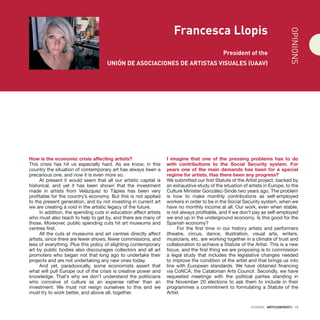
Francesca Llopis
President of the
UNIÓN DE ASOCIACIONES DE ARTISTAS VISUALES (UAAV)
How is the economic crisis affecting artists?
This crisis has hit us especially hard. As we know, in this
country the situation of contemporary art has always been a
precarious one, and now it is even more so.
At present it would seem that all our artistic capital is
historical, and yet it has been shown that the investment
made in artists from Velázquez to Tàpies has been very
profitable for the country’s economy. But this is not applied
to the present generation, and by not investing in current art
we are creating a void in the artistic legacy of the future.
In addition, the spending cuts in education affect artists
who must also teach to help to get by, and there are many of
those. Moreover, public spending cuts hit art museums and
centres first.
All the cuts at museums and art centres directly affect
artists, since there are fewer shows, fewer commissions, and
less of everything. Plus this policy of slighting contemporary
art by public bodies also discourages collectors and all art
promoters who began not that long ago to undertake their
projects and are not undertaking any new ones today.
And yet, paradoxically, some economists assert that
what will pull Europe out of the crisis is creative power and
knowledge. That’s why we don’t understand the politicians
who conceive of culture as an expense rather than an
investment. We must not resign ourselves to this and we
must try to work better, and above all, together.
I imagine that one of the pressing problems has to do
with contributions to the Social Security system. For
years one of the main demands has been for a special
regime for artists. Has there been any progress?
We submitted our first Statute of the Artist project, backed by
an exhaustive study of the situation of artists in Europe, to the
Culture Minister González-Sinde two years ago. The problem
is how to make monthly contributions as self-employed
workers in order to be in the Social Security system, when we
have no monthly income at all. Our work, even when stable,
is not always profitable, and if we don’t pay as self-employed
we end up in the underground economy. Is this good for the
Spanish economy?
For the first time in our history artists and performers
(theatre, circus, dance, illustration, visual arts, writers,
musicians, etc. are working together in a climate of trust and
collaboration to achieve a Statute of the Artist. This is a new
focus, and the first thing we are proposing is to commission
a legal study that includes the legislative changes needed
to improve the condition of the artist and that brings us into
line with European standards. We have obtained financing
via CoNCA, the Catalonian Arts Council. Secondly, we have
requested meetings with the political parties standing in
the November 20 elections to ask them to include in their
programmes a commitment to formulating a Statute of the
Artist. OPINIONS
14 · ARTECONTEXTO · DOSSIER
This way of working, as I said, has never been tried
before. Each sector operated alone, and achieved nothing of
any importance. From now on we will work together.
I’d like to list the essential points that we hope to achieve
with our demands. First, a system in which obligations to
pay are reckoned on the basis of the artist’s annual profit,
or at least on the artist’s income, including a threshold of
exempt income which ensures at least minimum benefits.
Next, a system establishing contributions that respect the
necessary equilibrium with artists’ income levels. Also, a
system that avoids double contributions, that is to say, one
that takes into account the instances in which the artist is
already contributing to Social Security, under whatever
regime. Finally, a system that allows voluntary inclusion not
only of artists but by other cultural agents taking part in the
exploitation of visual creations.
As regards taxes, and specifically personal income tax, our
aim is to achieve the redistribution of the income earned
throughout a given year over other fiscal years, the number
varying with the amount of the income. The second option
would be to allow losses in years showing expenses but
no earnings to be applied to profitable years. A third option
would be to directly apply a reduction in income obtained
in a given year, upon proof of the irregularity of the income,
and when the period in which it is generated is longer
than a single fiscal year. Our legislation already allows
for this but only in exceptional cases, and not for artists.
A fourth option would be to set an income limit below
which the artist will be exempt from paying income tax.
 
Back in May, 2009 the UAAV submitted an exhaustive
document, the Visual Arts Rescue Plan, with urgent
measures such as the so-called 1% Cultural Tax in which
this percentage of all public works budget was set aside
for this, and of which 33% would be spent on promoting
contemporary art. Did this go anywhere?
With the Rescue Plan we anticipated the present crisis with a
diversified action programme for the public sector, but it has
certainly not been implemented.
The 1% Cultural Tax is very important but is almost
never paid. The fact is that the 1% of the budgeted cost
of a public works project is usually invested in the historic
artistic legacy, i.e. in the restoration of historic buildings
and in archaeological excavations. Nobody as yet seems to
understand that the work we contemporary artists produce
is also a national asset. If contemporary art got the one-third
share of these tax revenues that we are requesting, it would
amount to a considerable sum and would greatly improve
the situation of artists, with or without an economic crisis.
It could be spent on commissioning artworks for public
spaces, for example. Obviously it should be apportioned
by means of open public tenders, since we are talking
about public funds, and the existing code of good practices
should be followed.
 
For years artists have also been calling for contracts
when they take part in exhibitions, whether at public
institutions or private galleries, in which their earnings
are reflected clearly, just as occurs in other fields. Is this
done?
The UAAV is campaigning for this, which has several different
angles, and is the basis for according artists standing as
members of a profession.
First is the question of the right of artists to be paid for
their work, as other workers are in our society. This obligation
to pay should apply at exhibitions and all other activities
DOSSIER · ARTECONTEXTO · 15
with public institutions such as museums, art centres,
workshops, etc. The institution should also be responsible
for the production of the works that are made for such events
and activities.
Second is the matter of intellectual property rights, which
are essential to artists but often not respected. There must be
an end to the practice of demanding a waiver of rights to a
work produced by an artist, and that of demanding that a
work be donated in exchange for its inclusion in exhibitions.
Instead, museum collections should be expanded via the
purchase of works from artists or their galleries.
Third is the need for a written contract. The UAAV is
demanding formal contracts between artists and institutions
to defend the rights, duties, and obligations of both parties,
for the sake of maximum clarity in professional and labour
transactions.
Such contracts should also be entered into with galleries
and private individuals, since without them we lose all control
of our works and all certainty of getting paid for them. It’s
the best way to end the practice of making sales without
invoices, which swell the underground economy, an endemic
evil in this country. Artists and art professionals need to be
recognised as such, and that means that our professional
relations must be governed by contracts.
Do you think that the increasingly precarious situation of
artists will encourage them to speak more with a single
voice, or the contrary?
Artists associations in Spain have contributed a great deal to
raise the professional awareness of artists, and to disseminate
information about contracts and rights (see the UAAV website
www.uaav.org and those of each of its member associations.
The association movement is now in good health. The UAAV
itself has been around for 15 years now, and comprises
eight associations, those of Valencia, Castellón and Alicante
(AVVAC), Catalonia (AAVC), Castile- León (AVA), the Balearic
Islands (AAVIB), Asturias (AAVA), Aragón (CAAV), the Canary
Islands (AICAV), and Andalusia (UAVA). The need to cope with
the crisis and to have a forum for discussing new proposals,
seek solutions, and use creativity to advance in times of such
uncertainty can only be met by working together.
An association of artists needs resources and financing
in order to move forward. Our partner associations make
their contributions, but these do not cover the cost of even
basic programmes, such as ongoing training. We’re not
trade unions so the Ministry of Labour doesn’t subsidise this
professional necessity. At the same time we should work
closely with VEGAP, since it is we who generate the intellectual
property rights. At all events, since 2002 we have published
the Manual de Arte y Legislation, an introduction to the legal
and labour situation of visual artists. We have also lobbied for
bringing art into the education system in new legislation such
as the Humanities Decree Law, the Universities Law, and the
Education Quality Law.
The defence of intellectual property rights and their
oversight via VEGAP has been another major concern, and
in recent years we have been advocating the use of “Creative
Commons” types of open licences.
Todayourfocusisontheachievementandimplementation
of the Statute of the Artist and the redrafting of the Law of
Patronage, both of them involving several Ministries. Internally
we are endeavouring to consolidate flows of communication
amongst the artists associations via our website, which now
gets more than 3,000 visits per year, and to lend our support
to the new associations that are being formed around the
country.
16 · ARTECONTEXTO · DOSSIER
Al parecer, el CGAC es uno de los Centros de Arte que ma-
yores reducciones presupuestarias ha sufrido. ¿En qué pro-
porción?
El presupuesto destinado a exposiciones, actividades, publi-
caciones y adquisición de obras para la colección en 2011 sufrió
un recorte del 44% con respecto a 2010.
¿Cómo están repercutiendo estas medidas en el proyecto
global que usted se planteaba llevar a cabo al asumir la di-
rección del CGAC?
Esta pregunta requiere ser respondida en dos planos distintos.
Por un lado, la programación de 2011 estaba perfectamente
estructurada y calendarizada mucho antes de se conociese la
existencia y el alcance de los recortes. Así pues, hemos tenido
que reducir drásticamente el capítulo destinado a la compra de
obras de arte y disminuir significativamente el número de acti-
vidades, para poder garantizar así el cumplimiento de todos los
compromisos institucionales asumidos con anterioridad.
La exposición de Jeff Wall, por ejemplo, nunca habría podi-
do materializarse si su coste no se hubiera trasladado de 2011
a 2012. Pero incluso suponiendo que en 2012 podamos contar,
como esperamos, con el mismo presupuesto de que dispusimos
en 2011, los recortes tendrán una repercusión en el ritmo expo-
sitivo. Tras dos años en los que el CGAC ha limitado sus com-
pras al mínimo de cerca de 90.000 euros (frente a los 400.000
y 500.000 euros de años anteriores) marcado por la Fundación
ARCO como condición para mantener en el centro el depósito
de su colección, este escenario, en el mejor de los casos, se
repetirá en 2012.
Por otro lado, la consecuencia fundamental es la dificultad
añadida a la hora de diseñar una programación coherente y es-
tructurada a medio plazo. Es de todos sabido que, si queremos
inscribirnos positivamente en un plano institucional con el fin de
asegurar coproducciones internacionales, es necesario trabajar
con un plazo de por lo menos dos años.
Ahora mismo estamos trabajando prácticamente en tiempo
real, con todas las desventajas que esto conlleva.
Pero el problema, digámoslo así, no se reduce a la cues-
tión de la dotación presupuestaria que la Xunta de Galicia nos
asigna, también tiene mucho que ver con el modelo de gestión
del centro. Por eso actualmente estamos trabajando para mo-
dificar el régimen jurídico del CGAC en busca fórmulas que nos
permitan gestionar de un modo más ágil y eficiente los recursos
de que disponemos.
¿Qué opciones se plantea a corto y medio plazo para paliar
esta situación?
Trabajar para equilibrar las cuentas y poder entrar en 2013, el
año de la conmemoración del vigésimo aniversario del Centro,
con una perspectiva más positiva y estable. Para este ajuste
de cuentas procuraremos encontrar alternativas a la vieja receta
consistente en prolongar la duración de las exposiciones y mos-
trar más la colección. Esto funciona hasta cierto punto, pero es
evidente que tiene consecuencias que atañen a la visibilidad de
la institución y a su inscripción en el tejido creativo circundante.
Porque no podemos olvidar que los recortes presupuestarios
no afectan exclusivamente a la institución, sino a todo un sec-
tor. Los artistas, en primer lugar, los comisarios, las galerías, los
escritores o ensayistas, las publicaciones que se dedican al arte
contemporáneo, los traductores, las empresas de diseño, los
impresores...; en fin, un sinnúmero de agentes implicados en la
construcción de una programación de un centro de arte que, en
este caso, es también un museo con colección propia.
En la coyuntura actual es casi imposible, por ejemplo, pen-
sar en producir piezas nuevas para determinadas exposiciones,
con el lastre que ello supone, sobre todo teniendo en cuenta que
en este país esto es algo que prácticamente solo las institucio-
nes públicas pueden garantizar.
Así pues, en los próximos meses nos hemos propuesto
trabajar en un radio de acción más circunscrito a la realidad na-
Miguel Von Hafe
Director del Centro Galego de Arte Contemporánea (CGAC)
OPINIONES
DOSSIER · ARTECONTEXTO · 17
cional, sin renunciar por ello a la calidad de la programación. Es
una cuestión de pragmatismo y de responsabilidad institucional.
Al mismo tiempo, nos centraremos en la búsqueda de fórmulas
que permitan una mayor participación de la sociedad civil en el
patrocinio de eventos, una posibilidad que hasta ahora apenas
habíamos explotado. Es evidente que el sector privado tampoco
está atravesando un buen momento; no obstante, parece que
existen vías de colaboración posibles, aunque en primera ins-
tancia estas sean prácticamente simbólicas.
¿Cree que, a nivel general, en este panorama de crisis eco-
nómica se puede propiciar una reflexión en profundidad
desde el sector artístico que genere alternativas?
Sin duda. No sólo por parte de las instituciones sino también
por parte de todos los agentes implicados en el sector. Los ar-
tistas, en su mayoría, son el eslabón más débil del sistema ya
que trabajan en situaciones de precariedad acuciantes y, como
tales, tendrán que saber resistir a este momento particularmente
difícil. En ese sentido faltan aquí estructuras intermedias (entre
el museo y la galería) en las cuales la libertad creativa se exprese
mediante proyectos menos exigentes desde el punto de vista de
la financiación. Me refiero a los artist run spaces, los espacios
autogestionados que proliferaron por todo el planeta a partir de
los años noventa: véase lo que sucedió en Brasil, por ejemplo,
donde en otros tiempos –que evidentemente no son los de hoy–,
en que los recursos institucionales eran mínimos y el sistema
de galerías se aferraba a las apuestas seguras, florecieron un
sinfín de iniciativas independientes que más tarde se tornarían
decisivas para la consolidación de carreras artísticas que gana-
ron visibilidad en el exterior sin pasar por la criba institucional
interna. Este tipo de iniciativas, cuando están bien pensadas y
estructuradas con un afinado sentido crítico, son fundamenta-
les para agilizar propuestas que se desvíen del mercado y del
circuito institucional. Pueden ser escaparates importantes y pla-
taformas de reflexión con una frescura que dista mucho de las
estructuras más pesadas.
En términos institucionales me parece igualmente obvia la
necesidad de un ejercicio crítico que pase por el establecimien-
to de una cultura de resistencia, de la afirmación de un espacio
de urgencia en los sistemas de las condiciones materiales e in-
materiales de creación cultural. Un sistema que garantice unas
condiciones mínimas de trabajo en continuidad, pues esta es la
palabra clave en este campo. Por otra parte, una cultura de dis-
tanciamiento crítico respecto de la mercantilización de los bienes
artísticos, esto es, determinar un espacio de acción posible en un
sistema que vive una vida paralela en las premisas especulativas
que rodean al objeto artístico. Para ello el museo debe estar cada
vez más próximo a su razón de ser, esto es, a los artistas y pen-
sadores que conforman su estructura. Este trabajo de aproxima-
ción no ha de seguir obligatoriamente los tradicionales modelos
de adquisición o de exposición, y cuando se lleva a cabo con
rigor es el mejor medio para crear efectivamente una comunidad
de espectadores-participantes verdaderamente implicados, de-
signio último de cualquier institución pública como el CGAC. Es
evidente que esto supone un esfuerzo adicional en épocas como
la que nos toca vivir, pero ese sentido de solidaridad es absoluta-
mente vital. Conscientes de que en términos políticos siempre es
lo más fácil recortar en cultura, nuestro papel es el de demostrar
que trabajamos en un contexto definidor de un escenario abierto
a las preguntas de los artistas y pensadores contemporáneos,
sin los cuales el empobrecimiento de la ciudadanía en el plano
cultural sería dramático. Porque podemos perder muchas cosas
en la vida, pero la memoria activa y la conmoción crítica que una
determinada obra o un determinado texto pueden ejercer sobre
nosotros nos acompaña incluso en la más singular y exigente de
las coyunturas.
18 · ARTECONTEXTO · DOSSIER
It seems that the CGAC is one of the art centres which has
suffered the greatest budget cuts. To what extent is this the
case?
The budget devoted to exhibitions, activities, publications and
acquisitions of works for the collection suffered a 44% reduction
between 2010 and 2011.
What impact are these measures having on the global
project you had planned upon taking over the CGAC’s
management?
This question needs to be answered on two different levels.
On the one hand, the 2011 programme was perfectly structured
and organised long before we knew about the existence and
scope of these cuts. Therefore, we have had to drastically
reduce the section devoted to the acquisition of works of art
and significantly reduce the number of activities we carry out,
in order to fulfil all the institutional commitments we had already
made.
The Jeff Wall display, for example, would not be possible
if its costs had not moved it from 2011 to 2012. However, even
in the event that in 2012 we may have at our disposal, as we
expect, the same budget as in 2011, the cuts will have an impact
on the exhibition rhythm. After two years during which the CGAC
has reduced its purchases to a minimum amount of around
€90,000 (in contrast with the 400,000 or 500,000 of other years)
defined by the Fundación ARCO as a condition to maintain the
centre’s collection, this situation, in the best case scenario, will
be repeated in 2012.
On the other hand, the essential consequence of the cuts
is the added difficulty of designing a consistent programme in
the medium term. We all know that, if we want to play a positive
part in the institutional realm, in order to ensure international co-
productions, it is necessary to work on a timeframe of at least
two years.
Right now we are pretty much working in real time, with all
the problems that entails.
But the problem, so to speak, is not limited to the budget
assigned to us by the Galician regional government; it also has a
lot to do with the centre’s management model. Because of this
we are working to modify the legal status of the CGAC, to find
formulas which allow us to use our resources in a more agile and
efficient way.
What options are you considering in the short and medium
term in order to leave this situation behind?
Working to balance the budget and start 2013, the year when
we will celebrate the centre’s 20th
anniversary, with a more
positive and stable perspective. This balancing of the budget
requires finding alternatives to the old approach of prolonging
the duration of exhibitions and increasing collection displays.
This works to a certain point, but it is obvious that it entails
consequences regarding the visibility of the institution and its
role in the surrounding creative fabric. We cannot forget that
budget cuts do not only affect an institution, but a whole sector.
Artists, first of all, curators, galleries, writers and essayists,
contemporary art magazines, translators, design companies,
printers, etc. Countless people are involved in the construction
of each art centre’s programme, and, in this case, we are also
speaking about a museum with its own programme.
Given the present situation, it is almost impossible, for
example, to think about producing new pieces for certain
exhibitions, with everything that entails, particularly if we take
into account the fact that in Spain this is something that only
state institutions can truly carry out.
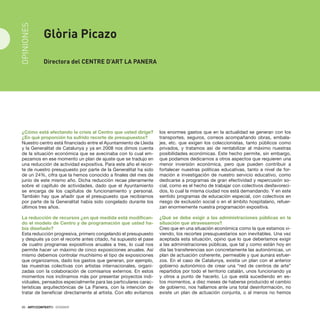
Miguel Von Hafe
Director of the Centro Galego de Arte Contemporánea (CGAC)
OPINIONS
DOSSIER · ARTECONTEXTO · 19
Therefore, in the next few months we have decided to work
on a sphere of action limited to our country’s situation, without
giving up on the quality of our programme. It is a question of
being pragmatic and accepting institutional responsibility.
At the same time, we will focus on the search for formulas
which allow for a greater participation of civil society in event
sponsorship, a possibility which we have barely explored up to
now. It is obvious that the private sector is not going through a
good time either; however, there do seem to be some possible
forms of collaboration available, even if they are only symbolic
at first.
Do you think, on a general level, that this panorama of
financial crisis might give rise to a deep reflection by the arts
sector, which might generate some new alternatives?
Without a doubt. Not only on the part of institutions, but also by
all agents working in the sector. Artists, for the most part, are the
weakest link in the system, as they work in deeply precarious
conditions, and, as such, will have to find a way to resist this
especially difficult time. In this sense we need intermediate
structures (between the museum and the gallery) where creative
freedom can be expressed through projects which are less
demanding in a financial sense. I am referring to artist-run spaces,
those self-managed spaces which began to proliferate all over
the world in the 1990s: think about what happened in Brazil,
for example, where, in the past –which was nothing like today–,
despite having minimal institutional resources and a gallery
system which clung to safe options, there flourished countless
independent initiatives which would later become crucial for the
consolidation of artist’s careers which gained visibility abroad
without having to be subject to the country’s own institutional
demands. These kinds of initiatives, when they are well thought
out and structured around careful critical thinking, are essential
to give rise to proposals which move away from the market and
the international circuit. They can become important showcases
and platforms for reflection, with a freshness which is far from
heavier structures.
In institutional terms, it seems obvious that there is a need
for a critical exercise which involves establishing a culture of
resistance, of the affirmation of an urgent space in the systems
of material and immaterial conditions for cultural creation. A
system which guarantees minimum work conditions, with a
sense of continuity, as this is a key word in this field. On the
other hand, a culture of critical distance with regard to the
mercantilisation of artistic goods, i.e. to determine a possible
sphere of action in a system which lives a parallel life in the
speculative premises which surround the art object. In order to
do so, museums must be as close as possible to their raison
d’etre, i.e. the artists and thinkers which define its structure. This
approach must not necessarily follow traditional acquisition and
exhibition models, and, when it is carried out rigorously, it is the
best way to efficiently creative a community of truly committed
viewers and participants, the ultimate purpose of any public
institution, such as the CGAC. This requires an additional effort,
given the situation in which we are in, but this sense of solidarity
is truly essential. We are aware that, in political terms, it is always
easy to make budget cuts in the field of culture, so our role is
to prove that we work in a context which defines a space open
to the questions of contemporary artists and thinkers, without
whom the general impoverishment of our citizenship would be
dramatic. We might lose a lot of things in our lives but the active
memory and critical commotion which a certain work or text can
exert on us will always accompany us, even in the most unusual
and demanding of situations.
20 · ARTECONTEXTO · DOSSIER
¿Cómo está afectando la crisis al Centro que usted dirige?
¿En qué proporción ha sufrido recorte de presupuestos?
Nuestro centro está financiado entre el Ayuntamiento de Lleida
y la Generalitat de Catalunya y ya en 2008 nos dimos cuenta
de la situación económica que se avecinaba con lo cual em-
pezamos en ese momento un plan de ajuste que se tradujo en
una reducción de actividad expositiva. Para este año el recor-
te de nuestro presupuesto por parte de la Generalitat ha sido
de un 24%, cifra que la hemos conocido a finales del mes de
junio de este mismo año. Dicha reducción recae plenamente
sobre el capítulo de actividades, dado que el Ayuntamiento
se encarga de los capítulos de funcionamiento y personal.
También hay que añadir que el presupuesto que recibíamos
por parte de la Generalitat había sido congelado durante los
últimos tres años.
La reducción de recursos ¿en qué medida está modifican-
do el modelo de Centro y de programación que usted ha-
bía diseñado?
Esta reducción progresiva, primero congelando el presupuesto
y después ya con el recorte antes citado, ha supuesto el pase
de cuatro programas expositivos anuales a tres, lo cual nos
permite hacer un máximo de cinco exposiciones anuales. Así
mismo debemos controlar muchísimo el tipo de exposiciones
que organizamos, dado los gastos que generan, por ejemplo,
las muestras colectivas con artistas internacionales, organi-
zadas con la colaboración de comisarios externos. En estos
momentos nos inclinamos más por presentar proyectos indi-
viduales, pensados especialmente para las particulares carac-
terísticas arquitectónicas de La Panera, con la intención de
tratar de beneficiar directamente al artista. Con ello evitamos
los enormes gastos que en la actualidad se generan con los
transportes, seguros, correos acompañando obras, embala-
jes, etc. que exigen los coleccionistas, tanto públicos como
privados, y tratamos así de rentabilizar al máximo nuestras
posibilidades económicas. Este hecho permite, sin embargo,
que podamos dedicarnos a otros aspectos que requieren una
menor inversión económica, pero que pueden contribuir a
fortalecer nuestras políticas educativas, tanto a nivel de for-
mación e investigación de nuestro servicio educativo, como
dedicarse a programas de gran efectividad y repercusión so-
cial, como es el hecho de trabajar con colectivos desfavoreci-
dos, lo cual la misma ciudad nos está demandando. Y en este
sentido programas de educación especial, con colectivos en
riesgo de exclusión social o en el ámbito hospitalario, refuer-
zan enormemente nuestra programación expositiva.
¿Qué se debe exigir a las administraciones públicas en la
situación que atravesamos?
Creo que en una situación económica como la que estamos vi-
viendo, los recortes presupuestarios son inevitables. Una vez
aceptada esta situación, opino que lo que deberíamos exigir
a las administraciones públicas, que tal y como están hoy en
día las transferencias son concretamente las autonómicas, un
plan de actuación coherente, permeable y que aunara esfuer-
zos. En el caso de Catalunya, existía un plan con el anterior
gobierno autonómico de crear una “red de centros de arte”
repartidos por todo el territorio catalán, unos funcionando ya
y otros a punto de hacerlo. Lo que está sucediendo en es-
tos momentos, a diez meses de haberse producido el cambio
de gobierno, nos hallamos ante una total desinformación, no
existe un plan de actuación conjunta, o al menos no hemos
20 · ARTECONTEXTO · DOSSIER
Glòria Picazo
Directora del CENTRE d’Art La Panera
OPINIONES
DOSSIER · ARTECONTEXTO · 21
sido informados de ello, y por el contrario, lo único que tras-
ciende por parte de los responsables políticos son sus dudas
sobre uno de estos futuros centros, el Canòdrom de Barce-
lona. Respecto a este último centro, parece ser que, tanto la
administración local como la autonómica, están olvidando que
el Canòdrom no es un proyecto del último gobierno tripartito,
sino una reivindicación del sector artístico catalán, para que
Barcelona tuviera un centro de arte contemporáneo, una vez
que el Centre d’Arts Santa Mònica se dedicó a otras activida-
des culturales por decisión política.
A nivel local y dado que al menos en Catalunya, muchos de
estos centros son de titularidad local con participación autonó-
mica, como es el caso de La Panera, también deberíamos exigir
políticas culturales surgidas a partir del análisis del mapa cultu-
ral de la ciudad, olvidarse de proyectos particulares que afec-
tan a una u otra administración pública, observar los proyectos
privados (que al final acaban requiriendo también de participa-
ción económica pública), y con todo ello establecer prioridades
y fórmulas distintas de actuación, más acordes con la situación
económica actual. Con ello evitaríamos la creación de nuevos
equipamientos culturales, léase grandes edificios de nueva
planta, que requieren una inversión económica para su poste-
rior funcionamiento que por ahora no existe ni creo que vaya a
existir en unos cuantos años. Pienso que deberíamos aplicar el
concepto de sostenibilidad para planificar unas políticas cultu-
rales válidas para los momentos que vivimos y dicho esto, creo
que esta idea debería ser asumida por todos los estamentos que
componen el sector artístico: artistas, críticos, galeristas, comi-
sarios, directores de museos y centros de arte. Todos y cada uno
desde nuestra posición deberíamos actuar con esta convicción.
¿Piensa que el sector del arte está sabiendo plantear al-
ternativas al momento que estamos viviendo o cree, por el
contrario, que impera la pasividad?
De momento la contestación que ha habido en Catalunya por
parte de la Plataforma “No retalleu la cultura” (no recortéis
la cultura) se ha volcado más en denunciar los recortes pre-
supuestarios que están afectando todos los ámbitos de la
cultura, sin embargo y acorde con lo que he comentado ante-
riormente, creo que deberíamos ir mucho más lejos y aquí es
donde encuentro a faltar respuestas positivas, claras y efecti-
vas que podría dar el sector artístico. Todos nos lamentamos
de los recortes presupuestarios, que también hay que decirlo,
afectan más a unos que otros, y estamos siendo incapaces de
ofrecer ninguna medida que contribuya a paliar un tanto esta
situación. Los “grandes” están más preocupados por defen-
der su posición, su territorio y sus grandes objetivos, que por
dedicarse a pensar, por ejemplo, en una repartición del pastel
un poco más equitativa y contribuir con ello a dibujar un mapa
cultural más equilibrado y “sostenible”, como comentábamos
más arriba.
¿En qué sentido cree que debería darse una reacción?
Ya he adelantado algunas de las ideas que creo podrían de-
batirse y tratar de aplicarse, y para ello, considero que el pa-
pel de las asociaciones profesionales debería ser muy rele-
vante, pero no como a menudo sucede, tratando de defender
su propio punto de vista desde una posición corporativista,
si no defendiendo políticas comunes, puesto que estamos
todos inmersos en la misma crisis y en un mismo sector, el
del arte.
DOSSIER · ARTECONTEXTO · 21
22 · ARTECONTEXTO · DOSSIER
How is the financial crisis affecting the Centre you direct? To
what extent have you suffered budget cuts?
Our centre is funded by the Lleida City Council and the Catalan
regional government, and, as early as 2008, we became aware
of the financial situation we were approaching, so we began
to implement a plan in the form of a reduction in our exhibition
activity. This year, the Catalan regional government is cutting our
budget by 24%, a figure we were informed of in June. This cut
will affect only the activities section, as the City Council is in
charge of our operation and staff. It must also be said that the
budget we used to receive from the regional government has
been frozen for the last three years.
How is this reduction in resources modifying the model on
which your centre in based and the programme you had
designed?
This gradual reduction, first by freezing the budget, and
followed by the cuts I mentioned, has meant we have gone
from four to three annual exhibition programmes, which allows
us to carry out a maximum of five exhibitions per year. In the
same way, we have to be very careful with the kind of exhibition
we organise, given the expenses generated, for example, by
collective shows with international artists, organised with the
collaboration of independent curators. At present we are leaning
toward organising individual projects, designed especially for
the unique architectural characteristics of La Panera, with the
aim of attempting to directly benefit artists. In this way we avoid
the huge expenses linked to transport, insurance, couriers,
packaging, etc. demanded by public and private collectors, to
make the most of our financial possibilities. This allows us to pay
attention to other aspects which require smaller budgets, but
which can contribute to strengthening our educational policies,
with regard to the training and research carried out by our
educational service, and to devote ourselves to highly effective
and socially significant programmes, such as working with
disadvantaged sectors of society, as the city itself demands.
In this sense, we carry out special education programmes, with
people at risk of social exclusion or in the hospital realm, which
massively reinforce our exhibition programme.
What should be demanded from Public Administrations at
this time?
I think that, given the financial situation we are going through,
budget cuts are inevitable. Once this has been accepted, I
believe we must demand a consistent, permeable and effective
plan of action from administrations, which, given the way things
are at present, are mainly regional. In the case of Catalonia, the
previous regional government planned to create a “network of
art centres” all over the region, some of which were already in
operation, while others were on the verge of opening. What is
happening now, ten months after the change in government, is
that we face a complete lack of information, and there is no plan
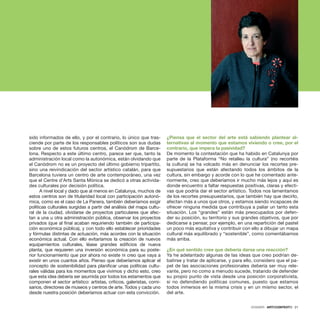
Glòria Picazo
Director of the CENTRE d’Art La Panera
OPINIONS
DOSSIER · ARTECONTEXTO · 23
for a joint action, or, if there is, we have not been informed. All
we are told by politicians is that they have doubts about one of
these future centres, the Barcelona Canòdrom. It seems that,
in this case, both the local and regional administrations are
forgetting that the Canòdrom is not a project by the former three-
party government, but a demand by the Catalan art sector, so
that Barcelona would have a contemporary art centre, given that
the Centre d’Art Santa Mònica is now devoted to other cultural
activities, as a result of a political decision.
On a local level, and given that, at least in Catalonia, many
of these centres are locally-dependent, with some regional
participation, as is the case of La Panera, we should also demand
cultural policies based on the analysis of the cultural map of the
city, leaving behind specific projects which affect each of these
public administrations, observing private projects (which ultimately
require some public funding), and establish priorities and formulas
more in fitting with the current financial situation. This would help
us avoid the need to create new cultural equipment, in the form
of new buildings, whose subsequent operation requires financial
investments which are not available at present, nor will, in my
opinion,beavailableforquitesomeyears.Ibelieveweshouldapply
the concept of sustainability to a series of cultural policies which
can be of use at present, and that this idea should be accepted
by all those who make up the artistic sector: artists, critics, gallery
owners, curators, museum and art centre directors. All of us, in
our own way, should act on the basis of this conviction.
Do you think the art sector is offering alternatives to the
time we are living in, or, in contrast, that passiveness
reigns?
At the moment, the response we have seen in Catalonia to
the “No retalleu la cultura” (don’t cut culture) platform has led
people to protest against the budget cuts which are affecting
all the realms of culture, but I believe we should take it further
and it is in this sense that I think we need positive, clear and
effective responses on the part of the art sector. We all regret
the budget cuts, which, it must be said, affect some more
than others, but we are not being able to offer any measures
to contribute to resolving the situation. The “big ones” are
worried about defending their position, their territory and
main objectives, instead of thinking about, for example, a
more egalitarian share of the cake, thus contributing to a more
balanced and “sustainable” cultural map, as we mentioned
above.
In what sense to do you think there should be a reaction?
I have already mentioned some of the ideas I think should be
discussed and implemented, and I believe that, to this end, the
role of professional associations should be very relevant, but not
in the usual way, when they try to defend their point of view from
a corporatist perspective, but by defending shared policies, as
we are also immersed in the same crisis, and in a same field, the
art sector.
24 · ARTECONTEXTO · DOSSIER
¿Cómo está afectando la crisis y cuáles son los principales pro-
blemas con los que se encuentran los comisarios de exposicio-
nes en nuestro país?
Considero que el problema de los comisarios de exposiciones en
España es previo a la crisis económica, por más que esta circuns-
tancia haya venido a agravar la situación y a incrementar sus efectos.
En numerosas ocasiones algunos de los más representados críticos
españoles han firmado exposiciones que pasaban por alto o no
respondían al proceso de investigación previo que ha de sustentar
la tesis de un proyecto expositivo. Son numerosos los comisarios
de exposiciones que comprenden satisfecha su misión mediante la
redacción de un texto y la visita al estudio del artista, cargando en
buena medida con el peso de la gestión del proyecto al propio artis-
ta. No creo que pueda considerarse que ese trabajo deba ser tenido
como un comisariado, ni tampoco que deba ser retribuido como tal.
Es importante que desde el propio sector comencemos a llamar a
las cosas por su nombre y que, por incómodo que resulte, dejemos
de mirar hacia otro lado ante prácticas que perjudican la imagen del
colectivo de profesionales que con mayor o menor fortuna desarro-
llan labores de comisariado.
Tras un primer y necesario ejercicio de autocrítica, fundamental
para poder dirigir la mirada hacia otras direcciones, podría decirse
que el período de bonanza económica previo a la actual crisis no sir-
vió para vertebrar un sector de las artes visuales fuerte en España,
como tampoco ha servido para darle una visibilidad internacional.
Seguramente algo falla en las distintas políticas culturales del país,
pues a pesar de la enorme inversión realizada en ese período desde
algunos gobiernos autonómicos, prácticamente no se han aprecia-
do resultados adecuados a largo plazo. El exceso de personalis-
mo y partidismo en las políticas culturales y la inexistencia durante
ese tiempo de una estrategia sectorial activa e independiente de
los cambios de gobierno, son algunas de las causas por las que no
se alcanzan nunca los objetivos propuestos que, por buenos que
pudieran ser, se ven permanentemente frustrados, pues se trata de
objetivos que debieran ser entendidos como metas alcanzables a
corto, medio y largo plazo. Ante esa imposibilidad, han florecido
comportamientos oportunistas que conducen a que algunos profe-
sionales reciban todos los apoyos y facilidades o bien les sea ne-
gado el pan y la sal, dependiendo de los vaivenes electorales. Así
nunca el sector marchará con seriedad, ni podremos ser tomados
en serio. Esa situación fomenta, además, en los profesionales de
la crítica del arte y del comisariado comportamientos gregarios y
complacientes, que impiden la independencia y la libertad básica
que debe primar en este ámbito profesional, como garantía para las
acciones y para las omisiones.
Un problema que afecta particularmente a los comisarios de
exposiciones en España, que ya se daba antes de la crisis, pero
que ha encontrado en la actual situación económica una justifica-
ción poco aceptable, es el constante comisariado de exposiciones
por parte de algunos directores en los museos que dirigen. No es
desde luego incompatible ser director de un museo o centro de
arte y comisariar en el mismo exposiciones, pero es llamativo el
monopolio que algunos directores realizan sobre la programación
de sus centros, con lo que ello supone de empobrecimiento pro-
gramático y reducción de oportunidades para quienes han optado
por el comisariado independiente. Podría pensarse que un comi-
sario independiente es un profesional que ha visto frustrada su
aspiración de dirigir un museo o formar parte de una institución
cultural, pero lo cierto es que no todos los comisarios desean ac-
ceder a esos entornos laborales, sin que ello suponga un demérito
para el resultado de sus investigaciones ni el interés de los proyec-
tos que impulsan. Comisarios de exposiciones hay de muchos ti-
pos, pero estoy convencido sobre la urgente necesidad que existe
de poner en cuestión la figura de algunos comisarios que se han
caracterizado por la falta de escrúpulos y el engaño manifiesto a
costa de artistas e instituciones.
José Luis Pérez Pont
Presidente del Consejo de Críticos Y Comisarios de Artes Visuales (CCCAV)
OPINIONES
DOSSIER · ARTECONTEXTO · 25
¿Cómo está afectando la actual situación a la crítica de arte y
a los críticos?
El crítico de arte ha estado siempre en crisis, el trabajo intelectual
no obtiene en España el reconocimiento debido en ningún ámbi-
to, por lo que la precariedad es el estado habitual de esta figura.
Como habitual es recibir invitaciones para escribir en prensa diaria
o en algunas revistas especializadas sin la debida contraprestación
económica*. Con independencia de las limitaciones económicas del
presente, antes, ahora y siempre se ha intentado que los críticos de
arte trabajen gratis, una costumbre que a todas luces es necesario
rechazar.
La reducción de presupuestos para actividades expositivas,
editoriales y publicitarias ha menguado la posibilidad de los críti-
cos de publicar, por lo que la invisibilidad del sector va en aumen-
to coincidente con la opinión en algunos ámbitos que la estiman
prescindible; parecen ser suficientes las notas de prensa elaboradas
por las gabinetes de las instituciones que organizan los proyectos
–meras laudatios de las mismas– o por colaboraciones acríticas de
periodistas culturales.
El ataque a la actividad crítica de arte es furibundo y cons-
tante, no sólo por el ninguneo económico, también por cuestiones
ideológicas y por la ausencia de mecanismos en los medios de co-
municación escritos que frenen los cada vez más frecuentes ata-
ques personales por parte de quienes, amparados en el anonimato,
lanzan desde la plataforma de Internet, hacia quienes firman con su
nombre y apellidos. Ejercer la crítica de arte en condiciones de liber-
tad se presenta como una tarea ciertamente complicada.
¿Piensa que esta crisis puede impulsar cambios respecto a la
forma en que se ha venido trabajando hasta ahora? ¿Ve capa-
cidad de respuesta desde los profesionales del comisariado y
la crítica?
Creo que sólo mediante una verdadera refundación de los mo-
dos y las maneras de funcionar del sector se podrá garantizar su
pervivencia. La ligereza con la que algunas instituciones públicas
han destinado sus recursos, en los tiempos de bonanza econó-
mica, no ha contado con el visto bueno de una parte importante
del sector, a pesar de que un reducido grupo hizo su particular
agosto. El trabajo bien hecho por parte de los profesionales de la
crítica y el comisariado no tiene su principal condicionante en la
abundancia de recursos económicos. Son numerosos los ejem-
plos de proyectos expositivos de gran interés y escasa inversión
económica y, a la inversa, muchas exposiciones muy costosas y
publicitadas han carecido de interés. Si fundamentamos nuestro
trabajo según los parámetros de audiencia y espectacularidad
empleados en la televisión, estaremos confundiendo nuestro co-
metido. Si en algún ámbito existe capacidad de respuesta ante
la actual coyuntura económica es en el ámbito de la cultura. Sin
embargo, donde no siempre se encuentra capacidad de adapta-
ción a las nuevas realidades es en la clase política, pues en de-
masiadas ocasiones se trata de designaciones para áreas sobre
las que el designado no reúne los conocimientos ni el perfil más
adecuado. A la vez, es constante la exclusión de los profesiona-
les de los ámbitos de consulta y toma de decisiones. El sector
profesional de las artes visuales, representado por las principales
asociaciones que lo conforman, inició hace un tiempo un proceso
de acercamiento de posiciones, de puesta en común de asuntos
y suma de opiniones. De ese proceso natural y autónomo han
surgido y surgirán iniciativas que las instituciones públicas y los
representantes políticos deberán atender. La cohesión del sector
permitirá introducir cambios en la lógica de funcionamiento de
las estructuras de poder. Todos los cambios son posibles, pero
trabajaremos para que esos cambios se produzcan en positivo y
no en menoscabo del reconocimiento profesional de los críticos
y comisarios. Considero que estamos preparados para introducir
sentido común en muchos de los ámbitos y decisiones que con-
dicionan nuestro desempeño profesional.
*Nota de la Editora: La revista ARTECONTEXTO remunera siempre por su trabajo
a los autores de los textos que publica en sus páginas.
26 · ARTECONTEXTO · DOSSIER
How is the crisis affecting exhibition curators, and what are
the main problems they face in our country?
I think that the problems suffered by exhibition curators
working in Spain predates the economic crisis, although this
circumstance has contributed to making the situation worse
and increasing its effects. On numerous occasions some of the
best-represented Spanish critics have produced exhibitions
which were not noticed, or which were not based on the prior
research process which must support the thesis of an exhibition
project. There are numerous curators who feel their job is to
write a text and visit the artist’s studio, leaving a large part of
the project’s management to the actual artist. I don’t think this
can be seen as curatorship, and neither should it be paid as
such. It is important for the sector itself to start calling things
out, and, however uncomfortable it is, we should stop looking
the other way in the face of practices which damage the way
the appearance of the collective of professionals which, to
lesser or greater success, carry out curatorial work.
After conducting some self-criticism, which is essential
if we are to cast our gaze in other directions, it could be
said that the period of economic prosperity which preceded
the current crisis did not serve to articulate a strong visual
arts sector in Spain, and neither has it served to lend it
international visibility. Something must be missing in the
various cultural policies in the country, as, despite the huge
investment carried out during this time by certain regional
governments, there have hardly been any adequate long-
term results. The excessive personalism and partisanship
in cultural policies and the inexistence during that time of
an active and independent sectorial strategy are some of
the reasons why we never reach our aims, which, however
admirable they may be, are permanently frustrated, as they
should be seen as objectives to be achieved in the short-,
medium- and long-term. In the face of that impossibility,
we have seen myriad opportunist behaviours which lead
some professionals to receive all kinds of support and help,
while others are refused everything, depending on electoral
oscillations. In this way, the sector will never work properly,
and neither will we be able to take it seriously. This situation
also promotes, in professionals working in art criticism and
curatorship, a number of gregarious and self-complacent
behaviours, which prevent independence and the basic
freedom required to work in this realm, to guarantee actions
and omissions.
A problem which primarily affects curators in Spain,
which already existed before the crisis, but which has found in
the current economic situation a hard-to-accept justification,
is the constant curatorship of exhibitions by some museum
directors. It is certainly not incompatible to be a museum or
art centre director and to curate exhibitions, but it is worth
noting the monopoly which some directors carry out in their
centre programmes, which leads to an impoverishment of
programmes and a reduction in the opportunities available
to those who wish to work as independent curators. It could
be thought that an independent curator is a professional who
has been frustrated in his aspirations to direct a museum or
form part of a cultural institution, but the truth is that not all
curators wish to access these working environments, without
that interfering on the results of their research or the projects
they promote. There are many kinds of curators, but I am
convinced that there is an urgent need to question the figure
of some curators who have been characterised by their lack of
scruples and by their willingness to take advantage of artists
and institutions.
José Luis Pérez Pont
President of the Consejo de Críticos Y Comisarios de Artes Visuales (CCCAV)
OPINIONS
DOSSIER · ARTECONTEXTO · 27
How is the current situation affecting art criticism and critics?
Art critics are always in a state of crisis, as intellectual work in
Spain does not receive any recognition, which means that they
are in a state of constant precariousness. It is not uncommon
to be asked to write for the daily press or for some specialized
magazines without being adequately paid*. Regardless of the
financial limitations we are suffering, it has always been the
case that critics have been expected to work for free, a custom
which must be rejected.
Budget cuts for exhibitions, publications and advertising
activities have reduced the ability of critics to publish their
work, so the invisibility of the sector is on the increase, at the
same time as certain sectors seem to find it unnecessary; it
appears all that is needed are the press releases produced by
the offices of the institutions organising the projects on show
–which tend to be merely laudatory – or the uncritical texts
produced by cultural journalists.
The attacks on art criticism are vicious and constant, and
not only because of the financial contempt we face, but also
because of ideological issues, because of the absences of
mechanisms in the written press to stop the ever-increasing
personal attacks by those hiding in the anonymity of the
Internet, toward those who sign their work with their name
and surname. Working as an art critic in conditions of freedom
appears to be a truly complicated task.
Do you think this crisis can also give rise to change with
regard to the way in which we have been working up to
now? Can you see any capacity for response in curators
and critics?
I think only a true re-think of the ways in which the sector
works can guarantee its survival. The ease with which some
public institutions have used their resources during the
financial boom has not received the approval of a large part of
the sector, despite the fact that a small group within it made
a fortune. The quality of the work by critics and curators does
not depend only on an abundance of economic resources.
There are many examples of exhibition projects of great
value, produced with tiny investments, and, in contrast, many
expensive and highly publicised exhibitions have been of little
interest. If we base our work on the parameters of audience
and spectacle of TV, we will be missing the point of our
profession. If there is a field which can respond to the current
financial situation, it is the cultural sector. However, politicians
are not always as able to adapt to new conditions, as they are
often assigned to areas they are not familiar with or suited
to. At the same time, we are seeing a constant exclusion of
professionals from the consultation and decision-making
realms. The professional visual arts sector, represented by
the main associations which make it up, embarked some time
ago on a process to bring views together, to share opinions
and deal with issues collectively. This natural and autonomous
process has given rise to initiatives which public institutions
and political representatives must heed. The cohesion of
the sector will make it possible to introduce changes in the
operation of power structures. All changes are possible, but
we will work for them to be positive, and for them not to
damage the professional recognition of critics and curators. I
feel that we are ready to apply some common sense to many
of the spheres and decisions which define our professional
work.
*Publisher’s Note: It is the policy of the magazine ARTECONTEXTO to remunerate
contributors of all texts published.
¿Cuáles son los problemas fundamentales con los que se
encuentran las galerías españolas en estos momentos?
La situación de crisis que padecemos está afectando especial-
mente al sector cultural en nuestro país. Mientras que las pérdi-
das y la ausencia de inversiones en otros sectores se sitúan en
el 12% o 15%, en el sector de la cultura se sitúan en el 35%.
Las galerías, como integrantes de las Industrias Culturales, nos
vemos afectadas en esa misma proporción. Que la cultura es
prescindible nunca se nos había dicho tan claramente.
Una sociedad preparada y culta es una sociedad crítica
con lo que le rodea y parece que eso no interesa, y menos en
estos momentos en que las palabras “crisis”, “recortes”, “redu-
cir”, “desaceleración”, etc. justifican cualquier postura política
que dé preferencia a decisiones populistas y demagógicas.
Por otro lado, la escasa consolidación de un mercado del
arte en España ha sido un gran handicap para el mundo gale-
rístico. Las instituciones han crecido en los últimos años con
edificios y colecciones, pero con dependencia casi absoluta de
sus respectivas administraciones, de modo que no han dado
márgenes para que la iniciativa privada pudiera invertir en cultu-
ra mediante políticas fiscales atractivas e integrando la espon-
sorización de una manera sólida y contundente. En otros países
las grandes empresas y marcas han asociado su nombre al de
eventos culturales y museísticos.
Se rebaja la importancia de la cultura para la sociedad.
Además, si no hay fondos para financiar producción de nuevas
obras y para adquisiciones, se pierden oportunidades en el mer-
cado del arte que afectan a galeristas y artistas, y en consecuen-
cia el arte español pierde peso en el panorama internacional, a lo
que se añade la pérdida de puestos de trabajo en el personal no
funcionarial y en las empresas asociadas al sector. 
Además, el tímido coleccionismo privado ha desaparecido
en gran medida por estar ligado a profesionales liberales y pe-
queñas o medianas empresas que se encuentran en horas ba-
jas, empresarialmente hablando.
¿Cuál cree que es la razón del rechazo, por parte de la ad-
ministración pública y de los sucesivos gobiernos –de uno
y otro signo–, del IVA cultural para el arte, cuando sectores
como el del libro cuentan con un IVA del 4%?
No ha habido voluntad política. Hemos vivido una larga etapa
donde el cine ha sido el único sector al que se ha ayudado y
mucho. Después ha sido la gastronomía la que ha cobrado un
enorme protagonismo como “factor cultural”. Del arte se habla
sólo con motivo de grandes subastas que alcanzan cifras millo-
narias, de manera que ello contribuye a vincular al arte al “super-
lujo”. De paso, se ignora por completo que el sector de la cultura
da trabajo a casi un millón de personas.
Cuando se habla de arte casi todo el mundo entiende que
hablamos de cultura pero se entiende menos que también ha-
blamos de educación.
Las galerías, por medio de las exposiciones que realizamos,
formamos una parte importante del tejido cultural-educativo de
nuestras ciudades. El libre y gratuito acceso que proporcionamos
a todos los ciudadanos a nuestros espacios expositivos propicia
fundamentos formativos, culturales, educativos, etc. para una so-
ciedad dispuesta a comprometerse con la cultura y el arte.
Por esta labor de compromiso cultural con el entorno que
nos rodea estamos en igualdad con otros sectores, como el del
libro ó quizás por encima, al ser gratuito el acceso a nuestras
galerías. Sin embargo mientras el sector del libro cuenta con un
IVA del 4%, nosotros tenemos un 18%, lo que viene a decir que
la obra de arte en nuestro país no está considerada como un
bien cultural a proteger.
Añadamos que, actualmente, el sector del libro está pidien-
do un IVA 0% para sus publicaciones.
Moisés Pérez de Albéniz
Presidente del Consorcio de Galerías Españolas de Arte Contemporáneo (CG)
OPINIONES
¿Qué otras medidas considera esenciales para impulsar el
mercado del arte en nuestro país, tanto a corto como a me-
dio y largo plazo?
Hemos vivido una etapa de creación de museos y centros de arte
que han invertido en la adquisición de obras; pero las institucio-
nes públicas no pueden suponer el factor determinante para una
galería; se ha de dar entrada a las empresas y al coleccionismo
privado. No estamos pidiendo subvenciones, que pueden existir
como ayudas puntuales para arrancar o para desarrollar tu em-
presa. Estamos hablando de políticas fiscales que favorezcan la
inversión en arte; estamos hablando de rebajas de impuestos que
hoy gravan de la misma manera una obra de Picasso que la obra
de un artista joven; estamos hablando del retraimiento que pro-
voca en las ventas un IVA abusivo, que en otros países no tienen
y, si lo tienen, también poseen otros mecanismos fiscales para
rebajarlo. Estamos hablando del Droit de Suite, una imposición
que grava todas las transacciones de obras de arte, que lo único
que hace es enriquecer a personas que ya nada tienen que ver
con el trabajo del artista ni con sus póstumos deseos. Estamos
hablando de que cuando el mercado nacional empezaba a tener
visos de consolidación estallan las subprime, la economía pirami-
dal, Lehman Brothers, Madoff… Personas, empresas y modos de
entender la economía que nos ha hecho retroceder en todos los
aspectos y que nos están empujando al precipicio.
¿Cree que el actual modelo de galería, desarrollado el pasa-
do siglo, es sostenible hoy, sobre todo con la actual situa-
ción económica?
No, en absoluto. La crisis ha puesto sobre la mesa muchos de-
sajustes. Durante los años de bonanza ha sido fácil dejarse lle-
var. Muchos espacios están caducos porque fueron pensados
para exponer el arte de hace treinta años y ahora las necesida-
des son otras. Tampoco el esquema de contar con seis u ocho
empleados es viable para la mayoría y serán muy pocas las ga-
lerías que los puedan mantener.
Creo que a partir de ahora nada va a seguir siendo igual.
Hay que prepararse para cambios profundos a través de una
extraordinaria profesionalidad, de un continuo reciclaje tanto en
aspectos de economía como en conocimientos técnicos. Para
ello son muy importantes los cursos y masters especializados
pues al cliente también hay que informarle de múltiples aspec-
tos, entre ellos, la conservación de las piezas que compran, la
seguridad, contratos, etc. Es imprescindible que la transparen-
cia y la profesionalidad sean extremas, tanto en las relaciones
con los artistas como con los coleccionistas.
Hace una semana se celebró en Barcelona una reunión
internacional de galerías, con el título Talking Galleries, que ha
sido interesante. En los diferentes paneles se habló del nuevo
rol del galerista, del futuro de las ferias de arte, de los mercados
emergentes, de la crisis y el mercado, de la internacionalización
de las galerías y, por supuesto, de la internalización de nuestros
artistas. Este último aspecto puede que sea tema principal del
próximo encuentro Talking Galleries. Es realmente dramática la
poca incidencia que tiene el arte español en el exterior. Salvo
contadas excepciones, las instituciones, los museos y las fun-
daciones extranjeras no solicitan exposiciones de nuestros ar-
tistas. Ha habido programas, subvencionados por el Ministerio
de Cultura, de exposiciones itinerantes por todo el mundo, pero
con resultados dudosos. Ahora quizá tengamos que empezar
de cero, crear comisiones mixtas junto con la administración y
trabajar todos en esa dirección. Si se consigue puede que todos
tengamos un futuro.
30 · ARTECONTEXTO · DOSSIER
What are the main problems faced by Spanish galleries at
present?
The crisis we are suffering is having an especially intense impact
on the cultural sector in our country. While losses and the
absence of investments in other sectors stand at about 12%
or 15%, in the culture sector they reach 35%. Galleries, which
form part of Cultural Industries, are being affected to the same
degree. We had never been told so clearly that culture is seen
as unnecessary.
A cultivated and sophisticated society is critical with its
surroundings, but this does not seem to be of any interest,
especially at a time when the words “crisis”, “cuts”, “reduction”,
“deceleration”, etc. justify any political approach which benefits
populist and demagogical decisions.
On the other hand, the lack of consolidation of the art market
in Spain has been a huge handicap for galleries. Institutions have
grown over the last few years, with buildings and collections, but
are almost entirely dependent on their respective governments, in
such a way that there has been no space for private initiatives to
invest in culture through attractive fiscal policies, and integrating
sponsorship in a solid and meaningful way. In other countries,
large companies and brands have linked their name to that of
cultural and museum events.
The importance of culture for society is being disregarded,
Additionally if there are no funds to pay for new works and
acquisitions, this results in a loss of opportunities in the art
market which affects gallerists and artists, leading to Spanish
art losing power in the international sphere, to which we must
add the loss of work positions for non-civil servant staff, and in
companies associated with this sector. 
In addition, timid attempts at private collecting have
disappeared, largely because they are linked to liberal
professionals and small and medium enterprises, which are not
going a good time, in a business sense.
Why do you think the public administrations and governments
–regardless of their political leanings—reject the cultural
VAT for art, when other sectors, such as publishing, have a
VAT of 4%?
There was no political interest in accomplishing this. We have
experienced a long period when film has been the only sector
to be helped, and it has been helped a lot. Gastronomy has also
acquired great importance as a “cultural factor”. We only speak
about art in terms of large auctions and exorbitant amounts, so
art is linked to the idea of “super-luxury”. And we forget that the
culture sector gives employment to almost a million people.
When we speak about art almost everyone understands we
are speaking about culture, but few realise we are also speaking
about education.
Galleries, through the exhibitions we carry out, form an
important part of the cultural-educational fabric of our cities. The
free and open access we offer all citizens promotes cultural and
educational values to a society willing to be committed to culture
and art.
Because of this cultural commitment to our environment,
we are in the same position as other sectors, such as publishing,
or even above it, as our galleries offer free entrance. However,
while the book sector has a VAT of 4%, we are subject to a VAT
of 18%, which means that in our country art is not seen as a
cultural good which must be protected.
Moisés Pérez de Albéniz
President of the Consorcio de Galerías Españolas de Arte Contemporáneo (CG)
OPINIONS
DOSSIER · ARTECONTEXTO · 31
I should add that, at present, the book sector is requesting
a VAT of 0% for its publications.
Which other measures do you think are essential to promote
the art market in our country, in the short-, medium- and
long-term?
We have experienced a phase of creation of museums and arts
centres which have invested in the acquisition of works; however,
public institutions cannot be the determining factor for a gallery.
It is necessary to allow entry to businesses and private collecting.
We are not asking for subsidies, which may function as one-
off forms of support to launch or develop a company. We are
speaking about fiscal policies which favour investment in art;
we are talking about tax cuts which, at present, are the same for
a work by Picasso and for the work by a young artist; we are
speaking about the drop in sales caused by excessive VAT, which
other countries don’t have, or which, if they do, is counter-acted
by other fiscal mechanisms. We are speaking about the Droit de
Suite, an imposition which taxes all artwork-related transactions,
and which only benefits people who have nothing to do with the
work of artists or their posthumous wishes. We are speaking about
the fact that, when the national market looked like it might become
consolidated, it was faced with the subprime explosion, pyramid
schemes, Lehman Brothers, Madoff, etc. People, companies and
ways of understanding the economy which have forced us to go
backward in every way, and which are pushing us to the brink.
Do you think that the current gallery model, developed last
century, is sustainable today, particularly given the current
financial situation?
No, not at all. The crisis has revealed a number of imbalances.
During the years of prosperity, it was easy to let oneself go. Many
spaces are out-dated, because they were designed to exhibit
the art made thirty years ago, and now we face different needs.
The idea of needing six to eight employees is not generally viable
either, and few galleries will be able to maintain it.
I think that nothing will be the same again. We need to
prepare for deep changes through an extraordinary level of
professionalism, constant renewal, both regarding economic
issues and technical knowledge. To do this it is crucial to offer
specialised courses and MAs, as clients need to be informed
of a range of issues, such as the preservation of the works
they buy, security, contracts etc. It is essential to be absolutely
transparent and professional, in our relationships with artists
and collectors.
A week ago, Barcelona hosted an international meeting of
galleries, under the title Talking Galleries, which has been interesting.
The various panels discussed the role of gallery-owners, the future
of art fairs, emerging markets, the crisis and the market, the
internationalisation of galleries and, of course, the internalisation of
our artists. This last issue might be the main subject of the next
Talking Galleries meeting. It is truly dramatic to see the lack of
impact of Spanish art abroad. With only a few exceptions, foreign
institutions, museums and foundations do not organise exhibitions
of the work by our artists. There have been programmes, subsidised
by the Ministry for Culture, for itinerant shows all over the world, but
the results have not been especially good. We may have to start
from scratch, creating committees along with the government, so
we can all move in the same direction. If we succeed there is a
chance we might all have a future.
32 · ARTECONTEXTO · DOSSIER
¿Cree que la función que desempeñan las revistas cultura-
les está suficientemente valorada en nuestro país?
La función que desempeñan las revistas culturales es muy
valorada por quien las conoce, personas e instituciones.
Diría que la cuestión no es tanto de valoración como de
conocimiento y proyección pública.
Es necesario un esfuerzo mayor para dar a conocer
mejor los proyectos e iniciativas que representan estas
publicaciones entre nuevos lectores e instituciones del
ámbito cultural, con especial incidencia entre los jóvenes
y estudiantes.
No es baladí insistir en que hoy la reflexión y el debate
de ideas, los espacios para los nuevos movimientos cul-
turales y artísticos, la atención a los nuevos creadores, el
altavoz de nuevas propuestas y formulaciones, se da en
las revistas culturales.
¿Cree que se les apoya desde las administraciones públicas
en igual medida que, pongamos por caso, a los diarios?
Las administraciones públicas deberían contar con un plan me-
ditado y con criterios claros, coherentes y sistemáticos de apoyo
a las revistas culturales –que no necesariamente deben pasar
siempre por la subvención económica– que contrarresten las
derivaciones exclusivamente de mercado y promuevan la plura-
lidad de reflexiones y propuestas culturales e intelectuales.
La administración pública central, en el caso de las revistas
culturales, adquiere suscripciones a las mismas para dotar de
contenidos culturales de calidad a las bibliotecas públicas, de
lo que se benefician, por supuesto, las revistas culturales, pero
también los ciudadanos que acceden a estas publicaciones, así
como las bibliotecas que incrementan la pluralidad y diversidad
de los fondos con que cuentan. Es la única medida de apoyo
público que existe actualmente desde la administración central.
En el caso de la Generalitat de Catalunya, existe un ambi-
cioso programa de ayudas a las publicaciones solo en catalán,
consistentes en apoyos a la edición en esa lengua a través de
subvenciones y apoyos a las tarifas de suscripción que realizan
los ciudadanos a esas publicaciones.
La administración pública debería de incorporar a los pro-
motores y editores de las revistas culturales en sus estrategias
de política cultural en general, incorporándolas como lo que son:
un escaparate vivo de lo más dinámico de la actividad cultural y
creadora de nuestro país.
También sería necesario un reparto más equitativo de la pu-
blicidad institucional. Se prima a los medios generalistas frente
a las publicaciones especializadas que suelen ser, y en gran me-
dida, mucho más rigurosas en sus análisis.
¿Cuáles son los principales problemas con los que se en-
cuentran las revistas culturales?
Los principales problemas no son muy distintos de los que pue-
dan darse en otros sectores de la creación y la industria cultu-
ral. Financiación y distribución son cuestiones recurrentes, pero
presentes, que se manifiestan en los distintos contextos.
Por otro lado, los índices de lectura en nuestro país son
inferiores a los de otros países de nuestro entorno, y ahí la
labor educativa desde el ámbito institucional resulta esencial.
Otro factor que nos distingue de países vecinos es el escaso
hábito de suscribirse y recibir en casa las publicaciones que
realmente interesan, una relación directa entre el lector y la re-
vista que evita la intermediación de las distribuidoras, que no
siempre aciertan a la hora de valorar los puntos de venta más
adecuados para la revista especializada. Hay que añadir que el
lugar natural de las revistas culturales es la librería, ya que el
quisco de prensa siempre primará, en su reducido espacio, a
las publicaciones de mayor venta. ARCE está trabajando muy
activamente con las librerías para que el lector pueda hacer
también su suscripción a través de ellas, y sea éste el punto de
Manuel Ortuño
Presidente de la Asociación de Revistas Culturales de España (ARCE)
OPINIONES
DOSSIER · ARTECONTEXTO · 33
recepción en el caso de que encuentre problemático recibirla
en su propio buzón.
Volviendo a los problemas que compartimos con el sec-
tor del libro y la edición (cambios en los modelos de difusión
y distribución, deterioro de la red de librerías independientes y
menor espacio de exhibición, el incremento desmedido de los
costes de correos y envíos, la brutal caída de la publicidad…)
hay que añadir los que son propios de unas iniciativas que pri-
man los contenidos, la reflexión, la nueva creación, la calidad del
producto, por encima de la generación de modelos de negocio
rentables.
¿Cómo está afectando la crisis a este sector?
La crisis económica está afectando en todas las fases de la vida
de las iniciativas de contenidos culturales de calidad que son
nuestras publicaciones: desde la concepción hasta los distintos
procesos de edición y difusión de las mismas.
Sin embargo, las revistas culturales, en el soporte que sea,
son por su propia naturaleza proyectos débiles económicamen-
te pero muy flexibles, con una capacidad de adaptación impor-
tante y un alto nivel de resistencia gracias, fundamentalmente, a
la fidelidad de sus lectores y seguidores.
Y son capaces de mantener, precisamente por ello, unos
contenidos de calidad que marcan la diferencia con la insustan-
cia generalizada de otros medios.
¿Cómo ve la competencia que ejercen las revistas de ins-
tituciones públicas (museos, fundaciones, ferias, etc.) res-
pecto a las revistas impulsadas desde la iniciativa privada?
Desde la convicción de que los poderes públicos tienen una res-
ponsabilidad ineludible en el sector de la cultura.
Ahora bien, me parece que la administración pública en ge-
neral, y sus diferentes organismos autónomos, no deberían de
“invadir” con recursos públicos aquellos campos ya cubiertos
de buena forma por las iniciativas de la sociedad civil. El caso de
las revistas institucionales en el ámbito de la cultura es paradig-
mático, pues compiten, desde los recursos públicos además, en
la captación de autores, publicidad pública y privada…
Ahora bien, quizás la distinción deba partir fundamental-
mente de los contenidos, de objetivos de un proyecto cultural,
de calidad, de análisis y reflexión frente a boletines a veces pu-
ramente informativos o guías del ocio ilustradas.
¿Piensa que Internet acabará con las revistas en papel o que
hay espacio para la coexistencia de ambos medios?
Las revistas culturales han dado, en estos últimos años, un salto
muy importante hacia el ámbito digital y la utilización de estas
tecnologías, superando definitivamente la idea del asesinato del
papel a manos de otras herramientas tecnológicas. La idea es,
más bien, la complementariedad, la de dos espacios diferentes
que pueden enriquecerse en función de los distintos proyectos.
Tenemos por delante muchas incertidumbres de todo tipo:
desde nuevos modelos de desarrollo de nuestra actividad, pa-
sando por la resolución de cuestiones de tipo técnico en lo que
se refiere a formatos, plataformas de distribución, etc.
Estoy convencido que empiezan a primar los contenidos
por encima de los soportes, y quienes editan y difunden conteni-
dos de calidad cultural están en una situación inmejorable para
utilizar todos los canales a su disposición. Sobre todo en un
entorno en el que la rapidez y abundancia de información va
a requerir, más que nunca, de intermediarios independientes,
reconocibles, “banqueros simbólicos” (Pierre Bourdieu) de re-
ferencia.
Las revistas culturales, en todos los soportes, son impres-
cindibles para sostener una diversidad de propuestas, informa-
ción y contenidos culturales.
34 · ARTECONTEXTO · DOSSIER
Manuel Ortuño
President of the Asociación de Revistas Culturales de España (ARCE)
Do you think the role played by cultural magazines is
sufficiently valued in Spain?
The role they place is highly valued by those who know
them, both people and institutions. I would say the question
is not so much one of appreciation as one of knowledge
and public projection.
It is necessary to carry out a greater effort to better
share the projects and initiatives represented by these
publications among new readers and institutions in
the cultural realm, especially among young people and
students.
It is important to insist on the fact that, today, the
reflection and debate of ideas, the spaces for new cultural
and artistic movements, the attention paid to new creators,
the loudspeaker of new proposals and formulations, are all
to be found in cultural magazines.
Do you believe they are supported by public administrations
in the same way as, say, newspapers?
Public administrations should have a well-thought-out plan
with clear, consistent and systematic criteria for the support of
cultural magazines –which should not necessarily take the form
of financial aid– to counteract exclusively market-driven events,
promoting the diversity of reflections and cultural and intellectual
proposals.
The central government, in the case of cultural magazines,
acquires subscriptions to lend public libraries quality cultural
contents, which naturally benefits the magazines, but also the
citizens who access them, as well as the libraries, which increase
the plurality and diversity of their collections. This is the only state
support we current receive from the central administration.
In the case of the Generalitat de Catalunya, there is an
ambitious programme in place to support publications in
Catalan, in the form of publishing subsidies and contributions to
the subscriptions made by citizens to these publications.
The public administration should include promoters and
editors of cultural magazines in their general cultural strategy
policies, allowing them to be what they should: a lively showcase
of the most dynamic elements in the cultural and creative activity
of our country.
It is also necessary to carry out a fair distribution of
institutional publicity. The general media are favoured over
specialised magazines which tend to be far more rigorous in
their analyses.
What are them main problems faced by cultural magazines?
The main problems are not very different from those in other
sectors of creativity and culture. Funding and distributions are
recurring problems which appear in a range of contexts.
On the other hand, the reading rates in our country
are lower than those in other countries in our area, so the
educational role of institutions is essential. Another factor
which differentiates us from neighbouring countries is that
it is not common to subscribe to and receive at home the
publications we are truly interested in, a direct relationship
between the reader and the magazine, to avoid the mediation
of distributing companies, which are not always right in their
assessment of which are the best places to sell specialised
magazines. It must be added that the natural place for cultural
magazines is the bookshop, as newsagents will always
favour, given their limited space, better-selling publications.
ARCE is actively working with bookshops so that readers can
OPINIONS
DOSSIER · ARTECONTEXTO · 35
also subscribe to magazines through them, and for them to
become the reception point in the event that readers prefer
not to receive them in their homes.
To return to the issues we share with the book and publishing
industry (changes in the diffusion and distribution models, the
damage suffered by the network of independent bookshops and
the decrease in exhibition spaces, disproportionately high postal
costs, the brutal drop in advertising, etc.) it must be added
that they are what one would expect in initiatives which favour
contents, reflection, new creation and the quality of products
above the generation of profitable business models.
How is the crisis affecting the sector?
The financial crisis is affecting all the phases of the life of the
initiatives linked to the production of quality cultural content,
such as our publications: from their conception to the various
publishing and diffusion processes.
However, cultural magazines, whatever their medium, are
by nature financially weak projects, yet also flexible in their ability
to adapt, and resilient thanks to the loyalty of their readers and
followers.
And they are able to maintain, because of this, quality
contents which set them apart from the generalised lack of
substance of other media.
What do you think of the competition exercised by the
magazines of public institutions (museums, foundations,
fairs, etc.) with regard to the magazines promoted by private
initiatives?
I am certain that public powers should not shirk their
responsibilities in the cultural sector.
However, I feel that the public administration in general, and
its various autonomous bodies, should not “invade” with public
resources the fields which are adequately covered by initiatives
from civil society. The case of institutional magazines in the cultural
realm is paradigmatic, as they compete, using public resources, in
attracting authors, public and private advertising, etc.
Perhaps the distinction should be based on contents, on the
aims of each cultural project, on quality, analysis and reflection,
in the face of bulletins which are sometimes purely informative,
or illustrated entertainment guides.
Do you think the Internet will kill the printed press, or that
the two media can coexist?
In the last few years, cultural magazines have made an important
leap into the digital realm and the use of online technologies,
overcoming the idea of paper being killed by other technological
tools. The idea is that they should complement one another as
two different spaces which can mutually enrich one another
through a range of projects.
We face many uncertainties: from new models for the
development of our activity to the resolution of technical issues
regarding formats, distribution platforms, etc.
I am certain that content is beginning to be more important
than media, and that those who publish and share quality cultural
contents are in a perfect position to use all available channels.
Especially in an environment where the speed and abundance of
information is going to make it essential to have independent and
recognisable mediators, “symbolic bankers” (Pierre Bourdieu) on
whom we can depend.
Cultural magazines, in all media, are crucial to support a
range of proposals, information and cultural contents.
36 · ARTECONTEXTO · DOSSIER
En febrero de 2011 diversas asociaciones profesionales de ám-
bito estatal del sector de las artes visuales presentaron a los
medios de comunicación el documento “medidas de apoyo al
sector del arte”. Poco después el Ministerio de Cultura creaba
una comisión asesora encaminada a diagnosticar la situación
y carencias de cara a la redacción de un Plan Estratégico del
sector del arte contemporáneo. ¿Cuál ha sido y cómo se ha de-
sarrollado el trabajo de esta comisión?
En realidad, cuando el Ministerio de Cultura constituyó el Grupo de
Trabajo para la redacción de Estrategia para las Artes Visuales*, la
Dirección General de Bellas Artes llevaba tiempo trabajando en el
tema y, de hecho, disponía ya de un documento inicial que ha servi-
do de base a la redacción del nuevo. A través de reuniones y contac-
tos con los representantes de las diversas asociaciones, el equipo
de Ángeles Albert** había ido recopilando una serie de documentos
con las reclamaciones y análisis del sector, todo ello, lógicamente, ha
facilitado, y mucho, la elaboración del documento. Así que podemos
decir que el Grupo de Trabajo que se puso en marcha en los primeros
meses de este año, lo que ha hecho es fundamentalmente ordenar y
clasificar toda esa información, reunirse con otras personas, colec-
tivos e instituciones a las que aún no se había consultado, estudiar
otros documentos y estrategias de ámbito nacional e internacional y,
finalmente, redactar un documento que propone una serie de objeti-
vos y de acciones concretas que creemos pueden contribuir a clarifi-
car, dinamizar e impulsar un sector duramente castigado por la crisis.
Ahora estamos en el momento de iniciar una ronda de contactos para
consensuar el documento final con todos los agentes que se han im-
plicado en su elaboración. El documento, por lo tanto, es fruto de un
trabajo colectivo que se ha ido gestando a lo largo de estos últimos
años y reúne muchas de las reclamaciones históricas de este sector.
Y resulta no solo necesario sino imprescindible que todo este trabajo
tenga continuidad con el nuevo equipo que ocupe el Ministerio tras
las próximas elecciones generales.
¿Podría hacer una síntesis o conclusiones de las necesidades
más perentorias que han podido constatar?
Creo que la primera conclusión a la que se llega tras analizar la
situación actual de las artes visuales es precisamente la necesidad
inaplazable de definir y poner en marcha un plan que ayude a conso-
lidar un sector cultural estratégico que ha experimentado un fuerte
crecimiento en las últimas décadas, pero que ha carecido de plani-
ficación estructural, lo que ha lastrado su despegue definitivo. La
crisis económica ha afectado de manera especial a los creadores,
agentes mediadores, empresas e instituciones que lo componen, y
por ello es necesaria una herramienta que consolide, en la medida
de lo posible, una economía de recursos públicos que contribuya a
fortalecer el sector de las artes visuales, porque la situación crítica
que atraviesa es una oportunidad para activar procesos de inno-
vación y reformas estructurales. Estas reformas y medidas que se
plantean desde la Estrategia para las Artes afectan a diversos ám-
bitos. El primero de ellos hace referencia a las condiciones para el
desarrollo de la creatividad artística y pone un especial énfasis en la
protección y promoción de los procesos creativos. En este sentido,
se propone adoptar una serie de medidas y acciones encaminadas
a fortalecer la producción, la formación y la investigación. Si las po-
líticas culturales de décadas pasadas han desarrollado las grandes
infraestructuras museísticas y han primado especialmente el ámbito
de la difusión, ahora es el momento de impulsar y apoyar dinámicas
en el ámbito de la producción y los recursos. Un segundo capítulo
está dedicado a la necesidad de mejorar la situación socio-laboral
de los creadores mediante el impulso del Estatuto del Artista, una
demanda histórica de este colectivo que tiene que ser desarrollada
sin demora.
El fomento y la reordenación del patrimonio artístico contem-
poráneo constituye el tercer objetivo prioritario del plan: ordenar la
actividad del Estado en este sentido, compartir los recursos patri-
moniales y fomentar el coleccionismo privado son tres acciones
concretas que se plantean en este ámbito. Desde el documento se
insiste, también, en la necesidad de desarrollar plataformas para las
artes visuales que potencien el trabajo en red, que permitan renta-
bilizar las infraestructuras artísticas y culturales existentes y que se
abran a procesos de participación ciudadana. Otra de las priorida-
des del documento es el fomento de la acción exterior para mejo-
rar la internacionalización y la visibilidad del sector de las artes, un
ámbito en el que la coordinación de todos los actores implicados es
fundamental. La educación es otro de los pilares, a largo plazo, que
una estrategia para el sector no puede olvidar. La insuficiente pre-
sencia de las enseñanzas relacionadas con lo artístico en el sistema
educativo es una de las causas de la falta de la sensibilidad social
hacia la creación, por lo que se proponen formulas que contribuyan
Yolanda Romero
Coordinadora del Grupo de Trabajo para la redacción del
documento Estrategia para las Artes Visuales
OPINIONES
DOSSIER · ARTECONTEXTO · 37
a la mayor presencia de las artes en todos los estadios de la forma-
ción, y también acciones en el ámbito de la enseñanza no reglada.
Todo ello debería favorecer el desarrollo de nuevos públicos y me-
jorar la cohesión social. El último capítulo del documento aborda
un conjunto de propuestas económicas que deberían impulsar el
dinamismo de este sector cuando se desarrollen.
 
Una queja continuada es la injerencia política, que se ha vis-
to bien reflejada en una serie de museos y centros de arte de
nuestro país recientemente, y, de forma paralela, la ausencia de
políticas culturales claras que hagan posible la continuidad de
los proyectos. ¿Cree que es necesario un “pacto de estado” o
un acuerdo entre todos los partidos respecto a su compromiso
con el arte contemporáneo?
Es absolutamente necesario que se produzca un acuerdo nacional
sobre esta materia, que debería estar al margen de partidismos y de
instrumentalizaciones políticas. Los objetivos del documento solo
podrán ser alcanzados con la colaboración y la coordinación de los
diferentes niveles de la administración, la participación e implicación
de los diversos agentes involucrados en el sector y por medio de
una acción política conjunta. Los tiempos de la cultura no son los de
la política, y por eso se necesitan pactos a largo plazo sustentados
en la responsabilidad y la generosidad de todos.
 
¿Cuáles cree que serían las medidas más urgentes que se de-
berían asumir por el Estado y las Comunidades en la próxima
legislatura?
En primer lugar, creo que lo más urgente en la situación actual es
entender que la cultura es un sector que puede contribuir a la recu-
peración económica del país y que, por lo tanto, hay que llegar a un
consenso político para apoyarla e impulsarla desde los diferentes
niveles de la administración y evitar que se desangre. Hace unas
semanas el sociólogo Zygmunt Bauman afirmaba, en el Congreso
Europeo de la Cultura celebrado en Wrocalw, que lo cultural es el
primer recurso económico de Europa. Por ello «es necesario situarla
en el centro del discurso social y económico de la nueva sociedad».
Es necesario seguir invirtiendo en creatividad, en innovación, y evi-
tar que el sector se deteriore aún más. Pero también está en manos
de los responsables culturales de nuestro país poner en marcha los
procesos que permitan a las instituciones compartir los recursos
existentes. Es necesario entender lo público desde una nueva pers-
pectiva que favorezca el enriquecimiento colectivo, al margen de
otras consideraciones. Es decir, iniciar acciones que promuevan el
uso compartido de nuestro patrimonio artístico y cultural (ese es
uno de los objetivos de la creación de los fondos estatales para
las artes, por ejemplo, o del Programa Cultura Abierta y Espacios
Efímeros). Es necesario también trabajar en red para conseguir una
mayor eficiencia de la acción pública y para potenciar el intercambio
de conocimientos y experiencias, porque generar un mayor impacto
de las infraestructuras artísticas actuales depende en buena medida
de la interacción que se produzca entre ellas. El Estado, por su par-
te, puede mejorar aspectos legislativos y fiscales que dinamicen el
sector. Los más urgentes están relacionados: con el establecimiento
de un IVA cultural reducido y unitario del 8% para las actividades
de este ámbito (que ya favorece a otras industrias creativas como
las del libro o el cine), aunque no podemos olvidar que esta medida
debe ser una estrategia europea; la aplicación de un porcentaje del
1% cultural al fomento de la creatividad artística (que podría desti-
narse a la adquisición de obra de autores vivos que enriquezcan el
patrimonio contemporáneo de nuestros museos), algo que ya está
contemplado en la directiva que regula esta orden, pero que ni la
Administración Central ni las Comunidades Autónomas aplican con
regularidad; y por último, la reforma de la Ley de Mecenazgo, in-
cluyendo nuevos supuestos que den derecho a practicar deduccio-
nes y que redunden en un aumento de las operaciones de espon-
sorización.
Por último, algo que no puede esperar más y que afecta por
igual a todos los niveles de la administración (desde el Estado, pa-
sando por las Comunidades Autónomas hasta llegar a las entidades
locales) es la aplicación estricta, por una parte, de la transparencia
informativa en la gestión y administración de los recursos públicos y,
por otra, de las buenas prácticas, tanto en los museos y centros de
arte, como en las relaciones profesionales que afectan a los agentes
del sector.
 * Integrado por Yolanda Romero (coordinación), Daniel García Andujar,
Dolores Jiménez-Blanco, Bertomeu Marí, Cecilia Pereira y Marta Rincón.
** Directora General de Bellas Artes del Ministerio
de Cultura presidido por González Sinde.
38 · ARTECONTEXTO · DOSSIER
Yolanda Romero
Coordinator of the Working Group for the drafting
of a Strategy for the Visual Arts.
In February 2011, several professional associations working
nationwide in the visual arts sector presented to the media the
document “support measures for the art sector”. Soon after, the
Ministry for Culture created an advisory committee to diagnose
the situation and establish a strategic plan for the contemporary
art sector. What is this document, and how has this committee’s
work been carried out?
In fact, when the Ministry for Culture set up the Working Group to
write the Strategy for the Visual Arts*, the Fine Arts General Office
had already spent some time working on this issue, and, in fact,
had a draft document which was used as a basis for the new one.
Through meetings and conversations with the representatives of the
various associations, the team led by Ángeles Albert** had compiled
a series of documents including the demands and analyses of the
sector, all of which made it easier to establish the document. So we
can say that the Working Group launched early this year has mainly
ordered and classified all that information, arranged meetings with
other people, collectives and institutions which had not yet been
consulted, studied other documents and strategies carried out on
a national and international level, and, lastly, written a document
which proposes a series of specific actions and aims which we felt
might contribute to clarifying, lending dynamism and promoting a
sector which has been hit hard by the crisis. At present we are
about to begin a series of meetings to agree on the final document
with all of those involved in it. The document, therefore, is the fruit
of a collective task which has taken place over the last few years,
and which includes many of the long-standing demands by this
sector. And it is not only necessary but essential for this to carry on
with the new team which will take over the Ministry following the
upcoming general elections.
Could you summarise the most urgent needs and conclusions
which have been reached?
I think the first conclusion one reaches after analysing the current
situation of the visual arts is the urgent need to define and launch a
plan which will help consolidate a strategic cultural sector which has
experienced intense growth in the last few decades, but which has
lacked structural planning, limiting its ultimate success. The financial
crisis has had a great impact on artists, mediators, companies
and institutions in this sector, and it is necessary to find a tool to
consolidate, as far as possible, an economy of public resources
which may contribute to strengthen the visual arts sector, because
the critical situation it is going through offers a chance to activate
innovation processes and structural reforms. These reforms and
measures, as proposed by the Strategy, affect various realms. The
first refers to the conditions for the development of artistic creativity,
and emphasises the protection and promotion of creative processes.
In this sense, it suggests adopting a series of measures and actions
to strengthen production, training and research. While the cultural
policies from the last few decades developed large museum
infrastructures, and were especially focused on promotion, now is
the time to support and launch dynamics in the field of production
and resources. A second chapter is devoted to the need to improve
the social and working conditions of artists by promoting the Artist’s
Statute, a long-standing demand by this collective which must be
implemented without delay.
The promotion and reorganisation of our contemporary art
heritage constitutes the third priority aim in the plan: to direct the
activity of the State toward this purpose, to share resources and
promote private collecting are the three specific actions presented
in this section. The document also insists on the need to develop
platforms for the visual arts to encourage networking, garnering
benefits from existing artistic and cultural infrastructures and opening
them to citizen participation processes. Another of the priorities of
the document is the promotion of action abroad, to improve the
internationalisation and visibility of the arts sector, which requires
the coordination of all involved agents. Education is another of the
long-term pillars which a strategy for this sector cannot neglect. The
insufficient presence of art training in the educational system is one
of the reasons behind the lack of social sensitivity to creative work,
so we propose formulas which contribute to the greater presence of
the arts at all the stages of education, as well as in the non-regulated
education sector. All of this should benefit the development of new
audiences and improve social cohesion. The final chapter in the
document presents a series of financial proposals which, when they
are implemented, should improve the dynamism of this sector.
OPINIONS
DOSSIER · ARTECONTEXTO · 39
  A constant complaint is political interference, which can be
seen in a series of museums and art centres in our country,
and, in parallel, the lack of clear cultural policies which make
it possible for projects to enjoy some continuity. Do you think
it is necessary to carry out a “national pact” or an agreement
between all parties to reflect their commitment to contemporary
art?
It is absolutely necessary to have a national agreement on this
matter, which should not be affected by partisanship and political
instrumentalisation. The aims of the document can only be achieved
through the collaboration and coordination of the various levels of
the administration, the participation and involvement of the many
agents involved in the sector and by the implementation of a joint
political action. The tempo of culture is not the same as that of
politics, which makes it necessary to have long-term agreements
based on the responsibility and generosity of us all.
 
What do you think should be the most urgent measures to
be adopted by the State and Regional Governments in the
upcoming legislature?
First of all, I believe the most urgent need at present is to understand
that culture is a sector that can contribute to the economic recovery
of the country, and that, therefore, it is necessary to reach a political
consensus to support and promote it from the various levels of the
administration, to stop it from bleeding out. A few weeks ago the
sociologist Zygmunt Bauman claimed, at the European Culture
Congress held in Wroclaw, that culture is the first economic resource
in Europe. Because of this, “it is necessary to situate it at the heart
of the social and economic discourse of new society”. We must
continue to invest in creativity and innovation, and prevent the
sector from deteriorating further. However, it is also in the hands of
the cultural leaders in our country to launch processes which allow
institutions to share their existing resources. It is also necessary to
understand what is public from a new perspective which favours
collective enrichment, leaving aside other considerations. In other
words, we must initiate actions which promote the shared use of
our artistic and cultural heritage (that is one of the objectives of the
creation of the state funds for the arts, for example, or the Open
Culture and Ephemeral Spaces Programme). It is also important to
promote network activities, to achieve greater effectiveness in public
actions and to promote the exchange of knowledge and experience,
becausegeneratingagreaterimpactofexistingartisticinfrastructures
depends largely on the interaction between them. The State, for its
part, could improve legislative and fiscal elements to lend dynamism
to the sector. The most urgent are closely connected: implementing
a reduced and unitary cultural VAT of 8% for activities in this field
(a measure which already favours other creative realms such as the
book and film industry, although we must remember that this should
be a Europe-wide strategy); applying a cultural 1% to the promotion
of artistic creativity (which could be destined to the acquisition of
the work by living authors, to enrich the contemporary collections
of our museums), which is contemplated in the regulation regarding
this issue, but which is not consistently implemented by the Central
Administration nor by the Regional Governments; and, lastly, the
reform of the Patronage Law, to include new possibilities to gain the
right to apply deductions, and lead to an increase in sponsorship
operations.
Lastly, something which cannot wait any longer and which
affects all levels of the administration equally (from State to Regional
Governments and local institutions) is the strict implementation,
on the one hand, of informative transparency in the management
of state resources, and, on the other hand, of good practices in
museums and art centres, as well in the context of the professional
relationships which affect agents working in this sector.
* Made up of Yolanda Romero (coordination), Daniel García Andújar, Dolores
Jiménez- Blanco, Bartomeu Marí, Cecilia Pereira and Marta Rincón.
** General Manager of Fine Arts of the Ministry for Culture,
presided by González Sinde.
40 · ARTECONTEXTO · DOSSIER
En septiembre de 2008, después de la caída de Wall Street, un ana-
lista de la bolsa de Buenos Aires sostenía que todas las crisis en-
señan, pero que ninguna lo había hecho más y mejor que la que se
produjo en la Argentina en diciembre de 2001.1
Esta señaló un antes
y un después para el imaginario social y cultural del país. Puso a
prueba la solidaridad y la imaginación como únicos recursos desde
los cuales podían instrumentarse, en lo inmediato, sin mediaciones
de ningún tipo, formas de subsistencia. Ante la defección del sis-
tema económico y de las fuerzas políticas la acción solidaria fue una
táctica de supervivencia que permitió rearticular el sistema social
en función de las demandas más cotidianas. El tango, dramático,
romántico, violento, se mezclaba con manifestaciones, piquetes2
y
cacerolazos.3
El siglo XX terminaba a fines de 2001. Sobre las imágenes de
las torres gemelas convertidas en polvo, se sobreimprimieron las
de las ciudades argentinas, modificadas por las multitudes
que reclamaban ante el estallido del sistema político, del
sistema bancario y del Estado. Para todos era claro que un
período llegaba a su fin, sin que pudiese afirmarse con se-
guridad qué iba a sustituirlo. La transformación que siguió
ofrece materiales privilegiados para analizar conflictos la-
tentes y las formas de las economías políticas y simbólicas
que organizaron el nuevo escenario.4
El arte se insertó en
el ritmo de estas transformaciones con una ductilidad que
se explicaba por la historia y que al mismo tiempo la exce-
día. Los jóvenes artistas que participaban en las fábricas
tomadas por los trabajadores, en los escraches5
o en las
asambleas, sentían que eran engranajes de un momento
de transformación del mundo. La experiencia colectiva de
tener entre las manos el poder de modificar el presente in-
tervenía en las prácticas artísticas. Nuevas formas de orga-
nización de la cultura marcaron una nueva fase en el arte.
Algo nuevo sucedió, probablemente sustentado más en el
exceso que en una forma de creatividad completamente
desconocida. Este cambio en las formas de producción
de la cultura no implicó el reemplazo por otro paradigma
sino dinámicas de trabajo que se generalizaron ante un
completo cambio de escenario. Podríamos perfectamente
referirnos a la poscrisis como el periodo que sigue a un
cambio violento y radical que hace necesario implementar nuevas
soluciones.
El caso argentino funciona como un laboratorio en el que pue-
de observarse el efecto anticipado de una debacle global que toda-
vía parecería que no ha tocado fondo. Al mismo tiempo, la dinámica
de la respuesta cultural y el aura que rodeó a la organización de las
energías solidarias (hacerlo todo de nuevo, todo desde un principio
y, por supuesto, mejor, por uno mismo y por los demás), desper-
taron el deseo de participación en intelectuales y artistas de otras
partes del planeta.
La ciudad había cambiado. El proceso de gentrificación que
caracteriza a las grandes ciudades en el contexto de la globalización
puede reconocerse también en el Buenos Aires de los años noventa.
Fue la década en la que se renovaron viejos edificios que se convir-
Postcrisis en la Argentina después de 2001
ANDREA GIUNTA*
Villa 31. Foto y cortesía: Álvaro Gorbato
DOSSIER · ARTECONTEXTO · 41
tieron en shoppings o nuevos complejos habitacionales (como las
galerías Pacifico o la zona de Puerto Madero) que se desarrollaron
en la misma zona en la que crecieron villas de emergencia. Buenos
Aires también se había transformado con un consumismo desme-
dido alimentado por la ficción de que un dólar valía lo mismo que un
peso y por el crecimiento del mercado inmobiliario. A fines de 2001
el Fondo Monetario Internacional suspendió la decisión de continuar
subvencionando una economía que sólo lograba aumentar la deuda
del país. Creció el desempleo (alcanzando, entre desempleados y
subocupados, el 18,3%); el crédito dejó, abruptamente, de financiar
el consumo. Los capitales comenzaron a fugar de las reservas del
estado, y el gobierno, en un intento desesperado de controlar la cri-
sis, congeló los depósitos bancarios y decretó el corralito, es decir
la restricción del retiro de fondos de las cuentas a plazo fijo y de las
cajas de ahorro. El 19 y 20 de diciembre la población invadió las
calles de la ciudad batiendo cacerolas, reclamando la devolución de
sus fondos y repudiando a la clase política en su conjunto. El pre-
sidente De la Rúa renunció y Adolfo Rodríguez Saa, presidente por
pocos días, declaró el default [no pago] de la deuda pública de la
Argentina. Se produjo así la mayor suspensión de pagos de toda la
historia. El país quedaba fuera del sistema global de la economía.
Esta red de acontecimientos se asentaba en el proceso de re-
forma neoliberal cumplido en los diez años de gobierno menemista.
Los cambios involucraron también la informalización del empleo, el
abandono de políticas sociales, el aumento de la desocupación y
un acelerado proceso de marginalización y empobrecimiento de la
población que generó una forma de movilización popular, previa al
estallido de la crisis, que se expresó en los cortes de ruta [carretera].
En ellos la multitud se definía como unida, comprometida y carente
de líderes. Los cortes irrumpieron con una visualidad muy precisa: la
quema de llantas cuyo humo negro inundaba el cielo era la imagen
que permitía identificar con claridad de qué tipo de acción de pro-
testa se trata. Estas imágenes, profusamente reproducidas por los
medios, fueron un elemento central en la dinámica del conflicto.
Todas estas formas de protesta implicaron la migración de la
casa y el barrio a la barricada, la plaza y las calles del país. Allí
se expresaron frustración, necesidades, demandas y se articularon
tácticas de horizontalidad. El congelamiento de los depósitos ban-
carios intrumentado ante la fuga de capitales provocó la protesta de
los sectores medios que batían cacerolas en las calles y golpeaban
las puertas de los bancos. Hundidas, incluso perforadas, sus puer-
tas de metal dejan ver hasta hoy las marcas de la reacción frente a
la usurpación de los depósitos de los ahorristas.
La ciudadanía se rearticuló por relaciones de vecindad. En un
abierto cuestionamiento de todo el sistema político, el “ciudadano”
se identificó como “vecino” que, organizado en asambleas, recla-
maba a los políticos «que se vayan todos», asumiendo la organiza-
ción de la vida cotidiana en todos sus aspectos. Las plazas de la
ciudad se transformaron, el espacio público se convirtió en un ámbi-
to de trueque donde se intercambiaban los productos de consumo
básicos. La ciudad esplendorosa de los años noventa había mutado
en un sistema de precarización de la economía y de las relaciones
sociales que, al no ser mediadas ni por el sistema político ni por
el mercado, dieron una nueva jerarquía a las relaciones personales
como base desde la cual reconstruir formas de solidaridad y otor-
garle un nuevo significado al término ciudadanía: esta ya no se ejer-
cía a partir de sus representantes sino en forma directa y cotidiana.
Uno de los efectos más fuertes del impacto de la crisis en la
organización de las artes visuales fue la emergencia de los colecti-
vos de artistas. La calle y el debate conjunto reemplazaron al taller y
al artista individual que, por un tiempo, casi desapareció inmerso en
alguno de los tantos grupos. Si bien las formas de trabajo conjunto,
amalgamadas por ideas o por prácticas, existían antes de la cri-
sis, el grado de generalización que alcanzaron permite referirse, en
cierto modo, a una “colectivización” de la práctica artística.
Colectivos como el Grupo de Arte Callejero o Etcétera, activos
antes de 2001, o los que surgieron al calor de la crisis como el Taller
Popular de Serigrafía, Argentina Arde o Arde Arte!, para mencionar
Ruta Nacional 22. Primera “pueblada” de Cutral Co por la anulación del contrato de la
planta de fertilizantes Agrium, Neuquén (Argentina). Fuente: Diario Río Negro, 24 de junio de
1996, p. 10. Foto: Pablo López, Río Negro. Cortesía: Diario Rio Negro
42 · ARTECONTEXTO · DOSSIER
tan sólo algunos de los que surgieron en Buenos Aires, así como
el trabajo colaborativo de la revista Ramona o el proyecto Venus,
introdujeron una forma distinta de entender la creación artística, en
la que se desmarcaba el rol del creador y del espectador.6
Para el Grupo de Arte Callejero (GAC), desde fines de los años
noventa (1997) la calle es un ámbito de intervención.7
Lo hacen a
partir de los signos de señalización urbana, con el propósito de pro-
vocar ambigüedad y subvertir los sentidos establecidos. En sep-
tiembre de 2001 realizaron un escrache para denunciar a Miguel
Ángel Rovira, figura relevante de la Triple A (Alianza Anticomunista
Argentina), en ese momento jefe de seguridad de Metrovías, el sub-
terráneo de Buenos Aires. La intervención se extendió a todo el
sistema de subterráneos [líneas de metro]. Imprimieron 30.000
escrachepass (en alusión al número de desparecidos durante la
última dictadura militar) cuyo diseño imitaba al de los pases del
subte (subpass) y contenía información acerca del represor Rovi-
ra. Los distribuyeron en las bocas de expendio de pases del sub-
te, presentándose con un discurso parecido al de un vendedor
ambulante (poniendo de ese modo en escena elementos vincu-
lados al complot y a lo clandestino). Además imprimieron 6.000
stikers que adhirieron a las puertas y ventanas de los vagones. El
19 y 20 de marzo el GAC estaba en la calle, organizando la ac-
ción urbana Invasión, en la que lanzaron 10.000 paracaidistas en
miniatura desde un edificio del microcentro. En la semana previa
habían invadido el centro de la ciudad con símbolos estructura-
dos desde imágenes militares como el tanque (multinacionales),
misiles (propaganda mediática), soldados (fuerzas represivas que
requiere el poder neoliberal).
Las intervenciones del grupo Etcétera, por su parte, vincu-
lan la política y el humor. En el momento anterior al estallido de
la crisis trabajaron sobre las condiciones que la harían estallar.
El grupo también colabora con organizaciones de derechos hu-
manos como H.I.J.O.S. y actúa directamente sobre las situa-
ciones planteadas por la crisis. Por ejemplo, a propósito de la
retención de los depósitos bancarios hicieron El mierdazo, una
acción que convocaba a la sociedad a llevar sus propios excre-
mentos a los bancos, como forma de expresar su opinión hacia
la clase financiera. El aspecto escatológico de esta intervención
no es ajeno al espíritu surrealista que impregna sus acciones.
Esta estuvo acompañada de una performance en la que uno de
los integrantes del grupo, disfrazado de oveja, defecaba frente
al público.
Otro ejemplo proviene de un grupo que se forma al calor
de la crisis: el Taller Popular de Serigrafía, creado en febrero de
2002.8
El Taller surge vinculado a la asamblea popular de San Tel-
mo, en la plaza Dorrego. La primera reunión fue una clase abierta
para enseñar la técnica de impresión serigráfica. En 2003 se in-
tegraron a la lucha de las trabajadoras de Brukman por recuperar
esta fábrica, que volvieron a poner en funcionamiento cuando
sus dueños la abandonaron dejando a todos sin trabajo, y de la
que fueron despedidas y expulsadas una vez que habían logrado
poner la fábrica de nuevo en marcha. El estampado de afiches, re-
meras [camisetas] o banderas (los soportes que la gente aportaba
para la impresión) se realizaba en el contexto de la manifestación
o de la ocupación, buscando proveer una imagen que sirviera de
identificación.
Contagio y organización son términos clave en la definición de
la dinámica de los colectivos. Desde estos contactos cercanos, con el
grupo, con los que se aproximan a él, con las comunidades afectadas
por un conflicto específico, algunos plantean la necesidad de vincu-
larse con otros grupos que tengan los mismos propósitos, constituir
redes, partir de la calle, el barrio, la ciudad, para alcanzar el mundo.
Bancos con vallas para protegerse de la reacción de los ahorristas, agosto de 2001.
Foto y cortesía: Andrea Giunta.
DOSSIER · ARTECONTEXTO · 43
La globalización y los nuevos medios ac-
túan como condición de posibilidad de nuevas
formas de actividad creadora. Trabajan como
individuos abiertos, que actúan en configura-
ciones momentáneas planteadas en función de
una acción concreta, persiguiendo un objetivo
que se cumple en la realización de la acción. Ya
no es el anhelo de socavar el poder para reem-
plazarlo a futuro, sino para actuar sobre el pre-
sente más inmediato, cambiando las lógicas de
acción para que esta no se desgaste, para que
sea capaz de competir en la definición del sen-
tido del presente. Los colectivos representaron
un nuevo activismo articulado dentro de los for-
matos de la globalización (en redes) buscando
intervenir críticamente en sus consecuencias.
En contacto con las organizaciones políticas
no pertenecen a ellas; están en relación con la
creatividad artística, pero no se presentan como
artistas; son hábiles gestores pero no aspiran a
los beneficios económicos de una buena admi-
nistración. Son eficaces en todos estos campos,
potencialmente capaces de funcionar dentro de
la lógica del trabajo en el mundo global, pero
resistentes a productivizar sus capacidades en
función de la lógica del mercado. Como en la
lógica del trabajo posfordista, comparten apti-
tudes en la organización de prácticas que postulan el aprendizaje
colectivo y la innovación permanente. Elaboran su repertorio sobre
el laboratorio de la crisis y buscan, al mismo tiempo, alimentarlo con
nuevas opciones.
Crisis y creatividad se situaron, por un tiempo, como ámbi-
tos de imaginación extrema. Desde allí interpelaban la realidad al
mismo tiempo que, cada día, actuaban para modificarla. Operaban
articulando tácticas (en el sentido que Michel de Certeau le asigna al
término) para desestructurar el poder del Estado. Cientos de miles
de manifestantes y organizaciones de cooperación en red hicieron
posible pensar formas de producción alternativas a la lógica del ca-
pitalismo. Los colectivos artísticos constituyeron la expresión visual,
conceptual y utópica de tales expectativas.
En la actual crisis la protesta urbana se multiplica en una es-
cala mundial. En el 2010, según informa Sun Liping, sociólogo de la
Universidad de Tshnghua, hubo en China 180.000 protestas calleje-
ras.9
El 1 de octubre de este año 700 personas han sido detenidas
durante una de las protestas de los “indignados” de Wall Street ini-
ciadas dos semanas atrás con las manifestaciones en Zuccotti Park
en Nueva York. «Lo único que tenemos en común es que nosotros
somos el 99% de la población que no tolera más la codicia y la
corrupción del restante 1%», declara el movimiento OccupyWallS-
treet (www.occupywallst.org). Inspirados en la “primavera árabe” y
en las manifiestaciones que los “indignados” protagonizaron desde
mayo de 2011 en ciudades de España y de otros países de Europa
(con la multiplicación de asambleas populares abiertas), el activismo
se expande en los Estados Unidos (Washington, Boston, Chicago,
Los Ángeles, San Francisco, Seattle o Raleigh).10
La protesta se ex-
presa tanto en las imágenes del desacato como en el diseño de
estrategias que permitan pensar creativamente los escenarios de
la poscrisis.
* Andrea Giunta es escritora, curadora, Profesora de Arte Latinoamerica-
no en la Universidad de Texas en Austin, e investigadora del CONICET.
NOTAS
1.– Hugo Issa, productor de una sociedad de bolsa argentina en Ruchansky, Emilio
(2008), “Entre las bombas, la bolsa de Buenos Aires”, Página/12, 21 de septiembre
de 2008.
2.– Piquete: Forma de señalizar en la escena pública un reclamo, generalmente
asociado a una huelga o al cierre de una fuente de trabajo, por medio de la inte-
rrupción de las vías de circulación. Es una forma de interrupción real, en tanto
impide el tránsito, y también simbólica, en tanto crea formas de visualización. En
la Argentina, este modo de señalización asumió la imagen de negras columnas de
humo provenientes de la quema de neumáticos.
3.– Cacerolazo: forma de manifestación autoconvocada espontáneamente en res-
puesta a un llamamiento político en contra de un gobierno. La manifestación se
expresa golpeando cacerolas en un orario acordado, desde la propia casa, lo que
GRUPO DE ARTE CALLEJERO Invasión, acción realizada el 19 y 20 de marzo de 2001. Cortesía: GAC
44 · ARTECONTEXTO · DOSSIER
permite un alto frade do adhesión a la protesta. En la crisis de 2001, sin embargo, la ciu-
dadanía se unió en cacerolazos masivos que se produjeron en la Plaza de Mayo y en otras
zonas nucleares de la ciudad.
4.– Este tuvo, como ámbito privilegiado, las grandes ciudades, particularmente Buenos
Aires y Rosario, pero también otras que se activaron como centros visibles en distintas
partes del país.
5.– Escrache: Palabra que se usa para designar aquella acción, habitualmente grupal, di-
rigida a hacer público el domicilio o el lugar de trabajo de una persona a la que se quiere
denunciar ante la opinión pública, en general por su complicidad –en distintos grados– con
la dictadura militar de 1976-1983. En el contexto postdictadura remite a la estafa social
que permite que un genocida desarrolle una vida civil sin juicio ni condena. Los escraches
constituyen una forma de tornar visible a quien quiere pasar inadvertido. Es un castigo
anticipado al de la ley, y aspira a crear conciencia y activar mecanismos que detonen el
castigo jurídico.
6.– No puede dejar de destacarse la fuerte tradición argentina de la práctica colectiva
vinculada al compromiso social. En una lista abreviada hay que señalar a los Artistas del
Pueblo desde 1914, exposiciones y acciones colectivas entre las que cuentan el Homenaje
al Vietnam (1966), Tucuman Arde (1968), Malvenido Rockefeller (1969), El siluetazo en los
años ochenta, la obra de artistas como León Ferrari, Juan Carlos Romero, Osvaldo Jalil,
Roberto Jacoby, Daniel Sanjurjo, entre muchos otros. Hay una fuerte tradición local que
funciona como referente y genealogía. Pero al mismo tiempo, la crisis de 2001 y el nuevo
escenario que configura la globalización introdujeron nuevos elementos en las más re-
cientes experiencias.
7.– Grupo de Arte Callejero, fundado en 1997 en Buenos Aires. Miembros: Carolina Golden,
Mariana Corral, Rafael Leona, Federico Geller, Lorena Bossi.
8.– Su nombre recuerda al Taller de Gráfica Popular mexicano: una de las integrantes del
grupo, Magdalena Jitrik, pasó parte de su vida en México, cuando sus padres tuvieron que
exiliarse de la Argentina.
9.– Moisés Naim, “Para el mundo, el gran riesgo es China y no Grecia“, La Nación, 3 de
octubre de 2011.
10.– Rafael Mathus Ruiz, “Ganan fuerza las protestas en EE.UU.“, La Nación, 3 de octubre
de 2011.
GRUPO ETCÉTERA Acción El mierdazo. Cortesía: Archivo Etcétera.
TALLER POPULAR DE SERIGRAFÍA Cortesía: TPS.
De izquierda a derecha:
Afiche para el 1 de Mayo de 2004.
Afiche en apoyo a dos fábricas recuperadas, Brukman y Grissinopolis, 2003.
Afiche para el 1 de Mayo de 2004.
Afiche en apoyo a la huelga por la jornada de 6 hs en los subterráneos, abril de 2004
DOSSIER · ARTECONTEXTO · 45
In September, 2008, after the Wall Street crash, a Buenos
Aires stock market analyst held that all crises teach us
something, but that none had done this so well as that which
occurred in Argentina in December of 2001.1
This marked a
before and after for the country’s social and cultural imagery.
It put solidarity and imagination to the test as the only
resources with which to manipulate, in the immediate future,
without any type of mediation, subsistence forms. Faced
with the defection of the economic system and political
forces the act of solidarity was a survival tactic which
allowed the social system to be re-articulated according to
the most everyday demands. The tango, dramatic, romantic,
violent, was combined with demonstrations, piquetes2
and
cacerolazos.3
The 20th century finished at the end of 2001. Over the
images of the Twin Towers reduced to dust, were overprinted
those of Argentinean cities, modified by the multitude which
protested in the face of the crashing of the political system,
the banking system and that of the State. It was clear to
all that an era was ending, without being able to state with
certainty what was to take its place. The transformation that
followedoffersprivilegedmaterialwithwhichtoanalyselatent
conflicts and the forms of symbolic and political economies
which organized the new scene.4
Art was inserted into the rhythm of
these transformations with a ductility that was explained by history
and which, at the same time, exceeded it. Young artists who took
part in the factories taken over by the workers, in the escraches5
and in the mass meetings, felt that they were cogs in a moment
of world transformation. The collective experience of having the
power to modify the present within their hands intervened in art
practices. New forms of culture organisation marked a new phase in
art. Something new happened, probably sustained more by excess
than by a completely unknown form of creativity. This change in the
forms of the production of culture did not involve its replacement by
another paradigm but by work dynamics that became widespread in
the face of a complete change of scene. We could perfectly well refer
to the post-crisis as the period which follows a violent and radical
change which makes it necessary to implement new solutions.
The Argentinean case acts as a laboratory where one can
observe the anticipated effect of a global debacle which would
still not seem to have touched rock bottom. At the same time, the
dynamic of the cultural response and the aura that surrounded the
organization of solidarity energies (to do everything again, from the
beginning and, of course, better, for oneself and for others), awoke
the desire to participate in intellectuals and artists from other parts
of the world.
The city had changed. The process of gentrification which
characterised great cities in the context of globalisation could be
recognized in the Buenos Aires of the 1990s also. It was the decade
in which old buildings were renovated and turned into shopping
centres or new housing complexes (like the galerías Pacifico or the
Puerto Madero district) which were developed in the same area
where shantytowns grew. Buenos Aires had also been transformed
Post-Crisis in Argentina After 2001
ANDREA GIUNTA*
Villa 31. Photo and courtesy: Álvaro Gorbato
46 · ARTECONTEXTO · DOSSIER
by excessive consumerism fuelled by the fiction that a dollar was
worth the same as a peso and by the growth of the real estate market.
At the end of 2001 the International Monetary Fund suspended the
decision to continue subsidizing an economy which only managed
to increase the country’s debt. Unemployment increased (reaching,
between unemployed and underemployed, 18.3%); credit abruptly
stopped financing consumption. Capital began to fly from state
reserves, and the government, in a desperate attempt to control
the crisis, froze bank deposits and decreed the corralito, that is the
restriction on the withdrawal of funds from fixed term accounts and
from savings banks. On the 19th and 20th of December the people
invaded the streets of the city beating saucepans, demanding the
return of their funds and disowning the political class as a whole.
President De la Rúa resigned and Adolfo Rodríguez Saa, president
for a short time, declared the default of Argentina’s national debt.
This produced the greatest suspension of payments in history. The
country remained outside the economic global system.
This chain of events was based on the neoliberal reform process
carried out in the ten years of Menemist government. The changes
also involved the deregulation of employment, the abandoning of
social policies, the increase in unemployment and a rapid process
of marginalization and impoverishment of the population which led
to a form of popular mobilisation, prior to the outbreak of the crisis,
which was expressed by roadblocks (on highways). In these the
multitude defined itself as united, committed and lacking leaders.
The road blocks burst upon the scene with very clear visuality: the
burning of tyres whose black smoke filled the sky was the image
that enabled the type of protest action being carried out to be clearly
identified. These images, profusely reproduced by the media, were a
central element of the dynamics of conflict.
All these forms of protest involved the migration from home
and neighbourhood to the country’s barricades, squares and streets.
There, frustration and needs were expressed and horizontality
tactics were articulated. The freezing of bank deposits implemented
in face of capital flight provoked protest from the middle classes
who beat saucepans in the streets and banged on the doors of the
banks. Dented, even perforated, their metal doors still show today
the marks of the reaction to the usurpation of the savers’ deposits.
Thecitizenrywasre-articulatedbyneighbourhoodrelationships.
In an open questioning of the whole political system, the “citizen” was
identified as “neighbour” who, organized in meetings, demanded of
politicians “that they would all go”, and took on the organization of
all aspects of day-to-day life. The city’s squares were transformed;
public space was converted into a place for barter where basic
consumption products were exchanged. The magnificent city of the
1990s had mutated into a system of precariousness in the economy
and in social relationships which, as they were not mediated by
either the political system or the market, gave a new hierarchy
to personal relationships as the basis from which to reconstruct
forms of solidarity and gave a new meaning to the term citizenship:
now this was not exercised by representatives but in a direct and
everyday way.
One of the strongest effects of the impact of the crisis on
the organization of the visual arts was the emergence of artists’
collectives. The street and joint debate replaced the studio and the
individual artist who, for a while, almost disappeared, immersed in
one of the many groups. Although group work, joined by ideas and
practices, had existed before the crisis, the increased level that they
reached enables us to refer, to a certain extent, to a “collectivization”
of artistic practice.
Collectives like the Grupo de Arte Callejero or Etcétera, active
before 2001, or those that emerged from the heat of the crisis like the
Taller Popular de Serigrafía, Argentina Arde o Arde Arte!, to mention
just a few of those that emerged in Buenos Aires, as well as the
collaborative work of the magazine Ramona or the Venus project,
introduced a different way of understanding artistic creation, in
Benches with fences to take shelter from savers, August 2001.
Photo and courtesy: Andrea Giunta.
DOSSIER · ARTECONTEXTO · 47
which the roles of creator and spectator were fused.6
Since the end of the 1990s (1997) the street has
been a scene for intervention for the group Grupo de
Arte Callejero (GAC).7
They do it starting from urban
traffic signs, with the purpose of provoking ambiguity
and subverting established meanings. In September of
2001 they carried out an escrache to denounce Miguel
Ángel Rovira, an outstanding figure of the Triple A
(Alianza Anticomunista Argentina), and head of security
of Metrovías, the Buenos Aires underground. The
intervention spread to the whole underground system.
They printed 30,000 escrachepasses (in reference to the
number of people who had disappeared during the last
military dictatorship) whose design imitated that of the
underground passes and contained information about
the repressive Rovira. They distributed them at the
entrances to the underground pass offices, presenting
them in language similar to that of a hawker (in this way
staging elements linked to plotting and the clandestine).
They also printed 6,000 stickers which they stuck to the
doors and windows of the carriages. The GAC took to
the street on the19th and 20th of March, organizing the
Invasión urban action, in which they released 10,000
miniature parachutists from a building in the microcentre.
The week before they had invaded the city centre with
symbols structured from military images like tanks
(multinationals), missiles (media propaganda), soldiers
(repressive forces that neoliberal power requires).
For its part, the interventions by the group Etcétera,
linked politics and humour. In the period before the
outbreak of the crisis they were working on the conditions that
would lead to the crash. The group also collaborated with human
rights organizations like the H.I.J.O.S. and acted directly in situations
created by the crisis. For example, with regard to the retention of
bank deposits, they did El mierdazo, an action that called for people
to take their own excrement to the banks, as a way of expressing
their opinion of the financial class. The scatological aspect of this
intervention was not unconnected with the surrealist spirit which
pervaded their actions. This was accompanied by a performance
in which one of the members of the group, dressed up as a sheep,
defecated in front of the spectators.
Another example came from a group which was formed in the
heat of the crisis: the Taller Popular de Serigrafía, created in February
of 2002.8
The Taller arose linked to the people’s mass meeting of San
Telmo, in the Plaza Dorrego. The first gathering was an open class to
teach the silkscreen printing technique. In 2003 they joined the fight
by the Brukman workers to take over the factory, which they brought
into operation again after the owners abandoned it leaving everyone
without work, and from which they were sacked and expelled once
they had managed to get the factory going again. The printing of
posters, and flags (the support that people contributed for the print-
run) was carried out in the context of demonstration or occupation,
trying to provide an image that would serve as identification.
Contagion and organization are key terms in the definition of
the dynamic of the collectives. From these close contacts, with the
group, with those who approached it, with the communities affected
by a specific conflict, some posed the need to join with other groups
with the same purposes, to set up networks, start from the street,
the neighbourhood, the city, to reach the world.
Globalization and the new media acted to make other forms
of creative activity possible. They worked as open individuals, who
acted in momentary configurations created on the basis of a concrete
action, pursuing an objective which was achieved by the carrying
out of the action. Now it was not the desire to undermine power in
order to replace it in the future, but to act on it in the most immediate
present, changing the logics of action so that this was not worn out,
so that it was able to compete in the definition of the meaning of
the present. The collectives represented a new activism articulated
within the formats of globalization (in networks) trying to intervene
critically in its consequences. In contact with political organizations
they did not belong to them; they were related to artistic creativity but
did not present themselves as artists; they were skilful managers but
GRUPO DE ARTE CALLEJERO Poster used against Miguel Ángel Rovira, September 2001. Courtesy: GAC
48 · ARTECONTEXTO · DOSSIER
did not aspire to the economic benefits of good administration. They were
effective in all fields, potentially able to function within the logic of work in
the global world, but resistant to commoditizing their abilities on the basis
of market logic. As in the post-Ford work logic, they shared talents in the
organization of practices that stood for collective learning and permanent
innovation. They produced their repertoire in the laboratory of the crisis
and, at the same time, looked to fuel it with new options.
Crisis and creativity were positioned, for a while, as fields of extreme
imagination. From there they questioned reality, while at the same time
they acted, every day, to modify it. They operated by articulating tactics
(in Michel de Certeau’s meaning of the term) to de-structure State
power. Hundreds of thousands of demonstrators and online cooperation
organizations made it possible to think about other ways of production as
an alternative to capitalism logic. The artistic collectives constituted the
visual, conceptual and Utopian expression of those expectations.
In the current crisis urban protest has multiplied on a world scale. In
2010, according to Sun Liping, a sociologist at Tshnghua University, there
were 180.000 street protests in China.9
On the 1st of October of this year
700 people were arrested during one of the protests by the “indignados”
(indignant ones) of Wall Street, initiated two weeks previously with the
Zuccotti Park demonstrations in New York. “The only thing we have in
common is that we are the 99% of the population which will not tolerate
the greed and corruption of the other 1% any more “, declared the Occupy
Wall Street movement (www.occupywallst.org). Inspired by the “Arab
spring” and by the demonstrations which the “indignados” had carried
out since May, 2011 in cities throughout Spain and in other European
countries (with an increase in open mass meetings), activism spread in the
USA (Washington, Boston, Chicago, Los Angeles, San Francisco, Seattle
and Raleigh).10
Protest was expressed in both images of contempt and the
design of strategies which would permit the scenes of the post-crisis to be
thought about creatively.
* Andrea Giunta is a writer and curator, a professor of Latin American art at the
University of Texas, Austin, and a researcher at CONICET.
NOTES
1.– Hugo Issa, manager of an Argentine stock exchange company in Ruchansky, Emilio
(2008), “Among the bombs, the stock exchange of Buenos Aires”, Page/12, 21st of
September, 2008.
2.– Piquete: Way of publicly stating a complaint, generally associated with a strike or
closing down of a work source, by means of the interruption of traffic lanes. This is a
real way of interruption, spontaneously as it impedes movement, and also symbolic, as it
creates ways of visualization. In Argentina, this way of signalling took on the image of black
columns of smoke coming from the burning of tyres.
3.– Cacerolazo: form of demonstration spontaneously produced in response to a political
call against a government. The demonstration is expressed by banging on saucepans at
an agreed-upon time from the home itself, which permitted a high level of support for the
protest. In the crisis of 2001, however, the citizens united in massive cacerolazos in the
Plaza de Mayo and other main city areas.
4.– This had, as a privileged setting, large cities, particularly Buenos Aires and Rosario, but
also others which were activated as visible centres in different parts of the country.
GRUPO ETCÉTERA The goose to power, action carried out
on the 24th of March 2003. Courtesy: Archivo Etcétera.
TALLER POPULAR DE SERIGRAFÍA
Afiche for the 1st of May, 2004. Courtesy: TPS.
DOSSIER · ARTECONTEXTO · 49
5.– Escrache: word which is used to denote,
usually, group action, aimed at making public the
residence or workplace of a person whom one
wishes to denounce to public opinion, generally
because of their involvement –at different levels–
with military dictatorships from 1976-1983. In the
post-dictatorship context it refers to the social
swindle which allowed a person accused or guilty
of genocide to carry out his civil life without trial
or sentence. The escraches constitute a way of
making visible those who want to pass unnoticed.
It is a punishment coming before that of the law,
and aspires to create awareness and activate
mechanisms that trigger legal punishment.
6.– The strong Argentinean tradition of collective
practice linked to social commitment must not fail
to be emphasised. An abbreviated list must include
the Artistas del Pueblo since 1914, exhibitions
and collective actions such as the Homenaje al
Vietnam (1966), Tucuman Arde (1968), Malvenido
Rockefeller (1969), El siluetazo in the 1980s, the
work of artists like León Ferrari, Juan Carlos
Romero, Osvaldo Jalil, Roberto Jacoby, Daniel
Sanjurjo, among many others. There is a strong
local tradition which acts as reference point and
genealogy. But at the same time, the crisis of
2001 and the new setting formed by globalization
introduced new elements in the most recent
experiences.
7.– Grupo de Arte Callejero, founded in 1997
in Buenos Aires. Members: Carolina Golden,
Mariana Corral, Rafael Leona, Federico Geller,
Lorena Bossi.
8.– Its name reminds us of the Mexican Taller de
Gráfica Popular: one of the members of the group,
Magdalena Jitrik, spent part of her life in México,
when her parents had to leave Argentina and go
into exile.
9.– Moisés Naim, “For the world, the great risk is
China and not Greece“, La Nación, 3rd of October,
2011.
10.– Rafael Mathus Ruiz, “The protests in the USA
gain strength“, La Nación, 3rd of October, 2011.
TALLER POPULAR DE SERIGRAFÍA Magdalena Jitrik printing. 1st of May 2004. Photo: RES. Courtesy: TPS
TALLER POPULAR DE SERIGRAFÍA
Workers at the Brukman factory, during a “maquinazo” for the recovery of the factory, sewing handkerchiefs for the TPS, 2003
50 · ARTECONTEXTO · DOSSIER
Nos encontramos en el Museo Nacional Centro de Arte Reina
Sofía con Antonio Negri y Michael Hardt, dos de las principales
voces del pensamientos crítico contemporáneo frente al capi-
talismo. Su presencia en este contexto viene a reforzar lo que
desde el museo se ha denominado “redes”, que abarca distintas
iniciativas y grupos de trabajo, bien bajo la voluntad de reescri-
bir las historias del arte latinoamericano, especialmente a partir
de los años setenta, o en relación con el impulso de otros rela-
tos que vayan más allá de las genealogías puramente artísticas,
como es el caso de Desacuerdos y Former West.
Dentro de esta dinámica llama la atención cómo la institu-
ción colabora también con asociaciones contraculturales que se
agrupan en torno a temas centrales en la obra de Negri y Hardt
como es “lo común”, dialogando el Museo con varios agentes,
entre los que se encuentran Universidad Nómada, Traficantes de
Sueños, Casa Invisible de Málaga, Patio Maravillas, Tabacalera
y más colectivos que entran dentro del proceso de constitución
de la Fundación de los Comunes.
La institución se entrega, pues, a establecer diálogos con
agentes sociales que hasta ahora se habían definido por su “al-
teridad”, en un intento por seguir nombrando los espacios del
conocimiento allí donde surjan. ¿Institucionalización del pen-
samiento otro? ¿Cercanía de las instituciones a los procesos
sociales?
Fruto de estos lugares de encuentro fue la presencia en el
MNCARS y en Tabacalera de Negri y Hardt para hablar de aque-
llos temas que los han hecho famosos: el imperio como poder
global, los movimientos colectivos de resistencia y los territorios
de lo común bajo preceptos de corte comunista, demostrando
que más que a enseñar, venían a descubrir, interesados espe-
cialmente en fenómenos como el 15-M.
Esta es una ocasión para reformular preguntas habituales
sobre cuáles son las esferas de acción, la transmisión de un
espíritu o voluntad por encima de disciplinas y, no obstante, la
dificultad, pero también la necesidad, de un encuentro entre éti-
cas y estéticas.
¿Cuál podría ser un primer balance del efecto de la crisis
económica actual en el mundo de la cultura?
ANTONIO NEGRI: La situación es todavía bastante oscura, la gen-
te está aún atónita, bajo shock. En el ámbito cultural creo que pre-
domina una sorpresa que, en un primer momento, se percibe con
gran fatalismo. No obstante, este mundo estaba tan vacío que en
el fondo lo que está sucediendo quizás no sea tan malo, es posible
que todo esto fuera necesario, aunque implique sufrimiento.
Si pensamos en clásicos como Terremoto in Palazzo de
Beuys, donde al «Todo hombre es un artista» le siguió «Todo
hombre es un rey», con el objetivo de reivindicar el acerca-
miento de la soberanía al pueblo, observamos una tenden-
Conversación con Antonio Negri y Michael Hardt
PEDRO MEDINA*
Conferencia
de
Michael
Hardt
y
Antonio
Negri
en
el
MNCARS
(03-10-2011).
Foto:
Joaquín
Cortés.
Cortesía:
MNCARS
DOSSIER · ARTECONTEXTO · 51
cia a la universalidad donde de inicio solamente hay posibi-
lidad. ¿Se puede convertir la ética de la resistencia en algo
mundial?
ANTONIO NEGRI: Antes de nada, me gusta mucho Beuys. Me
parece que el aspecto absolutamente fundamental es esa parti-
cularidad pesada, material, grasa, sucia, que expresa justo algo
que no se puede ni siquiera tocar. Quizás esto podría ser el fun-
damento de una indignación y de una revuelta que lleguen a ser
verdaderamente radicales. Beuys en los años sesenta fue como
Grosz en los veinte. Cuando ves sus obras sientes que es como
tirar un trapo sucio a la cara del capitalista.
De todas formas, no es fácil hablar de posibilidad desde
este punto de vista, ni siquiera de resistencia o responsabilidad.
Son problemas que nacen inmediatamente del rechazo, que es
lo fundamental en un mundo injusto, y además no-verdadero, un
mundo que intenta hacerte esclavo. Quizás se pueda hablar de
responsabilidad de forma negativa, es decir, por su no existen-
cia, aplicando la responsabilidad a quien hoy no se rebela.
Lo único universal hoy es que el capitalismo, la sociedad de
mercado, ya no funciona. Y si lo ha hecho hasta ahora es por-
que ha sido imperialista, ha creado guerras, esclavitud, etc. Hoy
día, frente a la globalización, es decir, dentro de la circulación
humana más grande y fuerte que ha habido, el capitalismo ya no
se sostiene. Ahora la globalización destruye el capitalismo, des-
truye el mercado. Esto es algo que sí me parece absolutamente
bello, esto sí que es algo cartesiano, universal, por tanto, la re-
lación entre responsabilidad y universalidad se refiere a esto, a
una relación de rebelión, a una relación de rechazo. Espero que
esto produzca pronto propuestas artísticas a la altura de Beuys
o de autores donde aparecen estas cuestiones, como Anselm
Kiefer, Christian Boltanski…
¿Dónde se decide hoy lo común? ¿Deberíamos hablar de
esfera pública en vez de espacio público como ámbito de
acción?
MICHAEL HARDT: Podemos empezar por una cuestión termi-
nológica, ya que hay mucha confusión sobre lo que entendemos
por “público”. Con frecuencia, cuando decimos “público” nos
referimos a aquello que entendemos por “lo común”. Queremos
identificar lo común que no está encuadrado bajo la propiedad
privada ni bajo el control estatal, y cuando muchos hablan de
“esfera pública” normalmente piensan en algo que está bajo el
control del Estado. Queremos desarrollar un espacio que esté
bajo un control autónomo que parte de otros sitios. Por tanto,
cuando alguien como Peter Sloterdijk habla de esfera pública,
creo que habla de lo común.
En cuanto a los ámbitos de acción, evidentemente uno de
ellos es la calle, la plaza, asambleas que deciden. Lo que me
interesa es desarrollar nuevas prácticas de democracia. Es esto
lo que hay que decidir. No es fácil y parece una cuestión clásica,
pero en realidad no existe de forma generalizada una forma de
decisión político-democrática, y es justamente esto lo que se
debe inventar.
Por las noticias que tuve en mayo de la plaza de la Puerta
del Sol de Madrid, era algo que parecía ir en esta dirección y
es lo que realmente me parece importante: el proceso de crear
nuevas prácticas de democracia, nuevos mecanismos de de-
cisión. Luego hay que ver cómo se generan estas decisiones,
no alejándose de lo que plantea la multitud. En cualquier caso,
incluso si escribimos muchísimas páginas sobre este sujeto, no
creo que tengamos la respuesta nosotros. Es algo que está ab-
solutamente por inventar.
¿Cuál es el rol de Internet para desarrollar dinámicas colec-
tivas?
MICHAEL HARDT: Al respecto, me interesaba mucho el uso
de las redes sociales en las asambleas de Sol, no solo como
anuncio, como una herramienta de organización de las perso-
nas implicadas, sino especialmente como expresión colectiva.
En este caso, hablar del instrumento no es lo importante, sino el
uso democrático de la red. Hace falta inventarlo.
Recuerdo ya en la Francia de 1989 el papel que desem-
peñó Minitel en una huelga, posibilitando una relación inmediata
entre red y democracia. Esta fue mi primera experiencia con
algo parecido.
ANTONIO NEGRI: Aquella fue una huelga de enfermeras que
luchaban por cuestiones salariales dentro de los grandes hos-
pitales parisinos, pero que rápidamente se convirtió en un mo-
vimiento social gracias principalmente a la relación con las fa-
milias de los enfermos. Esta extensión de las relaciones más
allá del hospital al entorno familiar de los enfermos mostró una
posición de lo común verdaderamente formidable, más allá de
la pura información.
MICHAEL HARDT: Lo importante es que en este fenómeno se
mostraba directamente el vínculo entre red y democracia, algo
que no creo que suceda ahora de la misma forma.
¿Cuál puede ser el siguiente paso?
ANTONIO NEGRI: Si se generalizan estos fenómenos, no
puede ser más que como pasajes constituyentes. Son pasajes
en los que se decide cómo todos juntos podemos vivir de una
forma diferente. Se establecerán normas, leyes, reglas, que nos
permitirán compartir mejor una vida común. No cabe entonces
otro paso. Lo que hace falta es una reforma de la sociedad que
evidentemente asuma elementos de comunidad como elemen-
tos fundantes, como elementos constituyentes. Esto es lo único
a partir de lo cual, dentro de lo cual, se podrá desarrollar una
imaginación artística que de aquí en adelante pueda anticipar
estos pasajes.
* Pedro Medina es Director del Área Cultural
del Istituto Europeo di Design, Madrid
52 · ARTECONTEXTO · DOSSIER
Conversation with Antonio Negri and Michael Hardt
PEDRO MEDINA*
Lecture
by
Michael
Hardt
and
Antonio
Negri
at
the
MNCARS
(03-10-2011)
Photo:
Joaquín
Cortés.
Courtesy:
MNCARS
We met up, at the Museo Nacional Centro de Arte Reina Sofía,
with Toni Negri and Michael Hardt, two of the main voices of
critical contemporary thinking in the face of capitalism. Their
presence in this context reinforces what museums describe
as “networks”, encompassing a range of initiatives and work
groups, based either on the desire to rewrite the histories of
Latin American art, especially since the 1970s, or with regard
to promoting other narratives which go beyond purely artistic
genealogies, as is the case of Desacuerdos and Former
West.
Within this dynamic it is striking to observe the way in
which the institution also collaborates with countercultural
associations groups around central issues in the work of
Negri and Hardt, such as the “common”, establishing a
dialogue between the museum and several agents, including
Universidad Nómada, Traficantes de Sueños, Casa Invisible
de Málaga, Patio Maravillas, Tabacalera and other collectives
in the process of constitution of the Fundación de los
Comunes.
The institution is devoted, therefore, to establishing
dialogues with social agents which up to now had been
defined by their “alterity”, in an attempt to continue
naming the spaces for knowledge, wherever they appear.
Institutionalisation of other ways of thinking? An interest by
institutions in social processes?
The fruit of these meeting places was the presence at
the MNCARS and Tabacalera of Negri and Hardt to speak
about the issues which have made them famous: the empire
as a global power, collective resistance movements and the
territories of the common, under communist-like precepts,
proving that, rather than teach, they wanted to learn, and
were especially interested in phenomena such as the 15-M
movement.
This is a chance to reformulate the usual questions
regarding their spheres of action, the transmission of a spirit
or will, above and beyond disciplines and, the difficulty and
the need to bring ethics and aesthetics together.
What would be your first view of the current economic
crisis in the world of culture?
ANTONIO NEGRI: The situation is still fairly dark, and people
are still speechless, in shock. In the cultural realm I think we
find a sense of surprise which, at first, is perceived with great
fatalism. However, this world was so empty that perhaps
what is happening is not so bad; perhaps this is necessary,
however much pain it causes.
If we think about classics such as the Beuys of Terremoto
in Palazzo, where the notion that “everyone is an artist”
was followed by “everyone is a king”, with the aim of
DOSSIER · ARTECONTEXTO · 53
defending some resembling a citizens’ sovereignty,
we observe a tendency to universality, which is only
a possibility, to start with. Can the ethics of resistance
become global?
ANTONIO NEGRI: First of al, I love Beuys. It seems that an
essential element is that heavy, material, greasy and dirty
uniqueness that expresses something which cannot even
be touched. This might be the basis for an indignation and
a revolt which will turn into something truly radical. In the
1960s, Beuys was like Grosz in the 1920s. When you see
his works you feel it is like hurling a dirty rag in the face of
capitalism.
In any case, it is not easy to speak about possibility from
this perspective, nor about resistance and responsibility.
They are problems which emerge from rejection, an essential
element in an unjust, untrue, world, a world which tries to
turn you into a slave. Perhaps it is possible to speak about
responsibility in a negative way, i.e. about its non-existence,
assigning the responsibility to those who refuse to rebel.
The only universal thing at present is that capitalism,
the market society, no longer works. And if it has worked
up to now it is because it has been imperialistic, creating
wars, slavery, etc. Nowadays, in the face of globalisation, i.e.
within the greatest and strongest human circulation we have
ever seen, capitalism cannot be sustained. Globalisation
destroys capitalism and the market. This is something I find
absolutely beautiful and Cartesian, even universal. Therefore,
the relationship between responsibility and universality refers
to this, to a relationship of rebellion, or of rejection. I hope
this gives rise to artistic proposals which can match those by
Beuys and other authors who examine these issues, such as
Anselm Kiefer, Christian Boltanski…
Where is the common currently decided? Should we
speak about public spheres instead of public spaces as
a place for action?
MICHAEL HARDT: We can begin with a terminological
issue, as there is a lot of confusion regarding what we see
as “public”. Often, when we say “public” we are referring to
that which we see as “common”. We want to identify what
is common but is not part of private property or under state
control, and when people talk about “the public sphere” they
usually mean that which is under the control of the State.
We want to develop a space under autonomous control,
emerging from other places. Therefore, when someone like
Peter Sloterdijk speaks about the public sphere, I think he is
speaking about what is common.
As for spheres of action, obviously one of them is the
street, the square, the assemblies which decide. What I am
interested in is developing new democracy practices. This is
what needs to be decided. It is not easy and it seems like a
classic question, but in fact there is no generalised form of
political-democratic decision-making, and this is what needs
to be invented.
From what I heard in May, what happened at the Puerta
del Sol in Madrid was something which seemed to be moving
in this direction, and this is what is really important in my
opinion: the process whereby we create new democracy
practices, new decision-making mechanisms. Then we must
see in which way these decisions are generated, without
moving away from what the majority demands. In any case,
even if we wrote page after page on this issue, I don’ think we
are the ones who can provide an answer. This is something
which is yet to be invented.
What is the role of the Internet in developing collective
dynamics?
MICHAEL HARDT: In this sense, I was very interested in the
use of social networks in the Sol assemblies, not only as a
form of advertising, an organising tool for those involved,
but also as a form of collective expression. In this case, the
instrument is not what matters, but the democratic use of the
net. We must invent it.
I remember in France, in 1989, that Minitel played an
important role in a strike, making it possible to establish a
direct relationship between the net and the democracy. That
was my first experience of this sort of thing.
ANTONIO NEGRI: It was a nurses’ strike. They were fighting
for pay improvements in large Parisian hospitals, but it soon
became a social movement, mainly thanks to the relationship
with the family members of patients. This extension of
relationships beyond the hospital, all the way to the family
environments of patients, revealed a truly formidable position
of the common, beyond mere information.
MICHAEL HARDT: The important thing is that this
phenomenon directly revealed the link between network
and democracy, which I don’t think exists in the same way
today.
What can be the next step?
ANTONIO NEGRI: If these phenomena become generalised,
it cannot be as anything but constituting landscapes. These
are situations where we can all come together to find a different
way of living. New rules and laws must be established, to
allow us to share a common life. There cannot be another
step. What we need is a reform of society, adopting elements
of the community as its foundation. This is the only way to
develop an artistic imagination which may, from now on,
anticipate these changes.
* Pedro Medina is the Director of the Cultural Area
of the Istituto Europeo di Design, Madrid
54 · ARTECONTEXTO · PÁGINAS CENTRALES / CENTRAL PAGES
ARTECONTEXTO obsequia con Especular, una obra de
ENRIQUE LARROY
El artista Enrique Larroy (España, 1954), que ha realizado la portada de este número, interviene en la
revista con una obra, Especular, pensada expresamente para nuestros lectores. Su título la engloba
en su última serie Especular (de Popova a Matilde Pérez) donde con metacrilatos, aluminio y papel
como soportes principales elabora una pintura de complejos estratos que indaga sobre los caminos
trazados por algunas artistas del siglo XX.
No es fácil definir una pintura que parece nutrirse de contrarios, que maneja mecanismos vi-
suales donde conviven estrategias constructivistas y querencias pop. Desde siempre la pintura de
Larroy reta a los mecanismos de la percepción con sus colores agresivos y sus geometrías imposi-
bles donde la estructura convive con el azar, la paradoja y el juego para crear situaciones inestables,
lugares donde el orden estalla como para advertir que nada es lo que parece, para alertar y dar a ver
que el desconcierto es un mecanismo saludable e imprescindible para afrontar la vida.
ARTECONTEXTO is giving you Especular, a work by
ENRIQUE LARROY
The artist Enrique Larroy (Spain, 1954), who has produced the cover for this issue, intervenes in the
magazine with a work, Especular, especially aimed at our readers. Its title includes it in his latest
series, entitled Especular (from Popova to Matilde Pérez) where, with methacrylate, aluminium and
paper as his main media, he creates paintings with complex strata, which delve into the paths walked
by various 20th
-century artists.
It is not easy to define work which seems to be based on opposites, using visual mechanisms in
which coexist constructivist strategies and pop longings. From the beginning, Larroy’s painting has
challenged the mechanisms of perception with its aggressive colours and impossible geometries,
where structure shares a space with chance, paradox and play, in order to create unstable situations,
where order blows up, as if to remind us that nothing is what it seems, to warn us and reveal that
puzzlement is a healthy and essential mechanism to deal with life.
Se sugiere cortar las páginas y enmarcar como secuencia horizontal, y en el orden que aparecen.
We suggest you cut out the pages and frame them in a horizontal sequence, in the order in which they appear.
62 · ARTECONTEXTO · PÁGINAS CENTRALES / CENTRAL PAGES
PÁGINAS CENTRALES / CENTRAL PAGES · ARTECONTEXTO · 63
La fotografía ha adquirido tal predominio a la hora de evocar el trabajo de
Laura Torrado (Madrid, 1967), que tendemos a olvidar que sus orígenes, y me
atrevo a decir sus principios, en el doble sentido del término, son escultóricos
–con obras realizadas en materiales blandos, flexibles y frágiles, papel, telas,
fieltros, terciopelos, plastilina– y, también, que el vídeo y la performance, así
como un delicado a la vez que intrincado vínculo con la poesía y la voz poética,
la danza, la representación y la escenografía, son elementos constituyentes
de su trabajo a la misma altura y con la misma profundidad que aquella. Es
igualmente cierto, y se ha advertido adecuadamente, que “la imagen fija” es,
sin embargo, su «herramienta de herramientas, aquella que comprende las
diferentes necesidades que demanda su trabajo, un medio integrador».1
Esa predilección por la ductilidad y maleabilidad entrevista en las cosas y
en las relaciones personales informan de alguna manera toda y a la vez su, no
muy numerosa, producción. Incluso en obras próximas a estos últimos años,
como The insides, de 2008, el instrumento principal es una máscara de plastili-
na, que la artista aplasta contra su cara y en la que hace como puede una aber-
tura para la boca, privada de grito; de unos pocos años antes es, también, The
Insides (Still Life) y The Insides (Legs Still Life), ambas de 2005, las primeras
unos extraños cuerpos tubulares hechos de tela y rellenos supongo de lana o
gomaespuma, que pueden doblarse y retorcerse, adoptando formas vagamente
anatómicas, las segundas, esas mismas ortopedias simuladas, adosadas a las
piernas o a la cadera de la modelo fotografiada.
Las primeras imágenes suyas que recuerdo haber visto eran de
ciertos motivos escultóricos hechos por ella misma y retratados en lugares
determinados por el abandono y la ruina; curiosamente al título común de Sin
título, añadía entre paréntesis la palabra “objetos”.
Igualmente impactante, o quizás más, fue la serie Transhumance, 1993,
de la que conozco cuando menos tres tomas, la primera de las cuales muestra
a la propia artista, tumbada, en posición fetal, sobre una gran tela carmesí en
forma de vulva o útero; en las otras dos, la modelo se oculta envolviéndose
en la tela que, estirada y suspensa de algún accidente arquitectónico –una
pared, una columna– conforma la remembranza pura de un cuerpo esculpido,
un volumen significante.
En esas obras más o menos primerizas reconozco un grupo más bien
amplio en el que, por una parte, la artista rinde homenaje a otros precedentes
o contemporáneos, así M. Sélavy, To R. Horn o To L. Bourgeois2
y, por otra,
construye oníricos escenarios en los que se desarrollan actos propios de una
Laura Torrado
Leche negra del alba
MARIANO NAVARRO*
The Insides (Legs Still Life), 2005
64 · ARTECONTEXTO · PÁGINAS CENTRALES / CENTRAL PAGES
performance de la que es protagonista, así las series El amante, Durmiente,
La escalera, En el espejo o La celda, unas y otras fechadas entre 1994 y
1995, y que en todas o casi todas las formas o los lugares hechos con papel
desempeñan un rol fundamental. Su suave ductilidad le permite configurar
formas orgánicas adheridas a su cuerpo, mientras que en dimensiones
mayores facilitan la construcción de decorados sino invisibles, sí desprovistos
de todo artificio que no sea el del sustantivo inmediato –escalera, celda,
ventana, cortinajes, ropa de cama– que quiere representar. Unas y otras nos
remiten a una misma noción de ortopedia, que hemos explorado al hablar de
ciertas obras recientes, y que en éstas más antiguas, sin embargo, adquiere
en el caso de los homenajes un carácter decidido y agresivo, como si los
adminículos trazasen el patrón de la conducta; y al hablar de los decorados,
cupiese establecer cierta hilazón entre la sencillez del lugar y la importancia
de los acontecimientos que han de desarollarse en su interior.
Desde mediados de los noventa hasta el final de la década el autorretrato
será el instrumento fundamental de trabajo de Laura Torrado, aunque en su
centro, entre 1995 y 1996, realizó dos series que siempre he considerado
especiales y de lo más atractivo de su labor, Habitación y Hamman, que
como ocurrirá luego, con las series colectivas iniciadas con el nuevo siglo,
amplificarán los límites, hasta entonces fijados a lo narrativo, a nuevos y
más complejos horizontes, sin que por ello se pierda ese anclaje en el rostro
propio, que en 2004 e incluso 2007 deparará piezas enigmáticas, como los
dípticos de la serie Bajo la piel o tan intensas y atormentadas como las de los
primeros The insides.
Ya sea con el rostro cruzado por plastelina modelada como gotas o
como ramas o esquejes, o sobrepintado con el esquema de una escalera
de mano (que repite a su vez la simulada existente en la escena), ya sea
insinuando la desnudez mientras el rostro se cubre con un simulacro de
rizos, ya conmovida por el grito o tan violentamente agitada que la cara se
difumina en puro movimiento, la sucesión de imágenes que nos proporciona
Laura Torrado compone un vademecum de modos de sentirse mujer y ofrece
un escaparate desde el que calibrar los sentimientos del espectador. En una
ocasión, un visitante ocasional, decía que más que mirar él las fotos, eran las
fotos, la artista misma, la que le miraba a él, como un perpetuo interrogante
sobre su verdadera sensibilidad.
Habitación y Hamman constituyen dos modalidades diferentes de abor-
dar un tema que le es igualmente propio y que ha sido felizmente reiterativo
en su obra posterior: la intimidad entre mujeres, la confiada proximidad fe-
menina.
Habitación es realmente el dormitorio de su abuela –y así, El dormito-
rio, tituló la exposición que las presentaba en su galería madrileña; en mis
notas de entonces3
aludí a otros dos conceptos no tan extraños al de inti-
midad, el tiempo y la memoria, configuradores del presente, desde luego,
y provisores de los intermitentes ingredientes de un relato que adereza el
sentimiento de lo transitorio con la pervivencia del estar mujer, y la con-
ciencia exacta de pertenecer a dos tiempos distintos, unidos por una misma
sumisión, aunque parezca exagerado, a la belleza. Bella la anciana. Bella la
joven. Ambas fatigadas por un reloj singular e independiente. Las dos frágiles
Habitación I, 1995
PÁGINAS CENTRALES / CENTRAL PAGES · ARTECONTEXTO · 65
en su semidesnudez, y por esta, diferenciadas para
la mirada del hombre y de la mujer. Las mujeres
quizás se reconozcan en las ocupantes de la alcoba,
los hombres inevitablemente nos convertimos en
intrusos oyentes de confidencias ajenas.
Por el contrario, la nutrida serie Hamman,
recoge en su secuencia otra intimidad, la de los
cuerpos desnudos, ocupantes de un simulacro de
baños hecho en el recinto vulgar de una pescadería,
laxos e indolentes, ofrecidos, curiosamente, a la
turbada mirada ajena, mientras apenas si cruzan
los ojos entre ellas. En el seno de la serie se revelan
ciertas controversias. La más evidente enfrenta
la clasicidad del motivo –no cabe no pensar en
Ingres o en Picasso– con la contemporaneidad de
las mujeres que posan, y que se descubre tanto
en algún detalle inesperado, como una boquilla
y un cigarrillo artificial en la mano, y también, lo
que me parece más importante, en la sucesión
de diferencias entre sus posturas y gestos y las
que serían decorosas en una visión antigua. Nada
hay explícito, es más, arriesgo a decir que pese al
atractivo desnudo de las mujeres, tanto el erotismo
como la sensualidad son compañeros involuntarios
oausentes.HammanVlasarrojasobreelmostrador,
alineadas como pescados, invisibles las cabezas y
componiendo, sin embargo, un implosivo friso de
gélidos desnudos.
Por el contrario, en La Sibila, realizada una
década después, en 2005, las muchachas exhiben
grados distintos de desnudez, que centran puntos
de fruición, cuatro de ellas parecen rodear, aunque
sólo una la mira directamente, a una quinta, emba-
razada, que ocupa el centro de la escena, acaecida
en un dormitorio comunal, y que, como lo hace una
segunda que se muestra frontal y sin depilar, miran
directamente al espectador, interrogándole más que
ofreciéndole promesas de futuro alguno que pudiese
ser planteado, salvo una, la ininterrumpida continui-
dad de la vida.
Con el nuevo siglo, como hemos anticipado,
y casi hasta la fecha, sin periodicidad fija, fueron
surgiendo series ajenas a su presencia e integradas
por tomas de grupos femeninos en disposiciones
generalmente estáticas, las más de las veces
independientes unas participantes de otras en
su gesto y actitud, y en otras ocasiones, por el
contrario, involucradas en un acto común, sin
que nunca quede meridianamente claro si sus La rosa de papel, 2007.
66 · ARTECONTEXTO · PÁGINAS CENTRALES / CENTRAL PAGES
ademanes se inclinan hacia la sensualidad quieta o la violencia contenida.
En las primeras, priman, por así decirlo, las formas y los volúmenes,
como si las mujeres conformasen, ya lo hemos dicho, frisos o galerías
de poses y movimientos diferenciados, sin que en muchos casos falten
referencias al mundo clásico y al papel mítico de las féminas y, en otros,
más subyugantes la presencia inquietante de los cabellos femeninos, sus
entrelazamientos y nudos, su promesa de caricias. Sus títulos se preñan de
sugerencias, Sherezades, 2008, Las mil y una noches, 2003, Filles modernes,
2001, La rosa de papel, 2007.
En las segundas, reunidas en la prolífica serie Pequeñas historias
bucólicas, 2006, el cuento, fragmentado, roto en su secuencia natural,
se delimita según momentos fricativos e irritantes, en varias ocasiones
confrontados a una escena estática, ajena y generalmente floral, que
actúa de compañero de díptico; las mujeres, muy rara vez semidesnudas,
disfrazadas de personajes de cuento –la madrastra de Blancanieves–, de
animales de fábula –la oveja, el cerdo– o de dibujo animado –Bugs-Bunny–,
se enfrentan, se tocan, componen cuadros que no me atrevo a decir
morales, pero sí que representan teatralmente sentimientos.
La serie tiene su complemento o paráfrasis en el vídeo del mismo
título, Pequeñas historias bucólicas, realizado entre 2005 y 2007, en el que
tres actrices –una de ellas parcialmente cubierto el rostro por una máscara–
interpretan con instrumentos infantiles, una flauta de pan de plástico, o
improvisados, una bomba de bicicleta con un globo en la boca, una estridente
y convulsa sonatina, tan irritante de ver como de oir, obsesiva, y de la que se
desprende una triste melancolía, como si comprobásemos que a los adultos
nos resulta imposible compartir la feliz confianza de las alegrías de la niñez y
que aquel lugar paradisiáco en verdad jamás existió.
Uno de los grupos más peculiares es Masculinos, de 2007, cuatro
mujeres de edad adulta vestidas de ejecutivos y en poses propias de hombres
de negocios o brookers, que bien podrían ser paráfrasis o respuesta diferida a
un vídeo y unas tomas de 2004, The members, una de sus excepcionales obras
con protagonistas masculinos, que atestigua, fehaciente y palpablemente,
la violencia como constituyente esencial de las relaciones laborales y,
más ampliamente, el comportamiento masculino paternal, al que no le es
impresicindible el machismo para cargarse, ominosamente, de agresividad.
Al inicio de estas notas apuntaba la importancia de la poesía y la
escenificación en el trabajo de Laura Torrado, perceptible en las fotografías y
más incisivamente aún en algunos de los vídeos que ha realizado. Un extraño
y un tanto asfixiante abrazo que se autoexplora biográficamente, por más que
lo haga doblemente enmascarada, de forma tanto física como suplantándose
en otros.
Jardin féerique, de 2009, resume la importancia erótica y sensual
del cabello femenino, que ya he señalado en distintas ocasiones, y asume
una sensualidad directamente sexual, enclaustrada en sus propios límites
carcelarios, nunca hasta entonces tan crudamente expuesta en su obra.
Jardín encantado, ciertamente, pero también campo de hechizos.
De ese mismo año, como un lazo entre el gozo y la fatalidad, es Fuga
de muerte, dos figuras femeninas, una de ellas la propia artista, efectúan
una diría andarina y dislocada danza, mientras una tercera efectúa ciertos
pasos de baile, y un actor declama, leyendo directamente del libro, Amapola y
memoria, uno de los poemas incluidos por Paul Celan en su primer poemario
editado.
Leche negra del alba
la bebemos al atardecer,
la bebemos al mediodía y a la mañana
la bebemos de noche
Bebemos y bebemos,
Cavamos una fosa en el aire, allí no hay estrechez.
En Conversations, 2010, charlan Virginia Woolf y Sylvia Plath, dos
mujeres, dos escritoras, dos suicidas. En el Capítulo 2 –que, por cierto, se
inicia con el balanceo de una bolsa de tela transparente rellena de uvas, que
me remite a esculturas y objetos iniciales y a ciertos homenajes–, Plath, que
recuerda que Woolf tenía un bonito rostro y esta le responde con el mismo
The Endless Story IV, 1999.
PÁGINAS CENTRALES / CENTRAL PAGES · ARTECONTEXTO · 67
halago, le pregunta, «¿por qué te ahogaste?», y
confiesa de pronto: «quiero dormir. Creo que no me
he reconstruido». Woolf, por su parte, lee fragmentos
de Las olas y cuenta, de un futuro que nunca pudo
ver, lo importante que sería para la joven Plath su
ingreso el 27 de septiembre de 1950 en el Smith
College, su necesidad de ser aceptada y popular, de
respetar las reglas colectivas, pero ser distinta para
poder escribir.
La estructura del relato y, sobre todo, el modo
de narrarlo o los modos de narrar en las obras en
vídeo son por completo diferentes a las composiciones
fotográficas, no porque sobrevenga aquí continuidad
o trama capaz de cubrir expectativas creadas por el
mismo relato, sino por la mayor proximidad a la certeza
en el espectador de lo que le está sucediendo y los
sentimientos que lo conmueven.
En algunos momentos de Conversations apa-
recen extrañas y conmovedoras naturalezas muertas
con cuyos postulados, coincidentes entonces, o pos-
teriormente llevados al extremo, ha configurado Laura
Torrado su última serie de trabajos, Vida suspendida,
que podríamos, tanto en el caso de aquellos en los
que intervienen personas, como en las naturalezas
muertas propiamente dichas, considerarlas modernas
vanitas, donde, de nuevo, cobran importancia funda-
mental los tejidos blancos –ahora dueños y augures
de un pasado quizás también autobiográfico–, las flo-
res, de las que intuyo un aroma denso, en la frontera
de lo agostado, materias y consistencias blandas y,
por último, aunque absolutamente imprescindible, un
fondo negro de pizarra en la noche sobre el que la
composición frontalmente iluminada emerge como la
última imagen visible antes de la inminente tiniebla.
Leche negra sin alba.
*Mariano Navarro es crítico de arte
y comisario independiente.
Todas las imágenes son cortesía de la artista.
NOTAS
1.- Murria, Alicia. “Laura Torrado. Las ficciones que nos habitan”,
Laura Torrado, La Fábrica, Madrid, 2005.
2.- También, aunque con un objetivo diferente, la breve serie
El presentimiento, 1995, en la que comparece un desnudo de
Modigliani.
3.- Navarro, Mariano. Laura Torrado, El Cultural, 14 de noviembre
de 1999.
Hammam V, 1995.
Vida suspendida I, 2011.
Mujer
escalera
I,
1994.
PÁGINAS CENTRALES / CENTRAL PAGES · ARTECONTEXTO · 69
Photography has acquired such predominance when evoking the work of Laura
Torrado (Madrid, 1967), that we tend to forget that her origins, and, I venture
to say, her beginnings/principles, were in sculpture –with works made in soft,
flexible and fragile materials like paper, fabrics, felt, velvet and Plasticine– and,
also, that video and performance art, as well as a delicate while complex link
with poetry and the poetic voice, dance, representation and stage design, are
constituent elements of her work, and with the same standard and depth of her
photography. It is also true, and she has warned of this enough, that “the fixed
image” is, however, her tool of tools, that which covers the different needs that
her work demands, an integrating media”.1
That predilection for ductility and malleability glimpsed in things and
in personal relationships characterizes in some way all of her, not very large,
production. Even in recent works, like The Insides, 2008, the main instrument
is a mask of Plasticine, which the artist squashes against her face and in which
she makes, as best she can, an opening for the mouth, without a voice; from a
few years earlier is, also, The Insides (Still Life) and The Insides (Leg’s Still Life),
both from 2005, the first some strange tubular bodies made of fabric and filled,
I suppose, with wool or foam rubber, that can be doubled or twisted, adopting
vaguely anatomical forms, and the second, those same simulated orthopaedic
limbs, attached to the legs or hips of the photographed model.
The first of her images that I remember seeing were of certain sculptural
motifs made by her and portrayed in places fixed upon by their desolation and
ruin; curiously, to the title Sin título, had been added the word “objects” in
brackets.
Equally, or even more striking, was the series Transhumance, 1993, of
which I know at least three shots, the first of which shows the artist herself, lying
in the foetal position, on a large crimson cloth in the shape of a vulva or uterus;
in the other two, the model hides herself by wrapping herself in the cloth which,
stretched and suspended from some architectural feature –a wall, a column–
shapes the pure remembrance of a sculpted body, a significant volume.
In those more or less early works I identified a rather wider group in which,
on one hand, the artist paid tribute to earlier or contemporary artists like M.
Sélavy, To R. Horn or To L. Bourgeois2
and on the other, constructed dreamlike
stages on which acts typical of a performance were staged in which she played
the leading role, such as the series El amante, Durmiente, La escalera, En el
espejo and La celda, all dated between 1994 and 1995, in which all or almost
all the forms or places made of paper carry out a fundamental role. Its soft
Laura Torrado
Black Milk of Daybreak
MARIANO NAVARRO*
Pequeñas historias bucólicas, 2006.
70 · ARTECONTEXTO · PÁGINAS CENTRALES / CENTRAL PAGES
ductility permits her to shape organic forms stuck to her body, while in larger
dimensions they facilitate the construction of sets which, if not invisible, are
devoid of all artifice which is not of the immediate substantive –stairs, cell,
window, curtains, bed linen– that she wishes to represent. One and another
they send us to a same idea of orthopaedics, which we have explored when
speaking of certain recent works, and which in these older works, however,
acquire, in the case of the tributes, a decided and aggressive character, as if
the accessories trace out the pattern of conduct; and, speaking of the sets, a
certain connection could be established between the simplicity of the place
and the importance of the events which must take place in their interior.
From the middle of the 1990s until the end of the decade the self-
portrait was the fundamental work instrument for Laura Torrado, although
halfway through, between 1995 and 1996, she carried out two series which
I have always felt to be special and among the most attractive of her works,
La habitación and Hamman, which as occurred later with the collective series
which began with the new century, were to widen limits, focused until then
on the narrative, to new and more complex horizons, without losing that
anchorage to the face itself in the process, and that in 2004 and even in 2007
provided us with enigmatic pieces like the diptyches of the series Bajo la piel
and such intense and tormented pieces as those of the first The Insides.
Either with the face crossed by Plasticine modelled like drops or
branches and cuttings, or painted with the outline of a stepladder (which
repeats in its turn the simulated one on stage), which whether hinting at
nakedness while the face is covered with false curls, or moved by the cry or
so violently agitated that the face blurs into pure movement, the succession
of images brought to us by Laura Torrado makes up a vade mecum of ways
to feel like a woman and offers a window through which to gauge the feelings
of the spectator. On one occasion, a casual visitor said that rather than he
himself looking at the photo, it was the photos, the artist herself looking at
him, like a perpetual questioning of his real sensitivity.
La habitación and Hamman constitute two different ways of tackling a
theme which applies to her and which has been happily reiterative in her later
work: intimacy between women, confident feminine closeness.
La habitación is really her grandmother’s bedroom –and thus, El
dormitorio, the title of the exhibition that presented them in her Madrid
gallery; in the notes I took then3
I alluded to two other concepts not so
unknown to intimacy, time and memory, configurators of the present, of
course, and providers of the intermittent ingredients of a tale which adorns
the feeling of the transitory with the survival of being a woman, and the
exact consciousness of belonging to two distinct times, united by a same
submission, although it would seem exaggerated, to beauty. Beautiful,
the old lady. Beautiful, the young girl. Both fatigued by a singular and
independent clock. The two fragile in their semi-nudity, and therefore,
different for the man’s gaze and for that of the woman. Women perhaps
recognise themselves in the occupants of the bedroom, we men inevitably
become intruders listening to others’ secrets.
On the other hand, the large series Hamman, includes another intimacy
in its sequence, that of naked bodies, occupants of a simulated bathroom
set in a commonplace fishmonger’s, slack and indolent, offered, curiously,
to the bewildered gaze of others, while hardly exchanging glances. Certain
Installation for Doméstico’00, 2000.
controversies are revealed at the core of the series. The most obvious confronts the classic
nature of the motif –one cannot but think of Ingres or Picasso– with the contemporaneity
of the women who are posing, and which is revealed both in some unexpected detail, like a
cigarette holder and a fake cigarette in a hand, and also, which to me seems more important,
in the succession of differences between their poses and gestures and those that would be
decorous from an ancient point of view. Nothing is explicit, what’s more, I venture to say that
in spite of the women’s attractive nakedness, both eroticism and sensuality are involuntary
or absent companions. In Hamman V they are thrown across the counter, lined up like fish,
their heads invisible, making up, however, an implosive frieze of icy nudes.
On the other hand, in La Sibila, made a decade later, in 2005, the girls exhibit different
levels of nudity, which centre on points of delight, and, although only one looks directly at
her, four of them seem to surround a fifth, pregnant girl, who occupies the centre of the
stage in a communal bedroom, and who, as does a second girl who is seen face on and
ungroomed, looks directly at the spectator, more questioning him than offering him any
future promises that could be made, except that of the uninterrupted continuation of life.
With the new century, as we have anticipated, and almost up to the present moment,
with no regularity, series have emerged which are unconnected to their presence and
made up of shots of groups of women, generally in static arrangements, mostly with the
participants independent of each other in their pose and attitude, and on other occasions,
on the contrary, involved in a common act, without it ever becoming completely clear if their
positions incline towards quiet sensuality or contained violence.
In the first groups, forms and volumes predominate, so to speak, as if the women
shape, as we have already said, friezes or galleries of differentiated poses and movements,
in many cases not without reference to the classical world and the mythical role of women
and, in others, more dominated by the disturbing presence of female hair, its intertwining
and knots, its promise of caresses. Their titles are filled with suggestion, Sherezades, 2008,
Las mil y una noches, 2003, Filles modernes, 2001, La rosa de papel, 2007.
In the second, collected together in the prolific series Pequeñas historias bucólicas,
2006, the fragmented story, its natural sequence broken, is delimited according to fricative
and irritating moments, sometimes confronted by a static scene, strange and generally
floral, which acts as companion to the diptych; the women, very occasionally semi-nude,
disguised as storybook characters –the stepmother of Snow White–, as animals from fables
–the sheep or the pig– or those drawn in comics –Bugs Bunny–, confront each other, they
touch each other, they form pictures that I would not venture to call moral, but which do
theatrically represent feelings.
The series has its complement or paraphrase in the video with the same title, Pequeñas
historias bucólicas, made between 2005 and 2007, in which three actresses –one of them
with her face partially covered by a mask– act with children’s instruments, plastic pipes of
Pan, or improvised instruments such as a bicycle pump with a balloon over its mouth, a
strident and convulsed rattle, as irritating to see as to hear, obsessive, from which issues
a sad melancholy, as if we realise that adults are unable to share the happy confidence of
childhood joys and that that heavenly place never really existed.
One of the strangest groups is Masculinos, from 2007, four adult women dressed
as executives and in the typical poses of businessmen or brokers, who could well be the
paraphrase or different response to a video and some shots from 2004, The members,
one of her exceptional works with male protagonists, which irrefutably and palpably
attests to violence as an essential part of labour relations and, more widely, the paternal
masculine behaviour, in which machismo is not essential in order to ominously load it with
aggressiveness.
The
Members,
2004.
Vídeo
72 · ARTECONTEXTO · PÁGINAS CENTRALES / CENTRAL PAGES
At the beginning of these notes I pointed out the importance of poetry
and staging in Laura Torrado’s work, perceptible in the photographs and even
more incisively in some of the videos she has made. A strange and rather
suffocating embrace that self-explores biographically, however much she
does it doubly masked, in a physical way or impersonating it in others.
Jardin féerique, from 2009, sums up the erotic and sensual importance
of female hair, which I have already pointed out on several occasions, and
which assumes a directly sexual sensuality, shut away in its own prison limits,
never before so crudely exhibited in her work. Enchanted garden, certainly,
but also a field of spells.
From that same year, like a tie between enjoyment and fatality, is Fuga
de muerte, in which two female figures, one of them the artist herself, carry
out what could be called a walking and dislocated dance, while a third makes
certain dance steps, and an actor recites, reading directly from the book
Amapola y memoria, one of the poems included by Paul Celan in his first
published book of poems.
Black milk of daybreak
we drink it at nightfall
we drink it at noon in the morning
we drink it at night
drink it and drink it
we are digging a grave in the sky it is ample to lie there.
In Conversations, 2010, Virginia Woolf and Sylvia Plath chat, two
women, two writers, two suicides. In chapter 2 –which, incidentally, begins
with the swinging of a transparent cloth bag full of grapes, which reminds me
of sculptures and initial objects and certain tributes–, Plath remembers that
Sherezades (el abrazo), 2008.
PÁGINAS CENTRALES / CENTRAL PAGES · ARTECONTEXTO · 73
Woolf had a pretty face to which Woolf responds with
the same compliment, and then asks her, “Why did
you drown yourself?”, and suddenly confesses: “I
want to sleep. I believe that I have not reconstructed
myself”. Woolf, for her part, reads fragments of Las
olas and tells of a future that she could never see,
the importance that the admittance to Smith College
on the 27th of September, 1950, would have for the
young Plath, her need to be accepted and popular,
respecting collective rules, but being different in
order to be able to write.
The structure of the story and, above all,
the way of narrating it or the ways of narrating in
video works are completely different from those of
photographic compositions, not because here there
is a continuity or link able to cover expectations
created by the same story, but because of the greater
proximity to certainty on the part of the spectator of
what is happening and the feelings that move it.
Sometimes in Conversations strange and
moving still lifes appear with whose assumptions,
coincidental then, or later taken to the extreme,
Laura Torrado has shaped her last series of works.
Vida suspendida, which we could, both in the case
of those in which people appear, as in the still lifes
strictly speaking, consider to be modern vanitas,
where, again, white fabrics achieve fundamental
importance –now owner and augurs of a past which
is perhaps also autobiographical–, flowers, from
which I sense a dense aroma, bordering on the faded,
materials and soft consistencies and, lastly, although
absolutely essential, a black slate background in the
night on which the composition, illuminated from the
front, emerges like the last image visible before the
imminent darkness. Black milk with no dawn.
*Mariano Navarro is an art critic
and independent curator.
All the images are courtesy of the artist
NOTES
1.– Murría, Alicia. “Laura Torrado. Las ficciones que nos
habitan”, Laura Torrado, La Fábrica, Madrid, 2005.
2.– Also, although with a different objective, the brief series El
presentimiento, 1995, in which a nude by Modigliani appears.
3.– Navarro, Mariano. Laura Torrado, El Cultural, 14th of
November, 1999.
Sin título (objetos), 1994.
74 · ARTECONTEXTO
CINEMA
According to a quote from the New York Times featured in the poster
for Le quattro volte, the film by Michelangelo Frammartino “reinvents
the very act of perception”. Nowadays, the intellectual and emotional
connection with the plot and characters which make up standard
narrative cinema can have the same effect on a multidisciplinary
erudite and an entertainment-seeking amateur. However, there is
some supposedly elitist cinema left which fans of good history and
of the construction of memorable human types should also watch.
This film belongs to that “other cinema”, pejoratively labelled
as “museum cinema”; films which help cleanse the gaze, fine-tune
our hearing (there are no dialogues or music, but a lot of sonic life)
and re-educate the brain, which is tormented by over-stimulation
and by the imperative need to obtain “chewed-up and prepared”
information (which is constant, one-directional and obvious) through
the media.
Frammartino, a multimedia artist with a solid academic
background, decided, he says, “to find himself”, in a remote
Calabrese village, where he took his camera to capture, with archaic
fascination, an almost philosophical gaze. This unique perspective
was originally centred on the human figure, the shepherd, before
focusing on everything around him. The depth and ambition of the
result is not without humour, it must be said. Some scenes, such as
the domestic-goat invasion, would have made even Jacques Tati
chuckle.
The success of the connection between the director and the
viewer depends, largely, on knowing, guessing at, or, directly feeling
the richness of content concealed behind the apparent bareness
of the work as a whole. This determines whether or not can be
achieved the “risky” perceptive experience posed by Frammartino
and other “poets of time” (of slow time, some would say), from
Abbas Kiarostami to the masters of neorealism, as well as fanatics
of dreamlike experimentation, such as Philippe Garrel and Tsai Ming
-liang.
Along this same comparative line, between a profound depth
and a lightweight form, we must highlight the fact that reducing Le
quattro volte to its anecdotal plot would be the same as attaching
the mere label of documentary to its filmic nature. It is not a
documentary, but it does include landscapes, animal behaviour (in
Cannes there was a “special mention” to the shepherd’s dog, the
only “professional” actor to appear onscreen) and anthropological
details (including the Fiesta de la Pita, an ancient rite first filmed by
the documentary-maker Vittorio De Seta in I Dimenticati, more than
50 years ago). In other words, the film can be perceived as a mere
window into this beautiful land where, as he tells us, Frammartino
spent his childhood summers.
However, the true value of the work emerges when we
understand the cosmology of Pythagoras (who is believed to
have been born in this region), according to which human beings
are a sensitive body whose four components –fire, water, earth
and air– interchange and transform into one another. Through
this Pythagorean prism, the true leitmotiv of the author, we shall
reinterpret the poetry contained in the way in which the old
shepherd, who eats ashes and dust from the church floor to cure
his disease, dies on the night he loses them in the forest; the way
in which, after his death, a billy goat is born; this billy goat, in turn,
becomes lost in the forest, and collapses next to a tree; this tree
is first the object of devotion by men, and then it is felled to make
coal, which will make fire, and, therefore, life. A brilliant allegory on
the harmony of “dust to dust, ashes to ashes” and the belief in the
transmigration of souls.
Le quattro volte
Director: Michelangelo Frammartino
88 min
Italia, 2010
IRENE BONILLA
ARTECONTEXTO · 75
Le quattro volte
Director: Michelangelo Frammartino
88 min
Italia, 2010
IRENE BONILLA
CINE
Reza una cita del New York Times incluida en el cartel de Le quattro
volte que la película de Michelangelo Frammartino «reinventa el acto
mismo de la percepción». Hoy en día, la conexión intelectual y emo-
cional con la trama y los personajes que conforman el cine narrativo
al uso puede llegar a calar por igual en un erudito multidisciplinar
y en un aficionado ocioso. Queda, no obstante, un reducto de ci-
nematografía supuestamente elitista a la que los aficionados a las
buenas historias y a la construcción de tipos humanos memorables
también deberían (deberíamos) acudir.
Esta película pertenece a ese “otro cine” peyorativamente eti-
quetado como “de museo”, cine que ayuda a limpiar la mirada, afi-
nar el oído (no hay diálogos ni música, pero sí mucha vida sonora)
y reeducar el cerebro; un cerebro hoy tan esclavizado por la sobre-
estimulación y la necesidad imperante de obtener información “ya
masticada y preparada” (constante, unidireccional, obvia) a través
de los medios.
Frammartino, artista multimedia de sólida formación académi-
ca, decidió, según sus propias palabras, «encontrarse a sí mismo»
en una remota aldea calabresa donde llevó la cámara para plasmar,
con arcaica fascinación, una mirada casi filosófica. Este particular
punto de vista recayó inicialmente en la figura humana, el pastor,
para luego desplazar el centro de atención a todo lo que le rodeaba.
La profundidad y ambición del resultado no está, eso sí, exenta de
humor. Algunas escenas, como la invasión doméstico-caprina, ha-
brían arrancado más de una sonrisa al mismísimo Jacques Tati.
De ser capaces de conocer, intuir o, más directamente, sen-
tir la riqueza de contenido escondida tras la aparente desnudez del
conjunto depende, en buena parte, el éxito de la conexión director-
espectador. De lograr o no la consecución de esa experiencia per-
ceptiva “de riesgo” planteada por Frammartino y por otros tantos
“poetas del tiempo” (del tiempo lento, dirían algunos), desde Abbas
Kiarostami a los maestros del neorrealismo, pasando por amantes de
la experimentación onírica como Philippe Garrel o Tsai Ming-liang.
En esta misma línea comparativa entre fondo profundo y forma
liviana hay que insistir en el hecho de que la reducción de Le quattro
volte a su anecdótica trama sería como ceñir su naturaleza cinema-
tográfica a la mera etiqueta de documental, solución esta no solo
burda sino errónea. No es un documental, pero sí muestra paisajes,
comportamientos animales (en Cannes hubo una “mención espe-
cial” para el perro pastor, único “actor profesional” de todos los que
aparecen en la pantalla) y antropológicos (incluyendo la Fiesta de la
Pita, rito antiquísimo que ya filmó el documentalista Vittorio De Seta
en I Dimenticati, hace más de 50 años). Es decir, que el film puede
percibirse como mera ventana a esta hermosa tierra donde, según
cuenta, Frammartino pasó los veranos de su infancia.
No obstante, el verdadero valor del conjunto emerge al com-
prender la cosmología de Pitágoras (que se calcula nació en esta
misma tierra) según la cual el ser humano es un cuerpo sensible
cuyos cuatro componentes –fuego, agua, tierra y aire– se intercam-
bian y transforman unos en otros. Con este prisma pitagórico, ver-
dadero leitmotiv del autor, reinterpretaremos la poesía contenida en
cómo el anciano pastor, que consume cenizas y polvo del suelo de
la iglesia para curar su enfermedad, muere la noche en que pierde
estas en el bosque; cómo a su muerte sucede el nacimiento de un
chivo; cómo este chivo se pierde a su vez en el bosque hasta yacer
rendido junto a un árbol; cómo este árbol es primero reverenciado
por los hombres y luego talado hasta acabar hecho carbón, materia
que traerá fuego y, por tanto, vida. Brillante alegoría sobre la armo-
nía del “polvo al polvo, cenizas a las cenizas” y de la creencia en la
transmigración de las almas.
76 · ARTECONTEXTO
The history of artistic modernity could be written like the peculiar
relationship between music and painting. This relationship has
been linked to the move toward abstraction, where painting
attempted to follow music as the most “abstract” of the arts,
an ideal which should be pursued. This has been expressed in
texts by Kandinsky and Klee, and in the tittles of many paintings
and sculptures from modernity, such as composition, sonata,
symphony, etc.
As time went on, painting liberated itself almost entirely from
representation, and it was music which, trapped in sentimentalism
and the description of romanticism, began looking for external
examples to emulate. This gave rise to a large part of the New York
school, with the inexpressive paintings by Barnett Newman and,
even more so, Mark Rothko. On the other hand, contemporary
American music left behind the dictates of dodecaphonism and
serialism and gave rise, among others, to Morton Feldman.
They coincided in a place of worship, the Rothko Chapel in
Houston (donated by the Menill couple), built for fourteen dark
paintings produced by Rothko when he was on the verge of
suicide, and inaugurated in 1971, with music by Feldman, also
known as Rothko Chapel. It could be said that this is the razor’s
edge where painting and music come together as equals. Rothko
knew who Feldman was, but probably didn’t think about him.
Feldman was very aware of Rothko, and knew that his work would
give the chapel its name, but his music did not try to emulate the
work, but to respond to it.
Since then, many musicians have dealt with this painter,
including On, Joan LaBarbara, Ken Vandermark, Bernhard Günter,
Brian Eno, Fourm… There has even been a very worthwhile
electronica band called Rothko. And it is unusual, because almost
all the pieces are of superior quality, and do not try to musically
illustrate a painting.
This is also what the English trans-guitarist Keith Rowe
(1940, founder of the AMM) has done very recently, with an
album which is a single 41-minute piece. Rowe produced
Concentration of the stare as a long improvisation at the Rothko
Chapel. He used an electric guitar, placed horizontally across a
table, not so much as the instrument we know, but as a source
of sound which can be excited almost in any way and with any
media, from resorts to feathers, pencils or any of the many
objects which Rowe takes out from his luggage, in a not very
ceremonial way.
The traditional technique of improvisation, without sheet
music, or, in Rowe’s case, of any instruction or prior agreement, is
generally based on what is known as expansion-comprehension,
which can be linked to a higher or lower volume, to more or less
speed (measured not as a simple tempo, but as an accumulation
of notes-sounds in a temporal lapse), greater or lesser insistence
on a theme…
In this solo album, Rowe generally follows this technique.
In general its sound is more expansive, whilst here, among
these paintings, he lets himself go with the spirit of the place,
the meditation without any religious label, and he also allows
himself to be simplified, carrying in the music the concentration
of the gaze which causes Rothko’s paintings to vibrate, turning
them into a beating surface into where a willing spirit can enter
a different dimension. Music or painting, it doesn’t matter, if they
vibrate in the same way.
Keith Rowe
Álbum: Concentration Of The Stare
Label: Bottrop-Boy
JOSÉ MANUEL COSTA
MUSIC
Kjell Bjørgeengen and Keith Rowe. Photo: Bryony Mcintyre. Courtesy: Arika.
ARTECONTEXTO · 77
MÚSICA
Keith Rowe
Álbum: Concentration Of The Stare
Sello: Bottrop-Boy
JOSÉ MANUEL COSTA
La historia de la modernidad artística podría escribirse como la
peculiar relación entre música y pintura. Dicha relación ha tenido
que ver con el proceso hacia la abstracción, donde la pintura
trataba de seguir a la música como la más “abstracta” de las
artes, un ideal al que se debía tender. Esto se hizo explícito en
textos de Kandinsky o Klee, y en los títulos de muchas pinturas
o esculturas de la modernidad, como composición, sonata, sin-
fonía, etc.
Andando el tiempo, la pintura se había liberado casi total-
mente de la representación y entonces fue la música, atrapada
en el sentimentalismo y la descripción del romanticismo la que
buscaba ejemplos externos que emular. Y en esto llegó una
parte de la escuela de Nueva York trayendo las pinturas inexpre-
sivas de un Barnett Newman y, sobre todo, de un Mark Rothko.
Por otro lado, la música contemporánea americana se estaba
sacudiendo los dictados del dodecafonismo y el serialismo y
acabó dando, entre otros, con Morton Feldman.
Ambos coincidieron en un lugar de culto sin adscripción, la
Rothko Chapel de Houston (donada por el matrimonio de Menill),
construida para catorce oscuras pinturas de un Rothko al borde
del suicidio e inaugurada en 1971 con música de Feldman, lla-
mada también Rothko Chapel. Puede argumentarse, que este es
el filo de la navaja donde pintura y música se reúnen en condi-
ciones de igualdad. Rothko sabía quién era Feldman, pero segu-
ramente no pensaría en él. Feldman sabía muy bien quien era
Rothko y que su obra daría nombre a la capilla, pero su música
no trataba de emular su obra, sino de responder ante ella.
Desde entonces son muchos los músicos que se han ocu-
pado del pintor, entre ellos On, Joan LaBarbara, Ken Vandermark,
Bernhard Günter, Brian Eno, Fourm… Incluso ha habido un muy
apreciable grupo de electrónica llamado Rothko. Y es curioso,
prácticamente, todas las piezas son de un nivel superior y en
ningún caso tratan de ilustrar musicalmente una pintura.
Eso es también lo que ha hecho hace bien poco el trans-
guitarrista inglés Keith Rowe (1940, fundador de AMM) en
un álbum que es una sola pieza de 41 minutos. Rowe realizó
Concentration Of The Stare [Concentración de la mirada] como
una larga improvisación en la misma Rothko Chapel. Usó la gui-
tarra eléctrica, dispuesta de forma horizontal sobre una mesa,
no tanto como el instrumento que conocemos, sino como una
fuente de sonido que puede ser excitada casi de cualquier ma-
nera y con casi cualquier medio, desde resortes a plumas, lápi-
ces o cualquiera de los múltiples objetos que Rowe saca de su
equipaje de manera no demasiado ceremonial.
La técnica tradicional de la improvisación, a falta de una
partitura o, cómo en el caso de Rowe, de cualquier instrucción o
acuerdo previo, se basa generalmente en lo que se llama expan-
sión-compresión, que puede tener que ver, o no, con mayor o
menor volumen, mayor o menor velocidad (medida no como un
simple tempo, sino como acumulación de notas-sonidos en un
lapso temporal), mayor o menor insistencia en un tema…
En este disco, realizado completamente en solitario, Rowe
sigue a grandes rasgos esa técnica. Por lo general su sonido
es más expansivo, mientras aquí, entre estas pinturas, se deja
llevar por el espíritu del lugar, la meditación sin adscripción re-
ligiosa, y también se simplifica, portando en la música la con-
centración de la mirada que hace vibrar los cuadros de Rothko y
los convierten en una superficie palpitante por la que un espíritu
dispuesto puede entrar en una dimensión diferente. Música o
pintura, tanto da, si vibran de la misma forma.
Keith Rowe en Kytn 08. Foto: Autor desconido. Cortesía: Arika
78 · ARTECONTEXTO
No apagar la luz [Don’t Turn Out the Light] is the title of a book, or a
journal, or an artist’s book; it is also the title of an exhibition which,
in an expanded way, widens the very concept of “exhibition” at a
certain art centre. The fact that this review appears in the “Books”
section should help us read it with one eye on the parameters of an
exhibition review (or almost, or excessively, depending on its role),
while we also pay attention to that same quantification of what is
observed, in the sense of a dramatic (artistic) action is condensed in
an object which, for philological convenience, we agree to describe
as “book” (or almost, o excessively, depending on its role as well).
To simplify things: No apagar la luz should be seen and read under
both these premises, as both offer the key which gives us access
to one of the most consistent, unusual, lucid, and intelligently
emotional art productions made in Spain in the last two decades.
Its author is Gustavo Marrone (Buenos Aires, 1962).
In the book as such we find a Brancusian “infinite column”
(the fact that the book ends on the last page is a necessary
commercial convention, which does not match the endless
expressive sequence devised by the artist) from which Gustavo
Marrone has drawn the best and most essential elements in his
aesthetic ideas, but at the exhibition organised at La Panera in
Lleida we can observe the domestic scenographic (the studio, or
the back room of all art productions, or the kitchen of powerful
alchemy …) from which the artist invites us to a non-artistic but
aesthetic consideration of what is created. We are referring to
a consideration with a strong sense of social criticism, where
pious humanism and the most expressionistic sensuousness and
eroticism come together to create one of the most secret, and, in
a noble paradox, most luminous works in the Spanish art scene.
Few artists have achieved such a perfect fit between opposing
elements: light and darkness, abstraction and figuration, tragedy
and humour, social criticism and frivolous hedonism, baroque
writing and Buddhist void, beauty and ugliness.
No apagar la luz is a doomed archive, aware, as in Lezama
Lima’s poem, that “what is hidden completes us”. A counter-
archive which has been built over the years, a work in progress
with a blurred beginning in time, and an uncertain, and impossible,
ending. A wilfully illegitimate documentation, in its lucidity
and horror, where drawings, sketches, aphorisms, gestures,
sentences, ideas, reactions and melancholy come together to
create an expressive universe of strange and fatal beauty. A
paradigm which can easily be used as a slogan for almost all of
Marrone’s work, to the extent that its commitment to life brings
us closer to a judicious understanding of events, in the sense
of everything linked to what is human. It is a very welcome title,
here and now. No apagar la luz invites us to conduct a different
reading of a book, and a diverse visualisation with regards to
the art exhibition in itself. Like a hemistich between two stanzas,
what is left is a white and luminous space of questioning,
a ferocious shriek like that which, given the legend behind it,
should not matter, when Goethe screamed, at his final moment
on this earth: Light! More light!
GUSTAVO MARRONE
Don’t Turn Out the Light
LUIS FRANCISCO PÉREZ
BOOKS
No
apagar
la
luz,
2011.
Courtesy:
La
Panera
ARTECONTEXTO · 79
LIBROS
No apagar la luz es el título de un libro, o de un diario, o de un
libro de artista; pero también es el rótulo bajo el cual queda en-
marcada una exposición en la cual, de una forma expandida, se
dilata el concepto mismo de “exposición” en un determinado
centro de arte. El que esta reseña que ahora estamos escribien-
do aparezca en la sección “Libros” debería ayudarnos, o situar-
nos, a leerla con un ojo puesto en los parámetros propios de una
crítica de exposición (o casi, o por exceso en su función), y con
otro enfocando esa misma cuantificación de lo observado en
tanto que acción dramática (artística) condensada en un objeto
al que, por comodidad filológica, convendremos en llamar Libro
(o casi, o por exceso en su función, igualmente). Para simplificar
las cosas: No apagar la luz debería verse y leerse bajo ambos
presupuestos, pues en ambos estadios podemos encontrar la
llave que nos de acceso a una de las producciones artísticas
más coherentes, singulares, lúcidas e inteligentemente emotivas
que se han desarrollado en España durante los últimos veinte
años. Su autor es Gustavo Marrone (Buenos Aires, 1962).
Si en el libro como tal encontramos una brancusiana co-
lumna infinita (que el libro se acabe en su última página en una
convención comercial y necesaria, pero que en absoluto co-
rresponde a la interminable secuencia expresiva ideada por el
artista) desde la cual Gustavo Marrone ha pautado lo mejor y
más esencial de su ideario estético, en la exposición organizada
en La Panera de Lleida constatamos la escenografía doméstica
(el estudio, o la trastienda de toda producción de arte, o la co-
cina de poderosa alquimia…) desde la cual el artista nos invita
a una consideración no artística de lo creado, pero sí estética.
Queremos decir: una consideración con fuerte carga de crítica
social, donde el humanismo piadoso y la sensualidad y erotismo
más expresionistas se confabulan para crear una de las obras
más secretas y, en noble paradoja, luminosas del panorama ar-
tístico español. Pocos artistas, en efecto, han logrado una sol-
dadura tan perfecta entre contrarios enfrentados: luz y tiniebla,
abstracción y figuración, tragedia y humor, crítica social y frívolo
hedonismo, barroca escritura y vacío budista, belleza y fealdad.
No apagar la luz es un archivo maldito, consciente, como
en el verso de Lezama Lima de que «lo oculto es lo que nos
completa». Un contra archivo que se ha ido construyendo a lo
largo de los años, un work in progress de nebuloso comienzo
en el tiempo e incierto, por imposible, final. Una documentación
voluntariamente bastarda, por lúcida y terrible, donde dibujos,
apuntes, aforismos, gestos, sentencias, ideas, reacciones y me-
lancolía se unen para crear un universo expresivo de extraña y
fatal belleza. Una escritura, por supuesto, de arte y, esencial-
mente, sobre la vida. Paradigma este último que perfectamente
puede utilizarse como lema en la práctica totalidad de la obra
de Gustavo Marrone, toda vez que el grado de compromiso
con la vida que en ella contemplamos nos acerca a una cabal
comprensión de los hechos, y entendiendo por “hechos” todo
aquello que se relacione en, por y sobre lo humano. Título muy
afortunado, en este momento, aquí y ahora, No apagar la luz nos
invita a una lectura otra de un libro, y a una visualización diversa
en lo que respecta a la exposición de arte en sí misma. Como
un hemistiquio entre dos versos lo que nos queda es un espa-
cio de blanca y luminosa interrogación, pero también un grito
feroz como el que, leyenda por medio, poco ha de importarnos,
Goethe lanzó en su último instante de vida: ¡Luz, más luz!
GUSTAVO MARRONE
No apagar la luz
LUIS FRANCISCO PÉREZ
No
apagar
la
luz,
2011.
Cortesía:
La
Panera
80 · ARTECONTEXTO · CRÍTICAS / REVIEWS
8ª Bienal de Mercosur: Ensayos de Geopoética
PORTO ALEGRE
VARIAS SEDES
Redibujar el mundo
MIGUEL A. LÓPEZ
Ensayos de Geopoética es sin duda una de las mejores
bienales del año. Esta 8ª edición de la Bienal de Mercosur
la consolida ya como uno de los eventos más relevantes del
circuito internacional, aunque sin perder por ello un ápice de
su especificidad local. Precisamente el mayor acierto de esta
Bienal es el modo en que negocia y opera sobre las tensiones
de lo cosmopolita y lo periférico, partiendo de la condición
híbrida del contexto gaucho del sur de Brasil y reconsiderando
las implicancias políticas de un evento artístico cuyo origen
lo define un tratado económico (el Tratado de Mercosur).
Esas consideraciones han dado forma al proyecto curatorial,
liderado por José Roca y un equipo sobresaliente de seis
curadores latinoamericanos (Caue Alves, Paola Santoscoy,
Alexia Tala, Aracy Amaral, Fernanda Albuquerque y Pablo
Helguera) que trabajaron de forma colectiva todos los
aspectos del proyecto, y a eso deba probablemente también
su riqueza y complejidad.
Ensayos de Geopoética articula una aguda reflexión en
torno a conceptos como territorio, ciudadanía o geografía,
proponiendo no una mera exposición sino un conglomerado
de componentes que proliferan en el tiempo y en el espacio.
Por ejemplo Casa M, un apartamento en la ciudad que
funciona a lo largo de varios meses como lugar de conciertos,
proyecciones y debates; la plataforma Continentes que
propició el intercambio de espacios independientes de la
región; Ciudad no vista conformado por intervenciones para
LESLIE SHOWS Display of Properties, 2009. Foto: Cristiano Sant’Anna/indicefoto.com. Cortesía: Bienal do Mercosul.
CRÍTICAS / REVIEWS · ARTECONTEXTO · 81
sitio específico en la ciudad de Porto Alegre; y la exposición
Tras Fronteras (curada por Amaral), que involucró viajes de
artistas por distintas partes del territorio.
La exposición central titulada Geopoéticas es notable
de principio a fin. Este espacio gana en su sencillez: elude la
tentación de un marco teórico pesado y se entrega con plena
confianza a la poética de las obras en el espacio. Uno de los
aciertos son los pequeños “pabellones” llamados Zonas de
Autonomía Poética (ZAP) donde se presentan construccio-
nes territoriales o naciones ficticias que perforan los ordenes
geopolíticos estables. Estos ZAP contenían varias de las ini-
ciativas más delirantemente incisivas como Reclaiming the
Lost Kingdom of Laird del norteamericano Duke Riley, o el
mejor conocido NSK State de los eslovenos Irwin.
Precisamente, la atención por esos otros modos de habitar
y construir el mundo es lo que hace que la Bienal se cargue de
una dimensión utópica poco usual, alejada de todo panfleto,
señalando de modo rotundo las posibilidades políticas del
cuerpo para redefinir radicalmente el espacio que habita.
Destacan así obras como: Tinieblas del mexicano Edgardo
Aragón, una videoinstalación de trece músicos interpretando
una banda fúnebre sobre hitos de la frontera; The short and the
long of it del suizo Uriel Orlow sobre los tripulantes de catorce
navíos atrapados durante ocho años en el Canal de Suez; el
vídeo Estadio Azteca. Proeza maleable de Melanie Smith y
Rafael Ortega que registra un espectáculo de mosaicos en las
graderías del estadio. Otras piezas importantes son el videoclip
Awaman: Manawa Nicarawa de Jonathan Harker, la instalación
Display of properties de Leslie Shows y la impresionante
videoinstalación del argentino Miguel Angel Ríos titulada
Mecha. El montaje fue impecable, con una atención especial
a los espacios de proyección y con estructuras de madera que
dejaban expuestas todas sus hechuras.
Es de destacar además el potente despliegue de
conferencias y performances los días inmediatos a la
inauguración, lo que da cuenta de la atención y el cuidado de
los curadores por situar la discusión desde cauces locales. El
evento ha sido una bocanada refrescante cargada de intenso
deseo en momentos tan profundamente desutopizados
como los actuales: una valiosa llamada de atención y una
invitación abierta a ocupar el mundo de formas cada vez más
apasionadas, imaginativas y sensibles.
MELANIE SMITH y RAFAEL ORTEGA Estadio Azteca. Proeza maleable, 2011. Foto: Flávia de Quadros/indicefoto.com. Cortesía: Bienal do Mercosul.
82 · ARTECONTEXTO · CRÍTICAS / REVIEWS
8th
Biennial of Mercosur:
Essays on Geopoetics
PORTO ALEGRE
VARIOUS SPACES
Redrawing the World
MIGUEL A. LÓPEZ
URIEL ORLOW The short and long of it (version 5), 2010/2011.
Photo: Flávia de Quadros/indicefoto.com. Courtesy: Bienal do Mercosul.
Essays on Geopoetics is undoubtedly one of the best
biennials of the year. This eighth edition of the Biennial of
Mercosur consolidates it as one of the most relevant events
in the international circuit, without losing an ounce of its local
specificity. The best decision of the biennial has been its
approach to negotiate and operate on the tensions between
the cosmopolitan and peripheral, on the basis of the hybrid
condition of the gaucho context of Southern Brazil, and
reconsidering the political implications of an artistic event
whose origin is defined by an economic treaty (the Treaty of
Mercosur). These considerations have shaped the curatorial
project, led by José Roca and an outstanding team of six Latin
American curators (Caue Alves, Paola Santoscoy, Alexia Tala,
Aracy Amaral, Fernanda Albuquerque and Pablo Helguera)
who collectively worked on all the aspects of the project, which
is probably what has lent it its richness and complexity.
Essays on Geopolitics articulates a sharp reflection on
issues such as territory, citizenship and geography, proposing
not just a mere exhibition, but a conglomerate of components
which proliferate in time and space. For example, Casa M,
an apartment which functions, for a number of months, as
a venue for concerts, screenings and debates; the platform
Continentes, which encourages the exchange of independent
spaces in the region; Ciudad no vista, made up of site-
specific interventions in Porto Alegre; and the exhibition Tras
Fronteras (curated by Amaral), based on artists’ trips around
the area.
The central exhibition, entitled Geopoetics, is outstanding
from beginning to end. This space is successful in its simplicity:
it eludes the temptation of a heavy theoretical framework and
devotes itself to the poetics of the works on show. Some of the
best elements are the small “pavilions”, described as Zonas de
CRÍTICAS / REVIEWS · ARTECONTEXTO · 83
EDGARDO ARAGÓN Tinieblas, 2011. Photo: Lívia Stumpf/indicefoto.com. Courtesy: Bienal do Mercosul.
Autonomía Poética (ZAP) where we see territorial constructs
and fictional nations which perforate stable geopolitical orders.
These ZAPs contain several of the most fascinatingly incisive
initiatives on show, such as Reclaiming the Lost Kingdom of
Laird by the North American Duke Riley, and the better known
NSK State by the Slovenian Irwin.
The attention for these other ways of inhabiting and
building the world is what makes the Biennial full of an unusual
utopian dimension, far from any sense of propaganda, firmly
pointing at the political possibilities of the body to radically
redefine the space it inhabits. In this sense it is worth noting
Tinieblas by the Mexican Edgardo Aragón, a video-installation
made up of 13 musicians performing a funeral march on
frontier landmarks; The short and the long of it by the Swiss
Uriel Orlow, on the crew of 14 ships trapped for eight years
in the Suez Canal; the video Estadio Azteca. Proeza maleable
by Melanie Smith and Rafael Ortega, which captures a show
of mosaics on the stadium seats. Other important pieces are
the video Awaman: Manawa Nicarawa by Jonathan Harker,
the installation Display of properties by Leslie Shows and the
impressive video-installation by the Argentinian Miguel Angel
Ríos, entitled Mecha. The set-up was impeccable, and paid
special attention to screening spaces, with exposed wooden
structures.
It is worth noting the powerful programme of lectures
and performances prior to the inauguration, which reveals
the care and attention paid by the curators to ensuring local
discussion. The event has been a breath of fresh air full of
intense desire at such non-Utopian times as the present; a
valuable call for attention and an open invitation to occupy the
world in increasingly passionate, imaginative and sensitive
ways.
84 · ARTECONTEXTO · CRÍTICAS / REVIEWS
Nace Dublin Contemporary Art, una convocatoria centrada en
una gran exposición, que tiene lugar en Earlsfort Terrace, anti-
gua sede del University College de Dublín, y que despliega sus
actividades por diferentes instituciones públicas y privadas de
la ciudad, con intención de permanencia. Por así decirlo, un
modelo próximo a una bienal o a la Documenta, y que se cele-
brará, con distintos comisarios, cada quinquenio.
El artista peruano Jota Castro y el crítico y comisario
Christian Viveros-Fauré han sido los encargados de esta
primera edición, resuelta en un tiempo récord de seis meses
y con un presupuesto global ciertamente escaso, pero que
ellos han hecho suficiente y relevante.
Terrible belleza. Arte, crisis, cambio y la Oficina de
Incumplimiento es el lema genérico de la muestra, que
reúne a casi 100 artistas internacionales, y que, a diferencia
de lo que suelen ser estas convocatorias, establece un
relato convincente, sembrado de sugerencias y habilitado
según líneas complejas que abarcan tanto la historia
individual como los hechos colectivos, lo constructor y lo
agresivamente irritante y convulso de distintas sociedades
contemporáneas.
En la mesa que compartí con Viveros-Fauné, en
el Instituto Cervantes de la capital irlandesa, en la que
analizamos la situación de la crítica de arte en el actual
contexto internacional, creo que coincidimos en dos
aspectos que me parecen, al tiempo, sustanciales respecto
a la exposición misma. En primer lugar, cómo los criterios
economicistas que están siendo aplicados al mundo de la
cultura han degenerado en una crisis de sus propios valores
y la urgente necesidad de singularizarla a la vez que prestar
atención a los creadores independientes de esa sumisión
económica. En segundo término, la voluntad de que la
argumentación que parece imponerse como valor final de la
obra no acabe o diluya sus fundamentos estéticos.
En un guiño a la historia irlandesa, la muestra se abre
con una construcción del grafitero Moser que retrata
al Emancipador, Daniel O´Conell, que logró en 1829 la
incorporación de los católicos a cargos públicos y fue alcalde
Dublin Contemporary
Art 2011
DUBLÍN
Earlsfort Terrace y otras sedes
MARIANO NAVARRO
CLEARY y CONNOLLY STUDIO, 2006. Cortesía: los artistas y Dublin Contemporary.
CRÍTICAS / REVIEWS · ARTECONTEXTO · 85
de la ciudad, al que ilumina beatíficamente y opone un lema
que bien podría ser el de la exposición: Emancipate yourself.
Hay, sin duda, piezas extraordinarias, así Empire’s
Borders, el video de Chen Chieh-Jen, o la película Elmina,
del norteamericano Doug Fishbone, que suma a las
pecualiaridades de su rodaje –un hombre blanco, artista, en
Ghana– las de su distribución y comercialización accesible.
No es de extrañar que la presencia de artistas latino-
americanos sea, junto a la de los irlandeses, predominante
en la selección. Comparecen así el siempre eficaz y convin-
cente Fernando Bryce –cuyas series de dibujos que repro-
ducen las revistas “La Comedia” y “Chateaubriand” dialo-
gan confortablemente con los Hans Peter Feldman de una
sala vecina, que reproducen las huellas de poetas, artistas y
escritores como Breton o Duchamp–; Javier Téllez –con un
video rodado con la participación de los enfermos del psi-
quiátrico de Mexicali en una marcha reivindicativa y festiva
y el lanzamiento de un hombre bala sobre la valla que sepa-
ra México y Estados Unidos; Wifredo Prieto –con una inter-
vención, una nube de alambradas que nos amenza desde el
techo de la sala, más contundente que otras que conozco
suyas–; y también otros, con obras fuera de Elsforth Terrace,
como Alexandre Arrechea o Manuel Ocampo.
El argumento de los co-comisarios de que no han
incluido artistas españoles porque «no [han] encontrado el
impulso de involucrarse con sinceridad y no solo ironía en los
temas sociales, que es la nota dominante en esta muestra»,
no sólo no me convence, sino que se ve a su vez discutido
por la selección que ellos mismo han hecho de la pieza de
Carlos Garaicoa o por la –que supongo impulsada por las
prisas– inclusión de varios artistas de una misma galería
chilena.
Me permito destacar otros cuya seducción es fun-
damentalmente estética y no derivada de lo convincen-
te o atractivo de sus argumentos sociales o políticos, así,
curiosamente los irlandeses Cleary + Connolly –con una
de las obras interactivas más sugerentes y sencillas de
las expuestas–, Jaki Irvine –con el video 56 Inch Fantasy,
que recorre el ir y venir arriba y abajo de los ascensores
del Guinnes Hops Store Visitors Centre en Dublin–, Matt
Calderwood –y sus construcciones tipo Tangram con una
escultura modular, cuya acción graba en vídeo y de la que
expone su precaria y fragil materialidad– y la pintora Mai-
read O’hEocha, con dos pequeños óleos sobre tabla que
compensan otras elecciones de pintores a mi juicio mucho
menos afortunadas.
JOTA CASTRO Us, 2011. Foto: Renato Ghiazza. Cortesía: el artista en colaboración con Gordon Ryan y NOJI, y Dublin Contemporary.
86 · ARTECONTEXTO · CRÍTICAS / REVIEWS
Dublin Contemporary Art 2011
DUBLIN
Earlsfort Terrace and other SPACES
MARIANO NAVARRO
We are witnessing the birth of Dublin Contemporary Art, an
event centred on a large exhibition taking place at Earlsfort
Terrace, the former premises of University College Dublin,
with activities at a range of public and private institutions
throughout the city, with the aim of achieving permanence.
It could be described as something similar to a biennial, or
to Documenta, which will be held, under the direction of
different curators, every five years.
The Peruvian artist Jota Castro and the critic and curator
Christian Viveros-Fauré have been in charge of this first
edition, produced in record time –just six months—with a
small general budget, which they have turned into something
adequate and relevant.
Terrible Beauty. Art, Crisis and Change at the Office of
Non-Compliance is the generic slogan of the show, which
brings together around 100 international artists, and which,
unlike most of these events, establishes a convincing
narrative, full of suggestions and based on complex lines
which encompass both individual history and collective
events, the constructive and aggressively irritating and
fraught elements in a range of contemporary societies.
At the table I shared with Viveros-Fauné, at the Instituto
Cervantes in the Irish capital, where we analysed the situation
of art criticism at the present time, I believe we agreed on
two issues which are relevant to the exhibition itself. Firstly,
the way in which economicist criteria are being applied to
the world of culture, leading to a crisis of values and to the
urgent need to singularise it, as well as paying attention to
artists who are independent from that economic submission.
Secondly, the hope that the argument which seems to have
become the final purpose of the work does not destroy or
dilute its aesthetic foundations.
There are, without a doubt, some extraordinary works
on show, such as Empire’s Borders, a video by Chen Chieh-
Jen, and the film Elmina, by the American artist Doug
Fishbone, whose unusual production –by a white artist in
Ghana– is compounded by its accessible distribution and
commercialisation.
WILFREDO PRIETO Nebulosa, 2009. Photo: Renato Ghiazza. Courtesy: the artist, Nogueras Blanchard Gallery and Dublin Contemporary.
CRÍTICAS / REVIEWS · ARTECONTEXTO · 87
In a wink to Irish history, the show opens with a
construction by the graffiti artist Moser which portrays
the Emancipator, Daniel O’Connell, who, in 1829, made it
possible for Catholics to be considered by public duties, and
who was mayor of the city. In the work, he appears beatifically
illuminated, accompanied by a logo which could be used for
the entire show: Emancipate yourself.
It is not surprising that the presence of Latin American,
along with Irish, artists, dominates the selection. We find the
always effective and convincing Fernando Bryce –whose
series of drawings reproducing the magazines “La Comedia”
and “Chateaubriand” comfortably converse with the works
by Hans Peter Feldman in the next room, showing the traces
of poets, artists and writers such as Breton and Duchamp–;
Javier Téllez –with a video produced with the participation of
the patients at the Mexicali psychiatric hospital, in a festive
march, and the launching of a bullet man over the fence
separating Mexico from the United States; Wifredo Prieto
–with an intervention, a cloud of wire mesh which threatens
us from the ceiling of the room, more forceful than some of
his other works–; and other pieces outside Earlsfort Terrace,
such as those by Alexandre Arrechea and Manuel Ocampo.
The argument of the co-curators that they have not
included any Spanish artists because “they have not found
the momentum to become involved in social issues with
sincerity instead of just irony, which is the dominating tone of
this event”, not only is not convincing, but is also contradicted
by the selection of the piece by Carlos Garaicoa and the
inclusion –probably caused by a last-minute rush– of several
artists from a single Chilean gallery.
I would like to mention others whose seduction is mainly
aesthetic and not based on the convincing or attractive
facets of their political and social arguments. These include,
surprisingly, the Irish artists Cleary + Connolly – with one of
the most suggestive and simple interactive works on show–,
Jaki Irvine –with the video 56 Inch Fantasy, which examines
the upwards and downwards journey of the lifts at the Dublin
Guinness Hops Store Visitors Centre–, Matt Calderwood
–and his Tangram constructions, with a modular structure,
whose action he films on video, displaying their precarious
and fragile materiality– and the painter Mairead O’hEocha,
with two small oil paintings on wood which compensate
for the selection of other painters which I find much less
appropriate.
Earlsfort Terrace entrance. Courtesy: Renato Ghiazza and Dublin Contemporary
88 · ARTECONTEXTO · CRÍTICAS / REVIEWS
Untitled (12 Bienal de Estambul) se manejó desde el inicio
con declarado misterio. Los curadores decidieron no revelar
la tradicional “lista de nombres” de este tipo de eventos,
en un intento por desplazar la atención habitual de las
individualidades al aparato general de exposición y reflexión.
Una de las piezas memorables de la Bienal es, sin duda, un
afiche ideado por los curadores donde se presentan una
larga lista de fechas, datos y otra información minuciosa
de todas las bienales que se han sucedido entre octubre
de 2008 y octubre de 2010. Ese punto de partida delinea
ya claramente la atención crítica “hacia adentro” de este
proyecto, colocando el marco de pensamiento en torno a las
relaciones entre las obras, el modelo curatorial y el aparato
expositivo mismo.
La curaduría de Jens Hoffman y Adriano Pedrosa toma
como punto de partida la obra del cubano-norteamericano
Félix Gonzalez-Torres, fallecido de SIDA en 1996, cuyo
trabajo formula uno de los cruces más intensos de fuerza
poética y rabiosa demanda política. Más que una ilustración
de su trabajo, esta edición de la Bienal intentaba explorar
sus legados o afinidades a través de cincuenta y cuatro
presentaciones individuales, y cinco exposiciones colectivas:
Untitled (Abstraction), Untitled (Ross), Untitled (Passport),
Untitled (History) y Untitled (Death by Gun). La exposición
planteaba un deliberado retorno a la forma y a la sensualidad
estética al hablar de política, más aún tras la polémica y
exitosa 11ª Bienal curada por el grupo croata WH&W bajo
el título What Keeps Mankind Alive?, caracterizada por su
atención a las prácticas vinculadas a la acción directa, al
activismo y a las múltiples maneras que tiene la estética de
imaginar alternativas al capitalismo.
Esta nueva edición tomaba distancia así de los anhelos
utópicos para situarse en cierta dimensión más inmediata y
corporal, en donde las obras se ofrecen como experiencias
“autocontenidas” en el interior de un espacio-laberinto. Pero
eso que es su principal apuesta y fortaleza ha sido también,
para muchos, su mayor debilidad: aun cuando la selección
de artistas es potente, con obras y episodios realmente
12ª Bienal de Estambul
ESTAMBUL
VARIAS SEDES
Provocaciones de la forma
MIGUEL A. LÓPEZ
FÜSUN ONUR Whisper, 2010
Foto: Necmi Sönmez.
Cortesía: el artista y 12ª Bienal de Estambul.
CRÍTICAS / REVIEWS · ARTECONTEXTO · 89
notables, había algo del cuidado formal y la voluntad de
intimidad que parecía correr el riesgo de uniformizar la Bienal
en exceso. Esto no era una constante, había momentos de
quiebre e intensidad en muchos lugares, pero sin duda el
formato elegido generaba la impresión, por momentos, de
estar viendo una exhibición de museo. Entre los aciertos
destaca el retorno de artistas de trayectoria importante pero
escasamente conocidas a nivel internacional como la obra
de la escultora turca Füsun Onur, la rumana Geta Bratescu o
la peruana Teresa Burga, entre otros.
Las exposiciones colectivas son otro de los puntos
fuertes. Untitled (Abstraction) es probablemente la más
impactante con una selección sólida y heterogénea de piezas
que toman casi todos los rincones del espacio, haciendo
estallar las posibilidades de la abstracción geométrica,
desde elaboraciones intensamente sensuales (Pedro Cabrita
Reis), otras con fina ironía (Ernesto Neto) y también con
un camuflado tono político (Magdalena Jitrik). Le sigue en
intensidad Untitled (Ross) que propone un buen contrapunto
en torno a la vulnerabilidad, el cuerpo y la autorepresentación,
en obras como las de Kutlug Ataman, Jonathas de Andrade
o Juan Capistran; y acaso la más débil sea Untitled (Death by
Gun), que llega a ser por momentos demasiado predecible.
Esta Bienal es un intento por explorar las posibilidades
curatoriales en el interior de un formato de bienal cuyos
modelos han sido continuamente estandarizados. Tomar la
obra de FGT como punto de partida es también un gesto
que elude las tradicionales “declaraciones” que intentan
dar cuenta del estado del arte, y que en cambio se orientan
aquí a pensar cómo la precariedad de la obra de un solo
artista detona debates globales que abren por completo los
vocabularios, los cuerpos y los territorios.
GETA BRATESCU Vestigii Nº 10, 1978. Cortesía: el artista, Ivan Gallery y 12ª Bienal de Estambul.
90 · ARTECONTEXTO · CRÍTICAS / REVIEWS
From the start, Untitled (12th
Istanbul Biennial) had an
unapologetic air of mystery. The curators decided not to
reveal the traditional “list of names” for this kind of event,
in an attempt to displace attention from the individual
participants to the general apparatus of exhibition and
reflection. One of the memorable pieces from the Biennial
is, without a doubt, the poster designed by its curators,
which shows a long list of dates, data and other detailed
information regarding all the biennials which have taken
place between October 2008 and October 2011. This
starting point clearly defines the “inward” critical attention
of this project, placing the frame of thought around the
relationships between the works, the curatorial model and
the exhibition apparatus itself.
The curatorial work of Jens Hoffman and Adriano
Pedrosa starts with the work of the Cuban-American artist
Felix Gonzalez-Torres, who died of AIDS in 1996, and whose
work formulates one of the most intense combinations
of poetic force and enraged political demands. More
than an illustration of his work, this edition of the Biennial
attempted to explore his legacy and affinities through
fifty-four individual presentations, and five collective
exhibitions: Untitled (Abstraction), Untitled (Ross), Untitled
(Passport), Untitled (History) and Untitled (Death by Gun).
The exhibitions posed a careful return to aesthetic form
and sensuousness, by speaking about politics, particularly
after the controversial and successful 11th
Biennial, curated
by the Croatian group WH&W under the title What Keeps
Mankind Alive?, characterised by its interest in practices
12th
Istanbul Biennial
ISTANBUL
VARIOUS SPACES
Provocations of Form
MIGUEL A. LÓPEZ
TERESA BURGA Untitled, 1975. Courtesy: the artist and 12th Istanbul Biennial.
CRÍTICAS / REVIEWS · ARTECONTEXTO · 91
linked to political action, activism and the many ways in which
aesthetics can imagine alternatives to capitalism.
This new edition distanced itself from utopian longings
to situate itself in a more immediate and corporal dimension,
where the works are offered as self-contained experiences
in the space-labyrinth. But that which has been its biggest
strength has also been, for many, its greatest weakness:
although the selection of artists was powerful, with truly
outstanding works and episodes, there was something in the
formal care and desire for intimacy that seemed to run the
risk of excessively homogenising the biennial. This was not
always the case, as there were many instances of rupture and
intensity, but the format chosen undoubtedly gave visitors
the impression of being at a museum exhibition. Among the
best choices made by the organisers, it is worth noting the
return of important artists who are not known internationally,
such as the Turkish sculptor Füsun Onur, the Romanian Geta
Brătescu and the Peruvian Teresa Burga, among others.
The collective exhibitions are another of its strong points.
Untitled (Abstraction) is probably the most important, with a
solid and varied selection of pieces which occupy almost
every nook and cranny in the space, offering an explosion
of possibilities of geometric abstraction, from intensely
sensual productions (Pedro Cabrita Reis), to wittily ironic
ones (Ernesto Neto) and camouflaged political statements
(Magdalena Jitrik). The next most intense display is Untitled
(Ross), which proposes a good counterweight and revolves
around vulnerability, the body and self-representation,
with works such as those by Kutlug Ataman, Jonathas de
Andrade and Juan Capistran. Perhaps the weakest of the
collective shows is Untitled (Death by Gun), which is often
too predictable.
This biennial is an attempt to explore curatorial
possibilities in the context of a format whose models have
been continually standardised. Taking the work of FGT as a
starting point is also a gesture which eludes the traditional
“declarations” which attempt to speak about the state of art,
and which here, in contrast, are used to think about the way
in which the precariousness of the work by a single artist
can detonate global debates which open new vocabularies,
bodies and territories.
CLAIRE FONTAINE Foreigners Everywhere, 2010.
Courtesy: the artist, Air de Paris, Galerie Chantal Crousel and 12th Istanbul Biennial.
92 · ARTECONTEXTO · CRÍTICAS / REVIEWS
SOFÍA JACK
Todo lo sólido
se desvanece en el aire
MADRID
GALERÍA FÚCARES
Los breves espacios de la existencia
SUSET SÁNCHEZ
Un paradigmático enunciado que recorre el pensamiento
marxista y aterriza en un imprescindible tratado sobre la
experiencia de la modernidad en el texto homónimo de
Marshall Berman, presta su grandilocuencia al título de la
última exposición de Sofía Jack. Con esa paratextualidad
casi profética, a modo de prefacio de la muestra, la artista
abre imaginarias ventanas en sus obras para permitir la
mirada del voyeur. Con esa advertencia que nos hace Jack
antes de entrar a la galería, no podemos sustraernos a la
desazón de una modernidad tan expansiva como regulada,
que en el presente continúa prescribiendo las categorías
perceptivas, los modelos de acción y la axiología de un
agonizante antropocentrismo crítico.
Accediendo a la galería, en la primera sala encontramos
tres polípticos formados por dibujos al carboncillo en
pequeño formato, en los que se recrean diversos interiores
domésticos, agrupados en habitaciones, escaleras y salas
de estar. Composiciones con ángulos inquietantes donde
la representación traduce una calma que resulta incómoda.
En un atávico gesto, caemos en la trampa de realizar un
ejercicio mental para tratar de completar la imagen de la casa
como totalidad, conectando los fragmentos dispersos en los
dibujos. Proseguimos el intento de construir un relato para
cada espacio, interpretando las huellas de sus habitantes
en los objetos cotidianos que pueblan esas estancias,
que más que hogares parecen escenografías montadas
para que acontezca en ellas el rito de la existencia, con su
ilusoria realidad y un tiempo que se debate en tour de force
trascendencia-fragilidad.
En la segunda sala, sin embargo, un único dibujo de
gran formato confirma cualquier incertidumbre inicial. Estu-
dio de Theo Van Doesburg (2011) muestra una escena donde
tres personajes –posiblemente el matrimonio Van Doesburg
y alguno de sus contemporáneos– parecen enfrascados en
Sin título (dormitorio luna malva), 2010. Cortesía: galería Fúcares.
CRÍTICAS / REVIEWS · ARTECONTEXTO · 93
alguna discusión, tal vez sobre su abandono
de las premisas originales del neoplasticis-
mo; o quizás en relación con su visión sobre
una nueva “arquitectura plástica”. En cual-
quier caso, si albergábamos ciertas dudas,
Sofía Jack nos sitúa en el centro de los de-
bates estéticos modernos preconizados por
las primeras vanguardias artísticas del siglo
XX, en los que términos como racionalismo,
abstracción, realidad exterior, subjetividad,
objetividad, universalidad, etc., emergen
como fantasmas de los grandes relatos de la
modernidad, evocados hoy peligrosamente.
Llegando a la tercera y última sala de la
galería, Sofía Jack pone fin al viaje que em-
prendió desde la economía del color en los
dibujos en tonos grises, blancos y negros,
hacia un territorio donde el lenguaje plástico
se abandona al reclamo de los sentidos. En
Breves poemas cromofílicos, un vídeo hecho
con técnicas de infografía, la artista parece
tomar la revancha frente a los cánones plás-
ticos heredados de las sucesiones de esti-
los, géneros y lenguajes que han sedimen-
tado las narraciones de la Historia del Arte.
Juegos cinéticos, imaginarios geométricos,
una teoría científica del color, son apenas
algunos de los motivos de los que Jack se
apropia para construir una poesía visual en
la que confluyen contemplación, intimismo
y cierto tipo de liberación instantánea. Los
discursos ordenados de la ciencia y la histo-
ria son atravesados, entonces, por una ener-
gía sentimental que convierte la lógica de la
física en un sencillo y sabio haiku. Bajo esa
mínima forma poética se condensa un co-
nocimiento que vaga de la naturaleza hacia
el ser humano, imbuido en tensiones metafí-
sicas que no llegan a explicar los pequeños
gestos a través de los que aprehendemos
la vida.
Sin título (cama piratas), 2010. Cortesía: galería Fúcares.
94 · ARTECONTEXTO · CRÍTICAS / REVIEWS
SOFÍA JACK
Everything Solid
Vanishes into Thin Air
MADRID
GALERÍA FÚCARES
The Brief Spaces of Existence
SUSET SÁNCHEZ
A paradigmatic statement which runs through Marxist
thought and lands in an essential treaty on the experience of
modernity, in the text of the same title by Marshall Berman,
lends its grandiloquence to the name of the latest exhibition
by Sofía Jack. With that almost prophetic paratextuality, as
a preface to the display, the artist opens imaginary windows
in her works in order to invite the gaze of the voyeur. Given
Jack’s warning before we enter the gallery, we cannot allow
ourselves to be taken over by the despair of a modernity as
expansive as it is regulated, which continues to prescribe
perceptive categories, action models and the axiology of an
agonizing critical anthropocentrism.
Upon entering the display space, we find, in the first
room, three polyptychs made up of small charcoal drawings,
where a range of domestic interior spaces are recreated,
arranged in rooms, staircases and living rooms. Compositions
with disturbing angles where representation conveys an
uncomfortable sense of calm. In an atavistic gesture, we
fall into the trap of carrying out a mental exercise in order to
complete the image of the house in its entirety, connecting
the disperse fragments in the drawings. We continue with the
attempt of building a narrative for each space, interpreting
the traces of their inhabitants in the day to day objects which
populate the rooms, which, more than homes, seem stage
designs set up to be the venue for the rite of existence, with
its illusory reality and a time which struggles between a tour
de force of transcendence and frailty.
In the second room, however, a single large-scale
drawing confirms any initial uncertainties we may have had.
The Studio of Theo Van Doesburg (2011) reveals a scene
where three characters –possibly the Van Doesburgs and
some of their contemporaries– are absorbed in a discussion,
Sin título (escalera minimalista), 2011. Courtesy: galería Fúcares
CRÍTICAS / REVIEWS · ARTECONTEXTO · 95
perhaps regarding the abandonment of the original premises
of neoplasticism, o perhaps regarding their views on a new
“plastic architecture”. In any case, if we had any doubts,
Sofia Jack situates us at the centre of the modern aesthetic
debates praised by the early avant garde trends of the 20th
century, where terms such as rationalism, abstraction, exterior
reality, subjectivity, objectivity, universality, etc. emerge as
ghosts of the greatest narratives of modernity, and are now
dangerously evoked.
When we reach the third and last room in the gallery,
Sofia Jack marks the end of the journey she began from the
economy of colour in her grey, white and black drawings to
a territory where the plastic language is left at the mercy of
the senses. In Brief Chromophiliac Poems, a video produced
with infographics techniques, the artist seems to take revenge
against the visual canons inherited from the range of styles,
genres and languages which have sedimented the narratives
of the history of art. Cinetic games, geometric imageries and a
scientific theory of colour are just some of the motifs used by
Jack to build a visual poetry which combines contemplation,
intimacy and a certain sense of instantaneous liberation. The
neat discourses of science and history are driven through by
a sentimental energy which turns physical logic into a simple
and wise haiku. Under this minimal poetic form we find a
condensed body of knowledge which ranges from nature
to the human being, drenched in metaphysical tensions
which cannot explain the small gestures which allow us to
understand life.
Sin título (estudio de Theo van Doesburg), 2011. Courtesy: galería Fúcares
96 · ARTECONTEXTO · CRÍTICAS / REVIEWS
LAYLAH ALI y ABIGAIL LAZCOZ. Relatos extraordinarios
VALENCIA
SALA PARPALLÓ
JAVIER MARROQUÍ
Relatos extraordinarios es la nueva exposición de la
maltratada Sala Parpalló, la cual vuelve a la actividad tras
un forzoso traslado. El proyecto de las comisarias, Johanna
Caplliure y Rían Lozano, muestra la obra de Laylah Ali y
Abigail Lazkoz. Dos artistas que apostaron en su momento
por el dibujo en contra de la preferencia del arte internacional
por la instalación y el vídeo. Les salió bien. Como sabemos,
a mediados de la década anterior, más o menos cuando ellas
empezaron a mover su obra, el dibujo empezó a vivir un buen
momento y comenzaron a surgir oportunidades para jóvenes
artistas que se encabezonaban en este medio y rehuían de
la tendencia dominante de trabajar con “nuevos medios”.
El buen momento sigue, por suerte, pero temo que se ha
enfriado un poco.
Formalmente ambas presentan dibujos en un estricto
negro sobre blanco con el papel como soporte, pero lo
más importante que las comisarias quieren resaltar es la
cuestión de que en ambas hay un deseo expreso de que sus
dibujos sean capaces de sugerir, como dice el título, relatos
extraordinarios.
La obra de Laylah Ali es bastante desconocida en
España, de hecho es la primera vez que se puede ver en
exposición. En la Parpalló se muestra parte de la serie
Tipology y una selección de otros dibujos, continuadores
sin duda de esta serie, datados todos en torno a 2005–
2007.
La base de Tipology es la pseudociencia de la tipología
del siglo XIX y muestra a personajes con rasgos faciales y
atuendos supuestamente étnicos. Muchos de ellos son
retratos de busto en posición tres cuartos. Son los menos
interesantes. Los que más llaman la atención y consiguen
narrar historias, como buscan sus comisarias, son los que
Vista de la exposición. Cortesía: Sala Parpalló.
CRÍTICAS / REVIEWS · ARTECONTEXTO · 97
presentan escenas con dos o más personajes de cuerpo
entero. Sobresalen unas piezas en las que dos figuras se
besan. Una, sólo una, mete la lengua en la boca de la otra
y ninguna parece tener un sexo diferenciado. Ambas figuras
son totalmente ajenas al afecto o al placer.
De Abigail Lazkoz se muestran una serie de piezas
sobre papel, diría que todas expuestas con anterioridad. No
encontramos esa intervención site specific de dibujo mural
en las paredes de la sala que tanto trabaja Lazkoz y que
tan buenos resultados le ha dado. Sin embargo las grandes
escenas representadas en sus “retablos” no se quedan atrás.
Menos si tenemos en mente esa idea de la narración a través
del dibujo. Hay que decir que, en este aspecto, la capacidad
de los trabajos de Lazkoz los hace más ricos que los de su
compañera de exposición. Sombrero de Flandes y centaura,
Dresden y, sobre todo, Batalla poseen una capacidad
inagotable de sugerir historias.
De hecho, las comisarias han introducido en el dialogo
de las dos dibujantes un nuevo relato. Han encargado la
redacción de un cuento inspirado en los dibujos. El autor, A.
Moreno Prieto, ha escrito un texto bajo el título de Cuento
negro o del caballo, la ciudad y las manchas en el que se
consigue un dialogo entre la tinta de la palabra y la de los
dibujos que resalta muchos de los conceptos encerrados
en los mismos. La verdad es que ha sido todo un acierto.
Funciona a la perfección la interrelación del relato literario y
el dibujo de Ali y Lazkoz. Con su inclusión, las comisarias dan
un vuelco a la propuesta y la hacen mucho más interesante
de lo que lo sería sin el mismo.
Por último, también hay que señalar que en la sala de
exposiciones se ha dejado un espacio a modo de estudio
donde tendrán lugar una serie de encuentros entre un número
reducido de asistentes y autores como Antònia Cabanilles,
Anna Pahissa, Pilar Pedraza y Nicolás Sánchez Durá.
En definitiva, la Sala Parpalló nos ofrece una buena
oportunidad de ver en Valencia producciones artísticas
actuales bien contextualizadas y un proyecto expositivo que
consigue aportar algo nuevo al formato expositivo tradicional.
Ojala el maltrato a esta sala cese algún día y les dejen seguir
trabajando así.
ABIGIGAIL LAZKOZ Batalla, 2009. Cortesía: Sala Parpalló.
98 · ARTECONTEXTO · CRÍTICAS / REVIEWS
LAYLAH ALI and ABIGAIL LAZCOZ
Extraordinary Tales
VALENCIA
SALA PARPALLÓ
JAVIER MARROQUÍ
Relatos extraordinarios is the new exhibition at the ill-treated
Sala Parpalló, which is back in operation after an imposed
move. The project of the curators, Johanna Caplliure and Rían
Lozano, shows the work of Laylah Ali and Abigail Lazkoz,
two artists who committed themselves to drawing despite
the preferences of international art for installation and video.
It worked out well for them. As we know, in the mid-2000s,
just when they were beginning to make their work known,
drawing began to experience a boom, and opportunities
arose for young artists devoted to this medium, avoiding the
prevailing trend to work with “new media”. This continues
today, if slightly less intensely.
Formally, both artists present drawings in a strict black
on white format with paper as the medium, but the most
important thing that the curators want to emphasise is their
desire that their drawings succeed in suggesting, as the title
says, extraordinary tales.
The work of Laylah Ali is not very well known in Spain,
and in fact it is the first time it can be seen on display. Part
of the series Tipology and a selection of other drawings is on
show at the Parpalló space, which continues her work from
that series, all of which date from around 2005–2007.
The foundation of Tipology is the pseudo-science of the
typology of the 19th century, and portrays characters with
supposedly ethnic features and attires. Many of these are
busts in three-quarter profile. These are the least interesting.
The outstanding ones, which succeed in telling a story, as the
curators hope, are those showing scenes with two or more
characters, in full view. It is worth noting some pieces where
the two figures are kissing. One, only one, puts her tongue
into the other’s mouth, and neither seems to have a specific
gender. The figures are indifferent to affection and pleasure.
A series of works on paper by Abigail Lazkoz are on
display, all of which have been shown before. We do not
find any site-specific murals on the walls, which Lazkoz so
often produces, to such great effect. However, the large
scenes represented in her “altarpieces” are just as effective,
especially if we keep in mind that idea of narrative through
LAYLAH ALI Untitled, 2006-2007. Courtesy: Sala Parpalló.
CRÍTICAS / REVIEWS · ARTECONTEXTO · 99
drawing. It must be said that, in this sense, Lazkoz’s works are
richer than her colleague’s. Sombrero de Flandes y centaura,
Dresden and, above all, Batalla, possess an endless capacity
to suggest stories.
In fact, the curators have introduced in the dialogue
between the two artists a new narrative. They commissioned
a story inspired by the drawings by the author A. Moreno
Prieto, who has written a text entitled Cuento negro o del
caballo, la ciudad y las manchas which establishes a dialogue
between the ink of the words and the drawings, highlighting
many of the concepts they contain. The true is that it is a
great idea, with the literary narrative and the drawings by Ali
and Lazkoz interacting perfectly. By including the story, the
curators turn their proposal upside down and make it much
more interesting.
Lastly, it must also be pointed out that a space has been
left in the exhibition room, to be used as a studio, where there
will take place a series of meetings between a small number
of attendees and authors such as Antònia Cabanilles, Anna
Pahissa, Pilar Pedraza and Nicolás Sánchez Durá.
Ultimately, the Sala Parpalló offers a good chance to
see in Valencia well-contextualised current art productions,
and an exhibition project which offers something new to
the traditional exhibition format. Hopefully this space will be
treated better in future, so that it can continue to work in this
way.
View of the exhibition. Courtesy: Sala Parpalló.
100 · ARTECONTEXTO · CRÍTICAS / REVIEWS
Esta exposición supone una mirada atrás pero también un
retorno. La mirada atrás se lanza sobre la obra realizada
por Juan Hidalgo a lo largo de una década larga (1997-
2009) y el retorno es el de Juan Hidalgo a Ayacata, su
lugar de nacimiento, el territorio de su infancia y al que
volvió para quedarse después de un largo peregrinar por
el mundo.
Ese peregrinar durante el cual se hizo pianista y poeta
libremente inspirado por el espíritu de Fluxus y, más especí-
ficamente, por la portentosa revolución desencadenada en
la música, la poesía y las artes “todavía” escénicas por John
Cage, maestro de maestros. Ese peregrinar que, en una pa-
labra, hizo de Juan Hidalgo un artista Zaj, o sea uno de los
integrantes de una santísima trinidad –de la que igualmente
formaron parte Walter Marchetti y Esther Ferrer– dedicada a
promover la milagrosa trasformación en poesía lo más llano,
común y cotidiano. El milagro que hace del pan nuestro de
cada día una revelación deslumbrante.
Pero Zaj fue, por decirlo de alguna manera, una expe-
riencia en blanco y negro, como lo son los libros, las foto-
grafías y los vídeos que documentan sus performances o
reúnen sus poemas y sus risueñas greguerías posramonia-
nas. Quizás fue el deseo de remediar este déficit de color, más
que el simple deseo de recuperar el legendario escenario de su
infancia, lo que decidió a Hidalgo a regresar a la casa paterna
en Ayacata, en Gran Canaria. La misma en la que ha vivido
y trabajado durante el tiempo compendiado por las obras
incluidas en esta muestra, y cuyo impactante y multifacético
colorido ha terminado por contagiar a todo lo que Hidalgo ha
hecho de artístico durante ese mismo periodo.
Porque si algo distingue esta muestra de, práctica-
mente, todas las que Juan Hidalgo ha realizado hasta la fe-
JUAN HIDALGO
Desde Ayacata
(1997-2009)
LAS PALMAS DE GRAN CANARIA
CENTRO ATLÁNTICO DE ARTE MODERNO (CAAM)
CARLOS JIMÉNEZ
Vista de la exposición. Cortesía: CAAM.
CRÍTICAS / REVIEWS · ARTECONTEXTO · 101
cha es precisamente su extraordinario e insólito colo-rido.
Aquí sí que no hay color, o sea razonable punto de com-
paración, con una trayectoria anterior a la que tantos y tantos
logros abundaron menos el logro del color. El color violeta
que cubre las paredes de los dos pisos dedicados a esta
exposición en la sede principal del CAAM y los colores de la
bandera de la república española pintados sobre las rejas de
la maravillosa “jaula” con que la inteligencia y la sensibilidad
del arquitecto Sainz de Oiza aireó para siempre su reforma
del vetusto casón del siglo XIX, elegido como sede del en-
tonces flamante Centro Atlántico de Arte Moderno en la calle
de los Balcones. Y los colores verde, amarillo, negro, rojo y
blanco de los pigmentos que llenan las cinco cajas escuetas,
de madera desnuda, colocadas directamente sobre el suelo
en la instalación 1+4= 5. Y también el color verde del vaso
fotografiado en El vaso verde de 2003, el azul ultramar del
plato roto fotografiado en Un plato roto más y el azul prusia
de la silla y el rosa de los guantes de goma acuchillados y
del podio donde se levanta esa silla elemental y rústica de la
instalación Ayacata, tan emblemática. Eso para no hablar de
los amarillos, los lilas, los rojos, los violeta y los grises que
campan en las siete versiones de un mismo florero con rosas
puesto delante del espejo de un lavabo en la obra 7 trío rosa-
rosae para Claude Monet.
Esta muestra retrospectiva es ciertamente una confir-
mación de la fidelidad de Juan Hidalgo a la poética Zaj, una
desafiante reivindicación de su orientación sexual, un tes-
timonio de su amor por la pornografía e incluso un álbum
personal. Pero también una exaltación del color muy de
agradecer.
Vista de la exposición. Cortesía: CAAM.
102 · ARTECONTEXTO · CRÍTICAS / REVIEWS
JUAN HIDALGO. From Ayacata (1997-2009)
LAS PALMAS DE GRAN CANARIA
CENTRO ATLÁNTICO DE ARTE MODERNO (CAAM)
CARLOS JIMÉNEZ
This exhibition is a look back as well as a return. The look
back is centred on the work produced by Juan Hidalgo over
a long decade (1997-2009) and the return is that of Juan
Hidalgo to Ayacata, his birthplace, the landscape of his
childhood and the place to which he returned after his long
pilgrimage through the world.
That pilgrimage, during which he became a pianist
and poet freely inspired by the spirit of Fluxus and, more
specifically, by the portentous revolution in the field of music,
poetry and the “still” stage arts carried out by John Cage, the
master of masters. That pilgrimage turned Juan Hidalgo into a
Zaj artist, that is, one of the components of a holy trinity–which
also included Walter Marchetti and Esther Ferrer– devoted to
promoting the miraculous transformation into poetry of the
most basic, common and day-to-day. The miracle which
turns our daily events into a blinding revelation.
But Zaj was, so to speak, a black and white experience,
as are the other books, photographs and videos which
document his performances and poems, as well as his jolly
post-Ramonian greguerías. Perhaps it was his desire to
remedy this lack of colour, rather than the simple desire of
recovering the legendary realm of his childhood, led Hidalgo
to return to his childhood home, in Ayacata, Gran Canaria.
The same house where he has lived and worked during the
time period covered in this display, whose intense and multi-
faceted colour have infected everything artistic produced by
Hidalgo during this period.
If something makes this show stand out from almost all
of those produced by Juan Hidalgo up to now it is precisely
its extraordinary and unique colourfulness. There is no
comparison between it and his previous work, which, despite
its many successful elements, did not feature much colour.
View of the exhibition. Courtesy: CAAM.
CRÍTICAS / REVIEWS · ARTECONTEXTO · 103
The violet which now covers the walls of the two floors
devoted to this exhibition in the headquarters of the CAAM
and the colours of the Spanish Republican flag painted on the
bars of the magnificent “cage” with which the intelligent and
sensitive architect Sainz de Oiza forever aired his renovation
of the old 19th century house, chosen as the headquarters of
the then brand new Centro Atlántico de Arte Moderno on the
Calle de los Balcones. And the green, yellow, black, red and
white hues of the five bare wood boxes placed directly on
the floor of the 1+4= 5 installation. And the green of the glass
photographed in El vaso verde de 2003, the aquamarine tone
of the broken plate photographed in Un plato roto más and
the Prussian blue of the chair and pink globes and podium
supporting that elementary and rustic chair in the emblematic
installation Aacata. Not to mention the yellow, lilac, red, violet
and gray tones which are to be found in the seven versions
of the same vase holding roses, placed in front of a bathroom
mirror in the work 7 trío rosa-rosae para Claude Monet.
This retrospective show is certainly a confirmation of
the loyalty of Juan Hidalgo to the Zaj poetics, a challenging
defense of his sexual orientation, an account of his love
of pornography and even a personal album. But also an
exaltation of colour which is most appreciated.
Acaso · La imagen en el balcón, 2009. Courtesy: CAAM.
104 · ARTECONTEXTO · CRÍTICAS / REVIEWS
Desde hace más de dos décadas la obra de Lluís Hortalà se
ha mantenido dentro de una singularidad tan orgullosa como
exacerbada. Singularidad, esencialmente, en el cómo unir
el rigor de un determinado planteamiento conceptual –de
vocación e interés reduccionista, más que mínimal, en las
piezas escultóricas– junto a la voluntad, interés y querencia,
por lograr que ese rigor conceptual no fuera un desierto
expresivo o un yermo donde el binomio “forma/recepción
visual” no pudiera anclarse en un territorio de significación
otra, básicamente de significación especulativa y productiva
de otros parámetros para nada yermos o desérticos:
sentimiento visible, si bien muy controlado, narratividad
generadora de una fantasía mantenida siempre en suspenso,
y sobre todo, muy importante, acción performativa (cuerpo
en movimiento) que dejara constancia de una okupación del
espacio.
Lluís Hortalà es un amante, o un loco, de las montañas,
y un escalador de las mismas desde su adolescencia.
Precisamente en torno a cumbres y picos (pero no
únicamente) gira la magnífica exposición que, comisariada
por Alejando J. Ratia, le dedica el CDAN de Huesca. Nos
resultaría muy fácil y agradecido hablar de “visión o viaje
romántico” con respecto a lo que la contemplación de estos
impactante dibujos nos depara, pero debemos rechazar
de plano esa argumentación, y no tanto por fácil como por
falsa. Situarnos, como espectadores, ante esta fácil premisa
implicaría una traición a la esencia misma de la obra pero
aún mayor sería la traición a nosotros mismos en aras de
una acomodaticia interpretación o comunicación (concepto
que detesto por insignificante y sobre todo por manipulable)
con la misma obra. Nada de romanticismos, pues, dado
que lo que el artista persigue es involucrarnos (nada que ver
con comunicar) en la misma pasión física que él desarrolla
al escalar (queremos decir: dibujar) montañas. Viendo estas
telas y papeles estamos muy cerca de asistir a un arte de la
acción o de la perfomance. Al igual que en la alta montaña,
una acción o perfomance también es, esencialmente, puro
espacio y tiempo suspendido. Vamos a intentar ser un poco
más explícitos.
Quienes hayan leído la obra cumbre (muy apropiado el
LLUÍS HORTALÀ
HUESCA
CENTRO DE ARTE Y NATURALEZ (CDAN)
LUIS FRANCISCO PÉREZ
Lógris VI, 2011. Cortesía: el artista y CDAN
CRÍTICAS / REVIEWS · ARTECONTEXTO · 105
término) de Thoman Mann, La Montaña Mágica, sabrán que
Hans Castorp, el protagonista de la misma, al igual que el
resto de los residentes en ese hospital para tuberculosos
en la alta montaña, se dirigen a sí mismos como nosotros
“los de arriba”, en oposición a los afortunados que gozan
de buena saluda que están “allá abajo”. Esta antítesis
estructura la novela en una ambigua y paradójica relación
entre un “nosotros” que, enfermos, escalamos la montaña
para curarnos, y un “ellos” que, sanos, desconocen el
placer vivificante de respirar el aire de una atmósfera jamás
contaminada. Bajo esta misma ambigüedad se sitúa Lluís
Hortalà en el momento de escalar telas y papeles, y es en
este punto donde retomamos la idea ya apuntada de un
arte de la acción, toda vez que la posición del artista no es
tanto la del dibujante que trabajosamente recrea caras y
perfiles de determinadas montañas con negro carbón, pero
sí del escalador que utiliza el lápiz de carbón como si fueran
arneses, clavijas o empotradores. En definitiva: para colgarse
de la blanca pared de una tela o papel. Creemos esencial fijar
esta cualidad a la hora de enfrentarnos a esta serie magnífica
de alucinados y alucinantes dibujos. Son, efectivamente,
grandes y extraordinarios dibujos (y no solo: fotografías,
relieves, esculturas, vídeos…), pero también llevan consigo
el plus añadido de un extraño y perverso romanticismo, y
aquí sí sería apropiada la referencia. Romanticismo estético
y abismado en sí mismo en cuanto al tratamiento artístico de
la Naturaleza, a la que Lluís Hortalà observa con la misma
pasión admirativa y piadosa con que Nietzsche contemplaba
los mismos hechos: «Solo como fenómeno estético se
justifican eternamente la existencia y el mundo».
Exercitatorio IX, 2011. Cortesía: el artista y CDAN.
106 · ARTECONTEXTO · CRÍTICAS / REVIEWS
The thin Air, 2002. Fran Daurel Collection, Barcelona. Courtesy: CDAN.
For more than two decades, the work by Lluís Hortalà has been
proudly and exacerbatedly unique. This uniqueness lies mainly in
the way he combines a certain conceptual approach –which aims
to be reductionist rather than minimal, in his sculptural pieces–
with a desire and interest in preventing this conceptual rigour
from becoming an expressive void or an empty space where
the “form/visual reception” binomial could not be anchored to a
different realm of meaning, basically one of speculative meaning,
a producer of other parameters which cannot be described as
empty or arid: visible feelings, however controlled, narrativity
to generate a fantasy always kept in suspense and, above all,
performative action (the moving body) to register an occupation
of the space.
Lluís Hortalà is a lover, or a fanatic, of mountains, and he
has climbed them since he was a teenager. This magnificent
exhibition, curated by Alejandro J. Ratioa at the CDAN in
Huesca, revolves around (although not exclusively) summits and
peaks. It would be easy and gratifying to speak about “visions or
romantic trips” when seeing these overwhelming drawings, but
this approach must be avoided, not so much because it is facile
as because it is false. To situate ourselves, as viewers, before
this easy premise would involve a betrayal of the very essence of
the work, but it would be an even greater betrayal of ourselves,
in favour of an accommodating interpretation or communication
(a notion I detest because of its insignificance and openness to
manipulation) with the work itself. No romance, then, given that
what the artist is pursuing is to involve us (which has nothing
to do with communicating) in the same physical passion he
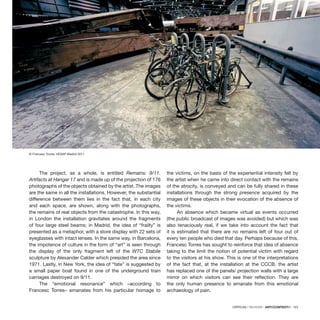
experiences when he climbs (i.e. draws) mountains. When we
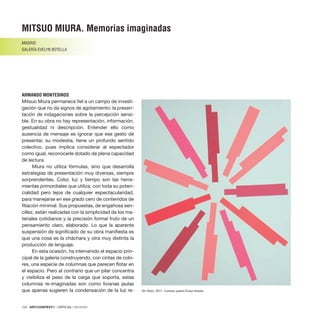
see these canvases and papers we are close to witnessing action
art or performance. The same as if we were on a mountaintop, it
is, essentially, pure space and suspended time. Let us try to be
a little more explicit.
Those who have read Thomas Mann’s masterpiece The
LLUÍS Hortalà
HUESCA
CENTRO DE ARTE Y NATURALEZ (CDAN)
LUIS FRANCISCO PÉREZ
CRÍTICAS / REVIEWS · ARTECONTEXTO · 107
Magic Mountain, will know that Hans Castorp, the main character,
like the rest of the patients at the mountaintop TB hospital,
describes himself as “the ones up here”, as opposed to the
healthy ones who live “down below”. This antithesis structures
the novel in an ambiguous and paradoxical relationship between
the ill “we” who climb the mountain in search of a cure, and
the healthy “they” who are oblivious to the refreshing pleasure
of breathing the air of an unpolluted area. It is under this same
ambiguity that Lluís Hortalà situates himself when climbing
fabrics and papers, and it is here that we return to the idea of
action art, in the sense that the artist’s position is not that of
the draughtsman who laboriously recreates faces and profiles of
certain mountains using coal black strokes, but that of the climber
who uses the pencil as if it were a harness, or his pickaxe and
footholds. Ultimately, to hang from the white wall of a canvas or
sheet of paper. We think it is essential to define this quality when
facing this magnificent series of amazed and amazing drawings.
They are, in fact, large and extraordinary drawings (as well as
photographs, reliefs, sculptures, videos, etc.), but they also carry
the added value of a strange and perverse romanticism, and on
this occasion the reference would be appropriate. Aesthetic and
edgy romanticism in terms of the artistic treatment of Nature,
which Lluís Hortalà observes with the same admiration and
compassion which with Nietzsche contemplated the same
events: “Only as an aesthetic phenomenon can existence and
the world be eternally justified”.
Chisme, 1991. Museu Comarcal de la Garrotxa, Olot (Girona). Courtesy: CDAN
108 · ARTECONTEXTO · CRÍTICAS / REVIEWS
José Manuel Ballester (Madrid, 1960), conocido por su galardo-
nada carrera artística, presenta en la sala de exposiciones Alcalá
31 una muestra dedicada a los últimos cinco años de su trabajo.
La arquitectura sigue siendo el leit motiv de una obra que suele
jugar con la transposición del discurso fotográfico hacia el dis-
curso pictórico. El artista, desdibuja ex profeso los límites de és-
tos mientras centra sus experimentaciones en la capacidad de
evocación de los espacios, a través de la transformación de su
identidad y en beneficio de la construcción de una nueva narrati-
vidad. Para ello, Ballester cuida el ángulo de visión, la naturaleza
del tratamiento del color, las texturas, las sombras y, sobre todo,
su forma de acercamiento hacia las nociones de vacío e inmensi-
dad; creando así una profunda e incuestionable abstracción de la
realidad, tal como reza el propio título de la muestra.
Las cincuenta imágenes presentadas en la exposición,
dedicadas a edificios, espacios y ámbitos culturales y artís-
ticos de importantes ciudades del mundo, representan una
pequeña parte de la amplia producción reciente de Balles-
ter, en la que si bien existen distintos tipos de exploraciones
llaman la atención dos de ellas. De una parte, algunas fo-
tografías, principalmente las de pequeña y mediana escala,
cuentan con una narración directa en la que se experimenta
con las posibilidades de composiciones geométricas, muy
estudiadas y apoyadas en colores brillantes e iluminados,
que ofrecen verdaderos trampantojos abstractos. Frente a
esta tendencia, se distingue otra donde las imágenes ven
potenciada la naturaleza casi onírica, e incluso fantástica, de
espacios más sugerentes que los anteriores y con una geo-
metría, digamos, más figurativa, más elocuente y menos fría
que la anterior. Esta estrategia refuerza la cercanía entre la
obra y el espectador así como también la proximidad con el
objeto fotografiado, aspectos que, combinados con la gran
escala que puede llegar hasta los tres metros, enfrentan al
público con la sutileza del tratamiento de la luz, la fuerza y
la sencillez de la composición y, algunas veces, con la ar-
moniosa naturalidad de defectos constructivos que forman
parte de la elegante belleza de las obras.
El guiño frecuente de Ballester hacia el carácter de la
inmensidad, fundamentalmente en piezas de delicados gri-
ses y blancos, ponen en evidencia atmósferas que obligan a
josé manuel ballester
MADRID
SALA ALCALÁ 31
La reinvención del espacio
MÓNICA NÚÑEZ LUIS
Pabellón de España, 2010. ©José Manuel Ballester. Cortesía: Comunidad de Madrid
CRÍTICAS / REVIEWS · ARTECONTEXTO · 109
cuestionar si nos encontramos ante el vacío o la rotundidad
del espacio pero que reafirman, por otra parte, algo que se
percibe en toda la muestra: la atemporalidad. Los claroscu-
ros enfatizan estas dudas y estimulan, también, un sentido
háptico que invita a tocar las obras, a formar parte de es-
tos espacios nuevos, llenos de plasticidad que, en muchas
ocasiones, tienen un aire cercano al trabajo de dos grandes
discípulos de la Escuela de Düsseldorf, A. Gursky y C. Höffer;
aunque esta remembranza se desvanece al apreciar la carga
emotiva que imprime Ballester a sus piezas.
Además de las fotografías presentadas en la exposición
puede verse un vídeo de 10 minutos producido con buena
parte de las imágenes exhibidas. Estas imágenes dialogan
bajo la intensa ópera de Häendel, Alcina. Pero en realidad,
aunque el video cuenta con una entidad propia, pareciera
ser una antesala a las piezas por demás innecesaria, ya que
el impacto de la presencia de las imágenes, su poder de
evocación a través de la reinvención de la discursividad del
espacio y la coherencia de éste quedan reafirmados por sí
mismos.
Pasillo de color, 2010. ©José Manuel Ballester. Cortesía: Comunidad de Madrid.
110 · ARTECONTEXTO · CRÍTICAS / REVIEWS
José Manuel Ballester (Madrid, 1960), known for his prize-
winning career as an artist, presents, at the Alcalá 31
gallery, a show devoted to his work from the last five years.
Architecture continues to be the leitmotiv of a body of work
which tends to play with the move of the photographic
discourse toward the pictorial discourse. The artist blurs the
edges of these realms as he focuses his experiments on the
capacity for evocation of spaces, through the transformation
of their identity and in order to benefit the construction of
a new narrativity. To do this, Ballester meticulously chooses
the angle of vision, the nature of the treatment of colour, the
textures, shadows, and, above all, his way of approaching
the notions of the void and immensity; creating a profound
and unquestionable abstraction of reality, as reflected in the
title of the exhibition.
	 The fifty images presented in the exhibition, devoted
to buildings, spaces and cultural and artistic spaces in
important cities in the world, represent a small part of the
huge recent production by this artist, which includes a
range of explorations, two of which stand out. On the
one hand, certain photographs, mainly on a small- and
medium-scale, which use a direct narrative to experiment
with the possibilities of geometric compositions, which are
very meticulous, and supported by bright and illuminated
colours, to offer real abstract trompe l’oeils. In the face of
this trend, we find another where the images strengthen
the dreamlike, even fantastical, nature of the spaces, which
are more suggestive than the ones described above, with a
more figurative, eloquent and warm geometry. This strategy
reinforces the closeness between the work and the viewer,
as well as the proximity to the photographed object, both
of which are aspects which, combined with the large scale
josé manuel ballester
MADRID
SALA ALCALÁ 31
The Reinvention of Space
MÓNICA NÚÑEZ LUIS
Torre TV Digital, 2010. ©José Manuel Ballester. Courtesy: Comunidad de Madrid.
CRÍTICAS / REVIEWS · ARTECONTEXTO · 111
of the works, which can reach three metres, confront the
viewer with the subtlety of the treatment of light, the strength
and simplicity of the composition, and, sometimes, the
harmonious naturalness of the constructive defects which
make up the elegant beauty of things.
Ballester’s frequent winks at the nature of immensity,
mainly in pieces in delicate grays and whites, reveal
atmospheres which force us to question whether we are
facing the void or the power of space, while reaffirming, on
the other hand, something perceived throughout the show:
timelessness. The chiaroscuros in his work emphasise these
doubts, stimulating a haptic sense which invites us to touch
the works, to be a part of these new spaces, full of plasticity,
which are often similar to the work of two important disciples
of the Düsseldorf School, A. Gursky and C. Höffer; although
this similarity disappears when we observe the emotional
weight Ballester impresses on his works.
As well as the photographs presented in the exhibition,
visitors can watch a ten-minute video produced using many
of the images on show. These images establish a dialogue
under the intense Häendel opera Alcina. However, in reality,
although the video possesses its own identity, it could be
seen as an unnecessary prelude to the pieces on show, as
the presence of the images, their power of evocation through
the reinvention of the discursive and consistent nature of the
space, are more than enough to reaffirm them.
Vista de Río de Janeiro, 2008. ©José Manuel Ballester. Courtesy: Comunidad de Madrid.
112 · ARTECONTEXTO · CRÍTICAS / REVIEWS
En carta remitida a su marchante neoyorquino Pierre
Matisse, hacia 1936, Alberto Giacometti (1901-1966) hace
un repaso a su actividad escultórica desde la realización
de su primer busto del natural, en 1914, hasta la fecha
de redacción, y le expone con claridad sus principales
intereses y objetivos. Así, le confiesa, por ejemplo, que
hacia 1925, estudiando la figura humana en la academia
de la Grand Chaumiére, de mano de Bourdelle, cayó en la
cuenta de que le resultaba «imposible captar el conjunto
de una figura, (estábamos demasiado cerca del modelo
y, si se partía de un detalle, el talón o la nariz, no había
esperanza alguna de llegar nunca a un conjunto). Pero
si, por el contrario, se comenzaba analizando un detalle,
la punta de la nariz, por ejemplo, estábamos perdidos.
Habríamos podido pasar la vida sin llegar a un resultado.
La forma se deshace, no es más que unos puntos
moviéndose en un vacío negro y profundo, la distancia
entre una aleta de la nariz y la otra es como el Sahara,
sin límites, nada que fijar, todo escapa». (El subrayado es
mío).
Poco más adelante, añade: «Las figuras nunca
eran para mí una masa compacta, sino una especie de
construcción transparente». Y, por último, apunta: «Había
un tercer elemento de la realidad que me interesaba, el
movimiento».
Podría decirse que Véronique Wiesinger, comisaria
de la exposición Alberto Giacometti. Una retrospectiva,
con quien ha colaborado estrechamente el director del
Museo Picasso de Málaga, José Lebrero Stals, si no ha
seguido estrictamente esa secuencia de objetivos, sí los
ha tenido en cuenta y en mente a la hora de establecer una
lectura de su trabajo, que me atrevo a calificar de clásica,
respetuosa con lo que historiadores y especialistas
ALBERTO GIACOMETTI
MÁLAGA
MUSEO PICASSO
MARIANO NAVARRO
La nariz, 1947 (versión de 1949). Fondation Alberto et Annette Giacometti, Paris.
© Fondation Giacometti, Paris / Succession Giacometti, VEGAP / ADAGP Paris, 2011.
Cortesía: Museo Picasso Málaga.
CRÍTICAS / REVIEWS · ARTECONTEXTO · 113
predecesores, entre ellos ella misma, han establecido
como canon de su actuación, pero tan plagada de
detalles y matices que la hacen novedosa y, quizás,
imprescindible. Desde luego mucho más gratificante
que la tediosa y amputada que le dedicó el MNCARS
en 1990-91.
Debe sumarse a sus méritos el que esté compues-
ta solo con obras propiedad de la Fundación Alberto y
Annette Giacometti, de París, y muy pocos añadidos,
entre ellos, obras de Picasso del museo anfitrión, que
establece un dinámico diálogo entre los dos artistas.
Más que ordenada cronológicamente, aunque se
inicia con pinturas de su padre Giovanni y otras suyas
primerizas –a las que acompañan otras del padre de
Picasso y de Picasso niño– cabe establecer un cierto
hilo temporal, ello se logra contraponiendo momentos
y formulaciones o agrupándolas de acuerdo a criterios
temáticos y motivadores, así un extraordinario conjunto
de sus piezas africanas y surrealistas de los años trein-
ta, entre ellas la inquietante Bola suspendida, 1930-31,
acompaña y se confronta con varias de las grandes
figuras filiformes femeninas de la serie Gran mujer, el
Hombre que camina, de 1960 (última de las obras in-
cluidas), y Tres hombres que caminan, de 1948, semi-
nal de su voluntad espacial de hacer “lugares”; o bien
reúne sus piezas minúsculas en una subyugante vitrina
a la que rodean retratos pintados y a la que anteceden
media docena de bodegones cezanianos, o concilia en
una misma sala a sus diferentes mujeres-modelo con
algunos ejemplos de Picasso.
El recorrido de las dos plantas permite, a la
vez, reconstruir, nunca mejor dicho, la andadura
giacomettiana desde sus primeros pasos –incluyendo
algunas de las copias que hizo de los clásicos,
así Durero–, sus primeros pasos parisinos y su
acercamiento al cubismo, el, para mí, tan rico como
imprescindible periodo surrealista –sin que se desdeñe
su producción decorativa– y, tras una crisis, lo más
conocido de su trabajo, los bustos, figuras en pie
o andando, los grupos humanos que conforman
bosques y plazas con los que alcanza aquel mordisco
de realidad que siempre quiso conseguir.
Paisaje con casas, Stampa, 1959. Colección Fondation Giacometti, París
© Sucession Giacometti/Vegap, Madrid, 2011. Cortesía: Museo Picasso Málaga.
114 · ARTECONTEXTO · CRÍTICAS / REVIEWS
In a letter to his New York dealer, Pierre Matisse, from around
1936, Alberto Giacometti (1901-1966) reviewed his sculptural
work from his first bust from life, in 1914, to the date of the letter,
and clearly sets out his main interests and aims. In this way,
he confesses, for example, that, around 1925, when he was
studying the human figure at the academy of Grand Chaumiére,
led by Bourdelle, he realised that it was “impossible to capture
the figure as a whole (we were too close to the model, and, if
we started with a detail such as the heel or the nose, there was
no hope of ever reaching a whole). But if, on the contrary, we
began by analysing a detail, the tip of the nose for example, we
were lost. We could have spent our whole lives there, without
achieving anything. Form falls apart; it is no more than a series
of dots moving around an empty and deep void. The distance
between one side of the nose and the other is like the Sahara,
unlimited, nothing fixed, it all escapes”. (Italics are mine).
Shortly after, he added, “Figures were never a compact
mass for me, but a sort of transparent construction”. And finally,
he said, “there was a third element of reality which interested
me, movement”.
It could be said that Véronique Wiesinger, the curator of the
exhibition Alberto Giacometti. A Retrospective, with whom the
director of the Museo Picasso in Malaga, José Lebrero Stals,
has worked closely, has not exactly followed that sequence of
aims, but has taken them into account when establishing an
interpretation of his work, which I would go as far as describing
as classic, respectful of what prior historians and specialists,
including herself, has established as the canon of their work, filling
it with so many details and nuances that it becomes innovative
and perhaps essential. Certainly, it is far more enjoyable than
the tedious and amputated version produced by the MNCARS
in 1990-91.
Added to these merits, it is also only made from works
belonging to the Alberto and Annette Giacometti Foundation, in
ALBERTO GIACOMETTI
MALAGA
MUSEO PICASSO
MARIANO NAVARRO
View of the exhibition. Courtesy: Museo Picasso de Málaga
CRÍTICAS / REVIEWS · ARTECONTEXTO · 115
Paris, with a only a few additions, including some Picasso works
from the host museum, to establish a dynamic dialogue between
the two artists.
Rather than being chronologically arranged, although it
begins with paintings by his father Giovanni and some of his
early works –the ones which accompany works by Picasso’s
father and Picasso as a child– it is possible to establish a
certain temporal thread, through the contrast of monuments
and formulation, arranged around thematic and motivating
criteria, in such a way that an extraordinary group of his African
and surrealist pieces from the 1930s, including the disturbing
Suspended Ball, 1930-31, accompanies and confronts several
of the female filiform figures from the series Great Woman,
Walking Man, from 1960 (the last of his works to be included),
and Three Walking Men, from 1948, a seminal example of his
seminal desire to “make places”. Some of his minuscule pieces
are shown in a subjugating showcase surrounded by painted
portraits, preceded by half a dozen of Cezannian still lifes, while
his various women-models are shown, in the same room, with
some pieces by Picasso.
The journey through the two floors of the display allows,
at the same time, to reconstruct the career of Giacometti from
his early works –including some of the copies he made of the
classics, such as Durer–, his first time in Paris and his interest in
Cubism, which, for me, is as essential as his subsequent surrealist
period –without disregarding his decorative production– and,
following a crisis, his best-known work, the busts, standing and
walking figures, the human groups which make up forests and
squares, which finally allowed him to take that bite out of reality
he so longed for.
View of the exhibition. Courtesy: Museo Picasso de Málaga
116 · ARTECONTEXTO · CRÍTICAS / REVIEWS
Séptimo ciclo de exposiciones
de La Conservera
CEUTÍ y MURCIA
LA CONSERVERA y SALA VERONICAS
El viaje como búsqueda personal
SEMA D’ACOSTA
Antes de que la Revolución Industrial alumbrara medios
de locomoción como el ferrocarril o el barco de vapor,
viajar era una aventura iniciática indescriptible. Suponía un
enfrentamiento a lo desconocido que ahora, sumidos en los
atajos representativos que se generaron desde mediados
del siglo XIX a partir de la fotografía, no somos capaces de
comprender. Para saber de los sitios había que desplazarse
hasta ellos lentamente después de superar largas distancias
y duros contratiempos, un recorrido que convertía el itinerario
por encima de todo, en una vivencia intensa que duraba
semanas, meses e incluso años. Quizás por eso el viaje
haya sido tradicionalmente una de las vías fundamentales
de conocimiento que han practicado los artistas, un modo
de acercarse a otras realidades que les ha servido para ir
aprehendiendo con pausa y a través de la observación
directa cómo era el mundo que habitaban. Sirva de ejemplo
el periplo que realiza en 1832 Eugène Delacroix por el norte
de África, un episodio que producirá una transformación
decisiva en su obra posterior.
Precisamente el viaje entendido como experiencia
personal enriquecedora es el hilo conductor del séptimo ciclo
de exposiciones de La Conservera, un conjunto expositivo
donde la Región de Murcia está presente de una u otra
manera en todas las propuestas. También para esta ocasión,
además de los cuatro espacios comunes del Centro, se ha
incorporado la Sala Verónicas, una acertada decisión que
integra (y conecta) uno de los emplazamientos habituales
para la creación actual de la ciudad con el espacio de Ceutí.
Es interesante observar cómo la memoria de un paisaje
se reconstruye mejor a base de recuerdos y sensaciones
que de simples reproducciones supuestamente imparciales;
no se trata de copiar la topografía de un área física, sino de
DIANA AL-HADID Spun of the Limits of my Lonely Waltz, 2006. Colección privada. Cortesía: la artista,
Marianne Boesky Gallery (Nueva York) y La Conservera.
CRÍTICAS / REVIEWS · ARTECONTEXTO · 117
interiorizarunlugar(otrayecto)parallevarloaunterrenopropio
y convertido luego en algo nuevo. Es lo que ocurre con los
intimistas cuadros de pequeño formato de la norteamericana
Maureen Gallace (Stamford, 1960), con los dibujos y collages
de Martin Jacobson (Estocolomo, 1978) que forman parte de
la barroca e imponente instalación que ha sido producida
específicamente para el espacio Verónicas, titulada The
Traveler’s Guide to the Other Side, o con las misteriosas
esculturas de la creadora de origen sirio Diana Al-Hadid
(Alepo, 1981), cuyas frágiles estructuras fusionan referencias
míticas de tradición oriental, estilos arquitectónicos e
impresiones subjetivas en una mezcla imposible que se
constituye, como una torre de Babel derruida, en un alegato
contra la grandilocuencia y las ambiciones humanas. Para
esta ocasión una de las piezas que presenta se basa por
primera vez en referencias humanas, un hecho inédito en su
obra que surge tras ver una pintura islámica figurativa en el
Museo de Santa Clara de Murcia, un descubrimiento poco
común en la tradición icónica árabe que le ha sorprendido
sobremanera.
La pareja formada por Ángel Mateo Charris (Cartagena,
1962) y Gonzalo Sicre (Cádiz, 1967), ayudados por la cómplice
participación del arquitecto Martín Lejárraga, han configurado
el conjunto más elaborado y completo, concibiendo dos
instalaciones magníficas que se inspiran en la figura del
pintor flamenco Leon Spilliaert. Un viaje de ida y vuelta
desde Cartagena hasta la localidad belga de Ostende, la
población costera donde nació este enigmático personaje, les
ha permitido conocer in situ los lugares en los que vivió, un
acercamiento que ha dado como resultado multitud de lienzos
de grandes dimensiones, dibujos, bocetos y apuntes. Cierra el
ciclo el artista Jorge Peris (Alzira, 1969) con un impresionante
montaje hecho con casi doscientas toneladas de sal. Su
proyecto comienza en las salinas de San Pedro del Pinatar y
termina en los desiertos de sal de Uyuni en Bolivia, una odisea
particular en la que ha invertido los últimos dos años.
ÁNGEL MATEO CHARRIS y GONZALO SICRE con la colaboración de MARTÍN LEJÁRRAGA. Vista de la exposición. Cortesía: La Conservera.
118 · ARTECONTEXTO · CRÍTICAS / REVIEWS
Before the Industrial Revolution gave rise to means of transport
such as the railway and the steam engine, traveling was an
indescribable rite of passage. It constituted a struggle with the
unknown which now, submerged as we are in the representative
shortcuts generated since the mid-19th
century, with the birth
of photography, we cannot even imagine. To know about
places it was necessary to slowly travel to them, overcoming
long distances and harsh contretemps, over journeys which
turned the itinerary into an intense experience which could last
weeks, months or even years. Perhaps because of this, journeys
have traditionally been one of the main ways used by artists to
slowly comprehend, through direct observation, the world they
lived in. As an example of this, we could mention the 1832 trip
undertaken by Eugène Delacroix through the north of Africa, an
episode which had a crucial effect on his subsequent work.
The journey understood as an enriching personal experience
is the guiding thread of the seventh cycle of exhibitions at La
Conservera, an exhibition group where the Murcia region can be
perceived in one way or another in each of the proposals. On this
occasion, as well as the four common spaces of the centre, it
also includes the Sala Verónicas, a wise choice which integrates
(and connects) one of the usual venues for current creative work
in the city with the Ceutí space.
It is interesting to observe the way in which the memory
of a landscape is best reconstructed through recollections
and sensations, rather than simple, supposedly impartial,
reproductions; it is not a question of copying the topography of
a physical area, but of interiorising a place (or a journey) in order
to take it to one’s own territory, and turn it into something new.
This is what happens with the intimate small-scale paintings
by the North American Maureen Gallace (Stamford, 1960), the
drawings and collages by Martin Jacobson (Stockholm, 1978)
which form part of the Baroque and imposing installation which
has been specifically produced for the Veronicas spaces, entitled
The Traveller’s Guide to the Other Side, and with the mysterious
sculptures by the Syrian artist Diana Al-Hadid (Alepo, 1981),
whose fragile structures combine mythical eastern references,
architectural styles and subjective impressions, in an impossible
Seventh Cycle of Exhibitions
at La Conservera
CEUTÍ and MURCIA
LA CONSERVERA and SALA VERONICAS
The Journey as a Personal Search
SEMA D’ACOSTA
MARTIN JACOBSON View of the exhibition. Courtesy: the artist, Andrea-Schiptenko and Sala Verónicas / La Conservera.
CRÍTICAS / REVIEWS · ARTECONTEXTO · 119
mixture which is constituted, like a ruined Tower of Babel, as
a protest against human grandiloquence and ambition. On this
occasion, one of the pieces she presents is based, for the first
time, on human reference points, a new element in her work,
which emerged after seeing a figurative Islamic painting at the
Museo de Santa Clara de Murcia, an unusual discovery in the
Arabic iconic tradition, which was a huge surprise to her.
The duo made up of Ángel Mateo Charris (Cartagena, 1962)
and Gonzalo Sicre (Cádiz, 1967), aided by the complicitious
participation of the architect Martín Lejárraga, has configured
the most elaborate and complete works on show, with two
magnificent installations inspired by the Flemish painter Leon
Spilliaert. A return trip from Cartagena to the Belgian town of
Oostende, the coastal area where this enigmatic character was
born, allowed them to get to know, in situ, the places where
he lived, giving rise to a huge range of large scale canvases,
drawings, sketches and notes. The cycle ends with the artist
Jorge Peris (Alzira, 1969) with an impressive montage made up
of almost 200 tonnes of salt. His project starts at the San Pedro
del Pinatar salt mines and finishes in the salt deserts of Uyuni,
in Bolivia, a personal odyssey to which he has devoted the last
two years.
JORGE PERIS View of the exhibition. Courtesy: the artist and La Conservera.
120 · ARTECONTEXTO · CRÍTICAS / REVIEWS
FRANCESC TORRES.
Memoria fragmentada 11-S NY. Artefactos en el hangar 17
BARCELONA. CENTRE DE CULTURA CONTEMPORÀNIA DE BARCELONA (CCCB)
MADRID. SALA CENTROCENTRO DEL PALACIO DE CIBELES
NUEVA YORK . INTERNATIONAL CENTER OF PHOTOGRAPHY
LONDRES. IMPERIAL WAR MUSEUM
Arqueología del dolor
ALFONSO LÓPEZ ROJO
Durante los ocho meses que duraron las operaciones de
limpieza de los casi dos millones de toneladas de escombros
producidos por el derrumbamiento de las Torres Gemelas
de Nueva York –tras el atentado del 11 de setiembre de
2001–, un equipo de personas autorizadas recorrió la zona
seleccionando y marcando con sprays los objetos que, a su
juicio, debían ser conservados como recuerdo de la cruenta
acción que costó la vida a cerca de 3.000 personas.
Los objetos, más de 1.500, fueron depositados en un
hangar de 24.000 m2 del aeropuerto JFK de Nueva York e
iban desde vigas inmensas, coches de bomberos o vagones
enteros de metro a bicicletas, ropa y efectos personales o
génerosdelosnumerososydiversoscomerciosquepoblaban
la zona; como, por ejemplo, fragmentos de personajes de la
Warner Bros tan presentes en la vida americana.
Este deseo inicial de preservar la memoria de las víctimas
–y de los hechos– a través de estas muestras del sedimento
material dejado por la acción humana destructiva hará que,
muchos de estos objetos, pasen a formar parte del futuro
museo que, en septiembre de 2012, se inaugurará bajo el
lugar que ocupaban las Torres Gemelas.
La fuerza evocadora concentrada en estos restos
materiales es también el fundamento de cuatro instalaciones
fotográficas que el artista Francesc Torres (Barcelona, 1948)
ha desplegado de forma simultánea en el Centre de Cultura
Contemporània de Barcelona (CCCB), la sala CentroCentro
del Palacio de Cibeles de Madrid, el Internacional Center of
Photography de Nueva York y el Imperial War Museum de
Londres.
El proyecto, en conjunto, se titula Memoria fragmen-
tada 11-S NY. Artefactos en el hangar 17 y consta de la
proyección de 176 fotografías de los objetos obtenidas por
© Francesc Torres, VEGAP Barcelona 2011
CRÍTICAS / REVIEWS · ARTECONTEXTO · 121
el artista. Las imágenes son las mismas en todas las ins-
talaciones. Sin embargo, la diferencia sustancial de cada
una de ellas se encuentra en que en cada ciudad y en cada
sala se muestran, junto a las fotografías, restos de objetos
reales procedentes de la catástrofe. Así, mientras que, en
Londres, la instalación gravita en torno a los fragmentos
de cuatro grandes vigas de acero; en Madrid, la idea de
“fragilidad” se plantea como metáfora a través del expositor
de un comercio con 22 gafas cuyos vidrios se conservan
intactos. Del mismo modo que, en Barcelona, la impotencia
de la cultura en forma de “arte” se trasluce con la exhibición
del único fragmento encontrado de la escultura WTC
Stabile de Alexander Calder que presidía la zona desde
1971. Mientras que, finalmente, en Nueva York, la idea de
“deriva” se sugiere con la muestra de un pequeño barco
de papel encontrado en uno de los vagones de metro que
fueron arrasados el 11-S.
La “resonancia emocional” que –al decir de Francesc
Torres– emana de su particular homenaje a las víctimas,
elaborado a partir de la intensidad vivencial que para el artista
supuso el contacto directo con los restos de la barbarie,
se transmite y puede ser plenamente compartido en estas
instalaciones a través de la fuerte presencia que adquieren
las imágenes de estos objetos para evocar la ausencia de
las víctimas.
Una ausencia que fue virtual en el mismo momento de
los hechos (se evitó la difusión pública de imágenes) pero
que, a su vez, fue y es tenazmente real si tenemos en cuenta
que se calcula que no existe ningún resto de cuatro de cada
diez personas que perdieron la vida en la siniestra acción. Tal
vez por ello, Francesc Torres ha querido reforzar esta idea
de ausencia haciendo extensiva la condición de víctima po-
tencial a los visitantes de su trabajo. Así puede interpretarse
el hecho de que, en la instalación del CCCB, el artista haya
sustituido uno de los paneles/muros de proyección de las
imágenes por un gran espejo en el que se reflejan los espec-
tadores. Ellos son la única presencia humana que emana de
esta emotiva arqueología del dolor.
© Francesc Torres, VEGAP Barcelona 2011
122 · ARTECONTEXTO · CRÍTICAS / REVIEWS
FRANCESC TORRES.
Remains: 9/11. Artifacts at Hangar 17
BARCELONA. CENTRE DE CULTURA CONTEMPORÀNIA DE BARCELONA (CCCB)
MADRID. SALA CENTROCENTRO DEL PALACIO DE CIBELES
NEW YORK. INTERNATIONAL CENTER OF PHOTOGRAPHY
LONDON. IMPERIAL WAR MUSEUM
Archaeology of Pain
ALFONSO LÓPEZ ROJO
During the eight-month cleanup operation of the almost two
tonnes of rubble left by the Twin Towers in New York following
the 9/11 attacks, a team of authorised people went through
the area spraying items which they felt should be kept to
remember the atrocity, which had a death toll of almost 3,000
people.
The more than 1,500 objects were deposited in a
24,000sq.m hangar at the JFK airport in New York, and ranged
from immense beams, fire engines and whole underground
train carriages to bicycles, clothes and personal items and
stock from the many shops which populated the areas,
such as fragments from Warner Bros characters, a staple of
American life.
That initial desire to preserve the memory of the victims
–and the events—through these displays of material sediment
left by human destructiveness will lead many of the objects
to become part of a museum which will be inaugurated in
September 2012, at the Twin Towers site.
The concentrated evocative power of these material
remains is also the basis of four photography installations
which the artist Francesc Torres (Barcelona, 1948) has
unfolded, simultaneously, at the Centre de Cultura
Contemporània in Barcelona (CCCB), the CentroCentro of
the Palacio de Cibeles in Madrid, the International Center of
Photography in New York and the Imperial War Museum in
London.
© Francesc Torres, VEGAP Madrid 2011
CRÍTICAS / REVIEWS · ARTECONTEXTO · 123
The project, as a whole, is entitled Remains: 9/11.
Artifacts at Hangar 17 and is made up of the projection of 176
photographs of the objects obtained by the artist. The images
are the same in all the installations. However, the substantial
difference between them lies in the fact that, in each city
and each space, are shown, along with the photographs,
the remains of real objects from the catastrophe. In this way,
in London the installation gravitates around the fragments
of four large steel beams; in Madrid, the idea of “frailty” is
presented as a metaphor, with a store display with 22 sets of
eyeglasses with intact lenses. In the same way, in Barcelona,
the impotence of culture in the form of “art” is seen through
the display of the only fragment left of the WTC Stabile
sculpture by Alexander Calder which presided the area since
1971. Lastly, in New York, the idea of “fate” is suggested by
a small paper boat found in one of the underground train
carriages destroyed on 9/11.
The “emotional resonance” which –according to
Francesc Torres– emanates from his particular homage to
the victims, on the basis of the experiential intensity felt by
the artist when he came into direct contact with the remains
of the atrocity, is conveyed and can be fully shared in these
installations through the strong presence acquired by the
images of these objects in their evocation of the absence of
the victims.
An absence which became virtual as events occurred
(the public broadcast of images was avoided) but which was
also tenaciously real, if we take into account the fact that
it is estimated that there are no remains left of four out of
every ten people who died that day. Perhaps because of this,
Francesc Torres has sought to reinforce that idea of absence
taking to the limit the notion of potential victim with regard
to the visitors at his show. This is one of the interpretations
of the fact that, at the installation at the CCCB, the artist
has replaced one of the panels/ projection walls with a large
mirror on which visitors can see their reflection. They are
the only human presence to emanate from this emotional
archaeology of pain.
© Francesc Torres, VEGAP Madrid 2011
124 · ARTECONTEXTO · CRÍTICAS / REVIEWS
Mitsuo Miura permanece fiel a un campo de investi-
gación que no da signos de agotamiento: la presen-
tación de indagaciones sobre la percepción sensi-
ble. En su obra no hay representación, información,
gestualidad ni descripción. Entender ello como
ausencia de mensaje es ignorar que ese gesto de
presentar, su modestia, tiene un profundo sentido
colectivo, pues implica considerar al espectador
como igual, reconocerle dotado de plena capacidad
de lectura.
Miura no utiliza fórmulas, sino que desarrolla
estrategias de presentación muy diversas, siempre
sorprendentes. Color, luz y tiempo son las herra-
mientas primordiales que utiliza, con toda su poten-
cialidad pero lejos de cualquier espectacularidad,
para manejarse en ese grado cero de contenidos de
filiación minimal. Sus propuestas, de engañosa sen-
cillez, están realizadas con la simplicidad de los ma-
teriales cotidianos y la precisión formal fruto de un
pensamiento claro, elaborado. Lo que la aparente
suspensión de significado de su obra manifiesta es
que una cosa es la cháchara y otra muy distinta la
producción de lenguaje.
En esta ocasión, ha intervenido el espacio prin-
cipal de la galería construyendo, con cintas de colo-
res, una especie de columnas que parecen flotar en
el espacio. Pero al contrario que un pilar concentra
y visibiliza el peso de la carga que soporta, estas
columnas re-imaginadas son como livianas jaulas
que apenas sugieren la condensación de la luz re-
MITSUO MIURA. Memorias imaginadas
MADRID
GALERÍA EVELYN BOTELLA
ARMANDO MONTESINOS
Sin título, 2011. Cortesía: galería Evelyn Botella.
CRÍTICAS / REVIEWS · ARTECONTEXTO · 125
Memorias imaginadas (instalación), 2011. Cortesía: galería Evelyn Botella.
tenida fugazmente en su interior. No conducen la descarga
de la gravedad, sino que dispersan la energía por el aire de
la sala. Algunas, verdadera arquitectura mental, son incluso
invisibles, «insinuadas solo» –cito de la nota de prensa, que
parece recoger palabras del artista– «con bases flotantes
en el suelo, como si tuviesen un posible futuro.» El espacio,
pese a estar ocupado, se hace sorprendentemente amplio,
activado por las interrelaciones dinámicas de esas construc-
ciones multicolores, abiertas y cerradas a un tiempo.
Miura no usa el color como ilusionismo, sino como puro
hecho físico, y lo hace con la riqueza del pintor que es. Este
aspecto pictórico queda evidenciado en los pequeños pa-
peles y cuadros de la primera sala, sutiles y rotundos, y se
despliega con todo su potencial en la instalación de la se-
gunda, donde las variaciones de la luz natural, filtrada por
los tamizados ventanales de la galería, desvelan la fugitiva
contingencia de los valores cromáticos. El tiempo deviene
tan importante como el cuerpo, y con ellos la percepción de
nuestra propia economía de la mirada y de la recepción.
La práctica artística ya no solo busca la duración del ob-
jeto, al cual el paso del tiempo convierte en venerado, sino la
duración de la experiencia. Pero parecería que el tiempo de
esta sólo puede llenarse con la hinchazón de lo espectacular
y no con la sencilla atención a lo que nos rodea cotidiana-
mente. Esta muestra nos recuerda que el formato expositivo
requiere algo más que el rápido vistazo –tan grosero como
el garabateado “fulanito estuvo aquí” que ofende a la belleza
antigua de un monumento– y que el necesario rescate de
su importancia pasa por recuperar el placer de la contem-
plación, el tiempo de la experiencia, el acto del pensamiento.
Todo ello está contenido en este montaje, en el que Miura
vuelve a demostrar el mordiente visual de su refinamiento
intelectual. Que esta exposición sea su primera con Evelyn
Botella, figura histórica del arte contemporáneo en Madrid,
evidencia el afinado criterio y la actualidad de la galerista.
Que Mitsuo Miura no haya tenido aún el reconocimiento que
su continuada y renovadora investigación artística merece
define bien el clima de nuestras instituciones.
126 · ARTECONTEXTO · CRÍTICAS / REVIEWS
Memorias imaginadas (instalación), 2011. Courtesy: galería Evelyn Botella.
Mitsuo Miura remains loyal to a field of research
which seems as fruitful as ever: the presentation of
delving into sensitive perception. His work does not
include representation, information, gestuality or
description. Seeing this as the absence of message
means not realizing that this gesture of presenting,
its modesty, is profoundly collective, as it involves
seeing the viewer as an equal, as someone fully
qualified to interpret the works.
Miura does not use formulas; rather, he devel-
ops a wide range of always surprising presenta-
tion strategies. Colour, light and time are his main
tools, used with all their potential but far from any
spectacular sense, to operate on that zero level of
contents of minimal filiation. His proposals, which
are deceptively simple, are produced using basic
day-to-day materials and a formal precision arising
from clear and elaborate thinking. What the appar-
ent lack of meaning in his work reveals is that one
thing is chatter and another the production of lan-
guage.
On this occasion, he has intervened on the
main space of the gallery, using coloured ribbons
to build a range of columns which seem to float in
space. But, unlike pillars, which concentrate and
lend visibility to the weight of their load, these re-
imagined columns are like lightweight cages which
barely suggest the condensation of the fleeting light
held inside them. They do not conduct gravity, but
instead disperse energy around the air in the room.
Some of them, true mental architectural pieces, are
invisible, “just insinuated” –as the press release
MITSUO MIURA. Imagined Memories
MADRID
GALERIA EVELYN BOTELLA
ARMANDO MONTESINOS
CRÍTICAS / REVIEWS · ARTECONTEXTO · 127
says, using what sounds like the words of the artist himself–
“with floating bases on the floor, as if they had a possible
future.” The space, despite being occupied, seems surpris-
ingly large, activated by the dynamic interrelations of those
multi-coloured constructions, which are simultaneously open
and closed.
Miura does not use colour as illusionism, but as a pure
physical fact, and he does so with a painterly richness. This
pictorial element is revealed in the small papers and paintings
in the first room, which are subtle and rotund, and comes
into its own in the installation in the second room, where the
variations of natural light, filtered by the gallery’s windows,
display the fugitive contingency of chromatic values. Time
becomes as important as the body, along with the perception
of our own economy of the gaze and reception of the work.
Art practices no longer seek the duration of the object,
which the passing of time turns into a venerated item, but
the duration of the experience. It could seem, however, that
the duration of experience can only be filled with the swell of
the spectacular, and not the simple attention to our day-to-
day surroundings. This display reminds us that the exhibition
format requires more than a quick glance–which is as rude as
a scribbled “so-and-so was here” which offends the ancient
beauty of a monument– and that the necessary rescue of its
importance involves recovering the pleasure of contempla-
tion, the time of experience, the act of thinking. All of this
is contained in this display, with which Miura, once again,
proves the biting visuality of his intellectual refinement. The
fact that this show is his first with Evelyn Botella, a legendary
figure in the contemporary art scene in Madrid, is proof of
the finely-tuned judgment and relevance of the gallery-owner.
And the fact that Mitsuo Miura is yet to receive the recogni-
tion his innovative and consistent artistic research deserves
says a lot about the atmosphere at our institutions.
Sin título, 2011. Courtesy: galería Evelyn Botella.
128 · ARTECONTEXTO · CRÍTICAS / REVIEWS
Vista de la exposición. Cortesía: CAB.
Aunque en esta exposición de Gonzalo Puch (Sevilla, 1950) se
aprecian cambios formales significativos en relación con algunos
de sus proyectos anteriores, el artista sigue manteniendo con
coherencia el discurso general que define su trayectoria, un
tema recurrente al que vuelve constantemente para hacernos
reflexionar sobre las relaciones que establece el hombre con
la Naturaleza, vínculos artificiales en la mayoría de los casos
condicionados por la descontextualización que acompaña a las
interpretaciones científicas.
Si la fotografía escenificada ha sido el campo de
actuación donde mejor se ha desenvuelto para reflejar esas
contradicciones,progresivamentehaidoensanchandosumarco
de acción hasta traspasar los límites de la imagen, concibiendo
amplias instalaciones que recordaban precisamente a los
escenarios interiores que diseñaba en sus instantáneas.
En los últimos tiempos ha ido abandonado esos tableaux
vivant para adentrarse en otros terrenos más enmarañados y
desconcertantes, que incluyen estructuras casuales hechas
con desechos, extraños bodegones sin profundidad ni escala
que mezclan fragmentos dispersos de verduras (ora las
hojas de una lechuga, ora un brócoli troceado) y, finalmente,
bosquejos en blanco y negro que progresivamente han ido
incorporando golpes cromáticos. De la asepsia con apariencia
seudo-experimental de trabajos como los de su individual en la
galería Helga de Alvear (Introducción a la meteorología, 2009)
ha pasado a un marasmo de elementos yuxtapuestos que nos
hablan, de modo indescifrable, de la destrucción del entorno y
el deterioro de los paisajes naturales.
Para el CAB de Burgos, Puch ha preparado tres obras
independientes (un vídeo y dos realizadas ex profeso)
ajustadas a cada una de las salas de la primera planta, una
propuesta sencilla y directa que resulta congruente en su
totalidad. Si antes sus montajes ocupaban todo el espacio
disponible y poseían un remarcado valor escultórico, ahora las
GONZALO PUCH. Una jornada sin nubes
BURGOS
CENTRO DE ARTE CAJA BURGOS (CAB)
Reflexionando en torno a la (degradación de la) Naturaleza
SEMA D’ACOSTA
CRÍTICAS / REVIEWS · ARTECONTEXTO · 129
composiciones se extienden por los testeros en una especie
de políptico ascendente donde la pared funciona como un
gran lienzo en blanco que va completando sobre la marcha de
manera intuitiva. Sus conjuntos precedentes se caracterizaban
por expandirse hacia lo tridimensional; en estos predominan
referencias bidimensionales. Gonzalo, que comenzó con la
pintura e incluso llegó a obtener la beca de la galería Juana
de Aizpuru en la temporada 79-80, hace frente a estos vacíos
exactamente igual que un pintor que afronta un nuevo cuadro,
organizando y contrapesando con instinto, líneas, formas,
ritmos y colores en función de su peso visual y los equilibrios
que establecen entre ellos. Las frutas y hortalizas que
utiliza (un pimiento, una berenjena, una manzana...) hay que
entenderlas como masas de color que estabilizan la estructura,
una miscelánea de ingredientes de diversa procedencia que
funcionan porque la suma global resulta proporcionada.
Asimismo, al estropearse con el paso del tiempo y cambiar
cada día, sirven de metáfora para ilustrar las alteraciones
orgánicas y su degradación.
Lo más llamativo de Una jornada sin nubes quizás sea la
inclusión de dibujos infantiloides diseminados por los muros,
bien sea digitalizados o directamente hechos a mano. A veces
recorta estos garabatos y en otras ocasiones los superpone a
distintas figuras u objetos. Colocados sobre macetas, también
ha distribuido pequeños árboles abocados a morir. La mezcla
es sorprendente, desordenada, rara. El conjunto transmite
una singular sensación de desasosiego relacionada con los
desajustes que existen entre las personas y el medio ambiente.
El audiovisual, anterior y de carácter performativo, muestra
una serie de personajes que estudian determinados procesos
a través de ensayos absurdos, una infructuosa búsqueda de
conocimiento sustentada en acciones inconsecuentes que
constatan nuestros desaciertos cuando nos enfrentamos a la
Naturaleza.
Living
in
a
green
space,
2011.
Impresión
Digital.
Cortesía:
CAB.
130 · ARTECONTEXTO · CRÍTICAS / REVIEWS
Montaña de cosas, 2011. Digital print. Courtesy: CAB.
Although in this exhibition by Gonzalo Puch (Seville, 1950) we
can appreciate significant changes in comparison with some of
his previous projects, the artist maintains the consistency of the
general discourse which defines his career, a recurring theme
which he constantly returns to in order to make us reflect on
the relationships established between Man and Nature, artificial
links mostly conditioned by the decontextualisation which
accompanies scientific interpretations.
While staged photography has been the field of action
where he has been most able to reflect these contradictions, he
has gradually widened his sphere of action to move beyond the
image, conceiving of large installations which are reminiscent of
the interior scenarios he designed for his snapshots. Lately he
has abandoned those tableaux vivant to delve into other more
disconcerting and confusing terrains, which include casual
structures made from waste, strange still lifes without a sense of
depth or scale, mixing disperse fragments of vegetables (lettuce
leaves or a diced piece of broccoli) and, finally, black and white
sketches which progressively included chromatic elements.
From the asepsis and pseudo-experimental appearance of
works such as those displayed at his solo at the Helga de Alvear
gallery (Introducción a la meteorología, 2009) he has moved to
a marasmus of juxtaposed elements which speak to us, in an
undecipherable way, of the destruction of the environment and
the damage suffered by natural landscapes.
FortheCABinBurgos,Puchhaspreparedthreeindependent
GONZALO PUCH
A Day Without Clouds
BURGOS
CENTRO DE ARTE CAJA BURGOS (CAB)
Reflecting on the
(Degradation) of Nature
SEMA D’ACOSTA
CRÍTICAS / REVIEWS · ARTECONTEXTO · 131
works (a video and two specially-made pieces) adapted to each
of the rooms on the first floor, a simple and direct proposal which
is consistent as a whole. While his productions used to take up
all the available space and possessed a strong sculptural sense,
his current compositions spread like ascending polytptychs,
where the wall works as a huge white canvas which he intuitively
fills as he goes. His previous works were characterised by
expanding toward the three-dimensional; in these predominate
two-dimensional references. Gonzalo, who began working as a
painter and even received a grant from the Juana de Aizpuru
gallery for the 1979-80 season, faces these empty spaces just
like a painter approaches a new painting, by organising and
counteracting with instinct, lines, forms, rhythms and colours,
depending on their vital weight and the balances established
between them. The fruits and vegetables he uses (a pepper,
an aubergine, an apple, etc.) must be understood as masses
of colour which stabilise the structure, a range of ingredients
of different provenance, which work together because they are
in the correct proportions. In the same way, as they degrade
with the passing of time, and change each day, they serve as a
metaphor to illustrate organic alterations and their decay.
The most outstanding element in Una jornada sin nubes
might be the inclusion of childish drawings all over the wall,
either digitalised or made directly by hand. Sometimes the artist
cuts out these scrawls and other times he superposes them on
different figures and objects. He has also distributed small trees
in pots around the space, doomed to die. The combination is
surprising, chaotic and strange. As a whole it conveys an unusual
sensation of disquiet, linked to the imbalances between people
and the environment.
The audiovisual, previous and performative, shows a series
of characters which study a range of processes through absurd
essays,afruitlesssearchforknowledgebasedoninconsequential
actions which confirm our mistakes in our dealings with nature.
View of the exhibition. Courtesy: CAB.
132 · ARTECONTEXTO · CRÍTICAS / REVIEWS
JORGE PERIANES. Categorías
MADRID
MATADERO MADRID
SARA GARCÍA
Tras otras importantes instalaciones como la
realizada para la exposición 7+1 Project en el
MARCO de Vigo en 2008 o aquella en el Palacio de
Oribe para la muestra El Patio de mi casa, nombre
que se le dio a las 16 intervenciones de artistas de
renombre en patios cordobeses a finales de 2009,
Jorge Perianes asume el reto del espacio Abierto
x Obras y concentra toda su esencia en la que es
hasta ahora su mayor instalación. Una prueba de
fuego que pone en evidencia las capacidades de un
artista para medirse con el espacio, siendo al tiempo
significativo, novedoso y, por supuesto, sin dejar de
imprimir su marca.
A primera vista, dos amplias extensiones
vacías, arriba y abajo, surgen de la estocada al cora-
zón de la sala realizada justamente por su centro con
tablones de madera, que asumen la doble función
de ser techo y suelo a un tiempo. El espacio diáfano
ha sido convertido en dúplex por la acción del ar-
tista cuya intención se descubre como en absoluto
arquitectónica sino metafísica. Entre las rendijas de
la instalación se infiltran melancólicamente peque-
ñas plantas artificiales, connotadoras del paisaje
desértico en el que han sido situadas por la mano
de aquel que acostumbra a usar la naturaleza como
excusa para hablar libremente del ser humano.
Una intención perversa anida en la obra y se ex-
plicita a través de los detalles: la forma en que cuel-
gan las raíces, que despojadas de sustento remiten
al Abgrund heideggeriano; la meditada iluminación
que prolonga las sombras de las hojas al tiempo que
muestra sin pudor alguno el techo ennegrecido y
desconchado; los enormes huecos en la estructura Categorías, 2011. Cortesía: Matadero Madrid.
CRÍTICAS / REVIEWS · ARTECONTEXTO · 133
como si de un inestable andamio se tratara construyen un
escenario que, en palabras del artista, remite a la tragedia y
al desengaño. Jorge Perianes juega con la maquiavélica idea
de ver a las personas que transitan por su instalación como
insectos que ocupan el sótano y el desván de una casa de-
mediada, y hace uso de su versatilidad para trabajar tanto en
pequeños como en grandes formatos siempre a través de la
omnipresente dinámica entre lo natural y lo artificial.
Toda instalación incluye en su definición la posibilidad
de ser transitada y explorada desde varios ángulos, aunque
sucede a menudo que existe un punto de vista, una
perspectiva privilegiada que recoge la clave de cualquiera de
ellas. En este caso, todo parece encajar cuando se observa la
enorme estructura que divide la sala en dos desde el mismo
umbral de la puerta de entrada. Desde allí se comprende que
Jorge Perianes ha subvertido los límites de las disciplinas y
se ha atrevido a pintar un Rothko, una estructura binomial,
un horizonte eje del cielo-tierra, coordenada esencial para
el ser humano y que determina nuestra apreciación del
mundo, nuestras posibilidades y hasta nuestro concepto de
divinidad.
Ecos de las ruinas de Piranesi se oyen en la planta baja,
donde el artista ha incorporado fragmentos de las vigas
originales del Matadero, mientras que Magritte, uno de los
referentes más evidentes en la obra del artista gallego, toma
protagonismo en el piso superior. Los juegos de dobles se
encuentran incluso en el olor a madera de la sala, que remite
a lo nuevo, a lo recién construido, al tiempo que el espectador
se enfrenta al abandono evidente.
La libertad que Jorge Perianes otorga a la interpretación
de sus obras permite decir que el título elegido para esta
instalación, Categorías, reinterpreta a la luz de nuestro
tiempo la noción filosófica popularizada por Aristóteles
y Kant para entenderla ya no como concepto estanco, a
priori del entendimiento, sino como diálogo, hibridación,
mezcla o incluso contagio entre las partes. Como resultado
de esta permeabilidad, el simulacro de la vida crece en los
intersticios.
Categorías, 2011. Cortesía: Matadero Madrid.
134 · ARTECONTEXTO · CRÍTICAS / REVIEWS
After other important installations, such as the
one carried out for the exhibition 7+1 Project
at the MARCO in Vigo in 2008, or the display El
patio de mi casa at the Palacio de Oribe, which
included 16 interventions by important artists, set
in Cordoba patios in late 2009, Jorge Perianes
took on the challenge of the Abierto x Obras
space, concentrating the essence of his work in
what is his largest installation to date. A trial by
fire, which reveals the ability of the artist to deal
with the space, in a meaningful, innovative and
personal way.
At first sight, two large empty expanses,
up and down, emerge from the stab wound to
the heart of the room, exactly in the centre, with
wooden boards which take on the double role of
becoming a floor and a ceiling at the same time.
The empty space has been turned into a duplex by
the action of the artist, whose intention is revealed
to be not architectural but metaphysical. Through
the cracks in the installation slide melancholy
artificial plants, to denote the arid landscape in
which they have been placed by he who tends
to use nature as an excuse to speak freely about
human beings.
A perverse intention lies in the work, and is
revealed through its details: the way the roots
hang, reminding us, in their lack of sustenance, of
Heidegger’s Abgrund; the careful lighting which
prolongs the shadows of the leaves of time, at the
same as they show, without shame, the blackened
and peeling ceiling; the huge holes in the structure,
which resembles an unstable scaffold, building a
scenario, which, according to the artist, conveys
JORGE PERIANES. Categories
MADRID
MATADERO MADRID
SARA GARCÍA
Categorías, 2011. Courtesy: Matadero Madrid.
CRÍTICAS / REVIEWS · ARTECONTEXTO · 135
tragedy and disappointment. Jorge Perianes plays with the
Machiavellian idea of seeing the people who move through his
installation as insects occupying the basement and attic in an
ill-proportioned house, taking advantage of his ability to work in
both small and large formats, always through the omnipresent
dynamic between what is natural and what is artificial.
All installations include in their definition the chance to be
explored and experienced from a range of angles, although
there is often a point of view or privileged perspective which
holds the key to it. In this case, everything seems to fit together
when we observe the huge structure which divides the room
in two, from the entrance door. From here we see that Jorge
Perianes has subverted the limits of the disciplines, daring
to paint a Rothko, a binomial structure, a horizon as axis
of the earth and the sky, an essential coordinate for human
beings, which determines our appreciation of the world, our
possibilities and even our concept of divinity.
Echoes of the ruins of Piranesi can be heard on the
ground floor, where the artists has included fragments of the
original beams of the Matadero, while Magritte, one of the
most obvious reference points in the work of the Galician
artist, acquires a central role on the top floor. The double
games can even be felt in the woody smell of the room, which
reminds us of something new, something recently built, while
the spectator confronts the obvious state of disrepair of the
space.
The freedom which Jorge Perianes lends to the
interpretation of his works allow us to say that the title chosen
for this installation, Categorías, reinterprets, as seen from our
time, the philosophical notion popularised by Aristotle and
Kant, in order to understand it not as an empty concept, prior
to comprehension, but as dialogue, hybridisation, and even
infection between the parties. As a result of this permeability,
the simulacrum of life grows in its interstices.
Categorías, 2011. Courtesy: Matadero Madrid.
136 · ARTECONTEXTO · CRÍTICAS / REVIEWS
Cambio de paradigma.
Colección Serralves
años 60-70
LEÓN
MUSEO DE ARTE CONTEMPORÁNEO DE CASTILLA Y LEÓN (MUSAC)
Cambio de paradigma en el MUSAC
CARLOS JIMÉNEZ
El título de este comentario es un juego de palabras sugeri-
do por el título de la exposición inaugurada en el MUSAC,
que representa tanto una cala en lo que sus dos comisa-
rios han convenido en llamar “cambio de paradigma” en el
arte como un cambio significativo del paradigma del propio
MUSAC que, desde su fundación, ha venido proclamando
desafiantemente su propósito de convertirse en el museo
del hoy, de la actualidad, del aquí y ahora del arte contem-
poráneo. Y que opta ahora sin embargo por echar la mirada
atrás con una muestra dedicada a un episodio histórico del
pasado, aunque sea de un pasado relativamente reciente y
aunque lo ocurrido durante el mismo no pueda darse hoy
como olvidado o definitivamente perdido. Al contrario: el arte
generado durante ese periodo –o sea entre los años 60/70
del siglo pasado– trajo consigo un cambio tan decisivo en el
concepto del arte y en las prácticas artísticas que sus con-
secuencias todavía se dejan sentir en el conjunto del arte
contemporáneo y no solo en ese cajón de sastre al que hoy
suele llamarse “arte conceptual”. Ese cambio se ha asociado
habitualmente al uso de nuevas tecnologías como la com-
putación y el vídeo, a la introducción y a la profundización
de estrategias como el happening, el body art, el land art y
la archivística, así como a una crítica radical de la política
y la cultura hegemónicas, incluida la que desde entonces
comenzó a llamarse main stream, la corriente mayor o prin-
cipal del arte, que todavía era mayoritariamente formalista
y aséptica, aun en los casos en los que, como en la action
paiting, resultaba patética.
Y hay muestras representativas de todos estos medios,
lenguajes y actitudes en una exposición con 89 obras de 62
artistas seleccionados, con buen criterio de entre los fondos
de la colección de la Fundación Serralves de Oporto, por
HANS HAACKE Narrow White Flow, 1967-1968. Col. Fundação de Serralves – Museu de Arte Contemporânea, Oporto.
Foto: Arquivo fotográfico Fundação de Serralves – Museu de Arte Contemporânea, Oporto. Cortesía: MUSAC
CRÍTICAS / REVIEWS · ARTECONTEXTO · 137
Joao Fernándes y Agustín Pérez Rubio, los dos
comisarios de la misma. La calidad media es buena
y es también un acierto, tanto de la colección
como de los comisarios, que incluya junto a las
grandes figuras internacionales los nombres
de un grupo de 16 artistas portugueses, cuyas
obras demuestran hasta qué punto la revolución
artística de los 60/70 –cuyo escenario privilegiado
fue Nueva York– impactó en el conjunto de la
escena internacional del arte, movilizando a los
artistas jóvenes de prácticamente todos los países
occidentales, incluido Portugal.
Esta decisión nos permite conocer ahora
de primera mano los trabajos de artistas poco
o nada conocidos para el público español como
son Armando Alves, Antonio Barros, Fernando
Calhau, Lourdes Castro, Antonio Sena o Ana
Vieira. Todos ellos representados por obras que
bien vale la pena mencionar, al igual que las de
los artistas que sí son bien conocidos de este lado
de la frontera peninsular: Helena Almeida, Artur
Barrio, Leonel Moura y Julião Sarmento. Entre las
obras del primer grupo subrayo las siluetas de
figuras humanas tejidas por Lourdes Castro, las
profecías de Abdul Varetti igualmente tejidas por
Álvaro Lapa, y la magnífica instalación Janelas,
de Ana Viera. En el grupo de los mejor conocidos
por nosotros destaco Jaula/Cage, la inquietante
instalación con sonido de Julião Sarmento.
Entre los artistas internacionales resalto En-
trare nell´opera, una fotografía mural de Giovanni
Anselmo que es una impactante versión povera
del cuadro el Monje ante el mar de Friederich. Así
como Narrow White Flow de Hans Haacke, una
pieza que consiste en un ventilador que hace on-
dular un gran lienzo blanco extendido en el suelo
y que, por fascinante y hasta hipnótica, resulta
contradictorio con el grueso de su obra, tan dedi-
cada al desvelamiento de los mecanismos ocul-
tos del arte. Y, en fin, no puedo concluir sin por lo
menos mencionar a Semiotics of the Kitchen, el
emblemático video de Martha Rossler.
ALBERTO CARNEIRO Os 4 elementos, 1969-1970.
Col. Fundação de Serralves – Museu de Arte Contemporânea, Oporto. Cortesía: MUSAC.
138 · ARTECONTEXTO · CRÍTICAS / REVIEWS
Paradigm Shift.
Serralves Collection
60’s-70’s
LEÓN
MUSEO DE ARTE CONTEMPORÁNEO DE CASTILLA y LEÓN (MUSAC)
Paradigm Shift at the MUSAC
CARLOS JIMÉNEZ
ROBERT MORRIS Sem Título, 1969. Col. Fundação de Serralves – Museu de Arte Contemporânea, Oporto.
Photo: Arquivo fotográfico Fundação de Serralves – Museu de Arte Contemporânea, Oporto. Courtesy: MUSAC.
The title of this review is a play on words inspired by the title
of the exhibition inaugurated at the MUSAC, which represents
both a display of what its two curators have decided to term
“a changing paradigm” in art and a significant change in the
paradigm of the MUSAC itself, which, since it was founded,
has boldly proclaimed its aim to become a museum of today,
of the present, of the here and now of contemporary art.
However, it is now opting to look back, with a show devoted
to a past historical event, even if it refers to a relatively recent
past, and even though what happened then cannot be seen as
forgotten or lost. Quite the opposite: the art generated during
that period–between the 1960s and 70s—brought about a
crucial change in the concept of art and art practices, which
can still be felt in contemporary art as a whole, not only in that
melting pot usually known as “conceptual art”. This change
has usually been linked to the use of new technologies, such
as computing and video, the introduction and research into
strategies such as happenings, body, land and archive art, as
well as a radical criticism of hegemonic policies and culture,
including that which began to be known as mainstream, which
was still mostly formalist and aseptic, even in the cases, such
as action painting, when it possessed a certain pathos.
And there are representative displays of all of these
media, languages and attitudes in a show including 89 works
by 62 wisely selected artists from the collection of the Oporto
Fundación Serralves, by Joao Fernándes and Agustín Pérez
Rubio, the show’s two curators. The average standard is high,
and it is good to see that it includes, along with important
international figures, the names of a group of 16 Portuguese
artists, whose works prove the extent to which the artistic
CRÍTICAS / REVIEWS · ARTECONTEXTO · 139
LOURDES CASTRO Sombra Sentada, 1969. Col. Fundação de Serralves – Museu de Arte Contemporânea, Oporto.
Photo: Arquivo fotográfico Fundação de Serralves – Museu de Arte Contemporânea, Oporto. Courtesy: MUSAC
revolution of the 1960s and 70s –which mainly took place
in New York– had an impact on the international art scene
as a whole, mobilizing young artists from almost all western
countries, including Portugal.
This decision allows us to enjoy a first-hand view of the
work of little-known artists in Spain, such as Armando Alves,
Antonio Barros, Fernando Calhau, Lourdes Castro, Antonio
Sena and Ana Vieira. They are all represented by works
which it is worth mentioning, as are those by well-known
artists such as Helena Almeida, Artur Barrio, Leonel Moura
and Julião Sarmento. Among the works by the first group
I would like to make special mention to the silhouettes of
human figures woven by Lourdes Castro, the prophecies of
Abdul Varetti also woven by Álvaro Lapa, and the magnificent
installation Janelas, by Ana Viera. Among the work by better-
known artists, it is worth mentioning Jaula/Cage, a disturbing
sound installation by Julião Sarmento.
Among the work by international artists, I want to
highlight Entrare nell’opera, a mural photograph by Giovanni
Anselmo, which constitutes a powerful povera version of
the painting The Monk by the Sea, by Friederich, as well as
Narrow White Flow by Hans Haacke, a piece which consists
of a fan which causes a large white canvas spread on the
floor to undulate in a fascinating and almost hypnotic way, in
contradiction with most of his work, which has been devoted
to revealing the hidden mechanisms of art. And, lastly, I must
mention Semiotics of the Kitchen, an emblematic video by
Martha Rossler.
140 · ARTECONTEXTO · CRÍTICAS / REVIEWS
Tras su paso por la Ikon Gallery, la exposición Atsuko
Tanaka. El arte de conectar llega al EACC de Castelló.
La obra de Tanaka se conoce sobre todo por su
pertenencia a Gutai. El grupo Gutai nació en 1954
de la mano de Jiro Yoshihara. Aunque la historia del
arte occidental no ha jugado limpio con ellos, se
trata sin duda de uno de los grupos vanguardistas
más importantes de mediados del siglo XX.
Las investigaciones y experimentaciones lleva-
das a cabo por sus integrantes adelantan algunas
de las obras y los movimientos consagrados por la
historia del arte contemporáneo. La performance, la
instalación, el arte sonoro, el land art y el body art
son logros occidentales de los que encontramos ya
muestras en este grupo surgido en 1954. Por poner
unos breves ejemplos: en el año 55 Kazuo Shiraga
realizaba Doro, una performance en la que utilizaba
su cuerpo semi desnudo como herramienta rodan-
do por el barro; en el 56 Murakami atravesaba una
serie de bastidores de papel; Motonaga instalaba
en plena naturaleza lonas plásticas entre los pinos
a las que lanzaba agua coloreada; en el 57 Akira Ka-
nayama utilizaba trenes eléctricos para pintar sus
cuadros. Atsuko Tanaka perteneció al grupo desde
1955 hasta 1965 y realizó algunas de sus obras más
relevantes con ellos.
La exposición hace un recorrido por la dilata-
da trayectoria de la artista. En el espacio superior
encontramos, por un lado, muestras de sus obras
anteriores a Gutai, de los años 54 y 55, cuando aún
era miembro del grupo Zero. En estos años realiza
una serie de obras cercanas al minimalismo entre
ATSUKO TANAKA. El arte de conectar
CASTELLÓN
ESPAI D’ ART CONTEMPORANI DE CASTELLÓ (EACC)
JAVIER MARROQUÍ
Tanaka en la 3rd Genbi Exhibition en Kyoto Municipal Museum of Art. Noviembre de 1955.
© Ryoji Ito.Cortesía: EACC.
CRÍTICAS / REVIEWS · ARTECONTEXTO · 141
las que cabe destacar Calendar. Tanaka estuvo hospitaliza-
da en 1953 y durante su estancia se fijó obsesivamente en
el pasar de los días en el calendario. A su vuelta a casa y al
trabajo realizó toda una serie de piezas en las que incluyó
numeraciones. Por otro lado, en el mismo espacio se recoge
documentación en forma de fotos, escritos y registros video-
gráficos de su actividad artística con Gutai. Al igual que se
reconstruye una de sus piezas más celebradas, Bell (1955).
Se trata de una instalación compuesta originariamente por
20 timbres eléctricos interconectados. Al pulsar el timbre, las
campanas empiezan a sonar desde la más lejana al espec-
tador a la más cercana. En esta instalación, en la exposición
con Gutai, las campanas estaban ocultas por lo que se trata-
ba de trabajar con un material inmaterial como es el sonido,
un ejemplo tempranísimo de arte sonoro.
En la sala principal del EACC encontramos, al fondo, la
pieza Electric Dress (1956) y una serie de dibujos realizados
a partir de la misma. Es esta la obra más conocida de la
artista: un traje realizado con casi doscientos tubos fluores-
centes y bombillas que se encienden y apagan intermitente-
mente. Tanaka apareció ataviada con este vestido, que era
para ella un tableau vivant, en una exposicion de Gutai que
tuvo lugar, no en una sala de exposiciones, sino en un esce-
nario. La estela de esta pieza en su trabajo fue definitiva. A
partir de entonces se dedicó a hacer cuadros compuestos
por círculos interconectados y líneas que recuerdan a los
cables que conectan los distintos tubos y bombillas. A esta
producción pictórica que le ocupa hasta su muerte en 2005
se dedica el resto de la exposición. Pero hay que reconocer
que estos trabajos suponen en la obra de Tanaka un estan-
camiento, el fin de unos vertiginosos años de experimenta-
ción. Se ha dicho que uno de los motivos de esta dedica-
ción a la pintura –no solo por parte de ella sino del resto de
los integrantes de Gutai– es la influencia que tuvo el crítico
Michel Tapié sobre el grupo, quien les convenció de que se
consagraran a la pintura. Sin duda, un error.
En definitiva, una exposición dedicada a una artista que
bien vale una revisión profunda de su obra, pero en la que
huebiéramos preferido que se diese un mayor protagonismo
a sus años más experimentales.
Tanaka en Stage Clothes en la Gutai Art on the Stage (Sankei Kaikan hall, Osaka, 29 de mayo de 1957 y Sankei Hall,
17 de julio de 1957). © Ryoji Ito y los socios fundadores de la Asociación Gutai. Cortesía: EACC.
142 · ARTECONTEXTO · CRÍTICAS / REVIEWS
Tanaka wearing Electric Dress en la 2nd Gutai Art Exhibition (Ohara Kaikan Hall, October, 1956.
© Ryoji Ito and the founding members of the Asociación Gutai. Courtesy: EACC.
After its time at the Ikon Gallery, the exhibition Atsuko
Tanaka. The Art of Connecting arrives at the EACC
in Castellón. Tanaka’s work is known especially as
a result of her belonging to the group Gutai, which
emerged in 1954, led by Jiro Yoshihara. Although
western history of art has not been fair to the group,
it was without a doubt one of the most important
avant garde collectives from the mid-20th
century.
The research and experimentation carried
out by its members pre-empted some of the
established works and movements in the history
of contemporary art. Performance, installation,
sound, land and body art are western achievements
of which we can find examples in the work by this
group as early as 1954. For example, in 1955 Kazuo
Shiraga produced Doro, a performance where he
used his half-naked body as a tool, by rolling in the
mud; in 1956 Murakami broke through a series of
paper stretchers; Motonaga installed, in the midst of
his natural surroundings, a series of plastic tarpaulin
between the pine trees, where the poured coloured
water; in 1957 Akira Kanayama used electric trains
to make his paintings. Atsuko Tanaka belonged to
the group from 1955 to 1965 and she made some of
her most relevant works during this time.
The exhibition offers a journey through the
artist’s long career. In the upper space we find, on
the one hand, her works from before her time at
Gutai, from 1954 and 55, when she still belonged
to the Zero Group. During this time she produced
a series of works close to minimalism, of which it
is worth noting Calendar. Tanaka was hospitalised
ATSUKO TANAKA
The Art of Connecting
CASTELLÓN
ESPAI D’ ART CONTEMPORANI DE CASTELLÓ (EACC)
JAVIER MARROQUÍ
CRÍTICAS / REVIEWS · ARTECONTEXTO · 143
in 1953, and during this time she paid
obsessive attention to the days on the
calendar. When she returned home
she produced a series of pieces which
included numbering. On the other hand,
this same space displays documentation
in the form of photos, texts and video
footage of her artistic activity with Gutai,
as well as a reconstruction of one of
her most celebrated pieces, Bell (1955),
an installation originally made up of
20 inter-connected electric doorbells.
By pressing the button, the bells start
ringing, starting from the one furthest
from the viewer, and finishing with the
one closest. In this installation, at the
exhibition with Gutai, the bells were
concealed, in order to work with an
immaterial material such as sound, an
extremely early example of sound art.
In the main room of the EACC we
find,inthebackground,thepieceElectric
Dress (1956), and a series of drawings
produced on the basis of it. This is the
artist’s best-known work: a costume
made up of almost 200 florescent tubes
and light bulbs which intermittently turn
on and off. Tanaka appeared, wearing
this dress, which for her was a tableau
vivant, at a Gutai exhibition which took
place not in an exhibition space, but on
a stage. The impact of this piece was
crucial. From then on she worked on
paintings made up of interconnected circles and lines which
are reminiscent of the wires which connect tubes and light
bulbs. This pictorial production, which was the focus of her
work until her death in 2005, is the subject of the rest of the
exhibition. But it must be said that these works did bring
about a sense of stagnation in Tanaka’s work, the end of a
number of years of frenzied experimentation. It has been
said that one of the reasons behind this devotion to painting
–not only on her part, but also by the rest of the members of
Gutai– constituted the influence exerted on the group by the
critic Michel Tapié, who convinced them to focus on painting.
A mistake, without a doubt.
Ultimately, this display is devoted to an artist whose work
is worth examining in depth, but where it would have been
preferable to pay more attention to her more experimental
years.
Thanks Sam, 1963 (Chiba City Museum of Art) © Ryoji Ito. Courtesy: EACC
144 · ARTECONTEXTO · CRÍTICAS / REVIEWS
Desde los años 90 la crítica al relato de la historia del
arte del siglo XX, en la versión canónica implantada
desde los Estados Unidos, ha abierto múltiples líneas
de investigación que han tratado de corregir, completar
y diversificar la perspectiva historiográfica hacia una
lectura más compleja y menos lineal. El resultado ha
incidido en la apertura inclusiva de discursos feministas,
postcoloniales, multiculturales y de género, en la
reconsideración de figuras y movimientos de las escenas
artísticas latinoamericanas o de Europa oriental, pero
también de personalidades marginales o subalternas que
han desarrollado su trabajo en los centros hegemónicos
como Gordon Matta-Clark o Louise Bourgeois. Esta
operación de relectura ha sido llevada a cabo de una
manera muy pertinente y sistemática por el MNCARS en
los últimos años, y en esa perspectiva hay que inscribir
la exposición de Alighiero Boetti, comisariada por
Lynne Cooke, Christian Rattemeyer y Mark Godfrey, en
coproducción con Tate Modern de Londres y el MoMA
de Nueva York, lo que subraya el consenso sobre la
necesidad de revisión de la historia en la actualidad.
La exposición, que incluye de manera muy
exhaustiva obras de todas sus etapas, desde los años
sesenta hasta 1994, año de la muerte del artista, pone
de relieve su importancia, mientras de manera derivada
reconsidera la amplitud de las propuestas artísticas de
la escena italiana más allá de la etiqueta de arte povera
acuñada por Germano Celant como una estrategia de
visibilidad. Alighiero Boetti fue incluido por Celant en las
primeras exposiciones de arte povera, pero el artista se
desmarcó del grupo en 1969, abandonando una práctica
objetual en la que utilizaba materiales industriales, para
establecer una reflexión de corte más conceptual, en la
ALIGHIERO BOETTI. Estrategia de juego
MADRID
MUSEO NACIONAL CENTRO DE ARTE REINA SOFÍA (MNCARS)
SANTIAGO B. OLMO
Gemelli, 1968. Colección particular. © Alighiero Boetti by SIAE/VEGAP, 2011. Cortesía: MNCARS.
CRÍTICAS / REVIEWS · ARTECONTEXTO · 145
que se suceden obras que abordan de manera muy incisiva la
idea de tiempo en relación al espacio, utilizando el soporte del
envío postal y el juego, entendido como combinatoria y marco
de participación de terceros. La tensión del juego se traduce
en la inclusión en la obra de un azar muy calculado, así como
en un desdoblamiento de su nombre que le convierte en dos:
Alighiero e Boetti, él mismo y su doble, para desde la conciencia
de un otro cultural, disolver la idea de autoria, trabajando con
sus hijos y con niños, con bordadoras y tejedores afganos o
con estudiantes de arte en un proyecto realizado en Grenoble
en 1993.
En 1971 realiza su primer viaje a Afganistán, a donde
viajará dos veces al año, hasta la invasión soviética en 1979,
descubriendo un mundo decisivo en el desarrollo de su obra, a
través del bordado de tapices para el que contrata a mujeres y
del tejido de alfombras en el que trabajan hombres. Afganistán,
en esos años, es una etapa segura y sin ruido de modernidad
consumista, en el viaje iniciático a la India que emprende
la generación de los sesenta, y allí descubre una cultura
de la austeridad y del desierto, que concentra lo visual en la
funcionalidad cromática de bordados y alfombras.
Los soportes tapiz o alfombra alejan y acercan a la pintura.
Permiten un distanciamiento de las convenciones artísticas en la
integración del anonimato artesanal en la ejecución y la inserción
de contenidos estandarizados (el patrón mapa, el listado de los
ríos más largos, frases comprimidas, siluetas de colores) funciona
como un mecanismo conceptual. Artistas como Jonathan Monk,
Francis Alÿs o Mario García Torres han trabajado en los últimos
años sobre el One Hotel que Boetti abrió en Kabul, como un
vínculo con el país y como lugar de trabajo convirtiéndose, a la
luz que ha proyectado su obra, en un espacio mítico y sobre todo
perdido tras las devastaciones que ha sufrido el país. Boetti siguió
trabajando con artesanos afganos refugiados en Pakistán durante
los años de guerra, sin tener contacto directo con ellos, más allá
de las indicaciones genéricas del encargo a través de los bocetos.
El resultado final genera un espacio híbrido e inquietante, que deja
espacio para la interpretación del otro, al modo de una vibración
imaginativa y relacional.
Mappa, 1989-91. Bordado. Collezione Chiara e Francesco Carraro-Venezia. © Alighiero Boetti by SIAE/VEGAP, 2011. Cortesía: MNCARS.
146 · ARTECONTEXTO · CRÍTICAS / REVIEWS
Sin título, 1969. Private collection. © Alighiero Boetti by SIAE/VEGAP, 2011. Courtesy: MNCARS.
Since the 1990s, the criticism of the narrative of the history
of art of the 20th
century, in the canonical version laid out in
the United States, has opened up many lines of research
which have attempted to correct, complete and diversify the
historiographical perspective toward a more complex and less
linear interpretation. The result has led to an inclusive opening
of feminist, postcolonial, gender and multicultural discourses,
applied to the reconsideration of figures and movements from
the Latin American and Eastern European art scenes, as well
as marginal and minority personalities who have carried out
their work in hegemonic centres, such as Gordon Matta-Clark
and Louise Bourgeois. This reinterpretation has been carried
out in a very pertinent and systematic way by the MNCARS in
the last few years, and it is on this basis that we must examine
the exhibition on Alighiero Boetti, curated by Lynne Cooke,
Christian Rattemeyer and Mark Godfrey, in coproduction with
the London Tate Modern and the New York MoMA, emphasising
the consensus on the need to revise history.
The show, which includes works from all his periods, from
the 1960s to 1994, when he died, highlights his importance and
reconsiders the scope of the art proposals in the Italian scene,
beyond the Arte Povera label coined by Germano Celant as a
strategy for visibility. Alighiero Boetti was included by Celant in
early Arte Povera shows, but the artist left the group in 1969,
abandoning an objectual practice where he used industrial
materials to establish a more conceptual reflection, with works
which sharply examine the idea of time in relation to space,
using the medium of postal deliveries and games, understood as
ALIGHIERO BOETTI
Game Strategy
MADRID
MUSEO NACIONAL CENTRO DE ARTE REINA SOFÍA (MNCARS)
SANTIAGO B. OLMO
CRÍTICAS / REVIEWS · ARTECONTEXTO · 147
a combination and frame of participation for others. The tension
of the game is translated into the inclusion of a very calculated
randomness, as well as doubling up of his name, becoming
Alighiero and Boetti, he himself and his double, in order to use the
awareness of a cultural other to dissolve the idea of authorship,
working with his children and with the children of seamstresses
and Afghan weavers, and with art students, on a project carried
out in Grenoble in 1993.
In 1971 he made his first trip to Afghanistan, where he
travelled twice per year after that, until the Soviet invasion in
1979, discovering a world which had a crucial impact on his
work, through the weaving of tapestries, for which he employed
women, and the weaving of carpets, for which he used men.
Afghanistan was a safe stage for him, without the noise of
consumerist modernity, in the initiation trip to India on which
the 1960s generation had embarked, where he discovered a
culture of austerity and the desert, concentrating the visual in
the chromatic functionality of embroideries and carpets.
The tapestry and carpet media are a way of both coming
closeandmovingawayfrompainting.Theyallowadistancingfrom
artistic conventions in the integration of the artisanal anonymity
in the execution and insertion of standardised contents (the
map patter, the list of the longest rivers, compressed sentences,
coloured silhouettes) functioning like a conceptual mechanisms.
Artists such as Jonathan Monk, Francis Alÿs and Mario García
Torres have spent some years working on the One Hotel which
Boetti opened in Kabul, as a way of being connected to the
country and as a place to work, becoming, in the light of his
work, a mythical and lost place, following the devastation of
the country. Boetti continued to work with Afghan craftsmen,
who sought refuge in Pakistan during the war, without being
in direct contact with them, beyond the generic instructions
for the commission, through his sketches. The final result
generates a hybrid and disturbing space, which allows for other
interpretations, in the same way as an imaginative and relational
vibration.
Aerei, 1989. Carmignac Gestion Foundation. © Alighiero Boetti by SIAE/VEGAP, 2011. Courtesy: MNCARS.

Revista Artecontexto n32

  • 2.
    Editora y Directora/ Director & Editor: Alicia Murría Equipo de Redacción / Editorial Staff: Eva Navarro Santiago Olmo Miguel Verdaguer info@artecontexto.com Administración / Accounting Department: Carmen Villalba administracion@artecontexto.com Publicidad / Advertising: publicidad@artecontexto.com Suscripciones / Subscriptions: suscripciones@artecontexto.com Distribución / Distribution: distribucion@artecontexto.com Oficinas / Office: Tel. + 34 913 640 486 C/ Santa Ana 14, 2º C. 28005 Madrid. (España) www.artecontexto.com Diseño / Design: Jacinto Martín El viajero: www.elviajero.org Traducciones / Translations: Joanna Porter Especial agradecimiento / Special thanks A Enrique Larroy por su colaboración en este número To Enrique Larroy for her contribution to this issue Portada realizada expresamente para ARTECONTEXTO por el artista Enrique Larroy. Título: Especular. Cover made especially for ARTECONTEXTO by the artist Enrique Larroy. Title: Especular. ARTECONTEXTO arte cultura nuevos medios es una publicación trimestral de ARTEHOY Publicaciones y Gestión, S.L. Impreso en España por Gráficas RUIZ POLO, S.A. Producción gráfica: El viajero / Eva Bonilla. Procograf S.L. ISSN: 1697-2341. Depósito legal: M-1968–2004 Todos los derechos reservados. Ninguna parte de esta publicación puede ser reproducida o transmitida por ningún medio sin el permiso escrito del editor. All rights reserved. No part of this publication may be reproduced or transmitted by any means without written permission from the publisher. © de la edición, ARTEHOY Publicaciones y Gestión, S.L. © de las imágenes, sus autores © de los textos, sus autores © de las traducciones, sus autores © de las reproducciones autorizadas, VEGAP. Madrid 2011 Esta publicación es miembro de la Asociación de Revistas Culturales de España (ARCE) y de FIRC Esta revista ha recibido una subvención de la Dirección General del Libro, Archivos y Bibliotecas para su difusión en bibliotecas, centros culturales y universidades de España, para la totalidad de los números editados en el año. Actividad realizada con la ayuda del Ministerio de Cultura ARTECONTEXTO reúne diversos puntos de vista para activar el debate y no se identifica forzosamente con todas las opiniones de sus autores. ARTECONTEXTO does not necessarily share the opinions expressed by the authors. La editorial ARTEHOY Publicaciones y Gestión S.L., a los efectos previstos en el art. 32,1, párrafo segundo, del TRLPI se opone expresamente a que cualquiera de las páginas de ARTECONTEXTO sea utilizada para la realización de resúmenes de prensa. ARTEHOY Publicaciones y Gestión S.L., as stated in the second paragraph of article 32,1 of the TRLPI (Intellectual Property Law amended text) expressly forbids the use of any of the pages of ARTECONTEXTO for the production of press summaries. Cualquier forma de reproducción, distribución, comunicación pública o transformación de esta obra sólo puede ser realizada con la autorización de sus titulares, salvo excepción prevista por la ley. Diríjase a CEDRO (Centro Español de Derechos Reprográficos: www.cedro.org), si necesita fotocopiar o escanear algún fragmento de esta obra. Any form of reproduction, distribution, public communication or transformation of this work may only be carried out with the express authorisation of its holders, with the exceptions contemplated by law. Please get in touch with CEDRO (Centro Español de Derechos Reprográficos: www.cedro. org), if you need to photocopy or scan any fragments of this work. ARTECONTEXTO
  • 3.
    DOSSIER · ARTECONTEXTO· 3 Nuevas secciones en nuestra plataforma de información on-line ¡Date de alta y recibe toda la actualidad cultural y el boletín ArtecontextoPlus! www.artecontexto.com Accede a la lectura on-line de la revista y a nuestros artículos de actualidad
  • 4.
    4 · ARTECONTEXTO· DOSSIER SUMARIO / INDEX / 32 ARTECONTE X TO Dossier: ¿Cómo utilizar la crisis? / How to use the Crisis? 6 Qué hacer en tiempos furtivos. (Arte, cultura, crisis) What To Do in Furtive Times. (Art, Culture, Crisis) ALICIA MURRÍA 10 Opiniones / Opinions Francesca Llopis Presidenta de la Unión de Asociaciones de Artistas Visuales President of the Unión de Asociaciones de Artistas Visuales Miguel Von Hafe Director del Centro Galego de Arte Contemporánea Director of the Centro Galego de Arte Contemporánea Glòria Picazo Directora del Centre d’Art La Panera Director of the Centre d’Art La Panera José Luis Pérez Pont Presidente del Consejo de Comisaríos y Críticos de Artes Visuales President of Consejo de Críticos y Comisaríos de Artes Visuales Moisés Pérez de Albéniz Presidente del Consorcio de Galerías Españolas de Arte Contemporáneo President of the Consorcio de Galerías Españolas de Arte Contemporáneo Manuel Ortuño Presidente de la Asociación de Revistas Culturales President of the Asociación de Revistas Culturales Yolanda Romero Coordinadora del Grupo de Trabajo para la redacción del documento Estrategia para las Artes Visuales Coordinator of the Working Group for the drafting of a Strategy for the Visual Arts. 40 Postcrisis en la Argentina después de 2001 Post-Crisis in Argentina After 2001 ANDREA GIUNTA 50 Conversación con Antonio Negri y Michael Hardt Conversation with Antonio Negri and Michael Hardt PEDRO MEDINA Páginas Centrales / Central Pages 54 Intervención de / Intervention by Enrique Larroy 62 Laura Torrado Leche negra del alba / Black Milk of Daybreak MARIANO NAVARRO Cine / Cinema 74 Le quattro volte IRENE BONILLA Música / Music 76 Keith Rowe JOSÉ MANUEL COSTA Libros / Books 78 Gustavo Marrone No apagar la luz / Don’t Turn Out the Light LUIS FRANCISCO PÉREZ
  • 5.
    Críticas de exposiciones/ Reviews of Exhibitions 80 8ª Bienal de Mercosur: Ensayos de Geopoética 8th Biennial of Mercosur. Essays on Geopoetics Varias sedes / Various Spaces, Porto Algre MIGUEL A. PÉREZ 84 Dublin Contemporary Art 2011 Earlsfort Terrace y otras sedes / and others spaces MARIANO NAVARRO 88 12ª Bienal de Estambul 12th Istanbul Biennial Varias sedes / Various Spaces MIGUEL A. LÓPEZ 92 Sofía Jack Todo lo sólido se desvanece en el aire Everything Solid Vanishes into Thin Air Galería Fúcares, Madrid SUSET SÁNCHEZ 96 Laylah Ali + Abigail Lazcoz Relatos extraordinarios / Extraordinary Tales Sala Parpalló, Valencia JAVIER MARROQUÍ 100 Juan Hidalgo Desde Ayataca (1997 -2009) From Ayataca (1997 – 2009) CAAM, Las Palmas de Gran Canaria CARLOS JIMÉNEZ 104 Lluís Hortalà CDAN, Huesca LUIS FRANCISCO PÉREZ 108 José Manuel Ballester Sala Alcalá 31, Madrid MÓNICA NÚÑEZ LUIS 112 Alberto Giacometti Museo Picasso, Málaga MARIANO NAVARRO 116 Séptimo ciclo de exposiciones de La Conservera Seventh Cycle of Exhibitions at La Conservera La Conservera y Sala Verónicas, Ceutí y Murcia SEMA D’ACOSTA 120 Francesc Torres Memoria fragmentada 11-S NY. Artefactos en el hangar 17 Remains: 9/11. Artifacts at Hangar 17 Varias sedes, Barcelona, Madrid, Nueva York y Londres ALFONSO LÓPEZ ROJO 124 Mitsuo Miura Memorias imaginadas / Imagined Memories Galería Evelyn Botella, Madrid ARMANDO MONTESINOS 128 Gonzalo Puch Una jornada sin nubes / A Day Without Clouds CAB, Burgos SEMA D’ACOSTA 132 Jorge Perianes Categorías / Categories Matadero, Madrid SARA GARCÍA 136 Cambio de paradigma Colección Serralves años 60 – 70 Paradigm Shift. Serralves Collection 60’s – 70’s MUSAC, León CARLOS JIMÉNEZ 140 Atsuko Tanaka El arte de conectar / The Art of Connecting EACC, Castellón JAVIER MARROQUÍ 144 Alighiero Boetti Estrategia de juego / Game Strategy MNCARS, Madrid SANTIAGO OLMO
  • 6.
    6 · ARTECONTEXTO· DOSSIER Con esta frase interrogaba Nacho Criado desde una obra suya de 1994. Y resulta apropiada para expresar el desasosiego que siente una gran parte de la ciudadanía, acuciada en múltiples frentes: paro, precarización laboral, recortes, desmantelamiento de la (inci- piente en nuestro país) sociedad del bienestar. Consecuencias to- das de una crisis internacional que, como es sabido, no llegó como caída del cielo, ni como consecuencia de un accidente en la mar- cha de la economía mundial, ni siquiera como fruto de de la codicia de unos cuantos especuladores desalmados, sino que es el fruto de las políticas neoliberales, de la desregulación de los mercados, de la abdicación por parte de estados y gobiernos de sus respon- sabilidades y que, no suficientemente escarmentados, encargan a los máximos responsables del colapso para que asesoren sobre cómo salir de una crisis que ellos mismos provocaron. Si enfocamos a nuestro país, los recortes que se están apli- cando a la sanidad y la educación llegaron en primer lugar a la cultura, un sector cuyos integrantes, entre ellos los dedicados al arte, ven/vemos como se eleva al cubo la habitual precariedad. A la vez, escuchamos que la cultura no es sólo un motor económico sino un “sector estratégico”, afirmación reciente de un alto cargo de nuestra administración central. En la misma línea se manifestaban los participantes en el Congreso Europeo de la Cultura, celebrado el pasado mes de septiembre en Broclaw. El pensador Zygmunt Bauman habría el encuentro con la siguiente declaración: «El futuro de Europa depende de la cultura». Y otro de los participantes, Philip Kern, señalaba «En estos momentos hay que situar a la cultura en el centro del discurso social y económico de la nueva sociedad (…) y no solo porque actualmente la indus- tria cultural proporciona millones de empleos y supone una parte importante del PIB (…) Cuando hablamos de innovación pensamos que solo procede del campo de la tecnología, cuando en realidad es el campo de la tecnología el que bebe de las ideas y tendencias que surgen del campo de la cultura». En nuestro país hablamos de un sector productivo, que se engloba bajo la denominación de Industrias Culturales, que hoy aporta el 5% del PIB y que ocupa a 900.000 personas, sin incluir en esta cifra los puestos indirectos que genera. Un sector integrado por personas que poseen alta formación y cualificación (el 57% cuenta con estudios superiores), fuerte capacidad de adaptación, flexibilidad y dotes emprendedoras, conformando un potencial de desarrollo mayor que el de otros sectores; sin embargo, estos as- pectos a su favor no son cualidades suficientes para encarar la magnitud de la actual crisis. Tengamos en cuenta que en 2008 el gasto en cultura por parte de la Administración General del Estado fue de un 0,10 % del total, porcentaje que en los últimos tres años, como sabemos, ha experimentado notables reducciones. Se concluye entonces que es un sector productivo que genera importantes recursos mientras recibe inversiones mínimas Qué hacer en tiempos furtivos. (Arte, cultura, crisis) ALICIA MURRÍA* EL ROTO Viñeta publicada en el diario El País. Cortesía: el autor y CAAC.
  • 7.
    DOSSIER · ARTECONTEXTO· 7 Pero cuando se habla de Industrias Culturales, hay que distinguir entre sectores como el libro, tras el que se encuentran grandes grupos editoriales, o el del cine –que, por ejemplo, cuenta con una línea específica de préstamos blandos del Instituto de Crédito Oficial (ICO)–; ambos con la fuerza suficien- te para negociar directamente con las administra- ciones, y que reciben importantes ayudas. Mientras, el sector del arte resulta ser uno de los más débiles del conjunto pues, por sus propias peculiaridades, no está estructurado como una industria. El tejido que compone el sector arte, empezando por los propios artistas y pasando por comisarios, críticos, editores, gestores, mediadores, galerías, etc. está conformado por microempresas, pequeñas coope- rativas, asociaciones de autoempleo y un gran nú- mero trabajadores autónomos, o lo que es lo mismo, un entramado laboral muy fragmentado y desprote- gido, cuya actividad está muy vinculada a las admi- nistraciones públicas y que cuenta con una escasa presencia de la iniciativa privada. Por otro lado, los criterios que han imperado en los últimos veinte años, lejos de desarrollar políticas culturales coherentes, con objetivos a corto, medio y largo plazo, se han centrado en la creación de infraestructuras, necesarias en muchos casos pero de escala desproporcionada en otros tantos, un proceso inscrito en el boom inmobiliario, y que no ha manejado conceptos de soste- nibilidad ni de adecuación. Así, la parte del león de las inversiones culturales ha buscado el impacto turístico o la rehabilitación de zonas urbanas deterioradas, que se veían revalorizadas (sufriendo los consiguientes procesos de gentrificación), y se ha empeñado en crear, por encima de todo, llamativos iconos identificativos de las ciudades. Grandes inversiones, en definitiva, que además de vaciar las arcas públicas no contemplaban los gastos de mante- nimiento y de actividades que dieran sentido a los edificios (audi- torios sin orquestas, teatros sin compañías estables, museos sin contenidos, etc). La escasa valoración del trabajo intelectual ha traído consigo la ausencia de políticas culturales coherentes, basadas en el análi- sis de las necesidades reales del ámbito de la cultura y, específi- camente de las artes visuales, que han sufrido de forma especial la instrumentalización y el partidismo, y que ven cómo se ha consu- mido un tiempo precioso de bonanza económica. No se trata aquí de decir que todo se ha hecho mal, pero sí de asumir que es urgente introducir cambios, pues esta crisis amena- za muy seriamente al sector de las artes visuales, comenzando por los propios creadores. Por fortuna, durante los últimos años se han hecho enormes esfuerzos por vertebrar un tejido asociativo capaz de articular posiciones comunes y de erigirse en interlocutores con las administraciones públicas. Se trata ahora de impedir que los recortes se ceben en un sector con extraordinarias carencias, y que los recursos se racionalicen y se utilicen de manera eficaz, teniendo como objetivos fundamentales la inversión en creación y producción, en investigación, promoción e innovación, así como en la mejora de las condiciones laborales, aspecto históricamente desatendido. En este marco de urgencia ve la luz un documento que ana- liza y marca objetivos no solo en cuanto a demandas concretas en el plano de las inversiones, sino también en aspectos legislativos, protocolos de actuación y optimización de recursos. Bajo el título Estrategia para las Artes Visuales, integra y amplía documentos sectoriales anteriores y ha sido impulsado por la Dirección General de Bellas Artes del Ministerio de Cultura. La redacción del docu- mento ha ocupado buena parte de 2011, aunque se ha concluido en puertas de las elecciones generales; tarde pues para que quie- nes lo han impulsado puedan aplicarlo. Sin embargo, cuenta con el apoyo decidido de las diferentes asociaciones representativas del sector artístico, de modo que se convierte en una herramienta u “hoja de ruta”, como lo han calificado sus autores, de cara al futuro inmediato aunque sus objetivos son de largo alcance. Será necesario redoblar los esfuerzos para que políticos y administraciones públicas (tanto la estatal, como las autonómicas y locales) asuman que la cultura y el arte son derechos fundamen- tales, factores de salud social y de democracia, además de motor de desarrollo económico. El sector de las artes visuales no se ha caracterizado por su beligerancia ni por aplicar toda su energía, te- nacidad, imaginación y potencial en sus demandas. Quizá la crisis pueda ser un catalizador. * Alicia Murría es escritora, crítica de arte, comisaria de exposiciones independiente, profesora en el máster de Arte Contemporáneo en la Universidad Europea de Madrid, editora y directora de ARTECONTEXTO. SUPERFLEX The Financial Crisis (La crisis financiera), 2009. Vídeo. Cortesía: los artistas, Nils Staerk Gallery Copenhagen y CAAC.
  • 8.
    8 · ARTECONTEXTO· DOSSIER This question was posed by Nacho Criado in a work he produced in 1994. And it is appropriate to express the uncertainty felt by a large number of citizens at present, as they are under siege on a number of fronts: unemployment, precarious working conditions, cuts, dismantling of the (emerging, in our country) welfare society. These are the consequences of an international crisis which, as we all know, did not happen as if by magic, nor was it the result of an accident in the operations of global economy, or even the fruit of the greed of a handful of heartless speculators. Rather, it is the result of neoliberal policies, market deregulation, the abdication on the part of states and governments of their responsibilities and their unwise decision to ask those responsible for the collapse for ways to escape a crisis they themselves caused. If we focus on our country, the cuts on healthcare and education first affected culture, a sector whose members, including those who are devoted to art, are witnessing the exponential increase in their usual precarious situation. At the same time, we are hearing that culture is not only an economic engine but also a “strategic sector”, as was recently stated by a high-ranking official in our central government. The participants in the European Culture Congress spoke along the same lines, during the event, which took place in September, in Wroclaw. The thinker Zygmunt Bauman declared, during the congress, that “The future of Europe depends on culture”. And another of the participants, Philip Kern, pointed out, “at this time it is necessary to situate culture at the heart of the social and economic discourse of new society (…) and not only because at present the cultural industry provides millions of jobs and accounts for an important percentage of GDP (…) When we speak about innovation we think only about technology, when in fact this sector drinks from the ideas and trends which emerge in the field of culture”. In our country we speak about a productive sector, which forms part of the Cultural Industries, which at present accounts for 5% of GDP and which employs 900,000 people, without including the indirect jobs it generates. A sector made up of highly-trained people (57% are graduates), a strong capacity for adaptation, flexibility and entrepreneurship, giving rise to a greater potential for development than other sectors; however, these positive elements are not enough to face a crisis of this magnitude. We must take into account the fact that in 2008 the investment in culture by the General State Administration was 0.10% of the total, a percentage which, as we know, has been significantly reduced in the last three years. We can conclude, then, that it is a productive sector which generates important resources even as it receives tiny investments. However, when we speak about Cultural Industries, we must differentiate between sectors such as the book industry, which includes important publishing groups, or the film industry–which, for example, enjoys a specific soft credit line at the Instituto EL ROTO, cartoon published in El País. View of the exhibition Sin realidad no hay utopía [Without Reality there is No Utopia] at the Centro Andaluz de Arte Contemporaneo (CAAC) Seville, 2011. Courtesy of the autho. Photo: Guillermo Mendo. What To Do in Furtive Times. (Art, Culture, Crisis) ALICIA MURRÍA*
  • 9.
    DOSSIER · ARTECONTEXTO· 9 de Crédito Oficial (ICO)–; both of which are strong enough to negotiate directly with the administrations, as well as receiving important subsidies. Meanwhile, the art sector is one of the weakest as, because of its unique characteristics, it is not structured like an industry. The fabric which makes up the art sector, beginning with the artists themselves and including curators, editors, critics, managers, mediators, galleries, etc., is made up of micro-companies, self-employment associations and a large amount of freelance workers, i.e. a highly fragmented and unprotected working network, whose activity is linked to the state administrations and which does not benefit greatly from private initiatives. On the other hand, the criteria which have dominated in the last two decades, far from developing consistent cultural policies, with short-, medium- and long-term objectives, have focused on the creation of infrastructures, often necessary but sometimes on a disproportionate scale, a process which was part of the real estate boom, which neglected issues such as sustainability and adequacy. Therefore, the lion’s share of cultural investments has sought tourist impact or the rehabilitation of deteriorated urban areas, which experienced an increase in their value (and were subsequently gentrified), with the intention, above all, of creating striking icons for cities. Large investments which have depleted public funds and failed to consider maintenance expenses and the cost of activities to lend meaning to the buildings (auditoriums without orchestras, theatres without stable companies, museums without contents, etc.). The low appreciation for intellectual work has brought about an absence of consistent cultural policies, based on the analysis of the real needs of the field of culture, and specifically the visual arts, which have most suffered the consequences of instrumentalisation and partisanship, and which have witnessed the waste of a precious period of economic prosperity. It is not a question of saying that everything has been done wrong, but of assuming that it is a matter of urgency to introduce changes, as this crisis poses a serious threat to the visual arts sector, starting with artists themselves. Fortunately, in the last few years huge efforts have been made to articulate an associative fabric capable of expressing shared positions and functioning as interlocutorsofthepublicadministrations. It is a matter of preventing the cuts from destroying an already damaged sector, and to ensure that resources are rationalised and used in an efficient way, with the main aims of investing in creation and production, research, promotion and innovation, as well as the improvement of working conditions, an issue which has always been neglected. In this context of urgency, a document has emerged to analyse and set objectives not only with regard to concrete demands regarding investments, but also focusing on legislative issues, protocols and the optimisation of resources. Under the title Strategy for the Visual Arts, it presents and expands on previous sectorial documents, and has been promoted by the Dirección General de Bellas Artes of the Ministry for Culture. The writing of the document has taken up a large part of 2011, although it has been finished in time for the general elections; too late for those who have promoted it to have a chance to implement it. However, it enjoys the strong support of the various representation associations of the arts sector, so it is becoming a tool or roadmap, as its authors describe it, for the immediate future, even if its aims are long reaching. It will be necessary to increase our efforts so that politicians and public administrations (on a state, regional and local level) accept that culture and art are fundamental rights, factors for social health and democracy, as well as an engine for economic development. The visual arts sector has not been characterised by its belligerence or by investing all its energy, tenacity, imagination and potential in its demands. Perhaps the crisis will be a catalyst. * Alicia Murría is a writer, art critic, independent exhibition curator, teacher of the Contemporary Art MA at the Universidad Europea de Madrid, and editor and director of ARTECONTEXTO. ARTUR ZMIJEWSKI Democracies, 2009. 20 videos. COURTESY: the artist, Galerie Peter Kilchmann, Zurich, Foksal Gallery Foundation, Varsovia and CAAC.
  • 10.
    10 · ARTECONTEXTO· DOSSIER Francesca Llopis Presidenta de la UNIÓN DE ASOCIACIONES DE ARTISTAS VISUALES (UAAV) ¿Cómo está afectando la crisis económica a los artistas? Esta crisis nos afecta especialmente. Como sabemos en este país la situación del arte contemporáneo siempre ha estado en precario, pero ahora más. En la actualidad, parece que todo el capital artístico del que disponemos es histórico y, en cambio, se ha demostrado que la inversión que se hizo con artistas, desde Velázquez a Tàpies, ha sido muy rentable para la economía del país, pero ahora no se considera como tal a las generaciones contem- poráneas. Es evidente que si no se invierte en las propuestas actuales se creará un vacío en cuanto al patrimonio artístico del futuro. De la misma manera que hay recortes en la enseñanza, estos también afectan a artistas que se dedican a ella como segunda opción, aunque sea la primordial para su economía, y hay muchos casos. Además, los recortes en el gasto pú- blico llegaron, antes que a ningún otro sector, a los museos y centros de arte. Todos los recortes que se aplican a centros y museos afectan directamente a los artistas, ya que hay menos expo- siciones, menos encargos y menos de todo. Además, esta política de menosprecio al arte contemporáneo desde las administraciones públicas, también retrae a los coleccionis- tas y a todo promotor de arte, que en un tiempo no muy lejano, empezaban a formar su colección o a plantear nuevos proyectos, que actualmente ya no emprenden. Sin embargo, se da la paradoja de que, según algunos economistas, lo que sacará a Europa de la crisis es su poten- cial creativo, el conocimiento. Por eso no entendemos a los políticos que conciben la cultura como un gasto y no como una inversión. No deberíamos resignarnos y deberíamos tra- bajar mejor y, sobre todo, unidos. Imagino que uno de los problemas acuciantes tiene que ver con las cotizaciones a la Seguridad Social. Desde hace años una de las principales demandas es conseguir un régimen especial que contemple la especificidad del sector de los creadores. ¿Se ha logrado algún avance? Presentamos nuestro primer proyecto del Estatuto del Ar- tista, acompañado por un estudio exhaustivo de cuál es la situación fiscal de los artistas en Europa, a la Ministra Gonzá- lez-Sinde hace dos años. El tema es cómo pagar el régimen de autónomos, que permite el acceso a la Seguridad Social, si no ingresamos mensualmente cantidad alguna. Nuestro trabajo, aunque sea estable, no es siempre rentable, y si no pagamos autónomos nos convertimos en mercado negro. ¿Le interesa esto a la economía española? Por primera vez en nuestra historia los artistas y creado- res (teatro, circo, danza, ilustración, artes visuales, escrito- res, músicos, etc.) estamos trabajando juntos en un clima de confianza y colaboración para conseguir un Estatuto del Ar- tista y del Creador. Esto representa un nuevo enfoque y nos proponemos, en primer lugar, encargar un estudio jurídico que incluya los cambios legislativos necesarios para mejorar la condición del artista y que nos homologue con los están- dares europeos. Hemos conseguido la financiación a través del CoNCA, el Consell Nacional de la Cultura i de les Arts de Catalunya. En segundo lugar, hemos pedido reuniones a los OPINIONES
  • 11.
    DOSSIER · ARTECONTEXTO· 11 partidos políticos que concurren a las elecciones del 20 de noviembre para que incluyeran en sus programas un com- promiso respecto al desarrollo de un Estatuto del Artista. Esta forma de trabajar, como he dicho, nunca se había dado antes. Cada sector había ido por su lado, sin conseguir ningún cambio significativo. De ahora en adelante vamos juntos. Me interesa marcar los puntos esenciales que con nues- tras demandas queremos conseguir: un sistema por el cual las obligaciones de cotización se calculen sobre la base del beneficio anual del artista o, como máximo, sobre los ingre- sos del artista, contemplando asimismo un umbral de ingre- sos exentos que garanticen, igualmente, unas prestaciones mínimas. Un sistema en el que se establezcan unas cuotas que respeten el necesario equilibrio con el nivel de ingresos de los artistas. Un sistema que evite la doble cotización, esto es, que tenga en cuenta aquellos casos en los que el artista ya cotiza a la Seguridad Social, en el régimen que sea. Un sistema de inclusión que fuera voluntario, a falta de cierto nivel de ingresos. Un sistema que implique, además de al artista, a otros agentes culturales que intervienen en la ex- plotación de las creaciones visuales, En cuanto a la fiscalidad, en concreto el Impuesto de la Renta de las Personas Físicas (IRPF), nuestro objeti- vo es conseguir la redistribución del ingreso obtenido a lo largo del ejercicio en el que se obtiene el ingreso y otros ejercicios futuros, cuyo número puede variar en función del montante del ingreso. La segunda posibilidad está en permitir arrastrar la pérdida que se produce durante los ejercicios en que tan sólo ha habido gastos hasta el ejer- cicio en el que se produce el beneficio. La tercera posi- bilidad sería aplicar directamente una reducción al ingre- so que se obtiene en un ejercicio determinado, si resulta acreditada la irregularidad del mismo y que el periodo de generación del mismo se ha extendido durante más de un ejercicio fiscal. Nuestra legislación ya contempla este mecanismo pero sólo para determinados casos excep- cionales, dentro de los que no están incluidas las situa- ciones que se dan en la actividad del artista. La cuarta opción consistiría es establecer un umbral de ingresos por debajo del cual el artista estuviera exento de tributar.   Ya en mayo de 2009 la UAAV presentó un exhaustivo do- cumento, el Plan de Rescate de las Artes Visuales, entre cuyas medidas urgentes se planteaba que del llamado 1% Cultural (porcentaje que toda obra pública debe des- tinar por ley a este fin) un 33% se dedicase al fomento del arte actual. ¿Se ha logrado algún compromiso por parte de las administraciones públicas? Con el Plan de Rescate que presentamos al Ministerio de Cultura el año 2009 nos anticipamos a la actual crisis con un programa de diversas acciones que debía acometer la admi- nistración pública, y que, desde luego, no se ha cumplido. La aplicación del 1% cultural es un aspecto muy im- portante que no se cumple casi nunca. La realidad es que este 1% sobre el valor (presupuesto) de una obra pública se acostumbra a invertir en su totalidad en patrimonio his- tórico, es decir, en restauración de edificios históricos y en
  • 12.
    12 · ARTECONTEXTO· DOSSIER yacimientos arqueológicos. Todavía no se ha entendido que lo que producimos los artistas contemporáneos también es patrimonio. Nosotros, de este 1%, pedimos que se aplique al arte contemporáneo el 33%, es decir una tercera parte, lo cual seria una suma muy respetable que ayudaría a mejorar la situación de los artistas, en la crisis o sin ella. Con este presupuesto se pueden realizar, por ejemplo, obras por en- cargo para espacios públicos. Evidentemente este 33% del 1% se debería administrar mediante concursos abiertos, ya que hablamos de dinero público, y siguiendo el Código de Buenas Prácticas existente.   También desde hace años los artistas demandan que se institucionalice la fórmula del contrato cuando participan en exposiciones, tanto con instituciones públicas como con galerías privadas, donde se refleje claramente la retri- bución de su trabajo, como sucede en cualquier otro ám- bito productivo. ¿Se cumple esta exigencia realmente? La UAAV reivindica esencialmente este tema, que tiene dife- rentes vertientes, ya que es la base para la profesionalización de los artistas. En primer lugar está el derecho a la remuneración de los artistas por el trabajo realizado, como el de cualquier otro profesional o trabajador en el marco de la sociedad en que vivimos. Estos honorarios se deben aplicar en exposiciones y cualquier otra actividad realizada con una institución pú- blica; museos, centros de arte, conferencias, talleres y otros quehaceres de nuestra actividad profesional como artistas. Asimismo, la institución pública debe responsabilizarse de la producción de las obras que se realicen para dichos actos. La segunda cuestión es el respeto a los Derechos de Autor. Para los artistas estos derechos son fundamentales pero, frecuentemente, no respetados. No se puede obligar a la renuncia de los derechos de autor que la obra del artista genere, ni tampoco se deben exigir donaciones a cambio de las exposiciones, sino ampliar la colección del museo con la compra de obra a los artistas y en su caso a los galeristas, que para esto están. En tercer lugar está el establecimiento del contrato por escrito. En definitiva, la UAAV exige un contrato entre el ar- tista y la institución en defensa de los derechos, deberes y obligaciones de las dos partes, para así conseguir la máxima transparencia en el ejercicio profesional y laboral. Este contrato también debe realizarse con las galerías y cualquier transacción privada, ya que sin ello perdemos el control de nuestra obra y la seguridad de cobro. Es la mejor manera para evitar la recurrente venta sin factura que viene a engrosar la economía sumergida, enfermedad endémica de este país. Es necesario que los profesionales nos reconoz- camos como tal y activemos el sistema de contratos para regular nuestras relaciones profesionales. ¿Cree que se está fortaleciendo el tejido asociacionista con la creciente precarización del trabajo de los creado- res o que, por el contrario, se debilita? La dimensión asociativa de artistas visuales que existe en Espa- ña ha facilitado mucho la conciencia profesional de los mismos, así como la información de contratos y derechos, (disponible en la misma web de la UAAV www.uaav.org y de cada una de sus asociaciones). Actualmente el sistema asociativo cuenta con buena salud. La propia UAAV ha cumplido quince años de existencia, y está integrada por ocho asociaciones: Valencia, Castellón y Alicante (AVVAC), Cataluña (AAVC), Castilla y León (AVA), Islas Baleares (AAVIB), Asturias (AAVA), Aragón (CAAV), Islas Canarias (AICAV) y Andalucía (UAVA). La necesidad de afrontar esta crisis y tener una mesa de debate para plantear nuevas propuestas, buscar soluciones y poner la creatividad en marcha para avanzar en una época tan incierta, implica que el trabajo colectivo tenga un valor y sentido esenciales. Una asociación de artistas necesita recursos y soporte económico para poder avanzar. Los socios hacen su aporta- ción, que no cubre los programas necesarios para desarrollar temas básicos, pongamos un ejemplo: la formación conti- nua. No somos sindicatos y por tanto el ministerio de trabajo no nos subvenciona esta necesidad profesional. En cambio sí que deberíamos tener una complicidad total con VEGAP, ya que somos nosotros quienes generamos los derechos de autor. Así y todo, nuestra actividad nos ha llevado, desde 2002, a editar el Manual de Arte y Legislación, publicación de carácter introductorio sobre los temas jurídicos y laborales que afectan a los artistas visuales. Igualmente nos ha llevado a posicionarnos a favor de la integración del arte en el siste- ma educativo en las nuevas leyes de educación: el Decreto de Humanidades, la Ley de Ordenación de las Universidades y la Ley de Calidad de la Enseñanza. Otro campo de atención ha sido la defensa de los dere- chos de autor y su gestión colectiva a través VEGAP. En los últimos años las asociaciones estamos propiciando el uso de las licencias abiertas, tipo Creative Commons. Actualmente, nuestro foco de interés se centra en la consecución e implantación del Estatuto del Artista y la re- formulación de la Ley del Mecenazgo, ambos temas vincula- dos con diferentes Ministerios. Por otro lado, a nivel interno, queremos consolidar los flujos de comunicación entre las asociaciones de artistas (potenciando la web de la Unión, que actualmente dispone de más de 3.000 visitas anuales), así como dar apoyo a las nuevas asociaciones que se están generando en todo el país.
  • 13.
    DOSSIER · ARTECONTEXTO· 13 Francesca Llopis President of the UNIÓN DE ASOCIACIONES DE ARTISTAS VISUALES (UAAV) How is the economic crisis affecting artists? This crisis has hit us especially hard. As we know, in this country the situation of contemporary art has always been a precarious one, and now it is even more so. At present it would seem that all our artistic capital is historical, and yet it has been shown that the investment made in artists from Velázquez to Tàpies has been very profitable for the country’s economy. But this is not applied to the present generation, and by not investing in current art we are creating a void in the artistic legacy of the future. In addition, the spending cuts in education affect artists who must also teach to help to get by, and there are many of those. Moreover, public spending cuts hit art museums and centres first. All the cuts at museums and art centres directly affect artists, since there are fewer shows, fewer commissions, and less of everything. Plus this policy of slighting contemporary art by public bodies also discourages collectors and all art promoters who began not that long ago to undertake their projects and are not undertaking any new ones today. And yet, paradoxically, some economists assert that what will pull Europe out of the crisis is creative power and knowledge. That’s why we don’t understand the politicians who conceive of culture as an expense rather than an investment. We must not resign ourselves to this and we must try to work better, and above all, together. I imagine that one of the pressing problems has to do with contributions to the Social Security system. For years one of the main demands has been for a special regime for artists. Has there been any progress? We submitted our first Statute of the Artist project, backed by an exhaustive study of the situation of artists in Europe, to the Culture Minister González-Sinde two years ago. The problem is how to make monthly contributions as self-employed workers in order to be in the Social Security system, when we have no monthly income at all. Our work, even when stable, is not always profitable, and if we don’t pay as self-employed we end up in the underground economy. Is this good for the Spanish economy? For the first time in our history artists and performers (theatre, circus, dance, illustration, visual arts, writers, musicians, etc. are working together in a climate of trust and collaboration to achieve a Statute of the Artist. This is a new focus, and the first thing we are proposing is to commission a legal study that includes the legislative changes needed to improve the condition of the artist and that brings us into line with European standards. We have obtained financing via CoNCA, the Catalonian Arts Council. Secondly, we have requested meetings with the political parties standing in the November 20 elections to ask them to include in their programmes a commitment to formulating a Statute of the Artist. OPINIONS
  • 14.
    14 · ARTECONTEXTO· DOSSIER This way of working, as I said, has never been tried before. Each sector operated alone, and achieved nothing of any importance. From now on we will work together. I’d like to list the essential points that we hope to achieve with our demands. First, a system in which obligations to pay are reckoned on the basis of the artist’s annual profit, or at least on the artist’s income, including a threshold of exempt income which ensures at least minimum benefits. Next, a system establishing contributions that respect the necessary equilibrium with artists’ income levels. Also, a system that avoids double contributions, that is to say, one that takes into account the instances in which the artist is already contributing to Social Security, under whatever regime. Finally, a system that allows voluntary inclusion not only of artists but by other cultural agents taking part in the exploitation of visual creations. As regards taxes, and specifically personal income tax, our aim is to achieve the redistribution of the income earned throughout a given year over other fiscal years, the number varying with the amount of the income. The second option would be to allow losses in years showing expenses but no earnings to be applied to profitable years. A third option would be to directly apply a reduction in income obtained in a given year, upon proof of the irregularity of the income, and when the period in which it is generated is longer than a single fiscal year. Our legislation already allows for this but only in exceptional cases, and not for artists. A fourth option would be to set an income limit below which the artist will be exempt from paying income tax.   Back in May, 2009 the UAAV submitted an exhaustive document, the Visual Arts Rescue Plan, with urgent measures such as the so-called 1% Cultural Tax in which this percentage of all public works budget was set aside for this, and of which 33% would be spent on promoting contemporary art. Did this go anywhere? With the Rescue Plan we anticipated the present crisis with a diversified action programme for the public sector, but it has certainly not been implemented. The 1% Cultural Tax is very important but is almost never paid. The fact is that the 1% of the budgeted cost of a public works project is usually invested in the historic artistic legacy, i.e. in the restoration of historic buildings and in archaeological excavations. Nobody as yet seems to understand that the work we contemporary artists produce is also a national asset. If contemporary art got the one-third share of these tax revenues that we are requesting, it would amount to a considerable sum and would greatly improve the situation of artists, with or without an economic crisis. It could be spent on commissioning artworks for public spaces, for example. Obviously it should be apportioned by means of open public tenders, since we are talking about public funds, and the existing code of good practices should be followed.   For years artists have also been calling for contracts when they take part in exhibitions, whether at public institutions or private galleries, in which their earnings are reflected clearly, just as occurs in other fields. Is this done? The UAAV is campaigning for this, which has several different angles, and is the basis for according artists standing as members of a profession. First is the question of the right of artists to be paid for their work, as other workers are in our society. This obligation to pay should apply at exhibitions and all other activities
  • 15.
    DOSSIER · ARTECONTEXTO· 15 with public institutions such as museums, art centres, workshops, etc. The institution should also be responsible for the production of the works that are made for such events and activities. Second is the matter of intellectual property rights, which are essential to artists but often not respected. There must be an end to the practice of demanding a waiver of rights to a work produced by an artist, and that of demanding that a work be donated in exchange for its inclusion in exhibitions. Instead, museum collections should be expanded via the purchase of works from artists or their galleries. Third is the need for a written contract. The UAAV is demanding formal contracts between artists and institutions to defend the rights, duties, and obligations of both parties, for the sake of maximum clarity in professional and labour transactions. Such contracts should also be entered into with galleries and private individuals, since without them we lose all control of our works and all certainty of getting paid for them. It’s the best way to end the practice of making sales without invoices, which swell the underground economy, an endemic evil in this country. Artists and art professionals need to be recognised as such, and that means that our professional relations must be governed by contracts. Do you think that the increasingly precarious situation of artists will encourage them to speak more with a single voice, or the contrary? Artists associations in Spain have contributed a great deal to raise the professional awareness of artists, and to disseminate information about contracts and rights (see the UAAV website www.uaav.org and those of each of its member associations. The association movement is now in good health. The UAAV itself has been around for 15 years now, and comprises eight associations, those of Valencia, Castellón and Alicante (AVVAC), Catalonia (AAVC), Castile- León (AVA), the Balearic Islands (AAVIB), Asturias (AAVA), Aragón (CAAV), the Canary Islands (AICAV), and Andalusia (UAVA). The need to cope with the crisis and to have a forum for discussing new proposals, seek solutions, and use creativity to advance in times of such uncertainty can only be met by working together. An association of artists needs resources and financing in order to move forward. Our partner associations make their contributions, but these do not cover the cost of even basic programmes, such as ongoing training. We’re not trade unions so the Ministry of Labour doesn’t subsidise this professional necessity. At the same time we should work closely with VEGAP, since it is we who generate the intellectual property rights. At all events, since 2002 we have published the Manual de Arte y Legislation, an introduction to the legal and labour situation of visual artists. We have also lobbied for bringing art into the education system in new legislation such as the Humanities Decree Law, the Universities Law, and the Education Quality Law. The defence of intellectual property rights and their oversight via VEGAP has been another major concern, and in recent years we have been advocating the use of “Creative Commons” types of open licences. Todayourfocusisontheachievementandimplementation of the Statute of the Artist and the redrafting of the Law of Patronage, both of them involving several Ministries. Internally we are endeavouring to consolidate flows of communication amongst the artists associations via our website, which now gets more than 3,000 visits per year, and to lend our support to the new associations that are being formed around the country.
  • 16.
    16 · ARTECONTEXTO· DOSSIER Al parecer, el CGAC es uno de los Centros de Arte que ma- yores reducciones presupuestarias ha sufrido. ¿En qué pro- porción? El presupuesto destinado a exposiciones, actividades, publi- caciones y adquisición de obras para la colección en 2011 sufrió un recorte del 44% con respecto a 2010. ¿Cómo están repercutiendo estas medidas en el proyecto global que usted se planteaba llevar a cabo al asumir la di- rección del CGAC? Esta pregunta requiere ser respondida en dos planos distintos. Por un lado, la programación de 2011 estaba perfectamente estructurada y calendarizada mucho antes de se conociese la existencia y el alcance de los recortes. Así pues, hemos tenido que reducir drásticamente el capítulo destinado a la compra de obras de arte y disminuir significativamente el número de acti- vidades, para poder garantizar así el cumplimiento de todos los compromisos institucionales asumidos con anterioridad. La exposición de Jeff Wall, por ejemplo, nunca habría podi- do materializarse si su coste no se hubiera trasladado de 2011 a 2012. Pero incluso suponiendo que en 2012 podamos contar, como esperamos, con el mismo presupuesto de que dispusimos en 2011, los recortes tendrán una repercusión en el ritmo expo- sitivo. Tras dos años en los que el CGAC ha limitado sus com- pras al mínimo de cerca de 90.000 euros (frente a los 400.000 y 500.000 euros de años anteriores) marcado por la Fundación ARCO como condición para mantener en el centro el depósito de su colección, este escenario, en el mejor de los casos, se repetirá en 2012. Por otro lado, la consecuencia fundamental es la dificultad añadida a la hora de diseñar una programación coherente y es- tructurada a medio plazo. Es de todos sabido que, si queremos inscribirnos positivamente en un plano institucional con el fin de asegurar coproducciones internacionales, es necesario trabajar con un plazo de por lo menos dos años. Ahora mismo estamos trabajando prácticamente en tiempo real, con todas las desventajas que esto conlleva. Pero el problema, digámoslo así, no se reduce a la cues- tión de la dotación presupuestaria que la Xunta de Galicia nos asigna, también tiene mucho que ver con el modelo de gestión del centro. Por eso actualmente estamos trabajando para mo- dificar el régimen jurídico del CGAC en busca fórmulas que nos permitan gestionar de un modo más ágil y eficiente los recursos de que disponemos. ¿Qué opciones se plantea a corto y medio plazo para paliar esta situación? Trabajar para equilibrar las cuentas y poder entrar en 2013, el año de la conmemoración del vigésimo aniversario del Centro, con una perspectiva más positiva y estable. Para este ajuste de cuentas procuraremos encontrar alternativas a la vieja receta consistente en prolongar la duración de las exposiciones y mos- trar más la colección. Esto funciona hasta cierto punto, pero es evidente que tiene consecuencias que atañen a la visibilidad de la institución y a su inscripción en el tejido creativo circundante. Porque no podemos olvidar que los recortes presupuestarios no afectan exclusivamente a la institución, sino a todo un sec- tor. Los artistas, en primer lugar, los comisarios, las galerías, los escritores o ensayistas, las publicaciones que se dedican al arte contemporáneo, los traductores, las empresas de diseño, los impresores...; en fin, un sinnúmero de agentes implicados en la construcción de una programación de un centro de arte que, en este caso, es también un museo con colección propia. En la coyuntura actual es casi imposible, por ejemplo, pen- sar en producir piezas nuevas para determinadas exposiciones, con el lastre que ello supone, sobre todo teniendo en cuenta que en este país esto es algo que prácticamente solo las institucio- nes públicas pueden garantizar. Así pues, en los próximos meses nos hemos propuesto trabajar en un radio de acción más circunscrito a la realidad na- Miguel Von Hafe Director del Centro Galego de Arte Contemporánea (CGAC) OPINIONES
  • 17.
    DOSSIER · ARTECONTEXTO· 17 cional, sin renunciar por ello a la calidad de la programación. Es una cuestión de pragmatismo y de responsabilidad institucional. Al mismo tiempo, nos centraremos en la búsqueda de fórmulas que permitan una mayor participación de la sociedad civil en el patrocinio de eventos, una posibilidad que hasta ahora apenas habíamos explotado. Es evidente que el sector privado tampoco está atravesando un buen momento; no obstante, parece que existen vías de colaboración posibles, aunque en primera ins- tancia estas sean prácticamente simbólicas. ¿Cree que, a nivel general, en este panorama de crisis eco- nómica se puede propiciar una reflexión en profundidad desde el sector artístico que genere alternativas? Sin duda. No sólo por parte de las instituciones sino también por parte de todos los agentes implicados en el sector. Los ar- tistas, en su mayoría, son el eslabón más débil del sistema ya que trabajan en situaciones de precariedad acuciantes y, como tales, tendrán que saber resistir a este momento particularmente difícil. En ese sentido faltan aquí estructuras intermedias (entre el museo y la galería) en las cuales la libertad creativa se exprese mediante proyectos menos exigentes desde el punto de vista de la financiación. Me refiero a los artist run spaces, los espacios autogestionados que proliferaron por todo el planeta a partir de los años noventa: véase lo que sucedió en Brasil, por ejemplo, donde en otros tiempos –que evidentemente no son los de hoy–, en que los recursos institucionales eran mínimos y el sistema de galerías se aferraba a las apuestas seguras, florecieron un sinfín de iniciativas independientes que más tarde se tornarían decisivas para la consolidación de carreras artísticas que gana- ron visibilidad en el exterior sin pasar por la criba institucional interna. Este tipo de iniciativas, cuando están bien pensadas y estructuradas con un afinado sentido crítico, son fundamenta- les para agilizar propuestas que se desvíen del mercado y del circuito institucional. Pueden ser escaparates importantes y pla- taformas de reflexión con una frescura que dista mucho de las estructuras más pesadas. En términos institucionales me parece igualmente obvia la necesidad de un ejercicio crítico que pase por el establecimien- to de una cultura de resistencia, de la afirmación de un espacio de urgencia en los sistemas de las condiciones materiales e in- materiales de creación cultural. Un sistema que garantice unas condiciones mínimas de trabajo en continuidad, pues esta es la palabra clave en este campo. Por otra parte, una cultura de dis- tanciamiento crítico respecto de la mercantilización de los bienes artísticos, esto es, determinar un espacio de acción posible en un sistema que vive una vida paralela en las premisas especulativas que rodean al objeto artístico. Para ello el museo debe estar cada vez más próximo a su razón de ser, esto es, a los artistas y pen- sadores que conforman su estructura. Este trabajo de aproxima- ción no ha de seguir obligatoriamente los tradicionales modelos de adquisición o de exposición, y cuando se lleva a cabo con rigor es el mejor medio para crear efectivamente una comunidad de espectadores-participantes verdaderamente implicados, de- signio último de cualquier institución pública como el CGAC. Es evidente que esto supone un esfuerzo adicional en épocas como la que nos toca vivir, pero ese sentido de solidaridad es absoluta- mente vital. Conscientes de que en términos políticos siempre es lo más fácil recortar en cultura, nuestro papel es el de demostrar que trabajamos en un contexto definidor de un escenario abierto a las preguntas de los artistas y pensadores contemporáneos, sin los cuales el empobrecimiento de la ciudadanía en el plano cultural sería dramático. Porque podemos perder muchas cosas en la vida, pero la memoria activa y la conmoción crítica que una determinada obra o un determinado texto pueden ejercer sobre nosotros nos acompaña incluso en la más singular y exigente de las coyunturas.
  • 18.
    18 · ARTECONTEXTO· DOSSIER It seems that the CGAC is one of the art centres which has suffered the greatest budget cuts. To what extent is this the case? The budget devoted to exhibitions, activities, publications and acquisitions of works for the collection suffered a 44% reduction between 2010 and 2011. What impact are these measures having on the global project you had planned upon taking over the CGAC’s management? This question needs to be answered on two different levels. On the one hand, the 2011 programme was perfectly structured and organised long before we knew about the existence and scope of these cuts. Therefore, we have had to drastically reduce the section devoted to the acquisition of works of art and significantly reduce the number of activities we carry out, in order to fulfil all the institutional commitments we had already made. The Jeff Wall display, for example, would not be possible if its costs had not moved it from 2011 to 2012. However, even in the event that in 2012 we may have at our disposal, as we expect, the same budget as in 2011, the cuts will have an impact on the exhibition rhythm. After two years during which the CGAC has reduced its purchases to a minimum amount of around €90,000 (in contrast with the 400,000 or 500,000 of other years) defined by the Fundación ARCO as a condition to maintain the centre’s collection, this situation, in the best case scenario, will be repeated in 2012. On the other hand, the essential consequence of the cuts is the added difficulty of designing a consistent programme in the medium term. We all know that, if we want to play a positive part in the institutional realm, in order to ensure international co- productions, it is necessary to work on a timeframe of at least two years. Right now we are pretty much working in real time, with all the problems that entails. But the problem, so to speak, is not limited to the budget assigned to us by the Galician regional government; it also has a lot to do with the centre’s management model. Because of this we are working to modify the legal status of the CGAC, to find formulas which allow us to use our resources in a more agile and efficient way. What options are you considering in the short and medium term in order to leave this situation behind? Working to balance the budget and start 2013, the year when we will celebrate the centre’s 20th anniversary, with a more positive and stable perspective. This balancing of the budget requires finding alternatives to the old approach of prolonging the duration of exhibitions and increasing collection displays. This works to a certain point, but it is obvious that it entails consequences regarding the visibility of the institution and its role in the surrounding creative fabric. We cannot forget that budget cuts do not only affect an institution, but a whole sector. Artists, first of all, curators, galleries, writers and essayists, contemporary art magazines, translators, design companies, printers, etc. Countless people are involved in the construction of each art centre’s programme, and, in this case, we are also speaking about a museum with its own programme. Given the present situation, it is almost impossible, for example, to think about producing new pieces for certain exhibitions, with everything that entails, particularly if we take into account the fact that in Spain this is something that only state institutions can truly carry out. Miguel Von Hafe Director of the Centro Galego de Arte Contemporánea (CGAC) OPINIONS
  • 19.
    DOSSIER · ARTECONTEXTO· 19 Therefore, in the next few months we have decided to work on a sphere of action limited to our country’s situation, without giving up on the quality of our programme. It is a question of being pragmatic and accepting institutional responsibility. At the same time, we will focus on the search for formulas which allow for a greater participation of civil society in event sponsorship, a possibility which we have barely explored up to now. It is obvious that the private sector is not going through a good time either; however, there do seem to be some possible forms of collaboration available, even if they are only symbolic at first. Do you think, on a general level, that this panorama of financial crisis might give rise to a deep reflection by the arts sector, which might generate some new alternatives? Without a doubt. Not only on the part of institutions, but also by all agents working in the sector. Artists, for the most part, are the weakest link in the system, as they work in deeply precarious conditions, and, as such, will have to find a way to resist this especially difficult time. In this sense we need intermediate structures (between the museum and the gallery) where creative freedom can be expressed through projects which are less demanding in a financial sense. I am referring to artist-run spaces, those self-managed spaces which began to proliferate all over the world in the 1990s: think about what happened in Brazil, for example, where, in the past –which was nothing like today–, despite having minimal institutional resources and a gallery system which clung to safe options, there flourished countless independent initiatives which would later become crucial for the consolidation of artist’s careers which gained visibility abroad without having to be subject to the country’s own institutional demands. These kinds of initiatives, when they are well thought out and structured around careful critical thinking, are essential to give rise to proposals which move away from the market and the international circuit. They can become important showcases and platforms for reflection, with a freshness which is far from heavier structures. In institutional terms, it seems obvious that there is a need for a critical exercise which involves establishing a culture of resistance, of the affirmation of an urgent space in the systems of material and immaterial conditions for cultural creation. A system which guarantees minimum work conditions, with a sense of continuity, as this is a key word in this field. On the other hand, a culture of critical distance with regard to the mercantilisation of artistic goods, i.e. to determine a possible sphere of action in a system which lives a parallel life in the speculative premises which surround the art object. In order to do so, museums must be as close as possible to their raison d’etre, i.e. the artists and thinkers which define its structure. This approach must not necessarily follow traditional acquisition and exhibition models, and, when it is carried out rigorously, it is the best way to efficiently creative a community of truly committed viewers and participants, the ultimate purpose of any public institution, such as the CGAC. This requires an additional effort, given the situation in which we are in, but this sense of solidarity is truly essential. We are aware that, in political terms, it is always easy to make budget cuts in the field of culture, so our role is to prove that we work in a context which defines a space open to the questions of contemporary artists and thinkers, without whom the general impoverishment of our citizenship would be dramatic. We might lose a lot of things in our lives but the active memory and critical commotion which a certain work or text can exert on us will always accompany us, even in the most unusual and demanding of situations.
  • 20.
    20 · ARTECONTEXTO· DOSSIER ¿Cómo está afectando la crisis al Centro que usted dirige? ¿En qué proporción ha sufrido recorte de presupuestos? Nuestro centro está financiado entre el Ayuntamiento de Lleida y la Generalitat de Catalunya y ya en 2008 nos dimos cuenta de la situación económica que se avecinaba con lo cual em- pezamos en ese momento un plan de ajuste que se tradujo en una reducción de actividad expositiva. Para este año el recor- te de nuestro presupuesto por parte de la Generalitat ha sido de un 24%, cifra que la hemos conocido a finales del mes de junio de este mismo año. Dicha reducción recae plenamente sobre el capítulo de actividades, dado que el Ayuntamiento se encarga de los capítulos de funcionamiento y personal. También hay que añadir que el presupuesto que recibíamos por parte de la Generalitat había sido congelado durante los últimos tres años. La reducción de recursos ¿en qué medida está modifican- do el modelo de Centro y de programación que usted ha- bía diseñado? Esta reducción progresiva, primero congelando el presupuesto y después ya con el recorte antes citado, ha supuesto el pase de cuatro programas expositivos anuales a tres, lo cual nos permite hacer un máximo de cinco exposiciones anuales. Así mismo debemos controlar muchísimo el tipo de exposiciones que organizamos, dado los gastos que generan, por ejemplo, las muestras colectivas con artistas internacionales, organi- zadas con la colaboración de comisarios externos. En estos momentos nos inclinamos más por presentar proyectos indi- viduales, pensados especialmente para las particulares carac- terísticas arquitectónicas de La Panera, con la intención de tratar de beneficiar directamente al artista. Con ello evitamos los enormes gastos que en la actualidad se generan con los transportes, seguros, correos acompañando obras, embala- jes, etc. que exigen los coleccionistas, tanto públicos como privados, y tratamos así de rentabilizar al máximo nuestras posibilidades económicas. Este hecho permite, sin embargo, que podamos dedicarnos a otros aspectos que requieren una menor inversión económica, pero que pueden contribuir a fortalecer nuestras políticas educativas, tanto a nivel de for- mación e investigación de nuestro servicio educativo, como dedicarse a programas de gran efectividad y repercusión so- cial, como es el hecho de trabajar con colectivos desfavoreci- dos, lo cual la misma ciudad nos está demandando. Y en este sentido programas de educación especial, con colectivos en riesgo de exclusión social o en el ámbito hospitalario, refuer- zan enormemente nuestra programación expositiva. ¿Qué se debe exigir a las administraciones públicas en la situación que atravesamos? Creo que en una situación económica como la que estamos vi- viendo, los recortes presupuestarios son inevitables. Una vez aceptada esta situación, opino que lo que deberíamos exigir a las administraciones públicas, que tal y como están hoy en día las transferencias son concretamente las autonómicas, un plan de actuación coherente, permeable y que aunara esfuer- zos. En el caso de Catalunya, existía un plan con el anterior gobierno autonómico de crear una “red de centros de arte” repartidos por todo el territorio catalán, unos funcionando ya y otros a punto de hacerlo. Lo que está sucediendo en es- tos momentos, a diez meses de haberse producido el cambio de gobierno, nos hallamos ante una total desinformación, no existe un plan de actuación conjunta, o al menos no hemos 20 · ARTECONTEXTO · DOSSIER Glòria Picazo Directora del CENTRE d’Art La Panera OPINIONES
  • 21.
    DOSSIER · ARTECONTEXTO· 21 sido informados de ello, y por el contrario, lo único que tras- ciende por parte de los responsables políticos son sus dudas sobre uno de estos futuros centros, el Canòdrom de Barce- lona. Respecto a este último centro, parece ser que, tanto la administración local como la autonómica, están olvidando que el Canòdrom no es un proyecto del último gobierno tripartito, sino una reivindicación del sector artístico catalán, para que Barcelona tuviera un centro de arte contemporáneo, una vez que el Centre d’Arts Santa Mònica se dedicó a otras activida- des culturales por decisión política. A nivel local y dado que al menos en Catalunya, muchos de estos centros son de titularidad local con participación autonó- mica, como es el caso de La Panera, también deberíamos exigir políticas culturales surgidas a partir del análisis del mapa cultu- ral de la ciudad, olvidarse de proyectos particulares que afec- tan a una u otra administración pública, observar los proyectos privados (que al final acaban requiriendo también de participa- ción económica pública), y con todo ello establecer prioridades y fórmulas distintas de actuación, más acordes con la situación económica actual. Con ello evitaríamos la creación de nuevos equipamientos culturales, léase grandes edificios de nueva planta, que requieren una inversión económica para su poste- rior funcionamiento que por ahora no existe ni creo que vaya a existir en unos cuantos años. Pienso que deberíamos aplicar el concepto de sostenibilidad para planificar unas políticas cultu- rales válidas para los momentos que vivimos y dicho esto, creo que esta idea debería ser asumida por todos los estamentos que componen el sector artístico: artistas, críticos, galeristas, comi- sarios, directores de museos y centros de arte. Todos y cada uno desde nuestra posición deberíamos actuar con esta convicción. ¿Piensa que el sector del arte está sabiendo plantear al- ternativas al momento que estamos viviendo o cree, por el contrario, que impera la pasividad? De momento la contestación que ha habido en Catalunya por parte de la Plataforma “No retalleu la cultura” (no recortéis la cultura) se ha volcado más en denunciar los recortes pre- supuestarios que están afectando todos los ámbitos de la cultura, sin embargo y acorde con lo que he comentado ante- riormente, creo que deberíamos ir mucho más lejos y aquí es donde encuentro a faltar respuestas positivas, claras y efecti- vas que podría dar el sector artístico. Todos nos lamentamos de los recortes presupuestarios, que también hay que decirlo, afectan más a unos que otros, y estamos siendo incapaces de ofrecer ninguna medida que contribuya a paliar un tanto esta situación. Los “grandes” están más preocupados por defen- der su posición, su territorio y sus grandes objetivos, que por dedicarse a pensar, por ejemplo, en una repartición del pastel un poco más equitativa y contribuir con ello a dibujar un mapa cultural más equilibrado y “sostenible”, como comentábamos más arriba. ¿En qué sentido cree que debería darse una reacción? Ya he adelantado algunas de las ideas que creo podrían de- batirse y tratar de aplicarse, y para ello, considero que el pa- pel de las asociaciones profesionales debería ser muy rele- vante, pero no como a menudo sucede, tratando de defender su propio punto de vista desde una posición corporativista, si no defendiendo políticas comunes, puesto que estamos todos inmersos en la misma crisis y en un mismo sector, el del arte. DOSSIER · ARTECONTEXTO · 21
  • 22.
    22 · ARTECONTEXTO· DOSSIER How is the financial crisis affecting the Centre you direct? To what extent have you suffered budget cuts? Our centre is funded by the Lleida City Council and the Catalan regional government, and, as early as 2008, we became aware of the financial situation we were approaching, so we began to implement a plan in the form of a reduction in our exhibition activity. This year, the Catalan regional government is cutting our budget by 24%, a figure we were informed of in June. This cut will affect only the activities section, as the City Council is in charge of our operation and staff. It must also be said that the budget we used to receive from the regional government has been frozen for the last three years. How is this reduction in resources modifying the model on which your centre in based and the programme you had designed? This gradual reduction, first by freezing the budget, and followed by the cuts I mentioned, has meant we have gone from four to three annual exhibition programmes, which allows us to carry out a maximum of five exhibitions per year. In the same way, we have to be very careful with the kind of exhibition we organise, given the expenses generated, for example, by collective shows with international artists, organised with the collaboration of independent curators. At present we are leaning toward organising individual projects, designed especially for the unique architectural characteristics of La Panera, with the aim of attempting to directly benefit artists. In this way we avoid the huge expenses linked to transport, insurance, couriers, packaging, etc. demanded by public and private collectors, to make the most of our financial possibilities. This allows us to pay attention to other aspects which require smaller budgets, but which can contribute to strengthening our educational policies, with regard to the training and research carried out by our educational service, and to devote ourselves to highly effective and socially significant programmes, such as working with disadvantaged sectors of society, as the city itself demands. In this sense, we carry out special education programmes, with people at risk of social exclusion or in the hospital realm, which massively reinforce our exhibition programme. What should be demanded from Public Administrations at this time? I think that, given the financial situation we are going through, budget cuts are inevitable. Once this has been accepted, I believe we must demand a consistent, permeable and effective plan of action from administrations, which, given the way things are at present, are mainly regional. In the case of Catalonia, the previous regional government planned to create a “network of art centres” all over the region, some of which were already in operation, while others were on the verge of opening. What is happening now, ten months after the change in government, is that we face a complete lack of information, and there is no plan Glòria Picazo Director of the CENTRE d’Art La Panera OPINIONS
  • 23.
    DOSSIER · ARTECONTEXTO· 23 for a joint action, or, if there is, we have not been informed. All we are told by politicians is that they have doubts about one of these future centres, the Barcelona Canòdrom. It seems that, in this case, both the local and regional administrations are forgetting that the Canòdrom is not a project by the former three- party government, but a demand by the Catalan art sector, so that Barcelona would have a contemporary art centre, given that the Centre d’Art Santa Mònica is now devoted to other cultural activities, as a result of a political decision. On a local level, and given that, at least in Catalonia, many of these centres are locally-dependent, with some regional participation, as is the case of La Panera, we should also demand cultural policies based on the analysis of the cultural map of the city, leaving behind specific projects which affect each of these public administrations, observing private projects (which ultimately require some public funding), and establish priorities and formulas more in fitting with the current financial situation. This would help us avoid the need to create new cultural equipment, in the form of new buildings, whose subsequent operation requires financial investments which are not available at present, nor will, in my opinion,beavailableforquitesomeyears.Ibelieveweshouldapply the concept of sustainability to a series of cultural policies which can be of use at present, and that this idea should be accepted by all those who make up the artistic sector: artists, critics, gallery owners, curators, museum and art centre directors. All of us, in our own way, should act on the basis of this conviction. Do you think the art sector is offering alternatives to the time we are living in, or, in contrast, that passiveness reigns? At the moment, the response we have seen in Catalonia to the “No retalleu la cultura” (don’t cut culture) platform has led people to protest against the budget cuts which are affecting all the realms of culture, but I believe we should take it further and it is in this sense that I think we need positive, clear and effective responses on the part of the art sector. We all regret the budget cuts, which, it must be said, affect some more than others, but we are not being able to offer any measures to contribute to resolving the situation. The “big ones” are worried about defending their position, their territory and main objectives, instead of thinking about, for example, a more egalitarian share of the cake, thus contributing to a more balanced and “sustainable” cultural map, as we mentioned above. In what sense to do you think there should be a reaction? I have already mentioned some of the ideas I think should be discussed and implemented, and I believe that, to this end, the role of professional associations should be very relevant, but not in the usual way, when they try to defend their point of view from a corporatist perspective, but by defending shared policies, as we are also immersed in the same crisis, and in a same field, the art sector.
  • 24.
    24 · ARTECONTEXTO· DOSSIER ¿Cómo está afectando la crisis y cuáles son los principales pro- blemas con los que se encuentran los comisarios de exposicio- nes en nuestro país? Considero que el problema de los comisarios de exposiciones en España es previo a la crisis económica, por más que esta circuns- tancia haya venido a agravar la situación y a incrementar sus efectos. En numerosas ocasiones algunos de los más representados críticos españoles han firmado exposiciones que pasaban por alto o no respondían al proceso de investigación previo que ha de sustentar la tesis de un proyecto expositivo. Son numerosos los comisarios de exposiciones que comprenden satisfecha su misión mediante la redacción de un texto y la visita al estudio del artista, cargando en buena medida con el peso de la gestión del proyecto al propio artis- ta. No creo que pueda considerarse que ese trabajo deba ser tenido como un comisariado, ni tampoco que deba ser retribuido como tal. Es importante que desde el propio sector comencemos a llamar a las cosas por su nombre y que, por incómodo que resulte, dejemos de mirar hacia otro lado ante prácticas que perjudican la imagen del colectivo de profesionales que con mayor o menor fortuna desarro- llan labores de comisariado. Tras un primer y necesario ejercicio de autocrítica, fundamental para poder dirigir la mirada hacia otras direcciones, podría decirse que el período de bonanza económica previo a la actual crisis no sir- vió para vertebrar un sector de las artes visuales fuerte en España, como tampoco ha servido para darle una visibilidad internacional. Seguramente algo falla en las distintas políticas culturales del país, pues a pesar de la enorme inversión realizada en ese período desde algunos gobiernos autonómicos, prácticamente no se han aprecia- do resultados adecuados a largo plazo. El exceso de personalis- mo y partidismo en las políticas culturales y la inexistencia durante ese tiempo de una estrategia sectorial activa e independiente de los cambios de gobierno, son algunas de las causas por las que no se alcanzan nunca los objetivos propuestos que, por buenos que pudieran ser, se ven permanentemente frustrados, pues se trata de objetivos que debieran ser entendidos como metas alcanzables a corto, medio y largo plazo. Ante esa imposibilidad, han florecido comportamientos oportunistas que conducen a que algunos profe- sionales reciban todos los apoyos y facilidades o bien les sea ne- gado el pan y la sal, dependiendo de los vaivenes electorales. Así nunca el sector marchará con seriedad, ni podremos ser tomados en serio. Esa situación fomenta, además, en los profesionales de la crítica del arte y del comisariado comportamientos gregarios y complacientes, que impiden la independencia y la libertad básica que debe primar en este ámbito profesional, como garantía para las acciones y para las omisiones. Un problema que afecta particularmente a los comisarios de exposiciones en España, que ya se daba antes de la crisis, pero que ha encontrado en la actual situación económica una justifica- ción poco aceptable, es el constante comisariado de exposiciones por parte de algunos directores en los museos que dirigen. No es desde luego incompatible ser director de un museo o centro de arte y comisariar en el mismo exposiciones, pero es llamativo el monopolio que algunos directores realizan sobre la programación de sus centros, con lo que ello supone de empobrecimiento pro- gramático y reducción de oportunidades para quienes han optado por el comisariado independiente. Podría pensarse que un comi- sario independiente es un profesional que ha visto frustrada su aspiración de dirigir un museo o formar parte de una institución cultural, pero lo cierto es que no todos los comisarios desean ac- ceder a esos entornos laborales, sin que ello suponga un demérito para el resultado de sus investigaciones ni el interés de los proyec- tos que impulsan. Comisarios de exposiciones hay de muchos ti- pos, pero estoy convencido sobre la urgente necesidad que existe de poner en cuestión la figura de algunos comisarios que se han caracterizado por la falta de escrúpulos y el engaño manifiesto a costa de artistas e instituciones. José Luis Pérez Pont Presidente del Consejo de Críticos Y Comisarios de Artes Visuales (CCCAV) OPINIONES
  • 25.
    DOSSIER · ARTECONTEXTO· 25 ¿Cómo está afectando la actual situación a la crítica de arte y a los críticos? El crítico de arte ha estado siempre en crisis, el trabajo intelectual no obtiene en España el reconocimiento debido en ningún ámbi- to, por lo que la precariedad es el estado habitual de esta figura. Como habitual es recibir invitaciones para escribir en prensa diaria o en algunas revistas especializadas sin la debida contraprestación económica*. Con independencia de las limitaciones económicas del presente, antes, ahora y siempre se ha intentado que los críticos de arte trabajen gratis, una costumbre que a todas luces es necesario rechazar. La reducción de presupuestos para actividades expositivas, editoriales y publicitarias ha menguado la posibilidad de los críti- cos de publicar, por lo que la invisibilidad del sector va en aumen- to coincidente con la opinión en algunos ámbitos que la estiman prescindible; parecen ser suficientes las notas de prensa elaboradas por las gabinetes de las instituciones que organizan los proyectos –meras laudatios de las mismas– o por colaboraciones acríticas de periodistas culturales. El ataque a la actividad crítica de arte es furibundo y cons- tante, no sólo por el ninguneo económico, también por cuestiones ideológicas y por la ausencia de mecanismos en los medios de co- municación escritos que frenen los cada vez más frecuentes ata- ques personales por parte de quienes, amparados en el anonimato, lanzan desde la plataforma de Internet, hacia quienes firman con su nombre y apellidos. Ejercer la crítica de arte en condiciones de liber- tad se presenta como una tarea ciertamente complicada. ¿Piensa que esta crisis puede impulsar cambios respecto a la forma en que se ha venido trabajando hasta ahora? ¿Ve capa- cidad de respuesta desde los profesionales del comisariado y la crítica? Creo que sólo mediante una verdadera refundación de los mo- dos y las maneras de funcionar del sector se podrá garantizar su pervivencia. La ligereza con la que algunas instituciones públicas han destinado sus recursos, en los tiempos de bonanza econó- mica, no ha contado con el visto bueno de una parte importante del sector, a pesar de que un reducido grupo hizo su particular agosto. El trabajo bien hecho por parte de los profesionales de la crítica y el comisariado no tiene su principal condicionante en la abundancia de recursos económicos. Son numerosos los ejem- plos de proyectos expositivos de gran interés y escasa inversión económica y, a la inversa, muchas exposiciones muy costosas y publicitadas han carecido de interés. Si fundamentamos nuestro trabajo según los parámetros de audiencia y espectacularidad empleados en la televisión, estaremos confundiendo nuestro co- metido. Si en algún ámbito existe capacidad de respuesta ante la actual coyuntura económica es en el ámbito de la cultura. Sin embargo, donde no siempre se encuentra capacidad de adapta- ción a las nuevas realidades es en la clase política, pues en de- masiadas ocasiones se trata de designaciones para áreas sobre las que el designado no reúne los conocimientos ni el perfil más adecuado. A la vez, es constante la exclusión de los profesiona- les de los ámbitos de consulta y toma de decisiones. El sector profesional de las artes visuales, representado por las principales asociaciones que lo conforman, inició hace un tiempo un proceso de acercamiento de posiciones, de puesta en común de asuntos y suma de opiniones. De ese proceso natural y autónomo han surgido y surgirán iniciativas que las instituciones públicas y los representantes políticos deberán atender. La cohesión del sector permitirá introducir cambios en la lógica de funcionamiento de las estructuras de poder. Todos los cambios son posibles, pero trabajaremos para que esos cambios se produzcan en positivo y no en menoscabo del reconocimiento profesional de los críticos y comisarios. Considero que estamos preparados para introducir sentido común en muchos de los ámbitos y decisiones que con- dicionan nuestro desempeño profesional. *Nota de la Editora: La revista ARTECONTEXTO remunera siempre por su trabajo a los autores de los textos que publica en sus páginas.
  • 26.
    26 · ARTECONTEXTO· DOSSIER How is the crisis affecting exhibition curators, and what are the main problems they face in our country? I think that the problems suffered by exhibition curators working in Spain predates the economic crisis, although this circumstance has contributed to making the situation worse and increasing its effects. On numerous occasions some of the best-represented Spanish critics have produced exhibitions which were not noticed, or which were not based on the prior research process which must support the thesis of an exhibition project. There are numerous curators who feel their job is to write a text and visit the artist’s studio, leaving a large part of the project’s management to the actual artist. I don’t think this can be seen as curatorship, and neither should it be paid as such. It is important for the sector itself to start calling things out, and, however uncomfortable it is, we should stop looking the other way in the face of practices which damage the way the appearance of the collective of professionals which, to lesser or greater success, carry out curatorial work. After conducting some self-criticism, which is essential if we are to cast our gaze in other directions, it could be said that the period of economic prosperity which preceded the current crisis did not serve to articulate a strong visual arts sector in Spain, and neither has it served to lend it international visibility. Something must be missing in the various cultural policies in the country, as, despite the huge investment carried out during this time by certain regional governments, there have hardly been any adequate long- term results. The excessive personalism and partisanship in cultural policies and the inexistence during that time of an active and independent sectorial strategy are some of the reasons why we never reach our aims, which, however admirable they may be, are permanently frustrated, as they should be seen as objectives to be achieved in the short-, medium- and long-term. In the face of that impossibility, we have seen myriad opportunist behaviours which lead some professionals to receive all kinds of support and help, while others are refused everything, depending on electoral oscillations. In this way, the sector will never work properly, and neither will we be able to take it seriously. This situation also promotes, in professionals working in art criticism and curatorship, a number of gregarious and self-complacent behaviours, which prevent independence and the basic freedom required to work in this realm, to guarantee actions and omissions. A problem which primarily affects curators in Spain, which already existed before the crisis, but which has found in the current economic situation a hard-to-accept justification, is the constant curatorship of exhibitions by some museum directors. It is certainly not incompatible to be a museum or art centre director and to curate exhibitions, but it is worth noting the monopoly which some directors carry out in their centre programmes, which leads to an impoverishment of programmes and a reduction in the opportunities available to those who wish to work as independent curators. It could be thought that an independent curator is a professional who has been frustrated in his aspirations to direct a museum or form part of a cultural institution, but the truth is that not all curators wish to access these working environments, without that interfering on the results of their research or the projects they promote. There are many kinds of curators, but I am convinced that there is an urgent need to question the figure of some curators who have been characterised by their lack of scruples and by their willingness to take advantage of artists and institutions. José Luis Pérez Pont President of the Consejo de Críticos Y Comisarios de Artes Visuales (CCCAV) OPINIONS
  • 27.
    DOSSIER · ARTECONTEXTO· 27 How is the current situation affecting art criticism and critics? Art critics are always in a state of crisis, as intellectual work in Spain does not receive any recognition, which means that they are in a state of constant precariousness. It is not uncommon to be asked to write for the daily press or for some specialized magazines without being adequately paid*. Regardless of the financial limitations we are suffering, it has always been the case that critics have been expected to work for free, a custom which must be rejected. Budget cuts for exhibitions, publications and advertising activities have reduced the ability of critics to publish their work, so the invisibility of the sector is on the increase, at the same time as certain sectors seem to find it unnecessary; it appears all that is needed are the press releases produced by the offices of the institutions organising the projects on show –which tend to be merely laudatory – or the uncritical texts produced by cultural journalists. The attacks on art criticism are vicious and constant, and not only because of the financial contempt we face, but also because of ideological issues, because of the absences of mechanisms in the written press to stop the ever-increasing personal attacks by those hiding in the anonymity of the Internet, toward those who sign their work with their name and surname. Working as an art critic in conditions of freedom appears to be a truly complicated task. Do you think this crisis can also give rise to change with regard to the way in which we have been working up to now? Can you see any capacity for response in curators and critics? I think only a true re-think of the ways in which the sector works can guarantee its survival. The ease with which some public institutions have used their resources during the financial boom has not received the approval of a large part of the sector, despite the fact that a small group within it made a fortune. The quality of the work by critics and curators does not depend only on an abundance of economic resources. There are many examples of exhibition projects of great value, produced with tiny investments, and, in contrast, many expensive and highly publicised exhibitions have been of little interest. If we base our work on the parameters of audience and spectacle of TV, we will be missing the point of our profession. If there is a field which can respond to the current financial situation, it is the cultural sector. However, politicians are not always as able to adapt to new conditions, as they are often assigned to areas they are not familiar with or suited to. At the same time, we are seeing a constant exclusion of professionals from the consultation and decision-making realms. The professional visual arts sector, represented by the main associations which make it up, embarked some time ago on a process to bring views together, to share opinions and deal with issues collectively. This natural and autonomous process has given rise to initiatives which public institutions and political representatives must heed. The cohesion of the sector will make it possible to introduce changes in the operation of power structures. All changes are possible, but we will work for them to be positive, and for them not to damage the professional recognition of critics and curators. I feel that we are ready to apply some common sense to many of the spheres and decisions which define our professional work. *Publisher’s Note: It is the policy of the magazine ARTECONTEXTO to remunerate contributors of all texts published.
  • 28.
    ¿Cuáles son losproblemas fundamentales con los que se encuentran las galerías españolas en estos momentos? La situación de crisis que padecemos está afectando especial- mente al sector cultural en nuestro país. Mientras que las pérdi- das y la ausencia de inversiones en otros sectores se sitúan en el 12% o 15%, en el sector de la cultura se sitúan en el 35%. Las galerías, como integrantes de las Industrias Culturales, nos vemos afectadas en esa misma proporción. Que la cultura es prescindible nunca se nos había dicho tan claramente. Una sociedad preparada y culta es una sociedad crítica con lo que le rodea y parece que eso no interesa, y menos en estos momentos en que las palabras “crisis”, “recortes”, “redu- cir”, “desaceleración”, etc. justifican cualquier postura política que dé preferencia a decisiones populistas y demagógicas. Por otro lado, la escasa consolidación de un mercado del arte en España ha sido un gran handicap para el mundo gale- rístico. Las instituciones han crecido en los últimos años con edificios y colecciones, pero con dependencia casi absoluta de sus respectivas administraciones, de modo que no han dado márgenes para que la iniciativa privada pudiera invertir en cultu- ra mediante políticas fiscales atractivas e integrando la espon- sorización de una manera sólida y contundente. En otros países las grandes empresas y marcas han asociado su nombre al de eventos culturales y museísticos. Se rebaja la importancia de la cultura para la sociedad. Además, si no hay fondos para financiar producción de nuevas obras y para adquisiciones, se pierden oportunidades en el mer- cado del arte que afectan a galeristas y artistas, y en consecuen- cia el arte español pierde peso en el panorama internacional, a lo que se añade la pérdida de puestos de trabajo en el personal no funcionarial y en las empresas asociadas al sector.  Además, el tímido coleccionismo privado ha desaparecido en gran medida por estar ligado a profesionales liberales y pe- queñas o medianas empresas que se encuentran en horas ba- jas, empresarialmente hablando. ¿Cuál cree que es la razón del rechazo, por parte de la ad- ministración pública y de los sucesivos gobiernos –de uno y otro signo–, del IVA cultural para el arte, cuando sectores como el del libro cuentan con un IVA del 4%? No ha habido voluntad política. Hemos vivido una larga etapa donde el cine ha sido el único sector al que se ha ayudado y mucho. Después ha sido la gastronomía la que ha cobrado un enorme protagonismo como “factor cultural”. Del arte se habla sólo con motivo de grandes subastas que alcanzan cifras millo- narias, de manera que ello contribuye a vincular al arte al “super- lujo”. De paso, se ignora por completo que el sector de la cultura da trabajo a casi un millón de personas. Cuando se habla de arte casi todo el mundo entiende que hablamos de cultura pero se entiende menos que también ha- blamos de educación. Las galerías, por medio de las exposiciones que realizamos, formamos una parte importante del tejido cultural-educativo de nuestras ciudades. El libre y gratuito acceso que proporcionamos a todos los ciudadanos a nuestros espacios expositivos propicia fundamentos formativos, culturales, educativos, etc. para una so- ciedad dispuesta a comprometerse con la cultura y el arte. Por esta labor de compromiso cultural con el entorno que nos rodea estamos en igualdad con otros sectores, como el del libro ó quizás por encima, al ser gratuito el acceso a nuestras galerías. Sin embargo mientras el sector del libro cuenta con un IVA del 4%, nosotros tenemos un 18%, lo que viene a decir que la obra de arte en nuestro país no está considerada como un bien cultural a proteger. Añadamos que, actualmente, el sector del libro está pidien- do un IVA 0% para sus publicaciones. Moisés Pérez de Albéniz Presidente del Consorcio de Galerías Españolas de Arte Contemporáneo (CG) OPINIONES
  • 29.
    ¿Qué otras medidasconsidera esenciales para impulsar el mercado del arte en nuestro país, tanto a corto como a me- dio y largo plazo? Hemos vivido una etapa de creación de museos y centros de arte que han invertido en la adquisición de obras; pero las institucio- nes públicas no pueden suponer el factor determinante para una galería; se ha de dar entrada a las empresas y al coleccionismo privado. No estamos pidiendo subvenciones, que pueden existir como ayudas puntuales para arrancar o para desarrollar tu em- presa. Estamos hablando de políticas fiscales que favorezcan la inversión en arte; estamos hablando de rebajas de impuestos que hoy gravan de la misma manera una obra de Picasso que la obra de un artista joven; estamos hablando del retraimiento que pro- voca en las ventas un IVA abusivo, que en otros países no tienen y, si lo tienen, también poseen otros mecanismos fiscales para rebajarlo. Estamos hablando del Droit de Suite, una imposición que grava todas las transacciones de obras de arte, que lo único que hace es enriquecer a personas que ya nada tienen que ver con el trabajo del artista ni con sus póstumos deseos. Estamos hablando de que cuando el mercado nacional empezaba a tener visos de consolidación estallan las subprime, la economía pirami- dal, Lehman Brothers, Madoff… Personas, empresas y modos de entender la economía que nos ha hecho retroceder en todos los aspectos y que nos están empujando al precipicio. ¿Cree que el actual modelo de galería, desarrollado el pasa- do siglo, es sostenible hoy, sobre todo con la actual situa- ción económica? No, en absoluto. La crisis ha puesto sobre la mesa muchos de- sajustes. Durante los años de bonanza ha sido fácil dejarse lle- var. Muchos espacios están caducos porque fueron pensados para exponer el arte de hace treinta años y ahora las necesida- des son otras. Tampoco el esquema de contar con seis u ocho empleados es viable para la mayoría y serán muy pocas las ga- lerías que los puedan mantener. Creo que a partir de ahora nada va a seguir siendo igual. Hay que prepararse para cambios profundos a través de una extraordinaria profesionalidad, de un continuo reciclaje tanto en aspectos de economía como en conocimientos técnicos. Para ello son muy importantes los cursos y masters especializados pues al cliente también hay que informarle de múltiples aspec- tos, entre ellos, la conservación de las piezas que compran, la seguridad, contratos, etc. Es imprescindible que la transparen- cia y la profesionalidad sean extremas, tanto en las relaciones con los artistas como con los coleccionistas. Hace una semana se celebró en Barcelona una reunión internacional de galerías, con el título Talking Galleries, que ha sido interesante. En los diferentes paneles se habló del nuevo rol del galerista, del futuro de las ferias de arte, de los mercados emergentes, de la crisis y el mercado, de la internacionalización de las galerías y, por supuesto, de la internalización de nuestros artistas. Este último aspecto puede que sea tema principal del próximo encuentro Talking Galleries. Es realmente dramática la poca incidencia que tiene el arte español en el exterior. Salvo contadas excepciones, las instituciones, los museos y las fun- daciones extranjeras no solicitan exposiciones de nuestros ar- tistas. Ha habido programas, subvencionados por el Ministerio de Cultura, de exposiciones itinerantes por todo el mundo, pero con resultados dudosos. Ahora quizá tengamos que empezar de cero, crear comisiones mixtas junto con la administración y trabajar todos en esa dirección. Si se consigue puede que todos tengamos un futuro.
  • 30.
    30 · ARTECONTEXTO· DOSSIER What are the main problems faced by Spanish galleries at present? The crisis we are suffering is having an especially intense impact on the cultural sector in our country. While losses and the absence of investments in other sectors stand at about 12% or 15%, in the culture sector they reach 35%. Galleries, which form part of Cultural Industries, are being affected to the same degree. We had never been told so clearly that culture is seen as unnecessary. A cultivated and sophisticated society is critical with its surroundings, but this does not seem to be of any interest, especially at a time when the words “crisis”, “cuts”, “reduction”, “deceleration”, etc. justify any political approach which benefits populist and demagogical decisions. On the other hand, the lack of consolidation of the art market in Spain has been a huge handicap for galleries. Institutions have grown over the last few years, with buildings and collections, but are almost entirely dependent on their respective governments, in such a way that there has been no space for private initiatives to invest in culture through attractive fiscal policies, and integrating sponsorship in a solid and meaningful way. In other countries, large companies and brands have linked their name to that of cultural and museum events. The importance of culture for society is being disregarded, Additionally if there are no funds to pay for new works and acquisitions, this results in a loss of opportunities in the art market which affects gallerists and artists, leading to Spanish art losing power in the international sphere, to which we must add the loss of work positions for non-civil servant staff, and in companies associated with this sector.  In addition, timid attempts at private collecting have disappeared, largely because they are linked to liberal professionals and small and medium enterprises, which are not going a good time, in a business sense. Why do you think the public administrations and governments –regardless of their political leanings—reject the cultural VAT for art, when other sectors, such as publishing, have a VAT of 4%? There was no political interest in accomplishing this. We have experienced a long period when film has been the only sector to be helped, and it has been helped a lot. Gastronomy has also acquired great importance as a “cultural factor”. We only speak about art in terms of large auctions and exorbitant amounts, so art is linked to the idea of “super-luxury”. And we forget that the culture sector gives employment to almost a million people. When we speak about art almost everyone understands we are speaking about culture, but few realise we are also speaking about education. Galleries, through the exhibitions we carry out, form an important part of the cultural-educational fabric of our cities. The free and open access we offer all citizens promotes cultural and educational values to a society willing to be committed to culture and art. Because of this cultural commitment to our environment, we are in the same position as other sectors, such as publishing, or even above it, as our galleries offer free entrance. However, while the book sector has a VAT of 4%, we are subject to a VAT of 18%, which means that in our country art is not seen as a cultural good which must be protected. Moisés Pérez de Albéniz President of the Consorcio de Galerías Españolas de Arte Contemporáneo (CG) OPINIONS
  • 31.
    DOSSIER · ARTECONTEXTO· 31 I should add that, at present, the book sector is requesting a VAT of 0% for its publications. Which other measures do you think are essential to promote the art market in our country, in the short-, medium- and long-term? We have experienced a phase of creation of museums and arts centres which have invested in the acquisition of works; however, public institutions cannot be the determining factor for a gallery. It is necessary to allow entry to businesses and private collecting. We are not asking for subsidies, which may function as one- off forms of support to launch or develop a company. We are speaking about fiscal policies which favour investment in art; we are talking about tax cuts which, at present, are the same for a work by Picasso and for the work by a young artist; we are speaking about the drop in sales caused by excessive VAT, which other countries don’t have, or which, if they do, is counter-acted by other fiscal mechanisms. We are speaking about the Droit de Suite, an imposition which taxes all artwork-related transactions, and which only benefits people who have nothing to do with the work of artists or their posthumous wishes. We are speaking about the fact that, when the national market looked like it might become consolidated, it was faced with the subprime explosion, pyramid schemes, Lehman Brothers, Madoff, etc. People, companies and ways of understanding the economy which have forced us to go backward in every way, and which are pushing us to the brink. Do you think that the current gallery model, developed last century, is sustainable today, particularly given the current financial situation? No, not at all. The crisis has revealed a number of imbalances. During the years of prosperity, it was easy to let oneself go. Many spaces are out-dated, because they were designed to exhibit the art made thirty years ago, and now we face different needs. The idea of needing six to eight employees is not generally viable either, and few galleries will be able to maintain it. I think that nothing will be the same again. We need to prepare for deep changes through an extraordinary level of professionalism, constant renewal, both regarding economic issues and technical knowledge. To do this it is crucial to offer specialised courses and MAs, as clients need to be informed of a range of issues, such as the preservation of the works they buy, security, contracts etc. It is essential to be absolutely transparent and professional, in our relationships with artists and collectors. A week ago, Barcelona hosted an international meeting of galleries, under the title Talking Galleries, which has been interesting. The various panels discussed the role of gallery-owners, the future of art fairs, emerging markets, the crisis and the market, the internationalisation of galleries and, of course, the internalisation of our artists. This last issue might be the main subject of the next Talking Galleries meeting. It is truly dramatic to see the lack of impact of Spanish art abroad. With only a few exceptions, foreign institutions, museums and foundations do not organise exhibitions of the work by our artists. There have been programmes, subsidised by the Ministry for Culture, for itinerant shows all over the world, but the results have not been especially good. We may have to start from scratch, creating committees along with the government, so we can all move in the same direction. If we succeed there is a chance we might all have a future.
  • 32.
    32 · ARTECONTEXTO· DOSSIER ¿Cree que la función que desempeñan las revistas cultura- les está suficientemente valorada en nuestro país? La función que desempeñan las revistas culturales es muy valorada por quien las conoce, personas e instituciones. Diría que la cuestión no es tanto de valoración como de conocimiento y proyección pública. Es necesario un esfuerzo mayor para dar a conocer mejor los proyectos e iniciativas que representan estas publicaciones entre nuevos lectores e instituciones del ámbito cultural, con especial incidencia entre los jóvenes y estudiantes. No es baladí insistir en que hoy la reflexión y el debate de ideas, los espacios para los nuevos movimientos cul- turales y artísticos, la atención a los nuevos creadores, el altavoz de nuevas propuestas y formulaciones, se da en las revistas culturales. ¿Cree que se les apoya desde las administraciones públicas en igual medida que, pongamos por caso, a los diarios? Las administraciones públicas deberían contar con un plan me- ditado y con criterios claros, coherentes y sistemáticos de apoyo a las revistas culturales –que no necesariamente deben pasar siempre por la subvención económica– que contrarresten las derivaciones exclusivamente de mercado y promuevan la plura- lidad de reflexiones y propuestas culturales e intelectuales. La administración pública central, en el caso de las revistas culturales, adquiere suscripciones a las mismas para dotar de contenidos culturales de calidad a las bibliotecas públicas, de lo que se benefician, por supuesto, las revistas culturales, pero también los ciudadanos que acceden a estas publicaciones, así como las bibliotecas que incrementan la pluralidad y diversidad de los fondos con que cuentan. Es la única medida de apoyo público que existe actualmente desde la administración central. En el caso de la Generalitat de Catalunya, existe un ambi- cioso programa de ayudas a las publicaciones solo en catalán, consistentes en apoyos a la edición en esa lengua a través de subvenciones y apoyos a las tarifas de suscripción que realizan los ciudadanos a esas publicaciones. La administración pública debería de incorporar a los pro- motores y editores de las revistas culturales en sus estrategias de política cultural en general, incorporándolas como lo que son: un escaparate vivo de lo más dinámico de la actividad cultural y creadora de nuestro país. También sería necesario un reparto más equitativo de la pu- blicidad institucional. Se prima a los medios generalistas frente a las publicaciones especializadas que suelen ser, y en gran me- dida, mucho más rigurosas en sus análisis. ¿Cuáles son los principales problemas con los que se en- cuentran las revistas culturales? Los principales problemas no son muy distintos de los que pue- dan darse en otros sectores de la creación y la industria cultu- ral. Financiación y distribución son cuestiones recurrentes, pero presentes, que se manifiestan en los distintos contextos. Por otro lado, los índices de lectura en nuestro país son inferiores a los de otros países de nuestro entorno, y ahí la labor educativa desde el ámbito institucional resulta esencial. Otro factor que nos distingue de países vecinos es el escaso hábito de suscribirse y recibir en casa las publicaciones que realmente interesan, una relación directa entre el lector y la re- vista que evita la intermediación de las distribuidoras, que no siempre aciertan a la hora de valorar los puntos de venta más adecuados para la revista especializada. Hay que añadir que el lugar natural de las revistas culturales es la librería, ya que el quisco de prensa siempre primará, en su reducido espacio, a las publicaciones de mayor venta. ARCE está trabajando muy activamente con las librerías para que el lector pueda hacer también su suscripción a través de ellas, y sea éste el punto de Manuel Ortuño Presidente de la Asociación de Revistas Culturales de España (ARCE) OPINIONES
  • 33.
    DOSSIER · ARTECONTEXTO· 33 recepción en el caso de que encuentre problemático recibirla en su propio buzón. Volviendo a los problemas que compartimos con el sec- tor del libro y la edición (cambios en los modelos de difusión y distribución, deterioro de la red de librerías independientes y menor espacio de exhibición, el incremento desmedido de los costes de correos y envíos, la brutal caída de la publicidad…) hay que añadir los que son propios de unas iniciativas que pri- man los contenidos, la reflexión, la nueva creación, la calidad del producto, por encima de la generación de modelos de negocio rentables. ¿Cómo está afectando la crisis a este sector? La crisis económica está afectando en todas las fases de la vida de las iniciativas de contenidos culturales de calidad que son nuestras publicaciones: desde la concepción hasta los distintos procesos de edición y difusión de las mismas. Sin embargo, las revistas culturales, en el soporte que sea, son por su propia naturaleza proyectos débiles económicamen- te pero muy flexibles, con una capacidad de adaptación impor- tante y un alto nivel de resistencia gracias, fundamentalmente, a la fidelidad de sus lectores y seguidores. Y son capaces de mantener, precisamente por ello, unos contenidos de calidad que marcan la diferencia con la insustan- cia generalizada de otros medios. ¿Cómo ve la competencia que ejercen las revistas de ins- tituciones públicas (museos, fundaciones, ferias, etc.) res- pecto a las revistas impulsadas desde la iniciativa privada? Desde la convicción de que los poderes públicos tienen una res- ponsabilidad ineludible en el sector de la cultura. Ahora bien, me parece que la administración pública en ge- neral, y sus diferentes organismos autónomos, no deberían de “invadir” con recursos públicos aquellos campos ya cubiertos de buena forma por las iniciativas de la sociedad civil. El caso de las revistas institucionales en el ámbito de la cultura es paradig- mático, pues compiten, desde los recursos públicos además, en la captación de autores, publicidad pública y privada… Ahora bien, quizás la distinción deba partir fundamental- mente de los contenidos, de objetivos de un proyecto cultural, de calidad, de análisis y reflexión frente a boletines a veces pu- ramente informativos o guías del ocio ilustradas. ¿Piensa que Internet acabará con las revistas en papel o que hay espacio para la coexistencia de ambos medios? Las revistas culturales han dado, en estos últimos años, un salto muy importante hacia el ámbito digital y la utilización de estas tecnologías, superando definitivamente la idea del asesinato del papel a manos de otras herramientas tecnológicas. La idea es, más bien, la complementariedad, la de dos espacios diferentes que pueden enriquecerse en función de los distintos proyectos. Tenemos por delante muchas incertidumbres de todo tipo: desde nuevos modelos de desarrollo de nuestra actividad, pa- sando por la resolución de cuestiones de tipo técnico en lo que se refiere a formatos, plataformas de distribución, etc. Estoy convencido que empiezan a primar los contenidos por encima de los soportes, y quienes editan y difunden conteni- dos de calidad cultural están en una situación inmejorable para utilizar todos los canales a su disposición. Sobre todo en un entorno en el que la rapidez y abundancia de información va a requerir, más que nunca, de intermediarios independientes, reconocibles, “banqueros simbólicos” (Pierre Bourdieu) de re- ferencia. Las revistas culturales, en todos los soportes, son impres- cindibles para sostener una diversidad de propuestas, informa- ción y contenidos culturales.
  • 34.
    34 · ARTECONTEXTO· DOSSIER Manuel Ortuño President of the Asociación de Revistas Culturales de España (ARCE) Do you think the role played by cultural magazines is sufficiently valued in Spain? The role they place is highly valued by those who know them, both people and institutions. I would say the question is not so much one of appreciation as one of knowledge and public projection. It is necessary to carry out a greater effort to better share the projects and initiatives represented by these publications among new readers and institutions in the cultural realm, especially among young people and students. It is important to insist on the fact that, today, the reflection and debate of ideas, the spaces for new cultural and artistic movements, the attention paid to new creators, the loudspeaker of new proposals and formulations, are all to be found in cultural magazines. Do you believe they are supported by public administrations in the same way as, say, newspapers? Public administrations should have a well-thought-out plan with clear, consistent and systematic criteria for the support of cultural magazines –which should not necessarily take the form of financial aid– to counteract exclusively market-driven events, promoting the diversity of reflections and cultural and intellectual proposals. The central government, in the case of cultural magazines, acquires subscriptions to lend public libraries quality cultural contents, which naturally benefits the magazines, but also the citizens who access them, as well as the libraries, which increase the plurality and diversity of their collections. This is the only state support we current receive from the central administration. In the case of the Generalitat de Catalunya, there is an ambitious programme in place to support publications in Catalan, in the form of publishing subsidies and contributions to the subscriptions made by citizens to these publications. The public administration should include promoters and editors of cultural magazines in their general cultural strategy policies, allowing them to be what they should: a lively showcase of the most dynamic elements in the cultural and creative activity of our country. It is also necessary to carry out a fair distribution of institutional publicity. The general media are favoured over specialised magazines which tend to be far more rigorous in their analyses. What are them main problems faced by cultural magazines? The main problems are not very different from those in other sectors of creativity and culture. Funding and distributions are recurring problems which appear in a range of contexts. On the other hand, the reading rates in our country are lower than those in other countries in our area, so the educational role of institutions is essential. Another factor which differentiates us from neighbouring countries is that it is not common to subscribe to and receive at home the publications we are truly interested in, a direct relationship between the reader and the magazine, to avoid the mediation of distributing companies, which are not always right in their assessment of which are the best places to sell specialised magazines. It must be added that the natural place for cultural magazines is the bookshop, as newsagents will always favour, given their limited space, better-selling publications. ARCE is actively working with bookshops so that readers can OPINIONS
  • 35.
    DOSSIER · ARTECONTEXTO· 35 also subscribe to magazines through them, and for them to become the reception point in the event that readers prefer not to receive them in their homes. To return to the issues we share with the book and publishing industry (changes in the diffusion and distribution models, the damage suffered by the network of independent bookshops and the decrease in exhibition spaces, disproportionately high postal costs, the brutal drop in advertising, etc.) it must be added that they are what one would expect in initiatives which favour contents, reflection, new creation and the quality of products above the generation of profitable business models. How is the crisis affecting the sector? The financial crisis is affecting all the phases of the life of the initiatives linked to the production of quality cultural content, such as our publications: from their conception to the various publishing and diffusion processes. However, cultural magazines, whatever their medium, are by nature financially weak projects, yet also flexible in their ability to adapt, and resilient thanks to the loyalty of their readers and followers. And they are able to maintain, because of this, quality contents which set them apart from the generalised lack of substance of other media. What do you think of the competition exercised by the magazines of public institutions (museums, foundations, fairs, etc.) with regard to the magazines promoted by private initiatives? I am certain that public powers should not shirk their responsibilities in the cultural sector. However, I feel that the public administration in general, and its various autonomous bodies, should not “invade” with public resources the fields which are adequately covered by initiatives from civil society. The case of institutional magazines in the cultural realm is paradigmatic, as they compete, using public resources, in attracting authors, public and private advertising, etc. Perhaps the distinction should be based on contents, on the aims of each cultural project, on quality, analysis and reflection, in the face of bulletins which are sometimes purely informative, or illustrated entertainment guides. Do you think the Internet will kill the printed press, or that the two media can coexist? In the last few years, cultural magazines have made an important leap into the digital realm and the use of online technologies, overcoming the idea of paper being killed by other technological tools. The idea is that they should complement one another as two different spaces which can mutually enrich one another through a range of projects. We face many uncertainties: from new models for the development of our activity to the resolution of technical issues regarding formats, distribution platforms, etc. I am certain that content is beginning to be more important than media, and that those who publish and share quality cultural contents are in a perfect position to use all available channels. Especially in an environment where the speed and abundance of information is going to make it essential to have independent and recognisable mediators, “symbolic bankers” (Pierre Bourdieu) on whom we can depend. Cultural magazines, in all media, are crucial to support a range of proposals, information and cultural contents.
  • 36.
    36 · ARTECONTEXTO· DOSSIER En febrero de 2011 diversas asociaciones profesionales de ám- bito estatal del sector de las artes visuales presentaron a los medios de comunicación el documento “medidas de apoyo al sector del arte”. Poco después el Ministerio de Cultura creaba una comisión asesora encaminada a diagnosticar la situación y carencias de cara a la redacción de un Plan Estratégico del sector del arte contemporáneo. ¿Cuál ha sido y cómo se ha de- sarrollado el trabajo de esta comisión? En realidad, cuando el Ministerio de Cultura constituyó el Grupo de Trabajo para la redacción de Estrategia para las Artes Visuales*, la Dirección General de Bellas Artes llevaba tiempo trabajando en el tema y, de hecho, disponía ya de un documento inicial que ha servi- do de base a la redacción del nuevo. A través de reuniones y contac- tos con los representantes de las diversas asociaciones, el equipo de Ángeles Albert** había ido recopilando una serie de documentos con las reclamaciones y análisis del sector, todo ello, lógicamente, ha facilitado, y mucho, la elaboración del documento. Así que podemos decir que el Grupo de Trabajo que se puso en marcha en los primeros meses de este año, lo que ha hecho es fundamentalmente ordenar y clasificar toda esa información, reunirse con otras personas, colec- tivos e instituciones a las que aún no se había consultado, estudiar otros documentos y estrategias de ámbito nacional e internacional y, finalmente, redactar un documento que propone una serie de objeti- vos y de acciones concretas que creemos pueden contribuir a clarifi- car, dinamizar e impulsar un sector duramente castigado por la crisis. Ahora estamos en el momento de iniciar una ronda de contactos para consensuar el documento final con todos los agentes que se han im- plicado en su elaboración. El documento, por lo tanto, es fruto de un trabajo colectivo que se ha ido gestando a lo largo de estos últimos años y reúne muchas de las reclamaciones históricas de este sector. Y resulta no solo necesario sino imprescindible que todo este trabajo tenga continuidad con el nuevo equipo que ocupe el Ministerio tras las próximas elecciones generales. ¿Podría hacer una síntesis o conclusiones de las necesidades más perentorias que han podido constatar? Creo que la primera conclusión a la que se llega tras analizar la situación actual de las artes visuales es precisamente la necesidad inaplazable de definir y poner en marcha un plan que ayude a conso- lidar un sector cultural estratégico que ha experimentado un fuerte crecimiento en las últimas décadas, pero que ha carecido de plani- ficación estructural, lo que ha lastrado su despegue definitivo. La crisis económica ha afectado de manera especial a los creadores, agentes mediadores, empresas e instituciones que lo componen, y por ello es necesaria una herramienta que consolide, en la medida de lo posible, una economía de recursos públicos que contribuya a fortalecer el sector de las artes visuales, porque la situación crítica que atraviesa es una oportunidad para activar procesos de inno- vación y reformas estructurales. Estas reformas y medidas que se plantean desde la Estrategia para las Artes afectan a diversos ám- bitos. El primero de ellos hace referencia a las condiciones para el desarrollo de la creatividad artística y pone un especial énfasis en la protección y promoción de los procesos creativos. En este sentido, se propone adoptar una serie de medidas y acciones encaminadas a fortalecer la producción, la formación y la investigación. Si las po- líticas culturales de décadas pasadas han desarrollado las grandes infraestructuras museísticas y han primado especialmente el ámbito de la difusión, ahora es el momento de impulsar y apoyar dinámicas en el ámbito de la producción y los recursos. Un segundo capítulo está dedicado a la necesidad de mejorar la situación socio-laboral de los creadores mediante el impulso del Estatuto del Artista, una demanda histórica de este colectivo que tiene que ser desarrollada sin demora. El fomento y la reordenación del patrimonio artístico contem- poráneo constituye el tercer objetivo prioritario del plan: ordenar la actividad del Estado en este sentido, compartir los recursos patri- moniales y fomentar el coleccionismo privado son tres acciones concretas que se plantean en este ámbito. Desde el documento se insiste, también, en la necesidad de desarrollar plataformas para las artes visuales que potencien el trabajo en red, que permitan renta- bilizar las infraestructuras artísticas y culturales existentes y que se abran a procesos de participación ciudadana. Otra de las priorida- des del documento es el fomento de la acción exterior para mejo- rar la internacionalización y la visibilidad del sector de las artes, un ámbito en el que la coordinación de todos los actores implicados es fundamental. La educación es otro de los pilares, a largo plazo, que una estrategia para el sector no puede olvidar. La insuficiente pre- sencia de las enseñanzas relacionadas con lo artístico en el sistema educativo es una de las causas de la falta de la sensibilidad social hacia la creación, por lo que se proponen formulas que contribuyan Yolanda Romero Coordinadora del Grupo de Trabajo para la redacción del documento Estrategia para las Artes Visuales OPINIONES
  • 37.
    DOSSIER · ARTECONTEXTO· 37 a la mayor presencia de las artes en todos los estadios de la forma- ción, y también acciones en el ámbito de la enseñanza no reglada. Todo ello debería favorecer el desarrollo de nuevos públicos y me- jorar la cohesión social. El último capítulo del documento aborda un conjunto de propuestas económicas que deberían impulsar el dinamismo de este sector cuando se desarrollen.   Una queja continuada es la injerencia política, que se ha vis- to bien reflejada en una serie de museos y centros de arte de nuestro país recientemente, y, de forma paralela, la ausencia de políticas culturales claras que hagan posible la continuidad de los proyectos. ¿Cree que es necesario un “pacto de estado” o un acuerdo entre todos los partidos respecto a su compromiso con el arte contemporáneo? Es absolutamente necesario que se produzca un acuerdo nacional sobre esta materia, que debería estar al margen de partidismos y de instrumentalizaciones políticas. Los objetivos del documento solo podrán ser alcanzados con la colaboración y la coordinación de los diferentes niveles de la administración, la participación e implicación de los diversos agentes involucrados en el sector y por medio de una acción política conjunta. Los tiempos de la cultura no son los de la política, y por eso se necesitan pactos a largo plazo sustentados en la responsabilidad y la generosidad de todos.   ¿Cuáles cree que serían las medidas más urgentes que se de- berían asumir por el Estado y las Comunidades en la próxima legislatura? En primer lugar, creo que lo más urgente en la situación actual es entender que la cultura es un sector que puede contribuir a la recu- peración económica del país y que, por lo tanto, hay que llegar a un consenso político para apoyarla e impulsarla desde los diferentes niveles de la administración y evitar que se desangre. Hace unas semanas el sociólogo Zygmunt Bauman afirmaba, en el Congreso Europeo de la Cultura celebrado en Wrocalw, que lo cultural es el primer recurso económico de Europa. Por ello «es necesario situarla en el centro del discurso social y económico de la nueva sociedad». Es necesario seguir invirtiendo en creatividad, en innovación, y evi- tar que el sector se deteriore aún más. Pero también está en manos de los responsables culturales de nuestro país poner en marcha los procesos que permitan a las instituciones compartir los recursos existentes. Es necesario entender lo público desde una nueva pers- pectiva que favorezca el enriquecimiento colectivo, al margen de otras consideraciones. Es decir, iniciar acciones que promuevan el uso compartido de nuestro patrimonio artístico y cultural (ese es uno de los objetivos de la creación de los fondos estatales para las artes, por ejemplo, o del Programa Cultura Abierta y Espacios Efímeros). Es necesario también trabajar en red para conseguir una mayor eficiencia de la acción pública y para potenciar el intercambio de conocimientos y experiencias, porque generar un mayor impacto de las infraestructuras artísticas actuales depende en buena medida de la interacción que se produzca entre ellas. El Estado, por su par- te, puede mejorar aspectos legislativos y fiscales que dinamicen el sector. Los más urgentes están relacionados: con el establecimiento de un IVA cultural reducido y unitario del 8% para las actividades de este ámbito (que ya favorece a otras industrias creativas como las del libro o el cine), aunque no podemos olvidar que esta medida debe ser una estrategia europea; la aplicación de un porcentaje del 1% cultural al fomento de la creatividad artística (que podría desti- narse a la adquisición de obra de autores vivos que enriquezcan el patrimonio contemporáneo de nuestros museos), algo que ya está contemplado en la directiva que regula esta orden, pero que ni la Administración Central ni las Comunidades Autónomas aplican con regularidad; y por último, la reforma de la Ley de Mecenazgo, in- cluyendo nuevos supuestos que den derecho a practicar deduccio- nes y que redunden en un aumento de las operaciones de espon- sorización. Por último, algo que no puede esperar más y que afecta por igual a todos los niveles de la administración (desde el Estado, pa- sando por las Comunidades Autónomas hasta llegar a las entidades locales) es la aplicación estricta, por una parte, de la transparencia informativa en la gestión y administración de los recursos públicos y, por otra, de las buenas prácticas, tanto en los museos y centros de arte, como en las relaciones profesionales que afectan a los agentes del sector.  * Integrado por Yolanda Romero (coordinación), Daniel García Andujar, Dolores Jiménez-Blanco, Bertomeu Marí, Cecilia Pereira y Marta Rincón. ** Directora General de Bellas Artes del Ministerio de Cultura presidido por González Sinde.
  • 38.
    38 · ARTECONTEXTO· DOSSIER Yolanda Romero Coordinator of the Working Group for the drafting of a Strategy for the Visual Arts. In February 2011, several professional associations working nationwide in the visual arts sector presented to the media the document “support measures for the art sector”. Soon after, the Ministry for Culture created an advisory committee to diagnose the situation and establish a strategic plan for the contemporary art sector. What is this document, and how has this committee’s work been carried out? In fact, when the Ministry for Culture set up the Working Group to write the Strategy for the Visual Arts*, the Fine Arts General Office had already spent some time working on this issue, and, in fact, had a draft document which was used as a basis for the new one. Through meetings and conversations with the representatives of the various associations, the team led by Ángeles Albert** had compiled a series of documents including the demands and analyses of the sector, all of which made it easier to establish the document. So we can say that the Working Group launched early this year has mainly ordered and classified all that information, arranged meetings with other people, collectives and institutions which had not yet been consulted, studied other documents and strategies carried out on a national and international level, and, lastly, written a document which proposes a series of specific actions and aims which we felt might contribute to clarifying, lending dynamism and promoting a sector which has been hit hard by the crisis. At present we are about to begin a series of meetings to agree on the final document with all of those involved in it. The document, therefore, is the fruit of a collective task which has taken place over the last few years, and which includes many of the long-standing demands by this sector. And it is not only necessary but essential for this to carry on with the new team which will take over the Ministry following the upcoming general elections. Could you summarise the most urgent needs and conclusions which have been reached? I think the first conclusion one reaches after analysing the current situation of the visual arts is the urgent need to define and launch a plan which will help consolidate a strategic cultural sector which has experienced intense growth in the last few decades, but which has lacked structural planning, limiting its ultimate success. The financial crisis has had a great impact on artists, mediators, companies and institutions in this sector, and it is necessary to find a tool to consolidate, as far as possible, an economy of public resources which may contribute to strengthen the visual arts sector, because the critical situation it is going through offers a chance to activate innovation processes and structural reforms. These reforms and measures, as proposed by the Strategy, affect various realms. The first refers to the conditions for the development of artistic creativity, and emphasises the protection and promotion of creative processes. In this sense, it suggests adopting a series of measures and actions to strengthen production, training and research. While the cultural policies from the last few decades developed large museum infrastructures, and were especially focused on promotion, now is the time to support and launch dynamics in the field of production and resources. A second chapter is devoted to the need to improve the social and working conditions of artists by promoting the Artist’s Statute, a long-standing demand by this collective which must be implemented without delay. The promotion and reorganisation of our contemporary art heritage constitutes the third priority aim in the plan: to direct the activity of the State toward this purpose, to share resources and promote private collecting are the three specific actions presented in this section. The document also insists on the need to develop platforms for the visual arts to encourage networking, garnering benefits from existing artistic and cultural infrastructures and opening them to citizen participation processes. Another of the priorities of the document is the promotion of action abroad, to improve the internationalisation and visibility of the arts sector, which requires the coordination of all involved agents. Education is another of the long-term pillars which a strategy for this sector cannot neglect. The insufficient presence of art training in the educational system is one of the reasons behind the lack of social sensitivity to creative work, so we propose formulas which contribute to the greater presence of the arts at all the stages of education, as well as in the non-regulated education sector. All of this should benefit the development of new audiences and improve social cohesion. The final chapter in the document presents a series of financial proposals which, when they are implemented, should improve the dynamism of this sector. OPINIONS
  • 39.
    DOSSIER · ARTECONTEXTO· 39   A constant complaint is political interference, which can be seen in a series of museums and art centres in our country, and, in parallel, the lack of clear cultural policies which make it possible for projects to enjoy some continuity. Do you think it is necessary to carry out a “national pact” or an agreement between all parties to reflect their commitment to contemporary art? It is absolutely necessary to have a national agreement on this matter, which should not be affected by partisanship and political instrumentalisation. The aims of the document can only be achieved through the collaboration and coordination of the various levels of the administration, the participation and involvement of the many agents involved in the sector and by the implementation of a joint political action. The tempo of culture is not the same as that of politics, which makes it necessary to have long-term agreements based on the responsibility and generosity of us all.   What do you think should be the most urgent measures to be adopted by the State and Regional Governments in the upcoming legislature? First of all, I believe the most urgent need at present is to understand that culture is a sector that can contribute to the economic recovery of the country, and that, therefore, it is necessary to reach a political consensus to support and promote it from the various levels of the administration, to stop it from bleeding out. A few weeks ago the sociologist Zygmunt Bauman claimed, at the European Culture Congress held in Wroclaw, that culture is the first economic resource in Europe. Because of this, “it is necessary to situate it at the heart of the social and economic discourse of new society”. We must continue to invest in creativity and innovation, and prevent the sector from deteriorating further. However, it is also in the hands of the cultural leaders in our country to launch processes which allow institutions to share their existing resources. It is also necessary to understand what is public from a new perspective which favours collective enrichment, leaving aside other considerations. In other words, we must initiate actions which promote the shared use of our artistic and cultural heritage (that is one of the objectives of the creation of the state funds for the arts, for example, or the Open Culture and Ephemeral Spaces Programme). It is also important to promote network activities, to achieve greater effectiveness in public actions and to promote the exchange of knowledge and experience, becausegeneratingagreaterimpactofexistingartisticinfrastructures depends largely on the interaction between them. The State, for its part, could improve legislative and fiscal elements to lend dynamism to the sector. The most urgent are closely connected: implementing a reduced and unitary cultural VAT of 8% for activities in this field (a measure which already favours other creative realms such as the book and film industry, although we must remember that this should be a Europe-wide strategy); applying a cultural 1% to the promotion of artistic creativity (which could be destined to the acquisition of the work by living authors, to enrich the contemporary collections of our museums), which is contemplated in the regulation regarding this issue, but which is not consistently implemented by the Central Administration nor by the Regional Governments; and, lastly, the reform of the Patronage Law, to include new possibilities to gain the right to apply deductions, and lead to an increase in sponsorship operations. Lastly, something which cannot wait any longer and which affects all levels of the administration equally (from State to Regional Governments and local institutions) is the strict implementation, on the one hand, of informative transparency in the management of state resources, and, on the other hand, of good practices in museums and art centres, as well in the context of the professional relationships which affect agents working in this sector. * Made up of Yolanda Romero (coordination), Daniel García Andújar, Dolores Jiménez- Blanco, Bartomeu Marí, Cecilia Pereira and Marta Rincón. ** General Manager of Fine Arts of the Ministry for Culture, presided by González Sinde.
  • 40.
    40 · ARTECONTEXTO· DOSSIER En septiembre de 2008, después de la caída de Wall Street, un ana- lista de la bolsa de Buenos Aires sostenía que todas las crisis en- señan, pero que ninguna lo había hecho más y mejor que la que se produjo en la Argentina en diciembre de 2001.1 Esta señaló un antes y un después para el imaginario social y cultural del país. Puso a prueba la solidaridad y la imaginación como únicos recursos desde los cuales podían instrumentarse, en lo inmediato, sin mediaciones de ningún tipo, formas de subsistencia. Ante la defección del sis- tema económico y de las fuerzas políticas la acción solidaria fue una táctica de supervivencia que permitió rearticular el sistema social en función de las demandas más cotidianas. El tango, dramático, romántico, violento, se mezclaba con manifestaciones, piquetes2 y cacerolazos.3 El siglo XX terminaba a fines de 2001. Sobre las imágenes de las torres gemelas convertidas en polvo, se sobreimprimieron las de las ciudades argentinas, modificadas por las multitudes que reclamaban ante el estallido del sistema político, del sistema bancario y del Estado. Para todos era claro que un período llegaba a su fin, sin que pudiese afirmarse con se- guridad qué iba a sustituirlo. La transformación que siguió ofrece materiales privilegiados para analizar conflictos la- tentes y las formas de las economías políticas y simbólicas que organizaron el nuevo escenario.4 El arte se insertó en el ritmo de estas transformaciones con una ductilidad que se explicaba por la historia y que al mismo tiempo la exce- día. Los jóvenes artistas que participaban en las fábricas tomadas por los trabajadores, en los escraches5 o en las asambleas, sentían que eran engranajes de un momento de transformación del mundo. La experiencia colectiva de tener entre las manos el poder de modificar el presente in- tervenía en las prácticas artísticas. Nuevas formas de orga- nización de la cultura marcaron una nueva fase en el arte. Algo nuevo sucedió, probablemente sustentado más en el exceso que en una forma de creatividad completamente desconocida. Este cambio en las formas de producción de la cultura no implicó el reemplazo por otro paradigma sino dinámicas de trabajo que se generalizaron ante un completo cambio de escenario. Podríamos perfectamente referirnos a la poscrisis como el periodo que sigue a un cambio violento y radical que hace necesario implementar nuevas soluciones. El caso argentino funciona como un laboratorio en el que pue- de observarse el efecto anticipado de una debacle global que toda- vía parecería que no ha tocado fondo. Al mismo tiempo, la dinámica de la respuesta cultural y el aura que rodeó a la organización de las energías solidarias (hacerlo todo de nuevo, todo desde un principio y, por supuesto, mejor, por uno mismo y por los demás), desper- taron el deseo de participación en intelectuales y artistas de otras partes del planeta. La ciudad había cambiado. El proceso de gentrificación que caracteriza a las grandes ciudades en el contexto de la globalización puede reconocerse también en el Buenos Aires de los años noventa. Fue la década en la que se renovaron viejos edificios que se convir- Postcrisis en la Argentina después de 2001 ANDREA GIUNTA* Villa 31. Foto y cortesía: Álvaro Gorbato
  • 41.
    DOSSIER · ARTECONTEXTO· 41 tieron en shoppings o nuevos complejos habitacionales (como las galerías Pacifico o la zona de Puerto Madero) que se desarrollaron en la misma zona en la que crecieron villas de emergencia. Buenos Aires también se había transformado con un consumismo desme- dido alimentado por la ficción de que un dólar valía lo mismo que un peso y por el crecimiento del mercado inmobiliario. A fines de 2001 el Fondo Monetario Internacional suspendió la decisión de continuar subvencionando una economía que sólo lograba aumentar la deuda del país. Creció el desempleo (alcanzando, entre desempleados y subocupados, el 18,3%); el crédito dejó, abruptamente, de financiar el consumo. Los capitales comenzaron a fugar de las reservas del estado, y el gobierno, en un intento desesperado de controlar la cri- sis, congeló los depósitos bancarios y decretó el corralito, es decir la restricción del retiro de fondos de las cuentas a plazo fijo y de las cajas de ahorro. El 19 y 20 de diciembre la población invadió las calles de la ciudad batiendo cacerolas, reclamando la devolución de sus fondos y repudiando a la clase política en su conjunto. El pre- sidente De la Rúa renunció y Adolfo Rodríguez Saa, presidente por pocos días, declaró el default [no pago] de la deuda pública de la Argentina. Se produjo así la mayor suspensión de pagos de toda la historia. El país quedaba fuera del sistema global de la economía. Esta red de acontecimientos se asentaba en el proceso de re- forma neoliberal cumplido en los diez años de gobierno menemista. Los cambios involucraron también la informalización del empleo, el abandono de políticas sociales, el aumento de la desocupación y un acelerado proceso de marginalización y empobrecimiento de la población que generó una forma de movilización popular, previa al estallido de la crisis, que se expresó en los cortes de ruta [carretera]. En ellos la multitud se definía como unida, comprometida y carente de líderes. Los cortes irrumpieron con una visualidad muy precisa: la quema de llantas cuyo humo negro inundaba el cielo era la imagen que permitía identificar con claridad de qué tipo de acción de pro- testa se trata. Estas imágenes, profusamente reproducidas por los medios, fueron un elemento central en la dinámica del conflicto. Todas estas formas de protesta implicaron la migración de la casa y el barrio a la barricada, la plaza y las calles del país. Allí se expresaron frustración, necesidades, demandas y se articularon tácticas de horizontalidad. El congelamiento de los depósitos ban- carios intrumentado ante la fuga de capitales provocó la protesta de los sectores medios que batían cacerolas en las calles y golpeaban las puertas de los bancos. Hundidas, incluso perforadas, sus puer- tas de metal dejan ver hasta hoy las marcas de la reacción frente a la usurpación de los depósitos de los ahorristas. La ciudadanía se rearticuló por relaciones de vecindad. En un abierto cuestionamiento de todo el sistema político, el “ciudadano” se identificó como “vecino” que, organizado en asambleas, recla- maba a los políticos «que se vayan todos», asumiendo la organiza- ción de la vida cotidiana en todos sus aspectos. Las plazas de la ciudad se transformaron, el espacio público se convirtió en un ámbi- to de trueque donde se intercambiaban los productos de consumo básicos. La ciudad esplendorosa de los años noventa había mutado en un sistema de precarización de la economía y de las relaciones sociales que, al no ser mediadas ni por el sistema político ni por el mercado, dieron una nueva jerarquía a las relaciones personales como base desde la cual reconstruir formas de solidaridad y otor- garle un nuevo significado al término ciudadanía: esta ya no se ejer- cía a partir de sus representantes sino en forma directa y cotidiana. Uno de los efectos más fuertes del impacto de la crisis en la organización de las artes visuales fue la emergencia de los colecti- vos de artistas. La calle y el debate conjunto reemplazaron al taller y al artista individual que, por un tiempo, casi desapareció inmerso en alguno de los tantos grupos. Si bien las formas de trabajo conjunto, amalgamadas por ideas o por prácticas, existían antes de la cri- sis, el grado de generalización que alcanzaron permite referirse, en cierto modo, a una “colectivización” de la práctica artística. Colectivos como el Grupo de Arte Callejero o Etcétera, activos antes de 2001, o los que surgieron al calor de la crisis como el Taller Popular de Serigrafía, Argentina Arde o Arde Arte!, para mencionar Ruta Nacional 22. Primera “pueblada” de Cutral Co por la anulación del contrato de la planta de fertilizantes Agrium, Neuquén (Argentina). Fuente: Diario Río Negro, 24 de junio de 1996, p. 10. Foto: Pablo López, Río Negro. Cortesía: Diario Rio Negro
  • 42.
    42 · ARTECONTEXTO· DOSSIER tan sólo algunos de los que surgieron en Buenos Aires, así como el trabajo colaborativo de la revista Ramona o el proyecto Venus, introdujeron una forma distinta de entender la creación artística, en la que se desmarcaba el rol del creador y del espectador.6 Para el Grupo de Arte Callejero (GAC), desde fines de los años noventa (1997) la calle es un ámbito de intervención.7 Lo hacen a partir de los signos de señalización urbana, con el propósito de pro- vocar ambigüedad y subvertir los sentidos establecidos. En sep- tiembre de 2001 realizaron un escrache para denunciar a Miguel Ángel Rovira, figura relevante de la Triple A (Alianza Anticomunista Argentina), en ese momento jefe de seguridad de Metrovías, el sub- terráneo de Buenos Aires. La intervención se extendió a todo el sistema de subterráneos [líneas de metro]. Imprimieron 30.000 escrachepass (en alusión al número de desparecidos durante la última dictadura militar) cuyo diseño imitaba al de los pases del subte (subpass) y contenía información acerca del represor Rovi- ra. Los distribuyeron en las bocas de expendio de pases del sub- te, presentándose con un discurso parecido al de un vendedor ambulante (poniendo de ese modo en escena elementos vincu- lados al complot y a lo clandestino). Además imprimieron 6.000 stikers que adhirieron a las puertas y ventanas de los vagones. El 19 y 20 de marzo el GAC estaba en la calle, organizando la ac- ción urbana Invasión, en la que lanzaron 10.000 paracaidistas en miniatura desde un edificio del microcentro. En la semana previa habían invadido el centro de la ciudad con símbolos estructura- dos desde imágenes militares como el tanque (multinacionales), misiles (propaganda mediática), soldados (fuerzas represivas que requiere el poder neoliberal). Las intervenciones del grupo Etcétera, por su parte, vincu- lan la política y el humor. En el momento anterior al estallido de la crisis trabajaron sobre las condiciones que la harían estallar. El grupo también colabora con organizaciones de derechos hu- manos como H.I.J.O.S. y actúa directamente sobre las situa- ciones planteadas por la crisis. Por ejemplo, a propósito de la retención de los depósitos bancarios hicieron El mierdazo, una acción que convocaba a la sociedad a llevar sus propios excre- mentos a los bancos, como forma de expresar su opinión hacia la clase financiera. El aspecto escatológico de esta intervención no es ajeno al espíritu surrealista que impregna sus acciones. Esta estuvo acompañada de una performance en la que uno de los integrantes del grupo, disfrazado de oveja, defecaba frente al público. Otro ejemplo proviene de un grupo que se forma al calor de la crisis: el Taller Popular de Serigrafía, creado en febrero de 2002.8 El Taller surge vinculado a la asamblea popular de San Tel- mo, en la plaza Dorrego. La primera reunión fue una clase abierta para enseñar la técnica de impresión serigráfica. En 2003 se in- tegraron a la lucha de las trabajadoras de Brukman por recuperar esta fábrica, que volvieron a poner en funcionamiento cuando sus dueños la abandonaron dejando a todos sin trabajo, y de la que fueron despedidas y expulsadas una vez que habían logrado poner la fábrica de nuevo en marcha. El estampado de afiches, re- meras [camisetas] o banderas (los soportes que la gente aportaba para la impresión) se realizaba en el contexto de la manifestación o de la ocupación, buscando proveer una imagen que sirviera de identificación. Contagio y organización son términos clave en la definición de la dinámica de los colectivos. Desde estos contactos cercanos, con el grupo, con los que se aproximan a él, con las comunidades afectadas por un conflicto específico, algunos plantean la necesidad de vincu- larse con otros grupos que tengan los mismos propósitos, constituir redes, partir de la calle, el barrio, la ciudad, para alcanzar el mundo. Bancos con vallas para protegerse de la reacción de los ahorristas, agosto de 2001. Foto y cortesía: Andrea Giunta.
  • 43.
    DOSSIER · ARTECONTEXTO· 43 La globalización y los nuevos medios ac- túan como condición de posibilidad de nuevas formas de actividad creadora. Trabajan como individuos abiertos, que actúan en configura- ciones momentáneas planteadas en función de una acción concreta, persiguiendo un objetivo que se cumple en la realización de la acción. Ya no es el anhelo de socavar el poder para reem- plazarlo a futuro, sino para actuar sobre el pre- sente más inmediato, cambiando las lógicas de acción para que esta no se desgaste, para que sea capaz de competir en la definición del sen- tido del presente. Los colectivos representaron un nuevo activismo articulado dentro de los for- matos de la globalización (en redes) buscando intervenir críticamente en sus consecuencias. En contacto con las organizaciones políticas no pertenecen a ellas; están en relación con la creatividad artística, pero no se presentan como artistas; son hábiles gestores pero no aspiran a los beneficios económicos de una buena admi- nistración. Son eficaces en todos estos campos, potencialmente capaces de funcionar dentro de la lógica del trabajo en el mundo global, pero resistentes a productivizar sus capacidades en función de la lógica del mercado. Como en la lógica del trabajo posfordista, comparten apti- tudes en la organización de prácticas que postulan el aprendizaje colectivo y la innovación permanente. Elaboran su repertorio sobre el laboratorio de la crisis y buscan, al mismo tiempo, alimentarlo con nuevas opciones. Crisis y creatividad se situaron, por un tiempo, como ámbi- tos de imaginación extrema. Desde allí interpelaban la realidad al mismo tiempo que, cada día, actuaban para modificarla. Operaban articulando tácticas (en el sentido que Michel de Certeau le asigna al término) para desestructurar el poder del Estado. Cientos de miles de manifestantes y organizaciones de cooperación en red hicieron posible pensar formas de producción alternativas a la lógica del ca- pitalismo. Los colectivos artísticos constituyeron la expresión visual, conceptual y utópica de tales expectativas. En la actual crisis la protesta urbana se multiplica en una es- cala mundial. En el 2010, según informa Sun Liping, sociólogo de la Universidad de Tshnghua, hubo en China 180.000 protestas calleje- ras.9 El 1 de octubre de este año 700 personas han sido detenidas durante una de las protestas de los “indignados” de Wall Street ini- ciadas dos semanas atrás con las manifestaciones en Zuccotti Park en Nueva York. «Lo único que tenemos en común es que nosotros somos el 99% de la población que no tolera más la codicia y la corrupción del restante 1%», declara el movimiento OccupyWallS- treet (www.occupywallst.org). Inspirados en la “primavera árabe” y en las manifiestaciones que los “indignados” protagonizaron desde mayo de 2011 en ciudades de España y de otros países de Europa (con la multiplicación de asambleas populares abiertas), el activismo se expande en los Estados Unidos (Washington, Boston, Chicago, Los Ángeles, San Francisco, Seattle o Raleigh).10 La protesta se ex- presa tanto en las imágenes del desacato como en el diseño de estrategias que permitan pensar creativamente los escenarios de la poscrisis. * Andrea Giunta es escritora, curadora, Profesora de Arte Latinoamerica- no en la Universidad de Texas en Austin, e investigadora del CONICET. NOTAS 1.– Hugo Issa, productor de una sociedad de bolsa argentina en Ruchansky, Emilio (2008), “Entre las bombas, la bolsa de Buenos Aires”, Página/12, 21 de septiembre de 2008. 2.– Piquete: Forma de señalizar en la escena pública un reclamo, generalmente asociado a una huelga o al cierre de una fuente de trabajo, por medio de la inte- rrupción de las vías de circulación. Es una forma de interrupción real, en tanto impide el tránsito, y también simbólica, en tanto crea formas de visualización. En la Argentina, este modo de señalización asumió la imagen de negras columnas de humo provenientes de la quema de neumáticos. 3.– Cacerolazo: forma de manifestación autoconvocada espontáneamente en res- puesta a un llamamiento político en contra de un gobierno. La manifestación se expresa golpeando cacerolas en un orario acordado, desde la propia casa, lo que GRUPO DE ARTE CALLEJERO Invasión, acción realizada el 19 y 20 de marzo de 2001. Cortesía: GAC
  • 44.
    44 · ARTECONTEXTO· DOSSIER permite un alto frade do adhesión a la protesta. En la crisis de 2001, sin embargo, la ciu- dadanía se unió en cacerolazos masivos que se produjeron en la Plaza de Mayo y en otras zonas nucleares de la ciudad. 4.– Este tuvo, como ámbito privilegiado, las grandes ciudades, particularmente Buenos Aires y Rosario, pero también otras que se activaron como centros visibles en distintas partes del país. 5.– Escrache: Palabra que se usa para designar aquella acción, habitualmente grupal, di- rigida a hacer público el domicilio o el lugar de trabajo de una persona a la que se quiere denunciar ante la opinión pública, en general por su complicidad –en distintos grados– con la dictadura militar de 1976-1983. En el contexto postdictadura remite a la estafa social que permite que un genocida desarrolle una vida civil sin juicio ni condena. Los escraches constituyen una forma de tornar visible a quien quiere pasar inadvertido. Es un castigo anticipado al de la ley, y aspira a crear conciencia y activar mecanismos que detonen el castigo jurídico. 6.– No puede dejar de destacarse la fuerte tradición argentina de la práctica colectiva vinculada al compromiso social. En una lista abreviada hay que señalar a los Artistas del Pueblo desde 1914, exposiciones y acciones colectivas entre las que cuentan el Homenaje al Vietnam (1966), Tucuman Arde (1968), Malvenido Rockefeller (1969), El siluetazo en los años ochenta, la obra de artistas como León Ferrari, Juan Carlos Romero, Osvaldo Jalil, Roberto Jacoby, Daniel Sanjurjo, entre muchos otros. Hay una fuerte tradición local que funciona como referente y genealogía. Pero al mismo tiempo, la crisis de 2001 y el nuevo escenario que configura la globalización introdujeron nuevos elementos en las más re- cientes experiencias. 7.– Grupo de Arte Callejero, fundado en 1997 en Buenos Aires. Miembros: Carolina Golden, Mariana Corral, Rafael Leona, Federico Geller, Lorena Bossi. 8.– Su nombre recuerda al Taller de Gráfica Popular mexicano: una de las integrantes del grupo, Magdalena Jitrik, pasó parte de su vida en México, cuando sus padres tuvieron que exiliarse de la Argentina. 9.– Moisés Naim, “Para el mundo, el gran riesgo es China y no Grecia“, La Nación, 3 de octubre de 2011. 10.– Rafael Mathus Ruiz, “Ganan fuerza las protestas en EE.UU.“, La Nación, 3 de octubre de 2011. GRUPO ETCÉTERA Acción El mierdazo. Cortesía: Archivo Etcétera. TALLER POPULAR DE SERIGRAFÍA Cortesía: TPS. De izquierda a derecha: Afiche para el 1 de Mayo de 2004. Afiche en apoyo a dos fábricas recuperadas, Brukman y Grissinopolis, 2003. Afiche para el 1 de Mayo de 2004. Afiche en apoyo a la huelga por la jornada de 6 hs en los subterráneos, abril de 2004
  • 45.
    DOSSIER · ARTECONTEXTO· 45 In September, 2008, after the Wall Street crash, a Buenos Aires stock market analyst held that all crises teach us something, but that none had done this so well as that which occurred in Argentina in December of 2001.1 This marked a before and after for the country’s social and cultural imagery. It put solidarity and imagination to the test as the only resources with which to manipulate, in the immediate future, without any type of mediation, subsistence forms. Faced with the defection of the economic system and political forces the act of solidarity was a survival tactic which allowed the social system to be re-articulated according to the most everyday demands. The tango, dramatic, romantic, violent, was combined with demonstrations, piquetes2 and cacerolazos.3 The 20th century finished at the end of 2001. Over the images of the Twin Towers reduced to dust, were overprinted those of Argentinean cities, modified by the multitude which protested in the face of the crashing of the political system, the banking system and that of the State. It was clear to all that an era was ending, without being able to state with certainty what was to take its place. The transformation that followedoffersprivilegedmaterialwithwhichtoanalyselatent conflicts and the forms of symbolic and political economies which organized the new scene.4 Art was inserted into the rhythm of these transformations with a ductility that was explained by history and which, at the same time, exceeded it. Young artists who took part in the factories taken over by the workers, in the escraches5 and in the mass meetings, felt that they were cogs in a moment of world transformation. The collective experience of having the power to modify the present within their hands intervened in art practices. New forms of culture organisation marked a new phase in art. Something new happened, probably sustained more by excess than by a completely unknown form of creativity. This change in the forms of the production of culture did not involve its replacement by another paradigm but by work dynamics that became widespread in the face of a complete change of scene. We could perfectly well refer to the post-crisis as the period which follows a violent and radical change which makes it necessary to implement new solutions. The Argentinean case acts as a laboratory where one can observe the anticipated effect of a global debacle which would still not seem to have touched rock bottom. At the same time, the dynamic of the cultural response and the aura that surrounded the organization of solidarity energies (to do everything again, from the beginning and, of course, better, for oneself and for others), awoke the desire to participate in intellectuals and artists from other parts of the world. The city had changed. The process of gentrification which characterised great cities in the context of globalisation could be recognized in the Buenos Aires of the 1990s also. It was the decade in which old buildings were renovated and turned into shopping centres or new housing complexes (like the galerías Pacifico or the Puerto Madero district) which were developed in the same area where shantytowns grew. Buenos Aires had also been transformed Post-Crisis in Argentina After 2001 ANDREA GIUNTA* Villa 31. Photo and courtesy: Álvaro Gorbato
  • 46.
    46 · ARTECONTEXTO· DOSSIER by excessive consumerism fuelled by the fiction that a dollar was worth the same as a peso and by the growth of the real estate market. At the end of 2001 the International Monetary Fund suspended the decision to continue subsidizing an economy which only managed to increase the country’s debt. Unemployment increased (reaching, between unemployed and underemployed, 18.3%); credit abruptly stopped financing consumption. Capital began to fly from state reserves, and the government, in a desperate attempt to control the crisis, froze bank deposits and decreed the corralito, that is the restriction on the withdrawal of funds from fixed term accounts and from savings banks. On the 19th and 20th of December the people invaded the streets of the city beating saucepans, demanding the return of their funds and disowning the political class as a whole. President De la Rúa resigned and Adolfo Rodríguez Saa, president for a short time, declared the default of Argentina’s national debt. This produced the greatest suspension of payments in history. The country remained outside the economic global system. This chain of events was based on the neoliberal reform process carried out in the ten years of Menemist government. The changes also involved the deregulation of employment, the abandoning of social policies, the increase in unemployment and a rapid process of marginalization and impoverishment of the population which led to a form of popular mobilisation, prior to the outbreak of the crisis, which was expressed by roadblocks (on highways). In these the multitude defined itself as united, committed and lacking leaders. The road blocks burst upon the scene with very clear visuality: the burning of tyres whose black smoke filled the sky was the image that enabled the type of protest action being carried out to be clearly identified. These images, profusely reproduced by the media, were a central element of the dynamics of conflict. All these forms of protest involved the migration from home and neighbourhood to the country’s barricades, squares and streets. There, frustration and needs were expressed and horizontality tactics were articulated. The freezing of bank deposits implemented in face of capital flight provoked protest from the middle classes who beat saucepans in the streets and banged on the doors of the banks. Dented, even perforated, their metal doors still show today the marks of the reaction to the usurpation of the savers’ deposits. Thecitizenrywasre-articulatedbyneighbourhoodrelationships. In an open questioning of the whole political system, the “citizen” was identified as “neighbour” who, organized in meetings, demanded of politicians “that they would all go”, and took on the organization of all aspects of day-to-day life. The city’s squares were transformed; public space was converted into a place for barter where basic consumption products were exchanged. The magnificent city of the 1990s had mutated into a system of precariousness in the economy and in social relationships which, as they were not mediated by either the political system or the market, gave a new hierarchy to personal relationships as the basis from which to reconstruct forms of solidarity and gave a new meaning to the term citizenship: now this was not exercised by representatives but in a direct and everyday way. One of the strongest effects of the impact of the crisis on the organization of the visual arts was the emergence of artists’ collectives. The street and joint debate replaced the studio and the individual artist who, for a while, almost disappeared, immersed in one of the many groups. Although group work, joined by ideas and practices, had existed before the crisis, the increased level that they reached enables us to refer, to a certain extent, to a “collectivization” of artistic practice. Collectives like the Grupo de Arte Callejero or Etcétera, active before 2001, or those that emerged from the heat of the crisis like the Taller Popular de Serigrafía, Argentina Arde o Arde Arte!, to mention just a few of those that emerged in Buenos Aires, as well as the collaborative work of the magazine Ramona or the Venus project, introduced a different way of understanding artistic creation, in Benches with fences to take shelter from savers, August 2001. Photo and courtesy: Andrea Giunta.
  • 47.
    DOSSIER · ARTECONTEXTO· 47 which the roles of creator and spectator were fused.6 Since the end of the 1990s (1997) the street has been a scene for intervention for the group Grupo de Arte Callejero (GAC).7 They do it starting from urban traffic signs, with the purpose of provoking ambiguity and subverting established meanings. In September of 2001 they carried out an escrache to denounce Miguel Ángel Rovira, an outstanding figure of the Triple A (Alianza Anticomunista Argentina), and head of security of Metrovías, the Buenos Aires underground. The intervention spread to the whole underground system. They printed 30,000 escrachepasses (in reference to the number of people who had disappeared during the last military dictatorship) whose design imitated that of the underground passes and contained information about the repressive Rovira. They distributed them at the entrances to the underground pass offices, presenting them in language similar to that of a hawker (in this way staging elements linked to plotting and the clandestine). They also printed 6,000 stickers which they stuck to the doors and windows of the carriages. The GAC took to the street on the19th and 20th of March, organizing the Invasión urban action, in which they released 10,000 miniature parachutists from a building in the microcentre. The week before they had invaded the city centre with symbols structured from military images like tanks (multinationals), missiles (media propaganda), soldiers (repressive forces that neoliberal power requires). For its part, the interventions by the group Etcétera, linked politics and humour. In the period before the outbreak of the crisis they were working on the conditions that would lead to the crash. The group also collaborated with human rights organizations like the H.I.J.O.S. and acted directly in situations created by the crisis. For example, with regard to the retention of bank deposits, they did El mierdazo, an action that called for people to take their own excrement to the banks, as a way of expressing their opinion of the financial class. The scatological aspect of this intervention was not unconnected with the surrealist spirit which pervaded their actions. This was accompanied by a performance in which one of the members of the group, dressed up as a sheep, defecated in front of the spectators. Another example came from a group which was formed in the heat of the crisis: the Taller Popular de Serigrafía, created in February of 2002.8 The Taller arose linked to the people’s mass meeting of San Telmo, in the Plaza Dorrego. The first gathering was an open class to teach the silkscreen printing technique. In 2003 they joined the fight by the Brukman workers to take over the factory, which they brought into operation again after the owners abandoned it leaving everyone without work, and from which they were sacked and expelled once they had managed to get the factory going again. The printing of posters, and flags (the support that people contributed for the print- run) was carried out in the context of demonstration or occupation, trying to provide an image that would serve as identification. Contagion and organization are key terms in the definition of the dynamic of the collectives. From these close contacts, with the group, with those who approached it, with the communities affected by a specific conflict, some posed the need to join with other groups with the same purposes, to set up networks, start from the street, the neighbourhood, the city, to reach the world. Globalization and the new media acted to make other forms of creative activity possible. They worked as open individuals, who acted in momentary configurations created on the basis of a concrete action, pursuing an objective which was achieved by the carrying out of the action. Now it was not the desire to undermine power in order to replace it in the future, but to act on it in the most immediate present, changing the logics of action so that this was not worn out, so that it was able to compete in the definition of the meaning of the present. The collectives represented a new activism articulated within the formats of globalization (in networks) trying to intervene critically in its consequences. In contact with political organizations they did not belong to them; they were related to artistic creativity but did not present themselves as artists; they were skilful managers but GRUPO DE ARTE CALLEJERO Poster used against Miguel Ángel Rovira, September 2001. Courtesy: GAC
  • 48.
    48 · ARTECONTEXTO· DOSSIER did not aspire to the economic benefits of good administration. They were effective in all fields, potentially able to function within the logic of work in the global world, but resistant to commoditizing their abilities on the basis of market logic. As in the post-Ford work logic, they shared talents in the organization of practices that stood for collective learning and permanent innovation. They produced their repertoire in the laboratory of the crisis and, at the same time, looked to fuel it with new options. Crisis and creativity were positioned, for a while, as fields of extreme imagination. From there they questioned reality, while at the same time they acted, every day, to modify it. They operated by articulating tactics (in Michel de Certeau’s meaning of the term) to de-structure State power. Hundreds of thousands of demonstrators and online cooperation organizations made it possible to think about other ways of production as an alternative to capitalism logic. The artistic collectives constituted the visual, conceptual and Utopian expression of those expectations. In the current crisis urban protest has multiplied on a world scale. In 2010, according to Sun Liping, a sociologist at Tshnghua University, there were 180.000 street protests in China.9 On the 1st of October of this year 700 people were arrested during one of the protests by the “indignados” (indignant ones) of Wall Street, initiated two weeks previously with the Zuccotti Park demonstrations in New York. “The only thing we have in common is that we are the 99% of the population which will not tolerate the greed and corruption of the other 1% any more “, declared the Occupy Wall Street movement (www.occupywallst.org). Inspired by the “Arab spring” and by the demonstrations which the “indignados” had carried out since May, 2011 in cities throughout Spain and in other European countries (with an increase in open mass meetings), activism spread in the USA (Washington, Boston, Chicago, Los Angeles, San Francisco, Seattle and Raleigh).10 Protest was expressed in both images of contempt and the design of strategies which would permit the scenes of the post-crisis to be thought about creatively. * Andrea Giunta is a writer and curator, a professor of Latin American art at the University of Texas, Austin, and a researcher at CONICET. NOTES 1.– Hugo Issa, manager of an Argentine stock exchange company in Ruchansky, Emilio (2008), “Among the bombs, the stock exchange of Buenos Aires”, Page/12, 21st of September, 2008. 2.– Piquete: Way of publicly stating a complaint, generally associated with a strike or closing down of a work source, by means of the interruption of traffic lanes. This is a real way of interruption, spontaneously as it impedes movement, and also symbolic, as it creates ways of visualization. In Argentina, this way of signalling took on the image of black columns of smoke coming from the burning of tyres. 3.– Cacerolazo: form of demonstration spontaneously produced in response to a political call against a government. The demonstration is expressed by banging on saucepans at an agreed-upon time from the home itself, which permitted a high level of support for the protest. In the crisis of 2001, however, the citizens united in massive cacerolazos in the Plaza de Mayo and other main city areas. 4.– This had, as a privileged setting, large cities, particularly Buenos Aires and Rosario, but also others which were activated as visible centres in different parts of the country. GRUPO ETCÉTERA The goose to power, action carried out on the 24th of March 2003. Courtesy: Archivo Etcétera. TALLER POPULAR DE SERIGRAFÍA Afiche for the 1st of May, 2004. Courtesy: TPS.
  • 49.
    DOSSIER · ARTECONTEXTO· 49 5.– Escrache: word which is used to denote, usually, group action, aimed at making public the residence or workplace of a person whom one wishes to denounce to public opinion, generally because of their involvement –at different levels– with military dictatorships from 1976-1983. In the post-dictatorship context it refers to the social swindle which allowed a person accused or guilty of genocide to carry out his civil life without trial or sentence. The escraches constitute a way of making visible those who want to pass unnoticed. It is a punishment coming before that of the law, and aspires to create awareness and activate mechanisms that trigger legal punishment. 6.– The strong Argentinean tradition of collective practice linked to social commitment must not fail to be emphasised. An abbreviated list must include the Artistas del Pueblo since 1914, exhibitions and collective actions such as the Homenaje al Vietnam (1966), Tucuman Arde (1968), Malvenido Rockefeller (1969), El siluetazo in the 1980s, the work of artists like León Ferrari, Juan Carlos Romero, Osvaldo Jalil, Roberto Jacoby, Daniel Sanjurjo, among many others. There is a strong local tradition which acts as reference point and genealogy. But at the same time, the crisis of 2001 and the new setting formed by globalization introduced new elements in the most recent experiences. 7.– Grupo de Arte Callejero, founded in 1997 in Buenos Aires. Members: Carolina Golden, Mariana Corral, Rafael Leona, Federico Geller, Lorena Bossi. 8.– Its name reminds us of the Mexican Taller de Gráfica Popular: one of the members of the group, Magdalena Jitrik, spent part of her life in México, when her parents had to leave Argentina and go into exile. 9.– Moisés Naim, “For the world, the great risk is China and not Greece“, La Nación, 3rd of October, 2011. 10.– Rafael Mathus Ruiz, “The protests in the USA gain strength“, La Nación, 3rd of October, 2011. TALLER POPULAR DE SERIGRAFÍA Magdalena Jitrik printing. 1st of May 2004. Photo: RES. Courtesy: TPS TALLER POPULAR DE SERIGRAFÍA Workers at the Brukman factory, during a “maquinazo” for the recovery of the factory, sewing handkerchiefs for the TPS, 2003
  • 50.
    50 · ARTECONTEXTO· DOSSIER Nos encontramos en el Museo Nacional Centro de Arte Reina Sofía con Antonio Negri y Michael Hardt, dos de las principales voces del pensamientos crítico contemporáneo frente al capi- talismo. Su presencia en este contexto viene a reforzar lo que desde el museo se ha denominado “redes”, que abarca distintas iniciativas y grupos de trabajo, bien bajo la voluntad de reescri- bir las historias del arte latinoamericano, especialmente a partir de los años setenta, o en relación con el impulso de otros rela- tos que vayan más allá de las genealogías puramente artísticas, como es el caso de Desacuerdos y Former West. Dentro de esta dinámica llama la atención cómo la institu- ción colabora también con asociaciones contraculturales que se agrupan en torno a temas centrales en la obra de Negri y Hardt como es “lo común”, dialogando el Museo con varios agentes, entre los que se encuentran Universidad Nómada, Traficantes de Sueños, Casa Invisible de Málaga, Patio Maravillas, Tabacalera y más colectivos que entran dentro del proceso de constitución de la Fundación de los Comunes. La institución se entrega, pues, a establecer diálogos con agentes sociales que hasta ahora se habían definido por su “al- teridad”, en un intento por seguir nombrando los espacios del conocimiento allí donde surjan. ¿Institucionalización del pen- samiento otro? ¿Cercanía de las instituciones a los procesos sociales? Fruto de estos lugares de encuentro fue la presencia en el MNCARS y en Tabacalera de Negri y Hardt para hablar de aque- llos temas que los han hecho famosos: el imperio como poder global, los movimientos colectivos de resistencia y los territorios de lo común bajo preceptos de corte comunista, demostrando que más que a enseñar, venían a descubrir, interesados espe- cialmente en fenómenos como el 15-M. Esta es una ocasión para reformular preguntas habituales sobre cuáles son las esferas de acción, la transmisión de un espíritu o voluntad por encima de disciplinas y, no obstante, la dificultad, pero también la necesidad, de un encuentro entre éti- cas y estéticas. ¿Cuál podría ser un primer balance del efecto de la crisis económica actual en el mundo de la cultura? ANTONIO NEGRI: La situación es todavía bastante oscura, la gen- te está aún atónita, bajo shock. En el ámbito cultural creo que pre- domina una sorpresa que, en un primer momento, se percibe con gran fatalismo. No obstante, este mundo estaba tan vacío que en el fondo lo que está sucediendo quizás no sea tan malo, es posible que todo esto fuera necesario, aunque implique sufrimiento. Si pensamos en clásicos como Terremoto in Palazzo de Beuys, donde al «Todo hombre es un artista» le siguió «Todo hombre es un rey», con el objetivo de reivindicar el acerca- miento de la soberanía al pueblo, observamos una tenden- Conversación con Antonio Negri y Michael Hardt PEDRO MEDINA* Conferencia de Michael Hardt y Antonio Negri en el MNCARS (03-10-2011). Foto: Joaquín Cortés. Cortesía: MNCARS
  • 51.
    DOSSIER · ARTECONTEXTO· 51 cia a la universalidad donde de inicio solamente hay posibi- lidad. ¿Se puede convertir la ética de la resistencia en algo mundial? ANTONIO NEGRI: Antes de nada, me gusta mucho Beuys. Me parece que el aspecto absolutamente fundamental es esa parti- cularidad pesada, material, grasa, sucia, que expresa justo algo que no se puede ni siquiera tocar. Quizás esto podría ser el fun- damento de una indignación y de una revuelta que lleguen a ser verdaderamente radicales. Beuys en los años sesenta fue como Grosz en los veinte. Cuando ves sus obras sientes que es como tirar un trapo sucio a la cara del capitalista. De todas formas, no es fácil hablar de posibilidad desde este punto de vista, ni siquiera de resistencia o responsabilidad. Son problemas que nacen inmediatamente del rechazo, que es lo fundamental en un mundo injusto, y además no-verdadero, un mundo que intenta hacerte esclavo. Quizás se pueda hablar de responsabilidad de forma negativa, es decir, por su no existen- cia, aplicando la responsabilidad a quien hoy no se rebela. Lo único universal hoy es que el capitalismo, la sociedad de mercado, ya no funciona. Y si lo ha hecho hasta ahora es por- que ha sido imperialista, ha creado guerras, esclavitud, etc. Hoy día, frente a la globalización, es decir, dentro de la circulación humana más grande y fuerte que ha habido, el capitalismo ya no se sostiene. Ahora la globalización destruye el capitalismo, des- truye el mercado. Esto es algo que sí me parece absolutamente bello, esto sí que es algo cartesiano, universal, por tanto, la re- lación entre responsabilidad y universalidad se refiere a esto, a una relación de rebelión, a una relación de rechazo. Espero que esto produzca pronto propuestas artísticas a la altura de Beuys o de autores donde aparecen estas cuestiones, como Anselm Kiefer, Christian Boltanski… ¿Dónde se decide hoy lo común? ¿Deberíamos hablar de esfera pública en vez de espacio público como ámbito de acción? MICHAEL HARDT: Podemos empezar por una cuestión termi- nológica, ya que hay mucha confusión sobre lo que entendemos por “público”. Con frecuencia, cuando decimos “público” nos referimos a aquello que entendemos por “lo común”. Queremos identificar lo común que no está encuadrado bajo la propiedad privada ni bajo el control estatal, y cuando muchos hablan de “esfera pública” normalmente piensan en algo que está bajo el control del Estado. Queremos desarrollar un espacio que esté bajo un control autónomo que parte de otros sitios. Por tanto, cuando alguien como Peter Sloterdijk habla de esfera pública, creo que habla de lo común. En cuanto a los ámbitos de acción, evidentemente uno de ellos es la calle, la plaza, asambleas que deciden. Lo que me interesa es desarrollar nuevas prácticas de democracia. Es esto lo que hay que decidir. No es fácil y parece una cuestión clásica, pero en realidad no existe de forma generalizada una forma de decisión político-democrática, y es justamente esto lo que se debe inventar. Por las noticias que tuve en mayo de la plaza de la Puerta del Sol de Madrid, era algo que parecía ir en esta dirección y es lo que realmente me parece importante: el proceso de crear nuevas prácticas de democracia, nuevos mecanismos de de- cisión. Luego hay que ver cómo se generan estas decisiones, no alejándose de lo que plantea la multitud. En cualquier caso, incluso si escribimos muchísimas páginas sobre este sujeto, no creo que tengamos la respuesta nosotros. Es algo que está ab- solutamente por inventar. ¿Cuál es el rol de Internet para desarrollar dinámicas colec- tivas? MICHAEL HARDT: Al respecto, me interesaba mucho el uso de las redes sociales en las asambleas de Sol, no solo como anuncio, como una herramienta de organización de las perso- nas implicadas, sino especialmente como expresión colectiva. En este caso, hablar del instrumento no es lo importante, sino el uso democrático de la red. Hace falta inventarlo. Recuerdo ya en la Francia de 1989 el papel que desem- peñó Minitel en una huelga, posibilitando una relación inmediata entre red y democracia. Esta fue mi primera experiencia con algo parecido. ANTONIO NEGRI: Aquella fue una huelga de enfermeras que luchaban por cuestiones salariales dentro de los grandes hos- pitales parisinos, pero que rápidamente se convirtió en un mo- vimiento social gracias principalmente a la relación con las fa- milias de los enfermos. Esta extensión de las relaciones más allá del hospital al entorno familiar de los enfermos mostró una posición de lo común verdaderamente formidable, más allá de la pura información. MICHAEL HARDT: Lo importante es que en este fenómeno se mostraba directamente el vínculo entre red y democracia, algo que no creo que suceda ahora de la misma forma. ¿Cuál puede ser el siguiente paso? ANTONIO NEGRI: Si se generalizan estos fenómenos, no puede ser más que como pasajes constituyentes. Son pasajes en los que se decide cómo todos juntos podemos vivir de una forma diferente. Se establecerán normas, leyes, reglas, que nos permitirán compartir mejor una vida común. No cabe entonces otro paso. Lo que hace falta es una reforma de la sociedad que evidentemente asuma elementos de comunidad como elemen- tos fundantes, como elementos constituyentes. Esto es lo único a partir de lo cual, dentro de lo cual, se podrá desarrollar una imaginación artística que de aquí en adelante pueda anticipar estos pasajes. * Pedro Medina es Director del Área Cultural del Istituto Europeo di Design, Madrid
  • 52.
    52 · ARTECONTEXTO· DOSSIER Conversation with Antonio Negri and Michael Hardt PEDRO MEDINA* Lecture by Michael Hardt and Antonio Negri at the MNCARS (03-10-2011) Photo: Joaquín Cortés. Courtesy: MNCARS We met up, at the Museo Nacional Centro de Arte Reina Sofía, with Toni Negri and Michael Hardt, two of the main voices of critical contemporary thinking in the face of capitalism. Their presence in this context reinforces what museums describe as “networks”, encompassing a range of initiatives and work groups, based either on the desire to rewrite the histories of Latin American art, especially since the 1970s, or with regard to promoting other narratives which go beyond purely artistic genealogies, as is the case of Desacuerdos and Former West. Within this dynamic it is striking to observe the way in which the institution also collaborates with countercultural associations groups around central issues in the work of Negri and Hardt, such as the “common”, establishing a dialogue between the museum and several agents, including Universidad Nómada, Traficantes de Sueños, Casa Invisible de Málaga, Patio Maravillas, Tabacalera and other collectives in the process of constitution of the Fundación de los Comunes. The institution is devoted, therefore, to establishing dialogues with social agents which up to now had been defined by their “alterity”, in an attempt to continue naming the spaces for knowledge, wherever they appear. Institutionalisation of other ways of thinking? An interest by institutions in social processes? The fruit of these meeting places was the presence at the MNCARS and Tabacalera of Negri and Hardt to speak about the issues which have made them famous: the empire as a global power, collective resistance movements and the territories of the common, under communist-like precepts, proving that, rather than teach, they wanted to learn, and were especially interested in phenomena such as the 15-M movement. This is a chance to reformulate the usual questions regarding their spheres of action, the transmission of a spirit or will, above and beyond disciplines and, the difficulty and the need to bring ethics and aesthetics together. What would be your first view of the current economic crisis in the world of culture? ANTONIO NEGRI: The situation is still fairly dark, and people are still speechless, in shock. In the cultural realm I think we find a sense of surprise which, at first, is perceived with great fatalism. However, this world was so empty that perhaps what is happening is not so bad; perhaps this is necessary, however much pain it causes. If we think about classics such as the Beuys of Terremoto in Palazzo, where the notion that “everyone is an artist” was followed by “everyone is a king”, with the aim of
  • 53.
    DOSSIER · ARTECONTEXTO· 53 defending some resembling a citizens’ sovereignty, we observe a tendency to universality, which is only a possibility, to start with. Can the ethics of resistance become global? ANTONIO NEGRI: First of al, I love Beuys. It seems that an essential element is that heavy, material, greasy and dirty uniqueness that expresses something which cannot even be touched. This might be the basis for an indignation and a revolt which will turn into something truly radical. In the 1960s, Beuys was like Grosz in the 1920s. When you see his works you feel it is like hurling a dirty rag in the face of capitalism. In any case, it is not easy to speak about possibility from this perspective, nor about resistance and responsibility. They are problems which emerge from rejection, an essential element in an unjust, untrue, world, a world which tries to turn you into a slave. Perhaps it is possible to speak about responsibility in a negative way, i.e. about its non-existence, assigning the responsibility to those who refuse to rebel. The only universal thing at present is that capitalism, the market society, no longer works. And if it has worked up to now it is because it has been imperialistic, creating wars, slavery, etc. Nowadays, in the face of globalisation, i.e. within the greatest and strongest human circulation we have ever seen, capitalism cannot be sustained. Globalisation destroys capitalism and the market. This is something I find absolutely beautiful and Cartesian, even universal. Therefore, the relationship between responsibility and universality refers to this, to a relationship of rebellion, or of rejection. I hope this gives rise to artistic proposals which can match those by Beuys and other authors who examine these issues, such as Anselm Kiefer, Christian Boltanski… Where is the common currently decided? Should we speak about public spheres instead of public spaces as a place for action? MICHAEL HARDT: We can begin with a terminological issue, as there is a lot of confusion regarding what we see as “public”. Often, when we say “public” we are referring to that which we see as “common”. We want to identify what is common but is not part of private property or under state control, and when people talk about “the public sphere” they usually mean that which is under the control of the State. We want to develop a space under autonomous control, emerging from other places. Therefore, when someone like Peter Sloterdijk speaks about the public sphere, I think he is speaking about what is common. As for spheres of action, obviously one of them is the street, the square, the assemblies which decide. What I am interested in is developing new democracy practices. This is what needs to be decided. It is not easy and it seems like a classic question, but in fact there is no generalised form of political-democratic decision-making, and this is what needs to be invented. From what I heard in May, what happened at the Puerta del Sol in Madrid was something which seemed to be moving in this direction, and this is what is really important in my opinion: the process whereby we create new democracy practices, new decision-making mechanisms. Then we must see in which way these decisions are generated, without moving away from what the majority demands. In any case, even if we wrote page after page on this issue, I don’ think we are the ones who can provide an answer. This is something which is yet to be invented. What is the role of the Internet in developing collective dynamics? MICHAEL HARDT: In this sense, I was very interested in the use of social networks in the Sol assemblies, not only as a form of advertising, an organising tool for those involved, but also as a form of collective expression. In this case, the instrument is not what matters, but the democratic use of the net. We must invent it. I remember in France, in 1989, that Minitel played an important role in a strike, making it possible to establish a direct relationship between the net and the democracy. That was my first experience of this sort of thing. ANTONIO NEGRI: It was a nurses’ strike. They were fighting for pay improvements in large Parisian hospitals, but it soon became a social movement, mainly thanks to the relationship with the family members of patients. This extension of relationships beyond the hospital, all the way to the family environments of patients, revealed a truly formidable position of the common, beyond mere information. MICHAEL HARDT: The important thing is that this phenomenon directly revealed the link between network and democracy, which I don’t think exists in the same way today. What can be the next step? ANTONIO NEGRI: If these phenomena become generalised, it cannot be as anything but constituting landscapes. These are situations where we can all come together to find a different way of living. New rules and laws must be established, to allow us to share a common life. There cannot be another step. What we need is a reform of society, adopting elements of the community as its foundation. This is the only way to develop an artistic imagination which may, from now on, anticipate these changes. * Pedro Medina is the Director of the Cultural Area of the Istituto Europeo di Design, Madrid
  • 54.
    54 · ARTECONTEXTO· PÁGINAS CENTRALES / CENTRAL PAGES ARTECONTEXTO obsequia con Especular, una obra de ENRIQUE LARROY El artista Enrique Larroy (España, 1954), que ha realizado la portada de este número, interviene en la revista con una obra, Especular, pensada expresamente para nuestros lectores. Su título la engloba en su última serie Especular (de Popova a Matilde Pérez) donde con metacrilatos, aluminio y papel como soportes principales elabora una pintura de complejos estratos que indaga sobre los caminos trazados por algunas artistas del siglo XX. No es fácil definir una pintura que parece nutrirse de contrarios, que maneja mecanismos vi- suales donde conviven estrategias constructivistas y querencias pop. Desde siempre la pintura de Larroy reta a los mecanismos de la percepción con sus colores agresivos y sus geometrías imposi- bles donde la estructura convive con el azar, la paradoja y el juego para crear situaciones inestables, lugares donde el orden estalla como para advertir que nada es lo que parece, para alertar y dar a ver que el desconcierto es un mecanismo saludable e imprescindible para afrontar la vida. ARTECONTEXTO is giving you Especular, a work by ENRIQUE LARROY The artist Enrique Larroy (Spain, 1954), who has produced the cover for this issue, intervenes in the magazine with a work, Especular, especially aimed at our readers. Its title includes it in his latest series, entitled Especular (from Popova to Matilde Pérez) where, with methacrylate, aluminium and paper as his main media, he creates paintings with complex strata, which delve into the paths walked by various 20th -century artists. It is not easy to define work which seems to be based on opposites, using visual mechanisms in which coexist constructivist strategies and pop longings. From the beginning, Larroy’s painting has challenged the mechanisms of perception with its aggressive colours and impossible geometries, where structure shares a space with chance, paradox and play, in order to create unstable situations, where order blows up, as if to remind us that nothing is what it seems, to warn us and reveal that puzzlement is a healthy and essential mechanism to deal with life. Se sugiere cortar las páginas y enmarcar como secuencia horizontal, y en el orden que aparecen. We suggest you cut out the pages and frame them in a horizontal sequence, in the order in which they appear.
  • 62.
    62 · ARTECONTEXTO· PÁGINAS CENTRALES / CENTRAL PAGES
  • 63.
    PÁGINAS CENTRALES /CENTRAL PAGES · ARTECONTEXTO · 63 La fotografía ha adquirido tal predominio a la hora de evocar el trabajo de Laura Torrado (Madrid, 1967), que tendemos a olvidar que sus orígenes, y me atrevo a decir sus principios, en el doble sentido del término, son escultóricos –con obras realizadas en materiales blandos, flexibles y frágiles, papel, telas, fieltros, terciopelos, plastilina– y, también, que el vídeo y la performance, así como un delicado a la vez que intrincado vínculo con la poesía y la voz poética, la danza, la representación y la escenografía, son elementos constituyentes de su trabajo a la misma altura y con la misma profundidad que aquella. Es igualmente cierto, y se ha advertido adecuadamente, que “la imagen fija” es, sin embargo, su «herramienta de herramientas, aquella que comprende las diferentes necesidades que demanda su trabajo, un medio integrador».1 Esa predilección por la ductilidad y maleabilidad entrevista en las cosas y en las relaciones personales informan de alguna manera toda y a la vez su, no muy numerosa, producción. Incluso en obras próximas a estos últimos años, como The insides, de 2008, el instrumento principal es una máscara de plastili- na, que la artista aplasta contra su cara y en la que hace como puede una aber- tura para la boca, privada de grito; de unos pocos años antes es, también, The Insides (Still Life) y The Insides (Legs Still Life), ambas de 2005, las primeras unos extraños cuerpos tubulares hechos de tela y rellenos supongo de lana o gomaespuma, que pueden doblarse y retorcerse, adoptando formas vagamente anatómicas, las segundas, esas mismas ortopedias simuladas, adosadas a las piernas o a la cadera de la modelo fotografiada. Las primeras imágenes suyas que recuerdo haber visto eran de ciertos motivos escultóricos hechos por ella misma y retratados en lugares determinados por el abandono y la ruina; curiosamente al título común de Sin título, añadía entre paréntesis la palabra “objetos”. Igualmente impactante, o quizás más, fue la serie Transhumance, 1993, de la que conozco cuando menos tres tomas, la primera de las cuales muestra a la propia artista, tumbada, en posición fetal, sobre una gran tela carmesí en forma de vulva o útero; en las otras dos, la modelo se oculta envolviéndose en la tela que, estirada y suspensa de algún accidente arquitectónico –una pared, una columna– conforma la remembranza pura de un cuerpo esculpido, un volumen significante. En esas obras más o menos primerizas reconozco un grupo más bien amplio en el que, por una parte, la artista rinde homenaje a otros precedentes o contemporáneos, así M. Sélavy, To R. Horn o To L. Bourgeois2 y, por otra, construye oníricos escenarios en los que se desarrollan actos propios de una Laura Torrado Leche negra del alba MARIANO NAVARRO* The Insides (Legs Still Life), 2005
  • 64.
    64 · ARTECONTEXTO· PÁGINAS CENTRALES / CENTRAL PAGES performance de la que es protagonista, así las series El amante, Durmiente, La escalera, En el espejo o La celda, unas y otras fechadas entre 1994 y 1995, y que en todas o casi todas las formas o los lugares hechos con papel desempeñan un rol fundamental. Su suave ductilidad le permite configurar formas orgánicas adheridas a su cuerpo, mientras que en dimensiones mayores facilitan la construcción de decorados sino invisibles, sí desprovistos de todo artificio que no sea el del sustantivo inmediato –escalera, celda, ventana, cortinajes, ropa de cama– que quiere representar. Unas y otras nos remiten a una misma noción de ortopedia, que hemos explorado al hablar de ciertas obras recientes, y que en éstas más antiguas, sin embargo, adquiere en el caso de los homenajes un carácter decidido y agresivo, como si los adminículos trazasen el patrón de la conducta; y al hablar de los decorados, cupiese establecer cierta hilazón entre la sencillez del lugar y la importancia de los acontecimientos que han de desarollarse en su interior. Desde mediados de los noventa hasta el final de la década el autorretrato será el instrumento fundamental de trabajo de Laura Torrado, aunque en su centro, entre 1995 y 1996, realizó dos series que siempre he considerado especiales y de lo más atractivo de su labor, Habitación y Hamman, que como ocurrirá luego, con las series colectivas iniciadas con el nuevo siglo, amplificarán los límites, hasta entonces fijados a lo narrativo, a nuevos y más complejos horizontes, sin que por ello se pierda ese anclaje en el rostro propio, que en 2004 e incluso 2007 deparará piezas enigmáticas, como los dípticos de la serie Bajo la piel o tan intensas y atormentadas como las de los primeros The insides. Ya sea con el rostro cruzado por plastelina modelada como gotas o como ramas o esquejes, o sobrepintado con el esquema de una escalera de mano (que repite a su vez la simulada existente en la escena), ya sea insinuando la desnudez mientras el rostro se cubre con un simulacro de rizos, ya conmovida por el grito o tan violentamente agitada que la cara se difumina en puro movimiento, la sucesión de imágenes que nos proporciona Laura Torrado compone un vademecum de modos de sentirse mujer y ofrece un escaparate desde el que calibrar los sentimientos del espectador. En una ocasión, un visitante ocasional, decía que más que mirar él las fotos, eran las fotos, la artista misma, la que le miraba a él, como un perpetuo interrogante sobre su verdadera sensibilidad. Habitación y Hamman constituyen dos modalidades diferentes de abor- dar un tema que le es igualmente propio y que ha sido felizmente reiterativo en su obra posterior: la intimidad entre mujeres, la confiada proximidad fe- menina. Habitación es realmente el dormitorio de su abuela –y así, El dormito- rio, tituló la exposición que las presentaba en su galería madrileña; en mis notas de entonces3 aludí a otros dos conceptos no tan extraños al de inti- midad, el tiempo y la memoria, configuradores del presente, desde luego, y provisores de los intermitentes ingredientes de un relato que adereza el sentimiento de lo transitorio con la pervivencia del estar mujer, y la con- ciencia exacta de pertenecer a dos tiempos distintos, unidos por una misma sumisión, aunque parezca exagerado, a la belleza. Bella la anciana. Bella la joven. Ambas fatigadas por un reloj singular e independiente. Las dos frágiles Habitación I, 1995
  • 65.
    PÁGINAS CENTRALES /CENTRAL PAGES · ARTECONTEXTO · 65 en su semidesnudez, y por esta, diferenciadas para la mirada del hombre y de la mujer. Las mujeres quizás se reconozcan en las ocupantes de la alcoba, los hombres inevitablemente nos convertimos en intrusos oyentes de confidencias ajenas. Por el contrario, la nutrida serie Hamman, recoge en su secuencia otra intimidad, la de los cuerpos desnudos, ocupantes de un simulacro de baños hecho en el recinto vulgar de una pescadería, laxos e indolentes, ofrecidos, curiosamente, a la turbada mirada ajena, mientras apenas si cruzan los ojos entre ellas. En el seno de la serie se revelan ciertas controversias. La más evidente enfrenta la clasicidad del motivo –no cabe no pensar en Ingres o en Picasso– con la contemporaneidad de las mujeres que posan, y que se descubre tanto en algún detalle inesperado, como una boquilla y un cigarrillo artificial en la mano, y también, lo que me parece más importante, en la sucesión de diferencias entre sus posturas y gestos y las que serían decorosas en una visión antigua. Nada hay explícito, es más, arriesgo a decir que pese al atractivo desnudo de las mujeres, tanto el erotismo como la sensualidad son compañeros involuntarios oausentes.HammanVlasarrojasobreelmostrador, alineadas como pescados, invisibles las cabezas y componiendo, sin embargo, un implosivo friso de gélidos desnudos. Por el contrario, en La Sibila, realizada una década después, en 2005, las muchachas exhiben grados distintos de desnudez, que centran puntos de fruición, cuatro de ellas parecen rodear, aunque sólo una la mira directamente, a una quinta, emba- razada, que ocupa el centro de la escena, acaecida en un dormitorio comunal, y que, como lo hace una segunda que se muestra frontal y sin depilar, miran directamente al espectador, interrogándole más que ofreciéndole promesas de futuro alguno que pudiese ser planteado, salvo una, la ininterrumpida continui- dad de la vida. Con el nuevo siglo, como hemos anticipado, y casi hasta la fecha, sin periodicidad fija, fueron surgiendo series ajenas a su presencia e integradas por tomas de grupos femeninos en disposiciones generalmente estáticas, las más de las veces independientes unas participantes de otras en su gesto y actitud, y en otras ocasiones, por el contrario, involucradas en un acto común, sin que nunca quede meridianamente claro si sus La rosa de papel, 2007.
  • 66.
    66 · ARTECONTEXTO· PÁGINAS CENTRALES / CENTRAL PAGES ademanes se inclinan hacia la sensualidad quieta o la violencia contenida. En las primeras, priman, por así decirlo, las formas y los volúmenes, como si las mujeres conformasen, ya lo hemos dicho, frisos o galerías de poses y movimientos diferenciados, sin que en muchos casos falten referencias al mundo clásico y al papel mítico de las féminas y, en otros, más subyugantes la presencia inquietante de los cabellos femeninos, sus entrelazamientos y nudos, su promesa de caricias. Sus títulos se preñan de sugerencias, Sherezades, 2008, Las mil y una noches, 2003, Filles modernes, 2001, La rosa de papel, 2007. En las segundas, reunidas en la prolífica serie Pequeñas historias bucólicas, 2006, el cuento, fragmentado, roto en su secuencia natural, se delimita según momentos fricativos e irritantes, en varias ocasiones confrontados a una escena estática, ajena y generalmente floral, que actúa de compañero de díptico; las mujeres, muy rara vez semidesnudas, disfrazadas de personajes de cuento –la madrastra de Blancanieves–, de animales de fábula –la oveja, el cerdo– o de dibujo animado –Bugs-Bunny–, se enfrentan, se tocan, componen cuadros que no me atrevo a decir morales, pero sí que representan teatralmente sentimientos. La serie tiene su complemento o paráfrasis en el vídeo del mismo título, Pequeñas historias bucólicas, realizado entre 2005 y 2007, en el que tres actrices –una de ellas parcialmente cubierto el rostro por una máscara– interpretan con instrumentos infantiles, una flauta de pan de plástico, o improvisados, una bomba de bicicleta con un globo en la boca, una estridente y convulsa sonatina, tan irritante de ver como de oir, obsesiva, y de la que se desprende una triste melancolía, como si comprobásemos que a los adultos nos resulta imposible compartir la feliz confianza de las alegrías de la niñez y que aquel lugar paradisiáco en verdad jamás existió. Uno de los grupos más peculiares es Masculinos, de 2007, cuatro mujeres de edad adulta vestidas de ejecutivos y en poses propias de hombres de negocios o brookers, que bien podrían ser paráfrasis o respuesta diferida a un vídeo y unas tomas de 2004, The members, una de sus excepcionales obras con protagonistas masculinos, que atestigua, fehaciente y palpablemente, la violencia como constituyente esencial de las relaciones laborales y, más ampliamente, el comportamiento masculino paternal, al que no le es impresicindible el machismo para cargarse, ominosamente, de agresividad. Al inicio de estas notas apuntaba la importancia de la poesía y la escenificación en el trabajo de Laura Torrado, perceptible en las fotografías y más incisivamente aún en algunos de los vídeos que ha realizado. Un extraño y un tanto asfixiante abrazo que se autoexplora biográficamente, por más que lo haga doblemente enmascarada, de forma tanto física como suplantándose en otros. Jardin féerique, de 2009, resume la importancia erótica y sensual del cabello femenino, que ya he señalado en distintas ocasiones, y asume una sensualidad directamente sexual, enclaustrada en sus propios límites carcelarios, nunca hasta entonces tan crudamente expuesta en su obra. Jardín encantado, ciertamente, pero también campo de hechizos. De ese mismo año, como un lazo entre el gozo y la fatalidad, es Fuga de muerte, dos figuras femeninas, una de ellas la propia artista, efectúan una diría andarina y dislocada danza, mientras una tercera efectúa ciertos pasos de baile, y un actor declama, leyendo directamente del libro, Amapola y memoria, uno de los poemas incluidos por Paul Celan en su primer poemario editado. Leche negra del alba la bebemos al atardecer, la bebemos al mediodía y a la mañana la bebemos de noche Bebemos y bebemos, Cavamos una fosa en el aire, allí no hay estrechez. En Conversations, 2010, charlan Virginia Woolf y Sylvia Plath, dos mujeres, dos escritoras, dos suicidas. En el Capítulo 2 –que, por cierto, se inicia con el balanceo de una bolsa de tela transparente rellena de uvas, que me remite a esculturas y objetos iniciales y a ciertos homenajes–, Plath, que recuerda que Woolf tenía un bonito rostro y esta le responde con el mismo The Endless Story IV, 1999.
  • 67.
    PÁGINAS CENTRALES /CENTRAL PAGES · ARTECONTEXTO · 67 halago, le pregunta, «¿por qué te ahogaste?», y confiesa de pronto: «quiero dormir. Creo que no me he reconstruido». Woolf, por su parte, lee fragmentos de Las olas y cuenta, de un futuro que nunca pudo ver, lo importante que sería para la joven Plath su ingreso el 27 de septiembre de 1950 en el Smith College, su necesidad de ser aceptada y popular, de respetar las reglas colectivas, pero ser distinta para poder escribir. La estructura del relato y, sobre todo, el modo de narrarlo o los modos de narrar en las obras en vídeo son por completo diferentes a las composiciones fotográficas, no porque sobrevenga aquí continuidad o trama capaz de cubrir expectativas creadas por el mismo relato, sino por la mayor proximidad a la certeza en el espectador de lo que le está sucediendo y los sentimientos que lo conmueven. En algunos momentos de Conversations apa- recen extrañas y conmovedoras naturalezas muertas con cuyos postulados, coincidentes entonces, o pos- teriormente llevados al extremo, ha configurado Laura Torrado su última serie de trabajos, Vida suspendida, que podríamos, tanto en el caso de aquellos en los que intervienen personas, como en las naturalezas muertas propiamente dichas, considerarlas modernas vanitas, donde, de nuevo, cobran importancia funda- mental los tejidos blancos –ahora dueños y augures de un pasado quizás también autobiográfico–, las flo- res, de las que intuyo un aroma denso, en la frontera de lo agostado, materias y consistencias blandas y, por último, aunque absolutamente imprescindible, un fondo negro de pizarra en la noche sobre el que la composición frontalmente iluminada emerge como la última imagen visible antes de la inminente tiniebla. Leche negra sin alba. *Mariano Navarro es crítico de arte y comisario independiente. Todas las imágenes son cortesía de la artista. NOTAS 1.- Murria, Alicia. “Laura Torrado. Las ficciones que nos habitan”, Laura Torrado, La Fábrica, Madrid, 2005. 2.- También, aunque con un objetivo diferente, la breve serie El presentimiento, 1995, en la que comparece un desnudo de Modigliani. 3.- Navarro, Mariano. Laura Torrado, El Cultural, 14 de noviembre de 1999. Hammam V, 1995. Vida suspendida I, 2011.
  • 68.
  • 69.
    PÁGINAS CENTRALES /CENTRAL PAGES · ARTECONTEXTO · 69 Photography has acquired such predominance when evoking the work of Laura Torrado (Madrid, 1967), that we tend to forget that her origins, and, I venture to say, her beginnings/principles, were in sculpture –with works made in soft, flexible and fragile materials like paper, fabrics, felt, velvet and Plasticine– and, also, that video and performance art, as well as a delicate while complex link with poetry and the poetic voice, dance, representation and stage design, are constituent elements of her work, and with the same standard and depth of her photography. It is also true, and she has warned of this enough, that “the fixed image” is, however, her tool of tools, that which covers the different needs that her work demands, an integrating media”.1 That predilection for ductility and malleability glimpsed in things and in personal relationships characterizes in some way all of her, not very large, production. Even in recent works, like The Insides, 2008, the main instrument is a mask of Plasticine, which the artist squashes against her face and in which she makes, as best she can, an opening for the mouth, without a voice; from a few years earlier is, also, The Insides (Still Life) and The Insides (Leg’s Still Life), both from 2005, the first some strange tubular bodies made of fabric and filled, I suppose, with wool or foam rubber, that can be doubled or twisted, adopting vaguely anatomical forms, and the second, those same simulated orthopaedic limbs, attached to the legs or hips of the photographed model. The first of her images that I remember seeing were of certain sculptural motifs made by her and portrayed in places fixed upon by their desolation and ruin; curiously, to the title Sin título, had been added the word “objects” in brackets. Equally, or even more striking, was the series Transhumance, 1993, of which I know at least three shots, the first of which shows the artist herself, lying in the foetal position, on a large crimson cloth in the shape of a vulva or uterus; in the other two, the model hides herself by wrapping herself in the cloth which, stretched and suspended from some architectural feature –a wall, a column– shapes the pure remembrance of a sculpted body, a significant volume. In those more or less early works I identified a rather wider group in which, on one hand, the artist paid tribute to earlier or contemporary artists like M. Sélavy, To R. Horn or To L. Bourgeois2 and on the other, constructed dreamlike stages on which acts typical of a performance were staged in which she played the leading role, such as the series El amante, Durmiente, La escalera, En el espejo and La celda, all dated between 1994 and 1995, in which all or almost all the forms or places made of paper carry out a fundamental role. Its soft Laura Torrado Black Milk of Daybreak MARIANO NAVARRO* Pequeñas historias bucólicas, 2006.
  • 70.
    70 · ARTECONTEXTO· PÁGINAS CENTRALES / CENTRAL PAGES ductility permits her to shape organic forms stuck to her body, while in larger dimensions they facilitate the construction of sets which, if not invisible, are devoid of all artifice which is not of the immediate substantive –stairs, cell, window, curtains, bed linen– that she wishes to represent. One and another they send us to a same idea of orthopaedics, which we have explored when speaking of certain recent works, and which in these older works, however, acquire, in the case of the tributes, a decided and aggressive character, as if the accessories trace out the pattern of conduct; and, speaking of the sets, a certain connection could be established between the simplicity of the place and the importance of the events which must take place in their interior. From the middle of the 1990s until the end of the decade the self- portrait was the fundamental work instrument for Laura Torrado, although halfway through, between 1995 and 1996, she carried out two series which I have always felt to be special and among the most attractive of her works, La habitación and Hamman, which as occurred later with the collective series which began with the new century, were to widen limits, focused until then on the narrative, to new and more complex horizons, without losing that anchorage to the face itself in the process, and that in 2004 and even in 2007 provided us with enigmatic pieces like the diptyches of the series Bajo la piel and such intense and tormented pieces as those of the first The Insides. Either with the face crossed by Plasticine modelled like drops or branches and cuttings, or painted with the outline of a stepladder (which repeats in its turn the simulated one on stage), which whether hinting at nakedness while the face is covered with false curls, or moved by the cry or so violently agitated that the face blurs into pure movement, the succession of images brought to us by Laura Torrado makes up a vade mecum of ways to feel like a woman and offers a window through which to gauge the feelings of the spectator. On one occasion, a casual visitor said that rather than he himself looking at the photo, it was the photos, the artist herself looking at him, like a perpetual questioning of his real sensitivity. La habitación and Hamman constitute two different ways of tackling a theme which applies to her and which has been happily reiterative in her later work: intimacy between women, confident feminine closeness. La habitación is really her grandmother’s bedroom –and thus, El dormitorio, the title of the exhibition that presented them in her Madrid gallery; in the notes I took then3 I alluded to two other concepts not so unknown to intimacy, time and memory, configurators of the present, of course, and providers of the intermittent ingredients of a tale which adorns the feeling of the transitory with the survival of being a woman, and the exact consciousness of belonging to two distinct times, united by a same submission, although it would seem exaggerated, to beauty. Beautiful, the old lady. Beautiful, the young girl. Both fatigued by a singular and independent clock. The two fragile in their semi-nudity, and therefore, different for the man’s gaze and for that of the woman. Women perhaps recognise themselves in the occupants of the bedroom, we men inevitably become intruders listening to others’ secrets. On the other hand, the large series Hamman, includes another intimacy in its sequence, that of naked bodies, occupants of a simulated bathroom set in a commonplace fishmonger’s, slack and indolent, offered, curiously, to the bewildered gaze of others, while hardly exchanging glances. Certain Installation for Doméstico’00, 2000.
  • 71.
    controversies are revealedat the core of the series. The most obvious confronts the classic nature of the motif –one cannot but think of Ingres or Picasso– with the contemporaneity of the women who are posing, and which is revealed both in some unexpected detail, like a cigarette holder and a fake cigarette in a hand, and also, which to me seems more important, in the succession of differences between their poses and gestures and those that would be decorous from an ancient point of view. Nothing is explicit, what’s more, I venture to say that in spite of the women’s attractive nakedness, both eroticism and sensuality are involuntary or absent companions. In Hamman V they are thrown across the counter, lined up like fish, their heads invisible, making up, however, an implosive frieze of icy nudes. On the other hand, in La Sibila, made a decade later, in 2005, the girls exhibit different levels of nudity, which centre on points of delight, and, although only one looks directly at her, four of them seem to surround a fifth, pregnant girl, who occupies the centre of the stage in a communal bedroom, and who, as does a second girl who is seen face on and ungroomed, looks directly at the spectator, more questioning him than offering him any future promises that could be made, except that of the uninterrupted continuation of life. With the new century, as we have anticipated, and almost up to the present moment, with no regularity, series have emerged which are unconnected to their presence and made up of shots of groups of women, generally in static arrangements, mostly with the participants independent of each other in their pose and attitude, and on other occasions, on the contrary, involved in a common act, without it ever becoming completely clear if their positions incline towards quiet sensuality or contained violence. In the first groups, forms and volumes predominate, so to speak, as if the women shape, as we have already said, friezes or galleries of differentiated poses and movements, in many cases not without reference to the classical world and the mythical role of women and, in others, more dominated by the disturbing presence of female hair, its intertwining and knots, its promise of caresses. Their titles are filled with suggestion, Sherezades, 2008, Las mil y una noches, 2003, Filles modernes, 2001, La rosa de papel, 2007. In the second, collected together in the prolific series Pequeñas historias bucólicas, 2006, the fragmented story, its natural sequence broken, is delimited according to fricative and irritating moments, sometimes confronted by a static scene, strange and generally floral, which acts as companion to the diptych; the women, very occasionally semi-nude, disguised as storybook characters –the stepmother of Snow White–, as animals from fables –the sheep or the pig– or those drawn in comics –Bugs Bunny–, confront each other, they touch each other, they form pictures that I would not venture to call moral, but which do theatrically represent feelings. The series has its complement or paraphrase in the video with the same title, Pequeñas historias bucólicas, made between 2005 and 2007, in which three actresses –one of them with her face partially covered by a mask– act with children’s instruments, plastic pipes of Pan, or improvised instruments such as a bicycle pump with a balloon over its mouth, a strident and convulsed rattle, as irritating to see as to hear, obsessive, from which issues a sad melancholy, as if we realise that adults are unable to share the happy confidence of childhood joys and that that heavenly place never really existed. One of the strangest groups is Masculinos, from 2007, four adult women dressed as executives and in the typical poses of businessmen or brokers, who could well be the paraphrase or different response to a video and some shots from 2004, The members, one of her exceptional works with male protagonists, which irrefutably and palpably attests to violence as an essential part of labour relations and, more widely, the paternal masculine behaviour, in which machismo is not essential in order to ominously load it with aggressiveness. The Members, 2004. Vídeo
  • 72.
    72 · ARTECONTEXTO· PÁGINAS CENTRALES / CENTRAL PAGES At the beginning of these notes I pointed out the importance of poetry and staging in Laura Torrado’s work, perceptible in the photographs and even more incisively in some of the videos she has made. A strange and rather suffocating embrace that self-explores biographically, however much she does it doubly masked, in a physical way or impersonating it in others. Jardin féerique, from 2009, sums up the erotic and sensual importance of female hair, which I have already pointed out on several occasions, and which assumes a directly sexual sensuality, shut away in its own prison limits, never before so crudely exhibited in her work. Enchanted garden, certainly, but also a field of spells. From that same year, like a tie between enjoyment and fatality, is Fuga de muerte, in which two female figures, one of them the artist herself, carry out what could be called a walking and dislocated dance, while a third makes certain dance steps, and an actor recites, reading directly from the book Amapola y memoria, one of the poems included by Paul Celan in his first published book of poems. Black milk of daybreak we drink it at nightfall we drink it at noon in the morning we drink it at night drink it and drink it we are digging a grave in the sky it is ample to lie there. In Conversations, 2010, Virginia Woolf and Sylvia Plath chat, two women, two writers, two suicides. In chapter 2 –which, incidentally, begins with the swinging of a transparent cloth bag full of grapes, which reminds me of sculptures and initial objects and certain tributes–, Plath remembers that Sherezades (el abrazo), 2008.
  • 73.
    PÁGINAS CENTRALES /CENTRAL PAGES · ARTECONTEXTO · 73 Woolf had a pretty face to which Woolf responds with the same compliment, and then asks her, “Why did you drown yourself?”, and suddenly confesses: “I want to sleep. I believe that I have not reconstructed myself”. Woolf, for her part, reads fragments of Las olas and tells of a future that she could never see, the importance that the admittance to Smith College on the 27th of September, 1950, would have for the young Plath, her need to be accepted and popular, respecting collective rules, but being different in order to be able to write. The structure of the story and, above all, the way of narrating it or the ways of narrating in video works are completely different from those of photographic compositions, not because here there is a continuity or link able to cover expectations created by the same story, but because of the greater proximity to certainty on the part of the spectator of what is happening and the feelings that move it. Sometimes in Conversations strange and moving still lifes appear with whose assumptions, coincidental then, or later taken to the extreme, Laura Torrado has shaped her last series of works. Vida suspendida, which we could, both in the case of those in which people appear, as in the still lifes strictly speaking, consider to be modern vanitas, where, again, white fabrics achieve fundamental importance –now owner and augurs of a past which is perhaps also autobiographical–, flowers, from which I sense a dense aroma, bordering on the faded, materials and soft consistencies and, lastly, although absolutely essential, a black slate background in the night on which the composition, illuminated from the front, emerges like the last image visible before the imminent darkness. Black milk with no dawn. *Mariano Navarro is an art critic and independent curator. All the images are courtesy of the artist NOTES 1.– Murría, Alicia. “Laura Torrado. Las ficciones que nos habitan”, Laura Torrado, La Fábrica, Madrid, 2005. 2.– Also, although with a different objective, the brief series El presentimiento, 1995, in which a nude by Modigliani appears. 3.– Navarro, Mariano. Laura Torrado, El Cultural, 14th of November, 1999. Sin título (objetos), 1994.
  • 74.
    74 · ARTECONTEXTO CINEMA Accordingto a quote from the New York Times featured in the poster for Le quattro volte, the film by Michelangelo Frammartino “reinvents the very act of perception”. Nowadays, the intellectual and emotional connection with the plot and characters which make up standard narrative cinema can have the same effect on a multidisciplinary erudite and an entertainment-seeking amateur. However, there is some supposedly elitist cinema left which fans of good history and of the construction of memorable human types should also watch. This film belongs to that “other cinema”, pejoratively labelled as “museum cinema”; films which help cleanse the gaze, fine-tune our hearing (there are no dialogues or music, but a lot of sonic life) and re-educate the brain, which is tormented by over-stimulation and by the imperative need to obtain “chewed-up and prepared” information (which is constant, one-directional and obvious) through the media. Frammartino, a multimedia artist with a solid academic background, decided, he says, “to find himself”, in a remote Calabrese village, where he took his camera to capture, with archaic fascination, an almost philosophical gaze. This unique perspective was originally centred on the human figure, the shepherd, before focusing on everything around him. The depth and ambition of the result is not without humour, it must be said. Some scenes, such as the domestic-goat invasion, would have made even Jacques Tati chuckle. The success of the connection between the director and the viewer depends, largely, on knowing, guessing at, or, directly feeling the richness of content concealed behind the apparent bareness of the work as a whole. This determines whether or not can be achieved the “risky” perceptive experience posed by Frammartino and other “poets of time” (of slow time, some would say), from Abbas Kiarostami to the masters of neorealism, as well as fanatics of dreamlike experimentation, such as Philippe Garrel and Tsai Ming -liang. Along this same comparative line, between a profound depth and a lightweight form, we must highlight the fact that reducing Le quattro volte to its anecdotal plot would be the same as attaching the mere label of documentary to its filmic nature. It is not a documentary, but it does include landscapes, animal behaviour (in Cannes there was a “special mention” to the shepherd’s dog, the only “professional” actor to appear onscreen) and anthropological details (including the Fiesta de la Pita, an ancient rite first filmed by the documentary-maker Vittorio De Seta in I Dimenticati, more than 50 years ago). In other words, the film can be perceived as a mere window into this beautiful land where, as he tells us, Frammartino spent his childhood summers. However, the true value of the work emerges when we understand the cosmology of Pythagoras (who is believed to have been born in this region), according to which human beings are a sensitive body whose four components –fire, water, earth and air– interchange and transform into one another. Through this Pythagorean prism, the true leitmotiv of the author, we shall reinterpret the poetry contained in the way in which the old shepherd, who eats ashes and dust from the church floor to cure his disease, dies on the night he loses them in the forest; the way in which, after his death, a billy goat is born; this billy goat, in turn, becomes lost in the forest, and collapses next to a tree; this tree is first the object of devotion by men, and then it is felled to make coal, which will make fire, and, therefore, life. A brilliant allegory on the harmony of “dust to dust, ashes to ashes” and the belief in the transmigration of souls. Le quattro volte Director: Michelangelo Frammartino 88 min Italia, 2010 IRENE BONILLA
  • 75.
    ARTECONTEXTO · 75 Lequattro volte Director: Michelangelo Frammartino 88 min Italia, 2010 IRENE BONILLA CINE Reza una cita del New York Times incluida en el cartel de Le quattro volte que la película de Michelangelo Frammartino «reinventa el acto mismo de la percepción». Hoy en día, la conexión intelectual y emo- cional con la trama y los personajes que conforman el cine narrativo al uso puede llegar a calar por igual en un erudito multidisciplinar y en un aficionado ocioso. Queda, no obstante, un reducto de ci- nematografía supuestamente elitista a la que los aficionados a las buenas historias y a la construcción de tipos humanos memorables también deberían (deberíamos) acudir. Esta película pertenece a ese “otro cine” peyorativamente eti- quetado como “de museo”, cine que ayuda a limpiar la mirada, afi- nar el oído (no hay diálogos ni música, pero sí mucha vida sonora) y reeducar el cerebro; un cerebro hoy tan esclavizado por la sobre- estimulación y la necesidad imperante de obtener información “ya masticada y preparada” (constante, unidireccional, obvia) a través de los medios. Frammartino, artista multimedia de sólida formación académi- ca, decidió, según sus propias palabras, «encontrarse a sí mismo» en una remota aldea calabresa donde llevó la cámara para plasmar, con arcaica fascinación, una mirada casi filosófica. Este particular punto de vista recayó inicialmente en la figura humana, el pastor, para luego desplazar el centro de atención a todo lo que le rodeaba. La profundidad y ambición del resultado no está, eso sí, exenta de humor. Algunas escenas, como la invasión doméstico-caprina, ha- brían arrancado más de una sonrisa al mismísimo Jacques Tati. De ser capaces de conocer, intuir o, más directamente, sen- tir la riqueza de contenido escondida tras la aparente desnudez del conjunto depende, en buena parte, el éxito de la conexión director- espectador. De lograr o no la consecución de esa experiencia per- ceptiva “de riesgo” planteada por Frammartino y por otros tantos “poetas del tiempo” (del tiempo lento, dirían algunos), desde Abbas Kiarostami a los maestros del neorrealismo, pasando por amantes de la experimentación onírica como Philippe Garrel o Tsai Ming-liang. En esta misma línea comparativa entre fondo profundo y forma liviana hay que insistir en el hecho de que la reducción de Le quattro volte a su anecdótica trama sería como ceñir su naturaleza cinema- tográfica a la mera etiqueta de documental, solución esta no solo burda sino errónea. No es un documental, pero sí muestra paisajes, comportamientos animales (en Cannes hubo una “mención espe- cial” para el perro pastor, único “actor profesional” de todos los que aparecen en la pantalla) y antropológicos (incluyendo la Fiesta de la Pita, rito antiquísimo que ya filmó el documentalista Vittorio De Seta en I Dimenticati, hace más de 50 años). Es decir, que el film puede percibirse como mera ventana a esta hermosa tierra donde, según cuenta, Frammartino pasó los veranos de su infancia. No obstante, el verdadero valor del conjunto emerge al com- prender la cosmología de Pitágoras (que se calcula nació en esta misma tierra) según la cual el ser humano es un cuerpo sensible cuyos cuatro componentes –fuego, agua, tierra y aire– se intercam- bian y transforman unos en otros. Con este prisma pitagórico, ver- dadero leitmotiv del autor, reinterpretaremos la poesía contenida en cómo el anciano pastor, que consume cenizas y polvo del suelo de la iglesia para curar su enfermedad, muere la noche en que pierde estas en el bosque; cómo a su muerte sucede el nacimiento de un chivo; cómo este chivo se pierde a su vez en el bosque hasta yacer rendido junto a un árbol; cómo este árbol es primero reverenciado por los hombres y luego talado hasta acabar hecho carbón, materia que traerá fuego y, por tanto, vida. Brillante alegoría sobre la armo- nía del “polvo al polvo, cenizas a las cenizas” y de la creencia en la transmigración de las almas.
  • 76.
    76 · ARTECONTEXTO Thehistory of artistic modernity could be written like the peculiar relationship between music and painting. This relationship has been linked to the move toward abstraction, where painting attempted to follow music as the most “abstract” of the arts, an ideal which should be pursued. This has been expressed in texts by Kandinsky and Klee, and in the tittles of many paintings and sculptures from modernity, such as composition, sonata, symphony, etc. As time went on, painting liberated itself almost entirely from representation, and it was music which, trapped in sentimentalism and the description of romanticism, began looking for external examples to emulate. This gave rise to a large part of the New York school, with the inexpressive paintings by Barnett Newman and, even more so, Mark Rothko. On the other hand, contemporary American music left behind the dictates of dodecaphonism and serialism and gave rise, among others, to Morton Feldman. They coincided in a place of worship, the Rothko Chapel in Houston (donated by the Menill couple), built for fourteen dark paintings produced by Rothko when he was on the verge of suicide, and inaugurated in 1971, with music by Feldman, also known as Rothko Chapel. It could be said that this is the razor’s edge where painting and music come together as equals. Rothko knew who Feldman was, but probably didn’t think about him. Feldman was very aware of Rothko, and knew that his work would give the chapel its name, but his music did not try to emulate the work, but to respond to it. Since then, many musicians have dealt with this painter, including On, Joan LaBarbara, Ken Vandermark, Bernhard Günter, Brian Eno, Fourm… There has even been a very worthwhile electronica band called Rothko. And it is unusual, because almost all the pieces are of superior quality, and do not try to musically illustrate a painting. This is also what the English trans-guitarist Keith Rowe (1940, founder of the AMM) has done very recently, with an album which is a single 41-minute piece. Rowe produced Concentration of the stare as a long improvisation at the Rothko Chapel. He used an electric guitar, placed horizontally across a table, not so much as the instrument we know, but as a source of sound which can be excited almost in any way and with any media, from resorts to feathers, pencils or any of the many objects which Rowe takes out from his luggage, in a not very ceremonial way. The traditional technique of improvisation, without sheet music, or, in Rowe’s case, of any instruction or prior agreement, is generally based on what is known as expansion-comprehension, which can be linked to a higher or lower volume, to more or less speed (measured not as a simple tempo, but as an accumulation of notes-sounds in a temporal lapse), greater or lesser insistence on a theme… In this solo album, Rowe generally follows this technique. In general its sound is more expansive, whilst here, among these paintings, he lets himself go with the spirit of the place, the meditation without any religious label, and he also allows himself to be simplified, carrying in the music the concentration of the gaze which causes Rothko’s paintings to vibrate, turning them into a beating surface into where a willing spirit can enter a different dimension. Music or painting, it doesn’t matter, if they vibrate in the same way. Keith Rowe Álbum: Concentration Of The Stare Label: Bottrop-Boy JOSÉ MANUEL COSTA MUSIC Kjell Bjørgeengen and Keith Rowe. Photo: Bryony Mcintyre. Courtesy: Arika.
  • 77.
    ARTECONTEXTO · 77 MÚSICA KeithRowe Álbum: Concentration Of The Stare Sello: Bottrop-Boy JOSÉ MANUEL COSTA La historia de la modernidad artística podría escribirse como la peculiar relación entre música y pintura. Dicha relación ha tenido que ver con el proceso hacia la abstracción, donde la pintura trataba de seguir a la música como la más “abstracta” de las artes, un ideal al que se debía tender. Esto se hizo explícito en textos de Kandinsky o Klee, y en los títulos de muchas pinturas o esculturas de la modernidad, como composición, sonata, sin- fonía, etc. Andando el tiempo, la pintura se había liberado casi total- mente de la representación y entonces fue la música, atrapada en el sentimentalismo y la descripción del romanticismo la que buscaba ejemplos externos que emular. Y en esto llegó una parte de la escuela de Nueva York trayendo las pinturas inexpre- sivas de un Barnett Newman y, sobre todo, de un Mark Rothko. Por otro lado, la música contemporánea americana se estaba sacudiendo los dictados del dodecafonismo y el serialismo y acabó dando, entre otros, con Morton Feldman. Ambos coincidieron en un lugar de culto sin adscripción, la Rothko Chapel de Houston (donada por el matrimonio de Menill), construida para catorce oscuras pinturas de un Rothko al borde del suicidio e inaugurada en 1971 con música de Feldman, lla- mada también Rothko Chapel. Puede argumentarse, que este es el filo de la navaja donde pintura y música se reúnen en condi- ciones de igualdad. Rothko sabía quién era Feldman, pero segu- ramente no pensaría en él. Feldman sabía muy bien quien era Rothko y que su obra daría nombre a la capilla, pero su música no trataba de emular su obra, sino de responder ante ella. Desde entonces son muchos los músicos que se han ocu- pado del pintor, entre ellos On, Joan LaBarbara, Ken Vandermark, Bernhard Günter, Brian Eno, Fourm… Incluso ha habido un muy apreciable grupo de electrónica llamado Rothko. Y es curioso, prácticamente, todas las piezas son de un nivel superior y en ningún caso tratan de ilustrar musicalmente una pintura. Eso es también lo que ha hecho hace bien poco el trans- guitarrista inglés Keith Rowe (1940, fundador de AMM) en un álbum que es una sola pieza de 41 minutos. Rowe realizó Concentration Of The Stare [Concentración de la mirada] como una larga improvisación en la misma Rothko Chapel. Usó la gui- tarra eléctrica, dispuesta de forma horizontal sobre una mesa, no tanto como el instrumento que conocemos, sino como una fuente de sonido que puede ser excitada casi de cualquier ma- nera y con casi cualquier medio, desde resortes a plumas, lápi- ces o cualquiera de los múltiples objetos que Rowe saca de su equipaje de manera no demasiado ceremonial. La técnica tradicional de la improvisación, a falta de una partitura o, cómo en el caso de Rowe, de cualquier instrucción o acuerdo previo, se basa generalmente en lo que se llama expan- sión-compresión, que puede tener que ver, o no, con mayor o menor volumen, mayor o menor velocidad (medida no como un simple tempo, sino como acumulación de notas-sonidos en un lapso temporal), mayor o menor insistencia en un tema… En este disco, realizado completamente en solitario, Rowe sigue a grandes rasgos esa técnica. Por lo general su sonido es más expansivo, mientras aquí, entre estas pinturas, se deja llevar por el espíritu del lugar, la meditación sin adscripción re- ligiosa, y también se simplifica, portando en la música la con- centración de la mirada que hace vibrar los cuadros de Rothko y los convierten en una superficie palpitante por la que un espíritu dispuesto puede entrar en una dimensión diferente. Música o pintura, tanto da, si vibran de la misma forma. Keith Rowe en Kytn 08. Foto: Autor desconido. Cortesía: Arika
  • 78.
    78 · ARTECONTEXTO Noapagar la luz [Don’t Turn Out the Light] is the title of a book, or a journal, or an artist’s book; it is also the title of an exhibition which, in an expanded way, widens the very concept of “exhibition” at a certain art centre. The fact that this review appears in the “Books” section should help us read it with one eye on the parameters of an exhibition review (or almost, or excessively, depending on its role), while we also pay attention to that same quantification of what is observed, in the sense of a dramatic (artistic) action is condensed in an object which, for philological convenience, we agree to describe as “book” (or almost, o excessively, depending on its role as well). To simplify things: No apagar la luz should be seen and read under both these premises, as both offer the key which gives us access to one of the most consistent, unusual, lucid, and intelligently emotional art productions made in Spain in the last two decades. Its author is Gustavo Marrone (Buenos Aires, 1962). In the book as such we find a Brancusian “infinite column” (the fact that the book ends on the last page is a necessary commercial convention, which does not match the endless expressive sequence devised by the artist) from which Gustavo Marrone has drawn the best and most essential elements in his aesthetic ideas, but at the exhibition organised at La Panera in Lleida we can observe the domestic scenographic (the studio, or the back room of all art productions, or the kitchen of powerful alchemy …) from which the artist invites us to a non-artistic but aesthetic consideration of what is created. We are referring to a consideration with a strong sense of social criticism, where pious humanism and the most expressionistic sensuousness and eroticism come together to create one of the most secret, and, in a noble paradox, most luminous works in the Spanish art scene. Few artists have achieved such a perfect fit between opposing elements: light and darkness, abstraction and figuration, tragedy and humour, social criticism and frivolous hedonism, baroque writing and Buddhist void, beauty and ugliness. No apagar la luz is a doomed archive, aware, as in Lezama Lima’s poem, that “what is hidden completes us”. A counter- archive which has been built over the years, a work in progress with a blurred beginning in time, and an uncertain, and impossible, ending. A wilfully illegitimate documentation, in its lucidity and horror, where drawings, sketches, aphorisms, gestures, sentences, ideas, reactions and melancholy come together to create an expressive universe of strange and fatal beauty. A paradigm which can easily be used as a slogan for almost all of Marrone’s work, to the extent that its commitment to life brings us closer to a judicious understanding of events, in the sense of everything linked to what is human. It is a very welcome title, here and now. No apagar la luz invites us to conduct a different reading of a book, and a diverse visualisation with regards to the art exhibition in itself. Like a hemistich between two stanzas, what is left is a white and luminous space of questioning, a ferocious shriek like that which, given the legend behind it, should not matter, when Goethe screamed, at his final moment on this earth: Light! More light! GUSTAVO MARRONE Don’t Turn Out the Light LUIS FRANCISCO PÉREZ BOOKS No apagar la luz, 2011. Courtesy: La Panera
  • 79.
    ARTECONTEXTO · 79 LIBROS Noapagar la luz es el título de un libro, o de un diario, o de un libro de artista; pero también es el rótulo bajo el cual queda en- marcada una exposición en la cual, de una forma expandida, se dilata el concepto mismo de “exposición” en un determinado centro de arte. El que esta reseña que ahora estamos escribien- do aparezca en la sección “Libros” debería ayudarnos, o situar- nos, a leerla con un ojo puesto en los parámetros propios de una crítica de exposición (o casi, o por exceso en su función), y con otro enfocando esa misma cuantificación de lo observado en tanto que acción dramática (artística) condensada en un objeto al que, por comodidad filológica, convendremos en llamar Libro (o casi, o por exceso en su función, igualmente). Para simplificar las cosas: No apagar la luz debería verse y leerse bajo ambos presupuestos, pues en ambos estadios podemos encontrar la llave que nos de acceso a una de las producciones artísticas más coherentes, singulares, lúcidas e inteligentemente emotivas que se han desarrollado en España durante los últimos veinte años. Su autor es Gustavo Marrone (Buenos Aires, 1962). Si en el libro como tal encontramos una brancusiana co- lumna infinita (que el libro se acabe en su última página en una convención comercial y necesaria, pero que en absoluto co- rresponde a la interminable secuencia expresiva ideada por el artista) desde la cual Gustavo Marrone ha pautado lo mejor y más esencial de su ideario estético, en la exposición organizada en La Panera de Lleida constatamos la escenografía doméstica (el estudio, o la trastienda de toda producción de arte, o la co- cina de poderosa alquimia…) desde la cual el artista nos invita a una consideración no artística de lo creado, pero sí estética. Queremos decir: una consideración con fuerte carga de crítica social, donde el humanismo piadoso y la sensualidad y erotismo más expresionistas se confabulan para crear una de las obras más secretas y, en noble paradoja, luminosas del panorama ar- tístico español. Pocos artistas, en efecto, han logrado una sol- dadura tan perfecta entre contrarios enfrentados: luz y tiniebla, abstracción y figuración, tragedia y humor, crítica social y frívolo hedonismo, barroca escritura y vacío budista, belleza y fealdad. No apagar la luz es un archivo maldito, consciente, como en el verso de Lezama Lima de que «lo oculto es lo que nos completa». Un contra archivo que se ha ido construyendo a lo largo de los años, un work in progress de nebuloso comienzo en el tiempo e incierto, por imposible, final. Una documentación voluntariamente bastarda, por lúcida y terrible, donde dibujos, apuntes, aforismos, gestos, sentencias, ideas, reacciones y me- lancolía se unen para crear un universo expresivo de extraña y fatal belleza. Una escritura, por supuesto, de arte y, esencial- mente, sobre la vida. Paradigma este último que perfectamente puede utilizarse como lema en la práctica totalidad de la obra de Gustavo Marrone, toda vez que el grado de compromiso con la vida que en ella contemplamos nos acerca a una cabal comprensión de los hechos, y entendiendo por “hechos” todo aquello que se relacione en, por y sobre lo humano. Título muy afortunado, en este momento, aquí y ahora, No apagar la luz nos invita a una lectura otra de un libro, y a una visualización diversa en lo que respecta a la exposición de arte en sí misma. Como un hemistiquio entre dos versos lo que nos queda es un espa- cio de blanca y luminosa interrogación, pero también un grito feroz como el que, leyenda por medio, poco ha de importarnos, Goethe lanzó en su último instante de vida: ¡Luz, más luz! GUSTAVO MARRONE No apagar la luz LUIS FRANCISCO PÉREZ No apagar la luz, 2011. Cortesía: La Panera
  • 80.
    80 · ARTECONTEXTO· CRÍTICAS / REVIEWS 8ª Bienal de Mercosur: Ensayos de Geopoética PORTO ALEGRE VARIAS SEDES Redibujar el mundo MIGUEL A. LÓPEZ Ensayos de Geopoética es sin duda una de las mejores bienales del año. Esta 8ª edición de la Bienal de Mercosur la consolida ya como uno de los eventos más relevantes del circuito internacional, aunque sin perder por ello un ápice de su especificidad local. Precisamente el mayor acierto de esta Bienal es el modo en que negocia y opera sobre las tensiones de lo cosmopolita y lo periférico, partiendo de la condición híbrida del contexto gaucho del sur de Brasil y reconsiderando las implicancias políticas de un evento artístico cuyo origen lo define un tratado económico (el Tratado de Mercosur). Esas consideraciones han dado forma al proyecto curatorial, liderado por José Roca y un equipo sobresaliente de seis curadores latinoamericanos (Caue Alves, Paola Santoscoy, Alexia Tala, Aracy Amaral, Fernanda Albuquerque y Pablo Helguera) que trabajaron de forma colectiva todos los aspectos del proyecto, y a eso deba probablemente también su riqueza y complejidad. Ensayos de Geopoética articula una aguda reflexión en torno a conceptos como territorio, ciudadanía o geografía, proponiendo no una mera exposición sino un conglomerado de componentes que proliferan en el tiempo y en el espacio. Por ejemplo Casa M, un apartamento en la ciudad que funciona a lo largo de varios meses como lugar de conciertos, proyecciones y debates; la plataforma Continentes que propició el intercambio de espacios independientes de la región; Ciudad no vista conformado por intervenciones para LESLIE SHOWS Display of Properties, 2009. Foto: Cristiano Sant’Anna/indicefoto.com. Cortesía: Bienal do Mercosul.
  • 81.
    CRÍTICAS / REVIEWS· ARTECONTEXTO · 81 sitio específico en la ciudad de Porto Alegre; y la exposición Tras Fronteras (curada por Amaral), que involucró viajes de artistas por distintas partes del territorio. La exposición central titulada Geopoéticas es notable de principio a fin. Este espacio gana en su sencillez: elude la tentación de un marco teórico pesado y se entrega con plena confianza a la poética de las obras en el espacio. Uno de los aciertos son los pequeños “pabellones” llamados Zonas de Autonomía Poética (ZAP) donde se presentan construccio- nes territoriales o naciones ficticias que perforan los ordenes geopolíticos estables. Estos ZAP contenían varias de las ini- ciativas más delirantemente incisivas como Reclaiming the Lost Kingdom of Laird del norteamericano Duke Riley, o el mejor conocido NSK State de los eslovenos Irwin. Precisamente, la atención por esos otros modos de habitar y construir el mundo es lo que hace que la Bienal se cargue de una dimensión utópica poco usual, alejada de todo panfleto, señalando de modo rotundo las posibilidades políticas del cuerpo para redefinir radicalmente el espacio que habita. Destacan así obras como: Tinieblas del mexicano Edgardo Aragón, una videoinstalación de trece músicos interpretando una banda fúnebre sobre hitos de la frontera; The short and the long of it del suizo Uriel Orlow sobre los tripulantes de catorce navíos atrapados durante ocho años en el Canal de Suez; el vídeo Estadio Azteca. Proeza maleable de Melanie Smith y Rafael Ortega que registra un espectáculo de mosaicos en las graderías del estadio. Otras piezas importantes son el videoclip Awaman: Manawa Nicarawa de Jonathan Harker, la instalación Display of properties de Leslie Shows y la impresionante videoinstalación del argentino Miguel Angel Ríos titulada Mecha. El montaje fue impecable, con una atención especial a los espacios de proyección y con estructuras de madera que dejaban expuestas todas sus hechuras. Es de destacar además el potente despliegue de conferencias y performances los días inmediatos a la inauguración, lo que da cuenta de la atención y el cuidado de los curadores por situar la discusión desde cauces locales. El evento ha sido una bocanada refrescante cargada de intenso deseo en momentos tan profundamente desutopizados como los actuales: una valiosa llamada de atención y una invitación abierta a ocupar el mundo de formas cada vez más apasionadas, imaginativas y sensibles. MELANIE SMITH y RAFAEL ORTEGA Estadio Azteca. Proeza maleable, 2011. Foto: Flávia de Quadros/indicefoto.com. Cortesía: Bienal do Mercosul.
  • 82.
    82 · ARTECONTEXTO· CRÍTICAS / REVIEWS 8th Biennial of Mercosur: Essays on Geopoetics PORTO ALEGRE VARIOUS SPACES Redrawing the World MIGUEL A. LÓPEZ URIEL ORLOW The short and long of it (version 5), 2010/2011. Photo: Flávia de Quadros/indicefoto.com. Courtesy: Bienal do Mercosul. Essays on Geopoetics is undoubtedly one of the best biennials of the year. This eighth edition of the Biennial of Mercosur consolidates it as one of the most relevant events in the international circuit, without losing an ounce of its local specificity. The best decision of the biennial has been its approach to negotiate and operate on the tensions between the cosmopolitan and peripheral, on the basis of the hybrid condition of the gaucho context of Southern Brazil, and reconsidering the political implications of an artistic event whose origin is defined by an economic treaty (the Treaty of Mercosur). These considerations have shaped the curatorial project, led by José Roca and an outstanding team of six Latin American curators (Caue Alves, Paola Santoscoy, Alexia Tala, Aracy Amaral, Fernanda Albuquerque and Pablo Helguera) who collectively worked on all the aspects of the project, which is probably what has lent it its richness and complexity. Essays on Geopolitics articulates a sharp reflection on issues such as territory, citizenship and geography, proposing not just a mere exhibition, but a conglomerate of components which proliferate in time and space. For example, Casa M, an apartment which functions, for a number of months, as a venue for concerts, screenings and debates; the platform Continentes, which encourages the exchange of independent spaces in the region; Ciudad no vista, made up of site- specific interventions in Porto Alegre; and the exhibition Tras Fronteras (curated by Amaral), based on artists’ trips around the area. The central exhibition, entitled Geopoetics, is outstanding from beginning to end. This space is successful in its simplicity: it eludes the temptation of a heavy theoretical framework and devotes itself to the poetics of the works on show. Some of the best elements are the small “pavilions”, described as Zonas de
  • 83.
    CRÍTICAS / REVIEWS· ARTECONTEXTO · 83 EDGARDO ARAGÓN Tinieblas, 2011. Photo: Lívia Stumpf/indicefoto.com. Courtesy: Bienal do Mercosul. Autonomía Poética (ZAP) where we see territorial constructs and fictional nations which perforate stable geopolitical orders. These ZAPs contain several of the most fascinatingly incisive initiatives on show, such as Reclaiming the Lost Kingdom of Laird by the North American Duke Riley, and the better known NSK State by the Slovenian Irwin. The attention for these other ways of inhabiting and building the world is what makes the Biennial full of an unusual utopian dimension, far from any sense of propaganda, firmly pointing at the political possibilities of the body to radically redefine the space it inhabits. In this sense it is worth noting Tinieblas by the Mexican Edgardo Aragón, a video-installation made up of 13 musicians performing a funeral march on frontier landmarks; The short and the long of it by the Swiss Uriel Orlow, on the crew of 14 ships trapped for eight years in the Suez Canal; the video Estadio Azteca. Proeza maleable by Melanie Smith and Rafael Ortega, which captures a show of mosaics on the stadium seats. Other important pieces are the video Awaman: Manawa Nicarawa by Jonathan Harker, the installation Display of properties by Leslie Shows and the impressive video-installation by the Argentinian Miguel Angel Ríos, entitled Mecha. The set-up was impeccable, and paid special attention to screening spaces, with exposed wooden structures. It is worth noting the powerful programme of lectures and performances prior to the inauguration, which reveals the care and attention paid by the curators to ensuring local discussion. The event has been a breath of fresh air full of intense desire at such non-Utopian times as the present; a valuable call for attention and an open invitation to occupy the world in increasingly passionate, imaginative and sensitive ways.
  • 84.
    84 · ARTECONTEXTO· CRÍTICAS / REVIEWS Nace Dublin Contemporary Art, una convocatoria centrada en una gran exposición, que tiene lugar en Earlsfort Terrace, anti- gua sede del University College de Dublín, y que despliega sus actividades por diferentes instituciones públicas y privadas de la ciudad, con intención de permanencia. Por así decirlo, un modelo próximo a una bienal o a la Documenta, y que se cele- brará, con distintos comisarios, cada quinquenio. El artista peruano Jota Castro y el crítico y comisario Christian Viveros-Fauré han sido los encargados de esta primera edición, resuelta en un tiempo récord de seis meses y con un presupuesto global ciertamente escaso, pero que ellos han hecho suficiente y relevante. Terrible belleza. Arte, crisis, cambio y la Oficina de Incumplimiento es el lema genérico de la muestra, que reúne a casi 100 artistas internacionales, y que, a diferencia de lo que suelen ser estas convocatorias, establece un relato convincente, sembrado de sugerencias y habilitado según líneas complejas que abarcan tanto la historia individual como los hechos colectivos, lo constructor y lo agresivamente irritante y convulso de distintas sociedades contemporáneas. En la mesa que compartí con Viveros-Fauné, en el Instituto Cervantes de la capital irlandesa, en la que analizamos la situación de la crítica de arte en el actual contexto internacional, creo que coincidimos en dos aspectos que me parecen, al tiempo, sustanciales respecto a la exposición misma. En primer lugar, cómo los criterios economicistas que están siendo aplicados al mundo de la cultura han degenerado en una crisis de sus propios valores y la urgente necesidad de singularizarla a la vez que prestar atención a los creadores independientes de esa sumisión económica. En segundo término, la voluntad de que la argumentación que parece imponerse como valor final de la obra no acabe o diluya sus fundamentos estéticos. En un guiño a la historia irlandesa, la muestra se abre con una construcción del grafitero Moser que retrata al Emancipador, Daniel O´Conell, que logró en 1829 la incorporación de los católicos a cargos públicos y fue alcalde Dublin Contemporary Art 2011 DUBLÍN Earlsfort Terrace y otras sedes MARIANO NAVARRO CLEARY y CONNOLLY STUDIO, 2006. Cortesía: los artistas y Dublin Contemporary.
  • 85.
    CRÍTICAS / REVIEWS· ARTECONTEXTO · 85 de la ciudad, al que ilumina beatíficamente y opone un lema que bien podría ser el de la exposición: Emancipate yourself. Hay, sin duda, piezas extraordinarias, así Empire’s Borders, el video de Chen Chieh-Jen, o la película Elmina, del norteamericano Doug Fishbone, que suma a las pecualiaridades de su rodaje –un hombre blanco, artista, en Ghana– las de su distribución y comercialización accesible. No es de extrañar que la presencia de artistas latino- americanos sea, junto a la de los irlandeses, predominante en la selección. Comparecen así el siempre eficaz y convin- cente Fernando Bryce –cuyas series de dibujos que repro- ducen las revistas “La Comedia” y “Chateaubriand” dialo- gan confortablemente con los Hans Peter Feldman de una sala vecina, que reproducen las huellas de poetas, artistas y escritores como Breton o Duchamp–; Javier Téllez –con un video rodado con la participación de los enfermos del psi- quiátrico de Mexicali en una marcha reivindicativa y festiva y el lanzamiento de un hombre bala sobre la valla que sepa- ra México y Estados Unidos; Wifredo Prieto –con una inter- vención, una nube de alambradas que nos amenza desde el techo de la sala, más contundente que otras que conozco suyas–; y también otros, con obras fuera de Elsforth Terrace, como Alexandre Arrechea o Manuel Ocampo. El argumento de los co-comisarios de que no han incluido artistas españoles porque «no [han] encontrado el impulso de involucrarse con sinceridad y no solo ironía en los temas sociales, que es la nota dominante en esta muestra», no sólo no me convence, sino que se ve a su vez discutido por la selección que ellos mismo han hecho de la pieza de Carlos Garaicoa o por la –que supongo impulsada por las prisas– inclusión de varios artistas de una misma galería chilena. Me permito destacar otros cuya seducción es fun- damentalmente estética y no derivada de lo convincen- te o atractivo de sus argumentos sociales o políticos, así, curiosamente los irlandeses Cleary + Connolly –con una de las obras interactivas más sugerentes y sencillas de las expuestas–, Jaki Irvine –con el video 56 Inch Fantasy, que recorre el ir y venir arriba y abajo de los ascensores del Guinnes Hops Store Visitors Centre en Dublin–, Matt Calderwood –y sus construcciones tipo Tangram con una escultura modular, cuya acción graba en vídeo y de la que expone su precaria y fragil materialidad– y la pintora Mai- read O’hEocha, con dos pequeños óleos sobre tabla que compensan otras elecciones de pintores a mi juicio mucho menos afortunadas. JOTA CASTRO Us, 2011. Foto: Renato Ghiazza. Cortesía: el artista en colaboración con Gordon Ryan y NOJI, y Dublin Contemporary.
  • 86.
    86 · ARTECONTEXTO· CRÍTICAS / REVIEWS Dublin Contemporary Art 2011 DUBLIN Earlsfort Terrace and other SPACES MARIANO NAVARRO We are witnessing the birth of Dublin Contemporary Art, an event centred on a large exhibition taking place at Earlsfort Terrace, the former premises of University College Dublin, with activities at a range of public and private institutions throughout the city, with the aim of achieving permanence. It could be described as something similar to a biennial, or to Documenta, which will be held, under the direction of different curators, every five years. The Peruvian artist Jota Castro and the critic and curator Christian Viveros-Fauré have been in charge of this first edition, produced in record time –just six months—with a small general budget, which they have turned into something adequate and relevant. Terrible Beauty. Art, Crisis and Change at the Office of Non-Compliance is the generic slogan of the show, which brings together around 100 international artists, and which, unlike most of these events, establishes a convincing narrative, full of suggestions and based on complex lines which encompass both individual history and collective events, the constructive and aggressively irritating and fraught elements in a range of contemporary societies. At the table I shared with Viveros-Fauné, at the Instituto Cervantes in the Irish capital, where we analysed the situation of art criticism at the present time, I believe we agreed on two issues which are relevant to the exhibition itself. Firstly, the way in which economicist criteria are being applied to the world of culture, leading to a crisis of values and to the urgent need to singularise it, as well as paying attention to artists who are independent from that economic submission. Secondly, the hope that the argument which seems to have become the final purpose of the work does not destroy or dilute its aesthetic foundations. There are, without a doubt, some extraordinary works on show, such as Empire’s Borders, a video by Chen Chieh- Jen, and the film Elmina, by the American artist Doug Fishbone, whose unusual production –by a white artist in Ghana– is compounded by its accessible distribution and commercialisation. WILFREDO PRIETO Nebulosa, 2009. Photo: Renato Ghiazza. Courtesy: the artist, Nogueras Blanchard Gallery and Dublin Contemporary.
  • 87.
    CRÍTICAS / REVIEWS· ARTECONTEXTO · 87 In a wink to Irish history, the show opens with a construction by the graffiti artist Moser which portrays the Emancipator, Daniel O’Connell, who, in 1829, made it possible for Catholics to be considered by public duties, and who was mayor of the city. In the work, he appears beatifically illuminated, accompanied by a logo which could be used for the entire show: Emancipate yourself. It is not surprising that the presence of Latin American, along with Irish, artists, dominates the selection. We find the always effective and convincing Fernando Bryce –whose series of drawings reproducing the magazines “La Comedia” and “Chateaubriand” comfortably converse with the works by Hans Peter Feldman in the next room, showing the traces of poets, artists and writers such as Breton and Duchamp–; Javier Téllez –with a video produced with the participation of the patients at the Mexicali psychiatric hospital, in a festive march, and the launching of a bullet man over the fence separating Mexico from the United States; Wifredo Prieto –with an intervention, a cloud of wire mesh which threatens us from the ceiling of the room, more forceful than some of his other works–; and other pieces outside Earlsfort Terrace, such as those by Alexandre Arrechea and Manuel Ocampo. The argument of the co-curators that they have not included any Spanish artists because “they have not found the momentum to become involved in social issues with sincerity instead of just irony, which is the dominating tone of this event”, not only is not convincing, but is also contradicted by the selection of the piece by Carlos Garaicoa and the inclusion –probably caused by a last-minute rush– of several artists from a single Chilean gallery. I would like to mention others whose seduction is mainly aesthetic and not based on the convincing or attractive facets of their political and social arguments. These include, surprisingly, the Irish artists Cleary + Connolly – with one of the most suggestive and simple interactive works on show–, Jaki Irvine –with the video 56 Inch Fantasy, which examines the upwards and downwards journey of the lifts at the Dublin Guinness Hops Store Visitors Centre–, Matt Calderwood –and his Tangram constructions, with a modular structure, whose action he films on video, displaying their precarious and fragile materiality– and the painter Mairead O’hEocha, with two small oil paintings on wood which compensate for the selection of other painters which I find much less appropriate. Earlsfort Terrace entrance. Courtesy: Renato Ghiazza and Dublin Contemporary
  • 88.
    88 · ARTECONTEXTO· CRÍTICAS / REVIEWS Untitled (12 Bienal de Estambul) se manejó desde el inicio con declarado misterio. Los curadores decidieron no revelar la tradicional “lista de nombres” de este tipo de eventos, en un intento por desplazar la atención habitual de las individualidades al aparato general de exposición y reflexión. Una de las piezas memorables de la Bienal es, sin duda, un afiche ideado por los curadores donde se presentan una larga lista de fechas, datos y otra información minuciosa de todas las bienales que se han sucedido entre octubre de 2008 y octubre de 2010. Ese punto de partida delinea ya claramente la atención crítica “hacia adentro” de este proyecto, colocando el marco de pensamiento en torno a las relaciones entre las obras, el modelo curatorial y el aparato expositivo mismo. La curaduría de Jens Hoffman y Adriano Pedrosa toma como punto de partida la obra del cubano-norteamericano Félix Gonzalez-Torres, fallecido de SIDA en 1996, cuyo trabajo formula uno de los cruces más intensos de fuerza poética y rabiosa demanda política. Más que una ilustración de su trabajo, esta edición de la Bienal intentaba explorar sus legados o afinidades a través de cincuenta y cuatro presentaciones individuales, y cinco exposiciones colectivas: Untitled (Abstraction), Untitled (Ross), Untitled (Passport), Untitled (History) y Untitled (Death by Gun). La exposición planteaba un deliberado retorno a la forma y a la sensualidad estética al hablar de política, más aún tras la polémica y exitosa 11ª Bienal curada por el grupo croata WH&W bajo el título What Keeps Mankind Alive?, caracterizada por su atención a las prácticas vinculadas a la acción directa, al activismo y a las múltiples maneras que tiene la estética de imaginar alternativas al capitalismo. Esta nueva edición tomaba distancia así de los anhelos utópicos para situarse en cierta dimensión más inmediata y corporal, en donde las obras se ofrecen como experiencias “autocontenidas” en el interior de un espacio-laberinto. Pero eso que es su principal apuesta y fortaleza ha sido también, para muchos, su mayor debilidad: aun cuando la selección de artistas es potente, con obras y episodios realmente 12ª Bienal de Estambul ESTAMBUL VARIAS SEDES Provocaciones de la forma MIGUEL A. LÓPEZ FÜSUN ONUR Whisper, 2010 Foto: Necmi Sönmez. Cortesía: el artista y 12ª Bienal de Estambul.
  • 89.
    CRÍTICAS / REVIEWS· ARTECONTEXTO · 89 notables, había algo del cuidado formal y la voluntad de intimidad que parecía correr el riesgo de uniformizar la Bienal en exceso. Esto no era una constante, había momentos de quiebre e intensidad en muchos lugares, pero sin duda el formato elegido generaba la impresión, por momentos, de estar viendo una exhibición de museo. Entre los aciertos destaca el retorno de artistas de trayectoria importante pero escasamente conocidas a nivel internacional como la obra de la escultora turca Füsun Onur, la rumana Geta Bratescu o la peruana Teresa Burga, entre otros. Las exposiciones colectivas son otro de los puntos fuertes. Untitled (Abstraction) es probablemente la más impactante con una selección sólida y heterogénea de piezas que toman casi todos los rincones del espacio, haciendo estallar las posibilidades de la abstracción geométrica, desde elaboraciones intensamente sensuales (Pedro Cabrita Reis), otras con fina ironía (Ernesto Neto) y también con un camuflado tono político (Magdalena Jitrik). Le sigue en intensidad Untitled (Ross) que propone un buen contrapunto en torno a la vulnerabilidad, el cuerpo y la autorepresentación, en obras como las de Kutlug Ataman, Jonathas de Andrade o Juan Capistran; y acaso la más débil sea Untitled (Death by Gun), que llega a ser por momentos demasiado predecible. Esta Bienal es un intento por explorar las posibilidades curatoriales en el interior de un formato de bienal cuyos modelos han sido continuamente estandarizados. Tomar la obra de FGT como punto de partida es también un gesto que elude las tradicionales “declaraciones” que intentan dar cuenta del estado del arte, y que en cambio se orientan aquí a pensar cómo la precariedad de la obra de un solo artista detona debates globales que abren por completo los vocabularios, los cuerpos y los territorios. GETA BRATESCU Vestigii Nº 10, 1978. Cortesía: el artista, Ivan Gallery y 12ª Bienal de Estambul.
  • 90.
    90 · ARTECONTEXTO· CRÍTICAS / REVIEWS From the start, Untitled (12th Istanbul Biennial) had an unapologetic air of mystery. The curators decided not to reveal the traditional “list of names” for this kind of event, in an attempt to displace attention from the individual participants to the general apparatus of exhibition and reflection. One of the memorable pieces from the Biennial is, without a doubt, the poster designed by its curators, which shows a long list of dates, data and other detailed information regarding all the biennials which have taken place between October 2008 and October 2011. This starting point clearly defines the “inward” critical attention of this project, placing the frame of thought around the relationships between the works, the curatorial model and the exhibition apparatus itself. The curatorial work of Jens Hoffman and Adriano Pedrosa starts with the work of the Cuban-American artist Felix Gonzalez-Torres, who died of AIDS in 1996, and whose work formulates one of the most intense combinations of poetic force and enraged political demands. More than an illustration of his work, this edition of the Biennial attempted to explore his legacy and affinities through fifty-four individual presentations, and five collective exhibitions: Untitled (Abstraction), Untitled (Ross), Untitled (Passport), Untitled (History) and Untitled (Death by Gun). The exhibitions posed a careful return to aesthetic form and sensuousness, by speaking about politics, particularly after the controversial and successful 11th Biennial, curated by the Croatian group WH&W under the title What Keeps Mankind Alive?, characterised by its interest in practices 12th Istanbul Biennial ISTANBUL VARIOUS SPACES Provocations of Form MIGUEL A. LÓPEZ TERESA BURGA Untitled, 1975. Courtesy: the artist and 12th Istanbul Biennial.
  • 91.
    CRÍTICAS / REVIEWS· ARTECONTEXTO · 91 linked to political action, activism and the many ways in which aesthetics can imagine alternatives to capitalism. This new edition distanced itself from utopian longings to situate itself in a more immediate and corporal dimension, where the works are offered as self-contained experiences in the space-labyrinth. But that which has been its biggest strength has also been, for many, its greatest weakness: although the selection of artists was powerful, with truly outstanding works and episodes, there was something in the formal care and desire for intimacy that seemed to run the risk of excessively homogenising the biennial. This was not always the case, as there were many instances of rupture and intensity, but the format chosen undoubtedly gave visitors the impression of being at a museum exhibition. Among the best choices made by the organisers, it is worth noting the return of important artists who are not known internationally, such as the Turkish sculptor Füsun Onur, the Romanian Geta Brătescu and the Peruvian Teresa Burga, among others. The collective exhibitions are another of its strong points. Untitled (Abstraction) is probably the most important, with a solid and varied selection of pieces which occupy almost every nook and cranny in the space, offering an explosion of possibilities of geometric abstraction, from intensely sensual productions (Pedro Cabrita Reis), to wittily ironic ones (Ernesto Neto) and camouflaged political statements (Magdalena Jitrik). The next most intense display is Untitled (Ross), which proposes a good counterweight and revolves around vulnerability, the body and self-representation, with works such as those by Kutlug Ataman, Jonathas de Andrade and Juan Capistran. Perhaps the weakest of the collective shows is Untitled (Death by Gun), which is often too predictable. This biennial is an attempt to explore curatorial possibilities in the context of a format whose models have been continually standardised. Taking the work of FGT as a starting point is also a gesture which eludes the traditional “declarations” which attempt to speak about the state of art, and which here, in contrast, are used to think about the way in which the precariousness of the work by a single artist can detonate global debates which open new vocabularies, bodies and territories. CLAIRE FONTAINE Foreigners Everywhere, 2010. Courtesy: the artist, Air de Paris, Galerie Chantal Crousel and 12th Istanbul Biennial.
  • 92.
    92 · ARTECONTEXTO· CRÍTICAS / REVIEWS SOFÍA JACK Todo lo sólido se desvanece en el aire MADRID GALERÍA FÚCARES Los breves espacios de la existencia SUSET SÁNCHEZ Un paradigmático enunciado que recorre el pensamiento marxista y aterriza en un imprescindible tratado sobre la experiencia de la modernidad en el texto homónimo de Marshall Berman, presta su grandilocuencia al título de la última exposición de Sofía Jack. Con esa paratextualidad casi profética, a modo de prefacio de la muestra, la artista abre imaginarias ventanas en sus obras para permitir la mirada del voyeur. Con esa advertencia que nos hace Jack antes de entrar a la galería, no podemos sustraernos a la desazón de una modernidad tan expansiva como regulada, que en el presente continúa prescribiendo las categorías perceptivas, los modelos de acción y la axiología de un agonizante antropocentrismo crítico. Accediendo a la galería, en la primera sala encontramos tres polípticos formados por dibujos al carboncillo en pequeño formato, en los que se recrean diversos interiores domésticos, agrupados en habitaciones, escaleras y salas de estar. Composiciones con ángulos inquietantes donde la representación traduce una calma que resulta incómoda. En un atávico gesto, caemos en la trampa de realizar un ejercicio mental para tratar de completar la imagen de la casa como totalidad, conectando los fragmentos dispersos en los dibujos. Proseguimos el intento de construir un relato para cada espacio, interpretando las huellas de sus habitantes en los objetos cotidianos que pueblan esas estancias, que más que hogares parecen escenografías montadas para que acontezca en ellas el rito de la existencia, con su ilusoria realidad y un tiempo que se debate en tour de force trascendencia-fragilidad. En la segunda sala, sin embargo, un único dibujo de gran formato confirma cualquier incertidumbre inicial. Estu- dio de Theo Van Doesburg (2011) muestra una escena donde tres personajes –posiblemente el matrimonio Van Doesburg y alguno de sus contemporáneos– parecen enfrascados en Sin título (dormitorio luna malva), 2010. Cortesía: galería Fúcares.
  • 93.
    CRÍTICAS / REVIEWS· ARTECONTEXTO · 93 alguna discusión, tal vez sobre su abandono de las premisas originales del neoplasticis- mo; o quizás en relación con su visión sobre una nueva “arquitectura plástica”. En cual- quier caso, si albergábamos ciertas dudas, Sofía Jack nos sitúa en el centro de los de- bates estéticos modernos preconizados por las primeras vanguardias artísticas del siglo XX, en los que términos como racionalismo, abstracción, realidad exterior, subjetividad, objetividad, universalidad, etc., emergen como fantasmas de los grandes relatos de la modernidad, evocados hoy peligrosamente. Llegando a la tercera y última sala de la galería, Sofía Jack pone fin al viaje que em- prendió desde la economía del color en los dibujos en tonos grises, blancos y negros, hacia un territorio donde el lenguaje plástico se abandona al reclamo de los sentidos. En Breves poemas cromofílicos, un vídeo hecho con técnicas de infografía, la artista parece tomar la revancha frente a los cánones plás- ticos heredados de las sucesiones de esti- los, géneros y lenguajes que han sedimen- tado las narraciones de la Historia del Arte. Juegos cinéticos, imaginarios geométricos, una teoría científica del color, son apenas algunos de los motivos de los que Jack se apropia para construir una poesía visual en la que confluyen contemplación, intimismo y cierto tipo de liberación instantánea. Los discursos ordenados de la ciencia y la histo- ria son atravesados, entonces, por una ener- gía sentimental que convierte la lógica de la física en un sencillo y sabio haiku. Bajo esa mínima forma poética se condensa un co- nocimiento que vaga de la naturaleza hacia el ser humano, imbuido en tensiones metafí- sicas que no llegan a explicar los pequeños gestos a través de los que aprehendemos la vida. Sin título (cama piratas), 2010. Cortesía: galería Fúcares.
  • 94.
    94 · ARTECONTEXTO· CRÍTICAS / REVIEWS SOFÍA JACK Everything Solid Vanishes into Thin Air MADRID GALERÍA FÚCARES The Brief Spaces of Existence SUSET SÁNCHEZ A paradigmatic statement which runs through Marxist thought and lands in an essential treaty on the experience of modernity, in the text of the same title by Marshall Berman, lends its grandiloquence to the name of the latest exhibition by Sofía Jack. With that almost prophetic paratextuality, as a preface to the display, the artist opens imaginary windows in her works in order to invite the gaze of the voyeur. Given Jack’s warning before we enter the gallery, we cannot allow ourselves to be taken over by the despair of a modernity as expansive as it is regulated, which continues to prescribe perceptive categories, action models and the axiology of an agonizing critical anthropocentrism. Upon entering the display space, we find, in the first room, three polyptychs made up of small charcoal drawings, where a range of domestic interior spaces are recreated, arranged in rooms, staircases and living rooms. Compositions with disturbing angles where representation conveys an uncomfortable sense of calm. In an atavistic gesture, we fall into the trap of carrying out a mental exercise in order to complete the image of the house in its entirety, connecting the disperse fragments in the drawings. We continue with the attempt of building a narrative for each space, interpreting the traces of their inhabitants in the day to day objects which populate the rooms, which, more than homes, seem stage designs set up to be the venue for the rite of existence, with its illusory reality and a time which struggles between a tour de force of transcendence and frailty. In the second room, however, a single large-scale drawing confirms any initial uncertainties we may have had. The Studio of Theo Van Doesburg (2011) reveals a scene where three characters –possibly the Van Doesburgs and some of their contemporaries– are absorbed in a discussion, Sin título (escalera minimalista), 2011. Courtesy: galería Fúcares
  • 95.
    CRÍTICAS / REVIEWS· ARTECONTEXTO · 95 perhaps regarding the abandonment of the original premises of neoplasticism, o perhaps regarding their views on a new “plastic architecture”. In any case, if we had any doubts, Sofia Jack situates us at the centre of the modern aesthetic debates praised by the early avant garde trends of the 20th century, where terms such as rationalism, abstraction, exterior reality, subjectivity, objectivity, universality, etc. emerge as ghosts of the greatest narratives of modernity, and are now dangerously evoked. When we reach the third and last room in the gallery, Sofia Jack marks the end of the journey she began from the economy of colour in her grey, white and black drawings to a territory where the plastic language is left at the mercy of the senses. In Brief Chromophiliac Poems, a video produced with infographics techniques, the artist seems to take revenge against the visual canons inherited from the range of styles, genres and languages which have sedimented the narratives of the history of art. Cinetic games, geometric imageries and a scientific theory of colour are just some of the motifs used by Jack to build a visual poetry which combines contemplation, intimacy and a certain sense of instantaneous liberation. The neat discourses of science and history are driven through by a sentimental energy which turns physical logic into a simple and wise haiku. Under this minimal poetic form we find a condensed body of knowledge which ranges from nature to the human being, drenched in metaphysical tensions which cannot explain the small gestures which allow us to understand life. Sin título (estudio de Theo van Doesburg), 2011. Courtesy: galería Fúcares
  • 96.
    96 · ARTECONTEXTO· CRÍTICAS / REVIEWS LAYLAH ALI y ABIGAIL LAZCOZ. Relatos extraordinarios VALENCIA SALA PARPALLÓ JAVIER MARROQUÍ Relatos extraordinarios es la nueva exposición de la maltratada Sala Parpalló, la cual vuelve a la actividad tras un forzoso traslado. El proyecto de las comisarias, Johanna Caplliure y Rían Lozano, muestra la obra de Laylah Ali y Abigail Lazkoz. Dos artistas que apostaron en su momento por el dibujo en contra de la preferencia del arte internacional por la instalación y el vídeo. Les salió bien. Como sabemos, a mediados de la década anterior, más o menos cuando ellas empezaron a mover su obra, el dibujo empezó a vivir un buen momento y comenzaron a surgir oportunidades para jóvenes artistas que se encabezonaban en este medio y rehuían de la tendencia dominante de trabajar con “nuevos medios”. El buen momento sigue, por suerte, pero temo que se ha enfriado un poco. Formalmente ambas presentan dibujos en un estricto negro sobre blanco con el papel como soporte, pero lo más importante que las comisarias quieren resaltar es la cuestión de que en ambas hay un deseo expreso de que sus dibujos sean capaces de sugerir, como dice el título, relatos extraordinarios. La obra de Laylah Ali es bastante desconocida en España, de hecho es la primera vez que se puede ver en exposición. En la Parpalló se muestra parte de la serie Tipology y una selección de otros dibujos, continuadores sin duda de esta serie, datados todos en torno a 2005– 2007. La base de Tipology es la pseudociencia de la tipología del siglo XIX y muestra a personajes con rasgos faciales y atuendos supuestamente étnicos. Muchos de ellos son retratos de busto en posición tres cuartos. Son los menos interesantes. Los que más llaman la atención y consiguen narrar historias, como buscan sus comisarias, son los que Vista de la exposición. Cortesía: Sala Parpalló.
  • 97.
    CRÍTICAS / REVIEWS· ARTECONTEXTO · 97 presentan escenas con dos o más personajes de cuerpo entero. Sobresalen unas piezas en las que dos figuras se besan. Una, sólo una, mete la lengua en la boca de la otra y ninguna parece tener un sexo diferenciado. Ambas figuras son totalmente ajenas al afecto o al placer. De Abigail Lazkoz se muestran una serie de piezas sobre papel, diría que todas expuestas con anterioridad. No encontramos esa intervención site specific de dibujo mural en las paredes de la sala que tanto trabaja Lazkoz y que tan buenos resultados le ha dado. Sin embargo las grandes escenas representadas en sus “retablos” no se quedan atrás. Menos si tenemos en mente esa idea de la narración a través del dibujo. Hay que decir que, en este aspecto, la capacidad de los trabajos de Lazkoz los hace más ricos que los de su compañera de exposición. Sombrero de Flandes y centaura, Dresden y, sobre todo, Batalla poseen una capacidad inagotable de sugerir historias. De hecho, las comisarias han introducido en el dialogo de las dos dibujantes un nuevo relato. Han encargado la redacción de un cuento inspirado en los dibujos. El autor, A. Moreno Prieto, ha escrito un texto bajo el título de Cuento negro o del caballo, la ciudad y las manchas en el que se consigue un dialogo entre la tinta de la palabra y la de los dibujos que resalta muchos de los conceptos encerrados en los mismos. La verdad es que ha sido todo un acierto. Funciona a la perfección la interrelación del relato literario y el dibujo de Ali y Lazkoz. Con su inclusión, las comisarias dan un vuelco a la propuesta y la hacen mucho más interesante de lo que lo sería sin el mismo. Por último, también hay que señalar que en la sala de exposiciones se ha dejado un espacio a modo de estudio donde tendrán lugar una serie de encuentros entre un número reducido de asistentes y autores como Antònia Cabanilles, Anna Pahissa, Pilar Pedraza y Nicolás Sánchez Durá. En definitiva, la Sala Parpalló nos ofrece una buena oportunidad de ver en Valencia producciones artísticas actuales bien contextualizadas y un proyecto expositivo que consigue aportar algo nuevo al formato expositivo tradicional. Ojala el maltrato a esta sala cese algún día y les dejen seguir trabajando así. ABIGIGAIL LAZKOZ Batalla, 2009. Cortesía: Sala Parpalló.
  • 98.
    98 · ARTECONTEXTO· CRÍTICAS / REVIEWS 98 · ARTECONTEXTO · CRÍTICAS / REVIEWS 98 · ARTECONTEXTO · CRÍTICAS / REVIEWS LAYLAH ALI and ABIGAIL LAZCOZ Extraordinary Tales VALENCIA SALA PARPALLÓ JAVIER MARROQUÍ Relatos extraordinarios is the new exhibition at the ill-treated Sala Parpalló, which is back in operation after an imposed move. The project of the curators, Johanna Caplliure and Rían Lozano, shows the work of Laylah Ali and Abigail Lazkoz, two artists who committed themselves to drawing despite the preferences of international art for installation and video. It worked out well for them. As we know, in the mid-2000s, just when they were beginning to make their work known, drawing began to experience a boom, and opportunities arose for young artists devoted to this medium, avoiding the prevailing trend to work with “new media”. This continues today, if slightly less intensely. Formally, both artists present drawings in a strict black on white format with paper as the medium, but the most important thing that the curators want to emphasise is their desire that their drawings succeed in suggesting, as the title says, extraordinary tales. The work of Laylah Ali is not very well known in Spain, and in fact it is the first time it can be seen on display. Part of the series Tipology and a selection of other drawings is on show at the Parpalló space, which continues her work from that series, all of which date from around 2005–2007. The foundation of Tipology is the pseudo-science of the typology of the 19th century, and portrays characters with supposedly ethnic features and attires. Many of these are busts in three-quarter profile. These are the least interesting. The outstanding ones, which succeed in telling a story, as the curators hope, are those showing scenes with two or more characters, in full view. It is worth noting some pieces where the two figures are kissing. One, only one, puts her tongue into the other’s mouth, and neither seems to have a specific gender. The figures are indifferent to affection and pleasure. A series of works on paper by Abigail Lazkoz are on display, all of which have been shown before. We do not find any site-specific murals on the walls, which Lazkoz so often produces, to such great effect. However, the large scenes represented in her “altarpieces” are just as effective, especially if we keep in mind that idea of narrative through LAYLAH ALI Untitled, 2006-2007. Courtesy: Sala Parpalló.
  • 99.
    CRÍTICAS / REVIEWS· ARTECONTEXTO · 99 drawing. It must be said that, in this sense, Lazkoz’s works are richer than her colleague’s. Sombrero de Flandes y centaura, Dresden and, above all, Batalla, possess an endless capacity to suggest stories. In fact, the curators have introduced in the dialogue between the two artists a new narrative. They commissioned a story inspired by the drawings by the author A. Moreno Prieto, who has written a text entitled Cuento negro o del caballo, la ciudad y las manchas which establishes a dialogue between the ink of the words and the drawings, highlighting many of the concepts they contain. The true is that it is a great idea, with the literary narrative and the drawings by Ali and Lazkoz interacting perfectly. By including the story, the curators turn their proposal upside down and make it much more interesting. Lastly, it must also be pointed out that a space has been left in the exhibition room, to be used as a studio, where there will take place a series of meetings between a small number of attendees and authors such as Antònia Cabanilles, Anna Pahissa, Pilar Pedraza and Nicolás Sánchez Durá. Ultimately, the Sala Parpalló offers a good chance to see in Valencia well-contextualised current art productions, and an exhibition project which offers something new to the traditional exhibition format. Hopefully this space will be treated better in future, so that it can continue to work in this way. View of the exhibition. Courtesy: Sala Parpalló.
  • 100.
    100 · ARTECONTEXTO· CRÍTICAS / REVIEWS Esta exposición supone una mirada atrás pero también un retorno. La mirada atrás se lanza sobre la obra realizada por Juan Hidalgo a lo largo de una década larga (1997- 2009) y el retorno es el de Juan Hidalgo a Ayacata, su lugar de nacimiento, el territorio de su infancia y al que volvió para quedarse después de un largo peregrinar por el mundo. Ese peregrinar durante el cual se hizo pianista y poeta libremente inspirado por el espíritu de Fluxus y, más especí- ficamente, por la portentosa revolución desencadenada en la música, la poesía y las artes “todavía” escénicas por John Cage, maestro de maestros. Ese peregrinar que, en una pa- labra, hizo de Juan Hidalgo un artista Zaj, o sea uno de los integrantes de una santísima trinidad –de la que igualmente formaron parte Walter Marchetti y Esther Ferrer– dedicada a promover la milagrosa trasformación en poesía lo más llano, común y cotidiano. El milagro que hace del pan nuestro de cada día una revelación deslumbrante. Pero Zaj fue, por decirlo de alguna manera, una expe- riencia en blanco y negro, como lo son los libros, las foto- grafías y los vídeos que documentan sus performances o reúnen sus poemas y sus risueñas greguerías posramonia- nas. Quizás fue el deseo de remediar este déficit de color, más que el simple deseo de recuperar el legendario escenario de su infancia, lo que decidió a Hidalgo a regresar a la casa paterna en Ayacata, en Gran Canaria. La misma en la que ha vivido y trabajado durante el tiempo compendiado por las obras incluidas en esta muestra, y cuyo impactante y multifacético colorido ha terminado por contagiar a todo lo que Hidalgo ha hecho de artístico durante ese mismo periodo. Porque si algo distingue esta muestra de, práctica- mente, todas las que Juan Hidalgo ha realizado hasta la fe- JUAN HIDALGO Desde Ayacata (1997-2009) LAS PALMAS DE GRAN CANARIA CENTRO ATLÁNTICO DE ARTE MODERNO (CAAM) CARLOS JIMÉNEZ Vista de la exposición. Cortesía: CAAM.
  • 101.
    CRÍTICAS / REVIEWS· ARTECONTEXTO · 101 cha es precisamente su extraordinario e insólito colo-rido. Aquí sí que no hay color, o sea razonable punto de com- paración, con una trayectoria anterior a la que tantos y tantos logros abundaron menos el logro del color. El color violeta que cubre las paredes de los dos pisos dedicados a esta exposición en la sede principal del CAAM y los colores de la bandera de la república española pintados sobre las rejas de la maravillosa “jaula” con que la inteligencia y la sensibilidad del arquitecto Sainz de Oiza aireó para siempre su reforma del vetusto casón del siglo XIX, elegido como sede del en- tonces flamante Centro Atlántico de Arte Moderno en la calle de los Balcones. Y los colores verde, amarillo, negro, rojo y blanco de los pigmentos que llenan las cinco cajas escuetas, de madera desnuda, colocadas directamente sobre el suelo en la instalación 1+4= 5. Y también el color verde del vaso fotografiado en El vaso verde de 2003, el azul ultramar del plato roto fotografiado en Un plato roto más y el azul prusia de la silla y el rosa de los guantes de goma acuchillados y del podio donde se levanta esa silla elemental y rústica de la instalación Ayacata, tan emblemática. Eso para no hablar de los amarillos, los lilas, los rojos, los violeta y los grises que campan en las siete versiones de un mismo florero con rosas puesto delante del espejo de un lavabo en la obra 7 trío rosa- rosae para Claude Monet. Esta muestra retrospectiva es ciertamente una confir- mación de la fidelidad de Juan Hidalgo a la poética Zaj, una desafiante reivindicación de su orientación sexual, un tes- timonio de su amor por la pornografía e incluso un álbum personal. Pero también una exaltación del color muy de agradecer. Vista de la exposición. Cortesía: CAAM.
  • 102.
    102 · ARTECONTEXTO· CRÍTICAS / REVIEWS JUAN HIDALGO. From Ayacata (1997-2009) LAS PALMAS DE GRAN CANARIA CENTRO ATLÁNTICO DE ARTE MODERNO (CAAM) CARLOS JIMÉNEZ This exhibition is a look back as well as a return. The look back is centred on the work produced by Juan Hidalgo over a long decade (1997-2009) and the return is that of Juan Hidalgo to Ayacata, his birthplace, the landscape of his childhood and the place to which he returned after his long pilgrimage through the world. That pilgrimage, during which he became a pianist and poet freely inspired by the spirit of Fluxus and, more specifically, by the portentous revolution in the field of music, poetry and the “still” stage arts carried out by John Cage, the master of masters. That pilgrimage turned Juan Hidalgo into a Zaj artist, that is, one of the components of a holy trinity–which also included Walter Marchetti and Esther Ferrer– devoted to promoting the miraculous transformation into poetry of the most basic, common and day-to-day. The miracle which turns our daily events into a blinding revelation. But Zaj was, so to speak, a black and white experience, as are the other books, photographs and videos which document his performances and poems, as well as his jolly post-Ramonian greguerías. Perhaps it was his desire to remedy this lack of colour, rather than the simple desire of recovering the legendary realm of his childhood, led Hidalgo to return to his childhood home, in Ayacata, Gran Canaria. The same house where he has lived and worked during the time period covered in this display, whose intense and multi- faceted colour have infected everything artistic produced by Hidalgo during this period. If something makes this show stand out from almost all of those produced by Juan Hidalgo up to now it is precisely its extraordinary and unique colourfulness. There is no comparison between it and his previous work, which, despite its many successful elements, did not feature much colour. View of the exhibition. Courtesy: CAAM.
  • 103.
    CRÍTICAS / REVIEWS· ARTECONTEXTO · 103 The violet which now covers the walls of the two floors devoted to this exhibition in the headquarters of the CAAM and the colours of the Spanish Republican flag painted on the bars of the magnificent “cage” with which the intelligent and sensitive architect Sainz de Oiza forever aired his renovation of the old 19th century house, chosen as the headquarters of the then brand new Centro Atlántico de Arte Moderno on the Calle de los Balcones. And the green, yellow, black, red and white hues of the five bare wood boxes placed directly on the floor of the 1+4= 5 installation. And the green of the glass photographed in El vaso verde de 2003, the aquamarine tone of the broken plate photographed in Un plato roto más and the Prussian blue of the chair and pink globes and podium supporting that elementary and rustic chair in the emblematic installation Aacata. Not to mention the yellow, lilac, red, violet and gray tones which are to be found in the seven versions of the same vase holding roses, placed in front of a bathroom mirror in the work 7 trío rosa-rosae para Claude Monet. This retrospective show is certainly a confirmation of the loyalty of Juan Hidalgo to the Zaj poetics, a challenging defense of his sexual orientation, an account of his love of pornography and even a personal album. But also an exaltation of colour which is most appreciated. Acaso · La imagen en el balcón, 2009. Courtesy: CAAM.
  • 104.
    104 · ARTECONTEXTO· CRÍTICAS / REVIEWS Desde hace más de dos décadas la obra de Lluís Hortalà se ha mantenido dentro de una singularidad tan orgullosa como exacerbada. Singularidad, esencialmente, en el cómo unir el rigor de un determinado planteamiento conceptual –de vocación e interés reduccionista, más que mínimal, en las piezas escultóricas– junto a la voluntad, interés y querencia, por lograr que ese rigor conceptual no fuera un desierto expresivo o un yermo donde el binomio “forma/recepción visual” no pudiera anclarse en un territorio de significación otra, básicamente de significación especulativa y productiva de otros parámetros para nada yermos o desérticos: sentimiento visible, si bien muy controlado, narratividad generadora de una fantasía mantenida siempre en suspenso, y sobre todo, muy importante, acción performativa (cuerpo en movimiento) que dejara constancia de una okupación del espacio. Lluís Hortalà es un amante, o un loco, de las montañas, y un escalador de las mismas desde su adolescencia. Precisamente en torno a cumbres y picos (pero no únicamente) gira la magnífica exposición que, comisariada por Alejando J. Ratia, le dedica el CDAN de Huesca. Nos resultaría muy fácil y agradecido hablar de “visión o viaje romántico” con respecto a lo que la contemplación de estos impactante dibujos nos depara, pero debemos rechazar de plano esa argumentación, y no tanto por fácil como por falsa. Situarnos, como espectadores, ante esta fácil premisa implicaría una traición a la esencia misma de la obra pero aún mayor sería la traición a nosotros mismos en aras de una acomodaticia interpretación o comunicación (concepto que detesto por insignificante y sobre todo por manipulable) con la misma obra. Nada de romanticismos, pues, dado que lo que el artista persigue es involucrarnos (nada que ver con comunicar) en la misma pasión física que él desarrolla al escalar (queremos decir: dibujar) montañas. Viendo estas telas y papeles estamos muy cerca de asistir a un arte de la acción o de la perfomance. Al igual que en la alta montaña, una acción o perfomance también es, esencialmente, puro espacio y tiempo suspendido. Vamos a intentar ser un poco más explícitos. Quienes hayan leído la obra cumbre (muy apropiado el LLUÍS HORTALÀ HUESCA CENTRO DE ARTE Y NATURALEZ (CDAN) LUIS FRANCISCO PÉREZ Lógris VI, 2011. Cortesía: el artista y CDAN
  • 105.
    CRÍTICAS / REVIEWS· ARTECONTEXTO · 105 término) de Thoman Mann, La Montaña Mágica, sabrán que Hans Castorp, el protagonista de la misma, al igual que el resto de los residentes en ese hospital para tuberculosos en la alta montaña, se dirigen a sí mismos como nosotros “los de arriba”, en oposición a los afortunados que gozan de buena saluda que están “allá abajo”. Esta antítesis estructura la novela en una ambigua y paradójica relación entre un “nosotros” que, enfermos, escalamos la montaña para curarnos, y un “ellos” que, sanos, desconocen el placer vivificante de respirar el aire de una atmósfera jamás contaminada. Bajo esta misma ambigüedad se sitúa Lluís Hortalà en el momento de escalar telas y papeles, y es en este punto donde retomamos la idea ya apuntada de un arte de la acción, toda vez que la posición del artista no es tanto la del dibujante que trabajosamente recrea caras y perfiles de determinadas montañas con negro carbón, pero sí del escalador que utiliza el lápiz de carbón como si fueran arneses, clavijas o empotradores. En definitiva: para colgarse de la blanca pared de una tela o papel. Creemos esencial fijar esta cualidad a la hora de enfrentarnos a esta serie magnífica de alucinados y alucinantes dibujos. Son, efectivamente, grandes y extraordinarios dibujos (y no solo: fotografías, relieves, esculturas, vídeos…), pero también llevan consigo el plus añadido de un extraño y perverso romanticismo, y aquí sí sería apropiada la referencia. Romanticismo estético y abismado en sí mismo en cuanto al tratamiento artístico de la Naturaleza, a la que Lluís Hortalà observa con la misma pasión admirativa y piadosa con que Nietzsche contemplaba los mismos hechos: «Solo como fenómeno estético se justifican eternamente la existencia y el mundo». Exercitatorio IX, 2011. Cortesía: el artista y CDAN.
  • 106.
    106 · ARTECONTEXTO· CRÍTICAS / REVIEWS The thin Air, 2002. Fran Daurel Collection, Barcelona. Courtesy: CDAN. For more than two decades, the work by Lluís Hortalà has been proudly and exacerbatedly unique. This uniqueness lies mainly in the way he combines a certain conceptual approach –which aims to be reductionist rather than minimal, in his sculptural pieces– with a desire and interest in preventing this conceptual rigour from becoming an expressive void or an empty space where the “form/visual reception” binomial could not be anchored to a different realm of meaning, basically one of speculative meaning, a producer of other parameters which cannot be described as empty or arid: visible feelings, however controlled, narrativity to generate a fantasy always kept in suspense and, above all, performative action (the moving body) to register an occupation of the space. Lluís Hortalà is a lover, or a fanatic, of mountains, and he has climbed them since he was a teenager. This magnificent exhibition, curated by Alejandro J. Ratioa at the CDAN in Huesca, revolves around (although not exclusively) summits and peaks. It would be easy and gratifying to speak about “visions or romantic trips” when seeing these overwhelming drawings, but this approach must be avoided, not so much because it is facile as because it is false. To situate ourselves, as viewers, before this easy premise would involve a betrayal of the very essence of the work, but it would be an even greater betrayal of ourselves, in favour of an accommodating interpretation or communication (a notion I detest because of its insignificance and openness to manipulation) with the work itself. No romance, then, given that what the artist is pursuing is to involve us (which has nothing to do with communicating) in the same physical passion he experiences when he climbs (i.e. draws) mountains. When we see these canvases and papers we are close to witnessing action art or performance. The same as if we were on a mountaintop, it is, essentially, pure space and suspended time. Let us try to be a little more explicit. Those who have read Thomas Mann’s masterpiece The LLUÍS Hortalà HUESCA CENTRO DE ARTE Y NATURALEZ (CDAN) LUIS FRANCISCO PÉREZ
  • 107.
    CRÍTICAS / REVIEWS· ARTECONTEXTO · 107 Magic Mountain, will know that Hans Castorp, the main character, like the rest of the patients at the mountaintop TB hospital, describes himself as “the ones up here”, as opposed to the healthy ones who live “down below”. This antithesis structures the novel in an ambiguous and paradoxical relationship between the ill “we” who climb the mountain in search of a cure, and the healthy “they” who are oblivious to the refreshing pleasure of breathing the air of an unpolluted area. It is under this same ambiguity that Lluís Hortalà situates himself when climbing fabrics and papers, and it is here that we return to the idea of action art, in the sense that the artist’s position is not that of the draughtsman who laboriously recreates faces and profiles of certain mountains using coal black strokes, but that of the climber who uses the pencil as if it were a harness, or his pickaxe and footholds. Ultimately, to hang from the white wall of a canvas or sheet of paper. We think it is essential to define this quality when facing this magnificent series of amazed and amazing drawings. They are, in fact, large and extraordinary drawings (as well as photographs, reliefs, sculptures, videos, etc.), but they also carry the added value of a strange and perverse romanticism, and on this occasion the reference would be appropriate. Aesthetic and edgy romanticism in terms of the artistic treatment of Nature, which Lluís Hortalà observes with the same admiration and compassion which with Nietzsche contemplated the same events: “Only as an aesthetic phenomenon can existence and the world be eternally justified”. Chisme, 1991. Museu Comarcal de la Garrotxa, Olot (Girona). Courtesy: CDAN
  • 108.
    108 · ARTECONTEXTO· CRÍTICAS / REVIEWS José Manuel Ballester (Madrid, 1960), conocido por su galardo- nada carrera artística, presenta en la sala de exposiciones Alcalá 31 una muestra dedicada a los últimos cinco años de su trabajo. La arquitectura sigue siendo el leit motiv de una obra que suele jugar con la transposición del discurso fotográfico hacia el dis- curso pictórico. El artista, desdibuja ex profeso los límites de és- tos mientras centra sus experimentaciones en la capacidad de evocación de los espacios, a través de la transformación de su identidad y en beneficio de la construcción de una nueva narrati- vidad. Para ello, Ballester cuida el ángulo de visión, la naturaleza del tratamiento del color, las texturas, las sombras y, sobre todo, su forma de acercamiento hacia las nociones de vacío e inmensi- dad; creando así una profunda e incuestionable abstracción de la realidad, tal como reza el propio título de la muestra. Las cincuenta imágenes presentadas en la exposición, dedicadas a edificios, espacios y ámbitos culturales y artís- ticos de importantes ciudades del mundo, representan una pequeña parte de la amplia producción reciente de Balles- ter, en la que si bien existen distintos tipos de exploraciones llaman la atención dos de ellas. De una parte, algunas fo- tografías, principalmente las de pequeña y mediana escala, cuentan con una narración directa en la que se experimenta con las posibilidades de composiciones geométricas, muy estudiadas y apoyadas en colores brillantes e iluminados, que ofrecen verdaderos trampantojos abstractos. Frente a esta tendencia, se distingue otra donde las imágenes ven potenciada la naturaleza casi onírica, e incluso fantástica, de espacios más sugerentes que los anteriores y con una geo- metría, digamos, más figurativa, más elocuente y menos fría que la anterior. Esta estrategia refuerza la cercanía entre la obra y el espectador así como también la proximidad con el objeto fotografiado, aspectos que, combinados con la gran escala que puede llegar hasta los tres metros, enfrentan al público con la sutileza del tratamiento de la luz, la fuerza y la sencillez de la composición y, algunas veces, con la ar- moniosa naturalidad de defectos constructivos que forman parte de la elegante belleza de las obras. El guiño frecuente de Ballester hacia el carácter de la inmensidad, fundamentalmente en piezas de delicados gri- ses y blancos, ponen en evidencia atmósferas que obligan a josé manuel ballester MADRID SALA ALCALÁ 31 La reinvención del espacio MÓNICA NÚÑEZ LUIS Pabellón de España, 2010. ©José Manuel Ballester. Cortesía: Comunidad de Madrid
  • 109.
    CRÍTICAS / REVIEWS· ARTECONTEXTO · 109 cuestionar si nos encontramos ante el vacío o la rotundidad del espacio pero que reafirman, por otra parte, algo que se percibe en toda la muestra: la atemporalidad. Los claroscu- ros enfatizan estas dudas y estimulan, también, un sentido háptico que invita a tocar las obras, a formar parte de es- tos espacios nuevos, llenos de plasticidad que, en muchas ocasiones, tienen un aire cercano al trabajo de dos grandes discípulos de la Escuela de Düsseldorf, A. Gursky y C. Höffer; aunque esta remembranza se desvanece al apreciar la carga emotiva que imprime Ballester a sus piezas. Además de las fotografías presentadas en la exposición puede verse un vídeo de 10 minutos producido con buena parte de las imágenes exhibidas. Estas imágenes dialogan bajo la intensa ópera de Häendel, Alcina. Pero en realidad, aunque el video cuenta con una entidad propia, pareciera ser una antesala a las piezas por demás innecesaria, ya que el impacto de la presencia de las imágenes, su poder de evocación a través de la reinvención de la discursividad del espacio y la coherencia de éste quedan reafirmados por sí mismos. Pasillo de color, 2010. ©José Manuel Ballester. Cortesía: Comunidad de Madrid.
  • 110.
    110 · ARTECONTEXTO· CRÍTICAS / REVIEWS José Manuel Ballester (Madrid, 1960), known for his prize- winning career as an artist, presents, at the Alcalá 31 gallery, a show devoted to his work from the last five years. Architecture continues to be the leitmotiv of a body of work which tends to play with the move of the photographic discourse toward the pictorial discourse. The artist blurs the edges of these realms as he focuses his experiments on the capacity for evocation of spaces, through the transformation of their identity and in order to benefit the construction of a new narrativity. To do this, Ballester meticulously chooses the angle of vision, the nature of the treatment of colour, the textures, shadows, and, above all, his way of approaching the notions of the void and immensity; creating a profound and unquestionable abstraction of reality, as reflected in the title of the exhibition. The fifty images presented in the exhibition, devoted to buildings, spaces and cultural and artistic spaces in important cities in the world, represent a small part of the huge recent production by this artist, which includes a range of explorations, two of which stand out. On the one hand, certain photographs, mainly on a small- and medium-scale, which use a direct narrative to experiment with the possibilities of geometric compositions, which are very meticulous, and supported by bright and illuminated colours, to offer real abstract trompe l’oeils. In the face of this trend, we find another where the images strengthen the dreamlike, even fantastical, nature of the spaces, which are more suggestive than the ones described above, with a more figurative, eloquent and warm geometry. This strategy reinforces the closeness between the work and the viewer, as well as the proximity to the photographed object, both of which are aspects which, combined with the large scale josé manuel ballester MADRID SALA ALCALÁ 31 The Reinvention of Space MÓNICA NÚÑEZ LUIS Torre TV Digital, 2010. ©José Manuel Ballester. Courtesy: Comunidad de Madrid.
  • 111.
    CRÍTICAS / REVIEWS· ARTECONTEXTO · 111 of the works, which can reach three metres, confront the viewer with the subtlety of the treatment of light, the strength and simplicity of the composition, and, sometimes, the harmonious naturalness of the constructive defects which make up the elegant beauty of things. Ballester’s frequent winks at the nature of immensity, mainly in pieces in delicate grays and whites, reveal atmospheres which force us to question whether we are facing the void or the power of space, while reaffirming, on the other hand, something perceived throughout the show: timelessness. The chiaroscuros in his work emphasise these doubts, stimulating a haptic sense which invites us to touch the works, to be a part of these new spaces, full of plasticity, which are often similar to the work of two important disciples of the Düsseldorf School, A. Gursky and C. Höffer; although this similarity disappears when we observe the emotional weight Ballester impresses on his works. As well as the photographs presented in the exhibition, visitors can watch a ten-minute video produced using many of the images on show. These images establish a dialogue under the intense Häendel opera Alcina. However, in reality, although the video possesses its own identity, it could be seen as an unnecessary prelude to the pieces on show, as the presence of the images, their power of evocation through the reinvention of the discursive and consistent nature of the space, are more than enough to reaffirm them. Vista de Río de Janeiro, 2008. ©José Manuel Ballester. Courtesy: Comunidad de Madrid.
  • 112.
    112 · ARTECONTEXTO· CRÍTICAS / REVIEWS En carta remitida a su marchante neoyorquino Pierre Matisse, hacia 1936, Alberto Giacometti (1901-1966) hace un repaso a su actividad escultórica desde la realización de su primer busto del natural, en 1914, hasta la fecha de redacción, y le expone con claridad sus principales intereses y objetivos. Así, le confiesa, por ejemplo, que hacia 1925, estudiando la figura humana en la academia de la Grand Chaumiére, de mano de Bourdelle, cayó en la cuenta de que le resultaba «imposible captar el conjunto de una figura, (estábamos demasiado cerca del modelo y, si se partía de un detalle, el talón o la nariz, no había esperanza alguna de llegar nunca a un conjunto). Pero si, por el contrario, se comenzaba analizando un detalle, la punta de la nariz, por ejemplo, estábamos perdidos. Habríamos podido pasar la vida sin llegar a un resultado. La forma se deshace, no es más que unos puntos moviéndose en un vacío negro y profundo, la distancia entre una aleta de la nariz y la otra es como el Sahara, sin límites, nada que fijar, todo escapa». (El subrayado es mío). Poco más adelante, añade: «Las figuras nunca eran para mí una masa compacta, sino una especie de construcción transparente». Y, por último, apunta: «Había un tercer elemento de la realidad que me interesaba, el movimiento». Podría decirse que Véronique Wiesinger, comisaria de la exposición Alberto Giacometti. Una retrospectiva, con quien ha colaborado estrechamente el director del Museo Picasso de Málaga, José Lebrero Stals, si no ha seguido estrictamente esa secuencia de objetivos, sí los ha tenido en cuenta y en mente a la hora de establecer una lectura de su trabajo, que me atrevo a calificar de clásica, respetuosa con lo que historiadores y especialistas ALBERTO GIACOMETTI MÁLAGA MUSEO PICASSO MARIANO NAVARRO La nariz, 1947 (versión de 1949). Fondation Alberto et Annette Giacometti, Paris. © Fondation Giacometti, Paris / Succession Giacometti, VEGAP / ADAGP Paris, 2011. Cortesía: Museo Picasso Málaga.
  • 113.
    CRÍTICAS / REVIEWS· ARTECONTEXTO · 113 predecesores, entre ellos ella misma, han establecido como canon de su actuación, pero tan plagada de detalles y matices que la hacen novedosa y, quizás, imprescindible. Desde luego mucho más gratificante que la tediosa y amputada que le dedicó el MNCARS en 1990-91. Debe sumarse a sus méritos el que esté compues- ta solo con obras propiedad de la Fundación Alberto y Annette Giacometti, de París, y muy pocos añadidos, entre ellos, obras de Picasso del museo anfitrión, que establece un dinámico diálogo entre los dos artistas. Más que ordenada cronológicamente, aunque se inicia con pinturas de su padre Giovanni y otras suyas primerizas –a las que acompañan otras del padre de Picasso y de Picasso niño– cabe establecer un cierto hilo temporal, ello se logra contraponiendo momentos y formulaciones o agrupándolas de acuerdo a criterios temáticos y motivadores, así un extraordinario conjunto de sus piezas africanas y surrealistas de los años trein- ta, entre ellas la inquietante Bola suspendida, 1930-31, acompaña y se confronta con varias de las grandes figuras filiformes femeninas de la serie Gran mujer, el Hombre que camina, de 1960 (última de las obras in- cluidas), y Tres hombres que caminan, de 1948, semi- nal de su voluntad espacial de hacer “lugares”; o bien reúne sus piezas minúsculas en una subyugante vitrina a la que rodean retratos pintados y a la que anteceden media docena de bodegones cezanianos, o concilia en una misma sala a sus diferentes mujeres-modelo con algunos ejemplos de Picasso. El recorrido de las dos plantas permite, a la vez, reconstruir, nunca mejor dicho, la andadura giacomettiana desde sus primeros pasos –incluyendo algunas de las copias que hizo de los clásicos, así Durero–, sus primeros pasos parisinos y su acercamiento al cubismo, el, para mí, tan rico como imprescindible periodo surrealista –sin que se desdeñe su producción decorativa– y, tras una crisis, lo más conocido de su trabajo, los bustos, figuras en pie o andando, los grupos humanos que conforman bosques y plazas con los que alcanza aquel mordisco de realidad que siempre quiso conseguir. Paisaje con casas, Stampa, 1959. Colección Fondation Giacometti, París © Sucession Giacometti/Vegap, Madrid, 2011. Cortesía: Museo Picasso Málaga.
  • 114.
    114 · ARTECONTEXTO· CRÍTICAS / REVIEWS In a letter to his New York dealer, Pierre Matisse, from around 1936, Alberto Giacometti (1901-1966) reviewed his sculptural work from his first bust from life, in 1914, to the date of the letter, and clearly sets out his main interests and aims. In this way, he confesses, for example, that, around 1925, when he was studying the human figure at the academy of Grand Chaumiére, led by Bourdelle, he realised that it was “impossible to capture the figure as a whole (we were too close to the model, and, if we started with a detail such as the heel or the nose, there was no hope of ever reaching a whole). But if, on the contrary, we began by analysing a detail, the tip of the nose for example, we were lost. We could have spent our whole lives there, without achieving anything. Form falls apart; it is no more than a series of dots moving around an empty and deep void. The distance between one side of the nose and the other is like the Sahara, unlimited, nothing fixed, it all escapes”. (Italics are mine). Shortly after, he added, “Figures were never a compact mass for me, but a sort of transparent construction”. And finally, he said, “there was a third element of reality which interested me, movement”. It could be said that Véronique Wiesinger, the curator of the exhibition Alberto Giacometti. A Retrospective, with whom the director of the Museo Picasso in Malaga, José Lebrero Stals, has worked closely, has not exactly followed that sequence of aims, but has taken them into account when establishing an interpretation of his work, which I would go as far as describing as classic, respectful of what prior historians and specialists, including herself, has established as the canon of their work, filling it with so many details and nuances that it becomes innovative and perhaps essential. Certainly, it is far more enjoyable than the tedious and amputated version produced by the MNCARS in 1990-91. Added to these merits, it is also only made from works belonging to the Alberto and Annette Giacometti Foundation, in ALBERTO GIACOMETTI MALAGA MUSEO PICASSO MARIANO NAVARRO View of the exhibition. Courtesy: Museo Picasso de Málaga
  • 115.
    CRÍTICAS / REVIEWS· ARTECONTEXTO · 115 Paris, with a only a few additions, including some Picasso works from the host museum, to establish a dynamic dialogue between the two artists. Rather than being chronologically arranged, although it begins with paintings by his father Giovanni and some of his early works –the ones which accompany works by Picasso’s father and Picasso as a child– it is possible to establish a certain temporal thread, through the contrast of monuments and formulation, arranged around thematic and motivating criteria, in such a way that an extraordinary group of his African and surrealist pieces from the 1930s, including the disturbing Suspended Ball, 1930-31, accompanies and confronts several of the female filiform figures from the series Great Woman, Walking Man, from 1960 (the last of his works to be included), and Three Walking Men, from 1948, a seminal example of his seminal desire to “make places”. Some of his minuscule pieces are shown in a subjugating showcase surrounded by painted portraits, preceded by half a dozen of Cezannian still lifes, while his various women-models are shown, in the same room, with some pieces by Picasso. The journey through the two floors of the display allows, at the same time, to reconstruct the career of Giacometti from his early works –including some of the copies he made of the classics, such as Durer–, his first time in Paris and his interest in Cubism, which, for me, is as essential as his subsequent surrealist period –without disregarding his decorative production– and, following a crisis, his best-known work, the busts, standing and walking figures, the human groups which make up forests and squares, which finally allowed him to take that bite out of reality he so longed for. View of the exhibition. Courtesy: Museo Picasso de Málaga
  • 116.
    116 · ARTECONTEXTO· CRÍTICAS / REVIEWS Séptimo ciclo de exposiciones de La Conservera CEUTÍ y MURCIA LA CONSERVERA y SALA VERONICAS El viaje como búsqueda personal SEMA D’ACOSTA Antes de que la Revolución Industrial alumbrara medios de locomoción como el ferrocarril o el barco de vapor, viajar era una aventura iniciática indescriptible. Suponía un enfrentamiento a lo desconocido que ahora, sumidos en los atajos representativos que se generaron desde mediados del siglo XIX a partir de la fotografía, no somos capaces de comprender. Para saber de los sitios había que desplazarse hasta ellos lentamente después de superar largas distancias y duros contratiempos, un recorrido que convertía el itinerario por encima de todo, en una vivencia intensa que duraba semanas, meses e incluso años. Quizás por eso el viaje haya sido tradicionalmente una de las vías fundamentales de conocimiento que han practicado los artistas, un modo de acercarse a otras realidades que les ha servido para ir aprehendiendo con pausa y a través de la observación directa cómo era el mundo que habitaban. Sirva de ejemplo el periplo que realiza en 1832 Eugène Delacroix por el norte de África, un episodio que producirá una transformación decisiva en su obra posterior. Precisamente el viaje entendido como experiencia personal enriquecedora es el hilo conductor del séptimo ciclo de exposiciones de La Conservera, un conjunto expositivo donde la Región de Murcia está presente de una u otra manera en todas las propuestas. También para esta ocasión, además de los cuatro espacios comunes del Centro, se ha incorporado la Sala Verónicas, una acertada decisión que integra (y conecta) uno de los emplazamientos habituales para la creación actual de la ciudad con el espacio de Ceutí. Es interesante observar cómo la memoria de un paisaje se reconstruye mejor a base de recuerdos y sensaciones que de simples reproducciones supuestamente imparciales; no se trata de copiar la topografía de un área física, sino de DIANA AL-HADID Spun of the Limits of my Lonely Waltz, 2006. Colección privada. Cortesía: la artista, Marianne Boesky Gallery (Nueva York) y La Conservera.
  • 117.
    CRÍTICAS / REVIEWS· ARTECONTEXTO · 117 interiorizarunlugar(otrayecto)parallevarloaunterrenopropio y convertido luego en algo nuevo. Es lo que ocurre con los intimistas cuadros de pequeño formato de la norteamericana Maureen Gallace (Stamford, 1960), con los dibujos y collages de Martin Jacobson (Estocolomo, 1978) que forman parte de la barroca e imponente instalación que ha sido producida específicamente para el espacio Verónicas, titulada The Traveler’s Guide to the Other Side, o con las misteriosas esculturas de la creadora de origen sirio Diana Al-Hadid (Alepo, 1981), cuyas frágiles estructuras fusionan referencias míticas de tradición oriental, estilos arquitectónicos e impresiones subjetivas en una mezcla imposible que se constituye, como una torre de Babel derruida, en un alegato contra la grandilocuencia y las ambiciones humanas. Para esta ocasión una de las piezas que presenta se basa por primera vez en referencias humanas, un hecho inédito en su obra que surge tras ver una pintura islámica figurativa en el Museo de Santa Clara de Murcia, un descubrimiento poco común en la tradición icónica árabe que le ha sorprendido sobremanera. La pareja formada por Ángel Mateo Charris (Cartagena, 1962) y Gonzalo Sicre (Cádiz, 1967), ayudados por la cómplice participación del arquitecto Martín Lejárraga, han configurado el conjunto más elaborado y completo, concibiendo dos instalaciones magníficas que se inspiran en la figura del pintor flamenco Leon Spilliaert. Un viaje de ida y vuelta desde Cartagena hasta la localidad belga de Ostende, la población costera donde nació este enigmático personaje, les ha permitido conocer in situ los lugares en los que vivió, un acercamiento que ha dado como resultado multitud de lienzos de grandes dimensiones, dibujos, bocetos y apuntes. Cierra el ciclo el artista Jorge Peris (Alzira, 1969) con un impresionante montaje hecho con casi doscientas toneladas de sal. Su proyecto comienza en las salinas de San Pedro del Pinatar y termina en los desiertos de sal de Uyuni en Bolivia, una odisea particular en la que ha invertido los últimos dos años. ÁNGEL MATEO CHARRIS y GONZALO SICRE con la colaboración de MARTÍN LEJÁRRAGA. Vista de la exposición. Cortesía: La Conservera.
  • 118.
    118 · ARTECONTEXTO· CRÍTICAS / REVIEWS Before the Industrial Revolution gave rise to means of transport such as the railway and the steam engine, traveling was an indescribable rite of passage. It constituted a struggle with the unknown which now, submerged as we are in the representative shortcuts generated since the mid-19th century, with the birth of photography, we cannot even imagine. To know about places it was necessary to slowly travel to them, overcoming long distances and harsh contretemps, over journeys which turned the itinerary into an intense experience which could last weeks, months or even years. Perhaps because of this, journeys have traditionally been one of the main ways used by artists to slowly comprehend, through direct observation, the world they lived in. As an example of this, we could mention the 1832 trip undertaken by Eugène Delacroix through the north of Africa, an episode which had a crucial effect on his subsequent work. The journey understood as an enriching personal experience is the guiding thread of the seventh cycle of exhibitions at La Conservera, an exhibition group where the Murcia region can be perceived in one way or another in each of the proposals. On this occasion, as well as the four common spaces of the centre, it also includes the Sala Verónicas, a wise choice which integrates (and connects) one of the usual venues for current creative work in the city with the Ceutí space. It is interesting to observe the way in which the memory of a landscape is best reconstructed through recollections and sensations, rather than simple, supposedly impartial, reproductions; it is not a question of copying the topography of a physical area, but of interiorising a place (or a journey) in order to take it to one’s own territory, and turn it into something new. This is what happens with the intimate small-scale paintings by the North American Maureen Gallace (Stamford, 1960), the drawings and collages by Martin Jacobson (Stockholm, 1978) which form part of the Baroque and imposing installation which has been specifically produced for the Veronicas spaces, entitled The Traveller’s Guide to the Other Side, and with the mysterious sculptures by the Syrian artist Diana Al-Hadid (Alepo, 1981), whose fragile structures combine mythical eastern references, architectural styles and subjective impressions, in an impossible Seventh Cycle of Exhibitions at La Conservera CEUTÍ and MURCIA LA CONSERVERA and SALA VERONICAS The Journey as a Personal Search SEMA D’ACOSTA MARTIN JACOBSON View of the exhibition. Courtesy: the artist, Andrea-Schiptenko and Sala Verónicas / La Conservera.
  • 119.
    CRÍTICAS / REVIEWS· ARTECONTEXTO · 119 mixture which is constituted, like a ruined Tower of Babel, as a protest against human grandiloquence and ambition. On this occasion, one of the pieces she presents is based, for the first time, on human reference points, a new element in her work, which emerged after seeing a figurative Islamic painting at the Museo de Santa Clara de Murcia, an unusual discovery in the Arabic iconic tradition, which was a huge surprise to her. The duo made up of Ángel Mateo Charris (Cartagena, 1962) and Gonzalo Sicre (Cádiz, 1967), aided by the complicitious participation of the architect Martín Lejárraga, has configured the most elaborate and complete works on show, with two magnificent installations inspired by the Flemish painter Leon Spilliaert. A return trip from Cartagena to the Belgian town of Oostende, the coastal area where this enigmatic character was born, allowed them to get to know, in situ, the places where he lived, giving rise to a huge range of large scale canvases, drawings, sketches and notes. The cycle ends with the artist Jorge Peris (Alzira, 1969) with an impressive montage made up of almost 200 tonnes of salt. His project starts at the San Pedro del Pinatar salt mines and finishes in the salt deserts of Uyuni, in Bolivia, a personal odyssey to which he has devoted the last two years. JORGE PERIS View of the exhibition. Courtesy: the artist and La Conservera.
  • 120.
    120 · ARTECONTEXTO· CRÍTICAS / REVIEWS FRANCESC TORRES. Memoria fragmentada 11-S NY. Artefactos en el hangar 17 BARCELONA. CENTRE DE CULTURA CONTEMPORÀNIA DE BARCELONA (CCCB) MADRID. SALA CENTROCENTRO DEL PALACIO DE CIBELES NUEVA YORK . INTERNATIONAL CENTER OF PHOTOGRAPHY LONDRES. IMPERIAL WAR MUSEUM Arqueología del dolor ALFONSO LÓPEZ ROJO Durante los ocho meses que duraron las operaciones de limpieza de los casi dos millones de toneladas de escombros producidos por el derrumbamiento de las Torres Gemelas de Nueva York –tras el atentado del 11 de setiembre de 2001–, un equipo de personas autorizadas recorrió la zona seleccionando y marcando con sprays los objetos que, a su juicio, debían ser conservados como recuerdo de la cruenta acción que costó la vida a cerca de 3.000 personas. Los objetos, más de 1.500, fueron depositados en un hangar de 24.000 m2 del aeropuerto JFK de Nueva York e iban desde vigas inmensas, coches de bomberos o vagones enteros de metro a bicicletas, ropa y efectos personales o génerosdelosnumerososydiversoscomerciosquepoblaban la zona; como, por ejemplo, fragmentos de personajes de la Warner Bros tan presentes en la vida americana. Este deseo inicial de preservar la memoria de las víctimas –y de los hechos– a través de estas muestras del sedimento material dejado por la acción humana destructiva hará que, muchos de estos objetos, pasen a formar parte del futuro museo que, en septiembre de 2012, se inaugurará bajo el lugar que ocupaban las Torres Gemelas. La fuerza evocadora concentrada en estos restos materiales es también el fundamento de cuatro instalaciones fotográficas que el artista Francesc Torres (Barcelona, 1948) ha desplegado de forma simultánea en el Centre de Cultura Contemporània de Barcelona (CCCB), la sala CentroCentro del Palacio de Cibeles de Madrid, el Internacional Center of Photography de Nueva York y el Imperial War Museum de Londres. El proyecto, en conjunto, se titula Memoria fragmen- tada 11-S NY. Artefactos en el hangar 17 y consta de la proyección de 176 fotografías de los objetos obtenidas por © Francesc Torres, VEGAP Barcelona 2011
  • 121.
    CRÍTICAS / REVIEWS· ARTECONTEXTO · 121 el artista. Las imágenes son las mismas en todas las ins- talaciones. Sin embargo, la diferencia sustancial de cada una de ellas se encuentra en que en cada ciudad y en cada sala se muestran, junto a las fotografías, restos de objetos reales procedentes de la catástrofe. Así, mientras que, en Londres, la instalación gravita en torno a los fragmentos de cuatro grandes vigas de acero; en Madrid, la idea de “fragilidad” se plantea como metáfora a través del expositor de un comercio con 22 gafas cuyos vidrios se conservan intactos. Del mismo modo que, en Barcelona, la impotencia de la cultura en forma de “arte” se trasluce con la exhibición del único fragmento encontrado de la escultura WTC Stabile de Alexander Calder que presidía la zona desde 1971. Mientras que, finalmente, en Nueva York, la idea de “deriva” se sugiere con la muestra de un pequeño barco de papel encontrado en uno de los vagones de metro que fueron arrasados el 11-S. La “resonancia emocional” que –al decir de Francesc Torres– emana de su particular homenaje a las víctimas, elaborado a partir de la intensidad vivencial que para el artista supuso el contacto directo con los restos de la barbarie, se transmite y puede ser plenamente compartido en estas instalaciones a través de la fuerte presencia que adquieren las imágenes de estos objetos para evocar la ausencia de las víctimas. Una ausencia que fue virtual en el mismo momento de los hechos (se evitó la difusión pública de imágenes) pero que, a su vez, fue y es tenazmente real si tenemos en cuenta que se calcula que no existe ningún resto de cuatro de cada diez personas que perdieron la vida en la siniestra acción. Tal vez por ello, Francesc Torres ha querido reforzar esta idea de ausencia haciendo extensiva la condición de víctima po- tencial a los visitantes de su trabajo. Así puede interpretarse el hecho de que, en la instalación del CCCB, el artista haya sustituido uno de los paneles/muros de proyección de las imágenes por un gran espejo en el que se reflejan los espec- tadores. Ellos son la única presencia humana que emana de esta emotiva arqueología del dolor. © Francesc Torres, VEGAP Barcelona 2011
  • 122.
    122 · ARTECONTEXTO· CRÍTICAS / REVIEWS FRANCESC TORRES. Remains: 9/11. Artifacts at Hangar 17 BARCELONA. CENTRE DE CULTURA CONTEMPORÀNIA DE BARCELONA (CCCB) MADRID. SALA CENTROCENTRO DEL PALACIO DE CIBELES NEW YORK. INTERNATIONAL CENTER OF PHOTOGRAPHY LONDON. IMPERIAL WAR MUSEUM Archaeology of Pain ALFONSO LÓPEZ ROJO During the eight-month cleanup operation of the almost two tonnes of rubble left by the Twin Towers in New York following the 9/11 attacks, a team of authorised people went through the area spraying items which they felt should be kept to remember the atrocity, which had a death toll of almost 3,000 people. The more than 1,500 objects were deposited in a 24,000sq.m hangar at the JFK airport in New York, and ranged from immense beams, fire engines and whole underground train carriages to bicycles, clothes and personal items and stock from the many shops which populated the areas, such as fragments from Warner Bros characters, a staple of American life. That initial desire to preserve the memory of the victims –and the events—through these displays of material sediment left by human destructiveness will lead many of the objects to become part of a museum which will be inaugurated in September 2012, at the Twin Towers site. The concentrated evocative power of these material remains is also the basis of four photography installations which the artist Francesc Torres (Barcelona, 1948) has unfolded, simultaneously, at the Centre de Cultura Contemporània in Barcelona (CCCB), the CentroCentro of the Palacio de Cibeles in Madrid, the International Center of Photography in New York and the Imperial War Museum in London. © Francesc Torres, VEGAP Madrid 2011
  • 123.
    CRÍTICAS / REVIEWS· ARTECONTEXTO · 123 The project, as a whole, is entitled Remains: 9/11. Artifacts at Hangar 17 and is made up of the projection of 176 photographs of the objects obtained by the artist. The images are the same in all the installations. However, the substantial difference between them lies in the fact that, in each city and each space, are shown, along with the photographs, the remains of real objects from the catastrophe. In this way, in London the installation gravitates around the fragments of four large steel beams; in Madrid, the idea of “frailty” is presented as a metaphor, with a store display with 22 sets of eyeglasses with intact lenses. In the same way, in Barcelona, the impotence of culture in the form of “art” is seen through the display of the only fragment left of the WTC Stabile sculpture by Alexander Calder which presided the area since 1971. Lastly, in New York, the idea of “fate” is suggested by a small paper boat found in one of the underground train carriages destroyed on 9/11. The “emotional resonance” which –according to Francesc Torres– emanates from his particular homage to the victims, on the basis of the experiential intensity felt by the artist when he came into direct contact with the remains of the atrocity, is conveyed and can be fully shared in these installations through the strong presence acquired by the images of these objects in their evocation of the absence of the victims. An absence which became virtual as events occurred (the public broadcast of images was avoided) but which was also tenaciously real, if we take into account the fact that it is estimated that there are no remains left of four out of every ten people who died that day. Perhaps because of this, Francesc Torres has sought to reinforce that idea of absence taking to the limit the notion of potential victim with regard to the visitors at his show. This is one of the interpretations of the fact that, at the installation at the CCCB, the artist has replaced one of the panels/ projection walls with a large mirror on which visitors can see their reflection. They are the only human presence to emanate from this emotional archaeology of pain. © Francesc Torres, VEGAP Madrid 2011
  • 124.
    124 · ARTECONTEXTO· CRÍTICAS / REVIEWS Mitsuo Miura permanece fiel a un campo de investi- gación que no da signos de agotamiento: la presen- tación de indagaciones sobre la percepción sensi- ble. En su obra no hay representación, información, gestualidad ni descripción. Entender ello como ausencia de mensaje es ignorar que ese gesto de presentar, su modestia, tiene un profundo sentido colectivo, pues implica considerar al espectador como igual, reconocerle dotado de plena capacidad de lectura. Miura no utiliza fórmulas, sino que desarrolla estrategias de presentación muy diversas, siempre sorprendentes. Color, luz y tiempo son las herra- mientas primordiales que utiliza, con toda su poten- cialidad pero lejos de cualquier espectacularidad, para manejarse en ese grado cero de contenidos de filiación minimal. Sus propuestas, de engañosa sen- cillez, están realizadas con la simplicidad de los ma- teriales cotidianos y la precisión formal fruto de un pensamiento claro, elaborado. Lo que la aparente suspensión de significado de su obra manifiesta es que una cosa es la cháchara y otra muy distinta la producción de lenguaje. En esta ocasión, ha intervenido el espacio prin- cipal de la galería construyendo, con cintas de colo- res, una especie de columnas que parecen flotar en el espacio. Pero al contrario que un pilar concentra y visibiliza el peso de la carga que soporta, estas columnas re-imaginadas son como livianas jaulas que apenas sugieren la condensación de la luz re- MITSUO MIURA. Memorias imaginadas MADRID GALERÍA EVELYN BOTELLA ARMANDO MONTESINOS Sin título, 2011. Cortesía: galería Evelyn Botella.
  • 125.
    CRÍTICAS / REVIEWS· ARTECONTEXTO · 125 Memorias imaginadas (instalación), 2011. Cortesía: galería Evelyn Botella. tenida fugazmente en su interior. No conducen la descarga de la gravedad, sino que dispersan la energía por el aire de la sala. Algunas, verdadera arquitectura mental, son incluso invisibles, «insinuadas solo» –cito de la nota de prensa, que parece recoger palabras del artista– «con bases flotantes en el suelo, como si tuviesen un posible futuro.» El espacio, pese a estar ocupado, se hace sorprendentemente amplio, activado por las interrelaciones dinámicas de esas construc- ciones multicolores, abiertas y cerradas a un tiempo. Miura no usa el color como ilusionismo, sino como puro hecho físico, y lo hace con la riqueza del pintor que es. Este aspecto pictórico queda evidenciado en los pequeños pa- peles y cuadros de la primera sala, sutiles y rotundos, y se despliega con todo su potencial en la instalación de la se- gunda, donde las variaciones de la luz natural, filtrada por los tamizados ventanales de la galería, desvelan la fugitiva contingencia de los valores cromáticos. El tiempo deviene tan importante como el cuerpo, y con ellos la percepción de nuestra propia economía de la mirada y de la recepción. La práctica artística ya no solo busca la duración del ob- jeto, al cual el paso del tiempo convierte en venerado, sino la duración de la experiencia. Pero parecería que el tiempo de esta sólo puede llenarse con la hinchazón de lo espectacular y no con la sencilla atención a lo que nos rodea cotidiana- mente. Esta muestra nos recuerda que el formato expositivo requiere algo más que el rápido vistazo –tan grosero como el garabateado “fulanito estuvo aquí” que ofende a la belleza antigua de un monumento– y que el necesario rescate de su importancia pasa por recuperar el placer de la contem- plación, el tiempo de la experiencia, el acto del pensamiento. Todo ello está contenido en este montaje, en el que Miura vuelve a demostrar el mordiente visual de su refinamiento intelectual. Que esta exposición sea su primera con Evelyn Botella, figura histórica del arte contemporáneo en Madrid, evidencia el afinado criterio y la actualidad de la galerista. Que Mitsuo Miura no haya tenido aún el reconocimiento que su continuada y renovadora investigación artística merece define bien el clima de nuestras instituciones.
  • 126.
    126 · ARTECONTEXTO· CRÍTICAS / REVIEWS Memorias imaginadas (instalación), 2011. Courtesy: galería Evelyn Botella. Mitsuo Miura remains loyal to a field of research which seems as fruitful as ever: the presentation of delving into sensitive perception. His work does not include representation, information, gestuality or description. Seeing this as the absence of message means not realizing that this gesture of presenting, its modesty, is profoundly collective, as it involves seeing the viewer as an equal, as someone fully qualified to interpret the works. Miura does not use formulas; rather, he devel- ops a wide range of always surprising presenta- tion strategies. Colour, light and time are his main tools, used with all their potential but far from any spectacular sense, to operate on that zero level of contents of minimal filiation. His proposals, which are deceptively simple, are produced using basic day-to-day materials and a formal precision arising from clear and elaborate thinking. What the appar- ent lack of meaning in his work reveals is that one thing is chatter and another the production of lan- guage. On this occasion, he has intervened on the main space of the gallery, using coloured ribbons to build a range of columns which seem to float in space. But, unlike pillars, which concentrate and lend visibility to the weight of their load, these re- imagined columns are like lightweight cages which barely suggest the condensation of the fleeting light held inside them. They do not conduct gravity, but instead disperse energy around the air in the room. Some of them, true mental architectural pieces, are invisible, “just insinuated” –as the press release MITSUO MIURA. Imagined Memories MADRID GALERIA EVELYN BOTELLA ARMANDO MONTESINOS
  • 127.
    CRÍTICAS / REVIEWS· ARTECONTEXTO · 127 says, using what sounds like the words of the artist himself– “with floating bases on the floor, as if they had a possible future.” The space, despite being occupied, seems surpris- ingly large, activated by the dynamic interrelations of those multi-coloured constructions, which are simultaneously open and closed. Miura does not use colour as illusionism, but as a pure physical fact, and he does so with a painterly richness. This pictorial element is revealed in the small papers and paintings in the first room, which are subtle and rotund, and comes into its own in the installation in the second room, where the variations of natural light, filtered by the gallery’s windows, display the fugitive contingency of chromatic values. Time becomes as important as the body, along with the perception of our own economy of the gaze and reception of the work. Art practices no longer seek the duration of the object, which the passing of time turns into a venerated item, but the duration of the experience. It could seem, however, that the duration of experience can only be filled with the swell of the spectacular, and not the simple attention to our day-to- day surroundings. This display reminds us that the exhibition format requires more than a quick glance–which is as rude as a scribbled “so-and-so was here” which offends the ancient beauty of a monument– and that the necessary rescue of its importance involves recovering the pleasure of contempla- tion, the time of experience, the act of thinking. All of this is contained in this display, with which Miura, once again, proves the biting visuality of his intellectual refinement. The fact that this show is his first with Evelyn Botella, a legendary figure in the contemporary art scene in Madrid, is proof of the finely-tuned judgment and relevance of the gallery-owner. And the fact that Mitsuo Miura is yet to receive the recogni- tion his innovative and consistent artistic research deserves says a lot about the atmosphere at our institutions. Sin título, 2011. Courtesy: galería Evelyn Botella.
  • 128.
    128 · ARTECONTEXTO· CRÍTICAS / REVIEWS Vista de la exposición. Cortesía: CAB. Aunque en esta exposición de Gonzalo Puch (Sevilla, 1950) se aprecian cambios formales significativos en relación con algunos de sus proyectos anteriores, el artista sigue manteniendo con coherencia el discurso general que define su trayectoria, un tema recurrente al que vuelve constantemente para hacernos reflexionar sobre las relaciones que establece el hombre con la Naturaleza, vínculos artificiales en la mayoría de los casos condicionados por la descontextualización que acompaña a las interpretaciones científicas. Si la fotografía escenificada ha sido el campo de actuación donde mejor se ha desenvuelto para reflejar esas contradicciones,progresivamentehaidoensanchandosumarco de acción hasta traspasar los límites de la imagen, concibiendo amplias instalaciones que recordaban precisamente a los escenarios interiores que diseñaba en sus instantáneas. En los últimos tiempos ha ido abandonado esos tableaux vivant para adentrarse en otros terrenos más enmarañados y desconcertantes, que incluyen estructuras casuales hechas con desechos, extraños bodegones sin profundidad ni escala que mezclan fragmentos dispersos de verduras (ora las hojas de una lechuga, ora un brócoli troceado) y, finalmente, bosquejos en blanco y negro que progresivamente han ido incorporando golpes cromáticos. De la asepsia con apariencia seudo-experimental de trabajos como los de su individual en la galería Helga de Alvear (Introducción a la meteorología, 2009) ha pasado a un marasmo de elementos yuxtapuestos que nos hablan, de modo indescifrable, de la destrucción del entorno y el deterioro de los paisajes naturales. Para el CAB de Burgos, Puch ha preparado tres obras independientes (un vídeo y dos realizadas ex profeso) ajustadas a cada una de las salas de la primera planta, una propuesta sencilla y directa que resulta congruente en su totalidad. Si antes sus montajes ocupaban todo el espacio disponible y poseían un remarcado valor escultórico, ahora las GONZALO PUCH. Una jornada sin nubes BURGOS CENTRO DE ARTE CAJA BURGOS (CAB) Reflexionando en torno a la (degradación de la) Naturaleza SEMA D’ACOSTA
  • 129.
    CRÍTICAS / REVIEWS· ARTECONTEXTO · 129 composiciones se extienden por los testeros en una especie de políptico ascendente donde la pared funciona como un gran lienzo en blanco que va completando sobre la marcha de manera intuitiva. Sus conjuntos precedentes se caracterizaban por expandirse hacia lo tridimensional; en estos predominan referencias bidimensionales. Gonzalo, que comenzó con la pintura e incluso llegó a obtener la beca de la galería Juana de Aizpuru en la temporada 79-80, hace frente a estos vacíos exactamente igual que un pintor que afronta un nuevo cuadro, organizando y contrapesando con instinto, líneas, formas, ritmos y colores en función de su peso visual y los equilibrios que establecen entre ellos. Las frutas y hortalizas que utiliza (un pimiento, una berenjena, una manzana...) hay que entenderlas como masas de color que estabilizan la estructura, una miscelánea de ingredientes de diversa procedencia que funcionan porque la suma global resulta proporcionada. Asimismo, al estropearse con el paso del tiempo y cambiar cada día, sirven de metáfora para ilustrar las alteraciones orgánicas y su degradación. Lo más llamativo de Una jornada sin nubes quizás sea la inclusión de dibujos infantiloides diseminados por los muros, bien sea digitalizados o directamente hechos a mano. A veces recorta estos garabatos y en otras ocasiones los superpone a distintas figuras u objetos. Colocados sobre macetas, también ha distribuido pequeños árboles abocados a morir. La mezcla es sorprendente, desordenada, rara. El conjunto transmite una singular sensación de desasosiego relacionada con los desajustes que existen entre las personas y el medio ambiente. El audiovisual, anterior y de carácter performativo, muestra una serie de personajes que estudian determinados procesos a través de ensayos absurdos, una infructuosa búsqueda de conocimiento sustentada en acciones inconsecuentes que constatan nuestros desaciertos cuando nos enfrentamos a la Naturaleza. Living in a green space, 2011. Impresión Digital. Cortesía: CAB.
  • 130.
    130 · ARTECONTEXTO· CRÍTICAS / REVIEWS Montaña de cosas, 2011. Digital print. Courtesy: CAB. Although in this exhibition by Gonzalo Puch (Seville, 1950) we can appreciate significant changes in comparison with some of his previous projects, the artist maintains the consistency of the general discourse which defines his career, a recurring theme which he constantly returns to in order to make us reflect on the relationships established between Man and Nature, artificial links mostly conditioned by the decontextualisation which accompanies scientific interpretations. While staged photography has been the field of action where he has been most able to reflect these contradictions, he has gradually widened his sphere of action to move beyond the image, conceiving of large installations which are reminiscent of the interior scenarios he designed for his snapshots. Lately he has abandoned those tableaux vivant to delve into other more disconcerting and confusing terrains, which include casual structures made from waste, strange still lifes without a sense of depth or scale, mixing disperse fragments of vegetables (lettuce leaves or a diced piece of broccoli) and, finally, black and white sketches which progressively included chromatic elements. From the asepsis and pseudo-experimental appearance of works such as those displayed at his solo at the Helga de Alvear gallery (Introducción a la meteorología, 2009) he has moved to a marasmus of juxtaposed elements which speak to us, in an undecipherable way, of the destruction of the environment and the damage suffered by natural landscapes. FortheCABinBurgos,Puchhaspreparedthreeindependent GONZALO PUCH A Day Without Clouds BURGOS CENTRO DE ARTE CAJA BURGOS (CAB) Reflecting on the (Degradation) of Nature SEMA D’ACOSTA
  • 131.
    CRÍTICAS / REVIEWS· ARTECONTEXTO · 131 works (a video and two specially-made pieces) adapted to each of the rooms on the first floor, a simple and direct proposal which is consistent as a whole. While his productions used to take up all the available space and possessed a strong sculptural sense, his current compositions spread like ascending polytptychs, where the wall works as a huge white canvas which he intuitively fills as he goes. His previous works were characterised by expanding toward the three-dimensional; in these predominate two-dimensional references. Gonzalo, who began working as a painter and even received a grant from the Juana de Aizpuru gallery for the 1979-80 season, faces these empty spaces just like a painter approaches a new painting, by organising and counteracting with instinct, lines, forms, rhythms and colours, depending on their vital weight and the balances established between them. The fruits and vegetables he uses (a pepper, an aubergine, an apple, etc.) must be understood as masses of colour which stabilise the structure, a range of ingredients of different provenance, which work together because they are in the correct proportions. In the same way, as they degrade with the passing of time, and change each day, they serve as a metaphor to illustrate organic alterations and their decay. The most outstanding element in Una jornada sin nubes might be the inclusion of childish drawings all over the wall, either digitalised or made directly by hand. Sometimes the artist cuts out these scrawls and other times he superposes them on different figures and objects. He has also distributed small trees in pots around the space, doomed to die. The combination is surprising, chaotic and strange. As a whole it conveys an unusual sensation of disquiet, linked to the imbalances between people and the environment. The audiovisual, previous and performative, shows a series of characters which study a range of processes through absurd essays,afruitlesssearchforknowledgebasedoninconsequential actions which confirm our mistakes in our dealings with nature. View of the exhibition. Courtesy: CAB.
  • 132.
    132 · ARTECONTEXTO· CRÍTICAS / REVIEWS JORGE PERIANES. Categorías MADRID MATADERO MADRID SARA GARCÍA Tras otras importantes instalaciones como la realizada para la exposición 7+1 Project en el MARCO de Vigo en 2008 o aquella en el Palacio de Oribe para la muestra El Patio de mi casa, nombre que se le dio a las 16 intervenciones de artistas de renombre en patios cordobeses a finales de 2009, Jorge Perianes asume el reto del espacio Abierto x Obras y concentra toda su esencia en la que es hasta ahora su mayor instalación. Una prueba de fuego que pone en evidencia las capacidades de un artista para medirse con el espacio, siendo al tiempo significativo, novedoso y, por supuesto, sin dejar de imprimir su marca. A primera vista, dos amplias extensiones vacías, arriba y abajo, surgen de la estocada al cora- zón de la sala realizada justamente por su centro con tablones de madera, que asumen la doble función de ser techo y suelo a un tiempo. El espacio diáfano ha sido convertido en dúplex por la acción del ar- tista cuya intención se descubre como en absoluto arquitectónica sino metafísica. Entre las rendijas de la instalación se infiltran melancólicamente peque- ñas plantas artificiales, connotadoras del paisaje desértico en el que han sido situadas por la mano de aquel que acostumbra a usar la naturaleza como excusa para hablar libremente del ser humano. Una intención perversa anida en la obra y se ex- plicita a través de los detalles: la forma en que cuel- gan las raíces, que despojadas de sustento remiten al Abgrund heideggeriano; la meditada iluminación que prolonga las sombras de las hojas al tiempo que muestra sin pudor alguno el techo ennegrecido y desconchado; los enormes huecos en la estructura Categorías, 2011. Cortesía: Matadero Madrid.
  • 133.
    CRÍTICAS / REVIEWS· ARTECONTEXTO · 133 como si de un inestable andamio se tratara construyen un escenario que, en palabras del artista, remite a la tragedia y al desengaño. Jorge Perianes juega con la maquiavélica idea de ver a las personas que transitan por su instalación como insectos que ocupan el sótano y el desván de una casa de- mediada, y hace uso de su versatilidad para trabajar tanto en pequeños como en grandes formatos siempre a través de la omnipresente dinámica entre lo natural y lo artificial. Toda instalación incluye en su definición la posibilidad de ser transitada y explorada desde varios ángulos, aunque sucede a menudo que existe un punto de vista, una perspectiva privilegiada que recoge la clave de cualquiera de ellas. En este caso, todo parece encajar cuando se observa la enorme estructura que divide la sala en dos desde el mismo umbral de la puerta de entrada. Desde allí se comprende que Jorge Perianes ha subvertido los límites de las disciplinas y se ha atrevido a pintar un Rothko, una estructura binomial, un horizonte eje del cielo-tierra, coordenada esencial para el ser humano y que determina nuestra apreciación del mundo, nuestras posibilidades y hasta nuestro concepto de divinidad. Ecos de las ruinas de Piranesi se oyen en la planta baja, donde el artista ha incorporado fragmentos de las vigas originales del Matadero, mientras que Magritte, uno de los referentes más evidentes en la obra del artista gallego, toma protagonismo en el piso superior. Los juegos de dobles se encuentran incluso en el olor a madera de la sala, que remite a lo nuevo, a lo recién construido, al tiempo que el espectador se enfrenta al abandono evidente. La libertad que Jorge Perianes otorga a la interpretación de sus obras permite decir que el título elegido para esta instalación, Categorías, reinterpreta a la luz de nuestro tiempo la noción filosófica popularizada por Aristóteles y Kant para entenderla ya no como concepto estanco, a priori del entendimiento, sino como diálogo, hibridación, mezcla o incluso contagio entre las partes. Como resultado de esta permeabilidad, el simulacro de la vida crece en los intersticios. Categorías, 2011. Cortesía: Matadero Madrid.
  • 134.
    134 · ARTECONTEXTO· CRÍTICAS / REVIEWS After other important installations, such as the one carried out for the exhibition 7+1 Project at the MARCO in Vigo in 2008, or the display El patio de mi casa at the Palacio de Oribe, which included 16 interventions by important artists, set in Cordoba patios in late 2009, Jorge Perianes took on the challenge of the Abierto x Obras space, concentrating the essence of his work in what is his largest installation to date. A trial by fire, which reveals the ability of the artist to deal with the space, in a meaningful, innovative and personal way. At first sight, two large empty expanses, up and down, emerge from the stab wound to the heart of the room, exactly in the centre, with wooden boards which take on the double role of becoming a floor and a ceiling at the same time. The empty space has been turned into a duplex by the action of the artist, whose intention is revealed to be not architectural but metaphysical. Through the cracks in the installation slide melancholy artificial plants, to denote the arid landscape in which they have been placed by he who tends to use nature as an excuse to speak freely about human beings. A perverse intention lies in the work, and is revealed through its details: the way the roots hang, reminding us, in their lack of sustenance, of Heidegger’s Abgrund; the careful lighting which prolongs the shadows of the leaves of time, at the same as they show, without shame, the blackened and peeling ceiling; the huge holes in the structure, which resembles an unstable scaffold, building a scenario, which, according to the artist, conveys JORGE PERIANES. Categories MADRID MATADERO MADRID SARA GARCÍA Categorías, 2011. Courtesy: Matadero Madrid.
  • 135.
    CRÍTICAS / REVIEWS· ARTECONTEXTO · 135 tragedy and disappointment. Jorge Perianes plays with the Machiavellian idea of seeing the people who move through his installation as insects occupying the basement and attic in an ill-proportioned house, taking advantage of his ability to work in both small and large formats, always through the omnipresent dynamic between what is natural and what is artificial. All installations include in their definition the chance to be explored and experienced from a range of angles, although there is often a point of view or privileged perspective which holds the key to it. In this case, everything seems to fit together when we observe the huge structure which divides the room in two, from the entrance door. From here we see that Jorge Perianes has subverted the limits of the disciplines, daring to paint a Rothko, a binomial structure, a horizon as axis of the earth and the sky, an essential coordinate for human beings, which determines our appreciation of the world, our possibilities and even our concept of divinity. Echoes of the ruins of Piranesi can be heard on the ground floor, where the artists has included fragments of the original beams of the Matadero, while Magritte, one of the most obvious reference points in the work of the Galician artist, acquires a central role on the top floor. The double games can even be felt in the woody smell of the room, which reminds us of something new, something recently built, while the spectator confronts the obvious state of disrepair of the space. The freedom which Jorge Perianes lends to the interpretation of his works allow us to say that the title chosen for this installation, Categorías, reinterprets, as seen from our time, the philosophical notion popularised by Aristotle and Kant, in order to understand it not as an empty concept, prior to comprehension, but as dialogue, hybridisation, and even infection between the parties. As a result of this permeability, the simulacrum of life grows in its interstices. Categorías, 2011. Courtesy: Matadero Madrid.
  • 136.
    136 · ARTECONTEXTO· CRÍTICAS / REVIEWS Cambio de paradigma. Colección Serralves años 60-70 LEÓN MUSEO DE ARTE CONTEMPORÁNEO DE CASTILLA Y LEÓN (MUSAC) Cambio de paradigma en el MUSAC CARLOS JIMÉNEZ El título de este comentario es un juego de palabras sugeri- do por el título de la exposición inaugurada en el MUSAC, que representa tanto una cala en lo que sus dos comisa- rios han convenido en llamar “cambio de paradigma” en el arte como un cambio significativo del paradigma del propio MUSAC que, desde su fundación, ha venido proclamando desafiantemente su propósito de convertirse en el museo del hoy, de la actualidad, del aquí y ahora del arte contem- poráneo. Y que opta ahora sin embargo por echar la mirada atrás con una muestra dedicada a un episodio histórico del pasado, aunque sea de un pasado relativamente reciente y aunque lo ocurrido durante el mismo no pueda darse hoy como olvidado o definitivamente perdido. Al contrario: el arte generado durante ese periodo –o sea entre los años 60/70 del siglo pasado– trajo consigo un cambio tan decisivo en el concepto del arte y en las prácticas artísticas que sus con- secuencias todavía se dejan sentir en el conjunto del arte contemporáneo y no solo en ese cajón de sastre al que hoy suele llamarse “arte conceptual”. Ese cambio se ha asociado habitualmente al uso de nuevas tecnologías como la com- putación y el vídeo, a la introducción y a la profundización de estrategias como el happening, el body art, el land art y la archivística, así como a una crítica radical de la política y la cultura hegemónicas, incluida la que desde entonces comenzó a llamarse main stream, la corriente mayor o prin- cipal del arte, que todavía era mayoritariamente formalista y aséptica, aun en los casos en los que, como en la action paiting, resultaba patética. Y hay muestras representativas de todos estos medios, lenguajes y actitudes en una exposición con 89 obras de 62 artistas seleccionados, con buen criterio de entre los fondos de la colección de la Fundación Serralves de Oporto, por HANS HAACKE Narrow White Flow, 1967-1968. Col. Fundação de Serralves – Museu de Arte Contemporânea, Oporto. Foto: Arquivo fotográfico Fundação de Serralves – Museu de Arte Contemporânea, Oporto. Cortesía: MUSAC
  • 137.
    CRÍTICAS / REVIEWS· ARTECONTEXTO · 137 Joao Fernándes y Agustín Pérez Rubio, los dos comisarios de la misma. La calidad media es buena y es también un acierto, tanto de la colección como de los comisarios, que incluya junto a las grandes figuras internacionales los nombres de un grupo de 16 artistas portugueses, cuyas obras demuestran hasta qué punto la revolución artística de los 60/70 –cuyo escenario privilegiado fue Nueva York– impactó en el conjunto de la escena internacional del arte, movilizando a los artistas jóvenes de prácticamente todos los países occidentales, incluido Portugal. Esta decisión nos permite conocer ahora de primera mano los trabajos de artistas poco o nada conocidos para el público español como son Armando Alves, Antonio Barros, Fernando Calhau, Lourdes Castro, Antonio Sena o Ana Vieira. Todos ellos representados por obras que bien vale la pena mencionar, al igual que las de los artistas que sí son bien conocidos de este lado de la frontera peninsular: Helena Almeida, Artur Barrio, Leonel Moura y Julião Sarmento. Entre las obras del primer grupo subrayo las siluetas de figuras humanas tejidas por Lourdes Castro, las profecías de Abdul Varetti igualmente tejidas por Álvaro Lapa, y la magnífica instalación Janelas, de Ana Viera. En el grupo de los mejor conocidos por nosotros destaco Jaula/Cage, la inquietante instalación con sonido de Julião Sarmento. Entre los artistas internacionales resalto En- trare nell´opera, una fotografía mural de Giovanni Anselmo que es una impactante versión povera del cuadro el Monje ante el mar de Friederich. Así como Narrow White Flow de Hans Haacke, una pieza que consiste en un ventilador que hace on- dular un gran lienzo blanco extendido en el suelo y que, por fascinante y hasta hipnótica, resulta contradictorio con el grueso de su obra, tan dedi- cada al desvelamiento de los mecanismos ocul- tos del arte. Y, en fin, no puedo concluir sin por lo menos mencionar a Semiotics of the Kitchen, el emblemático video de Martha Rossler. ALBERTO CARNEIRO Os 4 elementos, 1969-1970. Col. Fundação de Serralves – Museu de Arte Contemporânea, Oporto. Cortesía: MUSAC.
  • 138.
    138 · ARTECONTEXTO· CRÍTICAS / REVIEWS Paradigm Shift. Serralves Collection 60’s-70’s LEÓN MUSEO DE ARTE CONTEMPORÁNEO DE CASTILLA y LEÓN (MUSAC) Paradigm Shift at the MUSAC CARLOS JIMÉNEZ ROBERT MORRIS Sem Título, 1969. Col. Fundação de Serralves – Museu de Arte Contemporânea, Oporto. Photo: Arquivo fotográfico Fundação de Serralves – Museu de Arte Contemporânea, Oporto. Courtesy: MUSAC. The title of this review is a play on words inspired by the title of the exhibition inaugurated at the MUSAC, which represents both a display of what its two curators have decided to term “a changing paradigm” in art and a significant change in the paradigm of the MUSAC itself, which, since it was founded, has boldly proclaimed its aim to become a museum of today, of the present, of the here and now of contemporary art. However, it is now opting to look back, with a show devoted to a past historical event, even if it refers to a relatively recent past, and even though what happened then cannot be seen as forgotten or lost. Quite the opposite: the art generated during that period–between the 1960s and 70s—brought about a crucial change in the concept of art and art practices, which can still be felt in contemporary art as a whole, not only in that melting pot usually known as “conceptual art”. This change has usually been linked to the use of new technologies, such as computing and video, the introduction and research into strategies such as happenings, body, land and archive art, as well as a radical criticism of hegemonic policies and culture, including that which began to be known as mainstream, which was still mostly formalist and aseptic, even in the cases, such as action painting, when it possessed a certain pathos. And there are representative displays of all of these media, languages and attitudes in a show including 89 works by 62 wisely selected artists from the collection of the Oporto Fundación Serralves, by Joao Fernándes and Agustín Pérez Rubio, the show’s two curators. The average standard is high, and it is good to see that it includes, along with important international figures, the names of a group of 16 Portuguese artists, whose works prove the extent to which the artistic
  • 139.
    CRÍTICAS / REVIEWS· ARTECONTEXTO · 139 LOURDES CASTRO Sombra Sentada, 1969. Col. Fundação de Serralves – Museu de Arte Contemporânea, Oporto. Photo: Arquivo fotográfico Fundação de Serralves – Museu de Arte Contemporânea, Oporto. Courtesy: MUSAC revolution of the 1960s and 70s –which mainly took place in New York– had an impact on the international art scene as a whole, mobilizing young artists from almost all western countries, including Portugal. This decision allows us to enjoy a first-hand view of the work of little-known artists in Spain, such as Armando Alves, Antonio Barros, Fernando Calhau, Lourdes Castro, Antonio Sena and Ana Vieira. They are all represented by works which it is worth mentioning, as are those by well-known artists such as Helena Almeida, Artur Barrio, Leonel Moura and Julião Sarmento. Among the works by the first group I would like to make special mention to the silhouettes of human figures woven by Lourdes Castro, the prophecies of Abdul Varetti also woven by Álvaro Lapa, and the magnificent installation Janelas, by Ana Viera. Among the work by better- known artists, it is worth mentioning Jaula/Cage, a disturbing sound installation by Julião Sarmento. Among the work by international artists, I want to highlight Entrare nell’opera, a mural photograph by Giovanni Anselmo, which constitutes a powerful povera version of the painting The Monk by the Sea, by Friederich, as well as Narrow White Flow by Hans Haacke, a piece which consists of a fan which causes a large white canvas spread on the floor to undulate in a fascinating and almost hypnotic way, in contradiction with most of his work, which has been devoted to revealing the hidden mechanisms of art. And, lastly, I must mention Semiotics of the Kitchen, an emblematic video by Martha Rossler.
  • 140.
    140 · ARTECONTEXTO· CRÍTICAS / REVIEWS Tras su paso por la Ikon Gallery, la exposición Atsuko Tanaka. El arte de conectar llega al EACC de Castelló. La obra de Tanaka se conoce sobre todo por su pertenencia a Gutai. El grupo Gutai nació en 1954 de la mano de Jiro Yoshihara. Aunque la historia del arte occidental no ha jugado limpio con ellos, se trata sin duda de uno de los grupos vanguardistas más importantes de mediados del siglo XX. Las investigaciones y experimentaciones lleva- das a cabo por sus integrantes adelantan algunas de las obras y los movimientos consagrados por la historia del arte contemporáneo. La performance, la instalación, el arte sonoro, el land art y el body art son logros occidentales de los que encontramos ya muestras en este grupo surgido en 1954. Por poner unos breves ejemplos: en el año 55 Kazuo Shiraga realizaba Doro, una performance en la que utilizaba su cuerpo semi desnudo como herramienta rodan- do por el barro; en el 56 Murakami atravesaba una serie de bastidores de papel; Motonaga instalaba en plena naturaleza lonas plásticas entre los pinos a las que lanzaba agua coloreada; en el 57 Akira Ka- nayama utilizaba trenes eléctricos para pintar sus cuadros. Atsuko Tanaka perteneció al grupo desde 1955 hasta 1965 y realizó algunas de sus obras más relevantes con ellos. La exposición hace un recorrido por la dilata- da trayectoria de la artista. En el espacio superior encontramos, por un lado, muestras de sus obras anteriores a Gutai, de los años 54 y 55, cuando aún era miembro del grupo Zero. En estos años realiza una serie de obras cercanas al minimalismo entre ATSUKO TANAKA. El arte de conectar CASTELLÓN ESPAI D’ ART CONTEMPORANI DE CASTELLÓ (EACC) JAVIER MARROQUÍ Tanaka en la 3rd Genbi Exhibition en Kyoto Municipal Museum of Art. Noviembre de 1955. © Ryoji Ito.Cortesía: EACC.
  • 141.
    CRÍTICAS / REVIEWS· ARTECONTEXTO · 141 las que cabe destacar Calendar. Tanaka estuvo hospitaliza- da en 1953 y durante su estancia se fijó obsesivamente en el pasar de los días en el calendario. A su vuelta a casa y al trabajo realizó toda una serie de piezas en las que incluyó numeraciones. Por otro lado, en el mismo espacio se recoge documentación en forma de fotos, escritos y registros video- gráficos de su actividad artística con Gutai. Al igual que se reconstruye una de sus piezas más celebradas, Bell (1955). Se trata de una instalación compuesta originariamente por 20 timbres eléctricos interconectados. Al pulsar el timbre, las campanas empiezan a sonar desde la más lejana al espec- tador a la más cercana. En esta instalación, en la exposición con Gutai, las campanas estaban ocultas por lo que se trata- ba de trabajar con un material inmaterial como es el sonido, un ejemplo tempranísimo de arte sonoro. En la sala principal del EACC encontramos, al fondo, la pieza Electric Dress (1956) y una serie de dibujos realizados a partir de la misma. Es esta la obra más conocida de la artista: un traje realizado con casi doscientos tubos fluores- centes y bombillas que se encienden y apagan intermitente- mente. Tanaka apareció ataviada con este vestido, que era para ella un tableau vivant, en una exposicion de Gutai que tuvo lugar, no en una sala de exposiciones, sino en un esce- nario. La estela de esta pieza en su trabajo fue definitiva. A partir de entonces se dedicó a hacer cuadros compuestos por círculos interconectados y líneas que recuerdan a los cables que conectan los distintos tubos y bombillas. A esta producción pictórica que le ocupa hasta su muerte en 2005 se dedica el resto de la exposición. Pero hay que reconocer que estos trabajos suponen en la obra de Tanaka un estan- camiento, el fin de unos vertiginosos años de experimenta- ción. Se ha dicho que uno de los motivos de esta dedica- ción a la pintura –no solo por parte de ella sino del resto de los integrantes de Gutai– es la influencia que tuvo el crítico Michel Tapié sobre el grupo, quien les convenció de que se consagraran a la pintura. Sin duda, un error. En definitiva, una exposición dedicada a una artista que bien vale una revisión profunda de su obra, pero en la que huebiéramos preferido que se diese un mayor protagonismo a sus años más experimentales. Tanaka en Stage Clothes en la Gutai Art on the Stage (Sankei Kaikan hall, Osaka, 29 de mayo de 1957 y Sankei Hall, 17 de julio de 1957). © Ryoji Ito y los socios fundadores de la Asociación Gutai. Cortesía: EACC.
  • 142.
    142 · ARTECONTEXTO· CRÍTICAS / REVIEWS Tanaka wearing Electric Dress en la 2nd Gutai Art Exhibition (Ohara Kaikan Hall, October, 1956. © Ryoji Ito and the founding members of the Asociación Gutai. Courtesy: EACC. After its time at the Ikon Gallery, the exhibition Atsuko Tanaka. The Art of Connecting arrives at the EACC in Castellón. Tanaka’s work is known especially as a result of her belonging to the group Gutai, which emerged in 1954, led by Jiro Yoshihara. Although western history of art has not been fair to the group, it was without a doubt one of the most important avant garde collectives from the mid-20th century. The research and experimentation carried out by its members pre-empted some of the established works and movements in the history of contemporary art. Performance, installation, sound, land and body art are western achievements of which we can find examples in the work by this group as early as 1954. For example, in 1955 Kazuo Shiraga produced Doro, a performance where he used his half-naked body as a tool, by rolling in the mud; in 1956 Murakami broke through a series of paper stretchers; Motonaga installed, in the midst of his natural surroundings, a series of plastic tarpaulin between the pine trees, where the poured coloured water; in 1957 Akira Kanayama used electric trains to make his paintings. Atsuko Tanaka belonged to the group from 1955 to 1965 and she made some of her most relevant works during this time. The exhibition offers a journey through the artist’s long career. In the upper space we find, on the one hand, her works from before her time at Gutai, from 1954 and 55, when she still belonged to the Zero Group. During this time she produced a series of works close to minimalism, of which it is worth noting Calendar. Tanaka was hospitalised ATSUKO TANAKA The Art of Connecting CASTELLÓN ESPAI D’ ART CONTEMPORANI DE CASTELLÓ (EACC) JAVIER MARROQUÍ
  • 143.
    CRÍTICAS / REVIEWS· ARTECONTEXTO · 143 in 1953, and during this time she paid obsessive attention to the days on the calendar. When she returned home she produced a series of pieces which included numbering. On the other hand, this same space displays documentation in the form of photos, texts and video footage of her artistic activity with Gutai, as well as a reconstruction of one of her most celebrated pieces, Bell (1955), an installation originally made up of 20 inter-connected electric doorbells. By pressing the button, the bells start ringing, starting from the one furthest from the viewer, and finishing with the one closest. In this installation, at the exhibition with Gutai, the bells were concealed, in order to work with an immaterial material such as sound, an extremely early example of sound art. In the main room of the EACC we find,inthebackground,thepieceElectric Dress (1956), and a series of drawings produced on the basis of it. This is the artist’s best-known work: a costume made up of almost 200 florescent tubes and light bulbs which intermittently turn on and off. Tanaka appeared, wearing this dress, which for her was a tableau vivant, at a Gutai exhibition which took place not in an exhibition space, but on a stage. The impact of this piece was crucial. From then on she worked on paintings made up of interconnected circles and lines which are reminiscent of the wires which connect tubes and light bulbs. This pictorial production, which was the focus of her work until her death in 2005, is the subject of the rest of the exhibition. But it must be said that these works did bring about a sense of stagnation in Tanaka’s work, the end of a number of years of frenzied experimentation. It has been said that one of the reasons behind this devotion to painting –not only on her part, but also by the rest of the members of Gutai– constituted the influence exerted on the group by the critic Michel Tapié, who convinced them to focus on painting. A mistake, without a doubt. Ultimately, this display is devoted to an artist whose work is worth examining in depth, but where it would have been preferable to pay more attention to her more experimental years. Thanks Sam, 1963 (Chiba City Museum of Art) © Ryoji Ito. Courtesy: EACC
  • 144.
    144 · ARTECONTEXTO· CRÍTICAS / REVIEWS Desde los años 90 la crítica al relato de la historia del arte del siglo XX, en la versión canónica implantada desde los Estados Unidos, ha abierto múltiples líneas de investigación que han tratado de corregir, completar y diversificar la perspectiva historiográfica hacia una lectura más compleja y menos lineal. El resultado ha incidido en la apertura inclusiva de discursos feministas, postcoloniales, multiculturales y de género, en la reconsideración de figuras y movimientos de las escenas artísticas latinoamericanas o de Europa oriental, pero también de personalidades marginales o subalternas que han desarrollado su trabajo en los centros hegemónicos como Gordon Matta-Clark o Louise Bourgeois. Esta operación de relectura ha sido llevada a cabo de una manera muy pertinente y sistemática por el MNCARS en los últimos años, y en esa perspectiva hay que inscribir la exposición de Alighiero Boetti, comisariada por Lynne Cooke, Christian Rattemeyer y Mark Godfrey, en coproducción con Tate Modern de Londres y el MoMA de Nueva York, lo que subraya el consenso sobre la necesidad de revisión de la historia en la actualidad. La exposición, que incluye de manera muy exhaustiva obras de todas sus etapas, desde los años sesenta hasta 1994, año de la muerte del artista, pone de relieve su importancia, mientras de manera derivada reconsidera la amplitud de las propuestas artísticas de la escena italiana más allá de la etiqueta de arte povera acuñada por Germano Celant como una estrategia de visibilidad. Alighiero Boetti fue incluido por Celant en las primeras exposiciones de arte povera, pero el artista se desmarcó del grupo en 1969, abandonando una práctica objetual en la que utilizaba materiales industriales, para establecer una reflexión de corte más conceptual, en la ALIGHIERO BOETTI. Estrategia de juego MADRID MUSEO NACIONAL CENTRO DE ARTE REINA SOFÍA (MNCARS) SANTIAGO B. OLMO Gemelli, 1968. Colección particular. © Alighiero Boetti by SIAE/VEGAP, 2011. Cortesía: MNCARS.
  • 145.
    CRÍTICAS / REVIEWS· ARTECONTEXTO · 145 que se suceden obras que abordan de manera muy incisiva la idea de tiempo en relación al espacio, utilizando el soporte del envío postal y el juego, entendido como combinatoria y marco de participación de terceros. La tensión del juego se traduce en la inclusión en la obra de un azar muy calculado, así como en un desdoblamiento de su nombre que le convierte en dos: Alighiero e Boetti, él mismo y su doble, para desde la conciencia de un otro cultural, disolver la idea de autoria, trabajando con sus hijos y con niños, con bordadoras y tejedores afganos o con estudiantes de arte en un proyecto realizado en Grenoble en 1993. En 1971 realiza su primer viaje a Afganistán, a donde viajará dos veces al año, hasta la invasión soviética en 1979, descubriendo un mundo decisivo en el desarrollo de su obra, a través del bordado de tapices para el que contrata a mujeres y del tejido de alfombras en el que trabajan hombres. Afganistán, en esos años, es una etapa segura y sin ruido de modernidad consumista, en el viaje iniciático a la India que emprende la generación de los sesenta, y allí descubre una cultura de la austeridad y del desierto, que concentra lo visual en la funcionalidad cromática de bordados y alfombras. Los soportes tapiz o alfombra alejan y acercan a la pintura. Permiten un distanciamiento de las convenciones artísticas en la integración del anonimato artesanal en la ejecución y la inserción de contenidos estandarizados (el patrón mapa, el listado de los ríos más largos, frases comprimidas, siluetas de colores) funciona como un mecanismo conceptual. Artistas como Jonathan Monk, Francis Alÿs o Mario García Torres han trabajado en los últimos años sobre el One Hotel que Boetti abrió en Kabul, como un vínculo con el país y como lugar de trabajo convirtiéndose, a la luz que ha proyectado su obra, en un espacio mítico y sobre todo perdido tras las devastaciones que ha sufrido el país. Boetti siguió trabajando con artesanos afganos refugiados en Pakistán durante los años de guerra, sin tener contacto directo con ellos, más allá de las indicaciones genéricas del encargo a través de los bocetos. El resultado final genera un espacio híbrido e inquietante, que deja espacio para la interpretación del otro, al modo de una vibración imaginativa y relacional. Mappa, 1989-91. Bordado. Collezione Chiara e Francesco Carraro-Venezia. © Alighiero Boetti by SIAE/VEGAP, 2011. Cortesía: MNCARS.
  • 146.
    146 · ARTECONTEXTO· CRÍTICAS / REVIEWS Sin título, 1969. Private collection. © Alighiero Boetti by SIAE/VEGAP, 2011. Courtesy: MNCARS. Since the 1990s, the criticism of the narrative of the history of art of the 20th century, in the canonical version laid out in the United States, has opened up many lines of research which have attempted to correct, complete and diversify the historiographical perspective toward a more complex and less linear interpretation. The result has led to an inclusive opening of feminist, postcolonial, gender and multicultural discourses, applied to the reconsideration of figures and movements from the Latin American and Eastern European art scenes, as well as marginal and minority personalities who have carried out their work in hegemonic centres, such as Gordon Matta-Clark and Louise Bourgeois. This reinterpretation has been carried out in a very pertinent and systematic way by the MNCARS in the last few years, and it is on this basis that we must examine the exhibition on Alighiero Boetti, curated by Lynne Cooke, Christian Rattemeyer and Mark Godfrey, in coproduction with the London Tate Modern and the New York MoMA, emphasising the consensus on the need to revise history. The show, which includes works from all his periods, from the 1960s to 1994, when he died, highlights his importance and reconsiders the scope of the art proposals in the Italian scene, beyond the Arte Povera label coined by Germano Celant as a strategy for visibility. Alighiero Boetti was included by Celant in early Arte Povera shows, but the artist left the group in 1969, abandoning an objectual practice where he used industrial materials to establish a more conceptual reflection, with works which sharply examine the idea of time in relation to space, using the medium of postal deliveries and games, understood as ALIGHIERO BOETTI Game Strategy MADRID MUSEO NACIONAL CENTRO DE ARTE REINA SOFÍA (MNCARS) SANTIAGO B. OLMO
  • 147.
    CRÍTICAS / REVIEWS· ARTECONTEXTO · 147 a combination and frame of participation for others. The tension of the game is translated into the inclusion of a very calculated randomness, as well as doubling up of his name, becoming Alighiero and Boetti, he himself and his double, in order to use the awareness of a cultural other to dissolve the idea of authorship, working with his children and with the children of seamstresses and Afghan weavers, and with art students, on a project carried out in Grenoble in 1993. In 1971 he made his first trip to Afghanistan, where he travelled twice per year after that, until the Soviet invasion in 1979, discovering a world which had a crucial impact on his work, through the weaving of tapestries, for which he employed women, and the weaving of carpets, for which he used men. Afghanistan was a safe stage for him, without the noise of consumerist modernity, in the initiation trip to India on which the 1960s generation had embarked, where he discovered a culture of austerity and the desert, concentrating the visual in the chromatic functionality of embroideries and carpets. The tapestry and carpet media are a way of both coming closeandmovingawayfrompainting.Theyallowadistancingfrom artistic conventions in the integration of the artisanal anonymity in the execution and insertion of standardised contents (the map patter, the list of the longest rivers, compressed sentences, coloured silhouettes) functioning like a conceptual mechanisms. Artists such as Jonathan Monk, Francis Alÿs and Mario García Torres have spent some years working on the One Hotel which Boetti opened in Kabul, as a way of being connected to the country and as a place to work, becoming, in the light of his work, a mythical and lost place, following the devastation of the country. Boetti continued to work with Afghan craftsmen, who sought refuge in Pakistan during the war, without being in direct contact with them, beyond the generic instructions for the commission, through his sketches. The final result generates a hybrid and disturbing space, which allows for other interpretations, in the same way as an imaginative and relational vibration. Aerei, 1989. Carmignac Gestion Foundation. © Alighiero Boetti by SIAE/VEGAP, 2011. Courtesy: MNCARS.