ARTECONTEXTO 1
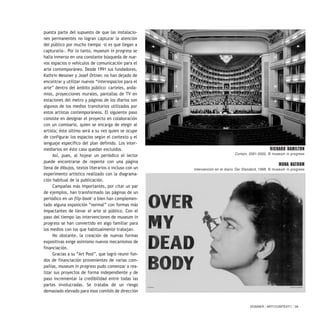
ArT CulTurE NEW mEdiA
ArTE CulTurA NuEvOs mEdiOs
Revista
trimestral
•
Quarterly
magazine
Número
2
•
Issue
2
18
€
•
23
$
USA
ARTECONTEXTO
DOSSIER: OTRAS FORMAS DE VISIBILIDAD / ALTERNATIVE FORMS OF VISIBILITY
Justo Pastor Mellado, Santiago B. Olmo, Lorenz Seidler,
Simon Njami, Andrés Isaac Santana, Alicia Murría
ENTREVISTA / INTERVIEW: Alexander Apóstol
Cibercontexto. Noticias / News. Libros / Books. Criticas / Reviews
DOSSIER: OTRAS FORMAS DE VISIBILIDAD / ALTERNATIVE FORMS OF VISIBILITY
Justo Pastor Mellado, Santiago B. Olmo, Lorenz Seidler,
Simon Njami, Andrés Isaac Santana, Alicia Murría
ENTREVISTA / INTERVIEW: Alexander Apóstol
Cibercontexto. Noticias / News. Libros / Books. Criticas / Reviews
Directora / Editor
Alicia Murría
directora@artecontexto.com
Subdirectora / Senior Editor
Ana Carceller
redaccion@artecontexto.com
Coordinación para Latinoamérica
Latin America Coordinator:
Eva Grinstein
redaccion@artecontexto.com
Equipo de redacción / Editorial Staff:
Alicia Murría, Natalia Maya Santacruz,
Ana Carceller, Eva Grinstein,
Santiago B. Olmo.
redaccion@artecontexto.com
Asistente Editorial / Editorial Assistant:
Natalia Maya Santacruz,
redaccion@artecontexto.com
Directora de Publicidad
Advertising Director:
Marta Sagarmínaga
publicidad@artecontexto.com
Suscripciones / Subscriptions:
suscripciones@artecontexto.com
Distribución / Distribution:
distribucion@artecontexto.com
COEDIS S.L.
coedis@coedis.com
Oficinas / Office:
C/ Santa Ana 14, 2º C. 28005 Madrid. España
tel. 34 91 3656596
Diseño / Design:
El Viajero: www.elviajero.org
Traducciones / Translations:
Dwight Porter, Jane Brodie,
Juan Sebastián Cárdenas, Benjamin Johnson
Colaboran en este número / Contributors:
Justo Pastor Mellado, Lorenz Seidler, Andrés Isaac Santana,
Simon Njami, David Casacuberta, Eva Grinstein,
Alicia Murría, Santiago Olmo, Agnaldo Farías,
Natalia Maya Santacruz, Luis Francisco Pérez,
Francisco Baena, Pedro Medina Reinon, Mariano Navarro,
Mariano Mayer, Alejandra Agüado, Uta M. Reindl,
Miguel Wandschneider, Alvaro de los Ángeles,
Xavier Sáenz de Gorbea, Pablo Helguera.
Especial agradecimiento / Special thanks:
Horacio Lefèvre, Juan Sebastián Cárdenas
La entrevista con Alexander Apóstol es una versión de la
realizada para Kontemporánea / proyecto de arte
de Buenos Aires.
ARTECONTEXTO arte cultura nuevos medios
es una publicación trimestral de:
ARTEHOY Publicaciones y Gestión, S.L.
Impreso en España
Fotomecánica: LUCAM
Impreso: CROMOIMAGEN
ISSN 1697-2341
Depósito legal: M-1968–2004
Todos los derechos reservados. Ninguna parte de esta
publicación puede ser reproducida o transmitida por ningún
medio sin el permiso escrito del editor.
All rights reserved. No part of this publication may be
reproduced or transmitted by any means without written
permission from the publisher.
© de la edición: ARTEHOY Publicaciones y gestión, S.L.
© de las imágenes, sus autores
© de los textos, sus autores
© de las traducciones, sus autores
© de las reproducciones, VEGAP. Madrid 2004.
art culture neW media
arte cultura nuevos medios
5 Primera página / Page One
Alicía Murría
Dossier:
OTRAS FORMAS DE VISIBILIDAD / ALTErNATivE fOrmS Of viSibiLiTy
8 Fragilidad institucional, impostura política, nuevas visualidades: Informe de campo.
institutional fragility, Political imposture and New visualities: report from the field.
Justo Pastor Mellado
22 La utopía posible en la precariedad. [Conversación con Michy Marxuac]
Possible utopias within Precariousness. [ideas from a Conversation
with michy marxuach]
Santiago B. Olmo
38 Progress in Progress. [museum in progress. Viena]
Progress in Progress. [museum in progress. vienna]
Lorenz Seidler
46 Artistas en busca de libertad, apuntes sobre la situación en África.
Artists Looking for freedom, Notes on African Situation.
Simon Njami
58 En el reverso de la autoridad: Sobre alternativas y la brisa del mar...
The reverse Side of Authority: On Alternatives and the Sea breeze...
Andrés Isaac Santana
70 Madrid. Alternativas en la gestión artística.
madrid. Alternative Options for Artistic management.
Alicia Murría
79 América Latina, por más y mejores redes. [Entrevista con Alexander Apóstol]
Latin America, Towards more and better Networks. [interview with Alexander Apóstol]
Eva Grinstein
92 Cibercontexto
David Casacuberta
100 Noticias / News
116 Libros / books
118 Críticas de exposiciones / reviews
Nº 2
SUMARIO
CONTENTS
PAGE ONE
PAGE ONE
After the first issue of ARTECONTEXTO was
published in February, and while the second
issue was being prepared for publication in
early May, Spain underwent an upheaval
that significantly altered the political
landscape. Pain and rage at the March 11
bomb attacks have had a profound impact
in Madrid, the city in which we live. We
would like to express our appreciation here
for the messages of solidarity we have
received, and very especially those from
Latin America.
In a single week, horror in the face of
tragedy, manipulation of the news,
indignation, protest demonstrations and the
change of political direction determined by
the voters left us with the sensation of
having experienced, in only four days,
events which will take much more time to
be fully assimilated. But, with a mixture or
sadness and hope, we carry on.
In our second issue we wanted to examine,
from different viewpoints and geographic
locations, the transformations taking place
with respect to the visibility of art, the new
behaviour of artists, managers, and curators
who realise that the traditional means of
showing and relating artistic productions
now call for other media, other discourses,
and even other spaces in which to make
contact with the spectator, who, in many
instances, has become an integral part of
these experiences, becoming central to
these new practices, as an essential and
active element in them. A kind of work is
now going on that is aimed both at the
production of objects and at the experiences
and actions within the framework of social
processes, spreading beyond the strictly
artistic sphere, and while this is not new
–the 1960s and 1970s saw these options
actively exercised– it is today that this type
of approach is being accepted more broadly,
to the point that it risks becoming banal. In
other instances, instead of an impulse to
find alternatives to the well-trodden paths,
the problems being addressed are those of
the pure precariousness of structures, which
render unviable the normal progress of
work. At all events, if artistic practices lack
the capacity to bring about social change
–and we must not be naïve– they can and
do activate individual changes, if only in
those who are already open and sensitive to
them; this has always been one of their
purposes, however radical be the alterations
in their contents, aspects, ways of
proceeding, or final results.
Let us not fail to mention that in this new
political period that is now beginning, the
Ministry of Culture has much to accomplish
on many fronts. The statements made by
the new Minister are encouraging; but her
first job is to appoint as head of the various
agencies people who are well-acquainted
with each cultural sphere; and above all,
it is the job of the administration to create
channels for exchange and to activate the
participation of the groups involved, but
these groups should also adopt attitudes
intended to assume their own
responsibilities and not merely wait for the
administration to design cultural policies.
Alicia Murría
PRIMERA PÁGINA
PRIMERA PÁGINA
Entre el primer número de ARTECONTEXTO,
que se publicó en febrero y la aparición del
número 2, en los primeros días de mayo,
nuestro país ha sufrido una profunda
convulsión y notables cambios en su paisaje
político. El dolor y la rabia frente a los
atentados del 11 de marzo han dejado una
huella profunda, especialmente en Madrid, la
ciudad en la que vivimos. Desde aquí
queremos agradecer las muestras de
solidaridad recibidas y muy especialmente las
que fueron llegando desde Latinoamérica.
En una misma semana el horror ante la
tragedia, la manipulación informativa, la
indignación, las manifestaciones de protesta
y el cambio de signo que se manifestó en las
urnas nos dejaron la sensación de haber
vivido, en sólo cuatro días, acontecimientos
que necesitaban mucho más tiempo para ser
asumidos. Pero, con una mezcla de tristeza y
esperanza, seguimos adelante.
En nuestro segundo número hemos querido
acercarnos, desde diferentes puntos de vista
y lugares geográficos, a las transformaciones
que se están produciendo respecto a las
formas de visibilidad del arte, a los nuevos
comportamientos de artistas, gestores y
comisarios que son conscientes de cómo las
maneras tradicionales de exponer y relacionar
las producciones artísticas necesitan otros
medios, otros discursos e incluso otros
espacios donde establecer contacto con el
espectador que, en muchos casos, ha pasado
a ser parte indisoluble de esas experiencias,
ocupando el centro de las nuevas prácticas
como elemento esencial y activo de las
mismas. Se está llevando a cabo un tipo de
trabajos que no sólo atienden a la producción
de objetos sino que ponen el énfasis en las
experiencias y en las actuaciones en el marco
de los procesos sociales, desbordando el
ámbito estrictamente artístico y, aunque ello
no resulte nuevo –las décadas de los sesenta
y setenta fueron activas respecto de estas
opciones– es ahora cuando este tipo de
planteamientos se asume de una manera más
amplia, también con el riesgo de su
banalización. En otros casos, más que una
voluntad de encontrar alternativas a los
caminos ya conocidos, los problemas a
solucionar son los de la pura precariedad en
las estructuras que hacen inviable un
desarrollo normalizado del trabajo.
En cualquier caso, si las prácticas artísticas
no tienen la capacidad de provocar cambios
sociales –no hay que ser ingenuos– sí
pueden activar cambios individuales, aunque
sólo sea en aquellos que, de antemano, se
muestran abiertos y sensibles a ellos; desde
siempre esa ha sido una de sus funciones,
aunque cambien radicalmente sus
contenidos, su aspecto, los modos de hacer o
su resultado final.
No queremos dejar de mencionar que, en
esta nueva etapa política que se abre ahora,
hay mucho por hacer en múltiples frentes por
parte del Ministerio de Cultura; las
declaraciones de la nueva Ministra parecen
alentadoras; pero ante todo será preciso
colocar al frente de los diferentes organismos
a personas que conozcan a fondo la realidad
de cada uno de los ámbitos de la cultura y,
sobre todo, es tarea de la administración
pública crear canales de intercambio y activar
la participación de los sectores implicados,
pero también estos deberán adoptar actitudes
encaminadas a asumir sus propias
responsabilidades en esos cambios necesarios
y no sólo esperar que sea la administración la
que diseñe las políticas culturales.
Alicia Murría
________________
________________
________________
________________
________________
________________
________________
Justo Pastor Mellado / SANTIAGO B. OLMO / LORENZ SEIDLER / SIMON NJAMI / Andrés Isaac Santana / ALICIA MURRÍA
_________DOSSIER:
___OTRAS FORMAS DE VISIBILIDAD
________________
________________
________________
________________
________________
ALTERnATIVE FORMS OF VISIBILITy
La pregunta que se plantea en relación a la existencia de
otras formas de producir y exponer el arte por parte de
artistas y curadores, o artistas metidos a curadores, como
sobre las fisuras que se han abierto en los modelos tradi-
cionales de exhibición es una grave incitación al desarro-
llo de estudios de campo en las escenas artísticas en las
que nos cabe trabajar. La gravedad del asunto tiene que
ver con la imposibilidad de sostener un discurso generalis-
ta sobre la cuestión, dadas las extremas diferencias de for-
taleza institucional existentes en las formaciones
artísticas en que operamos. Es decir, la incitación provie-
ne del deseo de saber cómo una preocupación editorial
hace avanzar el conocimiento sobre la articulación de
variadas coyunturas de intercambio, de cooperación
internacional y de transferencia informativa. La gravedad
tiene que ver además con la proyección de la pregunta y
su grado de interpelación al discurso académico y al dis-
curso de las “curatorías de servicio”. Se trata, en verdad,
de dos objetos de acometida con los cuales es preciso
enfrentar el debate, porque ambos discursos han hecho de
la fisura una academia. Es de suponer que la pregunta
posee diversa intensidad de formulación en sociedades de
institucionalidad artística dura y en formaciones de insti-
tucionalidad artística en condiciones de fragilización.
Entonces, no queda más que proponer un recorrido de
aproximación a partir de la experiencia que hemos podido
sistematizar en el contacto con escenas de producción
diversas.
En marzo de 2003, en la última versión de los
“Diálogos Iberoamericanos” que se desarrollan rituamente
8 / ARTECONTEXTO / DOSSIER
Justo Pastor Mellado
Argentina, Brasil, Chile...
FRAGILIDAD INSTITUCIONAL,
IMPOSTURA POLÍTICA
Y NUEVAS VISUALIDADES:
INFORME DE CAMPO
DOSSIER / ARTECONTEXTO / 9
en Valencia, se abordó1
el problema haciendo referencia a
una situación distintiva básica: la crisis de los modelos de
exhibición tradicionales es tan solo un síntoma de las com-
plejas relaciones que las prácticas artísticas entablan con
los poderes públicos y privados que determinan sus condi-
ciones de circulación. Cuando, en un país como Brasil, se
desarrolla una política de reconversión de las instituciones
de exhibición, mediante la implementación de centros de
arte sostenidos por grandes empresas que completan de
manera perversa las iniciativas y las ofertas que desde el
Estado se desarrollan en un terreno análogo, la prolifera-
ción de grupos y de asociaciones de artistas, que buscan
alternativas de exhibición, se plantea no tanto como una
respuesta a una crisis de funcionamiento del sistema sino
como una institucionalización de la propia alternativa,
desplazando hacia el campo artístico modelos de interven-
ción social que han mostrado una relativa eficacia en el
campo político y social. Es probable que ello provenga de
una experiencia de negociación política compleja, no
exenta de violencia real y simbólica, que atraviesa la
socialidad brasileña. En cierto sentido, la fisura institucio-
nal adquiere un valor de vector indicativo que la propia
institucionalidad requiere para validar sus reformas de
mantenimiento. Es como si se planteara esa fisuralidad de
las instituciones museales clásicas para legitimar la acción
reparadora de las nuevas inversiones en espacios de exhi-
bición dispuestos a acoger nuevas experiencias. En esta
cadena, resulta lógico pensar que este contexto favorece
la emergencia de iniciativas culturales y de productivida-
des artísticas que no accederán a los espacios de exhibi-
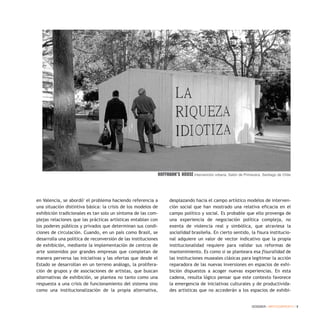
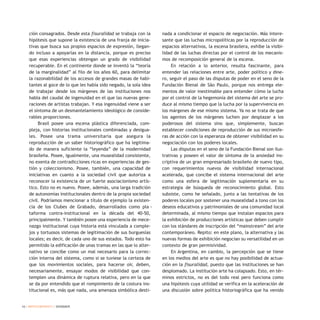
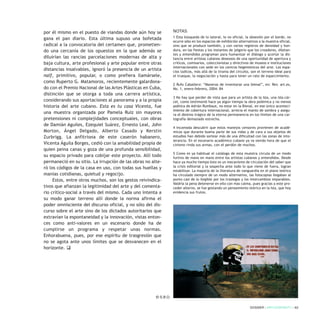
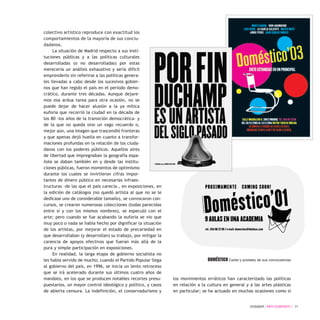
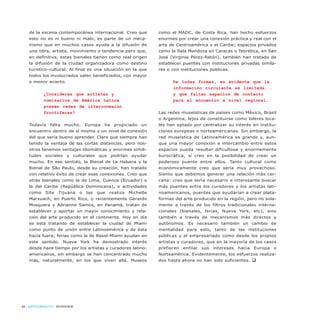
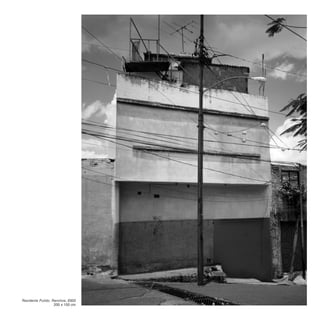
Hoffmann’s House Intervención urbana. Salón de Primavera. Santiago de Chile
ción consagrados. Desde esta fisuralidad se trabaja con la
hipótesis que supone la existencia de una franja de inicia-
tivas que busca sus propios espacios de expresión, llegan-
do incluso a apoyarlas en la distancia, porque es preciso
que esas experiencias obtengan un grado de visibilidad
recuperable. En el continente donde se inventó la “teoría
de la marginalidad” al filo de los años 60, para delimitar
la razonabilidad de los accesos de grandes masas de habi-
tantes al goce de lo que les había sido negado, la sola idea
de trabajar desde los márgenes de las instituciones nos
habla del caudal de ingenuidad en el que las nuevas gene-
raciones de artistas trabajan. Y esa ingenuidad viene a ser
el síntoma de un desmantelamiento ideológico de conside-
rables proporciones.
Brasil posee una escena plástica diferenciada, com-
pleja, con historias institucionales combinadas y desigua-
les. Posee una trama universitaria que asegura la
reproducción de un saber historiográfico que ha legitima-
do de manera suficiente la “leyenda” de la modernidad
brasileña. Posee, igualmente, una musealidad consistente,
no exenta de contradicciones ricas en experiencias de ges-
tión y coleccionismo. Posee, también, una capacidad de
iniciativas en cuanto a la sociedad civil que autoriza a
reconocer la existencia de un fuerte asociacionismo artís-
tico. Esto no es nuevo. Posee, además, una larga tradición
de autonomías institucionales dentro de la propia sociedad
civil. Podríamos mencionar a título de ejemplo la existen-
cia de los Clubes de Grabado, desarrollados como pla -
taforma contra-institucional en la década del 40-50,
principalmente. Y también posee una experiencia de mece-
nazgo institucional cuya historia está vinculada a comple-
jos y tortuosos sistemas de legitimación de sus burguesías
locales; es decir, de cada uno de sus estados. Todo esto ha
permitido la edificación de unas tramas en las que lo alter-
nativo se concibe como un mal necesario para la correc-
ción interna del sistema, como si se tuviese la certeza de
que los movimientos sociales, para hacerse oír, deben,
necesariamente, ensayar modos de visibilidad que con-
templen una dinámica de ruptura relativa, pero en la que
se da por entendido que el rompimiento de la costura ins-
titucional es, más que nada, una amenaza simbólica desti-
nada a condicionar el espacio de negociación. Más intere-
sante que las luchas micropolíticas por la reproducción de
espacios alternativos, la escena brasilera, exhibe la visibi-
lidad de las luchas directas por el control de los mecanis-
mos de recomposición general de la escena.
En relación a lo anterior, resulta fascinante, para
entender las relaciones entre arte, poder político y dine-
ro, seguir el paso de las disputas de poder en el seno de la
Fundación Bienal de São Paulo, porque nos entrega ele-
mentos de valor inestimable para entender cómo la lucha
por el control de la hegemonía del sistema del arte se pro-
duce al mismo tiempo que la lucha por la supervivencia en
los márgenes de ese mismo sistema. Ya no se trata de que
los agentes de los márgenes luchen por desplazar a los
poderosos del sistema sino que, simplemente, buscan
establecer condiciones de reproducción de sus microesfe-
ras de acción con la esperanza de obtener visibilidad en su
negociación con los poderes locales.
Las disputas en el seno de la Fundación Bienal son ilus-
trativas y poseen el valor de síntoma de la ansiedad ins-
criptiva de un gran empresariado brasileño de nuevo tipo,
con requerimientos nuevos de visibilidad internacional
acelerada, que concibe el sistema internacional del arte
como una esfera de legitimación suplementaria en su
estrategia de búsqueda de reconocimiento global. Esto
subsiste, como he señalado, junto a las tentativas de los
poderes locales por sostener una musealidad a tono con los
deseos educativos y patrimoniales de una comunidad local
determinada, al mismo tiempo que instalan espacios para
la exhibición de producciones artísticas que deben cumplir
con los stándares de inscripción del “mainstream” del arte
contemporáneo. Repito: en este plano, la alternativa y las
nuevas formas de exhibición negocian su versatilidad en un
contexto de gran permisividad.
En Argentina, en cambio, la percepción que se tiene
en los medios del arte es que no hay posibilidad de actua-
ción en la fisuralidad, puesto que las instituciones se han
desplomado. La institución arte ha colapsado. Esto, en tér-
minos estrictos, no es del todo real pero funciona como
una hipótesis cuya utilidad se verifica en la aceleración de
una discusión sobre política historiográfica que ha venido
10 / ARTECONTEXTO / DOSSIER
a poner, también, los puntos sobre las íes en la cuestión de
lo “alternativo” en nuestra zona. De este modo, los artis-
tas y gestores se auto-organizan para producir pequeñas
zonas de organicidad mínima con voluntad institucionali-
zante, buscando re-establecer unas plataformas adecua-
das de legitimación de sus experiencias. Pero es un hecho
que dichas zonas de institucionalidad mínima no pueden
resistir por largo tiempo si no establecen redes y tramas de
subsistencia más amplias, que les permitan realizar nego-
ciaciones con instituciones mayores o, al menos, sostener
en un tiempo prolongado sus experiencias sectoriales. Es
así como se han levantado iniciativas, como Revista
Ramona, Proyecto Trama, Fundación Espigas o Fundación
Proa, que han logrado la concertación de empresas y ges-
tores que, en un nivel de eficiencia ejemplar, han podido
instalar zonas de resguardo en el terreno de la documen-
tación, del archivo y del análisis de procesos. Todo esto,
por cierto, ha permitido el montaje de una zona institu-
cional de fuerte reconocimiento que viene a llenar un
vacío que ha dejado visible la gran retirada del Estado en
esos terrenos. Ya, solamente en el terreno del archivo,
Fundación Espigas ha ejercido funciones para-estatales,
declarando de manera evidente el propósito estratégica-
mente patrimonial de su cometido. El punto a discutir se
localiza en torno a las condiciones de permanencia de
dichas iniciativas.
El caso de Revista Ramona resulta ejemplar; ante la
ausencia de soportes específicos de debate crítico, ha
podido constituirse en plataforma de llegada de un nuevo
tipo de discusión que enfatiza sobre cuestiones de ubicui-
dad y reinscripción de redes de artistas y de discursividad,
que responde, también, a la emergencia de iniciativas aca-
démicas más abiertas que algunos departamentos universi-
tarios han comenzado a sostener sobre zonas poco
exploradas de la historiografía argentina; en particular, las
estrategias de internacionalización del arte argentino en
los años 60 y la reconstrucción documental de un fenóme-
no tan emblemático como Tucumán Arde (1969). A ello se
debe agregar el hecho, por lo demás curioso, de que en la
Argentina del colapso se hayan abierto tres espacios de
exhibición significativos: MALBA, Proa y la sala de
Telefónica. De este modo, resulta extraño preguntarse en
DOSSIER / ARTECONTEXTO / 11
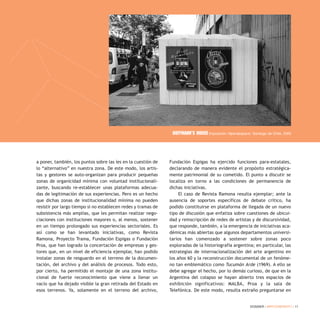
Hoffmann’s House Exposición Hiperdespacio. Santiago de Chile, 2000
Argentina por nuevas experiencias visuales o de interven-
ción en la musealidad cuando es desde la propia sociedad
civil de donde surgen algunas respuestas que lo que menos
tienen es una voluntad contra-estatal, sino que operan
como si les cupiera ejercer la función de responsables sus-
titutos en un momento de quiebra del sistema general del
arte. Es decir, en términos concretos, han pasado, a través
de una particular concertación, a ejercer plenamente las
funciones de “sistema del arte”.
Es respecto a este otro “sistema del arte” que se dibu-
jan, en unos márgenes realmente difusos, las acciones de
grupos de artistas y asociaciones directamente vinculados
a células partidistas y a organizaciones de Derechos Hu-
manos, en una perspectiva “delegacional” que, más que
nada, subordina las prácticas de apoyo gráfico a iniciativas
de rearticulación de los frentes políticos. No es posible
admitir que dichas iniciativas son, en modo estricto, con-
tra-institucionales sino todo lo contrario, se ejercen como
alternativas de acumulación de fuerzas para hacerse reco-
nocer ante el “sistema del arte” oficializado por la red de
instituciones a las que ya he hecho mención. Uno de los
ejemplos más claros de este fenómeno ha sido la oferta de
Revista Ramona a grupos autónomos de artistas con quie-
nes se encontraban y se cruzaban en diversos debates con-
vocados, paradójicamente en el MALBA, teniendo como
eje problemático la situación polar del “arte rosa” y del
“arte rosaluxemburgo”, como un giro paródico que pre-
tendía ajustar cuentas con el arte, supuestamente, despo-
litizado de los 80. Justamente, la oferta que dio lugar a
una plataforma de convocatoria electrónica bajo el título
“poner-el-cuerpo-en-los-ochenta”, pretendía resolver vie-
jas querellas de interpretación historiográfica entre artis-
tas de los años 80 e historiadores de los 90, en torno a una
acusación seria por parte de los primeros, en cuanto a que
los segundos habrían convertido sus luchas en un “espacio
curricular”; es decir, que gracias a su explotación habían
logrado conquistar un lugar en la universidad. Esta acusa-
ción resulta de gran valor para reconstruir la dimensión de
los equívocos en cuanto a las funciones e inscripción de
unos y otros en una estructura colapsada, en cuyo seno
ocurren desplazamientos significativos que tienen efectos
específicos en las estrategias de reconocimiento de las
franjas de artistas que trabajaron próximos a la sensibili-
dad de Madres de la Plaza de Mayo y, posteriormente, de
H.I.J.O.S 2
. Pero en este terreno de subordinación orgáni-
ca, los grupos alternativos que se forjaron en estos espa-
cios terminaron por descubrir que el nuevo exotismo
latinoamericano estaba localizado, no ya en los márgenes
de la cultura, sino en los márgenes de las organizaciones
sociales. Resulta obvio que, en este terreno, los márgenes
poseen un valor de intercambio, sobre todo si se piensan
en cuanto productividades forjadas como oferta disponible
para la mirada reconstructora de las “curatorías de servi-
cio”. Es la segunda vez que empleo el término: me refiero
a la distinción, en nuestra zona, entre “curatorías de ser-
vicio” (dispuestas a satisfacer las demandas de reparación
simbólica de instituciones de arte de las ciudades globales)
y “curatorías de infraestructura” (aquellas que, en zonas
de fragilidad historiográfica, hacen avanzar el trabajo de
historia, en función de los ejes que cada escena local legi-
tima).
Para terminar con la trilogía topográfica del “sur del
sur”, que resulta geopolíticamente diferenciada de los
12 / ARTECONTEXTO / DOSSIER
En Chile, la clase política se caracterizó
por pensar en los siguientes términos:
“¿para qué necesito institucionalidad
cultural si puedo convertir directamente
mi gusto privado en política pública?”.
valores artísticos del “norte del sur”, al menos en este
continente, es preciso declarar que en Chile no existe una
institucionalidad museal consistente y que la experiencia
de mecenazgo privado es relativamente reciente como
para esperar una respuesta aglutinadora del tipo argenti-
no. Resulta difícil encontrar experiencias de “nueva visua-
lidad” o nuevas formas de exhibición que rompan la
musealidad tradicional porque, en lo que a arte contem-
poráneo se refiere, no existe siquiera dicha tradición.
Tanto el Museo de Bellas Artes como el Museo de Arte
Contemporáneo no están en condiciones de acoger y com-
primir las experiencias de canonización de la contempora-
neidad. Pero esto es algo de lo que el propio sistema del
arte experimenta un gran orgullo, justamente por haber
podido estructurar dispositivos de retardamiento de las
transferencias informativas.
En Chile, la clase política se caracterizó por pensar en
los siguientes términos: “¿para qué necesito institucio-
nalidad cultural si puedo convertir directamente mi gusto
privado en política pública?”. Obviamente, esta sentencia
no podía seguir siendo formulada en un país que se ha edi-
ficado voluntariosamente la imagen de “buen alumno de
FMI” de modo que, para limitar nuestra pun-
tuación negativa en el cálculo del índice de
“riesgo país”, hemos podido dotarnos de un
flamante Ministerio de Cultura. De esta forma,
lo que se ha instalado en el país ha sido una
furia institucionalizante que no puede encu-
brir nuestro retraso orgánico en lo que a nueva
musealidad se refiere. De ahí que, más que
“nuevas visualidades”, lo que se advierte es un
deseo de completar rigurosamente las caren-
cias. ¿Para qué fomentar trabajos que pongan
en cuestión las viejas musealidades si, al
menos, deseamos tener algunas de ellas? Todo
está volcado, en consecuencia, hacia la insti-
tucionalización acelerada de todas las expe-
riencias. No se trata de concebir nuevos
espacios de exhibición como alternativa res-
pecto de alguna tradición expositiva sino, tan
solo, espacios que nunca antes habían existi-
do. A tal punto, que es en el interior de este “delirio insti-
tucionalizante” donde los artistas han optado por trabajar,
poniendo en escena sus propias imposturas simbólicas.
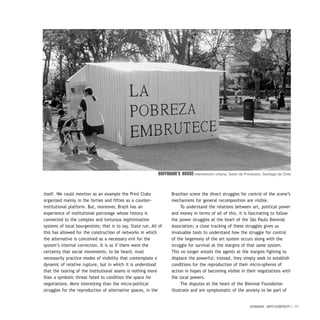
Es el caso, en Santiago de Chile, del “colectivo”
Hoffman´s House. Juegan con el apellido Hoffman, que
resulta ser un apellido relativamente común, de origen
germano. Pero le agregan una letra “s” después de la comi-
lla, que es como se hace en los títulos de peluquería o de
negocios de comida rápida. Y el House es la determinación
del atributo patrimonial. Hay muchos proyectos inmobilia-
rios que se levantan en Chile y que terminan con esta
designación. Y de hecho, Hoffmann´s House está concebi-
do como si fuera un proyecto inmobiliario, en la instalación
de la fábula del “deseo de casa” del arte chileno. Lo que
ocurre es que el arte chileno ha sido afectado por la espe-
culación. ¿Cómo habría que tomarlo? En este caso, los
artistas han elaborado una línea de sinonimia entre el valor
de la inversión metafórica y el valor del suelo. Pero han
trabajado, más que nada, parodiando los procesos de vali-
dación de las políticas de vivienda que han sido puestas en
ejecución por el Estado y organizaciones eclesiásticas.
Existe una en particular: “Un techo para Chile”. Existe
DOSSIER / ARTECONTEXTO / 13
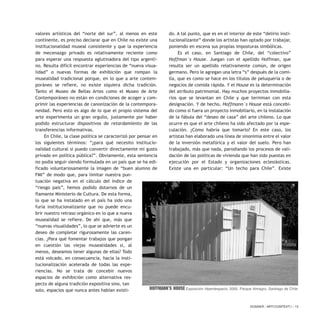
Hoffmann’s House Exposición Hiperdespacio, 2000. Parque Almagro, Santiago de Chile
otra, más antigua: “El Hogar de Cristo”. Esta última man-
tiene hospederías, la primera, en cambio, promueve el
acceso de las familias a la vivienda, por cierto, en una
política paralela a la del Estado en este terreno. Así, las
nuevas estrategias de acceso a la vivienda destierran las
prácticas de ocupación ilegal de terrenos que, en los 60-70
fueran fomentadas, en gran parte, por la izquierda extra-
parlamentaria y sacerdotes vinculados al socialismo. Es
decir, en los 70, ciudadanos en los “márgenes” del sistema
político y de la Iglesia en Chile, configuraron un “sistema
político” superpuesto. Pero hoy, la categoría de conflicto
ha sido sustituida por la categoría de la caridad. Los artis-
tas de Hoffmann´s House (Rodrigo Vergara y José Pablo
Díaz) retoman este diagrama de reparaciones sociales y lo
trasladan a la ejecución de proyectos que tienen en cuen-
ta la “crisis de vivienda” del arte chileno. Para ello ponen
en ejecución una serie de trabajos que consisten en la ins-
talación, junto a reconocidas instituciones del arte, una
“mediagua” 3
, que sirve de espacio de exhibición alterna-
tivo, pero utilizando la condición paródica de constituirse,
propiamente, en “espacio alternativo”, jugando a des-
mantelar la inflación victimista que este tipo de interven-
ciones supone.
No sólo se comportan como un colectivo, asumiendo
las pautas de actuación de un grupo de artistas que ope-
ran “en los márgenes” sino que montan trabajos, en abier-
to desafío a la normalidad social chilena, al convertir el
modelo de la “mediagua” en tasa mínima de habitabilidad,
no sólo de la condición de los “sin techo”, sino de la posi-
ción del artistas emergente que no puede desarrollar una
política de autonomía porque está sometido a pasar pri-
mero por el estadio del “artista allegado”, aquel que debe
aceptar antes su falencia de vivienda en el arte para
entender luego que ha someterse al rito de acceso de
quien debe pedir acogida en alguna casa ya constituida,
que le dará albergue dentro de unas condiciones de leal-
tad y de gratitud que serán fijadas por el dueño de casa.
El “artista allegado” vive del rebalse de las condiciones de
inscripción del dueño de casa. Esta es la condición que
estos artistas han puesto de relieve: la cuestión de los cos-
tos rituales, y de las operaciones simbólicas de control de
las políticas de autonomía, en una formación artística de
gran fragilidad institucional.
En este sentido, la “nueva visualidad” puesta en cues-
tión por esta pareja de artistas apunta a instalar el valor
referencial de un paradigma objetual de pacotilla, que
reproduce el proceso legitimante del “ready-made”, bajo
el supuesto de que esta procesualidad establece hoy el
rango del una “edad clásica” respecto de la que resulta
imperativo desmarcarse para dar curso, justamente, a
“nuevas objetualidades”. Esta operación, Hoffmann´s
House la ha iniciado en la configuración del nombre, que
se traduce libremente como “la casa del hombre de afue-
ra”, para preparar la versión de “el hombre de fuera de la
casa”. Se trata de un un “hombre/man/artista” que care-
ce de Casa (del Arte), en razón de lo cual traslada el obje-
to de deseo que satisface las condiciones mínimas de
representación no a título de “modelo reducido” ni de
maqueta de una pieza, sino como pieza visiblemente pre-
sente en su dimensión “natural”, esto es, artificial, cien-
tíficamente fundamentada por las teorías urbanas de
gestión de la crisis y definida, en su magnitud, por una
decisión (decretal) del Ministerio de la Vivienda (del Arte).
Estrategias de visibilización como estas, ponen en escena
crítica la eufórica impostura de base de las estrategias de
inversión artística que operan sobre fisuralidades institu-
cionales de diversa consistencia, desmontando las condi-
ciones de traslación de las representaciones desde las
zonas de crisis social hacia la especulación curatorial
(inmobiliaria). q
NOTAS
1 En concreto, fue abordado por Eva Grinstein y Fernando Cocchiarale.
2 H.I.J.O.S: siglas de la asociación Hijos por la Identidad y la Justicia con-
tra el Olvido y el Silencio, integrada fundamentalmente por hijos de desa-
parecidos durante la última dictadura argentina. (Nota de las editoras).
3 Mediagua: casa de madera, precaria, pequeña, con apenas condiciones
sanitarias y luz. Es un rectángulo de cuatro tabiques de madera, con techo
a dos aguas; son viviendas para emergencias que terminan siendo perma-
nentes.
14 / ARTECONTEXTO / DOSSIER
DOSSIER / ARTECONTEXTO / 15
A serious incitement to do field work in the art scenes lies
in the question related to the existence of other ways to
produce and expose art. This question is raised by artists and
curators or artists involved in curating. They also ask about
the fissures that have opened up in the traditional models of
displaying art.
The seriousness of the issue has to do with the
impossibility of sustaining a general discourse on the
question, given the extreme differences in the institutional
strengths of the artistic formations in which we operate.
That is to say, the incitement comes from a desire to know
how writing an article advances knowledge about the
articulation of various realities of exchange, of
international cooperation and of the circulation of
information. The seriousness also has to do with the
projection of the question and its degree of interpellation
in the academic discourse and in the discourse of “servile
curating”. It involves, truth to tell, two tools with which to
confront the debate because both discourses have made an
Justo Pastor Mellado
INSTITUTIONAL FRAGILITY,
POLITICAL IMPOSTURE
AND NEW VISUALITIES:
REPORT FROM THE FIELD
Argentina, Brazil, Chile...
16 / ARTECONTEXTO / DOSSIER
academy of the fissure. It can be supposed that the
question is formulated with different degrees of intensity
in societies highly institutionalizated and in those with
fragile artistic institutions. Thus, there is no alternative
but to propose an overview based on the experience that
we have been able to systematize through contact with
diverse production scenes.
In March 2003, at the last “Dialogos Iberoamericanos” in
Valencia, the problem was tackled1
by making reference to a
specific and basic situation: the crisis of the traditional
exhibition models is only a symptom of the complex
relations between artistic practices and the public and
private powers that determine the conditions of their
circulation. When in a country like Brazil the policy is to
reconvert the set of institutions of exhibition through the
implementation of art centers supported by large companies
which perversely complement the initiatives and proposals
that, from the State, take place in an analogous terrain, the
flurry of artists groups and associations that seek exhibition
alternatives do so not exactly as an answer to a crisis in the
system’s functioning; it is more an institutionalization of the
alternative itself, bringing to the artistic field models of
social intervention that have proven to be relatively
efficacious in social and political fields. This probably comes
out of experience with a complex political negotiation which
cuts through Brazilian society, a negotiation not exempt
from real and symbolic violence. In a certain way, this
fissure of institutions acquires the value of an indicative
vector which the institutionality itself requires in order to
validate its maintenance reforms. It’s as if the fissurability
of museum institutions were managed so as to legitimate
the healing action of new investments in exhibition space
available to new experiences. In this chain, it is logical to
think that this context favors the emergence of
cultural initiatives and artistic productivities that do
not have access to the established exhibition
spaces. From this fissurability emerges the
hypothesis that there is a strip of initiatives that
seeks its own spaces for expression, that even
supports these initiatives from a distance,
because it is crucial that these experiences
acquire a degree of visibility. In the continent
that invented “marginality theory” in the sixties
to define the rationability of the large masses of
inhabitants’ access to the pleasure that had been
denied to them, the mere idea of working from
the margins of institutions speaks of the wealth of
ingenuity where these new generations of artists
work. And this ingenuity turns out to be a symptom
of an ideological dismantling of considerable
proportions.
Brazil has a differentiated and complex scene in the
visual arts, one with unequal and combined institutional
histories. It has a network of universities that assures the
reproduction of a historiographical knowledge that has
adequately legitimized the “legend” of Brazilian modernity.
It has a firm museum system not exempt from rich
contradictions in administration and collection experiences.
It has a capacity for initiatives in terms of civil society that
authorizes recognizing the existence of a strong artistic
associationism. This is nothing new. It has, furthermore, a
long tradition of institutional autonomies within civil society
The Chilean political class has been
characterized by thinking in the
following terms: “What do I need
cultural institutionality for if I can turn
my private taste into public policy?”
DOSSIER / ARTECONTEXTO / 17
itself. We could mention as an example the Print Clubs
organized mainly in the forties and fifties as a counter-
institutional platform. But, moreover, Brazil has an
experience of institutional patronage whose history is
connected to the complex and torturous legitimization
systems of local bourgeoisies; that is to say, State run. All of
this has allowed for the construction of networks in which
the alternative is conceived as a necessary evil for the
system’s internal correction. It is as if there were the
certainty that social movements, to be heard, must
necessarily practice modes of visibility that contemplate a
dynamic of relative rupture, but in which it is understood
that the tearing of the institutional seams is nothing more
than a symbolic threat fated to condition the space for
negotiations. More interesting than the micro-political
struggles for the reproduction of alternative spaces, in the
Brazilian scene the direct struggles for control of the scene’s
mechanisms for general recomposition are visible.
To understand the relations between art, political power
and money in terms of all of this, it is fascinating to follow
the power struggles at the heart of the São Paulo Biennial
Association; a close tracking of these struggles gives us
invaluable tools to understand how the struggle for control
of the hegemony of the art system occurs along with the
struggle for survival at the margins of that same system.
This no longer entails the agents at the margins fighting to
displace the powerful; instead, they simply seek to establish
conditions for the reproduction of their micro-spheres of
action in hopes of becoming visible in their negotiations with
the local powers.
The disputes at the heart of the Biennial Foundation
illustrate and are symptomatic of the anxiety to be part of
Hoffmann’s House Intervención urbana. Salón de Primavera. Santiago de Chile
18 / ARTECONTEXTO / DOSSIER
the new Brazilian business class that requires quick
international visibility; this class thinks of the international
art system as a supplementary sphere of legitimacy in their
strategy to gain recognition around the world. This
endures, as I have pointed out, along with the attempts of
local powers to sustain a museum system in keeping with
the educational and patrimonial desires of a determined
local community. At the same time, that community sets
up spaces for the exhibition of artistic productions that
must meet the standards of contemporary art’s
mainstream. I repeat: on this level, the alternative and the
new forms of exhibition negotiate their versatility in a
highly permissive context.
In Argentina, on the other hand, the perception in art
circles is that there is no way to handle fissurability given
the fact that the institutions have caved in. The institution
of art has collapsed. This is not strictly true, but it does
serve as a hypothesis whose usefulness is verified in the
speeding up of a discussion about historigraphic policy that
has come to pinpoint the question of the “alternative” in our
region. Thus, artists and administrators organize themselves
with an institutionalizing drive to produce small areas of
minimal structure, seeking to re-establish fitting platforms
for legitimization of their experiences. It is a fact, however,
that these zones of minimal institutionality can not endure
for long if they do not set up greater networks and webs for
subsistence, ones that enable them to negotiate with larger
institutions or, at least, sustain their particular experiences
for a prolonged period. This is how initiatives like Revista
Ramona, Proyecto Trama, Fundación Espigas, Fundación Proa
have come into being; they have managed to bring together
companies and administrators who, with exemplary
efficiency, have been able to set up protective areas in the
fields of documentation, archive and analysis of processes.
All of this, certainly, has allowed for the building of a widely
recognized institutional zone that fills the visible gap left by
the withdraw of the State from these areas. In the field of
archives alone, The Fundación Espigas has performed para-
State functions, declaring strategically its purpose: to
establish a cultural patrimony. The point to debate revolves
around the sustainability of these initiatives.
The Ramona case is exemplary. Faced with the absence
of specific supports for critical debate, it has been able to
constitute itself as center stage for a new type of
discussion. This discussion emphasizes questions of the
ubiquity and reinscription of artists’ networks and of
discursivity; it also responds to the emergence of more open
academic initiatives that some university departments have
begun to sustain about little explored zones of Argentine
historiography; specifically, Argentine arts strategies for
internationalization in the sixties and the documentary
reconstruction of a phenomenon as emblematic as “Tucuman
Arde” (1969). To this we must add the curious fact that in a
shattered Argentina three significant exhibition spaces have
opened: Malba, Proa and the Telefonica Space. Thus, it is
strange to wonder about new visual experiences in Argentina
or about intervention in the museum system when it is from
the very civil society that some answers arise. The last thing
these responses have is a counter-State drive since they
operate as if they could function as responsible substitutes
for the State at a moment when the general art system has
crumbled. That is to say, through a particular accord they
have come to operate as the “art system” for all intents and
purposes.
Regarding this other “art system” the actions of groups
of artists and associations directly connected to partisan
cells and human rights organizations appear in some of the
system’s truly diffuse margins. These groups have the
outlook of a delegation; they mostly offer graphic support to
initiatives on the political front. Strictly speaking, it can not
be said that these initiatives are counter-institutional; on
the contrary, they act like alternative accumulations of
power to be recognized before the “system of art” made
official by the networks of institutions that I have
mentioned. One of the clearest examples of this
phenomenon is the Revista Ramona’s invitation to
autonomous groups of artists to get together and debate at
the Malba, of all places. In these debates, the polar
situation between “arte rosa” (literally “pink art”, a term
used to describe “light art” in Argentina in the 80s) and
“arte rosaluxemburgo” was taken as the central problem.
These debates sought to settle accounts with the supposedly
DOSSIER / ARTECONTEXTO / 19
depoliticized art of the 80. The electronic summons to this
event bore the title “put-the-body-in-the-eighties.” The
event itself set out to resolve old disputes revolving around
historiographic interpretation, disputes between artists from
the 80s and historians from the 90s; specifically, the serious
accusation of the former that the latter had turned their
struggles into a “circular space”; that is to say, that thanks
to the exploitation of the artists the historians had managed
to gain a place at the university. This accusation proved
extremely valuable in reconstructing the dimension of the
misunderstandings regarding the functions and positioning of
both groups (artists and historians) in a collapsed structure.
In the heart of this structure, meaningful shifts occur, ones
that have specific effects on the strategies for recognition
of artists that worked closely with the sensibility of Madres
de la Plaza de Mayo and, later, H.I.J.O.S2
. But in this terrain
of organic subordination, the alternative groups that were
forged in these spaces ended up discovering that the new
Latin American exoticism was no longer located at the
margins of culture but, rather, at the margins of social
organizations. It is obvious, then, that in this terrain the
margins have an exchange value, above all if they are
conceived as forged productivities available for the
reconstructive vision of “servile curating”. This is the second
time that I have used that term: I am referring to the
distinction in our region between “servile curating” (willing
Hoffmann’s House Hiperdespacio, 2000, Almagro Park, Santiago de Chile.
20 / ARTECONTEXTO / DOSSIER
to satisfy the demands of art institutions in globalized art
centers for symbolic compensation) and “infrastructure
curating” (those who, in areas of historiographic fragility,
advance the work of history in function of the axis that each
local scene requires).
To finish off with the typographical trilogy of the “south
of the south”, a zone that is geopolitically differentiated in
terms of artistic values from the “north of the south”, we
turn to Chile. It is necessary to affirm that in Chile there is
no firm institutional museum system and the experience of
private patronage is too recent to expect a unified response
of the Argentine variety. It is difficult to find experience of
“new visibility” or new forms of exhibition that break with
traditional museum systems because in terms of contemporary
art such a tradition does not even exist. Neither the Museo de
Bellas Artes nor the Museo de Arte Contemporáneo is in
condition to house experiences of canonizing the
contemporary. But this is something in which the self same art
system takes great pride: for having been able to structure
devices to delay the circulation of information.
The Chilean political class has been characterized by
thinking in the following terms: “What do I need cultural
institutionality for if can make my private taste into public
policy?” Obviously, this sentence could not continue to be
formulated in a country that has voluntarily constructed
itself as the “IMF’s good student” so much so that to put a
roof on the Chilean score in the “risk country” index, we
have been able to indulge in a brand new Ministry of
Culture. Thus, what has ensued in the country is a
institutionalizing fury which would not know how to cover up
our organic backwardness in terms of new museum systems.
From there, more than “new visibilities” there is a desire to
rigorously make up for lacks. Why encourage work that
questions old museum systems if we want to have some of
these systems? This leads to an accelerated
institutionalization of all experiences. This does not entail
conceiving new spaces for exhibition as an alternative to a
tradition, but rather conceiving hitherto non-existent spaces.
This is true to such a degree that it is within this
“institutionalizing frenzy” that artists have chosen to work,
staging their own symbolic impostures there.
In Santiago de Chile this is the case of the Hoffman´s
House “collective”. They play on the surname Hoffman
which is a relatively common German surname. But, like at
hairdressers or fast food restaurants, they add the letter “s”
after the apostrophe. And the House makes reference to
property. There are many real estate projects in Chile that
end like this. And, in fact, Hoffman House is conceived as if
it were a real estate project, part of the tale of Chilean
art’s “dream house”. Chilean art, though, has been affected
by speculation. How should that be taken? In this case, the
artists have worked a line of synonymy between the value of
the metaphorical investment and property value. But mostly
they have parodied the validation process of the housing
policies carried out by the State and ecclesiastical
organizations. Specifically, the phrases “A roof for Chile” and
a “A home for Christ”. This second one is found in inns,
whereas the first calls for giving families’ access to housing,
certainly a policy parallel to the State’s. Thus, the new
strategies of access to housing unearth the practices of
illegal occupation of lands which were supported in the 60’s
and 70’s by the extra-parliamentary left and priests linked to
socialism: that is to say, citizens at the margin of the
political system and the Church who in Chile make up a
parallel political system. But today the category of conflict
has been replaced by the category of charity. Rodrigo
Vergara and José Pablo Díaz, Hoffmann House’s artists, take
up this diagram of social compensation and apply it to
projects that consider the “housing crisis” in Chilean art. To
do so, they perform a series of operations that consist of
installing a “mediagua”3
, that serves as an alternative
exhibition space next to recognized art institutions. But they
take advantage of the parody implicit in the situation of
creating an “alternative space”, playing at dismantling the
victimizing inflation that this type of intervention implies.
Not only do they act as a collective, taking on the
norms of behavior of a group of artists that operates “in the
margins”, they also mount projects that openly challenge
Chilean social normality. They apply this “mediagua” model,
which is the minimum measure of inhabitability, not just to
the condition of the homeless, but also to the position of
the emerging artists. These artists can not carry out an
DOSSIER / ARTECONTEXTO / 21
autonomous policy because, initially, they are like
“supporting actors” who must accept their homelessness in
art to later understand that they must submit themselves to
the ritual for access of those who ask to be taken in to an
already existing house: to be sheltered under conditions of
loyalty and gratitude imposed by the owner of the house.
The “supporting actors” live off of the largesse of the owner
of the house, but are accountable to the conditions he
imposes. This is the fact that these artists have highlighted:
the ritual costs and the symbolic operations of control of
autonomy in an institutionally fragile system of establishing
an art career.
In this way, the “new visibilty” displayed by these two
artists aims to establish the referential value of a second
rate object paradigm. This paradigm reproduces the
legitimizing process of the “ready made” taking for granted
that today said process takes on the status of a “classical
age” in relation to which it is necessary to mark out “new
objectabilities”. Hoffmann’s House begins this operation in
its name, that could be roughly translated as “the house of
the man outside” to then say “the man outside the house”.
This involves a “man/artist” who lacks a House (in Art)
which is why he shifts the object of desire that satisfies the
minimal conditions of representation. He does not perform
this shift neither in the name of a “reduced model” nor as a
model of a piece, but rather as a piece visibly present in its
“natural” dimension; that is to say, artificial, scientifically
grounded on urban theories of crisis management, whose
magnitude is defined by a decision (decree) by the Ministry
of Housing (of Art). Such strategies of visibility critically
stage the feigned euphoria at the base of strategies of
artistic investment that operate on varyingly firm
institutional fissures. These strategies dismantle the
conditions for shifting representations of areas of social
crisis to (real estate) curatorial speculation. q
English translation: Jane Brodie.
NOTES
1 Specifically, Eva Grinstein and Fernando Cocchiarale have tackled
the problem.
2 H.I.J.O.S: acronym for the association Hijos por la Identidad y la
Justicia, contra el Olvido y el Silencio (Sons and Daughters for
Identity and Justice and against Forgetting and Silence), whose
members are mostly children of those disappeared during the last
military dictatorship (Editor’s Note).
3 Mediagua: small precarious wooden house that only meets the
lowest standards in terms of infrastructure. It is a rectangle made
from four wooden partitions with a slanted roof; these homes are
created for conditions of economic emergency, but end up being
permanent dwellings.
Durante la década de los años noventa el panorama artístico
contemporáneo ha estado dominado por una creciente insti-
tucionalización que se ha traducido tanto en la creación de
nuevos espacios museísticos como en la proliferación de bien-
ales. Ambos fenómenos reflejan estrategias de redefinición
urbana y son impulsados a partir de operaciones políticas
ligadas a una voluntad de inserción en el mapa global del
turismo y de los servicios. El museo y la bienal cumplen pues
una función claramente subsidiaria en relación a las priorida-
des de reconversión económica y de relanzamiento mediático
de las ciudades. De este modo tanto las nuevas instituciones
como las bienales se encuentran por lo general sometidas a
un estricto control político (consistente en un complejo
entramado de mediaciones e intereses) que las convierte
sobre todo en unos eficaces instrumentos de reordenación y
transformación de la trama urbana, mientras que su capaci-
dad de renovación artística queda reducida a la perpetuación
de esquemas convencionales de exhibición y presentación.
Aunque algunas de las bienales periféricas, como
Johanesburgo en Africa del Sur o Kwangju en Corea, intenta-
ron deslocalizar la idea de centro para el arte, así como rede-
finir nuevas formas de diálogo entre artistas de diferentes
22 / ARTECONTEXTO / DOSSIER
SANTIAGO B. OLMO
La utopía posibLe
en La precariedad
Ideas a partir de una conversación
con Michy Marxuach
contextos; sus objetivos, sus fracasos y sus logros quedaron
de alguna manera paralizados o al menos en suspensión, sin
una continuidad de renovación, que era lo que podía espe-
rarse. Ambas ciudades habían sido escenarios de importan-
tes protestas civiles: Johanesburgo y Soweto, su ciudad
satélite, fueron durante años el núcleo de resistencia al
apartheid, y Kwangju fue uno de los centros de las protes-
tas generalizadas contra el gobierno de Choon Doo Hwan,
cuya represión causó centenares de muertos. Estas bie-
nales planteaban una nueva forma de reivindicación urba-
na y, desde el punto de vista artístico, se proponían la
necesidad de abordar los retos de la globalización a través
de nuevas lecturas del presente y de otras fórmulas de diá-
logo. Sin embargo y a pesar de que sus éxitos fueron muy
distintos1
ambas bienales incidieron en la necesidad de ins-
titucionalización, consolidando la figura del comisario, del
curador, como eje del discurso artístico. También reformu-
laban el discurso del museo y de la institución, en una
situación de deslocalización, pero tendían a convertir la
ciudad en un museo, trasladando los criterios y condicio-
nes de la institución museística a un espacio-ciudad
fragmentado en diversos espacios. Mientras, en
el plano teórico las lecturas tendían a maqui-
llar la noción de main-stream, sin profundizar
en alternativas que fueran a la vez rigurosas y
novedosas, tal y como pudo constatarse en la
última edición de Documenta, dirigida preci-
samente por Okwui Enwezor, también comisa-
rio general de la II Bienal de Johanesburgo en
1997, la edición estrella.
Durante los años setenta la idea y la
estructura de la exposición fueron redefinidas
desde ciertas prácticas conceptuales a través
de la introducción de la información y el
archivo como un método de desmaterializa-
ción de la obra artística, que reflejaba también
la fragmentación del proceso mental en la articu-
lación de los discursos. En cierto modo el arte concep-
tual responde en esos años a un análisis de las tensiones
entre lo visual y el lenguaje, cuyas raíces hay que buscar
en la tradición anglosajona de la filosofía del lenguaje y la
filosofía analítica y, muy especialmente, en el legado de
Ludwig Wittgenstein. El lenguaje, la escritura y sus diver-
sas fórmulas de codificación se cargan de valores visuales y
construyen ambientes dotados de una diferente objetuali-
dad que refuerza la percepción en actitudes de concentra-
ción y análisis. Los desarrollos de estas estrategias van a
abrir perspectivas más complejas de análisis, a través de
las obras de artistas como Marcel Broodthaers, On Kawara,
Art & Language o Antoni Muntadas, en cuyo trabajo se
entrecruzan una multiplicidad de referencias, también
televisivas y del ámbito de la comunicación.
Sin embargo, aunque la desmaterialización conceptual
afectó de manera decisiva a la idea de exposición, no puso
en cuestión de manera determinante a la institución museo
que integró muy fácilmente estas propuestas tanto en el
plano expositivo como en el relativo a la colección2
. Algo
semejante ocurre con la eclosión del vídeo, como una prác-
tica artística extendida, que introdujo importantes cam-
bios en la estructura y discurso de la idea exposición, pero
el espacio museo estaba preparado para asumirlo e incluso
sus colecciones.
Una de las direcciones más fecundas de las transfor-
maciones actuales parece situarse en un análisis de la ins-
titución museo, en la necesidad de su flexibilización pero
también en la importancia de su definición en su función
(social y artística), así como en una especialización a tra-
DOSSIER / ARTECONTEXTO / 23
Durante los años setenta la idea y la estructura
de la exposición fueron redefinidas desde ciertas
prácticas conceptuales a través de la introducción
de la información y el archivo como un método de
desmaterialización de la obra artística
vés de programaciones coherentes. Una consideración
abierta del museo tendería a encajar el análisis de los seg-
mentos de audiencia de museos y exposiciones en un
marco de posibilidades y no solo de resultados económi-
cos. También tiende a poner en cuestión la idea de que
una exposición deba adoptar la espectacularización o el
museo acercarse al parque temático para obtener buenos
resultados.
Si el museo (como espacio y como institución) está
actualmente afrontando diversos niveles de crisis en
Europa y en los Estados Unidos, en otros ámbitos donde el
museo vive situaciones muy precarias esta crisis es aún más
aguda en cuanto que ni siquiera está disponible un modelo
fuerte frente al que actuar. Así ocurre en muchos países de
América Latina donde la institución museo ha quedado
obsoleta y paralizada en un planteamiento anacrónico
antes de poder alcanzar una mínima actualización. En este
contexto el trabajo y los esfuerzos tienen no solo la inten-
ción de crear y explorar nuevos modelos, también aparece
implícito el intento de que los museos asuman su propia
responsabilidad como institución. Un mínimo diálogo es
necesario.
Por eso muchas de las iniciativas que en América Latina
han abordado la posibilidad de articular otras maneras de
exhibir y de actuar han intentado intervenir en el espacio
del museo. Tal es el caso de Colloquia, un grupo de acción
y gestión que impulsado por el artista Luis González Palma
y la crítica y curadora independiente Rosina Cazali, en
Guatemala, y que a finales de los años noventa reunió a un
heterogéneo grupo de artistas y activistas culturales, lle-
gando a hacerse cargo de la programación del Museo de
Arte Moderno de la ciudad de Guatemala por un breve
periodo de tiempo. En otros ámbitos, como Nicaragua,
Artefactoría, impulsado por Raúl Quintanilla, también en
los años noventa, intentó asumir el papel de espacio alter-
nativo a la galería comercial, publicando además una revis-
ta, Artefacto, con sumarios en los que se acogían tanto
proyectos de artistas como ensayo o creación literaria den-
tro de un contexto muy difícil y precario en el que no fun-
cionaban instituciones y había una ausencia de mercado
para el arte menos convencional3
. En San José de Costa
Rica, Virginia Pérez Ratón funda Teorética, un pequeño
espacio expositivo sin ánimo de lucro, financiado con apor-
taciones privadas y públicas internacionales muy diversas
que en poco tiempo asume, sin proponérselo, un papel pro-
pio de una institución, exhibiendo en su programación a
artistas internacionales, regionales y también locales e
impulsando una incipiente integración centroamericana a
través de un encuentro de curadores, críticos y artistas de
la región4
. La presencia de artistas de Centroamérica y el
Caribe en algunas bienales internacionales se debe a que
han sido comisariadas desde estas zonas; paralelamente
surgen voces críticas y de curadores independientes desde
los propios equipos de trabajo, lo que constituye clara-
mente una sustitución o apropiación de la institución en
los términos de funcionamiento del “mundo artístico de-
sarrollado”.
Ahora bien, la apertura de espacios que podríamos
definir como alternativos no es suficiente para hablar de
cambios profundos. La “sustitución” de espacios puede
considerarse como un cambio superficial o escenográfico:
lo más decisivo e importante es justamente la perspectiva
del proyecto y sus planteamientos, así como la importancia
de la idea de proceso que sitúa automáticamente el énfa-
sis en la producción y en el diálogo como una estructura
básica de acción.
En Puerto Rico ha habido también un intento y éste ha
sido el punto de partida de Michelle Marxuach (todos la lla-
man Michy) que ha impulsado M&M Proyectos como una
posibilidad de actuar de una manera diferente en un espa-
cio donde domina la precariedad y donde los museos exis-
tentes no han asumido su función institucional dejando un
vacío que es posible ocupar desde otras perspectivas.
En conversación con M. Marxuach, ella define su pro-
yecto como “un espacio de producción y de gestión. En
ningún caso es una galería y mucho menos tiene intención
de asumir el papel de una institución. Los proyectos se
mueven según las necesidades de los artistas. La no defi-
nición permite una flexibilidad y una capacidad de adap-
tación a diferentes exigencias en diferentes momentos.
De alguna forma el proyecto determina las necesidades y
así, no es un espacio determinado el que impone las
características del propio proyecto. Este sistema es sin
duda muy caótico, trabajamos con la incertidumbre,
intentando manejarla y aceptando que se van a ir produ-
ciendo cambios. M&M Proyectos ha sido creado por la
24 / ARTECONTEXTO / DOSSIER
gente que ha estado implicada en el proyecto, mi papel es
el de facilitar y posibilitar”.
Los diversos eventos impulsados por M&M Proyectos en
Puerto Rico parecen haber abierto muchas posibilidades de
visibilidad y de proyección para una escena artística muy
vital, pero cuyas mediaciones institucionales habían cons-
truido lastres muy difíciles de salvar: entre ellos Puerto Rico
‘00 (un paréntesis en la ciudad) y Puerto Rico ‘02 (en ruta)
han sido dos eventos cuya proyección internacional ha per-
mitido situar a la escena artística puertoriqueña en el mapa.
Aparentemente estos proyectos han adoptado un esquema
genérico de bienal, pero un examen más atento permite
apreciar importantes diferencias: no hay una idea precisa de
reconversión económica para la ciudad y ese detalle elimina
cualquier posibilidad de instrumentalización; los artistas y
los curadores invitados generan el proyecto como un proce-
so, como un work in progress; y las prioridades están defini-
das por la naturaleza de los propios proyectos.
DOSSIER / ARTECONTEXTO / 25
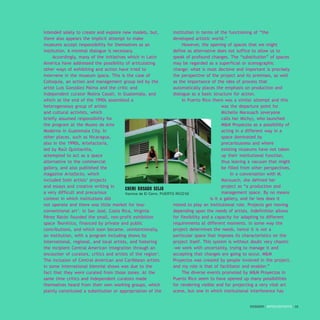
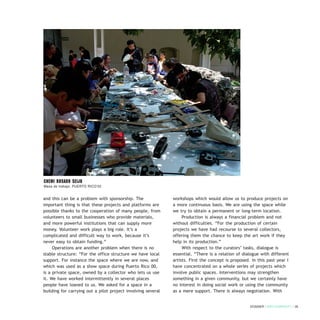
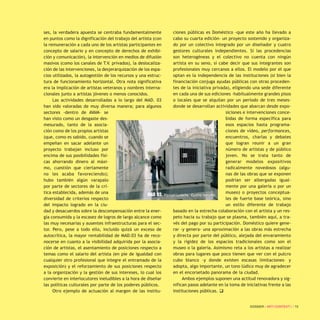
CHEMI ROSADO SEIJO
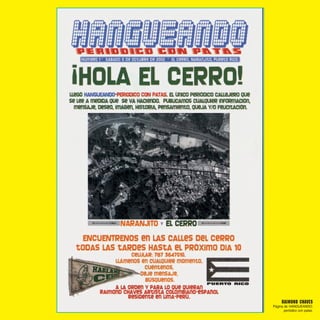
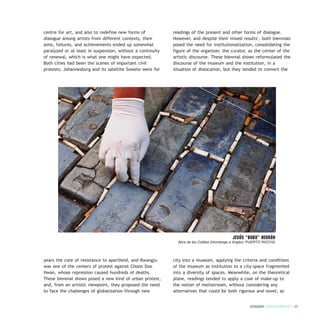
Intervención en el barrio El Cerro. PUERTO RICO’02
El desarrollo de M&M Proyectos está determinado por
la aventura personal de Michelle Marxuach: “Hace algunos
años trabajaba en una galería comercial en Puerto Rico
llevando la dirección artística y, durante la última etapa,
empecé a dedicarme más a los problemas y las necesida-
des relacionados con la producción de los artistas que a
temas propios de una galería. En Puerto Rico no hay una
crítica especializada que estimule el trabajo de los artis-
tas, el Museo de Arte Contemporáneo no ha ido cumplien-
do su función de museo, tampoco hay espacios alternati-
vos ni talleres en residencia. Pensé entonces que las nece-
sidades prioritarias del medio artístico de la isla exigían,
más que la consolidación de un circuito comercial, la arti-
culación de un espacio que vehiculara una producción y
estructurara una comunidad crítica y que, desde ahí,
hubiera una toma de conciencia de cuáles eran las caren-
cias y cuáles las posibilidades de acción. Desde ahí empe-
zamos a funcionar como un grupo de trabajo. Siempre he
26 / ARTECONTEXTO / DOSSIER
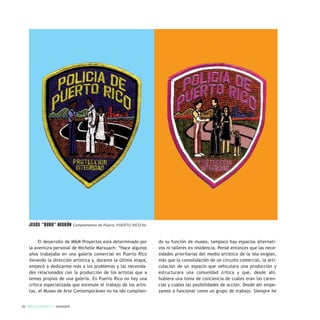
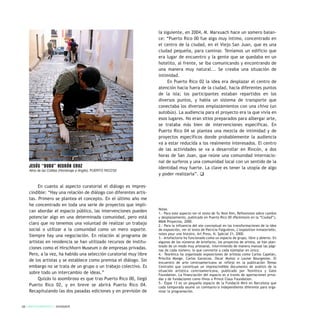
Jesús “Bubu” Negrón Complementos de Policía. PUERTO RICO’02.
trabajado de una manera muy estrecha con los artistas y
tengo la sensación de que mi papel es, sobre todo, el de
ser un catalizador de los proyectos de diferentes artistas.
En 1998 hicimos un intento de plantear, en un nivel insti-
tucional, la inexistencia de condiciones que articularan
nuevas propuestas y proyectos. Al dejar la galería definiti-
vamente empiezo a trabajar de manera independiente,
desde mi casa y como un reto me propongo presentar a lo
largo de un año un proyecto en cada una de las institucio-
nes museísticas de Puerto Rico, mostrando así que las pro-
pias instituciones no tenían ni una perspectiva definida ni
constituían plataformas con mínimo rigor; mientras que a
la vez yo misma me situaba fuera del sistema. El Museo de
Ponce, el Museo Doña Fela, el Museo de las Américas, el
Museo de Arte Contemporáneo y el Museo de Arte de
Puerto Rico presentaron los diversos proyectos de manera
escalonada, lo que permitía trazar un mapa de las institu-
ciones y con ello se intentaba redefinir también cuál era el
proyecto de cada uno. Se estableció así un diálogo que
intentaba clarificar una situación precaria y desordenada.
Esto demostró que era posible realizar proyectos de todo
tipo y a la vez promocionar el trabajo de los artistas. Más
tarde se fueron realizando pequeños proyectos en mi pro-
pia casa. En 1998-99 estuve trabajando en la Fundació Miró
de Barcelona, encargándome de la programación del Espai
135
, y en 2000 tenía claro que era necesario poder integrar
en proyectos a artistas de Puerto Rico con artistas perte-
necientes a otros contextos. El objetivo era poner a traba-
jar juntos a diferentes artistas que desarrollaran líneas de
actuación paralelas y, de ahí, surgió Puerto Rico 00. No
teníamos espacios disponibles y estuvimos buscando. El
proyecto fue cuajando a través de su propio proceso de
producción y se fue constituyendo una plataforma de
encuentro y de producción. La idea era plantear un parén-
tesis para la ciudad y ver si era posible realizar toda una
serie de proyectos independientes sin la necesidad de
depender de las instituciones. Invitamos a un grupo de
curadores y artistas para que durante dos semanas traba-
jaran en San Juan y en contacto con el contexto local rea-
lizaran sus proyectos, con la ayuda de voluntarios y cola-
boradores locales. En ese momento se creó una fuerte
comunicación entre la comunidad artística local y la gente
que había venido de fuera”.
Así, bajo la apariencia de una bienal al uso pero con un
carácter muy distinto, Guillermo Santamarina, Virginia
Pérez Ratón, Hans Ulrich Obrist, Agnés B., María Inés
Rodriguez, María Llüisa Borràs, Papo Colo y Jeanette
Ingberman, y la propia Michelle Marxuach organizaron
diversas exposiciones en diferentes espacios de la ciudad.
Pero más allá del equipo de curadores, fueron los artistas
quienes establecieron las auténticas reglas del juego.
Todos se preguntarán cómo puede funcionar algo tan
complejo sin una financiación adecuada, pero un elemento
importante ha sido sin duda la participación, la colabora-
ción y sobre todo el entusiasmo: “La financiación ha segui-
do caminos muy caóticos y se ha basado en la solicitud de
ayudas a empresas o a instituciones, intercambios etc.
Como en cada ocasión el proyecto va haciéndose sobre la
marcha, hay ocasiones en las que no puedes explicar exac-
tamente qué es lo que va a haber y eso genera algunos pro-
blemas con los patrocinios. Pero lo importante es que estos
proyectos, plataformas, son posibles gracias a la colabora-
ción de mucha gente, desde los voluntarios o la gente que
desde sus pequeñas empresas te facilita materiales, hasta
instituciones más poderosas que pueden aportar más dine-
ro. Cuenta mucho el trabajo voluntario. Es una manera muy
compleja y difícil de trabajar, porque los fondos nunca son
fáciles de conseguir.”
El funcionamiento constituye otro problema cuando no
hay una estructura estable: “Para la estructura de oficina
tenemos apoyo local, por ejemplo el espacio donde esta-
mos ahora y que se utilizó como lugar de exhibición duran-
te Puerto Rico 00; es un espacio privado, propiedad de un
coleccionista a quien le solicitamos la posibilidad de usarlo
y lo cedió. Hemos trabajado de manera intermitente en
distintos lugares que nos han ido prestando y cediendo.
Solicitamos un espacio en un edificio para crear un proyec-
to piloto donde se ubicaran diversos talleres que permitie-
ran la producción de proyectos en un plano de mayor con-
tinuidad. Usamos el espacio mientras tratamos de conse-
guir una sede permanente o a más largo plazo.”
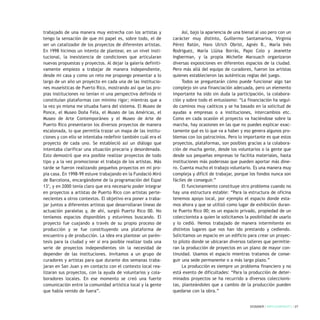
La producción es siempre un problema financiero y no
está exento de dificultades: “Para la producción de deter-
minados proyectos se ha recurrido a diversos coleccionis-
tas, planteándoles que a cambio de la producción pueden
quedarse con la obra.”
DOSSIER / ARTECONTEXTO / 27
En cuanto al aspecto curatorial el diálogo es impres-
cindible: “Hay una relación de diálogo con diferentes artis-
tas. Primero se plantea el concepto. En el último año me
he concentrado en toda una serie de proyectos que impli-
can abordar el espacio público, las intervenciones pueden
potenciar algo en una determinada comunidad, pero está
claro que no tenemos una voluntad de realizar un trabajo
social o utilizar a la comunidad como un mero soporte.
Siempre hay una negociación. En relación al programa de
artistas en residencia se han utilizado recursos de institu-
ciones como el Hirschhorn Museum o de empresas privadas.
Pero, a la vez, ha habido una selección curatorial muy libre
de los artistas y se establece como premisa el diálogo. Sin
embargo no se trata de un grupo o un trabajo colectivo. Es
sobre todo un intercambio de ideas.”
Quizás lo asombroso es que tras Puerto Rico 00, llegó
Puerto Rico 02, y en breve se abrirá Puerto Rico 04.
Recapitulando las dos pasadas ediciones y en previsión de
la siguiente, en 2004, M. Marxuach hace un somero balan-
ce: “Puerto Rico 00 fue algo muy íntimo, concentrado en
el centro de la ciudad, en el Viejo San Juan, que es una
ciudad pequeña, para caminar. Teníamos un edificio que
era lugar de encuentro y la gente que se quedaba en un
hotelito, al frente, se iba comunicando y encontrando de
una manera muy natural... Se creaba una situación de
intimidad.
En Puerto Rico 02 la idea era desplazar el centro de
atención hacia fuera de la ciudad, hacia diferentes puntos
de la isla; los participantes estaban repartidos en los
diversos puntos, y había un sistema de transporte que
conectaba los diversos emplazamientos con una chiva (un
autobús). La audiencia para el proyecto era la que vivía en
esos lugares. No eran sitios preparados para albergar arte,
se trataba más bien de intervenciones específicas. En
Puerto Rico 04 se plantea una mezcla de intimidad y de
proyectos específicos donde probablemente la audiencia
va a estar reducida a los realmente interesados. El centro
de las actividades se va a desarrollar en Rincón, a dos
horas de San Juan, que reúne una comunidad internacio-
nal de surferos y una comunidad local con un sentido de la
identidad muy fuerte. La clave es tener la utopía de algo
y poder realizarla”. q
Notas
1.- Para este aspecto ver el texto de Yu Yeon Kim, Reflexiones sobre cambio
y desplazamiento, publicado en Puerto Rico 00 (Paréntesis en la “Ciudad”),
M&M Proyectos, 2000.
2.- Para la influencia del ate conceptual en las transformaciones de la idea
de exposición, ver el texto de Patricia Falguières, L’exposition inmaterielle,
notes pour une histoire, Art Press, N. Spécial 21, 2000.
3.- Artefactoría ha funcionado como un espacio de grupo, libre y abierto. En
algunos de los números de Artefacto, los proyectos de artista, se han plan-
teado de un modo muy artesanal, interviniendo de manera manual las pági-
nas de cada número, lo que convierte a cada ejemplar en único.
4.- Teorética ha organizado exposiciones de artistas como Carlos Capelán,
Priscilla Monge, Carlos Garaicoa, Oscar Muñoz o Louise Bourgeoise. El
encuentro de arte centroamericano se reflejó en la publicación Temas
Centrales que constituye un imprescindible documento de análisis de la
situación artística centroamericana, publicado por Teorética y Gate
Foundation. La financiación del espacio es a través de aportaciones priva-
das y de fundaciones como Hivos o Prince Claus Foundation.
5.- Espai 13 es un pequeño espacio de la Fundació Miró en Barcelona que
cada temporada asume un comisario/a independiente diferente para orga-
nizar la programación.
28 / ARTECONTEXTO / DOSSIER
Jesús “BubU” Negrón Cruz
Abra de las Colillas (Homenaje a Angito). PUERTO RICO’02
RAIMOND CHAVES
Página de HANGUEANDO,
periódico con patas.
In the decade of the 1990s the contemporary artistic
panorama was dominated by a growing
institutionalization which translated into both the
creation of new museum spaces and the proliferation of
biennial shows. Both phenomena reflect strategies of
urban redefinition and are driven by political
transactions linked to a desire to insert art into the
global map of tourism and services. The museum and
the biennial both play plainly subsidiary roles in relation
to the priorities of economic reconversion and the
relaunch of cities in the media. In this way both the
new institutions and the biennials generally find
themselves subject to a strict political control
(consisting of a complex network of influences and
interests) which above all makes them effective
instruments for the rearrangement and transformation
of the city fabric, while their capacity for artistic
renewal is reduced to the perpetuation of conventional
schemes of exhibition and presentation.
Although some of the peripheral biennials, such as
those of Johannesburg in South Africa or Kwangju in
South Korea, sought to undermine the notion of a
30 / ARTECONTEXTO / DOSSIER
SANTIAGO B. OLMO
the utopia
that is possible
in precariousness
Ideas from a Conversation
with Michy Marxuach
centre for art, and also to redefine new forms of
dialogue among artists from different contexts, their
aims, failures, and achievements ended up somewhat
paralyzed or at least in suspension, without a continuity
of renewal, which is what one might have expected.
Both cities had been the scenes of important civil
protests; Johannesburg and its satellite Soweto were for
years the core of resistance to apartheid, and Kwangju
was one of the centers of protest against Choon Doo
Hwan, whose repression caused hundreds of deaths.
These biennial shows posed a new kind of urban protest,
and, from an artistic viewpoint, they proposed the need
to face the challenges of globalization through new
readings of the present and other forms of dialogue.
However, and despite their mixed results1
, both biennials
posed the need for institutionalization, consolidating the
figure of the organizer, the curator, as the center of the
artistic discourse. These biennial shows reformulated the
discourse of the museum and the institution, in a
situation of dislocation, but they tended to convert the
city into a museum, applying the criteria and conditions
of the museum as institution to a city-space fragmented
into a diversity of spaces. Meanwhile, on the theoretical
plane, readings tended to apply a coat of make-up to
the notion of mainstream, without considering any
alternatives that could be both rigorous and novel, as
DOSSIER / ARTECONTEXTO / 31
Jesús “BubU” Negrón
Abra de las Colillas (Homenaje a Angito). PUERTO RICO’02
we saw in the latest edition of Documenta, directed by
none other than Okwui Enwezor, who had also been
curator of the second Johannesburg Biennial in 1997, its
star edition.
In the 1970’s the idea and structure of the
exhibition were redefined from certain conceptual
practices by means of the introduction of information
and the archive as a method for dematerializing the
work of art, and this also reflected the fragmentation of
the mental process in the articulation of discourses. In a
certain manner, conceptual art in those years arose from
an analysis of the strains between the visual and the
verbal, whose roots must be sought in the Anglo-Saxon
tradition of the philosophy of language and analytical
philosophy, and very specially, in the legacy of Ludwig
Wittgenstein. Language, writing and their diverse
formulas of codification are charged with visual values
and construct atmospheres endowed with a different
objectuality which reinforces perception in attitudes of
concentration and analysis. The results of this strategies
were to open more complex analytical perspectives
through the works of such artists as Marcel Broodthaers,
On Kawara, Art & Language, and Antoni Muntadas, in
whose work there converges and mingles a multiplicity
of references, including television and the sphere of
communications.
However, while conceptual dematerialization had a
decisive impact on the idea of the exhibition, it shrank
from the frontal questioning of the museum as
institution, and so the museum was easily able to
embrace these proposals in the spheres of both
exhibitions and collections2
. Something similar occurred
with the advent of video, as a widespread artistic
practice, which introduced major changes to the
structure and discourse of the exhibition idea, but the
museum space was ready to take it on and
even its collections.
One of the most fruitful paths
taken by current transformations
would seem to situate itself in an
analysis of the museum as
institution, in the need to be more
flexible but also in the importance
of its definition in its function
(social and artistic), and also in a
specialization through coherent
programs. An open consideration of
the museum would tend to fit the
analysis of the various segments of
museum and exhibition audiences
into a framework of possibilities and
not only of economic results. It also
tends to call into question the idea that
an exhibition must become a spectacle and a
museum should resemble an amusement park to achieve
good results.
If the museum (as space and as institution) is today
facing different levels of crisis in Europe and the United
States, in other spheres in which the museum is
experiencing very precarious situations this crisis is even
more acute in that there is lacking even a strong model
against which to act. This is the case in many Latin
American countries where the museum as institution has
become obsolete and paralyzed in an anachronistic
definition before being able to achieve the slightest
modernization. In this context work and efforts are not
32 / ARTECONTEXTO / DOSSIER
In the 1970’s the idea and structure of the
exhibition were redefined from certain
conceptual practices by means of the
introduction of information and the archive as
a method for dematerializing the work of art
intended solely to create and explore new models, but,
there also appears the implicit attempt to make
museums accept responsibility for themselves as an
institution. A minimal dialogue is necessary.
Accordingly, many of the initiatives which in Latin
America have addressed the possibility of articulating
other ways of exhibiting and action have tried to
intervene in the museum space. This is the case of
Colloquia, an action and management group led by the
artist Luis González Palma and the critic and
independent curator Rosina Cazali, in Guatemala, and
which at the end of the 1990s assembled a
heterogeneous group of artists
and cultural activists, which
briefly assumed responsibility for
the program at the Museo de Arte
Moderno in Guatemala City. In
other places, such as Nicaragua,
also in the 1990s, Artefactoría,
led by Raúl Quintanilla,
attempted to act as a space
alternative to the commercial
gallery, and also published the
magazine Artefacto, which
included both artists’ projects
and essays and creative writing in
a very difficult and precarious
context in which institutions did
not operate and there was little market for less-
conventional art3
. In San José, Costa Rica, Virginia
Pérez Ratón founded the small, non-profit exhibition
space Teorética, financed by private and public
contributions, and which soon became, unintentionally,
an institution, with a program including shows by
international, regional, and local artists, and fostering
the incipient Central American integration through an
encounter of curators, critics and artists of the region4
.
The inclusion of Central American and Caribbean artists
in some international biennial shows was due to the
fact that they were curated from those zones. At the
same time critics and independent curators made
themselves heard from their own working groups, which
plainly constituted a substitution or appropriation of the
institution in terms of the functioning of “the
developed artistic world.”
However, the opening of spaces that we might
define as alternative does not suffice to allow us to
speak of profound changes. The “substitution” of spaces
may be regarded as a superficial or scenographic
change: what is most decisive and important is precisely
the perspective of the project and its premises, as well
as the importance of the idea of process that
automatically places the emphasis on production and
dialogue as a basic structure for action.
In Puerto Rico there was a similar attempt and this
was the departure point for
Michelle Marxuach (everyone
calls her Michy), who launched
M&M Proyectos as a possibility of
acting in a different way in a
space dominated by
precariousness and where
existing museums have not taken
up their institutional function,
thus leaving a vacuum that might
be filled from other perspectives.
In a conversation with M.
Marxuach, she defined her
project as “a production and
management space. By no means
is it a gallery, and far less does it
intend to play an institutional role. Projects get moving
depending upon the needs of artists. Indefinition allows
for flexibility and a capacity for adapting to different
requirements at different moments. In some way the
project determines the needs, hence it is not a
particular space that imposes its characteristics on the
project itself. This system is without doubt very chaotic
–we work with uncertainly, trying to manage it and
accepting that changes are going to occur. M&M
Proyectos was created by people involved in the project,
and my role is that of facilitator and enabler.”
The diverse events promoted by M&M Proyectos in
Puerto Rico seem to have opened up many possibilities
for rendering visible and for projecting a very vital art
scene, but one in which institutional interference has
DOSSIER / ARTECONTEXTO / 33
CHEMI ROSADO SEIJO
Vecinos de El Cerro. PUERTO RICO’02
on the map. These projects have apparently adopted the
generic scheme of biennials, but a closer look shows us
that there are major differences. For instance, there is
no precise idea of an economic reconversion for the
city, and this eliminates any possibility of
instrumentalization; the artists and the curators invited
generate the project as a process, as a work in
progress, and the priorities are set by the nature of the
projects themselves.
The development of M&M Proyectos is determined
by Michelle Marxuach’s personal adventure. “Some years
ago I worked as artistic director of a commercial gallery
in Puerto Rico, and in the final stage I began to
concentrate more on the problems and needs related to
the output of the artists than on the usual concerns of a
gallery. In Puerto Rico there are no specialized critics to
encourage our artists, the Contemporary Art Museum has
not done its job as a museum, and neither are there
alternative spaces nor residential workshops. It then
occurred to me that the priority needs of the artistic
environment on the island called not so much for the
consolidation of a commercial circuit as for the
articulation of a space that would act as a vehicle for
production and would structure a critical community,
and that this would lead to an awareness of both the
shortcomings and the possibilities for action. So we
started to operate like a work group. I have always
worked very closely with artists and I have the
impression that my role is above all that of a catalyst of
the projects of different artists. In 1998 we made an
attempt to pose, on an institutional level, the absence
of conditions that would engender new proposals and
projects. When I left the gallery for good I began to
work independently from home, and set for myself the
challenge of presenting in the course of one year a
project in each of Puerto Rico’s museums, thus showing
that the institutions themselves had no defined
perspective nor did they constitute platforms with a
minimum of seriousness. Meanwhile, I was situating
myself outside the system. The Ponce Museum, the Doña
Fela Museum, the Museum of the Americas, the Museum
of Contemporary Art, and the Puerto Rico Art Museum
presented the various projects at intervals, and this
allowed a map of these institutions to be drawn with
which to also try to redefine what was the agenda of
each. A dialogue was established that was a bid to
clarify a precarious and disorderly situation. This
demonstrated that it was possible to carry all kinds of
projects and at the same time to promote the work of
the artists. Later on, projects were carried out in my
own house. In 1998-99 I was working at the Miró
Foundation in Barcelona, working on the programming of
Espai 135
, and by 2000 I was fully persuaded that it was
necessary to put Puerto Rican artists to work on
projects alongside artists from other contexts. The aim
was to take artists working in parallel manners and have
them do projects together. That’s where Puerto Rico 00
came from. No spaces were available and we continued
to look, while the project was taking shape through its
own production process and gave rise to a platform for
meeting and producing. The idea was to open a
parenthesis in the city and see whether it was possible
to carry out a whole series of independent projects
without having to depend on institutions. We invited a
group of curators and artists to work for a fortnight in
San Juan, carrying out their projects in the local context
and with the help of local volunteers. At that instant a
strong communication was established between the local
artistic community and the people who had come from
outside.”
Thus it was that in the guise of a biennial show,
but with a very different character, Guillermo
Santamarina, Virginia Pérez Ratón, Hans Ulrich Obrist,
Agnés B., María Inés Rodriguez, María Llüisa Borràs, Papo
Colo, Jeanette Ingberman, and Michelle Marxuach
herself organized exhibitions in different spaces in the
city. But it was the artists, more than the team of
curators, who set the actual rules of the game.
Everyone wondered how something so complicated
could work without adequate funding, but an important
element was certainly participation, collaboration, and
especially enthusiasm: “Funding came rather chaotically
and was based on requests for aid from companies and
institutions, exchanges, etc. Since on each occasion the
project was improvised as it progressed, there were
times when it was impossible to explain just what it was
34 / ARTECONTEXTO / DOSSIER
and this can be a problem with sponsorship. The
important thing is that these projects and platforms are
possible thanks to the cooperation of many people, from
volunteers to small businesses who provide materials,
and more powerful institutions that can supply more
money. Volunteer work plays a big role. It’s a
complicated and difficult way to work, because it’s
never easy to obtain funding.”
Operations are another problem when there is no
stable structure: “For the office structure we have local
support. For instance the space where we are now, and
which was used as a show space during Puerto Rico 00,
is a private space, owned by a collector who lets us use
it. We have worked intermittently in several places
people have loaned to us. We asked for a space in a
building for carrying out a pilot project involving several
workshops which would allow us to produce projects on
a more continuous basis. We are using the space while
we try to obtain a permanent or long-term location.
Production is always a financial problem and not
without difficulties. “For the production of certain
projects we have had recourse to several collectors,
offering them the chance to keep the art work if they
help in its production.”
With respect to the curators’ tasks, dialogue is
essential. “There is a relation of dialogue with different
artists. First the concept is proposed. In this past year I
have concentrated on a whole series of projects which
involve public spaces. Interventions may strengthen
something in a given community, but we certainly have
no interest in doing social work or using the community
as a mere support. There is always negotiation. With
DOSSIER / ARTECONTEXTO / 35
CHEMI ROSADO SEIJO
Mesa de trabajo. PUERTO RICO’02
36 / ARTECONTEXTO / DOSSIER
CHEMI ROSADO SEIJO
El Cerro. PUERTO RICO’02
regard to the artists in residence program, resources
have been provided by institutions like the Hirschhorn
Museum or private companies. But at the same time,
curators have been very free in their selection of
artists, and dialogue was set as a premise. However, this
is not a group or a collective task. Above all it is an
interchange of ideas.”
Perhaps the most astonishing thing is that Puerto
Rico 00 was followed by Puerto Rico 02, and Puerto Rico
04 is to begin shortly. Recapitulating the two past
editions and looking toward the next one, in 2004, M.
Marxuach makes a summary description:
“Puerto Rico 00 was something very intimate,
concentrated in the center of the city, in Old San Juan,
which is a little city, for strolling. We had a building
that was a meeting point, people stayed in a little
house in front, communicating and meeting in a very
natural way. A situation of intimacy was established.
“In Puerto Rico 02 the idea was to move the center
of attention away from the city, to different spots on
the island. Participants were spread out, and there was
a transportation system to connect the different sites
with a bus. The public was composed of people living
near each of the sites. These were not places to store
art, but rather, specific interventions. In Puerto Rico 04
we are seeking a mix of intimacy and of specific
projects where the audience will probably be reduced to
the people who are really interested. The center of the
activities will be in Rincón, two hours from San Juan,
where an international community of surfers lives with a
local community with a strong sense of identity. The key
is to have the utopia of something and to be able to
make it.” q
English translation: Dwight Porter.
Notes
1.- For this aspect see Yu Yeon Kim’s “Reflexiones sobre cambio y
desplazamiento”, published in Puerto Rico 00 (Paréntesis en la
“Ciudad”), M&M Proyectos, 2000.
2.- For more about the influence of conceptual art on the
transformations of the idea of exhibitions, see Patricia Falguières,
“L’exhibition inmaterielle, notes pour une histoire”, Art Press, N.
Spécial 21, 2000.
3.- Artefactoría has functioned as a group space, free and open. In
some issues of Artefacto, artists’ projects were conceived as
handicrafts, and pages of each copy were prepared by hand, making
each one unique.
4.- Teorética has organized exhibitions of artists such as Carlos
Capelán, Priscilla Monge, Carlos Garaicoa, Oscar Muñoz and Louise
Bourgeoise. The encounter with Central American art was reflected in
the Temas Centrales, an essential analysis of the Central American
artistic situation, published by Teorética and the Gate Foundation. The
space is funded through private contributions from such donors as
Hivos and the Prince Claus Foundation.
5.- Espai 13 is a small space at the Fundació Miró in Barcelona which
each year hires a different independent curator to organize the
program.
DOSSIER / ARTECONTEXTO / 37
38 / ARTECONTEXTO / DOSSIER
El telón aún no se levanta. Sin embargo, el estupefacto públi-
co de la Scala de Milán no deja de escrutar con suma intensi-
dad el simulado escenario, se diría que absorto en la contem-
plación de una representación ya en marcha. Y es posible que
así sea. El público asistente a la Opera de Viena, por su parte,
se prepara para acomodarse en sus sillas, dando el último
ajuste a los exquisitos atuendos de gala y esperando a que
comience la obra. De pronto todos reparan en la gigantesca
imagen colgada del telón: se trata del homólogo –si bien vir-
tual– público italiano.
Dicho telón ya no ocupa aquel lugar. Como ocurre cada
año, la imagen ha sido reemplazada por una nueva realizada
por otro artista; todo gracias al museum in progress, cuyo
centro de operaciones es Viena. El propósito de esta iniciati-
va que comenzó hace seis años era la de cubrir el controver-
tido telón original de 1955. Este año, por ejemplo, la imagen
de un Cristo agonizante realizada por el artista alemán
Thomas Bayrle se halla suspendida delante del público.
Cualquier alusión a determinadas polémicas actuales, aunque
recibida con agrado, es pura coincidencia.
Museum in progress no se propone instalar ninguna pieza
estática del así llamado “arte público”. Antes bien, la pro-
LORENZ SEIDLER
ProgrEss IN ProgrEss
museum in progress
VIENA
DOSSIER / ARTECONTEXTO / 39
puesta parte del supuesto de que las instalacio-
nes permanentes no logran capturar la atención
del público por mucho tiempo –si es que llegan a
capturarla-. Por lo tanto, museum in progress se
halla inmerso en una constante búsqueda de nue-
vos espacios o vehículos de comunicación para el
arte contemporáneo. Desde 1991 sus fundadores,
Kathrin Messner y Josef Ortner, no han dejado de
encontrar y utilizar nuevos “interespacios para el
arte” dentro del ámbito público: carteles, anda-
mios, proyecciones murales, pantallas de TV en
estaciones del metro y páginas de los diarios son
algunos de los medios transitorios utilizados por
estos artistas contemporáneos. El siguiente paso
consiste en designar el proyecto en colaboración
con un comisario, quien se encarga de elegir al
artista; éste último será a su vez quien se ocupe
de configurar los espacios según el contexto y el
lenguaje específico del plan definido. Los inter-
mediarios en éste caso quedan excluidos.
Así, pues, al hojear un periódico el lector
puede encontrarse de repente con una página
llena de dibujos, textos literarios o incluso con un
experimento artístico realizado con la diagrama-
ción habitual de la publicación.
Campañas más importantes, por citar un par
de ejemplos, han transformado las páginas de un
periódico en un flip-book1
o bien han complemen-
tado alguna exposición “normal” con formas más
impactantes de llevar el arte al público. Con el
paso del tiempo las intervenciones de museum in
progress se han convertido en algo familiar para
los medios con los que habitualmente trabajan.
No obstante, la creación de nuevas formas
expositivas exige asimismo nuevos mecanismos de
financiación.
Gracias a su “Art Pool”, que logró reunir fon-
dos de financiación provenientes de varias com-
pañías, museum in progress pudo comenzar a rea-
lizar sus proyectos de forma independiente y de
paso incrementar la credibilidad entre todas las
partes involucradas. Se trataba de un riesgo
demasiado elevado para esos comités de dirección
RICHARD HAMILTON
Curtain, 2001-2002. © museum in progress
MONA HATOUM
Intervención en el diario Der Standard, 1998. © museum in progress
40 / ARTECONTEXTO / DOSSIER
recientemente modificados en Austria, que además no tienen
relaciones personales –tan importantes en éste medio- con los
protagonistas de museum in progress. Así, pues, dicho modelo
–revolucionario desde el punto de vista del arte- fue abolido y
la financiación nuevamente tuvo que ser recabada de manera
individual.
No obstante, el estricto contrato firmado para cada pro-
yecto con la compañía patrocinadora debe garantizar comple-
ta libertad artística –y eso incluye el control absoluto sobre la
elección de temas-. Para su participación en el proyecto de
carteles “Das Plakat”, Félix González-Torres decidió examinar
y publicar todos los destinos de una compañía aérea patroci-
nadora desde la Segunda Guerra Mundial y así revelar la
correspondencia entre las rutas de vuelo de la aerolínea y las
respectivas circunstancias económicas y políticas. La contribu-
ción de Hans Peter Feldmann consistió en publicar fotografías
privadas de su familia mezclada con familiares de los emplea-
dos de la aerolínea, fusionando por tanto las esferas pública y
privada así como la cultura corporativa con el modus operan-
di de un artista contemporáneo. Gerwald Rockenschaub nue-
vamente exploró la composición modular de las imágenes
publicitarias, de modo que hasta el cartelero pudo decidir en
el aspecto final de cada manifestación del concepto.
Además de captar públicos poco habituales con estrate-
gias poco habituales, la habilidad de museum in progress para
encontrar espacios publicitarios inusuales permitió que el logo
de la aerolínea figurase en más de 3000 carteles a lo largo de
todo el país. En el clímax de la cooperación (un lapso que
incluyó el festival Steirischer Herbst de Graz) la campaña
anual de carteles había llegado a más de veinte ciudades euro-
peas (y la revista de a bordo de la aerolínea incluía un rompe-
cabezas diseñado por Alighiero e Boetti que ocupaba exacta-
mente el espacio de las mesitas plegables.)
Otro de los objetivos de museum in progress es reforzar
los intercambios internacionales. Si un proyecto inicial del
comisario nacional Robert Fleck había permitido que en 1991
directores de museos y comisarios extranjeros visitaran los
talleres de los artistas austriacos, museum in progress
negoció con la aerolínea la reserva de un billete gratis
por cada asiento pagado, permitiendo de este modo que
50 artistas austriacos exploraran y procesaran artística-
mente diversos destinos alrededor del mundo.
Asimismo, las colaboraciones con prensa ya no
están restringidas a territorio austriaco. Desde 2002 el
diario esloveno Delo y el semanario checo Respekt son
el marco de las intervenciones directas de museum in
progress. Por otro lado, mediante el uso de eficaces
redes y la participación de famosos comisarios, museum
in progress permite que artistas menos prominentes
accedan a los espacios disponibles y se hagan con más
socios potenciales en el mundo de las corporaciones.
Las colaboraciones directas con las galerías comercia-
les son menos frecuentes de lo que podría pensarse con la
exposición de la prominente Viena Stripe, situada en pleno
centro de la ciudad: dos carteles, cada uno de 15 metros de
largo por solo 1,5m de ancho, alternan periódicamente en la
fachada de una tienda de vinos de tal forma que el interior del
local atrae a coleccionistas potenciales tanto de arte como de
vino. Un compromiso de rotación debería garantizar para
todas las galerías de la zona la misma cantidad de tiempo de
exhibición de “sus” artistas, a los ojos de los visitantes del
cercano edificio de Secesión o ante los propios vieneses que
pasean por el área siempre popular del Naschmarkt.
En la acera del frente, el muro posterior del antiguo con-
tenedor del Kunsthalle, que da directamente a la concurrida
Karlsplatz, ha sido transformado en un espacio de exhibición.
Hasta 2001 Gerhard Richter, Walter Obholzer, Douglas Gordon
y Ken Lum usaron este espacio único de quinientos metros cua-
museum in progress no se propone insta-
lar ninguna pieza estática del así llamado
“arte público”. Antes bien, la propuesta
parte del supuesto de que las instalacio-
nes permanentes no logran capturar la
atención del público por mucho tiempo
DOSSIER / ARTECONTEXTO / 41
drados para exhibiciones específicas. Entretanto el centro
principal de exposiciones del Kunsthalle había sido trasladado
al Museumsquartier y sus pocos muros exteriores actualmente
se conocen como Kunsthalle project walls. El viejo cubo ama-
rillo de Karlsplatz ha sido reemplazado por un pabellón más
pequeño hecho de vidrio, que ha de incitar a los automovilis-
tas a estirar el cuello para ver lo que ocurre dentro del trans-
parente project space del Kunsthalle.
Museum in progress está acostumbrado a adaptarse a las
cambiantes condiciones. Cuando en febrero de 2000 Joerg
Haider entró a formar parte del gobierno austriaco, TransAct,
comisariada por Cathrin Pichler, motivó a artistas, científicos
y escritores a reaccionar contra un amenazante boicot cultu-
ral del país y a publicar sus posiciones en los diarios locales.
Tras el 11 de septiembre de 2001 TransAct 2 estudió y compa-
ró el lenguaje de los discursos artístico y político. Si la oca-
sión, el tamaño y las estructuras de los proyectos pueden
variar, la autonomía del arte sigue siendo la directriz principal
de museum in progress.
No todas las compañías patrocinadoras valoran esta com-
binación de flexibilidad y soberanía. Pero incluso si el regreso
del apoyo financiero y el valor del mercado fueran los únicos
ingredientes del éxito, museum in progress podría ser una
inversión segura, al menos en el mercado del arte: el concep-
to del artista alemán Hans Peter Feldmann de eliminar todo el
texto de un semanario y publicar sólo fotografías dentro de los
márgenes, fue llevado a la práctica por museum in progress
durante el agitado y controvertido mes de febrero de 2000 en
Austria y actualmente cada una de las copias restantes de esta
respuesta artística a las circunstancias políticas está a la venta
en la librería de Walther Koenig por la módica suma de 250
Euros.
Traducción del inglés por Juan Sebastián Cárdenas.
1 Libros cuyas páginas al ser hojeadas rápidamente producen la ilusión de movi-
miento. (N. Del T.)
FÉLIX GONZÁLEZ-TORRES
Portrait of Austrian Airlines, 1993-1994.
© museum in progress
The curtain has not risen. And yet the audience of the
Milano Scala Opera keeps staring into the depth of a would-
be stage in frozen intensity as if an absorbing performance
was already in progress. Maybe it is. As the visitors of the
Vienna State Opera slowly take their seats, adjust their
exquisite evening gowns and wait for the opera to begin,
they start staring back on a huge image of their Italian, yet
virtual counterpart that has been hung on the closed
curtain right in front of them.
The curtain is gone now. It’s got replaced, as every
year, by another artist’s fresh design, thanks to the Vienna-
based museum in progress. For six years now the initiative
has been arranging the occlusion of the controversial
original curtain’s design from 1955. In 2004 the image of a
suffering christ by German artist Thomas Bayrle is floating
in front of the audience. Any connotations to current
debates are purely incidential
–yet very welcome.
Museum in progress has no intention to install any so-
called static “public art”. It’s the initiative’s credo that
permanent installations quickly lose the audience’s
42 / ARTECONTEXTO / DOSSIER
BY LORENZ SEIDLER
ProgrEss IN ProgrEss
museum in progress
VIENNA
attention or even never capture it. Therefore
museum in progress constantly searches for
new spaces or media carriers for contemporary
art. Since 1991 founders Kathrin Messner and
Josef Ortner have been consequently finding
and using new “interspaces for art” in the
public realm: billboards, scaffolding,
projections on plain walls, TV-screens in
underground stations and the pages of daily
newspapers serve as transient spaces for
contemporary artists. Then a project gets
designated in cooperation with a curator, who
chooses the artists, who then configures their
spaces according to context and the specific
language of their specific craft. No mediation
included nor intended.
Turning the pages of a newspaper the
reader could suddenly get confronted by a a
page of drawings, literary forms of text or even
a direct artistic experiment with the
accustomed layout of the magazine.
More extensive campaigns have, for example,
transformed the pages of a newspaper into a flip-
book or supplemented “normal” exhibitions
with more vivid ways of bringing art to the
public.
Meanwhile the interventions of museum in
progess have become a familiar part of their
long-term media partners. But to open up new
venues of presentation also requires new means
of financing.
Through its “Art Pool” that united
sponsoring money from various companies
museum in progress could initiate projects
independently – and increase the credibility for
all partners involved.Too risky a venture for
those boards-of-directors that got recently
exchanged in Austria and lack the very
important personal relation to the protagonists
of museum in progress. Thus this –seen from the
arts’ point of view– groundbreaking model was
abolished and cooperations have to be
bargained individually again.
DOSSIER / ARTECONTEXTO / 43
KEN LUM
There is no place like home, 2000. © museum in progress
ALIGHIERO E BOETTI
Cieli ad alta quota, 1993. © museum in progress
Nevertheless, a strict contractual agreement with each
project’s financiers has to guarantee full artistic liberty –
and that includes free choice of subject matter. For his
participation in the billboard-project “Das Plakat” Felix
Gonzalez-Torres chose to examine and publish all
destinations of a sponsoring airline since World War II to
reveal the interweavement of the airline’s flight routes
with the respective political and economic circumstances.
Hans Peter Feldmann’s contribution published private
photographs of his family mingled with family members of
the airline’s employees, thus merging the private and the
public sphere but also the corporate culture with the
modus operandi of a contemporary artist. Gerwald
Rockenschaub again explored the modular buildup of the
billboard images. His contribution empowered even the
billsticker himself to decide the final appearance of each
manifestation of the concept.
Apart from reaching less conventional audiences with
unconventional strategies, museum in progress’ skills in
bargaining for unused advertisment spaces allowed the
airline’s logo to appear on more than 3000 billboards
across the country. At the climax of the cooperation
(a period that included the festival steirischer herbst in
Graz) the yearly billboard-campaign had spread into more
than 20 European cities. (and the airline’s onboard-
magazine included a jigsaw puzzle designed by Alighiero e
Boetti matching the exact size of the airplane’s fold-out
tables).
To reinforce international exchange is another aim of
museum in progress. While an initial project by national
curator Robert Fleck in 1991 allowed foreign curators and
museum directors to visit the ateliers of Austrian artists,
museum in progress negotiated with the airline to allocate
one free ticket for each paid seat and allowed 50 Austrian
artists to explore and artistically process destinations of
their choice around the world.
Accordingly, the cooperations with newspapers are no
longer restricted to Austrian terrain. Since 2002 the
Slowenian daily newspaper “Delo” and the Czech weekly
“Respekt” feature direct interventions organized by museum
in progress. Through skilfull networking and the systematic
use of famous curators museum in progress also enables less
prominent artists to access to the spaces that have been
made available - but also to acquire more potential
partners from the corporate world.
Direct cooperations with commercial galleries are less
common than the prominently placed “Vienna Stripe”,
located in the very core of the city, might suggest: two art
banners, each 15 metres in lenght and just 1,5m in height,
are regularly replaced on top of a wine-market which
happily offers its interiors to potential collectors of art and
wine. A rotation principle should guarantee all galleries in
the vicinity the same amount of exposure-time of “their”
artists to the eyes of the visitors to the nearby Secession-
building or of the Viennese locals strolling through the ever-
popular “Naschmarkt”-area.
Just across the road the back wall of the former
Kunsthalle container facing directly towards the heavily
trafficked Karlsplatz had been transformed into a
presentation wall. Until 2001 Gerhard Richter, Walter
Obholzer, Douglas Gordon and Ken Lum had used this unique
space of 500 square meters for specifically adapted
presentations. Meanwhile Kunsthalle’s main exhibition center
has moved inside the Museumsquartier, its few outside walls
are now being self-labelled as “Kunsthalle project walls”.
The former yellow box on Karlsplatz was replaced by a
smaller pavillon made of glass that should encourage the
44 / ARTECONTEXTO / DOSSIER
museum in progress has no
intention to install any so-called
static “public art”.
It’s the initiative’s credo that
permanent installations quickly
lose the audience’s attention
or even never capture it.
passing car drivers to bend their necks to see what’s
happening inside Kunsthalle’s transparent project space.
Museum in progress is used to adapt to changing
conditions. As Joerg Haider became part of the Austrian
government in February 2000, curator Cathrin Pichler’s
“TransAct” encouraged artists, scientists and writers to
react against a threatening cultural boycot of Austria and
to publish their statements directly in a local newspaper.
After September 11 2001 TransAct 2” examinded and
compared the language of political and artistic discourses.
While the occasion, size and structures of the projects may
vary, the autonomy of the arts stays museum in progress’
prime directive.
Not all sponsoring companies value this combination of
flexibility and souvereignty. But even if direct return of
investment and market value were the only factors of
success, museum in progress could be a gilt-edged
investment - at least on the art market: German artist Hans
Peter Feldmann’s concept to exclude all text from a weekly
news magazine and to publish only the photographs within
the layout, was put into practise by museum in progress
during the politically highly controversial month of February
2000 in Austria. Currently, each of the remaining copies of
this artistic response to political circumstances is being sold
at Walther Koenig’s bookstore for the proud sum of 250
Euros. q
DOSSIER / ARTECONTEXTO / 45
HANS-PETER FELDMANN
Family Photos, 1994-1995. © museum in progress
46 / ARTECONTEXTO / DOSSIER
Hace ya diez años que el arte africano contemporáneo encon-
tró una audiencia, un público. Ya no resulta extraño encontrar
artistas oriundos del continente africano en las grandes biena-
les internacionales o en las galerías europeas, americanas o
japonesas. El nombramiento del nigeriano Okwui Enwesor
como director de la Documenta 11 de Kassel despertó la ilu-
sión de un posible cambio duradero en la situación de los
artistas africanos. Y la ilusión es muy fuerte. Que el arte afri-
cano haya salido del atolladero en los últimos años se debe en
parte a ciertas publicaciones tales como Revue Noire,
Atlántica o NKA, que han proporcionado una base teórica gra-
cias a la cual ha sido posible suscitar cuestiones que han veni-
do a alimentar el debate surgido a finales de los años ochen-
ta. Numerosas exposiciones colectivas que tenían a África
como tema han sido organizadas en Europa o en Estados
Unidos. No obstante, en la aldea global, donde el nuevo orden
económico mundial se ha impuesto de manera absoluta como
una realidad incontrolable y necesaria, África, carente de
medios de autogestión, es decir, incapaz de ofrecer a sus
artistas los vehículos de promoción y creación, ha estado obli-
gada a acatar la ley de los poderes económicos que rigen en
todos los ámbitos, entre ellos, naturalmente, el del arte.
SIMON NJAMI
ArtistAs
en buscA de libertAd
[APUNTES SOBRE LA SITUACIÓN EN ÁFRICA
]
DOSSIER / ARTECONTEXTO / 47
Lo cierto es que la ilusión de una fuerza y de una pre-
sencia del arte africano contemporáneo –que se traduce en
una mayor visibilidad en Occidente– enmascara la realidad de
unos problemas a los que el continente debe hacer frente en
el interior de sus fronteras. La verdad no es ni triste ni posi-
tiva, se inscribe en un proceso que se inicia con las indepen-
dencias y se asienta definitivamente hace diez años.
Debemos reconocer, en todo caso, que una de las falacias
recurrentes de la creación africana reside en el hecho de que
su reconocimiento se efectúe a través de las estructuras occi-
dentales. En efecto, si la creación africana no puede existir
más que en Occidente, ¿qué es exactamente lo que repre-
senta? ¿Acaso no se ha creado un malentendido, incluso una
contradicción total entre la visión de los comisarios europe-
os respecto al África y la percepción que los artistas del con-
tinente tienen de su propio trabajo? Uno de los ejemplos más
notorios de esta compleja situación es que la mayor parte de
las exposiciones concebidas en torno a la creación contem-
poránea africana han sido realizadas y exhibidas en Europa y
los Estados Unidos –y excepcionalmente dentro de África. Así,
el aparente movimiento que se puede percibir fuera del con-
tinente no tiene unas raíces auténticas en su seno. Ahora
bien, la historia nos lo ha enseñado: antes que nada, es pre-
ciso que en el interior de los países africanos se establezcan
las plataformas de debate y los intercambios; de no ser así el
relativo reconocimiento que observamos en Europa no será
más que una ilusión sin fundamentos, un espejismo. Hoy es
urgente emprender una reflexión profunda sobre el estado de
la creación artística en África. Las exposiciones y coloquios
europeos son ciertamente útiles pero es en el continente
ZWELETHU MTHETHWA Sin título, 1998
Cortesía: Colección Fundación ARCO
48 / ARTECONTEXTO / DOSSIER
donde importa crear las condiciones para perpetuar el hecho
contemporáneo. Huelga constatar la magnitud del trabajo
pendiente.
La mayor parte de los artistas africanos que gozan en la
actualidad de cierto renombre internacional trabajan en
Europa, y no porque, como algunos afirman con demasiada
prisa, Europa represente para ellos una tierra prometida,
sino porque África, simplemente aún no reúne las condicio-
nes de recepción de una obra contemporánea. Todos conoce-
mos las dificultades a las que se enfrenta desde siempre la
creación contemporánea en todo el mundo; los artistas libran
cada día su batalla contra todos los conservadurismos y, par-
ticularmente, en las sociedades no industriales donde aún se
palpa el peso de la tradición. La globalización de referencias
–si bien permite la supervivencia de unos cuantos– crea una
ruptura entre las producciones que podríamos llamar “loca-
les” y las producciones, por decirlo así, “internacionales”
que hemos encontrado en años recientes en Kassel, Venecia
o São Paulo.
En consecuencia, los artistas africanos se enfrentan a
una doble dificultad: crear obras significativas que estén
arraigadas en una cultura y en un territorio preciso, y hacer-
las tanto más accesibles y visibles cuanto sea posible. Los
esfuerzos realizados hasta la fecha se han orientado por lo
general a la difusión sin preocuparse por la fuente misma. La
experiencia llevada a cabo el año pasado en la feria ARCO, en
Madrid, -y que está llamada a repetirse en las próximas edi-
ciones- se apoya en la necesidad de desarrollar, en el propio
continente africano, las herramientas de producción y difu-
sión local.
Sin embargo, la creación de un ambiente propicio para
el florecimiento de un arte que esté anclado localmente pasa
en definitiva por una voluntad política firme. Ahora bien,
debemos reconocer por fuerza que durante las últimas déca-
das fue en Europa donde surgieron las iniciativas –y esto fue
así desde la primera mitad del siglo veinte– lo que dio lugar
a la aparición de los hábitos colonialistas de los primeros
tiempos y de los neo-colonialistas de los años sesenta. Los
esfuerzos realizados directamente por los estados africanos,
cuando existía cierta conciencia de la importancia de crear
las condiciones favorables para la eclosión de una creación
contemporánea original, no hicieron otra cosa que imponer el
sello de una ideología que interrumpió el crecimiento perso-
nal de los artistas. Pero antes de las orquestaciones naciona-
les erigidas en defensa de la autenticidad, de la negritud o
del panafricanismo, los primeros talleres ya habían sido
importados al África por los colonizadores.
La emergencia de la noción occidental del artista africa-
no ciertamente está muy ligada a la instauración del cristia-
nismo y a la irrupción de nuevas religiones que nos llevaron a
concebir el mundo de otra forma. Si en Occidente el arte
moderno está dedicado a celebrar la muerte de Dios, en Áfri-
ca la aparición del artista nuevo marca, no tanto el fin de los
dioses, como la reducción de su influencia y su confinamien-
to a las prácticas ocultas. El artista antiguo, que hasta enton-
ces participaba con su arte en las prácticas rituales ances-
trales, cede su sitio a ese mutante cuya verdadera influencia
sobre la sociedad es todavía un interrogante. Es así como,
mientras la revolución del arte moderno en Occidente se
encuentra en su apogeo, un nuevo tipo de misioneros
emprende un recorrido por el África para crear a esos seres
híbridos a su imagen y semejanza. La irrupción de la noción
de artista anuncia los profundos cambios que experimentará
el continente africano, propulsado así a la era moderna uni-
versal. En el interior del símbolo hay todo un sistema de refe-
rencias que va a sufrir una mutación profunda. Las ciudades
comienzan a adquirir una importancia capital y África, que
aún podía considerarse rural, va a experimentar una evolu-
ción cuyos efectos aún se pueden constatar. En este nuevo
contexto, el artista que vivía dentro de un rol social, religio-
so y estético, se convierte en una figura de un pasado en vías
de extinción.
Con la llegada de los misioneros del arte en los años
veinte se “inventará” al artista solitario e individualista,
inclinado a la creación personal y dueño de su propio univer-
so. Y si el lugar de la escultura –una práctica ancestral cuyo
origen se pierde en la noche de los tiempos- es siempre pre-
ponderante, la acuarela, el lápiz y la pintura sobre lienzo
adquieren progresivamente una importancia enorme en la
producción artística del continente.
El arte, desde luego, no es en sí mismo una prioridad,
pero representa el principio último del refinamiento, de la
civilización, y constituye la última etapa en el proceso de
emancipación total. Si hablamos aquí de una invención del
artista es porque la creación del mismo incluye toda clase de
piezas. En un África donde las diferentes formas artísticas
DOSSIER / ARTECONTEXTO / 49
son indisociables, en tanto que participan de una misma
escenografía y concurren todas para producir un mismo efec-
to, la distinción de las diferentes disciplinas, según la clasifi-
cación heredada de la historia del arte occidental, donde se
distinguen seis categorías diferentes, introduce una confu-
sión en relación al arte que prevalece en las sociedades así
llamadas preindustriales. Dicha trasposición literal de con-
ceptos pensados y elaborados a partir de otros contextos va
a dar cabida a algunas preguntas que, en su mayoría, no
siempre han sido contestadas en nuestros días. Es así como la
enseñanza de la pintura (aunque por otra parte sería más
justo hablar aquí de iniciación) se efectuará de forma anár-
quica y empírica. Si en determinado momento esta se propo-
ne subvertir los fundamentos estéticos de las sociedades afri-
canas, dotándolas de una visión más acorde con sus princi-
pios, lo cierto es que en este periodo no dispone de los
medios necesarios para asumir con éxito el rol que se le ha
asignado. Calificar de escuelas a los primeros talleres que se
inauguraron entonces en África sería como si, hoy en día, los
historiadores hablaran de escuelas como se habla de corrien-
tes, tales como Poto-Poto (Congo) o Oshogbo (Nigeria), por
sólo citar a dos de los primeros precursores que operaron sin
método predefinido, sin plan, sin proyecto pedagógico.
En esos primeros talleres se elabora anticipadamente la
noción de art brut o outsider, como se lo denomina en los
Estados Unidos. A dicha etiqueta se debió que durante la pri-
mera exposición de Lubaki –un empleado doméstico del anti-
guo Congo belga elevado a la categoría de artista-, en el París
de los años veinte, numerosos observadores pensaran que se
trataba de una mixtificación, convencidos de que el célebre
artista no existía. Y si bien esos espectadores se engañaron
respecto a la existencia física del zaireño, el error no hay que
achacárselo tanto a ellos como a la propia realidad del artis-
ta. La transferencia de la colectividad a algunos individuos
escogidos al azar por los pedagogos durante sus viajes con-
ducirá, pues, a situaciones absurdas. Los viejos maestros,
como hemos visto, ya no son tenidos en cuenta en la ense-
ñanza. De este modo el artista –desde los primeros acuarelis-
tas que se enfrentaron a la estética occidental- se inventa a
sí mismo. Para el historiador del arte Pierre Gaudibert, por
ejemplo, estas experiencias fueron en conjunto un verdade-
ro callejón sin salida: “Los europeos crearon una serie de
escuelas y talleres. La mayor parte se propuso suscitar un
arte africano auténtico, espontáneo, “ingenuo”, pero su ins-
piración más o menos inconsciente en los modelos europeos
o tradicionales por lo general dio lugar a híbridos aculturados
con casos excepcionales de mestizaje original” 1
.
Si bien, uno de los primeros de aquellos talleres fue crea-
do en el África francófona, más exactamente en Costa de
Marfil (en 1923) por Charles Combes, es en el África anglófo-
na donde se establecen la mayor parte de “escuelas”, entre
las cuales las más decisivas serían las de Kenneth Murria
(Nigeria, 1927), Margaret Trowell (Kampala, Uganda, 1937),
Mac Ewen (Salisbury, Rodesia, 1957) y, aunque tardío desde el
punto de vista cronológico, el taller de Susana Wenger y Uli
Beir, con sede en Oshogbo, Nigeria, de donde saldrían artis-
tas como Twin Seven Seven o Bruce Onobrakpeya. En la zona
francófona se destacan los talleres de Pierre Romain Desfossé
y Laurent Moonens, en Lubumbashi, y el de Pierre Lods, en
Poto-Poto, Congo, los cuales se unirían en 1961 al presidente
Senghor para crear el Institut des Arts de Dakar [Instituto de
las artes de Dakar]. Dichas iniciativas, de las cuales citamos
aquí apenas unos cuantos ejemplos, van a plantear una serie
de problemas en cuanto a los métodos empleados por sus dis-
tintos promotores: retomando a Gaudibert podemos decir
que mientras unos querían dar la palabra a la “autenticidad”
si la creación africana
no puede existir más
que en Occidente,
¿qué es exactamente
lo que representa?
50 / ARTECONTEXTO / DOSSIER
de sus alumnos, otros, a veces de manera inconsciente, los
orientaban hacia tal o cual tipo de producción. El verdadero
lugar del artista no siempre está claramente definido y las
influencias que reciben o las definiciones del arte que han
debido asimilar aportan una diversidad de enfoques que dará
pie al surgimiento de las primeras corrientes estéticas afri-
canas, algunas de las cuáles, incluso hoy en día, son un punto
de referencia. Pero más allá del grado de subjetividad que
cada uno de los precursores ha querido introducir en su ense-
ñanza, estas primeras experiencias han constituido, con
mayor o menor acierto, las bases a partir de las cuales los
africanos han intentado hallar su propio camino.
No hay más que mirar a los años sesenta para ver cómo
las emancipaciones culturales devienen en un combate polí-
tico; entre los más acérrimos defensores de esta teoría se
encuentra Léopold Sédar Senghor, presidente de Senegal que
en 1966 organizó el primer festival mundial de las artes
negras en Dakar, una ocasión para que los artistas –pese a que
la visión de la época estuvo marcada por un nacionalismo a
ultranza- pudieran adquirir conciencia de la necesidad de
poseer su propia visión del mundo y de eludir la imagen
impuesta por sus maestros. En los años setenta, en Senegal,
los artistas Issa Samb y El Hadj Sy, con la bendición de
Léopold Sedar Senghor, entonces presidente de la República
y gran defensor de las artes y las letras, fundaron el labora-
torio Agit`Art, cuyo objetivo era desmarcarse del arte oficial.
Esa “agitación” no fue capaz de producir un laboratorio
moderno a la manera de los que se crearían en los años 90,
sino más bien una experiencia que mezcló sociedad, política
y creación artística, un espacio de libertad apartado de cual-
quier mercado u obligación de producción material.
A medida que los artistas africanos se enfrentan al mer-
cado internacional (particularmente gracias a las bienales
que se van implantando en el continente, desde Dakar a
Bamako, pasando brevemente por Johannesburgo) crece la
necesidad de generar un medio propicio para el florecimien-
to de la creación contemporánea. En efecto, hasta ahora los
únicos espacios de que disponían los artistas –puesto que esos
museos creados bajo la euforia de las independencias no
cumplieron con sus funciones– eran los centros culturales
extranjeros. Fue en los años 90 cuando se abrieron galerías
en todo el continente. Su existencia –a pesar de que dichos
espacios no siempre son lo que se podría entender como una
galería tradicional- permite diversificar la oferta disponible
para los artistas.
Desde luego, la obligación de obtener una rentabilidad
económica hace que estos empresarios se vean forzados a
exhibir un arte accesible dentro de un mercado local. Esta
situación excluye en general a los creadores más audaces y
libres, cuyas obras no están hechas para decorar un salón
burgués. No obstante, en los últimos años, como viene ocu-
rriendo en Dakar (especialmente en la galería Atiss), en
Abidján, en Yaoundé (Africréa), en Douala (MAM) y en
Bamako (en la Galería Chab, especializada en fotografía), las
miradas se afinan y bajo el efecto de las bienales africanas
las exigencias son cada vez mayores. Empero, los creadores
más vanguardistas se sienten frustrados y en medio de esta
década asistimos al nacimiento de colectivos de artistas plás-
ticos que se agrupan para crear una especie de escena off.
Les Huit Facettes, de Dakar, el Cap Siki, de Douala, el
Ezra Possible, de Kinshasa, por mencionar sólo unos cuantos
colectivos, se han propuesto trabajar fuera de un mercado
que los menosprecia y les da la espalda. Su objetivo, como
el de todos los colectivos, es crear soluciones alternativas
allí donde apenas existen las infraestructuras –o las herra-
mientas que se ajusten a sus necesidades-, allí donde no hay
nada. Algunas se han beneficiado del apoyo institucional
existente, como en el caso de Douala con el centro privado
Doual’Art, o en Kinshasa, con La Halle de la Gombé, donde
el centro cultural pone sus espacios a disposición de las ini-
ciativas de los artistas sin intervenir en su trabajo. Dichos
colectivos, aparte de cumplir con objetivos estrictamente
artísticos, han adquirido conciencia de la importancia de
intervenir en su medio y sus proyectos, a menudo, poseen
una fuerte dimensión social. Está claro que en un continen-
te cuya economía es débil y donde la cultura sigue siendo
una prioridad negativa, un verdadero paisaje contemporá-
neo sólo verá la luz mediante iniciativas de esta índole. En
esa luz las experiencias y las tentativas harán posible la cre-
ación de un medio estable que permitirá hacer de la crea-
ción contemporánea algo perdurable. q
Traducción del francés: Juan Sebastián Cárdenas.
1 Pierre Gaudibert, Un pop’art d’Afrique, en Silex # 23, 1982.
DOSSIER / ARTECONTEXTO / 51
EMEKA UDEMBA
Who raped?, 2002
A decade has passed since African art found an audience.
It is no longer surprising to find works by African artists
exhibited at every important international biennial or at
galleries in Europe, Japan or the USA. The appointment of
Nigerian Okwui Enwesor as director of Kassel’s Documenta
11 has roused the illusion of a possible and enduring
change in the situation of African artists. And this illusion
is quite vivid. However, if African art has made its way out
of the ditch it is in part owing to reviews and magazines
such as Revue Noire, Atlantica or NKA, that have provided
a theoretical grounding intended to raise some questions
that have eventually nourished a debate that goes back to
the late 80’s. Several exhibitions that had Africa as their
subject have been organized in Europe or the USA.
Nonetheless, in this global village, where the new
worldwide economical order has been absolutely imposed
as a necessary and unwieldy reality, Africa –deprived of any
resource of self-management, in other words, unable to
provide the African artists with the necessary means of
promotion and creation– has been forced to observe the
laws of these economical powers that rule over every
aspect of life, including, of course, the art environment.
52 / ARTECONTEXTO / DOSSIER
SIMON NJAMI
Artists
looking for freedom
[APUNTES SOBRE LA SITUACIÓN EN ÁFRICA
]
Certainly, the illusion of a strong presence of
contemporary African art –a presence that can be
understood as a larger visibility in the Western world- is
only disguising the actual problems that must be resolved
within the borders of the continent. Reality is neither sad
nor joyful: it is the result of a process that started with
the national independences and has settled down
definitely just ten years ago. In any case, we must
recognize that one of the recurring delusions of African art
lies in the fact that its approval has been made possible
using Western structures. Accordingly, if African arts can
only exist in the Western world, what exactly are they
representing? Has there not existed until now a
misunderstanding, even a complete contradiction between
the point of view that European curators have had about
Africa and the perception that the native artists actually
have of their own work? One of the most glaring examples
of this intricate situation is that most exhibitions held to
show the contemporary scene in Africa have been
conceived and carried out in Europe and the USA –and very
unusually in Africa. Thus, the showy excitement underwent
by the continent does not have any reliable roots. On the
other hand, history has taught us that, first of all, it is
necessary for every African country to develop by itself
the exchange methods and the arenas for debate.
Otherwise, the virtual approval we are now witnessing in
Europe won’t be anything but a groundless illusion, a
mirage. Nowadays, it has become urgent to undertake a
deep reflection about the present situation of artistic work
in Africa. European exhibitions and conferences are
certainly useful, but it’s within the continent where it is
important to create the conditions that might perpetuate
our contemporary art scene. There is, indeed, an
enormous task at hand.
DOSSIER / ARTECONTEXTO / 53
OWU ANKOMAH Leaderships
Most African artists that today enjoy a certain
notoriety have moved to Europe, and they did so, not
because -as someone may hastily believe- Europe embodies
for them a sort of promised land, but simply because
Africa is not yet in a position to accept and fully
understand a work of contemporary art. As a matter of
fact, we all know that contemporary art has always had to
negotiate many obstacles all over the world. Every day
artists are waging crusades against any kind of
conservatism, especially in those non-industrial societies
where Tradition is still palpable and burdensome.
Globalization of references –even though it permits the
survival of a few ones- creates a gap between those
creations that we might describe as “local” and those,
let’s say, “international” creations we have recently seen
at Kassel, Venice or São Paulo.
As a consequence, African artists are now confronted
with a dilemma: they have to create significant works
deeply rooted in a culture and in a particular territory,
and at the same time, they must make those works as
visible and available as possible. The efforts made until
now have been usually intended for promotion, ignoring
the very sources of creation. The actions performed at last
year’s ARCO –actions that might be repeated in later
editions- were aimed to support the development of local
resources for creation and networking.
In any case, to create an environment that may
promote the flourishing of an art anchored in a local
culture takes a firm political will. Nevertheless, we find
ourselves forced to recognize that, in the last few
decades, it has been in Europe where most initiatives
were launched –a situation that dates back to the first
half of the 20th
Century. Such a state of things has
caused the emergence of both colonial habits in the old
times and neo-colonial practices back in the 60’s. The
efforts directly undertaken by the African States –back in
those days when there was a conscience of how
important it was to favor the hatching of an original
contemporary art- did nothing but place the seal of an
ideology that eventually blocked the personal
development of African artists. However, long before the
arrival of these national orchestral arrangements that
were supposed to defend Autenticity, Negritude or
Panafricanism, the first studios had already been
imported by the colonizers.
The emergence of a Western concept of “African
artist” is strongly related to the imposition of Christianity
and to the eruption of new religious customs that enjoined
us to conceive the world in a different manner. If Western
modern art celebrates God’s decease, in Africa, the advent
of such new artists determines, rather not the end of
gods, but the ebb of their influence and their relegation
exclusively to esoteric practises. The old artist who, until
then, had presented his talent in the ancient ritual
ceremonies, was replaced by a mutant whose actual
influence on society we cannot foretell. In the meantime,
as the art revolution in the Western world was at its
summit, a new strain of missionaries began to travel
through Africa in order to mold these hybrid creatures in
their own image. The arising of a concept of artist
announces those deep changes underwent by Africa,
launched thus to the universal modern age.
Moreover, a whole referencial system within the
symbols suffered a remarkable mutation. Cities gradually
become crucial and Africa, which until then could be
considered a rural continent, experienced an evolution
with lasting effects. In this new context, the artist who
used to play a social, aesthetic or religious role became a
sample-figure from a past on the verge of extinction.
The arrival of these missionaries of art in the 20’s
would favor the invention of a new artist, lonely and
individualist, inclined to personal creation and master of
his own universe. And if sculpture –an ancient practice
whose origins have got lost in the ocean of time- has
always been essential, watercolour, crayon and painting on
canvas have also become increasingly important in the
artistic production of the continent.
Of course, art is not a main concern by itself, but it
undoubtedly represents the ultimate principle of
sophistication, of civilization, and it is also the last stage
in the process of absolute emancipation. Now, if we talk
here about the invention of the artist it is only because his
creation process involves a variety of elements. In a
continent where artistic forms are all the more
indistinguishable from each other as they all belong to the
same scenary and they all collide to produce the same
54 / ARTECONTEXTO / DOSSIER
effect, the division of art in its six different disciplines,
according to the classification taken from the Western
history of art, introduces a confusion about art that is still
prevailing in the so-called pre-industrial societies. Such a
literal transposition of concepts and thought, constructed
upon other contexts, did foster a series of questions that
have barely been resolved, even in our times. As a result,
the teaching (even though it would be more fair to use the
term introduction) of painting here in Africa was carried
out in an anarchic and empirical way. If at a certain
DOSSIER / ARTECONTEXTO / 55
EILEN PERRIER Courtesy: IVes
Rencontres de la photographie africaine. Bamako 2001
moment painting made an attempt to undermine the
aesthetical grounding of African societies offering a new
viewpoint more in keeping with their principles, the truth
is painting was not entitled back then to successfully
assume this self-imposed duty. Calling these earlier studios
opened in Africa by the name of schools would be as if
historians nowadays talked about schools when referring to
currents such as Poto-Poto (Congo) or Oshogbo (Nigeria),
just to mention two of the pioneers who worked without a
pre-arranged method, without a plan, without a
pedagogical project.
The concept of art brut or outsider art, as it has
been named in the United States, was forged beforehand
in those early studios. Such a brand name was responsible,
for instance, for the fact that on the occasion of the first
exhibit of Lubaki’s work –a domestic servant from the
former Belgian Congo promoted to the rank of artist-,
which took place in Paris in the 20’s, many spectators
thought that they were being baffled, persuaded that the
infamous artist did not exist. However, if these spectators
were puzzled about the actual existence of the Zairean
artist, they are not the ones to blame but rather the
artist’s reality itself. Thus the transference of collectivity
to certain individuals, randomly chosen by the pedagogues
along their journeys, would provoke absurd situations.
As we have seen, the old masters were not taken into
account anymore during the teaching process. In this way,
the artist –since the early watercolorist who first got
confronted with Western aesthetics- was inventing himself.
For art historian Pierre Gaudibert, these experiences,
taken as a whole, turned out to be a dead end:
“Europeans created a series of schools and studios. Most of
them endeavoured to stimulate an authentic, spontaneous
and “naïve” African art, but their inspiration –more or less
unconsciously- on European or traditional models gave
birth to a series of “de-cultured” mutants, amongst which
were quite unusual cases of original hybridism”1
.
Although one of these first studios was created in
francophone Africa –more precisely in Ivory Coast in 1923
by Charles Combes-, it was in English-speaking Africa
where most of these “schools” were established, the most
decisive among them being Kenneth Murria’s (Nigeria,
1927), Margaret Trowell’s (Kampala, Uganda, 1937), Mac
Ewen’s (Salisbury, Rodhesia, 1957), and, despite its
chronological delay, Susana Wenger and Uli Beir’s studio,
based in Oshogbo, Nigeria; this latter studio would be the
training place for artists like Twin Seven Seven or Bruce
Onobrakpeya. In the francophone region of the continent
stand out both the studio created by Pierre Romain
Desfossé and Laurent Moonens, in Lubumbashi, and Pierre
Lods’ studio, located in Poto-Poto, Congo. In 1961 both
studios joined President Senghor in his plan to create
l`Institut des Arts de Dakar [Dakar Art Foundation]. These
initiatives, of which we have mentioned scarcely a few
examples, would set forth a series of questions regarding
the methods employed by their promoters: quoting
Gaudibert again, we might say that as one faction wanted
to encourage their student’s “authenticity”, conversely,
the other faction prefered, in some cases unconsciously, to
drive theirs into this or that artistic tendency. Then, the
actual role of the artists was not always clearly defined,
and because of the influences they experienced or the
definitions of art they had to assimilate, the whole process
offered a diversity of viewpoints that eventually would
cause the emergence of the earliest African artistic
currents, which, in some cases, are still a point of
reference. As a matter of fact, and overlooking how much
subjectivity every precursor aimed to instil in his teaching,
56 / ARTECONTEXTO / DOSSIER
if African arts can only
exist in the Western
world, what exactly are
they representing?
these early experiences did in fact constitute, nevermind
how successfully, the bases upon wich the African artists
have tried to find their own way.
We only need to take a glance into the 60’s to
confirm that cultural emancipations eventually turn into a
political struggle. Among the fieriest supporters of this
theory we find Léopold Sédar Senghor, President of
Senegal, who in 1966 organized the first world festival of
black arts in Dakar, an occasion for the artists –despite
that ideas in that time were instilled with a strong
nationalism- to become aware of the need to create their
own vision of the world, and at the same time to avoid
the image imposed on them by their own teachers. In the
70’s, in Senegal, the artists Issa Samb and El Hadj Sy
–endorsed by Léopold Sedar Senghor, at that time
president of the Republic and an enthusiastic upholder of
the arts-, founded the Agit’Art laboratory, a space to keep
creation away from official art. This “agitation” was not
able to produce a modern lab –at least not in the sense we
describe the labs created in the 90`s as modern-, but all
the same it was a experience where society, politics and
artistic creation were fused, a space for freedom not tied
up to any market or material production obligation.
Currently, the more African artists are confronted
with the international market (particularly thanks to the
biennials that are being gradually established across the
continent, from Dakar to Bamako, passing briefly through
Johannesburg), the more we verify the need to create an
environment where the flourishing of contemporary art
may come truth. Indeed, until now, the only spaces
available to the artists –given that all the museums
created under the euphoria of independence never did get
their duties done- have been the culture centers from
abroad. It was in the 90’s when galleries began to open
all across the continent. And even though these spaces
are not always what we might call a traditional gallery,
their very existence allows for a diversification of the
artists’ options.
Of course, the obligation to make a profit forces these
gallerists to exhibit works of art affordable in the context
of a local market. This situation excludes, generally
speaking, those artists more audacious and free, creators
whose works are not made to decorate a bourgeois living
room. However, in the last few years, as has been
occurring in Dakar (particularly in Atiss gallery), in
Abidjan, in Yaoundé (Africréa), in Douala (MAM) and in
Bamako (In Chab gallery, focused on photography), the
views have become more accurate and, under the
influence of African biennials, the requirements are
gradually on the rise. Nevertheless, the most avant-gardist
creators are still feeling frustrated and right now we
observe the surfacing of groups of artists assembled to
establish a sort of off-scene.
Les Huit Facettes in Dakar, the Cap Siki in Douala, the
Ezra Possible in Kinshasa, among others, are some of the
groups that have the purpose to work outside of a market
that has despised them. Their objective, as that of the
rest of these collectives, is to create alternative solutions
where the necessary infrastructure -or even the tools that
might fit their needs- hardly exist, there where there is
virtually nothing. Some of these collectives have been
favoured by ongoing institutional help. This, for instance,
was the case with Douala, which, as it turned out, created
the Doual`Art private center; or as it happened in Kinshasa
with La Halle de la Gombé, a culture center that offers its
spaces to the initiatives of artists without interfering with
their work. These collectives, besides fulfiling their strictly
artistic purposes, have become aware of the importance to
intervene in their environment and in this sense their
projects often show an open social dimension. It is clear
that on a continent with a feeble economy and where
culture is still a negative priority, a contemporary
landscape might come to light only through these kinds of
initiatives. In that light, every experience and every
attempt will make possible an enduring environment for a
lasting contemporary creation. q
English translation: Juan Sebastián Cárdenas.
1 Pierre Gaudibert, Un pop`art d`Afrique, in Silex # 23, 1982.
DOSSIER / ARTECONTEXTO / 57
Los artistas cubanos son agitadores de fuste, subversivos por
tradición. Ya es un hecho común que ante cada proyecto ofi-
cial, institucional, reglamentario, éstos busquen formulas
alternativas de visibilidad y cuestionen los presupuestos,
carácter e intenciones de los certámenes oficiales.
Las convocatorias y los cerrados programas que la insti-
tución arte en Cuba organiza para la exhibición de la pro-
ducción contemporánea generan, de facto, otros ensayos
(otros espacios) emergentes al borde de lo oficial que, sin
duda, constituyen soberbios oasis de espontaneidad y aside-
ros discursivos eficaces que activan la contestación crítica
frente a la complacencia ideológica y a la retórica académi-
ca de los primeros. Pienso en dos ejemplos que sirven a este
análisis y que, por motivos que escapan a la razón, logran
alborotar –no con demasiado júbilo– la quietud pasmosa del
laberinto insular. Se trata del Salón de Arte Contemporáneo
Cubano, organizado por el Centro de Desarrollo de las Artes
Visuales y La Bienal de La Habana, cuyos planteamientos de
comisariado y soporte teórico, a ratos imprecisos, parten de
las gestiones de un amplio equipo de especialistas del Centro
Wifredo Lam. Ambos encuentros de las artes -a efectos de
este análisis me centraré en el último- constituyen un estí-
58 / ARTECONTEXTO / DOSSIER
Andrés Isaac Santana
EN EL REVERSO
DE LA AUTORIDAD:
Sobre alternativas y la brisa del mar… CUBA
mulo feroz para resarcir esas ansias de trasgresión que
actúan en el margen y los espacios alternativos.
Digámoslo ya de un modo claro y preciso: a cada
anuncio de una nueva edición de La Bienal de La Habana
le acompaña una contra-bienal, una serie de propuestas
furtivas que, con la gracia de lo espontáneo y el regoci-
jo que provoca toda subversión, logran deshacer el
entuerto de las directrices discursivas hegemónicas.
Estos escenarios otros se convierten en resquicios de
emancipación, terapias en las que se alivia la tensión
reglamentaria y se des-caracteriza la doxa de lo aburri-
damente preceptivo. Ellos, a un tiempo y como parado-
ja, prueban en su ánimo agitador el verticalismo de la
afirmación institucional1
.
Surgida al calor de los discursos poscoloniales y bajo
el paraguas del multiculturalismo, La Bienal de La
Habana generó un movimiento mayúsculo de atención
hacia el arte de Asia, África y Latinoamérica incluyendo,
pese a todo, al propio arte cubano. Desde entonces, y
con presupuestos muy específicos que lo diferencian de
sus homólogos en el resto del mundo, este certamen pre-
tendió convertirse en un referente de culto (hoy en
declive) para el entendimiento y comprensión del arte
producido en estas zonas de la presunta aldea global.
En ese sentido las nociones provenientes del pensa-
miento multiculturalista, de la globalización, el univer-
salismo versus localismo fetiche y la fragmentación pos-
moderna excitaron desde el inicio a sus organizadores
que, mirando hacia estos cuerpos teóricos, establecie-
ron líneas de comportamientos y tipologías de actuación
no siempre felices. Así, una de las cuestiones más álgi-
das del asunto y, justo uno de los tantos motivos por los
cuales los artistas de la Isla se inventan el espacio alter-
nativo, es que la Bienal, como todo evento de esta
envergadura, pretende asumir el papel de muestrario
emblemático de lo que ha sido y es el arte contemporá-
neo de estas regiones. Algo ante lo cual los artistas y
buena parte de los críticos no vacilan en evidenciar su
desacuerdo.
En opinión de muchos no basta con hacer manifies-
to un rechazo a las estructuras y modelos axiológicos
eurocéntricos. Eventos de este tipo han de servir, sobre
todo, para procurar un repaso crítico de la historia del
arte latinoamericano desde una perspectiva inclusiva,
así como de sus mecanismos de valida-
ción e hibridación, dejando espacio para
un acercamiento a las identidades labe-
rínticas de esta parte de la cartografía:
escenario de un amplio conjunto de
expresiones laterales y actos marginales
de resistencia.
En otro orden y a un lado de los
sucesivos ejercicios de censura, un pro-
cedimiento censor en sí mismo es la
predisposición reglamentaria que toda
elección de un tema trae consigo. El
crítico cubano Rufo Caballero ha insisti-
do en ello hasta la fatiga. En su opinión
deberían cambiarse las estrategias en
las propuestas de sus gestores, toda vez
que “frente a la celeridad con que cam-
bian los lenguajes y los procesos cultu-
rales a partir del siglo XX, muchas veces
lo que se está diagnosticando ya no es
vigente y, en ese sentido, el certamen
DOSSIER / ARTECONTEXTO / 59
Propaganda oficial en una carretera de Cuba. © S.B.O.
intenta perpetuar signos que rebasaron ya su esplen-
dor”2
. El yugo temático suele acarrear resultados muy
resbaladizos y distintos de los que en principio se
hubieran deseado.
En esta línea que, a muchos incomoda, se halla, en
parte, otra de las razones que justifican la existencia de
espacios y variables expositivas respecto de la propuesta
oficial. Muchos artistas o colectivos que antes fueron
censurados en los menesteres de selección, dada la pre-
sunta incompatibilidad entre sus resortes conceptuales y
las líneas maestras que fueron diseñadas por los comisa-
rios, apelan entonces a insertar sus obras en otros espa-
cios, a veces el propio hogar convertido transitoriamen-
te en galería, con todo lo que de pintoresco y exótico
tienen estas soluciones3
.
Un repaso a las dos últimas ediciones ejemplifica
cómo la ciudad de la Habana –desde sus empobrecidos
núcleos habitacionales convertidos ahora en pseudo
galerías de arte, hasta los suburbios de la periferia urba-
na, pasando por los precarios garajes sin coche (cómo si
no)-, cede sus espacios para dejar constancia del res-
quebrajamiento institucional y del programa oficial del
certamen.
En verdad, no han sido pocas las soluciones laterales
que frente a cada edición de la Bienal se han hecho sitio
en el entramado de la ciudad. Los talleres, tanto de
artistas de la mayor solvencia como de los más modes-
tos, se han convertido en refugio de proyectos persona-
les y colectivos deseosos de exhibir unos relatos que no
viajan por los cursos de la propuesta oficial. Resaltan
también las iniciativas ubicadas en espacios temporal-
mente cedidos por un “socio” o alquilados. Los hogares
de profesores, de amigos y de los propios artistas
interrumpen sus ritos cotidianos para travestirse
(valga toda la intencionalidad del término) en
áreas de exhibición, si se quiere, un tanto más
protegidas de los acechos de la ley. Aunque -y
esto es de considerable prioridad- en un régi-
men como el cubano nunca son suficientes todas
las medidas.
Prueba de ello fue lo ocurrido en la octava
edición. Previamente a la apertura oficial tuve
noticias de un caso de censura: Al final del
túnel, un proyecto de la crítica Suset Sánchez
que, desde su título, ya construye una metáfora
alusiva a un estado de cosas, de cerrazón y
oquedad, que al mismo tiempo puede conducir
a una salida, y que fue víctima de los manejos
sórdidos del poder institucional y de sus insos-
pechados alcances, a pesar de que la exposición
se planeó en un espacio privado.
La muestra debía inaugurarse en la casa de
la también joven crítica y profesora universitaria
Mailyn Machado. Ante el conocimiento de que este pro-
yecto gozaba de un modesto patrocinio de la AECI
(Agencia Española de Cooperación Internacional) para la
realización del catálogo y poco más, y existiendo en
Cuba una resolución ministerial (fantasma) que prohíbe
todo vínculo con la Embajada Española y con el Centro
Cultural Español en la Habana, Marta Rosa, Jefa del
Departamento de Historia del Arte de la Facultad de
Artes y Letras, puso a su colega en la encrucijada de una
terrible decisión: seguir ejerciendo la docencia en cali-
dad de servicio social o inaugurar la muestra con la que
60 / ARTECONTEXTO / DOSSIER
Una consideración abierta del museo
tendería a encajar el análisis de los
segmentos de audiencia de museos
y exposiciones en un marco
de posibilidades y no sólo
de resultados económicos
de algún modo ya tenía un compromiso no sólo ético sino
intelectual. Un extremismo que prueba la violencia de las
instituciones y el cinismo de los que actúan en ellas 4
.
Como reacción, y por motivos similares, surgen otros
espacios de expansión, libres del ejercicio regulador.
Estos pretenden -pese a que no siempre lo consiguen,
como es de suponer- escapar de las normativas mediocres
que se ejercen desde los enclaves ministeriales involu-
crados en el asunto. Entre ellos el ya emblemático espa-
cio Aglutinador, cuya anfitriona es la artista Sandra
Ceballos, uno de los más interesantes por el riesgo esté-
tico de los proyectos que allí tienen lugar y por su com-
promiso ético (ahora que el tema suscita arduas polémi-
cas). En la séptima edición, cuando el discurso oficial
proclamaba el lema “Uno más cerca de otro”, eufemismo
tremendo donde los haya, Aglutinador proponía una
reflexión sobre el arte del comportamiento y sus implica-
ciones antropológicas con la muestra Permanecer. Aquí se
rindió culto a la arqueología como herramienta que per-
mite recuperar un pasado, un tiempo -para algunos- quizá
irrelevante. En más de una ocasión se han dado cita aquí
poéticas que la irracionalidad y la intolerancia que los
años duros “de la fragua y el fervor” ignoraron. La mues-
tra contó con las obras -o mejor dicho con objetivaciones
de las consideradas intrascendentes o sin importancia-
propiedad de artistas como Enrique Silvestre, Bedia,
Monzón, Flabio Garciandía, Glexis Novoa y otros. Ya se
sabe que la memoria es a ratos evanescente, como la per-
formance misma, donde otros registros visuales perpetú-
an su recuerdo.
DOSSIER / ARTECONTEXTO / 61
Exposición alternativa a la 8ª Bienal de La Habana. Exposición: Al final del túnel.
LÁZARO SAAVEDRA Aire frío, 2003
A propósito de la performance es bueno señalar
que este tipo de acontecimiento estético, con implica-
ción directa de los creadores, se reproduce masiva y
clandestinamente o bajo la forma de acciones colate-
rales al programa oficial. En su mayoría arrecian la
pretensión discursiva por los derroteros de la ética, en
confrontación con los postulados ideo-estéticos de
años anteriores, en los que la balanza se inclinaba
hacia motivaciones de tipo antropológico, genérico,
cultural o de simple exploración de las dimensiones
varias y la plasticidad del cuerpo, en tanto material
dúctil y de fácil parcelación desde la instancia de
poder. Con estas acciones los artistas toman la cuidad,
la hacen suya en su afán de corroborar una existencia,
una presencia que, aunque proscrita, llama la atención
de muchos y no deja de generar el comentario crítico
y la sospecha.
La casa- taller, una tipología de travestismo-habita-
cional que encuentra en la isla otras variantes homólogas
del tipo casa-paladar, casa-internet, casa-nintendo, casa-
banco, iniciativas laterales que subvierten la vigilancia y
devienen estrategias paliativas ante una economía pre-
caria e insuficiente. En el primer caso destaca la casa-
taller de Sandra Ramos, una de las más interesantes artis-
tas cubanas de la actualidad. En cada edición de la Bien-
al se inaugura en este espacio un proyecto que abre los
ángulos menos rectos del
programa institucional.
Recuerdo particularmen-
te una visita en compa-
ñía de varios colegas
interesados en lo alter-
nativo, justo la que dio
origen a este espacio. Me
refiero a Vidas Paralelas,
una muestra que por su
construcción conceptual
parece haber lanzado
una mirada hacia las
motivaciones ideológicas
que sustentaron y expli-
caron una exposición
como Visiones Paralelas:
artistas modernos y arte
marginal, que se organi-
zó en el County Museum
de Los Angeles, exhibi-
da posteriormente en el
Centro de Arte Reina
Sofía, en Madrid, la que
sin dudas ha ejercido una
influencia en muchos de
los jóvenes creadores en
la Isla5
.
Otros dos ejemplos de lateralidad que tuvieron sitio
en el itinerario extraoficial de la séptima edición fueron
las muestras Esta es tu casa Vicenta y la exposición indi-
vidual del artista popular Bernando Sarría, organizada
62 / ARTECONTEXTO / DOSSIER
HENRY ERIC HERNÁNDEZ
Exposición alternativa a la 8ª Bienal de La Habana: Al final del pasillo.
...Por eso, ahora tienes que conformarte con un livingroom. Instalación, 2003
por él mismo en el puesto de viandas donde aún hoy se
gana el pan diario. Esta última supuso una bofetada
radical a la convocatoria del certamen que, prometien-
do una cercanía de los opuestos en la que además se
diluirían las rancias parcelaciones modernas de alta y
baja cultura, arte profesional y arte popular entre otras
distancias insalvables, ignoró la presencia de un artista
naïf, primitivo, popular, o como prefiera llamársele,
como Ruperto G. Matamoros, recientemente galardona-
do con el Premio Nacional de las Artes Plásticas en Cuba,
distinción que se otorga a toda una carrera artística,
considerando sus aportaciones al panorama y a la propia
historia del arte cubano. Esta es tu casa Vicenta, fue
una muestra organizada por Pamela Ruiz sin mayores
pretensiones ni complejidades conceptuales, con obras
de Damián Aguiles, Ezequiel Suárez, Ernesto Leal, John
Morton, Ángel Delgado, Alberto Casado y Kerstin
Zurbrigg. La anfitriona de este caserón habanero,
Vicenta Águila Borges, cedió con la amabilidad propia de
quien peina canas y goza de una profunda sensibilidad,
su espacio privado para cobijar este proyecto. Allí todo
permaneció en su sitio. La irrupción de las obras no alte-
ró los códigos de la casa en uso, con todas sus huellas y
manías cotidianas, quietud y regocijo.
Estos, entre otros muchos, son los gestos reivindica-
tivos que afianzan la legitimidad del arte y del comenta-
rio crítico-social a través del mismo. Cada uno intenta a
su modo ganar terreno allí donde la norma afirma el
poder omnisciente del discurso oficial, y no sólo del dis-
curso sobre el arte sino de los dictados autoritarios que
extravían la espontaneidad y la innovación, vistas enton-
ces como anti-valores en un escenario donde ha de
cumplirse un programa y respetar unas normas.
Enhorabuena, pues, por ese espíritu de trasgresión que
no se agota ante unos límites que se desvanecen en el
horizonte. q
NOTAS
1 Esta búsqueda de lo lateral, lo no oficial, la obsesión por el borde, no
ocurre sólo en los espacios de exhibición alternativos a la muestra oficial,
sino que se produce también, y con varios registros de densidad y hon-
dura, en las fiestas y los instantes de jolgorio que los creadores, diletan-
tes y entendidos programan para humanizar el diálogo y acortar la dis-
tancia entre artistas cubanos deseosos de una oportunidad de apertura y
críticos, comisarios, coleccionistas y directivos de museos e instituciones
internacionales con sede en los centros hegemónicos del arte. Los espa-
cios lúdicos, más allá de la tiranía del circuito, son el terreno ideal para
el trueque, la negociación y hasta para tener un rato de esparcimiento.
2 Rufo Caballero: “Maneras de inventarse una bienal”, en: Rev. art.es,
No. 1, enero-febrero, 2004: 84
3 No hay que perder de vista que para un artista de la Isla, una isla-cár-
cel, como testimonió hace ya algún tiempo la obra polémica y no menos
poética de Adrián Rumbaut, no estar en la Bienal, en ese único aconteci-
miento de cobertura internacional, arrecia el manto de sombra y asegu-
ra el destino trágico de la eterna permanencia en los límites de una car-
tografía demasiado estrecha.
4 Incomoda descubrir que estos manejos censores provienen de acadé-
micos que durante buena parte de sus vidas y de cara a sus objetos de
estudios han debido sortear más de una dificultad con las zonas de into-
lerancia. En el escenario académico cubano ya va siendo hora de que el
cinismo rinda sus armas, con el perdón de muchos.
5 Como es ya habitual el catálogo de esta muestra circula de un modo
furtivo de mano en mano entre los artistas cubanos y entendidos. Desde
hace ya mucho tiempo éste es un mecanismo de circulación del saber que
la crisis editorial y la sospecha ante todo lo que viene de fuera, logran
estabilizar. La mayoría de la literatura de vanguardia en el plano teórico
ha circulado siempre de un modo alternativo, las fotocopias llegaban al
punto casi de lo ilegible por los trasiegos y los intercambios imparables.
Valdría la pena detenerse en ello con mas calma, pues gracias a este pro-
ceder alterno, se fue gestando un pensamiento teórico en la Isla, que hoy
evidencia sus frutos.
DOSSIER / ARTECONTEXTO / 63
© S.B.O.
Cuban artists are dyed-in-the-wool agitators,
subversives by tradition. It’s a well-known fact that
these artists, when faced with any kind of official,
institutional project, look for alternative formulas of
visibility and to challenge the presuppositions,
character and intentions of the official competition.
The contests and closed programs that the Art
Institution in Cuba organizes for the exhibition of
contemporary productions immediately generate
other attempts (other spaces) that emerge on the
periphery of what’s official and that, without a
doubt, constitute magnificent oases of spontaneity
and efficient discursive bases that activate critical
responses in the face of the ideological complacency
and academic rhetoric of the Institution’s projects. I
have two examples in mind that serve this analysis,
and, for motives that escape reason, have managed
to disturb –none too joyfully– the astonishing stillness
of the insular labyrinth. I’m talking about the Salón
de Arte Contemporáneo Cubano, organized by the
Centro de Desarrollo de las Artes Visuales and La
Bienal de La Habana, whose curatorial plans and
64 / ARTECONTEXTO / DOSSIER
Andrés Isaac Santana
THE REVERSE SIDE
OF AUTHORITY
On Alternatives and the Sea Breeze...
CUBA
technical support, at times vague, come from the
management decisions of an extensive team of
specialists from the Centro Wilfredo Lam. Both are
meeting places for the arts –for the sake of this
analysis I will focus on just the latter– and both
constitute an irrepressible stimulus to commit
transgressions from the margins and from outside
spaces.
Let’s say it clearly and precisely: every
announcement of a new edition of Havana’s biennial
is accompanied by a counter-biennial, a series of
furtive proposals that, with the grace of the
spontaneous and the delight that all subversions
provoke, manages to take swipes at the injustice of
the hegemonic discursive guidelines. These other
stages are converted in glimmers of emancipation,
therapies that alleviate official tensions and that de-
characterize the misbelief of what’s boringly
compulsory. Their feisty spirit simultaneously and
paradoxically proves the verticalism of the
institutional affirmation.
Emerging in the heat of the postcolonial discourses
and beneath the umbrella of multiculturalism, La
Bienal de La Habana generated an enormous amount
of attention for art from Asia, Africa, and Latin
America, including –despite everything– Cuban art.
Since then, and with budgets that differentiate it from
its counterparts in the rest of the world, this
competition aimed to turn itself into a cult (today in
decline) reference for the understanding and
DOSSIER / ARTECONTEXTO / 65
© S.B.O.
comprehension of the art produced in these zones of
the supposed global village.
In this sense the notions coming from
multiculturalist thought, globalization, universalism
versus fetish localism and postmodern fragmentation
excited its organizers from the beginning and who,
looking at those theoretical bodies, established lines
of behavior and typologies of conduct that did not
always turn out well. Like so, one of the most crucial
questions of the matter, and precisely one of the many
motives why Island artists invent alternative spaces, is
that the Biennial, like any event of its magnitude,
attempts to assume the role of emblematic showcase
of what has been and what is the contemporary art of
these regions. Something before which the artists and
a good part of the critics do not hesitate to show
their disagreement.
In the opinion of many it’s not enough to make
manifest a rejection of the axiological Eurocentric
structures and models. Events of this type should
serve, above all, as a critical review of the history of
Latin American art from an inclusive perspective, as
well as of its mechanisms of validation and
hybridization, leaving a space for an approach to the
labyrinth identities of this part of cartography: the
stage of a wide range of outside expressions and
marginal acts of resistance. At the same time and
besides the successive acts of censure, a censure
procedure in itself is the official predisposition that
every choice of a theme brings with it. The Cuban
critic Rufo Caballero has insisted on this until blue in
the face. In his opinion the strategies of the directors’
proposals should change, given that “facing the
swiftness with which languages and cultural processes
change starting with the 20th
century, many times what
is being diagnosed is already no longer current and, in
this sense, the competition attempts to perpetuate
signs that have already gone beyond their splendor.
The thematic yoke tends to haul results that are very
slippery and different from those that in which
principle would have been desired.
In this thematic strand that discomforts many, we
find, in part, another of the reasons that justifies the
existence of alternative spaces and expository
variables to the official proposal. Many artists or
collectives that were before censured in the selection
process, given the presumed incompatibility between
conceptual means and the master lines that were
designed by commissioners, appeal then to insert their
works in other spaces, sometimes their own home
converted temporarily in gallery, as picturesque and
exotic as these solutions are.
A review of the last two editions exemplifies how
the city of Havana –from its impoverished housing
nuclei now converted in pseudo art galleries, to the
slums on the urban periphery, passing by the rickety
garages without cars (of course so)–, gives up its
spaces to leave proof of the cracking of the institution
and the official program of the competition.
In truth, the outside solutions that have, in the
face of each edition of the Biennial, taken place in
the framework of the city have not been scarce. The
workshops, as much for the most lucrative artists as
for the most modest, have become the refuge of
personal and collective projects eager to exhibit
stories that do not travel the courses of the official
nominations. The initiatives located in spaces rented
66 / ARTECONTEXTO / DOSSIER
Let’s say it clearly and precisely:
every announcement
of a new edition of Havana’s
biennial is accompanied
by a counter-biennial
or temporarily given up by an “associate” also stand
out. The homes of professors, friends and the artists
themselves interrupt their daily rituals to cross-dress
themselves (in every meaning of the term) in
exhibition areas, perhaps more protected from the
ambushes of the law. Although –and this is of
considerable priority– in a regime like Cuba’s the
measures are never sufficient.
What happened in the eighth edition bears proof
of that. Previous to the official opening I
caught wind of a case of censorship: Al
final del túnel, a project by the critic
Suset Sánchez that, from its title, already
constructs a metaphor allusive to a state
of affairs, of stubbornness, hermetism and
hollowness, that at the same time can lead
to an exit, and that fell victim to the dirty
dealings of institutional power and its
unsuspected reaches, despite that the
exposition was planned in a private space.
The exhibition was going to be
inaugurated at the house of the likewise
young critic and university professor Mailyn
Machado. Upon learning that this project
received a modest endowment from the
AECI (Agencia Española de Cooperación
Internacional) for the making of the
catalog and little more, and existing in
Cuba a (ghost) ministerial resolution that
prohibits any type of link with the Spanish
Embassy and the Spanish Cultural Center in
Havana, Marta Rosa, Head of the
Department of Art History in the Faculty of
Arts and Letters, put her collegue at the
crossroads of a terrible decision: continue teaching as
an unpaid social service or inaugurate the exhibition
with which she had already in a way made not only an
ethical but also an intellectual commitment. An
extremism that proves the violence of institutions and
the cynicism of those who act within them.
As a reaction and for similar motives, other spaces
of expansion emerge, free from regulatory control.
These attempt –despite not always managing, as is to
be supposed—to escape the mediocre norms that are
implemented from the ministerial enclaves involved in
the matter. Among them is the already emblematic
space Aglutinador, whose host is the artist Sandra
Ceballos, one of the most interesting for its aesthetic
risk, the tint of the vanguard in the projects that take
place there and for its ethical commitment (now that
the theme stirs up heated controversies). In the
seventh edition, when the official discourse
proclaimed the slogan, “Uno más cerca del otro,” a
euphemism if there has ever been one, Aglutinador
proposed a reflection on the art of behavior and its
anthropological implications with the exhibit
Permanecer. Homage was paid here to archeology as a
tool that permits us to recuperate the past, a time
that –for some– is perhaps irrelevant. On more than
one occasion here poetics have been cited that the
DOSSIER / ARTECONTEXTO / 67
HENRY ERIC HERNÁNDEZ
Exhibition Parallel to Havana’s 8th Biennial: Al final del pasillo.
...That’s why you have now to content yourself with a livingroom. Installation 2003.
irrationality and the intolerance of the años duros (“of
forge and fervor”) ignored. The exhibit counted on the
works—or better said with objectifications of the
works considered intranscendent or unimportant—by
artists like Enrique Silvestre, Bedia, Monzón, Flabio
Garcialandia, Glexis Novoa and others. It is well known
that memory is at times evanescent, like the
performance itself, where other visual registers
perpetuate the memory of the performance.
Speaking of the performance it is good to point
out that this type of aesthetic event, with the direct
implication of the creators, gets produced massively
and clandestinely or under the form of actions
collateral to the official program. The majority
intensify the discursive pretension of the course of
ethics, in confrontation with ideo-aesthetic
postulates of previous years, in those which the
balance tilts toward motivations of an
anthropological, generic, cultural type or of simple
exploration of the various dimensions and the
plasticity of the body, insofar as it is ductile material
and easily divided from the instance of power. With
these actions the artists take the city, make it theirs
in their eagerness to corroborate an existence, a
presence that although banned calls the attention of
many and does not stop generating suspicions and the
commentary of critics.
The house-workshop, a typology of cross dressing-
housing that finds on the island other counterparts of
the type house-paladar, house-internet, house-
nintendo, house-bank, outside initiatives that subvert
vigilances and present palliative strategies before a
precarious and insufficient economy. In the first case
the house-workshop of Sandra Ramos, one of the most
interesting contemporary Cuban artists, stands out. In
each edition of the Biennial a project that opens up
the least straight angles of the institutional program is
inaugurated in this space. I particularly remember one
that I visited in the company of several colleagues
interested in the alternatives, exactly what gave origin
to this space. I refer to Vidas Paralelas, an exhibit
that for its conceptual construction seems to be
casting a look at the ideological motivations that
sustained and explained an exposition like Visiones
Paralelas: artistas modernos y arte marginal, which
was organized in the Los Angeles County Museum,
later exhibited in the Centro de Arte Reina Sofía, in
Madrid, and which has doubtlessly influenced many of
the young creators on the Island.
Another two examples of outsideness that took
place on the extraofficial itinerary of the seventh
edition were the exhibits Esta es tu casa Vicenta and
the individual exposition of the popular artist Bernardo
Sarría, organized by Sarría himself at the food stand
where he to this day earns his daily bread. The latter
exhibit amounted to a radical slap in the face to the
officials of the competition who, promising a proximity
in which furthermore the rancid modern divisions of
high and low culture would dissolve, professional art
and popular art among other unsalvageable distances,
ignored the presence of a naïf artist, primitive,
popular, or however you prefer to call it, like Ruperto
G. Matamoros, recently honored with the National Prize
of Plastic Arts in Cuba, a distinction that is bestowed
to an entire artistic career, considering its
contributions to the panorama and the history of Cuban
art. Esta es tu casa Vicenta was an exhibit organized
by Pamela Ruiz without larger pretensions or
conceptual complexities, with works by Damián Aguiles,
Ezequiel Suárez, Ernesto Leal, John Morton, Ángel
Delgado, Alberto Casado y Kerstin Zurbrigg. The host of
this ramshackle house in Havana, Vicente Aguila
Borges, offered with the kindness of someone going
gray and who enjoys a profound sensibility, his private
space to give shelter to this project. Everything there
remained in its place. The eruption of the works did
not alter the codes of the house in use, with all its
footsteps and daily manias, stillness and joy.
These, among many others, are the vindicatory
gestures that strengthen the legitimacy of art and of
the critico-social commentary that runs through it.
Every one tries in his or her own way to win ground
where the norm affirms the omniscient power of the
official discourse, and not only of the discourse on art
but also the authoritarian dictates that sidetrack
spontaneity and innovation, seen in that case as anti-
68 / ARTECONTEXTO / DOSSIER
values on a stage where a program must be carried
out that respects certain norms.
Thank goodness, then, for that spirit of
transgression that does not exhaust itself before those
limits that disappear on the horizon. q
English translation: Benjamin Johnson.
NOTES
1 This search for the outside, the unofficial, the obsession with the
periphery, does not just happen in exhibition spaces that are
alternatives to the official exhibition, but also, and with various
registers of density and depth, in the parties and instants of revelry
that the creators, dilettantes, and connoisseurs program in to
humanize the dialogue and cut the distance between Cuban artists
eager to get their foot in the door and critics, commissioners,
collectors and directors of museums and international institutions with
headquarters in art’s hegemonic centers. The playful spaces, beyond
the tyranny of the circuit, are the ideal terrain for bartering,
negotiating and even having a fling.
2 Rufo Caballero: “Ways to Concoct a Biennial”, in the magazine
art.es, No. 1, January-February, 2004: 84.
3 We shouldn’t lose sight of the fact that for an artist from the
Island, an island-jail, as the polemical but nonetheless poetic work
of Adrián Rumbaut testified some time ago, not appearing in the
Biennial, in the only event that receives international press
coverage, throws a blanket of darkness over the artist and assures
the tragic destiny of an eternal stay within the confines of a too
narrow map.
4 It’s unnerving to discover that these censuring maneuvers come from
academics that during a good part of their lives and in their studies
have had to deal with more than a few difficulties due to intolerance.
In the Cuban academic scene the hour is long overdue for cynicism to
lay down its weapons, with the forgiveness of many.
5 As is already a custom the catalog of this exhibit circulates furtively
from hand to hand among Cuban artists and connoisseurs. For a long
time this has been a mechanism of circulation that the publishing
crisis and the suspicion before everything that comes from abroad
have managed to stabilize. The majority of theoretical vanguard
literature has always circulated by alternative methods, the
photocopies faded almost to the point of illegibility due to the
constant shuffling and the endless exchanging of hands. It would be
worth taking a slower look at this, because thanks to this alternate
procedure, theoretic thought was disseminated on the Island, which
today enjoys its fruits.
DOSSIER / ARTECONTEXTO / 69
© S.B.O.
70 / ARTECONTEXTO / DOSSIER
La capital de España arrastra sus propios tópicos que,
por definición, contienen mentiras y verdades a partes
iguales; el más extendido la describe como una ciudad
amable, divertida y llena de energía, en la que el
extranjero se siente como en su casa y donde es muy
fácil pasarlo bien. Lo cierto es que todavía es una
metrópoli con relativa seguridad, en la que se vive la
calle como un derecho primordial y donde el grado de
vida social es muy alto. Hace gala de su hospitalidad
porque “nadie es de Madrid”, otro tópico que alude a su
rápido crecimiento y al hecho de que el porcentaje de
habitantes que cuenta con más de una generación
madrileña de nacimiento es verdaderamente pequeño;
por esa misma razón, esta ciudad no deja de ser un pue-
blo “agrandado” que ha crecido rápida y desorganizada-
mente, y es verdad que resulta fácil quedarse a vivir en
Madrid con la sensación de que uno/a está en su propia
casa. Si a esto sumamos los avatares de su historia
reciente, se puede entender sin dificultad el hecho, a
primera vista paradógico, de que sea una ciudad poco
vertebrada en lo social y con muy escasos hábitos parti-
cipativos en la vida pública. Consecuentemente, el
Madrid
alternativas
en la gestión artística
ALICIA MURRÍA
DOSSIER / ARTECONTEXTO / 71
colectivo artístico reproduce con exactitud los
comportamientos de la mayoría de sus conciu-
dadanos.
La situación de Madrid respecto a sus insti-
tuciones públicas y a las políticas culturales
desarrolladas (o no desarrolladas) por estas
merecería un análisis exhaustivo y sería difícil
emprenderlo sin referirse a las políticas genera-
les llevadas a cabo desde los sucesivos gobier-
nos que han regido el país en el período demo-
crático, durante tres décadas. Aunque dejare-
mos esa ardua tarea para otra ocasión, no se
puede dejar de hacer alusión a la ya mítica
euforia que recorrió la ciudad en la década de
los 80 -los años de la transición democrática- y
de la que no queda sino un vago recuerdo o,
mejor aún, una imagen que trascendió fronteras
y que apenas dejó huella en cuanto a transfor-
maciones profundas en la relación de los ciuda-
danos con los poderes públicos. Aquellos aires
de libertad que impregnaban la geografía espa-
ñola se daban también en y desde las institu-
ciones públicas, fueron momentos de optimismo
durante los cuales se invirtieron cifras impor-
tantes de dinero público en necesarias infraes-
tructuras -de las que el país carecía-, en exposiciones, en
la edición de catálogos (no quedó artista al que no se le
dedicase uno de considerable tamaño), se convocaron con-
cursos, se crearon numerosas colecciones (todas parecidas
entre sí y con los mismos nombres), se especuló con el
arte; pero cuando se fue acabando la euforia se vio que
muy poco o nada se había hecho por dignificar la situación
de los artistas, por mejorar el estado de precariedad en
que desarrollaban (y desarrollan) su trabajo, por mitigar la
carencia de apoyos efectivos que fueran más allá de la
pura y simple participación en exposiciones.
En realidad, la larga etapa de gobierno socialista no
les había servido de mucho; cuando el Partido Popular llega
al gobierno del país, en 1996, se inicia un lento retroceso
que se irá acelerado durante sus últimos cuatro años de
mandato, en los que se producen notables recortes presu-
puestarios, un mayor control ideológico y político, y casos
de abierta censura. La indefinición, el conservadurismo y
los movimientos erráticos han caracterizado las políticas
en relación a la cultura en general y a las artes plásticas
en particular; se ha actuado en muchas ocasiones como si
DOMÉSTICO Cartel y postales de sus convocatorias
72 / ARTECONTEXTO / DOSSIER
se diera una limosna a un indigente molesto para quitárse-
lo de encima y con una profunda desconfianza hacia el sec-
tor de la cultura. A todo ello se suma la herencia de una
rígida concepción de las instituciones que hace práctica-
mente imposible que se plantee un diálogo fluido con los
ciudadanos a través de un tejido asociativo que les/nos
represente; no tenemos esa tradición y parece que se ha
hecho todo lo posible para que no exista; y hablamos de
algo tan simple como la profundización en las formas
democráticas.
Si desde las instituciones se ha trabajado con una
ausencia de objetivos (aunque cabría decir que este com-
portamiento puede entenderse como un objetivo en sí
mismo), desde el colectivo artís-
tico tampoco se ha presionado
con energía en la búsqueda de
salidas; un cierto acomodamien-
to de “primer mundo”, combina-
do con el desencanto político y
la aceptación de que existe un
escaso margen de maniobra, ha
caracterizado a los artistas en
Madrid; se ha vivido en la cultu-
ra de la queja, una queja amar-
ga e inoperante, reproducida
con insistencia en las reuniones
de bar pero que no logra trans-
formarse en verdadero debate,
en análisis pormenorizado de la
situación, condición primera para buscar salidas.
Ciertamente, a lo largo de estos años se han creado gru-
pos, han nacido colectivos de trabajo y se han abierto
espacios alternativos, pero siempre con escasa o nula
interconexión y unas rentabilidades puntuales y de muy
corto alcance.
Sin embargo, quizá porque el vaso de la paciencia se
desbordaba, ha sido en estos últimos años cuando se han
producido algunos movimientos en el seno del sector artís-
tico que apuntan a un incipiente cambio de actitudes. Nos
referimos, por ejemplo, a la creación de AMAVI
(Asociación Madrileña de Artistas Visuales) en 1996, desde
donde se empieza a articular un intento organizativo, de
debate estable, con conciencia de sector profesional y de
colectividad de intereses. De su fusión con otra veterana,
y más reducida, asociación de artistas, nacía AVAM
(Artistas Visuales Asociados de Madrid), que cristalizaba
definitivamente el pasado año y que hoy cuenta con más
de 500 asociados
Pero me interesa ahora subrayar dos ejemplos, elegi-
dos entre otros posibles, que me parecen especialmente
significativos respecto a los cambios de actitud que seña-
laba más arriba. Entre el 24 de octubre y el 16 de noviem-
bre de 2003 tenía lugar MAD. 03, la segunda edición de un
festival ideado y llevado a cabo en su totalidad por los pro-
pios artistas, que se han ido “descubriendo” a sí mismos
con la capacidad de gestionar una serie de eventos y mani-
festaciones que, desde la propia
asociación, se entendían poco
atendidos tanto desde la admi-
nistración como desde los secto-
res comerciales. Si la anterior
edición de MAD había funcionado
ya con esquemas parecidos, en
esta ocasión aumentaba consi-
derablemente el volumen de
actividades y la afirmación del
potencial con que cuenta este
colectivo. Estructurado en cinco
áreas de trabajo que abarcaban
performance y acciones, arte
para el espacio público (poesía
visual urbana, proyecciones de
vídeo en diferentes puntos de la ciudad, así como en el
canal de televisión privada del metro), publicaciones alter-
nativas, la implicación de los diferentes espacios que con
mayor o menor compromiso componen el panorama alter-
nativo de la ciudad, una convocatoria abierta de arte para
la red y, por último, una serie de encuentros, debates y
mesas redondas sobre diferentes temas relativos a la situa-
ción del arte en nuestro contexto. La financiación de los
eventos corría a cargo de las instituciones públicas en un
60%, mientras que el resto procedía de recursos privados,
y en ambos casos era autogestionada por los propios artis-
tas a través de AVAM.
Pero más allá de todas estas actividades, que sumaron
la participación de más de 150 artistas de diferentes paí-
MAD 03. Sala del Centro Conde Duque
DOSSIER / ARTECONTEXTO / 73
ses, la verdadera apuesta se centraba fundamentalmente
en puntos como la dignificación del trabajo del artista (con
la remuneración a cada uno de los artistas participantes en
concepto de salario y en concepto de derechos de exhibi-
ción y comunicación), la intervención en medios de difusión
masivos (como los canales de T.V. privados), la deslocaliza-
ción de las intervenciones, la desjerarquización de los espa-
cios utilizados, la autogestión de los recursos y una estruc-
tura de funcionamiento horizontal. Otra nota significativa
era la implicación de artistas veteranos y nombres interna-
cionales junto a artistas jóvenes o menos conocidos.
Las actividades desarrolladas a lo largo del MAD. 03
han sido valoradas de muy diversa manera; para algunos
sectores -dentro de AVAM- se
han visto como un desgaste des-
mesurado, tanto de la asocia-
ción como de los propios artistas
(que, como es sabido, cuando se
empeñan en sacar adelante un
proyecto trabajan incluso por
encima de sus posibilidades físi-
cas ahorrando dinero al máxi-
mo, cuestión que ciertamente
no les acaba favoreciendo);
hubo también algún varapalo
por parte de sectores de la crí-
tica establecida, además de una
diversidad de criterios respecto
del impacto logrado en la ciu-
dad y desacuerdos sobre la descompensación entre la ener-
gía consumida y la escasez de logros de largo alcance como
las muy necesarias y ausentes infraestructuras para el sec-
tor. Pero, pese a todo ello, incluido quizá un exceso de
autocrítica, la mayor rentabilidad de MAD.03 ha de reco-
nocerse en cuanto a la visibilidad adquirida por la asocia-
ción de artistas, el asentamiento de posiciones respecto a
temas como el salario del artista (en pie de igualdad con
cualquier otro profesional que integre el entramado de la
exposición) y el reforzamiento de sus posiciones respecto
a la organización y la gestión de sus intereses, lo cual los
convierte en interlocutores ineludibles a la hora de diseñar
las políticas culturales por parte de los poderes públicos.
Otro ejemplo de actuación al margen de las institu-
ciones públicas es Doméstico -que este año ha llevado a
cabo su cuarta edición- un proyecto sostenido y organiza-
do por un colectivo integrado por un diseñador y cuatro
gestores culturales independientes. Si las procedencias
son heterogéneas y el colectivo no cuenta con ningún
artista en su seno, sí cabe decir que sus integrantes son
profesionales muy cercanos a ellos. El modelo por el que
optan es la independencia de las instituciones (si bien la
financiación conjuga ayudas públicas con otras proceden-
tes de la iniciativa privada), eligiendo una sede diferente
en cada una de sus ediciones -habitualmente grandes pisos
o locales que se alquilan por un período de tres meses-
donde se desarrollan actividades que abarcan desde expo-
siciones e intervenciones conce-
bidas de forma específica para
esos espacios hasta programa-
ciones de vídeo, performances,
encuentros, charlas y debates
que logran reunir a un gran
número de artistas y de público
joven. No se trata tanto de
generar modelos expositivos
radicalmente novedosos (algu-
nas de las obras que se exponen
podrían ser albergadas igual-
mente por una galería o por un
museo) o proyectos conceptua-
les de fuerte base teórica, sino
un estilo diferente de trabajo
basado en la estrecha colaboración con el artista y un res-
peto hacia su trabajo que se plasma, también aquí, a tra-
vés del pago por su participación. Doméstico quiere gene-
rar -y genera- una aproximación a las obras más estrecha
y directa por parte del público, alejada del envaramiento
y la rigidez de los espacios tradicionales como son el
museo o la galería. Asimismo reta a los artistas a realizar
obras para lugares que poco tienen que ver con el pulcro
cubo blanco –y donde existen escasas limitaciones– y
adopta, algo importante, un tono lúdico muy de agradecer
en el encorsetado panorama de la ciudad.
Ambos ejemplos suponen una actitud renovadora y sig-
nifican pasos adelante en la toma de iniciativas frente a las
instituciones públicas. q
MAD 03. Manuel Ludeña. Cuatro minutos
Spain’s capital bears its own stereotypes that, by
definition, enclose as many truths as lies; the most
well-known label is that of a pleasant, enjoyable and
energy-loaded city where foreigners feel at ease and
where it is very easy to have a fun time. Indeed, the
city is thus far a rather secure metropolis where
people regard public space as a fundamental right and
where the degree of social life is still very high. The
city prides itself on its hospitality since “no one is
really a madrileño”, a topic that alludes to the very
rapid growth of the city and to the fact that the rate
of Madrid’s inhabitants belonging to a family with two
or more generations of natives is very low. As a
consequence, the city remains a “huge town” that has
grown rapidly and chaotically; it’s also a fact that it
is very easy to get established in Madrid and feel at
home there. Moreover, if we add the recent
misfortunes of the city’s history, one can easily
understand the fact, apparently paradoxical, that the
city is scarcely structured from a social point of view
and hence participation in the public arena is quite
rare. As a result, the artistic environment accurately
74 / ARTECONTEXTO / DOSSIER
ALICIA MURRÍA
Madrid
alternative OptiOns
fOr artistic ManageMent
reproduces the manners exhibited by most of the
citizens.
The situation in Madrid regarding public
institutions and its cultural policies (developed or not)
deserves a close examination that could be hardly
undertaken without referring to the general policies
carried out by the successive governments that have
ruled the country during the last three decades of
democracy. Despite that we must for now postpone
such a hard task, we are obliged to mention the
nowadays mythical euphoria that spread across the
city in the 80’s—the years of transition towards
democracy—of which nothing remains but a faded
memory or rather an image that surpassed Spanish
borders but barely left an imprint capable of involving
a deep transformation of the citizen’s relationship
with public authorities. This atmosphere of freedom
that eventually was instilled throughout the whole
country, was also promoted from public institutions. It
certainly was an age for optimism when important
amounts of money coming from public budgets were
invested in essential infrastructure—until then
nonexistent—, in exhibitions, in catalogue editions
(there was virtually not a single artist who wasn’t be
the subject of at least one catalogue); in addition,
art contests were open, several collections were
created (all similar and similarly named) and
speculation on the art markets burst open.
Nonetheless, when all that euphoria settled down, it
became evident that very few things had been done
in order to dignify the artists’ situation, to improve
the circumstances of precariousness in which they
created (and still do) their work, to alleviate the
total absence of effectual support that would go
beyond the mere lending of a hand to allow
participation in one exhibition or another.
In fact, the long period of socialist government
was not very fruitful for artists. In 1996, when the
Partido Popular managed to gain hold of the
government, a slow retrogressive movement was put
into motion, and it gathered speed up through the last
four years of the preceding administration, a time
when important cuts in the budgets were carried out
and a stronger ideological and political control was
exerted together with notorious examples of open
censorship. Hesitation, conservatism and aimless
movements have been the distinctive marks within
cultural activities and particularly within the plastic
arts. In many cases the attitude was to begrudge
financial support to artists as if giving alms to some
kind of beggar whom we want to get rid of and
displaying an immense lack of confidence in the
cultural sector. To this we must add the legacy of a
rigid notion of the institutional that makes it virtually
impossible to embark on a fluent dialogue with the
citizens by means of an associating network that might
represent us/them. We don’t count on this tradition
DOSSIER / ARTECONTEXTO / 75
MAD 03 La Más Bella. Bellamatic
and it seems they did their best to impede its
existence, even though we’re talking about something
as simple as the deepening of democratic forms.
While purposeless actions have constituted the
trend of institutional policies (even though one might
well say that this behavior is any objective by itself),
the art scene didn’t make an vigorous effort either to
obtain solutions. Thus the artists in Madrid have been
recently characterized by a certain “First World”
comfort, together with a political disappointment and
the resignation to the fact that the field of action is
quite narrow. We all have lived amidst a culture of
complaining, a bitter and ineffective complaining
relentlessly repeated in the middle of a bar chat that
nonetheless finds itself unable to turn into a real
debate, into a detailed examination of the present
situation, which is a prior condition in the process of
obtaining solutions. It’s true that throughout these
years a lot of groups have been created, work-
collectives have been born and alternative spaces have
opened, but these activities always display an almost
nonexistent interconnection and only produce very-
short-term achievements.
However –perhaps because patience was getting
exhausted- it has been only during the last few years
that certain movements within artistic scenes have
been raised that hint at an incipient change of
attitude. We are referring, for instance, to the
creation of AMAVI (Madrid Asociation of Visual Artists)
in 1996, a platform intended to allow for
organizational arrangement and for a constant debate
that includes a professional frame involving collective
concerns. After the fusion of AMAVI with an older and
smaller artists’ association, a new organization, AVAM
(Associated Visual Artists from Madrid) was created,
and last year we were able to witness the
consolidation of this collective that currently has 500
members.
But now I’d like to outline two examples that,
among other possibilities, I consider especially
remarkable because of their change of attitude. From
October 24 to November 16, 2003 the MAD. 03. took
place here in Madrid; it was the second edition of a
festival conceived and completely carried out by
artists, who have been gradually discovering
themselves as competent managers of a series of
events and activities that, according to them, were
not properly supported by institutions or commercial
sectors.
While the previous edition of MAD had employed a
similar framework, on that occasion the number of
activities as well as the confirmation of the
collective’s potential had considerably increased.
Divided into five different work areas including
performance and actions, art for public space (urban
visual poetry and video projections both in different
parts of the city and on the subway’s private TV
network) and alternative publications, along with the
involvement of those assorted spaces that -more or
less committed- make up Madrid’s alternative scene,
an open call for net-art development and a series of
meetings, debates and round-table conferences about
several subjects related to the present situation of art
in our context. 60 % of the sponsorship for these
events came from public institutions and the rest of
the money came from private sources, but this
budget, nevertheless, was always managed by the
artists themselves through AVAM.
But aside from all these activities that managed
to congregate up to 150 artists from different
countries, the real stake was focused on purposes
such as dignifying the artists’ work (paying every
single artist a sum both as salary and as royalties for
exhibition and networking), interventions on mass
media (private TV channels), a decentralization of
interventions and the creation of a horizontal
structure. An additional meaningful aspect was that of
the implication of veteran artists with those younger
or less renowned ones.
The activities performed at MAD. 03 have not
been unanimously praised. Within some groups –linked
to AVAM- these experiences were nothing but an
excessive waste, both for the association and for the
artists themselves (who, as it is well known, work over
and above their material possibilities and save money
to the utmost when they are determined to make a
76 / ARTECONTEXTO / DOSSIER
project, a situation that, as it usually results,
eventually doesn’t favor them); there were also a few
harsh comments coming from the well-established
critics. There was a variety of viewpoints regarding
the impact of this event on the city and quite a few
divergences about the lack of balance between the
spent energy and the scarceness of long-term
achievements -for instance, the very neccesary and
virtually absent artistic infrastructures. Nonetheless, in
spite of all these facts and perhaps in spite of an
excessive self-criticism, the most important
accomplishments emerging from MAD. O3 were—and
this should clearly be accepted—the visibility obtained
by the artists’ association, the settlement of positions
concerning topics such as the artists’ salaries (which
should be equal to those of the rest of the
professionals who take part in the exhibition process)
and the reinforcement of positions regarding the
organization and management of the artist’s interests,
all of which turns them into an inescapable voice
when cultural policies must be designed and
negotiated by the public powers.
An additional example of activities developed in
the margin of public institutions is Doméstico, which
this year is about to celebrate its fourth edition. This
project has been supported and organized by a group
made up of a designer and four independent artistic
managers. Although the origins are quite diverse and
despite the fact that no artist belongs to any of
these organizations, we must say that their members
are actually very close to the artists. The model they
have chosen is that of independence from institutions
(even though the finance s merge public sponsorship
and money obtained from private initiatives), always
using a different site for every edition—usually big
flats rented for three months, where several
activities are carried out, including exhibitions,
interventions especially conceived for those spaces in
particular, video projections, performances,
meetings, debates and discussions capable of
summoning many artists and young audiences. It is
rather not a question of generating radically
innovative forms of exhibition (some of the works
exhibited in Doméstico might well be shown at a
gallery or a museum), or a series of conceptual
projects with a strong theoretical grounding, but a
different method rooted in a close cooperation with
the artist and showing a deep respect for his/her job
which can be noticed, also in this case, in the
payment he/she receives for his/her participation in
the project. Doméstico aims to provoke—and it
actually does it—a closer and more direct approach
to the works of art, an approach freed from the
rigidity and stiffness of traditional spaces such as
museums or galleries. Doméstico is a challenge for
the artists since they are obliged to create works for
places quite different from the usual white cubic
space, almost with no limitation. And they adopt—
this is very important—a joyful tone of which one can
only be grateful, given the city’s taut panorama.
Both examples constitute a ground-breaking
attitude and both have meant an advance among
those initiatives responding to institutional policies. q
DOSSIER / ARTECONTEXTO / 77
MAD 03. Proyecciones nocturnas
entrevista/interview
Redes, entornos, circuitos, políticas: ARTECONTEXTO
explora algunas de las limitaciones del sistema artís-
tico global -problemas teóricos- desde una mirada
proveniente de la práctica. Nacido en 1969 en
Barquisimeto, Venezuela, Alexander Apóstol integra
la generación de artistas latinoamericanos que se ha
insertado con éxito en la escena transnacional duran-
te la década de los años 90. Formado como fotógra-
fo, pero alejado de las ortodoxias, radicado desde
2002 en Madrid, ha exhibido su obra en espacios
como la Bienal de São Paulo (2002), FotoFest TX
(2002), ARCO, Art Basel-Miami, PHotoEspaña (2003),
Bienal de Estambul (2003), Printemps de Septembre
(2003), Bienal de Cuenca (2004), entre otras.
¿Cómo describirías el medio de las
artes visuales de Caracas en la época
en que empezaste a desarrollar y
exponer tu trabajo?
Comencé a estudiar arte y fotografía y a exponer
colectivamente a principios de los 90; en ese momen-
to en Venezuela existía un interés muy grande hacia
los artistas jóvenes surgidos a principios y mediados
de los 80, en inicios de la larga crisis económica que
todavía hoy padecemos, y eso generó un incipiente
pero luego poderoso mercado local de arte. Yuppies y
viejos coleccionistas, dispuestos a darle nuevos aires
a sus colecciones, se enfrascaron en una demanda
ENTREVISTA / ARTECONTEXTO / 79
América Latina,
por más
y mejores redes
Entrevista con Alexander Apóstol
América Latina,
por más
y mejores redes
América Latina,
por más
y mejores redes
América Latina,
por más
y mejores redes
Eva Grinstein
que más tarde degeneró en un gran daño a todo este
grupo de artistas, principalmente pintores. Por otro
lado, en esa época la labor museística venezolana se
profesionalizó cada día más, con espacios como el
Museo de Arte Contemporáneo Sofía Imber, Museo de
Bellas Artes y la Galería de Arte Nacional, además de
la creación de dos interesantes museos dedicados al
arte contemporáneo: Museo Alejandro Otero y, en
menor medida, el Museo Jacobo Borges. Las galerías
privadas, en vista del avallasamiento de los jóvenes
yuppies, se multiplicaron, siendo las más consecuen-
tes e interesantes espacios como Sotavento (Ruth
Auerbach/Zuleiva Vivas), VIA y Alternativa (Elvira
Nery), además de la ya existente Sala Mendoza, entre
otras. Y al mismo tiempo comenzó el desarrollo de la
única feria de arte aún existente en Caracas, la FIA.
¿Cómo repercutió en los artistas esa
distribución de poderes?
Este grupo nuevo de coleccionistas jóvenes se intere-
saron pronto por la fotografía, un medio más econó-
mico y que resultaba “moderno” ante el resto de las
artes; diversas galerías apostaron definitivamente en
esta dirección (aunque muchas veces guiadas por
algún sentimiento snob). Todo esto hizo que el
ambiente local pareciera totalmente propicio para ini-
ciarse y, aunque en realidad así fue, este mismo
ambiente hizo que los artistas, galeristas y curadores
venezolanos de ese período entraran en círculos vicio-
sos de autocomplacencia y de escaso interés hacia lo
que sucedía internacionalmente. Esta especie de
bonanza económica surgida en medio de una crisis no
propició en realidad un desarrollo cultural que alenta-
ra a sus artistas y galeristas a buscar nuevos hori-
zontes y medirse frente a la escena internacional. La
autocomplacencia, y la producción de los artistas ya
pre-vendida antes de existir, incidió enormemente en
este sentido.
En muchos países de América Latina se
produjo durante los 90 un intento de
“internacionalización”, pero
¿qué características tuvo en el caso
venezolano y en el tuyo particular?
La explosiva situación política en la que hemos vivido
desde inicios de los 90, extremada hoy día, hizo que
muchos de los artistas más favorecidos y “malcria-
dos” entonces (y sus galerías) quedaran debilitados
llegado el momento de una “escapatoria” internacio-
nal. Sólo los coleccionistas privados se beneficiaron
en mayor medida al entrar (o continuar) con buen pie
en la escena internacional, tal como ocurrió con la
Colección Cisneros, Alfonso Pons, Jimmy Belilty, etc.
Para mí, observar lo que ocurría afuera realmente
sucedió a partir de las primeras invitaciones que reci-
bí. La primera vez que “exporté” mi trabajo fue para
Fotofest, en el 92, sin embargo fue a partir del 97
cuando las invitaciones se sucedieron con más fre-
cuencia. Participar de un medio más amplio me ayudó
a comprender el trabajo de muchos artistas y las
conexiones que hay entre ellos y sus entornos, y por
ende ha ayudado a definir en mejor sentido mi propio
discurso y lineamientos. Para mí y para artistas de mi
generación y posteriores, creo que ha sido beneficio-
so estar en un circuito que, sin embargo, no resulta
del todo amable para la propia producción, confronta-
ción e inserción de la obra en el mercado internacio-
nal.
¿Cómo han recibido en Venezuela
los “cultores” de la fotografía
“pura” tu utilización de soportes
extra fotográficos?
Empecé trabajando en un taller de fotógrafos y eso
me permitió comparar ideas y esquemas a la hora de
confrontarme al hecho fotográfico: estaba claro para
mí que la fotografía pura y directa no era lo que me
interesaba. Un discurso mayoritariamente personal,
aunque tratara temas de alcance social, la puesta en
escena y la interpretación o tergiversación de la rea-
lidad a través de soportes y manipulaciones, era lo
que caracterizaba mi trabajo y me diferenciaba de
ellos. En un principio estuve bajo la tutela de perso-
80 / ARTECONTEXTO / INTERVIEW
ENTREVISTA / ARTECONTEXTO / 81
nas muy ligadas al hecho fotográfico, y las invitacio-
nes a muestras provenían de esa área. Sin embargo
poco a poco empecé a estar excluido de esos grupos,
a la vez sin ser del todo incluido en el ambiente del
arte contemporáneo venezolano en general... Aunque
parezca un poco ingenuo hablar en estos términos
hoy día, hace apenas diez años en Caracas había
muchos prejuicios hacia la fotografía, y de los fotó-
grafos hacia los discursos del arte contemporáneo
(esto último aún ocurre). Así que por mucho tiempo
he tratado de navegar en situaciones ambiguas que
no me favorecían del todo. Materiales como tela o
cerámicas fueron soportes que me alejaron de la foto-
grafía tradicional; anteriormente había trabajado con
papeles fotográficos caducados que en aquel momen-
to podían parecer innovadores. La proliferación de
artistas que experimentaron con papeles alternativos
como soporte (principalmente figuras como González
Palma, Victor Vázquez, etc) hizo que me viera por
entonces bastante cerca de lo que se reconoció como
“fotografia latinoamericana”. Ahora mi trabajo se ha
alejado bastante del laboratorio fotográfico, hoy prin-
cipalmente trabajo en color y en digital, y además
realizo obras en video. También creo que han cesado
en gran medida los prejuicios internacionales acerca
de lo que sería “fotografía latinoamericana”: creo que
ha sido porque finalmente hay un mayor conocimien-
to en ese sentido.
La internacionalización de los
artistas latinoamericanos también
estuvo ligada a la migración de
quienes decidieron continuar sus
carreras en Nueva York. ¿Cómo
evalúas la inserción de esos artistas?
El ambiguo y paradójico aislamiento que sufrió
Caracas durante los 80 y parte de los 90, además de
la autosuficiencia económica que proclamaba, hizo
que muchas instituciones internacionales dispuestas a
becar a artistas, se decantaran por un cubano o un
argentino en vez de un “extraño” venezolano, siem-
pre difícil de clasificar. En Venezuela, salvo por el pro-
grama PS1 que avalaba con una beca anual a un
Vídeoinstalación. Casa de América, 2003
82 / ARTECONTEXTO / INTERVIEW
venezolano por la Fundación Calara (Caresse
Lansberg), no existía durante los 90 ninguna institu-
ción local asociada con institutos internacionales para
la realización de becas o intercambios. Actualmente la
Fundación Calara ya no avala ese proyecto, y sólo
quedan los esfuerzos de la Sala Mendoza, con Gasworks
en Londres, y la Fundación La Llama, con algunos, pero
intermitentes, workshops internacionales.
A los artistas locales sólo les queda el esfuerzo pro-
pio, eso ha hecho que muchos no hayan podido acce-
der a una mudanza internacional al inicio de sus
carreras. Los artistas locales que han logrado trasla-
darse y generar sus trabajos desde afuera lo han
hecho por esfuerzo propio aunado a ventajas econó-
micas particulares. De hecho, sólo recuerdo dos
artistas de mi generación que han logrado afincarse
en Nueva York, y uno de ellos fue a partir de la beca
de PS1, Javier Téllez. Hubo también otros artistas,
pero de una generación anterior, que han vivido cir-
cunstancias diferentes y que han estado o están radi-
cados allá de forma permanente, por ejemplo
Sammy Cucher (Aziz+Cucher), Arturo Herrera o
Meyer Vaisman.
¿Cómo crees que afecta o afectará a
los artistas venezolanos la crisis
socio-política que atraviesa tu país?
Hoy día los artistas jóvenes, que sobreviven en el
ambiente nada favorable de Venezuela, están más
decididos a afianzarse afuera, sin embargo sigue
siendo notorio que para poder acceder a ello es nece-
sario el esfuerzo individual del artista con poco o nin-
gún apoyo de algún organismo local e incluso inter-
nacional. En los comienzos de mi carrera creía, e
insistía, en que un artista contemporáneo no debería
necesitar mudarse de ciudad cuando su trabajo se
nutría de su coexistencia en su propio país. Ya no creo
que eso sea estrictamente necesario. Actualmente
estoy radicado en Madrid gracias a que hace dos años
fui favorecido por una beca local; eso me ha permiti-
do expandir mi trabajo desde otra plataforma. Sin
embargo, constantemente tengo la necesidad de ir a
Caracas para tomar apuntes o realizar trabajos que
luego proceso en Madrid. Lamentablemente muchos
de los artistas latinos más conocidos hoy tienen que
vivir fuera de sus países para que su trabajo sea con-
siderado, sin embargo en Latinoamérica, países como
Brasil, Cuba, México y Argentina han logrado que
interesantes artistas, insertos en la escena interna-
cional, aún vivan en sus ciudades. En Venezuela la
casi totalidad de los artistas más interesantes y que
están insertándose (o ya insertos) internacionalmen-
te, viven fuera del país.
¿Crees que el sistema de ferias
y bienales ha sido útil en los 90
para difundir la obra de los
artistas latinoamericanos?
Definitivamente, sí. En principio hay que diferenciar
lo que es una feria y cómo se mira una bienal de
arte. Existe cierto prejuicio sobre la relación de una
obra o un artista y su proyección a través de una
feria... así como también existe cada vez una mayor
demanda de los galeristas a sus artistas de producir
obras inéditas para esos espacios. Incluso se ha dado
el fenómeno de la acuñación del concepto “artista de
feria”. Por otro lado, algunos coleccionistas se inco-
modan a veces con la insistencia (justificada a mi
parecer) de algunas ferias en incorporar mesas
redondas, discusiones, etc, y la coexistencia de esto
con la venta propiamente dicha en los stands.
Aunque también lo avalo, los intentos de algunas
ferias por tener espacios comisariados no siempre
resultan del todo afortunados... Estoy convencido de
que una feria de arte ayuda enormemente a estar
informado sobre lo que está pasando, obviamente
bajo la perspectiva de un mercado poderoso. En
estos momentos post 11-S, me parece que las ferias
importantes vienen a sustituir, de alguna forma, el
poderío hegemónico neoyorquino. Otra cara de la
misma moneda sucede con las bienales, que quedan
bajo el criterio de un comisario o grupo de comisa-
rios que, a pesar de lo incómodo que resulta para
algunos de ellos, terminan establecidos como gurúes
De la serie Residente Pulido.
Capodimonte, 2001
200 x 150 cm
84 / ARTECONTEXTO / INTERVIEW
de la escena contemporánea internacional. Creo que
esto no es ni bueno ni malo, es parte de un meca-
nismo que en muchos casos ayuda a la difusión de
una obra, artista, movimiento o tendencia pero que,
en definitiva, estas bienales tienen como real origen
la difusión de la ciudad organizadora como destino
turístico-cultural. Al final es una situación en la que
todos los involucrados salen beneficiados, con mayor
o menor acierto.
¿Consideras que artistas y
comisarios de América Latina
poseen redes de interconexión
fructíferas?
Todavía falta mucho. Europa ha propiciado un
encuentro dentro de sí misma y un nivel de conexión
del que sería bueno aprender. Claro que siempre han
tenido la ventaja de las cortas distancias, pero nos-
otros tenemos ventajas idiomáticas y enormes simili-
tudes sociales y culturales que podrían ayudar
mucho. En ese sentido, la Bienal de La Habana y la
Bienal de São Paulo, desde su creación, han tratado
con relativo éxito de crear esas conexiones. Creo que
otras bienales como la de Lima, Cuenca (Ecuador) o
la del Caribe (República Dominicana), o actividades
como Site Tijuana o las que realiza Michelle
Marxuach, en Puerto Rico, o recientemente Gerardo
Mosquera y Adrianne Samos, en Panamá, tratan de
establecer y aportar un mayor conocimiento y rela-
ción del arte producido en el continente. Hoy en día
se está tratando de establecer la ciudad de Miami
como punto de unión entre Latinoamérica y de ésta
hacia fuera; ferias como la de Basel-Miami ayudan en
este sentido. Nueva York ha demostrado interés
desde hace tiempo por los artistas y curadores latino-
americanos, sin embargo se han concentrado mucho
más, naturalmente, en los que viven allá. Museos
como el MADC, de Costa Rica, han hecho esfuerzos
enormes por crear una conexión práctica y real con el
arte de Centroamérica y el Caribe; espacios privados
como la Sala Mendoza en Caracas o Teorética, en San
José (Virginia Pérez-Ratón), también han tratado de
establecer puentes con instituciones privadas simila-
res o con instituciones públicas.
De todas formas, es evidente que la
información circulante es limitada...
y que faltan espacios de contacto
para el encuentro a nivel regional.
Las redes museísticas de países como México, Brasil
o Argentina, lejos de constituirse como líderes loca-
les han optado por centralizar su interés en institu-
ciones europeas o norteamericanas. Sin embargo, la
red museística de Latinoamérica es grande y, aun-
que una mayor conexión e intercambio entre estos
espacios pueda resultar dificultosa y enormemente
burocrática, sí creo en la posibilidad de crear un
poderoso puente entre ellos. Tanto cultural como
económicamente creo que sería muy provechoso.
Siento que debemos generar una relación más cer-
cana: creo que sería necesario e interesante buscar
más puentes entre los curadores y los artistas lati-
noamericanos, puentes que ayudarían a crear plata-
formas del arte producido en la región, pero no sola-
mente a través de los filtros tradicionales interna-
cionales (bienales, ferias, Nueva York, etc), sino
también a través de mecanismos más directos y
autónomos. Es necesario también un cambio de
mentalidad para esto, tanto de las instituciones
públicas y el empresariado como desde los propios
artistas y curadores, que en la mayoría de los casos
prefieren enfilar sus intereses hacia Europa o
Norteamérica. Evidentemente, los esfuerzos realiza-
dos hasta ahora no han sido suficientes. q
Networks, environments, circuits, policies: Arte
Contexto explores some of the limitations of the
global art system - problems of theory – from the
point of view of practice. Born in Barquisimeto,
Venezuela in 1969, Alexander Apóstol is part of the
generation of Latin American artists to be
successfully inserted in the transnational art scene
during the nineties. Trained as a photographer but
far from any orthodoxy, Apóstol has lived in Madrid
since 2002; he has exhibited in spaces such as the
São Paulo Biennial (2002), FotoFest TX (2002),
ARCO, Art Basel-Miami, PHotoEspaña (2003), the
Istanbul Biennial (2003), the September Printemps
(2003), the Cuenca Biennial (2004), among others.
How would you describe the visual
arts’ scene in Caracas in the years
that you began to develop and show
your work?
-I began to study art and photography and to
participate in group shows in the early nineties. At
that time in Venezuela, there was still considerable
interest in young artists who had gotten their start
in the early and mid eighties (at the beginning of a
large economic crisis that we are still
experiencing); that interest fostered an incipient
but later powerful local art market. Yuppies and
established collectors eager to give their collections
ENTREVISTA / ARTECONTEXTO / 85
Interview with Alexander Apóstol
Latin America,
Towards more
and better networks
Eva Grinstein
a new air became engrossed in art and generated a
demand that later declined, causing a great deal of
damage to that whole group of artists, mostly
painters. Meanwhile, museums like the Museo de
Arte Contemporáneo Sofía Imber, the Museo de
Bellas Artes and the Galería de Arte Nacional
became more and more professional; in addition,
two interesting museums dedicated to
contemporary art were created: the Alejandro
Otero Museum and, less interesting, the Jacobo
Borges Museum. Given the power of the yuppies,
the number of private galleries multiplied; the most
significant and interesting of these new spaces
were Sotavento (Ruth Auerbach/Zuleiva Vivas), VIA
and Alternativa (Elvira Nery), in addition to the
already existent Sala Mendoza, and others. And, at
the same time, the only already existing art fair in
Caracas, FIA, took off.
What were the repercussions of this
distribution of power for artists?
This new group of collectors quickly took an
interest in photography, a less expensive media
that they found “modern” compared to the rest of
the arts; a range of galleries took a turn in that
direction (though they were often driven by a
certain snobbery). All of this made the local scene
seem very auspicious for getting started and, even
though that was the case, that same atmosphere
eventually got Venezuelan artists, gallery owners
and curators caught up in a vicious cycle of self-
satisfaction and scanty interest in what was
happening internationally. This kind of economic
boom in the middle of a crisis did not really favor a
cultural development that encouraged artists and
gallery owners to look for new horizons and weigh
themselves up against the international scene. Self-
indulgence and artists producing work that was
pre-sold worsened this situation.
In many Latin American countries
there was an attempt to
“internationalize” during the
nineties. What was this like in
Venezuela and in your particular
case?
The explosive political situation that we have
experienced since the early nineties, a situation
that is even more extreme today, has meant that
many of the artists (and galleries) most favored
and “spoiled” at that moment were weakened
during that time of opening up to the international
scene. Only private collections such as the Cisneros
Collection, Alfonso Pons, Jimmy Belilty, among
others, got benefit from this situation by gaining
(or keeping) a firm standing in the international
scene. I only really began to observe what was
happening abroad after receiving my first
invitations to participate in shows abroad
Venezuela. The first time I “exported” my work was
for Fotofest, in 1992, but it was not until 1997 that
invitations began to arrive with greater frequency.
Participating in a wider media helped me to
understand the work of many artists and the
connections between these artists and their
environments, and therefore, it has helped me to
define my own discourse and tendencies. In a
certain way, I think it has been beneficial for artists
of my generation and of later ones to be in a
circuit even though that circuit is not entirely
comfortable for one’s own production, or for the
confrontation and insertion of work in the
international market.
How have the advocates of “pure”
photographers in Venezuela received
your use of extra-photographic
supports?
I started out working in photo studio and that
allowed me to compare ideas and frameworks when
confronted with a photographic fact: it was clear to
me that I was not interested in pure and direct
photography. My work was characterized by a largely
86 / ARTECONTEXTO / INTERVIEW
personal discourse (though it dealt with social
issues), an interest in mise-en-scène and the
interpretation or twisting of reality through supports
and manipulations, and this differentiated me from
others. At the beginning, I was working under the
guidance of people closely connected to the
photographic fact, and invitations to show came
from that area. Little by little, however, I came to
be excluded from that group, while I was not
entirely included in the general Venezuelan art
scene... Although it may seem a little ingenuous to
speak in these terms today, only ten years ago in
Caracas there was a lot of prejudice against
photography, as well as prejudice on the part of
photographers against the discourses of
contemporary art (this is still the case). Thus for
quite a while I have been trying to negotiate
ambiguous situations that do not exactly favor me.
Using materials such as canvas and clay as supports
distanced me from traditional photography; before, I
had used ragged paper which, at that time, might
have seemed very novel. The flurry of artists that
experimented with alternative papers (mainly figures
like González Palma, Victor Vázquez, etc) meant
that I was considered fairly close to what was
known as “Latin American photography”. Now, my
work is quite faraway from the photo lab, since I
am working mainly in color and with a digital
format, in addition to video. I also believe that the
international prejudice about “Latin American
photography” has largely come to a halt: I believe
this is because there is finally a greater recognition
in this respect.
This internationalization of Latin
American artists has also been
connected to the migration of artists
who decided to continue their careers
in New York. What do you have to say
about the insertion of those artists?
In addition to the heralded economic autonomy,
the ambiguous and paradoxical isolation of Caracas
ENTREVISTA / ARTECONTEXTO / 87
Plaza Venezuela, 2003
125 x 125 cm
Las Toninas, 2003
125 x 125 cm
Residente Pulido, Ranchos, 2003
200 x 150 cm
ENTREVISTA / ARTECONTEXTO / 89
in the 80s and part of the 90s meant that many of
the international institutions inclined to give grants
to artists opted for a Cuban or an Argentine
instead of a strange and always-difficult-to-classify
Venezuelan. Except for the PS1 annual program for
a Venezuelan sponsored by the Calara Foundations
(Caresse Lansberg), in Venezuela in the 90s there
were no local institutions associated with
international grant-giving or exchange institutes.
The Calara Foundation no longer sponsors this
project, so there is nothing left but the intermittent
international workshops run by Sala Mendoza with
London Gasworks and the La Llama Foundation.
Local artists are left to their own devices, and that
has meant that many of them have not been able
to move onto the international scene early in their
careers. Those artists that have been able to move
away and make their work from abroad have done
so through a combination of their own efforts and
personal economic advantages. In fact, I can only
think of two artists of my generation that have
managed to settle in New York, and one of them,
Javier Téllez, did so through the PS1 fellowship.
There were other artists, such as Sammy Cucher
(Aziz+Cucher), Arturo Herrera and Meyer Vaisman,
who are or have been settled there on a
permanent basis, but they are from an earlier
generation and their circumstances are different.
How do you think Venezuelan artists
are or will be affected by the socio-
political crisis that your country is
undergoing?
Today, the young artists in Venezuela who survive
in the extremely unfavorable environment are more
committed to getting backing from abroad,
although doing so requires an artist’s individual
effort; they receive little or no support from local
or even international organisms. At the beginning
of my career, I held that contemporary artists
should not have to move if their work was
nourished from living in their own countries.
Unfortunately, I no longer believe that that is
strictly true. I am currently living in Madrid thanks
to the fact that two years ago I was awarded a
local fellowship. This has allowed me to expand my
work from another platform. Nonetheless, I have a
constant need to go to Caracas to take notes or
carry out projects that I then process in Madrid.
Unfortunately, many of the most well known Latin
artists have to live abroad for their work to be
taken into account, although countries such as
Brazil, Cuba, Mexico and Argentina have managed
to keep interesting artists who are inserted in the
international scene. In Venezuela, almost all of the
most interesting artists who are getting set up (or
are set up) internationally live abroad.
Do you think that the fair and
biennial system was useful to
disseminating the work of Latin
American artists in the 90s?
Absolutely. It is necessary to distinguish, however,
an art fair from an art biennial. There is a certain
prejudice about the relationship between a work of
art or an artist and its projection through a
fair...just as gallery owners demand that artists
produce more and more new work for these
spaces. This phenomenon has even given rise to
the concept “fair artist”. On the other hand, some
collectors are uncomfortable with the (in my view
justified) insistence on the part of some fairs to
include roundtables, discussions, etc, along with the
strict selling that goes on in the stands. Although I
support it, the attempts of some fairs to have
curated space has not always been entirely happy...
In my view, an art fair is an enormous help in
staying informed about what is happening,
obviously from the perspective of a powerful
market. In these post 9-11 moments, I think that
the major fairs have come to replace the powerful
hegemony of New York, in a way. The biennials are
the other side of the same coin; they are organized
according to the criteria of a curator or group of
90 / ARTECONTEXTO / INTERVIEW
curators that, no matter how comfortable it may
make them, turns into the “gurus” for the
contemporary international art scene. I don’t think
that this is good or bad; it is part of a mechanism
that, in many cases, helps to disseminate a work,
an artist, a movement or a tendency, but, in the
end, the real original of these biennials is the
promotion of the sponsoring city as a point of
interest for tourism and culture. In the end, it is an
event that, to a greater or lesser degree, benefits
everyone involved.
Do you think that Latin American
artists and curators have fruitful
networks?
There is a lot left to do. Europe has brought about
a common meeting ground and a level of
connection from which there is a lot to learn. Of
course they have always had the advantage of
short distances, but we have advantages in terms
of language and enormous social and cultural
likeness, which could be of great help. Since their
creation, the Havana and São Paulo Biennials have
been relatively successful in creating these
connections. Other biennials like the ones in Lima,
in Cuenca (Ecuador) and in the Caribbean (The
Domincan Republic), as well as events like Site
Tijuana and the ones that Michelle Marxuach does
in Puerto Rico, or the ones done recently by
Gerardo Mosquera and Adrianne Samos in
Panama...I believe that all of these efforts try to
set up and contribute to a greater knowledge of
and relation to the art produced on the continent.
An effort is also being made to establish Miami as
a meeting point for Latin America, and to move
abroad from there, and fairs like Basel Miami are a
help in that sense. For some time, New York has
shown an interest in Latin American artists and
curators, but they have concentrated much more
on the ones that live there, naturally. Museums like
the MASC in Costa Rica have made great efforts to
create a real and practical connection with art from
Central America and the Caribbean; private spaces
like Sala Mendoza in Caracas or Teorética in San
Jose (Virginia Pérez Ratón) have also tried to build
bridges with analogous or public institutions.
Still, it is clear that the
information in circulation is
limited...and that there is a lack of
spaces for contact on the regional
level
Far from establishing themselves as local leaders,
museum networks in countries like Mexico, Brazil
and Argentina have opted to focus their interest on
European and North American institutions. The
Latin American museum network is large, however,
and, although a greater connection and exchange
between these spaces might be difficult and
enormously bureaucratic, I do believe in the
possibility of creating a powerful bridge between
them. I believe it would be very beneficial both
culturally and economically. I feel that we should
generate a closer relation: I believe that it is
necessary and interesting to look for more bridges
between Latin American curators and artists,
bridges that might help to create platforms for the
art produced in the region, not only through the
traditional international filters (biennials, fairs, New
York, etc.), but also through more direct and
autonomous mechanisms. This also entails a
change in mentality in public and corporate
institutions as well as in artists and curators
themselves, who usually prefer to look towards
Europe or North America. Evidently, what has been
done so far is not enough. q
ENTER
92 / ARTECONTEXTO / CIBERCONTEXTO
CIBERCONTEXTO
El evento
Internet como espacio público: Más allá de las ciberutopías.
www.hangar.org
Este taller tiene lugar entre el 5 y el 8 de mayo en Hangar, dirigido
por Mercé Molist (una estupenda periodista de Ciberpaís) y quien escribe
estas líneas. El plan es precisamente reflexionar sobre cómo Internet es
un espacio de apoderamiento público, social y político, y discutir, en
formato mesa redonda, sobre cuestiones como la división digital, el
acceso al capital cultural, nuevos modelos de propiedad intelectual, el
software social o la legislación en Internet. Más que respuestas,
buscamos sobre todo nuevas preguntas que nos ayuden a entender un poco
mejor la interacción espacio público/espacio privado desde las
tecnologías de la información y la comunicación.
Web divulgativo
Autobahn: Una Cartografía de la Música Electrónica
www.mediatecaonline.net/autobahn/
Este web presenta una reflexión de cómo cinco ciudades clave (Detroit,
Ibiza, Manchester, Berlín y Tokio) resultaron vitales en el desarrollo de
la música electrónica popular de baile (el techno) y a la vez de cómo
esas ciudades se transformaron debido al potencial cultural y lúdico de
esta música. No es tanto un proyecto de historia del techno (aunque se
puede aprender bastante del tema) como un análisis de las
implicaciones socio-culturales de la música popular y las relaciones de
feedback que se establecen con ciudades específicas.
Lo más destacable del proyecto, sin duda, es la parte gráfica:
escapando de los gráficos espectaculares y con poca sustancia que
últimamente inundan la web, Rosa Llop ha hecho un buen trabajo
recuperando el proyecto Isotype, de Otto Neurath, elaborando un
sistema icónico donde prima la representación coherente de la
información sobre el mero deslumbramiento estético.
En algunas cosas para bien, en otras para mal, atrás
ha quedado aquella utopía literal de Internet como un
no-lugar en el que no se aplicaban los
constreñimientos sociales y políticos de nuestra
sociedad. Cada vez más, la red se va transformando
en un potenciador y facilitador de nuestras acciones,
deseos y miedos en el “mundo real” (si es que alguna
vez existió ese “mundo virtual”).
Esta entrega de noticias del mundo Internet y el arte
está centrado en el entorno inmediato de su autor,
Barcelona, artistas y creadores que conoce y que
están haciendo un destacado trabajo. Y sirve
igualmente de carta de presentación de quien firma
esta página.
David Casacuberta Sevilla
CIBERCONTEXTO / ARTECONTEXTO / 93
El Blog
Motz.antville.org
Mariann Unterluggauer es una excelente periodista de la radiodifu-
sión austríaca que alterna su residencia entre Viena y Barcelona.
Experta en implicaciones sociales y culturales de las tecnologías
digitales, su weblog está lleno de información y reflexiones que
siempre van más allá de la superficie e intentan analizar los por-
qués de ciertas prácticas en el mundo digital que acostumbramos a
dar por supuestas. Impresiona igualmente su conocimiento de la
historia de los nuevos medios, que precisamente le permiten reco-
nocer los bluffs y la falta de sustancia en muchos proyectos
supuestamente cool. El weblog está mayoritariamente en inglés,
aunque también pueden encontrarse textos en alemán y español.
El Ezine
Neural
www.neural.it
Este caso no forma parte
del entorno de la ciudad
(se trata de un proyecto
italiano), pero sí de
nuestro entorno de
conocimiento. Neural es
–junto al inevitable
Google, desde luego-
nuestro punto de visita
casi diario para recibir
información acerca de
cultura y arte digitales.
Pocos espacios en
Internet tienen tanta
información y de tan
buena calidad sobre
proyectos digitales
artísticos. Para aquellos
a los que resulte
complejo entender el
italiano, y se sientan
más cómodos con el
inglés, pueden visitar la
versión inglesa
www.neural.it/english
donde se han traducido
las noticias más
destacadas.
94 / ARTECONTEXTO / CIBERCONTEXTO
El libro
Colección Cibercultura de Gedisa/Premio Eusebi Colomer
www.gedisa.com
www.fundacion-epson.es/cast/premios/colomer.htm
Si comparamos la cantidad y la calidad de publicaciones
anglosajonas sobre arte y cultura digitales con lo que se
publica en nuestra lengua, es fácil que nos echemos a llo-
rar. Por eso es tan importante esta colección de Gedisa
dedicada a la cibercultura, donde, además de buenas traduc-
ciones, se han publicado los tres premios de Ensayo Eusebi
Colomer de la Fundación Epson, dedicados a premiar al mejor
ensayo especializado en las implicaciones sociales y cultu-
rales de las nuevas tecnologías digitales. Textos como
“Género Chat”, “Creación Colectiva” o “Me llamo Kohfam” son
un buen ejemplo de que también se puede producir reflexión
de calidad sobre la cultura digital en español. Igualmente,
la convocatoria sigue abierta para próximos años, y espere-
mos que algún lector o lectora se animen...
Un proyecto de construcción colectiva
Licencia Aire Incondicional
www.platoniq.net
Platoniq es un colectivo artivista basado en Barcelona, vitales
en el desarrollo del arte digital de esta ciudad, tanto organizan-
do jornadas como desarrollando proyectos propios. Su último
proyecto, Aire Incondicional incluye una licencia copyleft espe-
cial, centrada en la realidad de nuestro país. El arte digital
necesita como el aire modelos alternativos de propiedad intelec-
tual, y los modelos con los que trabajábamos hasta ahora,
como la licencia GNU o el Creative Commons, estaban demasia-
do centrados en el desarrollo de software y pensados desde el
marco legal estadounidense. Por ello es tan importante que esta
licencia copyleft para artistas sea desarrollada en nuestro país.
Desde aquí animamos a todos los artistas digitales descontentos
con las formas habituales de copyright a examinar y adherirse a
este nuevo tipo de licencia.
CIBERCONTEXTO / ARTECONTEXTO / 95
El website artístico
Jodi
www.jodi.org
En principio todo el mundo interesado en el arte digital
debería conocer esta web pero no es menos cierto que, a
veces, los pioneros quedan enterrados por las novedades
del día a día y es fácil que pasen desapercibidos en el
frenético mundo de las nuevas tecnologías. Por ello,
simplemente recordar esta web pionera de unos artistas,
JODI, que estuvieron unoscuantos años en Barcelona e
hicieron mucho para cristalizar una escena digital en esta
ciudad. Si no la habéis visitado todavía, es el momento de
hacerlo y, si ya lo habéis hecho, pensamos que es una web
que siempre vale la pena revisitar.
La lista de correo
Nettime-lat (www.nettime.org)
Nettime es una lista pionera dedicada a analizar
críticamente las nuevas tecnologías,
especialmente en su vertiente artística.
Pensadores de reconocido prestigio internacional,
como Geert Lovink, o comisarios de nuevas
tecnologías, como Andreas Broeckman, iniciaron
sus reflexiones allí. Debido a su potencia e interés,
aparecieron nuevas versiones en diferentes
lenguas. Nettime-lat (o latino) es su versión en
español, es un espacio en el que artistas, críticos
y teóricos del arte electrónico comparten enlaces,
proyectos y discusiones.
Subscribirse a esta lista es una de las mejores
maneras de estar informado acerca de lo que
sucede en el contexto latinoamericano del arte
electrónico.
96 / ARTECONTEXTO / CIBERCONTEXTO
Educational web site
Autobahn: A Map of Electronic Music
www.mediatecaonline.net/autobahn
This web site offers a reflection on how five
key cities (Detroit, Ibiza, Manchester, Berlin
and Tokyo) turned out to be vital to the
development of electronic dance music
(techno) and how these cities transformed
themselves thanks to the cultural and
recreational potential of this music. It is less a
history of techno (though one learns a lot) than
an analysis of the social and cultural
implications of popular music and its feedback
relations with particular cities.
The most noteworthy aspect of this project is
certainly to be found in its graphic side.
Eschewing the spectacular but insubstantial
graphics that now flood the net, Rosa Llop has
done a good job in taking up Otto Neurath’s
Isotype project, developing an iconic system
in which the coherent representation of
information takes precedence over mere
aesthetic bedazzlement.
CIBERCONTEXTO
The Event
Internet as Public Space:
Beyond the Cyber utopias.
www.hangar.org
This workshop takes place on May 5-8 in
Hangar, and is directed by Mercé Molist (a
wonderful journalist with Ciberpaís) and this
writer. The idea is to consider how the Internet
is a space of public, social and political
empowerment, and to discuss, in a round-table
format, such issues as the digital divide, access
to cultural capital, new models of intellectual
property, social software, and Internet
legislation. More than answers, we seek above
all new questions which help us to understand
a little better the public space/private space
interaction from the viewpoint of IT and
communications technologies.
For good, in some instances, and for ill, in others, we
have left behind us the literally utopian notion of the
Internet as a no-place in which our society’s social and
political constraints do not apply. The net is increasingly
a potentiator and facilitator of our actions, desires and
fears in the “real world” (if indeed the “virtual world”
ever existed).
This dispatch of news from the world of the Internet and
art is focused on the writer’s immediate environment —
Barcelona, artists and creators he knows and who are
doing noteworthy work. And it also serves as a letter of
introduction of this writer.
David Casacuberta Sevilla
CIBERCONTEXTO / ARTECONTEXTO / 97
The E-zine
Neural
www.neural.it
This has nothing to do with Barcelona (it is an
Italian project) but it is related to our
knowledge environment. Neural –along with the
inevitable Google— is our almost daily visiting
point for information about digital culture and
art. Few Internet spaces have so much information
of such high quality about digital art initiatives.
For those who are more comfortable with English
than Italian, an abbreviated English-language
version is available at www.neural.it/english.
The Blog
Motz.antville.org
Mariann Unterluggauer is an excellent
Austrian radio journalist who divides her
time between Vienna and Barcelona. She
is an expert in the social and cultural
implications of digital technologies, and
her web log (blog) is brimming with
information and thought which almost go
beyond the surface and seek to analyze
the causes of certain practices in the
digital world that we often take as given.
Equally impressive is her knowledge of
the history of the new media, which is
what enables her to identify the bluffs and
the lack of substance in many projects
that are supposedly cool. Her blog is
mostly in English, but there are some
texts in German and Spanish.
98 / ARTECONTEXTO / CIBERCONTEXTO
The Book
Cyberculture Collection of Gedisa/Premio Eusebi Colomer
www.gedisa.com
www.fundacion-epson.es/cast/premios/colomer.htm
If we compare the quantity and the quality of English-language publi-
cations on digital art and culture with those published in Spanish, we may burst
into tears. That’s why this collection by Gedisa that is dedicated to cybercultu-
res is so important. In addition to good translations, it carries the three essays
awarded the top Eusebi Colomer awards granted by the Epson Foundation. The
essays deal with the social and cultural implications of the new digital techno-
logies. Pieces like “Chat Genre”, “Collective Creation” and “My Name is Kohfam”
show that it is possible to produce quality reflections in Spanish on digital cul-
ture. These awards will continue and it is to be hoped that some readers will
have a go…
A Collective Construction Project
Unconditional Air License
www.platoniq.net
Platoniq is an artivist collective based in Barcelona,
essential in the development of the city’s digital art, both
by organizing conferences and by carrying out their own
projects. Their latest project, Unconditional Air, includes
a special copyleft license, centering on our country. For
the air it breathes, digital art needs alternative models of
intellectual property, and those used so far, such as the
GNU license or the Creative Commons, were too much
focused on software and conceived within the U.S. legal
framework. That’s why it is so important that this
copyleft should be developed for artists in our country.
Let us encourage all digital artists who are not content
with customary forms of copyright to consider and adopt
this new type of license.
CIBERCONTEXTO / ARTECONTEXTO / 99
The Artistic Web Site
Jodi
www.jodi.org
In principle, everyone interested in digital art
should visit this web sire, but it is no less true that,
at times, the pioneers are buried under the
everyday news and may pass unnoticed in the
frenzied world of the new technologies. Accordingly,
here is simply a reminder of this pioneering web
site by the artists JODI who spent a few years in
Barcelona and did much to help crystallize the
digital scene in that city. If you haven’t yet visited
it, do so now, and if you have, we think it is always
worth another visit.
The Mailing List
Nettime-lat (www.nettime.org)
Nettime is a pioneering list devoted to the critical analysis of
the new technologies, especially in their artistic aspects.
Thinkers of international renown, such as Geert Lovink, or
curators of new technologies, such as Broeckman, commenced their
reflections here. Given its power and interest, new versions
appeared in different languages. Nettime-lat (or “latino”) is
the Spanish-language version. It is a space in which artists,
critics and electronic art theorist share links, projects, and
views.
Subscribing to this list is one of the best ways to keep abreast
of developments in the Latin American context of electronic art.
Houston
Utopías invertidas.
Vanguardia en Latinoamérica
Bajo la dirección de la comisaria
Mari Carmen Ramírez,
el prestigioso Museo de Bellas
Artes de Houston,Texas, exhibirá
entre el 20 de junio y el 12 de
septiembre una impresionante
selección de arte latinoamericano
titulada Inverted Utopias. Avant
Garde in Latin Americ. Más de
250 obras de 70 artistas y
colectivos procedentes de
Argentina, Brasil, Chile,
Colombia, Cuba, México, Puerto
Rico, Uruguay y Venezuela
integran la muestra, organizada
por el International Center for the
Arts of the Americas. Muchas de
las piezas representativas del
período 1920-1970 que ocuparán
la totalidad del Caroline Wiess
Law Building (anexo del museo
firmado por Mies van der Rohe)
serán exhibidas por primera vez
en los Estados Unidos,
constituyendo una oportunidad
inédita para su difusión. La
comisaria Ramírez retoma con
este proyecto anteriores
presentaciones teóricas –como la
que realizó para Heterotopías,
sección de la megamuestra
Versiones del Sur exhibida en el
MNCARS- que apuntan a insertar
en el circuito mundial la
producción artística
latinoamericana del siglo XX, en
general poco y mal conocida.
100 / ARTECONTEXTO / NOTICIAS
NOTICIAS
Madrid
PhotoEspaña 04
Entre el 2 de junio y el 18 de julio
tendrá lugar la séptima edición de
este certamen que pasa a
denominarse Festival Internacional
de Fotografía y Artes Visuales,
abriendo definitivamente su
campo de acción no solo a la
imagen en movimiento sino a
otras disciplinas artísticas como la
pintura o el diseño. Horacio
Fernández, director del Festival,
ha elegido el título Historias, con
un eje argumental que aborda los
nuevos lenguajes documentales;
el objetivo es ofrecer una
panorámica de los usos narrativos
y documentales de la imagen y
generar un debate sobre la validez
de estos procedimientos en la
creación contemporánea. Serán 28
las exposiciones que integren esta
edición que incluye además la 1ª
Semana de Cine PHE, dirigida por
Pablo Llorca, con una selección de
trece películas de diferentes países
y los Encuentros PHE. II Debates
en torno a la fotografía.
Tres secciones desarrollan el tema
de este año. La historia común, se
despliega en exposiciones como
Imágenes de Historia (con
fotografías y pinturas de Beuys,
Boltanski, Robert Capa, Gerhard
Richter o Francesc Torres, entre
otros); Haciendo Historia aborda
una reflexión sobre la variedad de
modelos adoptados por creadores
como Ori Gerst o Mitch Epstein en
relación a los nuevos espacios
expositivos. Comisariada por
Bertomeu Marí, Parpados y Labios,
explora la cultura visual y sus
límites a través de los relatos
visuales en formato película de
artistas como Eija-Liisa Ahtila o
Emily Jacir. En este mismo
apartado se integran exposiciones
individuales dedicadas a la obra
Basilio Martín Patino, Paul Graham
o Pedro G. Romero. La sección
Historias individuales y cotidianas,
presenta un conjunto de
exposiciones individuales tan
diferentes como las dedicadas a
Rineke Dijikstra, Enrique Metinides
(llamado el “Weegee mexicano”),
Ivonne Venegas, Nicolás Golberg,
Javier Campano o Daniel Blaufuks.
La tercera sección, titulada La
historia de la cultura visual
presenta la muestra Variaciones en
España. Fotografía y arte 1900-
1980; con 200 imágenes
realizadas por grandes maestros
de la fotografía que visitaron el
país con su cámara (Langdon
Coburn, Cartier-Bresson, W.
Eugene Smith) y algunos de los
más destacados fotógrafos
españoles hasta nuestros días. En
el Museo del Prado, que se
incorpora por primera vez a este
festival, se presentará El
grafoscopio. Un siglo de miradas al
Museo del Prado 1819-1920, cuya
principal pieza es una fotografía
que abarca 360º, con diez metros
de longitud, que reproduce la
galería central del museo, tal y
como era entre 1882 y 1885. Y
estas son sólo algunas de las casi
30 exposiciones y actividades que
se llevarán a cabo...
Munich
Atelier Europa
en el Kunstverein de Munich
La labor que desarrolla la
comisaria sueca Maria Lind al
frente del Kunstverein de Münich
NOTICIAS / ARTECONTEXTO / 101
Photoespaña 04. JAVIER CAMPANO
Photoespaña 04. RINEKE DIJKSTRA
continúa rindiendo frutos.
Reconocida por su trabajo previo
en el Moderna Museet de
Estocolmo, Lind ha desarrollado en
Münich propuestas altamente
experimentales como Sputnik -una
suerte de programa de
colaboración a largo plazo con
artistas, críticos y comisarios que
se convierten en virtuales asesores
del museo- y Atelier Europa,
proyecto también multidisciplinario
presentado entre marzo y junio de
este año. Atelier Europa se basa
en una propuesta de la artista
Marion von Osten y la experta en
ciencias sociales Angela McRobbie
y comprende un simposio, una
exposición titulada A Small-
Postfordist Drama y una serie de
conferencias. Pensado como un
encuentro que reflexiona sobre las
condiciones sociales y económicas
en las que se desenvuelven hoy
los “productores culturales”, Atelier
Europa cuenta con la participación
de directores de cine, diseñadores
de moda, artistas visuales,
editores y vídeoartistas de España,
Francia, Inglaterra, Suiza, Austria
y Alemania. Todo el proyecto y sus
conclusiones quedarán registradas
en un libro editado por
Kunstverein.
Tokio
Jun Nguyen-Hatsushiba
en el Mori Art Museum
El Mori Art Museum organiza bajo
el título de MAM Projects una serie
de exhibiciones dedicadas a
mostrar el trabajo de jóvenes
creadores japoneses y de otras
nacionalidades. La curaduría de
los tres primeros proyectos estará
a cargo de Kataoka Mami, curador
de esta institución.
Entre el 29 de mayo y el 19 de
julio de 2004, el artista Jun
Nguyen-Hatsushiba, nacido en
Tokio en 1968 y afincado en Ho
Chi Minh, Vietnam, será el
invitado para el MAM Project 002.
Hatsushiba, que realizó sus
estudios en Estados Unidos,
aborda en su obra temas como la
globalización y la
internacionalización, la búsqueda
de su propia identidad o el
innegable papel de los EEUU tanto
en el pasado histórico y social de
Vietnam como en el actual
desarrollo económico del país. Así,
Flag Project. Memorial Project
Okinawa 2003, filmado en alta
mar en Okinawa, explora el
significado de las estrellas que
figura en las banderas de EEUU y
Vietnam: mientras la banda
sonora remezclada de la película
de James Bond suena bajo el
agua, los retratos de actores de
Hollywood que han protagonizado
películas sobre la guerra de
Vietnam, son pintados con un
tinte amarillo sobre la tela roja de
la bandera vietnamita. Gracias a
esta operación, que contiene una
buena dosis de ironía, las estrellas
americanas se convierten en
estrellas de cine mientras las
estrellas de la bandera empiezan a
transmutarse en la estrellas de la
bandera de Vietnam
París
Exposición de los premios Altadis
El singular proyecto de apoyo a
las artes visuales que patrocina
102 / ARTECONTEXTO / NOTICIAS
Prix Altadis 2003 © Mateo Maté
Altadis, en su cuarta edición, ha
sido presentado en la galería Anne
de Villepoix, de París. Los
seleccionados en esta ocasión
fueron Stephen Dean, Mateo Maté,
Mabel Palacín, Bruno Perramant,
Sergio Prego y Fabien Rigobert. La
idea desarrollada en estos premios
se basa en la colaboración hispano
francesa para la promoción y
difusión de la obra de artistas
nacidos, o afincados, en los dos
países. Dos comisarios (María de
Corral y Jean de Loisy, en esta
cuarta edición) y un jurado
compuesto por expertos franceses
y españoles seleccionan a tres
artistas de cada país, de entre una
veintena de preseleccionados.
Adquisición de obra, exposiciones
en galerías comerciales (que se
implican en el proyecto como
parte activa de la promoción de
cara al mercado) y la edición de
monografías sobre sus respectivas
trayectorias completan el
programa de apoyo. Tras su
exhibición en Francia la exposición
de obras de los premiados, que
incluye vídeo, pintura, escultura y
fotografía,
se podrá ver, el próximo mes de
junio, en las galerías madrileñas
Elba Benítez y Heinrich Ehrhardt.
Buenos Aires
Contemporáneo 8. Superyo
Hasta el 7 de junio el Malba-
Colección Constantini ofrece,
dentro del programa
Contemporáneo, la tercera de sus
exposiciones; en esta ocasión la
curadora invitada es Eva Grinstein
que ha seleccionado los trabajos
de Guillermo Iuso (Buenos Aires,
1963), Miguel Rothschild (Buenos
Aires, 1963), Martín Sastre
(Montevideo, 1976) y Tamara
Stuby (Nueva YorK, 1963).
Contemporáneo 8 es un programa
dedicado al arte actual local y
regional, cuyo objetivo es
contribuir a la creación de un
espacio de trabajo profesional
donde los jóvenes curadores
tengan la oportunidad de
presentar sus propuestas
abriendo, a la vez, un campo de
discusión con los artistas
contemporáneos latinoamericanos
a través de diferentes actividades.
Grinstein plantea la exposición en
torno a la idea de “la propia vida
como materia prima para producir
un discurso artístico; el arte como
plataforma para la creación de una
identidad personal; la obra como
excusa para inventarse una
biografía”. La propuesta presenta
cuatro piezas o relatos “de mayor
o menor vuelo fantástico que
parten de datos biográficos reales;
cuatro artistas que en sus obras
dicen estar refiriéndose y
narrándose a sí mismos para
convertirse en héroes o
antihéroes.
Madrid
Obras del Museo Soumaya de México
La exposición titulada Tesoros del
Museo Soumaya de México. Siglos
XV al XIX, organizada por la
Fundación BBVA, reúne 70 obras
que incluyen pintura, algunas
esculturas, biombos y marfiles.
Los expertos Alfonso E. Pérez
Sánchez, que fuera director del
Museo del Prado, y Benito
Navarrete han seleccionado las
obras de las escuelas europeas,
mientras el profesor de la UNAM,
Gustavo Curiel, se ha ocupado del
arte novohispano. El Museo
Soumaya es una institución
cultural privada, inaugurada en
1994, en la ciudad de México, con
la vocación de coleccionar,
conservar, investigar y difundir
ejemplos de la plástica europea y
un gran conjunto de pintura de
época virreinal. La colección
cuenta con obras de las escuelas
italiana, francesa, española,
flamenca y alemana,
representadas por Tiziano,
Tintoretto, Juan de Flandes,
Sánchez Coello, El Greco, Ribera,
Murillo, van Dyck y Lucas Cranach
entre otras firmas. El arte
novohispano está representado
por importantes piezas como Las
cuatro partes del mundo, atribuida
al pintor mulato Juan Correa,
junto a él obras de Miguel
Cabrera, Cristóbal de Villalpando o
Juan González, que no habían sido
expuestas en España con
anterioridad y que resumen una
visión del arte producido tras la
colonización española. Siempre
resulta interesante volver a
contemplar la producción de los
maestros europeos, esta
exposición contiene la singularidad
NOTICIAS / ARTECONTEXTO / 103
Obra de Eugenio Landesio Piemos
de ayudar a conocer la producción
colonial, con abundantes ejemplos
que ilustran la mirada de la época
(mezcla de documento y tópicos)
respecto a las costumbres y la
vida cotidiana.
Dakar
Sexta edición de la Bienal de Dakar
La atención hacia el arte africano
actual está, sin duda, relacionada
con la resonancia internacional
que han ido adquiriendo las
bienales celebradas en el aquel
continente, como las de Bamako,
Johannesburgo en su día, o Dakar,
que poco a poco va adquiriendo
peso específico y que celebra
ahora su sexta edición, entre 7 de
mayo y el 7 de junio de 2004. Un
interesante evento que se plantea
bajo la idea de la autonomía del
arte africano pero con una
perspectiva abiertamente
internacional. El comité científico y
los curadores invitados -entre los
que se encuentran Yacouba
Konate, Ivo Mesquita, Hans Ulrich
Obrist- proponen pensar las
posibilidades y expectativas del
arte africano en el marco de la
problemática globalizadora. Así,
los temas de los foros y debates
giran en torno a la nueva estética
urbana de las metrópolis
africanas, a los centros culturales
de arte emergente y al arte
digital, para el que se ha
dispuesto DAK’ART lab, un
laboratorio de arte y tecnología
que actúa como plataforma para
aglutinar a científicos, técnicos y
artistas con el fin de unir sus
experiencias para crear una
sinergia de conocimientos en el
área de los nuevos medios. En sus
últimas ediciones Dakar ha
probado su capacidad para
favorecer el intercambio y el
descubrimiento de nuevos
nombres pero, sobre todo, para
situar a sus artistas en un
contexto internacional.
Madrid
Vídeos de Ulrike Ottinger
en el MNCARS
Nombre imprescindible del Nuevo
Cine Alemán, aunque no siempre
reconocida, Ulrike Ottinger
comenzó su producción en los
años 70, en paralelo con el
surgimiento del movimiento
feminista; en la década siguiente
daría un giro en su trabajo para
centrarse en la investigación sobre
si realmente se puede desarrollar
una mirada diferente, o
alternativa, de ver el mundo por
parte de las mujeres. Las películas
de Ottinger proponen, en palabras
de Berta Sichel -comisaria de la
muestra-, una renegociación de la
subjetividad y desbordan las
teorías tradicionales sobre género
y sexualidad.
Dividida en cuatro secciones:
Trilogía / Ficción: películas
etnográficas y de aventuras;
Underground, Fluxus y Simbolismo
y Documentos de hoy. Esta
retrospectiva incluye trece films
que abarcan tres décadas de su
carrera. Desde Madame X,
soberana absoluta (1977), una
extravagante aventura lésbica de
ciencia-ficción, hasta su última
realización Doce sillas (2004).
También se ha incluido Taiga, un
viaje por los pueblos nómadas de
Mongolia, que se ha convertido en
una referencia fundamental por su
entrecruzamiento entre lo
documental y lo fantástico.
Su obra ha sido presentada en
Documenta 11 y en Witte de With,
en Rótterdam. Las sesiones se
ofrecen en el salón de Actos del
MNCARS, los miércoles, jueves y
viernes de mayo, incluyendo el
último sábado del mes, y los días
2 y 3 de junio. No se pierdan este
interesante ciclo, así como la
posibilidad de escuchar a la artista
que estará presente, en la sesión
del día 12 de mayo, para hablar
de su trabajo.
São Paulo
26ª Bienal de São Paulo
El conjunto arquitectónico
diseñado por Niemeyer en el
corazón del Parque Ibirapuera
volverá a recibir una edición de la
ya legendaria Bienal brasileña. Por
segunda vez consecutiva bajo la
dirección general del alemán
Alfons Hug
-designación que generó fuertes
polémicas hace dos años- este
gran encuentro que reúne a los
principales artistas y comisarios de
la región se desarrollará en torno
al concepto Territorio libre y
abarcará trabajos de 150 artistas
de 62 países. El texto
introductorio, que Hug ya ha
puesto a circular, cuestiona las
estrategias documentalistas que
se han extendido en los
principales escenarios del arte
actual, proponiendo una peculiar
–y acaso ingenua- visión: “El arte
no sabe de jerarquías. En el arte,
la pregunta por lo que es viejo o
104 / ARTECONTEXTO / NOTICIAS
nuevo, periférico o central,
moderno o primitivo, se plantea
en términos completamente
diferentes a los de la economía.
El arte se sustrae al cálculo y la
histeria de la sociedad moderna.
Mientras la industria sigue
amoblando el mundo, la tarea
más noble del arte
contemporáneo consiste en
limpiarlo”. Habrá que esperar
hasta el 25 de septiembre para
poder evaluar lo que plantea el
comisario y su equipo.
Madrid
Aires nuevos en el
Ministerio de Cultura
La nueva ministra, Carmen
Calvo, anuncia cambios en la
política cultural española. Con
su declaración de principios
parece querer impulsar una
nueva etapa. “La cultura está
en el mercado, pero no es
exclusivamente mercado, es un
derecho de los ciudadanos. Una
sociedad que no cuida a sus
artistas y científicos no tiene
futuro”. También ha señalado
que quiere llevar a cabo una
política “muy transparente y
muy eficaz con el dinero
público”. Entre sus próximos
movimientos se encuentra la
elección de un nuevo director
para el Museo Centro de Arte
Reina Sofía. El relevo de Juan
Manuel Bonet, se comentaba ya
en la última etapa del gobierno
anterior; las quinielas y
rumores sobre quién podría
sucederle son tema de
conversación en el sector del
arte desde hace un tiempo; si
NOTICIAS / ARTECONTEXTO / 105
primero se barajó el nombre de
Carmen Jiménez, ahora suena
con fuerza el de Vicente Todolí,
ahora al frente de la Tate
Modern. Sin duda sería una
magnífica apuesta pero ¿le
interesará a Todolí dejar su
cargo en Londres? El MNCARS
necesita una urgente
reorientación que le sitúe en
primera línea de los museos
europeos, pero la tarea no es
precisamente sencilla.
La Ministra ha hecho declaración
de intenciones sobre temas tan
relevantes como la puesta en
marcha de un Consejo de las
Artes o la modificación de las
Leyes de Mecenazgo y la de
Patrimonio Artístico. Entre sus
prioridades figura la Ley de
Excepción Cultural, encaminada a
proteger la creación española
frente a la poderosa industria del
ocio norteamericana. Entre sus
primeras medidas está la
supresión de la Sociedad Estatal
de Conmemoraciones Culturales y
Acción Cultural en el Exterior
(Seacex), calificada como “reino
de taifas” dentro del Ministerio de
Asuntos Exteriores, en alusión a
la política llevada a cabo por
Miguel Angel Cortés, y cuyas
competencias deben volver al
Ministerio de Cultura; ya durante
la campaña electoral se anunció
la creación de una agencia de
coordinación entre los Ministerios
de Cultura y de Exteriores.
Respecto al Instituto Cervantes
anunció que cambiaría su perfil:
“No podemos permitir que se
convierta en una academia de
español, sino que debe alcanzar
el estatus del British Council o el
Goethe Institut. Igualmente
prometió gestionar desde su
Ministerio el 1% Cultural (la
cantidad que de todos los
contratos públicos de
infraestructuras se destina para la
recuperación del patrimonio) cuya
gestión siempre ha resultado un
misterio para el sector del arte
contemporáneo. Mucho trabajo
tiene por delante la Ministra,
esperemos que sea capaz de
conseguir sus objetivos y, sobre
todo, que sea capaz de escuchar
las necesidades reales de cada
sector.
Barcelona
Sónar 2004 (y la exposición 10 años
de Sónar, en Madrid)
Los días 16, 17 y 18 de junio
Barcelona se convierte en el
centro de atención internacional
respecto a las últimas tendencias
del panorama electrónico. Esta
undécima edición presenta más
de trescientas actividades entre
sesiones de DJ, conciertos,
títulos proyectados en el
SonarCinema y trabajos en todos
los formatos multimedia:
instalaciones, arte en la red,
diseño, etc. Sónar de Día ofrece
conciertos, sesiones de DJs, el
área multimedia de SonarMàtica,
proyecciones audiovisuales en
todos los formatos, Sonarama,
una mediateca, una feria
profesional, conferencias y
exposiciones. Oferta simultánea
e ininterrumpida en diversos
espacios del barrio barcelonés de
El Raval (CCCB, MACBA, Centre
d’Art Santa Mònica) durante todo
el día. Punto de encuentro para
artistas, profesionales y público.
SonarVillage, SonarPro.,
SonarLab, SonarCinema, Feria
Discográfica, Feria Editorial,
Conferencias y Debates,
SonarComplex y SonarDôme
serán algunos de los eventos que
se concentrarán en el CCCB y en
el MACBA. Mientras
SonarMática tendrá lugar en la
Capella dels Àngels; las
exposiciones de
Sonarama podrán verse en el
Centre d’Art Santa Mònica.
También el Sónar de Noche
tendrá un marcado carácter
festivo y multitudinario, en la
línea de los grandes eventos
europeos, pero con atmósfera
mediterránea y mucha marcha.
Sónar de Noche acoge 4
escenarios por donde pasarán los
grandes nombres nacionales e
internacionales de la música
electrónica. La programación
simultánea en las cuatro áreas
de conciertos, disc jockeys y
vídeo jockeys ofrecerán cada
noche un amplio espectro del
panorama dance mundial.
Sónar de Noche ocupa un recinto
de más de 10.000 metros, entre
zonas cubiertas y espacios al aire
libre (Polígon Pedrosa,
l’Hospitalet del Llobregat,
Barcelona). Para más
información: www.sonar.es
Como complemento, durante todo
el mes de mayo, Fundación
Telefónica presenta una
exhaustiva revisión de los diez
años de vida de este festival,
bajo el título SonarFiles, 10 años
de Sonar, que reúne 27
recopilaciones de músicas
avanzadas, 18 interactivos de
arte digital y 11 menús de
creación audiovisual.
106 / ARTECONTEXTO / NOTICIAS
Barcelona
HANGAR: PROCESOS ABIERTOS
Cuando el Centro de creación y
producción de artes visuales y
multimedia, Hangar, se planteó
como eje proporcionar un soporte
a las nuevas generaciones de
artistas, no estaba especulando.
Acorde con sus objetivos esta vez
propone Procesos Abiertos, un
laboratorio y un marco de trabajo
que se mantiene durante siete
meses en la ciudad de Terrasa,
localidad que reúne las
características de ciudad
industrial y ciudad dormitorio,
marco que se ha elegido para
desarrollar un laboratorio en
torno a la idea de arte y las
condiciones actuales de
producción. Entre sus objetivos
está el de dar visibilidad a los
procesos productivos
desarrollados por doce artistas
invitados (entre ellos, Daniel
García Andujar, Carolina Caicedo,
Raimond Chaves, Dora García y
Pedro G. Romero), a través de
una serie de actividades, un
centro de documentación y un
weblog. Aquí se conjugan ideas
mixtas pero que convergen en la
relación con la ciudad y sus
habitantes. Video, música,
reproducción grafica son algunos
de los soportes elegidos para
estas iniciativas. Se trata de crear
una plataforma desde la que se
afianzan las relaciones con el
espacio público -entendido como
lugar para contextualizar ideas- y
donde se traza un seguimiento de
los vínculos que se establecen
entre el trabajo de los artistas y
los grupos y las comunidades
locales generando experiencia
creativa para ambas partes.
Procesos Abiertos no trata de
“acercar el arte al ciudano” sino
que invita a un intercambio de
experiencias, un pacto de
colaboración entre el trabajo de
estos creadores y las dinámicas
ciudadanas. Procesos Abiertos
culminará en julio de 2004 y se
puede consultar en:
www.p-oberts.org
NOTICIAS / ARTECONTEXTO / 107
Houston
Museum of Fine Arts, Houston, Texas
Under the direction of organizer
Mari Carmen Ramírez, the
prestigious Museum of Fine Arts
in Houston will exhibit an
impressive selection of Latin
American art entitled Inverted
Utopias. Avant Garde in Latin
America between June 20 and
September 12. More than 250
works by 70 artists and
collectives from Argentina,
Brazil, Chile, Colombia, Cuba,
Mexico, Puerto Rico, Uruguay
and Venezuela make up the
exhibit, organized by the
International Center for the
Arts of the Americas. Many of
the pieces representative of the
period 1920-1970 that will
occupy the whole of the
Caroline Wiess Law Building
(annex of the museum
designed by Mies van der Rohe)
will be exhibited for the first
time in the United States,
constituting a new opportunity
for their diffusion. Ramírez
again takes up anterior
theoretic presentations—like the
one she did for Heterotopias, a
section of the mega exhibit
Versiones del Sur, displayed in
the MNCARS—that take aim at
inserting 20th
century Latin
American artistic production,
which in general is little and
poorly known, in the world
circuit.
108 / ARTECONTEXTO / NEWS
NEWS
Madrid
PhotoEspaña 04
From June 2nd
to July 18th
, the
seventh edition of this festival,
henceforth called Festival
Internacional de Fotografía y
Artes Visuales [International
Festival of Photography and
Visual Arts], will take place in
Madrid and will widen its range
of action not only to moving
images but also to different
artistic disciplines such as
painting and design. Festival’s
director Horacio Fernández has
chosen the title “Historias”
[“Histories”], employing a
storyline topic that involves new
documentary languages; the
objective is to provide a general
view over a narrative or
documentary use of image and
to encourage a discussion about
the legitimacy of these
procedures when applied to
contemporary creation. This
edition will consist of 28
exhibitions, including the 1st
PHE
Cinema Week, directed by Pablo
Llorca, gathering a selection of
thirteen films from different
countries and the PHE
Assemblies. II debates about
photography.
This year, the main issue will be
developed through three
different sections: The Shared
History is displayed in
exhibitions such as History
Images (including works by
Beuys, Boltanski, Robert Capa,
Gerhard Richter or Francesc
Torres, among others); Making
History undertakes a reflection
on the variety of models
concerning new spaces for
exhibition, which have been
adopted by creators such as Ori
Gerst or Mitch Epstein. Curated
by Bertomeu Marí, Eyelids and
Lips explores visual culture and
its limits using visual narratives
released in a film format by
artists such as Eija-Liisa Ahtila
NEWS / ARTECONTEXTO / 109
Photoespaña 04
5Paul Graham
3Masats
or Emily Jacir. In the same
section we also find solo
exhibitions showing works by
Basilio Martín Patiño, Paul
Graham or Pedro G. Romero.
The section Individual and
Everyday Stories presents a
series of assorted solo
exhibitions by artists such as
Rineke Dijikstra, Enrique
Metinides (nicknamed “the
Mexican Weegee”), Ivonne
Venegas, Nicolás Golberg, Javier
Campano or Daniel Blaufuks.
Among the third section called
History of Visual Culture stands
out the exhibit Variations in
Spain. Photography and art
1900-1980, consisting of 200
stills made both by great
masters of photography who
visited this country with their
cameras (Langdon Coburn,
Cartier-Bresson, W. Eugene
Smith) and by some of the most
outstanding spanish
photographers up till now. In
Museo del Prado, recently
incorporated to this festival, The
Graphoscope. A Century of
Views from Museo del Prado
1819-1920 will be presented,
whose main piece is a rounded
picture ten meters long
reproducing the central gallery
of the museum exactly as it
used to be between 1882 and
1885. And these are just a few
of the nearly 30 exhibitions and
activities going on in this
edition.
Munich
Atelier Europa
in Munich’s Kunstverein
The work that Swiss organizer
Maria Lind is doing at the
forefront of the Kunstverein in
Munich continues to bear fruit.
Recognized for her previous
achievements at Stockholm’s
Moderna Museet, Lind has
developed highly experimental
designs in Munich such as
Sputnik—a kind of long-term
collaborative project with artists,
critics, and organizers that turn
into virtual museum advisors—
and Atelier Europa, another
multidisciplinary project
presented between March and
June of this year. Atelier Europa
is based on a design by the
artist Marion von Osten and the
social sciences expert Angela
McRobbie and is comprised of a
symposium, an exposition
entitled A Small-Postfordist
Drama and a conference series.
Conceived as a meeting to
reflect on the social and
economic conditions in which
today’s “producers of culture”
develop, Atelier Europa relies on
the participation of movie
directors, fashion designers,
visual artists, publishers and
video artists from Spain, France,
England, Switzerland, Austria
and Germany. The whole project
and its conclusions will be
recorded in a book published by
Kunstverein.
Tokyo
Jun Nguyen-Hatsushiba
in the Mori Art Museum
The Mori Art Museum has
organized an exhibition series,
entitled MAM Projects, that is
dedicated to showing the work
of young creators both Japanese
and of other nationalities.
Kataoka Mami, curator of this
institution, will be in charge of
curating the first three projects.
Between May 29 and July 19,
2004 the artist Jun Nguyen-
Hatsushiba, born in Tokyo in
1968 and settled in Ho Chi Minh,
Vietnam, will be the guest of
honor for MAM Project 002.
Hatsushiba, who did his studies
in the United States, takes on
topics in his work such as
globalization and internalization,
the search for his own identity
and the undeniable role of the
United States as much in the
historic and social past of
Vietnam as in the current
economic development of the
country. Flag Project. Memorial
Project Okinawa 2003, filmed in
the high seas of Okinawa, thus
explores the meaning of the star
that appears on the flags of the
United States and Vietnam:
while the remixed soundtrack of
the James Bond movie plays
underwater, the portraits of
Hollywood actors that have
played the lead in movies about
the Vietnam War are painted
with a yellow dye on the red
cloth of the Vietnamese flag.
Thanks to this operation, which
contains a good dose of irony,
110 / ARTECONTEXTO / NEWS
the American stars turn into
movie stars while the stars of
the flag begin to transmute into
the stars of the Vietnamese flag.
Paris
Altadis Awards’ Exhibit
The fourth edition of the
remarkable project sponsored by
Altadis and intended to support
visual arts has been presented at
Anne de Villepoix Gallery, in Paris.
This time, the selected artists
were Stephen Dean, Mateo Maté,
Mabel Palacín, Bruno Perramant,
Sergio Prego and Fabien Rigobert.
These awards celebrate Spanish-
French cooperation as a means to
promote the work of those artists
born or residing in these two
countries. Two curators (Maria del
Corral and Jean de Loisy for this
fourth edition) and a jury made
up of French and Spanish experts
selected three artists from a
shortlist of twenty creators from
each of these two countries.
Purchasing of the works,
exhibitions held in well-known
galleries (fully involved with the
project through active promotion
and marketing) and the
publication of monographs on
their respective backgrounds
complete the support programe.
After its exhibition in France, the
prize works—Including video,
painting, sculpture and
photography—will be exhibited
next June at the galleries Elba
Benítez and Heinrich Ehrhardt in
Madrid.
Buenos Aires
Contemporáneo 8. Superego
The Malba-Colección Constantini
presents its third exhibition
belonging to the programe
Contemporáneo until June 7th
;
NEWS / ARTECONTEXTO / 111
Prix Altadis 2003 © Fabien Rigobert
Miguel Rothschild
on this occasion the guest
curator will be Eva Grinstein,
who has selected works by
Guillermo Iuso (Buenos Aires,
1963), Miguel Rothschild
(Buenos Aires, 1963), Martín
Sastre (Montevideo, 1976) and
Tamara Stuby (New York, 1963).
Contemporáneo 8 is a programe
devoted to the promotion of
current, local and regional art,
and its main goal is to support
the creation of a space for
professional work where young
curators may have the
opportunity to show their
proposals as they
simultaneously open up a field
for discussion with Latin
American contemporary artists
by means of a series of different
activities. Grinstein sets up this
exhibition focusing on the idea
of “life itself as a raw material
intended to produce an artistic
discourse; art as a platform
upon which a personal identity
might be created; the work of
art as a pretext for inventing a
biography”. This proposal
presents four pieces or
narratives “more or less
fantastic and based upon
biographical facts; four artists
who are allegedly referring to
and fictionalizing themselves in
order to become heroes or anti-
heroes”.
Madrid
Works of Art from the Soumaya
Museum of Mexico
The exhibit named Treasuries
from the Soumaya Museum of
Mexico. XVth to XIXth Century,
organized by Fundación BBVA,
gathers a collection of 70
works, including paintings,
some sculptures, screens and
ivories. Experts Alfonso E.
Pérez Sánchez, former director
of Museo del Prado, and Benito
Navarrete have been in charge
of selecting the works from
European schools, and UNAM
professor Gustavo Curiel has
chosen the neo-Hispanic works.
Soumaya Museum is a private
cultural institution created in
1994 in Mexico City which has
always been devoted to the
collection, preservation,
investigation and promotion of
European art, and which boasts
an important collection of
paintings from the viceroyal
epoch. This collection includes
works by the masters from the
Italian, French, Spanish,
Flemish and German schools,
such as Tiziano, Tintoretto,
Juan de Flandes, Sánchez
Coello, El Greco, Ribera,
Murillo, van Dyck and
Lucas Cranach. Neo-Hispanic
art is represented here by
important pieces such as “Las
cuatro partes del mundo”,
attributed to the mulato painter
Juan Correa, or works by
Miguel Cabrera, Cristóbal de
Villalpando and Juan González,
that had never been exhibited
in Spain and that summarize a
vision of the art produced in
America after spanish
colonization.
While it’s always interesting
to observe the production
of old european masters,
this exhibit is rather unique
in that it helps acquaint us
with colonial production,
providing many examples
that illustrate the epoch’s view
(melding documents and topics)
regarding customs
and everyday life.
Dakar
Sixth Edition of the Dakar Biennial
The attention toward current
African art is doubtlessly related
to the international resonance
that biennial celebrations have
gone acquiring in the African
continent, like those of Bamako,
Johannesburg in its day, or
Dakar, which little by little goes
acquiring weight and which now
celebrates its sixth edition
between May 7 and June 7,
2004. An interesting event that
is designed with the idea of the
autonomy of African art in mind
but that nonetheless boasts an
openly international perspective.
112 / ARTECONTEXTO / NEWS
Obra de Lucas Cranach
The scientific committee and the
invited curators—among whom
are found Yacouba Konate, Ivo
Mesquita and Hans Ulrich
Obrist—propose to think of the
possibilities and expectations of
African art in the framework of
the problems of globalization. In
this manner, the topics of the
forums and debates will turn on
a new urban aesthetic of the
African metropolises, the cultural
centers of emergent art and
digital art, for which DAK’ART
lab, an art and technology
laboratory that acts as a
platform to bring together
scientists, technicians and artists
with the aim of uniting their
experiences to create a synergy
of knowledge in the field of the
new media, has made itself
available. In its latest editions
Dakar has proven its capacity to
favor the exchange and
discovery of new names but,
above all, to situate its artists in
an international context.
Madrid
Ulrike Ottinger’s Videos at MNCARS
An essential name in New
German Cinema—though not a
fully acclaimed one—Ulrike
Ottinger began her career in the
70´s, coinciding with the
emergence of the feminist
movement; eventually, in the
following decade, she would
take a turn in order to focus on
enquiring if a different or
alternative view of the world
could be achieved by women.
Ottinger movies propose, in the
words of Berta Sichel—curator
of the exhibition—a
renegotiation of subjectivity as
they go beyond traditional
theories on gender and
sexuality.
Divided in four sections—Trilogy
/ Fiction: ethnographic and
adventure films; Underground,
Fluxus and Simbolism, and
Current Documents—, this
retrospective exhibit includes
thirteen films covering three
decades of her career, from
Madame X, absolute sovereign
(1977), a bizarre, lesbian sci-fi
adventure, to her last film
Twelve Chairs (2004). Another
film included in the exhibit is
Taiga, a trip into the nomadic
people of Mongolia and currently
a fundamental reference
because of its crossbreeding of
documentary and fantastic
narrative.
Her works have been shown at
Documenta 11 and at Witte de
With, in Rotterdam. The sessions
will be held in the MNCARS
assembly room on Wednesdays,
Thursdays and Fridays in May,
including the last Saturday of
May, as well as the 2nd
and 3rd
of
June. Don´t miss this interesting
programe and, above all, don´t
miss the opportunity to see the
artist, who will be present at the
May 12th
session to talk about
her work.
NEWS / ARTECONTEXTO / 113
Taiga, 1991-92
São Paulo
26th Biennial of São Paulo
The architectural setting
designed by Niemeyer in the
heart of the Parque Ibirapuera
will once again host an edition of
the already legendary Brazilian
Biennial. Under the general
direction of the German Alfons
Hug for the second consecutive
time—an appointment that
generated fierce polemics two
years ago—this great meeting
that brings together the
principal artists and organizers
of the region will be developed
around the concept Free
Territory and will include works
by 150 artists from 62 countries.
The introductory text, which Hug
has already put in circulation,
questions the documentarian
strategies that have extended to
the main stages of
contemporary art, proposing a
peculiar—and perhaps naïve—
vision: “Art knows not of
hierarchies. In art, the questions
of what’s old or new, peripheral
or central, modern or primitive,
are posed in completely different
terms than those of economics.
Art is subtracted from the
calculations and hysteria of
modern society. While industry
continues furnishing the world,
the noblest task of
contemporary art consists in
cleaning it.” We’ll have to wait
until September 25 in order to
evaluate what the organizer and
his team have set out to
accomplish.
Madrid
Fresh Air
in the Ministry of Culture
The new minister, Carmen Calvo,
heralds changes in Spanish
cultural policies. With her
declaration of principles she
appears to want to incite a new
era. “Culture is on the market,
but it’s not exclusively
merchandise, it’s a citizen’s
right. A society that doesn’t look
after its artists and scientists
has no future.” She also
mentioned that she aims to
carry out policies that are “very
transparent and very efficient
with public money.” One of her
next moves will be the election
of a new director for the Museo
Centro de Arte Reina Sofía. The
replacement of Juan Manuel
Bonet was already whispered in
the last stage of the anterior
government; the bets and
rumors about who might
succeed him have been a topic
of conversation in the art sector
for some time; if at first the
name of Carmen Jiménez was
tossed around, the name now
on people’s lips is that of
Vicente Todolí, who’s currently
at the head of Tate Modern.
Scoring him would certainly be a
coup, but would it really interest
Todolí to leave his post in
London? The MNCARS urgently
needs a shake up that would
place it in the first tier of
European museums, but the
task isn’t exactly simple.
The minister has declared her
plans regarding topics as
important as the putting in
march of an Arts Council or the
modification of the Patronage
Laws or the Law of Artistic
Heritage. Among her priorities
ranks the Law of Cultural
Exception, designed to protect
Spanish creation in the face of
the powerful American leisure
industry. Among her first
measures is the abolition of the
Sociedad Estatal de
Conmemoraciones Culturales y
Acción Cultural en el Exterior
(Seacex), described as a
“kingdom of tariffs” within the
Ministry of Foreign Affairs, in
allusion to the policies carried
out by Miguel Angel Cortés, and
whose powers should return to
the Ministry of Culture; the
creation of an agency to
coordinate between the
ministries of Culture and Foreign
Affairs was already announced
during the electoral campaign.
As for the Instituto Cervantes,
she announced that its profile
would change: “We cannot
permit that it turn into an
academy of Spanish, but rather
it should reach the status of the
British Council or the Goethe
Institut. She likewise promised
to manage from her ministry the
Cultural 1% (the amount from
all public infrastructure contracts
that is set aside for the purpose
of “heritage recovery”), whose
management has always
resulted a mystery for the
contemporary art sector. The
minister has a lot of work ahead
of her; we hope she is capable
of achieving her objectives and,
above all, that she is capable of
hearing out the real needs of
each sector.
114 / ARTECONTEXTO / NEWS
Barcelona
Sonar 2004 (and the exposition 10
years of Sonar, in Madrid)
On June 16, 17 and 18
Barcelona will turn into the
international center of attention
for the latest tendencies of the
electronic panorama. The
eleventh edition presents more
than three hundred activities
including DJ sessions, concerts,
titles projected in the
SonarCinema and works in all
multimedia formats:
installations, web art, design,
etc. Sónar de Día offers
concerts, DJ sessions, the
SonarMática multimedia zone,
audiovisual projections in all
formats, Sonarama, a
mediateque, a professional fair,
conferences and expositions. A
simultaneous and uninterrupted
offer in diverse spaces of the
Barcelona neighborhood El Raval
(CCCB, MACBA, Centre d’Art
Santa Mónica) throughout the
day. Meeting point for artists,
professionals and the public.
SonarVillage, SonarPro.,
SonarLab, SonarCinema,
recording label fair, publishing
house fair, conferences and
debates, SonarComplex and
SonarDôme will be some of the
events that will be concentrated
in the CCCB and in the MACBA.
While SonarMática will take
place in the Capella dels Ángels;
the Sonarama expositions will be
on display at the Centre d’Art
Santa Mónica. Sónar de Noche
will also have a marked festive
and popular character, in line
with the great European events,
but with a Mediterranean
atmosphere and a lot of
partying.
Sónar de Noche occupies a site
more than 10,000 meters large,
between indoor and outside
spaces (Polígon Pedrosa,
l’Hospitalet del Llobregat,
Barcelona). For more
information: www.sonar.es.
In addition, during the entire
month of May, Fundación
Telefónica will present an
exhaustive review of this
festival’s 10 years of life, under
the title of SonarFiles, 10 años
de Sonar that brings together 27
compilations of advanced music,
18 interactive digital art exhibits
and 11 audiovisual creation
menus.
Barcelona
Hangar promotes Open Processes
When the center for the creation
and production of visual arts and
multimedia Hangar pitched itself
as a support for the new
generations of artists, it wasn’t
bluffing. In agreement with its
objectives it now puts forth
Open Processes, a laboratory
and work framework that will set
up shop for six months in the
city of Terrasa, a locality that
reunites the characteristics of an
industrial city and a dormitory
city, the framework that has
been chosen to develop a
laboratory around the idea of art
and the current conditions of
production. Among its objectives
is giving visibility to the
productive processes developed
by twelve invited artists (among
them, Daniel García Andujar,
Carolina Caicedo, Raimond
Chaves, Dora García and Pedro
G. Romero) through a series of
activities, a documentation
center and a weblog. Mixed
ideas combine here, but they
converge in the relationship with
the city and its inhabitants.
Video, music and graphic
reproduction are some of the
supports selected for these
initiatives. It’s about creating a
platform from which
relationships with public space
–understood as a place to
contextualize ideas– are
strengthened, and where the
formation of the links that get
established between the artists’
work and local groups and
communities is tracked,
generating a creative experience
for both parts. Open Processes
does not try to “bring art closer
to the average citizen” but
rather encourages an exchange
of experiences, a pact of
collaboration between the work
of these creators and civic
dynamics. Open Processes will
conclude in July 2004
and can be looked up at:
www.p-oberts.org
NEWS / ARTECONTEXTO / 115
It’s already commonplace knowledge that the recent forms of
electronic creation invite an analysis of their different
processes and aesthetic, theoretical and social advances. With
this frame and the occasion of the exposition La Conquista de
la Ubicuidad this collection of essays has been published. It is
comprised of eight texts dedicated to exploring questions
relative to net.art, in addition to images of each one of the
projects presented, accompanied by a brief commentary and
a résumé of each collective or artist. In concordance with the
nature of this exposition said work is entirely available on the
web: www.centroparraga.com/ubiquid
The departure point for these reflections is the
appropriate selection of a fragment of Pièces sur l’art by Paul
Valéry, where the poet and thinker attempts to catch a
glimpse of the changes brought about by the growth of the
media and its effect on the terrain of Belles Arts, changes
that resulted determinant for him as they affected the
process of invention and perception. Was Valéry ahead of his
time in imagining that the system of sensations could
simultaneously compose itself in two or more places and that
“works will acquire a kind of ubiquity”, as in effect has
happened with the subterranean train (the subway) or the
secret, long-distance, automatic communication system (the
internet?) imagined by Verne in his Paris in The Twentieth
Century? Nevertheless, what concern us here are not the
predictions but rather the reflections. The first of the eight
essays, written by Hal Foster, introduces and has us hold our
gazes on the transformations of perception according to
historical contexts, employing a comparative analysis of three
moments in history through pairs of theorists (or theorist and
artist in the first case), namely Baudelaire-Manet, Valery-
Proust and Panofsky-Benjamin. Foster finally asks himself if
the electronic era can reach being another moment in the
history of the dialectic of the gaze.
The rest of the essays tackle questions such as the
pioneer practices of laboratories of electronic creation,
negligent institutional responses in the face of new challenges
imposed by net.art, the characteristics of a commission on
the internet, as well as the possible existence of an aesthetic
of its own that, in the words of Manovich, would be an
aesthetic of lightness.
Worth mentioning are the texts that revolve around
the perspectives of net.art in regards to the future, especially
those paragraphs where the consequences are traced of what
said phenomenon produces in political terrain upon proposing
escapist paradigms, as much for what refers to the economy
of visual production as the market economy, abolishing in
many cases the traditional mechanisms of distribution and
opting for models and conservative cannons as forms of
resistance in the terrain of the exhibition, reflected in the work
of hacktivists, artists, pirates and other utopists on the web.
This book is suitable for whomever wants to get to know
the development of a particular language like that of art on
the net and furthermore is interested in linking him- or
herself to this debate that still finds itself in an almost
germinal phase. Without a doubt this book questions,
demystifies, warns, situates and attempts to offer a critical
context to understand this phenomenon.
Natalia Maya Santacruz
116 / ARTECONTEXTO / BOOKS
VV.AA.
La Conquista de la Ubicuidad
(Dirección de la publicación: José Luis Brea)
Ed. Centro Párraga, Región de Murcia,
X-TRA – Fundación Caja Murcia,
CAAM, Cabildo de Gran Canaria,
Koldo Mitxelena Kulturunea.
Murcia 2003
Natalia Maya Santacruz
Es ya un lugar común que las recientes formas de creación
electrónica invitan a un análisis de sus distintos procesos y
avances estéticos, teóricos y sociales. En este marco y con
ocasión de la exposición La Conquista de la Ubicuidad se publi-
ca este catálogo ensayístico que recoge ocho textos dedicados
a explorar las cuestiones relativas al net. art, además de imá-
genes de cada uno de los proyectos presentados, acompaña-
das de un breve comentario y un currículum vitae de cada
colectivo o artista. En concordancia con los planteamientos de
la exposición encontramos dicho trabajo disponible entera-
mente en la web: www.centroparraga.com/ubiquid
El punto de partida de estas reflexiones es una acertada
elección de un fragmento de Piezas sobre arte de Paul Valéry,
donde el poeta y pensador intenta vislumbrar los cambios
generados a raíz del crecimiento de los medios y su efecto en
el terreno de las Bellas Artes, cambios que para él resultarían
determinantes toda vez que afectarían el proceso de invención
y percepción. ¿Se anticipó Valéry al imaginar que el sistema
de sensaciones podía componerse simultáneamente en dos o
más lugares y que “las obras adquirirán una especie de ubi-
cuidad”, como en efecto ocurrió con el tren subterráneo
(metro) o el sistema de comunicación automática secreta a
distancia (¿internet?) imaginados por Verne en su París en el
siglo XX? No obstante, aquí lo que nos ocupa no son las pre-
dicciones sino las reflexiones. Así, el primero de los ocho ensa-
yos, escrito por Hal Foster, nos introduce y nos hace reparar
en las transformaciones de la percepción según los contextos
históricos, empleando un análisis comparativo de tres momen-
tos de la historia, a través de parejas de teóricos (o teórico y
artista en el primer caso) como Baudelaire-Manet, Valery-
Proust, Panofsky-Benjamin, para finalmente preguntarse si la
era electrónica puede llegar a ser otro momento en la historia
de la dialéctica de la mirada.
En el resto de los ensayos se abordan cuestiones como las
prácticas pioneras de laboratorios de creación electrónica, las
negligentes respuestas institucionales ante los nuevos retos
impuestos por el net. art, las características de un comisarido
en la red, así como la posible existencia de una estética pro-
pia que, en palabras de Manovich, sería una estética de la
levedad.
Dignos de mención son los textos en tormo a las perspec-
tivas del net.art para el futuro, en especial aquellos párrafos
donde se rastrean las consecuencias que produce dicho fenó-
meno en el terreno político al proponer paradigmas escapis-
tas, tanto en lo referente a la economía de producción de lo
visual como a la economía de mercado, aboliendo en muchos
casos los mecanismos tradicionales de distribución y optando
por formas de resistencia a modelos y cánones conservadores
en el terreno de la exhibición, reflejadas en el trabajo de hack-
tivistas, artistas, piratas y demás utopistas de la red.
Este libro es una lectura adecuada para quien quiera cono-
cer el desarrollo de un lenguaje particular como el del arte en
la red y además esté interesado en vincularse a este debate
que aún se encuentra en una fase casi germinal. Sin duda este
libro cuestiona, desmitifica, advierte, sitúa e intenta ofrecer un
contexto crítico para entender este fenómeno.
LIBROS / ARTECONTEXTO / 117
VV.AA.
La Conquista de la Ubicuidad
(Dirección de la publicación: José Luis Brea)
Ed. Centro Párraga, Región de Murcia,
X-TRA – Fundación Caja Murcia,
CAAM, Cabildo de Gran Canaria,
Koldo Mitxelena Kulturunea.
Murcia 2003
Berlin (Germany)
3rd Berlin Biennial for Contemporary Art
Gropius Bau, Kunstwerke and Kino Arsenal
3rd Berlin Biennial
for Contemporary Art
“You won’t do anything but studying files” foresees Erkki Kurenniemi for
the future of culture. How true is the observation made by the Finnish
scientist, philosopher and musician in Mika Taanila’s video portrait!
Being presented on the Berlin Biennial this prophesy by the borderliner
between art and science not only pinpoints one central idea of the third
Biennial of Contemporary Art in Germany’s capital. After the last two
Documentas with their accumulation of socio-politically committed art
work, this forecast seems to apply to the past and the present of art as
well: For files, spoken and written documentations of all kinds are also
quite dominating in this year’s edition of Berlin Biennial –curated by Ute
Meta Bauer, who in fact was a member of the Documenta 11 team–.
The only artist toying with the documentary concept is Fernando Bryce
(*1965) as his intriguing “mimetic analysis “ of the Spanish revolution
consists of ink drawings made from authentical and historical
documents. He adopts, as the Peruvian artist sees it, an art critic’s point
of view and thus raises many questions about the selection of material
–above all giving impulses to the reader’s imagination.
The impression that on this year’s biennial you must always be
prepared to be taught a lesson about globalism and the
consequences for the micro-cosmos, Berlin and the world is
reinforced by the so -called hubs– a term derived from information
technology referring to data distributors and in the jargon of aeronauts
the centre for air traffic. Guided by this questionable metaphor through
the two Biennale venues Gropius Bau and Kunstwerke amidst the
corresponding art works, you are made aware by large-sized and
brightly coloured posters on the walls of the respective hubs of
migration, of urban condition, of the so-called Sonic Scapes or
fashion. The fifth hub on scenes and other cinemas concentrates in
the third venue of the 2004 Biennial: the Kino Arsenal. Of course, not
only the choice of films is accented sociopolitically, the same applies
to the fashion hubs, when the German Regina Möller reminds of the
DDR-past with her design collection made of material from interior
design, like upholstery cloth, tea towels or wall paper. Bojan Šarcevic
(*1974) from Belgrad simply presents dusty clothes in a minimalistic
Boutique-like display and they are the favourite ones worn by Berlin
workers. The hub Sonic Scapes with their music clips and
corresponding PR-material as presented in the attic of Kunstwerke
rather reminded of a teeny meeting place.
Berlin actually is the traditional focus of the Biennial and its second
edition expanded the fundamental concept by opening up internationally.
This year’s Biennial features the retrospective view of the 1980s by
enhancing the auto-reflective look at “local contents and circumstances”
referring to “relations to similar structures elsewhere” –as says the
catalogue– in order to create “a temporary arrangement as a structure of
interlocking discourses”. This discourse mainly is carried by video, film,
photography and installation. Thus the Argentine David Lamelas (*1946)
118 / ARTECONTEXTO / REVIEWS
UTA M. REINDL
CRÍTICAS / ARTECONTEXTO / 119
“No haréis otra cosa que estudiar archivos”, presagia Erkki
Kurenniemi para el futuro de la cultura. ¡Y cuán cierta es la
observación que el científico, filósofo y músico finés hace
en el video biográfico que Mika Taanila le dedica!.
Presentada en la Bienal de Berlín, la profesía de este fron-
terizo entre el arte y la ciencia no sólo revela una idea cen-
tral de la Tercera Bienal de Arte Contemporáneo de la
capital alemana; después de las dos últimas Documentas,
con su abundancia de trabajos sociopolíticamente compro-
metidos, este pronóstico parece aplicarse también al pasa-
do y al presente del arte, ya que los archivos y todo tipo de
documentos orales y escritos tienen una presencia domi-
nante en esta edición de la Bienal berlinesa, comisariada por Ute Meta
Bauer, quien para más señas formó parte del equipo de la Documenta 11.
El único artista que establece un juego con el concepto documental
es Fernando Bryce (n. 1965), quien en su intrigante “análisis mimético” de
la revolución española expone una serie de dibujos en tinta realizados a
partir de auténticos documentos históricos. El artista peruano adopta lo
que él considera el punto de vista de un crítico de arte y así plantea diver-
sas cuestiones respecto a la elección del material -más que nada para dar
rienda suelta a la imaginación del lector-.
La impresión de que en la Bienal de este año hay que estar prepara-
do para recibir una lección sobre la globalización y sus efectos tanto en el
mundo como en el microcosmos berlinés, se ve reforzada por los así lla-
mados hubs1
-un término derivado de la tecnología de la información que
se refiere a los distribuidores de datos y que en la jerga aeronáutica deno-
ta el centro del tráfico aéreo-. Gracias a los inmensos y coloridos carteles
y guiado por la cuestionable metáfora del hub a través del Gropius Bau y
el Kunstwerke -dos de las sedes de la Bienal- y de sus correspondientes
trabajos artísticos, el espectador entra en contacto con los hubs relativos a
la migración, a las condiciones urbanas, a la moda o a los así llamados
Sonic Scapes (paisajes sonoros). El quinto hub, relativo a las artes escé-
nicas y otras cinematografías, está concentrado en la tercera sede de la
Bienal 2004, el Kino Arsenal. Desde luego, no sólo la elección de las pelí-
fabrics interseason
Adhocracy (installment I), 2003-2004.
Foto: Werner Maschmann
Tercera Bienal de Arte
Contemporáneo de Berlín
UTA M. REINDL
Berlín (Alemania)
Tercera Bienal de Arte Contemporáneo de Berlín
Gropius Bau, Kunstwerke y Kino Arsenal
undertakes an archaeological areal study of Berlin metropolis by night in
his photography. The German photographer Thomas Struth (*1954)
documents the deserted streets in towns and cities of the new
Bundesländer, right after the fall of the wall. And Willie Doherty (*1959)
follows the dreary sites of the German capital in order to remind of his
Irish hometown and Belfast with his moving and photographic images.
And through the industrial zones of Liverpool leads us the French artist
Melik Ohanian (*1969) with his camera –also faithfully adhering to the
Biennial motto to convey “similar structures elsewhere”.
Apart from such topical redundancies and the two-dimensionality of
some messages, furthermore a scarcity of humour or irony, of distance to
all of these definitely important issues characterizes many of the artwork
exposed by the 50 artists of the Biennial 2004. Thus this strong notion of
Berlin as a place of only sad memories seems
to be prevailing in the exhibtions. Exceptions
might be the grotesque scenes captured by the
filmmaker Ulrike Ottinger (*1942) in her
photography of Fellini-like situations performed
near the wall or in some off- sites of the city. Or
even the unisex skirts with feministic slogans
and/or clichés of the same designed by the
Austrian Group named after the Virginia Woolf
prose A Room of One’s Own.
To painting or drawing presented on the
third Berlin Biennial, “Less is more”, the
Bauhaus motto, seems to apply. Thus Dierk
Schmidt (*1965) from Berlin merged past and
present, factual politics and mysticism in his
fascinating semi-figurative compositions painted
in acrylic on large-sized fabric or PVC foil.
Under the ironical title Berlin Castle Ghost
(Berliner Schlossgeister) the paintings showed
reputed heads of VIPs from the political stage
and fragments of representative architecture.
And already a strong eye-catcher on the last
year’s Venice Biennial here again appealing
with its even more mystical references and
surprising amalgamation of symbolism and
surrealism are the paintings by the Norvegian
Karin Mamma Andersson (*1962). And even
the small dark guaches showing nostalgic views
of industrial edifices in the outskirts of Berlin
made by the French Serge Kliaving (*1960) are
convincing due to their expressionistic aroma.
And the Polish painter Piotr Nathan (*1956) has
created an entire room with his large-formate
wall paintings composed of fugurative fragments
inspired from pornographic print media, at the
same time alluding to the hardcore scene in Berlin –or anywhere else.
Another overall spatial experience –which also is quite rare in this
edition of the Biennial– is possible in the presentation by the
filmmaker Isaac Julien (*1960). His collage of action movie and
commercial clips, which at times comes too close to the aesthetics of
advertising images, is in the tradition of Julien’s Blaxploitation-genre
and deals with Afro-Americans inspecting three Baltimore museums to
become aware of marginalization of Blacks in this cultural context.
And strangely enough: the marginalization of contemporary art in
the museums of Berlin –one of the most urgent subjects discussed in
art circles of Germany’s capital– has been the involuntary message
of the third Berlin Biennial which –apart from its other two venues–
could only be presented in one floor of the Gropius-Bau.
120 / ARTECONTEXTO / REVIEWS
Nomeda and Gediminas Urbonas
Ruta Remake, 2002-2004. Mixed media installation. Photo: Werner Maschmann
culas obedece a un criterio sociopolítico; lo mismo puede decirse de los
hubs sobre moda, donde la alemana Regina Möller recrea el pasado de la
RDA en su colección de diseño realizada con materiales propios de la
decoración de interiores, tales como tapices, paños o papel de colgadura.
Bojan S̆arc̆ević (n. 1974), de Belgrado, simplemente presenta de forma
minimalista y, a imitación de una boutique, ciertos atuendos empolvados
bastante populares entre los obreros berlineses. El hub dedicado a los
Sonic Scapes, tal como fue presentado en el ático del Kunstwerke, con sus
clips musicales y el correspondiente material de relaciones públicas,
recuerda más bien a un lugar de encuentro para adolescentes.
Lo cierto es que Berlín es el foco tradicional de la Bienal y su segunda
edición ha ampliado este concepto fundamental mediante una apertura
internacional. La Bienal de este año se centra en una visión retrospectiva
de los años 80, propiciando el enfoque auto-reflexivo de “circunstancias y
contenidos locales”, teniendo en cuenta sus “relaciones con estructuras
similares en otros lugares”, con el objeto de crear, como dice el catálogo,
“un concierto temporal bajo la forma de una estructura de discursos entre-
lazados”. Este discurso encuentra su expresión en el vídeo, el cine, la foto-
grafía y la instalación. Así, pues, el argentino David Lamelas (n. 1946)
emprende en sus fotografías un estudio arqueológico de la noche en la
metrópolis berlinesa. El fotógrafo alemán Thomas Struth (n. 1954) docu-
menta las calles desiertas de pueblos y ciudades de la nueva
Bundesländer, justo después de la caída del Muro, mientras que Willie
Doherty (n. 1959) persigue en sus fotografías y películas los lugares más
anodinos de la capital alemana, con el ánimo de evocar Belfast y su pueblo
natal irlandés. Por otro lado, el artista francés Melik Ohanian (n. 1969) nos
lleva con su cámara por las zonas industriales de Liverpool, fiel al
lema de la Bienal de hallar “estructuras similares en otros lugares”.
Más allá de las tópicas redundancias o del carácter bidi-
mensional de algunos mensajes, la escasez de humor o ironía
–de distancia respecto a todos estos temas de innegable impor-
tancia– caracteriza a buena parte de las obras expuestas por los
cincuenta artistas presentes en la Bienal 2004. Por ende, esa
idea de Berlín como un lugar que alberga sólo malos recuerdos
parece prevalecer en estas exposiciones. Como excepciones
podrían citarse las grotescas escenas captadas por la cineasta
Ulrike Ottinger (n. 1942) en sus fotografías de situaciones felinia-
nas, representadas cerca del muro o en algún rincón apartado de
la ciudad; o incluso las faldas unisex con eslóganes y/o clichés
feministas, obra del grupo austriaco que lleva el nombre de un
texto de Virginia Wolf, A Room of One´s Own.
A la pintura o al dibujo expuesto en la Bienal podría aplicár-
sele el lema de la Bauhaus, “Menos es más”. Así, el berlinés
Dierk Schmidt (n. 1965) fusiona pasado y presente, política y mis-
ticismo en fascinantes composiciones semi figurativas realizadas
en acrílico sobre telas de gran tamaño o láminas de PVC. Bajo el
irónico título de Fantasma berlinés del castillo (Berliner
Schlossgeister), las pinturas muestran el rostro de reputadas figu-
ras de la escena política y fragmentos de arquitectura representativa. Por
otro lado, las pinturas de la noruega Karin Mamma Andersson (n. 1962),
tan llamativas en la pasada edición de la Bienal de Venecia, aparecen
aquí igualmente sugerentes con sus referencias aún más místicas y su
sorprendente amalgama de simbolismo y surrealismo; incluso los peque-
ños y oscuros guaches con imágenes nostálgicas de los edificios indus-
triales en los suburbios de Berlín, obra del francés Serge Kliaving (n.
1960), resultan convincentes dado su aroma expresionista. Por su parte,
el pintor polaco Piotr Nathan (n. 1956) ocupa una sala entera con sus pin-
turas murales de gran formato, compuestas a partir de fragmentos figura-
tivos inspirados en las revistas pornográficas que, de paso, aluden a la
escena hardcore de Berlín –o de cualquier otro lugar–. La posibilidad de
otra experiencia espacial integral –algo que tampoco abunda en esta edi-
ción de la Bienal– surge en la exhibición del cineasta Isaac Julien (n.
1960). Su collage de filme de acción y clips comerciales, que en ocasio-
nes se acerca demasiado a la estética de las imágenes publicitarias, se
inserta en la tradición del género de la Blaxploitation creado por Julien y
muestra la visita de unos afroamericanos a tres museos de Baltimore para
revelar así la marginalización de los negros en este contexto cultural. Para
terminar, algo aún más extraño: la marginalización del arte contemporá-
neo en los museos de Berlín –uno de los temas de debate más urgentes
en los círculos artísticos de la capital alemana– ha sido el mensaje invo-
luntario de la Tercera Bienal de Berlín, que aparte de sus otras dos sedes
apenas pudo presentarse en una sola planta del Gropius-Bau.
1
Hubs: literalmente, ejes. (N del T)
CRÍTICAS / ARTECONTEXTO / 121
Regina Möller
Foto: Werner Maschmann
122 / ARTECONTEXTO / REVIEWS
A tireless storyteller, who uses images to show and texts to describe,
Sophie Calle has created an overwhelming display of her works that
operates like a fabric that branches out and expands, in which the
chapters intertwine to mark out a journey that exhausts us with its
amplitude and density. If the visitor had come thinking that a few hours
would be enough to take it all in the visitor was wrong. Such an
abundance of material (images and texts by the hundreds) can provoke
a sense of frustration. And perhaps it is this experience of
inaddressable immensity that she wishes to provoke in the end.
Calle’s introspective and analytical work (Paris, 1953) is nourished
as much by the autobiographical as by autobiography as genre, and
both experiences, her own and those of others, make up stories
(fiction?), each bearing its portion of truth and of verisimilitude.
The journey begins with Douleur Exquise (Exquisite Pain), a work
beginning in 1984 and concluding in 2003, which unfolds in three
chapters –the break-up of an affair which the artists experiences as the
most painful moment of her life and which examines in detail the thirty-
two hours prior to the separation. Photographs, letters and sundry
documents allow us to share the experience of this fracture. The
reconstruction of a solitary hotel room, La Lieu de la doleur where the
goodbyes were spoken is the climactic point of this work which extends
to the stories of a series of individuals who have been asked Quand
avez-vous le plus souffert? (When have you suffered the most?). A
second bed predominates in her Chambre à coucher, this time
containing her own objects; between the two rooms she shows her
well-known 1979 series of photographs Les Dormants (Sleepers).
The look, or rather, vision itself as the builder of memory and its
absence, and, consequently, the disappearance of reference points
constitutes her no less well-known work La Couleur Aveugle (1991), in
which she explores the category of beauty through a group of sightless
people and which is linked, in turn, to Last seen, where the space left
by the paintings stolen from a Boston museum is occupied by
descriptions of the painting written by the museum’s own curators and
guards. The concept of “style” and “authorship” in artistic production are
analysed by Calle in relation to her own work.; in the video Unfinished
(2003) she delves into the aesthetic qualities of images from a recording
of the type banks make of customers using of automatic teller machines,
and poses questions about “videos d’auteur”. The last part of the
exhibition assembles works that refer to the title of the show.
Outstanding among them are Vingt ans après (2001), taking up again
the experiment carried out in Filature (1981), when a go-between is used
to hire a detective to follow her, and then give her the reports; and in a
second work, adjacent to these cold jottings, the artists interposes her
own writings duping the period she has been spied upon. A Missing Girl
(2003) ends the dense journey, exploring, through a tragic event, the
sentiments that construct us (absence, emptiness, failure, loss) and
which she dissects like an entomologist not lacking passion and even a
dash of irony.
Calle always manages to make us uneasy.
Paris. (France)
Sophie Calle
M'as-tu vue? (Did you see me?)
Centre Georges Pompidou
Autobiography and Verisimilitude
ALICIA MURRÍA
Les bons amis
Extracts from three Sophie Call’s Private Diaries, 1978-1992.
Narradora infatigable, que utiliza la imagen en un mostrar y el texto
en un describir, Sophie Calle ha creado un apabullante despliegue de sus
trabajos que funciona como un tejido, que se ramifica y expande, donde
los capítulos se entrelazan constituyendo un recorrido agotador en su
amplitud y densidad. Si el visitante acudía creyendo que unas pocas
horas podían ser suficientes para abarcarlo se equivocaba; por momen-
tos podía sentir frustración ante la cantidad de material (imágenes y tex-
tos por centenares) puesto a su disposición. Y quizá esa experiencia de
inabarcabilidad sea la que, a fin de cuentas, a ella le interesa provocar, el
eje de su trabajo.
La labor introspectiva y analítica de Calle (París, en 1953) se nutre
tanto de lo autobiográfico como de la autobiografía como género y ambas
experiencias, propias y ajenas, construyen unos relatos (ficciones) que
contienen tantos porcentajes de verdad como de verosimilitud.
El recorrido se inicia con Douleur exquise (Exquisito dolor) un traba-
jo que comienza en 1984 y concluye en 2003, desplegado en tres capítu-
los su arranque se sitúa en una ruptura amorosa que la propia artista
experimenta como el momento más doloroso de su vida y del que des-
menuza las treinta y dos horas anteriores a la separación. Fotografías,
cartas y documentos diversos nos introducen en las vivencias de esa frac-
tura. La reconstrucción de una solitaria habitación de hotel, La Lieu de la
doleur, donde se ha producido el adiós es el punto culminante de este tra-
bajo que se prolonga en los relatos de una serie de individuos a los que
ha formulado la pregunta: Quand avez-vous le plus souffert? (¿Cuándo ha
sufrido usted más?). Una segunda cama protagoniza su Chambre à cou-
cher, esta vez con sus propios objetos; entre ambas habitaciones des-
pliega su muy conocida serie de fotografías de Los durmientes, de 1979.
La mirada o, mejor dicho, la visión como constructora de memoria y
su ausencia y, consecuentemente la desaparición de referentes, constitu-
yen su no menos conocido trabajo Les aveugles (1986) y su prolongación
La Coleur aveugle (1991) en el que explora la categoría de belleza a tra-
vés de un grupo de personas invidentes y que enlaza, a su vez, con Last
seen, donde el espacio dejado por los cuadros robados en un museo de
CRÍTICAS / ARTECONTEXTO / 123
Boston es ocupado por la descripción de los mismos que realizan los
conservadores y guardianes del propio museo. Los conceptos de “esti-
lo” y “autoría” en la producción artística son analizados por Calle en rela-
ción a su propio trabajo; en el vídeo Unfinished (2003) indaga en las
cualidades estéticas de las imágenes procedentes de una grabación, de
las que realizan los bancos a los usuarios de los cajeros automáticos, y
se pregunta por las características del “video de autor”. La última parte
de la muestra reúne trabajos que hacen referencia al título de la exposi-
ción, entre los que destaca Vingt ans après (2001), en él retoma la expe-
riencia llevada a cabo en Filature (1981), cuando a través de una tercera
persona contrató a un detective para que la siguiese, recibiendo des-
pués sus informes; en el segundo trabajo, junto a estas frías anotacio-
nes, la artista intercala sus propios escritos durante el tiempo en que ha
sido espiada. Una joven desaparecida (2003) cierra el denso recorrido
indagando nuevamente, a través de un trágico suceso, en los senti-
mientos que nos construyen (ausencia, vacío, fracaso, pérdida) y que
disecciona como una entomóloga no exenta de apasionamiento y,
acaso, un punto de ironía.
Calle siempre nos logra desasosegar.
Paris. (Francia)
Sophie Calle
M'as-tu vue? (¿Me has visto?)
Centro Georges Pompidou
Autobiografía y Verosimilitud
ALICIA MURRÍA
Sophie Call fotografiada por Jean-Baptiste Mondino
Cubierta del catalogo de Sophie Call Màs-tu vue. Centre Pompidou, 2003.
124 / ARTECONTEXTO / REVIEWS
For some decades Antoni Muntadas has been known internationally
for sparking debates about political and social issues. His work
operates with a basis in long and extensive projects about particular
themes, which are developed in numerous countries and a series of
facets. In the manner of an essayist who conducts his research by
chapters, Muntadas carefully studies several cultural, urban, and
museum contexts in order to draw up his proposals, which advance
progressively through the implementation of his ideas.
Perhaps owing to the multiplicity of countries and spaces through
which Muntadas’ projects travel, the artist produced his latest work
addressing precisely the subject of translation, under the English title
On Translation. This work focuses on the processes resulting from the
constant flow and international readaptation of information and power, in
geographical, economic, cultural, and political terms. As a project that
addresses the very problem of the transition and metamorphosis of
values and ideas, each of his alliterations in museums or galleries is
“translated” depending on the space in which it is presented.
As a part of On Translation, On View is a project that makes the
process of looking and perceiving a relative one. The work is presented
in Location 1, one of the few spaces in New York to maintain an artist-
in-residence program as well as an area for experimentation. On View
is a simple video projection of an exceedingly ambiguous scene: a
public space with shadows of figures who appear to be on a viewing
platform, though it is not clear whether this is in an airport, a museum,
or some other kind of public space. Moreover, in the empty gallery
some functional chairs reminiscent of Le Corbusier’s designs have
been placed.
Muntadas appears to be particularly concerned to
oblige the spectator to exercise his/her own capacity for
interpretation, which is not an exception in the wider
context of his work. For Muntadas, the viewer must play a
crucial role as an interpreting entity –which is summarized
in another of his works, consisting of the notice: “Warning.
Perception Requires Involvement”.
In the instance of On View, Muntadas utilizes the
minimalism of both the image and the information. We don’t
know who makes up the group of figures, nor where the act
of viewing is taking place. The image is thus converted into
an anonymous reference, a dictionary definition describing
the relativism of perception. By creating a space that
oscillates between waiting and expectation, our act of
wanting to understand what we are seeing becomes a part
of the work, and where ambiguity of perception resides in
the ambiguity of our interpretations of it.
By subjecting the image to a process of “translation”
from a specific context to an anonymous one, On View
thus summarizes and evokes the idea of the transitory
nature of significance and the constant interpretative
fluidity of what we see.
New York (USA)
Antoni Muntadas
OnTranslation: OnView
Location One.
ANTONI MUNTADAS
PABLO HELGUERA
Antoni Muntadas On Translation: On View, 2003. Courtesy: Location One
Antoni Muntadas es bien conocido a nivel internacional por originar deba-
tes en torno a lo político y lo social desde hace varias décadas. Su obra
funciona con base en largos y extensos proyectos sobre un tema en par-
ticular, los cuales se van desenvolviendo en varios países y en sucesivas
facetas. A la manera de ensayista que va elaborando su investigación por
capítulos, Muntadas estudia cuidadosamente varios contextos culturales,
urbanos y de museo para elaborar su propuesta, que va avanzando pro-
gresivamente a través de la implementación de sus ideas.
Quizá debido a los múltiples países y espacios donde los proyectos
de Muntadas suelen viajar, el artista ha desarrollado su último proyecto
precisamente alrededor del tema de la traducción, bajo el título On
Traslation. En él analiza los procesos que resultan del constante flujo y
readaptación internacional de información y poder en términos geográfi-
cos, económicos, culturales y políticos. Como proyecto que aborda el pro-
blema mismo de la transición y metamórfosis de valores e ideas, cada una
de sus aliteraciones en museos o galerías es “traducida” dependiendo del
espacio donde se presenta.
Como parte de On Translation, On View es un proyecto que relativi-
za el acto de mirar y de percibir. La obra es presentada en Location One,
uno de los pocos espacios en Nueva York que mantiene un programa de
residencias así como un espacio de experimentación para proyectos. On
View consiste en una simple proyección en video de una escena suma-
mente ambigua: un espacio público con sombras de figuras que parecen
estar en un mirador. No es posible determinar si se trata del mirador de
un aeropuerto, de un museo o de otra clase de espacio público.
Adicionalmente, en el espacio vacío de la galería se han se han dispues-
to unos asientos funcionales que recuerdan los diseños de Le Corbusier.
Muntadas parece particularmente interesado en obligar al especta-
dor a ejercer su capacidad de interpretación, lo cual no es excepción en
el contexto más amplio de su obra. Para Muntadas, el espectador debe
CRÍTICAS / ARTECONTEXTO / 125
jugar un papel crucial como ente interpretante, como resume en otra
obra suya, consistente en el lema “Advertencia: la percepción requiere
participación”.
En el caso de On View, Muntadas se sirve del minimalismo de ima-
gen así como de información. No sabemos que es lo qué ve el grupo, ni
sabemos quién es el grupo en cuestión, ni cuál es el lugar donde el acto
de mirar se efectúa. La imagen se convierte de esta manera en un refe-
rente anónimo, una definición de diccionario que describe el relativismo
de la percepción. Al crear un espacio que oscila entre la espera y la
expectativa, nuestro acto de querer comprender lo que estamos viendo
se convierte en parte de la obra, la ambigüedad de la percepción radica
en la ambigüedad de nuestras interpretaciones acerca de ella.
Al someter la imagen a un proceso de “traducción” de un contexto
específico a uno anónimo, On View resume y conecta con la idea de la
transitoriedad de significado y la constante fluidez interpretativa de lo
que vemos.
New York (USA)
Antoni Muntadas
OnTranslation: OnView
Location One.
ANTONI MUNTADAS
PABLO HELGUERA
Antoni Muntadas
On Translation: On View, 2003. Courtesy: Location One
126 / ARTECONTEXTO / REVIEWS
Located in an unexpected gap amidst one of the busiest spots of São
Paulo city, the recently-created gallery Vermelho is a place for
quietness but it´s also one recklessly devoted to experimentation.
This time is Rosana Monnerat who is occupying the whole soil floor
and encouraging the vocation of this space with her poetics,
grounded on the ephemeral, on subtle actions, materials and images,
and on silence that takes hold of everything.
Despite the diversity of the collection (copperplates, videos –two
of them documenting performances–, sculptures and a series of
photographs, parts likely to be regarded individually), we soon realize
that every work is refering to each other and is reciprocally propped
up, but we learn as well that the architecture of this installation falls
over the spectator as smootlhy as would do it the web made of slight
steel strings O mundo não precisa de você (The world doesn´t need
you) wich covers entirely the 7 x 7 meters wall at the back of this
cubic space.
The web –whose weaving process amuses the artist as it demands
the repetition of a movement, a monotonous action capable of clearing out
the mind of the performer– constitutes the key element in this exhibition,
beginning with Visita (Visit), a video shown at the left side of the hallway
leading to the exhibition hall; There, the artist appears, right at the height of
our eyes, hanging upside down and swaying inside a net structure in the
shape of a human body: a transparent surrogate skin, a chamber, perhaps,
for the body to fluctuate. Hipnotized by the movement of her head -drowsy
and heavy from the weight of blood and her effort-, our body seems to lift
from the ground as hers keeps elevating upturned. Once you leave this
stage behind, you arrive to the series of 210 photographs called Fazer é
rezar (Doing is Praying). All the pictures have the same size and show the
artist from behind, her torso naked, wrapped up in that same web wich is
currently at the back of the gallery. In addition, every image shows a word
written on a strip of adhesive tape fixed directly on the artist´s skin; it is
almost like a litany, a sequence of koans uttered by her during the daily
work of weaving the net for one month, in order to elude the reason and
being more entertained during the process.
Webs, words and webs, words related to images: with her works built
upon a few elements –even from the beginning of her carreer when she
worked exclusively on etchings and copperplates–, Rosana Monnerat
endorses the statement by Clarice Lispector, who considers writters as
“those who use words as a bait: words fishing all that is not words”. We
wont be able to know for sure what the 20 copperplates shown are fishing
or which species they belong to. All we see is a series of undersized
etchings printed on stained copper plates. As the artist explains, it´s the
already-existing stains with its delicate stripes that suggest the drawings
and, almost at once, the words that name them. Would the artist task be a
question of grasping these images and words flowing overshadowed
beneath a dark and dim atmosphere? Nobody knows –neither us nor the
artist- if when arriving to the hall and being confronted with the same net-
outfit we had already seen on the first video, we will be allowed to get
inside of it or “wear it”. The last phase in this cortazarian game of mirroring
and ephemeral allusions is the video Um lugar ao sol (A sunny spot),
shown near the exit. Here, as the artist is climbing a thin solar disc
projected on a wall at sunset, the yellow circle gradually becomes red until
the light turns off and the artist disappears in the darkness.
São Paulo (Brazil)
Rosana Mommerat
Vermelho Gallery
Words and Webs
AGNALDO FARIAS
Rosana Monnerat
Conversa Invertida, 2004. Vídeo
Courtesy: Vermelho Gallery. Video still: Gisela Motta
Situada en un inusitado resquicio existente en uno de los puntos más
transitados de la ciudad de São Paulo, la joven galería Vermelho es un
recodo de quietud frenéticamente dedicado a la experimentación. En
esta ocasión quien ocupa todo el suelo terroso y subraya la vocación del
espacio es Rosana Monnerat, con su poética fundada en lo efímero, en
acciones, materiales e imágenes sutiles y en el silencio que envuelve
todas las cosas.
Pese a la variedad del conjunto (grabados sobre metal, vídeos –dos
de ellos registros de performances–, esculturas y una serie de fotografías),
cuyas partes pueden contemplarse de forma separada, instantes después
se percibe que las obras remiten unas a otras, que están mutuamente
apuntaladas y que la arquitectura de la instalación cae sobre el visitante
con la misma delicadeza con la que lo haría la red de finos hilos de acero,
O mundo não precisa de você (El mundo no te necesita), que recubre ínte-
gramente la pared de 7 x 7 metros situada al fondo del espacio cúbico.
La red, cuya confección complace a la artista en tanto que exige la
práctica de un gesto repetitivo, una acción monótona capaz de vaciar la
mente de quien la realiza, es el elemento que atraviesa toda la exposición,
comenzando por el vídeo Visita, proyectado a la izquierda del corredor por
el que se accede a la exposición y que, fijado a la altura de los ojos, mues-
tra a la artista colgada boca abajo, oscilando de un lado al otro en el inte-
rior de una red con forma de cuerpo: una segunda piel transparente o
quizás una cámara dentro de la cual puede fluctuar el cuerpo.
Hipnotizados por el movimiento de la cabeza adormecida, pesada por la
sangre y el esfuerzo, tenemos la impresión de que nuestro cuerpo se des-
pega del suelo mientras la figura invertida de la artista pareciera continuar
ascendiendo. Superada esta etapa se llega a la serie de 210 fotografías,
Fazer é rezar (Hacer es rezar), todas del mismo formato y mostrando a la
artista de espaldas, el torso desnudo, envuelta en la red que ahora se
encuentra al fondo de la galería. En cada foto aparece una palabra escri-
ta sobre un pedazo de cinta adhesiva pegada directamente a su piel; se
trata de una especie de letanía, una sucesión de koans que diariamente,
CRÍTICAS / ARTECONTEXTO / 127
durante todo el mes en que se empeñó en tejer la red, ella formulaba
con el propósito de escapar a la razón y entretenerse mejor en el traba-
jo de tejer.
Redes, palabras y redes, palabras asociadas a imágenes: con sus
obras construidas a partir de pocos elementos, incluso desde sus inicios
cuando se dedicaba exclusivamente al grabado, Rosana Monnerat sus-
cribe las palabras de Clarice Lispector, quien definía al escritor como
“aquel que usa la palabra como señuelo: la palabra pescando lo que no
es palabra”.
No podremos saber con certeza lo que pescan los veinte grabados
de la artista o a qué tipo de ejemplares nos enfrentamos, todos peque-
ños e impresos sobre sucias chapas de cobre. Como ella explica, son
las manchas preexistentes las que a partir de surcos finísimos sugieren
los dibujos y, acto seguido, las palabras que los nombran. ¿Será, pues,
competencia del artista capturar las imágenes y palabras que fluctúan
eclipsadas por una atmósfera opaca y sombría? Nadie, ni siquiera ella,
sabe si una vez dentro de la sala, al hallarse frente a ese mismo
traje/cámara vacío que fue usado en el vídeo de la entrada, podrá o no
ocupar su interior, si se le permitirá “llevarlo puesto”. Dentro de ese
juego de alusiones especulares y efímeras con acento cortazariano sólo
nos queda apreciar el vídeo Um lugar ao sol (Un lugar al sol), exhibido
junto a la salida. Allí vemos cómo Monnerat escala un delicado disco de
sol proyectado en una pared al atardecer, mientras el plano amarillo se
va transformando en una mancha roja. Finalmente todo se apaga lle-
vándose a la artista consigo.
Palabras y redes
AGNALDO FARIAS
São Paulo (Brasil)
Rosana Monnerat
Galería Vermelho
Rosana Monnerat
De Fazer É Rezar, 2004
Cortesía: Galería Vermelho
128 / ARTECONTEXTO / REVIEWS
Three exhibitions curated by Delfim Sardo, the new director of the
Exhibition Centre in the Centro Cultural de Belém (CCB) –namely, a
large anthology of Helena Almeida´s work (Pés no chão, cabeça no
céu), a video-installation by Lawrence Weiner, John Baldessari and
Julião Sarmento (Drift), and the installation by Ricardo Jacinto called
The great gig in the sky– mark the beginning of a new stage in the
history of this Lisboan institution. The Ricardo Jacinto piece opens a
new programme at the CCB Project Room; since the outstanding
project curated by Jürgen Bock in 2000-2001 –who used that same
room to show a series of solo exhibitions by Heimo Zobering, Nuno
Ribeiro, Harun Farocki, Eleanor Antin, Alan Sekula and Renée
Zobering– the Project Room has been devoted to promoting those
artists whose careers are still in a phase of consolidation.
Educated in sculpture and fine arts at Lisboan Ar.Co, Ricardo
Jacinto (b. 1975, Lisbon) has been exploring since 1998 the
correlation between sound and space, creating installations that
engage the spectator in an intimate experience of perception
involving a high degree of self-reflectiveness. Through these
stagings, as well as through installation-performances that eventually
take the form of concerts with performers in front of an audience, the
artist summons and transforms –under the aegis of artistic languages
historically related to certain practises of installation and
performance– concerns and competences acquired through his
parallel studies of architecture (at the Universidade de Lisboa’s
School of Architecture) and musical performance and composition (at
Portugal´s Hot Clube and at Academia de Amadores de Música, both
located in Lisbon).
In The great gig in the sky Ricardo Jacinto radically transforms the
structure of a 120 m2
room whose ceiling rises far above the ground,
and thus he introduces a dissension of the monumental architecture of
CCB´s exhibition areas by means of a solution as simple as it is
perplexing: the construction of a tilted ceiling extended from the ground
to the top of windowpanes linked to an outdoor garden. The artist
simulates a mistake of the building structure, a perfectly incorporated
and therefore plausible divergence that, nonetheless, eliminates the
room´s functionality. The carpet covering the ground entices the
spectator to sit down and explore the whole space from a different
perspective that favours an enhanced adaptation to this unusual scale.
Somehow troubled we walk through the empty space, encouraged by the
need to become familiar with such an unexpected configuration, but also
stirred by the sound flowing over the roof: the recorded sound of water
splashing against the windowpanes of the room, modulated according to
different intensities and ranges, suggesting various atmospheres (for
instance, the sound of water running along the gutter or the sound of rain
lashing against the windows during a rainstorm), and so inducing
different moods in the spectator. The peculiarity of this installation
suddenly increases with the eruption, every now and then, of laughter by
different people, all of which suggests a certain complicity and intimacy
that is not shared by the spectator, since he is not aware of the reasons
and situations that originally produced it. As a result, employing
subtleness and a veiled sense of humour, Ricardo Jacinto devises a
situation in which the spectator´s perceptual experience and self-
reflective consciousness open onto the field of fictional construction.
Lisbon (Portugal)
Ricardo Jacinto. The great gig in the sky
Centro Cultural de Belém
RICARDO JACINTO
Miguel Wandschneider
Ricardo Jacinto
The great gig in the sky, 2003. Centro Cultural de Belém
Tres exposiciones comisariadas por Delfim Salgado, nuevo director del
Centro de Exposiciones del Centro Cultural de Belém, marcan el inicio de
una nueva fase en la programación de esta institución lisboeta: una exten-
sa exposición antológica de Helena Almeida, Pés no chão, cabeça no céu
(Pies en el suelo, cabeza en el cielo), una video-instalación de Lawrence
Weiner, John Baldessari y Julião Sarmento (Drift) y la instalación The
great gig in the sky, de Ricardo Jacinto. La propuesta de este último inau-
gura un nuevo ciclo del Project Room del CCB, una sala que a partir del
excelente proyecto comisariado por Jürgen Bock entre 2000 y 2001
–quien ocupó dicho espacio con una secuencia de exposiciones indivi-
duales de Heimo Zobernig, Nuno Ribeiro, Harun Farocki, Eleanor Antin,
Alan Sekula y Renée Green– actualmente está dedicada a promover artis-
tas cuyas carreras se encuentran en fase de consolidación.
Formado en escultura y artes plásticas en el Ar.Co. de Lisboa,
Ricardo Jacinto (Lisboa, 1975) ha venido explorando desde 1998 la inte-
rrelación entre el sonido y el espacio a través de instalaciones que impli-
can al espectador en una íntima experiencia de percepción con un alto
grado de auto-reflexión. En dichas piezas, así como en instalaciones-per-
formances que adquieren la forma de conciertos con intérpretes frente a
un público, el artista convoca y convierte, bajo la égida de lenguajes artís-
ticos históricamente relacionados con ciertas prácticas de la instalación y
del performance, intereses y competencias adquiridos a lo largo de su for-
mación paralela en arquitectura (en la Facultad de Arquitectura de la
Universidad de Lisboa) e interpretación y composición musical (en el Hot
Clube de Portugal y en la Academia de Amadores de Música de Lisboa).
En The great gig in the sky Ricardo Jacinto transforma radicalmente
la estructura de una sala de 120m2
provista de un techo bastante eleva-
do e introduce una disonancia en la arquitectura monumental de los espa-
cios de exhibición del CCB, recurriendo a una solución tan simple como
desconcertante: la construcción de un cielorraso oblicuo que une el suelo
con la parte superior de unas ventanas que, del lado opuesto, comunican
CRÍTICAS / ARTECONTEXTO / 129
la sala en toda su extensión con un jardín exterior. El artista simula un
error en la arquitectura del edificio, un desvío perfectamente integrado y
por tanto plausible que, no obstante, elimina la funcionalidad de la sala.
La moqueta que recubre el suelo invita al espectador a sentarse y a explo-
rar el espacio desde otra perspectiva que propicie una mejor adaptación
al cambio de escala. Con cierta incomodidad inicial recorremos el espa-
cio vacío, guiados por la necesidad de familiarizarnos con su inusitada
configuración y no menos incitados por el ruido que circula por sobre el
techo: el sonido grabado del agua arrojada por una manguera contra las
ventanas de la sala, modulado según diversas intensidades y registros,
sugiriendo de este modo diferentes ambientes (por ejemplo, el agua que
fluye por un canal o la lluvia que fustiga las ventanas durante una tem-
pestad) y propiciando diferentes estados de ánimo. La extrañeza de la
instalación aumenta con la irrupción ocasional de carcajadas pertene-
cientes a varias personas, carcajadas que sugieren momentos de com-
plicidad e intimidad ajenas y de los cuales el espectador queda excluido,
en tanto que desconoce el motivo y la situación que los originan. Así,
pues, con sutileza y cierto humorismo velado, Ricardo Jacinto instaura
una situación en la que la experiencia perceptiva y la conciencia auto-
reflexiva del espectador se abren a un campo de construcción ficcional.
Lisboa (Portugal)
Ricardo Jacinto. The great gig in the sky
Centro Cultural de Belém
RICARDO JACINTO
Miguel
Wandschneider
Ricardo Jacinto
The great gig in the sky, 2003. Centro Cultural de Belém
130 / ARTECONTEXTO / REVIEWS
The visitor is offered two paths to travel around the text-VALIE
EXPORT: the feminist perspective and the experimental impulse. In
both cases the artist has produced emblematic works. And in this
way, feminist-orientated art cannot do without references like Genital
pánic from 1969 (a “mighty demonstration of power” as the artist
declared to Giovanni Zapperi, in which “Valie changes sex by showing
her own” as Regis Michel writes in the catalog, and who adds: “she
exhibits the thing like a rape in reverse. A violation of the gaze […]
For a peeping tom, a worse punishment does not exist”) or Films for
Touching and Feeling from 1968 (in which she proposes in an
inspired performance another form of antagonism to the dominance of
the visual/masculine, staging, in the words of Michel, a disassociation
of sight and touch that “ruins all the eroticism of the operation” since,
in effect, the man searches in the eyes of the woman for a trace of
pleasure but does not obtain anything: “her expression freezes in the
cold irony of a distant smile that resembles compassion,” from where
the French writer deduces one of Valie’s aesthetic commitments, the
“criticism of the expression,” her “ridicule of the Western system of
representation,” that contravenes by means of “the mask.” And we ask
ourselves to what point this reading is not dictated by the use of
photography and we note that, in this as well, Valie´s poetics
proclaims itself as a kind of “anti-film,” which is incidentally very
common in performers, since they typically have that
inexpressiveness…à la Buster Keaton).
Feminism must then count on the questioning of the normative
image of femininity that VALIE EXPORT carries out. But the exhibit
does not limit itself to service in those ranks. Because the
experimental pathos that has played the lead in some of the best art
of the 20th
century also lives in it. And, there also, she has left true
paradigms, the case of her essays in cine expandido (one of which
Bonito Oliva referred to by saying it treated “the screen like skin”), of
movies like Sintagma, from 1983, or of exercises of the conceptual
and formal perfection of Glass II, from 1975 (in which she
photographs a broken crystal, cuts out the photographed fragments,
arranges them in a simulation of the crystal of which they are an
image, and photographs the resulting whole instead of the crystal
itself), Split Reality, 1970/73 (in which a disk reproduces My way until,
suddenly, it ceases to be heard…while on the screen one sees how
the artist listens to it with earphones and sings along) or the series
Ontological Leap, from 1974.
The exposition, in short, demonstrates the historic importance of the
artist. Which in fact is the aim, as surmised by the gesture of naming it
Seville (Spain)
VALIE EXPORT. A day of 1967.
Centro Andaluz de Arte Contemporáneo
VALIE EXPORT
FRANCISCO BAENA
Al visitante se le ofrecen dos caminos para recorrer el
texto-VALIE EXPORT: la perspectiva feminista y el impul-
so experimental. En los dos casos la artista produce obras
emblemáticas. Y así, el arte de orientación feminista no
puede prescindir de referencias como Pánico genital, de
1969 (una “fortísima demostración de poder” según decla-
ró la artista a Giovanna Zapperi, en la que “Valie cambia
de sexo mostrando el suyo” como escribe en el catálogo
Regis Michel, que agrega: “exhibe la cosa como una viola-
ción al revés. Una violación de la mirada [...] Para un mirón
no existe peor castigo”) o Cine para tocar y palpar, de 1968
(en el que propone en una inspirada performance otra
forma de antagonismo al dominio de lo visual/masculino,
poniendo en escena, en palabras de Michel, una disocia-
ción de la vista y el tacto que “arruina todo el erotismo de
la operación” pues, en efecto, el hombre busca en los ojos
de la mujer el rastro de su goce pero no obtiene nada: “su
expresión se congela en la fría ironía de una sonrisa dis-
tante que se asemeja a la compasión”, de donde el escri-
tor francés deduce una de las apuestas estéticas de Valie, la “crítica
de la expresión”, su “ridiculizar al sistema occidental de la represen-
tación”, que contraviene mediante “la máscara”. Y nos preguntamos
hasta qué punto esa lectura no está dictada por el uso de la fotogra-
fía y notamos que, también en esto, la poética de Valie se proclama
como una suerte de “anti-cine”, por cierto muy común en los perfor-
mers pues es típico en ellos esa inexpresión... a lo Buster Keaton].
El feminismo ha de contar pues con el cuestionamiento que
VALIE EXPORT lleva a cabo de la imagen normativa de la feminidad.
Pero no se limita a militar en esas filas. Porque en ella también vive
el pathos experimental que ha protagonizado parte de lo mejor que
CRÍTICAS / ARTECONTEXTO / 131
ha dado al arte el siglo xx. Y, también ahí, ha dejado verdaderos
paradigmas, caso de sus ensayos de cine expandido (a alguno de
los cuales ya se refirió Bonito Oliva diciendo que trataba “la panta-
lla como piel”), de películas como Sintagma, de 1983, o de ejerci-
cios de la perfección conceptual y formal de Cristal II, de 1975 (en
la que fotografía un cristal roto, recorta los fragmentos fotografiados,
los dispone simulando el cristal del que son imagen y fotografía el
conjunto en lugar del cristal primero), Realidad escindida, 1970/73
(en el que un disco reproduce my way hasta que, de golpe, deja de
escucharse... mientras en la pantalla se ve cómo la artista lo escu-
cha con auriculares y lo canta) o la serie Salto ontológico, de 1974.
Sevilla (España)
VALIE EXPORT. Un día en 1967.
Centro Andaluz de Arte Contemporáneo
VALIE EXPORT
FRANCISCO BAENA
VALIE EXPORT
SMART EXPORT, 1970
PHOTO & ©: Gertraude Wolfschwenger.
132 / ARTECONTEXTO / REVIEWS
A Day in 1967 (a decision incidentally made for Seville, but not, it
seems, for Paris, Geneva, London or Vienna, cities for which it has also
been produced), correcting the beginning of the already cited article by
Michel: “One day in 1968” –notice the date– “Waltraud Höllinger ceases
to exist,” as if taking a distance that feels not just temporary (maybe
because, as Michel concludes, his is a “man’s word”). The question of
how the story is written is thus posed (and in a footnote, in fact, Michel
makes a declaration about another blunder or
memory that serves as a cover up:
“The details cited here have been denied by the
artist […] But that’s how myths are forged” [he says
echoing the end of The Man Who Shot Liberty
Vance]). The gesture otherwise refers to the “myth of
self-foundation” that was repudiating the name of the
father and inventing one’s own, which the artist
sought to evoke (and what´s striking is that, in the
“search for identity” she told Zapperi she was
immersed in, she renounces being a subject to/of a
symbolic chain to put a logo instead of a name.
Michel formulated it well: “VALIE EXPORT or the iron
law of capitalism: I am a piece of merchandise. And
twice better than one. As an artist. And as a
woman”).
Probably without looking for it, the exhibition
also writes the shall we say transhistoric importance
of VALIE EXPORT. Perhaps this is best noticed in
the series of photos where a woman’s body (the
artist’s) punctuates spaces and landscapes. The first
ones date from 1972, the last ones from 1982, and
they include distinct variations (some, like certain
Identity Transfer, more feminist, others, like The
Geometric Sketchbook of Nature, more
experimental). On one of the walls of the room we
read her words on a label: “The city remains a
masculine space, but it can be conquered and
rendered sensual.” In the titles of these photos Valie
speaks of “inserting,” “adding,” “fitting together”
“circumscribing,” “configuring,” “including.” There is
something especially potent in this series,
something that survives its tutor meaning (as Darío
Corbeira wrote about the work of Beuys, “that which
can stay with us in sum is a physical and significative
presence […] independently of a hypothetical integral
reading of the same”). It’s enough to move back a
short distance. The distance that time can give. Or
photography. Because that’s what we see: traces.
Traces of empty spaces and of a body that, precisely by appearing in
them, empties them by inhabiting them. In a precarious but pregnant
way, giving them scale. In the city as in the outskirts.
So that in VALIE EXPORT, as in so many other artists of her
generation, what begins to impose itself are those remains, something
between existential and very primary that inspires in us a kind of pity.
Read Félix Duque.
VALIE EXPORT
Actions Pants: Genital Panic, 1969. Poster
PHOTO: PETER HASSMANN © VALIE EXPORT
La exposición, en fin, demuestra la importancia histórica de la
artista. Es lo que se propone, como se adivina con el gesto de titular-
la Un día en 1967 (decisión por cierto tomada para Sevilla, pero no
parece que para París, Ginebra, Londres o Viena, ciudades para las
que también se ha producido), corrigiendo el inicio del artículo ya cita-
do de Michel: “Un día de 1968 -nótese la fecha- Waltraud Höllinger
deja de existir”, como tomando una distancia que se antoja no sólo
temporal (quizá porque, como termina Michel, lo suyo es “palabra de
hombre”). Se plantea así la cuestión de cómo se escribe la historia (y,
de hecho en nota al pie, Michel declara a propósito de otro desliz o
recuerdo encubridor: “los detalles aquí citados han sido desmentidos
por la artista [...] Pero, así se forjan los mitos” [dice haciendo eco al
final de El hombre que mató a Liberty Valance]). El gesto, por lo
demás, remite a ese “mito de autofundación” que fue repudiar el nom-
bre del padre e inventar uno propio, el que se quiso dar la artista (y lo
llamativo es que, en la “búsqueda de identidad” en la que dijo a
Zapperi estar inmersa, renuncie a ser sujeta a/de una cadena simbó-
lica para poner un logo en
lugar de un nombre. Michel
lo ha sabido formular:
“VALIE EXPORT o la ley de
hierro del capitalismo: soy
una mercancía. Y dos veces
mejor que una. Como artista.
Y como mujer”).
Pero la exposición tam-
bién escribe, y esto proba-
blemente sin buscarlo, la
importancia, digamos, trans-
histórica de VALIE EXPORT.
Quizá donde mejor pueda
advertirse sea en la serie de
fotos en las que un cuerpo
de mujer (el de la propia
artista) “puntúa” espacios y
paisajes. Las primeras datan
de 1972, las últimas de 1982,
e incluyen distintas variacio-
nes (unas, como Transfe-
rencias de identidad, más
feministas, otras, como Libro
de dibujos geométricos de
la Naturaleza, más experi-
mentales). En una de las
paredes de la sala leemos
rotuladas sus palabras:
CRÍTICAS / ARTECONTEXTO / 133
“La ciudad es aún un espacio masculino, pero se puede conquis-
tar y volverla sensual”. Valie habla en los títulos de estas fotos
de “insertar”, “añadir”, “encajar”, “circunscribir”, “configurar”, “incluir”.
Hay algo especialmente potente en esa serie, algo que sobrevi-
ve a su sentido tutor (como ya escribió Darío Corbeira de la obra
de Beuys, “lo que en suma puede quedarnos es una presencia
física y significativa [...] independientemente de una hipotética
lectura integral de la misma”). Basta cobrarle una pequeña dis-
tancia. La que puede dar el tiempo. O la fotografía. Pues eso es
lo que vemos: huellas. Huellas de espacios vacíos y de un cuer-
po que, precisamente por comparecer en ellos, los vacía habi-
tándolos. De forma precaria pero pregnante, dándoles la escala.
En la ciudad como en sus afueras.
De modo que en VALIE EXPORT, como en tantos otros artis-
tas de su generación, lo que empieza a imponerse es ese resto,
algo entre existencial y muy primario que nos inspira una suerte de
piedad. Leed a Félix Duque.
Aus der Mappe der Hundigkeit
Del portfolio Doggedness. VALIE EXPORT, Peter Weibel, Action Photograph
Foto: JOSEF TANDL © VALIE EXPORT
134 / ARTECONTEXTO / REVIEWS
In one of Bergman’s best films, Persona, there is a wonderful scene
in which the leading lady, Liv Ullmann, addresses the camera in a
very tight close-up, saying: “This vain dream of being, not of acting,
but of being.” Ullmann’s sentence provides us with a footing from
which to consider Javier Codesal’s show El monte perdido [“The
Lost Woodland”], consisting of three short videos and a sequence
of stills taken from them.
We know the name of the exhibition, and now also those of
the films that make it up: Respira el bosque (The Forest
Breathes), Estancia en las tumbas (A Stay in the Tombs), and Las
manos del sastre (The Tailor’s Hands), and while we well
understand the need to know the titles of the rest of the works
(movies or stills) that make up the exhibition, we don’t think that
this is of vital importance to situate ourselves like spectators in
front of these films and photographs, since in essence Javier
Codesal’s work, that which we are now discussing but also his
entire output, including his film Arcángel, a magnificent work but
unfortunately one that is rarely screened in commercial or
alternative cinemas, and which in Barcelona we were lucky
enough to see in MACBA, since all Codesal’s work, we repeat, is
traversed by the same dilemma that Ulmann’s face poses, “This
vain dream of being, not of acting, but of being…” Or, to express it
in other words, with urgent Latin bluntness, without the gloomy
twists of a bad Lutheran conscience: Let us be intelligent and
reduce the symbolic to the physical, or, if one prefers, let us make
a language of the non-visible, of that which can be uttered only
from its most radical absence. Blanchot’s intellectual conjecture is
not far from this premise.
With immutable Scandinavian gravity Ullmann’s face writes or
does the commentary of Javier Codesal’s exhibition: what a vain
dream it is to be, when all we can do is act. This has been perfectly
understood by the artist. Under a silence that denounces the felony
of language its exalts and at the same time magnifies the action –and
acting– on a stage set in silence (another Bergman film) is the sole
generator of language, naturally an Adamic one: the keening, panting
wood, the sound of the child’s shroud as it crosses the tailor’s hands,
or the noises caused by the reptilian slipping of the artist-voyeur who
films the small tombs of children, and of a spectator no less
obscenely nosey about this quasi-profanation of eternal dreams.
In all Codesal’s work there is a structure, sometimes perfectly
visible, and sometimes located in depths that are the accused of an
unconscious that is more timid or insecure than a informer of more
dangerous situations, where such a structure places its two main beams,
at one extreme because of awareness of “temporality”, and at the other
extreme because of the idea –this time not the awareness– of “finitude”.
This is to say that for Javier Codesal, as a visual artist but also of course
for his poetic work, time is essentially an “awareness of”, perfectly
changeable in its condition of “non-existence”, while for him finitude is
always an “idea”, an object: static or otherwise, which in his studio,
treatment or recovery, provides him with the possibility of conquering a
being without being, who only acts or does. Nature triumphs over matter.
Barcelona (Spain)
Javier Codesal, El Monte Perdido.
Estrany/de la Mota Gallery.
JAVIER CODESAL
LUIS FRANCISCO PÉREZ
JAVIER CODESAL. El monte perdido, 2004
Courtesy: Estrany-de la Mota Gallery
En una de las mejores películas de Bergman, Persona, hay una magnífi-
ca escena donde la protagonista de la cinta, Liv Ullmann, se dirige a la
cámara en un primerísimo plano para decir lo siguiente: “Ese vano sueño
de ser, no de actuar sino de ser”. La frase de Ullmann nos marca el pie
para continuar hablando de la muestra de Javier Codesal El monte perdi-
do, integrada por tres vídeos de corta duración y una secuencia de foto-
grafías extraídas de esas mismas películas.
Conocemos el nombre de la exposición, El monte perdido, y ahora
también los títulos de las películas que la conforman, Respira el bosque,
Estancia en las tumbas, Las manos del sastre, y si bien podemos enten-
der la necesidad de saber la titulación del resto de las obras (filmadas o
estáticas) que integran la muestra, no creemos que el conocimiento de
estos datos sea de vital importancia para situarnos como espectadores
ante estas películas y fotografías, pues en esencia la obra de Javier
Codesal, la última que ahora comentamos pero extensible a toda su pro-
ducción, así su película Arcángel, obra ésta magnífica y desgraciada-
mente casi inédita en lo que se refiere a su exhibición en salas
comerciales o alternativas, y que en Barcelona tuvimos la suerte de ver
en el MACBA, ya que toda la obra de Codesal, insistimos, está atravesa-
da por el mismo dilema que nos plantea el rostro de Ullmann, ese vano
sueño de ser, no de actuar sino de ser... O lo que es lo mismo, expresa-
do con urgente brusquedad latina, sin los turbios meandros de mala con-
ciencia luterana: Seamos inteligentes y reduzcamos lo simbólico a lo
físico, o si se quiere, hagamos un lenguaje de lo no visible, de aquello que
únicamente puede ser enunciado desde su ausencia más radical. La
especulación intelectual de Blanchot no anda lejos de esta premisa.
CRÍTICAS / ARTECONTEXTO / 135
Con inalterable seriedad escandinava el rostro de Ullmann escribe
o hace el comentario de la exposición de Javier Codesal: qué sueño
vano ese del ser, si únicamente nos queda el actuar. Ello ha sido enten-
dido perfectamente por el artista. Bajo un mutismo que denuncia la felo-
nía del lenguaje exalta y magnifica a su vez la acción –y actuación– de
una puesta en escena donde el silencio (otra película de Bergman) es el
único hacedor de lenguaje, por supuesto hacedor de la lengua adánica:
el bosque que gime y jadea, el sonido de la mortaja infantil en su cru-
zarse con las manos del sastre, o los ruidos provocados por el desliza-
miento reptil del artista voyeur que filma pequeñas tumbas de infantes,
y de un espectador no menos obscenamente mirón de esa –casi– pro-
fanación de sueños eternos.
En toda la obra de Codesal existe una estructura, en ocasiones
perfectamente visible, en otras localizada en un bajofondo reo de un
inconsciente más tímido o inseguro que delator de situaciones más
peligrosas, donde dicha estructura sitúa sus dos vigas maestras, en un
extremo, por la conciencia de la “temporalidad”, y en el otro extremo por
la idea, ya no más conciencia, de “finitud”. Es decir, para Javier
Codesal, en tanto que artista plástico, pero también por supuesto en su
obra poética, el tiempo es, esencialmente, una “conciencia de”, perfec-
tamente alterable en su condición de “no-existencia”, mientras que la
finitud es para él siempre una “idea”, un objeto: estático o no, que en su
estudio, tratamiento o recuperación, le otorga la posibilidad de la con-
quista de un ser sin ser que únicamente actúa, hace. Triunfo de la natu-
raleza sobre la materia.
Barcelona (España)
Javier Codesal, El Monte Perdido.
Gallería Estrany/de la Mota.
JAVIER CODESAL
LUIS FRANCISCO PÉREZ
JAVIER CODESAL. El monte perdido, 2004
Cortesía: Galeria Estrany-de la Mota
136 / ARTECONTEXTO / REVIEWS
Although Sol LeWitt is known for his sculpture series and his murals,
in this exhibition we find his precepts (simplicity, geometric order)
displayed in an extensive photographic work (more than 2,000
images dating from 1964-2003) almost always published as an artist’s
book. The serial approach as an artistic form is one of his basic
characteristics, a procedure followed by George Stolz in his text until
reaching the systematic methods of the 19th century photographic
series by Edward Muybridge, which leads to an understanding that
“photography was at the bottom of the inclusion of the narrative in
LeWitt’s art”, with the consequences that this has for all serial and
conceptual art. Sol LeWitt explained that he
acts “like an archivist who catalogues the
results of his premises”, as if that mal d’archive
of which Derrida spoke should now dominate
the scene, guided by an impulse towards
memory which runs the risk of falling into the
abyss of quantitative delirium. However, with
LeWitt this impulse has no counterpart, since it
describes an internal logic in which the
potentialities of each work respond to the finite
relations of a given system.
Understanding the archive of the everyday
more as an instrument for communication than
as a container leads us to works like
Autobiography (1980), more than a thousand
photographs of objects in his house and studio in
which technical quality is not central to the work
except as a means of guiding us to a playful
“reading” of the tracks left by a time in ruins, to
unveil the identity of an individual who is hiding;
nevertheless, it is not an interior monologue nor a
confession, although LeWitt is undoubtedly
indirectly present in everything we see, trying once again to deal with the
personal in an anti-subjective way. They are details with no hierarchy,
only what is set by the grid, not possessing a necessarily sequential
character, for they function as a whole.
Reflection about time is inevitable, since we know that all archive
space is a perversion of that space, although what LeWitt provokes is
the reconstruction of “existence in its dual aspect of change and
permanence”. In Cube (1988) he examines photographically and
timelessly the 511 permutations that a white cube can undergo when
seen with nine light sources and from different angles. In this work of
sculptural volumes he achieves another whole through multiplicity and
variation in which the order of appearance is not the determining factor,
the point here being the mathematical depletion of a possibility.
Lastly, his scanty interest in cinema and video is striking, and here
we have an exception in Dance, a sensual work with the free
choreography of Lucinda Childs, and music by Philip Glass, recreated
within LeWitt’s coordinates in two moments twenty years apart, and
immersed in a curious game of reflections. In short, this is a good
opportunity to discover in these works, of great visual impact, the account
of the constant intellectual concerns of a major contemporary artist.
Murcia (Spain)
Sol LeWitt
Photographic Series for a Personal Archive
Casa Díaz Cassou
SOL LEWITT
Pedro Medina Reinón
Sol LeWitt
Autobiography, 1980.
The LeWitt Colletion, CT USA. Photo: John Groo
Si bien Sol LeWitt es conocido por sus esculturas seriadas y sus pintu-
ras murales, con esta exposición hallamos sus preceptos (simplicidad,
orden geométrico…) en una extensa obra fotográfica (más de 2.000
imágenes entre 1964-2003) casi siempre publicada como libro de artis-
ta. La dinámica serial como manera artística es una de sus característi-
cas básicas, procedimiento que George Stolz sigue en su texto hasta
llegar a las series fotográficas del siglo XIX de Eadweard Muybridge y
sus métodos sistemáticos, lo que permite apreciar que “la fotografía
estuvo en el origen de la incorporación de la narrativa al arte de LeWitt”,
con las consecuencias que ello tiene para todo arte serial y conceptual.
Sol LeWitt explicaba que actúa “como un archivis-
ta que cataloga los resultados de sus premisas”,
como si ese mal d’archive del que hablara Derrida
dominase ahora la escena, guiado por un impulso
hacia la memoria que corre el riesgo de caer en el
abismo del delirio cuantitativo. Sin embargo, en
LeWitt esta pulsión no tiene contrapartida, ya que
describe una lógica interna en la que las poten-
cialidades de cada obra responden a las relacio-
nes finitas de un sistema dado.
Entender el archivo de lo cotidiano más como
instrumento para la comunicación que como con-
tenedor nos lleva a obras como Autobiography
(1980), más de mil fotografías de los objetos de su
vivienda y estudio en las que no es central la cali-
dad técnica, sino introducirnos en una “lectura”
lúdica tras las pistas de un tiempo en ruinas para
desvelar la identidad de un individuo que se
esconde; no obstante, no es un monólogo interior
ni una confesión, aunque sin duda LeWitt está
indirectamente en todo lo que vemos, intentando
una vez más tratar lo personal de modo antisubje-
CRÍTICAS / ARTECONTEXTO / 137
tivo. Son detalles sin jerarquía, tan sólo la que fija la cuadrícula, no
poseyendo un carácter necesariamente secuencial, ya que funcionan
como un todo.
Es inevitable la reflexión sobre el tiempo, pues sabemos que todo
espacio de archivo es una perversión del mismo, aunque LeWitt lo que
provoca es la reconstrucción de “la existencia en su doble aspecto de
cambio y permanencia”. En Cube (1988) estudia fotográfica y atem-
poralmente las 511 permutaciones que desde 9 fuentes luminosas y
distintos ángulos puede sufrir un cubo blanco. En esta obra de volú-
menes escultóricos logra otro conjunto a través de multiplicidad y
variación en el que la sucesión vuelve a no ser determinante, dejando
el protagonismo al agotamiento matemático de una posibilidad.
Por último, resulta llamativo su escaso acercamiento al cine y al
vídeo. Aquí contemplamos una excepción: la proyección Dance, sen-
sual obra que recoge la coreografía libre de Lucinda Childs, sobre
música de Philip Glass, recreada dentro de las coordenadas de LeWitt
en dos momentos distanciados por veinte años e inmersos en un
curioso juego de reflejos. En suma, es una buena oportunidad para
descubrir en estas obras, de gran impacto visual, el relato de las cons-
tantes inquietudes intelectuales de un autor decisivo para el arte con-
temporáneo.
Murcia (España)
Sol lewitt,
Series fotográficas para un archivo personal
Casa Díaz Casou
SOL LEWITT
Pedro Medina Reinón
Sol LeWitt
Autobiography, 1980.
The LeWitt Colletion, CT USA. Photo: John Groo
138 / ARTECONTEXTO / REVIEWS
Ciudades subterráneas is an attractive work which presents images of
those spaces in our everyday life which are airport and underground
passageways. Raúl Belinchón himself admits to photographing the
void, empy places, although it is easier to imagine them thronged with
people: “They are cold, aseptic places. When that space is
dehumanized and loses its function then architecture and subterranean
planning is revealed, creating unreal spaces and imaginary worlds of
abstract and evocative geometric forms, futuristic scenes and galactic
sets with zoomorphic shapes, worthy of the sci-fi genre. I propose a
journey, an itinerary or route through cities, crossing them by an infinity
of passageways and stairs,
rambling spaces in which to
wander, imagine and
photograph”.
These works seem to
achieve all their magnitude in
the T20 gallery, a large
multifunctional space lined
with exposed concrete on
which Belinchón’s
photographs denude the
place represented in order to
show its architecture,
strangely immaculate in most
cases, which helps to create
the artificial and seductive
atmosphere of a territory
where the human figure
appears only occasionally,
and then plainly in the
background; we could even say that it is annoying when humans break
the recurrent symmetry of his metropolitan views. It could conjure up that
Parisian boulevard of 1839, brought to a halt by Daguerre’s invention,
except that now the fossilization of time in its non-fleeting elements is
intentional, capturing a desolate public space for private contemplation.
For a moment the dimension of the city’s cultural and economic
fabric is left behind, although where the subway is concerned, it is
difficult to avoid the discourse of the no-place, with its nostalgia of a
meeting place like the main square, and its warning of the
homogenization of the urban landscape. However, these photographs
seem to partly elude this dialectic, immersed as they are in the
dramatization of an ever-different space. In these photographs, where
mere showing is the sole function, a new vision is suggested, awakening
processes of recognition which involve us in a search for our emotional
geography. Thus Belinchón shows different large cities which were not
used to seeing themselves reflected in their bowels, and he does it by
revealing a special beauty in each photograph.
In short, they are images which explore our daily universe through a
panoramic format and saturation of colour, achieving a striking
perspective and a definite dramatic atmosphere. In this way he obtains
some unusual scenes without the need for digital manipulations, thanks
to a gaze which remains much longer than normal facing these
uninhabitable cities beneath other cities, cities that Raúl Belinchón
transforms into places of solitude, but also of serenity.
Murcia (Spain)
Raúl Belinchón. Subterranean Cities
T20 Gallery
RAÚL BELINCHÓN
Pedro Medina Reinón
Raúl Belinchón
Underground Cities, 2004
Ciudades subterráneas es un atractivo trabajo que ofrece imágenes de
esos espacios de nuestro entorno cotidiano que son los pasillos de metro
y aeropuerto. El mismo Raúl Belinchón reconoce fotografiar la nada, luga-
res vacíos, aunque lo más fácil sea imaginarlos atestados de gente: “Son
lugares fríos y asépticos. Cuando ese espacio se deshumaniza y pierde
su función es cuando resalta la arquitectura y el urbanismo subterráneo
sale a flote creando espacios irreales y mundos imaginarios de formas
geométricas sugerentes y abstractas, escenarios futuristas y decorados
galácticos con formas zoomorfas, dignos del género de ficción. Propongo
un viaje, un itinerario o recorrido a través de ciudades cruzando por infini-
dad de pasajes y de escale-
ras, de espacios laberínticos
en los que poder deambular,
imaginar y fotografiar”.
Estas obras parecen
cobrar toda su magnitud en la
galería T20, un gran y multi-
funcional espacio forrado de
hormigón visto en el que las
fotografías de Belinchón des-
nudan el lugar reproducido
para exhibir su arquitectura,
en la mayoría de los casos
extrañamente inmaculada, lo
que ayuda a crear la atmósfe-
ra artificial y seductora de un
territorio donde la figura
humana aparece sólo ocasio-
nalmente y en un evidente
segundo plano; diríamos
CRÍTICAS / ARTECONTEXTO / 139
incluso que molesta cuando rompe las recurrentes simetrías de sus
panoramas metropolitanos. Podría recordar ese boulevard parisino de
1839 en el que desaparecía todo movimiento ante el invento de
Daguerre, sólo que ahora la fosilización del tiempo en sus elementos no
fugaces es intencionada, plasmando un desolado espacio público para
su contemplación privada.
Queda atrás por un momento la dimensión de tejido cultural y eco-
nómico de la ciudad, aunque tratándose del metro, es difícil evitar la ten-
tación del discurso del no-lugar, con su nostalgia de un punto de
encuentro como era el ágora y la advertencia de la homogeneización del
paisaje urbano. Sin embargo, estas fotografías parecen escapar en
parte de esta dialéctica sumidas en la teatralización de un espacio siem-
pre distinto. En estas fotografías en las que se impone el mero mostrar-
se como única función, se sugiere una nueva visión, despertando
procesos de reconocimiento que nos involucran en una búsqueda por
nuestra geografía afectiva. Enseña así distintas metrópolis que no esta-
ban acostumbradas a verse reflejadas en sus entrañas, y lo hace des-
cubriendo una especial belleza en cada una de ellas.
Son, en definitiva, imágenes que exploran nuestro universo diario a
través de un formato panorámico y una saturación de color que consi-
guen una acentuada perspectiva y un ambiente sin duda efectista. Logra
de esta manera unos escenarios insólitos sin necesidad de manipula-
ciones digitales, residiendo su particularidad en provocar una mirada
que permanece excepcionalmente más tiempo del normal ante estas
ciudades no habitables debajo de otras ciudades, metrópolis que Raúl
Belinchón convierte en lugares de soledad, pero también de sosiego.
Murcia (España)
Raúl Belinchón. Ciudades subterráneas
Galería T20
RAÚL BELINCHÓN
Pedro Medina Reinón
Raúl Belinchón
De la serie Ciudades Subterráneas, 2004
140 / ARTECONTEXTO / REVIEWS
The importance of place, made into a space for the use of its
inhabitants, or because of its historical, symbolic, or anthropological
weight, creates interesting landslides, little crises which are seen
differently depending on the receiving subject, and where vision has
an enormous influence –more or less detached depending on the
distance or the involvement of the protagonist– on the events. And
while not on a literal way, one might draw a certain analogy between
this difference in the concepts of space and place and the artistic
career of Juan Pablo Ballester (b. 1966, Camagüey, Cuba), especially
where it is interrelated with his own personal experiences. He has
lived in Barcelona for the past eleven years, and his work has evolved
in the direction of consolidating an external vision, apparently neutral
and distanced, upon the solidity of a history of its own (that of
Catalonia) that is ancestral. In other words, his contribution seeks to
convert spaces into places.
J. P. Ballester’s artistic evolution since he arrived in Spain could
be tracked in Valencia –first at the now defunct Ray Gun (1998 and
2000) and today in the Tomás March– and it was marked as much by
the change of residence as by his subsequent acclimatization to
Catalonian society, always using photography exclusively as his
defining medium.
From the poetic and Surrealistic series that made up his first
Valencia show (a passport reaching the edge of a beach, a male
mermaid that has just emerged from a washing machine, etc.) J. P.
Ballester turned to making portraits of the young immigrants from
Andalusia at the fringes of Barcelona society dressed up in sportswear
and proud poses, in appealingly disturbing ambiences. These scenes
proclaimed a shift in the direction taken by the Cuban artists, a critical
position facing the institutional and institutionalized image of the
Catalonia government, little inclined to include the children of
Andalusian immigrants in its idyllic image of a Catalonia at once
ancestral and cosmopolitan.
As a continuation of a certain exploration and re-creation at the
fringes, the show presented at the Tomás March (Enlloc) displays fair-
skinned, brown-haired or blond male models wearing the uniform of the
Mossos d’Escuadra (Catalonian police), caring for or watching over
natural spaces with great symbolic and nationalist content (Montserrat,
the Canigó, the archaeological remains of Ampúries, the Faixeda d’En
Jordá, or typical views such as a Romanesque hermitage or a
Catalonian farmhouse). The postures of the mossos, however, are
playful, relaxed, languid, and refined, representing more a role with
pseudo-erotic content than one of surveillance. Security seems to flee
from the aggressive and paramilitary positionings that the real mossos
have accustomed us to, and, at the same time, here it is presented as
both a necessary and an enjoyable activity.
There is obviously an appropriation of institutional, standardized
dictates, which meets a standard that has little or very little to do with the
everyday experience of a broad segment of the population. This
idealization is intended to operate as a spring, posing the doubts that
any showroom policy creates in the critical glances and in the minority
groups which are excluded, although he himself uses the weapons of
idealization as another type of standard which may in turn be
questioned.
Valencia (Spain)
Juan Pablo Ballester. Enlloc. (In No Place).
Tomás March Gallery
JUAN PABLO BALLESTER
ÁLVARO DE LOS ÁNGELES
JUAN PABLO BALLESTER
In no place
La importancia del lugar, convertido en espacio por el uso de los habitan-
tes o por su carga histórica, simbólica o antropológica crea interesantes
desprendimientos, pequeñas crisis que se ven de manera muy distinta
dependiendo del sujeto receptor, y donde influye enormemente la visión -
más o menos desapegada según la distancia o la implicación del prota-
gonista- en los sucesos. Aunque, no de una manera literal, se puede crear
cierta analogía entre esta diferencia en los conceptos de espacio y lugar
con la trayectoria artística de Juan Pablo Ballester (Camagüey, Cuba,
1966), especialmente en lo que ésta se interrelaciona con sus propias
experiencias personales. Afincado en Barcelona desde hace once años,
la evolución de su trabajo ha ido consolidando una visión externa, en apa-
riencia neutral y distanciada sobre la solidez de una historia propia (la de
Catalunya) que se quiere y se sabe ancestral; es decir, su aportación pre-
tende convertir los espacios en lugares.
La evolución artística de J. P. Ballester desde su llegada a España
se ha podido ir siguiendo en Valencia -primero en la desaparecida Ray
Gun (1998 y 2000) y ahora en Tomás March- y ha estado marcada tanto
por el cambio de residencia como por su posterior aclimatación a la socie-
dad catalana, siempre con el empleo exclusivo de la fotografía como
soporte que le define.
De la poética y surrealista serie que conformaba su primera exposi-
ción en Valencia (un pasaporte llegando a la orilla de una playa, un hom-
bre sirena recién salido de una lavadora, entre otras imágenes) J. P.
Ballester pasó a retratar a los charnegos jóvenes de la periferia barcelo-
nesa, ataviados con ropas deportivas y pose orgullosa, en ambientes de
interesante inquietud. Estas escenas ya anunciaban un giro en el talante
del artista cubano, un posicionamiento crítico ante la imagen institucional
e institucionalizada del Gobierno catalán, poco dado a incluir a los hijos
de inmigrantes andaluces dentro de su imagen idílica de una Cataluña
ancestral y, a la vez, cosmopolita
Como continuación de cierta exploración y recreación en los márge-
nes, la exposición presentada en la galería Tomás March (En ningún lugar
o Enlloc) muestra a modelos masculinos de tez clara y cabellos predomi-
CRÍTICAS / ARTECONTEXTO / 141
nantemente castaños o rubios vestidos con el uniforme de los Mossos
d’Escuadra (policía catalana), cuidando o vigilando espacios naturales
de alto contenido simbólico y seny nacionalista (Montserrat, el Canigó,
los restos arqueológicos de Ampúries, la Faixeda d’En Jordá o estam-
pas típicas como una ermita románica o una masía catalana). La actitud
de los mossos, sin embargo, es lúdica y distendida, de poses lánguidas
y refinadas, representando más un papel de contenido pseudo-erótico
que otro de vigilancia al uso. La seguridad parece alejarse de los posi-
cionamientos agresivos y paramilitares a los que su versión real nos
tiene acostumbrados y, en cambio, aquí se presenta como una actividad
necesaria a la par que apta para el disfrute.
Existe una clara apropiación de los dictados institucionales, norma-
lizados, que responden a un estándar que poco o muy poco tiene que
ver con la experiencia cotidiana de un amplio segmento de la población.
Esta idealización pretende actuar como un resorte, planteando las
dudas que cualquier política de escaparate crea en las miradas críticas
y en los grupos minoritarios que son excluidos, si bien, él mismo utiliza
las armas de la idealización como otro tipo de estándar que, igualmen-
te, podría ser cuestionado.
Valencia (España)
Juan Pablo Ballester. Enlloc. (In No Place).
Galería Tomás March
ÁLVARO DE LOS ÁNGELES
JUAN PABLO BALLESTER
De la serie Enlloc. (In No Place).
JUAN PABLO BALLESTER
142 / ARTECONTEXTO / REVIEWS
Offering a collection of visual approaches that he conceives as zones
for exploration and meaning confrontation -where the statutes do not
get confirmed but simply the possible links are uttered and an open
dialogue strikes up between every work and the spectators, Xavier
Veilhan (Lyon, 1963) displays workshops “as tools or resources rather
than as windows or reproduction systems”. Summoning us to explore
meanings and readings using our own perception, Veilhan develops a
very simple –straightforward and at times rudimentary- processual
model that in turn allows him to communicate with contemporary
representation systems.
Five photographic panels, an installation and a film project make up
Keep the Brown, the exhibition hosted by Javier López Gallery in its
two spaces. The artist bases his work on a conceptual project
that operates as an open structure liable to mutate into an
oneiric imagery. We discover here several snapshots of a
story from which we only have a particular fragment, a setting
that compels us to walk through “the boundaries of dreams, of
reveries or of artificial mental states whose future or past you
ignore”. Accordingly, an ersatz bear in actual size is located at
the core of the exhibition as a group of messengers dressed
in brown are delivering sphere-shaped parcels, moving to and
fro inside a trade area, and thus giving rise to a narrative
consisting of fragments and deliverings that can be regarded
as a whole. Eventually, when those parts are put together
they compose a bear figure -included by the messengers as
an additional piece of Veilhan´s imagery. Thus, the artist´s
concern is not to spot the differences between both of the
states or universes but to shape a certain reality of thought.
“The objective is to compose a picture and a landscape, and it
is also to encourage the visitors to fill in those blank spaces
by themselves. The same thing can be said about the movie
since its narrative is not linear but, on the contrary, it begins
and comes to its end over and over again: those gaps
between scenes are the blank spaces that the spectator has
to fill in with meanings”.
As a consequence, Veilhan´s project allows us to saunter calmly and
accurately across a barely uttered experience. He also sets in motion his
depictional accuracy using very simple elements in order to re-create
caverns, industrial zones or fantasy landscapes. Aware of the
parameters that structure certain elements such as time or memory, the
artist approaches to a concept of time related to states of mind, pulling
out some instances ruled by “those states that can exert an influence on
the way we measure time”.
Interested in landscapes as ideal zones for reception and participation in
the world, Veilhan explores a wide range of languages and techniques, a
feature that can be noticed in his well-known installations made of wood
and felt (The Forest or The Grotto), in his pictures made of bulbs and
whose images are reproduced using a computer (Lightworks), or in his
silent films (Japan Film). Veilhan considers his work as a landscape “you
gradually discover as you walk, as if everything on it would already exist
and all you do is just run into it. As an artist, you find along your path all
these things as if you were driving or collecting them up. The path offers
its forms: form-city, form-road, all of them creating a landscape but
existing only as forms. The artist´s duty is to know or to be able to
choose from this assortment of visual elements”.
Madrid (Spain)
Xavier Veilhan: Keep the Brown
Javier López Gallery
XAVIER VEILHAN
MARIANO MAYER
XAVIER VEILHAN
Le Break, 2003-2004
Ofreciendo distintos planteamientos visuales como zonas de exploración
y confrontación de sentido, donde no se corroboran o se verifican
estatutos sino donde simplemente se enuncian posibles relaciones y se
establece un diálogo abierto entre los espectadores y cada una de las
piezas, Xavier Veilhan (Lyon, 1963) despliega zonas de trabajos “como
herramientas o vehículos, y no tanto como ventanas o sistemas de
reproducción”. Invitando a explorar sentidos y lecturas a través de la
propia experiencia, Veilhan desarrolla una sencilla maqueta procesual,
directa y muchas veces rudimentaria, que le permite dialogar, a su vez,
con los sistemas de representación contemporáneos.
Cinco paneles fotográficos, una instalación y un proyecto fílmico
organizan Keep the Brown, la exposición que la galería Javier López
presenta en sus dos espacios. Ell artista parte de un proyecto
conceptual que funciona como una estructura abierta, capaz de
mutar hacia una imaginería onírica en la que descubrimos
diversas instantáneas de una historia de la cual sólo tenemos un
fragmento en particular y que nos lleva a recorrer “esos límites
del sueño, del ensueño o estados provocados de los que
desconoces el antes o el después”. Así la figura de un oso a
escala real ocupa el núcleo de la exposición, mensajeros vestidos
de marrón en el interior de una localización comercial llevan y
traen paquetes esféricos, desplegando una narrativa de
fragmentos y entregas que, en su conjunto, se nos presenta
como partes de un todo. Ensambladas estas partes componen la
figura de un oso, incorporado por los mensajeros como un
integrante más de la imaginería de Veilhan, interesado no en
señalar diferencias entre ambos estados o universos sino en dar
forma a cierta realidad del pensamiento. “El objetivo es componer
una visión y un paisaje. Invitar a los visitantes a que rellenen ellos
mismos esos espacios en blanco. En la película sucede lo mismo
ya que la narración no es lineal, sino que empieza y termina y
vuelve a empezar, esos huecos son los que el espectador puede
rellenar de sentido entre una escena y otra”.
Así los planteamientos de Veilhan permiten deambular con
exactitud y soltura en el interior de una experiencia apenas enunciada.
CRÍTICAS / ARTECONTEXTO / 143
Pone en funcionamiento una precisión descriptiva a partir de mínimos
elementos para ofrecer cavernas, zonas industriales o paisajes de
ensueño. Atento a los parámetros que estructuran elementos como
tiempo y memoria, se acerca a una noción temporal relacionada con
estados anímicos, extrayendo instancias gobernadas por “aquellos
estados que pueden influir sobre la medida que podemos tener del
tiempo transcurrido”.
Interesado en el paisaje como zona ideal de recepción y
participación en el mundo, Veilhan explora diversos lenguajes y
soportes, como sucede en sus conocidas instalaciones naturales de
madera y fieltro (El Bosque o La Gruta), en sus cuadros de bombillas,
cuyas imágenes son reproducidas por ordenador (Trabajos de luz), o
en las películas mudas (El film de Japón). Veilhan se acerca a su
propio trabajo como a un paisaje “que vas descubriendo al andar,
como si las cosas ya existieran y te fueras topando con ellas. Como
artista, en tu caminar, te encuentras con esas cosas como si
estuvieses conduciendo o recolectando. El camino ofrece formas:
forma ciudad, forma carretera, todas ellas crean el paisaje pero sólo
existen como formas. El trabajo del artista es el de saber, o poder,
escoger entre estos diversos elementos visuales”.
Madrid (España)
Xavier Veilhan: Keep the Brown
Gallería Javier López
XAVIER VEILHAN
MARIANO MAYER
XAVIER VEILHAN
Le Parvi, 2003-2004
144 / ARTECONTEXTO / REVIEWS
The gaze is never neutral nor bereft of knowledge, sensibilities and
volition. When one slowly approaches the distinct spheres that
comprise the exhibit the first thing he or she perceives is the great
emotional force given off as much by the photographs as the sound
installations and the moving images. An enormous psychic charge
enhanced by an excellent mounting. The exposition space is not easy,
but nonetheless the exhibit fits the different rooms like a glove, despite
that the works have not been specifically conceived for them but
rather done in the last four years. Furthermore, the different elements
display an intense concatenation, in such a way that every step
serves to go deeper in a process of apprehension not exempt from a
strong poetic pulse. In this way, the exhibit transits between tumultuous
happenings and the transcendent silent perception of Eastern tradition.
An idea of adapting place and work that the artist has consciously
worked on and whose studied planning is apparent even in the sketch
on the invitation card.
Monserrat Soto focuses on a nature modified by human necessities
and puts new twists on a genre as traditional as the landscape,
introducing sensorial, social, economic, historic and political
implications. A work that offers not only near and close connections, as
with those that attempt to reach the coasts of Europe in skiffs, but also
distant and historic associations, the case of the swath cut through
Belchite by the civil war.
Like an ancient philosopher, the artist takes us closer to the
distinct states of matter, which are themselves submitted to
interrogation and questioning. Liquids, gases and solids manifest
themselves between the natural and the artificial, and are successively
perceived as a fragile refuge or a latent threat. Natural forces that are
evoked with sensibility and grave power. Wind, sea, sand and stone in
relief against the horizon line of an industrial wasteland of dumpsters,
seen through frames and geometric structures like architectural arches
and the windows of boats.
The artist inducts us in the search for a gaze in solitude, whose
absence of figures does not impede the perception of the echoes and
aftermath of human presence. Upon barely entering, there is a giant
photograph that shows a barrier constituted by barrels that closes off the
physical and visual pathway, as if exemplifying that what we need to do is
revise not only the foreground, but also the causes of its existence and that
which is not directly observed but which is felt and is on the other side.
The chosen locations, the vast formats and a staging that takes
into account empty spaces transmit feelings of desolation, that mix
together with a contradictory impression of stillness, broken by the
inclined planes and disturbing perspectives of some of the pieces. The
human sounds and the voices of the wind or water rip the silence of the
images, intensify the situations and envelop the spectator.
A journey through images charged with dense anxiety and whose
dread implicates us in the enigma of their disclosure. The itinerary
through a landscape fraught with connotations. Art is the threshold of
that which is not there but which is felt. A world non-extent and sublime
that serves to introduce us to a reality that beyond the facts offers us its
terrible grandeur.
Donostia/San Sebastián (Spain)
Koldo Mitxelena Kulturenea
MONTSERRAT SOTO
Xabier Sáenz de Gorbea
MONTSERRAT SOTO
Sin título. Arcos con paisaje de piedra, 2001
Colección Luis Adelantado. Foto: Aitor Ortiz
La mirada nunca es neutra ni se manifiesta huérfana
de conocimientos, sensibilidades y voluntades. Cuando
uno va acercándose lentamente a los distintos ámbitos
que componen la muestra lo primero que se percibe es
la gran fuerza emocional que desprenden tanto las
fotografías como las instalaciones sonoras y de imáge-
nes en movimiento. Enorme carga psíquica que se ve
acentuada por un excelente montaje. No es fácil el
espacio expositivo, sin embargo lo exhibido se ajusta
como un guante a las distintas salas, pese a que los
trabajos no han sido concebidos específicamente para
ellas sino que están hechos en los últimos cuatro años.
Además, se pone en evidencia una intensa concate-
nación entre los distintos elementos, de modo que
cada paso sirve para ir profundizando en un proceso de conocimiento no
exento de un fuerte latido poético. Así, se transita entre el estruendo
acontecer y la trascendente percepción silente de tradición oriental. Una
idea de adecuar lugar y obra en la que la artista ha trabajado conscien-
temente y cuya estudiada planificación se manifiesta en el croquis de la
tarjeta de invitación.
Monserrat Soto se fija en una naturaleza modificada por las nece-
sidades humanas y somete a nuevas vueltas de tuerca a un género tan
tradicional como el del paisaje, introduciendo implicaciones sensoria-
les, sociales, económicas, históricas o políticas. Un trabajo en el que
ofrece no sólo relaciones cercanas y próximas como la que se deriva
de aquellos que intentan alcanzar las costas europeas en pateras, sino
también asociaciones lejanas e históricas, caso del paso de la guerra
civil por Belchite.
Como un filósofo de la antigüedad, la artista nos acerca a los dis-
tintos estados de la materia, los cuales se ven sometidos a interrogación
y cuestionamiento. Lo líquido, lo gaseoso y lo sólido se manifiestan entre
lo natural y lo artificial, percibiéndose sucesivamente como frágil refugio
o como amenaza latente. Unas fuerzas naturales que se evocan con
CRÍTICAS / ARTECONTEXTO / 145
sensibilidad y grave potencia. Vientos, mares, arenas y piedras junto a
la línea de horizonte del desecho industrial de los contenedores, vistos
a través de enmarcamientos y estructuras geométricas como los arqui-
tectónicos arcos y las ventanas de barcos.
La artista nos introduce en la búsqueda de una mirada en sole-
dad, cuya ausencia de figuras no impide dejar de percibir los ecos y
resultados de la presencia humana. Nada más entrar, hay una gran
fotografía que muestra una barrera constituida por barriles que cie-
rran el paso físico y visual, como ejemplificando que lo que hay que
hacer es revisar no sólo el primer plano sino las causas de su exis-
tencia y aquello que no se observa directamente pero que se pre-
siente y está al otro lado.
Los lugares elegidos, los grandes formatos y una puesta en esce-
na que tiene en cuenta los espacios vacíos, transmiten sensaciones
desoladoras, que se entremezclan con una contradictoria impresión de
quietud, rota por los planos inclinados y perspectivas inquietantes de
algunas piezas. Los sonidos humanos y las voces del viento o del agua
rasgan el silencio de las imágenes, acentúan las situaciones y envuel-
ven al espectador.
Un viaje por imágenes cargadas de densa ansiedad cuya zozobra
nos implica en el enigma de su desvelación. El itinerario por un paisa-
je repleto de connotaciones. El arte es el umbral de aquello que no está
pero se siente. Un mundo no exento de sublimación que sirve para
introducirnos en una realidad que más allá de los datos ofrece su terri-
ble grandeza.
Donostia/San Sebastián (Spain)
Koldo Mitxelena Kulturenea
MONTSERRAT SOTO
Xabier Sáenz de
Gorbea
MONTSERRAT SOTO
Sin título. Chinguetti, 2003
Foto: Aitor Ortiz
146 / ARTECONTEXTO / REVIEWS
Summoned by the Tate, Angus Fairhurst, Damien Hirst and Sarah
Lucas have created In-A-Gadda-Da-Vida, an exhibition whose name is
an alteration of the words In the Garden of Eden. Legend has it that
when the leader of the band Iron Butterfly had to announce these
words as the title of one of his albums, he was so drunk that he said it
how ever he could and his pronunciation stuck. That accepted
deformation is what these artists today exalt.
As in that story, there is not a trace of “the Garden of Eden” in this
exhibition. The show begins with a wallpaper piece by Lucas
containing pizza delivery flyers; its entrance is marked with a sign by
Fairhurst that says “Stand still and rot”. First impression: the room
smells bad. Perhaps that’s because of Hirst’s vitrines with animals,
plants, garbage, hotdogs and animatronics. Second impression: the
walls and space are overflowing with an enormous quantity of stuff
(including bright wallpaper pieces and objects that go from stretchers to
trucks with porn photos). The installation looks like a dramatic terrain of
rousing objects. A closer look, however, reveals a landscape populated
by spuriously profound accessible images.
Hirst shows vitrines and circular pieces with butterflies that evoke
stained glass and kaleidoscopes, a synthesis of religion and psichodelia.
Thousands of flies create a circular panel of black mass (placed on one
of Lucas’s papers, replacing a pizza) and, just like the cattle skulls that
hang in the vitrines (one of them containing live fish and eels), they
become relics of a now halted process of decomposition.
The crudeness of this overloaded and literal work –the
defleshed flesh, the bloody blood, in sum the exhibitionist
exhibition– means that the death displayed here entails
the death of metaphor as a whole.
Lucas’s objects are the result of effecting
combinations that don’t leave much to the imagination
either. They playfully evoke sexuality and consumerism
and reflect resignation. These pieces include chairs
where a couple of open and tired legs rest –some of them
threatened by penises covered in marlboro cigarettes–
and arms that move in a gesture of masturbation. In his
garden of free market and sexual freedom, all that is left
is junk food and genital worship. And the overarching
excuse in his showiest pieces: Christ You Know It Ain’t
Easy (2003), which shows a Christ made from cigarettes
crucified over a representation of the English flag of Saint
George.
Fairfurst’s pieces are the only one that gives rise
to uncertainty; they are overloaded with inaccessible
information and leave room for speculation. One Year of
The News (2003) is a series of front pages from
newspapers printed on one another such that they form
an illegible mass. Body and Text Removed (2003) are
complex compositions of superimposed advertising
posters where the bodies and text have been cut out. In both of cases,
outlined shapes are intermingled, causing confusion and a strange
visual satisfaction at the same time.
In-A-Gadda… is a landscape of absurdities and accepted
contradictions where an already overly present state of things is
recreated. It offers little more than a strong visual impact and a set of
recognizable pieces. The saddest thing of all, though, is that the territory
these artists have created is not after the Fall, but rather an infernal
Eden, a symbiosis of heaven and hell from which there is no exit.
London (United Kingdom)
Angus Fairhurst, Damien Hirst, Sarah Lucas
Tate Britain
In-A-Gadda-Da-Vida
ALEJANDRA AGUADO
Damien Hirst
The Collector, 2003-4 (detail) © the artist/Courtesy Jay Jopling, London
CRÍTICAS / ARTECONTEXTO / 147
Convocados por Tate, Angus Fairhurst, Damien Hirst y Sarah Lucas han
creado In-A-Gadda-Da-Vida, una exposición cuyo nombre es la alteración
del inglés In the Garden of Eden (En el jardín del Edén). Según cuenta la
“leyenda”, cuando el líder de la banda Iron Butterfly debía anunciar ese
nombre como título de uno de sus álbumes, dominado por su borrachera,
lo dijo como pudo y así quedó. Esa aceptada deformación es lo que estos
artistas exaltan hoy.
En la exposición, así como en este cuento, del “Jardín del Edén” no
queda rastro. Su prólogo es un empapelado de Lucas ilustrado con pan-
fletos de pizzerías, y señala su entrada un cartel de Fairhurst que dicta
“Stand still and rot” (“Quédate quieto y púdrete”). Primera impresión: la
sala huele mal. Tal vez sea a causa de las vitrinas de Hirst con animales,
plantas, basura, salchichas y animatronics. Segunda impresión: una gran
cantidad de elementos (entre empapelados vibrantes y objetos que van
de camillas a camiones con fotos porno), han colmado las paredes y el
espacio. La instalación aparece como un territorio dramático de objetos
provocadores. Visto de cerca, sin embargo, el paisaje se delata habitado
por imágenes accesibles de falsa profundidad.
Hirst exhibe vitrinas y trabajos circulares con mariposas que evocan
vitrales y caleidoscopios, síntesis de religión y psicodelia. Miles de mos-
cas crean un panel circular de masa negra (ubicado sobre el papel de
Lucas, reemplazando una pizza) y tal como las reses que cuelgan en las
vitrinas –una de ellas con peces y anguilas vivos– se transforman en reli-
quias de un proceso de descomposición ahora detenido. La crudeza de
su trabajo sobrecargado y literal –la carne descarnada, la sangre san-
grienta, en fin, la exhibición exhibicionista– hace que la muerte que exhi-
be signifique también la de toda metáfora.
Los objetos de Lucas resultan de operaciones combinatorias que
tampoco dejan mucho espacio a la imaginación. Son pícaras evoca-
ciones a la sexualidad y al consumo que reflejan resignación. Sillas en
las que reposan pares de piernas abiertas y cansadas -algunas ame-
nazadas por penes cubiertos de marlboros- y brazos que se mueven
en gesto de masturbación, son algunos de sus trabajos. En su jardín,
del libre mercado y la libertad sexual, sólo quedan la comida chata-
rra y la veneración de los genitales. Y la excusa generalizada en su
obra más vistosa: Christ You Know It Ain’t Easy (Cristo, sabes que
no es fácil), obra realizada en 2003 y que muestra un Cristo hecho
con cigarrillos, crucificado sobre la representación de la bandera
inglesa de San Jorge.
Sólo provoca incertidumbre la obra de Fairhurst: trabajos sobrecar-
gados de información inaccesible que dejan lugar a la especulación. En
One Year of The News (Un año de noticias), fechada en 2004 –una serie
de tapas de diarios sobreimpresas que resulta una masa ilegible– y en
Five Billboards, Body and Text Removed 2003 (Cinco gigantografías,
cuerpo y texto extraídos), complejas composiciones de afiches publici-
tarios superpuestos en los que se han recortado los cuerpos y el texto,
formas delineadas se entremezclan y provocan, a la vez, confusión y
una extraña satisfacción visual.
In-A-Gadda… es un paisaje de absurdos y de contradicciones
aceptadas, donde se recrea un estado de cosas que tenemos demasia-
do presente. No ofrece mucho más que un gran impacto visual y un con-
junto de obras reconocibles. Lo más triste, sin embargo, es que este
territorio que han creado no es el posterior a la Caída, sino un Edén
infernal, una simbiosis de cielo e infierno de la que no hay salida.
In-A-Gadda-Da-Vida
Angus Fairhurst
Underdone/Overdone Wallpaper, 2004 . © the artist/Courtesy Sadie Coles HQ, London
ALEJANDRA AGUADO
Londres (Reino Unido)
Angus Fairhurst, Damien Hirst, Sarah Lucas
Tate Britain,
148 / ARTECONTEXTO / REVIEWS
Txomin Badiola (Bilbao, 1957) affirms in recent statements that the
exposition When the Shit Hits the Fan (Cuando la mierda llegue al
ventilador), and more concretely one of the pieces that comprises it,
Malas formas (Una historia que se cuenta con historias de otros), es
the “closure of a stage. I have wanted to put in video format everything
I have worked on throughout thirteen years; this is the final
presentation of an entire trajectory and the start of a new cycle, an
attitude change, the exhibition of something that ends and something
that begins.”*
What makes the work of Txomin Badiola in 1990 unique and what
makes it unique thirteen years later? The former, seemingly so far back
in time, is that which the cataloguing has concluded and which shows
the sculpture of Jorge Oteiza in a decisive exposition; it is also that
which has put a spin on its own designs, eluding or wriggling free from
postminimal formalism and iron rigidity, to let in the fragmentary, the
dislocated, the instable and its concordance with the autobiographic
and the civil: it is that, in the end, that gives in Arco 90 the conference
entitled Notas sobre intenciones y resultados, in which are laid out both
Badiola´s project-ideology for the next decade and a map with which
we can orient ourselves in regards to the designs of sculpture for the
next ten years.
To fully understand who Badiola is now, it is essential to
remember or revisit, take your pick, the double exposition carried out in
2002 in the MACBA of Barcelona and the Museo de Bellas Artes de
Bilbao with the already mentioned title of Malas formas. An artist would
be hard pressed to give a more convincing proof of consistency than if
he or she managed to assemble in just one exhibition, more eloquent
as a whole than in parts, the nearly entire totality of his or her works
from a ten-year span. And, as the sculptor writes, rethinking it now: “All
those works, crafted in different moments and in an autonomous
fashion, were capable of being mixed together [...] they were not
fragments so abandoned or incomprehensible, all the spectator had to
do was undergo the experience of wandering about those signs for the
meaning to penetrate in him. [...] The people “felt” something like
understanding.”
In the text of the catalog by Soledad Lorenzo –pieced together with
fragments of interviews done since 1997–, Badiola seems to want to ratify
his convictions, and at the same time undermine his uncertainties. In this
manner he reiterates his Goddardesque vocation of communicating more
with someone than just communicating them something; the shared
consideration of the moral authority of the artists, the demand of a
permanent postponement of meaning; his location in the field of
problems, not solutions; the permanence of desire and inexorability and
inevitability as germs of tragedy; the “bastard” condition of his pieces; the
social assumption of adolescent behaviors; the reality of the nature of the
human body and the nature of artifice; the existence of Bañiland; the
mark of melancholy, and lastly, the S.O.S. that artists emit night and day.
The construction –as inhospitable as inhabitable–, the photographs
and, above all, the video Malas formas close more than close down this
ambitious project. Its emotional intensity extracted from the minimal, the
articulation of two creative realities –exhibition in the MACBA and
cinematographic performance– in just one discourse, his ability to absorb
the “stories of others” for his own script and its suspense…This resumes
what Badiola is and has been, but certainly as well, “it shows something
that is beginning”. I will remain watchful.
*El Cultural March 11-17 2004
Madrid (Spain)
Txomin Badiola. When the Shit Hits the Fan
Soledad Lorenzo Gallery
TXOMIN BADIOLA
MARIANO NAVARRO
TXOMIN BADIOLA
WTSHTF 1, 2003. Cortesy Soledad Lorenzo Gallery
En declaraciones recientes afirma Txomin Badiola (Bilbao, 1957) que la
exposición When the Shit Hits the Fan (Cuando la mierda llegue al venti-
lador), y más concretamente una de las piezas que la integran, Malas for-
mas (Una historia que se cuenta con historias de
otros), es la «clausura de una etapa. He querido
poner en formato video todo sobre lo que he trabaja-
do a lo largo de trece años; es la presentación final de
toda una trayectoria y el inicio de un nuevo ciclo, es
un cambio de actitud, es la muestra de algo que con-
cluye y de algo que empieza.»*
¿Qué singulariza la obra de Txomin Badiola en
1990 y qué lo hace trece años después? Aquel, apa-
rentemente tan lejano en el tiempo, es el que ha con-
cluido la catalogación y muestra la escultura de Jorge
Oteiza en una exposición decisiva; es, también, el que
ha dado un giro a sus propias propuestas, eludiendo o
zafándose del formalismo posminimal y de la rigidez
del hierro, para dar entrada a lo fragmentario, lo des-
coyuntado, lo inestable y su concordancia con lo auto-
biográfico y civil; es aquel, por último, que pronuncia
en Arco 90 la conferencia titulada Notas sobre inten-
ciones y resultados, en la que expone el que será su
proyecto-ideario para la década siguiente y un plano
con el que orientarnos nosotros mismos respecto a
las propuestas de la escultura en esos diez años.
Para entender cabalmente quién es Badiola ahora, resulta impres-
cindible rememorar o revisitar, como se quiera, la doble exposición reali-
zada en 2002 en el MACBA de Barcelona y el Museo de Bellas Artes de
Bilbao con el título ya citado de Malas formas. Difícilmente puede un artis-
ta dar prueba mayor de consistencia que si consigue ensamblar en uno
solo, y más elocuente en la suma que en los sumandos, la casi totalidad
de sus trabajos de diez años. Y, como escribe el escultor, repensándola
ahora: «Todas esas obras, hechas en diferentes momentos y de forma
autónoma eran susceptibles de maclarse [...] No eran por tanto fragmen-
tos tan huérfanos y tan incomprensibles, basta con que el espectador
CRÍTICAS / ARTECONTEXTO / 149
asuma la experiencia de deambular por esos signos para que la signifi-
cancia penetre en él. [...] la gente “sentía” algo parecido al comprender.»
En el texto del catálogo de Soledad Lorenzo –hecho con fragmentos
de entrevistas realizadas desde 1997–, Badiola parece querer ratificar sus
convencimientos, a la vez que talonar sus incertidumbres. De este modo
reitera su vocación godardiana de comunicar con alguien más que comu-
nicarle algo; la consideración compartida de la autoridad moral del artista;
la exigencia de un aplazamiento permanente del significado; su ubicación
en el campo de los problemas, no de las soluciones; la permanencia del
deseo y la inexorabilidad e inevitabilidad como gérmenes de la tragedia;
la condición “bastarda” de sus piezas; la asunción social de los comporta-
mientos adolescentes; la realidad de la naturaleza del cuerpo humano y
de la naturaleza del artificio; la existencia de Bañiland; la impronta de la
melancolía y, por último, el S.O.S que día y noche emiten los artistas.
La construcción –tan inhóspita como habitable–, las fotografías y,
sobre todo, el video Malas formas cierran más que clausuran este ambi-
cioso proyecto. Su intensidad sentimental extraída de lo mínimo, la arti-
culación de dos realidades creativas –muestra en el MACBA y actuación
cinematográfica– en un solo discurso, su facultad absorbente de las
“historias de otros” para un guión propio y su suspense... Resume lo que
Badiola es y ha sido, pero ciertamente también, «muestra algo que
empieza». Permanezco atento.
*El Cultural 11-17 de marzo de 2004
TXOMIN BADIOLA
WTSHTF 15, 2004. Cortesía Galería Soledad Lorenzo
Madrid (España)
Txomin Badiola. When the Shit Hits the Fan
Galería Soledad Lorenzo
TXOMIN BADIOLA
MARIANO NAVARRO

Revista Artecontexto n2

  • 1.
    ARTECONTEXTO 1 ArT CulTurENEW mEdiA ArTE CulTurA NuEvOs mEdiOs Revista trimestral • Quarterly magazine Número 2 • Issue 2 18 € • 23 $ USA ARTECONTEXTO DOSSIER: OTRAS FORMAS DE VISIBILIDAD / ALTERNATIVE FORMS OF VISIBILITY Justo Pastor Mellado, Santiago B. Olmo, Lorenz Seidler, Simon Njami, Andrés Isaac Santana, Alicia Murría ENTREVISTA / INTERVIEW: Alexander Apóstol Cibercontexto. Noticias / News. Libros / Books. Criticas / Reviews DOSSIER: OTRAS FORMAS DE VISIBILIDAD / ALTERNATIVE FORMS OF VISIBILITY Justo Pastor Mellado, Santiago B. Olmo, Lorenz Seidler, Simon Njami, Andrés Isaac Santana, Alicia Murría ENTREVISTA / INTERVIEW: Alexander Apóstol Cibercontexto. Noticias / News. Libros / Books. Criticas / Reviews
  • 2.
    Directora / Editor AliciaMurría directora@artecontexto.com Subdirectora / Senior Editor Ana Carceller redaccion@artecontexto.com Coordinación para Latinoamérica Latin America Coordinator: Eva Grinstein redaccion@artecontexto.com Equipo de redacción / Editorial Staff: Alicia Murría, Natalia Maya Santacruz, Ana Carceller, Eva Grinstein, Santiago B. Olmo. redaccion@artecontexto.com Asistente Editorial / Editorial Assistant: Natalia Maya Santacruz, redaccion@artecontexto.com Directora de Publicidad Advertising Director: Marta Sagarmínaga publicidad@artecontexto.com Suscripciones / Subscriptions: suscripciones@artecontexto.com Distribución / Distribution: distribucion@artecontexto.com COEDIS S.L. coedis@coedis.com Oficinas / Office: C/ Santa Ana 14, 2º C. 28005 Madrid. España tel. 34 91 3656596 Diseño / Design: El Viajero: www.elviajero.org Traducciones / Translations: Dwight Porter, Jane Brodie, Juan Sebastián Cárdenas, Benjamin Johnson Colaboran en este número / Contributors: Justo Pastor Mellado, Lorenz Seidler, Andrés Isaac Santana, Simon Njami, David Casacuberta, Eva Grinstein, Alicia Murría, Santiago Olmo, Agnaldo Farías, Natalia Maya Santacruz, Luis Francisco Pérez, Francisco Baena, Pedro Medina Reinon, Mariano Navarro, Mariano Mayer, Alejandra Agüado, Uta M. Reindl, Miguel Wandschneider, Alvaro de los Ángeles, Xavier Sáenz de Gorbea, Pablo Helguera. Especial agradecimiento / Special thanks: Horacio Lefèvre, Juan Sebastián Cárdenas La entrevista con Alexander Apóstol es una versión de la realizada para Kontemporánea / proyecto de arte de Buenos Aires. ARTECONTEXTO arte cultura nuevos medios es una publicación trimestral de: ARTEHOY Publicaciones y Gestión, S.L. Impreso en España Fotomecánica: LUCAM Impreso: CROMOIMAGEN ISSN 1697-2341 Depósito legal: M-1968–2004 Todos los derechos reservados. Ninguna parte de esta publicación puede ser reproducida o transmitida por ningún medio sin el permiso escrito del editor. All rights reserved. No part of this publication may be reproduced or transmitted by any means without written permission from the publisher. © de la edición: ARTEHOY Publicaciones y gestión, S.L. © de las imágenes, sus autores © de los textos, sus autores © de las traducciones, sus autores © de las reproducciones, VEGAP. Madrid 2004. art culture neW media arte cultura nuevos medios
  • 3.
    5 Primera página/ Page One Alicía Murría Dossier: OTRAS FORMAS DE VISIBILIDAD / ALTErNATivE fOrmS Of viSibiLiTy 8 Fragilidad institucional, impostura política, nuevas visualidades: Informe de campo. institutional fragility, Political imposture and New visualities: report from the field. Justo Pastor Mellado 22 La utopía posible en la precariedad. [Conversación con Michy Marxuac] Possible utopias within Precariousness. [ideas from a Conversation with michy marxuach] Santiago B. Olmo 38 Progress in Progress. [museum in progress. Viena] Progress in Progress. [museum in progress. vienna] Lorenz Seidler 46 Artistas en busca de libertad, apuntes sobre la situación en África. Artists Looking for freedom, Notes on African Situation. Simon Njami 58 En el reverso de la autoridad: Sobre alternativas y la brisa del mar... The reverse Side of Authority: On Alternatives and the Sea breeze... Andrés Isaac Santana 70 Madrid. Alternativas en la gestión artística. madrid. Alternative Options for Artistic management. Alicia Murría 79 América Latina, por más y mejores redes. [Entrevista con Alexander Apóstol] Latin America, Towards more and better Networks. [interview with Alexander Apóstol] Eva Grinstein 92 Cibercontexto David Casacuberta 100 Noticias / News 116 Libros / books 118 Críticas de exposiciones / reviews Nº 2 SUMARIO CONTENTS
  • 4.
    PAGE ONE PAGE ONE Afterthe first issue of ARTECONTEXTO was published in February, and while the second issue was being prepared for publication in early May, Spain underwent an upheaval that significantly altered the political landscape. Pain and rage at the March 11 bomb attacks have had a profound impact in Madrid, the city in which we live. We would like to express our appreciation here for the messages of solidarity we have received, and very especially those from Latin America. In a single week, horror in the face of tragedy, manipulation of the news, indignation, protest demonstrations and the change of political direction determined by the voters left us with the sensation of having experienced, in only four days, events which will take much more time to be fully assimilated. But, with a mixture or sadness and hope, we carry on. In our second issue we wanted to examine, from different viewpoints and geographic locations, the transformations taking place with respect to the visibility of art, the new behaviour of artists, managers, and curators who realise that the traditional means of showing and relating artistic productions now call for other media, other discourses, and even other spaces in which to make contact with the spectator, who, in many instances, has become an integral part of these experiences, becoming central to these new practices, as an essential and active element in them. A kind of work is now going on that is aimed both at the production of objects and at the experiences and actions within the framework of social processes, spreading beyond the strictly artistic sphere, and while this is not new –the 1960s and 1970s saw these options actively exercised– it is today that this type of approach is being accepted more broadly, to the point that it risks becoming banal. In other instances, instead of an impulse to find alternatives to the well-trodden paths, the problems being addressed are those of the pure precariousness of structures, which render unviable the normal progress of work. At all events, if artistic practices lack the capacity to bring about social change –and we must not be naïve– they can and do activate individual changes, if only in those who are already open and sensitive to them; this has always been one of their purposes, however radical be the alterations in their contents, aspects, ways of proceeding, or final results. Let us not fail to mention that in this new political period that is now beginning, the Ministry of Culture has much to accomplish on many fronts. The statements made by the new Minister are encouraging; but her first job is to appoint as head of the various agencies people who are well-acquainted with each cultural sphere; and above all, it is the job of the administration to create channels for exchange and to activate the participation of the groups involved, but these groups should also adopt attitudes intended to assume their own responsibilities and not merely wait for the administration to design cultural policies. Alicia Murría
  • 5.
    PRIMERA PÁGINA PRIMERA PÁGINA Entreel primer número de ARTECONTEXTO, que se publicó en febrero y la aparición del número 2, en los primeros días de mayo, nuestro país ha sufrido una profunda convulsión y notables cambios en su paisaje político. El dolor y la rabia frente a los atentados del 11 de marzo han dejado una huella profunda, especialmente en Madrid, la ciudad en la que vivimos. Desde aquí queremos agradecer las muestras de solidaridad recibidas y muy especialmente las que fueron llegando desde Latinoamérica. En una misma semana el horror ante la tragedia, la manipulación informativa, la indignación, las manifestaciones de protesta y el cambio de signo que se manifestó en las urnas nos dejaron la sensación de haber vivido, en sólo cuatro días, acontecimientos que necesitaban mucho más tiempo para ser asumidos. Pero, con una mezcla de tristeza y esperanza, seguimos adelante. En nuestro segundo número hemos querido acercarnos, desde diferentes puntos de vista y lugares geográficos, a las transformaciones que se están produciendo respecto a las formas de visibilidad del arte, a los nuevos comportamientos de artistas, gestores y comisarios que son conscientes de cómo las maneras tradicionales de exponer y relacionar las producciones artísticas necesitan otros medios, otros discursos e incluso otros espacios donde establecer contacto con el espectador que, en muchos casos, ha pasado a ser parte indisoluble de esas experiencias, ocupando el centro de las nuevas prácticas como elemento esencial y activo de las mismas. Se está llevando a cabo un tipo de trabajos que no sólo atienden a la producción de objetos sino que ponen el énfasis en las experiencias y en las actuaciones en el marco de los procesos sociales, desbordando el ámbito estrictamente artístico y, aunque ello no resulte nuevo –las décadas de los sesenta y setenta fueron activas respecto de estas opciones– es ahora cuando este tipo de planteamientos se asume de una manera más amplia, también con el riesgo de su banalización. En otros casos, más que una voluntad de encontrar alternativas a los caminos ya conocidos, los problemas a solucionar son los de la pura precariedad en las estructuras que hacen inviable un desarrollo normalizado del trabajo. En cualquier caso, si las prácticas artísticas no tienen la capacidad de provocar cambios sociales –no hay que ser ingenuos– sí pueden activar cambios individuales, aunque sólo sea en aquellos que, de antemano, se muestran abiertos y sensibles a ellos; desde siempre esa ha sido una de sus funciones, aunque cambien radicalmente sus contenidos, su aspecto, los modos de hacer o su resultado final. No queremos dejar de mencionar que, en esta nueva etapa política que se abre ahora, hay mucho por hacer en múltiples frentes por parte del Ministerio de Cultura; las declaraciones de la nueva Ministra parecen alentadoras; pero ante todo será preciso colocar al frente de los diferentes organismos a personas que conozcan a fondo la realidad de cada uno de los ámbitos de la cultura y, sobre todo, es tarea de la administración pública crear canales de intercambio y activar la participación de los sectores implicados, pero también estos deberán adoptar actitudes encaminadas a asumir sus propias responsabilidades en esos cambios necesarios y no sólo esperar que sea la administración la que diseñe las políticas culturales. Alicia Murría
  • 6.
  • 7.
    Justo Pastor Mellado/ SANTIAGO B. OLMO / LORENZ SEIDLER / SIMON NJAMI / Andrés Isaac Santana / ALICIA MURRÍA _________DOSSIER: ___OTRAS FORMAS DE VISIBILIDAD ________________ ________________ ________________ ________________ ________________ ALTERnATIVE FORMS OF VISIBILITy
  • 8.
    La pregunta quese plantea en relación a la existencia de otras formas de producir y exponer el arte por parte de artistas y curadores, o artistas metidos a curadores, como sobre las fisuras que se han abierto en los modelos tradi- cionales de exhibición es una grave incitación al desarro- llo de estudios de campo en las escenas artísticas en las que nos cabe trabajar. La gravedad del asunto tiene que ver con la imposibilidad de sostener un discurso generalis- ta sobre la cuestión, dadas las extremas diferencias de for- taleza institucional existentes en las formaciones artísticas en que operamos. Es decir, la incitación provie- ne del deseo de saber cómo una preocupación editorial hace avanzar el conocimiento sobre la articulación de variadas coyunturas de intercambio, de cooperación internacional y de transferencia informativa. La gravedad tiene que ver además con la proyección de la pregunta y su grado de interpelación al discurso académico y al dis- curso de las “curatorías de servicio”. Se trata, en verdad, de dos objetos de acometida con los cuales es preciso enfrentar el debate, porque ambos discursos han hecho de la fisura una academia. Es de suponer que la pregunta posee diversa intensidad de formulación en sociedades de institucionalidad artística dura y en formaciones de insti- tucionalidad artística en condiciones de fragilización. Entonces, no queda más que proponer un recorrido de aproximación a partir de la experiencia que hemos podido sistematizar en el contacto con escenas de producción diversas. En marzo de 2003, en la última versión de los “Diálogos Iberoamericanos” que se desarrollan rituamente 8 / ARTECONTEXTO / DOSSIER Justo Pastor Mellado Argentina, Brasil, Chile... FRAGILIDAD INSTITUCIONAL, IMPOSTURA POLÍTICA Y NUEVAS VISUALIDADES: INFORME DE CAMPO
  • 9.
    DOSSIER / ARTECONTEXTO/ 9 en Valencia, se abordó1 el problema haciendo referencia a una situación distintiva básica: la crisis de los modelos de exhibición tradicionales es tan solo un síntoma de las com- plejas relaciones que las prácticas artísticas entablan con los poderes públicos y privados que determinan sus condi- ciones de circulación. Cuando, en un país como Brasil, se desarrolla una política de reconversión de las instituciones de exhibición, mediante la implementación de centros de arte sostenidos por grandes empresas que completan de manera perversa las iniciativas y las ofertas que desde el Estado se desarrollan en un terreno análogo, la prolifera- ción de grupos y de asociaciones de artistas, que buscan alternativas de exhibición, se plantea no tanto como una respuesta a una crisis de funcionamiento del sistema sino como una institucionalización de la propia alternativa, desplazando hacia el campo artístico modelos de interven- ción social que han mostrado una relativa eficacia en el campo político y social. Es probable que ello provenga de una experiencia de negociación política compleja, no exenta de violencia real y simbólica, que atraviesa la socialidad brasileña. En cierto sentido, la fisura institucio- nal adquiere un valor de vector indicativo que la propia institucionalidad requiere para validar sus reformas de mantenimiento. Es como si se planteara esa fisuralidad de las instituciones museales clásicas para legitimar la acción reparadora de las nuevas inversiones en espacios de exhi- bición dispuestos a acoger nuevas experiencias. En esta cadena, resulta lógico pensar que este contexto favorece la emergencia de iniciativas culturales y de productivida- des artísticas que no accederán a los espacios de exhibi- Hoffmann’s House Intervención urbana. Salón de Primavera. Santiago de Chile
  • 10.
    ción consagrados. Desdeesta fisuralidad se trabaja con la hipótesis que supone la existencia de una franja de inicia- tivas que busca sus propios espacios de expresión, llegan- do incluso a apoyarlas en la distancia, porque es preciso que esas experiencias obtengan un grado de visibilidad recuperable. En el continente donde se inventó la “teoría de la marginalidad” al filo de los años 60, para delimitar la razonabilidad de los accesos de grandes masas de habi- tantes al goce de lo que les había sido negado, la sola idea de trabajar desde los márgenes de las instituciones nos habla del caudal de ingenuidad en el que las nuevas gene- raciones de artistas trabajan. Y esa ingenuidad viene a ser el síntoma de un desmantelamiento ideológico de conside- rables proporciones. Brasil posee una escena plástica diferenciada, com- pleja, con historias institucionales combinadas y desigua- les. Posee una trama universitaria que asegura la reproducción de un saber historiográfico que ha legitima- do de manera suficiente la “leyenda” de la modernidad brasileña. Posee, igualmente, una musealidad consistente, no exenta de contradicciones ricas en experiencias de ges- tión y coleccionismo. Posee, también, una capacidad de iniciativas en cuanto a la sociedad civil que autoriza a reconocer la existencia de un fuerte asociacionismo artís- tico. Esto no es nuevo. Posee, además, una larga tradición de autonomías institucionales dentro de la propia sociedad civil. Podríamos mencionar a título de ejemplo la existen- cia de los Clubes de Grabado, desarrollados como pla - taforma contra-institucional en la década del 40-50, principalmente. Y también posee una experiencia de mece- nazgo institucional cuya historia está vinculada a comple- jos y tortuosos sistemas de legitimación de sus burguesías locales; es decir, de cada uno de sus estados. Todo esto ha permitido la edificación de unas tramas en las que lo alter- nativo se concibe como un mal necesario para la correc- ción interna del sistema, como si se tuviese la certeza de que los movimientos sociales, para hacerse oír, deben, necesariamente, ensayar modos de visibilidad que con- templen una dinámica de ruptura relativa, pero en la que se da por entendido que el rompimiento de la costura ins- titucional es, más que nada, una amenaza simbólica desti- nada a condicionar el espacio de negociación. Más intere- sante que las luchas micropolíticas por la reproducción de espacios alternativos, la escena brasilera, exhibe la visibi- lidad de las luchas directas por el control de los mecanis- mos de recomposición general de la escena. En relación a lo anterior, resulta fascinante, para entender las relaciones entre arte, poder político y dine- ro, seguir el paso de las disputas de poder en el seno de la Fundación Bienal de São Paulo, porque nos entrega ele- mentos de valor inestimable para entender cómo la lucha por el control de la hegemonía del sistema del arte se pro- duce al mismo tiempo que la lucha por la supervivencia en los márgenes de ese mismo sistema. Ya no se trata de que los agentes de los márgenes luchen por desplazar a los poderosos del sistema sino que, simplemente, buscan establecer condiciones de reproducción de sus microesfe- ras de acción con la esperanza de obtener visibilidad en su negociación con los poderes locales. Las disputas en el seno de la Fundación Bienal son ilus- trativas y poseen el valor de síntoma de la ansiedad ins- criptiva de un gran empresariado brasileño de nuevo tipo, con requerimientos nuevos de visibilidad internacional acelerada, que concibe el sistema internacional del arte como una esfera de legitimación suplementaria en su estrategia de búsqueda de reconocimiento global. Esto subsiste, como he señalado, junto a las tentativas de los poderes locales por sostener una musealidad a tono con los deseos educativos y patrimoniales de una comunidad local determinada, al mismo tiempo que instalan espacios para la exhibición de producciones artísticas que deben cumplir con los stándares de inscripción del “mainstream” del arte contemporáneo. Repito: en este plano, la alternativa y las nuevas formas de exhibición negocian su versatilidad en un contexto de gran permisividad. En Argentina, en cambio, la percepción que se tiene en los medios del arte es que no hay posibilidad de actua- ción en la fisuralidad, puesto que las instituciones se han desplomado. La institución arte ha colapsado. Esto, en tér- minos estrictos, no es del todo real pero funciona como una hipótesis cuya utilidad se verifica en la aceleración de una discusión sobre política historiográfica que ha venido 10 / ARTECONTEXTO / DOSSIER
  • 11.
    a poner, también,los puntos sobre las íes en la cuestión de lo “alternativo” en nuestra zona. De este modo, los artis- tas y gestores se auto-organizan para producir pequeñas zonas de organicidad mínima con voluntad institucionali- zante, buscando re-establecer unas plataformas adecua- das de legitimación de sus experiencias. Pero es un hecho que dichas zonas de institucionalidad mínima no pueden resistir por largo tiempo si no establecen redes y tramas de subsistencia más amplias, que les permitan realizar nego- ciaciones con instituciones mayores o, al menos, sostener en un tiempo prolongado sus experiencias sectoriales. Es así como se han levantado iniciativas, como Revista Ramona, Proyecto Trama, Fundación Espigas o Fundación Proa, que han logrado la concertación de empresas y ges- tores que, en un nivel de eficiencia ejemplar, han podido instalar zonas de resguardo en el terreno de la documen- tación, del archivo y del análisis de procesos. Todo esto, por cierto, ha permitido el montaje de una zona institu- cional de fuerte reconocimiento que viene a llenar un vacío que ha dejado visible la gran retirada del Estado en esos terrenos. Ya, solamente en el terreno del archivo, Fundación Espigas ha ejercido funciones para-estatales, declarando de manera evidente el propósito estratégica- mente patrimonial de su cometido. El punto a discutir se localiza en torno a las condiciones de permanencia de dichas iniciativas. El caso de Revista Ramona resulta ejemplar; ante la ausencia de soportes específicos de debate crítico, ha podido constituirse en plataforma de llegada de un nuevo tipo de discusión que enfatiza sobre cuestiones de ubicui- dad y reinscripción de redes de artistas y de discursividad, que responde, también, a la emergencia de iniciativas aca- démicas más abiertas que algunos departamentos universi- tarios han comenzado a sostener sobre zonas poco exploradas de la historiografía argentina; en particular, las estrategias de internacionalización del arte argentino en los años 60 y la reconstrucción documental de un fenóme- no tan emblemático como Tucumán Arde (1969). A ello se debe agregar el hecho, por lo demás curioso, de que en la Argentina del colapso se hayan abierto tres espacios de exhibición significativos: MALBA, Proa y la sala de Telefónica. De este modo, resulta extraño preguntarse en DOSSIER / ARTECONTEXTO / 11 Hoffmann’s House Exposición Hiperdespacio. Santiago de Chile, 2000
  • 12.
    Argentina por nuevasexperiencias visuales o de interven- ción en la musealidad cuando es desde la propia sociedad civil de donde surgen algunas respuestas que lo que menos tienen es una voluntad contra-estatal, sino que operan como si les cupiera ejercer la función de responsables sus- titutos en un momento de quiebra del sistema general del arte. Es decir, en términos concretos, han pasado, a través de una particular concertación, a ejercer plenamente las funciones de “sistema del arte”. Es respecto a este otro “sistema del arte” que se dibu- jan, en unos márgenes realmente difusos, las acciones de grupos de artistas y asociaciones directamente vinculados a células partidistas y a organizaciones de Derechos Hu- manos, en una perspectiva “delegacional” que, más que nada, subordina las prácticas de apoyo gráfico a iniciativas de rearticulación de los frentes políticos. No es posible admitir que dichas iniciativas son, en modo estricto, con- tra-institucionales sino todo lo contrario, se ejercen como alternativas de acumulación de fuerzas para hacerse reco- nocer ante el “sistema del arte” oficializado por la red de instituciones a las que ya he hecho mención. Uno de los ejemplos más claros de este fenómeno ha sido la oferta de Revista Ramona a grupos autónomos de artistas con quie- nes se encontraban y se cruzaban en diversos debates con- vocados, paradójicamente en el MALBA, teniendo como eje problemático la situación polar del “arte rosa” y del “arte rosaluxemburgo”, como un giro paródico que pre- tendía ajustar cuentas con el arte, supuestamente, despo- litizado de los 80. Justamente, la oferta que dio lugar a una plataforma de convocatoria electrónica bajo el título “poner-el-cuerpo-en-los-ochenta”, pretendía resolver vie- jas querellas de interpretación historiográfica entre artis- tas de los años 80 e historiadores de los 90, en torno a una acusación seria por parte de los primeros, en cuanto a que los segundos habrían convertido sus luchas en un “espacio curricular”; es decir, que gracias a su explotación habían logrado conquistar un lugar en la universidad. Esta acusa- ción resulta de gran valor para reconstruir la dimensión de los equívocos en cuanto a las funciones e inscripción de unos y otros en una estructura colapsada, en cuyo seno ocurren desplazamientos significativos que tienen efectos específicos en las estrategias de reconocimiento de las franjas de artistas que trabajaron próximos a la sensibili- dad de Madres de la Plaza de Mayo y, posteriormente, de H.I.J.O.S 2 . Pero en este terreno de subordinación orgáni- ca, los grupos alternativos que se forjaron en estos espa- cios terminaron por descubrir que el nuevo exotismo latinoamericano estaba localizado, no ya en los márgenes de la cultura, sino en los márgenes de las organizaciones sociales. Resulta obvio que, en este terreno, los márgenes poseen un valor de intercambio, sobre todo si se piensan en cuanto productividades forjadas como oferta disponible para la mirada reconstructora de las “curatorías de servi- cio”. Es la segunda vez que empleo el término: me refiero a la distinción, en nuestra zona, entre “curatorías de ser- vicio” (dispuestas a satisfacer las demandas de reparación simbólica de instituciones de arte de las ciudades globales) y “curatorías de infraestructura” (aquellas que, en zonas de fragilidad historiográfica, hacen avanzar el trabajo de historia, en función de los ejes que cada escena local legi- tima). Para terminar con la trilogía topográfica del “sur del sur”, que resulta geopolíticamente diferenciada de los 12 / ARTECONTEXTO / DOSSIER En Chile, la clase política se caracterizó por pensar en los siguientes términos: “¿para qué necesito institucionalidad cultural si puedo convertir directamente mi gusto privado en política pública?”.
  • 13.
    valores artísticos del“norte del sur”, al menos en este continente, es preciso declarar que en Chile no existe una institucionalidad museal consistente y que la experiencia de mecenazgo privado es relativamente reciente como para esperar una respuesta aglutinadora del tipo argenti- no. Resulta difícil encontrar experiencias de “nueva visua- lidad” o nuevas formas de exhibición que rompan la musealidad tradicional porque, en lo que a arte contem- poráneo se refiere, no existe siquiera dicha tradición. Tanto el Museo de Bellas Artes como el Museo de Arte Contemporáneo no están en condiciones de acoger y com- primir las experiencias de canonización de la contempora- neidad. Pero esto es algo de lo que el propio sistema del arte experimenta un gran orgullo, justamente por haber podido estructurar dispositivos de retardamiento de las transferencias informativas. En Chile, la clase política se caracterizó por pensar en los siguientes términos: “¿para qué necesito institucio- nalidad cultural si puedo convertir directamente mi gusto privado en política pública?”. Obviamente, esta sentencia no podía seguir siendo formulada en un país que se ha edi- ficado voluntariosamente la imagen de “buen alumno de FMI” de modo que, para limitar nuestra pun- tuación negativa en el cálculo del índice de “riesgo país”, hemos podido dotarnos de un flamante Ministerio de Cultura. De esta forma, lo que se ha instalado en el país ha sido una furia institucionalizante que no puede encu- brir nuestro retraso orgánico en lo que a nueva musealidad se refiere. De ahí que, más que “nuevas visualidades”, lo que se advierte es un deseo de completar rigurosamente las caren- cias. ¿Para qué fomentar trabajos que pongan en cuestión las viejas musealidades si, al menos, deseamos tener algunas de ellas? Todo está volcado, en consecuencia, hacia la insti- tucionalización acelerada de todas las expe- riencias. No se trata de concebir nuevos espacios de exhibición como alternativa res- pecto de alguna tradición expositiva sino, tan solo, espacios que nunca antes habían existi- do. A tal punto, que es en el interior de este “delirio insti- tucionalizante” donde los artistas han optado por trabajar, poniendo en escena sus propias imposturas simbólicas. Es el caso, en Santiago de Chile, del “colectivo” Hoffman´s House. Juegan con el apellido Hoffman, que resulta ser un apellido relativamente común, de origen germano. Pero le agregan una letra “s” después de la comi- lla, que es como se hace en los títulos de peluquería o de negocios de comida rápida. Y el House es la determinación del atributo patrimonial. Hay muchos proyectos inmobilia- rios que se levantan en Chile y que terminan con esta designación. Y de hecho, Hoffmann´s House está concebi- do como si fuera un proyecto inmobiliario, en la instalación de la fábula del “deseo de casa” del arte chileno. Lo que ocurre es que el arte chileno ha sido afectado por la espe- culación. ¿Cómo habría que tomarlo? En este caso, los artistas han elaborado una línea de sinonimia entre el valor de la inversión metafórica y el valor del suelo. Pero han trabajado, más que nada, parodiando los procesos de vali- dación de las políticas de vivienda que han sido puestas en ejecución por el Estado y organizaciones eclesiásticas. Existe una en particular: “Un techo para Chile”. Existe DOSSIER / ARTECONTEXTO / 13 Hoffmann’s House Exposición Hiperdespacio, 2000. Parque Almagro, Santiago de Chile
  • 14.
    otra, más antigua:“El Hogar de Cristo”. Esta última man- tiene hospederías, la primera, en cambio, promueve el acceso de las familias a la vivienda, por cierto, en una política paralela a la del Estado en este terreno. Así, las nuevas estrategias de acceso a la vivienda destierran las prácticas de ocupación ilegal de terrenos que, en los 60-70 fueran fomentadas, en gran parte, por la izquierda extra- parlamentaria y sacerdotes vinculados al socialismo. Es decir, en los 70, ciudadanos en los “márgenes” del sistema político y de la Iglesia en Chile, configuraron un “sistema político” superpuesto. Pero hoy, la categoría de conflicto ha sido sustituida por la categoría de la caridad. Los artis- tas de Hoffmann´s House (Rodrigo Vergara y José Pablo Díaz) retoman este diagrama de reparaciones sociales y lo trasladan a la ejecución de proyectos que tienen en cuen- ta la “crisis de vivienda” del arte chileno. Para ello ponen en ejecución una serie de trabajos que consisten en la ins- talación, junto a reconocidas instituciones del arte, una “mediagua” 3 , que sirve de espacio de exhibición alterna- tivo, pero utilizando la condición paródica de constituirse, propiamente, en “espacio alternativo”, jugando a des- mantelar la inflación victimista que este tipo de interven- ciones supone. No sólo se comportan como un colectivo, asumiendo las pautas de actuación de un grupo de artistas que ope- ran “en los márgenes” sino que montan trabajos, en abier- to desafío a la normalidad social chilena, al convertir el modelo de la “mediagua” en tasa mínima de habitabilidad, no sólo de la condición de los “sin techo”, sino de la posi- ción del artistas emergente que no puede desarrollar una política de autonomía porque está sometido a pasar pri- mero por el estadio del “artista allegado”, aquel que debe aceptar antes su falencia de vivienda en el arte para entender luego que ha someterse al rito de acceso de quien debe pedir acogida en alguna casa ya constituida, que le dará albergue dentro de unas condiciones de leal- tad y de gratitud que serán fijadas por el dueño de casa. El “artista allegado” vive del rebalse de las condiciones de inscripción del dueño de casa. Esta es la condición que estos artistas han puesto de relieve: la cuestión de los cos- tos rituales, y de las operaciones simbólicas de control de las políticas de autonomía, en una formación artística de gran fragilidad institucional. En este sentido, la “nueva visualidad” puesta en cues- tión por esta pareja de artistas apunta a instalar el valor referencial de un paradigma objetual de pacotilla, que reproduce el proceso legitimante del “ready-made”, bajo el supuesto de que esta procesualidad establece hoy el rango del una “edad clásica” respecto de la que resulta imperativo desmarcarse para dar curso, justamente, a “nuevas objetualidades”. Esta operación, Hoffmann´s House la ha iniciado en la configuración del nombre, que se traduce libremente como “la casa del hombre de afue- ra”, para preparar la versión de “el hombre de fuera de la casa”. Se trata de un un “hombre/man/artista” que care- ce de Casa (del Arte), en razón de lo cual traslada el obje- to de deseo que satisface las condiciones mínimas de representación no a título de “modelo reducido” ni de maqueta de una pieza, sino como pieza visiblemente pre- sente en su dimensión “natural”, esto es, artificial, cien- tíficamente fundamentada por las teorías urbanas de gestión de la crisis y definida, en su magnitud, por una decisión (decretal) del Ministerio de la Vivienda (del Arte). Estrategias de visibilización como estas, ponen en escena crítica la eufórica impostura de base de las estrategias de inversión artística que operan sobre fisuralidades institu- cionales de diversa consistencia, desmontando las condi- ciones de traslación de las representaciones desde las zonas de crisis social hacia la especulación curatorial (inmobiliaria). q NOTAS 1 En concreto, fue abordado por Eva Grinstein y Fernando Cocchiarale. 2 H.I.J.O.S: siglas de la asociación Hijos por la Identidad y la Justicia con- tra el Olvido y el Silencio, integrada fundamentalmente por hijos de desa- parecidos durante la última dictadura argentina. (Nota de las editoras). 3 Mediagua: casa de madera, precaria, pequeña, con apenas condiciones sanitarias y luz. Es un rectángulo de cuatro tabiques de madera, con techo a dos aguas; son viviendas para emergencias que terminan siendo perma- nentes. 14 / ARTECONTEXTO / DOSSIER
  • 15.
    DOSSIER / ARTECONTEXTO/ 15 A serious incitement to do field work in the art scenes lies in the question related to the existence of other ways to produce and expose art. This question is raised by artists and curators or artists involved in curating. They also ask about the fissures that have opened up in the traditional models of displaying art. The seriousness of the issue has to do with the impossibility of sustaining a general discourse on the question, given the extreme differences in the institutional strengths of the artistic formations in which we operate. That is to say, the incitement comes from a desire to know how writing an article advances knowledge about the articulation of various realities of exchange, of international cooperation and of the circulation of information. The seriousness also has to do with the projection of the question and its degree of interpellation in the academic discourse and in the discourse of “servile curating”. It involves, truth to tell, two tools with which to confront the debate because both discourses have made an Justo Pastor Mellado INSTITUTIONAL FRAGILITY, POLITICAL IMPOSTURE AND NEW VISUALITIES: REPORT FROM THE FIELD Argentina, Brazil, Chile...
  • 16.
    16 / ARTECONTEXTO/ DOSSIER academy of the fissure. It can be supposed that the question is formulated with different degrees of intensity in societies highly institutionalizated and in those with fragile artistic institutions. Thus, there is no alternative but to propose an overview based on the experience that we have been able to systematize through contact with diverse production scenes. In March 2003, at the last “Dialogos Iberoamericanos” in Valencia, the problem was tackled1 by making reference to a specific and basic situation: the crisis of the traditional exhibition models is only a symptom of the complex relations between artistic practices and the public and private powers that determine the conditions of their circulation. When in a country like Brazil the policy is to reconvert the set of institutions of exhibition through the implementation of art centers supported by large companies which perversely complement the initiatives and proposals that, from the State, take place in an analogous terrain, the flurry of artists groups and associations that seek exhibition alternatives do so not exactly as an answer to a crisis in the system’s functioning; it is more an institutionalization of the alternative itself, bringing to the artistic field models of social intervention that have proven to be relatively efficacious in social and political fields. This probably comes out of experience with a complex political negotiation which cuts through Brazilian society, a negotiation not exempt from real and symbolic violence. In a certain way, this fissure of institutions acquires the value of an indicative vector which the institutionality itself requires in order to validate its maintenance reforms. It’s as if the fissurability of museum institutions were managed so as to legitimate the healing action of new investments in exhibition space available to new experiences. In this chain, it is logical to think that this context favors the emergence of cultural initiatives and artistic productivities that do not have access to the established exhibition spaces. From this fissurability emerges the hypothesis that there is a strip of initiatives that seeks its own spaces for expression, that even supports these initiatives from a distance, because it is crucial that these experiences acquire a degree of visibility. In the continent that invented “marginality theory” in the sixties to define the rationability of the large masses of inhabitants’ access to the pleasure that had been denied to them, the mere idea of working from the margins of institutions speaks of the wealth of ingenuity where these new generations of artists work. And this ingenuity turns out to be a symptom of an ideological dismantling of considerable proportions. Brazil has a differentiated and complex scene in the visual arts, one with unequal and combined institutional histories. It has a network of universities that assures the reproduction of a historiographical knowledge that has adequately legitimized the “legend” of Brazilian modernity. It has a firm museum system not exempt from rich contradictions in administration and collection experiences. It has a capacity for initiatives in terms of civil society that authorizes recognizing the existence of a strong artistic associationism. This is nothing new. It has, furthermore, a long tradition of institutional autonomies within civil society The Chilean political class has been characterized by thinking in the following terms: “What do I need cultural institutionality for if I can turn my private taste into public policy?”
  • 17.
    DOSSIER / ARTECONTEXTO/ 17 itself. We could mention as an example the Print Clubs organized mainly in the forties and fifties as a counter- institutional platform. But, moreover, Brazil has an experience of institutional patronage whose history is connected to the complex and torturous legitimization systems of local bourgeoisies; that is to say, State run. All of this has allowed for the construction of networks in which the alternative is conceived as a necessary evil for the system’s internal correction. It is as if there were the certainty that social movements, to be heard, must necessarily practice modes of visibility that contemplate a dynamic of relative rupture, but in which it is understood that the tearing of the institutional seams is nothing more than a symbolic threat fated to condition the space for negotiations. More interesting than the micro-political struggles for the reproduction of alternative spaces, in the Brazilian scene the direct struggles for control of the scene’s mechanisms for general recomposition are visible. To understand the relations between art, political power and money in terms of all of this, it is fascinating to follow the power struggles at the heart of the São Paulo Biennial Association; a close tracking of these struggles gives us invaluable tools to understand how the struggle for control of the hegemony of the art system occurs along with the struggle for survival at the margins of that same system. This no longer entails the agents at the margins fighting to displace the powerful; instead, they simply seek to establish conditions for the reproduction of their micro-spheres of action in hopes of becoming visible in their negotiations with the local powers. The disputes at the heart of the Biennial Foundation illustrate and are symptomatic of the anxiety to be part of Hoffmann’s House Intervención urbana. Salón de Primavera. Santiago de Chile
  • 18.
    18 / ARTECONTEXTO/ DOSSIER the new Brazilian business class that requires quick international visibility; this class thinks of the international art system as a supplementary sphere of legitimacy in their strategy to gain recognition around the world. This endures, as I have pointed out, along with the attempts of local powers to sustain a museum system in keeping with the educational and patrimonial desires of a determined local community. At the same time, that community sets up spaces for the exhibition of artistic productions that must meet the standards of contemporary art’s mainstream. I repeat: on this level, the alternative and the new forms of exhibition negotiate their versatility in a highly permissive context. In Argentina, on the other hand, the perception in art circles is that there is no way to handle fissurability given the fact that the institutions have caved in. The institution of art has collapsed. This is not strictly true, but it does serve as a hypothesis whose usefulness is verified in the speeding up of a discussion about historigraphic policy that has come to pinpoint the question of the “alternative” in our region. Thus, artists and administrators organize themselves with an institutionalizing drive to produce small areas of minimal structure, seeking to re-establish fitting platforms for legitimization of their experiences. It is a fact, however, that these zones of minimal institutionality can not endure for long if they do not set up greater networks and webs for subsistence, ones that enable them to negotiate with larger institutions or, at least, sustain their particular experiences for a prolonged period. This is how initiatives like Revista Ramona, Proyecto Trama, Fundación Espigas, Fundación Proa have come into being; they have managed to bring together companies and administrators who, with exemplary efficiency, have been able to set up protective areas in the fields of documentation, archive and analysis of processes. All of this, certainly, has allowed for the building of a widely recognized institutional zone that fills the visible gap left by the withdraw of the State from these areas. In the field of archives alone, The Fundación Espigas has performed para- State functions, declaring strategically its purpose: to establish a cultural patrimony. The point to debate revolves around the sustainability of these initiatives. The Ramona case is exemplary. Faced with the absence of specific supports for critical debate, it has been able to constitute itself as center stage for a new type of discussion. This discussion emphasizes questions of the ubiquity and reinscription of artists’ networks and of discursivity; it also responds to the emergence of more open academic initiatives that some university departments have begun to sustain about little explored zones of Argentine historiography; specifically, Argentine arts strategies for internationalization in the sixties and the documentary reconstruction of a phenomenon as emblematic as “Tucuman Arde” (1969). To this we must add the curious fact that in a shattered Argentina three significant exhibition spaces have opened: Malba, Proa and the Telefonica Space. Thus, it is strange to wonder about new visual experiences in Argentina or about intervention in the museum system when it is from the very civil society that some answers arise. The last thing these responses have is a counter-State drive since they operate as if they could function as responsible substitutes for the State at a moment when the general art system has crumbled. That is to say, through a particular accord they have come to operate as the “art system” for all intents and purposes. Regarding this other “art system” the actions of groups of artists and associations directly connected to partisan cells and human rights organizations appear in some of the system’s truly diffuse margins. These groups have the outlook of a delegation; they mostly offer graphic support to initiatives on the political front. Strictly speaking, it can not be said that these initiatives are counter-institutional; on the contrary, they act like alternative accumulations of power to be recognized before the “system of art” made official by the networks of institutions that I have mentioned. One of the clearest examples of this phenomenon is the Revista Ramona’s invitation to autonomous groups of artists to get together and debate at the Malba, of all places. In these debates, the polar situation between “arte rosa” (literally “pink art”, a term used to describe “light art” in Argentina in the 80s) and “arte rosaluxemburgo” was taken as the central problem. These debates sought to settle accounts with the supposedly
  • 19.
    DOSSIER / ARTECONTEXTO/ 19 depoliticized art of the 80. The electronic summons to this event bore the title “put-the-body-in-the-eighties.” The event itself set out to resolve old disputes revolving around historiographic interpretation, disputes between artists from the 80s and historians from the 90s; specifically, the serious accusation of the former that the latter had turned their struggles into a “circular space”; that is to say, that thanks to the exploitation of the artists the historians had managed to gain a place at the university. This accusation proved extremely valuable in reconstructing the dimension of the misunderstandings regarding the functions and positioning of both groups (artists and historians) in a collapsed structure. In the heart of this structure, meaningful shifts occur, ones that have specific effects on the strategies for recognition of artists that worked closely with the sensibility of Madres de la Plaza de Mayo and, later, H.I.J.O.S2 . But in this terrain of organic subordination, the alternative groups that were forged in these spaces ended up discovering that the new Latin American exoticism was no longer located at the margins of culture but, rather, at the margins of social organizations. It is obvious, then, that in this terrain the margins have an exchange value, above all if they are conceived as forged productivities available for the reconstructive vision of “servile curating”. This is the second time that I have used that term: I am referring to the distinction in our region between “servile curating” (willing Hoffmann’s House Hiperdespacio, 2000, Almagro Park, Santiago de Chile.
  • 20.
    20 / ARTECONTEXTO/ DOSSIER to satisfy the demands of art institutions in globalized art centers for symbolic compensation) and “infrastructure curating” (those who, in areas of historiographic fragility, advance the work of history in function of the axis that each local scene requires). To finish off with the typographical trilogy of the “south of the south”, a zone that is geopolitically differentiated in terms of artistic values from the “north of the south”, we turn to Chile. It is necessary to affirm that in Chile there is no firm institutional museum system and the experience of private patronage is too recent to expect a unified response of the Argentine variety. It is difficult to find experience of “new visibility” or new forms of exhibition that break with traditional museum systems because in terms of contemporary art such a tradition does not even exist. Neither the Museo de Bellas Artes nor the Museo de Arte Contemporáneo is in condition to house experiences of canonizing the contemporary. But this is something in which the self same art system takes great pride: for having been able to structure devices to delay the circulation of information. The Chilean political class has been characterized by thinking in the following terms: “What do I need cultural institutionality for if can make my private taste into public policy?” Obviously, this sentence could not continue to be formulated in a country that has voluntarily constructed itself as the “IMF’s good student” so much so that to put a roof on the Chilean score in the “risk country” index, we have been able to indulge in a brand new Ministry of Culture. Thus, what has ensued in the country is a institutionalizing fury which would not know how to cover up our organic backwardness in terms of new museum systems. From there, more than “new visibilities” there is a desire to rigorously make up for lacks. Why encourage work that questions old museum systems if we want to have some of these systems? This leads to an accelerated institutionalization of all experiences. This does not entail conceiving new spaces for exhibition as an alternative to a tradition, but rather conceiving hitherto non-existent spaces. This is true to such a degree that it is within this “institutionalizing frenzy” that artists have chosen to work, staging their own symbolic impostures there. In Santiago de Chile this is the case of the Hoffman´s House “collective”. They play on the surname Hoffman which is a relatively common German surname. But, like at hairdressers or fast food restaurants, they add the letter “s” after the apostrophe. And the House makes reference to property. There are many real estate projects in Chile that end like this. And, in fact, Hoffman House is conceived as if it were a real estate project, part of the tale of Chilean art’s “dream house”. Chilean art, though, has been affected by speculation. How should that be taken? In this case, the artists have worked a line of synonymy between the value of the metaphorical investment and property value. But mostly they have parodied the validation process of the housing policies carried out by the State and ecclesiastical organizations. Specifically, the phrases “A roof for Chile” and a “A home for Christ”. This second one is found in inns, whereas the first calls for giving families’ access to housing, certainly a policy parallel to the State’s. Thus, the new strategies of access to housing unearth the practices of illegal occupation of lands which were supported in the 60’s and 70’s by the extra-parliamentary left and priests linked to socialism: that is to say, citizens at the margin of the political system and the Church who in Chile make up a parallel political system. But today the category of conflict has been replaced by the category of charity. Rodrigo Vergara and José Pablo Díaz, Hoffmann House’s artists, take up this diagram of social compensation and apply it to projects that consider the “housing crisis” in Chilean art. To do so, they perform a series of operations that consist of installing a “mediagua”3 , that serves as an alternative exhibition space next to recognized art institutions. But they take advantage of the parody implicit in the situation of creating an “alternative space”, playing at dismantling the victimizing inflation that this type of intervention implies. Not only do they act as a collective, taking on the norms of behavior of a group of artists that operates “in the margins”, they also mount projects that openly challenge Chilean social normality. They apply this “mediagua” model, which is the minimum measure of inhabitability, not just to the condition of the homeless, but also to the position of the emerging artists. These artists can not carry out an
  • 21.
    DOSSIER / ARTECONTEXTO/ 21 autonomous policy because, initially, they are like “supporting actors” who must accept their homelessness in art to later understand that they must submit themselves to the ritual for access of those who ask to be taken in to an already existing house: to be sheltered under conditions of loyalty and gratitude imposed by the owner of the house. The “supporting actors” live off of the largesse of the owner of the house, but are accountable to the conditions he imposes. This is the fact that these artists have highlighted: the ritual costs and the symbolic operations of control of autonomy in an institutionally fragile system of establishing an art career. In this way, the “new visibilty” displayed by these two artists aims to establish the referential value of a second rate object paradigm. This paradigm reproduces the legitimizing process of the “ready made” taking for granted that today said process takes on the status of a “classical age” in relation to which it is necessary to mark out “new objectabilities”. Hoffmann’s House begins this operation in its name, that could be roughly translated as “the house of the man outside” to then say “the man outside the house”. This involves a “man/artist” who lacks a House (in Art) which is why he shifts the object of desire that satisfies the minimal conditions of representation. He does not perform this shift neither in the name of a “reduced model” nor as a model of a piece, but rather as a piece visibly present in its “natural” dimension; that is to say, artificial, scientifically grounded on urban theories of crisis management, whose magnitude is defined by a decision (decree) by the Ministry of Housing (of Art). Such strategies of visibility critically stage the feigned euphoria at the base of strategies of artistic investment that operate on varyingly firm institutional fissures. These strategies dismantle the conditions for shifting representations of areas of social crisis to (real estate) curatorial speculation. q English translation: Jane Brodie. NOTES 1 Specifically, Eva Grinstein and Fernando Cocchiarale have tackled the problem. 2 H.I.J.O.S: acronym for the association Hijos por la Identidad y la Justicia, contra el Olvido y el Silencio (Sons and Daughters for Identity and Justice and against Forgetting and Silence), whose members are mostly children of those disappeared during the last military dictatorship (Editor’s Note). 3 Mediagua: small precarious wooden house that only meets the lowest standards in terms of infrastructure. It is a rectangle made from four wooden partitions with a slanted roof; these homes are created for conditions of economic emergency, but end up being permanent dwellings.
  • 22.
    Durante la décadade los años noventa el panorama artístico contemporáneo ha estado dominado por una creciente insti- tucionalización que se ha traducido tanto en la creación de nuevos espacios museísticos como en la proliferación de bien- ales. Ambos fenómenos reflejan estrategias de redefinición urbana y son impulsados a partir de operaciones políticas ligadas a una voluntad de inserción en el mapa global del turismo y de los servicios. El museo y la bienal cumplen pues una función claramente subsidiaria en relación a las priorida- des de reconversión económica y de relanzamiento mediático de las ciudades. De este modo tanto las nuevas instituciones como las bienales se encuentran por lo general sometidas a un estricto control político (consistente en un complejo entramado de mediaciones e intereses) que las convierte sobre todo en unos eficaces instrumentos de reordenación y transformación de la trama urbana, mientras que su capaci- dad de renovación artística queda reducida a la perpetuación de esquemas convencionales de exhibición y presentación. Aunque algunas de las bienales periféricas, como Johanesburgo en Africa del Sur o Kwangju en Corea, intenta- ron deslocalizar la idea de centro para el arte, así como rede- finir nuevas formas de diálogo entre artistas de diferentes 22 / ARTECONTEXTO / DOSSIER SANTIAGO B. OLMO La utopía posibLe en La precariedad Ideas a partir de una conversación con Michy Marxuach
  • 23.
    contextos; sus objetivos,sus fracasos y sus logros quedaron de alguna manera paralizados o al menos en suspensión, sin una continuidad de renovación, que era lo que podía espe- rarse. Ambas ciudades habían sido escenarios de importan- tes protestas civiles: Johanesburgo y Soweto, su ciudad satélite, fueron durante años el núcleo de resistencia al apartheid, y Kwangju fue uno de los centros de las protes- tas generalizadas contra el gobierno de Choon Doo Hwan, cuya represión causó centenares de muertos. Estas bie- nales planteaban una nueva forma de reivindicación urba- na y, desde el punto de vista artístico, se proponían la necesidad de abordar los retos de la globalización a través de nuevas lecturas del presente y de otras fórmulas de diá- logo. Sin embargo y a pesar de que sus éxitos fueron muy distintos1 ambas bienales incidieron en la necesidad de ins- titucionalización, consolidando la figura del comisario, del curador, como eje del discurso artístico. También reformu- laban el discurso del museo y de la institución, en una situación de deslocalización, pero tendían a convertir la ciudad en un museo, trasladando los criterios y condicio- nes de la institución museística a un espacio-ciudad fragmentado en diversos espacios. Mientras, en el plano teórico las lecturas tendían a maqui- llar la noción de main-stream, sin profundizar en alternativas que fueran a la vez rigurosas y novedosas, tal y como pudo constatarse en la última edición de Documenta, dirigida preci- samente por Okwui Enwezor, también comisa- rio general de la II Bienal de Johanesburgo en 1997, la edición estrella. Durante los años setenta la idea y la estructura de la exposición fueron redefinidas desde ciertas prácticas conceptuales a través de la introducción de la información y el archivo como un método de desmaterializa- ción de la obra artística, que reflejaba también la fragmentación del proceso mental en la articu- lación de los discursos. En cierto modo el arte concep- tual responde en esos años a un análisis de las tensiones entre lo visual y el lenguaje, cuyas raíces hay que buscar en la tradición anglosajona de la filosofía del lenguaje y la filosofía analítica y, muy especialmente, en el legado de Ludwig Wittgenstein. El lenguaje, la escritura y sus diver- sas fórmulas de codificación se cargan de valores visuales y construyen ambientes dotados de una diferente objetuali- dad que refuerza la percepción en actitudes de concentra- ción y análisis. Los desarrollos de estas estrategias van a abrir perspectivas más complejas de análisis, a través de las obras de artistas como Marcel Broodthaers, On Kawara, Art & Language o Antoni Muntadas, en cuyo trabajo se entrecruzan una multiplicidad de referencias, también televisivas y del ámbito de la comunicación. Sin embargo, aunque la desmaterialización conceptual afectó de manera decisiva a la idea de exposición, no puso en cuestión de manera determinante a la institución museo que integró muy fácilmente estas propuestas tanto en el plano expositivo como en el relativo a la colección2 . Algo semejante ocurre con la eclosión del vídeo, como una prác- tica artística extendida, que introdujo importantes cam- bios en la estructura y discurso de la idea exposición, pero el espacio museo estaba preparado para asumirlo e incluso sus colecciones. Una de las direcciones más fecundas de las transfor- maciones actuales parece situarse en un análisis de la ins- titución museo, en la necesidad de su flexibilización pero también en la importancia de su definición en su función (social y artística), así como en una especialización a tra- DOSSIER / ARTECONTEXTO / 23 Durante los años setenta la idea y la estructura de la exposición fueron redefinidas desde ciertas prácticas conceptuales a través de la introducción de la información y el archivo como un método de desmaterialización de la obra artística
  • 24.
    vés de programacionescoherentes. Una consideración abierta del museo tendería a encajar el análisis de los seg- mentos de audiencia de museos y exposiciones en un marco de posibilidades y no solo de resultados económi- cos. También tiende a poner en cuestión la idea de que una exposición deba adoptar la espectacularización o el museo acercarse al parque temático para obtener buenos resultados. Si el museo (como espacio y como institución) está actualmente afrontando diversos niveles de crisis en Europa y en los Estados Unidos, en otros ámbitos donde el museo vive situaciones muy precarias esta crisis es aún más aguda en cuanto que ni siquiera está disponible un modelo fuerte frente al que actuar. Así ocurre en muchos países de América Latina donde la institución museo ha quedado obsoleta y paralizada en un planteamiento anacrónico antes de poder alcanzar una mínima actualización. En este contexto el trabajo y los esfuerzos tienen no solo la inten- ción de crear y explorar nuevos modelos, también aparece implícito el intento de que los museos asuman su propia responsabilidad como institución. Un mínimo diálogo es necesario. Por eso muchas de las iniciativas que en América Latina han abordado la posibilidad de articular otras maneras de exhibir y de actuar han intentado intervenir en el espacio del museo. Tal es el caso de Colloquia, un grupo de acción y gestión que impulsado por el artista Luis González Palma y la crítica y curadora independiente Rosina Cazali, en Guatemala, y que a finales de los años noventa reunió a un heterogéneo grupo de artistas y activistas culturales, lle- gando a hacerse cargo de la programación del Museo de Arte Moderno de la ciudad de Guatemala por un breve periodo de tiempo. En otros ámbitos, como Nicaragua, Artefactoría, impulsado por Raúl Quintanilla, también en los años noventa, intentó asumir el papel de espacio alter- nativo a la galería comercial, publicando además una revis- ta, Artefacto, con sumarios en los que se acogían tanto proyectos de artistas como ensayo o creación literaria den- tro de un contexto muy difícil y precario en el que no fun- cionaban instituciones y había una ausencia de mercado para el arte menos convencional3 . En San José de Costa Rica, Virginia Pérez Ratón funda Teorética, un pequeño espacio expositivo sin ánimo de lucro, financiado con apor- taciones privadas y públicas internacionales muy diversas que en poco tiempo asume, sin proponérselo, un papel pro- pio de una institución, exhibiendo en su programación a artistas internacionales, regionales y también locales e impulsando una incipiente integración centroamericana a través de un encuentro de curadores, críticos y artistas de la región4 . La presencia de artistas de Centroamérica y el Caribe en algunas bienales internacionales se debe a que han sido comisariadas desde estas zonas; paralelamente surgen voces críticas y de curadores independientes desde los propios equipos de trabajo, lo que constituye clara- mente una sustitución o apropiación de la institución en los términos de funcionamiento del “mundo artístico de- sarrollado”. Ahora bien, la apertura de espacios que podríamos definir como alternativos no es suficiente para hablar de cambios profundos. La “sustitución” de espacios puede considerarse como un cambio superficial o escenográfico: lo más decisivo e importante es justamente la perspectiva del proyecto y sus planteamientos, así como la importancia de la idea de proceso que sitúa automáticamente el énfa- sis en la producción y en el diálogo como una estructura básica de acción. En Puerto Rico ha habido también un intento y éste ha sido el punto de partida de Michelle Marxuach (todos la lla- man Michy) que ha impulsado M&M Proyectos como una posibilidad de actuar de una manera diferente en un espa- cio donde domina la precariedad y donde los museos exis- tentes no han asumido su función institucional dejando un vacío que es posible ocupar desde otras perspectivas. En conversación con M. Marxuach, ella define su pro- yecto como “un espacio de producción y de gestión. En ningún caso es una galería y mucho menos tiene intención de asumir el papel de una institución. Los proyectos se mueven según las necesidades de los artistas. La no defi- nición permite una flexibilidad y una capacidad de adap- tación a diferentes exigencias en diferentes momentos. De alguna forma el proyecto determina las necesidades y así, no es un espacio determinado el que impone las características del propio proyecto. Este sistema es sin duda muy caótico, trabajamos con la incertidumbre, intentando manejarla y aceptando que se van a ir produ- ciendo cambios. M&M Proyectos ha sido creado por la 24 / ARTECONTEXTO / DOSSIER
  • 25.
    gente que haestado implicada en el proyecto, mi papel es el de facilitar y posibilitar”. Los diversos eventos impulsados por M&M Proyectos en Puerto Rico parecen haber abierto muchas posibilidades de visibilidad y de proyección para una escena artística muy vital, pero cuyas mediaciones institucionales habían cons- truido lastres muy difíciles de salvar: entre ellos Puerto Rico ‘00 (un paréntesis en la ciudad) y Puerto Rico ‘02 (en ruta) han sido dos eventos cuya proyección internacional ha per- mitido situar a la escena artística puertoriqueña en el mapa. Aparentemente estos proyectos han adoptado un esquema genérico de bienal, pero un examen más atento permite apreciar importantes diferencias: no hay una idea precisa de reconversión económica para la ciudad y ese detalle elimina cualquier posibilidad de instrumentalización; los artistas y los curadores invitados generan el proyecto como un proce- so, como un work in progress; y las prioridades están defini- das por la naturaleza de los propios proyectos. DOSSIER / ARTECONTEXTO / 25 CHEMI ROSADO SEIJO Intervención en el barrio El Cerro. PUERTO RICO’02
  • 26.
    El desarrollo deM&M Proyectos está determinado por la aventura personal de Michelle Marxuach: “Hace algunos años trabajaba en una galería comercial en Puerto Rico llevando la dirección artística y, durante la última etapa, empecé a dedicarme más a los problemas y las necesida- des relacionados con la producción de los artistas que a temas propios de una galería. En Puerto Rico no hay una crítica especializada que estimule el trabajo de los artis- tas, el Museo de Arte Contemporáneo no ha ido cumplien- do su función de museo, tampoco hay espacios alternati- vos ni talleres en residencia. Pensé entonces que las nece- sidades prioritarias del medio artístico de la isla exigían, más que la consolidación de un circuito comercial, la arti- culación de un espacio que vehiculara una producción y estructurara una comunidad crítica y que, desde ahí, hubiera una toma de conciencia de cuáles eran las caren- cias y cuáles las posibilidades de acción. Desde ahí empe- zamos a funcionar como un grupo de trabajo. Siempre he 26 / ARTECONTEXTO / DOSSIER Jesús “Bubu” Negrón Complementos de Policía. PUERTO RICO’02.
  • 27.
    trabajado de unamanera muy estrecha con los artistas y tengo la sensación de que mi papel es, sobre todo, el de ser un catalizador de los proyectos de diferentes artistas. En 1998 hicimos un intento de plantear, en un nivel insti- tucional, la inexistencia de condiciones que articularan nuevas propuestas y proyectos. Al dejar la galería definiti- vamente empiezo a trabajar de manera independiente, desde mi casa y como un reto me propongo presentar a lo largo de un año un proyecto en cada una de las institucio- nes museísticas de Puerto Rico, mostrando así que las pro- pias instituciones no tenían ni una perspectiva definida ni constituían plataformas con mínimo rigor; mientras que a la vez yo misma me situaba fuera del sistema. El Museo de Ponce, el Museo Doña Fela, el Museo de las Américas, el Museo de Arte Contemporáneo y el Museo de Arte de Puerto Rico presentaron los diversos proyectos de manera escalonada, lo que permitía trazar un mapa de las institu- ciones y con ello se intentaba redefinir también cuál era el proyecto de cada uno. Se estableció así un diálogo que intentaba clarificar una situación precaria y desordenada. Esto demostró que era posible realizar proyectos de todo tipo y a la vez promocionar el trabajo de los artistas. Más tarde se fueron realizando pequeños proyectos en mi pro- pia casa. En 1998-99 estuve trabajando en la Fundació Miró de Barcelona, encargándome de la programación del Espai 135 , y en 2000 tenía claro que era necesario poder integrar en proyectos a artistas de Puerto Rico con artistas perte- necientes a otros contextos. El objetivo era poner a traba- jar juntos a diferentes artistas que desarrollaran líneas de actuación paralelas y, de ahí, surgió Puerto Rico 00. No teníamos espacios disponibles y estuvimos buscando. El proyecto fue cuajando a través de su propio proceso de producción y se fue constituyendo una plataforma de encuentro y de producción. La idea era plantear un parén- tesis para la ciudad y ver si era posible realizar toda una serie de proyectos independientes sin la necesidad de depender de las instituciones. Invitamos a un grupo de curadores y artistas para que durante dos semanas traba- jaran en San Juan y en contacto con el contexto local rea- lizaran sus proyectos, con la ayuda de voluntarios y cola- boradores locales. En ese momento se creó una fuerte comunicación entre la comunidad artística local y la gente que había venido de fuera”. Así, bajo la apariencia de una bienal al uso pero con un carácter muy distinto, Guillermo Santamarina, Virginia Pérez Ratón, Hans Ulrich Obrist, Agnés B., María Inés Rodriguez, María Llüisa Borràs, Papo Colo y Jeanette Ingberman, y la propia Michelle Marxuach organizaron diversas exposiciones en diferentes espacios de la ciudad. Pero más allá del equipo de curadores, fueron los artistas quienes establecieron las auténticas reglas del juego. Todos se preguntarán cómo puede funcionar algo tan complejo sin una financiación adecuada, pero un elemento importante ha sido sin duda la participación, la colabora- ción y sobre todo el entusiasmo: “La financiación ha segui- do caminos muy caóticos y se ha basado en la solicitud de ayudas a empresas o a instituciones, intercambios etc. Como en cada ocasión el proyecto va haciéndose sobre la marcha, hay ocasiones en las que no puedes explicar exac- tamente qué es lo que va a haber y eso genera algunos pro- blemas con los patrocinios. Pero lo importante es que estos proyectos, plataformas, son posibles gracias a la colabora- ción de mucha gente, desde los voluntarios o la gente que desde sus pequeñas empresas te facilita materiales, hasta instituciones más poderosas que pueden aportar más dine- ro. Cuenta mucho el trabajo voluntario. Es una manera muy compleja y difícil de trabajar, porque los fondos nunca son fáciles de conseguir.” El funcionamiento constituye otro problema cuando no hay una estructura estable: “Para la estructura de oficina tenemos apoyo local, por ejemplo el espacio donde esta- mos ahora y que se utilizó como lugar de exhibición duran- te Puerto Rico 00; es un espacio privado, propiedad de un coleccionista a quien le solicitamos la posibilidad de usarlo y lo cedió. Hemos trabajado de manera intermitente en distintos lugares que nos han ido prestando y cediendo. Solicitamos un espacio en un edificio para crear un proyec- to piloto donde se ubicaran diversos talleres que permitie- ran la producción de proyectos en un plano de mayor con- tinuidad. Usamos el espacio mientras tratamos de conse- guir una sede permanente o a más largo plazo.” La producción es siempre un problema financiero y no está exento de dificultades: “Para la producción de deter- minados proyectos se ha recurrido a diversos coleccionis- tas, planteándoles que a cambio de la producción pueden quedarse con la obra.” DOSSIER / ARTECONTEXTO / 27
  • 28.
    En cuanto alaspecto curatorial el diálogo es impres- cindible: “Hay una relación de diálogo con diferentes artis- tas. Primero se plantea el concepto. En el último año me he concentrado en toda una serie de proyectos que impli- can abordar el espacio público, las intervenciones pueden potenciar algo en una determinada comunidad, pero está claro que no tenemos una voluntad de realizar un trabajo social o utilizar a la comunidad como un mero soporte. Siempre hay una negociación. En relación al programa de artistas en residencia se han utilizado recursos de institu- ciones como el Hirschhorn Museum o de empresas privadas. Pero, a la vez, ha habido una selección curatorial muy libre de los artistas y se establece como premisa el diálogo. Sin embargo no se trata de un grupo o un trabajo colectivo. Es sobre todo un intercambio de ideas.” Quizás lo asombroso es que tras Puerto Rico 00, llegó Puerto Rico 02, y en breve se abrirá Puerto Rico 04. Recapitulando las dos pasadas ediciones y en previsión de la siguiente, en 2004, M. Marxuach hace un somero balan- ce: “Puerto Rico 00 fue algo muy íntimo, concentrado en el centro de la ciudad, en el Viejo San Juan, que es una ciudad pequeña, para caminar. Teníamos un edificio que era lugar de encuentro y la gente que se quedaba en un hotelito, al frente, se iba comunicando y encontrando de una manera muy natural... Se creaba una situación de intimidad. En Puerto Rico 02 la idea era desplazar el centro de atención hacia fuera de la ciudad, hacia diferentes puntos de la isla; los participantes estaban repartidos en los diversos puntos, y había un sistema de transporte que conectaba los diversos emplazamientos con una chiva (un autobús). La audiencia para el proyecto era la que vivía en esos lugares. No eran sitios preparados para albergar arte, se trataba más bien de intervenciones específicas. En Puerto Rico 04 se plantea una mezcla de intimidad y de proyectos específicos donde probablemente la audiencia va a estar reducida a los realmente interesados. El centro de las actividades se va a desarrollar en Rincón, a dos horas de San Juan, que reúne una comunidad internacio- nal de surferos y una comunidad local con un sentido de la identidad muy fuerte. La clave es tener la utopía de algo y poder realizarla”. q Notas 1.- Para este aspecto ver el texto de Yu Yeon Kim, Reflexiones sobre cambio y desplazamiento, publicado en Puerto Rico 00 (Paréntesis en la “Ciudad”), M&M Proyectos, 2000. 2.- Para la influencia del ate conceptual en las transformaciones de la idea de exposición, ver el texto de Patricia Falguières, L’exposition inmaterielle, notes pour une histoire, Art Press, N. Spécial 21, 2000. 3.- Artefactoría ha funcionado como un espacio de grupo, libre y abierto. En algunos de los números de Artefacto, los proyectos de artista, se han plan- teado de un modo muy artesanal, interviniendo de manera manual las pági- nas de cada número, lo que convierte a cada ejemplar en único. 4.- Teorética ha organizado exposiciones de artistas como Carlos Capelán, Priscilla Monge, Carlos Garaicoa, Oscar Muñoz o Louise Bourgeoise. El encuentro de arte centroamericano se reflejó en la publicación Temas Centrales que constituye un imprescindible documento de análisis de la situación artística centroamericana, publicado por Teorética y Gate Foundation. La financiación del espacio es a través de aportaciones priva- das y de fundaciones como Hivos o Prince Claus Foundation. 5.- Espai 13 es un pequeño espacio de la Fundació Miró en Barcelona que cada temporada asume un comisario/a independiente diferente para orga- nizar la programación. 28 / ARTECONTEXTO / DOSSIER Jesús “BubU” Negrón Cruz Abra de las Colillas (Homenaje a Angito). PUERTO RICO’02
  • 29.
    RAIMOND CHAVES Página deHANGUEANDO, periódico con patas.
  • 30.
    In the decadeof the 1990s the contemporary artistic panorama was dominated by a growing institutionalization which translated into both the creation of new museum spaces and the proliferation of biennial shows. Both phenomena reflect strategies of urban redefinition and are driven by political transactions linked to a desire to insert art into the global map of tourism and services. The museum and the biennial both play plainly subsidiary roles in relation to the priorities of economic reconversion and the relaunch of cities in the media. In this way both the new institutions and the biennials generally find themselves subject to a strict political control (consisting of a complex network of influences and interests) which above all makes them effective instruments for the rearrangement and transformation of the city fabric, while their capacity for artistic renewal is reduced to the perpetuation of conventional schemes of exhibition and presentation. Although some of the peripheral biennials, such as those of Johannesburg in South Africa or Kwangju in South Korea, sought to undermine the notion of a 30 / ARTECONTEXTO / DOSSIER SANTIAGO B. OLMO the utopia that is possible in precariousness Ideas from a Conversation with Michy Marxuach
  • 31.
    centre for art,and also to redefine new forms of dialogue among artists from different contexts, their aims, failures, and achievements ended up somewhat paralyzed or at least in suspension, without a continuity of renewal, which is what one might have expected. Both cities had been the scenes of important civil protests; Johannesburg and its satellite Soweto were for years the core of resistance to apartheid, and Kwangju was one of the centers of protest against Choon Doo Hwan, whose repression caused hundreds of deaths. These biennial shows posed a new kind of urban protest, and, from an artistic viewpoint, they proposed the need to face the challenges of globalization through new readings of the present and other forms of dialogue. However, and despite their mixed results1 , both biennials posed the need for institutionalization, consolidating the figure of the organizer, the curator, as the center of the artistic discourse. These biennial shows reformulated the discourse of the museum and the institution, in a situation of dislocation, but they tended to convert the city into a museum, applying the criteria and conditions of the museum as institution to a city-space fragmented into a diversity of spaces. Meanwhile, on the theoretical plane, readings tended to apply a coat of make-up to the notion of mainstream, without considering any alternatives that could be both rigorous and novel, as DOSSIER / ARTECONTEXTO / 31 Jesús “BubU” Negrón Abra de las Colillas (Homenaje a Angito). PUERTO RICO’02
  • 32.
    we saw inthe latest edition of Documenta, directed by none other than Okwui Enwezor, who had also been curator of the second Johannesburg Biennial in 1997, its star edition. In the 1970’s the idea and structure of the exhibition were redefined from certain conceptual practices by means of the introduction of information and the archive as a method for dematerializing the work of art, and this also reflected the fragmentation of the mental process in the articulation of discourses. In a certain manner, conceptual art in those years arose from an analysis of the strains between the visual and the verbal, whose roots must be sought in the Anglo-Saxon tradition of the philosophy of language and analytical philosophy, and very specially, in the legacy of Ludwig Wittgenstein. Language, writing and their diverse formulas of codification are charged with visual values and construct atmospheres endowed with a different objectuality which reinforces perception in attitudes of concentration and analysis. The results of this strategies were to open more complex analytical perspectives through the works of such artists as Marcel Broodthaers, On Kawara, Art & Language, and Antoni Muntadas, in whose work there converges and mingles a multiplicity of references, including television and the sphere of communications. However, while conceptual dematerialization had a decisive impact on the idea of the exhibition, it shrank from the frontal questioning of the museum as institution, and so the museum was easily able to embrace these proposals in the spheres of both exhibitions and collections2 . Something similar occurred with the advent of video, as a widespread artistic practice, which introduced major changes to the structure and discourse of the exhibition idea, but the museum space was ready to take it on and even its collections. One of the most fruitful paths taken by current transformations would seem to situate itself in an analysis of the museum as institution, in the need to be more flexible but also in the importance of its definition in its function (social and artistic), and also in a specialization through coherent programs. An open consideration of the museum would tend to fit the analysis of the various segments of museum and exhibition audiences into a framework of possibilities and not only of economic results. It also tends to call into question the idea that an exhibition must become a spectacle and a museum should resemble an amusement park to achieve good results. If the museum (as space and as institution) is today facing different levels of crisis in Europe and the United States, in other spheres in which the museum is experiencing very precarious situations this crisis is even more acute in that there is lacking even a strong model against which to act. This is the case in many Latin American countries where the museum as institution has become obsolete and paralyzed in an anachronistic definition before being able to achieve the slightest modernization. In this context work and efforts are not 32 / ARTECONTEXTO / DOSSIER In the 1970’s the idea and structure of the exhibition were redefined from certain conceptual practices by means of the introduction of information and the archive as a method for dematerializing the work of art
  • 33.
    intended solely tocreate and explore new models, but, there also appears the implicit attempt to make museums accept responsibility for themselves as an institution. A minimal dialogue is necessary. Accordingly, many of the initiatives which in Latin America have addressed the possibility of articulating other ways of exhibiting and action have tried to intervene in the museum space. This is the case of Colloquia, an action and management group led by the artist Luis González Palma and the critic and independent curator Rosina Cazali, in Guatemala, and which at the end of the 1990s assembled a heterogeneous group of artists and cultural activists, which briefly assumed responsibility for the program at the Museo de Arte Moderno in Guatemala City. In other places, such as Nicaragua, also in the 1990s, Artefactoría, led by Raúl Quintanilla, attempted to act as a space alternative to the commercial gallery, and also published the magazine Artefacto, which included both artists’ projects and essays and creative writing in a very difficult and precarious context in which institutions did not operate and there was little market for less- conventional art3 . In San José, Costa Rica, Virginia Pérez Ratón founded the small, non-profit exhibition space Teorética, financed by private and public contributions, and which soon became, unintentionally, an institution, with a program including shows by international, regional, and local artists, and fostering the incipient Central American integration through an encounter of curators, critics and artists of the region4 . The inclusion of Central American and Caribbean artists in some international biennial shows was due to the fact that they were curated from those zones. At the same time critics and independent curators made themselves heard from their own working groups, which plainly constituted a substitution or appropriation of the institution in terms of the functioning of “the developed artistic world.” However, the opening of spaces that we might define as alternative does not suffice to allow us to speak of profound changes. The “substitution” of spaces may be regarded as a superficial or scenographic change: what is most decisive and important is precisely the perspective of the project and its premises, as well as the importance of the idea of process that automatically places the emphasis on production and dialogue as a basic structure for action. In Puerto Rico there was a similar attempt and this was the departure point for Michelle Marxuach (everyone calls her Michy), who launched M&M Proyectos as a possibility of acting in a different way in a space dominated by precariousness and where existing museums have not taken up their institutional function, thus leaving a vacuum that might be filled from other perspectives. In a conversation with M. Marxuach, she defined her project as “a production and management space. By no means is it a gallery, and far less does it intend to play an institutional role. Projects get moving depending upon the needs of artists. Indefinition allows for flexibility and a capacity for adapting to different requirements at different moments. In some way the project determines the needs, hence it is not a particular space that imposes its characteristics on the project itself. This system is without doubt very chaotic –we work with uncertainly, trying to manage it and accepting that changes are going to occur. M&M Proyectos was created by people involved in the project, and my role is that of facilitator and enabler.” The diverse events promoted by M&M Proyectos in Puerto Rico seem to have opened up many possibilities for rendering visible and for projecting a very vital art scene, but one in which institutional interference has DOSSIER / ARTECONTEXTO / 33 CHEMI ROSADO SEIJO Vecinos de El Cerro. PUERTO RICO’02
  • 34.
    on the map.These projects have apparently adopted the generic scheme of biennials, but a closer look shows us that there are major differences. For instance, there is no precise idea of an economic reconversion for the city, and this eliminates any possibility of instrumentalization; the artists and the curators invited generate the project as a process, as a work in progress, and the priorities are set by the nature of the projects themselves. The development of M&M Proyectos is determined by Michelle Marxuach’s personal adventure. “Some years ago I worked as artistic director of a commercial gallery in Puerto Rico, and in the final stage I began to concentrate more on the problems and needs related to the output of the artists than on the usual concerns of a gallery. In Puerto Rico there are no specialized critics to encourage our artists, the Contemporary Art Museum has not done its job as a museum, and neither are there alternative spaces nor residential workshops. It then occurred to me that the priority needs of the artistic environment on the island called not so much for the consolidation of a commercial circuit as for the articulation of a space that would act as a vehicle for production and would structure a critical community, and that this would lead to an awareness of both the shortcomings and the possibilities for action. So we started to operate like a work group. I have always worked very closely with artists and I have the impression that my role is above all that of a catalyst of the projects of different artists. In 1998 we made an attempt to pose, on an institutional level, the absence of conditions that would engender new proposals and projects. When I left the gallery for good I began to work independently from home, and set for myself the challenge of presenting in the course of one year a project in each of Puerto Rico’s museums, thus showing that the institutions themselves had no defined perspective nor did they constitute platforms with a minimum of seriousness. Meanwhile, I was situating myself outside the system. The Ponce Museum, the Doña Fela Museum, the Museum of the Americas, the Museum of Contemporary Art, and the Puerto Rico Art Museum presented the various projects at intervals, and this allowed a map of these institutions to be drawn with which to also try to redefine what was the agenda of each. A dialogue was established that was a bid to clarify a precarious and disorderly situation. This demonstrated that it was possible to carry all kinds of projects and at the same time to promote the work of the artists. Later on, projects were carried out in my own house. In 1998-99 I was working at the Miró Foundation in Barcelona, working on the programming of Espai 135 , and by 2000 I was fully persuaded that it was necessary to put Puerto Rican artists to work on projects alongside artists from other contexts. The aim was to take artists working in parallel manners and have them do projects together. That’s where Puerto Rico 00 came from. No spaces were available and we continued to look, while the project was taking shape through its own production process and gave rise to a platform for meeting and producing. The idea was to open a parenthesis in the city and see whether it was possible to carry out a whole series of independent projects without having to depend on institutions. We invited a group of curators and artists to work for a fortnight in San Juan, carrying out their projects in the local context and with the help of local volunteers. At that instant a strong communication was established between the local artistic community and the people who had come from outside.” Thus it was that in the guise of a biennial show, but with a very different character, Guillermo Santamarina, Virginia Pérez Ratón, Hans Ulrich Obrist, Agnés B., María Inés Rodriguez, María Llüisa Borràs, Papo Colo, Jeanette Ingberman, and Michelle Marxuach herself organized exhibitions in different spaces in the city. But it was the artists, more than the team of curators, who set the actual rules of the game. Everyone wondered how something so complicated could work without adequate funding, but an important element was certainly participation, collaboration, and especially enthusiasm: “Funding came rather chaotically and was based on requests for aid from companies and institutions, exchanges, etc. Since on each occasion the project was improvised as it progressed, there were times when it was impossible to explain just what it was 34 / ARTECONTEXTO / DOSSIER
  • 35.
    and this canbe a problem with sponsorship. The important thing is that these projects and platforms are possible thanks to the cooperation of many people, from volunteers to small businesses who provide materials, and more powerful institutions that can supply more money. Volunteer work plays a big role. It’s a complicated and difficult way to work, because it’s never easy to obtain funding.” Operations are another problem when there is no stable structure: “For the office structure we have local support. For instance the space where we are now, and which was used as a show space during Puerto Rico 00, is a private space, owned by a collector who lets us use it. We have worked intermittently in several places people have loaned to us. We asked for a space in a building for carrying out a pilot project involving several workshops which would allow us to produce projects on a more continuous basis. We are using the space while we try to obtain a permanent or long-term location. Production is always a financial problem and not without difficulties. “For the production of certain projects we have had recourse to several collectors, offering them the chance to keep the art work if they help in its production.” With respect to the curators’ tasks, dialogue is essential. “There is a relation of dialogue with different artists. First the concept is proposed. In this past year I have concentrated on a whole series of projects which involve public spaces. Interventions may strengthen something in a given community, but we certainly have no interest in doing social work or using the community as a mere support. There is always negotiation. With DOSSIER / ARTECONTEXTO / 35 CHEMI ROSADO SEIJO Mesa de trabajo. PUERTO RICO’02
  • 36.
    36 / ARTECONTEXTO/ DOSSIER CHEMI ROSADO SEIJO El Cerro. PUERTO RICO’02
  • 37.
    regard to theartists in residence program, resources have been provided by institutions like the Hirschhorn Museum or private companies. But at the same time, curators have been very free in their selection of artists, and dialogue was set as a premise. However, this is not a group or a collective task. Above all it is an interchange of ideas.” Perhaps the most astonishing thing is that Puerto Rico 00 was followed by Puerto Rico 02, and Puerto Rico 04 is to begin shortly. Recapitulating the two past editions and looking toward the next one, in 2004, M. Marxuach makes a summary description: “Puerto Rico 00 was something very intimate, concentrated in the center of the city, in Old San Juan, which is a little city, for strolling. We had a building that was a meeting point, people stayed in a little house in front, communicating and meeting in a very natural way. A situation of intimacy was established. “In Puerto Rico 02 the idea was to move the center of attention away from the city, to different spots on the island. Participants were spread out, and there was a transportation system to connect the different sites with a bus. The public was composed of people living near each of the sites. These were not places to store art, but rather, specific interventions. In Puerto Rico 04 we are seeking a mix of intimacy and of specific projects where the audience will probably be reduced to the people who are really interested. The center of the activities will be in Rincón, two hours from San Juan, where an international community of surfers lives with a local community with a strong sense of identity. The key is to have the utopia of something and to be able to make it.” q English translation: Dwight Porter. Notes 1.- For this aspect see Yu Yeon Kim’s “Reflexiones sobre cambio y desplazamiento”, published in Puerto Rico 00 (Paréntesis en la “Ciudad”), M&M Proyectos, 2000. 2.- For more about the influence of conceptual art on the transformations of the idea of exhibitions, see Patricia Falguières, “L’exhibition inmaterielle, notes pour une histoire”, Art Press, N. Spécial 21, 2000. 3.- Artefactoría has functioned as a group space, free and open. In some issues of Artefacto, artists’ projects were conceived as handicrafts, and pages of each copy were prepared by hand, making each one unique. 4.- Teorética has organized exhibitions of artists such as Carlos Capelán, Priscilla Monge, Carlos Garaicoa, Oscar Muñoz and Louise Bourgeoise. The encounter with Central American art was reflected in the Temas Centrales, an essential analysis of the Central American artistic situation, published by Teorética and the Gate Foundation. The space is funded through private contributions from such donors as Hivos and the Prince Claus Foundation. 5.- Espai 13 is a small space at the Fundació Miró in Barcelona which each year hires a different independent curator to organize the program. DOSSIER / ARTECONTEXTO / 37
  • 38.
    38 / ARTECONTEXTO/ DOSSIER El telón aún no se levanta. Sin embargo, el estupefacto públi- co de la Scala de Milán no deja de escrutar con suma intensi- dad el simulado escenario, se diría que absorto en la contem- plación de una representación ya en marcha. Y es posible que así sea. El público asistente a la Opera de Viena, por su parte, se prepara para acomodarse en sus sillas, dando el último ajuste a los exquisitos atuendos de gala y esperando a que comience la obra. De pronto todos reparan en la gigantesca imagen colgada del telón: se trata del homólogo –si bien vir- tual– público italiano. Dicho telón ya no ocupa aquel lugar. Como ocurre cada año, la imagen ha sido reemplazada por una nueva realizada por otro artista; todo gracias al museum in progress, cuyo centro de operaciones es Viena. El propósito de esta iniciati- va que comenzó hace seis años era la de cubrir el controver- tido telón original de 1955. Este año, por ejemplo, la imagen de un Cristo agonizante realizada por el artista alemán Thomas Bayrle se halla suspendida delante del público. Cualquier alusión a determinadas polémicas actuales, aunque recibida con agrado, es pura coincidencia. Museum in progress no se propone instalar ninguna pieza estática del así llamado “arte público”. Antes bien, la pro- LORENZ SEIDLER ProgrEss IN ProgrEss museum in progress VIENA
  • 39.
    DOSSIER / ARTECONTEXTO/ 39 puesta parte del supuesto de que las instalacio- nes permanentes no logran capturar la atención del público por mucho tiempo –si es que llegan a capturarla-. Por lo tanto, museum in progress se halla inmerso en una constante búsqueda de nue- vos espacios o vehículos de comunicación para el arte contemporáneo. Desde 1991 sus fundadores, Kathrin Messner y Josef Ortner, no han dejado de encontrar y utilizar nuevos “interespacios para el arte” dentro del ámbito público: carteles, anda- mios, proyecciones murales, pantallas de TV en estaciones del metro y páginas de los diarios son algunos de los medios transitorios utilizados por estos artistas contemporáneos. El siguiente paso consiste en designar el proyecto en colaboración con un comisario, quien se encarga de elegir al artista; éste último será a su vez quien se ocupe de configurar los espacios según el contexto y el lenguaje específico del plan definido. Los inter- mediarios en éste caso quedan excluidos. Así, pues, al hojear un periódico el lector puede encontrarse de repente con una página llena de dibujos, textos literarios o incluso con un experimento artístico realizado con la diagrama- ción habitual de la publicación. Campañas más importantes, por citar un par de ejemplos, han transformado las páginas de un periódico en un flip-book1 o bien han complemen- tado alguna exposición “normal” con formas más impactantes de llevar el arte al público. Con el paso del tiempo las intervenciones de museum in progress se han convertido en algo familiar para los medios con los que habitualmente trabajan. No obstante, la creación de nuevas formas expositivas exige asimismo nuevos mecanismos de financiación. Gracias a su “Art Pool”, que logró reunir fon- dos de financiación provenientes de varias com- pañías, museum in progress pudo comenzar a rea- lizar sus proyectos de forma independiente y de paso incrementar la credibilidad entre todas las partes involucradas. Se trataba de un riesgo demasiado elevado para esos comités de dirección RICHARD HAMILTON Curtain, 2001-2002. © museum in progress MONA HATOUM Intervención en el diario Der Standard, 1998. © museum in progress
  • 40.
    40 / ARTECONTEXTO/ DOSSIER recientemente modificados en Austria, que además no tienen relaciones personales –tan importantes en éste medio- con los protagonistas de museum in progress. Así, pues, dicho modelo –revolucionario desde el punto de vista del arte- fue abolido y la financiación nuevamente tuvo que ser recabada de manera individual. No obstante, el estricto contrato firmado para cada pro- yecto con la compañía patrocinadora debe garantizar comple- ta libertad artística –y eso incluye el control absoluto sobre la elección de temas-. Para su participación en el proyecto de carteles “Das Plakat”, Félix González-Torres decidió examinar y publicar todos los destinos de una compañía aérea patroci- nadora desde la Segunda Guerra Mundial y así revelar la correspondencia entre las rutas de vuelo de la aerolínea y las respectivas circunstancias económicas y políticas. La contribu- ción de Hans Peter Feldmann consistió en publicar fotografías privadas de su familia mezclada con familiares de los emplea- dos de la aerolínea, fusionando por tanto las esferas pública y privada así como la cultura corporativa con el modus operan- di de un artista contemporáneo. Gerwald Rockenschaub nue- vamente exploró la composición modular de las imágenes publicitarias, de modo que hasta el cartelero pudo decidir en el aspecto final de cada manifestación del concepto. Además de captar públicos poco habituales con estrate- gias poco habituales, la habilidad de museum in progress para encontrar espacios publicitarios inusuales permitió que el logo de la aerolínea figurase en más de 3000 carteles a lo largo de todo el país. En el clímax de la cooperación (un lapso que incluyó el festival Steirischer Herbst de Graz) la campaña anual de carteles había llegado a más de veinte ciudades euro- peas (y la revista de a bordo de la aerolínea incluía un rompe- cabezas diseñado por Alighiero e Boetti que ocupaba exacta- mente el espacio de las mesitas plegables.) Otro de los objetivos de museum in progress es reforzar los intercambios internacionales. Si un proyecto inicial del comisario nacional Robert Fleck había permitido que en 1991 directores de museos y comisarios extranjeros visitaran los talleres de los artistas austriacos, museum in progress negoció con la aerolínea la reserva de un billete gratis por cada asiento pagado, permitiendo de este modo que 50 artistas austriacos exploraran y procesaran artística- mente diversos destinos alrededor del mundo. Asimismo, las colaboraciones con prensa ya no están restringidas a territorio austriaco. Desde 2002 el diario esloveno Delo y el semanario checo Respekt son el marco de las intervenciones directas de museum in progress. Por otro lado, mediante el uso de eficaces redes y la participación de famosos comisarios, museum in progress permite que artistas menos prominentes accedan a los espacios disponibles y se hagan con más socios potenciales en el mundo de las corporaciones. Las colaboraciones directas con las galerías comercia- les son menos frecuentes de lo que podría pensarse con la exposición de la prominente Viena Stripe, situada en pleno centro de la ciudad: dos carteles, cada uno de 15 metros de largo por solo 1,5m de ancho, alternan periódicamente en la fachada de una tienda de vinos de tal forma que el interior del local atrae a coleccionistas potenciales tanto de arte como de vino. Un compromiso de rotación debería garantizar para todas las galerías de la zona la misma cantidad de tiempo de exhibición de “sus” artistas, a los ojos de los visitantes del cercano edificio de Secesión o ante los propios vieneses que pasean por el área siempre popular del Naschmarkt. En la acera del frente, el muro posterior del antiguo con- tenedor del Kunsthalle, que da directamente a la concurrida Karlsplatz, ha sido transformado en un espacio de exhibición. Hasta 2001 Gerhard Richter, Walter Obholzer, Douglas Gordon y Ken Lum usaron este espacio único de quinientos metros cua- museum in progress no se propone insta- lar ninguna pieza estática del así llamado “arte público”. Antes bien, la propuesta parte del supuesto de que las instalacio- nes permanentes no logran capturar la atención del público por mucho tiempo
  • 41.
    DOSSIER / ARTECONTEXTO/ 41 drados para exhibiciones específicas. Entretanto el centro principal de exposiciones del Kunsthalle había sido trasladado al Museumsquartier y sus pocos muros exteriores actualmente se conocen como Kunsthalle project walls. El viejo cubo ama- rillo de Karlsplatz ha sido reemplazado por un pabellón más pequeño hecho de vidrio, que ha de incitar a los automovilis- tas a estirar el cuello para ver lo que ocurre dentro del trans- parente project space del Kunsthalle. Museum in progress está acostumbrado a adaptarse a las cambiantes condiciones. Cuando en febrero de 2000 Joerg Haider entró a formar parte del gobierno austriaco, TransAct, comisariada por Cathrin Pichler, motivó a artistas, científicos y escritores a reaccionar contra un amenazante boicot cultu- ral del país y a publicar sus posiciones en los diarios locales. Tras el 11 de septiembre de 2001 TransAct 2 estudió y compa- ró el lenguaje de los discursos artístico y político. Si la oca- sión, el tamaño y las estructuras de los proyectos pueden variar, la autonomía del arte sigue siendo la directriz principal de museum in progress. No todas las compañías patrocinadoras valoran esta com- binación de flexibilidad y soberanía. Pero incluso si el regreso del apoyo financiero y el valor del mercado fueran los únicos ingredientes del éxito, museum in progress podría ser una inversión segura, al menos en el mercado del arte: el concep- to del artista alemán Hans Peter Feldmann de eliminar todo el texto de un semanario y publicar sólo fotografías dentro de los márgenes, fue llevado a la práctica por museum in progress durante el agitado y controvertido mes de febrero de 2000 en Austria y actualmente cada una de las copias restantes de esta respuesta artística a las circunstancias políticas está a la venta en la librería de Walther Koenig por la módica suma de 250 Euros. Traducción del inglés por Juan Sebastián Cárdenas. 1 Libros cuyas páginas al ser hojeadas rápidamente producen la ilusión de movi- miento. (N. Del T.) FÉLIX GONZÁLEZ-TORRES Portrait of Austrian Airlines, 1993-1994. © museum in progress
  • 42.
    The curtain hasnot risen. And yet the audience of the Milano Scala Opera keeps staring into the depth of a would- be stage in frozen intensity as if an absorbing performance was already in progress. Maybe it is. As the visitors of the Vienna State Opera slowly take their seats, adjust their exquisite evening gowns and wait for the opera to begin, they start staring back on a huge image of their Italian, yet virtual counterpart that has been hung on the closed curtain right in front of them. The curtain is gone now. It’s got replaced, as every year, by another artist’s fresh design, thanks to the Vienna- based museum in progress. For six years now the initiative has been arranging the occlusion of the controversial original curtain’s design from 1955. In 2004 the image of a suffering christ by German artist Thomas Bayrle is floating in front of the audience. Any connotations to current debates are purely incidential –yet very welcome. Museum in progress has no intention to install any so- called static “public art”. It’s the initiative’s credo that permanent installations quickly lose the audience’s 42 / ARTECONTEXTO / DOSSIER BY LORENZ SEIDLER ProgrEss IN ProgrEss museum in progress VIENNA
  • 43.
    attention or evennever capture it. Therefore museum in progress constantly searches for new spaces or media carriers for contemporary art. Since 1991 founders Kathrin Messner and Josef Ortner have been consequently finding and using new “interspaces for art” in the public realm: billboards, scaffolding, projections on plain walls, TV-screens in underground stations and the pages of daily newspapers serve as transient spaces for contemporary artists. Then a project gets designated in cooperation with a curator, who chooses the artists, who then configures their spaces according to context and the specific language of their specific craft. No mediation included nor intended. Turning the pages of a newspaper the reader could suddenly get confronted by a a page of drawings, literary forms of text or even a direct artistic experiment with the accustomed layout of the magazine. More extensive campaigns have, for example, transformed the pages of a newspaper into a flip- book or supplemented “normal” exhibitions with more vivid ways of bringing art to the public. Meanwhile the interventions of museum in progess have become a familiar part of their long-term media partners. But to open up new venues of presentation also requires new means of financing. Through its “Art Pool” that united sponsoring money from various companies museum in progress could initiate projects independently – and increase the credibility for all partners involved.Too risky a venture for those boards-of-directors that got recently exchanged in Austria and lack the very important personal relation to the protagonists of museum in progress. Thus this –seen from the arts’ point of view– groundbreaking model was abolished and cooperations have to be bargained individually again. DOSSIER / ARTECONTEXTO / 43 KEN LUM There is no place like home, 2000. © museum in progress ALIGHIERO E BOETTI Cieli ad alta quota, 1993. © museum in progress
  • 44.
    Nevertheless, a strictcontractual agreement with each project’s financiers has to guarantee full artistic liberty – and that includes free choice of subject matter. For his participation in the billboard-project “Das Plakat” Felix Gonzalez-Torres chose to examine and publish all destinations of a sponsoring airline since World War II to reveal the interweavement of the airline’s flight routes with the respective political and economic circumstances. Hans Peter Feldmann’s contribution published private photographs of his family mingled with family members of the airline’s employees, thus merging the private and the public sphere but also the corporate culture with the modus operandi of a contemporary artist. Gerwald Rockenschaub again explored the modular buildup of the billboard images. His contribution empowered even the billsticker himself to decide the final appearance of each manifestation of the concept. Apart from reaching less conventional audiences with unconventional strategies, museum in progress’ skills in bargaining for unused advertisment spaces allowed the airline’s logo to appear on more than 3000 billboards across the country. At the climax of the cooperation (a period that included the festival steirischer herbst in Graz) the yearly billboard-campaign had spread into more than 20 European cities. (and the airline’s onboard- magazine included a jigsaw puzzle designed by Alighiero e Boetti matching the exact size of the airplane’s fold-out tables). To reinforce international exchange is another aim of museum in progress. While an initial project by national curator Robert Fleck in 1991 allowed foreign curators and museum directors to visit the ateliers of Austrian artists, museum in progress negotiated with the airline to allocate one free ticket for each paid seat and allowed 50 Austrian artists to explore and artistically process destinations of their choice around the world. Accordingly, the cooperations with newspapers are no longer restricted to Austrian terrain. Since 2002 the Slowenian daily newspaper “Delo” and the Czech weekly “Respekt” feature direct interventions organized by museum in progress. Through skilfull networking and the systematic use of famous curators museum in progress also enables less prominent artists to access to the spaces that have been made available - but also to acquire more potential partners from the corporate world. Direct cooperations with commercial galleries are less common than the prominently placed “Vienna Stripe”, located in the very core of the city, might suggest: two art banners, each 15 metres in lenght and just 1,5m in height, are regularly replaced on top of a wine-market which happily offers its interiors to potential collectors of art and wine. A rotation principle should guarantee all galleries in the vicinity the same amount of exposure-time of “their” artists to the eyes of the visitors to the nearby Secession- building or of the Viennese locals strolling through the ever- popular “Naschmarkt”-area. Just across the road the back wall of the former Kunsthalle container facing directly towards the heavily trafficked Karlsplatz had been transformed into a presentation wall. Until 2001 Gerhard Richter, Walter Obholzer, Douglas Gordon and Ken Lum had used this unique space of 500 square meters for specifically adapted presentations. Meanwhile Kunsthalle’s main exhibition center has moved inside the Museumsquartier, its few outside walls are now being self-labelled as “Kunsthalle project walls”. The former yellow box on Karlsplatz was replaced by a smaller pavillon made of glass that should encourage the 44 / ARTECONTEXTO / DOSSIER museum in progress has no intention to install any so-called static “public art”. It’s the initiative’s credo that permanent installations quickly lose the audience’s attention or even never capture it.
  • 45.
    passing car driversto bend their necks to see what’s happening inside Kunsthalle’s transparent project space. Museum in progress is used to adapt to changing conditions. As Joerg Haider became part of the Austrian government in February 2000, curator Cathrin Pichler’s “TransAct” encouraged artists, scientists and writers to react against a threatening cultural boycot of Austria and to publish their statements directly in a local newspaper. After September 11 2001 TransAct 2” examinded and compared the language of political and artistic discourses. While the occasion, size and structures of the projects may vary, the autonomy of the arts stays museum in progress’ prime directive. Not all sponsoring companies value this combination of flexibility and souvereignty. But even if direct return of investment and market value were the only factors of success, museum in progress could be a gilt-edged investment - at least on the art market: German artist Hans Peter Feldmann’s concept to exclude all text from a weekly news magazine and to publish only the photographs within the layout, was put into practise by museum in progress during the politically highly controversial month of February 2000 in Austria. Currently, each of the remaining copies of this artistic response to political circumstances is being sold at Walther Koenig’s bookstore for the proud sum of 250 Euros. q DOSSIER / ARTECONTEXTO / 45 HANS-PETER FELDMANN Family Photos, 1994-1995. © museum in progress
  • 46.
    46 / ARTECONTEXTO/ DOSSIER Hace ya diez años que el arte africano contemporáneo encon- tró una audiencia, un público. Ya no resulta extraño encontrar artistas oriundos del continente africano en las grandes biena- les internacionales o en las galerías europeas, americanas o japonesas. El nombramiento del nigeriano Okwui Enwesor como director de la Documenta 11 de Kassel despertó la ilu- sión de un posible cambio duradero en la situación de los artistas africanos. Y la ilusión es muy fuerte. Que el arte afri- cano haya salido del atolladero en los últimos años se debe en parte a ciertas publicaciones tales como Revue Noire, Atlántica o NKA, que han proporcionado una base teórica gra- cias a la cual ha sido posible suscitar cuestiones que han veni- do a alimentar el debate surgido a finales de los años ochen- ta. Numerosas exposiciones colectivas que tenían a África como tema han sido organizadas en Europa o en Estados Unidos. No obstante, en la aldea global, donde el nuevo orden económico mundial se ha impuesto de manera absoluta como una realidad incontrolable y necesaria, África, carente de medios de autogestión, es decir, incapaz de ofrecer a sus artistas los vehículos de promoción y creación, ha estado obli- gada a acatar la ley de los poderes económicos que rigen en todos los ámbitos, entre ellos, naturalmente, el del arte. SIMON NJAMI ArtistAs en buscA de libertAd [APUNTES SOBRE LA SITUACIÓN EN ÁFRICA ]
  • 47.
    DOSSIER / ARTECONTEXTO/ 47 Lo cierto es que la ilusión de una fuerza y de una pre- sencia del arte africano contemporáneo –que se traduce en una mayor visibilidad en Occidente– enmascara la realidad de unos problemas a los que el continente debe hacer frente en el interior de sus fronteras. La verdad no es ni triste ni posi- tiva, se inscribe en un proceso que se inicia con las indepen- dencias y se asienta definitivamente hace diez años. Debemos reconocer, en todo caso, que una de las falacias recurrentes de la creación africana reside en el hecho de que su reconocimiento se efectúe a través de las estructuras occi- dentales. En efecto, si la creación africana no puede existir más que en Occidente, ¿qué es exactamente lo que repre- senta? ¿Acaso no se ha creado un malentendido, incluso una contradicción total entre la visión de los comisarios europe- os respecto al África y la percepción que los artistas del con- tinente tienen de su propio trabajo? Uno de los ejemplos más notorios de esta compleja situación es que la mayor parte de las exposiciones concebidas en torno a la creación contem- poránea africana han sido realizadas y exhibidas en Europa y los Estados Unidos –y excepcionalmente dentro de África. Así, el aparente movimiento que se puede percibir fuera del con- tinente no tiene unas raíces auténticas en su seno. Ahora bien, la historia nos lo ha enseñado: antes que nada, es pre- ciso que en el interior de los países africanos se establezcan las plataformas de debate y los intercambios; de no ser así el relativo reconocimiento que observamos en Europa no será más que una ilusión sin fundamentos, un espejismo. Hoy es urgente emprender una reflexión profunda sobre el estado de la creación artística en África. Las exposiciones y coloquios europeos son ciertamente útiles pero es en el continente ZWELETHU MTHETHWA Sin título, 1998 Cortesía: Colección Fundación ARCO
  • 48.
    48 / ARTECONTEXTO/ DOSSIER donde importa crear las condiciones para perpetuar el hecho contemporáneo. Huelga constatar la magnitud del trabajo pendiente. La mayor parte de los artistas africanos que gozan en la actualidad de cierto renombre internacional trabajan en Europa, y no porque, como algunos afirman con demasiada prisa, Europa represente para ellos una tierra prometida, sino porque África, simplemente aún no reúne las condicio- nes de recepción de una obra contemporánea. Todos conoce- mos las dificultades a las que se enfrenta desde siempre la creación contemporánea en todo el mundo; los artistas libran cada día su batalla contra todos los conservadurismos y, par- ticularmente, en las sociedades no industriales donde aún se palpa el peso de la tradición. La globalización de referencias –si bien permite la supervivencia de unos cuantos– crea una ruptura entre las producciones que podríamos llamar “loca- les” y las producciones, por decirlo así, “internacionales” que hemos encontrado en años recientes en Kassel, Venecia o São Paulo. En consecuencia, los artistas africanos se enfrentan a una doble dificultad: crear obras significativas que estén arraigadas en una cultura y en un territorio preciso, y hacer- las tanto más accesibles y visibles cuanto sea posible. Los esfuerzos realizados hasta la fecha se han orientado por lo general a la difusión sin preocuparse por la fuente misma. La experiencia llevada a cabo el año pasado en la feria ARCO, en Madrid, -y que está llamada a repetirse en las próximas edi- ciones- se apoya en la necesidad de desarrollar, en el propio continente africano, las herramientas de producción y difu- sión local. Sin embargo, la creación de un ambiente propicio para el florecimiento de un arte que esté anclado localmente pasa en definitiva por una voluntad política firme. Ahora bien, debemos reconocer por fuerza que durante las últimas déca- das fue en Europa donde surgieron las iniciativas –y esto fue así desde la primera mitad del siglo veinte– lo que dio lugar a la aparición de los hábitos colonialistas de los primeros tiempos y de los neo-colonialistas de los años sesenta. Los esfuerzos realizados directamente por los estados africanos, cuando existía cierta conciencia de la importancia de crear las condiciones favorables para la eclosión de una creación contemporánea original, no hicieron otra cosa que imponer el sello de una ideología que interrumpió el crecimiento perso- nal de los artistas. Pero antes de las orquestaciones naciona- les erigidas en defensa de la autenticidad, de la negritud o del panafricanismo, los primeros talleres ya habían sido importados al África por los colonizadores. La emergencia de la noción occidental del artista africa- no ciertamente está muy ligada a la instauración del cristia- nismo y a la irrupción de nuevas religiones que nos llevaron a concebir el mundo de otra forma. Si en Occidente el arte moderno está dedicado a celebrar la muerte de Dios, en Áfri- ca la aparición del artista nuevo marca, no tanto el fin de los dioses, como la reducción de su influencia y su confinamien- to a las prácticas ocultas. El artista antiguo, que hasta enton- ces participaba con su arte en las prácticas rituales ances- trales, cede su sitio a ese mutante cuya verdadera influencia sobre la sociedad es todavía un interrogante. Es así como, mientras la revolución del arte moderno en Occidente se encuentra en su apogeo, un nuevo tipo de misioneros emprende un recorrido por el África para crear a esos seres híbridos a su imagen y semejanza. La irrupción de la noción de artista anuncia los profundos cambios que experimentará el continente africano, propulsado así a la era moderna uni- versal. En el interior del símbolo hay todo un sistema de refe- rencias que va a sufrir una mutación profunda. Las ciudades comienzan a adquirir una importancia capital y África, que aún podía considerarse rural, va a experimentar una evolu- ción cuyos efectos aún se pueden constatar. En este nuevo contexto, el artista que vivía dentro de un rol social, religio- so y estético, se convierte en una figura de un pasado en vías de extinción. Con la llegada de los misioneros del arte en los años veinte se “inventará” al artista solitario e individualista, inclinado a la creación personal y dueño de su propio univer- so. Y si el lugar de la escultura –una práctica ancestral cuyo origen se pierde en la noche de los tiempos- es siempre pre- ponderante, la acuarela, el lápiz y la pintura sobre lienzo adquieren progresivamente una importancia enorme en la producción artística del continente. El arte, desde luego, no es en sí mismo una prioridad, pero representa el principio último del refinamiento, de la civilización, y constituye la última etapa en el proceso de emancipación total. Si hablamos aquí de una invención del artista es porque la creación del mismo incluye toda clase de piezas. En un África donde las diferentes formas artísticas
  • 49.
    DOSSIER / ARTECONTEXTO/ 49 son indisociables, en tanto que participan de una misma escenografía y concurren todas para producir un mismo efec- to, la distinción de las diferentes disciplinas, según la clasifi- cación heredada de la historia del arte occidental, donde se distinguen seis categorías diferentes, introduce una confu- sión en relación al arte que prevalece en las sociedades así llamadas preindustriales. Dicha trasposición literal de con- ceptos pensados y elaborados a partir de otros contextos va a dar cabida a algunas preguntas que, en su mayoría, no siempre han sido contestadas en nuestros días. Es así como la enseñanza de la pintura (aunque por otra parte sería más justo hablar aquí de iniciación) se efectuará de forma anár- quica y empírica. Si en determinado momento esta se propo- ne subvertir los fundamentos estéticos de las sociedades afri- canas, dotándolas de una visión más acorde con sus princi- pios, lo cierto es que en este periodo no dispone de los medios necesarios para asumir con éxito el rol que se le ha asignado. Calificar de escuelas a los primeros talleres que se inauguraron entonces en África sería como si, hoy en día, los historiadores hablaran de escuelas como se habla de corrien- tes, tales como Poto-Poto (Congo) o Oshogbo (Nigeria), por sólo citar a dos de los primeros precursores que operaron sin método predefinido, sin plan, sin proyecto pedagógico. En esos primeros talleres se elabora anticipadamente la noción de art brut o outsider, como se lo denomina en los Estados Unidos. A dicha etiqueta se debió que durante la pri- mera exposición de Lubaki –un empleado doméstico del anti- guo Congo belga elevado a la categoría de artista-, en el París de los años veinte, numerosos observadores pensaran que se trataba de una mixtificación, convencidos de que el célebre artista no existía. Y si bien esos espectadores se engañaron respecto a la existencia física del zaireño, el error no hay que achacárselo tanto a ellos como a la propia realidad del artis- ta. La transferencia de la colectividad a algunos individuos escogidos al azar por los pedagogos durante sus viajes con- ducirá, pues, a situaciones absurdas. Los viejos maestros, como hemos visto, ya no son tenidos en cuenta en la ense- ñanza. De este modo el artista –desde los primeros acuarelis- tas que se enfrentaron a la estética occidental- se inventa a sí mismo. Para el historiador del arte Pierre Gaudibert, por ejemplo, estas experiencias fueron en conjunto un verdade- ro callejón sin salida: “Los europeos crearon una serie de escuelas y talleres. La mayor parte se propuso suscitar un arte africano auténtico, espontáneo, “ingenuo”, pero su ins- piración más o menos inconsciente en los modelos europeos o tradicionales por lo general dio lugar a híbridos aculturados con casos excepcionales de mestizaje original” 1 . Si bien, uno de los primeros de aquellos talleres fue crea- do en el África francófona, más exactamente en Costa de Marfil (en 1923) por Charles Combes, es en el África anglófo- na donde se establecen la mayor parte de “escuelas”, entre las cuales las más decisivas serían las de Kenneth Murria (Nigeria, 1927), Margaret Trowell (Kampala, Uganda, 1937), Mac Ewen (Salisbury, Rodesia, 1957) y, aunque tardío desde el punto de vista cronológico, el taller de Susana Wenger y Uli Beir, con sede en Oshogbo, Nigeria, de donde saldrían artis- tas como Twin Seven Seven o Bruce Onobrakpeya. En la zona francófona se destacan los talleres de Pierre Romain Desfossé y Laurent Moonens, en Lubumbashi, y el de Pierre Lods, en Poto-Poto, Congo, los cuales se unirían en 1961 al presidente Senghor para crear el Institut des Arts de Dakar [Instituto de las artes de Dakar]. Dichas iniciativas, de las cuales citamos aquí apenas unos cuantos ejemplos, van a plantear una serie de problemas en cuanto a los métodos empleados por sus dis- tintos promotores: retomando a Gaudibert podemos decir que mientras unos querían dar la palabra a la “autenticidad” si la creación africana no puede existir más que en Occidente, ¿qué es exactamente lo que representa?
  • 50.
    50 / ARTECONTEXTO/ DOSSIER de sus alumnos, otros, a veces de manera inconsciente, los orientaban hacia tal o cual tipo de producción. El verdadero lugar del artista no siempre está claramente definido y las influencias que reciben o las definiciones del arte que han debido asimilar aportan una diversidad de enfoques que dará pie al surgimiento de las primeras corrientes estéticas afri- canas, algunas de las cuáles, incluso hoy en día, son un punto de referencia. Pero más allá del grado de subjetividad que cada uno de los precursores ha querido introducir en su ense- ñanza, estas primeras experiencias han constituido, con mayor o menor acierto, las bases a partir de las cuales los africanos han intentado hallar su propio camino. No hay más que mirar a los años sesenta para ver cómo las emancipaciones culturales devienen en un combate polí- tico; entre los más acérrimos defensores de esta teoría se encuentra Léopold Sédar Senghor, presidente de Senegal que en 1966 organizó el primer festival mundial de las artes negras en Dakar, una ocasión para que los artistas –pese a que la visión de la época estuvo marcada por un nacionalismo a ultranza- pudieran adquirir conciencia de la necesidad de poseer su propia visión del mundo y de eludir la imagen impuesta por sus maestros. En los años setenta, en Senegal, los artistas Issa Samb y El Hadj Sy, con la bendición de Léopold Sedar Senghor, entonces presidente de la República y gran defensor de las artes y las letras, fundaron el labora- torio Agit`Art, cuyo objetivo era desmarcarse del arte oficial. Esa “agitación” no fue capaz de producir un laboratorio moderno a la manera de los que se crearían en los años 90, sino más bien una experiencia que mezcló sociedad, política y creación artística, un espacio de libertad apartado de cual- quier mercado u obligación de producción material. A medida que los artistas africanos se enfrentan al mer- cado internacional (particularmente gracias a las bienales que se van implantando en el continente, desde Dakar a Bamako, pasando brevemente por Johannesburgo) crece la necesidad de generar un medio propicio para el florecimien- to de la creación contemporánea. En efecto, hasta ahora los únicos espacios de que disponían los artistas –puesto que esos museos creados bajo la euforia de las independencias no cumplieron con sus funciones– eran los centros culturales extranjeros. Fue en los años 90 cuando se abrieron galerías en todo el continente. Su existencia –a pesar de que dichos espacios no siempre son lo que se podría entender como una galería tradicional- permite diversificar la oferta disponible para los artistas. Desde luego, la obligación de obtener una rentabilidad económica hace que estos empresarios se vean forzados a exhibir un arte accesible dentro de un mercado local. Esta situación excluye en general a los creadores más audaces y libres, cuyas obras no están hechas para decorar un salón burgués. No obstante, en los últimos años, como viene ocu- rriendo en Dakar (especialmente en la galería Atiss), en Abidján, en Yaoundé (Africréa), en Douala (MAM) y en Bamako (en la Galería Chab, especializada en fotografía), las miradas se afinan y bajo el efecto de las bienales africanas las exigencias son cada vez mayores. Empero, los creadores más vanguardistas se sienten frustrados y en medio de esta década asistimos al nacimiento de colectivos de artistas plás- ticos que se agrupan para crear una especie de escena off. Les Huit Facettes, de Dakar, el Cap Siki, de Douala, el Ezra Possible, de Kinshasa, por mencionar sólo unos cuantos colectivos, se han propuesto trabajar fuera de un mercado que los menosprecia y les da la espalda. Su objetivo, como el de todos los colectivos, es crear soluciones alternativas allí donde apenas existen las infraestructuras –o las herra- mientas que se ajusten a sus necesidades-, allí donde no hay nada. Algunas se han beneficiado del apoyo institucional existente, como en el caso de Douala con el centro privado Doual’Art, o en Kinshasa, con La Halle de la Gombé, donde el centro cultural pone sus espacios a disposición de las ini- ciativas de los artistas sin intervenir en su trabajo. Dichos colectivos, aparte de cumplir con objetivos estrictamente artísticos, han adquirido conciencia de la importancia de intervenir en su medio y sus proyectos, a menudo, poseen una fuerte dimensión social. Está claro que en un continen- te cuya economía es débil y donde la cultura sigue siendo una prioridad negativa, un verdadero paisaje contemporá- neo sólo verá la luz mediante iniciativas de esta índole. En esa luz las experiencias y las tentativas harán posible la cre- ación de un medio estable que permitirá hacer de la crea- ción contemporánea algo perdurable. q Traducción del francés: Juan Sebastián Cárdenas. 1 Pierre Gaudibert, Un pop’art d’Afrique, en Silex # 23, 1982.
  • 51.
    DOSSIER / ARTECONTEXTO/ 51 EMEKA UDEMBA Who raped?, 2002
  • 52.
    A decade haspassed since African art found an audience. It is no longer surprising to find works by African artists exhibited at every important international biennial or at galleries in Europe, Japan or the USA. The appointment of Nigerian Okwui Enwesor as director of Kassel’s Documenta 11 has roused the illusion of a possible and enduring change in the situation of African artists. And this illusion is quite vivid. However, if African art has made its way out of the ditch it is in part owing to reviews and magazines such as Revue Noire, Atlantica or NKA, that have provided a theoretical grounding intended to raise some questions that have eventually nourished a debate that goes back to the late 80’s. Several exhibitions that had Africa as their subject have been organized in Europe or the USA. Nonetheless, in this global village, where the new worldwide economical order has been absolutely imposed as a necessary and unwieldy reality, Africa –deprived of any resource of self-management, in other words, unable to provide the African artists with the necessary means of promotion and creation– has been forced to observe the laws of these economical powers that rule over every aspect of life, including, of course, the art environment. 52 / ARTECONTEXTO / DOSSIER SIMON NJAMI Artists looking for freedom [APUNTES SOBRE LA SITUACIÓN EN ÁFRICA ]
  • 53.
    Certainly, the illusionof a strong presence of contemporary African art –a presence that can be understood as a larger visibility in the Western world- is only disguising the actual problems that must be resolved within the borders of the continent. Reality is neither sad nor joyful: it is the result of a process that started with the national independences and has settled down definitely just ten years ago. In any case, we must recognize that one of the recurring delusions of African art lies in the fact that its approval has been made possible using Western structures. Accordingly, if African arts can only exist in the Western world, what exactly are they representing? Has there not existed until now a misunderstanding, even a complete contradiction between the point of view that European curators have had about Africa and the perception that the native artists actually have of their own work? One of the most glaring examples of this intricate situation is that most exhibitions held to show the contemporary scene in Africa have been conceived and carried out in Europe and the USA –and very unusually in Africa. Thus, the showy excitement underwent by the continent does not have any reliable roots. On the other hand, history has taught us that, first of all, it is necessary for every African country to develop by itself the exchange methods and the arenas for debate. Otherwise, the virtual approval we are now witnessing in Europe won’t be anything but a groundless illusion, a mirage. Nowadays, it has become urgent to undertake a deep reflection about the present situation of artistic work in Africa. European exhibitions and conferences are certainly useful, but it’s within the continent where it is important to create the conditions that might perpetuate our contemporary art scene. There is, indeed, an enormous task at hand. DOSSIER / ARTECONTEXTO / 53 OWU ANKOMAH Leaderships
  • 54.
    Most African artiststhat today enjoy a certain notoriety have moved to Europe, and they did so, not because -as someone may hastily believe- Europe embodies for them a sort of promised land, but simply because Africa is not yet in a position to accept and fully understand a work of contemporary art. As a matter of fact, we all know that contemporary art has always had to negotiate many obstacles all over the world. Every day artists are waging crusades against any kind of conservatism, especially in those non-industrial societies where Tradition is still palpable and burdensome. Globalization of references –even though it permits the survival of a few ones- creates a gap between those creations that we might describe as “local” and those, let’s say, “international” creations we have recently seen at Kassel, Venice or São Paulo. As a consequence, African artists are now confronted with a dilemma: they have to create significant works deeply rooted in a culture and in a particular territory, and at the same time, they must make those works as visible and available as possible. The efforts made until now have been usually intended for promotion, ignoring the very sources of creation. The actions performed at last year’s ARCO –actions that might be repeated in later editions- were aimed to support the development of local resources for creation and networking. In any case, to create an environment that may promote the flourishing of an art anchored in a local culture takes a firm political will. Nevertheless, we find ourselves forced to recognize that, in the last few decades, it has been in Europe where most initiatives were launched –a situation that dates back to the first half of the 20th Century. Such a state of things has caused the emergence of both colonial habits in the old times and neo-colonial practices back in the 60’s. The efforts directly undertaken by the African States –back in those days when there was a conscience of how important it was to favor the hatching of an original contemporary art- did nothing but place the seal of an ideology that eventually blocked the personal development of African artists. However, long before the arrival of these national orchestral arrangements that were supposed to defend Autenticity, Negritude or Panafricanism, the first studios had already been imported by the colonizers. The emergence of a Western concept of “African artist” is strongly related to the imposition of Christianity and to the eruption of new religious customs that enjoined us to conceive the world in a different manner. If Western modern art celebrates God’s decease, in Africa, the advent of such new artists determines, rather not the end of gods, but the ebb of their influence and their relegation exclusively to esoteric practises. The old artist who, until then, had presented his talent in the ancient ritual ceremonies, was replaced by a mutant whose actual influence on society we cannot foretell. In the meantime, as the art revolution in the Western world was at its summit, a new strain of missionaries began to travel through Africa in order to mold these hybrid creatures in their own image. The arising of a concept of artist announces those deep changes underwent by Africa, launched thus to the universal modern age. Moreover, a whole referencial system within the symbols suffered a remarkable mutation. Cities gradually become crucial and Africa, which until then could be considered a rural continent, experienced an evolution with lasting effects. In this new context, the artist who used to play a social, aesthetic or religious role became a sample-figure from a past on the verge of extinction. The arrival of these missionaries of art in the 20’s would favor the invention of a new artist, lonely and individualist, inclined to personal creation and master of his own universe. And if sculpture –an ancient practice whose origins have got lost in the ocean of time- has always been essential, watercolour, crayon and painting on canvas have also become increasingly important in the artistic production of the continent. Of course, art is not a main concern by itself, but it undoubtedly represents the ultimate principle of sophistication, of civilization, and it is also the last stage in the process of absolute emancipation. Now, if we talk here about the invention of the artist it is only because his creation process involves a variety of elements. In a continent where artistic forms are all the more indistinguishable from each other as they all belong to the same scenary and they all collide to produce the same 54 / ARTECONTEXTO / DOSSIER
  • 55.
    effect, the divisionof art in its six different disciplines, according to the classification taken from the Western history of art, introduces a confusion about art that is still prevailing in the so-called pre-industrial societies. Such a literal transposition of concepts and thought, constructed upon other contexts, did foster a series of questions that have barely been resolved, even in our times. As a result, the teaching (even though it would be more fair to use the term introduction) of painting here in Africa was carried out in an anarchic and empirical way. If at a certain DOSSIER / ARTECONTEXTO / 55 EILEN PERRIER Courtesy: IVes Rencontres de la photographie africaine. Bamako 2001
  • 56.
    moment painting madean attempt to undermine the aesthetical grounding of African societies offering a new viewpoint more in keeping with their principles, the truth is painting was not entitled back then to successfully assume this self-imposed duty. Calling these earlier studios opened in Africa by the name of schools would be as if historians nowadays talked about schools when referring to currents such as Poto-Poto (Congo) or Oshogbo (Nigeria), just to mention two of the pioneers who worked without a pre-arranged method, without a plan, without a pedagogical project. The concept of art brut or outsider art, as it has been named in the United States, was forged beforehand in those early studios. Such a brand name was responsible, for instance, for the fact that on the occasion of the first exhibit of Lubaki’s work –a domestic servant from the former Belgian Congo promoted to the rank of artist-, which took place in Paris in the 20’s, many spectators thought that they were being baffled, persuaded that the infamous artist did not exist. However, if these spectators were puzzled about the actual existence of the Zairean artist, they are not the ones to blame but rather the artist’s reality itself. Thus the transference of collectivity to certain individuals, randomly chosen by the pedagogues along their journeys, would provoke absurd situations. As we have seen, the old masters were not taken into account anymore during the teaching process. In this way, the artist –since the early watercolorist who first got confronted with Western aesthetics- was inventing himself. For art historian Pierre Gaudibert, these experiences, taken as a whole, turned out to be a dead end: “Europeans created a series of schools and studios. Most of them endeavoured to stimulate an authentic, spontaneous and “naïve” African art, but their inspiration –more or less unconsciously- on European or traditional models gave birth to a series of “de-cultured” mutants, amongst which were quite unusual cases of original hybridism”1 . Although one of these first studios was created in francophone Africa –more precisely in Ivory Coast in 1923 by Charles Combes-, it was in English-speaking Africa where most of these “schools” were established, the most decisive among them being Kenneth Murria’s (Nigeria, 1927), Margaret Trowell’s (Kampala, Uganda, 1937), Mac Ewen’s (Salisbury, Rodhesia, 1957), and, despite its chronological delay, Susana Wenger and Uli Beir’s studio, based in Oshogbo, Nigeria; this latter studio would be the training place for artists like Twin Seven Seven or Bruce Onobrakpeya. In the francophone region of the continent stand out both the studio created by Pierre Romain Desfossé and Laurent Moonens, in Lubumbashi, and Pierre Lods’ studio, located in Poto-Poto, Congo. In 1961 both studios joined President Senghor in his plan to create l`Institut des Arts de Dakar [Dakar Art Foundation]. These initiatives, of which we have mentioned scarcely a few examples, would set forth a series of questions regarding the methods employed by their promoters: quoting Gaudibert again, we might say that as one faction wanted to encourage their student’s “authenticity”, conversely, the other faction prefered, in some cases unconsciously, to drive theirs into this or that artistic tendency. Then, the actual role of the artists was not always clearly defined, and because of the influences they experienced or the definitions of art they had to assimilate, the whole process offered a diversity of viewpoints that eventually would cause the emergence of the earliest African artistic currents, which, in some cases, are still a point of reference. As a matter of fact, and overlooking how much subjectivity every precursor aimed to instil in his teaching, 56 / ARTECONTEXTO / DOSSIER if African arts can only exist in the Western world, what exactly are they representing?
  • 57.
    these early experiencesdid in fact constitute, nevermind how successfully, the bases upon wich the African artists have tried to find their own way. We only need to take a glance into the 60’s to confirm that cultural emancipations eventually turn into a political struggle. Among the fieriest supporters of this theory we find Léopold Sédar Senghor, President of Senegal, who in 1966 organized the first world festival of black arts in Dakar, an occasion for the artists –despite that ideas in that time were instilled with a strong nationalism- to become aware of the need to create their own vision of the world, and at the same time to avoid the image imposed on them by their own teachers. In the 70’s, in Senegal, the artists Issa Samb and El Hadj Sy –endorsed by Léopold Sedar Senghor, at that time president of the Republic and an enthusiastic upholder of the arts-, founded the Agit’Art laboratory, a space to keep creation away from official art. This “agitation” was not able to produce a modern lab –at least not in the sense we describe the labs created in the 90`s as modern-, but all the same it was a experience where society, politics and artistic creation were fused, a space for freedom not tied up to any market or material production obligation. Currently, the more African artists are confronted with the international market (particularly thanks to the biennials that are being gradually established across the continent, from Dakar to Bamako, passing briefly through Johannesburg), the more we verify the need to create an environment where the flourishing of contemporary art may come truth. Indeed, until now, the only spaces available to the artists –given that all the museums created under the euphoria of independence never did get their duties done- have been the culture centers from abroad. It was in the 90’s when galleries began to open all across the continent. And even though these spaces are not always what we might call a traditional gallery, their very existence allows for a diversification of the artists’ options. Of course, the obligation to make a profit forces these gallerists to exhibit works of art affordable in the context of a local market. This situation excludes, generally speaking, those artists more audacious and free, creators whose works are not made to decorate a bourgeois living room. However, in the last few years, as has been occurring in Dakar (particularly in Atiss gallery), in Abidjan, in Yaoundé (Africréa), in Douala (MAM) and in Bamako (In Chab gallery, focused on photography), the views have become more accurate and, under the influence of African biennials, the requirements are gradually on the rise. Nevertheless, the most avant-gardist creators are still feeling frustrated and right now we observe the surfacing of groups of artists assembled to establish a sort of off-scene. Les Huit Facettes in Dakar, the Cap Siki in Douala, the Ezra Possible in Kinshasa, among others, are some of the groups that have the purpose to work outside of a market that has despised them. Their objective, as that of the rest of these collectives, is to create alternative solutions where the necessary infrastructure -or even the tools that might fit their needs- hardly exist, there where there is virtually nothing. Some of these collectives have been favoured by ongoing institutional help. This, for instance, was the case with Douala, which, as it turned out, created the Doual`Art private center; or as it happened in Kinshasa with La Halle de la Gombé, a culture center that offers its spaces to the initiatives of artists without interfering with their work. These collectives, besides fulfiling their strictly artistic purposes, have become aware of the importance to intervene in their environment and in this sense their projects often show an open social dimension. It is clear that on a continent with a feeble economy and where culture is still a negative priority, a contemporary landscape might come to light only through these kinds of initiatives. In that light, every experience and every attempt will make possible an enduring environment for a lasting contemporary creation. q English translation: Juan Sebastián Cárdenas. 1 Pierre Gaudibert, Un pop`art d`Afrique, in Silex # 23, 1982. DOSSIER / ARTECONTEXTO / 57
  • 58.
    Los artistas cubanosson agitadores de fuste, subversivos por tradición. Ya es un hecho común que ante cada proyecto ofi- cial, institucional, reglamentario, éstos busquen formulas alternativas de visibilidad y cuestionen los presupuestos, carácter e intenciones de los certámenes oficiales. Las convocatorias y los cerrados programas que la insti- tución arte en Cuba organiza para la exhibición de la pro- ducción contemporánea generan, de facto, otros ensayos (otros espacios) emergentes al borde de lo oficial que, sin duda, constituyen soberbios oasis de espontaneidad y aside- ros discursivos eficaces que activan la contestación crítica frente a la complacencia ideológica y a la retórica académi- ca de los primeros. Pienso en dos ejemplos que sirven a este análisis y que, por motivos que escapan a la razón, logran alborotar –no con demasiado júbilo– la quietud pasmosa del laberinto insular. Se trata del Salón de Arte Contemporáneo Cubano, organizado por el Centro de Desarrollo de las Artes Visuales y La Bienal de La Habana, cuyos planteamientos de comisariado y soporte teórico, a ratos imprecisos, parten de las gestiones de un amplio equipo de especialistas del Centro Wifredo Lam. Ambos encuentros de las artes -a efectos de este análisis me centraré en el último- constituyen un estí- 58 / ARTECONTEXTO / DOSSIER Andrés Isaac Santana EN EL REVERSO DE LA AUTORIDAD: Sobre alternativas y la brisa del mar… CUBA
  • 59.
    mulo feroz pararesarcir esas ansias de trasgresión que actúan en el margen y los espacios alternativos. Digámoslo ya de un modo claro y preciso: a cada anuncio de una nueva edición de La Bienal de La Habana le acompaña una contra-bienal, una serie de propuestas furtivas que, con la gracia de lo espontáneo y el regoci- jo que provoca toda subversión, logran deshacer el entuerto de las directrices discursivas hegemónicas. Estos escenarios otros se convierten en resquicios de emancipación, terapias en las que se alivia la tensión reglamentaria y se des-caracteriza la doxa de lo aburri- damente preceptivo. Ellos, a un tiempo y como parado- ja, prueban en su ánimo agitador el verticalismo de la afirmación institucional1 . Surgida al calor de los discursos poscoloniales y bajo el paraguas del multiculturalismo, La Bienal de La Habana generó un movimiento mayúsculo de atención hacia el arte de Asia, África y Latinoamérica incluyendo, pese a todo, al propio arte cubano. Desde entonces, y con presupuestos muy específicos que lo diferencian de sus homólogos en el resto del mundo, este certamen pre- tendió convertirse en un referente de culto (hoy en declive) para el entendimiento y comprensión del arte producido en estas zonas de la presunta aldea global. En ese sentido las nociones provenientes del pensa- miento multiculturalista, de la globalización, el univer- salismo versus localismo fetiche y la fragmentación pos- moderna excitaron desde el inicio a sus organizadores que, mirando hacia estos cuerpos teóricos, establecie- ron líneas de comportamientos y tipologías de actuación no siempre felices. Así, una de las cuestiones más álgi- das del asunto y, justo uno de los tantos motivos por los cuales los artistas de la Isla se inventan el espacio alter- nativo, es que la Bienal, como todo evento de esta envergadura, pretende asumir el papel de muestrario emblemático de lo que ha sido y es el arte contemporá- neo de estas regiones. Algo ante lo cual los artistas y buena parte de los críticos no vacilan en evidenciar su desacuerdo. En opinión de muchos no basta con hacer manifies- to un rechazo a las estructuras y modelos axiológicos eurocéntricos. Eventos de este tipo han de servir, sobre todo, para procurar un repaso crítico de la historia del arte latinoamericano desde una perspectiva inclusiva, así como de sus mecanismos de valida- ción e hibridación, dejando espacio para un acercamiento a las identidades labe- rínticas de esta parte de la cartografía: escenario de un amplio conjunto de expresiones laterales y actos marginales de resistencia. En otro orden y a un lado de los sucesivos ejercicios de censura, un pro- cedimiento censor en sí mismo es la predisposición reglamentaria que toda elección de un tema trae consigo. El crítico cubano Rufo Caballero ha insisti- do en ello hasta la fatiga. En su opinión deberían cambiarse las estrategias en las propuestas de sus gestores, toda vez que “frente a la celeridad con que cam- bian los lenguajes y los procesos cultu- rales a partir del siglo XX, muchas veces lo que se está diagnosticando ya no es vigente y, en ese sentido, el certamen DOSSIER / ARTECONTEXTO / 59 Propaganda oficial en una carretera de Cuba. © S.B.O.
  • 60.
    intenta perpetuar signosque rebasaron ya su esplen- dor”2 . El yugo temático suele acarrear resultados muy resbaladizos y distintos de los que en principio se hubieran deseado. En esta línea que, a muchos incomoda, se halla, en parte, otra de las razones que justifican la existencia de espacios y variables expositivas respecto de la propuesta oficial. Muchos artistas o colectivos que antes fueron censurados en los menesteres de selección, dada la pre- sunta incompatibilidad entre sus resortes conceptuales y las líneas maestras que fueron diseñadas por los comisa- rios, apelan entonces a insertar sus obras en otros espa- cios, a veces el propio hogar convertido transitoriamen- te en galería, con todo lo que de pintoresco y exótico tienen estas soluciones3 . Un repaso a las dos últimas ediciones ejemplifica cómo la ciudad de la Habana –desde sus empobrecidos núcleos habitacionales convertidos ahora en pseudo galerías de arte, hasta los suburbios de la periferia urba- na, pasando por los precarios garajes sin coche (cómo si no)-, cede sus espacios para dejar constancia del res- quebrajamiento institucional y del programa oficial del certamen. En verdad, no han sido pocas las soluciones laterales que frente a cada edición de la Bienal se han hecho sitio en el entramado de la ciudad. Los talleres, tanto de artistas de la mayor solvencia como de los más modes- tos, se han convertido en refugio de proyectos persona- les y colectivos deseosos de exhibir unos relatos que no viajan por los cursos de la propuesta oficial. Resaltan también las iniciativas ubicadas en espacios temporal- mente cedidos por un “socio” o alquilados. Los hogares de profesores, de amigos y de los propios artistas interrumpen sus ritos cotidianos para travestirse (valga toda la intencionalidad del término) en áreas de exhibición, si se quiere, un tanto más protegidas de los acechos de la ley. Aunque -y esto es de considerable prioridad- en un régi- men como el cubano nunca son suficientes todas las medidas. Prueba de ello fue lo ocurrido en la octava edición. Previamente a la apertura oficial tuve noticias de un caso de censura: Al final del túnel, un proyecto de la crítica Suset Sánchez que, desde su título, ya construye una metáfora alusiva a un estado de cosas, de cerrazón y oquedad, que al mismo tiempo puede conducir a una salida, y que fue víctima de los manejos sórdidos del poder institucional y de sus insos- pechados alcances, a pesar de que la exposición se planeó en un espacio privado. La muestra debía inaugurarse en la casa de la también joven crítica y profesora universitaria Mailyn Machado. Ante el conocimiento de que este pro- yecto gozaba de un modesto patrocinio de la AECI (Agencia Española de Cooperación Internacional) para la realización del catálogo y poco más, y existiendo en Cuba una resolución ministerial (fantasma) que prohíbe todo vínculo con la Embajada Española y con el Centro Cultural Español en la Habana, Marta Rosa, Jefa del Departamento de Historia del Arte de la Facultad de Artes y Letras, puso a su colega en la encrucijada de una terrible decisión: seguir ejerciendo la docencia en cali- dad de servicio social o inaugurar la muestra con la que 60 / ARTECONTEXTO / DOSSIER Una consideración abierta del museo tendería a encajar el análisis de los segmentos de audiencia de museos y exposiciones en un marco de posibilidades y no sólo de resultados económicos
  • 61.
    de algún modoya tenía un compromiso no sólo ético sino intelectual. Un extremismo que prueba la violencia de las instituciones y el cinismo de los que actúan en ellas 4 . Como reacción, y por motivos similares, surgen otros espacios de expansión, libres del ejercicio regulador. Estos pretenden -pese a que no siempre lo consiguen, como es de suponer- escapar de las normativas mediocres que se ejercen desde los enclaves ministeriales involu- crados en el asunto. Entre ellos el ya emblemático espa- cio Aglutinador, cuya anfitriona es la artista Sandra Ceballos, uno de los más interesantes por el riesgo esté- tico de los proyectos que allí tienen lugar y por su com- promiso ético (ahora que el tema suscita arduas polémi- cas). En la séptima edición, cuando el discurso oficial proclamaba el lema “Uno más cerca de otro”, eufemismo tremendo donde los haya, Aglutinador proponía una reflexión sobre el arte del comportamiento y sus implica- ciones antropológicas con la muestra Permanecer. Aquí se rindió culto a la arqueología como herramienta que per- mite recuperar un pasado, un tiempo -para algunos- quizá irrelevante. En más de una ocasión se han dado cita aquí poéticas que la irracionalidad y la intolerancia que los años duros “de la fragua y el fervor” ignoraron. La mues- tra contó con las obras -o mejor dicho con objetivaciones de las consideradas intrascendentes o sin importancia- propiedad de artistas como Enrique Silvestre, Bedia, Monzón, Flabio Garciandía, Glexis Novoa y otros. Ya se sabe que la memoria es a ratos evanescente, como la per- formance misma, donde otros registros visuales perpetú- an su recuerdo. DOSSIER / ARTECONTEXTO / 61 Exposición alternativa a la 8ª Bienal de La Habana. Exposición: Al final del túnel. LÁZARO SAAVEDRA Aire frío, 2003
  • 62.
    A propósito dela performance es bueno señalar que este tipo de acontecimiento estético, con implica- ción directa de los creadores, se reproduce masiva y clandestinamente o bajo la forma de acciones colate- rales al programa oficial. En su mayoría arrecian la pretensión discursiva por los derroteros de la ética, en confrontación con los postulados ideo-estéticos de años anteriores, en los que la balanza se inclinaba hacia motivaciones de tipo antropológico, genérico, cultural o de simple exploración de las dimensiones varias y la plasticidad del cuerpo, en tanto material dúctil y de fácil parcelación desde la instancia de poder. Con estas acciones los artistas toman la cuidad, la hacen suya en su afán de corroborar una existencia, una presencia que, aunque proscrita, llama la atención de muchos y no deja de generar el comentario crítico y la sospecha. La casa- taller, una tipología de travestismo-habita- cional que encuentra en la isla otras variantes homólogas del tipo casa-paladar, casa-internet, casa-nintendo, casa- banco, iniciativas laterales que subvierten la vigilancia y devienen estrategias paliativas ante una economía pre- caria e insuficiente. En el primer caso destaca la casa- taller de Sandra Ramos, una de las más interesantes artis- tas cubanas de la actualidad. En cada edición de la Bien- al se inaugura en este espacio un proyecto que abre los ángulos menos rectos del programa institucional. Recuerdo particularmen- te una visita en compa- ñía de varios colegas interesados en lo alter- nativo, justo la que dio origen a este espacio. Me refiero a Vidas Paralelas, una muestra que por su construcción conceptual parece haber lanzado una mirada hacia las motivaciones ideológicas que sustentaron y expli- caron una exposición como Visiones Paralelas: artistas modernos y arte marginal, que se organi- zó en el County Museum de Los Angeles, exhibi- da posteriormente en el Centro de Arte Reina Sofía, en Madrid, la que sin dudas ha ejercido una influencia en muchos de los jóvenes creadores en la Isla5 . Otros dos ejemplos de lateralidad que tuvieron sitio en el itinerario extraoficial de la séptima edición fueron las muestras Esta es tu casa Vicenta y la exposición indi- vidual del artista popular Bernando Sarría, organizada 62 / ARTECONTEXTO / DOSSIER HENRY ERIC HERNÁNDEZ Exposición alternativa a la 8ª Bienal de La Habana: Al final del pasillo. ...Por eso, ahora tienes que conformarte con un livingroom. Instalación, 2003
  • 63.
    por él mismoen el puesto de viandas donde aún hoy se gana el pan diario. Esta última supuso una bofetada radical a la convocatoria del certamen que, prometien- do una cercanía de los opuestos en la que además se diluirían las rancias parcelaciones modernas de alta y baja cultura, arte profesional y arte popular entre otras distancias insalvables, ignoró la presencia de un artista naïf, primitivo, popular, o como prefiera llamársele, como Ruperto G. Matamoros, recientemente galardona- do con el Premio Nacional de las Artes Plásticas en Cuba, distinción que se otorga a toda una carrera artística, considerando sus aportaciones al panorama y a la propia historia del arte cubano. Esta es tu casa Vicenta, fue una muestra organizada por Pamela Ruiz sin mayores pretensiones ni complejidades conceptuales, con obras de Damián Aguiles, Ezequiel Suárez, Ernesto Leal, John Morton, Ángel Delgado, Alberto Casado y Kerstin Zurbrigg. La anfitriona de este caserón habanero, Vicenta Águila Borges, cedió con la amabilidad propia de quien peina canas y goza de una profunda sensibilidad, su espacio privado para cobijar este proyecto. Allí todo permaneció en su sitio. La irrupción de las obras no alte- ró los códigos de la casa en uso, con todas sus huellas y manías cotidianas, quietud y regocijo. Estos, entre otros muchos, son los gestos reivindica- tivos que afianzan la legitimidad del arte y del comenta- rio crítico-social a través del mismo. Cada uno intenta a su modo ganar terreno allí donde la norma afirma el poder omnisciente del discurso oficial, y no sólo del dis- curso sobre el arte sino de los dictados autoritarios que extravían la espontaneidad y la innovación, vistas enton- ces como anti-valores en un escenario donde ha de cumplirse un programa y respetar unas normas. Enhorabuena, pues, por ese espíritu de trasgresión que no se agota ante unos límites que se desvanecen en el horizonte. q NOTAS 1 Esta búsqueda de lo lateral, lo no oficial, la obsesión por el borde, no ocurre sólo en los espacios de exhibición alternativos a la muestra oficial, sino que se produce también, y con varios registros de densidad y hon- dura, en las fiestas y los instantes de jolgorio que los creadores, diletan- tes y entendidos programan para humanizar el diálogo y acortar la dis- tancia entre artistas cubanos deseosos de una oportunidad de apertura y críticos, comisarios, coleccionistas y directivos de museos e instituciones internacionales con sede en los centros hegemónicos del arte. Los espa- cios lúdicos, más allá de la tiranía del circuito, son el terreno ideal para el trueque, la negociación y hasta para tener un rato de esparcimiento. 2 Rufo Caballero: “Maneras de inventarse una bienal”, en: Rev. art.es, No. 1, enero-febrero, 2004: 84 3 No hay que perder de vista que para un artista de la Isla, una isla-cár- cel, como testimonió hace ya algún tiempo la obra polémica y no menos poética de Adrián Rumbaut, no estar en la Bienal, en ese único aconteci- miento de cobertura internacional, arrecia el manto de sombra y asegu- ra el destino trágico de la eterna permanencia en los límites de una car- tografía demasiado estrecha. 4 Incomoda descubrir que estos manejos censores provienen de acadé- micos que durante buena parte de sus vidas y de cara a sus objetos de estudios han debido sortear más de una dificultad con las zonas de into- lerancia. En el escenario académico cubano ya va siendo hora de que el cinismo rinda sus armas, con el perdón de muchos. 5 Como es ya habitual el catálogo de esta muestra circula de un modo furtivo de mano en mano entre los artistas cubanos y entendidos. Desde hace ya mucho tiempo éste es un mecanismo de circulación del saber que la crisis editorial y la sospecha ante todo lo que viene de fuera, logran estabilizar. La mayoría de la literatura de vanguardia en el plano teórico ha circulado siempre de un modo alternativo, las fotocopias llegaban al punto casi de lo ilegible por los trasiegos y los intercambios imparables. Valdría la pena detenerse en ello con mas calma, pues gracias a este pro- ceder alterno, se fue gestando un pensamiento teórico en la Isla, que hoy evidencia sus frutos. DOSSIER / ARTECONTEXTO / 63 © S.B.O.
  • 64.
    Cuban artists aredyed-in-the-wool agitators, subversives by tradition. It’s a well-known fact that these artists, when faced with any kind of official, institutional project, look for alternative formulas of visibility and to challenge the presuppositions, character and intentions of the official competition. The contests and closed programs that the Art Institution in Cuba organizes for the exhibition of contemporary productions immediately generate other attempts (other spaces) that emerge on the periphery of what’s official and that, without a doubt, constitute magnificent oases of spontaneity and efficient discursive bases that activate critical responses in the face of the ideological complacency and academic rhetoric of the Institution’s projects. I have two examples in mind that serve this analysis, and, for motives that escape reason, have managed to disturb –none too joyfully– the astonishing stillness of the insular labyrinth. I’m talking about the Salón de Arte Contemporáneo Cubano, organized by the Centro de Desarrollo de las Artes Visuales and La Bienal de La Habana, whose curatorial plans and 64 / ARTECONTEXTO / DOSSIER Andrés Isaac Santana THE REVERSE SIDE OF AUTHORITY On Alternatives and the Sea Breeze... CUBA
  • 65.
    technical support, attimes vague, come from the management decisions of an extensive team of specialists from the Centro Wilfredo Lam. Both are meeting places for the arts –for the sake of this analysis I will focus on just the latter– and both constitute an irrepressible stimulus to commit transgressions from the margins and from outside spaces. Let’s say it clearly and precisely: every announcement of a new edition of Havana’s biennial is accompanied by a counter-biennial, a series of furtive proposals that, with the grace of the spontaneous and the delight that all subversions provoke, manages to take swipes at the injustice of the hegemonic discursive guidelines. These other stages are converted in glimmers of emancipation, therapies that alleviate official tensions and that de- characterize the misbelief of what’s boringly compulsory. Their feisty spirit simultaneously and paradoxically proves the verticalism of the institutional affirmation. Emerging in the heat of the postcolonial discourses and beneath the umbrella of multiculturalism, La Bienal de La Habana generated an enormous amount of attention for art from Asia, Africa, and Latin America, including –despite everything– Cuban art. Since then, and with budgets that differentiate it from its counterparts in the rest of the world, this competition aimed to turn itself into a cult (today in decline) reference for the understanding and DOSSIER / ARTECONTEXTO / 65 © S.B.O.
  • 66.
    comprehension of theart produced in these zones of the supposed global village. In this sense the notions coming from multiculturalist thought, globalization, universalism versus fetish localism and postmodern fragmentation excited its organizers from the beginning and who, looking at those theoretical bodies, established lines of behavior and typologies of conduct that did not always turn out well. Like so, one of the most crucial questions of the matter, and precisely one of the many motives why Island artists invent alternative spaces, is that the Biennial, like any event of its magnitude, attempts to assume the role of emblematic showcase of what has been and what is the contemporary art of these regions. Something before which the artists and a good part of the critics do not hesitate to show their disagreement. In the opinion of many it’s not enough to make manifest a rejection of the axiological Eurocentric structures and models. Events of this type should serve, above all, as a critical review of the history of Latin American art from an inclusive perspective, as well as of its mechanisms of validation and hybridization, leaving a space for an approach to the labyrinth identities of this part of cartography: the stage of a wide range of outside expressions and marginal acts of resistance. At the same time and besides the successive acts of censure, a censure procedure in itself is the official predisposition that every choice of a theme brings with it. The Cuban critic Rufo Caballero has insisted on this until blue in the face. In his opinion the strategies of the directors’ proposals should change, given that “facing the swiftness with which languages and cultural processes change starting with the 20th century, many times what is being diagnosed is already no longer current and, in this sense, the competition attempts to perpetuate signs that have already gone beyond their splendor. The thematic yoke tends to haul results that are very slippery and different from those that in which principle would have been desired. In this thematic strand that discomforts many, we find, in part, another of the reasons that justifies the existence of alternative spaces and expository variables to the official proposal. Many artists or collectives that were before censured in the selection process, given the presumed incompatibility between conceptual means and the master lines that were designed by commissioners, appeal then to insert their works in other spaces, sometimes their own home converted temporarily in gallery, as picturesque and exotic as these solutions are. A review of the last two editions exemplifies how the city of Havana –from its impoverished housing nuclei now converted in pseudo art galleries, to the slums on the urban periphery, passing by the rickety garages without cars (of course so)–, gives up its spaces to leave proof of the cracking of the institution and the official program of the competition. In truth, the outside solutions that have, in the face of each edition of the Biennial, taken place in the framework of the city have not been scarce. The workshops, as much for the most lucrative artists as for the most modest, have become the refuge of personal and collective projects eager to exhibit stories that do not travel the courses of the official nominations. The initiatives located in spaces rented 66 / ARTECONTEXTO / DOSSIER Let’s say it clearly and precisely: every announcement of a new edition of Havana’s biennial is accompanied by a counter-biennial
  • 67.
    or temporarily givenup by an “associate” also stand out. The homes of professors, friends and the artists themselves interrupt their daily rituals to cross-dress themselves (in every meaning of the term) in exhibition areas, perhaps more protected from the ambushes of the law. Although –and this is of considerable priority– in a regime like Cuba’s the measures are never sufficient. What happened in the eighth edition bears proof of that. Previous to the official opening I caught wind of a case of censorship: Al final del túnel, a project by the critic Suset Sánchez that, from its title, already constructs a metaphor allusive to a state of affairs, of stubbornness, hermetism and hollowness, that at the same time can lead to an exit, and that fell victim to the dirty dealings of institutional power and its unsuspected reaches, despite that the exposition was planned in a private space. The exhibition was going to be inaugurated at the house of the likewise young critic and university professor Mailyn Machado. Upon learning that this project received a modest endowment from the AECI (Agencia Española de Cooperación Internacional) for the making of the catalog and little more, and existing in Cuba a (ghost) ministerial resolution that prohibits any type of link with the Spanish Embassy and the Spanish Cultural Center in Havana, Marta Rosa, Head of the Department of Art History in the Faculty of Arts and Letters, put her collegue at the crossroads of a terrible decision: continue teaching as an unpaid social service or inaugurate the exhibition with which she had already in a way made not only an ethical but also an intellectual commitment. An extremism that proves the violence of institutions and the cynicism of those who act within them. As a reaction and for similar motives, other spaces of expansion emerge, free from regulatory control. These attempt –despite not always managing, as is to be supposed—to escape the mediocre norms that are implemented from the ministerial enclaves involved in the matter. Among them is the already emblematic space Aglutinador, whose host is the artist Sandra Ceballos, one of the most interesting for its aesthetic risk, the tint of the vanguard in the projects that take place there and for its ethical commitment (now that the theme stirs up heated controversies). In the seventh edition, when the official discourse proclaimed the slogan, “Uno más cerca del otro,” a euphemism if there has ever been one, Aglutinador proposed a reflection on the art of behavior and its anthropological implications with the exhibit Permanecer. Homage was paid here to archeology as a tool that permits us to recuperate the past, a time that –for some– is perhaps irrelevant. On more than one occasion here poetics have been cited that the DOSSIER / ARTECONTEXTO / 67 HENRY ERIC HERNÁNDEZ Exhibition Parallel to Havana’s 8th Biennial: Al final del pasillo. ...That’s why you have now to content yourself with a livingroom. Installation 2003.
  • 68.
    irrationality and theintolerance of the años duros (“of forge and fervor”) ignored. The exhibit counted on the works—or better said with objectifications of the works considered intranscendent or unimportant—by artists like Enrique Silvestre, Bedia, Monzón, Flabio Garcialandia, Glexis Novoa and others. It is well known that memory is at times evanescent, like the performance itself, where other visual registers perpetuate the memory of the performance. Speaking of the performance it is good to point out that this type of aesthetic event, with the direct implication of the creators, gets produced massively and clandestinely or under the form of actions collateral to the official program. The majority intensify the discursive pretension of the course of ethics, in confrontation with ideo-aesthetic postulates of previous years, in those which the balance tilts toward motivations of an anthropological, generic, cultural type or of simple exploration of the various dimensions and the plasticity of the body, insofar as it is ductile material and easily divided from the instance of power. With these actions the artists take the city, make it theirs in their eagerness to corroborate an existence, a presence that although banned calls the attention of many and does not stop generating suspicions and the commentary of critics. The house-workshop, a typology of cross dressing- housing that finds on the island other counterparts of the type house-paladar, house-internet, house- nintendo, house-bank, outside initiatives that subvert vigilances and present palliative strategies before a precarious and insufficient economy. In the first case the house-workshop of Sandra Ramos, one of the most interesting contemporary Cuban artists, stands out. In each edition of the Biennial a project that opens up the least straight angles of the institutional program is inaugurated in this space. I particularly remember one that I visited in the company of several colleagues interested in the alternatives, exactly what gave origin to this space. I refer to Vidas Paralelas, an exhibit that for its conceptual construction seems to be casting a look at the ideological motivations that sustained and explained an exposition like Visiones Paralelas: artistas modernos y arte marginal, which was organized in the Los Angeles County Museum, later exhibited in the Centro de Arte Reina Sofía, in Madrid, and which has doubtlessly influenced many of the young creators on the Island. Another two examples of outsideness that took place on the extraofficial itinerary of the seventh edition were the exhibits Esta es tu casa Vicenta and the individual exposition of the popular artist Bernardo Sarría, organized by Sarría himself at the food stand where he to this day earns his daily bread. The latter exhibit amounted to a radical slap in the face to the officials of the competition who, promising a proximity in which furthermore the rancid modern divisions of high and low culture would dissolve, professional art and popular art among other unsalvageable distances, ignored the presence of a naïf artist, primitive, popular, or however you prefer to call it, like Ruperto G. Matamoros, recently honored with the National Prize of Plastic Arts in Cuba, a distinction that is bestowed to an entire artistic career, considering its contributions to the panorama and the history of Cuban art. Esta es tu casa Vicenta was an exhibit organized by Pamela Ruiz without larger pretensions or conceptual complexities, with works by Damián Aguiles, Ezequiel Suárez, Ernesto Leal, John Morton, Ángel Delgado, Alberto Casado y Kerstin Zurbrigg. The host of this ramshackle house in Havana, Vicente Aguila Borges, offered with the kindness of someone going gray and who enjoys a profound sensibility, his private space to give shelter to this project. Everything there remained in its place. The eruption of the works did not alter the codes of the house in use, with all its footsteps and daily manias, stillness and joy. These, among many others, are the vindicatory gestures that strengthen the legitimacy of art and of the critico-social commentary that runs through it. Every one tries in his or her own way to win ground where the norm affirms the omniscient power of the official discourse, and not only of the discourse on art but also the authoritarian dictates that sidetrack spontaneity and innovation, seen in that case as anti- 68 / ARTECONTEXTO / DOSSIER
  • 69.
    values on astage where a program must be carried out that respects certain norms. Thank goodness, then, for that spirit of transgression that does not exhaust itself before those limits that disappear on the horizon. q English translation: Benjamin Johnson. NOTES 1 This search for the outside, the unofficial, the obsession with the periphery, does not just happen in exhibition spaces that are alternatives to the official exhibition, but also, and with various registers of density and depth, in the parties and instants of revelry that the creators, dilettantes, and connoisseurs program in to humanize the dialogue and cut the distance between Cuban artists eager to get their foot in the door and critics, commissioners, collectors and directors of museums and international institutions with headquarters in art’s hegemonic centers. The playful spaces, beyond the tyranny of the circuit, are the ideal terrain for bartering, negotiating and even having a fling. 2 Rufo Caballero: “Ways to Concoct a Biennial”, in the magazine art.es, No. 1, January-February, 2004: 84. 3 We shouldn’t lose sight of the fact that for an artist from the Island, an island-jail, as the polemical but nonetheless poetic work of Adrián Rumbaut testified some time ago, not appearing in the Biennial, in the only event that receives international press coverage, throws a blanket of darkness over the artist and assures the tragic destiny of an eternal stay within the confines of a too narrow map. 4 It’s unnerving to discover that these censuring maneuvers come from academics that during a good part of their lives and in their studies have had to deal with more than a few difficulties due to intolerance. In the Cuban academic scene the hour is long overdue for cynicism to lay down its weapons, with the forgiveness of many. 5 As is already a custom the catalog of this exhibit circulates furtively from hand to hand among Cuban artists and connoisseurs. For a long time this has been a mechanism of circulation that the publishing crisis and the suspicion before everything that comes from abroad have managed to stabilize. The majority of theoretical vanguard literature has always circulated by alternative methods, the photocopies faded almost to the point of illegibility due to the constant shuffling and the endless exchanging of hands. It would be worth taking a slower look at this, because thanks to this alternate procedure, theoretic thought was disseminated on the Island, which today enjoys its fruits. DOSSIER / ARTECONTEXTO / 69 © S.B.O.
  • 70.
    70 / ARTECONTEXTO/ DOSSIER La capital de España arrastra sus propios tópicos que, por definición, contienen mentiras y verdades a partes iguales; el más extendido la describe como una ciudad amable, divertida y llena de energía, en la que el extranjero se siente como en su casa y donde es muy fácil pasarlo bien. Lo cierto es que todavía es una metrópoli con relativa seguridad, en la que se vive la calle como un derecho primordial y donde el grado de vida social es muy alto. Hace gala de su hospitalidad porque “nadie es de Madrid”, otro tópico que alude a su rápido crecimiento y al hecho de que el porcentaje de habitantes que cuenta con más de una generación madrileña de nacimiento es verdaderamente pequeño; por esa misma razón, esta ciudad no deja de ser un pue- blo “agrandado” que ha crecido rápida y desorganizada- mente, y es verdad que resulta fácil quedarse a vivir en Madrid con la sensación de que uno/a está en su propia casa. Si a esto sumamos los avatares de su historia reciente, se puede entender sin dificultad el hecho, a primera vista paradógico, de que sea una ciudad poco vertebrada en lo social y con muy escasos hábitos parti- cipativos en la vida pública. Consecuentemente, el Madrid alternativas en la gestión artística ALICIA MURRÍA
  • 71.
    DOSSIER / ARTECONTEXTO/ 71 colectivo artístico reproduce con exactitud los comportamientos de la mayoría de sus conciu- dadanos. La situación de Madrid respecto a sus insti- tuciones públicas y a las políticas culturales desarrolladas (o no desarrolladas) por estas merecería un análisis exhaustivo y sería difícil emprenderlo sin referirse a las políticas genera- les llevadas a cabo desde los sucesivos gobier- nos que han regido el país en el período demo- crático, durante tres décadas. Aunque dejare- mos esa ardua tarea para otra ocasión, no se puede dejar de hacer alusión a la ya mítica euforia que recorrió la ciudad en la década de los 80 -los años de la transición democrática- y de la que no queda sino un vago recuerdo o, mejor aún, una imagen que trascendió fronteras y que apenas dejó huella en cuanto a transfor- maciones profundas en la relación de los ciuda- danos con los poderes públicos. Aquellos aires de libertad que impregnaban la geografía espa- ñola se daban también en y desde las institu- ciones públicas, fueron momentos de optimismo durante los cuales se invirtieron cifras impor- tantes de dinero público en necesarias infraes- tructuras -de las que el país carecía-, en exposiciones, en la edición de catálogos (no quedó artista al que no se le dedicase uno de considerable tamaño), se convocaron con- cursos, se crearon numerosas colecciones (todas parecidas entre sí y con los mismos nombres), se especuló con el arte; pero cuando se fue acabando la euforia se vio que muy poco o nada se había hecho por dignificar la situación de los artistas, por mejorar el estado de precariedad en que desarrollaban (y desarrollan) su trabajo, por mitigar la carencia de apoyos efectivos que fueran más allá de la pura y simple participación en exposiciones. En realidad, la larga etapa de gobierno socialista no les había servido de mucho; cuando el Partido Popular llega al gobierno del país, en 1996, se inicia un lento retroceso que se irá acelerado durante sus últimos cuatro años de mandato, en los que se producen notables recortes presu- puestarios, un mayor control ideológico y político, y casos de abierta censura. La indefinición, el conservadurismo y los movimientos erráticos han caracterizado las políticas en relación a la cultura en general y a las artes plásticas en particular; se ha actuado en muchas ocasiones como si DOMÉSTICO Cartel y postales de sus convocatorias
  • 72.
    72 / ARTECONTEXTO/ DOSSIER se diera una limosna a un indigente molesto para quitárse- lo de encima y con una profunda desconfianza hacia el sec- tor de la cultura. A todo ello se suma la herencia de una rígida concepción de las instituciones que hace práctica- mente imposible que se plantee un diálogo fluido con los ciudadanos a través de un tejido asociativo que les/nos represente; no tenemos esa tradición y parece que se ha hecho todo lo posible para que no exista; y hablamos de algo tan simple como la profundización en las formas democráticas. Si desde las instituciones se ha trabajado con una ausencia de objetivos (aunque cabría decir que este com- portamiento puede entenderse como un objetivo en sí mismo), desde el colectivo artís- tico tampoco se ha presionado con energía en la búsqueda de salidas; un cierto acomodamien- to de “primer mundo”, combina- do con el desencanto político y la aceptación de que existe un escaso margen de maniobra, ha caracterizado a los artistas en Madrid; se ha vivido en la cultu- ra de la queja, una queja amar- ga e inoperante, reproducida con insistencia en las reuniones de bar pero que no logra trans- formarse en verdadero debate, en análisis pormenorizado de la situación, condición primera para buscar salidas. Ciertamente, a lo largo de estos años se han creado gru- pos, han nacido colectivos de trabajo y se han abierto espacios alternativos, pero siempre con escasa o nula interconexión y unas rentabilidades puntuales y de muy corto alcance. Sin embargo, quizá porque el vaso de la paciencia se desbordaba, ha sido en estos últimos años cuando se han producido algunos movimientos en el seno del sector artís- tico que apuntan a un incipiente cambio de actitudes. Nos referimos, por ejemplo, a la creación de AMAVI (Asociación Madrileña de Artistas Visuales) en 1996, desde donde se empieza a articular un intento organizativo, de debate estable, con conciencia de sector profesional y de colectividad de intereses. De su fusión con otra veterana, y más reducida, asociación de artistas, nacía AVAM (Artistas Visuales Asociados de Madrid), que cristalizaba definitivamente el pasado año y que hoy cuenta con más de 500 asociados Pero me interesa ahora subrayar dos ejemplos, elegi- dos entre otros posibles, que me parecen especialmente significativos respecto a los cambios de actitud que seña- laba más arriba. Entre el 24 de octubre y el 16 de noviem- bre de 2003 tenía lugar MAD. 03, la segunda edición de un festival ideado y llevado a cabo en su totalidad por los pro- pios artistas, que se han ido “descubriendo” a sí mismos con la capacidad de gestionar una serie de eventos y mani- festaciones que, desde la propia asociación, se entendían poco atendidos tanto desde la admi- nistración como desde los secto- res comerciales. Si la anterior edición de MAD había funcionado ya con esquemas parecidos, en esta ocasión aumentaba consi- derablemente el volumen de actividades y la afirmación del potencial con que cuenta este colectivo. Estructurado en cinco áreas de trabajo que abarcaban performance y acciones, arte para el espacio público (poesía visual urbana, proyecciones de vídeo en diferentes puntos de la ciudad, así como en el canal de televisión privada del metro), publicaciones alter- nativas, la implicación de los diferentes espacios que con mayor o menor compromiso componen el panorama alter- nativo de la ciudad, una convocatoria abierta de arte para la red y, por último, una serie de encuentros, debates y mesas redondas sobre diferentes temas relativos a la situa- ción del arte en nuestro contexto. La financiación de los eventos corría a cargo de las instituciones públicas en un 60%, mientras que el resto procedía de recursos privados, y en ambos casos era autogestionada por los propios artis- tas a través de AVAM. Pero más allá de todas estas actividades, que sumaron la participación de más de 150 artistas de diferentes paí- MAD 03. Sala del Centro Conde Duque
  • 73.
    DOSSIER / ARTECONTEXTO/ 73 ses, la verdadera apuesta se centraba fundamentalmente en puntos como la dignificación del trabajo del artista (con la remuneración a cada uno de los artistas participantes en concepto de salario y en concepto de derechos de exhibi- ción y comunicación), la intervención en medios de difusión masivos (como los canales de T.V. privados), la deslocaliza- ción de las intervenciones, la desjerarquización de los espa- cios utilizados, la autogestión de los recursos y una estruc- tura de funcionamiento horizontal. Otra nota significativa era la implicación de artistas veteranos y nombres interna- cionales junto a artistas jóvenes o menos conocidos. Las actividades desarrolladas a lo largo del MAD. 03 han sido valoradas de muy diversa manera; para algunos sectores -dentro de AVAM- se han visto como un desgaste des- mesurado, tanto de la asocia- ción como de los propios artistas (que, como es sabido, cuando se empeñan en sacar adelante un proyecto trabajan incluso por encima de sus posibilidades físi- cas ahorrando dinero al máxi- mo, cuestión que ciertamente no les acaba favoreciendo); hubo también algún varapalo por parte de sectores de la crí- tica establecida, además de una diversidad de criterios respecto del impacto logrado en la ciu- dad y desacuerdos sobre la descompensación entre la ener- gía consumida y la escasez de logros de largo alcance como las muy necesarias y ausentes infraestructuras para el sec- tor. Pero, pese a todo ello, incluido quizá un exceso de autocrítica, la mayor rentabilidad de MAD.03 ha de reco- nocerse en cuanto a la visibilidad adquirida por la asocia- ción de artistas, el asentamiento de posiciones respecto a temas como el salario del artista (en pie de igualdad con cualquier otro profesional que integre el entramado de la exposición) y el reforzamiento de sus posiciones respecto a la organización y la gestión de sus intereses, lo cual los convierte en interlocutores ineludibles a la hora de diseñar las políticas culturales por parte de los poderes públicos. Otro ejemplo de actuación al margen de las institu- ciones públicas es Doméstico -que este año ha llevado a cabo su cuarta edición- un proyecto sostenido y organiza- do por un colectivo integrado por un diseñador y cuatro gestores culturales independientes. Si las procedencias son heterogéneas y el colectivo no cuenta con ningún artista en su seno, sí cabe decir que sus integrantes son profesionales muy cercanos a ellos. El modelo por el que optan es la independencia de las instituciones (si bien la financiación conjuga ayudas públicas con otras proceden- tes de la iniciativa privada), eligiendo una sede diferente en cada una de sus ediciones -habitualmente grandes pisos o locales que se alquilan por un período de tres meses- donde se desarrollan actividades que abarcan desde expo- siciones e intervenciones conce- bidas de forma específica para esos espacios hasta programa- ciones de vídeo, performances, encuentros, charlas y debates que logran reunir a un gran número de artistas y de público joven. No se trata tanto de generar modelos expositivos radicalmente novedosos (algu- nas de las obras que se exponen podrían ser albergadas igual- mente por una galería o por un museo) o proyectos conceptua- les de fuerte base teórica, sino un estilo diferente de trabajo basado en la estrecha colaboración con el artista y un res- peto hacia su trabajo que se plasma, también aquí, a tra- vés del pago por su participación. Doméstico quiere gene- rar -y genera- una aproximación a las obras más estrecha y directa por parte del público, alejada del envaramiento y la rigidez de los espacios tradicionales como son el museo o la galería. Asimismo reta a los artistas a realizar obras para lugares que poco tienen que ver con el pulcro cubo blanco –y donde existen escasas limitaciones– y adopta, algo importante, un tono lúdico muy de agradecer en el encorsetado panorama de la ciudad. Ambos ejemplos suponen una actitud renovadora y sig- nifican pasos adelante en la toma de iniciativas frente a las instituciones públicas. q MAD 03. Manuel Ludeña. Cuatro minutos
  • 74.
    Spain’s capital bearsits own stereotypes that, by definition, enclose as many truths as lies; the most well-known label is that of a pleasant, enjoyable and energy-loaded city where foreigners feel at ease and where it is very easy to have a fun time. Indeed, the city is thus far a rather secure metropolis where people regard public space as a fundamental right and where the degree of social life is still very high. The city prides itself on its hospitality since “no one is really a madrileño”, a topic that alludes to the very rapid growth of the city and to the fact that the rate of Madrid’s inhabitants belonging to a family with two or more generations of natives is very low. As a consequence, the city remains a “huge town” that has grown rapidly and chaotically; it’s also a fact that it is very easy to get established in Madrid and feel at home there. Moreover, if we add the recent misfortunes of the city’s history, one can easily understand the fact, apparently paradoxical, that the city is scarcely structured from a social point of view and hence participation in the public arena is quite rare. As a result, the artistic environment accurately 74 / ARTECONTEXTO / DOSSIER ALICIA MURRÍA Madrid alternative OptiOns fOr artistic ManageMent
  • 75.
    reproduces the mannersexhibited by most of the citizens. The situation in Madrid regarding public institutions and its cultural policies (developed or not) deserves a close examination that could be hardly undertaken without referring to the general policies carried out by the successive governments that have ruled the country during the last three decades of democracy. Despite that we must for now postpone such a hard task, we are obliged to mention the nowadays mythical euphoria that spread across the city in the 80’s—the years of transition towards democracy—of which nothing remains but a faded memory or rather an image that surpassed Spanish borders but barely left an imprint capable of involving a deep transformation of the citizen’s relationship with public authorities. This atmosphere of freedom that eventually was instilled throughout the whole country, was also promoted from public institutions. It certainly was an age for optimism when important amounts of money coming from public budgets were invested in essential infrastructure—until then nonexistent—, in exhibitions, in catalogue editions (there was virtually not a single artist who wasn’t be the subject of at least one catalogue); in addition, art contests were open, several collections were created (all similar and similarly named) and speculation on the art markets burst open. Nonetheless, when all that euphoria settled down, it became evident that very few things had been done in order to dignify the artists’ situation, to improve the circumstances of precariousness in which they created (and still do) their work, to alleviate the total absence of effectual support that would go beyond the mere lending of a hand to allow participation in one exhibition or another. In fact, the long period of socialist government was not very fruitful for artists. In 1996, when the Partido Popular managed to gain hold of the government, a slow retrogressive movement was put into motion, and it gathered speed up through the last four years of the preceding administration, a time when important cuts in the budgets were carried out and a stronger ideological and political control was exerted together with notorious examples of open censorship. Hesitation, conservatism and aimless movements have been the distinctive marks within cultural activities and particularly within the plastic arts. In many cases the attitude was to begrudge financial support to artists as if giving alms to some kind of beggar whom we want to get rid of and displaying an immense lack of confidence in the cultural sector. To this we must add the legacy of a rigid notion of the institutional that makes it virtually impossible to embark on a fluent dialogue with the citizens by means of an associating network that might represent us/them. We don’t count on this tradition DOSSIER / ARTECONTEXTO / 75 MAD 03 La Más Bella. Bellamatic
  • 76.
    and it seemsthey did their best to impede its existence, even though we’re talking about something as simple as the deepening of democratic forms. While purposeless actions have constituted the trend of institutional policies (even though one might well say that this behavior is any objective by itself), the art scene didn’t make an vigorous effort either to obtain solutions. Thus the artists in Madrid have been recently characterized by a certain “First World” comfort, together with a political disappointment and the resignation to the fact that the field of action is quite narrow. We all have lived amidst a culture of complaining, a bitter and ineffective complaining relentlessly repeated in the middle of a bar chat that nonetheless finds itself unable to turn into a real debate, into a detailed examination of the present situation, which is a prior condition in the process of obtaining solutions. It’s true that throughout these years a lot of groups have been created, work- collectives have been born and alternative spaces have opened, but these activities always display an almost nonexistent interconnection and only produce very- short-term achievements. However –perhaps because patience was getting exhausted- it has been only during the last few years that certain movements within artistic scenes have been raised that hint at an incipient change of attitude. We are referring, for instance, to the creation of AMAVI (Madrid Asociation of Visual Artists) in 1996, a platform intended to allow for organizational arrangement and for a constant debate that includes a professional frame involving collective concerns. After the fusion of AMAVI with an older and smaller artists’ association, a new organization, AVAM (Associated Visual Artists from Madrid) was created, and last year we were able to witness the consolidation of this collective that currently has 500 members. But now I’d like to outline two examples that, among other possibilities, I consider especially remarkable because of their change of attitude. From October 24 to November 16, 2003 the MAD. 03. took place here in Madrid; it was the second edition of a festival conceived and completely carried out by artists, who have been gradually discovering themselves as competent managers of a series of events and activities that, according to them, were not properly supported by institutions or commercial sectors. While the previous edition of MAD had employed a similar framework, on that occasion the number of activities as well as the confirmation of the collective’s potential had considerably increased. Divided into five different work areas including performance and actions, art for public space (urban visual poetry and video projections both in different parts of the city and on the subway’s private TV network) and alternative publications, along with the involvement of those assorted spaces that -more or less committed- make up Madrid’s alternative scene, an open call for net-art development and a series of meetings, debates and round-table conferences about several subjects related to the present situation of art in our context. 60 % of the sponsorship for these events came from public institutions and the rest of the money came from private sources, but this budget, nevertheless, was always managed by the artists themselves through AVAM. But aside from all these activities that managed to congregate up to 150 artists from different countries, the real stake was focused on purposes such as dignifying the artists’ work (paying every single artist a sum both as salary and as royalties for exhibition and networking), interventions on mass media (private TV channels), a decentralization of interventions and the creation of a horizontal structure. An additional meaningful aspect was that of the implication of veteran artists with those younger or less renowned ones. The activities performed at MAD. 03 have not been unanimously praised. Within some groups –linked to AVAM- these experiences were nothing but an excessive waste, both for the association and for the artists themselves (who, as it is well known, work over and above their material possibilities and save money to the utmost when they are determined to make a 76 / ARTECONTEXTO / DOSSIER
  • 77.
    project, a situationthat, as it usually results, eventually doesn’t favor them); there were also a few harsh comments coming from the well-established critics. There was a variety of viewpoints regarding the impact of this event on the city and quite a few divergences about the lack of balance between the spent energy and the scarceness of long-term achievements -for instance, the very neccesary and virtually absent artistic infrastructures. Nonetheless, in spite of all these facts and perhaps in spite of an excessive self-criticism, the most important accomplishments emerging from MAD. O3 were—and this should clearly be accepted—the visibility obtained by the artists’ association, the settlement of positions concerning topics such as the artists’ salaries (which should be equal to those of the rest of the professionals who take part in the exhibition process) and the reinforcement of positions regarding the organization and management of the artist’s interests, all of which turns them into an inescapable voice when cultural policies must be designed and negotiated by the public powers. An additional example of activities developed in the margin of public institutions is Doméstico, which this year is about to celebrate its fourth edition. This project has been supported and organized by a group made up of a designer and four independent artistic managers. Although the origins are quite diverse and despite the fact that no artist belongs to any of these organizations, we must say that their members are actually very close to the artists. The model they have chosen is that of independence from institutions (even though the finance s merge public sponsorship and money obtained from private initiatives), always using a different site for every edition—usually big flats rented for three months, where several activities are carried out, including exhibitions, interventions especially conceived for those spaces in particular, video projections, performances, meetings, debates and discussions capable of summoning many artists and young audiences. It is rather not a question of generating radically innovative forms of exhibition (some of the works exhibited in Doméstico might well be shown at a gallery or a museum), or a series of conceptual projects with a strong theoretical grounding, but a different method rooted in a close cooperation with the artist and showing a deep respect for his/her job which can be noticed, also in this case, in the payment he/she receives for his/her participation in the project. Doméstico aims to provoke—and it actually does it—a closer and more direct approach to the works of art, an approach freed from the rigidity and stiffness of traditional spaces such as museums or galleries. Doméstico is a challenge for the artists since they are obliged to create works for places quite different from the usual white cubic space, almost with no limitation. And they adopt— this is very important—a joyful tone of which one can only be grateful, given the city’s taut panorama. Both examples constitute a ground-breaking attitude and both have meant an advance among those initiatives responding to institutional policies. q DOSSIER / ARTECONTEXTO / 77 MAD 03. Proyecciones nocturnas
  • 78.
  • 79.
    Redes, entornos, circuitos,políticas: ARTECONTEXTO explora algunas de las limitaciones del sistema artís- tico global -problemas teóricos- desde una mirada proveniente de la práctica. Nacido en 1969 en Barquisimeto, Venezuela, Alexander Apóstol integra la generación de artistas latinoamericanos que se ha insertado con éxito en la escena transnacional duran- te la década de los años 90. Formado como fotógra- fo, pero alejado de las ortodoxias, radicado desde 2002 en Madrid, ha exhibido su obra en espacios como la Bienal de São Paulo (2002), FotoFest TX (2002), ARCO, Art Basel-Miami, PHotoEspaña (2003), Bienal de Estambul (2003), Printemps de Septembre (2003), Bienal de Cuenca (2004), entre otras. ¿Cómo describirías el medio de las artes visuales de Caracas en la época en que empezaste a desarrollar y exponer tu trabajo? Comencé a estudiar arte y fotografía y a exponer colectivamente a principios de los 90; en ese momen- to en Venezuela existía un interés muy grande hacia los artistas jóvenes surgidos a principios y mediados de los 80, en inicios de la larga crisis económica que todavía hoy padecemos, y eso generó un incipiente pero luego poderoso mercado local de arte. Yuppies y viejos coleccionistas, dispuestos a darle nuevos aires a sus colecciones, se enfrascaron en una demanda ENTREVISTA / ARTECONTEXTO / 79 América Latina, por más y mejores redes Entrevista con Alexander Apóstol América Latina, por más y mejores redes América Latina, por más y mejores redes América Latina, por más y mejores redes Eva Grinstein
  • 80.
    que más tardedegeneró en un gran daño a todo este grupo de artistas, principalmente pintores. Por otro lado, en esa época la labor museística venezolana se profesionalizó cada día más, con espacios como el Museo de Arte Contemporáneo Sofía Imber, Museo de Bellas Artes y la Galería de Arte Nacional, además de la creación de dos interesantes museos dedicados al arte contemporáneo: Museo Alejandro Otero y, en menor medida, el Museo Jacobo Borges. Las galerías privadas, en vista del avallasamiento de los jóvenes yuppies, se multiplicaron, siendo las más consecuen- tes e interesantes espacios como Sotavento (Ruth Auerbach/Zuleiva Vivas), VIA y Alternativa (Elvira Nery), además de la ya existente Sala Mendoza, entre otras. Y al mismo tiempo comenzó el desarrollo de la única feria de arte aún existente en Caracas, la FIA. ¿Cómo repercutió en los artistas esa distribución de poderes? Este grupo nuevo de coleccionistas jóvenes se intere- saron pronto por la fotografía, un medio más econó- mico y que resultaba “moderno” ante el resto de las artes; diversas galerías apostaron definitivamente en esta dirección (aunque muchas veces guiadas por algún sentimiento snob). Todo esto hizo que el ambiente local pareciera totalmente propicio para ini- ciarse y, aunque en realidad así fue, este mismo ambiente hizo que los artistas, galeristas y curadores venezolanos de ese período entraran en círculos vicio- sos de autocomplacencia y de escaso interés hacia lo que sucedía internacionalmente. Esta especie de bonanza económica surgida en medio de una crisis no propició en realidad un desarrollo cultural que alenta- ra a sus artistas y galeristas a buscar nuevos hori- zontes y medirse frente a la escena internacional. La autocomplacencia, y la producción de los artistas ya pre-vendida antes de existir, incidió enormemente en este sentido. En muchos países de América Latina se produjo durante los 90 un intento de “internacionalización”, pero ¿qué características tuvo en el caso venezolano y en el tuyo particular? La explosiva situación política en la que hemos vivido desde inicios de los 90, extremada hoy día, hizo que muchos de los artistas más favorecidos y “malcria- dos” entonces (y sus galerías) quedaran debilitados llegado el momento de una “escapatoria” internacio- nal. Sólo los coleccionistas privados se beneficiaron en mayor medida al entrar (o continuar) con buen pie en la escena internacional, tal como ocurrió con la Colección Cisneros, Alfonso Pons, Jimmy Belilty, etc. Para mí, observar lo que ocurría afuera realmente sucedió a partir de las primeras invitaciones que reci- bí. La primera vez que “exporté” mi trabajo fue para Fotofest, en el 92, sin embargo fue a partir del 97 cuando las invitaciones se sucedieron con más fre- cuencia. Participar de un medio más amplio me ayudó a comprender el trabajo de muchos artistas y las conexiones que hay entre ellos y sus entornos, y por ende ha ayudado a definir en mejor sentido mi propio discurso y lineamientos. Para mí y para artistas de mi generación y posteriores, creo que ha sido beneficio- so estar en un circuito que, sin embargo, no resulta del todo amable para la propia producción, confronta- ción e inserción de la obra en el mercado internacio- nal. ¿Cómo han recibido en Venezuela los “cultores” de la fotografía “pura” tu utilización de soportes extra fotográficos? Empecé trabajando en un taller de fotógrafos y eso me permitió comparar ideas y esquemas a la hora de confrontarme al hecho fotográfico: estaba claro para mí que la fotografía pura y directa no era lo que me interesaba. Un discurso mayoritariamente personal, aunque tratara temas de alcance social, la puesta en escena y la interpretación o tergiversación de la rea- lidad a través de soportes y manipulaciones, era lo que caracterizaba mi trabajo y me diferenciaba de ellos. En un principio estuve bajo la tutela de perso- 80 / ARTECONTEXTO / INTERVIEW
  • 81.
    ENTREVISTA / ARTECONTEXTO/ 81 nas muy ligadas al hecho fotográfico, y las invitacio- nes a muestras provenían de esa área. Sin embargo poco a poco empecé a estar excluido de esos grupos, a la vez sin ser del todo incluido en el ambiente del arte contemporáneo venezolano en general... Aunque parezca un poco ingenuo hablar en estos términos hoy día, hace apenas diez años en Caracas había muchos prejuicios hacia la fotografía, y de los fotó- grafos hacia los discursos del arte contemporáneo (esto último aún ocurre). Así que por mucho tiempo he tratado de navegar en situaciones ambiguas que no me favorecían del todo. Materiales como tela o cerámicas fueron soportes que me alejaron de la foto- grafía tradicional; anteriormente había trabajado con papeles fotográficos caducados que en aquel momen- to podían parecer innovadores. La proliferación de artistas que experimentaron con papeles alternativos como soporte (principalmente figuras como González Palma, Victor Vázquez, etc) hizo que me viera por entonces bastante cerca de lo que se reconoció como “fotografia latinoamericana”. Ahora mi trabajo se ha alejado bastante del laboratorio fotográfico, hoy prin- cipalmente trabajo en color y en digital, y además realizo obras en video. También creo que han cesado en gran medida los prejuicios internacionales acerca de lo que sería “fotografía latinoamericana”: creo que ha sido porque finalmente hay un mayor conocimien- to en ese sentido. La internacionalización de los artistas latinoamericanos también estuvo ligada a la migración de quienes decidieron continuar sus carreras en Nueva York. ¿Cómo evalúas la inserción de esos artistas? El ambiguo y paradójico aislamiento que sufrió Caracas durante los 80 y parte de los 90, además de la autosuficiencia económica que proclamaba, hizo que muchas instituciones internacionales dispuestas a becar a artistas, se decantaran por un cubano o un argentino en vez de un “extraño” venezolano, siem- pre difícil de clasificar. En Venezuela, salvo por el pro- grama PS1 que avalaba con una beca anual a un Vídeoinstalación. Casa de América, 2003
  • 82.
    82 / ARTECONTEXTO/ INTERVIEW venezolano por la Fundación Calara (Caresse Lansberg), no existía durante los 90 ninguna institu- ción local asociada con institutos internacionales para la realización de becas o intercambios. Actualmente la Fundación Calara ya no avala ese proyecto, y sólo quedan los esfuerzos de la Sala Mendoza, con Gasworks en Londres, y la Fundación La Llama, con algunos, pero intermitentes, workshops internacionales. A los artistas locales sólo les queda el esfuerzo pro- pio, eso ha hecho que muchos no hayan podido acce- der a una mudanza internacional al inicio de sus carreras. Los artistas locales que han logrado trasla- darse y generar sus trabajos desde afuera lo han hecho por esfuerzo propio aunado a ventajas econó- micas particulares. De hecho, sólo recuerdo dos artistas de mi generación que han logrado afincarse en Nueva York, y uno de ellos fue a partir de la beca de PS1, Javier Téllez. Hubo también otros artistas, pero de una generación anterior, que han vivido cir- cunstancias diferentes y que han estado o están radi- cados allá de forma permanente, por ejemplo Sammy Cucher (Aziz+Cucher), Arturo Herrera o Meyer Vaisman. ¿Cómo crees que afecta o afectará a los artistas venezolanos la crisis socio-política que atraviesa tu país? Hoy día los artistas jóvenes, que sobreviven en el ambiente nada favorable de Venezuela, están más decididos a afianzarse afuera, sin embargo sigue siendo notorio que para poder acceder a ello es nece- sario el esfuerzo individual del artista con poco o nin- gún apoyo de algún organismo local e incluso inter- nacional. En los comienzos de mi carrera creía, e insistía, en que un artista contemporáneo no debería necesitar mudarse de ciudad cuando su trabajo se nutría de su coexistencia en su propio país. Ya no creo que eso sea estrictamente necesario. Actualmente estoy radicado en Madrid gracias a que hace dos años fui favorecido por una beca local; eso me ha permiti- do expandir mi trabajo desde otra plataforma. Sin embargo, constantemente tengo la necesidad de ir a Caracas para tomar apuntes o realizar trabajos que luego proceso en Madrid. Lamentablemente muchos de los artistas latinos más conocidos hoy tienen que vivir fuera de sus países para que su trabajo sea con- siderado, sin embargo en Latinoamérica, países como Brasil, Cuba, México y Argentina han logrado que interesantes artistas, insertos en la escena interna- cional, aún vivan en sus ciudades. En Venezuela la casi totalidad de los artistas más interesantes y que están insertándose (o ya insertos) internacionalmen- te, viven fuera del país. ¿Crees que el sistema de ferias y bienales ha sido útil en los 90 para difundir la obra de los artistas latinoamericanos? Definitivamente, sí. En principio hay que diferenciar lo que es una feria y cómo se mira una bienal de arte. Existe cierto prejuicio sobre la relación de una obra o un artista y su proyección a través de una feria... así como también existe cada vez una mayor demanda de los galeristas a sus artistas de producir obras inéditas para esos espacios. Incluso se ha dado el fenómeno de la acuñación del concepto “artista de feria”. Por otro lado, algunos coleccionistas se inco- modan a veces con la insistencia (justificada a mi parecer) de algunas ferias en incorporar mesas redondas, discusiones, etc, y la coexistencia de esto con la venta propiamente dicha en los stands. Aunque también lo avalo, los intentos de algunas ferias por tener espacios comisariados no siempre resultan del todo afortunados... Estoy convencido de que una feria de arte ayuda enormemente a estar informado sobre lo que está pasando, obviamente bajo la perspectiva de un mercado poderoso. En estos momentos post 11-S, me parece que las ferias importantes vienen a sustituir, de alguna forma, el poderío hegemónico neoyorquino. Otra cara de la misma moneda sucede con las bienales, que quedan bajo el criterio de un comisario o grupo de comisa- rios que, a pesar de lo incómodo que resulta para algunos de ellos, terminan establecidos como gurúes
  • 83.
    De la serieResidente Pulido. Capodimonte, 2001 200 x 150 cm
  • 84.
    84 / ARTECONTEXTO/ INTERVIEW de la escena contemporánea internacional. Creo que esto no es ni bueno ni malo, es parte de un meca- nismo que en muchos casos ayuda a la difusión de una obra, artista, movimiento o tendencia pero que, en definitiva, estas bienales tienen como real origen la difusión de la ciudad organizadora como destino turístico-cultural. Al final es una situación en la que todos los involucrados salen beneficiados, con mayor o menor acierto. ¿Consideras que artistas y comisarios de América Latina poseen redes de interconexión fructíferas? Todavía falta mucho. Europa ha propiciado un encuentro dentro de sí misma y un nivel de conexión del que sería bueno aprender. Claro que siempre han tenido la ventaja de las cortas distancias, pero nos- otros tenemos ventajas idiomáticas y enormes simili- tudes sociales y culturales que podrían ayudar mucho. En ese sentido, la Bienal de La Habana y la Bienal de São Paulo, desde su creación, han tratado con relativo éxito de crear esas conexiones. Creo que otras bienales como la de Lima, Cuenca (Ecuador) o la del Caribe (República Dominicana), o actividades como Site Tijuana o las que realiza Michelle Marxuach, en Puerto Rico, o recientemente Gerardo Mosquera y Adrianne Samos, en Panamá, tratan de establecer y aportar un mayor conocimiento y rela- ción del arte producido en el continente. Hoy en día se está tratando de establecer la ciudad de Miami como punto de unión entre Latinoamérica y de ésta hacia fuera; ferias como la de Basel-Miami ayudan en este sentido. Nueva York ha demostrado interés desde hace tiempo por los artistas y curadores latino- americanos, sin embargo se han concentrado mucho más, naturalmente, en los que viven allá. Museos como el MADC, de Costa Rica, han hecho esfuerzos enormes por crear una conexión práctica y real con el arte de Centroamérica y el Caribe; espacios privados como la Sala Mendoza en Caracas o Teorética, en San José (Virginia Pérez-Ratón), también han tratado de establecer puentes con instituciones privadas simila- res o con instituciones públicas. De todas formas, es evidente que la información circulante es limitada... y que faltan espacios de contacto para el encuentro a nivel regional. Las redes museísticas de países como México, Brasil o Argentina, lejos de constituirse como líderes loca- les han optado por centralizar su interés en institu- ciones europeas o norteamericanas. Sin embargo, la red museística de Latinoamérica es grande y, aun- que una mayor conexión e intercambio entre estos espacios pueda resultar dificultosa y enormemente burocrática, sí creo en la posibilidad de crear un poderoso puente entre ellos. Tanto cultural como económicamente creo que sería muy provechoso. Siento que debemos generar una relación más cer- cana: creo que sería necesario e interesante buscar más puentes entre los curadores y los artistas lati- noamericanos, puentes que ayudarían a crear plata- formas del arte producido en la región, pero no sola- mente a través de los filtros tradicionales interna- cionales (bienales, ferias, Nueva York, etc), sino también a través de mecanismos más directos y autónomos. Es necesario también un cambio de mentalidad para esto, tanto de las instituciones públicas y el empresariado como desde los propios artistas y curadores, que en la mayoría de los casos prefieren enfilar sus intereses hacia Europa o Norteamérica. Evidentemente, los esfuerzos realiza- dos hasta ahora no han sido suficientes. q
  • 85.
    Networks, environments, circuits,policies: Arte Contexto explores some of the limitations of the global art system - problems of theory – from the point of view of practice. Born in Barquisimeto, Venezuela in 1969, Alexander Apóstol is part of the generation of Latin American artists to be successfully inserted in the transnational art scene during the nineties. Trained as a photographer but far from any orthodoxy, Apóstol has lived in Madrid since 2002; he has exhibited in spaces such as the São Paulo Biennial (2002), FotoFest TX (2002), ARCO, Art Basel-Miami, PHotoEspaña (2003), the Istanbul Biennial (2003), the September Printemps (2003), the Cuenca Biennial (2004), among others. How would you describe the visual arts’ scene in Caracas in the years that you began to develop and show your work? -I began to study art and photography and to participate in group shows in the early nineties. At that time in Venezuela, there was still considerable interest in young artists who had gotten their start in the early and mid eighties (at the beginning of a large economic crisis that we are still experiencing); that interest fostered an incipient but later powerful local art market. Yuppies and established collectors eager to give their collections ENTREVISTA / ARTECONTEXTO / 85 Interview with Alexander Apóstol Latin America, Towards more and better networks Eva Grinstein
  • 86.
    a new airbecame engrossed in art and generated a demand that later declined, causing a great deal of damage to that whole group of artists, mostly painters. Meanwhile, museums like the Museo de Arte Contemporáneo Sofía Imber, the Museo de Bellas Artes and the Galería de Arte Nacional became more and more professional; in addition, two interesting museums dedicated to contemporary art were created: the Alejandro Otero Museum and, less interesting, the Jacobo Borges Museum. Given the power of the yuppies, the number of private galleries multiplied; the most significant and interesting of these new spaces were Sotavento (Ruth Auerbach/Zuleiva Vivas), VIA and Alternativa (Elvira Nery), in addition to the already existent Sala Mendoza, and others. And, at the same time, the only already existing art fair in Caracas, FIA, took off. What were the repercussions of this distribution of power for artists? This new group of collectors quickly took an interest in photography, a less expensive media that they found “modern” compared to the rest of the arts; a range of galleries took a turn in that direction (though they were often driven by a certain snobbery). All of this made the local scene seem very auspicious for getting started and, even though that was the case, that same atmosphere eventually got Venezuelan artists, gallery owners and curators caught up in a vicious cycle of self- satisfaction and scanty interest in what was happening internationally. This kind of economic boom in the middle of a crisis did not really favor a cultural development that encouraged artists and gallery owners to look for new horizons and weigh themselves up against the international scene. Self- indulgence and artists producing work that was pre-sold worsened this situation. In many Latin American countries there was an attempt to “internationalize” during the nineties. What was this like in Venezuela and in your particular case? The explosive political situation that we have experienced since the early nineties, a situation that is even more extreme today, has meant that many of the artists (and galleries) most favored and “spoiled” at that moment were weakened during that time of opening up to the international scene. Only private collections such as the Cisneros Collection, Alfonso Pons, Jimmy Belilty, among others, got benefit from this situation by gaining (or keeping) a firm standing in the international scene. I only really began to observe what was happening abroad after receiving my first invitations to participate in shows abroad Venezuela. The first time I “exported” my work was for Fotofest, in 1992, but it was not until 1997 that invitations began to arrive with greater frequency. Participating in a wider media helped me to understand the work of many artists and the connections between these artists and their environments, and therefore, it has helped me to define my own discourse and tendencies. In a certain way, I think it has been beneficial for artists of my generation and of later ones to be in a circuit even though that circuit is not entirely comfortable for one’s own production, or for the confrontation and insertion of work in the international market. How have the advocates of “pure” photographers in Venezuela received your use of extra-photographic supports? I started out working in photo studio and that allowed me to compare ideas and frameworks when confronted with a photographic fact: it was clear to me that I was not interested in pure and direct photography. My work was characterized by a largely 86 / ARTECONTEXTO / INTERVIEW
  • 87.
    personal discourse (thoughit dealt with social issues), an interest in mise-en-scène and the interpretation or twisting of reality through supports and manipulations, and this differentiated me from others. At the beginning, I was working under the guidance of people closely connected to the photographic fact, and invitations to show came from that area. Little by little, however, I came to be excluded from that group, while I was not entirely included in the general Venezuelan art scene... Although it may seem a little ingenuous to speak in these terms today, only ten years ago in Caracas there was a lot of prejudice against photography, as well as prejudice on the part of photographers against the discourses of contemporary art (this is still the case). Thus for quite a while I have been trying to negotiate ambiguous situations that do not exactly favor me. Using materials such as canvas and clay as supports distanced me from traditional photography; before, I had used ragged paper which, at that time, might have seemed very novel. The flurry of artists that experimented with alternative papers (mainly figures like González Palma, Victor Vázquez, etc) meant that I was considered fairly close to what was known as “Latin American photography”. Now, my work is quite faraway from the photo lab, since I am working mainly in color and with a digital format, in addition to video. I also believe that the international prejudice about “Latin American photography” has largely come to a halt: I believe this is because there is finally a greater recognition in this respect. This internationalization of Latin American artists has also been connected to the migration of artists who decided to continue their careers in New York. What do you have to say about the insertion of those artists? In addition to the heralded economic autonomy, the ambiguous and paradoxical isolation of Caracas ENTREVISTA / ARTECONTEXTO / 87 Plaza Venezuela, 2003 125 x 125 cm Las Toninas, 2003 125 x 125 cm
  • 88.
    Residente Pulido, Ranchos,2003 200 x 150 cm
  • 89.
    ENTREVISTA / ARTECONTEXTO/ 89 in the 80s and part of the 90s meant that many of the international institutions inclined to give grants to artists opted for a Cuban or an Argentine instead of a strange and always-difficult-to-classify Venezuelan. Except for the PS1 annual program for a Venezuelan sponsored by the Calara Foundations (Caresse Lansberg), in Venezuela in the 90s there were no local institutions associated with international grant-giving or exchange institutes. The Calara Foundation no longer sponsors this project, so there is nothing left but the intermittent international workshops run by Sala Mendoza with London Gasworks and the La Llama Foundation. Local artists are left to their own devices, and that has meant that many of them have not been able to move onto the international scene early in their careers. Those artists that have been able to move away and make their work from abroad have done so through a combination of their own efforts and personal economic advantages. In fact, I can only think of two artists of my generation that have managed to settle in New York, and one of them, Javier Téllez, did so through the PS1 fellowship. There were other artists, such as Sammy Cucher (Aziz+Cucher), Arturo Herrera and Meyer Vaisman, who are or have been settled there on a permanent basis, but they are from an earlier generation and their circumstances are different. How do you think Venezuelan artists are or will be affected by the socio- political crisis that your country is undergoing? Today, the young artists in Venezuela who survive in the extremely unfavorable environment are more committed to getting backing from abroad, although doing so requires an artist’s individual effort; they receive little or no support from local or even international organisms. At the beginning of my career, I held that contemporary artists should not have to move if their work was nourished from living in their own countries. Unfortunately, I no longer believe that that is strictly true. I am currently living in Madrid thanks to the fact that two years ago I was awarded a local fellowship. This has allowed me to expand my work from another platform. Nonetheless, I have a constant need to go to Caracas to take notes or carry out projects that I then process in Madrid. Unfortunately, many of the most well known Latin artists have to live abroad for their work to be taken into account, although countries such as Brazil, Cuba, Mexico and Argentina have managed to keep interesting artists who are inserted in the international scene. In Venezuela, almost all of the most interesting artists who are getting set up (or are set up) internationally live abroad. Do you think that the fair and biennial system was useful to disseminating the work of Latin American artists in the 90s? Absolutely. It is necessary to distinguish, however, an art fair from an art biennial. There is a certain prejudice about the relationship between a work of art or an artist and its projection through a fair...just as gallery owners demand that artists produce more and more new work for these spaces. This phenomenon has even given rise to the concept “fair artist”. On the other hand, some collectors are uncomfortable with the (in my view justified) insistence on the part of some fairs to include roundtables, discussions, etc, along with the strict selling that goes on in the stands. Although I support it, the attempts of some fairs to have curated space has not always been entirely happy... In my view, an art fair is an enormous help in staying informed about what is happening, obviously from the perspective of a powerful market. In these post 9-11 moments, I think that the major fairs have come to replace the powerful hegemony of New York, in a way. The biennials are the other side of the same coin; they are organized according to the criteria of a curator or group of
  • 90.
    90 / ARTECONTEXTO/ INTERVIEW curators that, no matter how comfortable it may make them, turns into the “gurus” for the contemporary international art scene. I don’t think that this is good or bad; it is part of a mechanism that, in many cases, helps to disseminate a work, an artist, a movement or a tendency, but, in the end, the real original of these biennials is the promotion of the sponsoring city as a point of interest for tourism and culture. In the end, it is an event that, to a greater or lesser degree, benefits everyone involved. Do you think that Latin American artists and curators have fruitful networks? There is a lot left to do. Europe has brought about a common meeting ground and a level of connection from which there is a lot to learn. Of course they have always had the advantage of short distances, but we have advantages in terms of language and enormous social and cultural likeness, which could be of great help. Since their creation, the Havana and São Paulo Biennials have been relatively successful in creating these connections. Other biennials like the ones in Lima, in Cuenca (Ecuador) and in the Caribbean (The Domincan Republic), as well as events like Site Tijuana and the ones that Michelle Marxuach does in Puerto Rico, or the ones done recently by Gerardo Mosquera and Adrianne Samos in Panama...I believe that all of these efforts try to set up and contribute to a greater knowledge of and relation to the art produced on the continent. An effort is also being made to establish Miami as a meeting point for Latin America, and to move abroad from there, and fairs like Basel Miami are a help in that sense. For some time, New York has shown an interest in Latin American artists and curators, but they have concentrated much more on the ones that live there, naturally. Museums like the MASC in Costa Rica have made great efforts to create a real and practical connection with art from Central America and the Caribbean; private spaces like Sala Mendoza in Caracas or Teorética in San Jose (Virginia Pérez Ratón) have also tried to build bridges with analogous or public institutions. Still, it is clear that the information in circulation is limited...and that there is a lack of spaces for contact on the regional level Far from establishing themselves as local leaders, museum networks in countries like Mexico, Brazil and Argentina have opted to focus their interest on European and North American institutions. The Latin American museum network is large, however, and, although a greater connection and exchange between these spaces might be difficult and enormously bureaucratic, I do believe in the possibility of creating a powerful bridge between them. I believe it would be very beneficial both culturally and economically. I feel that we should generate a closer relation: I believe that it is necessary and interesting to look for more bridges between Latin American curators and artists, bridges that might help to create platforms for the art produced in the region, not only through the traditional international filters (biennials, fairs, New York, etc.), but also through more direct and autonomous mechanisms. This also entails a change in mentality in public and corporate institutions as well as in artists and curators themselves, who usually prefer to look towards Europe or North America. Evidently, what has been done so far is not enough. q
  • 91.
  • 92.
    92 / ARTECONTEXTO/ CIBERCONTEXTO CIBERCONTEXTO El evento Internet como espacio público: Más allá de las ciberutopías. www.hangar.org Este taller tiene lugar entre el 5 y el 8 de mayo en Hangar, dirigido por Mercé Molist (una estupenda periodista de Ciberpaís) y quien escribe estas líneas. El plan es precisamente reflexionar sobre cómo Internet es un espacio de apoderamiento público, social y político, y discutir, en formato mesa redonda, sobre cuestiones como la división digital, el acceso al capital cultural, nuevos modelos de propiedad intelectual, el software social o la legislación en Internet. Más que respuestas, buscamos sobre todo nuevas preguntas que nos ayuden a entender un poco mejor la interacción espacio público/espacio privado desde las tecnologías de la información y la comunicación. Web divulgativo Autobahn: Una Cartografía de la Música Electrónica www.mediatecaonline.net/autobahn/ Este web presenta una reflexión de cómo cinco ciudades clave (Detroit, Ibiza, Manchester, Berlín y Tokio) resultaron vitales en el desarrollo de la música electrónica popular de baile (el techno) y a la vez de cómo esas ciudades se transformaron debido al potencial cultural y lúdico de esta música. No es tanto un proyecto de historia del techno (aunque se puede aprender bastante del tema) como un análisis de las implicaciones socio-culturales de la música popular y las relaciones de feedback que se establecen con ciudades específicas. Lo más destacable del proyecto, sin duda, es la parte gráfica: escapando de los gráficos espectaculares y con poca sustancia que últimamente inundan la web, Rosa Llop ha hecho un buen trabajo recuperando el proyecto Isotype, de Otto Neurath, elaborando un sistema icónico donde prima la representación coherente de la información sobre el mero deslumbramiento estético. En algunas cosas para bien, en otras para mal, atrás ha quedado aquella utopía literal de Internet como un no-lugar en el que no se aplicaban los constreñimientos sociales y políticos de nuestra sociedad. Cada vez más, la red se va transformando en un potenciador y facilitador de nuestras acciones, deseos y miedos en el “mundo real” (si es que alguna vez existió ese “mundo virtual”). Esta entrega de noticias del mundo Internet y el arte está centrado en el entorno inmediato de su autor, Barcelona, artistas y creadores que conoce y que están haciendo un destacado trabajo. Y sirve igualmente de carta de presentación de quien firma esta página. David Casacuberta Sevilla
  • 93.
    CIBERCONTEXTO / ARTECONTEXTO/ 93 El Blog Motz.antville.org Mariann Unterluggauer es una excelente periodista de la radiodifu- sión austríaca que alterna su residencia entre Viena y Barcelona. Experta en implicaciones sociales y culturales de las tecnologías digitales, su weblog está lleno de información y reflexiones que siempre van más allá de la superficie e intentan analizar los por- qués de ciertas prácticas en el mundo digital que acostumbramos a dar por supuestas. Impresiona igualmente su conocimiento de la historia de los nuevos medios, que precisamente le permiten reco- nocer los bluffs y la falta de sustancia en muchos proyectos supuestamente cool. El weblog está mayoritariamente en inglés, aunque también pueden encontrarse textos en alemán y español. El Ezine Neural www.neural.it Este caso no forma parte del entorno de la ciudad (se trata de un proyecto italiano), pero sí de nuestro entorno de conocimiento. Neural es –junto al inevitable Google, desde luego- nuestro punto de visita casi diario para recibir información acerca de cultura y arte digitales. Pocos espacios en Internet tienen tanta información y de tan buena calidad sobre proyectos digitales artísticos. Para aquellos a los que resulte complejo entender el italiano, y se sientan más cómodos con el inglés, pueden visitar la versión inglesa www.neural.it/english donde se han traducido las noticias más destacadas.
  • 94.
    94 / ARTECONTEXTO/ CIBERCONTEXTO El libro Colección Cibercultura de Gedisa/Premio Eusebi Colomer www.gedisa.com www.fundacion-epson.es/cast/premios/colomer.htm Si comparamos la cantidad y la calidad de publicaciones anglosajonas sobre arte y cultura digitales con lo que se publica en nuestra lengua, es fácil que nos echemos a llo- rar. Por eso es tan importante esta colección de Gedisa dedicada a la cibercultura, donde, además de buenas traduc- ciones, se han publicado los tres premios de Ensayo Eusebi Colomer de la Fundación Epson, dedicados a premiar al mejor ensayo especializado en las implicaciones sociales y cultu- rales de las nuevas tecnologías digitales. Textos como “Género Chat”, “Creación Colectiva” o “Me llamo Kohfam” son un buen ejemplo de que también se puede producir reflexión de calidad sobre la cultura digital en español. Igualmente, la convocatoria sigue abierta para próximos años, y espere- mos que algún lector o lectora se animen... Un proyecto de construcción colectiva Licencia Aire Incondicional www.platoniq.net Platoniq es un colectivo artivista basado en Barcelona, vitales en el desarrollo del arte digital de esta ciudad, tanto organizan- do jornadas como desarrollando proyectos propios. Su último proyecto, Aire Incondicional incluye una licencia copyleft espe- cial, centrada en la realidad de nuestro país. El arte digital necesita como el aire modelos alternativos de propiedad intelec- tual, y los modelos con los que trabajábamos hasta ahora, como la licencia GNU o el Creative Commons, estaban demasia- do centrados en el desarrollo de software y pensados desde el marco legal estadounidense. Por ello es tan importante que esta licencia copyleft para artistas sea desarrollada en nuestro país. Desde aquí animamos a todos los artistas digitales descontentos con las formas habituales de copyright a examinar y adherirse a este nuevo tipo de licencia.
  • 95.
    CIBERCONTEXTO / ARTECONTEXTO/ 95 El website artístico Jodi www.jodi.org En principio todo el mundo interesado en el arte digital debería conocer esta web pero no es menos cierto que, a veces, los pioneros quedan enterrados por las novedades del día a día y es fácil que pasen desapercibidos en el frenético mundo de las nuevas tecnologías. Por ello, simplemente recordar esta web pionera de unos artistas, JODI, que estuvieron unoscuantos años en Barcelona e hicieron mucho para cristalizar una escena digital en esta ciudad. Si no la habéis visitado todavía, es el momento de hacerlo y, si ya lo habéis hecho, pensamos que es una web que siempre vale la pena revisitar. La lista de correo Nettime-lat (www.nettime.org) Nettime es una lista pionera dedicada a analizar críticamente las nuevas tecnologías, especialmente en su vertiente artística. Pensadores de reconocido prestigio internacional, como Geert Lovink, o comisarios de nuevas tecnologías, como Andreas Broeckman, iniciaron sus reflexiones allí. Debido a su potencia e interés, aparecieron nuevas versiones en diferentes lenguas. Nettime-lat (o latino) es su versión en español, es un espacio en el que artistas, críticos y teóricos del arte electrónico comparten enlaces, proyectos y discusiones. Subscribirse a esta lista es una de las mejores maneras de estar informado acerca de lo que sucede en el contexto latinoamericano del arte electrónico.
  • 96.
    96 / ARTECONTEXTO/ CIBERCONTEXTO Educational web site Autobahn: A Map of Electronic Music www.mediatecaonline.net/autobahn This web site offers a reflection on how five key cities (Detroit, Ibiza, Manchester, Berlin and Tokyo) turned out to be vital to the development of electronic dance music (techno) and how these cities transformed themselves thanks to the cultural and recreational potential of this music. It is less a history of techno (though one learns a lot) than an analysis of the social and cultural implications of popular music and its feedback relations with particular cities. The most noteworthy aspect of this project is certainly to be found in its graphic side. Eschewing the spectacular but insubstantial graphics that now flood the net, Rosa Llop has done a good job in taking up Otto Neurath’s Isotype project, developing an iconic system in which the coherent representation of information takes precedence over mere aesthetic bedazzlement. CIBERCONTEXTO The Event Internet as Public Space: Beyond the Cyber utopias. www.hangar.org This workshop takes place on May 5-8 in Hangar, and is directed by Mercé Molist (a wonderful journalist with Ciberpaís) and this writer. The idea is to consider how the Internet is a space of public, social and political empowerment, and to discuss, in a round-table format, such issues as the digital divide, access to cultural capital, new models of intellectual property, social software, and Internet legislation. More than answers, we seek above all new questions which help us to understand a little better the public space/private space interaction from the viewpoint of IT and communications technologies. For good, in some instances, and for ill, in others, we have left behind us the literally utopian notion of the Internet as a no-place in which our society’s social and political constraints do not apply. The net is increasingly a potentiator and facilitator of our actions, desires and fears in the “real world” (if indeed the “virtual world” ever existed). This dispatch of news from the world of the Internet and art is focused on the writer’s immediate environment — Barcelona, artists and creators he knows and who are doing noteworthy work. And it also serves as a letter of introduction of this writer. David Casacuberta Sevilla
  • 97.
    CIBERCONTEXTO / ARTECONTEXTO/ 97 The E-zine Neural www.neural.it This has nothing to do with Barcelona (it is an Italian project) but it is related to our knowledge environment. Neural –along with the inevitable Google— is our almost daily visiting point for information about digital culture and art. Few Internet spaces have so much information of such high quality about digital art initiatives. For those who are more comfortable with English than Italian, an abbreviated English-language version is available at www.neural.it/english. The Blog Motz.antville.org Mariann Unterluggauer is an excellent Austrian radio journalist who divides her time between Vienna and Barcelona. She is an expert in the social and cultural implications of digital technologies, and her web log (blog) is brimming with information and thought which almost go beyond the surface and seek to analyze the causes of certain practices in the digital world that we often take as given. Equally impressive is her knowledge of the history of the new media, which is what enables her to identify the bluffs and the lack of substance in many projects that are supposedly cool. Her blog is mostly in English, but there are some texts in German and Spanish.
  • 98.
    98 / ARTECONTEXTO/ CIBERCONTEXTO The Book Cyberculture Collection of Gedisa/Premio Eusebi Colomer www.gedisa.com www.fundacion-epson.es/cast/premios/colomer.htm If we compare the quantity and the quality of English-language publi- cations on digital art and culture with those published in Spanish, we may burst into tears. That’s why this collection by Gedisa that is dedicated to cybercultu- res is so important. In addition to good translations, it carries the three essays awarded the top Eusebi Colomer awards granted by the Epson Foundation. The essays deal with the social and cultural implications of the new digital techno- logies. Pieces like “Chat Genre”, “Collective Creation” and “My Name is Kohfam” show that it is possible to produce quality reflections in Spanish on digital cul- ture. These awards will continue and it is to be hoped that some readers will have a go… A Collective Construction Project Unconditional Air License www.platoniq.net Platoniq is an artivist collective based in Barcelona, essential in the development of the city’s digital art, both by organizing conferences and by carrying out their own projects. Their latest project, Unconditional Air, includes a special copyleft license, centering on our country. For the air it breathes, digital art needs alternative models of intellectual property, and those used so far, such as the GNU license or the Creative Commons, were too much focused on software and conceived within the U.S. legal framework. That’s why it is so important that this copyleft should be developed for artists in our country. Let us encourage all digital artists who are not content with customary forms of copyright to consider and adopt this new type of license.
  • 99.
    CIBERCONTEXTO / ARTECONTEXTO/ 99 The Artistic Web Site Jodi www.jodi.org In principle, everyone interested in digital art should visit this web sire, but it is no less true that, at times, the pioneers are buried under the everyday news and may pass unnoticed in the frenzied world of the new technologies. Accordingly, here is simply a reminder of this pioneering web site by the artists JODI who spent a few years in Barcelona and did much to help crystallize the digital scene in that city. If you haven’t yet visited it, do so now, and if you have, we think it is always worth another visit. The Mailing List Nettime-lat (www.nettime.org) Nettime is a pioneering list devoted to the critical analysis of the new technologies, especially in their artistic aspects. Thinkers of international renown, such as Geert Lovink, or curators of new technologies, such as Broeckman, commenced their reflections here. Given its power and interest, new versions appeared in different languages. Nettime-lat (or “latino”) is the Spanish-language version. It is a space in which artists, critics and electronic art theorist share links, projects, and views. Subscribing to this list is one of the best ways to keep abreast of developments in the Latin American context of electronic art.
  • 100.
    Houston Utopías invertidas. Vanguardia enLatinoamérica Bajo la dirección de la comisaria Mari Carmen Ramírez, el prestigioso Museo de Bellas Artes de Houston,Texas, exhibirá entre el 20 de junio y el 12 de septiembre una impresionante selección de arte latinoamericano titulada Inverted Utopias. Avant Garde in Latin Americ. Más de 250 obras de 70 artistas y colectivos procedentes de Argentina, Brasil, Chile, Colombia, Cuba, México, Puerto Rico, Uruguay y Venezuela integran la muestra, organizada por el International Center for the Arts of the Americas. Muchas de las piezas representativas del período 1920-1970 que ocuparán la totalidad del Caroline Wiess Law Building (anexo del museo firmado por Mies van der Rohe) serán exhibidas por primera vez en los Estados Unidos, constituyendo una oportunidad inédita para su difusión. La comisaria Ramírez retoma con este proyecto anteriores presentaciones teóricas –como la que realizó para Heterotopías, sección de la megamuestra Versiones del Sur exhibida en el MNCARS- que apuntan a insertar en el circuito mundial la producción artística latinoamericana del siglo XX, en general poco y mal conocida. 100 / ARTECONTEXTO / NOTICIAS NOTICIAS
  • 101.
    Madrid PhotoEspaña 04 Entre el2 de junio y el 18 de julio tendrá lugar la séptima edición de este certamen que pasa a denominarse Festival Internacional de Fotografía y Artes Visuales, abriendo definitivamente su campo de acción no solo a la imagen en movimiento sino a otras disciplinas artísticas como la pintura o el diseño. Horacio Fernández, director del Festival, ha elegido el título Historias, con un eje argumental que aborda los nuevos lenguajes documentales; el objetivo es ofrecer una panorámica de los usos narrativos y documentales de la imagen y generar un debate sobre la validez de estos procedimientos en la creación contemporánea. Serán 28 las exposiciones que integren esta edición que incluye además la 1ª Semana de Cine PHE, dirigida por Pablo Llorca, con una selección de trece películas de diferentes países y los Encuentros PHE. II Debates en torno a la fotografía. Tres secciones desarrollan el tema de este año. La historia común, se despliega en exposiciones como Imágenes de Historia (con fotografías y pinturas de Beuys, Boltanski, Robert Capa, Gerhard Richter o Francesc Torres, entre otros); Haciendo Historia aborda una reflexión sobre la variedad de modelos adoptados por creadores como Ori Gerst o Mitch Epstein en relación a los nuevos espacios expositivos. Comisariada por Bertomeu Marí, Parpados y Labios, explora la cultura visual y sus límites a través de los relatos visuales en formato película de artistas como Eija-Liisa Ahtila o Emily Jacir. En este mismo apartado se integran exposiciones individuales dedicadas a la obra Basilio Martín Patino, Paul Graham o Pedro G. Romero. La sección Historias individuales y cotidianas, presenta un conjunto de exposiciones individuales tan diferentes como las dedicadas a Rineke Dijikstra, Enrique Metinides (llamado el “Weegee mexicano”), Ivonne Venegas, Nicolás Golberg, Javier Campano o Daniel Blaufuks. La tercera sección, titulada La historia de la cultura visual presenta la muestra Variaciones en España. Fotografía y arte 1900- 1980; con 200 imágenes realizadas por grandes maestros de la fotografía que visitaron el país con su cámara (Langdon Coburn, Cartier-Bresson, W. Eugene Smith) y algunos de los más destacados fotógrafos españoles hasta nuestros días. En el Museo del Prado, que se incorpora por primera vez a este festival, se presentará El grafoscopio. Un siglo de miradas al Museo del Prado 1819-1920, cuya principal pieza es una fotografía que abarca 360º, con diez metros de longitud, que reproduce la galería central del museo, tal y como era entre 1882 y 1885. Y estas son sólo algunas de las casi 30 exposiciones y actividades que se llevarán a cabo... Munich Atelier Europa en el Kunstverein de Munich La labor que desarrolla la comisaria sueca Maria Lind al frente del Kunstverein de Münich NOTICIAS / ARTECONTEXTO / 101 Photoespaña 04. JAVIER CAMPANO Photoespaña 04. RINEKE DIJKSTRA
  • 102.
    continúa rindiendo frutos. Reconocidapor su trabajo previo en el Moderna Museet de Estocolmo, Lind ha desarrollado en Münich propuestas altamente experimentales como Sputnik -una suerte de programa de colaboración a largo plazo con artistas, críticos y comisarios que se convierten en virtuales asesores del museo- y Atelier Europa, proyecto también multidisciplinario presentado entre marzo y junio de este año. Atelier Europa se basa en una propuesta de la artista Marion von Osten y la experta en ciencias sociales Angela McRobbie y comprende un simposio, una exposición titulada A Small- Postfordist Drama y una serie de conferencias. Pensado como un encuentro que reflexiona sobre las condiciones sociales y económicas en las que se desenvuelven hoy los “productores culturales”, Atelier Europa cuenta con la participación de directores de cine, diseñadores de moda, artistas visuales, editores y vídeoartistas de España, Francia, Inglaterra, Suiza, Austria y Alemania. Todo el proyecto y sus conclusiones quedarán registradas en un libro editado por Kunstverein. Tokio Jun Nguyen-Hatsushiba en el Mori Art Museum El Mori Art Museum organiza bajo el título de MAM Projects una serie de exhibiciones dedicadas a mostrar el trabajo de jóvenes creadores japoneses y de otras nacionalidades. La curaduría de los tres primeros proyectos estará a cargo de Kataoka Mami, curador de esta institución. Entre el 29 de mayo y el 19 de julio de 2004, el artista Jun Nguyen-Hatsushiba, nacido en Tokio en 1968 y afincado en Ho Chi Minh, Vietnam, será el invitado para el MAM Project 002. Hatsushiba, que realizó sus estudios en Estados Unidos, aborda en su obra temas como la globalización y la internacionalización, la búsqueda de su propia identidad o el innegable papel de los EEUU tanto en el pasado histórico y social de Vietnam como en el actual desarrollo económico del país. Así, Flag Project. Memorial Project Okinawa 2003, filmado en alta mar en Okinawa, explora el significado de las estrellas que figura en las banderas de EEUU y Vietnam: mientras la banda sonora remezclada de la película de James Bond suena bajo el agua, los retratos de actores de Hollywood que han protagonizado películas sobre la guerra de Vietnam, son pintados con un tinte amarillo sobre la tela roja de la bandera vietnamita. Gracias a esta operación, que contiene una buena dosis de ironía, las estrellas americanas se convierten en estrellas de cine mientras las estrellas de la bandera empiezan a transmutarse en la estrellas de la bandera de Vietnam París Exposición de los premios Altadis El singular proyecto de apoyo a las artes visuales que patrocina 102 / ARTECONTEXTO / NOTICIAS Prix Altadis 2003 © Mateo Maté
  • 103.
    Altadis, en sucuarta edición, ha sido presentado en la galería Anne de Villepoix, de París. Los seleccionados en esta ocasión fueron Stephen Dean, Mateo Maté, Mabel Palacín, Bruno Perramant, Sergio Prego y Fabien Rigobert. La idea desarrollada en estos premios se basa en la colaboración hispano francesa para la promoción y difusión de la obra de artistas nacidos, o afincados, en los dos países. Dos comisarios (María de Corral y Jean de Loisy, en esta cuarta edición) y un jurado compuesto por expertos franceses y españoles seleccionan a tres artistas de cada país, de entre una veintena de preseleccionados. Adquisición de obra, exposiciones en galerías comerciales (que se implican en el proyecto como parte activa de la promoción de cara al mercado) y la edición de monografías sobre sus respectivas trayectorias completan el programa de apoyo. Tras su exhibición en Francia la exposición de obras de los premiados, que incluye vídeo, pintura, escultura y fotografía, se podrá ver, el próximo mes de junio, en las galerías madrileñas Elba Benítez y Heinrich Ehrhardt. Buenos Aires Contemporáneo 8. Superyo Hasta el 7 de junio el Malba- Colección Constantini ofrece, dentro del programa Contemporáneo, la tercera de sus exposiciones; en esta ocasión la curadora invitada es Eva Grinstein que ha seleccionado los trabajos de Guillermo Iuso (Buenos Aires, 1963), Miguel Rothschild (Buenos Aires, 1963), Martín Sastre (Montevideo, 1976) y Tamara Stuby (Nueva YorK, 1963). Contemporáneo 8 es un programa dedicado al arte actual local y regional, cuyo objetivo es contribuir a la creación de un espacio de trabajo profesional donde los jóvenes curadores tengan la oportunidad de presentar sus propuestas abriendo, a la vez, un campo de discusión con los artistas contemporáneos latinoamericanos a través de diferentes actividades. Grinstein plantea la exposición en torno a la idea de “la propia vida como materia prima para producir un discurso artístico; el arte como plataforma para la creación de una identidad personal; la obra como excusa para inventarse una biografía”. La propuesta presenta cuatro piezas o relatos “de mayor o menor vuelo fantástico que parten de datos biográficos reales; cuatro artistas que en sus obras dicen estar refiriéndose y narrándose a sí mismos para convertirse en héroes o antihéroes. Madrid Obras del Museo Soumaya de México La exposición titulada Tesoros del Museo Soumaya de México. Siglos XV al XIX, organizada por la Fundación BBVA, reúne 70 obras que incluyen pintura, algunas esculturas, biombos y marfiles. Los expertos Alfonso E. Pérez Sánchez, que fuera director del Museo del Prado, y Benito Navarrete han seleccionado las obras de las escuelas europeas, mientras el profesor de la UNAM, Gustavo Curiel, se ha ocupado del arte novohispano. El Museo Soumaya es una institución cultural privada, inaugurada en 1994, en la ciudad de México, con la vocación de coleccionar, conservar, investigar y difundir ejemplos de la plástica europea y un gran conjunto de pintura de época virreinal. La colección cuenta con obras de las escuelas italiana, francesa, española, flamenca y alemana, representadas por Tiziano, Tintoretto, Juan de Flandes, Sánchez Coello, El Greco, Ribera, Murillo, van Dyck y Lucas Cranach entre otras firmas. El arte novohispano está representado por importantes piezas como Las cuatro partes del mundo, atribuida al pintor mulato Juan Correa, junto a él obras de Miguel Cabrera, Cristóbal de Villalpando o Juan González, que no habían sido expuestas en España con anterioridad y que resumen una visión del arte producido tras la colonización española. Siempre resulta interesante volver a contemplar la producción de los maestros europeos, esta exposición contiene la singularidad NOTICIAS / ARTECONTEXTO / 103 Obra de Eugenio Landesio Piemos
  • 104.
    de ayudar aconocer la producción colonial, con abundantes ejemplos que ilustran la mirada de la época (mezcla de documento y tópicos) respecto a las costumbres y la vida cotidiana. Dakar Sexta edición de la Bienal de Dakar La atención hacia el arte africano actual está, sin duda, relacionada con la resonancia internacional que han ido adquiriendo las bienales celebradas en el aquel continente, como las de Bamako, Johannesburgo en su día, o Dakar, que poco a poco va adquiriendo peso específico y que celebra ahora su sexta edición, entre 7 de mayo y el 7 de junio de 2004. Un interesante evento que se plantea bajo la idea de la autonomía del arte africano pero con una perspectiva abiertamente internacional. El comité científico y los curadores invitados -entre los que se encuentran Yacouba Konate, Ivo Mesquita, Hans Ulrich Obrist- proponen pensar las posibilidades y expectativas del arte africano en el marco de la problemática globalizadora. Así, los temas de los foros y debates giran en torno a la nueva estética urbana de las metrópolis africanas, a los centros culturales de arte emergente y al arte digital, para el que se ha dispuesto DAK’ART lab, un laboratorio de arte y tecnología que actúa como plataforma para aglutinar a científicos, técnicos y artistas con el fin de unir sus experiencias para crear una sinergia de conocimientos en el área de los nuevos medios. En sus últimas ediciones Dakar ha probado su capacidad para favorecer el intercambio y el descubrimiento de nuevos nombres pero, sobre todo, para situar a sus artistas en un contexto internacional. Madrid Vídeos de Ulrike Ottinger en el MNCARS Nombre imprescindible del Nuevo Cine Alemán, aunque no siempre reconocida, Ulrike Ottinger comenzó su producción en los años 70, en paralelo con el surgimiento del movimiento feminista; en la década siguiente daría un giro en su trabajo para centrarse en la investigación sobre si realmente se puede desarrollar una mirada diferente, o alternativa, de ver el mundo por parte de las mujeres. Las películas de Ottinger proponen, en palabras de Berta Sichel -comisaria de la muestra-, una renegociación de la subjetividad y desbordan las teorías tradicionales sobre género y sexualidad. Dividida en cuatro secciones: Trilogía / Ficción: películas etnográficas y de aventuras; Underground, Fluxus y Simbolismo y Documentos de hoy. Esta retrospectiva incluye trece films que abarcan tres décadas de su carrera. Desde Madame X, soberana absoluta (1977), una extravagante aventura lésbica de ciencia-ficción, hasta su última realización Doce sillas (2004). También se ha incluido Taiga, un viaje por los pueblos nómadas de Mongolia, que se ha convertido en una referencia fundamental por su entrecruzamiento entre lo documental y lo fantástico. Su obra ha sido presentada en Documenta 11 y en Witte de With, en Rótterdam. Las sesiones se ofrecen en el salón de Actos del MNCARS, los miércoles, jueves y viernes de mayo, incluyendo el último sábado del mes, y los días 2 y 3 de junio. No se pierdan este interesante ciclo, así como la posibilidad de escuchar a la artista que estará presente, en la sesión del día 12 de mayo, para hablar de su trabajo. São Paulo 26ª Bienal de São Paulo El conjunto arquitectónico diseñado por Niemeyer en el corazón del Parque Ibirapuera volverá a recibir una edición de la ya legendaria Bienal brasileña. Por segunda vez consecutiva bajo la dirección general del alemán Alfons Hug -designación que generó fuertes polémicas hace dos años- este gran encuentro que reúne a los principales artistas y comisarios de la región se desarrollará en torno al concepto Territorio libre y abarcará trabajos de 150 artistas de 62 países. El texto introductorio, que Hug ya ha puesto a circular, cuestiona las estrategias documentalistas que se han extendido en los principales escenarios del arte actual, proponiendo una peculiar –y acaso ingenua- visión: “El arte no sabe de jerarquías. En el arte, la pregunta por lo que es viejo o 104 / ARTECONTEXTO / NOTICIAS
  • 105.
    nuevo, periférico ocentral, moderno o primitivo, se plantea en términos completamente diferentes a los de la economía. El arte se sustrae al cálculo y la histeria de la sociedad moderna. Mientras la industria sigue amoblando el mundo, la tarea más noble del arte contemporáneo consiste en limpiarlo”. Habrá que esperar hasta el 25 de septiembre para poder evaluar lo que plantea el comisario y su equipo. Madrid Aires nuevos en el Ministerio de Cultura La nueva ministra, Carmen Calvo, anuncia cambios en la política cultural española. Con su declaración de principios parece querer impulsar una nueva etapa. “La cultura está en el mercado, pero no es exclusivamente mercado, es un derecho de los ciudadanos. Una sociedad que no cuida a sus artistas y científicos no tiene futuro”. También ha señalado que quiere llevar a cabo una política “muy transparente y muy eficaz con el dinero público”. Entre sus próximos movimientos se encuentra la elección de un nuevo director para el Museo Centro de Arte Reina Sofía. El relevo de Juan Manuel Bonet, se comentaba ya en la última etapa del gobierno anterior; las quinielas y rumores sobre quién podría sucederle son tema de conversación en el sector del arte desde hace un tiempo; si NOTICIAS / ARTECONTEXTO / 105
  • 106.
    primero se barajóel nombre de Carmen Jiménez, ahora suena con fuerza el de Vicente Todolí, ahora al frente de la Tate Modern. Sin duda sería una magnífica apuesta pero ¿le interesará a Todolí dejar su cargo en Londres? El MNCARS necesita una urgente reorientación que le sitúe en primera línea de los museos europeos, pero la tarea no es precisamente sencilla. La Ministra ha hecho declaración de intenciones sobre temas tan relevantes como la puesta en marcha de un Consejo de las Artes o la modificación de las Leyes de Mecenazgo y la de Patrimonio Artístico. Entre sus prioridades figura la Ley de Excepción Cultural, encaminada a proteger la creación española frente a la poderosa industria del ocio norteamericana. Entre sus primeras medidas está la supresión de la Sociedad Estatal de Conmemoraciones Culturales y Acción Cultural en el Exterior (Seacex), calificada como “reino de taifas” dentro del Ministerio de Asuntos Exteriores, en alusión a la política llevada a cabo por Miguel Angel Cortés, y cuyas competencias deben volver al Ministerio de Cultura; ya durante la campaña electoral se anunció la creación de una agencia de coordinación entre los Ministerios de Cultura y de Exteriores. Respecto al Instituto Cervantes anunció que cambiaría su perfil: “No podemos permitir que se convierta en una academia de español, sino que debe alcanzar el estatus del British Council o el Goethe Institut. Igualmente prometió gestionar desde su Ministerio el 1% Cultural (la cantidad que de todos los contratos públicos de infraestructuras se destina para la recuperación del patrimonio) cuya gestión siempre ha resultado un misterio para el sector del arte contemporáneo. Mucho trabajo tiene por delante la Ministra, esperemos que sea capaz de conseguir sus objetivos y, sobre todo, que sea capaz de escuchar las necesidades reales de cada sector. Barcelona Sónar 2004 (y la exposición 10 años de Sónar, en Madrid) Los días 16, 17 y 18 de junio Barcelona se convierte en el centro de atención internacional respecto a las últimas tendencias del panorama electrónico. Esta undécima edición presenta más de trescientas actividades entre sesiones de DJ, conciertos, títulos proyectados en el SonarCinema y trabajos en todos los formatos multimedia: instalaciones, arte en la red, diseño, etc. Sónar de Día ofrece conciertos, sesiones de DJs, el área multimedia de SonarMàtica, proyecciones audiovisuales en todos los formatos, Sonarama, una mediateca, una feria profesional, conferencias y exposiciones. Oferta simultánea e ininterrumpida en diversos espacios del barrio barcelonés de El Raval (CCCB, MACBA, Centre d’Art Santa Mònica) durante todo el día. Punto de encuentro para artistas, profesionales y público. SonarVillage, SonarPro., SonarLab, SonarCinema, Feria Discográfica, Feria Editorial, Conferencias y Debates, SonarComplex y SonarDôme serán algunos de los eventos que se concentrarán en el CCCB y en el MACBA. Mientras SonarMática tendrá lugar en la Capella dels Àngels; las exposiciones de Sonarama podrán verse en el Centre d’Art Santa Mònica. También el Sónar de Noche tendrá un marcado carácter festivo y multitudinario, en la línea de los grandes eventos europeos, pero con atmósfera mediterránea y mucha marcha. Sónar de Noche acoge 4 escenarios por donde pasarán los grandes nombres nacionales e internacionales de la música electrónica. La programación simultánea en las cuatro áreas de conciertos, disc jockeys y vídeo jockeys ofrecerán cada noche un amplio espectro del panorama dance mundial. Sónar de Noche ocupa un recinto de más de 10.000 metros, entre zonas cubiertas y espacios al aire libre (Polígon Pedrosa, l’Hospitalet del Llobregat, Barcelona). Para más información: www.sonar.es Como complemento, durante todo el mes de mayo, Fundación Telefónica presenta una exhaustiva revisión de los diez años de vida de este festival, bajo el título SonarFiles, 10 años de Sonar, que reúne 27 recopilaciones de músicas avanzadas, 18 interactivos de arte digital y 11 menús de creación audiovisual. 106 / ARTECONTEXTO / NOTICIAS
  • 107.
    Barcelona HANGAR: PROCESOS ABIERTOS Cuandoel Centro de creación y producción de artes visuales y multimedia, Hangar, se planteó como eje proporcionar un soporte a las nuevas generaciones de artistas, no estaba especulando. Acorde con sus objetivos esta vez propone Procesos Abiertos, un laboratorio y un marco de trabajo que se mantiene durante siete meses en la ciudad de Terrasa, localidad que reúne las características de ciudad industrial y ciudad dormitorio, marco que se ha elegido para desarrollar un laboratorio en torno a la idea de arte y las condiciones actuales de producción. Entre sus objetivos está el de dar visibilidad a los procesos productivos desarrollados por doce artistas invitados (entre ellos, Daniel García Andujar, Carolina Caicedo, Raimond Chaves, Dora García y Pedro G. Romero), a través de una serie de actividades, un centro de documentación y un weblog. Aquí se conjugan ideas mixtas pero que convergen en la relación con la ciudad y sus habitantes. Video, música, reproducción grafica son algunos de los soportes elegidos para estas iniciativas. Se trata de crear una plataforma desde la que se afianzan las relaciones con el espacio público -entendido como lugar para contextualizar ideas- y donde se traza un seguimiento de los vínculos que se establecen entre el trabajo de los artistas y los grupos y las comunidades locales generando experiencia creativa para ambas partes. Procesos Abiertos no trata de “acercar el arte al ciudano” sino que invita a un intercambio de experiencias, un pacto de colaboración entre el trabajo de estos creadores y las dinámicas ciudadanas. Procesos Abiertos culminará en julio de 2004 y se puede consultar en: www.p-oberts.org NOTICIAS / ARTECONTEXTO / 107
  • 108.
    Houston Museum of FineArts, Houston, Texas Under the direction of organizer Mari Carmen Ramírez, the prestigious Museum of Fine Arts in Houston will exhibit an impressive selection of Latin American art entitled Inverted Utopias. Avant Garde in Latin America between June 20 and September 12. More than 250 works by 70 artists and collectives from Argentina, Brazil, Chile, Colombia, Cuba, Mexico, Puerto Rico, Uruguay and Venezuela make up the exhibit, organized by the International Center for the Arts of the Americas. Many of the pieces representative of the period 1920-1970 that will occupy the whole of the Caroline Wiess Law Building (annex of the museum designed by Mies van der Rohe) will be exhibited for the first time in the United States, constituting a new opportunity for their diffusion. Ramírez again takes up anterior theoretic presentations—like the one she did for Heterotopias, a section of the mega exhibit Versiones del Sur, displayed in the MNCARS—that take aim at inserting 20th century Latin American artistic production, which in general is little and poorly known, in the world circuit. 108 / ARTECONTEXTO / NEWS NEWS
  • 109.
    Madrid PhotoEspaña 04 From June2nd to July 18th , the seventh edition of this festival, henceforth called Festival Internacional de Fotografía y Artes Visuales [International Festival of Photography and Visual Arts], will take place in Madrid and will widen its range of action not only to moving images but also to different artistic disciplines such as painting and design. Festival’s director Horacio Fernández has chosen the title “Historias” [“Histories”], employing a storyline topic that involves new documentary languages; the objective is to provide a general view over a narrative or documentary use of image and to encourage a discussion about the legitimacy of these procedures when applied to contemporary creation. This edition will consist of 28 exhibitions, including the 1st PHE Cinema Week, directed by Pablo Llorca, gathering a selection of thirteen films from different countries and the PHE Assemblies. II debates about photography. This year, the main issue will be developed through three different sections: The Shared History is displayed in exhibitions such as History Images (including works by Beuys, Boltanski, Robert Capa, Gerhard Richter or Francesc Torres, among others); Making History undertakes a reflection on the variety of models concerning new spaces for exhibition, which have been adopted by creators such as Ori Gerst or Mitch Epstein. Curated by Bertomeu Marí, Eyelids and Lips explores visual culture and its limits using visual narratives released in a film format by artists such as Eija-Liisa Ahtila NEWS / ARTECONTEXTO / 109 Photoespaña 04 5Paul Graham 3Masats
  • 110.
    or Emily Jacir.In the same section we also find solo exhibitions showing works by Basilio Martín Patiño, Paul Graham or Pedro G. Romero. The section Individual and Everyday Stories presents a series of assorted solo exhibitions by artists such as Rineke Dijikstra, Enrique Metinides (nicknamed “the Mexican Weegee”), Ivonne Venegas, Nicolás Golberg, Javier Campano or Daniel Blaufuks. Among the third section called History of Visual Culture stands out the exhibit Variations in Spain. Photography and art 1900-1980, consisting of 200 stills made both by great masters of photography who visited this country with their cameras (Langdon Coburn, Cartier-Bresson, W. Eugene Smith) and by some of the most outstanding spanish photographers up till now. In Museo del Prado, recently incorporated to this festival, The Graphoscope. A Century of Views from Museo del Prado 1819-1920 will be presented, whose main piece is a rounded picture ten meters long reproducing the central gallery of the museum exactly as it used to be between 1882 and 1885. And these are just a few of the nearly 30 exhibitions and activities going on in this edition. Munich Atelier Europa in Munich’s Kunstverein The work that Swiss organizer Maria Lind is doing at the forefront of the Kunstverein in Munich continues to bear fruit. Recognized for her previous achievements at Stockholm’s Moderna Museet, Lind has developed highly experimental designs in Munich such as Sputnik—a kind of long-term collaborative project with artists, critics, and organizers that turn into virtual museum advisors— and Atelier Europa, another multidisciplinary project presented between March and June of this year. Atelier Europa is based on a design by the artist Marion von Osten and the social sciences expert Angela McRobbie and is comprised of a symposium, an exposition entitled A Small-Postfordist Drama and a conference series. Conceived as a meeting to reflect on the social and economic conditions in which today’s “producers of culture” develop, Atelier Europa relies on the participation of movie directors, fashion designers, visual artists, publishers and video artists from Spain, France, England, Switzerland, Austria and Germany. The whole project and its conclusions will be recorded in a book published by Kunstverein. Tokyo Jun Nguyen-Hatsushiba in the Mori Art Museum The Mori Art Museum has organized an exhibition series, entitled MAM Projects, that is dedicated to showing the work of young creators both Japanese and of other nationalities. Kataoka Mami, curator of this institution, will be in charge of curating the first three projects. Between May 29 and July 19, 2004 the artist Jun Nguyen- Hatsushiba, born in Tokyo in 1968 and settled in Ho Chi Minh, Vietnam, will be the guest of honor for MAM Project 002. Hatsushiba, who did his studies in the United States, takes on topics in his work such as globalization and internalization, the search for his own identity and the undeniable role of the United States as much in the historic and social past of Vietnam as in the current economic development of the country. Flag Project. Memorial Project Okinawa 2003, filmed in the high seas of Okinawa, thus explores the meaning of the star that appears on the flags of the United States and Vietnam: while the remixed soundtrack of the James Bond movie plays underwater, the portraits of Hollywood actors that have played the lead in movies about the Vietnam War are painted with a yellow dye on the red cloth of the Vietnamese flag. Thanks to this operation, which contains a good dose of irony, 110 / ARTECONTEXTO / NEWS
  • 111.
    the American starsturn into movie stars while the stars of the flag begin to transmute into the stars of the Vietnamese flag. Paris Altadis Awards’ Exhibit The fourth edition of the remarkable project sponsored by Altadis and intended to support visual arts has been presented at Anne de Villepoix Gallery, in Paris. This time, the selected artists were Stephen Dean, Mateo Maté, Mabel Palacín, Bruno Perramant, Sergio Prego and Fabien Rigobert. These awards celebrate Spanish- French cooperation as a means to promote the work of those artists born or residing in these two countries. Two curators (Maria del Corral and Jean de Loisy for this fourth edition) and a jury made up of French and Spanish experts selected three artists from a shortlist of twenty creators from each of these two countries. Purchasing of the works, exhibitions held in well-known galleries (fully involved with the project through active promotion and marketing) and the publication of monographs on their respective backgrounds complete the support programe. After its exhibition in France, the prize works—Including video, painting, sculpture and photography—will be exhibited next June at the galleries Elba Benítez and Heinrich Ehrhardt in Madrid. Buenos Aires Contemporáneo 8. Superego The Malba-Colección Constantini presents its third exhibition belonging to the programe Contemporáneo until June 7th ; NEWS / ARTECONTEXTO / 111 Prix Altadis 2003 © Fabien Rigobert Miguel Rothschild
  • 112.
    on this occasionthe guest curator will be Eva Grinstein, who has selected works by Guillermo Iuso (Buenos Aires, 1963), Miguel Rothschild (Buenos Aires, 1963), Martín Sastre (Montevideo, 1976) and Tamara Stuby (New York, 1963). Contemporáneo 8 is a programe devoted to the promotion of current, local and regional art, and its main goal is to support the creation of a space for professional work where young curators may have the opportunity to show their proposals as they simultaneously open up a field for discussion with Latin American contemporary artists by means of a series of different activities. Grinstein sets up this exhibition focusing on the idea of “life itself as a raw material intended to produce an artistic discourse; art as a platform upon which a personal identity might be created; the work of art as a pretext for inventing a biography”. This proposal presents four pieces or narratives “more or less fantastic and based upon biographical facts; four artists who are allegedly referring to and fictionalizing themselves in order to become heroes or anti- heroes”. Madrid Works of Art from the Soumaya Museum of Mexico The exhibit named Treasuries from the Soumaya Museum of Mexico. XVth to XIXth Century, organized by Fundación BBVA, gathers a collection of 70 works, including paintings, some sculptures, screens and ivories. Experts Alfonso E. Pérez Sánchez, former director of Museo del Prado, and Benito Navarrete have been in charge of selecting the works from European schools, and UNAM professor Gustavo Curiel has chosen the neo-Hispanic works. Soumaya Museum is a private cultural institution created in 1994 in Mexico City which has always been devoted to the collection, preservation, investigation and promotion of European art, and which boasts an important collection of paintings from the viceroyal epoch. This collection includes works by the masters from the Italian, French, Spanish, Flemish and German schools, such as Tiziano, Tintoretto, Juan de Flandes, Sánchez Coello, El Greco, Ribera, Murillo, van Dyck and Lucas Cranach. Neo-Hispanic art is represented here by important pieces such as “Las cuatro partes del mundo”, attributed to the mulato painter Juan Correa, or works by Miguel Cabrera, Cristóbal de Villalpando and Juan González, that had never been exhibited in Spain and that summarize a vision of the art produced in America after spanish colonization. While it’s always interesting to observe the production of old european masters, this exhibit is rather unique in that it helps acquaint us with colonial production, providing many examples that illustrate the epoch’s view (melding documents and topics) regarding customs and everyday life. Dakar Sixth Edition of the Dakar Biennial The attention toward current African art is doubtlessly related to the international resonance that biennial celebrations have gone acquiring in the African continent, like those of Bamako, Johannesburg in its day, or Dakar, which little by little goes acquiring weight and which now celebrates its sixth edition between May 7 and June 7, 2004. An interesting event that is designed with the idea of the autonomy of African art in mind but that nonetheless boasts an openly international perspective. 112 / ARTECONTEXTO / NEWS Obra de Lucas Cranach
  • 113.
    The scientific committeeand the invited curators—among whom are found Yacouba Konate, Ivo Mesquita and Hans Ulrich Obrist—propose to think of the possibilities and expectations of African art in the framework of the problems of globalization. In this manner, the topics of the forums and debates will turn on a new urban aesthetic of the African metropolises, the cultural centers of emergent art and digital art, for which DAK’ART lab, an art and technology laboratory that acts as a platform to bring together scientists, technicians and artists with the aim of uniting their experiences to create a synergy of knowledge in the field of the new media, has made itself available. In its latest editions Dakar has proven its capacity to favor the exchange and discovery of new names but, above all, to situate its artists in an international context. Madrid Ulrike Ottinger’s Videos at MNCARS An essential name in New German Cinema—though not a fully acclaimed one—Ulrike Ottinger began her career in the 70´s, coinciding with the emergence of the feminist movement; eventually, in the following decade, she would take a turn in order to focus on enquiring if a different or alternative view of the world could be achieved by women. Ottinger movies propose, in the words of Berta Sichel—curator of the exhibition—a renegotiation of subjectivity as they go beyond traditional theories on gender and sexuality. Divided in four sections—Trilogy / Fiction: ethnographic and adventure films; Underground, Fluxus and Simbolism, and Current Documents—, this retrospective exhibit includes thirteen films covering three decades of her career, from Madame X, absolute sovereign (1977), a bizarre, lesbian sci-fi adventure, to her last film Twelve Chairs (2004). Another film included in the exhibit is Taiga, a trip into the nomadic people of Mongolia and currently a fundamental reference because of its crossbreeding of documentary and fantastic narrative. Her works have been shown at Documenta 11 and at Witte de With, in Rotterdam. The sessions will be held in the MNCARS assembly room on Wednesdays, Thursdays and Fridays in May, including the last Saturday of May, as well as the 2nd and 3rd of June. Don´t miss this interesting programe and, above all, don´t miss the opportunity to see the artist, who will be present at the May 12th session to talk about her work. NEWS / ARTECONTEXTO / 113 Taiga, 1991-92
  • 114.
    São Paulo 26th Biennialof São Paulo The architectural setting designed by Niemeyer in the heart of the Parque Ibirapuera will once again host an edition of the already legendary Brazilian Biennial. Under the general direction of the German Alfons Hug for the second consecutive time—an appointment that generated fierce polemics two years ago—this great meeting that brings together the principal artists and organizers of the region will be developed around the concept Free Territory and will include works by 150 artists from 62 countries. The introductory text, which Hug has already put in circulation, questions the documentarian strategies that have extended to the main stages of contemporary art, proposing a peculiar—and perhaps naïve— vision: “Art knows not of hierarchies. In art, the questions of what’s old or new, peripheral or central, modern or primitive, are posed in completely different terms than those of economics. Art is subtracted from the calculations and hysteria of modern society. While industry continues furnishing the world, the noblest task of contemporary art consists in cleaning it.” We’ll have to wait until September 25 in order to evaluate what the organizer and his team have set out to accomplish. Madrid Fresh Air in the Ministry of Culture The new minister, Carmen Calvo, heralds changes in Spanish cultural policies. With her declaration of principles she appears to want to incite a new era. “Culture is on the market, but it’s not exclusively merchandise, it’s a citizen’s right. A society that doesn’t look after its artists and scientists has no future.” She also mentioned that she aims to carry out policies that are “very transparent and very efficient with public money.” One of her next moves will be the election of a new director for the Museo Centro de Arte Reina Sofía. The replacement of Juan Manuel Bonet was already whispered in the last stage of the anterior government; the bets and rumors about who might succeed him have been a topic of conversation in the art sector for some time; if at first the name of Carmen Jiménez was tossed around, the name now on people’s lips is that of Vicente Todolí, who’s currently at the head of Tate Modern. Scoring him would certainly be a coup, but would it really interest Todolí to leave his post in London? The MNCARS urgently needs a shake up that would place it in the first tier of European museums, but the task isn’t exactly simple. The minister has declared her plans regarding topics as important as the putting in march of an Arts Council or the modification of the Patronage Laws or the Law of Artistic Heritage. Among her priorities ranks the Law of Cultural Exception, designed to protect Spanish creation in the face of the powerful American leisure industry. Among her first measures is the abolition of the Sociedad Estatal de Conmemoraciones Culturales y Acción Cultural en el Exterior (Seacex), described as a “kingdom of tariffs” within the Ministry of Foreign Affairs, in allusion to the policies carried out by Miguel Angel Cortés, and whose powers should return to the Ministry of Culture; the creation of an agency to coordinate between the ministries of Culture and Foreign Affairs was already announced during the electoral campaign. As for the Instituto Cervantes, she announced that its profile would change: “We cannot permit that it turn into an academy of Spanish, but rather it should reach the status of the British Council or the Goethe Institut. She likewise promised to manage from her ministry the Cultural 1% (the amount from all public infrastructure contracts that is set aside for the purpose of “heritage recovery”), whose management has always resulted a mystery for the contemporary art sector. The minister has a lot of work ahead of her; we hope she is capable of achieving her objectives and, above all, that she is capable of hearing out the real needs of each sector. 114 / ARTECONTEXTO / NEWS
  • 115.
    Barcelona Sonar 2004 (andthe exposition 10 years of Sonar, in Madrid) On June 16, 17 and 18 Barcelona will turn into the international center of attention for the latest tendencies of the electronic panorama. The eleventh edition presents more than three hundred activities including DJ sessions, concerts, titles projected in the SonarCinema and works in all multimedia formats: installations, web art, design, etc. Sónar de Día offers concerts, DJ sessions, the SonarMática multimedia zone, audiovisual projections in all formats, Sonarama, a mediateque, a professional fair, conferences and expositions. A simultaneous and uninterrupted offer in diverse spaces of the Barcelona neighborhood El Raval (CCCB, MACBA, Centre d’Art Santa Mónica) throughout the day. Meeting point for artists, professionals and the public. SonarVillage, SonarPro., SonarLab, SonarCinema, recording label fair, publishing house fair, conferences and debates, SonarComplex and SonarDôme will be some of the events that will be concentrated in the CCCB and in the MACBA. While SonarMática will take place in the Capella dels Ángels; the Sonarama expositions will be on display at the Centre d’Art Santa Mónica. Sónar de Noche will also have a marked festive and popular character, in line with the great European events, but with a Mediterranean atmosphere and a lot of partying. Sónar de Noche occupies a site more than 10,000 meters large, between indoor and outside spaces (Polígon Pedrosa, l’Hospitalet del Llobregat, Barcelona). For more information: www.sonar.es. In addition, during the entire month of May, Fundación Telefónica will present an exhaustive review of this festival’s 10 years of life, under the title of SonarFiles, 10 años de Sonar that brings together 27 compilations of advanced music, 18 interactive digital art exhibits and 11 audiovisual creation menus. Barcelona Hangar promotes Open Processes When the center for the creation and production of visual arts and multimedia Hangar pitched itself as a support for the new generations of artists, it wasn’t bluffing. In agreement with its objectives it now puts forth Open Processes, a laboratory and work framework that will set up shop for six months in the city of Terrasa, a locality that reunites the characteristics of an industrial city and a dormitory city, the framework that has been chosen to develop a laboratory around the idea of art and the current conditions of production. Among its objectives is giving visibility to the productive processes developed by twelve invited artists (among them, Daniel García Andujar, Carolina Caicedo, Raimond Chaves, Dora García and Pedro G. Romero) through a series of activities, a documentation center and a weblog. Mixed ideas combine here, but they converge in the relationship with the city and its inhabitants. Video, music and graphic reproduction are some of the supports selected for these initiatives. It’s about creating a platform from which relationships with public space –understood as a place to contextualize ideas– are strengthened, and where the formation of the links that get established between the artists’ work and local groups and communities is tracked, generating a creative experience for both parts. Open Processes does not try to “bring art closer to the average citizen” but rather encourages an exchange of experiences, a pact of collaboration between the work of these creators and civic dynamics. Open Processes will conclude in July 2004 and can be looked up at: www.p-oberts.org NEWS / ARTECONTEXTO / 115
  • 116.
    It’s already commonplaceknowledge that the recent forms of electronic creation invite an analysis of their different processes and aesthetic, theoretical and social advances. With this frame and the occasion of the exposition La Conquista de la Ubicuidad this collection of essays has been published. It is comprised of eight texts dedicated to exploring questions relative to net.art, in addition to images of each one of the projects presented, accompanied by a brief commentary and a résumé of each collective or artist. In concordance with the nature of this exposition said work is entirely available on the web: www.centroparraga.com/ubiquid The departure point for these reflections is the appropriate selection of a fragment of Pièces sur l’art by Paul Valéry, where the poet and thinker attempts to catch a glimpse of the changes brought about by the growth of the media and its effect on the terrain of Belles Arts, changes that resulted determinant for him as they affected the process of invention and perception. Was Valéry ahead of his time in imagining that the system of sensations could simultaneously compose itself in two or more places and that “works will acquire a kind of ubiquity”, as in effect has happened with the subterranean train (the subway) or the secret, long-distance, automatic communication system (the internet?) imagined by Verne in his Paris in The Twentieth Century? Nevertheless, what concern us here are not the predictions but rather the reflections. The first of the eight essays, written by Hal Foster, introduces and has us hold our gazes on the transformations of perception according to historical contexts, employing a comparative analysis of three moments in history through pairs of theorists (or theorist and artist in the first case), namely Baudelaire-Manet, Valery- Proust and Panofsky-Benjamin. Foster finally asks himself if the electronic era can reach being another moment in the history of the dialectic of the gaze. The rest of the essays tackle questions such as the pioneer practices of laboratories of electronic creation, negligent institutional responses in the face of new challenges imposed by net.art, the characteristics of a commission on the internet, as well as the possible existence of an aesthetic of its own that, in the words of Manovich, would be an aesthetic of lightness. Worth mentioning are the texts that revolve around the perspectives of net.art in regards to the future, especially those paragraphs where the consequences are traced of what said phenomenon produces in political terrain upon proposing escapist paradigms, as much for what refers to the economy of visual production as the market economy, abolishing in many cases the traditional mechanisms of distribution and opting for models and conservative cannons as forms of resistance in the terrain of the exhibition, reflected in the work of hacktivists, artists, pirates and other utopists on the web. This book is suitable for whomever wants to get to know the development of a particular language like that of art on the net and furthermore is interested in linking him- or herself to this debate that still finds itself in an almost germinal phase. Without a doubt this book questions, demystifies, warns, situates and attempts to offer a critical context to understand this phenomenon. Natalia Maya Santacruz 116 / ARTECONTEXTO / BOOKS VV.AA. La Conquista de la Ubicuidad (Dirección de la publicación: José Luis Brea) Ed. Centro Párraga, Región de Murcia, X-TRA – Fundación Caja Murcia, CAAM, Cabildo de Gran Canaria, Koldo Mitxelena Kulturunea. Murcia 2003
  • 117.
    Natalia Maya Santacruz Esya un lugar común que las recientes formas de creación electrónica invitan a un análisis de sus distintos procesos y avances estéticos, teóricos y sociales. En este marco y con ocasión de la exposición La Conquista de la Ubicuidad se publi- ca este catálogo ensayístico que recoge ocho textos dedicados a explorar las cuestiones relativas al net. art, además de imá- genes de cada uno de los proyectos presentados, acompaña- das de un breve comentario y un currículum vitae de cada colectivo o artista. En concordancia con los planteamientos de la exposición encontramos dicho trabajo disponible entera- mente en la web: www.centroparraga.com/ubiquid El punto de partida de estas reflexiones es una acertada elección de un fragmento de Piezas sobre arte de Paul Valéry, donde el poeta y pensador intenta vislumbrar los cambios generados a raíz del crecimiento de los medios y su efecto en el terreno de las Bellas Artes, cambios que para él resultarían determinantes toda vez que afectarían el proceso de invención y percepción. ¿Se anticipó Valéry al imaginar que el sistema de sensaciones podía componerse simultáneamente en dos o más lugares y que “las obras adquirirán una especie de ubi- cuidad”, como en efecto ocurrió con el tren subterráneo (metro) o el sistema de comunicación automática secreta a distancia (¿internet?) imaginados por Verne en su París en el siglo XX? No obstante, aquí lo que nos ocupa no son las pre- dicciones sino las reflexiones. Así, el primero de los ocho ensa- yos, escrito por Hal Foster, nos introduce y nos hace reparar en las transformaciones de la percepción según los contextos históricos, empleando un análisis comparativo de tres momen- tos de la historia, a través de parejas de teóricos (o teórico y artista en el primer caso) como Baudelaire-Manet, Valery- Proust, Panofsky-Benjamin, para finalmente preguntarse si la era electrónica puede llegar a ser otro momento en la historia de la dialéctica de la mirada. En el resto de los ensayos se abordan cuestiones como las prácticas pioneras de laboratorios de creación electrónica, las negligentes respuestas institucionales ante los nuevos retos impuestos por el net. art, las características de un comisarido en la red, así como la posible existencia de una estética pro- pia que, en palabras de Manovich, sería una estética de la levedad. Dignos de mención son los textos en tormo a las perspec- tivas del net.art para el futuro, en especial aquellos párrafos donde se rastrean las consecuencias que produce dicho fenó- meno en el terreno político al proponer paradigmas escapis- tas, tanto en lo referente a la economía de producción de lo visual como a la economía de mercado, aboliendo en muchos casos los mecanismos tradicionales de distribución y optando por formas de resistencia a modelos y cánones conservadores en el terreno de la exhibición, reflejadas en el trabajo de hack- tivistas, artistas, piratas y demás utopistas de la red. Este libro es una lectura adecuada para quien quiera cono- cer el desarrollo de un lenguaje particular como el del arte en la red y además esté interesado en vincularse a este debate que aún se encuentra en una fase casi germinal. Sin duda este libro cuestiona, desmitifica, advierte, sitúa e intenta ofrecer un contexto crítico para entender este fenómeno. LIBROS / ARTECONTEXTO / 117 VV.AA. La Conquista de la Ubicuidad (Dirección de la publicación: José Luis Brea) Ed. Centro Párraga, Región de Murcia, X-TRA – Fundación Caja Murcia, CAAM, Cabildo de Gran Canaria, Koldo Mitxelena Kulturunea. Murcia 2003
  • 118.
    Berlin (Germany) 3rd BerlinBiennial for Contemporary Art Gropius Bau, Kunstwerke and Kino Arsenal 3rd Berlin Biennial for Contemporary Art “You won’t do anything but studying files” foresees Erkki Kurenniemi for the future of culture. How true is the observation made by the Finnish scientist, philosopher and musician in Mika Taanila’s video portrait! Being presented on the Berlin Biennial this prophesy by the borderliner between art and science not only pinpoints one central idea of the third Biennial of Contemporary Art in Germany’s capital. After the last two Documentas with their accumulation of socio-politically committed art work, this forecast seems to apply to the past and the present of art as well: For files, spoken and written documentations of all kinds are also quite dominating in this year’s edition of Berlin Biennial –curated by Ute Meta Bauer, who in fact was a member of the Documenta 11 team–. The only artist toying with the documentary concept is Fernando Bryce (*1965) as his intriguing “mimetic analysis “ of the Spanish revolution consists of ink drawings made from authentical and historical documents. He adopts, as the Peruvian artist sees it, an art critic’s point of view and thus raises many questions about the selection of material –above all giving impulses to the reader’s imagination. The impression that on this year’s biennial you must always be prepared to be taught a lesson about globalism and the consequences for the micro-cosmos, Berlin and the world is reinforced by the so -called hubs– a term derived from information technology referring to data distributors and in the jargon of aeronauts the centre for air traffic. Guided by this questionable metaphor through the two Biennale venues Gropius Bau and Kunstwerke amidst the corresponding art works, you are made aware by large-sized and brightly coloured posters on the walls of the respective hubs of migration, of urban condition, of the so-called Sonic Scapes or fashion. The fifth hub on scenes and other cinemas concentrates in the third venue of the 2004 Biennial: the Kino Arsenal. Of course, not only the choice of films is accented sociopolitically, the same applies to the fashion hubs, when the German Regina Möller reminds of the DDR-past with her design collection made of material from interior design, like upholstery cloth, tea towels or wall paper. Bojan Šarcevic (*1974) from Belgrad simply presents dusty clothes in a minimalistic Boutique-like display and they are the favourite ones worn by Berlin workers. The hub Sonic Scapes with their music clips and corresponding PR-material as presented in the attic of Kunstwerke rather reminded of a teeny meeting place. Berlin actually is the traditional focus of the Biennial and its second edition expanded the fundamental concept by opening up internationally. This year’s Biennial features the retrospective view of the 1980s by enhancing the auto-reflective look at “local contents and circumstances” referring to “relations to similar structures elsewhere” –as says the catalogue– in order to create “a temporary arrangement as a structure of interlocking discourses”. This discourse mainly is carried by video, film, photography and installation. Thus the Argentine David Lamelas (*1946) 118 / ARTECONTEXTO / REVIEWS UTA M. REINDL
  • 119.
    CRÍTICAS / ARTECONTEXTO/ 119 “No haréis otra cosa que estudiar archivos”, presagia Erkki Kurenniemi para el futuro de la cultura. ¡Y cuán cierta es la observación que el científico, filósofo y músico finés hace en el video biográfico que Mika Taanila le dedica!. Presentada en la Bienal de Berlín, la profesía de este fron- terizo entre el arte y la ciencia no sólo revela una idea cen- tral de la Tercera Bienal de Arte Contemporáneo de la capital alemana; después de las dos últimas Documentas, con su abundancia de trabajos sociopolíticamente compro- metidos, este pronóstico parece aplicarse también al pasa- do y al presente del arte, ya que los archivos y todo tipo de documentos orales y escritos tienen una presencia domi- nante en esta edición de la Bienal berlinesa, comisariada por Ute Meta Bauer, quien para más señas formó parte del equipo de la Documenta 11. El único artista que establece un juego con el concepto documental es Fernando Bryce (n. 1965), quien en su intrigante “análisis mimético” de la revolución española expone una serie de dibujos en tinta realizados a partir de auténticos documentos históricos. El artista peruano adopta lo que él considera el punto de vista de un crítico de arte y así plantea diver- sas cuestiones respecto a la elección del material -más que nada para dar rienda suelta a la imaginación del lector-. La impresión de que en la Bienal de este año hay que estar prepara- do para recibir una lección sobre la globalización y sus efectos tanto en el mundo como en el microcosmos berlinés, se ve reforzada por los así lla- mados hubs1 -un término derivado de la tecnología de la información que se refiere a los distribuidores de datos y que en la jerga aeronáutica deno- ta el centro del tráfico aéreo-. Gracias a los inmensos y coloridos carteles y guiado por la cuestionable metáfora del hub a través del Gropius Bau y el Kunstwerke -dos de las sedes de la Bienal- y de sus correspondientes trabajos artísticos, el espectador entra en contacto con los hubs relativos a la migración, a las condiciones urbanas, a la moda o a los así llamados Sonic Scapes (paisajes sonoros). El quinto hub, relativo a las artes escé- nicas y otras cinematografías, está concentrado en la tercera sede de la Bienal 2004, el Kino Arsenal. Desde luego, no sólo la elección de las pelí- fabrics interseason Adhocracy (installment I), 2003-2004. Foto: Werner Maschmann Tercera Bienal de Arte Contemporáneo de Berlín UTA M. REINDL Berlín (Alemania) Tercera Bienal de Arte Contemporáneo de Berlín Gropius Bau, Kunstwerke y Kino Arsenal
  • 120.
    undertakes an archaeologicalareal study of Berlin metropolis by night in his photography. The German photographer Thomas Struth (*1954) documents the deserted streets in towns and cities of the new Bundesländer, right after the fall of the wall. And Willie Doherty (*1959) follows the dreary sites of the German capital in order to remind of his Irish hometown and Belfast with his moving and photographic images. And through the industrial zones of Liverpool leads us the French artist Melik Ohanian (*1969) with his camera –also faithfully adhering to the Biennial motto to convey “similar structures elsewhere”. Apart from such topical redundancies and the two-dimensionality of some messages, furthermore a scarcity of humour or irony, of distance to all of these definitely important issues characterizes many of the artwork exposed by the 50 artists of the Biennial 2004. Thus this strong notion of Berlin as a place of only sad memories seems to be prevailing in the exhibtions. Exceptions might be the grotesque scenes captured by the filmmaker Ulrike Ottinger (*1942) in her photography of Fellini-like situations performed near the wall or in some off- sites of the city. Or even the unisex skirts with feministic slogans and/or clichés of the same designed by the Austrian Group named after the Virginia Woolf prose A Room of One’s Own. To painting or drawing presented on the third Berlin Biennial, “Less is more”, the Bauhaus motto, seems to apply. Thus Dierk Schmidt (*1965) from Berlin merged past and present, factual politics and mysticism in his fascinating semi-figurative compositions painted in acrylic on large-sized fabric or PVC foil. Under the ironical title Berlin Castle Ghost (Berliner Schlossgeister) the paintings showed reputed heads of VIPs from the political stage and fragments of representative architecture. And already a strong eye-catcher on the last year’s Venice Biennial here again appealing with its even more mystical references and surprising amalgamation of symbolism and surrealism are the paintings by the Norvegian Karin Mamma Andersson (*1962). And even the small dark guaches showing nostalgic views of industrial edifices in the outskirts of Berlin made by the French Serge Kliaving (*1960) are convincing due to their expressionistic aroma. And the Polish painter Piotr Nathan (*1956) has created an entire room with his large-formate wall paintings composed of fugurative fragments inspired from pornographic print media, at the same time alluding to the hardcore scene in Berlin –or anywhere else. Another overall spatial experience –which also is quite rare in this edition of the Biennial– is possible in the presentation by the filmmaker Isaac Julien (*1960). His collage of action movie and commercial clips, which at times comes too close to the aesthetics of advertising images, is in the tradition of Julien’s Blaxploitation-genre and deals with Afro-Americans inspecting three Baltimore museums to become aware of marginalization of Blacks in this cultural context. And strangely enough: the marginalization of contemporary art in the museums of Berlin –one of the most urgent subjects discussed in art circles of Germany’s capital– has been the involuntary message of the third Berlin Biennial which –apart from its other two venues– could only be presented in one floor of the Gropius-Bau. 120 / ARTECONTEXTO / REVIEWS Nomeda and Gediminas Urbonas Ruta Remake, 2002-2004. Mixed media installation. Photo: Werner Maschmann
  • 121.
    culas obedece aun criterio sociopolítico; lo mismo puede decirse de los hubs sobre moda, donde la alemana Regina Möller recrea el pasado de la RDA en su colección de diseño realizada con materiales propios de la decoración de interiores, tales como tapices, paños o papel de colgadura. Bojan S̆arc̆ević (n. 1974), de Belgrado, simplemente presenta de forma minimalista y, a imitación de una boutique, ciertos atuendos empolvados bastante populares entre los obreros berlineses. El hub dedicado a los Sonic Scapes, tal como fue presentado en el ático del Kunstwerke, con sus clips musicales y el correspondiente material de relaciones públicas, recuerda más bien a un lugar de encuentro para adolescentes. Lo cierto es que Berlín es el foco tradicional de la Bienal y su segunda edición ha ampliado este concepto fundamental mediante una apertura internacional. La Bienal de este año se centra en una visión retrospectiva de los años 80, propiciando el enfoque auto-reflexivo de “circunstancias y contenidos locales”, teniendo en cuenta sus “relaciones con estructuras similares en otros lugares”, con el objeto de crear, como dice el catálogo, “un concierto temporal bajo la forma de una estructura de discursos entre- lazados”. Este discurso encuentra su expresión en el vídeo, el cine, la foto- grafía y la instalación. Así, pues, el argentino David Lamelas (n. 1946) emprende en sus fotografías un estudio arqueológico de la noche en la metrópolis berlinesa. El fotógrafo alemán Thomas Struth (n. 1954) docu- menta las calles desiertas de pueblos y ciudades de la nueva Bundesländer, justo después de la caída del Muro, mientras que Willie Doherty (n. 1959) persigue en sus fotografías y películas los lugares más anodinos de la capital alemana, con el ánimo de evocar Belfast y su pueblo natal irlandés. Por otro lado, el artista francés Melik Ohanian (n. 1969) nos lleva con su cámara por las zonas industriales de Liverpool, fiel al lema de la Bienal de hallar “estructuras similares en otros lugares”. Más allá de las tópicas redundancias o del carácter bidi- mensional de algunos mensajes, la escasez de humor o ironía –de distancia respecto a todos estos temas de innegable impor- tancia– caracteriza a buena parte de las obras expuestas por los cincuenta artistas presentes en la Bienal 2004. Por ende, esa idea de Berlín como un lugar que alberga sólo malos recuerdos parece prevalecer en estas exposiciones. Como excepciones podrían citarse las grotescas escenas captadas por la cineasta Ulrike Ottinger (n. 1942) en sus fotografías de situaciones felinia- nas, representadas cerca del muro o en algún rincón apartado de la ciudad; o incluso las faldas unisex con eslóganes y/o clichés feministas, obra del grupo austriaco que lleva el nombre de un texto de Virginia Wolf, A Room of One´s Own. A la pintura o al dibujo expuesto en la Bienal podría aplicár- sele el lema de la Bauhaus, “Menos es más”. Así, el berlinés Dierk Schmidt (n. 1965) fusiona pasado y presente, política y mis- ticismo en fascinantes composiciones semi figurativas realizadas en acrílico sobre telas de gran tamaño o láminas de PVC. Bajo el irónico título de Fantasma berlinés del castillo (Berliner Schlossgeister), las pinturas muestran el rostro de reputadas figu- ras de la escena política y fragmentos de arquitectura representativa. Por otro lado, las pinturas de la noruega Karin Mamma Andersson (n. 1962), tan llamativas en la pasada edición de la Bienal de Venecia, aparecen aquí igualmente sugerentes con sus referencias aún más místicas y su sorprendente amalgama de simbolismo y surrealismo; incluso los peque- ños y oscuros guaches con imágenes nostálgicas de los edificios indus- triales en los suburbios de Berlín, obra del francés Serge Kliaving (n. 1960), resultan convincentes dado su aroma expresionista. Por su parte, el pintor polaco Piotr Nathan (n. 1956) ocupa una sala entera con sus pin- turas murales de gran formato, compuestas a partir de fragmentos figura- tivos inspirados en las revistas pornográficas que, de paso, aluden a la escena hardcore de Berlín –o de cualquier otro lugar–. La posibilidad de otra experiencia espacial integral –algo que tampoco abunda en esta edi- ción de la Bienal– surge en la exhibición del cineasta Isaac Julien (n. 1960). Su collage de filme de acción y clips comerciales, que en ocasio- nes se acerca demasiado a la estética de las imágenes publicitarias, se inserta en la tradición del género de la Blaxploitation creado por Julien y muestra la visita de unos afroamericanos a tres museos de Baltimore para revelar así la marginalización de los negros en este contexto cultural. Para terminar, algo aún más extraño: la marginalización del arte contemporá- neo en los museos de Berlín –uno de los temas de debate más urgentes en los círculos artísticos de la capital alemana– ha sido el mensaje invo- luntario de la Tercera Bienal de Berlín, que aparte de sus otras dos sedes apenas pudo presentarse en una sola planta del Gropius-Bau. 1 Hubs: literalmente, ejes. (N del T) CRÍTICAS / ARTECONTEXTO / 121 Regina Möller Foto: Werner Maschmann
  • 122.
    122 / ARTECONTEXTO/ REVIEWS A tireless storyteller, who uses images to show and texts to describe, Sophie Calle has created an overwhelming display of her works that operates like a fabric that branches out and expands, in which the chapters intertwine to mark out a journey that exhausts us with its amplitude and density. If the visitor had come thinking that a few hours would be enough to take it all in the visitor was wrong. Such an abundance of material (images and texts by the hundreds) can provoke a sense of frustration. And perhaps it is this experience of inaddressable immensity that she wishes to provoke in the end. Calle’s introspective and analytical work (Paris, 1953) is nourished as much by the autobiographical as by autobiography as genre, and both experiences, her own and those of others, make up stories (fiction?), each bearing its portion of truth and of verisimilitude. The journey begins with Douleur Exquise (Exquisite Pain), a work beginning in 1984 and concluding in 2003, which unfolds in three chapters –the break-up of an affair which the artists experiences as the most painful moment of her life and which examines in detail the thirty- two hours prior to the separation. Photographs, letters and sundry documents allow us to share the experience of this fracture. The reconstruction of a solitary hotel room, La Lieu de la doleur where the goodbyes were spoken is the climactic point of this work which extends to the stories of a series of individuals who have been asked Quand avez-vous le plus souffert? (When have you suffered the most?). A second bed predominates in her Chambre à coucher, this time containing her own objects; between the two rooms she shows her well-known 1979 series of photographs Les Dormants (Sleepers). The look, or rather, vision itself as the builder of memory and its absence, and, consequently, the disappearance of reference points constitutes her no less well-known work La Couleur Aveugle (1991), in which she explores the category of beauty through a group of sightless people and which is linked, in turn, to Last seen, where the space left by the paintings stolen from a Boston museum is occupied by descriptions of the painting written by the museum’s own curators and guards. The concept of “style” and “authorship” in artistic production are analysed by Calle in relation to her own work.; in the video Unfinished (2003) she delves into the aesthetic qualities of images from a recording of the type banks make of customers using of automatic teller machines, and poses questions about “videos d’auteur”. The last part of the exhibition assembles works that refer to the title of the show. Outstanding among them are Vingt ans après (2001), taking up again the experiment carried out in Filature (1981), when a go-between is used to hire a detective to follow her, and then give her the reports; and in a second work, adjacent to these cold jottings, the artists interposes her own writings duping the period she has been spied upon. A Missing Girl (2003) ends the dense journey, exploring, through a tragic event, the sentiments that construct us (absence, emptiness, failure, loss) and which she dissects like an entomologist not lacking passion and even a dash of irony. Calle always manages to make us uneasy. Paris. (France) Sophie Calle M'as-tu vue? (Did you see me?) Centre Georges Pompidou Autobiography and Verisimilitude ALICIA MURRÍA Les bons amis Extracts from three Sophie Call’s Private Diaries, 1978-1992.
  • 123.
    Narradora infatigable, queutiliza la imagen en un mostrar y el texto en un describir, Sophie Calle ha creado un apabullante despliegue de sus trabajos que funciona como un tejido, que se ramifica y expande, donde los capítulos se entrelazan constituyendo un recorrido agotador en su amplitud y densidad. Si el visitante acudía creyendo que unas pocas horas podían ser suficientes para abarcarlo se equivocaba; por momen- tos podía sentir frustración ante la cantidad de material (imágenes y tex- tos por centenares) puesto a su disposición. Y quizá esa experiencia de inabarcabilidad sea la que, a fin de cuentas, a ella le interesa provocar, el eje de su trabajo. La labor introspectiva y analítica de Calle (París, en 1953) se nutre tanto de lo autobiográfico como de la autobiografía como género y ambas experiencias, propias y ajenas, construyen unos relatos (ficciones) que contienen tantos porcentajes de verdad como de verosimilitud. El recorrido se inicia con Douleur exquise (Exquisito dolor) un traba- jo que comienza en 1984 y concluye en 2003, desplegado en tres capítu- los su arranque se sitúa en una ruptura amorosa que la propia artista experimenta como el momento más doloroso de su vida y del que des- menuza las treinta y dos horas anteriores a la separación. Fotografías, cartas y documentos diversos nos introducen en las vivencias de esa frac- tura. La reconstrucción de una solitaria habitación de hotel, La Lieu de la doleur, donde se ha producido el adiós es el punto culminante de este tra- bajo que se prolonga en los relatos de una serie de individuos a los que ha formulado la pregunta: Quand avez-vous le plus souffert? (¿Cuándo ha sufrido usted más?). Una segunda cama protagoniza su Chambre à cou- cher, esta vez con sus propios objetos; entre ambas habitaciones des- pliega su muy conocida serie de fotografías de Los durmientes, de 1979. La mirada o, mejor dicho, la visión como constructora de memoria y su ausencia y, consecuentemente la desaparición de referentes, constitu- yen su no menos conocido trabajo Les aveugles (1986) y su prolongación La Coleur aveugle (1991) en el que explora la categoría de belleza a tra- vés de un grupo de personas invidentes y que enlaza, a su vez, con Last seen, donde el espacio dejado por los cuadros robados en un museo de CRÍTICAS / ARTECONTEXTO / 123 Boston es ocupado por la descripción de los mismos que realizan los conservadores y guardianes del propio museo. Los conceptos de “esti- lo” y “autoría” en la producción artística son analizados por Calle en rela- ción a su propio trabajo; en el vídeo Unfinished (2003) indaga en las cualidades estéticas de las imágenes procedentes de una grabación, de las que realizan los bancos a los usuarios de los cajeros automáticos, y se pregunta por las características del “video de autor”. La última parte de la muestra reúne trabajos que hacen referencia al título de la exposi- ción, entre los que destaca Vingt ans après (2001), en él retoma la expe- riencia llevada a cabo en Filature (1981), cuando a través de una tercera persona contrató a un detective para que la siguiese, recibiendo des- pués sus informes; en el segundo trabajo, junto a estas frías anotacio- nes, la artista intercala sus propios escritos durante el tiempo en que ha sido espiada. Una joven desaparecida (2003) cierra el denso recorrido indagando nuevamente, a través de un trágico suceso, en los senti- mientos que nos construyen (ausencia, vacío, fracaso, pérdida) y que disecciona como una entomóloga no exenta de apasionamiento y, acaso, un punto de ironía. Calle siempre nos logra desasosegar. Paris. (Francia) Sophie Calle M'as-tu vue? (¿Me has visto?) Centro Georges Pompidou Autobiografía y Verosimilitud ALICIA MURRÍA Sophie Call fotografiada por Jean-Baptiste Mondino Cubierta del catalogo de Sophie Call Màs-tu vue. Centre Pompidou, 2003.
  • 124.
    124 / ARTECONTEXTO/ REVIEWS For some decades Antoni Muntadas has been known internationally for sparking debates about political and social issues. His work operates with a basis in long and extensive projects about particular themes, which are developed in numerous countries and a series of facets. In the manner of an essayist who conducts his research by chapters, Muntadas carefully studies several cultural, urban, and museum contexts in order to draw up his proposals, which advance progressively through the implementation of his ideas. Perhaps owing to the multiplicity of countries and spaces through which Muntadas’ projects travel, the artist produced his latest work addressing precisely the subject of translation, under the English title On Translation. This work focuses on the processes resulting from the constant flow and international readaptation of information and power, in geographical, economic, cultural, and political terms. As a project that addresses the very problem of the transition and metamorphosis of values and ideas, each of his alliterations in museums or galleries is “translated” depending on the space in which it is presented. As a part of On Translation, On View is a project that makes the process of looking and perceiving a relative one. The work is presented in Location 1, one of the few spaces in New York to maintain an artist- in-residence program as well as an area for experimentation. On View is a simple video projection of an exceedingly ambiguous scene: a public space with shadows of figures who appear to be on a viewing platform, though it is not clear whether this is in an airport, a museum, or some other kind of public space. Moreover, in the empty gallery some functional chairs reminiscent of Le Corbusier’s designs have been placed. Muntadas appears to be particularly concerned to oblige the spectator to exercise his/her own capacity for interpretation, which is not an exception in the wider context of his work. For Muntadas, the viewer must play a crucial role as an interpreting entity –which is summarized in another of his works, consisting of the notice: “Warning. Perception Requires Involvement”. In the instance of On View, Muntadas utilizes the minimalism of both the image and the information. We don’t know who makes up the group of figures, nor where the act of viewing is taking place. The image is thus converted into an anonymous reference, a dictionary definition describing the relativism of perception. By creating a space that oscillates between waiting and expectation, our act of wanting to understand what we are seeing becomes a part of the work, and where ambiguity of perception resides in the ambiguity of our interpretations of it. By subjecting the image to a process of “translation” from a specific context to an anonymous one, On View thus summarizes and evokes the idea of the transitory nature of significance and the constant interpretative fluidity of what we see. New York (USA) Antoni Muntadas OnTranslation: OnView Location One. ANTONI MUNTADAS PABLO HELGUERA Antoni Muntadas On Translation: On View, 2003. Courtesy: Location One
  • 125.
    Antoni Muntadas esbien conocido a nivel internacional por originar deba- tes en torno a lo político y lo social desde hace varias décadas. Su obra funciona con base en largos y extensos proyectos sobre un tema en par- ticular, los cuales se van desenvolviendo en varios países y en sucesivas facetas. A la manera de ensayista que va elaborando su investigación por capítulos, Muntadas estudia cuidadosamente varios contextos culturales, urbanos y de museo para elaborar su propuesta, que va avanzando pro- gresivamente a través de la implementación de sus ideas. Quizá debido a los múltiples países y espacios donde los proyectos de Muntadas suelen viajar, el artista ha desarrollado su último proyecto precisamente alrededor del tema de la traducción, bajo el título On Traslation. En él analiza los procesos que resultan del constante flujo y readaptación internacional de información y poder en términos geográfi- cos, económicos, culturales y políticos. Como proyecto que aborda el pro- blema mismo de la transición y metamórfosis de valores e ideas, cada una de sus aliteraciones en museos o galerías es “traducida” dependiendo del espacio donde se presenta. Como parte de On Translation, On View es un proyecto que relativi- za el acto de mirar y de percibir. La obra es presentada en Location One, uno de los pocos espacios en Nueva York que mantiene un programa de residencias así como un espacio de experimentación para proyectos. On View consiste en una simple proyección en video de una escena suma- mente ambigua: un espacio público con sombras de figuras que parecen estar en un mirador. No es posible determinar si se trata del mirador de un aeropuerto, de un museo o de otra clase de espacio público. Adicionalmente, en el espacio vacío de la galería se han se han dispues- to unos asientos funcionales que recuerdan los diseños de Le Corbusier. Muntadas parece particularmente interesado en obligar al especta- dor a ejercer su capacidad de interpretación, lo cual no es excepción en el contexto más amplio de su obra. Para Muntadas, el espectador debe CRÍTICAS / ARTECONTEXTO / 125 jugar un papel crucial como ente interpretante, como resume en otra obra suya, consistente en el lema “Advertencia: la percepción requiere participación”. En el caso de On View, Muntadas se sirve del minimalismo de ima- gen así como de información. No sabemos que es lo qué ve el grupo, ni sabemos quién es el grupo en cuestión, ni cuál es el lugar donde el acto de mirar se efectúa. La imagen se convierte de esta manera en un refe- rente anónimo, una definición de diccionario que describe el relativismo de la percepción. Al crear un espacio que oscila entre la espera y la expectativa, nuestro acto de querer comprender lo que estamos viendo se convierte en parte de la obra, la ambigüedad de la percepción radica en la ambigüedad de nuestras interpretaciones acerca de ella. Al someter la imagen a un proceso de “traducción” de un contexto específico a uno anónimo, On View resume y conecta con la idea de la transitoriedad de significado y la constante fluidez interpretativa de lo que vemos. New York (USA) Antoni Muntadas OnTranslation: OnView Location One. ANTONI MUNTADAS PABLO HELGUERA Antoni Muntadas On Translation: On View, 2003. Courtesy: Location One
  • 126.
    126 / ARTECONTEXTO/ REVIEWS Located in an unexpected gap amidst one of the busiest spots of São Paulo city, the recently-created gallery Vermelho is a place for quietness but it´s also one recklessly devoted to experimentation. This time is Rosana Monnerat who is occupying the whole soil floor and encouraging the vocation of this space with her poetics, grounded on the ephemeral, on subtle actions, materials and images, and on silence that takes hold of everything. Despite the diversity of the collection (copperplates, videos –two of them documenting performances–, sculptures and a series of photographs, parts likely to be regarded individually), we soon realize that every work is refering to each other and is reciprocally propped up, but we learn as well that the architecture of this installation falls over the spectator as smootlhy as would do it the web made of slight steel strings O mundo não precisa de você (The world doesn´t need you) wich covers entirely the 7 x 7 meters wall at the back of this cubic space. The web –whose weaving process amuses the artist as it demands the repetition of a movement, a monotonous action capable of clearing out the mind of the performer– constitutes the key element in this exhibition, beginning with Visita (Visit), a video shown at the left side of the hallway leading to the exhibition hall; There, the artist appears, right at the height of our eyes, hanging upside down and swaying inside a net structure in the shape of a human body: a transparent surrogate skin, a chamber, perhaps, for the body to fluctuate. Hipnotized by the movement of her head -drowsy and heavy from the weight of blood and her effort-, our body seems to lift from the ground as hers keeps elevating upturned. Once you leave this stage behind, you arrive to the series of 210 photographs called Fazer é rezar (Doing is Praying). All the pictures have the same size and show the artist from behind, her torso naked, wrapped up in that same web wich is currently at the back of the gallery. In addition, every image shows a word written on a strip of adhesive tape fixed directly on the artist´s skin; it is almost like a litany, a sequence of koans uttered by her during the daily work of weaving the net for one month, in order to elude the reason and being more entertained during the process. Webs, words and webs, words related to images: with her works built upon a few elements –even from the beginning of her carreer when she worked exclusively on etchings and copperplates–, Rosana Monnerat endorses the statement by Clarice Lispector, who considers writters as “those who use words as a bait: words fishing all that is not words”. We wont be able to know for sure what the 20 copperplates shown are fishing or which species they belong to. All we see is a series of undersized etchings printed on stained copper plates. As the artist explains, it´s the already-existing stains with its delicate stripes that suggest the drawings and, almost at once, the words that name them. Would the artist task be a question of grasping these images and words flowing overshadowed beneath a dark and dim atmosphere? Nobody knows –neither us nor the artist- if when arriving to the hall and being confronted with the same net- outfit we had already seen on the first video, we will be allowed to get inside of it or “wear it”. The last phase in this cortazarian game of mirroring and ephemeral allusions is the video Um lugar ao sol (A sunny spot), shown near the exit. Here, as the artist is climbing a thin solar disc projected on a wall at sunset, the yellow circle gradually becomes red until the light turns off and the artist disappears in the darkness. São Paulo (Brazil) Rosana Mommerat Vermelho Gallery Words and Webs AGNALDO FARIAS Rosana Monnerat Conversa Invertida, 2004. Vídeo Courtesy: Vermelho Gallery. Video still: Gisela Motta
  • 127.
    Situada en uninusitado resquicio existente en uno de los puntos más transitados de la ciudad de São Paulo, la joven galería Vermelho es un recodo de quietud frenéticamente dedicado a la experimentación. En esta ocasión quien ocupa todo el suelo terroso y subraya la vocación del espacio es Rosana Monnerat, con su poética fundada en lo efímero, en acciones, materiales e imágenes sutiles y en el silencio que envuelve todas las cosas. Pese a la variedad del conjunto (grabados sobre metal, vídeos –dos de ellos registros de performances–, esculturas y una serie de fotografías), cuyas partes pueden contemplarse de forma separada, instantes después se percibe que las obras remiten unas a otras, que están mutuamente apuntaladas y que la arquitectura de la instalación cae sobre el visitante con la misma delicadeza con la que lo haría la red de finos hilos de acero, O mundo não precisa de você (El mundo no te necesita), que recubre ínte- gramente la pared de 7 x 7 metros situada al fondo del espacio cúbico. La red, cuya confección complace a la artista en tanto que exige la práctica de un gesto repetitivo, una acción monótona capaz de vaciar la mente de quien la realiza, es el elemento que atraviesa toda la exposición, comenzando por el vídeo Visita, proyectado a la izquierda del corredor por el que se accede a la exposición y que, fijado a la altura de los ojos, mues- tra a la artista colgada boca abajo, oscilando de un lado al otro en el inte- rior de una red con forma de cuerpo: una segunda piel transparente o quizás una cámara dentro de la cual puede fluctuar el cuerpo. Hipnotizados por el movimiento de la cabeza adormecida, pesada por la sangre y el esfuerzo, tenemos la impresión de que nuestro cuerpo se des- pega del suelo mientras la figura invertida de la artista pareciera continuar ascendiendo. Superada esta etapa se llega a la serie de 210 fotografías, Fazer é rezar (Hacer es rezar), todas del mismo formato y mostrando a la artista de espaldas, el torso desnudo, envuelta en la red que ahora se encuentra al fondo de la galería. En cada foto aparece una palabra escri- ta sobre un pedazo de cinta adhesiva pegada directamente a su piel; se trata de una especie de letanía, una sucesión de koans que diariamente, CRÍTICAS / ARTECONTEXTO / 127 durante todo el mes en que se empeñó en tejer la red, ella formulaba con el propósito de escapar a la razón y entretenerse mejor en el traba- jo de tejer. Redes, palabras y redes, palabras asociadas a imágenes: con sus obras construidas a partir de pocos elementos, incluso desde sus inicios cuando se dedicaba exclusivamente al grabado, Rosana Monnerat sus- cribe las palabras de Clarice Lispector, quien definía al escritor como “aquel que usa la palabra como señuelo: la palabra pescando lo que no es palabra”. No podremos saber con certeza lo que pescan los veinte grabados de la artista o a qué tipo de ejemplares nos enfrentamos, todos peque- ños e impresos sobre sucias chapas de cobre. Como ella explica, son las manchas preexistentes las que a partir de surcos finísimos sugieren los dibujos y, acto seguido, las palabras que los nombran. ¿Será, pues, competencia del artista capturar las imágenes y palabras que fluctúan eclipsadas por una atmósfera opaca y sombría? Nadie, ni siquiera ella, sabe si una vez dentro de la sala, al hallarse frente a ese mismo traje/cámara vacío que fue usado en el vídeo de la entrada, podrá o no ocupar su interior, si se le permitirá “llevarlo puesto”. Dentro de ese juego de alusiones especulares y efímeras con acento cortazariano sólo nos queda apreciar el vídeo Um lugar ao sol (Un lugar al sol), exhibido junto a la salida. Allí vemos cómo Monnerat escala un delicado disco de sol proyectado en una pared al atardecer, mientras el plano amarillo se va transformando en una mancha roja. Finalmente todo se apaga lle- vándose a la artista consigo. Palabras y redes AGNALDO FARIAS São Paulo (Brasil) Rosana Monnerat Galería Vermelho Rosana Monnerat De Fazer É Rezar, 2004 Cortesía: Galería Vermelho
  • 128.
    128 / ARTECONTEXTO/ REVIEWS Three exhibitions curated by Delfim Sardo, the new director of the Exhibition Centre in the Centro Cultural de Belém (CCB) –namely, a large anthology of Helena Almeida´s work (Pés no chão, cabeça no céu), a video-installation by Lawrence Weiner, John Baldessari and Julião Sarmento (Drift), and the installation by Ricardo Jacinto called The great gig in the sky– mark the beginning of a new stage in the history of this Lisboan institution. The Ricardo Jacinto piece opens a new programme at the CCB Project Room; since the outstanding project curated by Jürgen Bock in 2000-2001 –who used that same room to show a series of solo exhibitions by Heimo Zobering, Nuno Ribeiro, Harun Farocki, Eleanor Antin, Alan Sekula and Renée Zobering– the Project Room has been devoted to promoting those artists whose careers are still in a phase of consolidation. Educated in sculpture and fine arts at Lisboan Ar.Co, Ricardo Jacinto (b. 1975, Lisbon) has been exploring since 1998 the correlation between sound and space, creating installations that engage the spectator in an intimate experience of perception involving a high degree of self-reflectiveness. Through these stagings, as well as through installation-performances that eventually take the form of concerts with performers in front of an audience, the artist summons and transforms –under the aegis of artistic languages historically related to certain practises of installation and performance– concerns and competences acquired through his parallel studies of architecture (at the Universidade de Lisboa’s School of Architecture) and musical performance and composition (at Portugal´s Hot Clube and at Academia de Amadores de Música, both located in Lisbon). In The great gig in the sky Ricardo Jacinto radically transforms the structure of a 120 m2 room whose ceiling rises far above the ground, and thus he introduces a dissension of the monumental architecture of CCB´s exhibition areas by means of a solution as simple as it is perplexing: the construction of a tilted ceiling extended from the ground to the top of windowpanes linked to an outdoor garden. The artist simulates a mistake of the building structure, a perfectly incorporated and therefore plausible divergence that, nonetheless, eliminates the room´s functionality. The carpet covering the ground entices the spectator to sit down and explore the whole space from a different perspective that favours an enhanced adaptation to this unusual scale. Somehow troubled we walk through the empty space, encouraged by the need to become familiar with such an unexpected configuration, but also stirred by the sound flowing over the roof: the recorded sound of water splashing against the windowpanes of the room, modulated according to different intensities and ranges, suggesting various atmospheres (for instance, the sound of water running along the gutter or the sound of rain lashing against the windows during a rainstorm), and so inducing different moods in the spectator. The peculiarity of this installation suddenly increases with the eruption, every now and then, of laughter by different people, all of which suggests a certain complicity and intimacy that is not shared by the spectator, since he is not aware of the reasons and situations that originally produced it. As a result, employing subtleness and a veiled sense of humour, Ricardo Jacinto devises a situation in which the spectator´s perceptual experience and self- reflective consciousness open onto the field of fictional construction. Lisbon (Portugal) Ricardo Jacinto. The great gig in the sky Centro Cultural de Belém RICARDO JACINTO Miguel Wandschneider Ricardo Jacinto The great gig in the sky, 2003. Centro Cultural de Belém
  • 129.
    Tres exposiciones comisariadaspor Delfim Salgado, nuevo director del Centro de Exposiciones del Centro Cultural de Belém, marcan el inicio de una nueva fase en la programación de esta institución lisboeta: una exten- sa exposición antológica de Helena Almeida, Pés no chão, cabeça no céu (Pies en el suelo, cabeza en el cielo), una video-instalación de Lawrence Weiner, John Baldessari y Julião Sarmento (Drift) y la instalación The great gig in the sky, de Ricardo Jacinto. La propuesta de este último inau- gura un nuevo ciclo del Project Room del CCB, una sala que a partir del excelente proyecto comisariado por Jürgen Bock entre 2000 y 2001 –quien ocupó dicho espacio con una secuencia de exposiciones indivi- duales de Heimo Zobernig, Nuno Ribeiro, Harun Farocki, Eleanor Antin, Alan Sekula y Renée Green– actualmente está dedicada a promover artis- tas cuyas carreras se encuentran en fase de consolidación. Formado en escultura y artes plásticas en el Ar.Co. de Lisboa, Ricardo Jacinto (Lisboa, 1975) ha venido explorando desde 1998 la inte- rrelación entre el sonido y el espacio a través de instalaciones que impli- can al espectador en una íntima experiencia de percepción con un alto grado de auto-reflexión. En dichas piezas, así como en instalaciones-per- formances que adquieren la forma de conciertos con intérpretes frente a un público, el artista convoca y convierte, bajo la égida de lenguajes artís- ticos históricamente relacionados con ciertas prácticas de la instalación y del performance, intereses y competencias adquiridos a lo largo de su for- mación paralela en arquitectura (en la Facultad de Arquitectura de la Universidad de Lisboa) e interpretación y composición musical (en el Hot Clube de Portugal y en la Academia de Amadores de Música de Lisboa). En The great gig in the sky Ricardo Jacinto transforma radicalmente la estructura de una sala de 120m2 provista de un techo bastante eleva- do e introduce una disonancia en la arquitectura monumental de los espa- cios de exhibición del CCB, recurriendo a una solución tan simple como desconcertante: la construcción de un cielorraso oblicuo que une el suelo con la parte superior de unas ventanas que, del lado opuesto, comunican CRÍTICAS / ARTECONTEXTO / 129 la sala en toda su extensión con un jardín exterior. El artista simula un error en la arquitectura del edificio, un desvío perfectamente integrado y por tanto plausible que, no obstante, elimina la funcionalidad de la sala. La moqueta que recubre el suelo invita al espectador a sentarse y a explo- rar el espacio desde otra perspectiva que propicie una mejor adaptación al cambio de escala. Con cierta incomodidad inicial recorremos el espa- cio vacío, guiados por la necesidad de familiarizarnos con su inusitada configuración y no menos incitados por el ruido que circula por sobre el techo: el sonido grabado del agua arrojada por una manguera contra las ventanas de la sala, modulado según diversas intensidades y registros, sugiriendo de este modo diferentes ambientes (por ejemplo, el agua que fluye por un canal o la lluvia que fustiga las ventanas durante una tem- pestad) y propiciando diferentes estados de ánimo. La extrañeza de la instalación aumenta con la irrupción ocasional de carcajadas pertene- cientes a varias personas, carcajadas que sugieren momentos de com- plicidad e intimidad ajenas y de los cuales el espectador queda excluido, en tanto que desconoce el motivo y la situación que los originan. Así, pues, con sutileza y cierto humorismo velado, Ricardo Jacinto instaura una situación en la que la experiencia perceptiva y la conciencia auto- reflexiva del espectador se abren a un campo de construcción ficcional. Lisboa (Portugal) Ricardo Jacinto. The great gig in the sky Centro Cultural de Belém RICARDO JACINTO Miguel Wandschneider Ricardo Jacinto The great gig in the sky, 2003. Centro Cultural de Belém
  • 130.
    130 / ARTECONTEXTO/ REVIEWS The visitor is offered two paths to travel around the text-VALIE EXPORT: the feminist perspective and the experimental impulse. In both cases the artist has produced emblematic works. And in this way, feminist-orientated art cannot do without references like Genital pánic from 1969 (a “mighty demonstration of power” as the artist declared to Giovanni Zapperi, in which “Valie changes sex by showing her own” as Regis Michel writes in the catalog, and who adds: “she exhibits the thing like a rape in reverse. A violation of the gaze […] For a peeping tom, a worse punishment does not exist”) or Films for Touching and Feeling from 1968 (in which she proposes in an inspired performance another form of antagonism to the dominance of the visual/masculine, staging, in the words of Michel, a disassociation of sight and touch that “ruins all the eroticism of the operation” since, in effect, the man searches in the eyes of the woman for a trace of pleasure but does not obtain anything: “her expression freezes in the cold irony of a distant smile that resembles compassion,” from where the French writer deduces one of Valie’s aesthetic commitments, the “criticism of the expression,” her “ridicule of the Western system of representation,” that contravenes by means of “the mask.” And we ask ourselves to what point this reading is not dictated by the use of photography and we note that, in this as well, Valie´s poetics proclaims itself as a kind of “anti-film,” which is incidentally very common in performers, since they typically have that inexpressiveness…à la Buster Keaton). Feminism must then count on the questioning of the normative image of femininity that VALIE EXPORT carries out. But the exhibit does not limit itself to service in those ranks. Because the experimental pathos that has played the lead in some of the best art of the 20th century also lives in it. And, there also, she has left true paradigms, the case of her essays in cine expandido (one of which Bonito Oliva referred to by saying it treated “the screen like skin”), of movies like Sintagma, from 1983, or of exercises of the conceptual and formal perfection of Glass II, from 1975 (in which she photographs a broken crystal, cuts out the photographed fragments, arranges them in a simulation of the crystal of which they are an image, and photographs the resulting whole instead of the crystal itself), Split Reality, 1970/73 (in which a disk reproduces My way until, suddenly, it ceases to be heard…while on the screen one sees how the artist listens to it with earphones and sings along) or the series Ontological Leap, from 1974. The exposition, in short, demonstrates the historic importance of the artist. Which in fact is the aim, as surmised by the gesture of naming it Seville (Spain) VALIE EXPORT. A day of 1967. Centro Andaluz de Arte Contemporáneo VALIE EXPORT FRANCISCO BAENA
  • 131.
    Al visitante sele ofrecen dos caminos para recorrer el texto-VALIE EXPORT: la perspectiva feminista y el impul- so experimental. En los dos casos la artista produce obras emblemáticas. Y así, el arte de orientación feminista no puede prescindir de referencias como Pánico genital, de 1969 (una “fortísima demostración de poder” según decla- ró la artista a Giovanna Zapperi, en la que “Valie cambia de sexo mostrando el suyo” como escribe en el catálogo Regis Michel, que agrega: “exhibe la cosa como una viola- ción al revés. Una violación de la mirada [...] Para un mirón no existe peor castigo”) o Cine para tocar y palpar, de 1968 (en el que propone en una inspirada performance otra forma de antagonismo al dominio de lo visual/masculino, poniendo en escena, en palabras de Michel, una disocia- ción de la vista y el tacto que “arruina todo el erotismo de la operación” pues, en efecto, el hombre busca en los ojos de la mujer el rastro de su goce pero no obtiene nada: “su expresión se congela en la fría ironía de una sonrisa dis- tante que se asemeja a la compasión”, de donde el escri- tor francés deduce una de las apuestas estéticas de Valie, la “crítica de la expresión”, su “ridiculizar al sistema occidental de la represen- tación”, que contraviene mediante “la máscara”. Y nos preguntamos hasta qué punto esa lectura no está dictada por el uso de la fotogra- fía y notamos que, también en esto, la poética de Valie se proclama como una suerte de “anti-cine”, por cierto muy común en los perfor- mers pues es típico en ellos esa inexpresión... a lo Buster Keaton]. El feminismo ha de contar pues con el cuestionamiento que VALIE EXPORT lleva a cabo de la imagen normativa de la feminidad. Pero no se limita a militar en esas filas. Porque en ella también vive el pathos experimental que ha protagonizado parte de lo mejor que CRÍTICAS / ARTECONTEXTO / 131 ha dado al arte el siglo xx. Y, también ahí, ha dejado verdaderos paradigmas, caso de sus ensayos de cine expandido (a alguno de los cuales ya se refirió Bonito Oliva diciendo que trataba “la panta- lla como piel”), de películas como Sintagma, de 1983, o de ejerci- cios de la perfección conceptual y formal de Cristal II, de 1975 (en la que fotografía un cristal roto, recorta los fragmentos fotografiados, los dispone simulando el cristal del que son imagen y fotografía el conjunto en lugar del cristal primero), Realidad escindida, 1970/73 (en el que un disco reproduce my way hasta que, de golpe, deja de escucharse... mientras en la pantalla se ve cómo la artista lo escu- cha con auriculares y lo canta) o la serie Salto ontológico, de 1974. Sevilla (España) VALIE EXPORT. Un día en 1967. Centro Andaluz de Arte Contemporáneo VALIE EXPORT FRANCISCO BAENA VALIE EXPORT SMART EXPORT, 1970 PHOTO & ©: Gertraude Wolfschwenger.
  • 132.
    132 / ARTECONTEXTO/ REVIEWS A Day in 1967 (a decision incidentally made for Seville, but not, it seems, for Paris, Geneva, London or Vienna, cities for which it has also been produced), correcting the beginning of the already cited article by Michel: “One day in 1968” –notice the date– “Waltraud Höllinger ceases to exist,” as if taking a distance that feels not just temporary (maybe because, as Michel concludes, his is a “man’s word”). The question of how the story is written is thus posed (and in a footnote, in fact, Michel makes a declaration about another blunder or memory that serves as a cover up: “The details cited here have been denied by the artist […] But that’s how myths are forged” [he says echoing the end of The Man Who Shot Liberty Vance]). The gesture otherwise refers to the “myth of self-foundation” that was repudiating the name of the father and inventing one’s own, which the artist sought to evoke (and what´s striking is that, in the “search for identity” she told Zapperi she was immersed in, she renounces being a subject to/of a symbolic chain to put a logo instead of a name. Michel formulated it well: “VALIE EXPORT or the iron law of capitalism: I am a piece of merchandise. And twice better than one. As an artist. And as a woman”). Probably without looking for it, the exhibition also writes the shall we say transhistoric importance of VALIE EXPORT. Perhaps this is best noticed in the series of photos where a woman’s body (the artist’s) punctuates spaces and landscapes. The first ones date from 1972, the last ones from 1982, and they include distinct variations (some, like certain Identity Transfer, more feminist, others, like The Geometric Sketchbook of Nature, more experimental). On one of the walls of the room we read her words on a label: “The city remains a masculine space, but it can be conquered and rendered sensual.” In the titles of these photos Valie speaks of “inserting,” “adding,” “fitting together” “circumscribing,” “configuring,” “including.” There is something especially potent in this series, something that survives its tutor meaning (as Darío Corbeira wrote about the work of Beuys, “that which can stay with us in sum is a physical and significative presence […] independently of a hypothetical integral reading of the same”). It’s enough to move back a short distance. The distance that time can give. Or photography. Because that’s what we see: traces. Traces of empty spaces and of a body that, precisely by appearing in them, empties them by inhabiting them. In a precarious but pregnant way, giving them scale. In the city as in the outskirts. So that in VALIE EXPORT, as in so many other artists of her generation, what begins to impose itself are those remains, something between existential and very primary that inspires in us a kind of pity. Read Félix Duque. VALIE EXPORT Actions Pants: Genital Panic, 1969. Poster PHOTO: PETER HASSMANN © VALIE EXPORT
  • 133.
    La exposición, enfin, demuestra la importancia histórica de la artista. Es lo que se propone, como se adivina con el gesto de titular- la Un día en 1967 (decisión por cierto tomada para Sevilla, pero no parece que para París, Ginebra, Londres o Viena, ciudades para las que también se ha producido), corrigiendo el inicio del artículo ya cita- do de Michel: “Un día de 1968 -nótese la fecha- Waltraud Höllinger deja de existir”, como tomando una distancia que se antoja no sólo temporal (quizá porque, como termina Michel, lo suyo es “palabra de hombre”). Se plantea así la cuestión de cómo se escribe la historia (y, de hecho en nota al pie, Michel declara a propósito de otro desliz o recuerdo encubridor: “los detalles aquí citados han sido desmentidos por la artista [...] Pero, así se forjan los mitos” [dice haciendo eco al final de El hombre que mató a Liberty Valance]). El gesto, por lo demás, remite a ese “mito de autofundación” que fue repudiar el nom- bre del padre e inventar uno propio, el que se quiso dar la artista (y lo llamativo es que, en la “búsqueda de identidad” en la que dijo a Zapperi estar inmersa, renuncie a ser sujeta a/de una cadena simbó- lica para poner un logo en lugar de un nombre. Michel lo ha sabido formular: “VALIE EXPORT o la ley de hierro del capitalismo: soy una mercancía. Y dos veces mejor que una. Como artista. Y como mujer”). Pero la exposición tam- bién escribe, y esto proba- blemente sin buscarlo, la importancia, digamos, trans- histórica de VALIE EXPORT. Quizá donde mejor pueda advertirse sea en la serie de fotos en las que un cuerpo de mujer (el de la propia artista) “puntúa” espacios y paisajes. Las primeras datan de 1972, las últimas de 1982, e incluyen distintas variacio- nes (unas, como Transfe- rencias de identidad, más feministas, otras, como Libro de dibujos geométricos de la Naturaleza, más experi- mentales). En una de las paredes de la sala leemos rotuladas sus palabras: CRÍTICAS / ARTECONTEXTO / 133 “La ciudad es aún un espacio masculino, pero se puede conquis- tar y volverla sensual”. Valie habla en los títulos de estas fotos de “insertar”, “añadir”, “encajar”, “circunscribir”, “configurar”, “incluir”. Hay algo especialmente potente en esa serie, algo que sobrevi- ve a su sentido tutor (como ya escribió Darío Corbeira de la obra de Beuys, “lo que en suma puede quedarnos es una presencia física y significativa [...] independientemente de una hipotética lectura integral de la misma”). Basta cobrarle una pequeña dis- tancia. La que puede dar el tiempo. O la fotografía. Pues eso es lo que vemos: huellas. Huellas de espacios vacíos y de un cuer- po que, precisamente por comparecer en ellos, los vacía habi- tándolos. De forma precaria pero pregnante, dándoles la escala. En la ciudad como en sus afueras. De modo que en VALIE EXPORT, como en tantos otros artis- tas de su generación, lo que empieza a imponerse es ese resto, algo entre existencial y muy primario que nos inspira una suerte de piedad. Leed a Félix Duque. Aus der Mappe der Hundigkeit Del portfolio Doggedness. VALIE EXPORT, Peter Weibel, Action Photograph Foto: JOSEF TANDL © VALIE EXPORT
  • 134.
    134 / ARTECONTEXTO/ REVIEWS In one of Bergman’s best films, Persona, there is a wonderful scene in which the leading lady, Liv Ullmann, addresses the camera in a very tight close-up, saying: “This vain dream of being, not of acting, but of being.” Ullmann’s sentence provides us with a footing from which to consider Javier Codesal’s show El monte perdido [“The Lost Woodland”], consisting of three short videos and a sequence of stills taken from them. We know the name of the exhibition, and now also those of the films that make it up: Respira el bosque (The Forest Breathes), Estancia en las tumbas (A Stay in the Tombs), and Las manos del sastre (The Tailor’s Hands), and while we well understand the need to know the titles of the rest of the works (movies or stills) that make up the exhibition, we don’t think that this is of vital importance to situate ourselves like spectators in front of these films and photographs, since in essence Javier Codesal’s work, that which we are now discussing but also his entire output, including his film Arcángel, a magnificent work but unfortunately one that is rarely screened in commercial or alternative cinemas, and which in Barcelona we were lucky enough to see in MACBA, since all Codesal’s work, we repeat, is traversed by the same dilemma that Ulmann’s face poses, “This vain dream of being, not of acting, but of being…” Or, to express it in other words, with urgent Latin bluntness, without the gloomy twists of a bad Lutheran conscience: Let us be intelligent and reduce the symbolic to the physical, or, if one prefers, let us make a language of the non-visible, of that which can be uttered only from its most radical absence. Blanchot’s intellectual conjecture is not far from this premise. With immutable Scandinavian gravity Ullmann’s face writes or does the commentary of Javier Codesal’s exhibition: what a vain dream it is to be, when all we can do is act. This has been perfectly understood by the artist. Under a silence that denounces the felony of language its exalts and at the same time magnifies the action –and acting– on a stage set in silence (another Bergman film) is the sole generator of language, naturally an Adamic one: the keening, panting wood, the sound of the child’s shroud as it crosses the tailor’s hands, or the noises caused by the reptilian slipping of the artist-voyeur who films the small tombs of children, and of a spectator no less obscenely nosey about this quasi-profanation of eternal dreams. In all Codesal’s work there is a structure, sometimes perfectly visible, and sometimes located in depths that are the accused of an unconscious that is more timid or insecure than a informer of more dangerous situations, where such a structure places its two main beams, at one extreme because of awareness of “temporality”, and at the other extreme because of the idea –this time not the awareness– of “finitude”. This is to say that for Javier Codesal, as a visual artist but also of course for his poetic work, time is essentially an “awareness of”, perfectly changeable in its condition of “non-existence”, while for him finitude is always an “idea”, an object: static or otherwise, which in his studio, treatment or recovery, provides him with the possibility of conquering a being without being, who only acts or does. Nature triumphs over matter. Barcelona (Spain) Javier Codesal, El Monte Perdido. Estrany/de la Mota Gallery. JAVIER CODESAL LUIS FRANCISCO PÉREZ JAVIER CODESAL. El monte perdido, 2004 Courtesy: Estrany-de la Mota Gallery
  • 135.
    En una delas mejores películas de Bergman, Persona, hay una magnífi- ca escena donde la protagonista de la cinta, Liv Ullmann, se dirige a la cámara en un primerísimo plano para decir lo siguiente: “Ese vano sueño de ser, no de actuar sino de ser”. La frase de Ullmann nos marca el pie para continuar hablando de la muestra de Javier Codesal El monte perdi- do, integrada por tres vídeos de corta duración y una secuencia de foto- grafías extraídas de esas mismas películas. Conocemos el nombre de la exposición, El monte perdido, y ahora también los títulos de las películas que la conforman, Respira el bosque, Estancia en las tumbas, Las manos del sastre, y si bien podemos enten- der la necesidad de saber la titulación del resto de las obras (filmadas o estáticas) que integran la muestra, no creemos que el conocimiento de estos datos sea de vital importancia para situarnos como espectadores ante estas películas y fotografías, pues en esencia la obra de Javier Codesal, la última que ahora comentamos pero extensible a toda su pro- ducción, así su película Arcángel, obra ésta magnífica y desgraciada- mente casi inédita en lo que se refiere a su exhibición en salas comerciales o alternativas, y que en Barcelona tuvimos la suerte de ver en el MACBA, ya que toda la obra de Codesal, insistimos, está atravesa- da por el mismo dilema que nos plantea el rostro de Ullmann, ese vano sueño de ser, no de actuar sino de ser... O lo que es lo mismo, expresa- do con urgente brusquedad latina, sin los turbios meandros de mala con- ciencia luterana: Seamos inteligentes y reduzcamos lo simbólico a lo físico, o si se quiere, hagamos un lenguaje de lo no visible, de aquello que únicamente puede ser enunciado desde su ausencia más radical. La especulación intelectual de Blanchot no anda lejos de esta premisa. CRÍTICAS / ARTECONTEXTO / 135 Con inalterable seriedad escandinava el rostro de Ullmann escribe o hace el comentario de la exposición de Javier Codesal: qué sueño vano ese del ser, si únicamente nos queda el actuar. Ello ha sido enten- dido perfectamente por el artista. Bajo un mutismo que denuncia la felo- nía del lenguaje exalta y magnifica a su vez la acción –y actuación– de una puesta en escena donde el silencio (otra película de Bergman) es el único hacedor de lenguaje, por supuesto hacedor de la lengua adánica: el bosque que gime y jadea, el sonido de la mortaja infantil en su cru- zarse con las manos del sastre, o los ruidos provocados por el desliza- miento reptil del artista voyeur que filma pequeñas tumbas de infantes, y de un espectador no menos obscenamente mirón de esa –casi– pro- fanación de sueños eternos. En toda la obra de Codesal existe una estructura, en ocasiones perfectamente visible, en otras localizada en un bajofondo reo de un inconsciente más tímido o inseguro que delator de situaciones más peligrosas, donde dicha estructura sitúa sus dos vigas maestras, en un extremo, por la conciencia de la “temporalidad”, y en el otro extremo por la idea, ya no más conciencia, de “finitud”. Es decir, para Javier Codesal, en tanto que artista plástico, pero también por supuesto en su obra poética, el tiempo es, esencialmente, una “conciencia de”, perfec- tamente alterable en su condición de “no-existencia”, mientras que la finitud es para él siempre una “idea”, un objeto: estático o no, que en su estudio, tratamiento o recuperación, le otorga la posibilidad de la con- quista de un ser sin ser que únicamente actúa, hace. Triunfo de la natu- raleza sobre la materia. Barcelona (España) Javier Codesal, El Monte Perdido. Gallería Estrany/de la Mota. JAVIER CODESAL LUIS FRANCISCO PÉREZ JAVIER CODESAL. El monte perdido, 2004 Cortesía: Galeria Estrany-de la Mota
  • 136.
    136 / ARTECONTEXTO/ REVIEWS Although Sol LeWitt is known for his sculpture series and his murals, in this exhibition we find his precepts (simplicity, geometric order) displayed in an extensive photographic work (more than 2,000 images dating from 1964-2003) almost always published as an artist’s book. The serial approach as an artistic form is one of his basic characteristics, a procedure followed by George Stolz in his text until reaching the systematic methods of the 19th century photographic series by Edward Muybridge, which leads to an understanding that “photography was at the bottom of the inclusion of the narrative in LeWitt’s art”, with the consequences that this has for all serial and conceptual art. Sol LeWitt explained that he acts “like an archivist who catalogues the results of his premises”, as if that mal d’archive of which Derrida spoke should now dominate the scene, guided by an impulse towards memory which runs the risk of falling into the abyss of quantitative delirium. However, with LeWitt this impulse has no counterpart, since it describes an internal logic in which the potentialities of each work respond to the finite relations of a given system. Understanding the archive of the everyday more as an instrument for communication than as a container leads us to works like Autobiography (1980), more than a thousand photographs of objects in his house and studio in which technical quality is not central to the work except as a means of guiding us to a playful “reading” of the tracks left by a time in ruins, to unveil the identity of an individual who is hiding; nevertheless, it is not an interior monologue nor a confession, although LeWitt is undoubtedly indirectly present in everything we see, trying once again to deal with the personal in an anti-subjective way. They are details with no hierarchy, only what is set by the grid, not possessing a necessarily sequential character, for they function as a whole. Reflection about time is inevitable, since we know that all archive space is a perversion of that space, although what LeWitt provokes is the reconstruction of “existence in its dual aspect of change and permanence”. In Cube (1988) he examines photographically and timelessly the 511 permutations that a white cube can undergo when seen with nine light sources and from different angles. In this work of sculptural volumes he achieves another whole through multiplicity and variation in which the order of appearance is not the determining factor, the point here being the mathematical depletion of a possibility. Lastly, his scanty interest in cinema and video is striking, and here we have an exception in Dance, a sensual work with the free choreography of Lucinda Childs, and music by Philip Glass, recreated within LeWitt’s coordinates in two moments twenty years apart, and immersed in a curious game of reflections. In short, this is a good opportunity to discover in these works, of great visual impact, the account of the constant intellectual concerns of a major contemporary artist. Murcia (Spain) Sol LeWitt Photographic Series for a Personal Archive Casa Díaz Cassou SOL LEWITT Pedro Medina Reinón Sol LeWitt Autobiography, 1980. The LeWitt Colletion, CT USA. Photo: John Groo
  • 137.
    Si bien SolLeWitt es conocido por sus esculturas seriadas y sus pintu- ras murales, con esta exposición hallamos sus preceptos (simplicidad, orden geométrico…) en una extensa obra fotográfica (más de 2.000 imágenes entre 1964-2003) casi siempre publicada como libro de artis- ta. La dinámica serial como manera artística es una de sus característi- cas básicas, procedimiento que George Stolz sigue en su texto hasta llegar a las series fotográficas del siglo XIX de Eadweard Muybridge y sus métodos sistemáticos, lo que permite apreciar que “la fotografía estuvo en el origen de la incorporación de la narrativa al arte de LeWitt”, con las consecuencias que ello tiene para todo arte serial y conceptual. Sol LeWitt explicaba que actúa “como un archivis- ta que cataloga los resultados de sus premisas”, como si ese mal d’archive del que hablara Derrida dominase ahora la escena, guiado por un impulso hacia la memoria que corre el riesgo de caer en el abismo del delirio cuantitativo. Sin embargo, en LeWitt esta pulsión no tiene contrapartida, ya que describe una lógica interna en la que las poten- cialidades de cada obra responden a las relacio- nes finitas de un sistema dado. Entender el archivo de lo cotidiano más como instrumento para la comunicación que como con- tenedor nos lleva a obras como Autobiography (1980), más de mil fotografías de los objetos de su vivienda y estudio en las que no es central la cali- dad técnica, sino introducirnos en una “lectura” lúdica tras las pistas de un tiempo en ruinas para desvelar la identidad de un individuo que se esconde; no obstante, no es un monólogo interior ni una confesión, aunque sin duda LeWitt está indirectamente en todo lo que vemos, intentando una vez más tratar lo personal de modo antisubje- CRÍTICAS / ARTECONTEXTO / 137 tivo. Son detalles sin jerarquía, tan sólo la que fija la cuadrícula, no poseyendo un carácter necesariamente secuencial, ya que funcionan como un todo. Es inevitable la reflexión sobre el tiempo, pues sabemos que todo espacio de archivo es una perversión del mismo, aunque LeWitt lo que provoca es la reconstrucción de “la existencia en su doble aspecto de cambio y permanencia”. En Cube (1988) estudia fotográfica y atem- poralmente las 511 permutaciones que desde 9 fuentes luminosas y distintos ángulos puede sufrir un cubo blanco. En esta obra de volú- menes escultóricos logra otro conjunto a través de multiplicidad y variación en el que la sucesión vuelve a no ser determinante, dejando el protagonismo al agotamiento matemático de una posibilidad. Por último, resulta llamativo su escaso acercamiento al cine y al vídeo. Aquí contemplamos una excepción: la proyección Dance, sen- sual obra que recoge la coreografía libre de Lucinda Childs, sobre música de Philip Glass, recreada dentro de las coordenadas de LeWitt en dos momentos distanciados por veinte años e inmersos en un curioso juego de reflejos. En suma, es una buena oportunidad para descubrir en estas obras, de gran impacto visual, el relato de las cons- tantes inquietudes intelectuales de un autor decisivo para el arte con- temporáneo. Murcia (España) Sol lewitt, Series fotográficas para un archivo personal Casa Díaz Casou SOL LEWITT Pedro Medina Reinón Sol LeWitt Autobiography, 1980. The LeWitt Colletion, CT USA. Photo: John Groo
  • 138.
    138 / ARTECONTEXTO/ REVIEWS Ciudades subterráneas is an attractive work which presents images of those spaces in our everyday life which are airport and underground passageways. Raúl Belinchón himself admits to photographing the void, empy places, although it is easier to imagine them thronged with people: “They are cold, aseptic places. When that space is dehumanized and loses its function then architecture and subterranean planning is revealed, creating unreal spaces and imaginary worlds of abstract and evocative geometric forms, futuristic scenes and galactic sets with zoomorphic shapes, worthy of the sci-fi genre. I propose a journey, an itinerary or route through cities, crossing them by an infinity of passageways and stairs, rambling spaces in which to wander, imagine and photograph”. These works seem to achieve all their magnitude in the T20 gallery, a large multifunctional space lined with exposed concrete on which Belinchón’s photographs denude the place represented in order to show its architecture, strangely immaculate in most cases, which helps to create the artificial and seductive atmosphere of a territory where the human figure appears only occasionally, and then plainly in the background; we could even say that it is annoying when humans break the recurrent symmetry of his metropolitan views. It could conjure up that Parisian boulevard of 1839, brought to a halt by Daguerre’s invention, except that now the fossilization of time in its non-fleeting elements is intentional, capturing a desolate public space for private contemplation. For a moment the dimension of the city’s cultural and economic fabric is left behind, although where the subway is concerned, it is difficult to avoid the discourse of the no-place, with its nostalgia of a meeting place like the main square, and its warning of the homogenization of the urban landscape. However, these photographs seem to partly elude this dialectic, immersed as they are in the dramatization of an ever-different space. In these photographs, where mere showing is the sole function, a new vision is suggested, awakening processes of recognition which involve us in a search for our emotional geography. Thus Belinchón shows different large cities which were not used to seeing themselves reflected in their bowels, and he does it by revealing a special beauty in each photograph. In short, they are images which explore our daily universe through a panoramic format and saturation of colour, achieving a striking perspective and a definite dramatic atmosphere. In this way he obtains some unusual scenes without the need for digital manipulations, thanks to a gaze which remains much longer than normal facing these uninhabitable cities beneath other cities, cities that Raúl Belinchón transforms into places of solitude, but also of serenity. Murcia (Spain) Raúl Belinchón. Subterranean Cities T20 Gallery RAÚL BELINCHÓN Pedro Medina Reinón Raúl Belinchón Underground Cities, 2004
  • 139.
    Ciudades subterráneas esun atractivo trabajo que ofrece imágenes de esos espacios de nuestro entorno cotidiano que son los pasillos de metro y aeropuerto. El mismo Raúl Belinchón reconoce fotografiar la nada, luga- res vacíos, aunque lo más fácil sea imaginarlos atestados de gente: “Son lugares fríos y asépticos. Cuando ese espacio se deshumaniza y pierde su función es cuando resalta la arquitectura y el urbanismo subterráneo sale a flote creando espacios irreales y mundos imaginarios de formas geométricas sugerentes y abstractas, escenarios futuristas y decorados galácticos con formas zoomorfas, dignos del género de ficción. Propongo un viaje, un itinerario o recorrido a través de ciudades cruzando por infini- dad de pasajes y de escale- ras, de espacios laberínticos en los que poder deambular, imaginar y fotografiar”. Estas obras parecen cobrar toda su magnitud en la galería T20, un gran y multi- funcional espacio forrado de hormigón visto en el que las fotografías de Belinchón des- nudan el lugar reproducido para exhibir su arquitectura, en la mayoría de los casos extrañamente inmaculada, lo que ayuda a crear la atmósfe- ra artificial y seductora de un territorio donde la figura humana aparece sólo ocasio- nalmente y en un evidente segundo plano; diríamos CRÍTICAS / ARTECONTEXTO / 139 incluso que molesta cuando rompe las recurrentes simetrías de sus panoramas metropolitanos. Podría recordar ese boulevard parisino de 1839 en el que desaparecía todo movimiento ante el invento de Daguerre, sólo que ahora la fosilización del tiempo en sus elementos no fugaces es intencionada, plasmando un desolado espacio público para su contemplación privada. Queda atrás por un momento la dimensión de tejido cultural y eco- nómico de la ciudad, aunque tratándose del metro, es difícil evitar la ten- tación del discurso del no-lugar, con su nostalgia de un punto de encuentro como era el ágora y la advertencia de la homogeneización del paisaje urbano. Sin embargo, estas fotografías parecen escapar en parte de esta dialéctica sumidas en la teatralización de un espacio siem- pre distinto. En estas fotografías en las que se impone el mero mostrar- se como única función, se sugiere una nueva visión, despertando procesos de reconocimiento que nos involucran en una búsqueda por nuestra geografía afectiva. Enseña así distintas metrópolis que no esta- ban acostumbradas a verse reflejadas en sus entrañas, y lo hace des- cubriendo una especial belleza en cada una de ellas. Son, en definitiva, imágenes que exploran nuestro universo diario a través de un formato panorámico y una saturación de color que consi- guen una acentuada perspectiva y un ambiente sin duda efectista. Logra de esta manera unos escenarios insólitos sin necesidad de manipula- ciones digitales, residiendo su particularidad en provocar una mirada que permanece excepcionalmente más tiempo del normal ante estas ciudades no habitables debajo de otras ciudades, metrópolis que Raúl Belinchón convierte en lugares de soledad, pero también de sosiego. Murcia (España) Raúl Belinchón. Ciudades subterráneas Galería T20 RAÚL BELINCHÓN Pedro Medina Reinón Raúl Belinchón De la serie Ciudades Subterráneas, 2004
  • 140.
    140 / ARTECONTEXTO/ REVIEWS The importance of place, made into a space for the use of its inhabitants, or because of its historical, symbolic, or anthropological weight, creates interesting landslides, little crises which are seen differently depending on the receiving subject, and where vision has an enormous influence –more or less detached depending on the distance or the involvement of the protagonist– on the events. And while not on a literal way, one might draw a certain analogy between this difference in the concepts of space and place and the artistic career of Juan Pablo Ballester (b. 1966, Camagüey, Cuba), especially where it is interrelated with his own personal experiences. He has lived in Barcelona for the past eleven years, and his work has evolved in the direction of consolidating an external vision, apparently neutral and distanced, upon the solidity of a history of its own (that of Catalonia) that is ancestral. In other words, his contribution seeks to convert spaces into places. J. P. Ballester’s artistic evolution since he arrived in Spain could be tracked in Valencia –first at the now defunct Ray Gun (1998 and 2000) and today in the Tomás March– and it was marked as much by the change of residence as by his subsequent acclimatization to Catalonian society, always using photography exclusively as his defining medium. From the poetic and Surrealistic series that made up his first Valencia show (a passport reaching the edge of a beach, a male mermaid that has just emerged from a washing machine, etc.) J. P. Ballester turned to making portraits of the young immigrants from Andalusia at the fringes of Barcelona society dressed up in sportswear and proud poses, in appealingly disturbing ambiences. These scenes proclaimed a shift in the direction taken by the Cuban artists, a critical position facing the institutional and institutionalized image of the Catalonia government, little inclined to include the children of Andalusian immigrants in its idyllic image of a Catalonia at once ancestral and cosmopolitan. As a continuation of a certain exploration and re-creation at the fringes, the show presented at the Tomás March (Enlloc) displays fair- skinned, brown-haired or blond male models wearing the uniform of the Mossos d’Escuadra (Catalonian police), caring for or watching over natural spaces with great symbolic and nationalist content (Montserrat, the Canigó, the archaeological remains of Ampúries, the Faixeda d’En Jordá, or typical views such as a Romanesque hermitage or a Catalonian farmhouse). The postures of the mossos, however, are playful, relaxed, languid, and refined, representing more a role with pseudo-erotic content than one of surveillance. Security seems to flee from the aggressive and paramilitary positionings that the real mossos have accustomed us to, and, at the same time, here it is presented as both a necessary and an enjoyable activity. There is obviously an appropriation of institutional, standardized dictates, which meets a standard that has little or very little to do with the everyday experience of a broad segment of the population. This idealization is intended to operate as a spring, posing the doubts that any showroom policy creates in the critical glances and in the minority groups which are excluded, although he himself uses the weapons of idealization as another type of standard which may in turn be questioned. Valencia (Spain) Juan Pablo Ballester. Enlloc. (In No Place). Tomás March Gallery JUAN PABLO BALLESTER ÁLVARO DE LOS ÁNGELES JUAN PABLO BALLESTER In no place
  • 141.
    La importancia dellugar, convertido en espacio por el uso de los habitan- tes o por su carga histórica, simbólica o antropológica crea interesantes desprendimientos, pequeñas crisis que se ven de manera muy distinta dependiendo del sujeto receptor, y donde influye enormemente la visión - más o menos desapegada según la distancia o la implicación del prota- gonista- en los sucesos. Aunque, no de una manera literal, se puede crear cierta analogía entre esta diferencia en los conceptos de espacio y lugar con la trayectoria artística de Juan Pablo Ballester (Camagüey, Cuba, 1966), especialmente en lo que ésta se interrelaciona con sus propias experiencias personales. Afincado en Barcelona desde hace once años, la evolución de su trabajo ha ido consolidando una visión externa, en apa- riencia neutral y distanciada sobre la solidez de una historia propia (la de Catalunya) que se quiere y se sabe ancestral; es decir, su aportación pre- tende convertir los espacios en lugares. La evolución artística de J. P. Ballester desde su llegada a España se ha podido ir siguiendo en Valencia -primero en la desaparecida Ray Gun (1998 y 2000) y ahora en Tomás March- y ha estado marcada tanto por el cambio de residencia como por su posterior aclimatación a la socie- dad catalana, siempre con el empleo exclusivo de la fotografía como soporte que le define. De la poética y surrealista serie que conformaba su primera exposi- ción en Valencia (un pasaporte llegando a la orilla de una playa, un hom- bre sirena recién salido de una lavadora, entre otras imágenes) J. P. Ballester pasó a retratar a los charnegos jóvenes de la periferia barcelo- nesa, ataviados con ropas deportivas y pose orgullosa, en ambientes de interesante inquietud. Estas escenas ya anunciaban un giro en el talante del artista cubano, un posicionamiento crítico ante la imagen institucional e institucionalizada del Gobierno catalán, poco dado a incluir a los hijos de inmigrantes andaluces dentro de su imagen idílica de una Cataluña ancestral y, a la vez, cosmopolita Como continuación de cierta exploración y recreación en los márge- nes, la exposición presentada en la galería Tomás March (En ningún lugar o Enlloc) muestra a modelos masculinos de tez clara y cabellos predomi- CRÍTICAS / ARTECONTEXTO / 141 nantemente castaños o rubios vestidos con el uniforme de los Mossos d’Escuadra (policía catalana), cuidando o vigilando espacios naturales de alto contenido simbólico y seny nacionalista (Montserrat, el Canigó, los restos arqueológicos de Ampúries, la Faixeda d’En Jordá o estam- pas típicas como una ermita románica o una masía catalana). La actitud de los mossos, sin embargo, es lúdica y distendida, de poses lánguidas y refinadas, representando más un papel de contenido pseudo-erótico que otro de vigilancia al uso. La seguridad parece alejarse de los posi- cionamientos agresivos y paramilitares a los que su versión real nos tiene acostumbrados y, en cambio, aquí se presenta como una actividad necesaria a la par que apta para el disfrute. Existe una clara apropiación de los dictados institucionales, norma- lizados, que responden a un estándar que poco o muy poco tiene que ver con la experiencia cotidiana de un amplio segmento de la población. Esta idealización pretende actuar como un resorte, planteando las dudas que cualquier política de escaparate crea en las miradas críticas y en los grupos minoritarios que son excluidos, si bien, él mismo utiliza las armas de la idealización como otro tipo de estándar que, igualmen- te, podría ser cuestionado. Valencia (España) Juan Pablo Ballester. Enlloc. (In No Place). Galería Tomás March ÁLVARO DE LOS ÁNGELES JUAN PABLO BALLESTER De la serie Enlloc. (In No Place). JUAN PABLO BALLESTER
  • 142.
    142 / ARTECONTEXTO/ REVIEWS Offering a collection of visual approaches that he conceives as zones for exploration and meaning confrontation -where the statutes do not get confirmed but simply the possible links are uttered and an open dialogue strikes up between every work and the spectators, Xavier Veilhan (Lyon, 1963) displays workshops “as tools or resources rather than as windows or reproduction systems”. Summoning us to explore meanings and readings using our own perception, Veilhan develops a very simple –straightforward and at times rudimentary- processual model that in turn allows him to communicate with contemporary representation systems. Five photographic panels, an installation and a film project make up Keep the Brown, the exhibition hosted by Javier López Gallery in its two spaces. The artist bases his work on a conceptual project that operates as an open structure liable to mutate into an oneiric imagery. We discover here several snapshots of a story from which we only have a particular fragment, a setting that compels us to walk through “the boundaries of dreams, of reveries or of artificial mental states whose future or past you ignore”. Accordingly, an ersatz bear in actual size is located at the core of the exhibition as a group of messengers dressed in brown are delivering sphere-shaped parcels, moving to and fro inside a trade area, and thus giving rise to a narrative consisting of fragments and deliverings that can be regarded as a whole. Eventually, when those parts are put together they compose a bear figure -included by the messengers as an additional piece of Veilhan´s imagery. Thus, the artist´s concern is not to spot the differences between both of the states or universes but to shape a certain reality of thought. “The objective is to compose a picture and a landscape, and it is also to encourage the visitors to fill in those blank spaces by themselves. The same thing can be said about the movie since its narrative is not linear but, on the contrary, it begins and comes to its end over and over again: those gaps between scenes are the blank spaces that the spectator has to fill in with meanings”. As a consequence, Veilhan´s project allows us to saunter calmly and accurately across a barely uttered experience. He also sets in motion his depictional accuracy using very simple elements in order to re-create caverns, industrial zones or fantasy landscapes. Aware of the parameters that structure certain elements such as time or memory, the artist approaches to a concept of time related to states of mind, pulling out some instances ruled by “those states that can exert an influence on the way we measure time”. Interested in landscapes as ideal zones for reception and participation in the world, Veilhan explores a wide range of languages and techniques, a feature that can be noticed in his well-known installations made of wood and felt (The Forest or The Grotto), in his pictures made of bulbs and whose images are reproduced using a computer (Lightworks), or in his silent films (Japan Film). Veilhan considers his work as a landscape “you gradually discover as you walk, as if everything on it would already exist and all you do is just run into it. As an artist, you find along your path all these things as if you were driving or collecting them up. The path offers its forms: form-city, form-road, all of them creating a landscape but existing only as forms. The artist´s duty is to know or to be able to choose from this assortment of visual elements”. Madrid (Spain) Xavier Veilhan: Keep the Brown Javier López Gallery XAVIER VEILHAN MARIANO MAYER XAVIER VEILHAN Le Break, 2003-2004
  • 143.
    Ofreciendo distintos planteamientosvisuales como zonas de exploración y confrontación de sentido, donde no se corroboran o se verifican estatutos sino donde simplemente se enuncian posibles relaciones y se establece un diálogo abierto entre los espectadores y cada una de las piezas, Xavier Veilhan (Lyon, 1963) despliega zonas de trabajos “como herramientas o vehículos, y no tanto como ventanas o sistemas de reproducción”. Invitando a explorar sentidos y lecturas a través de la propia experiencia, Veilhan desarrolla una sencilla maqueta procesual, directa y muchas veces rudimentaria, que le permite dialogar, a su vez, con los sistemas de representación contemporáneos. Cinco paneles fotográficos, una instalación y un proyecto fílmico organizan Keep the Brown, la exposición que la galería Javier López presenta en sus dos espacios. Ell artista parte de un proyecto conceptual que funciona como una estructura abierta, capaz de mutar hacia una imaginería onírica en la que descubrimos diversas instantáneas de una historia de la cual sólo tenemos un fragmento en particular y que nos lleva a recorrer “esos límites del sueño, del ensueño o estados provocados de los que desconoces el antes o el después”. Así la figura de un oso a escala real ocupa el núcleo de la exposición, mensajeros vestidos de marrón en el interior de una localización comercial llevan y traen paquetes esféricos, desplegando una narrativa de fragmentos y entregas que, en su conjunto, se nos presenta como partes de un todo. Ensambladas estas partes componen la figura de un oso, incorporado por los mensajeros como un integrante más de la imaginería de Veilhan, interesado no en señalar diferencias entre ambos estados o universos sino en dar forma a cierta realidad del pensamiento. “El objetivo es componer una visión y un paisaje. Invitar a los visitantes a que rellenen ellos mismos esos espacios en blanco. En la película sucede lo mismo ya que la narración no es lineal, sino que empieza y termina y vuelve a empezar, esos huecos son los que el espectador puede rellenar de sentido entre una escena y otra”. Así los planteamientos de Veilhan permiten deambular con exactitud y soltura en el interior de una experiencia apenas enunciada. CRÍTICAS / ARTECONTEXTO / 143 Pone en funcionamiento una precisión descriptiva a partir de mínimos elementos para ofrecer cavernas, zonas industriales o paisajes de ensueño. Atento a los parámetros que estructuran elementos como tiempo y memoria, se acerca a una noción temporal relacionada con estados anímicos, extrayendo instancias gobernadas por “aquellos estados que pueden influir sobre la medida que podemos tener del tiempo transcurrido”. Interesado en el paisaje como zona ideal de recepción y participación en el mundo, Veilhan explora diversos lenguajes y soportes, como sucede en sus conocidas instalaciones naturales de madera y fieltro (El Bosque o La Gruta), en sus cuadros de bombillas, cuyas imágenes son reproducidas por ordenador (Trabajos de luz), o en las películas mudas (El film de Japón). Veilhan se acerca a su propio trabajo como a un paisaje “que vas descubriendo al andar, como si las cosas ya existieran y te fueras topando con ellas. Como artista, en tu caminar, te encuentras con esas cosas como si estuvieses conduciendo o recolectando. El camino ofrece formas: forma ciudad, forma carretera, todas ellas crean el paisaje pero sólo existen como formas. El trabajo del artista es el de saber, o poder, escoger entre estos diversos elementos visuales”. Madrid (España) Xavier Veilhan: Keep the Brown Gallería Javier López XAVIER VEILHAN MARIANO MAYER XAVIER VEILHAN Le Parvi, 2003-2004
  • 144.
    144 / ARTECONTEXTO/ REVIEWS The gaze is never neutral nor bereft of knowledge, sensibilities and volition. When one slowly approaches the distinct spheres that comprise the exhibit the first thing he or she perceives is the great emotional force given off as much by the photographs as the sound installations and the moving images. An enormous psychic charge enhanced by an excellent mounting. The exposition space is not easy, but nonetheless the exhibit fits the different rooms like a glove, despite that the works have not been specifically conceived for them but rather done in the last four years. Furthermore, the different elements display an intense concatenation, in such a way that every step serves to go deeper in a process of apprehension not exempt from a strong poetic pulse. In this way, the exhibit transits between tumultuous happenings and the transcendent silent perception of Eastern tradition. An idea of adapting place and work that the artist has consciously worked on and whose studied planning is apparent even in the sketch on the invitation card. Monserrat Soto focuses on a nature modified by human necessities and puts new twists on a genre as traditional as the landscape, introducing sensorial, social, economic, historic and political implications. A work that offers not only near and close connections, as with those that attempt to reach the coasts of Europe in skiffs, but also distant and historic associations, the case of the swath cut through Belchite by the civil war. Like an ancient philosopher, the artist takes us closer to the distinct states of matter, which are themselves submitted to interrogation and questioning. Liquids, gases and solids manifest themselves between the natural and the artificial, and are successively perceived as a fragile refuge or a latent threat. Natural forces that are evoked with sensibility and grave power. Wind, sea, sand and stone in relief against the horizon line of an industrial wasteland of dumpsters, seen through frames and geometric structures like architectural arches and the windows of boats. The artist inducts us in the search for a gaze in solitude, whose absence of figures does not impede the perception of the echoes and aftermath of human presence. Upon barely entering, there is a giant photograph that shows a barrier constituted by barrels that closes off the physical and visual pathway, as if exemplifying that what we need to do is revise not only the foreground, but also the causes of its existence and that which is not directly observed but which is felt and is on the other side. The chosen locations, the vast formats and a staging that takes into account empty spaces transmit feelings of desolation, that mix together with a contradictory impression of stillness, broken by the inclined planes and disturbing perspectives of some of the pieces. The human sounds and the voices of the wind or water rip the silence of the images, intensify the situations and envelop the spectator. A journey through images charged with dense anxiety and whose dread implicates us in the enigma of their disclosure. The itinerary through a landscape fraught with connotations. Art is the threshold of that which is not there but which is felt. A world non-extent and sublime that serves to introduce us to a reality that beyond the facts offers us its terrible grandeur. Donostia/San Sebastián (Spain) Koldo Mitxelena Kulturenea MONTSERRAT SOTO Xabier Sáenz de Gorbea MONTSERRAT SOTO Sin título. Arcos con paisaje de piedra, 2001 Colección Luis Adelantado. Foto: Aitor Ortiz
  • 145.
    La mirada nuncaes neutra ni se manifiesta huérfana de conocimientos, sensibilidades y voluntades. Cuando uno va acercándose lentamente a los distintos ámbitos que componen la muestra lo primero que se percibe es la gran fuerza emocional que desprenden tanto las fotografías como las instalaciones sonoras y de imáge- nes en movimiento. Enorme carga psíquica que se ve acentuada por un excelente montaje. No es fácil el espacio expositivo, sin embargo lo exhibido se ajusta como un guante a las distintas salas, pese a que los trabajos no han sido concebidos específicamente para ellas sino que están hechos en los últimos cuatro años. Además, se pone en evidencia una intensa concate- nación entre los distintos elementos, de modo que cada paso sirve para ir profundizando en un proceso de conocimiento no exento de un fuerte latido poético. Así, se transita entre el estruendo acontecer y la trascendente percepción silente de tradición oriental. Una idea de adecuar lugar y obra en la que la artista ha trabajado conscien- temente y cuya estudiada planificación se manifiesta en el croquis de la tarjeta de invitación. Monserrat Soto se fija en una naturaleza modificada por las nece- sidades humanas y somete a nuevas vueltas de tuerca a un género tan tradicional como el del paisaje, introduciendo implicaciones sensoria- les, sociales, económicas, históricas o políticas. Un trabajo en el que ofrece no sólo relaciones cercanas y próximas como la que se deriva de aquellos que intentan alcanzar las costas europeas en pateras, sino también asociaciones lejanas e históricas, caso del paso de la guerra civil por Belchite. Como un filósofo de la antigüedad, la artista nos acerca a los dis- tintos estados de la materia, los cuales se ven sometidos a interrogación y cuestionamiento. Lo líquido, lo gaseoso y lo sólido se manifiestan entre lo natural y lo artificial, percibiéndose sucesivamente como frágil refugio o como amenaza latente. Unas fuerzas naturales que se evocan con CRÍTICAS / ARTECONTEXTO / 145 sensibilidad y grave potencia. Vientos, mares, arenas y piedras junto a la línea de horizonte del desecho industrial de los contenedores, vistos a través de enmarcamientos y estructuras geométricas como los arqui- tectónicos arcos y las ventanas de barcos. La artista nos introduce en la búsqueda de una mirada en sole- dad, cuya ausencia de figuras no impide dejar de percibir los ecos y resultados de la presencia humana. Nada más entrar, hay una gran fotografía que muestra una barrera constituida por barriles que cie- rran el paso físico y visual, como ejemplificando que lo que hay que hacer es revisar no sólo el primer plano sino las causas de su exis- tencia y aquello que no se observa directamente pero que se pre- siente y está al otro lado. Los lugares elegidos, los grandes formatos y una puesta en esce- na que tiene en cuenta los espacios vacíos, transmiten sensaciones desoladoras, que se entremezclan con una contradictoria impresión de quietud, rota por los planos inclinados y perspectivas inquietantes de algunas piezas. Los sonidos humanos y las voces del viento o del agua rasgan el silencio de las imágenes, acentúan las situaciones y envuel- ven al espectador. Un viaje por imágenes cargadas de densa ansiedad cuya zozobra nos implica en el enigma de su desvelación. El itinerario por un paisa- je repleto de connotaciones. El arte es el umbral de aquello que no está pero se siente. Un mundo no exento de sublimación que sirve para introducirnos en una realidad que más allá de los datos ofrece su terri- ble grandeza. Donostia/San Sebastián (Spain) Koldo Mitxelena Kulturenea MONTSERRAT SOTO Xabier Sáenz de Gorbea MONTSERRAT SOTO Sin título. Chinguetti, 2003 Foto: Aitor Ortiz
  • 146.
    146 / ARTECONTEXTO/ REVIEWS Summoned by the Tate, Angus Fairhurst, Damien Hirst and Sarah Lucas have created In-A-Gadda-Da-Vida, an exhibition whose name is an alteration of the words In the Garden of Eden. Legend has it that when the leader of the band Iron Butterfly had to announce these words as the title of one of his albums, he was so drunk that he said it how ever he could and his pronunciation stuck. That accepted deformation is what these artists today exalt. As in that story, there is not a trace of “the Garden of Eden” in this exhibition. The show begins with a wallpaper piece by Lucas containing pizza delivery flyers; its entrance is marked with a sign by Fairhurst that says “Stand still and rot”. First impression: the room smells bad. Perhaps that’s because of Hirst’s vitrines with animals, plants, garbage, hotdogs and animatronics. Second impression: the walls and space are overflowing with an enormous quantity of stuff (including bright wallpaper pieces and objects that go from stretchers to trucks with porn photos). The installation looks like a dramatic terrain of rousing objects. A closer look, however, reveals a landscape populated by spuriously profound accessible images. Hirst shows vitrines and circular pieces with butterflies that evoke stained glass and kaleidoscopes, a synthesis of religion and psichodelia. Thousands of flies create a circular panel of black mass (placed on one of Lucas’s papers, replacing a pizza) and, just like the cattle skulls that hang in the vitrines (one of them containing live fish and eels), they become relics of a now halted process of decomposition. The crudeness of this overloaded and literal work –the defleshed flesh, the bloody blood, in sum the exhibitionist exhibition– means that the death displayed here entails the death of metaphor as a whole. Lucas’s objects are the result of effecting combinations that don’t leave much to the imagination either. They playfully evoke sexuality and consumerism and reflect resignation. These pieces include chairs where a couple of open and tired legs rest –some of them threatened by penises covered in marlboro cigarettes– and arms that move in a gesture of masturbation. In his garden of free market and sexual freedom, all that is left is junk food and genital worship. And the overarching excuse in his showiest pieces: Christ You Know It Ain’t Easy (2003), which shows a Christ made from cigarettes crucified over a representation of the English flag of Saint George. Fairfurst’s pieces are the only one that gives rise to uncertainty; they are overloaded with inaccessible information and leave room for speculation. One Year of The News (2003) is a series of front pages from newspapers printed on one another such that they form an illegible mass. Body and Text Removed (2003) are complex compositions of superimposed advertising posters where the bodies and text have been cut out. In both of cases, outlined shapes are intermingled, causing confusion and a strange visual satisfaction at the same time. In-A-Gadda… is a landscape of absurdities and accepted contradictions where an already overly present state of things is recreated. It offers little more than a strong visual impact and a set of recognizable pieces. The saddest thing of all, though, is that the territory these artists have created is not after the Fall, but rather an infernal Eden, a symbiosis of heaven and hell from which there is no exit. London (United Kingdom) Angus Fairhurst, Damien Hirst, Sarah Lucas Tate Britain In-A-Gadda-Da-Vida ALEJANDRA AGUADO Damien Hirst The Collector, 2003-4 (detail) © the artist/Courtesy Jay Jopling, London
  • 147.
    CRÍTICAS / ARTECONTEXTO/ 147 Convocados por Tate, Angus Fairhurst, Damien Hirst y Sarah Lucas han creado In-A-Gadda-Da-Vida, una exposición cuyo nombre es la alteración del inglés In the Garden of Eden (En el jardín del Edén). Según cuenta la “leyenda”, cuando el líder de la banda Iron Butterfly debía anunciar ese nombre como título de uno de sus álbumes, dominado por su borrachera, lo dijo como pudo y así quedó. Esa aceptada deformación es lo que estos artistas exaltan hoy. En la exposición, así como en este cuento, del “Jardín del Edén” no queda rastro. Su prólogo es un empapelado de Lucas ilustrado con pan- fletos de pizzerías, y señala su entrada un cartel de Fairhurst que dicta “Stand still and rot” (“Quédate quieto y púdrete”). Primera impresión: la sala huele mal. Tal vez sea a causa de las vitrinas de Hirst con animales, plantas, basura, salchichas y animatronics. Segunda impresión: una gran cantidad de elementos (entre empapelados vibrantes y objetos que van de camillas a camiones con fotos porno), han colmado las paredes y el espacio. La instalación aparece como un territorio dramático de objetos provocadores. Visto de cerca, sin embargo, el paisaje se delata habitado por imágenes accesibles de falsa profundidad. Hirst exhibe vitrinas y trabajos circulares con mariposas que evocan vitrales y caleidoscopios, síntesis de religión y psicodelia. Miles de mos- cas crean un panel circular de masa negra (ubicado sobre el papel de Lucas, reemplazando una pizza) y tal como las reses que cuelgan en las vitrinas –una de ellas con peces y anguilas vivos– se transforman en reli- quias de un proceso de descomposición ahora detenido. La crudeza de su trabajo sobrecargado y literal –la carne descarnada, la sangre san- grienta, en fin, la exhibición exhibicionista– hace que la muerte que exhi- be signifique también la de toda metáfora. Los objetos de Lucas resultan de operaciones combinatorias que tampoco dejan mucho espacio a la imaginación. Son pícaras evoca- ciones a la sexualidad y al consumo que reflejan resignación. Sillas en las que reposan pares de piernas abiertas y cansadas -algunas ame- nazadas por penes cubiertos de marlboros- y brazos que se mueven en gesto de masturbación, son algunos de sus trabajos. En su jardín, del libre mercado y la libertad sexual, sólo quedan la comida chata- rra y la veneración de los genitales. Y la excusa generalizada en su obra más vistosa: Christ You Know It Ain’t Easy (Cristo, sabes que no es fácil), obra realizada en 2003 y que muestra un Cristo hecho con cigarrillos, crucificado sobre la representación de la bandera inglesa de San Jorge. Sólo provoca incertidumbre la obra de Fairhurst: trabajos sobrecar- gados de información inaccesible que dejan lugar a la especulación. En One Year of The News (Un año de noticias), fechada en 2004 –una serie de tapas de diarios sobreimpresas que resulta una masa ilegible– y en Five Billboards, Body and Text Removed 2003 (Cinco gigantografías, cuerpo y texto extraídos), complejas composiciones de afiches publici- tarios superpuestos en los que se han recortado los cuerpos y el texto, formas delineadas se entremezclan y provocan, a la vez, confusión y una extraña satisfacción visual. In-A-Gadda… es un paisaje de absurdos y de contradicciones aceptadas, donde se recrea un estado de cosas que tenemos demasia- do presente. No ofrece mucho más que un gran impacto visual y un con- junto de obras reconocibles. Lo más triste, sin embargo, es que este territorio que han creado no es el posterior a la Caída, sino un Edén infernal, una simbiosis de cielo e infierno de la que no hay salida. In-A-Gadda-Da-Vida Angus Fairhurst Underdone/Overdone Wallpaper, 2004 . © the artist/Courtesy Sadie Coles HQ, London ALEJANDRA AGUADO Londres (Reino Unido) Angus Fairhurst, Damien Hirst, Sarah Lucas Tate Britain,
  • 148.
    148 / ARTECONTEXTO/ REVIEWS Txomin Badiola (Bilbao, 1957) affirms in recent statements that the exposition When the Shit Hits the Fan (Cuando la mierda llegue al ventilador), and more concretely one of the pieces that comprises it, Malas formas (Una historia que se cuenta con historias de otros), es the “closure of a stage. I have wanted to put in video format everything I have worked on throughout thirteen years; this is the final presentation of an entire trajectory and the start of a new cycle, an attitude change, the exhibition of something that ends and something that begins.”* What makes the work of Txomin Badiola in 1990 unique and what makes it unique thirteen years later? The former, seemingly so far back in time, is that which the cataloguing has concluded and which shows the sculpture of Jorge Oteiza in a decisive exposition; it is also that which has put a spin on its own designs, eluding or wriggling free from postminimal formalism and iron rigidity, to let in the fragmentary, the dislocated, the instable and its concordance with the autobiographic and the civil: it is that, in the end, that gives in Arco 90 the conference entitled Notas sobre intenciones y resultados, in which are laid out both Badiola´s project-ideology for the next decade and a map with which we can orient ourselves in regards to the designs of sculpture for the next ten years. To fully understand who Badiola is now, it is essential to remember or revisit, take your pick, the double exposition carried out in 2002 in the MACBA of Barcelona and the Museo de Bellas Artes de Bilbao with the already mentioned title of Malas formas. An artist would be hard pressed to give a more convincing proof of consistency than if he or she managed to assemble in just one exhibition, more eloquent as a whole than in parts, the nearly entire totality of his or her works from a ten-year span. And, as the sculptor writes, rethinking it now: “All those works, crafted in different moments and in an autonomous fashion, were capable of being mixed together [...] they were not fragments so abandoned or incomprehensible, all the spectator had to do was undergo the experience of wandering about those signs for the meaning to penetrate in him. [...] The people “felt” something like understanding.” In the text of the catalog by Soledad Lorenzo –pieced together with fragments of interviews done since 1997–, Badiola seems to want to ratify his convictions, and at the same time undermine his uncertainties. In this manner he reiterates his Goddardesque vocation of communicating more with someone than just communicating them something; the shared consideration of the moral authority of the artists, the demand of a permanent postponement of meaning; his location in the field of problems, not solutions; the permanence of desire and inexorability and inevitability as germs of tragedy; the “bastard” condition of his pieces; the social assumption of adolescent behaviors; the reality of the nature of the human body and the nature of artifice; the existence of Bañiland; the mark of melancholy, and lastly, the S.O.S. that artists emit night and day. The construction –as inhospitable as inhabitable–, the photographs and, above all, the video Malas formas close more than close down this ambitious project. Its emotional intensity extracted from the minimal, the articulation of two creative realities –exhibition in the MACBA and cinematographic performance– in just one discourse, his ability to absorb the “stories of others” for his own script and its suspense…This resumes what Badiola is and has been, but certainly as well, “it shows something that is beginning”. I will remain watchful. *El Cultural March 11-17 2004 Madrid (Spain) Txomin Badiola. When the Shit Hits the Fan Soledad Lorenzo Gallery TXOMIN BADIOLA MARIANO NAVARRO TXOMIN BADIOLA WTSHTF 1, 2003. Cortesy Soledad Lorenzo Gallery
  • 149.
    En declaraciones recientesafirma Txomin Badiola (Bilbao, 1957) que la exposición When the Shit Hits the Fan (Cuando la mierda llegue al venti- lador), y más concretamente una de las piezas que la integran, Malas for- mas (Una historia que se cuenta con historias de otros), es la «clausura de una etapa. He querido poner en formato video todo sobre lo que he trabaja- do a lo largo de trece años; es la presentación final de toda una trayectoria y el inicio de un nuevo ciclo, es un cambio de actitud, es la muestra de algo que con- cluye y de algo que empieza.»* ¿Qué singulariza la obra de Txomin Badiola en 1990 y qué lo hace trece años después? Aquel, apa- rentemente tan lejano en el tiempo, es el que ha con- cluido la catalogación y muestra la escultura de Jorge Oteiza en una exposición decisiva; es, también, el que ha dado un giro a sus propias propuestas, eludiendo o zafándose del formalismo posminimal y de la rigidez del hierro, para dar entrada a lo fragmentario, lo des- coyuntado, lo inestable y su concordancia con lo auto- biográfico y civil; es aquel, por último, que pronuncia en Arco 90 la conferencia titulada Notas sobre inten- ciones y resultados, en la que expone el que será su proyecto-ideario para la década siguiente y un plano con el que orientarnos nosotros mismos respecto a las propuestas de la escultura en esos diez años. Para entender cabalmente quién es Badiola ahora, resulta impres- cindible rememorar o revisitar, como se quiera, la doble exposición reali- zada en 2002 en el MACBA de Barcelona y el Museo de Bellas Artes de Bilbao con el título ya citado de Malas formas. Difícilmente puede un artis- ta dar prueba mayor de consistencia que si consigue ensamblar en uno solo, y más elocuente en la suma que en los sumandos, la casi totalidad de sus trabajos de diez años. Y, como escribe el escultor, repensándola ahora: «Todas esas obras, hechas en diferentes momentos y de forma autónoma eran susceptibles de maclarse [...] No eran por tanto fragmen- tos tan huérfanos y tan incomprensibles, basta con que el espectador CRÍTICAS / ARTECONTEXTO / 149 asuma la experiencia de deambular por esos signos para que la signifi- cancia penetre en él. [...] la gente “sentía” algo parecido al comprender.» En el texto del catálogo de Soledad Lorenzo –hecho con fragmentos de entrevistas realizadas desde 1997–, Badiola parece querer ratificar sus convencimientos, a la vez que talonar sus incertidumbres. De este modo reitera su vocación godardiana de comunicar con alguien más que comu- nicarle algo; la consideración compartida de la autoridad moral del artista; la exigencia de un aplazamiento permanente del significado; su ubicación en el campo de los problemas, no de las soluciones; la permanencia del deseo y la inexorabilidad e inevitabilidad como gérmenes de la tragedia; la condición “bastarda” de sus piezas; la asunción social de los comporta- mientos adolescentes; la realidad de la naturaleza del cuerpo humano y de la naturaleza del artificio; la existencia de Bañiland; la impronta de la melancolía y, por último, el S.O.S que día y noche emiten los artistas. La construcción –tan inhóspita como habitable–, las fotografías y, sobre todo, el video Malas formas cierran más que clausuran este ambi- cioso proyecto. Su intensidad sentimental extraída de lo mínimo, la arti- culación de dos realidades creativas –muestra en el MACBA y actuación cinematográfica– en un solo discurso, su facultad absorbente de las “historias de otros” para un guión propio y su suspense... Resume lo que Badiola es y ha sido, pero ciertamente también, «muestra algo que empieza». Permanezco atento. *El Cultural 11-17 de marzo de 2004 TXOMIN BADIOLA WTSHTF 15, 2004. Cortesía Galería Soledad Lorenzo Madrid (España) Txomin Badiola. When the Shit Hits the Fan Galería Soledad Lorenzo TXOMIN BADIOLA MARIANO NAVARRO