ARTE CULTURA NUEVOS MEDIOS ART CULTURE NEW MEDIA
9
7
7
1
6
9
7
2
3
4
0
0
9
ISSN
1697-2341
9
2
1
ARTECONTEXTO
Dossier: Arte y violencia / Art and Violence (L. CAMNITZER, J.A. ÁLVAREZ REYES,
DEIMANTAS NARKEVIČIUS, TEIXEIRA COELHO) • Páginas centrales / Centre Pages:
JEFF WALL, PEP AGUT • 5º Aniversario / 5th Anniversary: JESÚS MARTÍN-BARBERO,
MARÍA DE CORRAL, BEATRIZ PRECIADO, TICIO ESCOBAR, MANUEL BORJA-VILLEL
CiberContexto • Cine / Cinema • Música / Music • Info • Criticas / Reviews
Colaboran en este número / Contributors in this Issue:
Luis Camnitzer, Teixeira Coelho, Juan Antonio Álvarez Reyes,
Beatriz Herráez, Chema González, Alicia Murría, Jesús Martín-Barbero,
María de Corral, Beatriz Preciado, Ticio Escobar, Manuel Borja-Villel, José
Manuel Sánchez Duarte, Santiago B. Olmo, Elena Duque, Abraham Rivera,
José Manuel Costa, Eva Grinstein, Catalina Lozano, Agnaldo Farias,
Micol Hebrón, Alanna Lockward, Sema D’Acosta, Kiki Mazzucchelli, Uta
M. Reindl, Filipa Oliveira, Pedro Medina, Eva Navarro, Natalia Maya
Santacruz, Alejadro Ratia, Javier Marroquí, Marta Mantecón, Haizea
Barcenilla, Mireia A. Puigventós, Pablo G. Polite, Mariano Navarro,
Mónica Núñez Luis.
Especial agradecimiento / Special thanks:
A José Manuel Costa por el impulso a las nuevas secciones de cine y música
To José Manuel Costa for his support with the new music and movies sections.
Editora y Directora / Director & Editor:
Alicia Murría
Coordinación en Latinoamérica
Latin America Coordinators:
Argentina: Eva Grinstein
México: Bárbara Perea
Equipo de Redacción / Editorial Staff:
Alicia Murría, Natalia Maya Santacruz,
Santiago B. Olmo, Eva Navarro
info@artecontexto.com
Asistente editorial / Editorial Assistant:
Natalia Maya Santacruz
Responsable de Relaciones Externas y Publicidad
Public Relations and Advertising Manager:
Eva Navarro
publicidad@artecontexto.com
Administración / Accounting Department:
Carmen Villalba
administracion@artecontexto.com
Suscripciones / Subscriptions:
Pablo D. Olmos
suscripciones@artecontexto.com
Distribución / Distribution:
distribucion@artecontexto.com
Oficinas / Office:
Tel. + 34 913 656 596
C/ Santa Ana 14, 2º C.
28005 Madrid. (España)
www.artecontexto.com
Diseño / Design:
Jacinto Martín
El viajero: www.elviajero.org
Traducciones / Translations:
Joanna Porter y
José Manuel Sánchez Duarte
Portada / Cover:
DEIMANTAS NARKEVIČIUS La Cabeza, 2007.
Película de archivo de 35 mm transferida a vídeo Betacam SP. 12’. Cortesía: MNCARS.
ARTECONTEXTO
ARTECONTEXTO arte cultura nuevos medios
es una publicación trimestral de ARTEHOY Publicaciones y Gestión, S.L.
Impreso en España por Técnicas Gráficas Forma
Producción gráfica: El viajero / Eva Bonilla. Procograf S.L.
ISSN: 1697-2341. Depósito legal: M-1968–2004
Todos los derechos reservados. Ninguna parte de esta publicación puede ser
reproducida o transmitida por ningún medio sin el permiso escrito del editor.
All rights reserved. No part of this publication may be reproduced or transmitted
by any means without written permission from the publisher.
© de la edición, ARTEHOY Publicaciones y Gestión, S.L.
© de las imágenes, sus autores
© de los textos, sus autores
© de las traducciones, sus autores
© de las reproducciones autorizadas, VEGAP. Madrid 2009
Esta publicación es miembro de la Asociación de Revistas Culturales de España (ARCE)
y de la Federación Iberoamericana de Revistas Culturales (FIRC)
Esta revista ha recibido una subvención de la Dirección General del Libro, Archivos y Bibliotecas para su difusión en bibliotecas,
centros culturales y universidades de España, para la totalidad de los números editados en el año 2009.
Esta revista ha recibido una subvención de la Comunidad de Madrid para el año 2008.
ARTECONTEXTO reúne diversos puntos de vista para activar el debate y no se identifica forzosamente con todas las opiniones de sus
autores. / ARTECONTEXTO does not necessarily share the opinions expressed by the authors.
La editorial ARTEHOY Publicaciones y Gestión S.L., a los efectos previstos en el art. 32,1, párrafo segundo, del TRLPI
se opone expresamente a que cualquiera de las páginas de ARTECONTEXTO sea utilizada para la realización de resúmenes de prensa.
Cualquier forma de reproducción, distribución, comunicación pública o transformación de esta obra sólo puede ser realizada con la
autorización de sus titulares, salvo excepción prevista por la ley.
Diríjase a CEDRO (Centro Español de Derechos Reprográficos: www.cedro.org) si necesita fotocopiar o escanear algún fragmento de esta obra.
SUMARIO
/
INDEX
/
21
Primera página / Page One
4 Cuando la realidad supera a la ficción / When Reality Overcomes Fiction
ALICIA MURRÍA
Dossier: Arte y violencia / Art and Violence
6 Arte y deshonra / Art and Shame
LUIS CAMNITZER
16 Vida después de la muerte. Los espectros de Marx
y los documentales subjetivos de Deimantas NarkeviČius
Life after Death: Spectres of Marx and Deimantas NarkeviČius’s Subjective Documentaries
JUAN ANTONIO ÁLVAREZ REYES
24 El cadáver exquisito de la cultura
Culture’s Exquisite Corpse
TEIXEIRA COELHO
Páginas Centrales / Centre Pages
32 Entre el canon y la representación. Entrevista con Jeff Wall
Between the Canon and Representation. An Interview with Jeff Wall
CHEMA GONZÁLEZ
44 De la posibilidad contenida en el fracaso.
A partir de una conversación fragmentada con Pep Agut
On the Possibility Contained in Failure.
From a Fragmentary Conversation with Pep Agut
BEATRIZ HERRÁEZ
5º aniversario / 5th Anniversary ARTECONTEXTO
50 JESÚS MARTÍN-BARBERO / MARÍA DE CORRAL / BEATRIZ PRECIADO
TICIO ESCOBAR / MANUEL BORJA-VILLEL
66 CiberContexto
JOSÉ MANUEL SÁNCHEZ DUARTE
70 Cine / Cinema
Reseñas / Reviews. ELENA DUQUE
Gomorra o la derrota del periodismo frente al cine
Gomorra, or Cinema’s Defeat of Journalism
SANTIAGO B. OLMO
76 Música / Music
Reseñas / Reviews. JOSÉ MANUEL COSTA
Energy Flash. ABRAHAM RIVERA
80 Info
90 Criticas de exposiciones / Reviews of Exhibitions
SUMARIO
/
INDEX
/
21 5AÑOS
YEARS
When Reality Overcomes Fiction
Puzzlement would be the best word to describe our reaction to recent events. We are still coming
to terms with the transformations taking place, on a planetary scale, in the forms of communication,
and we are now witnessing the collapse of the economic structures which, until recently, boasted
excellent ultra-liberal health; at the same time, an African American democrat has taken the reins of
the country that has caused the catastrophe. This is strange, as strange as the fact that those who
defended the self-regulation of the market, in a meteoric change of principles, are now demanding
rescue by the State, a demand that is being satisfied just as swiftly, and are even managing to come
out unscathed: they are not having to take responsibility for their mistakes and excesses, and it
seems as though the help they are now receiving comes free of any conditions. A child watching the
tricks of a prestidigitator would be no more astounded than we are. The question is whether what is
taking place is merely an “accident” within the system, whose essence entails repelling any bid for
control, or whether it reflects our arrival to the end of an unsustainable paradigm, which must now
be rebuilt from its foundations.
This dossier examines the subject of culture and violence. Luis Camnitzer writes about macro-
and micro-violence, of its incursion in the language of art from ethical planes, and not merely
as a mournful or reassuring representation. Juan Antonio Álvarez Reyes analyses the series of
videographic works of the Lithuanian artist Deimantas Narkevičius in which the artist conducts a
criticism of both totalitarianism and of the types of Eastern European societies which have emerged
following the fall of the Berlin Wall. Lastly, Teixeira Coelho calls for a “cultural environmentalism”,
advancing the thesis that it is fear that organises all forms of violence. Two artists occupy our
central pages: in an interview by Chema González, the Canadian artist Jeff Wall speaks at length
about the construction of images; and Pep Agut, who, through the text written by Beatriz Herráez,
explains his idea of the work of art as an “artifact for resistance”.
It is now exactly five years since ARTECONTEXTO first appeared, which seemed to us a
good reason to invite five prominent figures from the world of culture, Jesús Martín-Barbero, María
de Corral, Beatriz Preciado, Ticio Escobar and Manuel Borja-Villel, to consider, from their various
perspectives and spheres of action, the changes they have observed over the past few years, as
well as the upcoming challenges and the issues they consider to be most important.
In addition, starting with this issue, we are expanding our contents with new sections devoted
to film and music, which will feature the contributions of several valuable collaborators, as well as
the usual sections: CiberContexto, Info and Reviews.
We thank everyone who has made it possible for ARTECONTEXTO to continue growing.
ALICIA MURRÍA
Cuando la realidad supera a la ficción
Extrañeza sería la palabra que mejor define los momentos que vivimos. Todavía sin acabar de asumir
las transformaciones que se están produciendo en las formas de comunicación, a escala planetaria,
contemplamos el resquebrajamiento de unas estructuras económicas que pregonaban hasta ayer
mismo su extraordinaria salud ultraliberal; a la par, un demócrata afroamericano asume el liderazgo
del país que ha precipitado la catástrofe. Curioso, tan curioso como que quienes proclamaban la
capacidad autorreguladora del mercado, en un meteórico cambio de principios, demanden la
intervención salvadora del Estado, y la consigan con la misma celeridad, logrando además salir
indemnes de sus responsabilidades; no han de rendir cuentas ni de los errores ni de los desmanes, ni
siquiera parece que se les vayan a imponer condiciones sobre el uso de las ayudas que ahora reciben.
Un niño contemplando los números de un prestidigitador no podría experimentar mayor pasmo. La
pregunta es si lo que está sucediendo constituye un “accidente” dentro del sistema, cuya esencia es
repeler cualquier tipo de control, o supone la llegada al punto límite de un modelo insostenible que
debe ser replanteado desde sus cimientos.
Cultura y violencia es el tema de este dossier, en él Luis Camnitzer habla de macro y micro
violencias, de su traslación al lenguaje del arte desde planos éticos y no como mera representación
luctuosa o tranquilizadora. La obra del lituano Deimantas Narkevičius es analizada por Juan Antonio
Álvarez Reyes a través de distintos trabajos videográficos donde el artista traza una crítica tanto del
totalitarismo como del tipo de sociedades surgidas tras la caída del Muro en los países del Este de
Europa. Por último, Teixeira Coelho plantea la necesidad de una “ecología cultural” y la idea de que es
en el miedo donde se organiza toda forma de violencia. Dos artistas ocupan las páginas centrales: Jeff
Wall, con una entrevista realizada por Chema González donde el canadiense conversa extensamente
sobre la construcción de la imagen; y Pep Agut, que a través del texto que le dedica Beatriz Herráez
desarrolla su idea de obra de arte como “artefacto de resistencia”.
Hace ahora exactamente 5 años que apareció ARTECONTEXTO, nos ha parecido un buen
motivo para invitar a 5 relevantes nombres de la cultura: Jesús Martín-Barbero, María de Corral,
Beatriz Preciado, Ticio Escobar, Manuel Borja-Villel a que analicen, desde sus diferentes perspectivas
y campos de actuación, los cambios percibidos durante los últimos años, los retos para los próximos
y los temas que consideran centrales.
También, y a partir de este número, ampliamos nuestros contenidos con dos nuevas secciones:
Cine y Música, donde se integran valiosos colaboradores, junto a las ya habituales secciones
CiberContexto, Info y Críticas.
Gracias a todos los que habéis hecho posible que ARTECONTEXTO siga creciendo.
ALICIA MURRÍA
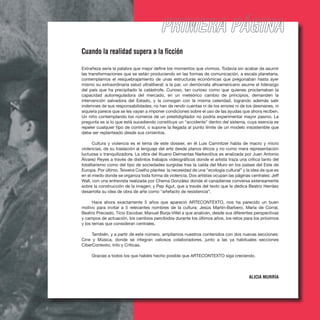
Secuencia de Gomorra. Dirigida por MATTEO GARRONE
Basada en la novela homónima de ROBERTO SAVIANO, 2008
Cortesía: Alta Films.
No hace mucho vi la obra de una joven artista. No era una obra dema-
siado notable, un juicio sobre el cual ambos estuvimos de acuerdo. Lo
discutimos durante un rato y de golpe confesó: “Lo que realmente me
interesa es el hecho de que se muere mi abuela y me voy a tomar una
Coca-Cola”. Con esto, la idea más interesante de la conversación,
resumió la violencia implícita en los pequeños actos de deshonra, los
traumas ignorados por los umbrales de nuestra sensibilidad. En su
caso sentía que estaba deshonrando a la persona que conocía y que-
ría al cometer un acto trivial que reificaba a su abuela y mostraba su
insensibilidad.
La confesión me hizo ver un acto al cual, por lo banal, hasta ese
momento nunca le había prestado atención. Ese acto define el umbral
que existe entre lo ético y lo no ético, entre la crueldad ignorable y el
daño socio-patológico. Solamente enfocamos las cosas que suceden
por encima de cierto límite, e ignoramos lo que queda por debajo.
Cuantificamos las experiencias para aceptarlas o descartarlas, como
si no existiera una conexión entre ambas zonas. Además, presupone-
mos que en cualquier momento dado el límite no solamente está en
una posición fija y absoluta, sino que también sirve como un instru-
mento de evaluación.
La conversación con la artista me hizo ver que para mi forma de
pensar deshonrar probablemente sea un término mucho más certero
que el de violentar o cometer actos de violencia. Utilizo deshonra a
falta de una palabra más fresca o mejor. La uso en el sentido más
profundo, aplicada a las actividades que tratan de expulsar a seres
humanos de la comunidad humana a la que tienen un derecho natural
de pertenencia. A las actividades que tratan de mancillarlos o destruir-
los a otros niveles. Deshonrar a los vivos es la versión antónima de
“honrar a los muertos”–ese intento fútil de resurrección eterna.
En última instancia la violencia es solamente una de las formas
que puede adoptar la deshonra y por lo tanto la violencia puede ser
considerada como una subcategoría de la deshonra. Deshonra es un
término descriptivo de una relación, mientras que violencia parece
un término confinado a actos discretos. Cometer violencia deshonra
en distintos grados a ambos, la víctima y el victimario: la víctima por
intención del victimario; el victimario porque disminuye o renuncia
a su derecho de participación en una colectividad constructiva. Es
esa relación subyacente la que parece mucho más reveladora. El
foco estrecho sobre la violencia separa al que la ejerce de la víctima,
o –en términos más perversos– al productor del consumidor. Esta
separación por lo tanto refleja una ideología de consumo en lugar de
ayudar a describir una situación que se pueda analizar en términos
éticos.
En el campo del arte importa la escala móvil que va de las gran-
des acciones a los pequeños actos de deshonra de la vida humana,
porque es la conciencia de esta movilidad la que permite definir el
campo de acción del artista. Desde este punto de vista, como ar-
tista, los actos grandes como el genocidio están fuera de mi alcance.
Puedo protestar y declarar mi oposición al genocidio, pero no importa
cuan buen artista sea, no puedo impedir o detenerlo. En cambio los
LUIS CAMNITZER *
DOSSIER · ARTECONTEXTO · 7
actos pequeños son más accesibles. Pueden ser aislados dentro de
los individuos y por lo tanto se puede establecer una empatía.
La mayoría de los actos dirigidos contra otros se basan en evitar
o borrar la posibilidad de empatía. Es un proceso que podemos llamar
la obliteración de la biografía. También puede denominarse reificación
o la conversión de la gente en cosas. No importa la interpretación, se
trata de despersonalizar a la víctima, de ignorar o borrar la historia
que la define como un individuo y, en ese sentido, deshonrarla. Es en
ese acto que el victimario también se des-individualiza, su biografía
se anula en beneficio de su función de victimario. De ahí la sorpresa
cuando se descubre que el militar que, en un acto deshonroso de sí
mismo, robó el niño de su víctima, llega a ser reconocido como un
padre bondadoso por ese mismo niño.
Los actos grandes son posibles porque la reificación se desfasa
hacia la estadística, un lugar donde impera el anonimato. Por otro
lado, en los pequeños actos se suspende el conocimiento biográfico
directo. La violencia cometida en los pequeños actos es mucho más
directa, hay menos lugar para el uso de la estadística y es como si
usáramos un lente de aumento. El daño en los pequeños actos puede
ser cuantitativamente menor pero, desde un punto de vista ético, no
menos condenable.
La tecnificación creciente de la guerra trata de lograr un aumento
de la presencia estadística y con ello impedir toda visualización bio-
gráfica. Usando computadoras para la manipulación de las armas, la
muerte se ejecuta desde una distancia que permite la invisibilidad.
No solamente se evita el contacto cuerpo a cuerpo sino también el
contacto visual. Los ojos, después de todo, son puertas importantes
para acceder a la información biográfica.
Treinta y cinco desertores del ejército norteamericano que se ha-
bían pasado a las fuerzas mexicanas durante la invasión de 1846, fue-
ron ejecutados en la horca. En un acto de vaciamiento y de castigo, en
sus cadalsos fueron forzados a mirar hacia el castillo de Chapultepec
mientras era tomado por las fuerzas norteamericanas. El verdugo es-
peró a que se izara la bandera de los Estados Unidos con la intención
de que esta imagen fuera la última registrada por los ojos de las víc-
timas, antes de que cayeran muertos. La historia no documentó si
sucedió un último y lógico acto de rebelión: si en el último momento
giraron la mirada hacia la cara de sus compañeros.
Durante los juicios de Nüremberg, el ideólogo del partido nazi
Alfred Rosenberg declaró que nunca había ido a los campos de con-
centración por razones de buen gusto. No sería correcto que él fuera a
“observar a gente a quienes se les había privado de su libertad”.
Las declaraciones del almirante Frederick Ashworth contienen
una excepción notable a esta forma de ceguera voluntaria. “Kokura
era la meta, pero el bombardero no podía ubicarla porque la zona es-
taba tapada por las nubes. Entonces el piloto nos llevó a Nagasaki”.
La nota necrológica de Ashworth también informa que “se le otorgó la
Legión de Mérito en 1946 por su trabajo en el proyecto de la bomba
atómica”.1
En 1838, en lo que se llamó la “guerra de los pasteles” (Francia
ocupó Veracruz en represalia a la quema de una pastelería francesa) el
general Santa Anna, ametrallado, sufrió la amputación de una pierna.
La pierna fue enterrada con un funeral y las pompas correspondientes,
y cinco años más tarde Santa Anna hizo instalar un monumento en su
honor. En una de las rebeliones en contra de Santa Anna como dic-
tador, el populacho demolió el monumento, desenterró la pierna y la
arrastró por las calles de la ciudad hasta que desapareció pulverizada
por la erosión. Los elementos biográficos visibles fueron eliminados,
el pueblo deshonrado por la dictadura deshonró a su victimario.2
El uso del idioma contribuye a crear distanciamiento y a bor-
rar la presencia de cualquier biografía personal de las víctimas, algo
visible en la nomenclatura de las operaciones contra Irak como tam-
bién en una larga tradición que las precedió. Las bombas atómicas de
Hiroshima y Nagasaki llevaban nombres anodinos como “Fat Man”
(Gordo), “Little Boy” (Chiquilín). Henry Kissinger bautizó las misio-
nes que bombardearon los villorrios en Camboya con los nombres
de “Breakfast” (Desayuno), “Lunch” (Almuerzo). “Snack” (Bocadillo) y
“Dinner” (Cena).
El incidente de la abuela muerta y la Coca-Cola tiene un interés
particular por su complejidad. Hubo allí un cruce inesperado. La cuali-
dad biográfica de la abuela (la palabra en sí misma contiene biografía)
se mantuvo durante el proceso de reificación. La artista del ejemplo
en realidad estaba tratando de dominar su sensación de pérdida y de
luto. Pero la simultaneidad de la biografía y de la reificación le hizo
confundir sus sentimientos con un comportamiento falto de ética. Fue
la presencia de la biografía lo que le hizo percibir el peligro de la des-
honra. Y es la biografía lo que aquí funciona como bisagra.
Durante largo tiempo la administración del Presidente Bush pro-
hibió la publicación de fotografías de los ataúdes de los soldados
norteamericanos muertos durante la invasión de Irak. Las fotografías
eran la grieta por donde la estadística reificada pasaba a biografía
individualizable.
No creo que haciendo arte se puede parar la violencia.3
Pero sí
creo que el arte puede ayudar a identificar la deshonra. La efectividad
del arte aquí solamente puede ser medida por el grado de conversión
que pueda lograr entre gente que tiene una opinión opuesta a la del
artista. Los pocos ejemplos que tienen una cierta efectividad general-
mente se basan en una calidad documental más que expresiva.
Las obras de arte políticas, en general, son incapaces de lograr
la conversión de un público no creyente. A pesar del acuerdo existente
sobre la importancia del Guernica de Picasso, nunca pude evitar la
sensación de que es un buen cuadro decorativo que fracasa en su
intento de una activación en contra de la violencia.4
Hoy, después de
décadas de inversión simbólica por parte de los guardianes del arte,
el Guernica se ha convertido en un objeto útil que recuerda un crimen
horrendo y es un recipiente que guarda una memoria. Gracias a un
consenso manufacturado –claramente una inversión extraartística–
actúa, mucho más que como un símbolo de un acto de violencia, como
símbolo de un acto de deshonra del victimario. Como tal cumple con
una función muy importante, a tal punto que el 5 de febrero de 2003
se cubrió la reproducción del Guernica en las Naciones Unidas para
evitarle vergüenza a Colin Powell durante su famosa presentación de
8 · ARTECONTEXTO · DOSSIER
datos falsos en las Naciones Unidas.5
La imagen está colgada cerca
de la entrada a la sala del Consejo de Seguridad desde 1985 y, para
la ocasión, fue tapada con las banderas de los países miembros del
Consejo. Paradójicamente, la función inicial del cuadro no había sido
la de actuar como un recuerdo de una deshonra, había sido la de
parar futuras acciones criminales.
Diría que el arte tiene una mayor probabilidad de actuar como
freno a la violencia y a la deshonra si ayuda a visualizar la biografía. El
arte se puede contraponer a la reificación modesta, y en ese proceso
puede instalar un sentido de revulsión y ayudar a una claridad percep-
tual, a una revelación en el observador.
Si el arte no logra generar esta claridad muere como informa-
ción enajenada. Esto significa que la única información utilizable es
aquella que conduzca a este tipo de revelación. Todo otro tipo de
información se convierte en ruido espurio. Tanto el gusto del artista
como su propia rabia con respecto al tema pertenecen a su biografía
personal. Pero la biografía personal del artista no debe interferir con
la biografía que se está tratando de rescatar, la biografía de la víc-
tima. La biografía del artista puede servir para nutrir el discurso, pero
carece de importancia como información en sí misma. La tarea es-
pecífica es la de salvar la biografía de la víctima y coordinarla con
la biografía del espectador. Virginia Wolf escribió en su diario: “La
razón por la cual es fácil matar a otra persona es que la imaginación
de uno es demasiado indolente para concebir el significado que la
vida tiene para ella”.
La violencia para el espectador siempre quedará reducida a una
serie de datos; es solamente la deshonra la que es transferible. Des-
graciadamente las heridas no pueden ser compartidas, sólo pueden
ser imaginadas. Es por esto que, más que cualquier otro tema, lo que
ayuda a definir nuestra tarea de artistas es cómo dar mayor poder a
la imaginación y cómo ayudar a encontrar una dirección éticamente
correcta. Es en esta combinación, no en el contenido, donde el arte
puede convertirse en un instrumento político con una posibilidad de
éxito.
* Luis Camnitzer es artista, extiende sus actividades
a la enseñanza, la curaduría, la crítica y la historia.
1. Richard Goldstein, “Frederick L. Ashworth, 93, Atomic Bomb Handler, Dies”. En
The New York Times, 8/12/2005, p. B11
2. Santa Anna usó piernas ortopédicas durante el resto de su vida. Una de sus pier-
nas artificiales todavía es conservada como trofeo de guerra por los Estados Unidos
en el Museo Militar del Departamento Militar y Naval de Illinois en Springfield.
3. Como contrapartida de esta afirmación, el general norteamericano William
Caldwell, justificando la muerte 49 personas en el mes de octubre de 2006 comparó
el caos bélico en Irak con una obra de arte.: “Toda obra maestra artística pasa por
etapas confusas mientras está en transición. Un trozo de arcilla puede convertirse en
escultura. Manchas de pintura se convierten en cuadros que inspiran”. Julian Borger,
“Iraq, a ‘work of art in progress’ says US general after 49 die,” En The Guardian,
2.11.06. Al mes siguiente, noviembre, murieron más de 3000.
4. El cuadro de Picasso fue pintado como protesta contra el bombardeo nazi del
pueblo vasco. En una operación que duró tres horas, fue asesinado cerca de un
tercio de los 5000 habitantes de Guernica. El bombardeo no tuvo otro propósito que
el estudiar la eficacia de las armas alemanas.
5. Obviamente, en esos momentos no estaba claro para el público que los datos eran
falsos, pero si se sabía que la presentación era hecha para justificar el bombardeo
e invasión de Irak.
DOSSIER · ARTECONTEXTO · 9
JORGE MACCHI Doppelgänger, 2005. From an exhibition at La Casa Encendida, Madrid. Courtesy of the artist and the Distrito Cu4tro Gallery.
I saw the work of a young artist not long ago. We both agreed that
it was not a particularly striking piece. We discussed it for a while,
and suddenly she confessed: “What really interests me is the fact that
my grandmother died and I went to have a coke”. This was the most
interesting idea in the conversation, and it summarised the underlying
violence in those small acts of shame, the traumas ignored by the
thresholds of our sensitivity. In this case, she felt she had been disloyal
to a person she knew and loved by engaging in a trivial act which
rendered her grandmother an object, and displayed her own lack of
sensitivity.
Her confession revealed an act which was so banal that she had
neglected it until that moment. This act defines the frontier between
the ethical and the non ethical, between ignorable cruelty and socio-
pathological damage. We only perceive the things which take place
above a certain level, and we ignore the rest. We quantify experiences
in order to accept or discard them, as if there were no connection
between them. In addition, we presuppose that, at any given time, the
limit will not stand on a fixed and absolute position, but will also serve
as an assessment tool.
The conversation with the artist made me realise that the term
dishonour is probably much more accurate than violence, or than
carrying out acts of violence. I use the word dishonour because I
cannot think of a better or more up-to-date term. And I use it in its
deepest sense, applied to human activities which seek to expel human
beings from the human community to which they have a natural right
to belong, to the activities which attempt to shun or destroy them on
other levels. To dishonour the living is the opposite of “honouring the
dead”, that futile attempt at eternal resurrection.
Ultimately, violence is just one of the forms which can be adopted
by dishonour, and therefore, violence can be considered a subcategory
of dishonour. Dishonour is a term used to describe a relationship,
whilst violence seems to be confined to discrete acts. Carrying out
an act of violence is an act of dishonour, in different degrees, toward
both the victim and the perpetrator: the victim because of the wishes
of the perpetrator; the perpetrator because he diminishes or reduces
his right to take part in a constructive collectivity. This underlying
relationship seems to be much more revealing. The narrow lens with
which violence is examined separates the perpetrator from the victim,
or –to use more perverse terms– the producer from the consumer. This
separation, therefore, reflects a consumer ideology, instead of helping
us reveal a situation which can be analysed in ethical terms.
The field of art is influenced by the mobile scale which goes from
large actions to small acts of dishonour toward human life, because it
is an awareness of this mobility that allows the sphere of action of the
artist to be defined. From this perspective, as an artist, large actions,
such as genocide, are outside my sphere. I can protest and state my
opposition to genocide, but, no matter how good an artist I may be, I
cannot do anything to stop it. On the other hand, small acts are more
accessible. They can be isolated within individuals, and, therefore, it is
possible to establish a sense of empathy.
LUIS CAMNITZER *
DOSSIER · ARTECONTEXTO · 11
12 · ARTECONTEXTO · DOSSIER
Most of the acts which are directed against others are based
on avoiding or erasing any chance for empathy. This process could
be termed “obliteration of biography”. It could also be described as
reification, or the transformation of people into things. Interpretation is
unimportant; it is a question of dehumanising the victim, of ignoring or
erasing the history which defines him or her as an individual, and, in that
sense, to dishonour him or her. It is during this act that the perpetrator
also losses his individual nature, and his biography is annulled in order
to feed his function as perpetrator. Hence the sense of surprise when it
is discovered that the military man, who, in an act of dishonour toward
himself, stole his victim’s child, is eventually recognised as the kindly
father of this same child.
Large acts are possible because reification tends to move toward
statistics, a place ruled by anonymity. On the other hand, in smaller
acts, direct biographical knowledge is suspended. Violence carried
out in small acts is much more direct, and there is far less space for
the use of statistics: it is as if we were using a magnifying glass. The
damage caused by small acts may be smaller, but, from an ethical
perspective, they are equally reprehensible.
The growing use of technology in war attempts to achieve a
greater statistical presence, with which to avoid any sort of biographical
visualisation. By using computers to manipulate weapons, death is
executed from a distance which allows invisibility. Not only does it avoid
body-to-body contact, but it also reduces visual contact. Eyes, after
all, are essential doors providing access to biographic information.
Thirty-five deserters from the North American army, which joined
the Mexican forces during the1846 invasion, were sent to the gallows.
In an act of emptying and punishment, at the time of their death, they
were forced to look toward the castle of Chapultepec as it was taken
by North American forces. The executioner waited until the American
flag was raised, so that this would be the last thing seen by the victims
before being killed. History did not document whether this last and
logic act of rebellion took place: whether or not at the last moment
they turned their face to that of their companions.
During the Nuremberg trials, the ideologist of the Nazi party,
Alfred Rosenberg, declared he had never been to a concentration
camp, for reasons of good taste. It would not be appropriate for him
to go and “watch people whose freedom had been taken from them”.
The statements of Admiral Frederick Ashworth contain a notable
exception to this wilful blindness. “Kokura was the target, but the
bomber could not find it under the clouds. So the pilot took us to
Nagasaki.” Ashworth’s obituary also mentions that he “was awarded
the Legion of Merit in 1946 in recognition of his work with the A-bomb
project.”1
In 1838, in what was known as the “Pastry War” (France
occupied Veracruz in retaliation for the burning of a French bakery),
General Santa Anna was hit by cannon fire and lost a leg. The leg
was buried with full military honours, and, five years later, Santa Anna
ordered for a monument to be erected in its honour. In one of the
rebellions against Santa Anna’s dictatorship, the people tore down the
monument, dug out the leg and dragged it through the city until it
turned to dust. The visible biographical elements were eliminated; the
people, dishonoured by dictatorship, dishonoured their tyrant.2
The use of language contributes to the creation of distance
and to erasing the presence of any sort of personal biography of the
victims, as is revealed in the names given to the military actions in
Iraq, as well as in the long preceding tradition. The nuclear bombs
which destroyed Hiroshima and Nagasaki were given such harmless
names as “Fat Man” and “Little Boy”. Henry Kissinger named the
bombardment mission on the tiny villages in Cambodia as “Breakfast”,
“Lunch”, “Snack” and “Dinner”.
The incident of the dead grandmother and the coke is particularly
interesting because of its complexity. It contained an unexpected
crossing. The biographical quality of the grandmother (even the word
contains biography) was preserved during the reification process.
The artist was really attempting to dominate her feeling of loss and
mourning. But the simultaneity of biography and reification caused her
to mistake her feelings for unethical behaviour. It was the presence of
biography which led her to perceive the danger of dishonour. And it is
biography which here functions as a hinge.
For a long time, the Bush administration did not allow the
publication of any photographs of the coffins of the American soldiers
killed during the Iraq invasion. The photographs were the crack through
which objectified statistics became individualised biography.
I do not believe that it is possible to stop violence though art.3
But I do believe art can help identify dishonour. The effectiveness of
art here can only be measured in terms of the level of conversion it can
achieve among people who disagree with the artist. The few examples
which prove its slight effectiveness are based on a documentary more
than expressive quality.
Political works of art, in general, cannot achieve the conversion
of a disbelieving audience. Despite the prevailing opinion regarding
the importance of Picasso’s Guernica, I never could avoid the
sensation that it is a good decorative painting which fails in its attempt
to activate anti-violence feelings.4
Today, after decades of symbolic
investment on the part of art’s guardians, Guernica has become a
useful object which reminds us of a horrific crime, and functions as a
receptacle for memory. Thanks to a manufactured consensus –clearly
an extra-artistic investment– it functions, much more than as a symbol
of violence, as a symbol of the dishonour of the perpetrator. As such,
it fulfils a very important role, to the extent that, on the 5th of February,
2003, the Guernica reproduction which hangs in the United Nations
was covered to avoid causing any embarrassment to Colin Powell
during his well-known statement including false data before the United
Nations.5
The image hangs near the entrance to the Security Council
hall, and has done so since 1985, and, on this occasion, it was covered
with the flags of the member countries. Paradoxically, the picture’s
initial purpose had not been to act as a reminder of dishonour, but to
avoid future criminal actions.
I would say that art has a greater chance of preventing violence
and dishonour if it helps viewers visualise biography. Art can act
against modest reification, and, during this process, it can convey a
DOSSIER · ARTECONTEXTO · 13
SIMEÓN SÁIZ Forense yugoslavo examinando, el viernes 22 de enero de 1999, la radiografía de una víctima de la matanza de Racak, 2005.
From an image by the Associated Press. Pastel on paper. Collection: Fúcares Gallery.
sense of revulsion, and contribute to perceptual clarity and to
providing the viewer with a revelation.
If art does not manage to generate this clarity, it perishes
as deranged information. This means that the only usable
information is that which leads to this kind of revelation. Both
the artist’s taste and his own rage regarding this subject belong
to his personal biography. But the personal biography of the
artist must not interfere with the biography which he is trying
to rescue, that of the victim. The artist’s biography can serve
to enrich the discourse, but it lacks significance as information
in and of itself. The specific task of the artist is to salvage the
victim’s biography, and synchronise it to that of the viewer. In
her diary, Virginia Woolf wrote: “The reason why it is easy to
kill another person is that one’s imagination is too indolent to
conceive the meaning that life has for the other person.”
Violence, for the viewer, will always be reduced to a series
of facts; it is only dishonour that is transferable. Unfortunately,
wounds cannot be shared, only imagined. It is because of this,
more than any other issue, that what helps us to define our
role as artists is the way in which to lend greater power to
imagination, and how best to find an ethically correct direction.
It is in this combination, rather than in matters of content, that
art can become a political tool with some chance of success.
* Luis Camnitzer is an artist, who also works as a teacher,
curator, critic and historian.
1. Richard Goldstein, “Frederick L. Ashworth, 93, Atomic Bomb Handler,
Dies”. In The New York Times, 8/12/2005, p. B11
2. Santa Anna used artificial legs for the rest of his life. One of these is
still held as war trophy by the United States, at the Military Museum of the
Illinois Military and Naval Department in Springfield.
3. In contrast to this statement, the North American general William
Caldwell, in an attempt to justify the death of 49 people in October, 2006,
compared the war chaos in Iraq with a work of art: “Every masterpiece
goes through confusing periods while it is being developed. A piece of clay
can become a sculpture. Paint stains become inspiring paintings”. Julian
Borger, “Iraq, a ‘work of art in progress’ says US general after 49 die,” In
The Guardian, 2.11.06. The following month, November, more than 3,000
people died.
4. Picasso’s painting was made with the aim of protesting against the Nazi
bombardment of the Basque village of Guernica. In an operation which
lasted three hours, almost a third of the village’s 5,000 inhabitants were
killed. The purpose of the bombardment was solely to test the effectiveness
of German weapons.
5. Obviously, at that point it was not clear to everyone that the information
was false, but it was known that the purpose of the presentation was to
justify the Iraq invasion.
JORGE
MACCHI
Charco
de
sangre,
2004.
Installation
in
Réplica
exhibition
at
MUCA,
México.
Courtesy
of
the
artist
and
the
Distrito
Cu4tro
Gallery.
14 · ARTECONTEXTO · DOSSIER
subjetivos
Una vez en el siglo XX, 2004. Vídeo Betacam SP. 7’. Cortesía: MNCARS.
Para abordar la obra de Deimantas Narkevičius (Utena, Lituania, 1964)
este artículo desarrolla un enfoque que parte esencialmente del ensayo
Espectros de Marx, del pensador franco argelino Jacques Derrida.
A partir de éste y de la literatura que ha generado –especialmente
la compilación de artículos titulada Demarcaciones espectrales–,
intentaremos trazar un correlato con los trabajos de Narkevičius
centrados en cuestiones relativas al monumento y a la acción
colectiva. Así, tomamos como punto de partida la cabeza de Marx
y su espectro. La primera, de grandes dimensiones, como escultura
exenta conmemorativa, para una ciudad de la República Democrática
Alemana. El segundo, un espíritu que vaga por casi el mismo espacio
geopolítico que esa cabeza desde la noche del 9 al 10 de noviembre
de 1989, momento que marca la caída definitiva del Muro de Berlín.
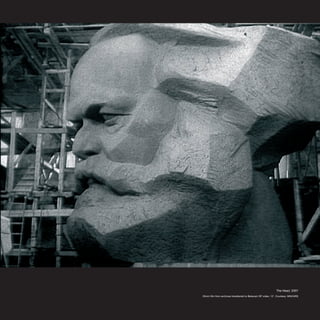
La referencia a esta escultura es una idea transformada por
Deimantas Narkevičius para el Skulptur Projekte Münster de 2007
cuyo resultado final es el vídeo titulado The Head. Y la referencia
del espectro la tomamos del libro escrito en 1993 por Derrida, que
sustrae la palabra Espectros precisamente del primer título que Marx
pensó para su Manifiesto. Como decíamos, el vídeo es un ensayo
visual resultado de la imposibilidad del traslado físico de la escultura.
Y Espectros de Marx fue también un gesto convertido en ensayo,
en este caso escrito, sobre lo que falta, sobre la gran ausencia en el
momento álgido del liberalismo capitalista.
No fue casual que Narkevičius quisiera trasladar el monumento de
la cabeza de Marx desde Chemnitz a Münster y que, luego, pretendiera
realizar una réplica exacta para que tuviera su correlato en una ciudad
de la República Federal Alemana. No fue posible. Sin duda, más que el
Muro, el símbolo de la Guerra Fría fue un país dividido en dos sistemas
políticos antagónicos. En el gesto de llevar el pensamiento marxista
“conmemorado” –pero también de rememorar otra época– no había
intención de provocar, porque no es éste el estilo del artista. Más
bien era una acción casi melancólica que hablaba de una derrota que
debía ser revisada. No tanto como revancha por la disolución de un
régimen en otro, sino por el triunfo del imperio de lo privado frente a
lo público. En esto coincide plenamente con lo planteado por Derrida
en su ensayo puesto que, de algún modo y a su manera, lo que hace
el filósofo francés es plantear que el pensamiento marxista no está
muerto ni es obsoleto –o, al menos, no del todo– como pretendieron
los partidarios del “fin de la historia” y de la apoteosis capitalista. En
cualquier caso, ese contexto es fundamental en ambos, puesto que
la lectura derridiana es fruto de la herencia dejada por los sucesores
reales de Marx y su aniquilación en los 90 por sus antagonistas.
Aunque fuera desde el otro lado del Telón de Acero, lo mismo ocurre
en prácticamente todos los trabajos fílmicos de Narkevičius. Tanto en
los que poseen un carácter más familiar, de indagación y fabulación
en la historia personal, como en aquellos otros en los que lo político
es analizado principalmente a partir de la idea de monumento. Aquí,
la idea de monumento le interesa fundamentalmente porque es
un elemento público y porque como afirma el artista es “un buen
registro de la historia”, al convertirse en “una explicación de cómo
JUAN ANTONIO ÁLVAREZ REYES*
DOSSIER · ARTECONTEXTO ··17
18 · ARTECONTEXTO · DOSSIER
ha sido el discurso social en lo que se refiere a la importancia de la
conmemoración del arte en los espacios públicos”1
Precisamente, a lo largo del filme preparado para Münster,
hay una sucesión de material de archivo recuperado que se dedica
intencionalmente a esa “conmemoración del arte”, pero sobre todo a
una: la que se celebra durante su inauguración oficial. No es, en este
sentido, que la fiesta oficial en The Head sea tan distinta de aquella
otra intervenida y trastocada también, con toda intención, en el filme
Una vez en el siglo XX. Existe un sentido de comunidad en ambas,
pero en este último vídeo el artista invierte la realidad con un sencillo
truco. Si en la escenificación del “fin de la historia” la destrucción del
monumento a los héroes socialistas es esencial, Deimantas trastoca
esa escenificación al restituirlos en sus pedestales, en este caso
concreto a Lenin. La idea de monumento, pues, condensa muchas
otras y por eso es tan esencial en toda la trayectoria del artista,
constituyendo su espina dorsal. La gran cabeza que simboliza también
la importancia del pensamiento marxista, conforma junto a Una vez en
el siglo XX y a The Role of a Lifetime, una especie de trilogía sobre
una época del pasado reciente y sobre cómo pervive en el presente a
través de ciertas ausencias. Es, por tanto, una cuestión de fantasmas
y espectros. Su aura permanece entre nosotros.
Pero también hay otra cuestión, puesto que como él mismo
afirma, existe incluso una voluntad de rescate artístico que no está muy
alejada de ese otro afán por recuperar documentos visuales rastreados
por el artista en los archivos donde reposa ese pasado. Y ese rescate
artístico está muy presente en The Head, que es, sin duda, una de sus
obras mayores, en la cual consigue abrir muchos frentes e invocar
a muchos espectros. Cuestiones que competen tanto a la reflexión
sobre el papel del artista, como a la consecución de la propia obra;
pero también a aspectos históricos, sociales, personales y políticos.
Lo artístico esta ahí presente no sólo a través de la reflexión sobre
la idea de lo escultórico asociada al monumento, en un contexto de
intervenciones públicas como es Münster, sino también en la línea de
lo que el propio artista expresaba en una entrevista con Larissa Harris:
“Al llevar a Münster ese monumento del realismo socialista quería
señalar que los desarrollos artísticos liberales en Occidente también
eran desafiados por la monumentalidad y escala del Este. ¿Por qué se
ha desterrado el arte de ese periodo de las colecciones de los museos
de arte moderno? ¿Somos conscientes de la naturaleza innovadora
del arte experimental del siglo pasado, especialmente dentro del
contexto político de esa época?.” 2
Es decir, quería cuestionar con
esta obra, pero también con otras cercanas, como las mencionadas
anteriormente, el desarrollo político capitalista en las últimas décadas,
precisamente trayendo con rotundidad la figura del mayor tabú que
éste ha construido a partir de su pensamiento antagónico. De ahí que
se invoquen fantasmas y espectros.
“Crecimos con cierto sentido de lo público y de la comunidad.
Tengo cierta nostalgia de eso”, afirma Deimantas Narkevičius.3
Nostalgia de Marx, que diría Derrida. “¿Cómo puede estar ahí, de
nuevo, cuando su tiempo ya no está ahí?”, se preguntaba el filósofo
en su ensayo. “Hay que asumir la herencia del marxismo, asumir lo
más vivo de él”, insistía. Sin duda, el libro de Derrida ha dado para
mucho, incluso para un conjunto de ensayos recogidos del simposio
titulado Gostly Demarcations por Michael Sprinker. En él, Antonio
Negri escribe que los espectros de Marx son también los espectros
del capitalismo. Es decir, que la pregunta acerca de “¿dónde está
o a dónde va el marxismo?” tiene como respuesta reverso aquella
que nos interroga sobre “¿dónde está o a dónde va el capitalismo?”.
Esto es crucial en todo el trabajo de Narkevičius, puesto que en el
análisis contextual e histórico que realiza mediante sus documentales
subjetivos (“documentales con aspectos de ficción”, aclara él mismo),
la cuestión del “estatus político del artista” es indisociable “del contexto
cultural al que uno pertenece y en el que empieza a trabajar”. El “soy
de donde pienso”, de Walter Mignolo, adquiere así en su producción
un sentido concreto: Lituania como espacio geopolítico, pero también
constituida por las historias personales de un tiempo histórico. Aquel
en el cual la moneda cambió de cara, aquel del tránsito abrupto del
marxismo al capitalismo, como un continuo de proyectos divergentes
de la modernidad.
Así, la nostalgia de lo comunitario en Narkevičius es una
melancolía fantasmagórica. “Un fantasma es, precisamente, una
aparición intermedia entre la vida y la muerte, entre el ser y no ser,
entre la materia y el espíritu”, como escribe Pierre Macherey en uno
de los ensayos de Gostly Demarcations. Vida después de la muerte
entonces, en ese archivo en el que rebusca el artista para construir
sus precisas narraciones visuales, casi siempre planteadas como
una presentación sin desenlace en la que tiene cabida –con un
amplio desarrollo– una experimentación formal muy contenida. En
una de ellas, Energy Lithuania, se habla precisamente de eso, de la
necesidad de lo público, de la posibilidad de construir el futuro y de
la importancia de crear comunidad. En este caso, a través de una
experiencia colectiva que pone en pie una gran central eléctrica para
dar energía al proyecto de modernidad. Un proyecto concreto en el
cual invertir el esfuerzo de lo común y la creación de comunidades.
Ahí estriba ese continuo histórico moderno desbaratado. Boris
Buden, en el catálogo de la exposición titulada La vida unánime
dedicada al artista en el Museo Nacional Reina Sofía, habla de que
“hubo una vez en que la ideología de la modernidad hizo que los
individuos se tuviesen por autores de su propio destino. Ahora son
personas que en su recuerdo reconstituyen la modernidad como
sujeto de un destino histórico necesariamente alienado. Dicho de
otro modo, solo podemos rememorarla en cuanto vivencia de su
fracaso último”. Y en esas ruinas nos encontramos.
* J. A. Álvarez Reyes es crítico de arte y comisario independiente.
1. VVAA. Inventario nº 12. El estatus del artista. AVAM. Madrid, 2006.
2. Harris, Larissa. “Larissa Harris in Conversation with Deimantas Narkevičius”
En A Prior Magazine nº 14. Brussels, 2007.
3. VVAA. Op. Cit.
DOSSIER · ARTECONTEXTO · 19
The Head, 2007
35mm film from archives transferred to Betacam SP video. 12’. Courtesy: MNCARS
Energy from Lithuania, 2000. 8mm film transferred to Betacam SP video. 17’. Courtesy: MNCARS.
To address the work of Deimantas Narkevičius (Utena, Lithuania,
1964), this article uses a focus based in part on the essay Spectres
of Marx, by the French-Algerian thinker Jacques Derrida. Using this
and the literature it has spawned –particularly the compilation of
articles entitled Spectral Demarcations– we shall attempt to establish
a correlation with Narkevičius’s work focusing on questions relating
to the monument and to collective action. Accordingly, we shall take
as our starting points Marx’s head, and his ghost. The former, of a
great size, is a free-standing commemorative sculpture for a city
in the German Democratic Republic. The latter is a spirit that has
wandered through nearly the same geopolitical space as that head,
from the night of 9-10 November, 1989, the moment marking the
definitive fall of the Berlin Wall.
The reference to this sculpture is an idea transformed by
Deimantas Narkevičius for the 2007 Skulptur Projekte Münster
whose final result is the video entitled The Head. And the reference
to the spectre we take from the book Derrida wrote in 1993, which
borrows the word “spectre” from the title that Marx had originally
planned to use for his Manifesto. As we said, the video is a visual
essay resulting from the impossibility of moving the sculpture
physically. And Spectres of Marx was also a gesture made into an
essay, in this instance taking written form, about what is lacking,
about the great absence in the heyday of market capitalism.
It was not by chance that Narkevičius chose to convey the
monumental head of Max from Chemnitz to Münster and that he
later wished to make an exact replica so it would have its match in
a city of the Federal Republic of Germany. This was not possible.
It is beyond doubt that, more than the Wall, the symbol of the Cold
War period was a country divided into mutually antagonistic political
systems. The gesture of bringing Marxist thought “commemorated”
–but also recalled another time– there was no provocative intent,
since that is not the artist’s style. Rather, it was an almost melancholy
action that bespoke a defeat that needed to be re-examined. It was
not so much an act of revenge for the dissolving of one regime by
another, as to mark the triumph of the empire of the private over the
public. Here it coincided fully with what Derrida poses in his essay,
since, in a way and in his own manner, what the French philosopher
is saying is that Marxist thought is neither dead nor obsolete –or,
at least, not entirely– as was alleged by the partisans of the “end
of history” notion and the capitalist apotheosis. At all events, that
context is essential in both, since the Derridian reading stems from
the legacy left by Marx’s real successors and their destruction
by their enemies in the 1990s. Even though it was from the other
side of the Iron Curtain, the same thing happens in practically all
Narkevičius’s film works, as much in those possessing a more
familiar character, of probing and telling personal stories, as in those
others in which political matters are analysed chiefly from the idea
of the monument. Here, the monument interests him fundamentally
JUAN ANTONIO ÁLVAREZ REYES*
DOSSIER · ARTECONTEXTO · 21
22 · ARTECONTEXTO · DOSSIER
because it is a public element and because, as he asserts, it is “a
good register of history”, by becoming “an explanation of what
the social discourse has been like as regards the importance of
commemorating art in public spaces.”1
And indeed, throughout the film made for Münster, there
is a succession of recovered file footage that is intentionally
devoted to that “commemoration of art”, but above all to one:
the one that is celebrated during the official opening. It is not,
in this respect, that the official party in The Head should be so
different from that other one, also intervened and inverted, quite
deliberately, in the film Once in the 20th
Century. There exists a
sense of community in both, and in this latest video the artist
inverts reality with a simple trick. If in the staging of the “end
of history” the destruction of the monument to social heroes is
essential, Deimantas switches this staging around by restoring
them to their pedestals, in this instance Lenin. The idea of the
monument, then, condenses many others, and hence is it so
basic to the artist’s entire career, constituting its backbone.
The great head that also symbolised the importance of Marxist
thought, together with Once in the 20th
Century and The Role
of a Lifetime, makes up a sort of trilogy about an era in the
recent past, and about how it survives in the present by means
of certain absences. Consequently, it is a question of ghosts
and spectres. Its aura still remains among us.
But there is an additional question, since, as the artist himself
states, there even exists an intention of making artistic rescues that
is not so distant from that other desire to retrieve visual documents
unearthed by the artist in the archives where that past reposes,
and such an artistic rescue is very present in The Head, which is,
without doubt, one of his major works, in which he manages to open
many fronts and invoke many ghosts. The questions posed deal
as much with reflection on the role of the artist, as they do with
the achievement of the work itself, but also with historical, social,
personal, and political matters. The artistic is present not only via the
reflection upon the idea of the sculptural that is associated with the
monument, in a context of public interventions like Münster, but is
also in line with what the artist himself expressed in an interview with
Larissa Harris: “By bringing to Münster this monument of Socialist
Realism I wanted to point out that liberal artistic developments
in the West were also challenged by the monumentalism and the
scale of the East. Why has the work of this period been ostracised
from modern art museums and collections? Are we aware of
the innovative nature of the experimental art of the past century,
especially within the political context of the period?”2
. This is to say
that he wished to question, with this work, but also with others near
to it, like those mentioned above, capitalist political development of
the past few decades, by boldly bringing the figure of the greatest
taboo that the West constructed from its antagonistic thought. And
in this way ghosts and spectres are invoked.
“We grew up with a certain sense of the public and the
community. I feel some nostalgia for this,” says Deimantas
Narkevičius.3
Nostalgia for Marx, Derrida might say. “How can he
be there, again, when his time is no longer there?”, the philosopher
wondered in his essay. “One must shoulder the legacy of Marxism,
embracing its liveliest aspects,” he insists. The book by Derrida
has certainly made an impact, even on the group of essays
collected at the symposium Ghostly Demarcations by Michael
Sprinker. In it, Antonio Negri wrote that the spectres of Marx are
at once the spectres of capitalism. This is to say that the question
“Where is Marxism or where is it going?” has for a reverse answer
that which asks us “Where is capitalism and where is it going?”.
This is crucial in all Narkevičius’s work, since in the contextual and
historical analyses he carries out in his subjective documentaries
(“documentaries with aspects of fiction”, he explains) the question
of the “political status of the artist” cannot be dissociated from
“the cultural context to which one belongs and in which one
begins to work”. Walter Mignolo’s “I am where I think” attains a
specific sense in his output: Lithuania as a geopolitical space, but
also made up by personal stories from an historical period, that in
which the reverse side of the coin was shown, that of the abrupt
shift from Marxism to capitalism, as a continuum of divergent
projects of modernity.
Hence Narkevičius’s nostalgia for the communitarian is a
phantasmagorical melancholy. “A ghost, after all, is an apparition
halfway between life and death, between being and non-being,
between matter and spirit”, as Pierre Macherey wrote in one of
the essays of Ghostly Demarcations. Life after death, them, in
this archive in which the artist rummages to construct his precise
visual narratives, almost always posed as a presentation without
denouements, which encompasses –amply developed– a highly
contained formal experimentation. One of them, Energy Lithuania,
speaks directly of this, of the need for the public, of the possibility of
building the future, and the importance of creating community, in this
instance via a collective experience that erects a great power station
to supply energy to the project of modernity, a concrete project in
which to invest common efforts and the creation of communities.
From this arises that thwarted modern historical continuum. Boris
Buden, in the catalogue of the artist’s show La vida unánime at the
Reina Sofia Museum, noted that “there was a time in which the
ideology of modernity caused individuals to regards themselves of
masters of their own fates. Now these are people in whose memories
they reconstitute modernity as the subject of a necessarily alienated
historic fate”. In other words, we can only recall it as an experience
of its ultimate failure. And it is in these ruins that we find ourselves.
*J. A. Álvarez Reyes is an art critic and independent curator.
1. VVAA. Inventario nº 12. El estatus del artista. AVAM. Madrid, 2006.
2. Harris, Larissa. “Larissa Harris in Conversation with Deimantas Narkevičius”
In A Prior Magazine no. 14. Brussels, 2007.
3. VVAA. Op. Cit.
DOSSIER · ARTECONTEXTO · 23
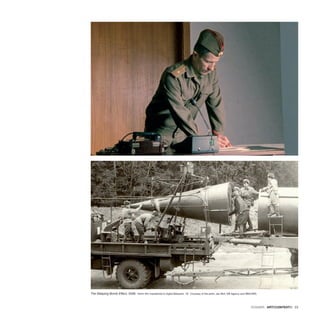
The Sleeping Bomb Effect, 2008. 16mm film transferred to digital Betacam. 18’. Courtesy of the artist, Jan Mot, GB Agency and MNCARS.
24 · ARTECONTEXTO · DOSSIER IGNASI ABALLÍ Listas (Violencia 1), 1997-2003. Cortesía: Galería Estrany de la Mota.
DOSSIER · ARTECONTEXTO · 25
“Soy mi cadáver”. Esa podría ser la respuesta de la cultura si se le
preguntase, hoy, qué es. Con esta frase insólita, Orhan Pamuk inicia
su fabulosa novela Benim Adım Kırmızı [Me llamo rojo], una historia
de amor y arte desarrollada en el Estambul del Siglo XVI. La frase es
pronunciada por un cadáver que narra su propia muerte y que tiene
como telón de fondo las relaciones entre cultura y violencia.
Para comprender esta afirmación basta abrir cualquier periódico.
Como por ejemplo El País, que publicaba el pasado 13 de diciembre
de 2008 una noticia sobre las revueltas de jóvenes en Atenas. Uno
de los manifestantes responde de la siguiente manera a la pregunta
del periodista sobre qué es lo que buscan con “todo aquello”: “No
tenemos nada que perder, ¿qué importa lo que queramos?”. Tan sólo
han pasado cuarenta años desde mayo del 68 pero el abismo parece
enorme entre la situación de hoy y la de aquellos días de proclamas
juveniles: “Seamos realistas, exijamos lo imposible”. Las declaracio-
nes aisladas no permiten hacer ciencia. Sin embargo, cuando son
pronunciadas por jóvenes como muchos otros de Grecia, de España o
de Brasil resulta imposible no valorar su importancia. Remitiéndonos
de nuevo al 68, que la cultura diga de sí misma “Soy mi cadáver” es
algo que se comprende muy fácilmente.
Si esta afirmación es pertinente, cambian los términos del pro-
blema de la cultura. La disyuntiva ya no es “cultura y violencia” sino
“la cultura es violencia”. El que un joven responda de esta manera es
indicativo de la más grande violencia que la cultura puede cometer. Y
es señal de la más grande violencia contra la cultura.
Esta perspectiva no debería causar extrañeza. Cuando los aten-
tados del 11 de septiembre destruyeron las Torres Gemelas de Nueva
York, el compositor Stockhausen afirmó que aquella era “la mayor
obra de arte de la historia”. Casi nadie lo entendió y, como no lo com-
prendieron, sintieron miedo. Y como sintieron miedo, acabaron con
el mensajero (al menos con su carrera). Al no poder castigar a los
autores del atentado se castigaba al intérprete. Lo que Stockhausen
quería argumentar es que hemos olvidado que el arte –no sólo la cul-
tura– es peligroso y violento.
Para cuando sucedieron los ataques a las Torres Gemelas el
mundo acababa de finalizar dos décadas de alabanza a la cultura,
vista como instrumento de desarrollo, cooperación internacional, tu-
rismo, sociabilidad y crecimiento de la diversidad étnica... Fueron dos
décadas de domesticación de la cultura. En los congresos de organis-
mos internacionales y universidades, la cultura se presentaba como
motor de desarrollo humano. Y de paz. Durante estos años sólo se
resaltó su positividad –como todavía en 2004, en el Fórum Universal
de las Culturas de Barcelona. Los regímenes totalitarios del siglo XX,
de derecha e izquierda, habían demostrado que la masacre y el horror
se podían consumar con cultura. Pero, en seguida se olvidó. Cuando
Stockhausen recordó que tanto el arte como la cultura pueden ser
negatividad casi todos se horrorizaron, tuvieron miedo y dijeron que el
músico había perdido el juicio.
La cultura contiene positividades pero también apoya un pie en
una zona de la que nadie quiere oír hablar. Gide, una vez más, demos-
tró conocerla cuando afirmó que “lo admirable de los grandes autores
es que permiten que sucesivas generaciones no se entiendan recípro-
camente”. Estas palabras se enfrentan a los discursos biempensantes
de políticos rastreros y académicos acomodados. George Salle, autor
TEIXEIRA COELHO*
26 · ARTECONTEXTO · DOSSIER
olvidado por estar fuera de todo paradigma, anotó sobre los visitan-
tes de los museos que: “el velo pesado que se extiende sobre lo que
ven los tranquiliza porque no buscan una visión de felicidad, sólo de
gloria embalsamada”. La cultura tranquiliza y la gente quiere que así
sea. La cultura tranquiliza incluso al arte. Por tanto, prohibido asustar
a la gente.
La clave sugerida por Gide propone una respuesta al enigma
que asombró a muchas almas buenas: ¿por qué la cultura de Ale-
mania no impidió los horrores del nazismo? Sin pensar en esa cues-
tión Georg Simmel dio pistas para entenderla (pistas que nadie quiso
ver) al sugerir la existencia de una cultura objetiva, que prefiero llamar
objetivada, y una cultura subjetiva. La cultura objetivada está en las
bibliotecas, museos, filmotecas. Sin embargo, tiene poco que ver con
la cultura subjetiva de las personas que se exponen a ella. Los tortura-
dores nazis iban a un concierto cargando con sus culturas subjetivas
y salían de ellos sin que sus culturas se modificasen. Como muchos
jóvenes hoy, al entrar y salir de las universidades. No hay por qué acu-
sar a la cultura objetivada de los fracasos, omisiones o crímenes de la
cultura subjetiva. La cultura objetivada es rica e inmensa. La subjetiva
es la que se convierte, cada vez más, en un cadáver. Cadáver exqui-
sito pero cadáver. El cadáver de la cultura objetiva. (La pregunta que
podemos hacernos hoy es ¿hasta qué punto la cultura objetiva se
convierte en su propio cadáver al estar rodeada de tantos cadáveres
de la cultura subjetiva?).
Sin saber de qué cultura estaban hablando y cómo funcionaba,
las buenas almas de los años 80 y 90 inundaron el mundo con la idea
políticamente correcta de una cultura, cualquier cultura y todas por sí
mismas, como fuente de positividad. En un momento en el que ya no
era sostenible apelar a la ideología, cuando el sistema económico se
convirtió en uno solo y la religión, por lo menos en occidente, había
perdido poderes y encantos, la cultura fue un antídoto para todo –co-
menzando por el diabólico Mercado– y una alabanza para el progreso
en general. En 2001 Stockhausen fue arrojado a la realidad de manera
violenta advirtiéndonos: “la cultura y el arte también son negativida-
des”. Pero todo lo que el mundo hizo fue sorprenderse.
Esa domesticación de la cultura ayudó a ocultar violencias de la
cultura similares a la desvelada por el joven ateniense: “No tenemos
nada que perder, ¿qué importa lo que queramos?”. Sus palabras con-
tienen algo todavía más terrible que él no supo expresar: “No tenemos
nada que querer. ¿Qué importa lo que perdamos?”. Del mismo modo
que el cadáver de la novela al describir su propia muerte, la cultura
traza su defunción. En voz alta. Y tan alta que El País de aquel mismo
día, unas páginas más adelante, decía que la gente, desesperada
(e irrazonable) ahora quiere “menos cultura” y más “obra social”. El
periódico insiste en dejar las cosas claras, en las siguientes páginas
señalaba que en Irak se cobran “50 dólares por colocar una bomba”,
en un país (?) donde “casi todos los jóvenes entre 16 y 35 años están
implicados en algún tipo de violencia”. Entonces, ¿qué es lo que hay
que querer? Para algunos la cultura ya no indica el camino, o quizá
para muchos.
Otras personas insisten en que también el arte (que no es cul-
tura, pero esa es otra historia siendo la misma historia) podría afirmar
“Soy mi cadáver”. Como ejemplo la reciente Bienal del Vacío de São
Paulo. Este nombre, asignado por los periódicos, no se corresponde
con el título original del comisario: Em vivo contato [En vivo contacto]
–que en portugués remite a la frase hecha: “en carne viva” (similar a
la que presentan algunos cadáveres). Dejar una sala de la Bienal vacía
situó a muchos en la idea de que el arte se había convertido por fin en
un cadáver. Tal vez sea exagerado y el arte contemporáneo sea sólo
académico. Académico como sinónimo de lo clásico y clásico, como
apuntó Paul Valery, es aquel estado en que se administra el territorio
ya conquistado; no hay más que combatir, nada más que explorar: la
paz de los cementerios reina. Como probó Damien Hirst en su subas-
ta de cadáveres. Otra violencia de la cultura contra la cultura.
El proceso de domesticación de la cultura favoreció que las to-
xinas de la negatividad fuesen contenidas en el propio cuerpo cultural
que, en un acto radical de violencia, se infectó a sí mismo. ¿Qué cul-
tura muere? ¿La objetiva o la subjetiva? Los nervios y los músculos
entre una y otra aparecen seccionados. La objetivada, con toda su
masa enorme e inerte (que a veces parece formar un enorme cuerpo
cultural inerte), se sitúa en un margen; en el otro, la cultura subjetiva.
¿Existe un antídoto? Unos insisten en la cultura violenta porque,
dicen, hace “denuncia social”. Sin embargo, sólo refuerzan el culto
a la violencia. Por el contrario, Italo Calvino, que percibió de dón-
de provenía el peligro, propuso que el nuevo milenio fuese el de la
levedad. Pero esta levedad es minoritaria, no vende (veáse el caso
de Woody Allen). En la actual cultura visual de la impaciencia (Harold
Bloom) incluso los biempensantes no soportan la levedad. En cuanto
al arte, que puede ser la levedad personificada, incluso al centrarse en
la violencia, Lévi-Strauss advirtió hace mucho tiempo que los artistas
modernos lo habían matado por desesperanza y soberbia. ¿Acaso
inducidos por la cultura? Los comisarios los siguen.
La cultura demanda un reequilibrio entre positividad y negatividad,
entre cultura objetiva y subjetiva, más aún cuando el mundo requiere
un reequilibrio entre naturaleza y cultura. La ideología nunca buscó ese
equilibrio, la religión no lo favoreció, la economía lo perturba. Parece
que tan sólo la cultura puede hacerlo (y no hay alternativa). Pero sólo
si consigue realizar la bizarra tarea de levantarse a sí misma tirando de
sus propios cabellos. La cultura necesita de una ecología de la cultura,
de un programa de sostenibilidad cultural. Lo cual no es un problema
menor que el de la otra ecología, la centrada en la naturaleza.
Mientras, el joven ateniense, que no sabe lo que quiere, siente
miedo. Y al tener miedo, se vuelve violento. La cultura en la que vi-
vimos hoy es, mayormente, una cultura del miedo. Y una cultura del
miedo es una cultura violenta. Ahora más que nunca. Reconocer el
problema es mejor que recorrer las bienintencionadas palabras hue-
cas sobre el bien asociado a la cultura, sin que se tenga la más remota
idea de lo que está en juego.
* Teixeira Coelho es comisario del MASP-São Paulo, autor, entre otros, de
Olhar e ser visto e História Natural da Ditadura (Premio Portugal Telecom de
Literatura, 2007)
DOSSIER · ARTECONTEXTO · 27
MAURIZIO CATTELAN All, 2008. Cortesía del artista y Marian Goodman Gallery.
28 · ARTECONTEXTO · DOSSIER
SIMEÓN SÁIZ Víctimas de ataque a un autobús en Kosovo en el que murieron 17 personas, 2008.
From an image that appeared on TVE1. Pastel on paper. Courtesy of the artist and the Fúcares Gallery.
DOSSIER · ARTECONTEXTO · 29
“I am my corpse”. This could be culture’s reply if it were asked, today,
what it is. With this unusual sentence, Orhan Pamuk begins his fabulous
novel Benim Adım Kırmızı [My Name is Red], a love and art story set in
Istanbul in the 16th century. The sentence is pronounced by a corpse
who narrates his own death, and is set against the background of the
relationship between culture and violence.
In order to understand this statement, all we need to do is open a
newspaper. For example, El País published, on the 13th of December,
a news item on the riots involving young people in Athens. One of
the demonstrators replied to the journalist’s question about what they
were seeking to achieve which “all of this”, saying, “we have nothing to
lose, what does it matter what we want?” Only 40 years have passed
since May of 1968, but the abyss between the situation today and that
time of youthful demands could not seem greater: “let us be realistic,
let us demand what is impossible”. These isolated statements are
not enough to make science. However, when they are pronounced
by young people, whether they are from Greece, Spain or Brazil, it
is impossible not to recognize their importance. Returning to 1968,
having culture now saying “I am my corpse” is something which is very
easily understood.
If this statement is relevant, it changes the terms of the problem
with culture. The question is no longer to choose between “culture
and violence” but to decide whether “culture is violence”. The fact
that a young person responds in this way reveals the greatest level of
violence which culture can inflict. And it is a sign of the greatest level
of violence against culture.
This perspective should not be surprising. When the 9/11
terrorist attacks destroyed the Twin Towers in New York, the composer
Stockhausen described it as “the greatest work of art in history”.
Almost nobody understood what he meant, and therefore, they felt
afraid. And as they felt afraid, they blamed the messenger (or at
least they destroyed his career). By not being able to punish those
responsible for the attack, the interpreter was the one blamed. What
Stockhausen wished to say was that we have forgotten that art –not
just culture– is something dangerous and violent.
When the Twin Towers were attacked, the world had just
witnessed the end of two decades of praise for culture, which was
seen as an instrument for development, for international cooperation,
for tourism, sociability and the encouragement of ethnic diversity...
These two decades had domesticated culture. In international
summits of institutions and universities, culture was presented as an
engine for human development. And for peace. Over those years, only
its positive effects were emphasised –as was the case, still, in 2004,
of the Fórum Universal de las Culturas, celebrated in Barcelona. 20th
century totalitarian regime, both left- and right-wing, had proven that
massacre and horror could be consummated with culture. This was
soon forgotten, however. When Stockhausen reminded us that both
art and culture can be negative, almost everyone reacted in horror and
fear, and said he had lost his mind.
Culture contains positive elements, but it is set in an area nobody
wants to talk about. Gide, once again, proved he knew this when he
claimed that “what is admirable about great authors is that they allow
TEIXEIRA COELHO*
30 · ARTECONTEXTO · DOSSIER
successive generations to not understand one another”. These words
confront the well-meaning discourse of despicable politicians and
renowned academics. George Salle, an author who was forgotten, as
he was removed from all paradigms, observed that museum visitors
“are calmed by the heavy veil which spread over everything, because
they are not seeking a vision of happiness, but one of embalmed
glory”. Culture can be calming, and this is what people want. Culture
can even calm art. Therefore, it is forbidden to scare people.
The key suggested by Gide offers a solution to the enigma which
astounded so many good souls: why did German culture not prevent
the horrors of Nazism? Without thinking about this, Georg Simmel
provided clues to understand it (clues which nobody wanted to see) by
suggesting the existence of an objective culture, which I would prefer
to refer to as objectified, and a subjective culture. Objectified culture
can be found in libraries, museums and film archives. However, it has
little to do with the subjective culture of those who are exposed to
it. Nazi torturers attended concerts, carrying their subjective cultures,
and came out with these unchanged, the same as many young people
today, when they enter and leave university. There is no reason to
accuse objectified culture for the failures, omissions or crimes by
subjective culture. Objectified culture is rich and immense. Subjective
culture is what is becoming, ever more, a corpse. An exquisite corpse,
yet still a corpse. The corpse of objective culture. (The question we
might ask ourselves today is, to what point does objective culture
become its own corpse, by being surrounded by so many corpses
belonging to subjective culture?)
Without knowing which culture they were talking about, and how
it worked, the good souls of the 1980s and 1990s flooded the world
with the politically correct idea of culture, any culture, as a source of
positivity. At a moment when it was no longer sustainable to appeal
to ideology, when economic systems became only one, and religion,
at least in the West, had lost its power and charm, culture functioned
as an antidote to everything –beginning with the diabolic Market– and
a praise to progress in general. In 2001, Stockhausen was brusquely
swept into reality, when he warned us that “culture and art are also
negative”. But all that anyone did was to be surprised.
This domestication of culture helped conceal the violences of
culture, which were similar to that which was revealed by the young
Athenian: “We have nothing to lose, what does it matter what we
want?”. His words contain something even more terrible, which he
was unable to express: “We have nothing we want. What does it
matter what we lose?”. In the same way that the corpse in the novel
described its own death, culture is tracing its own demise. It does this
loudly. So loudly that that day’s El País, a few pages later, claimed that
people, desperately (and unreasonably) now want “less culture” and
more “social work”. The journal insisted in making things clear, and
a few pages later it pointed out that in Iraq one gets paid “50 dollars
for placing a bomb”, in a country (?) where “almost all young people
between 16 and 35 take part in some kind of violence”. Therefore,
what is there to want? For some, or perhaps for many, culture no
longer shows the way.
Other people insist that art (which is not culture, but that is
another story in the same history) could also say “I am my corpse”.
As an example, the recent Bienal del Vacío [Biennale of Emptiness],
held in São Paulo. This name, assigned by newspapers, does not
correspond to the title chosen by the event’s curator, Em vivo contato
[In Live Contact] –which in Portuguese has a similar meaning to the
expression “raw flesh” (as displayed by some corpses). Leaving
REGINA JOSÉ GALINDO ¿Quién puede borrar las huellas?, 2003. Courtesy of the artist and the La Caja Blanca Gallery.
DOSSIER · ARTECONTEXTO · 31
one of the Biennale rooms empty led many to believe that art
had finally become a corpse. It may be an exaggeration, and
contemporary art may be simply academic. Academic in the
sense of classical, which, as Paul Valery pointed out, is that
state in which the territory which has already been conquered is
examined; there is nothing left to fight, nothing more to explore:
the peace of cemeteries reigns, as proven by Damien Hirst
with his auction of corpses. Another violence against culture,
perpetrated by violence.
The process of domestication of culture made it possible
for the toxins of negativity to be contained in the actual cultural
body, which, in a radical act of violence, infected itself. Which
culture is it that is dying? The objective or the subjective one?
The nerves and muscles between one and the other have been
severed. Objectified culture, with its enormous inert mass (which
sometimes seems to form part of an enormous inert cultural
body), is set on one extreme; on the other, subjective culture.
Is there an antidote? Some insist in violent culture because,
they say, it “raises social awareness”. However, they only
reinforce the cult of violence. In contrast, Italo Calvino, who saw
the source of danger, proposed that the new millennium were
devoted to levity. But this levity attracts only minorities, and
it does not sell (as happens with Woody Allen). In the current
visual culture of impatience (Harold Bloom), even the most
well-intentioned cannot stand levity. As for art, which has the
capacity of personifying levity, even by focusing on violence,
Lévi-Strauss observed, a long time ago, that modern artists had
killed it, as a result of disenchantment and arrogance. Could
they have been driven by culture? Curators follow them.
Culture demands a rebalancing between positivity and
negativity, between objective and subjective culture, even
more so when the world requires a rebalancing between
nature and culture. Ideology never sought this balance, religion
did not encourage it, and economy distorts it. It seems that
culture alone can do it (and there is no alternative). But only if
it succeeds in carrying out the bizarre task of pulling itself up.
Culture requires an environment for culture, a programme for
cultural sustainability. This problem is no less important than
that of the other environment, nature.
In the meantime, the young Athenian, who does not
know what he wants, feels afraid. And, because he is afraid, he
becomes violent. The culture we live in today is mainly a culture
of fear. And a culture of fear is a violent culture, today more than
ever before. Recognizing the problem is preferable to listening
to the well-intentioned, yet empty, words about all the good
associated with culture, when one has not the slightest idea of
what is at stake.
* Teixeira Coelho is an Curator of the MASP-São Paulo, and author
of Olhar e ser visto e História Natural da Ditadura (Portugal Telecom
Literature Award, 2007), among other publications.
IGNASI ABALLÍ Listas (Violencia 3), 1997-2003. Courtesy: Estrany de la Mota Gallery
Untangling, 1994. Transparencia en caja de luz. 189 x 223.5 cm. Cortesía del artista.
ARTECONTEXTO · 33
Jeff Wall (Vancouver, 1946) apenas necesita presentación. Su trabajo
no sólo ha supuesto volver a pensar la pervivencia de los lugares de
la modernidad y la presentación de la imagen narrativa como me-
dio conceptual, sino que se trata de uno de los responsables de la
cambiante consideración artística de la fotografía. A menudo, ha sido
acusado de ejercer un control total en la producción de sus escenas
fotográficas.
Esta entrevista tuvo lugar aprovechando su presencia en el se-
minario Transformaciones. Arte y Estética desde 1960 organizado por
el CAAC. Se prolongó durante casi tres horas gracias al azar. Primero,
en el encuentro casual de un bar sevillano; después en el hotel donde
había sido programada.
Empecemos por el principio: ¿Usted realizó sus estudios de post-
grado en el Courtauld Institute, verdad?
Bueno, no estudié un doctorado. Nunca he hecho nada de eso. Fui a
Courtauld para estudiar Historia del Arte durante un tiempo. Me ma-
triculé en un programa de doctorado, pero nunca tuve tiempo de es-
tudiarlo formalmente.
Lo pregunto porque me interesa saber hasta qué punto su trabajo
está comprometido con las transformaciones que tuvieron lugar
en el arte en ese momento y en ese lugar. La obra de T.J. Clark,
que entonces era profesor en el Courtauld, se publicó en 1973.
Cuando llegué por primera vez al Courtauld Institute en 1971, Clark
todavía no había publicado esos libros. Lo más destacable es que
algunas personas que sentían interés por el arte de vanguardia no
querían romper simplemente con la tradición anterior. En los años 70
había quien quería enfocar este diálogo desde una nueva perspectiva.
Querían encontrar una nueva relación con la tradición, y no necesa-
riamente romper con ella. Decir que la vanguardia quería romper con
la tradición es una visión muy simplista, ya que también se quería
establecer una nueva relación con la tradición.
Cierto es que en los años 60 existía una importante retórica a
favor de la transformación total del arte. Y a principios de los años 70
esta actitud empezó a verse cuestionada por muchas personas, y de
modos muy diferentes. En ese momento, yo también formaba parte
de este cuestionamiento, en una época en la que la gente un poco
mayor que yo, como T.J. Clark y Michael Fried, por ejemplo, ya habían
alterado su forma de pensar sobre la tradición.
¿Así que usted fue testigo de la crítica procedente del discurso
artístico, más que de la producción artística?
No, pero creo que salió a la luz de forma muy interesante en los textos
de algunos académicos, y que también empezó a manifestarse, casi
al mismo tiempo, en las prácticas artísticas. Creo que tuvo lugar una
evolución que empezó a principios de los 70, y que llegó a ser mucho
más notable a mediados de esta década. Fue una especie de nuevo
debate sobre si el arte post-conceptual debería parecerse o no al arte
conceptual, y estaba claro que la respuesta era que no. El llamado
CHEMA GONZÁLEZ*
Entre el canon y la representación
Entrevista con
Jeff Wall
34 · ARTECONTEXTO
arte post-conceptual podría llegar a parecerse, de forma inesperada, al arte pre-conceptual.
A mi manera, yo estuve involucrado en este nuevo fenómeno que tuvo lugar a mediados de
los años 70.
Una de las tesis que se menciona más a menudo es que su trabajo (especialmente el
que realizó a principios de los años 80) no sólo ha sido capaz de salvar el arte de los
museos, sino que también ha podido insertar la imagen, la representación fotográfica,
en el espacio discursivo del museo. ¿Por qué necesitaba rescatarse y reubicarse la
imagen en la esfera teórica del museo? ¿Pensó en ese momento que el proyecto con-
ceptual estaba tan agotado que era necesario llevar a cabo una nueva lectura de la
imagen a través de un nuevo aparato histórico y de ficción?
Es difícil responder de forma exacta. Nunca pensé que la imagen necesitase ser rescatada.
Personalmente, no tuve esa sensación, porque siempre pensé que las críticas que intenta-
ban acabar con ella habían fracasado. Aunque viví esa época, y estuve involucrado en esas
cuestiones, e incluso conocía a algunos de los que llevaban a cabo estas críticas, nunca me
pareció que la llamada crítica de la representación fuese a tener más éxito gracias a la crea-
ción de nuevos niveles de conciencia crítica en los procesos de representación. No es que
fuese un fracaso, porque sigue siendo algo que se puede tener en cuenta, pero la idea de que
la crítica de la representación fuese capaz de acabar con la representación, como práctica en
el núcleo mismo del arte, me parecía algo muy poco probable, y también muy poco atractivo.
Yo mismo he pasado por esto como artista. Intenté tomar ese camino y fracasé. Uno de los
motivos por los que no me sentí identificado con el discurso de los años 70 fue mi propia
incapacidad de llegar a ningún sitio por medio de este tipo de arte conceptual. Por tanto,
no pensaba que la crítica de la representación tuviera ninguna posibilidad de alcanzar sus
objetivos. Creo que jugó un papel en su momento, pero no llevaba al camino que yo quería
seguir. De modo que, muy pronto, en 1972 o 73, comencé a plantearme lo que podía hacer
yo personalmente, como artista. No creo que fuese necesario rescatar la imagen, pero sí era
necesario aceptar las limitaciones de la crítica de la representación.
Una de las consecuencias de este proceso de aceptación ha sido la reubicación del
cuadro fotográfico en el discurso museístico, teniendo en cuenta sus puntos de refe-
rencia y su composición. Existen diferentes versiones de los museos de la modernidad
(algunas relacionadas con la memoria, otras con el archivo, y otras con la autonomía).
¿Qué versión del museo puede encontrarse, en su uso de la historia, en el cuadro fo-
tográfico?
Creo que mi trabajo está inmerso en un diálogo con cualquiera de los elementos que surgen
de la naturaleza contemporánea del museo como institución. Como ha dicho, puede ser un
archivo de artefactos, un espacio de memoria histórica o, simplemente, una muestra de bue-
nas fotografías, que también tiene valor. Creo que el museo sólo es importante como espacio
histórico si empieza por ser una galería llena de buenas obras o fotografías. Si no es así, no
siento ningún interés por sus otras dimensiones.
De modo que su respuesta es que el museo es un espacio autónomo que aloja imáge-
nes auráticas.
Sí, y sé que suena muy anticuado verlo de este modo, pero el problema es que parece inevi-
table que las obras de arte se parezcan entre sí, no en sus aspectos compositivos o técnicos,
sino en lo que se refiere a su calidad. De modo que en los museos, el elemento común que
comparten las obras es su calidad como trabajo artístico.
Hablando de museos, creo que es relevante tratar el tema de la utopía fotográfica mo-
derna, representada por el “museo sin paredes” de Malraux. Aunque éste consideró la
Concrete Ball, 2002. Transparencia en caja de luz. 204 x 260 cm. Cortesía del artista.
ARTECONTEXTO · 35
36 · ARTECONTEXTO
fotografía como un medio que nos permite representar el mundo
a través del índice, me da la impresión de que su trabajo omite
esta condición, y reinterpreta la representación rechazando el as-
pecto presentacional del índice.
Creo que el campo de la fotografía es tan vasto que estos dos modos
de interpretarla, aunque parecen opuestos, simplemente coexisten
como potenciales de la fotografía. No creo que mi trabajo desafíe la
transparencia ante el mundo de Malraux. Sin embargo, opino que sí
existe una diferencia, en el sentido de que no tengo claro si toda la
fotografía se basa en la colección de representaciones globales, a las
que todos los ciudadanos tienen acceso. Es posible que sea así, pero
no es una definición de la fotografía. Creo que tiene razón en lo que
respecta a mis fotografías, que no son transparentes a ese nivel. Mis
imágenes son una representación, una creación por la creación. Esto
no va en contra de los otros usos de la fotografía; siempre comparten
una especie de diálogo. Me he visto muy influenciado precisamente
por el tipo de fotografía que no practico.
Su obra ha sido comparada con otro proyecto actualizado, el de
la fotografía de la vida moderna.
Sí, cuando volví a Baudelaire y The Painting of Modern Life, en los
años 80, fue porque sentía verdadero entusiasmo hacia su tesis. No la
percibía como una definición perfecta de lo que yo estaba haciendo,
pero el caso es que su ensayo es la definición más abierta que conoz-
co de la práctica de representación; es un buen modelo. Yo estaba
interesado en un enfoque filosófico, porque tiene que ver con este
proyecto de la representación. Llegados a este punto, podría decirse
que mi proyecto era claramente convencional, porque tenía que ver
con lo que el arte moderno ha sido siempre, pero esto me parecía
perfecto. Significó que podía trabajar desde mi propia experiencia,
para encontrar un modo de sintetizar las cosas desde la perspectiva
de mi propia intuición, y, en esa época, ésta era una forma de ir en
contra de la fotografía, que en ese momento estaba muy centrada
en capturar un suceso real por medio de la tecnología, en el estilo de
Cartier-Bresson. El aspecto que captó mi atención fue la búsqueda
de un modo de interrumpir este acto de captura e introducir en la
fotografía la noción de los elementos artísticos y subjetivos de la com-
posición y la construcción de la fotografía, que alteran la experiencia
del suceso.
Al revisar algunas de sus obras, se observa una especie de in-
terés en los monumentos y los actos de conmemoración de la
modernidad. ¿Nos remite a una búsqueda de la colectividad, ba-
sada en este tipo de ideal modernista actualizado o en proceso
de actualización?
Es una pregunta interesante. Creo que como interpretación está bien,
porque suena como algo que podría estar llevándose a cabo. Quizá
tenga algo que ver con Norteamérica, donde los monumentos histó-
ricos se ven reducidos y destrozados, y están peor realizados que los
del Viejo Mundo. El monumento neoclásico por excelencia, concebi-
do por el propio Goethe, está ubicado en Weimar. En Norteamérica
sólo hay vestigios de este tipo de cosas, construidos por algún comité
de los ayuntamientos de las ciudades.
En sus imágenes, esta esfera funciona como monumento al pa-
sado, a una sociedad pre-espectacular y melancólica insertada
en una sociedad espectacular...
Creo que es una interpretación muy interesante; me gusta. Esos son
mis valores, y estoy de acuerdo con usted, a pesar de que no me
gusta estar de acuerdo con ninguna interpretación.
Observo otra alusión al formato pasado en sus episodios de tra-
bajo, que están muy relacionados con la actividad física y sus
limitaciones. Parecen estar centrados en formas obsoletas de
trabajar.
¿De verdad? Pero ¿existen formas obsoletas de trabajar?
Le daré un ejemplo: El pasaje en Image of the People, de T.J. Clark,
en el que habla de cómo Stonebreakers [Canteros], de Courbet,
funcionaba como elegía a la reubicación de ciertas clases obre-
ras: una escena agraria, en una época en la que el proletariado se
vio forzado a trasladarse a trabajar a los suburbios industriales
de las ciudades. ¿Cómo interpreta estas representaciones rela-
cionadas con el mundo industrial en el contexto cambiante de la
economía postfordista, que ya no está basada en la productividad
de los bienes materiales, aunque es innegable que todavía existe
en un estado de tráfico y consumo desmaterializado de la infor-
mación como mercancía?
No creo que las formas de trabajar desaparezcan. Está claro que los
canteros no se han desvanecido, por mucho que el trabajo esté me-
canizado.
Pero pueden convertirse en formas idealizadas de trabajo, com-
paradas con el nuevo contexto, con las nuevas clases sociales y
formas de relacionarse que están surgiendo de la economía en
transformación.
Creo que la precariedad de las condiciones de los trabajadores no
es nada nuevo, sin importar si están trabajando con piedra o con
pedazos de información. Están llevando a cabo nuevos tipos de
trabajo, pero siguen estando mal pagados. No tengo ningún tipo
de programa que me guía en mi trabajo. Lo intenté hacer de ese
modo, pero ya no lo hago. Pero sí estoy abierto a cualquier suge-
rencia, e intento tomar ideas y posibles temáticas a tratar de todas
las fuentes, incluso de las conversaciones, como la que usted y yo
estamos manteniendo en este momento. Así que quizá sea buena
idea involucrarme en esto, y quizá lo haga, pero no creo que sea un
tema crucial. En otras palabras, no existen temáticas obligatorias en
el arte. Por tanto, mi relación con la transformación del trabajo no es
una cuestión artística. Lo que se muestra es secundario, aunque no
por ello deja de ser importante.
Me gustaría hablar sobre el control, sobre la noción del poder en
ARTECONTEXTO · 37
su obra. ¿Hasta qué punto controla los elementos performativos
de su trabajo?
Mantengo el mismo nivel de control que Antonioni y Fassbinder.
Tienen control y no tienen control. No siempre es posible definir las
cosas de forma exacta porque, cuando denomino mi trabajo como ci-
nematografía, me estoy refiriendo a dos cosas. Primero, a la prepara-
ción previa que tiene lugar, sea cual sea y, segundo, a la colaboración
con cualquiera que aparezca. Aquí no hay normas. Cada persona con
la que colaboro es diferente, de modo que me relaciono con ellos de
formas diferentes. No sigo ningún método. A menudo sólo sé lo que
quiero que suceda en la imagen. Tenemos que empezar por concretar
el proceso, que vamos descubriendo sobre la marcha. Así que tienen
lugar muchos accidentes y cambios. Existe la idea de que en mi tra-
bajo todo está planeado hasta el último detalle. He oído ese cliché
en innumerables ocasiones, y no me molesta, pero no es del todo
correcto. Todo el trabajo que hago en el campo de la cinematografía
implica la improvisación y el azar, aunque también requiere algo de
preparación y control.
¿Cómo consigue combinar el control sobre la fotografía, la obra
como forma mecanizada de control, tal como aparece en Picture
for Women, con la imprevisibilidad de lo cinemático?
Tanto el control como el accidente son factores que experimentamos
continuamente. Y sé que también existe algo llamado control, porque
también lo experimentamos. Y supongo que son polos opuestos en
cualquier proceso, pero, por algún motivo, no estoy interesado en la
relación entre ellos, porque no puedo definirla. No puedo decir que
una imagen que esté totalmente controlada, y que no deje ningún
elemento al azar, sea mejor que una obra en la que se han dejado
algunos aspectos al azar. El diálogo entre estos aspectos es perma-
nente. Existe en cualquier expresión artística. Los accidentes tienen
fama de ser más innovadores y fascinantes que el control, y puede
que esto sea cierto, pero, a nivel artístico, no podemos comparar el
uno con el otro.
Estaba hablando con José Lebrero, y me dijo que viajó a Vancouver
hace unos años y que sintió como, al estar en esta ciudad, podía
enfrentarse a la temática y lugares de su obra. Creo que su tra-
bajo contradice esta noción; parece estar más preocupado por
el modo en que una imagen se convierte en un género especifico
(como las imágenes que son interpretadas como paisajes, con
la consiguiente carga histórica y representacional), y me estaba
preguntando si es posible que una imagen inscrita en el géne-
ro del paisaje pueda empezar a referenciar algunas nociones y
condiciones universales, más que los aspectos específicos del
terreno local. ¿Qué le parece este diálogo entre la universalidad y
la especificidad de la topografía y el paisaje?
Esa también es una pregunta interesante. No creo que tenga que de-
jar de ser una imagen de Vancouver, porque eso sería imposible. Creo
que lo único que consigue llevar a una imagen más allá de la topogra-
fía es su calidad. Y no estoy hablando de mi propio trabajo; sólo estoy
especulando sobre el tema. Si una imagen de un lugar en particular se
realiza con cierto nivel de calidad artística tiende a adquirir un carácter
genérico, pero esto sólo es posible por medio de la calidad.
Pero, si usted tiene una idea preconcebida de la calidad que quie-
re obtener, al montar la imagen, ésta determinará las circunstan-
cias de cualquier terreno. El paisaje, como género, podría verse
reinventado sin condiciones previas.
Mucha gente tiene ideas sobre el paisaje, pero sus imágenes no son
buenas. Sus paisajes no son capaces de alcanzar un carácter gené-
rico, porque no cuentan con la densidad pictórica necesaria. Lo más
que pueden conseguir es mantenerse como la topografía de un lugar,
y puede que con el tiempo adquieran algo de valor como documento
histórico, lo cual también tiene su mérito.
Esto me lleva de vuelta al punto donde comenzamos, al régimen
museístico de la imagen, la calidad pictórica que observamos en
cierta jerarquía, y las conexiones existentes en la historia de la
representación. Volvemos al principio.
Sí, es como una trampa. Entiendo que la gente joven lo perciba como
restrictivo, e intente luchar contra ello, porque aparenta ser un sistema
jerárquico y hermético al que sólo pueden acceder nuevos miembros
que se parezcan a los ya existentes, y en el que no hay lugar para
las diferencias. Pero ésta es sólo una forma de verlo. Si se observa
desde otro punto de vista, todos los elementos que están adquiriendo
una dimensión canónica suelen ser muy atractivos, y un placer para
el que los experimenta. Además, nunca podemos saber cómo será
el siguiente elemento que se acepte en el canon; el canon acepta la
innovación. Así que el proceso no tiene por qué ser problemático, ya
que las diferencias siempre demandan transformaciones, y las reinter-
pretaciones radicales siempre estarán presentes.
* Chema González es crítico de arte y comisario independiente.
JEFF WALL
Picture for Women, 1979. Transparency in lightbox 142.5 x 204.5. Courtesy of the artist.
Jeff Wall (Vancouver, 1946) hardly needs an introduction. His work has not only brought about
a return to the reflection on the survival of the spaces of modernity and the presentation
of narrative images as a conceptual medium, but he is also one of those responsible for
the changes in the way photography is seen as an art form. He has often been accused of
exercising total control in the production of his photographic scenes.
We took advantage of his presence at the seminar Transformations. Art and Aesthetics
since 1960, organised by the CAAC, to organise this interview, which, by sheer chance, lasted
for over three hours. First, thanks to an unexpected meeting at a bar in Seville, and, later on,
at the hotel where it had been scheduled to take place.
Let’s start from the beginning; you took your PhD or postgraduate studies at the
Courtauld Institute, right?
Well, I didn’t take it. I never did anything like that. I went to the Courtauld in order to study art
history for a while. I was enrolled in some program that would lead to getting such doctorate,
but I never had the time to do the doctorate.
I’m asking this because I wonder to what extent your work is indebted to the
transformations which were taking place in art at that time, and in that place. The work
of T.J. Clark, who was then professor at the Courtauld then, was published in 1973.
When I first went to the Courtauld in 1971, Clark had not published those books yet. The
most striking thing was that some people who were interested in avant-garde art didn’t want
to simply break with tradition. Some people in the 1970s were looking at that dialect in a new
way. They wanted to find a new relation with tradition, not just to break away with it. To say
that the avant-garde wanted to break with tradition is an over-simplification; it also wanted a
new relation with tradition.
It is true that in the 60s there was a great deal of rhetoric on completely transforming art.
CHEMA GONZÁLEZ*
Between the Canon and Representation
Interview with Jeff Wall
ARTECONTEXTO · 39
40 · ARTECONTEXTO
By the early 70s that started to be questioned by different people and
in different ways. I was carrying my own questioning at a time when
other people, a little older than I was, like T.J. Clark and Michael Fried,
for example, had already made their thinking about tradition in a new
way.
So you saw the contestation coming from the artistic discourse,
rather than in the artistic production?
No, but I think it got to the surface in an interesting way in the writing
of few people in the Academia, and that it began also to appear almost
simultaneously in the artistic practice. I think there was a development
that began quite early in the 70s and that in the middle was more
apparent. It was a kind of rethinking of whether or not post-conceptual
art would have to look like conceptual art, and clearly that wasn’t
going to be the case. The so-called post-conceptual art might look
very unexpectedly like pre-conceptual art. That was something new
by mid of the 70s and I was involved in my own way.
There is one thesis very often repeated, which is that your work
(specially in the early eighties) not only has been able to recover art
from museums, but also to inscribe the picture, the photographic
depiction, in the museum discursive space. Why had the image to
be rescued and resituated within the museum theoretical sphere,
did you consider back then that the conceptual project was so
exhausted that the image had to be rethought through a new
fictional and historical apparatus?
It’s hard to provide an exact answer to this question, but I never thought
that the image or the picture needed to be recovered. I personally
did not have that feeling, because I never felt that the critiques made
to displace it were successful. Even though I was there at that time,
and I was involved with those issues, and I knew some of the people
who were expressing this criticism. I was never convinced by those
critiques, for a lot of reasons. I didn’t feel at the time that the so-called
critique of representation would likely be more successful than adding
new levels of critical consciousness to the process of representation.
It is not a failure, it is still something considerable, but the idea that the
critique of representation would displace representation as a practice
from the centre of art seemed to me very unlikely and not even very
desirable. I’ve been through that as an artist myself. I tried to go in
that direction and failed. One of my points of departure around 1970s
was my own failure to go anywhere with that kind of conceptual art.
Therefore, I didn’t feel that the critique of representation had any
chance of accomplishing its aims. I think it had a role-play, but I didn’t
think that was a direction that I wanted to go in. So, very soon, in
72-73, I began to get intrigued with what I could do personally, as
an artist. I don’t think there was the need to recover the image. It
was a need to come to terms with the limitations of the critique of
representation.
One consequence of this coming to terms has been the relocation
of the photographic tableaux within the museum discourse,
considering its references and composition. There are different
versions of museums in modernity (some more related with
memory, others with the archive, and some others with autonomy).
What’s your idea of the museum implied in your usage of history
in the photographic tableaux?
I think my work is in dialogue with any of those things that emerge
from the actual contemporary being of museum as an institution. It
isn’t just one thing. As you said, it could be an archive of artefacts,
a historical memory space and also just a gallery of good pictures,
which is not less significant. I feel that the museum is only interesting
as an historical site if it is firstly a gallery filled with good pictures or
works. If not, it is not interesting to me in any of the other ways.
So, your answer is the museum as an autonomous site of auratical
pictures.
Yes, I know it is very old fashioned to think that, but the problem is that
it seems to be inescapable that works of art tend to resemble each
others not in terms of their composition or technique, but of quality.
So, in the museum the thing held in common in the works is their
goodness as art.
Speaking of museums, I believe it is relevant to bring up a modern
photographic utopia, the one represented by Malraux’s museum
without walls. While he considered photography as a medium
that enables us to present the world through the index, I have the
impression that your work neglects this condition and it reworks
representation, rejecting the presentation aspect of the index.
I think that photography is so vast that these two ways to looking
at it, even though they seem opposed, simply coexist as potentials
of photography. I don’t think that what I do challenges Malraux’s
transparency to the world. I think however there is a difference there,
it is not clear for me that all photography is based upon the collection
of global representations, made more available to every citizen. That’s
possible, but it is not a definition of what photography is. I think you’re
right that my pictures aren’t transparent in that way. I think that my
pictures are depiction, like picture making for the sake of picture
making. This doesn’t contradict another uses of photography; they
are always in a kind of dialogue. I’ve been very influenced precisely by
the kind of photography I don’t practice.
Your work has been often related with another updated project,
which is that of the photography of modern life.
Yes, when I went back to Baudelaire and The Painting of Modern
Life at the 80s was because of the enthusiasm of what he had said.
I didn’t mean it as a blank definition of what I was doing. That essay
is simply the most open definition of depiction practice that I know;
it is a good model. I was just interested in a philosophical way
because it has to do with this project of depiction. At that point,
you can say that my project was overtly conventional, because
it was about what modern art has always been, but that seemed
fine to me. It meant working from your own experience and finding
a way to synthesize from your own intuition, and that was a way
ARTECONTEXTO · 41
against photography at the time, because photography at the time
was still very much devoted to capturing an occurrence in the
real by means of the equipment, in the Cartier-Bresson fashion.
The reconstructed aspect, that I got interested in, was a way of
interrupting that capture and bringing into photography the notion
of the subjective and the artistry of composition and construction
that change the experience of the event.
Looking at some of your works there is a kind of interest in
monuments and memorials of modernity. Does this refer to a
search of collectivity based in such sort of updated, or undergoing,
modernist ideals?
Interesting question, that’s probably right as an interpretation, because
that sounds like what could be going on. It may have something to
do with North America, where all historical monuments reduce and
shatter, or at least not as well formed as they are in the Old World.
In Weimar, there was the original Neoclassic monument, invented by
Goethe himself. In North America, there is a reduced vestige of such a
thing, constructed by a subcommittee of the City council...
In your picture, that sphere works as a monument of the past,
a pre-spectacle society melancholic remnant in a spectacle
society...
I think it is a very interesting interpretation, I like it. Those are my
values. I agree with you, even though I never like to agree with any
interpretations.
I find another allusion to past form in the appearance of working
episodes that are very related with physical activity and its
constrains. They seem concerned with obsolete forms of work.
Really? But are there any obsolete forms of work?
I give you an example. The passage of TJ Clark’s Image of the
People, in which he talks about how Courbet’s Stonebreakers
worked as an elegy to relocation of a certain working class: an
agrarian scene, in a time in which the proletarians were forced to
move and work in the industrial suburbs of the city. How do you
see these depictions related with industrial world in a changing
context of Postfordist economy, which is no longer based in the
productivity of material goods, though it certainly still exists, but
in a dematerialized traffic and consumption of knowledge as
commodity?
I don’t think that forms of work vanish. Stonebreakers certainly haven’t
vanished from the world, whether the work is mechanized or not.
But they can just become an idealized form of work, compared
with a new landscape, new classes and relationships that are
emerging in a changing economy.
I think that the precariousness of the workers world is nothing new,
whether they are dealing with stone or bits of knowledge. They are
doing different work, but they’re still underpaid workers. I don’t have
a program in terms of how I’m doing things. I attempted to have such
a program, but I don’t do it anymore. But I’m open to suggestions
and I pick up ideas and possible themes from whatever, including
conversations with people like you. So, that might be a great theme
to get involved, and may be I will. But I don’t see it decisive. In other
words, there are no obligatory themes in art. Therefore, my relation
with the transformation of labour is not an artistic problem. What is
depicted is secondary, not that it is not important.
I would like to talk now about control, as power, in your work.
To what extent is the performative subject under control in your
work?
I have the same level of control as Antonioni and Fassbinder. They
have control and they have no control. There is no way to defining
exactly, because when I call my work cinematography I’m referring to
two things. One is the preparation that takes place before the picture
is done, whatever that might be. The other part is the collaboration
between anybody who might appear, and there are no rules. Each
person with whom I collaborate with is different. So, I relate with them
differently. I have no method. I often only partly know what I want
to happen in the picture. We have to start working in the process
discovering that as we go along. So there are many accidents and
changes that take place. There is this cliché about my work, that
everything is worked out to the last detail. I hear the same phrase over
and over again. I can live with that, but it is really inaccurate. All that
kind of work, which I call cinematography, involves improvisation and
accident, but also some preparation and some control.
How do you reconcile the control of photography, the picture as a
mechanized form of control like it appears in Picture for Women,
with the chance of the cinematic in your work?
We experience both accidents and control all the time. And I know
there is a thing called control because we experience that too. And I
guess they are two poles of any process, but somehow the relationship
between them doesn’t interest me very much, because I can’t define
it. I can’t say that a picture is utterly control in every square inch, and
that has no chance element whatsoever is any better or work with
something done with chance. The dialectical you tell between these
aspects is permanent. It operates in any art form in any case. An
accident has a reputation of being fresher and more fascinating than
control. That’s probably true, but artistically we can’t say much on the
level of quality by preferring one or the other.
I was talking with José Lebrero downstairs, he told me he went
to Vancouver some years ago and he mentioned that being in
that city was facing your subjects and places. I think your work
contradicts this assumption, it seems to me that you are more
worried with how the image becomes into a specific genre
(like how an image is looked as a landscape, with its burden of
history and representation) and I was wondering how a picture,
becoming into the genre of landscape, might start to refer to
42 · ARTECONTEXTO
certain universal assumptions and conditions,
rather than to some local specifities of territory.
How do you see this dialect between universality
and specifity in topography and landscape?
That’s also an interesting question. I don’t think that
it has to stop being a picture of Vancouver, because
you can’t do that. I think the only thing that launches
a picture beyond topography is its quality. And I won’t
make claims for my own work; it is not my place to
do it. I’m just speculating. If a picture of any particular
place is realized artistically to a certain level, it tends
to become generic, but it is only the quality what let
that happens.
Butifyouhaveanideaofqualityinmind,settingthe
picture, it will totally determine the circumstances
of a given territory. Landscape, as genre, could
also be reinvented without preconditions.
A lot of people have ideas of landscape, but their
pictures aren’t any good. Their landscapes can’t
rise to the level of the generic, because they don’t
have the pictorial density to do that. The best they
can do is to remain topography of a place in a time
and hopefully they’ll have some value as a historical
record. And that’s fine too.
This point drives us to where we started, the
museum-regime of the image, the pictorial quality
seen into a certain hierarchy and connections
among the history of depiction. We ended in a
loop.
Yes, but it is more like a trap. I see how younger
people will find that restricted and will try to fight it,
because it does seem a hierarchical close system
that can only be added by new members resembling
old members, and no real differences are possible.
But this is only one way of looking at it, if you look
from the other side all of the things that are being sort
of canonized are usually enjoyable, excellent things
to experience. We also never know what the next
thing in canon is going to look like; canon accepts
innovation. So the process can be unproblematic,
in the sense that differences call for transformations
and radical rethinking are always present.
* Chema González is an art critic
and independent curator.
Morning Cleaning, Mies van der Rohe Foundation, Barcelona, 1999. Transparency in lightbox. 187 x 351 cm. Courtesy of the artist.
ARTECONTEXTO · 43
Hèrcules públic, 2007. Performance con ciclorama y zapatos. Cortesía: galería Àngels Barcelona.
Pep Agut (Terrassa, 1961) desarrolla, desde finales de los
años ochenta, un proyecto que problematiza el lugar del
arte como espacio de producción y distribución de conoci-
miento a través de la reflexión en torno a cuestiones como
la autoría, el papel del artista, la figura del espectador o la
noción de exposición. Un proyecto que puede ser definido
como una forma de insumisión frente a la “espectaculari-
zación supermercantilizada de las formas de producción”1
que se imponen en el territorio de la cultura contemporá-
nea. Emergiendo como una suerte de antihéroe, opuesto a
la definición de Baudelaire, como “alguien que no se divierte
solo”, sobre-expuesto y mutilado –prestidigitador, payaso,
actor secundario, presencia invisible o incluso mercenario
hercúleo– Agut hace uso frecuente de su (auto)retrato como
elemento de representación –incompleto– de la figura del
artista, pero también como aquel que representa a otros, y
al oficio: “Yo no me veo ‘autorretratado’, tengo la sensación
de que es otro quien está allí, de que es ‘el otro’ quien toma
presencia en ese lugar que, además, le pertenece”.
Proyectos que transitan por una autobiografía silenci-
ada, construyendo un complejo imaginario de estructuras
que muestra la inoperancia del artificio y el truco en la es-
fera del arte, y su transformación casi en mueca. Imágenes
protagonizadas por personajes paródicos que ocupan su
espacio “gesticulando, actuando, remitiendo a un lugar
que les es exterioridad pura pero sin el cual no existen
y que les constituye, pues, en ese mostrar su éxito y su
fracaso”. Figuras que definen con su presencia los límites
–desactivados– del espacio expositivo, protagonistas de
esos lugares vacíos donde se anuncia la afirmación de lo
impersonal, que Maurice Blanchot exige a la obra, y desde
los cuales se inicia un trayecto abrupto por el territorio here-
dado, ahora usurpado: “el escepticismo posmoderno se ha
edificado sobre una cierta noción de ‘contra-fe’ enfrentada
a la fe utópica de la modernidad, pero no ha sabido salir
de aquella misma vía que, a pesar de todo, se definía en
la creencia, positiva o negativa, para generar un verdadero
espacio alternativo. Quizás nos toca asumir epocalmente
que se vive siempre en la idea de tradición, en la habitación
de mamá.” Lugares desacralizados, poblados de falta, de
ausencia, salvados de su potencial cultual, hacia los que
apuntan obras como: La expulsión del Paraíso (1991-92),
un habitáculo construido con lienzos de pintor, en cuyo in-
terior se proyecta una imagen de la expulsión del paraíso
de las vidrieras de Chartreuse; la instalación presentada en
la 45º Bienal de Venecia titulada Persona (1993), dos vitri-
nas de metacrilato y lienzo que construyen espacios des-
habitados, “tomando algo que les está vedado y que les
deja fuera de escala, descentrados, ciegos en su exceso
de luz”; o Región del error (2006-08), una serie de fotogra-
BEATRIZ HERRÁEZ*
De la posibilidad contenida en el fracaso.
A partir de una conversación fragmentada con
Pep Agut
ARTECONTEXTO · 45
46 · ARTECONTEXTO
fías impresas en tela de los pies del artista deambulando –durante
doce días consecutivos– sobre los restos de pintura acumulados con
los años sobre el suelo de su estudio, y que documentan la acción de
alguien que está ausente, convirtiendo al espectador en testimonio de
una acción imposible.
Gestos crudos, directos, y acciones compartidas, que dirigen la
atención del público hacia esa fractura operada en el arte –como una
grieta abierta– desde la que el artista propone la rehabilitación de su
capacidad crítica; precisamente mediante una estrategia de identifi-
cación y re-inscripción de su actividad en el proceso de fracaso y cri-
sis en el que está inmersa: “La existencia verdadera de ese ‘lugar del
fracaso’ impone la presencia de testigos que lo hagan efectivo más
allá del secreto de la acción personal. La apertura que se constituye
en un lugar así, un lugar del pecado o del fracaso, es entonces la del
lugar compartido, la apertura o la herida foucaultiana”. Una acción
retórica de ocupación de esos espacios de no-pertenencia, a la es-
pera de un nuevo gesto que haga surgir algo más, a la que el artista
somete sus piezas: “al final es el gesto mismo lo que se espera del
artista, es el gesto lo que constituye al mago, es su acción lo que le
permite empezar a ser lo que es ante los otros que, también en ese
instante, empiezan a ser lo que son”. Un proceso de identificación, de
afirmación persistente, en el que “el texto recubre la escritura, y las
voces abrazan la voz”.
Avec tes yeux, avec ta voix (2003) será una de las piezas a par-
tir de la cual el artista explora esa aparición de la voz de la audien-
cia como texto que se impone a la escritura. Un trabajo realizado a
partir de entrevistas a individuos anónimos en la ciudad de Marsella
y cuyas respuestas –que resultaron prácticamente idénticas– fueron
procesadas de modo aleatorio por el ordenador formando, en módu-
los gramaticales sencillos, escuetas aseveraciones que disparaban el
sentido poético de los espectadores: C’est avec tes yeux que je vois
(2003). Palabras que son espacios deshabitados, huecos en superfi-
cies brillantes y reflejos de espejos; estructuras y plataformas como
las realizadas mas tarde en ¿es legal tu mirada? o Hablo/miento, del
año 2005. Fragmentos de un texto a completar –desde el silencio– a
partir de referentes que provienen de la literatura, la filosofía, e incluso
el ámbito doméstico. Juegos donde el lenguaje queda en suspenso
e interroga acerca de esos lugares desde “donde ejercer esa voz, y
asumir la mirada, la nuestra y la ajena, de una forma dialogada. Hablar
y ver, producir voz y mirada, es construir herramientas de debate y
de vida, es camino andado en la producción de conocimiento, en la
producción de una riqueza colectiva que el arte debe distribuir entre
todos”.
Una investigación continuada de esos espacios que incluyen
al ‘otro’ como único interlocutor posible en la construcción de cual-
quier proyecto político, a través de obras como las presentadas en
muestras recientes: Hércules. Autorretrato en devaluación económi-
ca y plusvalía cultural (2005-07) se articulaba en torno a un contrato
de curso legal que garantizaba al coleccionista o museo la puesta
en marcha de un proceso de depreciación de la obra, en tanto que
valor de cambio, al tiempo que su revalorización como producción
cultural, de la cual se entregan al público todos los derechos, y una
irónica acción –y su documentación– llevada a cabo el día de la inau-
guración, donde el artista permaneció fijado al suelo con los zapatos
atornillados en una sala de la galería Ángels Barcelona, para recibir
a los visitantes y fotografiarse con ellos. Un modo de proceder que
está asimismo presente en trabajos como Sobre la idea de hablar o mi
nombre es tu voz (2006), en la que los visitantes de la exposición pue-
den borrar la voz que elijan en su lengua y sustituirla por su nombre
propio en un diccionario euskera/castellano/euskera producido por el
artista, y donde a partir de la suma de los nombres se construye un
texto anónimo.
Artefactos colectivos en los que el espectador se asocia a la idea
de actor secundario desarrollada por Agut en trabajos como la falsa
retrospectiva (1989-2000) presentada en el MACBA de Barcelona, en
el año 2000, precisamente con el título de Als actors secundaris: una
reflexión crítica sobre la noción del espacio expositivo y la institución
como espacio público de “circulación de las producciones artísticas
y de los modos de producción de sentido en el marco de una histo-
riografía falsificada por el mercado y los que detentan el poder”. Una
muestra sumamente compleja en la que el público era llevado a una
posición crítica en su relación con el museo y el trabajo del artista, “el
público no completa ni produce la obra, sino que la realiza, la vuelve
realidad, literalmente; la audiencia se dice y se construye a sí misma
en el lugar del arte, de la cultura, que es el lugar por excelencia de lo
público”.
Casi como en un territorio hostil habitado por la comunidad futu-
ra en estado de emergencia descrita por Ray Bradbury en Fahrenheit
451 –en la que un grupo de sabios memorizaba los libros que estaban
siendo quemados por los bomberos para liberar a los ciudadanos de
la “angustia” del conocimiento–, el paisaje descrito por Agut reflexiona
en torno a una sociedad distópica para la cual produce artefactos de
“resistencia”. Artefactos que pertenecen a un espacio, el del arte, que
“debe ponerse en valor, insertarse en el proceso democrático desde
el que nos gobernamos, para acogerse de nuevo a la figura moderna
del progreso. Una ética que debería constituir todo proyecto político,
solamente posible al calor de la mano del otro. De ahí la importancia
del desarrollo de nuestra capacidad crítica, verdadera ventana abierta
al conocimiento y al desarrollo social”. Un proyecto de confrontación
consciente de su incapacidad para determinar nada, pero que, en
sus gestos sucesivos, reactiva un compromiso inusual en una época
en la que si la palabra escrita no está prohibida, sí parece haber sido
neutralizada hasta convertirse en espacio vacío.
* Beatriz Herráez es crítica de arte y comisaria de exposiciones.
* Todas las imágenes son cortesía del artista y tienen
licencia libre para su uso y distribución cultural.
1. Todos los entrecomillados recogen palabras de Pep Agut.
ARTECONTEXTO · 47
BEATRIZ HERRÁEZ*
On the Possibility Contained in Failure.
From a Fragmentary Conversation with
Pep Agut
Since the late 1980s, Pep Agut (Terrassa, 1961) has been working on a
project that challenges the place of art as a space in which knowledge
is produced and distributed, by means of a reflection on questions
such as authorship, the figure of the spectator, and the notion of
exhibition. The project may be described as a form of resistance to the
“super-merchantilised spectacularisation of the means of production”1
that is imposed in the territory of contemporary culture. Emerging as a
sort of antihero, opposite to Baudelaire’s definition as “someone who
doesn’t have fun alone,” over-exposed and maimed –a prestidigitator,
a clown, a supporting actor, an invisible presence, or even a Herculean
mercenary– Agut makes frequent use of his (self)portrait as an element
of representation –incomplete– of the figure of the artist, but also as
the one that represents others, and the craft itself: “I don’t see myself
as ‘self-portrayed’, and I have the feeling that it is someone else who
is there, that it is ‘the other’ that becomes present in that place which,
in addition, belongs to him.”
Such projects move through a mute autobiography, construction
as an imaginary complex of structures that shows the fruitlessness
of artifice and trickery in the sphere of art, and their transformation
almost into a grimace. The protagonists of the images are parodical
characters that fill their space “gesticulating, acting, referencing a
place that to them is pure exteriority but without which they do not
exist and which constitutes them, then, in this showing of success
and their failure”. With their presence the figures define the limits –now
disabled– of the exhibition space, protagonists of those empty places
where the asserting of the impersonal is announced, as Maurice
Blanchot demanded of the art work, and from which there begins
an abrupt journey through inherited territory, now usurped: “Post-
modern scepticism has rested upon a certain idea of ‘counter-faith’
set in opposition to the utopian faith of the modern age, but it has
failed to escape from that same path that, malgré tout, is defined by
belief, positive or negative, to spawn a genuine alternative space.
Perhaps we must epochally accept that one always dwells in the idea
of tradition, in mummy’s bedroom”. Demystified places, populated
by lack, by absence, saved from their cultural potential, pointing
towards are works such as: La expulsión del Paraíso [Expulsion
from Paradise] (1991-92), a little room made of painter’s canvases
in which an image is projected of the expulsion from paradise in the
stained glass of Chartreuse; the installation presented at the 45th
Venice Biennale entitled Persona [Person] (1993), two methacrylate
and canvas showcases that construct uninhabited spaces, “taking
something forbidden to them and that leaves them out of scale, off
centre, blind in their excess of light”: or Región del error [Region of
Error] (2006-08), a series of photographs printed on cloth showing the
artist’s feet as he wanders –for 12 consecutive days– on the remnants
of paint accumulated over the years on his studio floor, and which
document the action of someone who is absent, turning the spectator
into evidence of an impossible action.
Crude, direct gestures and shared actions, that draw the attention
of the public to that fracture operating in art –like an open fissure–
48 · ARTECONTEXTO
Mur/Escenari, 1989-90. Wall of canvases, clay bricks and wooden stage. Installation.
Mounted in Als actors secundaris, MACBA, 2000. MACBA Collection.
Hèrcules espectacularitzant-se, 2007. Digital print from a transparency of 4x5’’. 180 x 230 cm.
Various private collections, Barcelona.
from which the artist proposes the rehabilitation of his critical
capacity; precisely by means of a strategy of identification
and re-inscription of his activity in the process of failure,
that crisis in which he is immersed. “The genuine existence
of that ‘venue of failure’ imposes the presence of witnesses
that make it effective beyond the secret of personal action.
The opening that is constituted in such a place, a place of sin
or of failure, is thus that of a shared place, the Foucaultian
opening or wound”. A rhetorical action of occupation of these
spaces of non-belonging, awaiting a new gesture that bring
forth something more, to which the artist subjects his pieces:
“at the end of the day it is the gesture itself that is expected
from the artist; it is the gesture that makes the magician, it is
the action that enables him to begin to be what he is before the
others who, also at that instance, begin to be what they are.” It
is a process of identification, of persistent affirmation, in which
“the text coats the writing, and voices embrace the voice”.
Avec tes yeux, avec ta voix (2003) is to be one of the pieces
starting from which the artists explores that appearance of the
audience’s voice as a text that is imposed on the writing. A
work made up of interviews with anonymous individuals in the
city of Marseilles and whose answers –which turned out to be
practically identical– were processed randomly by computer to
form,insimplegrammaticalunits,terseassertionsthattriggered
the poetic sense of the spectators: C’est avec tes yeux que
je vois (2003). Words that are uninhabited spaces, hollows in
shiny surfaces, and mirror reflection, structures and platforms
like those made later in ¿es legal tu mirada? [Is your Gaze
Legal?] or Hablo/miento [I speak/I lie], from 2005. Fragments
of a text to be completed –from silence– use references from
literature, philosophy, or even the domestic sphere. Games in
which language is suspended and interrogates those places
from “where to exercise that voice, and accept the gaze, our
own and the other’s, by way of a dialogue. To speak and to
see, to produce voice and gaze, is the construct tools for
discussion of for living; it is the path travelled in the production
of knowledge, in the production of a collective wealth that art
should distribute among everyone.”
It is an ongoing probe of those spaces that include “the
other” as sole possible interlocutor in the construction of
any political project, via works like those presented in recent
shows: Hércules. Autorretrato en devaluación económica y
plusvalía cultural [Self-Portrait in Economic Devaluation and
Cultural Capital Gain] (2005-07) dealt with a legal contract that
assured the collector or museum of the start of a process of
depreciation of the work as an exchange value, simultaneously
with its appreciation as a cultural production, whose rights
were delivered to the public, and an ironical action –and its
documentation–taking place on the day of the opening, in which
the artist remained stationary in shoes that were screwed into
the floor of a room in the Ángels Barcelona gallery, where he
ARTECONTEXTO · 49
Avec tes yeux, avec ta voix, 2003. Sheets of glass labeled with enamel and wooden structures.
Mounted at Red District, Marseille, 2003. CAM Collection, Alicante.
Mago, 1995. Secuence of slides for Als actors secundaris
at the MACBA, 2000. Colección MACBA, Barcelona.
received and was photographed with visitors. This way of acting was
also present in works such as Sobre la idea de hablar o mi nombre es
tu voz [On the Idea of Speaking, or my Name is your Voice”] (2006),
in which the exhibition goers could erase the definition they chose
in their language and replace it with their own name in a Castilian/
Basque/Castilian dictionary produced by the artist, and in which the
sum of the names was used to construct an anonymous text.
These are collective artefacts in which the spectator is associated
with the notion of the supporting actors Agut developed in works like the
fake retrospective (1989-2000) presented at the MACBA in Barcelona
in 2000, with the title Als actors secundaris: a critical reflection on the
notion of the show space and the institution as a public space for “the
circulation of artistic productions and modes of production of sense
in the framework of a history falsified by the market and by those who
hold power”. It was a hugely complex show in which the public was
taken to a critical position in relation to the museum and the artist’s
work. “The public doesn’t complete or produce the work, but rather
it realises it, it makes it real, in a literal sense; the audience tells itself
and constructs itself in the place of art, of culture, which is the public’s
place par excellence.”
Almost like a hostile territory inhabited by a future community in
a state of emergency as described by Ray Bradbury in Fahrenheit 451
–in which a group of wise men memorised the books that were being
burnt by the firemen to free citizens of the “anguish” of knowledge–
the landscape described by Agut reflects upon a dystopian society
for which he produces artefacts of “resistance” and that belong
to a space, that of art, which “must be capitalised on, used in the
democratic process from which we govern ourselves, to welcome
again the modern figure of progress. An ethics that should make up a
whole political process, possible only with the warmth of the other’s
hand. Hence the importance of developing our critical capacity, the
real window open to knowledge and social development.” A project of
conscious confrontation of his incapacity to determine anything, but
that, in his successive gestures, reactivate an unusual commitment in
a period in which the written word is not banned, though it seems to
have been neutralised until it becomes an empty space.
* Beatriz Herráez is an art critic and exhibition curator.
1. All the quoted material is from Pep Agut.
*All images are courtesy of the artist and have a free licence for their use and cultural
distribution.
50 · ARTECONTEXTO
Jesús Martín-Barbero:
Sociedad y comunicación / Society and Communication
Beatriz Preciado:
Estudios de género / Gender Studies
María de Corral:
Prácticas artísticas / Art Practices
On the occasion of our 5th anniversary we have invited
five intellectuals and renowned personalities to carry out a
concise reflection regarding the upcoming challenges faced
by various fields of knowledge
ARTECONTEXTO · 51
Manuel Borja-Villel:
La institución museo / The Museum Institution
Ticio Escobar:
Centro y periferia / The Centre and the Fringes
Con motivo de nuestro 5º aniversario invitamos a 5
intelectuales y personalidades de renombre para que
tracen una concisa reflexión respecto a los retos inmediatos
planteados hoy en diferentes ámbitos del conocimiento
T
oday, the relationship between art and communicative
technicalities not only points at a new form of diffusion or
communication of styles and trends, of the configuration of
audience and the mercantilisation of forms, but at a space for
the key tensions between detritus and emerging elements, between
contemporariness and bad timing, a space for culture dis-ordering.
And it is only from here that art can continue, in this disenchanted
start to the century, to provide us with the minimum amount of utopia
necessary for technical progress to retain its ability to provide us with
its sense of emancipation, and to stop it from becoming the worst
kind of perversion. In its incursion into artistic creation, technological
experimentation gives rise to new assessment parameters and
validation of technique, which differ from its instrumentality and
functionality for power, its capacity for meaning, which, along with the
“wish to create”, allow art to challenge, and even rupture, somehow,
the fatality of a technological revolution whose mercantile priorities
and predatory uses are threatening the very existence of our planet.
In the last few years, P. Virilio has been warning us of the “general
vertigo of acceleration”, which, by confusing the compulsion of
aesthetic experimentations with the exaltation of the ephemeral and
disposable, ends up giving rise to an increasing “aesthetification” of
day-to-day life, in which become blurred not only the aura of art but
the borders which separate it from the pure “ecstasies of the form in
the infinite proliferation of its variations”, in words of Baudrillard.
This does not mean, in any way, that interactivity cannot often be
mistaken for a programmed navigation: the web represents, in fact, a
new form of co-opting which places art, in a much more sinuous way, in
the hands of industry and commerce, so that, by making everything new
pass through the same screen, it becomes even harder to differentiate
and appreciate what truly innovates because it invents, thus destabilizing,
questioning and emancipating. But all of this does not annul the enormous
potential of aesthetics performativisations opened up by virtuality, not
only in the field of art but in its interfaces, with the recreation of citizen
participation, which includes the activation of various sensibilities and
socialities, which had hitherto been seen as incapable of interacting with
the technically contemporary, and hence of acting and creating.
On the other hand, the relationship of art with technology suffers
a profound mutation when the digital world and connectivity question
the exceptional nature of its objects (the “artworks”), whilst at the
same time blurring the singularity of the artist-author, which alters the
axis of the artistic toward interactions and events. To a certain degree,
even museums are affected by the con-fusion which affects the value
of objects and the meaning of artistic practices. But it must be pointed
out that what is being examined here is not the virtual access to
museums –or online museums– but of the art which is made from, with
and for the web, in terms of a network of workshops which are open
to the dense and fecund complicity between technical simulation and
aesthetic experimentation; that which J. Ranciere described as the
new re-partition/re-configuration of the sensitive.
* Jesús Martín-Barbero (Ávila, España, 1937), has been based in Colombia
since 1963. He is a semiologist, anthropologist and philosopher. He works
in the field of communication theory and cultural studies, and has published
numerous theoretical works on post-modernity.
When Art is Exposed to Time
JESÚS MARTÍN-BARBERO*
52 · ARTECONTEXTO
ARTECONTEXTO · 53
L
a relación del arte con las técnicicidades comunicativas
señala hoy no sólo un nuevo modo de divulgación o difusión
de los estilos y modas, de configuración de públicos y
mercantilización de formas, sino un espacio de tensiones
claves entre residuos y emergencias, entre contemporaneidades y
destiempos,unespaciodedes-ordenamientocultural.Yessólodesde
ahí que el arte puede seguir entregándonos, en este desencantando
inicio de siglo, el mínimo de utopia sin el cual el progreso técnico
pierde el sentido de la emancipación y se transforma en la peor
de las perversiones. En su encuentro con la creación artística la
experimentación tecnológica hace emerger un nuevo parámetro de
evaluaciónyvalidacióndelatécnica,distintoaldesuinstrumentalidad
y de su funcionalidad al poder, el de su capacidad de significar que,
junto con la “voluntad de creación”, permiten al arte desafiar, y en
cierto modo romper, la fatalidad de una revolución tecnológica cuyas
prioridades mercantiles y usos depredatorios están amenazando la
existencia misma de nuestro planeta.
En los últimos años P. Virilio nos ha venido alertando acerca
del “vértigo general de la aceleración” que, al confundir la
compulsión de las experimentaciones estéticas con la exaltación
de lo efímero y desechable, acaba produciendo una estetización
creciente de la vida cotidiana en la que se emborrona no sólo el
aura del arte sino los linderos que lo distancian del puro “éxtasis
de la forma en la infinita proliferación de sus variaciones” en
palabras de Baudrillard.
Lo anterior no significa en modo alguno que la interactividad no
pueda confundirse en muchos casos con una navegación meramente
programada: la web representa de hecho una nueva modalidad de
cooptación que pone al arte de manera mucho más sinuosa en manos de
la industria y el comercio y con lo que, al hacer pasar todo lo nuevo por la
misma pantalla, torna aun más difícil diferenciar y apreciar lo que de veras
innova porque inventa, esto es lo que desestabiliza, cuestiona y emancipa.
Pero todo eso no anula la enorme posibilidad de performatividades estéticas
quelavirtualidadabrenosóloparaelcampodelartesinoensusinterfacescon
la recreación de la participación ciudadana que pasa por la activación de las
diversas sensibilidades y socialidades, hasta ahora tenidas como incapaces
de interactuar con la contemporaneidad técnica, y por tanto de actuar y de
crear.
De otra parte, la relación del arte con la técnica sufre una
profunda mutación cuando la digitalidad y la conectividad ponen en
cuestión la excepcionalidad de sus objetos (las “obras”) desdibujando
a la vez la singularidad del artista-autor que desplazan los ejes de
lo artístico hacía las interacciones y los acontecimientos. En alguna
medida, hasta los museos son tocados por la con-fusión que afecta
el valor de los objetos y el sentido de las prácticas artísticas. Pero hay
que aclarar que de lo que se trata aquí no es del acceso virtual a los
museos –o de los museos en la web– sino del arte que se hace desde,
con y para, la web, en cuanto red de talleres abiertos a la densa y
fecunda complicidad entre simulación técnica y experimentación
estética; eso a lo que J. Ranciere ha denominado como la nueva re-
partición/re-configuración de lo sensible.
* Jesús Martín-Barbero (Ávila, España, 1937), afincado en Colombia desde
1963. Es semiólogo, antropólogo y filósofo. Teórico de la comunicación y
de los estudios culturales con una extensa producción teórica acerca de la
posmodernidad.
Cuando el arte se expone al tiempo
JESÚS MARTÍN-BARBERO*
54 · ARTECONTEXTO
T
he possibility of assigning an identity to Latin American art
occupied a large part of the debates of the first half of the 20th
century, before losing momentum later on, when faced with
the conviction that a Latin American essence able to lay the
foundations for a compact “us” did not exist. However, the exchange of
the identity-substance model for that of the identity-construct (which is a
historic and contingent treatment of identities) reopened the discussion
linking it to concepts of transcultural hybridism, and therefore, to questions
connected to the subject of what is one’s own, what is somebody else’s
and what is appropriated. But this reconsideration has not succeeded
in dispelling the misunderstandings about a possible concept of “Latin
American identity”, that continue to be troubling in relation to two basic
questions.
The first emerges from the dualist way of thinking which confronts what
is one’s own and what is not as substances preceding history itself. “The
Latin American” and “the Euro North American” are tangled up in an essential
and specular confrontation that freezes differences. A prisoner of that way of
thinking, Latin American art struggles before a fatal dilemma: either develop
a critical work conceived as pure investment of the central proposals (an
operation which reproduces a negative asymmetry) or speculate with the
media demand for identity and stage the clichés of its otherness, (over)act
the difference according to mainstream exoticist scripts.
The second question derives from the reconfiguration of the maps
of world power that confuse the march of an approach based on territorial
references. With the end of the Cold War, computer globalisation and the
consolidation of the supranational markets require a rearrangement of
positions on a world scale. Then –delocalized, disseminated on a polyfocal
and complicated surface– the same terms, “centre” and “periphery”, must be
reformulated so that they can assume the new transterritorialised situations.
However, it is clear that the central and peripheral cultures remain
divided, although by scattered, movable and invisible walls. The hardening of
global borders only makes evident asymmetries that were never settled and
which do not just refer to the brutal socioeconomic inequalities but to quality
of life and human dignity, decisive factors for emphasizing identity contrasts.
These conflicts require strategies of defence to the central
hegemony that avoid radical antagonism. Faced with the first question
–the metaphysical opposition between the one and the other – it is worth
discussing every attempt to bring to a close the identifying in the identical
to oneself: the identities always work in a third space which obliges their
terms to move outside themselves and go beyond the particularity of their
locations.
Thus, there doesn’t exist a definitive outcome to the centre/periphery
tension, whose irreconcilable terms fluctuate, always driven by disputes and
agreements. This point is connected to the second question. The loosening
of those terms make it possible to claim the Latin American difference,
not from its abstract opposition to the central model but by means of their
own variable positions, determined by specific interests. Issuing from fixed
bases, fluctuating as the central positions do as well, the peripheries acquire
a mobility that allows them to move quickly and pragmatically change their
locations to arrange, debate and confront movements that do not respond to
a formal picture of established oppositions, but to the accidents of historical
contingency. This fluency makes it possible to practice the identifying
difference not as mere reaction or defensive resistance but as an affirmative
gesture, obedient to its own objectives.
Based on these assumptions, negotiation becomes an everyday
instrument of identities in the difficult global arena: it permits (demands)
provisional alliance systems to be created, to appropriate others images
or discourses, disown them, twist their meaning or rewrite them, renew
pressure tactics and the arguments of protest, fall back to look for a better
flank for attack.
These strategies demand that the term “Latin American identity”
opens up to a discursively constructed sphere, in which alternative
meanings coincide or cross, moves that resist being identified in the
straight discourse put forward from the centre. But, as we know: neither
the terms “identity” and “resistance” nor the word “centre” retain the clear
accepted meanings they had; this new sphere is, inevitably, an unsettled
and obscured scene that rejects all purity in the peripheral proposals.
* Ticio Escobar is a curator, professor, art critic and cultural promoter, as well
as being the Director of the Museum of Indigenous Art, Centre of Visual Arts,
Asunción and the author of the Ley Nacional de Cultura [National Culture Bill] of
Paraguay. In addition, he is the author of some ten books on the art and culture
of Paraguay and Latin America. Currently he is General Curator of the I Triennial
of Chile. He was recently named Minister of Culture of Paraguay.
On a Possible Latin
AmericanIdentity:
Two Issues
TICIO ESCOBAR*
ARTECONTEXTO · 55
L
a posibilidad de nombrar una identidad del arte latinoamericano
ocupó gran parte de los debates durante la primera mitad del siglo
XX y se opacó luego, ante el convencimiento de que no existe
una esencia latinoamericana capaz de fundamentar un “nosotros”
compacto. Sin embargo, el cambio del modelo identidad-sustancia por el de
identidad-constructo (que supone un tratamiento histórico y contingente de las
identidades) volvió a convocar la discusión vinculándola a los conceptos de
hibridez transcultural y, por ende, a cuestiones relacionadas con el tema de lo
propio, lo ajeno y lo apropiado. Pero esta reconsideración no ha logrado disipar
los equívocos en torno a un posible concepto de “identidad latinoamericana”,
que siguen incordiando respecto a dos cuestiones básicas.
La primera surge del esquema dualista, que enfrenta lo propio y lo
ajeno como sustancias anteriores a la propia historia. “Lo latinoamericano”
y “lo euronorteamericano” se encuentran trabados entre sí en un
enfrentamiento esencial y especular que congela las diferencias. Preso
de ese esquema, el arte latinoamericano se debate ante un dilema fatal:
o bien desarrolla una obra crítica concebida como pura inversión de las
propuestas centrales (operación que reproduce, en negativo, la asimetría)
o bien especula con la demanda mediática de identidad y pone en escena
los clichés de su alteridad, (sobre)actúa la diferencia según los guiones
exotistas del mainstream.
La segunda cuestión deriva de la reconfiguración de los mapas
del poder mundial que desorienta la marcha de un esquema basado
en referencias territoriales. Terminada la guerra fría, la globalización
informática y la consolidación de los mercados supranacionales
requieren un reordenamiento de posiciones a escala mundial. Entonces
–deslocalizados, diseminados en una superficie polifocal y enredada– los
mismos términos “centro” y “periferia” deben reformularse para que
puedan asumir las nuevas situaciones transterritorializadas.
Sin embargo, es obvio que las culturas centrales y las periféricas
siguen divididas, aunque fuere por muros dispersos, móviles e invisibles.
El endurecimiento de las fronteras globales no hace más que evidenciar
asimetrías que nunca fueron saldadas y que no se refieren solamente a las
brutales desigualdades socioeconómicas sino a la calidad de vida y a la
dignidad humana, factores decisivos para enfatizar contrastes identitarios.
Estos conflictos requieren estrategias de contestación a la hegemonía
central que no pasen por el antagonismo radical. Ante la primera cuestión
–la oposición metafísica entre lo uno y lo otro– cabe discutir todo intento
de clausurar lo identitario en lo idéntico a sí mismo: las identidades se
juegan siempre en un tercer espacio que obliga a sus términos a salir de sí
y trascender el particularismo de sus emplazamientos.
Por eso, no existe un desenlace definitivo para la tensión centro/periferia,
cuyos términos, inconciliables, oscilan siempre empujados por disputas y
acuerdos. Este punto se conecta con la segunda cuestión. El desanclaje de
aquellostérminosposibilitareivindicarladiferenciadelolatinoamericanonoapartir
de su oposición abstracta al modelo central sino mediante posiciones propias,
variables, determinadas por intereses específicos. Desprendidas de bases
fijas, fluctuantes como también lo son las posiciones centrales, las periféricas
adquieren una movilidad que les permite desplazarse con agilidad y cambiar
pragmáticamente sus emplazamientos para concertar, debatir o enfrentarse a
aquellas en movimientos que no responden a un cuadro formal de oposiciones
establecidas, sino a los azares de la contingencia histórica. Esta soltura posibilita
ejercer la diferencia identitaria no como mera reacción o resistencia defensiva
sino como gesto afirmativo, obediente a sus propios objetivos.
Sobre estos supuestos la negociación se vuelve instrumento cotidiano
de las identidades en la difícil arena global: permite (exige) crear sistemas
de alianzas provisionales, apropiarse de imágenes o discursos ajenos,
desconocerlos, tergiversar su sentido o reinscribirlo, renovar las tácticas de
la presión y los argumentos de la protesta, replegarse para buscar un mejor
flanco de acometida.
Estas estrategias exigen que el término “identidad latinoamericana”
se abra a un ámbito, discursivamente construido, en el que coincidan o se
crucen propuestas alternativas de significación, jugadas que se resisten
a ser identificadas en el discurso rectilíneo enunciado desde el centro.
Pero, ya se sabe: ni los términos “identidad” y “resistencia” ni el vocablo
“centro” conservan ya las acepciones nítidas que poseían; este nuevo
ámbito supone, inevitablemente, un escenario revuelto y nublado que
descarta toda pureza en las propuestas periféricas.
* Ticio Escobar es curador, profesor, crítico de arte y promotor cultural. Director
del Museo de Arte Indígena, Centro de Artes Visuales, Asunción. Autor de la
Ley Nacional de Cultura del Paraguay y de una decena de libros sobre arte y
cultura de América Latina. En la actualidad es Curador General de la I Trienal de
Chile. Recientemente ha sido nombrado Ministro de Cultura del Paraguay.
Acerca de una posible
identidad latinoamericana:
dos cuestiones
TICIO ESCOBAR*
I
n my opinion, over the last five years, the first since the birth
of ARTECONTEXTO, the changes which have taken place in the
realm of art production have not been very profound, nor are they
comparable to the transformations experienced by the diffusion
and commercialisation of artworks.
In the first place, huge geographical territories, which had
previously been entirely uninterested in contemporary art as it is
approached in the Western world, have entered the international
scene. Countries like Dubai, Abu-dabi and Iran, not to mention China
and India, have become part of the current art scene.
On the other hand, and in a much more harmful way, we have
witnessed a new market boom, a rise in prices which is very often
completely disproportionate, and which has mainly been nurtured by
the emergence of investment funds specialising in art, as well as by
the rise of new economic elites in Russia and other countries from the
former Eastern Block –for whom art is a status symbol– and in the
Asian market, which have again led to everything being on sale, at any
price. This is, and has always been, very detrimental to good art, to
museums and institutions.
Large art fairs, as is the case of Basel’s Unlimited, for example, are
now organising their own exhibitions; they are not curated, although
they do benefit from expert advice, and often rely on greater budgets
than those which can be afforded by biennales, institutions and
museums. Naturally, they provide a selection of very interesting and
costly pieces, but, in a way, they absorb the attention of institutions
and individuals who would have previously focused their interest on a
large exhibition.
In the Spanish scene, the most significant event has undoubtedly
been the creation and joint operations of the various art associations
which have emerged over these last few years: the Instituto de Arte
Contemporáneo [Institute for Contemporary Art], the Asociación de
Directores de Arte Contemporáneo de España [Spanish Association
of Contemporary Art Directors], and the Consejo de Críticos de Artes
Visuales [Visual Arts Critics Board], which have joined other existing
associations, such as those of gallery-directors and visual artists,
to, for the first time in our history, work together, united by a series
of shared objectives, among which is to achieve a greater level of
professional qualification in the various strata of the art world in our
country.
I am not very fond of making predictions about the future, but,
without a doubt, the economic crisis has already given rise to a change:
there is more time to think about things, and things return to their
natural space. You no longer have 10 minutes to decide whether or not
to make a purchase at an art fair; you can reflect, and not everything
goes anymore –good things will be paid for and bad things will be left
behind. At the end of the day, in order to savour art, one has to chew
it over.
* Director of Visual Arts at the Fundación “la Caixa” (1981-1991). She also
directed this institution’s Contemporary Art Collection (1995-2002). Director
of the MNCARS (1991-1994) and of the 51st Venice Biennale, for which she
curated the exhibition La Experiencia del Arte [The Art Experience] (2005).
She is currently Senior Curator at the Dallas Museum of ART (USA) and is on
several boards and trusts for museums in Europe and the United States.
56 · ARTECONTEXTO
A look at the current
artistic landscape
MARÍA DE CORRAL*
A
mi modo de ver, en estos últimos cinco años, los pri-
meros de existencia de ARTECONTEXTO, no ha habido
cambios tan profundos en cuanto a la creación artística
se refiere equiparables a los que han transformado la
difusión y comercialización de la obra de arte.
En primer lugar, ámbitos geográficos enormes, antes absolu-
tamente desinteresados por el arte contemporáneo entendido en
su sentido occidental, se han incorporado a la escena internacio-
nal. Países como Dubai, Abu-dabi, Irán, por no mencionar China o
India se han integrado en el panorama actual del arte.
Por otra parte, de modo mucho más dañino, hemos asistido
a un nuevo boom del mercado, a un alza de los precios en mu-
chísimas ocasiones auténticamente desmesuradas, que han sido
alimentadas preferentemente por la entrada de fondos de inver-
sión especializados en arte, así como por la existencia de nuevas
élites económicas en Rusia y otros países del antiguo bloque del
Este –para los que el arte es un status– y en el mercado oriental,
que han conducido de nuevo a que todo se venda y a cualquier
precio. Esto es y ha sido siempre muy negativo para el buen arte,
para los museos y las instituciones.
Las grandes ferias, como es el caso de Basilea con Unlimited,
por ejemplo, hacen ahora sus propias exposiciones; no comisaria-
das, aunque sí asesoradas, y con mayores presupuestos que los
que pueden muchas veces permitirse las bienales, las institucio-
nes y museos. Proporcionan, claro, una selección de obras muy
interesantes y de alto coste de producción, pero acaparan, por
así decir, la atención y reúnen en su entorno a las instituciones y
personas que antes lo hacían con motivo de una gran muestra.
En el ámbito nacional el acontecimiento más significtivo ha
sido sin duda la fundación y funcionamiento conjunto de las dis-
tintas asociaciones artísticas nacidas en estos años, el Instituto
de Arte Contemporáneo, la Asociación de Directores de Arte
Contemporáneo de España, el Consejo de Críticos de Artes
Visuales, que se añaden a otras ya existentes como las de gale-
ristas y artistas visuales, y por primera vez en nuestra historia han
trabajado unidas con una serie de objetivos comúnes entre los
que se encuentra conseguir una mayor cualificación profesional
de los distintos estamentos del mundo del arte en nuestro país.
No me gustan demasiado los vaticinios, pero, desde luego,
la crisis económica ya ha provocado un cambio: hay más tiempo
para pensar y las cosas vuelven a su sitio natural. Ya no tienes que
decidir una compra en una feria en diez minutos, puedes reflexio-
nar, y ya no todo es válido, lo bueno se paga, lo malo, se deja. A
fin de cuentas, para saborear el arte, hay que mascarlo.
* María de Corral fue directora de Artes Plásticas de la Fundación “la Caixa”
(1981-1991), dirigió también la Colección de Arte Contemporáneo de esta
entidad (1995-2002). Directora del MNCARS (1991-1994) y de la 51 Biennale
di Venecia, comisariando la exposición La Experiencia del Arte (2005). En la
actualidad es Senior Curator del Dallas Museum of ART (USA) y forma parte de
diversos consejos y patronatos de museos en Europa y Estados Unidos.
Una mirada al entorno
artístico actual
MARÍA DE CORRAL*
ARTECONTEXTO · 57
58 · ARTECONTEXTO
Transfeminismo y micropolíticas del género
en la era farmacopornográfica
BEATRIZ PRECIADO *
Feminismo hetero-blanco Transfeminismo queer y postcolonial
Feminismo de libre mercado
Fordismo Postfordismo/farmacopornismo
Sujeto Procesos de subjetivación
Mujer Multitudes queer
Esencia Materialización performativa
Identidad Desidentificación
Autonomía Relacionalidad
Sexo Sex
Género Tecnogénero
Caracteres sexuales secundarios biocódigos de género
Transexualidad Transgénero
Normalización Desobediencia
Blanco/negro Multiracial
Hetero/homosexualidad Pansexualidad
Naturaleza/Cultura
Esencialismo/constructivismo Arquitecturas vivas
Disciplinas Tecnologías blandas
Conocimiento científico Saber situado
Nacionalismo Alianzas transnacionales
Local/global Glocal
Dialéctica de la opresión Bio-tanato-políticas
Política de identidad Micropolíticas post-identitarias
Representación Experimentación/Mutación
Visibilidad Imperceptibilidad
Victimismo Agenciamiento
Ecologismo naturalista Ecotecnofeminismo
Porno-propaganda y censura Post-pornografía
E
stamos asistiendo a una mutación de los dispositivos biopo-
líticos de producción y control del cuerpo, el sexo, la raza y
la sexualidad. La transformación a gran escala que afecta a la
naturaleza de los procesos de producción de la vida en el capi-
talismo vendrá a modificar también la topografía de la opresión y las con-
diciones en las que la lucha y la resistencia son posibles. Será necesario
crear nuevas formas de combate que escapen al paradigma dialéctico de
la victimización, pero también a las lógicas de la identidad, la representa-
ción y la visibilidad que en buena medida ya han sido re-absorbidas por
los aparatos mercantiles, mediáticos y de hipervigilancia como nuevas
instancias del control. Parte del reto político consistirá en cómo las mino-
rías sexuales y los cuerpos cuyo estatuto de humano o su condición de
ciudadanía han sido puestos en cuestión por los circuitos hegemónicos
de la biotanatopolítica puedan tener acceso a las tecnologías de produc-
ción de la subjetividad para redefinir el horizonte democrático.
Este diagrama tentativo podría servir para cartografiar el paso de
las gramáticas del feminismo clásico a las del transfeminismo queer y
postcolonial:
ARTECONTEXTO · 59
El transfeminismo queer y postcolonial se distancia, por una par-
te, de lo que Jackie Alexander y Chandra Tapalde Mohanty denominan
“feminismo de libre mercado” que ha hecho suyas las demandas de
vigilancia y represión del biopoder y exige que se apliquen (censura,
castigo, criminalización...) en nombre y para protección de “las muje-
res”. Pero también, se construye en oposición frente a un movimiento
homosexual normalizado cuyas retóricas de liberación han sido re-
cuperadas por los círculos de socialización individuo/familia/nación,
frente un movimiento gay manso y amnésico que busca el consenso,
el respeto justo de la diferencia tolerable, la integración, a menudo
reducido a fetiche multicultural en su propio proceso de espectacula-
rización de la diferencia.
Para poder funcionar como contra-bio-tanato-políticas de gé-
nero, las nuevas micropolíticas sexuales deberán estar atentas a los
incesantes desplazamientos del marco conceptual en que se redefine
la subjetividad normal y patológica: la normalización de la homose-
xualidad y la inscripción de las llamadas políticas de género en los
organismos administrativos y legales se han visto acompañadas de
la aparición de nuevas formas de control (i.e.: intersexualidad, anor-
gasmia, disfunción eréctil), así como de una creciente criminalización
de la sexualidad masculina (i.e.: pedofilia), en paralelo con la institu-
cionalización estatal de formas de violación y violencia misógina y
homófoba.
Aparecen frente a ellas nuevas reivindicaciones que proceden de
cuerpos minoritarios y de sus modos de reapropiación de las tecnolo-
gías farmacopornográficas de producción de la identidad: demandas
de re-definición del cuerpo y de la identidad sexual e invención de
formas de “desobediencia de género” que proceden de los colectivos
transgénero y gender-queer, pero también críticas de los dispositivos
teológico y médico-jurídicos de asignación de género en la primera in-
fancia que vienen de los colectivos intersexuales o de los movimientos
transfeministas en contextos cristianos o musulmanes, proposiciones
de multiplicación y distorsión de las formas de visibilidad sexual que
surgen en los movimientos postpornográficos...
En una nueva situación geopolítica, las críticas postcoloniales
y de descolonización han subrayado el carácter eurocéntrico del fe-
minismo de la segunda ola. No hay ni puede haber un programa fe-
minista único y exportable, derivado de una identidad esencial o de
una opresión común. Podríamos decir que, en este sentido, el paisaje
del feminismo contemporáneo es deleuziano: está hecho de mino-
rías, de multiplicidades y de singularidades, y todo ello a través de
una variedad de estrategias de lectura, reapropiación e intervención
irreductibles a los slogans en defensa de la “mujer”, la “identidad”, la
“libertad”, o la “igualdad”.
Habrá que salir del confort regional del feminismo como teoría
especializada en la opresión de las mujeres para hacer del análisis
transversal de la opresión (corporal, racial, de género, sexual, econó-
mica) una teoría de transformación social y de redefinición de los lími-
tes de la esfera pública. Frente a la interrelación vital e inmediata de
la totalidad del planeta, aparece más que nunca la exigencia de teo-
rías feministas y queer de conexiones extensas y umbrales móviles.
Se tratará de establecer redes, proponer estrategias de traducción
cultural, compartir procesos de experimentación colectiva, no tanto
de labelizar modelos revolucionarios deslocalizables, como de lo que
podríamos llamar poner en común “revoluciones vivas”.
Por último, y quizás este sea su aspecto más esperanzador,
como revoluciones pacíficas y altamente autocríticas, el feminismo
y los movimientos queer se convierten –frente al hundimiento de las
grandes ideologías y la extensión del modelo de la política-terror– en
auténticos laboratorios de las revoluciones sociales y políticas por ve-
nir, auténticas contra-bio-tanato-políticas capaces de inventar formas
de resistencia a la violencia de la norma y de re-definir las condiciones
de supervivencia de la multiplicidad.
* Beatriz Preciado es filósofo y autor de numerosos ensayos sobre feminismo
y teoría queer entre los que cabe destacar sus libros: Manifiesto Contra-
sexual (Opera Prima, Madrid, 2002) y Testo Yonqui (Espasa Calpe, 2008).
60 · ARTECONTEXTO
Transfeminism and Gender Micropolitics
in the Pharma-Pornographic Era
BEATRIZ PRECIADO *
White hetero-feminism Queer and postcolonial transfeminism
Free market feminism
Fordism Postfordism/pharmapornism
Subject Subjectivisation processes
Woman Queer multitudes
Essence Performative materialisation
Identity De-identification
Autonomy Relacionality
Sex Sex
Gender Technogender
Secondary sexual characteristics Gender bio-codes
Transexuality Transgender
Normalising Disobedience
White/black Multiracial
Hetero/homosexuality Pansexuality
Nature/Culture
Essentialism/constructivism Living architecture
Disciplines Soft technologies
Scientific knowledge Situated knowledge
Nationalism Transnational alliances
Local/global Glocal
Dialectics of oppression Bio-thanato-politics
Identity politics Post-identity micropolitics
Representation Experimentation/Mutation
Visibility Imperceptibility
Victimism Agencing
Naturalist environmentalism Ecotechnofeminism
Porno-propaganda and censorship Post-pornography
W
e are witnessing a mutation in the biopoliticial devices
for the production and control of the body, sex, race and
sexuality. The large-scale transformation affecting the
nature of the processes for production of life in capitalism
will also alter the topography of oppression and the conditions in which
fight and resistance are possible. It will be necessary to create new
combat models which escape the dialectic paradigm of victimisation,
but also the logic of identity, representation and visibility, which, to a
large degree, have already been re-absorbed by mercantile, media and
hyper-vigilance devices, as new sources of control. Part of the political
challenge will be observing the way sexual minorities, as well as those
bodies whose status as humans or whose condition as citizens have
been questioned by the hegemonic circuits of bioanatopolitics, are
able to access the technologies for the production of subjectivity, in
order to redefine the democratic horizon.
This tentative diagram could serve to map the way the grammar
of classic feminism has entered the field of queer and post-colonial
transfeminism:
ARTECONTEXTO · 61
Queer and postcolonial transfeminism distances itself, on the
one hand, from what Jackie Alexander and Chandra Tapalde Mohanty
described as “free market feminism” which has appropriated the
vigilance and repression demands of biopower, and requires them to
be applied (censorship, punishment, criminalisation...) in the name of,
and in order to protect “women”. However, it is also built in opposition
to a normalized homosexual movement whose liberation rhetorics have
been recovered by the individual/family/nation socialization circles, in
the face of a tame and amnesic gay movement which seeks consensus,
the just respect of tolerable difference and integration, often reduced
to a multicultural fetish in its own process of spectacularisation of
difference.
In order to be able to function against counter-bio-thanato-
gender politics, the new sexual micropolitics must pay attention
to the unceasing changes in the conceptual framework in which
normal and pathological subjectivity is redefined: the normalisation
of homosexuality and the insertion of so-called gender politics into
administrative and legal bodies have been joined by the emergence
of new forms of control (i.e.: intersexuality, anorgasmia, erectile
dysfunction), as well the growing criminalisation of masculine sexuality
(i.e.: paedophilia), in parallel to the state institutionalization of forms of
violation and misogyny and homophobia forms.
In contrast, new demands are emerging from minority bodies and
their forms of reapropriating the pharma-pornographic technologies
for identity production: demands for the redefinition of the body and
of sexual identity, as well as for the invention of forms of “gender
disobedience”, by transgender and gender-queer collectives, and
criticism of the theological, medical and legal devices for gender
assignation in early childhood, expressed by intersexual collectives
and transfeminist movements in Christian and Muslim contexts, the
proposal for the multiplying and distortion of the forms of sexual
visibility which have emerged from post-pornographic groups...
In a new geopolitical situation, post-colonial and de-colonialising
criticism have underlied the Eurocentric nature of second-wave
feminism. There is not, and there cannot be, a unique and exportable
feminist programme, derived from an essential identity or from a
common oppression. It could be said, to this effect, that the landscape
of contemporary feminism is Deleuzian: it is made up of minorities,
multiplicities and singularities, all of which function through a variety
of interpretation, reapropriation and intervention strategies, none
of which can be reduced to slogans for the defence of “women”,
“identity”, “freedom” and “equality”.
The regional comfort zone of feminism as a theory specialising on
women should be left behind in order to conduct a transverse analysis
of oppression (related to the body, to race, to gender, to sex or to
economic factors), a theory of social transformation and a redefinition
of the limits of public sphere. In the face of the vital and immediate
interrelation of the entire planet, the need for feminist and queer
theories of extensive connections and mobile thresholds is greater than
ever. It is question of establishing networks, proposing strategies for
cultural translation, sharing processes of collective experimentation,
in order not so much to label revolutionary and unlocalisable models
as to share “living revolutions”.
Lastly, and perhaps this is their most hopeful characteristic
as peaceful and highly self-critical revolutions, feminism and queer
movements become –in the face of the collapse of the great ideologies
and the extension of the politics-terror model– true laboratories for
social and political revolutions, for counter-bio-thanato-politics,
capable of inventing forms of resistance to the violence of the norm,
and to redefine the survival conditions of multiplicity.
* Beatriz Preciado is a philosopher and author of numerous essays on
feminism and queer theory, among which it is worth noting her books
Manifiesto Contra-sexual (Opera Prima, Madrid, 2002) and Testo Yonqui
(Espasa Calpe, 2008).
62 · ARTECONTEXTO
P
ermítaseme empezar con una referencia local: Barcelona
2004, Fórum Universal de las Culturas. Durante varios años
los responsables de las administraciones catalanas prepa-
raron, con no pocas dosis de ansiedad, un festival cuya fi-
nalidad consistía en reinventar una vez más la ciudad y su territorio.
Tras el éxito de los Juegos Olímpicos del 92, y siguiendo un patrón
de crecimiento habitual, se juzgó necesaria una nueva expansión de
la ciudad a través de otro gran evento cultural. Si con las Olimpiadas
quedaba concluida la Barcelona del Plan Cerdà, ahora se buscaba
un modelo más actual. Mientras que las “adiciones” de 1888 y 1929
se organizaron en torno a exposiciones universales, con todo lo que
éstas implicaban de carga nacionalista y colonial, el Fórum Universal
de las Culturas se insertaba en un mundo global, condicionado por
la movilidad del capital y la falta de distancia crítica entre el espacio
privado y el público. Así, después de la intensa actividad desarrollada
por los movimientos antisistema en Cataluña a finales de los noventa
y especialmente durante las manifestaciones que tuvieron lugar en el
verano de 2001 como réplica a la fallida cumbre del Banco Mundial en
la capital condal, la organización del Fórum temió que éste provocara
también la confrontación de los sectores más radicales de la socie-
dad. Sin embargo, la norma fue el escepticismo y la indiferencia. La
respuesta al Fórum fue confusa y caótica, síntoma talvez de que un
cierto momento del activismo político había concluido.
A lo largo de las últimas décadas la crítica institucional ha des-
empeñado un papel privilegiado y ha constituido el eje alrededor del
cual se ha estructurado una parte de las prácticas artísticas de carác-
ter político. Trabajos como los de Agustín Parejo School en Málaga o
Las Agencias en Barcelona, así como el predicamento que han tenido
en nuestro país artistas como Hans Haacke, Martha Rosler o Allan
Sekula lo demuestran. Ahora bien, la caída de las Torres Gemelas y
la llegada al poder de un neoliberalismo ultraconservador y militariza-
do, unido a la aparición de uno de los momentos más agresivos del
capitalismo financiero, marcaron una época en la que se descartó la
acción directa por inútil y se entró en un período de introspección en
el que se cuestionaron los planteamientos críticos vigentes desde los
años sesenta. El mercado había alcanzado cotas tan altas de absor-
ción que cualquier tipo de oposición se antojaba imposible. Es signi-
ficativo que en Barcelona se reemplazasen, en la percepción de un
amplio espectro de la opinión pública, las acciones de Las Agencias
por una exposición en el Macba de proporciones considerables pero
de carácter reflexivo, aglutinada en torno al posicionamiento político/
poético de Mallarmé (Arte y utopía).
La crisis de 2008 y la elección de Obama posiblemente marquen,
o eso esperamos, el final de un ciclo. El sistema económico neolibe-
ral ha fracasado estrepitosamente, exigiendo la socialización de las
pérdidas y la intervención del Estado en un sistema que parecía auto-
rregulable. En consonancia con esta situación también el mundo del
arte se ha precipitado en una desaceleración rápida. Durante muchos
años hemos sufrido la ascensión al estrellato de artistas y tendencias
de dudoso mérito artístico, productos de un mercado que favorecía
el consumo fácil. El arte se ha afianzado y ha crecido en base a estos
valores. Demasiados museos, regidos por coleccionistas privados (a
veces incluso vinculados con algunas de las compañías de más in-
cierta reputación de los últimos tiempos), se han comportado como
empresas privadas más que como un servicio público. Y al igual que
los sectores inmobiliario y financiero, se han lanzado a la conquista
voraz de audiencias y espacios: se han construido edificios no tanto
para albergar archivos o colecciones como para aumentar la facultad
de captación de visitantes, y se ha buscado más público para poder
pagar dichos espacios. Del mismo modo, las historias que explicaban
Los años en los que se pasó de un arte político
a un arte hecho políticamente
MANUEL BORJA-VILLEL*
ARTECONTEXTO · 63
y el canon que esos museos promovían respondían frecuentemente
a parámetros meramente comerciales. Hoy esta situación se ha evi-
denciado insostenible. Los últimos acontecimientos del MOCA de Los
Ángeles son un síntoma del problema.
¿Qué hacer? ¿Cómo se estructuran las prácticas antagónicas en
los próximos años, a la luz de lo que ha ocurrido en el último lustro?
A pesar de la melancolía generalizada que nos aqueja, creo que éstas
tienen quizás hoy más sentido que nunca. Necesitamos abrirnos a los
demás y favorecer la interpelación y la diferencia. Pero hemos de re-
conocer que, al contrario de lo que se proclamó en su momento des-
de algunos postulados excesivamente estrechos de miras, lo impor-
tante no es tanto revelar y exponer las verdades que las instituciones
ocultan como buscar nuevas formas de organización y repensar los
vínculos entre lo poético y lo político. Eso es así porque nuestro siste-
ma está desacreditado y nadie en su sano juicio puede ya defender un
modelo económico y social que hace aguas por todos los lados. Pero
también porque ciertas concepciones artísticas acarreaban implíci-
tamente su propio agotamiento, al no haber sabido reconocer que la
crítica institucional no hacía sino reforzar a la propia institución.
Los mejores representantes de la crítica institucional nunca pen-
saron que sus proyectos estéticos pudiesen existir fuera de la institu-
ción arte. Al contrario, para ellos la crítica del aparato que distribuye,
presenta y colecciona arte era inseparable de una crítica de la práctica
artística. Como nos ha recordado Andrea Fraser, es la insistencia de
la crítica institucional en su imposibilidad de escapar a la determina-
ción institucional lo que la distingue del legado de las vanguardias
históricas. Supone el reconocimiento del fracaso de las mismas, su
incapacidad para romper los límites del arte y del juicio estético. El
ready-made de Duchamp, esto es, la posibilidad de que cualquier
cosa pueda ser considerada como arte sólo por ser designada como
tal, amplificaba infinitamente la institucionalización del hecho artístico.
Fue el arte de vanguardia, tanto como los museos y el mercado, el que
en su esfuerzo por escapar de la institución consumó su expansión.
El arte más comprometido de los próximos años, lejos de querer
destruir la institución, seguramente asentará sus proyectos sobre la
base de la defensa de la misma frente a cualquier instrumentalización
por parte de intereses políticos o económicos. Eso significa, por un
lado, evitar que los museos y centros de arte reproduzcan las mismas
condiciones laborales que critican (precariedad, ingresos mínimos…)
o que los artistas empiecen a presentar su práctica no como un privi-
legio aristocrático sino como un servicio (sistema de honorarios para
los artistas, desaparición de las estrategias abusivas del copyright…).
Por otro lado, ello conlleva el énfasis en el carácter político del acto
poético en sí mismo, cuya opacidad y movilidad aseguran ese signifi-
cado enigmático del que nos habla Leo Bersani a la vez que reconfi-
guran nuestra posición en el mundo y nos permiten descubrir formas
de relación y sociabilidad inéditas.
* Manuel Borja-Villel fue Director de la Fundación Tàpies (1990-1998) y
Director del Museo de Arte Contemporáneo de Barcelona (1998-2007).
Desde enero de 2008 ocupa el cargo de Director del Museo Nacional Centro
de Arte Reina Sofía. Recientemente ha sido nombrado miembro del Comité
Internacional de la Documenta XIII de Kassel. En la actualidad preside el
CIMAM (Comité Internacional para Museos y Colecciones de Arte Moderno,
vinculado al ICOM).
64 · ARTECONTEXTO
Allow me to begin with a local reference: Barcelona 2004, Fórum
Universal de las Culturas [International Culture Forum]. For several
years, those responsible for the Catalan administrations prepared,
with no shortage of anxious moments, a festival with which to
reinvent, once again, the city and its territory. Following the success
of the Olympic Games of 1992, and according to the usual growth
pattern, it was deemed necessary to carry out a new expansion of
the city by means of another large-scale cultural event. If the Olympic
Games marked the conclusion of the Barcelona of the Cerdà Plan,
on this occasion a more modern model was sought. While the 1888
and 1929 “additions” were organised around universal exhibitions,
with their nationalist and colonial undertones, the Fórum Universal de
las Culturas was inserted into a global world, conditioned by capital
mobility and the lack of critical distance between the public and the
private space. In this way, after the intense activity developed by anti-
establishment groups in Catalonia in the late 1990s, and, particularly
during the demonstrations which took place in the summer of 2001
in response to the unsuccessful World Bank summit in Barcelona,
the organisers the Fórum feared that this event would also cause
confrontations with the most radical sectors of society. However, the
norm was scepticism and indifference. The response to the Fórum
was confused and chaotic, a symptom perhaps that a certain moment
of political activism had concluded.
Over the last few decades, institutional criticism has enjoyed
a privileged role, and has emerged as the axis around which some
political art practices have been structured. Works such as those by
Agustín Parejo School in Malaga, or Las Agencias in Barcelona, as well
as the prestige garnered in our country by artists such as Hans Haacke,
Martha Rosler and Allan Sekula prove this. However, the destruction
of the Twin Towers and the rise to power of ultraconservative and
militarized neoliberalism, along with the emergence of one of the
most aggressive moments in financial capitalism, defined an era in
which direct action was deemed useless, and which led to a period
of introspection in which the critical approaches which had prevailed
since the 1960s were questioned. The market had reached such high
levels of absorption that any kind of opposition seemed impossible.
It is significant that, in Barcelona, in the perception of a wide spectre
of public opinion, the actions of Las Agencias for an exhibition of
considerable scale at the MACBA, which had a strongly reflexive
character, were structured around the political/poetic approach of
Mallarmé (Art and Utopia).
The 2008 financial crisis and the election of Obama as president
may mark, or at least we hope they will, the end of a cycle. The
neoliberal economic system has failed spectacularly, demanding the
socialisation of losses and the intervention of the State in a system
which seemed self-regulating. In accordance with this situation, the
world of art has also fallen into rapid deceleration. For many years,
we have suffered the rise to stardom of artists and trends of dubious
merit, the products of a market which favoured easy consumption. Art
has strengthened its position, and has grown on the basis of these
values. Too many museums, ruled by private collectors (sometimes
even connected to some of the companies whose reputation was
most uncertain in recent times), have behaved like private companies,
more than as public institutions. And, like the financial and real
estate sectors, they have embarked on the voracious conquest of
audiences and spaces: they have erected buildings not so much to
house archives or collections as to increase their capacity of attracting
visitors, and it has been necessary to secure larger audiences in order
The years in which we went from political art
to politically-produced art
MANUEL BORJA-VILLEL*
ARTECONTEXTO · 65
to fund these spaces. In the same way, the stories they explained and
the canon which these museums promoted frequently responded
to merely commercial parameters. Today, this situation has become
unsustainable. The recent events at the MOCA in Los Angeles are a
symptom of the problem.
What to do? How to structure opposing practices in the next
few years, after what has taken place in the last five years? Despite
the generalised melancholy which afflicts us, I believe these are
perhaps more meaningful today than ever before. We need to open
up to others, and to encourage questioning and difference. But we
must accept that, unlike what was said at the time, on the basis of
some excessively narrow-minded postulates, what is important is not
so much to reveal and expose the truths concealed by institutions,
but to find new forms of organising and rethinking the links between
the poetic and the political. This is so because our system has been
discredited, and no one in his right mind can continue to defend a
social and economic model which is foundering on every level. In
addition, some artistic notions implied their own exhaustion, by not
finding a way to understand that institutional criticism did nothing if
not reinforce the institution itself.
The best representatives of institutional criticism never believed
their aesthetic projects could exist outside the art institution. On the
contrary, for them, the criticism carried out by the mechanism which
distributes, presents and collects art was inseparable from criticism
toward artistic practice itself. As we were reminded by Andrea Fraser,
it is the insistence of institutional criticism and its incapability to
escape institutional determination that distinguishes from the legacy
of historic vanguards. It entails the acceptance of their failure, their
incapacity to break through the limits of art and aesthetic judgment.
Duchamp’s ready-made approach, i.e. the possibility that anything
can be considered art, merely by being described as such, infinitely
amplified the institutionalisation of the artistic fact. It was avant-garde
art, as much as museums and the market, which, in its effort to escape
institutions, consummated their expansion.
The most engaged art in the next few years, far from wishing
to destroy the institution, will probably erect its projects on the
basis of defending it against any kind of instrumentalisation on the
part of political or economic interests. This means, on the one hand,
preventing museums and art centres enforcing the same working
conditions which they criticise (precariousness, minimum salaries,
etc.) and encouraging artists to begin to approach their work not as an
aristocratic privilege, but as a service (fee system for artists, rooting
out abusive copyright strategies, etc.). On the other hand, this entails
placing emphasis on the political nature of the poetic act itself, whose
opacity and mobility ensure the enigmatic meaning mentioned by Leo
Bersani, whilst reconfiguring our position in the world, and allowing us
to discover new and unexplored relationship and sociability models.
* Former director of the Fundación Tàpies (1990-1998) and of the Museo
de Arte Contemporáneo de Barcelona (1998-2007). Since January, 2008,
he has been director of the Museo Nacional Centro de Arte Reina Sofía.
He recently became a member of the International Committee of Kassel’s
Documenta XIII. He is currently president of the CIMAM (International
Committee of ICOM for Museums and Collections of Modern Art).
66 · ARTECONTEXTO
Arte y violencia en la Red
Al repensar la violencia se suceden imágenes de siempre en contextos
actuales. Cuerpos descuartizados, situaciones de catástrofe, ciudadanos
abatidos... Sucesos de intensidad extraordinaria, actos destinados a ven-
cer resistencias por medio de la fuerza y el miedo.
Todas estas representaciones (artísticas, mediáticas, etc.) pertene-
cen al ámbito de la violencia física. Sin embargo, limitarnos a ella supon-
dría excluir otro tipo de violencias más presentes y con un ámbito más
amplio ya que afectan a colectivos y comunidades extensas. La violencia
es transversal, más allá de los cuerpos ensangrentados, se ejerce por me-
dio de formas sutiles que son asumidas como “naturales”.
Frente a la agresión en el plano físico, material, existen otros emba-
tes en el terreno de los significados. La violencia simbólica (empleando
la definición del sociólogo francés Pierre Bourdieu) se reviste de formas
“legitimadas” de dominación. Así, los propios dominados se adhieren al
orden imperante al desconocer sus mecanismos permitiendo a los que
gestionan el poder ejercerlo de manera “legítima”.
La violencia en el arte supera también el plano físico para representar
esas formas simbólicas de dominación. La irrupción y desarrollo de las
nuevas tecnologías permite no sólo una diversificación en las formas de
realizar las intervenciones, sino también alterar el plano de sus significa-
dos: cuestionando las jerarquías de poder impuestas, los valores domi-
nantes y visibilizando problemas silenciados. La discriminación a determi-
nados colectivos, los atentados contra el medio ambiente, la exclusión de
todo aquello que se considera anormal, pueden ser considerados como
violencia: violencia institucionalizada, violencia social, en definitiva, violen-
cia domesticada.
Por tanto, el miedo, el terror, la violencia en el arte puede plantear
dos cuestiones que se relacionan con su función. La primera, en pala-
bras del profesor brasileño Miguel Wady Chaia, es la de anticipar utopías,
trasladar simbólicamente proyectos ajenos. Así, la representación artística
supondría un intento colectivo de alertar sobre determinados problemas
sociales, ofrecer un primer estímulo para cuestionar las violencias asumi-
das. El segundo enfoque de la violencia en el arte asumiría la función de
legitimar el poder dominante destacando su labor de equilibrio frente al
de imposición. De esta manera, el arte, a través de sus círculos de repre-
sentación “tradicionales”, no reflejaría la realidad sino que la construiría al
institucionalizarla.
CIBERCONTEXTO
Por José Manuel Sánchez Duarte
Annika Larsson
http://annikalarsson.com
La sangre se desliza por los orificios
de la nariz. Un hombre con la mirada
perdida ignora su propia existencia
(o quizá es demasiado consciente
de ella). El tiempo es lento, pausado,
agobiante. Un disparo. Un cuerpo
tendido, absorto en la playa. Estas
secuencias se recogen en tres de
las obras de la artista sueca Annika
Larsson (Blood, D.I.E. y Pink Ball).
En una sociedad torpedeada por la
rapidez, la ausencia de sucesiones
encadenadas obstaculiza la realidad.
Larsson congela la violencia en mi-
crosegundos.
Sentimos la agonía de la impos-
ición física y simbólica. Algo violento
va a ocurrir. Cerramos los ojos para
no retenerlo pero somos incapaces
de hacerlo por completo…
In the Air
http://intheair.es/
El proyecto capitaneado por Nerea Calvillo en Visualizar’08: Database
City(Medialab-Prado)pretendehacervisibleelairedeMadrid.Estamos
ante un trabajo que aúna disciplinas dispares como la antropología, la
física o la arquitectura. La pieza se acerca sinuosamente al lenguaje
artístico. Un arte que se ocupa de la violencia social, la que de manera
sutil atenta contra todos y que se percibe y asume como “ausencia
de violencia”.
Fabricar “un indicador de los componentes del aire a través de
una nube de colores que difumina la arquitectura con la atmósfera”
visibiliza esa parte de la vida en la ciudad justificada bajo una
lógica utilitarista. La “fachada difusa” repleta de dióxido de azufre y
monóxido de carbono puede ser empleada para desnaturalizar una
de las múltiples violencias simbólicas que nos rodean.
ARTECONTEXTO · 67
Banksy
http://www.banksy.co.uk/
Salvando el debate de la cooptación del graffiti y del arte de la
calle, de su “burocratización” al entrar en museos y galerías, el
anónimo Banksy se coloca como un referente contemporáneo.
Sus acciones son interpretadas como una pugna contra el
monopolio de la violencia ejercida por los estados a través de sus
instituciones. No sólo porque muchas de sus obras cuestionan
el carácter violento del sistema, sino también por el significado
de apropiarse de espacios públicos quebrantando las normas
asumidas como naturales. Algunos de sus graffitis se convierten
en iconos cáusticos de la sociedad actual: dos policías (hombres)
besándose, un pájaro que destroza cámaras de seguridad o un
tigre que escapa de simbólicas cárceles consumistas fabricadas
con códigos de barras.
Clemente Bernard
http://www.clementebernad.com
Alrededor de la violencia política surge un número
infinito de discursos socialmente “correctos”. Las
acciones artísticas que se autoexcluyen (o son
excluidas) de estas normas son consideradas como
actos que legitiman a los asesinos. La situación
política en el País Vasco se ha reducido en múltiples
ocasiones a la dualidad totalizadora de las víctimas
y los verdugos, de los buenos y los enemigos. La
“consagración” mediática del fotógrafo Clemente
Bernard llegó tras exponer sus Basque Chronicles
en el museo Guggenheim de Bilbao. Algunas
asociaciones de afectados del terrorismo y ciertos
partidos políticos criticaron con virulencia su obra
por connivencia (o al menos permisividad) con los
violentos. Su web supone un repaso no sólo de los
paisajes humanos y geográficos de Navarra y País
Vasco y sus conflictos, sino también por diversos
sucesos violentos y otros fotógrafos destacables.
Khuruts Begoña
http://www.khube.com/
¿Qué es lo que ocurre cuando la condena de la
violencia no es rotunda? ¿Qué sucede cuando el
arte describe con minuciosidad los métodos de los
asesinos?LavideocreacióndelartistavascoKhuruts
Begoña, 5 minutos de objetividad ante una escultura
verde de Bilbao, sitúa un coche de la Guardia Civil
dentro de una diana de grandes dimensiones. A lo
largo de cinco minutos el automóvil adquiere una
nitidez inquietante, visible en exceso. Esta obra
fue retirada recientemente de la exposición Ertibil
2008-Arte Gaztea, organizada por la Diputación de
Bizkaia (País Vasco). De nuevo surge la pregunta
¿se censura estos actos, se respeta a las víctimas
del terrorismo?
Faith Wilding
http://www.andrew.cmu.edu/user/fwild/faithwilding/
Sin entrar a definir las bases y características del ci-
berfeminismo, los trabajos de Faith Wilding suponen
una crítica de la violencia simbólica ejercida contra
las mujeres. Al evitar la tan manida representación de
la agresión física, esta activista desarrolla un pensa-
miento feminista en la red centrado en remarcar los
cimientos de la sociedad patriarcal. Como ejemplo
destacable su performance Waiting presenta a una
mujer-sirvienta en estado permanente de espera, de
existencia para los otros y no para ella misma, sin
autonomía, ausente.
68 · ARTECONTEXTO
CIBERCONTEXTO
The rethinking of violence brings traditional images to current contexts.
Quartered bodies, catastrophic situations, humiliated citizens...These
events are extraordinarily intense, and are destined to overcome resistance
by means of strength and fear.
All of these representations (in the field of art, the media, etc.) belong
to the realm of physical violence. However, if we did not go beyond this,
other types of violence, which are more present and affect a large number
of collectives and communities. Violence is oblique, and, beyond the
bloodied bodies, it is exercised through subtle forms which are assumed
to be “natural”.
In the face of aggression on the physical and material plane, there
exist other confrontations in the territory of meanings. Symbolic violence
(to use the definition by the French sociologist Pierre Bourdieu) takes on
“legitimised” domination forms. Therefore, those who are being dominated
obey the powers that be as a result of their lack of understanding of their
mechanisms, allowing those who manage power to exert it in a “legitimate”
way.
Violence in art also overcomes the physical plane to represent
these symbolic domination forms. The irruption and development of new
technologies allow not only for a diversification of the ways in which the
interventions are carried out, but also for the alteration of their meanings:
questioning the imposed power hierarchies and the prevailing values,
and lending visibility to silenced problems. The discrimination suffered by
certain collectives, the attacks on the environment and the exclusion of all
that which is considered abnormal can be seen as violence: institutionalized
violence, social violence, and ultimately, domesticated violence.
Therefore, fear, terror and violence in art can give rise to two issues
which are linked to its function. The first, in the words of the Brazilian
professor Miguel Wady Chaia, is to anticipate utopias, to symbolically
carry the projects of others. In this way, artistic representation would give
rise to a collective attempt to raise the alert on certain social problems, to
offer a first drive to question assumed violences. The second approach to
violence in art would take on the function of legitimizing prevailing power,
particularly by providing some balance in the face of imposition. By means
of its “traditional” representation circles, therefore, art would not reflect
reality but instead build it by institutionalizing it.
By José Manuel Sánchez Duarte
Art and Violence on the Net
Annika Larsson
http://annikalarsson.com
Blood slides down his nostrils. A man with a
lost gaze ignores his own existence (or maybe
he is too aware of it). Time is slow, cadenced
and oppressive. A gunshot. A body lies on the
beach. These sequences form part of three of
the works by the Swedish artist Annika Larsson
(Blood, D.I.E. and Pink Ball). In a society which is
torpedoed by speed, the absence of connected
events hinders reality. Larsson freezes violence
into micro-seconds.
We feel the agony of physical and
symbolic impositions. Something violent is
about the take place. We close our eyes to stop
ourselves from seeing it, but we are incapable
of doing it completely…
In the Air
http://intheair.es/
The project led by Nerea Calvillo in
Visualizar’08: Database City (Medialab-
Prado) aims to lend visibility to the air in
Madrid. This piece combines such diverse
disciplines as anthropology, physics and
architecture. It fluidly approaches artistic
language. An art which is concerned with
social violence, that which subtly attacks
all of us and is seen as the “absence of
violence”.
To manufacture an “index of the
components of air by means of a cloud of
colours which meld architecture with the
atmosphere”, she lends visibility to that
part of the city’s life which is justified by a
utilitarian logic. The “diffuse façade”, full of
sulphur dioxide and carbon monoxide, can
be used to de-naturalise one of the many
symbolic violences which surround us.
ARTECONTEXTO · 69
Khuruts Begoña
http://www.khube.com/
What happens when violence is not condemned
firmly enough? What happens when art
meticulously describes the methods used by
murderers? The video-creations of the Basque
artist Khuruts Begoña, 5 minutos de objetividad
ante una escultura verde de Bilbao [Five Minutes
of Objectivity in the Face of a Green Sculpture
of Bilbao], places a Civil Guard vehicle in a large
bull’s eye. Over the following five minutes, the
car acquires a disturbing clarity, and becomes
excessively visible. This piece was recently
removed from the exhibition Ertibil 2008-Arte
Gaztea, organised by the Council of Bizkaia
(Basque Country). Again, the question to be asked
is, are these events being censored, and are the
victims of terrorism being respected?
Clemente Bernard
http://www.clementebernad.com
An infinite number of socially “correct” discourses emerge around
political violence. Artistic actions which exclude themselves (or are
excluded) from these rules are seen as legitimising murderers. The
political situation of the Basque Country has been often reduced
to the totalising duality of the victims and the executioners, of
the “goodies” and the enemies. The photographer Clemente
Bernard became established in the media following his Basque
Chronicles exhibition in the Guggenheim Museum in Bilbao. Some
associations of victims of terrorism and certain political parties
virulently criticised his work, claiming it was in collusion (or, at the
very least, it displayed a sense of permissiveness) with terrorists.
His website provides an overview not only of the human and
geographical landscape of Navarra and the Basque Country, but
also of many violent events, as well as the work of other important
photographers.
Banksy
http://www.banksy.co.uk/
Regardless of the debate on the co-opting of graffiti
and street art, and on its “bureaucratisation”,
caused by its entry in museums and galleries,
the anonymous artist Banksy has emerged as a
contemporary landmark. His actions are interpreted
as a fight against the monopoly of the violence
carried out by nations, though their institutions.
Not only because many of his works question the
violent nature of the system, but also because they
take over public spaces, breaking the rules we
take for granted. Some of his graffiti have become
sardonic icons of current society: two policemen
kissing, a bird smashing security cameras and a
tiger escaping from symbolic consumerist jails
made out of barcodes.
Faith Wilding
http://www.andrew.cmu.edu/user/fwild/faithwilding/
Without attempting to define the foundations and
characteristics of cyber-feminism, the work of Faith
Wilding conveys a criticism of the symbolic violence
suffered by women. By avoiding the overworked
representation of physical aggression, this activist
adopts a feminist approach on the Internet, focusing on
re-establishing the foundations of patriarchal society.
It is worth noting her performance Waiting, where she
presents a woman-servant in a permanent state of
expectance, of existing for others and not for herself, of
being dependent and absent.
cine
THE MAJOR ORGAN
AND THE ADDING
MACHINE
ELENA DUQUE
Elephant 6 es más que un sello. Incluso
cuando dejó de editar discos, el colec-
tivo permaneció como un grupo de artistas
y espíritus libres que viven en la comuna
ecológica Orange Twin en Athens, Georgia,
el pueblo de B’52 o REM, donde todo em-
pezó por allá en los 90. Como no podía ser
de otra manera, los tentáculos de esta crea-
tiva comunidad se extendieron para em-
puñar una cámara y filmar The Major Organ
and the Adding Machine, una obra que sigue
y reafirma lo que se bautizó como la nueva
psicodelia. Sus 27 minutos de duración son
un festival de colorido y surrealismo muy a
lo Magical Mistery Tour. La pieza continúa la
fantasmagoría y la locura del álbum concep-
tual editado en el año 2001, grabado por un
dream team de estrellas de los grupos del
sello. El álbum fue bautizado con el mismo
nombre que la película, que está dirigida por
Joey Foreman y Eric Harris, de Olivia Tremor
Control. Pareciera que cada vez se pierde
más la idea de hermanar música y cine hasta
las últimas consecuencias, y van escaseando
los ejemplos más libres que se apartan del
musical o documental al uso. Burbujeando
al unísono con la sinuosidad y la alegría de
la música, esta película parece traducir, cual
máquina sinestésica, el desquiciado mundo
que sugieren estas desvencijadas melodías
del subconsciente, a ratos pop, a ratos es-
peluznantes y ensoñadoras. De momento se
puede ver en festivales, pero se planea una
edición especial de CD y DVD que aglutine
ambas obras para el otoño de 2009.
70 · ARTECONTEXTO
TUBE ADVENTURES,
EL PRIMER
VIDEOJUEGO VÍA
YOUTUBE
E. D.
En la película Las Criaturas (Agnès Varda,
1966), se podían controlar los movimientos
de los habitantes de un pueblecito desde
un tablero de ajedrez. Años después, desde
Youtube, el otro tablero de ajedrez, también
se puede controlar, a modo de videojuego,
los destinos de los personajes que pueblan
las Tube Adventures.
Ejemplo de economía de medios,
Tube Adventures toma dos o tres re-
cursos que proporciona Internet para crear
algo nuevo. Se trata de resucitar el formato
“elige tu aventura” de esos libros para
preadolescentes, cuya historia evoluciona
dependiendo de las decisiones que tome
el lector, pero en este caso utilizando
Youtube y sus etiquetas interactivas como
herramientas conductoras. La idea de esta
“primera aventura gráfica vía Youtube” parte
de Cordero TV, productora independiente de
Víctor Losa. Está hecha con medios caseros,
y a pesar de su aparente sencillez deja ver
un trabajo arduo y artesanal, de esos que
ya no se estilan en los tiempos que corren,
aunque el juego en sí sea un producto muy
de su época. Carece de pretensiones y
echa mano, sin complejos, del humor más
absurdo, si se quiere surreal (el título de la
primera aventura lo dice todo, la odisea En
Busca de la Panadería) y logra, así como
quien no quiere la cosa y bromeando con los
amigos, una propuesta harto original y de lo
más democrática. Consigue, de una forma
burda, el ideal que persiguen los cada vez
más evolucionados gráficos que produce la
industria del videojuego: jugar con personas
de verdad.
∏
∑
π
ARTECONTEXTO · 71
La Mafia y la Camorra en Italia han sido abordadas desde muchos
ángulos periodísticos, incluso desde la literatura, pero el impacto
social que ha producido Gomorra, como libro y como película, no tiene
precedentes. Gomorra, el libro de Roberto Saviano sobre la Camorra,
es en un fenómeno de masas y superventas en Italia, y el estreno de
la película Gomorra dirigida por Matteo Garrone en 2008 arrastra un
paralelo éxito de público, crítica y premios en festivales. En ambos
hay una profunda renovación estilística en el tratamiento del tema y su
relación entre sí es complementaria.
El libro de Saviano no es propiamente un ensayo aunque se basa
en una investigación minuciosa. Tampoco es exactamente una novela
aunque utiliza una narrativa entre la autobiografía, el testimonio y el
relato anti-épico. Podría considerarse como una novela de noficción,
en la que atrapa una enérgica tensión narrativa que incorpora un
análisis situado entre la economía, la sociología, la antropología y la
política. Todo ello permite establecer una reflexión sobre la adecuación
del “sistema camorra” al sistema económico del libre mercado. La
camorra es una estructura empresarial basada en la codicia y en la
desregulación absoluta, que aprovecha dentro de la legalidad, la
explotación del trabajo “en negro” y el paro endémico, el sistema
de contratas, la reducción de costes, la recalificación de terrenos y
las oportunidades del sector inmobiliario, la ausencia de control en
inversiones y negocios financieros. Esta mecánica empresarial es
aplicada también a la gestión criminal y al tráfico de droga, reduciendo
precios y estableciendo franquicias de “camelleo”, fidelidades y
protecciones.
En una reciente entrevista en Rai Tre, a la pregunta de cómo
solucionar el problema “camorra”, Saviano responde que deberían
cambiar las reglas económicas, estableciendo controles más rigurosos en
las adjudicaciones de contratas o supervisando la reducción de costes.
La película de Garrone, por su parte, se sitúa en una posición
estilística muy semejante al utilizar la mirada de la docu-ficción pero
estableciendo un clímax narrativo que revisa y renueva el cinemafia
GOMORRA,
O LA DERROTA DEL PERIODISMO
FRENTE AL CINE.
SANTIAGO B. OLMO*
72 · ARTECONTEXTO
para establecer un thriller social: los personajes de las cinco historias
entrelazadas se desenvuelven en las escenografías reales del “territorio
camorra” y pertenecen a la tropa, a la base social de la pirámide, no hay boss,
no hay épica criminal, solo el suspense de la muerte anunciada o la condición
de desechable.
En la historia italiana hay otras películas sobre este tema pero su
tratamiento es radicalmente distinto: Camorra (1972) de Pasquale Squitieri,
y Il camorrista (1986) de Giuseppe Tornatore, que fue objeto de una querella
y retirada de las salas solo dos meses después de su estreno, dejando de
emitirse una versión de 5 horas para televisión.
La película de Garrone sitúa la visualidad y la psicología atormentada de
los personajes por encima de lo narrativo. Nos enfrentamos a la vida miserable
sobre la que se asienta la camorra, en sus escenarios reales, imperceptiblemente
y con una fuerza opresiva: visualizamos un día a día casi normal, la violencia
está dosificada, ocurre de un modo quirúrgico, estalla y se apaga para que
la vida continúe. Garrone abre la mirada a un paisaje que Saviano en el libro
enumera y define, pero no describe. Película y libro son complementarios, y
en ningún caso la película es una ilustración, asume vida propia y penetra en
ámbitos a los que Saviano sólo alude de pasada. De las cinco historias que
entrelaza la película, una corresponde al capítulo dedicado a las subastas de
alta costura que desvelan el origen legal de las falsificaciones (reales) de la
moda, y otra aborda de manera muy sintética el capítulo del sistema de reciclaje
de los residuos. Pero la historia de dos jóvenes que desean convertirse por su
cuenta en emprendedores criminales se resuelve en el libro con una frase; la
vida de un niño, que es el cebo de un asesinato, surge de un comentario sin
identidad y la figura del pagador que distribuye asignaciones a las familias que
tienen a sus hombres en la cárcel, citado por Saviano como modelo genérico
de una profesión a sueldo del sistema, es en la película un drama humano
magistralmente interpretado por Toni Servillo.
De alguna manera libro y película subrayan la estrecha conexión entre
impunidad/permisividad, legalidad/ilegalidad, empresa/crimen, y normalidad
cotidiana, y es ahí donde radica su fuerza.
Liquidar la delgada línea de separación entre el mundo legal y los
mecanismos del crimen organizado ha sido el objetivo de Saviano, mientras
que el de Garrone parece situarse en comprender desde dónde surge el
drama humano de los que viven atrapados en el sistema y desearían vivir con
dignidad.
En esta misma dirección han actuado el libro de Paulo Lins, Ciudad de
Dios, llevado al cine por Fernando Meirelles en 2002 y la película de José
Padilla, Tropa de Elite (2007), basada en un libro de André Batista sobre
la corrupción policial en Rio. Como en el caso de Gomorra, estos libros y
películas brasileñas han abierto un profundo debate que asume todo lo que el
periodismo de investigación hubiera podido hacer y no ha hecho.
Las responsabilidades son de todos y, en este escenario, el periodismo, al
asociarse al sensacionalismo y al impacto del titular, ha perdido definitivamente
la batalla frente a un cine que asume la responsabilidad de contar historias con
mirada crítica.
* Santiago B. Olmo es crítico de arte y comisario de exposiciones
cinema
TUBE ADVENTURES,
THE FIRST VIDEOGAME
VIA YOUTUBE
E.D.
In the film Les Créatures [The Creatures]
(Agnès Varda, 1966), players could control
the actions of the inhabitants of a small
village from a chess board. Years later, on
YouTube, another chess board makes it
possible to control, as if in a videogame, the
destinies of the characters which populate
Tube Adventures.
Tube Adventures, an example of the
efficient use of resources, uses one or two
of the applications offered by the internet to
create something new. The idea is to revitalise
the “choose your own adventure” format
found in pre-teen books, whose narrative
were developed depending to the choices
made by the reader, but, in this case, using
YouTube and its interactive tags as conduits.
The notion for this “first graphic adventure
via YouTube” originated in Cordero TV, an
independent production company belonging
to Víctor Losa. It has been produced with
household resources, and, despite its
apparent simplicity, reveals an arduous and
craftmanlike work, of the kind no longer seen
nowadays, although the game itself is very
much a product of its time. It lacks pretensions
and makes use, without any qualms, of the
most absurd, even surreal, humour, (the title
of the first adventure says it all, the quest
En Busca de la Panadería [In Search of the
Bakery]) and manages to achieve, almost as
if by accident, or as a joke, a truly original
and democratic proposal. It succeeds, in a
coarse way, in achieving the ideal pursued
by the increasingly sophisticated graphics
produced by the videogame industry: to play
with real people.
THE MAJOR ORGAN
AND THE ADDING
MACHINE
ELENA DUQUE
Elephant 6 is more than a record label. Even
when it stopped producing albums, the col-
lective remained as a group of artists and free
spirits living in Orange Twin, an eco-commune
based in Athens, Georgia, the town where the
B-52s and R.E.M. began their careers, and
where it all began in the early 1990s. In the
only way possible, the tentacles of this crea-
tive community extended beyond grabbing a
camera and filming The Major Organ and the
Adding Machine, a piece which expands on,
and strengthens what came to be known as
New Psychedelia. Its 27 minutes are a festi-
val of colour and surrealism, in the style of
Magical Mystery Tour. It continues with the
phantasmagoria and madness of the concep-
tual album published in 2001, recorded by a
dream team of stars from the bands signed
to the label. The album was christened with
the same title as the film, which was directed
by Joey Foreman and Eric Harris, of Olivia
Tremor Control. It would seem that the idea
of joining music and cinema to the absolute
limit is being lost, and there are fewer and
fewer instances which are set apart from the
usual musical or documentary film. Bubbling
in unison to the sinuosity and joy of the mu-
sic, this film seems to translate, as if it were
a synesthesia machine, the frantic world
suggested by these rickety melodies of the
subconscious –sometimes pop, sometimes
shocking and fantasy-like. At present it can
be watched at festivals, but a special CD
and DVD edition, combining both pieces, is
scheduled for the autumn of 2009.
ARTECONTEXTO · 73
∏ π
∑
The subject of the Mafia and the Camorra in Italy have been
approached from many journalistic angles, as well as from
literature, but the social impact caused by Gomorra, both as a
book and as a film, is unprecedented. Gomorra, Roberto Saviano’s
book on the Camorra, has become a mass phenomenon and a
bestseller in Italy, and the premiere of the film Gomorra, directed
by Matteo Garrone, in 2008, guaranteed the same level of success
with audiences, critics and at festivals. Both the film and the book
carry out a profound stylistic renewal in their treatment of the
subject, and are able to complement one another.
Saviano’s book is not exactly an essay, although it does
conduct detailed research. Neither is it exactly a novel, although
it makes use of a narrative style which is somewhere between
autobiography, testimonial and anti-epic writing. It could be seen
as a non-fiction novel, in which the author captures an energetic
narrative tension which includes an analysis set somewhere
between economics, sociology, anthropology and politics. All of
this makes it possible to conduct a reflection on the adaptation of
the “Camorra system” to the free market economic system. The
Camorra is a business structure, based on greed and on absolute
de-regulation, which takes lawful advantage of “under the table”
labour exploitation, endemic unemployment, contract systems,
cost reductions, land re-zoning and real estate decisions, as well
as the lack of control over investments and financial activities.
This business mechanics is also applied to criminal management
and drug trafficking, bringing down prices and establishing drug-
dealing franchises, allegiances and protections.
During a recent interview on Rai Tre, when asked about how
to solve the “Camorra” problem, Saviano replied that economic
rules should change, to establish a more rigorous control on the
adjudication of contracts, as well as supervising cost reduction.
Garrone’s film, on the other hand, is set in a very similar stylistic
position, by using the docu-fiction approach, but also establishing
a narrative climax which revisits and renews Mafia films in order
to produce a social thriller: the characters of the five interwoven
stories move through the real locations of the “Camorra territory”
and belong to the troops, to the social base of the pyramid, where
there is no boss, no criminal epic, and only the suspense of a
death foretold and the idea of being disposable.
In Italian history, there have been other films on this subject
but they have always taken a radically different approach: Camorra
(1972), by Pasquale Squitieri, and Il camorrista (1986), by Giuseppe
Tornatore, which had a lawsuit filed against it, and was taken off
the screens only two months after it was released; a 5-hour TV
version also ceased to be broadcast.
Garrone’s film places visuality and the torturous psychology
of the characters above the narrative. We face the miserable life on
which the Camorra is founded, its real locations, in an imperceptible
and intensely oppressive way: we witness an almost normal day-
to-day life, in which violence is measured out and is conducted in
a surgical way; it blows up and fades away so that life can go on.
Garrone lays his gaze on a landscape which Saviano mentions
and defines in the book, but he does not describe it. The film and
the book complement one another, and the film is in no way an
illustration; it takes on a life of its own and enters realms to which
Saviano only alludes in passing. Of the five interwoven stories in
the film, one corresponds to the chapter devoted to haute couture
auctions which reveal the legal origins of (real) imitation fashion
items, and another examines, very briefly, the chapter of waste
recycling. But the story of two young men who want to become
criminal entrepreneurs is resolved in the book with a single
sentence; the life of a child, the bait for a murder, emerges from an
74 · ARTECONTEXTO
GOMORRA,
OR CINEMA’S DEFEAT OF JOURNALISM
SANTIAGO B. OLMO*
ARTECONTEXTO · 75
anonymous comment, and the figure of the payer who distributes
assignations to families whose men are in prison, who in Saviano’s
books is a generic model of a professional working for the system,
in the film becomes a human drama, masterfully played by Toni
Servillo.
In a way, both the book and the film emphasise the close
connection between impunity/permissiveness, legality/illegality,
business/crime, and day-to-day normality, and it is here that its
greatest strength lies.
The aim of Saviano was to erase the fine line separating
the legal world and the mechanisms of organised crime, whilst
Garrone’s seems to be to understand the source of the human
drama experienced by those who live their lives trapped in the
system and long to live with dignity.
This is also the direction taken by Paulo Lins in his book
Ciudad de Dios [City of God] which was adapted to cinema by
Fernando Meirelles in 2002, and by José Padilla in his film Tropa
de Elite [Elite Troop] (2007), based on a book by André Batista on
police corruption in Rio. As in the case of Gomorra, these Brazilian
books and films have given rise to a deep debate which takes on
all that journalistic reporting should have examined and did not.
The responsibility lies with everyone, and, in this context,
journalism, by siding with sensationalism and the impact of
headlines, has definitely lost the battle against a film which
has accepted the responsibility of telling stories from a critical
perspective.
* Santiago B. Olmo is a curator and art critic
música
¿DÓNDE RESIDE
EL ALMA?
JOSÉ MANUEL COSTA
La fusión de instrumentos acústicos con la
electrónica digital tiene un largo recorrido,
dentro de lo que cabe. Y ya ha producido
logros mayores como el Insen de Alva Noto y
Ryuichi Sakamoto. Pero hay una formación
que se repite y por algo será: la de batería y
electrónica.
Dos discos recientes son una muestra
perfecta: Secret Rhythms 3 que reúne a
Burnt Friedmann (1965), pionero del synth-
dub alemán, y a Jaki Liebezeit (1938),
quien fuera baterista de Can. El otro es el
dúo formado por Kieran Hebden (1980),
semi-famoso como Four Tet, y Steve Reid
(1944), batería histórico del soul-avant-jazz
norteamericano y al que se debe NYC. Lo
interesante de ambas colaboraciones, que
no son las primeras entre estos músicos, es
que recuerdan que la parte más “vital” de la
música acústica nunca fue la melodía, sino
el ritmo, cuya exactitud, paradójicamente,
sólo se alcanza en el terreno de lo digital.
Se conoce que no se trata de milésimas de
segundo. Los samples y efectos usados por la
parte electrónica pueden estar perfectamente
preprogramados, pero la percusión libérrima
de Reid o la batería metronómica de Liebezeit
son extremadamente difíciles de embutir en
un secuenciador. No es imposible y se ha
hecho, pero en la mayor parte de los casos
partiendo de un solo break o puente y por
lo general lejos de la variedad que derrochan
estos personajes. Resulta que la parte
electrónica lo es pero sólo a medias y unos
instrumentos están “tocados” realmente,
mientras otros hablan el lenguaje del loop.
Pero ahí, y esa es la gran cosa, surge el
diálogo.
RECOVERY
Varios autores
Fractured Recordings
ABRAHAM RIVERA
La música electrónica siempre ha intentado
mantener una relación cercana con la cultura
popular. Raymond Scott, Daphne Oram, Delia
Derbyshire o el matrimonio Louis y Bebe
Barron acercaron la electrónica a las masas,
mediante la inclusión de sonoridades de
“otro planeta”, en grabaciones para la radio
o la televisión. Ahora parece que el mensaje
ha virado, y si antes se pretendía que esos
sonidos descubrieran nuevos paisajes que
habitar, los nuevos auteurs deciden habitar
paisajes ya creados por la cultura popular y
adaptarlos a pequeñas audiencias. Sólo así se
entiende uno de los discos de la temporada:
Recovery. Consiste en una pequeña caja
diseñada por Graham Dolphin que alberga en
su interior discos de vinilo con 10 singles. En
cada cara hay una canción popular de las tres
ultimas décadas reinterpretada por músicos
como Alva Noto (Planet Rock de Africa
Bambaataa), Robert Henke (Lucifer de Alan
Parsons), Fennesz (Hunting High And Low de
A-ha), Ryoji Ikeda (Back in Black de AC/DC) o
Robert Lippok (Freedom! de Wham). Quizás
esta sea una forma de hacer más humano al
artista electrónico y dotarle de unos gustos
similares al del oyente común, o tal vez no se
encuentren muy alejados de las pretensiones
de sus ancestros: exponer la cara oculta de
una realidad que se nos muestra pulcra e
inocua pero que encierra en su discurso un
mensaje mas áspero y nada complaciente.
Edición Limitada y numerada de 500 copias.
www.fracturedrecordings.com
A
s s
76 · ARTECONTEXTO
La primera edición de Energy Flash: A Journey Through Rave Music
and Dance Culture, escrita por Simon Reynolds, apareció en 1998,
justo cuando se cumplían diez años de aquel segundo verano del amor
que amplificó el sonido de la música electrónica hacia lugares que,
hasta ese momento, no habían sido transitados; esa primera edición
también parecía despedir el fin de una era conservadora que había
asolado al Reino Unido durante casi dos décadas (1979-1997). Energy
Flash, editado por Picador, fue recibido como un análisis sociológico
sobre el fenómeno Rave y las subculturas que lo alimentaron en un
periodo tan inhóspito como el neoliberal. La obra también fue un
referente dentro de los estudios de antropología, que vieron en ella
un acercamiento de primera mano a la Generación del Éxtasis y su
relación con los movimientos Rave y de Clubs en diferentes lugares
de Occidente, de Londres a Detroit, de Amsterdam a Florida o de
Berlín a Chicago, trazando un discurso de relaciones no lineales muy
estimulante para entender la música de baile de esos años.
Lejos de rebatir tales afirmaciones, la nueva edición de Energy
Flash engrandece su legado y ayuda a tener una mirada más amplia
y fértil del fenómeno del baile y sus diferentes subgéneros. De esta
manera, Reynolds nos ayuda a intuir, mediante un apéndice de más
de cien páginas sobre los diez años posteriores (1998-2008), la
importancia y valor de la cultura urbana como motor e impulso de
la creación cultural de una sociedad. Si anteriormente el Techno, el
Jungle o el Gabba mostraban su relación con la urbe, el extrarradio y
ENERGY FLASH
“Música” incluye sonidos que se caracterizan completa o
predominantemente por la emisión de una sucesión de ritmos repetitivos.
Criminal Justice and Public Order. Act of Parliament, 1994
ABRAHAM RIVERA *
ARTECONTEXTO · 77
&
el no-lugar respectivamente, ahora ese encuentro entre sonido, individuo y ciudad
se tensa en una realidad más urbana.
Las relaciones se dirimen en el entorno de la metrópolis, y las Zonas
Temporalmente Autónomas (TAZ) de Hakim Bey deben reescribirse y adaptarse a un
entorno más hostil. Géneros como el Microhouse, el Grime o el Dubstep describen
una mirada más esquiva y oscura. Las tensiones urbanas gravitan en un ámbito más
restringido donde el sexo, el placer o el peligro rigen el sonido y el vagabundeo por
ciudades como Londres o Berlín, que no podrían comprenderse en la actualidad sin
sonidos como los de Burial o Ricardo Villalobos.
El análisis de Reynolds resulta sugerente por contar con un aparato crítico que
nos ayuda a entender tanto los movimientos Rave como la escena de clubs del UK
Garage. El fenómeno Rave que surgió en el Reino Unido a raíz de la situación política
del momento, y que posteriormente se extendió a todo Occidente, resulta ser uno de
los movimientos que mejor supo recuperar zonas urbanas abandonadas y dotar de
un tejido social lúcido y lúdico a esas regiones. Energy Flash nos permite observar
de primera mano la persecución del gobierno y la eclosión de las radios piratas,
de los fanzines y del movimiento okupa en torno a la música que acompañaba el
quehacer diario de miles de personas. También observamos la creación de géneros
como el Techno y el House a partir de pequeñas comunidades en Detroit y Chicago,
y escuchamos a Juan Atkins, Jeff Mills y Carl Craig narrar en primera persona la
historia de un país a través del baile y la relación entre unos individuos que participan
en la regeneración de la música y su contexto. De esta manera vamos conociendo
cómo surgen corrientes de la música de baile que se solapan y se retroalimentan
unas a otras, atisbando una riqueza sonora que posteriormente hemos podido
valorar como la más estimulante y creativa de la historia.
En resumen, Energy Flash es profundo e inteligente, nos acerca a géneros
como el Trance, Jungle, Happy Hardcore, Drum and Bass, Speed Garage y 2Step,
movimientos alejados del mainstream pero que años más tarde el propio mercado
ha tenido que asimilar para regenerarse en un continuum de estar por detrás de lo
que la calle pide. Sin embargo, se echa en falta una mirada mas abierta a ciertos
géneros que no son un constructo cerrado (Acid House 1988-1989) y que han
continuado evolucionando, como hemos podido escuchar en esta década desde el
Acid, el Electro o el Dub, estilos que han sabido marcar nuevas pautas y enfoques de
sonido en años posteriores. También se echa de menos una discografía actualizada
que sí se incluía en la edición anterior y que aparece sin actualizar en su blog. El
libro de Reynolds es, pues, una gran historia incompleta de la música de baile que
día a día el propio autor va desarrollando en sus innumerables blogs, con nuevas
entrevistas y argumentos sobre géneros que toman el pulso a la música, en una
espiral que tiene visos de no parar, y que nos muestra lo rizomático y vital de nuevas
escenas como el Wonky o el Bassline. Todavía no existe traducción al español.
http://blissout.blogspot.com/
* Abraham Rivera, Madrid 1980. Licenciado en Teoría e Historia del Arte
78 · ARTECONTEXTO
music
WHERE DOES THE
SOUL RESIDE?
JOSÉ MANUEL COSTA
The combination of acoustic instruments
with digital electronics has been around
for a relatively long time. And it has already
produced superior achievements, such as
Alva Noto and Ryuichi Sakamoto’s Insen.
But there is a formation which is always
repeated, which must be for a reason: drums
and electronica.
Two recent records are a perfect
example of this: Secret Rhythms 3, which
brings together Burnt Friedmann (1965),
a pioneer of German synth-dub, and Jaki
Liebezeit (1938), who was Can’s drummer.
The other is the duo made up of Kieran
Hebden (1980), semi-famous as Four Tet,
and Steve Reid (1944), a legendary drummer
of North American soul-avant-jazz, and the
man responsible for NYC. The interesting
aspect of these partnerships, which are not
the first between these musicians, is that
they remember the way the more “vital”
element of acoustic music was never the
melody, but the rhythm, whose preciseness,
paradoxically, can only be attained in the
digital realm. It is not a question of fractions
of a second. The samples and effects used
by the electronic section can be entirely pre-
programmed, but Reid’s freestyle drumming
and Liebezeit’s metronomic drumming
are extremely difficult to squeeze into a
sequencer. It is not impossible, and it has
been done, but in most cases the starting
point was a single break or bridge, far from
the range and variety displayed by these
musicians. The fact is that the electronic
section is only half-electronic, and that some
of the instruments have really been “played”,
while others speak the language of the loop.
But it is here, and this is what makes it great,
the fact that a dialogue is established.
RECOVERY
SEVERAL AUTHORS
FRACTURED RECORDINGS
ABRAHAM RIVERA
Electronic music has always attempted to
maintain a close relationship with popular
culture. Raymond Scott, Daphne Oram, Delia
Derbyshire and the married couple Louis
and Bebe Barron, among others, brought
electronica to the masses, by means of the
inclusion of sonorities from “another planet”,
in recordings for radio and television. It now
seems that the message has taken a new turn,
and that, whilst before the aim was to use
these sounds to discover new landscapes to
inhabit, new auteurs have decided to inhabit
existing landscapes, created by popular
culture, and adapt them to small audiences.
Only then is it possible to understand one of
the season’s records: Recovery. It consists of
a small box, designed by Graham Dolphin,
which holds 10 singles, and, on each side,
a popular song from the last three decades,
reinterpreted by musicians such as Alva Noto
(Planet Rock, by Africa Bambaataa), Robert
Henke (Lucifer, by Alan Parsons), Fennesz
(Hunting High And Low, by A-ha), Ryoji Ikeda
(Back in Black, by AC/DC) and Robert Lippok
(Freedom!, by Wham). Perhaps this is a way of
making electronic artists seem more human,
and of assigning them similar tastes to the
average listener, or perhaps these artists are
not really very far from their predecessors’
aim: to expose the hidden side of a reality
which is presented as neat and innocuous
but, in fact, conceals a harsher and less
pleasing discourse. Limited and numbered
edition, with only 500 copies available.
www.fracturedrecordings.com
A
s s
ARTECONTEXTO · 79
80 · ARTECONTEXTO
o
The first edition of Energy Flash: A Journey Through Rave Music
and Dance Culture, written by Simon Reynolds, was published in
1998, coinciding with the 10th anniversary of that second summer
of love which carried the sound of electronic music to places which,
until then, had been unexplored; that first edition also seemed to bid
farewell to the conservative era which had ruled the United Kingdom
for almost two decades (1979-1997). Energy Flash, edited by Picador,
was received as a sociological analysis of the Rave phenomenon, and
the subcultures which nurtured it during such an unfavourable period
as the Neoliberal era. The work also became a reference point for
anthropology studies, which saw it as a first-hand view of the Ecstasy
Generation, and its relationship with the Rave and Clubs movements
in various parts of the West, from London to Detroit, from Amsterdam
to Florida and from Berlin to Chicago, tracing a discourse of non-
linear relationships, a stimulating way of understanding dance music
from that time.
Far from rejecting this statements, the new edition of Energy Flash
increases its legacy and provides a wider and more fertile gaze on the
dance phenomenon and its various subgenres. In this way, Reynolds helps
us guess at, through an appendix extending over more than 100 pages on
the 10 last years (1998-2008), the importance and value of urban culture
as an engine and the impulse of society. While Techno, Jungle and Gabba
music had conveyed their relationship with the city, the outskirts and the
non-place, respectively, this encounter between sound, individual and city
are expressed as a more urban reality.
Relationships can be perceived in the landscape of the
metropolis, and the Temporarily Autonomous Zones (TAZ) of Hakim
Bey must be rewritten and adapted to a more hostile environment.
Genres like Microhouse, Grime and Dubstep provide a darker and
more elusive gaze. Urban tensions gravitate in a more restricted field,
in which sex, pleasure and danger rule the sound and the wandering
through cities such as London and Berlin, which would be impossible
to understand nowadays without sounds such as those by Burial and
Ricardo Villalobos.
Reynolds’s analysis is very suggestive, as it makes use of a critical
apparatus which helps us understand the Rave and Clubs scene of UK
Garage. The Rave phenomenon which emerged in the United Kingdom
as a result of the political situation of the time, and later spread to the
rest of the Western world, turned out to be one of the movements
which displayed a greater capacity to renovate derelict urban areas,
and to lend a playful and social fabric to these regions. Energy Flash
allows us to observe first-hand the persecution of government and
the blossoming of pirate radios, fanzines and the squatter movement
around the music which accompanied the day-to-day lives of thousands
of people. We can also observe the creation of genres such as Techno
and House on the basis of small communities in Detroit and Chicago,
and we can listen to Juan Atkins, Jeff Mills and Carl Craig tell, first-
hand, the story of a country though dance and the relationship between
a series of individuals who participate in the renewal of music and its
context. In this way, we gradually get to understand the way dance
currents emerged, overlapping and nurturing one another, glimpsing a
sonic wealth which we have witnessed as it became one of the most
stimulating and creative in history.
To summarise, Energy Flash is profound and intelligent, and
brings us closer to genres such as Trance, Jungle, Happy Hardcore,
Drum and Bass, Speed Garage and 2Step, movements which are far
from the mainstream but which the market has had to assimilate in
order to regenerate in a continuum of what people demand. However,
it does lack a more open perspective on certain genres which are not
a closed construct (Acid House 1988-1989) and have continued to
evolve, as we have been able to observe in this decades since the
emergence of Acid, Electro and Dub, which have been able to set
new patterns and approaches to sound in latter years. It also could
have benefited from an updated discography which was included in
the previous edition and which appears, in a non-updated version, in
his blog. Reynolds’s book is, therefore, an incomplete history of dance
music, which, day after day, the author has been developing in his
countless blogs, with new interviews and arguments on genre, which
reveals the rhizomatic and lively elements of new scenes, such as
Wonky and Bassline. There is still not a Spanish translation available.
http://blissout.blogspot.com/
* Abraham Rivera, Madrid 1980. Degree in Art History and Theory
ARTECONTEXTO · 81
ENERGY FLASH
“Music” includes sounds characterised, completely or predominantly,
by the emission of a succession of repetitive rhythms.
Criminal Justice and Public Order. Act of Parliament, 1994
ABRAHAM RIVERA *
&
82 · ARTECONTEXTO
info
TENERIFE ESPACIO
DE LAS ARTES
Programación 2009
Tras las exposiciones que inauguraron el nuevo
centro TEA, se presenta el calendario para este
año: del 6 de febrero al 24 de mayo, tiene lugar
Mirando de lado: Roland Penrose y el surrealismo.
Coproducida con la Fundación Pablo Picasso de
Málaga y comisariada por Katherine Slusher, esta-
blece un vínculo entre el artista e intelectual británi-
co (1900-1984) y Oscar Domínguez. Diez años de
creación repasa la exposición Juan Hidalgo. Desde
Ayacata. 1997… coproducida con el CAAM y co-
misariada por Carlos Astiárraga, del 27 de febrero
al 7 de junio. Otra coproducción, en este caso con
Artium, es Patti Smith. Written portrait donde se
presenta una amplia muestra de fotografías y dibu-
jos de la artista del 22 de mayo hasta septiembre.
Entre el 5 de junio y el 27 de septiembre se mostra-
rá Alexis W. Mi colección de vidas, producida por
el Centro de la Fotografía Isla de Tenerife; y desde
el 4 de septiembre hasta enero de 2010 se presen-
ta la obra reciente del escultor Carlos Schwartz.
Paralelamente la Colección de TEA exhibirá parte
de sus fondos sobre dos ejes: La levedad de la tie-
rra, que incluye piezas entre otros de Axel Hütte,
Elger Esser, Paul Graham, Santiago Sierra, Ellen
Kooi y José María Mellado; y La densidad del aire,
que ofrece obras de Richard Serra, Antoni Tàpies,
Eduardo Chillida, Tony Cragg, Cornelio Parker,
José Herrera e Ibon Aramberri. Finalmente del 8 de
noviembre al 10 de diciembre se celebrará la Bienal
Internacional de Fotografía Fotonoviembre.
ESPAI D’ART CONTEMPORANI
DE CASTELLÓ
Ann Veronica Janssens
En la exposición Are You Experienced, la artis-
ta inglesa Ann Veronica Janssens propone un
recorrido por diferentes entornos en los que
el público es invitado a interactuar a través de
tres instalaciones. En la explanada exterior se
ubica el pabellón Blu, Red and Yellow cuyas
paredes de policarbonato forman celdas de
colores traslucidos (azúl, rojo, amarillo) y en
cuyo interior una neblina artificial cambia de-
pendiendo de la posición del espectador res-
pecto a los colores que le rodean. La bruma
provoca efectos contrarios, por un lado parece
disolver la materialidad de los obstáculos pero
al mismo tiempo otorga tactilidad a la luz. En
el interior del edificio aparecen otras dos inter-
venciones, una sonora y otra lumínica, espe-
cíficamente diseñadas para el EACC. Ambas
piezas invitan a hacer uso de los sentidos y
a experimentar nuevas formas de percepción
del espacio. Tal y como ha declarado la pro-
pia artista: “me interesa lo que se me escapa.
Mi forma de proceder se centra, precisamen-
te, en esa pérdida de control, en la ausencia
de una materialidad dominante, en un inten-
to por escapar a la tiranía de los objetos”. La
exposición se acompaña de una publicación
de igual título que será también un “libro de
instrucciones” de los proyectos de la artista,
desvelando sus principales investigaciones y
experiencias.
ANN VERONICA JANSSENS Blue, Red and Yellow, 2001-2009 ROLAND PENROSE The Conquest of the Air, 1938
ARTECONTEXTO · 83
CENTRO CULTURAL
MONTEHERMOSO
Living Together
La muestra, comisariada por Xabier Arakistain
y Emma Dexter, se articula a partir de las ten-
siones sociales, políticas y económicas que
marcan el comienzo del siglo XXI, y lo hace a
través de la obra de 14 artistas que trabajan di-
versas disciplinas: Daniel Baker, Marcus Coates,
Gardar Eide Einarsson, Nicole Eisenman,
Claire Fontaine, Dora García, Delaine Le Bas,
Josephine Meckseper, Mai-Thu Perret, Société
Réaliste, Paula Trope, Eulàlia Valldosera, Lynette
Yiadom-Boakye y Artur Żijewski. Busca reflexio-
nar sobre la convivencia, sobre cómo se cons-
truyen los valores sociales y cómo se regulan las
relaciones, a la vez que nos ofrece una serie de
estrategias contemporáneas para su desarrollo.
Del 23 de enero al 3 de mayo en Vitoria.
ESPACIO AV
Francesca Woodman
Con un trabajo pionero sobre los problemas de
la identidad y el género, Francesca Woodman
(1958 Denver-1981 Nueva York) fue una artista
que a pesar de su corta vida tuvo una intensa
trayectoria artística creando en su obra espacios
melancólicos que retratan el paso del tiempo y la
soledad con una marcado carácter autobiográ-
fico. En muchas de sus piezas la propia artista
parece trasmutarse en sombra intentando mime-
tizarse con el espacio y desaparecer en él.
CENTRO JOSÉ GUERRERO
Martha Rosler
La exposición La casa, la calle, la cocina, co-
misariada por Juan Vicente Aliaga, se origina a
partir de Lo privado y lo público. Arte feminista
en California, un texto escrito por la propia ar-
tista sobre la interdependencia de lo público y
lo privado en torno a tres nociones: La casa,
concebida no sólo con un espacio habitable
sino como un ámbito en el que se pueden
evaluar los elementos políticos, económicos y
sociales de una época precisa. Como mues-
tra en Bringing the Warm Home Rosler realiza
un fotomontaje donde introduce imágenes de
la guerra de Vietnam en lujosas casas ameri-
canas, rompiendo su paz doméstica. Por otro
lado La calle, donde analiza el espacio público
en el cual conviven diferentes realidades socia-
les a través de piezas de épocas diversas. Así,
obras como Secrets from the Street. No disclo-
usure donde explora un barrio concreto de San
Francisco o The Bowery in Two Inadequate
Descriptive Systems que estudia la exclu-
sión social de los sin techo en una zona de
Manhattan. Como complemento, la documen-
tación del trabajo que realiza el grupo FAAQ
–relativo al proyecto AULABIERTA– explora las
diversas realidades sociales de Granada inspi-
rándose en un proyecto de Rosler, If you lived
here. Por último La cocina, realiza una lectura
en clave de género, desde las vinculaciones
machistas hasta las presiones sexistas en tor-
no a la apariencia física. Del 29 de enero al 12
de abril de 2009, en Granada.
II BIENAL DE CANARIAS,
ARQUITECTURA, ARTE Y PAISAJE
Bajo la dirección de Juan Manuel Palerm Salazar,
del 27 de diciembre y hasta abril, se desarrolla la
II Bienal de Canarias, con un total de 360 parti-
cipantes. El pistoletazo de salida lo dan dos ex-
posiciones, la primera en el Espacio Cultural el
Tanque de Santa Cruz de Tenerife: Territorios del
paisaje, y la segunda en el espacio La Regenta
de Las Palmas: De la sima a la cumbre. De la na-
turaleza a la protección del paisaje. Comisariadas
por Machado y Arricivita Arquitectos y por José
Luis Gago Vaquero y Amigo, analizan las diversas
intervenciones que se han ido sucediendo en el
espacio insular, tanto en las zonas rurales como
en las urbanas, a través de planos, dibujos, foto-
grafías, maquetas y cuadernos de campo. Esta
primera fase documental concluye con la exposi-
ción de los Concursos Bienal, un programa para
incentivar reflexiones sobre temáticas de interés
social que afectan a la evolución del territorio.
Durante los meses de marzo y abril se desarrolla
en varios espacios de las Islas la fase expositiva.
El eje son dos muestras sobre el concepto del
silencio como nexo que desarrolla una reflexión
en tormo al paisaje contemporáneo: Inmersiones
en Las Palmas de Gran Canaria y Escenas y
Escenarios en Santa Cruz de Tenerife. En esta
fase se incluye también una exposición sobre
la labor realizada en los Talleres Observatorios
y Escuelas de Paisaje. Como complemento se
desarrollarán una serie de seminarios, conferen-
cias y mesas de debate. Más información: www.
bienaldecanarias.org
P.A.R.A.S.I.T.E. Exposición Espacios y Escenarios MARCUS COATES Journey to the Lower World, 2004
MARTHA ROSLER Newark (New Jersey), 1987
84 · ARTECONTEXTO
CENTRO DE ARTE DOS DE MAYO
Bestué y Vives
En el CA2M de la Comunidad de Madrid en
Móstoles se pueden visitar, del 30 de enero
al 8 de mayo, las dos últimas instalaciones
de los artistas Bestué y Vives: Por un lado,
Acciones en el Universo (2007), última entre-
ga del proyecto Acciones, sobre el que tam-
bién se podrán ver algunas referencias do-
cumentales. Esta pieza remite a un “pasillo
experimental” dividido en once salas donde,
en las cinco primeras, se explora la realidad
física en un recorrido que va de lo concreto,
caso de las partículas y el interior del pro-
pio cuerpo, hasta lo más general y abstracto:
el universo. En el segundo bloque, de igual
número de salas, se traza un camino por di-
ferentes principios filosóficos y psicológicos.
Una sala intermedia, a modo de articulación
entre ambos territorios, sirve de unión entre
lo físico y lo mental. Por otro lado, presen-
tan su trabajo más reciente: La Confirmación
(2008), donde retoman y desarrollan muchas
de las ideas planteadas con anterioridad,
como el binomio doméstico / universal, el uso
de su propio cuerpo y la curiosidad constan-
te sobre la existencia humana. Filmada en el
Centro de Arte Santa Mónica, el espectador
recorre diversos escenarios, a través de un
plató y de la mano del protagonista, un joven
que se enfrenta a una serie de vivencias has-
ta llegar al final, donde descubre que no hay
una sola respuesta o verdad objetiva sino
que las situaciones pueden tener múltiples
lecturas.
ARCO 09.
India en Madrid
Como viene siendo habitual, durante el pe-
riodo próximo a ARCO se nos ofrecen di-
versas posibilidades expositivas en torno
al país invitado, este año la India. Por ello
proponemos una serie de exposiciones y
eventos con el fin de realizar un amplio re-
corrido que complemente la feria. En la Sala
de Exposiciones Alcalá 31 tiene lugar, del 6
de febrero al 24 de mayo, Cultura popular
India y más allá: los cismas jamás contados,
comisariada por Shareen Merali y Jyotindra
Jain, donde podemos ver desde objetos
cotidianos hasta documentales en torno a
esta cultura asiática. Por su parte, La Casa
Encendida presenta, entre el 11 y el 22 de
febrero, Cine y vídeo experimental, docu-
mental e independiente de la India, desde
1899 hasta 2008. El ciclo, dividido en doce
sesiones, refleja las experiencias audio-
visuales del país desde el origen del cine.
Asimismo se realizará una publicación coor-
dinada por el comisario de la muestra, Juan
Guardiola.
Casa Asia, bajo la batuta de la comisa-
ria Menene Gras muestra, desde principios
de febrero, la exposición Narrativas de India
en el siglo XXI: entre la Memoria y la Historia,
donde a través de la obra de diez artistas:
Jitish Kallat, Reena Kallat, Nalini Malani,
Sheba Chhachhi, Ravinder Reddy, Barthi
Kher, Subodh Gupta, Shilpa Gupta y Vivan
Sundaran, se estudia la historia del país, su
presente y su pasado, en clave contempo-
ránea.
Finalmente Matadero Madrid propone,
por un lado, un programa de vídeo y docu-
mental indio comisariado por Shai Heredia,
directora del festival de cine experimental de
dicho país, Experimenta. Y por otro, Talvin
Singh: X perience 1, una performance para
la Noche de ARCOmadrid realizada por el ar-
tista Talvin Singh donde, acompañado por un
solista y un vocalista, combinará el sonido de
la tabla india con ritmos electrónicos e imá-
genes. La música sonará sobre una lanzade-
ra visual de la creadora japonesa Soi.
MARC VIVES y DAVID BESTUÉ La confirmación, 2008
FUNDACIÓN TELEFÓNICA
Vida 11.0
Uno de los proyectos centrales de la Fundación
Telefónica son los premios VIDA de arte
electrónico, un concurso internacional, pionero
en este campo, que se ha convertido en referente
para las creaciones artísticas realizadas con
tecnologías de vida artificial y sus disciplinas
asociadas: la robótica, la inteligencia artificial, etc.
Alolargodelasdiezedicionesconlasquecuenta,
se han premiado más de cien obras ideadas
con robots, avatares electrónicos, algoritmos
caóticos, knowbots, autómatas celulares, virus
informáticos, ecologías virtuales que evolucionan
con la interacción del participante, arquitecturas
interactivas, obras de realidad aumentada y
trabajos que profundizan en aspectos sociales
de la vida artificial, constituyendo un fondo que
documenta la evolución de dicha disciplina.
Este año, coincidiendo con la feria ARCO
comovienesiendohabitual,sepresentaunanueva
edición del certamen VIDA, que premia aquellos
proyectos donde se relaciona lo tecnológico con
lo biológico y que investigan las características
sintéticas de la vida contemporánea. Se
galardonó con el primer premio a: Hylozoic Soil
de Philip Beesley y Rob Goberz (Cánada, 2007);
segundo premio: Performative Ecologies de
Ruairi Glynn (Reino Unido, 2008) y tercer premio:
Sixteen Birds de Chico MacMurtrie (EEUU, 2008).
Como refuerzo en la promoción y documentación
de esta muestra se ha creado una galería virtual
en la web de la Fundación Telefónica:
www.fundacion.telefonica.com/arteytecnologia/
certamen_vida/
PHILIP BEESLEY & ROB GOBERZ Hylozoic Soil, 2008
ARTECONTEXTO · 85
GALERÍA FERNANDO PRADILLA
Colectiva.
Tanto en el espacio Galería como en Proyectos
de Fernando Pradilla se muestra una colectiva
comisariada por Andrés Isaac Santana bajo el
título Alta Tensión, donde participan los artistas:
Germán Gómez, Ambra Polidori, César Martínez,
Donna Conlon, Pipo Hernández, Rorro Berjano,
Elio Rodríguez, Alexander Apóstol, Alexis W.,
Nadín Ospina, Carlos Salazar Arenas y Armando
Mariño. El comisario plantea aquí la falacia de
ciertos modelos sociales de convivencia que
enuncian un universo globalizado y sin fronteras
que, sin embargo, oculta una realidad falsamente
democrática y radicalmente controlada. Madrid, a
partir del 4 de febrero.
GALERÍA METTA
Alfredo García Revuelta
Contra el viento 1987-2008, es un compendio
de trabajos en pintura, escultura y vídeo del
artista García Revuelta que se podrá visitar a
partir de febrero en la madrileña galería Metta.
Su lenguaje nos ofrece múltiples universos que
representan lo cotidiano en clave narrativa pero
sus historias, bajo una aparente normalidad,
reflejan tensión, conflictos y la colisión de
planteamientos antagónicos y espejismos
sobre lo real. La frase “el mundo es lo que es
aunque no lo parezca” refleja la filosofía de éste
irónico artista. Se puede visitar durante el mes
de febrero.
GALERÍA SOLEDAD LORENZO
Sergio Prego
En Madrid se presenta ahora, en la galería
Soledad Lorenzo, la tercera exposición
individual de Sergio Prego. El artista utiliza el
objeto y el vídeo para componer una especie
de universo singular donde el espacio se
convierte en territorio simbólico, el cubo
blanco pasa a ser escenario de fantasías
tecnológicas, ficciones espaciales, donde
el espectador deja de contar con anclajes
perceptivos. Confundidos, nos encontramos
inmersos en un mundo de ficción. La muestra
ofrece el vídeo Ciclo, la escultura Módulos y
dos series de fotografías. Del 22 de enero al
7 de marzo.
GALERÍA SALVADOR DÍAZ
Rirkrit Tiravanija
De nuevo el artista tailandés llega a Madrid con
un proyecto donde invita al espectador a ser
parteactivaensutrabajo.Supropuestaconsiste
en la construcción de una réplica de su casa en
Chang Mai cuyo interior ofrece obras de artistas
que despiertan su interés (como Liam Gillick,
Douglas Gordon, Jorge Pardo y Superflex entre
otros). La casa que el gato construyó, título de
este trabajo, se complementa con el desarrollo
de unas jornadas debate ¿Es sostenible la
sostenibilidad?, que a lo largo de tres días se
celebrará en este espacio. Madrid, a partir del
13 de febrero.
GALERÍA ESTIARTE
Paul Schütze
La galería madrileña Estiarte presenta Matter
and Memory del músico Paul Schütze, un
trabajo de fotografía, sonido y vídeo donde el
veterano autor de música electroacústica y jazz
electrónicoconcibemundosabstractosbasados
en el tiempo como algo abstracto e irrepetible.
Schütze habla de una memoria vertical, donde la
información aparece como un todo simultáneo,
no narrativo con elementos que actúan como
conectores entre los recuerdos y vivencias.
Cuyo resultado tiene ecos fantasmagóricos que
devienen en imágenes. Paul Schütze colabora
en obras acústicas con artistas como James
Turrell, Hiroshi Sugimoto o Isaac Julien.
GALERÍA MAGDA BELLOTTI
Eva Koch
Una nueva individual de la artista danesa se
presenta en la galería madrileña compuesta
por tres videoinstalaciones: Augusta. Una video
instalaciónparadosproyecciones,dondeatravés
de una familia se retrata el brusco proceso de
modernización que sufrieron los groenlandeses
cuando el país pasó de ser una colonia a ser
una región más del Reino de Dinamarca;
Transit, producida con la colaboración de Steen
Høyer, donde se reflexiona sobre el viaje como
experiencia; y Head Wind, que retrata un paisaje
de Groenlandia en el cual el tiempo se revela
como factor imprevisible.
Drowned Moon I y II, 2007 SERGIO PREGO Módulos, 2008 GERMÁN GÓMEZ NIDAL de la serie Igualito que su madre, 2004
86 · ARTECONTEXTO
TENERIFE ESPACIO DE LAS ARTES
2009 Programme
Following the exhibitions which opened the new Tenerife
Espacio de las Artes (TEA) centre, the programme for this
year has been presented: between the 6th
of February and
the 24th
of May will take place the show Mirando de lado:
Roland Penrose y el surrealismo [Looking Sideways: Roland
Penrose and Surrealism], co-produced by the Fundación
Pablo Picasso, in Malaga, and curated by Katherine Slusher.
The show establishes a connection between the British
artist and intellectual (1900-1984) and Oscar Domínguez.
The exhibition Juan Hidalgo. Desde Ayacata. 1997… [Juan
Hidalgo. From Ayacata. 1997…] co-produced by the CAAM
and curated by Carlos Astiárraga, will examine ten years of
the career of this artist, between the 27th of February and
the 7th
of June. Another co-production, in this case with
Artium, is Patti Smith. Written Portrait, which features a large
selectionofphotographsanddrawingsbytheartist,between
the 22nd of May and September. Between the 5th
of June
and the 27th
of September, the show Alexis W. Mi colección
de vidas [Alexis W. My Collection of Lives], produced by the
Centro de la Fotografía Isla de Tenerife; and, between the
4th of September and January, 2010, the recent work of the
sculptor Carlos Schwartz will be on show. In parallel to this
show, part of the TEA collection will be on show, arranged
around two issues: La levedad de la tierra [The Lightness
of Earth] which includes pieces by Axel Hütte, Elger Esser,
Paul Gram, Santiago Sierra, Ellen Kooi and José María
Mellado; and La densidad del aire [The Density of Air] which
features pieces by Richard Sierra, Antoni Tàpies, Eduardo
Chillida, Tony Cragg, Cornelio Parker, José Herrera and Ibon
Aramberri. Lastly, between the 8th
of November and the
10th
of December, the International Photography Biennale,
Fotonoviembre, will be celebrated.
ESPAI D’ART CONTEMPORANI
DE CASTELLÓ
Ann Veronica Janssens
In the exhibition Are You Experienced,
the English artist Ann Veronica Janssens
proposes a journey through different
environments, with which the audience is
encouraged to interact by means of three
installations. On the exterior forecourt
is set the pavilion Blue, Red and Yellow,
whose polycarbonate walls form translucid
coloured (blue, red and yellow) cells, inside
which an artificial fog changes depending
on the viewer’s position with regard to the
colours around him or her. The fog causes
contrasting effects: on the one hand it seems
to dissolve the material nature of obstacles,
but at the same time it lends a tactile quality
to light. Inside the building, there are two
interventions, one based on sound and one
based on light, which have been especially
designed for the EACC. Both pieces invite
visitors to make use of their senses, and to
experience new ways of perceiving space.
As the artist herself has said, “I am interested
in what escapes me. My way of working is
focused, specifically, on that loss of control,
on the absence of a prevailing materiality,
in an attempt to escape the tyranny of
objects”. The exhibition is accompanied
by a publication of the same title, which
will also function as a “set of instructions”
for the artist’s projects, revealing her main
investigations and experiences.
ANN VERONICA JANSSENS Blue, Red and Yellow, 2001-2009 ROLAND PENROSE Bien Vise (Good Shooting), 1939
info
ARTECONTEXTO · 87
ESPACIO AV
Francesca Woodman
With her pioneering work on identity and genre
issues, Francesca Woodman (1958 Denver-1981
Nueva York) was an artist who, despite her short life,
enjoyed an intense artistic career, during which she
created melancholy spaces which portrayed the
passing of time and loneliness with a strong sense
of autobiography. In many of her pieces, the artist
herself seems to become a shadow, in an attempt
to become one with the space, to disappear into it.
CENTRO CULTURAL
MONTEHERMOSO
Living Together
The show, curated by Xabier Arakistain and
Emma Dextrer, is founded on the basis of
the social, political and economic tensions
which have defined the beginning of the 21st
century, and does so by means of the work
by 14 artists working in different disciplines:
Daniel Baker, Marcus Coates, Gardar Eide
Einarsson, Nicole Eisenman, Claire Fontaine,
Dora García, Delaine Le bas, Josephine
Meckseper, Mai-Thu Perret, Société Réaliste,
Paula Trope, Eulàlia Valldosera, Lynette
Yiadom-Boakye and Artur �mijewski. The ex-
hibition seeks to reflect on coexistence, on
the way social values are constructed and
the way relationships are regulated, at the
same time as it offers a series of contempo-
rary strategies for its development. Between
the 23rd of January and the 3rd of May, in
Vitoria.
CENTRO JOSÉ GUERRERO
Martha Rosler
The exhibition La casa, la calle, la cocina [The House,
the Street, the Kitchen] curated by Juan Vicente
Aliaga, emerged from Lo privado y lo público. Arte
feminista en California [The Private and the Public.
Feminist Art in California], a text written by the artist
herself on the interdependence of the public and
the private, revolving around three issues: La casa
[The House], understood not only as an inhabitable
space but as the realm in which the political, social
and economic elements of a particular era can be
analysed. This can be seen in Bringing the Warm
Home, in which Rosler has produced a photo-
montage in which she has introduced images of the
Vietnam war into luxurious American houses, breaking
their domestic piece. On the other hand, La calle
[The Street], in which she analyses the public space
in which different realities are revealed by means of
pieces from different times. In pieces such as Secrets
from the Street. No disclosure she explores a specific
neighbourhood of San Francisco, and in The Bowery
in Two Inadequate Descriptive Systems she studies
the social exclusion of the homeless people living in
Manhattan. As a complement, the documentation
for the work produced by the FAAQ group –linked
to the AULABIERTA project– explores the various
social realities of Granada, taking inspiration from
one of Rosler’s project, If you lived here. Lastly, La
cocina [The Kitchen] involves an interpretation, from
the perspective of gender, of everything ranging from
machismo to sexist pressures regarding physical
appearance. Between the 29th of January to the 12th
of April, 2009, in Granada.
II ARCHITECTURE, ART AND
LANDSCAPE BIENNALE OF THE
CANARY ISLANDS
Betweenthe27thofDecemberandAprilwillbecelebrated
the II Biennale of the Canary Islands, under the direction
of Juan Manuel Palerm Salazar, with a total of 360
participants. The biennale will begin with two exhibitions,
the first at the Espacio Cultural el Tanque, in Santa Cruz
de Tenerife, entitled Territorios del paisaje [Territories of
Landscape], and the second at the La Regenta space,
in Las Palmas: De la sima a la cumbre. De la naturaleza
a la protección del paisaje [From the Chasm to the Peak.
From Nature to the Protection of Landscape]. Curated
by José Luis Gago Vaquero y Amigó, and Machado y
Arricivita Arquitectos respectively, these shows will
analyse the various interventions which have been taking
place in the islands’ space, both in rural and urban
areas, by means of blueprints, drawings, photographs,
models and field diaries. This first documentary
stage will conclude with the exhibition of the Biennale
Competitions, a programme designed to encourage
reflection on social issues which affect the evolution of
territory. In March and April, the exhibition phase of the
biennale will take place at several spaces all over the
islands. These shows will revolve around two displays
on the concept of silence as a nexus around which
to conduct a reflection on contemporary landscape:
Inmersiones [Immersions], in Las Palmas de Gran
Canaria and Escenas y Escenarios [Scenes and Stages]
in Santa Cruz de Tenerife. This phase will also include
an exhibition on the work carried out at the Observatory
Workshops and Landscape Schools. In addition, there
will be a series of seminars, lectures and round tables.
More information at www.bienaldecanarias.org
WHITE ARKITEKTER AB Kastrup Sea Bath, 2002 MARTHA ROSLER Cleaning the Drapes, 1967-72 FRANCESCA WOODMAN Self-deceit , 1977
88 · ARTECONTEXTO
CENTRO DE ARTE DOS DE MAYO
Bestué and Vives
At the CA2M, set in Móstoles, Madrid, will be on
show, between the 30th of January and the 8th
of May, the two latest installations by the artists
Bestué and Vives. On the one hand, Acciones
en el Universo [Actions in the Universe] (2007),
the last part of the project Acciones [Actions],
on which some documentary references will
also be displayed. This piece references an
“experimental corridor”, divided into 11 rooms,
the first five of which explore the physical re-
ality which goes from the concrete, as is the
case of particles and the inside of the body, to
the most general and abstract: the universe. In
the next five rooms, a path is traced through
the different philosophical and psychological
principles. An intermediate room functions as
a sort of joint between both territories, between
the physical and the mental. On the other hand,
the artists present their most recent work, La
Confirmación [Confirmation] (2008), in which
they return to and develop many of the ideas
posed before, such as the domestic/universal
binomial, the use of one’s own body and the
constant curiosity of human existence. Filmed
at the Centro de Arte Santa Mónica, it takes
spectators through various scene settings, by
means of a soundstage and the protagonist, a
young man who faces a series of life experienc-
es before reaching the end, where he discovers
there is no one answer or objective truth, and
that any situation can be interpreted in numer-
ous ways.
ARCO 09.
India in Madrid
As has become usual, in the time around the
celebration of ARCO, a series of exhibition proposals
are presented, revolving around the guest country,
India in this case. Because of this, we have selected
a number of exhibitions and events with the aim of
providing an extensive experience in addition to the
art fair. In the Sala de Exposiciones Alcalá 31 will take
place,betweenthe6thofFebruaryandthe24thofMay,
the show Cultura popular india y más allá: los cismas
jamás contados [Indian Popular Culture and Beyond:
the Untold Schisms], curated by Shareen Merali and
Jyotindra Jain, in which visitors will be able to enjoy
everything from day-to-day objects to documentaries
onthisAsianculture.LaCasaEncendida,ontheother
hand, will be presenting, between the 11th and the
22ndofFebruary,thecycle,Cineyvídeoexperimental,
documental e independiente de la India, desde
1899 hasta 2008 [Experimental, Documentary and
Independent Film and Video in India, between 1899
and 2008], which will be divided into 12 sessions, and
reflects the audiovisual experiences of this country,
from the birth of cinema. Along with the film cycle,
there will be a parallel publication coordinated by the
show’s curator, Juan Guardiola.
Since early February, La Casa de Asia will
present a show curated by Menene Gras, entitled
Narrativas de India en el siglo XXI: entre la Memoria
y la Historia [Indian Narratives in the 21st Century:
between Memory and History], in which the work by
ten artists (Jitish Kallat, Reena Kallat, Nalini Malani,
Sheba Chhachhi, Ravinder Reddy, Barthi Kher,
Subodh Gupta, Shilpa Guta and Vivan Sundaran) will
be used to study the history of this country, its past
and present, from a contemporary perspective.
Lastly, Matadero Madrid proposes, on the
one hand, a show featuring Indian videos and
documentaries, curated by Shai Heredia, director
of India’s experimental film festival, Experimenta.
And on the other hand, this gallery will present Talvin
Singh: X perience 1, a performance of the Noche de
ARCOmadrid produced by the artist Talvin Singh,
in which, accompanied by a soloist and a vocalist,
he will combine the sound of the Indian tabla with
electronic rhythms and images. Music will be played
over a visual shuttle, by the Japanese artist Soi.
MARC VIVES and DAVID BESTUÉ La confirmación, 2008
FUNDACIÓN TELEFÓNICA
Vida 11.0
One of the central projects of the Fundación
Telefónica are the VIDA electronic art awards, a
pioneering international competition, which has
become a reference point for artistic creations
produced with artificial life technologies and
their associated disciplines: robotics, artificial
intelligence, etc. Over the ten editions which have
been celebrated, more than one hundred pieces
have received awards, including works produced
with robots, electronic avatars, chaotic algorithms,
knowbots, cellular automata, computer viruses,
virtual environments which are developed by
means of interaction with the participants,
interactive architectures, heightened reality pieces
and works which delve into social aspects of
artificial life, giving rise to a background which
documents the evolution of this discipline.
This year, coinciding with the ARCO fair, as
has become usual over the last few years, the
VIDA 11.0 prizes will be awarded to those projects
which link the technological with the biological,
and which delve into the synthetic qualities of
contemporary life. The recipients of this award are:
1st prize: Hylozoic Soil, by Philip Beesley (Canada,
2007); 2nd
prize: Performative Ecologies, by Ruairi
Glynn (the United Kingdom, 2008) and 3rd
prize:
Sixteen Birds, by Chico MacMurtrie (the United
States, 2008). In order to reinforce the promotion
and documentation for this show, the following
virtual gallery has been set up at the Fundación
Telefónica website: www.fundacion.telefonica.
com/arteytecnologia/certamen_vida/
PHILIP BEESLEY & ROB GOBERZ Hylozoic Soil, 2008
ARTECONTEXTO · 89
GALERÍA FERNANDO PRADILLA
Collective exhibition.
At both at the gallery space and at the Fernando
Pradilla Projects space, will be displayed a collective
show curated by Andrés Isaac Santana under the title
of Alta Tensión [High Tension], with the participation
of the artists Germán Gómez, Ambra Polidori, César
Martínez, Donna Conlon, Pipo Hernández, Rorro
Berjano, Elio Rodríguez, Alexander Apóstol, Alexis W.,
Nadín Ospina, Carlos Salazar Arenas and Armando
Mariño. The curator approaches the fallacy of certain
social models for coexistence, which enunciate a
globalised and borderless universe that, however,
conceals a falsely democratic and radically controlled
reality. Madrid, from the 4th of February.
GALERÍA METTA
Alfredo García Revuelta
Contra el viento 1987-2008 [Against the Wind
1987-2008] is a compendium of works of painting,
sculpture and video by the artist García Revuelta,
which will be on show from February onwards at
the Metta gallery in Madrid. Its language offers us
multiple universes which represent the day-to-day
from a narrative perspective, while its stories, under
their apparent normality, reveal tension, conflicts
and the confrontation between antagonistic
approaches and mirages of what is real. The phrase
“the world is what it is even if it does not look like it”
describes the philosophy of this ironic artist. It can
be visited throughout February.
GALERÍA SOLEDAD LORENZO
Sergio Prego
The third individual show by Sergio Prego is
being presented in Madrid, at the Soledad
Lorenzo gallery. The artist uses objects and
videos to compose a sort of unique universe in
which space becomes a symbolic territory, the
white cube becomes the setting for technological
fantasies, spatial fictions, where the viewer
ceases to depend on perceptive moorings.
Confused, we find ourselves immersed in a
world of fiction. The show includes the video
Ciclo [Cycle], the sculpture Módulos [Modules]
and two series of photographs. Between the
22nd
of January and the 7th
of March.
GALERÍA SALVADOR DÍAZ
Rirkrit Tiravanija
Once again, the Thai artist comes to Madrid with
a project in which he invites the viewer to become
an active participant in his work. His proposal
consistsoftheconstructionofareplicaofhishouse
in Chang Mai, whose interior displays the work of
artists he is interested in (such as Liam Gillick,
Douglas Gordon, Jorge Pardo and Superflex). La
casa que el gato construyó [The House the Cat
Built], the title of this work, is rounded off with the
developmentofaseriesofdebatesessionsentitled
¿Es sostenible la sostenibilidad? [Is Sustainability
Sustainable?], which, over three days will be held
at this space. Madrid, from the 13th of February.
GALERÍA ESTIARTE
Paul Schütze
The Madrid Estiarte gallery is presenting Matter
and Memory, by the musician Paul Schütze, a work
featuring photography, sound and video, in which
the veteran performer of electro-acoustic music and
electronic jazz conceives abstract worlds based on
time as something abstract and inimitable. Schütze
speaks of a vertical memory, in which information
appears as a simultaneous whole, a non-narrative
piece whose elements act as connectors between
memories and life experiences. The resulting work has
phantasmagorical echoes which become images. Paul
Schütze contributes to acoustic pieces by artists such
as James Turrell, Hiroshi Sugimoto and Isaac Julien.
GALERÍA MAGDA BELLOTTI
Eva Koch
A new individual show by the Danish artist is to
be presented at this Madrid gallery. It is made up
of three video-installations: Augusta. Una video
instalaciónparadosproyecciones[Augusta.AVideo-
Installation for Two Projections], which portrays,
by means of a family, the brusque modernisation
process suffered by Greenlanders when Greenland
went from being just another colony to become
another region in Denmark; Transit, produced in
partnership with Steen Høyer, which reflects on the
journey as an experience; and Head Wind, which
portrays a landscape in Greenland in which time is
revealed as an unpredictable factor.
EVA KOCH Transit, 1997 RIRKRIT TIRAVANIJA The House The Cat Built, 2009 EVA KOCH Contra el viento, 1987 - 2008
90 · ARTECONTEXTO · REVIEWS
DIEGO BIANCHI
BUENOS AIRES
GALERÍA ALBERTO SENDRÓS
EVA GRINSTEIN
Under the title Las formas que no son [The Forms Which are Not],
Diego Bianch takes his work from the last few years to the extreme. He
does this by exploring the visual limit of a number of ignoble materials
which should supposedly be kept outside the borders of “art shown at
galleries”, those kinds of materials whose sordid nature would require,
at the very least, a procedure, a treatment capable of lending them the
sophistication they lack. But no. Bianchi (Buenos Aires, 1969) is not
interested in dressing up the disagreeable as “artistic”, but rather in
challenging the world of art (the world of the agreeable?) by confronting
it with the vestiges of the surrounding wretchedness.
The defence of waste and rubbish is, in his case, more than a
reaction to the empire of the design of the 1990s than an homage to
Arte Povera and Informalism. Bianchi is not the kind of conceptual
artist who inserts into each of his pieces a reference to history, but,
rather, it is as if he is suffering a compulsion that forces him to stretch
the edges of the expected, here and now. Although in his installations
he mocks Minimalism, Contentism and several other formalisms, it is
not because he aims to be interpreted through the lens of schools and
trends, but because these schools are also part of his baggage, and he
feels the urge to comment on them. With Las formas que no son, Bianchi
attacks certain fossilised ideals of beauty and perception, harmony
and elegance. By manipulating, encasing, drilling through pieces of
found objects and combining them in improbable arrangements, he
draws a ferocious cartography of a place which cannot be entirely
recognized on a visual level, nor can it be named.
Perhaps the most complicated exercise when approaching
Bianchi’s exhibition –leaving aside the stench given off by some of
the pieces– is to attempt to describe or narrate what is to be seen
here: it is only then that viewers can truly understand that these forms
“are not”. I shall make an attempt: we find the remains of organic
materials attached to inorganic objects; some recognisable items
–gloves, bricks, eggshells, dog poo, bread, stools– and a great deal of
reconfiguration of parts which have become something else; there are
solid pieces combined with soft matter, and hardened fluids. Initially,
none of the items on show, joined by their shared love for the ominous
and the scatological, stands out in any way; all of them seem to have
undergone similar processes of
distortion and twisting. These
processes speak not of the
passing of time, but of action in a
time of an aberrant act.
On the opening night,
Bianchi added to his dazzling
theatre of the hideous a strange,
dissonantpiece,whichcontrasted
with the rest of the room. A few
centimetres from the ceiling, he
hung a dais with a small opening
in the centre, and the artist
himself lay there, presenting
visitors with the sight of his
naked backside. If the dais had
been semi-destroyed, instead of
being an austere, yet “designed”
wooden board, if the backside on
show had been revolting instead
of being an adequate backside,
perhaps this action would have
boosted the rest of the exhibition.
However, it functioned as a sort
of eloquent and well-written
manifesto, set in a context of
chaos and monstrosity, where
everything seems to lead to the
high-handedness of a shriek.
View of the installation, 2008. Courtesy: Alberto Sendrós Gallery. Photo: Fabián
DIEGO BIANCHI
BUENOS AIRES
GALERÍA ALBERTO SENDRÓS
EVA GRINSTEIN
Bajo el título Las formas que no son, Diego Bianchi lleva al extremo su
trabajo de los últimos años. Lo hace investigando el límite visual de
una cantidad de materiales innobles, aparentemente vedados para el
campo del “arte exhibible en galerías”, esa clase de materiales cuya
sordidez requeriría por lo menos un procedimiento, un tratamiento
que les asignara la sofisticación de la que carecen. Pero no. A Bianchi
(Buenos Aires, 1969) no le interesa disfrazar de “artístico” lo desagra-
dable, sino más bien desafiar al mundo del arte (¿el mundo de lo agra-
dable?) confrontándolo con vestigios de lo abyecto circundante.
La reivindicación del deshecho y la basura es, en su caso, más
una reacción al imperio del diseño de los noventa que un homenaje al
povera o al informalismo. Bianchi no es la clase de artista conceptual
que inscribe en cada operación un guiño a la historia, es más bien un
compulsivo al que le urge tensar los bordes de lo esperable, aquí y
ahora. Si en sus instalaciones
se mofa del minimalismo, del
contenidismo y de varios for-
malismos, no es porque desee
ser leído a la luz de las escuelas
y tendencias sino porque esas
escuelas también son parte de
su bagaje, y siente la obliga-
ción de comentarlas. Con Las
formas que no son, Bianchi
dispara contra ciertos ideales
fosilizados de belleza y perfec-
ción, armonía y elegancia. Ma-
nipulando, encastrando, hora-
dando pedazos de objetos
encontrados y combinándolos
en ensamblajes improbables,
dibuja la cartografía feroz de
un lugar que no puede ser del
todo reconocido visualmente,
ni tampoco nombrado.
Tal vez el ejercicio más
complicado a la hora de abor-
dar esta exhibición de Bianchi
–dejando de lado los hedores
que desprenden algunas piezas–
sea intentar describir o relatar
lo que se ve: es allí cuando se
toma real consciencia de que
estas formas “no son”. Hago el intento: hay restos de materiales orgá-
nicos acoplados con otros inorgánicos; algunos objetos reconocibles
–guante, ladrillo, cáscara de huevo, caca de perro, pan, banquito– y
mucha reconfiguración de partes convertidas en otra cosa; hay trozos
sólidos desvirtuados en el cruce con algo blando y fluidos endureci-
dos. En principio ninguna de las piezas de la exhibición, ligadas entre
sí por su común amor a lo ominoso y lo escatológico, se eleva con un
valor diferenciado; todas parecen haber sufrido procesos similares de
distorsión y retorcimiento. Procesos que hablan no del paso del tiem-
po, sino de la acción en el tiempo de un gesto aberrante.
Durante la noche inaugural, Bianchi añadió a su deslumbrante
teatro del espanto una pieza extraña, disonante, que contrastaba con
el entorno de la sala. A pocos centímetros del techo colgó una tarima
con un pequeño agujero en el centro, y el propio artista se tumbó allí
en lo alto ofreciendo la imagen de su trasero desnudo a los especta-
dores. Si la tarima hubiera estado semidestruida en vez de ser una ta-
bla de madera austera pero “diseñada”; si el trasero expuesto hubiera
sido repugnante en vez de ser un trasero correcto, tal vez entonces
esta acción podría haber potenciado el resto de lo exhibido. Así, fun-
cionó como una suerte de manifiesto elocuente y bien redactado, en
un contexto de caos y monstruosidad donde todo parece llevar a la
prepotencia de un alarido.
CRÍTICAS · ARTECONTEXTO · 91
Vista de la instalación, 2008. Cortesía: Galería Alberto Sendrós. Foto: Fabián Ramos.
41 Salón Nacional de Artistas
CALI
SEVERAL SPACES
CATALINA LOZANO
The 41 Salón Nacional de Artistas [41st
National Artists’ Show], curated
by Wilson Díaz, José Horacio Martínez, Oscar Muñoz, Bernardo Ortiz
and Victoria Noorthoorn, is exceptional: it is the first not to take place
in Bogotá, and it is also the first to include parallel exhibitions along
with the regional shows in which, through three curatorial axis, foreign
artists can display their work. The large scale of the event has allowed
the Salón to establish a historical and regional context. In the same
way, the event provides elements for the interpretation of a local
context which connects two particularly interesting moments in the
development of art in the host city: since the 1970s, young artists,
filmmakers, photographers and writers such as Fernell Franco, Luis
Ospina and Andrés Caicedo experimented with new languages and
had the courage, with a caustic sense of humour, to propose new
ways of interpreting the city, before the re-emergence of independent
initiatives such as Lugar a Dudas [Cause for Doubt] and the Cali
Performance Festival.
Therefore,oneofthecuratorialaxis,entitledLaimagenencuestión
[The Image in Question], provides a frame of reference with which to
navigate through a series of works which drive the conventions of
established aesthetic languages toward a point of tension where they
must be reconsidered; such is the nature of the photographs by Fernell
Franco of the brothels in the Buenaventura docks, entitled Prostitutas
[Prostitutes] (1970). The personal commitment of the photographer in
the image questions its “documentary” character. In other cases, it is
the very denial of the image that conveys the need to question it as an
object. A case which exemplifies the above is the work by the British
artist Tino Sehgal, executed by a singer who chants the sentence
“This is propaganda” every time a visitor enters the room.
On the other hand, Participación y poética [Participation and
Poetics] brings together a range of positions which have emerged
in favour or against “relational aesthetics” as an artistic value. In
some of the pieces, participation is interpreted from a “pedagogical”
perspective (Nicolás Paris and Jaime Iregui, for example). In others, a
performative approach on the part of the audience is presented (Marta
Minujín and Paul Ramírez Jonas), and, in some cases, it is the artist
who inserts him or herself into the pre-existing dynamics, in an attempt
to interact with a natural or urban environment and with the social
dynamics which emerge there (José Arnaud and Gabriel Sierra).
Despite including excellent works, the curatorial axis around
which revolves Presentación y representación [Presentation and
Representation] stumbles in its attempts to justify the reason why not
every work is suitable to deal with an issue which has been insistently
examined since the 19th century, when representation began to be
questioned as the central role of art. The presence of Pedro Manrique
Figueroa in the list of artists is the exception to this. The very fact that
he takes part in the show, as well as his fictional biography, give rise to
a debate regarding the presented versus the represented artists.
The 41 Salón Nacional de Artistas makes a significant effort
to establish the historical context in which
a number of artistic practices have been
taking place over the last forty years, by
means of three curatorial axis which deal
with central issues in the emergence
of these practices. However, the
fragmentation of the three axis into different
directions makes it difficult to conduct
the necessary association to create a
successful synthesis of each of them. On
the other hand, the regional shows, the
structures which were traditionally used
to represent “the best” of each region in
Colombia, were overshadowed by the
international exhibitions. This may be
an opportunity to question the relevance
of this structure and of the mechanisms
which support contemporary art that have
become established in the country, and, in
addition, it may be the time to reflect on
the relationship between this particular
Salón and the Colombian art scene, and to
think about its visible benefits.
92 · ARTECONTEXTO · REVIEWS
TALLER POPULAR DE SERIGRAFÍA Taller de camisetas, 2008. Courtesy: Salón Nacional de Artistas.
41 Salón Nacional de Artistas
CALI
VARIOS ESPACIOS
CATALINA LOZANO
El 41 Salón Nacional de Artistas, comisariado por
Wilson Díaz, José Horacio Martínez, Oscar Muñoz,
Bernardo Ortiz y Victoria Noorthoorn, es excepcio-
nal: es el primero que no tiene lugar en Bogotá, y es
también el primero en incluir exposiciones paralelas a
las de los Salones Regionales en las que, a través de
tres ejes curatoriales, se da cabida a artistas extran-
jeros. La escala dilatada del evento ha permitido que
el Salón establezca un contexto histórico y regional.
Asimismo se ofrecen elementos de lectura sobre un
contexto local que conecta dos momentos particular-
mente interesantes del desarrollo del arte en la ciudad
anfitriona: desde los años 70 cuando jóvenes artistas,
cineastas, fotógrafos, escritores como Fernell Franco,
Luis Ospina o Andrés Caicedo experimentaban con
nuevos lenguajes y se atrevían, con un humor co-
rrosivo, a proponer nuevas formas de leer la ciudad,
hasta la reaparición de iniciativas independientes
como Lugar a Dudas o el Festival de Performance
de Cali.
Así, uno de los ejes curatoriales, titulado La ima-
gen en cuestión, proporciona un marco de referencia
para navegar a través de una serie de obras que des-
plazan las convenciones de los lenguajes estéticos
establecidos hacia un punto de tensión en los que
éstos deben ser repensados; tal es la naturaleza de
las fotografías de Fernell Franco en los burdeles del puerto de Buena-
ventura, Prostitutas (1970). La implicación personal del fotógrafo en la
imagen misma cuestiona su carácter “documental”. En otros casos,
es la negación misma de la imagen lo que resume la necesidad de
cuestionarla como objeto. Un caso que ejemplifica lo anterior es la
obra del inglés Tino Sehgal, ejecutada por una cantante que entona la
frase “This is propaganda” cada vez que un visitante entra en la sala.
Por otro lado, Participación y poética compendia diferentes pos-
turas que emergen con o contra “la estética relacional” como valor
artístico. En algunas propuestas la idea de participación es entendida
desde un punto de vista “pedagógico” (Nicolás Paris o Jaime Iregui).
En otras se plantea un aporte performartivo desde el público (Marta
Minujín o Paul Ramírez Jonas) o, en otros casos, es el artista el que
se inserta en dinámicas preexistentes, intentando interactuar con un
entorno natural o urbano y las dinámicas sociales que allí se generan
(José Arnaud o Gabriel Sierra).
A pesar de incorporar obras sobresalientes, el eje curatorial que
se ocupa de Presentación y representación, encuentra tropiezos a la
hora de justificar el por qué cualquier obra no es válida para tratar
una cuestión que ha sido trabajada insistentemente desde el siglo
XIX, momento en el que la representación fue cuestionada como
función central al arte. La presencia de Pedro Manrique Figueroa en
la lista de artistas es la excepción. El acto mismo de incluirlo y su
biografía ficticia plantean la cuestión sobre el artista presentado o
representado.
El 41 Salón Nacional de artistas es un notable esfuerzo por ge-
nerar un contexto histórico para una serie de prácticas que se han
venido desarrollando en los últimos cuarenta años a través de tres
propuestas que responden a cuestiones centrales en la aparición de
las mismas. Sin embargo, la fragmentación de los tres planteamientos
en diferentes emplazamientos hace difícil la asociación necesaria para
una síntesis exitosa de cada uno de ellos. Por otro lado, los Salones
Regionales, la estructura mediante la cual se buscaba tradicionalmen-
te representar “lo mejor” del arte de cada región de Colombia, fue-
ron opacados por las exposiciones internacionales. Quizá esta sea la
oportunidad de cuestionar la pertinencia de esta estructura y los me-
canismos de apoyo al arte contemporáneo que se han implementado
en el país y, también, el momento de reflexionar sobre la relación que
este Salón en particular tiene con el panorama del arte colombiano en
general y cuáles son los beneficios visibles.
CRÍTICAS · ARTECONTEXTO · 93
JOHANNA CALLE Laconista, 2005-2007. Cortesía: Galería Casas Riegner y Salón Nacional de Artistas. Foto: Oscar Monsalve.
28th SÃO PAULO BIENNALE
SÃO PAULO
PABELLÓN CICCILLO MATARAZZO
AGNALDO FARIAS
Following the recent and brief São Paulo Biennale the nonsense
perpetrated in the name of contemporary art has spread like a wave.
By far the biggest problem of the biennale was the lack of political
vision in the project organised by Ivo Mesquita and Ana Paula Cohen,
who bet everything on the questionable notion that the best way to
handle the traditional mega-exhibition was not to hold it. Or nearly.
After discarding some of their legitimate ideas and actions, making
them dance to the music of good intentions, the ones the road to hell
is paved with. Thanks to their meagre virtues the most acquiescent
remained silent. When they didn’t raise to the level of audacity the
extemporaneity of a 27,000 m² exhibition space that was nearly empty,
justifying the absence of art works as a need to rethink the biennale’s
format. Thus they took it as something normal that the São Paulo
Biennale should lack a didactic project, the hard-won cornerstone of
innumerable past shows. The upshot was an unheard-of chorus of
actors and detractors of contemporary art.
The 28th São Paulo Biennale should not have been held in 2008.
Immersed in a chaos unseen for many years, the institution squandered
precious time due to the shortcomings of its president, Manuel Pires
da Costa, a man whose well-known incompetence is not confined
to the chapter of his “perpetuation in power”. With no other options,
in September, 2007, the lady director of the biennale launched into
the organisation of the 2008 edition. When the curators invited had
declined the dubious honour of submitting proposals, on the grounds
that it was disastrous, the Biennale Foundation found an Ivo Mesquita
invested in his surprising willingness to embrace “the vacuum” as
theme. And it was at the height of November when what was going to
be difficult in principle to carry out became simply unfeasible. In that
context “the vacuum” figured less as a theme than as an expedient;
leaving aesthetics aside, the theoretical escape route was revealed as
a practical way to assure the survival of one
of the least edifying management records in
the history of the institution.
Dubbed for months the “Biennale of the
Void”, the 28th edition opened its doors under
the legend En vivo contacto [In live contact], in
a very particular interpretation of a fragment
of the introduction to the first Biennale.
The text by Lourival Gomes Machado
defended the show as a suitable venue for
living contact with universal art. However,
one must now ask: “what art?” The efforts
of Ana Paula Cohen, chiefly responsible for
the small exhibition concentrated on the top
floor of the building, outlined an intriguing
but strained idea of art that was uneven as
an ensemble. Her purpose of questioning the
dichotomies of reality/fiction and personal
memory/collective memory dichotomy,
supported by the fine works of Eija-Liisa
Ahtila, João Modé, Sophie Calle and Angela
Ferreira, and by a courageous expography,
was weakened by such fatuous interventions
as that of Carlos Navarrete, and by others
that alarmingly contradicted the sense of the
biennale, like that of Carsten Höller.
Even so, this compilation was more
worthy than the huge floor left empty: “a
territory [...] in which intuition and reason
find a favourable atmosphere for bringing forth the potencies of
the imagination and the intervention”. In view of such monumental
nonsense, it can only be concluded the by accepting that the biennale
must go ahead at any price, instead of throwing open the doors to
the vacuum, it merely showed its own vacuum of ideas. A disgraceful
option for all.
94 · ARTECONTEXTO · REVIEWS
View of the Biennale space. Courtesy: Arquivo Histórico Wanda Svevo and 28a Bienal de São Paulo. Photo: Rogério Canella.
28ª BIENAL DE SÃO PAULO
SÃO PAULO
PABELLÓN CICCILLO MATARAZZO
AGNALDO FARIAS
Después de la reciente y breve edición de la Bienal de São Paulo la
sucesión de disparates perpetrados en nombre del arte contemporá-
neo suponen un fenómeno en clara y vigorosa expansión. Sin duda, el
mayor problema de la Bienal fue la falta de visión política del proyecto
firmado por Ivo Mesquita y Ana Paula Cohen al apostar todo a la dis-
cutible propuesta de que lo mejor para la tradicional mega-exposición
era no realizarla. O casi, tras echar a perder algunas de sus ideas y
acciones legítimas haciéndolas bailar al sol de las buenas intenciones,
de las que pueblan el infierno. Gracias a sus escasas virtudes los más
condescendientes callaron. Cuando no elevaron al plano de la osadía
la extemporaneidad de un área expositiva de 27.000 m² casi vacía,
justificando la ausencia de obras como una necesidad de pensar el
modelo expositivo de la Bienal. Así, consideraron normal que la Bienal
de São Paulo prescindiese de un proyecto educativo, piedra angular
conquistada con dureza a lo largo de incontables ediciones. El resulta-
do, un inédito coro de actores y detractores del arte contemporáneo.
La 28ª Bienal de São Paulo no debería haberse organizado en
2008. Inmersa en un caos olvidado desde hace años, la institución
perdió un tiempo precioso debido a los impedimentos de su presiden-
te, Manuel Pires da Costa, un hombre cuya consabida incompeten-
cia no sólo se extiende al capítulo de su “perpetuación en el poder”.
Sin otra posibilidad la directora de la Bienal comenzó a organizar la
edición de 2008 en septiembre de 2007. Cuando los comisarios invi-
tados habían declinado, por desastrosa, la supuesta honra de enviar
propuestas, la Fundación Bienal llegó hasta un Ivo Mesquita investido
de su sorprendente disposición a adoptar el “vacío” como tema. Y a
esas alturas de noviembre fue cuando lo que en principio era difícil de
ejecutar se dio por inviable. En ese contexto el “vacío” figuraba menos
como una cuestión y más como una solución; estética a parte, la sali-
da teórica se revela como un modo práctico de garantizar la supervi-
vencia de una de las gestiones menos edificantes de la institución.
Después de que durante meses se la denominara como la Bienal
del vacío, la 28ª edición abrió sus puertas con el lema En vivo con-
tacto, una interpretación muy particular de un fragmento del texto de
presentación de la 1ª Bienal. El texto de Lourival Gomes Machado
defendía la muestra como un lugar propicio para el contacto vivo con
el arte universal. Sin embargo, sería necesario preguntar ¿qué arte?
La tentativa de Ana Paula Cohen, principal responsable de la pequeña
exposición concentrada en la última planta del edificio, esbozó una
idea intrigante pero enrarecida de obras e irregular en su conjunto. Su
intención de discutir el binomio realidad y ficción, memoria personal
y memoria colectiva apoyándose en obras de calidad como las de
Eija-Liisa Ahtila, João Modé, Sophie Calle y Angela Ferreira o en su
valiente expografía, se diluyó en intervenciones ridículas como la de
Carlos Navarrete o alarmantemente contradictorias al sentido de la
Bienal como la de Carsten Höller.
Pese a todo, fue más recomendable esta recopilación que la in-
mensa planta dejada al vacío: “territorio [...] en el que la intuición y
la razón encuentran un ambiente propicio para hacer emerger las po-
tencias de la imaginación y la intervención”. Delante de un delirio de
esta envergadura se puede concluir que al ceder a la realización de la
Bienal a cualquier precio, el comisariado, en vez de abrir de par en par
el vacío de la institución, presentó el vacío de sus propias ideas. Una
opción miserable para todos.
CRÍTICAS · ARTECONTEXTO · 95
LEYA MIRA BRANDER Sin titulo, 1997-2008. Cortesía: 28a Bienal de São Paulo. Foto: Amilcar Packer.
96 · ARTECONTEXTO · REVIEWS
ERIN COSGROVE:
What Manner of Person Art Thou
LOS ANGELES
HAMMER MUSEUM
All’s Fair in Love and War
MICOL HEBRON
Erin Cosgrove’s latest video piece, What Manner of Person Art Thou,
is a 64-minute, 40-second narrative animation that offers an incisive
commentary on the irreconcilable polarities of some of the world’s
oldest philosophical binaries: religion and science; peace and violence,
personal and universal, tradition and modernity.
A compelling storyteller, Cosgrove weaves a Homeric tale of
two men, Elijah Yoder and Enoch Troyer, who are the sole survivors
of a puritanical, community of early American settlers. When their
community is decimated by disease and amorality, Troyer and
Yoder journey through time, searching the modern world for their
descendants, as they long to find those whose ideologies might align
with their own. They encounter many kinds of dogmatists –capitalists,
corporate presidents, anorexics, fetishists, media gluttons, gamers–
but not the pious faithful that they had hoped. It seems to the duo that
the evils of the modern world have produced new loyalties, supplanting
religion with capitalism and science. Enraged at their apparent lack of
values and integrity, Elijah violently slays the new Yoders and Troyers
whom he encounters while Enoch stands by his side tolerating, but
not condoning, his actions. It is revealed at the end, that it is Enoch’s
unrequited love for Elijah that keeps him
from leaving in protest.
Cosgrove has worked for 4
years on this animation, creating an
encyclopedic collage of visual, aural,
and literary references. Visually there are
echoes of Japanese woodblock prints,
illuminated manuscripts, early American
folk art, medieval drawings, Indian
miniatures, as well as contemporary
American cartoons such as South Park
and The Simpsons. She has an astute
mind for history, politics, and religion,
and is careful to infuse the story with
humorous details and visual puns, thus
gracefully avoiding being as dogmatic
as her protagonists. The soundtrack
is eclectic and stunning as well. Like
the story, it spans both ancient and
modern, from Gregorian chants to
Negro Spirituals, to contemporary rock
music, and more. The literary structure
and allusions include nods to the Bible,
Greco-roman mythology, creation and
origin myths, romance novels, radical
manifestos, and others. The effect of
all the stylistic influence and interlacing
of past and present, is to give the
impression that we are in fact the sum
total of our global cultural history.
Cosgrove fashions a meticulous
and expansive web of information in her story, and in so doing, poses
some interesting and important questions: How do we reconcile
tradition and belief within a rapidly changing world? Are we more
driven by faith or facts? What will –or won’t– we do for love? Do we
act to serve ourselves or the larger community? Cosgrove offers the
stark warning that for as modern and educated as we may think we
are, emotion and compulsion will still supersede information and
experience. Her piece comes at a time in which it is indeed important
to take a good look at where we have come from, what drives us
forward, and where we are going.
Still from What Manner of Person Art Thou?, 2004 - 2008. Courtesy of the artist and Carl Berg Gallery and Hammer Museum
CRÍTICAS · ARTECONTEXTO · 97
Escena de What Manner of Person Art Thou?, 2004 - 2008. Cortesía de la artista, Carl Berg Gallery y Hammer Museum.
ERIN COSGROVE:
What Manner of Person Art Thou
LOS ÁNGELES
HAMMER MUSEUM
Todo vale en el amor como en la guerra
MICOL HEBRON
La última video-creación de Erin Cosgrove What Man-
ner of Person Art Thou [Qué tipo de persona sois vos]
es una animación narrativa de 64 minutos y 40 segun-
dos que ofrece un cáustico comentario sobre las po-
laridades irreconciliables de algunos de los binarios
filosóficos más ancestrales: la religión y la ciencia, la
paz y la violencia, lo personal y lo universal, la tradi-
ción y la modernidad.
Cosgrove, una narradora irresistible, va tejiendo
una aventura homérica sobre dos hombres, Elijah Yo-
der y Enoch Troyer, los únicos supervivientes de una
comunidad puritana de colonizadores americanos.
Cuando su asentamiento se ve arrasado por las epi-
demias y la amoralidad, Troyer y Yoder inician un viaje
a través del tiempo, en busca de un mundo moderno
para sus descendientes, empujados por el deseo de
encontrar personas que compartan su ideología.
Se tropiezan con gran variedad de dogmáticos
–capitalistas, presidentes de grandes corporaciones,
anoréxicos/as, fetichistas, adictos a los medios de
comunicación o a los videojuegos– pero no con los
fieles y piadosos que tanto anhelan encontrar. Empie-
zan a pensar que los males del mundo moderno han
dado lugar a nuevas lealtades, que la religión se ha
visto reemplazada por el capitalismo y la ciencia. Enfurecidos ante la
aparente ausencia de valores e integridad, Elijah asesina brutalmente
a los nuevos Yoders y Troyers que se encuentra a su paso, mientras
que Enoch se mantiene a su lado, tolerando, pero no disculpando, sus
actos. Al final, se desvela que lo único que evita que Enoch abandone
a Elijah, como protesta ante su comportamiento, es el amor no corres-
pondido que siente hacia él.
Cosgrove invirtió 4 años de trabajo en esta animación, creando
un collage enciclopédico de referencias visuales, sonoras y literarias.
A nivel visual, encontramos ecos de grabados con sellos de madera
japoneses, manuscritos iluminados, arte Folk americano, dibujos me-
dievales y miniaturas indias, además de series de animación contem-
poráneas, como South Park y Los Simpson. La artista está dotada de
una perspectiva muy astuta hacia la historia, la política la religión, y se
ha preocupado de infundir su historia con detalles cómicos y juegos
visuales, para evitar, de forma elegante, ser tan dogmática como los
protagonistas de su narración.
La banda sonora también es ecléctica y arrebatadora. Al
igual que la historia, abarca lo antiguo y lo moderno, desde los cantos
gregorianos a los espirituales negros, pasando por la música rock,
entre otros estilos. Encontramos una estructura literaria y una serie de
alusiones que incluyen guiños a la Biblia, a la mitología greco-roma-
na, a los mitos de creación y origen, a las novelas románticas, a los
manifiestos radicales, etc. Al reunir tal masa de influencias estilísticas
y fundir el pasado con el presente, logra transmitir la sensación de
que, de hecho, somos el resultado último de nuestra historia cultural
global.
Cosgrove teje una elaborada y amplia red de información, dando
lugar a una serie de cuestiones importantes e interesantes: ¿Cómo
conciliar la tradición y la fe con un mundo en constante proceso de
transformación? ¿Nos movemos empujados por la fe o por los he-
chos? ¿Qué somos capaces de hacer por amor? ¿Y qué no haríamos
por amor? ¿Actuamos en beneficio propio o para servir a la sociedad
en general? Así, la artista nos advierte, de forma clara y brutal, que,
por muy modernos y sofisticados que creamos ser, la emoción y la
compulsión siempre se impondrán a la información y la experiencia.
Su obra nos llega en un momento en que es importante observar de
dónde venimos, qué nos empuja, y hacia dónde nos dirigimos.
98 · ARTECONTEXTO · REVIEWS
Re.act.feminism.
Performance art of the 1960s and 70s today
BERLIN
AKADEMIE DER KÜNSTE
ALANNA LOCKWARD
The idiomatic and documentary recovery of performance art is present
here with feline laboriousness, carefully maintaining distances, avoiding
epistemological risks and occasionally causing the odd yawn. This
show brings together historical recoveries which had been previously
documented in similar shows which have recently taken place in
other countries, as well as such recognisable repositionings that they
“shine”, commodified and illustrative (Kate Gilmore, Cake Walk, 2004).
But, in its ultimate feline nature, the show surprises us with ecstatic
moments, such as the performance by Carolee Schneemann on the
night of the opening, and with other more concealed pleasures, such
as those we can see in the video-archive of 83 pieces which are on
permanent display in the exhibition space.
Despite having defined performance as processual, delimiting
them to the very realm of (the “field of”) art, the curators Bettina Knaup
and Beatrice Stammer have included the photographic translations,
by Babette Mangolte (Touching, 2008), of performance icons with
a clear scenic affinity, such as Yvonne Rainer, Laurie Anderson and
Trisha Brown, among other shining lights of the Judson Memorial
Church Theatre. In the modest rooms, photographs overshadows
both the installations and the screenings and monitors. A very wide,
almost exhaustive, presentation of the early work by Martha Wilson
allows visitors to further understand an artist who is better known
for her management of the Franklin Furnace (the most thorough
contemporary archive of performance art which had started off as a
space for experimentation) than for her role as performer. Her textual
and iconographic personifications of conventional female roles from the
early 1970s seem to function as a perfect genesis for Cindy Sherman.
As the curatorial emphasis has been focused on artists from the
south and east of Europe–including the German Democratic Republic
in the 1980s–the early works by Esther Ferrer (Spain, 1937), Ewa
Partum (Poland/Germany, 1945), Sanja Ivekovic (Croatia, 1949), Orshi
Dorzdik(Hungary/USA1946),VerenaKyselkaGDR,1957)andGabriele
Stötzer (GDR, 1953) share an almost eucharistical connection. Stealth
and watchfulness, along with the condense irruption of the body in
the fissures of an “exemplary” repressive system, are some of the
noticeable strategies we observe in each of their artistic practices.
In Triangle (1979), Sanja Ivekovic presented a private performance
on the balcony other apartment in Belgrade, taking advantage of
a demonstration in favour of, and attended by, Mariscal Tito which
was taking place on her street. A neighbour must have stood in as
the only witness of the artist’s masturbation, which took place at the
same time as she read a “subversive” book. In fact, this neighbour
perfectly fulfilled his or her role in the performance. Before climaxing,
the act was interrupted by the insistent knocks of the police on her
apartment door. This same performance was recreated in 2005, now
in a pan-European context. This time, the artist had to make quite an
effort to ensure the authorities would become aware of her work. The
repercussion was minimal or practically non-existent.
This and other riddles without comfortable solutions, but with a
great number of speculation possibilities, unfold in this documentary
initiative which, to pay even more tribute to its arcane nature,
(un)justly does not include a catalogue. Equally enigmatic (“Los gatos
sabrán…” [Cats will Know])1
are the pieces by Lorraine O�Grady (USA,
1934), which bury her in the 1980s, as if her work, like that of Ana
Mendieta, Adrian Piper, Howardena Pindell and so many others, no
longer questioned the yet to be established statute of white, Judeo-
Christian Westerness which permeates feminist practices and their
canonization, from their early expressions to the present day.
1. The title of a choreographic work by Lola Lince (Mexico)
LILIBETH CUENCA A Void, 2007. Performance.
Courtesy: Kirkhoff Gallery and VG Bild-Kunst. Photo: David Høi.
Re.act.feminism.
Performance art of the 1960s and 70s today
BERLÍN
AKADEMIE DER KÜNSTE
ALANNA LOCKWARD
La recuperación idiomática y documental del performance acude a
esta nueva cita con laboriosidad gatuna, guardando las distancias
con cautela, evitando los riesgos epistemológicos y alternando aquí y
allá algún bostezo. En esta muestra convergen recuperaciones históri-
cas previamente documentadas en muestras similares y recientes en
otras latitudes, y re-posicionamientos tan re-conocibles que llegan a
“lucir” acomodados e ilustrativos (Kate Gilmore, Cake Walk, 2004 ).
Pero felina al fin, la muestra sorprende con sus momentos extáticos,
como el performance de Carolee Schneemann la noche de la inau-
guración, y con otros de placeres más ocultos, como los localizables
en el video-archivo de 83 trabajos accesibles permanentemente en el
mismo espacio expositivo.
A pesar de haber definido el performance como procesual, delimi-
tándolo al espacio mismo del (“campo del”) arte, las curadoras Bettina
Knaup y Beatrice Stammer han incluido las traducciones fotográficas
de Babette Mangolte (Touching, 2008) de íconos del performance de
clara filiación escénica, como Yvonne Rainer, Laurie Anderson y Trisha
Brown, entre otras luminarias del Judson Memorial Church Theatre.
En las modestas salas, la fotografía supera en preferencia tanto a las
instalaciones como a las proyecciones y monitores. Una amplísima,
casi exhaustiva, presentación de los inicios de Martha Wilson permite
el acercamiento a una trayectoria más visible por su gestión al frente
del Franklin Furnace, (el archivo actual más completo del perform-
ance que antes fuese también espacio de experimentación) que por
el de performera. Sus personificaciones textuales e iconográficas de
los roles convencionales femeninos de principios de los 70 parecen la
génesis misma de Cindy Sherman.
Puesto que el énfasis curatorial se ha concentrado en las cre-
adoras del sur y este de Europa, –incluyendo a la República Demo-
crática Alemana de los 80– los trabajos fundacionales de Esther Ferrer
(España, 1937), Ewa Partum (Polonia/Alemania, 1945), Sanja Iveković
(Croatia, 1949), Orshi Dorzdik (Hungría/ USA 1946), Verena Kyselka
(RDA, 1957) y Gabriele Stötzer (RDA, 1953) guardan entre sí un vínculo
casi eucarístico. El sigilo y la vigilia, junto con la irrupción condensada
del cuerpo en las fisuras de un sistema “ejemplarmente” represivo,
son algunas de las estrategias palpables en sus respectivas prácticas
artísticas. En Triangle (1979), Sanja Iveković realizó un performance
privado en el balcón de su apartamento de Belgrado, aprovechando
el paso por su calle de una manifestación a favor, y con la presencia,
del Mariscal Tito. Algún vecino debió fungir como único testigo de la
masturbación de la artista, llevada a cabo paralelamente a la lectura
de un libro “subversivo”. Efectivamente, el o la vecina cumplió pun-
tillosamente con su papel performativo. Sin haber alcanzado el clímax,
el acto fue interrumpido por los toques insistentes de la policía en la
puerta del apartamento. El mismo performance fue re-creado en 2005,
ya en un contexto pan-europeo. Esta vez la artista tuvo que insistir
bastante ante las autoridades para dar a conocer la realización de su
obra. La repercusión fue mínima o prácticamente nula.
Éste y otros acertijos sin soluciones cómodas, pero con multitud
de posibilidades especulativas, se desperezan en esta iniciativa docu-
mental que, para hacer todavía más justicia a su carácter arcano, está
desprovista (in)justamente de catálogo. Otros enigmas (“Los gatos sab-
rán…”)1
son las fichas de Lorraine O‘Grady (USA, 1934) que la sepultan
en los años 80, como si su obra, al igual que la de Ana Mendieta, Adrian
Piper, Howardena Pindell y tantas otras, no continuase cuestionando
el estatuto (aún) no-marcado de lo blanco, judeo-cristiano y occidental
que permea las praxis feministas y su canonización desde sus inicios
hasta nuestros días.
1. Título de un trabajo coreográfico de Lola Lince (México)
CRÍTICAS · ARTECONTEXTO · 99
MARTHA WILSON A Portfolio of Models, 1974.
Serie von 7 Schwarzweiß. Cortesía: Akademie der Künste.
100 · ARTECONTEXTO · REVIEWS
DAMIAN ORTEGA: Champ de vision
PARIS
CENTRE POMPIDOU
Questioning the Perception of Reality
SEMA D’ACOSTA
As we enter the immense Espace 315 we are plunged into confusion.
Thousands of coloured balls are distributed all over the space, in a
disconcerting and apparently random arrangement. The visual effect
is convincing, but, considering the conceptual complexity contained
in the work by Damián Ortega (Mexico FD, 1967), the installation
cannot be reduced to reaching an aesthetic intention. This would be
too simplistic. As we walk through the gallery, we weave around the
lines of different-sized spheres which hang from the ceiling, until we
arrive at a final panel, which has a small orifice in the centre. When we
walk around the wall, we realize this orifice is in fact a peephole, and
that, if we look through it, we will find the key to the mystery: the round
particles, seen from that particular point, make up the exact shape of
an eye –it is magnificent. The spectator-voyeur, like Marcel Duchamp,
finds him or herself questioning retinal perception. What we see is not
what we see; it is a recreation, an illusion. Nothing is what it seems.
The eye from which we gaze faces its own representation and the very
process behind its workings.
Visitors at Champ de Vision, an installation which has been
produced especially for the Pompidou,
will encounter a psychic experience which
surpasses simple objects to become a hard-
to-define mental issue –l’arte é cosa mentale,
as Leonardo da Vinci said. The show’s staging
is based on a sophisticated approach which
questions the way we experience and build
our environment, giving rise to suspicions
which reveal the difficulties in defining
reality. The tangible world is no more than an
intellectual matter, and we must learn how
to put points of view into perspective. The
information which reaches our body may be
false, and we must apply a certain amount of
scepticism to what we see.
Damián Ortega is the first Latin American
artist to show his work at Espace 315, where
the most risqué projects of the centre are
exhibited. One of his most emblematic pieces,
and undoubtedly the one which brought him
international recognition, is Cosmic Thing
(2002). This work, a dismantled Volkswagen
beetle, was presented at the Venice Biennial
of 2003. With his ironic perspective (let us not
forget that he started his career as a satirical
cartoonist), he broke down an object which
symbolised his country’s consumer society,
in an attempt to offer a new gaze –one
which is deliberate and scrupulous– on the
problems which affect the complex Mexican
idiosyncrasy. The piece he is now presenting in Paris is dominated
by scepticism and uncertainty. He fragments globalisation (by
deconstructing matter into an infinite number of molecules), in order
to study each of those divisions and the relationships established
between them. “Being able to understand each of the parts individually
makes it possible to understand systems such as social structures
and complex policies as well” according to the artist, whose ideas are
founded on a photograph of an eye, from Antonioni’s film Blow Up,
which is reduced to the offset weft with which images are created at
any industrial printers.
There are some similarities between the work of Ortega and the
questioning of the day-to-day space conducted by the Argentinean
artist Leandro Erlich, as they both create devices which question
the meaning of the phenomena around us, sometimes resorting to
subversion strategies which exposes, sometimes humorously and
others ironically, the world we perceive.
Controller of the Universe, 2007. Courtesy of the artist, White Cube and Centre Pompidou.
DAMIAN ORTEGA: Champ de vision
PARÍS
CENTRE POMPIDOU
Cuestionando la percepción de la realidad
SEMA D’ACOSTA
Al adentrarnos en el inmenso Espace 315 no se distingue nada. Miles
de bolas de colores se distribuyen por doquier en una desconcertante
disposición aparentemente aleatoria. El efecto visual es convincente,
pero considerando la complejidad conceptual que contiene la
obra de Damián Ortega (México DF, 1967), la instalación no puede
limitarse a la consecución de una mera intención estética sin más.
Resultaría demasiado elemental. Siguiendo el recorrido que marca
la sala, se zigzaguea por las hileras de esferas de diversos tamaños
que cuelgan del techo hasta llegar a un panel final que en el centro
tiene un pequeño orificio. Al girar el muro, nos damos cuenta que
es una mirilla. Si fisgamos por ella hallamos la clave del misterio: las
partículas redondas, vistas desde ese punto concreto, configuran la
forma exacta de un ojo. Magnífico. El espectador-voyeur, al modo de
Marcel Duchamp, cuestionando la percepción retiniana. Lo que vemos
no es lo que vemos, es una recreación,
una ilusión. Nada es lo que aparenta ser.
El ojo que mira se enfrenta a su propia
representación y al proceso mismo de su
funcionamiento.
El visitante que penetra en Champ
de Vision, la instalación realizada espe-
cíficamente para el Pompidou, se en-
cuentra con una experiencia psíquica
que sobrepasa el simple objeto para
convertirse en un asunto mental de difícil
definición –l’arte é cosa mentale como
afirmó Leonardo da Vinci. Una puesta en
escena con un planteamiento sofisticado
que siembra dudas sobre la manera en la
que sentimos y construimos el entorno
que nos rodea, sospechas que hacen
patente lo problemático que resulta
definir la realidad. Lo tangible no es más
que una cuestión intelectual y los puntos
de vista hay que saber relativizarlos.
La información que llega al cerebro
puede ser falsa, lo que vemos debemos
planteárnoslo con una considerable dosis
de incredulidad.
Damián Ortega es el primer artista
latinoamericano que exhibe su trabajo
en el Espace 315, el lugar donde se muestran los proyectos más
arriesgados del centro. Una de sus piezas más emblemáticas, y sin
duda la que le aportó el reconocimiento internacional, es Cosmic Thing
(2002). Un Wolkswagen escarabajo desensamblado que presentó en
la Bienal de Venecia del 2003. Con visos irónicos (no olvidemos que
en sus inicios fue un caricaturista satírico), descompone un objeto
representativo de la sociedad de consumo de su país, intentando
ofrecer así una nueva mirada –detenida, escrupulosa–, sobre las
problemáticas que conciernen a la compleja idiosincrasia mexicana.
En la pieza que presenta ahora en París predominan el escepticismo,
la incertidumbre. Fragmenta la globalidad (descompone la materia
en infinitas moléculas) para estudiar cada una de esas divisiones
y las relaciones que se establecen entre ellas. “Poder comprender
individualmente cada una de las partes es entender también a los
sistemas como estructuras sociales y políticas complejas” aclara el
artista, cuya idea parte de la fotografía de un ojo, sacado del cartel de
la película Blow Up de Antonioni, que es reducido a la trama offset con
la que se crea la imagen en cualquier imprenta industrial.
Existe cierto paralelismo entre el trabajo de Ortega y los
cuestionamientos del espacio cotidiano que hace el argentino
Leandro Erlich pues ambos crean dispositivos que ponen en duda el
sentido de los fenómenos que nos rodean, recurriendo a estrategias
de subversión que dejan en evidencia, unas veces con humor otras
con ironía, el mundo que percibimos.
CRÍTICAS · ARTECONTEXTO · 101
Cosmic thing, 2002. Cortesía del artista, Galería Kurimanzutto y Centre Pompidou.
INDIAN HIGHWAY
LONDON
SERPENTINE GALLERY
KIKI MAZZUCCHELLI
In 2006, the Serpentine Gallery presented a major survey of Chinese art
as the first of three exhibitions focusing on emerging economies. This
winter the focus is on India, and their current ambitious group show
entitled Indian Highway aims to reflect the recent transformations taking
place in a country presently undergoing a huge period of transition.
This sense of change and movement is evoked in the exhibition
title, which refers to ‘issues of migration and the links between rural
and urban India, as well as the “information super-highway” at the heart
of the nation’s economic boom. The present show brings together
existing works and new commissions by some 20 artists, as well as a
breathtakingly vast amount of videos, including a selection curated by
Raqs Media Collective shown separately in the education room.
Amongst the line-up formed by contemporary artists, we find the
93 year-old painter M. F. Husain, whose modern pictures depicting
naked Hindu deities provoked deep shock when they were first shown
in his home country in the 1970s. It is remarkable that this artist is still
active and produced a new work in response to the recent terrorist
attacks in Mumbai for this show. However, his figurative modernism
seems to be more of a curiosity item backed by the exoticism of its
condition rather than something which stands out on its own.
Indeed, this is a problem that pervades most of the artworks
in this exhibition: there is a ‘seen-before’ feeling about them, except
they have an Indian twist. Subodh Gupta’s installation Date by Date,
for example, where he recreates a government office with battered
furniture overflowing with manila files, in order to discuss the nation’s
characteristic bureaucracy, seems to combine the visual vocabulary
of Joseph Beuys and Doris Salcedo. This is not a bad thing in itself,
as many artists are continuously reworking past legacies in surprising
ways. However, this piece fails to update or to bring new
elements into any aesthetic or conceptual discussions
initiated by Beuys and Salcedo.
In a similar key, Bose Krishnamachari’s installation
Ghost/Transmemoir (2006-08), in which 108 mini-screens
are installed inside used tiffin cans arranged over a large
scaffolding, is styled as the typical contemporary artwork
from an emerging country. The work addresses the city
of Mumbai, seemingly suggesting through the obvious
mixture of technology and precariousness that this is
a place where past and future co-exist. Worse still is
the content of the videos, consisting of interviews with
random citizens that give us their views of Mumbai.
These are as enlightening as daytime television.
Of course, there are some exceptions to the rule,
and the most remarkable of them is, in my opinion, Amar
Kanwar’s multi-channel video installation The Lighting
Testimonies (2007). This poignant work was seen at
Documenta 12, in 2007, and it incorporates lyrical,
beautifully shot footage along with harrowing accounts
of the violence perpetrated against women in India both
recently and in connection with historical events such as
the Partition in 1947, when over 75,000 women were the
victims of abductions, mutilations, rape and murder. It is
a work that demands time, as different narratives, all very
involving, are shown simultaneously in separate screens.
Perhaps the main problem with Indian Highway is
its departure point. The country survey is clearly an over
used and mostly disappointing exhibition model, leading
to arbitrary selections and a grouping of works that do
not seem to gain anything from being placed side by
side. When the very idea of nation has been falling apart
for many decades, why keep insisting?
DAYANITA SINGH Dream Villa 11, 2007- 2008. Courtesy of the artist, Serpentine Gallery and Frith Street Gallery, London.
102 · ARTECONTEXTO · REVIEWS
INDIAN HIGHWAY
LONDRES
SERPENTINE GALLERY
KIKI MAZZUCCHELLI
En 2006, la Serpentine Gallery presentó una importante muestra de
arte chino, la primera de tres exposiciones dedicadas a las econo-
mías emergentes. Este invierno, la atención se centra en la India, con
una ambiciosa muestra colectiva titulada Indian Highway [Autopista
India] que tiene como objetivo reflejar las transformaciones que es-
tán teniendo lugar en un país sumergido en un enorme proceso de
transición.
Esta idea de cambio y movimiento se refleja en el título de la ex-
posición, que nos remite a “cuestiones relativas a la migración, a los
vínculos que unen la India rural con la urbana y a la superautopista de
la información”, que se halla en el corazón del boom económico del
país. La muestra reúne obras ya existentes y nuevas creaciones, rea-
lizadas por unos veinte artistas, además de una impresionante can-
tidad de vídeos, en la que se incluye una selección comisariada por
Raqs Media Collective, instalada en la sala educativa.
Entre los artistas que han contribuido a esta exposición, encon-
tramos al pintor M. F. Husain, de 93 años, cuyas obras, en las que
se muestran deidades indias desnudas, causaron una gran conmo-
ción cuando fueron expuestas por primera vez en su país natal, en
los años 70. Llama la atención el hecho de que este artista siga en
activo pero, sobre todo, que haya creado una obra en
respuesta a los recientes atentados terroristas de Mum-
bai. Sin embargo, su modernismo figurativo parece ser
simplemente un objeto de curiosidad, como resultado
de lo exótico de su naturaleza, más que una creación
notable por derecho propio.
De hecho, éste es un problema que puede obser-
varse en la mayoría de las obras presentes en la expo-
sición: dejan la sensación de haber sido “vistas antes”,
pero ahora con un toque indio. Por ejemplo, la instala-
ción de Subodh Gupta, Date by Date [Fecha a fecha],
recrea una oficina gubernamental llena de muebles
destartalados y rebosantes de archivos, para hablar de
la singular burocracia del país. Parece combinar el vo-
cabulario visual de Joseph Beuys y Doris Salcedo. Esto
no supone en sí mismo un problema, de hecho muchos
artistas suelen reinterpretan los legados del pasado, a
veces de manera sorprendente. Sin embargo, esta pie-
za no es capaz de actualizar o contribuir con nuevos
elementos a los debates conceptuales iniciados por
Beuys y Salcedo.
De forma similar, la instalación de Bose Krishna-
machari, Ghost/Transmemoir [Fantasma/Transmemo-
ria] (2006-08) –en la que 108 mini-pantallas han sido instaladas en el
interior de tarteras distribuidas a lo largo de un enorme andamio– apa-
rece como una obra de arte típica de un país emergente. Centrada en
la ciudad de Mumbai parece sugerir, a través de la evidente mezcla
de tecnología y precariedad, que éste es un lugar en el que el pasado
convive con el futuro. Peor si cabe, es el contenido de los vídeos, que
consisten en entrevistas con ciudadanos elegidos al azar que ofrecen
sus opiniones sobre la ciudad. Son tan informativos como los progra-
mas televisivos de la mañana.
Por supuesto, encontramos excepciones a la regla, y la más
notable es, en mi opinión, la video-instalación multicanal de Amar
Kanwar, titulada The Lighting Testimonies [Los testimonios de la ilumi-
nación] (2007). Esta conmovedora obra fue mostrada en Documenta
12, en 2007, e incorpora imágenes líricas y de gran belleza, junto con
duros testimonios sobre la violencia perpetrada contra las mujeres en
India, tanto recientemente como durante eventos históricos como la
Partición de 1947, cuando más de 75.000 mujeres fueron víctimas de
secuestros, violaciones y asesinatos. Esta obra requiere tiempo, ya
que sus diferentes narrativas son muy complejas y se ven mostradas
simultáneamente en pantallas separadas.
Quizás el mayor problema que encontramos en Indian Highway
es su punto de partida. El análisis del país en el que se basa la mues-
tra es indudablemente un modelo expositivo sobre-utilizado, con re-
sultados que suelen ser decepcionantes, con obras seleccionadas y
agrupadas de forma arbitraria, que no parecen verse beneficiadas por
la forma en que han sido colocadas, lado a lado. ¿Por qué seguir
insistiendo, cuando la propia idea de nación lleva décadas desmoro-
nándose?
CRÍTICAS · ARTECONTEXTO · 103
RAVI AGARWAL Kite String Maker from the series Down and Out, Labouring Under Global Capitalism, 1997-2000.
Cortesía: Serpentine Gallery.
M+M: No Education
COLOGNE
BAUKUNST GALERIE
UTA M. REINDL
No education is quite an eye-catching title for an art show to be held
in a context where complaints about this particular social deficiency
are expressed so frequently. The exhibition, however, encourages one
to read fragmentary statements taken from Putin’s offensive speech,
which he gave last year, during the Munich Security Conference.
You may realize –as you walk through the gallery– its relevance for
video scenes illustrating teacher-pupil-interactions, dominated by the
archaic trial of strength. Many of Putin’s aggressive rhetoric may even
be related to the video scenes showing post-pubescent youngsters
taking part in a violent fight. The correlation of the citizens’ abuses
of peaceful interaction with those exercised by politicians have been
reflected by the Slovenian philosopher and psychoanalyst Slavoj
Žižek in an essay entitled Bad manners –published last summer in the
German weekly paper Die Zeit. It focuses on two currently reviving
superpowers, Russia and the US, and has inspired the media artist duo
M+M (Marc Weis,1965 and Martin De Mattia,1963) for their Cologne
exhibition, in which they present early and recent work, particularly
their statement about the absence of education, as can be seen in the
title of the exhibition. It is their second one to be held at the Baukunst
Gallery, in the centre of Cologne, which was founded around the time
the artists were born – in 1964 – and which, over the last few years,
has developed an increasingly complex program revolving around
young artists.
In his essay, the Slovenian philosopher Žižek considers the risk
taken by the US by forfeiting its role as global police and by Russia
in its attempt to simulate the forthright US diplomacy and policy.
Translated onto the school scene –as is alluded to by M+M with their
show– it might be the change of roles and the non-verbal as well as
verbal interaction between student and teacher in the four-channel-
video-installation Dance with me, Germany (2004-2008) which is
undoubtedly disturbed and, therefore, is clearly unsuccessful. These
parallels between the political and semi-private spheres are only
convincing to a certain extent, as the relationship between two political
powers may change, while that between an experienced teacher and
his students hardly ever will. In addition, social roles are not only a
question of rhetorical patterns.
No Education consists of three sections: firstly, the Panic Room
(2008), which is papered with pages from the M+M artist magazine with
rhetorical fragments from Putin’s legendary speech as
well as with photo-tableaux consisting of news clips
in a metrical representation, reminiscent of Futurist
serial photography. The other political implication of
the large screens of Dance with me, Germany and their
dialogue between teacher and student is the fact that
the student is supposed to represent a migrant who
dramatizes some of the dubious nature of teaching
German as a foreign language. The synchronic
narrative installation has been shown in a public space
in Munich and is designed to lead the viewer to move
freely between the scenes on the projections screens.
The cynical title Happy Slapping describes the third
installation, with an overdimensional cell-phone and a
sketchy video-documentation on its display with kids
brawling –which unfortunately has become a popular
entertainment form among adolescents, predominantly
in industrialised countries.
Whether the artist book Pie Bible should be
considered as No Education or just as an ironical
reference to the film American Pie is up to the viewer.
M+M, who live and work in Munich, have assembled
about 60 proposals, recommendations and statements
in the form of texts and images on sexual and erotic
experiences and practices by artist friends from all
over the world. This very special handbook can be
purchased either as a precious leather-bound volume
or, at a lower cost, bound in faux leather.
Panic Room, 2008. Room installation of the artist newspaper Putin04 (2008)
and photo tableaux from the series In front (2004-2008). Courtesy: Baukunst Galerie.
104 · ARTECONTEXTO · REVIEWS
M+M: No Education
COLONIA
BAUKUNST GALERIE
UTA M. REINDL
No education [Sin educación] es un título bastante llamativo para
una exposición celebrada en un momento en el que las muestras de
descontento ante la deficiencia social se suceden con gran frecuencia.
La exposición, por otra parte, anima al visitante a leer fragmentos del
ofensivo discurso pronunciado por Putin durante el Congreso de Segu-
ridad de Munich. Uno se da cuenta, a medida que recorre la galería, de
su relevancia para las escenas de vídeo que ilustran la interacción entre
profesor y alumno, en la que predomina la lucha arcaica por la fuerza.
Gran parte de la agresiva retórica de Putin puede vincularse con las
imágenes que muestran a jóvenes adolescentes enzarzados en una
violenta pelea. La relación entre los ataques contra la interacción pací-
fica por parte de los ciudadanos y la que llevan a cabo los políticos ha
sido analizada por el filósofo y psicoanalista esloveno Slavoj Žižek, en
un ensayo titulado Bad manners [Mala educación] –publicado el pasa-
do verano en el semanario alemán Die Zeit. El ensayo se centra en dos
superpotencias en proceso de renovación, Rusia y Estados Unidos, y
se ha convertido en fuente de inspiración del dúo artístico M+M (Marc
Weis, 1965, y Martin De Mattia, 1963) para su exposición de Colonia, en
la que presentan tanto obras recientes
como de su primera época, particular-
mente en lo que se refiere a su declar-
ación sobre la ausencia de educación,
como puede observarse en el título de
la muestra.
En su ensayo, el filósofo esloveno
Žižek considera el riesgo que ha asu-
mido Estados Unidos al abandonar su
papel de policía global, y el de Rusia al
intentar asimilar las políticas y diploma-
cia del país norteamericano. Traducido
a la escena escolar –a la que aluden
M+M en su exposición– es posible que
lo que se vea alterado sea el intercam-
bio de roles entre alumno y profesor,
como vemos en la video-instalación
a cuatro canales titulada Dance with
me, Germany [Baila conmigo, Alema-
nia] (2004-2008). Estos nexos de unión
entre lo político y lo semi-privado sólo
consiguen ser convincentes hasta cier-
to punto, ya que la relación entre dos
fuerzas políticas puede verse transfor-
mada, mientras que es mucho menos
probable que cambie la relación entre un profesor experimentado y sus
alumnos. Además, los roles sociales no se limitan a una serie de patro-
nes retóricos.
No Education consiste en tres secciones: primero, Panic
Room [La habitación del pánico] (2008), empapelada con páginas
de la revista de artista de M+M, junto con los fragmentos del le-
gendario discurso de Putin, además de fotomontajes en los que
imágenes de las noticias de televisión son utilizadas como una
representación métrica, que nos remite a la fotografía serial de
los Futuristas. Otro rasgo de implicación política en Dance with
me, Germany, es el diálogo que mantienen profesor y alumno,
donde el segundo asume el rol de un inmigrante, que dramatiza la
idea de enseñar el alemán como lengua extranjera. La instalación
narrativa y sincrónica se ha montado en un espacio público de
Munich, y está diseñada para llevar al visitante por un recorrido
libre a través de las escenas mostradas en las pantallas. La terce-
ra videoinstalación lleva el cínico título de Happy Slapping [Feliz
abofeteo] un documental amateur filmado con un teléfono móvil
en el que se ve a unos niños peleando.
Para concluir, el colectivo ha recopilado unas 60 propuestas,
recomendaciones y declaraciones, en forma de textos e imágenes,
relacionadas con las experiencias y prácticas sexuales o eróticas de
artistas de todo el mundo publicadas a manera de guía. Depende del
espectador decidir si el libro de artista Pie Bible debe considerarse
parte de esta exposición o simplemente una referencia irónica a la
película American Pie.
Dance Köln, 2004-08. Cortesía: Baukunst Galerie.
CRÍTICAS · ARTECONTEXTO · 105
FRANCISCO TROPA:
Submerged Treasures of Ancient Egypt
LISBON
CHIADO 8
Treasures in Lisbon
FILIPA OLIVEIRA
Since March, 2006, and with the backing of Culturgest, the space
Chiado 8 in Lisbon has been offering a programme focused on
individual exhibitions by Portuguese artists, under the curatorship of
Ricardo Nicolau. Without a position laid down by generational criteria,
without preferences for specific mediums, it has tried to show artists
with an exceptional body of work and little public exposure. The
majority of the exhibitions were prepared specifically for the project
which will be brought to a close by the present show.
The exhibition Submerged treasures of Egypt has been on
display at several museums in Europe to enormous popular success.
However, and despite the fact that they share a title, the exhibition
on show at Chiado 8 has nothing to do with the historical exhibition.
We can regard its title as a response by the artist, Francisco Tropa
(Lisbon, 1968) to museum programmes focused almost exclusively on
receiving large numbers of visitors (something which is increasingly
frequent in Europe and the United States). The passers-by in the
Lisbon Chiado quarter who do not know about this space dedicated to
contemporary art could easily be deceived. Submerged Treasures of
Ancient Egypt is not an exhibition dealing with archaeology or Egypt,
not in the literal sense, at least. Archaeology probably explains the
exhibition, it permeates the works presented, in a personal rather than
a metaphorical sense, establishing, perhaps visually, formal relations
with the aforementioned exhibition.
The objects and the way they are exhibited remind us of
archaeological artefacts. On entering the showroom, the visitor finds
several tables with various things on them. Strange objects that seem
to come from another time and other cultures. The care with which
they are presented is reminiscent of archaeological expeditions, or at
least those we see in films. However, those materials are what distance
the exhibition from ancient Egypt. Instead of “treasures”, sculptures
created by the artist are shown. Sometimes they are just patterns
designed with sand, small logs, squares of felt, wooden sculptures,
inlays and gridirons also of wood. Likewise the subtitle is curious. This
is not an exhibition by Francisco Tropa but presented by him. The
theatricality implicit in the title ends by being one more farce. They are
really works made by an artist who gives more importance to the act
of presentation and his experience than to being known as the creator
of what is shown.
We are faced with a dense, complicated and demanding
exhibition which is, at the same time, absolutely
stimulating. Francisco Tropa does not facilitate
a reading of his works or even an understanding
of them. There is always a link to the past, works
that evoke works that in their turn refer to ideas
and concepts explored previously by the artist.
These connections are only possible for the
followers of his work. Their references are also
unexpected and difficult due, in part, to their
timelessness:heisinterestedinancientthinkers,
artists who died long ago, lost architectures.
This is undoubtedly a characteristic of Tropa’s
work –a system of codes which penetrate the
singularity of the work to make us think.
In spite of this density the strange objects
that are presented to us are fascinating and the
mounting of the exhibition is exemplary. By
uniting all the show concepts emerge around
the discipline of sculpture. Techniques and
materials, like casting and the use of moulds, as
well as bronze, clay, wood and sand. The works
presented connect precision with chance, the
timeless with the ephemeral, the contemporary
with the ancestral, and the artificial with the
natural.
106 · ARTECONTEXTO · REVIEWS
Sem título, 2008. Courtesy: Culturgest - Chiado 8. Photo: Pedro Tropa.
FRANCISCO TROPA:
Tesoros sumergidos del Antiguo Egipto
LISBOA
CHIADO 8
Tesoros en Lisboa
FILIPA OLIVEIRA
Desde marzo de 2006, y con el respaldo de Culturgest, el espacio
Chiado 8 en Lisboa ofrece una programación centrada en exposicio-
nes individuales de artistas portugueses bajo el comisariado de Ricar-
do Nicolau. Sin una orientación marcada por criterios generacionales
ni preferencias por medios concretos, se ha pretendido mostrar artis-
tas con una obra singular y una visibilidad pública escasa. La mayoría
de las exposiciones fueron pensadas de manera específica para el
proyecto que se clausura con la presente muestra.
La exposición Tesoros Sumergidos de Egipto ha podido verse en va-
rios museos de Europa con un enorme éxito de público. Sin embargo
y a pesar de que comparten título, la muestra que se expone en Chia-
do 8 no se corresponde con la exposición histórica. Podemos considerar
su título como una contestación del autor, Francisco Tropa (Lisboa, 1968)
a las programaciones de los museos orientadas
casi en exclusiva al acopio de visitantes (algo
cada vez más frecuente en Europa y Estados
Unidos). Los transeúntes del barrio lisboeta de
Chiado que desconozcan este espacio dedicado
al arte contemporáneo pueden caer fácilmente
en el engaño. Tesoros sumergidos del Antiguo
Egipto no es una exposición sobre arqueología
ni sobre Egipto, al menos en su sentido literal. La
arqueología explica con toda probabilidad la ex-
posición, permea las obras presentadas, más en
un sentido personal que metafórico, establecien-
do, tal vez de manera visual, relaciones formales
con la exposición mencionada.
Los objetos y el modo en el que están ex-
puestos recuerdan a los artefactos arqueológi-
cos. Al entrar en la sala, el visitante se encuentra
con varias mesas sobre las que están deposita-
dos diversos objetos. Objetos extraños que pa-
recen provenir de otro tiempo y de otras cultu-
ras. El cuidado con el que se presentan remite a
las expediciones arqueológicas, o por lo menos
a las que el cine nos relata. Sin embargo, son
esos materiales los que alejan la exposición del
antiguo Egipto. En vez de “tesoros” expuestos
hay esculturas creadas por el artista. A veces son sólo patrones di-
señados con arena, pequeños troncos, cuadrados de fieltro, escultu-
ras, encajes y parrillas de madera. Del mismo modo resulta curioso el
subtítulo. No es una exposición de Francisco Tropa sino presentada
por él. La teatralidad implícita en el título acaba por ser una farsa más.
En realidad son obras realizadas por un artista que concede mayor
importancia al acto de su presentación y a su experiencia que a la
autoría de lo mostrado.
Estamos ante una exposición densa, complicada y exigente
pero al mismo tiempo absolutamente estimulante. Francisco Tropa no
facilita la lectura de sus obras, mucho menos su comprensión. Hay
siempre un vínculo al pasado, obras que evocan a obras, que a su
vez remiten a ideas y conceptos explorados con anterioridad por el
artista. Estas conexiones sólo son posibles para los seguidores de su
trabajo. También sus referencias son inesperadas y difíciles debido en
parte a su intemporalidad: se interesa por pensadores antiguos, artis-
tas desaparecidos hace tiempo, arquitecturas perdidas. Sin duda esta
es una característica del trabajo de Tropa –un sistema de códigos que
traspasa la singularidad de la obra para hacernos pensar.
A pesar de esta densidad los extraños objetos que nos presenta
son fascinantes y el montaje de la exposición ejemplar. Al unir toda
la muestra surgen conceptos en torno a la disciplina de la escultura.
Técnicas y materiales, como la fundición y la utilización de moldes, así
como el bronce, el barro, la madera o la arena. Las obras que presen-
tan conectan la precisión con el azar, lo intemporal con lo efímero, lo
contemporáneo con lo ancestral, lo artificial con lo natural.
CRÍTICAS · ARTECONTEXTO · 107
Sem título, 2008. Cortesía: Culturgest - Chiado 8. Foto: Pedro Tropa.
108 · ARTECONTEXTO · REVIEWS
Italics: Italian Art between Tradition
and Revolution, 1968-2008
VENICE
PALAZZO GRASSI
The Difficulty of the Canon
PEDRO MEDINA
T.S. Eliot already wondered what it is that makes a classic, but, today,
when we observe new canons, we can see that we have gone from
a model based on excellence to a need for reference figures which
crystallise a certain identity or cultural essence, in the midst of
considerations which go beyond the merely artistic.
In the same way, all canons establish a set of limits; in other
words, they define what is “outside”, creating a reality from their
classification, management and representation. Therefore, this is an
always complicated task, and even more so if we look at Italics, a
show examining the last forty years of Italian art. If we compare it with
the retrospective exhibition on Italian art curated by Germano Celant at
the Guggenheim in New York, not everyone was happy with it, but the
press was not as critical as with the exhibition curated by Francesco
Bonami, and organized in partnership with the Contemporary Art
Museum of Chicago.
In such a wide, complex and contradictory field, it is,
unsurprisingly, impossible to please everyone, and there is some
justifiable criticism regarding the inclusion of artists such as Pietro
Annigoni and Renato Guttuso, while others are absent, such as
Jannis Kounellis, who chose not to take part, in the same way as
Fausto Melotti and Mimmo Palladino. Bonami has taken a risk by
going against the big names (Bonito Oliva, Celant, Fondazione Melotti
and Kounellis) and has attempted to lend meaning to the exhibition
by dividing it into three sections: Arte Povera and Transvanguard art,
as the main two trends, and a third one made up of a constellation of
hard-to-classify artists.
In addition, despite beginning the journey through the exhibition
with the social earthquake of 1968, ideology gradually merged into
hedonism and the market; but, is this not what has happened to Italian
society? In this way, the exhibition discourse is ultimately dominated
by names, rather than by any concepts around which significant sub-
groups are built.
From all of this, Maurizio Cattelan comes out best, with his All
(2008), the work which welcomes visitors to the exhibition: nine bodies
covered by a sheet, sculpted out of white Carrara marble. This work
is joined by Fontana (2007), by Marisa Merz, perhaps a metaphor of
the cyclic spirit which drives everything, where it is no longer easy to
detect either fractures or generations as a sort of agglutinating force
for any kind of discourse. The fact is that Italy is still its splendorous
past, hence the subtle winks to classical artists such as Bernini,
Caravaggio and Cellini.
In the same way, Italics stays in the realm of the visual arts,
despite being constantly tempted by other fields, such as cinema, and
taking care to not lose sight of a “pure”, probably academic, line, whilst
still paying tribute to essential figures in the visual arts, as is the case,
in the history of design, of Bruno Munari. Without a doubt, within this
absolute contrast, from the fragile lines of Francesco Clemente in 1974,
the witness photographs produced in 1974-1977 by Tano D’Amico,
and the unique experience which emerges from The cubic meter of
Infinity in a mirror (1966-2007), by Michelangelo Pistoletto, to Cattelan,
other artists gain protagonism , as is the case of Vanessa Beecroft
and Francesco Vezzoli, as well as Alberto Burri and the splendid piece
by Lucio Fontana, an installation in which visitors discover how each
surface is a door to a new one.
Ultimately, all that remains is a controversial constellation of
names with good artworks. Perhaps it could not be any other way,
once we assume the fact that fragmentation and plurality are two
of the elements which make up the time we live in, which could be
nothing if not dissonant.
LUCIANO FABRO L’Italia d’oro, 1971.
Courtesy: ARTIS Collection and Former Collection of Mrs Margherita Stein.
CRÍTICAS · ARTECONTEXTO · 109
Italics: Arte italiano entre tradición
y revolución, 1968-2008
VENECIA
PALAZZO GRASSI
La dificultad del canon
PEDRO MEDINA
T.S. Eliot ya se preguntaba qué es un clásico pero, cuando hoy obser-
vamos los nuevos cánones, comprobamos que se ha pasado del mo-
delo basado en la excelencia a necesitar figuras de referencia que den
cuerpo a una determinada identidad o esencia cultural, entrando en
juego consideraciones que van más allá de lo meramente artístico.
Asimismo, todo canon establece unos límites, es decir, determi-
na un “afuera”, creando una realidad desde su clasificación, gestión
y representación. Por tanto, esta es una tarea siempre complicada y
más si contemplamos Italics, una muestra sobre los últimos cuarenta
años de arte italiano. Si la comparamos con la retrospectiva del arte
italiano que realizó Germano Celant en el Guggenheim de Nueva York,
no todos quedaron contentos, pero la prensa no fue tan hiriente como
con esta exposición comisariada por Francesco Bonami y organizada
junto al Museo de Arte Contemporáneo de Chicago.
Siendo un campo tan amplio, complejo y contradictorio, sin duda
es imposible contentar a todos y son justificables ciertas críticas a las
inclusiones de artistas como Pietro Annigoni o Renato Guttuso, cuan-
do hay ausencias como Jannis Kounellis, que se autoexcluyó, igual
que Fausto Melotti o Mimmo Palladino. Bonami ha arriesgado al ir
contra los grandes nombres (Bonito Oliva, Celant, Fondazione Melotti
o Kounellis) y ha intentado darle sentido estableciendo tres diferentes
vías: el Arte Povera y la Transavanguardia, como las dos corrientes
principales, y una tercera compuesta por una grupo de artistas difícil-
mente clasificables dentro de un movimiento.
Además, a pesar de iniciar el recorrido con el terremoto social
que fue 1968, la ideología se irá entregando al hedonismo y al mer-
cado; pero ¿no es eso lo que ha ocurrido con la sociedad italiana?
De esta manera, en el discurso expositivo se imponen finalmente los
nombres sobre cualquier otro concepto fuerte que aglutine las obras
en subgrupos significativos.
De todo ello, es Maurizio Cattelan quien sale favorecido, sien-
do su All (2008) la obra que da la bienvenida al espectador: nueve
cuerpos cubiertos por una sábana esculpidos en mármol blanco de
Carrara. Esta obra es acompañada por la Fontana (2007) de Marisa
Merz, quizás ya una metáfora del espíritu cíclico que mueve todo, más
en esta ocasión, donde ya no se detectan netamente ni las fracturas
ni las generaciones como aglutinante de algún tipo de discurso. Y es
que Italia sigue siendo principalmente su esplendoroso pasado y de
ahí los velados guiños a clásicos como Bernini, Caravaggio o Cellini.
Asimismo, Italics permanece dentro de las artes visuales, conti-
nuamente tentada por otros ámbitos, como el cine, pero con cuidado
de no perder una línea más “pura”, probablemente académica, a pesar
de reconocimientos dentro de las artes visuales de personajes esen-
ciales, como por ejemplo, dentro de la historia del diseño, Bruno Mu-
nari. Sin duda, dentro de este contraste absoluto, desde el frágil trazo
de Francesco Clemente de 1974, las fotos testimonio de 1974-1977
de Tano D’Amico o la experiencia única frente a The cubic meter of
Infinity in a mirror (1966-2007) de Michelangelo Pistoletto hasta llegar
a Cattelan, van cobrando protagonismo otros artistas como Vanessa
Beecroft o Francesco Vezzoli, sin olvidar a Alberto Burri o la espléndi-
da pieza de Lucio Fontana, donde con las instalaciones descubrimos
cómo cada superficie es la puerta a otra diferente.
En definitiva, queda solamente una polémica serie de nombres
con buenas obras. Quizás no pueda ser de otro modo, una vez que
asumimos que la fragmentación y la pluralidad son dos de los signos
constitutivos de nuestro tiempo, necesariamente disonante.
MAURIZIO CATTELAN Bidibidobidiboo, 1995. Cortesía: Fondazione Sandretto Re Rebaudengo, Turín.
En cualquier lugar, en ningún lugar
LLEIDA
CENTRE D’ART LA PANERA
VIGO
MUSEO DE ARTE CONTEMPORÁNEO (MARCO)
EVA NAVARRO
This exhibition is conceived as a journey devoted to the figure of the
traveller, that pilgrim who, unlike the conventional tourist, contemplates
the journey as an initiation path in search of his identity but who finally,
however much he travels, not only does not find “his place” but quite
the opposite, for what he finds is uneasiness and loneliness wherever
he is. It is all the same whether it is a place or “any place”, for in no
place does he feel that has found what he longs for.
It is on this idea that the curator José Miguel G. Cortés bases his
proposal, describing a reflection on time, place and memory. Carried
out as a literary tale, with a prologue, three chapters and an epilogue,
it unites film, literature and photography to construct a reading on
how the different urban expressions, the result of globalisation, the
information revolution and the current social system, tend to the
homogenization of the urban landscape, losing, in this way, space-
time continuity and producing a feeling of disorientation both “in cities
and within ourselves” (Paul Auster).
The prologue of the show, En Cualquier Lugar [Anywhere,
Nowhere], induces us to movement, to the journey that will grant
us knowledge by means of a bittersweet journey through the artist
books of Edward Ruche from the 1960s/1970s, the fragments of the
novel On the Road by Jack Kerouac and the film Paris, Texas by
Wim Wenders. The first chapter,
Escenarios Urbanos [Urban
Scenes], narrated through the
photographs by Sophie Calle and
Alberto García Alix, the film White
City by Alain Tanner, fragments of
the New York Trilogy by Paul Auster
and Heroes by Ray Loriga, is
focused on the personal feeling of
man’s perplexity and helplessness
on finding himself before an
unknown and adverse world.
Paisajes Ciudadanos [Citizen
landscapes], with photographs
by Candida Höffer and Bernd &
Hilla Becher, the film Play Time by
Jacques Tati, fragments of Species
of Spaces by Georges Perec and
The Library of Babel by Borges,
deals with urban unification which
produces a sense of monotony and
makes every place look the same.
The last chapter, Mapas Inciertos
[Uncertain maps], speaks about
the feeling of being uprooted, the
loneliness of those individuals who
feel foreigners wherever they are,
for whom time just passes, leading
to profound depression, and it
does so with photographs by Philip-Lorca di Corcia and Francesco
Jodice, the film Happy Together by Wong Kar-Wai and the stories
The Man of the Crowd by Poe and Cities of the Red Night by William
S. Burroughs. Finally, En Ningún Lugar [Nowhere] closes this tale
with two pieces by Chantal Akerman and fragments of The Ulysses
Syndrome by Santiago Gamboa, dealing with the dismay produced
by seeing that however much one travels, searches or dreams, there
is no place of one’s own, just disappointment and loneliness.
By means of this critical and gloomy journey José Miguel G.
Cortés paves a path of ideas where the different pieces abandon their
role as individual works to form part of a group of fragments through
which he seeks to go beyond visual creation, going deeper into the
world of feelings and the sensations that lie in wait for the human
being throughout his life’s journey.
110 · ARTECONTEXTO · REVIEWS
Detail of the installation. Courtesy: Centre d’Art La Panera.
El cualquier lugar, en ningún lugar
LLEIDA
CENTRE D’ART LA PANERA
VIGO
MUSEO DE ARTE CONTEMPORÁNEO (MARCO)
EVA NAVARRO
Esta exposición está concebida
como un recorrido dedicado a la fi-
gura del viajero, ese peregrino que
lejos del turista convencional con-
templa el viaje como camino iniciá-
tico a la búsqueda de su identidad
pero que finalmente, y por más
que viaje, no sólo no encuentra “su
lugar” sino todo lo contrario, pues
lo que descubre es desasosiego y
soledad allí donde esté. Da igual
un lugar que “cualquier lugar”,
pues en ninguno siente haber en-
contrado aquello que anhela.
Sobre esta idea cimenta su
propuesta el comisario José Mi-
guel G. Cortés, quien traza una
reflexión sobre tiempo, lugar y me-
moria. Realizada a modo de relato
literario, con prólogo, tres capítu-
los y epílogo, aúna cine, literatura
y fotografía para construir una lec-
tura sobre cómo las diversas ma-
nifestaciones urbanas, fruto de la
globalización, la revolución infor-
mativa y el sistema social contem-
poráneo, tienden a la homogeniza-
ción del paisaje urbano, perdiendo así la continuidad espacio-tiempo
y produciendo un sentimiento de desubicación tanto “en las ciudades
como dentro de nosotros mismos” (Paul Auster).
El prólogo de la muestra, En Cualquier Lugar, induce al movi-
miento, al viaje que nos otorgará conocimiento mediante un recorrido
dulceamargo con los libros de artista de los años 60/70 de Edward
Ruscha, los fragmentos de la novela En el camino de Jack Kerouac y
la película París-Texas de Wim Wenders. El primer capítulo, Escenarios
Urbanos, narrado a través de las fotografías de Sophie Calle y Alberto
García-Alix, la película La ciudad blanca de Alain Tanner, fragmentos
de la Trilogía de Nueva York de Paul Auster y de Héroes de Ray Lori-
ga, se centra en el sentimiento personal de perplejidad y desamparo
del hombre al encontrarse ante un mundo desconocido y adverso.
En Paisajes Ciudadanos, las fotografías de Candida Höffer y Bernd &
Hilla Becher, La película Play Time de Jacques Tati, fragmentos de Es-
pecies de espacios de Georges Perec y de La Biblioteca de Babel de
Borges, se aborda la unificación urbanística que produce monotonía
y que todos los lugares sean idénticos unos a otros. El último capítu-
lo, Mapas Inciertos, habla del desarraigo, de la soledad, de aquellos
individuos que se sienten extranjeros allá donde estén y para quienes
el tiempo tan sólo transcurre dando paso a un profundo abatimiento,
y lo hace con las fotografías de Philip-Lorca di Corcia y Francesco
Jodice, la película Happy Together de Wong Kar-Wai y los cuentos Un
hombre en la multitud de Poe y Ciudades de la noche roja de William
S. Burroughs. Finalmente, En Ningún Lugar cierra este relato con dos
piezas de Chantal Akerman y fragmentos de El síndrome de Ulises de
Santiago Gamboa, abordando el desaliento producido al ver que por
más que uno viaje, busque o sueñe, no hay un lugar propio sino tan
sólo desilusión y aislamiento.
Mediante este recorrido crítico y sombrío José Miguel G. Cortés
forja un trayecto de ideas donde las diferentes piezas abandonan su
protagonismo como obra individual para formar parte de un conjunto
de fragmentos a través de los cuales busca ir más allá de la creación
visual, adentrándose en el mundo de los sentimientos y las sensacio-
nes que acechan al ser humano a lo largo de su viaje vital.
CRÍTICAS · ARTECONTEXTO · 111
Vista parcial de la exposición. Cortesía: Centre d’Art La Panera.
There is no road
GIJON
LABORAL CENTRO DE ARTE Y CREACIÓN INDUSTRIAL
NATALIA MAYA SANTACRUZ
Hundreds of visual and literary narratives exist about the landscape,
which speak of a generic idea of nature. To bring it up again as the
central theme of an exhibition carries with it the risk of overstepping
the fine line of the common place.
With a title taken from the famous Machado verse, “wanderer,
there is no road, the road is made by walking” –but translated into
English to avoid associations and familiarities, according to the
curator– the path is the starting point of the Laboral exhibition which
brings together fourteen artists, some of whom produced works
specifically for the show.
Throughout the exhibition, the cliché that appears in all the pieces
is that, both the path and the landscape are understood, dealt with
and interpreted as mere geographic elements. Although Axel Antas
with Landscape (2007) and Ergin Çavuşoğlu with Fog Walking (2007)
distance themselves slightly, they are the exceptions. Both stamp a
rhythm of time appropriate to what is filmed on their videos. There
exists a strange harmony between the time that passes while one is
observing and the image of a single open shot that frames some still,
empty, hermit’s places, filtered by milky, atmospheric mists, without
this implying a romantic vision of the landscape.
The possible success of the show could be found in the fact of
having brought the artists together in Asturias, for it is well-known that
for this region concepts like mountain and landscape are identifying
determinants that cross through its social and cultural
personality. This is the case of Alexander and Susan
Maris with Uriel (2008) and Roberto Lorenzo with La Ruta
(2008). But intention encounters its first obstacle in the
aseptic settings that end by simplifying each image in a
vacuum, in a kind of frame with no physical content. The
complete opposite of what nature can give.
However it is the British Simon Pope who manages to
getclosertointegrationwithhissurroundingsinNegotiating
Picu Cuturruñau (2008), a sound installation which records
a long hike that the artist took with a shepherd from
the area. As they did not share a language they had to
develop other communication tools that permitted them to
negotiate the directions and the exploration of the path.
Memory and the sociability of the territory are elements
that Pope knows well because they are the axis on which
the whole of his work turns. In spite of this, one is left with
the sensation that the sound register is insufficient.
Two works that achieve the most authentic
approximation to the curator’s intentions are 0º00 Navigation
(2008) by Simon Faithfull and The Syntactical Impossibility
of Approaching with a Pure Heart (2008) by Erika Tan. The
first is a video which shows an incomprehensible journey
on foot, marked by a clear, one-way path that follows the
imaginary line of the meridian. Meanwhile, the wanderer
overcomes the obstacles he meets on his way. Highways,
fences and lakes are all crossed until the sea is reached
as the culminating point of the journey. The second is the installation by
Tan, which starts from the absence of the real image of a landscape as
popular as Mount Fuji. The great mountain is covered by a thick mist
for a good part of the year which impedes thousands of tourists from
seeing all of it. The artist collected together imaginary drawings and other
audiovisual references to the mountain, made by different people, in order
to construct a dissimilar representation which frees the landscape from
being a homogeneous and unique photo for a postcard.
But in fact, what the show is leading us to is to think precisely
about what is lacking. At the present times, the reading of nature
is slaked by the immediate journey, in the parenthesis of the daily
nature of urban life. Especially, in man’s dramatic relation with his
environment, which, with the passing of time, has only been dulled.
The flat, urban and distant gaze is imprinted in one way or another
on all the works. There is some doubt about whether it is not time to
include other readings starting from that critical moment in which man
retreated as the subject of his own landscape.
SIMON FAITHFULL 0°00 Navigation, 2008. Courtesy: Laboral Centro de Arte y Creación Industrial.
112 · ARTECONTEXTO · REVIEWS
There is no road
GIJÓN
LABORAL CENTRO DE ARTE Y CREACIÓN INDUSTRIAL
NATALIA MAYA SANTACRUZ
Existen cientos de narrativas, visuales o literarias, alrededor
del paisaje y que hablan de una idea genérica de la na-
turaleza. Retomarlo como tema central de una exposición
conlleva el riesgo de traspasar la delgada línea del lugar
común.
Titulada con el famoso verso machadiano, “caminante
no hay camino, se hace camino al andar” –pero traducido al
inglés, para evitar asociaciones y familiaridades, según el co-
misario– el camino es el punto de partida de la exposición de
la Laboral que reúne a catorce artistas, de los cuales algunos
producen específicamente para la ocasión.
A lo largo de la exposición, el tópico que aparece en
todas las piezas es que, tanto el camino como el paisaje
son entendidos, tratados e interpretados como mero ele-
mento geográfico. Si bien se desmarcan, pero sólo ligera-
mente, Axel Antas con Landscape (2007) o Ergin Çavuşoğlu
con Fog Walking (2007). Ambos imprimen en sus vídeos un
compás de tiempo acorde a lo filmado. Existe una extraña
armonía entre el tiempo que pasa mientras se observa y la
imagen de un sólo plano abierto que enmarca unos parajes
quietos, desnudos y ermitaños, filtrados por lechosas bru-
mas atmosféricas sin que esto implique una visión román-
tica del paisaje.
El posible acierto de la exposición podría encontrarse
en el hecho de haber congregado a los artistas alrededor
de la geografía asturiana, pues es sabido que para la región concep-
tos como montaña y paisaje son determinantes identitarios que atra-
viesan su personalidad social y cultural. Caso de Alexander & Susan
Maris con Uriel (2008) y Roberto Lorenzo con La Ruta (2008). Pero la
intención encuentra su primer obstáculo en los encuadres asépticos
que terminan por simplificar cada imagen en un vacío, en una especie
de marco sin contenido físico. Todo lo opuesto a lo que la naturaleza
puede dar.
No obstante el británico Simon Pope es quien logra acercarse
a la integración con lo local en Negotiating Picu Cuturruñau (2008),
una instalación sonora que registra una larga caminata que el artista
realizó con un pastor de la zona. Al no compartir idioma se vieron en la
obligación de desarrollar otras herramientas de comunicación que les
permitieran negociar sobre los rumbos y la exploración del camino. La
memoria y la sociabilidad del territorio son elementos que Pope cono-
ce porque son el eje sobre el cual gira el conjunto de su obra. A pesar
de ello, queda la sensación de que el registro sonoro es insuficiente.
Dos trabajos que consiguen una aproximación más autentica a
las intenciones de la propuesta curatorial son 0º00 Navigation (2008)
de Simon Faithfull y The Syntactical Impossibility of Approaching with
a Pure Heart (2008) de Erika Tan. El primero es un vídeo que recoge
un incomprensible recorrido a pie, marcado por una rotunda y única
dirección que sigue la línea imaginaria del meridiano. Entre tanto, el
caminante supera los obstáculos físicos que encuentra a su paso. Ca-
rreteras, cercas, lagos, son atravesados hasta encontrar el mar como
culmen del periplo. El segundo es la instalación de Tan, que parte de
la ausencia de la imagen real de un paisaje tan popular como el Monte
Fuji. La gran montaña pasa buena parte del año cubierta de una es-
pesa niebla que impide a miles de turistas verlo en su dimensión total.
La artista reunió dibujos imaginarios y otras referencias audiovisuales
sobre la montaña, hechos por diferentes personas, para así construir
una representación disímil que libera al paisaje de ser una foto de
postal homogénea y única.
Pero de hecho, a lo que nos conduce la muestra es a pensar pre-
cisamente sobre lo que carece. Hoy por hoy, la lectura de la naturaleza
se apaga en el viaje inmediato, en el paréntesis de las cotidianidades
urbanas. Sobre todo, en la dramática relación del hombre con su en-
torno, que no ha hecho más que entorpecerse con el paso del tiempo.
La mirada llana, urbana y distante queda impresa de una u otra forma
en todas las obras. Cabe la duda de si no es hora de incluir otras
lecturas a partir de ese momento crítico en el cual el hombre se retiró
como sujeto de su propio paisaje.
ERIKA TAN The Syntactical Impossibility of Approaching with a Pure Heart, 2008.
Cortesía: Laboral Centro de Arte y Creación Industrial.
CRÍTICAS · ARTECONTEXTO · 113
SIMON ZABELL
MALAGA
CENTRO DE ARTE CONTEMPORÁNEO (CAC)
A Film Session from the Seat
SEMA D’ACOSTA
The installation prepared by Simon Zabell for the CAC is a mysterious
stage design that recreates, in a personal and intellectualised way,
the experience of the spectator who goes to the cinema to see
a film. A common, ordinary event that the artist transforms into a
hermeneutic space with many codes to decipher, codes of images
that start from abstract ideas but which finally materialize in a series of
paintings distributed with intention and argument in a studied setting.
A meticulous staging where the faint lighting, almost darkness, is
essential to create the suggestive atmosphere of a viewing-room and
where the paintings, which are not screens but which reconstruct
the subjective gaze of the public from the seats, are reduced to a
sort of abridged language (both in form and colour), which is hardly
understandable.
TounderstandthisprojectbyZabell(Malaga,1970),whichsubstitutes
his usual literary references for new allusions taken from film discourse,
it is necessary to be clear about the importance of the theatre question
in the thinking-out of his specific places,
especially as a result of his stage studies
at the Slade School of Fine Arts in London.
These studies allowed him to see beyond
simple visual questions and motivated him to
tackle more complicated aspects that have
to do with the construction of a setting. In
fact, the pure style of his representations in
this work alludes directly to the geometric
drawings of the Bauhaus and especially to
how Oskar Schlemmer applied his minimal
designstosetsandcostumes.So,theinstants
caught in the paintings, which are just stills
which reflect usual and recurrent moments
in classic films (the kiss, the star driving a
car, a party, the hesitant character sitting on
a bench in the park, the girl waiting in the
rain, etc.), can be largely reduced to circles,
triangles and crisscrossing lines. A process
of extraction that, added to the minimal
colour proposal, (the raw canvas, light grey,
dark grey and black, as well as a little red in
the first and last painting in the group), takes
us to basic semantic units, expressions that
try to communicate maximum meaning with
minimal formal elements.
This synthesis of linguistic values with
which the artist attempts to communicate,
leads us directly to the title of the exhibition,
Rema, a Greek term used by Pier Paolo
Pasolini in his audiovisual theories that can
be ambiguous and even confusing, but
which has to do with the reduction of a code to its most insignificant
limits. A project which connects in a more or less veiled way with
former proposals and maintains a line of continuity, for his previous
works centred on the works of French Alain Robbe-Grillet, also a writer
and film maker like Pasolini. An undefined and borderless narrative, a
symbolic space of evocation that can travel from one artistic discipline
to another (from literature to film, for example) due to the infinite
possibilities for suggestion each has to construct mental images
Although the works by Simon Zabell seemingly demand a lot of
effort on the part of the spectator, his art does not try to be conceptual
but purely aesthetic, even sensual. It is true that his tautological
conceptions are difficult to understand, but once immersed in his meta-
fictitious universe, where the borders between reality and invention are
indeterminate, anything can happen. Even the most disconcerting.
114 · ARTECONTEXTO · REVIEWS
Rema, 2008. Courtesy: CAC Málaga. Photo: Antonio Navarro.
SIMON ZABELL
MÁLAGA
CENTRO DE ARTE CONTEMPORÁNEO (CAC)
Una sesión de cine desde la butaca
SEMA D’ACOSTA
La instalación que Simon Zabell ha preparado para el CAC es una
misteriosa escenografía que recrea, de modo personal e intelectualizado,
la experiencia del espectador que acude al cine a ver una película.
Un hecho común y ordinario que el artista transforma en un espacio
hermenéutico con muchas claves por descifrar, códigos de imágenes
que parten de ideas abstractas pero que al final se concretan en una serie
de cuadros, distribuidos con intención y argumento, en una estudiada
ambientación. Una cuidada puesta en escena donde la iluminación baja,
casi oscura, es fundamental para crear la atmósfera insinuante de una
sala de visionado y donde las pinturas, que no son pantallas sino que
reconstruyen la mirada subjetiva del público desde la butaca, se reducen
a una suerte de lenguaje abreviado (tanto en formas como en colores)
apenas entendible.
Para comprender este proyecto de Zabell
(Málaga, 1970), que sustituye sus referencias
literarias habituales por nuevas alusiones sacadas del
discurso fílmico, hay que tener clara la importancia
que juega la cuestión teatral en la ideación de
sus lugares específicos, sobre todo a raíz de que
cursara enseñanzas escénicas en la Slade School of
Fine Arts de Londres. Estos estudios le sirven para
concebir más allá de simples cuestiones plásticas
y le motivan para atreverse con aspectos de mayor
complejidad que tienen que ver con la construcción
de un escenario. De hecho, el estilo depurado de sus
representaciones en este trabajo alude, de madera
directa, a los dibujos geométricos de la Bauhaus y,
especialmente, a cómo aplicaba Oskar Schlemmer
sus diseños mínimos a decorados y vestuarios.
Así, los instantes recogidos en los cuadros, que no
son más que fotogramas que reflejan momentos
habituales y recurrentes del cine clásico (el beso, el
protagonista conduciendo un coche, una fiesta, el
personaje dubitativo sentado en un banco del parque,
la chica que espera bajo la lluvia…), se pueden reducir
en su mayoría a círculos, triángulos, rectángulos y
líneas que se cruzan. Un procedimiento extractor
que, sumado a la propuesta ínfima de tonos (la
tela cruda, gris claro, gris oscuro y negro, además
de un poco de rojo en el cuadro inicial y final del
grupo), nos lleva a unidades semánticas básicas,
articulaciones que intentan comunicar los máximos significados con
los mínimos elementos formales.
Esta síntesis de valores lingüísticos con la que intenta transmitir
el artista, nos conduce directamente al título de la exposición, Rema,
un término griego usado por Pier Paolo Pasolini en sus teorías
audiovisuales que puede resultar ambiguo e incluso confuso, pero
que tiene que ver con la reducción de un código a sus límites más
insignificantes. Un proyecto que engarza de manera más o menos
velada con sus propuestas anteriores y mantiene una línea de
continuidad, ya que sus obras precedentes giraban en torno a los
trabajos del francés Alain Robbe-Grillet, también escritor y cineasta
como Pasolini. Una narrativa indefinida y sin fronteras, un espacio
simbólico de evocación que puede transitar de una disciplina artística
a otra (de la literatura al cine por ejemplo) debido a las infinitas
posibilidades de sugestión que tiene la expresión para construir
imágenes mentales.
Aunque aparentemente las obras de Simon Zabell le exigen
mucho esfuerzo al espectador, su arte no pretende ser conceptual sino
puramente estético, aun sensual. Es verdad que sus concepciones
tautológicas son difíciles de comprender, pero una vez inmerso en su
universo meta-ficticio, donde los bordes entre realidad e invención se
manifiestan indeterminados, cualquier cosa puede ocurrir. Incluso las
más desconcertantes.
CRÍTICAS · ARTECONTEXTO · 115
Rema, 2008. Cortesía: CAC Málaga. Foto: Antonio Navarro.
Un mur, un trou, un visage
HUARTE (NAVARRA)
CENTRO HUARTE DE ARTE CONTEMPORÁNEO
ALEJANDRO RATIA
Un mur, un trou, un visage [A wall, a hole, a face], are the three words
which appear, in that same order, in a sentence of Mille plateaux, the
famous book by Gilles Deleuze and Félix Guattari. The sequence can
be interpreted as a formula in which an operation with the first two
terms results in the third, which, in fact, will stand between the other
two. The three words set the rhythm of the sentence and live on in
memory. Interpreted as a triptych, this trio of terms takes on a nature
which is more musical or filmic than pictorial, giving rise to a mental
remaking. The white wall and the black hole are figures of the signifier
and subjectivity, and they make up the system which deciphers the
face. Every possibility of a face is the product of an abstract machine:
“machine abstraite de visagéité”. But the power of seduction of the
text by Deleuze and Guattari resides in its hidden poetics, and is
connected to the actual life of the highlighted terms, to the way they
hide and reveal, on their own, the three other shadow concepts which
accompany them: white, black, machine.
This system has been used in order to arrange, in a series of
triptychs, an extraordinary collection of photographs. The collector
herself, the Frenchwoman Madeleine Millot-Durrenberger, was the
one who came cross this interpreting key by linking the sentence by
Deleuze and Guattari with a photographic sequence by the Dutch artist
Ton Huijbers. Regardless on this seminal piece, which is made up of
four images and has been conceived as a group piece by its author,
the rest of the exhibition, curated by Régis Durand, has been organised
in triptychs and groups of triptychs, bringing together photographs
from the collection and, therefore, by weaving discourses with existing
pieces which stand apart even when they are by the same author,
which happens on a number of occasions. If I am not mistaken, the
exhibition features as many as 23 triptychs. A priori, it is reminiscent of
a conceptual DIY project, a combination of miniaturisation and iteration
on the basis of a fashionable thematic curatorial model. But the result,
almost surprisingly, is a magnificent exhibition, and, in parallel to it,
one of the most beautiful and unusual books of photography that I
have seen in quite a while.
The monographic triptychs, devoted to a single artist,
correspond to such diverse personalities as Dieter Appelt, who is
expressionistic and introverted, and Patrick Tosani, an author of
extreme inventiveness and apparent coldness The majority of the
pieces date from the last three decades, but some of the classics take
us back even further, as is the case
of Cartier-Bresson and his child from
Valencia, photographed in 1933 in
front of one of the most memorable
walls in history. In a way, this proves
that the photographic image allows
for a greater manoeuvring space
and is more capable of establishing
a dialogue with the future than its
pictorial contemporaries. In several
of the triptychs, decay and funereal
themes are the protagonists, such
as the one which concludes with the
sweet portrait of a young woman
in the morgue, by Rudolf Schäfer.
Madeleine Millot-Durrenberger
herself, in her prologue to the
catalogue, speaks about collecting
as an imaginary antidote to death.
She also confesses that a collection
is made up of absences, that it is
a “bundle of assumed griefs”. This
turns her exhibition proposal into
something especially emotional, yet
still realistic, because she has worked
hard to configure her discourse with
found, purchased or sought-after materials, in the same way that it
is only possible to create a convincing poetics with assumed, well-
digested words, which become one’s own language.
116 · ARTECONTEXTO · REVIEWS
Partial view of the exhibition. Courtesy: Centro Huarte. Photo: Raúl Goñi.
Un mur, un trou, un visage
HUARTE (NAVARRA)
CENTRO HUARTE DE ARTE CONTEMPORÁNEO
ALEJANDRO RATIA
Un mur, un trou, un visage [Un muro, un agujero, un rostro] son tres
palabras que aparecen, y en esa misma secuencia, dentro de una frase
de Mille plateaux, el famoso libro de Gilles Deleuze y Félix Guattari. La
secuencia puede leerse como una fórmula donde una operación entre
sus dos primeros términos da el tercero que, en realidad, se interpondrá
entre ambos. Las tres palabras marcan el ritmo de la frase y perviven
en la memoria. Entendido como tríptico, este trío de términos tiene
un carácter más musical o cinematográfico que pictórico, invitando
a una reelaboración mental. El muro blanco y el agujero negro son
figuras del significante y de la subjetividad, y forman el sistema que
descifra el rostro. Cada posibilidad de un rostro sería el producto
de una máquina abstracta: “machine abstraite de visagéité”. Pero
el poder de seducción del texto de Deleuze y Guattari reside un su
poética escondida, y tiene que ver con la vida propia de los términos
enfatizados, con la forma como
ocultan y explicitan ellos solos
los otros tres conceptos sombra
que les acompañan: blanco,
negro, máquina.
Este sistema se ha utilizado
para ordenar en trípticos una
extraordinaria colección de foto-
grafías. La propia coleccionista,
la francesa Madeleine Millot-
Durrenberger, fue quien se tro-
pezó con esta clave de lectura
al relacionar la frase de Deleuze
y Guattari con una secuencia
fotográfica del holandés Ton
Huijbers. Al margen de esta
pieza seminal, que está formada
por cuatro imágenes y concebida
como un conjunto por su autor,
el resto de la exposición, comi-
sariada por Régis Durand, se
organiza en trípticos, y en grupos
de trípticos, reuniendo fotografías
de la colección y, por lo tanto,
tejiendo discursos con piezas
ya existentes e independientes entre sí, incluso cuando las piezas
reunidas son del mismo autor, cosa que sucede en varios casos. Si
no cuento mal, la exposición suma hasta veintitrés trípticos. A priori,
parece una propuesta de bricolage conceptual, un combinado de
miniaturización e iteración sobre un modelo de comisariado temático
a la moda. Pero el resultado, de forma casi sorprendente, es una
exposición magnífica y, en paralelo a ella, uno de los más bellos y
curiosos libros de fotografía de los que he visto últimamente.
Los trípticos monográficos, dedicados a un sólo artista,
corresponden a personalidades tan dispares como Dieter
Appelt, expresionista e introvertido, o Patrick Tosani, autor de
extraordinario ingenio y aparente frialdad. La mayor parte de las
piezas están fechadas en las tres últimas décadas, pero algunos
clásicos nos llevan más atrás. Así, Cartier-Bresson y su niño de
Valencia, fotografiado en 1933 frente a uno de los muros más
memorables de la historia. En cierto modo, se demuestra con ello
que la imagen fotográfica permite un mayor margen de maniobra
y posee una capacidad de diálogo con el futuro superior a sus
contemporáneas pictóricas. En varios trípticos, el deterioro o
lo funerario son protagonistas, como en el que se cierra con el
dulce retrato de una joven en la morgue, obra de Rudolf Schäfer.
La propia Madeleine Millot-Durrenberger, en su prólogo para el
catálogo, habla del coleccionismo como un antídoto imaginario
para la muerte. También confiesa que una colección está hecha
de ausencias, que se trata de un “manojo de duelos asumidos”.
Esto hace de su propuesta expositiva algo especialmente emotivo
al tiempo que realista, porque se ha esforzado por configurar su
discurso con materiales adquiridos, buscados o encontrados, del
mismo modo que sólo se puede crear una poética convincente con
palabras asumidas, bien digeridas, convertidas en lenguaje propio.
CRÍTICAS · ARTECONTEXTO · 117
Vista general de la exposición. Cortesía: Centro Huarte. Foto: Raúl Goñi.
Paper Woman, 1976 - 1977. Photo collage. Courtesy: Visor Gallery.
SANJA IVEKOVIC:
Make up - Make down
VALENCIA
ESPAI VISOR
JAVIER MARROQUÍ
Born in Zagreb in 1949, Sanja Iveković began her career in the
1970s in an environment which, politically, was dominated by Tito’s
dictatorial socialism in the now extinct Yugoslavia; and artistically,
by the predominance of geometric abstraction. In her art work,
however, she devoted herself to answering both realities. This
could be seen in the complete retrospective of her work shown by
the Antoni Tàpies Foundation last year. In the Visor exhibition we
see a limited but very coherent group of works which spans from
her first relevant pieces, dating from 1976, to some of her most
recent production. The selection was made by the artist herself,
who carried out a real curatorial task, since she avoided showing
only her most recent pieces, –although it would have been good to
see more recent works– and offered a very effective open narration,
whose key concepts were women, violence and the mass media.
Sanja Ivekovi� is one of the pioneers in the construction of
a feminist discourse in the Balkan region. This is clearly seen in
the show’s first pieces, Paper Women (1976-1977) and Make
Up –Make Down (1978). Although their formalization –images of
women made by women’s magazines and using cosmetics– are
reminiscent of feminist practices by other artists, better known
because of their central position in the art system, it should not
be forgotten that we are before a peripheral feminism. In both
latitudes, this criticism of the construction of the image of women
by the mass media is crucial.
However, this construction is not made in the same context.
We are talking about a socialist country where the relation of
women with consumption was very different to that of late
capitalist countries during the same period in Western Europe and
North America. This is the challenge that Iveković’s work at that time
presents us with.
From this point of view, we can easily see how her feminist practice
is decisively mixed up with the critical analysis of political events in her
region. For example, in the work General Alert (Soap Opera) (1995),
we come across a selection of cuts from a Latin American soap opera
which was very popular in Croatian homes in the 1990s. In the episodes
that Ivekovi� recorded the message “General Alert in Zagreb” can be
read, which the television canal added during the bombing of the city.
Production of identity and a violent and intimate political sphere are
superimposed in this work. The process seems to be the culmination
of her usual method. Her pieces take as their basis published media
material on which she works, either by setting upon them physically
(Paper Woman), intervening textually, as in the case of Gen XX and
Women’s house (Sunglasses), or by editing them (Figure & ground);
but in this video her work is limited to the selection of various scenes.
There is no editing or manipulation, it is an audiovisual readymade.
The selection of works made by the artist herself puts an end to
a void of almost twenty years: from 1978, the date of Make up – Make
down, to1995 with General Alert. However, surprisingly enough, this
long chronological period shows no gaps or strong contrasts. The
extensive production of Iveković displays an astonishing consistence,
and was as innovative in the 1970s as it is today. Let us not forget
such up-to-date projects as Mohnfeld, made for the Documenta12, or
Women’s House itself which is part of the Sunglasses series and which
can be seen in the Visor show.
´
118 · ARTECONTEXTO · REVIEWS
SANJA IVEKOVIC:
Make up - Make down
VALENCIA
ESPAI VISOR
JAVIER MARROQUÍ
Nacida en Zagreb en 1949, Sanja Iveković inició su carrera
en los años setenta en medio de un ambiente dominado,
en lo político, por el socialismo dictatorial de Tito dentro
de la extinta Yugoslavia; y en lo artístico, por el predo-
minio de la abstracción geométrica. Con su práctica ar-
tística se dedicó, empero, a contestar ambas realidades.
Así lo pudimos ver en la completísima retrospectiva que
la Fundació Antoni Tàpies le dedicó el año pasado. En la
exposición de Visor encontramos un conjunto de obras,
reducido pero muy coherente, que va desde sus primeros
trabajos relevantes, datadas en 1976, hasta alguna de las
más actuales. La selección se debe a la propia artista,
quien realiza un autentico trabajo curatorial ya que evita
mostrar únicamente las piezas más recientes –aunque ver
producciones más nuevas hubiera sido de agradecer– y
ofrece una narración abierta, muy eficaz y cuyos concep-
tos clave son: mujer, violencia y massmedia.
Sanja Iveković es una de las pioneras en la elabora-
ción de un discurso feminista en la región de los Balca-
nes. Lo vemos claramente en las primeras piezas de la
muestra, Paper Women (1976-1977) y Make Up – Make
Down (1978). Aunque su formalización –imágenes de mu-
jeres construidas por revistas femeninas y la presencia de
cosméticos– no deje de recordarnos prácticas feministas
de otras artistas más conocidas por su posición central en el sistema
del arte, no hay que olvidar que estamos ante un feminismo periférico.
En ambas latitudes, esta crítica a la construcción de la imagen de
la mujer por parte de los mass media, es crucial. Sin embargo, esta
construcción no se realiza en el mismo contexto. Estamos hablando
de un país socialista en el que la relación de las mujeres con el con-
sumo era muy diferente al que se daba en los países del capitalismo
tardío de estos años en Europa Occidental y Norteamérica. Este es el
reto que nos plantea la producción de Iveković en esa etapa.
Bajo este prisma, podemos ver fácilmente cómo su práctica fe-
minista se confunde decididamente con el análisis crítico de los acon-
tecimientos politicos de su región. Por ejemplo, en la obra General
Alert (Soap Opera) (1995), encontramos una selección de cortes de
un culebrón latinoamericano muy popular en los hogares croatas de
los noventa. En las emisiones que Iveković grabó se puede leer el
mensaje “Alerta General en Zagreb” que el canal de televisión añadíó
durante los bombardeos a la ciudad. Producción de identidad, esfera
íntima y violencia política se superponen en este trabajo. El procedi-
miento parece el culmén de su método habitual. Sus piezas toman
como base materiales mediáticos publicados y sobre ellos trabaja
bien agrediéndolos físicamente (Paper Woman), bien interviniéndolos
textualmente, caso de Gen XX y Women’s house (Sunglasses), o bien
montándolos (Figure & ground); pero en este vídeo su trabajo se limita
a la selección de varias escenas. No hay montaje ni manipulación, se
trata de un ready made audiovisual.
La selección de obras, realizada por la propia artista, abre una
vacío de casi veinte años: de 1978, en que se data Make up – Make
down, a 1995 con General Alert. Sin embargo, sorprende que este
gran arco cronológico no muestre desfases o fuertes contrastes. La
dilatada producción de Iveković ofrece una coherencia asombrosa, y
siendo tan innovadora en los 70 como lo es hoy. No olvidemos pro-
yectos tan actuales como Mohnfeld, realizado para la Documenta 12,
o el mismo Women’s House al que pertenece la serie Sunglasses que
se puede ver en la muestra de Visor.
´
Paper Woman, 1976 - 1977. Foto collage. Cortesía: Galería Visor.
CRÍTICAS · ARTECONTEXTO · 119
Democracia:
Todos sois culpables salvo yo
MURCIA
GALERÍA T20
Paradoxes in the Face of Terrorism
PEDRO MEDINA
By the mid-18th century Edmund Burke had established that the
contemplation of the physical suffering of others was one of the
principles that regulated the logic of taste. Today another’s pain is a
fertile source of consumption, to the point of causing the anaesthesia
of our gaze.
The phenomenon of terrorism acquired new spirit after the
attack on the Twin Towers. Although it has a long blood history with
local particularities, it is now recognised as a phenomenon which is
characteristic of modern times –as Peter Sloterdijk notes in Terror
from the Air– and which is translated into an obsessive search for
safety. This is due to the fact that in this equation the role of the
mass media is fundamental, for while it informs it also feed what the
anarchist Johann Most defined in 1884, as the “echo effect” of the
communications media, with which actions are imitated incessantly.
Terror is then “hyper visible”, a reality show where the screen distances
paradoxically human suffering, now converted into one more fact.
Recent exhibitions like Laocoonte devorado [Laocoon Devoured]
orworkslikethoseofChristophDraegerareveryeloquentinthisrespect,
displaying a critical current within art where memory and responsibility
make their appearance, on many occasions in a paradoxical way. This
is a territory from which the collective Democracia reflects on the status
of the victim in contemporary society, given that we live in a state of
generalized victimisation in the exhibition Todos sois culpables salvo
yo [You are all guilty except me].
So, to that “atmoterrorism” which Sloterdijk spoke about, is
added the concept of the “aristocracy of marginalisation” –commented
on by Pascal Bruckner– to confirm the recognition that is owed to the
victim after the cruelty shown to his person. However, that positioning
necessary in the face of every moral question, can be affected by
perplexity on this occasion.
Before the generalized rejection and incomprehension of the
phenomenon of suicide terrorism, Todos sois culpables salvo yo poses
an inversion of its status by putting it on a pedestal, converting it into
a monument. Thus, the kamikaze is regarded as a victim, and elevated
to the category of martyr, so that he is no longer regarded as an
executioner. In a western environment this piece generates a profound
ambiguity, which would not be so in the context from
which the terrorist springs, now also incorporated into
our imagination.
But,undoubtedly,anotherofthephenomenonwhich
is a norm is the manipulation and instrumentalisation of
another’s pain, activating thought processes about the
strategies adopted by political parties. The images of
Biktimak [Víctim], a sculpture dedicated to the victims of
terrorism installed in the Basque Parliament in February,
2008, go beyond mere performance, now that this only
has an instrumental intention, activating a process. It
is in these photos where, at a time of maximum news
exposure, an uncomfortable Lehendakari (head of the
Basque autonomous government) appears next to
the supposed victim. Thus, starting from an official
task, they again play with the logic of the monument,
generating a more complicated piece which, in short,
returns to reality, showing its paradoxes to interrogate
the spectator.
There remains then an affected gaze, necessarily
driven to act on its daily nature to preserve the common
memory and activate an analysis of our environment. If
it doesn’t do so, then in the future new catastrophes
will be repeated, as was well announced by the piece
extracted from the street that, a few days before the 11-
M (11th
March, 2004, terrorist train bombings in Madrid),
presaged the disaster that was coming.
Biktimak # 1, 2008. Escultura instalada en el Parlamento Vasco. Courtesy: T20 Gallery.
120 · ARTECONTEXTO · REVIEWS
Democracia:
Todos sois culpables salvo yo
MURCIA
GALERÍA T20
Paradojas frente al terrorismo
PEDRO MEDINA
A mediados del siglo XVIII Edmund Burke ya constataba que la con-
templación del sufrimiento físico de otros era uno de los principios
que regulaban la lógica del gusto. Hoy día el dolor ajeno es un fecun-
do manantial de consumo, hasta el punto de provocar la anestesia de
nuestra mirada.
El fenómeno del terrorismo adquirió nuevos bríos a raíz del ata-
que a las Torres Gemelas. Si bien posee una larga historia de sangre
con particularidades locales, ya es reconocido como un fenómeno ca-
racterístico de la época moderna –como lo anota Peter Sloterdijk en
Temblores de aire– que se traduce en una obsesiva búsqueda de la se-
guridad. Esto se debe a que en esta ecuación es fundamental el papel
de los mass media, que mientras informan, también nutren aquello que
el anarquista Johann Most definió, en 1884, como el “efecto de eco”
de los medios de comunicación, con el que las
acciones son imitadas incesantemente. El terror
es entonces “hipervisible”, un reality show donde
la pantalla aleja paradójicamente el sufrimiento hu-
mano, convertido ahora en un dato más.
Exposiciones recientes como Laocoonte
devorado u obras como las de Christoph Draeger
son muy elocuentes al respecto, mostrando una
corriente crítica dentro del arte donde memoria
y responsabilidad entran en escena, en muchas
ocasiones de forma paradójica. Éste es un territo-
rio desde el cual el colectivo Democracia reflexio-
na sobre el estatus de la víctima en la sociedad
contemporánea, puesto que vivimos en un esta-
do de victimización generalizado.
Así, a ese “atmoterrorismo” del que habla
Sloterdijk, se le añade el concepto de “aristocracia
de la marginalidad” –comentado por Pascal Bruc-
kner– para constatar el reconocimiento que se le
debe a la víctima tras la barbarie ejercida sobre su
persona. Sin embargo, ese posicionamiento ne-
cesario frente a toda cuestión moral, puede verse
afectado por la perplejidad en esta ocasión.
Frente al generalizado rechazo e incompren-
sión del fenómeno del terrorista suicida, Todos
sois culpables salvo yo plantea una inversión de
su estatus al alzarlo a los altares, convirtiéndolo en monumento. El
kamikaze es considerado así como víctima, siendo elevado a la cate-
goría de mártir, por lo que deja de ser considerado como un verdugo.
Dentro de un ambiente occidental esta pieza genera una profunda
ambigüedad, que no sería tal en el contexto del que surge el terrorista,
ahora también incorporado a nuestro imaginario.
Pero, sin duda, otro de los fenómenos que están a la orden del
día es el de la manipulación e instrumentalización del dolor del otro,
activando procesos de pensamiento sobre las estrategias que adoptan
los partidos políticos. Las imágenes de Biktimak [Víctima], una escul-
tura dedicada a las víctimas del terrorismo instalada en el Parlamento
Vasco en febrero de 2008, van más allá de la mera performance, ya
que ésta no tenía más que una intención instrumental, activando un
proceso. Es en estas fotografías donde aparece, en un momento de
máxima exposición informativa, un incómodo Lehendakari junto a la
supuesta víctima. Así, partiendo de un encargo oficial, vuelven a jugar
con la lógica monumental, generando una pieza más compleja que,
en suma, vuelve a la realidad, exponiendo sus paradojas para interro-
gar al espectador.
Queda entonces una mirada afectada, impelida a actuar ne-
cesariamente sobre su cotidianidad, para preservar la memoria co-
mún y activar un análisis de nuestro entorno. De no hacerlo, en el
futuro se repetirán nuevas catástrofes, como bien anuncia la pieza
extraída de la calle que presagiaba unos días antes del 11-M el
desastre por venir.
Chico bomba para ti, 2008. Publicidad islamica previa al 11-M. Cortesía: Galería T20.
CRÍTICAS · ARTECONTEXTO · 121
EDUARDO NAVE
SANTANDER
GALERÍA JUAN SILIÓ
MARTA MANTECÓN
Landscape photography constitutes the central axis of this exhibition,
which is made up of a selection of works produced by Eduardo
Nave between 2003 and 2008. Loyal to testimonial photography, the
Valencian photographer shows a series of spaces wounded by the
human being, transition spaces which bear the scars of time, and are
defined by the memory of events which, like a shadow or invisible
remains, make up the traces of an identity which appears by means of
contemplative action.
The journey through the exhibition begins with the beautiful
panoramic photographs, intimate and silent, of the series Normandie,
which show the shores of the beaches which saw the historic landing
of the allied troops during the Second World War. In the horizon, the
vestiges of the artificial port of Mulberry lend a certain ambiguity to
a set of images with minimal rhetoric, in which the efficient dialogue
established with the Northern lights generates a warm and serene
atmosphere, with romantic echoes, which is completed by the
memory of the spectator, who perceives the immaterial sediment of
the landscape, that silent witness of the thousands of deaths which
took place in the legendary military operation.
Facing them, two photographs from T(t)ierra callada [Silent L(l)and],
a documentary piece on burnt-down forests in which, again, the author
captures events transformed by the time during which they exist in
space, although in this case, these landscapes of desolation and death,
mutilated by the devastating actions of man, are drenched in an icy and
silent atmosphere, despite life’s efforts to continue its cycle.
To round off the journey through the exhibition, we find three
series in which the author analyses various aspects of urban identity,
in a permanent state of flux, presented as cuts or pauses in the
construction of landscape: the Madrid ring road, as it undergoes
construction works (M30), the inside of the old Legazpi slaughterhouse
(Solo. Muta Matadero [Alone. Slaughterhouse Mutates] and the lights
which turn on and off on the facades of a number of buildings in
Valencia (Deslunados [Unmooned]). This last piece, structured by a
group of seven plasma screens arranged around a central screen,
displays sequences of 365 images captured over 12 hours (between 8
pm and 8 am) for seven nights, under the invisible gaze of the moon.
Eduardo Nave focuses his attention on what Georges Perec described
as “infraordinary”, i.e. the trivial and the day-to-day, whose mutant
poetics weaves an audiovisual symphony which is repeated day after
day, yet still passes invariably unnoticed.
In the face of each of these visual documents, a series of
psychological and emotional implications emerge, leading to an
introspective process in which memories are allied to the gaze. Each
registered space is closely connected to the nature of the selected
medium, as each instant, each fragment, constitutes a place where
what has taken place is an absence (“photography only attains its full
value when the referent is irretrievably lost”, according to Barthes),
which leads to a correlation between past and present which implies a
certain pulse against the fleetingness of time.
Eduardo Nave photographs “crime scenes” and lends us his point
of view to encourage us to carry out a listening exercise by means of
our gaze, proposing, ultimately, a pact with memory, in a fight against
time. His photography is an expression of death, a medium to make
us be aware that we are alive.
122 · ARTECONTEXTO · REVIEWS
M30, 2007. Courtesy: Juan Silió Gallery.
EDUARDO NAVE
SANTANDER
GALERÍA JUAN SILIÓ
MARTA MANTECÓN
La fotografía de paisaje constituye el eje vertebral de esta cita exposi-
tiva, compuesta por una selección de trabajos realizados por Eduardo
Nave entre los años 2003 y 2008. Fiel a la imagen de registro, el fo-
tógrafo valenciano muestra una serie de espacios heridos por el ser
humano, lugares de transición que guardan las cicatrices del tiempo,
connotados por la memoria de acontecimientos que, como una som-
bra o resto invisible, constituyen la huella
de una identidad que se hace presente a
través de la acción contemplativa.
El itinerario se abre con las hermosas
fotografías panorámicas, íntimas y silencio-
sas, de la serie Normandie, que reflejan las
orillas de las playas del histórico desem-
barco de las tropas aliadas durante la Se-
gunda Guerra Mundial. En el horizonte, los
vestigios del puerto artificial Mulberry dotan
de cierta ambigüedad a unas imágenes de
retórica mínima, en las que el eficaz diálogo
mantenido con la luz del norte genera una
atmósfera cálida y serena, de ecos román-
ticos, que se completa con la memoria del
espectador, quien percibe el poso inmate-
rial del paisaje, testigo mudo de las miles
de muertes acaecidas en la célebre opera-
ción militar.
Frente a ellas, dos fotografías de
T(t)ierra callada, un trabajo documental so-
bre bosques quemados en el que, de nue-
vo, el autor registra sucesos desplazados
por el tiempo que perviven en el espacio,
sólo que ahora estos paisajes de desola-
ción y muerte, mutilados por la acción de-
vastadora del hombre, se hallan impregna-
dos de un aire gélido y mudo, pese a que la
vida se afana por continuar su ciclo.
Completando el recorrido expositivo,
tres series donde el fotógrafo analiza distintos fragmentos de identi-
dad urbana, en permanente proceso de transformación, presentados
como cortes o pausas en la construcción del paisaje: la vía de circun-
valación madrileña en obras (M30), el interior del antiguo matadero de
Legazpi (Solo. Muta Matadero) o las luces que se encienden y apagan
en las fachadas de una serie de edificios de Valencia (Deslunados).
Este último trabajo, articulado por un conjunto de siete plasmas en
torno a una pantalla central, muestra secuencias de 365 imágenes
capturadas durante doce horas (entre las ocho de la tarde y las ocho
de la mañana) a lo largo de siete noches, bajo la luna invisible por tes-
tigo. Eduardo Nave fija su atención en lo que Georges Perec calificaba
de “infraordinario”, esto es, lo trivial y cotidiano, cuya poética mutante
teje una sinfonía audiovisual que se repite cada día y, sin embargo,
pasa invariablemente desapercibida a nuestros ojos.
Ante cada uno de estos documentos visuales, surgen una serie
de implicaciones psicológicas y emocionales que desatan un proceso
introspectivo en el que los recuerdos se alían con la mirada. Cada
espacio registrado guarda una estrecha relación con la naturaleza del
medio elegido, ya que cada instante, cada fragmento, constituye un
lugar donde lo acontecido es una ausencia (“la fotografía sólo adquie-
re su pleno valor con la desaparición irreversible del referente” soste-
nía Barthes), generándose entonces una correlación entre pasado y
presente que implica cierta pulsión contra la huida del tiempo.
Eduardo Nave fotografía los “escenarios del crimen” y nos cede
su punto de vista para invitarnos a realizar un ejercicio de escucha a
través de la mirada proponiéndonos, en última instancia, un pacto con
la memoria en un combate al olvido. La fotografía, expresión de muer-
te, como medio para tomar consciencia de que estamos vivos.
CRÍTICAS · ARTECONTEXTO · 123
Normandie, Vol. II, 2007. Cortesía: Galería Juan Silió.
PATTI SMITH: Written Portrait
VITORIA
MUSEU ARTIUM
SANTACRUZ DE TENERIFE
TENERIFE ESPACIO DE LAS ARTES (TEA)
Three Windows and a Drawing
HAIZEA BARCENILLA
Three square windows are the elements that greet the
visitor. Each one leads to the different fields with which the
artist expresses herself: poetry, music and the visual arts.
Alongside the windows, a solitary drawing presents the
main figure in a way that sums up many histories, a self
portrait with simple lines but full of expression shows a
woman looking straight ahead: it is Patti Smith.
Defining Patti Smith (Chicago, 1946) is not an easy
task; in Spain she is principally known as an icon of punk
rock music, a field in which she has worked at the forefront
since 1975 when she presented her first album, Horses.
However, drawing was a method of expression for her long
before, for her first works date from 1966. Perhaps this is
the least-known side of her, given that until a few years ago
she exhibited almost exclusively in her gallery in New York;
nevertheless, lately her art work is becoming better known,
with exhibitions in places like the Cartier Foundation in Paris
and the Andy Warhol Museum in Pittsburgh.
On the other hand, Smith is a well-known poet in other
countries, and despite the fact that only her book Babel has
been published in Spanish, more than a dozen works have
been published in English. That is why the Artium exhibition
is a suitable occasion to present a compilation of several
translated poems which had not been published in Spanish until
now.
Smith’s work is both varied and eloquent. Her self portrait which
welcomes us sums up what the exhibition shows us: a written portrait,
subjective and expressionist, but which does not detach itself from what
is around it, but rather starts from it to shape a text which sometimes is
presented in musical chords and at other times in lines of colour.
The name of the show, Written Portrait, was not chosen by
chance; rather it refers to the presence of words as the guiding thread
in Smith’s work. In her drawings, the lines and splashes of colour are
often mixed with text, with whole or broken up words that organise
and cover the empty space of the sheet of white paper. In her songs,
the words take shape with a great expressive strength, very close to
her poems. Even in the Polaroid photos of small objects and places
without a place the elements act as references to other ideas, other
people, in the same way that abstraction does to the written word.
A reflection of the importance that she attributes to the word is
the series dedicated to 9/11, in which she moves away from moralist
or hypernationalist readings, and reflects the Tower of Babel in ruins
by Brueghel as symbol of the twin towers: the representation of the
lack of a common understanding, of cultural difference manifest in
language.
The exhibition unites all sides of the artist: drawings, photos, all
her books of poetry and all her records, as well as the film Dream of
Life about her life and a series of photos of her favourite objects taken
by Steven Sebring, in this many-sided portrait which presents a Patti
Smith who is involved, conscious of the world around her, and also
very human and very alive.
Peace Flag Draped, 2004. Courtesy: Robert Miller Gallery and Artium.
124 · ARTECONTEXTO · REVIEWS
Self-Portrait, 2001. Cortesía: Robert Miller Gallery y Artium.
PATTI SMITH: Written Portrait
VITORIA
MUSEU ARTIUM
SANTACRUZ DE TENERIFE
TENERIFE ESPACIO DE LAS ARTES (TEA)
Tres ventanas y un dibujo
HAIZEA BARCENILLA
Tres ventanas cuadradas son los elementos que saludan al
visitante. Cada una conduce a los diferentes campos con los
que se expresa la artista: poesía, música y artes plásticas.
Junto a las ventanas, un solitario dibujo presenta a la
protagonista de una manera que resume muchas historias:
un autorretrato de trazos simples pero llenos de expresión
muestra a una mujer que mira de frente. Es Patti Smith.
Definir a Patti Smith (Chicago, 1946) no es tarea fácil; en
España es conocida principalmente como icono de la música
punk rock, ámbito en el que lleva trabajando de manera puntera
desde 1975 cuando presentó su primer álbum, Horses. Sin
embargo, el dibujo ha sido para ella una fuente de expresión
desde mucho antes, puesto que sus primeras obras datan de
1966. Tal vez esta es su faceta más desconocida, dado que
hasta hace unos años exponía casi de manera exclusiva en
su galería de Nueva York; no obstante, últimamente su obra
plástica se está dando a conocer de manera más amplia, con
exposiciones en lugares como la Fundación Cartier de Paris o
el Museo Andy Warhol de Pittsburg.
Por otra parte, Smith es una reconocida poeta en otros
países, y a pesar de que en español sólo esté editado su libro
Babel, en inglés son más de una docena las obras que tiene
publicadas. Por ello, esta exposición Artium es una ocasión idónea
para presentar una compilación de varios poemas traducidos que
hasta ahora eran inéditos en español.
El trabajo de Smith es tan variado como elocuente. Su autorre-
trato que da la bienvenida resume lo que la exposición nos muestra:
un retrato escrito de carácter subjetivo y expresionista, pero que no
se abstrae de lo que tiene alrededor, sino que parte de ello para con-
figurar un texto que a veces se presenta entre acordes musicales o
entre líneas de color.
Y es que el nombre de la muestra, Written Portrait, no ha sido
elegido al azar, sino que alude a la presencia de la palabra como
hilo conductor en la obra de Smith. En sus dibujos, las líneas y las
manchas de color se mezclan a menudo con texto, con palabras
enteras o desmembradas, que organizan y recorren el espacio vacío
del papel en blanco. En sus canciones, las palabras toman cuerpo
con gran fuerza expresiva, muy cercanas a sus poesías. Incluso en las
fotos polaroid de pequeños objetos y lugares sin lugar los elementos
funcionan como referentes a otras ideas, a otras personas, de la
misma manera que lo hace la abstracción de la palabra escrita.
Reflejo de la importancia que le atribuye a la palabra es la
serie dedicada al 11-S, en la que se aleja de lecturas moralistas o
hipernacionalistas, y refleja la torre de Babel en ruinas de Brueghel
como símbolo de las torres gemelas: la representación de la falta de un
entendimiento común, de la diferencia cultural plasmada en el idioma.
La exposición aúna todas las facetas de la artista: dibujos, fotos,
todos sus libros de poesía y su discografía completa, así como la
película Dream of Life sobre su vida y una serie de fotografías de
sus objetos preferidos realizados por Steven Sebring, en este retrato
multifacético que presenta a una Patti Smith involucrada, consciente
del mundo que la rodea, y también muy humana y muy viva.
CRÍTICAS · ARTECONTEXTO · 125
LEANDRO ERLICH
BARCELONA
GALERÍA NOGUERAS BLANCHARD
MADRID
MUSEO NACIONAL CENTRO DE ARTE REINA SOFÍA (MNCARS)
MIREIA A. PUIGVENTÓS
The expression of certainties furnishes us with the pleasure of feeling
that we understand our surroundings. But what are these certainties
made of?
The artist Leandro Erlich (Buenos Aires, 1973), is giving two
shows of his work in Spain, one at the Nogueras Blanchard gallery
in Barcelona and the other at the Reina museum Sofía in Madrid.
Underlying both shows is the same reflection on the fragility
and conformity of the perception constructed from cultural
suppositions. His installations pose fictions, plays with mirrors in
which nothing is found where we expect it to be. His intention is
not to deceive the viewer, but to show how optical perception may
be altered and the changes in significance that this can spawn.
The eye follows its own logic to construe the sense of what we
are examining. In his work the watching eye is indispensable, for
without the viewer’s participation there can be no illusion.
The Nogueras Blanchard is presenting Pequeños modelos
de grandes proyectos, a total of six models of his installations,
shown for the first time. They are La Torre [The Tower] (2007),
Carrousel (2008) seen at the last Liverpool Biennale; Batiment
(2004); Window and Ladder (2008) recently shown at the New
Orleans Biennale; Escalera [Staircase] (2005) and Elevator Maze,
still unbuilt. The piece belong to the artist’s creative process in
which he shows the artifice on which his poetics rests: the tricks
are thus revealed. Some are the sketches of ideas that have not
yet been materialised, like dreams that have yet to come true.
Erlich composes domestic spaces altered by impossible
perspectives that modify our everyday experience. The creation of
mirages contribute to a questioning of reality and a reformulation
of the ways of internalising our milieu. The speculative game is a
call to surprise, an invitation to see the world for the first time, as
it were. Mirrors are used as a question that restores our capacity
for astonishment. As an explorer of perception, Erlich seems to
be inviting us to decode situations and to rename things.
The site-specific La Torre installation has just been unveiled
at the Reina Sofía in the new Nouvel courtyard. It is a dream
come true, apparently a multi-story building that operates like a
periscope 10 metres tall. The perception of what is happening
inside and outside is a wary gamble with incomplete certainties.
Nothing is what it seems. The viewer playfully accepts the
destabilising of the laws of visual order to open to the way to the
extraordinary. Via the deployment of mirrors, the people inside the
installation are made to appear to outside observers to be floating
in space. The mechanism is simple: the mirror as an enigmatic
surface exerts a magnetic attraction on the participating public,
which it then expels into the outside world, the place of the
gaze. This imaginary prism, the floor that the visitor treads, and
the window-balcony of the building together make up a play of
impossible perspectives. The external reality is reflected upside
down in the interior, altering the logic of gravity and removing us
from the commonplace to offer us other ways of inhabiting the
world.
“My projects attempt to break utopia and make it real”, says
the artist. Erlich’s work teaches us about the illusory and about
confusion and necessary presuppositions for both art and life.
LEANDRO ERLICH Window and Ladder, 2008. Courtesy: Nogueras Blanchard Gallery.
126 · ARTECONTEXTO · REVIEWS
LEANDRO ERLICH
BARCELONA
GALERÍA NOGUERAS BLANCHARD
MADRID
MUSEO NACIONAL CENTRO DE ARTE REINA SOFÍA (MNCARS)
MIREIA A. PUIGVENTÓS
La formulación de certezas nos proporcio-
na el placer de sentir que comprendemos
aquello que nos rodea. Pero ¿de qué están
hechas las certezas?
El artista Leandro Erlich (Buenos Aires,
1973), ofrece en España dos muestras de su
trabajo: En la galería Nogueras Blanchard de
Barcelona y en el MNCARS. En ambas expo-
siciones subyace la misma reflexión en torno
a la fragilidad y conformidad de la percep-
ción construida a partir de supuestos cultu-
rales. Sus instalaciones proponen ficciones,
juegos especulares donde nada se encuen-
tra en el lugar que sospechamos. Su inten-
ción no es engañar al espectador, sino poner
de manifiesto la alteración de la percepción
óptica y los cambios de significado que ésta
conlleva. El ojo piensa cómo quiere construir
el sentido de aquello que contempla. En su
obra es imprescindible el ojo que mira, sin la
participación del público no hay ilusión.
Nogueras Blanchard presenta Peque-
ños modelos de grandes proyectos, un total
de seis maquetas inéditas de sus instalacio-
nes. La Torre (2007), Carrousel (2008) vista
en la última Bienal de Liverpool; Batiment
(2004); Window and Ladder (2008) recientemente expuesta en la Bie-
nal de Nueva Orleans; Escalera (2005) y Elevador Maze, todavía sin
realizar. Las piezas forman parte del proceso creativo del artista mos-
trando los artificios sobre los que se sustenta su poética. Así, el truco
queda al descubierto. Algunas son el esbozo de una idea que todavía
no se ha materializado, como un sueño por hacerse realidad.
Erlich reproduce espacios domésticos alterados por medio de
perspectivas imposibles que modifican nuestra experiencia coti-
diana. La creación de espejismos contribuye a un cuestionamien-
to de la realidad y a una reformulación de los modos de interio-
rizar nuestro entorno. El juego especulativo es una llamada a la
sorpresa, una invitación a ver el mundo como si fuera la primera
vez. Lo especular en su obra es un interrogante que nos devuelve
la capacidad de asombro. Como un explorador de la percepción,
Erlich parece invitarnos a descifrar situaciones y a renombrar las
cosas.
En el Museo Reina Sofía se acaba de inaugurar La Torre, insta-
lada en el patio de la ampliación Nouvel y producida específicamen-
te para el Museo. Un sueño hecho realidad. Se trata de un aparente
edificio de pisos que funciona como un periscopio de diez metros. La
percepción de lo que sucede en el interior y el exterior es una apuesta
suspicaz de certezas truncadas. Nada es lo que parece. El espectador
acepta de un modo lúdico desestabilizar las leyes del orden visual
para dar paso a lo extraordinario. Mediante un dispositivo de espejos,
las personas situadas en el interior de la instalación parecen flotar en
el espacio a los ojos de quienes observan desde fuera. El mecanismo
es sencillo: El espejo como superficie enigmática, atrae como un imán
al público que participa, expulsándolo luego al mundo exterior, al lu-
gar de la mirada. Este prisma imaginario, el suelo que pisa el visitante
y la ventana-mirador de la vivienda, conforma el juego de perspecti-
vas imposibles. La realidad exterior se refleja invertida en el interior
alterando la lógica de la gravedad y desplazándonos de los lugares
comunes para ofrecernos otras formas de habitar el mundo.
“Mis proyectos intentan romper la utopía para convertirla en rea-
lidad…” La obra de Leandro Erlich certifica lo ilusorio y la confusión
como presupuestos necesarios tanto para el arte como para la vida.
LENADRO ERLICH La Torre, 2008. Vista parcial de la exposición. Cortesía: MNCARS.
CRÍTICAS · ARTECONTEXTO · 127
ERICK BELTRÁN
BARCELONA
GALERÍA JOAN PRATS
PABLO G. POLITE
It is very likely that there might be someone who is still unfamiliar with the
work of Erick Beltrán. This atypical artist has become one of the emerging
figures in the Latin American avant-garde, and shows great talent, as
revealed by the DNA of his career, which reveals his main characteristics:
his heightened sense of alert, is almost always aimed at political and social
issues, his sharpness when creating and deconstructing discourses,
his critical connection to History and his successful work in a range of
genders. From conventional graphics (Monotype, the artist book) to
intervention, to the exhibition of objects, maps and diagrams, Beltrán has
spent some time proving that he knows how to extract gold from archives,
museums and libraries in order to lend entity and lustre to a praiseworthy
objective: to analyse, dissect and question the power communicated by
different graphic media in their distribution of information, and, therefore,
in their practices and values.
Only a few pieces are enough to make up a show worthy of
interest. This is what has happened with the exhibition organized by
the Joan Prats gallery, which is entitled Serie Calculum. Calculum
Series, and which, according to Beltrán himself, is “an essay on the
concentration, density and creation of value in contemporary society”,
in which historic criticism and its most surprising facts, the interests
of the author and some traces of his biography are combined with
the sufficient flexibility to avoid displacing one another, inviting the
viewer to look beyond what is on show. No one with half a brain would
reject any of the works which are
presented here. In all of them,
even the most light-hearted and
fun, can be observed a desire for
perfectionism and rigour which
leaves nothing to improvisation
and chance. For example, in
Oráculo[Oracle],thegroupformed
by a portrait of Rasputin, his real,
almost fossilised, fingernails, and
a text written by him, where he
prophesised the future of the Tsar
of Russia and his family.
Instead of encouraging
passive contemplation, Beltrán
stimulates active reflection. He
does this by means of a series
of drawings, photographs, maps,
objects, newspaper cuttings,
diagrams and texts extracted
from different sources in order
to emphasise a specific social,
political or economic problem,
which serves as a strategy to
define, expand and decipher, with
new eyes and new interpretation
levels, the concept of “value”. In
this way, the author highlights the leitmotif of his entire career, which
can be summarised with a single aphorism: all information can change
if a new way of editing or translating it is applied. Beltrán knows the
rules of the game, and ends up showing us a series of realities which
are little known, ore even ignored, by means of strategies and clues
loaded with suggestions.
If compiling and arranging the material is quite a considerable
achievement, lending it meaning through a systematization or
classification process requires ability, knowledge, sacrifice and a lot
of imagination. Viewers will probably not be surprised at first. But,
ultimately, they will not escape its powerful sense of conviction. Each
group of pieces in the exhibition draws attention upon itself, but also
lets us know there is something beyond it: the fact that they are not
the message, but the messengers; not the solution to the enigma, but
an open door to a recycled, tentacular and prismatic universe, which
has been happily systematized by means of the appropriate diagrams.
It is a way, ultimately, of observing the world from new, accessible,
perspectives, and to discover some simple stories which form part of
the other face of history.
Botín, 2009. Courtesy: Joan Prats Gallery.
128 · ARTECONTEXTO · REVIEWS
Intereses, 2008. Cortesía: Galería Joan Prats.
ERICK BELTRÁN
BARCELONA
GALERÍA JOAN PRATS
PABLO G. POLITE
Es muy probable que por aquí haya quien to-
davía desconozca el trabajo de Erick Beltrán.
Convertido en una de las figuras emergentes
de la vanguardia latinoamericana, es un artis-
ta atípico y, sin embargo, de inmensa valía tal
y como demuestra el ADN de su trayectoria
gracias a sus principales señas de identidad:
su actitud en alerta y casi siempre atinada en
cuestiones político-sociales, su agudeza a la
hora de crear y deconstruir discursos, su vin-
culación crítica con la Historia y su cultivo con
iguales méritos de diversos géneros. De la grá-
fica convencional (la monotipia, el libro de artis-
ta) a la intervención, pasando por la exhibición
de objetos, mapas y diagramas, Beltrán viene
corroborando desde hace tiempo que sabe sa-
car petróleo de archivos, museos y bibliotecas
para dar entidad y lustre a un fin digno de elo-
gio: analizar, diseccionar y cuestionar el poder
que comunican los diferentes medios gráficos
en su distribución de información y, en conse-
cuencia, de conductas y valores.
Pocas piezas bastan para componer una
muestra de interés. Así ocurre con la organi-
zada por la Galería Joan Prats y que lleva por
título Serie Calculum. Calculum Series: según
el propio Beltrán, “un ensayo en torno a la concentración, la densi-
dad y la creación de valor en la sociedad contemporánea”, donde la
crónica histórica y sus más sorprendentes curiosidades, las inquietu-
des del autor y un rastro de su recorrido biográfico se entremezclan
con elasticidad suficiente para no desalojarse mutuamente, invitando
al espectador a mirar más allá de lo que se exhibe. Nadie con dos
dedos de frente puede echar por tierra ninguno de los trabajos que
aquí se presentan. En todos, incluso en los más ligeros y divertidos,
se percibe el afán de perfeccionismo y rigor de quien no deja nada a
la improvisación o el azar. Valga como ejemplo Oráculo: el conjunto
formado por un retrato de Rasputin, sus uñas reales casi fosilizadas y
un texto escrito por él donde profetizó con exactitud el futuro del Zar
de Rusia y su familia.
En lugar de contemplación pasiva, Beltrán estimula la reflexión
activa. Y lo hace a través de una serie de dibujos, fotografías, ma-
pas, objetos, recortes de periódicos, diagramas y textos extraídos de
distintas fuentes para poner en relieve un problema social, político o
económico concreto que sirve como estrategia para definir, ampliar y
descifrar con ojos renovados y nuevos niveles de lectura el concepto
de “valor”. De este modo, el autor subraya el leitmotif de toda su tra-
yectoria que puede resumirse en un solo aforismo: toda información
puede ser otra si se tiene una forma distinta de editarla y/o traducirla.
Beltrán conoce las reglas del juego y nos acaba mostrando una serie
de realidades poco conocidas o directamente ignoradas a través de
estrategias e indicios cargados de sugerencias.
Si recoger y ordenar el material ya supone un mérito considera-
ble, dotarlo de significado a través de un proceso de sistematización
o clasificación nuevo o insólito requiere capacidad, conocimiento, sa-
crificio y mucha imaginación. Probablemente el observador no se sor-
prenderá al principio. Pero, al final, seguro que no quedará al margen
de su poderosa fuerza de convicción. Cada conjunto de piezas de la
muestra enfoca la atención sobre sí misma pero también nos avisa de
que hay algo detrás: que en realidad, ellas no son el mensaje, sino las
mensajeras; no la solución del enigma, sino una puerta abierta a un
universo reciclado, tentacular y prismático, oportunamente sistemati-
zado a través de sus correspondientes diagramas. Una forma, al fin y
al cabo, de observar el mundo desde nuevas perspectivas a nuestro
alcance y, de paso, descubrir algunas historias sencillas que forman
parte de la otra cara de la Historia.
CRÍTICAS · ARTECONTEXTO · 129
130 · ARTECONTEXTO · REVIEWS
HELENA ALMEIDA
MADRID
FUNDACIÓN TELEFÓNICA
MARIANO NAVARRO
Ten years ago, María de Corral defined, succinctly and correctly, the
disconcerting features of the work by the veteran Portuguese artist
Helena Almeida: she uses photography to convey her images, but she
does not produce photographs; they are images of her actions but
she is not a performance artist; she uses her body as the main and
almost unique tool in her works, but what she does has very little to
do with body art; lastly, her pieces reflect her ideas, but her art is
not conceptual in the strict sense of the world. To this we must add,
as Corral points out in the last few paragraphs of her text, that this
combination of paradigms has painting as its main object of criticism
and reflection, and we find here a unique practice which simultaneously
questions several of the prevailing procedures and trends from the last
few decades.
The work which lends its title to the retrospective show curated
by Isabel Carlos and held at the Fundación Telefónica, Tela rosa
para vestir [Pink Fabric to Wear] (1969), is a good example of what I
mentioned above, and adds a contradictory element: the photograph,
like all those produced by Almeida, is in black and white, and, as far
as we can tell, the fabric worn by the artist –which is in fact a canvas
with sleeves–, is white, but the inclusion of colour in the title leads us
to perceive its susceptibility to serve as a medium for the essential
ingredient of this discipline, which is symbolically absent here, and
replaced by a reproduction of its untouched purity.
Many other pieces, particularly those produced in the 1970s, but
also in this century, apply paint –blue, black and red– or a hint at the
line and drawing –simulated with horsehair– on both the artist’s body
and her environment, or on the features of her face.
However, now that this first characteristic has been examined,
I think the prevalent feature of her work is the fact that, in a way, it
is an action, a gesture, or sometimes even a parody –as in the case
of Voar [Flying] (2001)–, which configures and gives meaning to her
body in each piece. These operations, which have diversified their
content over the years, to the extent that they have progressively
emphasised their emotional implications, in a ritual of affections which
begins its arch with a request for visibility –Ouve-me [Listen to Me]–,
for the recognition of the works’ identity and genre (as can be seen in
her pieces from the 1970s and 80s) and concludes, for now, with two
series, one in 2006 and 2007: O abraço [The Hug] and A Conversa
[The Conversation], in which she stars along with her husband, who
until then had been the person responsible for the snapshots of her
previous works.
Since the mid-1990s, Helena Almeida has lent a sense of protocol
to that ritual, by increasing its penitential features. This is what happens
when she carries on her back, whilst on all fours, a small stool around
her study, in Dentro de mim [Inside Me] (1995), an act of atonement
which finds its co-narrative of passion and martyrdom in the video
A experiencia do Lugar [The Experience of Place] (2004). Even more
explicit are the appeals for a reprieve in the last pieces of Eu estou
aquí [I am Here] (2005), and the luminous series of the same title, O
perdao [The Pardon], from the following year.
Strangely, and to conclude with yet another paradox populating
this consistent body of work in its expansive development, Almeida,
whether she approaches painting by using it to personify herself, or
whether she travels around her workshop, or allows another to take
part in her acts, only speaks to one mental space, that of emotions,
which are projected from photography to the understanding of the
viewer.
A
Conversa,
2006.
Courtesy:
Fundación
Telefónica.
HELENA ALMEIDA
MADRID
FUNDACIÓN TELEFÓNICA
MARIANO NAVARRO
María de Corral definió –hace ahora diez años– los desconcertantes
rasgos de trabajo de la veterana artista portuguesa Helena Almeida
con tanta sencillez como acierto: se sirve de la fotografía para
plasmar sus imágenes, pero no hace fotografías; son imágenes de sus
acciones, pero no es una artista del performance; usa su cuerpo como
instrumento principal y casi único de sus obras, pero su labor apenas
tiene nada que ver con el body art; por último, sus piezas son reflejo
de sus ideas, pero su arte no es propiamente conceptual.
Añadamos, Corral así lo apunta en los últimos párrafos de su
texto, que la suma anterior de paradigmas tiene como objeto
principal de crítica y reflexión la pintura, y obtendremos una
práctica singular que pone en cuestión de una sola vez varios
de los procedimientos y tendencias dominantes durante las
últimas décadas.
La obra que da título a la retrospectiva que, comisariada
por Isabel Carlos, le dedica la Fundación Telefónica, Tela rosa
para vestir, de 1969, es buena prueba de lo que digo, y agrega
un elemento contradictorio: siendo la fotografía, como todas las
suyas, en blanco y negro, y por lo que podemos ver, blanca la tela
–en realidad un lienzo con mangas, que porta la propia artista–,
la inclusión del color en el título nos orienta sobre su disposición
favorable a ser investida, a servir de medio para el ingrediente
fundamental de la disciplina, aquí simbólicamente ausente,
sustituido por una reproducción de su intocada pureza.
Otras muchas piezas, prioritariamente de los años
setenta, pero también de este siglo, aplican la pintura –color
azul, color negro, color rojo– o la sugerencia de la línea y del
dibujo –simulados con pelos de crin de caballo– bien al cuerpo
de la artista o su entorno, bien a los rasgos de su rostro.
Pero, atendida esta primera característica, creo que lo que
resulta prevaleciente en su obra es el hecho de que de algún
modo es una acción, un gesto, a veces incluso si se quiere una
parodia –así en Voar [Volar], de 2001–, lo que configura y da
cuerpo a su cuerpo en cada pieza. Operaciones que han ido
variando su contenido con el transcurso de los años, me atrevo
a decir que acentuando progresivamente sus implicaciones
afectivas y sentimentales, en un ritual de los afectos que inicia
su arco con una petición de visibilidad –Ouve-me [Óyeme]–, de
reconocimiento de su identidad y género (obras de los setenta
y ochenta) y concluye, por ahora, en dos series de 2006 y
2007: O abraço [El abrazo] y A Conversa [La Conversación],
protagonizadas junto a su marido, hasta entonces el autor de
todas las tomas de las obras anteriores.
Desde mediados de los años noventa hasta hoy, Helena Almeida
ha protocolizado ese ritual incrementando sus rasgos penitenciales.
Así ocurre mientras transporta sobre su espalda y a gatas una
banqueta por el recinto de su estudio en Dentro de mim [Dentro de
mí], de 1995, expiación que tendrá su correlato de pasión y calvario
en el video A experiencia do Lugar [La experiencia del Lugar] de 2004.
Aún más explícitas son las peticiones de perdón de las últimas piezas
de Eu estou aquí [Yo estoy aquí], de 2005, y la luminosa serie del
mismo título O perdao [El perdón], del año siguiente.
Curiosamente, y para concluir con una paradoja más de las que
constituyen este coherente trabajo en su prolijo desarrollo, Almeida,
ya aborde la pintura encarnándose en ella, ya viaje por las fronteras
del taller o ya dé entrada a otro en sus actos, únicamente se dirige a
un espacio mental, el de las emociones, que se proyectan desde la
fotografía al conocimiento del espectador.
CRÍTICAS · ARTECONTEXTO · 131
Pintura habitada, 1976. Cortesía: Fundación Telefónica.
A Limerence Reaction
MADRID
BENVENISTE CONTEMPORARY
Exploring Compulsions
MÓNICA NÚÑEZ LUIS
There is some confusion regarding the implications of the term
compulsion, although the theory of psychoanalysis has been clear. As
Sigmund Freud pointed out in his well-known essay Drei Abhandlungen
zur Sexualtheorie [Three Essays on Sexual Theory] (1905), a
compulsion is the response produced by our psychic, impulses,
desires and our organic tensions and needs. The excitement produced
by a compulsion seeks satisfaction, and, therefore, the obtaining of
pleasure; pleasure thus becomes the conduit of compulsions. Four
examples of this can be seen at Benveniste Contemporary, which offers
a view of an exacerbated form of compulsion known as limerence
reaction. This term, which lends the exhibition its title, references the
suppression of the ego thanks to the amorous compulsions suffered
when faced with a loved one, or a loved object, which can lead to
extreme infatuation, which can give rise compulsive, obsessive and
anxiety disorders.
Four artists from different generations show their commitment
to the theme of the show. Pat Andrea (The Hague, 1942), Diango
Hernández (Cuba, 1970), Jacobo Castellano (Jaén, 1976) and Geoff
MacEwan (Edinburgh, 1943) examine issues which constitute visual
approximations to limerence reactions. When we arrive at the exhibition
we are welcomed by the only piece by Hernández, an immense
aquatint and drypoint piece reaching a height of more than two metres
(En mi isla, [On my Island] 2008). Here, a well-known compulsion is
presented, one which most people do not accept: the suppression
of the ego in favour of one’s homeland and heroic values, in this case
the Che. This suppression, the consequence of the manipulation and
distortion conduced by propaganda, transform, as expected, a series
of systems and political concepts into option of undeniable value. The
enlargement of a detail from the well-known Korda image, produced
in 1960, is used by Hernández to confuse the viewer, as he faces a
piece which suggest different visual ideals, whilst also stimulating a
slow and distant examination.
In Andrea’s three photo-engravings (Headlines, 2008) a similar
contemplation mechanism is established, in which distancing
becomes the best way to approach observation, the prior step to
focusing on the details of these images. The faces, the objects of the
artist’s compulsion, are sublimated in a series of particularly unusual
and attractive works, which give rise to a limerence reaction from
sexual compulsion. Evoking the perverse and the private, proposed
by means of an aesthetics which is similar to that of graffiti, it is joined
by the materialisation of thoughts and desires, expressed in words
and lines which intervene on these suggestive faces.
Castellano approaches the emotional compulsion of childhood
from a poetic and lugubrious perspective. The artist reconstructs, in a
series of seven photo-engravings (Resto V, [Remains V] 2008), images
of meaningless and rickety objects which speak of the memory of a
past and idealised time. MacEwan, for his part, renders the feared
fleetingness of life a compulsion which gives rise to another eight
pieces, Husks (2008), in which the transformation suffered by beauty
as a result of the passing of time articulates the opposition of two
extremes: life and death. His approach is defined by an intimate vision
of an issue which requires, as in the case of Castellano, a calm gaze
upon these delicate images.
The pieces selected for A Limerence Reaction do not only reveal
the treatment applied to compulsions, which could lead to compulsive
and obsessive behaviour, annulling the ego, but also present two
different approaches to contemplation, from the distance and close up,
which, in both cases, establishes a strong and direct communication
with the viewer.
132 · ARTECONTEXTO · REVIEWS
JACOBO CASTELLANO Resto, V, 2008. Courtesy: Benveniste Gallery. Photo: Juan Cruz Ibáñez.
A Limerence Reaction
MADRID
BENVENISTE CONTEMPORARY
Explorando pulsiones
MÓNICA NÚÑEZ LUIS
Existen algunas confusiones en torno a las impli-
caciones del término pulsión, aunque la teoría psi-
coanalítica ha sido clara. Según apuntó Sigmund
Freud en su famoso ensayo Drei Abhandlungen zur
Sexualtheorie [Tres ensayos sobre teoría sexual]
(1905), una pulsión es la respuesta producida entre
nuestros impulsos psíquicos, deseos, y nuestras
tensiones orgánicas, necesidades. La excitación
que produce una pulsión busca la satisfacción y
por ende, la obtención de placer; convirtiéndose
éste en el conductor de las pulsiones. Justamente
cuatro ejemplos de ellas pueden verse en Benven-
iste Contemporary, o más bien un acercamiento
a su forma exacerbada conocida como limerence
reaction. Este término, utilizado como título de la
exposición, refiere la supresión del Yo gracias a las
pulsiones amorosas sufridas ante un ser o un ob-
jeto amado, que llevan a estados extremos de enamoramiento y que
pueden producir desórdenes compulsivos, obsesivos o ansiosos.
Cuatroartistasdediversasgeneracionesperoafinesalargumento
de la muestra, Pat Andrea (La Haya, 1942), Diango Hernández (Cuba,
1970), Jacobo Castellano (Jaén, 1976) y Geoff MacEwan (Edimburgo,
1943) tratan temas que constituyen aproximaciones plásticas a
limerence reactions. Al entrar a la exposición nos recibe la única pieza
de Hernández, una inmensa aguatinta y punta seca de más de dos
metros, (En mi isla, 2008). En ella se presenta una pulsión conocida,
aunque poco aceptada por la mayoría, que incita la supresión del Yo
ante el amor por la patria y los ideales de un héroe, en este caso el Che.
Esta supresión, consecuencia de la tergiversación y la manipulación
propagandística convierten, como es de esperarse, a un sistema y
a unos conceptos políticos en opciones de incuestionable valor. La
ampliación de un detalle de la famosa imagen de Korda, realizada
en 1960, sirve a Hernández para confundir al espectador ante una
obra que sugiere diferentes ideas visuales pero que estimula una
contemplación lenta y distante.
En los tres fotograbados de Andrea (Headlines, 2008) se establece
un mecanismo de contemplación como el de Hernández, donde el
alejamiento deviene en la vía más idónea de aproximación, previo a
la observación de los detalles de las imágenes. Los rostros, objetos
de las pulsiones del artista, quedan sublimados en estos trabajos
de carácter especialmente peculiar y atrayente que establecen
una limerence reaction desde la pulsión sexual. La evocación de lo
perverso y lo privado, propuesta a través de una estética cercana a la
del graffiti, viene acompañada de la materialización de pensamientos
y deseos expresados en palabras y líneas que intervienen estos
sugerentes rostros.
Castellano aborda la pulsión emocional de la infancia desde una
visión poética y lúgubre. El artista reconstruye, en una serie de siete
fotograbados (Resto V, 2008), imágenes de objetos desvencijados y
anodinos que hablan de la memoria de un tiempo pasado e idealizado.
MacEwan, por su parte, convierte la temida fugacidad de la vida en la
pulsión que motiva una serie de ocho piezas, (Husks, 2008), en la que
la transformación que sufre la belleza por la transitoriedad, articula la
contraposición de dos extremos: la vida y la muerte. La visión intimista
domina el acercamiento a un asunto que por su planteamiento
requiere, como en el caso de Castellano, una mirada sosegada ante
estas imágenes delicadas.
Los trabajos seleccionados en A Limerence Reaction no sólo
muestran el tratamiento otorgado a pulsiones que podrían llevarnos a
una actitud compulsiva y obsesiva donde nuestro Yo quede anulado,
también, plantean dos vías diferentes de contemplación, la distante y
la cercana, que establecen en ambos casos una comunicación fuerte
y directa con el espectador.
CRÍTICAS · ARTECONTEXTO · 133
PAT ANDREA Headlines, I, 2008. Cortesía: Benveniste Contemporary. Foto: Juan Cruz Ibáñez.
KRISTOFFER ARDEÑA
MADRID
GALERÍA OLIVA ARAUNA
SANTIAGO B. OLMO
In recent years Kristoffer Ardeña (Philippines, 1976) has worked on
numerous projects of a relational nature, in which he deals with the
collision of cultural traditions and customs within the framework of
globalization. To do this he uses action on everyday life as a framework
of activation in the reinterpretation of meanings, both of the situations
and the objects that surround us. His initiatives renew and revitalise
the forms of aesthetic insertion of action in everyday life, with a very
intelligent and subtle intuition, which allows him to carry out a marked
anthropological and cultural reflection on the problematic conditions
of any form of identity.
Under the title of Erasé, which seems to play with the verb to
erase and the Spanish verb form used to refer to the indefinite past
and with which Spanish children’s stories begin, the artist presents
various projects and videos that form part of a reformulation of the
varieties of memory.
The experience of “memories” subtly confronts the tension
between the subjective and the collective, and explores the ways in
which it is possible to divide the subjective memory to insert it in an
idea of collective identity.
Sweat Memories opens the exhibition and assembles the result
of an experience carried out in a place in the Philippines where hand
towels were given out, of the type that is normally used to mitigate the
effect of the heat, to be collected with the
sweat of each person and subsequently
singled out by means of the name of
the user embroidered on each one. The
towels hang from hangers as if they were
drying and make up a universe of names,
where the invisible sweat is a metaphor
for the bodies.
Memory is connected with the desire
to forget, that sometimes appears as a
necessity in order to be able to remember
other things or in another way.
Once There Was a Virgin and Her
Kid is perhaps the most forceful work,
whose political and cultural implications
are not obvious at first sight. On various
sheets of black sandpaper appear
whimsical white drawings traced out by
the action of the sandpaper on the small
soapstone statue of a Virgin and Child
which display its erosions: the face of
the virgin has lost its features and the
baby Jesus his head. The connection
between the white drawings and the
religious image appears like a metaphor
for the need to shed (erase) the Spanish
catholic tradition that has impregnated
the Philippine culture. But it also shows
how forgetting constructs another identity, in the same way that the
drawings spring from the action of erasing (sanding down) another
image.
The action of erasing as (im)possibility of forgetting appears
in another very poetic piece, in which two notebooks of notes and
drawings and a 2008 diary have been erased and the remains of the
rubber have been collected in an urn for ashes, applying a funeral
ritual to the destruction of memory.
Dinner Dates which occupies the central space of the gallery, on
the other hand, is the flimsiest piece. The stories of meals are spread
out on several tables, suppers and meetings in bars during a whole
year, written on paper napkins. The presence of bottles, glasses and
ashtrays on the napkins defuses in a way the fragile poetics of the
memory that the piece tries to emphasise, focusing attention on a
scenography which is too literal.
The videos, however, again show an important artist, still with a
brief career but with an unceasing production of projects which always
focus very efficiently on problems.
134 · ARTECONTEXTO · REVIEWS
Sweat Memories (Towel), 2008. Courtesy: Oliva Arauna Gallery.
KRISTOFFER ARDEÑA
MADRID
GALERÍA OLIVA ARAUNA
SANTIAGO B. OLMO
Kristoffer Ardeña (Filipinas, 1976) ha trabajado en los últimos años en
numerosos proyectos de carácter relacional, en los que aborda la co-
lisión de tradiciones culturales y de costumbres en el marco de la glo-
balización. Para ello utiliza la acción sobre la vida cotidiana como un
marco de activación en la reinterpretación de los significados, tanto
de las situaciones como de los objetos que nos rodean. Sus iniciativas
renuevan y revitalizan los modos de inserción estética de la acción
en la vida cotidiana, con una intuición muy fina e inteligente, que le
permite desarrollar una reflexión de marcado carácter antropológico
y cultural sobre las condiciones problemáticas de cualquier forma de
identidad.
Bajo el título de Erasé, que parece jugar con el verbo inglés to
erase [borrar] y la forma verbal española que remite a un pasado in-
definido y con la que se inician los cuentos infantiles, el artista nos
presenta diversos proyectos y vídeos que se enmarcan en una refor-
mulación de las variedades de la memoria.
La experiencia de “las memorias” con-
fronta sutilmente a la tensión entre lo subjeti-
vo y lo colectivo, y explora los modos en los
que es posible compartir la memoria subje-
tiva para insertarla en una idea de identidad
colectiva.
Sweat Memories [Recuerdos de sudor]
abre la muestra y reúne el resultado de una
experiencia realizada en una localidad filipi-
na donde se repartieron toallas de mano, de
las que se usan habitualmente para mitigar
el efecto del calor, para ser recogidas con
el sudor de cada persona y posteriormente
singularizadas mediante el nombre bordado
del usuario. Las toallas cuelgan de perchas
como si estuvieran secándose y conforman
un universo de nombres, donde el sudor in-
visible es metáfora de los cuerpos.
La memoria se conecta con el deseo
de olvidar, que a veces aparece como una
necesidad para poder recordar otras cosas
o de otra manera.
Once There Was a Virgin and Her Kid
[Esto era una virgen con el niño] es quizás
la obra más contundente, cuyas implicacio-
nes políticas y culturales no son evidentes
en una primera mirada. Sobre diversas hojas
de lija negra aparecen caprichosos dibujos blancos trazados por la
acción de la lija sobre la estatuilla de una virgen y un niño de marmo-
lina que muestra sus erosiones: el rostro de la virgen ha perdido sus
rasgos y el niño Jesús la cabeza. La conexión entre los dibujos blan-
cos y la imagen religiosa aparece como una metáfora de la necesidad
de desprenderse (borrarse) de la tradición católica española que ha
impregnado la cultura filipina. Pero también muestra cómo el olvido
construye otra identidad, del mismo modo que los dibujos surgen de
la acción de borrar (lijar) otra imagen.
La acción de borrar como (im)posibilidad del olvido, aparece en
otra pieza muy poética, en la que dos cuadernos de notas y dibujos
y una agenda del 2008, han sido borrados y los restos de goma han
sido recogidos en una urna para cenizas, aplicando a la destrucción
de la memoria un ritual funerario.
Dinner Dates que ocupa el espacio central de la galería, en cam-
bio, es la pieza más endeble. Sobre varias mesas se despliegan las
historias de comidas, cenas y encuentros en bares a lo largo de todo
un año, escritas en servilletas de papel. La presencia de botellas,
vasos o ceniceros sobre las servilletas desactivan en cierto modo la
poética frágil de la memoria que la pieza intenta subrayar, centrando
la atención en una escenografía demasiado literal.
Los vídeos en cambio vuelven a mostrar un artista de fuste, aún
con breve recorrido pero con una incesante producción de proyectos
que siempre inciden de manera muy certera en los problemas.
CRÍTICAS · ARTECONTEXTO · 135
Dinner Dates, 2008. Cortesía: Galería Oliva Arauna.

Revista Artecontexto n21

  • 1.
    ARTE CULTURA NUEVOSMEDIOS ART CULTURE NEW MEDIA 9 7 7 1 6 9 7 2 3 4 0 0 9 ISSN 1697-2341 9 2 1 ARTECONTEXTO Dossier: Arte y violencia / Art and Violence (L. CAMNITZER, J.A. ÁLVAREZ REYES, DEIMANTAS NARKEVIČIUS, TEIXEIRA COELHO) • Páginas centrales / Centre Pages: JEFF WALL, PEP AGUT • 5º Aniversario / 5th Anniversary: JESÚS MARTÍN-BARBERO, MARÍA DE CORRAL, BEATRIZ PRECIADO, TICIO ESCOBAR, MANUEL BORJA-VILLEL CiberContexto • Cine / Cinema • Música / Music • Info • Criticas / Reviews
  • 2.
    Colaboran en estenúmero / Contributors in this Issue: Luis Camnitzer, Teixeira Coelho, Juan Antonio Álvarez Reyes, Beatriz Herráez, Chema González, Alicia Murría, Jesús Martín-Barbero, María de Corral, Beatriz Preciado, Ticio Escobar, Manuel Borja-Villel, José Manuel Sánchez Duarte, Santiago B. Olmo, Elena Duque, Abraham Rivera, José Manuel Costa, Eva Grinstein, Catalina Lozano, Agnaldo Farias, Micol Hebrón, Alanna Lockward, Sema D’Acosta, Kiki Mazzucchelli, Uta M. Reindl, Filipa Oliveira, Pedro Medina, Eva Navarro, Natalia Maya Santacruz, Alejadro Ratia, Javier Marroquí, Marta Mantecón, Haizea Barcenilla, Mireia A. Puigventós, Pablo G. Polite, Mariano Navarro, Mónica Núñez Luis. Especial agradecimiento / Special thanks: A José Manuel Costa por el impulso a las nuevas secciones de cine y música To José Manuel Costa for his support with the new music and movies sections. Editora y Directora / Director & Editor: Alicia Murría Coordinación en Latinoamérica Latin America Coordinators: Argentina: Eva Grinstein México: Bárbara Perea Equipo de Redacción / Editorial Staff: Alicia Murría, Natalia Maya Santacruz, Santiago B. Olmo, Eva Navarro info@artecontexto.com Asistente editorial / Editorial Assistant: Natalia Maya Santacruz Responsable de Relaciones Externas y Publicidad Public Relations and Advertising Manager: Eva Navarro publicidad@artecontexto.com Administración / Accounting Department: Carmen Villalba administracion@artecontexto.com Suscripciones / Subscriptions: Pablo D. Olmos suscripciones@artecontexto.com Distribución / Distribution: distribucion@artecontexto.com Oficinas / Office: Tel. + 34 913 656 596 C/ Santa Ana 14, 2º C. 28005 Madrid. (España) www.artecontexto.com Diseño / Design: Jacinto Martín El viajero: www.elviajero.org Traducciones / Translations: Joanna Porter y José Manuel Sánchez Duarte Portada / Cover: DEIMANTAS NARKEVIČIUS La Cabeza, 2007. Película de archivo de 35 mm transferida a vídeo Betacam SP. 12’. Cortesía: MNCARS. ARTECONTEXTO ARTECONTEXTO arte cultura nuevos medios es una publicación trimestral de ARTEHOY Publicaciones y Gestión, S.L. Impreso en España por Técnicas Gráficas Forma Producción gráfica: El viajero / Eva Bonilla. Procograf S.L. ISSN: 1697-2341. Depósito legal: M-1968–2004 Todos los derechos reservados. Ninguna parte de esta publicación puede ser reproducida o transmitida por ningún medio sin el permiso escrito del editor. All rights reserved. No part of this publication may be reproduced or transmitted by any means without written permission from the publisher. © de la edición, ARTEHOY Publicaciones y Gestión, S.L. © de las imágenes, sus autores © de los textos, sus autores © de las traducciones, sus autores © de las reproducciones autorizadas, VEGAP. Madrid 2009 Esta publicación es miembro de la Asociación de Revistas Culturales de España (ARCE) y de la Federación Iberoamericana de Revistas Culturales (FIRC) Esta revista ha recibido una subvención de la Dirección General del Libro, Archivos y Bibliotecas para su difusión en bibliotecas, centros culturales y universidades de España, para la totalidad de los números editados en el año 2009. Esta revista ha recibido una subvención de la Comunidad de Madrid para el año 2008. ARTECONTEXTO reúne diversos puntos de vista para activar el debate y no se identifica forzosamente con todas las opiniones de sus autores. / ARTECONTEXTO does not necessarily share the opinions expressed by the authors. La editorial ARTEHOY Publicaciones y Gestión S.L., a los efectos previstos en el art. 32,1, párrafo segundo, del TRLPI se opone expresamente a que cualquiera de las páginas de ARTECONTEXTO sea utilizada para la realización de resúmenes de prensa. Cualquier forma de reproducción, distribución, comunicación pública o transformación de esta obra sólo puede ser realizada con la autorización de sus titulares, salvo excepción prevista por la ley. Diríjase a CEDRO (Centro Español de Derechos Reprográficos: www.cedro.org) si necesita fotocopiar o escanear algún fragmento de esta obra.
  • 3.
    SUMARIO / INDEX / 21 Primera página /Page One 4 Cuando la realidad supera a la ficción / When Reality Overcomes Fiction ALICIA MURRÍA Dossier: Arte y violencia / Art and Violence 6 Arte y deshonra / Art and Shame LUIS CAMNITZER 16 Vida después de la muerte. Los espectros de Marx y los documentales subjetivos de Deimantas NarkeviČius Life after Death: Spectres of Marx and Deimantas NarkeviČius’s Subjective Documentaries JUAN ANTONIO ÁLVAREZ REYES 24 El cadáver exquisito de la cultura Culture’s Exquisite Corpse TEIXEIRA COELHO Páginas Centrales / Centre Pages 32 Entre el canon y la representación. Entrevista con Jeff Wall Between the Canon and Representation. An Interview with Jeff Wall CHEMA GONZÁLEZ 44 De la posibilidad contenida en el fracaso. A partir de una conversación fragmentada con Pep Agut On the Possibility Contained in Failure. From a Fragmentary Conversation with Pep Agut BEATRIZ HERRÁEZ 5º aniversario / 5th Anniversary ARTECONTEXTO 50 JESÚS MARTÍN-BARBERO / MARÍA DE CORRAL / BEATRIZ PRECIADO TICIO ESCOBAR / MANUEL BORJA-VILLEL 66 CiberContexto JOSÉ MANUEL SÁNCHEZ DUARTE 70 Cine / Cinema Reseñas / Reviews. ELENA DUQUE Gomorra o la derrota del periodismo frente al cine Gomorra, or Cinema’s Defeat of Journalism SANTIAGO B. OLMO 76 Música / Music Reseñas / Reviews. JOSÉ MANUEL COSTA Energy Flash. ABRAHAM RIVERA 80 Info 90 Criticas de exposiciones / Reviews of Exhibitions SUMARIO / INDEX / 21 5AÑOS YEARS
  • 4.
    When Reality OvercomesFiction Puzzlement would be the best word to describe our reaction to recent events. We are still coming to terms with the transformations taking place, on a planetary scale, in the forms of communication, and we are now witnessing the collapse of the economic structures which, until recently, boasted excellent ultra-liberal health; at the same time, an African American democrat has taken the reins of the country that has caused the catastrophe. This is strange, as strange as the fact that those who defended the self-regulation of the market, in a meteoric change of principles, are now demanding rescue by the State, a demand that is being satisfied just as swiftly, and are even managing to come out unscathed: they are not having to take responsibility for their mistakes and excesses, and it seems as though the help they are now receiving comes free of any conditions. A child watching the tricks of a prestidigitator would be no more astounded than we are. The question is whether what is taking place is merely an “accident” within the system, whose essence entails repelling any bid for control, or whether it reflects our arrival to the end of an unsustainable paradigm, which must now be rebuilt from its foundations. This dossier examines the subject of culture and violence. Luis Camnitzer writes about macro- and micro-violence, of its incursion in the language of art from ethical planes, and not merely as a mournful or reassuring representation. Juan Antonio Álvarez Reyes analyses the series of videographic works of the Lithuanian artist Deimantas Narkevičius in which the artist conducts a criticism of both totalitarianism and of the types of Eastern European societies which have emerged following the fall of the Berlin Wall. Lastly, Teixeira Coelho calls for a “cultural environmentalism”, advancing the thesis that it is fear that organises all forms of violence. Two artists occupy our central pages: in an interview by Chema González, the Canadian artist Jeff Wall speaks at length about the construction of images; and Pep Agut, who, through the text written by Beatriz Herráez, explains his idea of the work of art as an “artifact for resistance”. It is now exactly five years since ARTECONTEXTO first appeared, which seemed to us a good reason to invite five prominent figures from the world of culture, Jesús Martín-Barbero, María de Corral, Beatriz Preciado, Ticio Escobar and Manuel Borja-Villel, to consider, from their various perspectives and spheres of action, the changes they have observed over the past few years, as well as the upcoming challenges and the issues they consider to be most important. In addition, starting with this issue, we are expanding our contents with new sections devoted to film and music, which will feature the contributions of several valuable collaborators, as well as the usual sections: CiberContexto, Info and Reviews. We thank everyone who has made it possible for ARTECONTEXTO to continue growing. ALICIA MURRÍA
  • 5.
    Cuando la realidadsupera a la ficción Extrañeza sería la palabra que mejor define los momentos que vivimos. Todavía sin acabar de asumir las transformaciones que se están produciendo en las formas de comunicación, a escala planetaria, contemplamos el resquebrajamiento de unas estructuras económicas que pregonaban hasta ayer mismo su extraordinaria salud ultraliberal; a la par, un demócrata afroamericano asume el liderazgo del país que ha precipitado la catástrofe. Curioso, tan curioso como que quienes proclamaban la capacidad autorreguladora del mercado, en un meteórico cambio de principios, demanden la intervención salvadora del Estado, y la consigan con la misma celeridad, logrando además salir indemnes de sus responsabilidades; no han de rendir cuentas ni de los errores ni de los desmanes, ni siquiera parece que se les vayan a imponer condiciones sobre el uso de las ayudas que ahora reciben. Un niño contemplando los números de un prestidigitador no podría experimentar mayor pasmo. La pregunta es si lo que está sucediendo constituye un “accidente” dentro del sistema, cuya esencia es repeler cualquier tipo de control, o supone la llegada al punto límite de un modelo insostenible que debe ser replanteado desde sus cimientos. Cultura y violencia es el tema de este dossier, en él Luis Camnitzer habla de macro y micro violencias, de su traslación al lenguaje del arte desde planos éticos y no como mera representación luctuosa o tranquilizadora. La obra del lituano Deimantas Narkevičius es analizada por Juan Antonio Álvarez Reyes a través de distintos trabajos videográficos donde el artista traza una crítica tanto del totalitarismo como del tipo de sociedades surgidas tras la caída del Muro en los países del Este de Europa. Por último, Teixeira Coelho plantea la necesidad de una “ecología cultural” y la idea de que es en el miedo donde se organiza toda forma de violencia. Dos artistas ocupan las páginas centrales: Jeff Wall, con una entrevista realizada por Chema González donde el canadiense conversa extensamente sobre la construcción de la imagen; y Pep Agut, que a través del texto que le dedica Beatriz Herráez desarrolla su idea de obra de arte como “artefacto de resistencia”. Hace ahora exactamente 5 años que apareció ARTECONTEXTO, nos ha parecido un buen motivo para invitar a 5 relevantes nombres de la cultura: Jesús Martín-Barbero, María de Corral, Beatriz Preciado, Ticio Escobar, Manuel Borja-Villel a que analicen, desde sus diferentes perspectivas y campos de actuación, los cambios percibidos durante los últimos años, los retos para los próximos y los temas que consideran centrales. También, y a partir de este número, ampliamos nuestros contenidos con dos nuevas secciones: Cine y Música, donde se integran valiosos colaboradores, junto a las ya habituales secciones CiberContexto, Info y Críticas. Gracias a todos los que habéis hecho posible que ARTECONTEXTO siga creciendo. ALICIA MURRÍA
  • 6.
    Secuencia de Gomorra.Dirigida por MATTEO GARRONE Basada en la novela homónima de ROBERTO SAVIANO, 2008 Cortesía: Alta Films.
  • 7.
    No hace muchovi la obra de una joven artista. No era una obra dema- siado notable, un juicio sobre el cual ambos estuvimos de acuerdo. Lo discutimos durante un rato y de golpe confesó: “Lo que realmente me interesa es el hecho de que se muere mi abuela y me voy a tomar una Coca-Cola”. Con esto, la idea más interesante de la conversación, resumió la violencia implícita en los pequeños actos de deshonra, los traumas ignorados por los umbrales de nuestra sensibilidad. En su caso sentía que estaba deshonrando a la persona que conocía y que- ría al cometer un acto trivial que reificaba a su abuela y mostraba su insensibilidad. La confesión me hizo ver un acto al cual, por lo banal, hasta ese momento nunca le había prestado atención. Ese acto define el umbral que existe entre lo ético y lo no ético, entre la crueldad ignorable y el daño socio-patológico. Solamente enfocamos las cosas que suceden por encima de cierto límite, e ignoramos lo que queda por debajo. Cuantificamos las experiencias para aceptarlas o descartarlas, como si no existiera una conexión entre ambas zonas. Además, presupone- mos que en cualquier momento dado el límite no solamente está en una posición fija y absoluta, sino que también sirve como un instru- mento de evaluación. La conversación con la artista me hizo ver que para mi forma de pensar deshonrar probablemente sea un término mucho más certero que el de violentar o cometer actos de violencia. Utilizo deshonra a falta de una palabra más fresca o mejor. La uso en el sentido más profundo, aplicada a las actividades que tratan de expulsar a seres humanos de la comunidad humana a la que tienen un derecho natural de pertenencia. A las actividades que tratan de mancillarlos o destruir- los a otros niveles. Deshonrar a los vivos es la versión antónima de “honrar a los muertos”–ese intento fútil de resurrección eterna. En última instancia la violencia es solamente una de las formas que puede adoptar la deshonra y por lo tanto la violencia puede ser considerada como una subcategoría de la deshonra. Deshonra es un término descriptivo de una relación, mientras que violencia parece un término confinado a actos discretos. Cometer violencia deshonra en distintos grados a ambos, la víctima y el victimario: la víctima por intención del victimario; el victimario porque disminuye o renuncia a su derecho de participación en una colectividad constructiva. Es esa relación subyacente la que parece mucho más reveladora. El foco estrecho sobre la violencia separa al que la ejerce de la víctima, o –en términos más perversos– al productor del consumidor. Esta separación por lo tanto refleja una ideología de consumo en lugar de ayudar a describir una situación que se pueda analizar en términos éticos. En el campo del arte importa la escala móvil que va de las gran- des acciones a los pequeños actos de deshonra de la vida humana, porque es la conciencia de esta movilidad la que permite definir el campo de acción del artista. Desde este punto de vista, como ar- tista, los actos grandes como el genocidio están fuera de mi alcance. Puedo protestar y declarar mi oposición al genocidio, pero no importa cuan buen artista sea, no puedo impedir o detenerlo. En cambio los LUIS CAMNITZER * DOSSIER · ARTECONTEXTO · 7
  • 8.
    actos pequeños sonmás accesibles. Pueden ser aislados dentro de los individuos y por lo tanto se puede establecer una empatía. La mayoría de los actos dirigidos contra otros se basan en evitar o borrar la posibilidad de empatía. Es un proceso que podemos llamar la obliteración de la biografía. También puede denominarse reificación o la conversión de la gente en cosas. No importa la interpretación, se trata de despersonalizar a la víctima, de ignorar o borrar la historia que la define como un individuo y, en ese sentido, deshonrarla. Es en ese acto que el victimario también se des-individualiza, su biografía se anula en beneficio de su función de victimario. De ahí la sorpresa cuando se descubre que el militar que, en un acto deshonroso de sí mismo, robó el niño de su víctima, llega a ser reconocido como un padre bondadoso por ese mismo niño. Los actos grandes son posibles porque la reificación se desfasa hacia la estadística, un lugar donde impera el anonimato. Por otro lado, en los pequeños actos se suspende el conocimiento biográfico directo. La violencia cometida en los pequeños actos es mucho más directa, hay menos lugar para el uso de la estadística y es como si usáramos un lente de aumento. El daño en los pequeños actos puede ser cuantitativamente menor pero, desde un punto de vista ético, no menos condenable. La tecnificación creciente de la guerra trata de lograr un aumento de la presencia estadística y con ello impedir toda visualización bio- gráfica. Usando computadoras para la manipulación de las armas, la muerte se ejecuta desde una distancia que permite la invisibilidad. No solamente se evita el contacto cuerpo a cuerpo sino también el contacto visual. Los ojos, después de todo, son puertas importantes para acceder a la información biográfica. Treinta y cinco desertores del ejército norteamericano que se ha- bían pasado a las fuerzas mexicanas durante la invasión de 1846, fue- ron ejecutados en la horca. En un acto de vaciamiento y de castigo, en sus cadalsos fueron forzados a mirar hacia el castillo de Chapultepec mientras era tomado por las fuerzas norteamericanas. El verdugo es- peró a que se izara la bandera de los Estados Unidos con la intención de que esta imagen fuera la última registrada por los ojos de las víc- timas, antes de que cayeran muertos. La historia no documentó si sucedió un último y lógico acto de rebelión: si en el último momento giraron la mirada hacia la cara de sus compañeros. Durante los juicios de Nüremberg, el ideólogo del partido nazi Alfred Rosenberg declaró que nunca había ido a los campos de con- centración por razones de buen gusto. No sería correcto que él fuera a “observar a gente a quienes se les había privado de su libertad”. Las declaraciones del almirante Frederick Ashworth contienen una excepción notable a esta forma de ceguera voluntaria. “Kokura era la meta, pero el bombardero no podía ubicarla porque la zona es- taba tapada por las nubes. Entonces el piloto nos llevó a Nagasaki”. La nota necrológica de Ashworth también informa que “se le otorgó la Legión de Mérito en 1946 por su trabajo en el proyecto de la bomba atómica”.1 En 1838, en lo que se llamó la “guerra de los pasteles” (Francia ocupó Veracruz en represalia a la quema de una pastelería francesa) el general Santa Anna, ametrallado, sufrió la amputación de una pierna. La pierna fue enterrada con un funeral y las pompas correspondientes, y cinco años más tarde Santa Anna hizo instalar un monumento en su honor. En una de las rebeliones en contra de Santa Anna como dic- tador, el populacho demolió el monumento, desenterró la pierna y la arrastró por las calles de la ciudad hasta que desapareció pulverizada por la erosión. Los elementos biográficos visibles fueron eliminados, el pueblo deshonrado por la dictadura deshonró a su victimario.2 El uso del idioma contribuye a crear distanciamiento y a bor- rar la presencia de cualquier biografía personal de las víctimas, algo visible en la nomenclatura de las operaciones contra Irak como tam- bién en una larga tradición que las precedió. Las bombas atómicas de Hiroshima y Nagasaki llevaban nombres anodinos como “Fat Man” (Gordo), “Little Boy” (Chiquilín). Henry Kissinger bautizó las misio- nes que bombardearon los villorrios en Camboya con los nombres de “Breakfast” (Desayuno), “Lunch” (Almuerzo). “Snack” (Bocadillo) y “Dinner” (Cena). El incidente de la abuela muerta y la Coca-Cola tiene un interés particular por su complejidad. Hubo allí un cruce inesperado. La cuali- dad biográfica de la abuela (la palabra en sí misma contiene biografía) se mantuvo durante el proceso de reificación. La artista del ejemplo en realidad estaba tratando de dominar su sensación de pérdida y de luto. Pero la simultaneidad de la biografía y de la reificación le hizo confundir sus sentimientos con un comportamiento falto de ética. Fue la presencia de la biografía lo que le hizo percibir el peligro de la des- honra. Y es la biografía lo que aquí funciona como bisagra. Durante largo tiempo la administración del Presidente Bush pro- hibió la publicación de fotografías de los ataúdes de los soldados norteamericanos muertos durante la invasión de Irak. Las fotografías eran la grieta por donde la estadística reificada pasaba a biografía individualizable. No creo que haciendo arte se puede parar la violencia.3 Pero sí creo que el arte puede ayudar a identificar la deshonra. La efectividad del arte aquí solamente puede ser medida por el grado de conversión que pueda lograr entre gente que tiene una opinión opuesta a la del artista. Los pocos ejemplos que tienen una cierta efectividad general- mente se basan en una calidad documental más que expresiva. Las obras de arte políticas, en general, son incapaces de lograr la conversión de un público no creyente. A pesar del acuerdo existente sobre la importancia del Guernica de Picasso, nunca pude evitar la sensación de que es un buen cuadro decorativo que fracasa en su intento de una activación en contra de la violencia.4 Hoy, después de décadas de inversión simbólica por parte de los guardianes del arte, el Guernica se ha convertido en un objeto útil que recuerda un crimen horrendo y es un recipiente que guarda una memoria. Gracias a un consenso manufacturado –claramente una inversión extraartística– actúa, mucho más que como un símbolo de un acto de violencia, como símbolo de un acto de deshonra del victimario. Como tal cumple con una función muy importante, a tal punto que el 5 de febrero de 2003 se cubrió la reproducción del Guernica en las Naciones Unidas para evitarle vergüenza a Colin Powell durante su famosa presentación de 8 · ARTECONTEXTO · DOSSIER
  • 9.
    datos falsos enlas Naciones Unidas.5 La imagen está colgada cerca de la entrada a la sala del Consejo de Seguridad desde 1985 y, para la ocasión, fue tapada con las banderas de los países miembros del Consejo. Paradójicamente, la función inicial del cuadro no había sido la de actuar como un recuerdo de una deshonra, había sido la de parar futuras acciones criminales. Diría que el arte tiene una mayor probabilidad de actuar como freno a la violencia y a la deshonra si ayuda a visualizar la biografía. El arte se puede contraponer a la reificación modesta, y en ese proceso puede instalar un sentido de revulsión y ayudar a una claridad percep- tual, a una revelación en el observador. Si el arte no logra generar esta claridad muere como informa- ción enajenada. Esto significa que la única información utilizable es aquella que conduzca a este tipo de revelación. Todo otro tipo de información se convierte en ruido espurio. Tanto el gusto del artista como su propia rabia con respecto al tema pertenecen a su biografía personal. Pero la biografía personal del artista no debe interferir con la biografía que se está tratando de rescatar, la biografía de la víc- tima. La biografía del artista puede servir para nutrir el discurso, pero carece de importancia como información en sí misma. La tarea es- pecífica es la de salvar la biografía de la víctima y coordinarla con la biografía del espectador. Virginia Wolf escribió en su diario: “La razón por la cual es fácil matar a otra persona es que la imaginación de uno es demasiado indolente para concebir el significado que la vida tiene para ella”. La violencia para el espectador siempre quedará reducida a una serie de datos; es solamente la deshonra la que es transferible. Des- graciadamente las heridas no pueden ser compartidas, sólo pueden ser imaginadas. Es por esto que, más que cualquier otro tema, lo que ayuda a definir nuestra tarea de artistas es cómo dar mayor poder a la imaginación y cómo ayudar a encontrar una dirección éticamente correcta. Es en esta combinación, no en el contenido, donde el arte puede convertirse en un instrumento político con una posibilidad de éxito. * Luis Camnitzer es artista, extiende sus actividades a la enseñanza, la curaduría, la crítica y la historia. 1. Richard Goldstein, “Frederick L. Ashworth, 93, Atomic Bomb Handler, Dies”. En The New York Times, 8/12/2005, p. B11 2. Santa Anna usó piernas ortopédicas durante el resto de su vida. Una de sus pier- nas artificiales todavía es conservada como trofeo de guerra por los Estados Unidos en el Museo Militar del Departamento Militar y Naval de Illinois en Springfield. 3. Como contrapartida de esta afirmación, el general norteamericano William Caldwell, justificando la muerte 49 personas en el mes de octubre de 2006 comparó el caos bélico en Irak con una obra de arte.: “Toda obra maestra artística pasa por etapas confusas mientras está en transición. Un trozo de arcilla puede convertirse en escultura. Manchas de pintura se convierten en cuadros que inspiran”. Julian Borger, “Iraq, a ‘work of art in progress’ says US general after 49 die,” En The Guardian, 2.11.06. Al mes siguiente, noviembre, murieron más de 3000. 4. El cuadro de Picasso fue pintado como protesta contra el bombardeo nazi del pueblo vasco. En una operación que duró tres horas, fue asesinado cerca de un tercio de los 5000 habitantes de Guernica. El bombardeo no tuvo otro propósito que el estudiar la eficacia de las armas alemanas. 5. Obviamente, en esos momentos no estaba claro para el público que los datos eran falsos, pero si se sabía que la presentación era hecha para justificar el bombardeo e invasión de Irak. DOSSIER · ARTECONTEXTO · 9
  • 10.
    JORGE MACCHI Doppelgänger,2005. From an exhibition at La Casa Encendida, Madrid. Courtesy of the artist and the Distrito Cu4tro Gallery.
  • 11.
    I saw thework of a young artist not long ago. We both agreed that it was not a particularly striking piece. We discussed it for a while, and suddenly she confessed: “What really interests me is the fact that my grandmother died and I went to have a coke”. This was the most interesting idea in the conversation, and it summarised the underlying violence in those small acts of shame, the traumas ignored by the thresholds of our sensitivity. In this case, she felt she had been disloyal to a person she knew and loved by engaging in a trivial act which rendered her grandmother an object, and displayed her own lack of sensitivity. Her confession revealed an act which was so banal that she had neglected it until that moment. This act defines the frontier between the ethical and the non ethical, between ignorable cruelty and socio- pathological damage. We only perceive the things which take place above a certain level, and we ignore the rest. We quantify experiences in order to accept or discard them, as if there were no connection between them. In addition, we presuppose that, at any given time, the limit will not stand on a fixed and absolute position, but will also serve as an assessment tool. The conversation with the artist made me realise that the term dishonour is probably much more accurate than violence, or than carrying out acts of violence. I use the word dishonour because I cannot think of a better or more up-to-date term. And I use it in its deepest sense, applied to human activities which seek to expel human beings from the human community to which they have a natural right to belong, to the activities which attempt to shun or destroy them on other levels. To dishonour the living is the opposite of “honouring the dead”, that futile attempt at eternal resurrection. Ultimately, violence is just one of the forms which can be adopted by dishonour, and therefore, violence can be considered a subcategory of dishonour. Dishonour is a term used to describe a relationship, whilst violence seems to be confined to discrete acts. Carrying out an act of violence is an act of dishonour, in different degrees, toward both the victim and the perpetrator: the victim because of the wishes of the perpetrator; the perpetrator because he diminishes or reduces his right to take part in a constructive collectivity. This underlying relationship seems to be much more revealing. The narrow lens with which violence is examined separates the perpetrator from the victim, or –to use more perverse terms– the producer from the consumer. This separation, therefore, reflects a consumer ideology, instead of helping us reveal a situation which can be analysed in ethical terms. The field of art is influenced by the mobile scale which goes from large actions to small acts of dishonour toward human life, because it is an awareness of this mobility that allows the sphere of action of the artist to be defined. From this perspective, as an artist, large actions, such as genocide, are outside my sphere. I can protest and state my opposition to genocide, but, no matter how good an artist I may be, I cannot do anything to stop it. On the other hand, small acts are more accessible. They can be isolated within individuals, and, therefore, it is possible to establish a sense of empathy. LUIS CAMNITZER * DOSSIER · ARTECONTEXTO · 11
  • 12.
    12 · ARTECONTEXTO· DOSSIER Most of the acts which are directed against others are based on avoiding or erasing any chance for empathy. This process could be termed “obliteration of biography”. It could also be described as reification, or the transformation of people into things. Interpretation is unimportant; it is a question of dehumanising the victim, of ignoring or erasing the history which defines him or her as an individual, and, in that sense, to dishonour him or her. It is during this act that the perpetrator also losses his individual nature, and his biography is annulled in order to feed his function as perpetrator. Hence the sense of surprise when it is discovered that the military man, who, in an act of dishonour toward himself, stole his victim’s child, is eventually recognised as the kindly father of this same child. Large acts are possible because reification tends to move toward statistics, a place ruled by anonymity. On the other hand, in smaller acts, direct biographical knowledge is suspended. Violence carried out in small acts is much more direct, and there is far less space for the use of statistics: it is as if we were using a magnifying glass. The damage caused by small acts may be smaller, but, from an ethical perspective, they are equally reprehensible. The growing use of technology in war attempts to achieve a greater statistical presence, with which to avoid any sort of biographical visualisation. By using computers to manipulate weapons, death is executed from a distance which allows invisibility. Not only does it avoid body-to-body contact, but it also reduces visual contact. Eyes, after all, are essential doors providing access to biographic information. Thirty-five deserters from the North American army, which joined the Mexican forces during the1846 invasion, were sent to the gallows. In an act of emptying and punishment, at the time of their death, they were forced to look toward the castle of Chapultepec as it was taken by North American forces. The executioner waited until the American flag was raised, so that this would be the last thing seen by the victims before being killed. History did not document whether this last and logic act of rebellion took place: whether or not at the last moment they turned their face to that of their companions. During the Nuremberg trials, the ideologist of the Nazi party, Alfred Rosenberg, declared he had never been to a concentration camp, for reasons of good taste. It would not be appropriate for him to go and “watch people whose freedom had been taken from them”. The statements of Admiral Frederick Ashworth contain a notable exception to this wilful blindness. “Kokura was the target, but the bomber could not find it under the clouds. So the pilot took us to Nagasaki.” Ashworth’s obituary also mentions that he “was awarded the Legion of Merit in 1946 in recognition of his work with the A-bomb project.”1 In 1838, in what was known as the “Pastry War” (France occupied Veracruz in retaliation for the burning of a French bakery), General Santa Anna was hit by cannon fire and lost a leg. The leg was buried with full military honours, and, five years later, Santa Anna ordered for a monument to be erected in its honour. In one of the rebellions against Santa Anna’s dictatorship, the people tore down the monument, dug out the leg and dragged it through the city until it turned to dust. The visible biographical elements were eliminated; the people, dishonoured by dictatorship, dishonoured their tyrant.2 The use of language contributes to the creation of distance and to erasing the presence of any sort of personal biography of the victims, as is revealed in the names given to the military actions in Iraq, as well as in the long preceding tradition. The nuclear bombs which destroyed Hiroshima and Nagasaki were given such harmless names as “Fat Man” and “Little Boy”. Henry Kissinger named the bombardment mission on the tiny villages in Cambodia as “Breakfast”, “Lunch”, “Snack” and “Dinner”. The incident of the dead grandmother and the coke is particularly interesting because of its complexity. It contained an unexpected crossing. The biographical quality of the grandmother (even the word contains biography) was preserved during the reification process. The artist was really attempting to dominate her feeling of loss and mourning. But the simultaneity of biography and reification caused her to mistake her feelings for unethical behaviour. It was the presence of biography which led her to perceive the danger of dishonour. And it is biography which here functions as a hinge. For a long time, the Bush administration did not allow the publication of any photographs of the coffins of the American soldiers killed during the Iraq invasion. The photographs were the crack through which objectified statistics became individualised biography. I do not believe that it is possible to stop violence though art.3 But I do believe art can help identify dishonour. The effectiveness of art here can only be measured in terms of the level of conversion it can achieve among people who disagree with the artist. The few examples which prove its slight effectiveness are based on a documentary more than expressive quality. Political works of art, in general, cannot achieve the conversion of a disbelieving audience. Despite the prevailing opinion regarding the importance of Picasso’s Guernica, I never could avoid the sensation that it is a good decorative painting which fails in its attempt to activate anti-violence feelings.4 Today, after decades of symbolic investment on the part of art’s guardians, Guernica has become a useful object which reminds us of a horrific crime, and functions as a receptacle for memory. Thanks to a manufactured consensus –clearly an extra-artistic investment– it functions, much more than as a symbol of violence, as a symbol of the dishonour of the perpetrator. As such, it fulfils a very important role, to the extent that, on the 5th of February, 2003, the Guernica reproduction which hangs in the United Nations was covered to avoid causing any embarrassment to Colin Powell during his well-known statement including false data before the United Nations.5 The image hangs near the entrance to the Security Council hall, and has done so since 1985, and, on this occasion, it was covered with the flags of the member countries. Paradoxically, the picture’s initial purpose had not been to act as a reminder of dishonour, but to avoid future criminal actions. I would say that art has a greater chance of preventing violence and dishonour if it helps viewers visualise biography. Art can act against modest reification, and, during this process, it can convey a
  • 13.
    DOSSIER · ARTECONTEXTO· 13 SIMEÓN SÁIZ Forense yugoslavo examinando, el viernes 22 de enero de 1999, la radiografía de una víctima de la matanza de Racak, 2005. From an image by the Associated Press. Pastel on paper. Collection: Fúcares Gallery.
  • 14.
    sense of revulsion,and contribute to perceptual clarity and to providing the viewer with a revelation. If art does not manage to generate this clarity, it perishes as deranged information. This means that the only usable information is that which leads to this kind of revelation. Both the artist’s taste and his own rage regarding this subject belong to his personal biography. But the personal biography of the artist must not interfere with the biography which he is trying to rescue, that of the victim. The artist’s biography can serve to enrich the discourse, but it lacks significance as information in and of itself. The specific task of the artist is to salvage the victim’s biography, and synchronise it to that of the viewer. In her diary, Virginia Woolf wrote: “The reason why it is easy to kill another person is that one’s imagination is too indolent to conceive the meaning that life has for the other person.” Violence, for the viewer, will always be reduced to a series of facts; it is only dishonour that is transferable. Unfortunately, wounds cannot be shared, only imagined. It is because of this, more than any other issue, that what helps us to define our role as artists is the way in which to lend greater power to imagination, and how best to find an ethically correct direction. It is in this combination, rather than in matters of content, that art can become a political tool with some chance of success. * Luis Camnitzer is an artist, who also works as a teacher, curator, critic and historian. 1. Richard Goldstein, “Frederick L. Ashworth, 93, Atomic Bomb Handler, Dies”. In The New York Times, 8/12/2005, p. B11 2. Santa Anna used artificial legs for the rest of his life. One of these is still held as war trophy by the United States, at the Military Museum of the Illinois Military and Naval Department in Springfield. 3. In contrast to this statement, the North American general William Caldwell, in an attempt to justify the death of 49 people in October, 2006, compared the war chaos in Iraq with a work of art: “Every masterpiece goes through confusing periods while it is being developed. A piece of clay can become a sculpture. Paint stains become inspiring paintings”. Julian Borger, “Iraq, a ‘work of art in progress’ says US general after 49 die,” In The Guardian, 2.11.06. The following month, November, more than 3,000 people died. 4. Picasso’s painting was made with the aim of protesting against the Nazi bombardment of the Basque village of Guernica. In an operation which lasted three hours, almost a third of the village’s 5,000 inhabitants were killed. The purpose of the bombardment was solely to test the effectiveness of German weapons. 5. Obviously, at that point it was not clear to everyone that the information was false, but it was known that the purpose of the presentation was to justify the Iraq invasion. JORGE MACCHI Charco de sangre, 2004. Installation in Réplica exhibition at MUCA, México. Courtesy of the artist and the Distrito Cu4tro Gallery. 14 · ARTECONTEXTO · DOSSIER
  • 16.
    subjetivos Una vez enel siglo XX, 2004. Vídeo Betacam SP. 7’. Cortesía: MNCARS.
  • 17.
    Para abordar laobra de Deimantas Narkevičius (Utena, Lituania, 1964) este artículo desarrolla un enfoque que parte esencialmente del ensayo Espectros de Marx, del pensador franco argelino Jacques Derrida. A partir de éste y de la literatura que ha generado –especialmente la compilación de artículos titulada Demarcaciones espectrales–, intentaremos trazar un correlato con los trabajos de Narkevičius centrados en cuestiones relativas al monumento y a la acción colectiva. Así, tomamos como punto de partida la cabeza de Marx y su espectro. La primera, de grandes dimensiones, como escultura exenta conmemorativa, para una ciudad de la República Democrática Alemana. El segundo, un espíritu que vaga por casi el mismo espacio geopolítico que esa cabeza desde la noche del 9 al 10 de noviembre de 1989, momento que marca la caída definitiva del Muro de Berlín. La referencia a esta escultura es una idea transformada por Deimantas Narkevičius para el Skulptur Projekte Münster de 2007 cuyo resultado final es el vídeo titulado The Head. Y la referencia del espectro la tomamos del libro escrito en 1993 por Derrida, que sustrae la palabra Espectros precisamente del primer título que Marx pensó para su Manifiesto. Como decíamos, el vídeo es un ensayo visual resultado de la imposibilidad del traslado físico de la escultura. Y Espectros de Marx fue también un gesto convertido en ensayo, en este caso escrito, sobre lo que falta, sobre la gran ausencia en el momento álgido del liberalismo capitalista. No fue casual que Narkevičius quisiera trasladar el monumento de la cabeza de Marx desde Chemnitz a Münster y que, luego, pretendiera realizar una réplica exacta para que tuviera su correlato en una ciudad de la República Federal Alemana. No fue posible. Sin duda, más que el Muro, el símbolo de la Guerra Fría fue un país dividido en dos sistemas políticos antagónicos. En el gesto de llevar el pensamiento marxista “conmemorado” –pero también de rememorar otra época– no había intención de provocar, porque no es éste el estilo del artista. Más bien era una acción casi melancólica que hablaba de una derrota que debía ser revisada. No tanto como revancha por la disolución de un régimen en otro, sino por el triunfo del imperio de lo privado frente a lo público. En esto coincide plenamente con lo planteado por Derrida en su ensayo puesto que, de algún modo y a su manera, lo que hace el filósofo francés es plantear que el pensamiento marxista no está muerto ni es obsoleto –o, al menos, no del todo– como pretendieron los partidarios del “fin de la historia” y de la apoteosis capitalista. En cualquier caso, ese contexto es fundamental en ambos, puesto que la lectura derridiana es fruto de la herencia dejada por los sucesores reales de Marx y su aniquilación en los 90 por sus antagonistas. Aunque fuera desde el otro lado del Telón de Acero, lo mismo ocurre en prácticamente todos los trabajos fílmicos de Narkevičius. Tanto en los que poseen un carácter más familiar, de indagación y fabulación en la historia personal, como en aquellos otros en los que lo político es analizado principalmente a partir de la idea de monumento. Aquí, la idea de monumento le interesa fundamentalmente porque es un elemento público y porque como afirma el artista es “un buen registro de la historia”, al convertirse en “una explicación de cómo JUAN ANTONIO ÁLVAREZ REYES* DOSSIER · ARTECONTEXTO ··17
  • 18.
    18 · ARTECONTEXTO· DOSSIER ha sido el discurso social en lo que se refiere a la importancia de la conmemoración del arte en los espacios públicos”1 Precisamente, a lo largo del filme preparado para Münster, hay una sucesión de material de archivo recuperado que se dedica intencionalmente a esa “conmemoración del arte”, pero sobre todo a una: la que se celebra durante su inauguración oficial. No es, en este sentido, que la fiesta oficial en The Head sea tan distinta de aquella otra intervenida y trastocada también, con toda intención, en el filme Una vez en el siglo XX. Existe un sentido de comunidad en ambas, pero en este último vídeo el artista invierte la realidad con un sencillo truco. Si en la escenificación del “fin de la historia” la destrucción del monumento a los héroes socialistas es esencial, Deimantas trastoca esa escenificación al restituirlos en sus pedestales, en este caso concreto a Lenin. La idea de monumento, pues, condensa muchas otras y por eso es tan esencial en toda la trayectoria del artista, constituyendo su espina dorsal. La gran cabeza que simboliza también la importancia del pensamiento marxista, conforma junto a Una vez en el siglo XX y a The Role of a Lifetime, una especie de trilogía sobre una época del pasado reciente y sobre cómo pervive en el presente a través de ciertas ausencias. Es, por tanto, una cuestión de fantasmas y espectros. Su aura permanece entre nosotros. Pero también hay otra cuestión, puesto que como él mismo afirma, existe incluso una voluntad de rescate artístico que no está muy alejada de ese otro afán por recuperar documentos visuales rastreados por el artista en los archivos donde reposa ese pasado. Y ese rescate artístico está muy presente en The Head, que es, sin duda, una de sus obras mayores, en la cual consigue abrir muchos frentes e invocar a muchos espectros. Cuestiones que competen tanto a la reflexión sobre el papel del artista, como a la consecución de la propia obra; pero también a aspectos históricos, sociales, personales y políticos. Lo artístico esta ahí presente no sólo a través de la reflexión sobre la idea de lo escultórico asociada al monumento, en un contexto de intervenciones públicas como es Münster, sino también en la línea de lo que el propio artista expresaba en una entrevista con Larissa Harris: “Al llevar a Münster ese monumento del realismo socialista quería señalar que los desarrollos artísticos liberales en Occidente también eran desafiados por la monumentalidad y escala del Este. ¿Por qué se ha desterrado el arte de ese periodo de las colecciones de los museos de arte moderno? ¿Somos conscientes de la naturaleza innovadora del arte experimental del siglo pasado, especialmente dentro del contexto político de esa época?.” 2 Es decir, quería cuestionar con esta obra, pero también con otras cercanas, como las mencionadas anteriormente, el desarrollo político capitalista en las últimas décadas, precisamente trayendo con rotundidad la figura del mayor tabú que éste ha construido a partir de su pensamiento antagónico. De ahí que se invoquen fantasmas y espectros. “Crecimos con cierto sentido de lo público y de la comunidad. Tengo cierta nostalgia de eso”, afirma Deimantas Narkevičius.3 Nostalgia de Marx, que diría Derrida. “¿Cómo puede estar ahí, de nuevo, cuando su tiempo ya no está ahí?”, se preguntaba el filósofo en su ensayo. “Hay que asumir la herencia del marxismo, asumir lo más vivo de él”, insistía. Sin duda, el libro de Derrida ha dado para mucho, incluso para un conjunto de ensayos recogidos del simposio titulado Gostly Demarcations por Michael Sprinker. En él, Antonio Negri escribe que los espectros de Marx son también los espectros del capitalismo. Es decir, que la pregunta acerca de “¿dónde está o a dónde va el marxismo?” tiene como respuesta reverso aquella que nos interroga sobre “¿dónde está o a dónde va el capitalismo?”. Esto es crucial en todo el trabajo de Narkevičius, puesto que en el análisis contextual e histórico que realiza mediante sus documentales subjetivos (“documentales con aspectos de ficción”, aclara él mismo), la cuestión del “estatus político del artista” es indisociable “del contexto cultural al que uno pertenece y en el que empieza a trabajar”. El “soy de donde pienso”, de Walter Mignolo, adquiere así en su producción un sentido concreto: Lituania como espacio geopolítico, pero también constituida por las historias personales de un tiempo histórico. Aquel en el cual la moneda cambió de cara, aquel del tránsito abrupto del marxismo al capitalismo, como un continuo de proyectos divergentes de la modernidad. Así, la nostalgia de lo comunitario en Narkevičius es una melancolía fantasmagórica. “Un fantasma es, precisamente, una aparición intermedia entre la vida y la muerte, entre el ser y no ser, entre la materia y el espíritu”, como escribe Pierre Macherey en uno de los ensayos de Gostly Demarcations. Vida después de la muerte entonces, en ese archivo en el que rebusca el artista para construir sus precisas narraciones visuales, casi siempre planteadas como una presentación sin desenlace en la que tiene cabida –con un amplio desarrollo– una experimentación formal muy contenida. En una de ellas, Energy Lithuania, se habla precisamente de eso, de la necesidad de lo público, de la posibilidad de construir el futuro y de la importancia de crear comunidad. En este caso, a través de una experiencia colectiva que pone en pie una gran central eléctrica para dar energía al proyecto de modernidad. Un proyecto concreto en el cual invertir el esfuerzo de lo común y la creación de comunidades. Ahí estriba ese continuo histórico moderno desbaratado. Boris Buden, en el catálogo de la exposición titulada La vida unánime dedicada al artista en el Museo Nacional Reina Sofía, habla de que “hubo una vez en que la ideología de la modernidad hizo que los individuos se tuviesen por autores de su propio destino. Ahora son personas que en su recuerdo reconstituyen la modernidad como sujeto de un destino histórico necesariamente alienado. Dicho de otro modo, solo podemos rememorarla en cuanto vivencia de su fracaso último”. Y en esas ruinas nos encontramos. * J. A. Álvarez Reyes es crítico de arte y comisario independiente. 1. VVAA. Inventario nº 12. El estatus del artista. AVAM. Madrid, 2006. 2. Harris, Larissa. “Larissa Harris in Conversation with Deimantas Narkevičius” En A Prior Magazine nº 14. Brussels, 2007. 3. VVAA. Op. Cit.
  • 19.
    DOSSIER · ARTECONTEXTO· 19 The Head, 2007 35mm film from archives transferred to Betacam SP video. 12’. Courtesy: MNCARS
  • 20.
    Energy from Lithuania,2000. 8mm film transferred to Betacam SP video. 17’. Courtesy: MNCARS.
  • 21.
    To address thework of Deimantas Narkevičius (Utena, Lithuania, 1964), this article uses a focus based in part on the essay Spectres of Marx, by the French-Algerian thinker Jacques Derrida. Using this and the literature it has spawned –particularly the compilation of articles entitled Spectral Demarcations– we shall attempt to establish a correlation with Narkevičius’s work focusing on questions relating to the monument and to collective action. Accordingly, we shall take as our starting points Marx’s head, and his ghost. The former, of a great size, is a free-standing commemorative sculpture for a city in the German Democratic Republic. The latter is a spirit that has wandered through nearly the same geopolitical space as that head, from the night of 9-10 November, 1989, the moment marking the definitive fall of the Berlin Wall. The reference to this sculpture is an idea transformed by Deimantas Narkevičius for the 2007 Skulptur Projekte Münster whose final result is the video entitled The Head. And the reference to the spectre we take from the book Derrida wrote in 1993, which borrows the word “spectre” from the title that Marx had originally planned to use for his Manifesto. As we said, the video is a visual essay resulting from the impossibility of moving the sculpture physically. And Spectres of Marx was also a gesture made into an essay, in this instance taking written form, about what is lacking, about the great absence in the heyday of market capitalism. It was not by chance that Narkevičius chose to convey the monumental head of Max from Chemnitz to Münster and that he later wished to make an exact replica so it would have its match in a city of the Federal Republic of Germany. This was not possible. It is beyond doubt that, more than the Wall, the symbol of the Cold War period was a country divided into mutually antagonistic political systems. The gesture of bringing Marxist thought “commemorated” –but also recalled another time– there was no provocative intent, since that is not the artist’s style. Rather, it was an almost melancholy action that bespoke a defeat that needed to be re-examined. It was not so much an act of revenge for the dissolving of one regime by another, as to mark the triumph of the empire of the private over the public. Here it coincided fully with what Derrida poses in his essay, since, in a way and in his own manner, what the French philosopher is saying is that Marxist thought is neither dead nor obsolete –or, at least, not entirely– as was alleged by the partisans of the “end of history” notion and the capitalist apotheosis. At all events, that context is essential in both, since the Derridian reading stems from the legacy left by Marx’s real successors and their destruction by their enemies in the 1990s. Even though it was from the other side of the Iron Curtain, the same thing happens in practically all Narkevičius’s film works, as much in those possessing a more familiar character, of probing and telling personal stories, as in those others in which political matters are analysed chiefly from the idea of the monument. Here, the monument interests him fundamentally JUAN ANTONIO ÁLVAREZ REYES* DOSSIER · ARTECONTEXTO · 21
  • 22.
    22 · ARTECONTEXTO· DOSSIER because it is a public element and because, as he asserts, it is “a good register of history”, by becoming “an explanation of what the social discourse has been like as regards the importance of commemorating art in public spaces.”1 And indeed, throughout the film made for Münster, there is a succession of recovered file footage that is intentionally devoted to that “commemoration of art”, but above all to one: the one that is celebrated during the official opening. It is not, in this respect, that the official party in The Head should be so different from that other one, also intervened and inverted, quite deliberately, in the film Once in the 20th Century. There exists a sense of community in both, and in this latest video the artist inverts reality with a simple trick. If in the staging of the “end of history” the destruction of the monument to social heroes is essential, Deimantas switches this staging around by restoring them to their pedestals, in this instance Lenin. The idea of the monument, then, condenses many others, and hence is it so basic to the artist’s entire career, constituting its backbone. The great head that also symbolised the importance of Marxist thought, together with Once in the 20th Century and The Role of a Lifetime, makes up a sort of trilogy about an era in the recent past, and about how it survives in the present by means of certain absences. Consequently, it is a question of ghosts and spectres. Its aura still remains among us. But there is an additional question, since, as the artist himself states, there even exists an intention of making artistic rescues that is not so distant from that other desire to retrieve visual documents unearthed by the artist in the archives where that past reposes, and such an artistic rescue is very present in The Head, which is, without doubt, one of his major works, in which he manages to open many fronts and invoke many ghosts. The questions posed deal as much with reflection on the role of the artist, as they do with the achievement of the work itself, but also with historical, social, personal, and political matters. The artistic is present not only via the reflection upon the idea of the sculptural that is associated with the monument, in a context of public interventions like Münster, but is also in line with what the artist himself expressed in an interview with Larissa Harris: “By bringing to Münster this monument of Socialist Realism I wanted to point out that liberal artistic developments in the West were also challenged by the monumentalism and the scale of the East. Why has the work of this period been ostracised from modern art museums and collections? Are we aware of the innovative nature of the experimental art of the past century, especially within the political context of the period?”2 . This is to say that he wished to question, with this work, but also with others near to it, like those mentioned above, capitalist political development of the past few decades, by boldly bringing the figure of the greatest taboo that the West constructed from its antagonistic thought. And in this way ghosts and spectres are invoked. “We grew up with a certain sense of the public and the community. I feel some nostalgia for this,” says Deimantas Narkevičius.3 Nostalgia for Marx, Derrida might say. “How can he be there, again, when his time is no longer there?”, the philosopher wondered in his essay. “One must shoulder the legacy of Marxism, embracing its liveliest aspects,” he insists. The book by Derrida has certainly made an impact, even on the group of essays collected at the symposium Ghostly Demarcations by Michael Sprinker. In it, Antonio Negri wrote that the spectres of Marx are at once the spectres of capitalism. This is to say that the question “Where is Marxism or where is it going?” has for a reverse answer that which asks us “Where is capitalism and where is it going?”. This is crucial in all Narkevičius’s work, since in the contextual and historical analyses he carries out in his subjective documentaries (“documentaries with aspects of fiction”, he explains) the question of the “political status of the artist” cannot be dissociated from “the cultural context to which one belongs and in which one begins to work”. Walter Mignolo’s “I am where I think” attains a specific sense in his output: Lithuania as a geopolitical space, but also made up by personal stories from an historical period, that in which the reverse side of the coin was shown, that of the abrupt shift from Marxism to capitalism, as a continuum of divergent projects of modernity. Hence Narkevičius’s nostalgia for the communitarian is a phantasmagorical melancholy. “A ghost, after all, is an apparition halfway between life and death, between being and non-being, between matter and spirit”, as Pierre Macherey wrote in one of the essays of Ghostly Demarcations. Life after death, them, in this archive in which the artist rummages to construct his precise visual narratives, almost always posed as a presentation without denouements, which encompasses –amply developed– a highly contained formal experimentation. One of them, Energy Lithuania, speaks directly of this, of the need for the public, of the possibility of building the future, and the importance of creating community, in this instance via a collective experience that erects a great power station to supply energy to the project of modernity, a concrete project in which to invest common efforts and the creation of communities. From this arises that thwarted modern historical continuum. Boris Buden, in the catalogue of the artist’s show La vida unánime at the Reina Sofia Museum, noted that “there was a time in which the ideology of modernity caused individuals to regards themselves of masters of their own fates. Now these are people in whose memories they reconstitute modernity as the subject of a necessarily alienated historic fate”. In other words, we can only recall it as an experience of its ultimate failure. And it is in these ruins that we find ourselves. *J. A. Álvarez Reyes is an art critic and independent curator. 1. VVAA. Inventario nº 12. El estatus del artista. AVAM. Madrid, 2006. 2. Harris, Larissa. “Larissa Harris in Conversation with Deimantas Narkevičius” In A Prior Magazine no. 14. Brussels, 2007. 3. VVAA. Op. Cit.
  • 23.
    DOSSIER · ARTECONTEXTO· 23 The Sleeping Bomb Effect, 2008. 16mm film transferred to digital Betacam. 18’. Courtesy of the artist, Jan Mot, GB Agency and MNCARS.
  • 24.
    24 · ARTECONTEXTO· DOSSIER IGNASI ABALLÍ Listas (Violencia 1), 1997-2003. Cortesía: Galería Estrany de la Mota.
  • 25.
    DOSSIER · ARTECONTEXTO· 25 “Soy mi cadáver”. Esa podría ser la respuesta de la cultura si se le preguntase, hoy, qué es. Con esta frase insólita, Orhan Pamuk inicia su fabulosa novela Benim Adım Kırmızı [Me llamo rojo], una historia de amor y arte desarrollada en el Estambul del Siglo XVI. La frase es pronunciada por un cadáver que narra su propia muerte y que tiene como telón de fondo las relaciones entre cultura y violencia. Para comprender esta afirmación basta abrir cualquier periódico. Como por ejemplo El País, que publicaba el pasado 13 de diciembre de 2008 una noticia sobre las revueltas de jóvenes en Atenas. Uno de los manifestantes responde de la siguiente manera a la pregunta del periodista sobre qué es lo que buscan con “todo aquello”: “No tenemos nada que perder, ¿qué importa lo que queramos?”. Tan sólo han pasado cuarenta años desde mayo del 68 pero el abismo parece enorme entre la situación de hoy y la de aquellos días de proclamas juveniles: “Seamos realistas, exijamos lo imposible”. Las declaracio- nes aisladas no permiten hacer ciencia. Sin embargo, cuando son pronunciadas por jóvenes como muchos otros de Grecia, de España o de Brasil resulta imposible no valorar su importancia. Remitiéndonos de nuevo al 68, que la cultura diga de sí misma “Soy mi cadáver” es algo que se comprende muy fácilmente. Si esta afirmación es pertinente, cambian los términos del pro- blema de la cultura. La disyuntiva ya no es “cultura y violencia” sino “la cultura es violencia”. El que un joven responda de esta manera es indicativo de la más grande violencia que la cultura puede cometer. Y es señal de la más grande violencia contra la cultura. Esta perspectiva no debería causar extrañeza. Cuando los aten- tados del 11 de septiembre destruyeron las Torres Gemelas de Nueva York, el compositor Stockhausen afirmó que aquella era “la mayor obra de arte de la historia”. Casi nadie lo entendió y, como no lo com- prendieron, sintieron miedo. Y como sintieron miedo, acabaron con el mensajero (al menos con su carrera). Al no poder castigar a los autores del atentado se castigaba al intérprete. Lo que Stockhausen quería argumentar es que hemos olvidado que el arte –no sólo la cul- tura– es peligroso y violento. Para cuando sucedieron los ataques a las Torres Gemelas el mundo acababa de finalizar dos décadas de alabanza a la cultura, vista como instrumento de desarrollo, cooperación internacional, tu- rismo, sociabilidad y crecimiento de la diversidad étnica... Fueron dos décadas de domesticación de la cultura. En los congresos de organis- mos internacionales y universidades, la cultura se presentaba como motor de desarrollo humano. Y de paz. Durante estos años sólo se resaltó su positividad –como todavía en 2004, en el Fórum Universal de las Culturas de Barcelona. Los regímenes totalitarios del siglo XX, de derecha e izquierda, habían demostrado que la masacre y el horror se podían consumar con cultura. Pero, en seguida se olvidó. Cuando Stockhausen recordó que tanto el arte como la cultura pueden ser negatividad casi todos se horrorizaron, tuvieron miedo y dijeron que el músico había perdido el juicio. La cultura contiene positividades pero también apoya un pie en una zona de la que nadie quiere oír hablar. Gide, una vez más, demos- tró conocerla cuando afirmó que “lo admirable de los grandes autores es que permiten que sucesivas generaciones no se entiendan recípro- camente”. Estas palabras se enfrentan a los discursos biempensantes de políticos rastreros y académicos acomodados. George Salle, autor TEIXEIRA COELHO*
  • 26.
    26 · ARTECONTEXTO· DOSSIER olvidado por estar fuera de todo paradigma, anotó sobre los visitan- tes de los museos que: “el velo pesado que se extiende sobre lo que ven los tranquiliza porque no buscan una visión de felicidad, sólo de gloria embalsamada”. La cultura tranquiliza y la gente quiere que así sea. La cultura tranquiliza incluso al arte. Por tanto, prohibido asustar a la gente. La clave sugerida por Gide propone una respuesta al enigma que asombró a muchas almas buenas: ¿por qué la cultura de Ale- mania no impidió los horrores del nazismo? Sin pensar en esa cues- tión Georg Simmel dio pistas para entenderla (pistas que nadie quiso ver) al sugerir la existencia de una cultura objetiva, que prefiero llamar objetivada, y una cultura subjetiva. La cultura objetivada está en las bibliotecas, museos, filmotecas. Sin embargo, tiene poco que ver con la cultura subjetiva de las personas que se exponen a ella. Los tortura- dores nazis iban a un concierto cargando con sus culturas subjetivas y salían de ellos sin que sus culturas se modificasen. Como muchos jóvenes hoy, al entrar y salir de las universidades. No hay por qué acu- sar a la cultura objetivada de los fracasos, omisiones o crímenes de la cultura subjetiva. La cultura objetivada es rica e inmensa. La subjetiva es la que se convierte, cada vez más, en un cadáver. Cadáver exqui- sito pero cadáver. El cadáver de la cultura objetiva. (La pregunta que podemos hacernos hoy es ¿hasta qué punto la cultura objetiva se convierte en su propio cadáver al estar rodeada de tantos cadáveres de la cultura subjetiva?). Sin saber de qué cultura estaban hablando y cómo funcionaba, las buenas almas de los años 80 y 90 inundaron el mundo con la idea políticamente correcta de una cultura, cualquier cultura y todas por sí mismas, como fuente de positividad. En un momento en el que ya no era sostenible apelar a la ideología, cuando el sistema económico se convirtió en uno solo y la religión, por lo menos en occidente, había perdido poderes y encantos, la cultura fue un antídoto para todo –co- menzando por el diabólico Mercado– y una alabanza para el progreso en general. En 2001 Stockhausen fue arrojado a la realidad de manera violenta advirtiéndonos: “la cultura y el arte también son negativida- des”. Pero todo lo que el mundo hizo fue sorprenderse. Esa domesticación de la cultura ayudó a ocultar violencias de la cultura similares a la desvelada por el joven ateniense: “No tenemos nada que perder, ¿qué importa lo que queramos?”. Sus palabras con- tienen algo todavía más terrible que él no supo expresar: “No tenemos nada que querer. ¿Qué importa lo que perdamos?”. Del mismo modo que el cadáver de la novela al describir su propia muerte, la cultura traza su defunción. En voz alta. Y tan alta que El País de aquel mismo día, unas páginas más adelante, decía que la gente, desesperada (e irrazonable) ahora quiere “menos cultura” y más “obra social”. El periódico insiste en dejar las cosas claras, en las siguientes páginas señalaba que en Irak se cobran “50 dólares por colocar una bomba”, en un país (?) donde “casi todos los jóvenes entre 16 y 35 años están implicados en algún tipo de violencia”. Entonces, ¿qué es lo que hay que querer? Para algunos la cultura ya no indica el camino, o quizá para muchos. Otras personas insisten en que también el arte (que no es cul- tura, pero esa es otra historia siendo la misma historia) podría afirmar “Soy mi cadáver”. Como ejemplo la reciente Bienal del Vacío de São Paulo. Este nombre, asignado por los periódicos, no se corresponde con el título original del comisario: Em vivo contato [En vivo contacto] –que en portugués remite a la frase hecha: “en carne viva” (similar a la que presentan algunos cadáveres). Dejar una sala de la Bienal vacía situó a muchos en la idea de que el arte se había convertido por fin en un cadáver. Tal vez sea exagerado y el arte contemporáneo sea sólo académico. Académico como sinónimo de lo clásico y clásico, como apuntó Paul Valery, es aquel estado en que se administra el territorio ya conquistado; no hay más que combatir, nada más que explorar: la paz de los cementerios reina. Como probó Damien Hirst en su subas- ta de cadáveres. Otra violencia de la cultura contra la cultura. El proceso de domesticación de la cultura favoreció que las to- xinas de la negatividad fuesen contenidas en el propio cuerpo cultural que, en un acto radical de violencia, se infectó a sí mismo. ¿Qué cul- tura muere? ¿La objetiva o la subjetiva? Los nervios y los músculos entre una y otra aparecen seccionados. La objetivada, con toda su masa enorme e inerte (que a veces parece formar un enorme cuerpo cultural inerte), se sitúa en un margen; en el otro, la cultura subjetiva. ¿Existe un antídoto? Unos insisten en la cultura violenta porque, dicen, hace “denuncia social”. Sin embargo, sólo refuerzan el culto a la violencia. Por el contrario, Italo Calvino, que percibió de dón- de provenía el peligro, propuso que el nuevo milenio fuese el de la levedad. Pero esta levedad es minoritaria, no vende (veáse el caso de Woody Allen). En la actual cultura visual de la impaciencia (Harold Bloom) incluso los biempensantes no soportan la levedad. En cuanto al arte, que puede ser la levedad personificada, incluso al centrarse en la violencia, Lévi-Strauss advirtió hace mucho tiempo que los artistas modernos lo habían matado por desesperanza y soberbia. ¿Acaso inducidos por la cultura? Los comisarios los siguen. La cultura demanda un reequilibrio entre positividad y negatividad, entre cultura objetiva y subjetiva, más aún cuando el mundo requiere un reequilibrio entre naturaleza y cultura. La ideología nunca buscó ese equilibrio, la religión no lo favoreció, la economía lo perturba. Parece que tan sólo la cultura puede hacerlo (y no hay alternativa). Pero sólo si consigue realizar la bizarra tarea de levantarse a sí misma tirando de sus propios cabellos. La cultura necesita de una ecología de la cultura, de un programa de sostenibilidad cultural. Lo cual no es un problema menor que el de la otra ecología, la centrada en la naturaleza. Mientras, el joven ateniense, que no sabe lo que quiere, siente miedo. Y al tener miedo, se vuelve violento. La cultura en la que vi- vimos hoy es, mayormente, una cultura del miedo. Y una cultura del miedo es una cultura violenta. Ahora más que nunca. Reconocer el problema es mejor que recorrer las bienintencionadas palabras hue- cas sobre el bien asociado a la cultura, sin que se tenga la más remota idea de lo que está en juego. * Teixeira Coelho es comisario del MASP-São Paulo, autor, entre otros, de Olhar e ser visto e História Natural da Ditadura (Premio Portugal Telecom de Literatura, 2007)
  • 27.
    DOSSIER · ARTECONTEXTO· 27 MAURIZIO CATTELAN All, 2008. Cortesía del artista y Marian Goodman Gallery.
  • 28.
    28 · ARTECONTEXTO· DOSSIER SIMEÓN SÁIZ Víctimas de ataque a un autobús en Kosovo en el que murieron 17 personas, 2008. From an image that appeared on TVE1. Pastel on paper. Courtesy of the artist and the Fúcares Gallery.
  • 29.
    DOSSIER · ARTECONTEXTO· 29 “I am my corpse”. This could be culture’s reply if it were asked, today, what it is. With this unusual sentence, Orhan Pamuk begins his fabulous novel Benim Adım Kırmızı [My Name is Red], a love and art story set in Istanbul in the 16th century. The sentence is pronounced by a corpse who narrates his own death, and is set against the background of the relationship between culture and violence. In order to understand this statement, all we need to do is open a newspaper. For example, El País published, on the 13th of December, a news item on the riots involving young people in Athens. One of the demonstrators replied to the journalist’s question about what they were seeking to achieve which “all of this”, saying, “we have nothing to lose, what does it matter what we want?” Only 40 years have passed since May of 1968, but the abyss between the situation today and that time of youthful demands could not seem greater: “let us be realistic, let us demand what is impossible”. These isolated statements are not enough to make science. However, when they are pronounced by young people, whether they are from Greece, Spain or Brazil, it is impossible not to recognize their importance. Returning to 1968, having culture now saying “I am my corpse” is something which is very easily understood. If this statement is relevant, it changes the terms of the problem with culture. The question is no longer to choose between “culture and violence” but to decide whether “culture is violence”. The fact that a young person responds in this way reveals the greatest level of violence which culture can inflict. And it is a sign of the greatest level of violence against culture. This perspective should not be surprising. When the 9/11 terrorist attacks destroyed the Twin Towers in New York, the composer Stockhausen described it as “the greatest work of art in history”. Almost nobody understood what he meant, and therefore, they felt afraid. And as they felt afraid, they blamed the messenger (or at least they destroyed his career). By not being able to punish those responsible for the attack, the interpreter was the one blamed. What Stockhausen wished to say was that we have forgotten that art –not just culture– is something dangerous and violent. When the Twin Towers were attacked, the world had just witnessed the end of two decades of praise for culture, which was seen as an instrument for development, for international cooperation, for tourism, sociability and the encouragement of ethnic diversity... These two decades had domesticated culture. In international summits of institutions and universities, culture was presented as an engine for human development. And for peace. Over those years, only its positive effects were emphasised –as was the case, still, in 2004, of the Fórum Universal de las Culturas, celebrated in Barcelona. 20th century totalitarian regime, both left- and right-wing, had proven that massacre and horror could be consummated with culture. This was soon forgotten, however. When Stockhausen reminded us that both art and culture can be negative, almost everyone reacted in horror and fear, and said he had lost his mind. Culture contains positive elements, but it is set in an area nobody wants to talk about. Gide, once again, proved he knew this when he claimed that “what is admirable about great authors is that they allow TEIXEIRA COELHO*
  • 30.
    30 · ARTECONTEXTO· DOSSIER successive generations to not understand one another”. These words confront the well-meaning discourse of despicable politicians and renowned academics. George Salle, an author who was forgotten, as he was removed from all paradigms, observed that museum visitors “are calmed by the heavy veil which spread over everything, because they are not seeking a vision of happiness, but one of embalmed glory”. Culture can be calming, and this is what people want. Culture can even calm art. Therefore, it is forbidden to scare people. The key suggested by Gide offers a solution to the enigma which astounded so many good souls: why did German culture not prevent the horrors of Nazism? Without thinking about this, Georg Simmel provided clues to understand it (clues which nobody wanted to see) by suggesting the existence of an objective culture, which I would prefer to refer to as objectified, and a subjective culture. Objectified culture can be found in libraries, museums and film archives. However, it has little to do with the subjective culture of those who are exposed to it. Nazi torturers attended concerts, carrying their subjective cultures, and came out with these unchanged, the same as many young people today, when they enter and leave university. There is no reason to accuse objectified culture for the failures, omissions or crimes by subjective culture. Objectified culture is rich and immense. Subjective culture is what is becoming, ever more, a corpse. An exquisite corpse, yet still a corpse. The corpse of objective culture. (The question we might ask ourselves today is, to what point does objective culture become its own corpse, by being surrounded by so many corpses belonging to subjective culture?) Without knowing which culture they were talking about, and how it worked, the good souls of the 1980s and 1990s flooded the world with the politically correct idea of culture, any culture, as a source of positivity. At a moment when it was no longer sustainable to appeal to ideology, when economic systems became only one, and religion, at least in the West, had lost its power and charm, culture functioned as an antidote to everything –beginning with the diabolic Market– and a praise to progress in general. In 2001, Stockhausen was brusquely swept into reality, when he warned us that “culture and art are also negative”. But all that anyone did was to be surprised. This domestication of culture helped conceal the violences of culture, which were similar to that which was revealed by the young Athenian: “We have nothing to lose, what does it matter what we want?”. His words contain something even more terrible, which he was unable to express: “We have nothing we want. What does it matter what we lose?”. In the same way that the corpse in the novel described its own death, culture is tracing its own demise. It does this loudly. So loudly that that day’s El País, a few pages later, claimed that people, desperately (and unreasonably) now want “less culture” and more “social work”. The journal insisted in making things clear, and a few pages later it pointed out that in Iraq one gets paid “50 dollars for placing a bomb”, in a country (?) where “almost all young people between 16 and 35 take part in some kind of violence”. Therefore, what is there to want? For some, or perhaps for many, culture no longer shows the way. Other people insist that art (which is not culture, but that is another story in the same history) could also say “I am my corpse”. As an example, the recent Bienal del Vacío [Biennale of Emptiness], held in São Paulo. This name, assigned by newspapers, does not correspond to the title chosen by the event’s curator, Em vivo contato [In Live Contact] –which in Portuguese has a similar meaning to the expression “raw flesh” (as displayed by some corpses). Leaving REGINA JOSÉ GALINDO ¿Quién puede borrar las huellas?, 2003. Courtesy of the artist and the La Caja Blanca Gallery.
  • 31.
    DOSSIER · ARTECONTEXTO· 31 one of the Biennale rooms empty led many to believe that art had finally become a corpse. It may be an exaggeration, and contemporary art may be simply academic. Academic in the sense of classical, which, as Paul Valery pointed out, is that state in which the territory which has already been conquered is examined; there is nothing left to fight, nothing more to explore: the peace of cemeteries reigns, as proven by Damien Hirst with his auction of corpses. Another violence against culture, perpetrated by violence. The process of domestication of culture made it possible for the toxins of negativity to be contained in the actual cultural body, which, in a radical act of violence, infected itself. Which culture is it that is dying? The objective or the subjective one? The nerves and muscles between one and the other have been severed. Objectified culture, with its enormous inert mass (which sometimes seems to form part of an enormous inert cultural body), is set on one extreme; on the other, subjective culture. Is there an antidote? Some insist in violent culture because, they say, it “raises social awareness”. However, they only reinforce the cult of violence. In contrast, Italo Calvino, who saw the source of danger, proposed that the new millennium were devoted to levity. But this levity attracts only minorities, and it does not sell (as happens with Woody Allen). In the current visual culture of impatience (Harold Bloom), even the most well-intentioned cannot stand levity. As for art, which has the capacity of personifying levity, even by focusing on violence, Lévi-Strauss observed, a long time ago, that modern artists had killed it, as a result of disenchantment and arrogance. Could they have been driven by culture? Curators follow them. Culture demands a rebalancing between positivity and negativity, between objective and subjective culture, even more so when the world requires a rebalancing between nature and culture. Ideology never sought this balance, religion did not encourage it, and economy distorts it. It seems that culture alone can do it (and there is no alternative). But only if it succeeds in carrying out the bizarre task of pulling itself up. Culture requires an environment for culture, a programme for cultural sustainability. This problem is no less important than that of the other environment, nature. In the meantime, the young Athenian, who does not know what he wants, feels afraid. And, because he is afraid, he becomes violent. The culture we live in today is mainly a culture of fear. And a culture of fear is a violent culture, today more than ever before. Recognizing the problem is preferable to listening to the well-intentioned, yet empty, words about all the good associated with culture, when one has not the slightest idea of what is at stake. * Teixeira Coelho is an Curator of the MASP-São Paulo, and author of Olhar e ser visto e História Natural da Ditadura (Portugal Telecom Literature Award, 2007), among other publications. IGNASI ABALLÍ Listas (Violencia 3), 1997-2003. Courtesy: Estrany de la Mota Gallery
  • 32.
    Untangling, 1994. Transparenciaen caja de luz. 189 x 223.5 cm. Cortesía del artista.
  • 33.
    ARTECONTEXTO · 33 JeffWall (Vancouver, 1946) apenas necesita presentación. Su trabajo no sólo ha supuesto volver a pensar la pervivencia de los lugares de la modernidad y la presentación de la imagen narrativa como me- dio conceptual, sino que se trata de uno de los responsables de la cambiante consideración artística de la fotografía. A menudo, ha sido acusado de ejercer un control total en la producción de sus escenas fotográficas. Esta entrevista tuvo lugar aprovechando su presencia en el se- minario Transformaciones. Arte y Estética desde 1960 organizado por el CAAC. Se prolongó durante casi tres horas gracias al azar. Primero, en el encuentro casual de un bar sevillano; después en el hotel donde había sido programada. Empecemos por el principio: ¿Usted realizó sus estudios de post- grado en el Courtauld Institute, verdad? Bueno, no estudié un doctorado. Nunca he hecho nada de eso. Fui a Courtauld para estudiar Historia del Arte durante un tiempo. Me ma- triculé en un programa de doctorado, pero nunca tuve tiempo de es- tudiarlo formalmente. Lo pregunto porque me interesa saber hasta qué punto su trabajo está comprometido con las transformaciones que tuvieron lugar en el arte en ese momento y en ese lugar. La obra de T.J. Clark, que entonces era profesor en el Courtauld, se publicó en 1973. Cuando llegué por primera vez al Courtauld Institute en 1971, Clark todavía no había publicado esos libros. Lo más destacable es que algunas personas que sentían interés por el arte de vanguardia no querían romper simplemente con la tradición anterior. En los años 70 había quien quería enfocar este diálogo desde una nueva perspectiva. Querían encontrar una nueva relación con la tradición, y no necesa- riamente romper con ella. Decir que la vanguardia quería romper con la tradición es una visión muy simplista, ya que también se quería establecer una nueva relación con la tradición. Cierto es que en los años 60 existía una importante retórica a favor de la transformación total del arte. Y a principios de los años 70 esta actitud empezó a verse cuestionada por muchas personas, y de modos muy diferentes. En ese momento, yo también formaba parte de este cuestionamiento, en una época en la que la gente un poco mayor que yo, como T.J. Clark y Michael Fried, por ejemplo, ya habían alterado su forma de pensar sobre la tradición. ¿Así que usted fue testigo de la crítica procedente del discurso artístico, más que de la producción artística? No, pero creo que salió a la luz de forma muy interesante en los textos de algunos académicos, y que también empezó a manifestarse, casi al mismo tiempo, en las prácticas artísticas. Creo que tuvo lugar una evolución que empezó a principios de los 70, y que llegó a ser mucho más notable a mediados de esta década. Fue una especie de nuevo debate sobre si el arte post-conceptual debería parecerse o no al arte conceptual, y estaba claro que la respuesta era que no. El llamado CHEMA GONZÁLEZ* Entre el canon y la representación Entrevista con Jeff Wall
  • 34.
    34 · ARTECONTEXTO artepost-conceptual podría llegar a parecerse, de forma inesperada, al arte pre-conceptual. A mi manera, yo estuve involucrado en este nuevo fenómeno que tuvo lugar a mediados de los años 70. Una de las tesis que se menciona más a menudo es que su trabajo (especialmente el que realizó a principios de los años 80) no sólo ha sido capaz de salvar el arte de los museos, sino que también ha podido insertar la imagen, la representación fotográfica, en el espacio discursivo del museo. ¿Por qué necesitaba rescatarse y reubicarse la imagen en la esfera teórica del museo? ¿Pensó en ese momento que el proyecto con- ceptual estaba tan agotado que era necesario llevar a cabo una nueva lectura de la imagen a través de un nuevo aparato histórico y de ficción? Es difícil responder de forma exacta. Nunca pensé que la imagen necesitase ser rescatada. Personalmente, no tuve esa sensación, porque siempre pensé que las críticas que intenta- ban acabar con ella habían fracasado. Aunque viví esa época, y estuve involucrado en esas cuestiones, e incluso conocía a algunos de los que llevaban a cabo estas críticas, nunca me pareció que la llamada crítica de la representación fuese a tener más éxito gracias a la crea- ción de nuevos niveles de conciencia crítica en los procesos de representación. No es que fuese un fracaso, porque sigue siendo algo que se puede tener en cuenta, pero la idea de que la crítica de la representación fuese capaz de acabar con la representación, como práctica en el núcleo mismo del arte, me parecía algo muy poco probable, y también muy poco atractivo. Yo mismo he pasado por esto como artista. Intenté tomar ese camino y fracasé. Uno de los motivos por los que no me sentí identificado con el discurso de los años 70 fue mi propia incapacidad de llegar a ningún sitio por medio de este tipo de arte conceptual. Por tanto, no pensaba que la crítica de la representación tuviera ninguna posibilidad de alcanzar sus objetivos. Creo que jugó un papel en su momento, pero no llevaba al camino que yo quería seguir. De modo que, muy pronto, en 1972 o 73, comencé a plantearme lo que podía hacer yo personalmente, como artista. No creo que fuese necesario rescatar la imagen, pero sí era necesario aceptar las limitaciones de la crítica de la representación. Una de las consecuencias de este proceso de aceptación ha sido la reubicación del cuadro fotográfico en el discurso museístico, teniendo en cuenta sus puntos de refe- rencia y su composición. Existen diferentes versiones de los museos de la modernidad (algunas relacionadas con la memoria, otras con el archivo, y otras con la autonomía). ¿Qué versión del museo puede encontrarse, en su uso de la historia, en el cuadro fo- tográfico? Creo que mi trabajo está inmerso en un diálogo con cualquiera de los elementos que surgen de la naturaleza contemporánea del museo como institución. Como ha dicho, puede ser un archivo de artefactos, un espacio de memoria histórica o, simplemente, una muestra de bue- nas fotografías, que también tiene valor. Creo que el museo sólo es importante como espacio histórico si empieza por ser una galería llena de buenas obras o fotografías. Si no es así, no siento ningún interés por sus otras dimensiones. De modo que su respuesta es que el museo es un espacio autónomo que aloja imáge- nes auráticas. Sí, y sé que suena muy anticuado verlo de este modo, pero el problema es que parece inevi- table que las obras de arte se parezcan entre sí, no en sus aspectos compositivos o técnicos, sino en lo que se refiere a su calidad. De modo que en los museos, el elemento común que comparten las obras es su calidad como trabajo artístico. Hablando de museos, creo que es relevante tratar el tema de la utopía fotográfica mo- derna, representada por el “museo sin paredes” de Malraux. Aunque éste consideró la Concrete Ball, 2002. Transparencia en caja de luz. 204 x 260 cm. Cortesía del artista.
  • 35.
  • 36.
    36 · ARTECONTEXTO fotografíacomo un medio que nos permite representar el mundo a través del índice, me da la impresión de que su trabajo omite esta condición, y reinterpreta la representación rechazando el as- pecto presentacional del índice. Creo que el campo de la fotografía es tan vasto que estos dos modos de interpretarla, aunque parecen opuestos, simplemente coexisten como potenciales de la fotografía. No creo que mi trabajo desafíe la transparencia ante el mundo de Malraux. Sin embargo, opino que sí existe una diferencia, en el sentido de que no tengo claro si toda la fotografía se basa en la colección de representaciones globales, a las que todos los ciudadanos tienen acceso. Es posible que sea así, pero no es una definición de la fotografía. Creo que tiene razón en lo que respecta a mis fotografías, que no son transparentes a ese nivel. Mis imágenes son una representación, una creación por la creación. Esto no va en contra de los otros usos de la fotografía; siempre comparten una especie de diálogo. Me he visto muy influenciado precisamente por el tipo de fotografía que no practico. Su obra ha sido comparada con otro proyecto actualizado, el de la fotografía de la vida moderna. Sí, cuando volví a Baudelaire y The Painting of Modern Life, en los años 80, fue porque sentía verdadero entusiasmo hacia su tesis. No la percibía como una definición perfecta de lo que yo estaba haciendo, pero el caso es que su ensayo es la definición más abierta que conoz- co de la práctica de representación; es un buen modelo. Yo estaba interesado en un enfoque filosófico, porque tiene que ver con este proyecto de la representación. Llegados a este punto, podría decirse que mi proyecto era claramente convencional, porque tenía que ver con lo que el arte moderno ha sido siempre, pero esto me parecía perfecto. Significó que podía trabajar desde mi propia experiencia, para encontrar un modo de sintetizar las cosas desde la perspectiva de mi propia intuición, y, en esa época, ésta era una forma de ir en contra de la fotografía, que en ese momento estaba muy centrada en capturar un suceso real por medio de la tecnología, en el estilo de Cartier-Bresson. El aspecto que captó mi atención fue la búsqueda de un modo de interrumpir este acto de captura e introducir en la fotografía la noción de los elementos artísticos y subjetivos de la com- posición y la construcción de la fotografía, que alteran la experiencia del suceso. Al revisar algunas de sus obras, se observa una especie de in- terés en los monumentos y los actos de conmemoración de la modernidad. ¿Nos remite a una búsqueda de la colectividad, ba- sada en este tipo de ideal modernista actualizado o en proceso de actualización? Es una pregunta interesante. Creo que como interpretación está bien, porque suena como algo que podría estar llevándose a cabo. Quizá tenga algo que ver con Norteamérica, donde los monumentos histó- ricos se ven reducidos y destrozados, y están peor realizados que los del Viejo Mundo. El monumento neoclásico por excelencia, concebi- do por el propio Goethe, está ubicado en Weimar. En Norteamérica sólo hay vestigios de este tipo de cosas, construidos por algún comité de los ayuntamientos de las ciudades. En sus imágenes, esta esfera funciona como monumento al pa- sado, a una sociedad pre-espectacular y melancólica insertada en una sociedad espectacular... Creo que es una interpretación muy interesante; me gusta. Esos son mis valores, y estoy de acuerdo con usted, a pesar de que no me gusta estar de acuerdo con ninguna interpretación. Observo otra alusión al formato pasado en sus episodios de tra- bajo, que están muy relacionados con la actividad física y sus limitaciones. Parecen estar centrados en formas obsoletas de trabajar. ¿De verdad? Pero ¿existen formas obsoletas de trabajar? Le daré un ejemplo: El pasaje en Image of the People, de T.J. Clark, en el que habla de cómo Stonebreakers [Canteros], de Courbet, funcionaba como elegía a la reubicación de ciertas clases obre- ras: una escena agraria, en una época en la que el proletariado se vio forzado a trasladarse a trabajar a los suburbios industriales de las ciudades. ¿Cómo interpreta estas representaciones rela- cionadas con el mundo industrial en el contexto cambiante de la economía postfordista, que ya no está basada en la productividad de los bienes materiales, aunque es innegable que todavía existe en un estado de tráfico y consumo desmaterializado de la infor- mación como mercancía? No creo que las formas de trabajar desaparezcan. Está claro que los canteros no se han desvanecido, por mucho que el trabajo esté me- canizado. Pero pueden convertirse en formas idealizadas de trabajo, com- paradas con el nuevo contexto, con las nuevas clases sociales y formas de relacionarse que están surgiendo de la economía en transformación. Creo que la precariedad de las condiciones de los trabajadores no es nada nuevo, sin importar si están trabajando con piedra o con pedazos de información. Están llevando a cabo nuevos tipos de trabajo, pero siguen estando mal pagados. No tengo ningún tipo de programa que me guía en mi trabajo. Lo intenté hacer de ese modo, pero ya no lo hago. Pero sí estoy abierto a cualquier suge- rencia, e intento tomar ideas y posibles temáticas a tratar de todas las fuentes, incluso de las conversaciones, como la que usted y yo estamos manteniendo en este momento. Así que quizá sea buena idea involucrarme en esto, y quizá lo haga, pero no creo que sea un tema crucial. En otras palabras, no existen temáticas obligatorias en el arte. Por tanto, mi relación con la transformación del trabajo no es una cuestión artística. Lo que se muestra es secundario, aunque no por ello deja de ser importante. Me gustaría hablar sobre el control, sobre la noción del poder en
  • 37.
    ARTECONTEXTO · 37 suobra. ¿Hasta qué punto controla los elementos performativos de su trabajo? Mantengo el mismo nivel de control que Antonioni y Fassbinder. Tienen control y no tienen control. No siempre es posible definir las cosas de forma exacta porque, cuando denomino mi trabajo como ci- nematografía, me estoy refiriendo a dos cosas. Primero, a la prepara- ción previa que tiene lugar, sea cual sea y, segundo, a la colaboración con cualquiera que aparezca. Aquí no hay normas. Cada persona con la que colaboro es diferente, de modo que me relaciono con ellos de formas diferentes. No sigo ningún método. A menudo sólo sé lo que quiero que suceda en la imagen. Tenemos que empezar por concretar el proceso, que vamos descubriendo sobre la marcha. Así que tienen lugar muchos accidentes y cambios. Existe la idea de que en mi tra- bajo todo está planeado hasta el último detalle. He oído ese cliché en innumerables ocasiones, y no me molesta, pero no es del todo correcto. Todo el trabajo que hago en el campo de la cinematografía implica la improvisación y el azar, aunque también requiere algo de preparación y control. ¿Cómo consigue combinar el control sobre la fotografía, la obra como forma mecanizada de control, tal como aparece en Picture for Women, con la imprevisibilidad de lo cinemático? Tanto el control como el accidente son factores que experimentamos continuamente. Y sé que también existe algo llamado control, porque también lo experimentamos. Y supongo que son polos opuestos en cualquier proceso, pero, por algún motivo, no estoy interesado en la relación entre ellos, porque no puedo definirla. No puedo decir que una imagen que esté totalmente controlada, y que no deje ningún elemento al azar, sea mejor que una obra en la que se han dejado algunos aspectos al azar. El diálogo entre estos aspectos es perma- nente. Existe en cualquier expresión artística. Los accidentes tienen fama de ser más innovadores y fascinantes que el control, y puede que esto sea cierto, pero, a nivel artístico, no podemos comparar el uno con el otro. Estaba hablando con José Lebrero, y me dijo que viajó a Vancouver hace unos años y que sintió como, al estar en esta ciudad, podía enfrentarse a la temática y lugares de su obra. Creo que su tra- bajo contradice esta noción; parece estar más preocupado por el modo en que una imagen se convierte en un género especifico (como las imágenes que son interpretadas como paisajes, con la consiguiente carga histórica y representacional), y me estaba preguntando si es posible que una imagen inscrita en el géne- ro del paisaje pueda empezar a referenciar algunas nociones y condiciones universales, más que los aspectos específicos del terreno local. ¿Qué le parece este diálogo entre la universalidad y la especificidad de la topografía y el paisaje? Esa también es una pregunta interesante. No creo que tenga que de- jar de ser una imagen de Vancouver, porque eso sería imposible. Creo que lo único que consigue llevar a una imagen más allá de la topogra- fía es su calidad. Y no estoy hablando de mi propio trabajo; sólo estoy especulando sobre el tema. Si una imagen de un lugar en particular se realiza con cierto nivel de calidad artística tiende a adquirir un carácter genérico, pero esto sólo es posible por medio de la calidad. Pero, si usted tiene una idea preconcebida de la calidad que quie- re obtener, al montar la imagen, ésta determinará las circunstan- cias de cualquier terreno. El paisaje, como género, podría verse reinventado sin condiciones previas. Mucha gente tiene ideas sobre el paisaje, pero sus imágenes no son buenas. Sus paisajes no son capaces de alcanzar un carácter gené- rico, porque no cuentan con la densidad pictórica necesaria. Lo más que pueden conseguir es mantenerse como la topografía de un lugar, y puede que con el tiempo adquieran algo de valor como documento histórico, lo cual también tiene su mérito. Esto me lleva de vuelta al punto donde comenzamos, al régimen museístico de la imagen, la calidad pictórica que observamos en cierta jerarquía, y las conexiones existentes en la historia de la representación. Volvemos al principio. Sí, es como una trampa. Entiendo que la gente joven lo perciba como restrictivo, e intente luchar contra ello, porque aparenta ser un sistema jerárquico y hermético al que sólo pueden acceder nuevos miembros que se parezcan a los ya existentes, y en el que no hay lugar para las diferencias. Pero ésta es sólo una forma de verlo. Si se observa desde otro punto de vista, todos los elementos que están adquiriendo una dimensión canónica suelen ser muy atractivos, y un placer para el que los experimenta. Además, nunca podemos saber cómo será el siguiente elemento que se acepte en el canon; el canon acepta la innovación. Así que el proceso no tiene por qué ser problemático, ya que las diferencias siempre demandan transformaciones, y las reinter- pretaciones radicales siempre estarán presentes. * Chema González es crítico de arte y comisario independiente. JEFF WALL
  • 38.
    Picture for Women,1979. Transparency in lightbox 142.5 x 204.5. Courtesy of the artist.
  • 39.
    Jeff Wall (Vancouver,1946) hardly needs an introduction. His work has not only brought about a return to the reflection on the survival of the spaces of modernity and the presentation of narrative images as a conceptual medium, but he is also one of those responsible for the changes in the way photography is seen as an art form. He has often been accused of exercising total control in the production of his photographic scenes. We took advantage of his presence at the seminar Transformations. Art and Aesthetics since 1960, organised by the CAAC, to organise this interview, which, by sheer chance, lasted for over three hours. First, thanks to an unexpected meeting at a bar in Seville, and, later on, at the hotel where it had been scheduled to take place. Let’s start from the beginning; you took your PhD or postgraduate studies at the Courtauld Institute, right? Well, I didn’t take it. I never did anything like that. I went to the Courtauld in order to study art history for a while. I was enrolled in some program that would lead to getting such doctorate, but I never had the time to do the doctorate. I’m asking this because I wonder to what extent your work is indebted to the transformations which were taking place in art at that time, and in that place. The work of T.J. Clark, who was then professor at the Courtauld then, was published in 1973. When I first went to the Courtauld in 1971, Clark had not published those books yet. The most striking thing was that some people who were interested in avant-garde art didn’t want to simply break with tradition. Some people in the 1970s were looking at that dialect in a new way. They wanted to find a new relation with tradition, not just to break away with it. To say that the avant-garde wanted to break with tradition is an over-simplification; it also wanted a new relation with tradition. It is true that in the 60s there was a great deal of rhetoric on completely transforming art. CHEMA GONZÁLEZ* Between the Canon and Representation Interview with Jeff Wall ARTECONTEXTO · 39
  • 40.
    40 · ARTECONTEXTO Bythe early 70s that started to be questioned by different people and in different ways. I was carrying my own questioning at a time when other people, a little older than I was, like T.J. Clark and Michael Fried, for example, had already made their thinking about tradition in a new way. So you saw the contestation coming from the artistic discourse, rather than in the artistic production? No, but I think it got to the surface in an interesting way in the writing of few people in the Academia, and that it began also to appear almost simultaneously in the artistic practice. I think there was a development that began quite early in the 70s and that in the middle was more apparent. It was a kind of rethinking of whether or not post-conceptual art would have to look like conceptual art, and clearly that wasn’t going to be the case. The so-called post-conceptual art might look very unexpectedly like pre-conceptual art. That was something new by mid of the 70s and I was involved in my own way. There is one thesis very often repeated, which is that your work (specially in the early eighties) not only has been able to recover art from museums, but also to inscribe the picture, the photographic depiction, in the museum discursive space. Why had the image to be rescued and resituated within the museum theoretical sphere, did you consider back then that the conceptual project was so exhausted that the image had to be rethought through a new fictional and historical apparatus? It’s hard to provide an exact answer to this question, but I never thought that the image or the picture needed to be recovered. I personally did not have that feeling, because I never felt that the critiques made to displace it were successful. Even though I was there at that time, and I was involved with those issues, and I knew some of the people who were expressing this criticism. I was never convinced by those critiques, for a lot of reasons. I didn’t feel at the time that the so-called critique of representation would likely be more successful than adding new levels of critical consciousness to the process of representation. It is not a failure, it is still something considerable, but the idea that the critique of representation would displace representation as a practice from the centre of art seemed to me very unlikely and not even very desirable. I’ve been through that as an artist myself. I tried to go in that direction and failed. One of my points of departure around 1970s was my own failure to go anywhere with that kind of conceptual art. Therefore, I didn’t feel that the critique of representation had any chance of accomplishing its aims. I think it had a role-play, but I didn’t think that was a direction that I wanted to go in. So, very soon, in 72-73, I began to get intrigued with what I could do personally, as an artist. I don’t think there was the need to recover the image. It was a need to come to terms with the limitations of the critique of representation. One consequence of this coming to terms has been the relocation of the photographic tableaux within the museum discourse, considering its references and composition. There are different versions of museums in modernity (some more related with memory, others with the archive, and some others with autonomy). What’s your idea of the museum implied in your usage of history in the photographic tableaux? I think my work is in dialogue with any of those things that emerge from the actual contemporary being of museum as an institution. It isn’t just one thing. As you said, it could be an archive of artefacts, a historical memory space and also just a gallery of good pictures, which is not less significant. I feel that the museum is only interesting as an historical site if it is firstly a gallery filled with good pictures or works. If not, it is not interesting to me in any of the other ways. So, your answer is the museum as an autonomous site of auratical pictures. Yes, I know it is very old fashioned to think that, but the problem is that it seems to be inescapable that works of art tend to resemble each others not in terms of their composition or technique, but of quality. So, in the museum the thing held in common in the works is their goodness as art. Speaking of museums, I believe it is relevant to bring up a modern photographic utopia, the one represented by Malraux’s museum without walls. While he considered photography as a medium that enables us to present the world through the index, I have the impression that your work neglects this condition and it reworks representation, rejecting the presentation aspect of the index. I think that photography is so vast that these two ways to looking at it, even though they seem opposed, simply coexist as potentials of photography. I don’t think that what I do challenges Malraux’s transparency to the world. I think however there is a difference there, it is not clear for me that all photography is based upon the collection of global representations, made more available to every citizen. That’s possible, but it is not a definition of what photography is. I think you’re right that my pictures aren’t transparent in that way. I think that my pictures are depiction, like picture making for the sake of picture making. This doesn’t contradict another uses of photography; they are always in a kind of dialogue. I’ve been very influenced precisely by the kind of photography I don’t practice. Your work has been often related with another updated project, which is that of the photography of modern life. Yes, when I went back to Baudelaire and The Painting of Modern Life at the 80s was because of the enthusiasm of what he had said. I didn’t mean it as a blank definition of what I was doing. That essay is simply the most open definition of depiction practice that I know; it is a good model. I was just interested in a philosophical way because it has to do with this project of depiction. At that point, you can say that my project was overtly conventional, because it was about what modern art has always been, but that seemed fine to me. It meant working from your own experience and finding a way to synthesize from your own intuition, and that was a way
  • 41.
    ARTECONTEXTO · 41 againstphotography at the time, because photography at the time was still very much devoted to capturing an occurrence in the real by means of the equipment, in the Cartier-Bresson fashion. The reconstructed aspect, that I got interested in, was a way of interrupting that capture and bringing into photography the notion of the subjective and the artistry of composition and construction that change the experience of the event. Looking at some of your works there is a kind of interest in monuments and memorials of modernity. Does this refer to a search of collectivity based in such sort of updated, or undergoing, modernist ideals? Interesting question, that’s probably right as an interpretation, because that sounds like what could be going on. It may have something to do with North America, where all historical monuments reduce and shatter, or at least not as well formed as they are in the Old World. In Weimar, there was the original Neoclassic monument, invented by Goethe himself. In North America, there is a reduced vestige of such a thing, constructed by a subcommittee of the City council... In your picture, that sphere works as a monument of the past, a pre-spectacle society melancholic remnant in a spectacle society... I think it is a very interesting interpretation, I like it. Those are my values. I agree with you, even though I never like to agree with any interpretations. I find another allusion to past form in the appearance of working episodes that are very related with physical activity and its constrains. They seem concerned with obsolete forms of work. Really? But are there any obsolete forms of work? I give you an example. The passage of TJ Clark’s Image of the People, in which he talks about how Courbet’s Stonebreakers worked as an elegy to relocation of a certain working class: an agrarian scene, in a time in which the proletarians were forced to move and work in the industrial suburbs of the city. How do you see these depictions related with industrial world in a changing context of Postfordist economy, which is no longer based in the productivity of material goods, though it certainly still exists, but in a dematerialized traffic and consumption of knowledge as commodity? I don’t think that forms of work vanish. Stonebreakers certainly haven’t vanished from the world, whether the work is mechanized or not. But they can just become an idealized form of work, compared with a new landscape, new classes and relationships that are emerging in a changing economy. I think that the precariousness of the workers world is nothing new, whether they are dealing with stone or bits of knowledge. They are doing different work, but they’re still underpaid workers. I don’t have a program in terms of how I’m doing things. I attempted to have such a program, but I don’t do it anymore. But I’m open to suggestions and I pick up ideas and possible themes from whatever, including conversations with people like you. So, that might be a great theme to get involved, and may be I will. But I don’t see it decisive. In other words, there are no obligatory themes in art. Therefore, my relation with the transformation of labour is not an artistic problem. What is depicted is secondary, not that it is not important. I would like to talk now about control, as power, in your work. To what extent is the performative subject under control in your work? I have the same level of control as Antonioni and Fassbinder. They have control and they have no control. There is no way to defining exactly, because when I call my work cinematography I’m referring to two things. One is the preparation that takes place before the picture is done, whatever that might be. The other part is the collaboration between anybody who might appear, and there are no rules. Each person with whom I collaborate with is different. So, I relate with them differently. I have no method. I often only partly know what I want to happen in the picture. We have to start working in the process discovering that as we go along. So there are many accidents and changes that take place. There is this cliché about my work, that everything is worked out to the last detail. I hear the same phrase over and over again. I can live with that, but it is really inaccurate. All that kind of work, which I call cinematography, involves improvisation and accident, but also some preparation and some control. How do you reconcile the control of photography, the picture as a mechanized form of control like it appears in Picture for Women, with the chance of the cinematic in your work? We experience both accidents and control all the time. And I know there is a thing called control because we experience that too. And I guess they are two poles of any process, but somehow the relationship between them doesn’t interest me very much, because I can’t define it. I can’t say that a picture is utterly control in every square inch, and that has no chance element whatsoever is any better or work with something done with chance. The dialectical you tell between these aspects is permanent. It operates in any art form in any case. An accident has a reputation of being fresher and more fascinating than control. That’s probably true, but artistically we can’t say much on the level of quality by preferring one or the other. I was talking with José Lebrero downstairs, he told me he went to Vancouver some years ago and he mentioned that being in that city was facing your subjects and places. I think your work contradicts this assumption, it seems to me that you are more worried with how the image becomes into a specific genre (like how an image is looked as a landscape, with its burden of history and representation) and I was wondering how a picture, becoming into the genre of landscape, might start to refer to
  • 42.
    42 · ARTECONTEXTO certainuniversal assumptions and conditions, rather than to some local specifities of territory. How do you see this dialect between universality and specifity in topography and landscape? That’s also an interesting question. I don’t think that it has to stop being a picture of Vancouver, because you can’t do that. I think the only thing that launches a picture beyond topography is its quality. And I won’t make claims for my own work; it is not my place to do it. I’m just speculating. If a picture of any particular place is realized artistically to a certain level, it tends to become generic, but it is only the quality what let that happens. Butifyouhaveanideaofqualityinmind,settingthe picture, it will totally determine the circumstances of a given territory. Landscape, as genre, could also be reinvented without preconditions. A lot of people have ideas of landscape, but their pictures aren’t any good. Their landscapes can’t rise to the level of the generic, because they don’t have the pictorial density to do that. The best they can do is to remain topography of a place in a time and hopefully they’ll have some value as a historical record. And that’s fine too. This point drives us to where we started, the museum-regime of the image, the pictorial quality seen into a certain hierarchy and connections among the history of depiction. We ended in a loop. Yes, but it is more like a trap. I see how younger people will find that restricted and will try to fight it, because it does seem a hierarchical close system that can only be added by new members resembling old members, and no real differences are possible. But this is only one way of looking at it, if you look from the other side all of the things that are being sort of canonized are usually enjoyable, excellent things to experience. We also never know what the next thing in canon is going to look like; canon accepts innovation. So the process can be unproblematic, in the sense that differences call for transformations and radical rethinking are always present. * Chema González is an art critic and independent curator. Morning Cleaning, Mies van der Rohe Foundation, Barcelona, 1999. Transparency in lightbox. 187 x 351 cm. Courtesy of the artist.
  • 43.
  • 44.
    Hèrcules públic, 2007.Performance con ciclorama y zapatos. Cortesía: galería Àngels Barcelona.
  • 45.
    Pep Agut (Terrassa,1961) desarrolla, desde finales de los años ochenta, un proyecto que problematiza el lugar del arte como espacio de producción y distribución de conoci- miento a través de la reflexión en torno a cuestiones como la autoría, el papel del artista, la figura del espectador o la noción de exposición. Un proyecto que puede ser definido como una forma de insumisión frente a la “espectaculari- zación supermercantilizada de las formas de producción”1 que se imponen en el territorio de la cultura contemporá- nea. Emergiendo como una suerte de antihéroe, opuesto a la definición de Baudelaire, como “alguien que no se divierte solo”, sobre-expuesto y mutilado –prestidigitador, payaso, actor secundario, presencia invisible o incluso mercenario hercúleo– Agut hace uso frecuente de su (auto)retrato como elemento de representación –incompleto– de la figura del artista, pero también como aquel que representa a otros, y al oficio: “Yo no me veo ‘autorretratado’, tengo la sensación de que es otro quien está allí, de que es ‘el otro’ quien toma presencia en ese lugar que, además, le pertenece”. Proyectos que transitan por una autobiografía silenci- ada, construyendo un complejo imaginario de estructuras que muestra la inoperancia del artificio y el truco en la es- fera del arte, y su transformación casi en mueca. Imágenes protagonizadas por personajes paródicos que ocupan su espacio “gesticulando, actuando, remitiendo a un lugar que les es exterioridad pura pero sin el cual no existen y que les constituye, pues, en ese mostrar su éxito y su fracaso”. Figuras que definen con su presencia los límites –desactivados– del espacio expositivo, protagonistas de esos lugares vacíos donde se anuncia la afirmación de lo impersonal, que Maurice Blanchot exige a la obra, y desde los cuales se inicia un trayecto abrupto por el territorio here- dado, ahora usurpado: “el escepticismo posmoderno se ha edificado sobre una cierta noción de ‘contra-fe’ enfrentada a la fe utópica de la modernidad, pero no ha sabido salir de aquella misma vía que, a pesar de todo, se definía en la creencia, positiva o negativa, para generar un verdadero espacio alternativo. Quizás nos toca asumir epocalmente que se vive siempre en la idea de tradición, en la habitación de mamá.” Lugares desacralizados, poblados de falta, de ausencia, salvados de su potencial cultual, hacia los que apuntan obras como: La expulsión del Paraíso (1991-92), un habitáculo construido con lienzos de pintor, en cuyo in- terior se proyecta una imagen de la expulsión del paraíso de las vidrieras de Chartreuse; la instalación presentada en la 45º Bienal de Venecia titulada Persona (1993), dos vitri- nas de metacrilato y lienzo que construyen espacios des- habitados, “tomando algo que les está vedado y que les deja fuera de escala, descentrados, ciegos en su exceso de luz”; o Región del error (2006-08), una serie de fotogra- BEATRIZ HERRÁEZ* De la posibilidad contenida en el fracaso. A partir de una conversación fragmentada con Pep Agut ARTECONTEXTO · 45
  • 46.
    46 · ARTECONTEXTO fíasimpresas en tela de los pies del artista deambulando –durante doce días consecutivos– sobre los restos de pintura acumulados con los años sobre el suelo de su estudio, y que documentan la acción de alguien que está ausente, convirtiendo al espectador en testimonio de una acción imposible. Gestos crudos, directos, y acciones compartidas, que dirigen la atención del público hacia esa fractura operada en el arte –como una grieta abierta– desde la que el artista propone la rehabilitación de su capacidad crítica; precisamente mediante una estrategia de identifi- cación y re-inscripción de su actividad en el proceso de fracaso y cri- sis en el que está inmersa: “La existencia verdadera de ese ‘lugar del fracaso’ impone la presencia de testigos que lo hagan efectivo más allá del secreto de la acción personal. La apertura que se constituye en un lugar así, un lugar del pecado o del fracaso, es entonces la del lugar compartido, la apertura o la herida foucaultiana”. Una acción retórica de ocupación de esos espacios de no-pertenencia, a la es- pera de un nuevo gesto que haga surgir algo más, a la que el artista somete sus piezas: “al final es el gesto mismo lo que se espera del artista, es el gesto lo que constituye al mago, es su acción lo que le permite empezar a ser lo que es ante los otros que, también en ese instante, empiezan a ser lo que son”. Un proceso de identificación, de afirmación persistente, en el que “el texto recubre la escritura, y las voces abrazan la voz”. Avec tes yeux, avec ta voix (2003) será una de las piezas a par- tir de la cual el artista explora esa aparición de la voz de la audien- cia como texto que se impone a la escritura. Un trabajo realizado a partir de entrevistas a individuos anónimos en la ciudad de Marsella y cuyas respuestas –que resultaron prácticamente idénticas– fueron procesadas de modo aleatorio por el ordenador formando, en módu- los gramaticales sencillos, escuetas aseveraciones que disparaban el sentido poético de los espectadores: C’est avec tes yeux que je vois (2003). Palabras que son espacios deshabitados, huecos en superfi- cies brillantes y reflejos de espejos; estructuras y plataformas como las realizadas mas tarde en ¿es legal tu mirada? o Hablo/miento, del año 2005. Fragmentos de un texto a completar –desde el silencio– a partir de referentes que provienen de la literatura, la filosofía, e incluso el ámbito doméstico. Juegos donde el lenguaje queda en suspenso e interroga acerca de esos lugares desde “donde ejercer esa voz, y asumir la mirada, la nuestra y la ajena, de una forma dialogada. Hablar y ver, producir voz y mirada, es construir herramientas de debate y de vida, es camino andado en la producción de conocimiento, en la producción de una riqueza colectiva que el arte debe distribuir entre todos”. Una investigación continuada de esos espacios que incluyen al ‘otro’ como único interlocutor posible en la construcción de cual- quier proyecto político, a través de obras como las presentadas en muestras recientes: Hércules. Autorretrato en devaluación económi- ca y plusvalía cultural (2005-07) se articulaba en torno a un contrato de curso legal que garantizaba al coleccionista o museo la puesta en marcha de un proceso de depreciación de la obra, en tanto que valor de cambio, al tiempo que su revalorización como producción cultural, de la cual se entregan al público todos los derechos, y una irónica acción –y su documentación– llevada a cabo el día de la inau- guración, donde el artista permaneció fijado al suelo con los zapatos atornillados en una sala de la galería Ángels Barcelona, para recibir a los visitantes y fotografiarse con ellos. Un modo de proceder que está asimismo presente en trabajos como Sobre la idea de hablar o mi nombre es tu voz (2006), en la que los visitantes de la exposición pue- den borrar la voz que elijan en su lengua y sustituirla por su nombre propio en un diccionario euskera/castellano/euskera producido por el artista, y donde a partir de la suma de los nombres se construye un texto anónimo. Artefactos colectivos en los que el espectador se asocia a la idea de actor secundario desarrollada por Agut en trabajos como la falsa retrospectiva (1989-2000) presentada en el MACBA de Barcelona, en el año 2000, precisamente con el título de Als actors secundaris: una reflexión crítica sobre la noción del espacio expositivo y la institución como espacio público de “circulación de las producciones artísticas y de los modos de producción de sentido en el marco de una histo- riografía falsificada por el mercado y los que detentan el poder”. Una muestra sumamente compleja en la que el público era llevado a una posición crítica en su relación con el museo y el trabajo del artista, “el público no completa ni produce la obra, sino que la realiza, la vuelve realidad, literalmente; la audiencia se dice y se construye a sí misma en el lugar del arte, de la cultura, que es el lugar por excelencia de lo público”. Casi como en un territorio hostil habitado por la comunidad futu- ra en estado de emergencia descrita por Ray Bradbury en Fahrenheit 451 –en la que un grupo de sabios memorizaba los libros que estaban siendo quemados por los bomberos para liberar a los ciudadanos de la “angustia” del conocimiento–, el paisaje descrito por Agut reflexiona en torno a una sociedad distópica para la cual produce artefactos de “resistencia”. Artefactos que pertenecen a un espacio, el del arte, que “debe ponerse en valor, insertarse en el proceso democrático desde el que nos gobernamos, para acogerse de nuevo a la figura moderna del progreso. Una ética que debería constituir todo proyecto político, solamente posible al calor de la mano del otro. De ahí la importancia del desarrollo de nuestra capacidad crítica, verdadera ventana abierta al conocimiento y al desarrollo social”. Un proyecto de confrontación consciente de su incapacidad para determinar nada, pero que, en sus gestos sucesivos, reactiva un compromiso inusual en una época en la que si la palabra escrita no está prohibida, sí parece haber sido neutralizada hasta convertirse en espacio vacío. * Beatriz Herráez es crítica de arte y comisaria de exposiciones. * Todas las imágenes son cortesía del artista y tienen licencia libre para su uso y distribución cultural. 1. Todos los entrecomillados recogen palabras de Pep Agut.
  • 47.
    ARTECONTEXTO · 47 BEATRIZHERRÁEZ* On the Possibility Contained in Failure. From a Fragmentary Conversation with Pep Agut Since the late 1980s, Pep Agut (Terrassa, 1961) has been working on a project that challenges the place of art as a space in which knowledge is produced and distributed, by means of a reflection on questions such as authorship, the figure of the spectator, and the notion of exhibition. The project may be described as a form of resistance to the “super-merchantilised spectacularisation of the means of production”1 that is imposed in the territory of contemporary culture. Emerging as a sort of antihero, opposite to Baudelaire’s definition as “someone who doesn’t have fun alone,” over-exposed and maimed –a prestidigitator, a clown, a supporting actor, an invisible presence, or even a Herculean mercenary– Agut makes frequent use of his (self)portrait as an element of representation –incomplete– of the figure of the artist, but also as the one that represents others, and the craft itself: “I don’t see myself as ‘self-portrayed’, and I have the feeling that it is someone else who is there, that it is ‘the other’ that becomes present in that place which, in addition, belongs to him.” Such projects move through a mute autobiography, construction as an imaginary complex of structures that shows the fruitlessness of artifice and trickery in the sphere of art, and their transformation almost into a grimace. The protagonists of the images are parodical characters that fill their space “gesticulating, acting, referencing a place that to them is pure exteriority but without which they do not exist and which constitutes them, then, in this showing of success and their failure”. With their presence the figures define the limits –now disabled– of the exhibition space, protagonists of those empty places where the asserting of the impersonal is announced, as Maurice Blanchot demanded of the art work, and from which there begins an abrupt journey through inherited territory, now usurped: “Post- modern scepticism has rested upon a certain idea of ‘counter-faith’ set in opposition to the utopian faith of the modern age, but it has failed to escape from that same path that, malgré tout, is defined by belief, positive or negative, to spawn a genuine alternative space. Perhaps we must epochally accept that one always dwells in the idea of tradition, in mummy’s bedroom”. Demystified places, populated by lack, by absence, saved from their cultural potential, pointing towards are works such as: La expulsión del Paraíso [Expulsion from Paradise] (1991-92), a little room made of painter’s canvases in which an image is projected of the expulsion from paradise in the stained glass of Chartreuse; the installation presented at the 45th Venice Biennale entitled Persona [Person] (1993), two methacrylate and canvas showcases that construct uninhabited spaces, “taking something forbidden to them and that leaves them out of scale, off centre, blind in their excess of light”: or Región del error [Region of Error] (2006-08), a series of photographs printed on cloth showing the artist’s feet as he wanders –for 12 consecutive days– on the remnants of paint accumulated over the years on his studio floor, and which document the action of someone who is absent, turning the spectator into evidence of an impossible action. Crude, direct gestures and shared actions, that draw the attention of the public to that fracture operating in art –like an open fissure–
  • 48.
    48 · ARTECONTEXTO Mur/Escenari,1989-90. Wall of canvases, clay bricks and wooden stage. Installation. Mounted in Als actors secundaris, MACBA, 2000. MACBA Collection. Hèrcules espectacularitzant-se, 2007. Digital print from a transparency of 4x5’’. 180 x 230 cm. Various private collections, Barcelona. from which the artist proposes the rehabilitation of his critical capacity; precisely by means of a strategy of identification and re-inscription of his activity in the process of failure, that crisis in which he is immersed. “The genuine existence of that ‘venue of failure’ imposes the presence of witnesses that make it effective beyond the secret of personal action. The opening that is constituted in such a place, a place of sin or of failure, is thus that of a shared place, the Foucaultian opening or wound”. A rhetorical action of occupation of these spaces of non-belonging, awaiting a new gesture that bring forth something more, to which the artist subjects his pieces: “at the end of the day it is the gesture itself that is expected from the artist; it is the gesture that makes the magician, it is the action that enables him to begin to be what he is before the others who, also at that instance, begin to be what they are.” It is a process of identification, of persistent affirmation, in which “the text coats the writing, and voices embrace the voice”. Avec tes yeux, avec ta voix (2003) is to be one of the pieces starting from which the artists explores that appearance of the audience’s voice as a text that is imposed on the writing. A work made up of interviews with anonymous individuals in the city of Marseilles and whose answers –which turned out to be practically identical– were processed randomly by computer to form,insimplegrammaticalunits,terseassertionsthattriggered the poetic sense of the spectators: C’est avec tes yeux que je vois (2003). Words that are uninhabited spaces, hollows in shiny surfaces, and mirror reflection, structures and platforms like those made later in ¿es legal tu mirada? [Is your Gaze Legal?] or Hablo/miento [I speak/I lie], from 2005. Fragments of a text to be completed –from silence– use references from literature, philosophy, or even the domestic sphere. Games in which language is suspended and interrogates those places from “where to exercise that voice, and accept the gaze, our own and the other’s, by way of a dialogue. To speak and to see, to produce voice and gaze, is the construct tools for discussion of for living; it is the path travelled in the production of knowledge, in the production of a collective wealth that art should distribute among everyone.” It is an ongoing probe of those spaces that include “the other” as sole possible interlocutor in the construction of any political project, via works like those presented in recent shows: Hércules. Autorretrato en devaluación económica y plusvalía cultural [Self-Portrait in Economic Devaluation and Cultural Capital Gain] (2005-07) dealt with a legal contract that assured the collector or museum of the start of a process of depreciation of the work as an exchange value, simultaneously with its appreciation as a cultural production, whose rights were delivered to the public, and an ironical action –and its documentation–taking place on the day of the opening, in which the artist remained stationary in shoes that were screwed into the floor of a room in the Ángels Barcelona gallery, where he
  • 49.
    ARTECONTEXTO · 49 Avectes yeux, avec ta voix, 2003. Sheets of glass labeled with enamel and wooden structures. Mounted at Red District, Marseille, 2003. CAM Collection, Alicante. Mago, 1995. Secuence of slides for Als actors secundaris at the MACBA, 2000. Colección MACBA, Barcelona. received and was photographed with visitors. This way of acting was also present in works such as Sobre la idea de hablar o mi nombre es tu voz [On the Idea of Speaking, or my Name is your Voice”] (2006), in which the exhibition goers could erase the definition they chose in their language and replace it with their own name in a Castilian/ Basque/Castilian dictionary produced by the artist, and in which the sum of the names was used to construct an anonymous text. These are collective artefacts in which the spectator is associated with the notion of the supporting actors Agut developed in works like the fake retrospective (1989-2000) presented at the MACBA in Barcelona in 2000, with the title Als actors secundaris: a critical reflection on the notion of the show space and the institution as a public space for “the circulation of artistic productions and modes of production of sense in the framework of a history falsified by the market and by those who hold power”. It was a hugely complex show in which the public was taken to a critical position in relation to the museum and the artist’s work. “The public doesn’t complete or produce the work, but rather it realises it, it makes it real, in a literal sense; the audience tells itself and constructs itself in the place of art, of culture, which is the public’s place par excellence.” Almost like a hostile territory inhabited by a future community in a state of emergency as described by Ray Bradbury in Fahrenheit 451 –in which a group of wise men memorised the books that were being burnt by the firemen to free citizens of the “anguish” of knowledge– the landscape described by Agut reflects upon a dystopian society for which he produces artefacts of “resistance” and that belong to a space, that of art, which “must be capitalised on, used in the democratic process from which we govern ourselves, to welcome again the modern figure of progress. An ethics that should make up a whole political process, possible only with the warmth of the other’s hand. Hence the importance of developing our critical capacity, the real window open to knowledge and social development.” A project of conscious confrontation of his incapacity to determine anything, but that, in his successive gestures, reactivate an unusual commitment in a period in which the written word is not banned, though it seems to have been neutralised until it becomes an empty space. * Beatriz Herráez is an art critic and exhibition curator. 1. All the quoted material is from Pep Agut. *All images are courtesy of the artist and have a free licence for their use and cultural distribution.
  • 50.
    50 · ARTECONTEXTO JesúsMartín-Barbero: Sociedad y comunicación / Society and Communication Beatriz Preciado: Estudios de género / Gender Studies María de Corral: Prácticas artísticas / Art Practices On the occasion of our 5th anniversary we have invited five intellectuals and renowned personalities to carry out a concise reflection regarding the upcoming challenges faced by various fields of knowledge
  • 51.
    ARTECONTEXTO · 51 ManuelBorja-Villel: La institución museo / The Museum Institution Ticio Escobar: Centro y periferia / The Centre and the Fringes Con motivo de nuestro 5º aniversario invitamos a 5 intelectuales y personalidades de renombre para que tracen una concisa reflexión respecto a los retos inmediatos planteados hoy en diferentes ámbitos del conocimiento
  • 52.
    T oday, the relationshipbetween art and communicative technicalities not only points at a new form of diffusion or communication of styles and trends, of the configuration of audience and the mercantilisation of forms, but at a space for the key tensions between detritus and emerging elements, between contemporariness and bad timing, a space for culture dis-ordering. And it is only from here that art can continue, in this disenchanted start to the century, to provide us with the minimum amount of utopia necessary for technical progress to retain its ability to provide us with its sense of emancipation, and to stop it from becoming the worst kind of perversion. In its incursion into artistic creation, technological experimentation gives rise to new assessment parameters and validation of technique, which differ from its instrumentality and functionality for power, its capacity for meaning, which, along with the “wish to create”, allow art to challenge, and even rupture, somehow, the fatality of a technological revolution whose mercantile priorities and predatory uses are threatening the very existence of our planet. In the last few years, P. Virilio has been warning us of the “general vertigo of acceleration”, which, by confusing the compulsion of aesthetic experimentations with the exaltation of the ephemeral and disposable, ends up giving rise to an increasing “aesthetification” of day-to-day life, in which become blurred not only the aura of art but the borders which separate it from the pure “ecstasies of the form in the infinite proliferation of its variations”, in words of Baudrillard. This does not mean, in any way, that interactivity cannot often be mistaken for a programmed navigation: the web represents, in fact, a new form of co-opting which places art, in a much more sinuous way, in the hands of industry and commerce, so that, by making everything new pass through the same screen, it becomes even harder to differentiate and appreciate what truly innovates because it invents, thus destabilizing, questioning and emancipating. But all of this does not annul the enormous potential of aesthetics performativisations opened up by virtuality, not only in the field of art but in its interfaces, with the recreation of citizen participation, which includes the activation of various sensibilities and socialities, which had hitherto been seen as incapable of interacting with the technically contemporary, and hence of acting and creating. On the other hand, the relationship of art with technology suffers a profound mutation when the digital world and connectivity question the exceptional nature of its objects (the “artworks”), whilst at the same time blurring the singularity of the artist-author, which alters the axis of the artistic toward interactions and events. To a certain degree, even museums are affected by the con-fusion which affects the value of objects and the meaning of artistic practices. But it must be pointed out that what is being examined here is not the virtual access to museums –or online museums– but of the art which is made from, with and for the web, in terms of a network of workshops which are open to the dense and fecund complicity between technical simulation and aesthetic experimentation; that which J. Ranciere described as the new re-partition/re-configuration of the sensitive. * Jesús Martín-Barbero (Ávila, España, 1937), has been based in Colombia since 1963. He is a semiologist, anthropologist and philosopher. He works in the field of communication theory and cultural studies, and has published numerous theoretical works on post-modernity. When Art is Exposed to Time JESÚS MARTÍN-BARBERO* 52 · ARTECONTEXTO
  • 53.
    ARTECONTEXTO · 53 L arelación del arte con las técnicicidades comunicativas señala hoy no sólo un nuevo modo de divulgación o difusión de los estilos y modas, de configuración de públicos y mercantilización de formas, sino un espacio de tensiones claves entre residuos y emergencias, entre contemporaneidades y destiempos,unespaciodedes-ordenamientocultural.Yessólodesde ahí que el arte puede seguir entregándonos, en este desencantando inicio de siglo, el mínimo de utopia sin el cual el progreso técnico pierde el sentido de la emancipación y se transforma en la peor de las perversiones. En su encuentro con la creación artística la experimentación tecnológica hace emerger un nuevo parámetro de evaluaciónyvalidacióndelatécnica,distintoaldesuinstrumentalidad y de su funcionalidad al poder, el de su capacidad de significar que, junto con la “voluntad de creación”, permiten al arte desafiar, y en cierto modo romper, la fatalidad de una revolución tecnológica cuyas prioridades mercantiles y usos depredatorios están amenazando la existencia misma de nuestro planeta. En los últimos años P. Virilio nos ha venido alertando acerca del “vértigo general de la aceleración” que, al confundir la compulsión de las experimentaciones estéticas con la exaltación de lo efímero y desechable, acaba produciendo una estetización creciente de la vida cotidiana en la que se emborrona no sólo el aura del arte sino los linderos que lo distancian del puro “éxtasis de la forma en la infinita proliferación de sus variaciones” en palabras de Baudrillard. Lo anterior no significa en modo alguno que la interactividad no pueda confundirse en muchos casos con una navegación meramente programada: la web representa de hecho una nueva modalidad de cooptación que pone al arte de manera mucho más sinuosa en manos de la industria y el comercio y con lo que, al hacer pasar todo lo nuevo por la misma pantalla, torna aun más difícil diferenciar y apreciar lo que de veras innova porque inventa, esto es lo que desestabiliza, cuestiona y emancipa. Pero todo eso no anula la enorme posibilidad de performatividades estéticas quelavirtualidadabrenosóloparaelcampodelartesinoensusinterfacescon la recreación de la participación ciudadana que pasa por la activación de las diversas sensibilidades y socialidades, hasta ahora tenidas como incapaces de interactuar con la contemporaneidad técnica, y por tanto de actuar y de crear. De otra parte, la relación del arte con la técnica sufre una profunda mutación cuando la digitalidad y la conectividad ponen en cuestión la excepcionalidad de sus objetos (las “obras”) desdibujando a la vez la singularidad del artista-autor que desplazan los ejes de lo artístico hacía las interacciones y los acontecimientos. En alguna medida, hasta los museos son tocados por la con-fusión que afecta el valor de los objetos y el sentido de las prácticas artísticas. Pero hay que aclarar que de lo que se trata aquí no es del acceso virtual a los museos –o de los museos en la web– sino del arte que se hace desde, con y para, la web, en cuanto red de talleres abiertos a la densa y fecunda complicidad entre simulación técnica y experimentación estética; eso a lo que J. Ranciere ha denominado como la nueva re- partición/re-configuración de lo sensible. * Jesús Martín-Barbero (Ávila, España, 1937), afincado en Colombia desde 1963. Es semiólogo, antropólogo y filósofo. Teórico de la comunicación y de los estudios culturales con una extensa producción teórica acerca de la posmodernidad. Cuando el arte se expone al tiempo JESÚS MARTÍN-BARBERO*
  • 54.
    54 · ARTECONTEXTO T hepossibility of assigning an identity to Latin American art occupied a large part of the debates of the first half of the 20th century, before losing momentum later on, when faced with the conviction that a Latin American essence able to lay the foundations for a compact “us” did not exist. However, the exchange of the identity-substance model for that of the identity-construct (which is a historic and contingent treatment of identities) reopened the discussion linking it to concepts of transcultural hybridism, and therefore, to questions connected to the subject of what is one’s own, what is somebody else’s and what is appropriated. But this reconsideration has not succeeded in dispelling the misunderstandings about a possible concept of “Latin American identity”, that continue to be troubling in relation to two basic questions. The first emerges from the dualist way of thinking which confronts what is one’s own and what is not as substances preceding history itself. “The Latin American” and “the Euro North American” are tangled up in an essential and specular confrontation that freezes differences. A prisoner of that way of thinking, Latin American art struggles before a fatal dilemma: either develop a critical work conceived as pure investment of the central proposals (an operation which reproduces a negative asymmetry) or speculate with the media demand for identity and stage the clichés of its otherness, (over)act the difference according to mainstream exoticist scripts. The second question derives from the reconfiguration of the maps of world power that confuse the march of an approach based on territorial references. With the end of the Cold War, computer globalisation and the consolidation of the supranational markets require a rearrangement of positions on a world scale. Then –delocalized, disseminated on a polyfocal and complicated surface– the same terms, “centre” and “periphery”, must be reformulated so that they can assume the new transterritorialised situations. However, it is clear that the central and peripheral cultures remain divided, although by scattered, movable and invisible walls. The hardening of global borders only makes evident asymmetries that were never settled and which do not just refer to the brutal socioeconomic inequalities but to quality of life and human dignity, decisive factors for emphasizing identity contrasts. These conflicts require strategies of defence to the central hegemony that avoid radical antagonism. Faced with the first question –the metaphysical opposition between the one and the other – it is worth discussing every attempt to bring to a close the identifying in the identical to oneself: the identities always work in a third space which obliges their terms to move outside themselves and go beyond the particularity of their locations. Thus, there doesn’t exist a definitive outcome to the centre/periphery tension, whose irreconcilable terms fluctuate, always driven by disputes and agreements. This point is connected to the second question. The loosening of those terms make it possible to claim the Latin American difference, not from its abstract opposition to the central model but by means of their own variable positions, determined by specific interests. Issuing from fixed bases, fluctuating as the central positions do as well, the peripheries acquire a mobility that allows them to move quickly and pragmatically change their locations to arrange, debate and confront movements that do not respond to a formal picture of established oppositions, but to the accidents of historical contingency. This fluency makes it possible to practice the identifying difference not as mere reaction or defensive resistance but as an affirmative gesture, obedient to its own objectives. Based on these assumptions, negotiation becomes an everyday instrument of identities in the difficult global arena: it permits (demands) provisional alliance systems to be created, to appropriate others images or discourses, disown them, twist their meaning or rewrite them, renew pressure tactics and the arguments of protest, fall back to look for a better flank for attack. These strategies demand that the term “Latin American identity” opens up to a discursively constructed sphere, in which alternative meanings coincide or cross, moves that resist being identified in the straight discourse put forward from the centre. But, as we know: neither the terms “identity” and “resistance” nor the word “centre” retain the clear accepted meanings they had; this new sphere is, inevitably, an unsettled and obscured scene that rejects all purity in the peripheral proposals. * Ticio Escobar is a curator, professor, art critic and cultural promoter, as well as being the Director of the Museum of Indigenous Art, Centre of Visual Arts, Asunción and the author of the Ley Nacional de Cultura [National Culture Bill] of Paraguay. In addition, he is the author of some ten books on the art and culture of Paraguay and Latin America. Currently he is General Curator of the I Triennial of Chile. He was recently named Minister of Culture of Paraguay. On a Possible Latin AmericanIdentity: Two Issues TICIO ESCOBAR*
  • 55.
    ARTECONTEXTO · 55 L aposibilidad de nombrar una identidad del arte latinoamericano ocupó gran parte de los debates durante la primera mitad del siglo XX y se opacó luego, ante el convencimiento de que no existe una esencia latinoamericana capaz de fundamentar un “nosotros” compacto. Sin embargo, el cambio del modelo identidad-sustancia por el de identidad-constructo (que supone un tratamiento histórico y contingente de las identidades) volvió a convocar la discusión vinculándola a los conceptos de hibridez transcultural y, por ende, a cuestiones relacionadas con el tema de lo propio, lo ajeno y lo apropiado. Pero esta reconsideración no ha logrado disipar los equívocos en torno a un posible concepto de “identidad latinoamericana”, que siguen incordiando respecto a dos cuestiones básicas. La primera surge del esquema dualista, que enfrenta lo propio y lo ajeno como sustancias anteriores a la propia historia. “Lo latinoamericano” y “lo euronorteamericano” se encuentran trabados entre sí en un enfrentamiento esencial y especular que congela las diferencias. Preso de ese esquema, el arte latinoamericano se debate ante un dilema fatal: o bien desarrolla una obra crítica concebida como pura inversión de las propuestas centrales (operación que reproduce, en negativo, la asimetría) o bien especula con la demanda mediática de identidad y pone en escena los clichés de su alteridad, (sobre)actúa la diferencia según los guiones exotistas del mainstream. La segunda cuestión deriva de la reconfiguración de los mapas del poder mundial que desorienta la marcha de un esquema basado en referencias territoriales. Terminada la guerra fría, la globalización informática y la consolidación de los mercados supranacionales requieren un reordenamiento de posiciones a escala mundial. Entonces –deslocalizados, diseminados en una superficie polifocal y enredada– los mismos términos “centro” y “periferia” deben reformularse para que puedan asumir las nuevas situaciones transterritorializadas. Sin embargo, es obvio que las culturas centrales y las periféricas siguen divididas, aunque fuere por muros dispersos, móviles e invisibles. El endurecimiento de las fronteras globales no hace más que evidenciar asimetrías que nunca fueron saldadas y que no se refieren solamente a las brutales desigualdades socioeconómicas sino a la calidad de vida y a la dignidad humana, factores decisivos para enfatizar contrastes identitarios. Estos conflictos requieren estrategias de contestación a la hegemonía central que no pasen por el antagonismo radical. Ante la primera cuestión –la oposición metafísica entre lo uno y lo otro– cabe discutir todo intento de clausurar lo identitario en lo idéntico a sí mismo: las identidades se juegan siempre en un tercer espacio que obliga a sus términos a salir de sí y trascender el particularismo de sus emplazamientos. Por eso, no existe un desenlace definitivo para la tensión centro/periferia, cuyos términos, inconciliables, oscilan siempre empujados por disputas y acuerdos. Este punto se conecta con la segunda cuestión. El desanclaje de aquellostérminosposibilitareivindicarladiferenciadelolatinoamericanonoapartir de su oposición abstracta al modelo central sino mediante posiciones propias, variables, determinadas por intereses específicos. Desprendidas de bases fijas, fluctuantes como también lo son las posiciones centrales, las periféricas adquieren una movilidad que les permite desplazarse con agilidad y cambiar pragmáticamente sus emplazamientos para concertar, debatir o enfrentarse a aquellas en movimientos que no responden a un cuadro formal de oposiciones establecidas, sino a los azares de la contingencia histórica. Esta soltura posibilita ejercer la diferencia identitaria no como mera reacción o resistencia defensiva sino como gesto afirmativo, obediente a sus propios objetivos. Sobre estos supuestos la negociación se vuelve instrumento cotidiano de las identidades en la difícil arena global: permite (exige) crear sistemas de alianzas provisionales, apropiarse de imágenes o discursos ajenos, desconocerlos, tergiversar su sentido o reinscribirlo, renovar las tácticas de la presión y los argumentos de la protesta, replegarse para buscar un mejor flanco de acometida. Estas estrategias exigen que el término “identidad latinoamericana” se abra a un ámbito, discursivamente construido, en el que coincidan o se crucen propuestas alternativas de significación, jugadas que se resisten a ser identificadas en el discurso rectilíneo enunciado desde el centro. Pero, ya se sabe: ni los términos “identidad” y “resistencia” ni el vocablo “centro” conservan ya las acepciones nítidas que poseían; este nuevo ámbito supone, inevitablemente, un escenario revuelto y nublado que descarta toda pureza en las propuestas periféricas. * Ticio Escobar es curador, profesor, crítico de arte y promotor cultural. Director del Museo de Arte Indígena, Centro de Artes Visuales, Asunción. Autor de la Ley Nacional de Cultura del Paraguay y de una decena de libros sobre arte y cultura de América Latina. En la actualidad es Curador General de la I Trienal de Chile. Recientemente ha sido nombrado Ministro de Cultura del Paraguay. Acerca de una posible identidad latinoamericana: dos cuestiones TICIO ESCOBAR*
  • 56.
    I n my opinion,over the last five years, the first since the birth of ARTECONTEXTO, the changes which have taken place in the realm of art production have not been very profound, nor are they comparable to the transformations experienced by the diffusion and commercialisation of artworks. In the first place, huge geographical territories, which had previously been entirely uninterested in contemporary art as it is approached in the Western world, have entered the international scene. Countries like Dubai, Abu-dabi and Iran, not to mention China and India, have become part of the current art scene. On the other hand, and in a much more harmful way, we have witnessed a new market boom, a rise in prices which is very often completely disproportionate, and which has mainly been nurtured by the emergence of investment funds specialising in art, as well as by the rise of new economic elites in Russia and other countries from the former Eastern Block –for whom art is a status symbol– and in the Asian market, which have again led to everything being on sale, at any price. This is, and has always been, very detrimental to good art, to museums and institutions. Large art fairs, as is the case of Basel’s Unlimited, for example, are now organising their own exhibitions; they are not curated, although they do benefit from expert advice, and often rely on greater budgets than those which can be afforded by biennales, institutions and museums. Naturally, they provide a selection of very interesting and costly pieces, but, in a way, they absorb the attention of institutions and individuals who would have previously focused their interest on a large exhibition. In the Spanish scene, the most significant event has undoubtedly been the creation and joint operations of the various art associations which have emerged over these last few years: the Instituto de Arte Contemporáneo [Institute for Contemporary Art], the Asociación de Directores de Arte Contemporáneo de España [Spanish Association of Contemporary Art Directors], and the Consejo de Críticos de Artes Visuales [Visual Arts Critics Board], which have joined other existing associations, such as those of gallery-directors and visual artists, to, for the first time in our history, work together, united by a series of shared objectives, among which is to achieve a greater level of professional qualification in the various strata of the art world in our country. I am not very fond of making predictions about the future, but, without a doubt, the economic crisis has already given rise to a change: there is more time to think about things, and things return to their natural space. You no longer have 10 minutes to decide whether or not to make a purchase at an art fair; you can reflect, and not everything goes anymore –good things will be paid for and bad things will be left behind. At the end of the day, in order to savour art, one has to chew it over. * Director of Visual Arts at the Fundación “la Caixa” (1981-1991). She also directed this institution’s Contemporary Art Collection (1995-2002). Director of the MNCARS (1991-1994) and of the 51st Venice Biennale, for which she curated the exhibition La Experiencia del Arte [The Art Experience] (2005). She is currently Senior Curator at the Dallas Museum of ART (USA) and is on several boards and trusts for museums in Europe and the United States. 56 · ARTECONTEXTO A look at the current artistic landscape MARÍA DE CORRAL*
  • 57.
    A mi modo dever, en estos últimos cinco años, los pri- meros de existencia de ARTECONTEXTO, no ha habido cambios tan profundos en cuanto a la creación artística se refiere equiparables a los que han transformado la difusión y comercialización de la obra de arte. En primer lugar, ámbitos geográficos enormes, antes absolu- tamente desinteresados por el arte contemporáneo entendido en su sentido occidental, se han incorporado a la escena internacio- nal. Países como Dubai, Abu-dabi, Irán, por no mencionar China o India se han integrado en el panorama actual del arte. Por otra parte, de modo mucho más dañino, hemos asistido a un nuevo boom del mercado, a un alza de los precios en mu- chísimas ocasiones auténticamente desmesuradas, que han sido alimentadas preferentemente por la entrada de fondos de inver- sión especializados en arte, así como por la existencia de nuevas élites económicas en Rusia y otros países del antiguo bloque del Este –para los que el arte es un status– y en el mercado oriental, que han conducido de nuevo a que todo se venda y a cualquier precio. Esto es y ha sido siempre muy negativo para el buen arte, para los museos y las instituciones. Las grandes ferias, como es el caso de Basilea con Unlimited, por ejemplo, hacen ahora sus propias exposiciones; no comisaria- das, aunque sí asesoradas, y con mayores presupuestos que los que pueden muchas veces permitirse las bienales, las institucio- nes y museos. Proporcionan, claro, una selección de obras muy interesantes y de alto coste de producción, pero acaparan, por así decir, la atención y reúnen en su entorno a las instituciones y personas que antes lo hacían con motivo de una gran muestra. En el ámbito nacional el acontecimiento más significtivo ha sido sin duda la fundación y funcionamiento conjunto de las dis- tintas asociaciones artísticas nacidas en estos años, el Instituto de Arte Contemporáneo, la Asociación de Directores de Arte Contemporáneo de España, el Consejo de Críticos de Artes Visuales, que se añaden a otras ya existentes como las de gale- ristas y artistas visuales, y por primera vez en nuestra historia han trabajado unidas con una serie de objetivos comúnes entre los que se encuentra conseguir una mayor cualificación profesional de los distintos estamentos del mundo del arte en nuestro país. No me gustan demasiado los vaticinios, pero, desde luego, la crisis económica ya ha provocado un cambio: hay más tiempo para pensar y las cosas vuelven a su sitio natural. Ya no tienes que decidir una compra en una feria en diez minutos, puedes reflexio- nar, y ya no todo es válido, lo bueno se paga, lo malo, se deja. A fin de cuentas, para saborear el arte, hay que mascarlo. * María de Corral fue directora de Artes Plásticas de la Fundación “la Caixa” (1981-1991), dirigió también la Colección de Arte Contemporáneo de esta entidad (1995-2002). Directora del MNCARS (1991-1994) y de la 51 Biennale di Venecia, comisariando la exposición La Experiencia del Arte (2005). En la actualidad es Senior Curator del Dallas Museum of ART (USA) y forma parte de diversos consejos y patronatos de museos en Europa y Estados Unidos. Una mirada al entorno artístico actual MARÍA DE CORRAL* ARTECONTEXTO · 57
  • 58.
    58 · ARTECONTEXTO Transfeminismoy micropolíticas del género en la era farmacopornográfica BEATRIZ PRECIADO * Feminismo hetero-blanco Transfeminismo queer y postcolonial Feminismo de libre mercado Fordismo Postfordismo/farmacopornismo Sujeto Procesos de subjetivación Mujer Multitudes queer Esencia Materialización performativa Identidad Desidentificación Autonomía Relacionalidad Sexo Sex Género Tecnogénero Caracteres sexuales secundarios biocódigos de género Transexualidad Transgénero Normalización Desobediencia Blanco/negro Multiracial Hetero/homosexualidad Pansexualidad Naturaleza/Cultura Esencialismo/constructivismo Arquitecturas vivas Disciplinas Tecnologías blandas Conocimiento científico Saber situado Nacionalismo Alianzas transnacionales Local/global Glocal Dialéctica de la opresión Bio-tanato-políticas Política de identidad Micropolíticas post-identitarias Representación Experimentación/Mutación Visibilidad Imperceptibilidad Victimismo Agenciamiento Ecologismo naturalista Ecotecnofeminismo Porno-propaganda y censura Post-pornografía E stamos asistiendo a una mutación de los dispositivos biopo- líticos de producción y control del cuerpo, el sexo, la raza y la sexualidad. La transformación a gran escala que afecta a la naturaleza de los procesos de producción de la vida en el capi- talismo vendrá a modificar también la topografía de la opresión y las con- diciones en las que la lucha y la resistencia son posibles. Será necesario crear nuevas formas de combate que escapen al paradigma dialéctico de la victimización, pero también a las lógicas de la identidad, la representa- ción y la visibilidad que en buena medida ya han sido re-absorbidas por los aparatos mercantiles, mediáticos y de hipervigilancia como nuevas instancias del control. Parte del reto político consistirá en cómo las mino- rías sexuales y los cuerpos cuyo estatuto de humano o su condición de ciudadanía han sido puestos en cuestión por los circuitos hegemónicos de la biotanatopolítica puedan tener acceso a las tecnologías de produc- ción de la subjetividad para redefinir el horizonte democrático. Este diagrama tentativo podría servir para cartografiar el paso de las gramáticas del feminismo clásico a las del transfeminismo queer y postcolonial:
  • 59.
    ARTECONTEXTO · 59 Eltransfeminismo queer y postcolonial se distancia, por una par- te, de lo que Jackie Alexander y Chandra Tapalde Mohanty denominan “feminismo de libre mercado” que ha hecho suyas las demandas de vigilancia y represión del biopoder y exige que se apliquen (censura, castigo, criminalización...) en nombre y para protección de “las muje- res”. Pero también, se construye en oposición frente a un movimiento homosexual normalizado cuyas retóricas de liberación han sido re- cuperadas por los círculos de socialización individuo/familia/nación, frente un movimiento gay manso y amnésico que busca el consenso, el respeto justo de la diferencia tolerable, la integración, a menudo reducido a fetiche multicultural en su propio proceso de espectacula- rización de la diferencia. Para poder funcionar como contra-bio-tanato-políticas de gé- nero, las nuevas micropolíticas sexuales deberán estar atentas a los incesantes desplazamientos del marco conceptual en que se redefine la subjetividad normal y patológica: la normalización de la homose- xualidad y la inscripción de las llamadas políticas de género en los organismos administrativos y legales se han visto acompañadas de la aparición de nuevas formas de control (i.e.: intersexualidad, anor- gasmia, disfunción eréctil), así como de una creciente criminalización de la sexualidad masculina (i.e.: pedofilia), en paralelo con la institu- cionalización estatal de formas de violación y violencia misógina y homófoba. Aparecen frente a ellas nuevas reivindicaciones que proceden de cuerpos minoritarios y de sus modos de reapropiación de las tecnolo- gías farmacopornográficas de producción de la identidad: demandas de re-definición del cuerpo y de la identidad sexual e invención de formas de “desobediencia de género” que proceden de los colectivos transgénero y gender-queer, pero también críticas de los dispositivos teológico y médico-jurídicos de asignación de género en la primera in- fancia que vienen de los colectivos intersexuales o de los movimientos transfeministas en contextos cristianos o musulmanes, proposiciones de multiplicación y distorsión de las formas de visibilidad sexual que surgen en los movimientos postpornográficos... En una nueva situación geopolítica, las críticas postcoloniales y de descolonización han subrayado el carácter eurocéntrico del fe- minismo de la segunda ola. No hay ni puede haber un programa fe- minista único y exportable, derivado de una identidad esencial o de una opresión común. Podríamos decir que, en este sentido, el paisaje del feminismo contemporáneo es deleuziano: está hecho de mino- rías, de multiplicidades y de singularidades, y todo ello a través de una variedad de estrategias de lectura, reapropiación e intervención irreductibles a los slogans en defensa de la “mujer”, la “identidad”, la “libertad”, o la “igualdad”. Habrá que salir del confort regional del feminismo como teoría especializada en la opresión de las mujeres para hacer del análisis transversal de la opresión (corporal, racial, de género, sexual, econó- mica) una teoría de transformación social y de redefinición de los lími- tes de la esfera pública. Frente a la interrelación vital e inmediata de la totalidad del planeta, aparece más que nunca la exigencia de teo- rías feministas y queer de conexiones extensas y umbrales móviles. Se tratará de establecer redes, proponer estrategias de traducción cultural, compartir procesos de experimentación colectiva, no tanto de labelizar modelos revolucionarios deslocalizables, como de lo que podríamos llamar poner en común “revoluciones vivas”. Por último, y quizás este sea su aspecto más esperanzador, como revoluciones pacíficas y altamente autocríticas, el feminismo y los movimientos queer se convierten –frente al hundimiento de las grandes ideologías y la extensión del modelo de la política-terror– en auténticos laboratorios de las revoluciones sociales y políticas por ve- nir, auténticas contra-bio-tanato-políticas capaces de inventar formas de resistencia a la violencia de la norma y de re-definir las condiciones de supervivencia de la multiplicidad. * Beatriz Preciado es filósofo y autor de numerosos ensayos sobre feminismo y teoría queer entre los que cabe destacar sus libros: Manifiesto Contra- sexual (Opera Prima, Madrid, 2002) y Testo Yonqui (Espasa Calpe, 2008).
  • 60.
    60 · ARTECONTEXTO Transfeminismand Gender Micropolitics in the Pharma-Pornographic Era BEATRIZ PRECIADO * White hetero-feminism Queer and postcolonial transfeminism Free market feminism Fordism Postfordism/pharmapornism Subject Subjectivisation processes Woman Queer multitudes Essence Performative materialisation Identity De-identification Autonomy Relacionality Sex Sex Gender Technogender Secondary sexual characteristics Gender bio-codes Transexuality Transgender Normalising Disobedience White/black Multiracial Hetero/homosexuality Pansexuality Nature/Culture Essentialism/constructivism Living architecture Disciplines Soft technologies Scientific knowledge Situated knowledge Nationalism Transnational alliances Local/global Glocal Dialectics of oppression Bio-thanato-politics Identity politics Post-identity micropolitics Representation Experimentation/Mutation Visibility Imperceptibility Victimism Agencing Naturalist environmentalism Ecotechnofeminism Porno-propaganda and censorship Post-pornography W e are witnessing a mutation in the biopoliticial devices for the production and control of the body, sex, race and sexuality. The large-scale transformation affecting the nature of the processes for production of life in capitalism will also alter the topography of oppression and the conditions in which fight and resistance are possible. It will be necessary to create new combat models which escape the dialectic paradigm of victimisation, but also the logic of identity, representation and visibility, which, to a large degree, have already been re-absorbed by mercantile, media and hyper-vigilance devices, as new sources of control. Part of the political challenge will be observing the way sexual minorities, as well as those bodies whose status as humans or whose condition as citizens have been questioned by the hegemonic circuits of bioanatopolitics, are able to access the technologies for the production of subjectivity, in order to redefine the democratic horizon. This tentative diagram could serve to map the way the grammar of classic feminism has entered the field of queer and post-colonial transfeminism:
  • 61.
    ARTECONTEXTO · 61 Queerand postcolonial transfeminism distances itself, on the one hand, from what Jackie Alexander and Chandra Tapalde Mohanty described as “free market feminism” which has appropriated the vigilance and repression demands of biopower, and requires them to be applied (censorship, punishment, criminalisation...) in the name of, and in order to protect “women”. However, it is also built in opposition to a normalized homosexual movement whose liberation rhetorics have been recovered by the individual/family/nation socialization circles, in the face of a tame and amnesic gay movement which seeks consensus, the just respect of tolerable difference and integration, often reduced to a multicultural fetish in its own process of spectacularisation of difference. In order to be able to function against counter-bio-thanato- gender politics, the new sexual micropolitics must pay attention to the unceasing changes in the conceptual framework in which normal and pathological subjectivity is redefined: the normalisation of homosexuality and the insertion of so-called gender politics into administrative and legal bodies have been joined by the emergence of new forms of control (i.e.: intersexuality, anorgasmia, erectile dysfunction), as well the growing criminalisation of masculine sexuality (i.e.: paedophilia), in parallel to the state institutionalization of forms of violation and misogyny and homophobia forms. In contrast, new demands are emerging from minority bodies and their forms of reapropriating the pharma-pornographic technologies for identity production: demands for the redefinition of the body and of sexual identity, as well as for the invention of forms of “gender disobedience”, by transgender and gender-queer collectives, and criticism of the theological, medical and legal devices for gender assignation in early childhood, expressed by intersexual collectives and transfeminist movements in Christian and Muslim contexts, the proposal for the multiplying and distortion of the forms of sexual visibility which have emerged from post-pornographic groups... In a new geopolitical situation, post-colonial and de-colonialising criticism have underlied the Eurocentric nature of second-wave feminism. There is not, and there cannot be, a unique and exportable feminist programme, derived from an essential identity or from a common oppression. It could be said, to this effect, that the landscape of contemporary feminism is Deleuzian: it is made up of minorities, multiplicities and singularities, all of which function through a variety of interpretation, reapropriation and intervention strategies, none of which can be reduced to slogans for the defence of “women”, “identity”, “freedom” and “equality”. The regional comfort zone of feminism as a theory specialising on women should be left behind in order to conduct a transverse analysis of oppression (related to the body, to race, to gender, to sex or to economic factors), a theory of social transformation and a redefinition of the limits of public sphere. In the face of the vital and immediate interrelation of the entire planet, the need for feminist and queer theories of extensive connections and mobile thresholds is greater than ever. It is question of establishing networks, proposing strategies for cultural translation, sharing processes of collective experimentation, in order not so much to label revolutionary and unlocalisable models as to share “living revolutions”. Lastly, and perhaps this is their most hopeful characteristic as peaceful and highly self-critical revolutions, feminism and queer movements become –in the face of the collapse of the great ideologies and the extension of the politics-terror model– true laboratories for social and political revolutions, for counter-bio-thanato-politics, capable of inventing forms of resistance to the violence of the norm, and to redefine the survival conditions of multiplicity. * Beatriz Preciado is a philosopher and author of numerous essays on feminism and queer theory, among which it is worth noting her books Manifiesto Contra-sexual (Opera Prima, Madrid, 2002) and Testo Yonqui (Espasa Calpe, 2008).
  • 62.
    62 · ARTECONTEXTO P ermítasemeempezar con una referencia local: Barcelona 2004, Fórum Universal de las Culturas. Durante varios años los responsables de las administraciones catalanas prepa- raron, con no pocas dosis de ansiedad, un festival cuya fi- nalidad consistía en reinventar una vez más la ciudad y su territorio. Tras el éxito de los Juegos Olímpicos del 92, y siguiendo un patrón de crecimiento habitual, se juzgó necesaria una nueva expansión de la ciudad a través de otro gran evento cultural. Si con las Olimpiadas quedaba concluida la Barcelona del Plan Cerdà, ahora se buscaba un modelo más actual. Mientras que las “adiciones” de 1888 y 1929 se organizaron en torno a exposiciones universales, con todo lo que éstas implicaban de carga nacionalista y colonial, el Fórum Universal de las Culturas se insertaba en un mundo global, condicionado por la movilidad del capital y la falta de distancia crítica entre el espacio privado y el público. Así, después de la intensa actividad desarrollada por los movimientos antisistema en Cataluña a finales de los noventa y especialmente durante las manifestaciones que tuvieron lugar en el verano de 2001 como réplica a la fallida cumbre del Banco Mundial en la capital condal, la organización del Fórum temió que éste provocara también la confrontación de los sectores más radicales de la socie- dad. Sin embargo, la norma fue el escepticismo y la indiferencia. La respuesta al Fórum fue confusa y caótica, síntoma talvez de que un cierto momento del activismo político había concluido. A lo largo de las últimas décadas la crítica institucional ha des- empeñado un papel privilegiado y ha constituido el eje alrededor del cual se ha estructurado una parte de las prácticas artísticas de carác- ter político. Trabajos como los de Agustín Parejo School en Málaga o Las Agencias en Barcelona, así como el predicamento que han tenido en nuestro país artistas como Hans Haacke, Martha Rosler o Allan Sekula lo demuestran. Ahora bien, la caída de las Torres Gemelas y la llegada al poder de un neoliberalismo ultraconservador y militariza- do, unido a la aparición de uno de los momentos más agresivos del capitalismo financiero, marcaron una época en la que se descartó la acción directa por inútil y se entró en un período de introspección en el que se cuestionaron los planteamientos críticos vigentes desde los años sesenta. El mercado había alcanzado cotas tan altas de absor- ción que cualquier tipo de oposición se antojaba imposible. Es signi- ficativo que en Barcelona se reemplazasen, en la percepción de un amplio espectro de la opinión pública, las acciones de Las Agencias por una exposición en el Macba de proporciones considerables pero de carácter reflexivo, aglutinada en torno al posicionamiento político/ poético de Mallarmé (Arte y utopía). La crisis de 2008 y la elección de Obama posiblemente marquen, o eso esperamos, el final de un ciclo. El sistema económico neolibe- ral ha fracasado estrepitosamente, exigiendo la socialización de las pérdidas y la intervención del Estado en un sistema que parecía auto- rregulable. En consonancia con esta situación también el mundo del arte se ha precipitado en una desaceleración rápida. Durante muchos años hemos sufrido la ascensión al estrellato de artistas y tendencias de dudoso mérito artístico, productos de un mercado que favorecía el consumo fácil. El arte se ha afianzado y ha crecido en base a estos valores. Demasiados museos, regidos por coleccionistas privados (a veces incluso vinculados con algunas de las compañías de más in- cierta reputación de los últimos tiempos), se han comportado como empresas privadas más que como un servicio público. Y al igual que los sectores inmobiliario y financiero, se han lanzado a la conquista voraz de audiencias y espacios: se han construido edificios no tanto para albergar archivos o colecciones como para aumentar la facultad de captación de visitantes, y se ha buscado más público para poder pagar dichos espacios. Del mismo modo, las historias que explicaban Los años en los que se pasó de un arte político a un arte hecho políticamente MANUEL BORJA-VILLEL*
  • 63.
    ARTECONTEXTO · 63 yel canon que esos museos promovían respondían frecuentemente a parámetros meramente comerciales. Hoy esta situación se ha evi- denciado insostenible. Los últimos acontecimientos del MOCA de Los Ángeles son un síntoma del problema. ¿Qué hacer? ¿Cómo se estructuran las prácticas antagónicas en los próximos años, a la luz de lo que ha ocurrido en el último lustro? A pesar de la melancolía generalizada que nos aqueja, creo que éstas tienen quizás hoy más sentido que nunca. Necesitamos abrirnos a los demás y favorecer la interpelación y la diferencia. Pero hemos de re- conocer que, al contrario de lo que se proclamó en su momento des- de algunos postulados excesivamente estrechos de miras, lo impor- tante no es tanto revelar y exponer las verdades que las instituciones ocultan como buscar nuevas formas de organización y repensar los vínculos entre lo poético y lo político. Eso es así porque nuestro siste- ma está desacreditado y nadie en su sano juicio puede ya defender un modelo económico y social que hace aguas por todos los lados. Pero también porque ciertas concepciones artísticas acarreaban implíci- tamente su propio agotamiento, al no haber sabido reconocer que la crítica institucional no hacía sino reforzar a la propia institución. Los mejores representantes de la crítica institucional nunca pen- saron que sus proyectos estéticos pudiesen existir fuera de la institu- ción arte. Al contrario, para ellos la crítica del aparato que distribuye, presenta y colecciona arte era inseparable de una crítica de la práctica artística. Como nos ha recordado Andrea Fraser, es la insistencia de la crítica institucional en su imposibilidad de escapar a la determina- ción institucional lo que la distingue del legado de las vanguardias históricas. Supone el reconocimiento del fracaso de las mismas, su incapacidad para romper los límites del arte y del juicio estético. El ready-made de Duchamp, esto es, la posibilidad de que cualquier cosa pueda ser considerada como arte sólo por ser designada como tal, amplificaba infinitamente la institucionalización del hecho artístico. Fue el arte de vanguardia, tanto como los museos y el mercado, el que en su esfuerzo por escapar de la institución consumó su expansión. El arte más comprometido de los próximos años, lejos de querer destruir la institución, seguramente asentará sus proyectos sobre la base de la defensa de la misma frente a cualquier instrumentalización por parte de intereses políticos o económicos. Eso significa, por un lado, evitar que los museos y centros de arte reproduzcan las mismas condiciones laborales que critican (precariedad, ingresos mínimos…) o que los artistas empiecen a presentar su práctica no como un privi- legio aristocrático sino como un servicio (sistema de honorarios para los artistas, desaparición de las estrategias abusivas del copyright…). Por otro lado, ello conlleva el énfasis en el carácter político del acto poético en sí mismo, cuya opacidad y movilidad aseguran ese signifi- cado enigmático del que nos habla Leo Bersani a la vez que reconfi- guran nuestra posición en el mundo y nos permiten descubrir formas de relación y sociabilidad inéditas. * Manuel Borja-Villel fue Director de la Fundación Tàpies (1990-1998) y Director del Museo de Arte Contemporáneo de Barcelona (1998-2007). Desde enero de 2008 ocupa el cargo de Director del Museo Nacional Centro de Arte Reina Sofía. Recientemente ha sido nombrado miembro del Comité Internacional de la Documenta XIII de Kassel. En la actualidad preside el CIMAM (Comité Internacional para Museos y Colecciones de Arte Moderno, vinculado al ICOM).
  • 64.
    64 · ARTECONTEXTO Allowme to begin with a local reference: Barcelona 2004, Fórum Universal de las Culturas [International Culture Forum]. For several years, those responsible for the Catalan administrations prepared, with no shortage of anxious moments, a festival with which to reinvent, once again, the city and its territory. Following the success of the Olympic Games of 1992, and according to the usual growth pattern, it was deemed necessary to carry out a new expansion of the city by means of another large-scale cultural event. If the Olympic Games marked the conclusion of the Barcelona of the Cerdà Plan, on this occasion a more modern model was sought. While the 1888 and 1929 “additions” were organised around universal exhibitions, with their nationalist and colonial undertones, the Fórum Universal de las Culturas was inserted into a global world, conditioned by capital mobility and the lack of critical distance between the public and the private space. In this way, after the intense activity developed by anti- establishment groups in Catalonia in the late 1990s, and, particularly during the demonstrations which took place in the summer of 2001 in response to the unsuccessful World Bank summit in Barcelona, the organisers the Fórum feared that this event would also cause confrontations with the most radical sectors of society. However, the norm was scepticism and indifference. The response to the Fórum was confused and chaotic, a symptom perhaps that a certain moment of political activism had concluded. Over the last few decades, institutional criticism has enjoyed a privileged role, and has emerged as the axis around which some political art practices have been structured. Works such as those by Agustín Parejo School in Malaga, or Las Agencias in Barcelona, as well as the prestige garnered in our country by artists such as Hans Haacke, Martha Rosler and Allan Sekula prove this. However, the destruction of the Twin Towers and the rise to power of ultraconservative and militarized neoliberalism, along with the emergence of one of the most aggressive moments in financial capitalism, defined an era in which direct action was deemed useless, and which led to a period of introspection in which the critical approaches which had prevailed since the 1960s were questioned. The market had reached such high levels of absorption that any kind of opposition seemed impossible. It is significant that, in Barcelona, in the perception of a wide spectre of public opinion, the actions of Las Agencias for an exhibition of considerable scale at the MACBA, which had a strongly reflexive character, were structured around the political/poetic approach of Mallarmé (Art and Utopia). The 2008 financial crisis and the election of Obama as president may mark, or at least we hope they will, the end of a cycle. The neoliberal economic system has failed spectacularly, demanding the socialisation of losses and the intervention of the State in a system which seemed self-regulating. In accordance with this situation, the world of art has also fallen into rapid deceleration. For many years, we have suffered the rise to stardom of artists and trends of dubious merit, the products of a market which favoured easy consumption. Art has strengthened its position, and has grown on the basis of these values. Too many museums, ruled by private collectors (sometimes even connected to some of the companies whose reputation was most uncertain in recent times), have behaved like private companies, more than as public institutions. And, like the financial and real estate sectors, they have embarked on the voracious conquest of audiences and spaces: they have erected buildings not so much to house archives or collections as to increase their capacity of attracting visitors, and it has been necessary to secure larger audiences in order The years in which we went from political art to politically-produced art MANUEL BORJA-VILLEL*
  • 65.
    ARTECONTEXTO · 65 tofund these spaces. In the same way, the stories they explained and the canon which these museums promoted frequently responded to merely commercial parameters. Today, this situation has become unsustainable. The recent events at the MOCA in Los Angeles are a symptom of the problem. What to do? How to structure opposing practices in the next few years, after what has taken place in the last five years? Despite the generalised melancholy which afflicts us, I believe these are perhaps more meaningful today than ever before. We need to open up to others, and to encourage questioning and difference. But we must accept that, unlike what was said at the time, on the basis of some excessively narrow-minded postulates, what is important is not so much to reveal and expose the truths concealed by institutions, but to find new forms of organising and rethinking the links between the poetic and the political. This is so because our system has been discredited, and no one in his right mind can continue to defend a social and economic model which is foundering on every level. In addition, some artistic notions implied their own exhaustion, by not finding a way to understand that institutional criticism did nothing if not reinforce the institution itself. The best representatives of institutional criticism never believed their aesthetic projects could exist outside the art institution. On the contrary, for them, the criticism carried out by the mechanism which distributes, presents and collects art was inseparable from criticism toward artistic practice itself. As we were reminded by Andrea Fraser, it is the insistence of institutional criticism and its incapability to escape institutional determination that distinguishes from the legacy of historic vanguards. It entails the acceptance of their failure, their incapacity to break through the limits of art and aesthetic judgment. Duchamp’s ready-made approach, i.e. the possibility that anything can be considered art, merely by being described as such, infinitely amplified the institutionalisation of the artistic fact. It was avant-garde art, as much as museums and the market, which, in its effort to escape institutions, consummated their expansion. The most engaged art in the next few years, far from wishing to destroy the institution, will probably erect its projects on the basis of defending it against any kind of instrumentalisation on the part of political or economic interests. This means, on the one hand, preventing museums and art centres enforcing the same working conditions which they criticise (precariousness, minimum salaries, etc.) and encouraging artists to begin to approach their work not as an aristocratic privilege, but as a service (fee system for artists, rooting out abusive copyright strategies, etc.). On the other hand, this entails placing emphasis on the political nature of the poetic act itself, whose opacity and mobility ensure the enigmatic meaning mentioned by Leo Bersani, whilst reconfiguring our position in the world, and allowing us to discover new and unexplored relationship and sociability models. * Former director of the Fundación Tàpies (1990-1998) and of the Museo de Arte Contemporáneo de Barcelona (1998-2007). Since January, 2008, he has been director of the Museo Nacional Centro de Arte Reina Sofía. He recently became a member of the International Committee of Kassel’s Documenta XIII. He is currently president of the CIMAM (International Committee of ICOM for Museums and Collections of Modern Art).
  • 66.
    66 · ARTECONTEXTO Artey violencia en la Red Al repensar la violencia se suceden imágenes de siempre en contextos actuales. Cuerpos descuartizados, situaciones de catástrofe, ciudadanos abatidos... Sucesos de intensidad extraordinaria, actos destinados a ven- cer resistencias por medio de la fuerza y el miedo. Todas estas representaciones (artísticas, mediáticas, etc.) pertene- cen al ámbito de la violencia física. Sin embargo, limitarnos a ella supon- dría excluir otro tipo de violencias más presentes y con un ámbito más amplio ya que afectan a colectivos y comunidades extensas. La violencia es transversal, más allá de los cuerpos ensangrentados, se ejerce por me- dio de formas sutiles que son asumidas como “naturales”. Frente a la agresión en el plano físico, material, existen otros emba- tes en el terreno de los significados. La violencia simbólica (empleando la definición del sociólogo francés Pierre Bourdieu) se reviste de formas “legitimadas” de dominación. Así, los propios dominados se adhieren al orden imperante al desconocer sus mecanismos permitiendo a los que gestionan el poder ejercerlo de manera “legítima”. La violencia en el arte supera también el plano físico para representar esas formas simbólicas de dominación. La irrupción y desarrollo de las nuevas tecnologías permite no sólo una diversificación en las formas de realizar las intervenciones, sino también alterar el plano de sus significa- dos: cuestionando las jerarquías de poder impuestas, los valores domi- nantes y visibilizando problemas silenciados. La discriminación a determi- nados colectivos, los atentados contra el medio ambiente, la exclusión de todo aquello que se considera anormal, pueden ser considerados como violencia: violencia institucionalizada, violencia social, en definitiva, violen- cia domesticada. Por tanto, el miedo, el terror, la violencia en el arte puede plantear dos cuestiones que se relacionan con su función. La primera, en pala- bras del profesor brasileño Miguel Wady Chaia, es la de anticipar utopías, trasladar simbólicamente proyectos ajenos. Así, la representación artística supondría un intento colectivo de alertar sobre determinados problemas sociales, ofrecer un primer estímulo para cuestionar las violencias asumi- das. El segundo enfoque de la violencia en el arte asumiría la función de legitimar el poder dominante destacando su labor de equilibrio frente al de imposición. De esta manera, el arte, a través de sus círculos de repre- sentación “tradicionales”, no reflejaría la realidad sino que la construiría al institucionalizarla. CIBERCONTEXTO Por José Manuel Sánchez Duarte Annika Larsson http://annikalarsson.com La sangre se desliza por los orificios de la nariz. Un hombre con la mirada perdida ignora su propia existencia (o quizá es demasiado consciente de ella). El tiempo es lento, pausado, agobiante. Un disparo. Un cuerpo tendido, absorto en la playa. Estas secuencias se recogen en tres de las obras de la artista sueca Annika Larsson (Blood, D.I.E. y Pink Ball). En una sociedad torpedeada por la rapidez, la ausencia de sucesiones encadenadas obstaculiza la realidad. Larsson congela la violencia en mi- crosegundos. Sentimos la agonía de la impos- ición física y simbólica. Algo violento va a ocurrir. Cerramos los ojos para no retenerlo pero somos incapaces de hacerlo por completo… In the Air http://intheair.es/ El proyecto capitaneado por Nerea Calvillo en Visualizar’08: Database City(Medialab-Prado)pretendehacervisibleelairedeMadrid.Estamos ante un trabajo que aúna disciplinas dispares como la antropología, la física o la arquitectura. La pieza se acerca sinuosamente al lenguaje artístico. Un arte que se ocupa de la violencia social, la que de manera sutil atenta contra todos y que se percibe y asume como “ausencia de violencia”. Fabricar “un indicador de los componentes del aire a través de una nube de colores que difumina la arquitectura con la atmósfera” visibiliza esa parte de la vida en la ciudad justificada bajo una lógica utilitarista. La “fachada difusa” repleta de dióxido de azufre y monóxido de carbono puede ser empleada para desnaturalizar una de las múltiples violencias simbólicas que nos rodean.
  • 67.
    ARTECONTEXTO · 67 Banksy http://www.banksy.co.uk/ Salvandoel debate de la cooptación del graffiti y del arte de la calle, de su “burocratización” al entrar en museos y galerías, el anónimo Banksy se coloca como un referente contemporáneo. Sus acciones son interpretadas como una pugna contra el monopolio de la violencia ejercida por los estados a través de sus instituciones. No sólo porque muchas de sus obras cuestionan el carácter violento del sistema, sino también por el significado de apropiarse de espacios públicos quebrantando las normas asumidas como naturales. Algunos de sus graffitis se convierten en iconos cáusticos de la sociedad actual: dos policías (hombres) besándose, un pájaro que destroza cámaras de seguridad o un tigre que escapa de simbólicas cárceles consumistas fabricadas con códigos de barras. Clemente Bernard http://www.clementebernad.com Alrededor de la violencia política surge un número infinito de discursos socialmente “correctos”. Las acciones artísticas que se autoexcluyen (o son excluidas) de estas normas son consideradas como actos que legitiman a los asesinos. La situación política en el País Vasco se ha reducido en múltiples ocasiones a la dualidad totalizadora de las víctimas y los verdugos, de los buenos y los enemigos. La “consagración” mediática del fotógrafo Clemente Bernard llegó tras exponer sus Basque Chronicles en el museo Guggenheim de Bilbao. Algunas asociaciones de afectados del terrorismo y ciertos partidos políticos criticaron con virulencia su obra por connivencia (o al menos permisividad) con los violentos. Su web supone un repaso no sólo de los paisajes humanos y geográficos de Navarra y País Vasco y sus conflictos, sino también por diversos sucesos violentos y otros fotógrafos destacables. Khuruts Begoña http://www.khube.com/ ¿Qué es lo que ocurre cuando la condena de la violencia no es rotunda? ¿Qué sucede cuando el arte describe con minuciosidad los métodos de los asesinos?LavideocreacióndelartistavascoKhuruts Begoña, 5 minutos de objetividad ante una escultura verde de Bilbao, sitúa un coche de la Guardia Civil dentro de una diana de grandes dimensiones. A lo largo de cinco minutos el automóvil adquiere una nitidez inquietante, visible en exceso. Esta obra fue retirada recientemente de la exposición Ertibil 2008-Arte Gaztea, organizada por la Diputación de Bizkaia (País Vasco). De nuevo surge la pregunta ¿se censura estos actos, se respeta a las víctimas del terrorismo? Faith Wilding http://www.andrew.cmu.edu/user/fwild/faithwilding/ Sin entrar a definir las bases y características del ci- berfeminismo, los trabajos de Faith Wilding suponen una crítica de la violencia simbólica ejercida contra las mujeres. Al evitar la tan manida representación de la agresión física, esta activista desarrolla un pensa- miento feminista en la red centrado en remarcar los cimientos de la sociedad patriarcal. Como ejemplo destacable su performance Waiting presenta a una mujer-sirvienta en estado permanente de espera, de existencia para los otros y no para ella misma, sin autonomía, ausente.
  • 68.
    68 · ARTECONTEXTO CIBERCONTEXTO Therethinking of violence brings traditional images to current contexts. Quartered bodies, catastrophic situations, humiliated citizens...These events are extraordinarily intense, and are destined to overcome resistance by means of strength and fear. All of these representations (in the field of art, the media, etc.) belong to the realm of physical violence. However, if we did not go beyond this, other types of violence, which are more present and affect a large number of collectives and communities. Violence is oblique, and, beyond the bloodied bodies, it is exercised through subtle forms which are assumed to be “natural”. In the face of aggression on the physical and material plane, there exist other confrontations in the territory of meanings. Symbolic violence (to use the definition by the French sociologist Pierre Bourdieu) takes on “legitimised” domination forms. Therefore, those who are being dominated obey the powers that be as a result of their lack of understanding of their mechanisms, allowing those who manage power to exert it in a “legitimate” way. Violence in art also overcomes the physical plane to represent these symbolic domination forms. The irruption and development of new technologies allow not only for a diversification of the ways in which the interventions are carried out, but also for the alteration of their meanings: questioning the imposed power hierarchies and the prevailing values, and lending visibility to silenced problems. The discrimination suffered by certain collectives, the attacks on the environment and the exclusion of all that which is considered abnormal can be seen as violence: institutionalized violence, social violence, and ultimately, domesticated violence. Therefore, fear, terror and violence in art can give rise to two issues which are linked to its function. The first, in the words of the Brazilian professor Miguel Wady Chaia, is to anticipate utopias, to symbolically carry the projects of others. In this way, artistic representation would give rise to a collective attempt to raise the alert on certain social problems, to offer a first drive to question assumed violences. The second approach to violence in art would take on the function of legitimizing prevailing power, particularly by providing some balance in the face of imposition. By means of its “traditional” representation circles, therefore, art would not reflect reality but instead build it by institutionalizing it. By José Manuel Sánchez Duarte Art and Violence on the Net Annika Larsson http://annikalarsson.com Blood slides down his nostrils. A man with a lost gaze ignores his own existence (or maybe he is too aware of it). Time is slow, cadenced and oppressive. A gunshot. A body lies on the beach. These sequences form part of three of the works by the Swedish artist Annika Larsson (Blood, D.I.E. and Pink Ball). In a society which is torpedoed by speed, the absence of connected events hinders reality. Larsson freezes violence into micro-seconds. We feel the agony of physical and symbolic impositions. Something violent is about the take place. We close our eyes to stop ourselves from seeing it, but we are incapable of doing it completely… In the Air http://intheair.es/ The project led by Nerea Calvillo in Visualizar’08: Database City (Medialab- Prado) aims to lend visibility to the air in Madrid. This piece combines such diverse disciplines as anthropology, physics and architecture. It fluidly approaches artistic language. An art which is concerned with social violence, that which subtly attacks all of us and is seen as the “absence of violence”. To manufacture an “index of the components of air by means of a cloud of colours which meld architecture with the atmosphere”, she lends visibility to that part of the city’s life which is justified by a utilitarian logic. The “diffuse façade”, full of sulphur dioxide and carbon monoxide, can be used to de-naturalise one of the many symbolic violences which surround us.
  • 69.
    ARTECONTEXTO · 69 KhurutsBegoña http://www.khube.com/ What happens when violence is not condemned firmly enough? What happens when art meticulously describes the methods used by murderers? The video-creations of the Basque artist Khuruts Begoña, 5 minutos de objetividad ante una escultura verde de Bilbao [Five Minutes of Objectivity in the Face of a Green Sculpture of Bilbao], places a Civil Guard vehicle in a large bull’s eye. Over the following five minutes, the car acquires a disturbing clarity, and becomes excessively visible. This piece was recently removed from the exhibition Ertibil 2008-Arte Gaztea, organised by the Council of Bizkaia (Basque Country). Again, the question to be asked is, are these events being censored, and are the victims of terrorism being respected? Clemente Bernard http://www.clementebernad.com An infinite number of socially “correct” discourses emerge around political violence. Artistic actions which exclude themselves (or are excluded) from these rules are seen as legitimising murderers. The political situation of the Basque Country has been often reduced to the totalising duality of the victims and the executioners, of the “goodies” and the enemies. The photographer Clemente Bernard became established in the media following his Basque Chronicles exhibition in the Guggenheim Museum in Bilbao. Some associations of victims of terrorism and certain political parties virulently criticised his work, claiming it was in collusion (or, at the very least, it displayed a sense of permissiveness) with terrorists. His website provides an overview not only of the human and geographical landscape of Navarra and the Basque Country, but also of many violent events, as well as the work of other important photographers. Banksy http://www.banksy.co.uk/ Regardless of the debate on the co-opting of graffiti and street art, and on its “bureaucratisation”, caused by its entry in museums and galleries, the anonymous artist Banksy has emerged as a contemporary landmark. His actions are interpreted as a fight against the monopoly of the violence carried out by nations, though their institutions. Not only because many of his works question the violent nature of the system, but also because they take over public spaces, breaking the rules we take for granted. Some of his graffiti have become sardonic icons of current society: two policemen kissing, a bird smashing security cameras and a tiger escaping from symbolic consumerist jails made out of barcodes. Faith Wilding http://www.andrew.cmu.edu/user/fwild/faithwilding/ Without attempting to define the foundations and characteristics of cyber-feminism, the work of Faith Wilding conveys a criticism of the symbolic violence suffered by women. By avoiding the overworked representation of physical aggression, this activist adopts a feminist approach on the Internet, focusing on re-establishing the foundations of patriarchal society. It is worth noting her performance Waiting, where she presents a woman-servant in a permanent state of expectance, of existing for others and not for herself, of being dependent and absent.
  • 70.
    cine THE MAJOR ORGAN ANDTHE ADDING MACHINE ELENA DUQUE Elephant 6 es más que un sello. Incluso cuando dejó de editar discos, el colec- tivo permaneció como un grupo de artistas y espíritus libres que viven en la comuna ecológica Orange Twin en Athens, Georgia, el pueblo de B’52 o REM, donde todo em- pezó por allá en los 90. Como no podía ser de otra manera, los tentáculos de esta crea- tiva comunidad se extendieron para em- puñar una cámara y filmar The Major Organ and the Adding Machine, una obra que sigue y reafirma lo que se bautizó como la nueva psicodelia. Sus 27 minutos de duración son un festival de colorido y surrealismo muy a lo Magical Mistery Tour. La pieza continúa la fantasmagoría y la locura del álbum concep- tual editado en el año 2001, grabado por un dream team de estrellas de los grupos del sello. El álbum fue bautizado con el mismo nombre que la película, que está dirigida por Joey Foreman y Eric Harris, de Olivia Tremor Control. Pareciera que cada vez se pierde más la idea de hermanar música y cine hasta las últimas consecuencias, y van escaseando los ejemplos más libres que se apartan del musical o documental al uso. Burbujeando al unísono con la sinuosidad y la alegría de la música, esta película parece traducir, cual máquina sinestésica, el desquiciado mundo que sugieren estas desvencijadas melodías del subconsciente, a ratos pop, a ratos es- peluznantes y ensoñadoras. De momento se puede ver en festivales, pero se planea una edición especial de CD y DVD que aglutine ambas obras para el otoño de 2009. 70 · ARTECONTEXTO TUBE ADVENTURES, EL PRIMER VIDEOJUEGO VÍA YOUTUBE E. D. En la película Las Criaturas (Agnès Varda, 1966), se podían controlar los movimientos de los habitantes de un pueblecito desde un tablero de ajedrez. Años después, desde Youtube, el otro tablero de ajedrez, también se puede controlar, a modo de videojuego, los destinos de los personajes que pueblan las Tube Adventures. Ejemplo de economía de medios, Tube Adventures toma dos o tres re- cursos que proporciona Internet para crear algo nuevo. Se trata de resucitar el formato “elige tu aventura” de esos libros para preadolescentes, cuya historia evoluciona dependiendo de las decisiones que tome el lector, pero en este caso utilizando Youtube y sus etiquetas interactivas como herramientas conductoras. La idea de esta “primera aventura gráfica vía Youtube” parte de Cordero TV, productora independiente de Víctor Losa. Está hecha con medios caseros, y a pesar de su aparente sencillez deja ver un trabajo arduo y artesanal, de esos que ya no se estilan en los tiempos que corren, aunque el juego en sí sea un producto muy de su época. Carece de pretensiones y echa mano, sin complejos, del humor más absurdo, si se quiere surreal (el título de la primera aventura lo dice todo, la odisea En Busca de la Panadería) y logra, así como quien no quiere la cosa y bromeando con los amigos, una propuesta harto original y de lo más democrática. Consigue, de una forma burda, el ideal que persiguen los cada vez más evolucionados gráficos que produce la industria del videojuego: jugar con personas de verdad. ∏ ∑ π
  • 71.
    ARTECONTEXTO · 71 LaMafia y la Camorra en Italia han sido abordadas desde muchos ángulos periodísticos, incluso desde la literatura, pero el impacto social que ha producido Gomorra, como libro y como película, no tiene precedentes. Gomorra, el libro de Roberto Saviano sobre la Camorra, es en un fenómeno de masas y superventas en Italia, y el estreno de la película Gomorra dirigida por Matteo Garrone en 2008 arrastra un paralelo éxito de público, crítica y premios en festivales. En ambos hay una profunda renovación estilística en el tratamiento del tema y su relación entre sí es complementaria. El libro de Saviano no es propiamente un ensayo aunque se basa en una investigación minuciosa. Tampoco es exactamente una novela aunque utiliza una narrativa entre la autobiografía, el testimonio y el relato anti-épico. Podría considerarse como una novela de noficción, en la que atrapa una enérgica tensión narrativa que incorpora un análisis situado entre la economía, la sociología, la antropología y la política. Todo ello permite establecer una reflexión sobre la adecuación del “sistema camorra” al sistema económico del libre mercado. La camorra es una estructura empresarial basada en la codicia y en la desregulación absoluta, que aprovecha dentro de la legalidad, la explotación del trabajo “en negro” y el paro endémico, el sistema de contratas, la reducción de costes, la recalificación de terrenos y las oportunidades del sector inmobiliario, la ausencia de control en inversiones y negocios financieros. Esta mecánica empresarial es aplicada también a la gestión criminal y al tráfico de droga, reduciendo precios y estableciendo franquicias de “camelleo”, fidelidades y protecciones. En una reciente entrevista en Rai Tre, a la pregunta de cómo solucionar el problema “camorra”, Saviano responde que deberían cambiar las reglas económicas, estableciendo controles más rigurosos en las adjudicaciones de contratas o supervisando la reducción de costes. La película de Garrone, por su parte, se sitúa en una posición estilística muy semejante al utilizar la mirada de la docu-ficción pero estableciendo un clímax narrativo que revisa y renueva el cinemafia GOMORRA, O LA DERROTA DEL PERIODISMO FRENTE AL CINE. SANTIAGO B. OLMO*
  • 72.
    72 · ARTECONTEXTO paraestablecer un thriller social: los personajes de las cinco historias entrelazadas se desenvuelven en las escenografías reales del “territorio camorra” y pertenecen a la tropa, a la base social de la pirámide, no hay boss, no hay épica criminal, solo el suspense de la muerte anunciada o la condición de desechable. En la historia italiana hay otras películas sobre este tema pero su tratamiento es radicalmente distinto: Camorra (1972) de Pasquale Squitieri, y Il camorrista (1986) de Giuseppe Tornatore, que fue objeto de una querella y retirada de las salas solo dos meses después de su estreno, dejando de emitirse una versión de 5 horas para televisión. La película de Garrone sitúa la visualidad y la psicología atormentada de los personajes por encima de lo narrativo. Nos enfrentamos a la vida miserable sobre la que se asienta la camorra, en sus escenarios reales, imperceptiblemente y con una fuerza opresiva: visualizamos un día a día casi normal, la violencia está dosificada, ocurre de un modo quirúrgico, estalla y se apaga para que la vida continúe. Garrone abre la mirada a un paisaje que Saviano en el libro enumera y define, pero no describe. Película y libro son complementarios, y en ningún caso la película es una ilustración, asume vida propia y penetra en ámbitos a los que Saviano sólo alude de pasada. De las cinco historias que entrelaza la película, una corresponde al capítulo dedicado a las subastas de alta costura que desvelan el origen legal de las falsificaciones (reales) de la moda, y otra aborda de manera muy sintética el capítulo del sistema de reciclaje de los residuos. Pero la historia de dos jóvenes que desean convertirse por su cuenta en emprendedores criminales se resuelve en el libro con una frase; la vida de un niño, que es el cebo de un asesinato, surge de un comentario sin identidad y la figura del pagador que distribuye asignaciones a las familias que tienen a sus hombres en la cárcel, citado por Saviano como modelo genérico de una profesión a sueldo del sistema, es en la película un drama humano magistralmente interpretado por Toni Servillo. De alguna manera libro y película subrayan la estrecha conexión entre impunidad/permisividad, legalidad/ilegalidad, empresa/crimen, y normalidad cotidiana, y es ahí donde radica su fuerza. Liquidar la delgada línea de separación entre el mundo legal y los mecanismos del crimen organizado ha sido el objetivo de Saviano, mientras que el de Garrone parece situarse en comprender desde dónde surge el drama humano de los que viven atrapados en el sistema y desearían vivir con dignidad. En esta misma dirección han actuado el libro de Paulo Lins, Ciudad de Dios, llevado al cine por Fernando Meirelles en 2002 y la película de José Padilla, Tropa de Elite (2007), basada en un libro de André Batista sobre la corrupción policial en Rio. Como en el caso de Gomorra, estos libros y películas brasileñas han abierto un profundo debate que asume todo lo que el periodismo de investigación hubiera podido hacer y no ha hecho. Las responsabilidades son de todos y, en este escenario, el periodismo, al asociarse al sensacionalismo y al impacto del titular, ha perdido definitivamente la batalla frente a un cine que asume la responsabilidad de contar historias con mirada crítica. * Santiago B. Olmo es crítico de arte y comisario de exposiciones
  • 73.
    cinema TUBE ADVENTURES, THE FIRSTVIDEOGAME VIA YOUTUBE E.D. In the film Les Créatures [The Creatures] (Agnès Varda, 1966), players could control the actions of the inhabitants of a small village from a chess board. Years later, on YouTube, another chess board makes it possible to control, as if in a videogame, the destinies of the characters which populate Tube Adventures. Tube Adventures, an example of the efficient use of resources, uses one or two of the applications offered by the internet to create something new. The idea is to revitalise the “choose your own adventure” format found in pre-teen books, whose narrative were developed depending to the choices made by the reader, but, in this case, using YouTube and its interactive tags as conduits. The notion for this “first graphic adventure via YouTube” originated in Cordero TV, an independent production company belonging to Víctor Losa. It has been produced with household resources, and, despite its apparent simplicity, reveals an arduous and craftmanlike work, of the kind no longer seen nowadays, although the game itself is very much a product of its time. It lacks pretensions and makes use, without any qualms, of the most absurd, even surreal, humour, (the title of the first adventure says it all, the quest En Busca de la Panadería [In Search of the Bakery]) and manages to achieve, almost as if by accident, or as a joke, a truly original and democratic proposal. It succeeds, in a coarse way, in achieving the ideal pursued by the increasingly sophisticated graphics produced by the videogame industry: to play with real people. THE MAJOR ORGAN AND THE ADDING MACHINE ELENA DUQUE Elephant 6 is more than a record label. Even when it stopped producing albums, the col- lective remained as a group of artists and free spirits living in Orange Twin, an eco-commune based in Athens, Georgia, the town where the B-52s and R.E.M. began their careers, and where it all began in the early 1990s. In the only way possible, the tentacles of this crea- tive community extended beyond grabbing a camera and filming The Major Organ and the Adding Machine, a piece which expands on, and strengthens what came to be known as New Psychedelia. Its 27 minutes are a festi- val of colour and surrealism, in the style of Magical Mystery Tour. It continues with the phantasmagoria and madness of the concep- tual album published in 2001, recorded by a dream team of stars from the bands signed to the label. The album was christened with the same title as the film, which was directed by Joey Foreman and Eric Harris, of Olivia Tremor Control. It would seem that the idea of joining music and cinema to the absolute limit is being lost, and there are fewer and fewer instances which are set apart from the usual musical or documentary film. Bubbling in unison to the sinuosity and joy of the mu- sic, this film seems to translate, as if it were a synesthesia machine, the frantic world suggested by these rickety melodies of the subconscious –sometimes pop, sometimes shocking and fantasy-like. At present it can be watched at festivals, but a special CD and DVD edition, combining both pieces, is scheduled for the autumn of 2009. ARTECONTEXTO · 73 ∏ π ∑
  • 74.
    The subject ofthe Mafia and the Camorra in Italy have been approached from many journalistic angles, as well as from literature, but the social impact caused by Gomorra, both as a book and as a film, is unprecedented. Gomorra, Roberto Saviano’s book on the Camorra, has become a mass phenomenon and a bestseller in Italy, and the premiere of the film Gomorra, directed by Matteo Garrone, in 2008, guaranteed the same level of success with audiences, critics and at festivals. Both the film and the book carry out a profound stylistic renewal in their treatment of the subject, and are able to complement one another. Saviano’s book is not exactly an essay, although it does conduct detailed research. Neither is it exactly a novel, although it makes use of a narrative style which is somewhere between autobiography, testimonial and anti-epic writing. It could be seen as a non-fiction novel, in which the author captures an energetic narrative tension which includes an analysis set somewhere between economics, sociology, anthropology and politics. All of this makes it possible to conduct a reflection on the adaptation of the “Camorra system” to the free market economic system. The Camorra is a business structure, based on greed and on absolute de-regulation, which takes lawful advantage of “under the table” labour exploitation, endemic unemployment, contract systems, cost reductions, land re-zoning and real estate decisions, as well as the lack of control over investments and financial activities. This business mechanics is also applied to criminal management and drug trafficking, bringing down prices and establishing drug- dealing franchises, allegiances and protections. During a recent interview on Rai Tre, when asked about how to solve the “Camorra” problem, Saviano replied that economic rules should change, to establish a more rigorous control on the adjudication of contracts, as well as supervising cost reduction. Garrone’s film, on the other hand, is set in a very similar stylistic position, by using the docu-fiction approach, but also establishing a narrative climax which revisits and renews Mafia films in order to produce a social thriller: the characters of the five interwoven stories move through the real locations of the “Camorra territory” and belong to the troops, to the social base of the pyramid, where there is no boss, no criminal epic, and only the suspense of a death foretold and the idea of being disposable. In Italian history, there have been other films on this subject but they have always taken a radically different approach: Camorra (1972), by Pasquale Squitieri, and Il camorrista (1986), by Giuseppe Tornatore, which had a lawsuit filed against it, and was taken off the screens only two months after it was released; a 5-hour TV version also ceased to be broadcast. Garrone’s film places visuality and the torturous psychology of the characters above the narrative. We face the miserable life on which the Camorra is founded, its real locations, in an imperceptible and intensely oppressive way: we witness an almost normal day- to-day life, in which violence is measured out and is conducted in a surgical way; it blows up and fades away so that life can go on. Garrone lays his gaze on a landscape which Saviano mentions and defines in the book, but he does not describe it. The film and the book complement one another, and the film is in no way an illustration; it takes on a life of its own and enters realms to which Saviano only alludes in passing. Of the five interwoven stories in the film, one corresponds to the chapter devoted to haute couture auctions which reveal the legal origins of (real) imitation fashion items, and another examines, very briefly, the chapter of waste recycling. But the story of two young men who want to become criminal entrepreneurs is resolved in the book with a single sentence; the life of a child, the bait for a murder, emerges from an 74 · ARTECONTEXTO GOMORRA, OR CINEMA’S DEFEAT OF JOURNALISM SANTIAGO B. OLMO*
  • 75.
    ARTECONTEXTO · 75 anonymouscomment, and the figure of the payer who distributes assignations to families whose men are in prison, who in Saviano’s books is a generic model of a professional working for the system, in the film becomes a human drama, masterfully played by Toni Servillo. In a way, both the book and the film emphasise the close connection between impunity/permissiveness, legality/illegality, business/crime, and day-to-day normality, and it is here that its greatest strength lies. The aim of Saviano was to erase the fine line separating the legal world and the mechanisms of organised crime, whilst Garrone’s seems to be to understand the source of the human drama experienced by those who live their lives trapped in the system and long to live with dignity. This is also the direction taken by Paulo Lins in his book Ciudad de Dios [City of God] which was adapted to cinema by Fernando Meirelles in 2002, and by José Padilla in his film Tropa de Elite [Elite Troop] (2007), based on a book by André Batista on police corruption in Rio. As in the case of Gomorra, these Brazilian books and films have given rise to a deep debate which takes on all that journalistic reporting should have examined and did not. The responsibility lies with everyone, and, in this context, journalism, by siding with sensationalism and the impact of headlines, has definitely lost the battle against a film which has accepted the responsibility of telling stories from a critical perspective. * Santiago B. Olmo is a curator and art critic
  • 76.
    música ¿DÓNDE RESIDE EL ALMA? JOSÉMANUEL COSTA La fusión de instrumentos acústicos con la electrónica digital tiene un largo recorrido, dentro de lo que cabe. Y ya ha producido logros mayores como el Insen de Alva Noto y Ryuichi Sakamoto. Pero hay una formación que se repite y por algo será: la de batería y electrónica. Dos discos recientes son una muestra perfecta: Secret Rhythms 3 que reúne a Burnt Friedmann (1965), pionero del synth- dub alemán, y a Jaki Liebezeit (1938), quien fuera baterista de Can. El otro es el dúo formado por Kieran Hebden (1980), semi-famoso como Four Tet, y Steve Reid (1944), batería histórico del soul-avant-jazz norteamericano y al que se debe NYC. Lo interesante de ambas colaboraciones, que no son las primeras entre estos músicos, es que recuerdan que la parte más “vital” de la música acústica nunca fue la melodía, sino el ritmo, cuya exactitud, paradójicamente, sólo se alcanza en el terreno de lo digital. Se conoce que no se trata de milésimas de segundo. Los samples y efectos usados por la parte electrónica pueden estar perfectamente preprogramados, pero la percusión libérrima de Reid o la batería metronómica de Liebezeit son extremadamente difíciles de embutir en un secuenciador. No es imposible y se ha hecho, pero en la mayor parte de los casos partiendo de un solo break o puente y por lo general lejos de la variedad que derrochan estos personajes. Resulta que la parte electrónica lo es pero sólo a medias y unos instrumentos están “tocados” realmente, mientras otros hablan el lenguaje del loop. Pero ahí, y esa es la gran cosa, surge el diálogo. RECOVERY Varios autores Fractured Recordings ABRAHAM RIVERA La música electrónica siempre ha intentado mantener una relación cercana con la cultura popular. Raymond Scott, Daphne Oram, Delia Derbyshire o el matrimonio Louis y Bebe Barron acercaron la electrónica a las masas, mediante la inclusión de sonoridades de “otro planeta”, en grabaciones para la radio o la televisión. Ahora parece que el mensaje ha virado, y si antes se pretendía que esos sonidos descubrieran nuevos paisajes que habitar, los nuevos auteurs deciden habitar paisajes ya creados por la cultura popular y adaptarlos a pequeñas audiencias. Sólo así se entiende uno de los discos de la temporada: Recovery. Consiste en una pequeña caja diseñada por Graham Dolphin que alberga en su interior discos de vinilo con 10 singles. En cada cara hay una canción popular de las tres ultimas décadas reinterpretada por músicos como Alva Noto (Planet Rock de Africa Bambaataa), Robert Henke (Lucifer de Alan Parsons), Fennesz (Hunting High And Low de A-ha), Ryoji Ikeda (Back in Black de AC/DC) o Robert Lippok (Freedom! de Wham). Quizás esta sea una forma de hacer más humano al artista electrónico y dotarle de unos gustos similares al del oyente común, o tal vez no se encuentren muy alejados de las pretensiones de sus ancestros: exponer la cara oculta de una realidad que se nos muestra pulcra e inocua pero que encierra en su discurso un mensaje mas áspero y nada complaciente. Edición Limitada y numerada de 500 copias. www.fracturedrecordings.com A s s 76 · ARTECONTEXTO
  • 77.
    La primera ediciónde Energy Flash: A Journey Through Rave Music and Dance Culture, escrita por Simon Reynolds, apareció en 1998, justo cuando se cumplían diez años de aquel segundo verano del amor que amplificó el sonido de la música electrónica hacia lugares que, hasta ese momento, no habían sido transitados; esa primera edición también parecía despedir el fin de una era conservadora que había asolado al Reino Unido durante casi dos décadas (1979-1997). Energy Flash, editado por Picador, fue recibido como un análisis sociológico sobre el fenómeno Rave y las subculturas que lo alimentaron en un periodo tan inhóspito como el neoliberal. La obra también fue un referente dentro de los estudios de antropología, que vieron en ella un acercamiento de primera mano a la Generación del Éxtasis y su relación con los movimientos Rave y de Clubs en diferentes lugares de Occidente, de Londres a Detroit, de Amsterdam a Florida o de Berlín a Chicago, trazando un discurso de relaciones no lineales muy estimulante para entender la música de baile de esos años. Lejos de rebatir tales afirmaciones, la nueva edición de Energy Flash engrandece su legado y ayuda a tener una mirada más amplia y fértil del fenómeno del baile y sus diferentes subgéneros. De esta manera, Reynolds nos ayuda a intuir, mediante un apéndice de más de cien páginas sobre los diez años posteriores (1998-2008), la importancia y valor de la cultura urbana como motor e impulso de la creación cultural de una sociedad. Si anteriormente el Techno, el Jungle o el Gabba mostraban su relación con la urbe, el extrarradio y ENERGY FLASH “Música” incluye sonidos que se caracterizan completa o predominantemente por la emisión de una sucesión de ritmos repetitivos. Criminal Justice and Public Order. Act of Parliament, 1994 ABRAHAM RIVERA * ARTECONTEXTO · 77 &
  • 78.
    el no-lugar respectivamente,ahora ese encuentro entre sonido, individuo y ciudad se tensa en una realidad más urbana. Las relaciones se dirimen en el entorno de la metrópolis, y las Zonas Temporalmente Autónomas (TAZ) de Hakim Bey deben reescribirse y adaptarse a un entorno más hostil. Géneros como el Microhouse, el Grime o el Dubstep describen una mirada más esquiva y oscura. Las tensiones urbanas gravitan en un ámbito más restringido donde el sexo, el placer o el peligro rigen el sonido y el vagabundeo por ciudades como Londres o Berlín, que no podrían comprenderse en la actualidad sin sonidos como los de Burial o Ricardo Villalobos. El análisis de Reynolds resulta sugerente por contar con un aparato crítico que nos ayuda a entender tanto los movimientos Rave como la escena de clubs del UK Garage. El fenómeno Rave que surgió en el Reino Unido a raíz de la situación política del momento, y que posteriormente se extendió a todo Occidente, resulta ser uno de los movimientos que mejor supo recuperar zonas urbanas abandonadas y dotar de un tejido social lúcido y lúdico a esas regiones. Energy Flash nos permite observar de primera mano la persecución del gobierno y la eclosión de las radios piratas, de los fanzines y del movimiento okupa en torno a la música que acompañaba el quehacer diario de miles de personas. También observamos la creación de géneros como el Techno y el House a partir de pequeñas comunidades en Detroit y Chicago, y escuchamos a Juan Atkins, Jeff Mills y Carl Craig narrar en primera persona la historia de un país a través del baile y la relación entre unos individuos que participan en la regeneración de la música y su contexto. De esta manera vamos conociendo cómo surgen corrientes de la música de baile que se solapan y se retroalimentan unas a otras, atisbando una riqueza sonora que posteriormente hemos podido valorar como la más estimulante y creativa de la historia. En resumen, Energy Flash es profundo e inteligente, nos acerca a géneros como el Trance, Jungle, Happy Hardcore, Drum and Bass, Speed Garage y 2Step, movimientos alejados del mainstream pero que años más tarde el propio mercado ha tenido que asimilar para regenerarse en un continuum de estar por detrás de lo que la calle pide. Sin embargo, se echa en falta una mirada mas abierta a ciertos géneros que no son un constructo cerrado (Acid House 1988-1989) y que han continuado evolucionando, como hemos podido escuchar en esta década desde el Acid, el Electro o el Dub, estilos que han sabido marcar nuevas pautas y enfoques de sonido en años posteriores. También se echa de menos una discografía actualizada que sí se incluía en la edición anterior y que aparece sin actualizar en su blog. El libro de Reynolds es, pues, una gran historia incompleta de la música de baile que día a día el propio autor va desarrollando en sus innumerables blogs, con nuevas entrevistas y argumentos sobre géneros que toman el pulso a la música, en una espiral que tiene visos de no parar, y que nos muestra lo rizomático y vital de nuevas escenas como el Wonky o el Bassline. Todavía no existe traducción al español. http://blissout.blogspot.com/ * Abraham Rivera, Madrid 1980. Licenciado en Teoría e Historia del Arte 78 · ARTECONTEXTO
  • 79.
    music WHERE DOES THE SOULRESIDE? JOSÉ MANUEL COSTA The combination of acoustic instruments with digital electronics has been around for a relatively long time. And it has already produced superior achievements, such as Alva Noto and Ryuichi Sakamoto’s Insen. But there is a formation which is always repeated, which must be for a reason: drums and electronica. Two recent records are a perfect example of this: Secret Rhythms 3, which brings together Burnt Friedmann (1965), a pioneer of German synth-dub, and Jaki Liebezeit (1938), who was Can’s drummer. The other is the duo made up of Kieran Hebden (1980), semi-famous as Four Tet, and Steve Reid (1944), a legendary drummer of North American soul-avant-jazz, and the man responsible for NYC. The interesting aspect of these partnerships, which are not the first between these musicians, is that they remember the way the more “vital” element of acoustic music was never the melody, but the rhythm, whose preciseness, paradoxically, can only be attained in the digital realm. It is not a question of fractions of a second. The samples and effects used by the electronic section can be entirely pre- programmed, but Reid’s freestyle drumming and Liebezeit’s metronomic drumming are extremely difficult to squeeze into a sequencer. It is not impossible, and it has been done, but in most cases the starting point was a single break or bridge, far from the range and variety displayed by these musicians. The fact is that the electronic section is only half-electronic, and that some of the instruments have really been “played”, while others speak the language of the loop. But it is here, and this is what makes it great, the fact that a dialogue is established. RECOVERY SEVERAL AUTHORS FRACTURED RECORDINGS ABRAHAM RIVERA Electronic music has always attempted to maintain a close relationship with popular culture. Raymond Scott, Daphne Oram, Delia Derbyshire and the married couple Louis and Bebe Barron, among others, brought electronica to the masses, by means of the inclusion of sonorities from “another planet”, in recordings for radio and television. It now seems that the message has taken a new turn, and that, whilst before the aim was to use these sounds to discover new landscapes to inhabit, new auteurs have decided to inhabit existing landscapes, created by popular culture, and adapt them to small audiences. Only then is it possible to understand one of the season’s records: Recovery. It consists of a small box, designed by Graham Dolphin, which holds 10 singles, and, on each side, a popular song from the last three decades, reinterpreted by musicians such as Alva Noto (Planet Rock, by Africa Bambaataa), Robert Henke (Lucifer, by Alan Parsons), Fennesz (Hunting High And Low, by A-ha), Ryoji Ikeda (Back in Black, by AC/DC) and Robert Lippok (Freedom!, by Wham). Perhaps this is a way of making electronic artists seem more human, and of assigning them similar tastes to the average listener, or perhaps these artists are not really very far from their predecessors’ aim: to expose the hidden side of a reality which is presented as neat and innocuous but, in fact, conceals a harsher and less pleasing discourse. Limited and numbered edition, with only 500 copies available. www.fracturedrecordings.com A s s ARTECONTEXTO · 79
  • 80.
  • 81.
    The first editionof Energy Flash: A Journey Through Rave Music and Dance Culture, written by Simon Reynolds, was published in 1998, coinciding with the 10th anniversary of that second summer of love which carried the sound of electronic music to places which, until then, had been unexplored; that first edition also seemed to bid farewell to the conservative era which had ruled the United Kingdom for almost two decades (1979-1997). Energy Flash, edited by Picador, was received as a sociological analysis of the Rave phenomenon, and the subcultures which nurtured it during such an unfavourable period as the Neoliberal era. The work also became a reference point for anthropology studies, which saw it as a first-hand view of the Ecstasy Generation, and its relationship with the Rave and Clubs movements in various parts of the West, from London to Detroit, from Amsterdam to Florida and from Berlin to Chicago, tracing a discourse of non- linear relationships, a stimulating way of understanding dance music from that time. Far from rejecting this statements, the new edition of Energy Flash increases its legacy and provides a wider and more fertile gaze on the dance phenomenon and its various subgenres. In this way, Reynolds helps us guess at, through an appendix extending over more than 100 pages on the 10 last years (1998-2008), the importance and value of urban culture as an engine and the impulse of society. While Techno, Jungle and Gabba music had conveyed their relationship with the city, the outskirts and the non-place, respectively, this encounter between sound, individual and city are expressed as a more urban reality. Relationships can be perceived in the landscape of the metropolis, and the Temporarily Autonomous Zones (TAZ) of Hakim Bey must be rewritten and adapted to a more hostile environment. Genres like Microhouse, Grime and Dubstep provide a darker and more elusive gaze. Urban tensions gravitate in a more restricted field, in which sex, pleasure and danger rule the sound and the wandering through cities such as London and Berlin, which would be impossible to understand nowadays without sounds such as those by Burial and Ricardo Villalobos. Reynolds’s analysis is very suggestive, as it makes use of a critical apparatus which helps us understand the Rave and Clubs scene of UK Garage. The Rave phenomenon which emerged in the United Kingdom as a result of the political situation of the time, and later spread to the rest of the Western world, turned out to be one of the movements which displayed a greater capacity to renovate derelict urban areas, and to lend a playful and social fabric to these regions. Energy Flash allows us to observe first-hand the persecution of government and the blossoming of pirate radios, fanzines and the squatter movement around the music which accompanied the day-to-day lives of thousands of people. We can also observe the creation of genres such as Techno and House on the basis of small communities in Detroit and Chicago, and we can listen to Juan Atkins, Jeff Mills and Carl Craig tell, first- hand, the story of a country though dance and the relationship between a series of individuals who participate in the renewal of music and its context. In this way, we gradually get to understand the way dance currents emerged, overlapping and nurturing one another, glimpsing a sonic wealth which we have witnessed as it became one of the most stimulating and creative in history. To summarise, Energy Flash is profound and intelligent, and brings us closer to genres such as Trance, Jungle, Happy Hardcore, Drum and Bass, Speed Garage and 2Step, movements which are far from the mainstream but which the market has had to assimilate in order to regenerate in a continuum of what people demand. However, it does lack a more open perspective on certain genres which are not a closed construct (Acid House 1988-1989) and have continued to evolve, as we have been able to observe in this decades since the emergence of Acid, Electro and Dub, which have been able to set new patterns and approaches to sound in latter years. It also could have benefited from an updated discography which was included in the previous edition and which appears, in a non-updated version, in his blog. Reynolds’s book is, therefore, an incomplete history of dance music, which, day after day, the author has been developing in his countless blogs, with new interviews and arguments on genre, which reveals the rhizomatic and lively elements of new scenes, such as Wonky and Bassline. There is still not a Spanish translation available. http://blissout.blogspot.com/ * Abraham Rivera, Madrid 1980. Degree in Art History and Theory ARTECONTEXTO · 81 ENERGY FLASH “Music” includes sounds characterised, completely or predominantly, by the emission of a succession of repetitive rhythms. Criminal Justice and Public Order. Act of Parliament, 1994 ABRAHAM RIVERA * &
  • 82.
    82 · ARTECONTEXTO info TENERIFEESPACIO DE LAS ARTES Programación 2009 Tras las exposiciones que inauguraron el nuevo centro TEA, se presenta el calendario para este año: del 6 de febrero al 24 de mayo, tiene lugar Mirando de lado: Roland Penrose y el surrealismo. Coproducida con la Fundación Pablo Picasso de Málaga y comisariada por Katherine Slusher, esta- blece un vínculo entre el artista e intelectual británi- co (1900-1984) y Oscar Domínguez. Diez años de creación repasa la exposición Juan Hidalgo. Desde Ayacata. 1997… coproducida con el CAAM y co- misariada por Carlos Astiárraga, del 27 de febrero al 7 de junio. Otra coproducción, en este caso con Artium, es Patti Smith. Written portrait donde se presenta una amplia muestra de fotografías y dibu- jos de la artista del 22 de mayo hasta septiembre. Entre el 5 de junio y el 27 de septiembre se mostra- rá Alexis W. Mi colección de vidas, producida por el Centro de la Fotografía Isla de Tenerife; y desde el 4 de septiembre hasta enero de 2010 se presen- ta la obra reciente del escultor Carlos Schwartz. Paralelamente la Colección de TEA exhibirá parte de sus fondos sobre dos ejes: La levedad de la tie- rra, que incluye piezas entre otros de Axel Hütte, Elger Esser, Paul Graham, Santiago Sierra, Ellen Kooi y José María Mellado; y La densidad del aire, que ofrece obras de Richard Serra, Antoni Tàpies, Eduardo Chillida, Tony Cragg, Cornelio Parker, José Herrera e Ibon Aramberri. Finalmente del 8 de noviembre al 10 de diciembre se celebrará la Bienal Internacional de Fotografía Fotonoviembre. ESPAI D’ART CONTEMPORANI DE CASTELLÓ Ann Veronica Janssens En la exposición Are You Experienced, la artis- ta inglesa Ann Veronica Janssens propone un recorrido por diferentes entornos en los que el público es invitado a interactuar a través de tres instalaciones. En la explanada exterior se ubica el pabellón Blu, Red and Yellow cuyas paredes de policarbonato forman celdas de colores traslucidos (azúl, rojo, amarillo) y en cuyo interior una neblina artificial cambia de- pendiendo de la posición del espectador res- pecto a los colores que le rodean. La bruma provoca efectos contrarios, por un lado parece disolver la materialidad de los obstáculos pero al mismo tiempo otorga tactilidad a la luz. En el interior del edificio aparecen otras dos inter- venciones, una sonora y otra lumínica, espe- cíficamente diseñadas para el EACC. Ambas piezas invitan a hacer uso de los sentidos y a experimentar nuevas formas de percepción del espacio. Tal y como ha declarado la pro- pia artista: “me interesa lo que se me escapa. Mi forma de proceder se centra, precisamen- te, en esa pérdida de control, en la ausencia de una materialidad dominante, en un inten- to por escapar a la tiranía de los objetos”. La exposición se acompaña de una publicación de igual título que será también un “libro de instrucciones” de los proyectos de la artista, desvelando sus principales investigaciones y experiencias. ANN VERONICA JANSSENS Blue, Red and Yellow, 2001-2009 ROLAND PENROSE The Conquest of the Air, 1938
  • 83.
    ARTECONTEXTO · 83 CENTROCULTURAL MONTEHERMOSO Living Together La muestra, comisariada por Xabier Arakistain y Emma Dexter, se articula a partir de las ten- siones sociales, políticas y económicas que marcan el comienzo del siglo XXI, y lo hace a través de la obra de 14 artistas que trabajan di- versas disciplinas: Daniel Baker, Marcus Coates, Gardar Eide Einarsson, Nicole Eisenman, Claire Fontaine, Dora García, Delaine Le Bas, Josephine Meckseper, Mai-Thu Perret, Société Réaliste, Paula Trope, Eulàlia Valldosera, Lynette Yiadom-Boakye y Artur Żijewski. Busca reflexio- nar sobre la convivencia, sobre cómo se cons- truyen los valores sociales y cómo se regulan las relaciones, a la vez que nos ofrece una serie de estrategias contemporáneas para su desarrollo. Del 23 de enero al 3 de mayo en Vitoria. ESPACIO AV Francesca Woodman Con un trabajo pionero sobre los problemas de la identidad y el género, Francesca Woodman (1958 Denver-1981 Nueva York) fue una artista que a pesar de su corta vida tuvo una intensa trayectoria artística creando en su obra espacios melancólicos que retratan el paso del tiempo y la soledad con una marcado carácter autobiográ- fico. En muchas de sus piezas la propia artista parece trasmutarse en sombra intentando mime- tizarse con el espacio y desaparecer en él. CENTRO JOSÉ GUERRERO Martha Rosler La exposición La casa, la calle, la cocina, co- misariada por Juan Vicente Aliaga, se origina a partir de Lo privado y lo público. Arte feminista en California, un texto escrito por la propia ar- tista sobre la interdependencia de lo público y lo privado en torno a tres nociones: La casa, concebida no sólo con un espacio habitable sino como un ámbito en el que se pueden evaluar los elementos políticos, económicos y sociales de una época precisa. Como mues- tra en Bringing the Warm Home Rosler realiza un fotomontaje donde introduce imágenes de la guerra de Vietnam en lujosas casas ameri- canas, rompiendo su paz doméstica. Por otro lado La calle, donde analiza el espacio público en el cual conviven diferentes realidades socia- les a través de piezas de épocas diversas. Así, obras como Secrets from the Street. No disclo- usure donde explora un barrio concreto de San Francisco o The Bowery in Two Inadequate Descriptive Systems que estudia la exclu- sión social de los sin techo en una zona de Manhattan. Como complemento, la documen- tación del trabajo que realiza el grupo FAAQ –relativo al proyecto AULABIERTA– explora las diversas realidades sociales de Granada inspi- rándose en un proyecto de Rosler, If you lived here. Por último La cocina, realiza una lectura en clave de género, desde las vinculaciones machistas hasta las presiones sexistas en tor- no a la apariencia física. Del 29 de enero al 12 de abril de 2009, en Granada. II BIENAL DE CANARIAS, ARQUITECTURA, ARTE Y PAISAJE Bajo la dirección de Juan Manuel Palerm Salazar, del 27 de diciembre y hasta abril, se desarrolla la II Bienal de Canarias, con un total de 360 parti- cipantes. El pistoletazo de salida lo dan dos ex- posiciones, la primera en el Espacio Cultural el Tanque de Santa Cruz de Tenerife: Territorios del paisaje, y la segunda en el espacio La Regenta de Las Palmas: De la sima a la cumbre. De la na- turaleza a la protección del paisaje. Comisariadas por Machado y Arricivita Arquitectos y por José Luis Gago Vaquero y Amigo, analizan las diversas intervenciones que se han ido sucediendo en el espacio insular, tanto en las zonas rurales como en las urbanas, a través de planos, dibujos, foto- grafías, maquetas y cuadernos de campo. Esta primera fase documental concluye con la exposi- ción de los Concursos Bienal, un programa para incentivar reflexiones sobre temáticas de interés social que afectan a la evolución del territorio. Durante los meses de marzo y abril se desarrolla en varios espacios de las Islas la fase expositiva. El eje son dos muestras sobre el concepto del silencio como nexo que desarrolla una reflexión en tormo al paisaje contemporáneo: Inmersiones en Las Palmas de Gran Canaria y Escenas y Escenarios en Santa Cruz de Tenerife. En esta fase se incluye también una exposición sobre la labor realizada en los Talleres Observatorios y Escuelas de Paisaje. Como complemento se desarrollarán una serie de seminarios, conferen- cias y mesas de debate. Más información: www. bienaldecanarias.org P.A.R.A.S.I.T.E. Exposición Espacios y Escenarios MARCUS COATES Journey to the Lower World, 2004 MARTHA ROSLER Newark (New Jersey), 1987
  • 84.
    84 · ARTECONTEXTO CENTRODE ARTE DOS DE MAYO Bestué y Vives En el CA2M de la Comunidad de Madrid en Móstoles se pueden visitar, del 30 de enero al 8 de mayo, las dos últimas instalaciones de los artistas Bestué y Vives: Por un lado, Acciones en el Universo (2007), última entre- ga del proyecto Acciones, sobre el que tam- bién se podrán ver algunas referencias do- cumentales. Esta pieza remite a un “pasillo experimental” dividido en once salas donde, en las cinco primeras, se explora la realidad física en un recorrido que va de lo concreto, caso de las partículas y el interior del pro- pio cuerpo, hasta lo más general y abstracto: el universo. En el segundo bloque, de igual número de salas, se traza un camino por di- ferentes principios filosóficos y psicológicos. Una sala intermedia, a modo de articulación entre ambos territorios, sirve de unión entre lo físico y lo mental. Por otro lado, presen- tan su trabajo más reciente: La Confirmación (2008), donde retoman y desarrollan muchas de las ideas planteadas con anterioridad, como el binomio doméstico / universal, el uso de su propio cuerpo y la curiosidad constan- te sobre la existencia humana. Filmada en el Centro de Arte Santa Mónica, el espectador recorre diversos escenarios, a través de un plató y de la mano del protagonista, un joven que se enfrenta a una serie de vivencias has- ta llegar al final, donde descubre que no hay una sola respuesta o verdad objetiva sino que las situaciones pueden tener múltiples lecturas. ARCO 09. India en Madrid Como viene siendo habitual, durante el pe- riodo próximo a ARCO se nos ofrecen di- versas posibilidades expositivas en torno al país invitado, este año la India. Por ello proponemos una serie de exposiciones y eventos con el fin de realizar un amplio re- corrido que complemente la feria. En la Sala de Exposiciones Alcalá 31 tiene lugar, del 6 de febrero al 24 de mayo, Cultura popular India y más allá: los cismas jamás contados, comisariada por Shareen Merali y Jyotindra Jain, donde podemos ver desde objetos cotidianos hasta documentales en torno a esta cultura asiática. Por su parte, La Casa Encendida presenta, entre el 11 y el 22 de febrero, Cine y vídeo experimental, docu- mental e independiente de la India, desde 1899 hasta 2008. El ciclo, dividido en doce sesiones, refleja las experiencias audio- visuales del país desde el origen del cine. Asimismo se realizará una publicación coor- dinada por el comisario de la muestra, Juan Guardiola. Casa Asia, bajo la batuta de la comisa- ria Menene Gras muestra, desde principios de febrero, la exposición Narrativas de India en el siglo XXI: entre la Memoria y la Historia, donde a través de la obra de diez artistas: Jitish Kallat, Reena Kallat, Nalini Malani, Sheba Chhachhi, Ravinder Reddy, Barthi Kher, Subodh Gupta, Shilpa Gupta y Vivan Sundaran, se estudia la historia del país, su presente y su pasado, en clave contempo- ránea. Finalmente Matadero Madrid propone, por un lado, un programa de vídeo y docu- mental indio comisariado por Shai Heredia, directora del festival de cine experimental de dicho país, Experimenta. Y por otro, Talvin Singh: X perience 1, una performance para la Noche de ARCOmadrid realizada por el ar- tista Talvin Singh donde, acompañado por un solista y un vocalista, combinará el sonido de la tabla india con ritmos electrónicos e imá- genes. La música sonará sobre una lanzade- ra visual de la creadora japonesa Soi. MARC VIVES y DAVID BESTUÉ La confirmación, 2008 FUNDACIÓN TELEFÓNICA Vida 11.0 Uno de los proyectos centrales de la Fundación Telefónica son los premios VIDA de arte electrónico, un concurso internacional, pionero en este campo, que se ha convertido en referente para las creaciones artísticas realizadas con tecnologías de vida artificial y sus disciplinas asociadas: la robótica, la inteligencia artificial, etc. Alolargodelasdiezedicionesconlasquecuenta, se han premiado más de cien obras ideadas con robots, avatares electrónicos, algoritmos caóticos, knowbots, autómatas celulares, virus informáticos, ecologías virtuales que evolucionan con la interacción del participante, arquitecturas interactivas, obras de realidad aumentada y trabajos que profundizan en aspectos sociales de la vida artificial, constituyendo un fondo que documenta la evolución de dicha disciplina. Este año, coincidiendo con la feria ARCO comovienesiendohabitual,sepresentaunanueva edición del certamen VIDA, que premia aquellos proyectos donde se relaciona lo tecnológico con lo biológico y que investigan las características sintéticas de la vida contemporánea. Se galardonó con el primer premio a: Hylozoic Soil de Philip Beesley y Rob Goberz (Cánada, 2007); segundo premio: Performative Ecologies de Ruairi Glynn (Reino Unido, 2008) y tercer premio: Sixteen Birds de Chico MacMurtrie (EEUU, 2008). Como refuerzo en la promoción y documentación de esta muestra se ha creado una galería virtual en la web de la Fundación Telefónica: www.fundacion.telefonica.com/arteytecnologia/ certamen_vida/ PHILIP BEESLEY & ROB GOBERZ Hylozoic Soil, 2008
  • 85.
    ARTECONTEXTO · 85 GALERÍAFERNANDO PRADILLA Colectiva. Tanto en el espacio Galería como en Proyectos de Fernando Pradilla se muestra una colectiva comisariada por Andrés Isaac Santana bajo el título Alta Tensión, donde participan los artistas: Germán Gómez, Ambra Polidori, César Martínez, Donna Conlon, Pipo Hernández, Rorro Berjano, Elio Rodríguez, Alexander Apóstol, Alexis W., Nadín Ospina, Carlos Salazar Arenas y Armando Mariño. El comisario plantea aquí la falacia de ciertos modelos sociales de convivencia que enuncian un universo globalizado y sin fronteras que, sin embargo, oculta una realidad falsamente democrática y radicalmente controlada. Madrid, a partir del 4 de febrero. GALERÍA METTA Alfredo García Revuelta Contra el viento 1987-2008, es un compendio de trabajos en pintura, escultura y vídeo del artista García Revuelta que se podrá visitar a partir de febrero en la madrileña galería Metta. Su lenguaje nos ofrece múltiples universos que representan lo cotidiano en clave narrativa pero sus historias, bajo una aparente normalidad, reflejan tensión, conflictos y la colisión de planteamientos antagónicos y espejismos sobre lo real. La frase “el mundo es lo que es aunque no lo parezca” refleja la filosofía de éste irónico artista. Se puede visitar durante el mes de febrero. GALERÍA SOLEDAD LORENZO Sergio Prego En Madrid se presenta ahora, en la galería Soledad Lorenzo, la tercera exposición individual de Sergio Prego. El artista utiliza el objeto y el vídeo para componer una especie de universo singular donde el espacio se convierte en territorio simbólico, el cubo blanco pasa a ser escenario de fantasías tecnológicas, ficciones espaciales, donde el espectador deja de contar con anclajes perceptivos. Confundidos, nos encontramos inmersos en un mundo de ficción. La muestra ofrece el vídeo Ciclo, la escultura Módulos y dos series de fotografías. Del 22 de enero al 7 de marzo. GALERÍA SALVADOR DÍAZ Rirkrit Tiravanija De nuevo el artista tailandés llega a Madrid con un proyecto donde invita al espectador a ser parteactivaensutrabajo.Supropuestaconsiste en la construcción de una réplica de su casa en Chang Mai cuyo interior ofrece obras de artistas que despiertan su interés (como Liam Gillick, Douglas Gordon, Jorge Pardo y Superflex entre otros). La casa que el gato construyó, título de este trabajo, se complementa con el desarrollo de unas jornadas debate ¿Es sostenible la sostenibilidad?, que a lo largo de tres días se celebrará en este espacio. Madrid, a partir del 13 de febrero. GALERÍA ESTIARTE Paul Schütze La galería madrileña Estiarte presenta Matter and Memory del músico Paul Schütze, un trabajo de fotografía, sonido y vídeo donde el veterano autor de música electroacústica y jazz electrónicoconcibemundosabstractosbasados en el tiempo como algo abstracto e irrepetible. Schütze habla de una memoria vertical, donde la información aparece como un todo simultáneo, no narrativo con elementos que actúan como conectores entre los recuerdos y vivencias. Cuyo resultado tiene ecos fantasmagóricos que devienen en imágenes. Paul Schütze colabora en obras acústicas con artistas como James Turrell, Hiroshi Sugimoto o Isaac Julien. GALERÍA MAGDA BELLOTTI Eva Koch Una nueva individual de la artista danesa se presenta en la galería madrileña compuesta por tres videoinstalaciones: Augusta. Una video instalaciónparadosproyecciones,dondeatravés de una familia se retrata el brusco proceso de modernización que sufrieron los groenlandeses cuando el país pasó de ser una colonia a ser una región más del Reino de Dinamarca; Transit, producida con la colaboración de Steen Høyer, donde se reflexiona sobre el viaje como experiencia; y Head Wind, que retrata un paisaje de Groenlandia en el cual el tiempo se revela como factor imprevisible. Drowned Moon I y II, 2007 SERGIO PREGO Módulos, 2008 GERMÁN GÓMEZ NIDAL de la serie Igualito que su madre, 2004
  • 86.
    86 · ARTECONTEXTO TENERIFEESPACIO DE LAS ARTES 2009 Programme Following the exhibitions which opened the new Tenerife Espacio de las Artes (TEA) centre, the programme for this year has been presented: between the 6th of February and the 24th of May will take place the show Mirando de lado: Roland Penrose y el surrealismo [Looking Sideways: Roland Penrose and Surrealism], co-produced by the Fundación Pablo Picasso, in Malaga, and curated by Katherine Slusher. The show establishes a connection between the British artist and intellectual (1900-1984) and Oscar Domínguez. The exhibition Juan Hidalgo. Desde Ayacata. 1997… [Juan Hidalgo. From Ayacata. 1997…] co-produced by the CAAM and curated by Carlos Astiárraga, will examine ten years of the career of this artist, between the 27th of February and the 7th of June. Another co-production, in this case with Artium, is Patti Smith. Written Portrait, which features a large selectionofphotographsanddrawingsbytheartist,between the 22nd of May and September. Between the 5th of June and the 27th of September, the show Alexis W. Mi colección de vidas [Alexis W. My Collection of Lives], produced by the Centro de la Fotografía Isla de Tenerife; and, between the 4th of September and January, 2010, the recent work of the sculptor Carlos Schwartz will be on show. In parallel to this show, part of the TEA collection will be on show, arranged around two issues: La levedad de la tierra [The Lightness of Earth] which includes pieces by Axel Hütte, Elger Esser, Paul Gram, Santiago Sierra, Ellen Kooi and José María Mellado; and La densidad del aire [The Density of Air] which features pieces by Richard Sierra, Antoni Tàpies, Eduardo Chillida, Tony Cragg, Cornelio Parker, José Herrera and Ibon Aramberri. Lastly, between the 8th of November and the 10th of December, the International Photography Biennale, Fotonoviembre, will be celebrated. ESPAI D’ART CONTEMPORANI DE CASTELLÓ Ann Veronica Janssens In the exhibition Are You Experienced, the English artist Ann Veronica Janssens proposes a journey through different environments, with which the audience is encouraged to interact by means of three installations. On the exterior forecourt is set the pavilion Blue, Red and Yellow, whose polycarbonate walls form translucid coloured (blue, red and yellow) cells, inside which an artificial fog changes depending on the viewer’s position with regard to the colours around him or her. The fog causes contrasting effects: on the one hand it seems to dissolve the material nature of obstacles, but at the same time it lends a tactile quality to light. Inside the building, there are two interventions, one based on sound and one based on light, which have been especially designed for the EACC. Both pieces invite visitors to make use of their senses, and to experience new ways of perceiving space. As the artist herself has said, “I am interested in what escapes me. My way of working is focused, specifically, on that loss of control, on the absence of a prevailing materiality, in an attempt to escape the tyranny of objects”. The exhibition is accompanied by a publication of the same title, which will also function as a “set of instructions” for the artist’s projects, revealing her main investigations and experiences. ANN VERONICA JANSSENS Blue, Red and Yellow, 2001-2009 ROLAND PENROSE Bien Vise (Good Shooting), 1939 info
  • 87.
    ARTECONTEXTO · 87 ESPACIOAV Francesca Woodman With her pioneering work on identity and genre issues, Francesca Woodman (1958 Denver-1981 Nueva York) was an artist who, despite her short life, enjoyed an intense artistic career, during which she created melancholy spaces which portrayed the passing of time and loneliness with a strong sense of autobiography. In many of her pieces, the artist herself seems to become a shadow, in an attempt to become one with the space, to disappear into it. CENTRO CULTURAL MONTEHERMOSO Living Together The show, curated by Xabier Arakistain and Emma Dextrer, is founded on the basis of the social, political and economic tensions which have defined the beginning of the 21st century, and does so by means of the work by 14 artists working in different disciplines: Daniel Baker, Marcus Coates, Gardar Eide Einarsson, Nicole Eisenman, Claire Fontaine, Dora García, Delaine Le bas, Josephine Meckseper, Mai-Thu Perret, Société Réaliste, Paula Trope, Eulàlia Valldosera, Lynette Yiadom-Boakye and Artur �mijewski. The ex- hibition seeks to reflect on coexistence, on the way social values are constructed and the way relationships are regulated, at the same time as it offers a series of contempo- rary strategies for its development. Between the 23rd of January and the 3rd of May, in Vitoria. CENTRO JOSÉ GUERRERO Martha Rosler The exhibition La casa, la calle, la cocina [The House, the Street, the Kitchen] curated by Juan Vicente Aliaga, emerged from Lo privado y lo público. Arte feminista en California [The Private and the Public. Feminist Art in California], a text written by the artist herself on the interdependence of the public and the private, revolving around three issues: La casa [The House], understood not only as an inhabitable space but as the realm in which the political, social and economic elements of a particular era can be analysed. This can be seen in Bringing the Warm Home, in which Rosler has produced a photo- montage in which she has introduced images of the Vietnam war into luxurious American houses, breaking their domestic piece. On the other hand, La calle [The Street], in which she analyses the public space in which different realities are revealed by means of pieces from different times. In pieces such as Secrets from the Street. No disclosure she explores a specific neighbourhood of San Francisco, and in The Bowery in Two Inadequate Descriptive Systems she studies the social exclusion of the homeless people living in Manhattan. As a complement, the documentation for the work produced by the FAAQ group –linked to the AULABIERTA project– explores the various social realities of Granada, taking inspiration from one of Rosler’s project, If you lived here. Lastly, La cocina [The Kitchen] involves an interpretation, from the perspective of gender, of everything ranging from machismo to sexist pressures regarding physical appearance. Between the 29th of January to the 12th of April, 2009, in Granada. II ARCHITECTURE, ART AND LANDSCAPE BIENNALE OF THE CANARY ISLANDS Betweenthe27thofDecemberandAprilwillbecelebrated the II Biennale of the Canary Islands, under the direction of Juan Manuel Palerm Salazar, with a total of 360 participants. The biennale will begin with two exhibitions, the first at the Espacio Cultural el Tanque, in Santa Cruz de Tenerife, entitled Territorios del paisaje [Territories of Landscape], and the second at the La Regenta space, in Las Palmas: De la sima a la cumbre. De la naturaleza a la protección del paisaje [From the Chasm to the Peak. From Nature to the Protection of Landscape]. Curated by José Luis Gago Vaquero y Amigó, and Machado y Arricivita Arquitectos respectively, these shows will analyse the various interventions which have been taking place in the islands’ space, both in rural and urban areas, by means of blueprints, drawings, photographs, models and field diaries. This first documentary stage will conclude with the exhibition of the Biennale Competitions, a programme designed to encourage reflection on social issues which affect the evolution of territory. In March and April, the exhibition phase of the biennale will take place at several spaces all over the islands. These shows will revolve around two displays on the concept of silence as a nexus around which to conduct a reflection on contemporary landscape: Inmersiones [Immersions], in Las Palmas de Gran Canaria and Escenas y Escenarios [Scenes and Stages] in Santa Cruz de Tenerife. This phase will also include an exhibition on the work carried out at the Observatory Workshops and Landscape Schools. In addition, there will be a series of seminars, lectures and round tables. More information at www.bienaldecanarias.org WHITE ARKITEKTER AB Kastrup Sea Bath, 2002 MARTHA ROSLER Cleaning the Drapes, 1967-72 FRANCESCA WOODMAN Self-deceit , 1977
  • 88.
    88 · ARTECONTEXTO CENTRODE ARTE DOS DE MAYO Bestué and Vives At the CA2M, set in Móstoles, Madrid, will be on show, between the 30th of January and the 8th of May, the two latest installations by the artists Bestué and Vives. On the one hand, Acciones en el Universo [Actions in the Universe] (2007), the last part of the project Acciones [Actions], on which some documentary references will also be displayed. This piece references an “experimental corridor”, divided into 11 rooms, the first five of which explore the physical re- ality which goes from the concrete, as is the case of particles and the inside of the body, to the most general and abstract: the universe. In the next five rooms, a path is traced through the different philosophical and psychological principles. An intermediate room functions as a sort of joint between both territories, between the physical and the mental. On the other hand, the artists present their most recent work, La Confirmación [Confirmation] (2008), in which they return to and develop many of the ideas posed before, such as the domestic/universal binomial, the use of one’s own body and the constant curiosity of human existence. Filmed at the Centro de Arte Santa Mónica, it takes spectators through various scene settings, by means of a soundstage and the protagonist, a young man who faces a series of life experienc- es before reaching the end, where he discovers there is no one answer or objective truth, and that any situation can be interpreted in numer- ous ways. ARCO 09. India in Madrid As has become usual, in the time around the celebration of ARCO, a series of exhibition proposals are presented, revolving around the guest country, India in this case. Because of this, we have selected a number of exhibitions and events with the aim of providing an extensive experience in addition to the art fair. In the Sala de Exposiciones Alcalá 31 will take place,betweenthe6thofFebruaryandthe24thofMay, the show Cultura popular india y más allá: los cismas jamás contados [Indian Popular Culture and Beyond: the Untold Schisms], curated by Shareen Merali and Jyotindra Jain, in which visitors will be able to enjoy everything from day-to-day objects to documentaries onthisAsianculture.LaCasaEncendida,ontheother hand, will be presenting, between the 11th and the 22ndofFebruary,thecycle,Cineyvídeoexperimental, documental e independiente de la India, desde 1899 hasta 2008 [Experimental, Documentary and Independent Film and Video in India, between 1899 and 2008], which will be divided into 12 sessions, and reflects the audiovisual experiences of this country, from the birth of cinema. Along with the film cycle, there will be a parallel publication coordinated by the show’s curator, Juan Guardiola. Since early February, La Casa de Asia will present a show curated by Menene Gras, entitled Narrativas de India en el siglo XXI: entre la Memoria y la Historia [Indian Narratives in the 21st Century: between Memory and History], in which the work by ten artists (Jitish Kallat, Reena Kallat, Nalini Malani, Sheba Chhachhi, Ravinder Reddy, Barthi Kher, Subodh Gupta, Shilpa Guta and Vivan Sundaran) will be used to study the history of this country, its past and present, from a contemporary perspective. Lastly, Matadero Madrid proposes, on the one hand, a show featuring Indian videos and documentaries, curated by Shai Heredia, director of India’s experimental film festival, Experimenta. And on the other hand, this gallery will present Talvin Singh: X perience 1, a performance of the Noche de ARCOmadrid produced by the artist Talvin Singh, in which, accompanied by a soloist and a vocalist, he will combine the sound of the Indian tabla with electronic rhythms and images. Music will be played over a visual shuttle, by the Japanese artist Soi. MARC VIVES and DAVID BESTUÉ La confirmación, 2008 FUNDACIÓN TELEFÓNICA Vida 11.0 One of the central projects of the Fundación Telefónica are the VIDA electronic art awards, a pioneering international competition, which has become a reference point for artistic creations produced with artificial life technologies and their associated disciplines: robotics, artificial intelligence, etc. Over the ten editions which have been celebrated, more than one hundred pieces have received awards, including works produced with robots, electronic avatars, chaotic algorithms, knowbots, cellular automata, computer viruses, virtual environments which are developed by means of interaction with the participants, interactive architectures, heightened reality pieces and works which delve into social aspects of artificial life, giving rise to a background which documents the evolution of this discipline. This year, coinciding with the ARCO fair, as has become usual over the last few years, the VIDA 11.0 prizes will be awarded to those projects which link the technological with the biological, and which delve into the synthetic qualities of contemporary life. The recipients of this award are: 1st prize: Hylozoic Soil, by Philip Beesley (Canada, 2007); 2nd prize: Performative Ecologies, by Ruairi Glynn (the United Kingdom, 2008) and 3rd prize: Sixteen Birds, by Chico MacMurtrie (the United States, 2008). In order to reinforce the promotion and documentation for this show, the following virtual gallery has been set up at the Fundación Telefónica website: www.fundacion.telefonica. com/arteytecnologia/certamen_vida/ PHILIP BEESLEY & ROB GOBERZ Hylozoic Soil, 2008
  • 89.
    ARTECONTEXTO · 89 GALERÍAFERNANDO PRADILLA Collective exhibition. At both at the gallery space and at the Fernando Pradilla Projects space, will be displayed a collective show curated by Andrés Isaac Santana under the title of Alta Tensión [High Tension], with the participation of the artists Germán Gómez, Ambra Polidori, César Martínez, Donna Conlon, Pipo Hernández, Rorro Berjano, Elio Rodríguez, Alexander Apóstol, Alexis W., Nadín Ospina, Carlos Salazar Arenas and Armando Mariño. The curator approaches the fallacy of certain social models for coexistence, which enunciate a globalised and borderless universe that, however, conceals a falsely democratic and radically controlled reality. Madrid, from the 4th of February. GALERÍA METTA Alfredo García Revuelta Contra el viento 1987-2008 [Against the Wind 1987-2008] is a compendium of works of painting, sculpture and video by the artist García Revuelta, which will be on show from February onwards at the Metta gallery in Madrid. Its language offers us multiple universes which represent the day-to-day from a narrative perspective, while its stories, under their apparent normality, reveal tension, conflicts and the confrontation between antagonistic approaches and mirages of what is real. The phrase “the world is what it is even if it does not look like it” describes the philosophy of this ironic artist. It can be visited throughout February. GALERÍA SOLEDAD LORENZO Sergio Prego The third individual show by Sergio Prego is being presented in Madrid, at the Soledad Lorenzo gallery. The artist uses objects and videos to compose a sort of unique universe in which space becomes a symbolic territory, the white cube becomes the setting for technological fantasies, spatial fictions, where the viewer ceases to depend on perceptive moorings. Confused, we find ourselves immersed in a world of fiction. The show includes the video Ciclo [Cycle], the sculpture Módulos [Modules] and two series of photographs. Between the 22nd of January and the 7th of March. GALERÍA SALVADOR DÍAZ Rirkrit Tiravanija Once again, the Thai artist comes to Madrid with a project in which he invites the viewer to become an active participant in his work. His proposal consistsoftheconstructionofareplicaofhishouse in Chang Mai, whose interior displays the work of artists he is interested in (such as Liam Gillick, Douglas Gordon, Jorge Pardo and Superflex). La casa que el gato construyó [The House the Cat Built], the title of this work, is rounded off with the developmentofaseriesofdebatesessionsentitled ¿Es sostenible la sostenibilidad? [Is Sustainability Sustainable?], which, over three days will be held at this space. Madrid, from the 13th of February. GALERÍA ESTIARTE Paul Schütze The Madrid Estiarte gallery is presenting Matter and Memory, by the musician Paul Schütze, a work featuring photography, sound and video, in which the veteran performer of electro-acoustic music and electronic jazz conceives abstract worlds based on time as something abstract and inimitable. Schütze speaks of a vertical memory, in which information appears as a simultaneous whole, a non-narrative piece whose elements act as connectors between memories and life experiences. The resulting work has phantasmagorical echoes which become images. Paul Schütze contributes to acoustic pieces by artists such as James Turrell, Hiroshi Sugimoto and Isaac Julien. GALERÍA MAGDA BELLOTTI Eva Koch A new individual show by the Danish artist is to be presented at this Madrid gallery. It is made up of three video-installations: Augusta. Una video instalaciónparadosproyecciones[Augusta.AVideo- Installation for Two Projections], which portrays, by means of a family, the brusque modernisation process suffered by Greenlanders when Greenland went from being just another colony to become another region in Denmark; Transit, produced in partnership with Steen Høyer, which reflects on the journey as an experience; and Head Wind, which portrays a landscape in Greenland in which time is revealed as an unpredictable factor. EVA KOCH Transit, 1997 RIRKRIT TIRAVANIJA The House The Cat Built, 2009 EVA KOCH Contra el viento, 1987 - 2008
  • 90.
    90 · ARTECONTEXTO· REVIEWS DIEGO BIANCHI BUENOS AIRES GALERÍA ALBERTO SENDRÓS EVA GRINSTEIN Under the title Las formas que no son [The Forms Which are Not], Diego Bianch takes his work from the last few years to the extreme. He does this by exploring the visual limit of a number of ignoble materials which should supposedly be kept outside the borders of “art shown at galleries”, those kinds of materials whose sordid nature would require, at the very least, a procedure, a treatment capable of lending them the sophistication they lack. But no. Bianchi (Buenos Aires, 1969) is not interested in dressing up the disagreeable as “artistic”, but rather in challenging the world of art (the world of the agreeable?) by confronting it with the vestiges of the surrounding wretchedness. The defence of waste and rubbish is, in his case, more than a reaction to the empire of the design of the 1990s than an homage to Arte Povera and Informalism. Bianchi is not the kind of conceptual artist who inserts into each of his pieces a reference to history, but, rather, it is as if he is suffering a compulsion that forces him to stretch the edges of the expected, here and now. Although in his installations he mocks Minimalism, Contentism and several other formalisms, it is not because he aims to be interpreted through the lens of schools and trends, but because these schools are also part of his baggage, and he feels the urge to comment on them. With Las formas que no son, Bianchi attacks certain fossilised ideals of beauty and perception, harmony and elegance. By manipulating, encasing, drilling through pieces of found objects and combining them in improbable arrangements, he draws a ferocious cartography of a place which cannot be entirely recognized on a visual level, nor can it be named. Perhaps the most complicated exercise when approaching Bianchi’s exhibition –leaving aside the stench given off by some of the pieces– is to attempt to describe or narrate what is to be seen here: it is only then that viewers can truly understand that these forms “are not”. I shall make an attempt: we find the remains of organic materials attached to inorganic objects; some recognisable items –gloves, bricks, eggshells, dog poo, bread, stools– and a great deal of reconfiguration of parts which have become something else; there are solid pieces combined with soft matter, and hardened fluids. Initially, none of the items on show, joined by their shared love for the ominous and the scatological, stands out in any way; all of them seem to have undergone similar processes of distortion and twisting. These processes speak not of the passing of time, but of action in a time of an aberrant act. On the opening night, Bianchi added to his dazzling theatre of the hideous a strange, dissonantpiece,whichcontrasted with the rest of the room. A few centimetres from the ceiling, he hung a dais with a small opening in the centre, and the artist himself lay there, presenting visitors with the sight of his naked backside. If the dais had been semi-destroyed, instead of being an austere, yet “designed” wooden board, if the backside on show had been revolting instead of being an adequate backside, perhaps this action would have boosted the rest of the exhibition. However, it functioned as a sort of eloquent and well-written manifesto, set in a context of chaos and monstrosity, where everything seems to lead to the high-handedness of a shriek. View of the installation, 2008. Courtesy: Alberto Sendrós Gallery. Photo: Fabián
  • 91.
    DIEGO BIANCHI BUENOS AIRES GALERÍAALBERTO SENDRÓS EVA GRINSTEIN Bajo el título Las formas que no son, Diego Bianchi lleva al extremo su trabajo de los últimos años. Lo hace investigando el límite visual de una cantidad de materiales innobles, aparentemente vedados para el campo del “arte exhibible en galerías”, esa clase de materiales cuya sordidez requeriría por lo menos un procedimiento, un tratamiento que les asignara la sofisticación de la que carecen. Pero no. A Bianchi (Buenos Aires, 1969) no le interesa disfrazar de “artístico” lo desagra- dable, sino más bien desafiar al mundo del arte (¿el mundo de lo agra- dable?) confrontándolo con vestigios de lo abyecto circundante. La reivindicación del deshecho y la basura es, en su caso, más una reacción al imperio del diseño de los noventa que un homenaje al povera o al informalismo. Bianchi no es la clase de artista conceptual que inscribe en cada operación un guiño a la historia, es más bien un compulsivo al que le urge tensar los bordes de lo esperable, aquí y ahora. Si en sus instalaciones se mofa del minimalismo, del contenidismo y de varios for- malismos, no es porque desee ser leído a la luz de las escuelas y tendencias sino porque esas escuelas también son parte de su bagaje, y siente la obliga- ción de comentarlas. Con Las formas que no son, Bianchi dispara contra ciertos ideales fosilizados de belleza y perfec- ción, armonía y elegancia. Ma- nipulando, encastrando, hora- dando pedazos de objetos encontrados y combinándolos en ensamblajes improbables, dibuja la cartografía feroz de un lugar que no puede ser del todo reconocido visualmente, ni tampoco nombrado. Tal vez el ejercicio más complicado a la hora de abor- dar esta exhibición de Bianchi –dejando de lado los hedores que desprenden algunas piezas– sea intentar describir o relatar lo que se ve: es allí cuando se toma real consciencia de que estas formas “no son”. Hago el intento: hay restos de materiales orgá- nicos acoplados con otros inorgánicos; algunos objetos reconocibles –guante, ladrillo, cáscara de huevo, caca de perro, pan, banquito– y mucha reconfiguración de partes convertidas en otra cosa; hay trozos sólidos desvirtuados en el cruce con algo blando y fluidos endureci- dos. En principio ninguna de las piezas de la exhibición, ligadas entre sí por su común amor a lo ominoso y lo escatológico, se eleva con un valor diferenciado; todas parecen haber sufrido procesos similares de distorsión y retorcimiento. Procesos que hablan no del paso del tiem- po, sino de la acción en el tiempo de un gesto aberrante. Durante la noche inaugural, Bianchi añadió a su deslumbrante teatro del espanto una pieza extraña, disonante, que contrastaba con el entorno de la sala. A pocos centímetros del techo colgó una tarima con un pequeño agujero en el centro, y el propio artista se tumbó allí en lo alto ofreciendo la imagen de su trasero desnudo a los especta- dores. Si la tarima hubiera estado semidestruida en vez de ser una ta- bla de madera austera pero “diseñada”; si el trasero expuesto hubiera sido repugnante en vez de ser un trasero correcto, tal vez entonces esta acción podría haber potenciado el resto de lo exhibido. Así, fun- cionó como una suerte de manifiesto elocuente y bien redactado, en un contexto de caos y monstruosidad donde todo parece llevar a la prepotencia de un alarido. CRÍTICAS · ARTECONTEXTO · 91 Vista de la instalación, 2008. Cortesía: Galería Alberto Sendrós. Foto: Fabián Ramos.
  • 92.
    41 Salón Nacionalde Artistas CALI SEVERAL SPACES CATALINA LOZANO The 41 Salón Nacional de Artistas [41st National Artists’ Show], curated by Wilson Díaz, José Horacio Martínez, Oscar Muñoz, Bernardo Ortiz and Victoria Noorthoorn, is exceptional: it is the first not to take place in Bogotá, and it is also the first to include parallel exhibitions along with the regional shows in which, through three curatorial axis, foreign artists can display their work. The large scale of the event has allowed the Salón to establish a historical and regional context. In the same way, the event provides elements for the interpretation of a local context which connects two particularly interesting moments in the development of art in the host city: since the 1970s, young artists, filmmakers, photographers and writers such as Fernell Franco, Luis Ospina and Andrés Caicedo experimented with new languages and had the courage, with a caustic sense of humour, to propose new ways of interpreting the city, before the re-emergence of independent initiatives such as Lugar a Dudas [Cause for Doubt] and the Cali Performance Festival. Therefore,oneofthecuratorialaxis,entitledLaimagenencuestión [The Image in Question], provides a frame of reference with which to navigate through a series of works which drive the conventions of established aesthetic languages toward a point of tension where they must be reconsidered; such is the nature of the photographs by Fernell Franco of the brothels in the Buenaventura docks, entitled Prostitutas [Prostitutes] (1970). The personal commitment of the photographer in the image questions its “documentary” character. In other cases, it is the very denial of the image that conveys the need to question it as an object. A case which exemplifies the above is the work by the British artist Tino Sehgal, executed by a singer who chants the sentence “This is propaganda” every time a visitor enters the room. On the other hand, Participación y poética [Participation and Poetics] brings together a range of positions which have emerged in favour or against “relational aesthetics” as an artistic value. In some of the pieces, participation is interpreted from a “pedagogical” perspective (Nicolás Paris and Jaime Iregui, for example). In others, a performative approach on the part of the audience is presented (Marta Minujín and Paul Ramírez Jonas), and, in some cases, it is the artist who inserts him or herself into the pre-existing dynamics, in an attempt to interact with a natural or urban environment and with the social dynamics which emerge there (José Arnaud and Gabriel Sierra). Despite including excellent works, the curatorial axis around which revolves Presentación y representación [Presentation and Representation] stumbles in its attempts to justify the reason why not every work is suitable to deal with an issue which has been insistently examined since the 19th century, when representation began to be questioned as the central role of art. The presence of Pedro Manrique Figueroa in the list of artists is the exception to this. The very fact that he takes part in the show, as well as his fictional biography, give rise to a debate regarding the presented versus the represented artists. The 41 Salón Nacional de Artistas makes a significant effort to establish the historical context in which a number of artistic practices have been taking place over the last forty years, by means of three curatorial axis which deal with central issues in the emergence of these practices. However, the fragmentation of the three axis into different directions makes it difficult to conduct the necessary association to create a successful synthesis of each of them. On the other hand, the regional shows, the structures which were traditionally used to represent “the best” of each region in Colombia, were overshadowed by the international exhibitions. This may be an opportunity to question the relevance of this structure and of the mechanisms which support contemporary art that have become established in the country, and, in addition, it may be the time to reflect on the relationship between this particular Salón and the Colombian art scene, and to think about its visible benefits. 92 · ARTECONTEXTO · REVIEWS TALLER POPULAR DE SERIGRAFÍA Taller de camisetas, 2008. Courtesy: Salón Nacional de Artistas.
  • 93.
    41 Salón Nacionalde Artistas CALI VARIOS ESPACIOS CATALINA LOZANO El 41 Salón Nacional de Artistas, comisariado por Wilson Díaz, José Horacio Martínez, Oscar Muñoz, Bernardo Ortiz y Victoria Noorthoorn, es excepcio- nal: es el primero que no tiene lugar en Bogotá, y es también el primero en incluir exposiciones paralelas a las de los Salones Regionales en las que, a través de tres ejes curatoriales, se da cabida a artistas extran- jeros. La escala dilatada del evento ha permitido que el Salón establezca un contexto histórico y regional. Asimismo se ofrecen elementos de lectura sobre un contexto local que conecta dos momentos particular- mente interesantes del desarrollo del arte en la ciudad anfitriona: desde los años 70 cuando jóvenes artistas, cineastas, fotógrafos, escritores como Fernell Franco, Luis Ospina o Andrés Caicedo experimentaban con nuevos lenguajes y se atrevían, con un humor co- rrosivo, a proponer nuevas formas de leer la ciudad, hasta la reaparición de iniciativas independientes como Lugar a Dudas o el Festival de Performance de Cali. Así, uno de los ejes curatoriales, titulado La ima- gen en cuestión, proporciona un marco de referencia para navegar a través de una serie de obras que des- plazan las convenciones de los lenguajes estéticos establecidos hacia un punto de tensión en los que éstos deben ser repensados; tal es la naturaleza de las fotografías de Fernell Franco en los burdeles del puerto de Buena- ventura, Prostitutas (1970). La implicación personal del fotógrafo en la imagen misma cuestiona su carácter “documental”. En otros casos, es la negación misma de la imagen lo que resume la necesidad de cuestionarla como objeto. Un caso que ejemplifica lo anterior es la obra del inglés Tino Sehgal, ejecutada por una cantante que entona la frase “This is propaganda” cada vez que un visitante entra en la sala. Por otro lado, Participación y poética compendia diferentes pos- turas que emergen con o contra “la estética relacional” como valor artístico. En algunas propuestas la idea de participación es entendida desde un punto de vista “pedagógico” (Nicolás Paris o Jaime Iregui). En otras se plantea un aporte performartivo desde el público (Marta Minujín o Paul Ramírez Jonas) o, en otros casos, es el artista el que se inserta en dinámicas preexistentes, intentando interactuar con un entorno natural o urbano y las dinámicas sociales que allí se generan (José Arnaud o Gabriel Sierra). A pesar de incorporar obras sobresalientes, el eje curatorial que se ocupa de Presentación y representación, encuentra tropiezos a la hora de justificar el por qué cualquier obra no es válida para tratar una cuestión que ha sido trabajada insistentemente desde el siglo XIX, momento en el que la representación fue cuestionada como función central al arte. La presencia de Pedro Manrique Figueroa en la lista de artistas es la excepción. El acto mismo de incluirlo y su biografía ficticia plantean la cuestión sobre el artista presentado o representado. El 41 Salón Nacional de artistas es un notable esfuerzo por ge- nerar un contexto histórico para una serie de prácticas que se han venido desarrollando en los últimos cuarenta años a través de tres propuestas que responden a cuestiones centrales en la aparición de las mismas. Sin embargo, la fragmentación de los tres planteamientos en diferentes emplazamientos hace difícil la asociación necesaria para una síntesis exitosa de cada uno de ellos. Por otro lado, los Salones Regionales, la estructura mediante la cual se buscaba tradicionalmen- te representar “lo mejor” del arte de cada región de Colombia, fue- ron opacados por las exposiciones internacionales. Quizá esta sea la oportunidad de cuestionar la pertinencia de esta estructura y los me- canismos de apoyo al arte contemporáneo que se han implementado en el país y, también, el momento de reflexionar sobre la relación que este Salón en particular tiene con el panorama del arte colombiano en general y cuáles son los beneficios visibles. CRÍTICAS · ARTECONTEXTO · 93 JOHANNA CALLE Laconista, 2005-2007. Cortesía: Galería Casas Riegner y Salón Nacional de Artistas. Foto: Oscar Monsalve.
  • 94.
    28th SÃO PAULOBIENNALE SÃO PAULO PABELLÓN CICCILLO MATARAZZO AGNALDO FARIAS Following the recent and brief São Paulo Biennale the nonsense perpetrated in the name of contemporary art has spread like a wave. By far the biggest problem of the biennale was the lack of political vision in the project organised by Ivo Mesquita and Ana Paula Cohen, who bet everything on the questionable notion that the best way to handle the traditional mega-exhibition was not to hold it. Or nearly. After discarding some of their legitimate ideas and actions, making them dance to the music of good intentions, the ones the road to hell is paved with. Thanks to their meagre virtues the most acquiescent remained silent. When they didn’t raise to the level of audacity the extemporaneity of a 27,000 m² exhibition space that was nearly empty, justifying the absence of art works as a need to rethink the biennale’s format. Thus they took it as something normal that the São Paulo Biennale should lack a didactic project, the hard-won cornerstone of innumerable past shows. The upshot was an unheard-of chorus of actors and detractors of contemporary art. The 28th São Paulo Biennale should not have been held in 2008. Immersed in a chaos unseen for many years, the institution squandered precious time due to the shortcomings of its president, Manuel Pires da Costa, a man whose well-known incompetence is not confined to the chapter of his “perpetuation in power”. With no other options, in September, 2007, the lady director of the biennale launched into the organisation of the 2008 edition. When the curators invited had declined the dubious honour of submitting proposals, on the grounds that it was disastrous, the Biennale Foundation found an Ivo Mesquita invested in his surprising willingness to embrace “the vacuum” as theme. And it was at the height of November when what was going to be difficult in principle to carry out became simply unfeasible. In that context “the vacuum” figured less as a theme than as an expedient; leaving aesthetics aside, the theoretical escape route was revealed as a practical way to assure the survival of one of the least edifying management records in the history of the institution. Dubbed for months the “Biennale of the Void”, the 28th edition opened its doors under the legend En vivo contacto [In live contact], in a very particular interpretation of a fragment of the introduction to the first Biennale. The text by Lourival Gomes Machado defended the show as a suitable venue for living contact with universal art. However, one must now ask: “what art?” The efforts of Ana Paula Cohen, chiefly responsible for the small exhibition concentrated on the top floor of the building, outlined an intriguing but strained idea of art that was uneven as an ensemble. Her purpose of questioning the dichotomies of reality/fiction and personal memory/collective memory dichotomy, supported by the fine works of Eija-Liisa Ahtila, João Modé, Sophie Calle and Angela Ferreira, and by a courageous expography, was weakened by such fatuous interventions as that of Carlos Navarrete, and by others that alarmingly contradicted the sense of the biennale, like that of Carsten Höller. Even so, this compilation was more worthy than the huge floor left empty: “a territory [...] in which intuition and reason find a favourable atmosphere for bringing forth the potencies of the imagination and the intervention”. In view of such monumental nonsense, it can only be concluded the by accepting that the biennale must go ahead at any price, instead of throwing open the doors to the vacuum, it merely showed its own vacuum of ideas. A disgraceful option for all. 94 · ARTECONTEXTO · REVIEWS View of the Biennale space. Courtesy: Arquivo Histórico Wanda Svevo and 28a Bienal de São Paulo. Photo: Rogério Canella.
  • 95.
    28ª BIENAL DESÃO PAULO SÃO PAULO PABELLÓN CICCILLO MATARAZZO AGNALDO FARIAS Después de la reciente y breve edición de la Bienal de São Paulo la sucesión de disparates perpetrados en nombre del arte contemporá- neo suponen un fenómeno en clara y vigorosa expansión. Sin duda, el mayor problema de la Bienal fue la falta de visión política del proyecto firmado por Ivo Mesquita y Ana Paula Cohen al apostar todo a la dis- cutible propuesta de que lo mejor para la tradicional mega-exposición era no realizarla. O casi, tras echar a perder algunas de sus ideas y acciones legítimas haciéndolas bailar al sol de las buenas intenciones, de las que pueblan el infierno. Gracias a sus escasas virtudes los más condescendientes callaron. Cuando no elevaron al plano de la osadía la extemporaneidad de un área expositiva de 27.000 m² casi vacía, justificando la ausencia de obras como una necesidad de pensar el modelo expositivo de la Bienal. Así, consideraron normal que la Bienal de São Paulo prescindiese de un proyecto educativo, piedra angular conquistada con dureza a lo largo de incontables ediciones. El resulta- do, un inédito coro de actores y detractores del arte contemporáneo. La 28ª Bienal de São Paulo no debería haberse organizado en 2008. Inmersa en un caos olvidado desde hace años, la institución perdió un tiempo precioso debido a los impedimentos de su presiden- te, Manuel Pires da Costa, un hombre cuya consabida incompeten- cia no sólo se extiende al capítulo de su “perpetuación en el poder”. Sin otra posibilidad la directora de la Bienal comenzó a organizar la edición de 2008 en septiembre de 2007. Cuando los comisarios invi- tados habían declinado, por desastrosa, la supuesta honra de enviar propuestas, la Fundación Bienal llegó hasta un Ivo Mesquita investido de su sorprendente disposición a adoptar el “vacío” como tema. Y a esas alturas de noviembre fue cuando lo que en principio era difícil de ejecutar se dio por inviable. En ese contexto el “vacío” figuraba menos como una cuestión y más como una solución; estética a parte, la sali- da teórica se revela como un modo práctico de garantizar la supervi- vencia de una de las gestiones menos edificantes de la institución. Después de que durante meses se la denominara como la Bienal del vacío, la 28ª edición abrió sus puertas con el lema En vivo con- tacto, una interpretación muy particular de un fragmento del texto de presentación de la 1ª Bienal. El texto de Lourival Gomes Machado defendía la muestra como un lugar propicio para el contacto vivo con el arte universal. Sin embargo, sería necesario preguntar ¿qué arte? La tentativa de Ana Paula Cohen, principal responsable de la pequeña exposición concentrada en la última planta del edificio, esbozó una idea intrigante pero enrarecida de obras e irregular en su conjunto. Su intención de discutir el binomio realidad y ficción, memoria personal y memoria colectiva apoyándose en obras de calidad como las de Eija-Liisa Ahtila, João Modé, Sophie Calle y Angela Ferreira o en su valiente expografía, se diluyó en intervenciones ridículas como la de Carlos Navarrete o alarmantemente contradictorias al sentido de la Bienal como la de Carsten Höller. Pese a todo, fue más recomendable esta recopilación que la in- mensa planta dejada al vacío: “territorio [...] en el que la intuición y la razón encuentran un ambiente propicio para hacer emerger las po- tencias de la imaginación y la intervención”. Delante de un delirio de esta envergadura se puede concluir que al ceder a la realización de la Bienal a cualquier precio, el comisariado, en vez de abrir de par en par el vacío de la institución, presentó el vacío de sus propias ideas. Una opción miserable para todos. CRÍTICAS · ARTECONTEXTO · 95 LEYA MIRA BRANDER Sin titulo, 1997-2008. Cortesía: 28a Bienal de São Paulo. Foto: Amilcar Packer.
  • 96.
    96 · ARTECONTEXTO· REVIEWS ERIN COSGROVE: What Manner of Person Art Thou LOS ANGELES HAMMER MUSEUM All’s Fair in Love and War MICOL HEBRON Erin Cosgrove’s latest video piece, What Manner of Person Art Thou, is a 64-minute, 40-second narrative animation that offers an incisive commentary on the irreconcilable polarities of some of the world’s oldest philosophical binaries: religion and science; peace and violence, personal and universal, tradition and modernity. A compelling storyteller, Cosgrove weaves a Homeric tale of two men, Elijah Yoder and Enoch Troyer, who are the sole survivors of a puritanical, community of early American settlers. When their community is decimated by disease and amorality, Troyer and Yoder journey through time, searching the modern world for their descendants, as they long to find those whose ideologies might align with their own. They encounter many kinds of dogmatists –capitalists, corporate presidents, anorexics, fetishists, media gluttons, gamers– but not the pious faithful that they had hoped. It seems to the duo that the evils of the modern world have produced new loyalties, supplanting religion with capitalism and science. Enraged at their apparent lack of values and integrity, Elijah violently slays the new Yoders and Troyers whom he encounters while Enoch stands by his side tolerating, but not condoning, his actions. It is revealed at the end, that it is Enoch’s unrequited love for Elijah that keeps him from leaving in protest. Cosgrove has worked for 4 years on this animation, creating an encyclopedic collage of visual, aural, and literary references. Visually there are echoes of Japanese woodblock prints, illuminated manuscripts, early American folk art, medieval drawings, Indian miniatures, as well as contemporary American cartoons such as South Park and The Simpsons. She has an astute mind for history, politics, and religion, and is careful to infuse the story with humorous details and visual puns, thus gracefully avoiding being as dogmatic as her protagonists. The soundtrack is eclectic and stunning as well. Like the story, it spans both ancient and modern, from Gregorian chants to Negro Spirituals, to contemporary rock music, and more. The literary structure and allusions include nods to the Bible, Greco-roman mythology, creation and origin myths, romance novels, radical manifestos, and others. The effect of all the stylistic influence and interlacing of past and present, is to give the impression that we are in fact the sum total of our global cultural history. Cosgrove fashions a meticulous and expansive web of information in her story, and in so doing, poses some interesting and important questions: How do we reconcile tradition and belief within a rapidly changing world? Are we more driven by faith or facts? What will –or won’t– we do for love? Do we act to serve ourselves or the larger community? Cosgrove offers the stark warning that for as modern and educated as we may think we are, emotion and compulsion will still supersede information and experience. Her piece comes at a time in which it is indeed important to take a good look at where we have come from, what drives us forward, and where we are going. Still from What Manner of Person Art Thou?, 2004 - 2008. Courtesy of the artist and Carl Berg Gallery and Hammer Museum
  • 97.
    CRÍTICAS · ARTECONTEXTO· 97 Escena de What Manner of Person Art Thou?, 2004 - 2008. Cortesía de la artista, Carl Berg Gallery y Hammer Museum. ERIN COSGROVE: What Manner of Person Art Thou LOS ÁNGELES HAMMER MUSEUM Todo vale en el amor como en la guerra MICOL HEBRON La última video-creación de Erin Cosgrove What Man- ner of Person Art Thou [Qué tipo de persona sois vos] es una animación narrativa de 64 minutos y 40 segun- dos que ofrece un cáustico comentario sobre las po- laridades irreconciliables de algunos de los binarios filosóficos más ancestrales: la religión y la ciencia, la paz y la violencia, lo personal y lo universal, la tradi- ción y la modernidad. Cosgrove, una narradora irresistible, va tejiendo una aventura homérica sobre dos hombres, Elijah Yo- der y Enoch Troyer, los únicos supervivientes de una comunidad puritana de colonizadores americanos. Cuando su asentamiento se ve arrasado por las epi- demias y la amoralidad, Troyer y Yoder inician un viaje a través del tiempo, en busca de un mundo moderno para sus descendientes, empujados por el deseo de encontrar personas que compartan su ideología. Se tropiezan con gran variedad de dogmáticos –capitalistas, presidentes de grandes corporaciones, anoréxicos/as, fetichistas, adictos a los medios de comunicación o a los videojuegos– pero no con los fieles y piadosos que tanto anhelan encontrar. Empie- zan a pensar que los males del mundo moderno han dado lugar a nuevas lealtades, que la religión se ha visto reemplazada por el capitalismo y la ciencia. Enfurecidos ante la aparente ausencia de valores e integridad, Elijah asesina brutalmente a los nuevos Yoders y Troyers que se encuentra a su paso, mientras que Enoch se mantiene a su lado, tolerando, pero no disculpando, sus actos. Al final, se desvela que lo único que evita que Enoch abandone a Elijah, como protesta ante su comportamiento, es el amor no corres- pondido que siente hacia él. Cosgrove invirtió 4 años de trabajo en esta animación, creando un collage enciclopédico de referencias visuales, sonoras y literarias. A nivel visual, encontramos ecos de grabados con sellos de madera japoneses, manuscritos iluminados, arte Folk americano, dibujos me- dievales y miniaturas indias, además de series de animación contem- poráneas, como South Park y Los Simpson. La artista está dotada de una perspectiva muy astuta hacia la historia, la política la religión, y se ha preocupado de infundir su historia con detalles cómicos y juegos visuales, para evitar, de forma elegante, ser tan dogmática como los protagonistas de su narración. La banda sonora también es ecléctica y arrebatadora. Al igual que la historia, abarca lo antiguo y lo moderno, desde los cantos gregorianos a los espirituales negros, pasando por la música rock, entre otros estilos. Encontramos una estructura literaria y una serie de alusiones que incluyen guiños a la Biblia, a la mitología greco-roma- na, a los mitos de creación y origen, a las novelas románticas, a los manifiestos radicales, etc. Al reunir tal masa de influencias estilísticas y fundir el pasado con el presente, logra transmitir la sensación de que, de hecho, somos el resultado último de nuestra historia cultural global. Cosgrove teje una elaborada y amplia red de información, dando lugar a una serie de cuestiones importantes e interesantes: ¿Cómo conciliar la tradición y la fe con un mundo en constante proceso de transformación? ¿Nos movemos empujados por la fe o por los he- chos? ¿Qué somos capaces de hacer por amor? ¿Y qué no haríamos por amor? ¿Actuamos en beneficio propio o para servir a la sociedad en general? Así, la artista nos advierte, de forma clara y brutal, que, por muy modernos y sofisticados que creamos ser, la emoción y la compulsión siempre se impondrán a la información y la experiencia. Su obra nos llega en un momento en que es importante observar de dónde venimos, qué nos empuja, y hacia dónde nos dirigimos.
  • 98.
    98 · ARTECONTEXTO· REVIEWS Re.act.feminism. Performance art of the 1960s and 70s today BERLIN AKADEMIE DER KÜNSTE ALANNA LOCKWARD The idiomatic and documentary recovery of performance art is present here with feline laboriousness, carefully maintaining distances, avoiding epistemological risks and occasionally causing the odd yawn. This show brings together historical recoveries which had been previously documented in similar shows which have recently taken place in other countries, as well as such recognisable repositionings that they “shine”, commodified and illustrative (Kate Gilmore, Cake Walk, 2004). But, in its ultimate feline nature, the show surprises us with ecstatic moments, such as the performance by Carolee Schneemann on the night of the opening, and with other more concealed pleasures, such as those we can see in the video-archive of 83 pieces which are on permanent display in the exhibition space. Despite having defined performance as processual, delimiting them to the very realm of (the “field of”) art, the curators Bettina Knaup and Beatrice Stammer have included the photographic translations, by Babette Mangolte (Touching, 2008), of performance icons with a clear scenic affinity, such as Yvonne Rainer, Laurie Anderson and Trisha Brown, among other shining lights of the Judson Memorial Church Theatre. In the modest rooms, photographs overshadows both the installations and the screenings and monitors. A very wide, almost exhaustive, presentation of the early work by Martha Wilson allows visitors to further understand an artist who is better known for her management of the Franklin Furnace (the most thorough contemporary archive of performance art which had started off as a space for experimentation) than for her role as performer. Her textual and iconographic personifications of conventional female roles from the early 1970s seem to function as a perfect genesis for Cindy Sherman. As the curatorial emphasis has been focused on artists from the south and east of Europe–including the German Democratic Republic in the 1980s–the early works by Esther Ferrer (Spain, 1937), Ewa Partum (Poland/Germany, 1945), Sanja Ivekovic (Croatia, 1949), Orshi Dorzdik(Hungary/USA1946),VerenaKyselkaGDR,1957)andGabriele Stötzer (GDR, 1953) share an almost eucharistical connection. Stealth and watchfulness, along with the condense irruption of the body in the fissures of an “exemplary” repressive system, are some of the noticeable strategies we observe in each of their artistic practices. In Triangle (1979), Sanja Ivekovic presented a private performance on the balcony other apartment in Belgrade, taking advantage of a demonstration in favour of, and attended by, Mariscal Tito which was taking place on her street. A neighbour must have stood in as the only witness of the artist’s masturbation, which took place at the same time as she read a “subversive” book. In fact, this neighbour perfectly fulfilled his or her role in the performance. Before climaxing, the act was interrupted by the insistent knocks of the police on her apartment door. This same performance was recreated in 2005, now in a pan-European context. This time, the artist had to make quite an effort to ensure the authorities would become aware of her work. The repercussion was minimal or practically non-existent. This and other riddles without comfortable solutions, but with a great number of speculation possibilities, unfold in this documentary initiative which, to pay even more tribute to its arcane nature, (un)justly does not include a catalogue. Equally enigmatic (“Los gatos sabrán…” [Cats will Know])1 are the pieces by Lorraine O�Grady (USA, 1934), which bury her in the 1980s, as if her work, like that of Ana Mendieta, Adrian Piper, Howardena Pindell and so many others, no longer questioned the yet to be established statute of white, Judeo- Christian Westerness which permeates feminist practices and their canonization, from their early expressions to the present day. 1. The title of a choreographic work by Lola Lince (Mexico) LILIBETH CUENCA A Void, 2007. Performance. Courtesy: Kirkhoff Gallery and VG Bild-Kunst. Photo: David Høi.
  • 99.
    Re.act.feminism. Performance art ofthe 1960s and 70s today BERLÍN AKADEMIE DER KÜNSTE ALANNA LOCKWARD La recuperación idiomática y documental del performance acude a esta nueva cita con laboriosidad gatuna, guardando las distancias con cautela, evitando los riesgos epistemológicos y alternando aquí y allá algún bostezo. En esta muestra convergen recuperaciones históri- cas previamente documentadas en muestras similares y recientes en otras latitudes, y re-posicionamientos tan re-conocibles que llegan a “lucir” acomodados e ilustrativos (Kate Gilmore, Cake Walk, 2004 ). Pero felina al fin, la muestra sorprende con sus momentos extáticos, como el performance de Carolee Schneemann la noche de la inau- guración, y con otros de placeres más ocultos, como los localizables en el video-archivo de 83 trabajos accesibles permanentemente en el mismo espacio expositivo. A pesar de haber definido el performance como procesual, delimi- tándolo al espacio mismo del (“campo del”) arte, las curadoras Bettina Knaup y Beatrice Stammer han incluido las traducciones fotográficas de Babette Mangolte (Touching, 2008) de íconos del performance de clara filiación escénica, como Yvonne Rainer, Laurie Anderson y Trisha Brown, entre otras luminarias del Judson Memorial Church Theatre. En las modestas salas, la fotografía supera en preferencia tanto a las instalaciones como a las proyecciones y monitores. Una amplísima, casi exhaustiva, presentación de los inicios de Martha Wilson permite el acercamiento a una trayectoria más visible por su gestión al frente del Franklin Furnace, (el archivo actual más completo del perform- ance que antes fuese también espacio de experimentación) que por el de performera. Sus personificaciones textuales e iconográficas de los roles convencionales femeninos de principios de los 70 parecen la génesis misma de Cindy Sherman. Puesto que el énfasis curatorial se ha concentrado en las cre- adoras del sur y este de Europa, –incluyendo a la República Demo- crática Alemana de los 80– los trabajos fundacionales de Esther Ferrer (España, 1937), Ewa Partum (Polonia/Alemania, 1945), Sanja Iveković (Croatia, 1949), Orshi Dorzdik (Hungría/ USA 1946), Verena Kyselka (RDA, 1957) y Gabriele Stötzer (RDA, 1953) guardan entre sí un vínculo casi eucarístico. El sigilo y la vigilia, junto con la irrupción condensada del cuerpo en las fisuras de un sistema “ejemplarmente” represivo, son algunas de las estrategias palpables en sus respectivas prácticas artísticas. En Triangle (1979), Sanja Iveković realizó un performance privado en el balcón de su apartamento de Belgrado, aprovechando el paso por su calle de una manifestación a favor, y con la presencia, del Mariscal Tito. Algún vecino debió fungir como único testigo de la masturbación de la artista, llevada a cabo paralelamente a la lectura de un libro “subversivo”. Efectivamente, el o la vecina cumplió pun- tillosamente con su papel performativo. Sin haber alcanzado el clímax, el acto fue interrumpido por los toques insistentes de la policía en la puerta del apartamento. El mismo performance fue re-creado en 2005, ya en un contexto pan-europeo. Esta vez la artista tuvo que insistir bastante ante las autoridades para dar a conocer la realización de su obra. La repercusión fue mínima o prácticamente nula. Éste y otros acertijos sin soluciones cómodas, pero con multitud de posibilidades especulativas, se desperezan en esta iniciativa docu- mental que, para hacer todavía más justicia a su carácter arcano, está desprovista (in)justamente de catálogo. Otros enigmas (“Los gatos sab- rán…”)1 son las fichas de Lorraine O‘Grady (USA, 1934) que la sepultan en los años 80, como si su obra, al igual que la de Ana Mendieta, Adrian Piper, Howardena Pindell y tantas otras, no continuase cuestionando el estatuto (aún) no-marcado de lo blanco, judeo-cristiano y occidental que permea las praxis feministas y su canonización desde sus inicios hasta nuestros días. 1. Título de un trabajo coreográfico de Lola Lince (México) CRÍTICAS · ARTECONTEXTO · 99 MARTHA WILSON A Portfolio of Models, 1974. Serie von 7 Schwarzweiß. Cortesía: Akademie der Künste.
  • 100.
    100 · ARTECONTEXTO· REVIEWS DAMIAN ORTEGA: Champ de vision PARIS CENTRE POMPIDOU Questioning the Perception of Reality SEMA D’ACOSTA As we enter the immense Espace 315 we are plunged into confusion. Thousands of coloured balls are distributed all over the space, in a disconcerting and apparently random arrangement. The visual effect is convincing, but, considering the conceptual complexity contained in the work by Damián Ortega (Mexico FD, 1967), the installation cannot be reduced to reaching an aesthetic intention. This would be too simplistic. As we walk through the gallery, we weave around the lines of different-sized spheres which hang from the ceiling, until we arrive at a final panel, which has a small orifice in the centre. When we walk around the wall, we realize this orifice is in fact a peephole, and that, if we look through it, we will find the key to the mystery: the round particles, seen from that particular point, make up the exact shape of an eye –it is magnificent. The spectator-voyeur, like Marcel Duchamp, finds him or herself questioning retinal perception. What we see is not what we see; it is a recreation, an illusion. Nothing is what it seems. The eye from which we gaze faces its own representation and the very process behind its workings. Visitors at Champ de Vision, an installation which has been produced especially for the Pompidou, will encounter a psychic experience which surpasses simple objects to become a hard- to-define mental issue –l’arte é cosa mentale, as Leonardo da Vinci said. The show’s staging is based on a sophisticated approach which questions the way we experience and build our environment, giving rise to suspicions which reveal the difficulties in defining reality. The tangible world is no more than an intellectual matter, and we must learn how to put points of view into perspective. The information which reaches our body may be false, and we must apply a certain amount of scepticism to what we see. Damián Ortega is the first Latin American artist to show his work at Espace 315, where the most risqué projects of the centre are exhibited. One of his most emblematic pieces, and undoubtedly the one which brought him international recognition, is Cosmic Thing (2002). This work, a dismantled Volkswagen beetle, was presented at the Venice Biennial of 2003. With his ironic perspective (let us not forget that he started his career as a satirical cartoonist), he broke down an object which symbolised his country’s consumer society, in an attempt to offer a new gaze –one which is deliberate and scrupulous– on the problems which affect the complex Mexican idiosyncrasy. The piece he is now presenting in Paris is dominated by scepticism and uncertainty. He fragments globalisation (by deconstructing matter into an infinite number of molecules), in order to study each of those divisions and the relationships established between them. “Being able to understand each of the parts individually makes it possible to understand systems such as social structures and complex policies as well” according to the artist, whose ideas are founded on a photograph of an eye, from Antonioni’s film Blow Up, which is reduced to the offset weft with which images are created at any industrial printers. There are some similarities between the work of Ortega and the questioning of the day-to-day space conducted by the Argentinean artist Leandro Erlich, as they both create devices which question the meaning of the phenomena around us, sometimes resorting to subversion strategies which exposes, sometimes humorously and others ironically, the world we perceive. Controller of the Universe, 2007. Courtesy of the artist, White Cube and Centre Pompidou.
  • 101.
    DAMIAN ORTEGA: Champde vision PARÍS CENTRE POMPIDOU Cuestionando la percepción de la realidad SEMA D’ACOSTA Al adentrarnos en el inmenso Espace 315 no se distingue nada. Miles de bolas de colores se distribuyen por doquier en una desconcertante disposición aparentemente aleatoria. El efecto visual es convincente, pero considerando la complejidad conceptual que contiene la obra de Damián Ortega (México DF, 1967), la instalación no puede limitarse a la consecución de una mera intención estética sin más. Resultaría demasiado elemental. Siguiendo el recorrido que marca la sala, se zigzaguea por las hileras de esferas de diversos tamaños que cuelgan del techo hasta llegar a un panel final que en el centro tiene un pequeño orificio. Al girar el muro, nos damos cuenta que es una mirilla. Si fisgamos por ella hallamos la clave del misterio: las partículas redondas, vistas desde ese punto concreto, configuran la forma exacta de un ojo. Magnífico. El espectador-voyeur, al modo de Marcel Duchamp, cuestionando la percepción retiniana. Lo que vemos no es lo que vemos, es una recreación, una ilusión. Nada es lo que aparenta ser. El ojo que mira se enfrenta a su propia representación y al proceso mismo de su funcionamiento. El visitante que penetra en Champ de Vision, la instalación realizada espe- cíficamente para el Pompidou, se en- cuentra con una experiencia psíquica que sobrepasa el simple objeto para convertirse en un asunto mental de difícil definición –l’arte é cosa mentale como afirmó Leonardo da Vinci. Una puesta en escena con un planteamiento sofisticado que siembra dudas sobre la manera en la que sentimos y construimos el entorno que nos rodea, sospechas que hacen patente lo problemático que resulta definir la realidad. Lo tangible no es más que una cuestión intelectual y los puntos de vista hay que saber relativizarlos. La información que llega al cerebro puede ser falsa, lo que vemos debemos planteárnoslo con una considerable dosis de incredulidad. Damián Ortega es el primer artista latinoamericano que exhibe su trabajo en el Espace 315, el lugar donde se muestran los proyectos más arriesgados del centro. Una de sus piezas más emblemáticas, y sin duda la que le aportó el reconocimiento internacional, es Cosmic Thing (2002). Un Wolkswagen escarabajo desensamblado que presentó en la Bienal de Venecia del 2003. Con visos irónicos (no olvidemos que en sus inicios fue un caricaturista satírico), descompone un objeto representativo de la sociedad de consumo de su país, intentando ofrecer así una nueva mirada –detenida, escrupulosa–, sobre las problemáticas que conciernen a la compleja idiosincrasia mexicana. En la pieza que presenta ahora en París predominan el escepticismo, la incertidumbre. Fragmenta la globalidad (descompone la materia en infinitas moléculas) para estudiar cada una de esas divisiones y las relaciones que se establecen entre ellas. “Poder comprender individualmente cada una de las partes es entender también a los sistemas como estructuras sociales y políticas complejas” aclara el artista, cuya idea parte de la fotografía de un ojo, sacado del cartel de la película Blow Up de Antonioni, que es reducido a la trama offset con la que se crea la imagen en cualquier imprenta industrial. Existe cierto paralelismo entre el trabajo de Ortega y los cuestionamientos del espacio cotidiano que hace el argentino Leandro Erlich pues ambos crean dispositivos que ponen en duda el sentido de los fenómenos que nos rodean, recurriendo a estrategias de subversión que dejan en evidencia, unas veces con humor otras con ironía, el mundo que percibimos. CRÍTICAS · ARTECONTEXTO · 101 Cosmic thing, 2002. Cortesía del artista, Galería Kurimanzutto y Centre Pompidou.
  • 102.
    INDIAN HIGHWAY LONDON SERPENTINE GALLERY KIKIMAZZUCCHELLI In 2006, the Serpentine Gallery presented a major survey of Chinese art as the first of three exhibitions focusing on emerging economies. This winter the focus is on India, and their current ambitious group show entitled Indian Highway aims to reflect the recent transformations taking place in a country presently undergoing a huge period of transition. This sense of change and movement is evoked in the exhibition title, which refers to ‘issues of migration and the links between rural and urban India, as well as the “information super-highway” at the heart of the nation’s economic boom. The present show brings together existing works and new commissions by some 20 artists, as well as a breathtakingly vast amount of videos, including a selection curated by Raqs Media Collective shown separately in the education room. Amongst the line-up formed by contemporary artists, we find the 93 year-old painter M. F. Husain, whose modern pictures depicting naked Hindu deities provoked deep shock when they were first shown in his home country in the 1970s. It is remarkable that this artist is still active and produced a new work in response to the recent terrorist attacks in Mumbai for this show. However, his figurative modernism seems to be more of a curiosity item backed by the exoticism of its condition rather than something which stands out on its own. Indeed, this is a problem that pervades most of the artworks in this exhibition: there is a ‘seen-before’ feeling about them, except they have an Indian twist. Subodh Gupta’s installation Date by Date, for example, where he recreates a government office with battered furniture overflowing with manila files, in order to discuss the nation’s characteristic bureaucracy, seems to combine the visual vocabulary of Joseph Beuys and Doris Salcedo. This is not a bad thing in itself, as many artists are continuously reworking past legacies in surprising ways. However, this piece fails to update or to bring new elements into any aesthetic or conceptual discussions initiated by Beuys and Salcedo. In a similar key, Bose Krishnamachari’s installation Ghost/Transmemoir (2006-08), in which 108 mini-screens are installed inside used tiffin cans arranged over a large scaffolding, is styled as the typical contemporary artwork from an emerging country. The work addresses the city of Mumbai, seemingly suggesting through the obvious mixture of technology and precariousness that this is a place where past and future co-exist. Worse still is the content of the videos, consisting of interviews with random citizens that give us their views of Mumbai. These are as enlightening as daytime television. Of course, there are some exceptions to the rule, and the most remarkable of them is, in my opinion, Amar Kanwar’s multi-channel video installation The Lighting Testimonies (2007). This poignant work was seen at Documenta 12, in 2007, and it incorporates lyrical, beautifully shot footage along with harrowing accounts of the violence perpetrated against women in India both recently and in connection with historical events such as the Partition in 1947, when over 75,000 women were the victims of abductions, mutilations, rape and murder. It is a work that demands time, as different narratives, all very involving, are shown simultaneously in separate screens. Perhaps the main problem with Indian Highway is its departure point. The country survey is clearly an over used and mostly disappointing exhibition model, leading to arbitrary selections and a grouping of works that do not seem to gain anything from being placed side by side. When the very idea of nation has been falling apart for many decades, why keep insisting? DAYANITA SINGH Dream Villa 11, 2007- 2008. Courtesy of the artist, Serpentine Gallery and Frith Street Gallery, London. 102 · ARTECONTEXTO · REVIEWS
  • 103.
    INDIAN HIGHWAY LONDRES SERPENTINE GALLERY KIKIMAZZUCCHELLI En 2006, la Serpentine Gallery presentó una importante muestra de arte chino, la primera de tres exposiciones dedicadas a las econo- mías emergentes. Este invierno, la atención se centra en la India, con una ambiciosa muestra colectiva titulada Indian Highway [Autopista India] que tiene como objetivo reflejar las transformaciones que es- tán teniendo lugar en un país sumergido en un enorme proceso de transición. Esta idea de cambio y movimiento se refleja en el título de la ex- posición, que nos remite a “cuestiones relativas a la migración, a los vínculos que unen la India rural con la urbana y a la superautopista de la información”, que se halla en el corazón del boom económico del país. La muestra reúne obras ya existentes y nuevas creaciones, rea- lizadas por unos veinte artistas, además de una impresionante can- tidad de vídeos, en la que se incluye una selección comisariada por Raqs Media Collective, instalada en la sala educativa. Entre los artistas que han contribuido a esta exposición, encon- tramos al pintor M. F. Husain, de 93 años, cuyas obras, en las que se muestran deidades indias desnudas, causaron una gran conmo- ción cuando fueron expuestas por primera vez en su país natal, en los años 70. Llama la atención el hecho de que este artista siga en activo pero, sobre todo, que haya creado una obra en respuesta a los recientes atentados terroristas de Mum- bai. Sin embargo, su modernismo figurativo parece ser simplemente un objeto de curiosidad, como resultado de lo exótico de su naturaleza, más que una creación notable por derecho propio. De hecho, éste es un problema que puede obser- varse en la mayoría de las obras presentes en la expo- sición: dejan la sensación de haber sido “vistas antes”, pero ahora con un toque indio. Por ejemplo, la instala- ción de Subodh Gupta, Date by Date [Fecha a fecha], recrea una oficina gubernamental llena de muebles destartalados y rebosantes de archivos, para hablar de la singular burocracia del país. Parece combinar el vo- cabulario visual de Joseph Beuys y Doris Salcedo. Esto no supone en sí mismo un problema, de hecho muchos artistas suelen reinterpretan los legados del pasado, a veces de manera sorprendente. Sin embargo, esta pie- za no es capaz de actualizar o contribuir con nuevos elementos a los debates conceptuales iniciados por Beuys y Salcedo. De forma similar, la instalación de Bose Krishna- machari, Ghost/Transmemoir [Fantasma/Transmemo- ria] (2006-08) –en la que 108 mini-pantallas han sido instaladas en el interior de tarteras distribuidas a lo largo de un enorme andamio– apa- rece como una obra de arte típica de un país emergente. Centrada en la ciudad de Mumbai parece sugerir, a través de la evidente mezcla de tecnología y precariedad, que éste es un lugar en el que el pasado convive con el futuro. Peor si cabe, es el contenido de los vídeos, que consisten en entrevistas con ciudadanos elegidos al azar que ofrecen sus opiniones sobre la ciudad. Son tan informativos como los progra- mas televisivos de la mañana. Por supuesto, encontramos excepciones a la regla, y la más notable es, en mi opinión, la video-instalación multicanal de Amar Kanwar, titulada The Lighting Testimonies [Los testimonios de la ilumi- nación] (2007). Esta conmovedora obra fue mostrada en Documenta 12, en 2007, e incorpora imágenes líricas y de gran belleza, junto con duros testimonios sobre la violencia perpetrada contra las mujeres en India, tanto recientemente como durante eventos históricos como la Partición de 1947, cuando más de 75.000 mujeres fueron víctimas de secuestros, violaciones y asesinatos. Esta obra requiere tiempo, ya que sus diferentes narrativas son muy complejas y se ven mostradas simultáneamente en pantallas separadas. Quizás el mayor problema que encontramos en Indian Highway es su punto de partida. El análisis del país en el que se basa la mues- tra es indudablemente un modelo expositivo sobre-utilizado, con re- sultados que suelen ser decepcionantes, con obras seleccionadas y agrupadas de forma arbitraria, que no parecen verse beneficiadas por la forma en que han sido colocadas, lado a lado. ¿Por qué seguir insistiendo, cuando la propia idea de nación lleva décadas desmoro- nándose? CRÍTICAS · ARTECONTEXTO · 103 RAVI AGARWAL Kite String Maker from the series Down and Out, Labouring Under Global Capitalism, 1997-2000. Cortesía: Serpentine Gallery.
  • 104.
    M+M: No Education COLOGNE BAUKUNSTGALERIE UTA M. REINDL No education is quite an eye-catching title for an art show to be held in a context where complaints about this particular social deficiency are expressed so frequently. The exhibition, however, encourages one to read fragmentary statements taken from Putin’s offensive speech, which he gave last year, during the Munich Security Conference. You may realize –as you walk through the gallery– its relevance for video scenes illustrating teacher-pupil-interactions, dominated by the archaic trial of strength. Many of Putin’s aggressive rhetoric may even be related to the video scenes showing post-pubescent youngsters taking part in a violent fight. The correlation of the citizens’ abuses of peaceful interaction with those exercised by politicians have been reflected by the Slovenian philosopher and psychoanalyst Slavoj Žižek in an essay entitled Bad manners –published last summer in the German weekly paper Die Zeit. It focuses on two currently reviving superpowers, Russia and the US, and has inspired the media artist duo M+M (Marc Weis,1965 and Martin De Mattia,1963) for their Cologne exhibition, in which they present early and recent work, particularly their statement about the absence of education, as can be seen in the title of the exhibition. It is their second one to be held at the Baukunst Gallery, in the centre of Cologne, which was founded around the time the artists were born – in 1964 – and which, over the last few years, has developed an increasingly complex program revolving around young artists. In his essay, the Slovenian philosopher Žižek considers the risk taken by the US by forfeiting its role as global police and by Russia in its attempt to simulate the forthright US diplomacy and policy. Translated onto the school scene –as is alluded to by M+M with their show– it might be the change of roles and the non-verbal as well as verbal interaction between student and teacher in the four-channel- video-installation Dance with me, Germany (2004-2008) which is undoubtedly disturbed and, therefore, is clearly unsuccessful. These parallels between the political and semi-private spheres are only convincing to a certain extent, as the relationship between two political powers may change, while that between an experienced teacher and his students hardly ever will. In addition, social roles are not only a question of rhetorical patterns. No Education consists of three sections: firstly, the Panic Room (2008), which is papered with pages from the M+M artist magazine with rhetorical fragments from Putin’s legendary speech as well as with photo-tableaux consisting of news clips in a metrical representation, reminiscent of Futurist serial photography. The other political implication of the large screens of Dance with me, Germany and their dialogue between teacher and student is the fact that the student is supposed to represent a migrant who dramatizes some of the dubious nature of teaching German as a foreign language. The synchronic narrative installation has been shown in a public space in Munich and is designed to lead the viewer to move freely between the scenes on the projections screens. The cynical title Happy Slapping describes the third installation, with an overdimensional cell-phone and a sketchy video-documentation on its display with kids brawling –which unfortunately has become a popular entertainment form among adolescents, predominantly in industrialised countries. Whether the artist book Pie Bible should be considered as No Education or just as an ironical reference to the film American Pie is up to the viewer. M+M, who live and work in Munich, have assembled about 60 proposals, recommendations and statements in the form of texts and images on sexual and erotic experiences and practices by artist friends from all over the world. This very special handbook can be purchased either as a precious leather-bound volume or, at a lower cost, bound in faux leather. Panic Room, 2008. Room installation of the artist newspaper Putin04 (2008) and photo tableaux from the series In front (2004-2008). Courtesy: Baukunst Galerie. 104 · ARTECONTEXTO · REVIEWS
  • 105.
    M+M: No Education COLONIA BAUKUNSTGALERIE UTA M. REINDL No education [Sin educación] es un título bastante llamativo para una exposición celebrada en un momento en el que las muestras de descontento ante la deficiencia social se suceden con gran frecuencia. La exposición, por otra parte, anima al visitante a leer fragmentos del ofensivo discurso pronunciado por Putin durante el Congreso de Segu- ridad de Munich. Uno se da cuenta, a medida que recorre la galería, de su relevancia para las escenas de vídeo que ilustran la interacción entre profesor y alumno, en la que predomina la lucha arcaica por la fuerza. Gran parte de la agresiva retórica de Putin puede vincularse con las imágenes que muestran a jóvenes adolescentes enzarzados en una violenta pelea. La relación entre los ataques contra la interacción pací- fica por parte de los ciudadanos y la que llevan a cabo los políticos ha sido analizada por el filósofo y psicoanalista esloveno Slavoj Žižek, en un ensayo titulado Bad manners [Mala educación] –publicado el pasa- do verano en el semanario alemán Die Zeit. El ensayo se centra en dos superpotencias en proceso de renovación, Rusia y Estados Unidos, y se ha convertido en fuente de inspiración del dúo artístico M+M (Marc Weis, 1965, y Martin De Mattia, 1963) para su exposición de Colonia, en la que presentan tanto obras recientes como de su primera época, particular- mente en lo que se refiere a su declar- ación sobre la ausencia de educación, como puede observarse en el título de la muestra. En su ensayo, el filósofo esloveno Žižek considera el riesgo que ha asu- mido Estados Unidos al abandonar su papel de policía global, y el de Rusia al intentar asimilar las políticas y diploma- cia del país norteamericano. Traducido a la escena escolar –a la que aluden M+M en su exposición– es posible que lo que se vea alterado sea el intercam- bio de roles entre alumno y profesor, como vemos en la video-instalación a cuatro canales titulada Dance with me, Germany [Baila conmigo, Alema- nia] (2004-2008). Estos nexos de unión entre lo político y lo semi-privado sólo consiguen ser convincentes hasta cier- to punto, ya que la relación entre dos fuerzas políticas puede verse transfor- mada, mientras que es mucho menos probable que cambie la relación entre un profesor experimentado y sus alumnos. Además, los roles sociales no se limitan a una serie de patro- nes retóricos. No Education consiste en tres secciones: primero, Panic Room [La habitación del pánico] (2008), empapelada con páginas de la revista de artista de M+M, junto con los fragmentos del le- gendario discurso de Putin, además de fotomontajes en los que imágenes de las noticias de televisión son utilizadas como una representación métrica, que nos remite a la fotografía serial de los Futuristas. Otro rasgo de implicación política en Dance with me, Germany, es el diálogo que mantienen profesor y alumno, donde el segundo asume el rol de un inmigrante, que dramatiza la idea de enseñar el alemán como lengua extranjera. La instalación narrativa y sincrónica se ha montado en un espacio público de Munich, y está diseñada para llevar al visitante por un recorrido libre a través de las escenas mostradas en las pantallas. La terce- ra videoinstalación lleva el cínico título de Happy Slapping [Feliz abofeteo] un documental amateur filmado con un teléfono móvil en el que se ve a unos niños peleando. Para concluir, el colectivo ha recopilado unas 60 propuestas, recomendaciones y declaraciones, en forma de textos e imágenes, relacionadas con las experiencias y prácticas sexuales o eróticas de artistas de todo el mundo publicadas a manera de guía. Depende del espectador decidir si el libro de artista Pie Bible debe considerarse parte de esta exposición o simplemente una referencia irónica a la película American Pie. Dance Köln, 2004-08. Cortesía: Baukunst Galerie. CRÍTICAS · ARTECONTEXTO · 105
  • 106.
    FRANCISCO TROPA: Submerged Treasuresof Ancient Egypt LISBON CHIADO 8 Treasures in Lisbon FILIPA OLIVEIRA Since March, 2006, and with the backing of Culturgest, the space Chiado 8 in Lisbon has been offering a programme focused on individual exhibitions by Portuguese artists, under the curatorship of Ricardo Nicolau. Without a position laid down by generational criteria, without preferences for specific mediums, it has tried to show artists with an exceptional body of work and little public exposure. The majority of the exhibitions were prepared specifically for the project which will be brought to a close by the present show. The exhibition Submerged treasures of Egypt has been on display at several museums in Europe to enormous popular success. However, and despite the fact that they share a title, the exhibition on show at Chiado 8 has nothing to do with the historical exhibition. We can regard its title as a response by the artist, Francisco Tropa (Lisbon, 1968) to museum programmes focused almost exclusively on receiving large numbers of visitors (something which is increasingly frequent in Europe and the United States). The passers-by in the Lisbon Chiado quarter who do not know about this space dedicated to contemporary art could easily be deceived. Submerged Treasures of Ancient Egypt is not an exhibition dealing with archaeology or Egypt, not in the literal sense, at least. Archaeology probably explains the exhibition, it permeates the works presented, in a personal rather than a metaphorical sense, establishing, perhaps visually, formal relations with the aforementioned exhibition. The objects and the way they are exhibited remind us of archaeological artefacts. On entering the showroom, the visitor finds several tables with various things on them. Strange objects that seem to come from another time and other cultures. The care with which they are presented is reminiscent of archaeological expeditions, or at least those we see in films. However, those materials are what distance the exhibition from ancient Egypt. Instead of “treasures”, sculptures created by the artist are shown. Sometimes they are just patterns designed with sand, small logs, squares of felt, wooden sculptures, inlays and gridirons also of wood. Likewise the subtitle is curious. This is not an exhibition by Francisco Tropa but presented by him. The theatricality implicit in the title ends by being one more farce. They are really works made by an artist who gives more importance to the act of presentation and his experience than to being known as the creator of what is shown. We are faced with a dense, complicated and demanding exhibition which is, at the same time, absolutely stimulating. Francisco Tropa does not facilitate a reading of his works or even an understanding of them. There is always a link to the past, works that evoke works that in their turn refer to ideas and concepts explored previously by the artist. These connections are only possible for the followers of his work. Their references are also unexpected and difficult due, in part, to their timelessness:heisinterestedinancientthinkers, artists who died long ago, lost architectures. This is undoubtedly a characteristic of Tropa’s work –a system of codes which penetrate the singularity of the work to make us think. In spite of this density the strange objects that are presented to us are fascinating and the mounting of the exhibition is exemplary. By uniting all the show concepts emerge around the discipline of sculpture. Techniques and materials, like casting and the use of moulds, as well as bronze, clay, wood and sand. The works presented connect precision with chance, the timeless with the ephemeral, the contemporary with the ancestral, and the artificial with the natural. 106 · ARTECONTEXTO · REVIEWS Sem título, 2008. Courtesy: Culturgest - Chiado 8. Photo: Pedro Tropa.
  • 107.
    FRANCISCO TROPA: Tesoros sumergidosdel Antiguo Egipto LISBOA CHIADO 8 Tesoros en Lisboa FILIPA OLIVEIRA Desde marzo de 2006, y con el respaldo de Culturgest, el espacio Chiado 8 en Lisboa ofrece una programación centrada en exposicio- nes individuales de artistas portugueses bajo el comisariado de Ricar- do Nicolau. Sin una orientación marcada por criterios generacionales ni preferencias por medios concretos, se ha pretendido mostrar artis- tas con una obra singular y una visibilidad pública escasa. La mayoría de las exposiciones fueron pensadas de manera específica para el proyecto que se clausura con la presente muestra. La exposición Tesoros Sumergidos de Egipto ha podido verse en va- rios museos de Europa con un enorme éxito de público. Sin embargo y a pesar de que comparten título, la muestra que se expone en Chia- do 8 no se corresponde con la exposición histórica. Podemos considerar su título como una contestación del autor, Francisco Tropa (Lisboa, 1968) a las programaciones de los museos orientadas casi en exclusiva al acopio de visitantes (algo cada vez más frecuente en Europa y Estados Unidos). Los transeúntes del barrio lisboeta de Chiado que desconozcan este espacio dedicado al arte contemporáneo pueden caer fácilmente en el engaño. Tesoros sumergidos del Antiguo Egipto no es una exposición sobre arqueología ni sobre Egipto, al menos en su sentido literal. La arqueología explica con toda probabilidad la ex- posición, permea las obras presentadas, más en un sentido personal que metafórico, establecien- do, tal vez de manera visual, relaciones formales con la exposición mencionada. Los objetos y el modo en el que están ex- puestos recuerdan a los artefactos arqueológi- cos. Al entrar en la sala, el visitante se encuentra con varias mesas sobre las que están deposita- dos diversos objetos. Objetos extraños que pa- recen provenir de otro tiempo y de otras cultu- ras. El cuidado con el que se presentan remite a las expediciones arqueológicas, o por lo menos a las que el cine nos relata. Sin embargo, son esos materiales los que alejan la exposición del antiguo Egipto. En vez de “tesoros” expuestos hay esculturas creadas por el artista. A veces son sólo patrones di- señados con arena, pequeños troncos, cuadrados de fieltro, escultu- ras, encajes y parrillas de madera. Del mismo modo resulta curioso el subtítulo. No es una exposición de Francisco Tropa sino presentada por él. La teatralidad implícita en el título acaba por ser una farsa más. En realidad son obras realizadas por un artista que concede mayor importancia al acto de su presentación y a su experiencia que a la autoría de lo mostrado. Estamos ante una exposición densa, complicada y exigente pero al mismo tiempo absolutamente estimulante. Francisco Tropa no facilita la lectura de sus obras, mucho menos su comprensión. Hay siempre un vínculo al pasado, obras que evocan a obras, que a su vez remiten a ideas y conceptos explorados con anterioridad por el artista. Estas conexiones sólo son posibles para los seguidores de su trabajo. También sus referencias son inesperadas y difíciles debido en parte a su intemporalidad: se interesa por pensadores antiguos, artis- tas desaparecidos hace tiempo, arquitecturas perdidas. Sin duda esta es una característica del trabajo de Tropa –un sistema de códigos que traspasa la singularidad de la obra para hacernos pensar. A pesar de esta densidad los extraños objetos que nos presenta son fascinantes y el montaje de la exposición ejemplar. Al unir toda la muestra surgen conceptos en torno a la disciplina de la escultura. Técnicas y materiales, como la fundición y la utilización de moldes, así como el bronce, el barro, la madera o la arena. Las obras que presen- tan conectan la precisión con el azar, lo intemporal con lo efímero, lo contemporáneo con lo ancestral, lo artificial con lo natural. CRÍTICAS · ARTECONTEXTO · 107 Sem título, 2008. Cortesía: Culturgest - Chiado 8. Foto: Pedro Tropa.
  • 108.
    108 · ARTECONTEXTO· REVIEWS Italics: Italian Art between Tradition and Revolution, 1968-2008 VENICE PALAZZO GRASSI The Difficulty of the Canon PEDRO MEDINA T.S. Eliot already wondered what it is that makes a classic, but, today, when we observe new canons, we can see that we have gone from a model based on excellence to a need for reference figures which crystallise a certain identity or cultural essence, in the midst of considerations which go beyond the merely artistic. In the same way, all canons establish a set of limits; in other words, they define what is “outside”, creating a reality from their classification, management and representation. Therefore, this is an always complicated task, and even more so if we look at Italics, a show examining the last forty years of Italian art. If we compare it with the retrospective exhibition on Italian art curated by Germano Celant at the Guggenheim in New York, not everyone was happy with it, but the press was not as critical as with the exhibition curated by Francesco Bonami, and organized in partnership with the Contemporary Art Museum of Chicago. In such a wide, complex and contradictory field, it is, unsurprisingly, impossible to please everyone, and there is some justifiable criticism regarding the inclusion of artists such as Pietro Annigoni and Renato Guttuso, while others are absent, such as Jannis Kounellis, who chose not to take part, in the same way as Fausto Melotti and Mimmo Palladino. Bonami has taken a risk by going against the big names (Bonito Oliva, Celant, Fondazione Melotti and Kounellis) and has attempted to lend meaning to the exhibition by dividing it into three sections: Arte Povera and Transvanguard art, as the main two trends, and a third one made up of a constellation of hard-to-classify artists. In addition, despite beginning the journey through the exhibition with the social earthquake of 1968, ideology gradually merged into hedonism and the market; but, is this not what has happened to Italian society? In this way, the exhibition discourse is ultimately dominated by names, rather than by any concepts around which significant sub- groups are built. From all of this, Maurizio Cattelan comes out best, with his All (2008), the work which welcomes visitors to the exhibition: nine bodies covered by a sheet, sculpted out of white Carrara marble. This work is joined by Fontana (2007), by Marisa Merz, perhaps a metaphor of the cyclic spirit which drives everything, where it is no longer easy to detect either fractures or generations as a sort of agglutinating force for any kind of discourse. The fact is that Italy is still its splendorous past, hence the subtle winks to classical artists such as Bernini, Caravaggio and Cellini. In the same way, Italics stays in the realm of the visual arts, despite being constantly tempted by other fields, such as cinema, and taking care to not lose sight of a “pure”, probably academic, line, whilst still paying tribute to essential figures in the visual arts, as is the case, in the history of design, of Bruno Munari. Without a doubt, within this absolute contrast, from the fragile lines of Francesco Clemente in 1974, the witness photographs produced in 1974-1977 by Tano D’Amico, and the unique experience which emerges from The cubic meter of Infinity in a mirror (1966-2007), by Michelangelo Pistoletto, to Cattelan, other artists gain protagonism , as is the case of Vanessa Beecroft and Francesco Vezzoli, as well as Alberto Burri and the splendid piece by Lucio Fontana, an installation in which visitors discover how each surface is a door to a new one. Ultimately, all that remains is a controversial constellation of names with good artworks. Perhaps it could not be any other way, once we assume the fact that fragmentation and plurality are two of the elements which make up the time we live in, which could be nothing if not dissonant. LUCIANO FABRO L’Italia d’oro, 1971. Courtesy: ARTIS Collection and Former Collection of Mrs Margherita Stein.
  • 109.
    CRÍTICAS · ARTECONTEXTO· 109 Italics: Arte italiano entre tradición y revolución, 1968-2008 VENECIA PALAZZO GRASSI La dificultad del canon PEDRO MEDINA T.S. Eliot ya se preguntaba qué es un clásico pero, cuando hoy obser- vamos los nuevos cánones, comprobamos que se ha pasado del mo- delo basado en la excelencia a necesitar figuras de referencia que den cuerpo a una determinada identidad o esencia cultural, entrando en juego consideraciones que van más allá de lo meramente artístico. Asimismo, todo canon establece unos límites, es decir, determi- na un “afuera”, creando una realidad desde su clasificación, gestión y representación. Por tanto, esta es una tarea siempre complicada y más si contemplamos Italics, una muestra sobre los últimos cuarenta años de arte italiano. Si la comparamos con la retrospectiva del arte italiano que realizó Germano Celant en el Guggenheim de Nueva York, no todos quedaron contentos, pero la prensa no fue tan hiriente como con esta exposición comisariada por Francesco Bonami y organizada junto al Museo de Arte Contemporáneo de Chicago. Siendo un campo tan amplio, complejo y contradictorio, sin duda es imposible contentar a todos y son justificables ciertas críticas a las inclusiones de artistas como Pietro Annigoni o Renato Guttuso, cuan- do hay ausencias como Jannis Kounellis, que se autoexcluyó, igual que Fausto Melotti o Mimmo Palladino. Bonami ha arriesgado al ir contra los grandes nombres (Bonito Oliva, Celant, Fondazione Melotti o Kounellis) y ha intentado darle sentido estableciendo tres diferentes vías: el Arte Povera y la Transavanguardia, como las dos corrientes principales, y una tercera compuesta por una grupo de artistas difícil- mente clasificables dentro de un movimiento. Además, a pesar de iniciar el recorrido con el terremoto social que fue 1968, la ideología se irá entregando al hedonismo y al mer- cado; pero ¿no es eso lo que ha ocurrido con la sociedad italiana? De esta manera, en el discurso expositivo se imponen finalmente los nombres sobre cualquier otro concepto fuerte que aglutine las obras en subgrupos significativos. De todo ello, es Maurizio Cattelan quien sale favorecido, sien- do su All (2008) la obra que da la bienvenida al espectador: nueve cuerpos cubiertos por una sábana esculpidos en mármol blanco de Carrara. Esta obra es acompañada por la Fontana (2007) de Marisa Merz, quizás ya una metáfora del espíritu cíclico que mueve todo, más en esta ocasión, donde ya no se detectan netamente ni las fracturas ni las generaciones como aglutinante de algún tipo de discurso. Y es que Italia sigue siendo principalmente su esplendoroso pasado y de ahí los velados guiños a clásicos como Bernini, Caravaggio o Cellini. Asimismo, Italics permanece dentro de las artes visuales, conti- nuamente tentada por otros ámbitos, como el cine, pero con cuidado de no perder una línea más “pura”, probablemente académica, a pesar de reconocimientos dentro de las artes visuales de personajes esen- ciales, como por ejemplo, dentro de la historia del diseño, Bruno Mu- nari. Sin duda, dentro de este contraste absoluto, desde el frágil trazo de Francesco Clemente de 1974, las fotos testimonio de 1974-1977 de Tano D’Amico o la experiencia única frente a The cubic meter of Infinity in a mirror (1966-2007) de Michelangelo Pistoletto hasta llegar a Cattelan, van cobrando protagonismo otros artistas como Vanessa Beecroft o Francesco Vezzoli, sin olvidar a Alberto Burri o la espléndi- da pieza de Lucio Fontana, donde con las instalaciones descubrimos cómo cada superficie es la puerta a otra diferente. En definitiva, queda solamente una polémica serie de nombres con buenas obras. Quizás no pueda ser de otro modo, una vez que asumimos que la fragmentación y la pluralidad son dos de los signos constitutivos de nuestro tiempo, necesariamente disonante. MAURIZIO CATTELAN Bidibidobidiboo, 1995. Cortesía: Fondazione Sandretto Re Rebaudengo, Turín.
  • 110.
    En cualquier lugar,en ningún lugar LLEIDA CENTRE D’ART LA PANERA VIGO MUSEO DE ARTE CONTEMPORÁNEO (MARCO) EVA NAVARRO This exhibition is conceived as a journey devoted to the figure of the traveller, that pilgrim who, unlike the conventional tourist, contemplates the journey as an initiation path in search of his identity but who finally, however much he travels, not only does not find “his place” but quite the opposite, for what he finds is uneasiness and loneliness wherever he is. It is all the same whether it is a place or “any place”, for in no place does he feel that has found what he longs for. It is on this idea that the curator José Miguel G. Cortés bases his proposal, describing a reflection on time, place and memory. Carried out as a literary tale, with a prologue, three chapters and an epilogue, it unites film, literature and photography to construct a reading on how the different urban expressions, the result of globalisation, the information revolution and the current social system, tend to the homogenization of the urban landscape, losing, in this way, space- time continuity and producing a feeling of disorientation both “in cities and within ourselves” (Paul Auster). The prologue of the show, En Cualquier Lugar [Anywhere, Nowhere], induces us to movement, to the journey that will grant us knowledge by means of a bittersweet journey through the artist books of Edward Ruche from the 1960s/1970s, the fragments of the novel On the Road by Jack Kerouac and the film Paris, Texas by Wim Wenders. The first chapter, Escenarios Urbanos [Urban Scenes], narrated through the photographs by Sophie Calle and Alberto García Alix, the film White City by Alain Tanner, fragments of the New York Trilogy by Paul Auster and Heroes by Ray Loriga, is focused on the personal feeling of man’s perplexity and helplessness on finding himself before an unknown and adverse world. Paisajes Ciudadanos [Citizen landscapes], with photographs by Candida Höffer and Bernd & Hilla Becher, the film Play Time by Jacques Tati, fragments of Species of Spaces by Georges Perec and The Library of Babel by Borges, deals with urban unification which produces a sense of monotony and makes every place look the same. The last chapter, Mapas Inciertos [Uncertain maps], speaks about the feeling of being uprooted, the loneliness of those individuals who feel foreigners wherever they are, for whom time just passes, leading to profound depression, and it does so with photographs by Philip-Lorca di Corcia and Francesco Jodice, the film Happy Together by Wong Kar-Wai and the stories The Man of the Crowd by Poe and Cities of the Red Night by William S. Burroughs. Finally, En Ningún Lugar [Nowhere] closes this tale with two pieces by Chantal Akerman and fragments of The Ulysses Syndrome by Santiago Gamboa, dealing with the dismay produced by seeing that however much one travels, searches or dreams, there is no place of one’s own, just disappointment and loneliness. By means of this critical and gloomy journey José Miguel G. Cortés paves a path of ideas where the different pieces abandon their role as individual works to form part of a group of fragments through which he seeks to go beyond visual creation, going deeper into the world of feelings and the sensations that lie in wait for the human being throughout his life’s journey. 110 · ARTECONTEXTO · REVIEWS Detail of the installation. Courtesy: Centre d’Art La Panera.
  • 111.
    El cualquier lugar,en ningún lugar LLEIDA CENTRE D’ART LA PANERA VIGO MUSEO DE ARTE CONTEMPORÁNEO (MARCO) EVA NAVARRO Esta exposición está concebida como un recorrido dedicado a la fi- gura del viajero, ese peregrino que lejos del turista convencional con- templa el viaje como camino iniciá- tico a la búsqueda de su identidad pero que finalmente, y por más que viaje, no sólo no encuentra “su lugar” sino todo lo contrario, pues lo que descubre es desasosiego y soledad allí donde esté. Da igual un lugar que “cualquier lugar”, pues en ninguno siente haber en- contrado aquello que anhela. Sobre esta idea cimenta su propuesta el comisario José Mi- guel G. Cortés, quien traza una reflexión sobre tiempo, lugar y me- moria. Realizada a modo de relato literario, con prólogo, tres capítu- los y epílogo, aúna cine, literatura y fotografía para construir una lec- tura sobre cómo las diversas ma- nifestaciones urbanas, fruto de la globalización, la revolución infor- mativa y el sistema social contem- poráneo, tienden a la homogeniza- ción del paisaje urbano, perdiendo así la continuidad espacio-tiempo y produciendo un sentimiento de desubicación tanto “en las ciudades como dentro de nosotros mismos” (Paul Auster). El prólogo de la muestra, En Cualquier Lugar, induce al movi- miento, al viaje que nos otorgará conocimiento mediante un recorrido dulceamargo con los libros de artista de los años 60/70 de Edward Ruscha, los fragmentos de la novela En el camino de Jack Kerouac y la película París-Texas de Wim Wenders. El primer capítulo, Escenarios Urbanos, narrado a través de las fotografías de Sophie Calle y Alberto García-Alix, la película La ciudad blanca de Alain Tanner, fragmentos de la Trilogía de Nueva York de Paul Auster y de Héroes de Ray Lori- ga, se centra en el sentimiento personal de perplejidad y desamparo del hombre al encontrarse ante un mundo desconocido y adverso. En Paisajes Ciudadanos, las fotografías de Candida Höffer y Bernd & Hilla Becher, La película Play Time de Jacques Tati, fragmentos de Es- pecies de espacios de Georges Perec y de La Biblioteca de Babel de Borges, se aborda la unificación urbanística que produce monotonía y que todos los lugares sean idénticos unos a otros. El último capítu- lo, Mapas Inciertos, habla del desarraigo, de la soledad, de aquellos individuos que se sienten extranjeros allá donde estén y para quienes el tiempo tan sólo transcurre dando paso a un profundo abatimiento, y lo hace con las fotografías de Philip-Lorca di Corcia y Francesco Jodice, la película Happy Together de Wong Kar-Wai y los cuentos Un hombre en la multitud de Poe y Ciudades de la noche roja de William S. Burroughs. Finalmente, En Ningún Lugar cierra este relato con dos piezas de Chantal Akerman y fragmentos de El síndrome de Ulises de Santiago Gamboa, abordando el desaliento producido al ver que por más que uno viaje, busque o sueñe, no hay un lugar propio sino tan sólo desilusión y aislamiento. Mediante este recorrido crítico y sombrío José Miguel G. Cortés forja un trayecto de ideas donde las diferentes piezas abandonan su protagonismo como obra individual para formar parte de un conjunto de fragmentos a través de los cuales busca ir más allá de la creación visual, adentrándose en el mundo de los sentimientos y las sensacio- nes que acechan al ser humano a lo largo de su viaje vital. CRÍTICAS · ARTECONTEXTO · 111 Vista parcial de la exposición. Cortesía: Centre d’Art La Panera.
  • 112.
    There is noroad GIJON LABORAL CENTRO DE ARTE Y CREACIÓN INDUSTRIAL NATALIA MAYA SANTACRUZ Hundreds of visual and literary narratives exist about the landscape, which speak of a generic idea of nature. To bring it up again as the central theme of an exhibition carries with it the risk of overstepping the fine line of the common place. With a title taken from the famous Machado verse, “wanderer, there is no road, the road is made by walking” –but translated into English to avoid associations and familiarities, according to the curator– the path is the starting point of the Laboral exhibition which brings together fourteen artists, some of whom produced works specifically for the show. Throughout the exhibition, the cliché that appears in all the pieces is that, both the path and the landscape are understood, dealt with and interpreted as mere geographic elements. Although Axel Antas with Landscape (2007) and Ergin Çavuşoğlu with Fog Walking (2007) distance themselves slightly, they are the exceptions. Both stamp a rhythm of time appropriate to what is filmed on their videos. There exists a strange harmony between the time that passes while one is observing and the image of a single open shot that frames some still, empty, hermit’s places, filtered by milky, atmospheric mists, without this implying a romantic vision of the landscape. The possible success of the show could be found in the fact of having brought the artists together in Asturias, for it is well-known that for this region concepts like mountain and landscape are identifying determinants that cross through its social and cultural personality. This is the case of Alexander and Susan Maris with Uriel (2008) and Roberto Lorenzo with La Ruta (2008). But intention encounters its first obstacle in the aseptic settings that end by simplifying each image in a vacuum, in a kind of frame with no physical content. The complete opposite of what nature can give. However it is the British Simon Pope who manages to getclosertointegrationwithhissurroundingsinNegotiating Picu Cuturruñau (2008), a sound installation which records a long hike that the artist took with a shepherd from the area. As they did not share a language they had to develop other communication tools that permitted them to negotiate the directions and the exploration of the path. Memory and the sociability of the territory are elements that Pope knows well because they are the axis on which the whole of his work turns. In spite of this, one is left with the sensation that the sound register is insufficient. Two works that achieve the most authentic approximation to the curator’s intentions are 0º00 Navigation (2008) by Simon Faithfull and The Syntactical Impossibility of Approaching with a Pure Heart (2008) by Erika Tan. The first is a video which shows an incomprehensible journey on foot, marked by a clear, one-way path that follows the imaginary line of the meridian. Meanwhile, the wanderer overcomes the obstacles he meets on his way. Highways, fences and lakes are all crossed until the sea is reached as the culminating point of the journey. The second is the installation by Tan, which starts from the absence of the real image of a landscape as popular as Mount Fuji. The great mountain is covered by a thick mist for a good part of the year which impedes thousands of tourists from seeing all of it. The artist collected together imaginary drawings and other audiovisual references to the mountain, made by different people, in order to construct a dissimilar representation which frees the landscape from being a homogeneous and unique photo for a postcard. But in fact, what the show is leading us to is to think precisely about what is lacking. At the present times, the reading of nature is slaked by the immediate journey, in the parenthesis of the daily nature of urban life. Especially, in man’s dramatic relation with his environment, which, with the passing of time, has only been dulled. The flat, urban and distant gaze is imprinted in one way or another on all the works. There is some doubt about whether it is not time to include other readings starting from that critical moment in which man retreated as the subject of his own landscape. SIMON FAITHFULL 0°00 Navigation, 2008. Courtesy: Laboral Centro de Arte y Creación Industrial. 112 · ARTECONTEXTO · REVIEWS
  • 113.
    There is noroad GIJÓN LABORAL CENTRO DE ARTE Y CREACIÓN INDUSTRIAL NATALIA MAYA SANTACRUZ Existen cientos de narrativas, visuales o literarias, alrededor del paisaje y que hablan de una idea genérica de la na- turaleza. Retomarlo como tema central de una exposición conlleva el riesgo de traspasar la delgada línea del lugar común. Titulada con el famoso verso machadiano, “caminante no hay camino, se hace camino al andar” –pero traducido al inglés, para evitar asociaciones y familiaridades, según el co- misario– el camino es el punto de partida de la exposición de la Laboral que reúne a catorce artistas, de los cuales algunos producen específicamente para la ocasión. A lo largo de la exposición, el tópico que aparece en todas las piezas es que, tanto el camino como el paisaje son entendidos, tratados e interpretados como mero ele- mento geográfico. Si bien se desmarcan, pero sólo ligera- mente, Axel Antas con Landscape (2007) o Ergin Çavuşoğlu con Fog Walking (2007). Ambos imprimen en sus vídeos un compás de tiempo acorde a lo filmado. Existe una extraña armonía entre el tiempo que pasa mientras se observa y la imagen de un sólo plano abierto que enmarca unos parajes quietos, desnudos y ermitaños, filtrados por lechosas bru- mas atmosféricas sin que esto implique una visión román- tica del paisaje. El posible acierto de la exposición podría encontrarse en el hecho de haber congregado a los artistas alrededor de la geografía asturiana, pues es sabido que para la región concep- tos como montaña y paisaje son determinantes identitarios que atra- viesan su personalidad social y cultural. Caso de Alexander & Susan Maris con Uriel (2008) y Roberto Lorenzo con La Ruta (2008). Pero la intención encuentra su primer obstáculo en los encuadres asépticos que terminan por simplificar cada imagen en un vacío, en una especie de marco sin contenido físico. Todo lo opuesto a lo que la naturaleza puede dar. No obstante el británico Simon Pope es quien logra acercarse a la integración con lo local en Negotiating Picu Cuturruñau (2008), una instalación sonora que registra una larga caminata que el artista realizó con un pastor de la zona. Al no compartir idioma se vieron en la obligación de desarrollar otras herramientas de comunicación que les permitieran negociar sobre los rumbos y la exploración del camino. La memoria y la sociabilidad del territorio son elementos que Pope cono- ce porque son el eje sobre el cual gira el conjunto de su obra. A pesar de ello, queda la sensación de que el registro sonoro es insuficiente. Dos trabajos que consiguen una aproximación más autentica a las intenciones de la propuesta curatorial son 0º00 Navigation (2008) de Simon Faithfull y The Syntactical Impossibility of Approaching with a Pure Heart (2008) de Erika Tan. El primero es un vídeo que recoge un incomprensible recorrido a pie, marcado por una rotunda y única dirección que sigue la línea imaginaria del meridiano. Entre tanto, el caminante supera los obstáculos físicos que encuentra a su paso. Ca- rreteras, cercas, lagos, son atravesados hasta encontrar el mar como culmen del periplo. El segundo es la instalación de Tan, que parte de la ausencia de la imagen real de un paisaje tan popular como el Monte Fuji. La gran montaña pasa buena parte del año cubierta de una es- pesa niebla que impide a miles de turistas verlo en su dimensión total. La artista reunió dibujos imaginarios y otras referencias audiovisuales sobre la montaña, hechos por diferentes personas, para así construir una representación disímil que libera al paisaje de ser una foto de postal homogénea y única. Pero de hecho, a lo que nos conduce la muestra es a pensar pre- cisamente sobre lo que carece. Hoy por hoy, la lectura de la naturaleza se apaga en el viaje inmediato, en el paréntesis de las cotidianidades urbanas. Sobre todo, en la dramática relación del hombre con su en- torno, que no ha hecho más que entorpecerse con el paso del tiempo. La mirada llana, urbana y distante queda impresa de una u otra forma en todas las obras. Cabe la duda de si no es hora de incluir otras lecturas a partir de ese momento crítico en el cual el hombre se retiró como sujeto de su propio paisaje. ERIKA TAN The Syntactical Impossibility of Approaching with a Pure Heart, 2008. Cortesía: Laboral Centro de Arte y Creación Industrial. CRÍTICAS · ARTECONTEXTO · 113
  • 114.
    SIMON ZABELL MALAGA CENTRO DEARTE CONTEMPORÁNEO (CAC) A Film Session from the Seat SEMA D’ACOSTA The installation prepared by Simon Zabell for the CAC is a mysterious stage design that recreates, in a personal and intellectualised way, the experience of the spectator who goes to the cinema to see a film. A common, ordinary event that the artist transforms into a hermeneutic space with many codes to decipher, codes of images that start from abstract ideas but which finally materialize in a series of paintings distributed with intention and argument in a studied setting. A meticulous staging where the faint lighting, almost darkness, is essential to create the suggestive atmosphere of a viewing-room and where the paintings, which are not screens but which reconstruct the subjective gaze of the public from the seats, are reduced to a sort of abridged language (both in form and colour), which is hardly understandable. TounderstandthisprojectbyZabell(Malaga,1970),whichsubstitutes his usual literary references for new allusions taken from film discourse, it is necessary to be clear about the importance of the theatre question in the thinking-out of his specific places, especially as a result of his stage studies at the Slade School of Fine Arts in London. These studies allowed him to see beyond simple visual questions and motivated him to tackle more complicated aspects that have to do with the construction of a setting. In fact, the pure style of his representations in this work alludes directly to the geometric drawings of the Bauhaus and especially to how Oskar Schlemmer applied his minimal designstosetsandcostumes.So,theinstants caught in the paintings, which are just stills which reflect usual and recurrent moments in classic films (the kiss, the star driving a car, a party, the hesitant character sitting on a bench in the park, the girl waiting in the rain, etc.), can be largely reduced to circles, triangles and crisscrossing lines. A process of extraction that, added to the minimal colour proposal, (the raw canvas, light grey, dark grey and black, as well as a little red in the first and last painting in the group), takes us to basic semantic units, expressions that try to communicate maximum meaning with minimal formal elements. This synthesis of linguistic values with which the artist attempts to communicate, leads us directly to the title of the exhibition, Rema, a Greek term used by Pier Paolo Pasolini in his audiovisual theories that can be ambiguous and even confusing, but which has to do with the reduction of a code to its most insignificant limits. A project which connects in a more or less veiled way with former proposals and maintains a line of continuity, for his previous works centred on the works of French Alain Robbe-Grillet, also a writer and film maker like Pasolini. An undefined and borderless narrative, a symbolic space of evocation that can travel from one artistic discipline to another (from literature to film, for example) due to the infinite possibilities for suggestion each has to construct mental images Although the works by Simon Zabell seemingly demand a lot of effort on the part of the spectator, his art does not try to be conceptual but purely aesthetic, even sensual. It is true that his tautological conceptions are difficult to understand, but once immersed in his meta- fictitious universe, where the borders between reality and invention are indeterminate, anything can happen. Even the most disconcerting. 114 · ARTECONTEXTO · REVIEWS Rema, 2008. Courtesy: CAC Málaga. Photo: Antonio Navarro.
  • 115.
    SIMON ZABELL MÁLAGA CENTRO DEARTE CONTEMPORÁNEO (CAC) Una sesión de cine desde la butaca SEMA D’ACOSTA La instalación que Simon Zabell ha preparado para el CAC es una misteriosa escenografía que recrea, de modo personal e intelectualizado, la experiencia del espectador que acude al cine a ver una película. Un hecho común y ordinario que el artista transforma en un espacio hermenéutico con muchas claves por descifrar, códigos de imágenes que parten de ideas abstractas pero que al final se concretan en una serie de cuadros, distribuidos con intención y argumento, en una estudiada ambientación. Una cuidada puesta en escena donde la iluminación baja, casi oscura, es fundamental para crear la atmósfera insinuante de una sala de visionado y donde las pinturas, que no son pantallas sino que reconstruyen la mirada subjetiva del público desde la butaca, se reducen a una suerte de lenguaje abreviado (tanto en formas como en colores) apenas entendible. Para comprender este proyecto de Zabell (Málaga, 1970), que sustituye sus referencias literarias habituales por nuevas alusiones sacadas del discurso fílmico, hay que tener clara la importancia que juega la cuestión teatral en la ideación de sus lugares específicos, sobre todo a raíz de que cursara enseñanzas escénicas en la Slade School of Fine Arts de Londres. Estos estudios le sirven para concebir más allá de simples cuestiones plásticas y le motivan para atreverse con aspectos de mayor complejidad que tienen que ver con la construcción de un escenario. De hecho, el estilo depurado de sus representaciones en este trabajo alude, de madera directa, a los dibujos geométricos de la Bauhaus y, especialmente, a cómo aplicaba Oskar Schlemmer sus diseños mínimos a decorados y vestuarios. Así, los instantes recogidos en los cuadros, que no son más que fotogramas que reflejan momentos habituales y recurrentes del cine clásico (el beso, el protagonista conduciendo un coche, una fiesta, el personaje dubitativo sentado en un banco del parque, la chica que espera bajo la lluvia…), se pueden reducir en su mayoría a círculos, triángulos, rectángulos y líneas que se cruzan. Un procedimiento extractor que, sumado a la propuesta ínfima de tonos (la tela cruda, gris claro, gris oscuro y negro, además de un poco de rojo en el cuadro inicial y final del grupo), nos lleva a unidades semánticas básicas, articulaciones que intentan comunicar los máximos significados con los mínimos elementos formales. Esta síntesis de valores lingüísticos con la que intenta transmitir el artista, nos conduce directamente al título de la exposición, Rema, un término griego usado por Pier Paolo Pasolini en sus teorías audiovisuales que puede resultar ambiguo e incluso confuso, pero que tiene que ver con la reducción de un código a sus límites más insignificantes. Un proyecto que engarza de manera más o menos velada con sus propuestas anteriores y mantiene una línea de continuidad, ya que sus obras precedentes giraban en torno a los trabajos del francés Alain Robbe-Grillet, también escritor y cineasta como Pasolini. Una narrativa indefinida y sin fronteras, un espacio simbólico de evocación que puede transitar de una disciplina artística a otra (de la literatura al cine por ejemplo) debido a las infinitas posibilidades de sugestión que tiene la expresión para construir imágenes mentales. Aunque aparentemente las obras de Simon Zabell le exigen mucho esfuerzo al espectador, su arte no pretende ser conceptual sino puramente estético, aun sensual. Es verdad que sus concepciones tautológicas son difíciles de comprender, pero una vez inmerso en su universo meta-ficticio, donde los bordes entre realidad e invención se manifiestan indeterminados, cualquier cosa puede ocurrir. Incluso las más desconcertantes. CRÍTICAS · ARTECONTEXTO · 115 Rema, 2008. Cortesía: CAC Málaga. Foto: Antonio Navarro.
  • 116.
    Un mur, untrou, un visage HUARTE (NAVARRA) CENTRO HUARTE DE ARTE CONTEMPORÁNEO ALEJANDRO RATIA Un mur, un trou, un visage [A wall, a hole, a face], are the three words which appear, in that same order, in a sentence of Mille plateaux, the famous book by Gilles Deleuze and Félix Guattari. The sequence can be interpreted as a formula in which an operation with the first two terms results in the third, which, in fact, will stand between the other two. The three words set the rhythm of the sentence and live on in memory. Interpreted as a triptych, this trio of terms takes on a nature which is more musical or filmic than pictorial, giving rise to a mental remaking. The white wall and the black hole are figures of the signifier and subjectivity, and they make up the system which deciphers the face. Every possibility of a face is the product of an abstract machine: “machine abstraite de visagéité”. But the power of seduction of the text by Deleuze and Guattari resides in its hidden poetics, and is connected to the actual life of the highlighted terms, to the way they hide and reveal, on their own, the three other shadow concepts which accompany them: white, black, machine. This system has been used in order to arrange, in a series of triptychs, an extraordinary collection of photographs. The collector herself, the Frenchwoman Madeleine Millot-Durrenberger, was the one who came cross this interpreting key by linking the sentence by Deleuze and Guattari with a photographic sequence by the Dutch artist Ton Huijbers. Regardless on this seminal piece, which is made up of four images and has been conceived as a group piece by its author, the rest of the exhibition, curated by Régis Durand, has been organised in triptychs and groups of triptychs, bringing together photographs from the collection and, therefore, by weaving discourses with existing pieces which stand apart even when they are by the same author, which happens on a number of occasions. If I am not mistaken, the exhibition features as many as 23 triptychs. A priori, it is reminiscent of a conceptual DIY project, a combination of miniaturisation and iteration on the basis of a fashionable thematic curatorial model. But the result, almost surprisingly, is a magnificent exhibition, and, in parallel to it, one of the most beautiful and unusual books of photography that I have seen in quite a while. The monographic triptychs, devoted to a single artist, correspond to such diverse personalities as Dieter Appelt, who is expressionistic and introverted, and Patrick Tosani, an author of extreme inventiveness and apparent coldness The majority of the pieces date from the last three decades, but some of the classics take us back even further, as is the case of Cartier-Bresson and his child from Valencia, photographed in 1933 in front of one of the most memorable walls in history. In a way, this proves that the photographic image allows for a greater manoeuvring space and is more capable of establishing a dialogue with the future than its pictorial contemporaries. In several of the triptychs, decay and funereal themes are the protagonists, such as the one which concludes with the sweet portrait of a young woman in the morgue, by Rudolf Schäfer. Madeleine Millot-Durrenberger herself, in her prologue to the catalogue, speaks about collecting as an imaginary antidote to death. She also confesses that a collection is made up of absences, that it is a “bundle of assumed griefs”. This turns her exhibition proposal into something especially emotional, yet still realistic, because she has worked hard to configure her discourse with found, purchased or sought-after materials, in the same way that it is only possible to create a convincing poetics with assumed, well- digested words, which become one’s own language. 116 · ARTECONTEXTO · REVIEWS Partial view of the exhibition. Courtesy: Centro Huarte. Photo: Raúl Goñi.
  • 117.
    Un mur, untrou, un visage HUARTE (NAVARRA) CENTRO HUARTE DE ARTE CONTEMPORÁNEO ALEJANDRO RATIA Un mur, un trou, un visage [Un muro, un agujero, un rostro] son tres palabras que aparecen, y en esa misma secuencia, dentro de una frase de Mille plateaux, el famoso libro de Gilles Deleuze y Félix Guattari. La secuencia puede leerse como una fórmula donde una operación entre sus dos primeros términos da el tercero que, en realidad, se interpondrá entre ambos. Las tres palabras marcan el ritmo de la frase y perviven en la memoria. Entendido como tríptico, este trío de términos tiene un carácter más musical o cinematográfico que pictórico, invitando a una reelaboración mental. El muro blanco y el agujero negro son figuras del significante y de la subjetividad, y forman el sistema que descifra el rostro. Cada posibilidad de un rostro sería el producto de una máquina abstracta: “machine abstraite de visagéité”. Pero el poder de seducción del texto de Deleuze y Guattari reside un su poética escondida, y tiene que ver con la vida propia de los términos enfatizados, con la forma como ocultan y explicitan ellos solos los otros tres conceptos sombra que les acompañan: blanco, negro, máquina. Este sistema se ha utilizado para ordenar en trípticos una extraordinaria colección de foto- grafías. La propia coleccionista, la francesa Madeleine Millot- Durrenberger, fue quien se tro- pezó con esta clave de lectura al relacionar la frase de Deleuze y Guattari con una secuencia fotográfica del holandés Ton Huijbers. Al margen de esta pieza seminal, que está formada por cuatro imágenes y concebida como un conjunto por su autor, el resto de la exposición, comi- sariada por Régis Durand, se organiza en trípticos, y en grupos de trípticos, reuniendo fotografías de la colección y, por lo tanto, tejiendo discursos con piezas ya existentes e independientes entre sí, incluso cuando las piezas reunidas son del mismo autor, cosa que sucede en varios casos. Si no cuento mal, la exposición suma hasta veintitrés trípticos. A priori, parece una propuesta de bricolage conceptual, un combinado de miniaturización e iteración sobre un modelo de comisariado temático a la moda. Pero el resultado, de forma casi sorprendente, es una exposición magnífica y, en paralelo a ella, uno de los más bellos y curiosos libros de fotografía de los que he visto últimamente. Los trípticos monográficos, dedicados a un sólo artista, corresponden a personalidades tan dispares como Dieter Appelt, expresionista e introvertido, o Patrick Tosani, autor de extraordinario ingenio y aparente frialdad. La mayor parte de las piezas están fechadas en las tres últimas décadas, pero algunos clásicos nos llevan más atrás. Así, Cartier-Bresson y su niño de Valencia, fotografiado en 1933 frente a uno de los muros más memorables de la historia. En cierto modo, se demuestra con ello que la imagen fotográfica permite un mayor margen de maniobra y posee una capacidad de diálogo con el futuro superior a sus contemporáneas pictóricas. En varios trípticos, el deterioro o lo funerario son protagonistas, como en el que se cierra con el dulce retrato de una joven en la morgue, obra de Rudolf Schäfer. La propia Madeleine Millot-Durrenberger, en su prólogo para el catálogo, habla del coleccionismo como un antídoto imaginario para la muerte. También confiesa que una colección está hecha de ausencias, que se trata de un “manojo de duelos asumidos”. Esto hace de su propuesta expositiva algo especialmente emotivo al tiempo que realista, porque se ha esforzado por configurar su discurso con materiales adquiridos, buscados o encontrados, del mismo modo que sólo se puede crear una poética convincente con palabras asumidas, bien digeridas, convertidas en lenguaje propio. CRÍTICAS · ARTECONTEXTO · 117 Vista general de la exposición. Cortesía: Centro Huarte. Foto: Raúl Goñi.
  • 118.
    Paper Woman, 1976- 1977. Photo collage. Courtesy: Visor Gallery. SANJA IVEKOVIC: Make up - Make down VALENCIA ESPAI VISOR JAVIER MARROQUÍ Born in Zagreb in 1949, Sanja Iveković began her career in the 1970s in an environment which, politically, was dominated by Tito’s dictatorial socialism in the now extinct Yugoslavia; and artistically, by the predominance of geometric abstraction. In her art work, however, she devoted herself to answering both realities. This could be seen in the complete retrospective of her work shown by the Antoni Tàpies Foundation last year. In the Visor exhibition we see a limited but very coherent group of works which spans from her first relevant pieces, dating from 1976, to some of her most recent production. The selection was made by the artist herself, who carried out a real curatorial task, since she avoided showing only her most recent pieces, –although it would have been good to see more recent works– and offered a very effective open narration, whose key concepts were women, violence and the mass media. Sanja Ivekovi� is one of the pioneers in the construction of a feminist discourse in the Balkan region. This is clearly seen in the show’s first pieces, Paper Women (1976-1977) and Make Up –Make Down (1978). Although their formalization –images of women made by women’s magazines and using cosmetics– are reminiscent of feminist practices by other artists, better known because of their central position in the art system, it should not be forgotten that we are before a peripheral feminism. In both latitudes, this criticism of the construction of the image of women by the mass media is crucial. However, this construction is not made in the same context. We are talking about a socialist country where the relation of women with consumption was very different to that of late capitalist countries during the same period in Western Europe and North America. This is the challenge that Iveković’s work at that time presents us with. From this point of view, we can easily see how her feminist practice is decisively mixed up with the critical analysis of political events in her region. For example, in the work General Alert (Soap Opera) (1995), we come across a selection of cuts from a Latin American soap opera which was very popular in Croatian homes in the 1990s. In the episodes that Ivekovi� recorded the message “General Alert in Zagreb” can be read, which the television canal added during the bombing of the city. Production of identity and a violent and intimate political sphere are superimposed in this work. The process seems to be the culmination of her usual method. Her pieces take as their basis published media material on which she works, either by setting upon them physically (Paper Woman), intervening textually, as in the case of Gen XX and Women’s house (Sunglasses), or by editing them (Figure & ground); but in this video her work is limited to the selection of various scenes. There is no editing or manipulation, it is an audiovisual readymade. The selection of works made by the artist herself puts an end to a void of almost twenty years: from 1978, the date of Make up – Make down, to1995 with General Alert. However, surprisingly enough, this long chronological period shows no gaps or strong contrasts. The extensive production of Iveković displays an astonishing consistence, and was as innovative in the 1970s as it is today. Let us not forget such up-to-date projects as Mohnfeld, made for the Documenta12, or Women’s House itself which is part of the Sunglasses series and which can be seen in the Visor show. ´ 118 · ARTECONTEXTO · REVIEWS
  • 119.
    SANJA IVEKOVIC: Make up- Make down VALENCIA ESPAI VISOR JAVIER MARROQUÍ Nacida en Zagreb en 1949, Sanja Iveković inició su carrera en los años setenta en medio de un ambiente dominado, en lo político, por el socialismo dictatorial de Tito dentro de la extinta Yugoslavia; y en lo artístico, por el predo- minio de la abstracción geométrica. Con su práctica ar- tística se dedicó, empero, a contestar ambas realidades. Así lo pudimos ver en la completísima retrospectiva que la Fundació Antoni Tàpies le dedicó el año pasado. En la exposición de Visor encontramos un conjunto de obras, reducido pero muy coherente, que va desde sus primeros trabajos relevantes, datadas en 1976, hasta alguna de las más actuales. La selección se debe a la propia artista, quien realiza un autentico trabajo curatorial ya que evita mostrar únicamente las piezas más recientes –aunque ver producciones más nuevas hubiera sido de agradecer– y ofrece una narración abierta, muy eficaz y cuyos concep- tos clave son: mujer, violencia y massmedia. Sanja Iveković es una de las pioneras en la elabora- ción de un discurso feminista en la región de los Balca- nes. Lo vemos claramente en las primeras piezas de la muestra, Paper Women (1976-1977) y Make Up – Make Down (1978). Aunque su formalización –imágenes de mu- jeres construidas por revistas femeninas y la presencia de cosméticos– no deje de recordarnos prácticas feministas de otras artistas más conocidas por su posición central en el sistema del arte, no hay que olvidar que estamos ante un feminismo periférico. En ambas latitudes, esta crítica a la construcción de la imagen de la mujer por parte de los mass media, es crucial. Sin embargo, esta construcción no se realiza en el mismo contexto. Estamos hablando de un país socialista en el que la relación de las mujeres con el con- sumo era muy diferente al que se daba en los países del capitalismo tardío de estos años en Europa Occidental y Norteamérica. Este es el reto que nos plantea la producción de Iveković en esa etapa. Bajo este prisma, podemos ver fácilmente cómo su práctica fe- minista se confunde decididamente con el análisis crítico de los acon- tecimientos politicos de su región. Por ejemplo, en la obra General Alert (Soap Opera) (1995), encontramos una selección de cortes de un culebrón latinoamericano muy popular en los hogares croatas de los noventa. En las emisiones que Iveković grabó se puede leer el mensaje “Alerta General en Zagreb” que el canal de televisión añadíó durante los bombardeos a la ciudad. Producción de identidad, esfera íntima y violencia política se superponen en este trabajo. El procedi- miento parece el culmén de su método habitual. Sus piezas toman como base materiales mediáticos publicados y sobre ellos trabaja bien agrediéndolos físicamente (Paper Woman), bien interviniéndolos textualmente, caso de Gen XX y Women’s house (Sunglasses), o bien montándolos (Figure & ground); pero en este vídeo su trabajo se limita a la selección de varias escenas. No hay montaje ni manipulación, se trata de un ready made audiovisual. La selección de obras, realizada por la propia artista, abre una vacío de casi veinte años: de 1978, en que se data Make up – Make down, a 1995 con General Alert. Sin embargo, sorprende que este gran arco cronológico no muestre desfases o fuertes contrastes. La dilatada producción de Iveković ofrece una coherencia asombrosa, y siendo tan innovadora en los 70 como lo es hoy. No olvidemos pro- yectos tan actuales como Mohnfeld, realizado para la Documenta 12, o el mismo Women’s House al que pertenece la serie Sunglasses que se puede ver en la muestra de Visor. ´ Paper Woman, 1976 - 1977. Foto collage. Cortesía: Galería Visor. CRÍTICAS · ARTECONTEXTO · 119
  • 120.
    Democracia: Todos sois culpablessalvo yo MURCIA GALERÍA T20 Paradoxes in the Face of Terrorism PEDRO MEDINA By the mid-18th century Edmund Burke had established that the contemplation of the physical suffering of others was one of the principles that regulated the logic of taste. Today another’s pain is a fertile source of consumption, to the point of causing the anaesthesia of our gaze. The phenomenon of terrorism acquired new spirit after the attack on the Twin Towers. Although it has a long blood history with local particularities, it is now recognised as a phenomenon which is characteristic of modern times –as Peter Sloterdijk notes in Terror from the Air– and which is translated into an obsessive search for safety. This is due to the fact that in this equation the role of the mass media is fundamental, for while it informs it also feed what the anarchist Johann Most defined in 1884, as the “echo effect” of the communications media, with which actions are imitated incessantly. Terror is then “hyper visible”, a reality show where the screen distances paradoxically human suffering, now converted into one more fact. Recent exhibitions like Laocoonte devorado [Laocoon Devoured] orworkslikethoseofChristophDraegerareveryeloquentinthisrespect, displaying a critical current within art where memory and responsibility make their appearance, on many occasions in a paradoxical way. This is a territory from which the collective Democracia reflects on the status of the victim in contemporary society, given that we live in a state of generalized victimisation in the exhibition Todos sois culpables salvo yo [You are all guilty except me]. So, to that “atmoterrorism” which Sloterdijk spoke about, is added the concept of the “aristocracy of marginalisation” –commented on by Pascal Bruckner– to confirm the recognition that is owed to the victim after the cruelty shown to his person. However, that positioning necessary in the face of every moral question, can be affected by perplexity on this occasion. Before the generalized rejection and incomprehension of the phenomenon of suicide terrorism, Todos sois culpables salvo yo poses an inversion of its status by putting it on a pedestal, converting it into a monument. Thus, the kamikaze is regarded as a victim, and elevated to the category of martyr, so that he is no longer regarded as an executioner. In a western environment this piece generates a profound ambiguity, which would not be so in the context from which the terrorist springs, now also incorporated into our imagination. But,undoubtedly,anotherofthephenomenonwhich is a norm is the manipulation and instrumentalisation of another’s pain, activating thought processes about the strategies adopted by political parties. The images of Biktimak [Víctim], a sculpture dedicated to the victims of terrorism installed in the Basque Parliament in February, 2008, go beyond mere performance, now that this only has an instrumental intention, activating a process. It is in these photos where, at a time of maximum news exposure, an uncomfortable Lehendakari (head of the Basque autonomous government) appears next to the supposed victim. Thus, starting from an official task, they again play with the logic of the monument, generating a more complicated piece which, in short, returns to reality, showing its paradoxes to interrogate the spectator. There remains then an affected gaze, necessarily driven to act on its daily nature to preserve the common memory and activate an analysis of our environment. If it doesn’t do so, then in the future new catastrophes will be repeated, as was well announced by the piece extracted from the street that, a few days before the 11- M (11th March, 2004, terrorist train bombings in Madrid), presaged the disaster that was coming. Biktimak # 1, 2008. Escultura instalada en el Parlamento Vasco. Courtesy: T20 Gallery. 120 · ARTECONTEXTO · REVIEWS
  • 121.
    Democracia: Todos sois culpablessalvo yo MURCIA GALERÍA T20 Paradojas frente al terrorismo PEDRO MEDINA A mediados del siglo XVIII Edmund Burke ya constataba que la con- templación del sufrimiento físico de otros era uno de los principios que regulaban la lógica del gusto. Hoy día el dolor ajeno es un fecun- do manantial de consumo, hasta el punto de provocar la anestesia de nuestra mirada. El fenómeno del terrorismo adquirió nuevos bríos a raíz del ata- que a las Torres Gemelas. Si bien posee una larga historia de sangre con particularidades locales, ya es reconocido como un fenómeno ca- racterístico de la época moderna –como lo anota Peter Sloterdijk en Temblores de aire– que se traduce en una obsesiva búsqueda de la se- guridad. Esto se debe a que en esta ecuación es fundamental el papel de los mass media, que mientras informan, también nutren aquello que el anarquista Johann Most definió, en 1884, como el “efecto de eco” de los medios de comunicación, con el que las acciones son imitadas incesantemente. El terror es entonces “hipervisible”, un reality show donde la pantalla aleja paradójicamente el sufrimiento hu- mano, convertido ahora en un dato más. Exposiciones recientes como Laocoonte devorado u obras como las de Christoph Draeger son muy elocuentes al respecto, mostrando una corriente crítica dentro del arte donde memoria y responsabilidad entran en escena, en muchas ocasiones de forma paradójica. Éste es un territo- rio desde el cual el colectivo Democracia reflexio- na sobre el estatus de la víctima en la sociedad contemporánea, puesto que vivimos en un esta- do de victimización generalizado. Así, a ese “atmoterrorismo” del que habla Sloterdijk, se le añade el concepto de “aristocracia de la marginalidad” –comentado por Pascal Bruc- kner– para constatar el reconocimiento que se le debe a la víctima tras la barbarie ejercida sobre su persona. Sin embargo, ese posicionamiento ne- cesario frente a toda cuestión moral, puede verse afectado por la perplejidad en esta ocasión. Frente al generalizado rechazo e incompren- sión del fenómeno del terrorista suicida, Todos sois culpables salvo yo plantea una inversión de su estatus al alzarlo a los altares, convirtiéndolo en monumento. El kamikaze es considerado así como víctima, siendo elevado a la cate- goría de mártir, por lo que deja de ser considerado como un verdugo. Dentro de un ambiente occidental esta pieza genera una profunda ambigüedad, que no sería tal en el contexto del que surge el terrorista, ahora también incorporado a nuestro imaginario. Pero, sin duda, otro de los fenómenos que están a la orden del día es el de la manipulación e instrumentalización del dolor del otro, activando procesos de pensamiento sobre las estrategias que adoptan los partidos políticos. Las imágenes de Biktimak [Víctima], una escul- tura dedicada a las víctimas del terrorismo instalada en el Parlamento Vasco en febrero de 2008, van más allá de la mera performance, ya que ésta no tenía más que una intención instrumental, activando un proceso. Es en estas fotografías donde aparece, en un momento de máxima exposición informativa, un incómodo Lehendakari junto a la supuesta víctima. Así, partiendo de un encargo oficial, vuelven a jugar con la lógica monumental, generando una pieza más compleja que, en suma, vuelve a la realidad, exponiendo sus paradojas para interro- gar al espectador. Queda entonces una mirada afectada, impelida a actuar ne- cesariamente sobre su cotidianidad, para preservar la memoria co- mún y activar un análisis de nuestro entorno. De no hacerlo, en el futuro se repetirán nuevas catástrofes, como bien anuncia la pieza extraída de la calle que presagiaba unos días antes del 11-M el desastre por venir. Chico bomba para ti, 2008. Publicidad islamica previa al 11-M. Cortesía: Galería T20. CRÍTICAS · ARTECONTEXTO · 121
  • 122.
    EDUARDO NAVE SANTANDER GALERÍA JUANSILIÓ MARTA MANTECÓN Landscape photography constitutes the central axis of this exhibition, which is made up of a selection of works produced by Eduardo Nave between 2003 and 2008. Loyal to testimonial photography, the Valencian photographer shows a series of spaces wounded by the human being, transition spaces which bear the scars of time, and are defined by the memory of events which, like a shadow or invisible remains, make up the traces of an identity which appears by means of contemplative action. The journey through the exhibition begins with the beautiful panoramic photographs, intimate and silent, of the series Normandie, which show the shores of the beaches which saw the historic landing of the allied troops during the Second World War. In the horizon, the vestiges of the artificial port of Mulberry lend a certain ambiguity to a set of images with minimal rhetoric, in which the efficient dialogue established with the Northern lights generates a warm and serene atmosphere, with romantic echoes, which is completed by the memory of the spectator, who perceives the immaterial sediment of the landscape, that silent witness of the thousands of deaths which took place in the legendary military operation. Facing them, two photographs from T(t)ierra callada [Silent L(l)and], a documentary piece on burnt-down forests in which, again, the author captures events transformed by the time during which they exist in space, although in this case, these landscapes of desolation and death, mutilated by the devastating actions of man, are drenched in an icy and silent atmosphere, despite life’s efforts to continue its cycle. To round off the journey through the exhibition, we find three series in which the author analyses various aspects of urban identity, in a permanent state of flux, presented as cuts or pauses in the construction of landscape: the Madrid ring road, as it undergoes construction works (M30), the inside of the old Legazpi slaughterhouse (Solo. Muta Matadero [Alone. Slaughterhouse Mutates] and the lights which turn on and off on the facades of a number of buildings in Valencia (Deslunados [Unmooned]). This last piece, structured by a group of seven plasma screens arranged around a central screen, displays sequences of 365 images captured over 12 hours (between 8 pm and 8 am) for seven nights, under the invisible gaze of the moon. Eduardo Nave focuses his attention on what Georges Perec described as “infraordinary”, i.e. the trivial and the day-to-day, whose mutant poetics weaves an audiovisual symphony which is repeated day after day, yet still passes invariably unnoticed. In the face of each of these visual documents, a series of psychological and emotional implications emerge, leading to an introspective process in which memories are allied to the gaze. Each registered space is closely connected to the nature of the selected medium, as each instant, each fragment, constitutes a place where what has taken place is an absence (“photography only attains its full value when the referent is irretrievably lost”, according to Barthes), which leads to a correlation between past and present which implies a certain pulse against the fleetingness of time. Eduardo Nave photographs “crime scenes” and lends us his point of view to encourage us to carry out a listening exercise by means of our gaze, proposing, ultimately, a pact with memory, in a fight against time. His photography is an expression of death, a medium to make us be aware that we are alive. 122 · ARTECONTEXTO · REVIEWS M30, 2007. Courtesy: Juan Silió Gallery.
  • 123.
    EDUARDO NAVE SANTANDER GALERÍA JUANSILIÓ MARTA MANTECÓN La fotografía de paisaje constituye el eje vertebral de esta cita exposi- tiva, compuesta por una selección de trabajos realizados por Eduardo Nave entre los años 2003 y 2008. Fiel a la imagen de registro, el fo- tógrafo valenciano muestra una serie de espacios heridos por el ser humano, lugares de transición que guardan las cicatrices del tiempo, connotados por la memoria de acontecimientos que, como una som- bra o resto invisible, constituyen la huella de una identidad que se hace presente a través de la acción contemplativa. El itinerario se abre con las hermosas fotografías panorámicas, íntimas y silencio- sas, de la serie Normandie, que reflejan las orillas de las playas del histórico desem- barco de las tropas aliadas durante la Se- gunda Guerra Mundial. En el horizonte, los vestigios del puerto artificial Mulberry dotan de cierta ambigüedad a unas imágenes de retórica mínima, en las que el eficaz diálogo mantenido con la luz del norte genera una atmósfera cálida y serena, de ecos román- ticos, que se completa con la memoria del espectador, quien percibe el poso inmate- rial del paisaje, testigo mudo de las miles de muertes acaecidas en la célebre opera- ción militar. Frente a ellas, dos fotografías de T(t)ierra callada, un trabajo documental so- bre bosques quemados en el que, de nue- vo, el autor registra sucesos desplazados por el tiempo que perviven en el espacio, sólo que ahora estos paisajes de desola- ción y muerte, mutilados por la acción de- vastadora del hombre, se hallan impregna- dos de un aire gélido y mudo, pese a que la vida se afana por continuar su ciclo. Completando el recorrido expositivo, tres series donde el fotógrafo analiza distintos fragmentos de identi- dad urbana, en permanente proceso de transformación, presentados como cortes o pausas en la construcción del paisaje: la vía de circun- valación madrileña en obras (M30), el interior del antiguo matadero de Legazpi (Solo. Muta Matadero) o las luces que se encienden y apagan en las fachadas de una serie de edificios de Valencia (Deslunados). Este último trabajo, articulado por un conjunto de siete plasmas en torno a una pantalla central, muestra secuencias de 365 imágenes capturadas durante doce horas (entre las ocho de la tarde y las ocho de la mañana) a lo largo de siete noches, bajo la luna invisible por tes- tigo. Eduardo Nave fija su atención en lo que Georges Perec calificaba de “infraordinario”, esto es, lo trivial y cotidiano, cuya poética mutante teje una sinfonía audiovisual que se repite cada día y, sin embargo, pasa invariablemente desapercibida a nuestros ojos. Ante cada uno de estos documentos visuales, surgen una serie de implicaciones psicológicas y emocionales que desatan un proceso introspectivo en el que los recuerdos se alían con la mirada. Cada espacio registrado guarda una estrecha relación con la naturaleza del medio elegido, ya que cada instante, cada fragmento, constituye un lugar donde lo acontecido es una ausencia (“la fotografía sólo adquie- re su pleno valor con la desaparición irreversible del referente” soste- nía Barthes), generándose entonces una correlación entre pasado y presente que implica cierta pulsión contra la huida del tiempo. Eduardo Nave fotografía los “escenarios del crimen” y nos cede su punto de vista para invitarnos a realizar un ejercicio de escucha a través de la mirada proponiéndonos, en última instancia, un pacto con la memoria en un combate al olvido. La fotografía, expresión de muer- te, como medio para tomar consciencia de que estamos vivos. CRÍTICAS · ARTECONTEXTO · 123 Normandie, Vol. II, 2007. Cortesía: Galería Juan Silió.
  • 124.
    PATTI SMITH: WrittenPortrait VITORIA MUSEU ARTIUM SANTACRUZ DE TENERIFE TENERIFE ESPACIO DE LAS ARTES (TEA) Three Windows and a Drawing HAIZEA BARCENILLA Three square windows are the elements that greet the visitor. Each one leads to the different fields with which the artist expresses herself: poetry, music and the visual arts. Alongside the windows, a solitary drawing presents the main figure in a way that sums up many histories, a self portrait with simple lines but full of expression shows a woman looking straight ahead: it is Patti Smith. Defining Patti Smith (Chicago, 1946) is not an easy task; in Spain she is principally known as an icon of punk rock music, a field in which she has worked at the forefront since 1975 when she presented her first album, Horses. However, drawing was a method of expression for her long before, for her first works date from 1966. Perhaps this is the least-known side of her, given that until a few years ago she exhibited almost exclusively in her gallery in New York; nevertheless, lately her art work is becoming better known, with exhibitions in places like the Cartier Foundation in Paris and the Andy Warhol Museum in Pittsburgh. On the other hand, Smith is a well-known poet in other countries, and despite the fact that only her book Babel has been published in Spanish, more than a dozen works have been published in English. That is why the Artium exhibition is a suitable occasion to present a compilation of several translated poems which had not been published in Spanish until now. Smith’s work is both varied and eloquent. Her self portrait which welcomes us sums up what the exhibition shows us: a written portrait, subjective and expressionist, but which does not detach itself from what is around it, but rather starts from it to shape a text which sometimes is presented in musical chords and at other times in lines of colour. The name of the show, Written Portrait, was not chosen by chance; rather it refers to the presence of words as the guiding thread in Smith’s work. In her drawings, the lines and splashes of colour are often mixed with text, with whole or broken up words that organise and cover the empty space of the sheet of white paper. In her songs, the words take shape with a great expressive strength, very close to her poems. Even in the Polaroid photos of small objects and places without a place the elements act as references to other ideas, other people, in the same way that abstraction does to the written word. A reflection of the importance that she attributes to the word is the series dedicated to 9/11, in which she moves away from moralist or hypernationalist readings, and reflects the Tower of Babel in ruins by Brueghel as symbol of the twin towers: the representation of the lack of a common understanding, of cultural difference manifest in language. The exhibition unites all sides of the artist: drawings, photos, all her books of poetry and all her records, as well as the film Dream of Life about her life and a series of photos of her favourite objects taken by Steven Sebring, in this many-sided portrait which presents a Patti Smith who is involved, conscious of the world around her, and also very human and very alive. Peace Flag Draped, 2004. Courtesy: Robert Miller Gallery and Artium. 124 · ARTECONTEXTO · REVIEWS
  • 125.
    Self-Portrait, 2001. Cortesía:Robert Miller Gallery y Artium. PATTI SMITH: Written Portrait VITORIA MUSEU ARTIUM SANTACRUZ DE TENERIFE TENERIFE ESPACIO DE LAS ARTES (TEA) Tres ventanas y un dibujo HAIZEA BARCENILLA Tres ventanas cuadradas son los elementos que saludan al visitante. Cada una conduce a los diferentes campos con los que se expresa la artista: poesía, música y artes plásticas. Junto a las ventanas, un solitario dibujo presenta a la protagonista de una manera que resume muchas historias: un autorretrato de trazos simples pero llenos de expresión muestra a una mujer que mira de frente. Es Patti Smith. Definir a Patti Smith (Chicago, 1946) no es tarea fácil; en España es conocida principalmente como icono de la música punk rock, ámbito en el que lleva trabajando de manera puntera desde 1975 cuando presentó su primer álbum, Horses. Sin embargo, el dibujo ha sido para ella una fuente de expresión desde mucho antes, puesto que sus primeras obras datan de 1966. Tal vez esta es su faceta más desconocida, dado que hasta hace unos años exponía casi de manera exclusiva en su galería de Nueva York; no obstante, últimamente su obra plástica se está dando a conocer de manera más amplia, con exposiciones en lugares como la Fundación Cartier de Paris o el Museo Andy Warhol de Pittsburg. Por otra parte, Smith es una reconocida poeta en otros países, y a pesar de que en español sólo esté editado su libro Babel, en inglés son más de una docena las obras que tiene publicadas. Por ello, esta exposición Artium es una ocasión idónea para presentar una compilación de varios poemas traducidos que hasta ahora eran inéditos en español. El trabajo de Smith es tan variado como elocuente. Su autorre- trato que da la bienvenida resume lo que la exposición nos muestra: un retrato escrito de carácter subjetivo y expresionista, pero que no se abstrae de lo que tiene alrededor, sino que parte de ello para con- figurar un texto que a veces se presenta entre acordes musicales o entre líneas de color. Y es que el nombre de la muestra, Written Portrait, no ha sido elegido al azar, sino que alude a la presencia de la palabra como hilo conductor en la obra de Smith. En sus dibujos, las líneas y las manchas de color se mezclan a menudo con texto, con palabras enteras o desmembradas, que organizan y recorren el espacio vacío del papel en blanco. En sus canciones, las palabras toman cuerpo con gran fuerza expresiva, muy cercanas a sus poesías. Incluso en las fotos polaroid de pequeños objetos y lugares sin lugar los elementos funcionan como referentes a otras ideas, a otras personas, de la misma manera que lo hace la abstracción de la palabra escrita. Reflejo de la importancia que le atribuye a la palabra es la serie dedicada al 11-S, en la que se aleja de lecturas moralistas o hipernacionalistas, y refleja la torre de Babel en ruinas de Brueghel como símbolo de las torres gemelas: la representación de la falta de un entendimiento común, de la diferencia cultural plasmada en el idioma. La exposición aúna todas las facetas de la artista: dibujos, fotos, todos sus libros de poesía y su discografía completa, así como la película Dream of Life sobre su vida y una serie de fotografías de sus objetos preferidos realizados por Steven Sebring, en este retrato multifacético que presenta a una Patti Smith involucrada, consciente del mundo que la rodea, y también muy humana y muy viva. CRÍTICAS · ARTECONTEXTO · 125
  • 126.
    LEANDRO ERLICH BARCELONA GALERÍA NOGUERASBLANCHARD MADRID MUSEO NACIONAL CENTRO DE ARTE REINA SOFÍA (MNCARS) MIREIA A. PUIGVENTÓS The expression of certainties furnishes us with the pleasure of feeling that we understand our surroundings. But what are these certainties made of? The artist Leandro Erlich (Buenos Aires, 1973), is giving two shows of his work in Spain, one at the Nogueras Blanchard gallery in Barcelona and the other at the Reina museum Sofía in Madrid. Underlying both shows is the same reflection on the fragility and conformity of the perception constructed from cultural suppositions. His installations pose fictions, plays with mirrors in which nothing is found where we expect it to be. His intention is not to deceive the viewer, but to show how optical perception may be altered and the changes in significance that this can spawn. The eye follows its own logic to construe the sense of what we are examining. In his work the watching eye is indispensable, for without the viewer’s participation there can be no illusion. The Nogueras Blanchard is presenting Pequeños modelos de grandes proyectos, a total of six models of his installations, shown for the first time. They are La Torre [The Tower] (2007), Carrousel (2008) seen at the last Liverpool Biennale; Batiment (2004); Window and Ladder (2008) recently shown at the New Orleans Biennale; Escalera [Staircase] (2005) and Elevator Maze, still unbuilt. The piece belong to the artist’s creative process in which he shows the artifice on which his poetics rests: the tricks are thus revealed. Some are the sketches of ideas that have not yet been materialised, like dreams that have yet to come true. Erlich composes domestic spaces altered by impossible perspectives that modify our everyday experience. The creation of mirages contribute to a questioning of reality and a reformulation of the ways of internalising our milieu. The speculative game is a call to surprise, an invitation to see the world for the first time, as it were. Mirrors are used as a question that restores our capacity for astonishment. As an explorer of perception, Erlich seems to be inviting us to decode situations and to rename things. The site-specific La Torre installation has just been unveiled at the Reina Sofía in the new Nouvel courtyard. It is a dream come true, apparently a multi-story building that operates like a periscope 10 metres tall. The perception of what is happening inside and outside is a wary gamble with incomplete certainties. Nothing is what it seems. The viewer playfully accepts the destabilising of the laws of visual order to open to the way to the extraordinary. Via the deployment of mirrors, the people inside the installation are made to appear to outside observers to be floating in space. The mechanism is simple: the mirror as an enigmatic surface exerts a magnetic attraction on the participating public, which it then expels into the outside world, the place of the gaze. This imaginary prism, the floor that the visitor treads, and the window-balcony of the building together make up a play of impossible perspectives. The external reality is reflected upside down in the interior, altering the logic of gravity and removing us from the commonplace to offer us other ways of inhabiting the world. “My projects attempt to break utopia and make it real”, says the artist. Erlich’s work teaches us about the illusory and about confusion and necessary presuppositions for both art and life. LEANDRO ERLICH Window and Ladder, 2008. Courtesy: Nogueras Blanchard Gallery. 126 · ARTECONTEXTO · REVIEWS
  • 127.
    LEANDRO ERLICH BARCELONA GALERÍA NOGUERASBLANCHARD MADRID MUSEO NACIONAL CENTRO DE ARTE REINA SOFÍA (MNCARS) MIREIA A. PUIGVENTÓS La formulación de certezas nos proporcio- na el placer de sentir que comprendemos aquello que nos rodea. Pero ¿de qué están hechas las certezas? El artista Leandro Erlich (Buenos Aires, 1973), ofrece en España dos muestras de su trabajo: En la galería Nogueras Blanchard de Barcelona y en el MNCARS. En ambas expo- siciones subyace la misma reflexión en torno a la fragilidad y conformidad de la percep- ción construida a partir de supuestos cultu- rales. Sus instalaciones proponen ficciones, juegos especulares donde nada se encuen- tra en el lugar que sospechamos. Su inten- ción no es engañar al espectador, sino poner de manifiesto la alteración de la percepción óptica y los cambios de significado que ésta conlleva. El ojo piensa cómo quiere construir el sentido de aquello que contempla. En su obra es imprescindible el ojo que mira, sin la participación del público no hay ilusión. Nogueras Blanchard presenta Peque- ños modelos de grandes proyectos, un total de seis maquetas inéditas de sus instalacio- nes. La Torre (2007), Carrousel (2008) vista en la última Bienal de Liverpool; Batiment (2004); Window and Ladder (2008) recientemente expuesta en la Bie- nal de Nueva Orleans; Escalera (2005) y Elevador Maze, todavía sin realizar. Las piezas forman parte del proceso creativo del artista mos- trando los artificios sobre los que se sustenta su poética. Así, el truco queda al descubierto. Algunas son el esbozo de una idea que todavía no se ha materializado, como un sueño por hacerse realidad. Erlich reproduce espacios domésticos alterados por medio de perspectivas imposibles que modifican nuestra experiencia coti- diana. La creación de espejismos contribuye a un cuestionamien- to de la realidad y a una reformulación de los modos de interio- rizar nuestro entorno. El juego especulativo es una llamada a la sorpresa, una invitación a ver el mundo como si fuera la primera vez. Lo especular en su obra es un interrogante que nos devuelve la capacidad de asombro. Como un explorador de la percepción, Erlich parece invitarnos a descifrar situaciones y a renombrar las cosas. En el Museo Reina Sofía se acaba de inaugurar La Torre, insta- lada en el patio de la ampliación Nouvel y producida específicamen- te para el Museo. Un sueño hecho realidad. Se trata de un aparente edificio de pisos que funciona como un periscopio de diez metros. La percepción de lo que sucede en el interior y el exterior es una apuesta suspicaz de certezas truncadas. Nada es lo que parece. El espectador acepta de un modo lúdico desestabilizar las leyes del orden visual para dar paso a lo extraordinario. Mediante un dispositivo de espejos, las personas situadas en el interior de la instalación parecen flotar en el espacio a los ojos de quienes observan desde fuera. El mecanismo es sencillo: El espejo como superficie enigmática, atrae como un imán al público que participa, expulsándolo luego al mundo exterior, al lu- gar de la mirada. Este prisma imaginario, el suelo que pisa el visitante y la ventana-mirador de la vivienda, conforma el juego de perspecti- vas imposibles. La realidad exterior se refleja invertida en el interior alterando la lógica de la gravedad y desplazándonos de los lugares comunes para ofrecernos otras formas de habitar el mundo. “Mis proyectos intentan romper la utopía para convertirla en rea- lidad…” La obra de Leandro Erlich certifica lo ilusorio y la confusión como presupuestos necesarios tanto para el arte como para la vida. LENADRO ERLICH La Torre, 2008. Vista parcial de la exposición. Cortesía: MNCARS. CRÍTICAS · ARTECONTEXTO · 127
  • 128.
    ERICK BELTRÁN BARCELONA GALERÍA JOANPRATS PABLO G. POLITE It is very likely that there might be someone who is still unfamiliar with the work of Erick Beltrán. This atypical artist has become one of the emerging figures in the Latin American avant-garde, and shows great talent, as revealed by the DNA of his career, which reveals his main characteristics: his heightened sense of alert, is almost always aimed at political and social issues, his sharpness when creating and deconstructing discourses, his critical connection to History and his successful work in a range of genders. From conventional graphics (Monotype, the artist book) to intervention, to the exhibition of objects, maps and diagrams, Beltrán has spent some time proving that he knows how to extract gold from archives, museums and libraries in order to lend entity and lustre to a praiseworthy objective: to analyse, dissect and question the power communicated by different graphic media in their distribution of information, and, therefore, in their practices and values. Only a few pieces are enough to make up a show worthy of interest. This is what has happened with the exhibition organized by the Joan Prats gallery, which is entitled Serie Calculum. Calculum Series, and which, according to Beltrán himself, is “an essay on the concentration, density and creation of value in contemporary society”, in which historic criticism and its most surprising facts, the interests of the author and some traces of his biography are combined with the sufficient flexibility to avoid displacing one another, inviting the viewer to look beyond what is on show. No one with half a brain would reject any of the works which are presented here. In all of them, even the most light-hearted and fun, can be observed a desire for perfectionism and rigour which leaves nothing to improvisation and chance. For example, in Oráculo[Oracle],thegroupformed by a portrait of Rasputin, his real, almost fossilised, fingernails, and a text written by him, where he prophesised the future of the Tsar of Russia and his family. Instead of encouraging passive contemplation, Beltrán stimulates active reflection. He does this by means of a series of drawings, photographs, maps, objects, newspaper cuttings, diagrams and texts extracted from different sources in order to emphasise a specific social, political or economic problem, which serves as a strategy to define, expand and decipher, with new eyes and new interpretation levels, the concept of “value”. In this way, the author highlights the leitmotif of his entire career, which can be summarised with a single aphorism: all information can change if a new way of editing or translating it is applied. Beltrán knows the rules of the game, and ends up showing us a series of realities which are little known, ore even ignored, by means of strategies and clues loaded with suggestions. If compiling and arranging the material is quite a considerable achievement, lending it meaning through a systematization or classification process requires ability, knowledge, sacrifice and a lot of imagination. Viewers will probably not be surprised at first. But, ultimately, they will not escape its powerful sense of conviction. Each group of pieces in the exhibition draws attention upon itself, but also lets us know there is something beyond it: the fact that they are not the message, but the messengers; not the solution to the enigma, but an open door to a recycled, tentacular and prismatic universe, which has been happily systematized by means of the appropriate diagrams. It is a way, ultimately, of observing the world from new, accessible, perspectives, and to discover some simple stories which form part of the other face of history. Botín, 2009. Courtesy: Joan Prats Gallery. 128 · ARTECONTEXTO · REVIEWS
  • 129.
    Intereses, 2008. Cortesía:Galería Joan Prats. ERICK BELTRÁN BARCELONA GALERÍA JOAN PRATS PABLO G. POLITE Es muy probable que por aquí haya quien to- davía desconozca el trabajo de Erick Beltrán. Convertido en una de las figuras emergentes de la vanguardia latinoamericana, es un artis- ta atípico y, sin embargo, de inmensa valía tal y como demuestra el ADN de su trayectoria gracias a sus principales señas de identidad: su actitud en alerta y casi siempre atinada en cuestiones político-sociales, su agudeza a la hora de crear y deconstruir discursos, su vin- culación crítica con la Historia y su cultivo con iguales méritos de diversos géneros. De la grá- fica convencional (la monotipia, el libro de artis- ta) a la intervención, pasando por la exhibición de objetos, mapas y diagramas, Beltrán viene corroborando desde hace tiempo que sabe sa- car petróleo de archivos, museos y bibliotecas para dar entidad y lustre a un fin digno de elo- gio: analizar, diseccionar y cuestionar el poder que comunican los diferentes medios gráficos en su distribución de información y, en conse- cuencia, de conductas y valores. Pocas piezas bastan para componer una muestra de interés. Así ocurre con la organi- zada por la Galería Joan Prats y que lleva por título Serie Calculum. Calculum Series: según el propio Beltrán, “un ensayo en torno a la concentración, la densi- dad y la creación de valor en la sociedad contemporánea”, donde la crónica histórica y sus más sorprendentes curiosidades, las inquietu- des del autor y un rastro de su recorrido biográfico se entremezclan con elasticidad suficiente para no desalojarse mutuamente, invitando al espectador a mirar más allá de lo que se exhibe. Nadie con dos dedos de frente puede echar por tierra ninguno de los trabajos que aquí se presentan. En todos, incluso en los más ligeros y divertidos, se percibe el afán de perfeccionismo y rigor de quien no deja nada a la improvisación o el azar. Valga como ejemplo Oráculo: el conjunto formado por un retrato de Rasputin, sus uñas reales casi fosilizadas y un texto escrito por él donde profetizó con exactitud el futuro del Zar de Rusia y su familia. En lugar de contemplación pasiva, Beltrán estimula la reflexión activa. Y lo hace a través de una serie de dibujos, fotografías, ma- pas, objetos, recortes de periódicos, diagramas y textos extraídos de distintas fuentes para poner en relieve un problema social, político o económico concreto que sirve como estrategia para definir, ampliar y descifrar con ojos renovados y nuevos niveles de lectura el concepto de “valor”. De este modo, el autor subraya el leitmotif de toda su tra- yectoria que puede resumirse en un solo aforismo: toda información puede ser otra si se tiene una forma distinta de editarla y/o traducirla. Beltrán conoce las reglas del juego y nos acaba mostrando una serie de realidades poco conocidas o directamente ignoradas a través de estrategias e indicios cargados de sugerencias. Si recoger y ordenar el material ya supone un mérito considera- ble, dotarlo de significado a través de un proceso de sistematización o clasificación nuevo o insólito requiere capacidad, conocimiento, sa- crificio y mucha imaginación. Probablemente el observador no se sor- prenderá al principio. Pero, al final, seguro que no quedará al margen de su poderosa fuerza de convicción. Cada conjunto de piezas de la muestra enfoca la atención sobre sí misma pero también nos avisa de que hay algo detrás: que en realidad, ellas no son el mensaje, sino las mensajeras; no la solución del enigma, sino una puerta abierta a un universo reciclado, tentacular y prismático, oportunamente sistemati- zado a través de sus correspondientes diagramas. Una forma, al fin y al cabo, de observar el mundo desde nuevas perspectivas a nuestro alcance y, de paso, descubrir algunas historias sencillas que forman parte de la otra cara de la Historia. CRÍTICAS · ARTECONTEXTO · 129
  • 130.
    130 · ARTECONTEXTO· REVIEWS HELENA ALMEIDA MADRID FUNDACIÓN TELEFÓNICA MARIANO NAVARRO Ten years ago, María de Corral defined, succinctly and correctly, the disconcerting features of the work by the veteran Portuguese artist Helena Almeida: she uses photography to convey her images, but she does not produce photographs; they are images of her actions but she is not a performance artist; she uses her body as the main and almost unique tool in her works, but what she does has very little to do with body art; lastly, her pieces reflect her ideas, but her art is not conceptual in the strict sense of the world. To this we must add, as Corral points out in the last few paragraphs of her text, that this combination of paradigms has painting as its main object of criticism and reflection, and we find here a unique practice which simultaneously questions several of the prevailing procedures and trends from the last few decades. The work which lends its title to the retrospective show curated by Isabel Carlos and held at the Fundación Telefónica, Tela rosa para vestir [Pink Fabric to Wear] (1969), is a good example of what I mentioned above, and adds a contradictory element: the photograph, like all those produced by Almeida, is in black and white, and, as far as we can tell, the fabric worn by the artist –which is in fact a canvas with sleeves–, is white, but the inclusion of colour in the title leads us to perceive its susceptibility to serve as a medium for the essential ingredient of this discipline, which is symbolically absent here, and replaced by a reproduction of its untouched purity. Many other pieces, particularly those produced in the 1970s, but also in this century, apply paint –blue, black and red– or a hint at the line and drawing –simulated with horsehair– on both the artist’s body and her environment, or on the features of her face. However, now that this first characteristic has been examined, I think the prevalent feature of her work is the fact that, in a way, it is an action, a gesture, or sometimes even a parody –as in the case of Voar [Flying] (2001)–, which configures and gives meaning to her body in each piece. These operations, which have diversified their content over the years, to the extent that they have progressively emphasised their emotional implications, in a ritual of affections which begins its arch with a request for visibility –Ouve-me [Listen to Me]–, for the recognition of the works’ identity and genre (as can be seen in her pieces from the 1970s and 80s) and concludes, for now, with two series, one in 2006 and 2007: O abraço [The Hug] and A Conversa [The Conversation], in which she stars along with her husband, who until then had been the person responsible for the snapshots of her previous works. Since the mid-1990s, Helena Almeida has lent a sense of protocol to that ritual, by increasing its penitential features. This is what happens when she carries on her back, whilst on all fours, a small stool around her study, in Dentro de mim [Inside Me] (1995), an act of atonement which finds its co-narrative of passion and martyrdom in the video A experiencia do Lugar [The Experience of Place] (2004). Even more explicit are the appeals for a reprieve in the last pieces of Eu estou aquí [I am Here] (2005), and the luminous series of the same title, O perdao [The Pardon], from the following year. Strangely, and to conclude with yet another paradox populating this consistent body of work in its expansive development, Almeida, whether she approaches painting by using it to personify herself, or whether she travels around her workshop, or allows another to take part in her acts, only speaks to one mental space, that of emotions, which are projected from photography to the understanding of the viewer. A Conversa, 2006. Courtesy: Fundación Telefónica.
  • 131.
    HELENA ALMEIDA MADRID FUNDACIÓN TELEFÓNICA MARIANONAVARRO María de Corral definió –hace ahora diez años– los desconcertantes rasgos de trabajo de la veterana artista portuguesa Helena Almeida con tanta sencillez como acierto: se sirve de la fotografía para plasmar sus imágenes, pero no hace fotografías; son imágenes de sus acciones, pero no es una artista del performance; usa su cuerpo como instrumento principal y casi único de sus obras, pero su labor apenas tiene nada que ver con el body art; por último, sus piezas son reflejo de sus ideas, pero su arte no es propiamente conceptual. Añadamos, Corral así lo apunta en los últimos párrafos de su texto, que la suma anterior de paradigmas tiene como objeto principal de crítica y reflexión la pintura, y obtendremos una práctica singular que pone en cuestión de una sola vez varios de los procedimientos y tendencias dominantes durante las últimas décadas. La obra que da título a la retrospectiva que, comisariada por Isabel Carlos, le dedica la Fundación Telefónica, Tela rosa para vestir, de 1969, es buena prueba de lo que digo, y agrega un elemento contradictorio: siendo la fotografía, como todas las suyas, en blanco y negro, y por lo que podemos ver, blanca la tela –en realidad un lienzo con mangas, que porta la propia artista–, la inclusión del color en el título nos orienta sobre su disposición favorable a ser investida, a servir de medio para el ingrediente fundamental de la disciplina, aquí simbólicamente ausente, sustituido por una reproducción de su intocada pureza. Otras muchas piezas, prioritariamente de los años setenta, pero también de este siglo, aplican la pintura –color azul, color negro, color rojo– o la sugerencia de la línea y del dibujo –simulados con pelos de crin de caballo– bien al cuerpo de la artista o su entorno, bien a los rasgos de su rostro. Pero, atendida esta primera característica, creo que lo que resulta prevaleciente en su obra es el hecho de que de algún modo es una acción, un gesto, a veces incluso si se quiere una parodia –así en Voar [Volar], de 2001–, lo que configura y da cuerpo a su cuerpo en cada pieza. Operaciones que han ido variando su contenido con el transcurso de los años, me atrevo a decir que acentuando progresivamente sus implicaciones afectivas y sentimentales, en un ritual de los afectos que inicia su arco con una petición de visibilidad –Ouve-me [Óyeme]–, de reconocimiento de su identidad y género (obras de los setenta y ochenta) y concluye, por ahora, en dos series de 2006 y 2007: O abraço [El abrazo] y A Conversa [La Conversación], protagonizadas junto a su marido, hasta entonces el autor de todas las tomas de las obras anteriores. Desde mediados de los años noventa hasta hoy, Helena Almeida ha protocolizado ese ritual incrementando sus rasgos penitenciales. Así ocurre mientras transporta sobre su espalda y a gatas una banqueta por el recinto de su estudio en Dentro de mim [Dentro de mí], de 1995, expiación que tendrá su correlato de pasión y calvario en el video A experiencia do Lugar [La experiencia del Lugar] de 2004. Aún más explícitas son las peticiones de perdón de las últimas piezas de Eu estou aquí [Yo estoy aquí], de 2005, y la luminosa serie del mismo título O perdao [El perdón], del año siguiente. Curiosamente, y para concluir con una paradoja más de las que constituyen este coherente trabajo en su prolijo desarrollo, Almeida, ya aborde la pintura encarnándose en ella, ya viaje por las fronteras del taller o ya dé entrada a otro en sus actos, únicamente se dirige a un espacio mental, el de las emociones, que se proyectan desde la fotografía al conocimiento del espectador. CRÍTICAS · ARTECONTEXTO · 131 Pintura habitada, 1976. Cortesía: Fundación Telefónica.
  • 132.
    A Limerence Reaction MADRID BENVENISTECONTEMPORARY Exploring Compulsions MÓNICA NÚÑEZ LUIS There is some confusion regarding the implications of the term compulsion, although the theory of psychoanalysis has been clear. As Sigmund Freud pointed out in his well-known essay Drei Abhandlungen zur Sexualtheorie [Three Essays on Sexual Theory] (1905), a compulsion is the response produced by our psychic, impulses, desires and our organic tensions and needs. The excitement produced by a compulsion seeks satisfaction, and, therefore, the obtaining of pleasure; pleasure thus becomes the conduit of compulsions. Four examples of this can be seen at Benveniste Contemporary, which offers a view of an exacerbated form of compulsion known as limerence reaction. This term, which lends the exhibition its title, references the suppression of the ego thanks to the amorous compulsions suffered when faced with a loved one, or a loved object, which can lead to extreme infatuation, which can give rise compulsive, obsessive and anxiety disorders. Four artists from different generations show their commitment to the theme of the show. Pat Andrea (The Hague, 1942), Diango Hernández (Cuba, 1970), Jacobo Castellano (Jaén, 1976) and Geoff MacEwan (Edinburgh, 1943) examine issues which constitute visual approximations to limerence reactions. When we arrive at the exhibition we are welcomed by the only piece by Hernández, an immense aquatint and drypoint piece reaching a height of more than two metres (En mi isla, [On my Island] 2008). Here, a well-known compulsion is presented, one which most people do not accept: the suppression of the ego in favour of one’s homeland and heroic values, in this case the Che. This suppression, the consequence of the manipulation and distortion conduced by propaganda, transform, as expected, a series of systems and political concepts into option of undeniable value. The enlargement of a detail from the well-known Korda image, produced in 1960, is used by Hernández to confuse the viewer, as he faces a piece which suggest different visual ideals, whilst also stimulating a slow and distant examination. In Andrea’s three photo-engravings (Headlines, 2008) a similar contemplation mechanism is established, in which distancing becomes the best way to approach observation, the prior step to focusing on the details of these images. The faces, the objects of the artist’s compulsion, are sublimated in a series of particularly unusual and attractive works, which give rise to a limerence reaction from sexual compulsion. Evoking the perverse and the private, proposed by means of an aesthetics which is similar to that of graffiti, it is joined by the materialisation of thoughts and desires, expressed in words and lines which intervene on these suggestive faces. Castellano approaches the emotional compulsion of childhood from a poetic and lugubrious perspective. The artist reconstructs, in a series of seven photo-engravings (Resto V, [Remains V] 2008), images of meaningless and rickety objects which speak of the memory of a past and idealised time. MacEwan, for his part, renders the feared fleetingness of life a compulsion which gives rise to another eight pieces, Husks (2008), in which the transformation suffered by beauty as a result of the passing of time articulates the opposition of two extremes: life and death. His approach is defined by an intimate vision of an issue which requires, as in the case of Castellano, a calm gaze upon these delicate images. The pieces selected for A Limerence Reaction do not only reveal the treatment applied to compulsions, which could lead to compulsive and obsessive behaviour, annulling the ego, but also present two different approaches to contemplation, from the distance and close up, which, in both cases, establishes a strong and direct communication with the viewer. 132 · ARTECONTEXTO · REVIEWS JACOBO CASTELLANO Resto, V, 2008. Courtesy: Benveniste Gallery. Photo: Juan Cruz Ibáñez.
  • 133.
    A Limerence Reaction MADRID BENVENISTECONTEMPORARY Explorando pulsiones MÓNICA NÚÑEZ LUIS Existen algunas confusiones en torno a las impli- caciones del término pulsión, aunque la teoría psi- coanalítica ha sido clara. Según apuntó Sigmund Freud en su famoso ensayo Drei Abhandlungen zur Sexualtheorie [Tres ensayos sobre teoría sexual] (1905), una pulsión es la respuesta producida entre nuestros impulsos psíquicos, deseos, y nuestras tensiones orgánicas, necesidades. La excitación que produce una pulsión busca la satisfacción y por ende, la obtención de placer; convirtiéndose éste en el conductor de las pulsiones. Justamente cuatro ejemplos de ellas pueden verse en Benven- iste Contemporary, o más bien un acercamiento a su forma exacerbada conocida como limerence reaction. Este término, utilizado como título de la exposición, refiere la supresión del Yo gracias a las pulsiones amorosas sufridas ante un ser o un ob- jeto amado, que llevan a estados extremos de enamoramiento y que pueden producir desórdenes compulsivos, obsesivos o ansiosos. Cuatroartistasdediversasgeneracionesperoafinesalargumento de la muestra, Pat Andrea (La Haya, 1942), Diango Hernández (Cuba, 1970), Jacobo Castellano (Jaén, 1976) y Geoff MacEwan (Edimburgo, 1943) tratan temas que constituyen aproximaciones plásticas a limerence reactions. Al entrar a la exposición nos recibe la única pieza de Hernández, una inmensa aguatinta y punta seca de más de dos metros, (En mi isla, 2008). En ella se presenta una pulsión conocida, aunque poco aceptada por la mayoría, que incita la supresión del Yo ante el amor por la patria y los ideales de un héroe, en este caso el Che. Esta supresión, consecuencia de la tergiversación y la manipulación propagandística convierten, como es de esperarse, a un sistema y a unos conceptos políticos en opciones de incuestionable valor. La ampliación de un detalle de la famosa imagen de Korda, realizada en 1960, sirve a Hernández para confundir al espectador ante una obra que sugiere diferentes ideas visuales pero que estimula una contemplación lenta y distante. En los tres fotograbados de Andrea (Headlines, 2008) se establece un mecanismo de contemplación como el de Hernández, donde el alejamiento deviene en la vía más idónea de aproximación, previo a la observación de los detalles de las imágenes. Los rostros, objetos de las pulsiones del artista, quedan sublimados en estos trabajos de carácter especialmente peculiar y atrayente que establecen una limerence reaction desde la pulsión sexual. La evocación de lo perverso y lo privado, propuesta a través de una estética cercana a la del graffiti, viene acompañada de la materialización de pensamientos y deseos expresados en palabras y líneas que intervienen estos sugerentes rostros. Castellano aborda la pulsión emocional de la infancia desde una visión poética y lúgubre. El artista reconstruye, en una serie de siete fotograbados (Resto V, 2008), imágenes de objetos desvencijados y anodinos que hablan de la memoria de un tiempo pasado e idealizado. MacEwan, por su parte, convierte la temida fugacidad de la vida en la pulsión que motiva una serie de ocho piezas, (Husks, 2008), en la que la transformación que sufre la belleza por la transitoriedad, articula la contraposición de dos extremos: la vida y la muerte. La visión intimista domina el acercamiento a un asunto que por su planteamiento requiere, como en el caso de Castellano, una mirada sosegada ante estas imágenes delicadas. Los trabajos seleccionados en A Limerence Reaction no sólo muestran el tratamiento otorgado a pulsiones que podrían llevarnos a una actitud compulsiva y obsesiva donde nuestro Yo quede anulado, también, plantean dos vías diferentes de contemplación, la distante y la cercana, que establecen en ambos casos una comunicación fuerte y directa con el espectador. CRÍTICAS · ARTECONTEXTO · 133 PAT ANDREA Headlines, I, 2008. Cortesía: Benveniste Contemporary. Foto: Juan Cruz Ibáñez.
  • 134.
    KRISTOFFER ARDEÑA MADRID GALERÍA OLIVAARAUNA SANTIAGO B. OLMO In recent years Kristoffer Ardeña (Philippines, 1976) has worked on numerous projects of a relational nature, in which he deals with the collision of cultural traditions and customs within the framework of globalization. To do this he uses action on everyday life as a framework of activation in the reinterpretation of meanings, both of the situations and the objects that surround us. His initiatives renew and revitalise the forms of aesthetic insertion of action in everyday life, with a very intelligent and subtle intuition, which allows him to carry out a marked anthropological and cultural reflection on the problematic conditions of any form of identity. Under the title of Erasé, which seems to play with the verb to erase and the Spanish verb form used to refer to the indefinite past and with which Spanish children’s stories begin, the artist presents various projects and videos that form part of a reformulation of the varieties of memory. The experience of “memories” subtly confronts the tension between the subjective and the collective, and explores the ways in which it is possible to divide the subjective memory to insert it in an idea of collective identity. Sweat Memories opens the exhibition and assembles the result of an experience carried out in a place in the Philippines where hand towels were given out, of the type that is normally used to mitigate the effect of the heat, to be collected with the sweat of each person and subsequently singled out by means of the name of the user embroidered on each one. The towels hang from hangers as if they were drying and make up a universe of names, where the invisible sweat is a metaphor for the bodies. Memory is connected with the desire to forget, that sometimes appears as a necessity in order to be able to remember other things or in another way. Once There Was a Virgin and Her Kid is perhaps the most forceful work, whose political and cultural implications are not obvious at first sight. On various sheets of black sandpaper appear whimsical white drawings traced out by the action of the sandpaper on the small soapstone statue of a Virgin and Child which display its erosions: the face of the virgin has lost its features and the baby Jesus his head. The connection between the white drawings and the religious image appears like a metaphor for the need to shed (erase) the Spanish catholic tradition that has impregnated the Philippine culture. But it also shows how forgetting constructs another identity, in the same way that the drawings spring from the action of erasing (sanding down) another image. The action of erasing as (im)possibility of forgetting appears in another very poetic piece, in which two notebooks of notes and drawings and a 2008 diary have been erased and the remains of the rubber have been collected in an urn for ashes, applying a funeral ritual to the destruction of memory. Dinner Dates which occupies the central space of the gallery, on the other hand, is the flimsiest piece. The stories of meals are spread out on several tables, suppers and meetings in bars during a whole year, written on paper napkins. The presence of bottles, glasses and ashtrays on the napkins defuses in a way the fragile poetics of the memory that the piece tries to emphasise, focusing attention on a scenography which is too literal. The videos, however, again show an important artist, still with a brief career but with an unceasing production of projects which always focus very efficiently on problems. 134 · ARTECONTEXTO · REVIEWS Sweat Memories (Towel), 2008. Courtesy: Oliva Arauna Gallery.
  • 135.
    KRISTOFFER ARDEÑA MADRID GALERÍA OLIVAARAUNA SANTIAGO B. OLMO Kristoffer Ardeña (Filipinas, 1976) ha trabajado en los últimos años en numerosos proyectos de carácter relacional, en los que aborda la co- lisión de tradiciones culturales y de costumbres en el marco de la glo- balización. Para ello utiliza la acción sobre la vida cotidiana como un marco de activación en la reinterpretación de los significados, tanto de las situaciones como de los objetos que nos rodean. Sus iniciativas renuevan y revitalizan los modos de inserción estética de la acción en la vida cotidiana, con una intuición muy fina e inteligente, que le permite desarrollar una reflexión de marcado carácter antropológico y cultural sobre las condiciones problemáticas de cualquier forma de identidad. Bajo el título de Erasé, que parece jugar con el verbo inglés to erase [borrar] y la forma verbal española que remite a un pasado in- definido y con la que se inician los cuentos infantiles, el artista nos presenta diversos proyectos y vídeos que se enmarcan en una refor- mulación de las variedades de la memoria. La experiencia de “las memorias” con- fronta sutilmente a la tensión entre lo subjeti- vo y lo colectivo, y explora los modos en los que es posible compartir la memoria subje- tiva para insertarla en una idea de identidad colectiva. Sweat Memories [Recuerdos de sudor] abre la muestra y reúne el resultado de una experiencia realizada en una localidad filipi- na donde se repartieron toallas de mano, de las que se usan habitualmente para mitigar el efecto del calor, para ser recogidas con el sudor de cada persona y posteriormente singularizadas mediante el nombre bordado del usuario. Las toallas cuelgan de perchas como si estuvieran secándose y conforman un universo de nombres, donde el sudor in- visible es metáfora de los cuerpos. La memoria se conecta con el deseo de olvidar, que a veces aparece como una necesidad para poder recordar otras cosas o de otra manera. Once There Was a Virgin and Her Kid [Esto era una virgen con el niño] es quizás la obra más contundente, cuyas implicacio- nes políticas y culturales no son evidentes en una primera mirada. Sobre diversas hojas de lija negra aparecen caprichosos dibujos blancos trazados por la acción de la lija sobre la estatuilla de una virgen y un niño de marmo- lina que muestra sus erosiones: el rostro de la virgen ha perdido sus rasgos y el niño Jesús la cabeza. La conexión entre los dibujos blan- cos y la imagen religiosa aparece como una metáfora de la necesidad de desprenderse (borrarse) de la tradición católica española que ha impregnado la cultura filipina. Pero también muestra cómo el olvido construye otra identidad, del mismo modo que los dibujos surgen de la acción de borrar (lijar) otra imagen. La acción de borrar como (im)posibilidad del olvido, aparece en otra pieza muy poética, en la que dos cuadernos de notas y dibujos y una agenda del 2008, han sido borrados y los restos de goma han sido recogidos en una urna para cenizas, aplicando a la destrucción de la memoria un ritual funerario. Dinner Dates que ocupa el espacio central de la galería, en cam- bio, es la pieza más endeble. Sobre varias mesas se despliegan las historias de comidas, cenas y encuentros en bares a lo largo de todo un año, escritas en servilletas de papel. La presencia de botellas, vasos o ceniceros sobre las servilletas desactivan en cierto modo la poética frágil de la memoria que la pieza intenta subrayar, centrando la atención en una escenografía demasiado literal. Los vídeos en cambio vuelven a mostrar un artista de fuste, aún con breve recorrido pero con una incesante producción de proyectos que siempre inciden de manera muy certera en los problemas. CRÍTICAS · ARTECONTEXTO · 135 Dinner Dates, 2008. Cortesía: Galería Oliva Arauna.