TO BE OR
NOT TO
BE?
DOCTOR
M. Jose Suarez Febrero 2015
& PLACE
In order to achieve these objectives, we’re going to:
 know the difference in meaning and usage of “ser”.
 Know the different meanings of “estar” and how to
apply it.
You will be able to explain the uses of each verb, and
provide examples of each use in different real world
situations.
NUESTROS (OUR) OBJETIVOS SON
APRENDER “SER Y ESTAR”
Objetivos2
In what instance do we use the verb “to be”?
What is the main purpose of the use of this
verb?
What are some differences between verb “to
be” in English vs. Spanish?
Does Spanish use the verb “to be” a lot?
TO BE OR NOT TO BE?
Para empezar3
La vuelta al mundo con SER Y ESTAR4
Es la Torre Eiffel y está en
Paris, Francia.
La vuelta al mundo con SER Y ESTAR5
Es el Rockefeller Center y
está Manhattan, NY.
La vuelta al mundo con SER Y ESTAR6
Son las Islas Galápagos y
están en Ecuador.
La vuelta al mundo con SER Y ESTAR7
Son las Pirámides y están
en El Cairo, Egipto.
La vuelta al mundo con SER Y ESTAR8
Es la Escuela de Lanceros y
está en Tolemaida,
Colombia.
 We have already learned that there are two “to be”
verbs in Spanish.
 Here they are
along with their conjugations.
SER AND ESTAR ARE BOTH “TO BE” VERBS
SER TO BE ESTAR TO BE
Yo SOY Nosotros
SOMOS
Yo estoy Nosotros
ESTAMOS
Tú ERES Tú estás
Él ES
Ella ES
Usted ES
Ellos SON
Ellas SON
Ustedes SON
Él está
Ella está
Usted está
Ellos están
Ellas están
Ustedes
están
Both mean TO BE
Different uses
Use the Acronyms DOCTOR
and PLACE
The followings slides will tell use
what those stand for.
HOW DO I REMEMBER?
10 Para recordar…
Description,
Occupation,
Characteristic,
Time,
Origin, and
Relationship.
SER – DOCTOR
11 D.O.C.T.O.R
Think of what you would say if
someone asked you "What´s he
like?" These are the essential
qualities that define a person or a
thing and probably won´t change.
Use:
Name, physical traits and
characteristics.
Él es Raúl. ÉL es bajo,
pelirrojo y serio.
“D” IS FOR DESCRIPTION
12 D.O.C.T.O.R
 Soy maestra de
español. (Spanish teacher.)
 Ellos son soldados. (soldiers.)
 Mi amigo es un
camarero. (waiter.)
No Indefinite Articles
Notice that the indefinite
articles un, una,
unos, and unas are omitted
when describing an occupation
after the verb ser
“O” IS FOR OCCUPATION
13 D.O.C.T.O.R
Characteristics are
personality
descriptions of a
person. These
would probably be
the second thing
you say to "What´s
he like?"
Rambo es fuerte,
musculoso y valiente.
“C” IS FOR CHARACTERISTICS
14 D.O.C.T.O.R
Time includes days,
dates, and hours.
For hours, use es
for one o´clock and
son for all other
hours.
Hoy es lunes, el
veintisiete de
febrero.
Mañana es mi
cumpleaños.
“T” IS FOR TIME
15 D.O.C.T.O.R
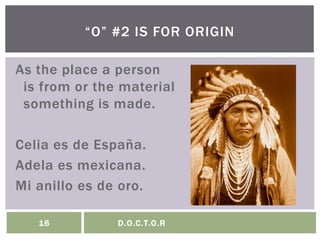
As the place a person
is from or the material
something is made.
Celia es de España.
Adela es mexicana.
Mi anillo es de oro.
“O” #2 IS FOR ORIGIN
16 D.O.C.T.O.R
Relationships are described
with the verb SER
Lynn es mi madre.
Marcos es mi ex-
novio.
Andrés es mi
hermano.
“R” IS FOR RELATIONSHIPS
17 D.O.C.T.O.R
ESTAR – PLACE
18 P.L.A.C.E.
Position,
Location,
Action,
Condition, and
Emotion.
Position is the physical
position or posture a
person or thing is in.
El soldado está en el
campo de tiro.
Mi abuela está
sentada.
“P” IS FOR POSITION
19 P.L.A.C.E.
The location of someone
or something describes
where it is permanently,
temporarily, actually, or
conceptually.
El baño está al lado de la
cafetería.
Estamos en el café ahora y
vamos a estar en el cine
en 20 minutos.
Madrid está en España.
“L” IS FOR LOCATION
20 P.L.A.C.E.
Estar is used to describe
an ongoing action using
the present progressive
tense. (You will learn
more about that later )
Estoy lavando los platos
sucios.
Estamos leyendo los
periódicos.
Mi bisabuelo está muerto.
“A” IS FOR ACTION
21 P.L.A.C.E.
Physical and mental
conditions are described
using estar.
Estoy tan cansada esta
mañana.
Mis niños están enfermos
hoy.
Mi madre está un poca
loca. (My
mother is (acting) a little
crazy.)
“C” IS FOR CONDITION
22 P.L.A.C.E.
How a person is feeling
at a certain moment
is described using
estar. Emotions can
change.
Estoy triste.
Ella está contenta.
Él está enojado.
“E” IS FOR EMOTION
23 P.L.A.C.E.
La fiesta es en la casa de
Juan.
La reunión es en la
oficina del comandante.
USE DOCTOR-SER ALWAYS FOR
EVENTS
24 Recuerda…
If all else fails remember this rhyme:
HOW YOU FEEL AND WHERE
YOU ARE ALWAYS USE THE
VERB ESTAR!!!
WHO ARE YOU? ARE YOU
FROM THERE? THAT’S WHEN
YOU USE THE VERBO SER!!!
USE DOCTOR-SER OR ESTAR-IS THE
PLACE TO BE
25 Recuerda…
Evaluación
¡Excelente trabajo!
 ¿Alcanzamos (did we reach) nuestro
objetivo?
 Sum up this hour’s lesson in two
sentences.
26 Estudia y prepárate siempre.

6 doctor-place

  • 1.
    TO BE OR NOTTO BE? DOCTOR M. Jose Suarez Febrero 2015 & PLACE
  • 2.
    In order toachieve these objectives, we’re going to:  know the difference in meaning and usage of “ser”.  Know the different meanings of “estar” and how to apply it. You will be able to explain the uses of each verb, and provide examples of each use in different real world situations. NUESTROS (OUR) OBJETIVOS SON APRENDER “SER Y ESTAR” Objetivos2
  • 3.
    In what instancedo we use the verb “to be”? What is the main purpose of the use of this verb? What are some differences between verb “to be” in English vs. Spanish? Does Spanish use the verb “to be” a lot? TO BE OR NOT TO BE? Para empezar3
  • 4.
    La vuelta almundo con SER Y ESTAR4 Es la Torre Eiffel y está en Paris, Francia.
  • 5.
    La vuelta almundo con SER Y ESTAR5 Es el Rockefeller Center y está Manhattan, NY.
  • 6.
    La vuelta almundo con SER Y ESTAR6 Son las Islas Galápagos y están en Ecuador.
  • 7.
    La vuelta almundo con SER Y ESTAR7 Son las Pirámides y están en El Cairo, Egipto.
  • 8.
    La vuelta almundo con SER Y ESTAR8 Es la Escuela de Lanceros y está en Tolemaida, Colombia.
  • 9.
     We havealready learned that there are two “to be” verbs in Spanish.  Here they are along with their conjugations. SER AND ESTAR ARE BOTH “TO BE” VERBS SER TO BE ESTAR TO BE Yo SOY Nosotros SOMOS Yo estoy Nosotros ESTAMOS Tú ERES Tú estás Él ES Ella ES Usted ES Ellos SON Ellas SON Ustedes SON Él está Ella está Usted está Ellos están Ellas están Ustedes están Both mean TO BE Different uses
  • 10.
    Use the AcronymsDOCTOR and PLACE The followings slides will tell use what those stand for. HOW DO I REMEMBER? 10 Para recordar…
  • 11.
  • 12.
    Think of whatyou would say if someone asked you "What´s he like?" These are the essential qualities that define a person or a thing and probably won´t change. Use: Name, physical traits and characteristics. Él es Raúl. ÉL es bajo, pelirrojo y serio. “D” IS FOR DESCRIPTION 12 D.O.C.T.O.R
  • 13.
     Soy maestrade español. (Spanish teacher.)  Ellos son soldados. (soldiers.)  Mi amigo es un camarero. (waiter.) No Indefinite Articles Notice that the indefinite articles un, una, unos, and unas are omitted when describing an occupation after the verb ser “O” IS FOR OCCUPATION 13 D.O.C.T.O.R
  • 14.
    Characteristics are personality descriptions ofa person. These would probably be the second thing you say to "What´s he like?" Rambo es fuerte, musculoso y valiente. “C” IS FOR CHARACTERISTICS 14 D.O.C.T.O.R
  • 15.
    Time includes days, dates,and hours. For hours, use es for one o´clock and son for all other hours. Hoy es lunes, el veintisiete de febrero. Mañana es mi cumpleaños. “T” IS FOR TIME 15 D.O.C.T.O.R
  • 16.
    As the placea person is from or the material something is made. Celia es de España. Adela es mexicana. Mi anillo es de oro. “O” #2 IS FOR ORIGIN 16 D.O.C.T.O.R
  • 17.
    Relationships are described withthe verb SER Lynn es mi madre. Marcos es mi ex- novio. Andrés es mi hermano. “R” IS FOR RELATIONSHIPS 17 D.O.C.T.O.R
  • 18.
    ESTAR – PLACE 18P.L.A.C.E. Position, Location, Action, Condition, and Emotion.
  • 19.
    Position is thephysical position or posture a person or thing is in. El soldado está en el campo de tiro. Mi abuela está sentada. “P” IS FOR POSITION 19 P.L.A.C.E.
  • 20.
    The location ofsomeone or something describes where it is permanently, temporarily, actually, or conceptually. El baño está al lado de la cafetería. Estamos en el café ahora y vamos a estar en el cine en 20 minutos. Madrid está en España. “L” IS FOR LOCATION 20 P.L.A.C.E.
  • 21.
    Estar is usedto describe an ongoing action using the present progressive tense. (You will learn more about that later ) Estoy lavando los platos sucios. Estamos leyendo los periódicos. Mi bisabuelo está muerto. “A” IS FOR ACTION 21 P.L.A.C.E.
  • 22.
    Physical and mental conditionsare described using estar. Estoy tan cansada esta mañana. Mis niños están enfermos hoy. Mi madre está un poca loca. (My mother is (acting) a little crazy.) “C” IS FOR CONDITION 22 P.L.A.C.E.
  • 23.
    How a personis feeling at a certain moment is described using estar. Emotions can change. Estoy triste. Ella está contenta. Él está enojado. “E” IS FOR EMOTION 23 P.L.A.C.E.
  • 24.
    La fiesta esen la casa de Juan. La reunión es en la oficina del comandante. USE DOCTOR-SER ALWAYS FOR EVENTS 24 Recuerda…
  • 25.
    If all elsefails remember this rhyme: HOW YOU FEEL AND WHERE YOU ARE ALWAYS USE THE VERB ESTAR!!! WHO ARE YOU? ARE YOU FROM THERE? THAT’S WHEN YOU USE THE VERBO SER!!! USE DOCTOR-SER OR ESTAR-IS THE PLACE TO BE 25 Recuerda…
  • 26.
    Evaluación ¡Excelente trabajo!  ¿Alcanzamos(did we reach) nuestro objetivo?  Sum up this hour’s lesson in two sentences. 26 Estudia y prepárate siempre.