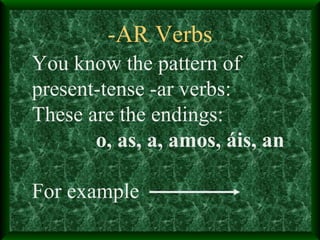
-AR Verbs You know the pattern of present-tense -ar verbs: These are the endings:  o, as, a, amos, áis, an For example
HABLAR Yo habl o Tú habl as Ud. Él habl a Ella Nosotros   habl amos Vosotros  habl áis Uds. Ellos   habl an Ellas
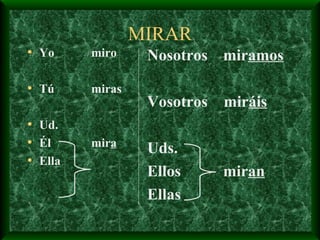
MIRAR Yo miro Tú miras Ud. Él mir a Ella Nosotros   mir amos Vosotros  mir áis Uds. Ellos   mir an Ellas
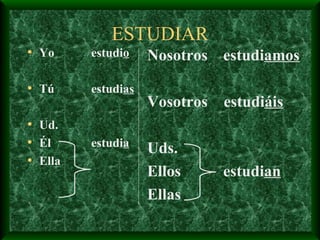
ESTUDIAR Yo estudi o Tú estudi as Ud. Él estudi a Ella Nosotros   estudi amos Vosotros  estudi áis Uds. Ellos   estudi an Ellas
Page 132 Realidades 1 Present tense of  -er and -ir verbs
3 Types of Verbs There are 3 types of verbs:  Infinitives that end in  -ar Infinitives that end in  -er Infinitives that end in  -ir
3 Types of Verbs You’ve already learned some  -ar  verbs, now you are going to learn some  -er  verbs.
Some  -er  Verbs Some  -er  verbs that you should know are: leer comer  ver
The pattern for  -er  verbs is  much like the pattern for -ar  verbs.  The only difference is, instead of using “a” you  use “e.”
Let’s try the verb “to eat,” in Spanish, “comer.”
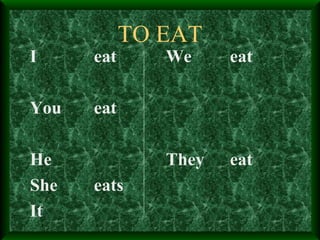
TO EAT I eat You eat He She eats It We eat They eat
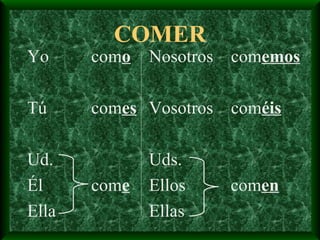
COMER Yo com o Tú com es Ud. Él com e Ella Nosotros  com emos Vosotros  com éis Uds. Ellos   com en Ellas
The Other -er Verbs Now let’s do the other -er  verbs that you know.
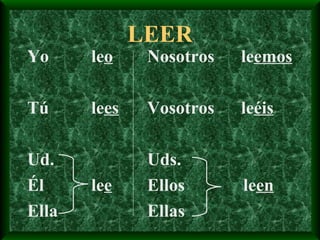
LEER Yo le o Tú le es Ud. Él le e Ella Nosotros  le emos Vosotros  le éis Uds. Ellos le en Ellas
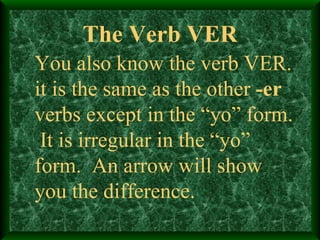
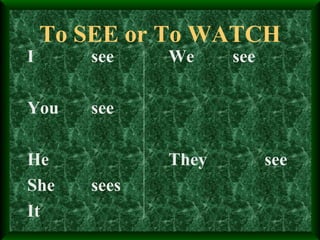
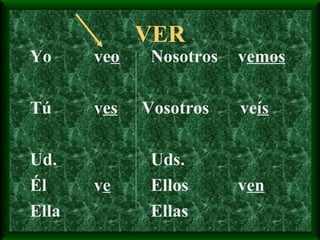
The Verb VER You also know the verb VER. it is the same as the other  -er  verbs except in the “yo” form.  It is irregular in the “yo” form.  An arrow will show you the difference.
To SEE or To WATCH I  see You see He She sees It We see They see
VER Yo ve o Tú v es Ud. Él v e Ella Nosotros v emos Vosotros  ve ís Uds. Ellos v en Ellas
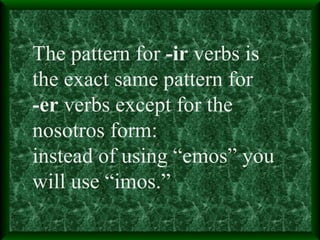
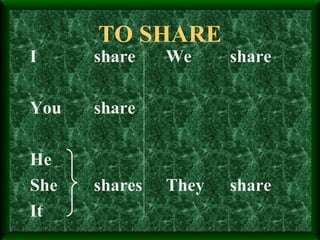
The pattern for  -ir  verbs is  the exact same pattern for -er  verbs except for the  nosotros form:  instead of using “emos” you will use “imos.”
TO SHARE I share You share He She shares It We share They share
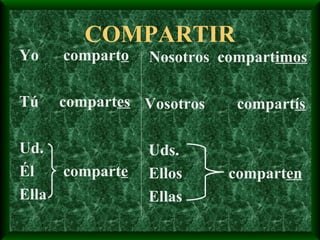
COMPARTIR Yo   compart o Tú   compart es Ud. Él   compart e Ella Nosotros  compart imos Vosotros  compart ís Uds. Ellos   compart en Ellas
Let’s review again.
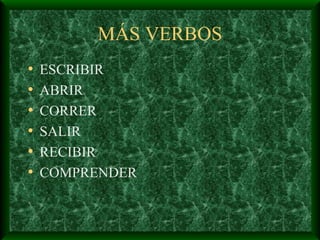
M ÁS  VERBOS ESCRIBIR ABRIR CORRER SALIR RECIBIR COMPRENDER
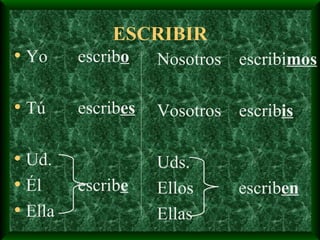
ESCRIBIR Yo escrib o Tú escrib es Ud. Él escrib e Ella Nosotros  escribi mos Vosotros  escrib is Uds. Ellos   escrib en Ellas
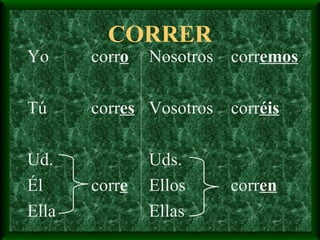
CORRER Yo corr o Tú corr es Ud. Él corr e Ella Nosotros  corr emos Vosotros  corr éis Uds. Ellos   corr en Ellas
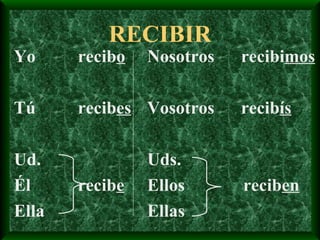
RECIBIR Yo recib o Tú recib es Ud. Él recib e Ella Nosotros  recibi mos Vosotros  recib í s Uds. Ellos recib en Ellas
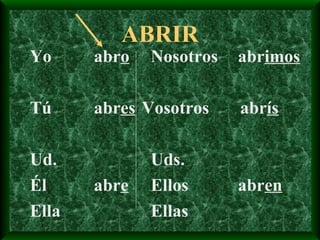
ABRIR Yo abr o Tú abr es Ud. Él abr e Ella Nosotros abr imos Vosotros  abr ís Uds. Ellos abr en Ellas
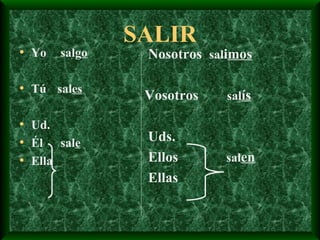
Yo   salg o Tú   sal es Ud. Él   sal e Ella SALIR Nosotros  sal i mos Vosotros  sal ís Uds. Ellos   sal en Ellas
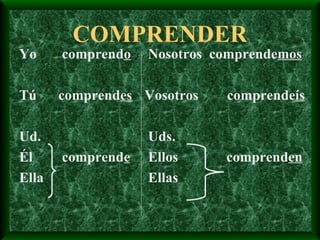
COMPRENDER Yo   comprend o Tú   comprend es Ud. Él   comprend e Ella Nosotros  comprende mos Vosotros  comprende ís Uds. Ellos   comprend en Ellas

Ar Er Ir Verbs-Present Tense

  • 1.
    -AR Verbs Youknow the pattern of present-tense -ar verbs: These are the endings: o, as, a, amos, áis, an For example
  • 2.
    HABLAR Yo hablo Tú habl as Ud. Él habl a Ella Nosotros habl amos Vosotros habl áis Uds. Ellos habl an Ellas
  • 3.
    MIRAR Yo miroTú miras Ud. Él mir a Ella Nosotros mir amos Vosotros mir áis Uds. Ellos mir an Ellas
  • 4.
    ESTUDIAR Yo estudio Tú estudi as Ud. Él estudi a Ella Nosotros estudi amos Vosotros estudi áis Uds. Ellos estudi an Ellas
  • 5.
    Page 132 Realidades1 Present tense of -er and -ir verbs
  • 6.
    3 Types ofVerbs There are 3 types of verbs: Infinitives that end in -ar Infinitives that end in -er Infinitives that end in -ir
  • 7.
    3 Types ofVerbs You’ve already learned some -ar verbs, now you are going to learn some -er verbs.
  • 8.
    Some -er Verbs Some -er verbs that you should know are: leer comer ver
  • 9.
    The pattern for -er verbs is much like the pattern for -ar verbs. The only difference is, instead of using “a” you use “e.”
  • 10.
    Let’s try theverb “to eat,” in Spanish, “comer.”
  • 11.
    TO EAT Ieat You eat He She eats It We eat They eat
  • 12.
    COMER Yo como Tú com es Ud. Él com e Ella Nosotros com emos Vosotros com éis Uds. Ellos com en Ellas
  • 13.
    The Other -erVerbs Now let’s do the other -er verbs that you know.
  • 14.
    LEER Yo leo Tú le es Ud. Él le e Ella Nosotros le emos Vosotros le éis Uds. Ellos le en Ellas
  • 15.
    The Verb VERYou also know the verb VER. it is the same as the other -er verbs except in the “yo” form. It is irregular in the “yo” form. An arrow will show you the difference.
  • 16.
    To SEE orTo WATCH I see You see He She sees It We see They see
  • 17.
    VER Yo veo Tú v es Ud. Él v e Ella Nosotros v emos Vosotros ve ís Uds. Ellos v en Ellas
  • 18.
    The pattern for -ir verbs is the exact same pattern for -er verbs except for the nosotros form: instead of using “emos” you will use “imos.”
  • 19.
    TO SHARE Ishare You share He She shares It We share They share
  • 20.
    COMPARTIR Yo compart o Tú compart es Ud. Él compart e Ella Nosotros compart imos Vosotros compart ís Uds. Ellos compart en Ellas
  • 21.
  • 22.
    M ÁS VERBOS ESCRIBIR ABRIR CORRER SALIR RECIBIR COMPRENDER
  • 23.
    ESCRIBIR Yo escribo Tú escrib es Ud. Él escrib e Ella Nosotros escribi mos Vosotros escrib is Uds. Ellos escrib en Ellas
  • 24.
    CORRER Yo corro Tú corr es Ud. Él corr e Ella Nosotros corr emos Vosotros corr éis Uds. Ellos corr en Ellas
  • 25.
    RECIBIR Yo recibo Tú recib es Ud. Él recib e Ella Nosotros recibi mos Vosotros recib í s Uds. Ellos recib en Ellas
  • 26.
    ABRIR Yo abro Tú abr es Ud. Él abr e Ella Nosotros abr imos Vosotros abr ís Uds. Ellos abr en Ellas
  • 27.
    Yo salg o Tú sal es Ud. Él sal e Ella SALIR Nosotros sal i mos Vosotros sal ís Uds. Ellos sal en Ellas
  • 28.
    COMPRENDER Yo comprend o Tú comprend es Ud. Él comprend e Ella Nosotros comprende mos Vosotros comprende ís Uds. Ellos comprend en Ellas