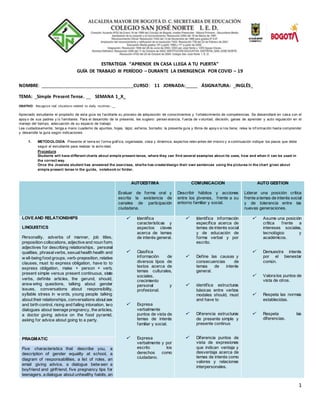
1
ESTRATEGIA “APRENDE EN CASA LLEGA A TU PUERTA”
GUÍA DE TRABAJO III PERÍODO – DURANTE LA EMERGENCIA POR COVID – 19
NOMBRE: ____________________________________CURSO: 11 JORNADA:_____ ÁSIGNATURA: _INGLÉS_
TEMA: _Simple Present Tense. __ SEMANA 1_X_
OBJETIVO: Recognize real situations related to daily routines.-__
Apreciado estudiante el propósito de esta guía es f acilitarle su proceso de adquisición de conocimientos y f ortalecimiento de competencias. Se desarrollará en casa con el
apoy o de sus padres y /o f amiliares. Para el desarrollo de la presente, les sugiero: persev erancia, f uerza de v oluntad, decisión, ganas de aprender y auto regulación en el
manejo del tiempo, adecuación de su espacio de trabajo.
Lea cuidadosamente, tenga a mano cuaderno de apuntes, hojas, lápiz, esf eros, borrador, la presente guía y libros de apoy o si los tiene; relea la inf ormación hasta comprender
y desarrolle la guía según indicaciones.
1. METODOLOGÍA: Presente el tema en f orma gráf ica, organizada, clara y dinámica, aspectos relev antes del mismo y a continuación indique los pasos que debe
seguir el estudiante para realizar la activ idad.
Procedure
Students will have different charts about simple present tense, where they can find several examples about its uses, how and when it can be used in
the correct way.
Once the Joseista student has answered the exercises, she/he has create/design their own sentences using the pictures in the chart given about
simple present tense in the guide, notebook or folder.
AUTOESTIMA
Evaluar de forma oral y
escrita la existencia de
canales de participación
ciudadana.
COMUNICACIÓN
Describir hábitos y acciones
entre los jóvenes, frente a su
entorno familiar y social.
AUTO GESTIÓN
Liderar una posición crítica
frente a temas de interés social
y de tolerancia entre las
nuevas generaciones.
LOVE AND RELATIONSHIPS
LINGUISTICS
Personality, adverbs of manner, job titles,
preposition collocations, adjective and noun form,
adjectives for describing relationships, personal
qualities, phrasalverbs, sexualhealth health and
w ell-being food groups, verb-preposition, relative
clauses, must to express obligation, have to to
express obligation, make + person + verb,
present simple versus present continuous, state
verbs, definite articles, the gerund, should,
answ ering questions, talking about gender
issues, conversations about responsibility,
syllable stress in w ords, young people talking
about their relationships, conversations about sex
and birth control, rising and falling intonation, two
dialogues about teenage pregnancy, the articles,
a doctor giving advice on the food pyramid,
asking for advice about going to a party.
 Identifica
características y
aspectos claves
acerca de temas
de interés general.
 Clasifica
información de
diversos tipos de
textos acerca de
temas culturales,
sociales,
crecimiento
personal y
profesional.
 Expresa
verbalmente
puntos de vista de
temas de interés
familiar y social.
 Expresa
verbalmente y por
escrito los
derechos como
ciudadano.
 Identifica información
específica acerca de
temas de interés social
y de educación de
forma verbal y por
escrito.
 Define las causas y
consecuencias de
temas de interés
general.
 identifica estructuras
básicas entre verbos
modales should, must
and have to
 Diferencia estructuras
de presente simple y
presente continuo
 Diferencia puntos de
vista de expresiones
que indican ventaja y
desventaja acerca de
temas de interés como
valores y relaciones
interpersonales.
 Asume una posición
crítica frente a
intereses sociales,
tecnológico y
académicos.
 Demuestra interés
por el bienestar
común.
 Valora los puntos de
vista de otros.
 Respeta las normas
establecidas.
 Respeta las
diferencias.
PRAGMATIC
Five characteristics that describe you, a
description of gender equality at school, a
diagram of responsabilities, a list of roles, an
email giving advice, a dialogue betw een a
boyfriend and girlfriend, five pregnancy tips for
teenagers, a dialogue about unhealthy habits, an
2
email giving advice, asking and and answ ering
general questions, discussing rules and
obligations in your country, discussing
compromise in a relationship, rights and
responsibilities, deciding on the most important
qualities in a person
 Participa y
argumenta en
debates acerca del
rol de la
comunidad como
líder de cambio.
 Propone de forma
verbal y escrita
estrategias que
contribuyen a la
privacidad
respecto al uso de
la tecnología.
 Cuestiona acerca
de las situaciones
más comunes que
generan conflictos
entre miembros de
la familia y círculo
social.
 Reconoce el
vocabulario
relacionado con salud,
valores y relaciones
humanas,
 Conoce expresiones
relacionadas con
redes sociales, medios
de comunicación,
reglas de etiqueta, etc.
SOCIOLINGUISTICS
Tw elve “12” acts about me, stories about two
girl´s experiences in education, your rights in a
relationship, honesty in a relationship, Lara and
Mark, parents at 16, a global health crisis, young
people taking riks, performing a dialogue,
discussing sex myths, roleplaying a dialogue at
the doctor´s, talking about the food you eat,
asking and answ ering questions.
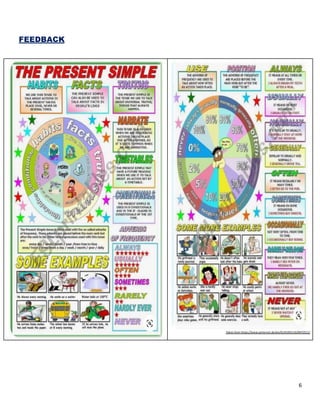
2. EJEMPLO/CONSULTA/PREGUNTAS .- Look at the examples in the charts about SIMPLE PRESENT TENSE
3
SIMPLE PRESENT TENSE “AUXILIARS”
4
YES / NO QUESTIONS SIMPLE PRESENT TENSE
Does Nairo ride his bycicle every day?
Yes, Nairo rides a bycicle every day
Does Nairo often train cycling in
Monteria?
No, Nairo doesn´t practice cycling in
Monteria.
Does Nairo have many cycling prizes?
Yes, he does
Does Nairo win all cycling competitions?
No, he doesn´t
Do school students study virtually at home
in 2020?
Yes, They study virtually at home in 2020
Do Joseistas´ students sometimes do
homework at school during the quarantine?
No, They don´t do homework at San José
Norte during the quarentine.
Do school students have virtual classes
during the quarantine?
Yes, they do
Do Joseistas´ students go to classes at San
José Norte?
No, They don´t
5
TAKEN FROM https://co.pinterest.com/pin/607282330992145650/
6
FEEDBACK
Taken from https://www.pinterest.de/pin/614530311629472511/
7
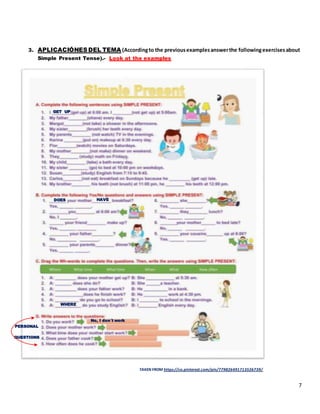
3. APLICACIÓNESDEL TEMA (Accordingto the previousexamplesanswerthe followingexercisesabout
Simple Present Tense).- Look at the examples
TAKEN FROM https://co.pinterest.com/pin/779826491713526739/
GET UP
DOES HAVE
WHERE
No, I don´t work
PERSONAL
QUESTIONS
8
Read the following article about Jon´s Daily Routine, and correct 20 grammar mistakes.
This article refers daily routines, please
Correct the 20 grammar mistakes
Example: 1. He LikeS
2.
3.
4.
5.
6.
7.
8.
9.
10.
11.
12.
13.
14.
15.
16.
17.
18.
19.
20.
Take from https://co.pinterest.com/pin/739645938775844229/
9
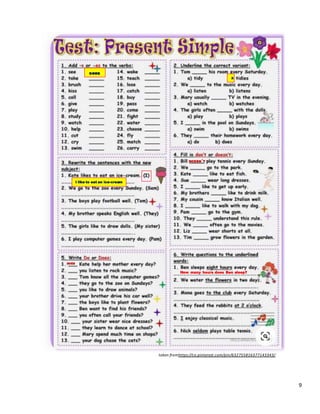
taken fromhttps://co.pinterest.com/pin/632755816377143343/
sees
X
I like to eat an ice-cream
DOESN´T
DOES
How many hours does Ben sleep?
10
TEST: Look at the chart below about Daily Routines
First - match the verbs according to the pictures. Write the number in the right picture, look at the example.
Second - Look at the pictures and fill in the blanks with the correct verb according to the situation in the picture,
using Simple Present Tense. Look at the example. You can answer in this answer sheet or notebook / folder.-
Taken from https://www.eslprintables.com/grammar_worksheets/verbs/verb_tenses/simple_pres ent/DAILY_ROUTINES_EX ERCISES_PR _217418/
1
WAKE UP
FIRST
SECOND
11
LET´S COMPLETE EACH SENTENCE WITH THE CORRECT VERB AND THE IMAGE
IN EACH PICTURE.
Taken from
https://www.eslprintables.com/grammar_worksheets/verbs/verb_tenses/simple_present/PRESENT_SIMPLE_DAILY_RO
UTINE_401637/
EXAMPLE:
1. I usually have tea for breakfast.-
DO SENTENCES FROM 2 TO 39
2.
3.
4.
5.
6.
7.
8.
9.
10.
11.
12.
13.
14.
15.
16.
17.
18.
19.
20.
21.
22.
23.
24.
25.
26.
27.
28.
29.
30.
31.
32.
33.
34.
35.
36.
37.
38.
39.

GUIDE SIMPLE PRESENT TENSE

  • 1.
    1 ESTRATEGIA “APRENDE ENCASA LLEGA A TU PUERTA” GUÍA DE TRABAJO III PERÍODO – DURANTE LA EMERGENCIA POR COVID – 19 NOMBRE: ____________________________________CURSO: 11 JORNADA:_____ ÁSIGNATURA: _INGLÉS_ TEMA: _Simple Present Tense. __ SEMANA 1_X_ OBJETIVO: Recognize real situations related to daily routines.-__ Apreciado estudiante el propósito de esta guía es f acilitarle su proceso de adquisición de conocimientos y f ortalecimiento de competencias. Se desarrollará en casa con el apoy o de sus padres y /o f amiliares. Para el desarrollo de la presente, les sugiero: persev erancia, f uerza de v oluntad, decisión, ganas de aprender y auto regulación en el manejo del tiempo, adecuación de su espacio de trabajo. Lea cuidadosamente, tenga a mano cuaderno de apuntes, hojas, lápiz, esf eros, borrador, la presente guía y libros de apoy o si los tiene; relea la inf ormación hasta comprender y desarrolle la guía según indicaciones. 1. METODOLOGÍA: Presente el tema en f orma gráf ica, organizada, clara y dinámica, aspectos relev antes del mismo y a continuación indique los pasos que debe seguir el estudiante para realizar la activ idad. Procedure Students will have different charts about simple present tense, where they can find several examples about its uses, how and when it can be used in the correct way. Once the Joseista student has answered the exercises, she/he has create/design their own sentences using the pictures in the chart given about simple present tense in the guide, notebook or folder. AUTOESTIMA Evaluar de forma oral y escrita la existencia de canales de participación ciudadana. COMUNICACIÓN Describir hábitos y acciones entre los jóvenes, frente a su entorno familiar y social. AUTO GESTIÓN Liderar una posición crítica frente a temas de interés social y de tolerancia entre las nuevas generaciones. LOVE AND RELATIONSHIPS LINGUISTICS Personality, adverbs of manner, job titles, preposition collocations, adjective and noun form, adjectives for describing relationships, personal qualities, phrasalverbs, sexualhealth health and w ell-being food groups, verb-preposition, relative clauses, must to express obligation, have to to express obligation, make + person + verb, present simple versus present continuous, state verbs, definite articles, the gerund, should, answ ering questions, talking about gender issues, conversations about responsibility, syllable stress in w ords, young people talking about their relationships, conversations about sex and birth control, rising and falling intonation, two dialogues about teenage pregnancy, the articles, a doctor giving advice on the food pyramid, asking for advice about going to a party.  Identifica características y aspectos claves acerca de temas de interés general.  Clasifica información de diversos tipos de textos acerca de temas culturales, sociales, crecimiento personal y profesional.  Expresa verbalmente puntos de vista de temas de interés familiar y social.  Expresa verbalmente y por escrito los derechos como ciudadano.  Identifica información específica acerca de temas de interés social y de educación de forma verbal y por escrito.  Define las causas y consecuencias de temas de interés general.  identifica estructuras básicas entre verbos modales should, must and have to  Diferencia estructuras de presente simple y presente continuo  Diferencia puntos de vista de expresiones que indican ventaja y desventaja acerca de temas de interés como valores y relaciones interpersonales.  Asume una posición crítica frente a intereses sociales, tecnológico y académicos.  Demuestra interés por el bienestar común.  Valora los puntos de vista de otros.  Respeta las normas establecidas.  Respeta las diferencias. PRAGMATIC Five characteristics that describe you, a description of gender equality at school, a diagram of responsabilities, a list of roles, an email giving advice, a dialogue betw een a boyfriend and girlfriend, five pregnancy tips for teenagers, a dialogue about unhealthy habits, an
  • 2.
    2 email giving advice,asking and and answ ering general questions, discussing rules and obligations in your country, discussing compromise in a relationship, rights and responsibilities, deciding on the most important qualities in a person  Participa y argumenta en debates acerca del rol de la comunidad como líder de cambio.  Propone de forma verbal y escrita estrategias que contribuyen a la privacidad respecto al uso de la tecnología.  Cuestiona acerca de las situaciones más comunes que generan conflictos entre miembros de la familia y círculo social.  Reconoce el vocabulario relacionado con salud, valores y relaciones humanas,  Conoce expresiones relacionadas con redes sociales, medios de comunicación, reglas de etiqueta, etc. SOCIOLINGUISTICS Tw elve “12” acts about me, stories about two girl´s experiences in education, your rights in a relationship, honesty in a relationship, Lara and Mark, parents at 16, a global health crisis, young people taking riks, performing a dialogue, discussing sex myths, roleplaying a dialogue at the doctor´s, talking about the food you eat, asking and answ ering questions. 2. EJEMPLO/CONSULTA/PREGUNTAS .- Look at the examples in the charts about SIMPLE PRESENT TENSE
  • 3.
    3 SIMPLE PRESENT TENSE“AUXILIARS”
  • 4.
    4 YES / NOQUESTIONS SIMPLE PRESENT TENSE Does Nairo ride his bycicle every day? Yes, Nairo rides a bycicle every day Does Nairo often train cycling in Monteria? No, Nairo doesn´t practice cycling in Monteria. Does Nairo have many cycling prizes? Yes, he does Does Nairo win all cycling competitions? No, he doesn´t Do school students study virtually at home in 2020? Yes, They study virtually at home in 2020 Do Joseistas´ students sometimes do homework at school during the quarantine? No, They don´t do homework at San José Norte during the quarentine. Do school students have virtual classes during the quarantine? Yes, they do Do Joseistas´ students go to classes at San José Norte? No, They don´t
  • 5.
  • 6.
  • 7.
    7 3. APLICACIÓNESDEL TEMA(Accordingto the previousexamplesanswerthe followingexercisesabout Simple Present Tense).- Look at the examples TAKEN FROM https://co.pinterest.com/pin/779826491713526739/ GET UP DOES HAVE WHERE No, I don´t work PERSONAL QUESTIONS
  • 8.
    8 Read the followingarticle about Jon´s Daily Routine, and correct 20 grammar mistakes. This article refers daily routines, please Correct the 20 grammar mistakes Example: 1. He LikeS 2. 3. 4. 5. 6. 7. 8. 9. 10. 11. 12. 13. 14. 15. 16. 17. 18. 19. 20. Take from https://co.pinterest.com/pin/739645938775844229/
  • 9.
    9 taken fromhttps://co.pinterest.com/pin/632755816377143343/ sees X I liketo eat an ice-cream DOESN´T DOES How many hours does Ben sleep?
  • 10.
    10 TEST: Look atthe chart below about Daily Routines First - match the verbs according to the pictures. Write the number in the right picture, look at the example. Second - Look at the pictures and fill in the blanks with the correct verb according to the situation in the picture, using Simple Present Tense. Look at the example. You can answer in this answer sheet or notebook / folder.- Taken from https://www.eslprintables.com/grammar_worksheets/verbs/verb_tenses/simple_pres ent/DAILY_ROUTINES_EX ERCISES_PR _217418/ 1 WAKE UP FIRST SECOND
  • 11.
    11 LET´S COMPLETE EACHSENTENCE WITH THE CORRECT VERB AND THE IMAGE IN EACH PICTURE. Taken from https://www.eslprintables.com/grammar_worksheets/verbs/verb_tenses/simple_present/PRESENT_SIMPLE_DAILY_RO UTINE_401637/ EXAMPLE: 1. I usually have tea for breakfast.- DO SENTENCES FROM 2 TO 39 2. 3. 4. 5. 6. 7. 8. 9. 10. 11. 12. 13. 14. 15. 16. 17. 18. 19. 20. 21. 22. 23. 24. 25. 26. 27. 28. 29. 30. 31. 32. 33. 34. 35. 36. 37. 38. 39.