






¿Porque desarrollo Sustentable?
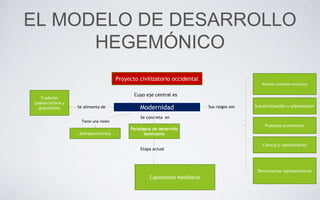
EL MODELO DE DESARROLLO
HEGEMÓNICO
Modernidad
Proyecto civilizatorio occidental
Cuyo eje central es
Se concreta en
Paradigma de desarrollo
dominante
Capitalismo Neoliberal
Etapa actual
Sus rasgos sonSe alimenta de
Tradición
judeocristiana y
grecolatina
Antropocentrista
Tiene una visión
Relación sociedad-naturaleza
Industrialización y urbanización
Procesos económicos
Ciencia y conocimiento
Democracias representativas
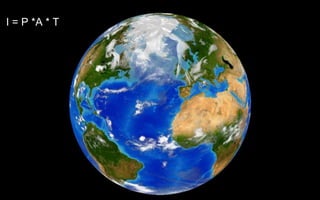
I = P *A * T
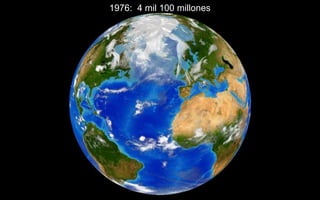
1976: 4 mil 100 millones
2011: 7 mil millones
Los fertilizantes nitrogenados han permitido
que la producción de alimentos mantenga
el paso al crecimiento poblacional.
pero...
Ha agotado los suelos
Un área del tamaño de China ha
sido degradada en los últimos 60
años.
Estamos perdiendo un gran número de
productores
fuente: FAO
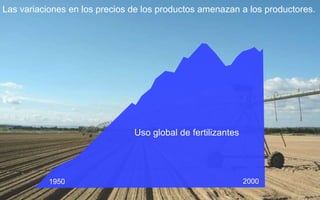
1950 2000
Uso global de fertilizantes
Las variaciones en los precios de los productos amenazan a los productores.
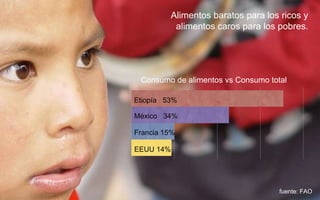
EEUU 14%
Francia 15%
México 34%
Etiopía 53%
Consumo de alimentos vs Consumo total
fuente: FAO
Alimentos baratos para los ricos y
alimentos caros para los pobres.
fuente: What the World Eats
825 millones de desnutridos
cada cinco segundos,
un niño muere de hambre.
fuente: FAO
El viaje desde la granja al plato contribuye
al cambio climático, la contaminación del agua, suelos, generación de
residuos sólidos...
¿Como cambiamos las cosas?
visión
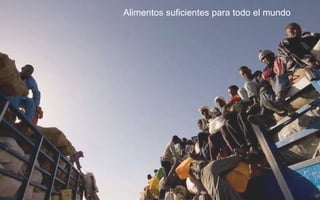
Alimentos suficientes para todo el mundo
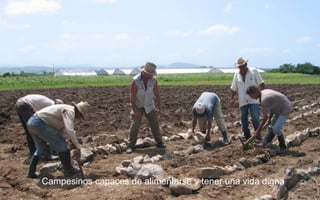
Campesinos capaces de alimentarse y tener una vida digna
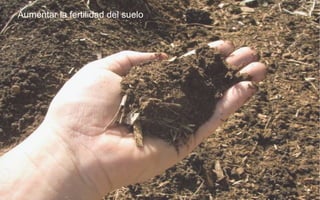
Aumentar la fertilidad del suelo
Agua limpia y abundante
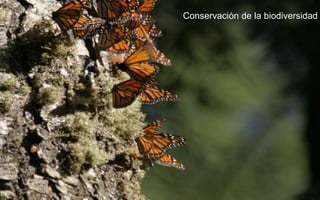
Conservación de la biodiversidad
Regular la extracción de recursos
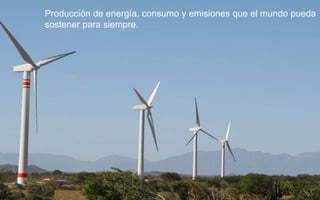
Producción de energía, consumo y emisiones que el mundo pueda
sostener para siempre.
Negocios rentables
algunas preguntas
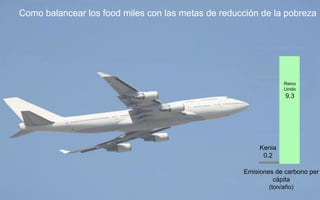
Como balancear los food miles con las metas de reducción de la pobreza
Emisiones de carbono per
cápita
(ton/año)
Kenia
0.2
Reino
Unido
9.3
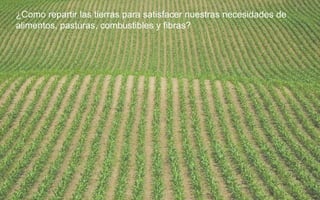
¿Como repartir las tierras para satisfacer nuestras necesidades de
alimentos, pasturas, combustibles y fibras?
¿Como evitar que las fuerzas del mercado eliminen
a los pequeños productores?
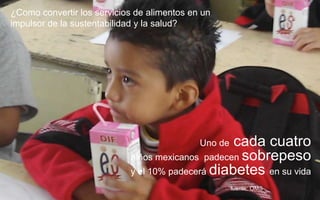
¿Como convertir los servicios de alimentos en un
impulsor de la sustentabilidad y la salud?
Uno de cada cuatro
niños mexicanos padecen sobrepeso
y el 10% padecerá diabetes en su vida
fuente: OMS
El desarrollo sustentable ofrece la
esperanza de un buen futuro a pesar
del presente complicado
Mayor
presión con
el tiempo
Tiempo
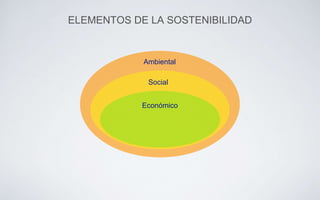
ELEMENTOS DE LA SOSTENIBILIDAD
Capital / Inversiones
fuerzas del mercado/empleo
desarrollo tecnológico
DISTRIBUCIÓN RECURSOS
COSTES AMBIENTALES
instituciones y organizaciones
estructura política
diversidad cultural
calidad de vida
POBREZA / EQUIDAD
Interacciones ecológicas
energía
recursos
Biodiversidad
CONTAMINACIÓN
Social
Ambiental
Económico
Justicia Eficiencia
Desarrollo
Sustentable
Salud
ELEMENTOS DE LA SOSTENIBILIDAD
Ambiental
Social
Económico
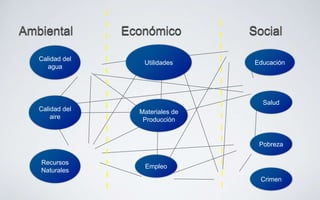
ELEMENTOS DE LA SOSTENIBILIDAD
Ambiental
Social
Económico
Materiales de
Producción
Utilidades Educación
Salud
Pobreza
Crimen
Empleo
Recursos
Naturales
Ambiental Económico Social
Calidad del
agua
Calidad del
aire
ESTRATEGIA
INDUSTRIA ALIMENTARIA Y DESARROLLO
SUSTENTABLE
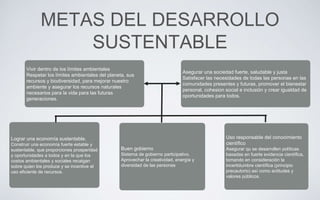
METAS DEL DESARROLLO
SUSTENTABLE
Vivir dentro de los límites ambientales
Respetar los límites ambientales del planeta, sus
recursos y biodiversidad, para mejorar nuestro
ambiente y asegurar los recursos naturales
necesarios para la vida para las futuras
generaciones.
Asegurar una sociedad fuerte, saludable y justa
Satisfacer las necesidades de todas las personas en las
comunidades presentes y futuras, promover el bienestar
personal, cohesion social e inclusión y crear igualdad de
oportunidades para todos.
Lograr una economía sustentable.
Construir una economía fuerte estable y
sustentable, que proporciones prosperidad
y oportunidades a todos y en la que los
costos ambientales y sociales recaigan
sobre quien los produce y se incentive el
uso eficiente de recursos.
Buen gobierno
Sistema de gobierno participativo.
Aprovechar la creatividad, energía y
diversidad de las personas
Uso responsable del conocimiento
científico
Asegurar qu se desarrollen políticas
basadas en fuerte evidencia científica,
tomando en consideración la
incertidumbre científica (principio
precautorio) así como actitudes y
valores públicos.
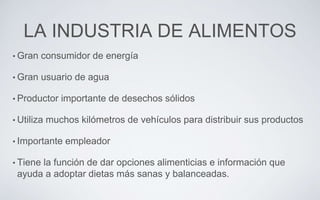
LA INDUSTRIA DE ALIMENTOS
• Gran consumidor de energía
• Gran usuario de agua
• Productor importante de desechos sólidos
• Utiliza muchos kilómetros de vehículos para distribuir sus productos
• Importante empleador
• Tiene la función de dar opciones alimenticias e información que
ayuda a adoptar dietas más sanas y balanceadas.
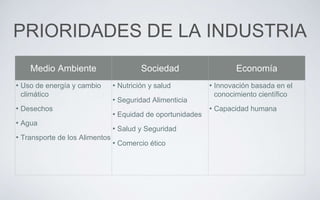
PRIORIDADES DE LA INDUSTRIA
Medio Ambiente Sociedad Economía
• Uso de energía y cambio
climático
• Desechos
• Agua
• Transporte de los Alimentos
• Nutrición y salud
• Seguridad Alimenticia
• Equidad de oportunidades
• Salud y Seguridad
• Comercio ético
• Innovación basada en el
conocimiento científico
• Capacidad humana
PRODUCCIÓN Y CONSUMO
SUSTENTABLE
Progreso económico y social continuo que
respeta los límites de los ecosistemas y satisface
las necesidades y aspiraciones de todos para
una mejor calidad de vida para las generaciones
presentes y futuras.
PRODUCCIÓN Y CONSUMO
SUSTENTABLE
PRODUCCIÓN Y CONSUMO
SUSTENTABLE
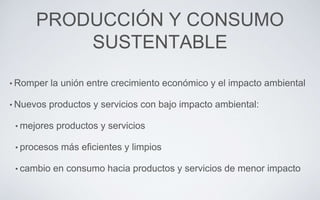
• Romper la unión entre crecimiento económico y el impacto ambiental
• Nuevos productos y servicios con bajo impacto ambiental:
• mejores productos y servicios
• procesos más eficientes y limpios
• cambio en consumo hacia productos y servicios de menor impacto
TEMAS PRIORITARIOS DE
PRODUCCIÓN Y CONSUMO
SUSTENTABLE DE ALIMENTOS
1.Cambios basados en evidencias
2.Productos sustentables
3.Procesos de producción sustentables
4.Consumo sustentable
5.Compras públicas
6.Catalización del cambio
1.Cambios basados en evidencias
2.Productos sustentables
3.Procesos de producción sustentables
4.Consumo sustentable
5.Compras públicas
6.Catalización del cambio
Temas Prioritarios de Producción y
Consumo Sustentable de Alimentos
CAMBIOS BASADOS EN
EVIDENCIAS
• Datos de la industria para demostrar que la eficiencia de
recursos, reducción de desechos, contaminación, consumo de
agua y energía traen consigo beneficios económicos y
ambientales.
• Hacer pública la información del sector.
1.Cambios basados en evidencias
2.Productos sustentables
3.Procesos de producción sustentables
4.Consumo sustentable
5.Compras públicas
6.Catalización del cambio
Temas Prioritarios de Producción y
Consumo Sustentable de Alimentos
CICLO DE VIDA
• Comprender que productos son más o menos sustentables.
• Food miles
• Enfoque de ciclo de vida
1.Cambios basados en evidencias
2.Productos sustentables
3.Procesos de producción sustentables
4.Consumo sustentable
5.Compras públicas
6.Catalización del cambio
Temas Prioritarios de Producción y
Consumo Sustentable de Alimentos
COMPORTAMIENTO DE LAS
EMPRESAS
• Incrementar el involucramiento de las empresas
1.Cambios basados en evidencias
2.Productos sustentables
3.Procesos de producción sustentables
4.Consumo sustentable
5.Compras públicas
6.Catalización del cambio
Temas Prioritarios de Producción y
Consumo Sustentable de Alimentos
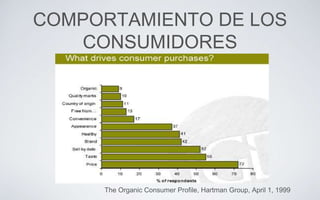
COMPORTAMIENTO DE LOS
CONSUMIDORES
The Organic Consumer Profile, Hartman Group, April 1, 1999
1.Cambios basados en evidencias
2.Productos sustentables
3.Procesos de producción sustentables
4.Consumo sustentable
5.Compras públicas
6.Catalización del cambio
Temas Prioritarios de Producción y
Consumo Sustentable de Alimentos
COMPRAS GUBERNAMENTALES
• Predicar con el ejemplo
• Mayor oportunidad para proveedores locales
• Incentiva productividad en las empresas
1.Cambios basados en evidencias
2.Productos sustentables
3.Procesos de producción sustentables
4.Consumo sustentable
5.Compras públicas
6.Catalización del cambio
Temas Prioritarios de Producción y
Consumo Sustentable de Alimentos
RESPONSABILIDAD SOCIAL
CORPORATIVA
MEDIO AMBIENTE
CAMBIO CLIMÁTICO
• La industria agroalimentaria es un gran usuario de energía
• Comercio de emisiones
RESIDUOS SÓLIDOS
• Empaque
• en su mayoría de alimentos
• Desechos de la Industria
• son mayormente biodegradables
• evitar tiraderos/rellenos sanitarios revalorizarlos como composta,
etc.
• Influencia sobre los residuos domiciliarios
AGUA• Gran usuario del agua, contribuye a la demanda de recursos
acuíferos
• la industria debe reducir sus niveles actuales de uso, adoptando
mejores prácticas operativas sin comprometer la higiene
• Modificaciones con el cambio climático
• Implementación de medidas de ahorro
• programas de manejo, medición y monitoreo
• modificar las rutinas de limpieza
• modiicar diseño de equipo y procesos
TRANSPORTE
• Costos ambientales y sociales asociados (pero no incluidos en el
precio de) al transporte de los alimentos desde el lugar de
producción, proceso hasta el consumidor final.
• Proporcionar información adecuada a los consumidores
• Cadenas de suministro más cortas
• Optimización del uso de flotas y aumento en la eficiencia
• Descentralización de los mercados, mayores oportunidades para
productos locales.
DIMENSIÓN SOCIAL
PRINCIPALES RETOS
• Nutrición y salud
NUTRICIÓN Y SALUD
• Causa de mala salud, muerte prematura, obesidad...
• Soluciones
• mayor disponibilidad de alimentos sanos
• comunicación con los consumidores
• reducción de azucar y grasa
• responsabilidad social de productores de alcohol
• tamaño de las porciones
SEGURIDAD ALIMENTARIA
• Problema de salud pública
• Mayor responsabilidad de la industria de alimentos
• monitoreo de pesticidas en alimentos
• campañas de higiene
• campañas de higiene en los hogares
IGUALDAD DE OPORTUNIDADES
• No discriminación por edad, raza, nacionalidad, preferencias
sexuales.
• Inclusión de personas discapacitadas o con VIH/SIDA
SALUD Y SEGURIDAD
• Alta tasa de lesiones en la industria de alimentos
• Capacitación y entrenamiento en seguridad
COMERCIO ÉTICO
• Prácticas en la cadena de alimentos que protegen y promueven
estándares de trabajo y el modo de vida de pequeños productores.
• Preocupación en paises desarrollados por condiciones en paises en
desarrollo.
• Comercio Justo (Fair Trade)
DIMENSIÓN ECONÓMICA
INOVACIÓN BASADA EN LA
CIENCIA
• Efectos económicos y ambientales y ayuda a cumplir las metas
sociales.
• Soluciones:
• financiamiento
• nexos sociedad-empresas
• mecanismos para diseminar mejores prácticas, incluso a
pymes.
CAPACIDAD HUMANA
• Clave para la productividad
• Soluciones:
• coordinación con instituciones educativas
• programas de entrenamiento
• programas y seminarios para diseminar buenas prácticas
MEJORAS REGULATORIAS
RETOS PRINCIPALES
• Soluciones:
• Énfasis en regular solo lo más necesario, delicado e importante
• Regular en proporción al riesgo
• Resregular y simplificar las regulaciones existentes
• Mecanismo de advertencia
DEFINAMOS ALGUNOS TÉRMINOS:
• Sustentar
• Desarrollar
• Capacidad de carga
• Capital de la comunidad
• Sustentabilidad fuerte vs sustentabilidad débil
• Comunidad
• Indicador
¿QUE SIGNIFICA SUSTENTAR?
sustentar.
(Del lat. sustentāre, intens. de sustinēre).
1.tr. Proveer a alguien del alimento necesario. U. t. c. prnl.
2.tr. Conservar algo en su ser o estado.
3.tr. Sostener algo para que no se caiga o se tuerza. U. t. c. prnl.
4.tr. Defender o sostener determinada opinión.
5.tr. apoyar (‖ basar). U. m. c. prnl.
¿QUE SIGNIFICA DESARROLLO?
Desarrollo
1.m. Acción y efecto de desarrollar o desarrollarse.
2.m. Combinación entre el plato y el piñón de la bicicleta, que
determina la distancia que se avanza con cada pedalada.
3.m. Econ. Evolución progresiva de una economía hacia mejores
niveles de vida.
¿QUE SIGNIFICA CAPACIDAD DE
CARGA?
Capacidad de carga
1.Población que puede ser soportada indefinidamente por un
ecosistema sin destruir el ecosistema.
DEFINICIONES DE
SUSTENTABILIDAD
• Desarrollo Sustentable
• Comunidades sustentables
• Producción Sustentable
• Agricultura Sustentable
SUSTENTABILIDAD ES:
“Satisfacer las necesidades de las generaciones presentes sin
comprometer las posibilidades de las del futuro para atender sus
propias necesidades”
Informe de la Comisión Mundial sobre el Medio Ambiente y el Desarrollo (Comisión
Brundtland): Nuestro Futuro Común
SUSTENTABILIDAD ES:
“Un desarrollo global sustentable requiere que aquellos más afluentes
adopten estilos de vida dentro de los límites ecológicos del planeta.
El desarrollo sustentable solo puede lograrse si el tamaño de la
población y el crecimiento están en armonía con el potencial
productivo del ecosistema”
Comisión Mundial para el Medio Ambiente y Desarrollo
SUSTENTABILIDAD ES:
“... mejorar la calidad de la vida humana viviendo dentro de los límites
de la capacidad de carga de los ecosistemas”
Caring for the Earth
INDICADORES DE
SUSTENTABILIDAD
Caring for the Earth
- Uso de energía por persona
- Emisiones anuales de gases de efecto de invernadero por persona
- Porcentaje de áreas naturales, modificadas, cultivadas,
urbanizadas y degradadas.
SUSTENTABILIDAD ES:
“El desarrollo sustentable es la capacidad de tomar elecciones de
desarrollo con respecto a la relación entre las tres “E´s” Economía,
Ecología y Equidad... ”
SUSTENTABILIDAD ES:
“El desarrollo sustentables es el proceso de construcción de
estructuras equitativas, productivas y participativas para incrementar el
empoderamiento económico de las comunidades y sus regiones
vecinas.”
Interfaith Center on Corporate Responsibility
SUSTENTABILIDAD ES:
“Las comunidades sustentables promueven el compromiso con el
lugar, promueven la vitalidad, construyen resistencia al stress,
funcionan como guardianes y forjan conexiones más allá de la
comunidad”
Northwest Policy Institute, University of Washington,
Graduate School of Public Affairs

002¿porque desarrollo sustentable?

  • 1.
  • 2.
    EL MODELO DEDESARROLLO HEGEMÓNICO Modernidad Proyecto civilizatorio occidental Cuyo eje central es Se concreta en Paradigma de desarrollo dominante Capitalismo Neoliberal Etapa actual Sus rasgos sonSe alimenta de Tradición judeocristiana y grecolatina Antropocentrista Tiene una visión Relación sociedad-naturaleza Industrialización y urbanización Procesos económicos Ciencia y conocimiento Democracias representativas
  • 4.
    I = P*A * T
  • 5.
    1976: 4 mil100 millones
  • 6.
    2011: 7 milmillones
  • 7.
    Los fertilizantes nitrogenadoshan permitido que la producción de alimentos mantenga el paso al crecimiento poblacional.
  • 8.
  • 9.
    Ha agotado lossuelos Un área del tamaño de China ha sido degradada en los últimos 60 años.
  • 10.
    Estamos perdiendo ungran número de productores fuente: FAO
  • 11.
    1950 2000 Uso globalde fertilizantes Las variaciones en los precios de los productos amenazan a los productores.
  • 12.
    EEUU 14% Francia 15% México34% Etiopía 53% Consumo de alimentos vs Consumo total fuente: FAO Alimentos baratos para los ricos y alimentos caros para los pobres.
  • 13.
    fuente: What theWorld Eats
  • 14.
    825 millones dedesnutridos cada cinco segundos, un niño muere de hambre. fuente: FAO
  • 15.
    El viaje desdela granja al plato contribuye al cambio climático, la contaminación del agua, suelos, generación de residuos sólidos...
  • 16.
  • 17.
  • 18.
  • 19.
    Campesinos capaces dealimentarse y tener una vida digna
  • 20.
  • 21.
    Agua limpia yabundante
  • 22.
    Conservación de labiodiversidad
  • 23.
  • 24.
    Producción de energía,consumo y emisiones que el mundo pueda sostener para siempre.
  • 25.
  • 26.
  • 27.
    Como balancear losfood miles con las metas de reducción de la pobreza Emisiones de carbono per cápita (ton/año) Kenia 0.2 Reino Unido 9.3
  • 28.
    ¿Como repartir lastierras para satisfacer nuestras necesidades de alimentos, pasturas, combustibles y fibras?
  • 29.
    ¿Como evitar quelas fuerzas del mercado eliminen a los pequeños productores?
  • 30.
    ¿Como convertir losservicios de alimentos en un impulsor de la sustentabilidad y la salud? Uno de cada cuatro niños mexicanos padecen sobrepeso y el 10% padecerá diabetes en su vida fuente: OMS
  • 31.
    El desarrollo sustentableofrece la esperanza de un buen futuro a pesar del presente complicado
  • 32.
  • 33.
    ELEMENTOS DE LASOSTENIBILIDAD Capital / Inversiones fuerzas del mercado/empleo desarrollo tecnológico DISTRIBUCIÓN RECURSOS COSTES AMBIENTALES instituciones y organizaciones estructura política diversidad cultural calidad de vida POBREZA / EQUIDAD Interacciones ecológicas energía recursos Biodiversidad CONTAMINACIÓN Social Ambiental Económico Justicia Eficiencia Desarrollo Sustentable Salud
  • 34.
    ELEMENTOS DE LASOSTENIBILIDAD Ambiental Social Económico
  • 35.
    ELEMENTOS DE LASOSTENIBILIDAD Ambiental Social Económico
  • 36.
  • 37.
    ESTRATEGIA INDUSTRIA ALIMENTARIA YDESARROLLO SUSTENTABLE
  • 38.
    METAS DEL DESARROLLO SUSTENTABLE Vivirdentro de los límites ambientales Respetar los límites ambientales del planeta, sus recursos y biodiversidad, para mejorar nuestro ambiente y asegurar los recursos naturales necesarios para la vida para las futuras generaciones. Asegurar una sociedad fuerte, saludable y justa Satisfacer las necesidades de todas las personas en las comunidades presentes y futuras, promover el bienestar personal, cohesion social e inclusión y crear igualdad de oportunidades para todos. Lograr una economía sustentable. Construir una economía fuerte estable y sustentable, que proporciones prosperidad y oportunidades a todos y en la que los costos ambientales y sociales recaigan sobre quien los produce y se incentive el uso eficiente de recursos. Buen gobierno Sistema de gobierno participativo. Aprovechar la creatividad, energía y diversidad de las personas Uso responsable del conocimiento científico Asegurar qu se desarrollen políticas basadas en fuerte evidencia científica, tomando en consideración la incertidumbre científica (principio precautorio) así como actitudes y valores públicos.
  • 39.
    LA INDUSTRIA DEALIMENTOS • Gran consumidor de energía • Gran usuario de agua • Productor importante de desechos sólidos • Utiliza muchos kilómetros de vehículos para distribuir sus productos • Importante empleador • Tiene la función de dar opciones alimenticias e información que ayuda a adoptar dietas más sanas y balanceadas.
  • 41.
    PRIORIDADES DE LAINDUSTRIA Medio Ambiente Sociedad Economía • Uso de energía y cambio climático • Desechos • Agua • Transporte de los Alimentos • Nutrición y salud • Seguridad Alimenticia • Equidad de oportunidades • Salud y Seguridad • Comercio ético • Innovación basada en el conocimiento científico • Capacidad humana
  • 42.
  • 43.
    Progreso económico ysocial continuo que respeta los límites de los ecosistemas y satisface las necesidades y aspiraciones de todos para una mejor calidad de vida para las generaciones presentes y futuras. PRODUCCIÓN Y CONSUMO SUSTENTABLE
  • 44.
    PRODUCCIÓN Y CONSUMO SUSTENTABLE •Romper la unión entre crecimiento económico y el impacto ambiental • Nuevos productos y servicios con bajo impacto ambiental: • mejores productos y servicios • procesos más eficientes y limpios • cambio en consumo hacia productos y servicios de menor impacto
  • 45.
    TEMAS PRIORITARIOS DE PRODUCCIÓNY CONSUMO SUSTENTABLE DE ALIMENTOS 1.Cambios basados en evidencias 2.Productos sustentables 3.Procesos de producción sustentables 4.Consumo sustentable 5.Compras públicas 6.Catalización del cambio
  • 46.
    1.Cambios basados enevidencias 2.Productos sustentables 3.Procesos de producción sustentables 4.Consumo sustentable 5.Compras públicas 6.Catalización del cambio Temas Prioritarios de Producción y Consumo Sustentable de Alimentos
  • 47.
    CAMBIOS BASADOS EN EVIDENCIAS •Datos de la industria para demostrar que la eficiencia de recursos, reducción de desechos, contaminación, consumo de agua y energía traen consigo beneficios económicos y ambientales. • Hacer pública la información del sector.
  • 48.
    1.Cambios basados enevidencias 2.Productos sustentables 3.Procesos de producción sustentables 4.Consumo sustentable 5.Compras públicas 6.Catalización del cambio Temas Prioritarios de Producción y Consumo Sustentable de Alimentos
  • 49.
    CICLO DE VIDA •Comprender que productos son más o menos sustentables. • Food miles • Enfoque de ciclo de vida
  • 50.
    1.Cambios basados enevidencias 2.Productos sustentables 3.Procesos de producción sustentables 4.Consumo sustentable 5.Compras públicas 6.Catalización del cambio Temas Prioritarios de Producción y Consumo Sustentable de Alimentos
  • 51.
    COMPORTAMIENTO DE LAS EMPRESAS •Incrementar el involucramiento de las empresas
  • 52.
    1.Cambios basados enevidencias 2.Productos sustentables 3.Procesos de producción sustentables 4.Consumo sustentable 5.Compras públicas 6.Catalización del cambio Temas Prioritarios de Producción y Consumo Sustentable de Alimentos
  • 53.
    COMPORTAMIENTO DE LOS CONSUMIDORES TheOrganic Consumer Profile, Hartman Group, April 1, 1999
  • 54.
    1.Cambios basados enevidencias 2.Productos sustentables 3.Procesos de producción sustentables 4.Consumo sustentable 5.Compras públicas 6.Catalización del cambio Temas Prioritarios de Producción y Consumo Sustentable de Alimentos
  • 55.
    COMPRAS GUBERNAMENTALES • Predicarcon el ejemplo • Mayor oportunidad para proveedores locales • Incentiva productividad en las empresas
  • 56.
    1.Cambios basados enevidencias 2.Productos sustentables 3.Procesos de producción sustentables 4.Consumo sustentable 5.Compras públicas 6.Catalización del cambio Temas Prioritarios de Producción y Consumo Sustentable de Alimentos
  • 57.
  • 58.
  • 59.
    CAMBIO CLIMÁTICO • Laindustria agroalimentaria es un gran usuario de energía • Comercio de emisiones
  • 60.
    RESIDUOS SÓLIDOS • Empaque •en su mayoría de alimentos • Desechos de la Industria • son mayormente biodegradables • evitar tiraderos/rellenos sanitarios revalorizarlos como composta, etc. • Influencia sobre los residuos domiciliarios
  • 61.
    AGUA• Gran usuariodel agua, contribuye a la demanda de recursos acuíferos • la industria debe reducir sus niveles actuales de uso, adoptando mejores prácticas operativas sin comprometer la higiene • Modificaciones con el cambio climático • Implementación de medidas de ahorro • programas de manejo, medición y monitoreo • modificar las rutinas de limpieza • modiicar diseño de equipo y procesos
  • 62.
    TRANSPORTE • Costos ambientalesy sociales asociados (pero no incluidos en el precio de) al transporte de los alimentos desde el lugar de producción, proceso hasta el consumidor final. • Proporcionar información adecuada a los consumidores • Cadenas de suministro más cortas • Optimización del uso de flotas y aumento en la eficiencia • Descentralización de los mercados, mayores oportunidades para productos locales.
  • 63.
  • 64.
  • 65.
    NUTRICIÓN Y SALUD •Causa de mala salud, muerte prematura, obesidad... • Soluciones • mayor disponibilidad de alimentos sanos • comunicación con los consumidores • reducción de azucar y grasa • responsabilidad social de productores de alcohol • tamaño de las porciones
  • 66.
    SEGURIDAD ALIMENTARIA • Problemade salud pública • Mayor responsabilidad de la industria de alimentos • monitoreo de pesticidas en alimentos • campañas de higiene • campañas de higiene en los hogares
  • 67.
    IGUALDAD DE OPORTUNIDADES •No discriminación por edad, raza, nacionalidad, preferencias sexuales. • Inclusión de personas discapacitadas o con VIH/SIDA
  • 68.
    SALUD Y SEGURIDAD •Alta tasa de lesiones en la industria de alimentos • Capacitación y entrenamiento en seguridad
  • 69.
    COMERCIO ÉTICO • Prácticasen la cadena de alimentos que protegen y promueven estándares de trabajo y el modo de vida de pequeños productores. • Preocupación en paises desarrollados por condiciones en paises en desarrollo. • Comercio Justo (Fair Trade)
  • 70.
  • 71.
    INOVACIÓN BASADA ENLA CIENCIA • Efectos económicos y ambientales y ayuda a cumplir las metas sociales. • Soluciones: • financiamiento • nexos sociedad-empresas • mecanismos para diseminar mejores prácticas, incluso a pymes.
  • 72.
    CAPACIDAD HUMANA • Clavepara la productividad • Soluciones: • coordinación con instituciones educativas • programas de entrenamiento • programas y seminarios para diseminar buenas prácticas
  • 73.
  • 74.
    RETOS PRINCIPALES • Soluciones: •Énfasis en regular solo lo más necesario, delicado e importante • Regular en proporción al riesgo • Resregular y simplificar las regulaciones existentes • Mecanismo de advertencia
  • 75.
    DEFINAMOS ALGUNOS TÉRMINOS: •Sustentar • Desarrollar • Capacidad de carga • Capital de la comunidad • Sustentabilidad fuerte vs sustentabilidad débil • Comunidad • Indicador
  • 76.
    ¿QUE SIGNIFICA SUSTENTAR? sustentar. (Dellat. sustentāre, intens. de sustinēre). 1.tr. Proveer a alguien del alimento necesario. U. t. c. prnl. 2.tr. Conservar algo en su ser o estado. 3.tr. Sostener algo para que no se caiga o se tuerza. U. t. c. prnl. 4.tr. Defender o sostener determinada opinión. 5.tr. apoyar (‖ basar). U. m. c. prnl.
  • 77.
    ¿QUE SIGNIFICA DESARROLLO? Desarrollo 1.m.Acción y efecto de desarrollar o desarrollarse. 2.m. Combinación entre el plato y el piñón de la bicicleta, que determina la distancia que se avanza con cada pedalada. 3.m. Econ. Evolución progresiva de una economía hacia mejores niveles de vida.
  • 78.
    ¿QUE SIGNIFICA CAPACIDADDE CARGA? Capacidad de carga 1.Población que puede ser soportada indefinidamente por un ecosistema sin destruir el ecosistema.
  • 79.
    DEFINICIONES DE SUSTENTABILIDAD • DesarrolloSustentable • Comunidades sustentables • Producción Sustentable • Agricultura Sustentable
  • 80.
    SUSTENTABILIDAD ES: “Satisfacer lasnecesidades de las generaciones presentes sin comprometer las posibilidades de las del futuro para atender sus propias necesidades” Informe de la Comisión Mundial sobre el Medio Ambiente y el Desarrollo (Comisión Brundtland): Nuestro Futuro Común
  • 81.
    SUSTENTABILIDAD ES: “Un desarrolloglobal sustentable requiere que aquellos más afluentes adopten estilos de vida dentro de los límites ecológicos del planeta. El desarrollo sustentable solo puede lograrse si el tamaño de la población y el crecimiento están en armonía con el potencial productivo del ecosistema” Comisión Mundial para el Medio Ambiente y Desarrollo
  • 82.
    SUSTENTABILIDAD ES: “... mejorarla calidad de la vida humana viviendo dentro de los límites de la capacidad de carga de los ecosistemas” Caring for the Earth
  • 83.
    INDICADORES DE SUSTENTABILIDAD Caring forthe Earth - Uso de energía por persona - Emisiones anuales de gases de efecto de invernadero por persona - Porcentaje de áreas naturales, modificadas, cultivadas, urbanizadas y degradadas.
  • 84.
    SUSTENTABILIDAD ES: “El desarrollosustentable es la capacidad de tomar elecciones de desarrollo con respecto a la relación entre las tres “E´s” Economía, Ecología y Equidad... ”
  • 85.
    SUSTENTABILIDAD ES: “El desarrollosustentables es el proceso de construcción de estructuras equitativas, productivas y participativas para incrementar el empoderamiento económico de las comunidades y sus regiones vecinas.” Interfaith Center on Corporate Responsibility
  • 86.
    SUSTENTABILIDAD ES: “Las comunidadessustentables promueven el compromiso con el lugar, promueven la vitalidad, construyen resistencia al stress, funcionan como guardianes y forjan conexiones más allá de la comunidad” Northwest Policy Institute, University of Washington, Graduate School of Public Affairs

Notas del editor

  • #3 Proyecto civilizatorio: modelo ideal de sociedad al que se aspira. Es una manera de entender el mundo, el cosmos, la naturaleza; una forma de organizar la vida en sociedad. El proyecto civilizatorio occidental tiene como eje central un ideal modernizador cuya etapa neoliberal propone intensificar los procesos modernizantes, globalizando su alcance y presentándose como único camino posible.
  • #35 Many people think of the environment, economy and society as a ‘triple bottom line’ or a ‘three-legged stool’. Instead, it is more useful to think of them as three nested and interde- pendent spheres. The largest sphere represents the environ- ment, or earth, upon which all economic and social progress ultimately depends. That’s our natural capital: it provides the ecosystem services and natural resources that we need to sur- vive. The middle sphere represents society, or human capital. Our economy is the smallest circle because it is governed by the rules, regulations and structures of the other two spheres. The economy depends on human capital and natural capital to thrive. You can’t have one at the expense of another.
  • #36 Many people think of the environment, economy and society as a ‘triple bottom line’ or a ‘three-legged stool’. Instead, it is more useful to think of them as three nested and interde- pendent spheres. The largest sphere represents the environ- ment, or earth, upon which all economic and social progress ultimately depends. That’s our natural capital: it provides the ecosystem services and natural resources that we need to sur- vive. The middle sphere represents society, or human capital. Our economy is the smallest circle because it is governed by the rules, regulations and structures of the other two spheres. The economy depends on human capital and natural capital to thrive. You can’t have one at the expense of another.
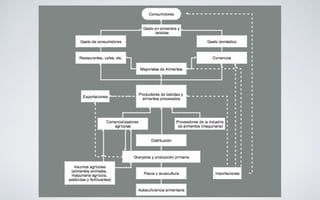
  • #41 Chart 2(overleaf) shows the economic flows represented by the food chain, which accounts for about 8% of the UK’s gross domestic product (GDP). Food, drink and animal feed accounts for rather more than 8% of total imports and just under 5% of total exports. However, whilst the economic scale and benefits of the chain’s activity are huge, so too are its environmental and social impacts, both here and overseas. This should not be surprising because the food industry is: • a major energy user(accounting for around 126TWh per year, equivalent to about 14% of energy consumption by UK businesses) and a major contributor to UK carbon emissions(with 7 million tonnes of carbon per year); • a major user of water, both from direct abstraction and use of the public water supply with a demand on the latter of about 430 mega litres per day, or 10% of all industrial use; • a significant source of waste generationaccounting for about 10% of the industrial and commercial waste stream and of particular importance for certain priority waste streams, notably packaging; • responsible for 25% of all HGV vehicle kilometresin the UK; • a key player in the provision of healthy food choices and informationto enable consumers to achieve more generally a healthy balanced diet; and • a major employer, responsible for 12.5% of the UK’s workforce.
  • #47 Priority themes for delivery of SCP The UK Government’s approach to SCP is outlined in ‘Securing the future’, which builds on Changing Patterns. Major themes of SCP include: • Evidence base: A robust evidence base is essential to enable development of policies which will target major impacts at the most appropriate point in the lifecycle and as high up the supply chain as possible. A programme of research is being developed, to produce much more comprehensive information on the scale and source of impacts of goods and services in the lifecycle, impacts of UK and EU consumption on other countries, links between impacts and competitiveness, individual values and behaviour, the impacts of policy measures and the scope to address them in each of the areas below; • Sustainable products: The priorities should be to consider impacts of everyday products across the lifecycle, measures to close the resource loop (e.g. through recycling, reuse or remanufacturing), promoting radical design solutions which benefit the environment and the economy, building up knowledge to drive improvements in product markets; • Sustainable production processes: The aim is to deliver greater efficiency and value with least resource use, pollution and waste, in both service and manufacturing industry. A number of measures are already in place to drive more sustainable production, including climate change agreements, emissions trading, landfill tax, integrated pollution prevention and control and expanded help and support for business through the Carbon Trust, the Envirowise programme, and the Environment Agency; • Sustainable consumption: Much current consumption remains unsustainable in the long term. As well as making improvements in products and production processes, influencing consumer behaviour will be an important component of delivering SCP. Households, business and the public sector will all need to consume more efficiently and differently. Much more needs to be done to understand how awareness of sustainable development goals links to willingness and ability to contribute to them; • Public procurement: This is increasingly cited as a powerful mechanism to shift towards more sustainable goods and services. Government recognises the need to lead by example and has stated its intention to be recognised as amongst the leaders in sustainable procurement across EU member states by 2009; and Catalysing change: Broader cross-cutting measures will be developed to complement the specific focus on products and services. The Government strongly supports public reporting and has challenged FTSE and large private companies to report their performance in a transparent and meaningful way. Sectoral strategies, of which this is an example, will also be important in generating commitment across all major UK business sectors, and delivering long term decoupling.
  • #48 Priority themes for delivery of SCP The UK Government’s approach to SCP is outlined in ‘Securing the future’, which builds on Changing Patterns. Major themes of SCP include: • Evidence base: A robust evidence base is essential to enable development of policies which will target major impacts at the most appropriate point in the lifecycle and as high up the supply chain as possible. A programme of research is being developed, to produce much more comprehensive information on the scale and source of impacts of goods and services in the lifecycle, impacts of UK and EU consumption on other countries, links between impacts and competitiveness, individual values and behaviour, the impacts of policy measures and the scope to address them in each of the areas below; • Sustainable products: The priorities should be to consider impacts of everyday products across the lifecycle, measures to close the resource loop (e.g. through recycling, reuse or remanufacturing), promoting radical design solutions which benefit the environment and the economy, building up knowledge to drive improvements in product markets; • Sustainable production processes: The aim is to deliver greater efficiency and value with least resource use, pollution and waste, in both service and manufacturing industry. A number of measures are already in place to drive more sustainable production, including climate change agreements, emissions trading, landfill tax, integrated pollution prevention and control and expanded help and support for business through the Carbon Trust, the Envirowise programme, and the Environment Agency; • Sustainable consumption: Much current consumption remains unsustainable in the long term. As well as making improvements in products and production processes, influencing consumer behaviour will be an important component of delivering SCP. Households, business and the public sector will all need to consume more efficiently and differently. Much more needs to be done to understand how awareness of sustainable development goals links to willingness and ability to contribute to them; • Public procurement: This is increasingly cited as a powerful mechanism to shift towards more sustainable goods and services. Government recognises the need to lead by example and has stated its intention to be recognised as amongst the leaders in sustainable procurement across EU member states by 2009; and Catalysing change: Broader cross-cutting measures will be developed to complement the specific focus on products and services. The Government strongly supports public reporting and has challenged FTSE and large private companies to report their performance in a transparent and meaningful way. Sectoral strategies, of which this is an example, will also be important in generating commitment across all major UK business sectors, and delivering long term decoupling.
  • #49 SCP offers a different perspective on business performance from just the financial bottom line. The case studies accompanying this strategy demonstrate that a focus on resource efficiency, reducing waste and pollution, and energy and water use reveal new areas where businesses can improve efficiency, yielding both environmental and economic wins, and help to improve competitiveness. 2.4.2 There is an urgent need to move beyond case studies and build a more comprehensive picture of environmental performance of the food industry (see Annex II). A scoping study by Defra and the Food and Drink Federation (FDF) in 2004 revealed that, as with many business sectors, there is relatively little publicly available information on the environmental performance of the food industry. Such information is, however, vital if Government and industry are to work effectively together to identify major impacts, the potential to improve, the costs of doing so and agree the pace of change. Defra will therefore commission research to establish baseline data on energy, waste and water where there are significant gaps in current knowledge.
  • #50 Priority themes for delivery of SCP The UK Government’s approach to SCP is outlined in ‘Securing the future’, which builds on Changing Patterns. Major themes of SCP include: • Evidence base: A robust evidence base is essential to enable development of policies which will target major impacts at the most appropriate point in the lifecycle and as high up the supply chain as possible. A programme of research is being developed, to produce much more comprehensive information on the scale and source of impacts of goods and services in the lifecycle, impacts of UK and EU consumption on other countries, links between impacts and competitiveness, individual values and behaviour, the impacts of policy measures and the scope to address them in each of the areas below; • Sustainable products: The priorities should be to consider impacts of everyday products across the lifecycle, measures to close the resource loop (e.g. through recycling, reuse or remanufacturing), promoting radical design solutions which benefit the environment and the economy, building up knowledge to drive improvements in product markets; • Sustainable production processes: The aim is to deliver greater efficiency and value with least resource use, pollution and waste, in both service and manufacturing industry. A number of measures are already in place to drive more sustainable production, including climate change agreements, emissions trading, landfill tax, integrated pollution prevention and control and expanded help and support for business through the Carbon Trust, the Envirowise programme, and the Environment Agency; • Sustainable consumption: Much current consumption remains unsustainable in the long term. As well as making improvements in products and production processes, influencing consumer behaviour will be an important component of delivering SCP. Households, business and the public sector will all need to consume more efficiently and differently. Much more needs to be done to understand how awareness of sustainable development goals links to willingness and ability to contribute to them; • Public procurement: This is increasingly cited as a powerful mechanism to shift towards more sustainable goods and services. Government recognises the need to lead by example and has stated its intention to be recognised as amongst the leaders in sustainable procurement across EU member states by 2009; and Catalysing change: Broader cross-cutting measures will be developed to complement the specific focus on products and services. The Government strongly supports public reporting and has challenged FTSE and large private companies to report their performance in a transparent and meaningful way. Sectoral strategies, of which this is an example, will also be important in generating commitment across all major UK business sectors, and delivering long term decoupling.
  • #51 Understanding which food products available on the market may be more or less sustainable will be essential to progress. A focus on the lifecycle impacts of products will inform future product development and consumer information to aid more sustainable choices. 2.5.2 A good deal of research has already been conducted on the distributional impacts, to inform the “food miles debate” and this is discussed in Chapter 4. 2.5.3 Full lifecycle analysis is beginning to be carried out on food products. However much more is needed, not least because of the sheer range of food products available. Examples of work to date include: • The Market Transformation Programme. This initiative focuses mainly on energy-using products, but work commissioned by the Advisory Committee on Consumer Products and the Environment (ACCPE) on adapting the programme approach to analysis of the market for chicken products revealed potential for this to be taken further. • Economic and Social Research Council funded research into the lifecycle impacts of common food products, including shrimps, pork, tomatoes, yoghurt and potato chips, under their Sustainable Technologies programme. • Marks and Spencer’s work on food packaging which found, for example, that packaged apples create no more impact on the environment than loose unpackaged alternatives; and paper carrier bags have twice the environmental impact of polythene alternatives. • Unilever’s work with growers in East Anglia and Humberside on its frozen pea brand which measures the brand’s impact using a series of sustainability indicators.9
  • #52 Priority themes for delivery of SCP The UK Government’s approach to SCP is outlined in ‘Securing the future’, which builds on Changing Patterns. Major themes of SCP include: • Evidence base: A robust evidence base is essential to enable development of policies which will target major impacts at the most appropriate point in the lifecycle and as high up the supply chain as possible. A programme of research is being developed, to produce much more comprehensive information on the scale and source of impacts of goods and services in the lifecycle, impacts of UK and EU consumption on other countries, links between impacts and competitiveness, individual values and behaviour, the impacts of policy measures and the scope to address them in each of the areas below; • Sustainable products: The priorities should be to consider impacts of everyday products across the lifecycle, measures to close the resource loop (e.g. through recycling, reuse or remanufacturing), promoting radical design solutions which benefit the environment and the economy, building up knowledge to drive improvements in product markets; • Sustainable production processes: The aim is to deliver greater efficiency and value with least resource use, pollution and waste, in both service and manufacturing industry. A number of measures are already in place to drive more sustainable production, including climate change agreements, emissions trading, landfill tax, integrated pollution prevention and control and expanded help and support for business through the Carbon Trust, the Envirowise programme, and the Environment Agency; • Sustainable consumption: Much current consumption remains unsustainable in the long term. As well as making improvements in products and production processes, influencing consumer behaviour will be an important component of delivering SCP. Households, business and the public sector will all need to consume more efficiently and differently. Much more needs to be done to understand how awareness of sustainable development goals links to willingness and ability to contribute to them; • Public procurement: This is increasingly cited as a powerful mechanism to shift towards more sustainable goods and services. Government recognises the need to lead by example and has stated its intention to be recognised as amongst the leaders in sustainable procurement across EU member states by 2009; and Catalysing change: Broader cross-cutting measures will be developed to complement the specific focus on products and services. The Government strongly supports public reporting and has challenged FTSE and large private companies to report their performance in a transparent and meaningful way. Sectoral strategies, of which this is an example, will also be important in generating commitment across all major UK business sectors, and delivering long term decoupling.
  • #53 http://www.unilever.co.uk/Images/In%20pursuit%20of%20the%20sustainable%20pea,%202002_tcm28-17382.pdf
  • #54 Priority themes for delivery of SCP The UK Government’s approach to SCP is outlined in ‘Securing the future’, which builds on Changing Patterns. Major themes of SCP include: • Evidence base: A robust evidence base is essential to enable development of policies which will target major impacts at the most appropriate point in the lifecycle and as high up the supply chain as possible. A programme of research is being developed, to produce much more comprehensive information on the scale and source of impacts of goods and services in the lifecycle, impacts of UK and EU consumption on other countries, links between impacts and competitiveness, individual values and behaviour, the impacts of policy measures and the scope to address them in each of the areas below; • Sustainable products: The priorities should be to consider impacts of everyday products across the lifecycle, measures to close the resource loop (e.g. through recycling, reuse or remanufacturing), promoting radical design solutions which benefit the environment and the economy, building up knowledge to drive improvements in product markets; • Sustainable production processes: The aim is to deliver greater efficiency and value with least resource use, pollution and waste, in both service and manufacturing industry. A number of measures are already in place to drive more sustainable production, including climate change agreements, emissions trading, landfill tax, integrated pollution prevention and control and expanded help and support for business through the Carbon Trust, the Envirowise programme, and the Environment Agency; • Sustainable consumption: Much current consumption remains unsustainable in the long term. As well as making improvements in products and production processes, influencing consumer behaviour will be an important component of delivering SCP. Households, business and the public sector will all need to consume more efficiently and differently. Much more needs to be done to understand how awareness of sustainable development goals links to willingness and ability to contribute to them; • Public procurement: This is increasingly cited as a powerful mechanism to shift towards more sustainable goods and services. Government recognises the need to lead by example and has stated its intention to be recognised as amongst the leaders in sustainable procurement across EU member states by 2009; and Catalysing change: Broader cross-cutting measures will be developed to complement the specific focus on products and services. The Government strongly supports public reporting and has challenged FTSE and large private companies to report their performance in a transparent and meaningful way. Sectoral strategies, of which this is an example, will also be important in generating commitment across all major UK business sectors, and delivering long term decoupling.
  • #56 Priority themes for delivery of SCP The UK Government’s approach to SCP is outlined in ‘Securing the future’, which builds on Changing Patterns. Major themes of SCP include: • Evidence base: A robust evidence base is essential to enable development of policies which will target major impacts at the most appropriate point in the lifecycle and as high up the supply chain as possible. A programme of research is being developed, to produce much more comprehensive information on the scale and source of impacts of goods and services in the lifecycle, impacts of UK and EU consumption on other countries, links between impacts and competitiveness, individual values and behaviour, the impacts of policy measures and the scope to address them in each of the areas below; • Sustainable products: The priorities should be to consider impacts of everyday products across the lifecycle, measures to close the resource loop (e.g. through recycling, reuse or remanufacturing), promoting radical design solutions which benefit the environment and the economy, building up knowledge to drive improvements in product markets; • Sustainable production processes: The aim is to deliver greater efficiency and value with least resource use, pollution and waste, in both service and manufacturing industry. A number of measures are already in place to drive more sustainable production, including climate change agreements, emissions trading, landfill tax, integrated pollution prevention and control and expanded help and support for business through the Carbon Trust, the Envirowise programme, and the Environment Agency; • Sustainable consumption: Much current consumption remains unsustainable in the long term. As well as making improvements in products and production processes, influencing consumer behaviour will be an important component of delivering SCP. Households, business and the public sector will all need to consume more efficiently and differently. Much more needs to be done to understand how awareness of sustainable development goals links to willingness and ability to contribute to them; • Public procurement: This is increasingly cited as a powerful mechanism to shift towards more sustainable goods and services. Government recognises the need to lead by example and has stated its intention to be recognised as amongst the leaders in sustainable procurement across EU member states by 2009; and Catalysing change: Broader cross-cutting measures will be developed to complement the specific focus on products and services. The Government strongly supports public reporting and has challenged FTSE and large private companies to report their performance in a transparent and meaningful way. Sectoral strategies, of which this is an example, will also be important in generating commitment across all major UK business sectors, and delivering long term decoupling.
  • #58 Priority themes for delivery of SCP The UK Government’s approach to SCP is outlined in ‘Securing the future’, which builds on Changing Patterns. Major themes of SCP include: • Evidence base: A robust evidence base is essential to enable development of policies which will target major impacts at the most appropriate point in the lifecycle and as high up the supply chain as possible. A programme of research is being developed, to produce much more comprehensive information on the scale and source of impacts of goods and services in the lifecycle, impacts of UK and EU consumption on other countries, links between impacts and competitiveness, individual values and behaviour, the impacts of policy measures and the scope to address them in each of the areas below; • Sustainable products: The priorities should be to consider impacts of everyday products across the lifecycle, measures to close the resource loop (e.g. through recycling, reuse or remanufacturing), promoting radical design solutions which benefit the environment and the economy, building up knowledge to drive improvements in product markets; • Sustainable production processes: The aim is to deliver greater efficiency and value with least resource use, pollution and waste, in both service and manufacturing industry. A number of measures are already in place to drive more sustainable production, including climate change agreements, emissions trading, landfill tax, integrated pollution prevention and control and expanded help and support for business through the Carbon Trust, the Envirowise programme, and the Environment Agency; • Sustainable consumption: Much current consumption remains unsustainable in the long term. As well as making improvements in products and production processes, influencing consumer behaviour will be an important component of delivering SCP. Households, business and the public sector will all need to consume more efficiently and differently. Much more needs to be done to understand how awareness of sustainable development goals links to willingness and ability to contribute to them; • Public procurement: This is increasingly cited as a powerful mechanism to shift towards more sustainable goods and services. Government recognises the need to lead by example and has stated its intention to be recognised as amongst the leaders in sustainable procurement across EU member states by 2009; and Catalysing change: Broader cross-cutting measures will be developed to complement the specific focus on products and services. The Government strongly supports public reporting and has challenged FTSE and large private companies to report their performance in a transparent and meaningful way. Sectoral strategies, of which this is an example, will also be important in generating commitment across all major UK business sectors, and delivering long term decoupling.
  • #77 We need a common understanding of terms ➽Desarrollo sustentable y comunidades sustentables no son movimientos ambientales, son movimientos de las comunidades
  • #78 ➽Una comunidad sustentable: ➼Alimenta, permitiendo a sus miembros florecer. ➼Puede continuar indefinidamente ➼No significa “sin cambio” o “nunca cambia” ➼No significa utopía Sustain means to keep in existence without diminishing, to nourish. It means operating in such a way that a community doesn’t use up all its resources. Notice that sustain does not mean to keep the status quo—it does not mean that nothing ever changes. It also doesn’t mean utopia. It doesn’t mean that bad things never happen. There will always be floods and hurricanes. Some businesses may fail, some people will go hungry. Sustainability means that we continually work to make things better and we make sure that the systems we set up are helping rather than harming the process.
  • #79 ➽No crecimiento ➽Mejorar, hacer mejor El desarrollo significaDevelopment means to make something better than it was, to improve. Notice that development does not mean growth. We all grow as children, but then we reach a certain age and stop growing. However, we don’t stop developing just because we have stopped growing—we go back to school, we learn a new trade or hobby, we go new places, make new friends. This is what sustainable development is all about—changing and making better. We live on a world with a certain amount of resources: air, water, energy, materials, and land. An example that many people will understand is that of a small island community: There is a limit to the number of people that can fit on the island and to the amount of the island’s resources that those people can consume. One example is the island of Haiti where the need for fuel has completely deforested the island. We are all living on an island called Earth and we need to develop or improve our individual and global communities without using up or wearing out the resources that we have. (Note that the difference between “growth” and “development” is a difficult but very important concept for people to understand in order to make progress towards sustainability. One comment some people may make is that growth is good as long as it is “quality” growth. However, people need to realize that all growth is finite. A small town can only grow so much before it ceases to be a town and becomes a small city. Small cities that grow become large cities. If a community likes its “small town feeling” then the community needs to acknowledge that growth must stop at some point in order to preserve that feeling.)
  • #80 ➽Not an absolute number ➽Depends on available resources and per capita consumption ➽Not “caring” capacity The carrying capacity is the size of a population that can live indefinitely using the resources available where that population lives. For example, consider an island onto which is dropped a colony of rabbits. As long as there is an adequate supply of food and water, the rabbits will not only survive but they will reproduce and the colony will get larger. The rabbit population can continue to grow as long as food and water are adequate. However, if at some point, there are more rabbits that there is food to feed them, then the rabbit population will start to decline. This limit is called the carrying capacity. Carrying capacity is not a fixed number; it depends upon factors such as how much each rabbit eats, how fast the food grows, and how well the natural systems of the island can handle the waste produced by the rabbits. Obviously, in a drought year less food would grow and the island would support fewer rabbits. In good years, the island would support more rabbits. The earth is our island. We have an advantage over the rabbits in that we have developed technology to grow, process, and store food so that we can survive the bad years. We have also developed technologies for handling wastes that we create. However, there is still a carrying capacity that the earth can support. That carrying capacity is a function of the number of people, the amount of resources each person consumes and the ability of the earth to process all the wastes produced. Sustainability is about finding the balance point among population, consumption, and waste assimilation.