El aprendizaje a través de cursos
abiertos masivos en línea (MOOC)
Jordi Adell!
Universitat Jaume I
¡MOOC!
¡Hola!
http://www.flickr.com/photos/dotbenjamin/2765083201/
Advertencia
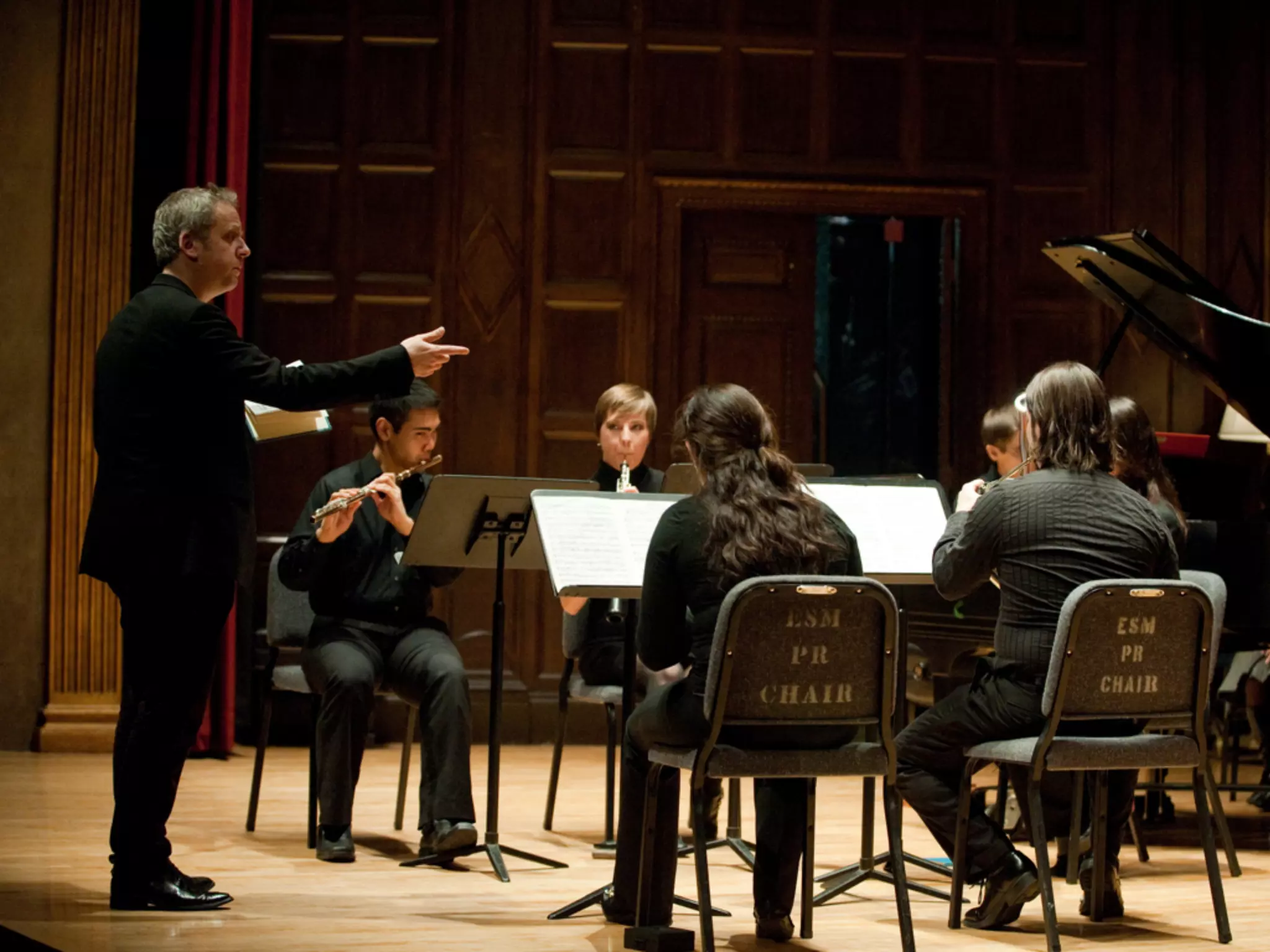
¿Master

class?
¡MOOCs!
+
+
Master Class (Adell Style)
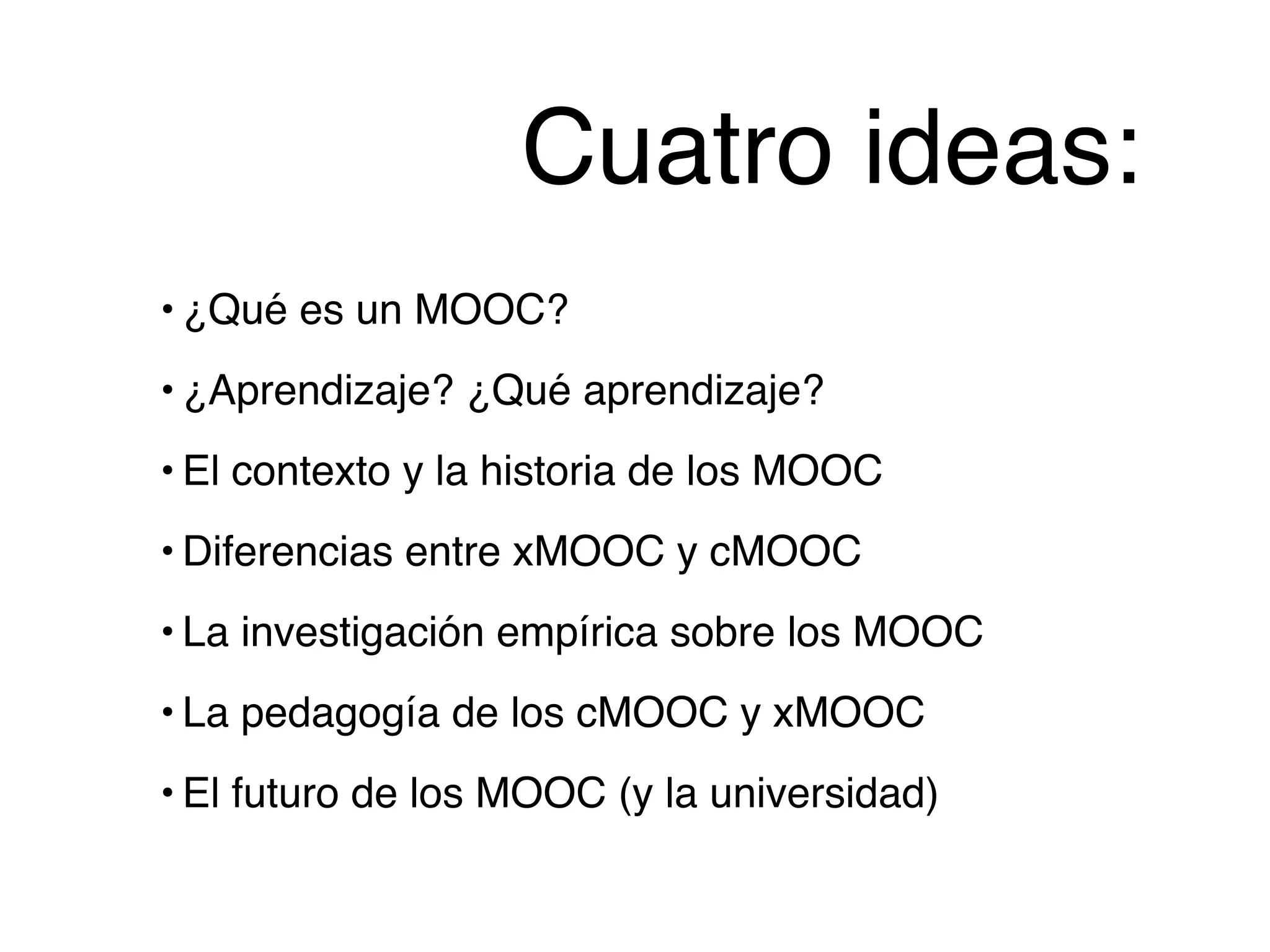
Cuatro ideas:
• ¿Qué es un MOOC?!
• ¿Aprendizaje? ¿Qué aprendizaje?!
• El contexto y la historia de los MOOC!
• Diferencias entre xMOOC y cMOOC!
• La investigación empírica sobre los MOOC!
• La pedagogía de los cMOOC y xMOOC!
• El futuro de los MOOC (y la universidad)
Pero antes...
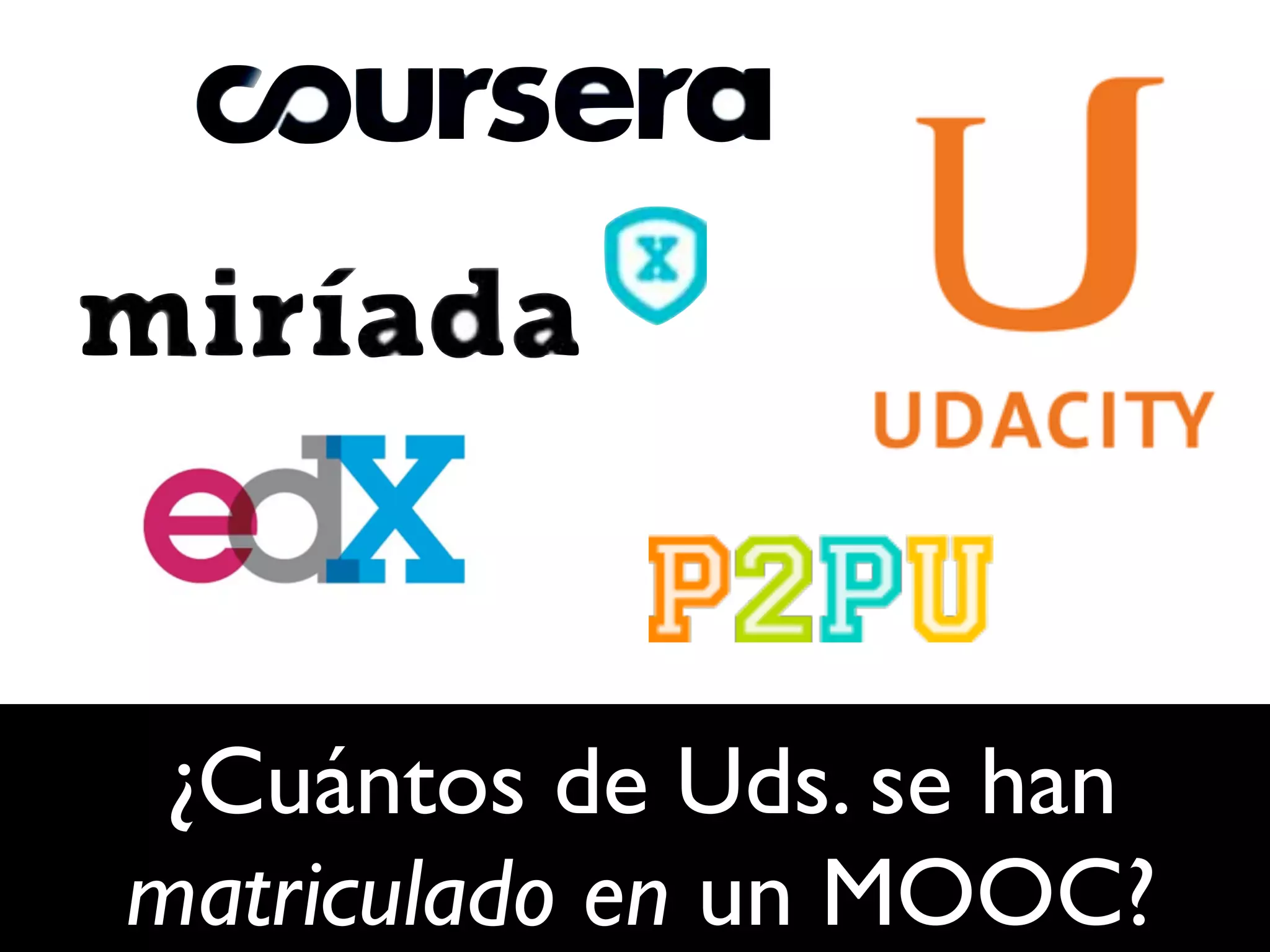
¿Cuántos de Uds. se han
matriculado en un MOOC?
¿Lo terminaron o abandonaron?
¿Les gustó la experiencia?
¿Han diseñado, desarrollado e
“impartido” un MOOC?
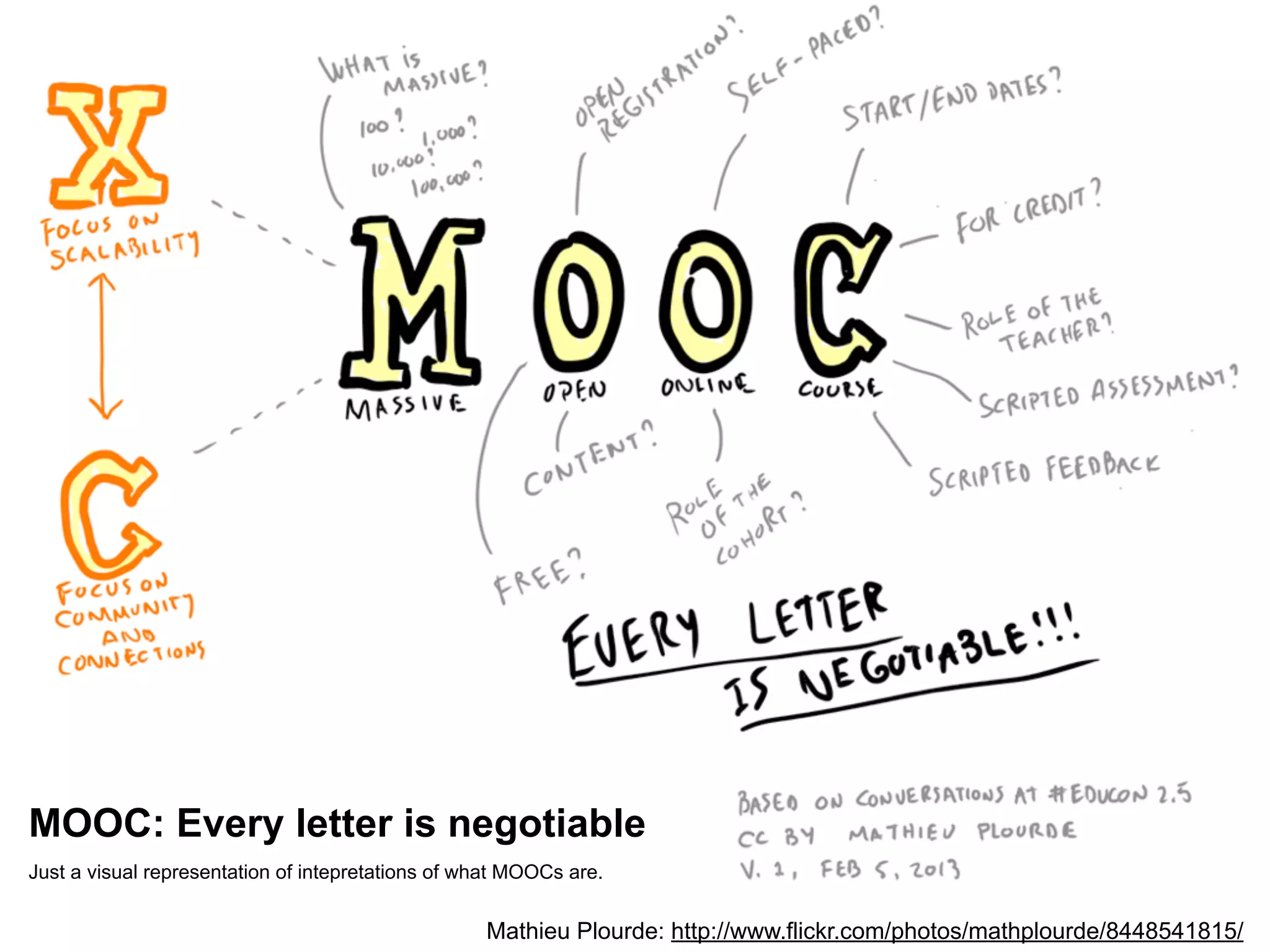
1. ¿Qué es un
MOOC?
Mathieu Plourde: http://www.flickr.com/photos/mathplourde/8448541815/
MOOC: Every letter is negotiable
Just a visual representation of intepretations of what MOOCs are.
SPOC!
Small Private Online Course!
http://en.wikipedia.org/wiki/Small_private_online_course
2. ¿Aprendizaje?
¿Qué aprendizaje?
Familias de teorías
del aprendizaje: 

conductismo, cognitivismo, constructivismo…
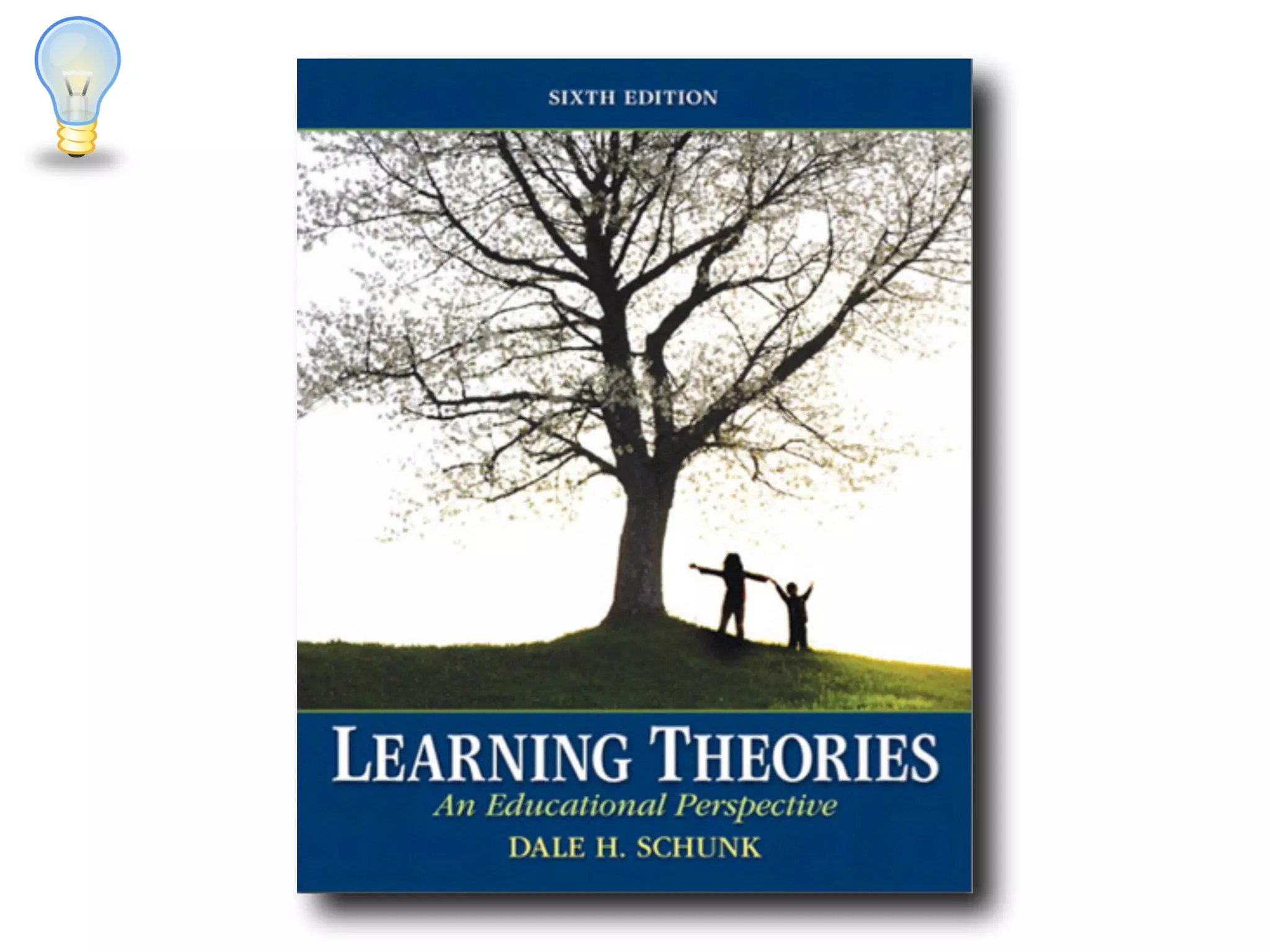
¿conectivismo?!Schunk (1991)
1. ¿Qué es el
aprendizaje? !
¿Hay diferentes tipos
de aprendizaje?
2. ¿Cómo ocurre el
aprendizaje?
3. ¿Qué factores
influencian el
aprendizaje?
4. ¿Cuál es el papel
de la memoria?
5. ¿Cómo ocurre la
transferencia?
6. ¿Qué tipos de
aprendizaje son
explicados por la
teoría?
7. ¿Qué asunciones
básicas/principios de la
teoría son relevantes
en educación
(instructional design)?
Ertmer & Newby (1993):
8. ¿Cómo debe
estructurarse la
instrucción para
facilitar el
aprendizaje?
Ertmer & Newby (1993):
9. Epistemología:
¿qué es el
conocimiento?
Adell (hoy):
3. El contexto y la
historia de los
MOOC
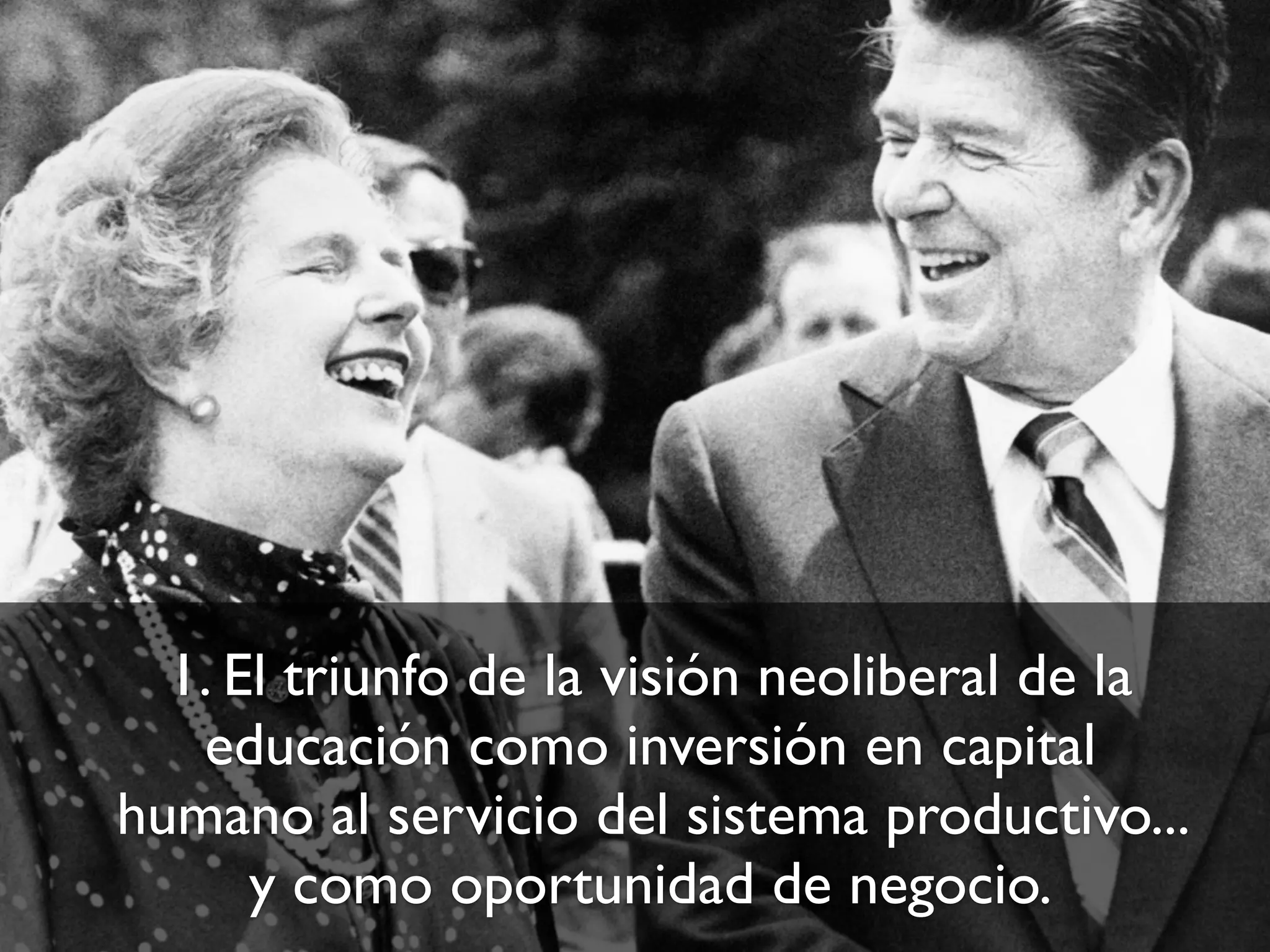
1. El triunfo de la visión neoliberal de la
educación como inversión en capital
humano al servicio del sistema productivo...
y como oportunidad de negocio.
Eric Hanushek
2. La tremenda burbuja de la
educación superior EE.UU.
$24.000
Deuda media titulado/a
+75%Coste de la vida
1988-2008
+325%Coste College
4 años 1988-2008
La Universidad está recibiendo fuertes
presiones de su entorno social, político y
económico para...“educar más estudiantes,
con mejores resultados de aprendizaje, con
un coste menor”
George L. Mehaffy, Vicepresidente
Liderazgo Académico y Cambio de la
Asociación Americana de Colleges y
Universidades Estatales.
George L. Mehaffy (2012). Challenge and Change,
EDUCAUSE Review, september 5, 2012.
Conclusión:
Es imposible entender nada en
educación superior sin referencia
a la agenda neoliberal.
Cronología
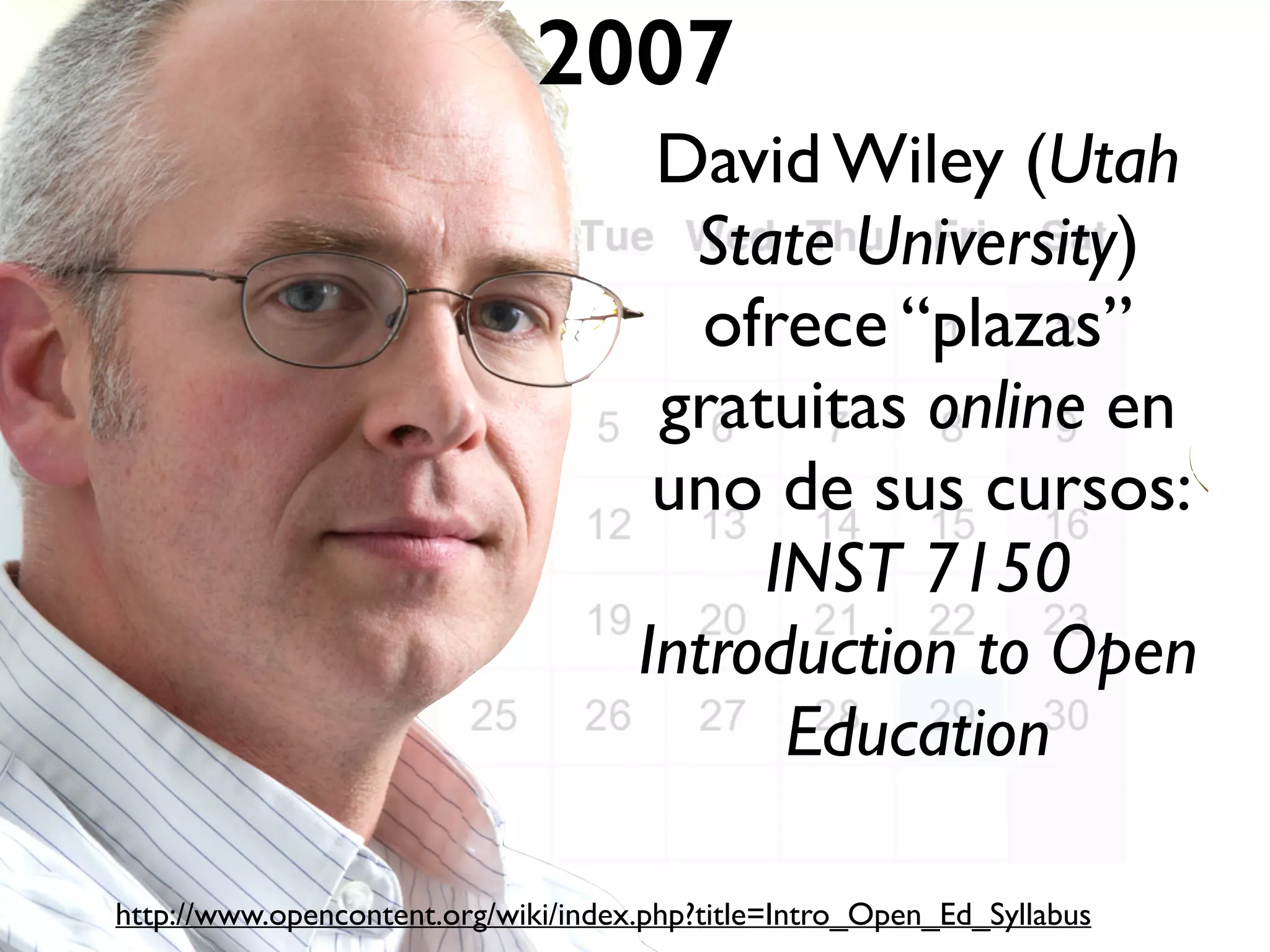
David Wiley (Utah
State University)
ofrece “plazas”
gratuitas online en
uno de sus cursos:
INST 7150
Introduction to Open
Education
2007
http://www.opencontent.org/wiki/index.php?title=Intro_Open_Ed_Syllabus
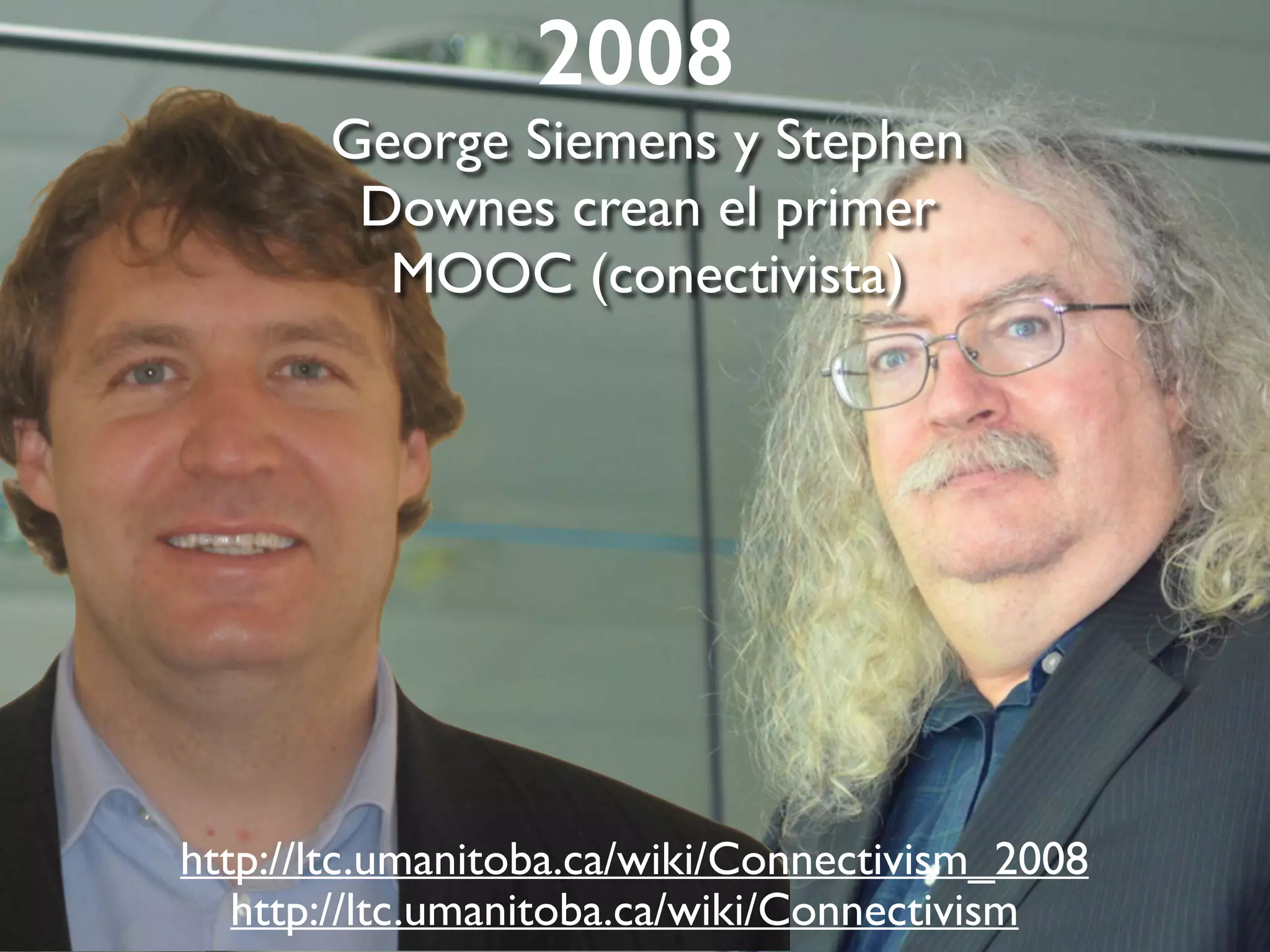
2008
George Siemens y Stephen
Downes crean el primer
MOOC (conectivista)
http://ltc.umanitoba.ca/wiki/Connectivism_2008
http://ltc.umanitoba.ca/wiki/Connectivism
2008
http://ltc.umanitoba.ca/wiki/Connectivism_2008
http://ltc.umanitoba.ca/wiki/Connectivism
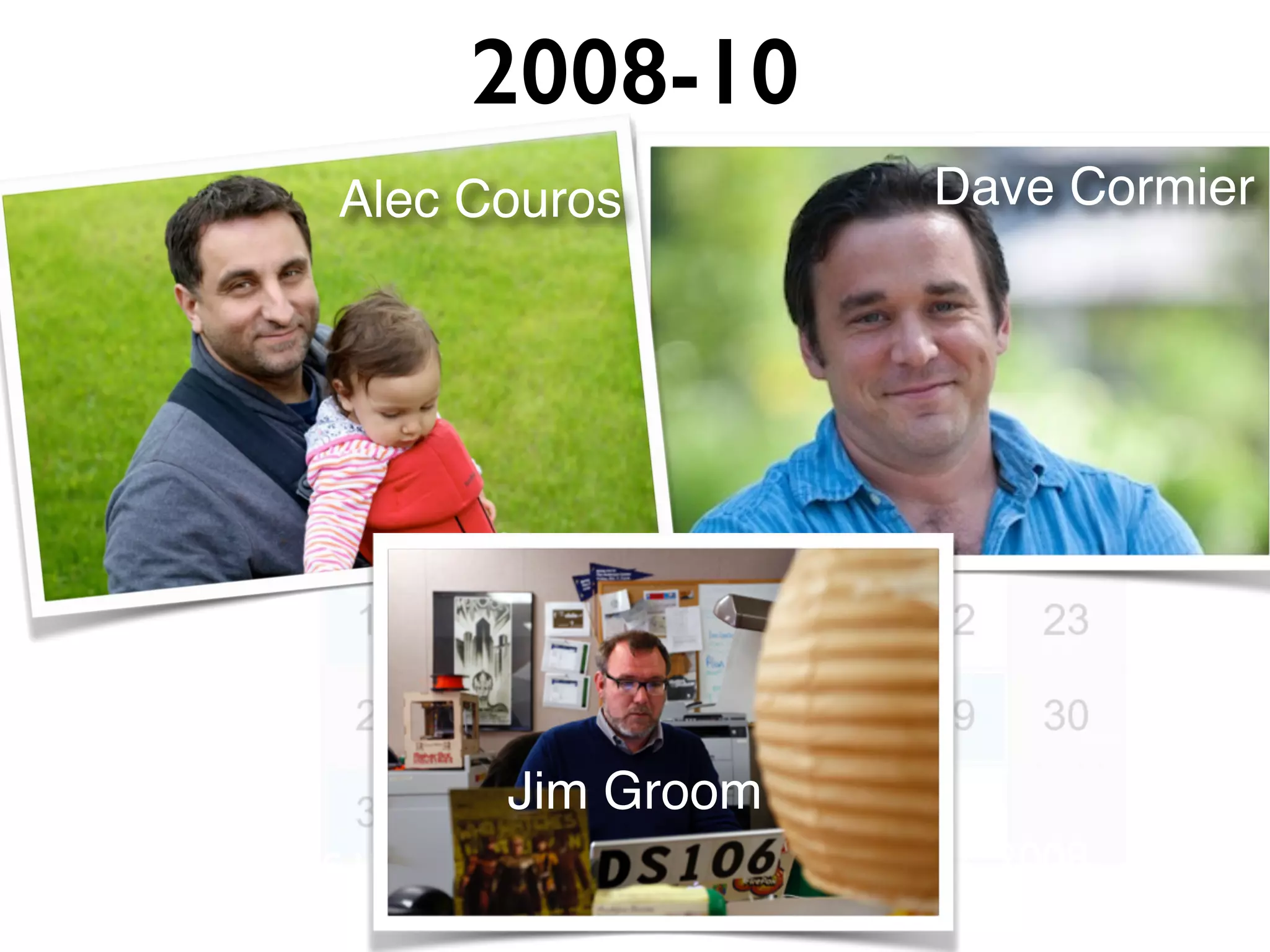
Dave CormierAlec Couros
2008-10
Jim Groom
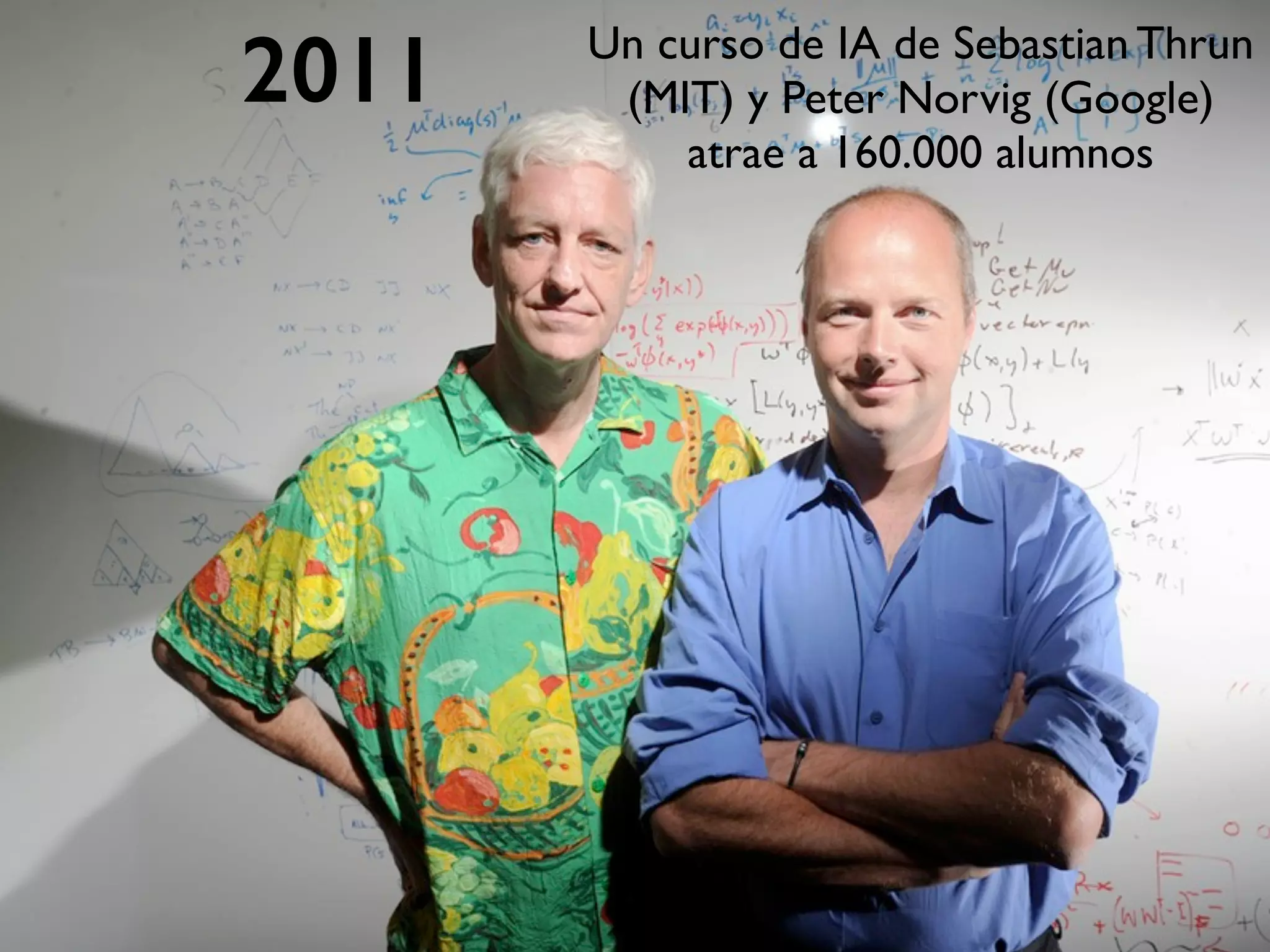
2011 Un curso de IA de Sebastian Thrun
(MIT) y Peter Norvig (Google)
atrae a 160.000 alumnos
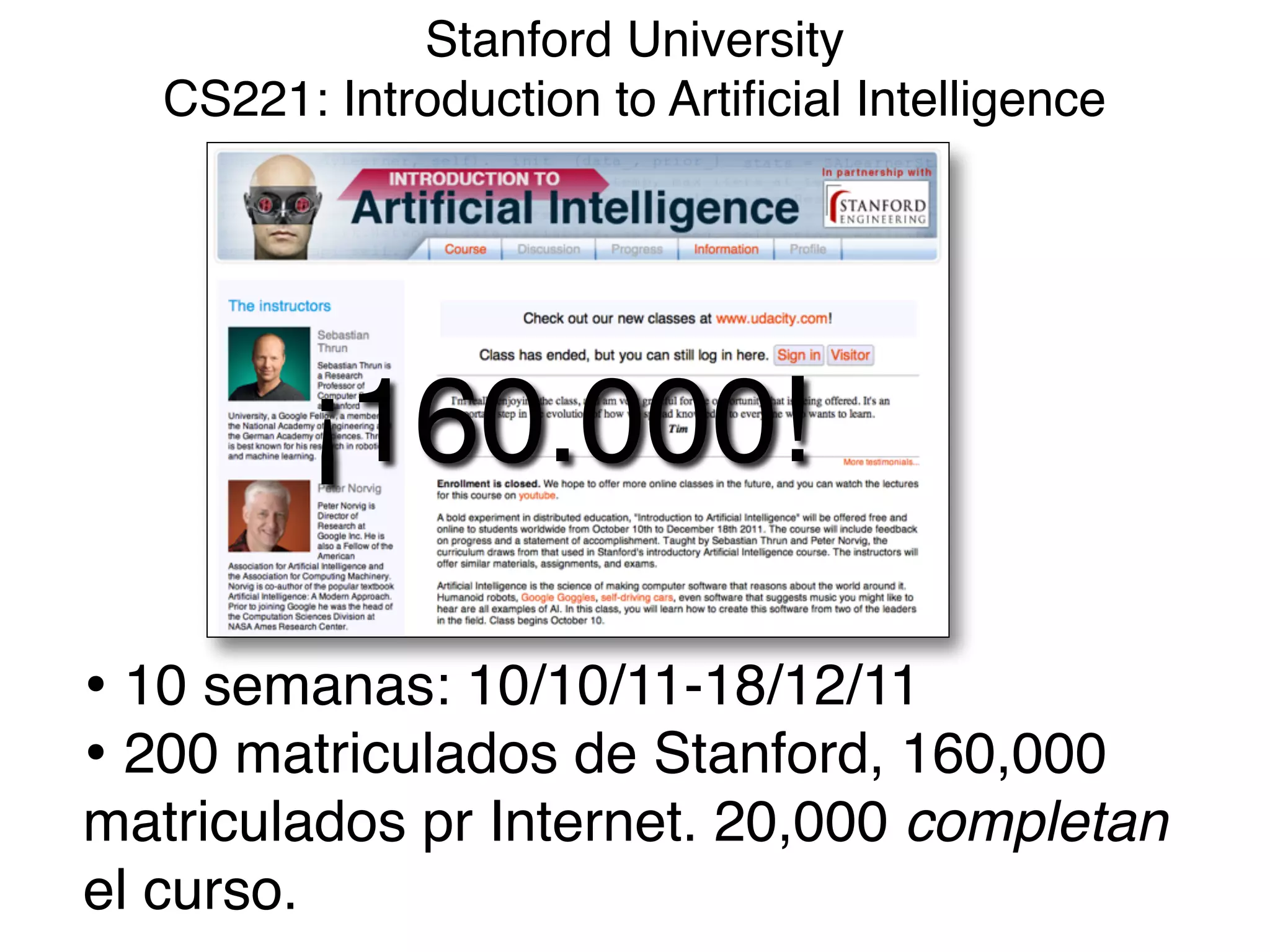
Stanford University

CS221: Introduction to Artificial Intelligence
• 10 semanas: 10/10/11-18/12/11!
• 200 matriculados de Stanford, 160,000
matriculados pr Internet. 20,000 completan
el curso.
¡160.000!
2012
Se crean las startups
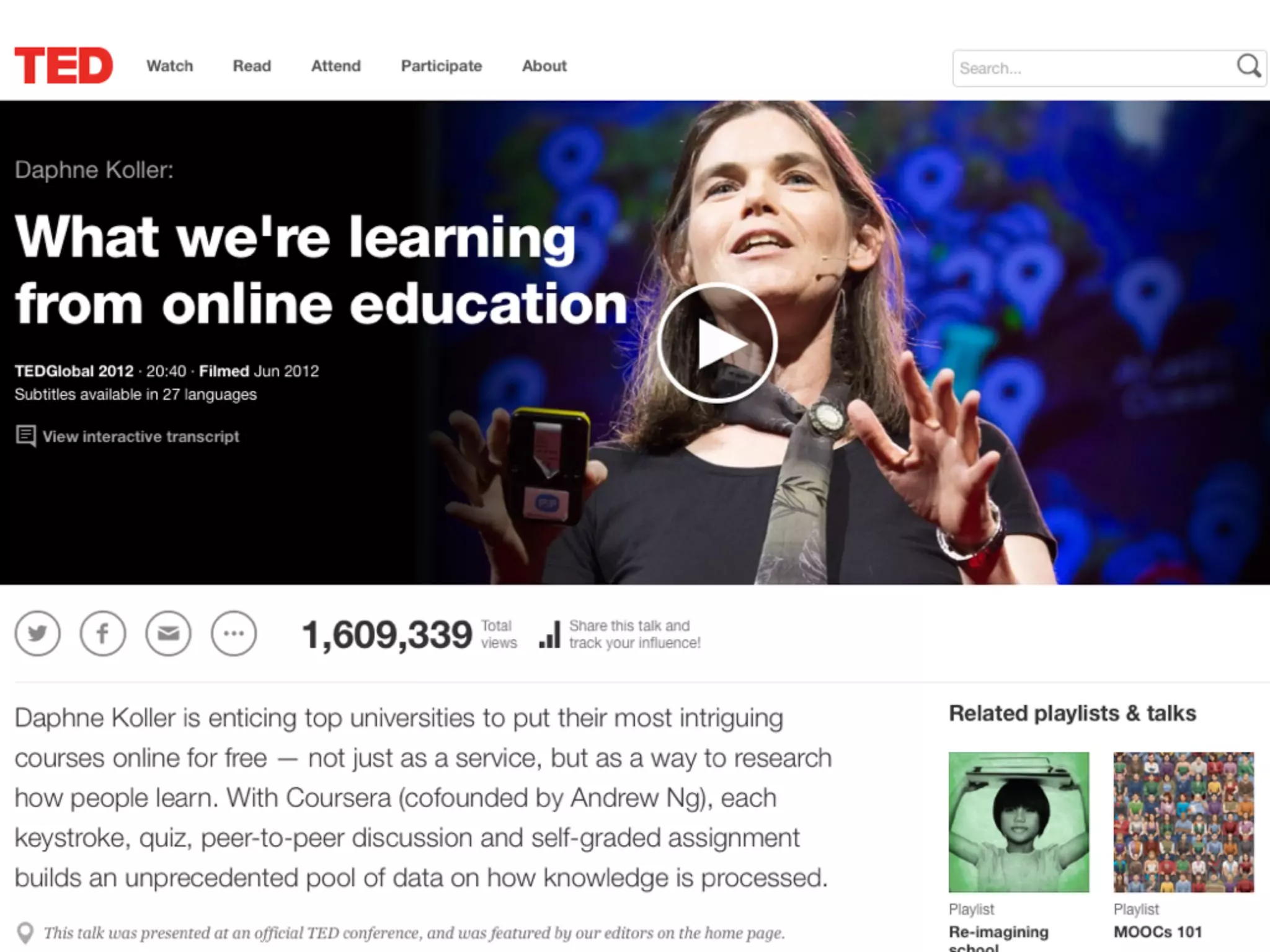
Udacity y Coursera y edX
!
4. Diferencias entre
los xMOOC y los
cMOOC
excurso.
(Del lat. excursus).
1. m. digresión.
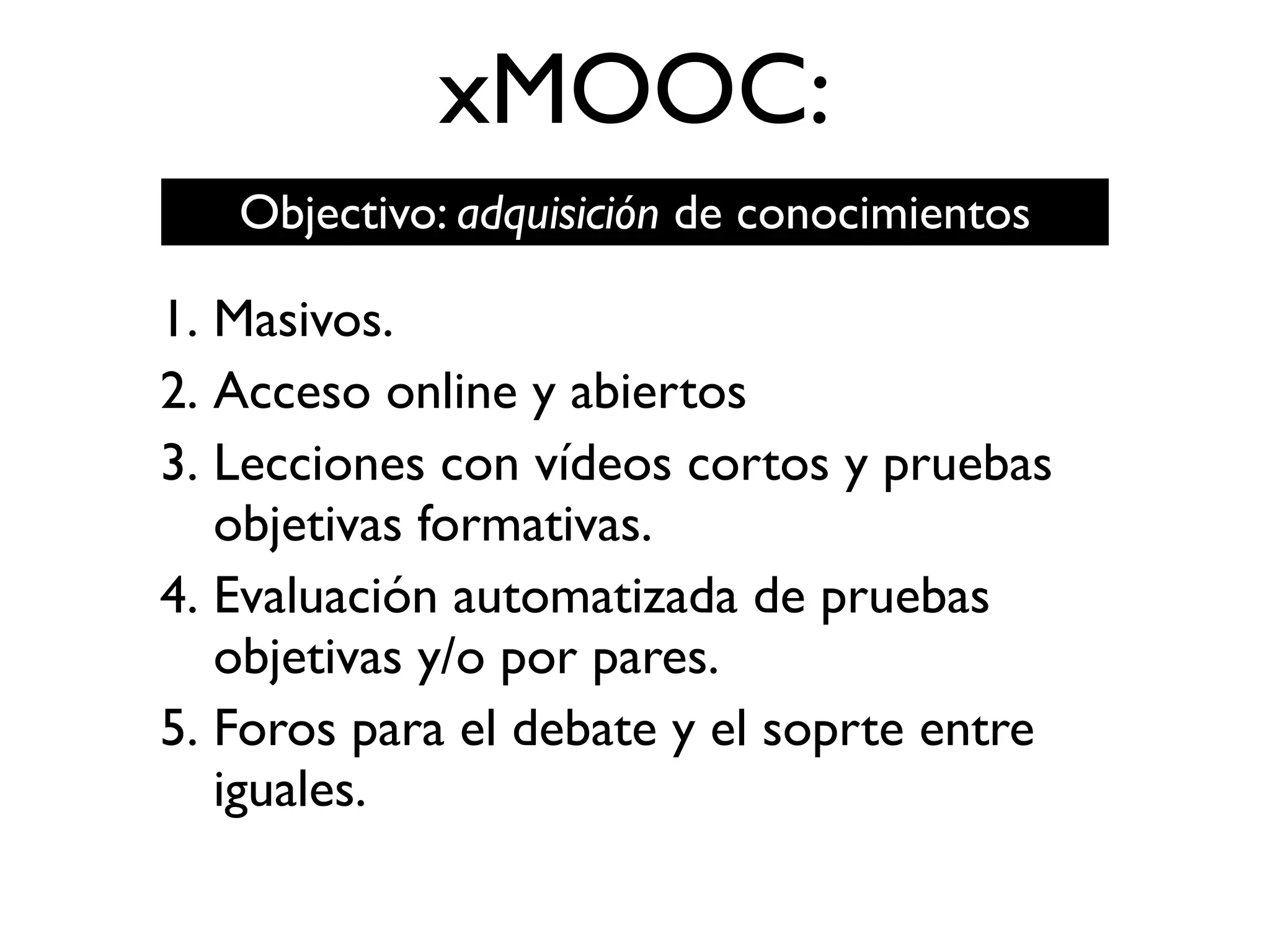
xMOOC:
1. Masivos.
2. Acceso online y abiertos
3. Lecciones con vídeos cortos y pruebas
objetivas formativas.
4. Evaluación automatizada de pruebas
objetivas y/o por pares.
5. Foros para el debate y el soprte entre
iguales.
Objectivo: adquisición de conocimientos
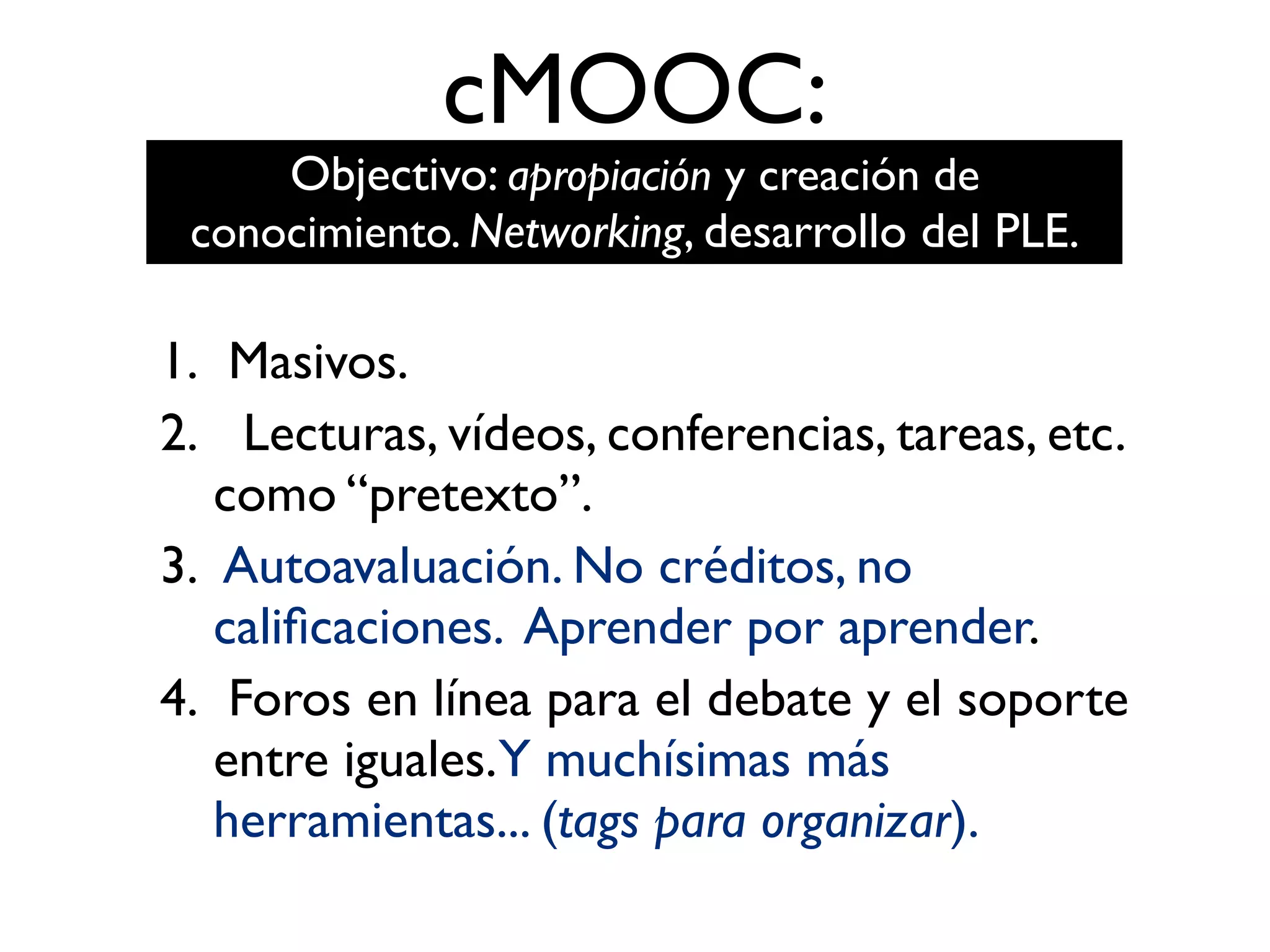
cMOOC:
1. Masivos.
2. Lecturas, vídeos, conferencias, tareas, etc.
como “pretexto”.
3. Autoavaluación. No créditos, no
calificaciones. Aprender por aprender.
4. Foros en línea para el debate y el soporte
entre iguales.Y muchísimas más
herramientas... (tags para organizar).
Objectivo: apropiación y creación de
conocimiento. Networking, desarrollo del PLE.
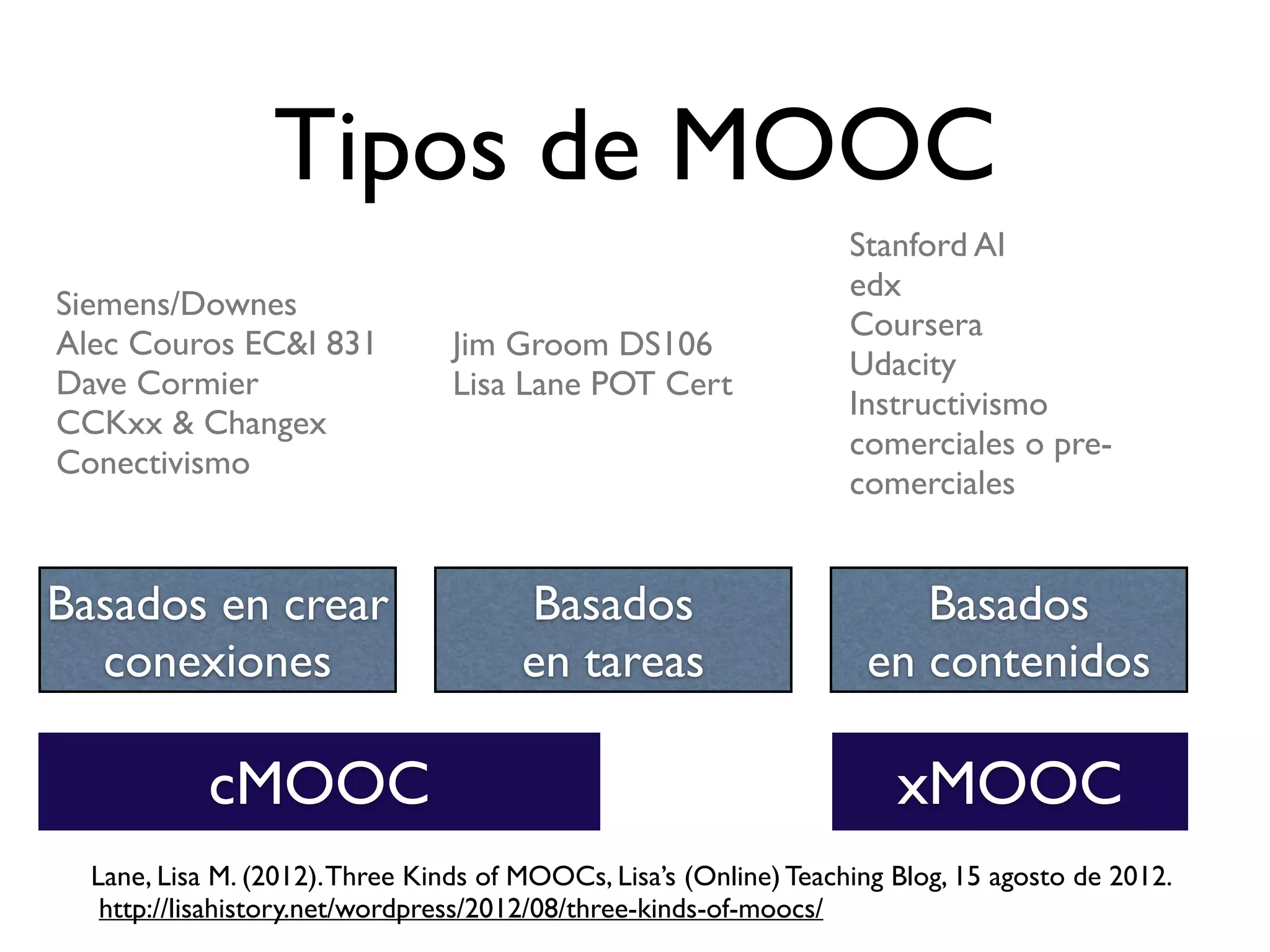
Lane, Lisa M. (2012).Three Kinds of MOOCs, Lisa’s (Online) Teaching Blog, 15 agosto de 2012.
http://lisahistory.net/wordpress/2012/08/three-kinds-of-moocs/
Tipos de MOOC
Basados en crear
conexiones
Basados
en tareas
Basados
en contenidos
!
Siemens/Downes
Alec Couros EC&I 831
Dave Cormier
CCKxx & Changex
Conectivismo
!
Jim Groom DS106
Lisa Lane POT Cert
!
Stanford AI
edx
Coursera
Udacity
Instructivismo
comerciales o pre-
comerciales
cMOOC xMOOC
!
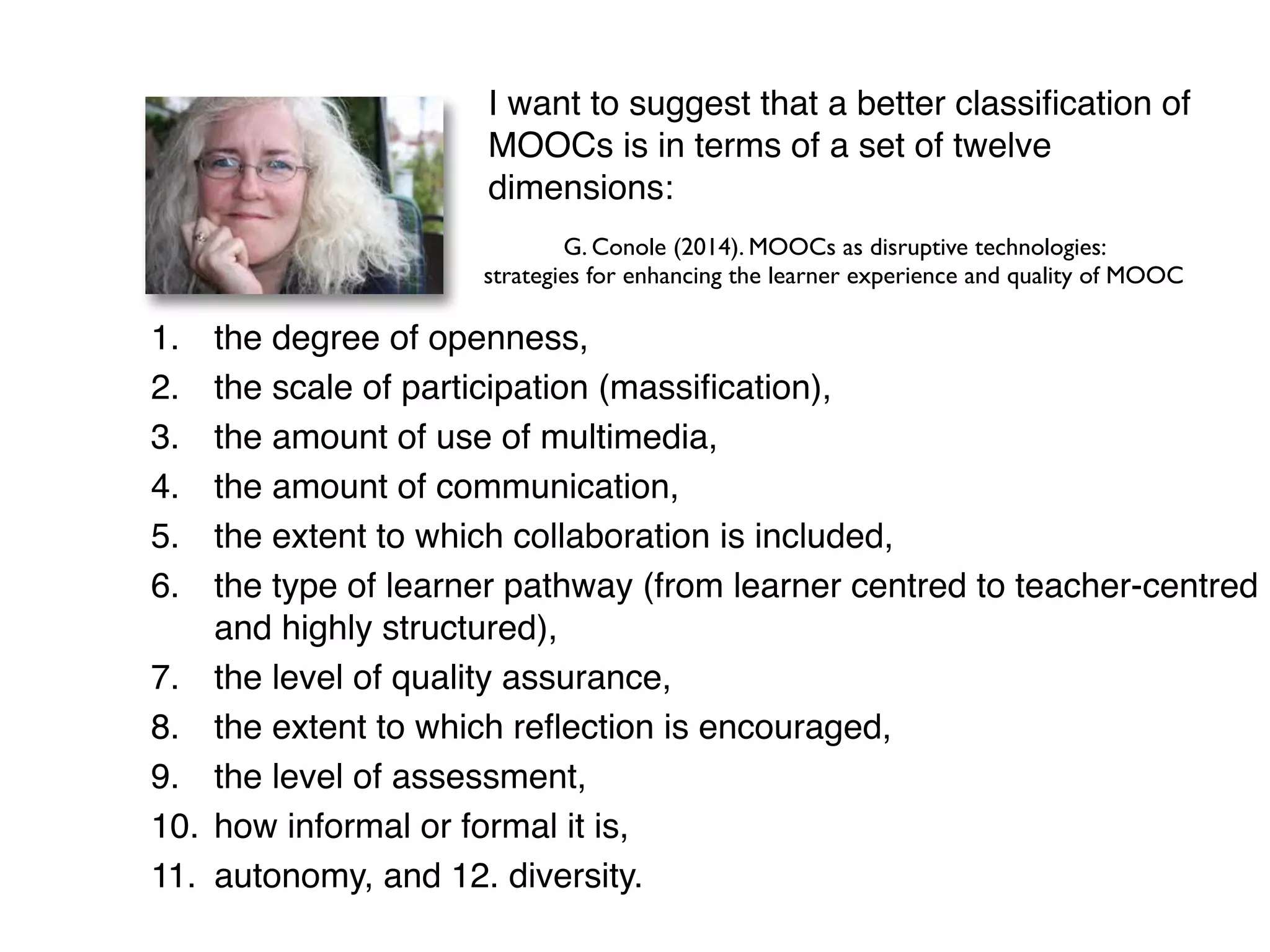
1. the degree of openness, !
2. the scale of participation (massification), !
3. the amount of use of multimedia, !
4. the amount of communication, !
5. the extent to which collaboration is included, !
6. the type of learner pathway (from learner centred to teacher-centred
and highly structured), !
7. the level of quality assurance, !
8. the extent to which reflection is encouraged, !
9. the level of assessment, !
10. how informal or formal it is, !
11. autonomy, and 12. diversity.
G. Conole (2014). MOOCs as disruptive technologies:
strategies for enhancing the learner experience and quality of MOOC
I want to suggest that a better classification of
MOOCs is in terms of a set of twelve
dimensions:
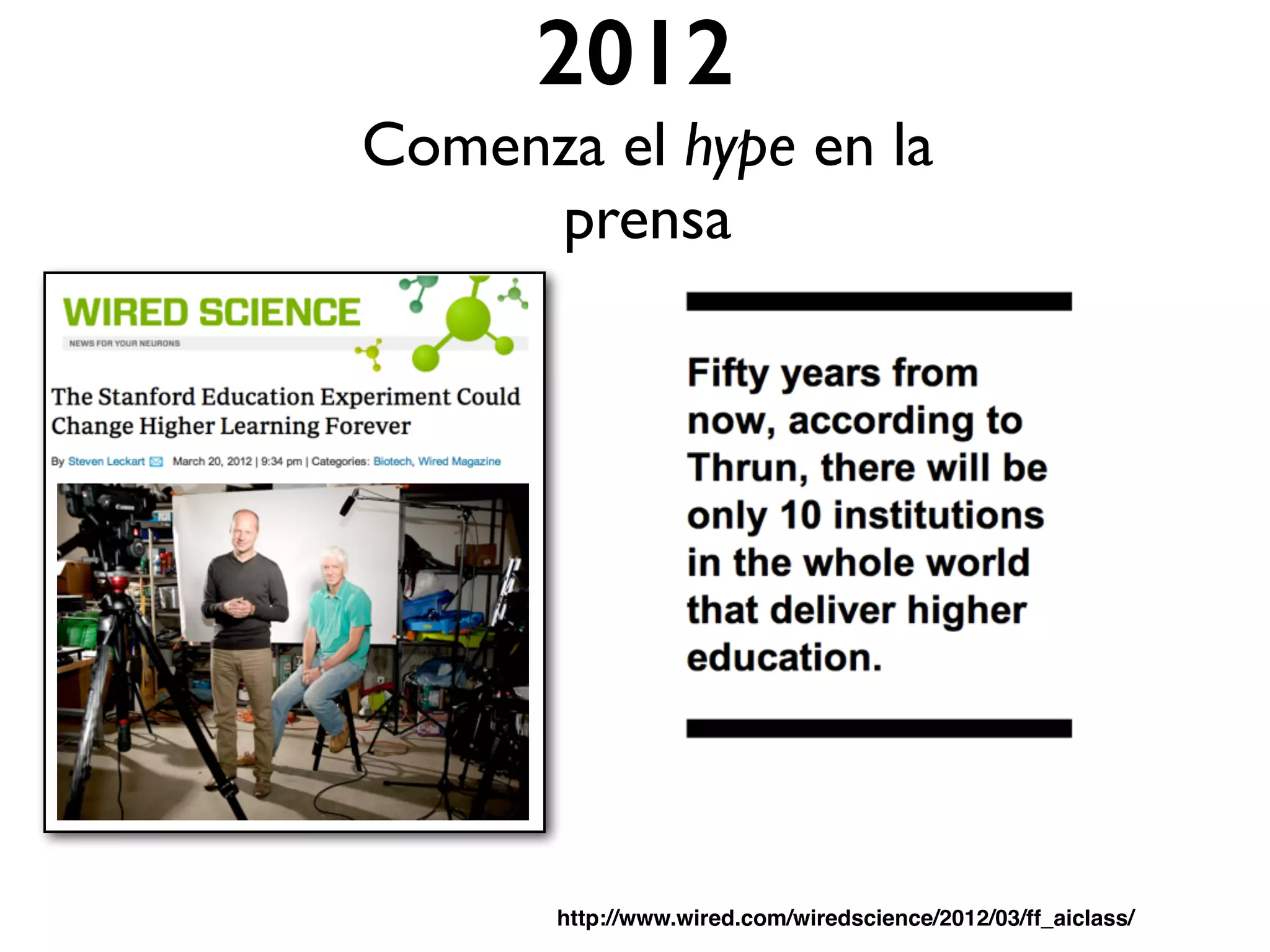
2012
Comenza el hype en la
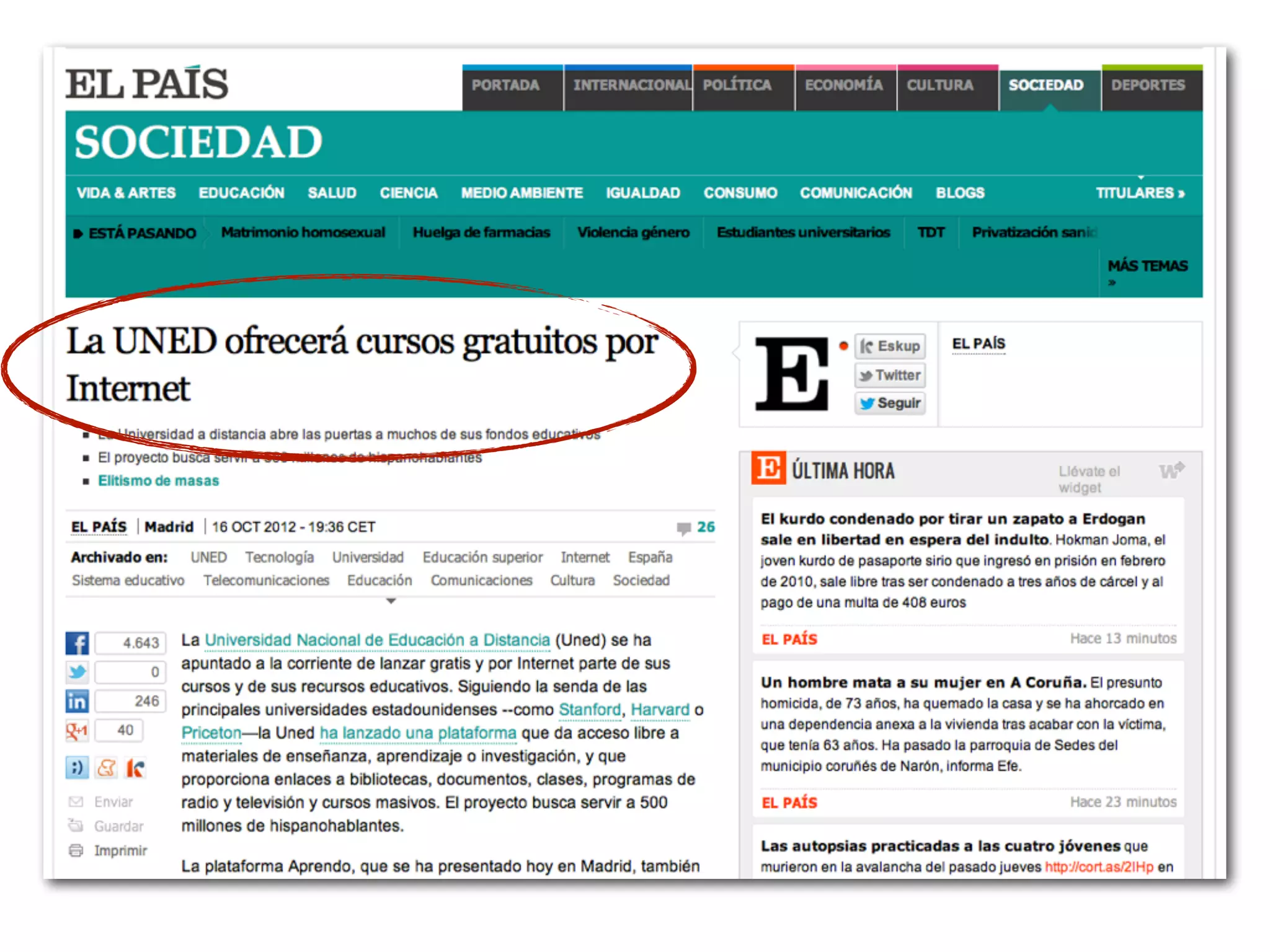
prensa
http://www.wired.com/wiredscience/2012/03/ff_aiclass/
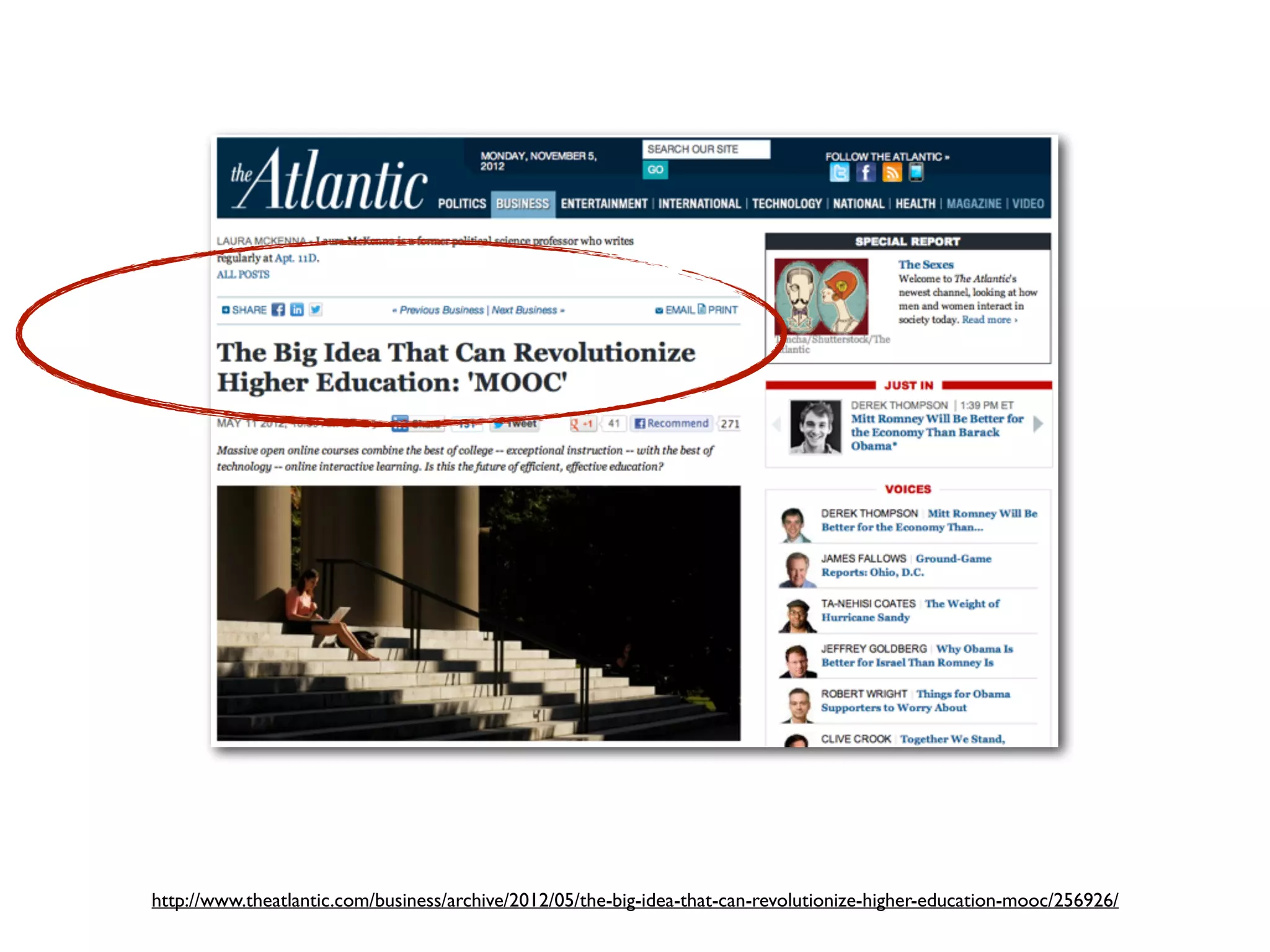
http://www.theatlantic.com/business/archive/2012/05/the-big-idea-that-can-revolutionize-higher-education-mooc/256926/
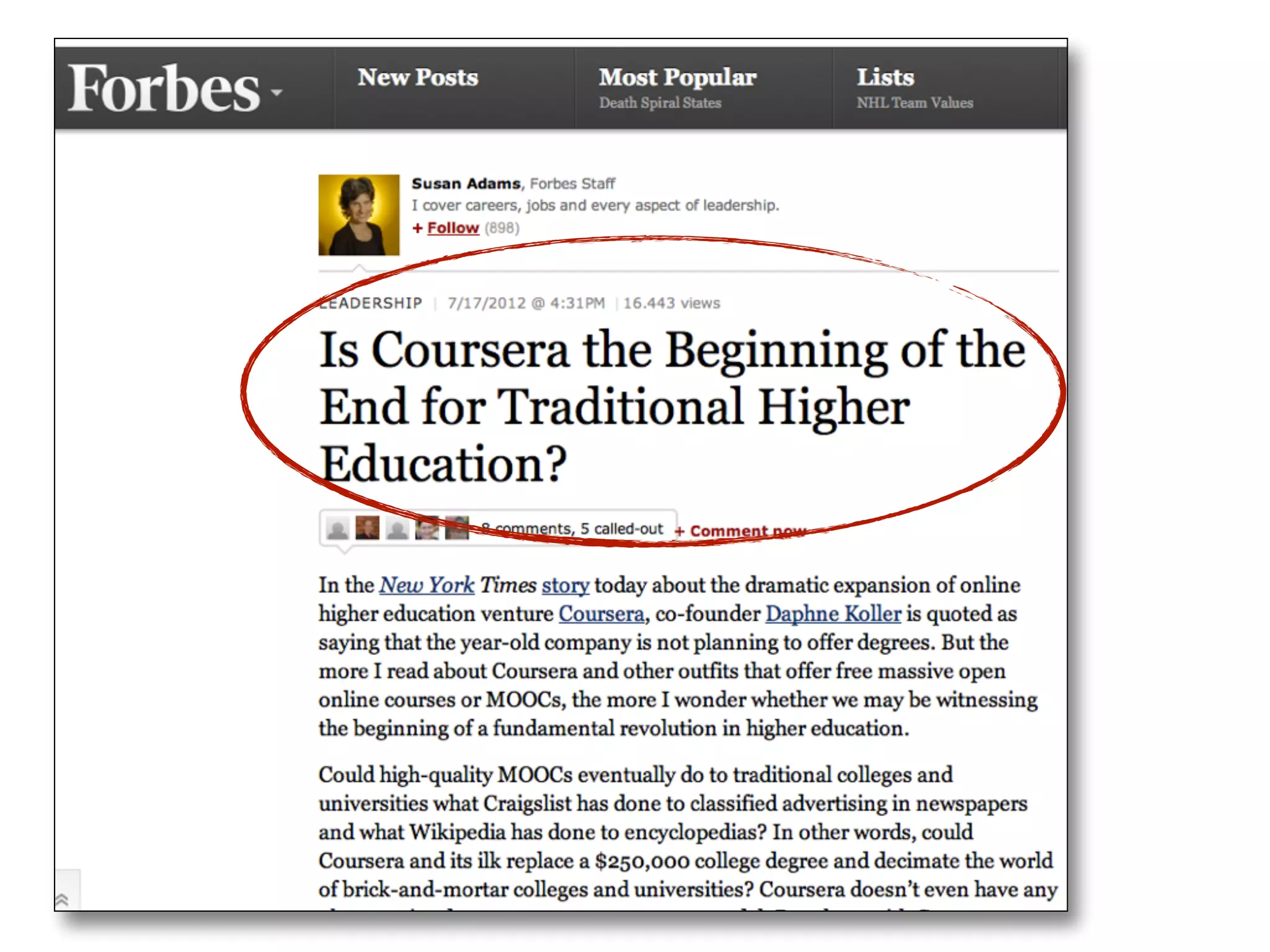
https://www.nytimes.com/2012/07/17/education/consortium-of-colleges-takes-online-education-to-new-level.html
http://www.technologyreview.com/news/506351/the-most-important-education-technology-in-200-years/
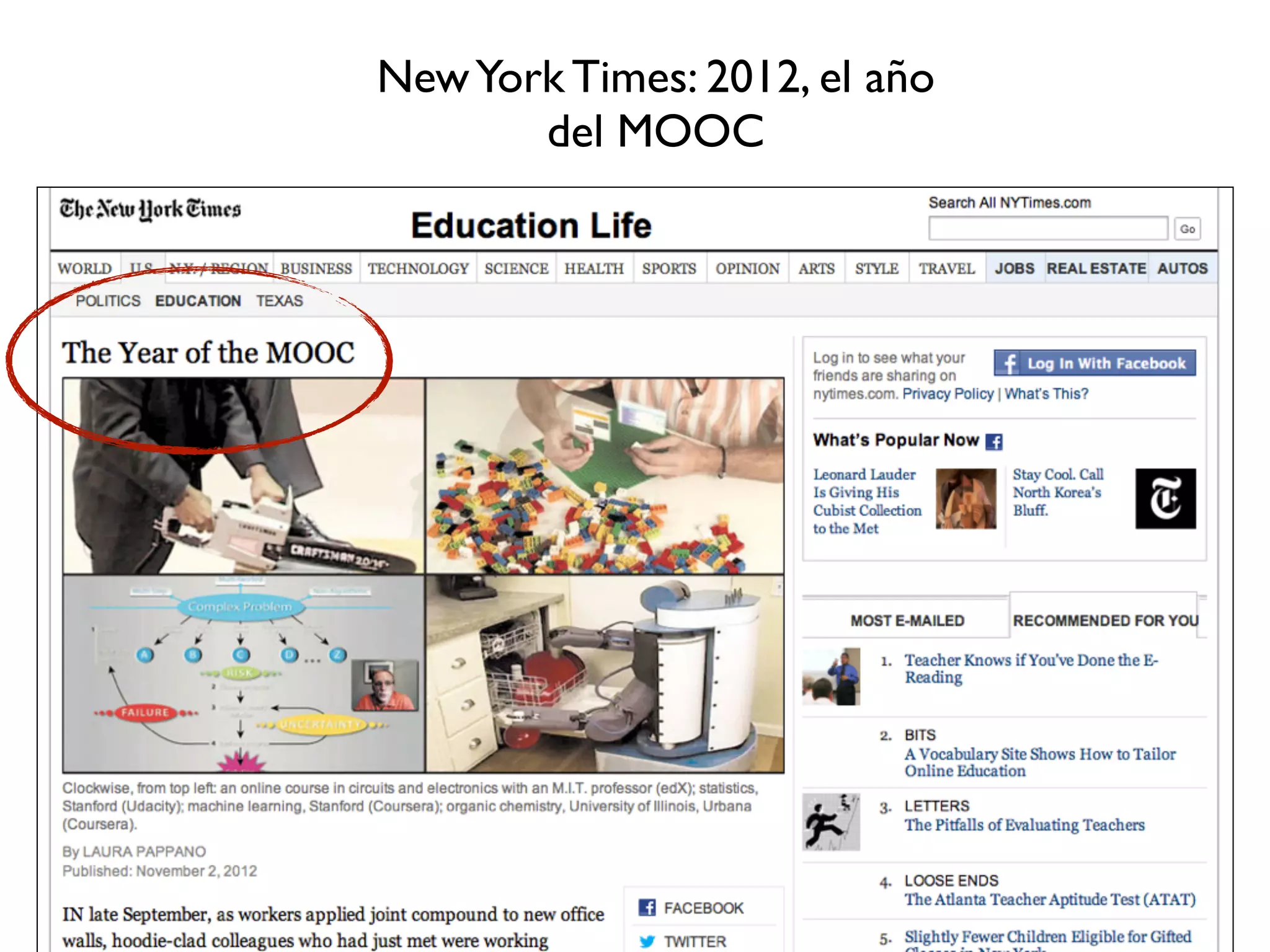
NewYork Times: 2012, el año
del MOOC
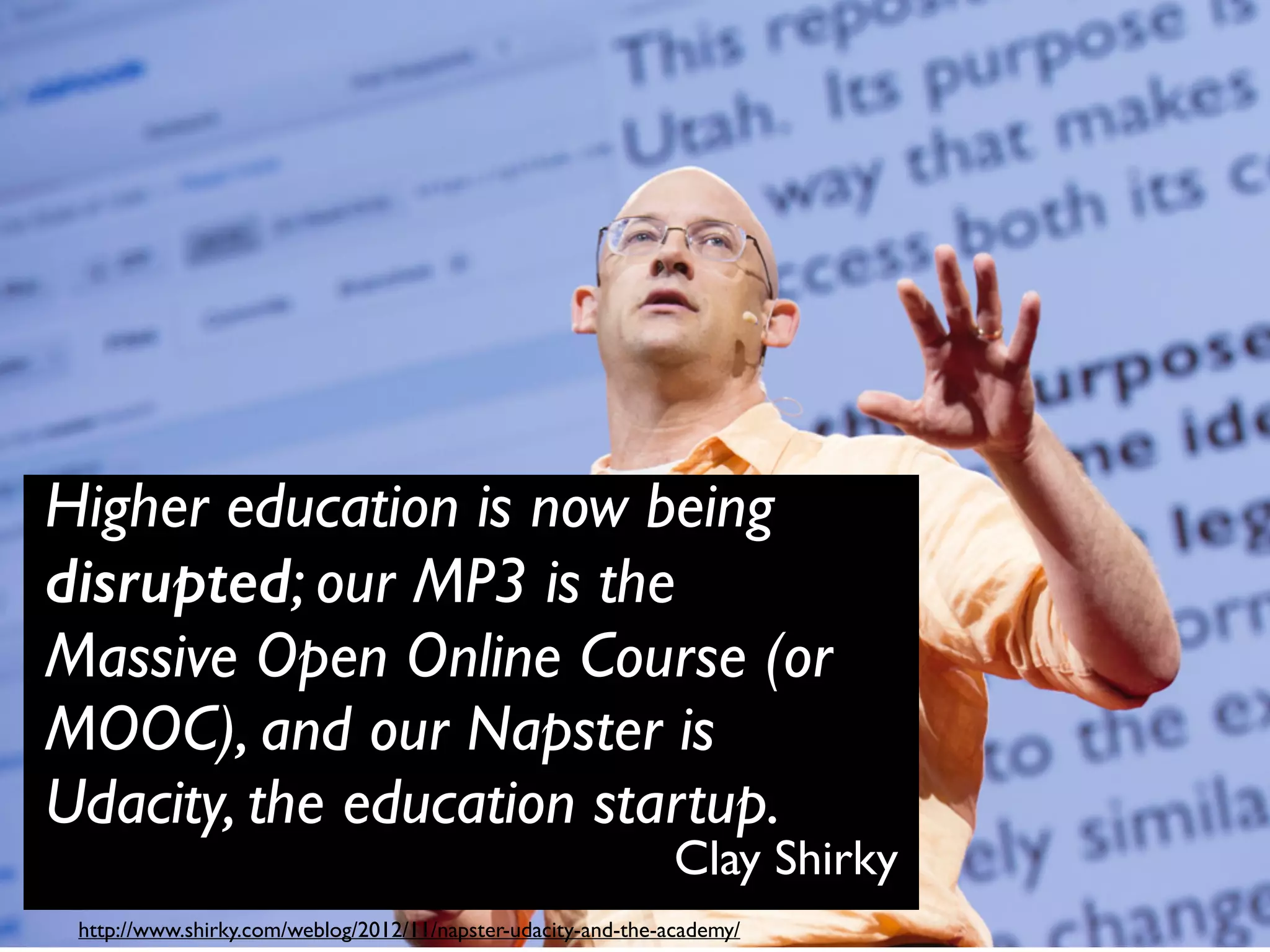
Clay Shirky
Higher education is now being
disrupted; our MP3 is the
Massive Open Online Course (or
MOOC), and our Napster is
Udacity, the education startup.
http://www.shirky.com/weblog/2012/11/napster-udacity-and-the-academy/
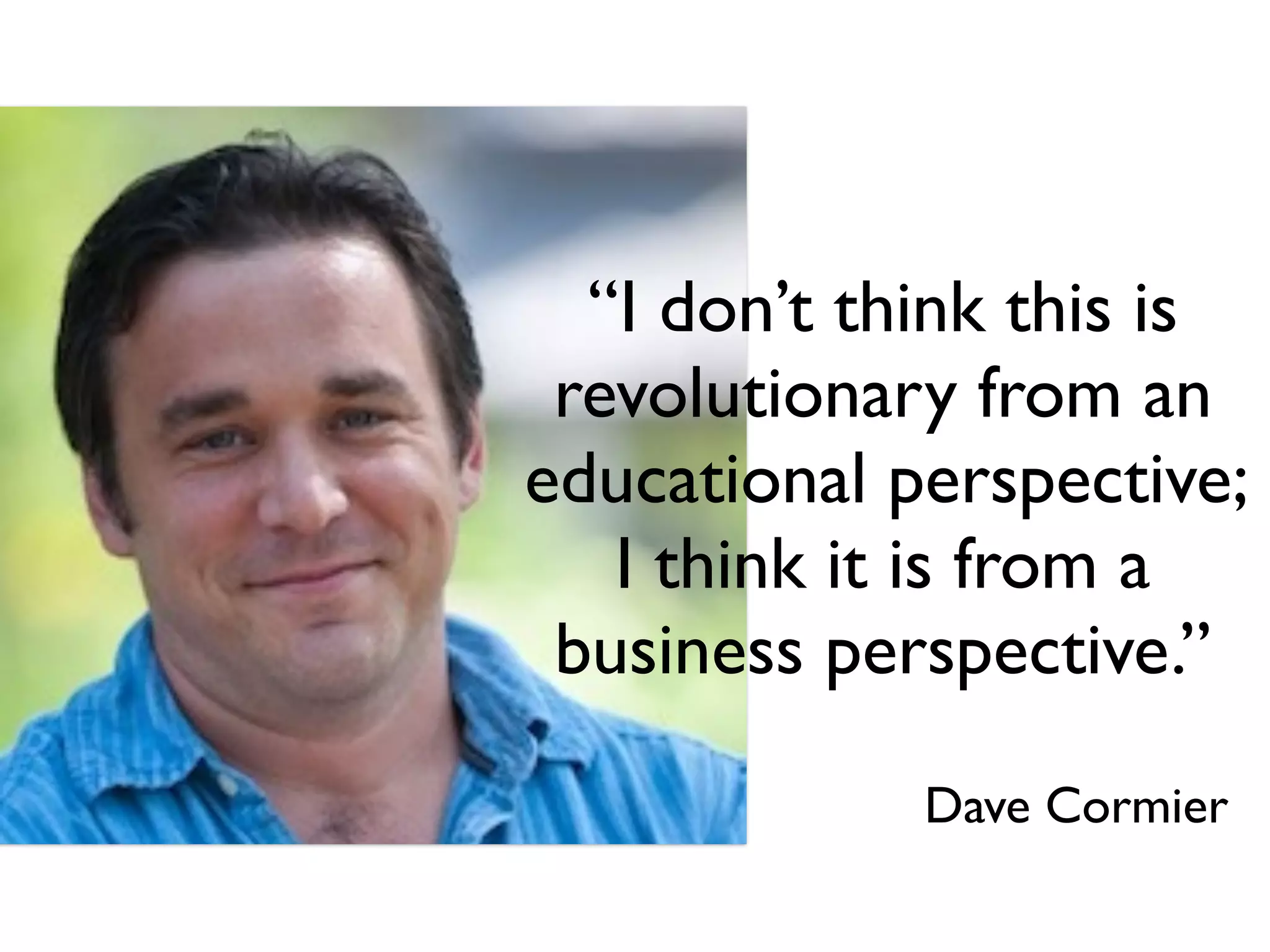
“I don’t think this is
revolutionary from an
educational perspective;
I think it is from a
business perspective.”
Dave Cormier
http://larrycuban.wordpress.com/2012/11/21/moocs-and-hype-again/
2012
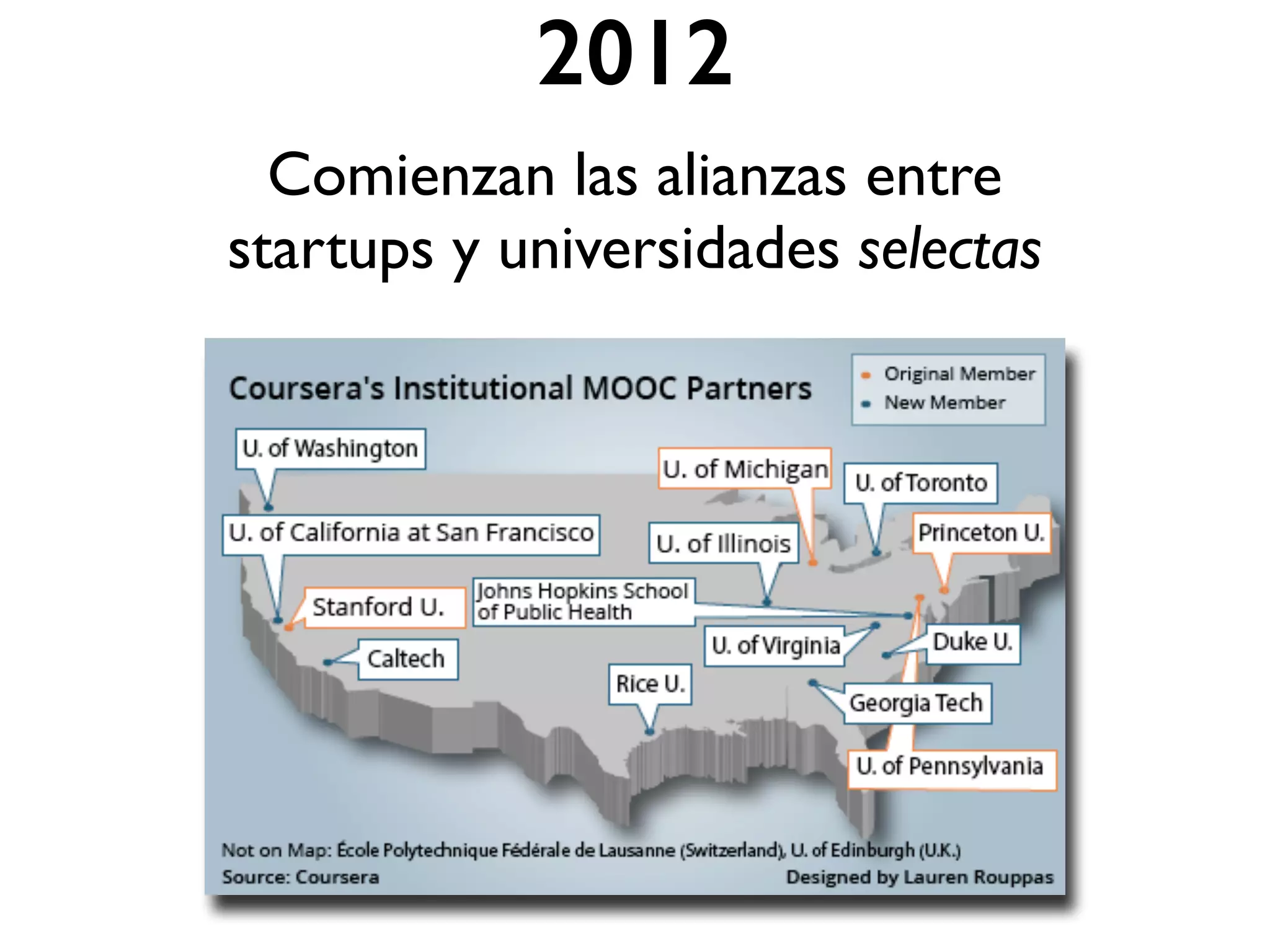
Comienzan las alianzas entre
startups y universidades selectas
2013
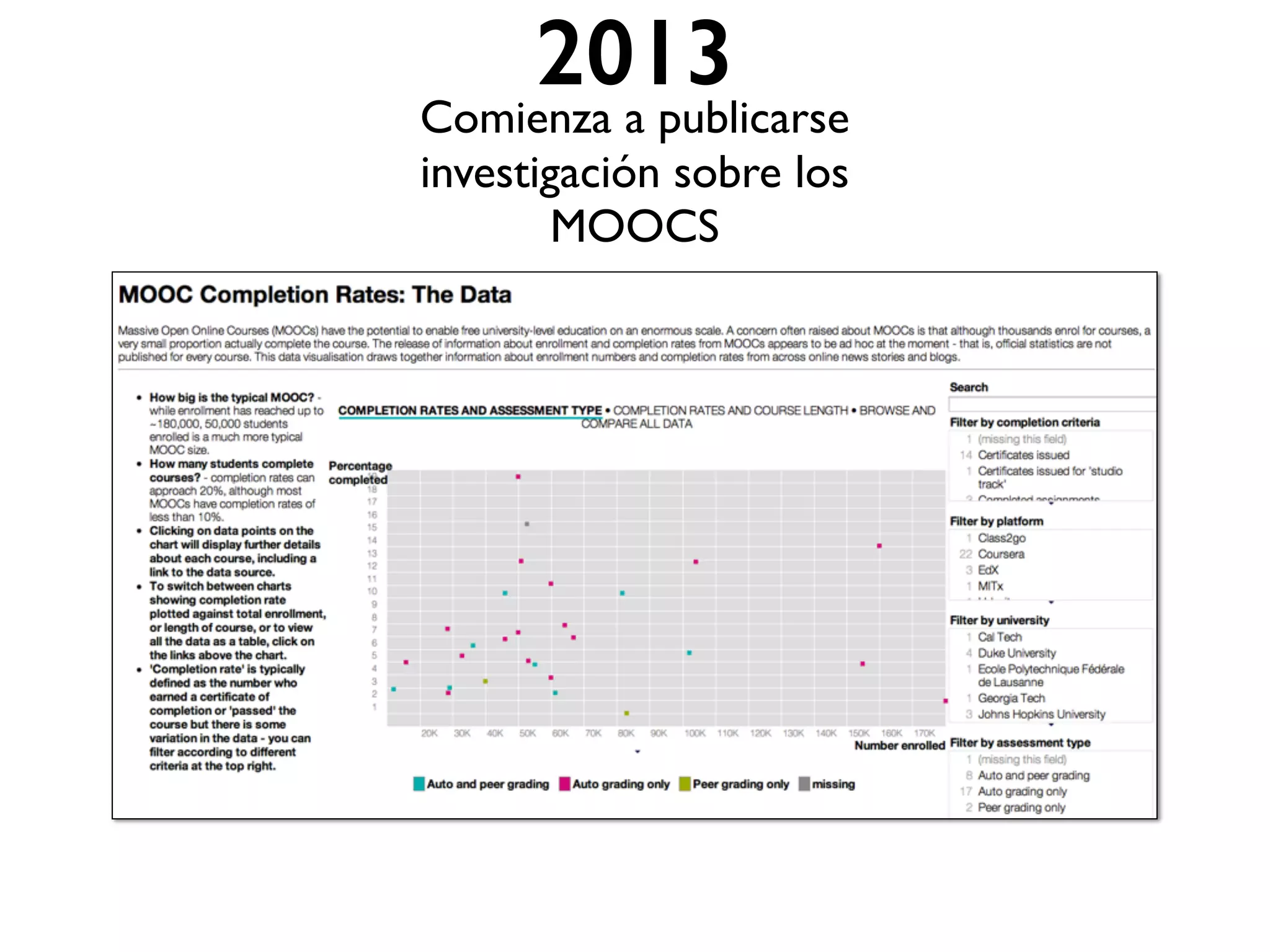
Comienza a publicarse
investigación sobre los
MOOCS
2013
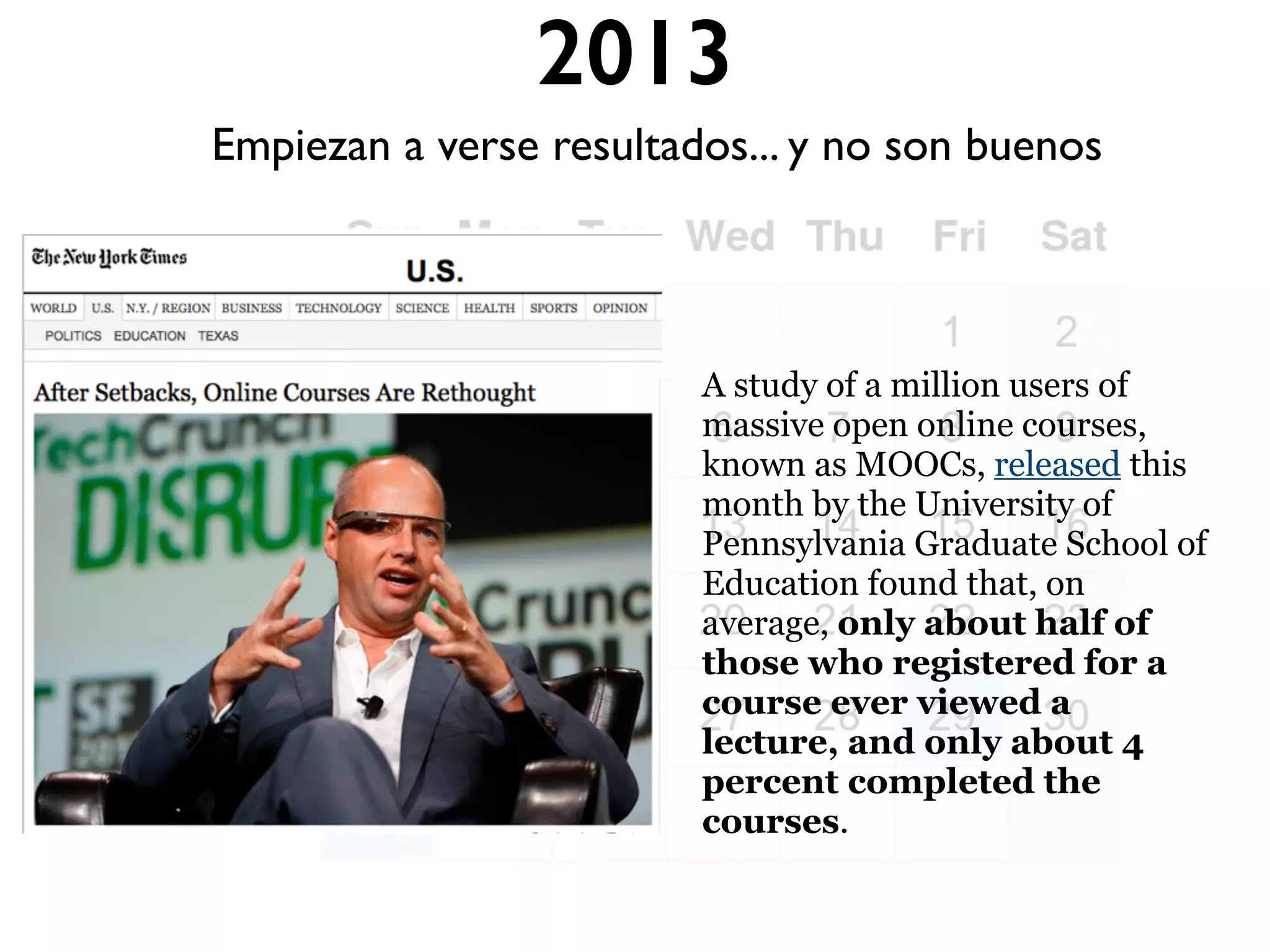
A study of a million users of
massive open online courses,
known as MOOCs, released this
month by the University of
Pennsylvania Graduate School of
Education found that, on
average, only about half of
those who registered for a
course ever viewed a
lecture, and only about 4
percent completed the
courses.
Empiezan a verse resultados... y no son buenos
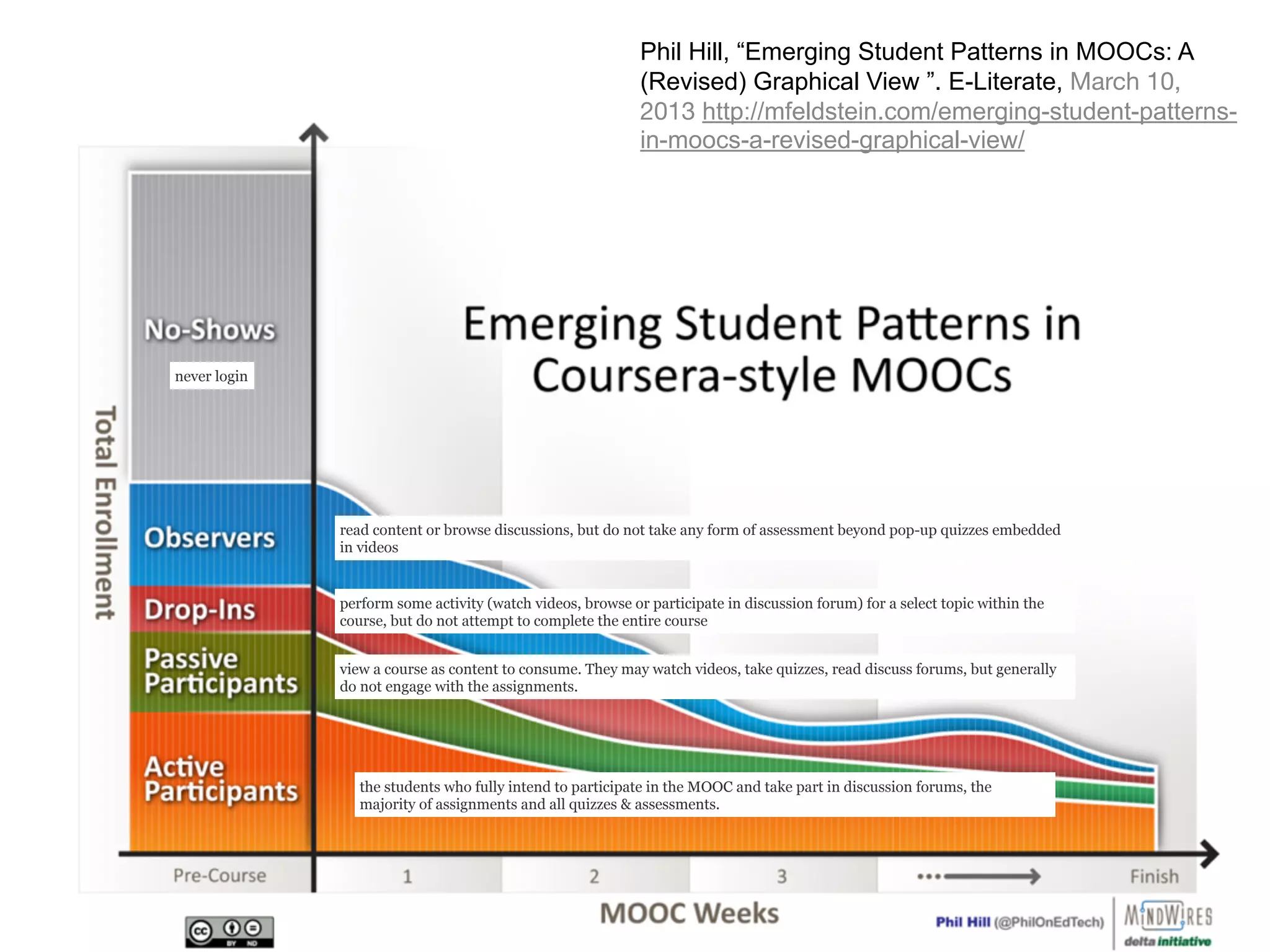
Phil Hill, “Emerging Student Patterns in MOOCs: A
(Revised) Graphical View ”. E-Literate, March 10,
2013 http://mfeldstein.com/emerging-student-patterns-
in-moocs-a-revised-graphical-view/
never login
read content or browse discussions, but do not take any form of assessment beyond pop-up quizzes embedded
in videos
perform some activity (watch videos, browse or participate in discussion forum) for a select topic within the
course, but do not attempt to complete the entire course
view a course as content to consume. They may watch videos, take quizzes, read discuss forums, but generally
do not engage with the assignments.
the students who fully intend to participate in the MOOC and take part in discussion forums, the
majority of assignments and all quizzes & assessments.
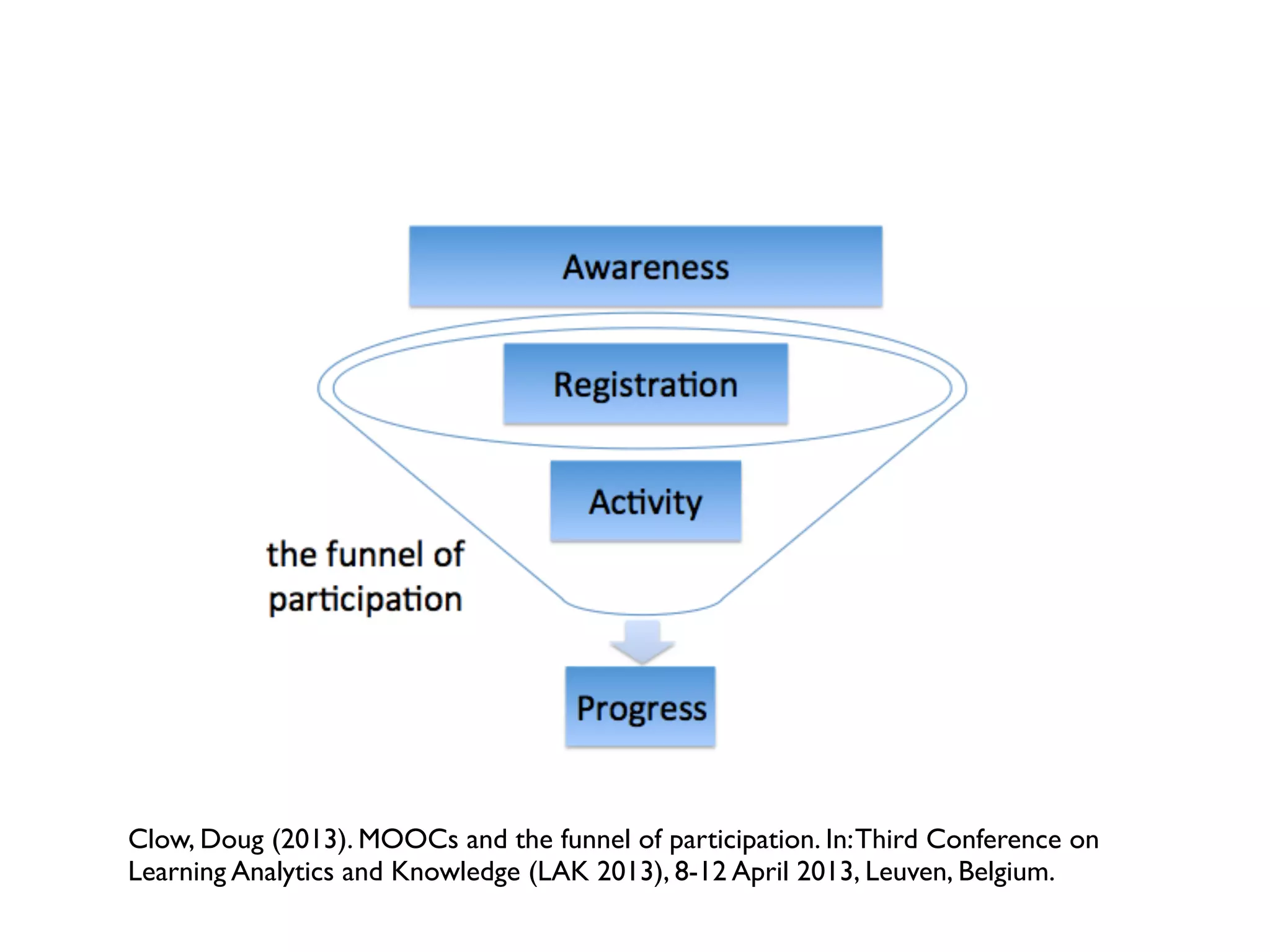
Clow, Doug (2013). MOOCs and the funnel of participation. In:Third Conference on
Learning Analytics and Knowledge (LAK 2013), 8-12 April 2013, Leuven, Belgium.
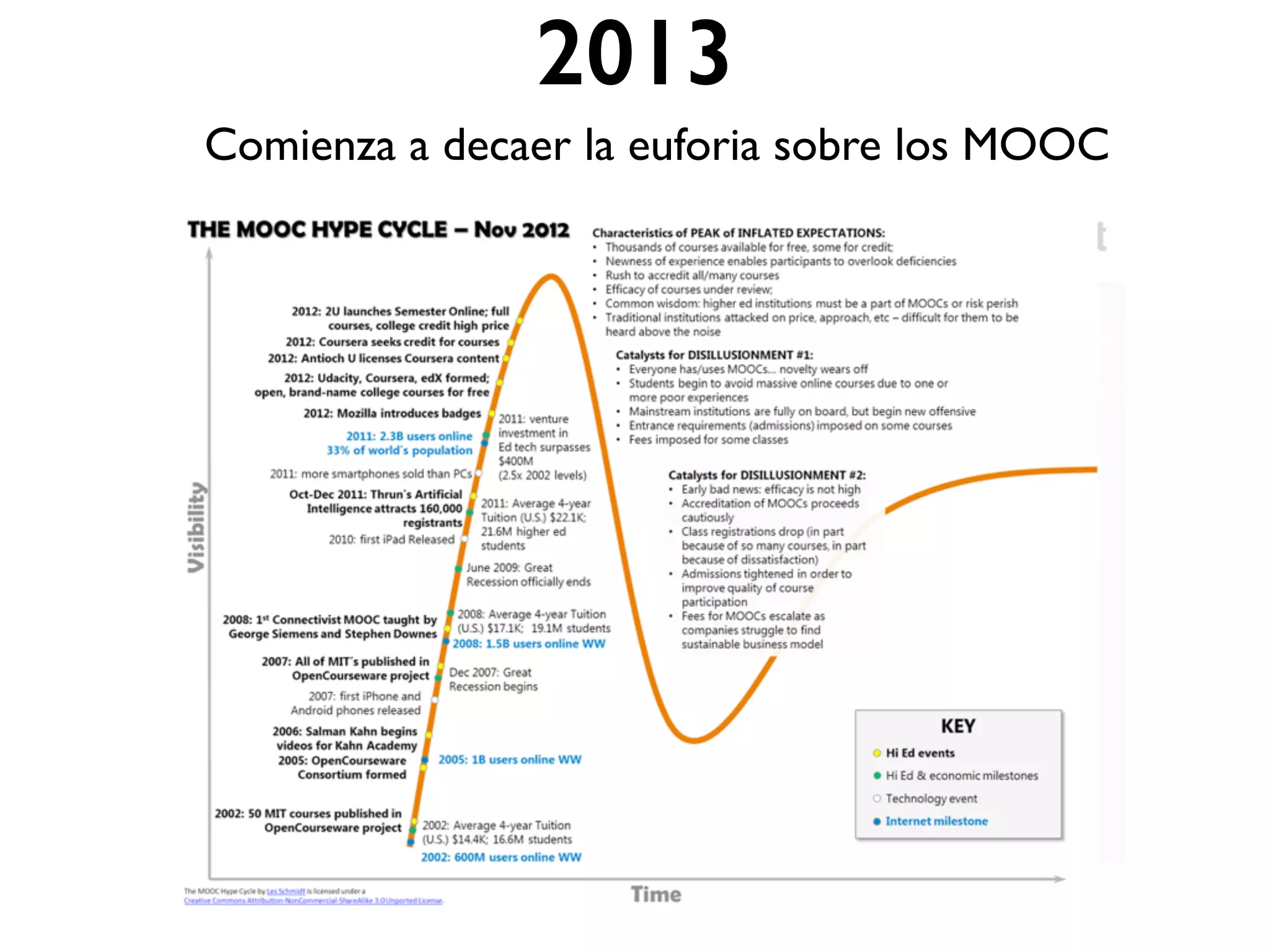
2013
Comienza a decaer la euforia sobre los MOOC
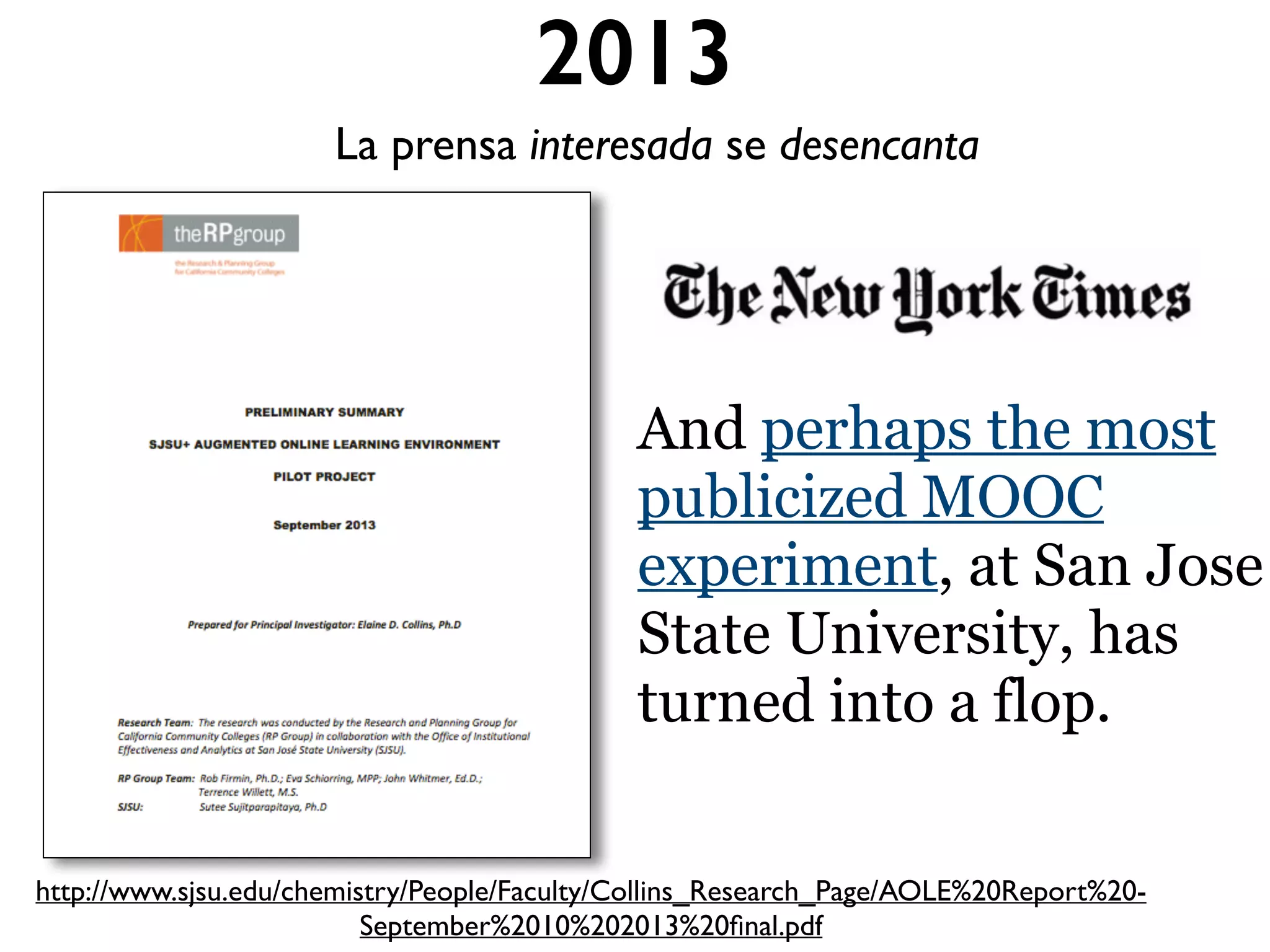
2013
La prensa interesada se desencanta
And perhaps the most
publicized MOOC
experiment, at San Jose
State University, has
turned into a flop.
http://www.sjsu.edu/chemistry/People/Faculty/Collins_Research_Page/AOLE%20Report%20-
September%2010%202013%20final.pdf
2013
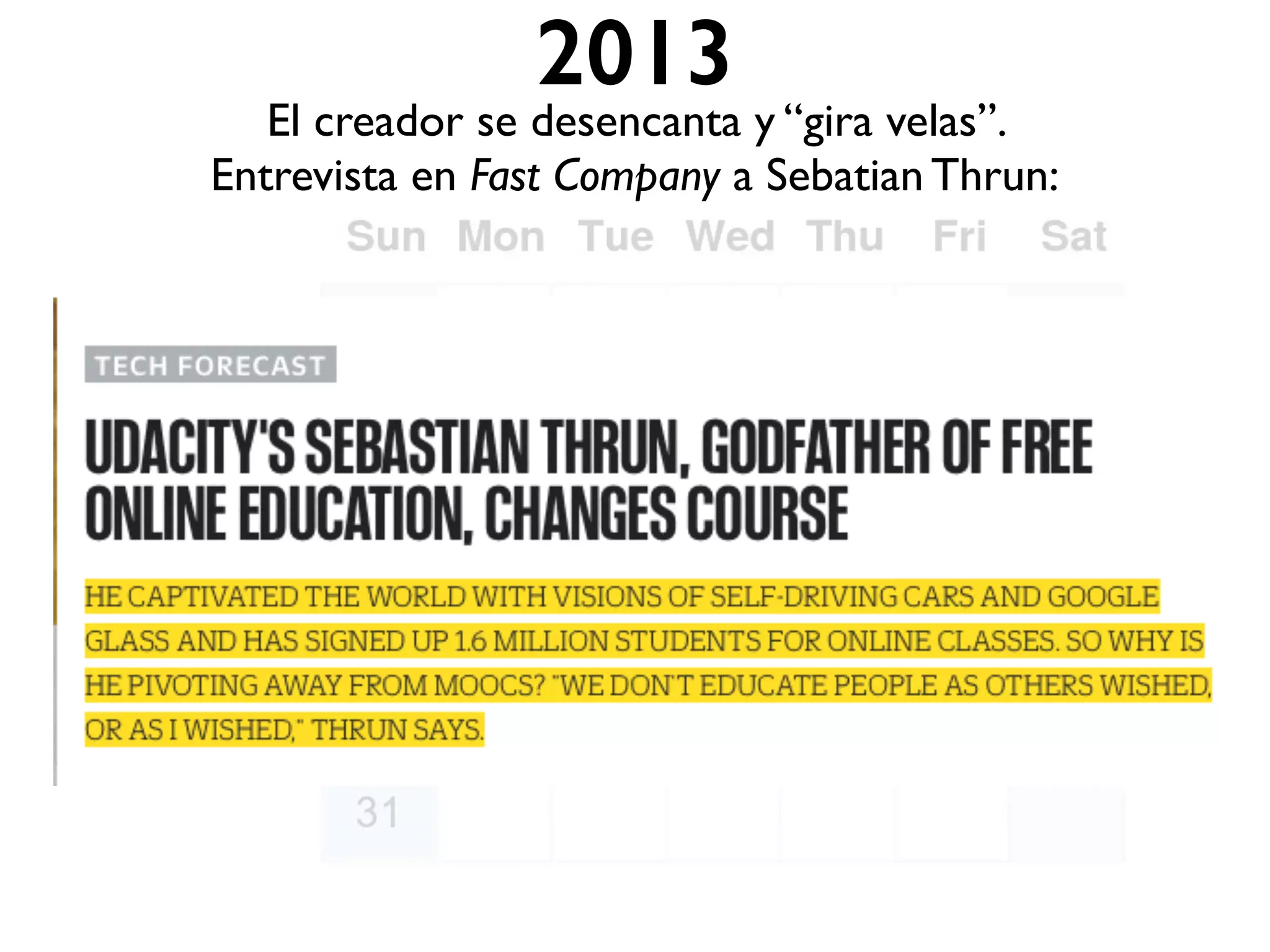
El creador se desencanta y “gira velas”.
Entrevista en Fast Company a Sebatian Thrun:
"We were on the front pages of
newspapers and magazines, and at
the same time, I was realizing, we
don't educate people as others
wished, or as I wished. We have a
lousy product… "Online education
that leaves almost everybody
behind except for highly motivated
students, to me, can't be a viable
path to education. We look back at
our early work and realize it wasn't
quite as good as it should have
been. We had so many moments
for improvement."
Sebastian Thrun
Udacity
Licencia Algunos derechos reservados por jdlasica
Sebastian Thrun, Fast Company Magazine
http://www.fastcompany.com/3021473/udacity-sebastian-thrun-uphill-climb
2014
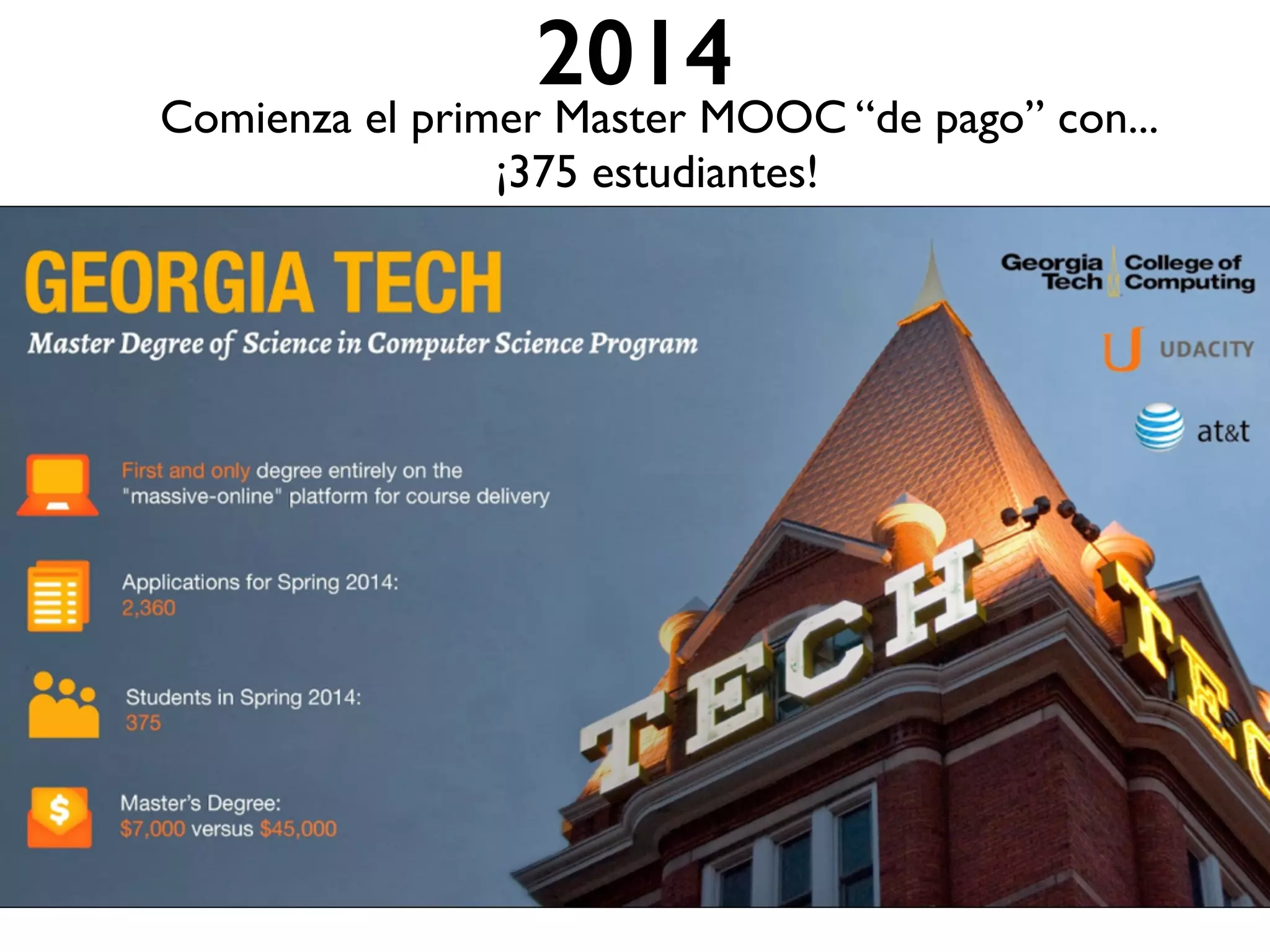
Comienza el primer Master MOOC “de pago” con...
¡375 estudiantes!
2014
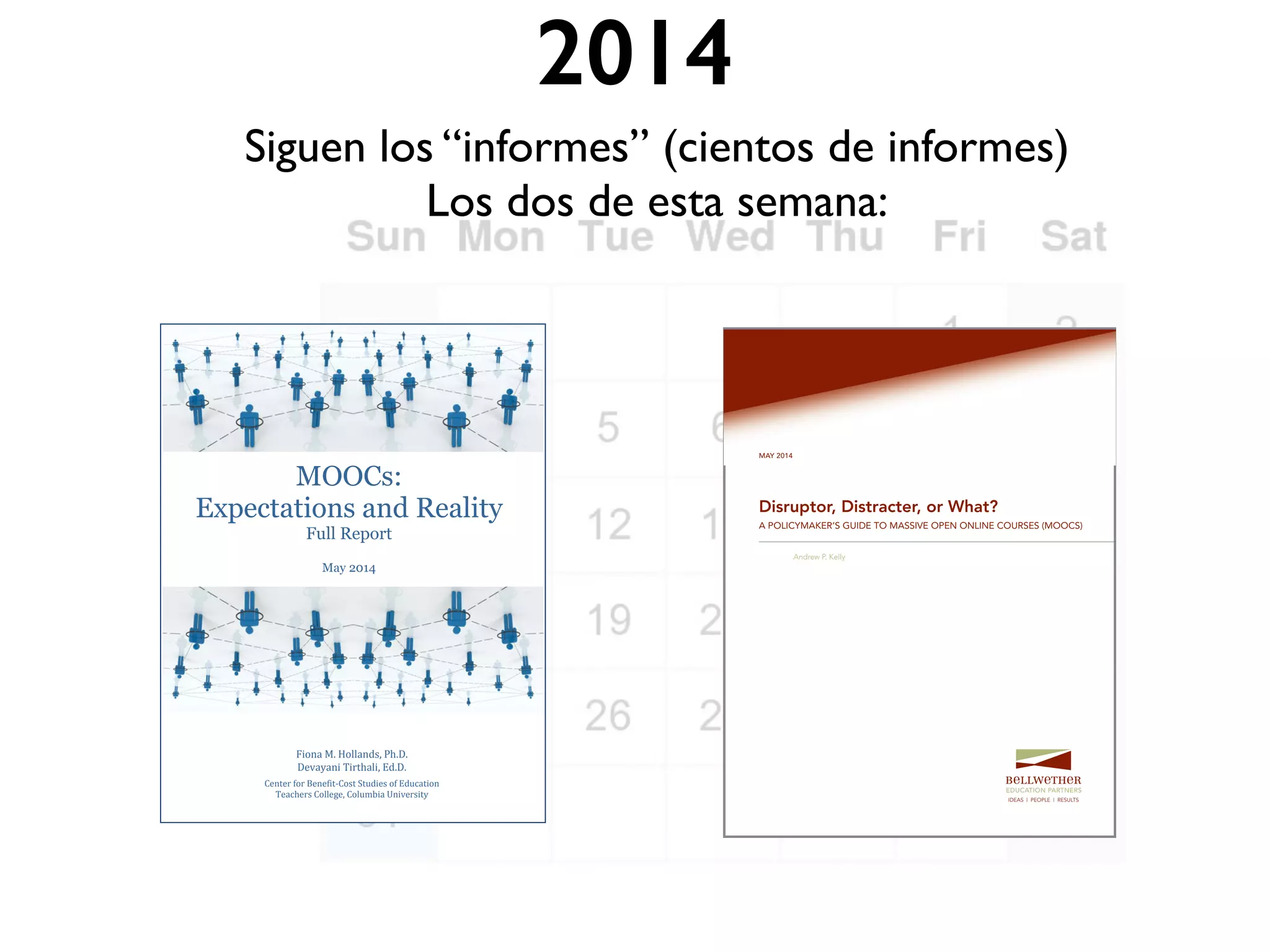
Siguen los “informes” (cientos de informes)
Los dos de esta semana:
MAY 2014
Disruptor, Distracter, or What?
A POLICYMAKER’S GUIDE TO MASSIVE OPEN ONLINE COURSES (MOOCS)
Andrew P. Kelly
IDEAS | PEOPLE | RESULTS
MOOCs:
Expectations and Reality
Full Report
May 2014
Fiona M. Hollands, Ph.D.
Devayani Tirthali, Ed.D.
Center for Benefit-Cost Studies of Education
Teachers College, Columbia University
2014
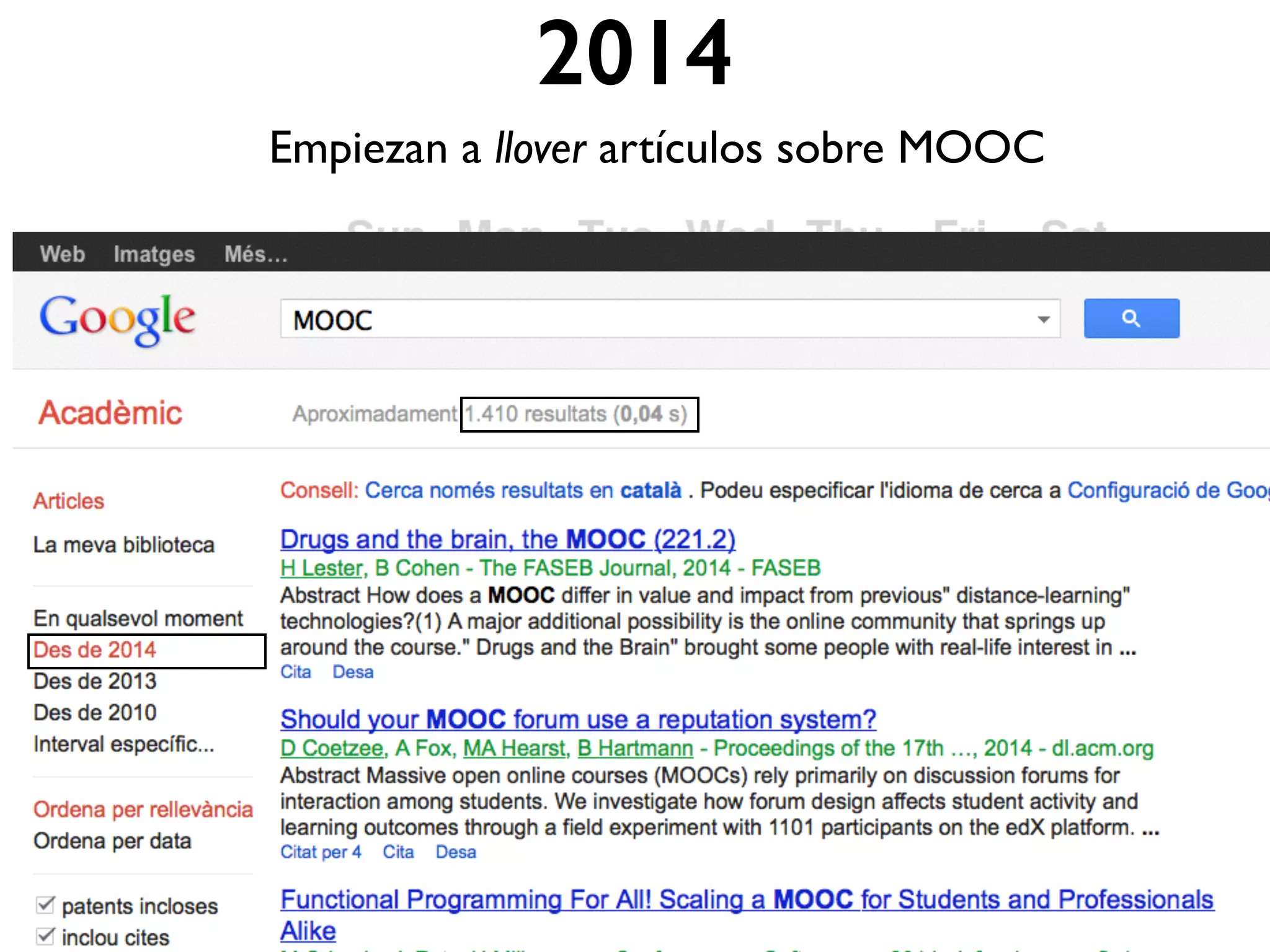
Empiezan a llover artículos sobre MOOC
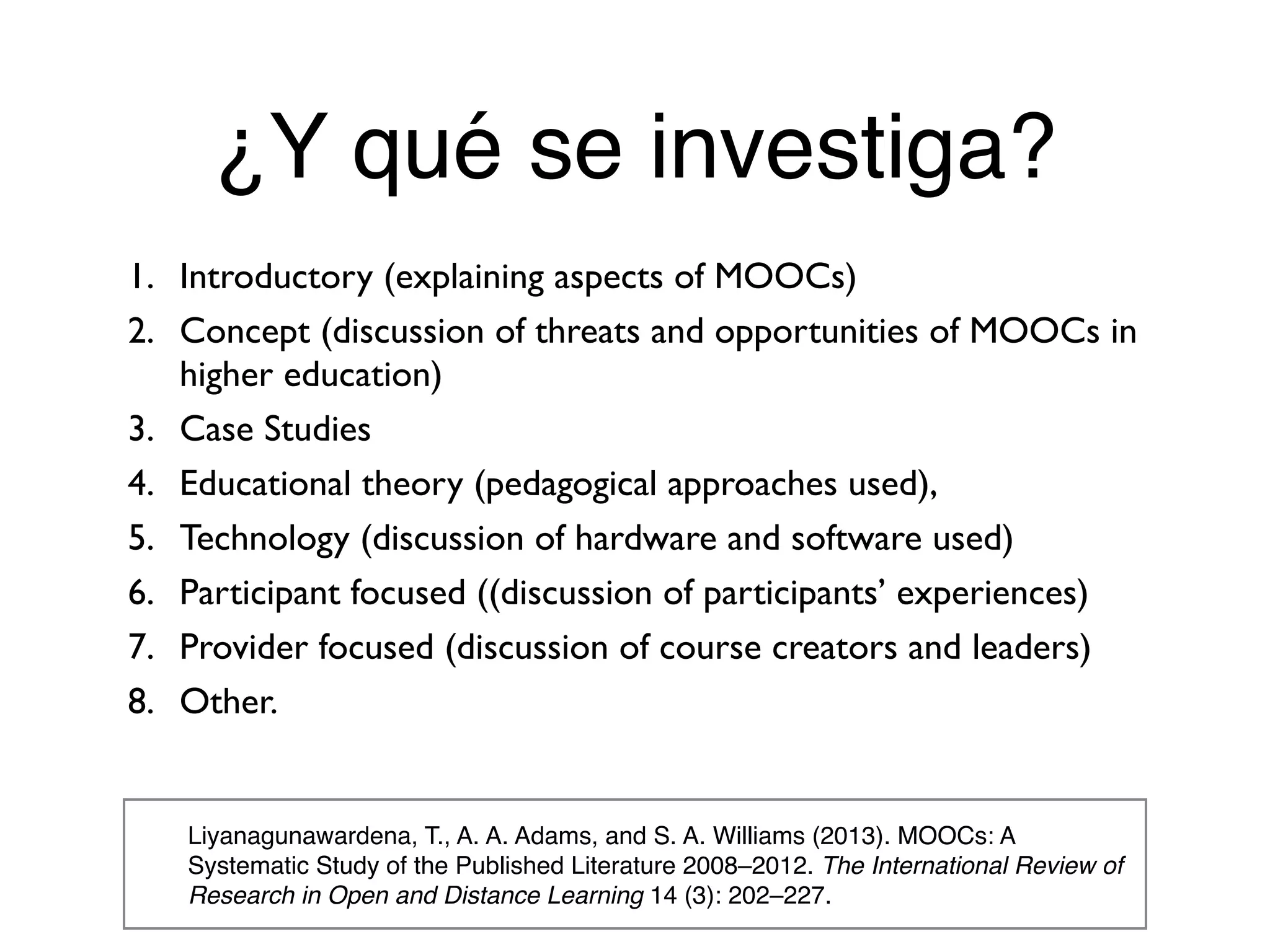
¿Y qué se investiga?
Liyanagunawardena, T., A. A. Adams, and S. A. Williams (2013). MOOCs: A
Systematic Study of the Published Literature 2008–2012. The International Review of
Research in Open and Distance Learning 14 (3): 202–227.
1. Introductory (explaining aspects of MOOCs)
2. Concept (discussion of threats and opportunities of MOOCs in
higher education)
3. Case Studies
4. Educational theory (pedagogical approaches used),
5. Technology (discussion of hardware and software used)
6. Participant focused ((discussion of participants’ experiences)
7. Provider focused (discussion of course creators and leaders)
8. Other.
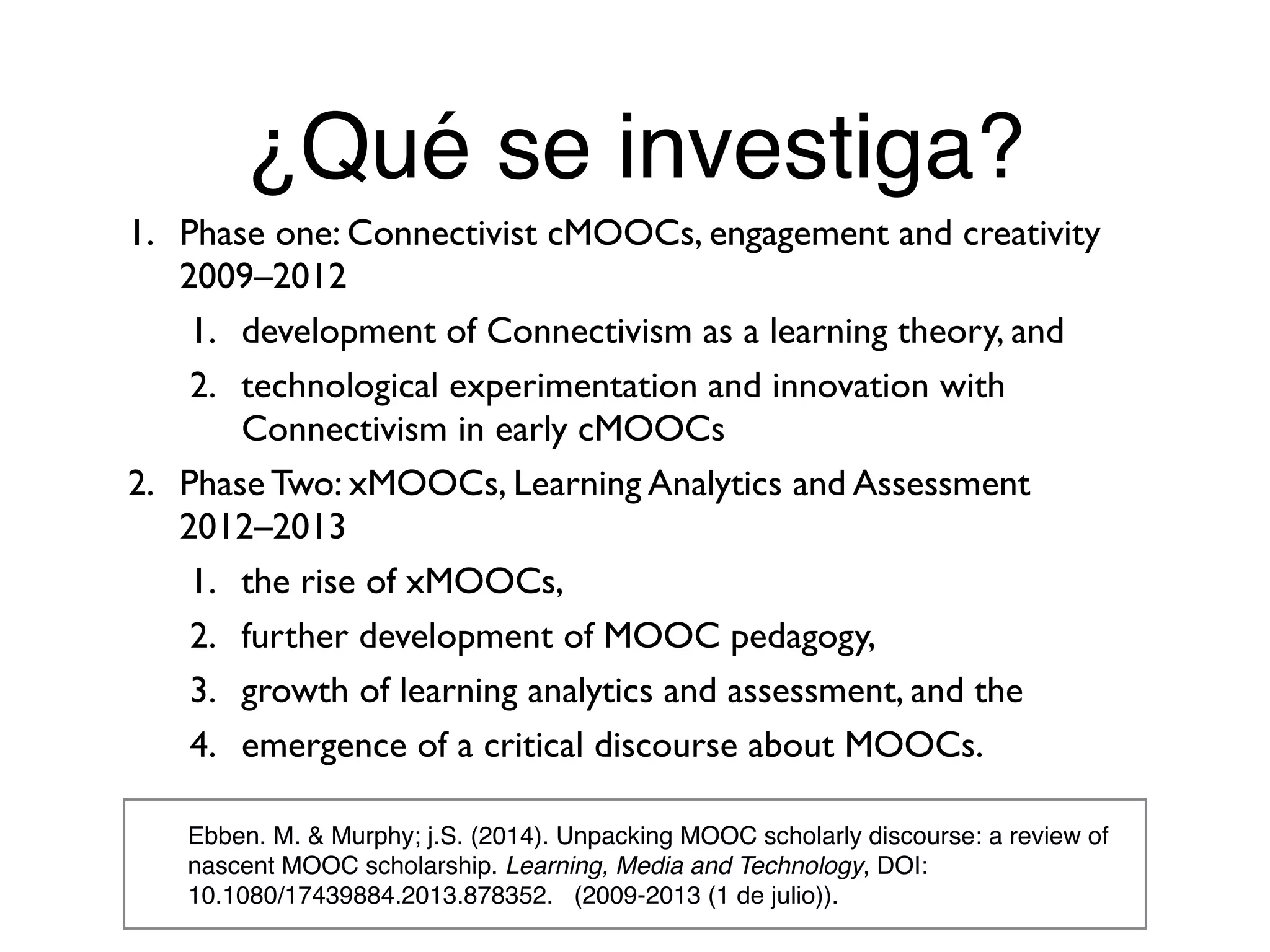
¿Qué se investiga?
Ebben. M. & Murphy; j.S. (2014). Unpacking MOOC scholarly discourse: a review of
nascent MOOC scholarship. Learning, Media and Technology, DOI:
10.1080/17439884.2013.878352. (2009-2013 (1 de julio)).
1. Phase one: Connectivist cMOOCs, engagement and creativity
2009–2012
1. development of Connectivism as a learning theory, and
2. technological experimentation and innovation with
Connectivism in early cMOOCs
2. Phase Two: xMOOCs, Learning Analytics and Assessment 

2012–2013
1. the rise of xMOOCs,
2. further development of MOOC pedagogy,
3. growth of learning analytics and assessment, and the
4. emergence of a critical discourse about MOOCs.
2014...2015...2016
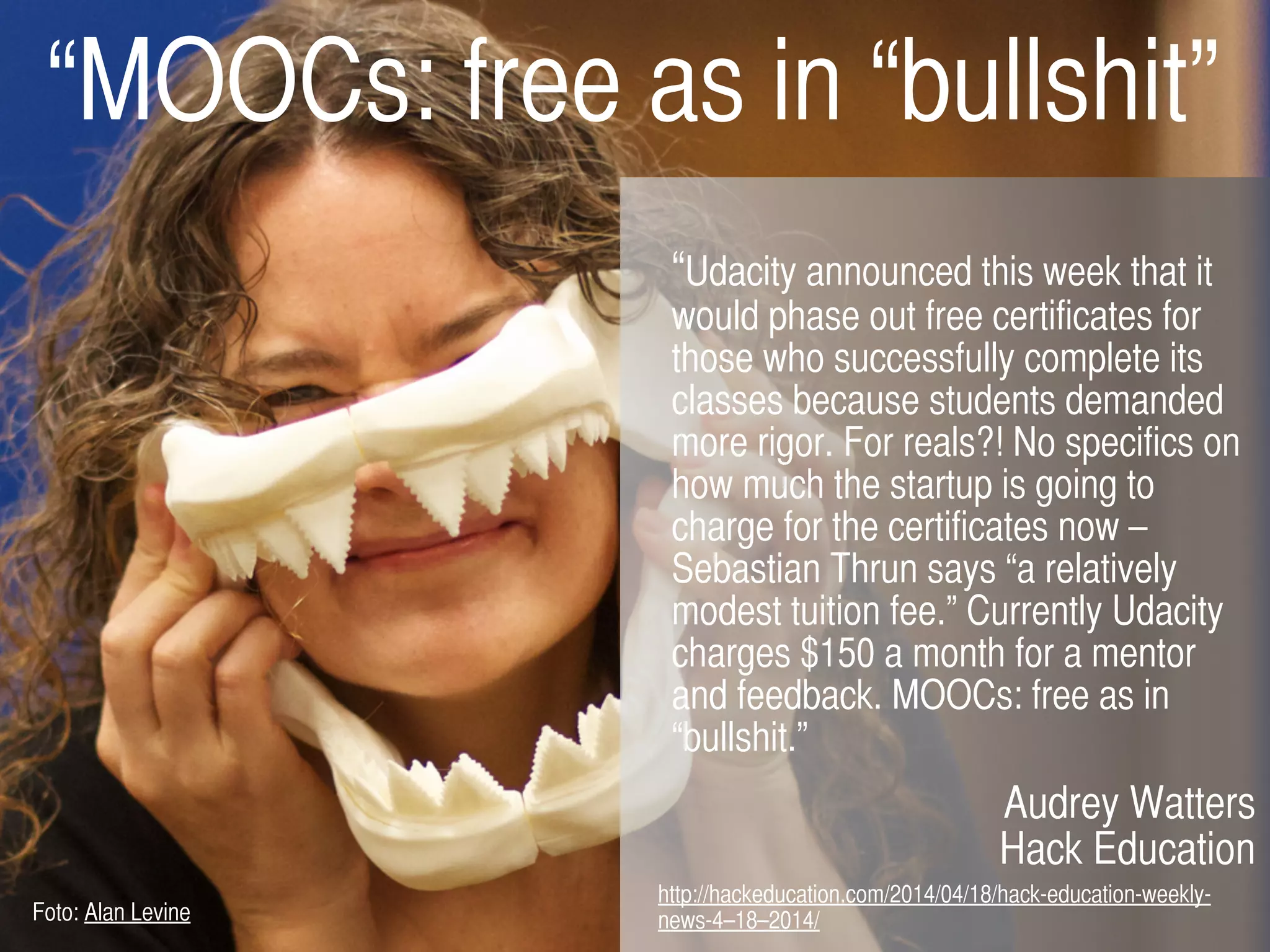
“Udacity announced this week that it
would phase out free certificates for
those who successfully complete its
classes because students demanded
more rigor. For reals?! No specifics on
how much the startup is going to
charge for the certificates now –
Sebastian Thrun says “a relatively
modest tuition fee.” Currently Udacity
charges $150 a month for a mentor
and feedback. MOOCs: free as in
“bullshit.”
Audrey Watters
Hack Education
http://hackeducation.com/2014/04/18/hack-education-weekly-
news-4–18–2014/
“MOOCs: free as in “bullshit”
Foto: Alan Levine
La pedagogía de los
cMOOC
Principios de aprendizaje
conectivista (Siemens)
• El aprendizaje y el conocimiento yace en la
diversidad de opiniones.
• El aprendizaje es el proceso de conectar nodos o
fuentes de información.
• No sólo de los humanos se aprende, el
conocimiento puede residir fuera del ser humano.
• La capacidad de aumentar el conocimiento es más
importante que lo que ya se sabe. …
Principios de aprendizaje
conectivista (Siemens)
• La habilidad para ver las conexiones entre los campos, ideas y
conceptos es primordial.
• La información actualizada y precisa es la intención de todas las
actividades del proceso conectivista.
• La toma de decisiones es en sí misma un proceso de aprendizaje.
Escoger qué aprender y el significado de la información entrante
es visto a través de la lente de una realidad cambiante. Es posible
que una respuesta actual a un problema esté errada el día de
mañana bajo la nueva información que se recibe.
• Es necesario nutrir y mantener las conexiones para facilitar el
aprendizaje continuo.
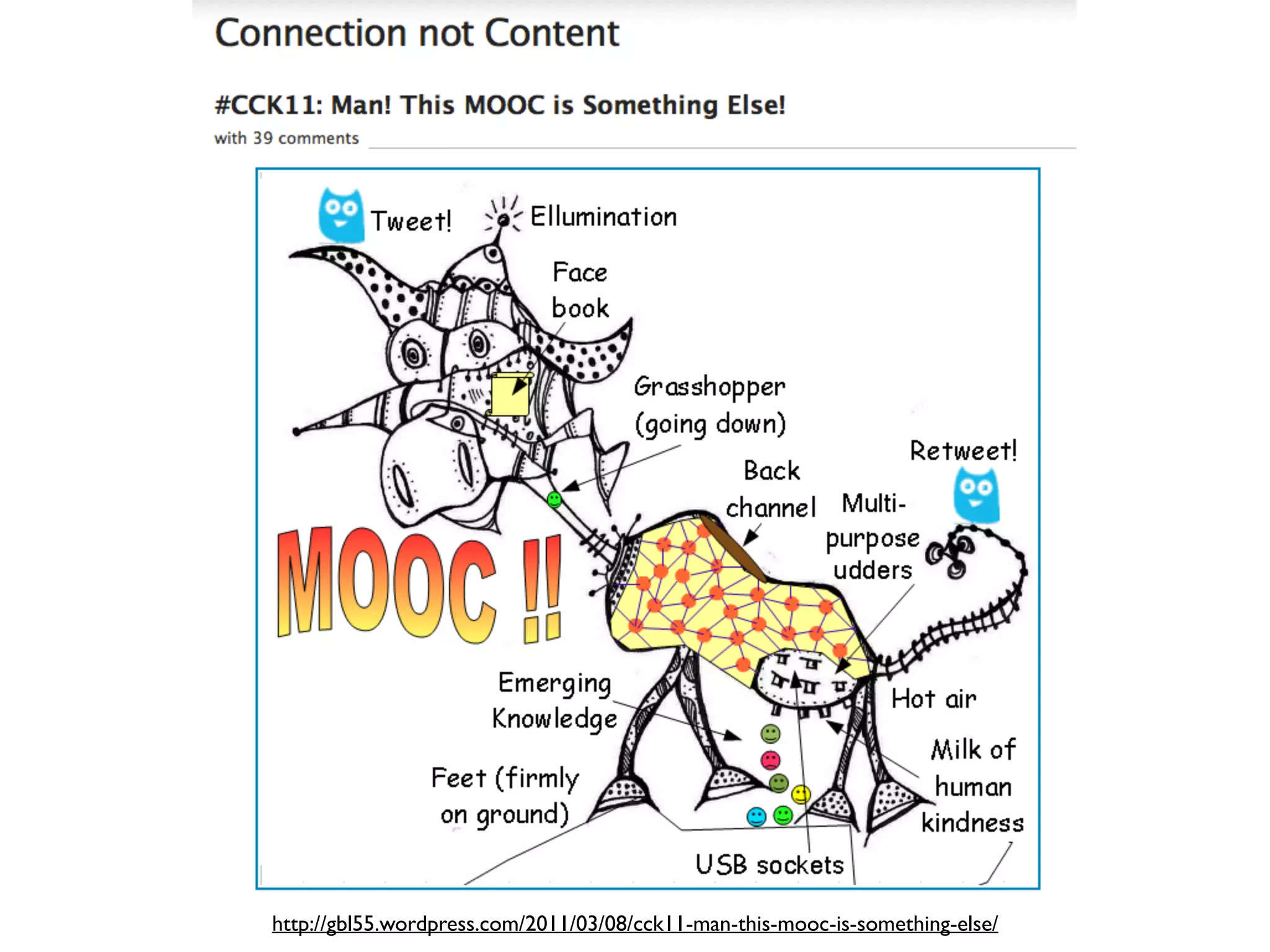
http://gbl55.wordpress.com/2011/03/08/cck11-man-this-mooc-is-something-else/
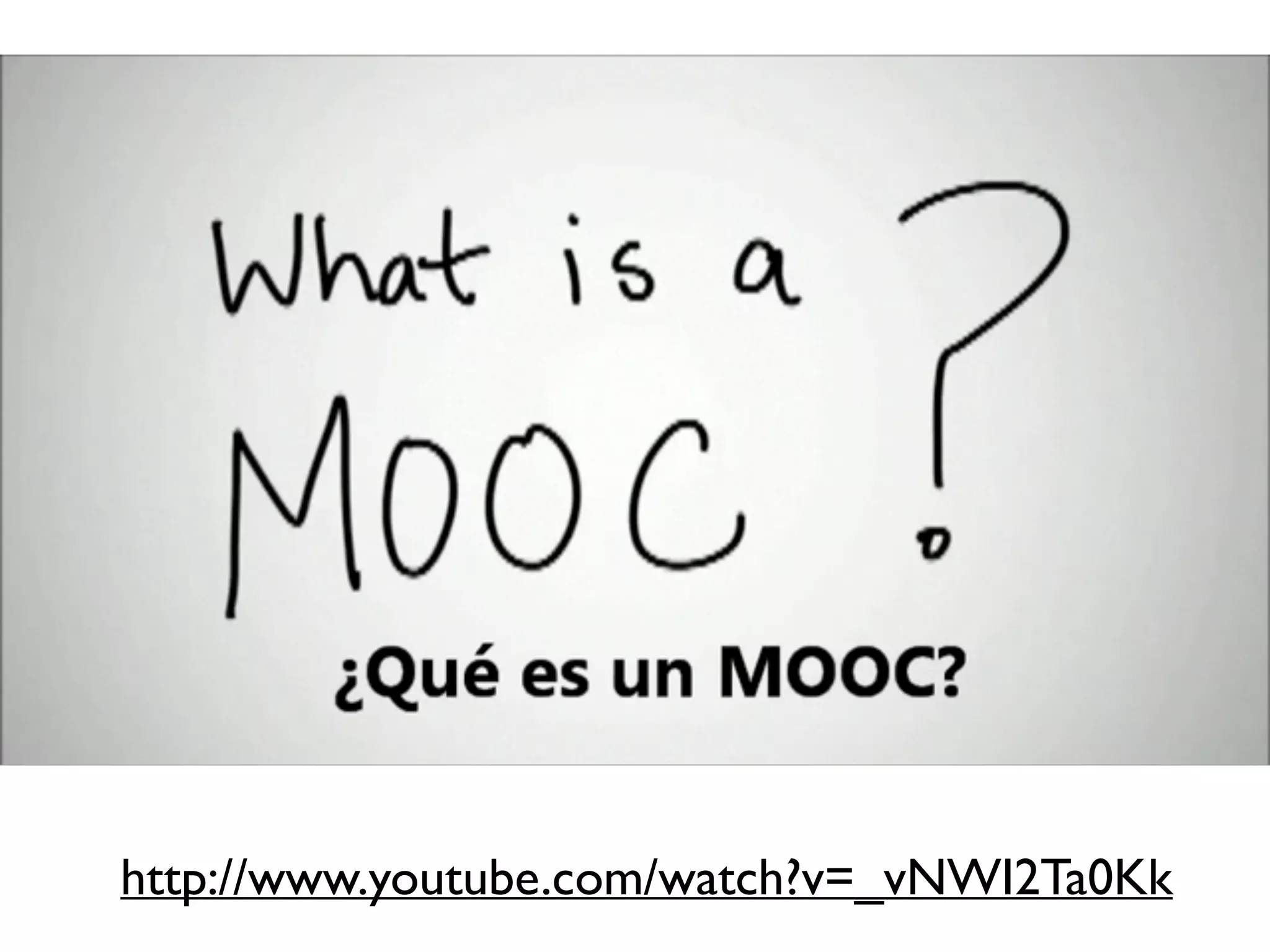
http://www.youtube.com/watch?v=_vNWI2Ta0Kk
Aprendizaje
emergente en los
cMOOC
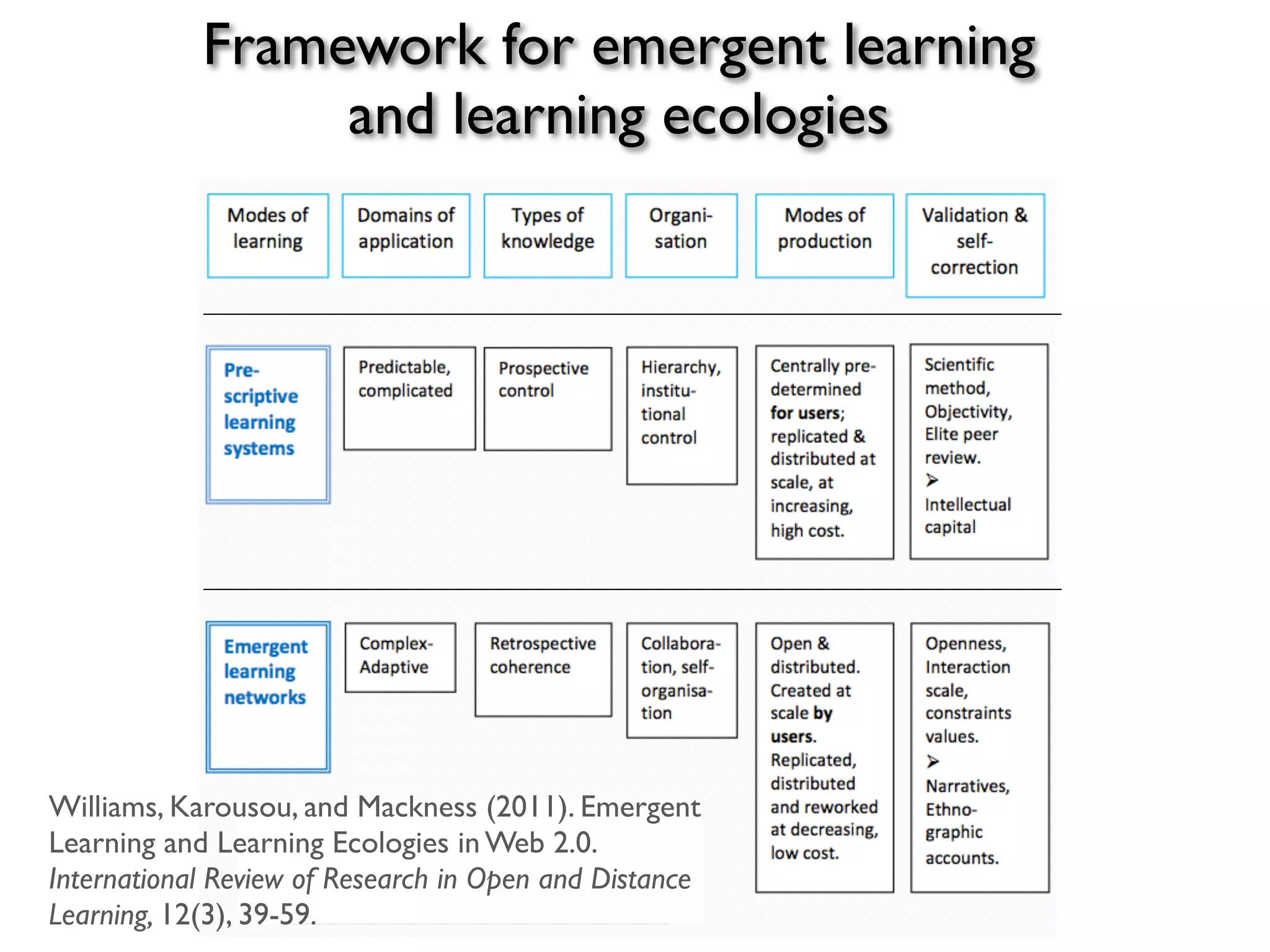
Framework for emergent learning
and learning ecologies
Williams, Karousou, and Mackness (2011). Emergent
Learning and Learning Ecologies in Web 2.0.
International Review of Research in Open and Distance
Learning, 12(3), 39-59.
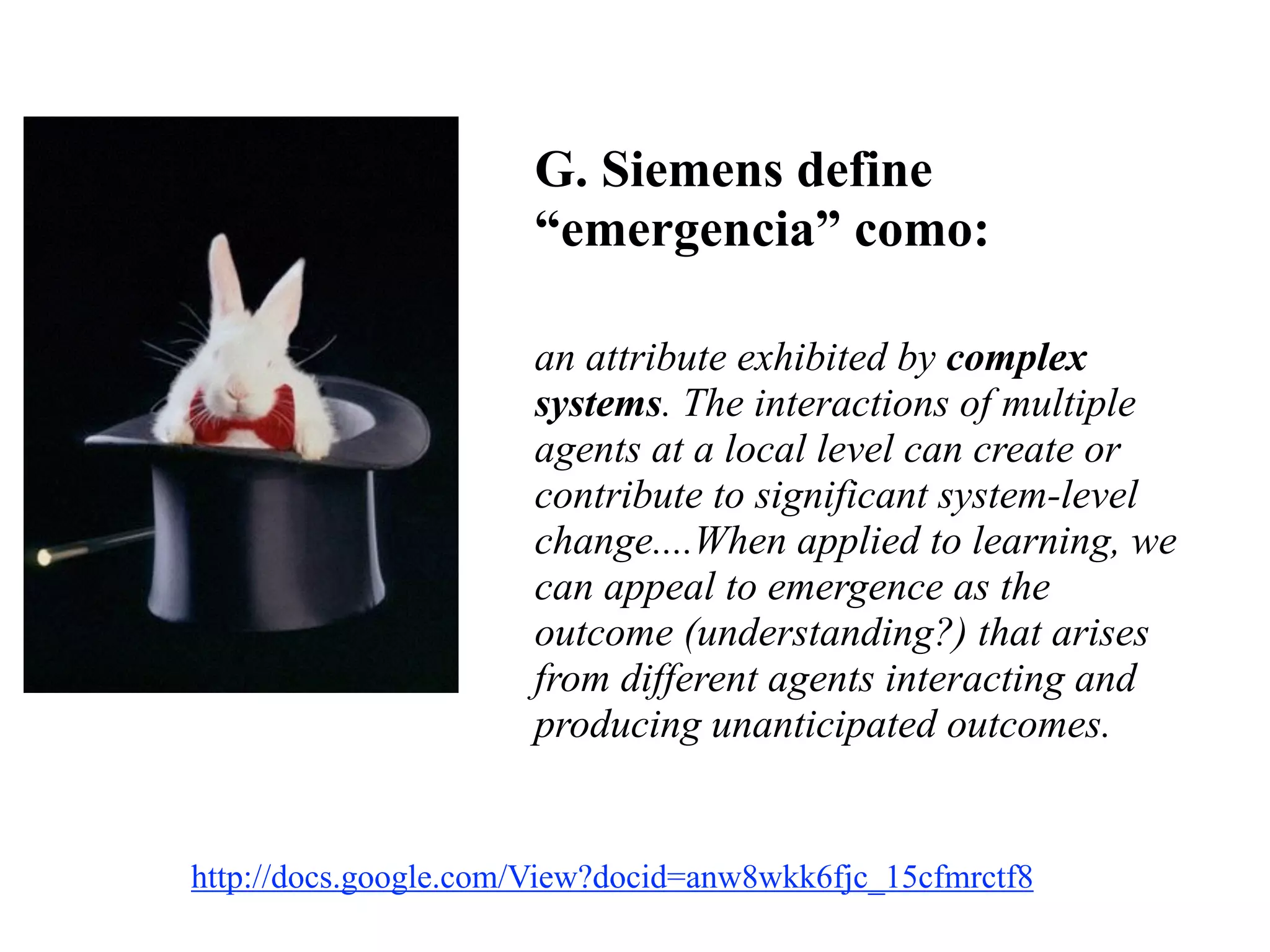
G. Siemens define
“emergencia” como:
!
an attribute exhibited by complex
systems. The interactions of multiple
agents at a local level can create or
contribute to significant system-level
change....When applied to learning, we
can appeal to emergence as the
outcome (understanding?) that arises
from different agents interacting and
producing unanticipated outcomes.
Siemens, G. (2009). Complexity, chaos, and emergence. 

http://docs.google.com/View?docid=anw8wkk6fjc_15cfmrctf8
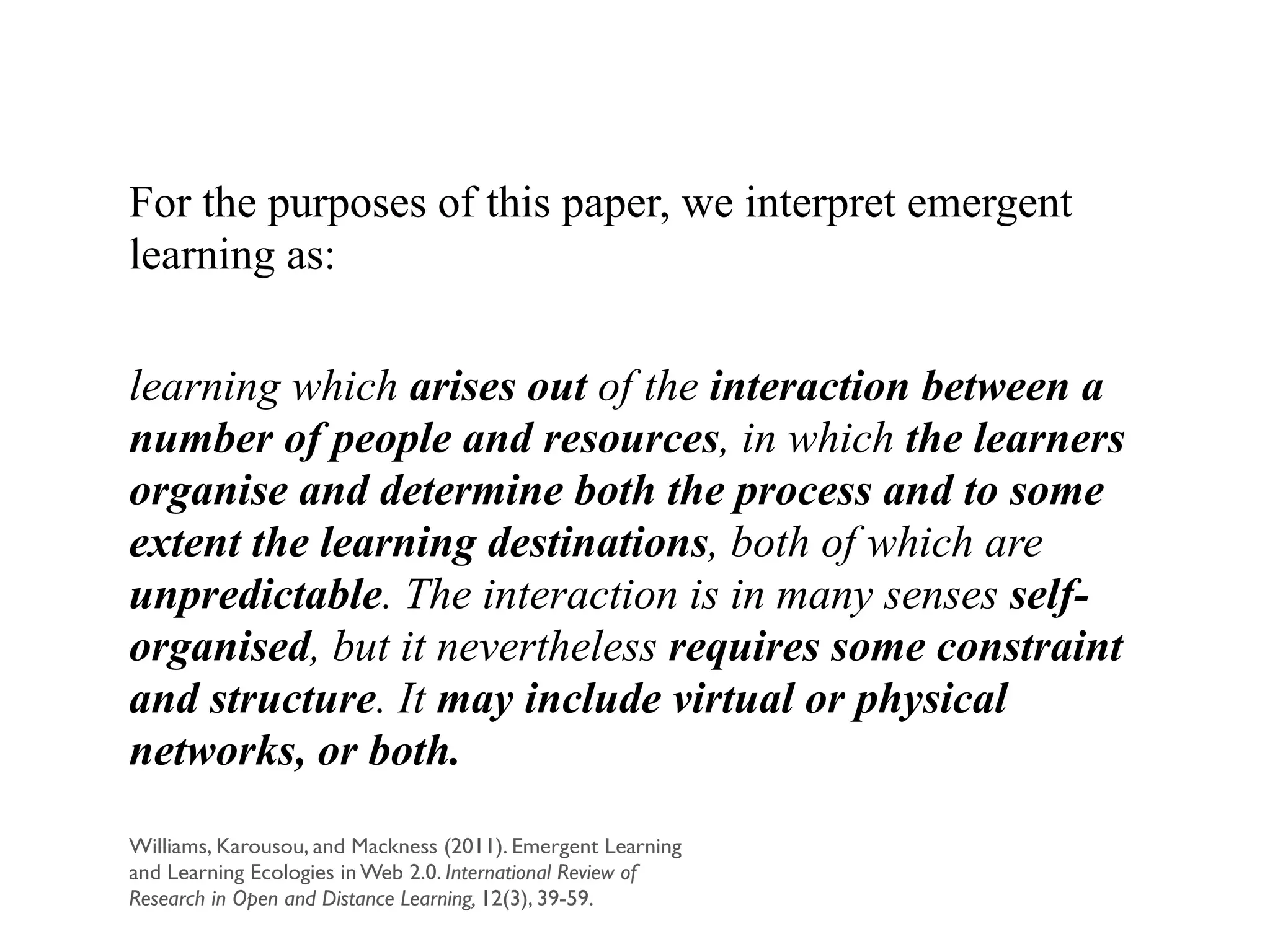
For the purposes of this paper, we interpret emergent
learning as:
!
learning which arises out of the interaction between a
number of people and resources, in which the learners
organise and determine both the process and to some
extent the learning destinations, both of which are
unpredictable. The interaction is in many senses self-
organised, but it nevertheless requires some constraint
and structure. It may include virtual or physical
networks, or both.
Williams, Karousou, and Mackness (2011). Emergent Learning
and Learning Ecologies in Web 2.0. International Review of
Research in Open and Distance Learning, 12(3), 39-59.
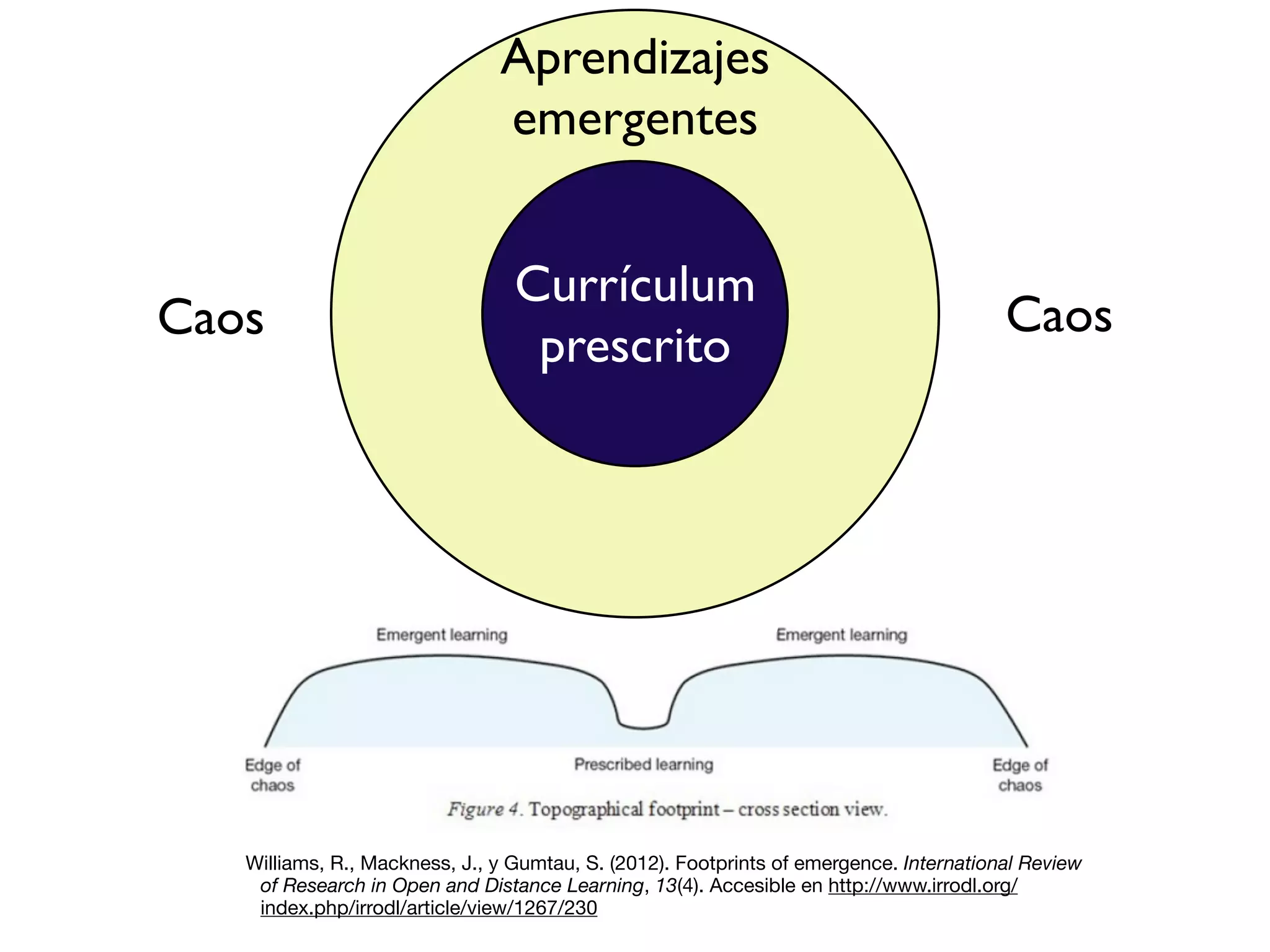
Aprendizajes
emergentes
Williams, R., Mackness, J., y Gumtau, S. (2012). Footprints of emergence. International Review
of Research in Open and Distance Learning, 13(4). Accesible en http://www.irrodl.org/
index.php/irrodl/article/view/1267/230
CaosCaos
Currículum
prescrito
¿Son los cMOOC
para todos?
La pedagogía
(imaginaria) de los
xMOOC
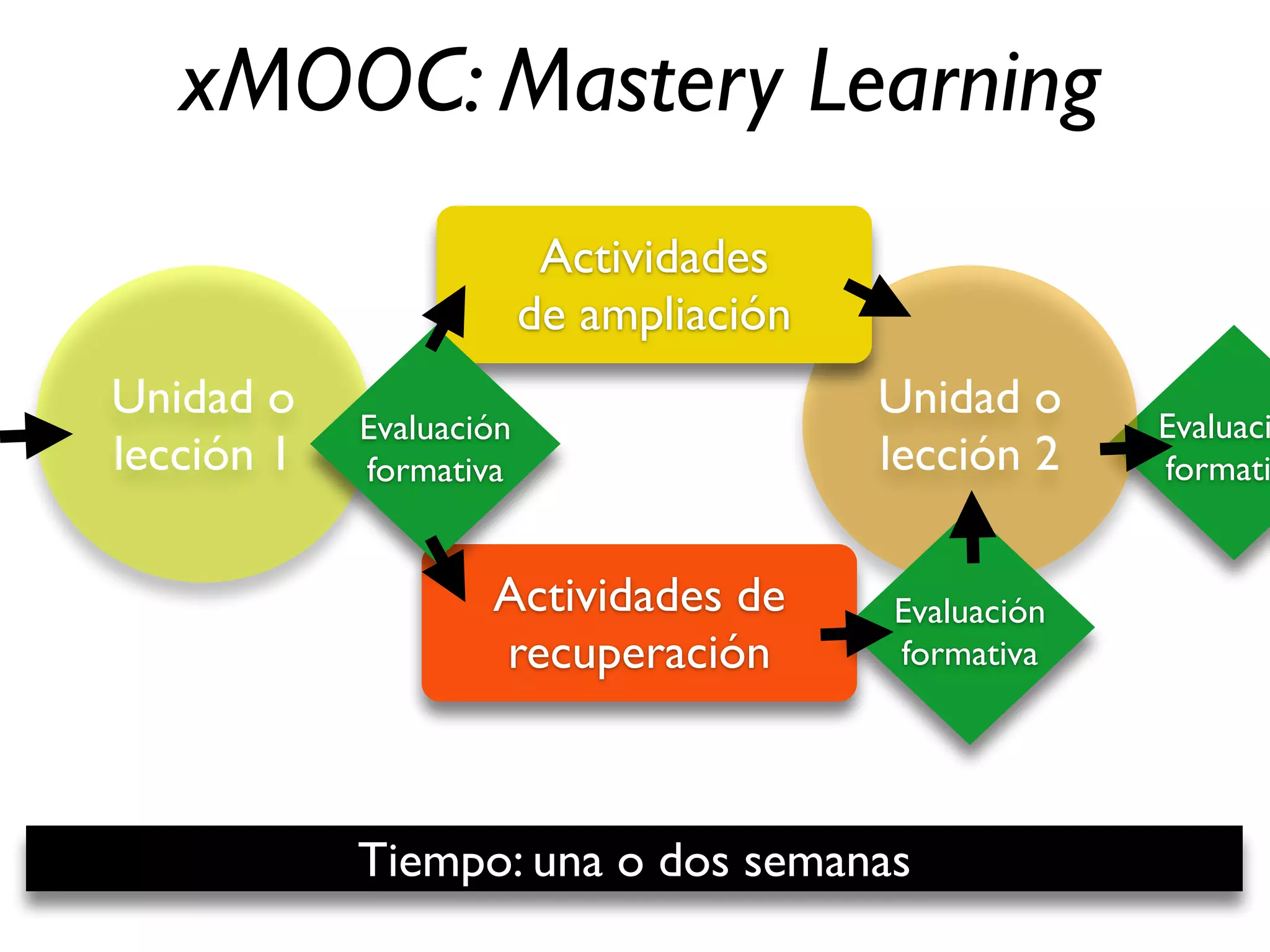
Tiempo: una o dos semanas
xMOOC: Mastery Learning
Evaluaci
formati
Unidad o
lección 2
Actividades
de ampliación
Actividades de
recuperación
Unidad o
lección 1
Evaluación
formativa
Evaluación
formativa
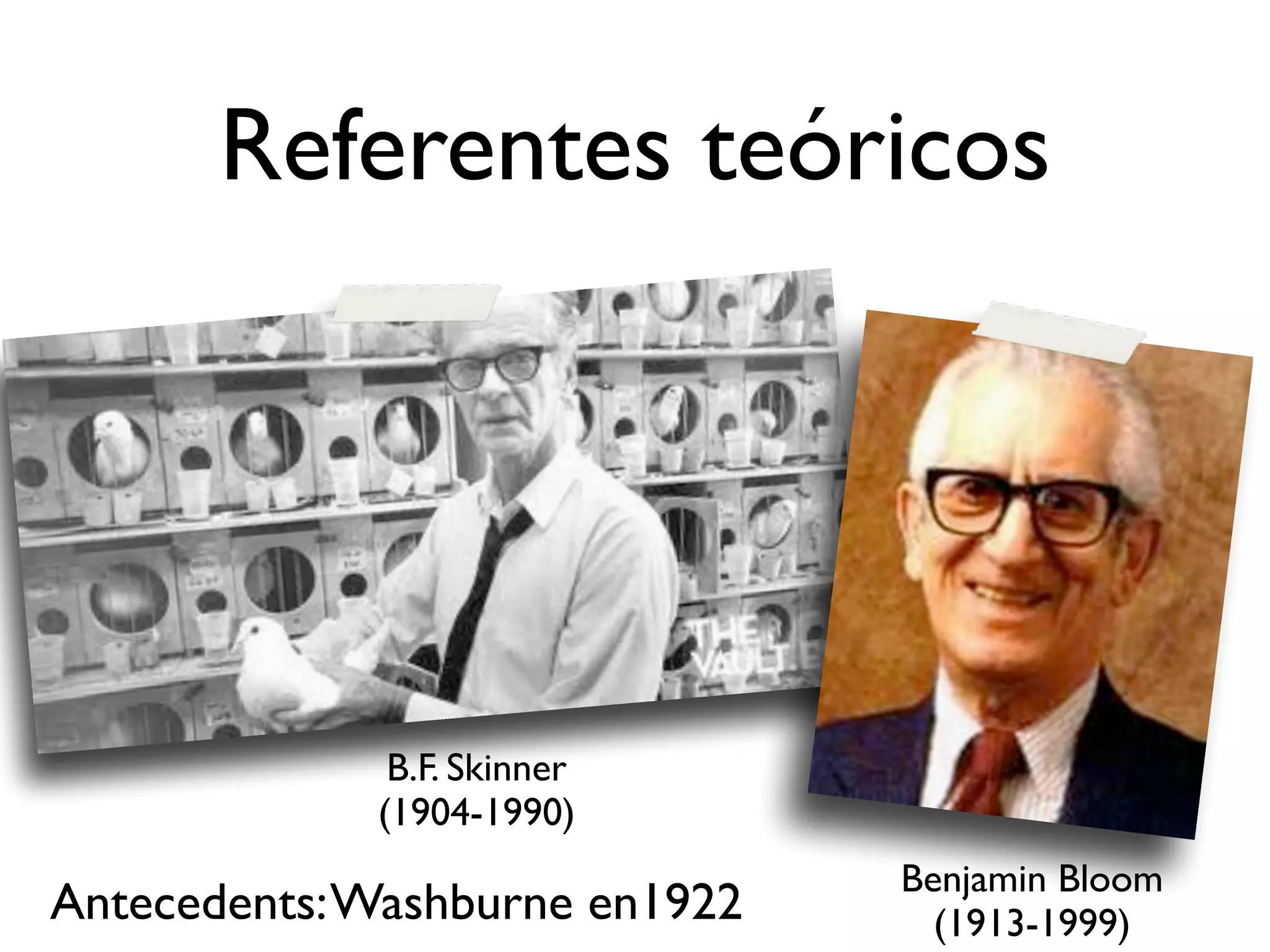
Referentes teóricos
Benjamin Bloom
(1913-1999)
B.F. Skinner
(1904-1990)
Antecedents:Washburne en1922
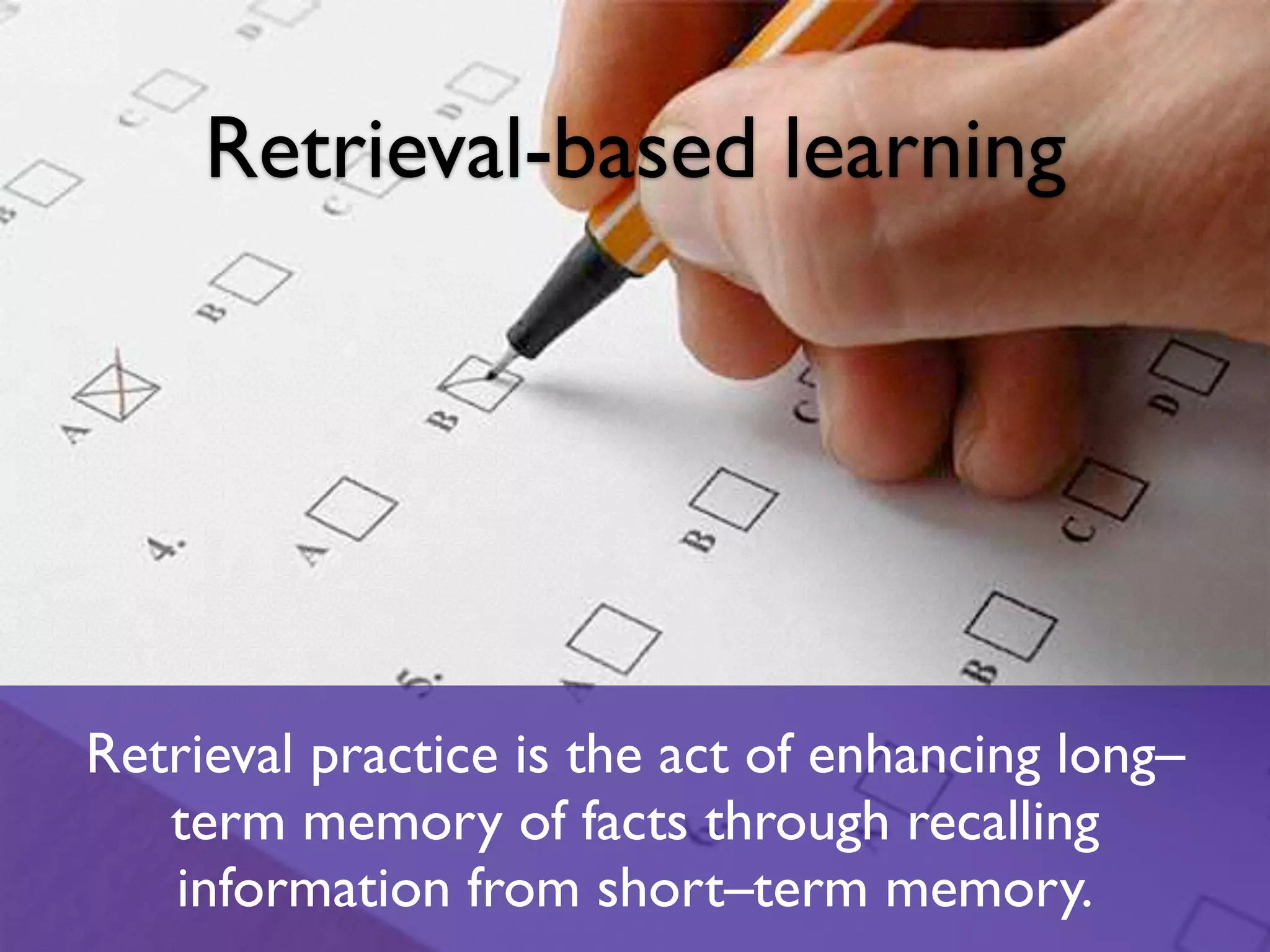
Retrieval practice is the act of enhancing long–
term memory of facts through recalling
information from short–term memory.
Retrieval-based learning
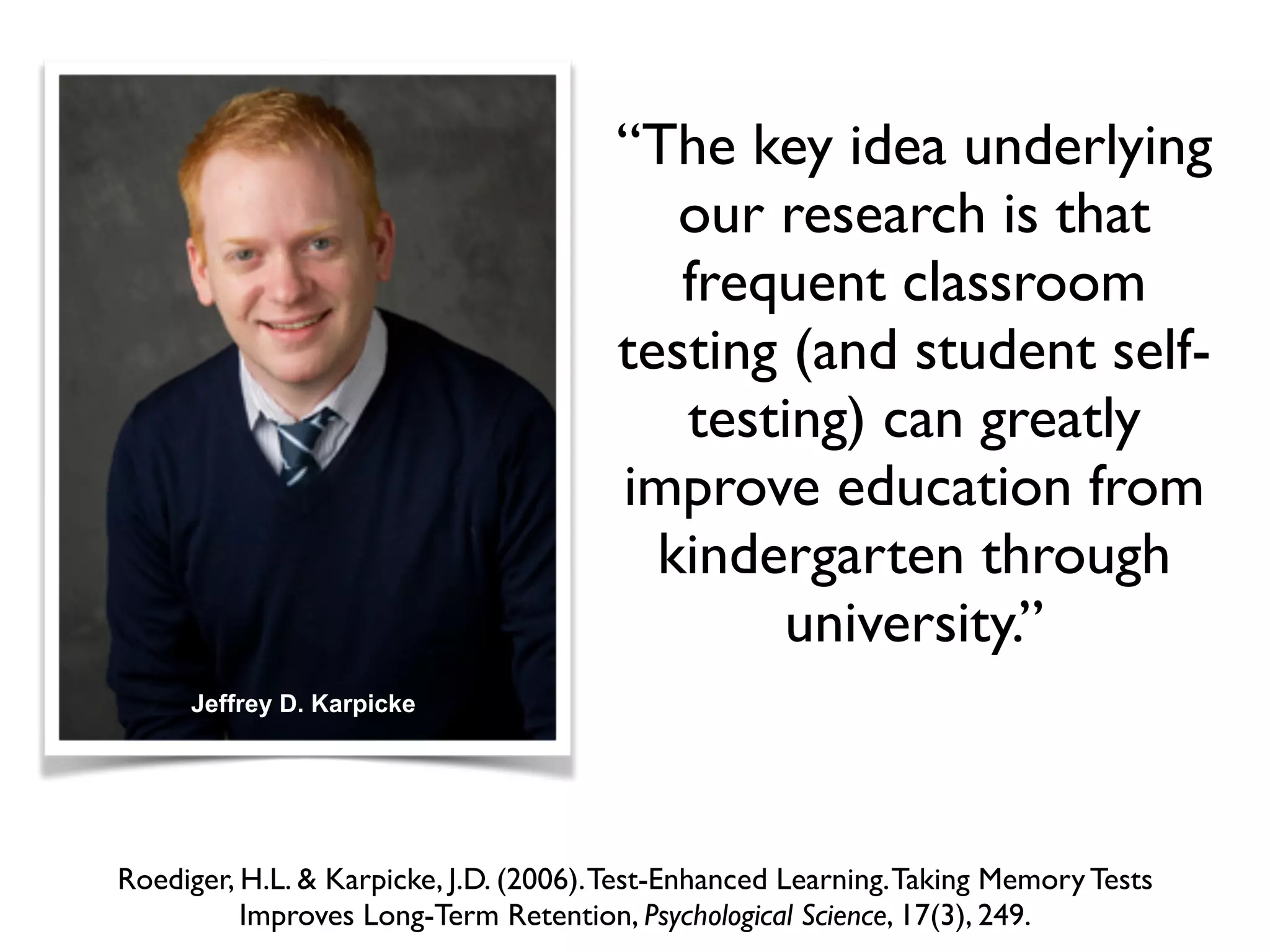
“The key idea underlying
our research is that
frequent classroom
testing (and student self-
testing) can greatly
improve education from
kindergarten through
university.”
Roediger, H.L. & Karpicke, J.D. (2006).Test-Enhanced Learning.Taking Memory Tests
Improves Long-Term Retention, Psychological Science, 17(3), 249.
Jeffrey D. Karpicke
La pedagogía 

(real) de los xMOOC
[Clase magistral]
+
[Evaluación autocorrectiva
o
entre iguales]
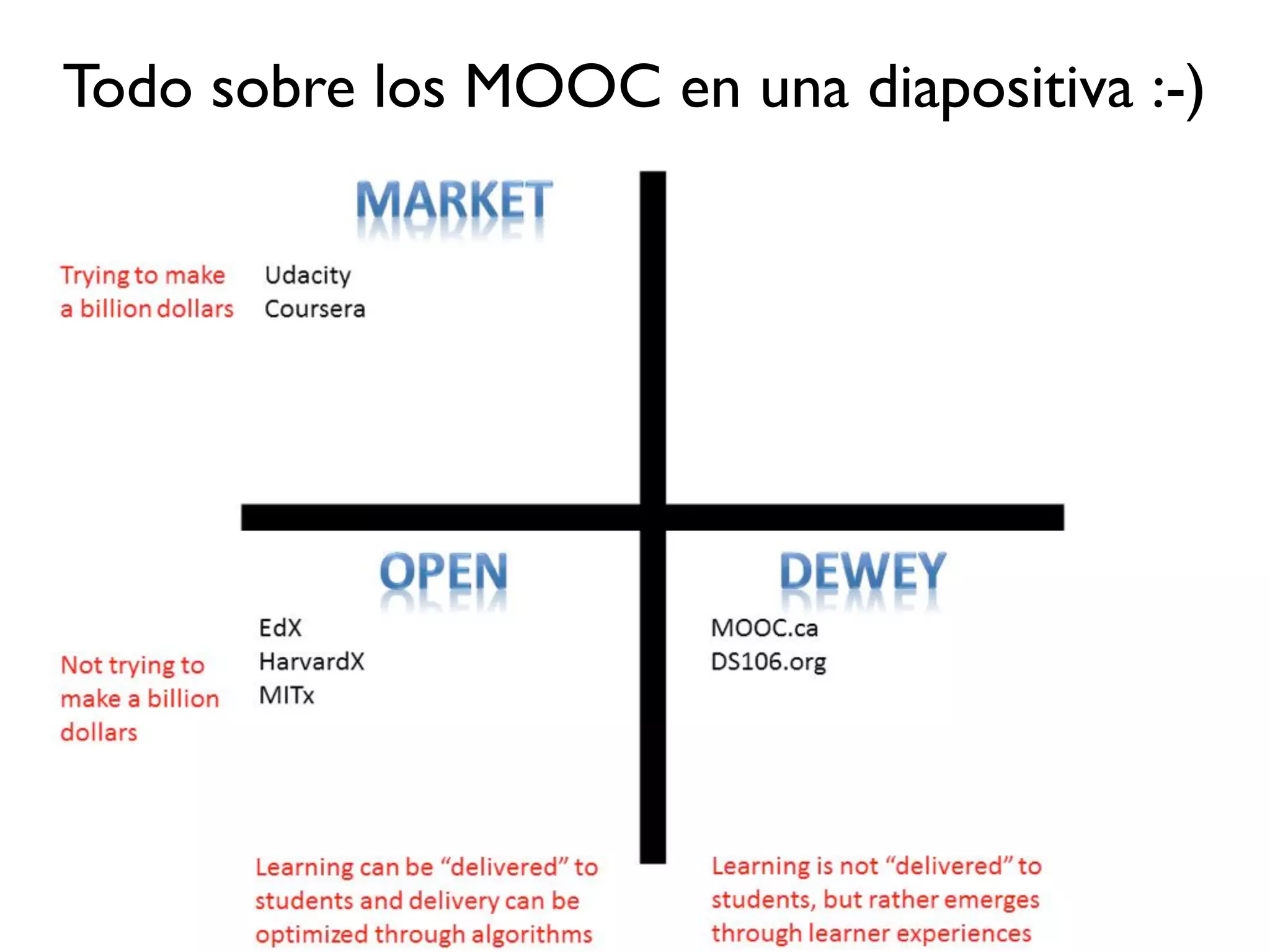
Todo sobre los MOOC en una diapositiva :-)
Para ir terminando…
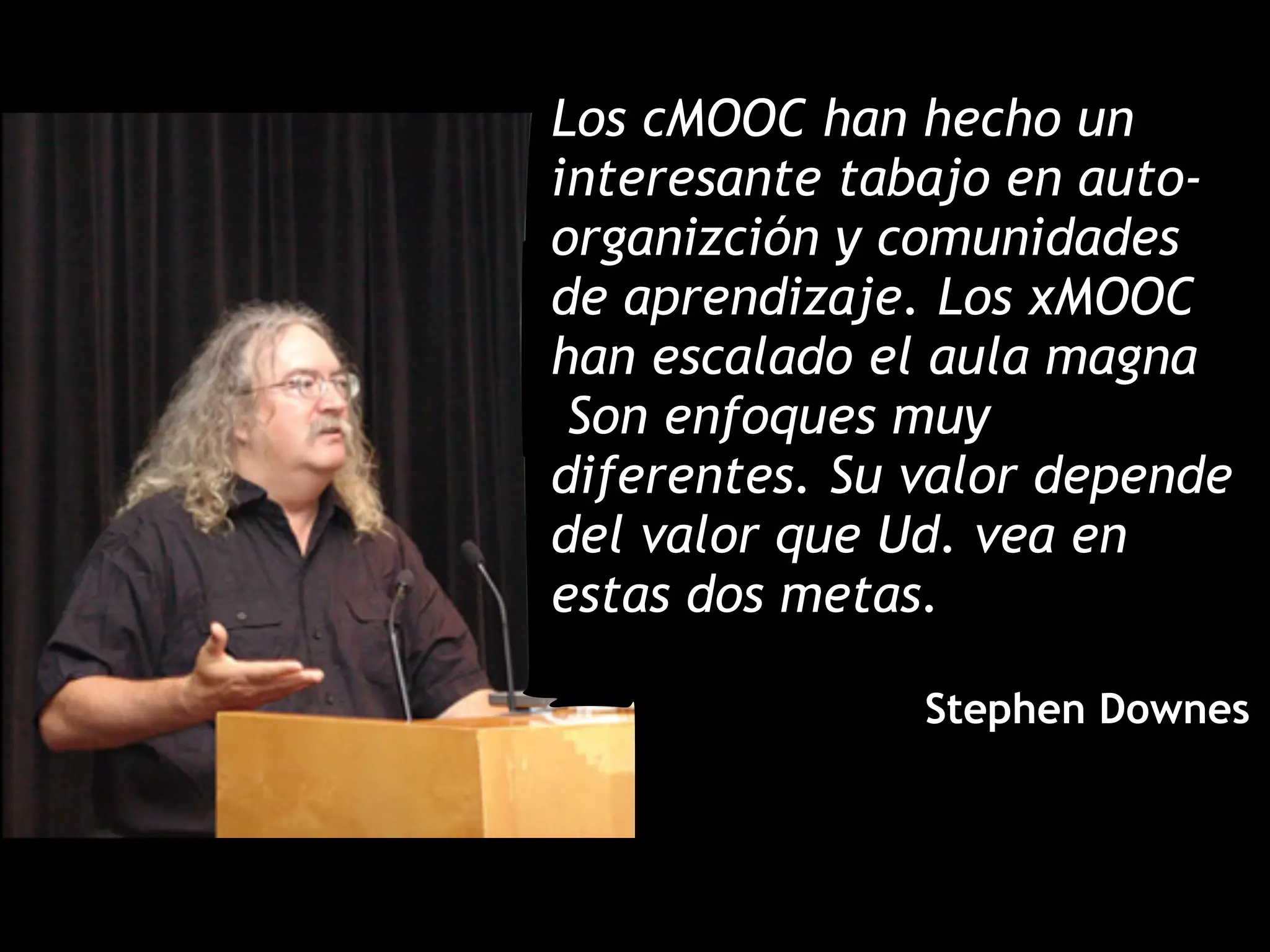
Los cMOOC han hecho un
interesante tabajo en auto-
organizción y comunidades
de aprendizaje. Los xMOOC
han escalado el aula magna
Son enfoques muy
diferentes. Su valor depende
del valor que Ud. vea en
estas dos metas.
!
Stephen Downes
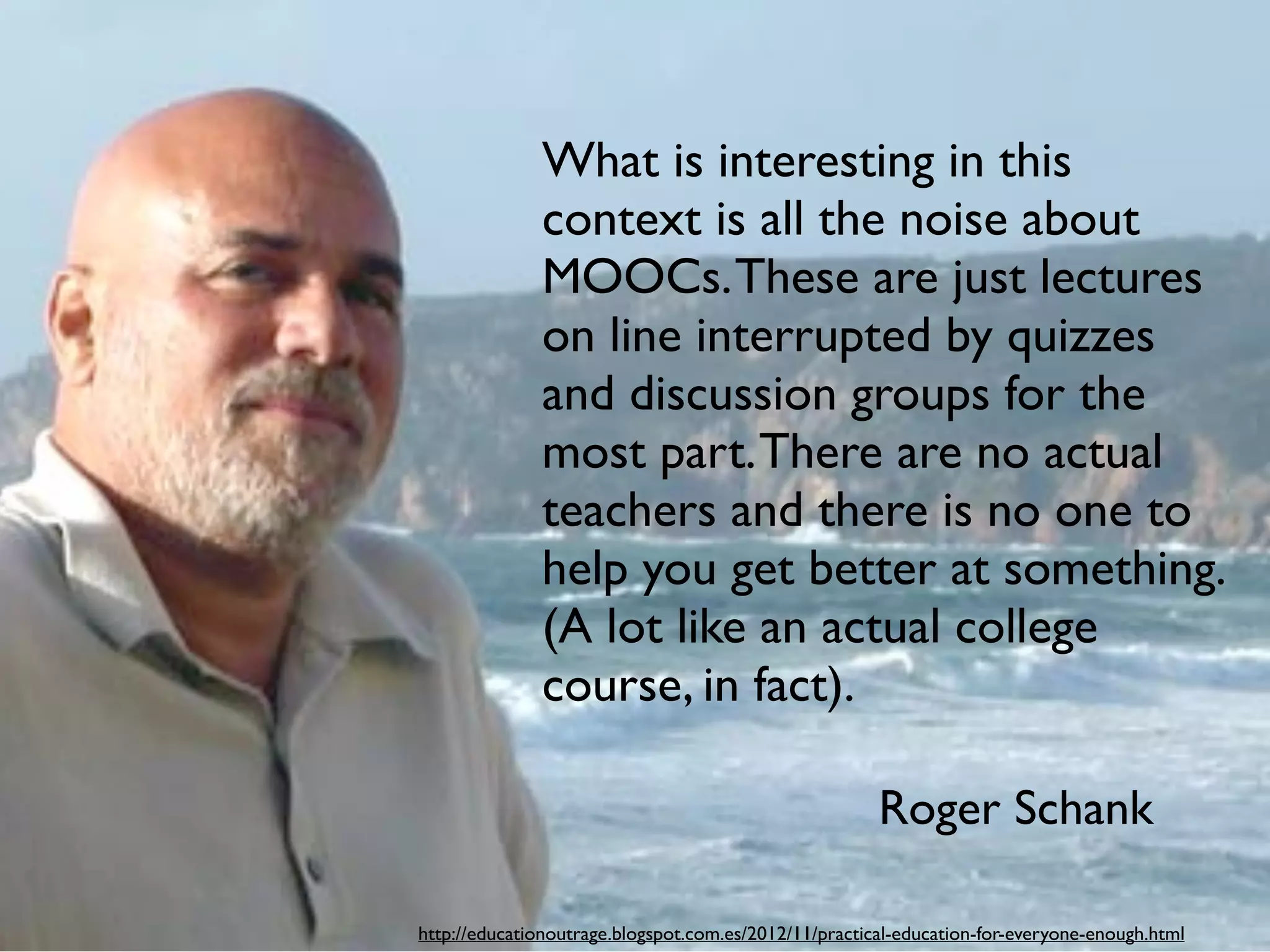
What is interesting in this
context is all the noise about
MOOCs.These are just lectures
on line interrupted by quizzes
and discussion groups for the
most part.There are no actual
teachers and there is no one to
help you get better at something.
(A lot like an actual college
course, in fact).
Roger Schank
http://educationoutrage.blogspot.com.es/2012/11/practical-education-for-everyone-enough.html
Sin embargo…
¡cuidado pedagogos/as!
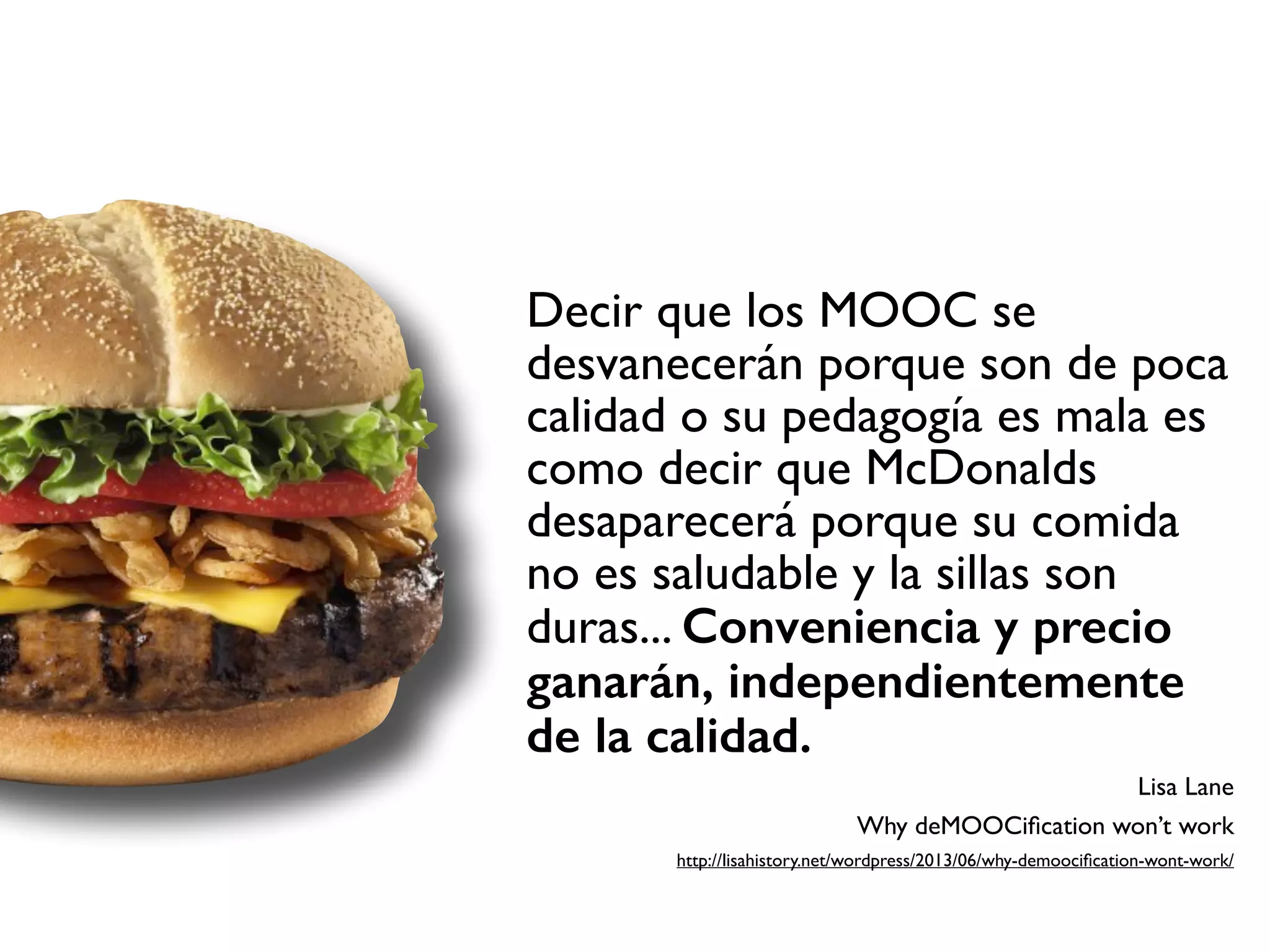
Decir que los MOOC se
desvanecerán porque son de poca
calidad o su pedagogía es mala es
como decir que McDonalds
desaparecerá porque su comida
no es saludable y la sillas son
duras... Conveniencia y precio
ganarán, independientemente
de la calidad.
Lisa Lane
Why deMOOCification won’t work
http://lisahistory.net/wordpress/2013/06/why-demoocification-wont-work/
¿Qué nos
deparará el futuro?
[escriba aquí su opinión]
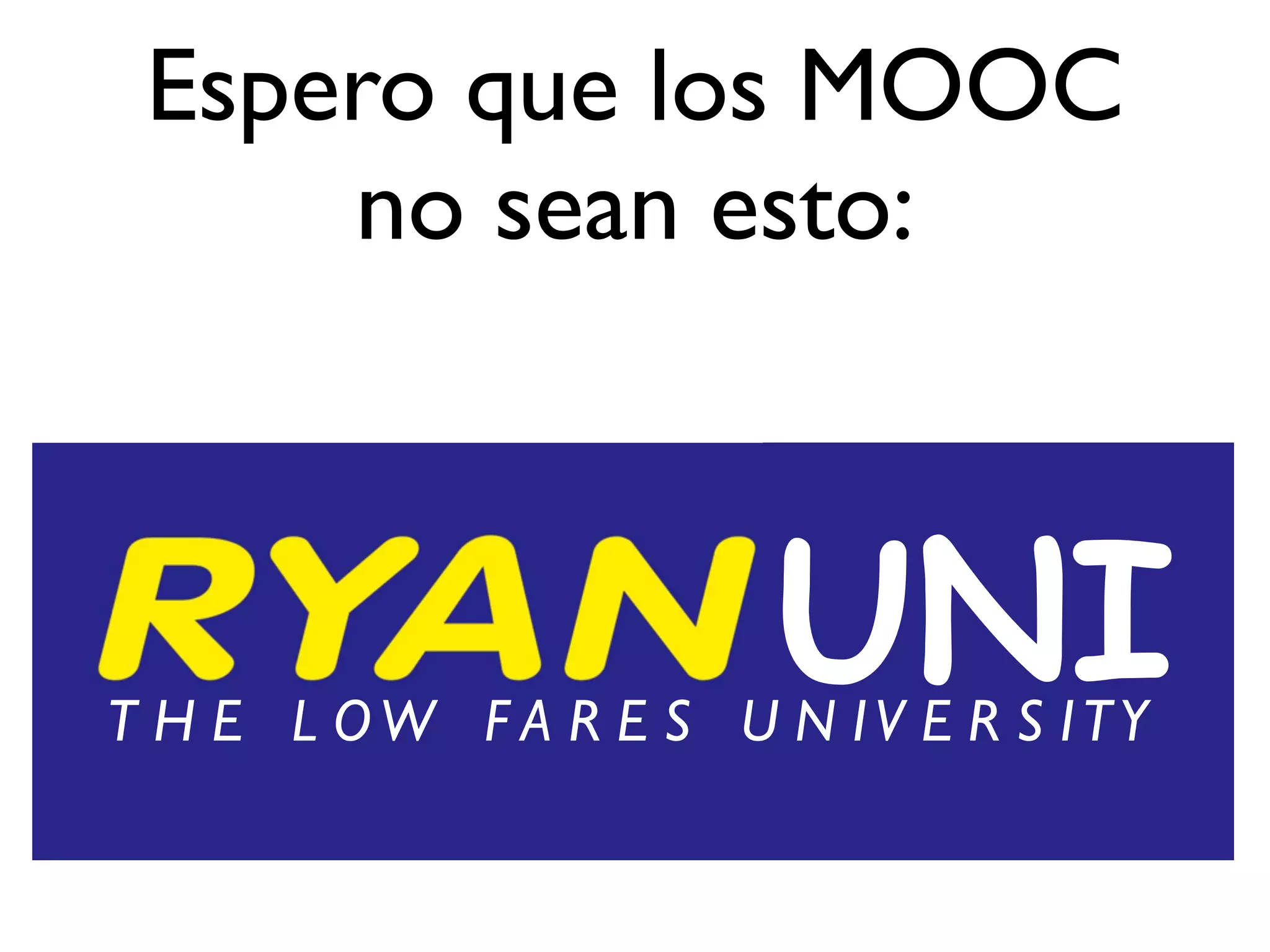
Espero que los MOOC
no sean esto:
T H E L OW F A R E S U N IV E R S ITY
UNI
¡Muchas gracias!
Jordi Adell!
Depto. de Educación!
Universitat Jaume I!
jordi@uji.es!
@jordi_a

El aprendizaje en los MOOC

  • 1.
    El aprendizaje através de cursos abiertos masivos en línea (MOOC) Jordi Adell! Universitat Jaume I ¡MOOC!
  • 2.
  • 3.
  • 4.
  • 8.
  • 9.
    Cuatro ideas: • ¿Quées un MOOC?! • ¿Aprendizaje? ¿Qué aprendizaje?! • El contexto y la historia de los MOOC! • Diferencias entre xMOOC y cMOOC! • La investigación empírica sobre los MOOC! • La pedagogía de los cMOOC y xMOOC! • El futuro de los MOOC (y la universidad)
  • 10.
  • 11.
    ¿Cuántos de Uds.se han matriculado en un MOOC?
  • 12.
    ¿Lo terminaron oabandonaron?
  • 13.
    ¿Les gustó laexperiencia?
  • 14.
    ¿Han diseñado, desarrolladoe “impartido” un MOOC?
  • 15.
    1. ¿Qué esun MOOC?
  • 18.
    Mathieu Plourde: http://www.flickr.com/photos/mathplourde/8448541815/ MOOC:Every letter is negotiable Just a visual representation of intepretations of what MOOCs are.
  • 19.
    SPOC! Small Private OnlineCourse! http://en.wikipedia.org/wiki/Small_private_online_course
  • 20.
  • 22.
    Familias de teorías delaprendizaje: 
 conductismo, cognitivismo, constructivismo… ¿conectivismo?!Schunk (1991)
  • 23.
    1. ¿Qué esel aprendizaje? ! ¿Hay diferentes tipos de aprendizaje?
  • 24.
    2. ¿Cómo ocurreel aprendizaje?
  • 25.
  • 26.
    4. ¿Cuál esel papel de la memoria?
  • 27.
    5. ¿Cómo ocurrela transferencia?
  • 28.
    6. ¿Qué tiposde aprendizaje son explicados por la teoría?
  • 29.
    7. ¿Qué asunciones básicas/principiosde la teoría son relevantes en educación (instructional design)? Ertmer & Newby (1993):
  • 30.
    8. ¿Cómo debe estructurarsela instrucción para facilitar el aprendizaje? Ertmer & Newby (1993):
  • 31.
    9. Epistemología: ¿qué esel conocimiento? Adell (hoy):
  • 32.
    3. El contextoy la historia de los MOOC
  • 33.
    1. El triunfode la visión neoliberal de la educación como inversión en capital humano al servicio del sistema productivo... y como oportunidad de negocio.
  • 35.
  • 36.
    2. La tremendaburbuja de la educación superior EE.UU. $24.000 Deuda media titulado/a +75%Coste de la vida 1988-2008 +325%Coste College 4 años 1988-2008
  • 38.
    La Universidad estárecibiendo fuertes presiones de su entorno social, político y económico para...“educar más estudiantes, con mejores resultados de aprendizaje, con un coste menor” George L. Mehaffy, Vicepresidente Liderazgo Académico y Cambio de la Asociación Americana de Colleges y Universidades Estatales. George L. Mehaffy (2012). Challenge and Change, EDUCAUSE Review, september 5, 2012.
  • 39.
    Conclusión: Es imposible entendernada en educación superior sin referencia a la agenda neoliberal.
  • 40.
  • 41.
    David Wiley (Utah StateUniversity) ofrece “plazas” gratuitas online en uno de sus cursos: INST 7150 Introduction to Open Education 2007 http://www.opencontent.org/wiki/index.php?title=Intro_Open_Ed_Syllabus
  • 42.
    2008 George Siemens yStephen Downes crean el primer MOOC (conectivista) http://ltc.umanitoba.ca/wiki/Connectivism_2008 http://ltc.umanitoba.ca/wiki/Connectivism
  • 43.
  • 44.
    2011 Un cursode IA de Sebastian Thrun (MIT) y Peter Norvig (Google) atrae a 160.000 alumnos
  • 45.
    Stanford University
 CS221: Introductionto Artificial Intelligence • 10 semanas: 10/10/11-18/12/11! • 200 matriculados de Stanford, 160,000 matriculados pr Internet. 20,000 completan el curso. ¡160.000!
  • 46.
    2012 Se crean lasstartups Udacity y Coursera y edX
  • 47.
    ! 4. Diferencias entre losxMOOC y los cMOOC excurso. (Del lat. excursus). 1. m. digresión.
  • 48.
    xMOOC: 1. Masivos. 2. Accesoonline y abiertos 3. Lecciones con vídeos cortos y pruebas objetivas formativas. 4. Evaluación automatizada de pruebas objetivas y/o por pares. 5. Foros para el debate y el soprte entre iguales. Objectivo: adquisición de conocimientos
  • 49.
    cMOOC: 1. Masivos. 2. Lecturas,vídeos, conferencias, tareas, etc. como “pretexto”. 3. Autoavaluación. No créditos, no calificaciones. Aprender por aprender. 4. Foros en línea para el debate y el soporte entre iguales.Y muchísimas más herramientas... (tags para organizar). Objectivo: apropiación y creación de conocimiento. Networking, desarrollo del PLE.
  • 50.
    Lane, Lisa M.(2012).Three Kinds of MOOCs, Lisa’s (Online) Teaching Blog, 15 agosto de 2012. http://lisahistory.net/wordpress/2012/08/three-kinds-of-moocs/ Tipos de MOOC Basados en crear conexiones Basados en tareas Basados en contenidos ! Siemens/Downes Alec Couros EC&I 831 Dave Cormier CCKxx & Changex Conectivismo ! Jim Groom DS106 Lisa Lane POT Cert ! Stanford AI edx Coursera Udacity Instructivismo comerciales o pre- comerciales cMOOC xMOOC
  • 51.
    ! 1. the degreeof openness, ! 2. the scale of participation (massification), ! 3. the amount of use of multimedia, ! 4. the amount of communication, ! 5. the extent to which collaboration is included, ! 6. the type of learner pathway (from learner centred to teacher-centred and highly structured), ! 7. the level of quality assurance, ! 8. the extent to which reflection is encouraged, ! 9. the level of assessment, ! 10. how informal or formal it is, ! 11. autonomy, and 12. diversity. G. Conole (2014). MOOCs as disruptive technologies: strategies for enhancing the learner experience and quality of MOOC I want to suggest that a better classification of MOOCs is in terms of a set of twelve dimensions:
  • 52.
    2012 Comenza el hypeen la prensa http://www.wired.com/wiredscience/2012/03/ff_aiclass/
  • 53.
  • 54.
  • 58.
  • 59.
    NewYork Times: 2012,el año del MOOC
  • 60.
    Clay Shirky Higher educationis now being disrupted; our MP3 is the Massive Open Online Course (or MOOC), and our Napster is Udacity, the education startup. http://www.shirky.com/weblog/2012/11/napster-udacity-and-the-academy/
  • 61.
    “I don’t thinkthis is revolutionary from an educational perspective; I think it is from a business perspective.” Dave Cormier
  • 62.
  • 63.
    2012 Comienzan las alianzasentre startups y universidades selectas
  • 64.
  • 65.
    2013 A study ofa million users of massive open online courses, known as MOOCs, released this month by the University of Pennsylvania Graduate School of Education found that, on average, only about half of those who registered for a course ever viewed a lecture, and only about 4 percent completed the courses. Empiezan a verse resultados... y no son buenos
  • 66.
    Phil Hill, “EmergingStudent Patterns in MOOCs: A (Revised) Graphical View ”. E-Literate, March 10, 2013 http://mfeldstein.com/emerging-student-patterns- in-moocs-a-revised-graphical-view/ never login read content or browse discussions, but do not take any form of assessment beyond pop-up quizzes embedded in videos perform some activity (watch videos, browse or participate in discussion forum) for a select topic within the course, but do not attempt to complete the entire course view a course as content to consume. They may watch videos, take quizzes, read discuss forums, but generally do not engage with the assignments. the students who fully intend to participate in the MOOC and take part in discussion forums, the majority of assignments and all quizzes & assessments.
  • 67.
    Clow, Doug (2013).MOOCs and the funnel of participation. In:Third Conference on Learning Analytics and Knowledge (LAK 2013), 8-12 April 2013, Leuven, Belgium.
  • 68.
    2013 Comienza a decaerla euforia sobre los MOOC
  • 69.
    2013 La prensa interesadase desencanta And perhaps the most publicized MOOC experiment, at San Jose State University, has turned into a flop. http://www.sjsu.edu/chemistry/People/Faculty/Collins_Research_Page/AOLE%20Report%20- September%2010%202013%20final.pdf
  • 70.
    2013 El creador sedesencanta y “gira velas”. Entrevista en Fast Company a Sebatian Thrun:
  • 71.
    "We were onthe front pages of newspapers and magazines, and at the same time, I was realizing, we don't educate people as others wished, or as I wished. We have a lousy product… "Online education that leaves almost everybody behind except for highly motivated students, to me, can't be a viable path to education. We look back at our early work and realize it wasn't quite as good as it should have been. We had so many moments for improvement." Sebastian Thrun Udacity Licencia Algunos derechos reservados por jdlasica Sebastian Thrun, Fast Company Magazine http://www.fastcompany.com/3021473/udacity-sebastian-thrun-uphill-climb
  • 72.
    2014 Comienza el primerMaster MOOC “de pago” con... ¡375 estudiantes!
  • 73.
    2014 Siguen los “informes”(cientos de informes) Los dos de esta semana: MAY 2014 Disruptor, Distracter, or What? A POLICYMAKER’S GUIDE TO MASSIVE OPEN ONLINE COURSES (MOOCS) Andrew P. Kelly IDEAS | PEOPLE | RESULTS MOOCs: Expectations and Reality Full Report May 2014 Fiona M. Hollands, Ph.D. Devayani Tirthali, Ed.D. Center for Benefit-Cost Studies of Education Teachers College, Columbia University
  • 74.
    2014 Empiezan a lloverartículos sobre MOOC
  • 75.
    ¿Y qué seinvestiga? Liyanagunawardena, T., A. A. Adams, and S. A. Williams (2013). MOOCs: A Systematic Study of the Published Literature 2008–2012. The International Review of Research in Open and Distance Learning 14 (3): 202–227. 1. Introductory (explaining aspects of MOOCs) 2. Concept (discussion of threats and opportunities of MOOCs in higher education) 3. Case Studies 4. Educational theory (pedagogical approaches used), 5. Technology (discussion of hardware and software used) 6. Participant focused ((discussion of participants’ experiences) 7. Provider focused (discussion of course creators and leaders) 8. Other.
  • 76.
    ¿Qué se investiga? Ebben.M. & Murphy; j.S. (2014). Unpacking MOOC scholarly discourse: a review of nascent MOOC scholarship. Learning, Media and Technology, DOI: 10.1080/17439884.2013.878352. (2009-2013 (1 de julio)). 1. Phase one: Connectivist cMOOCs, engagement and creativity 2009–2012 1. development of Connectivism as a learning theory, and 2. technological experimentation and innovation with Connectivism in early cMOOCs 2. Phase Two: xMOOCs, Learning Analytics and Assessment 
 2012–2013 1. the rise of xMOOCs, 2. further development of MOOC pedagogy, 3. growth of learning analytics and assessment, and the 4. emergence of a critical discourse about MOOCs.
  • 77.
  • 78.
    “Udacity announced thisweek that it would phase out free certificates for those who successfully complete its classes because students demanded more rigor. For reals?! No specifics on how much the startup is going to charge for the certificates now – Sebastian Thrun says “a relatively modest tuition fee.” Currently Udacity charges $150 a month for a mentor and feedback. MOOCs: free as in “bullshit.” Audrey Watters Hack Education http://hackeducation.com/2014/04/18/hack-education-weekly- news-4–18–2014/ “MOOCs: free as in “bullshit” Foto: Alan Levine
  • 79.
  • 80.
    Principios de aprendizaje conectivista(Siemens) • El aprendizaje y el conocimiento yace en la diversidad de opiniones. • El aprendizaje es el proceso de conectar nodos o fuentes de información. • No sólo de los humanos se aprende, el conocimiento puede residir fuera del ser humano. • La capacidad de aumentar el conocimiento es más importante que lo que ya se sabe. …
  • 81.
    Principios de aprendizaje conectivista(Siemens) • La habilidad para ver las conexiones entre los campos, ideas y conceptos es primordial. • La información actualizada y precisa es la intención de todas las actividades del proceso conectivista. • La toma de decisiones es en sí misma un proceso de aprendizaje. Escoger qué aprender y el significado de la información entrante es visto a través de la lente de una realidad cambiante. Es posible que una respuesta actual a un problema esté errada el día de mañana bajo la nueva información que se recibe. • Es necesario nutrir y mantener las conexiones para facilitar el aprendizaje continuo.
  • 82.
  • 83.
  • 84.
  • 86.
    Framework for emergentlearning and learning ecologies Williams, Karousou, and Mackness (2011). Emergent Learning and Learning Ecologies in Web 2.0. International Review of Research in Open and Distance Learning, 12(3), 39-59.
  • 87.
    G. Siemens define “emergencia”como: ! an attribute exhibited by complex systems. The interactions of multiple agents at a local level can create or contribute to significant system-level change....When applied to learning, we can appeal to emergence as the outcome (understanding?) that arises from different agents interacting and producing unanticipated outcomes. Siemens, G. (2009). Complexity, chaos, and emergence. 
 http://docs.google.com/View?docid=anw8wkk6fjc_15cfmrctf8
  • 88.
    For the purposesof this paper, we interpret emergent learning as: ! learning which arises out of the interaction between a number of people and resources, in which the learners organise and determine both the process and to some extent the learning destinations, both of which are unpredictable. The interaction is in many senses self- organised, but it nevertheless requires some constraint and structure. It may include virtual or physical networks, or both. Williams, Karousou, and Mackness (2011). Emergent Learning and Learning Ecologies in Web 2.0. International Review of Research in Open and Distance Learning, 12(3), 39-59.
  • 89.
    Aprendizajes emergentes Williams, R., Mackness,J., y Gumtau, S. (2012). Footprints of emergence. International Review of Research in Open and Distance Learning, 13(4). Accesible en http://www.irrodl.org/ index.php/irrodl/article/view/1267/230 CaosCaos Currículum prescrito
  • 90.
  • 92.
  • 94.
    Tiempo: una odos semanas xMOOC: Mastery Learning Evaluaci formati Unidad o lección 2 Actividades de ampliación Actividades de recuperación Unidad o lección 1 Evaluación formativa Evaluación formativa
  • 95.
    Referentes teóricos Benjamin Bloom (1913-1999) B.F.Skinner (1904-1990) Antecedents:Washburne en1922
  • 96.
    Retrieval practice isthe act of enhancing long– term memory of facts through recalling information from short–term memory. Retrieval-based learning
  • 97.
    “The key ideaunderlying our research is that frequent classroom testing (and student self- testing) can greatly improve education from kindergarten through university.” Roediger, H.L. & Karpicke, J.D. (2006).Test-Enhanced Learning.Taking Memory Tests Improves Long-Term Retention, Psychological Science, 17(3), 249. Jeffrey D. Karpicke
  • 98.
  • 99.
  • 100.
    Todo sobre losMOOC en una diapositiva :-)
  • 101.
  • 102.
    Los cMOOC hanhecho un interesante tabajo en auto- organizción y comunidades de aprendizaje. Los xMOOC han escalado el aula magna Son enfoques muy diferentes. Su valor depende del valor que Ud. vea en estas dos metas. ! Stephen Downes
  • 103.
    What is interestingin this context is all the noise about MOOCs.These are just lectures on line interrupted by quizzes and discussion groups for the most part.There are no actual teachers and there is no one to help you get better at something. (A lot like an actual college course, in fact). Roger Schank http://educationoutrage.blogspot.com.es/2012/11/practical-education-for-everyone-enough.html
  • 104.
  • 105.
    Decir que losMOOC se desvanecerán porque son de poca calidad o su pedagogía es mala es como decir que McDonalds desaparecerá porque su comida no es saludable y la sillas son duras... Conveniencia y precio ganarán, independientemente de la calidad. Lisa Lane Why deMOOCification won’t work http://lisahistory.net/wordpress/2013/06/why-demoocification-wont-work/
  • 106.
  • 107.
  • 108.
    Espero que losMOOC no sean esto: T H E L OW F A R E S U N IV E R S ITY UNI
  • 109.
    ¡Muchas gracias! Jordi Adell! Depto.de Educación! Universitat Jaume I! jordi@uji.es! @jordi_a